UNITED STATES SECURITIES AND EXCHANGE COMMISSION
Washington, D.C. 20549-1004
FORM
SECURITIES EXCHANGE ACT OF 1934
For the fiscal year ended
or
of the Securities Exchange Act of 1934
for the transition period from ___________ to ___________
Commission File No.
(Exact name of Registrant as specified in its charter)
(State of Incorporation) |
|
(I.R.S. Employer Identification No.) |
(Address of principal executive offices)
(
(Registrant’s telephone number, including area code)
Securities registered pursuant to Section 12(b) of the Act:
|
||
Title of Each Class |
Trading Symbol(s) |
Name of Each Exchange on Which Registered |
Securities registered pursuant to Section 12(g) of the Act: |
||
|
None |
|
Indicate by check mark if the registrant is a well-known seasoned issuer, as defined in Rule 405 of the Securities Act.
Indicate by check mark if the registrant is not required to file reports pursuant to Section 13 or 15 (d) of the Act. Yes ☐
Indicate by check mark whether the registrant (1) has filed all reports required to be filed by Section 13 or 15(d) of the Securities Exchange Act of 1934 during the preceding 12 months (or for such shorter period that the Registrant was required to file such reports), and (2) has been subject to such filing requirements for the past 90 days.
Indicate by check mark whether the registrant has submitted electronically every Interactive Data File required to be submitted pursuant to Rule 405 of Regulation S-T (§ 232.405 of this chapter) during the preceding 12 months (or for such shorter period that the registrant was required to submit and post such files).
Indicate by check mark whether the registrant is a large accelerated filer, an accelerated filer, a non-accelerated filer, a smaller reporting company or an emerging growth company. See definitions of “large accelerated filer,” “accelerated filer,” “smaller reporting company” and “emerging growth company” in Rule 12b-2 of the Exchange Act.
☒ |
Accelerated filer □ |
Non-accelerated filer □ |
Smaller reporting company |
Emerging growth company |
If an emerging growth company, indicate by check mark if the registrant has elected not to use the extended transition period for complying with any new or revised financial accounting standards provided pursuant to Section 13(a) of the Exchange Act. ☐
Indicate by check mark whether the registrant has filed a report on and attestation to its management’s assessment of the effectiveness of its internal control over financial reporting under Section 404(b) of the Sarbanes-Oxley Act (15 U.S.C. 7262(b)) by the registered public accounting firm that prepared or issued its audit report.
If securities are registered pursuant to Section 12(b) of the Act, indicate by check mark whether the financial statements of the registrant included in the filing reflect the correction of an error to previously issued financial statements.
Indicate by check mark whether any of those error corrections are restatements that required a recovery analysis of incentive- based compensation received by any of the registrant’s executive officers during the relevant recovery period pursuant to §240.10D-1(b). ☐
Indicate by check mark whether the registrant is a shell company (as defined in Rule 12b-2 of the Act). Yes ☐ No
Aggregate market value of the registrant’s Common Stock held by non-affiliates as of February 28, 2024 (based on the closing price of such shares on such date) was $
The number of shares outstanding of the registrant’s Common Stock on October 18, 2024 was
DOCUMENTS INCORPORATED BY REFERENCE
Certain portions of the registrant’s definitive Proxy Statement prepared in connection with the Annual Meeting of Shareholders to be held on January 9, 2025 are incorporated by reference into Part III of this Report.
THE GREENBRIER COMPANIES, INC.
FORM 10-K
TABLE OF CONTENTS
|
|
|
|
PAGE |
|
|
|
3 |
|
|
|
|
|
|
PART I |
|
|
|
|
|
|
|
|
|
Item 1. |
|
|
4 |
|
Item 1A. |
|
|
12 |
|
Item 1B. |
|
|
26 |
|
Item 1C. |
|
|
26 |
|
Item 2. |
|
|
28 |
|
Item 3. |
|
|
28 |
|
Item 4. |
|
|
28 |
|
|
|
|
29 |
|
|
|
|
|
|
PART II |
|
|
|
|
|
|
|
|
|
Item 5. |
|
|
30 |
|
Item 6. |
|
|
31 |
|
Item 7. |
|
MANAGEMENT'S DISCUSSION AND ANALYSIS OF FINANCIAL CONDITION AND RESULTS OF OPERATIONS |
|
32 |
Item 7A. |
|
|
47 |
|
Item 8. |
|
|
50 |
|
Item 9. |
|
CHANGES IN AND DISAGREEMENTS WITH ACCOUNTANTS ON ACCOUNTING AND FINANCIAL DISCLOSURE |
|
80 |
Item 9A. |
|
|
80 |
|
Item 9B. |
|
|
84 |
|
Item 9C. |
|
DISCLOSURE REGARDING FOREIGN JURISDICTIONS THAT PREVENT INSPECTIONS |
|
84 |
|
|
|
|
|
PART III |
|
|
|
|
|
|
|
|
|
Item 10. |
|
|
85 |
|
Item 11. |
|
|
85 |
|
Item 12. |
|
SECURITY OWNERSHIP OF CERTAIN BENEFICIAL OWNERS AND MANAGEMENT AND RELATED STOCKHOLDERS MATTERS |
|
85 |
Item 13. |
|
CERTAIN RELATIONSHIPS AND RELATED TRANSACTIONS AND DIRECTOR INDEPENDENCE |
|
85 |
Item 14. |
|
|
85 |
|
|
|
|
|
|
PART IV |
|
|
|
|
|
|
|
|
|
Item 15. |
|
|
86 |
|
Item 16. |
|
|
90 |
|
|
|
|
91 |
2
Forward-Looking Statements
This Annual Report on Form 10-K contains forward-looking statements. These statements involve known and unknown risks, uncertainties and other important factors that may cause our actual results, performance or achievements to be materially different from any future results, performance or achievements expressed or implied by the forward-looking statements.
Many of these risks and other factors are beyond our ability to control or predict. Words such as "ability," “allow,” “anticipate,” “believe,” “committed,” “can,” “continue,” “could,” “designed,” “estimate,” “expect,” “foreseeable”, “future,” “goal,” "impact," “intend,” “likely,” “may,” “periodically,” “plan,” “potential,” “provide,” “result,” “seek,” “should,” “strategy,” "target," “will,” “would,” and similar expressions identify forward-looking statements. In addition, statements regarding expectations of cost savings or our ability to navigate current challenges, or any other statements that explicitly or implicitly draw trends in our performance or the markets in which we operate, or characterize future events or circumstances, are forward-looking statements.
These risks and uncertainties, as well as other risks and uncertainties that could cause our actual results to differ significantly from management’s expectations, are described in greater detail in Item 1A, “Risk Factors,” Item 1, “Business – Backlog,” Item 7, “Management’s Discussion and Analysis of Financial Condition and Results of Operations,” and Item 9A. “Controls and Procedures – Inherent Limitations on Effectiveness of Controls.” Forward-looking statements are based on currently available operating, financial and market information and are inherently uncertain. Investors should not place undue reliance on forward-looking statements, which speak only as of the date they are made and are not guarantees of future performance. Actual future results and trends may differ materially from such forward-looking statements. Except as otherwise required by law, we do not assume any obligation to update any forward-looking statements.
3
PART I
Item 1. BUSINESS
Introduction
We are one of the leading designers, manufacturers and marketers of railroad freight car equipment and services in North America, Europe, and South America and may enter other geographies as opportunities arise. We offer railcar management, regulatory compliance and leasing services to railcar owners or other users of railcars in North America. We are a leading provider of freight railcar wheel services, maintenance and parts in North America. Through unconsolidated affiliates we produce rail and industrial components and have an ownership stake in a railcar manufacturer in Brazil.
We operate an integrated business model in North America that combines freight car manufacturing, wheel services, railcar maintenance, component parts, leasing and fleet management services. Our model is designed to provide customers with a comprehensive set of freight car product and service solutions by utilizing our substantial engineering, mechanical and technical capabilities as well as our experienced commercial personnel. Our integrated model allows us to develop cross-selling opportunities and synergies among our reportable segments thereby enhancing our margins. We believe our integrated model is difficult to duplicate and provides greater value for our customers and investors.
We operate in three reportable segments: Manufacturing; Maintenance Services; and Leasing & Management Services. Financial information about our reportable segments as well as geographic information is located in Note 18 - Segment Information to the Consolidated Financial Statements.
References in this Annual Report on Form 10-K to the “Company,” “Greenbrier,” “we,” “us” and “our” refer to The Greenbrier Companies, Inc. and, where appropriate, its subsidiaries. All references to years refer to the fiscal years ended August 31st unless otherwise noted.
The Greenbrier Companies, Inc., is incorporated in Oregon. Our principal executive offices are located at One Centerpointe Drive, Suite 200, Lake Oswego, Oregon 97035. Our telephone number is (503) 684-7000 and our Internet website is located at http://www.gbrx.com. Information contained on our website is not part of or incorporated into this Form 10-K or any other filings with the Securities and Exchange Commission (SEC).
Products and Services
Manufacturing Segment
North American Railcar Manufacturing - We manufacture most freight railcar types currently in use in the North American market (other than coal cars) and we continue to expand our product features and functionality. We have demonstrated an ability to capture high market shares in many of the car types we produce. The primary products we produce for the North American market are:
Freight Railcars - We produce a variety of covered hopper cars for food grade products, grain, fertilizer, cement, minerals and plastic pellets as well as gondolas and open top hoppers for steel, metals, scrap and aggregates. We also produce a wide range of boxcars, which are used in the transport of paper products, perishables and general merchandise. Our flat car products include center partition cars for the forest products industry and heavy-duty flat cars.
Tank Cars - We produce a variety of tank cars, including general purpose, pressurized, coiled, lined, insulated and stainless steel. These are designed for the transportation of hazardous and non-hazardous commodities such as petroleum products, ethanol, liquefied petroleum gas, petrochemicals, caustic soda, chlorine, fertilizers, vegetable oils, bio-diesel and various other products.
Intermodal Railcars - We manufacture a comprehensive portfolio of intermodal railcars. Our most popular intermodal product is our double-stack railcars called Maxi-Stack® I and Maxi-Stack® IV. The double-stack railcar is designed to
4
transport containers stacked two-high on a single platform and provides significant operating and capital savings over other types of intermodal railcars.
Automotive - We manufacture a full line of railcar equipment specifically designed for the transportation of light vehicles. Our automotive offerings include the Auto-Max® II, Multi-MaxTM and Multi-Max PlusTM products, which are designed to carry automobiles, CUVs, SUVs, trucks and high sided vans efficiently.
Sustainable ConversionsTM - We are a leading provider of sustainable conversions, which repurposes existing railcars into new equipment service. Our sustainable conversions are an efficient and cost-savings option for railcar owners looking to diversify and optimize their fleets. We rebody or stretch covered hoppers into larger cubic service, re-rack or perform deck conversion on auto racks, and perform tank car retrofits to help customers manage pending regulations.
European Railcar Manufacturing - Our European manufacturing operations produce a variety of freight wagon types, including box, car carrier, covered, flat, hopper, intermodal, steel products and specialty wagons. In addition, our European manufacturing operations produce a comprehensive line of pressurized tank wagons for liquid petroleum, liquefied petroleum gas, chlorine and ammonia and non-pressurized tank cars for light oil, chemicals and other products, and are a leading manufacturer of bogies and other key components. We offer a full range of leasing options for a variety of freight and tank wagons that we produce, along with wagon repair and maintenance services.
Maintenance Services Segment
Wheel Services - We operate a wheel services network in North America. Our wheel shops provide complete wheel services including reconditioning of wheels and axles in addition to new axle machining, finishing and downsizing.
Railcar Maintenance - We operate a railcar maintenance network in North America including shops certified by the Association of American Railroads (AAR). Our shops perform routine railcar maintenance for third parties and for our leased and managed railcar fleets.
Component Parts Manufacturing - Our component parts facilities recondition and manufacture railcar cushioning units, couplers, yokes, side frames, bolsters and various other parts.
In September 2024, the Company combined the Maintenance Services segment within the Manufacturing segment.
Leasing & Management Services Segment
Leasing - We operate a railcar leasing business in North America. Our relationships with financial institutions and operating lessors combined with our ownership of a lease fleet of approximately 15,500 railcars enables us to offer flexible leases to our customers including operating leases of varied intervals and “per diem” leases. The percentage of owned units on lease was 98.5% at August 31, 2024 with an average remaining lease term of 4.0 years and an average age of 6.5 years. We also originate leases of railcars, which are either newly built or refurbished by our operations. These may be held in the fleet or sold with attached leases to financial institutions or other investors, typically with multi-year management services agreements. As an equipment owner and an originator of leases, we participate principally in the operating lease segment of the market. Assets from our owned lease fleet are periodically sold to accommodate customer demand, manage risk and maintain liquidity.
Management Services - Our North American management services business offers a broad array of software and services that include railcar maintenance management, railcar accounting services (such as billing and revenue collection, car hire receivable and payable administration), total fleet management (including railcar tracking using proprietary software), fleet logistics, administration and railcar re-marketing. We currently provide management services for a fleet of railcars for railroads, shippers, carriers, institutional investors and other leasing and transportation companies in North America. In addition, our Regulatory Services Group offers regulatory, engineering, process consulting and advocacy support to the tank car owner and shipper community, among other services. Our management services business is responsible for the maintenance and administration of our fleet of railcars.
5
Unconsolidated Affiliates
United States (U.S.) Axle Manufacturing - We have a 41.9% interest in Axis, LLC (Axis), a joint venture that manufactures and sells axles to its joint venture partners for use and distribution both domestically and internationally.
Brazilian Railcar Manufacturing - We have a 60% ownership interest in Greenbrier Maxion-Equipamentos e Serviços Ferroviários S.A. (Greenbrier-Maxion), a leading railcar manufacturer in South America, based in Hortolandia, Brazil. Greenbrier-Maxion also assembles bogies and offers a range of aftermarket services including railcar overhaul and refurbishment. We do not consolidate Greenbrier-Maxion for financial reporting purposes and account for our interest under the equity method of accounting as the entity’s governance provisions require that all significant decisions of Greenbrier-Maxion are subject to shared consent of its shareholders.
Brazilian Castings and Component Parts Manufacturing - We have a 29.5% ownership interest in Amsted-Maxion Fundição e Equipamentos Ferroviários S.A. (Amsted-Maxion) based in Cruzeiro, Brazil. Amsted-Maxion is a manufacturer of various castings and wheel components for railcars and other heavy industrial equipment. Amsted-Maxion has a 40% ownership position in Greenbrier-Maxion and is integrated with the operations of our Brazilian railcar manufacturer.
Other Unconsolidated Affiliates - We have other unconsolidated affiliates which primarily include joint ventures that produce rail and industrial components, all of which are presented in Investment in unconsolidated affiliates on the Consolidated Balance Sheets.
Backlog
The following table depicts our reported railcar backlog subject to third-party sale or lease in number of railcars and estimated future revenue value attributable to such backlog, at the dates shown:
|
|
August 31, |
|
|||||||||
|
|
2024 |
|
|
2023 |
|
|
2022 |
|
|||
New railcar backlog units 1 |
|
|
26,700 |
|
|
|
30,900 |
|
|
|
29,500 |
|
Estimated future revenue value (in millions) 2 |
|
$ |
3,380 |
|
|
$ |
3,810 |
|
|
$ |
3,480 |
|
|
|
|
|
|
|
|
|
|
|
|||
1 Each platform of a railcar is treated as a separate unit.
2 Subject to change based on finalization of product mix.
Approximately 3% of backlog units and estimated value as of August 31, 2024 was associated with our Brazilian railcar manufacturing operations, which are accounted for under the equity method.
Based on current production schedules, approximately 18,600 units in the August 31, 2024 backlog are scheduled for delivery in 2025. The remaining balance of the production is scheduled for delivery in 2026 and beyond.
Our backlog includes approximately $590 million of railcars intended for syndication which are supported by lease agreements with external customers and may be syndicated to third parties or held in our lease fleet, depending on a variety of factors.
Our backlog of railcar units is not necessarily indicative of future results of operations. Certain orders in backlog are subject to customary documentation and completion of terms. Customers may attempt to cancel or modify orders in backlog. Historically, little variation has been experienced between the quantity ordered and the quantity actually delivered, though the timing of deliveries may be modified from time to time.
Customers
Customers across our reportable segments include railroads, leasing companies, financial institutions, shippers, carriers and transportation companies. We have strong, long-term relationships with many of our customers. We believe that our customers’ preference for high quality products, our technological leadership in developing innovative products, our focus on being highly responsive to our customers' needs and competitive pricing of our railcars have helped us maintain our long-standing relationships with our customers.
6
In 2024, revenue from one customer accounted for approximately 10% of Consolidated Revenue which represented 11% of Manufacturing Revenue, 6% of Leasing & Management Services Revenue and 1% of Maintenance Services Revenue. No other customers accounted for greater than 10% of Consolidated Revenue.
Raw Materials and Components
Our products require a supply of materials including steel and specialty components such as brakes, wheels and axles. Specialty components purchased from third parties represent a significant amount of the cost of most freight cars. Our customers often specify particular components and suppliers of such components. Although the number of alternative suppliers of certain specialty components has declined in recent years, there are at least two available suppliers for substantially all of our components.
Certain materials and components are periodically in short supply which could potentially impact production at our facilities. In an effort to mitigate shortages and reduce supply chain costs, we have entered into strategic alliances and multi-year arrangements for the global sourcing of certain materials and components. We operate a replacement parts business which aids in our vertical integration and we continue to pursue strategic opportunities to protect and enhance our supply chain. We periodically make advance purchases to avoid possible shortages of material due to capacity limitations of component suppliers, shipping and transportation delays and possible price increases.
In 2024, the top ten suppliers for all inventory purchases accounted for approximately 44% of total purchases. The top supplier accounted for 17% of total inventory purchases in 2024. No other suppliers accounted for more than 10% of total inventory purchases. We believe we maintain good relationships with our suppliers.
Competition
We believe we are currently one of the two largest railcar manufacturers in North America. There are also a handful of specialty builders who focus on niche markets. In Europe, we believe we are in the top tier of railcar manufacturers. Through our 60% ownership interest in Greenbrier-Maxion, we are a leading railcar manufacturer in South America. The railcar manufacturing industry is becoming more global as customers are purchasing railcars from manufacturers outside of their geographic region. In all railcar markets that we serve, we compete on the basis of quality, price, timeliness of delivery, innovative product design, reputation and customer service.
Competition in the Maintenance Services businesses is dependent on the type of product or service provided. There are many competitors in these businesses. We compete primarily on the basis of quality, timeliness of delivery, customer service, location of shops, price and engineering expertise.
There are at least twenty institutions in North America that provide railcar leasing and/or services similar to ours. Many of them are also customers that buy new railcars from our manufacturing facilities and used railcars from our lease fleet, as well as utilize our management and maintenance services. We compete primarily on the basis of quality, price, timeliness of delivery, reputation, service offerings and deal structuring and syndication ability. We believe our strong servicing capability and our ability to sell railcars with a lease attached (syndicate railcars), integrated with our manufacturing, maintenance shops, railcar specialization and expertise in particular lease structures provides a strong competitive advantage.
Marketing and Product Development
In North America, we leverage an integrated marketing and sales effort to coordinate relationships in our various segments. We provide our customers with a diverse range of equipment, services and financing alternatives designed to satisfy each customer’s unique needs, whether the customer is buying new equipment, sustainable conversion of existing equipment or seeking to outsource the maintenance or management of equipment. These custom programs may involve a combination of railcar products, leasing, sustainable conversions and remarketing services. In addition, we provide customized maintenance management, equipment management, accounting and compliance services and proprietary software solutions.
In Europe and South America, we maintain relationships with customers through market-specific sales personnel. Our engineering and technical staff works closely with their customer counterparts on the design and certification of railcars. Many European railroads are state-owned and are subject to European Union (EU) regulations covering the
7
tender of government contracts. In Brazil, the government grants long-term concession contracts to private companies to operate and invest in Brazil’s freight rail network.
Through our research and customer relationships, insights are derived into the potential need for new products and services. Marketing and engineering personnel collaborate to evaluate opportunities and develop new products and services that exceed customers’ expectations. Research and development costs incurred during the years ended August 31, 2024, 2023 and 2022 were $5.2 million, $4.0 million and $5.4 million, respectively.
Human Capital
With the oversight of the Board, our Chief Executive Officer and senior leadership are thoughtfully invested in our global workforce. We regularly review our priorities and progress in each of the areas highlighted below.
We depend on a highly skilled workforce of approximately 14,200 employees of which approximately half reside in Mexico. Individuals across multiple locations who have technical skills, including experience in welding, engineering, and machine operating, are necessary for us to succeed.
Approximately 7,800 employees are represented by unions, primarily in Mexico and Europe. At our Maintenance Services locations, approximately 50 employees are represented by a union. We believe we have good union relations.
Safety – Employee safety is a top priority and we remain dedicated to continuously improving our safety performance over time. We regularly demonstrate our commitment to maintaining a safe workplace through efforts such as a refreshed safety onboarding and continuous awareness and training process, empowering employees to speak up on safety matters, and enhancing our focus on leading indicators. Our Chief Executive Officer, senior leadership and our Board of Directors monitor our safety performance regularly.
Employee Engagement – Building a successful human capital management strategy requires foresight, commitment and a willingness to embrace change. We are committed to creating a culture of feedback that reinforces our Core Value of Respect for People.
Employee engagement and satisfaction are essential to Greenbrier’s success. We prioritize fostering connections, encouraging collaboration, and creating a culture of open dialogue and feedback. Employee surveys play a critical role in helping us understand the priorities of our workforce. In 2023, we expanded our employee engagement survey to include our Mexico facilities, and in 2024, we further expanded to include Europe. Feedback from our surveys continue to influence our approach to creating a culture of open dialogue and feedback.
We are dedicated to fostering an inclusive environment that represents the broader communities we serve. We maintain eight Employee Resource Groups (ERGs) sponsored and supported by leadership. Our ERGs aim to instill workplace values that inspire innovation and growth, keep employees engaged, contribute to personal and professional development, and support retention.
Communication and Recognition – In 2024, Greenbrier enhanced GBX RailDepot, the communication platform launched in 2023 by adding GBXcellence. This recognition and rewards program enhances our workplace culture by empowering employees to acknowledge the outstanding contributions of their peers and leaders, while also celebrating milestones together.
Development and Training – We understand that a talented and diverse workforce is essential to our success. That's why we focus on developing our employees through customized learning and training programs designed to enhance talent retention. Our personalized approach offers a range of training formats, equipping our team with the resources they need to grow and thrive professionally at Greenbrier. This empowers employees to take charge of their own learning journeys.
Compensation and Employee Well-Being – To remain competitive globally, we regularly evaluate our compensation programs. This includes reviewing base pay levels for equity both internally and externally and assessing the effectiveness of our short and long-term incentive programs. In addition, we strive to provide competitive health and wellness programs to our employees.
8
Benefits and Wellness – We believe benefits programs are a key differentiator in attracting and retaining talent. We strive to provide competitive programs that meet the diverse needs of our employees and their families. This includes health and wellness as well as financial and income protection benefits.
Our 2024 Sustainability Update report provides additional information regarding our sustainability strategy and targets. It can be found on our website. Information contained on or accessible through our website is not incorporated into and does not constitute a part of this filing.
Patents and Trademarks
We have a proactive program aimed at protecting our intellectual property and the results from our research and development. We have obtained a number of U.S. and non-U.S. patents of varying duration, and pending patent applications, registered trademarks, copyrights and trade names. We believe that manufacturing expertise, the improvement of existing technology and the development of new products are important in addition to patent protection, in establishing and maintaining a competitive advantage in our market.
Environmental Matters
We are subject to national, state and local environmental laws and regulations concerning, among other matters, air emissions, wastewater discharge, solid and hazardous waste disposal and employee health and safety. Prior to acquiring facilities, we conduct investigations to evaluate the environmental condition of subject properties and may negotiate contractual terms for allocation of environmental exposure arising from prior uses. We operate our facilities in a manner designed to maintain compliance with applicable environmental laws and regulations. Environmental studies have been conducted on certain of our owned and leased properties that indicate additional investigation and some remediation on certain properties may be necessary.
Portland Harbor Superfund Site
Our former Portland, Oregon manufacturing facility (the Portland Property) is located adjacent to the Willamette River. In December 2000, the U.S. Environmental Protection Agency (EPA) classified portions of the Willamette River bed known as the Portland Harbor, including the portion fronting the Portland Property, as a federal "National Priority List" or "Superfund" site due to sediment contamination (the Portland Harbor Site). Our company and more than 140 other parties have received a "General Notice" of potential liability from the EPA relating to the Portland Harbor Site. The letter advised us that we may be liable for the costs of investigation and remediation (which liability may be joint and several with other potentially responsible parties) as well as for natural resource damages resulting from releases of hazardous substances to the site. Ten private and public entities, including our company (the Lower Willamette Group or LWG), signed an Administrative Order on Consent (AOC) to perform a remedial investigation/feasibility study (RI/FS) of the Portland Harbor Site under EPA oversight, and several additional entities did not sign such consent, but nevertheless contributed financially to the effort. The EPA-mandated RI/FS was produced by the LWG and cost over $110 million during a 17-year period. We bore a percentage of the total costs incurred by the LWG in connection with the investigation. Our aggregate expenditure during the 17-year period was not material. Some or all of any such outlay may be recoverable from other responsible parties. The EPA issued its Record of Decision (ROD) for the Portland Harbor Site on January 6, 2017 and accordingly on October 26, 2017, the AOC was terminated.
Separate from the process described above, which focused on the type of remediation to be performed at the Portland Harbor Site and the schedule for such remediation, approximately 100 parties, including the State of Oregon and the federal government, are participating in a non-judicial, mediated allocation process to try to allocate costs associated with remediation of the Portland Harbor Site. We will continue to participate in the allocation process. Approximately 110 additional parties signed tolling agreements related to such allocations. On April 23, 2009, our company and the other AOC signatories filed suit against 69 other parties due to a possible limitations period for some such claims; Arkema Inc. et al v. A & C Foundry Products, Inc. et al, U.S. District Court, District of Oregon, Case #3:09-cv-453-PK. All but 12 of these parties elected to sign tolling agreements and be dismissed without prejudice, and the case has been stayed by the court until January 14, 2025.
9
The EPA's January 6, 2017 ROD identifies a clean-up remedy that the EPA estimates will take 13 years of active remediation, followed by 30 years of monitoring with an estimated undiscounted cost of $1.7 billion. The EPA typically expects its cost estimates to be accurate within a range of -30% to +50%, but this ROD states that changes in costs are likely to occur. The EPA has identified several work areas within the ROD cleanup area. One of the units, RM9W, includes the nearshore area of the river sediments offshore and downstream of the Portland Property. It also includes a portion of the Portland Property's riverbank. The ROD does not break down total remediation costs by Sediment Decision Unit. The EPA requested that potentially responsible parties enter AOCs during 2019 agreeing to conduct remedial design studies. Some parties have signed AOCs, including one party with respect to RM9W. We have not signed an AOC in connection with remedial design, but we are assisting in funding a portion of the RM9W remedial design.
The ROD does not address responsibility for the costs of clean-up, nor does it allocate such costs among the potentially responsible parties. Responsibility for funding and implementing the EPA's selected cleanup remedy will be determined at an unspecified later date. Based on the investigation to date, we believe that we did not contribute in any material way to contaminants of concern in the river sediments or the damage of natural resources in the Portland Harbor Site and that the damage in the area of the Portland Harbor Site adjacent to the Portland Property precedes our ownership of the Portland Property. Because these environmental investigations are still underway, sufficient information is currently not available to determine our liability, if any, for the cost of any required remediation or restoration of the Portland Harbor Site or to estimate a range of potential loss. Based on the results of the pending investigations and future assessments of natural resource damages, we may be required to incur costs associated with additional phases of investigation or remedial action, and may be liable for damages to natural resources.
On January 30, 2017 the Confederated Tribes and Bands of Yakama Nation sued 33 parties including our company as well as the federal government and the State of Oregon for costs it incurred in assessing alleged natural resource damages to the Columbia River from contaminants deposited in Portland Harbor. Confederated Tribes and Bands of the Yakama Nation v. Air Liquide America Corp., et al., U.S. Court for the District of Oregon Case No. 3i17-CV-00164-SB. The complaint does not specify the amount of damages the plaintiff will seek. The case has been stayed until January 14, 2025.
Oregon Department of Environmental Quality (DEQ) Regulation of Portland Manufacturing Operations
We entered into a Voluntary Cleanup Agreement with the Oregon Department of Environmental Quality (DEQ) in which we agreed to conduct an investigation of whether, and to what extent, past or present operations at the Portland Property may have released hazardous substances into the environment. We have also signed an Order on Consent with the DEQ to finalize the investigation of potential onsite sources of contamination that may have a release pathway to the Willamette River. Our aggregate expenditure has not been material, however we could incur significant expenses for remediation. Some or all of any such outlay may be recoverable from other responsible parties.
Sale of Portland Property
We sold the Portland Property in May 2023, but remain potentially liable with respect to the above matters. Any of these matters could adversely affect our business and Consolidated Financial Statements. However, any contamination or exacerbation of contamination that occurs after the sale of the property will be the liability of the current and future owners and operators of the Portland Property.
10
Regulation
We must comply with the rules of the Department of Homeland Security (DHS) and the U.S. Department of Transportation (USDOT), and the administrative agencies it oversees, including the Federal Railroad Administration (FRA), the Pipeline and Hazardous Materials Safety Administration (PHMSA), in the U.S. and Transport Canada (TC) in Canada, each of which administer and enforce laws and regulations relating to railroad safety. Products sold and leased by us in North America must meet AAR, TC, PHMSA and FRA standards. More specifically, the transportation of hazardous materials by rail is subject to rigorous oversight by FRA, PHMSA, and DHS. Railroads, acting through the AAR, work in partnership with these and other local, state, and federal entities on hazardous materials-related issues, including train routing, security, tank car design and emergency response. Railroads also require compliance with certain industry best practices that sometimes exceed federal requirements for trains carrying hazardous materials. These regulations govern equipment and safety appliance standards for freight cars and other rail equipment used in interstate and international commerce throughout North America. The AAR promulgates rules and regulations governing the safety and design of equipment, relationships among railroads and other railcar owners with respect to railcars in interchange, and other matters. The AAR also certifies railcar builders and component manufacturers that provide equipment for use on North American railroads. These regulations require maintaining certifications with the AAR as a railcar builder and maintenance provider and component manufacturer. In the ensuing months, we expect new regulations related to recently passed laws that prescribe disclosure of the geographic origin of components of new railcars before new railcars are granted access to the rail interchange system in the United States.
Our operations are subject to health and safety regulations by the U.S. Occupational Safety and Health Administration (OSHA) and the Secretaria del Trabajo y Prevision Social (STPS) in Mexico. We believe that we employ appropriate precautions to protect our employees and others from workplace injuries and harmful exposure to materials handled and managed at our facilities. However, claims asserted against us for work-related illnesses or injury and the further adoption of occupational safety and health regulations in the U.S. or foreign jurisdictions in which we operate could increase our operating costs. While we do not anticipate having to make material expenditures to remain in substantial compliance with health and safety laws and regulations, we are unable to predict the ultimate cost of compliance.
The regulatory environment in Europe consists of a combination of EU regulations and country-specific regulations, including a harmonized set of Technical Standards for Interoperability of freight wagons throughout the EU. The regulatory environment in Brazil is overseen by the Ministry of Transportation and the National Agency of Ground Transportation. In all other countries, we conform to country-specific regulations where applicable.
Additional Information
We are a public reporting company and file annual, quarterly, current and special reports, proxy statements and other information with the SEC. The SEC maintains an internet site that contains reports, proxy and information statements, and other information regarding issuers that file electronically with the SEC at http://www.sec.gov. Through a link on the Investor Relations section of our website, http://www.gbrx.com, we make available the following filings as soon as reasonably practicable after they are electronically filed with or furnished to the SEC: our Annual Report on Form 10-K; Quarterly Reports on Form 10-Q; Current Reports on Form 8-K; and any amendments to those reports filed or furnished pursuant to Section 13(a) or 15(d) of the Securities Exchange Act of 1934, as amended. All such filings are available free of charge. Copies of our Audit Committee Charter, Compensation Committee Charter, Nominating and Corporate Governance Committee Charter, Corporate Governance Guidelines and Code of Business Conduct and Ethics are also available on our website at http://www.gbrx.com. Information contained on our website is not part of or incorporated into this Form 10-K or any other filings with the SEC. In addition, each of the reports and documents listed above are available free of charge by contacting our Investor Relations Department at The Greenbrier Companies, Inc., One Centerpointe Drive, Suite 200, Lake Oswego, Oregon 97035.
11
Item 1A. RISK FACTORS
The following risks could materially and adversely affect our business, financial condition, operating results, liquidity and cash flows, prospects, and stock price. These risks do not identify all risks that we face; other factors, events, or uncertainties currently unknown to us or that we currently do not consider to present significant risks to our business or that emerge in the future could affect us adversely.
Risks Related to Our Business
An economic downturn and economic uncertainty may adversely affect demand for our products and services.
Our customers are often able to delay replacing rail equipment during economic downturns. Factors affecting the level of customer spending for our products and services include general economic conditions, such as inflation, and other factors such as business confidence in future economic conditions, fears of recession, and the availability and cost of efficient capital, among other factors. Worldwide economic conditions remain uncertain. As global economic conditions continue to be volatile or economic uncertainty increases, trends in business spending may become increasingly unpredictable and subject to reductions and fluctuations. Unfavorable economic conditions may lead our customers to delay or reduce purchases of our products and services, result in lower sales volumes, lower prices, lower lease utilization rates, and decreased revenues and profits.
Shortages of skilled labor, increased labor costs, or failure to maintain good relations with our workforce could adversely affect our operations.
We depend on skilled labor in all areas of our business. Some of our facilities are located in areas where demand for skilled labor often exceeds supply. A shortage of some types of skilled labor such as welders and machine operators would restrict our ability to maintain or increase production rates, lead to production inefficiencies and increase our labor costs. Due to the competitive nature of the labor markets in which we operate and the cyclical nature of the railcar industry, the resulting employment cycle increases our risk of not being able to recruit, train and retain the employees we require at efficient costs and on reasonable terms, particularly when competition for such skilled labor increases. If we lose our reputation as a leader in safety among our industry peers, we may become less competitive in our efforts to attract such skilled labor. Further, we are party to collective bargaining agreements with labor unions at some of our operating sites. Disputes with labor unions, could result in, among other things, strikes, work stoppages or other slowdowns which could cause a significant disruption of our operations and increase our ongoing labor costs. We cannot be assured that our relations with our workforce will remain positive. If we are unable to recruit, train and retain adequate numbers of qualified employees and third-party labor providers on a timely basis or at a reasonable cost or on reasonable terms, our business and results of operations could be adversely affected.
Increases in the price of materials and components used in the production of our products could negatively impact our profit margin on the sale of our products.
A significant portion of our business depends on the adequate supply of steel, other raw materials, and energy, as well as numerous specialty parts and components, such as brakes, wheels, side frames, bolsters, and bearings for the railcar business, at cost-effective prices. The cost of steel and all other materials used in the production of our railcars represents more than half of our direct manufacturing costs per railcar. If we are not able to purchase materials and energy at competitive prices, our ability to produce and sell our products on a cost-effective basis could be adversely impacted which, in turn, could adversely affect our revenue and profitability.
Disruptions in the supply of materials and components used in the production of our products could negatively impact our business and results of operations.
Certain materials for our products are currently available from a limited number of suppliers and, as a result, we may have limited control over pricing, availability, and delivery schedules. Additionally, factors beyond our control, including adverse political conditions, trade embargoes, increased tariffs or import duties, inclement weather, natural disasters, pandemics, terrorism and labor disputes may adversely impact our supply chain, particularly if these conditions or disputes result in work slowdowns, lockouts, strikes, facility closures, or related disruptions. The inability to purchase a sufficient quantity of materials on a timely basis could create disruptions in our production and result in delays while we attempt to engage alternative suppliers. Any such disruption or conditions could harm our
12
business and adversely impact our results of operations. The loss of suppliers or their inability to meet our price, quality, quantity and delivery requirements could have an adverse effect on our ability to manufacture and sell our products on a cost-effective basis.
If we or our joint ventures fail to complete capital expenditure projects on time and within budget, or if these projects, once completed, fail to operate as anticipated, or fail to improve the efficiencies of our operations, or to generate additional revenue as anticipated, such failure could adversely affect our business, financial condition and results of operations.
From time-to-time, we, or our joint ventures, undertake strategic capital projects in order to enhance, expand and/or upgrade facilities and operational capabilities including by insourcing production of certain components in our manufacturing operations. Our ability, and our joint ventures’ respective abilities, to complete these projects on time and within budget, and for us to realize the anticipated increased revenues or lower costs, as applicable, or otherwise realize acceptable returns on these investments or other strategic capital projects that may be undertaken are subject to a number of risks. Many of these risks are beyond our control, including a variety of market, operational, permitting, and labor related factors. In addition, the cost to implement any given strategic capital project ultimately may prove to be greater than originally anticipated. If we, or our joint ventures, are not able to achieve the anticipated results from the implementation of any of these strategic capital projects, or if unanticipated implementation costs are incurred, our business, financial condition and results of operations may be adversely affected. In addition, if we are unable to perform insourced functions better than, or at least as well as, our third-party providers, our business may be harmed.
Our business and financial results of operations could be materially and adversely impacted if we fail to adequately manage and respond to events that cause an interruption or interference in our business operations.
Business resiliency is important to our success. Natural and human-made events and circumstances may delay our ability to deliver products and services to our customers, increase our operating costs, decrease our margins, and adversely impact our results of operations. Such events include, but are not limited to, security breaches, disruptions or failures in our information-technology systems, physical damage to our facilities (including fires, structural failures, power outages or other events), the unavailability of labor, actions or non-action by governmental agencies that prevent or hinder us from operating our business, meeting our contractual obligations, and converting backlog to revenue. The impact of such disruptions to our business and results of operations may vary based on the length and severity of the disruption. Our failure to create and implement systems for monitoring, mitigating, managing, and recovering from such events could increase the length and severity of such disruptions, and could subject us to losses including penalties, cancellation of orders, and/or other losses.
We face risks related to cybersecurity threats and incidents that increase our costs and could disrupt our business and operations, damage our reputation, and result in material liabilities.
We face attempts by malicious hackers, state-sponsored organizations, intruders and potential terrorists, as well as by bad actor employees or third-party service providers, to gain unauthorized access into our physical facilities, or introduce malicious software to our network or those of our customers to, among other things: steal proprietary information related to our business, products, employees, and customers; interrupt our systems and services or those of our customers; corrupt the processes used to operate our businesses and to design and manufacture our products; or demand ransom to return control of such systems and services. Such attempts are increasing in number and in technical sophistication, and if successful, would expose us and the affected parties to risk of loss or misuse of proprietary or confidential information, and could significantly disrupt our business operations. Our information technology infrastructure also includes products and services provided by third parties, and these providers can experience breaches of their systems and products that affect the security of our systems and our proprietary or confidential information. Our reliance on information technology increases to the extent working remotely increases among our employees.
The theft, loss, or misuse of third-party data collected, used, stored, or transferred by us to run our business, and our attempts to address cybersecurity threats and incidents, whether or not successful, could result in our incurring significant costs related to, for example, disruptions in our operations, rebuilding internal systems, implementing additional threat protection measures, defending against litigation, responding to regulatory inquiries or actions, paying damages, or taking other remedial steps with respect to third parties, as well as reputational harm. In addition,
13
these threats are constantly evolving, thereby increasing the difficulty of successfully defending against them or implementing adequate preventative measures. While we seek to detect and investigate unauthorized attempts and attacks against our network, products, and services, and to prevent their recurrence where practicable through changes to our internal processes and tools, we remain potentially vulnerable to additional known or unknown threats. In some instances, we, our customers, and the users of our products and services can be unaware of an incident or its magnitude and effects. These risks can be further complicated by new and evolving government regulations and requirements for cybersecurity incident reporting, which can result in greater scrutiny of and demands on our incident detection, analysis, mitigation and remediation processes and procedures.
In addition, global privacy legislation, enforcement, and policy activity in this area are rapidly expanding and creating a complex regulatory compliance environment. Costs to comply with and implement these privacy-related and data protection measures could be significant, and noncompliance could expose us to significant monetary penalties, damage to our reputation, and even criminal sanctions. Even our inadvertent failure to comply with federal, state, or international privacy-related or data-protection laws and regulations could result in audits, regulatory inquiries, or proceedings against us by governmental entities or other third parties.
A material disruption in the movement of rail traffic could impair our ability to deliver railcars and other products to our customers in a timely manner which could prevent us from meeting customer demand, reduce our sales, and negatively impact our results of operations.
Once a railcar or other product is manufactured in one of our plants, it must be moved by rail to a customer delivery point. In many cases, the manufacturing plant and the delivery point are in different countries. Many different and unrelated factors could cause a delay in our ability to move our goods in a timely manner from the manufacturing plant to the delivery point including physical disruptions such as armed conflict, natural disasters and power outages, strikes, pandemics, labor stoppages or shortages hindering the operation of railroads and related transportation infrastructure, regulatory and bureaucratic inefficiency and unresponsiveness, uncertainty due to inconsistent treatment from regulators, and other causes. In addition, our manufacturing facilities often purchase raw materials from different countries. The same factors affecting the movement of our completed railcars can disrupt the movement of these raw materials to our manufacturing facilities. A material disruption in the movement of our completed cars or raw materials, especially between countries and across borders, could negatively impact our business and results of operations.
Equipment failures, technological failures, costs and inefficiencies associated with changing of production lines, or transfer of production between facilities, could lead to production, delivery, or service curtailments or shutdowns, loss of revenue or higher expenses.
We operate a substantial amount of equipment at our production facilities. An interruption in production capabilities or maintenance and repair capabilities at our facilities, as a result of equipment or technology failure, natural disasters, pandemics, terrorism, costs and inefficiencies associated with changing of production lines or transfer of production between facilities, could reduce or prevent our production, delivery, service, or repair of our products and increase our costs and expenses. A halt of production at any of our manufacturing facilities could severely affect delivery times to our customers. Any significant delay in deliveries not otherwise contractually mitigated could result in cancellation of all or a portion of our orders, the loss of future sales, and negatively affect our reputation and our results of operations.
An inability to successfully manage, maintain, update, and secure our information systems, and utilize these systems to produce, disseminate, and store relevant and reliable data and information pertaining to our business, could adversely affect our business and competitive position in the market.
We rely on information technology infrastructure and architecture, including hardware, network, software, people, processes and other infrastructure to provide useful and confidential information to conduct our business. In the ordinary course of business, we collect and store sensitive data and information, including our proprietary and regulated business information, that of our customers, suppliers and business partners, and personally identifiable information about our employees, as well as internal communications and exchanges with customers, suppliers, legal counsel, governmental agencies, and consultants. We depend on our information systems to successfully manage our
14
business. We have taken steps to maintain adequate data security by implementing security technologies, internal controls, and network and data center resiliency and recovery processes.
In addition, we continually evaluate and implement upgrades and changes to our information technology systems. We could experience problems in connection with such implementations, including compatibility issues, training requirements, higher than expected implementation costs and other integration challenges and delays. A significant problem with an implementation, integration with other systems or ongoing management and operation of our systems could negatively impact our business by disrupting operations. Such a problem could also have an adverse effect on our ability to generate and interpret accurate management and financial reports and other information on a timely basis, which could have a material adverse effect on our financial reporting system and internal controls and adversely affect our ability to manage our business.
Furthermore, despite our efforts, our information systems and processes, like those of other companies, are susceptible to damage or interruption due to natural disasters, power loss, telecommunications failures, viruses, breaches of security, system upgrades or new system implementations, as well as the inability of these systems or processes to fulfill their intended purpose within our business. Any operational failure or breach of security could lead to the loss or disclosure of both our and our customers’ financial, product and other confidential information, result in regulatory actions and legal proceedings, and/or have an adverse effect on our business and reputation.
Our backlog is not necessarily indicative of the level of our future revenues.
Our manufacturing backlog represents future production for our customers and estimated potential revenue attributable to such production. Our backlog of railcar units is not necessarily indicative of future results of operations. Some orders are subject to customary documentation, conditions, or completion of terms which may not occur. If a customer cancels an order, we may be unable to recover the entire amount we anticipated receiving from the order. The timing of converting backlog to revenue is also materially impacted by our decision whether to lease railcars, sell railcars, syndicate railcars with a lease attached to an investor, or contribute railcars to our lease fleet. Actual revenue may not equal our anticipated revenues based on our backlog.
We operate in highly competitive industries. We may not be able to sustain our market leadership positions, which may impact our financial results.
We face significant competition serving the markets and geographies our customers operate in. We face competition with respect to price, quality, timing, product performance, technological innovation, warranties, reliability of delivery, customer service, and other factors. The effects of this competition could reduce our revenues and operating profits, increase our expenses, limit our ability to grow, and otherwise affect our financial results.
We rely on limited suppliers for certain components and services needed in our production. If we are not able to procure specialty components or services on commercially reasonable terms or on a timely basis, our business, financial condition and results of operations would be adversely affected.
Our manufacturing operations depend in part on our ability to obtain timely deliveries of materials, components and services in acceptable quantities and quality from our suppliers. In 2024, the top ten suppliers for all inventory purchases accounted for approximately 44% of total purchases. The top supplier accounted for approximately 17% of total inventory purchases in 2024. No other suppliers accounted for more than 10% of total inventory purchases. Certain components of our products, particularly specialized components like castings, bolsters, trucks, wheels and axles, and certain services, such as lining capabilities, are currently only available from a limited number of suppliers. If any one or more of our suppliers cease to provide us with sufficient quantities of our components or services in a timely manner or on terms acceptable to us, or cease to provide services or manufacture components of acceptable quality, or go out of business, we could incur disruptions or be limited in our production of our products and may not be able to promptly identify alternative sources for these components or services.
In addition, we are increasing the number of components and services we manufacture or provide ourselves, directly or through joint ventures. If we are not successful at manufacturing such components or providing such services or have production problems after transitioning to self-produced supplies, we may not be able to replace such components or services from third-party suppliers in a timely manner. Any resulting disruption in our supply, or increase in the cost of specialized components and services, could harm our business and adversely affect our results of operations.
15
The timing of our asset sales and related revenue recognition could cause significant differences in our quarterly results and liquidity.
We may build products in anticipation of a customer order, or lease railcars to a customer with the aim of selling such railcars on lease to a third-party. In such cases, the lag between production and sale results in uneven recognition of revenue and earnings over time. Our production during any given period may be concentrated in relatively few contracts, intensifying the amplitude and irregularity of our revenue streams. The timing of recognizing revenue on a railcar is also materially impacted by our decision whether to lease the railcar to a lessee, sell the railcar, or syndicate the railcar with a lease attached to an investor. In addition, we periodically sell railcars from our own lease fleet and the timing and volume of such sales are difficult to predict. As a result, comparisons of our Manufacturing or Leasing & Management Services revenue, deliveries, quarterly net gain on disposition of equipment, income and liquidity between quarterly periods within one year and between comparable periods in different years may not be meaningful and should not be relied upon as indicators of our future performance.
We depend on our senior management team and other key employees, and significant attrition within our management team or unsuccessful succession planning for members of our senior management team and other key employees, could adversely affect our business.
Our success depends in part on our ability to attract, retain and motivate senior management and other key employees. Achieving this objective may be difficult due to many factors, including fluctuations in global economic and industry conditions, competitors’ hiring practices, cost reduction activities, and the effectiveness of our compensation programs. Competition for qualified personnel can be very intense. We must continue to recruit, retain and motivate senior management and other key employees sufficient to maintain our current business and support our future projects and growth objectives. We are vulnerable to attrition among our current senior management team and other key employees. Some members of our senior management team and other key employees are at or nearing retirement age. If we are unsuccessful in our succession planning efforts, the continuity of our business and results of operations could be adversely affected. A loss of any such personnel, or the inability to recruit and retain qualified personnel in the future, could have an adverse effect on our business, financial condition and results of operations.
We derive a significant amount of our revenue from a limited number of customers, the loss of or reduction of business from one or more of which could have an adverse effect on our business.
A significant portion of our revenue is generated from a few major customers. In 2024, revenue from one customer accounted for approximately 10% of Consolidated Revenue. No other customers accounted for greater than 10% of Consolidated Revenue. Although we have some long-term contractual relationships with our major customers, we cannot be assured that we will continue to have good relations with our customers, or that our customers will continue to purchase or lease our products or services, or will continue to do so at historical levels, or will renew their existing contracts with us. A reduction in the purchasing or leasing of our products, a termination of our services by one or more of our major customers, a decline in the financial condition of a major customer, or our failure to replace expiring customer contracts with new customer contracts on satisfactory terms could result in a loss of business and have an adverse effect on our business and operating results.
Our business may be negatively impacted as a result of war in Ukraine, as well as civil unrest and armed conflict in other geographies.
In February 2022, the Russian Federation commenced a military invasion of Ukraine. We cannot predict the full impact of the ongoing war in Ukraine, the economic sanctions imposed on Russia, and the related economic and geopolitical instability, including instability in the manufacturing and freight rail markets. Some of our operations, particularly in Europe, have experienced higher energy costs, an increase in the price and decrease in the availability of steel and certain other materials and components, disruptions in transportation and supply chains, and higher manufacturing and borrowing costs. Not all of these costs are subject to escalation and related clauses which allow us to pass through costs to our customers, and there is a risk we will not be successful in renegotiating or managing the implementation of existing agreements to allow us to pass through these increased prices of manufacturing. These negative factors may continue to occur along with other risks to our business that may emerge which include, among others, prolonged heightened inflation, macroeconomic interventions in response to inflation, cyber disruptions or attacks, and disruptions in credit markets. These factors and others could disrupt our business directly and could disrupt the business of our customers thereby reducing or delaying orders of our goods and services. Prolonged civil unrest,
16
political instability or uncertainty, military activities, or broad-based sanctions related to the war in Ukraine or civil unrest or armed conflict in other geographies could have an adverse effect on our operations and business outlook.
Our debt could have negative consequences to our business or results of operations.
We face several risks due to our debt and debt service obligations including: our potential inability to satisfy our financial obligations related to our consolidated indebtedness; potential breach of the covenants in our credit agreements (including our revolving credit facility, asset-backed facilities and other facilities); our ability to borrow additional amounts or refinance existing indebtedness in the future to fund operating needs may be limited or costly; our availability of cash flow may be inadequate because a portion of our cash flow is needed to pay principal and interest on our debt; we may be at a disadvantage relative to our competitors that have greater financial resources than us or more flexible capital structures than us; we face additional exposure to the risk of increased interest rates as certain of our borrowings are at variable rates of interest, which could result in higher interest expense in the event of an increase in interest rates; restrictions under debt agreements may adversely interfere with our financial and operating flexibility; and exposure to the possibility that we may suffer a material adverse effect on our business and financial condition if we are unable to service our debt or obtain additional financing, as needed.
We, our subsidiaries, and our joint ventures may incur additional indebtedness, including secured indebtedness, and other obligations and liabilities that do not constitute indebtedness. This could increase the risks associated with our debt. Some of our credit facilities and existing indebtedness use variable rates which may make the amount of interest we pay on such variable rate indebtedness difficult to predict.
A failure to design or manufacture products or technologies or to achieve timely certification or market acceptance of new products or technologies could have an adverse effect on our profitability.
We continue to introduce new railcar product innovations and technologies as well as develop and offer information-technology-based services. We occasionally accept orders prior to receiving railcar certification or proving our ability to manufacture a quality product that meets customer standards. We could be unable to successfully design or manufacture new railcar product innovations or technologies. Our software products and information-technology-based services may contain design defects, software errors, hardware failures or other computer system failures that are difficult to detect and correct. Our inability to develop and manufacture new products or technologies in a timely and profitable manner, or to obtain timely certification, or to achieve market acceptance, or to avoid quality problems in our new products, could have a material adverse effect on our revenue and results of operations and subject us to losses including penalties, cancellation of orders, rejection of railcars by a customer and/or other losses.
Our product and service warranties could expose us to significant claims.
We offer our customers limited warranties for many of our products and services. Accordingly, we may be subject to significant warranty claims in the future, such as multiple claims based on one defect repeated throughout our production or servicing processes, claims for which the cost of repairing the defective part is highly disproportionate to the original cost of the part, or defects in railcars or services which we discover in the future resulting in increased warranty costs or litigation. Warranty and product support terms may expand beyond those which have traditionally prevailed in the rail supply industry. These types of warranty claims could result in costly product recalls, customers seeking monetary damages, significant repair costs and damage to our reputation. If warranty claims attributable to actions of third-party component manufacturers are not recoverable from such parties due to their poor financial condition or other reasons, we could be liable for warranty claims and other risks for using these materials in our products.
17
Insurance coverage could be costly, unavailable or inadequate.
The ability to insure our businesses, facilities and rail assets is an important aspect of our ability to manage risk. As there are only limited providers of this insurance to the railcar industry, there is no guarantee that such insurance will be available on a cost-effective basis in the future. In addition, we cannot be assured that our insurance carriers will be able to pay current or future claims. Additionally, the nature of our business subjects us to physical damage, business interruption and product liability claims, especially in connection with the repair and manufacture of products that carry hazardous or volatile materials. Although we maintain liability insurance coverage at commercially reasonable levels compared to similarly sized heavy equipment manufacturers, an unusually large physical damage, business interruption or product liability claim or a series of claims based on a failure repeated throughout our production process could exceed our insurance coverage and/or result in damage to our reputation, which could materially adversely impact our financial condition and results of operations.
If we are unable to protect our intellectual property or if third parties assert that our products or services infringe their intellectual property rights, our ability to compete in the market may be harmed, and our business and financial condition may be adversely affected.
If our intellectual property rights are not adequately protected, we may not be able to commercialize our technologies, products or services and our competitors could commercialize them, which could result in a decrease in our sales and market share and could materially adversely affect our business, financial condition and results of operations. Conversely, third parties might assert that our products, services, technologies or other business activities infringe their patents or other intellectual property rights. Infringement and other intellectual property claims and proceedings brought against us, whether successful or not, could result in substantial litigation and judgment costs and harm our reputation.
Our financial performance and market value could cause write-downs of goodwill or intangibles or other long-lived assets in future periods.
We are required to perform an annual impairment test of goodwill and other indefinite lived assets which could result in an impairment charge if it is determined that the carrying value of the asset exceeds its fair value. We perform a goodwill impairment test at the reporting unit level annually or whenever events or circumstances indicate that the carrying value of these assets may exceed their fair value. In addition, we periodically review our intangible and other long-lived assets for impairment when events or changes in circumstances, such as a divestiture, indicate the carrying value may not be recoverable.
If indicators suggest it is more likely than not that the fair value of a reporting unit is less than its carrying value or that the carrying amount of intangible or long-lived assets may not be recoverable, it may result in an impairment. Impairment charges impact our results of operations in the period in which they are identified. Further, write-downs of goodwill and other assets could affect certain of the financial covenants under debt instruments and could restrict our financial flexibility.
Our business will suffer if we are unsuccessful in making, integrating, and maintaining acquisitions, joint ventures and other strategic investments.
We have acquired businesses and invested in or entered into joint ventures in past periods. We may in the future acquire other businesses or invest in or enter into other joint ventures. Our failure to identify future acquisition or joint venture opportunities, to complete potential acquisitions or joint ventures on favorable terms, or to realize anticipated benefits from such acquisitions or joint ventures, could hinder our ability to grow our business. These transactions create risks to our ongoing business, including loss of management focus on existing operations, the time and effort required to integrate new or acquired businesses into our existing business, and the challenges of coordinating geographically dispersed organizations, as well as risks to the new or acquired business, such as the retention of key personnel and unanticipated expenses. In addition, we might need to issue additional equity securities, spend our cash, or incur debt, contingent liabilities, or amortization expenses related to intangible assets in connection with effecting an acquisition or joint venture, any of which could reduce our profitability and harm our business or only be available on unfavorable terms, if at all.
18
Risks Related to Market and Economic Factors
Inflation as well as monetary and other policy interventions by governments and central banks in response to inflation, including the increase of interest rates, as well as uncertainly about governmental macroeconomic policies, could negatively impact our business and results of operations.
General inflation in the U.S., Europe and other geographies has risen to levels not experienced in recent decades. General inflation also negatively impacts our business by decreasing the capital our customers have to deploy to purchase our goods and services. Inflation may cause our customers to reduce or delay orders for our goods and services thereby causing a decrease in our sales. The United States Federal Reserve, the European Central Bank, and several other central banks increased benchmark interest rates during 2024. Rising interest rates increases our borrowing costs potentially decreasing our profitability. Additionally, increased borrowing costs faced by our customers could result in decreased demand for our products. Monetary interventions also risk a sustained decline in aggregate demand, either globally or within one or more geographic markets. A decline in demand for our products would have a negative impact on our business and results of operations.
The types of rail equipment we sell and the services we provide significantly impact our revenue and our margin and are dependent on broad economic trends over which we have little or no control.
We manufacture, lease, maintain and refurbish a broad range of railcars and related rail equipment. The demand for specific types of railcars and the mix of repair and refurbishment work varies over time. Changes in the global economy and the industries and geographies that we serve cause shifts in demand for specific products and services. Demand for specific types of railcars increases and decreases with the demand for goods such as grains, metals, construction aggregates, fertilizer, perishables and general merchandise, plastic pellets, oil and gas, bio-fuels, chemicals, and automobiles, among others, which is beyond our control. These shifts in demand could affect our results of operations and could have an adverse effect on our revenue and our profitability.
Cyclical economic downturns in our industry usually result in decreased demand for our products and services and reduced revenue.
The industry in which we operate is subject to periodic economic cycles, and the purchasing trends of customers in our industry have a significant impact on demand for our products and services. As a result, during downturns, the rate at which we convert backlog to revenue usually decreases and we may slow down or halt production at some of our facilities. An economic downturn in our industry would impact the demand for our products and services, and would result in one or more of the following: lower sales volumes, lower prices, lower lease utilization rates and decreased revenues and profits.
Demand for our railcar equipment and services is dependent on the future of rail transportation and the manner in which railroads operate.
Demand for our rail equipment and services may decrease if freight rail decreases as a mode of freight transportation used by customers to ship their products, or if governmental policies favor modes of freight transportation other than rail. If rail freight transportation becomes more efficient or dwell times decrease, demand for our rail equipment and services may decrease. If the rail freight industry becomes oversupplied, prices for our railcars, lease rates, and demand for our products and services may decrease. The industries in which our customers operate are driven by dynamic market forces and trends, which are in turn influenced by economic, regulatory, and political factors. Features and functionality specific to certain railcar types could result in those railcars becoming obsolete as customer requirements for freight delivery change.
Risks related to our operations outside of the U.S. could adversely affect our operating results.
We own, lease, operate or have invested in businesses that have manufacturing facilities in Mexico, Brazil and Europe, and have customers and suppliers located outside the United States. Instability in the macroeconomic, political, military, legal, regulatory, trade, financial, labor or market conditions in or relating to the countries where we, or our customers or suppliers, operate could negatively impact our business activities and operations. Some foreign countries in which we operate or may operate have authorities that regulate railroad safety and rail equipment design and manufacturing. If we do not have appropriate certifications, we could be unable to market and sell our rail equipment
19
in those markets. Adverse changes in foreign regulations or enforcement practices applicable to us or our customers, such as labor, environment, trade, tax, currency and price regulations, could limit our operations, make the manufacture and distribution of our products difficult, and delay or limit our ability to repatriate income derived from foreign markets.
Our business benefits from free trade agreements between the U.S. and foreign governments, and from various U.S. corporate tax provisions related to international commerce. Any changes in trade or tax policies by the U.S. or foreign governments in jurisdictions in which we do business, as well as any embargoes, quotas or tariffs imposed on our products and services, could adversely and significantly affect our financial condition and results of operations.
Among the political risks we face outside the U.S. are governments nationalizing our business or assets, repudiating or renegotiating contracts with us, our customers or our suppliers, or revising their judicial or other governmental systems in a manner that decreases legal certainty. In our cross-border business activities, we could experience longer customer payment cycles, difficulty in collecting accounts receivable or an inability to protect our intellectual property. We could be adversely affected by violations of the U.S. Foreign Corrupt Practices Act and similar worldwide anti-corruption laws, which may conflict with local business customs in certain jurisdictions. The failure to comply with laws governing international business may result in substantial penalties and fines and reputational harm. Transactions with non-U.S. entities expose us to business practices, local customs, and legal processes with which we may not be familiar, as well as difficulty enforcing contracts and international political and trade tensions. If we are unable to successfully manage the risks associated with our foreign and cross-border business activities, our results of operations, financial condition, liquidity and cash flows could be negatively impacted.
Fluctuations in foreign currency exchange rates could lead to increased costs and lower profitability.
Outside of the U.S., we primarily conduct business in Mexico, Europe and Brazil, and our non-U.S. businesses conduct their operations in local currencies. We also source materials worldwide. Fluctuations in exchange rates may affect demand for our products in foreign markets or our cost competitiveness and may adversely affect our profitability. Although we attempt to mitigate a portion of our exposure to changes in currency rates through currency rate hedge contracts and other activities, these efforts cannot fully eliminate the risks associated with foreign currencies. In addition, some of our borrowings are in foreign currencies, giving rise to risk from fluctuations in exchange rates. A material or adverse change in exchange rates could result in significant deterioration of profits or in losses for us.
The deterioration of conditions in the global capital markets, weakening of macroeconomic conditions and changes in the credit markets and the financial services industry could negatively impact our business, results of operations, financial condition or liquidity.
Our leasing subsidiaries' operations relies in large part upon banks and capital markets to fund their operations and contractual commitments and refinance existing debt. These markets can experience high levels of volatility and access to capital can be constrained for extended periods of time. In addition to conditions in the capital markets, a number of other factors could cause us to incur increased borrowing costs and have greater difficulty accessing public and private markets for both secured and unsecured debt. The credit markets and the financial services industry may experience volatility which can result in tighter availability of credit on more restrictive terms and limit our ability to sell railcar assets or to syndicate railcars to investors with leases attached. Our liquidity, financial condition and results of operations could be negatively impacted if our ability to borrow money to finance operations, obtain credit from trade creditors, obtain credit to maintain our hedging programs, offer leasing products to our customers or sell railcar assets were to be impaired. In addition, scarcity of capital could also adversely affect our customers’ ability to purchase, lease, or pay for products from us or adversely affect our suppliers’ ability to provide us with product. Any of these conditions or events could result in reductions in our revenues, increased price competition, or increased operating costs, which could adversely affect our business, financial condition and results of operations.
20
We could be unable to lease railcars at satisfactory rates, remarket leased railcars on favorable terms upon lease termination, or realize the expected residual values for end of life railcars due to changes in scrap prices, each of which could reduce our revenue and decrease our overall return or affect our ability to sell leased assets in the future.
The profitability of our railcar leasing business depends on our ability to lease railcars at satisfactory rates, sell railcars with sufficiently profitable leases to investors, and to remarket, sell or scrap railcars we own or manage upon the expiration of leases. The rent we receive during the initial railcar lease term typically covers only a small portion of the railcar acquisition or production costs. Thus, we are exposed to a remarketing risk throughout the life of the railcar because we must obtain lease rates or a sale price sufficient to cover our acquisition or production costs related to the railcar. Our ability to lease or remarket leased railcars profitably is dependent on several factors, including, but not limited to, market and industry conditions, cost of, and demand for, competing used or newer models, availability of credit and the credit-worthiness of potential customers, costs associated with the refurbishment of the railcars, the market demand or governmental mandates for refurbishment, customers not defaulting on their leases, as well as market perceptions of residual values and interest rates. A downturn in the industries in which our lessees operate and decreased demand for railcars could also increase our exposure to remarketing risks because lessees may demand shorter lease terms, requiring us to remarket leased railcars more frequently. Furthermore, the resale market for previously leased railcars has a limited number of potential buyers. Our inability to lease, remarket or sell leased railcars on favorable terms could result in an adverse impact to our operating results or affect our ability to sell leased railcars to investors in the future. Additionally, when the price of scrap steel declines, our revenues and margins in such businesses decrease. Notwithstanding the terms of the leases we enter into, our lessees may misuse, abuse, improperly install components or improperly or inadequately maintain or repair the railcars we have leased to them. These actions could result in a diminution in the value of the railcars, as well as our potential exposure to claims that could increase our costs and weaken our financial condition.
A limited availability of financing or higher interest rates could increase the cost of, or potentially deter, new leasing arrangements with our customers, reduce our ability to syndicate railcars under lease to financial institutions, or impact the sales price we may receive on such syndications, any of which could materially adversely affect our business, financial condition and results of operations.
Some of our competitors are owned or financially supported by foreign governments and may sell products below cost or otherwise compete unfairly.
The markets in which we participate are intensely competitive and we expect them to remain intensely competitive into the foreseeable future. Some of our competitors are owned or financially supported by foreign governments or sovereign wealth funds, and may potentially sell products and services below cost, or otherwise compete unfairly, in order to gain market share. The relative competitiveness of our manufacturing facilities and products affects our performance. A number of competitive factors challenge or affect our ability to compete successfully including the introduction of competitive products and new entrants into our markets, a limited customer base and price pressures from unfair competition and increases in raw materials and labor costs. If we do not compete successfully, our market share, margin and results of operations may be adversely affected.
Fires, natural disasters, pandemics, terrorism, or severe or unusual weather conditions could disrupt our business and result in loss of revenue or higher expenses or decreased demand.
Any serious disruption at any of our facilities due to pandemics, terrorism, fire, hurricane, earthquake, flood, other severe weather events or any other natural disaster could impair our ability to use our facilities and have a material adverse impact on our revenues and increase our costs and expenses. Disruptions can arise from damage to our facilities and operations from such events or from government, regulator or customer actions taken to respond to or mitigate such events. For example, the COVID-19 pandemic negatively impacted businesses globally, including our business, due to changes in consumer behavior, pandemic fears and market downturns, and the extraordinary actions taken by governmental authorities to contain and combat the outbreak and spread of COVID-19 in regions throughout the world. Such events can also materially disrupt the operations of our customers and suppliers. If there is a natural disaster or other serious disruption at any of our facilities, particularly at any of our Mexican or Arkansas facilities, it could impair our ability to adequately supply our customers, cause a significant disruption to our operations, cause us to incur significant costs to relocate or reestablish these functions and negatively impact our operating results. While
21
we insure against certain business interruption risks, such insurance may not adequately compensate us for any losses incurred as a result of natural or other disasters.
Additionally, seasonal fluctuations in weather conditions may lead to greater variation in our quarterly operating results as unusually mild weather conditions will generally lead to lower demand for our wheel-related products and services. If occurring for prolonged periods, such weather could have an adverse effect on our business, results of operations and financial condition. In addition, climate change could result in an increased frequency of severe weather events and/or greater variance in weather conditions, and rising sea levels that could affect operations at our manufacturing facilities, the price of insuring company assets, or other unforeseen disruptions of our operations, systems, property or equipment.
Risks Related to Legal, Compliance and Regulatory Matters
Train derailments or other accidents could subject us to legal claims that adversely impact our business, financial condition and our results of operations.
We provide a number of services which include the manufacture and supply of new railcars, wheels, new and refurbished axles, components and parts and the lease and maintenance of railcars for our customers that transport a variety of commodities, including tank railcars that transport hazardous materials such as crude oil, ethanol, chlorine, anhydrous ammonia and other products. In addition, we have a Regulatory Services Group that offers regulatory, engineering, and process consulting and advocacy support to the tank car and petrochemical rail shipper community, among other services. We could be subject to various legal claims, including claims of negligence, personal injury, physical damage and product or service liability, or in some cases strict liability, as well as potential penalties and liability under environmental laws and regulations, in the event of a derailment or other accident involving railcars, including tank railcars, whether resulting from natural disasters, human error, terrorism, or other causes. If we become subject to any such claims and are unable to successfully resolve them or maintain inadequate insurance for such claims, our business, financial condition and results of operations could be materially adversely affected, and may also harm our reputation.
The products we manufacture are designed to work optimally when properly operated, installed, repaired, maintained and used to transport the intended cargo. Our products may be sold to third parties who may misuse, improperly install or improperly or inadequately maintain or repair such products, which may result in us being subjected to claims or litigation associated with product damage, injuries or property damage that could increase our costs and weaken our financial condition.
Risks related to potential misconduct by employees may adversely impact us.
Our employees may engage in misconduct, fraud or other improper activities, including noncompliance with our policies or regulatory standards and requirements, which could subject us to regulatory sanctions and reputational damage and materially harm our business. It is not always possible to deter employee misconduct, and the precautions we take to prevent and detect this activity may not be effective in controlling unknown or unmanaged risks or losses, including risks associated with harassment, as well as whistleblower complaints and litigation. There can be no assurance that we will succeed in preventing misconduct by employees in the future. In addition, the investigation of alleged misconduct disrupts our operations and may harm the public’s perception of our company, which may be costly. Any such events in the future may have a material adverse impact on our financial condition or results of operations.
Changes in, or failure to comply with, applicable regulations may adversely impact our business, financial condition and results of operations.
Our company and the other participants in our industry are subject to regulation by governmental agencies. These authorities establish, interpret, and enforce rules and regulations for the railcar industry. New rules and regulations and shifting enforcement priorities of regulators could increase our operating costs and the operating costs of our
22
customers. Changes to the process for obtaining regulatory approval in Europe for the operation of new or modified railcars may make it more difficult for us to deliver products timely and to comply with our sales contracts.
We cannot guarantee that we or our suppliers will be in compliance at all times, compliance may prove to be more costly and limiting than we currently anticipate, and compliance requirements could increase in future years. If we or our suppliers fail to comply with applicable requirements and regulations, we could face sanctions and penalties that could negatively affect our financial results.
We have potential exposure to environmental liabilities, which could increase our operating costs or have an adverse effect on our results of operations.
We are subject to extensive governmental regulations concerning, among other things, air emissions, water discharge, solid waste and hazardous substances handling and disposal and employee health and safety. These laws and regulations are complex and frequently change. We could incur unexpected costs, penalties and other civil and criminal liabilities if we, or in certain circumstances others, fail to comply with environmental laws or permits issued pursuant to those laws. We also could incur costs or liabilities related to off-site waste disposal or remediating soil or groundwater contamination at our properties, including as set forth in Item 3, “Legal Proceedings.” In addition, future environmental laws and regulations may require significant capital expenditures or changes to our operations, or may impose liability on us in the future for actions that complied with then applicable laws and regulations when the action was taken.
Business, regulatory, and legal developments regarding climate change may increase our operating costs, and may negatively affect the demand for our products or the ability of our critical suppliers to meet our needs.
Legislation and new rules to regulate emission of greenhouse gases (GHGs) have been introduced in numerous state legislatures, the U.S. Congress, and by the EPA, as well as in Europe and other geographies in which we operate. Some of these proposals would require industries to meet stringent new standards that may require substantial reporting of GHGs and other carbon intensive activities in addition to potentially mandating reductions in carbon emissions. While we cannot assess the direct impact of these or other potential regulations, we recognize that new climate change reporting or compliance protocols could increase our operating costs, decrease demand for our products and/or increase the price or decrease the availability of materials, input factors and manufactured components which could reduce our margins.
Changes in accounting standards, the implementation of new accounting standards, or inaccurate estimates or assumptions in the application of accounting policies, could adversely affect our financial results.
Our accounting policies and methods are fundamental to how we record and report our financial condition and results of operations. Some of these policies require use of estimates and assumptions that may affect the reported value of our assets or liabilities and financial results and are critical because they require management to make difficult, subjective, and complex judgments about matters that are inherently uncertain. Estimates, judgments and assumptions underlying the accompanying Consolidated Financial Statements include impairment of long-lived assets, goodwill, income taxes and environmental costs, among others. If our accounting policies, methods, judgments, assumptions, estimates and allocations prove to be incorrect, or if circumstances change, our business, financial condition, results of operations, liquidity, ability to pay dividends or stock price may be materially adversely affected.
Accounting standard setters and those who interpret the accounting standards (such as the Financial Accounting Standards Board, the SEC, and independent registered public accounting firms) may amend or even reverse their previous interpretations or positions on how these standards should be applied. In some cases, we could be required to apply a new or revised standard retrospectively, resulting in the revision of prior period financial statements. Changes in accounting standards can be hard to predict and can materially impact how we record and report our financial condition and results of operations.
23
Some of our customers place orders for our products in reliance on their ability to utilize tax benefits or tax credits, any of which benefits or credits could be discontinued thereby reducing incentives for our customers to purchase our rail products.
There is no assurance that tax authorities will reauthorize, modify, or prevent the expiration of tax benefits, tax credits, or other policies aimed to incentivize the purchase of our products. If such incentives are discontinued or diminished, the demand for our products could decrease, thereby creating the potential for a material adverse effect on our financial condition or results of operations.
Risks Related to our Common Stock
Our stock price has been volatile and may continue to experience large fluctuations.
The price of our common stock has experienced rapid and significant price fluctuations. The price for our common stock is likely to continue to be volatile and subject to price and volume fluctuations in response to market and other factors, including the factors discussed elsewhere in these risk factors. A material decline in the price of our common stock may result in the assertion of certain claims against us, and/or the commencement of inquiries and/or investigations against us. A prolonged decline in the price of our common stock could result in a reduction in the liquidity of our common stock, a reduction in our ability to raise capital, and the inability of investors to obtain a favorable selling price for their shares. Following periods of volatility in the market price of their stock, historically many companies have been the subject of securities class action litigation. If we became involved in securities class action litigation in the future, it could result in substantial costs and diversion of our management’s attention and our resources and could harm our stock price, business, prospects, financial condition and results of operations.
Our business and operations could be negatively affected if we become subject to shareholder activism, which could cause us to incur significant expense, hinder execution of our business strategy and impact our stock price.
In recent years, companies with a class of publicly-traded securities commonly face proxy contests, public information campaigns, and other forms of shareholder activism. Shareholder activism could result in substantial costs to the Company, give rise to perceived uncertainties as to our future, adversely affect our relationships with suppliers, customers, and regulators, make it more difficult to attract and retain qualified personnel, and adversely impact our stock price.
Our current shareholders could experience dilution.
We require substantial working capital to fund our business. If additional funds are raised through the issuance of equity securities or convertible securities, the percentage ownership held by our shareholders would be reduced and the equity securities we issue may have rights, preferences or privileges senior to those of our common stock. Additionally, we have the option to settle outstanding convertible notes in cash, although if we opt not to or do not have the ability to settle outstanding convertible notes in cash, the conversion of some or all of our convertible notes may dilute the ownership interests of existing shareholders. Any sales in the public market of the common stock issuable upon the conversion of the notes could adversely affect prevailing market prices of our common stock. In addition, the existence of the notes may encourage short selling by market participants because the conversion of the notes could depress the price of our common stock.
Certain provisions in our charter documents, Oregon law, and our debt instruments could make an acquisition of our company more difficult, limit attempts by our shareholders to replace or remove members of our Board of Directors and may adversely affect the market price of our common stock.
Our Articles of Incorporation and Bylaws, Oregon law, and contracts and debt instruments to which we are a party, contain certain provisions that could delay, defer or prevent an acquisition proposal that some, or a majority, of our shareholders might believe to be in their best interests or in which shareholders might receive a premium for their common stock over the then-prevailing market price. These provisions could also dissuade shareholders or third parties from contesting director elections and could cause investors to view our securities as less attractive investments and reduce the market price of our common stock. Certain relevant provisions of our Articles of Incorporation and Bylaws, as well as Oregon law, are described in further detail in “Description of the Registrant’s Securities Under Section 12 of the Securities Exchange Act of 1934” included as Exhibit 4.3 to this Form 10-K.
24
Payments of cash dividends on our common stock may be made only at the discretion of our Board of Directors and may be restricted by Oregon law.
Any decision to pay dividends will be at the discretion of our Board of Directors and will depend upon our operating results, strategic plans, capital requirements, financial condition, provisions of our borrowing arrangements and other factors our Board of Directors considers relevant. Furthermore, Oregon law imposes restrictions on our ability to pay dividends. Accordingly, we may not be able to continue to pay dividends in any given amount in the future, or at all.
Although our share repurchase program is intended to enhance long-term shareholder value, we cannot provide assurance that this will occur, and this program may be suspended or terminated at any time.
The Board of Directors has authorized our company to repurchase our common stock through a share repurchase program. Our share repurchase program may be modified, suspended or discontinued at any time without prior notice. Although the share repurchase program is intended to enhance long-term shareholder value, we cannot provide assurance that this will occur.
General Risk Factors
Unanticipated changes in our tax provisions or exposure to additional income tax liabilities could affect our financial condition and profitability, and we may take tax positions that the Internal Revenue Service or other tax authorities may contest.
We are subject to income taxes in both the U.S. and foreign jurisdictions. Significant judgments and estimates are required to be made in determining our worldwide provision for income taxes. Changes in estimates of projected future operating results, loss of deductibility of items, recapture of prior deductions (including related to interest on convertible notes), limitations on our ability to utilize tax net operating losses in the future or changes in assumptions regarding our ability to generate future taxable income could result in significant increases to our tax expense and liabilities that could adversely affect our financial condition and profitability.
We have in the past and may in the future take tax positions that the Internal Revenue Service (IRS) or other U.S. or foreign tax authorities may contest. We are required by an IRS regulation to disclose particular tax positions to the IRS as part of our tax returns for that year and future years. If the IRS or other tax authorities successfully contests a tax position that we take, we may be required to pay additional taxes, interest or fines that may adversely affect our results of operations and financial position. We may face other legal or regulatory actions by U.S. or foreign tax authorities contesting our tax positions that may cause management distraction and require us to incur costs to respond regardless of their outcome.
The use of social and other digital media to disseminate false, misleading and/or unreliable or inaccurate data and information could create unwarranted volatility in our stock price and losses to our shareholders and could adversely affect our reputation, products, business, and operating results.
A substantial number of people are relying on social and other digital media to receive news, data, and information. Social and other digital media can be used by anyone to publish data and information without regard for factual accuracy. The use of social and other digital media to publish inaccurate, offensive, and disparaging data and information coupled with the frequent use of strong language and hostile expression, may influence the public’s inability to distinguish between what is true and what is false and could obstruct an effective and timely response to correct inaccuracies or falsifications. Such use of social and other digital media could result in unexpected and unsubstantiated claims concerning our business in general or our products, our leadership or our reputation among customers and the public at large, thereby making it more difficult for us to compete effectively, and potentially having a material adverse effect on our business, operations, or financial condition.
25
Item 1B. UNRESOLVED STAFF COMMENTS
None.
Item 1C. CYBERSECURITY
Cybersecurity represents an important component of our overall approach to risk management. Our information security risk management (ISRM) policies, standards and practices are integrated into our overall enterprise risk management (ERM) approach, and cybersecurity risks are one of the business risks that are subject to oversight by our Board of Directors. Our ISRM policies, standards and practices follow industry trends, which align with frameworks established by the National Institute of Standards and Technology. We approach cybersecurity threats through a cross-functional approach which endeavors to: (i) identify, prevent and mitigate cybersecurity threats to us; (ii) preserve the confidentiality, security and availability of the information that we collect and store to use in our business; (iii) protect our intellectual property; (iv) maintain the confidence of our customers, clients and business partners; and (v) provide appropriate public disclosure of cybersecurity risks and incidents when required.
Risk Management and Strategy
Our cybersecurity program focuses on the following areas:
26
We manage risks from cybersecurity threats through the assessment and testing of our processes and practices focused on evaluating the effectiveness of our cybersecurity measures. We engage third parties as appropriate to perform assessments of our cybersecurity measures. The results of such assessments and reviews are reported to the Audit Committee and the Board of Directors, and we adjust our cybersecurity policies, standards, processes and practices as necessary based on the information provided by the assessments, audits and reviews. We maintain cyber risk and related insurance policies as a measure of added protection.
Governance
The Board of Directors, in coordination with the Audit Committee, oversees the management of risks from cybersecurity threats, including the policies, standards, processes and practices that management implements to address risks from cybersecurity threats. The Audit Committee reviews cybersecurity on a quarterly basis. The Board of Directors and the Audit Committee each receive regular presentations and reports on cybersecurity risks, which address a wide range of topics including, for example, recent developments, evolving standards, vulnerability assessments, third-party reviews, the threat environment, technological trends and information security considerations arising with respect to our peers. The Board of Directors and the Audit Committee also receive prompt and timely information regarding any cybersecurity incident that meets established reporting thresholds, as well as ongoing updates regarding such incident until it has been addressed. On a regular basis, the Board of Directors and the Audit Committee discuss our approach to cybersecurity risk management with the CISO and other cyber team members, as well as senior leadership.
The CISO is principally responsible for overseeing our cybersecurity risk management program, in partnership with other business leaders across the Company. The CISO works in coordination with senior leadership, which includes our Chief Executive Officer, Chief Financial Officer, Chief Information Officer and Chief Legal & Compliance Officer. The CISO has decades of experience in the cybersecurity and information security fields, including experience with both private and public companies and the military, as well as experience in the transportation and rail industry. In addition, the CISO has ISO 27001 Certification and completed W2CCA Cyber Combat Academy.
The CISO, in coordination with senior leadership, works collaboratively across the Company to implement a program designed to protect our information systems from cybersecurity threats and to promptly respond to any cybersecurity incidents. To facilitate the success of this program, multidisciplinary teams throughout the Company are deployed to address cybersecurity threats and to respond to cybersecurity incidents in accordance with our cybersecurity incident response procedure plan. Through the ongoing communications from these teams, the CISO and senior leadership monitor the prevention, detection, mitigation and remediation of cybersecurity incidents in real time, and report such incidents to the Audit Committee when appropriate.
To date, we have not experienced any risks from cybersecurity threats or incidents that have materially affected us or are reasonably likely to materially affect us, our business strategy, results of operations, or financial condition.
27
Item 2. PROPERTIES
We operate at the following primary facilities as of August 31, 2024:
Description |
Location |
Status |
|
|
|
Manufacturing Segment |
|
|
|
|
|
Operating facilities: |
4 locations in the U.S. |
Owned |
|
3 locations in Mexico |
Owned – 2 locations Leased – 1 location |
|
3 locations in Poland |
Owned |
|
3 locations in Romania |
Owned |
|
|
|
Administrative offices: |
2 locations in the U.S. |
Leased |
|
|
|
Maintenance Services Segment |
|
|
|
|
|
Operating facilities: |
15 locations in the U.S.
|
Leased – 8 locations Owned – 7 locations |
|
|
|
Leasing & Management Services Segment |
|
|
|
|
|
Corporate offices, railcar marketing and fleet management: |
Lake Oswego, Oregon |
Leased |
We believe that our facilities are in good condition and that the facilities, together with anticipated capital improvements and additions, are adequate to meet our operating needs for the foreseeable future. We continually evaluate our facilities in order to remain competitive and to take advantage of market opportunities.
Item 3. LEGAL PROCEEDINGS
There is hereby incorporated by reference the information disclosed in Note 21 - Commitments and Contingencies to the Consolidated Financial Statements.
Item 4. MINE SAFETY DISCLOSURES
Not applicable.
28
Information About Our Executive Officers
Current information regarding our executive officers is presented below.
Lorie L. Tekorius, 57, is Chief Executive Officer and President and serves on the Board of Directors. Ms. Tekorius has served as President since August 2019 and was promoted to Chief Executive Officer in March 2022. Ms. Tekorius was elected to the Board of Directors in March 2022. Ms. Tekorius has served in various management positions for the Company since 1995, most recently as Executive Vice President and Chief Operating Officer and prior to that, as Executive Vice President and Chief Financial Officer.
Martin R. Baker, 68, is Senior Vice President, a position he has held since joining the Company in May 2008. From 2008 until January 2024, Mr. Baker also served as the Chief Legal & Compliance Officer. Prior to Greenbrier, Mr. Baker served as General Counsel to Lattice Semiconductor Corporation, Altera Corporation and Vitelic Corporation.
Brian J. Comstock, 62, is Executive Vice President and President, The Americas, a position he has held since January 2024. Prior to this role, Mr. Comstock served as Executive Vice President, Chief Commercial and Leasing Officer since January 2021. Mr. Comstock has served in various management positions for the Company since 1998, most recently as Executive Vice President, Sales and Marketing.
Michael J. Donfris, 61, is Senior Vice President, Chief Financial Officer, and joined the Company in June 2024. Prior to Greenbrier, Mr. Donfris served as Chief Financial Officer for R.J. Corman Railroad Group since November 2020, Vice President Global Finance for Flowserve from 2018 to 2020, Vice President of Finance and Chief Accounting Officer for TrinityRail from 2015 to 2016, and has over 30 years of experience in other finance leadership roles.
Laurie Dornan, 54, is Senior Vice President, Chief Human Resources Officer, a position she has held since November 2020. Ms. Dornan has served in various human resources leadership positions since joining the Company in 2014. Prior to Greenbrier, she served in various leadership roles with Lattice Semiconductor Corporation, Nautilus, Inc. and Electro Scientific Industries.
Rick Galvan, 52, is Senior Vice President, Operations, Maintenance Services, a position he has held since January 2024. Prior to this role, Mr. Galvan served as the Senior Vice President of Operations for Greenbrier Rail Services since January 2021. Mr. Galvan has over 30 years of experience in the railroad industry serving in various management functions including positions at Canadian National Railway, Kansas City Southern, and Burlington Northern Santa Fe.
William Glenn, 63, is Senior Vice President and President, Europe, a position he has held since January 2024. Prior to this role, Mr. Glenn served as the Chair of the Management Board of Greenbrier Europe, managing operations in Poland and Romania. Mr. Glenn returned to the company in 2019 after serving as Chief Commercial Officer for Wells Fargo Rail from 2016 to 2019. Earlier Mr. Glenn worked in a range of roles at Greenbrier including sales, marketing and customer support, beginning in 2001.
William Krueger, 59, is Senior Vice President and Chief Operations Officer, The Americas, a position he has held since January 2024. Prior to this role, Mr. Krueger was Senior Vice President, President Greenbrier Manufacturing Operations (GMO) since September 2022 and was Senior Vice President GMO when he joined the Company in 2020. Prior to Greenbrier, Mr. Krueger held a number of operations roles in the automotive industry including positions at General Motors, Toyota, and Nissan.
Christian M. Lucky, 57, is Senior Vice President, Chief Legal & Compliance Officer and Corporate Secretary, a position he has held since January 2024. Mr. Lucky has served in various legal and management positions in the Company since 2015.
Matthew J. Meyer, 43, is Senior Vice President, Finance and Chief Accounting Officer and joined the Company in February 2023. Prior to Greenbrier, Mr. Meyer was Chief Accounting Officer of Horizon Global Corporation from December 2019 to February 2023, and Corporate Controller from November 2018 to December 2019. Prior to that, Mr. Meyer has held various finance leadership roles.
Executive officers are designated by the Board of Directors. No director or executive officer has a family relationship with any other director or executive officer of the Company.
29
PART II
Item 5. MARKET FOR REGISTRANT’S COMMON EQUITY, RELATED STOCKHOLDER MATTERS AND ISSUER PURCHASES OF EQUITY SECURITIES
Our common stock has been traded on the New York Stock Exchange under the symbol GBX since July 14, 1994. There were approximately 191 holders of record of common stock as of October 18, 2024.
Issuer Purchases of Equity Securities
The Board of Directors has authorized the Company to repurchase shares of the Company’s common stock. The share repurchase program has an expiration date of January 31, 2025. The amount remaining for purchase was $45.1 million as of August 31, 2024. There were no share repurchases under this program during the three months ended August 31, 2024.
Performance Graph
The following graph demonstrates a comparison of cumulative total returns for the Company's Common Stock, the Dow Jones U.S. Industrial Transportation Index, the Standard & Poor’s (S&P) 500 Index, and the S&P SmallCap 600 Index. The S&P SmallCap 600 is included as it is used in measuring the Company's relative total stockholder return for purposes of determining the performance of certain stock awards granted beginning in 2023. The graph assumes an investment of $100 on August 31, 2019 in each of the Company's Common Stock and the stocks comprising the indices. Each of the indices assumes that all dividends were reinvested and that the investment was maintained to and including August 31, 2024, the end of the Company’s 2024 fiscal year.
30
The comparisons in this table are required by the SEC, and therefore, are not intended to forecast or be indicative of possible future performance of our Common Stock.
Item 6. RESERVED
31
Item 7. MANAGEMENT'S DISCUSSION AND ANALYSIS OF FINANCIAL CONDITION AND RESULTS OF OPERATIONS
Executive Summary
The financial results for 2024 reflect a successful year executing on our multi-year strategy outlined last year. The strategy has three basic tenets:
Overall, demand in the marketplace remains steady for our products and services. We delivered strong results during the year, however, supply chain challenges, rail service congestion, inflation, high interest rates, labor shortages and foreign currency fluctuations continued to impact our business for the year ended August 31, 2024. Despite these challenges, we were able to deliver strong results and accomplish the following in 2024:
We believe these results demonstrate the benefit of our continued focus on our strategic plan, and we remain focused on increasing recurring revenue, expanding our aggregate gross margin and raising our return on invested capital. Recurring revenue is defined as Leasing & Management Services revenue excluding the impact of syndication transactions.
32
Financial Highlights
Despite the challenging operating environment, we accomplished the following in 2024:
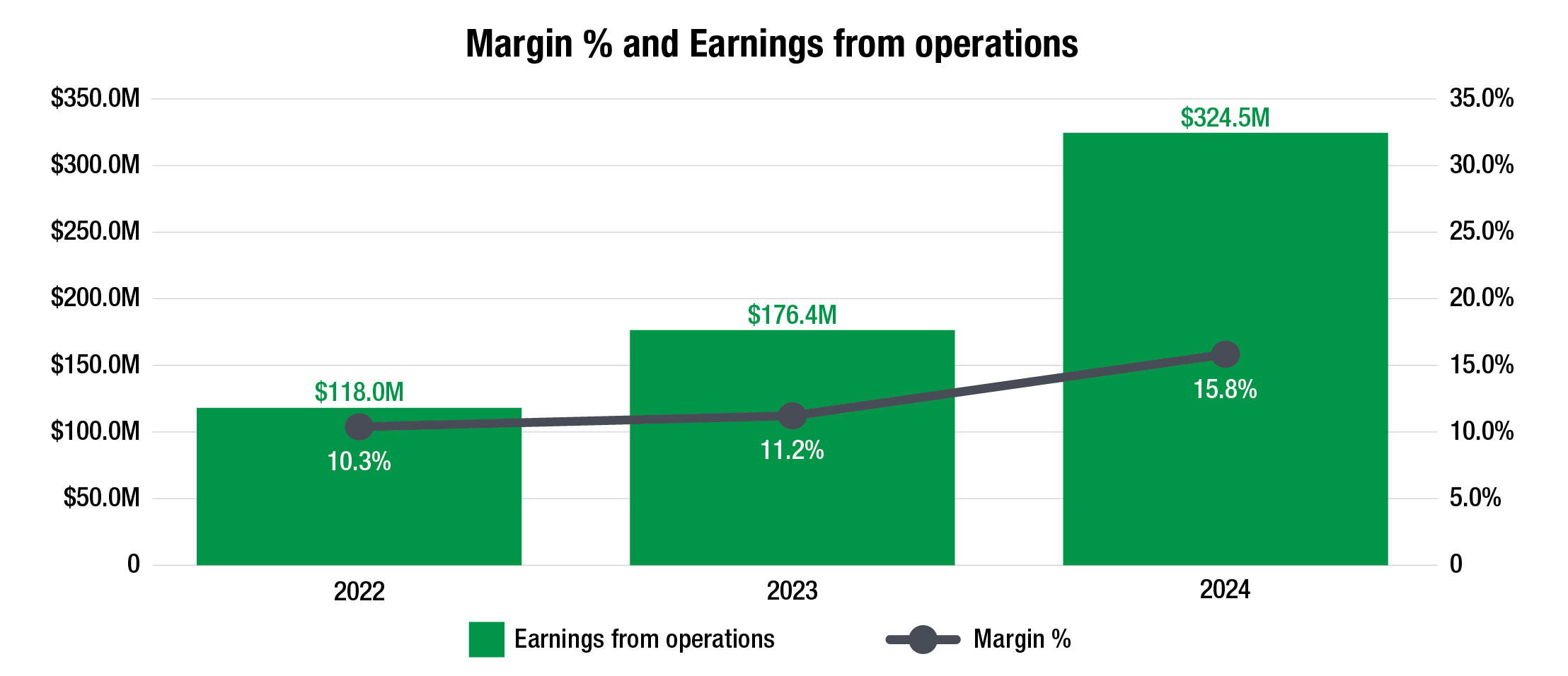
33
Manufacturing Backlog
Our backlog remains strong at August 31, 2024 and includes a diverse portfolio of railcar types, highlighted by the following:
Our backlog includes approximately $590 million of railcars intended for syndication which are supported by lease agreements with external customers and may be syndicated to third parties or held in our lease fleet depending on a variety of factors. Approximately 3% of backlog units and estimated value as of August 31, 2024 was associated with our Brazilian manufacturing operation which is accounted for under the equity method.
Our backlog of railcar units is not necessarily indicative of future results of operations. Certain orders in backlog are subject to customary documentation and completion of terms. Customers may attempt to cancel or modify orders in backlog. Historically, little variation has been experienced between the quantity ordered and the quantity actually delivered, though the timing of deliveries may be modified from time to time.
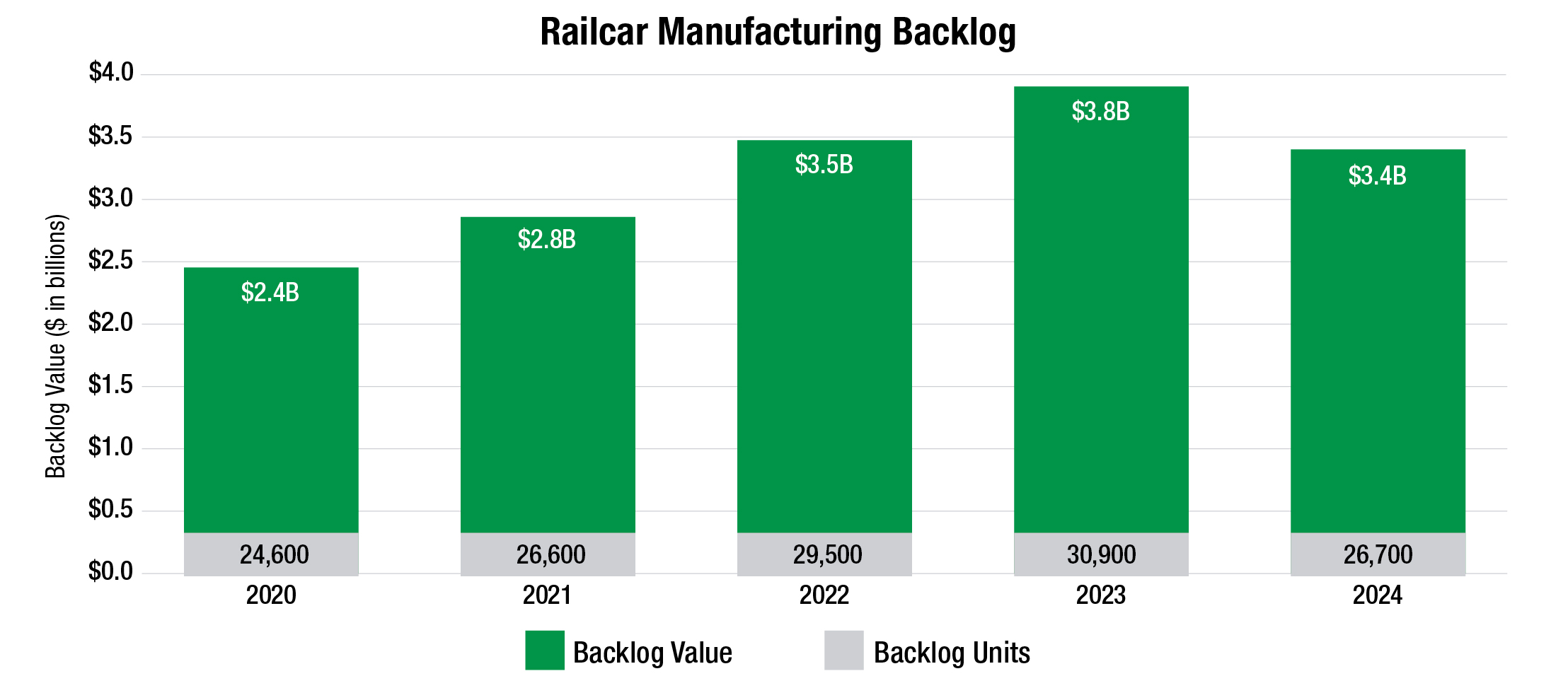
34
Financial Overview
Revenue, Cost of revenue, Margin and Earnings from operations (operating profit) presented below exclude intersegment activity that is eliminated in consolidation.
|
|
Year Ended August 31, |
|
|||||
(In millions, except per share amounts) |
|
2024 |
|
|
2023 |
|
||
Revenue: |
|
|
|
|
|
|
||
Manufacturing |
|
$ |
3,013.6 |
|
|
$ |
3,357.7 |
|
Maintenance Services |
|
|
298.8 |
|
|
|
406.4 |
|
Leasing & Management Services |
|
|
232.3 |
|
|
|
179.9 |
|
|
|
|
3,544.7 |
|
|
|
3,944.0 |
|
Cost of revenue: |
|
|
|
|
|
|
||
Manufacturing |
|
|
2,648.9 |
|
|
|
3,083.4 |
|
Maintenance Services |
|
|
264.1 |
|
|
|
364.0 |
|
Leasing & Management Services |
|
|
73.2 |
|
|
|
55.5 |
|
|
|
|
2,986.2 |
|
|
|
3,502.9 |
|
Margin: |
|
|
|
|
|
|
||
Manufacturing |
|
|
364.7 |
|
|
|
274.3 |
|
Maintenance Services |
|
|
34.7 |
|
|
|
42.4 |
|
Leasing & Management Services |
|
|
159.1 |
|
|
|
124.4 |
|
|
|
|
558.5 |
|
|
|
441.1 |
|
Selling and administrative |
|
|
247.1 |
|
|
|
235.3 |
|
Net gain on disposition of equipment |
|
|
(13.1 |
) |
|
|
(17.3 |
) |
Asset impairment, disposal, and exit costs, net |
|
|
— |
|
|
|
46.7 |
|
Earnings from operations |
|
|
324.5 |
|
|
|
176.4 |
|
Interest and foreign exchange |
|
|
100.8 |
|
|
|
85.4 |
|
Earnings before income tax and earnings from unconsolidated affiliates |
|
|
223.7 |
|
|
|
91.0 |
|
Income tax expense |
|
|
(62.0 |
) |
|
|
(24.6 |
) |
Earnings before earnings from unconsolidated affiliates |
|
|
161.7 |
|
|
|
66.4 |
|
Earnings from unconsolidated affiliates |
|
|
11.0 |
|
|
|
9.2 |
|
Net earnings |
|
|
172.7 |
|
|
|
75.6 |
|
Net earnings attributable to noncontrolling interest |
|
|
(12.6 |
) |
|
|
(13.1 |
) |
Net earnings attributable to Greenbrier |
|
$ |
160.1 |
|
|
$ |
62.5 |
|
Diluted earnings per common share |
|
$ |
4.96 |
|
|
$ |
1.89 |
|
|
|
|
|
|
|
|
||
Performance for our reportable segments is evaluated based on operating profit. Corporate includes selling and administrative costs not directly related to goods and services and certain costs that are intertwined among segments due to our integrated business model. Management does not allocate Interest and foreign exchange or Income tax expense for either external or internal reporting purposes.
|
|
Year Ended August 31, |
|
|||||
(In millions) |
|
2024 |
|
|
2023 |
|
||
Operating profit (loss): |
|
|
|
|
|
|
||
Manufacturing |
|
$ |
281.6 |
|
|
$ |
140.9 |
|
Maintenance Services |
|
|
27.1 |
|
|
|
36.9 |
|
Leasing & Management Services |
|
|
139.0 |
|
|
|
103.3 |
|
Corporate |
|
|
(123.2 |
) |
|
|
(104.7 |
) |
|
|
$ |
324.5 |
|
|
$ |
176.4 |
|
|
|
|
|
|
|
|
||
35
Consolidated Results
|
|
Year Ended August 31, |
|
|
2024 vs 2023 |
|
||||||||||
(In millions) |
|
2024 |
|
|
2023 |
|
|
Increase |
|
|
% |
|
||||
Revenue |
|
$ |
3,544.7 |
|
|
$ |
3,944.0 |
|
|
$ |
(399.3 |
) |
|
|
(10.1 |
)% |
Cost of revenue |
|
$ |
2,986.2 |
|
|
$ |
3,502.9 |
|
|
$ |
(516.7 |
) |
|
|
(14.8 |
)% |
Margin (%) |
|
|
15.8 |
% |
|
|
11.2 |
% |
|
|
4.6 |
% |
|
* |
|
|
Net earnings attributable to Greenbrier |
|
$ |
160.1 |
|
|
$ |
62.5 |
|
|
$ |
97.6 |
|
|
|
156.2 |
% |
|
|
|
|
|
|
|
|
|
|
|
|
|
||||
* Not meaningful
Through our integrated business model, we provide a broad range of custom products and services in each of our reportable segments, which have various selling prices and margins. The demand for and mix of products and services delivered changes from period to period, which causes fluctuations in our financial results.
The 10.1% decrease in Revenue for the year ended August 31, 2024 as compared to the prior year was primarily due to a 10.2% decrease in Manufacturing Revenue. The decrease in Manufacturing Revenue was primarily attributed to a 10.4% decrease in deliveries.
The 14.8% decrease in Cost of revenue for the year ended August 31, 2024 as compared to the prior year was primarily due to a 14.1% decrease in Manufacturing Cost of revenue. The decrease in Manufacturing Cost of revenue was primarily attributed to a 10.4% decrease in deliveries during the year ended August 31, 2024.
Margin as a percentage of Revenue was 15.8% and 11.2% for the years ended August 31, 2024 and 2023, respectively. Margin as a percentage of Revenue was positively impacted by an increase in Manufacturing Margin percentage from 8.2% to 12.1% primarily attributed to operating efficiencies and favorable product mix during the year ended August 31, 2024.
The $97.6 million increase in Net earnings attributable to Greenbrier for the year ended August 31, 2024 as compared to the prior year was primarily due to the following:
These were partially offset by the following:
For discussion related to the results of operations and changes in financial condition for 2023 compared to 2022 refer to Part II, Item 7. Management's Discussion and Analysis of Financial Condition and Results of Operations in our 2023 Form 10-K, which was filed with the United States Securities and Exchange Commission on October 25, 2023.
36
Manufacturing Segment
|
|
Year Ended August 31, |
2024 vs 2023 |
|
||||||||||||
(In millions, except deliveries) |
|
2024 |
|
|
2023 |
|
|
Increase |
|
|
% |
|
||||
Revenue |
|
$ |
3,013.6 |
|
|
$ |
3,357.7 |
|
|
$ |
(344.1 |
) |
|
|
(10.2 |
)% |
Cost of revenue |
|
$ |
2,648.9 |
|
|
$ |
3,083.4 |
|
|
$ |
(434.5 |
) |
|
|
(14.1 |
)% |
Margin (%) |
|
|
12.1 |
% |
|
|
8.2 |
% |
|
|
3.9 |
% |
|
* |
|
|
Operating profit ($) |
|
$ |
281.6 |
|
|
$ |
140.9 |
|
|
$ |
140.7 |
|
|
|
99.9 |
% |
Operating profit (%) |
|
|
9.3 |
% |
|
|
4.2 |
% |
|
|
5.1 |
% |
|
* |
|
|
Deliveries |
|
|
22,300 |
|
|
|
24,900 |
|
|
|
(2,600 |
) |
|
|
(10.4 |
)% |
|
|
|
|
|
|
|
|
|
|
|
|
|
||||
* Not meaningful
Our Manufacturing segment primarily generates revenue from manufacturing a wide range of railcars and from the conversion of existing or in-service railcars through our facilities in North America and Europe.
Manufacturing Revenue decreased $344.1 million or 10.2% for the year ended August 31, 2024 compared to the prior year. The decrease in Revenue was primarily attributed to a 10.4% decrease in deliveries during the year ended August 31, 2024.
Manufacturing Cost of revenue decreased $434.5 million or 14.1% for the year ended August 31, 2024 compared to the prior year. The decrease in Cost of revenue was primarily attributed to a 10.4% decrease in the volume of deliveries and favorable product mix during the year ended August 31, 2024.
Manufacturing Margin as a percentage of Revenue increased 3.9% for the year ended August 31, 2024 compared to the prior year. The increase in Margin percentage was primarily attributed to operating efficiencies and favorable product mix during the year ended August 31, 2024.
Manufacturing Operating profit increased $140.7 million or 99.9% for the year ended August 31, 2024 compared to the prior year. The increase in Operating profit was primarily attributed to an increase in Margin during the year ended August 31, 2024 as well as the prior year including $46.7 million of charges related to the sale and closure of our Gunderson Facility during the year ended August 31, 2023.
37
Maintenance Services Segment
|
|
Year Ended August 31, |
|
|
2024 vs 2023 |
|
||||||||||
(In millions) |
|
2024 |
|
|
2023 |
|
|
Increase |
|
|
% |
|
||||
Revenue |
|
$ |
298.8 |
|
|
$ |
406.4 |
|
|
$ |
(107.6 |
) |
|
|
(26.5 |
)% |
Cost of revenue |
|
$ |
264.1 |
|
|
$ |
364.0 |
|
|
$ |
(99.9 |
) |
|
|
(27.4 |
)% |
Margin (%) |
|
|
11.6 |
% |
|
|
10.4 |
% |
|
|
1.2 |
% |
|
* |
|
|
Operating profit ($) |
|
$ |
27.1 |
|
|
$ |
36.9 |
|
|
$ |
(9.8 |
) |
|
|
(26.6 |
)% |
Operating profit (%) |
|
|
9.1 |
% |
|
|
9.1 |
% |
|
-- |
|
|
* |
|
||
|
|
|
|
|
|
|
|
|
|
|
|
|
||||
* Not meaningful
Our Maintenance Services segment primarily generates revenue from railcar component manufacturing and servicing, providing railcar maintenance services and scrapping wheels and other components.
Maintenance Services Revenue decreased $107.6 million or 26.5% for the year ended August 31, 2024 compared to the prior year. The decrease was primarily attributed to 11.6% lower volumes in our wheels business due to lower demand, a change in product mix and a $9.1 million decrease due to lower scrap metal volume and pricing.
Maintenance Services Cost of revenue decreased $99.9 million or 27.4% for the year ended August 31, 2024 compared to the prior year. The decrease was primarily due to operating at lower volumes and a change in product mix during the year ended August 31, 2024.
Maintenance Services Margin as a percentage of Revenue increased 1.2% for the year ended August 31, 2024 compared to the prior year. The increase in Margin percentage was primarily attributed to a favorable change in product mix during the year ended August 31, 2024. This was partially offset by a decrease in scrap metal pricing during the year ended August 31, 2024.
Maintenance Services Operating profit decreased $9.8 million or 26.6% for the year ended August 31, 2024 compared to the prior year. The decrease in Operating profit was primarily attributed to operating at lower volumes and a decrease in scrap metal pricing and volume during the year ended August 31, 2024.
38
Leasing & Management Services Segment
|
|
Year Ended August 31, |
2024 vs 2023 |
|
||||||||||||
(In millions) |
|
2024 |
|
|
2023 |
|
|
Increase |
|
|
% |
|
||||
Revenue |
|
$ |
232.3 |
|
|
$ |
179.9 |
|
|
$ |
52.4 |
|
|
|
29.1 |
% |
Cost of revenue |
|
$ |
73.2 |
|
|
$ |
55.5 |
|
|
$ |
17.7 |
|
|
|
31.9 |
% |
Margin (%) |
|
|
68.5 |
% |
|
|
69.1 |
% |
|
|
(0.6 |
)% |
|
|
|
* |
Operating profit ($) |
|
$ |
139.0 |
|
|
$ |
103.3 |
|
|
$ |
35.7 |
|
|
|
34.6 |
% |
Operating profit (%) |
|
|
59.8 |
% |
|
|
57.4 |
% |
|
|
2.4 |
% |
|
|
|
* |
|
|
|
|
|
|
|
|
|
|
|
|
|
||||
* Not meaningful
Our Leasing & Management Services segment generates revenue from leasing railcars from our lease fleet, providing various management services, syndication revenue associated with leases attached to new railcar sales, interim rent on leased railcars for syndication and the sale of railcars purchased from third parties with the intent to resell.
Leasing & Management Services Revenue increased $52.4 million or 29.1% for the year ended August 31, 2024 compared to the prior year. The increase was primarily attributed to an increase of $19.7 million in rents associated with a larger lease fleet and higher lease rates, an $8.9 million increase in the sale of railcars which were purchased from third parties with the intent to resell and a $9.7 million increase in interim rent on leased railcars for syndication during the year ended August 31, 2024.
Leasing & Management Services Cost of revenue increased $17.7 million or 31.9% for the year ended August 31, 2024 compared to the prior year. This was primarily due to higher costs from an increase in the volume of railcars sold that we purchased from third parties and a larger lease fleet during the year ended August 31, 2024.
Leasing & Management Services Margin as a percentage of Revenue decreased 0.6% for the year ended August 31, 2024 compared to the prior year. Margin as a percentage of Revenue for the year ended August 31, 2024 was negatively impacted by higher sales of railcars that were purchased from third parties which have lower margin percentages.
Leasing & Management Services Operating profit increased $35.7 million or 34.6% for the year ended August 31, 2024 compared to the prior year. The increase was primarily attributed to higher rents from a larger lease fleet and improved lease rates during the year ended August 31, 2024.
39
Selling and Administrative
|
|
Year Ended August 31, |
2024 vs 2023 |
|
||||||||||||
(In millions) |
|
2024 |
|
|
2023 |
|
|
Increase |
|
|
% |
|
||||
Selling and administrative |
|
$ |
247.1 |
|
|
$ |
235.3 |
|
|
$ |
11.8 |
|
|
|
5.0 |
% |
Selling and administrative expense was $247.1 million or 7.0% of Revenue for the year ended August 31, 2024 and $235.3 million or 6.0% of Revenue for the year ended August 31, 2023.
The $11.8 million increase was primarily attributed to an increase in employee related costs including higher long-term incentive compensation during the year ended August 31, 2024.
Net Gain on Disposition of Equipment
Net gain on disposition of equipment typically includes the sale of assets from our lease fleet (Equipment on operating leases, net) and disposition of property, plant and equipment. Assets are periodically sold in the normal course of business in order to optimize our lease fleet and to manage risk and liquidity.
Net gain on disposition of equipment was $13.1 million and $17.3 million for the years ended August 31, 2024 and 2023, respectively. The decrease in Net gain on disposition of equipment was primarily attributed to fewer sales of assets from our lease fleet during the year ended August 31, 2024.
Asset Impairment, Disposal and Exit Costs, Net
Asset impairment, disposal, and exit costs, net was $46.7 million for the year ended August 31, 2023 related to charges associated with the Gunderson Facility and divestiture of Southwest Steel, partially offset by a gain on disposal of majority interest in the Rayvag joint venture.
Interest and Foreign Exchange
Interest and foreign exchange expense was composed of the following:
|
|
Year Ended August 31, |
|
|
Increase (Decrease) |
|
||||||
(In millions) |
|
2024 |
|
|
2023 |
|
|
2024 vs 2023 |
|
|||
Interest and foreign exchange: |
|
|
|
|
|
|
|
|
|
|||
Interest and other expense |
|
$ |
93.8 |
|
|
$ |
79.2 |
|
|
$ |
14.6 |
|
Foreign exchange loss, net |
|
|
7.0 |
|
|
|
6.2 |
|
|
|
0.8 |
|
|
|
$ |
100.8 |
|
|
$ |
85.4 |
|
|
$ |
15.4 |
|
|
|
|
|
|
|
|
|
|
|
|||
The $15.4 million increase in Interest and foreign exchange expense during the year ended August 31, 2024 compared to the prior year was primarily attributed to an increase in interest expense from higher borrowings and interest rates.
40
Income Tax
In 2024 our Income tax expense was $62.0 million on $223.7 million of pre-tax earnings for an effective tax rate of 27.7%. The rate was higher than the U.S statutory tax rate primarily due to the geographic mix of earnings, nondeductible expenses, increased valuation allowance, and U.S. taxes on profits in foreign jurisdictions, offset by a benefit for additional U.S. foreign tax credits carried forward to future periods.
In 2023 our income tax expense was $24.6 million on $91.0 million of pre-tax earnings for an effective tax rate of 27.0%. The rate was higher than the U.S. statutory tax rate primarily due to the geographic mix of earnings and U.S. taxes on profits in foreign jurisdictions, offset by net favorable impacts related to changes in foreign currency exchange rates for our U.S. Dollar denominated foreign operations.
The effective tax rate can fluctuate year-to-year due to discrete items and changes in the mix of foreign and domestic pre-tax earnings. It can also fluctuate with changes in the proportion of pre-tax earnings attributable to our Mexican railcar manufacturing joint venture. The joint venture is treated as a partnership for tax purposes and, as a result, the partnership’s entire pre-tax earnings are included in Earnings before income taxes and earnings from unconsolidated affiliates, whereas only our 50% share of the tax is included in Income tax expense.
The EU Member States have formally adopted the Pillar Two Directive, which generally provides for a minimum effective tax rate of 15%, as established by the Organisation for Economic Co-operation and Development (OECD) Pillar Two Framework. The OECD Pillar Two Framework must be adopted by each respective country into their tax laws, which are effective for us beginning on September 1, 2024. We continue to closely monitor additional guidance from the OECD and analyze potential impacts these law changes may have, however we do not expect a material change to our effective tax rate.
Earnings From Unconsolidated Affiliates
Through unconsolidated affiliates we produce rail and industrial components and have an ownership stake in a railcar manufacturer in Brazil. We record the results from these unconsolidated affiliates on an after-tax basis.
Earnings from unconsolidated affiliates were $11.0 million and $9.2 million for the years ended August 31, 2024 and 2023, respectively. The increase was primarily related to $5.2 million in higher earnings at our Brazil operations during the year ended August 31, 2024. This was partially offset by $4.5 million in lower earnings related to a temporarily idle facility during the year ended August 31, 2024.
Net Earnings Attributable to Noncontrolling Interest
Net earnings attributable to noncontrolling interest were $12.6 million and $13.1 million for the years ended August 31, 2024 and 2023, respectively. Net earnings attributable to noncontrolling interest primarily represents our joint venture partner's share in the results of operations of our Mexican railcar manufacturing joint ventures, adjusted for intercompany sales, and our European partner’s share of the results of our European operations.
41
Liquidity and Capital Resources
|
|
Year Ended August 31, |
|
|||||
(In millions) |
|
2024 |
|
|
2023 |
|
||
Net cash provided by operating activities |
|
$ |
329.6 |
|
|
$ |
71.2 |
|
Net cash used in investing activities |
|
|
(320.4 |
) |
|
|
(280.0 |
) |
Net cash provided by (used in) financing activities |
|
|
86.2 |
|
|
|
(76.2 |
) |
Effect of exchange rate changes |
|
|
(29.5 |
) |
|
|
28.6 |
|
Net increase (decrease) in cash and cash equivalents and restricted cash |
|
$ |
65.9 |
|
|
$ |
(256.4 |
) |
|
|
|
|
|
|
|
||
We continue to be financed through cash generated from operations and borrowings. At August 31, 2024 Cash and cash equivalents and Restricted cash were $368.6 million, an increase of $65.9 million from $302.7 million at the prior year end.
Cash Flows From Operating Activities
The $258.4 million increase in cash from operating activities for the year ended August 31, 2024 compared to the year ended August 31, 2023 was primarily due to a change in Leased railcars for syndication and a $97.1 million increase in Net earnings.
Cash Flows From Investing Activities
Cash used in investing activities primarily related to capital expenditures net of proceeds from the sale of assets and investment activity with our unconsolidated affiliates. The $40.4 million increase in cash used in investing activities for the year ended August 31, 2024 was primarily attributable to a $36.2 million increase in capital expenditures compared to the year ended August 31, 2023.
|
|
Year Ended August 31, |
|
|||||
(In millions) |
|
2024 |
|
|
2023 |
|
||
Capital expenditures: |
|
|
|
|
|
|
||
Leasing & Management Services |
|
$ |
(277.0 |
) |
|
$ |
(272.9 |
) |
Manufacturing |
|
|
(102.8 |
) |
|
|
(71.9 |
) |
Maintenance Services |
|
|
(18.5 |
) |
|
|
(17.3 |
) |
Total capital expenditures (gross) |
|
$ |
(398.3 |
) |
|
$ |
(362.1 |
) |
Proceeds from sales of assets |
|
|
75.0 |
|
|
|
78.8 |
|
Total capital expenditures (net of proceeds) |
|
$ |
(323.3 |
) |
|
$ |
(283.3 |
) |
|
|
|
|
|
|
|
||
Capital expenditures primarily relate to additions to our lease fleet and on-going investments in the safety, productivity and improvements of our facilities. Proceeds from the sale of assets primarily relate to sales of railcars from our lease fleet within Leasing & Management Services. Assets from our lease fleet are periodically sold in the normal course of business to accommodate customer demand and to manage risk and liquidity. Proceeds from sales of assets are expected to be approximately $90 million for 2025.
Gross capital expenditures for 2025 are expected to be approximately $360 million for Leasing & Management Services, approximately $110 million for Manufacturing and approximately $10 million for Maintenance Services. Capital expenditures for 2025 primarily relate to additions to our lease fleet reflecting our leasing strategy and continued investments into the safety and productivity of our facilities.
Cash Flows From Financing Activities
The $162.4 million increase in cash flow from financing activities for the year ended August 31, 2024 compared to the year ended August 31, 2023 was primarily attributed to a $57.4 million increase in net proceeds from revolving notes, $52.8 million higher proceeds from the issuance of notes payable, net of repayments and a $55.6 million reduction in the repurchase of stock compared to the prior year.
During the year ended August 31, 2024 we issued $178.5 million of asset backed securities and used proceeds to pay down $139.9 million of our GBX Leasing warehouse facility. We also borrowed $196.6 million on the GBX Leasing
42
warehouse facility to grow the lease fleet. In February 2024, we paid $47.7 million to retire our 2024 Convertible Notes.
Dividend & Share Repurchase Program
A quarterly dividend of $0.30 per share was declared on October 16, 2024.
The Board of Directors has authorized our company to repurchase in aggregate up to $100.0 million of our common stock. The program may be modified, suspended, or discontinued at any time without prior notice and currently has an expiration date of January 31, 2025. Under the share repurchase program, shares of common stock may be purchased from time to time on the open market or through privately negotiated transactions. The timing and amount of purchases is based upon market conditions, securities law limitations and other factors. The program may be modified, suspended, or discontinued at any time without prior notice. The share repurchase program does not obligate us to acquire any specific number of shares in any period.
During the year ended August 31, 2024, we purchased a total of 38 thousand shares for $1.3 million. During the year ended August 31, 2023, we purchased a total of 1.9 million shares for $56.9 million, of which 1.8 million shares for $53.6 million were purchased under the current authorization of the share repurchase program. As of August 31, 2024, the amount remaining for repurchase under the share repurchase program was $45.1 million.
Cash, Borrowing Availability and Credit Facilities
Our current cash balance is part of our strategy to maintain strong liquidity to respond to current uncertainties. As of August 31, 2024, we had $351.8 million in Cash and cash equivalents and $345.9 million in available borrowings. The available balance to draw under committed credit facilities includes $258.3 million on the North American credit facility, $31.6 million on the European credit facilities and $56.0 million on the Mexican credit facilities.
Our senior secured credit facilities, consisting of four components, aggregated to $1.4 billion as of August 31, 2024.
Nonrecourse Credit Facilities
GBX Leasing – As of August 31, 2024, a $550.0 million nonrecourse warehouse credit facility existed to support the operations of GBX Leasing. Advances under the facility are secured by a pool of leased railcars and bear interest at the Secured Overnight Financing Rate (SOFR) plus 1.85% plus 0.11% as a SOFR adjustment. As of August 31, 2024, interest rate swap agreements cover 74% of the outstanding balance to swap the floating interest rate to a fixed rate. The warehouse credit facility was amended in September 2024 to reduce the size of the credit facility by $100.0 million to $450.0 million and to extend the maturity date from August 2027 to September 2029. The warehouse credit facility currently converts to a term loan in September 2027.
Other Credit Facilities
North America – As of August 31, 2024, a $600.0 million revolving line of credit existed to provide working capital and interim financing of equipment, principally for our U.S. and Mexican operations. The North America credit facility is secured by substantially all our U.S. assets not otherwise pledged as security for term loans, the warehouse credit facility or the railcar asset-backed securities. Available borrowings are generally based on defined levels of eligible inventory, receivables, property, plant and equipment and leased equipment, as well as total debt to consolidated capitalization and fixed charges coverage ratios. Advances bear interest at SOFR plus 1.50% plus 0.10% as a SOFR adjustment or Prime plus 0.50% depending on the type of borrowing. The North America credit facility matures in August 2026.
Europe – As of August 31, 2024, lines of credit totaling $78.2 million, secured by certain of our European assets, were available for working capital needs of our European manufacturing operations. The European lines of credit include $33.1 million which are guaranteed by us. The European credit facilities have variable rates that range from Warsaw Interbank Offered Rate (WIBOR) plus 1.10% to WIBOR plus 1.45% and Euro Interbank Offered Rate (EURIBOR) plus 1.90%. The European credit facilities are regularly renewed and currently have maturities that range from October 2024 through September 2026.
43
Mexico – As of August 31, 2024, our Mexican railcar manufacturing operations had lines of credit totaling $166.0 million for working capital needs, $66.0 million of which we and our joint venture partner have each guaranteed 50%. Advances under these facilities bear interest at variable rates that range from SOFR plus 2.22% to SOFR plus 4.25%. The Mexican credit facilities have maturities that range from February 2025 through January 2027.
|
|
As of August 31, |
|
|||||
(In millions) |
|
2024 |
|
|
2023 |
|
||
Nonrecourse credit facility balances: |
|
|
|
|
|
|
||
GBX Leasing |
|
$ |
194.9 |
|
|
$ |
139.9 |
|
Other credit facility balances: |
|
|
|
|
|
|
||
North America |
|
|
— |
|
|
|
— |
|
Europe |
|
|
46.7 |
|
|
|
47.2 |
|
Mexico |
|
|
110.0 |
|
|
|
110.0 |
|
Total Revolving notes |
|
$ |
351.6 |
|
|
$ |
297.1 |
|
|
|
|
|
|
|
|
||
Outstanding commitments under the North American credit facility included letters of credit which totaled $5.9 million and $4.9 million as of August 31, 2024 and 2023, respectively.
Other Information
The revolving and operating lines of credit, along with notes payable, contain covenants with respect to us and our various subsidiaries, the most restrictive of which, among other things, limit our ability to: incur additional indebtedness or guarantees; pay dividends or repurchase stock; enter into financing leases; create liens; sell assets; engage in transactions with affiliates, including joint ventures and non U.S. subsidiaries, including but not limited to loans, advances, equity investments and guarantees; enter into mergers, consolidations or sales of substantially all our assets; and enter into new lines of business. The covenants also require certain maximum ratios of debt to total capitalization and minimum levels of fixed charges (interest plus rent) coverage. As of August 31, 2024, we were in compliance with all such restrictive covenants.
From time to time, we may seek to repurchase or otherwise retire or exchange securities, including outstanding convertible notes, borrowings and equity securities, and take other steps to reduce our debt, extend the maturities of our debt or otherwise improve our balance sheet. These actions may include open market repurchases, unsolicited or solicited privately negotiated transactions or other retirements, repurchases or exchanges. Such retirements, repurchases or exchanges of one note or security for another note or security (now or hereafter existing), if any, will depend on a number of factors, including, but not limited to, prevailing market conditions, trading levels of our debt, our liquidity requirements and contractual restrictions, if applicable. The amounts involved in any such transactions may, individually or in the aggregate, be material and may involve all or a portion of a particular series of notes or other indebtedness which may reduce the float and impact the trading market of notes or other indebtedness which remain outstanding.
We have global operations that conduct business in their local currencies as well as other currencies. To mitigate the exposure to transactions denominated in currencies other than the functional currency of each entity, we enter into foreign currency forward exchange contracts with established financial institutions to protect the revenue or margin on a portion of forecasted foreign currency sales and expenses. Given the strong credit standing of the counterparties, no provision has been made for credit loss due to counterparty non-performance.
To mitigate the exposure to changes in interest rates, we have managed a portion of our variable rate debt with interest rate swap agreements, effectively converting $653.1 million of variable rate debt to fixed rate debt as of August 31, 2024.
We expect existing funds and cash generated from operations, together with proceeds from financing activities including borrowings under existing credit facilities and long-term financings, to be sufficient to fund expected debt repayments, working capital needs, planned capital expenditures, additional investments in our unconsolidated affiliates and dividends during the next twelve months.
44
The following table shows our estimated future contractual cash obligations as of August 31, 2024:
|
|
Year Ended August 31, |
|
|||||||||||||||||||||||||
(In millions) |
|
Total |
|
|
2025 |
|
|
2026 |
|
|
2027 |
|
|
2028 |
|
|
2029 |
|
|
Thereafter |
|
|||||||
Notes payable 1 |
|
$ |
1,420.9 |
|
|
$ |
42.8 |
|
|
$ |
265.5 |
|
|
$ |
312.4 |
|
|
$ |
389.2 |
|
|
$ |
14.6 |
|
|
$ |
396.4 |
|
Interest 2 |
|
|
437.1 |
|
|
|
70.9 |
|
|
|
65.2 |
|
|
|
50.6 |
|
|
|
29.2 |
|
|
|
17.9 |
|
|
|
203.3 |
|
Railcar & operating leases |
|
|
72.9 |
|
|
|
14.6 |
|
|
|
13.5 |
|
|
|
10.7 |
|
|
|
9.8 |
|
|
|
8.0 |
|
|
|
16.3 |
|
Revolving notes |
|
|
351.6 |
|
|
|
154.4 |
|
|
|
2.3 |
|
|
|
194.9 |
|
|
|
— |
|
|
|
— |
|
|
|
— |
|
|
|
$ |
2,282.5 |
|
|
$ |
282.7 |
|
|
$ |
346.5 |
|
|
$ |
568.6 |
|
|
$ |
428.2 |
|
|
$ |
40.5 |
|
|
$ |
616.0 |
|
|
|
|
|
|
|
|
|
|
|
|
|
|
|
|
|
|
|
|
|
|
|
|||||||
1 The repayment of the $373.8 million of 2028 Convertible Notes due April 2028 is assumed to occur at the scheduled maturity instead of assuming an earlier conversion by the holders.
2 A portion of the estimated future cash obligation relates to interest on variable rate borrowings. Amounts are based on interest rates as of August 31, 2024.
Off-Balance Sheet Arrangements
We do not currently have off balance sheet arrangements that have or are likely to have a material current or future effect on our Consolidated Financial Statements.
Critical Accounting Estimates
The preparation of financial statements in conformity with accounting principles generally accepted in the U.S. requires judgment on the part of management to arrive at estimates and assumptions on matters that are inherently uncertain. These estimates may affect the amount of assets, liabilities, revenue and expenses reported in the financial statements and accompanying notes and disclosure of contingent assets and liabilities within the financial statements. Estimates and assumptions are periodically evaluated and may be adjusted in future periods. Actual results could differ from those estimates.
Impairment of long-lived assets - We review our long-lived assets for impairment whenever events or changes in circumstances indicate that the carrying amount of an asset group may not be recoverable. When such events or changes in circumstances occur, a recoverability test is performed based upon estimated undiscounted cash flows expected to be realized over the remaining useful life of the asset group. If the carrying amount of an asset group exceeds the estimated undiscounted future cash flows, an impairment would be measured as the difference between the fair value of the asset group and the carrying amount of the asset group.
An asset group is generally established by identifying the lowest level of cash flows generated by a group of assets that are largely independent of the cash flows of other assets. Determining whether a long-lived asset is impaired requires various estimates and assumptions, including whether a triggering event has occurred, the identification of asset groups, and the determination of the fair value of real and personal property. Estimates of future cash flows are by nature highly uncertain and contemplate factors that may change over time. For further information, see Note 4 - Divestitures to the Consolidated Financial Statements.
Goodwill - We evaluate goodwill for possible impairment annually or more frequently if events or changes in circumstances indicate that the carrying amounts of our reporting units exceed their fair value. We test goodwill for impairment by either performing a qualitative or quantitative assessment. When we perform a qualitative assessment, we analyze macroeconomic and industry conditions, financial performance, and cost estimates associated with a particular reporting unit. This assessment requires subjectivity based on cumulative information available at the assessment date. If a qualitative assessment indicates it is more likely than not that the carrying value of a reporting unit exceeds its respective fair value, a quantitative assessment is performed. We performed a qualitative assessment for our annual goodwill impairment test during the third quarter of 2024 and determined that it was more likely than not that the fair values of all reporting units with goodwill exceeded their carrying values; therefore, we concluded that goodwill was not impaired.
When we perform a quantitative assessment, we exercise judgment to develop estimates of the fair values of our reporting units based on a weighting of income and market approaches. Under the income approach, we calculate the fair value of a reporting unit based on the present value of estimated future cash flows which incorporates forecasted revenues, long-term growth rate, gross margin percentages, operating expenses, and the use of discount rates. Under
45
the market approach, we estimate the fair value based on observed market multiples for comparable businesses. If the fair value of a reporting unit is lower than its carrying value, an impairment to goodwill is recorded, not to exceed the carrying amount of goodwill in the reporting unit. In 2023, we performed a quantitative goodwill impairment test and determined that the estimated fair values of all reporting units with goodwill exceeded their carrying values.
We make certain estimates and assumptions to determine our reporting units and whether the fair value of each reporting unit is greater than its respective carrying value. The above highlighted judgments contemplated estimates and effects of macroeconomic trends that are inherently uncertain. Changes in these estimates, which may include the effects of inflation and policy reactions thereto, increases in pricing of materials and components, changes in demand, or potential macroeconomic events may cause future assessment conclusions to differ. For further information, see Note 7 - Goodwill to the Consolidated Financial Statements.
Income taxes - The asset and liability method is used to account for income taxes. We are required to estimate the timing of the recognition of deferred tax assets and liabilities, make assumptions about the future deductibility of deferred tax assets and assess deferred tax liabilities based on enacted law and tax rates for each tax jurisdiction to determine the amount of deferred tax assets and liabilities. Deferred income taxes are provided for the temporary effects of differences between assets and liabilities recognized for financial statement and income tax reporting purposes. Valuation allowances reduce deferred tax assets to an amount that will more likely than not be realized. We recognize a tax benefit from uncertain tax positions in the financial statements only when it is more likely than not the position will be sustained upon examination by relevant tax authorities.
Our annual tax rate is based on our income, statutory tax rates, and tax planning opportunities available to us in the various jurisdictions in which we operate. Judgment is required in determining our tax expense and in evaluating our tax positions, as tax laws are complex and subject to different interpretations by taxpayers and government taxing authorities. Our income tax rate is affected by the tax rates that apply to our foreign earnings and could be adversely impacted by higher or lower earnings than anticipated in a particular jurisdiction. In addition to local country tax laws and regulations, our income tax rate depends on the extent that our foreign earnings are taxed by the U.S. through provisions such as the global intangible low-taxed income (GILTI) tax and base erosion and anti-abuse tax (BEAT). We review our deferred tax assets and tax positions quarterly and adjust the balances as new information becomes available. For further information regarding income taxes, see Note 17 - Income Taxes to the Consolidated Financial Statements.
Environmental costs - At times we may be involved in various proceedings related to environmental matters. We estimate future costs for known environmental remediation requirements and accrue for them when it is probable that we have incurred a liability and the related costs can be reasonably estimated based on currently available information. Adjustments to these liabilities are made when additional information becomes available that affects the estimated costs to study or remediate any environmental issues or when expenditures for which reserves are established are made.
Judgments used in determining if a liability is estimable are subjective and based on known facts and our historic experience. If further developments in or resolution of an environmental matter result in facts and circumstances that differ from those assumptions used to develop these reserves, the accrual for environmental remediation could be materially misstated. Due to the uncertain nature of environmental matters, there can be no assurance that we will not become involved in future litigation or other proceedings or, if we were found to be responsible or liable in any litigation or proceeding, that such costs would not be material to us. For further information regarding our environmental costs, see Note 21 - Commitments and Contingencies to the Consolidated Financial Statements.
46
Item 7A. QUANTITATIVE AND QUALITATIVE DISCLOSURES ABOUT MARKET RISK
Foreign Currency Exchange Risk
We have global operations that conduct business in their local currencies as well as other currencies. To mitigate the exposure to transactions denominated in currencies other than the functional currency of each entity, we enter into foreign currency forward exchange contracts to protect revenue or margin on a portion of forecasted foreign currency sales and expenses. At August 31, 2024 exchange rates, notional amounts of forward exchange contracts for the purchase of Polish Zlotys and the sale of Euros aggregated to $143.9 million. Because of the variety of currencies in which purchases and sales are transacted and the interaction between currency rates, it is not possible to predict the impact of a movement in a single foreign currency exchange rate would have on future operating results.
In addition to exposure to transaction gains or losses, we are also exposed to foreign currency exchange risk related to the net asset position of our foreign subsidiaries. At August 31, 2024, net assets of foreign subsidiaries aggregated to $164.7 million and a 10% strengthening of the U.S. Dollar relative to the foreign currencies would result in a decrease in equity of $16.5 million, or 1.2% of Total equity - Greenbrier. This calculation assumes that each exchange rate would change in the same direction relative to the U.S. Dollar.
Interest Rate Risk
We have managed a portion of our variable rate debt with interest rate swap agreements, effectively converting $653.1 million of variable rate debt to fixed rate debt. Notwithstanding these interest rate swap agreements, we are still exposed to interest rate risk relating to our revolving debt and a portion of term debt, which are at variable rates. At August 31, 2024, 84% of our outstanding debt had fixed rates and 16% had variable rates. At August 31, 2024, a uniform 10% increase in variable interest rates would result in approximately $1.4 million of additional annual interest expense.
47
Report of Independent Registered Public Accounting Firm
To the Stockholders and Board of Directors
The Greenbrier Companies, Inc.:
Opinion on the Consolidated Financial Statements
We have audited the accompanying consolidated balance sheets of The Greenbrier Companies, Inc. and subsidiaries (the Company) as of August 31, 2024 and August 31, 2023, the related consolidated statements of income, comprehensive income, equity, and cash flows for each of the years in the three-year period ended August 31, 2024, and the related notes (collectively, the consolidated financial statements). In our opinion, the consolidated financial statements present fairly, in all material respects, the financial position of the Company as of August 31, 2024 and August 31, 2023, and the results of its operations and its cash flows for each of the years in the three-year period ended August 31, 2024, in conformity with U.S. generally accepted accounting principles.
We also have audited, in accordance with the standards of the Public Company Accounting Oversight Board (United States) (PCAOB), the Company’s internal control over financial reporting as of August 31, 2024, based on criteria established in Internal Control – Integrated Framework (2013) issued by the Committee of Sponsoring Organizations of the Treadway Commission, and our report dated October 24, 2024 expressed an unqualified opinion on the effectiveness of the Company’s internal control over financial reporting.
Basis for Opinion
These consolidated financial statements are the responsibility of the Company’s management. Our responsibility is to express an opinion on these consolidated financial statements based on our audits. We are a public accounting firm registered with the PCAOB and are required to be independent with respect to the Company in accordance with the U.S. federal securities laws and the applicable rules and regulations of the Securities and Exchange Commission and the PCAOB.
We conducted our audits in accordance with the standards of the PCAOB. Those standards require that we plan and perform the audit to obtain reasonable assurance about whether the consolidated financial statements are free of material misstatement, whether due to error or fraud. Our audits included performing procedures to assess the risks of material misstatement of the consolidated financial statements, whether due to error or fraud, and performing procedures that respond to those risks. Such procedures included examining, on a test basis, evidence regarding the amounts and disclosures in the consolidated financial statements. Our audits also included evaluating the accounting principles used and significant estimates made by management, as well as evaluating the overall presentation of the consolidated financial statements. We believe that our audits provide a reasonable basis for our opinion.
Critical Audit Matter
The critical audit matter communicated below is a matter arising from the current period audit of the consolidated financial statements that was communicated or required to be communicated to the audit committee and that: (1) relates to accounts or disclosures that are material to the consolidated financial statements and (2) involved our especially challenging, subjective, or complex judgments. The communication of a critical audit matter does not alter in any way our opinion on the consolidated financial statements, taken as a whole, and we are not, by communicating the critical audit matter below, providing a separate opinion on the critical audit matter or on the accounts or disclosures to which it relates.
Sufficiency of audit evidence within the North American manufacturing businesses
As discussed in Item 9A. Controls and Procedures, a material weakness was identified as of August 31, 2023 that was remediated during fiscal year 2024. The description of the material weakness stated that the Company did not effectively design and maintain controls over information technology (IT) general controls in one IT environment in its primary North America manufacturing businesses that are relevant to the preparation of the Company’s consolidated financial statements. The Company did not (i) maintain change management controls to ensure
48
configuration data changes affecting the IT application were appropriate (ii) design and maintain program development controls to ensure the data migration, program testing and approval of new software development is aligned with business and IT requirements and (iii) maintain user access controls to ensure segregation of duties in the Company’s financial application. The control deficiencies resulted from incomplete risk assessment, inadequate training of personnel and ineffective control activities related primarily to the implementation of a new ERP system in the Company’s primary North America manufacturing businesses. As a result, during the period of fiscal year 2024 in which the material weakness remained unremediated, process level automated controls that are dependent on the affected IT environment and manual controls that rely on system-generated data or reports from the affected IT environment were ineffective because they could have been adversely impacted.
We identified the evaluation of the sufficiency of audit evidence over the Company’s primary North American manufacturing businesses as a critical audit matter. Evaluating the sufficiency of audit evidence obtained required especially subjective auditor judgment because of the pervasiveness of the material weakness noted above.
The following are the primary procedures we performed to address this critical audit matter. We applied auditor judgment to determine the nature and extent of procedures to be performed over the Company’s primary North American manufacturing businesses including evaluating our scoping thresholds and control risk assessments considering the material weakness noted above. For relevant financial statement account balances at the North America manufacturing businesses, we:
We evaluated the sufficiency of audit evidence obtained by assessing the results of procedures performed, including the appropriateness of the nature and extent of such evidence.
/s/ KPMG LLP
We have served as the Company’s auditor since 2011.
Portland, Oregon
October 24, 2024
49
Item 8. FINANCIAL STATEMENTS AND SUPPLEMENTARY DATA
Consolidated Balance Sheets
As of August 31,
(In millions, except number of shares which are reflected in thousands) |
|
2024 |
|
|
2023 |
|
||
Assets |
|
|
|
|
|
|
||
Cash and cash equivalents |
|
$ |
|
|
$ |
|
||
Restricted cash |
|
|
|
|
|
|
||
Accounts receivable, net |
|
|
|
|
|
|
||
Income tax receivable |
|
|
|
|
|
|
||
Inventories |
|
|
|
|
|
|
||
Leased railcars for syndication |
|
|
|
|
|
|
||
Equipment on operating leases, net |
|
|
|
|
|
|
||
Property, plant and equipment, net |
|
|
|
|
|
|
||
Investment in unconsolidated affiliates |
|
|
|
|
|
|
||
Intangibles and other assets, net |
|
|
|
|
|
|
||
Goodwill |
|
|
|
|
|
|
||
|
|
$ |
|
|
$ |
|
||
Liabilities and Equity |
|
|
|
|
|
|
||
Revolving notes |
|
$ |
|
|
$ |
|
||
Accounts payable and accrued liabilities |
|
|
|
|
|
|
||
Deferred income taxes |
|
|
|
|
|
|
||
Deferred revenue |
|
|
|
|
|
|
||
Notes payable, net |
|
|
|
|
|
|
||
(Notes 20 & 21) |
|
|
|
|
|
|
||
Contingently redeemable noncontrolling interest |
|
|
|
|
|
|
||
Equity |
|
|
|
|
|
|
||
Greenbrier |
|
|
|
|
|
|
||
Preferred stock - par value; |
|
|
|
|
|
|
||
Common stock - par value; |
|
|
|
|
|
|
||
Additional paid-in capital |
|
|
|
|
|
|
||
Retained earnings |
|
|
|
|
|
|
||
Accumulated other comprehensive loss |
|
|
( |
) |
|
|
( |
) |
Total equity - Greenbrier |
|
|
|
|
|
|
||
Noncontrolling interest |
|
|
|
|
|
|
||
Total equity |
|
|
|
|
|
|
||
|
|
$ |
|
|
$ |
|
||
|
|
|
|
|
|
|
||
The accompanying notes are an integral part of these financial statements.
50
Consolidated Statements of Income
Years ended August 31,
(In millions, except number of shares which are reflected in thousands and per share amounts) |
|
2024 |
|
|
2023 |
|
|
2022 |
|
|||
Revenue |
|
|
|
|
|
|
|
|
|
|||
Manufacturing |
|
$ |
|
|
$ |
|
|
$ |
|
|||
Maintenance Services |
|
|
|
|
|
|
|
|
|
|||
Leasing & Management Services |
|
|
|
|
|
|
|
|
|
|||
|
|
|
|
|
|
|
|
|
|
|||
Cost of revenue |
|
|
|
|
|
|
|
|
|
|||
Manufacturing |
|
|
|
|
|
|
|
|
|
|||
Maintenance Services |
|
|
|
|
|
|
|
|
|
|||
Leasing & Management Services |
|
|
|
|
|
|
|
|
|
|||
|
|
|
|
|
|
|
|
|
|
|||
Margin |
|
|
|
|
|
|
|
|
|
|||
Selling and administrative |
|
|
|
|
|
|
|
|
|
|||
Net gain on disposition of equipment |
|
|
( |
) |
|
|
( |
) |
|
|
( |
) |
Asset impairment, disposal, and exit costs, net |
|
|
— |
|
|
|
|
|
|
— |
|
|
Earnings from operations |
|
|
|
|
|
|
|
|
|
|||
Interest and foreign exchange |
|
|
|
|
|
|
|
|
|
|||
Earnings before income tax and earnings from unconsolidated affiliates |
|
|
|
|
|
|
|
|
|
|||
Income tax expense |
|
|
( |
) |
|
|
( |
) |
|
|
( |
) |
Earnings before earnings from unconsolidated affiliates |
|
|
|
|
|
|
|
|
|
|||
Earnings from unconsolidated affiliates |
|
|
|
|
|
|
|
|
|
|||
Net earnings |
|
|
|
|
|
|
|
|
|
|||
Net earnings attributable to noncontrolling interest |
|
|
( |
) |
|
|
( |
) |
|
|
( |
) |
Net earnings attributable to Greenbrier |
|
$ |
|
|
$ |
|
|
$ |
|
|||
Basic earnings per common share |
|
$ |
|
|
$ |
|
|
$ |
|
|||
Diluted earnings per common share |
|
$ |
|
|
$ |
|
|
$ |
|
|||
Weighted average common shares |
|
|
|
|
|
|
|
|
|
|||
Basic |
|
|
|
|
|
|
|
|
|
|||
Diluted |
|
|
|
|
|
|
|
|
|
|||
|
|
|
|
|
|
|
|
|
|
|||
The accompanying notes are an integral part of these financial statements.
51
Consolidated Statements of Comprehensive Income
Years ended August 31,
(In millions) |
|
2024 |
|
|
2023 |
|
|
2022 |
|
|||
Net earnings |
|
$ |
|
|
$ |
|
|
$ |
|
|||
Other comprehensive income (loss) |
|
|
|
|
|
|
|
|
|
|||
Translation adjustment |
|
|
( |
) |
|
|
|
|
|
( |
) |
|
Reclassification of derivative financial instruments recognized in net earnings 1 |
|
|
( |
) |
|
|
( |
) |
|
|
|
|
Unrealized gain on derivative financial instruments 2 |
|
|
|
|
|
|
|
|
|
|||
Other (net of tax effect) |
|
|
|
|
|
( |
) |
|
|
( |
) |
|
|
|
|
( |
) |
|
|
|
|
|
( |
) |
|
Comprehensive income |
|
|
|
|
|
|
|
|
|
|||
Comprehensive income attributable to noncontrolling interest |
|
|
( |
) |
|
|
( |
) |
|
|
( |
) |
Comprehensive income attributable to Greenbrier |
|
$ |
|
|
$ |
|
|
$ |
|
|||
|
|
|
|
|
|
|
|
|
|
|||
1
2
The accompanying notes are an integral part of these financial statements.
52
Consolidated Statements of Equity
|
|
Attributable to Greenbrier |
|
|
|
|
|
|
|
|
|
|
||||||||||||||||||||
(In millions) |
|
Common |
|
|
Additional |
|
|
Retained |
|
|
Accumulated |
|
|
Total |
|
|
Noncontrolling |
|
|
Total |
|
|
Contingently |
|
||||||||
Balance August 31, 2021 |
|
|
|
|
$ |
|
|
$ |
|
|
$ |
( |
) |
|
$ |
|
|
$ |
|
|
$ |
|
|
$ |
|
|||||||
Cumulative effect adjustment due to adoption of (See Note 2) |
|
|
— |
|
|
|
( |
) |
|
|
|
|
|
— |
|
|
|
( |
) |
|
|
— |
|
|
|
( |
) |
|
|
— |
|
|
Net earnings |
|
|
— |
|
|
|
— |
|
|
|
|
|
|
— |
|
|
|
|
|
|
|
|
|
|
|
|
( |
) |
||||
Other comprehensive loss, net |
|
|
— |
|
|
|
— |
|
|
|
— |
|
|
|
( |
) |
|
|
( |
) |
|
|
— |
|
|
|
( |
) |
|
|
— |
|
Noncontrolling interest adjustments |
|
|
— |
|
|
|
|
|
|
— |
|
|
|
— |
|
|
|
|
|
|
( |
) |
|
|
( |
) |
|
|
— |
|
||
Joint venture partner distribution declared |
|
|
— |
|
|
|
— |
|
|
|
— |
|
|
|
— |
|
|
|
— |
|
|
|
( |
) |
|
|
( |
) |
|
|
— |
|
Restricted stock awards (net of cancellations) |
|
|
|
|
|
|
|
|
— |
|
|
|
— |
|
|
|
|
|
|
— |
|
|
|
|
|
|
— |
|
||||
Unamortized restricted stock |
|
|
— |
|
|
|
( |
) |
|
|
— |
|
|
|
— |
|
|
|
( |
) |
|
|
— |
|
|
|
( |
) |
|
|
— |
|
Stock based compensation expense |
|
|
— |
|
|
|
|
|
|
— |
|
|
|
— |
|
|
|
|
|
|
— |
|
|
|
|
|
|
— |
|
|||
Cash dividends ($ |
|
|
— |
|
|
|
— |
|
|
|
( |
) |
|
|
— |
|
|
|
( |
) |
|
|
— |
|
|
|
( |
) |
|
|
— |
|
Balance August 31, 2022 |
|
|
|
|
$ |
|
|
$ |
|
|
$ |
( |
) |
|
$ |
|
|
$ |
|
|
$ |
|
|
$ |
|
|||||||
Net earnings |
|
|
— |
|
|
|
— |
|
|
|
|
|
|
— |
|
|
|
|
|
|
|
|
|
|
|
|
|
|||||
Other comprehensive income, net |
|
|
— |
|
|
|
— |
|
|
|
— |
|
|
|
|
|
|
|
|
|
— |
|
|
|
|
|
|
— |
|
|||
Noncontrolling interest adjustments |
|
|
— |
|
|
|
( |
) |
|
|
( |
) |
|
|
— |
|
|
|
( |
) |
|
|
|
|
|
( |
) |
|
|
|
||
Joint venture partner distribution declared |
|
|
— |
|
|
|
— |
|
|
|
— |
|
|
|
— |
|
|
|
— |
|
|
|
( |
) |
|
|
( |
) |
|
|
— |
|
Restricted stock awards (net of cancellations) |
|
|
|
|
|
|
|
|
— |
|
|
|
— |
|
|
|
|
|
|
— |
|
|
|
|
|
|
— |
|
||||
Unamortized restricted stock |
|
|
— |
|
|
|
( |
) |
|
|
— |
|
|
|
— |
|
|
|
( |
) |
|
|
— |
|
|
|
( |
) |
|
|
— |
|
Stock based compensation expense |
|
|
— |
|
|
|
|
|
|
— |
|
|
|
— |
|
|
|
|
|
|
— |
|
|
|
|
|
|
— |
|
|||
Repurchase of stock |
|
|
( |
) |
|
|
( |
) |
|
|
— |
|
|
|
— |
|
|
|
( |
) |
|
|
— |
|
|
|
( |
) |
|
|
— |
|
Cash dividends ($ |
|
|
— |
|
|
|
— |
|
|
|
( |
) |
|
|
— |
|
|
|
( |
) |
|
|
— |
|
|
|
( |
) |
|
|
— |
|
Balance August 31, 2023 |
|
|
|
|
$ |
|
|
$ |
|
|
$ |
( |
) |
|
$ |
|
|
$ |
|
|
$ |
|
|
$ |
|
|||||||
Net earnings |
|
|
— |
|
|
|
— |
|
|
|
|
|
|
— |
|
|
|
|
|
|
|
|
|
|
|
|
|
|||||
Other comprehensive loss, net |
|
|
— |
|
|
|
— |
|
|
|
— |
|
|
|
( |
) |
|
|
( |
) |
|
|
— |
|
|
|
( |
) |
|
|
— |
|
Noncontrolling interest adjustments |
|
|
— |
|
|
|
— |
|
|
|
|
|
|
— |
|
|
|
|
|
|
|
|
|
|
|
|
( |
) |
||||
Joint venture partner distribution declared |
|
|
— |
|
|
|
— |
|
|
|
— |
|
|
|
— |
|
|
|
— |
|
|
|
( |
) |
|
|
( |
) |
|
|
— |
|
Restricted stock awards (net of cancellations) |
|
|
|
|
|
|
|
|
— |
|
|
|
— |
|
|
|
|
|
|
— |
|
|
|
|
|
|
— |
|
||||
Unamortized restricted stock |
|
|
— |
|
|
|
( |
) |
|
|
— |
|
|
|
— |
|
|
|
( |
) |
|
|
— |
|
|
|
( |
) |
|
|
— |
|
Stock based compensation expense |
|
|
— |
|
|
|
|
|
|
— |
|
|
|
— |
|
|
|
|
|
|
— |
|
|
|
|
|
|
— |
|
|||
Repurchase of stock |
|
|
— |
|
|
|
( |
) |
|
|
— |
|
|
|
— |
|
|
|
( |
) |
|
|
— |
|
|
|
( |
) |
|
|
— |
|
Cash dividends ($ |
|
|
— |
|
|
|
— |
|
|
|
( |
) |
|
|
— |
|
|
|
( |
) |
|
|
— |
|
|
|
( |
) |
|
|
— |
|
Balance August 31, 2024 |
|
|
|
|
$ |
|
|
$ |
|
|
$ |
( |
) |
|
$ |
|
|
$ |
|
|
$ |
|
|
$ |
|
|||||||
The accompanying notes are an integral part of these financial statements.
53
Consolidated Statements of Cash Flows
Years ended August 31,
(In millions) |
|
2024 |
|
|
2023 |
|
|
2022 |
|
|||
Cash flows from operating activities |
|
|
|
|
|
|
|
|
|
|||
Net earnings |
|
$ |
|
|
$ |
|
|
$ |
|
|||
Adjustments to reconcile net earnings to net cash provided by (used in) operating activities: |
|
|
|
|
|
|
|
|
|
|||
Deferred income taxes |
|
|
|
|
|
|
|
|
|
|||
Depreciation and amortization |
|
|
|
|
|
|
|
|
|
|||
Net gain on disposition of equipment |
|
|
( |
) |
|
|
( |
) |
|
|
( |
) |
Stock based compensation expense |
|
|
|
|
|
|
|
|
|
|||
Asset impairment, disposal, and exit costs, net |
|
|
— |
|
|
|
|
|
|
— |
|
|
Noncontrolling interest adjustments |
|
|
|
|
|
|
|
|
|
|||
Other |
|
|
|
|
|
|
|
|
|
|||
Decrease (increase) in assets: |
|
|
|
|
|
|
|
|
|
|||
Accounts receivable, net |
|
|
|
|
|
( |
) |
|
|
( |
) |
|
Income tax receivable |
|
|
( |
) |
|
|
( |
) |
|
|
|
|
Inventories |
|
|
|
|
|
( |
) |
|
|
( |
) |
|
Leased railcars for syndication |
|
|
( |
) |
|
|
( |
) |
|
|
( |
) |
Other assets |
|
|
|
|
|
( |
) |
|
|
( |
) |
|
Increase (decrease) in liabilities: |
|
|
|
|
|
|
|
|
|
|||
Accounts payable and accrued liabilities |
|
|
( |
) |
|
|
|
|
|
|
||
Deferred revenue |
|
|
|
|
|
|
|
|
( |
) |
||
Net cash provided by (used in) operating activities |
|
|
|
|
|
|
|
|
( |
) |
||
Cash flows from investing activities |
|
|
|
|
|
|
|
|
|
|||
Proceeds from sales of assets |
|
|
|
|
|
|
|
|
|
|||
Capital expenditures |
|
|
( |
) |
|
|
( |
) |
|
|
( |
) |
Investment in and advances to unconsolidated affiliates |
|
|
— |
|
|
|
( |
) |
|
|
( |
) |
Cash distribution from unconsolidated affiliates and other |
|
|
|
|
|
|
|
|
|
|||
Net cash used in investing activities |
|
|
( |
) |
|
|
( |
) |
|
|
( |
) |
Cash flows from financing activities |
|
|
|
|
|
|
|
|
|
|||
Net changes in revolving notes with maturities of 90 days or less |
|
|
( |
) |
|
|
|
|
|
( |
) |
|
Proceeds from revolving notes with maturities longer than 90 days |
|
|
|
|
|
|
|
|
|
|||
Repayments of revolving notes with maturities longer than 90 days |
|
|
( |
) |
|
|
( |
) |
|
|
— |
|
Proceeds from issuance of notes payable |
|
|
|
|
|
|
|
|
|
|||
Repayments of notes payable |
|
|
( |
) |
|
|
( |
) |
|
|
( |
) |
Debt issuance costs |
|
|
( |
) |
|
|
( |
) |
|
|
( |
) |
Repurchase of stock |
|
|
( |
) |
|
|
( |
) |
|
|
— |
|
Dividends |
|
|
( |
) |
|
|
( |
) |
|
|
( |
) |
Cash distribution to joint venture partner |
|
|
( |
) |
|
|
( |
) |
|
|
( |
) |
Tax payments for net share settlement of restricted stock |
|
|
( |
) |
|
|
( |
) |
|
|
( |
) |
Net cash provided by (used in) financing activities |
|
|
|
|
|
( |
) |
|
|
|
||
Effect of exchange rate changes |
|
|
( |
) |
|
|
|
|
|
|
||
Increase (decrease) in cash and cash equivalents and restricted cash |
|
|
|
|
|
( |
) |
|
|
( |
) |
|
Cash and cash equivalents and restricted cash |
|
|
|
|
|
|
|
|
|
|||
Beginning of period |
|
|
|
|
|
|
|
|
|
|||
End of period |
|
$ |
|
|
$ |
|
|
$ |
|
|||
Balance Sheet Reconciliation |
|
|
|
|
|
|
|
|
|
|||
Cash and cash equivalents |
|
$ |
|
|
$ |
|
|
$ |
|
|||
Restricted cash |
|
|
|
|
|
|
|
|
|
|||
Total cash and cash equivalents and restricted cash as presented above |
|
$ |
|
|
$ |
|
|
$ |
|
|||
Cash (received) paid during the period for |
|
|
|
|
|
|
|
|
|
|||
Interest |
|
$ |
|
|
$ |
|
|
$ |
|
|||
Income taxes, net |
|
$ |
|
|
$ |
|
|
$ |
( |
) |
||
Non-cash activity |
|
|
|
|
|
|
|
|
|
|||
Transfer from Leased railcars for syndication and Inventories to Equipment on operating leases, net |
|
$ |
( |
) |
|
$ |
( |
) |
|
$ |
( |
) |
Capital expenditures accrued in Accounts payable and accrued liabilities |
|
$ |
|
|
$ |
|
|
$ |
|
|||
Transfer from Property, plant and equipment, net to Intangibles and other assets, net for assets moved to Assets held for sale |
|
$ |
— |
|
|
$ |
— |
|
|
$ |
|
|
Change in Accounts payable and accrued liabilities associated with dividends declared |
|
$ |
( |
) |
|
$ |
( |
) |
|
$ |
— |
|
Change in Accounts payable and accrued liabilities associated with cash distributions to joint venture partner |
|
$ |
— |
|
|
$ |
|
|
$ |
|
||
The accompanying notes are an integral part of these financial statements.
54
Notes to Consolidated Financial Statements
Note 1 — Nature of Operations
The Company operates in
Note 2 — Summary of Significant Accounting Policies
Principles of consolidation - The financial statements include the accounts of the Company and its subsidiaries in which it has a controlling interest. All intercompany transactions and balances are eliminated upon consolidation.
Unclassified balance sheet - The balance sheets of the Company are presented in an unclassified format as a result of significant leasing activities for which the current or non-current distinction is not relevant. In addition, the activities of the Manufacturing; Maintenance Services; and Leasing & Management Services segments are so intertwined that in the opinion of management, any attempt to separate the respective balance sheet categories would not be meaningful and may lead to the development of misleading conclusions by the reader.
Foreign currency translation - Certain operations outside the U.S. prepare financial statements in currencies other than the U.S. Dollar. Revenues and expenses are translated at monthly average exchange rates during the year, while assets and liabilities are translated at year-end exchange rates. Translation adjustments are accumulated as a separate component of equity in other comprehensive income (loss).
Cash and cash equivalents - Cash may temporarily be invested primarily in money market funds. All highly-liquid investments with a maturity of three months or less at the date of acquisition are considered cash equivalents.
Restricted cash - Restricted cash relates to amounts held to support a target minimum rate of return on certain agreements, terms of our credit agreement, and a pass through account for activity related to management services provided for certain third-party customers.
Accounts receivable - Accounts receivable consists of receivables from customers and receivables from related parties (see Note 16 - Related Party Transactions to the Consolidated Financial Statements) and is stated net of allowance for doubtful accounts of $
|
|
As of August 31, |
|
|||||||||
(In millions) |
|
2024 |
|
|
2023 |
|
|
2022 |
|
|||
Allowance for doubtful accounts |
|
|
|
|
|
|
|
|
|
|||
Balance at beginning of period |
|
$ |
|
|
$ |
|
|
$ |
|
|||
Additions, net of reversals |
|
|
|
|
|
|
|
|
|
|||
Usage |
|
|
( |
) |
|
|
( |
) |
|
|
( |
) |
Currency translation effect |
|
|
|
|
|
|
|
|
( |
) |
||
Balance at end of period |
|
$ |
|
|
$ |
|
|
$ |
|
|||
|
|
|
|
|
|
|
|
|
|
|||
Inventories - Inventories are valued at the lower of cost or net realizable value using the first-in first-out method. Work-in-process includes material, labor and overhead. Finished goods includes completed wheels, parts and railcars in transit or not on lease.
55
Leased railcars for syndication - Leased railcars for syndication consist of newly-built railcars manufactured at one of the Company’s facilities or railcars purchased from third parties, which have been placed on lease to a customer and which the Company intends to sell to an investor with the lease attached. These railcars are generally anticipated to be sold within six months of delivery of the last railcar in a group or six months from when the Company acquires the railcar from a third-party and are typically not depreciated during that period as the Company does not believe any economic value of a railcar is lost in the first six months. In the event the railcars are not sold in the first six months, the railcars are either held in Leased railcars for syndication and are depreciated or are transferred to Equipment on operating leases and are depreciated.
Equipment on operating leases, net - Equipment on operating leases is stated net of accumulated depreciation. Depreciation to estimated salvage value is provided on the straight-line method over the estimated useful lives of up to
Investment in unconsolidated affiliates - Investment in unconsolidated affiliates includes the Company’s interests in certain investees which are accounted for under the equity method of accounting as the Company has determined that the investment provides the Company with the ability to exercise significant influence, but not control, over the investee. Significant influence is generally deemed to exist if the Company has an ownership interest in the voting stock of the investee of at least 20%. Several factors are considered in determining whether the equity method of accounting is appropriate including the relative ownership interests and governance rights of the joint venture partners.
As of August 31, 2024, investments in unconsolidated affiliates include the Company’s
Property, plant and equipment - Property, plant and equipment is stated at cost, net of accumulated depreciation.
|
|
Depreciable Life |
Buildings and improvements |
|
|
Machinery and equipment |
|
|
Other |
|
Intangible and other assets, net - Intangible assets are recorded when a portion of the purchase price of an acquisition is allocated to assets such as customer contracts and relationships and trade names. Intangible assets with finite lives are amortized using the straight line method over their estimated useful lives which are up to
Impairment of long-lived assets - When changes in circumstances indicate the carrying amount of certain long-lived asset groups may not be recoverable, the assets are evaluated for impairment. If the forecasted undiscounted future cash flows are less than the carrying amount of the assets, an impairment charge to reduce the carrying value of the assets to estimated realizable value is recognized. The Company recorded $
Goodwill - Goodwill is recorded when the purchase price of an acquisition exceeds the fair market value of the net assets acquired. Goodwill is not amortized and is tested for impairment at least annually and more frequently if indicators of impairment arise. The Company reviews goodwill for impairment annually using either a qualitative assessment or a quantitative goodwill impairment test. If the qualitative assessment is selected and the Company determines that fair value of each reporting unit more likely than not exceeds its carrying value, no further assessment
56
is necessary. For reporting units where the Company performs the quantitative goodwill impairment test, an impairment loss is recorded to the extent that the reporting unit’s carrying amount exceeds the reporting unit’s fair value. An impairment loss cannot exceed the total amount of goodwill allocated to the reporting unit.
Warranty accruals - Warranty costs are estimated and charged to operations to cover a defined warranty period. The estimated warranty cost is based on history of warranty claims for each particular product type. For new product types without a warranty history, preliminary estimates are based on historical information for similar product types. The warranty accruals, included in Accounts payable and accrued liabilities, are reviewed periodically and updated based on warranty trends.
Income taxes - The asset and liability method is used to account for income taxes. Deferred income taxes are provided for the temporary effects of differences between assets and liabilities recognized for financial statement and income tax reporting purposes. Valuation allowances reduce deferred tax assets to an amount that will more likely than not be realized. The Company recognizes a tax benefit from uncertain tax positions in the financial statements only when it is more likely than not the position will be sustained upon examination by relevant tax authorities. The Company reevaluates these uncertain tax positions on a quarterly basis. Changes in tax law or court interpretations may result in the recognition of a tax benefit or an additional charge to the tax provision.
Deferred revenue - Cash payments received prior to meeting revenue recognition criteria are recorded in Deferred revenue. Amounts are reclassified out of Deferred revenue once the revenue recognition criteria have been met.
Noncontrolling interest and Contingently redeemable noncontrolling interest - The Company has a joint venture with Grupo Industrial Monclova, S.A. (GIMSA) that manufactures new railroad freight cars for the North American marketplace at GIMSA’s existing manufacturing facility located in Frontera, Mexico. Each party owns a
Greenbrier-Astra Rail B.V. was formed in 2017 to combine the Company’s existing European operations headquartered in Swidnica, Poland and Astra Rail Industries S.A., based in Arad, Romania. Greenbrier-Astra Rail B.V. is controlled by the Company with an approximate
During the fourth quarter of 2024, the Company recorded a noncash $
Net earnings attributable to noncontrolling interest on the Company’s Consolidated Statement of Income represents the Company’s partners’ share of results from operations.
57
Accumulated other comprehensive loss – Accumulated other comprehensive loss, net of tax as appropriate, consisted of the following:
(In millions) |
|
Unrealized Gain (Loss) on Derivative Financial Instruments |
|
|
Foreign Currency Translation Adjustment |
|
|
Other |
|
|
Accumulated Other Comprehensive Loss |
|
||||
Balance, August 31, 2023 |
|
$ |
|
|
$ |
( |
) |
|
$ |
( |
) |
|
$ |
( |
) |
|
Other comprehensive income (loss) before reclassifications |
|
|
|
|
|
( |
) |
|
|
— |
|
|
|
( |
) |
|
Amounts reclassified from accumulated other comprehensive loss |
|
|
( |
) |
|
|
— |
|
|
|
— |
|
|
|
( |
) |
Balance, August 31, 2024 |
|
$ |
|
|
$ |
( |
) |
|
$ |
( |
) |
|
$ |
( |
) |
|
|
|
|
|
|
|
|
|
|
|
|
|
|
||||
The amounts reclassified out of Accumulated other comprehensive loss into the Consolidated Statements of Income, with the financial statement caption, were as follows:
|
|
Year Ended August 31, |
|
|
|
|||||||||
(In millions) |
|
2024 |
|
|
2023 |
|
|
2022 |
|
|
Financial Statement Caption |
|||
(Gain) loss on derivative financial instruments: |
|
|
|
|
|
|
|
|
|
|
|
|||
Foreign exchange contracts |
|
$ |
( |
) |
|
$ |
( |
) |
|
$ |
|
|
Revenue and Cost of revenue |
|
Interest rate swap contracts |
|
|
( |
) |
|
|
( |
) |
|
|
|
|
Interest and foreign exchange |
|
|
|
|
( |
) |
|
|
( |
) |
|
|
|
|
Total before tax |
|
|
|
|
|
|
|
|
|
|
( |
) |
|
Tax expense (benefit) |
||
|
|
$ |
( |
) |
|
$ |
( |
) |
|
$ |
|
|
Net of tax |
|
|
|
|
|
|
|
|
|
|
|
|
|
|||
Revenue recognition – The Company measures revenue at the amounts that reflect the consideration to which it expects to be entitled in exchange for transferring control of goods and services to customers. The Company recognizes revenue either at the point in time or over the period of time that performance obligations to customers are satisfied. The Company treats shipping costs that occur after control is transferred as fulfillment costs. Payment terms vary by segment and product type and are generally due within normal commercial terms. The Company’s contracts with customers may include multiple performance obligations (e.g. railcars, maintenance, management services, etc.). For such arrangements, the Company allocates revenues to each performance obligation based on its relative standalone selling price. The Company has disaggregated revenue from contracts with customers into categories which describe the principal activities from which it generates revenues.
Manufacturing
Railcars are manufactured in accordance with contracts with customers. The Company recognizes revenue upon its customers’ acceptance of the completed railcars at a specified delivery point. From time to time, the Company enters into multi-year supply agreements. Each railcar delivery is considered a distinct performance obligation, such that the amounts that are recognized as revenue following railcar delivery are generally not subject to change.
Maintenance Services
The Company operates a network of facilities in North America that provide wheel and axle servicing and products, railcar maintenance services and produces a variety of component parts for the rail industry.
Wheels revenue is recognized when wheelsets are shipped to the customer. Parts revenue is recognized upon shipment of the parts to the customers.
Maintenance revenue is typically recognized over time using the cost input method, based on progress toward contract completion measured by actual costs incurred to date in relation to the estimate of total expected costs. This method best depicts the Company’s performance in servicing the railcars for the customer. Maintenance services are typically completed in less than 90 days.
58
Leasing & Management Services
The Company owns a fleet of new and used railcars which are leased to third-party customers. Lease revenue is recognized over the lease-term in the period in which it is earned.
Syndication transactions represent new and used railcars which have been placed on lease to a customer and which the Company sells to an investor with the lease attached. At the time of such sale, revenue and cost of revenue is allocated between the Manufacturing segment and Leasing & Management Services segment based on the relative standalone selling price of the product and services provided. The Company utilizes both ASC 842, Leases and ASC 606, Revenue from Contracts with Customers when evaluating retained risk of services and other performance obligations in conjunction with selling railcars with a lease attached as part of the syndication model.
The Company enters into multi-year contracts to provide management and maintenance services to customers for which revenue is generally recognized on a straight-line basis over the contract term as a stand-ready obligation. Costs to fulfill these contracts are recognized as incurred.
Interest and foreign exchange - Interest includes amortization of debt issuance costs and external interest expense. Foreign exchange gains and losses includes the effects of remeasuring monetary assets and liabilities denominated in a currency other than the functional currency of the respective subsidiary.
|
|
Year Ended August 31, |
|
|||||||||
(In millions) |
|
2024 |
|
|
2023 |
|
|
2022 |
|
|||
Interest and foreign exchange: |
|
|
|
|
|
|
|
|
|
|||
Interest and other expense |
|
$ |
|
|
$ |
|
|
$ |
|
|||
Foreign exchange loss, net |
|
|
|
|
|
|
|
|
|
|||
|
|
$ |
|
|
$ |
|
|
$ |
|
|||
|
|
|
|
|
|
|
|
|
|
|||
Forward exchange contracts - Foreign operations give rise to risks from fluctuations in foreign currency exchange rates. Forward exchange contracts with established financial institutions are used to hedge a portion of such risk. Realized and unrealized gains and losses on effective hedges are deferred in other comprehensive income (loss) and recognized in earnings concurrent with the hedged transaction or when the occurrence of the hedged transaction is no longer considered probable. Ineffectiveness is measured and any gain or loss is recognized in foreign exchange (gain) loss. Even though forward exchange contracts are entered into to mitigate the impact of currency fluctuations, certain exposure remains, which may affect operating results. In addition, there is risk for counterparty non-performance.
Interest rate instruments - Interest rate swap agreements are used to reduce the impact of changes in interest rates on certain debt. The net cash amounts paid or received under the agreements are recognized as an adjustment to interest expense.
Research and development - Research and development costs are expensed as incurred. Research and development costs incurred for new product development during the years ended August 31, 2024, 2023 and 2022 were $
Net earnings per share - Basic EPS is calculated using weighted average basic common shares outstanding.
Diluted EPS is calculated using the if-converted method, associated with shares underlying the 2024 and 2028
Stock-based compensation – Stock based compensation expense consists of restricted stock units. Restricted stock units are accounted for as equity based awards (see Note 14 - Equity to the Consolidated Financial Statements). The value of stock-based compensation awards is amortized as compensation expense from the date of grant through the vesting period. Forfeitures are recognized as they occur.
Management estimates - The preparation of financial statements in conformity with accounting principles generally accepted in the U.S. requires judgment on the part of management to arrive at estimates and assumptions on matters that are inherently uncertain. These estimates may affect the amount of assets, liabilities, revenues and expenses
59
reported in the financial statements and accompanying notes and disclosure of contingent assets and liabilities within the financial statements. Estimates and assumptions are periodically evaluated and may be adjusted in future periods. Actual results could differ from those estimates.
Initial Adoption of Accounting Policies
Convertible Instruments and Contracts in an Entity’s Own Equity
In August 2020, the FASB issued Accounting Standard Update 2020-06, Accounting for Convertible Instruments and Contracts in an Entity’s Own Equity (ASU 2020-06), which simplifies the accounting for certain convertible instruments, amends guidance on derivative scope exceptions for contracts in an entity’s own equity and modifies the guidance on diluted EPS calculations as a result of these changes. The Company
Recent Accounting Pronouncements
Improvements to Reportable Segment Disclosures
In November 2023, the Financial Accounting Standards Board (FASB) issued Accounting Standard Update (ASU) 2023-07, Segment Reporting (Topic 280): Improvements to Reportable Segment Disclosures (ASU 2023-07), which requires disclosure of incremental segment information on an annual and interim basis, primarily through enhanced disclosures of significant segment expenses. ASU 2023-07 is effective for fiscal years beginning after December 15, 2023, and interim periods within fiscal years beginning after December 15, 2024 and requires retrospective application to all periods presented upon adoption. The Company is currently evaluating the impact that ASU 2023-07 will have on its consolidated financial statement disclosures.
Improvements to Income Tax Disclosures
In December 2023, the FASB issued ASU 2023-09, Income Taxes (Topic 740): Improvements to Income Tax Disclosures (ASU 2023-09), which requires disclosure of incremental income tax information within the rate reconciliation and expanded disclosures of income taxes paid, among other disclosure requirements. ASU 2023-09 is effective for fiscal years beginning after December 15, 2024. Early adoption is permitted. The Company is currently evaluating the impact that ASU 2023-09 will have on its consolidated financial statement disclosures.
Note 3 – Revenue Recognition
Contract balances
Contract assets primarily consist of work completed for railcar maintenance but not billed at the reporting date. Contract liabilities primarily consist of customer prepayments for new railcars and other management-type services, for which the Company has not yet satisfied the related performance obligations.
60
The opening and closing balances of the Company’s contract balances are as follows:
(In millions) |
|
Balance sheet classification |
|
August 31, 2024 |
|
|
August 31, 2023 |
|
|
$ change |
|
|||
Contract assets |
|
Accounts receivable, net |
|
$ |
|
|
$ |
|
|
$ |
|
|||
Contract assets |
|
Inventories |
|
$ |
|
|
$ |
|
|
$ |
|
|||
Contract liabilities 1 |
|
Deferred revenue |
|
$ |
|
|
$ |
|
|
$ |
|
|||
1
For the years ended August 31, 2024 and 2023 the Company recognized $
Performance obligations
As of August 31, 2024, the Company has entered into contracts with customers for which revenue has not yet been recognized.
(In millions) |
|
August 31, 2024 |
|
|
Revenue type: |
|
|
|
|
Manufacturing – Railcar sales |
|
$ |
|
|
Manufacturing – Sustainable conversions |
|
$ |
|
|
Services |
|
$ |
|
|
Other |
|
$ |
|
|
Based on current production and delivery schedules and existing contracts, approximately $
Sustainable conversions represent orders to modify existing railcars and are expected to be recognized in 2025.
Services includes management and maintenance services of which approximately
Note 4 – Divestitures
Gunderson
In November 2022, as part of the Company's strategic review of the global business capacity footprint, the Company decided to permanently cease rail production at the Gunderson Facility and to explore alternatives to exit marine barge production. Due to the change in future use of the facility, management assessed recoverability of the Gunderson assets in accordance with the Company’s policy on impairment of long-lived assets. Based on an analysis of future undiscounted cash flows associated with these assets, management determined that the carrying value was not recoverable. The carrying amount of the Company’s long-lived assets at the Gunderson Facility was $
In May 2023, the Company sold its ownership interest in Gunderson Marine and the Gunderson Facility assets (which includes the Portland Property) and recognized a $
Southwest Steel
In August 2023, the Company sold its ownership interest in Southwest Steel Castings Company, a steel foundry business in Longview, Texas, and recorded a $
61
Rayvag
In August 2023, Greenbrier-Astra Rail sold its approximately
Total Asset impairment, disposal, and exit costs, net were $
Note 5 — Inventories
|
|
As of August 31, |
|
|||||
(In millions) |
|
2024 |
|
|
2023 |
|
||
Manufacturing supplies and raw materials |
|
$ |
|
|
$ |
|
||
Work-in-process |
|
|
|
|
|
|
||
Finished goods |
|
|
|
|
|
|
||
Excess and obsolete adjustment |
|
|
( |
) |
|
|
( |
) |
|
|
$ |
|
|
$ |
|
||
|
|
|
|
|
|
|
||
|
|
As of August 31, |
|
|||||||||
(In millions) |
|
2024 |
|
|
2023 |
|
|
2022 |
|
|||
Excess and obsolete adjustment |
|
|
|
|
|
|
|
|
|
|||
Balance at beginning of period |
|
$ |
|
|
$ |
|
|
$ |
|
|||
Charge to cost of revenue |
|
|
|
|
|
|
|
|
|
|||
Disposition of inventory |
|
|
( |
) |
|
|
( |
) |
|
|
( |
) |
Currency translation effect |
|
|
|
|
|
|
|
|
( |
) |
||
Balance at end of period |
|
$ |
|
|
$ |
|
|
$ |
|
|||
|
|
|
|
|
|
|
|
|
|
|||
Note 6 — Property, Plant and Equipment, net
|
|
As of August 31, |
|
|||||
(In millions) |
|
2024 |
|
|
2023 |
|
||
Land and improvements |
|
$ |
|
|
$ |
|
||
Machinery and equipment |
|
|
|
|
|
|
||
Buildings and improvements |
|
|
|
|
|
|
||
Construction in progress |
|
|
|
|
|
|
||
Other |
|
|
|
|
|
|
||
|
|
|
|
|
|
|
||
Accumulated depreciation |
|
|
( |
) |
|
|
( |
) |
|
|
$ |
|
|
$ |
|
||
|
|
|
|
|
|
|
||
Depreciation expense was $
Note 7 — Goodwill
Changes in the carrying value of goodwill are as follows:
(In millions) |
|
Manufacturing |
|
|
Maintenance Services |
|
|
Leasing & Management Services |
|
|
Total |
|
||||
Balance August 31, 2023 |
|
$ |
|
|
$ |
|
|
$ |
— |
|
|
$ |
|
|||
Translation and other adjustments |
|
|
— |
|
|
|
( |
) |
|
|
— |
|
|
|
( |
) |
Balance August 31, 2024 |
|
$ |
|
|
$ |
|
|
$ |
— |
|
|
$ |
|
|||
|
|
|
|
|
|
|
|
|
|
|
|
|
||||
62
(In millions) |
|
Goodwill |
|
|
Gross goodwill balance before accumulated goodwill impairment losses and other reductions |
|
$ |
|
|
Accumulated goodwill impairment losses |
|
|
( |
) |
Accumulated other reductions |
|
|
( |
) |
Balance August 31, 2024 |
|
$ |
|
|
|
|
|
|
|
The Company performed its annual goodwill impairment test during the third quarter of 2024. The Company utilized the qualitative assessment to determine whether it is more likely than not that the fair value of a reporting unit is less than its respective carrying value. This qualitative assessment may include, but is not limited to, reviewing factors such as macroeconomic considerations and industry indicators, financial performance, and cost estimates associated with a particular reporting unit. If, based on a review of qualitative factors, it is more likely than not that the fair value of a reporting unit is less than its carrying value, a quantitative impairment test is performed by comparing the fair value of a reporting unit with its carrying amount. Based on the qualitative assessment, the Company determined that it was more likely than not that the fair value of each reporting unit with goodwill exceeded its respective carrying value and a quantitative impairment test was not necessary; therefore, the Company concluded that goodwill was not impaired.
As of August 31, 2024, the Manufacturing segment includes the North America Manufacturing reporting unit with a goodwill balance of $
Note 8 — Intangibles and Other Assets, net
The following table summarizes the Company’s identifiable intangible and other assets balance:
|
|
As of August 31, |
|
|||||
(In millions) |
|
2024 |
|
|
2023 |
|
||
Intangible assets subject to amortization: |
|
|
|
|
|
|
||
Customer and supplier relationships |
|
$ |
|
|
$ |
|
||
Accumulated amortization |
|
|
( |
) |
|
|
( |
) |
Other intangible assets |
|
|
|
|
|
|
||
Accumulated amortization |
|
|
( |
) |
|
|
( |
) |
|
|
|
|
|
|
|
||
Intangible assets not subject to amortization |
|
|
|
|
|
|
||
Prepaid and other assets |
|
|
|
|
|
|
||
|
|
|
|
|
|
|||
Nonqualified savings plan investments |
|
|
|
|
|
|
||
Debt issuance costs, net |
|
|
|
|
|
|
||
Assets held for sale |
|
|
|
|
|
|
||
Deferred tax assets |
|
|
|
|
|
|
||
|
|
$ |
|
|
$ |
|
||
|
|
|
|
|
|
|
||
Amortization expense for the years ended August 31, 2024, 2023 and 2022 was $
Note 9 — Revolving Notes
Senior secured credit facilities, consisting of
63
This amount consists of $
Nonrecourse credit facilities:
GBX Leasing – As of August 31, 2024, a $
Other credit facilities:
North America – As of August 31, 2024, a $
Europe – As of August 31, 2024, lines of credit totaling $
Mexico – As of August 31, 2024, the Company’s Mexican railcar manufacturing operations had lines of credit totaling $
Revolving notes consisted of the following balances:
|
|
As of August 31, |
|
|||||
(In millions) |
|
2024 |
|
|
2023 |
|
||
Nonrecourse credit facility balances: |
|
|
|
|
|
|
||
GBX Leasing |
|
$ |
|
|
$ |
|
||
Other credit facility balances: |
|
|
|
|
|
|
||
North America |
|
|
|
|
|
— |
|
|
Europe |
|
|
|
|
|
|
||
Mexico |
|
|
|
|
|
|
||
Total Revolving notes |
|
$ |
|
|
$ |
|
||
|
|
|
|
|
|
|
||
64
Note 10 — Accounts Payable and Accrued Liabilities
|
|
As of August 31, |
|
|||||
(In millions) |
|
2024 |
|
|
2023 |
|
||
Trade payables |
|
$ |
|
|
$ |
|
||
Other accrued liabilities |
|
|
|
|
|
|
||
|
|
|
|
|
|
|||
Accrued payroll and related liabilities |
|
|
|
|
|
|
||
Accrued warranty |
|
|
|
|
|
|
||
|
|
$ |
|
|
$ |
|
||
|
|
|
|
|
|
|
||
Note 11 — Warranty Accrual
|
|
As of August 31, |
|
|||||||||
(In millions) |
|
2024 |
|
|
2023 |
|
|
2022 |
|
|||
Balance at beginning of period |
|
$ |
|
|
$ |
|
|
$ |
|
|||
Charged to cost of revenue |
|
|
|
|
|
|
|
|
|
|||
Payments |
|
|
( |
) |
|
|
( |
) |
|
|
( |
) |
Currency translation effect |
|
|
|
|
|
|
|
|
( |
) |
||
Balance at end of period |
|
$ |
|
|
$ |
|
|
$ |
|
|||
|
|
|
|
|
|
|
|
|
|
|||
Note 12 — Notes Payable, net
|
|
As of August 31, |
|
|||||
(In millions) |
|
2024 |
|
|
2023 |
|
||
Leasing nonrecourse term loans |
|
$ |
|
|
$ |
|
||
Senior term debt |
|
|
|
|
|
|
||
|
|
|
|
|
|
|||
|
|
|
|
|
|
|||
Other notes payable |
|
|
|
|
|
|
||
|
|
$ |
|
|
$ |
|
||
Debt discount and issuance costs |
|
|
( |
) |
|
|
( |
) |
|
|
$ |
|
|
$ |
|
||
|
|
|
|
|
|
|
||
Leasing nonrecourse term loans include:
Senior term debt bears a floating interest rate of SOFR plus
The notes payable, along with the revolving and operating lines of credit, contain certain covenants with respect to the Company and various subsidiaries, the most restrictive of which, among other things, limit the ability to: incur additional indebtedness or guarantees; pay dividends or repurchase stock; enter into capital leases; create liens; sell assets; engage in transactions with affiliates, including joint ventures and non U.S. subsidiaries, including but not limited to loans, advances, equity investments and guarantees; enter into mergers, consolidations or sales of substantially all the Company’s assets; and enter into new lines of business. The covenants also require certain maximum ratios of debt to total capitalization and minimum levels of fixed charges (interest and rent) coverage.
65
As of August 31, 2024, principal payments on the notes payable are expected as follows:
(In millions) |
|
|
|
|
Year ending August 31, |
|
|
|
|
2025 |
|
$ |
|
|
2026 |
|
|
|
|
2027 |
|
|
|
|
2028 1 |
|
|
|
|
2029 |
|
|
|
|
Thereafter |
|
|
|
|
|
|
$ |
|
|
|
|
|
|
|
1
Convertible notes
The 2028 Convertible Notes are subject to an indenture entered into on April 20, 2021 by the Company and Wells Fargo Bank, National Association, as trustee, as amended and restated by the first supplemental indenture dated June 1, 2021 (2028 Notes Indenture). The 2028 Convertible Notes are convertible at the option of the holders prior to
The Company's
Asset-backed term notes
GBX Leasing 2022-1 LLC (GBXL I or Issuer) was formed as a wholly owned special purpose entity (SPE) of GBX Leasing to securitize the leasing assets of GBX Leasing. GBXL I issued $
66
Issued debt of GBXL I includes:
The 2022 GBXL Notes bear interest at fixed rates of
The 2023 GBXL Notes bear interest at fixed rates of
If the principal amount of the 2023 GBXL Notes and 2022 GBXL Notes has not been repaid in full by the anticipated repayment date, then the Issuer will also be required to pay additional interest to the holders at a rate equal to
The following table summarizes the Issuer's net carrying amount of the assets transferred and the related debt.
|
|
As of August 31, |
|
|||||
(In millions) |
|
2024 |
|
|
2023 |
|
||
Assets |
|
|
|
|
|
|
||
Restricted cash |
|
$ |
|
|
$ |
|
||
Equipment on operating leases, net |
|
|
|
|
|
|
||
Liabilities |
|
|
|
|
|
|
||
Notes payable, net |
|
$ |
|
|
$ |
|
||
Note 13 — Derivative Instruments
Foreign operations give rise to market risks from changes in foreign currency exchange rates. Foreign currency forward exchange contracts with established financial institutions are utilized to hedge a portion of that risk. Interest rate swap agreements are used to reduce the impact of changes in interest rates on certain debt. The Company’s foreign currency forward exchange contracts and interest rate swap agreements are designated as cash flow hedges, and therefore the effective portion of unrealized gains and losses is recorded in Accumulated other comprehensive loss.
At August 31, 2024 exchange rates, notional amounts of forward exchange contracts for the purchase of Polish Zlotys and the sale of Euros aggregated to $
67
foreign exchange at the time of occurrence. At August 31, 2024 exchange rates, approximately $
At August 31, 2024, interest rate swap agreements maturing from
Fair Values of Derivative Instruments
|
|
Asset Derivatives |
|
|
Liability Derivatives |
|
||||||||||||||
|
|
|
|
August 31, |
|
|
|
|
August 31, |
|
||||||||||
|
|
|
|
2024 |
|
|
2023 |
|
|
|
|
2024 |
|
|
2023 |
|
||||
(In millions) |
|
Balance sheet caption |
|
Fair Value |
|
|
Fair Value |
|
|
Balance sheet caption |
|
Fair Value |
|
|
Fair Value |
|
||||
as hedging instruments |
|
|
|
|
|
|
|
|
|
|||||||||||
Foreign forward exchange contracts |
|
|
$ |
|
|
$ |
|
|
|
$ |
|
|
$ |
|
||||||
Interest rate swap contracts |
|
|
|
|
|
|
|
|
|
|
|
|
|
|
||||||
|
|
|
|
$ |
|
|
$ |
|
|
|
|
$ |
|
|
$ |
|
||||
Derivatives not designated as hedging instruments |
|
|
|
|
|
|
|
|
|
|||||||||||
Foreign forward exchange contracts |
|
|
$ |
— |
|
|
$ |
|
|
Accounts payable and accrued liabilities |
|
$ |
— |
|
|
$ |
— |
|
||
The Effect of Derivative Instruments on the Consolidated Statements of Income
Derivatives in cash flow hedging relationships |
|
Location of gain (loss) recognized in income on derivative |
|
Gain (loss) recognized in income on derivatives |
|
|||||
|
|
|
|
2024 |
|
|
2023 |
|
||
Foreign forward exchange contract |
|
|
$ |
|
|
$ |
— |
|
||
Derivatives in cash flow hedging relationships |
|
Gain (loss) recognized in OCI on derivatives |
|
|
Location of gain (loss) reclassified from accumulated OCI into income |
|
Gain (loss) reclassified from accumulated OCI into income |
|
|
Location of gain (loss) in income on derivative |
|
Gain (loss) recognized on derivative |
|
|||||||||||||||
|
|
2024 |
|
|
2023 |
|
|
|
|
2024 |
|
|
2023 |
|
|
|
|
2024 |
|
|
2023 |
|
||||||
Foreign forward exchange contracts |
|
$ |
|
|
$ |
|
|
|
$ |
|
|
$ |
( |
) |
|
Revenue |
|
$ |
|
|
$ |
|
||||||
Foreign forward exchange contracts |
|
|
( |
) |
|
|
|
|
|
|
( |
) |
|
|
|
|
Cost of revenue |
|
|
|
|
|
|
|||||
Interest rate swap contracts |
|
|
|
|
|
|
|
|
|
|
|
|
|
|
Interest and foreign exchange |
|
|
— |
|
|
— |
|
||||||
|
|
$ |
|
|
$ |
|
|
|
|
$ |
|
|
$ |
|
|
|
|
$ |
|
|
$ |
|
||||||
|
|
|
|
|
|
|
|
|
|
|
|
|
|
|
|
|
|
|
|
|
|
|
||||||
68
The following table presents the amounts in the Consolidated Statements of Income in which the effects of the cash flow hedges are recorded and the effects of the cash flow hedge activity on these line items for the years ended August 31, 2024, 2023 and 2022:
|
|
For the Year Ended August 31, |
|
|||||||||||||||||||||
|
|
2024 |
|
|
2023 |
|
|
2022 |
|
|||||||||||||||
(In millions) |
|
Total |
|
|
Amount of gain (loss) on cash flow hedge activity |
|
|
Total |
|
|
Amount of gain (loss) on cash flow hedge activity |
|
|
Total |
|
|
Amount of gain (loss) on cash flow hedge activity |
|
||||||
Revenue |
|
$ |
|
|
$ |
|
|
$ |
|
|
$ |
( |
) |
|
$ |
|
|
$ |
( |
) |
||||
Cost of revenue |
|
$ |
|
|
$ |
( |
) |
|
$ |
|
|
$ |
|
|
$ |
|
|
$ |
|
|||||
Interest and foreign exchange |
|
$ |
|
|
$ |
|
|
$ |
|
|
$ |
|
|
$ |
|
|
$ |
( |
) |
|||||
Note 14 — Equity
Stock Incentive Plan
The 2021 Stock Incentive Plan was approved by shareholders on January 6, 2021. The new plan replaced the 2014 Amended and Restated Stock Incentive Plan, which was amended and restated as the 2017 Amended and Restated Stock Incentive Plan on October 24, 2017 and approved by shareholders on January 5, 2018. The 2021 Stock Incentive Plan provides for the grant of incentive stock options, non-statutory stock options, restricted shares, restricted stock units and stock appreciation rights. In addition to the
On August 31, 2024, there were
During the years ended August 31, 2024, 2023, and 2022, the Company awarded restricted stock unit grants totaling
The fair value of awards granted, including performance based grants that did not contain a Relative TSR market condition, was determined based on the market closing price of the underlying shares on the date of grant. For the awards granted with a Relative TSR market condition,
|
For the Year Ended August 31, |
||||||||
|
|
2024 |
|
|
2023 |
|
|
||
Expected share price volatility (GBX) |
|
|
% |
|
|
% |
|
||
Risk-free rate of return |
|
|
% |
|
|
% |
|
||
|
|
|
|
|
|
|
|
||
69
The fair value of awards granted was $
During the year ended August 31, 2024, a total of
(in thousands, except per unit amounts) |
|
Number of Units |
|
|
Weighted Average Grant Date Fair Value |
|
||
Outstanding as of August 31, 2023 |
|
|
|
|
$ |
|
||
Granted |
|
|
|
|
$ |
|
||
Vested |
|
|
( |
) |
|
$ |
|
|
Forfeited |
|
|
( |
) |
|
$ |
|
|
Outstanding as of August 31, 2024 |
|
|
|
|
$ |
|
||
|
|
|
|
|
|
|
||
Share Repurchase Program
The Board of Directors has authorized the Company to repurchase in aggregate up to $
During the year ended August 31, 2024, the Company purchased a total of
70
Note 15 — Earnings Per Share
The shares used in the computation of the Company’s basic and diluted earnings per common share are reconciled as follows:
|
|
Year Ended August 31, |
|
|||||||||
(In thousands) |
|
2024 |
|
|
2023 |
|
|
2022 |
|
|||
Weighted average basic common shares outstanding |
|
|
|
|
|
|
|
|
|
|||
Dilutive effect of |
|
|
|
|
|
|
|
|
— |
|
||
Dilutive effect of |
|
|
— |
|
|
|
— |
|
|
|
— |
|
Dilutive effect of restricted stock units 3 |
|
|
|
|
|
|
|
|
|
|||
Weighted average diluted common shares outstanding |
|
|
|
|
|
|
|
|
|
|||
|
|
|
|
|
|
|
|
|
|
|||
1
2 The dilutive effect of the
3
Basic EPS is computed by dividing Net earnings attributable to Greenbrier by weighted average basic common shares outstanding.
For the years ended August 31, 2024, 2023, and 2022, diluted EPS was calculated using the more dilutive of two methods. The first method includes the dilutive effect, using the treasury stock method, associated with restricted stock units and performance based restricted stock units subject to performance criteria, for which actual levels of performance above target have been achieved. The second method supplements the first by also including the “if converted” effect of the
(In millions, except number of shares which are reflected in |
|
Year Ended August 31, |
|
|||||||||
thousands and per share amounts) |
|
2024 |
|
|
2023 |
|
|
2022 |
|
|||
Net earnings attributable to Greenbrier |
|
$ |
|
|
$ |
|
|
$ |
|
|||
Weighted average basic common shares outstanding |
|
|
|
|
|
|
|
|
|
|||
Basic earnings per share |
|
$ |
|
|
$ |
|
|
$ |
|
|||
|
|
|
|
|
|
|
|
|
|
|||
Net earnings attributable to Greenbrier |
|
$ |
|
|
$ |
|
|
$ |
|
|||
Add back: |
|
|
|
|
|
|
|
|
|
|||
Interest and debt issuance costs on the |
|
|
|
|
|
|
|
n/a |
|
|||
Earnings before interest and debt issuance costs on the |
|
$ |
|
|
$ |
|
|
n/a |
|
|||
Weighted average diluted common shares outstanding |
|
|
|
|
|
|
|
|
|
|||
Diluted earnings per share |
|
$ |
|
1 |
$ |
|
1 |
$ |
|
|||
1
Earnings before interest and debt issuance costs on the
Weighted average diluted common shares outstanding
71
Note 16 — Related Party Transactions
The Company has a
The Company held a
Note 17 — Income Taxes
Components of income tax expense (benefit) were as follows:
|
|
Year Ended August 31, |
|
|||||||||
(In millions) |
|
2024 |
|
|
2023 |
|
|
2022 |
|
|||
Current |
|
|
|
|
|
|
|
|
|
|||
Federal |
|
$ |
|
|
$ |
|
|
$ |
( |
) |
||
State |
|
|
|
|
|
|
|
|
|
|||
Foreign |
|
|
|
|
|
|
|
|
|
|||
|
|
|
|
|
|
|
|
|
|
|||
Deferred |
|
|
|
|
|
|
|
|
|
|||
Federal |
|
|
|
|
|
|
|
|
|
|||
State |
|
|
|
|
|
|
|
|
|
|||
Foreign |
|
|
( |
) |
|
|
( |
) |
|
|
|
|
|
|
|
|
|
|
|
|
|
|
|||
Change in valuation allowance |
|
|
|
|
|
( |
) |
|
|
( |
) |
|
Income tax expense (benefit) |
|
$ |
|
|
$ |
|
|
$ |
|
|||
|
|
|
|
|
|
|
|
|
|
|||
Earnings before income tax and earnings from unconsolidated affiliates for the years ended August 31, 2024, 2023 and 2022 were $
The reconciliation between effective and statutory tax rates on operations is as follows:
|
|
Year Ended August 31, |
|
|||||||||
|
|
2024 |
|
|
2023 |
|
|
2022 |
|
|||
Federal statutory rate |
|
|
% |
|
|
% |
|
|
% |
|||
State income taxes, net of federal benefit |
|
|
|
|
|
|
|
|
|
|||
Foreign operations |
|
|
|
|
|
|
|
|
|
|||
U.S. tax on foreign earnings |
|
|
|
|
|
|
|
|
|
|||
U.S. impact of foreign branch |
|
|
( |
) |
|
|
— |
|
|
|
— |
|
Carryback rate benefit |
|
|
— |
|
|
|
— |
|
|
|
( |
) |
Permanent differences |
|
|
|
|
|
( |
) |
|
|
|
||
Base erosion and anti-avoidance tax (BEAT) |
|
|
|
|
|
|
|
|
— |
|
||
Change in valuation allowance |
|
|
|
|
|
( |
) |
|
|
( |
) |
|
Unrecognized tax benefits |
|
|
|
|
|
|
|
|
( |
) |
||
Noncontrolling interest in flow-through entity |
|
|
( |
) |
|
|
( |
) |
|
|
( |
) |
Credits |
|
|
( |
) |
|
|
|
|
|
( |
) |
|
Other |
|
|
( |
) |
|
|
( |
) |
|
|
( |
) |
Effective tax rate |
|
|
% |
|
|
% |
|
|
% |
|||
|
|
|
|
|
|
|
|
|
|
|||
Due to the enactment of the Coronavirus Aid, Relief and Economic Security (CARES) Act in 2020, the Company filed a Federal claim to carryback fiscal year 2021 tax losses to the fiscal years 2016 through 2018, allowing the recovery of Federal income taxes previously paid at rates of
72
The tax effects of temporary differences that give rise to significant portions of deferred tax assets and deferred tax liabilities were as follows:
|
|
As of August 31, |
|
|||||
(In millions) |
|
2024 |
|
|
2023 |
|
||
Deferred tax assets: |
|
|
|
|
|
|
||
Accrued payroll and related liabilities |
|
$ |
|
|
$ |
|
||
Deferred revenue |
|
|
|
|
|
|
||
Inventories and other |
|
|
|
|
|
|
||
Maintenance and warranty accruals |
|
|
|
|
|
|
||
Lease liability |
|
|
|
|
|
|
||
Net operating losses |
|
|
|
|
|
|
||
Investment, asset tax credits and other |
|
|
|
|
|
|
||
|
|
|
|
|
|
|
||
Valuation allowance |
|
|
( |
) |
|
|
( |
) |
Deferred tax liabilities: |
|
|
|
|
|
|
||
Fixed assets |
|
|
( |
) |
|
|
( |
) |
Intangibles |
|
|
( |
) |
|
|
( |
) |
Right-of-use asset |
|
|
( |
) |
|
|
( |
) |
Other |
|
|
( |
) |
|
|
( |
) |
|
|
|
( |
) |
|
|
( |
) |
Net deferred tax liability |
|
$ |
( |
) |
|
$ |
( |
) |
|
|
|
|
|
|
|
||
As of August 31, 2024, the Company had $
The Company's cumulative undistributed foreign earnings, if repatriated, would be accompanied by foreign withholdings taxes. However, the Company does not intend to repatriate these foreign earnings and continues to assert that its foreign earnings are indefinitely reinvested. As a result, it has not recorded a liability for foreign withholding taxes associated with undistributed foreign earnings.
The following is a tabular reconciliation of the total amounts of unrecognized tax benefits:
|
|
Year Ended August 31, |
|
|||||||||
(In millions) |
|
2024 |
|
|
2023 |
|
|
2022 |
|
|||
Unrecognized Tax Benefit – Opening Balance |
|
$ |
|
|
$ |
|
|
$ |
|
|||
Gross increases – tax positions in prior period |
|
|
|
|
|
|
|
|
— |
|
||
Gross decreases – tax positions in prior period |
|
|
— |
|
|
|
— |
|
|
|
( |
) |
Settlements |
|
|
— |
|
|
|
— |
|
|
|
— |
|
Lapse of statute of limitations |
|
|
( |
) |
|
|
— |
|
|
|
( |
) |
Unrecognized Tax Benefit – Ending Balance |
|
$ |
|
|
$ |
|
|
$ |
|
|||
|
|
|
|
|
|
|
|
|
|
|||
All unrecognized tax benefits, when recognized, would impact the effective tax rate.
Interest and penalties related to income taxes are classified as a component of Income tax expense. As of August 31, 2024 and 2023, the total amount of accrued interest was $
73
expense for the years ended August 31, 2024, 2023 and 2022 included interest expense (benefit) related to unrecognized tax benefits of $
The Company has not accrued any penalties on the unrecognized tax benefits and does not anticipate a significant decrease in unrecognized tax benefits during the next twelve months. The Company is subject to taxation in the U.S. and in various states and foreign jurisdictions. The Company is effectively no longer subject to U.S. Federal examination for fiscal years ending before 2016, to state and local examinations before 2015, or to foreign examinations before 2016. The Company currently has ongoing examinations in the U.S., Poland, and Romania.
Note 18 — Segment Information
The Company operates in
The accounting policies of the segments are the same as those described in the summary of significant accounting policies. Performance is evaluated based on Earnings from operations. Corporate includes selling and administrative costs not directly related to goods and services and certain costs that are intertwined among segments due to our integrated business model. The Company does not allocate Interest and foreign exchange or Income tax benefit (expense) for either external or internal reporting purposes. Intersegment sales and transfers are valued as if the sales or transfers were to third parties. Related revenue and margin are eliminated in consolidation and therefore are not included in consolidated results in the Company’s Consolidated Financial Statements.
The information in the following tables is derived directly from the segments’ internal financial reports used for corporate management purposes.
For the year ended August 31, 2024:
|
|
Revenue |
|
|
Earnings (loss) from operations |
|
||||||||||||||||||
(In millions) |
|
External |
|
|
Intersegment |
|
|
Total |
|
|
External |
|
|
Intersegment |
|
|
Total |
|
||||||
Manufacturing |
|
$ |
|
|
$ |
|
|
$ |
|
|
$ |
|
|
$ |
|
|
$ |
|
||||||
Maintenance Services |
|
|
|
|
|
|
|
|
|
|
|
|
|
|
— |
|
|
|
|
|||||
Leasing & Management Services |
|
|
|
|
|
|
|
|
|
|
|
|
|
|
|
|
|
|
||||||
Eliminations |
|
|
— |
|
|
|
( |
) |
|
|
( |
) |
|
|
— |
|
|
|
( |
) |
|
|
( |
) |
Corporate |
|
|
— |
|
|
|
— |
|
|
|
— |
|
|
|
( |
) |
|
|
— |
|
|
|
( |
) |
|
|
$ |
|
|
$ |
— |
|
|
$ |
|
|
$ |
|
|
$ |
— |
|
|
$ |
|
||||
|
|
|
|
|
|
|
|
|
|
|
|
|
|
|
|
|
|
|
||||||
For the year ended August 31, 2023:
|
|
Revenue |
|
|
Earnings (loss) from operations |
|
||||||||||||||||||
(In millions) |
|
External |
|
|
Intersegment |
|
|
Total |
|
|
External |
|
|
Intersegment |
|
|
Total |
|
||||||
Manufacturing |
|
$ |
|
|
$ |
|
|
$ |
|
|
$ |
|
|
$ |
|
|
$ |
|
||||||
Maintenance Services |
|
|
|
|
|
|
|
|
|
|
|
|
|
|
— |
|
|
|
|
|||||
Leasing & Management Services |
|
|
|
|
|
|
|
|
|
|
|
|
|
|
|
|
|
|
||||||
Eliminations |
|
|
— |
|
|
|
( |
) |
|
|
( |
) |
|
|
— |
|
|
|
( |
) |
|
|
( |
) |
Corporate |
|
|
— |
|
|
|
— |
|
|
|
— |
|
|
|
( |
) |
|
|
— |
|
|
|
( |
) |
|
|
$ |
|
|
$ |
— |
|
|
$ |
|
|
$ |
|
|
$ |
— |
|
|
$ |
|
||||
|
|
|
|
|
|
|
|
|
|
|
|
|
|
|
|
|
|
|
||||||
74
For the year ended August 31, 2022:
|
|
Revenue |
|
|
Earnings (loss) from operations |
|
||||||||||||||||||
(In millions) |
|
External |
|
|
Intersegment |
|
|
Total |
|
|
External |
|
|
Intersegment |
|
|
Total |
|
||||||
Manufacturing |
|
$ |
|
|
$ |
|
|
$ |
|
|
$ |
|
|
$ |
|
|
$ |
|
||||||
Maintenance Services |
|
|
|
|
|
|
|
|
|
|
|
|
|
|
|
|
|
|
||||||
Leasing & Management Services |
|
|
|
|
|
|
|
|
|
|
|
|
|
|
|
|
|
|
||||||
Eliminations |
|
|
— |
|
|
|
( |
) |
|
|
( |
) |
|
|
— |
|
|
|
( |
) |
|
|
( |
) |
Corporate |
|
|
— |
|
|
|
— |
|
|
|
— |
|
|
|
( |
) |
|
|
— |
|
|
|
( |
) |
|
|
$ |
|
|
$ |
— |
|
|
$ |
|
|
$ |
|
|
$ |
— |
|
|
$ |
|
||||
|
|
|
|
|
|
|
|
|
|
|
|
|
|
|
|
|
|
|
||||||
|
|
Year Ended August 31, |
|
|||||||||
(In millions) |
|
2024 |
|
|
2023 |
|
|
2022 |
|
|||
Assets: |
|
|
|
|
|
|
|
|
|
|||
Manufacturing |
|
$ |
|
|
$ |
|
|
$ |
|
|||
Maintenance Services |
|
|
|
|
|
|
|
|
|
|||
Leasing & Management Services |
|
|
|
|
|
|
|
|
|
|||
Unallocated, including cash |
|
|
|
|
|
|
|
|
|
|||
|
|
$ |
|
|
$ |
|
|
$ |
|
|||
Depreciation and amortization: |
|
|
|
|
|
|
|
|
|
|||
Manufacturing |
|
$ |
|
|
$ |
|
|
$ |
|
|||
Maintenance Services |
|
|
|
|
|
|
|
|
|
|||
Leasing & Management Services |
|
|
|
|
|
|
|
|
|
|||
|
|
$ |
|
|
$ |
|
|
$ |
|
|||
Capital expenditures: |
|
|
|
|
|
|
|
|
|
|||
Manufacturing |
|
$ |
|
|
$ |
|
|
$ |
|
|||
Maintenance Services |
|
|
|
|
|
|
|
|
|
|||
Leasing & Management Services |
|
|
|
|
|
|
|
|
|
|||
|
|
$ |
|
|
$ |
|
|
$ |
|
|||
|
|
|
|
|
|
|
|
|
|
|||
The following table summarizes selected geographic information.
|
|
Year Ended August 31, |
|
|||||||||
(In millions) |
|
2024 |
|
|
2023 |
|
|
2022 |
|
|||
Revenue 1: |
|
|
|
|
|
|
|
|
|
|||
U.S. |
|
$ |
|
|
$ |
|
|
$ |
|
|||
Foreign |
|
|
|
|
|
|
|
|
|
|||
|
|
$ |
|
|
$ |
|
|
$ |
|
|||
Assets: |
|
|
|
|
|
|
|
|
|
|||
U.S. |
|
$ |
|
|
$ |
|
|
$ |
|
|||
Mexico |
|
|
|
|
|
|
|
|
|
|||
Europe |
|
|
|
|
|
|
|
|
|
|||
|
|
$ |
|
|
$ |
|
|
$ |
|
|||
|
|
|
|
|
|
|
|
|
|
|||
1
Reconciliation of Earnings from operations to Earnings before income tax and earnings from unconsolidated affiliates:
|
|
Year Ended August 31, |
|
|||||||||
(In millions) |
|
2024 |
|
|
2023 |
|
|
2022 |
|
|||
Earnings from operations |
|
$ |
|
|
$ |
|
|
$ |
|
|||
Interest and foreign exchange |
|
|
|
|
|
|
|
|
|
|||
Earnings before income tax and earnings from unconsolidated affiliates |
|
$ |
|
|
$ |
|
|
$ |
|
|||
|
|
|
|
|
|
|
|
|
|
|||
75
Note 19 — Customer Concentration
Customer concentration is defined as a single customer that accounts for more than 10% of Consolidated Revenue or Accounts receivable, net. In 2024, revenue from
Note 20 — Lease Commitments
Lessor
Equipment on operating leases is reported net of accumulated depreciation of $
Aggregate minimum future amounts receivable under all non-cancelable operating leases and subleases as of August 31, 2024, will mature as follows:
(In millions) |
|
|
|
|
2025 |
|
$ |
|
|
2026 |
|
|
|
|
2027 |
|
|
|
|
2028 |
|
|
|
|
2029 |
|
|
|
|
Thereafter |
|
|
|
|
|
|
$ |
|
|
|
|
|
|
|
Lessee
The Company leases railcars, real estate, and certain equipment under operating and, to a lesser extent, finance lease arrangements. As of and for the years ended August 31, 2024, 2023, and 2022, finance leases were not a material component of the Company's lease portfolio. The Company’s real estate and equipment leases have remaining lease terms ranging from less than
The components of operating lease costs were as follows:
|
|
For the Year Ended August 31, |
|
|||||||||
(In millions) |
|
2024 |
|
|
2023 |
|
|
2022 |
|
|||
Operating lease expense |
|
$ |
|
|
$ |
|
|
$ |
|
|||
Short-term lease expense |
|
|
|
|
|
|
|
|
|
|||
Total |
|
$ |
|
|
$ |
|
|
$ |
|
|||
76
Aggregate minimum future amounts payable under operating leases having initial or remaining non-cancelable terms as of August 31, 2024 will mature as follows:
(In millions) |
|
|
|
|
2025 |
|
$ |
|
|
2026 |
|
|
|
|
2027 |
|
|
|
|
2028 |
|
|
|
|
2029 |
|
|
|
|
Thereafter |
|
|
|
|
Total lease payments |
|
$ |
|
|
Less: Imputed interest |
|
|
( |
) |
|
$ |
|
||
|
|
|
|
|
The table below presents additional information related to the Company’s operating leases as of August 31, 2024:
Weighted average remaining lease term |
|
|
||
Weighted average discount rate |
|
|
% |
|
Supplemental cash flow information related to leases were as follows:
(In millions) |
|
For the Year Ended |
|
|
Cash paid for amounts included in the measurement of lease liabilities |
|
|
|
|
Operating cash flows from operating leases |
|
$ |
|
|
ROU assets obtained in exchange for new operating lease liabilities |
|
$ |
|
|
Note 21 — Commitments and Contingencies
Portland Harbor Superfund Site
The Company’s former Portland, Oregon manufacturing facility (the Portland Property) is located adjacent to the Willamette River. In December 2000, the U.S. Environmental Protection Agency (EPA) classified portions of the Willamette River bed known as the Portland Harbor, including the portion fronting the Portland Property, as a federal "National Priority List" or "Superfund" site due to sediment contamination (the Portland Harbor Site). The Company and more than 140 other parties have received a "General Notice" of potential liability from the EPA relating to the Portland Harbor Site. The letter advised the Company that it may be liable for the costs of investigation and remediation (which liability may be joint and several with other potentially responsible parties) as well as for natural resource damages resulting from releases of hazardous substances to the site. Ten private and public entities, including the Company (the Lower Willamette Group or LWG), signed an Administrative Order on Consent (AOC) to perform a remedial investigation/feasibility study (RI/FS) of the Portland Harbor Site under EPA oversight, and several additional entities did not sign such consent, but nevertheless contributed financially to the effort. The EPA-mandated RI/FS was produced by the LWG and cost over $
Separate from the process described above, which focused on the type of remediation to be performed at the Portland Harbor Site and the schedule for such remediation, approximately 100 parties, including the State of Oregon and the federal government, are participating in a non-judicial, mediated allocation process to try to allocate costs associated with remediation of the Portland Harbor Site. The Company will continue to participate in the allocation process. Approximately 110 additional parties signed tolling agreements related to such allocations. On April 23, 2009, the Company and the other AOC signatories filed suit against 69 other parties due to a possible limitations period for some such claims; Arkema Inc. et al v. A & C Foundry Products, Inc. et al, U.S. District Court, District of Oregon, Case #3:09-cv-453-PK. All but 12 of these parties elected to sign tolling agreements and be dismissed without prejudice, and the case has been stayed by the court until January 14, 2025.
77
The EPA's January 6, 2017 ROD identifies a clean-up remedy that the EPA estimates will take
The ROD does not address responsibility for the costs of clean-up, nor does it allocate such costs among the potentially responsible parties. Responsibility for funding and implementing the EPA's selected cleanup remedy will be determined at an unspecified later date. Based on the investigation to date, the Company believes that it did not contribute in any material way to contaminants of concern in the river sediments or the damage of natural resources in the Portland Harbor Site and that the damage in the area of the Portland Harbor Site adjacent to the Portland Property precedes the Company’s ownership of the Portland Property. Because these environmental investigations are still underway, sufficient information is currently not available to determine the Company’s liability, if any, for the cost of any required remediation or restoration of the Portland Harbor Site or to estimate a range of potential loss. Based on the results of the pending investigations and future assessments of natural resource damages, the Company may be required to incur costs associated with additional phases of investigation or remedial action, and may be liable for damages to natural resources.
On January 30, 2017 the Confederated Tribes and Bands of Yakama Nation sued 33 parties including the Company as well as the federal government and the State of Oregon for costs it incurred in assessing alleged natural resource damages to the Columbia River from contaminants deposited in Portland Harbor. Confederated Tribes and Bands of the Yakama Nation v. Air Liquide America Corp., et al., U.S. Court for the District of Oregon Case No. 3i17-CV-00164-SB. The complaint does not specify the amount of damages the plaintiff will seek. The case has been stayed until January 14, 2025.
Oregon Department of Environmental Quality (DEQ) Regulation of Portland Property
The Company entered into a Voluntary Cleanup Agreement with the Oregon Department of Environmental Quality (DEQ) in which the Company agreed to conduct an investigation of whether, and to what extent, past or present operations at the Portland Property may have released hazardous substances into the environment. The Company has also signed an Order on Consent with the DEQ to finalize the investigation of potential onsite sources of contamination that may have a release pathway to the Willamette River. The Company’s aggregate expenditure has not been material, however it could incur significant expenses for remediation. Some or all of any such outlay may be recoverable from other responsible parties.
Sale of Portland Property
The Company sold the Portland Property in May 2023, but remains potentially liable with respect to the above matters. Any of these matters could adversely affect the Company's business and Consolidated Financial Statements. However, any contamination or exacerbation of contamination that occurs after the sale of the property will be the liability of the current and future owners and operators of the Portland Property.
Other Litigation, Commitments and Contingencies
From time to time, Greenbrier is involved as a defendant in litigation in the ordinary course of business, the outcomes of which cannot be predicted with certainty. While the ultimate outcome of such legal proceedings cannot be determined at this time, the Company believes that the resolution of pending litigation will not have a material adverse effect on the Company's Consolidated Financial Statements.
As of August 31, 2024, the Company had outstanding letters of credit aggregating to $
78
Note 22 – Fair Value Measures
Certain assets and liabilities are reported at fair value on either a recurring or nonrecurring basis. Fair value is defined as an exit price, representing the amount that would be received to sell an asset or paid to transfer a liability in an orderly transaction between market participants, under a three-tier fair value hierarchy which prioritizes the inputs used in measuring a fair value as follows:
Level 1 - observable inputs such as unadjusted quoted prices in active markets for identical instruments;
Level 2 - inputs, other than the quoted market prices in active markets for similar instruments, which are observable, either directly or indirectly; and
Level 3 - unobservable inputs for which there is little or no market data available, which require the reporting entity to develop its own assumptions.
Assets and liabilities measured at fair value on a recurring basis as of August 31, 2024 are:
(In millions) |
|
Total |
|
|
Level 1 |
|
|
Level 2(1) |
|
|
Level 3 |
|
||||
Assets: |
|
|
|
|
|
|
|
|
|
|
|
|
||||
Derivative financial instruments |
|
$ |
|
|
$ |
— |
|
|
$ |
|
|
$ |
— |
|
||
Nonqualified savings plan investments |
|
|
|
|
|
|
|
|
— |
|
|
|
— |
|
||
Cash equivalents |
|
|
|
|
|
|
|
|
— |
|
|
|
— |
|
||
|
|
$ |
|
|
$ |
|
|
$ |
|
|
$ |
— |
|
|||
Liabilities: |
|
|
|
|
|
|
|
|
|
|
|
|
||||
Derivative financial instruments |
|
$ |
|
|
$ |
— |
|
|
$ |
|
|
$ |
— |
|
||
|
|
|
|
|
|
|
|
|
0 |
|
|
|
|
|||
Assets and liabilities measured at fair value on a recurring basis as of August 31, 2023 are:
(In millions) |
|
Total |
|
|
Level 1 |
|
|
Level 2(1) |
|
|
Level 3 |
|
||||
Assets: |
|
|
|
|
|
|
|
|
|
|
|
|
||||
Derivative financial instruments |
|
$ |
|
|
$ |
— |
|
|
$ |
|
|
$ |
— |
|
||
Nonqualified savings plan investments |
|
|
|
|
|
|
|
|
— |
|
|
|
— |
|
||
Cash equivalents |
|
|
|
|
|
|
|
|
— |
|
|
|
— |
|
||
|
|
$ |
|
|
$ |
|
|
$ |
|
|
$ |
— |
|
|||
Liabilities: |
|
|
|
|
|
|
|
|
|
|
|
|
||||
Derivative financial instruments |
|
$ |
|
|
$ |
— |
|
|
$ |
|
|
$ |
— |
|
||
|
|
|
|
|
|
|
|
|
|
|
|
|
||||
1
Note 23 – Fair Value of Financial Instruments
The estimated fair values of financial instruments and the methods and assumptions used to estimate such fair values are as follows:
(In millions) |
|
Carrying |
|
|
Estimated |
|
||
Notes payable as of August 31, 2024 |
|
$ |
|
|
$ |
|
||
Notes payable as of August 31, 2023 |
|
$ |
|
|
$ |
|
||
The carrying amount of cash and cash equivalents, accounts receivable, revolving notes and accounts payable and accrued liabilities is a reasonable estimate of fair value of these financial instruments. Estimated rates currently available to the Company for debt with similar terms and remaining maturities and current market data are used to estimate the fair value of notes payable.
79
Item 9. CHANGES IN AND DISAGREEMENTS WITH ACCOUNTANTS ON ACCOUNTING AND FINANCIAL DISCLOSURE
None.
Item 9A. CONTROLS AND PROCEDURES
Evaluation of Disclosure Controls and Procedures
Our management has evaluated, under the supervision and with the participation of our Principal Executive Officer and Principal Financial Officer, the effectiveness of our disclosure controls and procedures (as defined in Rule 13a-15(e) and 15d-15(e) under the Securities Exchange Act of 1934, as amended (the Exchange Act)). Based on that evaluation, our Principal Executive Officer and Principal Financial Officer have concluded that, as of the end of the period covered by this report, our disclosure controls and procedures were effective in ensuring that information required to be disclosed in our Exchange Act reports is (1) recorded, processed, summarized and reported in a timely manner, and (2) accumulated and communicated to our management, including our Principal Executive Officer and Principal Financial Officer, to allow timely decisions regarding required disclosure.
Management’s Report on Internal Control over Financial Reporting
Management is responsible for establishing and maintaining adequate internal control over financial reporting as defined in Rules 13a-15(f) and 15d-15(f) of the Exchange Act. Our internal control over financial reporting is a process designed under the supervision of our Principal Executive Officer and Principal Financial Officer to provide reasonable assurance regarding the reliability of financial reporting and the preparation of our financial statements for external reporting purposes in accordance with accounting principles generally accepted in the United States of America.
Management, under the oversight of the Audit Committee, conducted an assessment of the effectiveness of our internal control over financial reporting based on the framework established in Internal Control — Integrated Framework (2013) issued by the Committee of Sponsoring Organizations of the Treadway Commission. Based on this assessment, management has concluded that the Company maintained effective internal control over financial reporting as of August 31, 2024.
As disclosed in Part II Item 9A Controls and Procedures in our Annual Report on Form 10-K for the fiscal year ended August 31, 2023, we identified a material weakness in internal control over financial reporting as the Company did not effectively design and maintain controls over information technology (IT) general controls in one IT environment in our primary North America manufacturing businesses that are relevant to the preparation of our Consolidated Financial Statements. We did not (i) maintain change management controls to ensure configuration data changes affecting the IT application were appropriate (ii) design and maintain program development controls to ensure the data migration, program testing and approval of new software development was aligned with business and IT requirements and (iii) maintain user access controls to ensure segregation of duties in our financial application. The control deficiencies resulted from incomplete risk assessment, inadequate training of personnel and ineffective control activities related primarily to the implementation of a new ERP system in our primary North America manufacturing businesses. As a result, process level automated controls that are dependent on the affected IT environment and manual controls that rely on system-generated data or reports from the affected IT environment were ineffective because they could have been adversely impacted.
During fiscal year 2024, the Company’s management designed and implemented corrective actions to remediate the control deficiencies that contributed to the material weakness. The remediation actions included:
80
During the quarter ended August 31, 2024 we completed our testing of the operating effectiveness of the implemented controls and found them to be effective. As a result, we have concluded the material weakness has been remediated as of August 31, 2024.
Our independent registered public accounting firm, KPMG LLP, who audited the Consolidated Financial Statements included in this Annual Report on Form 10-K, independently assessed the effectiveness of our internal control over financial reporting. Their attestation report is included at the end of Part II, Item 9A of this Form 10-K.
Changes in Internal Control Over Financial Reporting
Except for the changes in connection with our implementation of the remediation plan discussed above, there have been no other changes in our internal control over financial reporting that occurred during the quarter ended August 31, 2024 that have materially affected, or are reasonably likely to materially affect, the Company’s internal control over financial reporting.
Inherent Limitations of Internal Controls
Our management, including the Principal Executive Officer and Principal Financial Officer, does not expect that our disclosure controls and procedures or our internal control over financial reporting will prevent or detect all error and all fraud. A control system, no matter how well designed and operated, can provide only reasonable, not absolute, assurance that the control system’s objectives will be met. Further, because of the inherent limitations in all control systems, no evaluation of controls can provide absolute assurance that misstatements due to error or fraud will not occur or that all control issues and instances of fraud, if any, within our company have been detected. These inherent limitations include the realities that judgments in decision-making can be faulty and that breakdowns can occur because of simple error or mistake. The design of any system of controls is based in part on certain assumptions about the likelihood of future events, and there can be no assurance that any design will succeed in achieving its stated goals under all potential future conditions. Projections of any evaluation of controls effectiveness to future periods are subject to risks. Over time, controls may become inadequate because of changes in conditions or deterioration in the degree of compliance with policies or procedures.
81
Report of Independent Registered Public Accounting Firm
To the Stockholders and Board of Directors
The Greenbrier Companies, Inc.:
Opinion on Internal Control Over Financial Reporting
We have audited The Greenbrier Companies, Inc. and subsidiaries' (the Company) internal control over financial reporting as of August 31, 2024, based on criteria established in Internal Control – Integrated Framework (2013) issued by the Committee of Sponsoring Organizations of the Treadway Commission. In our opinion, the Company maintained, in all material respects, effective internal control over financial reporting as of August 31, 2024, based on criteria established in Internal Control – Integrated Framework (2013) issued by the Committee of Sponsoring Organizations of the Treadway Commission.
We also have audited, in accordance with the standards of the Public Company Accounting Oversight Board (United States) (PCAOB), the consolidated balance sheets of the Company as of August 31, 2024 and August 31, 2023, the related consolidated statements of income, comprehensive income, equity, and cash flows for each of the years in the three-year period ended August 31, 2024, and the related notes (collectively, the consolidated financial statements), and our report dated October 24, 2024 expressed an unqualified opinion on those consolidated financial statements.
Basis for Opinion
The Company’s management is responsible for maintaining effective internal control over financial reporting and for its assessment of the effectiveness of internal control over financial reporting, included in the accompanying Management's Report on Internal Control over Financial Reporting. Our responsibility is to express an opinion on the Company’s internal control over financial reporting based on our audit. We are a public accounting firm registered with the PCAOB and are required to be independent with respect to the Company in accordance with the U.S. federal securities laws and the applicable rules and regulations of the Securities and Exchange Commission and the PCAOB.
We conducted our audit in accordance with the standards of the PCAOB. Those standards require that we plan and perform the audit to obtain reasonable assurance about whether effective internal control over financial reporting was maintained in all material respects. Our audit of internal control over financial reporting included obtaining an understanding of internal control over financial reporting, assessing the risk that a material weakness exists, and testing and evaluating the design and operating effectiveness of internal control based on the assessed risk. Our audit also included performing such other procedures as we considered necessary in the circumstances. We believe that our audit provides a reasonable basis for our opinion.
Definition and Limitations of Internal Control Over Financial Reporting
A company’s internal control over financial reporting is a process designed to provide reasonable assurance regarding the reliability of financial reporting and the preparation of financial statements for external purposes in accordance with generally accepted accounting principles. A company’s internal control over financial reporting includes those policies and procedures that (1) pertain to the maintenance of records that, in reasonable detail, accurately and fairly reflect the transactions and dispositions of the assets of the company; (2) provide reasonable assurance that transactions are recorded as necessary to permit preparation of financial statements in accordance with generally accepted accounting principles, and that receipts and expenditures of the company are being made only in accordance with authorizations of management and directors of the company; and (3) provide reasonable assurance regarding prevention or timely detection of unauthorized acquisition, use, or disposition of the company’s assets that could have a material effect on the financial statements.
82
Because of its inherent limitations, internal control over financial reporting may not prevent or detect misstatements. Also, projections of any evaluation of effectiveness to future periods are subject to the risk that controls may become inadequate because of changes in conditions, or that the degree of compliance with the policies or procedures may deteriorate.
/s/ KPMG LLP
Portland, Oregon
October 24, 2024
83
Item 9B. OTHER INFORMATION
Trading Plan Arrangements
During the three months ended
On
No other officers or directors, as defined in Rule 16a-1(f), adopted and/or terminated a “
Item 9C. DISCLOSURE REGARDING FOREIGN JURISDICTIONS THAT PREVENT INSPECTIONS
Not applicable.
84
PART III
Item 10. DIRECTORS AND EXECUTIVE OFFICERS AND CORPORATE GOVERNANCE
Information required by this item will be included under the captions “Board Composition”, “Board Committees, Meetings and Charters” and “Our Code of Business Conduct and Ethics and FCPA Compliance” in our definitive Proxy Statement on Schedule 14A for the 2025 Annual Meeting of Shareholders to be filed with the Securities and Exchange Commission within 120 days after the year ended August 31, 2024 (as amended, updated, supplemented, or restated, “2025 Proxy Statement”) and is incorporated herein by reference. Information required by this item regarding the executive officers of the Company and family relationships is included under the caption “Information about our Executive Officers” in Part I of this 10-K and is incorporated herein by reference.
Item 11. EXECUTIVE COMPENSATION
The information required by this item will be included under the caption “Fiscal 2024 Executive Compensation”, “Compensation Committee Report”, “2024 Non-Employee Director Compensation” and “Risk Oversight” in the 2025 Proxy Statement and is incorporated herein by reference.
Item 12. SECURITY OWNERSHIP OF CERTAIN BENEFICIAL OWNERS AND MANAGEMENT AND RELATED STOCKHOLDERS MATTERS
The information required by this item will be included under the captions “Stock Ownership of Certain Beneficial Owners and Management” and “Equity Compensation Plan Information” in the 2025 Proxy Statement and is incorporated herein by reference.
The information required by this item will be included under the captions “Related Person Transactions” and “Board Independence” in the 2025 Proxy Statement and is incorporated herein by reference.
Item 14. PRINCIPAL ACCOUNTING FEES AND SERVICES
Our independent registered public accounting firm is
The information required by this item will be included under the caption “Ratification of Appointment of Independent Auditors” in the 2025 Proxy Statement and is incorporated herein by reference.
85
PART IV
Item 15. EXHIBITS AND FINANCIAL STATEMENT SCHEDULES
(1) Financial Statements
See Consolidated Financial Statements in Item 8
(a) (2) Financial Statements Schedule**
* * All other schedules have been omitted because they are inapplicable, not required or because the information is given in the Consolidated Financial Statements or notes thereto. This supplemental schedule should be read in conjunction with the Consolidated Financial Statements and notes thereto included in this report.
(a) |
(3) |
The following exhibits are filed herewith and this list is intended to constitute the exhibit index: |
|
|
|
|
3.1 |
|
|
|
|
|
3.2 |
|
|
|
|
|
3.3 |
|
|
|
|
|
4.1 |
|
|
|
|
|
4.2 |
|
|
|
|
|
4.3 |
|
|
|
|
|
4.4 |
|
|
|
|
|
10.1* |
|
|
|
|
|
10.2* |
|
|
|
|
|
10.3* |
|
|
|
|
|
10.4* |
|
|
|
|
86
|
10.5* |
|
|
|
|
|
10.6* |
|
|
|
|
|
10.7* |
|
10.8* |
|
|
|
|
|
10.9* |
|
|
|
|
|
10.10* |
|
|
|
|
|
10.11* |
|
|
|
|
|
10.12* |
|
|
|
|
|
10.13* |
|
|
|
|
|
10.14* |
|
|
|
|
|
10.15 |
|
|
|
|
|
10.16
|
|
|
|
|
87
|
10.17 |
|
|
|
|
|
10.18 |
|
|
|
|
|
10.19 |
|
|
|
|
|
10.20
|
|
|
|
|
|
10.21 |
|
|
|
|
|
10.22 |
|
|
|
|
|
10.23 |
|
|
|
|
|
10.24 |
|
|
|
|
|
10.25 |
|
|
|
|
|
10.26 |
|
|
|
|
|
10.27 |
|
|
|
|
88
|
10.28 |
|
|
|
|
|
10.29 |
|
|
|
|
|
10.30 |
|
|
10.31 |
|
|
|
|
|
10.32* |
|
|
10.33* |
|
|
10.34 |
|
|
|
|
|
10.35
|
|
|
|
|
|
10.36* |
The Greenbrier Companies, Inc. Executive Officers Severance Policy. |
|
|
|
|
10.37* |
|
|
|
|
|
19.1 |
|
|
|
|
|
21.1 |
|
|
|
|
|
23.1 |
|
|
|
|
|
31.1 |
|
|
|
|
|
31.2 |
|
|
|
|
|
32.1 |
89
|
|
|
|
32.2 |
|
|
|
|
|
101.INS |
Inline XBRL Instance Document. |
|
|
|
|
101.SCH |
Inline XBRL Taxonomy Extension Schema With Embedded Linkbase Document. |
|
|
|
|
104 |
Cover Page Interactive Data File (Formatted as inline XBRL and contained in Exhibit 101). |
* Management contract or compensatory plan or arrangement
** Certain confidential information contained in this exhibit, marked by brackets, has been omitted because it is both (i) not material and (ii) is the type that the Registrant treats as private or confidential
Note: For all exhibits incorporated by reference, unless otherwise noted above, the SEC file number is 001-13146.
Item 16. FORM 10-K SUMMARY
None.
90
SIGNATURES
Pursuant to the requirements of Section 13 or 15(d) of the Securities and Exchange Act of 1934, the Registrant has duly caused this report to be signed on its behalf by the undersigned, thereunto duly authorized.
THE GREENBRIER COMPANIES, INC.
Dated: October 24, 2024 |
By: /s/ Lorie L. Tekorius |
|
Lorie L. Tekorius |
|
Chief Executive Officer (Principal Executive Officer) |
Pursuant to the requirements of the Securities Exchange Act of 1934, this report has been signed below by the following persons on behalf of the Registrant and in the capacities and on the dates indicated.
Signature |
|
Date |
/s/ Lorie L. Tekorius |
October 24, 2024 |
Lorie L. Tekorius, President, |
|
Chief Executive Officer and Director |
|
/s/ Thomas B. Fargo |
October 24, 2024 |
Thomas B. Fargo, Chair of the Board |
|
/s/ Wanda F. Felton |
October 24, 2024 |
Wanda F. Felton, Director |
|
/s/ Antonio Garza |
October 24, 2024 |
Antonio Garza, Director |
|
/s/ James R. Huffines |
October 24, 2024 |
James R. Huffines, Director |
|
/s/ Graeme A. Jack |
October 24, 2024 |
Graeme A. Jack, Director |
|
/s/ Wendy L. Teramoto |
October 24, 2024 |
Wendy L. Teramoto, Director |
|
/s/ Kelly M. Williams |
October 24, 2024 |
Kelly M. Williams, Director |
|
/s/ Michael J. Donfris |
October 24, 2024 |
Michael J. Donfris, Senior Vice President,
Chief Financial Officer (Principal Financial Officer)
/s/ Matthew J. Meyer |
October 24, 2024 |
Matthew J. Meyer, Senior Vice President, Chief Accounting Officer (Principal Accounting Officer) |
|
91
Exhibit 10.34
EXECUTION VERSION
OMNIBUS AMENDMENT
THIS OMNIBUS AMENDMENT (this “Amendment”), dated as of January 22, 2024, is entered into by and among GBXL I, LLC, as borrower (in such capacity, the “Borrower”), GBXL I (Canada) Ltd., as Canadian subsidiary (the “Canadian Subsidiary”), Wilmington Trust Company, as depositary (in such capacity, the “Depositary”) and as collateral agent (in such capacity, the “Collateral Agent”), Bank of America, N.A., as a Lender (as defined in the Loan Agreement, which is defined below) and as agent (in such capacity, the “Agent”), Credit Agricole Corporate and Investment Bank, as a Lender and Wells Fargo Bank, N.A., as a Lender. Capitalized terms used but not defined herein have the meanings provided in the Loan Agreement.
R E C I T A L S
WHEREAS, reference is made to the Warehouse Loan Agreement, dated as of April 1, 2021 (as amended or otherwise modified from time to time, the “Loan Agreement”), by and among the Borrower, the Canadian Subsidiary, the Lenders from time to time party thereto, the Agent, the Collateral Agent and the Depositary;
WHEREAS, the Borrower, the Canadian Subsidiary, the Agent, the Depositary and the Collateral Agent are parties to that certain Depository Agreement dated as of April 1, 2021 (as amended or otherwise modified from time to time, the “Depository Agreement”);
WHEREAS, the Borrower requests that each Lender and the Agent amend the Loan Agreement, upon and subject to the terms and conditions set forth in this Amendment, as set forth herein;
WHEREAS, the Borrower requests that the Agent (acting at the direction of the Lenders), the Depositary and the Collateral Agent amend the Depository Agreement, upon and subject to the terms and conditions set forth in this Amendment, as set forth herein;
NOW, THEREFORE, based upon the above Recitals, the mutual premises and agreements contained herein, and other good and valuable consideration, the receipt and sufficiency of which are hereby acknowledged, the parties hereto, intending to be legally bound, hereby agree as follows:
The Loan Agreement is hereby amended as follows:
(a) The definition of “Accounts” shall be amended by inserting the words “, the Liquidity Fee Reserve Account” between “the Discretionary Account” and “and the Liquidity Reserve Account”.
(b) The definition of “Debt Service Coverage Ratio” shall be deleted in its entirety and replaced with the following:
|
|
|
““Debt Service Coverage Ratio” means, with respect to any Settlement Date, the ratio of:
less the sum of the aggregate amount of
in each case for each of the three most recent Measuring Periods ended on or prior to the Calculation Date immediately preceding such Settlement Date, to
|
|
|
in each case for each of the three most recent Measuring Periods ended on or prior to the Calculation Date immediately preceding such Settlement Date.”.
(c) Section 1.01 of the Loan Agreement shall be amended to include the following new definition for “Liquidity Fee Reserve Account” in the appropriate alphabetical location:
““Liquidity Fee Reserve Account” means the Liquidity Fee Reserve Account established by the Depositary pursuant to the Depository Agreement.”
(d) Section 2.07(c)(i) of the Loan Agreement shall be amended by deleting clause sixth in its entirety and replacing it with the following:
“sixth, deposit to the Maintenance Reserve Account, the Modifications and Improvements Account and/or the Liquidity Fee Reserve Account, in each case the amount determined by the Borrower in its sole discretion;”.
(e) Section 6.12(a) of the Loan Agreement shall be amended by inserting the words “, the Liquidity Fee Reserve Account” between “the Discretionary Account” and “and the Modifications and Improvements Account”.
(f) Section 6.12(b) of the Loan Agreement shall be amended by inserting the words “, the Liquidity Fee Reserve Account” between “the Discretionary Account” and “and the Liquidity Reserve Account”.
The Depository Agreement is hereby amended as follows:
|
|
|
“(a) The Borrower has heretofore established, at the Depositary, the following accounts:
|
|
|
“Deposits to the Maintenance Reserve Account, the Liquidity Fee Reserve Account and the Modifications and Improvements Account. On each Settlement Date, the Depositary shall apply amounts in the Collection Account to the Maintenance Reserve Account, the Liquidity Fee Reserve Account and/or the Modifications and Improvements Account in the manner specified in the Monthly Report which manner shall be in compliance in all respects with Section 2.07(c) of the Loan Agreement.”
“Allocations from the Maintenance Reserve Account, the Liquidity Fee Reserve Account and the Modifications and Improvements Account. On each Settlement Date selected by the Borrower, at the direction of the Borrower, the Depositary shall withdraw funds from the Maintenance Reserve Account, the Liquidity Fee Reserve Account and/or the Modifications and Improvements Account in the amount or amounts specified by the Borrower and the Depositary shall distribute such amounts to the account or accounts directed by the Borrower.”
All provisions of the Loan Agreement, the Depository Agreement and the other Transaction Documents (including all Obligations of the Borrower and rights of the Agent and the Lenders thereunder) shall remain in full force and effect, as amended by this Amendment. This Amendment in no way is intended to constitute a novation of the Loan Agreement, the Depository Agreement or other Loan Documents that existed prior to the date hereof. Notwithstanding the amendment of the Loan Agreement and the Depository Agreement pursuant to this Amendment, the Borrower shall continue to be liable for all obligations that accrued prior to the date of this Amendment. After this Amendment becomes effective, all references to the Loan Agreement or the Depository Agreement and corresponding references thereto or therein such as “hereof”, “herein”, or words of similar effect referring to the Loan Agreement or the Depository Agreement, as applicable, shall be deemed to mean the Loan Agreement as amended hereby or the Depository Agreement as amended hereby, as applicable. This Amendment shall not be deemed to expressly or impliedly waive, amend or supplement any provision of the Loan Agreement, the Depository Agreement or other Transaction Documents other than as expressly set forth herein. This Amendment shall constitute a Loan Document under the Loan Agreement.
The obligations of each Lender and the Agent to enter into this Amendment, and the effectiveness of this Amendment, are subject to satisfaction of the following conditions:
|
|
|
In order to induce the Agent and each Lender to execute and deliver this Amendment, the Borrower represents and warrants as of the date of this Amendment (after giving effect hereto) as follows:
|
|
|
|
|
|
[Remainder of Page Intentionally Left Blank]
|
|
|
IN WITNESS WHEREOF, the parties have caused this Amendment to be executed by their respective officers thereunto duly authorized, as of the date first written above.
|
|
|
|
|
|
|
|
|
|
|
|
|
|
|
|
|
|
|
|
|
|
|
|
|
|
|
|
Exhibit 10.35
Execution Version
*** Certain identified information has been excluded from this exhibit because it (i) is not material and (ii) is the type that the registrant treats as private or confidential. ***
Amendment No. 5 to Warehouse Loan Agreement
This Amendment No. 5 to Warehouse Loan Agreement (this “Amendment”), dated as of September 6, 2024, is entered into by and among GBXL I, LLC, as borrower (in such capacity, the “Borrower”), GBXL I (Canada) Ltd., as Canadian subsidiary (the “Canadian Subsidiary”), Wilmington Trust Company, as depositary (in such capacity, the “Depositary”) and as collateral agent (in such capacity, the “Collateral Agent”), Bank of America, N.A., as a Lender (in such capacity, “BofA”) and as agent (in such capacity, the “Agent”), Wells Fargo Bank, N.A., as a Lender (in such capacity, “Wells Fargo”, and together with BofA, the “Remaining Lenders”), and Credit Agricole Corporate and Investment Bank (the “Exiting Lender”). Capitalized terms used but not defined herein have the meanings provided in the Loan Agreement.
Recitals
Whereas, reference is made to the Warehouse Loan Agreement, dated as of April 1, 2021 (as amended, restated, or otherwise modified from time to time, the “Loan Agreement”), by and among the Borrower, the Canadian Subsidiary, the banks and other lending institutions from time to time party thereto, the Agent, the Collateral Agent and the Depositary;
Whereas, on the date of this Amendment, (i) the Exiting Lender wishes to terminate its Commitment, (ii) the parties to the Loan Agreement wish to decrease the Committed Amount from $550,000,000 to $450,000,000, (iii) BofA wishes to reduce its Commitment from $350,000,000 to $315,000,000 and (iv) Wells Fargo wishes to reduce its Commitment from $150,000,000 to $135,000,000;
Whereas, the Borrower and the Canadian Subsidiary request that the Agent, each Lender, the Collateral Agent, and the Depositary make certain amendments to the Loan Agreement upon and subject to the terms and conditions set forth in this Amendment, as set forth herein;
Now, Therefore, based upon the above Recitals, the mutual premises and agreements contained herein, and other good and valuable consideration, the receipt and sufficiency of which are hereby acknowledged, the parties hereto, intending to be legally bound, hereby agree as follows:
Section 1. Amendments to the Loan Agreement.
The Loan Agreement is hereby amended as set forth in Exhibit A to this Amendment, with text marked in underline indicating additions to such Loan Agreement and with text marked in strikethrough indicating deletions to such Loan Agreement.
Section 2. Reallocation of Loan Amounts; Exit of Lender.
(a) The parties hereto (including the Exiting Lender) hereby agree that, on the date hereof, the Commitment of the Exiting Lender is reduced from $50,000,000 to $0.
(b) After giving effect to the Commitment termination contemplated in Section 2(a) above and the resulting reduction in the Committed Amount, in order to cause (i) the Commitment Percentage of each Lender to equal to such Lender’s ratable share of the Committed Amount (based upon the Commitments of the Lenders relative to the Committed Amount), (ii) the Commitment for the Exiting Lender to equal $0, and (iii) the Commitments of the Remaining Lenders to be reduced to the agreed upon amounts enumerated in Schedule 1.01 to the Loan Agreement (as amended by this Amendment), the parties hereto hereby (i) acknowledge and agree that, on the date hereof, each applicable Lender shall send to the Borrower (and, if necessary, the Borrower shall send to each applicable Lender) such amount(s) as is (are) necessary so that each Lender is then holding Loans equal to its Commitment Percentage as enumerated on Schedule 1.01 (such transfers more specifically described in the flow of funds attached as Exhibit B to this Amendment) to the Loan Agreement (as amended by this Amendment) of the aggregate outstanding Loans, in each case by wire transfer of immediately available funds, and (ii) authorize and direct the Borrower to distribute, on the date hereof, to the Exiting Lender, any amounts necessary so that all amounts owed by the Borrower to the Exiting Lender have been provided.
(c) In connection with the repayment in full of the Loans for the Exiting Lender on the date hereof, (i) each of the Borrower, the Canadian Subsidiary, and the Exiting Lender hereby acknowledges and agrees that accrued and unpaid interest and fees with respect to the Loans for the Exiting Lender for the period from (and including) August 15, 2024 to (but excluding) the date hereof, together with all other Obligations (other than the Loans for the Exiting Lender) owing to the Exiting Lender are [*** Confidential and immaterial information has been omitted ***] (collectively, the “Exiting Lender Interest, Fees and Other Obligations”) and (ii) on the date hereof, the Borrower agrees to pay (from amounts on deposit in the Collection Account) to the Exiting Lender, the Exiting Lender Interest, Fees and Other Obligations. The Agent and the Lenders hereby consent to the payment specified in the preceding sentence.
(d) The parties hereto acknowledge and agree that (i) the transactions effected by this Section 2 shall satisfy all applicable requirements in the Loan Agreement and (ii) immediately after giving effect to the transactions effected by Section 2, the Exiting Lender (x) is no longer party to the Loan Agreement or any other Transaction Document and (y) has no further obligations to the Remaining Lenders or to the Borrower or the Canadian Subsidiary. Without limiting the generality of the foregoing, the Exiting Lender hereby acknowledges and agrees that it has no right to consent or agree to any other amendment or modification to the Loan Agreement set forth herein.
Section 3. Notes.
On the date hereof, the Note issued by the Borrower to Bank of America, N.A. on June 16, 2023 in the principal amount of $350,000,000 (the “Bank of America Original Note”) and the Note issued by the Borrower to Wells Fargo Bank, N.A. on June 16, 2023 in the principal amount of
-2-
$150,000,000 (together with the Bank of America, N.A. Original Note, the “Original Notes”) shall no longer be valid and the Borrower will issue new Notes (the “Replacement Notes”) to the Remaining Lenders in replacement thereof in the dollar amounts set forth in Schedule 1.01 of the Loan Agreement (as amended by this Amendment). Each Lender agrees to deliver its respective Original Note to the Borrower for cancellation promptly upon the execution of this Amendment.
Section 4. Loan Agreement in Full Force and Effect, as Amended.
All provisions of the Loan Agreement and the other Transaction Documents (including all Obligations of the Borrower and rights of the Agent and the Lenders thereunder) shall remain in full force and effect, as amended by this Amendment. This Amendment in no way is intended to constitute a novation of the Loan Agreement or other Loan Documents that existed prior to the date hereof. Notwithstanding the amendment of the Loan Agreement pursuant to this Amendment, the Borrower shall continue to be liable for all obligations that accrued prior to the date of this Amendment. After this Amendment becomes effective, all references to the Loan Agreement and corresponding references thereto or therein such as “hereof”, “herein”, or words of similar effect referring to the Loan Agreement shall be deemed to mean the Loan Agreement as amended hereby. This Amendment shall not be deemed to expressly or impliedly waive, amend or supplement any provision of the Loan Agreement or other Transaction Documents other than as expressly set forth herein. This Amendment shall constitute a Loan Document under the Loan Agreement.
Section 5. Conditions to Effectiveness.
The obligations of each Lender and the Agent to enter into this Amendment, and the effectiveness of this Amendment, are subject to satisfaction of the following conditions:
(a) Each Lender and the Agent shall have received copies of this Amendment duly executed by each of the parties hereto;
(b) The Borrower shall have paid or reimbursed to each Lender, the Agent, the Depositary and the Collateral Agent, as applicable, all outstanding fees, costs and expenses (including reasonable attorneys’ fees) in connection with the execution of this Amendment;
(c) Each Remaining Lender shall have received copies of their respective supplemental fee letters executed in connection with this Amendment;
(d) Each Remaining Lender shall have received its Replacement Note; and
(e) The transactions contemplated in Section 2 of this Amendment have been completed to the satisfaction of the Lenders.
-3-
Section 6. Representations.
In order to induce the Agent and each Lender to execute and deliver this Amendment, the Borrower represents and warrants as of the date of this Amendment (after giving effect hereto) as follows:
(i) it is duly incorporated or organized, validly existing and in good standing under the laws of its jurisdiction of incorporation or organization;
(ii) the execution, delivery and performance by it of this Amendment and the Loan Agreement, as amended hereby, are within its powers, have been duly authorized, and do not contravene (A) its charter, by-laws, or other organizational documents, or (B) any applicable law;
(iii) no consent, license, permit, approval or authorization of, or registration, filing or declaration with any Governmental Authority, is required in connection with the execution, delivery, performance, validity or enforceability of this Amendment or the Loan Agreement, as amended hereby;
(iv) this Amendment has been duly executed and delivered by it and is effective to amend each of the Loan Agreement as contemplated by this Amendment;
(v) each of this Amendment and the Loan Agreement, as amended hereby, constitutes its legal, valid and binding obligation, enforceable against it in accordance with its terms, except as enforceability may be limited by applicable bankruptcy, insolvency, reorganization, moratorium or similar laws affecting the enforcement of creditors’ rights generally or by general principles of equity;
(vi) upon giving effect to this Amendment, there is no Event of Default or Early Amortization Event; and
(vii) each of its respective representations and warranties set forth in the Loan Agreement is true and correct as of the date hereof, after giving effect to this Amendment as though made on the date hereof (unless any such representation or warranty by its terms expressly relates to an earlier date, in which case such representation or warranty is true and correct in all material respects on and as of such earlier date).
Section 7. Miscellaneous.
(a) By their execution hereof, the Lenders hereby authorize and instruct the Collateral Agent to execute, deliver and perform this Amendment and to take any and all other actions which may be necessary or convenient to effect the transactions contemplated hereby.
(b) This Amendment may be executed simultaneously in any number of counterparts, and by the different parties hereto on the same or separate counterparts, each of which counterparts shall be deemed to be an original, and such counterparts shall constitute but one and the same
-4-
instrument. Each of the parties agree that this Amendment and any other documents to be delivered in connection herewith and therewith may be electronically signed, that any digital or electronic signatures (including pdf, facsimile or electronically imaged signatures provided by DocuSign or any other digital signature provider as specified in writing to the Agent) appearing on this Amendment or such other documents are the same as handwritten signatures for the purposes of validity, enforceability and admissibility, and that delivery of any such electronic signature to, or a signed copy of, this Amendment and such other documents may be made by facsimile, email or other electronic transmission. This Amendment and any document, amendment, approval, consent, information, notice, certificate, request, statement, disclosure or authorization related to this Amendment (each, a “Communication”), including Communications required to be in writing, may be in the form of an Electronic Record (as defined below) and may be executed using Electronic Signatures (as defined below). Each of the parties hereto agrees that any Electronic Signature on or associated with any Communication shall be valid and binding on it to the same extent as a manual, original signature, and that any Communication entered into by Electronic Signature, will constitute the legal, valid and binding obligation enforceable against it in accordance with the terms thereof to the same extent as if a manually executed original signature was delivered. Any Communication may be executed in as many counterparts as necessary or convenient, including both paper and electronic counterparts, but all such counterparts are one and the same Communication. For the avoidance of doubt, the authorization under this paragraph may include, without limitation, use or acceptance by the Agent of a manually signed paper Communication which has been converted into electronic form (such as scanned into PDF format), or an electronically signed Communication converted into another format, for transmission, delivery and/or retention. The Agent may, at its option, create one or more copies of any Communication in the form of an imaged Electronic Record (“Electronic Copy”), which shall be deemed created in the ordinary course of such Person’s business, and destroy the original paper document. All Communications in the form of an Electronic Record, including an Electronic Copy, shall be considered an original for all purposes, and shall have the same legal effect, validity and enforceability as a paper record. Each party shall be entitled to rely on any Electronic Signature purportedly given by or on behalf any other party without further verification and upon the request of any party, any Electronic Signature shall be promptly followed by such manually executed counterpart. For purposes hereof, “Electronic Record” and “Electronic Signature” shall have the meanings assigned to them, respectively, by 15 USC §7006, as it may be amended from time to time.
(c) The descriptive headings of the various sections of this Amendment are inserted for convenience of reference only and shall not be deemed to affect the meaning or construction of any of the provisions hereof.
(d) This Amendment may not be amended or otherwise modified except as provided in the Loan Agreement.
(e) The failure or unenforceability of any provision hereof shall not affect the other provisions of this Amendment.
(f) Whenever the context and construction so require, all words used in the singular number herein shall be deemed to have been used in the plural number, and vice versa, and the
-5-
masculine gender shall include the feminine and neuter and the neuter shall include the masculine and feminine.
(g) The Loan Agreement, as amended by this Amendment, represents the final agreement among the parties with respect to the matters set forth therein and may not be contradicted by evidence of prior, contemporaneous or subsequent oral agreements among the parties. There are no unwritten oral agreements among the parties with respect to such matters.
(h) This Amendment and the rights and obligations of the parties under this Amendment shall be governed by, and shall be construed and enforced in accordance with, the laws of the State of New York without regard to conflict of laws principles (other than Sections 5-1401 and 5-1402 of the New York General Obligations Law) thereof and shall be subject to the waiver of jury trial and notice provisions of the Loan Agreement.
[Remainder of Page Intentionally Left Blank]
-6-
In Witness Whereof, the parties have caused this Amendment to be executed by their respective officers thereunto duly authorized, as of the date first written above.
GBXL I, LLC, as Borrower
By: GBX Leasing, LLC, its sole member

GBXL I (Canada) Ltd., as Canadian Subsidiary
Signature Page to Amendment No. 5 to Warehouse Loan Agreement
Bank of America, N.A.,
as Lender and as Agent

Name: Andrew Cantillon
Title: Director
Signature Page to Amendment No. 5 to Warehouse Loan Agreement
Credit Agricole Corporate and Investment Bank, as Exiting Lender
Signature Page to Amendment No. 5 to Warehouse Loan Agreement
Wells Fargo Bank, N.A., as Lender

Name: Michael Barath
Title: Vice President
Signature Page to Amendment No. 5 to Warehouse Loan Agreement
Wilmington Trust Company, as Depositary
Signature Page to Amendment No. 5 to Warehouse Loan Agreement
Signature Page to Amendment No. 5 to Warehouse Loan Agreement
Exhibit A to Amendment No. 5 to Warehouse Loan Agreement
U.S. $450,000,000
WAREHOUSE LOAN AGREEMENT,
dated as of April 1, 2021
among
GBXL I, LLC, as Borrower,
GBXL I (CANADA) LTD., as Canadian Subsidiary
THE BANKS AND OTHER LENDING INSTITUTIONS
FROM TIME TO TIME PARTY HERETO,
BANK OF AMERICA, N.A.,
as Agent,
and
WILMINGTON TRUST COMPANY,
as Collateral Agent and Depositary
GBXL Warehouse – Warehouse Loan Agreement
Table of Contents
Page
ARTICLE I DEFINITIONS 1
SECTION 1.01 Defined Terms 1
SECTION 1.02 Computation of Time Periods and Other Definitional Provisions 39
ARTICLE II THE CREDIT FACILITY 39
SECTION 2.01 Commitment to Lend 39
SECTION 2.02 Procedures for Borrowing 41
SECTION 2.03 Notice to Lenders; Funding of Loans 42
SECTION 2.04 Evidence of Loans 44
SECTION 2.05 Interest 45
SECTION 2.06 Repayment and Maturity of Loans 45
SECTION 2.07 Prepayments 45
SECTION 2.08 Adjustment of Commitments 50
SECTION 2.09 Liquidity Fee 54
SECTION 2.10 Pro-rata Treatment 54
SECTION 2.11 Sharing of Payments 54
SECTION 2.12 Payments; Computations; Proceeds of Collateral, Etc 55
SECTION 2.13 Adjustments to Advance Rate and Borrowing Base 56
SECTION 2.14 Interest Rate Risk Management 56
SECTION 2.15 Replacement of Term SOFR or Successor Rate 56
ARTICLE III TAXES, YIELD PROTECTION AND ILLEGALITY 58
SECTION 3.01 Taxes 58
SECTION 3.02 Illegality 62
SECTION 3.03 Increased Costs and Reduced Return 62
SECTION 3.04 Funding Losses 64
SECTION 3.05 Market Disruption 64
ARTICLE IV CONDITIONS 65
SECTION 4.01 Conditions to the Closing Date 65
SECTION 4.02 Conditions to Each Funding Date 67
ARTICLE V REPRESENTATIONS AND WARRANTIES 69
SECTION 5.01 Organization and Good Standing 69
SECTION 5.02 Power; Authorization; Enforceable Obligations 69
SECTION 5.03 No Conflicts 70
SECTION 5.04 No Default 70
SECTION 5.05 Financial Condition 70
SECTION 5.06 No Material Adverse Effect 71
SECTION 5.07 Title to Properties 71
SECTION 5.08 Litigation 71
|
-i- |
|
Table of Contents
(continued)
Page
SECTION 5.09 Taxes 71
SECTION 5.10 Compliance with Law 72
SECTION 5.11 ERISA 72
SECTION 5.12 Subsidiaries 73
SECTION 5.13 Governmental Regulations, Etc 73
SECTION 5.14 Purpose of Loans 73
SECTION 5.15 Environmental Matters 73
SECTION 5.16 Solvency 74
SECTION 5.17 Collateral Documents 74
SECTION 5.18 Ownership 74
SECTION 5.19 Lease Documents 74
SECTION 5.20 Sole Business of the Borrower 74
SECTION 5.21 Separate Corporate Structure; No Employees 74
SECTION 5.22 Leases 76
SECTION 5.23 Railcars 76
SECTION 5.24 Sanctioned Person 76
SECTION 5.25 Additional Representations 77
SECTION 5.26 Beneficial Ownership Certificate 77
SECTION 5.27 Uniform Commercial Code 77
ARTICLE VI AFFIRMATIVE COVENANTS 77
SECTION 6.01 Information 77
SECTION 6.02 Preservation of Existence and Franchises; Authorizations, Approvals and Recordations 80
SECTION 6.03 Books and Records 80
SECTION 6.04 ERISA 80
SECTION 6.05 Payment of Taxes and Other Debt; Tax Status 80
SECTION 6.06 Insurance; Certain Proceeds 80
SECTION 6.07 Operation, Use and Maintenance 82
SECTION 6.08 Replacement of Parts; Modifications and Improvements 83
SECTION 6.09 Use of Proceeds 84
SECTION 6.10 Audits/Inspections/Appraisals 84
SECTION 6.11 Follow-On Leases 85
SECTION 6.12 Accounts 85
SECTION 6.13 Manager 86
SECTION 6.14 Compliance with Separate Corporate Structure; Employees 87
SECTION 6.15 Required Disclosures 87
SECTION 6.16 Change of Name 87
SECTION 6.17 Lessee Consents 87
ARTICLE VII NEGATIVE COVENANTS 88
|
-ii- |
|
Table of Contents
(continued)
Page
SECTION 7.01 Limitation on Debt 88
SECTION 7.02 Restriction on Liens 88
SECTION 7.03 Nature of Business 88
SECTION 7.04 Consolidation, Merger and Dissolution 88
SECTION 7.05 Asset Dispositions 88
SECTION 7.06 Investments 89
SECTION 7.07 Restricted Payments, etc 89
SECTION 7.08 Transactions with Affiliates 89
SECTION 7.09 Fiscal Year; Organization and Other Documents 90
SECTION 7.10 Additional Negative Pledges 90
SECTION 7.11 Impairment of Security Interests 90
SECTION 7.12 No Amendments to the Lease Documents 90
SECTION 7.13 Lease Default 90
SECTION 7.14 Consolidation with Any Other Person 90
SECTION 7.15 Limitations on Employees 91
SECTION 7.16 Independence of Covenants 91
SECTION 7.17 Funds to Repay Loans 91
SECTION 7.18 Sanctioned Person 91
ARTICLE VIII OTHER COVENANTS 91
SECTION 8.01 Quiet Enjoyment 91
ARTICLE IX DEFAULTS 91
SECTION 9.01 Events of Default 91
SECTION 9.02 Acceleration; Remedies 93
ARTICLE X AGENCY PROVISIONS 95
SECTION 10.01 Appointment; Authorization 95
SECTION 10.02 Delegation of Duties 96
SECTION 10.03 Exculpatory Provisions 96
SECTION 10.04 Reliance on Communications 96
SECTION 10.05 Notice of Default 97
SECTION 10.06 Credit Decision; Disclosure of Information by the Agent or Collateral Agent 97
SECTION 10.07 Indemnification 98
SECTION 10.08 Agent and Collateral Agent in Their Individual Capacities 98
SECTION 10.09 Successor Agents 99
SECTION 10.10 Request for Documents 99
SECTION 10.11 Recovery of Erroneous Payments 99
ARTICLE XI MISCELLANEOUS 100
SECTION 11.01 Notices and Other Communications 100
|
-iii- |
|
Table of Contents
(continued)
Page
SECTION 11.02 No Waiver; Cumulative Remedies 101
SECTION 11.03 Amendments, Waivers and Consents 101
SECTION 11.04 Expenses 103
SECTION 11.05 Indemnification 104
SECTION 11.06 Successors and Assigns 106
SECTION 11.07 Confidentiality 110
SECTION 11.08 Set-off 111
SECTION 11.09 Interest Rate Limitation 111
SECTION 11.10 Counterparts 112
SECTION 11.11 Integration 112
SECTION 11.12 Survival of Representations and Warranties 112
SECTION 11.13 Severability 113
SECTION 11.14 Headings 113
SECTION 11.15 Marshalling; Payments Set Aside 113
SECTION 11.16 Performance by the Agent 113
SECTION 11.17 Third Party Beneficiaries 113
SECTION 11.18 No Proceedings 113
SECTION 11.19 Governing Law; Submission to Jurisdiction 114
SECTION 11.20 Waiver of Jury Trial 115
SECTION 11.21 The Patriot Act 115
SECTION 11.22 Acknowledgement and Consent to Bail-In of EEA Financial Institutions 115
SECTION 11.23 Acknowledgement Regarding Any Supported QFCs 116
SECTION 11.24 Joint and Several Obligations 117
|
-iv- |
|
Table of Contents
(continued)
SCHEDULES:
Schedule A |
- |
Industry Concentration Chart |
Schedule 1.01 |
- |
Lenders and Commitments |
Schedule 5.02 |
- |
Required Consents, Authorizations, Notices and Filings |
Schedule 6.06 |
- |
Insurance |
Schedule 6.10 |
- |
Agreed-Upon Procedures Audit |
Schedule 11.01 |
- |
Notice Addresses; Agent’s Office |
Schedule B |
- |
List of Borrower Competitors |
EXHIBITS :
Exhibit A-1 |
- |
Form of Request |
Exhibit A-2 |
- |
Form of Notice of Borrowing |
Exhibit A-3 |
- |
Form of Additional Collateral Certificate |
Exhibit A-4 |
- |
Form of Financing Notice |
Exhibit A-5 |
- |
Form of Monthly Report |
Exhibit A-6 |
- |
Form of Borrowing Base Certificate |
Exhibit B |
- |
Form of Note |
Exhibit C |
- |
Form of Assignment and Acceptance |
Exhibit D-1 |
- |
Form of Opinion of Counsel for the Facility Parties and the Manager |
Exhibit D-2 |
- |
[Reserved] |
Exhibit D-3 |
- |
Form of Opinion of Delaware Counsel for the Collateral Agent and Depositary |
Exhibit E-1 |
- |
Form of Security Agreement |
Exhibit E-2 |
- |
Form of Perfection Certificate |
Exhibit E-3 |
- |
Form of Payment Notice/Lessor Rights Notice |
Exhibit E-4 |
- |
Form of Notice of Lease Assignment |
Exhibit F |
- |
Form of Depository Agreement |
Exhibit G |
- |
[Reserved] |
Exhibit H |
- |
Form of Management Agreement |
Exhibit I |
- |
[Reserved] |
Exhibit J-1 |
- |
[Reserved] |
Exhibit J-2 |
- |
[Reserved] |
Exhibit K |
- |
Form of Asset Contribution and Sale Agreement |
Exhibit L |
- |
Form of Administrative Services Agreement |
Exhibit M |
- |
Form of Officer’s Certificate |
|
-v- |
|
WAREHOUSE LOAN AGREEMENT
This Warehouse Loan Agreement is dated as of April 1, 2021 and is among GBXL I, LLC, a Delaware limited liability company, GBXL I (CANADA) LTD., a British Columbia corporation, the banks and other lending institutions from time to time party hereto, BANK OF AMERICA, N.A., as Agent for the Lenders, and WILMINGTON TRUST COMPANY, in its capacity as Collateral Agent and Depositary for the Protected Parties referred to herein.
The parties hereto agree as follows:
“A.A.R.” means the Association of American Railroads, and its successors.
“Acceptable Derivatives Agreement” means one or more Derivatives Agreements with a term that extends at least until the anticipated Termination Date, in the form of any of the following, in each case with monthly settlement and having a Derivatives Percentage greater than 85.0%, but less than 115.0% on the date of such Derivatives Agreement, with such notional amount declining automatically according to a schedule which is consistent with the then anticipated principal repayments of the Loans (such that the Derivatives Percentage remains greater than 85.0% and less than 115.0% during the anticipated principal repayment period of the Loans):
“Accounts” means, collectively, the Collection Account, the Maintenance Reserve Account, the Modifications and Improvements Account, the Discretionary Account, the Liquidity Fee Reserve Account, and the Liquidity Reserve Account.
“Additional Collateral Certificate” means a certificate substantially in the form of Exhibit A-3 hereto, with appropriate insertions and deletions or with such other changes as may be reasonably agreed to by the Agent and the Collateral Agent, and which certificate contains a description of the Railcars and related Leases which are to become Portfolio Railcars and Portfolio Leases, as the case may be.
|
|
|
[Warehouse Loan Agreement]
“Adjusted Facility Amount” means the quotient of (i) the Committed Amount divided by (ii) the Maximum Advance Rate (expressed as a decimal).
“Administrative Services Agreement” means the Administrative Services Agreement, substantially in the form of Exhibit L hereto, dated as of April 1, 2021, between the Borrower and GBX Leasing.
“Advance Rate” means, as of any Calculation Date,
provided that, the Advance Rate with respect any Portfolio Railcar
“Affected Financial Institution” means (a) any EEA Financial Institution or (b) any UK Financial Institution.
“Affiliate” means, with respect to any Person, (i) any Person that directly, or indirectly through one or more intermediaries, controls such Person (including all directors and officers of such Person) (a “Controlling Person”) or (ii) any other Person which is controlled by or is under common control with a Controlling Person. As used herein, the term “control” means (i) with respect to any Person having voting shares or their equivalent and elected directors, managers or Persons performing similar functions, the possession, directly or indirectly, of the power to vote more than 50.00% of the Equity Interests having ordinary voting power of such Person, (ii) the ownership, directly or indirectly, of more than 50.00% of the Equity Interests in any Person or (iii) the possession, directly or indirectly, of the power to direct or cause the direction of the management and policies of such Person, whether through the ownership of voting shares or their equivalent, by contract or otherwise.
“Agent” means Bank of America, N.A., in its capacity as agent for the Lenders hereunder and under the other Loan Documents, and its successor or successors in such capacity.
|
2 |
|
[Warehouse Loan Agreement]
“Agent’s Office” means the Agent’s address and, as appropriate, account as set forth and identified as such in Schedule 11.01, or such other address and account as the Agent may from time to time notify to the Borrower and the Lenders.
“Agreed-Upon Procedures Audit” has the meaning set forth in Section 6.10(b).
“Aggregate FMV” means, as of any date of determination with respect to any specified group of Railcars, the aggregate of the Applicable Valuations of all such Railcars (including, if Aggregate FMV is calculated on a Funding Date, any such Railcars which will become Portfolio Railcars on such Funding Date, but excluding any such Railcars which will cease to be Portfolio Railcars at the time of such determination pursuant to Section 8.12 of the Security Agreement or otherwise).
“Agreement” means this Warehouse Loan Agreement, as amended, supplemented, amended and restated or otherwise modified from time to time.
“Anti-Money Laundering Laws” has the meaning assigned to such term in Section 5.09(b).
“Applicable Independent Appraisal” means, with respect to any Railcars, the most recent Independent Appraisal of such Railcars delivered pursuant to Section 6.10(c)(i) or (ii).
“Applicable Law” means, with reference to any Person, all laws (foreign or domestic), statutes, rulings, codes, ordinances and treaties, including the FRA and the Interchange Rules, and all judgments, decrees, injunctions, writs and orders of any court, arbitrator or other Governmental Authority, and all rules, regulations, orders, interpretations, directives, licenses and permits of any governmental body, instrumentality, agency or other regulatory authority applicable to such Person or its property or in respect of its operations, and for the avoidance of doubt shall include any Existing Law (as defined in Section 3.03(b)).
“Applicable Rate” means for any day during any Interest Period, the sum of (a) the rate or rates set forth in the definition of Term SOFR during such Interest Period, or any Successor Rate determined in accordance with Section 2.15, plus (b) the Facility Margin plus (c) at any time after the Revolving Termination Date, the Step-Up Margin.
“Applicable Valuation” means with respect to any Railcar on any date of calculation:
(x) the Depreciated Value of such Railcar on such date of calculation, if (A) the aggregate Depreciated Value of all Portfolio Railcars as of the date of the most recent Applicable Independent Appraisal of all Portfolio Railcars was less than (B) the aggregate Depreciated Purchase Price of all Portfolio Railcars as of the date of such Applicable Independent Appraisal; or
(y) the Depreciated Purchase Price of such Railcar on such date of calculation, if (A) the aggregate Depreciated Purchase Price of all Portfolio Railcars as of the date of the most recent Applicable Independent Appraisal of all Portfolio Railcars was less than (B) the aggregate Depreciated Value of all Portfolio Railcars as of the date of such Applicable Independent Appraisal.
|
3 |
|
[Warehouse Loan Agreement]
“Appraised Value”, with respect to any Railcar, means the amount set forth in the most recent Applicable Independent Appraisal with respect thereto as the amount, expressed in terms of currency, that may reasonably be expected for property exchanged between a willing buyer and a willing seller with equity to both, neither under any compulsion to buy or sell and both fully aware of all relevant, reasonably ascertainable facts.
“Approved Fund” means (i) with respect to any Committed Lender, an entity (whether a corporation, partnership, limited liability company, trust or otherwise) that is engaged in making, purchasing, holding or otherwise investing in bank loans and similar extensions of credit in the ordinary course of its business and is managed by such Committed Lender or an Affiliate of such Committed Lender, (ii) with respect to any Committed Lender that is a fund that invests in bank loans and similar extensions of credit, any other fund that invests in bank loans and similar extensions of credit and is managed by the same investment advisor as such Committed Lender or by an Affiliate of such investment advisor, (iii) any Conduit Lender, and (iv) with respect to any Conduit Lender, any of its Support Parties.
“Asset Contribution and Sale Agreement” means the Asset Contribution and Sale Agreement dated as of April 1, 2021, substantially in the form of Exhibit K hereto, between GBX Leasing and the Borrower.
“Asset Disposition” means any sale, lease or other disposition by the Borrower (other than the lease of a Railcar pursuant to an Eligible Lease or Head Lease) of any Portfolio Railcar, Portfolio Lease or other item of Collateral, whether by sale, lease, transfer, Event of Loss, Condemnation or otherwise.
“Assignment and Acceptance” means an Assignment and Acceptance, substantially in the form of Exhibit C hereto, under which an interest of a Lender hereunder is transferred to an Eligible Assignee pursuant to Section 11.06(b).
“Availability Period” means the period from the Closing Date to the Revolving Termination Date.
“Available Commitment” means, with respect to any Committed Lender, the aggregate of such Committed Lender’s Commitment less the aggregate principal amount of outstanding Loans held by such Committed Lender (or any Conduit Lender designated by such Committed Lender) under this Agreement.
“Bail-In Action” means the exercise of any Write-Down and Conversion Powers by the applicable EEA Resolution Authority in respect of any liability of an EEA Financial Institution.
“Bail-In Legislation” means, with respect to any EEA Member Country implementing Article 55 of Directive 2014/59/EU of the European Parliament and of the Council of the European Union, the implementing law for such EEA Member Country from time to time which is described in the EU Bail-In Legislation Schedule.
“Bank of America” means Bank of America, N.A., as a Committed Lender.
|
4 |
|
[Warehouse Loan Agreement]
“Bankruptcy Code” means the United States Bankruptcy Reform Act of 1978, as amended, and all other liquidation, conservatorship, bankruptcy, assignment for the benefit of creditors, moratorium, rearrangement, receivership, insolvency, reorganization or similar debtor relief laws of the United States or other applicable jurisdiction from time to time affecting the rights of creditors generally.
“Beneficial Ownership Certificate” means a certificate regarding beneficial ownership as required by the Beneficial Ownership Regulation, in substantially the form prescribed in the Beneficial Ownership Regulation.
“Beneficial Ownership Regulation” means 31 C.F.R. § 1010.230.
“Bill of Sale” means a bill of sale delivered to the Borrower from the seller with respect to a Railcar and, if applicable, any related Lease in connection with the Borrower’s purchase of such Railcar and related Lease from such Seller.
“Book Value” means, with respect to any Railcar, the book value of such Railcar determined in accordance with GAAP, as set forth in the books and records of the Manager as of the most recent Calculation Date.
“Borrower” means GBXL I, LLC, a Delaware limited liability company, and its successors.
“Borrower Change of Control” means either (i) GBX Leasing shall cease to own directly 100.00% of the Equity Interests of the Borrower, or (ii) the Borrower shall cease to own directly 100.00% of the Equity Interests of the Canadian Subsidiary, each on a fully diluted basis assuming the conversion and exercise of all outstanding Equity Equivalents (whether or not such securities are then currently convertible or exercisable).
“Borrowing” means a borrowing of Loans pursuant to Section 2.01 hereof.
“Borrowing Base” means, on any date with respect to the Portfolio and calculated on an aggregate basis (after giving effect to (i) the addition to the “Borrowing Base” of any and all Railcars to become Portfolio Railcars on such date and (ii) the reduction of the “Borrowing Base” in respect of any and all Railcars that will cease to be Portfolio Railcars on such date), a Dollar amount equal to the difference of:
(A) with respect to all Eligible Railcars that are Portfolio Railcars, the aggregate of:
(i) the applicable Advance Rate for each Eligible Railcar that is a Portfolio Railcar; times
(ii) the Applicable Valuation with respect to each such Eligible Railcar that is a Portfolio Railcar;
minus
(B) the Excluded Assets Amount on such date.
|
5 |
|
[Warehouse Loan Agreement]
“Borrowing Base Certificate” means a certificate of the chief financial officer or chief accounting officer of each Facility Party, in the form of Exhibit A-6 hereto or such other form as may hereafter be agreed by the Borrower (and/or the Manager, as applicable) and the Agent, delivered to the Lenders pursuant to Section 2.02(b) or 6.01(d), as applicable, and setting forth in reasonable detail the calculation of the Borrowing Base as of the date required by such Sections and such other information required thereby.
“Business Day” means any day of the week, other than a Saturday or a Sunday, on which banks are open for business in London for the conduct of transactions in the London interbank market and on which commercial banks in New York City and Portland, Oregon are open for business and are not required or authorized by law, executive order or governmental decree to be closed.
“Calculation Date” means with respect to any Settlement Date, the last day of the calendar month immediately preceding such Settlement Date.
“Canadian Subsidiary” means GBXL I (Canada) Ltd., a British Columbia corporation, and its successors.
“Capital Contributions” means contributions of cash or property to the Borrower from its members.
“Capital Lease” of any Person means any lease of property (whether real, personal or mixed) by such Person as lessee which would, in accordance with GAAP, be required to be accounted for as a capital lease on the balance sheet of such Person.
“Cash Equivalents” means one or more of the following obligations which (i) are acquired at a purchase price of not greater than par, (ii) have a fixed principal amount due at maturity, if applicable, and (iii) unless full payment of principal is paid in cash upon the exercise of the option, do not include any embedded options (i.e., not callable, putable or convertible): (a) marketable direct obligations issued by, or fully and unconditionally guaranteed by, the United States Government or issued by any agency or instrumentality thereof and backed by the full faith and credit of the United States, in each case maturing within one year from the date of acquisition, (b) certificates of deposit, time deposits, eurocurrency time deposits or overnight bank deposits having maturities of one year or less from the date of acquisition issued by any United States commercial bank having a long-term unsecured debt rating of at least “AA” by S&P and “Aa2” by Moody’s or, in substitution of Moody’s if Moody’s ceases publishing ratings of long-term senior unsecured debt of commercial banks, carrying an equivalent rating by another internationally recognized credit rating agency, (c) commercial paper of an issuer rated at the time of acquisition at least “A-1” by S&P and “P-1” by Moody’s or, in substitution of Moody’s if Moody’s ceases publishing ratings of commercial paper issuers generally, carrying an equivalent rating by an internationally recognized rating agency, and maturing within one year from the date of acquisition, (d) repurchase obligations of any commercial bank satisfying the requirements of clause (b) of this definition, having a term of not more than 30 days, with respect to securities issued or fully guaranteed or insured by the United States Government, (e) securities with maturities of one year or less from the date of acquisition issued or fully guaranteed by any state, commonwealth or territory of the United States, by any political
|
6 |
|
[Warehouse Loan Agreement]
subdivision or taxing authority of any such state, commonwealth or territory or by any foreign government, the securities of which state, commonwealth, territory, political subdivision, taxing authority or foreign government (as the case may be) are rated at the time of acquisition at least “A-1” by S&P and “P-1” by Moody’s, or, in substitution of Moody’s if Moody’s ceases publishing ratings of such state, commonwealth, territory, political subdivision, taxing authority or foreign government , carrying an equivalent rating by an internationally recognized rating agency, (f) securities with maturities of one year or less from the date of acquisition backed by standby letters of credit issued by a commercial bank satisfying the requirements of clause (b) of this definition or (g) shares of money market mutual or similar funds that are registered with the Securities and Exchange Commission under the Investment Company Act of 1940, as amended, and operated in accordance with Rule 2a-7 thereunder and that, at the time of such investment, are rated “Aaa” by Moody’s and “AAA” by S&P (or carrying an equivalent rating by another internationally recognized rating agency in substitution of Moody’s if Moody’s ceases publishing ratings with respect to Cash Equivalents of the type described in this clause (g)) or invest exclusively in assets satisfying the requirements of clauses (a) through (f) of this definition. Each rating by S&P described in this definition must be an unqualified rating (i.e. one with no qualifying suffix), with the exception of ratings with regulatory indicators and unsolicited ratings.
“Cash Flow” means all amounts received by or on behalf of, or credited to the Borrower from any source under or in respect of a Lease, Head Lease or otherwise from the ownership or operation of the Portfolio, including, without limitation, Monthly Rent, service charges, Manager Advances, rentals, Railroad Mileage Credits, delivery costs reimbursed by a Lessee and cancellation or penalty payments, as well as all other amounts paid under each Lease or any other Lease Document as reimbursement, indemnity, fees or commissions, or on account of assumed financial responsibility or liability or otherwise, other than Excepted Payments.
“Casualty” means any Event of Loss or other casualty, loss, damage, destruction or other similar loss with respect to any Portfolio Railcar or other item of Collateral.
“Casualty Insurance Policy” means any insurance policy maintained by or on behalf of the Borrower covering losses with respect to Casualties involving one or more Portfolio Railcars or other items of Collateral.
“Casualty Proceeds” means all proceeds under any Casualty Insurance Policy, and all other insurance proceeds, damages, awards, claims and rights of action of the Borrower with respect to any Casualty.
“Closing Date” means April 1, 2021.
“CME” means CME Group Benchmark Administration Limited (or a successor administrator of the Term SOFR Screen Rate).
“Code” means the Internal Revenue Code of 1986, as amended, and any successor statute thereto, as interpreted by the rules and Treasury Regulations issued thereunder, in each case as in effect from time to time. Reference to particular sections of the Code shall be construed also to refer to any successor sections.
|
7 |
|
[Warehouse Loan Agreement]
“Collateral” means all of the property which is subject or is purported to be subject to the Liens granted by the Collateral Documents.
“Collateral Agent” means Wilmington Trust Company in its capacity as collateral agent and representative for the Protected Parties under the Security Agreement and the Depository Agreement.
“Collateral Deficiency” means, as of any date of determination, the Dollar amount of the excess, if any, of (x) the aggregate outstanding principal amount of the Loans (less the current balance of the Liquidity Reserve Account) as of such date over (y) the Borrowing Base calculated as of such date.
“Collateral Documents” means, collectively, the Security Agreement, each Perfection Certificate, the Depository Agreement, the GLC Payment Processing Agreement, the Asset Contribution and Sale Agreement, any additional pledges, security agreements, patent, trademark or copyright filings or mortgages required to be delivered pursuant to the Loan Documents and any instruments of assignment, control agreements, lockbox letters or other instruments or agreements executed pursuant to the foregoing.
“Collection Account” means the Collection Account established by the Depositary pursuant to the Depository Agreement.
“Commitment” means, with respect to any Committed Lender, the commitment of such Committed Lender, in an aggregate principal amount at any time outstanding of up to such Committed Lender’s Commitment Percentage of the Committed Amount, to make Loans in accordance with the provisions of Section 2.01, in each case as set forth on Schedule 1.01 or in the applicable Assignment and Acceptance as its Commitment, as any such amount may be increased or decreased from time to time pursuant to this Agreement.
“Commitment Percentage” means, for each Committed Lender, the percentage identified as its Commitment Percentage on Schedule 1.01 hereto, as such percentage may be modified in connection with any assignment made in accordance with the provisions of Section 11.06(b).
“Committed Amount” means $450,000,000 or such lesser amount to which the Committed Amount may be reduced pursuant to Section 2.08. Notwithstanding anything in any Transaction Document to the contrary, each of the Committed Lenders agrees (i) that the Committed Amount, as of the Closing Date, will be equal to the amount specified pursuant to the preceding sentence and (ii) it will undertake such action, in accordance with Section 11.06(b), necessary so that the proportion of (A) the outstanding portion of its respective Loans to the aggregate amount of all outstanding Loans is equal to (B) its Commitment Percentage.
“Committed Lender” means a Lender listed on Schedule 1.01 and shown as having a Commitment hereunder as of the Closing Date or which thereafter acquires a Commitment hereunder in accordance with Section 11.06(b).
“Competitor of the Borrower” means (i) a Person who either (a) is engaged in the full service railcar leasing or manufacturing business or (b) has a material non-passive investment interest (whether held directly or indirectly) in, or is otherwise an Affiliate of, a Person that is
|
8 |
|
[Warehouse Loan Agreement]
engaged in the full service railcar leasing or manufacturing business; provided, however, that a Person which is a commercial bank, savings institution, insurance company, trust company or national banking association or an Affiliate of any thereof, or a Person regularly engaged (or a Person which is a Subsidiary of a Person regularly engaged) in the business of acting as the lessor or equity participant in a trust or statutory trust acting as the lessor in net financial leases, in each case acting for its own account, shall be deemed not to be a Competitor of the Borrower, unless either Facility Party has notified the Agent and each Lender in writing that such Person is a Competitor of the Borrower or (ii) any of the Persons listed in Schedule B hereto or their Affiliates.
“Condemnation” means any taking of property or assets, or any part thereof or interest therein, for public or quasi-public use under the power of eminent domain, by reason of any public improvement or condemnation or in any other manner.
“Condemnation Award” means all proceeds of any Condemnation or transfer in lieu thereof with respect to any Portfolio Railcar or other item of Collateral.
“Conduit Lender” shall mean any Lender which is designated as a Conduit Lender pursuant to Section 11.06(h).
“Conforming Changes” means, with respect to the use, administration of or any conventions associated with Term SOFR or any proposed Successor Rate, as applicable, any conforming changes to the definitions of Term SOFR, Interest Period, timing and frequency of determining rates and making payments of interest and other technical, administrative or operational matters (including, for the avoidance of doubt, the definitions of Business Day and U.S. Government Securities Business Day, timing of borrowing requests or prepayment, conversion or continuation notices and length of lookback periods) as may be appropriate, in the discretion of the Agent, to reflect the adoption and implementation of such applicable rate, and to permit the administration thereof by the Agent in a manner substantially consistent with market practice (or, if the Agent determines that adoption of any portion of such market practice is not administratively feasible or that no market practice for the administration of such rate exists, in such other manner of administration as the Agent determines is reasonably necessary in connection with the administration of this Agreement and any other Loan Document).
“Control” means the possession, directly or indirectly, of the power to direct or cause the direction of the management or policies of a Person, whether through the ability to exercise voting power, by contract or otherwise. “Controlling” and “Controlled” have meanings correlative thereto.
“Contractual Obligation” means, as to any Person, any provision of any security issued by such Person or of any indenture, loan agreement, mortgage, deed of trust, contract or other agreement, instrument or undertaking to which such Person is a party or by which it or any of its property or assets is bound. Contractual Obligation does not include obligations under the Transaction Documents.
“Corporate Base Rate” shall mean for any day, the higher of (i) the prime rate per annum announced from time to time by Bank of America in New York in effect on such day and (ii) the
|
9 |
|
[Warehouse Loan Agreement]
Federal Funds Rate plus 100 basis points. (The Corporate Base Rate is not intended to represent the lowest rate charged by Bank of America for extensions of credit.)
“Credit Exposure”, as applied to each Lender, means (i) in the case of a Committed Lender at any time prior to the termination of the Commitments, the difference of (A) the Commitment Percentage of such Lender multiplied by the Committed Amount less (B) the aggregate principal amount of all outstanding Loans funded by a Conduit Lender on behalf of such Committed Lender, and (ii) in the case of a Conduit Lender and in the case of a Committed Lender at any time after the termination of the Commitments, the aggregate principal balance of the outstanding Loans of such Lender.
“Credit Obligations” means, without duplication:
together in each case with all renewals, modifications, consolidations or extensions thereof.
“Creditor” means, without duplication, each Lender, each Derivatives Counterparty, the Agent and each Indemnitee and their respective successors and assigns, and “Creditors” means any two or more of such Creditors.
“Cuban Assets Control Regulations” has the meaning assigned to such term in Part 515 of Title 31 of the Code of Federal Regulations.
“Daily Simple SOFR” with respect to any applicable determination date means the SOFR published on such date on the Federal Reserve Bank of New York’s website (or any successor source).
|
10 |
|
[Warehouse Loan Agreement]
“Debt” of any Person means at any date, without duplication, (i) all obligations of such Person for borrowed money, (ii) all obligations of such Person evidenced by bonds, debentures, notes or other similar instruments, (iii) all obligations of such Person under conditional sale or other title retention agreements relating to property purchased by such Person to the extent of the value of such property (other than customary reservations or retentions of title under agreements with suppliers entered into in the ordinary course of business), (iv) all obligations of such Person to pay the deferred purchase price of property or services (other than current accounts payable arising in the ordinary course of business), (v) the capitalized amount of all Capital Leases of such Person that would appear on a balance sheet of such Person prepared as of such date in accordance with GAAP, (vi) all obligations (other than obligations in respect of like kind exchanges) of such Person in respect of securities repurchase agreements or otherwise to purchase securities or other property which arise out of or in connection with the sale of the same or substantially similar securities or property, (vii) all non-contingent obligations (and, for purposes of Section 7.01, all contingent obligations) of such Person to reimburse any bank or other Person in respect of amounts paid under a letter of credit, bankers’ acceptance or similar instrument, (viii) all obligations of others secured by (or for which the holder of such obligations has an existing right, contingent or otherwise, to be secured by) a Lien on, or payable out of the proceeds of production from, any property or asset of such Person, whether or not such obligation is assumed by such Person; provided that the amount of any Debt of others that constitutes Debt of such Person solely by reason of this clause (viii) shall not for purposes of this Agreement exceed the greater of the book value or the fair market value of the properties or assets subject to such Lien, (ix) all Guaranty Obligations of such Person, (x) all Disqualified Stock of such Person, (xi) all Derivatives Obligations of such Person and (xii) the Debt of any other Person (including any partnership in which such Person is a general partner and any unincorporated joint venture in which such Person is a joint venturer) to the extent such Person would be liable therefor under Applicable Law or any agreement or instrument by virtue of such Person’s ownership interest in or other relationship with such entity, except to the extent the terms of such Debt provide that such person shall not be liable therefor.
“Debt Service Coverage Ratio” means, with respect to any Settlement Date, the ratio of:
|
11 |
|
[Warehouse Loan Agreement]
less the sum of the aggregate amount of
in each case for each of the three most recent Measuring Periods ended on or prior to the Calculation Date immediately preceding such Settlement Date, to
in each case for each of the three most recent Measuring Periods ended on or prior to the Calculation Date immediately preceding such Settlement Date.
“Default” means any condition or event which constitutes an Event of Default or which with the giving of notice or lapse of time or both would, unless cured or waived, become an Event of Default.
|
12 |
|
[Warehouse Loan Agreement]
“Default Margin” means 375 basis points.
“Depositary” means Wilmington Trust Company, or a successor thereto appointed pursuant to the Depository Agreement.
“Depositary’s Office” means the Depositary’s address as set forth and identified as such in Schedule 11.01, or such other address as the Depositary may from time to time notify to the Agent, the Borrower and the Lenders.
“Depository Account” means the Depository Account established by the Depositary pursuant to the Depository Agreement.
“Depository Agreement” means the Depository Agreement, substantially in the form of Exhibit F hereto, dated as of April 1, 2021, among the Borrower, the Agent, the Collateral Agent, the Manager and the Depositary.
“Depreciated Appraised Value” means, with respect to any Portfolio Railcar at any time, an amount equal to the Appraised Value of such Portfolio Railcar minus the product of
“Depreciated Value” means, with respect to any Portfolio Railcar at any time, the lesser of the Depreciated Appraised Value and Book Value for such Railcar.
“Depreciated Purchase Price” means, with respect to any Portfolio Railcar at any time, an amount equal to the Original Purchase Price of such Portfolio Railcar minus the product of
“Derivatives Agreement” means (i) any and all rate swap transactions, basis swaps, credit derivative transactions, forward rate transactions, commodity swaps, commodity options, forward commodity contracts, equity or equity index swaps or options, bond price or bond index swaps or options or forward bond or forward bond price or forward bond index transactions, interest rate options, forward foreign exchange transactions, cap transactions, floor transactions, collar transactions, currency swap transactions, cross-currency rate swap transactions, currency options, spot contracts or any other similar transactions or any combination of any of the foregoing (including any options to enter into any of the foregoing), whether or not any such transaction is governed by or subject to any master agreement and (ii) any and all transactions of any kind, and the related confirmations, which are subject to the terms and conditions of, or
|
13 |
|
[Warehouse Loan Agreement]
governed by, any form of master agreement published by the International Swaps and Derivatives Association, Inc., any International Foreign Exchange Master Agreement or any other master agreement.
“Derivatives Counterparty” means (a) any Lender or Affiliate of a Lender, or (b) any entity as approved by the Agent in its sole discretion.
“Derivatives Notional Amount” means the aggregate notional amount in effect on any day under all Derivatives Agreements entered into by the Borrower.
“Derivatives Obligations” of any Person means all obligations (including, without limitation, any amounts which accrue after the commencement of any bankruptcy or insolvency proceeding with respect to such Person, whether or not allowed or allowable as a claim under the Bankruptcy Code) of such Person in respect of any Derivatives Agreement, excluding any amounts which such Person is entitled to set-off against its obligations under Applicable Law.
“Derivatives Percentage” means, for any date, the quotient of (a) the Derivatives Notional Amount, as reflected in each “confirmation” (or such other form of documentation as may be approved by the Agent, in writing, from time to time), entered into between the Borrower and a Derivatives Counterparty (inclusive of any new Derivatives Agreements) divided by (b) the aggregate principal amount of all outstanding Loans as of such date.
“Derivatives Termination Value” means, at any date after the termination of any Derivatives Agreement, after taking into account the effect of any legally enforceable netting agreements relating to such Derivatives Agreement, the amount payable by (in which case the amount shall be positive) or payable to (in which case the amount shall be negative), the Borrower as a result of the termination of such Derivatives Agreement.
“Discretionary Account” means the Discretionary Account established by the Depositary pursuant to the Depository Agreement.
“Disqualified Stock” of any Person means any Equity Interest of such Person which by its terms (or by the terms of any security for which it is convertible or for which it is exchangeable or exercisable), or upon the happening of any event or otherwise (including an event which would constitute a Change of Control), (A) matures or is mandatorily redeemable or subject to any mandatory repurchase requirement, pursuant to a sinking fund or otherwise, (B) is convertible into or exchangeable for Debt or Disqualified Stock or (C) is redeemable or subject to any repurchase requirement arising at the option of the holder thereof, in whole or in part, on or prior to the first anniversary of the Termination Date.
“Dollars” and the sign “$” means lawful money of the United States.
“Early Amortization Event” means, as of any Settlement Date beginning with the fourth Settlement Date following the Closing Date, the Debt Service Coverage Ratio is less than 1.10 to 1.00.
“EEA Financial Institution” means (a) any credit institution or investment firm established in any EEA Member Country which is subject to the supervision of an EEA
|
14 |
|
[Warehouse Loan Agreement]
Resolution Authority, (b) any entity established in an EEA Member Country which is a parent of an institution described in clause (a) above, or (c) any financial institution established in an EEA Member Country which is a subsidiary of an institution described in clause (a) or clause (b) above and is subject to consolidated supervision with its parent.
“EEA Member Country” means any of the member states of the European Union, Iceland, Liechtenstein, and Norway.
“EEA Resolution Authority” means any public administrative authority or any person entrusted with public administrative authority of any EEA Member Country (including any delegee) having responsibility for the resolution of any EEA Financial Institution.
“Eligible Assignee” means (i) any Lender, (ii) any Affiliate of a Lender, (iii) any Approved Fund and (iv) any other Person (other than a natural Person) approved by the Borrower in its reasonable discretion (so long as no Event of Default has occurred and is continuing).
“Eligible Lease” means, as of any date of determination, a Lease:
|
15 |
|
[Warehouse Loan Agreement]
“Eligible Railcar” means, as of any date of determination,
“Environmental Laws” means any current or future legal requirement of any Governmental Authority pertaining to (i) the protection of health, safety, and the environment, (ii) the conservation, management, damage to or use of natural resources and wildlife, (iii) the protection or use of surface water and groundwater or (iv) the management, manufacture, possession, presence, use, generation, transportation, treatment, storage, disposal, release, threatened release, abatement, removal, remediation or handling of, or exposure to, any hazardous or toxic substance or material and includes, without limitation, the Comprehensive Environmental Response, Compensation, and Liability Act of 1980, as amended by the Superfund Amendments and Reauthorization Act of 1986, 42 USC 9601 et seq., Solid Waste Disposal Act, as amended by the Resource Conservation and Recovery Act of 1976 and Hazardous and Solid Waste Amendment of 1984, 42 USC 6901 et seq., Federal Water Pollution Control Act, as amended by the Clean Water Act of 1977, 33 USC 1251 et seq., Clean Air Act of 1966, as amended, 42 USC 7401 et seq., Toxic Substances Control Act of 1976, 15 USC 2601 et seq., Hazardous Materials Transportation Act, 49 USC App. 1801 et seq., Occupational Safety and Health Act of 1970, as amended, 29 USC 651 et seq., Oil Pollution Act of 1990, 33 USC 2701 et seq., Emergency Planning and Community Right-to-Know Act of 1986, 42 USC 11001 et seq., National Environmental Policy Act of 1969, 42 USC 4321 et seq., Safe Drinking Water Act of 1974, as amended, 42 USC 300(f) et seq., any analogous implementing or successor law, any comparable state, local and regional laws, and any amendment, rule, regulation, order or directive issued thereunder.
“Equity Equivalents” means with respect to any Person any rights, warrants, options, convertible securities, exchangeable securities, indebtedness or other rights, in each case exercisable for or convertible or exchangeable into, directly or indirectly, Equity Interests of
|
16 |
|
[Warehouse Loan Agreement]
such Person or securities exercisable for or convertible or exchangeable into Equity Interests of such Person, whether at the time of issuance or upon the passage of time or the occurrence of some future event.
“Equity Interests” means all shares of capital stock, partnership interests (whether general or limited), limited liability company membership interests, beneficial interests in a trust and any other interest or participation that confers on a Person the right to receive a share of profits or losses, or distributions of assets, of an issuing Person, but excluding any debt securities convertible into such Equity Interests.
“ERISA” means the Employee Retirement Income Security Act of 1974, as amended, or any successor statute, as interpreted by the rules and regulations thereunder, all as the same may be in effect from time to time. References to sections of ERISA shall be construed also to refer to any successor sections.
“ERISA Affiliate” means any trade or business (whether or not incorporated) under common control with the Borrower within the meaning of Section 414(b) or (c) of the Code (and Sections 414(m) and (o) of the Code for purposes of provisions relating to Section 412 of the Code).
“ERISA Event” means: (i) a Reportable Event with respect to a Pension Plan; (ii) a withdrawal by the Borrower or any ERISA Affiliate from a Pension Plan subject to Section 4063 of ERISA during a plan year in which it was a substantial employer (as defined in Section 4001(a)(2) of ERISA); (iii) a complete or partial withdrawal by the Borrower or any ERISA Affiliate from a Multiemployer Plan or notification that a Multiemployer Plan is insolvent; (iv) the filing of a notice of intent to terminate, the treatment of a Pension Plan or Multiemployer Plan amendment as a termination under Sections 4041 or 4041A of ERISA, or the commencement of proceedings by the PBGC to terminate a Pension Plan or Multiemployer Plan; (v) an event or condition which might reasonably be expected to constitute grounds under Section 4042 of ERISA for the termination of, or the appointment of a trustee to administer, any Pension Plan or Multiemployer Plan; or (vi) the imposition of any liability under Title IV of ERISA, other than PBGC premiums due but not delinquent under Section 4007 of ERISA, upon the Borrower or any ERISA Affiliate.
“EU Bail-In Legislation Schedule” means the EU Bail-In Legislation Schedule published by the Loan Market Association (or any successor person), as in effect from time to time.
“Event of Default” has the meaning set forth in Section 9.01.
“Event of Loss”, with respect to any Portfolio Railcar, means any of the following events:
|
17 |
|
[Warehouse Loan Agreement]
“Excepted Payments” means amounts payable to or for the benefit of the Borrower, the Manager, the Agent, the Collateral Agent or any Lender (or any similar party as defined and used in such Lease), including, without limitation, (i) proceeds of public liability insurance (or other liability insurance maintained by or on behalf of the Borrower for its own account) payable to or for the benefit of the Borrower or the Lessee (or governmental indemnities in lieu thereof) and (ii) any rights to enforce and collect the same, but excluding, for the avoidance of doubt, payments for the use of, the loss of use of, damage to, or compensation for any loss of acquisition of any Portfolio Railcar.
“Exchange Act” means the Securities Exchange Act of 1934, as amended, and the rules and regulations promulgated thereunder.
“Excluded Assets Amount” means, as of any date of determination, the sum (without duplication) of the following amounts (including in such calculation amounts in respect of Eligible Railcars which will become Portfolio Railcars on such date, but excluding amounts in respect of any Eligible Railcars which will cease to be Portfolio Railcars on or before such date pursuant to Section 8.12 of the Security Agreement or otherwise):
|
18 |
|
[Warehouse Loan Agreement]
|
19 |
|
[Warehouse Loan Agreement]
|
20 |
|
[Warehouse Loan Agreement]
“Facility Margin” means 170 basis points.
“Facility Party” means each of the Borrower and the Canadian Subsidiary, and “Facility Parties” means both of the foregoing.
“Failed Lender” has the meaning set forth in Section 2.03(e).
“Failed Loan” has the meaning set forth in Section 2.03(e).
“Failed Loan Amount” has the meaning set forth in Section 2.03(e).
“Fair Market Value” means, with respect to any Railcar, the lesser of (i) the Depreciated Appraised Value of such Railcar and (ii) the Depreciated Purchase Price of such Railcar.
“FATCA” means Sections 1471 through 1474 of the Code, as of the date of this Agreement (or any amended or successor version that is substantively comparable and not materially more onerous to comply with), any current or future regulations or official interpretations thereof, any agreements entered into pursuant to Section 1471(b)(1) of the Code and any intergovernmental agreements entered into in connection with the implementation of such Sections.
“Federal Funds Rate” means for any day the rate per annum (rounded upward, if necessary, to the nearest 1/100th of 1%) equal to the weighted average of the rates on overnight
|
21 |
|
[Warehouse Loan Agreement]
Federal funds transactions with members of the Federal Reserve System arranged by Federal funds brokers on such day, as published by the Federal Reserve Bank of New York on the Business Day next succeeding such day; provided that (i) if such day is not a Business Day, the Federal Funds Rate for such day shall be such rate on such transactions on the next preceding Business Day as so published on the next succeeding Business Day, and (ii) if no such rate is so published on such next succeeding Business Day, the Federal Funds Rate for such day shall be the average rate quoted to Bank of America, N.A., on such day on such transactions as determined by the Agent.
“Financing Notice” means a notice in substantially the form of Exhibit A-4 hereto, with appropriate insertions.
“Follow-On Lease” has the meaning specified in Section 6.11.
“FRA” means the Federal Railroad Administration Rules and Regulations, as such regulations are amended from time to time, or corresponding provisions of future regulations.
“Full Service Lease” means a Lease under which the lessor thereunder is generally obligated to perform maintenance obligations with respect to the Railcars subject thereto.
“Funding Date” means each date on which a Loan is made to the Borrower in accordance with this Agreement.
“Funding Losses” has the meaning set forth in Section 3.04.
“Funding Package” means with respect to each Railcar:
|
22 |
|
[Warehouse Loan Agreement]
provided that to the extent one or more Lease Documents relating to a Railcar that is or is intended to be subject to a Lease that will become a Portfolio Lease on the applicable Funding Date has not been executed at the time such Funding Package is delivered to the Agent, drafts of such documents may be included in such Funding Package, and provided, further, that if drafts of the foregoing are submitted, final versions of such documents must be received by the Agent at least three days prior to the applicable Funding Date.
“GAAP” means at any time generally accepted accounting principles as then in effect in the United States, applied on a basis consistent (except for changes with which the independent public accountants of GBX have concurred) with the financial statements of GBX delivered to the Agent and each of the Lenders pursuant to Section 6.01(a) and (b).
“GBX” means The Greenbrier Companies, Inc., an Oregon corporation, and its successors and permitted assigns.
“GBX Leasing” means GBX Leasing, LLC, a Delaware limited liability company, and its successors and permitted assigns.
|
23 |
|
[Warehouse Loan Agreement]
“GLC Payment Processing Account” means that certain “GLC Lease Payment Processing Trust Account” owned by the GLC Lease Payment Processing Trust and established with Wilmington Trust Company as identified in the GLC Payment Processing Agreement.
“GLC Payment Processing Agreement” means that certain Payment Processing Agreement dated as of July 16, 2016 (as amended, supplemented, restated or replaced from time to time) among Greenbrier Leasing Company LLC, GLC Lease Payment Processing Trust, Wilmington Trust Company and the owner party thereto from to time.
“GLC Payment Processing Agreement Severance” has the meaning set forth in Section 9.02(f).
“GMS” means Greenbrier Management Services, LLC, a Delaware limited liability company.
“Governmental Authority” means any federal, state, local, provincial or foreign government, authority, agency, central bank, quasi-governmental or regulatory authority, court or other body or entity, and any arbitrator with authority to bind a party at law.
“Granting Lender” has the meaning specified in Section 11.06(h).
“Greenbrier Mark” means a Mark designated “GBRX,” “AOKX,” “AOK,” or any other railcar Mark designation registered with the A.A.R. under the name of Borrower, Manager or their respective Affiliates.
“Guaranty Obligation” means, with respect to any Person, without duplication, any obligation (other than endorsements in the ordinary course of business of negotiable instruments for deposit or collection) guarantying, intended to guaranty, or having the economic effect of guarantying, any Debt of any other Person in any manner, whether direct or indirect, and including without limitation any obligation, whether or not contingent, (i) to purchase any such Debt or other obligation or any property constituting security therefor, (ii) to advance or provide funds or other support for the payment or purchase of such indebtedness or obligation or to maintain working capital, solvency or other balance sheet condition of such other Person (including, without limitation, maintenance agreements, comfort letters, take or pay arrangements, put agreements or similar agreements or arrangements) for the benefit of the holder of Debt of such other Person, (iii) to lease or purchase property, securities or services primarily for the purpose of assuring the owner of such Debt or (iv) to otherwise assure or hold harmless the owner of such Debt or obligation against loss in respect thereof. The amount of any Guaranty Obligation hereunder shall (subject to any limitations set forth therein) be deemed to be an amount equal to the outstanding principal amount (or maximum principal amount, if larger) of the Debt in respect of which such Guaranty Obligation is made.
“Head Lease” means, with respect to any Railcar, a head lease entered into between the Borrower, as lessor, and Canadian Subsidiary, as lessee, and any and all supplements and amendments related thereto.
|
24 |
|
[Warehouse Loan Agreement]
“Hedging Event” means:
“Illegality Event” has the meaning specified in Section 3.02.
“Increased Cost” has the meaning specified in Section 3.03(a).
“Indemnified Liabilities” has the meaning set forth in Section 11.05.
“Indemnified Taxes” has the meaning set forth in Section 3.01(a).
“Indemnitee” has the meaning set forth in Section 11.05.
“Independent Appraisal” means a document executed by an Independent Appraiser setting forth the Appraised Value of the item of equipment being appraised and the data and explanation, all in reasonable detail, supporting such Appraised Value.
“Independent Appraiser” means Railroad Appraisal Associates, or, in substitution of the foregoing appraiser, any independent railcar appraisal expert of recognized standing selected by the Borrower and consented to by the Agent, with the consent of the Majority Lenders; provided that the Agent may select such substitute in its sole discretion so long as a Default, a Manager Event of Default or an Event of Default shall have occurred and be continuing.
“Industry” means any industry listed in column I of Schedule A hereto.
“Industry Concentration Percentage” means, with respect to an Industry Group, the percentages listed in column II of Schedule A hereto that correspond to the Industry of such Industry Group.
“Industry Group” means Railcars that operate primarily in a particular Industry (as certified by each Facility Party in each Borrowing Base Certificate).
“Insolvency Event” means any condition or event set forth in Section 9.01(g).
“Interchange Rules” means the interchange rules and supplements thereto promulgated by the A.A.R., as in effect from time to time.
|
25 |
|
[Warehouse Loan Agreement]
“Interest Period” means (i) initially, the period from the Closing Date to the first Calculation Date following the Closing Date, and (ii) thereafter, the period from the last day of the immediately preceding Interest Period to the next succeeding Calculation Date; provided that the final Interest Period shall end on but exclude the Termination Date.
“Investment” in any Person means (i) the acquisition (whether for cash, property, services, assumption of Debt, securities or otherwise) of assets, Equity Interests, bonds, notes, debentures, time deposits or other securities of such other Person, (ii) any deposit with, or advance, loan or other extension of credit to or for the benefit of such Person (other than deposits made in connection with the purchase of equipment or inventory in the ordinary course of business) or (iii) any other capital contribution to or investment in such Person, including by way of Guaranty Obligations of any obligation of such Person, any support for a letter of credit issued on behalf of such Person incurred for the benefit of such Person or any release, cancellation, compromise or forgiveness in whole or in part of any Debt owing by such Person.
“ISDA Definitions” means the 2006 ISDA Definitions published by the International Swaps and Derivatives Association, Inc. or any successor thereto, as amended or supplemented from time to time, or any successor definitional booklet for interest rate derivatives published from time to time by the International Swaps and Derivatives Association, Inc. or such successor thereto.
“Lease” means, with respect to any Railcar, (i) any lease entered into by the Borrower, as lessor, and any and all supplements and amendments related thereto or (ii) any such lease transferred to the Borrower pursuant to a Sale Agreement.
“Lease Default” means the occurrence of any default (other than a default which has been waived in compliance with Section 7.13, excluding the proviso therein) under a Lease which is not or has not become, through the giving of notice and/or passage of time or otherwise, a Lease Event of Default.
“Lease Documents” means (i) each of the Leases, Notices of Lease Assignments and Sale Agreements and (ii) each other document, certificate or opinion delivered or caused to be delivered to or for the benefit of the Borrower pursuant thereto.
“Lease Event of Default” means any default (other than a default which has been waived by the Borrower) under a Lease which, through the giving of notice, the passage of time or otherwise, has become an “event of default” or similar term (as defined and used in such Lease) thereunder, it being the intention that a Lease Event of Default shall mean a default under a Lease as to which the cure period, if any, has expired or which has no cure period.
“Lender” means each Committed Lender, Conduit Lender and each Eligible Assignee which acquires or funds a Commitment or Loan pursuant to Section 11.06(b) or 11.06(h), and their respective successors.
“Lessee” means any lessee under any Lease.
“Lessee Consent” means, with respect to any Lease, a consent, executed by the respective Lessee, to the assignment of such Lease to the applicable Borrower and to the grant of the
|
26 |
|
[Warehouse Loan Agreement]
security interest in such Lease to the Collateral Agent, in each case without any material qualifications.
“Lessee Consent Requirements” has the meaning set forth in Section 6.17.
“Lien” means, with respect to any asset, any mortgage, pledge, hypothecation, assignment, deposit arrangement, encumbrance, lien (statutory or other), charge, or preference, priority or other security interest or preferential arrangement of any kind or nature whatsoever (including any conditional sale or other title retention agreement, any financing lease having substantially the same economic effect as any of the foregoing, and the filing of any financing statement or memorandum of lien under the Uniform Commercial Code or comparable laws of any jurisdiction), including the interest of a purchaser of accounts receivable, chattel paper, payment intangibles or promissory notes. For the avoidance of doubt, a security interest granted by a Lessee on such Lessee’s leasehold interest with respect to any Railcar shall not be a “Lien” for purposes of this Agreement so long as such grant would not entitle the grantee to any interest in such Railcar (other than an interest in the Lessee’s leasehold interest as evidenced by the Lease) under Applicable Law.
“Liquidity Fee” has the meaning set forth in Section 2.09.
“Liquidity Fee Reserve Account” means the Liquidity Fee Reserve Account established by the Depositary pursuant to the Depository Agreement.
“Liquidity Reserve Account” means the Liquidity Reserve Account established by the Depositary pursuant to the Depository Agreement.
“Liquidity Reserve Target Amount”, as calculated on any Calculation Date, means an amount equal to three (3) times the sum of (i) the aggregate interest expense payable on the Loans for the Interest Period ending on such Calculation Date (which shall be calculated on the basis of a 360-day year consisting of 12 months of 30 days each) minus (ii) any amounts (other than any Derivatives Termination Value) owed to the Borrower as of the related Settlement Date under any Derivatives Agreement plus (iii) any amounts (other than any Derivatives Termination Value) owed by the Borrower as of the related Settlement Date under any Derivatives Agreement (for purposes of this calculation, the amounts referred to in clauses (ii) and (iii) shall only include amounts accruing during the Interest Period as to which the amount in clause (i) is computed).
“Loan” means a loan made under Section 2.01.
“Loan Documents” means this Agreement, the Notes and the Collateral Documents, collectively, and all other related agreements and documents issued or delivered hereunder or thereunder or pursuant hereto or thereto, in each case as the same may be amended, modified or supplemented from time to time.
“Maintenance Reserve Account” means the Maintenance Reserve Account established by the Depositary pursuant to the Depository Agreement.
“Majority Lenders” means, collectively, Lenders whose aggregate Credit Exposure constitutes more than 50.00% of the Credit Exposure of all Lenders at such time; provided, that
|
27 |
|
[Warehouse Loan Agreement]
the Majority Lenders will consist of at least two Lenders if at the relevant time two or more Lenders are parties to this Agreement
“Management Agreement” means the Rail Equipment Services Agreement, substantially in the form of Exhibit H hereto, dated as of the date hereof, between the Borrower, the Canadian Subsidiary and the Manager.
“Management Documents” means the Management Agreement and the Administrative Services Agreement.
“Manager” means GMS, and its successors and permitted assigns.
“Manager Advances” means any advance (other than any advance giving rise to a Reimbursement Amount) made by the Manager (from time to time in the Manager’s sole discretion) to the Borrower in respect of one or more delinquent Lease payments which the Manager reasonably determines will ultimately be recoverable to be deposited in the Collection Account on any Settlement Date or otherwise. Outstanding Manager Advances shall bear interest at a rate per annum equal to the rate set forth in clause (i) of the definition of the Applicable Rate and shall be repaid on each Settlement Date in the order of priority of payments set forth in the applicable provisions of Section 2.07(c).
“Manager Event of Default” means a “Manager Termination Event” as defined in the Management Agreement.
“Manager’s Fee” means as of any Settlement Date an amount equal to (i) the Reimbursable Amounts and (ii) either (a) compensation payable to Manager pursuant to Section 7(A) of the Management Agreement, without giving effect to any adjustment, amendment or other modification thereto not expressly approved in writing by the Agent (acting with the prior written consent of the Majority Lenders), if the Manager is GMS or one of its Affiliates or (b) the Monthly Rent actually collected under each Portfolio Lease by the Manager on behalf of the Company for such calendar month multiplied by either (x) 5.0% or (y) such other percentage as may be agreed among the Successor Manager, the Borrower and each of the Committed Lenders, if the Manager is not GMS, the Agent or one of their Affiliates.
“Manufacturer” means the relevant manufacturer of each Railcar.
“Margin Stock” means “margin stock” as such term is defined in Regulation U.
“Market Disruption Event” has the meaning set forth in Section 3.05.
“Marks” means identification marks of Railcars.
“Material Adverse Effect” means, with respect to any Facility Party, any event or circumstance which will have a material adverse effect, individually or in the aggregate with other events or circumstances, on (i) the operations, business, properties or condition (financial or otherwise) of any Facility Party (after taking into account any applicable insurance and any applicable indemnification (to the extent the provider of such insurance or indemnification has the financial ability to support its obligations with respect thereto and is not disputing or refusing
|
28 |
|
[Warehouse Loan Agreement]
to acknowledge the same)), considered either individually or as a whole, (ii) the ability of any Facility Party to consummate the transactions contemplated hereby to occur on the Closing Date, (iii) the ability of any Facility Party to perform any of its obligations under any Transaction Document, (iv) the validity or enforceability of the rights and benefits of the Lenders under any Transaction Document, (v) the collectability of all or a material portion of the receivables originated by, or transferred to, such Person or the collections or related rights related thereto or any other Collateral, or (vi) the ability of the Manager, or any replacement or successor to it, to service or administer the Railcars, receivables, collections or related security.
“Maturity Date” means the date that is the second anniversary of the Revolving Termination Date.
“Maximum Advance Rate” means, as of any date of calculation, 72.5%.
“Measuring Period”, as determined with respect to any Settlement Date, means the period from the second preceding Calculation Date to the then most recent Calculation Date.
“Modifications and Improvements Account” means the Modifications and Improvements Account established by the Depositary pursuant to the Depository Agreement.
“Monthly Depreciation” means with respect to any Measuring Period, the aggregate depreciation expense of the Borrower for such Measuring Period in respect of the Portfolio Railcars, calculated for each such Portfolio Railcar as the product of (i)(a) from the Closing Date until the Revolving Termination Date, 0.214% and (b) for the period from the Revolving Termination Date until the Maturity Date, 0.417% and (ii) the Original Purchase Price for such Portfolio Railcar based upon the Original Purchase Price therefor paid by the Borrower (in the case of Portfolio Railcars purchased by the Borrower from a seller other than GBX Leasing or an Affiliate thereof) or GBX Leasing (in the case of Portfolio Railcars transferred to the Borrower under the Asset Contribution and Sale Agreement).
“Monthly Rent” means the aggregate amount of monthly “Basic Rent” payments (or other similar term used to describe scheduled monthly payments) actually paid by each Lessee under the applicable Lease plus the aggregate amount (if any) applied from Security Deposits to cover such “Basic Rent” payments; provided that if any Lease requires scheduled payments of rent other than on a monthly basis, an amount of such rent shall be allocated to each month on a pro rata basis for the purpose of determining the aggregate amount of “Monthly Rent”.
“Monthly Report” means a report by the Manager in substantially the form of Exhibit A-5 hereto or such other form as may hereafter be agreed by the Majority Lenders, the Manager and the Agent, with appropriate insertions, or with such other non-material changes as may be reasonably agreed to by the Agent.
“Moody’s” means Moody’s Investors Service, Inc., a Delaware corporation, and its successors.
“Multiemployer Plan” means any employee benefit plan of the type described in Section 4001(a)(3) of ERISA, to which the Borrower or any ERISA Affiliate makes or is obligated to
|
29 |
|
[Warehouse Loan Agreement]
make contributions, or during the preceding five plan years, has made or been obligated to make contributions.
“Net Cash Proceeds” means:
“Net Lease” means a Lease under which the lessee thereunder is generally obligated to perform maintenance obligations with respect to the Railcars subject thereto.
“Non-U.S. Lender” has the meaning set forth in Section 3.01(d).
“Note” means a promissory note, substantially in the form of Exhibit B hereto, evidencing the obligation of the Borrower to repay outstanding Loans, as such note may be amended, modified, supplemented, extended, renewed or replaced from time to time.
“Notice of Borrowing” means a request by the Borrower for a Borrowing, substantially in the form of Exhibit A-2 hereto.
“Notice of Lease Assignment” means a Notice of Lease Assignment, substantially in the form of Exhibit E-4 hereto.
“Obligations” means, at any date, (i) all Credit Obligations and (ii) all Derivatives Obligations of the Borrower owed or owing to any Derivatives Counterparty.
|
30 |
|
[Warehouse Loan Agreement]
“OFAC” means the Office of Foreign Assets Control of the U.S. Department of the Treasury.
“Off-Lease” means, with respect to any Railcar, a Railcar that has not been subject to a Lease for sixty (60) days or more and is not subject to a binding lease proposal or letter of intent.
“On-Lease” means, with respect to any Railcar, any Railcar that is not Off-Lease.
“Organization Documents” means: (i) with respect to any corporation, the certificate or articles of incorporation and the bylaws; (ii) with respect to any limited liability company, the certificate of formation and operating agreement (or articles of organization, as the case may be); and (iii) with respect to any partnership, joint venture, trust or other form of business entity, the partnership, joint venture or other applicable agreement of formation and any agreement, instrument, filing or notice with respect thereto filed in connection with its formation with the secretary of state or other department in the state or other jurisdiction of its formation, in each case as amended from time to time.
“Original Purchase Price” means, with respect to any Railcar at any time, the original purchase price of such Railcar paid by the Borrower (in the case of Railcars purchased by the Borrower from a seller other than GBX Leasing) or GBX Leasing (in the case of Railcars transferred to the Borrower under the Asset Contribution and Sale Agreement).
“Other Taxes” has the meaning set forth in Section 3.01(b).
“Part” or “Parts” means all appliances, parts, instruments, appurtenances, accessories, furnishings and other equipment of whatever nature, which may from time to time be installed on, incorporated in or attached to, a Railcar and, so long as such items remain subject to this Agreement, all such items which are subsequently removed therefrom and which are owned by the Borrower.
“Participant Register” has the meaning set forth in Section 11.06(e).
“Patriot Act” means the USA PATRIOT Act (Title III of Pub. L. 107-56 (signed into law October 26, 2001)), as amended and supplemented from time to time.
“Payment Notice/Lessor Rights Notice” has the meaning set forth in the Form of Payment Notice/Lessor Rights Notice in the form of Exhibit E-3 hereto.
“PBGC” means the Pension Benefit Guaranty Corporation established pursuant to Subtitle A of Title IV of ERISA or any entity succeeding to any or all of its functions under ERISA.
“Pension Plan” means an “employee pension benefit plan” (as such term is defined in Section 3(2) of ERISA), other than a Multiemployer Plan, that is subject to Title IV of ERISA and is sponsored or maintained by the Borrower or any ERISA Affiliate or to which the Borrower or any ERISA Affiliate contributes or has an obligation to contribute, or in the case of a multiple employer or other plan described in Section 4064(a) of ERISA, has made contributions at any time during the immediately preceding five plan years.
|
31 |
|
[Warehouse Loan Agreement]
“Perfection Certificate” means a certificate, substantially in the form of Exhibit E-2 to this Agreement, completed and supplemented with the schedules and attachments contemplated thereby to the satisfaction of the Agent and duly executed by a Responsible Officer of the Borrower.
“Permit” means any license, permit, franchise, right or privilege, certificate of authority or order, or any waiver of the foregoing, issued or issuable by any Governmental Authority.
“Permitted Liens” means with respect to any Portfolio Railcar: (i) the Liens granted by the Borrower to the Collateral Agent under the Loan Documents; (ii) the respective rights of a Lessee under the Lease with respect to such Portfolio Railcar (including, for the avoidance of doubt, the rights of any sublessee of the Lessee, to the extent such sublease was entered into in accordance with the Lease); (iii) the rights of Canadian Subsidiary under a Head Lease with respect to such Portfolio Railcar; (iv) Liens for Taxes payable by the Borrower either not yet due or being contested in good faith by appropriate proceedings diligently conducted so long as (x) such proceedings do not involve any imminent danger of the sale, forfeiture or loss of such Portfolio Railcar or any interest therein and (y) adequate reserves (maintained on a fleet-wide basis for all Railcars owned by GBX and its Subsidiaries) have been established in accordance with GAAP with respect to such Taxes; (v) materialmen’s, suppliers’, mechanics’, workmen’s, repairmen’s, employees’ or other like Liens arising in the ordinary course of business for amounts the payment of which is either not yet delinquent or is being contested in good faith by appropriate proceedings diligently conducted so long as (x) such proceedings do not involve any imminent danger of the sale, forfeiture or loss of such Portfolio Railcar or any interest therein and (y) adequate reserves (maintained on a fleet-wide basis for all Railcars owned by GBX and its Subsidiaries) have been established in accordance with GAAP with respect to such amounts; (vi) Liens arising out of judgments or awards against the Borrower that do not give rise to any Default or Event of Default and with respect to which there shall have been secured a stay of execution pending such appeal or review; and (vii) customary salvage and similar rights of insurers under policies of insurance maintained with respect to the Collateral.
“Person” means an individual, a corporation, a partnership, an association, a limited liability company, a trust or an unincorporated association or any other entity or organization, including a government or political subdivision or an agency or instrumentality thereof.
“Physical Inspection Report” means with respect to each Railcar, a physical inspection report of an independent inspector mutually acceptable to the Borrower and the Agent, which report shall set forth, among other things, any material unrepaired damage or maintenance deficiencies and the total number of hours and miles with respect to such Railcar.
“Portfolio” means, collectively, all of the Portfolio Railcars and the Portfolio Leases.
“Portfolio Lease” means a Lease with respect to a Portfolio Railcar.
“Portfolio Railcar” means a Railcar which is owned by the Borrower and which has been funded in whole or in part by a Loan hereunder or included as a Replacement Railcar or otherwise added to the Portfolio in accordance with Section 2.02(a) and not released from the Lien of the Security Agreement pursuant to Section 8.12 of the Security Agreement or otherwise.
|
32 |
|
[Warehouse Loan Agreement]
“Prohibited Nations Acts” means the Trading with the Enemy Act, 50 U.S.C. app. §§ 1-44 (2006), the International Emergency Economic Powers Act, 50 U.S.C. §§ 1701- 1707 (2006), the USA Patriot Act, the Cuban Liberty and Democratic Solidarity Act (Helms-Burton Act), Pub. L. No. 104-114, 110 Stat. 785 (1996), related regulations issued by OFAC or the U.S. Department of State, including the Cuban Assets Control Regulations in each case as may be amended or updated from time to time, and any similar acts or governmental actions of the United States to the extent applicable (including but not limited to economic or financial sanctions, sectoral sanctions, trade embargoes and anti-terrorism laws).
“Protected Party” means, without duplication, the Agent, the Collateral Agent, the Depository, each Creditor, each Support Party and any participant, successor or permitted assign of any thereof.
“Purchase Price” means, with respect to any Railcar, the aggregate purchase price payable by the Borrower under the applicable Sale Agreement for such Railcar, as such purchase price is certified in the applicable Request.
“Railcar” means a covered hopper car, tank car, boxcar, flat car or other railcar or unit of railroad rolling stock (other than a locomotive), including (i) any and all Parts relating thereto and (ii) any Replacement Railcars and any and all Parts relating thereto, together with any and all accessions, additions, improvements and replacements from time to time incorporated or installed in any item thereof and together with all options, warranties, service contracts, program services, test rights, maintenance rights, support rights, improvement rights and indemnifications relating to any of the foregoing.
“Railcar Documentation” means with respect to each Railcar, (i) the documents (including microfilm), data, manuals, diagrams and other written information originally furnished by the Manufacturer and/or the seller thereof on or about the relevant Funding Date, (ii) the documents, records, logs and other data maintained (or required to be maintained) in respect of the Railcars pursuant to the terms of Leases related to such Railcars during the term of such Leases, (iii) the documents, records, logs and other data maintained (or required to be maintained) in respect of the Railcars pursuant to any Applicable Law and (iv) the documents, records, logs and other data maintained (or recommended to be maintained) in respect of the Railcars pursuant to the applicable Manufacturer’s recommendations.
“Railroad Mileage Credits” means the mileage credit payments made by the railroads under their applicable tariffs to the owner of the Marks on the Railcar.
“Register” has the meaning set forth in Section 11.06(d).
“Regulation O, T, U or X” means Regulation O, T, U or X, respectively, of the Board of Governors of the Federal Reserve System as amended, or any successor regulation.
“Reimbursable Amounts” has the meaning given to the term “Operating Expenses” in the Management Agreement.
“Reimbursement Amount” has the meaning specified in Section 2.07(c)(i).
|
33 |
|
[Warehouse Loan Agreement]
“Relevant Governmental Body” means the Federal Reserve Board and/or the Federal Reserve Bank of New York, or a committee officially endorsed or convened by the Federal Reserve Board and/or the Federal Reserve Bank of New York.
“Replacement Railcar” means (i) with respect to any Lease, a Railcar that qualifies under the terms of such Lease to replace a Railcar subject to such Lease and to thereby become a “car” as defined in such Lease and (ii) with respect to any Railcars not subject to a Lease, a Railcar or Railcars having (in the aggregate), in the reasonable judgment of the Manager, a Depreciated Purchase Price, age and utility at least equal to, and being in at least as good an operating and maintenance condition as, and having been maintained in a substantially similar or better manner as, the Railcar being replaced (assuming that such Railcar had been maintained in accordance with this Agreement).
“Reportable Event” means any of the events set forth in Section 4043(c) of ERISA, other than events for which the 30-day notice period has been waived.
“Request” means a Request in substantially the form attached hereto as Exhibit A-1, with appropriate insertions, or with such other changes as may be reasonably agreed to by the Agent.
“Required Time Period” means:
“Rescindable Amount” has the meaning as defined in Section 2.16(b).
“Resolution Authority” means an EEA Resolution Authority or, with respect to any UK Financial Institution, a UK Resolution Authority.
“Responsible Officer” means with respect to any Facility Party, the president, any vice president, chief financial officer, treasurer or assistant treasurer of such Facility Party (or, in the case of a Facility Party which is a partnership, limited liability company or trust, any such officer of the general partner, manager, trustee or Person performing similar management functions in respect thereof). Any document delivered hereunder that is signed by a Responsible Officer of a Facility Party shall be conclusively presumed to have been authorized by all necessary corporate, partnership and/or other action on the part of such Facility Party and such Responsible Officer shall be conclusively presumed to have acted on behalf of such Facility Party.
“Restricted Payment” means (i) any dividend or other distribution, direct or indirect, on account of any class of Equity Interests or Equity Equivalents of the Borrower, now or hereafter outstanding, (ii) any redemption, retirement, sinking fund or similar payment, purchase or other acquisition for value, direct or indirect, of any class of Equity Interests or Equity Equivalents of the Borrower, now or hereafter outstanding, (iii) any payment made to retire, or to obtain the surrender of, any outstanding warrants, options or other rights to acquire any class of Equity
|
34 |
|
[Warehouse Loan Agreement]
Interests or Equity Equivalents of the Borrower, now or hereafter outstanding, and (iv) any loan, advance, tax sharing payment or indemnification payment to, or investment in, any Affiliate of the Borrower.
“Revolving Termination Date” means the earlier of (i) September 7, 2027, or such later date to which the Revolving Termination Date may have been extended pursuant to Section 2.08, (ii) unless waived by the Majority Lenders, the date on which a Manager Event of Default has occurred (provided, however, if the applicable Manager Event of Default requires that a condition exist for fewer than 30 days prior to the occurrence of such Manager Event of Default, the Revolving Termination Date shall not occur until 30 days have elapsed from the first date on which such condition existed), or (iii) such earlier date upon which the Commitments shall have been terminated in their entirety in accordance with this Agreement.
“S&P” means Standard & Poor’s Ratings Services, a division of McGraw Hill Financial, a New York corporation, and its successors.
“Sale Agreement” means, with respect to any Railcar and related Lease, if applicable, the Asset Contribution and Sale Agreement, or such other agreement or agreements, in each case in form and substance acceptable to the Agent in its reasonable discretion, between the applicable seller thereof and the applicable Borrower as shall provide for the purchase of such Railcar and related Lease, if applicable, by the applicable Borrower.
“Sanctioned Person” means: (a) any Person that is, or is majority owned or Controlled by Persons that are, the subject of Sanctions; (b) a legal entity that is deemed by OFAC to be a Sanctions target based on the ownership of such legal entity by Sanctioned Persons; or (c) any other Person with whom a U.S. Person may not engage in transactions under any Prohibited Nations Act in the absence of general or specific governmental authorization.
“Sanctions” has the meaning assigned to such term in Section 5.23.
“Scheduled Unavailability Date” has the meaning specified in Section 2.15(b).
“Securities Act” means the Securities Act of 1933, as amended, and the rules and regulations promulgated thereunder.
“Securitization” means any asset-backed offering sponsored by the Borrower, GBX and/or their Affiliates, and involving all or any of the Portfolio Railcars and Portfolio Leases.
“Security Agreement” means the Security Agreement, substantially in the form of Exhibit E-1 hereto, dated as of April 1, 2021, between the Borrower, the Collateral Agent and the Agent.
“Security Deposit” means any cash held by or for the benefit of the Borrower as a “security deposit” (or other similar term) pursuant to any Lease.
“Services Standard” has the meaning assigned to such term in the Management Agreement.
|
35 |
|
[Warehouse Loan Agreement]
“Settlement Date” means the 20th calendar day of each calendar month; provided that if such day is not a Business Day, the applicable “Settlement Date” shall be the next succeeding Business Day.
“SOFR” with respect to any Business Day means the secured overnight financing rate published for such day by the Federal Reserve Bank of New York, as the administrator of the benchmark (or a successor administrator) on the Federal Reserve Bank of New York’s website (or any successor source) at approximately 8:00 a.m. (New York City time) on the immediately succeeding Business Day and, in each case, that has been selected or recommended by the Relevant Governmental Body.
“Solvent” means, with respect to any Person as of a particular date, that on such date (i) such Person is able to pay its debts and other liabilities, contingent obligations and other commitments as they mature in the normal course of business, (ii) such Person does not intend to, and does not believe that it will, incur debts or liabilities beyond such Person’s ability to pay as such debts and liabilities mature in their ordinary course, (iii) such Person is not engaged in a business or a transaction, and is not about to engage in a business or a transaction, for which such Person’s assets would constitute unreasonably small capital after giving due consideration to the prevailing practice in the industry in which such Person is engaged or is to engage, (iv) the fair value of the assets of such Person is greater than the total amount of liabilities, including, without limitation, contingent liabilities, of such Person and (v) the aggregate fair saleable value (i.e., the amount that may be realized within a reasonable time, considered to be six months to one year, either through collection or sale at the regular market value, conceiving the latter as the amount that could be obtained for the assets in question within such period by a capable and diligent businessman from an interested buyer who is willing to purchase under ordinary selling conditions) of the assets of such Person will exceed its debts and other liabilities (including contingent, subordinated, unmatured and unliquidated debts and liabilities). For purposes of this definition, “debt” means any liability on a claim, and “claim” means (i) a right to payment, whether or not such a right is reduced to judgment, liquidated, unliquidated, fixed, contingent, matured, unmatured, disputed, undisputed, legal, equitable, secured or unsecured, or (ii) a right to an equitable remedy for breach of performance if such breach gives rise to a payment, whether or not such right is an equitable remedy, is reduced to judgment, liquidated, unliquidated, fixed, contingent, matured, unmatured, disputed, undisputed, secured or unsecured.
“STB” means the United States Surface Transportation Board and its successors.
“Step-Up Margin” means, on the Revolving Termination Date, a rate per annum equal to 50 basis points, which will increase cumulatively by an additional 50 basis points on each anniversary thereof.
“Subsidiary” means with respect to any Person, any corporation, partnership, limited liability company, association or other business entity of which (i) if a corporation, more than 50.00% of the total voting power of stock entitled (without regard to the occurrence of any contingency) to vote in the election of directors thereof is at the time owned or controlled, directly or indirectly, by that Person or one or more of the other Subsidiaries of that Person or a combination thereof, or (ii) if a partnership, limited liability company, association or business entity other than a corporation, more than 50.00% of the partnership or other similar ownership
|
36 |
|
[Warehouse Loan Agreement]
interests thereof is at the time owned or controlled, directly or indirectly, by that Person or one or more Subsidiaries of that Person or a combination thereof. For purposes hereof, a Person or Persons shall be deemed to have more than 50.00% ownership interest in a partnership, limited liability company, association or other business entity if such Person or Persons shall be allocated more than 50.00% of partnership, association or other business entity gains or losses or shall be or control the managing director, manager or a general partner of such partnership, association or other business entity.
“Successor Manager” has the meaning set forth in the Management Agreement.
“Successor Rate” has the meaning specified in Section 2.15(b).
“Supplemental Manager’s Fee” means the compensation payable to Manager pursuant to Section 7(B) and Section 7(C) of the Management Agreement.
“Support Facility” shall mean any liquidity or credit support agreement or other facility with a Conduit Lender which relates, either generally or specifically, to this Agreement (including any agreement to purchase an assignment of or participation in, or to make loans or other advances in respect of, Notes or Loans).
“Support Party” shall mean any bank, insurance company or other entity extending or having a commitment to extend funds to or for the account of a Conduit Lender (including by agreement to purchase an assignment of or participation in, or to make loans or other advances in respect of, Notes or Loans) under a Support Facility.
“Taxes” has the meaning set forth in Section 3.01.
“Term SOFR” means, with respect to any Interest Period or portion thereof, (i) with respect to the aggregate principal amount of the Loans outstanding as of the first day of such Interest Period, the rate per annum equal to the Term SOFR Screen Rate with a term equivalent to such Interest Period on the day that is two (2) U.S. Government Securities Business Days prior to the commencement of such Interest Period; and (ii) with respect to the outstanding principal amount of any Loan made during such Interest Period, from the related Funding Date until and including the last day of such Interest Period, the rate per annum equal to the Term SOFR Screen Rate with one month tenor on the day that is two (2) U.S. Government Securities Business Days prior to such Funding Date; provided that if the rate is not published prior to 11:00 a.m. on such determination date then Term SOFR means the Term SOFR Screen Rate on the first U.S. Government Securities Business Day immediately prior thereto, in each case, for such Interest Period; provided that if the rates referenced above are not available or not established for any reason for any Interest Period, “Term SOFR” shall equal the Corporate Base Rate for each day during such Interest Period; provided further that if Term SOFR determined in accordance with the foregoing would otherwise be less than zero, Term SOFR shall be deemed zero for purposes of this Agreement.
“Term SOFR Replacement Date” has the meaning specified in Section 2.15(b).
“Term SOFR Screen Rate” means the forward-looking SOFR term rate administered by CME (or any successor administrator satisfactory to the Agent) and published on the applicable
|
37 |
|
[Warehouse Loan Agreement]
Reuters screen page (or such other commercially available source providing such quotations as may be designated by the Agent from time to time).
“Termination Date” means the date on which all outstanding Credit Obligations of the Borrower have been repaid in full, the Revolving Termination Date has occurred and all Commitments have been terminated.
“Transaction Documents” means the Loan Documents and the Management Documents, collectively.
“Treasury Regulations” means the regulations, including temporary and proposed regulations, promulgated by the United States Department of Treasury with respect to the Code, as such regulations are amended from time to time, or corresponding provisions of future regulations.
“Two Year USD Swap Rate” means, on any Settlement Date, the rate calculated by the Agent on such Settlement Date as the fixed rate which would be payable by a fixed rate payer (exclusive of credit spreads) in exchange for floating rate payments equal to Term SOFR under a two-year United States Dollar interest rate swap agreement, with monthly settlement, having a notional amount equal to the outstanding principal amount of the Loans on such Settlement Date.
“UK Financial Institution” means any BRRD Undertaking (as such term is defined under the PRA Rulebook (as amended form time to time) promulgated by the United Kingdom Prudential Regulation Authority) or any person falling within IFPRU 11.6 of the FCA Handbook (as amended from time to time) promulgated by the United Kingdom Financial Conduct Authority, which includes certain credit institutions and investment firms, and certain affiliates of such credit institutions or investment firms.
“UK Resolution Authority” means the Bank of England or any other public administrative authority having responsibility for the resolution of any UK Financial Institution.
“United States” means the United States of America, including the States and the District of Columbia but excluding its territories and possessions.
“Unused Committed Amount” means, as of any date of determination, the amount by which (i) the then applicable Committed Amount exceeds (ii) the aggregate principal amount of all outstanding Loans as of such date.
“U.S. Government Securities Business Day” means any Business Day, except any Business Day on which any of the Securities Industry and Financial Markets Association, the New York Stock Exchange or the Federal Reserve Bank of New York is not open for business because such day is a legal holiday under the federal laws of the United States or the laws of the State of New York, as applicable.
“U.S. Person” means: (a) a U.S. citizen, (b) a U.S. resident, (c) an individual or entity located in the United States, (d) an entity organized under U.S. law, or (e) an entity owned or controlled by any of the above.
|
38 |
|
[Warehouse Loan Agreement]
“Write-Down and Conversion Powers” means:
(a) with respect to any EEA Resolution Authority, the write-down and conversion powers of such EEA Resolution Authority from time to time under the Bail-In Legislation for the applicable EEA Member Country, which write-down and conversion powers are described in the EU Bail-In Legislation Schedule.
(b) with respect to the United Kingdom, any powers of the applicable UK Resolution Authority under the Bail-In Legislation to cancel, reduce, modify or change the form of a liability of any UK Financial Institution or any contract or instrument under which that liability arises, to convert all or part of that liability into shares, securities or obligations of that person or any other person, to provide that any such contract or instrument is to have effect as if a right had been exercised under it or to suspend any obligation in respect of that liability or any of the powers under that Bail-In Legislation that are related to or ancillary to any of those powers.
|
39 |
|
[Warehouse Loan Agreement]
(x) the Maximum Advance Rate, or up to 100.00% if the aggregate amount of the Loans which would be outstanding, after giving effect to the Loans to be advanced on such Funding Date is equal to or less than the Borrowing Base; and
(y) the Aggregate FMV with respect to all the Eligible Railcars to be added to the Portfolio on such Funding Date and that are On-Lease Railcars on such Funding Date; plus
(x) 65.00%, or up to 100.00% if the aggregate amount of the Loans which would be outstanding, after giving effect to the Loans to be advanced on such Funding Date is equal to or less than the Borrowing Base; and
(y) the Aggregate FMV with respect to all the Eligible Railcars to be added to the Portfolio on such Funding Date and that are Off-Lease Railcars on such Funding Date; or
Each Borrowing shall be in a minimum aggregate principal amount of $5,000,000, in the case of the first Borrowing hereunder, or $1,000,000, in the case of subsequent Borrowings, and shall be made from the several Committed Lenders ratably in proportion to their respective Commitments. The Lenders have no obligation to make any Loan hereunder except as expressly set forth in this Agreement. Within the foregoing limits, the Borrower may borrow under this Section 2.01, repay, or, to the extent permitted by Section 2.07, prepay, Loans and reborrow under this Section 2.01. In connection with the transactions on any Funding Date, the Agent may in its sole discretion grant the Borrower a temporary waiver for a specified period of time (which, for the avoidance of doubt, shall last for a period of no longer than 5 Business Days) to perform its obligations under clauses (i) or (ii) of the penultimate sentence of clause (c) of Section 2.02 and to fulfill the conditions set forth in Section 4.02 (other than clauses (a), (b), (c), (d), (f), (g), (j), or (k) thereof).
|
40 |
|
[Warehouse Loan Agreement]
|
41 |
|
[Warehouse Loan Agreement]
and attaching a pro forma Borrowing Base Certificate giving effect to all Loans requested pursuant to such Notice of Borrowing and the pledge of all Railcars and Leases to be added to the Portfolio on the proposed Funding Date. The Agent shall deliver to all Committed Lenders a copy of the Funding Package with respect to all Railcars funded on any Funding Date within 10 Business Days after such Funding Date.
A Notice of Borrowing, once delivered to the Agent, shall be irrevocable and binding on the Borrower. Following such Notice of Borrowing, the applicable Borrower shall indemnify each Lender against any loss, cost or expense incurred by such Lender as a result of any failure to fulfill, on or before the proposed Funding Date specified in the Notice of Borrowing, the conditions set forth in Section 4.02, including any loss, cost or expense incurred by reason of the liquidation or re-employment of deposits or such funds acquired by the Lenders to fund the Loans to be made pursuant to this Section 2.03(b). Any such loss, cost or expense shall be paid in accordance with Section 2.07(c) after any Lender shall have furnished to the Borrower and the Agent, with reasonable supporting calculations, a notice specifying the amounts thereof.
|
42 |
|
[Warehouse Loan Agreement]
|
43 |
|
[Warehouse Loan Agreement]
|
44 |
|
[Warehouse Loan Agreement]
|
45 |
|
[Warehouse Loan Agreement]
|
46 |
|
[Warehouse Loan Agreement]
provided, however, that if the payment of such amount pursuant to Section 2.07(b)(v)(a), Section 2.07(b)(v)(b) or Section 2.07(b)(v)(c), together with the occurrence of any related Event of Loss or any release of Railcars from the Portfolio or the application of cash or Cash Equivalents from the Liquidity Reserve Account pursuant to any provision hereof would result in a Collateral Deficiency, such payment amount shall be increased (up to the amount of the total Net Cash Proceeds being applied on such date) to the extent required to prevent such Collateral Deficiency from occurring.
first, to the payment of any fees or indemnities payable or expenses or Taxes (other than as set forth in clause fourth below) (including the Manager’s Fee payable on such Settlement Date, including, without limitation, amount distributed to Lessees in respect of Railroad Mileage Credits together with the aggregate amount of any Manager’s Fees which were due and payable on any previous Settlement Date and remain unpaid) permitted under this Agreement or any other Loan Document;
|
47 |
|
[Warehouse Loan Agreement]
second, if a Manager Event of Default has occurred and is continuing, to reimburse the Collateral Agent and the Agent for any fees and expenses incurred by the Collateral Agent or the Agent, as the case may be (including, without limitation, reasonable attorney’s fees and expenses and the fees and expenses of any person appointed by the Agent to replace the Manager pursuant to the Management Agreement) in connection with any Manager Event of Default and the exercise by the Agent and/or the Collateral Agent of any right or remedy hereunder and not previously reimbursed or paid by the Lenders;
third, ratably (x) to the payment of accrued and unpaid interest on the Loans, (y) to the payment of Derivatives Obligations (other than for the payment of Derivatives Termination Values payable by the Borrower), if any, then due and payable and (z) to the payment of Liquidity Fees then due and payable;
fourth, to the payment of all indemnities in respect of Taxes, Other Taxes, stamp Taxes, funding losses referred to in Section 3.04, increased costs referred to in Section 3.03, losses, costs and expenses referred to in Section 2.03(b) and other amounts, other than principal of or interest on the Loans, payable to any Protected Party in accordance with the Loan Documents;
fifth, deposit to the Liquidity Reserve Account the positive difference (if any) between (x) the Liquidity Reserve Target Amount and (y) the balance of the Liquidity Reserve Account, in each case as determined on the immediately preceding Calculation Date;
sixth, deposit to the Maintenance Reserve Account, the Modifications and Improvements Account and/or the Liquidity Fee Reserve Account, in each case the amount determined by the Borrower in its sole discretion;
seventh, on a pari passu basis based on the applicable amounts payable under clauses (x) and (y) of this clause seventh, (x) to the ratable payment of the unpaid principal of the Loans in an amount not exceeding an amount such that, after giving effect to such payment, no Collateral Deficiency then exists, and (y) to the Derivatives Counterparties for the payment of Derivatives Termination Values payable by the Borrower;
eighth, if an Early Amortization Event or Manager Event of Default has occurred and is continuing and/or on any Settlement Date that is more than 364 days after the Revolving Termination Date, to the ratable payment of the unpaid principal amount of the Loans;
ninth, to reimburse the Manager for outstanding Manager Advances, together with accrued interest thereon and, thereafter, only if the outstanding Manager Advances have been paid in full, then to the ratable payment of the unpaid Aggregated Default Interest and any accrued and unpaid interest thereon;
tenth, if the Manager is GMS or one of its Affiliates, the Supplemental Manager’s Fee payable on such Settlement Date, together with the aggregate
|
48 |
|
[Warehouse Loan Agreement]
amount of any Supplemental Manager’s Fees which were due and payable on any previous Settlement Date and remain unpaid;
eleventh, deposit to the Discretionary Account or, subject to Section 7.07, otherwise at the direction of the Borrower.
first, to the payment of any fees or indemnities payable or expenses or Taxes (other than as set forth in clause fourth below) (including the Manager’s Fee payable on such Settlement Date, including, without limitation, amount distributed to Lessees in respect of Railroad Mileage Credits together with the aggregate amount of any Manager’s Fees which were due and payable on any previous Settlement Date and remain unpaid) permitted under this Agreement or any other Loan Document, in each case as approved by the Agent;
second, to reimburse the Collateral Agent and the Agent for any fees and expenses incurred by the Collateral Agent or the Agent, as the case may be (including, without limitation, reasonable attorney’s fees and expenses and the fees and expenses of any person appointed by the Agent to replace the Manager pursuant to the Management Agreement) in connection with any Manager Event of Default or Event of Default and the exercise by the Agent and/or the Collateral Agent of any right or remedy hereunder and not previously reimbursed or paid by the Lenders;
third, ratably (x) to the payment of accrued and unpaid interest on the Loans, (y) to the payment of Derivatives Obligations (other than for the payment of Derivatives Termination Values payable by the Borrower), if any, then due and payable and (z) to the payment of Liquidity Fees then due and payable;
fourth, to the payment of all indemnities in respect of Taxes, Other Taxes, stamp Taxes, funding losses referred to in Section 3.04, increased costs referred to in Section 3.03, losses, costs and expenses referred to in Section 2.03(b) and other
|
49 |
|
[Warehouse Loan Agreement]
amounts, other than principal of or interest on the Loans, payable to any Protected Party in accordance with the Loan Documents;
fifth, to the Derivatives Counterparties for the payment of Derivatives Termination Values payable by the Borrower;
sixth, to the ratable payment of the unpaid principal amount of the Loans; and
seventh, deposit to the Discretionary Account or, subject to Section 7.07, otherwise at the direction of the Borrower.
|
50 |
|
[Warehouse Loan Agreement]
In the case of the removal of a Protected Party pursuant to this Section 2.08(b), upon payment by the Borrower (from the Discretionary Account or otherwise) to the Agent for the account of the Protected Party subject to such removal of an amount equal to the sum of (i) the aggregate principal amount of all Loans held by such Protected Party and (ii) all accrued interest, fees and other amounts owing to such Protected Party hereunder, including, without limitation, all amounts payable by the Borrower to such Protected Party under Article III or Sections 11.05 and 11.06, such Protected Party shall cease to constitute a Protected Party hereunder; provided that the provisions of this Agreement (including, without limitation, the provisions of Article III and Sections 11.05 and 11.06) shall continue to govern the rights and obligations of a removed Protected Party with respect to any Loans made or any other actions taken by such removed Protected Party while it was a Protected Party.
|
51 |
|
[Warehouse Loan Agreement]
|
52 |
|
[Warehouse Loan Agreement]
|
53 |
|
[Warehouse Loan Agreement]
|
54 |
|
[Warehouse Loan Agreement]
|
55 |
|
[Warehouse Loan Agreement]
The Borrower will, to the extent required by any Committed Lender, amend any Acceptable Derivatives Agreement which is then in effect at any time when (i) there is any increase in the outstanding principal amount of the Loans, (ii) there is any change in the contractual payment schedule of the Loans, or (iii) the Derivatives Percentage is less than 85.0% or more than 115.0%, so that such Acceptable Derivatives Agreement, as amended, would comply with the definition of “Acceptable Derivatives Agreement” if first entered into on the date of such amendment.
Amounts received by the Borrower under any Acceptable Derivatives Agreement shall be deposited into the Collection Account and applied as set forth in Section 2.07(c).
then, on a date and time determined by the Agent (any such date, the “Term SOFR Replacement Date”), which date shall be at the end of an Interest Period or on the relevant interest payment date, as applicable, for interest calculated and, solely with respect to clause (b) above, no later than the Scheduled Unavailability Date, Term SOFR will be replaced hereunder and under any Loan Document with Daily Simple SOFR for any payment period for interest calculated that
|
56 |
|
[Warehouse Loan Agreement]
can be determined by the Agent, in each case, without any amendment to, or further action or consent of any other party to, this Agreement or any other Loan Document (the “Successor Rate”).
If the Successor Rate is Daily Simple SOFR, all interest payments will be payable on a monthly basis.
Notwithstanding anything to the contrary herein, (i) if the Agent determines that Daily Simple SOFR is not available on or prior to the Term SOFR Replacement Date, or (ii) if the events or circumstances of the type described this Section 2.15 have occurred with respect to the Successor Rate then in effect, then in each case, the Agent and the Borrower may amend this Agreement solely for the purpose of replacing Term SOFR or any then current Successor Rate in accordance with this Section 2.15 at the end of any Interest Period, relevant interest payment date or payment period for interest calculated, as applicable, with an alternative benchmark rate giving due consideration to any evolving or then existing convention for similar U.S. dollar denominated credit facilities syndicated and agented in the United States for such alternative benchmark. and, in each case, including any mathematical or other adjustments to such benchmark giving due consideration to any evolving or then existing convention for similar U.S. dollar denominated credit facilities syndicated and agented in the United States for such benchmark, which adjustment or method for calculating such adjustment shall be published on an information service as selected by the Agent from time to time in its reasonable discretion and may be periodically updated. For the avoidance of doubt, any such proposed rate and adjustments, shall constitute a “Successor Rate”. Any such amendment shall become effective at 5:00 p.m. on the fifth Business Day after the Agent shall have posted such proposed amendment to all Lenders and the Borrower unless, prior to such time, Lenders comprising the Majority Lenders have delivered to the Agent written notice that such Majority Lenders object to such amendment.
The Agent will promptly (in one or more notices) notify the Borrower and each Lender of the implementation of any Successor Rate.
Any Successor Rate shall be applied in a manner consistent with market practice; provided that to the extent such market practice is not administratively feasible for the Agent, such Successor Rate shall be applied in a manner as otherwise reasonably determined by the Agent.
Notwithstanding anything else herein, if at any time any Successor Rate as so determined would otherwise be less than zero (0)%, the Successor Rate will be deemed to be zero (0)% for the purposes of this Agreement and the other Loan Documents.
In connection with the implementation of a Successor Rate, the Agent will have the right to make Conforming Changes from time to time and, notwithstanding anything to the contrary herein or in any other Loan Document, any amendments implementing such Conforming Changes will become effective without any further action or consent of any other party to this Agreement; provided that, with respect to any such amendment effected, the Agent shall post each such amendment implementing such Conforming Changes to the Borrower and the Lenders reasonably promptly after such amendment becomes effective.
|
57 |
|
[Warehouse Loan Agreement]
|
58 |
|
[Warehouse Loan Agreement]
|
59 |
|
[Warehouse Loan Agreement]
|
60 |
|
[Warehouse Loan Agreement]
|
61 |
|
[Warehouse Loan Agreement]
and the result of any of the foregoing is to increase the cost to such Protected Party of making, converting into, continuing or maintaining any Loans or to reduce any amount receivable hereunder in respect thereof (any such increased cost or reduction hereinafter referred to as an “Increased Cost”), then, in any such case, upon notice to the Borrower from such Protected Party, through the Agent, in accordance herewith, the Borrower shall be obligated to pay such Protected Party, in accordance with Section 2.07(c), any additional amounts necessary to compensate such Protected Party on an after-tax basis (after taking into account applicable deductions and credits in respect of the amount indemnified) for such increased cost or reduced amount receivable.
|
62 |
|
[Warehouse Loan Agreement]
|
63 |
|
[Warehouse Loan Agreement]
|
64 |
|
[Warehouse Loan Agreement]
|
65 |
|
[Warehouse Loan Agreement]
|
66 |
|
[Warehouse Loan Agreement]
|
67 |
|
[Warehouse Loan Agreement]
The delivery of each Notice of Borrowing shall constitute a representation and warranty by the Borrower of the correctness of the matters specified in subsections (b), (c), (d), (e), (h) and (l) above.
|
68 |
|
[Warehouse Loan Agreement]
The Borrower represents and warrants as of the Closing Date and as of each Funding Date that:
|
69 |
|
[Warehouse Loan Agreement]
|
70 |
|
[Warehouse Loan Agreement]
|
71 |
|
[Warehouse Loan Agreement]
|
72 |
|
[Warehouse Loan Agreement]
|
73 |
|
[Warehouse Loan Agreement]
|
74 |
|
[Warehouse Loan Agreement]
|
75 |
|
[Warehouse Loan Agreement]
|
76 |
|
[Warehouse Loan Agreement]
Each Facility Party agrees that so long as any Lender has any Commitment hereunder or any Obligation or other amount payable hereunder or under any Note or other Loan Document remains unpaid:
|
77 |
|
[Warehouse Loan Agreement]
in each case setting forth in comparative form figures for the preceding fiscal year, all such financial statements to be in reasonable form and detail and audited by KPMG LLP or other independent certified public accountants of recognized national standing reasonably acceptable to the Agent and accompanied by an opinion of such accountants (which shall not be qualified or limited in any material respect) to the effect that such financial statements have been prepared in accordance with GAAP and present fairly the consolidated financial position and results of operations and cash flows of GBX Leasing and its consolidated Subsidiaries in accordance with GAAP consistently applied (except for changes with which such accountants concur).
|
78 |
|
[Warehouse Loan Agreement]
|
79 |
|
[Warehouse Loan Agreement]
|
80 |
|
[Warehouse Loan Agreement]
Upon the request of the Collateral Agent from time to time, the Borrower will promptly and duly execute and deliver any and all such further instruments and documents as may be specified in such request which are reasonably necessary to perfect, preserve or protect the security interests created or intended to be created for the Replacement Railcars referred to herein, or to establish that the Borrower has title to such Railcars.
|
81 |
|
[Warehouse Loan Agreement]
|
82 |
|
[Warehouse Loan Agreement]
|
83 |
|
[Warehouse Loan Agreement]
|
84 |
|
[Warehouse Loan Agreement]
The Agent also may at any time and from time to time obtain an Independent Appraisal of any Railcar (in addition to the Independent Appraisal required pursuant to this Section 6.10(c)) at its own expense. Each Independent Appraisal delivered pursuant to this Section 6.10(c) shall be in form and substance reasonably satisfactory to the Agent; provided that with respect to any Railcar, when appropriate and acceptable to the Agent, any such Independent Appraisal may be in the form of a letter from an Independent Appraiser confirming the Independent Appraisal previously delivered by such Independent Appraiser with respect to such Railcar; provided further that, Independent Appraisals of any Railcar shall be based on the most recent Physical Inspection Report (if any) of such Railcar.
|
85 |
|
[Warehouse Loan Agreement]
|
86 |
|
[Warehouse Loan Agreement]
Each Lessee Consent shall be in form and substance sufficient to satisfy the Lessee Consent Requirements of such Lease. If, in accordance with the terms set forth above, a Lessee Consent complying with this Section 6.17 is not obtained from the applicable Lessee within 60 days of the date on which such Lessee Consent Requirement arose, the applicable Railcars shall be excluded from the calculation of the Borrowing Base until such time as such Lessee Consent has been obtained.
|
87 |
|
[Warehouse Loan Agreement]
The Borrower agrees that so long as any Lender has any Commitment hereunder or any Obligations or other amount payable hereunder or under any Note or other Loan Document remains unpaid:
|
88 |
|
[Warehouse Loan Agreement]
|
89 |
|
[Warehouse Loan Agreement]
|
90 |
|
[Warehouse Loan Agreement]
|
91 |
|
[Warehouse Loan Agreement]
in the case of each of clause (i)(A) or (i)(B) hereof, without regard to whether sufficient Cash Flow or Net Cash Proceeds are available for such payment on such date; or
|
92 |
|
[Warehouse Loan Agreement]
|
93 |
|
[Warehouse Loan Agreement]
Notwithstanding the foregoing, if an Event of Default specified in Section 9.01(g) shall occur, then the Commitments shall automatically terminate and all Loans, all accrued interest in respect thereof and all accrued and unpaid fees and other indebtedness or obligations owing to the Lenders hereunder and under the other Loan Documents shall immediately become due and payable without the giving of any notice or other action by the Collateral Agent, the Agent or the Lenders, which notice or other action is expressly waived by the Borrower.
Notwithstanding the fact that enforcement powers reside primarily with the Collateral Agent and the Agent, each Lender has, to the extent permitted by law, a separate right of payment and shall be considered a separate “creditor” holding a separate “claim” within the meaning of Section 101(5) of the Bankruptcy Code or any other insolvency statute.
|
94 |
|
[Warehouse Loan Agreement]
In case any one or more of the covenants and/or agreements set forth in this Agreement or any other Loan Document shall have been breached by any Borrower, then the Collateral Agent and the Agent may proceed to protect and enforce the Lenders’ rights either by suit in equity and/or by action at law, including an action for damages as a result of any such breach and/or an action for specific performance of any such covenant or agreement contained in this Agreement or such other Loan Document. Without limitation of the foregoing, the Borrower agrees that failure to comply with any of the covenants contained herein may cause irreparable harm and that specific performance shall be available as a remedy in the event of any breach thereof. Each of the Agent and the Collateral Agent acting pursuant to this paragraph shall be indemnified by the Borrower against all liability, loss or damage, together with all reasonable costs and expenses related thereto (including reasonable legal and accounting fees and expenses) in accordance with Section 11.05.
|
95 |
|
[Warehouse Loan Agreement]
|
96 |
|
[Warehouse Loan Agreement]
|
97 |
|
[Warehouse Loan Agreement]
|
98 |
|
[Warehouse Loan Agreement]
|
99 |
|
[Warehouse Loan Agreement]
|
100 |
|
[Warehouse Loan Agreement]
|
101 |
|
[Warehouse Loan Agreement]
Notwithstanding the fact that the consent of all the Lenders is required in certain circumstances as set forth above, (i) each Lender is entitled to vote as such Lender sees fit on any bankruptcy reorganization plan that affects the Loans, and each Lender acknowledges that the provisions of Section 1126(c) of the Bankruptcy Code supersede the unanimous consent provisions set forth herein and (ii) the Majority Lenders may consent to allow the Borrower to use cash collateral in the context of a bankruptcy or insolvency proceeding.
|
102 |
|
[Warehouse Loan Agreement]
The various requirements of this Section 11.03 are cumulative. Each Lender and each holder of a Note shall be bound by any waiver, amendment or modification authorized by this Section 11.03 regardless of whether its Note shall have been marked to make reference therein, and any consent by any Lender or holder of a Note pursuant to this Section 11.03 shall bind any Person subsequently acquiring a Note from it, whether or not such Note shall have been so marked.
The Borrower shall pay promptly on demand, but in any event by the next Settlement Date following demand, (i) all reasonable filing fees and attorneys’ fees and expenses incurred by the Collateral Agent and the Agent and all reasonable fees and expenses of special STB or other collateral or regulatory counsel as the case may be, in connection with the preparation and review of the Collateral Documents and the other Loan Documents from time to time entered into or reviewed pursuant to this Agreement and all documents related thereto, the search of railcar conveyance and Lien records, the recordation of documents with the STB or other applicable Governmental Authority, inspection and appraisal fees and the making of the Loans hereunder, whether or not any Funding Date or other transaction contemplated hereby closes and (ii) all Taxes which the Collateral Agent or any Protected Party may be required to pay by reason of the security interests granted in the Collateral (including any applicable transfer Taxes) or to free any of the Collateral from the lien thereof.
In addition, the Borrower shall pay promptly on demand, but in any event by the next Settlement Date following demand, all reasonable out of pocket expenses (including, without limitation, reasonable attorneys’ fees and expenses and fees and expenses of any expert witnesses) incurred by the Agent the Collateral Agent in connection with the enforcement and protection of the rights of the Agent and the Collateral Agent under any of the Loan Documents and any amendments thereto and waivers thereof and any Manager Event of Default, Event of Default, including without limitation, the performance by the Agent or the Lenders of any act any Facility Party has covenanted to do under the Loan Documents and/or the Management Documents to the extent such Facility Party fails to comply with any such covenant.
|
103 |
|
[Warehouse Loan Agreement]
The Borrower shall pay all fees and expenses in connection with the Depository Agreement including, without limitation, all fees (including any annual fee payable to the Depositary pursuant to the Depository Agreement), expenses and any indemnity payments to the Depositary and all fees and expenses in creating, maintaining and administrating the Accounts.
Except as expressly provided above, this Section 11.04 shall not apply with respect to Taxes other than any Taxes that represent losses, claims, damages, etc. arising from any non-Tax claim.
|
104 |
|
[Warehouse Loan Agreement]
The Borrower shall, no later than 20 days following demand, reimburse any Indemnitee for any Indemnified Liability referred to above or, upon request from any Indemnitee, shall pay such amounts directly. Any payment made to or on behalf of any Indemnitee pursuant to this Section 11.05 shall be adjusted to such amount as will, after taking into account all Taxes imposed with respect to the accrual or receipt of such payment (as the same may be increased pursuant to this sentence), equal the amount of the payment. To the extent that any Facility Party in fact indemnifies any Indemnitee pursuant to the provisions of this Section 11.05 (other than in respect of Taxes), such Facility Party shall be subrogated to such Indemnitee’s rights in the affected transaction and shall have a right to determine the settlement of claims therein.
|
105 |
|
[Warehouse Loan Agreement]
If a claim of the type described above is made against an Indemnitee and such Indemnitee has notice thereof, such Indemnitee shall promptly, upon receiving such notice, give notice of such claim to the Borrower; provided that the failure to provide such notice shall not release any Facility Party from any of its obligations hereunder except if and to the extent that such failure results in an increase in any Facility Party’s indemnification obligations hereunder. The Facility Parties shall be entitled, in each case at their sole cost and expense, acting through counsel reasonably acceptable to the relevant Indemnitee: (i) in any judicial or administrative proceeding that involves solely a claim of the type described above, to assume responsibility for and control thereof, (ii) in any judicial or administrative proceeding involving a claim of the type described above and other claims related or unrelated to the transactions contemplated by this Agreement or any other Loan Document (other than with respect to Taxes), to assume responsibility for and control of such claim, to the extent that the same may be and is severed from such other claims (and such Indemnitee shall use its best efforts to obtain such severance), and (iii) in any other case, to be consulted by such Indemnitee with respect to judicial proceedings subject to the control of such Indemnitee. Notwithstanding anything in the foregoing to the contrary, no Facility Party shall be entitled to assume responsibility for and control of any such judicial or administrative proceedings: (A) while an Event of Default shall have occurred and be continuing; (B) if such proceedings will involve any risk of criminal liability or a material risk of the sale, forfeiture or loss of any part of the Collateral; or (C) to the extent that the Indemnitee has defenses available to it which are not available to any Facility Party and allowing such Facility Party to assert such defenses will be prejudicial to the interests of such Indemnitee; provided that the limitation on the Facility Parties’ ability to control such judicial or administrative proceeding shall apply only to those aspects of such proceeding which address issues with respect to which such defenses are available.
The relevant Indemnitee shall supply the Borrower with such information reasonably requested by the Borrower as is necessary or advisable for either Facility Party to control or participate in any proceeding to the extent permitted by this Section 11.05. Such Indemnitee shall not enter into a settlement or other compromise with respect to any covered claim without the prior written consent of the Borrower, which consent shall not be unreasonably withheld or delayed, unless such Indemnitee waives its right to be protected with respect to such covered claim.
|
106 |
|
[Warehouse Loan Agreement]
provided further, however, notwithstanding anything to the contrary contained herein, upon the occurrence and during the continuance of an Event of Default hereunder, any Lender may assign all or a portion of its obligations under this Agreement in accordance with clause (iii) above.
|
107 |
|
[Warehouse Loan Agreement]
|
108 |
|
[Warehouse Loan Agreement]
|
109 |
|
[Warehouse Loan Agreement]
|
110 |
|
[Warehouse Loan Agreement]
|
111 |
|
[Warehouse Loan Agreement]
|
112 |
|
[Warehouse Loan Agreement]
|
113 |
|
[Warehouse Loan Agreement]
|
114 |
|
[Warehouse Loan Agreement]
|
115 |
|
[Warehouse Loan Agreement]
“BHC Act Affiliate” of a party means an “affiliate” (as such term is defined under, and interpreted in accordance with, 12 U.S.C. 1841(k)) of such party.
“Covered Entity” means any of the following:
|
116 |
|
[Warehouse Loan Agreement]
“Default Right” has the meaning assigned to that term in, and shall be interpreted in accordance with, 12 C.F.R. §§ 252.81, 47.2 or 382.1, as applicable.
“QFC” has the meaning assigned to the term “qualified financial contract” in, and shall be interpreted in accordance with, 12 U.S.C. 5390(c)(8)(D).
[Signature Pages Follow]
|
117 |
|
[Warehouse Loan Agreement]
IN WITNESS WHEREOF, the parties hereto have caused this Agreement to be duly executed by their respective authorized officers as of the day and year first above written.
|
GBXL I, LLC By: GBX Leasing, LLC, its sole member |
|
GBXL I (CANADA) LTD. |
|
|
|
[Warehouse Loan Agreement]
|
BANK OF AMERICA, N.A., as Agent |
|
|
|
[Warehouse Loan Agreement]
|
BANK OF AMERICA, N.A., |
|
|
|
[Warehouse Loan Agreement]
|
WILMINGTON TRUST COMPANY, |
|
|
|
|
|
SCHEDULE A
INDUSTRY CONCENTRATION CHART
I |
II |
Agriculture |
40.0% |
Coal Service |
5.0% |
Crude Oil |
30.0% |
Frac Sand |
5.0% |
Grain Service |
45.0% |
Petroleum |
25.0% |
Plastics |
30.0% |
Transportation/Intermodal |
25.0% |
|
Schedule A – Page 1 |
|
SCHEDULE 1.01
LENDERS AND COMMITMENTS
Lender |
Commitment |
Commitment |
Bank of America, N.A. |
$315,000,000 |
70.00% |
Wells Fargo Bank, N.A. |
$135,000,000 |
30.00% |
Totals |
$450,000,000 |
100.00% |
|
Schedule 1.01 – Page 1 |
|
SCHEDULE 5.02
REQUIRED CONSENTS, AUTHORIZATIONS, NOTICES AND FILINGS
NONE.
|
Schedule 5.02 – Page 1 |
|
SCHEDULE 6.06
INSURANCE
The Borrower will at all times after delivery and acceptance of each Portfolio Railcar, at its own expense, keep such Portfolio Railcar insured with insurers of recognized responsibility with a rating of at least A- by A.M. Best Company (or a comparable rating by a nationally or internationally recognized rating group of comparable stature) or by other insurers approved in writing by the Agent, which approval shall not be unreasonably withheld, in amounts and against risks and with deductibles and terms and conditions not less than the insurance, if any, maintained by the Manager with respect to similar equipment which it owns or leases, but in no event shall such coverage be for amounts or against risks less than the prudent industry standard for companies engaged in leasing of railcars. Without limiting the foregoing, the Borrower will in any event:
(a) keep each Railcar insured against physical damage (which may be accomplished pursuant to a contingent physical damage policy) in an amount not less than the replacement cost of such Portfolio Railcar, subject to an aggregate limit of not less than $2,500,000 per occurrence; provided that such coverage may provide for deductible amounts of not more than $50,000 per occurrence (or $100,000, in the event that (i) coverage providing for a $50,000 deductible amount is not then available on commercially reasonable terms or (ii) a deductible amount of $100,000 is then customary in the railcar leasing industry with respect to such coverage); and
(b) maintain public liability insurance or commercial general liability insurance naming the Collateral Agent, the Agent, the Lenders, and each other Protected Party as additional insureds (but only with respect to the Borrower’s liability arising out of or related to the Transaction Documents, the Leases and the Railcars) against bodily injury, death or property damage arising out of the use or operation of the Railcars with general and excess liability limits of not less than $100,000,000 per occurrence or in the aggregate, provided that such coverage may provide for deductible or self-insured retention amounts not exceeding the lesser of (x) $10,000,000 or (y) the level of the then current deductible or self-insured retention maintained by the Manager for the Manager’s Railcar fleet.
|
Schedule 6.06 – Page 1 |
|
SCHEDULE 6.10
[SCOPE OF FTI AGREED UPON PROCEDURES TO BE AGREED FOLLOWING THE CLOSING DATE.]
|
Schedule 6.10 – Page 1 |
|
SCHEDULE 11.01
NOTICE ADDRESSES; AGENT’S OFFICE
Notice Addresses:
GMS: Greenbrier Management Services, LLC
One Centerpointe Drive, Suite 400
Lake Oswego, Oregon 97035
Attention: Equipment Accounting
Email: gmsmgmtservices@gbrx.com
Borrower: GBXL I, LLC
c/o GBX Leasing, LLC
One Centerpointe Drive, Suite 200
Lake Oswego, Oregon 97035
Attention: General Counsel
Email: martin.baker@gbrx.com
Canadian Subsidiary: GBXL I (Canada) Ltd.
c/o GBX Leasing, LLC
One Centerpointe Drive, Suite 200
Lake Oswego, Oregon 97035
Attention: General Counsel
Email: martin.baker@gbrx.com
Agent: Bank of America, N.A., as Agent
BOA Tower
620 S Tryon Street
Charlotte, NC 28202
Attention: Christi Thomas
Global Structured Finance
Email: christi.thomas@bofa.com
Phone: (980) 683-4906
Fax: (980) 387-2828
Collateral Agent: Wilmington Trust Company
1100 N. Market Street
Wilmington, DE 19890-0001
Attn: Corporate Trust Administration / Andrew J. Walker
Email: ajwalker1@wilmingtontrust.com
Phone: (302) 636-6712
|
Schedule 11.01 – Page 1 |
|
Depositary: Wilmington Trust Company
1100 N. Market Street
Wilmington, DE 19890-0001
Attn: Corporate Trust Administration / Andrew J. Walker
Email: ajwalker1@wilmingtontrust.com
Phone: (302) 636-6712
Fax: (302) 636 4140
Lenders: Bank of America, N.A.
BOA Tower
620 S Tryon Street
Charlotte, NC 28202
Attention: Christi Thomas
Global Structured Finance
Email: christi.thomas@bofa.com
Phone: (980) 683-4906
Fax: (980) 387-2828
Agent’s Office: Bank of America, N.A., as Agent
BOA Tower
620 S Tryon Street
Charlotte, NC 28202
Attention: Christi Thomas
Global Structured Finance
Email: christi.thomas@bofa.com
Phone: (980) 683-4906
Fax: (980) 387-2828
|
Schedule 11.01 – Page 2 |
|
SCHEDULE B
LIST OF BORROWER COMPETITORS
|
Schedule B – Page 1 |
|
EXHIBIT A-1
FORM OF REQUEST
________________, _____
Bank of America, N.A., as Agent
BOA Tower
620 S Tryon Street
Charlotte, NC 28202
Attention: Christi Thomas, Global Structured Finance
Ladies and Gentlemen:
Reference is made to the Warehouse Loan Agreement dated as of April 1, 2021 among GBXL I, LLC, GBXL I (Canada) Ltd., the banks and other lending institutions from time to time party thereto, Bank of America, N.A., as Agent and Wilmington Trust Company, as Collateral Agent and Depositary (as amended, restated, extended, supplemented or otherwise modified in writing from time to time, the “Loan Agreement”). Capitalized terms used herein and not otherwise defined shall have the meaning ascribed to such terms in the Loan Agreement.
This Request constitutes a communication pursuant to Section 2.02(a) of the Loan Agreement of our desire to contribute to the Portfolio the Railcars identified on Schedule A hereto.
To the knowledge of the Facility Parties, (i) the Lessee in respect of each existing Lease of any such Railcar has made rent payments on time (giving effect to any applicable grace periods) under such Lease, except as described on Schedule B hereto and (ii) no Lease Event of Default under any such Lease has occurred during the one-year period (or shorter period, if any) prior to the date hereof, except as described on Schedule C hereto.
Concurrently herewith, the complete Funding Package with respect to each such Railcar is being delivered to the Agent.
|
GBXL I, LLC By: GBX Leasing, LLC, its sole member By: _____________________ |
|
Exhibit A-1 – Page 1 |
|
SCHEDULE A TO REQUEST
SCHEDULE OF RAILCARS
|
Exhibit A-1 – Page 2 |
|
SCHEDULE B TO REQUEST
SCHEDULE OF LEASE PAYMENT DEFAULTS
|
Exhibit A-1 – Page 3 |
|
SCHEDULE C TO REQUEST
SCHEDULE OF LEASE EVENTS OF DEFAULT
|
Exhibit A-1 – Page 4 |
|
EXHIBIT A-2
FORM OF NOTICE OF BORROWING
________________, _____
Bank of America, N.A., as Agent
BOA Tower
620 S Tryon Street
Charlotte, NC 28202
Attention: Christi Thomas, Global Structured Finance
Ladies and Gentlemen:
Reference is made to that certain Warehouse Loan Agreement dated as of April 1, 2021 among GBXL I, LLC, GBXL I (Canada) Ltd., the banks and other lending institutions from time to time party thereto, Bank of America, N.A., as Agent and Wilmington Trust Company, as Collateral Agent and Depositary (as amended, restated, extended, supplemented or otherwise modified in writing from time to time, the “Loan Agreement”). Capitalized terms used herein and not otherwise defined shall have the meaning ascribed to such terms in the Loan Agreement. This notice constitutes a Notice of Borrowing pursuant to Section 2.02(b) of the Loan Agreement.
1. The date of the Borrowing will be ________________, _________.1
2. The aggregate principal amount of the Borrowing will be $__________.2
3. The Railcars to be financed and the Leases to be pledged on the Funding Date are described in the Additional Collateral Certificate delivered concurrently herewith.
4. The conditions to each Funding Date set forth in Section 4.02 of the Loan Agreement will be satisfied on the date of the Borrowing.
Attached hereto is a pro forma Borrowing Base Certificate giving effect to the Borrowing and the pledge of all Railcars and Leases referred to in paragraph 3 above.
The Borrowing requested herein complies with the limitations set forth in the second sentence of Section 2.01 of the Loan Agreement.
1 Must be a Business Day.
2 Must be a minimum aggregate principal amount of $1,000,000; provided, that the initial Loans shall be in a minimum aggregate principal amount of $5,000,000.
|
Exhibit A-2 – Page 1 |
|
|
GBXL I, LLC By: GBX Leasing, LLC, its sole member By: ___________________ |
|
Exhibit A-2 – Page 2 |
|
EXHIBIT A-3
FORM OF ADDITIONAL COLLATERAL CERTIFICATE
This ADDITIONAL COLLATERAL CERTIFICATE, dated [________], 20[__] (this “Certificate”), is among GBXL I, LLC (the “Borrower”), GBXL I (CANADA) LTD. (the “Canadian Subsidiary”), WILMINGTON TRUST COMPANY as Collateral Agent (the “Collateral Agent”) and BANK OF AMERICA, N.A., as Agent (the “Agent”). Reference is hereby made to the Warehouse Loan Agreement dated as of April 1, 2021 (the “Loan Agreement”) among the Borrower, the Canadian Subsidiary, the Agent, the banks and other lending institutions from time to time thereto, and Wilmington Trust Company, as Collateral Agent and Depositary.
Pursuant to the Loan Agreement, each of the Borrower and the Canadian Subsidiary agrees that from and after the date hereof, the Railcar(s), identified on Schedule I hereto and the Lease(s) identified on Schedule II hereto are, and shall be considered, Portfolio Railcars and Portfolio Leases, respectively, under the terms of the Loan Agreement and shall be subject, in all respects, to the terms of the Loan Agreement and all documents related thereto. Each of the Borrower and the Canadian Subsidiary hereby represents, warrants and certifies to the Agent and the Lenders that each such Railcar is an Eligible Railcar and each such Lease is an Eligible Lease.
Capitalized terms used herein and not otherwise defined shall have the meaning ascribed to such terms in the Loan Agreement.
|
GBXL I, LLC By: GBX Leasing, LLC, its sole member By: ___________________
|
|
GBXL I (CANADA) LTD. By: ___________________
|
|
Exhibit A-3 – Page 1 |
|
|
BANK OF AMERICA, N.A., as Agent By: ___________________ |
|
WILMINGTON TRUST COMPANY, as Collateral Agent By: ___________________ |
|
Exhibit A-3 – Page 2 |
|
SCHEDULE I
TO ADDITIONAL COLLATERAL CERTIFICATE
RAILCARS
Railcar Type |
Mark |
|
|
|
Exhibit A-3 – Page 3 |
|
SCHEDULE II
TO ADDITIONAL COLLATERAL CERTIFICATE
LEASES
Lessee |
Applicable Railcar(s) |
Applicable Mark(s) |
|
|
|
|
Exhibit A-3 – Page 4 |
|
EXHIBIT A-4
FORM OF FINANCING NOTICE
________________, _____
[Lender]
[Address]
Attn: [Name]
Ladies and Gentlemen:
Reference is made to the Warehouse Loan Agreement dated as of April 1, 2021 among GBXL I, LLC (the “Borrower”), GBXL I (Canada) Ltd. (the “Canadian Subsidiary”), the banks and other lending institutions from time to time party thereto, Bank of America, N.A., as Agent (the “Agent”) and Wilmington Trust Company, as Collateral Agent and Depositary (as amended, restated, extended, supplemented or otherwise modified in writing from time to time, the “Loan Agreement”). Capitalized terms used herein and not otherwise defined shall have the meaning ascribed to such terms in the Loan Agreement.
Pursuant to Section 2.01 of the Loan Agreement, you are hereby required to advance a Loan in the amount and at the time specified below:
1. Funding Date: ________________, _________.1
2. Funding Time: as instructed by the Agent (which instruction may be by telephone), but in any event no later than 10:00 a.m. (New York City time) on the Funding Date.
3. Amount of the Borrowing allocated to you as a Lender and the account into which such amount should be wired: $____________________________
Name of Bank: |
[ ] |
ABA Number: |
[ ] |
Account Number: |
[ ] |
Reference: |
[ ] |
1 Must be a Business Day.
|
Exhibit A-4 – Page 1 |
|
|
BANK OF AMERICA, N.A., as Agent By: ___________________ By: ___________________ |
|
Exhibit A-4 – Page 2 |
|
EXHIBIT A-5
FORM OF MONTHLY REPORT
[ATTACHED]
|
Exhibit A-5 – Page 1 |
|
EXHIBIT A-6
FORM OF BORROWING BASE CERTIFICATE
GBXL I, LLC
BORROWING BASE CERTIFICATE
____________, 20__
The undersigned, [____], a [Title] of GBXL I, LLC, a Delaware limited liability company (the “Borrower”), hereby certify with reference to the Warehouse Loan Agreement, dated as of April 1, 2021, among the Borrower, GBXL I (Canada) Ltd., the banks and other lending institutions from time to time party thereto, Bank of America, N.A., as Agent (the “Agent”), and Wilmington Trust Company, as Collateral Agent (terms defined therein being used herein as therein defined), to the Agent and the Lenders as follows:
Loan Calculations |
|
|
|
Aggregate FMV of Collateral in the Facility...................................................................................... |
$____ |
Is this Certificate being Completed in Accordance with a Proposed Funding (yes/no).................... |
____ |
If yes, Aggregate FMV of Collateral After Proposed Funding.......................................................... |
$____ |
Excluded Assets Amount (from last Monthly Report)....................................................................... |
$____ |
Weighted Average Advance Rate (including new assets) |
__% |
New Borrowing Base........................................................................................................................ |
$____ |
Aggregate Principal Amount of all Outstanding Loans..................................................................... |
$____ |
Total Funds to be Released to Borrower on the Funding Date (if applicable).................................. |
$____ |
Committed Amount........................................................................................................................... |
$____ |
Undrawn Commitment Available...................................................................................................... |
$____ |
|
Exhibit A-6 – Page 1 |
|
IN WITNESS WHEREOF, the undersigned has caused this certificate to be duly executed and delivered on the date first written above.
|
|
|
Exhibit A-6 – Page 2 |
|
EXHIBIT B
FORM OF NOTE
THIS NOTE HAS NOT BEEN REGISTERED PURSUANT TO THE SECURITIES ACT OF 1933, AS AMENDED (THE “ACT”), OR PURSUANT TO THE SECURITIES LAWS OF ANY STATE. ACCORDINGLY, THIS NOTE MAY NOT BE SOLD UNLESS EITHER REGISTERED UNDER THE ACT AND SUCH APPLICABLE STATE LAWS, OR UNLESS AN EXEMPTION FROM SUCH REGISTRATION IS AVAILABLE.
Principal Sum: $______________________ |
New York City |
|
[Date] |
For value received, GBXL I, LLC, a Delaware limited liability company (the “Borrower”), hereby promises to pay to the order of the _____________________ (the “Lender”) for its account, at the office of Bank of America, N.A. (the “Agent”) as set forth in that certain Warehouse Loan Agreement dated as of April 1, 2021 (as amended, modified or supplemented from time to time, the “Loan Agreement”) among the Borrower, GBXL I (Canada) Ltd., as Canadian Subsidiary, the banks and other lending institutions from time to time party thereto, Bank of America, N.A., as Agent and Wilmington Trust Company, as Collateral Agent and Depositary, the Principal Sum set forth above (or such lesser amount as shall equal the aggregate unpaid principal amount of all Loans made by the Lender to the Borrower under the Loan Agreement), in lawful money of the United States of America and in immediately available funds, on the dates and in the principal amounts provided in the Loan Agreement, and to pay interest on the unpaid principal amount of each such Loan, at such office, in like money and funds, for the period commencing on the date of such Loan until such Loan shall be paid in full, at the rates per annum and on the dates provided in the Loan Agreement. If any amount is not paid in full when due hereunder, such unpaid amount shall bear interest, payable on demand, from the due date thereof until the date of actual payment (and before as well as after judgment) computed at the rates per annum set forth in the Loan Agreement.
This Note is one of the Notes referred to in the Loan Agreement and evidences Loans made by the Lender thereunder. Capitalized terms used in this Note and not otherwise defined shall have the respective meanings assigned to them in the Loan Agreement and the terms and conditions of the Loan Agreement are expressly incorporated herein and made a part hereof.
The Loan Agreement provides for the acceleration of the maturity of the Loans evidenced by this Note upon the occurrence of certain events (and for payment of collection costs in connection therewith) and for prepayments of Loans upon the terms and conditions specified therein. In the event this Note is not paid when due at any stated or accelerated maturity, the Borrower agrees to pay, in addition to the principal and interest, all costs of collection, including reasonable attorney fees.
The date, amount and interest rate of each Loan made by the Lender to the Borrower, and each payment made on account of the principal thereof, shall be recorded by the Lender on its books and, if the Lender so elects in connection with any transfer or enforcement hereof, appropriate
|
Exhibit B – Page 1 |
|
notations to evidence the foregoing information with respect to each Loan then outstanding shall be endorsed by the Lender on the schedule attached to and made a part hereof, provided that the failure of the Lender to make any such recordation or endorsement shall not affect the obligations of the Borrower to make a payment when due of any amount owing under the Loan Agreement or under this Note in respect of the Loans to be evidenced by this Note, and each such recordation or endorsement shall be prima facie evidence of such information.
The Borrower, for itself, its successors and assigns, hereby waives diligence, presentment, protest and demand and notice of protest, demand, dishonor and non-payment of the Note.
This Note and the Loans evidenced hereby may be transferred in whole or in part only by registration of such transfer on the Register maintained for such purpose by or on behalf of the Borrower as provided in Section 11.06(d) of the Loan Agreement.
THIS NOTE SHALL BE GOVERNED BY, AND CONSTRUED IN ACCORDANCE WITH, THE LAWS OF THE STATE OF NEW YORK.
|
Exhibit B – Page 2 |
|
IN WITNESS WHEREOF, the Borrower has caused this Note to be executed as of the date first above written.
|
GBXL I, LLC By: GBX Leasing, LLC, its sole member By: ___________________ |
|
Exhibit B – Page 3 |
|
LOANS AND PAYMENTS OF PRINCIPAL
Date |
Amount of Loan |
Amount of |
Notation |
|
|
|
|
|
|
|
|
|
|
|
|
|
|
|
|
|
|
|
|
|
|
|
|
|
|
|
|
|
|
|
|
|
|
|
|
|
|
|
|
|
|
|
|
|
|
|
|
|
|
|
|
|
|
|
|
|
|
|
|
|
|
|
|
|
|
|
|
|
|
|
|
|
|
|
|
|
|
|
|
|
|
|
|
|
|
|
|
|
|
|
|
|
|
|
|
|
|
|
|
|
|
|
|
|
|
|
|
|
|
|
|
|
|
|
|
|
|
|
|
|
|
|
|
|
|
|
|
|
|
|
|
|
Exhibit B – Page 4 |
|
EXHIBIT C
FORM OF ASSIGNMENT AND ACCEPTANCE
Reference is made to the Warehouse Loan Agreement dated as of April 1, 2021 (as amended, modified or supplemented from time to time, the “Loan Agreement”) among GBXL I, LLC, GBXL I (Canada) Ltd., the banks and other lending institutions from time to time party thereto, Bank of America, N.A., as Agent and Wilmington Trust Company, as Collateral Agent and Depositary. Capitalized terms used but not defined herein shall have the respective meanings ascribed thereto in the Loan Agreement.
The “Assignor” and the “Assignee” referred to on Schedule 1 agree as follows:
1. The Assignor hereby sells and assigns, without recourse, to the Assignee, and the Assignee hereby purchases and assumes, without recourse, from the Assignor, effective as of effective date of the assignment as designated in paragraph 4 below (the “Effective Date”), the interests set forth on Schedule 1 hereto (collectively, the “Assigned Interest”) in the Assignor’s rights and obligations under the Loan Agreement, including, without limitation, (i) the interests set forth on Schedule 1 hereto in the Commitment Percentage of the Assignor on the Effective Date, and (ii) the Loans owing to the Assignor in connection with the Assigned Interest which are outstanding on the Effective Date. The purchase of the Assigned Interest shall be at __% of par and periodic payments made with respect to the Assigned Interest which (i) accrued prior to the Effective Date shall be remitted to the Assignor and (ii) accrue from and after the Effective Date shall be remitted to the Assignee. From and after the Effective Date, the Assignee, if it is not already a Lender under the Loan Agreement, shall become a “Lender” for all purposes of the Loan Agreement and the other Loan Documents and, to the extent of such assignment, the assigning Lender shall be relieved of its obligations under the Loan Agreement.
2. The Assignor: (i) represents and warrants that it is the legal and beneficial owner of the Assigned Interest being assigned by it hereunder and that such Assigned Interest is free and clear of any adverse claim; (ii) makes no representation or warranty and assumes no responsibility with respect to any statements, warranties or representations made in or in connection with the Loan Documents or for the execution, legality, validity, enforceability, genuineness, sufficiency or value of the Loan Documents or any other instrument or document furnished pursuant thereto; (iii) makes no representation or warranty and assumes no responsibility with respect to the financial condition of any Facility Party or the performance or observance by any Facility Party of any of its obligations under the Loan Documents or any other instrument or document furnished pursuant thereto; and (iv) attaches the Note held by the Assignor and requests that the Agent exchange such Note for a new Note payable to the order of the Assignee in the amount specified on line (j) of Schedule 1, and to the order of the Assignor in the amounts, if any, specified on line (i) of Schedule 1.
3. The Assignee: (i) confirms that it has received a copy of the Loan Agreement, together with copies of the financial statements referred to in Sections 5.05 and 6.01 thereof and such other documents and information as it has deemed appropriate to make its own credit analysis and decision to enter into this Assignment and Acceptance;
|
Exhibit C – Page 1 |
|
(ii) agrees that it will, independently and without reliance upon the Agent, the Assignor or any other Lender and based on such documents and information as it shall deem appropriate at the time, continue to make its own credit decisions in taking or not taking action under the Loan Agreement; (iii) confirms that it is an Eligible Assignee; (iv) appoints and authorizes the Agent to take such action as agent on its behalf and to exercise such powers and discretion under the Loan Documents as are delegated to the Agent by the terms thereof, together with such powers and discretion as are reasonably incidental thereto; (v) represents and warrants that under Applicable Laws no tax is required to be withheld by the Agent or the Borrower with respect to any payments to be made to the Assignee hereunder or under any Loan Document (except as may be described in Section 3.01(f)(i) or (ii) of the Loan Agreement), and unless otherwise indicated in the space opposite the Assignee’s signature below, no tax forms described in Section 3.01(d) of the Loan Agreement are required to be delivered by the Assignee; and (vi) agrees that it will perform in accordance with their terms all of the obligations that by the terms of the Loan Agreement are required to be performed by it as a Lender.
4. Following the execution of this Assignment and Acceptance, it will be delivered to the Agent for acceptance and recording by the Agent. The effective date for this Assignment and Acceptance (the “Effective Date”) shall be the date of acceptance hereof by the Agent, unless otherwise specified on Schedule 1.
5. Upon such acceptance and recording by the Agent, as of the Effective Date (i) the Assignee shall be a party to the Loan Agreement and, to the extent provided in this Assignment and Acceptance, have the rights and obligations of a Lender thereunder and (ii) the Assignor shall, to the extent provided in this Assignment and Acceptance, relinquish its rights and be released from its obligations under the Loan Agreement.
6. Upon such acceptance and recording by the Agent, from and after the Effective Date, the Agent shall make all payments under the Loan Agreement and the Notes in respect of the interests assigned hereby (including, without limitation, all payments of principal, interest, Liquidity Fees and other fees with respect thereto) to the Assignee. The Assignor and Assignee shall make all appropriate adjustments in payments under the Loan Agreement and the Notes for periods prior to the Effective Date directly between themselves.
7. This Assignment and Acceptance shall be governed by, and construed in accordance with, the laws of the State of New York. This Assignment and Acceptance may be executed in any number of counterparts and by different parties hereto in separate counterparts, each of which when so executed shall be deemed to be an original and all of which taken together shall constitute one and the same agreement. Delivery of an executed counterpart of this Assignment and Acceptance by telecopier shall be effective as delivery of a manually executed counterpart of this Assignment and Acceptance.
8. This Assignment and Acceptance shall be effective only upon consent of the Agent (and, if applicable, the Borrower) and delivery to the Agent of this Assignment and Acceptance, together with the transfer fee payable pursuant to Section 11.06(b)(iii) of
|
Exhibit C – Page 2 |
|
the Loan Agreement in connection herewith and recordation in the Register pursuant to Section 11.06(d) of the Loan Agreement of the terms hereof.
9. Attached hereto as Schedule 2 is all contact, address, account and other administrative information relating to the Assignee.
[Signature Page to Follow]
|
Exhibit C – Page 3 |
|
IN WITNESS WHEREOF, the Assignor and the Assignee have caused this Assignment and Acceptance to be executed by their officers thereunto duly authorized as of the date specified thereon.
|
[ ], as Assignor By: ___________________ |
Tax forms required by |
[ ], as Assignee By: ___________________ |
CONSENTED TO: BANK OF AMERICA, N.A., as Agent By: ___________________ |
|
GBXL I, LLC By: GBX Leasing, LLC, its sole member By: ___________________ |
|
|
Exhibit C – Page 4 |
|
SCHEDULE 1
TO ASSIGNMENT AND ACCEPTANCE
(a) |
Date of Assignment: |
|
(b) |
Legal Name of Assignor: |
|
(c) |
Legal Name of Assignee: |
|
(d) |
Effective Date of Assignment: |
|
(e) |
Commitment Percentage Assigned (expressed as a percentage set forth to at least 8 decimals) |
__________% |
(f) |
Commitment Percentage of Assignee after giving effect to this Assignment and Acceptance as of the Effective Date (set forth to at least 8 decimals) |
__________% |
(g) |
Commitment Percentage of Assignor after giving effect to this Assignment and Acceptance as of the Effective Date (set forth to at least 8 decimals) |
__________% |
(h) |
Commitment Amount as of Effective Date |
$_______________ |
(i) |
Dollar Amount of Assignor’s Commitment Percentage as of the Effective Date (the amount set forth in (h) multiplied by the percentage set forth in (g)) |
$_______________ |
(j) |
Dollar Amount of Assignee’s Commitment Percentage as of the Effective Date (the amount set forth in (h) multiplied by the percentage set forth in (f)) |
$_______________ |
|
Exhibit C – Page 5 |
|
SCHEDULE 2
TO ASSIGNMENT AND ACCEPTANCE
Administrative Details
(Assignee to list names of credit contacts, addresses, phone and facsimile numbers, electronic mail addresses and account and payment information)
|
Exhibit C – Page 6 |
|
EXHIBIT D-1
FORM OF OPINION OF COUNSEL FOR THE FACILITIES PARTIES AND THE MANAGER
[see attached]
|
Exhibit D-1 – Page 1 |
|
EXHIBIT D-2
[Reserved]
|
Exhibit D-2 – Page 1 |
|
EXHIBIT D-3
FORM OF OPINION OF DELAWARE COUNSEL FOR THE COLLATERAL AGENT AND DEPOSITARY
[see attached]
|
Exhibit D-3 – Page 1 |
|
EXHIBIT E-1
FORM OF SECURITY AGREEMENT
[see attached]
|
Exhibit E-1 – Page 1 |
|
EXHIBIT E-2
FORM OF PERFECTION CERTIFICATE
[COMPANY NAME]
PERFECTION CERTIFICATE
We, ____________________, the chief executive officer, and ______________, the chief legal officer, of [GBXL I, LLC, a Delaware limited liability company] [GBXL I (CANADA) LTD., a British Columbia corporation] (the “Company”), hereby certify with reference to the Security Agreement dated as of April 1, 2021 among GBXL I, LLC, a Delaware limited liability company, GBXL I (CANADA) LTD., a British Columbia corporation, BANK OF AMERICA, N.A., as Agent (the “Agent”), and WILMINGTON TRUST COMPANY, as Collateral Agent (terms defined therein being used herein as therein defined) to the Agent and the Creditors as follows:
I. Names.
(A) The exact corporate, limited liability company or partnership name of the Company as it appears in its certificate of incorporation, certificate of formation, partnership agreement or certificate of limited partnership, as applicable, is ________________.
(B) [Listed on Schedule I.B. hereto (in chronological order) is each other corporate, limited liability company or partnership name the Company has had since its organization, together with the date of the relevant change.][Since its organization, the Company has had no other corporate, limited liability company or partnership name.]
(C) [Listed on Schedule I.C. hereto are all other names (including trade names or similar appellations) used by the Company or any of its divisions, sectors or other business units at any time during the past five years.][Neither the Company nor any of its divisions, sectors or other business units has used any other names (including trade names or similar appellations) at any time during the past five years.]
(D) [Except as set forth on Schedule I.D. hereto, the] [The] Company has not changed its identity or corporate, limited liability company or partnership structure in any way within the past five years.
II. Business Locations/Jurisdiction of Organization.
(A) The Company’s jurisdiction of organization and organization number are _____________ and ______________, respectively.
(B) The Company’s chief executive office is located at the address shown on Schedule II.B. hereto.
|
Exhibit E-2 – Page 1 |
|
(C) [The Company has no other place of business.] [Each of the Company’s other places of business is set forth on Schedule II.C. hereto.]
(D) [The Company has not maintained any other chief executive office or location or place(s) of business at any time during the past five years.] [Each other chief executive office and/or location or place(s) of business maintained by the Company at any time during the past five years is set forth on Schedule II.D. hereto.]
III. Locations and Other Information Regarding Collateral.
(A) Listed on Schedule III.A. hereto is each address where any of the Company’s Equipment, Inventory, Instruments, securities certificates (as defined in the UCC), Documents, books or records relating to Accounts or other tangible Collateral are located.
(B) [No Person other than the Company has possession of any of the Company’s Equipment, Inventory, Instruments, securities certificates (as defined in the UCC), Documents, books and records relating to Accounts or other tangible Collateral.] [Listed on Schedule III.B. hereto is the name and address of each Person other than the Company which has possession of any of the Company’s Equipment, Inventory, Instruments, securities certificates (as defined in the UCC), Documents, books and records relating to Accounts or other tangible Collateral.]
(C) [None of the Company’s Equipment, Inventory, Instruments, securities certificates (as defined in the UCC), Documents, books and records relating to Accounts or other tangible Collateral has been lodged at any other location or with any other bailee at any time during the past four months.] [Listed on Schedule III.C. hereto is the address of each location or bailee where or with whom any of the Company’s Equipment, Inventory, Instruments, securities certificates (as defined in the UCC), Documents, books and records relating to Accounts or other tangible Collateral has been lodged at any time during the past four months.]
(D) [None of the Company’s Collateral is or has at any time been covered by a certificate of title.] [Schedule III.D. hereto lists each item of Collateral of the Company that is or has at any time been covered by a certificate of title, together with the jurisdiction which issued such certificate. Attached as a part of such Schedule III.D. are all certificates of title, applications for title or similar evidence of ownership of such Collateral.]
(E) [The Company has no interests in unextracted minerals or the like (including oil and gas), assets consisting of timber to be cut or equipment used in farming operations, farm products, grain or crops growing or to be grown.] [ Listed on Schedule III.E. hereto is (i) the location of each wellhead or minehead with respect to which the Company has an interest in unextracted minerals or the like (including oil and gas), (ii) the location of all assets of the Company consisting of timber to be cut and (iii) the location of any equipment used in farming operations, farm products, grain or crops growing or to be grown.]
|
Exhibit E-2 – Page 2 |
|
(F) [The Company holds no securities.] [Listed on Schedule III.F. hereto is the name and jurisdiction of organization of each company with respect to which the Company holds securities.]
(G) [The Company holds no partnership interests, limited liability company membership interests or other equity interests not constituting securities (as defined in the UCC).] [Listed on Schedule III.G. hereto is the name of each company with respect to which the Company holds partnership interests, limited liability company membership interests or other equity interests not constituting securities (as defined in the UCC).]
(H) [The Company maintains no Securities Accounts.] [Listed on Schedule III.H. hereto is the Securities Intermediary and account number of each Securities Account maintained by the Company, together with a description of all securities entitlements (as defined in the UCC) and other financial assets (as defined in the UCC) on deposit therein or credited thereto.]
(I) Listed Schedule III.I. hereto, is the bank or other financial institution and account number of each Deposit Account or other bank account maintained by the Company, together with a description of the purpose for which each such account is used.
(J) [The approximate dollar value of all Inventory of the Company consigned to third parties at any time is $______________________________.][The Company has not consigned to third parties.]
(K) The approximate dollar value of all tangible Collateral located in the following States is:
_______________________________________
_______________________________________
_______________________________________
(L) [Listed on Schedule III.L. hereto (by county) is the approximate dollar value of all Inventory of the Company located outside of the United States of America at any time.] [The Company has no Inventory located outside of the United States of America.]
(M) [Listed on Schedule III.M hereto are all of the commercial tort claims in favor of the Company, including the identity of each Person party or potentially party to each such claim, the approximate dollar value of each such claim, the nature of the events or circumstances giving rise to each such claim, the date each such claim arose and the history and status of any related court proceedings and/or settlement negotiations.][There are no commercial tort claims in favor of the Company.]
IV. Unusual Transactions. [Except as set forth on Schedule IV hereto, no] [No] unusual transactions have occurred in the past five years, all Accounts have been originated by the
|
Exhibit E-2 – Page 3 |
|
Company and all Inventory or Equipment has been acquired by the Company in the ordinary course of business from a dealer in goods of that type.]
V. Patents, Trademarks and Copyrights. [The Company owns no, and has not applied for any, Patents, Trademarks or Copyrights and is not a party to any Licenses.] [Listed on Schedule V hereto is each Patent, Trademark and Copyright owned or applied for by the Company and each License to which the Company is a party.]
VI. Material Contracts. The contracts and agreements specified in Schedule VI hereto are identified as “Assigned Agreements” under the Security Agreement.1
VII. Taxpayer Identification Number. The Company’s taxpayer identification number is __________________________.
VIII. Existing Liens. As of the date hereof, there are no (i) Uniform Commercial Code financing statements naming the Company as debtor or seller and covering any of the Collateral, (ii) filings or recordings with the STB or the Registrar General of Canada naming the Company as debtor or seller and covering any of the Collateral, (iii) notices of the filing of any federal tax lien (filed pursuant to section 6323 of the Code) or any lien of the PBGC (filed pursuant to Section 4068 of ERISA) covering any of the Collateral or (iv) judgment liens filed against the Company, except as set forth on the UCC Search Reports attached hereto as Exhibit A.
|
Date:__________________________ ___________________ ___________________ |
1 Note that this is not a request for a list of all material contracts of the Company. Only specific contracts which for credit or other reasons have been singled out for treatment as “Assigned Agreements” under the Security Agreements should be listed.
|
Exhibit E-2 – Page 4 |
|
SCHEDULE VI
MATERIAL CONTRACTS
|
Exhibit E-2 – Page 5 |
|
EXHIBIT E-3
FORM OF PAYMENT NOTICE/LESSOR RIGHTS NOTICE
_______________________ __, 20__
[___________________________] (the “Lessee”)
Ladies and Gentlemen:
Reference is made to that Railcar(s) Lease Agreement [_____], between you and [GBXL I, LLC, a Delaware limited liability company] [GBXL I (Canada) Ltd., a British Columbia corporation] (the “Lessor”), dated as of [________________], [and Lease Supplement No. 1 thereto, dated as of [________________]] (as the same may be amended or supplemented from time to time, the “Lease”) with respect to the Railcar(s), identified on Schedule I attached hereto (the “Railcars”).
1. Pursuant to the Security Agreement dated as of April 1, 2021 among the Lessor, [GBXL I, LLC] [GBXL I (Canada) Ltd. (the “Canadian Subsidiary”)], Wilmington Trust Company, as collateral agent for the Protected Parties (the “Collateral Agent”), and Bank of America, N.A., as Agent (the “Agent”) (as amended from time to time, the “Security Agreement”), the Lessor assigned, transferred, conveyed and set over to the Collateral Agent a first priority security interest in all of its right, title and interest in, to and under, the Lease (but none of the Lessor’s obligations thereunder), including, without limitation, all rights of the Lessor to receive moneys due and to become due under or pursuant to the Lease, all rights of the Lessor to receive proceeds of any insurance, indemnity, warranty or guaranty with respect to the Lease, claims of the Lessor for damages arising out of or for breach or default under the Lease and the right of the Lessor to terminate the Lease, to perform thereunder and to compel performance and otherwise exercise all remedies thereunder, whether arising under the Lease or by statute or at law or in equity.
2. Neither the Agent nor the Collateral Agent shall be liable for any of the obligations or duties of the “Lessor” under the Lease except as provided in the Security Agreement and this letter agreement.
3. Payment Notice. The Lessee shall pay all rent and other amounts payable by the Lessee to the “Lessor” under the Lease, including, without limitation, all amounts of rent, reserves, damages, stipulated loss value (or equivalent terms as defined in the Lease) and all amounts determined by reference thereto, to Wilmington Trust Company, as account collateral agent under the GLC Payment Processing Account, for the benefit of the Collateral Agent and the Protected Parties (as defined in the Security Agreement) by wire transfer to Wilmington Trust Company (ABA #031-100-092) for credit to the Collection Account, Account No. 147381-000.
4. Lessor Rights Notice. The Collateral Agent has succeeded to the rights of the Lessor under the Lease to exercise and receive any of the claims, rights, powers, privileges, remedies and other benefits of the Lessor as “Lessor” under the Lease (herein collectively, “Lessor’s Rights and Powers”). Following the receipt by the Lessee of this Payment Notice/Lessor Rights Notice, the Lessee shall be entitled to acknowledge and rely upon, without regard to the Lessor, and shall acknowledge and rely upon, the exercise by the Collateral Agent of the Lessor’s Rights and Powers, and any consent, notice, approval, amendment, waiver or release or other exercise of the Lessor’s Rights and Powers by the Collateral Agent shall be binding upon the Lessor, the Agent
|
Exhibit E-3 – Page 1 |
|
and the Collateral Agent for all purposes, in each case from and after such receipt until the Lessee shall receive from the Collateral Agent written notice of the Collateral Agent’s withdrawal of such Lessor Rights Notice.
5. Reliance. Any performance by the Lessee in compliance with this Payment Notice/Lessor Rights Notice that discharges its obligations owing to the “Lessor” under the Lease will satisfy, as among the Lessee, the Lessor, the Collateral Agent and the Agent, the obligations of the Lessee owing to the “Lessor” under the Lease. So long as the Lessee acts in good faith in accordance with this Payment Notice/Lessor Rights Notice, the Lessee may rely conclusively on this Payment Notice/Lessor Rights Notice, or any withdrawal of the same, without inquiring as to the accuracy of, or the entitlement of the Collateral Agent to give, any such notice and the Lessor, the Agent and the Collateral Agent agree to hold the Lessee harmless in so relying on such Payment Notice and/or Lessor Rights Notice.
6. Insurance. The Lessee will cause the Collateral Agent to be named as sole loss payee or as loss payee for the account of the Protected Parties, the Agent and the Collateral Agent and each Protected Party to be named as additional named insureds on the property insurance required by the Lease and the Agent and each Protected and their respective affiliates, employees, officers, directors, representatives and agents to be named as an additional named insureds on the liability insurance required by the Lease and, on the date hereof, will furnish the Agent with an insurance certificate and broker’s letter of undertaking showing that the Collateral Agent has been so named under such insurance and that the insurance required by the Lease is in effect. The Lessee will cause each renewal insurance and reinsurance certificate and broker’s letter required by the terms of the Lease to be delivered to the Collateral Agent and the Agent as well as the Lessor, and will cause the applicable broker to give the Collateral Agent (as well as the Lessor) the advice required under the terms of the Lease to be given to the “Lessor”.
7. Lessor’s Obligations. Neither the Agent nor the Collateral Agent shall be liable for any of the obligations or duties of the “Lessor” under the Lease except as provided in the Security Agreement and this letter agreement.
8. THIS PAYMENT NOTICE/LESSOR RIGHTS NOTICE SHALL BE GOVERNED BY AND CONSTRUED IN ACCORDANCE WITH THE LAWS OF THE STATE OF NEW YORK (INCLUDING, WITHOUT LIMITATION, SECTIONS 5-1401 AND 5-1402 OF THE NEW YORK GENERAL OBLIGATIONS LAW).
9. Notices to the Lessee pursuant to or in connection with the Security Agreement and this letter agreement shall be in writing and shall be addressed to the Lessee at:
____________________________
____________________________
____________________________
Attn: _______________________
Fax No.: ____________________
Notices to the Lessor, the Collateral Agent or the Agent, as the case may be, pursuant to or in connection with the Security Agreement and this letter agreement shall be in writing and shall be addressed to the Lessor, the Collateral Agent or the Agent, as the case may be, as follows:
|
Exhibit E-3 – Page 2 |
|
If to the Lessor: GBXL I, LLC, in care of Wilmington Trust Company, as Collateral Agent
1100 N. Market Street
Wilmington, DE 19890-1605
Attn: Corporate Trust Administration / Mohamed Alam
Email: malam1@wilmingtontrust.com
(302) 636-6581 (phone)
(302) 636 4140 (fax)
If to the Agent: Bank of America, N.A., as Agent
[______________________]
[______________________]
Attn: [______________________]
Phone: [______________________]
Fax: [______________________]
With a copy to:
[______________________]
[______________________]
[______________________]
[______________________]
If to the Collateral Agent:
Wilmington Trust Company
1100 N. Market Street
Wilmington, DE 19890-1605
Attn: Corporate Trust Administration / Mohamed Alam
Email: malam1@wilmingtontrust.com
(302) 636-6581 (phone)
(302) 636 4140 (fax)
9. Capitalized terms used herein and not otherwise defined shall have the meanings ascribed thereto in the Security Agreement.
[Signatures to Follow]
|
Exhibit E-3 – Page 3 |
|
|
Very truly yours, WILMINGTON TRUST COMPANY, as Collateral Agent By: ___________________ |
BANK OF AMERICA, N.A., as Agent By: ___________________ |
|
Acknowledged and agreed to as of [_________________________] By: Notice of Lease Assignment |
|
|
Exhibit E-3 – Page 4 |
|
EXHIBIT E-4
FORM OF NOTICE OF LEASE ASSIGNMENT
_______________________ __, 20__
[___________________________] (the “Lessee”)
Ladies and Gentlemen:
Reference is made to that Railcar(s) Lease Agreement [_____], between you and [GBXL I, LLC, a Delaware limited liability company] [GBXL I (Canada) Ltd., a British Columbia corporation] (the “Lessor”), dated as of [________________], [and Lease Supplement No. 1 thereto, dated as of [________________]] (as the same may be amended or supplemented from time to time, the “Lease”) with respect to the Railcar(s), identified on Schedule I attached hereto (the “Railcars”).
1. Pursuant to the Security Agreement dated as of April 1, 2021 among the Lessor, [GBXL I, LLC] [GBXL I (Canada) Ltd. (the “Canadian Subsidiary”)], Wilmington Trust Company, as collateral agent for the Protected Parties (the “Collateral Agent”), and Bank of America, N.A., as Agent (the “Agent”) (as amended from time to time, the “Security Agreement”), the Lessor assigned, transferred, conveyed and set over to the Collateral Agent a first priority security interest in all of its right, title and interest in, to and under, the Lease (but none of the Lessor’s obligations thereunder), including, without limitation, all rights of the Lessor to receive moneys due and to become due under or pursuant to the Lease, all rights of the Lessor to receive proceeds of any insurance, indemnity, warranty or guaranty with respect to the Lease, claims of the Lessor for damages arising out of or for breach or default under the Lease and the right of the Lessor to terminate the Lease, to perform thereunder and to compel performance and otherwise exercise all remedies thereunder, whether arising under the Lease or by statute or at law or in equity.
2. Neither the Agent nor the Collateral Agent shall be liable for any of the obligations or duties of the “Lessor” under the Lease except as provided in the Security Agreement and this letter agreement.
3. Unless the Collateral Agent has provided written notice to the Lessee to the contrary, the Lessee shall pay all rent and other amounts payable by the Lessee to the “Lessor” under the Lease, including, without limitation, all amounts of rent, reserves, damages, stipulated loss value (or equivalent terms as defined in the Lease) and all amounts determined by reference thereto, to Wilmington Trust Company, as account collateral agent under the GLC Payment Processing Account, for the benefit of the Collateral Agent and the Protected Parties (as defined in the Security Agreement) by wire transfer to Wilmington Trust Company (ABA #031-100-092) for credit to the Collection Account, Account No. 147381-000.
4. Unless the Collateral Agent has provided written notice to the Lessee (herein, a “Payment Notice/Lessor Rights Notice”) stating that Agent has succeeded to the rights of the Lessor under the Lease to exercise and receive any of the claims, rights, powers, privileges, remedies and other benefits of the Lessor as “Lessor” under the Lease (herein collectively, “Lessor’s Rights and Powers”), the Lessee shall be entitled to acknowledge and rely upon, without regard to the Collateral Agent, and shall acknowledge and rely upon, the exercise by the Lessor of all the Lessor’s Rights and Powers, and any consent, notice, approval, amendment, waiver or release or
|
Exhibit E-4 – Page 1 |
|
other exercise of the Lessor’s Rights and Powers by the Lessor shall be binding upon the Lessor and the Collateral Agent for all purposes. Following the receipt by the Lessee of a Payment Notice/Lessor Rights Notice, the Lessee shall be entitled to acknowledge and rely upon, without regard to the Lessor, and shall acknowledge and rely upon, the exercise by the Collateral Agent of the Lessor’s Rights and Powers, and any consent, notice, approval, amendment, waiver or release or other exercise of the Lessor’s Rights and Powers by the Collateral Agent shall be binding upon the Lessor, the Agent and the Collateral Agent for all purposes, in each case from and after such receipt until the Lessee shall receive from the Collateral Agent written notice of the Collateral Agent’s withdrawal of such Payment Notice/Lessor Rights Notice.
5. The Lessee shall not be deemed to have knowledge of any change in the authority of the Lessor, the Agent or the Collateral Agent, as the case may be, to exercise rights or receive payments or other performance in relation to the Lease, until the Lessee has received written notice thereof. Any performance by the Lessee in compliance with this letter agreement that discharges its obligations owing to the “Lessor” under the Lease will satisfy, as among the Lessee, the Lessor, the Collateral Agent and the Agent, the obligations of the Lessee owing to the “Lessor” under the Lease. So long as the Lessee acts in good faith in accordance with this letter agreement, the Lessee may rely conclusively on any Payment Notice/Lessor Rights Notice, or any withdrawal of the same, without inquiring as to the accuracy of, or the entitlement of the Collateral Agent to give, any such notice and the Lessor, the Agent and the Collateral Agent agree to hold the Lessee harmless in so relying on such Payment Notice/Lessor Rights Notice.
6. THIS LETTER AGREEMENT SHALL BE GOVERNED BY AND CONSTRUED IN ACCORDANCE WITH THE LAWS OF THE STATE OF NEW YORK (INCLUDING, WITHOUT LIMITATION, SECTIONS 5-1401 AND 5-1402 OF THE NEW YORK GENERAL OBLIGATIONS LAW).
7. Notices to the Lessee pursuant to or in connection with the Security Agreement and this letter agreement shall be in writing and shall be addressed to the Lessee at:
____________________________
____________________________
____________________________
Attn: _______________________
Fax No.: ____________________
Notices to the Lessor, the Collateral Agent or the Agent, as the case may be, pursuant to or in connection with the Security Agreement and this letter agreement shall be in writing and shall be addressed to the Lessor, the Collateral Agent or the Agent, as the case may be, as follows:
If to the Lessor: [GBXL I, LLC] [GBXL I (Canada) Ltd.]
c/o GBX Leasing, LLC
One Centerpointe Drive, Suite 200
Lake Oswego, Oregon 97035
Attention: General Counsel
Email: martin.baker@gbrx.com
|
Exhibit E-4 – Page 2 |
|
If to the Agent: Bank of America, N.A., as Agent
[____________________]
[____________________]
Attn: [____________________]
Phone: [____________________]
Fax: [____________________]
With a copy to:
[____________________]
[____________________]
[____________________]
[____________________]
If to the Collateral Agent:
Wilmington Trust Company
1100 N. Market Street
Wilmington, DE 19890-1605
Attn: Corporate Trust Administration / Mohamed Alam
Email: malam1@wilmingtontrust.com
(302) 636-6581 (phone)
(302) 636 4140 (fax)
8. Capitalized terms used herein and not otherwise defined shall have the meanings ascribed thereto in the Security Agreement.
[Signatures to Follow]
|
Exhibit E-4 – Page 3 |
|
|
Very truly yours, [GBXL I, LLC] [GBXL I (Canada) Ltd.] [By: GBX Leasing, LLC, its sole member] By: ___________________ |
BANK OF AMERICA, N.A., as Agent By: ___________________ |
|
WILMINGTON TRUST COMPANY, as Collateral Agent By: ___________________ |
|
NOTICE OF LEASE ASSIGNMENT
RAILROAD IDENTIFICATION MARK [_______]
|
Exhibit E-4 – Page 4 |
|
EXHIBIT F
FORM OF DEPOSITORY AGREEMENT
[see attached]
|
Exhibit F – Page 1 |
|
EXHIBIT G
[RESERVED]
|
Exhibit G – Page 1 |
|
EXHIBIT H
FORM OF MANAGEMENT AGREEMENT
[see attached]
|
Exhibit I – Page 1 |
|
EXHIBIT I
[Reserved]
|
Exhibit I – Page 1 |
|
EXHIBIT J-1
[Reserved]
|
Exhibit J-1 – Page 1 |
|
EXHIBIT J-2
[Reserved]
|
Exhibit J-2 – Page 1 |
|
EXHIBIT K
FORM OF ASSET CONTRIBUTION AND SALE AGREEMENT
[see attached]
|
Exhibit K – Page 1 |
|
EXHIBIT L
FORM OF ADMINISTRATIVE SERVICES AGREEMENT
[see attached]
|
Exhibit L – Page 1 |
|
EXHIBIT M
FORM OF OFFICER’S CERTIFICATE
GBXL I, LLC
c/o GBX Leasing, LLC
One Centerpointe Drive, Suite 200
Lake Oswego, Oregon 97035
Attention: General Counsel
Ladies and Gentlemen:
Reference is made to that certain Warehouse Loan Agreement, dated as of April 1, 2021 (as amended, supplemented, amended and restated or otherwise modified in writing from time to time, the “Loan Agreement”), among GBXL I, LLC (the “Borrower”), GBXL I (Canada) Ltd. (the “Canadian Subsidiary” and the Borrower and the Canadian Subsidiary together, the “Companies” and each, a “Company”), the banks and other lending institutions from time to time party thereto, Bank of America, N.A., as Agent and Wilmington Trust Company, as Collateral Agent and Depositary. Capitalized terms used but not defined herein have the meaning set forth in the Loan Agreement.
This constitutes a certification by Greenbrier Management Services, LLC (the “Manager”) of the following and is related to expenses reimbursed to the Manager on [insert date] Settlement Date pursuant to Section 7 of the Management Agreement and in accordance with Section 2.07(c) of the Loan Agreement:
1. The funds being reimbursed to the Manager relate to expenses that have been paid by or on behalf of a Company;
2. The referenced expenses were incurred and paid while the railcars were funded in the Borrower;
3. The referenced expenses relate to eligible maintenance and other expenses incurred in connection with the railcars owned or leased by a Company as described in the Loan Agreement;
4. The Manager has sufficient 3rd party invoices, related to the referenced expenses being reimbursed (to the extent applicable), available for the Agent’s inspection should the Agent make such a request.
GREENBRIER MANAGEMENT SERVICES, LLC
By:
Name:
Title:
Exhibit M – Page 1
Exhibit B
Flow of Funds
[*** Confidential and immaterial information has been omitted. ***]
Exhibit 10.36
The Greenbrier Companies, Inc.
EXECUTIVE OFFICER SEVERANCE POLICY
The Greenbrier Companies, Inc. (the “Company”), has adopted this Executive Officer Severance Policy (the “Policy”) for the benefit of Participants on the terms and conditions hereinafter stated. The Policy, as set forth herein, is intended to provide severance protections for executive officers in connection with Qualifying Terminations of employment.
1
Exhibit 10.36
Notwithstanding the foregoing, Participant shall not be deemed to have resigned for Good Reason unless (1) Participant provides the Company with written notice setting forth in reasonable detail the facts and circumstances claimed by Participant to constitute Good Reason within 90 calendar days after the date of the occurrence of any event that Participant knows or should reasonably have known to constitute Good Reason, (2) the Company or its Affiliates fail to cure such acts or omissions within 30 calendar days following receipt of such notice, and (3) the effective date of Participant’s termination for Good Reason occurs no later than 60 calendar days after the expiration of the Company’s or its Affiliates’ cure period.
2
Exhibit 10.36
3
Exhibit 10.36
4
Exhibit 10.36
5
Exhibit 10.36
6
Exhibit 10.36
* * * * *
7
I hereby certify that the foregoing Policy was duly adopted by the Board of The Greenbrier Companies, Inc. on _____________, 2024.
Signature: _________________________________
Name:
Title:
EXHIBIT A
|
CEO |
Group 1 |
Group 2
|
Base Salary Months |
24 |
18 |
12 |
Cash Equivalent of Monthly Health Benefit Premiums |
24 |
18 |
12 |
Group 1 Participants - Executive officers who hold the title of:
Group 2 Participants:
Exh. A-1
Exhibit 10.37

William Glenn
The Greenbrier Companies, Inc.
USA
October 16, 2024
International Assignment Letter
Dear William,
This letter confirms the terms of your continued assignment from the United States to Europe.
1. Introduction
Unless otherwise specified herein, your current employment terms and conditions will remain unchanged for the remaining duration of the assignment.
2. Assignment duration
The Greenbrier Companies, Inc. may, or may cause one of its subsidiaries (in either case, the “Company”) to, in consultation with you, extend or shorten the assignment according to business needs and/or your personal circumstances. Upon the successful completion of your assignment, you are expected to be repatriated to your home country.
3. Benefits
During the remainder of the assignment, the Company will continue to provide you with: (i) housing accommodations (including utilities) in Europe; (ii) tax preparation services for taxes in your home country and your host country (including, after the assignment, for tax years for which international earnings are taxed by your host country); (iii) participation in an international health plan (including for your eligible dependents); (iv) periodic round-trip travel (including your spouse) to your home country, determined in consultation with management; and (v) consistent with your existing entitlements, limited tax equalization on certain of your benefits. In addition, in the event of a serious illness or death in your or your spouse’s immediate family, the Company will bear the round-trip cost of direct route travel for you and your spouse to the United States. Upon completion of your assignment, you will be eligible for repatriation benefits similar to those in your original relocation, including relocation travel and excess baggage.
1
4. Termination of Employment
Upon termination of your employment by the Company while on the assignment, the Company will pay reasonable transportation and moving costs for you and your family to return to the U.S. If such termination is other than for Cause (as defined in your Change in Control Agreement with the Company), the Company will also reimburse you for repatriation tax consultation services and provide you with a relocation allowance for temporary living expenses. Should you resign your employment, you will bear all relocation and other costs arising after such termination.
5. Code Section 409A
Although the Company does not guarantee any particular tax treatment relating to the benefits described above, it is intended that such benefits be exempt from, or comply with, U.S. Tax Code Section 409A. All taxable expenses or other reimbursements hereunder will be paid no later than the last day of the taxable year following the taxable year in which such expenses were incurred, and no such reimbursement or expenses eligible for reimbursement in any taxable year will in any way affect the expenses eligible for reimbursement in any other taxable year. The right to such expenses and reimbursements will not be subject to liquidation or exchange for another benefit, payment, or reimbursement. Any benefit provided to you under this letter that is not exempt from U.S. Tax Code Section 409A will comply with the 6-month delay rule applicable to “specified employees” to the extent such delay is applicable to such benefit. All benefits hereunder will be treated as a series of separate payments for purposes of U.S. Tax Code Section 409A.
6. Miscellaneous.
Nothing in this letter is intended to abrogate, and nothing in this letter shall be interpreted as abrogating, your existing entitlements with respect to the assignment.
This letter: (i) is not assignable by either party to this letter (“Party”) without the consent of the other Party (except by the Company to one of its subsidiaries)(ii) can only be amended in writing signed by both Parties, (iii) . represents the entire agreement between the Parties regarding the subject matter hereof and supersedes any prior arrangements or agreement regarding the same, and, (iv) does not revise the “at will” employment arrangement between the Parties which may be discontinued by you or the Company at any time with or without cause, and (v) will be construed in accordance with and governed by the laws of the State of Oregon, without regard to the choice of law principles thereof.
Any suit, action or other legal proceeding arising out of or relating to this letter will be brought exclusively in the Federal or state courts located in the State of Oregon. Each Party agrees to submit to the jurisdiction in the foregoing courts and to venue in those courts and waives all legal challenges and defenses to the propriety of a forum in Portland, Oregon and to the application of Federal or Oregon law therein.
2
Please confirm acceptance of the terms set out in this letter by signing below and returning a copy of the signed letter to me.
Sincerely,
/s/ Lorie L. Tekorius
|
|
|
|
Lorie L. Tekorius |
|
Chief Executive Officer |
Date: October 16, 2024 |
Acknowledgement:
By signing below, I acknowledge receipt of this letter; I accept the terms and conditions contained herein; and I consent to the continued assignment. For the avoidance of doubt, nothing in this letter is intended to diminish my rights under my current employment arrangement with the Company, or any plan or equity-based award agreement, and I will continue to be entitled to the rights and benefits under any such arrangement during this continued assignment. Notwithstanding the foregoing, I acknowledge and agree that my consent herein to the continued assignment, and my acceptance of this particular continued assignment and my repatriation thereafter, will not give rise to any right to terminate for Good Reason now or hereafter.
/s/ William Glenn
|
|
|
William Glenn |
|
Date: October 16, 2024 |
SVP, President, Europe |
|
|
3
Exhibit 19.1

Policy Regarding Trading in Company Securities
This Policy is adopted by the Board of Directors of The Greenbrier Companies, Inc. (“Greenbrier” or the “Company”). It governs all transactions, including purchases, sales, gifts and other transfers, in Company Common Stock or other securities of the Company, whether debt or equity, including 144A-traded securities, as well as any derivative securities such as put and call options, swaps, warrants, convertible debentures, and debt securities (collectively, “Company Securities”) by persons subject to this Policy.
Overview
It is a violation of federal securities laws for any person to buy or sell securities if he or she is in possession of material inside information. Information is material if there is a substantial likelihood that a reasonable investor would consider it important in making an investment decision. It is inside information if it has not been publicly disclosed in a manner making it available to investors generally on a broad-based non-exclusionary basis. Furthermore, it is illegal for any person in possession of material inside information to provide other people with such information or to recommend that they buy or sell the securities. (This is called “tipping.”)
Persons Subject to the Policy
This Policy applies to all domestic and foreign employees, officers, directors and consultants of the Company and its subsidiaries, their family members and others living in their households, and entities whose transactions in securities they direct, influence or control. Each employee, officer, director and consultant is responsible for assuring that his or her family members, others in his or her personal household, and any entities whose transactions in securities he or she directs, influences or controls, comply with the Policy.
Investments in Company Securities Generally
The Company encourages investments by its employees, officers, directors and consultants in Company Securities. The Company believes any such investments should be for long-term holding and not for short-term speculation. This Policy is intended to further these objectives by helping to assure that such investments comply with relevant legal and ethical principles.
No Unauthorized Use or Disclosure of Inside Information
No officer, director, employee or consultant of the Company or any of its subsidiaries who has material inside information of the Company may buy, sell or otherwise transact in Company Securities. No such person should disclose inside information to anyone, except to persons within the Company whose positions require them to know. Unauthorized disclosure outside the Company of material inside information, even without buying or selling Company Securities, will violate this Policy and may violate securities laws.
Definition of Material Inside Information
Information is considered “material” if there is a substantial likelihood that a reasonable investor would consider it important in deciding whether to buy, sell or hold Company Securities or would view the information as altering the total mix of information in the marketplace, or if it is likely to affect the price of any Company Securities. Common examples of information that may be material include:
Both positive and negative information can be material. Because trading that receives scrutiny will be evaluated after the fact with the benefit of hindsight, questions concerning the materiality of particular information should often be resolved in favor of a finding of materiality and trading avoided prior to public disclosure of the information.
“Inside” information generally refers to information concerning the Company’s financial condition, profits or losses, or business prospects that has not yet been disclosed to the public. Inside information does not lose its “nonpublic” status as soon as it is disclosed. Information is considered to be “public” only when it has been broadly released to the marketplace (such as by press release or SEC filing) and the investing public has had time to absorb the information fully. As a general rule under this Policy, information is considered nonpublic until the third business day following its release.
The Company has established procedures for disseminating information to the financial press. If you have questions concerning disclosure, contact the Vice President, Corporate Finance and Treasurer, or Senior Vice President and Chief Financial Officer, at (503) 684-7000.
Tipping Information to Others
Regardless of whether material inside information is proprietary information about the Company or information that could have an impact on the price of Company Securities, you must not pass it on to outsiders. As noted above, the penalties for “tipping” another person who violates the law also apply to the tipper, regardless of whether the tipper benefits from the other person’s actions.
Inside Information Regarding Other Companies
This Policy also prohibits any officer, director, employee or consultant from transacting in the securities of any other company on the basis of material non-public information about that company that is obtained as a result of his or her affiliation with Greenbrier. Each such person should treat this information with the same degree of care required to adequately protect information about the Company.
Short Sales, Hedging, “Puts,” “Calls” and Other Options
In order to avoid any appearance of speculation in the Company’s Securities, no employee, officer, director or consultant of the Company or any of its subsidiaries may engage in short sales (sales of securities that are not then owned), purchase or sell “puts” or “calls” on Company Common Stock or otherwise trade in or write options on Company Securities at any time or enter into hedging or monetization transactions regarding Company Securities including, but not limited to, prepaid variable forward contracts, zero-cost collars, equity swaps or exchange funds.
Margin Accounts and Pledges
No director or executive officer may hold Company Common Stock in a margin account or pledge Company Common Stock as collateral for a loan, except where the director or executive officer wishing to pledge Company Common Stock as collateral for a loan (not including margin debt) obtains clearance in advance of the proposed transaction from the Chair of the Board of Directors and the Chief Executive Officer.
Special Rules for Company Insiders
In addition to the general rules set forth above, special rules apply to Company personnel who, because of their specific job duties, may have more access to inside information or a greater potential for unintentional misuse of inside information. These persons will be designated as “Company Insiders” from time to time and will be notified of that status. Others may be added to the list of Company Insiders on an ad hoc basis from time to time by the officers administering this Policy.
Company Insiders may transact in Company Securities only during quarterly “window periods.” These “window periods” will begin on the third business day following public announcement of annual or quarterly financial results for the most recently completed fiscal period and end fourteen days prior to the end of the Company’s next fiscal quarter. Additionally, there may be other times pending release to the public of “material” information when Company Insiders are prohibited from any trading, gifting or otherwise transacting in Company Securities. Accordingly, the “window periods” may be closed or suspended by the Chief Executive Officer or other senior officer of the Company when, in his or her judgment, trading in Company Securities would be inappropriate.
In addition to observing the “window periods,” Company Insiders are required to clear all transactions in Company Securities in advance with the Chief Legal Officer or Chief Financial Officer (each, a “Compliance Officer”). The Company has designated two Compliance Officers as a convenience to Company Insiders in the event that one or the other is unavailable. Company Insiders need not obtain the approval of both Compliance Officers before trading, but each Compliance Officer must clear his or her trades with the other. A Compliance Officer may determine that no sales may occur even during a window period. This Policy requires that the Company maintain a written record of all trade clearances.
Personal Responsibility
Compliance with the special rules for Company Insiders is not a substitute for compliance with the overall Policy prohibiting any trading in Company Securities by persons who possess material inside information. Even during “window periods,” when trading would otherwise be permitted, persons in possession of material inside information may not buy or sell Company Securities. You are ultimately responsible for adhering to this Policy and avoiding improper trading.
Stock Incentive Plans
The restrictions on the transactions in Company Securities, and the requirement that Company Insiders pre-clear transactions in Company Securities, apply to any sale of Company Common Stock acquired under Stock Incentive Plans.
Specifically, the trading restrictions under this Policy do not apply to the grant or award of stock options, restricted stock units, restricted stock or stock appreciation rights issued or offered by the Company. Similarly, the trading restrictions under this Policy also do not apply to the vesting, cancellation or forfeiture of stock options, restricted stock units, restricted stock or stock appreciation rights in accordance with applicable plans and agreements. The trading restrictions do apply, however, to any subsequent sales of any such Company Securities or Company Common Stock underlying such securities and any other market sale for the purpose of generating the cash needed to pay withholding taxes related to the settlement of restricted stock units or stock option exercises.
The trading restrictions in this Policy do not apply to elections with respect to participation in the Company’s employee stock purchase plan or to purchases of securities under the plan. However, the trading restrictions do apply to any subsequent sales of any such securities acquired therefrom.1
Rule 10b5-1 Trading Plans
This Policy also does not apply to transactions in Company Securities under the terms of an SEC Rule 10b5-1 trading plan which has been approved by a Compliance Officer after consultation with Company counsel. Company Insiders may not enter into, modify, amend or terminate a 10b5-1 trading plan relating to Company Securities without the prior approval of a Compliance Officer, which will only be given during a window period.
Reporting on SEC Forms 3, 4 and 5
Members of the Board of Directors and Company officers designated from time to time by the Board as “executive officers” for purposes of Section 16 of the Securities Exchange Act of 1934 will, among other responsibilities, be required to timely complete and file with the SEC reports on Forms 3, 4 and 5.2 Responsibility for filing such reports is with the individual director or “executive officer.” However, the Company will endeavor to assist directors and “executive officers” in completing and filing required reports. To aid in this process, and in addition to, and not in substitution for, other requirements of law and this Policy, each director and “executive officer” is required to notify the Company of his or her intent to execute a transaction in the Company’s stock, including a gift of Company Securities, at least 24 hours before such transaction is to be consummated.
Enforcement of This Policy
Violation of this Policy may result in substantial civil liability for damages or criminal penalties. Violation of this Policy may also result in disciplinary action by the Company, including, in appropriate circumstances, termination of employment.
2 An initial report on Form 3 must be filed by every executive officer within 10 days after election or appointment disclosing all equity securities of the Company beneficially owned by the reporting person on the date he or she became an executive officer. Any subsequent change in the nature or amount of beneficial ownership by the executive officer must be reported on Form 4 and filed by the end of the second business day following the date of the transaction.
Certification by Insiders
Company Insiders must annually certify their understanding of, and intent to comply with, this Policy on the attached form, but are bound by the Policy whether or not they execute and return the certification.
Company Assistance
Questions regarding this Policy or its application to any proposed transaction should be addressed to the Chief Legal Officer or Chief Financial Officer. Do not try to resolve uncertainties on your own as the rules relating to insider trading are often complex, not always intuitive and carry severe consequences.
Policy last amended by the Board in April 2024.
Policy last reviewed by the Governance Committee and Board in April 2024.
CERTIFICATION
I certify that (a) I have received, read, and understand the Policy Regarding Trading in Company Securities, and related procedures, copies of which were distributed with this certificate, and (b) I have complied, and will continue to comply, with the Policy as a condition of employment or association with the Company.
Signature: _____________________________
Name: ________________________________
Date: _________________________________
Exhibit 21.1
THE GREENBRIER COMPANIES, INC.
LIST OF SUBSIDIARIES
As of August 31, 2024
|
|
|
|
|
Name |
|
State of Incorporation |
|
Names Under Which Does Business (if other than registered name) |
Alliance Castings Company, LLC |
|
DE |
|
|
Amsted-Maxion Fundição E Equipamentos Ferroviários S.A. |
|
Brazil |
|
|
Apromat S.A. |
|
Romania |
|
|
ARI Component Venture LLC |
|
DE |
|
|
Astra Rail Industries S.A. |
|
Romania |
|
|
Astra Rail Project s.r.o. |
|
Slovak Republic |
|
|
Axis, LLC |
|
DE |
|
|
Axis Operating Company LLC |
|
DE |
|
|
Castings LLC |
|
DE |
|
|
GBX Leasing, LLC |
|
DE |
|
|
GBX Leasing 2022-1 LLC |
|
DE |
|
|
GBX Leasing 2022-1 (Canada) Ltd. |
|
Canada |
|
|
GBXL I (Canada) Ltd. |
|
Canada |
|
|
GBXL I, LLC |
|
DE |
|
|
GBXL Holdings, LLC |
|
DE |
|
|
GG Trailers, S.A. de C.V. |
|
Mexico |
|
|
GGSynergy, S.A. de C.V. |
|
Mexico |
|
|
Greenbrier-Astra Rail B.V. |
|
Netherlands |
|
|
Greenbrier Central, LLC |
|
OR |
|
|
Greenbrier – GIMSA, LLC |
|
OR |
|
|
Greenbrier do Brasil Participações Ltda. |
|
Brazil |
|
|
Greenbrier Europe B.V. |
|
Netherlands |
|
|
Greenbrier Europe Holdings, B.V. |
|
Netherlands |
|
|
Greenbrier Europe Holdings II B.V. |
|
Netherlands |
|
|
Greenbrier Europe Holdings II Subsidiary B.V. |
|
Netherlands |
|
|
Greenbrier Germany GmbH |
|
Germany |
|
|
Greenbrier Industries, S.A. de C.V. |
|
Mexico |
|
|
Greenbrier International Holdings II, LLC |
|
OR |
|
|
Greenbrier Leasing Company LLC |
|
OR |
|
Greenbrier Intermodal |
Greenbrier Leasing Europe B.V. |
|
Netherlands |
|
|
Greenbrier Leasing Ireland Limited |
|
Ireland |
|
|
Greenbrier Leasing Limited |
|
Nova Scotia, Canada |
|
|
Greenbrier Management Services, LLC |
|
DE |
|
CIT Rail Services |
Greenbrier Maxion – Equipamentos e Serviços Ferroviários S.A. |
|
Brazil |
|
|
Greenbrier Maxion Funding I Ltda. |
|
Brazil |
|
|
Greenbrier Middle East Limited Company |
|
Saudi Arabia |
|
|
Greenbrier Omaha LLC |
|
OR |
|
|
Greenbrier Railcar Leasing, Inc. |
|
WA |
|
|
Greenbrier Railcar Sales Repair and Maintenance L.L.C. |
|
UAE |
|
|
Greenbrier S.A. de C.V. |
|
Mexico |
|
|
Greenbrier Tank Components, LLC |
|
OR |
|
|
Greenbrier Union Holdings I LLC |
|
OR |
|
|
Greenbrier Vagon Sanayi Ve Ticaret Limited Şirketi |
|
Turkey |
|
|
Greenbrier-Concarril, LLC |
|
DE |
|
|
Gunderson – GIMSA S.A. de C.V. |
|
Mexico |
|
|
Gunderson LLC |
|
OR |
|
|
Gunderson Rail Services LLC |
|
OR |
|
American Hydraulics GMO Parts Greenbrier Rail Services YSD Industries Greenbrier Castings |
Gunderson Specialty Products, LLC |
|
DE |
|
|
Gunderson-Concarril S. de R.L. de C.V. |
|
Mexico |
|
|
I.C.P.V. S.A. |
|
Romania |
|
|
Meridian Rail Acquisition Corp. |
|
OR |
|
Greenbrier Rail Services |
Meridian Rail Holdings Corp. |
|
OR |
|
|
Meridian Rail Mexico City Corp. |
|
OR |
|
|
MGMS, LLC |
|
DE |
|
|
Ohio Castings Company, LLC |
|
DE |
|
|
WagonySwidnica sp. z o.o. |
|
Poland |
|
|
YSD Doors, S.A. de C.V |
|
Mexico |
|
|
Zaklad Transportu Kolejowego SIARKOPOL sp. z o.o. |
|
Poland |
|
|
Exhibit 23.1
Consent of Independent Registered Public Accounting Firm
We consent to the incorporation by reference in the registration statements (333-187887, 333-195058, 333-223315, 333-251916, and 333-278586) on Form S-8 of our reports dated October 24, 2024, with respect to the consolidated financial statements of The Greenbrier Companies, Inc. and the effectiveness of internal control over financial reporting.
/s/ KPMG LLP
Portland, Oregon
October 24, 2024
Exhibit 31.1
CERTIFICATIONS
I, Lorie L. Tekorius, certify that:
Date: |
October 24, 2024 |
|
|
/s/ Lorie L. Tekorius |
|
Lorie L. Tekorius |
|
Chief Executive Officer |
|
(Principal Executive Officer) |
|
Exhibit 31.2
CERTIFICATIONS (cont’d)
I, Michael J. Donfris, certify that:
Date: |
October 24, 2024 |
|
|
/s/ Michael J. Donfris |
|
Michael J. Donfris |
|
Senior Vice President, Chief Financial Officer |
|
(Principal Financial Officer) |
|
|
|
Exhibit 32.1
CERTIFICATION PURSUANT TO
18 U.S.C. SECTION 1350
AS ADOPTED PURSUANT TO
SECTION 906 OF THE SARBANES-OXLEY ACT OF 2002
In connection with the annual report of The Greenbrier Companies, Inc. (the Company) on Form 10-K for the annual period ended August 31, 2024 as filed with the Securities and Exchange Commission on the date therein specified (the Report), I, Lorie L. Tekorius, Chief Executive Officer of the Company, certify pursuant to 18 U.S.C. Section 1350, as adopted pursuant to Section 906 of the Sarbanes-Oxley Act of 2002, that:
Date: October 24, 2024
|
/s/ Lorie L. Tekorius |
|
|
Lorie L. Tekorius |
|
|
Chief Executive Officer |
|
|
(Principal Executive Officer) |
|
Exhibit 32.2
CERTIFICATION PURSUANT TO
18 U.S.C. SECTION 1350
AS ADOPTED PURSUANT TO
SECTION 906 OF THE SARBANES-OXLEY ACT OF 2002
In connection with the annual report of The Greenbrier Companies, Inc. (the Company) on Form 10-K for the annual period ended August 31, 2024 as filed with the Securities and Exchange Commission on the date therein specified (the Report), I, Michael J. Donfris, Senior Vice President, Chief Financial Officer of the Company, certify pursuant to 18 U.S.C. Section 1350, as adopted pursuant to Section 906 of the Sarbanes-Oxley Act of 2002, that:
Date: October 24, 2024
|
/s/ Michael J. Donfris |
|
|
Michael J. Donfris |
|
|
Senior Vice President, Chief Financial Officer |
|
|
(Principal Financial Officer) |
|
|
|
|