Exhibit 99.1
UCOMMUNE INTERNATIONAL LTD
Index to the unaudited condensed consolidated financial statements
F-1
UCOMMUNE
INTERNATIONAL LTD
CONDENSED CONSOLIDATED BALANCE SHEETS
(Amounts in thousands, except share and per share data, or otherwise noted)
| As of December 31, | As of June 30, | |||||||||||
| 2023 | 2024 | |||||||||||
| RMB | RMB | USD | ||||||||||
| (Unaudited) | (Note 2d) | |||||||||||
| ASSETS | ||||||||||||
| Current assets: | ||||||||||||
| Cash and cash equivalents | ||||||||||||
| Restricted cash, current | ||||||||||||
| Short-term investments | ||||||||||||
| Accounts receivable, net of allowance of RMB | ||||||||||||
| Prepaid expenses and other current assets, net | ||||||||||||
| Amounts due from related parties, current | ||||||||||||
| Total current assets | ||||||||||||
| Non-current assets | ||||||||||||
| Long-term investments | ||||||||||||
| Property and equipment, net | ||||||||||||
| Right-of-use assets, net | ||||||||||||
| Intangible assets, net | ||||||||||||
| Rental deposit | ||||||||||||
| Other assets, non-current | ||||||||||||
| Total non-current assets | ||||||||||||
| TOTAL ASSETS | ||||||||||||
F-2
UCOMMUNE
INTERNATIONAL LTD
CONDENSED CONSOLIDATED BALANCE SHEETS — (Continued)
(Amounts in thousands, except share and per share data, or otherwise noted)
| As of December 31, | As of June 30, | |||||||||||
| 2023 | 2024 | |||||||||||
| RMB | RMB | USD | ||||||||||
| (Unaudited) | (Note 2d) | |||||||||||
| LIABILITIES AND SHAREHOLDERS’ EQUITY | ||||||||||||
| Current liabilities: | ||||||||||||
| Accounts payable | ||||||||||||
| Accrued expenses and other current liabilities | ||||||||||||
| Amounts due to related parties, current | ||||||||||||
| Deferred workspace membership fee | ||||||||||||
| Contract liabilities | ||||||||||||
| Income taxes payable | ||||||||||||
| Deferred subsidy income | ||||||||||||
| Lease liabilities, current | ||||||||||||
| Total current liabilities | ||||||||||||
F-3
UCOMMUNE
INTERNATIONAL LTD
CONDENSED CONSOLIDATED BALANCE SHEETS — (Continued)
(Amounts in thousands, except share and per share data, or otherwise noted)
| As of December 31, | As of June 30, | |||||||||||
| 2023 | 2024 | |||||||||||
| RMB | RMB | USD | ||||||||||
| (Unaudited) | (Note 2d) | |||||||||||
| LIABILITIES AND SHAREHOLDERS’ EQUITY | ||||||||||||
| Non-current liabilities: | ||||||||||||
| Refundable deposits from members, non-current | ||||||||||||
| Lease liabilities, non-current | ||||||||||||
| Warrant liabilities | ||||||||||||
| Total non-current liabilities | ||||||||||||
| TOTAL LIABILITIES | ||||||||||||
| Commitments and contingencies (Note 16) | ||||||||||||
| SHAREHOLDERS’ EQUITY | ||||||||||||
| Class A ordinary shares ( | ||||||||||||
| Class B ordinary shares ( | ||||||||||||
| Additional paid-in capital | ||||||||||||
| Statutory reserves | ||||||||||||
| Accumulated deficit | ( | ) | ( | ) | ( | ) | ||||||
| Accumulated other comprehensive income | ||||||||||||
| Total Ucommune International Ltd shareholders’ equity | ||||||||||||
| Noncontrolling interests | ||||||||||||
| TOTAL EQUITY | ||||||||||||
| TOTAL LIABILITIES AND EQUITY | ||||||||||||
| (i) |
The accompanying notes are an integral part of these condensed consolidated financial statements.
F-4
UCOMMUNE
INTERNATIONAL LTD
UNAUDITED CONDENSED CONSOLIDATED STATEMENTS OF OPERATIONS
(Amounts in thousands, except share and per share data, or otherwise noted)
| For the Six Months Ended June 30, | ||||||||||||
| 2023 | 2024 | 2024 | ||||||||||
| RMB | RMB | USD | ||||||||||
| (Unaudited) | (Unaudited) | (Note 2d) | ||||||||||
| Revenue: | ||||||||||||
| Total revenue | ||||||||||||
| Cost of revenue: | ||||||||||||
| ( | ) | ( | ) | ( | ) | |||||||
| ( | ) | ( | ) | ( | ) | |||||||
| Other services | ( | ) | ( | ) | ( | ) | ||||||
| Total cost of revenue | ( | ) | ( | ) | ( | ) | ||||||
| Operating expenses: | ||||||||||||
| Impairment loss on long-lived assets and long-term prepaid expenses | ( | ) | ( | ) | ( | ) | ||||||
| Sales and marketing expenses | ( | ) | ( | ) | ( | ) | ||||||
| General and administrative expenses | ( | ) | ( | ) | ( | ) | ||||||
| Change in fair value of warrant liability | ||||||||||||
| Change in fair value of put option liability | ||||||||||||
| Loss from operations | ( | ) | ( | ) | ( | ) | ||||||
| Interest (expense)/income, net | ( | ) | ||||||||||
| Subsidy income | ||||||||||||
| Impairment on long-term investments | ( | ) | ( | ) | ( | ) | ||||||
F-5
UCOMMUNE
INTERNATIONAL LTD
UNAUDITED CONDENSED CONSOLIDATED STATEMENTS OF OPERATIONS — (Continued)
(Amounts in thousands, except share and per share data, or otherwise noted)
| For the Six Months Ended June 30, | ||||||||||||
| 2023 | 2024 | 2024 | ||||||||||
| RMB | RMB | USD | ||||||||||
| (Unaudited) | (Unaudited) | (Note 2d) | ||||||||||
| Gain/(loss) on disposal of subsidiaries | ( | ) | ( | ) | ||||||||
| Other expense, net | ( | ) | ( | ) | ( | ) | ||||||
| Loss before income taxes and loss from equity method investments | ( | ) | ( | ) | ( | ) | ||||||
| Provision for income taxes | ( | ) | ( | ) | ( | ) | ||||||
| Loss from equity method investment | ( | ) | ( | ) | ( | ) | ||||||
| Net loss | ( | ) | ( | ) | ( | ) | ||||||
| Less: Net loss attributable to noncontrolling interests | ( | ) | ( | ) | ( | ) | ||||||
| Net loss attributable to Ucommune International Ltd | ( | ) | ( | ) | ( | ) | ||||||
| Net loss per share attributable to ordinary shareholders of Ucommune International Ltd(i) | ||||||||||||
| ( | ) | ( | ) | ( | ) | |||||||
| Weighted average shares used in calculating net loss per share(i) | ||||||||||||
| (i) |
The accompanying notes are an integral part of these condensed consolidated financial statements.
F-6
UCOMMUNE
INTERNATIONAL LTD
UNAUDITED CONDENSED CONSOLIDATED STATEMENTS OF COMPREHENSIVE LOSS
(Amounts in thousands, except share and per share data, or otherwise noted)
| For the Six Months Ended June 30, | ||||||||||||
| 2023 | 2024 | 2024 | ||||||||||
| RMB | RMB | USD | ||||||||||
| (Unaudited) | (Unaudited) | (Note 2d) | ||||||||||
| Net loss | ( | ) | ( | ) | ( | ) | ||||||
| Other comprehensive (loss)/income, net of tax | ||||||||||||
| Foreign currency translation adjustments | ( | ) | ||||||||||
| Total Comprehensive loss | ( | ) | ( | ) | ( | ) | ||||||
| Less: Comprehensive loss attributable to noncontrolling interest | ( | ) | ( | ) | ( | ) | ||||||
| Comprehensive loss attributable to Ucommune International Ltd’s shareholders | ( | ) | ( | ) | ( | ) | ||||||
The accompanying notes are an integral part of these condensed consolidated financial statements.
F-7
UCOMMUNE
INTERNATIONAL LTD
CONDENSED CONSOLIDATED STATEMENTS OF CHANGES IN SHAREHOLDERS’ EQUITY
(Amounts in thousands, except share and per share data, or otherwise noted)
| Ordinary Shares | Additional paid-in | Statutory | Accumulated | Accumulated other comprehensive | Total Ucommune International Ltd shareholders’ | Noncontrolling | Total | |||||||||||||||||||||||||||||
| Shares(i) | Amount | capital | Reserve | deficit | loss | equity | interests | equity | ||||||||||||||||||||||||||||
| Balance as of December 31, 2022 in RMB | ( | ) | ||||||||||||||||||||||||||||||||||
| Adoption of ASC 326 | — | ( | ) | ( | ) | ( | ) | |||||||||||||||||||||||||||||
| Net loss | — | ( | ) | ( | ) | ( | ) | ( | ) | |||||||||||||||||||||||||||
| Foreign currency translation adjustment | — | ( | ) | ( | ) | ( | ) | ( | ) | |||||||||||||||||||||||||||
| Provision for statutory reserve | — | ( | ) | |||||||||||||||||||||||||||||||||
| Shares issued for conversion of convertible debt | ||||||||||||||||||||||||||||||||||||
| Stock-based compensation | — | |||||||||||||||||||||||||||||||||||
| Disposal of subsidiaries | — | ( | ) | ( | ) | |||||||||||||||||||||||||||||||
| Balance as of June 30, 2023 in RMB (unaudited) | ( | ) | ||||||||||||||||||||||||||||||||||
| Balance as of December 31, 2023 in RMB | ( | ) | ||||||||||||||||||||||||||||||||||
| Net loss | — | ( | ) | ( | ) | ( | ) | ( | ) | |||||||||||||||||||||||||||
| Foreign currency translation adjustment | — | ( | ) | |||||||||||||||||||||||||||||||||
| Capital contribution from shareholder | ||||||||||||||||||||||||||||||||||||
| Exercise of Warrant | ||||||||||||||||||||||||||||||||||||
| Stock-based compensation | ||||||||||||||||||||||||||||||||||||
| Capital contribution from noncontrolling shareholders | — | |||||||||||||||||||||||||||||||||||
| Disposal of subsidiaries | — | ( | ) | ( | ) | |||||||||||||||||||||||||||||||
| Balance as of June 30, 2024 in RMB (unaudited) | ( | ) | ||||||||||||||||||||||||||||||||||
| Balance as of June 30, 2024 in USD (unaudited) | ( | ) | ||||||||||||||||||||||||||||||||||
| (i) |
The accompanying notes are an integral part of these condensed consolidated financial statements.
F-8
UCOMMUNE
INTERNATIONAL LTD
UNAUDITED CONDENSED CONSOLIDATED STATEMENTS OF CASH FLOWS
(Amounts in thousands, except share and per share data, or otherwise noted)
| For the Six Months Ended June 30, | ||||||||||||
| 2023 | 2024 | 2024 | ||||||||||
| RMB | RMB | USD | ||||||||||
| (Unaudited) | (Unaudited) | (Note 2d) | ||||||||||
| Net cash provided by/(used in) operating activities | ( | ) | ( | ) | ||||||||
| Cash flows from investing activities | ||||||||||||
| Purchase of short-term investments | ( | ) | ( | ) | ( | ) | ||||||
| Redemption of short-term investments | ||||||||||||
| Purchase of property and equipment | ( | ) | ( | ) | ( | ) | ||||||
| Proceeds from disposal of property and equipment | ||||||||||||
| Cash deduction due to disposal of subsidiaries | ( | ) | ( | ) | ( | ) | ||||||
| Net used in investing activities | ( | ) | ( | ) | ( | ) | ||||||
| Cash flows from financing activities | ||||||||||||
| Capital contribution from shareholders | ||||||||||||
| Capital contribution from noncontrolling shareholders | ||||||||||||
| Loan received from related parties | ||||||||||||
| Loan repaid to related parties | ( | ) | ||||||||||
| Loan received from third parties | ||||||||||||
| Loan repaid to third parties | ( | ) | ( | ) | ( | ) | ||||||
| Cash received from exercise of warrant | ||||||||||||
| Net cash (used in)/provided by financing activities | ( | ) | ||||||||||
| Effects of exchange rate changes | ( | ) | ||||||||||
| Net increase in cash, cash equivalents and restricted cash | ||||||||||||
| Cash, cash equivalents and restricted cash – beginning of the period | ||||||||||||
| Cash, cash equivalents and restricted cash – end of the period | ||||||||||||
| Supplemental disclosure of cash flow information: | ||||||||||||
| Interest paid | ||||||||||||
| Income taxes paid | ||||||||||||
| Supplemental disclosure of noncash information: | ||||||||||||
| Payable for purchase of property and equipment | ||||||||||||
| Right-of-use assets obtained in exchange for new operating lease liabilities | ||||||||||||
| ROU assets disposed as reduction of operating lease liabilities due to lease termination | ||||||||||||
| Conversion of convertible bond’s principle | ||||||||||||
| Disposal of properties and prepaid expenses and other current assets in exchange for long-term investments | ||||||||||||
| Settlement of accrued expenses and other current liabilities with other non-current assets | ||||||||||||
The accompanying notes are an integral part of these condensed consolidated financial statements.
F-9
UCOMMUNE
INTERNATIONAL LTD
NOTES TO UNAUDITED CONDENSED CONSOLIDATED STATEMENTS
FOR THE SIX MONTHS ENDED JUNE 30, 2023 and 2024
(Amounts in thousands, except share and per share data, or otherwise noted)
| 1. | ORGANIZATIONS AND PRINCIPAL ACTIVITIES |
Ucommune Group Holdings Limited (“Ucommune Group”) was founded in 2018 and was incorporated in the Cayman Islands. On June 29, 2020, Orisun Acquistion Corp. (“Orisun”), a special purpose acquisition company (“SPAC”), entered into a share exchange agreement (the “Share Exchange Agreement”) with Ucommune Group. Pursuant to the Share Exchange Agreement, Ucommune International Ltd (“the Company”), which is a subsidiary wholly owned by Orisun, acquired all of the issued and outstanding ordinary shares of Ucommune Group from the shareholders of Ucommune Group by newly issuing ordinary shares of Orisun to the shareholders of Ucommune Group (“SPAC Transaction”). The SPAC Transaction was consummated on November 17, 2020. Ucommune Group’s shareholders remains the controlling financial interests of Ucommune Group after the SPAC Transaction, which was accounted for as a reverse recapitalization. In connection with the closing of the SPAC Transaction, Orisun had been ceased and Ucommune International Ltd continued as the surviving company.
Ucommune International Ltd, its consolidated subsidiaries, variable interest entities (“VIEs”) and VIEs’ subsidiaries (collectively referred to as the “Group”) is primarily engaged in providing long-term leasing, on-demand and short-term leasing solutions to freelancers, start-up entrepreneurs, small medium enterprises and corporations by delivering well-furnished and fully-serviced space on a flexible basis in the People’s Republic of China (“PRC”). The individuals and enterprises registered on U bazaar, a mobile app of the Group are referred to as members.
| a. | The VIE arrangements |
The Company operates substantially all of its business through its VIEs including Ucommune Venture and Beijing U Bazaar. On May 20, 2019, WFOE entered into a series of contractual arrangements with Ucommune Venture, Beijing U Bazaar, and the respective equity interest holders. The series of contractual agreements include exclusive business cooperation agreement, exclusive call option agreement, equity pledge agreement, powers of attorney and spousal consent letters.
The Group believes that these contractual arrangements enable the Company to (1) have power to direct the activities that most significantly affects the economic performance of the VIEs, and (2) receive the economic benefits of the VIEs that could be significant to the VIEs. Accordingly, the Company is considered the primary beneficiary of the VIEs and is able to consolidate the VIEs and VIEs’ subsidiaries.
The
Group’s business has been directly operated by the VIEs and their subsidiaries. As of December 31, 2023, and June 30, 2024,
the VIEs and their subsidiaries accounted for an aggregate of
| As of December 31, | As of June 30, | |||||||||||
| 2023 | 2024 | |||||||||||
| RMB | RMB | USD | ||||||||||
| (Unaudited) | (Note 2d) | |||||||||||
| Cash and cash equivalents | ||||||||||||
| Other current assets | ||||||||||||
| Total current assets | ||||||||||||
| Property and equipment, net | ||||||||||||
| Right-of-use assets, net | ||||||||||||
| Other non-current assets | ||||||||||||
| Total non-current assets | ||||||||||||
| TOTAL ASSETS | ||||||||||||
| Accounts payable | ||||||||||||
| Lease liabilities, current | ||||||||||||
| Other current liabilities | ||||||||||||
| Total current liabilities | ||||||||||||
| Lease liabilities, non-current | ||||||||||||
| Other non-current liabilities | ||||||||||||
| Total non-current liabilities | ||||||||||||
| Total liabilities | ||||||||||||
F-10
| For the Six Months Ended June 30, | ||||||||||||
| 2023 | 2024 | 2024 | ||||||||||
| RMB | RMB | USD | ||||||||||
| (Unaudited) | (Unaudited) | (Note 2d) | ||||||||||
| Net revenues | ||||||||||||
| Net loss | ( | ) | ( | ) | ( | ) | ||||||
| Net cash provided by/(used in) operating activities | ( | ) | ( | ) | ||||||||
| Net cash (used in)/provided by investing activities | ( | ) | ||||||||||
| Net cash (used in)/provided by financing activities | ( | ) | ||||||||||
There are no consolidated VIEs’ assets that are collateral for the VIEs’ obligations. No creditors (or beneficial interest holders) of the VIEs have recourse to the general credit of the Company or any of its consolidated subsidiaries. No terms in any arrangements, considering both explicit arrangements and implicit variable interests, require the Company or its subsidiaries to provide financial support to the VIEs. However, if the VIEs ever need financial support, the Company or its subsidiaries may, at its option and subject to statutory limits and restrictions, provide financial support to the VIE through loans to the shareholders of the VIEs or entrustment loans to the VIEs.
| b. | Recent development |
Substantially all of the Group’s revenues and workforce are concentrated in China. COVID-19 has resulted in a material and negative effect on the economy and rental market in China and caused loss of the Group’s business, closure and disposal of unprofitable spaces in operation during the year 2023 and in the first half of 2024, which in turn resulted in a decrease in revenue of workspace membership services. The Group’s financial position, results of operations and cash flows could be adversely affected to the extent that the outbreak harms the Chinese economy in general.
| 2. | SIGNIFICANT ACCOUNTING POLICIES |
| a. | Basis of presentation and use of estimates |
The accompanying condensed consolidated financial statements have been prepared in conformity with accounting principles generally accepted in the United States of America (U.S. GAAP) and pursuant to the rules and regulations of the U.S. Securities and Exchange Commission (the “SEC”) which include the Company, its subsidiaries, its VIEs and VIEs’ subsidiaries. These accounting principles require management to make certain estimates and assumptions that affect the amounts in the accompanying financial statements. Actual results may differ from those estimates. The Group bases its estimates on past experience and various other factors believed to be reasonable under the circumstances, the results of which form the basis for making judgments about the carrying value of assets and liabilities that are not readily apparent from other sources.
F-11
Significant accounting estimates reflected in the Group’s financial statements include, but are not limited to, valuation allowance for deferred tax assets, incremental borrowing rate, allowance for credit losses, impairment of right-of-use (“ROU”) assets, other long-lived assets and long-term investments, and valuation of the Group’s warrant liabilities. Actual results may differ materially from those estimates.
| b. | Going Concern |
The accompanying condensed consolidated financial statements have been prepared assuming that the Group will continue as a going concern, which contemplates the realization of assets and the satisfaction of liabilities in the normal course of business. The realization of assets and the satisfaction of liabilities in the normal course of business is dependent on, among other things, the Group’s ability to generate sufficient cash flows from operations, and the Group’s ability to arrange adequate financing arrangements.
The
Group has incurred recurring operating losses since its inception, including net losses of RMB
Historically, the Group has relied principally on both operational sources of cash and non-operational sources of financing to fund its operations and business development. The Group’s ability to continue as a going concern is dependent on management’s ability to successfully execute its business plan which includes continued business transition from asset-heavy model to asset-light model in order to improve the profitability, continued exploration of new business opportunities that have synergies with the Company’s core business, controlling operating costs and optimizing operational efficiency to improve the Group’s cash flow from operations. The Group also plans to raise additional capital, including among others, obtaining debt and equity financing, to support its future operation.
The Group continues to explore opportunities to grow its business. However, it has not yet achieved a business scale that is able to generate a sufficient level of revenues to achieve net profit and positive cash flows from operating activities, and the Group expects the operating losses and negative cash flows from operations will continue for the foreseeable future. If it is unable to grow the business to achieve economies of scale in the future, it will become even more difficult for the Group to sustain a sufficient source of cash to cover its operating costs. There can be no assurance, however, that the Group will be able to obtain additional financing on terms acceptable to the Group, in a timely manner, or at all. In the event that financing sources are not available, or that the Group is unsuccessful in increasing its gross profit margin, push collection of long term receivables and reducing operating losses, the Group may be unable to implement its current plans for expansion, repay debt obligations or respond to competitive pressures, any of which would have a material adverse effect on the Group’s business, financial condition and results of operations and would materially adversely affect its ability to continue as a going concern.
The Group’s condensed consolidated financial statements have been prepared on a going concern basis, which contemplates the realization of assets and liquidation of liabilities in the normal course of business. The condensed consolidated financial statements do not include any adjustments that might result from the outcome of such uncertainties.
| c. | Impairment of ROU assets and other long-lived assets |
The Group reviews its ROU assets and other long-lived assets for impairment whenever events or changes in circumstances indicate that the carrying amount of an asset may no longer be recoverable. Factors the Group considers to be important which could trigger an impairment review primarily includes (a) Significant underperformance relative to projected operating results; (b) Significant changes in the overall business strategy; (c) Significant adverse changes in legal or business environment and (d) Significant competition, unfavorable industry trend, or economic outlook. When these events occur, the Group measures impairment by comparing the carrying value of the ROU assets and property and equipment to the estimated undiscounted future cash flows expected to result from the use of the assets and their eventual disposal. If the sum of the expected undiscounted cash flow is less than the carrying amount of the assets, the Group would recognize an impairment loss based on excess of carrying value over the fair value of the assets. The Company measured the fair value of impaired space by using discounted cash flow model. The estimates used in projected future cash flows include rental charges and occupancy rate. The gross yield rate is used as the discount rate.
F-12
The Group reviews its other non-current assets for impairment whenever events or changes in circumstances indicate that the carrying amount of an asset may no longer be recoverable. Factors the Group considers to be important which could trigger an impairment review primarily includes (a) Significant adverse changes in legal or business environment and (b) significant competition, unfavorable industry trend, or economic outlook. When these events occur, the Group measures impairment by comparing the carrying value of the non-current assets to the estimated collection of receivables.
The
Group recorded and RMB
| d. | Convenience translation |
The Group’s business is primarily conducted in China and substantially all of the revenues are denominated in Renminbi (“RMB”). However, periodic reports made to shareholders will include current period amounts translated into US dollars using the exchange rate as of balance sheet date, for the convenience of the readers. No representation is made that the RMB amounts could have been, or could be, converted, realized or settled into USD at that rate on June 30, 2024, or at any other rate.
| e. | Allowance for credit losses |
On
January 1, 2023, the Group adopted ASC 326, Credit Losses (“ASC 326”) which replaced previously issued guidance regarding
the impairment of financial instruments with an expected loss methodology that will result in more timely recognition of credit losses.
The Group used a modified retrospective approach and did not restate the comparable prior periods, which resulted in RMB
Upon adoption of ASC 326, the Group maintains an allowance for credit losses in accordance with ASC 326 and records the allowance for credit losses as an offset to assets such as accounts receivable, prepayments and other current assets and due from related parties which are not under common control, etc., and the estimated credit losses charged to the allowance is classified as “General and administrative expenses” in the consolidated statements of operations. The Group assesses collectability by reviewing receivables on a collective basis where similar characteristics exist, primarily based on size, nature and on an individual basis when we identify specific customers with known disputes or collectability issues. In determining the amount of the allowance for credit losses, the Group considers historical collectability based on past due status, the age of the receivable balances, credit quality of the Group’s customer or vendor based on ongoing credit evaluations, current economic conditions, reasonable and supportable forecasts of future economic conditions, and other factors that may affect the Group’s ability to collect from customers. Bad debts are written off as incurred. The Group generally does not require collateral from its customers.
| f. | Long-term investments |
The Group’s long-term investments include equity securities without readily determinable fair values and equity method investments.
F-13
Equity securities without readily determinable fair values
For equity securities without readily determinable fair value, the Group elected to use the measurement alternative to measure those investments at cost, minus impairment, if any, plus or minus changes resulting from observable price changes in orderly transactions for identical or similar investments of the same issuer. The adoption did not have a material impact on the Group’s consolidated financial position or results of operations, in accordance with ASC Topic 321, Investments—Equity Securities.
The Group reviews its equity securities without readily determinable fair value for impairment at each reporting period. If a qualitative assessment indicates that the investment is impaired, the Group estimates the investment’s fair value in accordance with the principles of ASC Topic 820—Fair Value Measurement (“ASC 820”). If the fair value is less than the investment’s carrying value, the Group would recognize an impairment loss in the consolidated statements of operations.
Equity method investments
Investee
companies over which the Group has the ability to exercise significant influence, but does not have a controlling interest through investment
in common shares or in-substance common shares, are accounted for using the equity method. Significant influence is generally considered
exist when the Group has an ownership interest in the voting stock of the investee between
Under the equity method, the Group initially records its investment at cost and subsequently recognizes the Group’s proportionate share of each equity investee’s net income or loss after the date of investment into accumulated deficit and accordingly adjusts the carrying amount of the investment. The Group reviews its equity method investments for impairment whenever an event or circumstance indicates that any other-than-temporary impairment (“OTTI”) has occurred. The Group considers available quantitative and qualitative evidence in evaluating potential impairment of its equity method investment.
An impairment charge is recorded when the carrying amount of the investment exceeds its fair value and this condition is determined to be other-than-temporary.
Nonmonetary transactions
The Group engages in nonmonetary exchanges of equity interest of certain long-term investments. The transaction price of the nonmonetary consideration is based on the fair values of the assets involved. The cost of equity interest acquired in exchange is initially measured at the fair value of the assets the Group surrendered to obtain them.
| g. | Convertible bond and detachable warrants |
The Group issued convertible bond with detachable warrants in January 2022. The Group has evaluated that the convertible bond with detachable warrants is a bundle of freestanding financial instruments and should be separately accounted. With respect to the convertible bond, the Group has evaluated whether the conversion feature of the bond is considered an embedded derivative instrument subject to bifurcation in accordance with ASC 815 —Accounting for Derivative Instruments and Hedging Activities (“ASC 815”). Based on the Group’s evaluation, the conversion feature is not considered to be bifurcated because the conversion feature is either clearly and closely related to the Convertible Bond or meet the scope exception under ASC 815-10-15. The Group has determined that there was no beneficial conversion feature attributable to the convertible bond, as the adoption of ASU 2020-06 since January 1, 2022.
The Group has evaluated the embedded put option in accordance with ASC815 has had determined the put option meet the definition of a derivative and need to be bifurcated and measured under the fair value as the convertible bond was issued at a substantial discount and is contingently exercisable. The Group classifies put option in its condensed consolidated balance sheets as a liability which is revalued at each balance sheet date subsequent to the initial issuance.
F-14
The Group has evaluated the detachable warrants in accordance with ASC 815 has had determined the detachable warrants meet the definition of a derivative and need to be measured under the fair value. The Group classifies warrants in its condensed consolidated balance sheets as a liability which is revalued at each balance sheet date subsequent to the initial issuance.
| h. | Lease |
The Group made an accounting policy election for all lease related asset classes, to account for the lease and non-lease components as a single lease component. The Group has also made an accounting policy election to exempt leases with an initial term of 12 months or less from being recognized on the balance sheet. Short-term leases are not significant in comparison to the Group’s overall lease portfolio. Payments related to those leases continue to be recognized in the consolidated statement of operations on a straight-line basis over the lease term.
From the Perspective of Lessee
The Group leases properties for its co-working space and other locations. At the commencement of each lease, management determines its classification as an operating or finance lease. For leases that qualify as operating leases, the Group recognizes the associated lease expense on a straight-line basis over the term of the lease beginning on the date of initial possession, which is generally when the Group enters the leased premises and begins to make improvements in preparation for its intended use.
At the commencement date of a lease, the Group recognizes a lease liability for future fixed lease payments and a ROU asset representing the right to use the underlying asset during the lease term.
The future fixed lease payments are discounted using the incremental borrowing rate as the rate implicit in the lease is not readily determinable. The incremental borrowing rate is estimated on a portfolio basis and incorporating lease term, currency risk, credit risk and an adjustment for collateral.
The Group uses the discount rate as of the commencement date of the lease, incorporating the entire lease term. Current maturities and long-term portions of operating lease liabilities are classified as lease liabilities, current and lease liabilities, non-current, respectively, in the consolidated balance sheets.
The ROU asset is measured at the amount of the lease liabilities with adjustments, if applicable, for lease prepayments made prior to or at lease commencement, initial direct costs incurred and lease incentives. Variable lease expenses include rent contingent payments based on percentages of revenue as defined in the lease. It is not included in lease expenses before it incurs or becomes probable.
From the Perspective of Lessor
The Group recognizes workspace membership revenue under ASC 842, and all the lease contracts are operating leases. The Group provides various leasing solutions for its members and generates revenues from monthly rent in the form of membership services fees or office desk rental fee. The workspace memberships enable members to access to office space, use of a shared internet connection, access to certain facilities (kitchen, common areas, etc.), as well as fee-based for the use of conference room. The price of each membership varies, based on the basis of the particular characteristics of the office space occupied by the member, the geographic location of the workspace, and the amount of desk space in the contract. The members do not have options to purchase underlying assets at termination. Renewal of memberships are on a negotiation basis before termination. The majority of the Group’s lease contracts are fixed lease payment contracts. The Group’s variable lease payments consist of certain contracts indexed to future sales revenues of the lessees. Variable membership fees are recognized when incurred. Workspace membership revenue consists primarily of fees from members and is recognized ratably, on a monthly basis, over the lease term, as access to office space is provided. The Group applied practical expedients to choose not to separate lease and non-lease components for all lease related asset classes. The consolidated component is accounted for under ASC842. The lease term for most of the membership services is less than one year. The leases do not have renewal options and penalty is imposed if the lessees early terminate the leases. Workspace membership fees are generally collected in advance each quarter. Members are generally required to provide the Group with a deposit which is normally one-month service fee. Pursuant to the term of membership agreement, the amount of deposit may be applied against the member’s unpaid balance.
F-15
The residual value of the Group’s lease assets represents the fair value of the leased assets at the end of the lease terms. The Group relies on industry data, historical experience, independent appraisals and the experience of the management team to value lease residuals.
| For the six months ended June 30, | ||||||||
| 2023 | 2024 | |||||||
| RMB | RMB | |||||||
| (Unaudited) | (Unaudited) | |||||||
| Operating lease income from fixed payments | ||||||||
| Variable operating lease income | ||||||||
| Total | ||||||||
| RMB | ||||
| (Unaudited) | ||||
| For the six months period ending December 31, | ||||
| 2024 | ||||
| For the year ending December 31, | ||||
| 2025 | ||||
| 2026 | ||||
| 2027 | ||||
| 2028 | ||||
| Thereafter | ||||
| Total | ||||
| i. | Revenue recognition |
Revenue is recognized when control of promised goods or services is transferred to the Group’s customers in an amount of consideration to which the Group expects to be entitled to in exchange for those goods or services. The Group follows the five steps approach for revenue recognition under Topic 606: (i) identify the contract(s) with a customer, (ii) identify the performance obligations in the contract, (iii) determine the transaction price, (iv) allocate the transaction price to the performance obligations in the contract, and (v) recognize revenue when (or as) the Group satisfies a performance obligation.
The primary sources of the Group’s revenues are as follows:
| (i) | Workspace membership revenue |
As set out in Note 2 “Lease, from the perspective of lessor”, workspace membership revenue is recognized under ASC 842.
| (ii) | Marketing and branding services revenue |
The Group provides integrated branding services primarily including the tailor-made digital marketing strategy design and placement on different media platforms based on the customer’s needs in respective industries, including the internet, automobile, finance, electronics and consumer goods as the single performance obligation and revenue is recognized over time during the contract period under input method according to the actual placement. The Group also provides online targeted marketing services to provide marketing strategy design and placement on famous advertising platform for the promotion of the customer as the single performance obligation and recognize revenue over time during the contract period under output method according to the agreed settlement statement. The Group is the primary obligator and bearing the service risk of the marketing and branding services, and the Group has the right and ability to direct which media channel to place the advertisement to the customer on the Group’s behalf and has discretion in establishing the price for the service. So, the Group is identified as a principal.
F-16
| (iii) | Other services revenue |
Other services revenue primarily consists of 1) interior design and construction revenue, 2) co-working space management fees, 3) SaaS services, IOT solutions and technical support revenue and 4) charges to members for ancillary services including printing and copying, etc. The Group identified the services as one single performance obligation.
1) Interior design and construction revenue
The Group provides interior design service to customer for agreed location as the single performance obligation and recognizes interior design revenue over time upon the achievement of milestones, which represents the design stages agreed in the contract. The Group provides construction service as the single performance obligation and recognizes revenue using a cost-based input method that recognizes revenue as work is performed based on the relationship between actual costs incurred compared to the total estimated cost of the contract, to determine the Group’s progress towards contract completion and to calculate the corresponding amount of revenue to recognize. The Group has the right and ability to direct which sub-contractors or third-party designers to provide construction or design work for the customers, and the Group is the primary obligator and bearing the service risk of the interior design and construction services. So, the Group is identified as a principal.
2) Co-working space management fees
Co-working space management fees is derived from managing branded co-working space locations for leased property owners as the single performance obligation. The fee generally consists of a monthly base amount plus revenue sharing. The Group primarily charge landlords management fees for branding, consulting and operating services. The Group provide services within the contract term and recognizes revenue over time under output method when service is completed.
3) SaaS services, IOT solutions and technical support revenue
The Group recognizes revenue at a point in time for the SaaS services and IOT solutions revenue as the single performance obligation when service is completed, or devices are delivered to customers. The Group provides technical support services as the single performance obligation and recognizes revenue over time under output method because the customer simultaneously receives and consumes the benefits as the Group performs throughout a fixed term.
4) Ancillary services revenue
The Group recognizes revenue at a point in time when respective ancillary services including printing and copying services are rendered to members.
Contract liabilities primarily
result from the timing difference between the Group’s satisfaction of performance obligation and the customers’ payment. Substantial
all marketing and branding revenue, and other services revenue is recognized over time during the six months ended June 30, 2023 and 2024.
Balance of contract liabilities were RMB
F-17
| j. | Warrant liability |
In connection with the issuances of ordinary shares, the Group may issue options or warrants to purchase ordinary shares. In certain circumstances, these options or warrants may be classified as liabilities, rather than as equity.
Warrants classified as equity are initially recorded at fair value and subsequent changes in fair value are not recognized as long as the warrants continue to be classified as equity. Warrants classified as liabilities are initially recorded at fair value with gains and losses arising from changes in fair value recognized in the consolidated statements of operations during the period in which such instruments are outstanding.
| k. | Recent accounting pronouncements not yet adopted |
In November 2023, the FASB issued ASU No. 2023-07, Segment Reporting (Topic 280): Improvements to Reportable Segment Disclosures (“ASU 2023-07”), which requires an enhanced disclosure of significant segment expenses on an annual and interim basis. This guidance will be effective for the annual periods beginning after December 15, 2023, and for interim periods beginning January 1, 2025. Early adoption is permitted. Upon adoption, the guidance should be applied retrospectively to all prior periods presented in the financial statements. The Group is in the process of evaluation the impact of adopting this new guidance on its consolidated financial statements.
In December 2023, the FASB issued ASU No. 2023-09, Income Taxes (Topic 740): Improvements to Income Tax Disclosures (“ASU 2023-09”), which improves the transparency of income tax disclosures by requiring consistent categories and greater disaggregation of information in the effective tax rate reconciliation and income taxes paid disaggregated by jurisdiction. It also includes certain other amendments to improve the effectiveness of income tax disclosures. This guidance will be effective for the annual periods beginning the year ending December 31, 2025. For entities other than public business entities, the amendments are effective for annual periods beginning after December 15, 2025. Early adoption is permitted. The Group is in the process of evaluation the impact of adopting this new guidance on its consolidated financial statements.
| 3. | RISKS AND CONCENTRATION |
Foreign currency risk
The
RMB is not a freely convertible currency. The State Administration for Foreign Exchange, under the authority of the Peoples Bank of China,
controls the conversion of RMB into other currencies. The value of the RMB is subject to changes in central government policies, international
economic and political developments affecting supply and demand in the China Foreign Exchange Trading System market. The Group’s
cash and cash equivalents denominated in RMB amounted to RMB
Concentration risks
Financial
instruments that potentially expose the Group to significant concentration of credit risk primarily consist of cash and cash equivalents
and short-term investments. As of December 31, 2023 and June 30, 2024, substantially all of the Group’s cash and cash equivalents
and short-term investments were deposited in financial institutions located in the PRC. There are two customers individually represent
There is one and three customers
individually represent greater than 10% of total accounts receivable as of June 30, 2023 and 2024, respectively. Their aggregated percentage
to total accounts receivable is
There is one and one supplier that individually represent greater than 10% of the total cost of revenue (excluding impairment loss) for the six months ended June 30, 2023 and 2024.
F-18
| 4. | ACCOUNTS RECEIVABLE, NET |
As of 2023 | As of June 30, 2024 | |||||||
| RMB | RMB | |||||||
| (Unaudited) | ||||||||
| Account receivable | ||||||||
| Less: Allowance for credit losses | ( | ) | ( | ) | ||||
| Total | ||||||||
December 31, 2023 | June 30, 2024 | |||||||
| RMB | RMB | |||||||
| (Unaudited) | ||||||||
| Balance at beginning of period | ||||||||
| Adoption of ASC 326 | ||||||||
| Amounts charged to/(reversed of) expenses | ( | ) | ||||||
| Amounts written off | ( | ) | ( | ) | ||||
| Disposal of a subsidiary | ( | ) | ||||||
| Balance at end of period | ||||||||
As
of December 31, 2023 and June 30, 2024, all accounts receivable was due from third party customers. Provision for credit losses for the
year ended December 31, 2023 was RMB
| 5. | PREPAID EXPENSES AND OTHER CURRENT ASSETS, NET |
| As of December 31, 2023 | As of June 30, 2024 | |||||||
| RMB | RMB | |||||||
| (Unaudited) | ||||||||
| Advances to suppliers(i) | ||||||||
| Prepaid VAT | ||||||||
| Rental deposit, current | ||||||||
| Staff advances | ||||||||
| Prepaid consulting expenses | ||||||||
| Short-term construction deposits | ||||||||
| Prepaid short-term rent | ||||||||
| Interest receivable | ||||||||
| Receivables from third-party payment platform | ||||||||
| Receivables from Hunan Longxi | ||||||||
| Others(ii) | ||||||||
| Total | ||||||||
| Less: Allowance for credit losses | ( | ) | ( | ) | ||||
| Total | ||||||||
Notes:
| (i) |
| (ii) |
F-19
| December 31, 2023 | June 30, 2024 | |||||||
| RMB | RMB | |||||||
| (Unaudited) | ||||||||
| Balance at beginning of period | ||||||||
| Adoption of ASC 326 | ||||||||
| Amounts charged to/(reversed of) expenses | ( | ) | ||||||
| Amounts written off | ( | ) | ( | ) | ||||
| Disposal of a subsidiary | ( | ) | ||||||
| Balance at end of period | ||||||||
Provision
for credit losses for prepayment and other current assets for the year ended December 31, 2023 was RMB
| 6. | PROPERTY AND EQUIPMENT, NET |
As of 2023 | As of June 30, 2024 | |||||||
| RMB | RMB | |||||||
| (Unaudited) | ||||||||
| Leasehold improvement | ||||||||
| Buildings | ||||||||
| Furniture | ||||||||
| Office equipment | ||||||||
| Vehicles | ||||||||
| Total cost of property and equipment | ||||||||
| Less: Accumulated depreciation | ( | ) | ( | ) | ||||
| Impairment loss | ( | ) | ( | ) | ||||
| Total | ||||||||
F-20
Depreciation expenses for
the six months ended June 30, 2023 and 2024 were RMB
Impairment loss for the six months ended June 30, 2023 and 2024 were and , respectively.
Gain on disposal for the six
months ended June 30, 2023 was RMB
As of June 30, 2024, the Group had no significant outstanding capital commitments.
| 7. | LONG-TERM INVESTMENTS |
| As of December 31, | As of June 30, | |||||||
| 2023 | 2024 | |||||||
| RMB | RMB | |||||||
| (Unaudited) | ||||||||
| Equity method investments: | ||||||||
| Shanghai Youmei Information Consulting Co., Ltd. (Youmei)(a) | ||||||||
| Qingdao Rongzemingzhi Network Technology Co., Ltd. (Rongzemingzhi)(b) | ||||||||
| Other equity method investments(c) | ||||||||
| Less: impairment loss on equity method investments | ( | ) | ( | ) | ||||
| Equity securities without readily determinable fair values investments: | ||||||||
| Hangzhou Renjunxing Technology Co., Ltd (Renjunxing)(d) | ||||||||
| Green fire Decoration Engineering (Beijing) Co., Ltd. (Green Fire)(e) | ||||||||
| Other equity securities without readily determinable fair values investments(f) | ||||||||
| Less: impairment loss on equity securities without readily determinable fair values investments | ( | ) | ( | ) | ||||
| Total | ||||||||
Notes:
| (a) |
| (b) |
| (c) |
F-21
| (d) |
| (e) |
| (f) |
| 8. | LEASE |
From the Perspective of Lessee
The Group leases real estate
for terms between
The Group sub-leased the leased premises to provide various lease solutions. All of the Group’s leases are operating leases under ASC 842.
As of 2023 | As of June 30, 2024 | |||||||
| RMB | RMB | |||||||
| (Unaudited) | ||||||||
| ROU assets | ||||||||
| Operating lease liabilities – current | ( | ) | ( | ) | ||||
| Operating lease liabilities – non-current | ( | ) | ( | ) | ||||
| Weighted average remaining lease terms | ||||||||
| Weighted average incremental borrowing rate | % | % | ||||||
| For the six months ended June 30, 2023 | For the six months ended June 30, 2024 | |||||||
| RMB | RMB | |||||||
| (Unaudited) | (Unaudited) | |||||||
| Operating lease expenses for variable payments | ||||||||
| Operating lease expenses for fixed payments | ||||||||
| Short-term lease expenses | ||||||||
| Total | ||||||||
| For the six months ended June 30, 2023 | For the six months ended June 30, 2024 | |||||||
| RMB | RMB | |||||||
| (Unaudited) | (Unaudited) | |||||||
| Cash paid for amounts included in the measurement of lease liabilities: | ||||||||
| Operating cash flows for operating leases | ||||||||
F-22
| For the six months ended June 30, 2023 | For the six months ended June 30, 2024 | |||||||
| RMB | RMB | |||||||
| (Unaudited) | (Unaudited) | |||||||
| Operating lease liabilities arising from obtaining ROU assets | — | |||||||
| ROU assets disposed as reduction of operating lease liabilities due to lease termination | — | |||||||
| RMB | ||||
| (Unaudited) | ||||
| For the period ending December 31, | ||||
| 2024 | ||||
| For the year ending December 31, | ||||
| 2025 | ||||
| 2026 | ||||
| 2027 | ||||
| 2028 | ||||
| Thereafter | ||||
| Total lease payments | ||||
| Less: imputed interest | ( | ) | ||
| Total lease liabilities | ||||
| 9. | ACCRUED EXPENSES AND OTHER CURRENT LIABILITIES |
As of 2023 | As of June 30, 2024 | |||||||
| RMB | RMB | |||||||
| (Unaudited) | ||||||||
| Penalty payable(i) | ||||||||
| Refundable deposits from members, current | ||||||||
| Payable for investments and acquisitions | ||||||||
| Payable to former shareholders of acquirees | ||||||||
| Accrued payroll | ||||||||
| VAT payable | ||||||||
| Other taxes payable | ||||||||
| Interests payable | ||||||||
| Others | ||||||||
| Third-party loans(ii) | ||||||||
| Amounts reimbursable to employees | ||||||||
| Total | ||||||||
Notes:
| (i) |
| (ii) |
F-23
| 10. | COST OF REVENUE (EXCLUDING IMPAIRMENT LOSS) |
| For the six months ended June 30, 2023 | For the six months ended June 30, 2024 | |||||||
| RMB | RMB | |||||||
| (Unaudited) | (Unaudited) | |||||||
| Lease expenses | ||||||||
| Employee compensation and benefits | ||||||||
| Depreciation and amortization | ||||||||
| Advertising costs | ||||||||
| Construction and design costs | ||||||||
| Other operating costs(i) | ||||||||
| Total | ||||||||
Notes:
| (i) |
| 11. | INCOME TAXES |
Cayman Islands& BVI
The Company and Ucommune Group are tax-exempted companies incorporated in the Cayman Islands. A subsidiary, Ucommune International Limited, is incorporated in BVI. The foregoing companies are not subject to income tax.
United States (“U.S.”)
Melo and Ucommune N.Y. Corp.
are incorporated in the U.S. and are subject to the U.S. federal income taxes. According to U.S. tax reform, a flat corporate income tax
rate of
Hong Kong
Ucommune HK was established
in Hong Kong and is subject to a two-tiered income tax rate for taxable income earned in Hong Kong effectively since April 1,
2018. The first
Singapore
Ucommune Singapore Pte. Ltd.
and Ucommune Technology Pte. Ltd. were established in Singapore and are subject to Singapore corporate income taxes at the rate of
F-24
PRC
Effective from January 1,
2008, a new Enterprise Income Tax Law, or (“the New EIT Law”), combined the previous income tax laws for foreign invested
and domestic invested enterprises in the PRC by the adoption of a unified tax rate of
On May 25, 2022, the State
Finance and Taxation Department issued the Notice on Preferential Policies for Enterprise Income Tax in Hengqin Guangdong-Macao Deep Cooperation
Zone (hereinafter referred to as “Hengqin Shenhe District” or “Hengqin”) (Caishui [2022] No.19). And on February
17, 2023, Hengqin Guangdong-Macao Deep Cooperation Zone Taxation Bureau, State Administration of Taxation issued Announcement on Issues
Relating to the Substantial Operation of Eligible Industrial Enterprises in the Hengqin Guangdong-Macao Deep Co-operation Zone ([2023]
No. 1). These policies continue the policy of collecting enterprise income tax at a reduced preferential tax rate of
According to Caishui [2019]
No.13, announcement of the Ministry of Finance and the State Taxation Administration Caishui [2021] No.12, and announcement of the Ministry
of Finance and the State Taxation Administration [2023] No.12, small and low-profit enterprises shall meet three conditions for enjoying
preferential tax conditions, including (i) annual taxable income of no more than RMB
According to announcement
of the State Taxation Administration [2021] No.8, which became effective on January 1, 2021 and until to December 31, 2022, small, low-profit
enterprises whose annual taxable income is no more than RMB
According to announcement
of the Ministry of Finance and the State Taxation Administration [2022] No.13, which became effective on January 1, 2022 and until to
December 31, 2024, small, low profit enterprises whose annual taxable income exceed RMB
In accordance with announcement
of the Ministry of Finance and the State Taxation Administration [2023] No. 6, which was effective from January 1, 2023 to December 31,
2024, preferential tax rate became
According to announcement
of the Ministry of Finance and the State Taxation Administration [2023] No.12, which became effective on August 2, 2023 and until to December
31, 2027, small, low profit enterprises is subject to the preferential income tax rate of
| For the six months ended June 30, 2023 | For the six months ended June 30, 2024 | |||||||
| RMB | RMB | |||||||
| (Unaudited) | (Unaudited) | |||||||
| Current tax expense | ||||||||
| Deferred tax benefit | ( | ) | ||||||
| Total | ||||||||
F-25
| As of December 31, 2023 | As of June 30, 2024 | |||||||
| RMB | RMB | |||||||
| (Unaudited) | ||||||||
| Deferred tax assets: | ||||||||
| Allowance for credit losses | ||||||||
| Impairment loss on long-lived assets and long-term prepaid expenses | ||||||||
| Impairment loss on long-term investments | ||||||||
| Accrued Liabilities | ||||||||
| Deductible temporary difference related to advertising expenses | ||||||||
| Deferred subsidy income | ||||||||
| Net operating loss carrying forwards | ||||||||
| Total deferred tax assets | ||||||||
| Less: valuation allowance | ( | ) | ( | ) | ||||
| Deferred tax assets, net | ||||||||
| RMB | ||||
| Net change of valuation allowance of Deferred tax assets | ||||
| Balance at December 31, 2022 | ||||
| Additions-change to tax expense | ||||
| NOL Reductions/expirations | ( | ) | ||
| Balance at December 31, 2023 | ||||
| Additions-change to tax expense | ||||
| NOL Reductions/expirations | ( | ) | ||
| Balance at June 30, 2024 (Unaudited) | ||||
F-26
The aggregate NOLs as of
June 30, 2024 was RMB
The Group does not file combined
or consolidated tax returns, therefore, losses from individual subsidiaries of the Group may not be used to offset other subsidiaries’
earnings within the Group. Valuation allowance is considered on each individual subsidiary basis. Valuation allowance of RMB
The impact of an uncertain
income tax position on the income tax return is recognized at the largest amount that is more-likely-than-not to be sustained upon audit
by the relevant tax authority. An uncertain income tax position will not be recognized if it has less than a
The Group has concluded that there are no significant uncertain tax positions requiring recognition in financial statements for the year ended December 31, 2023 and six months ended June 30, 2024. The Group did not incur any significant interest and penalties related to potential underpaid income tax expenses and also does not anticipate any significant increases or decreases in unrecognized tax benefits in the next 12 months. The Group has no material unrecognized tax benefits which would favorably affect the effective income tax rate in future years.
According to the PRC Tax
Administration and Collection Law, the tax authority may require the taxpayer or the withholding agent to make delinquent tax payment
within three years if the underpayment of taxes is resulted from the tax authority’s act or error. No late payment surcharge
will be assessed under such circumstances. The statute of limitation will be three years if the underpayment of taxes is due to the
computational errors made by the taxpayer or the withholding agent. Late payment surcharge will be assessed in such case. The statute
of limitation will be extended to five years under special circumstances which are not clearly defined (but an underpayment of tax
liability exceeding RMB
Therefore, the Group is subject to examination by the PRC tax authorities based on the above.
| For the six months ended June 30, 2023 | For the six months ended June 30, 2024 | |||||||
| RMB | RMB | |||||||
| (Unaudited) | (Unaudited) | |||||||
| Loss before provision for income taxes and loss from equity method investment | ( | ) | ( | ) | ||||
| Income tax expense computed at an applicable tax rate of | ( | ) | ( | ) | ||||
| Non-deductible expenses related to share-based compensation | ||||||||
| Non-taxable gain related to disposal gain on subsidiaries | ||||||||
| Effect of other non-deductible items | ||||||||
| Effect of preferential tax rate | ( | ) | ||||||
| Effect of income tax rate difference in other jurisdictions | ( | ) | ( | ) | ||||
| Prior year true up | ( | ) | ||||||
| Change in valuation allowance | ||||||||
| Total | ||||||||
F-27
New EIT Law includes a provision
specifying that legal entities organized outside of the PRC will be considered residents for Chinese Income tax purposes if the place
of effective management or control is within the PRC. The implementation rules to the New EIT Law provide that non-resident legal
entities will be considered PRC residents if substantial and overall management and control over the manufacturing and business operations,
personnel, accounting, properties, etc. occurs within the PRC. Despite the present uncertainties resulting from the limited PRC tax
guidance on the issue, the Group does not believe that the legal entities organized outside of the PRC within the Group should be treated
as residents for EIT law purposes. If the PRC tax authorities subsequently determine that the Company and its subsidiaries registered
outside the PRC should be deemed a resident enterprise, the Company and its subsidiaries registered outside the PRC will be subject to
the PRC income tax at a rate of
| 12. | CONVERTIBLE BOND AND DETACHABLE WARRANTS |
The following paragraphs are presented on a retroactive basis to reflect the Company’s share consolidation on April 21, 2022 and November 29, 2023.
On January 26, 2022, the
Company entered into and closed a private placement pursuant to a securities purchase agreement (the “Securities Purchase Agreement”)
with JAK Opportunities LLC (the “Purchaser”) for the offering of a $
On March 1, 2022, the Company
and the Purchaser entered amendment agreements to the Securities Purchase Agreement, Bond, and JAK Warrants to set a floor price of $
On August 29, 2022, the Company
and the Purchaser entered amendment agreements to the Securities Purchase Agreement, Bond, and JAK Warrants to change the floor price
to $
On October 25, 2022, the
Company and the Purchaser entered amendment agreements to the Securities Purchase Agreement, Bond, and JAK Warrants to change the floor
price to $
On January 24, 2023, the
Company and the Purchaser entered amendment agreements to the Securities Purchase Agreement, Bond, and JAK Warrants to change the floor
price to $
F-28
On June 7, 2023, the Company
and the Purchaser entered amendment agreements to the Securities Purchase Agreement, Bond, and JAK Warrants to change the floor price
to $
On January 30, 2024, the
Company and the Purchaser entered amendment agreement to the Warrants to amend and restate the Termination Date for purposes of the Series
B Warrant to December 31, 2024 for the Ordinary Shares issuable upon exercise of the Series B Warrant that are registered under the registration
statement on Form F-3 of Ucommune International Ltd (File No. 333-257664) (the “F-3 Registration Statement”), and to 12 months
following the effectiveness of a registration statement to be filed under the Securities Act registering the remaining unregistered Ordinary
Shares issuable upon exercise of the Series B Warrant for such remaining Ordinary Shares. With respect to the Ordinary Shares issuable
upon exercise of each of the Warrants that are registered under the F-3 Registration Statement, the Floor Price shall be amended and restated
to $
From October 2022 to July
2023, the Company issued
On March 12, 2024, the Purchaser
exercised
As of June 30, 2024, there
are outstanding JAK Warrants to purchase an aggregate of
No fractional shares will be issued upon exercise of the new warrant. No new warrants will be exercisable for cash unless the Company has an effective and current registration statement covering the shares of common stock issuable upon exercise of the new warrants and a current prospectus relating to such shares of common stock.
The JAK Warrants are classified
as a liability. The Company uses the binomial lattice model to value JAK Warrants and the fair value allocated to the JAK Warrants at
the date of issuance was RMB
| 13. | SHARE-BASED COMPENSATION |
The following paragraphs are presented on a retroactive basis to reflect the Company’s share consolidation on April 21, 2022 and November 29, 2023.
| a. | Incentive Plan |
| 2019 Plan |
On September 19, 2019, September
1, 2020 and October 13, 2020, Ucommune Group granted
For type 1,
F-29
For type 2,
For type 3,
For type 4,
On September 1,2020,
The vesting schedule of the award options for certain employees and non-employees has been changed from “
2020 Plan
In connection with the SPAC
Transaction, the Company adopted the 2020 Plan on November 17, 2020 (the “Replacement Date”), which is also the effective
date of the SAPC Transaction to assume and replace the 2019 Plan. The Company rolled over options granted under the 2019 Plan with nearly
the same terms. One option granted under the 2019 Plan was assumed and replaced by
| For the years ended December 31, | For the six months ended June 30, | |||||||
| 2023 | 2024 | |||||||
| RMB | RMB | |||||||
| Risk-free interest rate | % | % | ||||||
| Volatility | % | % | ||||||
| Dividend yield | ||||||||
| Life of options (in years) | ||||||||
| Fair value of underlying ordinary shares* | ||||||||
| * |
F-30
| (1) | Risk-free interest rate |
Risk-free interest rate was estimated based on the US Treasury Bond yield as at the valuation date with a maturity period close to the expected term of the options.
| (2) | Volatility |
The volatility of the underlying ordinary shares during the lives of the options was estimated based on the historical weighted volatility of the ordinary shares of comparable listed companies including the Company itself over a period comparable to the expected term of the options.
| (3) | Dividend yield |
The dividend yield was estimated by the Group based on its expected dividend policy over the expected term of the options.
| (4) | Life of options |
Life of options is extracted from option agreements.
Prior to the consummation of the SPAC Transaction, the estimated fair value of the ordinary shares underlying the options as of the valuation date was determined based on a contemporaneous valuation. When estimating the fair value of the ordinary shares on the valuation dates, management has considered a number of factors, including the result of a third party appraisal of the Company, while taking into account standard valuation methods and the achievement of certain events. The fair value of the ordinary shares in connection with the option grants on the valuation date was determined with the assistance of an independent third-party appraiser. The fair values of the underlying ordinary shares on each date of the grant after November 17, 2020, were the closing prices of the Company’s ordinary shares traded in the stock exchange.
| Number of options | Weighted average exercise price USD | Weighted average grant date fair value RMB | Weighted average remaining contractual term (years) | Aggregate intrinsic value | ||||||||||||||||
| Options outstanding at December 31, 2022 | ||||||||||||||||||||
| Granted | ||||||||||||||||||||
| Exercised | ( | ) | ||||||||||||||||||
| Forfeited | ( | ) | ||||||||||||||||||
| Options outstanding at December 31, 2023 | ||||||||||||||||||||
| Granted | ||||||||||||||||||||
| Exercised | ( | ) | ||||||||||||||||||
| Forfeited | ( | ) | ||||||||||||||||||
| Options outstanding at June 30, 2024 | ||||||||||||||||||||
| Options vested and expected to vest as of June 30, 2024 | ||||||||||||||||||||
| Options exercisable as of June 30, 2024 | ||||||||||||||||||||
| * | The number of options, exercise price and grant date fair value are presented on a retroactive basis to reflect the Company’s share consolidation on November 29, 2023, to effect a share consolidation of |
F-31
The aggregate intrinsic value
was calculated as the difference between the exercise price of the underlying awards and the closing stock price of $
For
the years | For the six months ended June 30, 2024 | |||||||
| RMB | RMB | |||||||
| (Unaudited) | (Unaudited) | |||||||
| Weighted average grant date fair value of option per share | ||||||||
| Aggregate grant date fair value of options* | ||||||||
| * |
As of June 30, 2024, there was no unrecognized compensation cost related to unvested share options.
| For the six months ended June 30, | ||||||||
| 2023 | 2024 | |||||||
| (Unaudited) | (Unaudited) | |||||||
| Cost of revenue | ( | ) | ||||||
| Selling and marketing | ||||||||
| General and administrative | ||||||||
| Total share-based compensation expense | ||||||||
| b. | Earn-out compensation from SPAC Transaction |
In connection with SPAC Transaction,
The Company accounted for the Earnout Shares as share-based compensation under ASC 718. The Company determined the fair value of the earn-out shares using binomial model, which includes significant unobservable inputs that are classified as level 3 in the fair value hierarchy.
No share-based compensation expense of earn-out shares was recorded during the year ended December 31, 2023 and six months ended June 30, 2024.
F-32
| 14. | NET LOSS PER SHARE |
| For the six months ended June 30, 2023 | For the six months ended June 30, 2024 | |||||||
| RMB | RMB | |||||||
| (Unaudited) | (Unaudited) | |||||||
| Numerator: | ||||||||
| Net loss attributable to Ucommune International Ltd’s shareholders | ( | ) | ( | ) | ||||
| Denominator: | ||||||||
| ( | ) | ( | ) | |||||
| * |
| ** |
For the six months ended
June 30, 2023 and 2024, the Group has and ordinary shares issuable upon the conversion of convertible bonds,
| 15. | RELATED PARTIES BALANCES AND TRANSACTIONS |
The Group had the following related parities:
| a. | Executive Officers and companies controlled by executive officers |
| b. | Equity method investees |
| c. | Companies controlled by the same controlling shareholders. |
| d. | The
|
| e. | The wholly owned subsidiary of d. |
| I. | Balances: |
F-33
| Relationship | Notes | As of December 31, 2023 | As of June 30, 2024 | |||||||||
| RMB | RMB | |||||||||||
| (Unaudited) | ||||||||||||
| Amounts due from related parties: | ||||||||||||
| Guangdong Advertising Co., Ltd. | (d) | (i) | ||||||||||
| Guangdong Marketing Advertising Group | (e) | (i) | ||||||||||
| Youxiang Group | (c) | (ii) | ||||||||||
| Others | (iii) | |||||||||||
| Relationship | Notes | As of December 31, 2023 | As of June 30, 2024 | |||||||||
| RMB | RMB | |||||||||||
| (Unaudited) | ||||||||||||
| Amounts due to related parties: | ||||||||||||
| Youxiang Group | (c) | (iv) | ||||||||||
| Guangdong Advertising Co., Ltd. | (d) | (v) | ||||||||||
| Others | (vi) | |||||||||||
Notes:
| (i) |
| (ii) |
| (iii) |
| (iv) |
| (v) |
| (vi) |
| II. | Transactions: |
Lease expenses
| Six months Ended June 30, 2023 | Six months Ended June 30, 2024 | |||||||||||
| Relationship | Notes | RMB | RMB | |||||||||
| (Unaudited) | (Unaudited) | |||||||||||
| Youxiang Group | (c) | (i) | — | |||||||||
| Guangdong Advertising Co., Ltd. | (d) | (i) | ||||||||||
F-34
Revenues
| Six months Ended June 30, 2023 | Six months Ended June 30, 2024 | |||||||||||
| Relationship | Notes | RMB | RMB | |||||||||
| (Unaudited) | (Unaudited) | |||||||||||
| Youxiang Group | (c) | (ii) | ||||||||||
| Guangdong Advertising Co., Ltd. | (d) | (iii) | ||||||||||
Property management expense
| Six months Ended June 30, 2023 | Six months Ended June 30, 2024 | |||||||||||
| Relationship | Notes | RMB | RMB | |||||||||
| (Unaudited) | (Unaudited) | |||||||||||
| Youxiang Group | (c) | (iv) | ||||||||||
Purchase of advertisement distribution resources
| Six months Ended June 30, 2023 | Six months Ended June 30, 2024 | |||||||||||
| Relationship | Notes | RMB | RMB | |||||||||
| (Unaudited) | (Unaudited) | |||||||||||
| Guangdong Advertising Co., Ltd. | (d) | (v) | ||||||||||
| Guangdong Advertising Marketing Group | (e) | (v) | ||||||||||
Notes:
| (i) |
| (ii) |
| (iii) |
| (iv) |
| (v) |
| 16. | COMMITMENTS AND CONTINGENCIES |
Capital commitment
As of June 30, 2024, the Group had no significant outstanding capital commitments.
Contingencies
In December 2019, Beijing
Huasheng Venture Real Estate Development Co., Ltd (“Beijing Huasheng”) entered into a lease agreement with Ucommune Venture.
Pursuant to the lease agreement, the Company agreed to lease the property of Beijing Huasheng in Beijing for a term of
F-35
On October 19, 2023, Beijing
Huasheng, together with Beijing Aikang Medical Investment Holding Group Co., Ltd. and Shanghai Tibai Medical Technology Co., Ltd. initialed
another arbitration before Beijing Arbitration Commission, requesting the Company to compensate for the loss of their investments in the
amount of US$
Except as described above, the Group is not a party to any material legal or administrative proceedings. From time to time, the Group is involved in various other legal and regulatory proceedings arising in the normal course of business. While the Group cannot predict the occurrence or outcome of these proceedings with certainty, it does not believe that an adverse result in any pending legal or regulatory proceeding, individually or in the aggregate, would be material to the Group’s consolidated financial condition or cash flows.
| 17. | SEGMENT INFORMATION |
Operating segments are defined as components of an enterprise engaging in business activities for which separate financial information is available that is regularly evaluated by the Group’s chief operating decision makers (“CODM”) in deciding how to allocate resources and assess performance.
The Group’s CODM has
been identified as the CEO. For the six months ended June 30, 2023 and 2024, there are
The Group primarily operates
in the PRC and substantially all of the Group’s long-lived assets are located in the PRC. The Group’s CODM evaluates
performance based on each operating segment’s revenue and costs of revenue (excluding impairment loss).
| For the six months ended June 30, 2023 | For the six months ended June 30, 2024 | |||||||
| RMB | RMB | |||||||
| (Unaudited) | (Unaudited) | |||||||
| Revenue: | ||||||||
| Workspace membership | ||||||||
| Marketing and branding services | ||||||||
| Other services | ||||||||
| Total revenue | ||||||||
| Cost of revenue (excluding impairment loss) | ||||||||
| Workspace membership | ( | ) | ( | ) | ||||
| Marketing and branding services | ( | ) | ( | ) | ||||
| Other services | ( | ) | ( | ) | ||||
| Total cost of revenue (excluding impairment loss) | ( | ) | ( | ) | ||||
The Group’s CODM does not review the financial position by operating segment, thus total assets by operating segment is not presented.
| 18. | SUBSEQUENT EVENTS |
On September 20, 2024, Ucommune (Beijing) Technology Co., Ltd. (“Ucommune Technology”), a wholly foreign-owned enterprise of the Company, issued a notice (“Notice of Termination”) to terminate the Ucommune Venture VIE Agreements (as defined below) to Ucommune (Beijing) Venture Investment Co., Ltd. (“Ucommune Venture”), a variable interest entity of the Company, and the existing shareholders of Ucommune Venture. As a result, the series of contractual arrangements entered into by and among Ucommune Technology, Ucommune Venture and/or its shareholders (the “Ucommune Venture VIE Agreements”), including exclusive business cooperation agreement, equity pledge agreement, exclusive option agreement, shareholders’ voting rights proxy agreement and spousal consent letter, will be terminated in accordance with the terms therein following 30 calendar days after the delivery date of the Notice of Termination, by which time Ucommune Venture and its subsidiaries will be deconsolidated and their financial results will no longer be included in the Company’s consolidated financial statements. The Company has also carried out a series of restructuring transactions where the Company’s workspace membership business for mid- to large-sized enterprise members and marketing and branding business will continue to be operated by the Company, with the financial results being included in the Company’s consolidated financial statements; and certain non-core businesses of the Company will be disposed of in connection with the Notice of Termination.
The Company has evaluated the impact of events that have occurred subsequent to June 30, 2024, through the issuance date of the consolidated financial statements, other than the subsequent event described above, the Company did not identify any subsequent events that would have required adjustment or disclosure on the consolidated financial statements.
F-36
Exhibit 99.2
Conventions Which Apply to this Discussion
Except where the context otherwise requires and for purposes of the discussion in this Exhibit 99.2, or this discussion, only:
| ● | “Beijing Melo” refers to Beijing Melo Technology Co., Ltd.; |
| ● | “Beijing U Bazaar” refers to Beijing Ubazaar Technology Co., Ltd.; |
| ● | “Business Combination” refers to (1) reincorporation of Orisun Acquisition Corp in the Cayman Islands by merging with and into Ucommune; and (2) merger of Everstone International Ltd, a Cayman Islands exempted company, with and into Ucommune Group Holdings Limited, or Ucommune Group Holdings, resulting in Ucommune Group Holdings being a wholly owned subsidiary of the Parent; |
| ● | “China” or “PRC” refers to the People’s Republic of China, excluding, for the purpose of this discussion only, Taiwan, Hong Kong and the Macau Special Administrative Region; |
| ● | “Class A ordinary shares” refers to the Class A ordinary shares, par value US$0.024 per share of the Parent, carrying one vote per share; |
| ● | “Class B ordinary shares” refers to the Class B ordinary shares, par value US$0.024 per share of the Parent, carrying 55 votes per share; |
| ● | “Greater China” refers to, for the purpose of this discussion only, China as well as Hong Kong, Macau Special Administrative Region and Taiwan; |
| ● | “HK subsidiaries” refers to the Parent’s subsidiaries incorporated in Hong Kong; |
| ● | “Hong Kong” or “HK” refers to the Hong Kong Special Administrative Region of the PRC; |
| ● | “individual members using workstations” refers to the individuals that use Ucommune’s workstations under a membership agreement as of a given date, excluding the individuals that have access to a workstation on as-needed basis; |
| ● | “IoT” refers to internet of things; |
| ● | “IT” refers to information technology; |
| ● | “mature spaces” refers to spaces that have been open for more than 24 months; |
| ● | “members” refers to the individuals and enterprises that have registered on U Bazaar as of a given date; |
| ● | “ordinary shares” refers to the Class A ordinary shares and the Class B ordinary shares, both of par value US$0.024 per share; |
| ● | “Parent” refers to Ucommune International Ltd, the ultimate Cayman Islands holding company and a Nasdaq-listed company; |
| ● | “PIPE” refers to the investment of US$60.9 million in by certain backstop investors in connection with the Business Combination; |
| ● | “PRC subsidiaries” refers to the Parent’s subsidiaries incorporated in the PRC, including the WFOEs; |
| ● | “RMB” or “Renminbi” refers to the legal currency of the PRC; |
| ● | “SAFE” refers to the State Administration for Foreign Exchange; |
| ● | “Shengguang Zhongshuo” refers to Zhuhai Shengguang Zhongshuo Digital Marketing Co., Ltd.; |
| ● | “SME” refers to small and medium enterprises; |
| ● | “Ucommune” or the “group” refers to the Parent, its subsidiaries and, in the context of describing the operations and unaudited condensed consolidated financial statements, the consolidated VIEs; |
| ● | “Ucommune Technology” refers to Ucommune (Beijing) Technology Co., Ltd.; |
| ● | “Ucommune Venture” refers to Ucommune (Beijing) Venture Investment Co., Ltd.; |
| ● | “US$,” “dollars” or “U.S. dollars” refers to the legal currency of the United States; |
| ● | “variable interest entities” or “VIEs” refers to Ucommune Venture and Beijing U Bazaar (including each of their consolidated subsidiaries in China, if any), which are PRC companies in which the Parent does not have equity interests but whose financial results have been consolidated into the unaudited condensed consolidated financial statements in accordance with United States generally accepted accounting principles, or U.S. GAAP, due to the Parent being the primary beneficiary of, such entities. In the context of our historical operations and unaudited condensed consolidated financial statements as of and for the six months ended June 30, 2023, “variable interest entities” or “VIEs” also includes Weixue Tianxia, the contractual arrangements with respect to which were terminated in December 2023; |
| ● | “Weixue Tianxia” refers to Beijing Weixue Tianxia Education Technology Co., Ltd; and |
| ● | “WFOEs” refers to Ucommune Technology and Beijing Melo, both are the Parent’s wholly foreign owned entities domiciled in China. |
As of June 30, 2024, there were 1,415,057 issued and outstanding ordinary shares of Ucommune, comprising of 1,295,670 Class A ordinary shares (excluding 364,441 Class A ordinary shares reserved for future issuance) and 119,387 Class B ordinary shares.
Certain amounts, percentages and other figures, such as key operating data, presented in this discussion have been subject to rounding adjustments. Accordingly, figures shown as totals, dollars or percentages may not represent the arithmetic summation or calculation of the figures that accompany them.
Unless otherwise noted, all translations from Renminbi to U.S. dollars and from U.S. dollars to Renminbi in this discussion are made at RMB7.2672 to US$1.00, the exchange rate set forth in the H.10 statistical release of the Federal Reserve Board on June 28, 2024. The Parent makes no representation that any Renminbi or U.S. dollar amounts could have been, or could be, converted into U.S. dollars or Renminbi, as the case may be, at any particular rate, the rates stated below, or at all. On September 20, 2024, the noon buying rate for Renminbi was RMB7.0505 to US$1.00.
2
SELECTED UNAUDITED CONDENSED CONSOLIDATED FINANCIAL STATEMENT INFORMATION OF PARENT, THE VIES, THE WFOES, THE HK SUBSIDIARIES AND OTHER SUBSIDIARIES
The following unaudited condensed consolidated financial statement information presents information related to the Parent, which is the investment holding company, the VIEs, the WFOEs, the HK subsidiaries and other subsidiaries as of and for the periods indicated.
| As of June 30, 2024 | ||||||||||||||||||||||||||||
| Parent | VIE and its Subsidiaries | WFOEs | HK Subsidiaries | Other Subsidiaries | Eliminating Entries | Total | ||||||||||||||||||||||
| (RMB in thousands) | ||||||||||||||||||||||||||||
| Cash and cash equivalent | 973 | 59,263 | 39 | 78 | 29 | — | 60,382 | |||||||||||||||||||||
| Inter-Company balances due from VIEs/Subsidiaries | 446,043 | — | — | — | — | (446,043 | ) | — | ||||||||||||||||||||
| Other current assets | 67,497 | 131,027 | 9,211 | 9,663 | 323,401 | (352,314 | ) | 188,485 | ||||||||||||||||||||
| Total current assets | 514,513 | 190,290 | 9,250 | 9,741 | 323,430 | (798,357 | ) | 248,867 | ||||||||||||||||||||
| Property and equipment, net | — | 48,752 | 2 | — | — | — | 48,754 | |||||||||||||||||||||
| Right of use assets, net | — | 129,955 | — | — | — | — | 129,955 | |||||||||||||||||||||
| Other non-current assets | — | 66,349 | — | — | — | — | 66,349 | |||||||||||||||||||||
| Total non-current assets | — | 245,056 | 2 | — | — | — | 245,058 | |||||||||||||||||||||
| Total assets | 514,513 | 435,346 | 9,252 | 9,741 | 323,430 | (798,357 | ) | 493,925 | ||||||||||||||||||||
| Accounts payable | 3,473 | 170,603 | — | — | 34 | — | 174,110 | |||||||||||||||||||||
| Investment deficit in subsidiaries and consolidated VIEs | 429,892 | — | — | — | — | (429,892 | ) | — | ||||||||||||||||||||
| Inter-Company balances due to Parent/VIEs/Subsidiaries | — | 184,576 | 3,854 | 136,171 | 121,442 | (446,043 | ) | — | ||||||||||||||||||||
| Lease liabilities, current | — | 41,152 | — | — | — | — | 41,152 | |||||||||||||||||||||
| Other current liabilities | 45,389 | 145,042 | 7,649 | 51,714 | 271,656 | (351,985 | ) | 169,465 | ||||||||||||||||||||
| Total current liabilities | 478,754 | 541,373 | 11,503 | 187,885 | 393,132 | (1,227,920 | ) | 384,727 | ||||||||||||||||||||
| Lease liabilities, non-current | — | 64,672 | — | — | — | — | 64,672 | |||||||||||||||||||||
| Other non-current liabilities | 1,561 | 7,430 | — | — | — | — | 8,991 | |||||||||||||||||||||
| Total non-current liabilities | 1,561 | 72,102 | — | — | — | — | 73,663 | |||||||||||||||||||||
| Total liabilities | 480,315 | 613,475 | 11,503 | 187,885 | 393,132 | (1,227,920 | ) | 458,390 | ||||||||||||||||||||
| Total Equity/(Deficit) | 34,198 | (178,129 | ) | (2,251 | ) | (178,144 | ) | (69,702 | ) | 429,563 | 35,535 | |||||||||||||||||
| For the Six Months Ended June 30, 2024 | ||||||||||||||||||||||||||||
| Parent | VIE and its Subsidiaries | WFOEs | HK Subsidiaries | Other Subsidiaries | Eliminating Entries | Total | ||||||||||||||||||||||
| (RMB in thousands) | ||||||||||||||||||||||||||||
| Total revenue | — | 118,912 | 6 | — | — | (6 | ) | 118,912 | ||||||||||||||||||||
| Total cost of revenue | — | (119,737 | ) | (1,210 | ) | — | — | — | (120,947 | ) | ||||||||||||||||||
| Operating income/(expenses) | 574 | (26,095 | ) | (216 | ) | 33 | (365 | ) | 6 | (26,063 | ) | |||||||||||||||||
| Gain/(loss) from operations | 574 | (26,920 | ) | (1,420 | ) | 33 | (365 | ) | — | (28,098 | ) | |||||||||||||||||
| Loss from equity method investments | (51,135 | ) | (483 | ) | — | — | — | 51,135 | (483 | ) | ||||||||||||||||||
| Net (loss)/income | (50,122 | ) | (55,569 | ) | (1,420 | ) | 33 | (503 | ) | 51,135 | (56,446 | ) | ||||||||||||||||
3
| For the Six Months Ended June 30, 2024 | ||||||||||||||||||||||||||||
| Parent | VIE and its Subsidiaries | WFOEs | HK Subsidiaries | Other Subsidiaries | Eliminating Entries | Total | ||||||||||||||||||||||
| (RMB in thousands) | ||||||||||||||||||||||||||||
| Net cash (used in)/provided by operating activities | (2,190 | ) | (6,297 | ) | (4,563 | ) | 5,182 | 2,952 | — | (4,916 | ) | |||||||||||||||||
| Purchase of short-term investments | — | (9,979 | ) | — | (7,135 | ) | — | — | (17,114 | ) | ||||||||||||||||||
| Settlement of short-term investments | — | 17,104 | — | — | — | — | 17,104 | |||||||||||||||||||||
| Purchase of property and equipment | — | (1,565 | ) | — | — | — | — | (1,565 | ) | |||||||||||||||||||
| Other investing activities | — | (110 | ) | — | — | — | — | (110 | ) | |||||||||||||||||||
| Net cash provided by/(used in) investing activities | — | 5,450 | — | (7,135 | ) | — | — | (1,685 | ) | |||||||||||||||||||
| Loan received from third parties | — | 7,818 | — | — | — | — | 7,818 | |||||||||||||||||||||
| Loan repaid to third parties | — | (380 | ) | — | — | (36 | ) | — | (416 | ) | ||||||||||||||||||
| Other financing activities | 2,135 | 193 | 1,433 | — | — | 3,761 | ||||||||||||||||||||||
| Net cash provided by/(used in) financing activities | 2,135 | 7,631 | 1,433 | — | (36 | ) | — | 11,163 | ||||||||||||||||||||
| Effects of exchange rate changes | (6 | ) | — | — | (1 | ) | 914 | — | 907 | |||||||||||||||||||
| Net (decrease)/increase in cash, cash equivalents and restricted cash | (61 | ) | 6,784 | (3,130 | ) | (1,954 | ) | 3,830 | — | 5,469 | ||||||||||||||||||
| Cash, cash equivalents and restricted cash - beginning of the period | 1,034 | 52,839 | 3,169 | 2,032 | (3,801 | ) | — | 55,273 | ||||||||||||||||||||
| Cash, cash equivalents and restricted cash - end of the period | 973 | 59,623 | 39 | 78 | 29 | — | 60,742 | |||||||||||||||||||||
4
The following table sets forth the roll-forwards of the investment in the subsidiaries and the VIEs line item for the periods indicated:
Inter-group Balances Due from VIEs/Subsidiaries: | Parent Company | VIE and its Subsidiaries | WFOEs | HK Subsidiaries | Other Subsidiaries | |||||||||||||||
| (RMB in thousands) | ||||||||||||||||||||
| December 31, 2023 | 43,207 | — | — | 190,068 | — | |||||||||||||||
| Loss from equity method investment | (51,135 | ) | — | — | — | — | ||||||||||||||
| Additional long-term investment held by ESOP(1) | 19,214 | — | — | — | — | |||||||||||||||
| Foreign exchange gain for Long-term investments | (1,865 | ) | — | — | — | — | ||||||||||||||
| Intercompany loan lent | 12,017 | — | 17,720 | 5,212 | 7,943 | |||||||||||||||
| Intercompany loan collected | (5,287 | ) | — | (17,720 | ) | (1,750 | ) | (7,943 | ) | |||||||||||
| June 30, 2024 | 16,151 | — | — | 193,530 | — | |||||||||||||||
| (1) | Ucommune International Ltd issued share incentives to its employees using its ordinary shares. Upon the consummation of the Business Combination, the shares previously granted became effective and vest according to the related share incentive agreements. Therefore, the parent company recognized long-term investments to the subsidiaries and the subsidiaries recognized share-based compensation expenses. |
| Inter-group Balances Due to VIEs/Subsidiaries: | Parent Company | VIE and its Subsidiaries | WFOEs | HK Subsidiaries | Other Subsidiaries | |||||||||||||||
| (RMB in thousands) | ||||||||||||||||||||
| December 31, 2023 | — | 182,706 | 9,173 | 320,607 | 116,894 | |||||||||||||||
| Intercompany loan received | — | 23,442 | — | 10,898 | 8,552 | |||||||||||||||
| Intercompany loan repayment | — | (21,572 | ) | (5,319 | ) | (1,804 | ) | (4,004 | ) | |||||||||||
| June 30, 2024 | — | 184,576 | 3,854 | 329,701 | 121,442 | |||||||||||||||
5
MANAGEMENT’S DISCUSSION AND ANALYSIS OF FINANCIAL CONDITION AND RESULTS OF OPERATIONS
You should read the following discussion and analysis of the Parent’s financial condition and results of operations in conjunction with the Parent’s unaudited condensed consolidated financial statements and the related notes included elsewhere in this current report on Form 6-K of the Parent, or this Form 6-K. This discussion contains forward-looking statements that involve risks and uncertainties. The actual results and the timing of events could differ materially from those anticipated in these forward-looking statements as a result of various factors, including those set forth under “Item 3. Key Information — D. Risk Factors” in the Parent’s Form 20-F and in the Parent’s other filings with the SEC.
Overview
Ucommune’s brand is one of the most recognized agile office space brands in China. Ucommune operates a leading agile office space community in China in terms of the number of agile office spaces, aggregate managed area and number of cities covered. Ucommune had 62 agile office spaces across 36 cities as of June 30, 2024.
As of the same date, Ucommune had 53 spaces in operation, providing approximately 22,770 workstations to its members and Ucommune also had nine spaces under decoration or preparation for decoration. As of June 30, 2024, Ucommune had approximately 1,208,610 members, including approximately 1,169,060 individuals and 39,550 enterprises, ranging from large enterprises to SMEs.
Ucommune has been developing its asset-light model, under which Ucommune provides space design and build as well as management services to develop and manage agile office spaces for landlords who bear most of the capital investments to build and launch new spaces. The asset-light model allows more landlords to benefit from Ucommune’s professional capabilities and strong brand recognition, which in turn enables Ucommune’s business to scale in a cost-efficient manner.
As of June 30, 2024, Ucommune had 43 spaces under the asset-light model with managed area of approximately 291,780 m2, representing 86% of the aggregate managed area of approximately 337,590 m2 of all spaces. In the first half of 2024, Ucommune launched two new spaces under its asset-light model with managed area of approximately 4,620 m2. In the first half of 2024, Ucommune generated operating profit from the subsidiary that operates agile office spaces under its asset-light model. Going forward, Ucommune intends to focus on expanding its asset-light business as one of its major growth drivers.
Cooperating with over 700 business partners, Ucommune provides a comprehensive suite of U Plus services, including individual services, such as catering, fitness, healthcare, training and entertainment; general corporate services, such as corporate secretary, human resources, legal, finance, IT support and tax services; incubation and corporate venturing services; design and build services; advertising and branding services; and services to further energize Ucommune’s community.
Ucommune receives revenue from members by providing U Plus services and charging members fees based on the services provided, such as design and build services, and advertising and branding services. Ucommune also generates revenue from its business partners and investees through different arrangements, including (1) revenue sharing arrangements under which it shares part of the revenue of its business partners as fees, and (2) fixed fee arrangements under which it charges its business partners and investees fixed fees for leasing its spaces to provide services.
6
Key Operating Data
Ucommune regularly monitors a number of operating metrics in order to measure its current performance and project its future performance. These metrics aid Ucommune in developing and refining its growth strategies and making strategic decisions.
| As of June 30, 2024 | ||||
| Number of cities | 36 | |||
| Number of spaces | 62 | |||
| Number of spaces under self-operated model | 19 | |||
| Number of spaces under asset-light model | 43 | |||
| Managed area (m2)(1) | 337,590 | |||
| Managed area under self-operated model(1) | 45,810 | |||
| Managed area under asset-light model(1) | 291,780 | |||
| Number of spaces in operation | 53 | |||
| Number of workstations of spaces in operation(1) | 22,770 | |||
| Number of members(1) | 1,208,610 | |||
| Number of individual members(1) | 1,169,060 | |||
| Number of individual members using workstations(1) | 15,310 | |||
| Number of enterprise members(1) | 39,550 | |||
| Occupancy rate for all spaces in operation(1) | 67 | % | ||
| Occupancy rate for mature spaces(1) | 70 | % | ||
| (1) | Approximate number subject to rounding adjustments. |
Key Factors Affecting the Results of Operations
Ucommune operates in China’s agile office space industry, and its results of operations and financial condition are influenced by the macroeconomic factors affecting this industry. These factors include China’s economic growth, the emergence of China’s new economy and internet companies under favorable policies encouraging entrepreneurship and innovation, and urbanization of the workforce. The Parent’s financial condition and results of operations are also affected by a number of emerging market trends, such as companies’ rising needs for cost-efficient and flexible office space solutions and one-stop services for both corporates and employees, and new demand for intelligent office systems and working environments.
In addition, as Ucommune generates a portion of revenue from providing marketing and branding services, the results of operations are also affected by the general factors affecting its advertisers and their marketing and branding budgets.
Ucommune’s results of operations and financial condition are also subject to changes in the regulatory regime governing China’s agile office space industry, as well as the U Plus services it provides. The PRC government regulates various aspects of Ucommune’s operations, such as leasing, design and build and the operation of office spaces and online advertising and branding content. See “Item 3. Key Information — D. Risk Factors — Risks Relating to Doing Business in China — Regulation and censorship of information disseminated over the internet in China may adversely affect our business and reputation and subject us to liability for information displayed on our website” from the Parent’s Form 20-F.
Ucommune’s results of operations and financial condition also depend on a number of company-specific factors, including the factors discussed below.
7
Ucommune’s Ability to Refine its Agile office Space Network
Given that a significant portion revenue is from workspace membership, revenue growth depends on Ucommune’s ability to refine its agile office space network and expand its community. Since the launch of its first agile office space in September 2015, Ucommune has operated its business across 36 cities primarily through its self-operating model. Ucommune derives substantially all of its revenue from operations within Greater China.
Ucommune has developed an asset-light model by providing landlords with its design and build and operation capabilities. Ucommune’s asset-light model has two categories, i.e., U Brand and U Partner. Under U Brand, Ucommune primarily receives management fees from landlords. Under U Partner, Ucommune primarily shares revenue with landlords. Ucommune operates agile office spaces under its asset-light model through one subsidiary. In the first half of 2024, the revenue and operating profit of this subsidiary were relatively insignificant to the group. However, the subsidiary generated operating profit while Ucommune incurred overall loss from operations. The number of Ucommune’s spaces under the asset-light model decreased from 69 as of December 31, 2023 to 43 as of June 30, 2024, primarily due to the closure of unprofitable spaces in operation. Going forward, Ucommune intends to focus on expanding its asset-light business as one of its major growth drivers.
With the development of its agile office space network, Ucommune’s business may be exposed to additional risks. For example, the impairment loss on long-lived assets and long-term prepaid expenses was RMB25.8 million and RMB0.6 million (US$77,000) in the first half of 2023 and 2024, respectively, primarily associated with the other non-current assets where carrying value is not expected to be fully recoverable.
The changes in impairment loss on long-lived assets and long-term prepaid expenses are affected by various factors, primarily including Ucommune’s spaces in operation and the new operating risks and challenges associated with its expansion into existing markets and new markets, and therefore are subject to fluctuations. See “Item 3. Key Information — D. Risk Factors — Risks Relating to Our Business and Industry — Our expansion into new regions, markets and business areas may pose increased risks” from the Parent’s Form 20-F. However, the Parent believes that Ucommune can improve the performance of its spaces in operation leveraging its management capabilities and its experience of expanding into new markets.
Ucommune’s Ability to Manage Costs and Expenses Effectively
Ucommune’s ability to manage its costs and expenses effectively is critical to the success of its business. The cost of revenue (excluding impairment loss) as a percentage of revenue remained relatively stable in the first half of 2023 and the first half of 2024. Ucommune has benefited from the use of technologies and the standardization of its processes and achieved economies of scale as Ucommune has developed a core competency in the efficient sourcing, design and build, and operation of its spaces. Building on its operating capabilities, Ucommune has also developed an asset-light model, which can free up a large amount of capital investments to build out and launch new spaces. In 2023 and the first half of 2024, Ucommune also closed and disposed of unprofitable spaces in operation to improve its profitability. By concentrating on high-quality spaces and leveraging the asset-light model, Ucommune aims to optimize its asset structure and improve overall operational efficiency.
The financial and business performance of Ucommune’s agile office spaces under the U Space category highly depends on its ability to source and lease suitable properties on reasonable terms. Ucommune plans to utilize its management team’s expertise in developing and operating commercial properties and its strong relationships with landlords to identify new locations suitable for the expansion of its business and to negotiate leasing terms of such properties to effectively manage its costs and expenses.
Ucommune’s design and build capabilities enable it to shorten the time from taking possession of a new space to making the space ready for leasing to members. Ucommune typically completes this process within three to five months for spaces under the U Space category compared to the industry average of approximately six months.
The Parent expects the costs and expenses to increase in absolute amount as Ucommune expands its business and to decrease a percentage of revenue as Ucommune improves operational efficiency, achieves economies of scale and enhances its brand recognition.
8
Growth in Ucommune’s Member Base and Pricing of its Agile Office Space Services
Ucommune generates a significant portion of its revenue from providing various agile office space solutions to its members from whom Ucommune collects monthly rent in the form of membership service fees in accordance with membership service contracts or office workstation rental fees in accordance with office workstation rental contracts. The key contract terms and services provided under both membership service contracts and office workstation rental contracts are identical. Therefore, the results of operations are directly affected by the growth in its member base and the pricing of its agile office space services. The number of individual members using workstations decreased from approximately 19,120 as of December 31, 2023 to approximately 15,310 as of June 30, 2024.
The pricing of Ucommune’s agile office space services is affected by its service positioning strategy, locations of its spaces, brand recognition, the competitive landscape of the agile office space industry in China and the design and build and maintenance cost of its agile office spaces. Ucommune’s ability to maintain or increase the pricing of its agile office space services largely depends on its ability to compete effectively and differentiate its services through its strong brand recognition, its unique and nationwide agile office space network and its ability to meet its members’ needs for office space solutions.
Development of U Plus Services
Ucommune derives revenue from U Plus services in cooperation with its business partners and investees. As of June 30, 2024, Ucommune had over 700 business partners. Ucommune’s member base has grown steadily, increasing from approximately 1,176,970 as of December 31, 2021 to approximately 1,193,930 as of December 31, 2022, and further to approximately 1,205,310 as of December 31, 2023. Ucommune had approximately 1,208,610 members as of June 30, 2024. As its business grows, Ucommune has opportunities to provide more services and build a vibrant community serving wider group of members beyond the physical spaces.
The growth of revenue from U Plus services depends on Ucommune’s own capabilities, including through acquisitions or strategic investments, or through selected quality business partners to provide services that match the needs of its members at reasonable prices. Ucommune will make ongoing efforts, including investing time and money, to identify the needs of its members and provide quality and diversified services to them.
Key Components of Results of Operations
Ucommune has three operating segments including (1) workspace membership, (2) marketing and branding services, and (3) other services. Operating segments are defined as components of an enterprise engaging in business activities for which separate financial information is available. The Parent’s chief operating decision makers regularly evaluate Ucommune’s operating segments in deciding how to allocate resources and assess performance. See the consolidated financial statements included in the Parent’s Form 20-F and in this 6-K for additional information regarding the three reportable segments.
Revenue
The following table sets forth a breakdown of revenue, in absolute amounts and as percentages of total revenue, for the periods indicated.
| For the Six Months Ended June 30, | ||||||||||||||||||||
| 2023 | 2024 | |||||||||||||||||||
| RMB | % | RMB | US$ | % | ||||||||||||||||
| (in thousands, except for percentages) | ||||||||||||||||||||
| Revenue | ||||||||||||||||||||
| Workspace membership revenue | 70,793 | 26.2 | 39,418 | 5,424 | 33.1 | |||||||||||||||
| Marketing and branding services revenue | 154,917 | 57.4 | 46,638 | 6,418 | 39.2 | |||||||||||||||
| Other services revenue | 44,392 | 16.4 | 32,856 | 4,521 | 27.7 | |||||||||||||||
| Total revenue | 270,102 | 100.0 | 118,912 | 16,363 | 100.0 | |||||||||||||||
Workspace Membership Revenue. Ucommune generates revenue by providing various agile office space solutions to members from whom Ucommune collects monthly rent in the form of membership service fees or office workstation rental fees. Workspace membership revenue primarily includes fees generated through the agile office spaces services under Ucommune’s self-operated model, fees generated through revenue sharing under U Partner, and also includes other revenue in relation to utilizing Ucommune’s spaces, such as revenue generated from service fees for using its conference rooms.
9
Marketing and Branding Services Revenue. Marketing and branding services revenue includes advertising services revenue, primarily generated by integrated branding services and online targeted marketing services provided by Shengguang Zhongshuo.
Other Services Revenue. Other services revenue primarily consists of (1) interior design and construction revenue generated from companies that Ucommune acquired, (2) management fees generated from Ucommune’s agile office spaces under U Brand, (3) SaaS services and IoT solutions revenue and (4) charges to members for ancillary services such as printing and copying fees.
Cost of Revenue (Excluding Impairment Loss)
The following table sets forth a breakdown of the cost of revenue (excluding impairment loss), in absolute amounts and as percentages of total cost of revenue (excluding impairment loss), for the periods indicated.
| For the Six Months Ended June 30, | ||||||||||||||||||||
| 2023 | 2024 | |||||||||||||||||||
| RMB | % | RMB | US$ | % | ||||||||||||||||
| (in thousands, except for percentages) | ||||||||||||||||||||
| Cost of revenue (excluding impairment loss)(1) | ||||||||||||||||||||
| Workspace membership | 78,640 | 29.0 | 43,017 | 5,919 | 35.6 | |||||||||||||||
| Marketing and branding services | 151,527 | 55.7 | 47,045 | 6,474 | 38.9 | |||||||||||||||
| Other services | 41,708 | 15.3 | 30,885 | 4,250 | 25.5 | |||||||||||||||
| Total cost of revenue (excluding impairment loss) | 271,875 | 100.0 | 120,947 | 16,643 | 100.0 | |||||||||||||||
| (1) | Cost of revenue does not include impairment loss, and Ucommune generally does not consider impairment on a routine basis when operating and managing its agile office space business. |
Workspace Membership. Cost of revenue (excluding impairment loss) for workspace membership primarily consists of (1) lease expenses, (2) employee compensation and benefits, (3) depreciation and amortization expenses, and (4) other workspace operating costs, such as costs for daily maintenance and cleaning, and insurance costs.
Marketing and Branding Services. Cost of revenue (excluding impairment loss) for marketing and branding services primarily consists of costs associated with advertisement distribution and content design, and employee compensation and benefits.
Other Services. Cost of revenue (excluding impairment loss) for other services primarily consists of costs in relation to Ucommune’s interior design and construction services, costs in relation to revenue from asset-light model, costs in relation to SaaS services and IoT solutions and other ancillary costs.
Impairment Loss on Long-lived Assets and Long-term Prepaid Expenses
Impairment loss on long-lived assets and long-term prepaid expenses was recognized whenever events or changes in circumstances indicate that the carrying amount of a long-lived asset and long-term prepaid expenses may no longer be recoverable.
Sales and Marketing Expenses
Sales and marketing expenses consist primarily of (1) marketing and promotion expenses, (2) compensation for Ucommune’s sales and marketing personnel and (3) share-based compensation expense.
General and Administrative Expenses
General and administrative expenses consist primarily of (1) compensation for Ucommune’s management and administrative personnel, (2) expenses in connection with its operation and financing supporting functions such as legal and human resources, (3) share-based compensation expense, and (4) other administrative expenses.
10
Change in Fair Value of Warrant Liability
Warrants classified as liabilities are initially recorded at fair value with gains and losses arising from changes in fair value recognized in the unaudited condensed consolidated statements of operations during the period in which such instruments are outstanding.
Change in Fair Value of Put Option Liability
Put option classified as liabilities is initially recorded at fair value with gains and losses arising from changes in fair value recognized in the unaudited condensed consolidated statements of operations during the period in which such instruments are outstanding.
Impairment on Long-term Investments
Impairment on long-term investments was recognized when the investees’ operating performances indicate that the carrying value of the investment is no longer recoverable.
(Loss)/Gain on Disposal of Subsidiaries
(Loss)/gain on disposal of subsidiaries was generated from disposal of equity investments.
Taxation
Cayman Islands
Ucommune International Ltd and Ucommune Group are tax-exempted companies incorporated in the Cayman Islands. Under the current laws of the Cayman Islands, the Parent is not subject to income, corporate or capital gains tax in the Cayman Islands. In addition, the Parent’s payment of dividends, if any, is not subject to withholding tax in the Cayman Islands.
British Virgin Islands
Ucommune International Limited, the Parent’s subsidiary incorporated in the British Virgin Islands, is not subject to income tax in the British Virgin Islands.
Hong Kong
Ucommune HK was established in Hong Kong and is subject to a two-tiered income tax rate for taxable income earned in Hong Kong effectively since April 1, 2018. The first two million Hong Kong dollars of profits earned by a company are subject to be taxed at an income tax rate of 8.25%, while the remaining profits will continue to be taxed at the existing tax rate, 16.5%. No provision for Hong Kong profits tax has been made in the unaudited condensed consolidated financial statements as it had no assessable profit for the six months ended June 30, 2023 and 2024.
Singapore
Ucommune Singapore Pte. Ltd. and Ucommune Technology Pte. Ltd. were established in Singapore and are subject to Singapore corporate income taxes at the rate of 17% for the six months ended June 30, 2023 and 2024.
United States
Melo, Inc. and Ucommune N.Y. Corp. are incorporated in the U.S. and are subject to the U.S. federal income taxes. According to U.S. tax reform, a flat corporate income tax rate of 21% was effective beginning in 2018.
11
PRC
Effective from January 1, 2008, a new Enterprise Income Tax Law (the “PRC EIT Law”), combined the previous income tax laws for foreign invested and domestic invested enterprises in the PRC by the adoption of a unified tax rate of 25% for most enterprises with the following exceptions.
According to the requirements of Caishui [2014] No. 26, enterprises that qualify as encouraged industrial enterprises located in Hengqin New Area in Guangdong province, Ping Tan Comprehensive Experimental Area in Fujian province and Qianhai Shenzhen-Hong Kong Modern Service Cooperation Zone in Shenzhen are subject to a tax rate of 15%. One of the Parent’s subsidiaries, Shengguang Zhongshuo, an advertising company, was established in September 2015 in Hengqin New Area. Its main business belongs to one of the industries in the tax preferential catalogue, which accounts for more than 70% of the total income of enterprises, so it has enjoyed 15% preferential tax rate of income tax. The original policy expired on December 31, 2020. On May 25,2022, the State Finance and Taxation Department issued the Notice on Preferential Policies for Enterprise Income Tax in Hengqin Guangdong-Macao Deep Cooperation Zone (Caishui [2022] No.19). On February 1, 2023, Hengqin Guangdong-Macao Deep Cooperation Zone Taxation Bureau, State Administration of Taxation issued Announcement on Issues Relating to the Substantial Operation of Eligible Industrial Enterprises in the Hengqin Guangdong-Macao Deep Co-operation Zone ([2023] No. 1). These policies continue the policy of collecting enterprise income tax at a reduced preferential tax rate of 15% for eligible enterprises.
According to Caishui [2019] No. 13 and Caishui [2021] No.12, small and low-profit enterprises shall meet three conditions for enjoying preferential tax conditions, including (1) annual taxable income of no more than RMB3 million; (2) no more than 300 employees, and (3) total assets of no more than RMB50 million. Small, low-profit enterprises whose annual taxable income is no more than RMB1 million are subject to the preferential income tax rate of 2.5% (only 12.5% of such taxable income shall be subject to enterprise income tax at a tax rate of 20%). Small, low-profit enterprises whose annual taxable income exceed RMB1 million but no more than RMB3 million are subject to the preferential income tax rate of 10% (only 50% of such taxable income shall be subject to enterprise income tax at a tax rate of 20%). According to Caishui [2022] No.13, which became effective on January 1, 2022, and Caishui [2023] No.6, which became effective on January 1, 2023, small, low-profit enterprises whose annual taxable income exceed RMB1 million but no more than RMB3 million are subject to the preferential income tax rate of 5% (only 25% of such taxable income shall be subject to enterprise income tax at a tax rate of 20%).
The Parent, as the Cayman Islands holding company, may receive dividends from Ucommune Group Holdings, another Cayman Islands holding company wholly owned by the Parent. Ucommune Group Holdings may receive dividends from the Parent’s PRC subsidiaries through Ucommune HK. The PRC EIT Law and its implementing rules provide that dividends paid by a PRC entity to a nonresident enterprise for income tax purposes is subject to PRC withholding tax at a rate of 10%, subject to reduction by an applicable tax treaty with China. Pursuant to the Arrangement between Mainland China and the Hong Kong Special Administrative Region for the Avoidance of Double Taxation and Tax Evasion on Income, the withholding tax rate in respect to the payment of dividends by a PRC enterprise to a Hong Kong enterprise may be reduced to 5% from a standard rate of 10% if the Hong Kong enterprise directly holds at least 25% of the PRC enterprise.
Pursuant to the Notice of the State Administration of Taxation on the Issues concerning the Application of the Dividend Clauses of Tax Agreements (“SAT Circular 81”), a Hong Kong resident enterprise must meet the following conditions, among others, in order to apply for the reduced withholding tax rate: (1) it must be a company; (2) it must directly own the required percentage of equity interests and voting rights in the PRC resident enterprise; and (3) it must have directly owned such required percentage in the PRC resident enterprise throughout the 12 months prior to receiving the dividends.
In October 2019, the SAT promulgated the Administrative Measures for Non-Resident Taxpayers Enjoying Treaties Benefits (“Announcement 35”), which became effective on January 1, 2020. Announcement 35 provides that nonresident enterprises do not need to obtain pre-approval from the relevant tax authority in order to enjoy the reduced withholding tax. Instead, nonresident enterprises and their withholding agents may, by self-assessment and on confirmation that the prescribed criteria to enjoy the tax treaty benefits are met, directly apply the reduced withholding tax rate, and file necessary forms and supporting documents when performing tax filings, which will be subject to post-tax filing examinations by the relevant tax authorities.
12
Accordingly, Ucommune HK may be able to benefit from the 5% withholding tax rate for the dividends it receives from its PRC subsidiaries, if it satisfies the conditions prescribed under SAT Circular 81 and other relevant tax rules and regulations. However, according to SAT Circular 81 and Announcement 35, if the relevant tax authorities believe that the primary purpose of transactions or arrangements of the Parent is to enjoy a favorable tax treatment, the relevant tax authorities may adjust the favorable withholding tax in the future.
If the Parent’s holding companies in the Cayman Islands or any of subsidiaries of the Parent outside of China were deemed to be a “resident enterprise” under the PRC EIT Law, the Parent would be subject to enterprise income tax on its worldwide income at a rate of 25%. See “Item 3. Key Information — D. Risk Factors — Risks Relating to Doing Business in China — If we are classified as a PRC resident enterprise for PRC enterprise income tax purposes, such classification could result in unfavorable PRC tax consequences to us and our non-PRC shareholders” from the Parent’s Form 20-F.
Critical Accounting Policies, Judgments and Estimates
The Parent prepares its financial statements in conformity with U.S. GAAP, which requires us to make judgments, estimates and assumptions. The Parent continually evaluates these estimates and assumptions based on the most recently available information, its own historical experience and various other assumptions that it believe to be reasonable under the circumstances. Since the use of estimates is an integral component of the financial reporting process, actual results could differ from the Parent’s expectations as a result of changes in the Parent’s estimates. Some of the Parent’s accounting policies require a higher degree of judgment than others in their application and require us to make significant accounting estimates.
The critical accounting policies, judgments and estimates that the Parent believes to have the most significant impact on its consolidated financial statements are described below, which should be read in conjunction with its consolidated financial statements and accompanying notes and other disclosures included in this annual report. When reviewing the Parent’s financial statements, you should consider:
| ● | the Parent’s selection of critical accounting policies, |
| ● | the judgments and other uncertainties affecting the application of such policies, and |
| ● | the sensitivity of reported results to changes in conditions and assumptions. |
The Parent’s critical accounting policies and practices include the following: (1) impairment of right-of-use assets and other long-lived assets; (2) lease; (3) revenue recognition; and (4) long-term investments. See Note 2 — Significant Accounting Policies to the Parent’s consolidated financial statements for the disclosure of these accounting policies.
Among which, estimates used for (1) impairment of right-of-use assets and other long-lived assets, (2) revenue recognition, and (3) long-term investments, require management to make difficult, subjective and complex judgments that often as a result of the need to make estimate on matters that are inherently uncertain and which is likely that materially different amounts would be reported under different conditions or assumptions.
Impairment of Right-of-use Assets and Other Long-lived Assets
The Parent reviews right-of-use (“ROU”) assets and other long-lived assets for impairment whenever events or changes in circumstances indicate that the carrying amount of an asset may no longer be recoverable. Factors the Parent considers to be important which could trigger an impairment review primarily includes (1) significant underperformance relative to projected operating results; (2) significant changes in the overall business strategy; (3) significant adverse changes in legal or business environment and (4) significant competition, unfavorable industry trend, or economic outlook. When these events occur, the Parent measures impairment by comparing the carrying value of the ROU assets and property and equipment to the estimated undiscounted future cash flows expected to result from the use of the assets and their eventual disposal. If the sum of the expected undiscounted cash flow is less than the carrying amount of the assets, the Parent would recognize an impairment loss based on excess of carrying value over the fair value of the assets. The Parent measured the fair value of impaired space by using discounted cash flow model. The gross yield rate is used as the discount rate. Judgment is required to determine key assumptions adopted in the cashflow projections including rental charges, occupancy rate and operating costs, changes to key assumptions can significantly affect these cash flow projections and the results of the impairment tests.
13
The Parent reviews other non-current assets for impairment whenever events or changes in circumstances indicate that the carrying amount of an asset may no longer be recoverable. Factors the Parent considers to be important which could trigger an impairment review primarily includes (1) significant adverse changes in legal or business environment and (2) significant competition, unfavorable industry trend, or economic outlook. When these events occur, the Parent measures impairment by comparing the carrying value of the non-current assets to the estimated collection of receivables.
The Parent recorded impairment losses on ROU assets of nil and RMB0.6 million (US$77,000), impairment losses on property and equipment of nil and nil, impairment losses on intangible assets of nil and nil, impairment losses on other non-current assets of RMB25.8 million and nil during the six months ended June 30, 2023 and 2024, respectively.
Lease
The Parent made an accounting policy election for all lease related asset classes, to account for the lease and non-lease components as a single lease component. The Parent has also made an accounting policy election to exempt leases with an initial term of 12 months or less from being recognized on the balance sheet. Short-term leases are not significant in comparison to overall lease portfolio. Payments related to those leases continue to be recognized in the consolidated statement of operations on a straight-line basis over the lease term.
From the Perspective of Lessee
At the commencement date of a lease, the Parent recognizes a lease liability for future fixed lease payments and a ROU asset representing the right to use the underlying asset during the lease term. Lease liabilities are measured at the present value of unpaid lease payments at the lease commencement date and are subsequently measured at amortized cost using the effective-interest method. The future fixed lease payments are discounted using the incremental borrowing rate as the rate implicit in the lease is not readily determinable. Determining the incremental borrowing rate applied in calculating lease liabilities requires the use of certain methodologies and assumptions. The incremental borrowing rate is estimated on a portfolio basis and incorporates lease term, currency risk, credit risk and an adjustment for collateral. For the years ended December 31, 2023 and six months ended June 30, 2024, the estimated weighted average incremental borrowing rate used in determining the present value of lease payments was approximately 10.47% and 10.51%, respectively.
For leases that qualify as operating leases, the Parent recognizes the associated lease expense on a straight-line basis over the term of the lease beginning on the date of initial possession, which is generally when the Parent enters the leased premises and begins to make improvements in preparation for its intended use.
Termination of a lease before the expiration of the lease term is accounted by removing the right-of-use asset and the lease liability, with gain or loss recognized for the difference. A termination penalty paid or received upon termination that was not already included in the lease payments is generally included in the gain or loss on termination.
From the Perspective of Lessor
The Parent recognizes workspace membership revenue under ASC 842, and all the lease contracts are operating leases.
14
Revenue Recognition
Revenue is recognized when control of promised goods or services is transferred to Ucommune’s customers in an amount of consideration to which Ucommune expects to be entitled in exchange for those goods or services. The Parent follows the five steps approach for revenue recognition under Topic 606:
| ● | identify the contract(s) with a customer, |
| ● | identify the performance obligations in the contract, |
| ● | determine the transaction price, |
| ● | allocate the transaction price to the performance obligations in the contract, and |
| ● | recognize revenue when (or as) Ucommune satisfies a performance obligation. |
The primary sources of the revenues are as follows:
Workspace Membership Revenue
Workspace membership revenue is recognized under ASC 842. See “— Lease — From the Perspective of Lessor.”
Marketing and Branding Services Revenue
Revenue from marketing and branding services is recognized over time. For the tailor-made digital marketing strategy design, the Parent’s single performance obligation is the placement on different media platforms based on the customer’s needs in respective industries, including the internet, automobile, finance, electronics and consumer goods. For online targeted marketing services, the Parent’s single performance obligation is marketing strategy design and placement on famous advertising platform for the promotion of the customer.
Other Services Revenue
Other services revenue primarily consists of (1) interior design and construction revenue, (2) co-working space management fees, (3) SaaS services and IoT solutions revenue and (4) charges to members for ancillary services including printing, copying and related services.
(1) Interior design and construction revenue
Revenue from interior design and construction service is recognized over time. For revenue from interior design service, the Parent’s single performance obligation is interior design at specific location according to agreement with customers. For revenue from construction service, the Parent’s single performance obligation is to complete the construction project. The Parent recognizes revenue using a cost-based input method that recognizes revenue as work is performed based on the relationship between actual costs incurred compared to the total estimated cost of the contract, to determine the progress towards contract completion and to calculate the corresponding amount of revenue to recognize, which may involve significant judgment. The total estimated cost of the contract constitutes of material cost and labor cost, and is developed based on the size and specific situation of different jobs. Changes in estimates are mainly due to: (i) unforeseen field conditions that impacts the estimated workload, and (ii) change of the unit price of material or labor cost that significantly affects the progress completed during the period.
(2) Co-working space management fees
Co-working space management fees is derived from managing branded co-working space locations for leased property owners. The fee generally consists of a monthly base amount plus revenue sharing. The Parent provide services within the contract term and recognizes revenue over time under output method when service is completed.
(3) SaaS services and IoT solutions revenue
The Parent recognizes revenue at a point in time for the SaaS services and IOT solutions revenue as the single performance obligation when service is completed, or devices are delivered to customers. The Parent provides technical support services as the single performance obligation and recognizes revenue over time under output method because the customer simultaneously receives and consumes the benefits as the Parent performs throughout a fixed term.
15
(4) Ancillary services revenue
The Parent recognizes revenue at a point in time when respective ancillary services including printing and copying services are rendered to members.
Long-term investments
Long-term investments consist of equity securities without readily determinable fair values investments and equity method investments.
For equity securities without readily determinable fair values and do not qualify for the existing practical expedient in ASC topic 820, Fair Value Measurements and Disclosures (“ASC 820”) to estimate fair value using the net asset value per share (or its equivalent) of the investment, the Parent elected to use the measurement alternative to measure those investments at cost, minus impairment, if any, plus or minus changes resulting from observable price changes in orderly transactions for identical or similar investments of the same issuer.
Investments in entities in which the Parent can exercise significant influence but does not have a controlling interest through investment in common shares or in-substance common shares are accounted for using the equity method of accounting in accordance with ASC topic 323, Investments-Equity Method and Joint Ventures (“ASC 323”). Under the equity method, the Parent initially records investments at cost and subsequently adjust the carrying amount of the investments to recognize proportionate share of each equity investee’s net income or loss into earnings after the date of investment. When calculating its proportionate share of each equity investee’s net income or loss, intra-entity profits and losses shall be eliminated until realized by us or the investee as if the investee was consolidated. The Parent will discontinue applying the equity method if an investment (plus additional financial support provided to the investee, if any) has been reduced to zero.
The Parent evaluates the equity method investments for impairment under ASC 323 at each reporting date, or more frequently if events or changes in circumstances indicate that the carrying amount of the investment might not be recoverable. Factors considered by us when determining whether an investment has been other-than-temporarily-impaired, includes, but are not limited to, the length of the time and the extent to which the market value has been less than cost, the financial condition and near-term prospects of the investee, and the Parent’s intent and ability to retain the investment until the recovery of its cost. These judgments include estimates. Changes in these estimates could materially affect the recoverability of such investments. An impairment loss on the equity method investments is recognized in earnings when the decline in value is determined to be other-than-temporary. The Parent recorded impairment losses on long-term investments of RMB13.8 million and RMB18.0 million (US$2.5 million) for the six months ended June 30, 2023 and 2024, respectively.
16
Results of Operations
The following table summarizes the unaudited condensed consolidated results of operations both in absolute amounts and as percentages of total revenue for the periods presented. This information should be read together with the unaudited condensed consolidated financial statements and related notes included elsewhere in this Form 6-K. The operating results in any period are not necessarily indicative of the results that may be expected for any future period.
| For the Six Months Ended June 30, | ||||||||||||||||||||
| 2023 | 2024 | |||||||||||||||||||
| RMB | % | RMB | US$ | % | ||||||||||||||||
| (in thousands, except for percentages, shares and per share data) | ||||||||||||||||||||
| Unaudited Condensed Consolidated Statements of Operation Data | ||||||||||||||||||||
| Revenue | ||||||||||||||||||||
| Workspace membership revenue | 70,793 | 26.2 | 39,418 | 5,424 | 33.1 | |||||||||||||||
| Marketing and branding services revenue | 154,917 | 57.4 | 46,638 | 6,418 | 39.2 | |||||||||||||||
| Other services revenue | 44,392 | 16.4 | 32,856 | 4,521 | 27.7 | |||||||||||||||
| Total revenue | 270,102 | 100.0 | 118,912 | 16,363 | 100.0 | |||||||||||||||
| Cost of revenue (excluding impairment loss) | ||||||||||||||||||||
| Workspace membership | (78,640 | ) | (29.1 | ) | (43,017 | ) | (5,919 | ) | (36.2 | ) | ||||||||||
| Marketing and branding services | (151,527 | ) | (56.1 | ) | (47,045 | ) | (6,474 | ) | (39.5 | ) | ||||||||||
| Other services | (41,708 | ) | (15.5 | ) | (30,885 | ) | (4,250 | ) | (26.0 | ) | ||||||||||
| Total cost of revenue (excluding impairment loss) | (271,875 | ) | (100.7 | ) | (120,947 | ) | (16,643 | ) | (101.7 | ) | ||||||||||
| Impairment loss on long-lived assets and long-term prepaid expenses | (25,825 | ) | (9.6 | ) | (563 | ) | (77 | ) | (0.5 | ) | ||||||||||
| Sales and marketing expenses | (5,343 | ) | (2.0 | ) | (1,766 | ) | (243 | ) | (1.5 | ) | ||||||||||
| General and administrative expenses | (38,132 | ) | (14.1 | ) | (27,578 | ) | (3,795 | ) | (23.2 | ) | ||||||||||
| Change in fair value of warrant liability | 11,346 | 4.2 | 3,844 | 529 | 3.3 | |||||||||||||||
| Change in fair value of put option liability | 222 | 0.1 | — | — | — | |||||||||||||||
| Loss from operations | (59,505 | ) | (22.1 | ) | (28,098 | ) | (3,866 | ) | (23.6 | ) | ||||||||||
| Interest (expense)/income, net | (95 | ) | (0.0 | ) | 704 | 96 | 0.6 | |||||||||||||
| Subsidy income | 6,629 | 2.5 | 587 | 81 | 0.5 | |||||||||||||||
| Impairment on long-term investments | (13,821 | ) | (5.1 | ) | (17,979 | ) | (2,474 | ) | (15.2 | ) | ||||||||||
| Gain/(loss) on disposal of subsidiaries | 34,670 | 12.8 | (4,336 | ) | (597 | ) | (3.6 | ) | ||||||||||||
| Other expenses, net | (18,963 | ) | (7.0 | ) | (1,699 | ) | (234 | ) | (1.4 | ) | ||||||||||
| Loss before income taxes and loss from equity method investments | (51,085 | ) | (18.9 | ) | (50,821 | ) | (6,994 | ) | (42.7 | ) | ||||||||||
| Provision for income taxes | (31 | ) | (0.0 | ) | (5,142 | ) | (708 | ) | (4.4 | ) | ||||||||||
| Loss from equity method investment | (560 | ) | (0.2 | ) | (483 | ) | (66 | ) | (0.4 | ) | ||||||||||
| Net loss | (51,676 | ) | (19.1 | ) | (56,446 | ) | (7,768 | ) | (47.5 | ) | ||||||||||
| Less: Net loss attributable to non-controlling interests | (13,257 | ) | (4.9 | ) | (6,324 | ) | (870 | ) | (5.3 | ) | ||||||||||
| Net loss attributable to Ucommune International Ltd | (38,419 | ) | (14.2 | ) | (50,122 | ) | (6,898 | ) | (42.2 | ) | ||||||||||
| Net loss per share attributable to ordinary shareholders of Ucommune international Ltd.(1) | ||||||||||||||||||||
| –Basic and diluted(1) | (86.55 | ) | N/A | (62.15 | ) | (8.55 | ) | N/A | ||||||||||||
| Weighted average shares used in calculating net loss per share(1) | ||||||||||||||||||||
| –Basic and diluted(1) | 443,883 | N/A | 806,427 | 806,427 | N/A | |||||||||||||||
| (1) | Share and per share data have been retroactively restated to reflect the Parent’s share consolidation on November 29, 2023, to effect a share consolidation of 12 ordinary shares with par value of US$0.002 each in the Parent’s issued and unissued share capital into one ordinary share with par value of US$0.024 each of the Parent. |
17
Results of Operations
Six Months Ended June 30, 2024 Compared to Six Months Ended June 30, 2023
Revenue
Total revenue decreased by 56.0% to RMB118.9 million (US$16.4 million) for the six months ended June 30, 2024, from RMB270.1 million for the six months ended June 30, 2023. Revenue from the asset-light model decreased by 23.7% to RMB20.2 million (US$2.8 million) for the six months ended June 30, 2024, from RMB26.5 million the six months ended June 30, 2023, as the number of spaces under asset-light model decreased from 85 as of June 30, 2023 to 43 as of June 30, 2024.
Workspace Membership Services Revenue
Workspace membership services revenue decreased by 44.3% to RMB39.4 million (US$5.4 million) for the six months ended June 30, 2024, from RMB70.8 million for the six months ended June 30, 2023, mainly due to the closure and disposal of unprofitable spaces in operation.
Marketing and Branding Services Revenue
Marketing and branding services revenue decreased by 69.9% to RMB46.6 million (US$6.4 million) for the six months ended June 30, 2024, from RMB154.9 million for the six months ended June 30, 2023, primarily due to the decreased service demand from major customers.
Other Services Revenue
Other services revenue decreased by 26.0% to RMB32.9 million (US$4.5 million) for the six months ended June 30, 2024, from RMB44.4 million for the six months ended June 30, 2023, primarily due to decreased revenue from interior design and construction services.
Cost of Revenue (excluding Impairment Loss)
Total cost of revenue (excluding impairment loss) decreased by 55.5% to RMB120.9 million (US$16.6 million) for the six months ended June 30, 2024, from RMB271.9 million for the six months ended June 30, 2023. Cost of revenue from the asset-light model decreased by 27.7% to RMB18.5 million (US$2.5 million) for the six months ended June 30, 2024, from RMB25.6 million for the six months ended June 30, 2023, which were in line with the decrease in revenue from the asset-light model.
Workspace Membership
Costs of workspace membership decreased by 45.3% to RMB43.0 million (US$5.9 million) for the six months ended June 30, 2024, from RMB78.6 million for the six months ended June 30, 2023, mainly due to (1) the closure and disposal of unprofitable spaces in operation, (2) a decrease in staff costs as a result of our decreased headcount, and (3) a decrease in share-based compensation expense. Cost of revenue (excluding impairment loss) for workspace membership accounted for 29.1% and 36.2% of total revenue for the six months ended June 30, 2023 and 2024, respectively.
Marketing and Branding Services
Costs of marketing and branding services decreased by 69.0% to RMB47.0 million (US$6.5 million) for the six months ended June 30, 2024, from RMB151.5 million for the six months ended June 30, 2023, mainly due to decreased advertising costs, which was in line with the decrease in advertising revenue. Cost of revenue (excluding impairment loss) for marketing and branding services accounted for 56.1% and 39.5% of total revenue for the six months ended June 30, 2023 and 2024, respectively.
Other Services
Costs of other services decreased by 25.9% to RMB30.9 million (US$4.3 million) for the six months ended June 30, 2024, from RMB41.7 million for the six months ended June 30, 2023, mainly due to decreased construction and design service costs. Cost of revenue (excluding impairment loss) for other services accounted for 15.5% and 26.0% of total revenue for the six months ended June 30, 2023 and 2024, respectively.
18
Impairment Loss on Long-lived Assets and Long-term Prepaid Expenses
Impairment loss on long-lived assets and long-term prepaid expenses was RMB0.6 million (US$77,000) for the six months ended June 30, 2024, as compared to RMB25.8 million for the six months ended June 30, 2023, primarily due to a decrease in impairment costs where the carrying value is not expected to be fully recoverable.
Sales and Marketing Expenses
Sales and marketing expenses decreased by 66.9% to RMB1.8 million (US$0.2 million) for the six months ended June 30, 2024, from RMB5.3 million for the six months ended June 30, 2023, mainly due to decreases in agency fees and share-based compensation expenses. Sales and marketing expenses accounted for 2.0% and 1.5% of total revenue for the six months ended June 30, 2023 and 2024, respectively.
General and Administrative Expenses
General and administrative expenses decreased by 27.7% to RMB27.6 million (US$3.8 million) for the six months ended June 30, 2024, from RMB38.1 million for the six months ended June 30, 2023, mainly due to decreases in provision for credit losses. General and administrative expenses accounted for 14.1% and 23.2% of total revenue for the six months ended June 30, 2023 and 2024, respectively.
Change in Fair Value of Warrant Liability
Change in fair value of warrant liability was RMB3.8 million (US$0.5 million) for the six months ended June 30, 2024, as compared to RMB11.3 million for the six months ended June 30, 2023, primarily attributable to the fair value change of warrants in connection with the issuance of a convertible bond on January 26, 2022.
Change in Fair Value of Put Option Liability
Change in fair value of put option liability was RMB0.2 million and nil for the six months ended June 30, 2023 and 2024, respectively.
Loss from Operations
As a result of the foregoing, loss from operations was RMB28.1 million (US$3.9 million) for the six months ended June 30, 2024, as compared to RMB59.5 million for the six months ended June 30, 2023.
Interest (Expense)/Income, Net
Interest income, net was RMB0.7 million (US$0.1 million) for the six months ended June 30, 2024, as compared to interest expense, net of RMB95,000 for the six months ended June 30, 2023, primarily due to the redemption of convertible bond in 2023. The Parent generated interest income from Ucommune’s bank balances and short-term investments and incurred interest expense on convertible bond, bank loans and other borrowings.
Subsidy Income
Subsidy income was subsidies granted by local governments to support the development and operation of agile office spaces. Subsidy income was RMB0.6 million (US$81,000) for the six months ended June 30, 2024, as compared to RMB6.6 million for the six months ended June 30, 2023.
Impairment on Long-term Investments
Impairment on long-term investments was RMB18.0 million (US$2.5 million) for the six months ended June 30, 2024, as compared to RMB13.8 million for the six months ended June 30, 2023, primarily because the investees’ operating performances indicated that the carrying value of the investments was no longer recoverable.
19
Gain/(Loss) on Disposal of Subsidiaries
Loss on disposal of subsidiaries was RMB4.3 million (US$0.6 million) for the six months ended June 30, 2024, as compared to gain on disposal of subsidiaries of RMB34.7 million for the six months ended June 30, 2023, primarily attributable to the disposal of subsidiaries at net asset position with nil consideration.
Other Expenses, Net
Other expense, net was RMB1.7 million (US$0.2 million) for the six months ended June 30, 2024, as compared to RMB19.0 million for the six months ended June 30, 2023, primarily consisting of expenses in relation to legal proceedings.
Provision for Income Taxes
Provision for income taxes was RMB5.1 million (US$0.7 million) for the six months ended June 30, 2024, as compared to RMB31,000 for the six months ended June 30, 2023.
Loss from Equity Method Investment
Loss from equity method investment was RMB0.5 million (US$66,000) for the six months ended June 30, 2024, as compared to RMB0.6 million for the six months ended June 30, 2023.
Net Loss
As a result of the foregoing, net loss was RMB56.4 million (US$7.8 million) for the six months ended June 30, 2024, as compared to RMB51.7 million for the six months ended June 30, 2023.
Non-GAAP Financial Measures
To supplement the unaudited condensed consolidated financial statements, which are prepared and presented in accordance with U.S. GAAP, the Parent uses the following non-GAAP financial measures for the unaudited condensed consolidated results: EBITDA (including EBITDA margin), adjusted EBITDA (including adjusted EBITDA margin) and adjusted net loss. The Parent believes that EBITDA, adjusted EBITDA and adjusted net loss help understand and evaluate Ucommune’s core operating performance.
EBITDA, adjusted EBITDA and adjusted net loss are presented to enhance investors’ overall understanding of Ucommune’s financial performance and should not be considered a substitute for, or superior to, the financial information prepared and presented in accordance with U.S. GAAP. Investors are encouraged to review the reconciliation of the historical non-GAAP financial measures to their most directly comparable GAAP financial measures. As EBITDA, adjusted EBITDA and adjusted net loss have material limitations as analytical metrics and may not be calculated in the same manner by all companies, they may not be comparable to other similarly titled measures used by other companies.
In light of the foregoing limitations, you should not consider EBITDA, adjusted EBITDA and adjusted net loss as substitutes for, or superior to, net loss prepared in accordance with U.S. GAAP. The Parent encourages investors and others to review its financial information in its entirety and not rely on any single financial measure. For more information on these non-GAAP financial measures, see the table below.
EBITDA represents net loss before interest expense, net, provision for income taxes, depreciation of property and equipment and amortization of intangible assets.
Adjusted EBITDA represents net loss before (1) interest expense/(income), net, other expense, net, provision for income taxes and (gain)/loss on disposal of subsidiaries and (2) certain non-cash expenses, consisting of share-based compensation expense, impairment loss on long-lived assets and long-term prepaid expenses, impairment loss on long-term investments, depreciation of property and equipment, amortization of intangible assets, change in fair value of warrant liability and change in fair value of put option liability, which the Parent does not believe are reflective of Ucommune’s core operating performance during the periods presented.
20
Adjusted net loss represents net loss before share-based compensation expense, impairment loss on long-lived assets and long-term prepaid expenses, impairment loss on long-term investments, change in fair value of warrant liability, change in fair value of put option liability and (gain)/loss on disposal of subsidiaries.
The following table sets forth a reconciliation of net loss to EBITDA and adjusted EBITDA for the periods indicated:
| For the Six Months Ended June 30, | ||||||||||||
| 2023 | 2024 | |||||||||||
| RMB | RMB | US$ | ||||||||||
| (in thousands) | ||||||||||||
| Net loss | (51,676 | ) | (56,446 | ) | (7,768 | ) | ||||||
| Interest expense/(income), net | 95 | (704 | ) | (96 | ) | |||||||
| Provision for income taxes | 31 | 5,142 | 708 | |||||||||
| Depreciation of property and equipment | 10,880 | 5,478 | 754 | |||||||||
| Amortization of intangible assets | 1,446 | 223 | 31 | |||||||||
| EBITDA (non-GAAP) | (39,224 | ) | (46,307 | ) | (6,371 | ) | ||||||
| Share-based compensation expense | 4,954 | 1,698 | 234 | |||||||||
| Impairment loss on long-lived assets and long-term prepaid expenses | 25,825 | 563 | 77 | |||||||||
| Change in fair value of warrant liability | (11,346 | ) | (3,844 | ) | (529 | ) | ||||||
| Change in fair value of put option liability | (222 | ) | — | — | ||||||||
| Impairment loss on long-term investments | 13,821 | 17,979 | 2,474 | |||||||||
| (Gain)/loss on disposal of subsidiaries | (34,670 | ) | 4,336 | 597 | ||||||||
| Other expenses, net | 18,963 | 1,699 | 234 | |||||||||
| Adjusted EBITDA (non-GAAP) | (21,899 | ) | (23,876 | ) | (3,284 | ) | ||||||
The table below sets forth a reconciliation of net loss to adjusted net loss for the periods indicated:
| For the Six Months Ended June 30, | ||||||||||||
| 2023 | 2024 | |||||||||||
| RMB | RMB | US$ | ||||||||||
| (in thousands) | ||||||||||||
| Net loss | (51,676 | ) | (56,446 | ) | (7,768 | ) | ||||||
| Share-based compensation expense | 4,954 | 1,698 | 234 | |||||||||
| Impairment loss on long-lived assets and long-term prepaid expenses | 25,825 | 563 | 77 | |||||||||
| Change in fair value of warrant liability | (11,346 | ) | (3,844 | ) | (529 | ) | ||||||
| Change in fair value of put option liability | (222 | ) | — | — | ||||||||
| Impairment loss on long-term investments | 13,821 | 17,979 | 2,474 | |||||||||
| (Gain)/loss on disposal of subsidiaries | (34,670 | ) | 4,336 | 597 | ||||||||
| Adjusted net loss (non-GAAP) | (53,314 | ) | (35,714 | ) | (4,915 | ) | ||||||
Liquidity and Capital Resources
Cash Flows and Working Capital
The Ucommune’s principal sources of liquidity have been cash from capital contributions by its shareholders and capital market financings, and short-term/long-term borrowings. As of June 30, 2023 and 2024, cash and cash equivalents were RMB58.3 million and RMB60.4 million (US$8.3 million), respectively. Cash and cash equivalents consist primarily of cash at bank and on hand and are primarily denominated in Renminbi, U.S. dollars and Hong Kong dollars.
21
For the six months ended June 30, 2023 and 2024, the Ucommune’s incurred losses from operations of RMB59.5 million and RMB28.1 million (US$3.9 million), respectively, and generated positive cash flows from operating activities of RMB30.7 million and negative cash flows from operating activities of RMB4.9 million (US$0.7 million), respectively. In addition, as of June 30, 2024, the Ucommune’s had working capital deficit (defined as total current assets deducted by total current liabilities) of RMB135.9 million (US$18.7 million) and accumulated deficit of RMB4,591.0 million (US$631.7 million). In addition, as of June 30, 2024, the Ucommune’s had no unused credit lines. The COVID-19 pandemic negatively impacted the Ucommune’s business operations and caused loss of the Ucommune’s business, closure and disposal of unprofitable spaces in operation during the year 2023 and in the first half of 2024. These conditions raise substantial doubt about the Ucommune’s ability to continue as a going concern.
Ucommune regularly monitors its current and expected liquidity requirements to help ensure that it maintains sufficient cash balances to meet Ucommune’s existing and reasonably likely long-term liquidity needs.
In January 2022, the Parent closed a private placement pursuant to the Securities Purchase Agreement with JAK Opportunities LLC as the Purchaser for the offering of a US$3 million principal amount 8% senior convertible debenture (the “Debenture”) and certain warrants to purchase Class A ordinary shares of the Parent. The net proceeds to the Parent from the offering were approximately US$2.6 million. The Parent fully repaid the Debenture in August 2023.
Historically, the Parent has relied principally on both operational sources of cash and non-operational sources of financing to fund its operations and business development. The Parent’s ability to continue as a going concern is dependent on management’s ability to successfully execute its business plan which includes continued business transition from asset-heavy model to asset-light model in order to improve the profitability, continued exploration of new business opportunities that have synergies with its core business, controlling operating costs and optimizing operational efficiency to improve its cash flow from operations. The Parent also plans to raise additional capital, including among others, obtaining debt and equity financing, to support its future operation.
The Parent continues to explore opportunities to grow its business. However, the Parent has not yet achieved a business scale that is able to generate a sufficient level of revenues to achieve net profit and positive cash flows from operating activities, and the Parent expects the operating losses and negative cash flows from operations will continue for the foreseeable future. If the Parent is unable to grow the business to achieve economies of scale in the future, it will become even more difficult for the Parent to sustain a sufficient source of cash to cover its operating costs. There can be no assurance, however, that the Parent will be able to obtain additional financing on terms acceptable to Ucommune, in a timely manner, or at all. In the event that financing sources are not available, or that the Parent is unsuccessful in increasing its gross profit margin, pushing collection of long-term receivables and reducing operating losses, the Parent may be unable to implement its current plans for expansion, repay debt obligations or respond to competitive pressures, any of which would have a material adverse effect on its business, financial condition and results of operations and would materially and adversely affect its ability to continue as a going concern.
The Parent’s unaudited condensed consolidated financial statements have been prepared on a going concern basis, which contemplates the realization of assets and liquidation of liabilities in the normal course of business. The unaudited condensed consolidated financial statements do not include any adjustments that might result from the outcome of such uncertainties.
The Parent intends to finance future working capital requirements and capital expenditures from cash generated from operating activities and funds raised from financing activities. The Parent may, however, require additional cash due to changing business conditions or other future developments, including any investments or acquisitions Ucommune may decide to pursue.
If the Parent’s existing cash is insufficient to meet Ucommune’s requirements, the Parent or its subsidiaries may seek to issue debt or equity securities or Ucommune may seek to obtain additional credit facilities. Financing may be unavailable in the amounts Ucommune needs or on terms acceptable to Ucommune, if at all. Issuance of additional equity securities, including convertible debt securities, would dilute earnings per share. The incurrence of debt would divert cash for working capital and capital expenditures to service debt obligations and could result in operating and financial covenants that restrict Ucommune’s operations and its ability to pay dividends to the Parent’s shareholders.
22
If the Parent and its subsidiaries are unable to obtain additional equity or debt financing as required, Ucommune’s business operations and prospects may suffer. See “Item 3. Key Information — D. Risk Factors — Risks Relating to Our Business and Industry — We require significant capital to fund our operations and growth. If we cannot obtain sufficient capital on acceptable terms, our business, financial condition and prospects may suffer” from the Parent’s Form 20-F.
As a holding company with no material operations of its own, the Parent operates its businesses in the PRC through the PRC subsidiaries and the consolidated VIEs in China. Under PRC laws and regulations, the Parent may provide funding to the PRC subsidiaries in China through capital contributions or loans, subject to the approval of government authorities and limits on the amount of capital contributions and loans. In addition, the PRC subsidiaries may only provide Renminbi funding to the consolidated VIEs through entrusted loans. See “Item 3. Key Information — D. Risk Factors — Risks Relating to Doing Business in China — PRC regulation of loans to and direct investment in PRC entities by offshore holding companies and governmental control of currency conversion may delay us from using the proceeds of securities offerings, to make loans or additional capital contributions to our PRC subsidiaries, which could materially and adversely affect our liquidity and our ability to fund and expand our business” from the Parent’s Form 20-F.
The ability of the PRC subsidiaries to make dividends or other cash payments to their shareholders, which are the Parent’s subsidiaries incorporated in Hong Kong and indirectly wholly-owned by the Parent, is subject to restrictions under PRC laws and regulations. See “Item 3. Key Information — D. Risk Factors — Risks Relating to Doing Business in China — We may rely on dividends and other distributions on equity paid by our PRC subsidiaries to fund any cash and financing requirements we may have, and any limitation on the ability of our PRC subsidiaries to make payments to us could materially and adversely affect our ability to conduct our business” from the Parent’s Form 20-F and “Item 3. Key Information — D. Risk Factors — Risks Relating to Doing Business in China — If we are classified as a PRC resident enterprise for PRC enterprise income tax purposes, such classification could result in unfavorable PRC tax consequences to us and our non-PRC shareholders” from the Parent’s Form 20-F
The following table presents the selected unaudited condensed consolidated cash flow data for the periods indicated.
| For the Six Months Ended June 30, | ||||||||||||
| 2023 | 2024 | |||||||||||
| RMB | RMB | US$ | ||||||||||
| (in thousands) | ||||||||||||
| Net cash provided by/(used in) operating activities | 30,699 | (4,916 | ) | (677 | ) | |||||||
| Net cash used in investing activities | (5,218 | ) | (1,685 | ) | (232 | ) | ||||||
| Net cash (used in)/provided by financing activities | (18,492 | ) | 11,163 | 1,536 | ||||||||
| Effects of exchange rate changes | (1,960 | ) | 907 | 125 | ||||||||
| Net increase in cash, cash equivalents and restricted cash | 5,029 | 5,469 | 752 | |||||||||
| Cash, cash equivalents and restricted cash – beginning of the periods | 53,245 | 55,273 | 7,606 | |||||||||
| Cash, cash equivalents and restricted cash – end of the periods | 58,274 | 60,742 | 8,358 | |||||||||
Operating Activities
Net cash used in operating activities for the six months ended June 30, 2024 was RMB4.9 million (US$0.7 million). The difference between net loss of RMB56.4 million (US$7.8 million) and the net cash used in operating activities was mainly due to (1) a decrease in amount due from related parties of RMB24.0 million (US$3.3 million), (2) amortization of right-of-use assets of RMB23.2 million (US$3.2 million), (3) impairment of long-term investment of RMB18.0 million (US$2.5 million), (4) a decrease in accounts receivable of RMB13.7 million (US$1.9 million) and (5) a decrease in prepaid expenses and other current assets of RMB10.8 million (US$1.5 million), partially offset by (i) a decrease in accounts payable of RMB25.3 million (US$3.5 million), and (ii) a decrease in lease liabilities of RMB13.0 million (US$1.8 million).
Investing Activities
Net cash used in investing activities for the six months ended June 30, 2024 was RMB1.7 million (US$0.2 million), primarily attributable to (1) purchase of short-term investments of RMB17.1 million (US$2.4 million), and (2) purchase of property, plant and equipment of RMB1.6 million (US$0.2 million), partially offset by redemption of short-term investments of RMB17.1 million (US$2.4 million).
Financing Activities
Net cash provided by financing activities for the six months ended June 30, 2024 was RMB11.2 million (US$1.5 million), primarily attributable to (1) loan received from third parties of RMB7.8 million (US$1.1 million), (2) capital contribution from shareholders of RMB1.7 million (US$0.2 million), and (3) loan received from related parties of RMB1.4 million (US$0.2 million).
23
Capital Expenditures
Capital expenditures are incurred primarily in connection with purchase of property and equipment and purchase of intangible assets. Capital expenditures were RMB7.6 million and RMB1.6 million (US$0.2 million) for the six months ended June 30, 2023 and 2024, respectively. The Parent has no significant outstanding commitments for capital expenditures as of June 30, 2024. See “— Contractual Obligations.” The Parent intends to fund its future capital expenditures with its existing cash balance and cash generated from operations.
Contractual Obligations
The following table sets forth the contractual obligations and commitments as of June 30, 2024.
| Payments Due by Years Ending | ||||||||||||||||||||
| Total | 2024 | 2025 and 2026 | 2027 and 2028 | 2029 and beyond | ||||||||||||||||
| (RMB in thousands) | ||||||||||||||||||||
| Lease commitments(1) | 132,814 | 30,057 | 41,880 | 35,627 | 25,250 | |||||||||||||||
| Total contractual obligations | 132,814 | 30,057 | 41,880 | 35,627 | 25,250 | |||||||||||||||
| (1) | Lease commitments were related to Ucommune’s obligation to pay under lease agreements. |
Contingencies
The group had no material contingencies as of June 30, 2024.
Recent Developments
Termination of Ucommune Venture VIE Agreements
On September 20, 2024, Ucommune Technology, a wholly foreign-owned enterprise of the Parent, issued a notice (“Notice of Termination”) to terminate the Ucommune Venture VIE Agreements (as defined below) to Ucommune Venture, a variable interest entity of the Parent, and the existing shareholders of Ucommune Venture. As a result, the series of contractual arrangements entered into by and among Ucommune Technology, Ucommune Venture and/or its shareholders (the “Ucommune Venture VIE Agreements”), including exclusive business cooperation agreement, equity pledge agreement, exclusive option agreement, shareholders’ voting rights proxy agreement and spousal consent letter, will be terminated in accordance with the terms therein following 30 calendar days after the delivery date of the Notice of Termination, by which time Ucommune Venture and its subsidiaries will be deconsolidated and their financial results will no longer be included in the Parent’s consolidated financial statements.
The Parent has also carried out a series of restructuring transactions where its workspace membership business for mid- to large-sized enterprise members and marketing and branding business will continue to be operated by the Parent, with the financial results being included in the Parent’s consolidated financial statements; and certain non-core businesses of the Parent will be disposed of in connection with the Notice of Termination.
The following chart shows the corporate structure of the Parent upon the termination of the Ucommune Venture VIE Agreements:
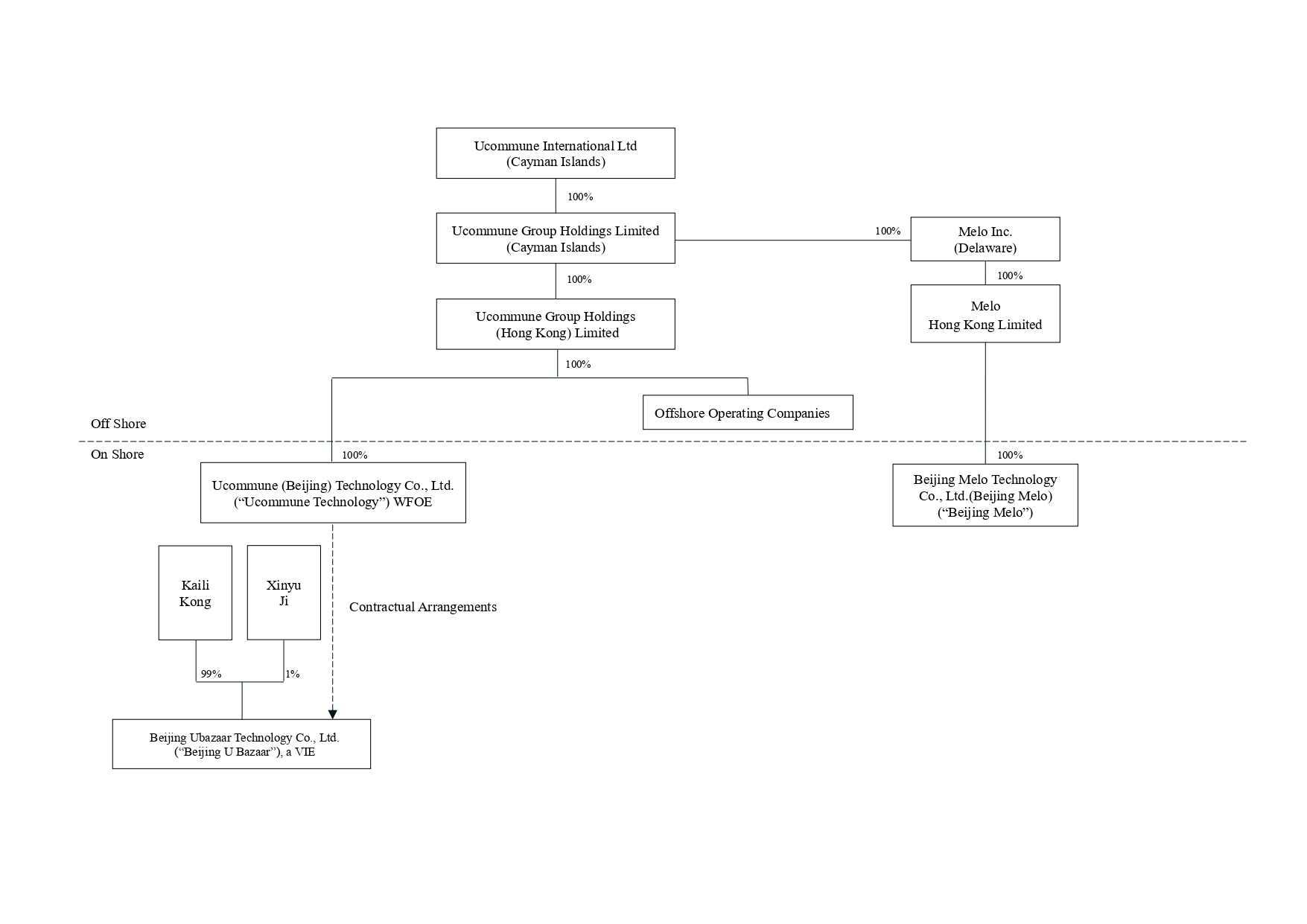
24
Holding Company Structure
Ucommune International Ltd, the Parent, is the ultimate Cayman Islands holding company with no material operations of its own. The Parent operates its business through its subsidiaries and the consolidated VIEs. As a result, the Parent’s ability to pay dividends depends upon dividends paid by its subsidiaries. If its subsidiaries or any newly formed subsidiaries incur debt on their own behalf in the future, the instruments governing their debt may restrict their ability to pay dividends to the Parent.
In addition, the PRC subsidiaries are permitted to pay dividends to their shareholders, which are the Parent’s subsidiaries incorporated in Hong Kong and indirectly wholly-owned by the Parent, only out of their retained earnings, if any, as determined in accordance with the Accounting Standards for Business Enterprise as promulgated by the Ministry of Finance of the PRC, or PRC GAAP. In accordance with PRC company laws, the consolidated VIEs in China must make appropriations from their after-tax profit to non-distributable reserve funds including (1) statutory surplus fund and (2) discretionary surplus fund. The appropriation to the statutory surplus fund must be at least 10% of the after-tax profits calculated in accordance with PRC GAAP. Appropriation is not required if the statutory surplus fund has reached 50% of the registered capital of the consolidated VIEs. Appropriation to discretionary surplus fund is made at the discretion of the consolidated VIEs.
Pursuant to the law applicable to China’s foreign investment enterprises, the Parent’s subsidiaries that are foreign investment enterprises in the PRC have to make appropriation from their after-tax profit, as determined under PRC GAAP, to reserve funds including (1) general reserve fund, (2) enterprise expansion fund and (3) staff bonus and welfare fund. The appropriation to the general reserve fund must be at least 10% of the after-tax profits calculated in accordance with PRC GAAP. Appropriation is not required if the reserve fund has reached 50% of the registered capital of the Parent’s subsidiary. Appropriation to the other two reserve funds is at the discretion of the Parent’s subsidiary. See “Item 3. Key Information — D. Risk Factors — Risks Relating to Doing Business in China — We may rely on dividends and other distributions on equity paid by our PRC subsidiaries to fund any cash and financing requirements we may have, and any limitation on the ability of our PRC subsidiaries to make payments to us could materially and adversely affect our ability to conduct our business” from the Parent’s Form 20-F.
Notwithstanding the foregoing, the PRC subsidiaries may use their own retained earnings (rather than Renminbi converted from foreign currency denominated capital) to provide financial support to the VIEs either through entrusted loans from the PRC subsidiaries to the consolidated VIEs or direct loans to such VIEs’ nominee shareholders, which would be contributed to the VIEs as capital injections. Such direct loans to the nominee shareholders would be eliminated in the consolidated financial statements against the VIEs’ share capital.
As an offshore holding company, the Parent is permitted under PRC laws and regulations to provide funding from the proceeds of its offshore fund-raising activities to the WOFEs only through loans or capital contributions, and to the VIEs only through loans, in each case subject to the satisfaction of the applicable government registration and approval requirements. Before providing loans to the onshore entities (i.e., the PRC subsidiaries and the VIE entities), the Parent is required make filings about details of the loans with SAFE in accordance with relevant PRC laws and regulations. The PRC subsidiaries and the VIE entities that receive the loans are only allowed to use the loans for the purposes set forth in these laws and regulations. See “Item 3. Key Information — D. Risk Factors — Risks Relating to Doing Business in China — PRC regulation of loans to and direct investment in PRC entities by offshore holding companies and governmental control of currency conversion may delay us from using the proceeds of securities offerings, to make loans or additional capital contributions to our PRC subsidiaries, which could materially and adversely affect our liquidity and our ability to fund and expand our business” from the Parent’s Form 20-F. As a result, there is uncertainty with respect to the Parent’s ability to provide prompt financial support to the PRC subsidiaries and the consolidated VIEs when needed. In August 2020, Ucommune Venture entered into a loan agreement with Ucommune HK, under which Ucommune HK agreed to provide loans of up to a total of US$60 million to Ucommune Venture and Ucommune Venture could draw down the loans in multiple tranches (up to an aggregate of US$60 million) within three years from the date of the first draw-down. Thereafter, both parties entered into three supplement agreements in January 2021, February 2021, and April 2023 . As of the date hereof, Ucommune HK has provided a total of US$41.7 million in loans to Ucommune Venture, of which US$8.5 million have been repaid, under such loan agreements since the completion of the Business Combination in November 2020, using proceeds from the Parent’s previous PIPE financing and follow-on offerings. Such loans were included in intercompany loans, and disclosed as roll-forwards of the investment in subsidiaries and VIEs. See “Item 3. Key Information — Implications of Being a Company with the Holding Company Structure and the VIE Structures — Financial Statement Information Related to the VIE Structures ” from the Parent’s Form 20-F and “Selected Unaudited Condensed Consolidated Financial Statement Information of Parent, the VIEs, the WFOEs, the HK Subsidiaries and other Subsidiaries — Inter-group balances due from VIEs/Subsidiaries — Intercompany loan lent” herein.
The Parent, its subsidiaries and the VIEs are subject to restrictions on foreign exchange and their ability to transfer cash between entities, across borders, and to U.S. investors. Under PRC foreign exchange regulations, payments of current account items, including profit distributions, interest payments and trade and service-related foreign exchange transactions, can be made in foreign currencies without prior approval of SAFE, by complying with certain procedural requirements. However, approval from or registration with appropriate government authorities is required where Renminbi is to be converted into foreign currency and remitted out of China to pay capital expenses such as the repayment of loans denominated in foreign currencies. As a result, the PRC subsidiaries and the VIEs need to obtain SAFE approval to use cash generated from the operations of the PRC subsidiaries and VIEs to pay off their respective debt in a currency other than Renminbi owed to entities outside China, or to make other capital expenditure payments outside China in a currency other than Renminbi. See “Item 3. Key Information — D. Risk Factors — Risks Relating to Doing Business in China — Governmental control of currency conversion may limit our ability to utilize our net revenue effectively and our ability to transfer cash between our PRC subsidiaries and us, across borders, and to investors and affect the value of your investment” from the Parent’s Form 20-F.
25
Ucommune has established stringent controls and procedures for cash flows within the group based on internal cash management policies. Each transfer of cash among the Parent, its subsidiaries and the VIEs is subject to internal approval. To effect a cash transfer, a number of steps are needed, including but not limited to the issuance of payment receipt, logging into the online banking system and completing its verification process, inspection of the invoice, and payment execution. Only the finance department is authorized to make cash transfers. Within the finance department, the roles of payment approval, payment execution, record keeping, and auditing are segregated to minimize risk.
Cash may be transferred within the group in the following manner: (1) the Parent may transfer funds to its subsidiaries, including the PRC subsidiaries, by way of capital contributions or loans; (2) the Parent and its subsidiaries may provide loans to the VIEs and vice versa; (3) funds may be transferred from the VIEs to the WFOEs, as service fees for services contemplated by the contractual arrangements; (4) the PRC subsidiaries, including the WFOEs, may pay dividends to their shareholders, which are the Parent’s subsidiaries incorporated in Hong Kong and indirectly wholly-owned by the Parent; and (5) the non-PRC subsidiaries may make dividends or other distributions to the Parent. Because the Parent is the primary beneficiary of the VIEs through contractual arrangements and the Parent and its subsidiaries do not have equity ownership in the VIEs, neither the Parent nor its subsidiaries are able to make direct capital contributions to the VIEs or their respective subsidiaries, and the VIEs are not able to make dividends or other distributions to the Parent. See “Item 3. Key Information — Implications of Being a Company with the Holding Company Structure and the VIE Structures — Financial Statement Information Related to the VIE Structures” from the Parent’s Form 20-F.
Since January 1, 2018, cash has been transferred through the group in terms of loans; there have been no other transfers, dividends or distributions made to date between the Parent as the holding company, its subsidiaries and the consolidated VIEs, or to investors; and there have been no other cash flows and transfers of other assets by type that have occurred between the Parent as the holding company, its subsidiaries, and the consolidated VIEs. As of the date hereof, none of the subsidiaries had distributed any dividends or made any other distributions to the Parent. As of the same date, the Parent had not distributed any dividends or made any other distributions to U.S. investors. See “Item 3. Key Information — Implications of Being a Company with the Holding Company Structure and the VIE Structures — Financial Statement Information Related to the VIE Structures” from the Parent’s Form 20-F. The Parent does not intend to distribute earnings or settle amounts owed under the contractual arrangements.
Off-Balance Sheet Commitments and Arrangements
Ucommune has not entered into any financial guarantees or other commitments to guarantee the payment obligations of any third parties. The Parent has not entered into any derivative contracts that are indexed to its shares and classified as shareholder’s equity or that are not reflected in the unaudited condensed consolidated financial statements. Furthermore, the Parent does not have any retained or contingent interest in assets transferred to an unconsolidated entity that serves as credit, liquidity or market risk support to such entity. The Parent does not have any variable interest in any unconsolidated entity that provides financing, liquidity, market risk or credit support to Ucommune or engages in leasing, hedging or product development services with Ucommune.
Quantitative and Qualitative Disclosure about Market Risk
Foreign Currency Risk
SAFE, under the authority of the Peoples Bank of China, controls the conversion of RMB into other currencies. The value of the RMB is subject to changes in central government policies, international economic and political developments affecting supply and demand in the China Foreign Exchange Trading System market. Cash and cash equivalents denominated in RMB amounted to RMB57.5 million and RMB59.3 million (US$8.2 million) as of June 30, 2023 and 2024, respectively.
Inflation Risk
Since Ucommune’s inception, inflation in China has not materially impacted the results of operations. Although Ucommune has not in the past been materially affected by inflation since Ucommune’s inception, Ucommune may be affected in the future by higher rates of inflation in China.
26
Internal Control Over Financial Reporting
In connection with the preparation and external audits of the consolidated financial statements included elsewhere in the Parent’s Form 20-F, the Parent identified the following material weaknesses in internal control over financial reporting. The independent registered public accounting firm has not conducted an audit of the Parent’s internal control over financial reporting.
The material weaknesses that have been identified relate to:
| ● | A lack of proper management approval and review on borrowing contract over certain amount, and |
| ● | Insufficient accounting personnel with appropriate experience and knowledge to address complex accounting matters in accordance with U.S. GAAP. |
Neither the Parent nor its independent registered public accounting firm undertook a comprehensive assessment of internal control under the Sarbanes-Oxley Act of 2002 for purposes of identifying and reporting any weakness in internal control over financial reporting. Once the Parent ceases to be an “emerging growth company” as such term is defined in the Jumpstart Our Business Startups Act of 2012, or the JOBS Act, the independent registered public accounting firm must attest to and report on the effectiveness of internal control over financial reporting. Had the Parent performed a formal assessment of internal control over financial reporting or had the independent registered public accounting firm performed an audit of internal control over financial reporting, additional control deficiencies may have been identified. The material weaknesses, if not timely remedied, may lead to significant misstatements in the unaudited condensed consolidated financial statements in the future.
To remedy the identified material weaknesses, the Parent has adopted and will adopt further measures to improve internal control over financial reporting, as follows.
| ● | The Parent plans to improve its management approval on all borrowing contracts over certain amount, and to enhance management review control over borrowing related accounting treatment by conducting monthly accounting record inspection; |
| ● | The Parent plans to recruit staff with knowledge of U.S. GAAP and SEC regulations in its finance and accounting department. The Parent also plans to enhance internal training and development programs for financial reporting personnel; and |
| ● | When entering into complex transactions, the Parent plans to utilize third-party consultant for accounting services as additional resources. |
The Parent intends to remediate these material weaknesses in multiple phases and expect that it will incur certain costs for implementing the remediation measures. The implementation of the measure, however, may not fully address the material weaknesses identified in internal control over financial reporting, and the Parent cannot conclude that the material weaknesses have been fully remedied as of June 30, 2024. In addition, the Parent cannot assure you that the Parent will be able to continue implementing these measures in the future. See “Item 3. Key Information — D. Risk Factors — Risk Factors Relating to Our Business and Industry — If we fail to implement and maintain an effective system of internal controls to remediate our material weaknesses over financial reporting, we may be unable to accurately report our results of operations, meet our reporting obligations or prevent fraud, and investor confidence and the market price of the ordinary shares may be materially and adversely affected” from the Parent’s Form 20-F.
As a company with less than US$1.235 billion in revenue for the Parent’s last fiscal year, the Parent qualifies as an “emerging growth company” pursuant to the JOBS Act. An emerging growth company may take advantage of specified reduced reporting and other requirements that are otherwise applicable generally to public companies. These provisions include exemption from the auditor attestation requirement under Section 404 of the Sarbanes-Oxley Act of 2002 in the assessment of the emerging growth company’s internal control over financial reporting.
Recent Accounting Pronouncements
For detailed discussion on recent accounting pronouncements, see Note 2 to the Parent’s unaudited condensed consolidated financial statements, which are included elsewhere in this Form 6-K.
27