Thursday, September 26, 2024 9:00 AM – 2:30 PM CDT
Julia Landrum Southwest. Even Better.
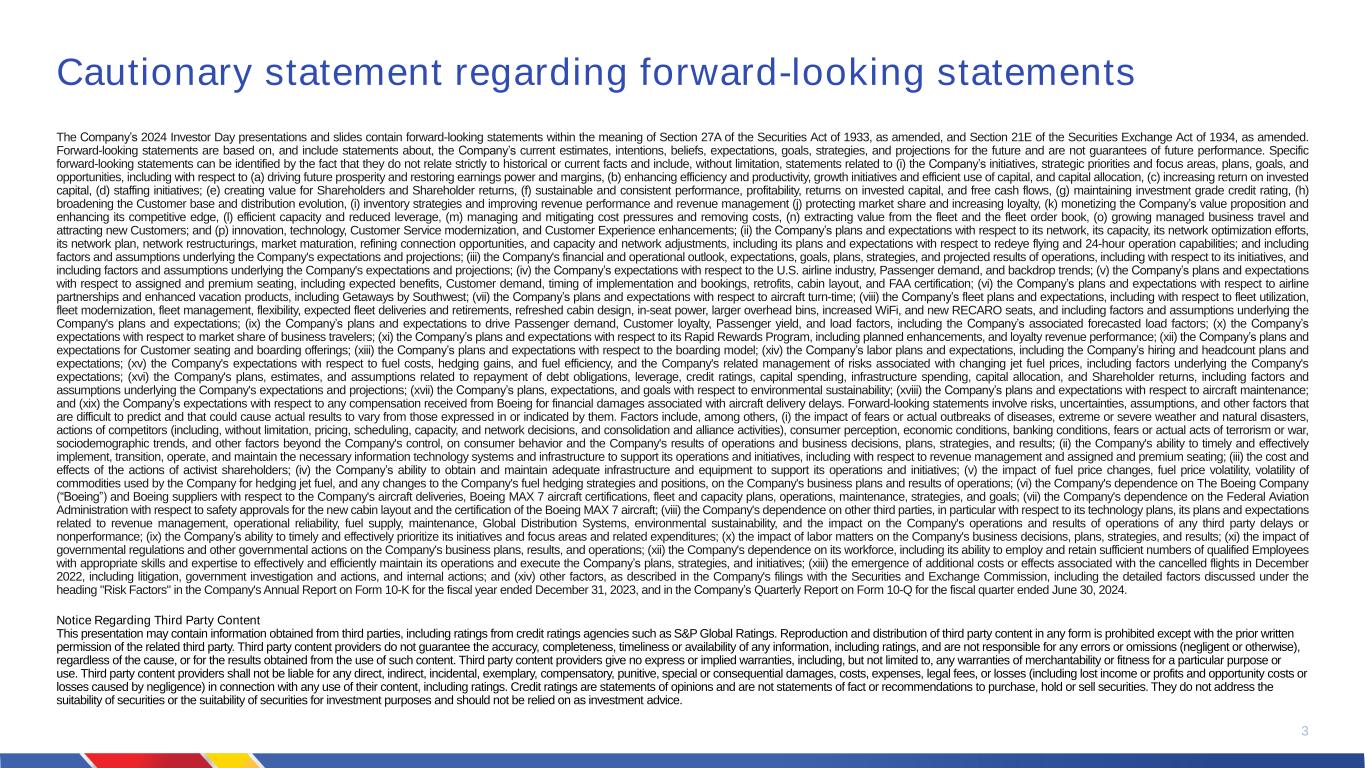
3 Cautionary statement regarding forward-looking statements The Company’s 2024 Investor Day presentations and slides contain forward-looking statements within the meaning of Section 27A of the Securities Act of 1933, as amended, and Section 21E of the Securities Exchange Act of 1934, as amended. Forward-looking statements are based on, and include statements about, the Company’s current estimates, intentions, beliefs, expectations, goals, strategies, and projections for the future and are not guarantees of future performance. Specific forward-looking statements can be identified by the fact that they do not relate strictly to historical or current facts and include, without limitation, statements related to (i) the Company’s initiatives, strategic priorities and focus areas, plans, goals, and opportunities, including with respect to (a) driving future prosperity and restoring earnings power and margins, (b) enhancing efficiency and productivity, growth initiatives and efficient use of capital, and capital allocation, (c) increasing return on invested capital, (d) staffing initiatives; (e) creating value for Shareholders and Shareholder returns, (f) sustainable and consistent performance, profitability, returns on invested capital, and free cash flows, (g) maintaining investment grade credit rating, (h) broadening the Customer base and distribution evolution, (i) inventory strategies and improving revenue performance and revenue management (j) protecting market share and increasing loyalty, (k) monetizing the Company’s value proposition and enhancing its competitive edge, (l) efficient capacity and reduced leverage, (m) managing and mitigating cost pressures and removing costs, (n) extracting value from the fleet and the fleet order book, (o) growing managed business travel and attracting new Customers; and (p) innovation, technology, Customer Service modernization, and Customer Experience enhancements; (ii) the Company’s plans and expectations with respect to its network, its capacity, its network optimization efforts, its network plan, network restructurings, market maturation, refining connection opportunities, and capacity and network adjustments, including its plans and expectations with respect to redeye flying and 24-hour operation capabilities; and including factors and assumptions underlying the Company's expectations and projections; (iii) the Company's financial and operational outlook, expectations, goals, plans, strategies, and projected results of operations, including with respect to its initiatives, and including factors and assumptions underlying the Company's expectations and projections; (iv) the Company’s expectations with respect to the U.S. airline industry, Passenger demand, and backdrop trends; (v) the Company’s plans and expectations with respect to assigned and premium seating, including expected benefits, Customer demand, timing of implementation and bookings, retrofits, cabin layout, and FAA certification; (vi) the Company’s plans and expectations with respect to airline partnerships and enhanced vacation products, including Getaways by Southwest; (vii) the Company’s plans and expectations with respect to aircraft turn-time; (viii) the Company’s fleet plans and expectations, including with respect to fleet utilization, fleet modernization, fleet management, flexibility, expected fleet deliveries and retirements, refreshed cabin design, in-seat power, larger overhead bins, increased WiFi, and new RECARO seats, and including factors and assumptions underlying the Company's plans and expectations; (ix) the Company’s plans and expectations to drive Passenger demand, Customer loyalty, Passenger yield, and load factors, including the Company’s associated forecasted load factors; (x) the Company’s expectations with respect to market share of business travelers; (xi) the Company’s plans and expectations with respect to its Rapid Rewards Program, including planned enhancements, and loyalty revenue performance; (xii) the Company’s plans and expectations for Customer seating and boarding offerings; (xiii) the Company’s plans and expectations with respect to the boarding model; (xiv) the Company’s labor plans and expectations, including the Company’s hiring and headcount plans and expectations; (xv) the Company's expectations with respect to fuel costs, hedging gains, and fuel efficiency, and the Company's related management of risks associated with changing jet fuel prices, including factors underlying the Company's expectations; (xvi) the Company's plans, estimates, and assumptions related to repayment of debt obligations, leverage, credit ratings, capital spending, infrastructure spending, capital allocation, and Shareholder returns, including factors and assumptions underlying the Company's expectations and projections; (xvii) the Company’s plans, expectations, and goals with respect to environmental sustainability; (xviii) the Company’s plans and expectations with respect to aircraft maintenance; and (xix) the Company’s expectations with respect to any compensation received from Boeing for financial damages associated with aircraft delivery delays. Forward-looking statements involve risks, uncertainties, assumptions, and other factors that are difficult to predict and that could cause actual results to vary from those expressed in or indicated by them. Factors include, among others, (i) the impact of fears or actual outbreaks of diseases, extreme or severe weather and natural disasters, actions of competitors (including, without limitation, pricing, scheduling, capacity, and network decisions, and consolidation and alliance activities), consumer perception, economic conditions, banking conditions, fears or actual acts of terrorism or war, sociodemographic trends, and other factors beyond the Company's control, on consumer behavior and the Company's results of operations and business decisions, plans, strategies, and results; (ii) the Company's ability to timely and effectively implement, transition, operate, and maintain the necessary information technology systems and infrastructure to support its operations and initiatives, including with respect to revenue management and assigned and premium seating; (iii) the cost and effects of the actions of activist shareholders; (iv) the Company’s ability to obtain and maintain adequate infrastructure and equipment to support its operations and initiatives; (v) the impact of fuel price changes, fuel price volatility, volatility of commodities used by the Company for hedging jet fuel, and any changes to the Company's fuel hedging strategies and positions, on the Company's business plans and results of operations; (vi) the Company's dependence on The Boeing Company (“Boeing”) and Boeing suppliers with respect to the Company's aircraft deliveries, Boeing MAX 7 aircraft certifications, fleet and capacity plans, operations, maintenance, strategies, and goals; (vii) the Company's dependence on the Federal Aviation Administration with respect to safety approvals for the new cabin layout and the certification of the Boeing MAX 7 aircraft; (viii) the Company's dependence on other third parties, in particular with respect to its technology plans, its plans and expectations related to revenue management, operational reliability, fuel supply, maintenance, Global Distribution Systems, environmental sustainability, and the impact on the Company's operations and results of operations of any third party delays or nonperformance; (ix) the Company’s ability to timely and effectively prioritize its initiatives and focus areas and related expenditures; (x) the impact of labor matters on the Company's business decisions, plans, strategies, and results; (xi) the impact of governmental regulations and other governmental actions on the Company's business plans, results, and operations; (xii) the Company's dependence on its workforce, including its ability to employ and retain sufficient numbers of qualified Employees with appropriate skills and expertise to effectively and efficiently maintain its operations and execute the Company’s plans, strategies, and initiatives; (xiii) the emergence of additional costs or effects associated with the cancelled flights in December 2022, including litigation, government investigation and actions, and internal actions; and (xiv) other factors, as described in the Company's filings with the Securities and Exchange Commission, including the detailed factors discussed under the heading "Risk Factors" in the Company's Annual Report on Form 10-K for the fiscal year ended December 31, 2023, and in the Company’s Quarterly Report on Form 10-Q for the fiscal quarter ended June 30, 2024. Notice Regarding Third Party Content This presentation may contain information obtained from third parties, including ratings from credit ratings agencies such as S&P Global Ratings. Reproduction and distribution of third party content in any form is prohibited except with the prior written permission of the related third party. Third party content providers do not guarantee the accuracy, completeness, timeliness or availability of any information, including ratings, and are not responsible for any errors or omissions (negligent or otherwise), regardless of the cause, or for the results obtained from the use of such content. Third party content providers give no express or implied warranties, including, but not limited to, any warranties of merchantability or fitness for a particular purpose or use. Third party content providers shall not be liable for any direct, indirect, incidental, exemplary, compensatory, punitive, special or consequential damages, costs, expenses, legal fees, or losses (including lost income or profits and opportunity costs or losses caused by negligence) in connection with any use of their content, including ratings. Credit ratings are statements of opinions and are not statements of fact or recommendations to purchase, hold or sell securities. They do not address the suitability of securities or the suitability of securities for investment purposes and should not be relied on as investment advice.
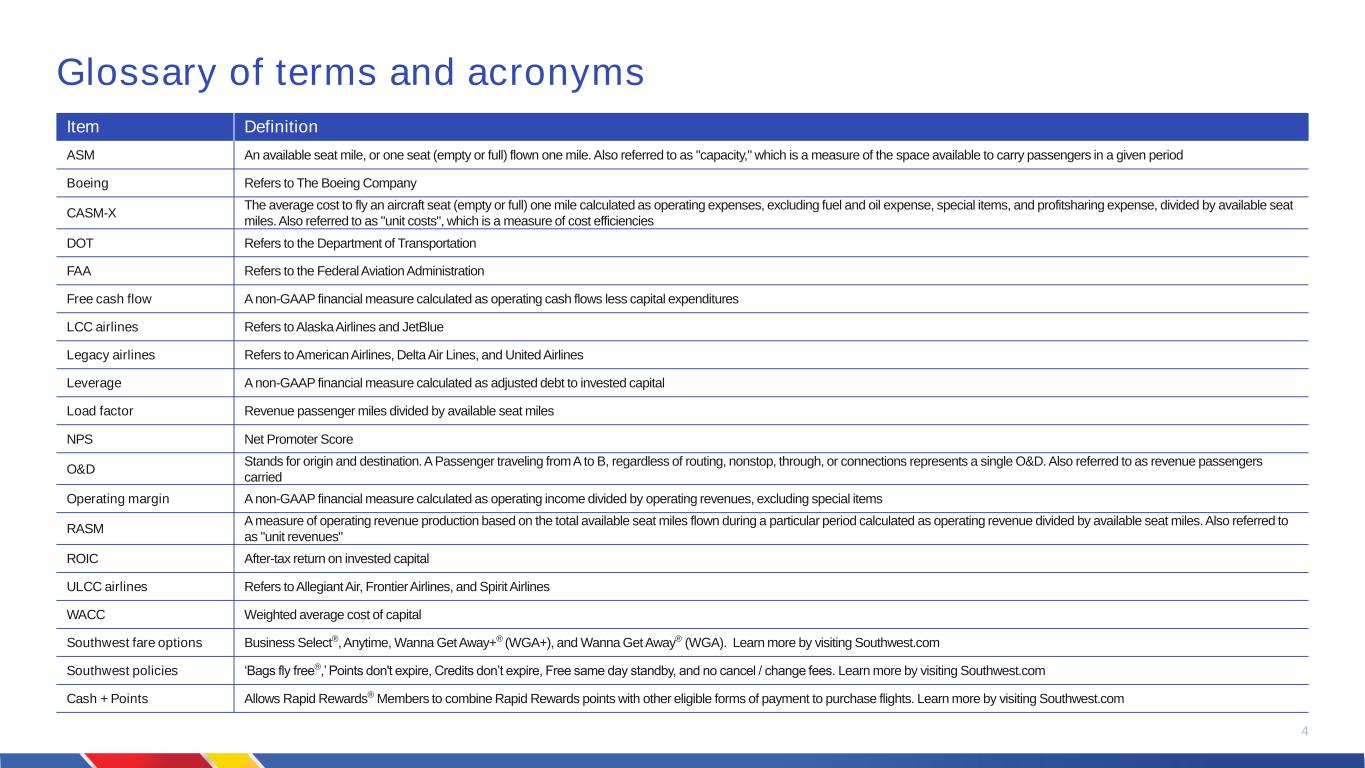
4 Glossary of terms and acronyms Item Definition ASM An available seat mile, or one seat (empty or full) flown one mile. Also referred to as "capacity," which is a measure of the space available to carry passengers in a given period Boeing Refers to The Boeing Company CASM-X The average cost to fly an aircraft seat (empty or full) one mile calculated as operating expenses, excluding fuel and oil expense, special items, and profitsharing expense, divided by available seat miles. Also referred to as "unit costs", which is a measure of cost efficiencies DOT Refers to the Department of Transportation FAA Refers to the Federal Aviation Administration Free cash flow A non-GAAP financial measure calculated as operating cash flows less capital expenditures LCC airlines Refers to Alaska Airlines and JetBlue Legacy airlines Refers to American Airlines, Delta Air Lines, and United Airlines Leverage A non-GAAP financial measure calculated as adjusted debt to invested capital Load factor Revenue passenger miles divided by available seat miles NPS Net Promoter Score O&D Stands for origin and destination. A Passenger traveling from A to B, regardless of routing, nonstop, through, or connections represents a single O&D. Also referred to as revenue passengers carried Operating margin A non-GAAP financial measure calculated as operating income divided by operating revenues, excluding special items RASM A measure of operating revenue production based on the total available seat miles flown during a particular period calculated as operating revenue divided by available seat miles. Also referred to as "unit revenues" ROIC After-tax return on invested capital ULCC airlines Refers to Allegiant Air, Frontier Airlines, and Spirit Airlines WACC Weighted average cost of capital Southwest fare options Business Select®, Anytime, Wanna Get Away+® (WGA+), and Wanna Get Away® (WGA). Learn more by visiting Southwest.com Southwest policies ‘Bags fly free®,’ Points don't expire, Credits don’t expire, Free same day standby, and no cancel / change fees. Learn more by visiting Southwest.com Cash + Points Allows Rapid Rewards® Members to combine Rapid Rewards points with other eligible forms of payment to purchase flights. Learn more by visiting Southwest.com
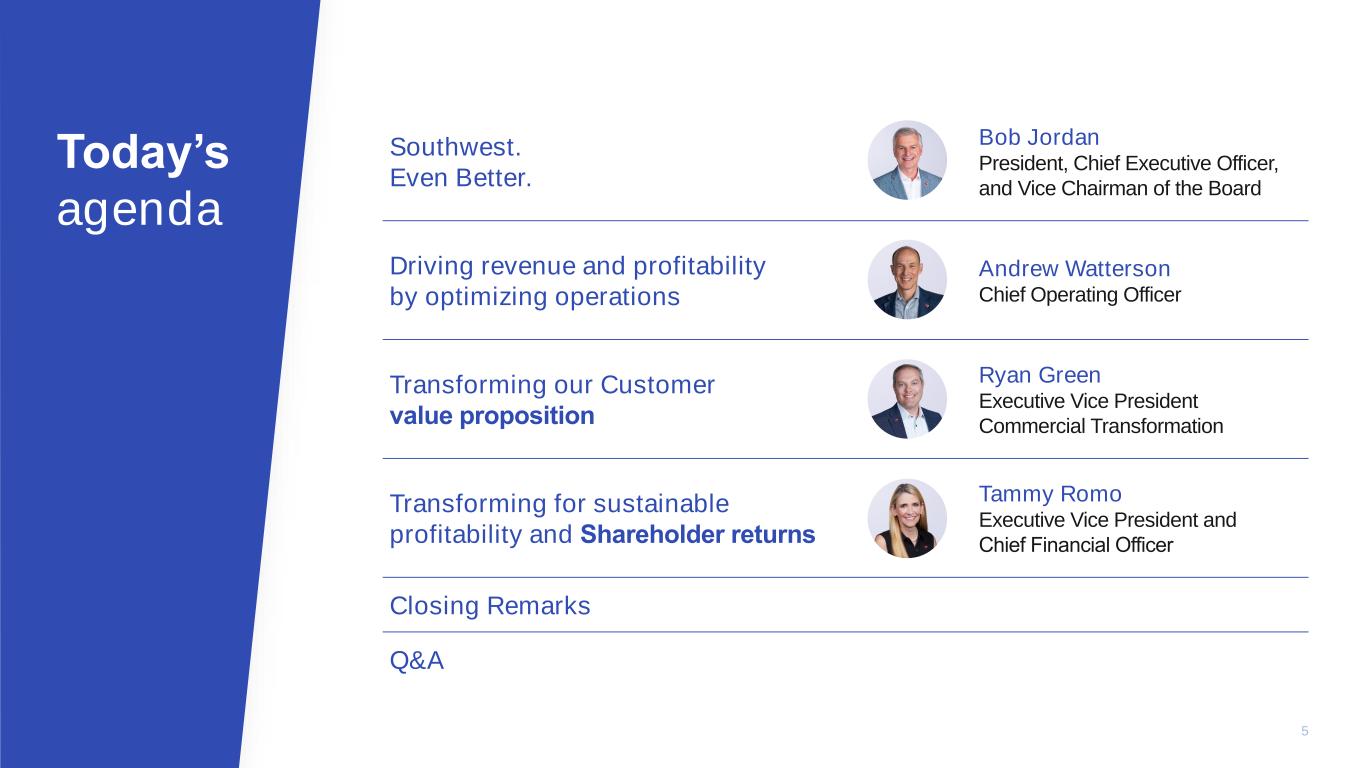
5 Bob Jordan Southwest. Even Better. Bob Jordan President, Chief Executive Officer, and Vice Chairman of the Board Driving revenue and profitability by optimizing operations Andrew Watterson Chief Operating Officer Transforming our Customer value proposition Ryan Green Executive Vice President Commercial Transformation Transforming for sustainable profitability and Shareholder returns Tammy Romo Executive Vice President and Chief Financial Officer Closing Remarks Q&A Today’s agenda
Bob Jordan Southwest. Even Better.
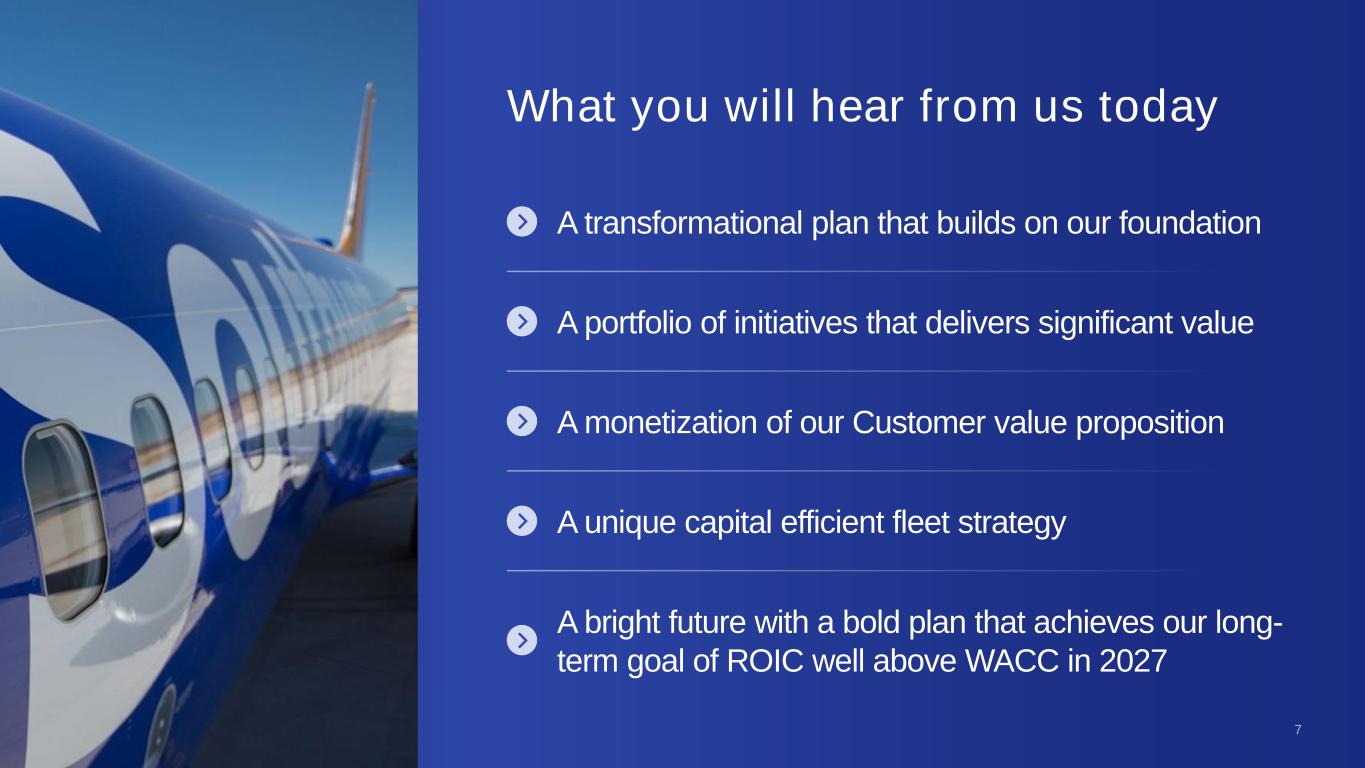
What you will hear from us today A transformational plan that builds on our foundation A portfolio of initiatives that delivers significant value A monetization of our Customer value proposition A unique capital efficient fleet strategy A bright future with a bold plan that achieves our long- term goal of ROIC well above WACC in 2027 7
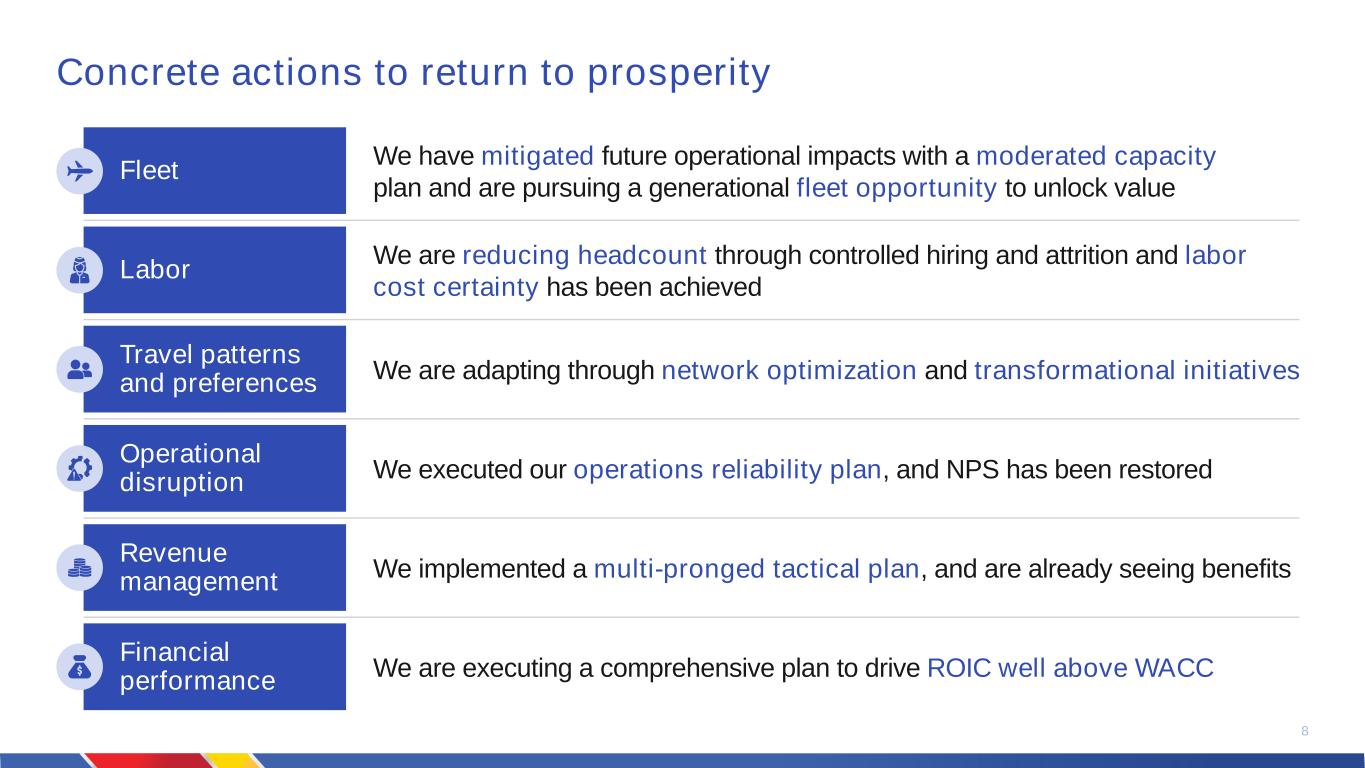
8 Concrete actions to return to prosperity Fleet Labor Travel patterns and preferences Operational disruption Revenue management Financial performance We are reducing headcount through controlled hiring and attrition and labor cost certainty has been achieved We are adapting through network optimization and transformational initiatives We executed our operations reliability plan, and NPS has been restored We implemented a multi-pronged tactical plan, and are already seeing benefits We are executing a comprehensive plan to drive ROIC well above WACC We have mitigated future operational impacts with a moderated capacity plan and are pursuing a generational fleet opportunity to unlock value
Our unique history and industry- leading position
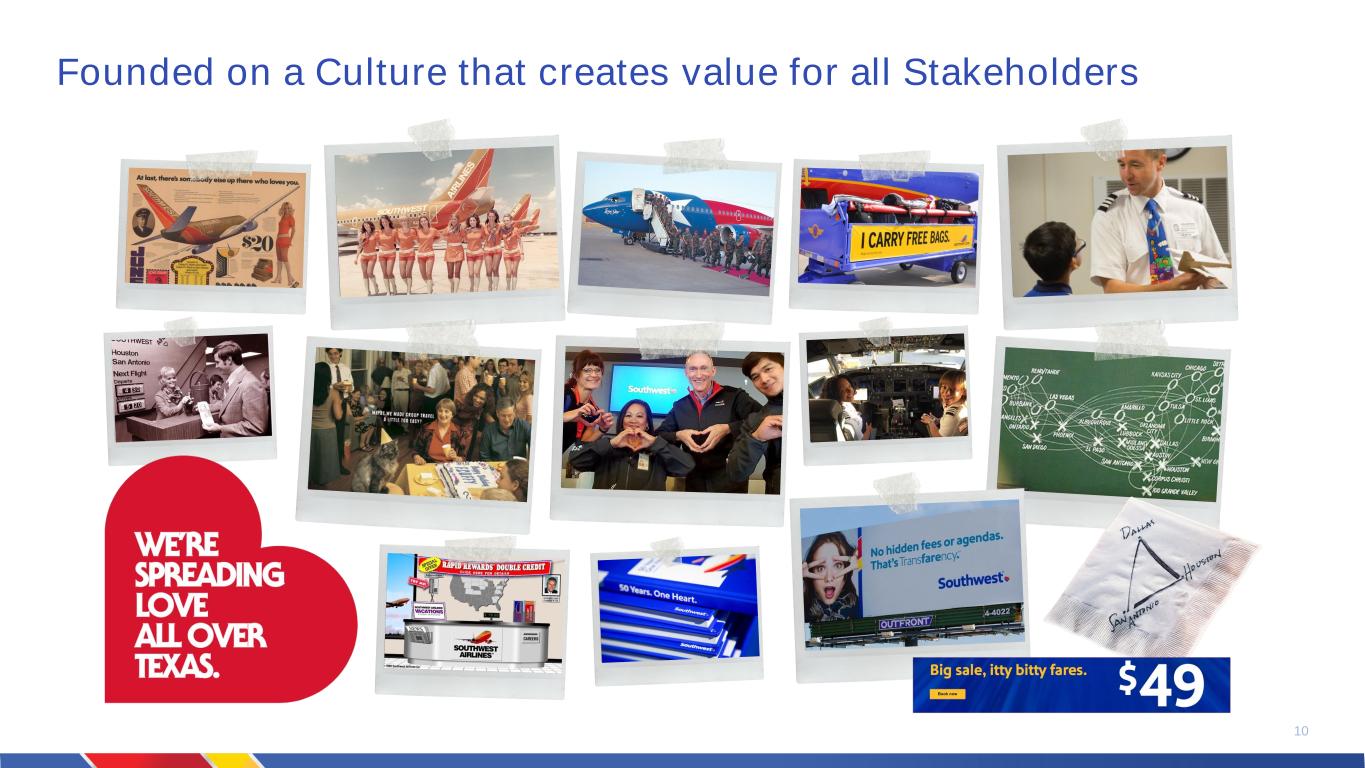
10 Founded on a Culture that creates value for all Stakeholders
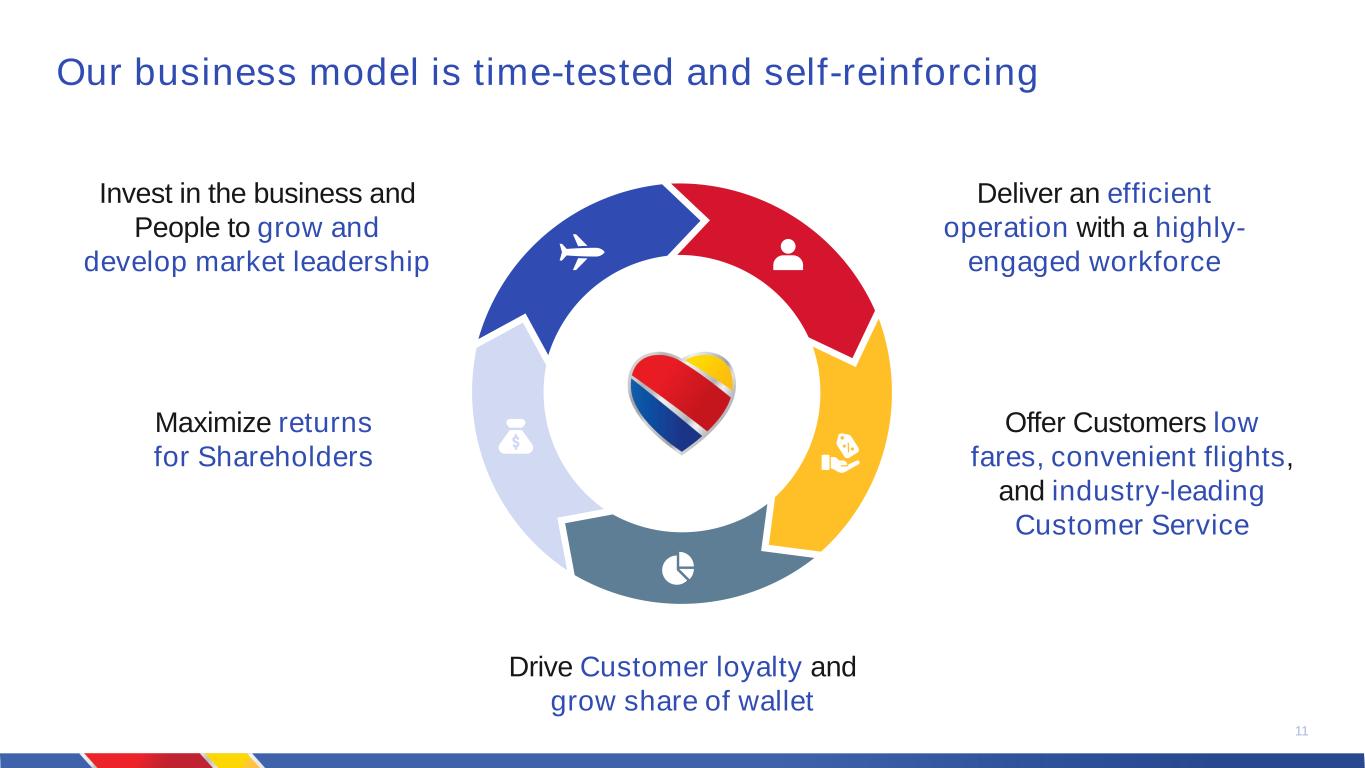
11 Our business model is time-tested and self-reinforcing Invest in the business and People to grow and develop market leadership Deliver an efficient operation with a highly- engaged workforce Offer Customers low fares, convenient flights, and industry-leading Customer Service Drive Customer loyalty and grow share of wallet Maximize returns for Shareholders
It starts with our and our People Culture… 12
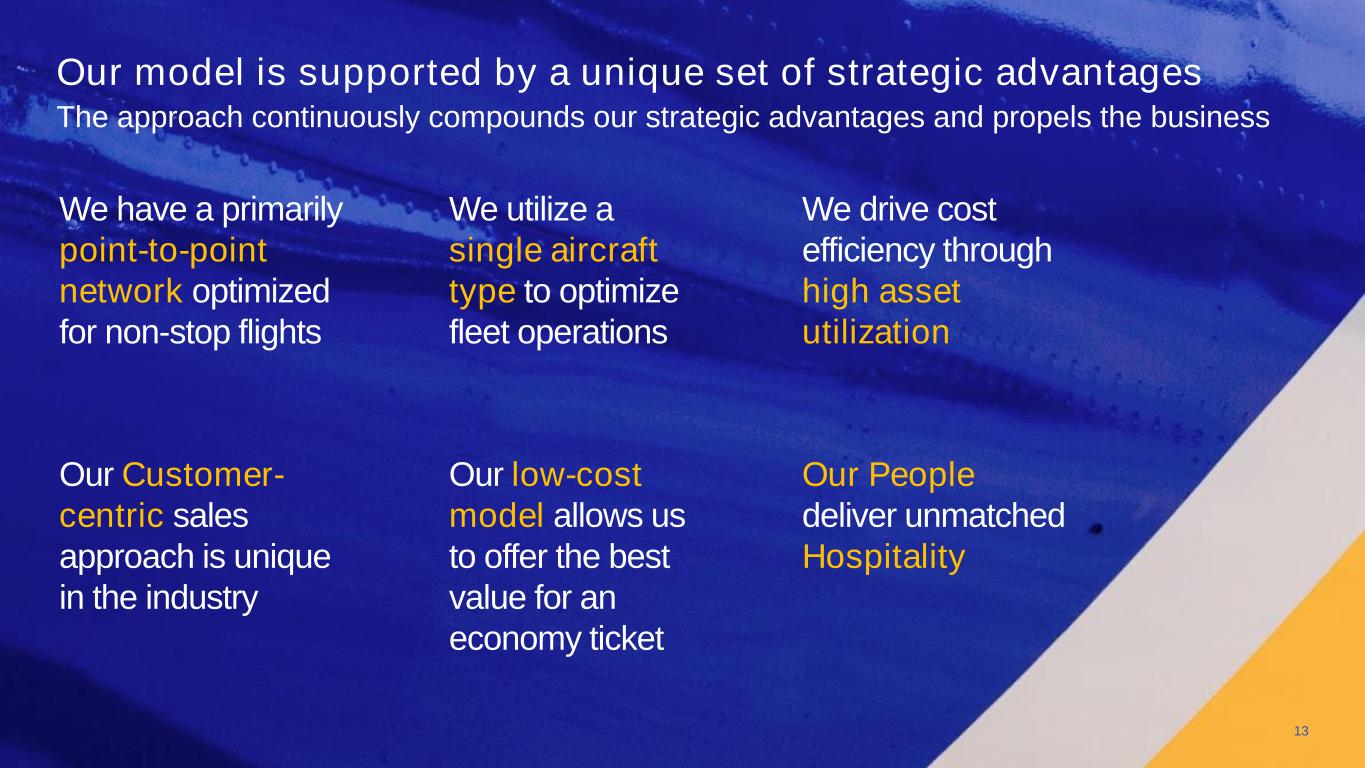
Our model is supported by a unique set of strategic advantages 13 The approach continuously compounds our strategic advantages and propels the business We have a primarily point-to-point network optimized for non-stop flights We utilize a single aircraft type to optimize fleet operations We drive cost efficiency through high asset utilization Our Customer- centric sales approach is unique in the industry Our low-cost model allows us to offer the best value for an economy ticket Our People deliver unmatched Hospitality
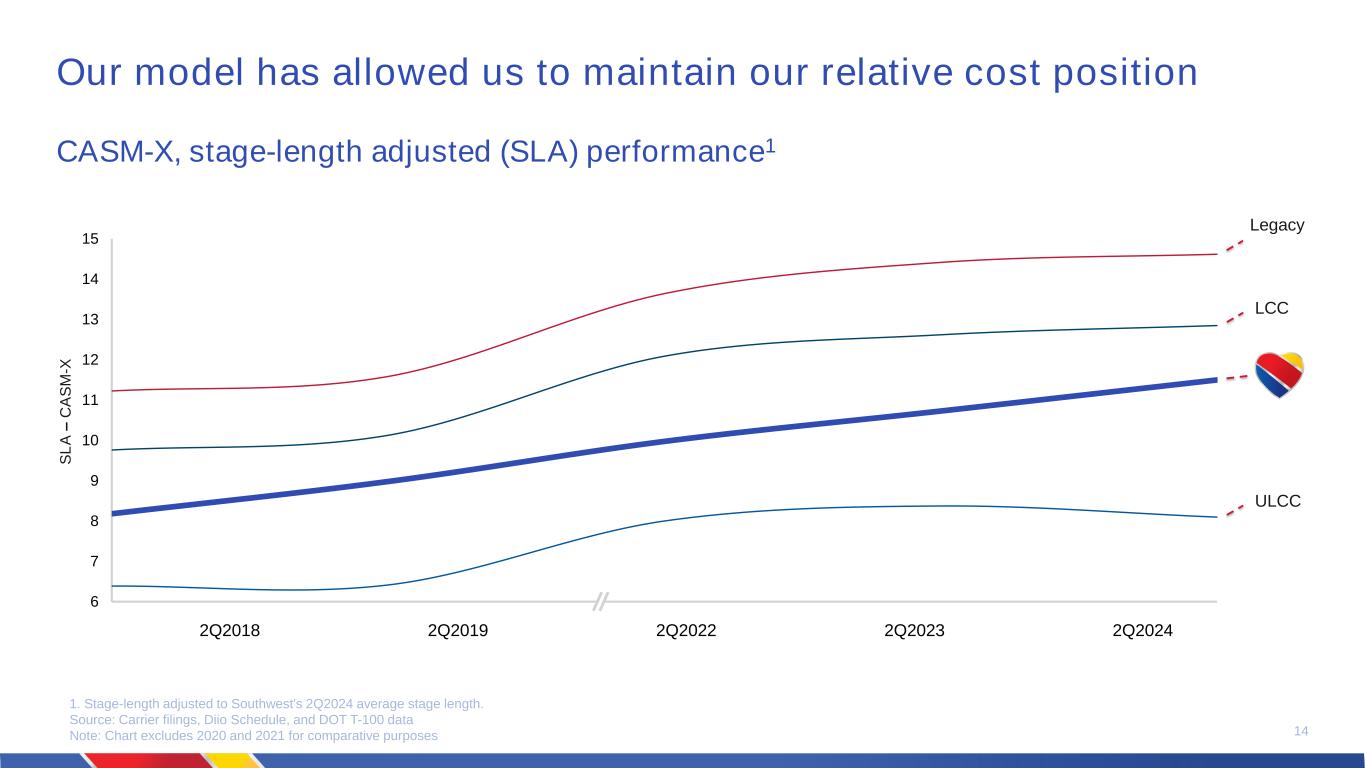
14 Our model has allowed us to maintain our relative cost position 1. Stage-length adjusted to Southwest's 2Q2024 average stage length. Source: Carrier filings, Diio Schedule, and DOT T-100 data Note: Chart excludes 2020 and 2021 for comparative purposes CASM-X, stage-length adjusted (SLA) performance1 6 7 8 9 10 11 12 13 14 15 2Q2018 2Q2019 2Q2022 2Q2023 2Q2024 S L A – C A S M -X Legacy LCC ULCC
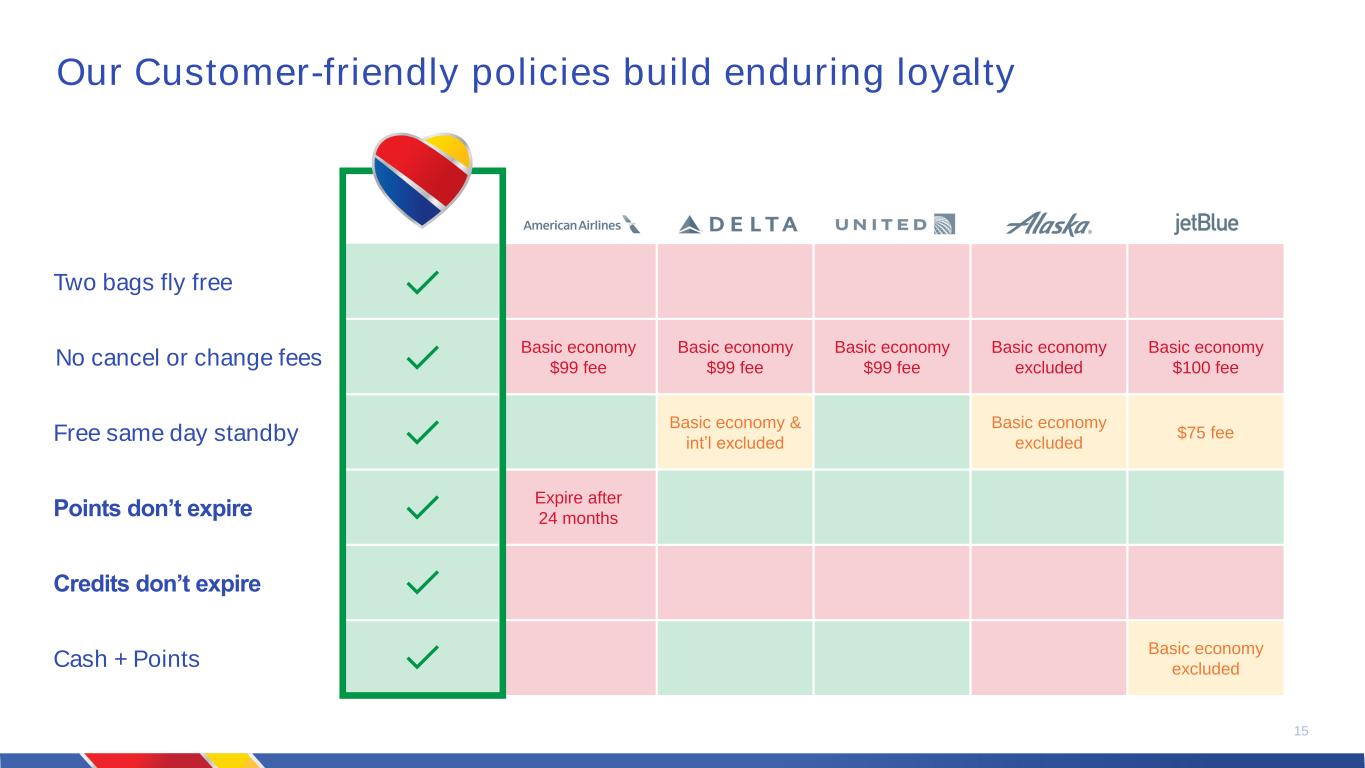
15 Our Customer-friendly policies build enduring loyalty Two bags fly free No cancel or change fees Basic economy $99 fee Basic economy $99 fee Basic economy $99 fee Basic economy excluded Basic economy $100 fee Free same day standby Basic economy & int’l excluded Basic economy excluded $75 fee Points don’t expire Expire after 24 months Credits don’t expire Cash + Points Basic economy excluded
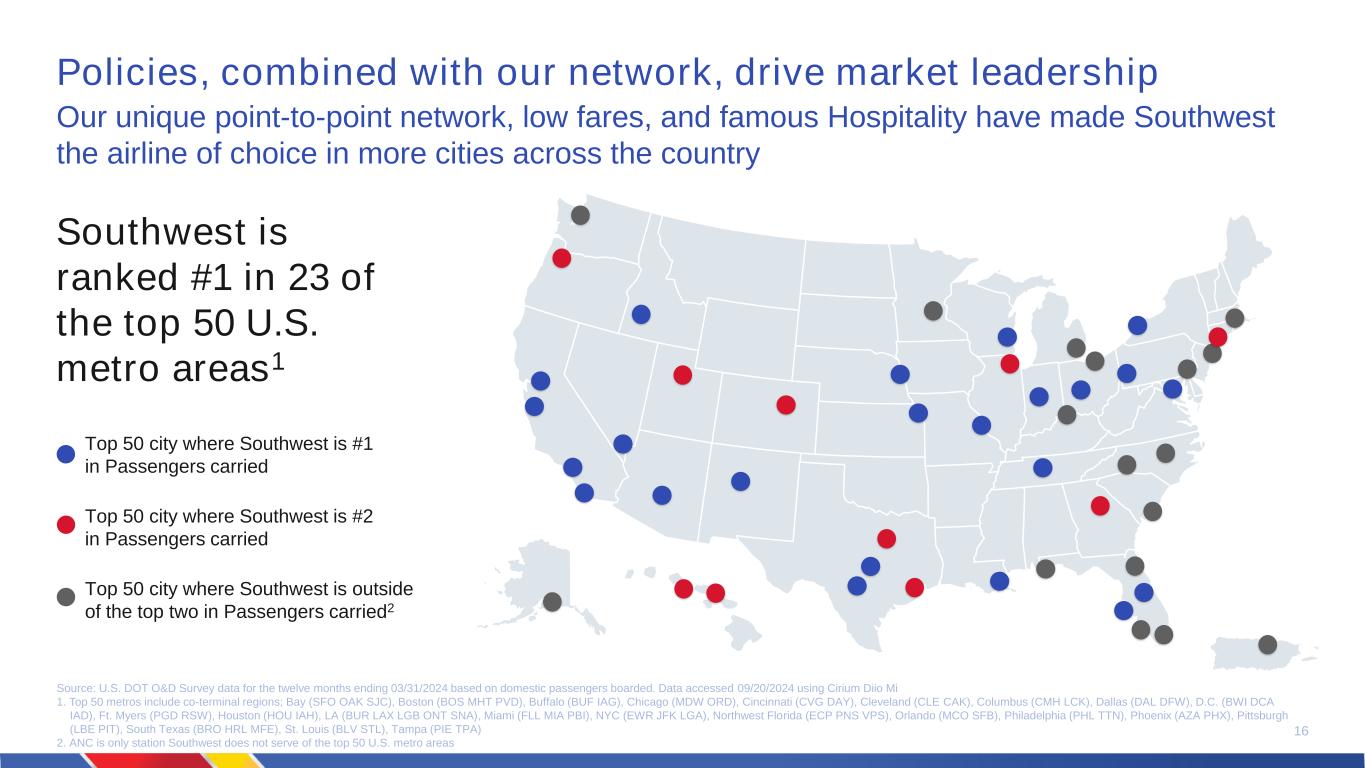
Southwest is ranked #1 in 23 of the top 50 U.S. metro areas1 Top 50 city where Southwest is #2 in Passengers carried Top 50 city where Southwest is outside of the top two in Passengers carried2 Top 50 city where Southwest is #1 in Passengers carried Policies, combined with our network, drive market leadership Our unique point-to-point network, low fares, and famous Hospitality have made Southwest the airline of choice in more cities across the country Source: U.S. DOT O&D Survey data for the twelve months ending 03/31/2024 based on domestic passengers boarded. Data accessed 09/20/2024 using Cirium Diio Mi 1. Top 50 metros include co-terminal regions; Bay (SFO OAK SJC), Boston (BOS MHT PVD), Buffalo (BUF IAG), Chicago (MDW ORD), Cincinnati (CVG DAY), Cleveland (CLE CAK), Columbus (CMH LCK), Dallas (DAL DFW), D.C. (BWI DCA IAD), Ft. Myers (PGD RSW), Houston (HOU IAH), LA (BUR LAX LGB ONT SNA), Miami (FLL MIA PBI), NYC (EWR JFK LGA), Northwest Florida (ECP PNS VPS), Orlando (MCO SFB), Philadelphia (PHL TTN), Phoenix (AZA PHX), Pittsburgh (LBE PIT), South Texas (BRO HRL MFE), St. Louis (BLV STL), Tampa (PIE TPA) 2. ANC is only station Southwest does not serve of the top 50 U.S. metro areas 16
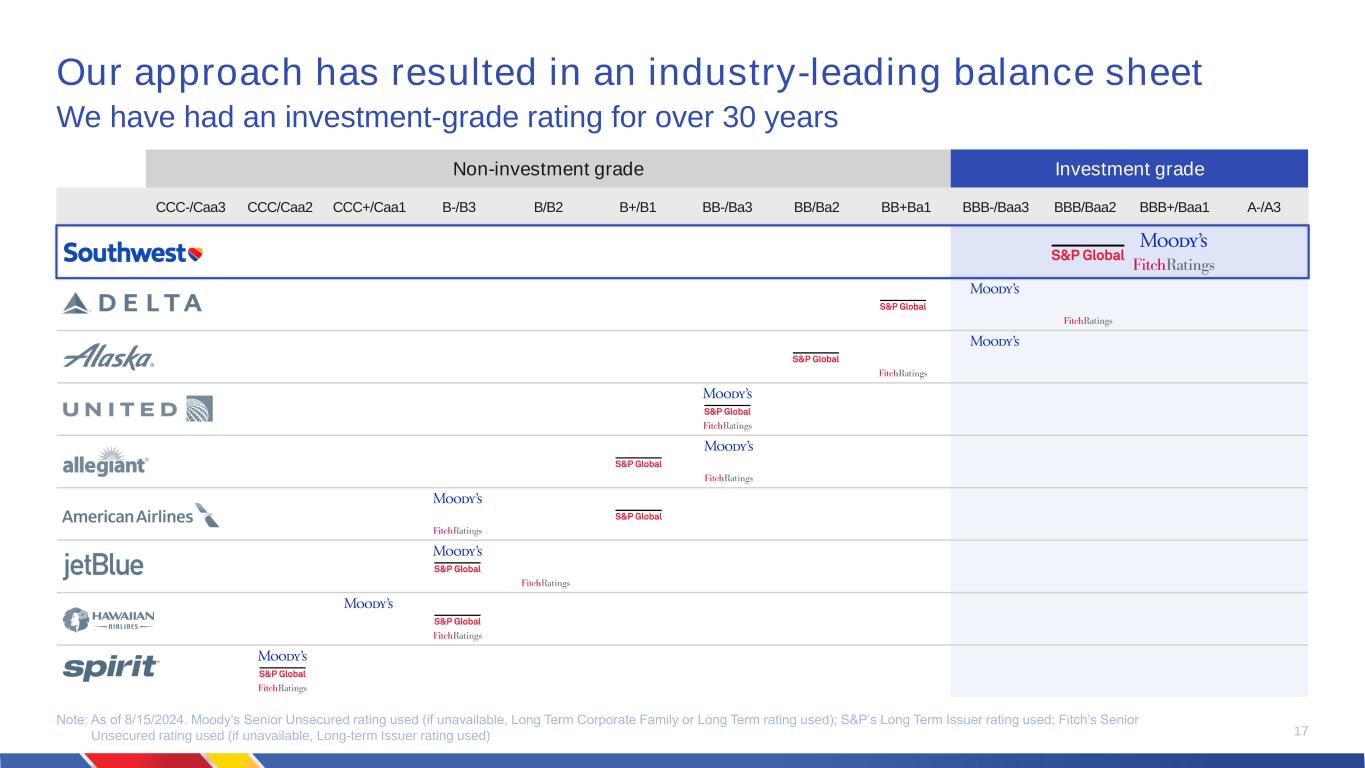
Note: As of 8/15/2024. Moody’s Senior Unsecured rating used (if unavailable, Long Term Corporate Family or Long Term rating used); S&P’s Long Term Issuer rating used; Fitch’s Senior Unsecured rating used (if unavailable, Long-term Issuer rating used) Our approach has resulted in an industry-leading balance sheet 17 We have had an investment-grade rating for over 30 years Non-investment grade Investment grade CCC-/Caa3 CCC/Caa2 CCC+/Caa1 B-/B3 B/B2 B+/B1 BB-/Ba3 BB/Ba2 BB+Ba1 BBB-/Baa3 BBB/Baa2 BBB+/Baa1 A-/A3
An improving industry backdrop
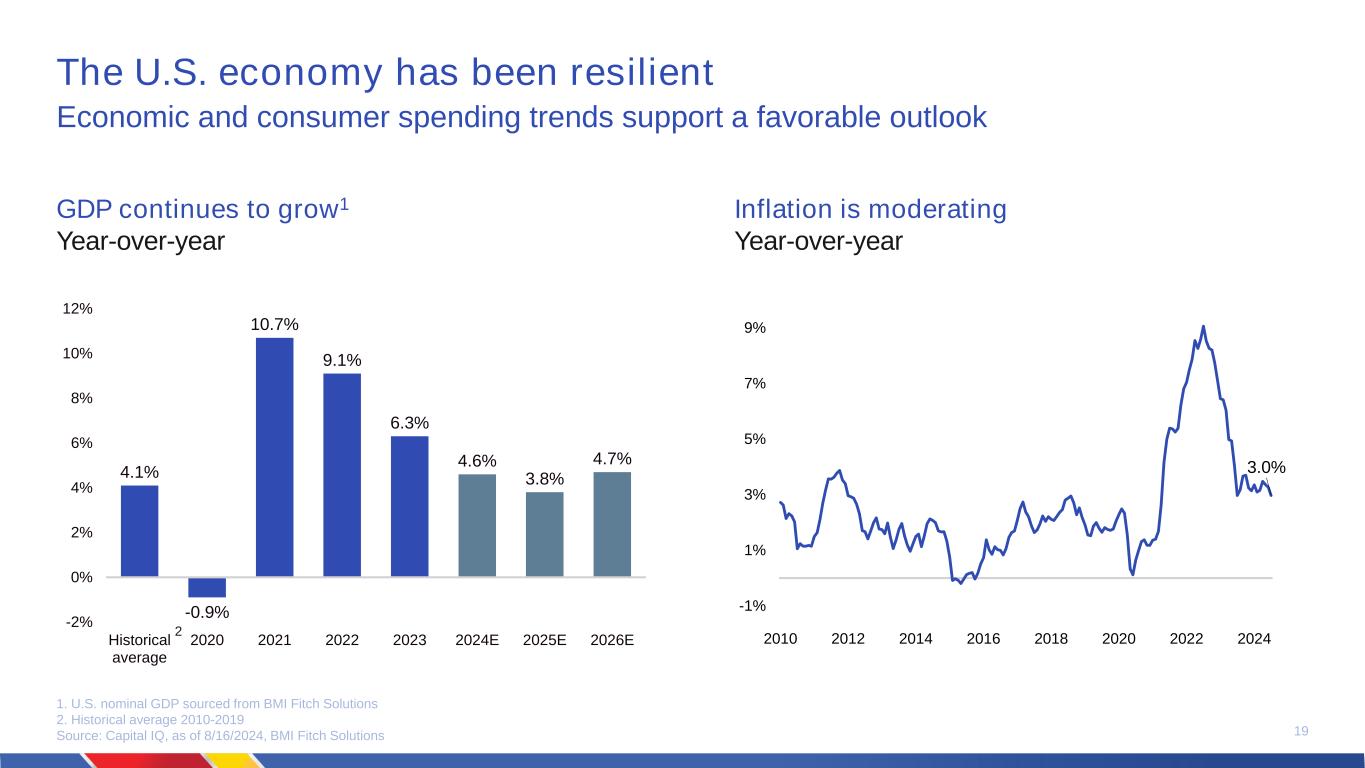
19 The U.S. economy has been resilient Economic and consumer spending trends support a favorable outlook 1. U.S. nominal GDP sourced from BMI Fitch Solutions 2. Historical average 2010-2019 Source: Capital IQ, as of 8/16/2024, BMI Fitch Solutions GDP continues to grow1 Year-over-year Inflation is moderating Year-over-year 3.0% -1% 1% 3% 5% 7% 9% 2010 2012 2014 2016 2018 2020 2022 2024 2 4.1% -0.9% 10.7% 9.1% 6.3% 4.6% 3.8% 4.7% -2% 0% 2% 4% 6% 8% 10% 12% Historical average 2020 2021 2022 2023 2024E 2025E 2026E
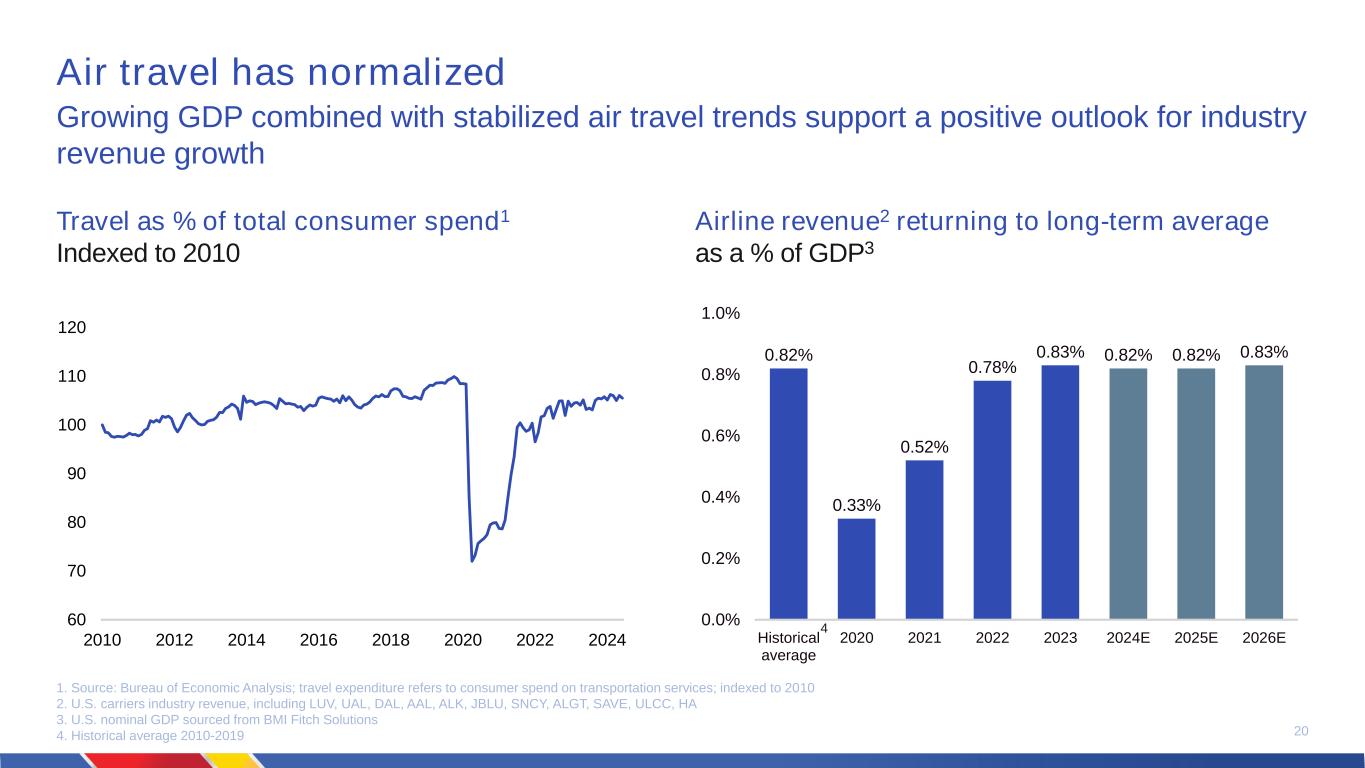
20 Air travel has normalized Growing GDP combined with stabilized air travel trends support a positive outlook for industry revenue growth 1. Source: Bureau of Economic Analysis; travel expenditure refers to consumer spend on transportation services; indexed to 2010 2. U.S. carriers industry revenue, including LUV, UAL, DAL, AAL, ALK, JBLU, SNCY, ALGT, SAVE, ULCC, HA 3. U.S. nominal GDP sourced from BMI Fitch Solutions 4. Historical average 2010-2019 Travel as % of total consumer spend1 Indexed to 2010 Airline revenue2 returning to long-term average as a % of GDP3 60 70 80 90 100 110 120 2010 2012 2014 2016 2018 2020 2022 2024 4 0.82% 0.33% 0.52% 0.78% 0.83% 0.82% 0.82% 0.83% 0.0% 0.2% 0.4% 0.6% 0.8% 1.0% Historical average 2020 2021 2022 2023 2024E 2025E 2026E
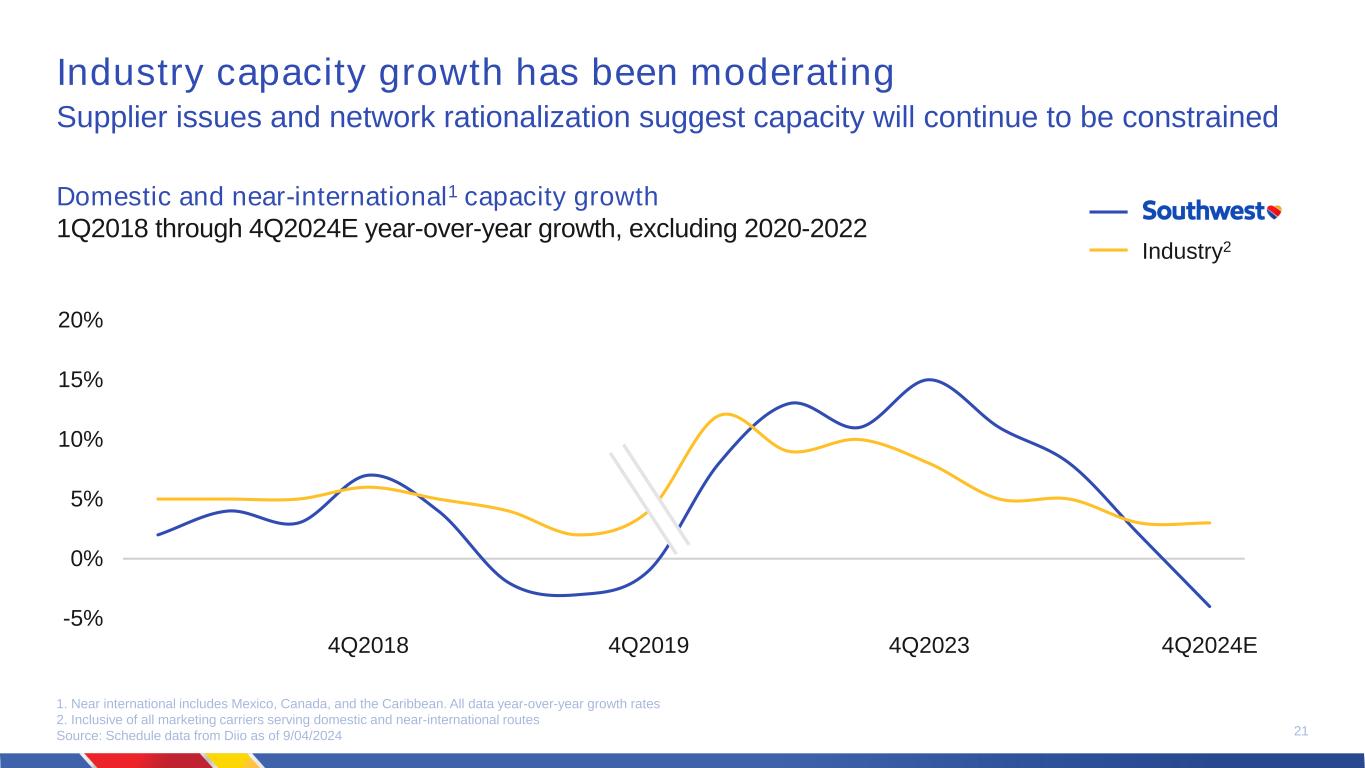
1. Near international includes Mexico, Canada, and the Caribbean. All data year-over-year growth rates 2. Inclusive of all marketing carriers serving domestic and near-international routes Source: Schedule data from Diio as of 9/04/2024 Industry capacity growth has been moderating Supplier issues and network rationalization suggest capacity will continue to be constrained -5% 0% 5% 10% 15% 20% 4Q2018 4Q2019 4Q2023 4Q2024E Domestic and near-international1 capacity growth 1Q2018 through 4Q2024E year-over-year growth, excluding 2020-2022 21 Industry2
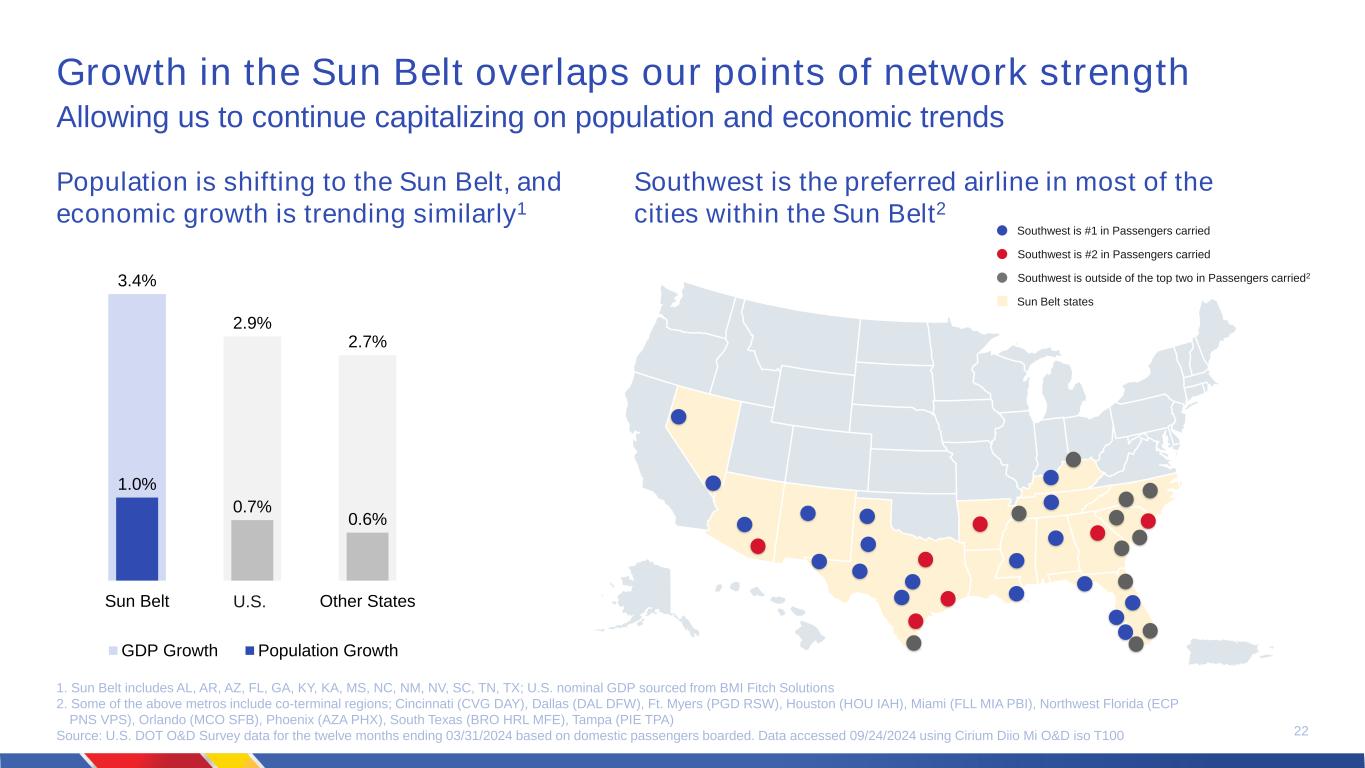
1. Sun Belt includes AL, AR, AZ, FL, GA, KY, KA, MS, NC, NM, NV, SC, TN, TX; U.S. nominal GDP sourced from BMI Fitch Solutions 2. Some of the above metros include co-terminal regions; Cincinnati (CVG DAY), Dallas (DAL DFW), Ft. Myers (PGD RSW), Houston (HOU IAH), Miami (FLL MIA PBI), Northwest Florida (ECP PNS VPS), Orlando (MCO SFB), Phoenix (AZA PHX), South Texas (BRO HRL MFE), Tampa (PIE TPA) Source: U.S. DOT O&D Survey data for the twelve months ending 03/31/2024 based on domestic passengers boarded. Data accessed 09/24/2024 using Cirium Diio Mi O&D iso T100 3.4% 2.9% 2.7% 1.0% 0.7% 0.6% Sun Belt US Other States GDP Growth Population Growth Population is shifting to the Sun Belt, and economic growth is trending similarly1 Southwest is the preferred airline in most of the cities within the Sun Belt2 Growth in the Sun Belt overlaps our points of network strength Allowing us to continue capitalizing on population and economic trends 22 U. . Sun Belt states Southwest is #1 in Passengers carried Southwest is #2 in Passengers carried Southwest is outside of the top two in Passengers carried2
Transforming for sustainable performance and Shareholder returns
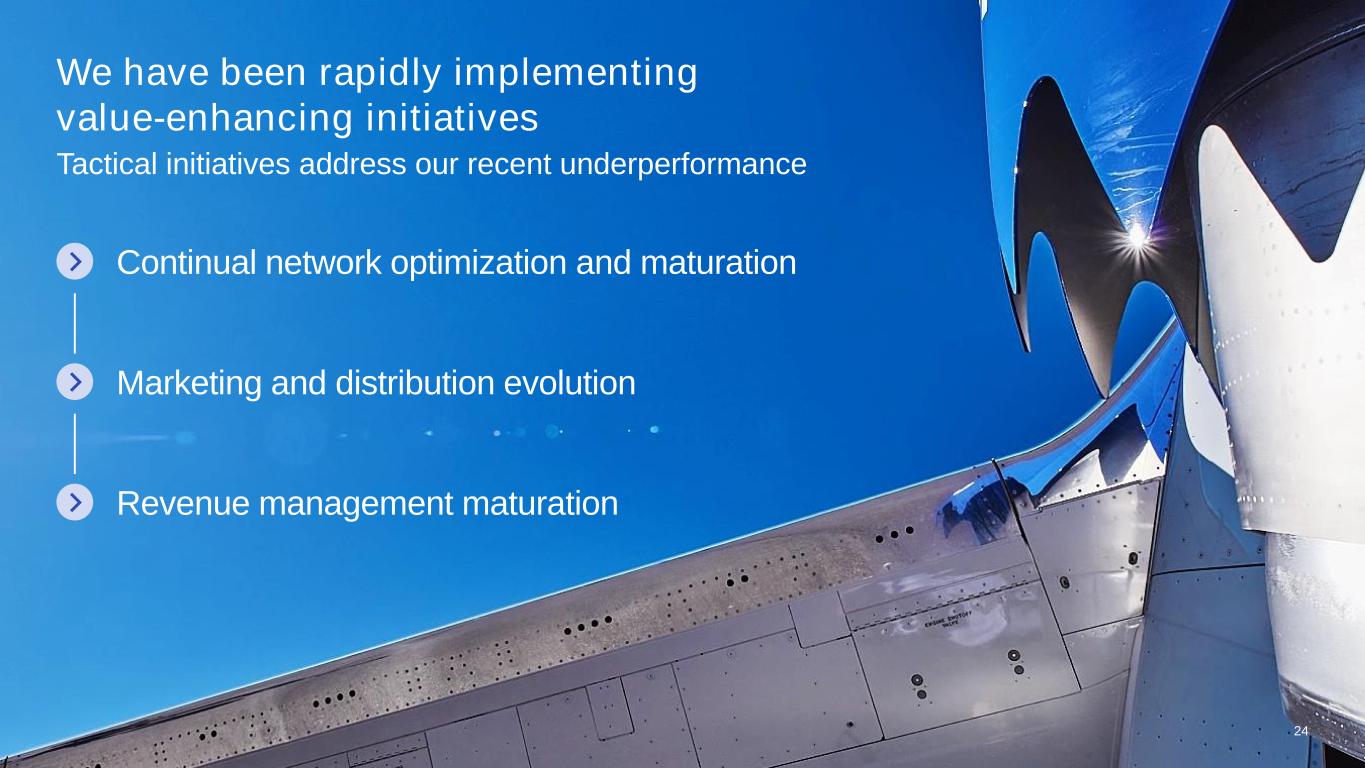
We have been rapidly implementing value-enhancing initiatives 24 Tactical initiatives address our recent underperformance Continual network optimization and maturation Marketing and distribution evolution Revenue management maturation
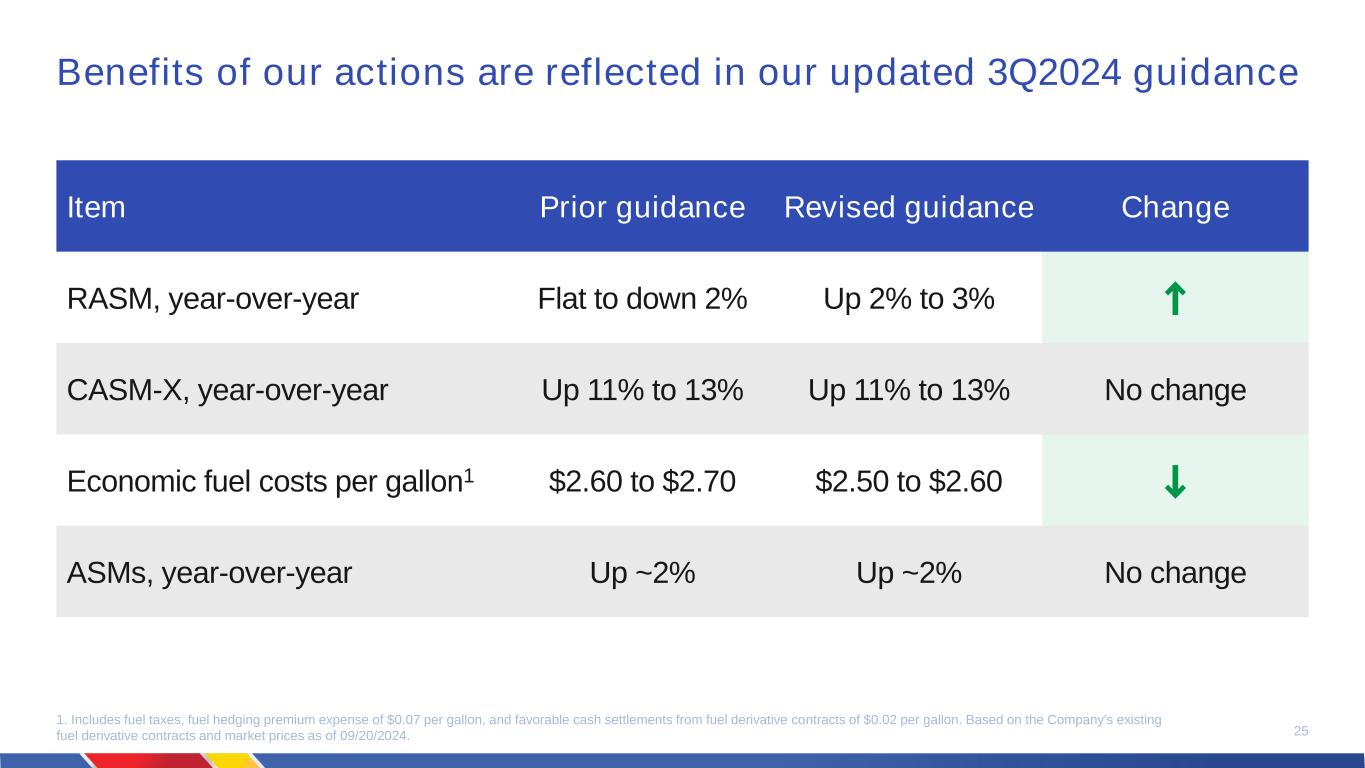
25 Benefits of our actions are reflected in our updated 3Q2024 guidance 1. Includes fuel taxes, fuel hedging premium expense of $0.07 per gallon, and favorable cash settlements from fuel derivative contracts of $0.02 per gallon. Based on the Company's existing fuel derivative contracts and market prices as of 09/20/2024. Item Prior guidance Revised guidance Change RASM, year-over-year Flat to down 2% Up 2% to 3% CASM-X, year-over-year Up 11% to 13% Up 11% to 13% No change Economic fuel costs per gallon1 $2.60 to $2.70 $2.50 to $2.60 ASMs, year-over-year Up ~2% Up ~2% No change
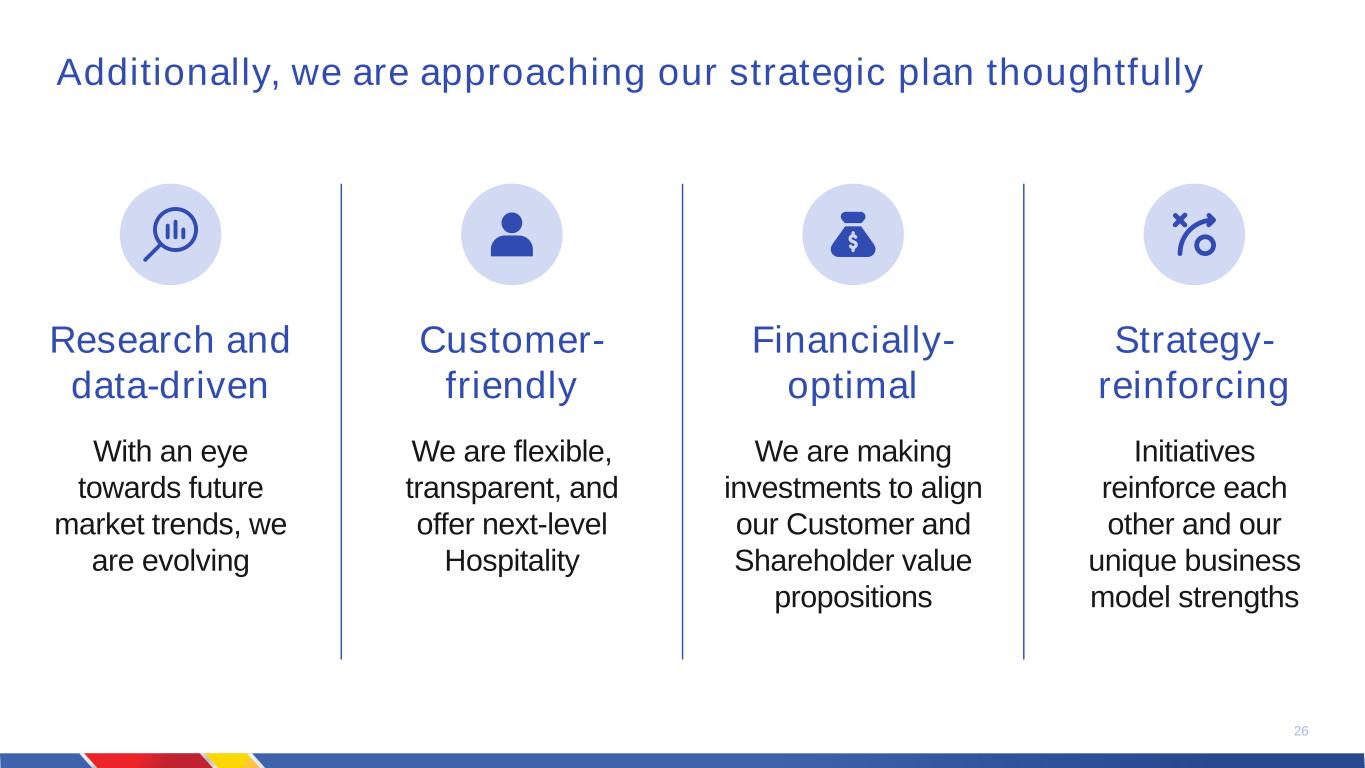
26 Additionally, we are approaching our strategic plan thoughtfully With an eye towards future market trends, we are evolving We are flexible, transparent, and offer next-level Hospitality We are making investments to align our Customer and Shareholder value propositions Research and data-driven Customer- friendly Financially- optimal Strategy- reinforcing Initiatives reinforce each other and our unique business model strengths
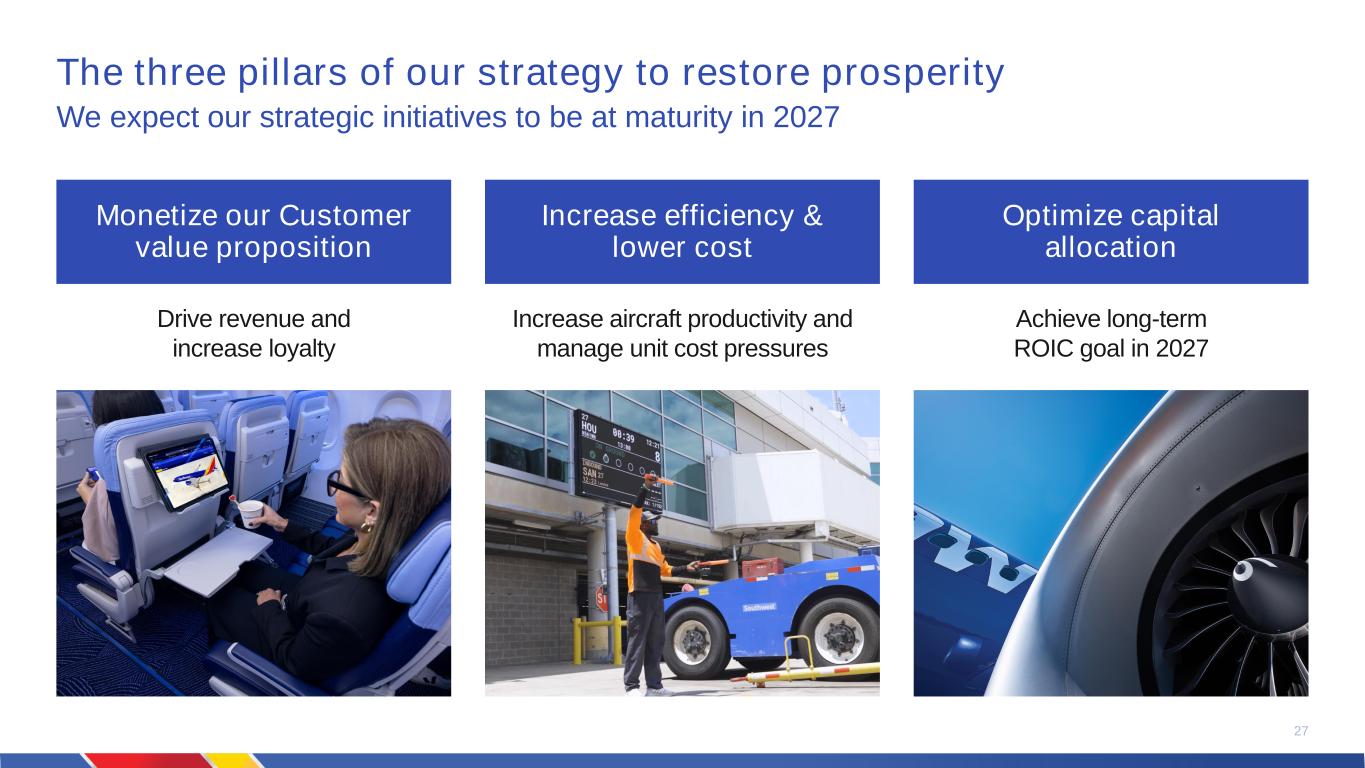
27 The three pillars of our strategy to restore prosperity We expect our strategic initiatives to be at maturity in 2027 Monetize our Customer value proposition Increase efficiency & lower cost Optimize capital allocation Drive revenue and increase loyalty Increase aircraft productivity and manage unit cost pressures Achieve long-term ROIC goal in 2027
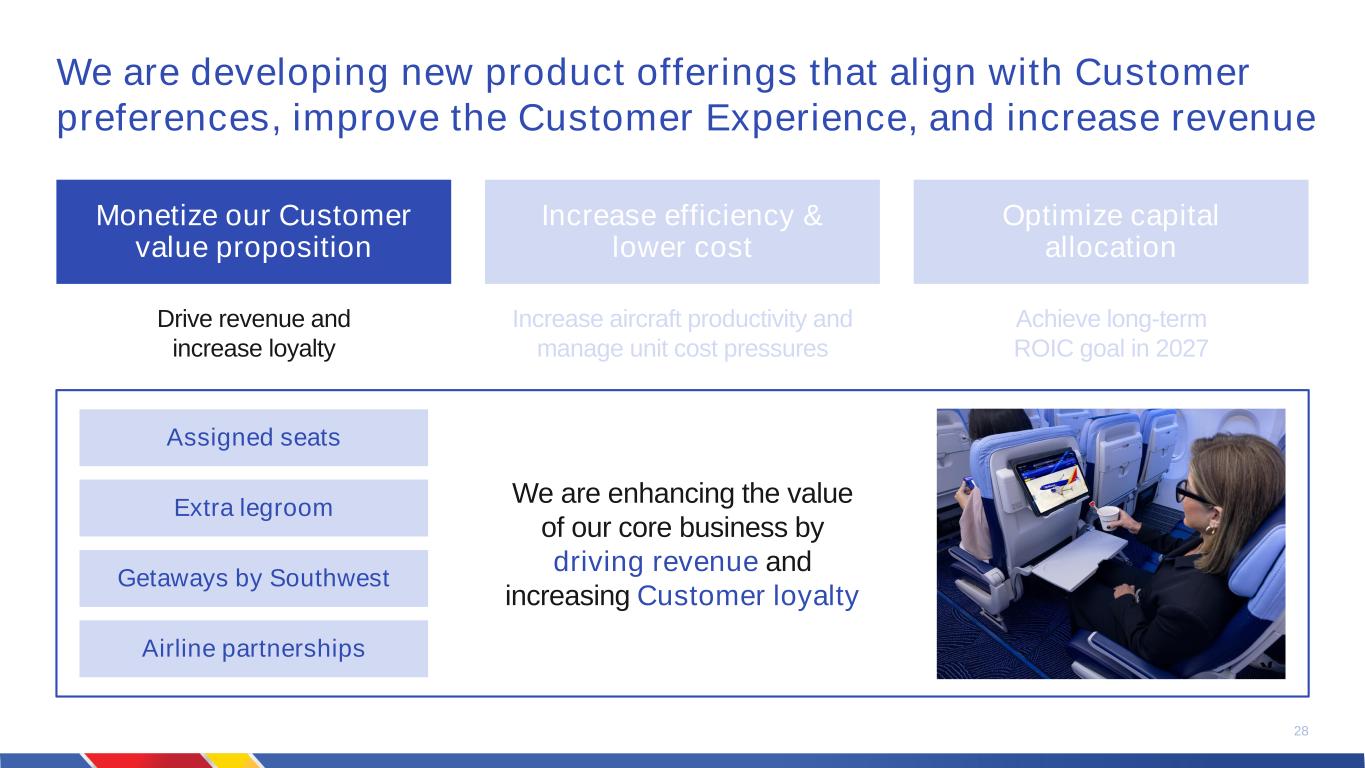
28 We are developing new product offerings that align with Customer preferences, improve the Customer Experience, and increase revenue Monetize our Customer value proposition Increase efficiency & lower cost Optimize capital allocation Drive revenue and increase loyalty Increase aircraft productivity and manage unit cost pressures Achieve long-term ROIC goal in 2027 We are enhancing the value of our core business by driving revenue and increasing Customer loyalty Assigned seats Extra legroom Getaways by Southwest Airline partnerships
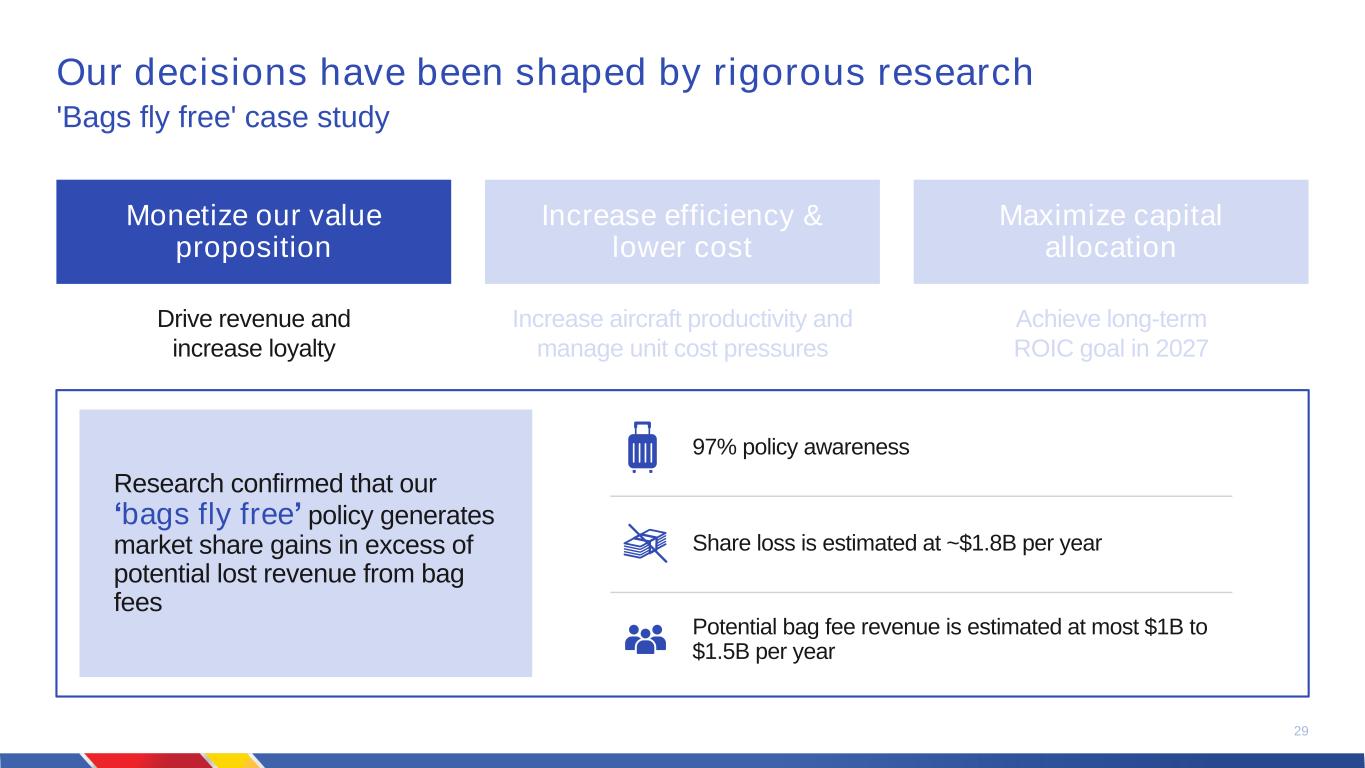
29 Our decisions have been shaped by rigorous research 'Bags fly free' case study Monetize our value proposition Increase efficiency & lower cost Maximize capital allocation Drive revenue and increase loyalty Increase aircraft productivity and manage unit cost pressures Achieve long-term ROIC goal in 2027 Research confirmed that our ‘bags fly free’ policy generates market share gains in excess of potential lost revenue from bag fees 97% policy awareness Share loss is estimated at ~$1.8B per year Potential bag fee revenue is estimated at most $1B to $1.5B per year
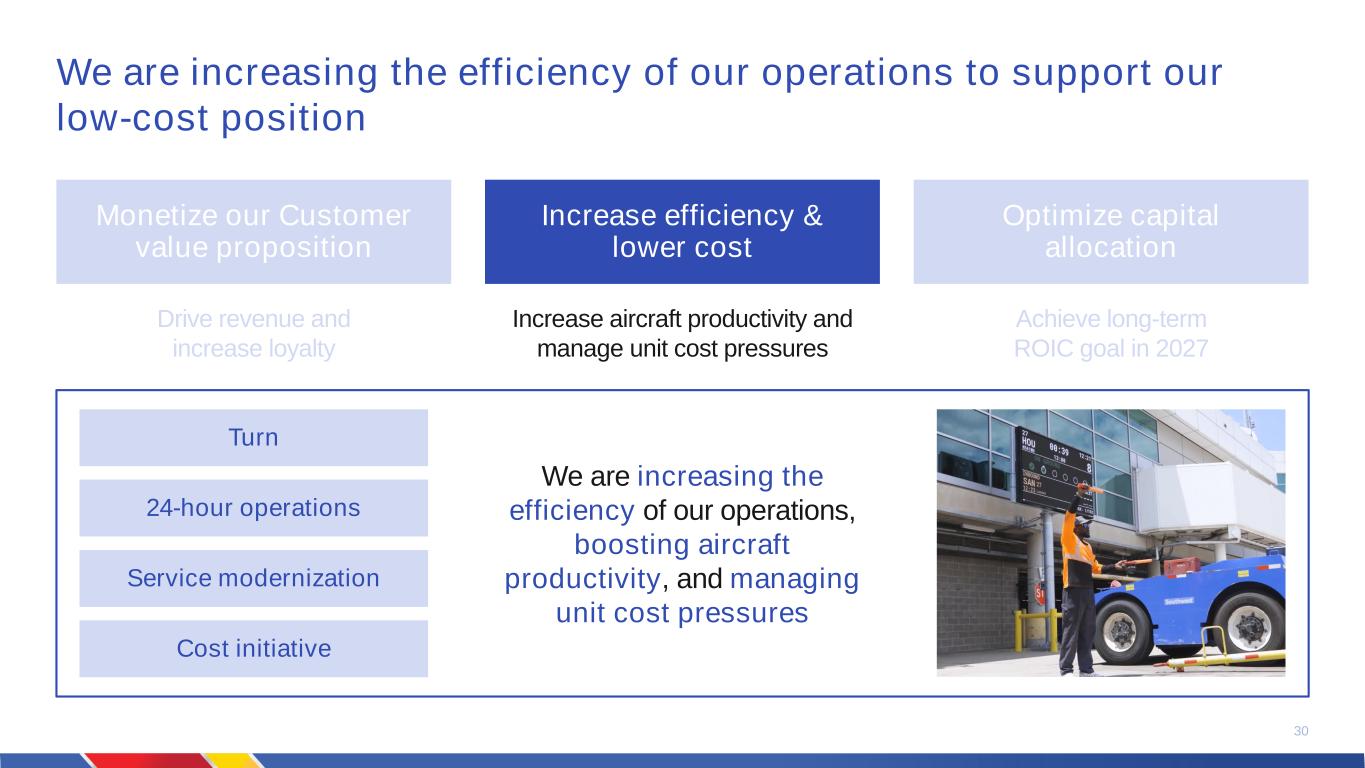
30 We are increasing the efficiency of our operations to support our low-cost position Monetize our Customer value proposition Increase efficiency & lower cost Optimize capital allocation Drive revenue and increase loyalty Increase aircraft productivity and manage unit cost pressures Achieve long-term ROIC goal in 2027 We are increasing the efficiency of our operations, boosting aircraft productivity, and managing unit cost pressures Turn 24-hour operations Service modernization Cost initiative
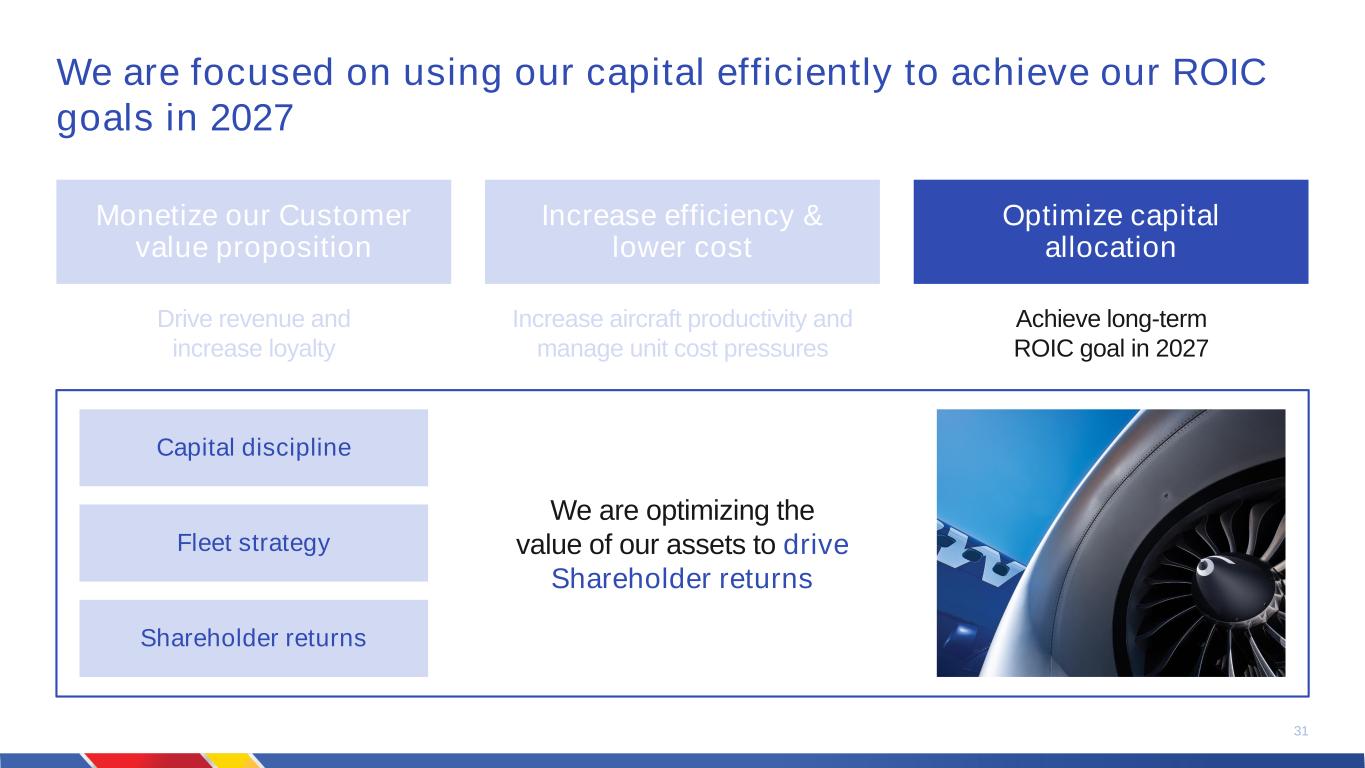
31 We are focused on using our capital efficiently to achieve our ROIC goals in 2027 Monetize our Customer value proposition Increase efficiency & lower cost Optimize capital allocation Drive revenue and increase loyalty Increase aircraft productivity and manage unit cost pressures Achieve long-term ROIC goal in 2027 Capital discipline Fleet strategy Shareholder returns We are optimizing the value of our assets to drive Shareholder returns
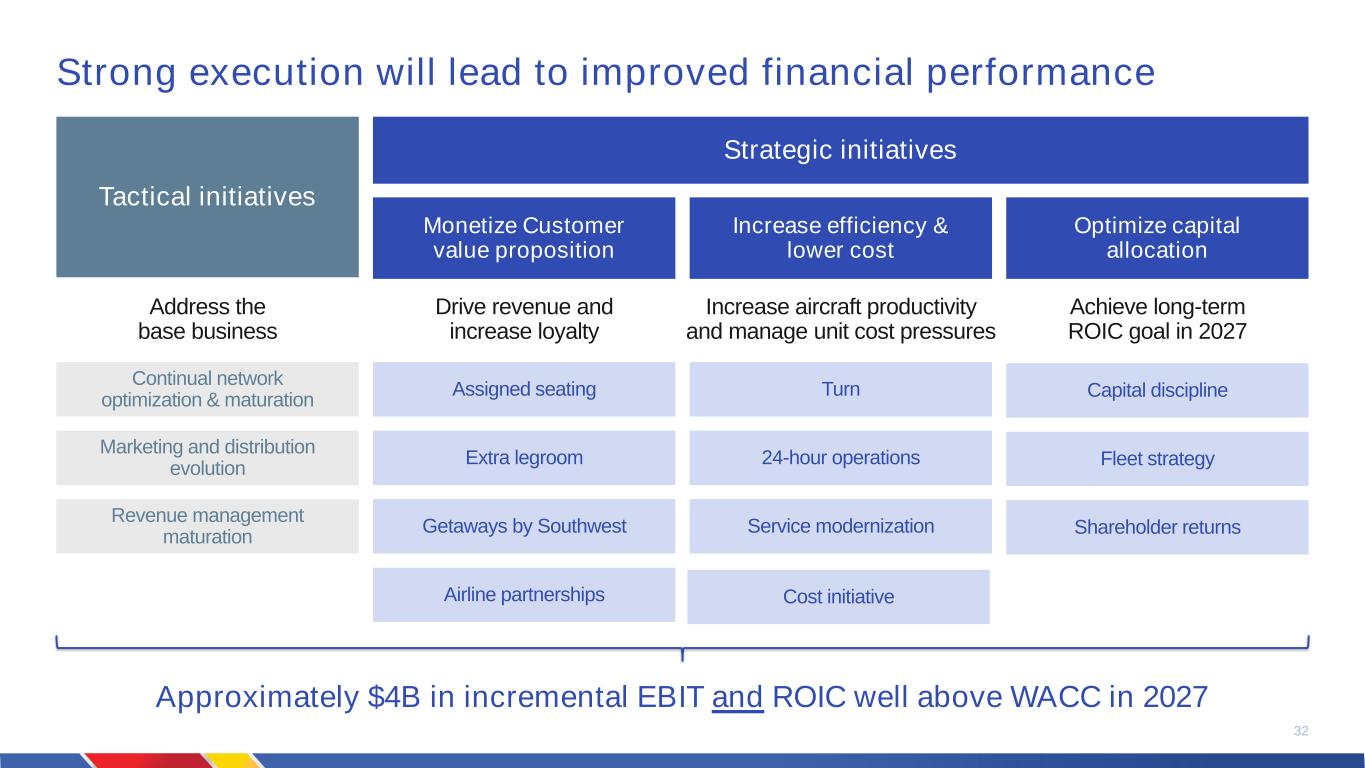
32 Strong execution will lead to improved financial performance Tactical initiatives Address the base business Strategic initiatives Monetize Customer value proposition Drive revenue and increase loyalty Continual network optimization & maturation Marketing and distribution evolution Revenue management maturation Increase efficiency & lower cost Increase aircraft productivity and manage unit cost pressures Optimize capital allocation Achieve long-term ROIC goal in 2027 Approximately $4B in incremental EBIT and ROIC well above WACC in 2027 Assigned seating Extra legroom Getaways by Southwest Airline partnerships Turn 24-hour operations Service modernization Capital discipline Fleet strategy Shareholder returns Cost initiative
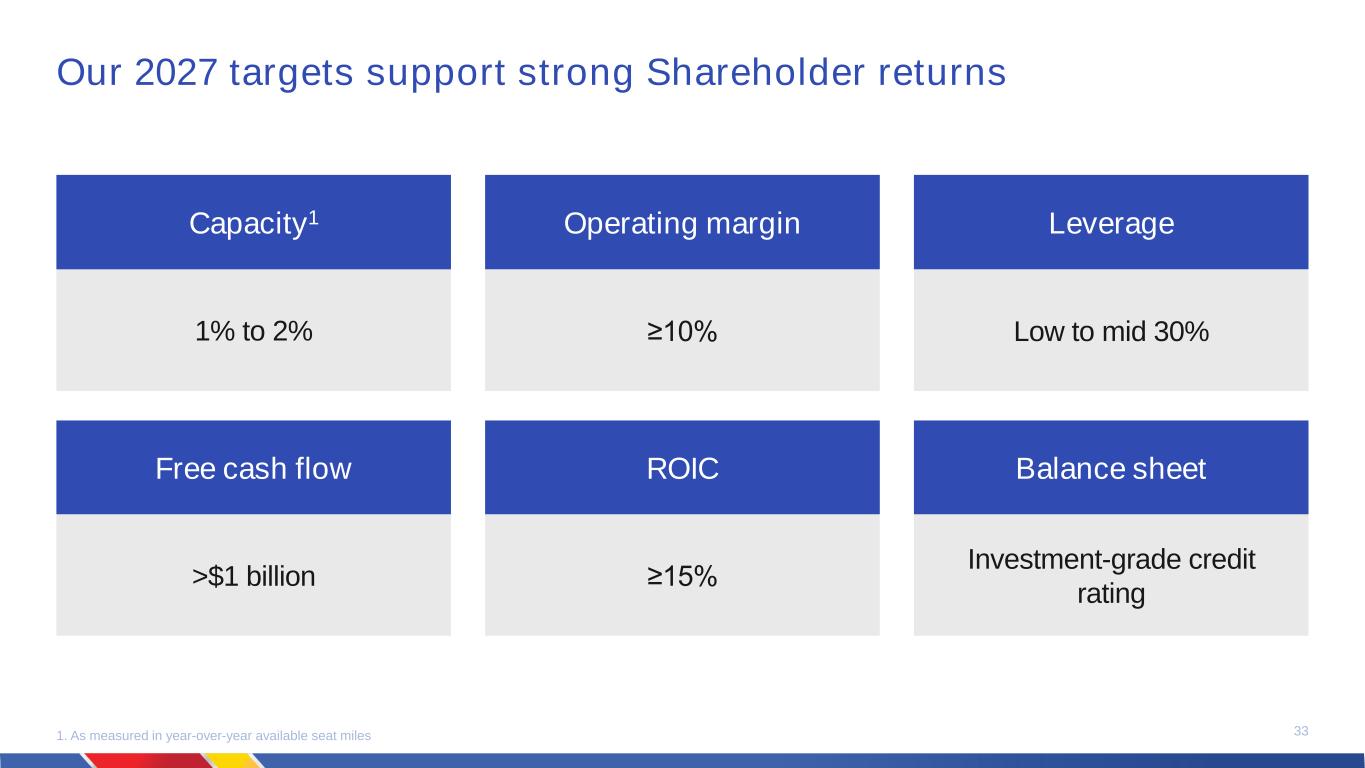
33 Our 2027 targets support strong Shareholder returns 1. As measured in year-over-year available seat miles 1% to 2% Capacity1 >$1 billion Free cash flow Low to mid 30% Leverage Investment-grade credit rating Balance sheet ≥15% ROIC ~10% Operating margin ≥
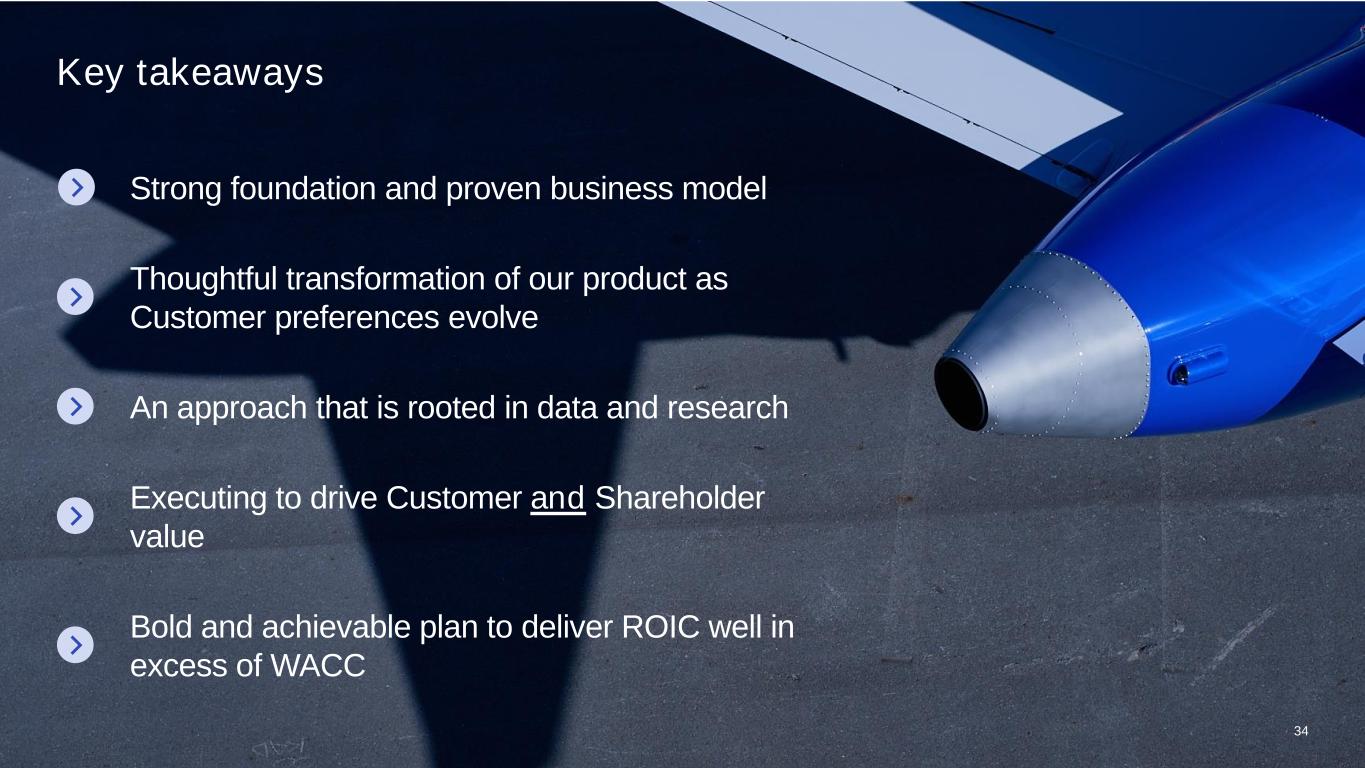
34 Key takeaways Strong foundation and proven business model Thoughtful transformation of our product as Customer preferences evolve An approach that is rooted in data and research Executing to drive Customer and Shareholder value Bold and achievable plan to deliver ROIC well in excess of WACC
Andrew Watterson Driving revenue and profitability by optimizing operations
Changing Customer behaviors
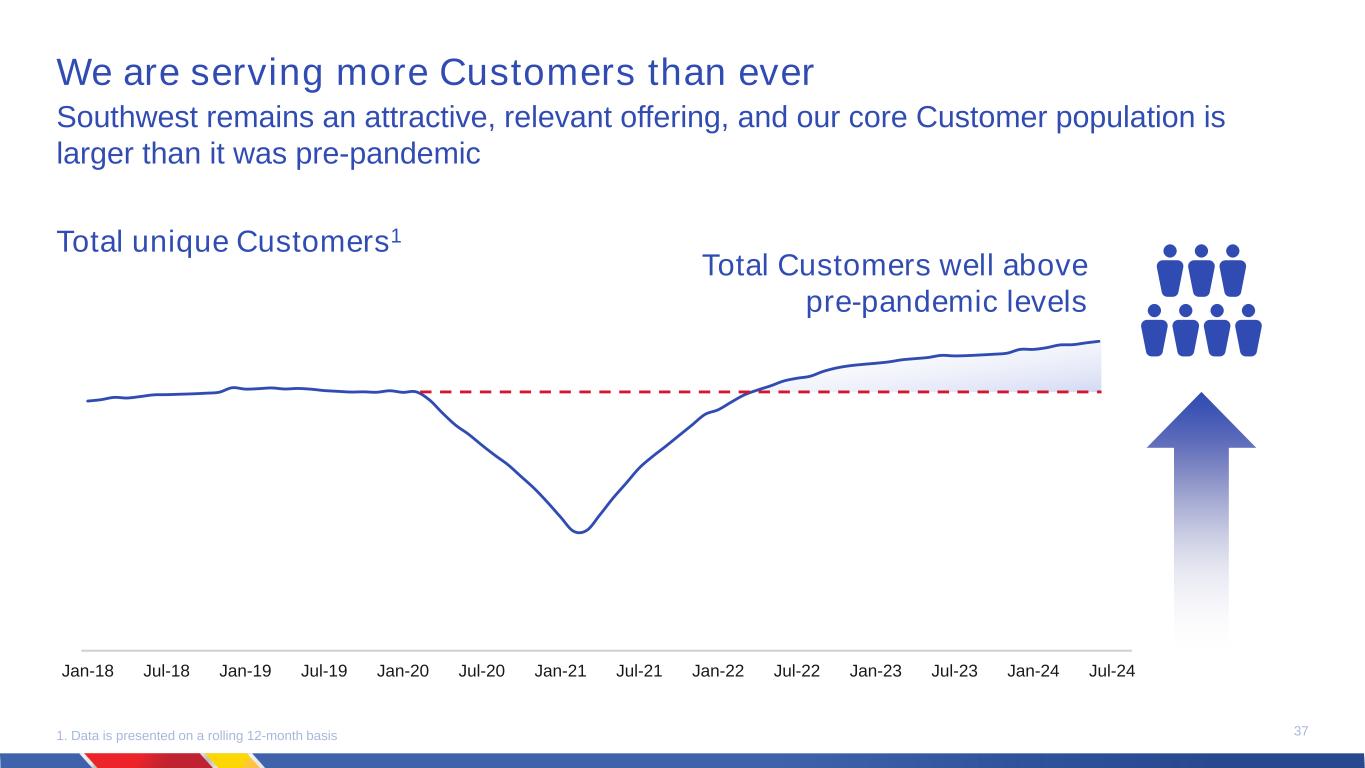
0.0 M 5.0 M 10.0 M 15.0 M 20.0 M 25.0 M 30.0 M 35.0 M 40.0 M Jan-18 Jul-18 Jan-19 Jul-19 Jan-20 Jul-20 Jan-21 Jul-21 Jan-22 Jul-22 Jan-23 Jul-23 Jan-24 Jul-24 37 We are serving more Customers than ever Southwest remains an attractive, relevant offering, and our core Customer population is larger than it was pre-pandemic 1. Data is presented on a rolling 12-month basis Total unique Customers1 Total Customers well above pre-pandemic levels
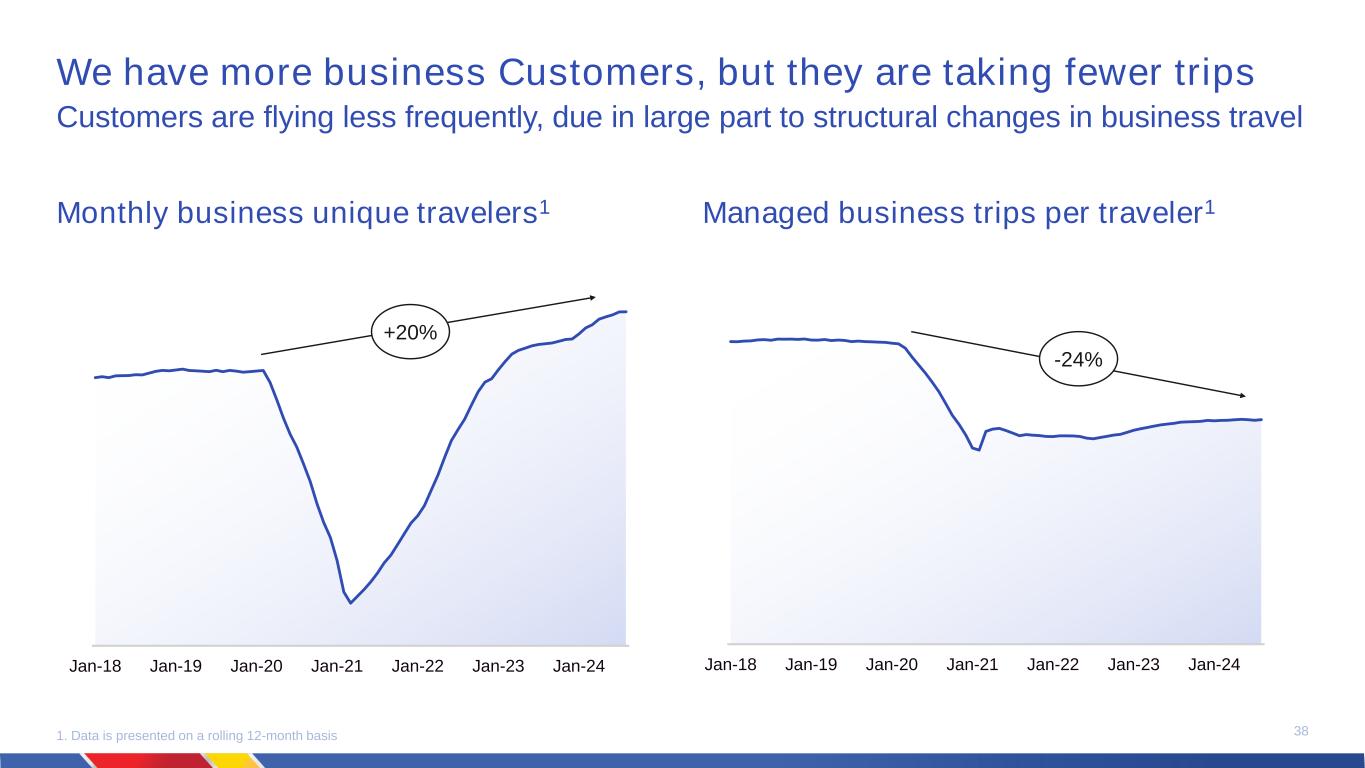
0.0 0.5 1.0 1.5 2.0 2.5 3.0 3.5 4.0 4.5 5.0 Jan-18 Jan-19 Jan-20 Jan-21 Jan-22 Jan-23 Jan-24 38 We have more business Customers, but they are taking fewer trips Customers are flying less frequently, due in large part to structural changes in business travel Monthly business unique travelers1 Managed business trips per traveler1 -24% +20% 1. Data is presented on a rolling 12-month basis 0.0 0.5 1.0 1.5 2.0 2.5 3.0 3.5 4.0 4.5 Jan-18 Jan-19 Jan-20 Jan-21 Jan-22 Jan-23 Jan-24
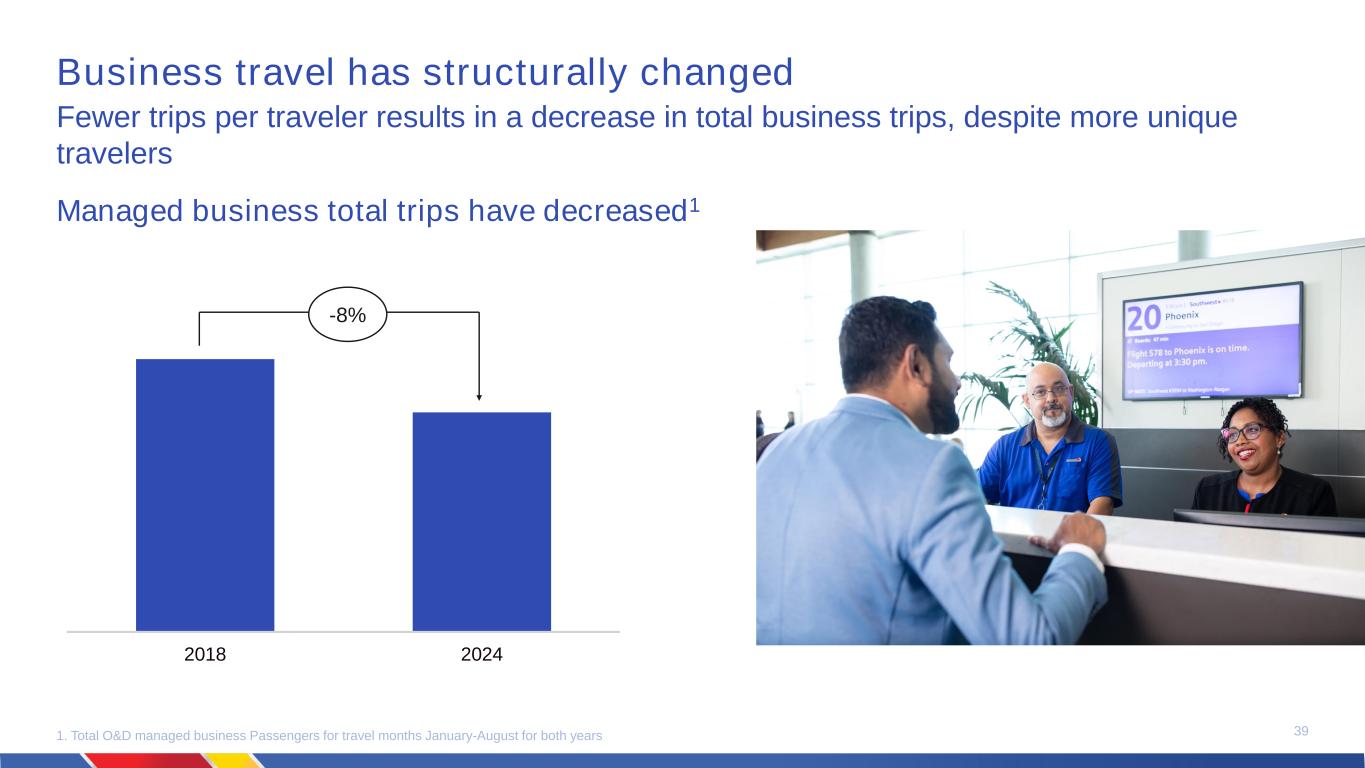
39 Business travel has structurally changed Fewer trips per traveler results in a decrease in total business trips, despite more unique travelers 1. Total O&D managed business Passengers for travel months January-August for both years 2018 2024 Managed business total trips have decreased1 -8%
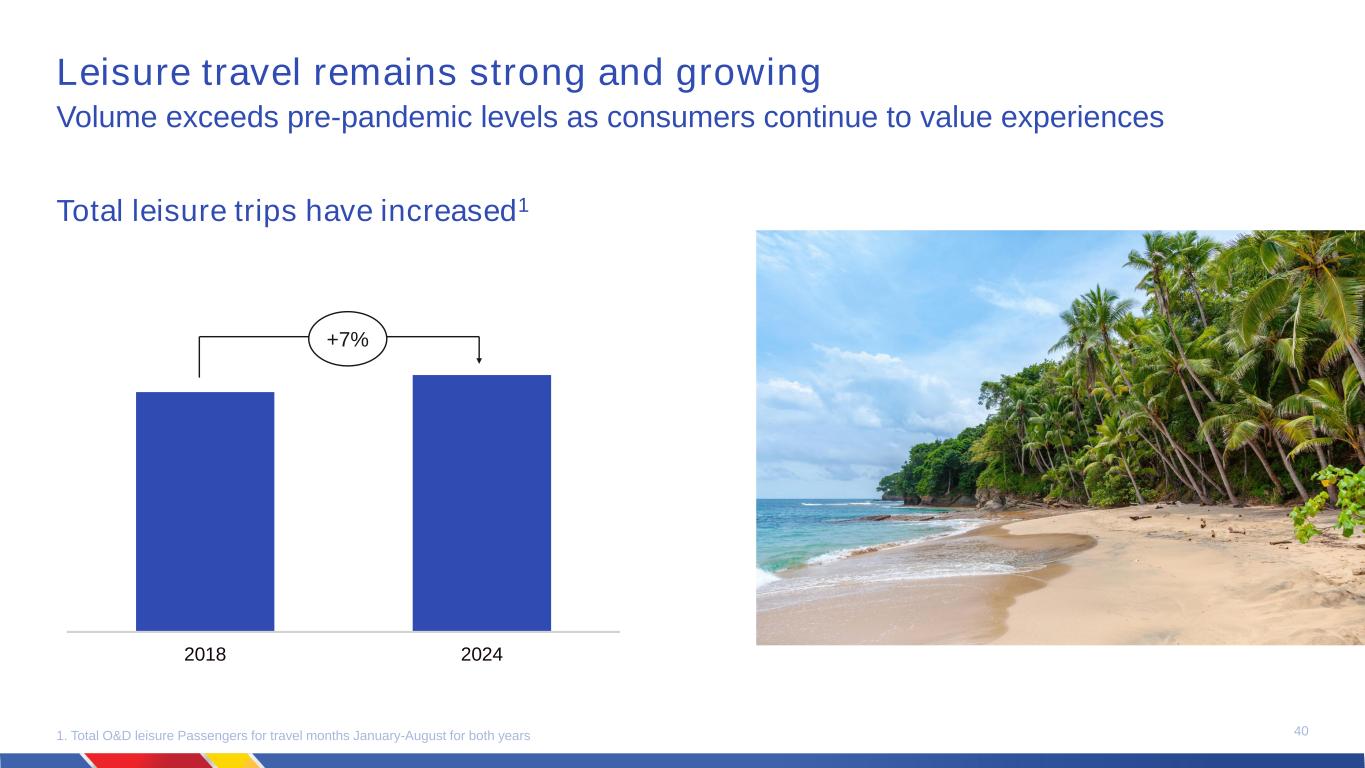
2018 2024 40 Leisure travel remains strong and growing Volume exceeds pre-pandemic levels as consumers continue to value experiences 1. Total O&D leisure Passengers for travel months January-August for both years +7% Total leisure trips have increased1
41 As a result of the structural change in business travel, we must make changes Continue to grow managed business towards “natural share” Attract new Customers to backfill reduced business travel composition Grow share of wallet from current Customers
Tactical initiatives to drive yield and load factor
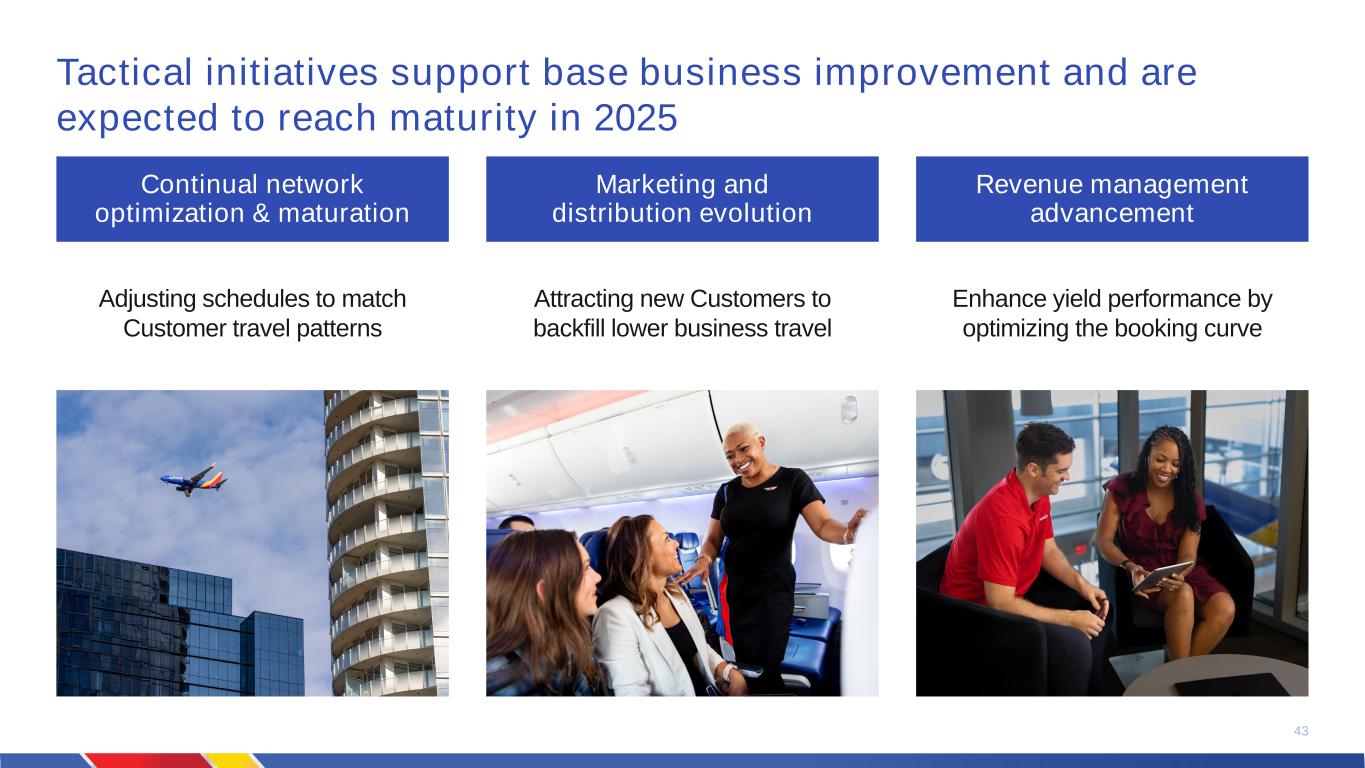
43 Tactical initiatives support base business improvement and are expected to reach maturity in 2025 Adjusting schedules to match Customer travel patterns Attracting new Customers to backfill lower business travel Enhance yield performance by optimizing the booking curve Continual network optimization & maturation Marketing and distribution evolution Revenue management advancement
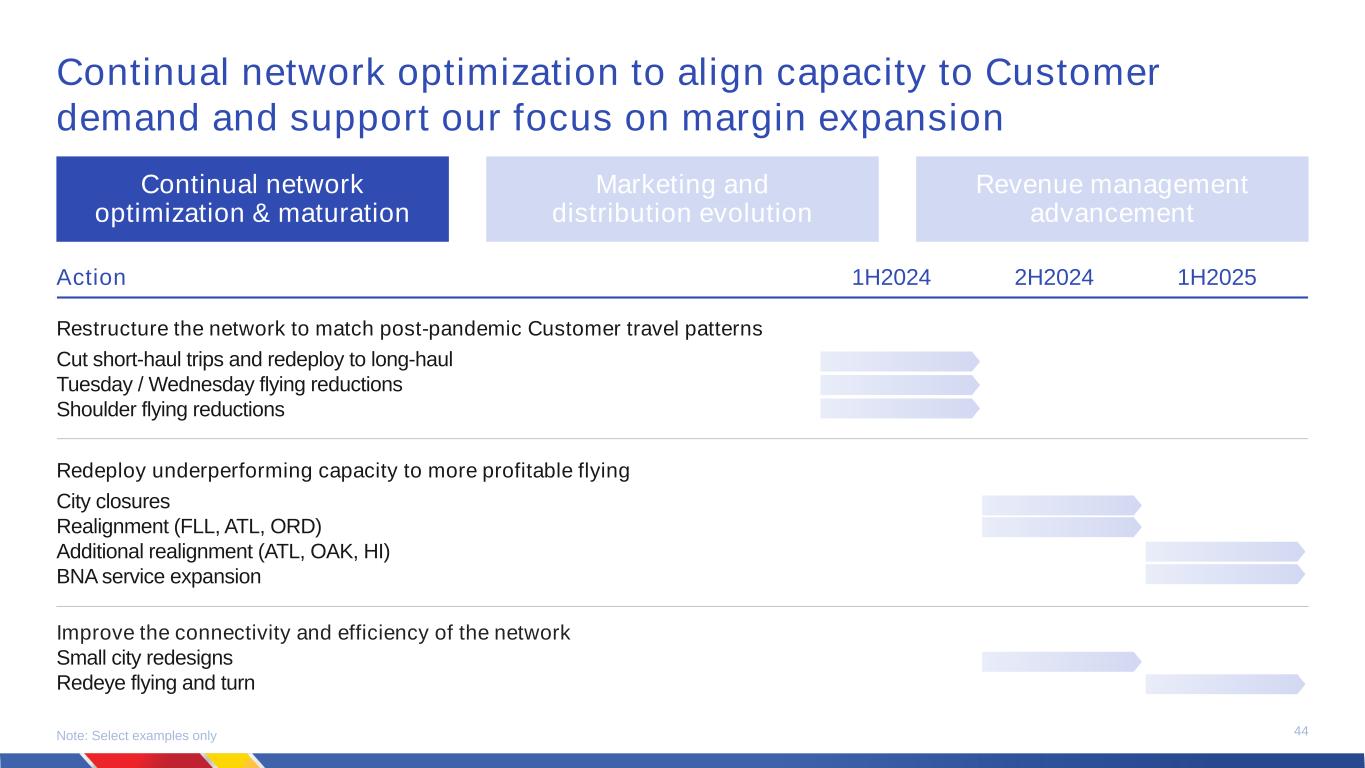
Action 1H2024 2H2024 1H2025 Restructure the network to match post-pandemic Customer travel patterns Cut short-haul trips and redeploy to long-haul Tuesday / Wednesday flying reductions Shoulder flying reductions Redeploy underperforming capacity to more profitable flying City closures Realignment (FLL, ATL, ORD) Additional realignment (ATL, OAK, HI) BNA service expansion Improve the connectivity and efficiency of the network Small city redesigns Redeye flying and turn 44 Continual network optimization to align capacity to Customer demand and support our focus on margin expansion Note: Select examples only Continual network optimization & maturation Marketing and distribution evolution Revenue management advancement
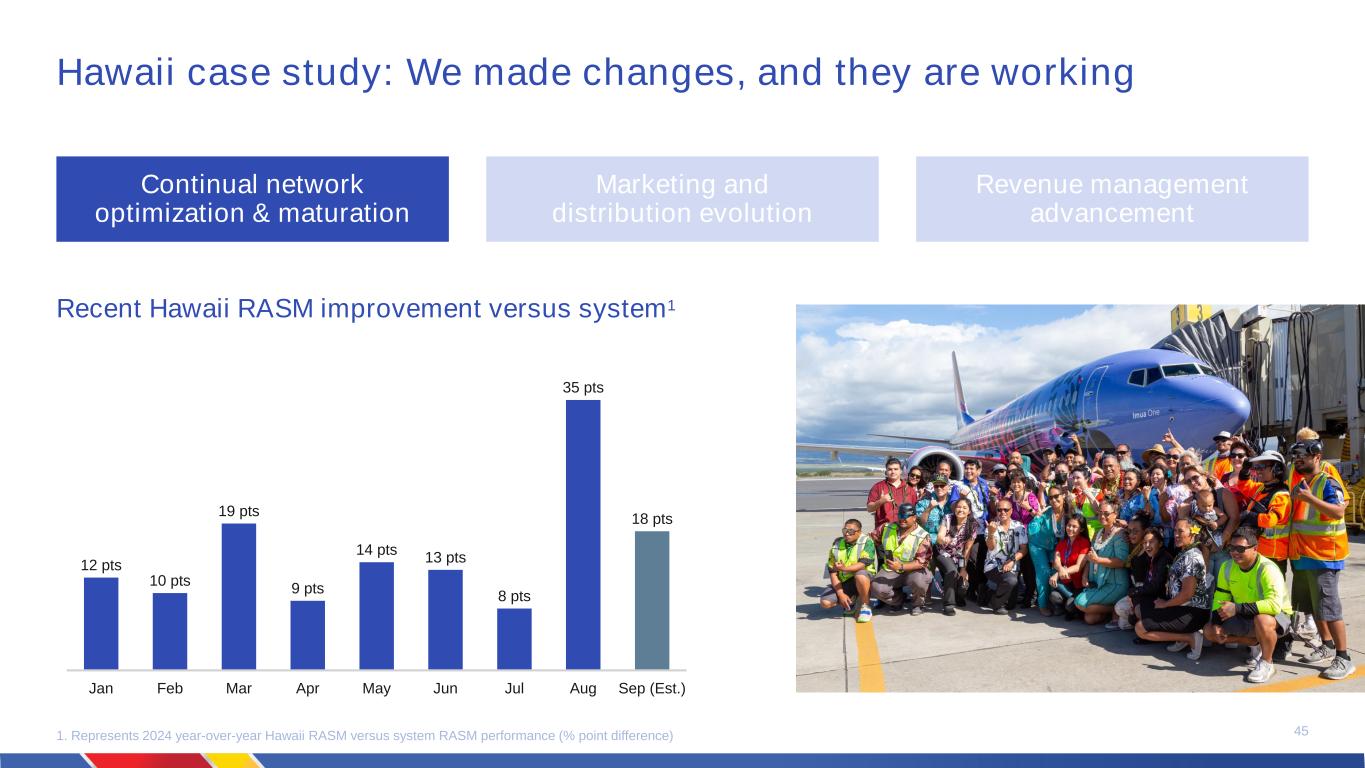
45 Hawaii case study: We made changes, and they are working 1. Represents 2024 year-over-year Hawaii RASM versus system RASM performance (% point difference) Recent Hawaii RASM improvement versus system1 12 pts 10 pts 19 pts 9 pts 14 pts 13 pts 8 pts 35 pts 18 pts Jan Feb Mar Apr May Jun Jul Aug Sep (Est.) Continual network optimization & maturation Marketing and distribution evolution Revenue management advancement
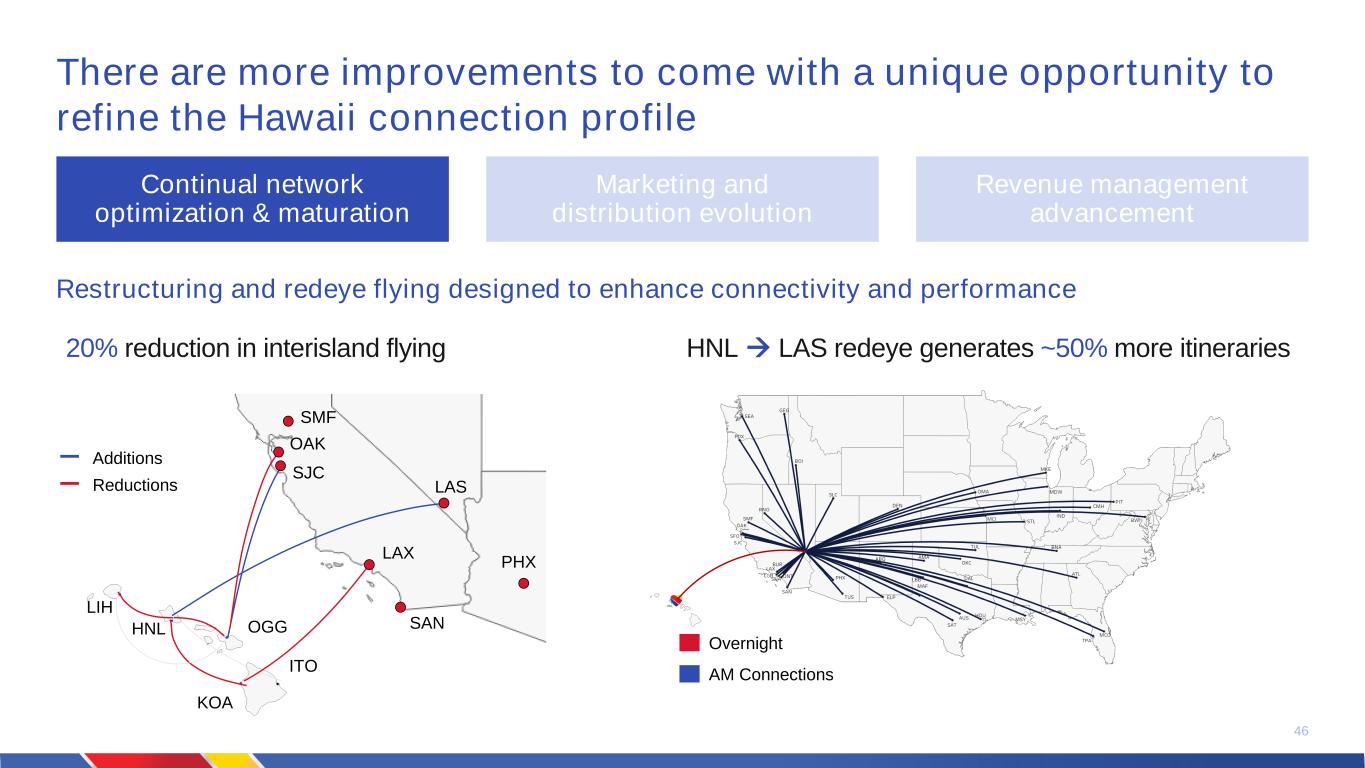
46 There are more improvements to come with a unique opportunity to refine the Hawaii connection profile Restructuring and redeye flying designed to enhance connectivity and performance Overnight AM Connections LIH HNL KOA ITO OGG SMF SJC SAN LAS LAX PHX OAK Reductions Additions 20% reduction in interisland flying HNL → LAS redeye generates ~50% more itineraries Continual network optimization & maturation Marketing and distribution evolution Revenue management advancement
47 We have deployed various marketing and distribution tactics Attracting new Customers and engaging them in our loyalty program to drive revenue Continual network optimization & maturation Marketing and distribution evolution Revenue management advancement Highlighting our unique value proposition Reaching new Customers through channel expansion Converting new Customers to loyal flyers
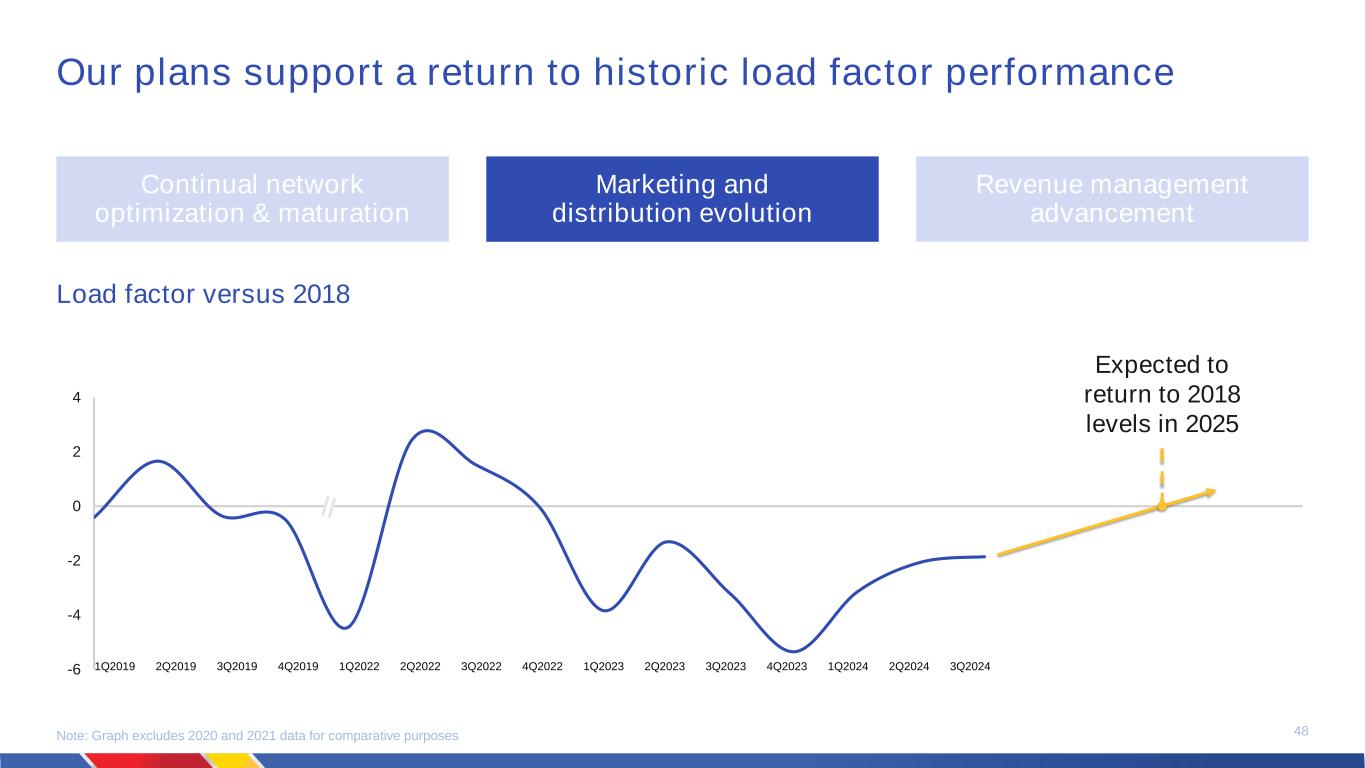
48 Our plans support a return to historic load factor performance Note: Graph excludes 2020 and 2021 data for comparative purposes -6 -4 -2 0 2 4 1Q2019 2Q2019 3Q2019 4Q2019 1Q2022 2Q2022 3Q2022 4Q2022 1Q2023 2Q2023 3Q2023 4Q2023 1Q2024 2Q2024 3Q2024 Load factor versus 2018 Continual network optimization & maturation Marketing and distribution evolution Revenue management advancement Expected to return to 2018 levels in 2025
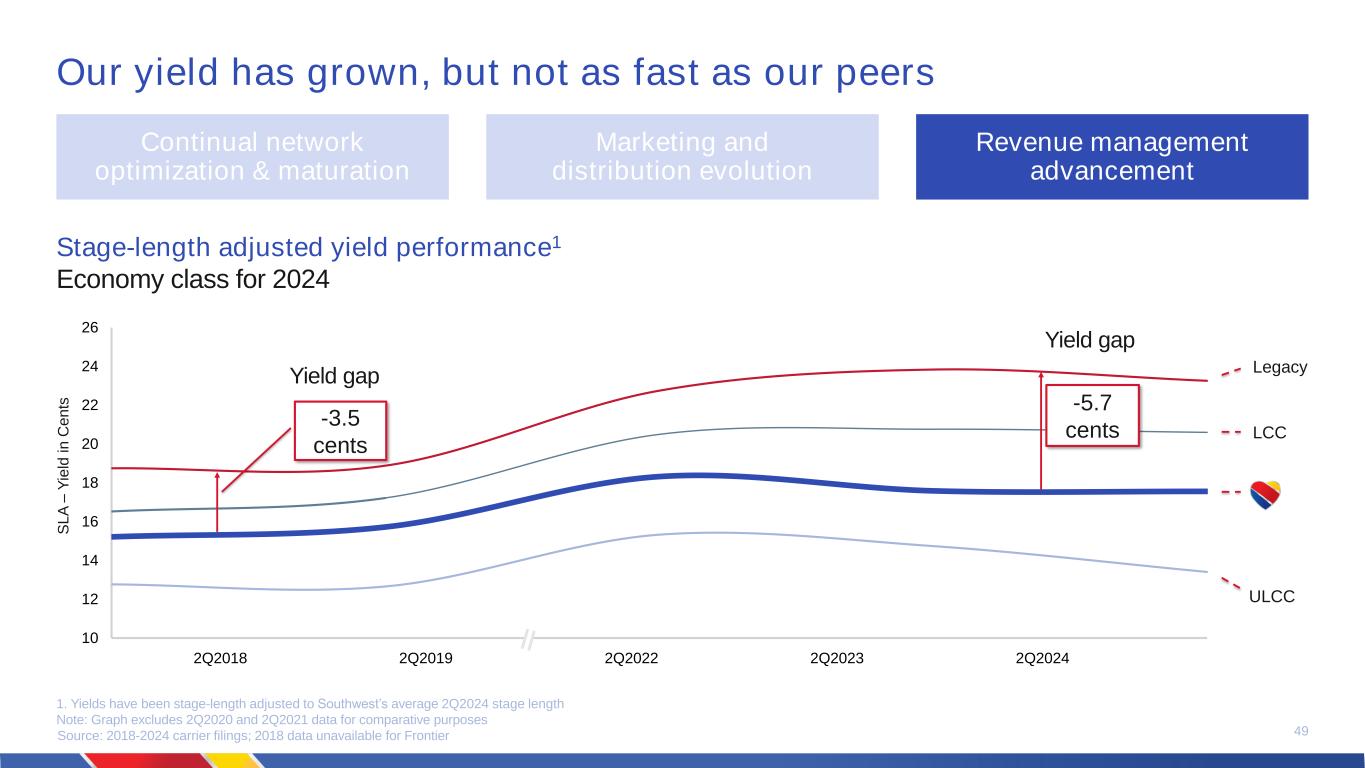
49 Our yield has grown, but not as fast as our peers Stage-length adjusted yield performance1 Economy class for 2024 1. Yields have been stage-length adjusted to Southwest’s average 2Q2024 stage length Note: Graph excludes 2Q2020 and 2Q2021 data for comparative purposes Source: 2018-2024 carrier filings; 2018 data unavailable for Frontier 10 12 14 16 18 20 22 24 26 2Q2018 2Q2019 2Q2022 2Q2023 2Q2024 S L A – Y ie ld i n C e n ts Continual network optimization & maturation Marketing and distribution evolution Revenue management advancement Legacy LCC ULCC -3.5 cents -5.7 cents Yield gap Yield gap
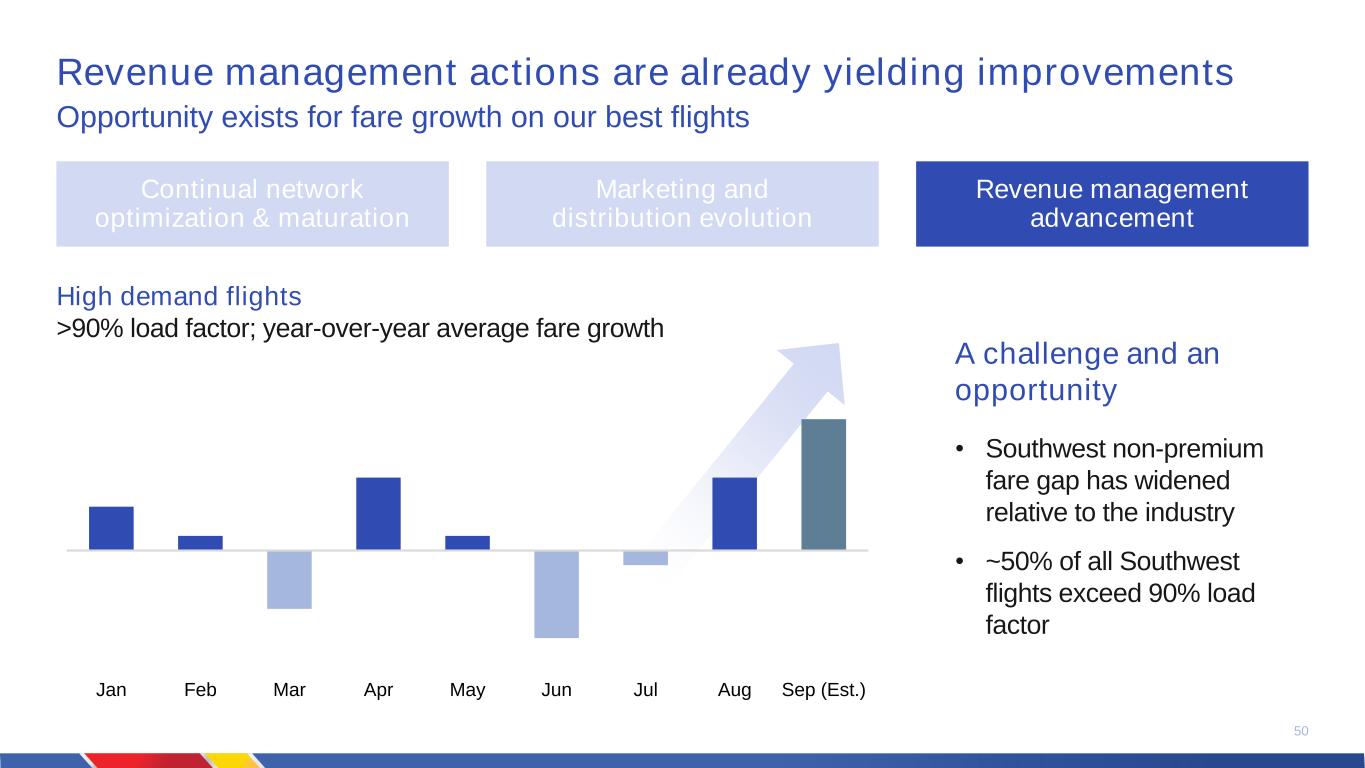
Jan Feb Mar Apr May Jun Jul Aug Sep (Est.) 50 Revenue management actions are already yielding improvements Opportunity exists for fare growth on our best flights High demand flights >90% load factor; year-over-year average fare growth • Southwest non-premium fare gap has widened relative to the industry • ~50% of all Southwest flights exceed 90% load factor A challenge and an opportunity Continual network optimization & maturation Marketing and distribution evolution Revenue management advancement
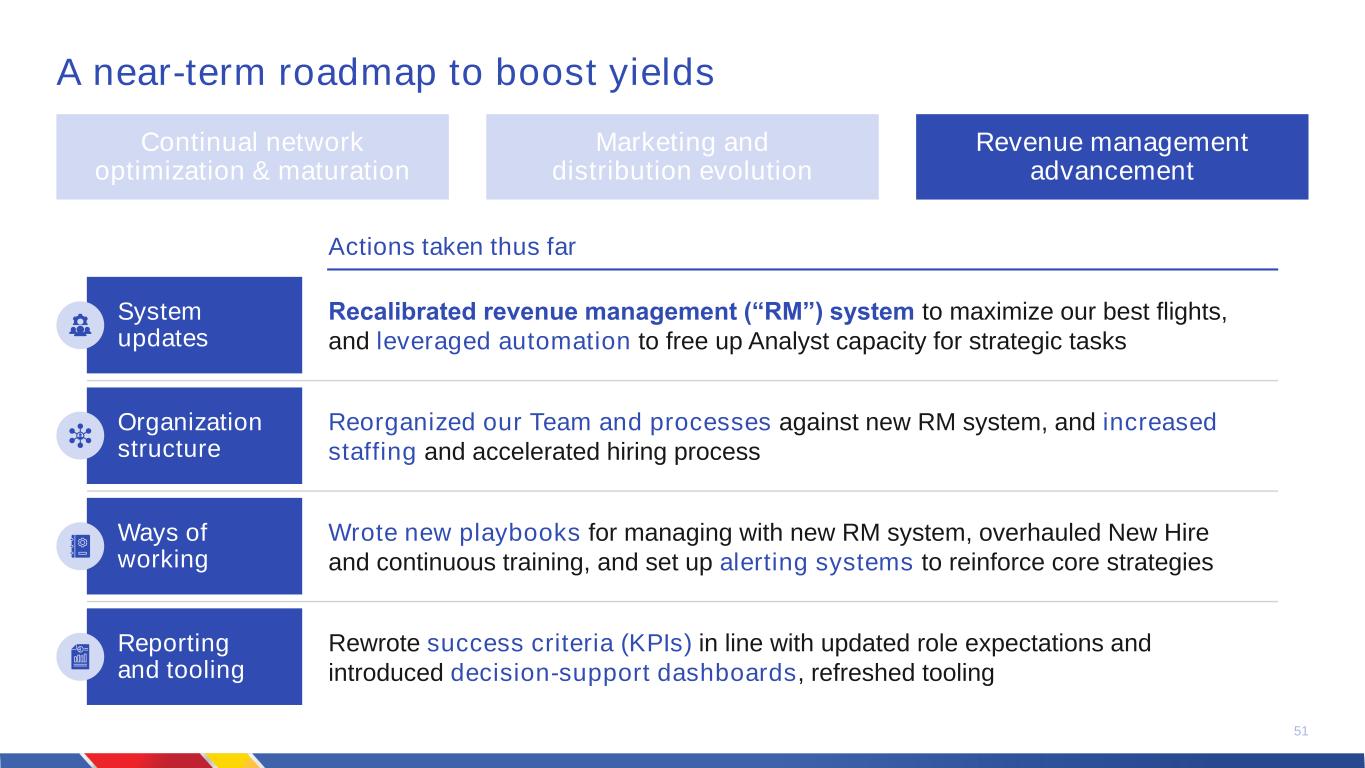
51 A near-term roadmap to boost yields Continual network optimization & maturation Marketing and distribution evolution Revenue management advancement Actions taken thus far System updates Recalibrated revenue management (“RM”) system to maximize our best flights, and leveraged automation to free up Analyst capacity for strategic tasks Reporting and tooling Rewrote success criteria (KPIs) in line with updated role expectations and introduced decision-support dashboards, refreshed tooling Ways of working Wrote new playbooks for managing with new RM system, overhauled New Hire and continuous training, and set up alerting systems to reinforce core strategies Organization structure Reorganized our Team and processes against new RM system, and increased staffing and accelerated hiring process
Actions to enhance operating efficiency
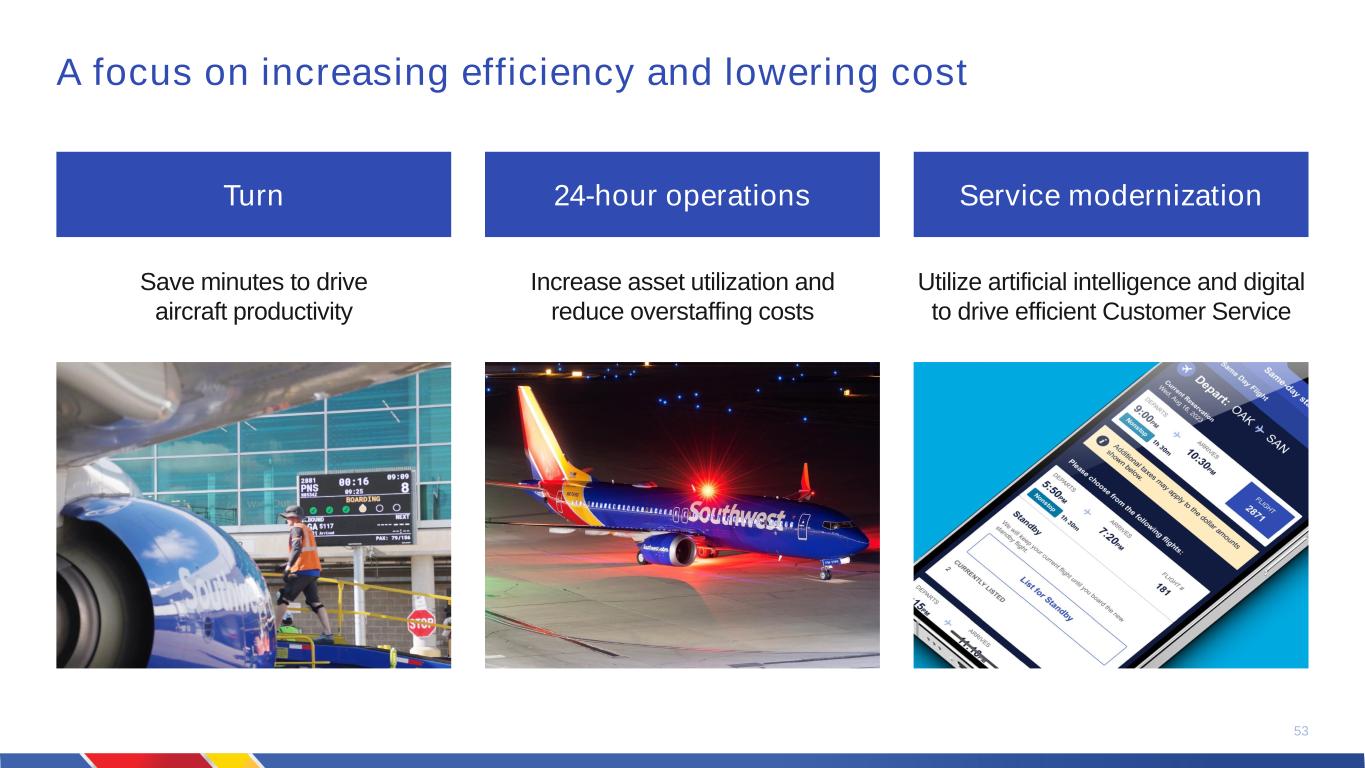
53 A focus on increasing efficiency and lowering cost Turn Save minutes to drive aircraft productivity 24-hour operations Increase asset utilization and reduce overstaffing costs Service modernization Utilize artificial intelligence and digital to drive efficient Customer Service
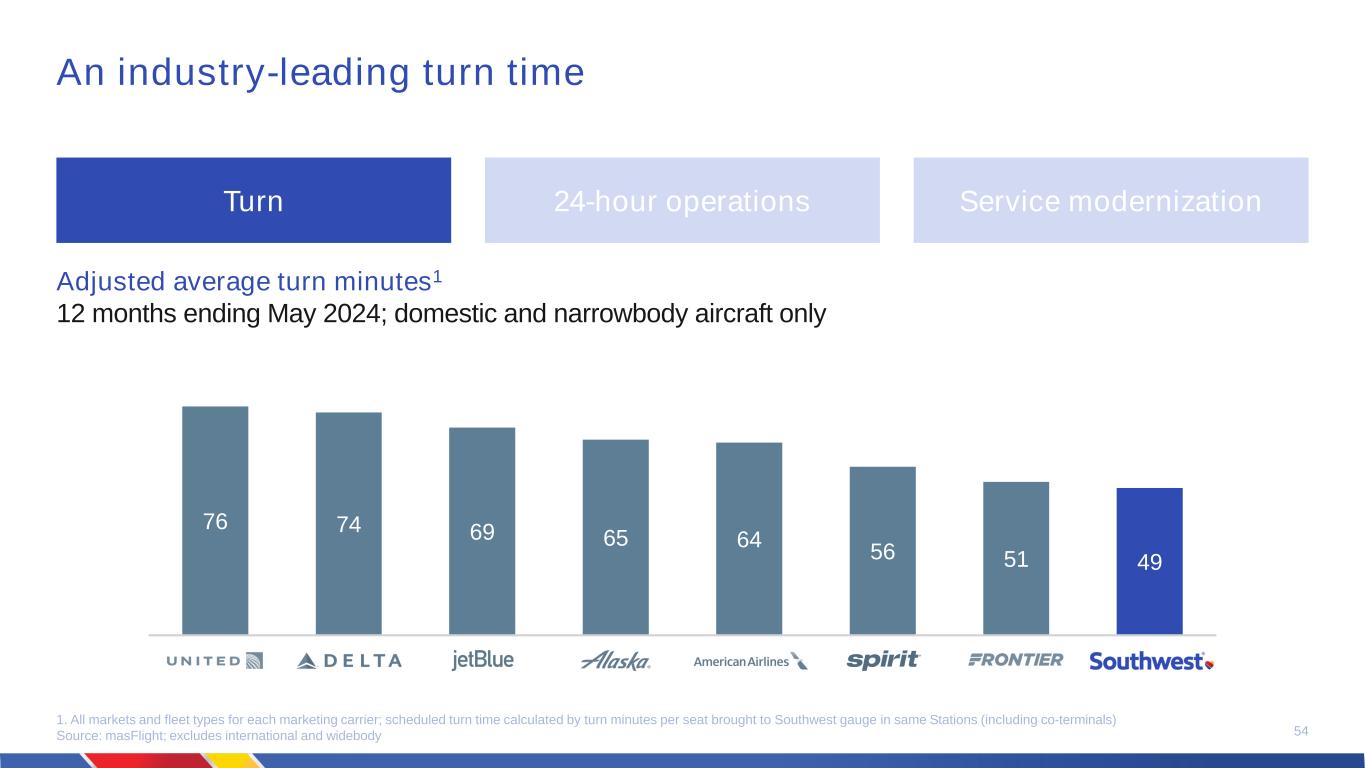
54 An industry-leading turn time 1. All markets and fleet types for each marketing carrier; scheduled turn time calculated by turn minutes per seat brought to Southwest gauge in same Stations (including co-terminals) Source: masFlight; excludes international and widebody 76 74 69 65 64 56 51 49 Adjusted average turn minutes1 12 months ending May 2024; domestic and narrowbody aircraft only Turn 24-hour operations Service modernization
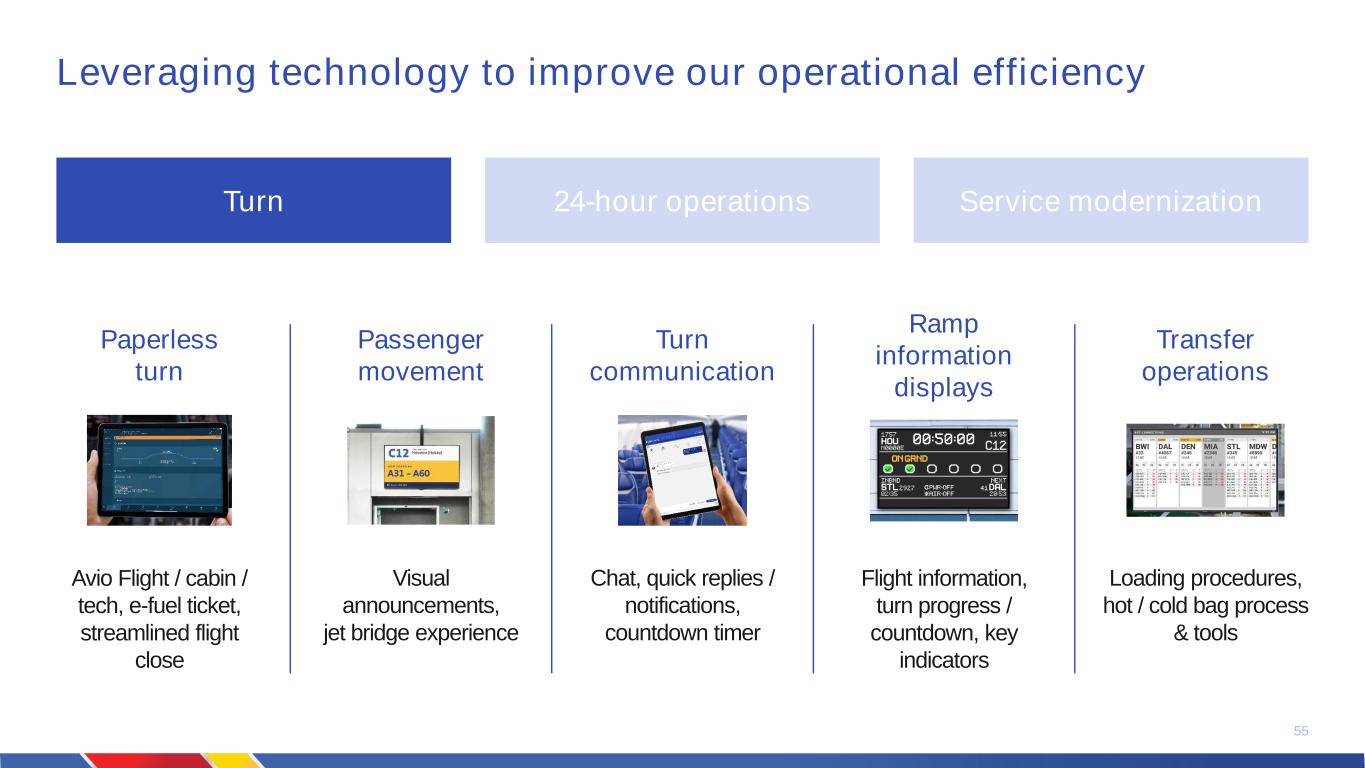
55 Leveraging technology to improve our operational efficiency Paperless turn Avio Flight / cabin / tech, e-fuel ticket, streamlined flight close Passenger movement Visual announcements, jet bridge experience Turn communication Chat, quick replies / notifications, countdown timer Ramp information displays Flight information, turn progress / countdown, key indicators Transfer operations Loading procedures, hot / cold bag process & tools Turn 24-hour operations Service modernization
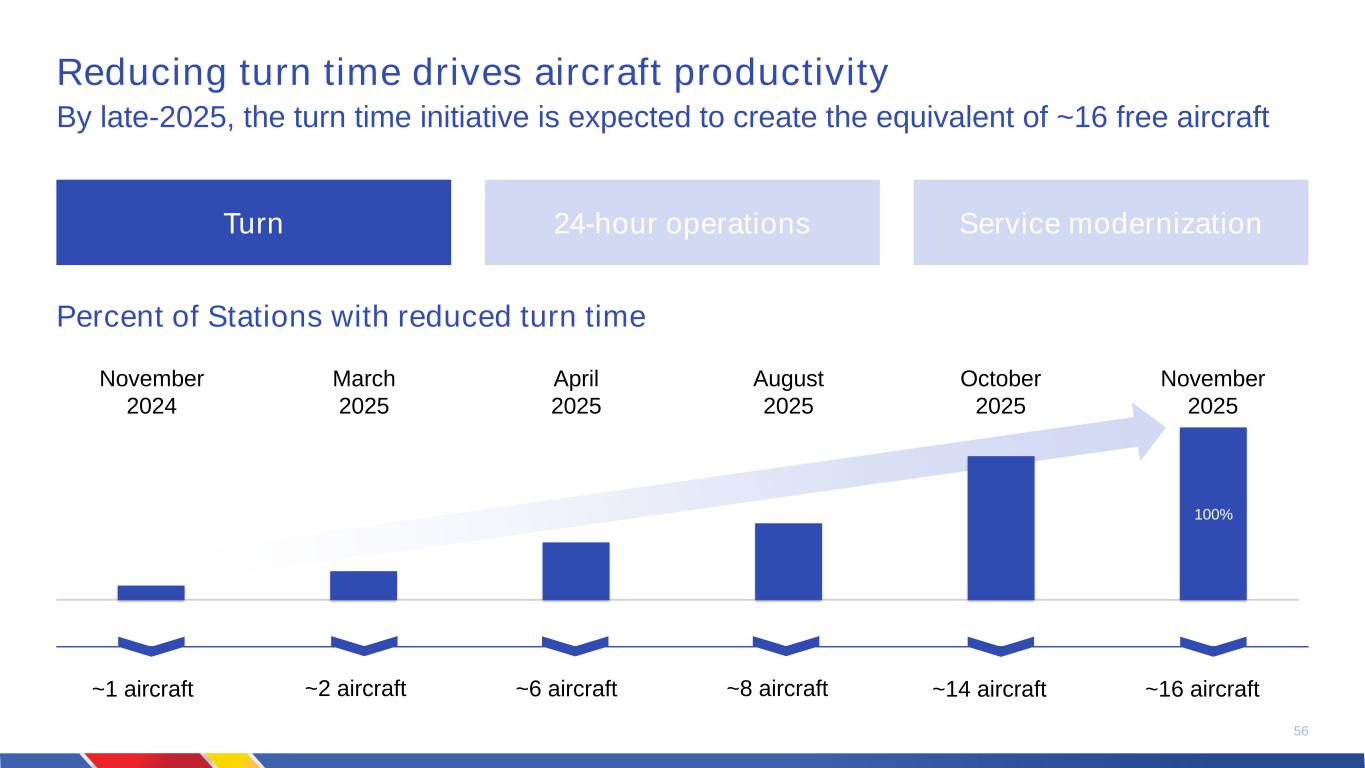
56 Reducing turn time drives aircraft productivity By late-2025, the turn time initiative is expected to create the equivalent of ~16 free aircraft November 2024 March 2025 August 2025 November 2025 April 2025 ~1 aircraft ~2 aircraft ~6 aircraft ~8 aircraft ~16 aircraft 100% October 2025 ~14 aircraft Percent of Stations with reduced turn time Turn 24-hour operations Service modernization
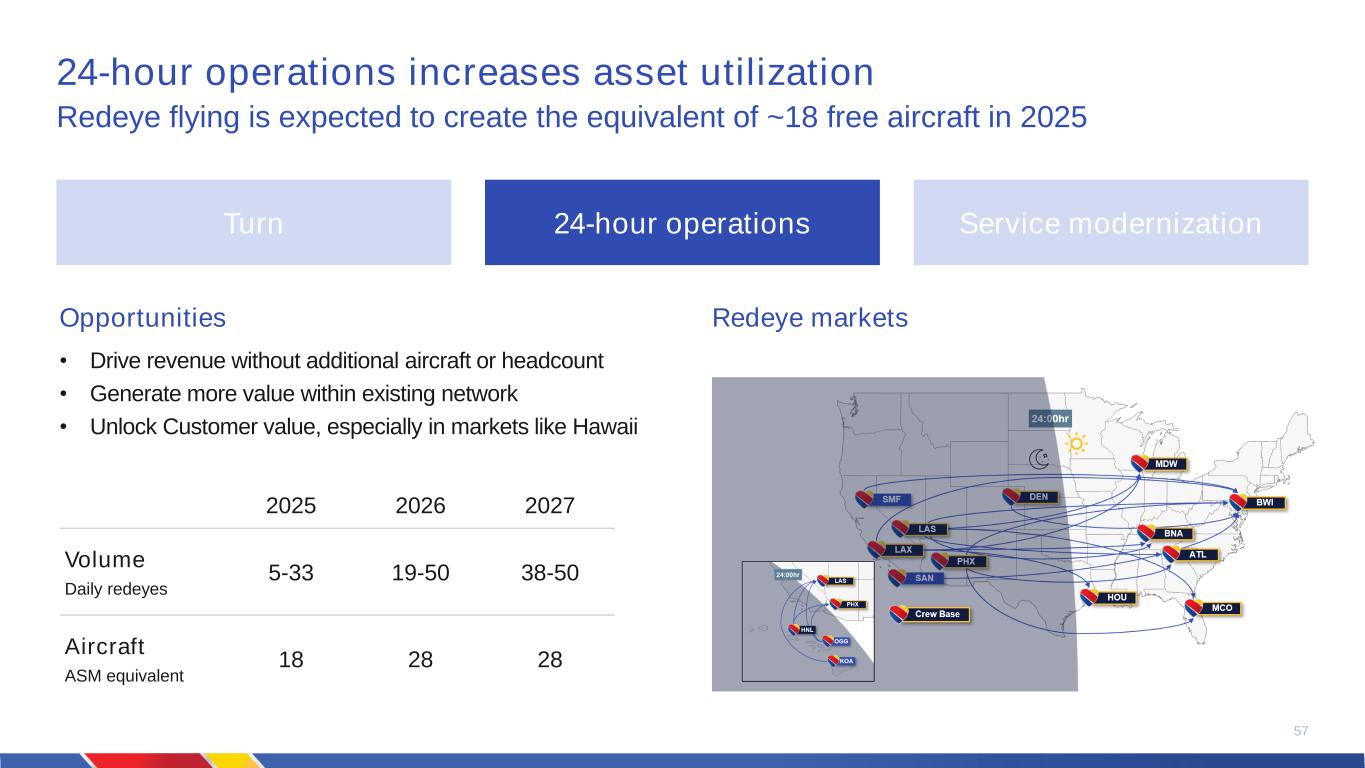
57 24-hour operations increases asset utilization Redeye flying is expected to create the equivalent of ~18 free aircraft in 2025 • Drive revenue without additional aircraft or headcount • Generate more value within existing network • Unlock Customer value, especially in markets like Hawaii Opportunities Redeye markets 2025 2026 2027 Volume Daily redeyes 5-33 19-50 38-50 Aircraft ASM equivalent 18 28 28 Turn 24-hour operations Service modernization
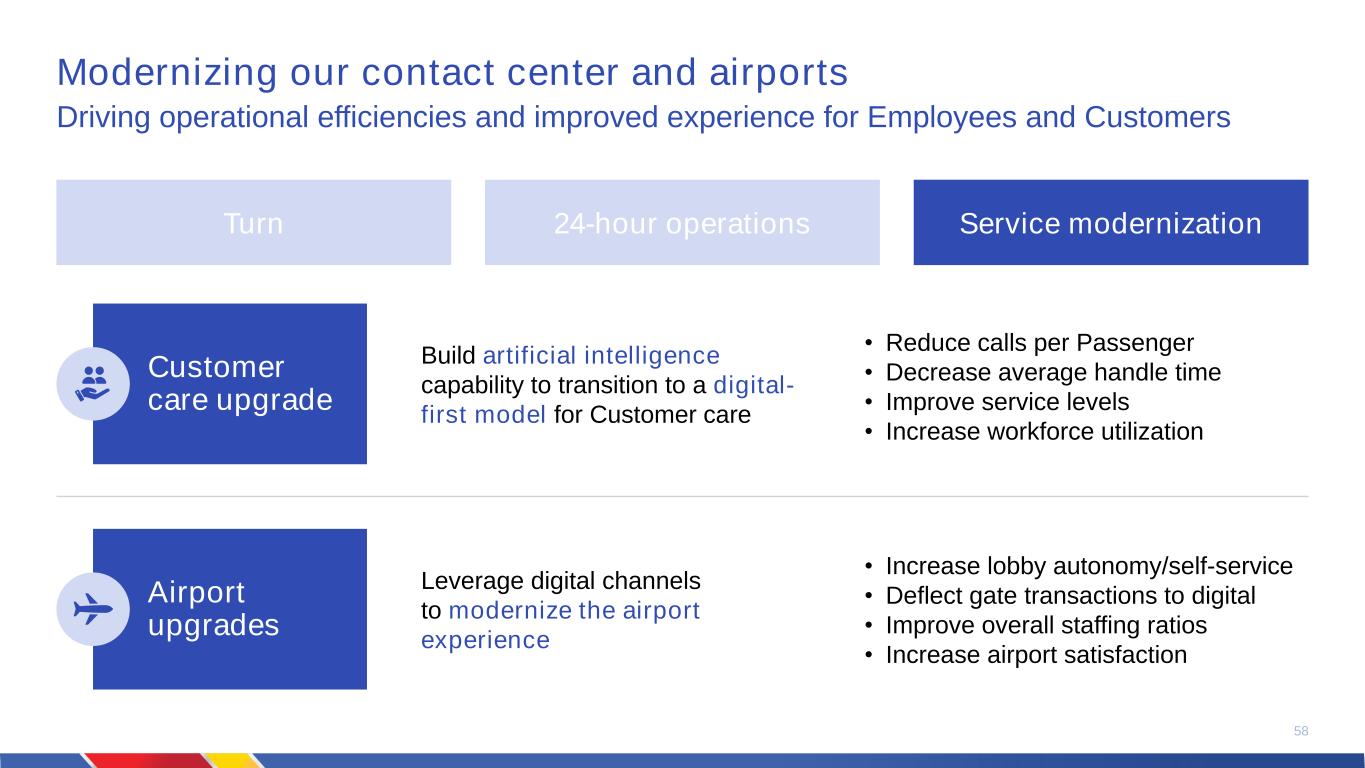
58 Modernizing our contact center and airports Driving operational efficiencies and improved experience for Employees and Customers Build artificial intelligence capability to transition to a digital- first model for Customer care Turn 24-hour operations Service modernization Customer care upgrade Airport upgrades • Reduce calls per Passenger • Decrease average handle time • Improve service levels • Increase workforce utilization Leverage digital channels to modernize the airport experience • Increase lobby autonomy/self-service • Deflect gate transactions to digital • Improve overall staffing ratios • Increase airport satisfaction
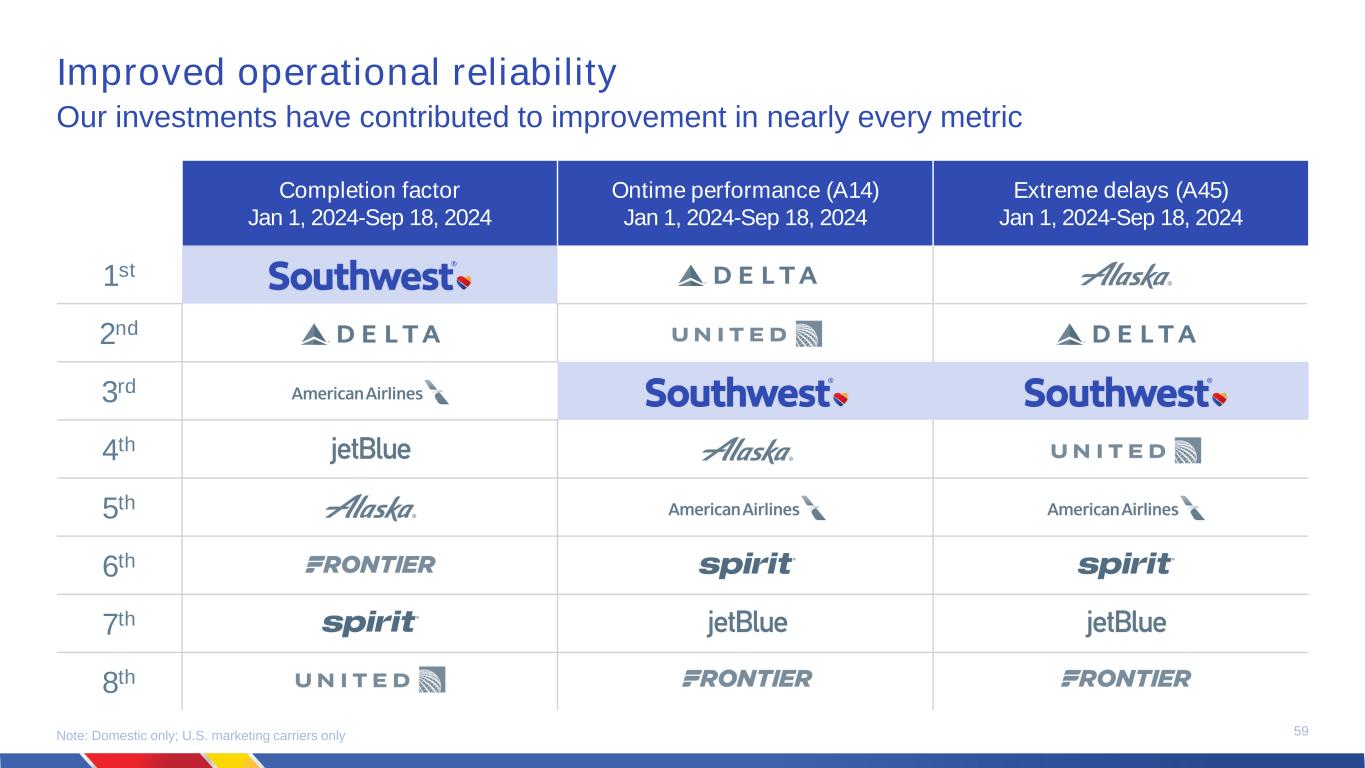
59 Improved operational reliability Our investments have contributed to improvement in nearly every metric Note: Domestic only; U.S. marketing carriers only Completion factor Jan 1, 2024-Sep 18, 2024 Ontime performance (A14) Jan 1, 2024-Sep 18, 2024 Extreme delays (A45) Jan 1, 2024-Sep 18, 2024 1st 2nd 3rd 4th 5th 6th 7th 8th
60 Key takeaways Structural changes in travel behavior require us to adjust The plan addresses both revenue and efficiency opportunities Tactical actions underway are already providing benefits Operational reliability improvements demonstrate our ability to execute
Ryan Green Transforming our Customer value proposition
Shaping our transformation
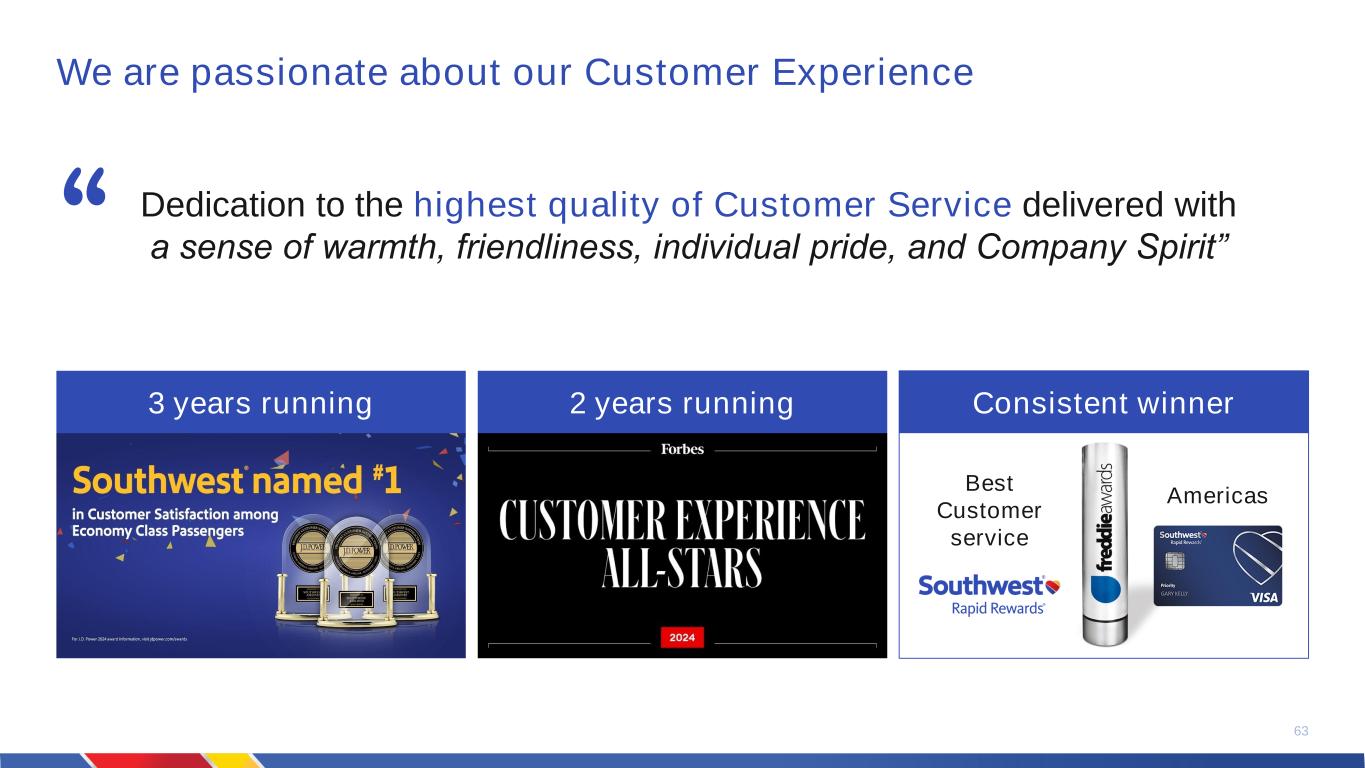
63 We are passionate about our Customer Experience Dedication to the highest quality of Customer Service delivered with a sense of warmth, friendliness, individual pride, and Company Spirit” 2 years running3 years running Consistent winner Best Customer service Americas
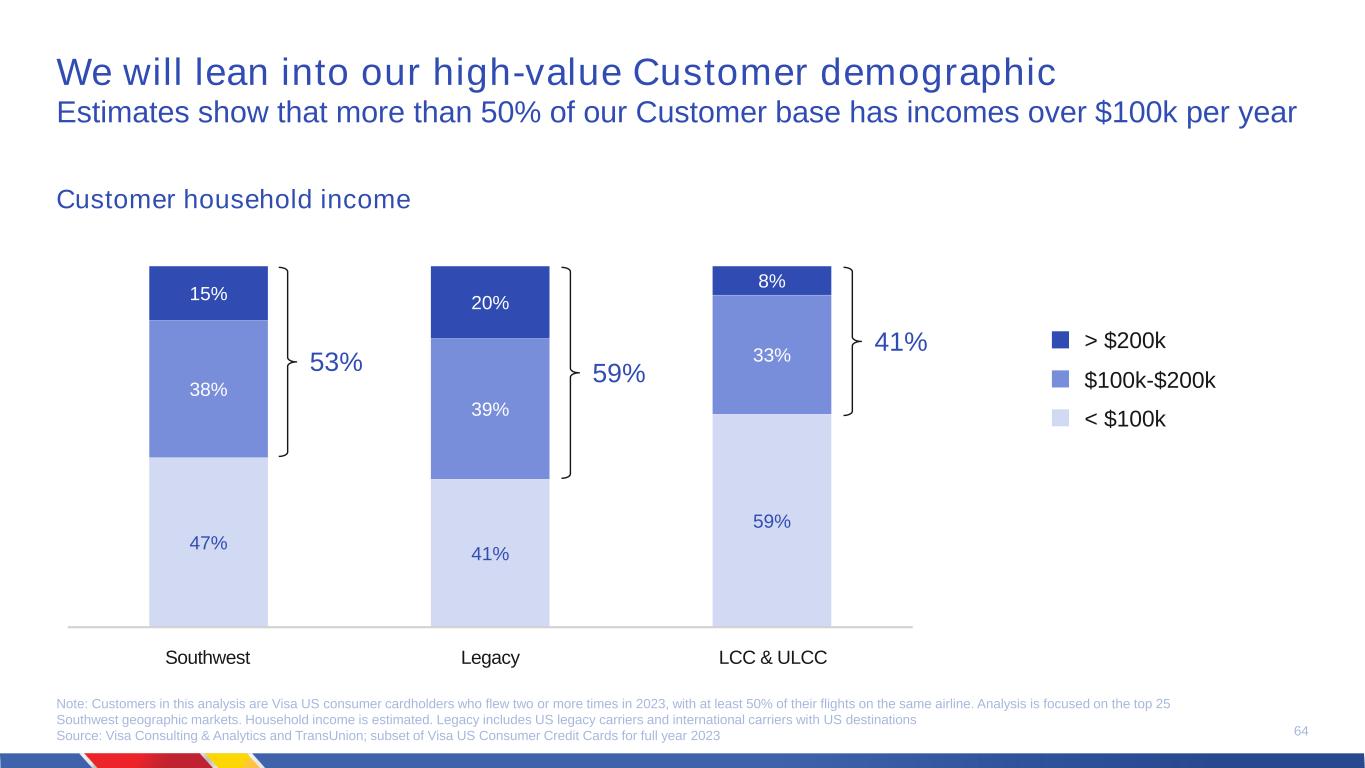
64 We will lean into our high-value Customer demographic Estimates show that more than 50% of our Customer base has incomes over $100k per year Note: Customers in this analysis are Visa US consumer cardholders who flew two or more times in 2023, with at least 50% of their flights on the same airline. Analysis is focused on the top 25 Southwest geographic markets. Household income is estimated. Legacy includes US legacy carriers and international carriers with US destinations Source: Visa Consulting & Analytics and TransUnion; subset of Visa US Consumer Credit Cards for full year 2023 Customer household income 47% 41% 59% 38% 39% 33% 15% 20% 8% Southwest Legacy LCC & ULCC 53% 59% 41% > $200k $100k-$200k < $100k
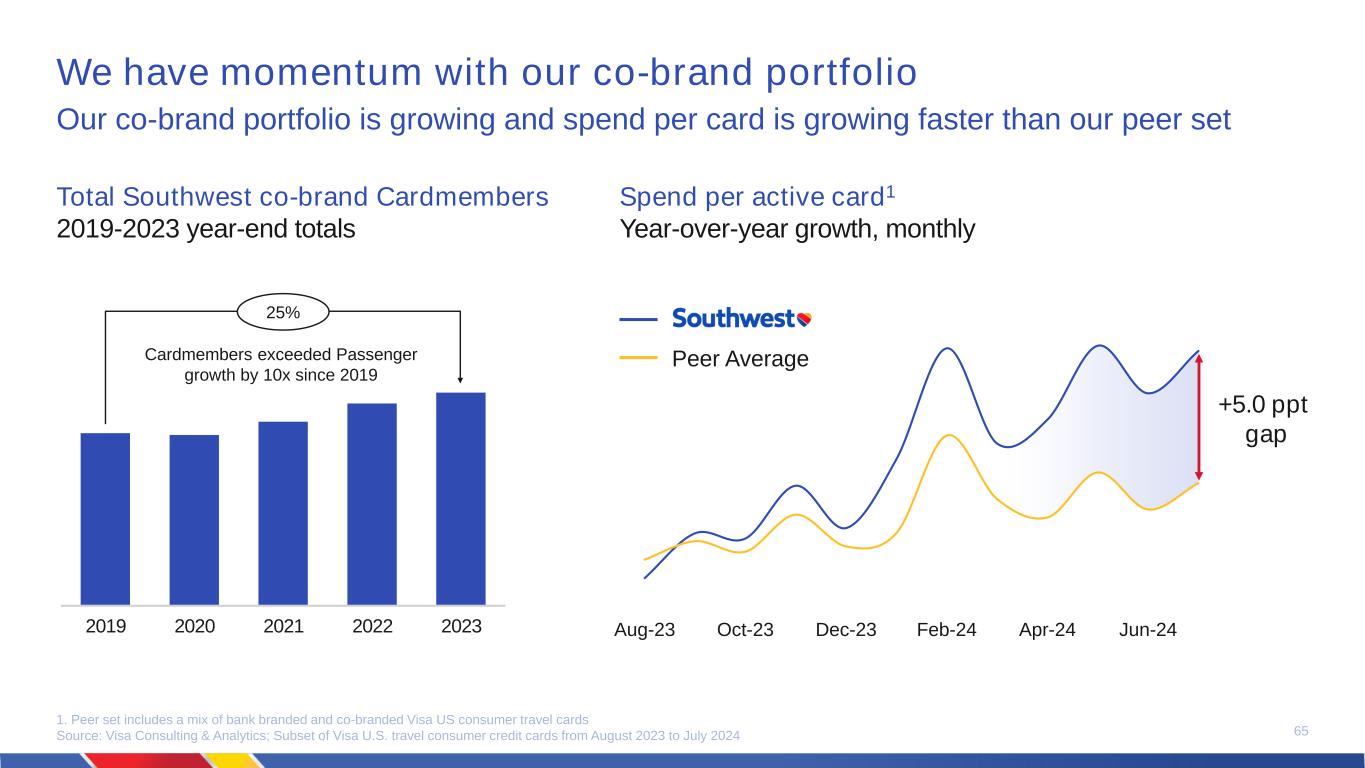
Aug-23 Oct-23 Dec-23 Feb-24 Apr-24 Jun-24 We have momentum with our co-brand portfolio Our co-brand portfolio is growing and spend per card is growing faster than our peer set 1. Peer set includes a mix of bank branded and co-branded Visa US consumer travel cards Source: Visa Consulting & Analytics; Subset of Visa U.S. travel consumer credit cards from August 2023 to July 2024 Total Southwest co-brand Cardmembers 2019-2023 year-end totals Cardmembers exceeded Passenger growth by 10x since 2019 25% 2019 2020 2021 2022 2023 Spend per active card1 Year-over-year growth, monthly Peer Average +5.0 ppt gap 65
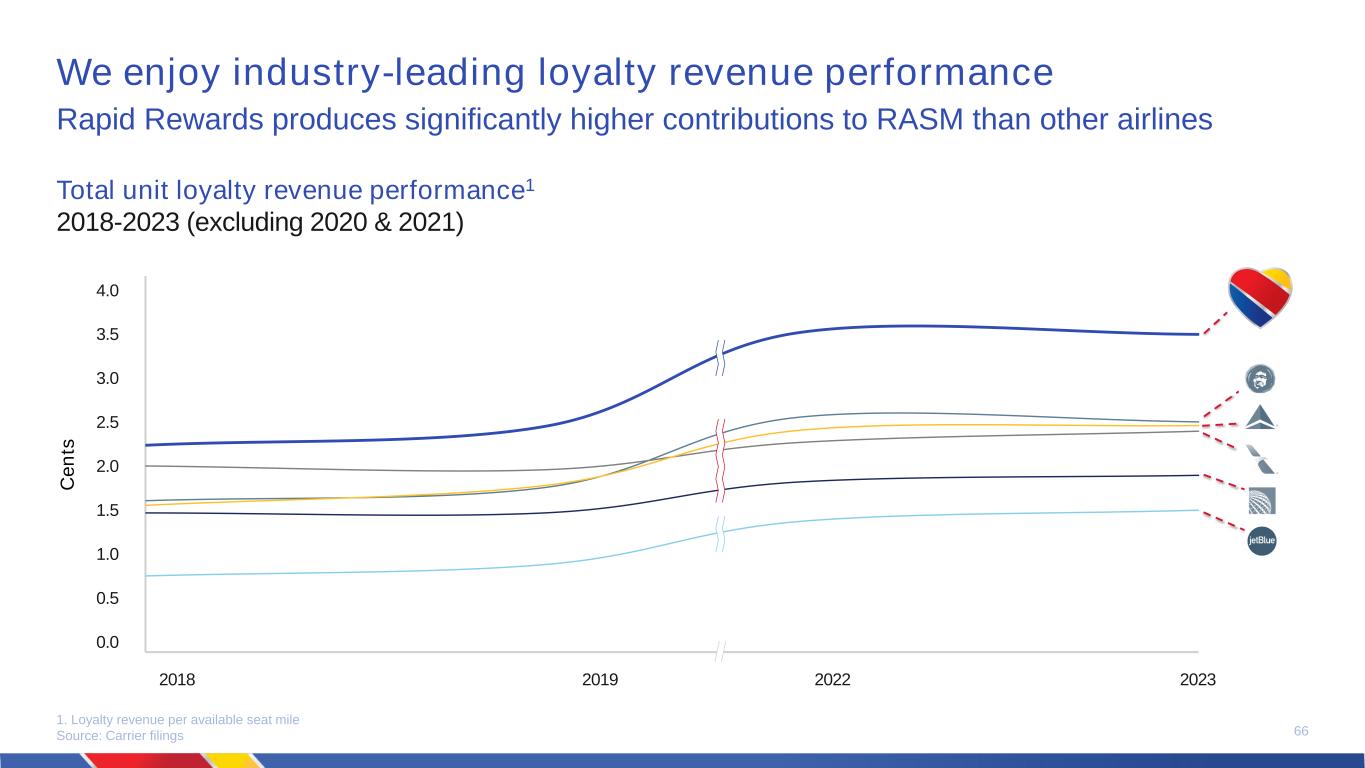
66 We enjoy industry-leading loyalty revenue performance Rapid Rewards produces significantly higher contributions to RASM than other airlines 1. Loyalty revenue per available seat mile Source: Carrier filings Total unit loyalty revenue performance1 2018-2023 (excluding 2020 & 2021) C e n ts 0.0 0.5 1.0 1.5 2.0 2.5 3.0 3.5 4.0 2018 2019 2022 2023
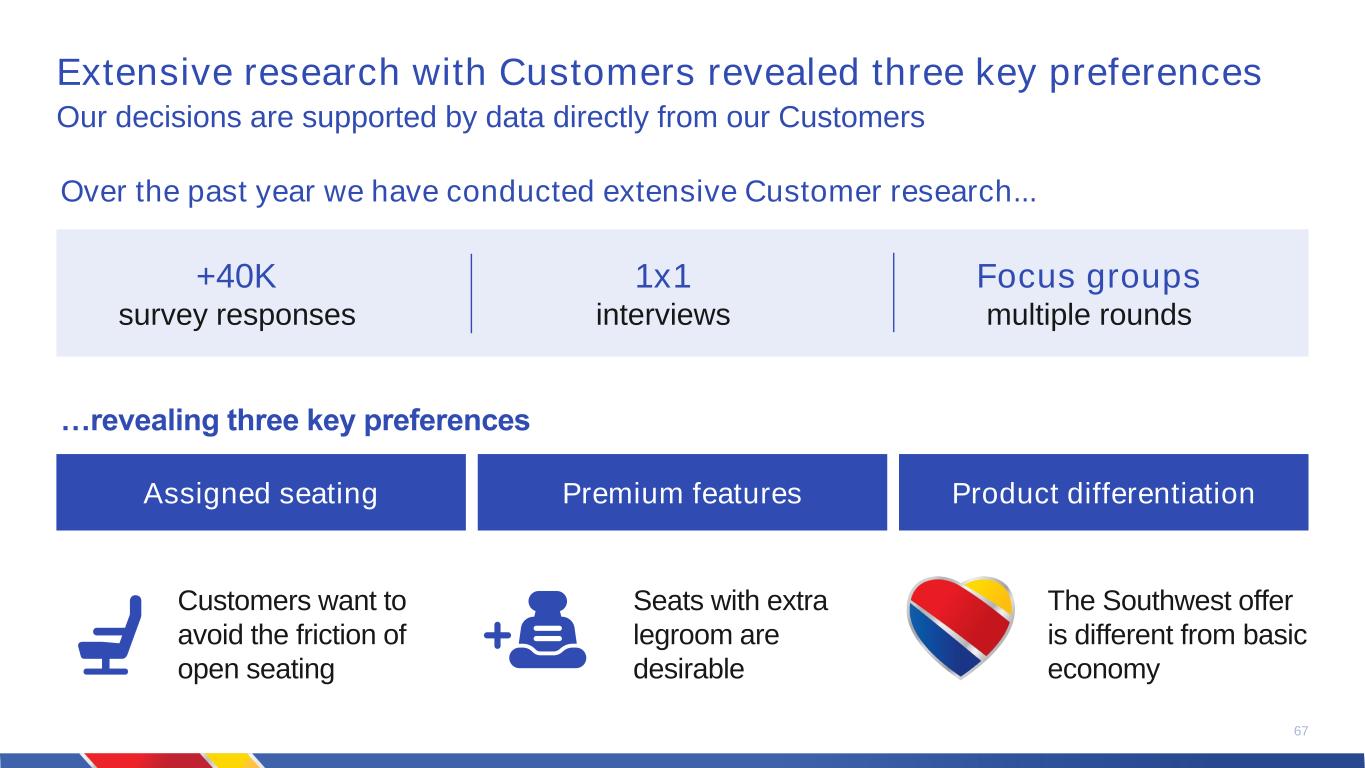
67 Extensive research with Customers revealed three key preferences Our decisions are supported by data directly from our Customers +40K survey responses 1x1 interviews Focus groups multiple rounds Over the past year we have conducted extensive Customer research... Customers want to avoid the friction of open seating Seats with extra legroom are desirable The Southwest offer is different from basic economy …revealing three key preferences Assigned seating Premium features Product differentiation
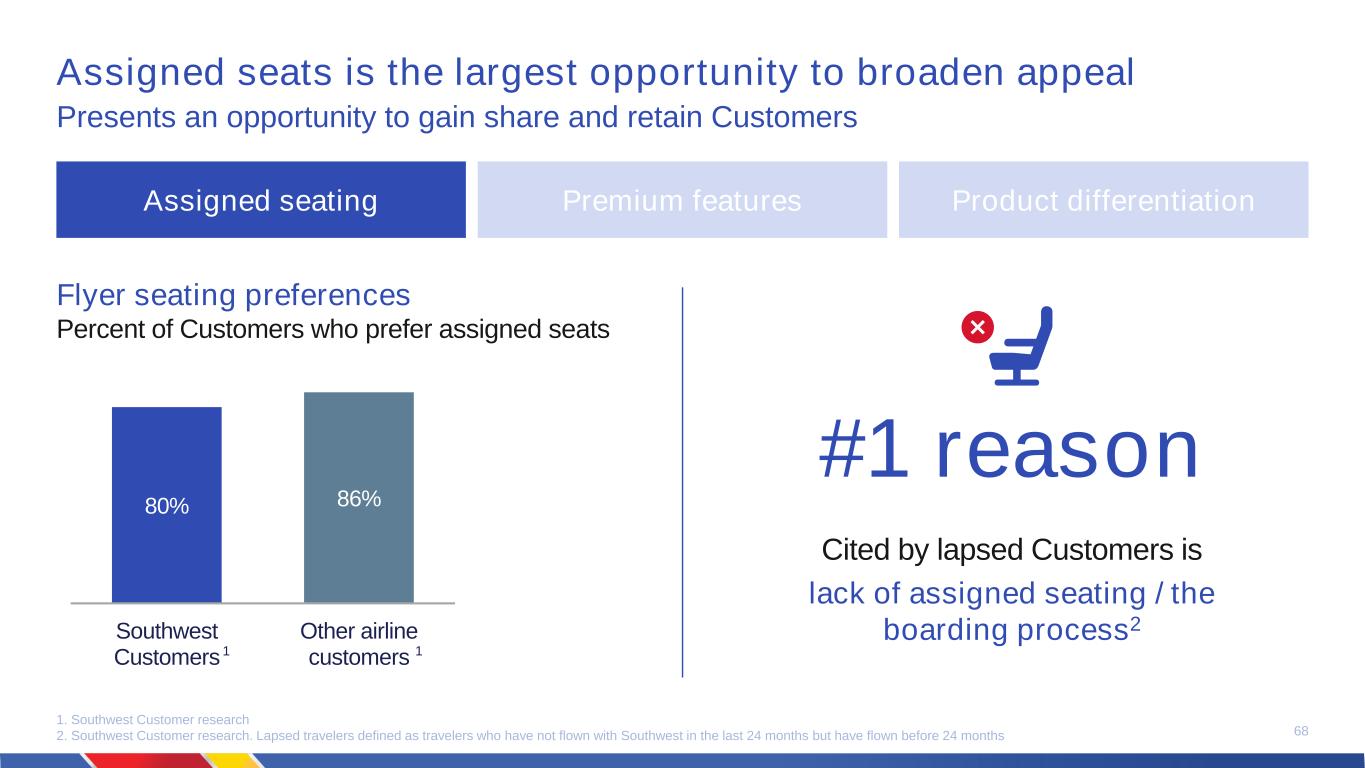
68 Assigned seats is the largest opportunity to broaden appeal Presents an opportunity to gain share and retain Customers 1. Southwest Customer research 2. Southwest Customer research. Lapsed travelers defined as travelers who have not flown with Southwest in the last 24 months but have flown before 24 months Assigned seating Premium features Product differentiation #1 reason Cited by lapsed Customers is lack of assigned seating / the boarding process2 Flyer seating preferences Percent of Customers who prefer assigned seats 80% 86% Southwest Customers Other airline customers1 1
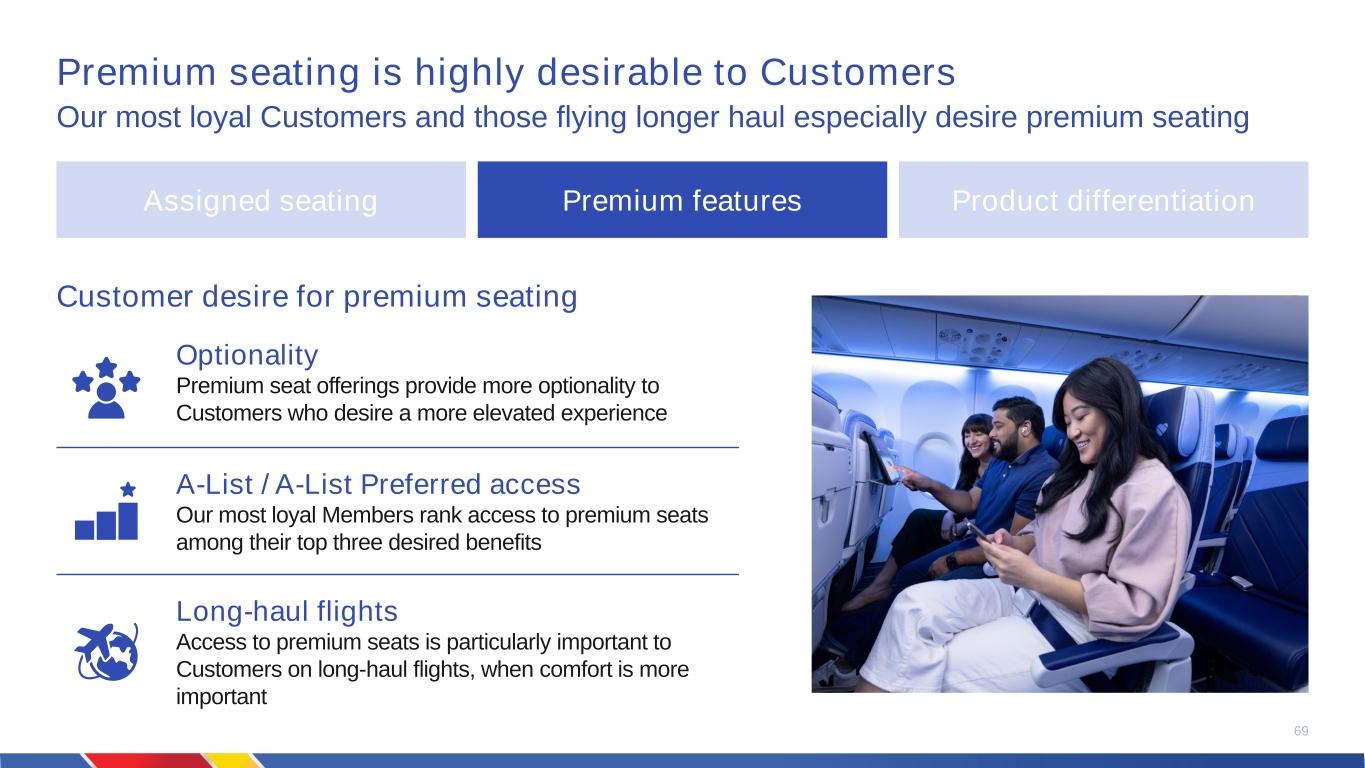
69 Premium seating is highly desirable to Customers Our most loyal Customers and those flying longer haul especially desire premium seating Assigned seating Premium features Product differentiation Customer desire for premium seating Optionality Premium seat offerings provide more optionality to Customers who desire a more elevated experience Long-haul flights Access to premium seats is particularly important to Customers on long-haul flights, when comfort is more important A-List / A-List Preferred access Our most loyal Members rank access to premium seats among their top three desired benefits
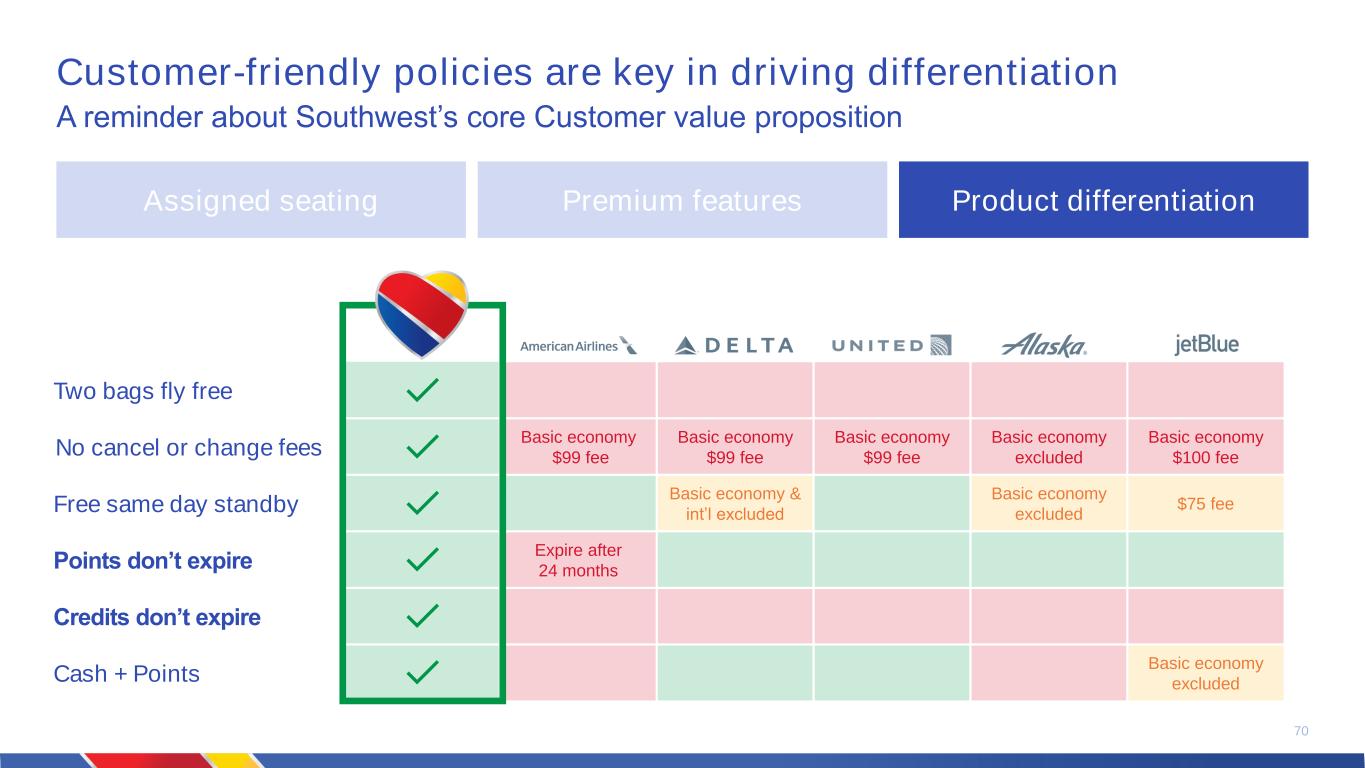
70 Customer-friendly policies are key in driving differentiation A reminder about Southwest’s core Customer value proposition Two bags fly free No cancel or change fees Basic economy $99 fee Basic economy $99 fee Basic economy $99 fee Basic economy excluded Basic economy $100 fee Free same day standby Basic economy & int’l excluded Basic economy excluded $75 fee Points don’t expire Expire after 24 months Credits don’t expire Cash + Points Basic economy excluded Assigned seating Premium features Product differentiation
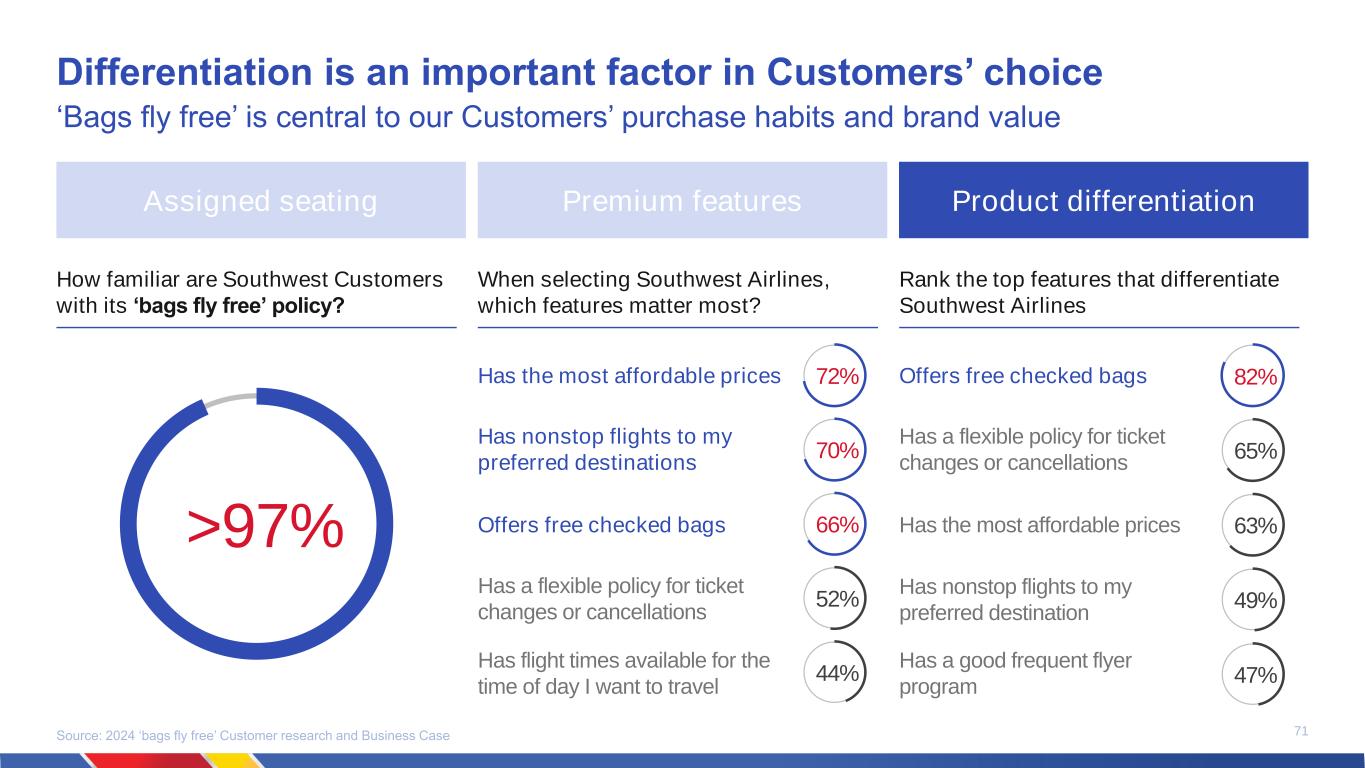
Differentiation is an important factor in Customers’ choice ‘Bags fly free’ is central to our Customers’ purchase habits and brand value Source: 2024 ‘bags fly free’ Customer research and Business Case Assigned seating Premium features Product differentiation How familiar are Southwest Customers with its ‘bags fly free’ policy? When selecting Southwest Airlines, which features matter most? Rank the top features that differentiate Southwest Airlines >97% 72% 52% 44% 70% 66% 65% 63% 49% 47% 82%Has the most affordable prices Has nonstop flights to my preferred destinations Offers free checked bags Has a flexible policy for ticket changes or cancellations Has flight times available for the time of day I want to travel Offers free checked bags Has a flexible policy for ticket changes or cancellations Has the most affordable prices Has nonstop flights to my preferred destination Has a good frequent flyer program 71
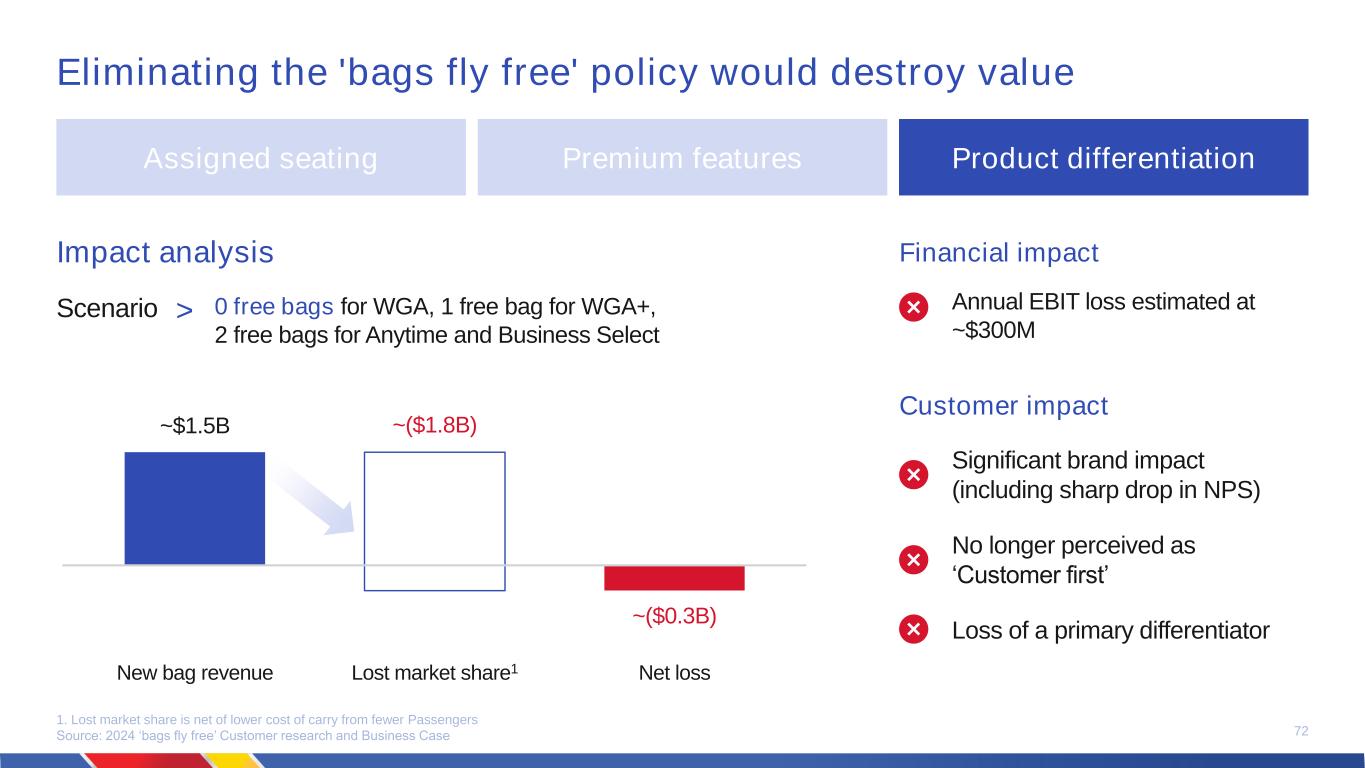
72 Eliminating the 'bags fly free' policy would destroy value 1. Lost market share is net of lower cost of carry from fewer Passengers Source: 2024 ‘bags fly free’ Customer research and Business Case Financial impact 0 free bags for WGA, 1 free bag for WGA+, 2 free bags for Anytime and Business Select ~$1.5B New bag revenue ~($1.8B) Lost market share1 ~($0.3B) Net loss Customer impact Significant brand impact (including sharp drop in NPS) No longer perceived as ‘Customer first’ Loss of a primary differentiator Annual EBIT loss estimated at ~$300M Assigned seating Premium features Product differentiation Impact analysis Scenario >
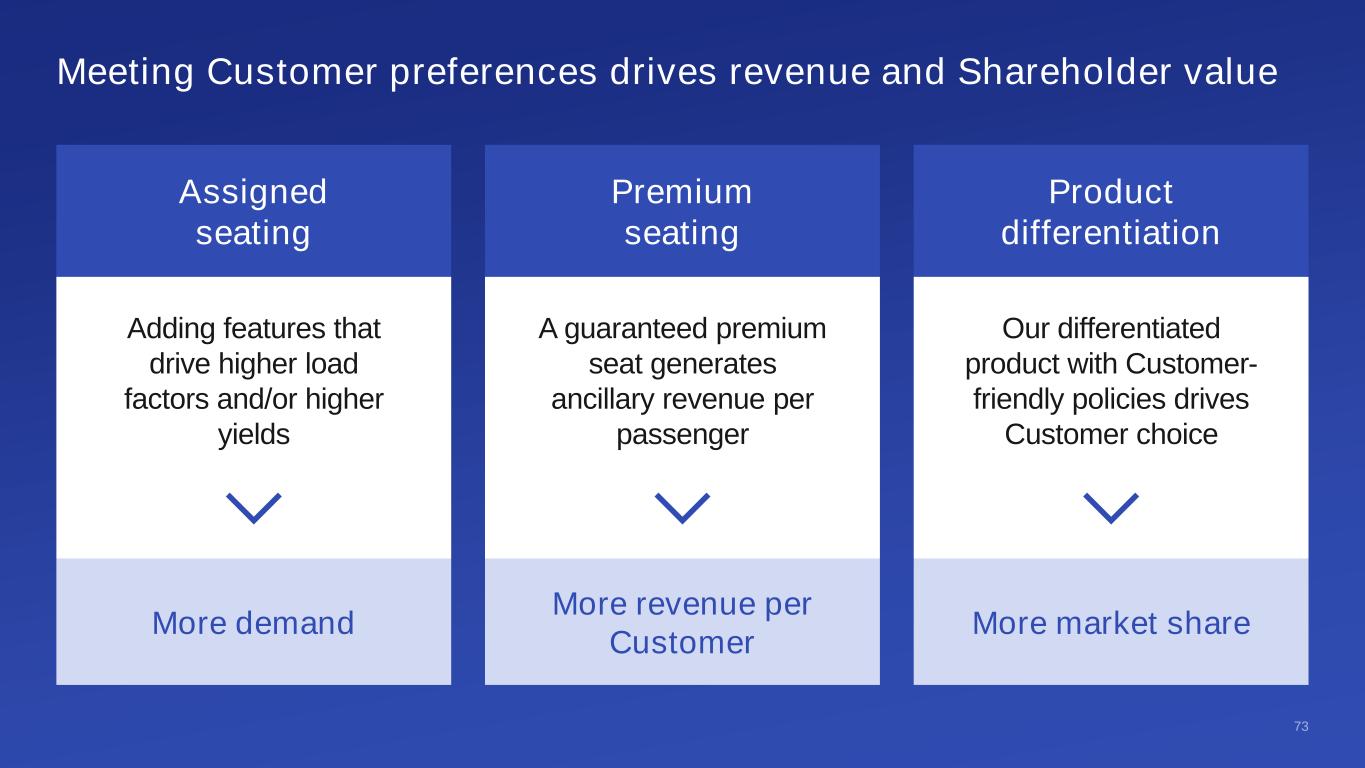
73 Meeting Customer preferences drives revenue and Shareholder value Assigned seating Premium seating Product differentiation Adding features that drive higher load factors and/or higher yields A guaranteed premium seat generates ancillary revenue per passenger Our differentiated product with Customer- friendly policies drives Customer choice More demand More revenue per Customer More market share
Reimagining our core product
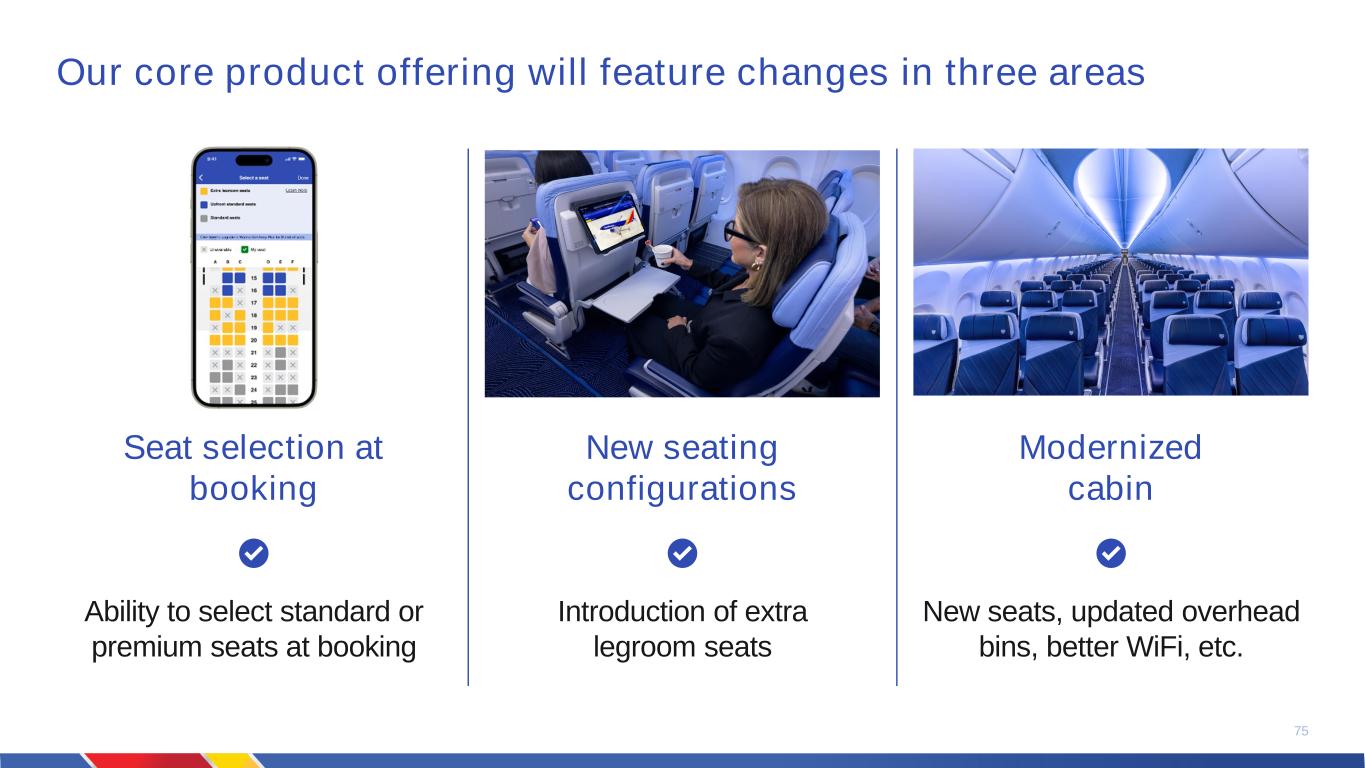
75 Our core product offering will feature changes in three areas Seat selection at booking New seating configurations Modernized cabin Ability to select standard or premium seats at booking Introduction of extra legroom seats New seats, updated overhead bins, better WiFi, etc.
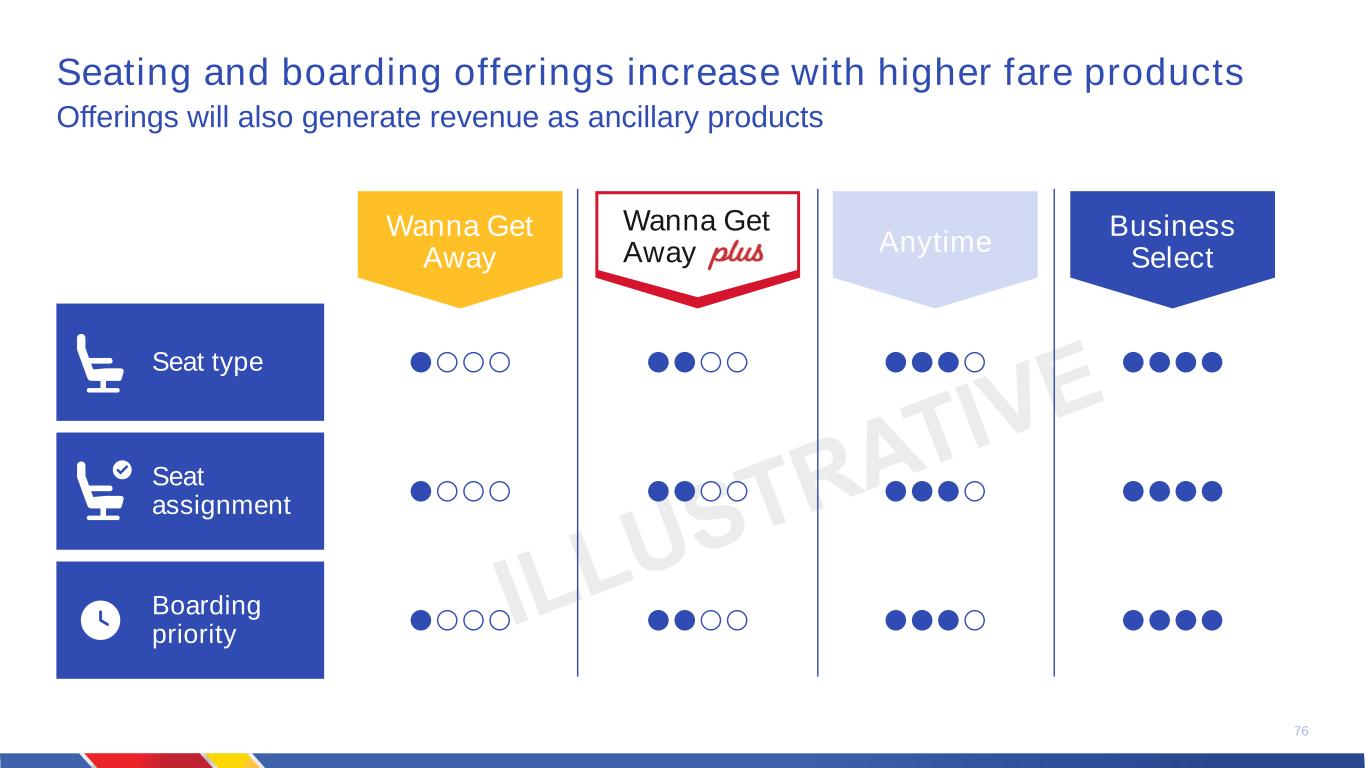
76 Seating and boarding offerings increase with higher fare products Offerings will also generate revenue as ancillary products Seat type Seat assignment Boarding priority Business Select Anytime Wanna Get Away Wanna Get Away
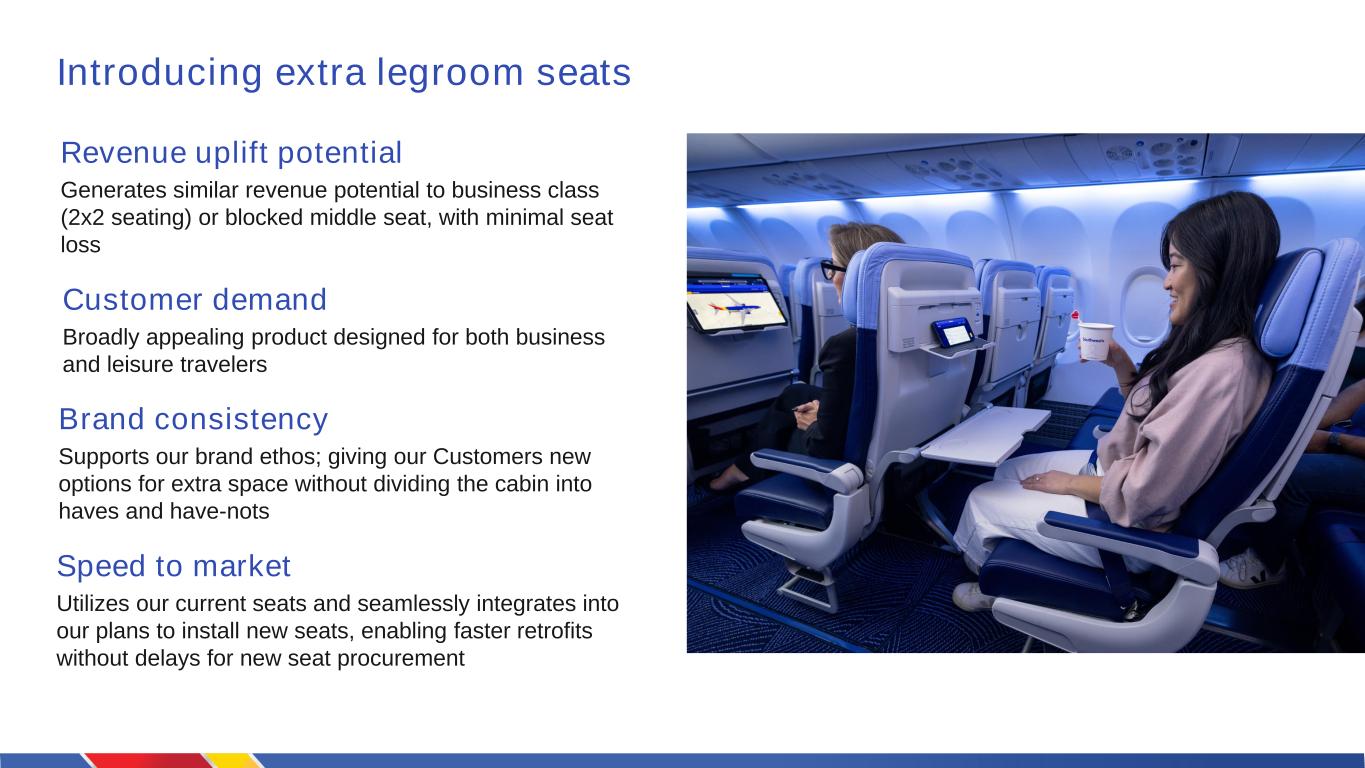
Introducing extra legroom seats Revenue uplift potential Generates similar revenue potential to business class (2x2 seating) or blocked middle seat, with minimal seat loss Customer demand Broadly appealing product designed for both business and leisure travelers Brand consistency Supports our brand ethos; giving our Customers new options for extra space without dividing the cabin into haves and have-nots Speed to market Utilizes our current seats and seamlessly integrates into our plans to install new seats, enabling faster retrofits without delays for new seat procurement 77
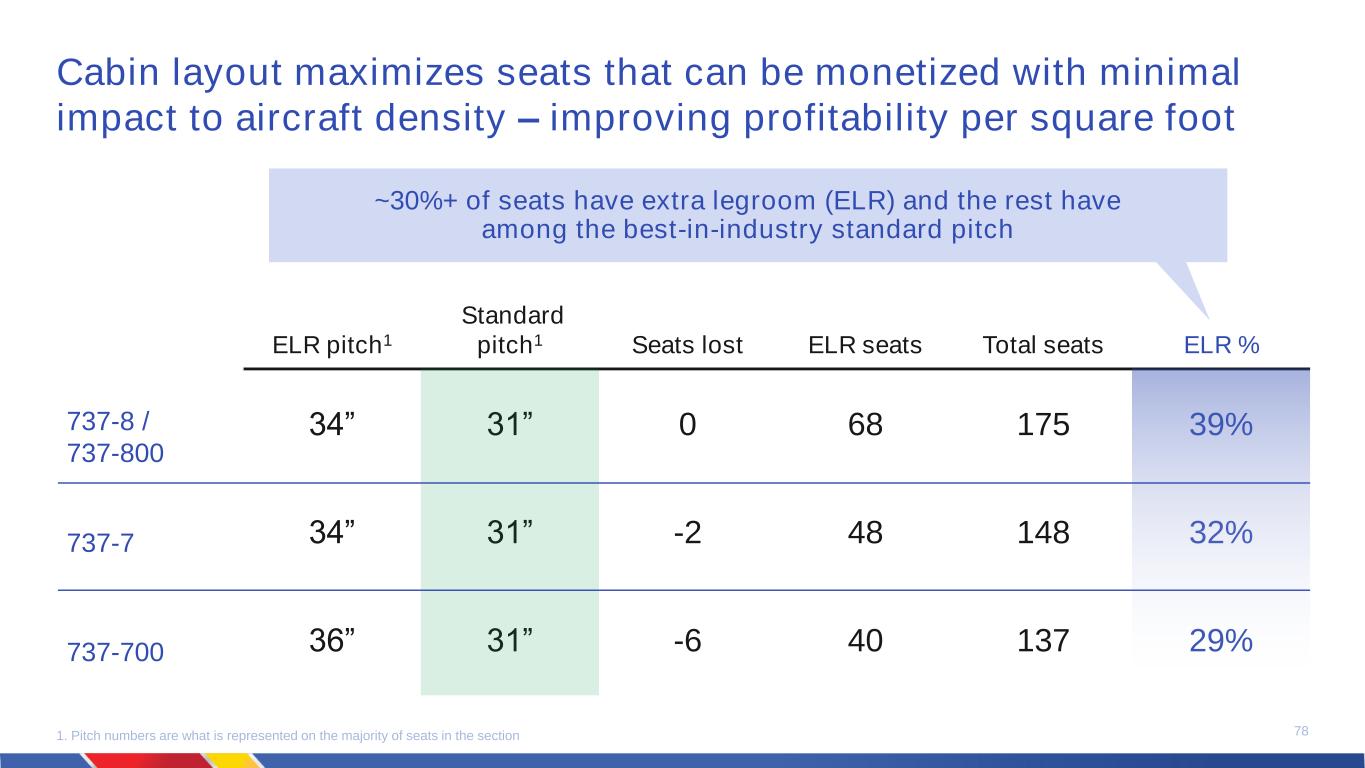
ELR pitch1 Standard pitch1 Seats lost ELR seats Total seats ELR % 34” 31” 0 68 175 39% 34” 31” -2 48 148 32% 36” 31” -6 40 137 29% 78 Cabin layout maximizes seats that can be monetized with minimal impact to aircraft density – improving profitability per square foot 1. Pitch numbers are what is represented on the majority of seats in the section 737-8 / 737-800 737-700 737-7 ~30%+ of seats have extra legroom (ELR) and the rest have among the best-in-industry standard pitch
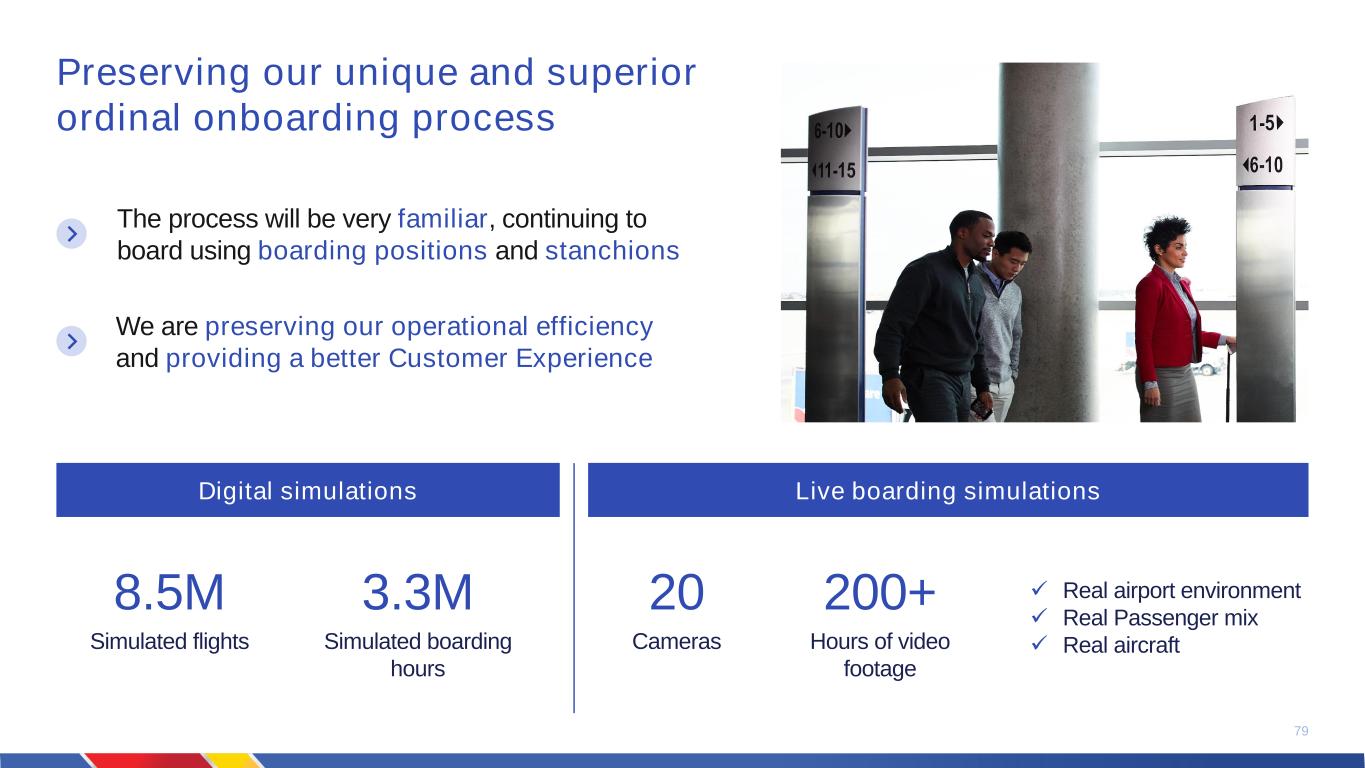
79 Preserving our unique and superior ordinal onboarding process The process will be very familiar, continuing to board using boarding positions and stanchions We are preserving our operational efficiency and providing a better Customer Experience 8.5M Simulated flights 3.3M Simulated boarding hours 20 Cameras 200+ Hours of video footage Digital simulations Live boarding simulations ✓ Real airport environment ✓ Real Passenger mix ✓ Real aircraft
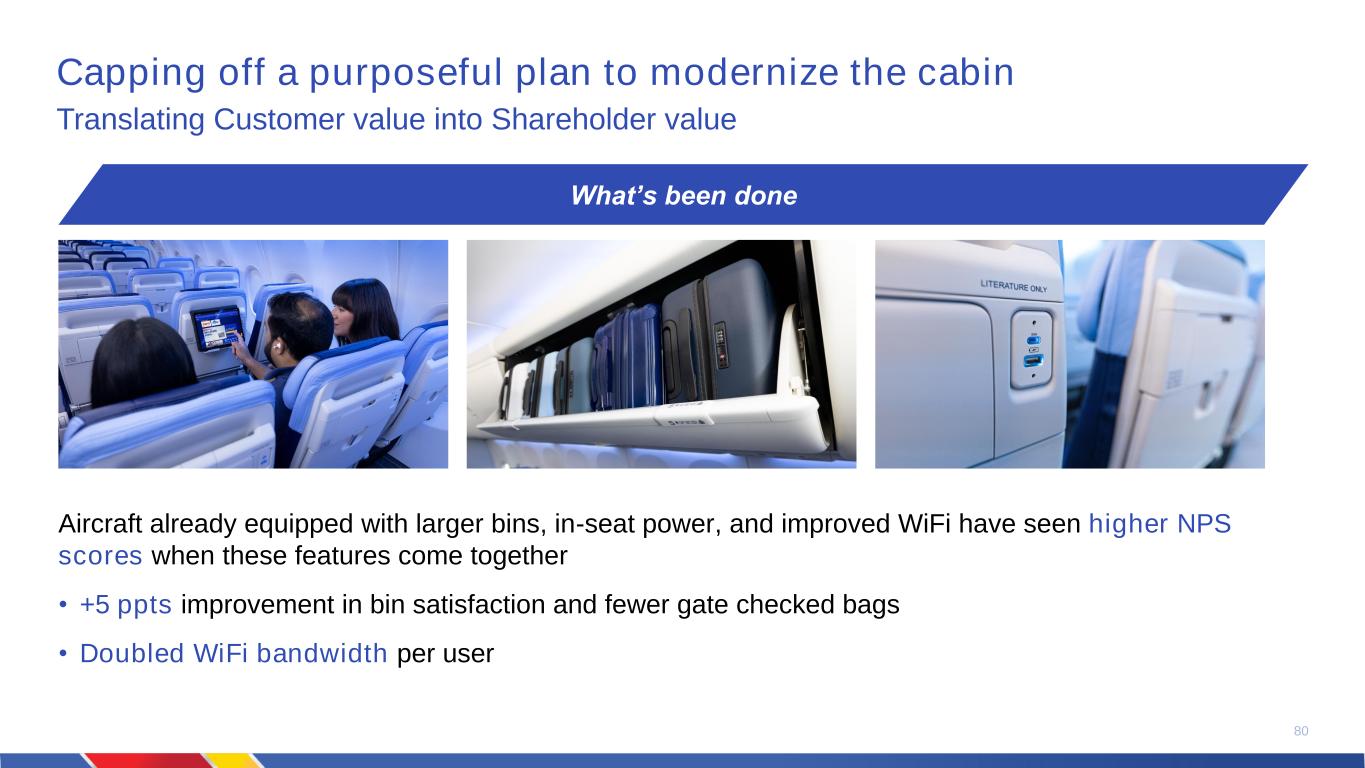
80 Capping off a purposeful plan to modernize the cabin Translating Customer value into Shareholder value Aircraft already equipped with larger bins, in-seat power, and improved WiFi have seen higher NPS scores when these features come together • +5 ppts improvement in bin satisfaction and fewer gate checked bags • Doubled WiFi bandwidth per user What’s been done
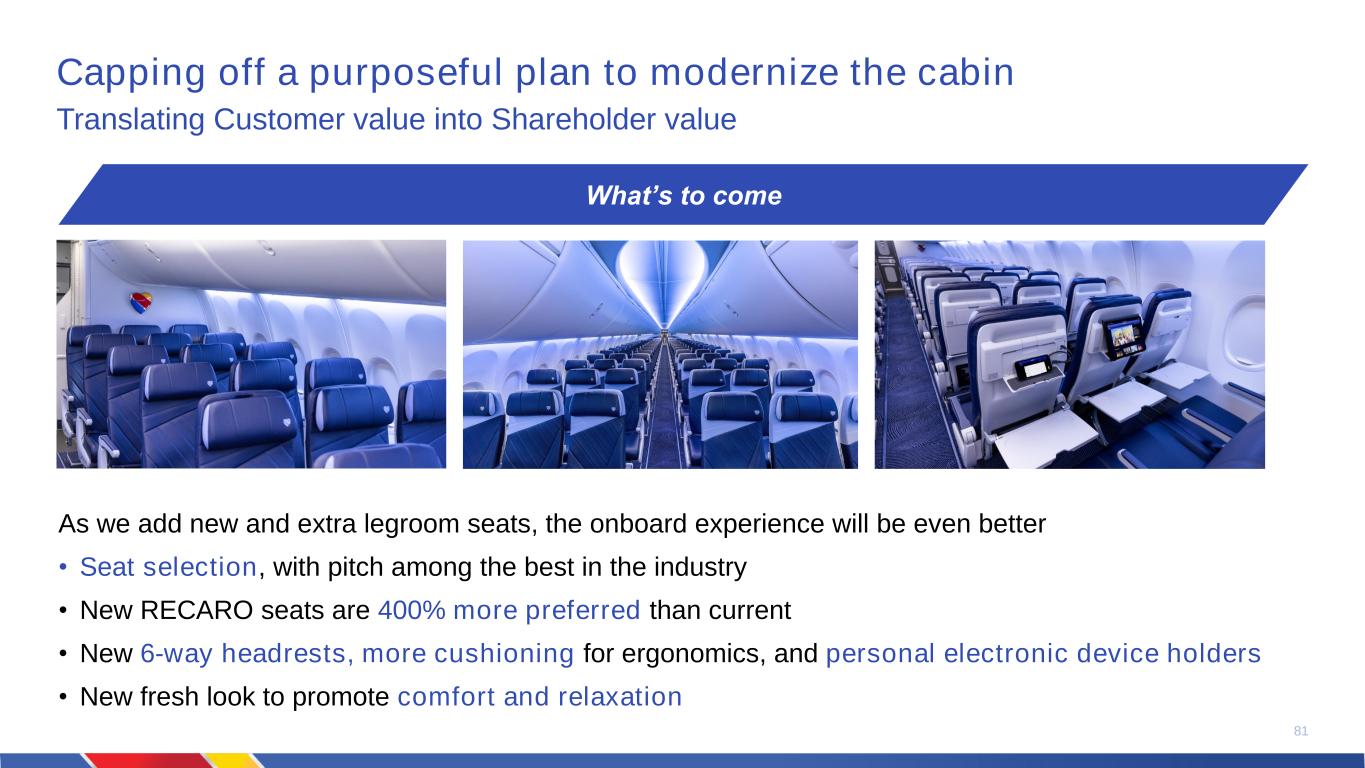
81 Capping off a purposeful plan to modernize the cabin Translating Customer value into Shareholder value As we add new and extra legroom seats, the onboard experience will be even better • Seat selection, with pitch among the best in the industry • New RECARO seats are 400% more preferred than current • New 6-way headrests, more cushioning for ergonomics, and personal electronic device holders • New fresh look to promote comfort and relaxation What’s to come
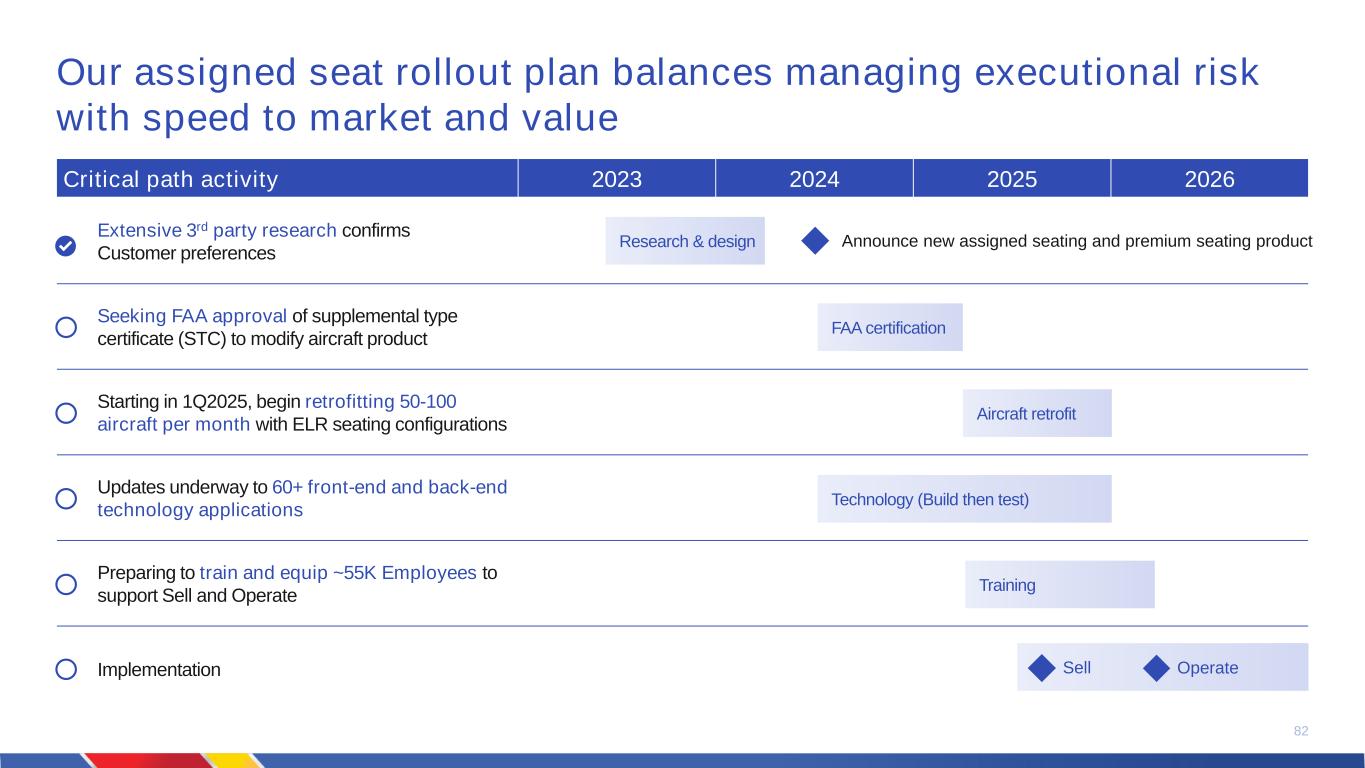
82 Our assigned seat rollout plan balances managing executional risk with speed to market and value Critical path activity 2023 2024 2025 2026 Extensive 3rd party research confirms Customer preferences Seeking FAA approval of supplemental type certificate (STC) to modify aircraft product Starting in 1Q2025, begin retrofitting 50-100 aircraft per month with ELR seating configurations Updates underway to 60+ front-end and back-end technology applications Preparing to train and equip ~55K Employees to support Sell and Operate Implementation Research & design Aircraft retrofit Technology (Build then test) Training Sell Operate Announce new assigned seating and premium seating product FAA certification
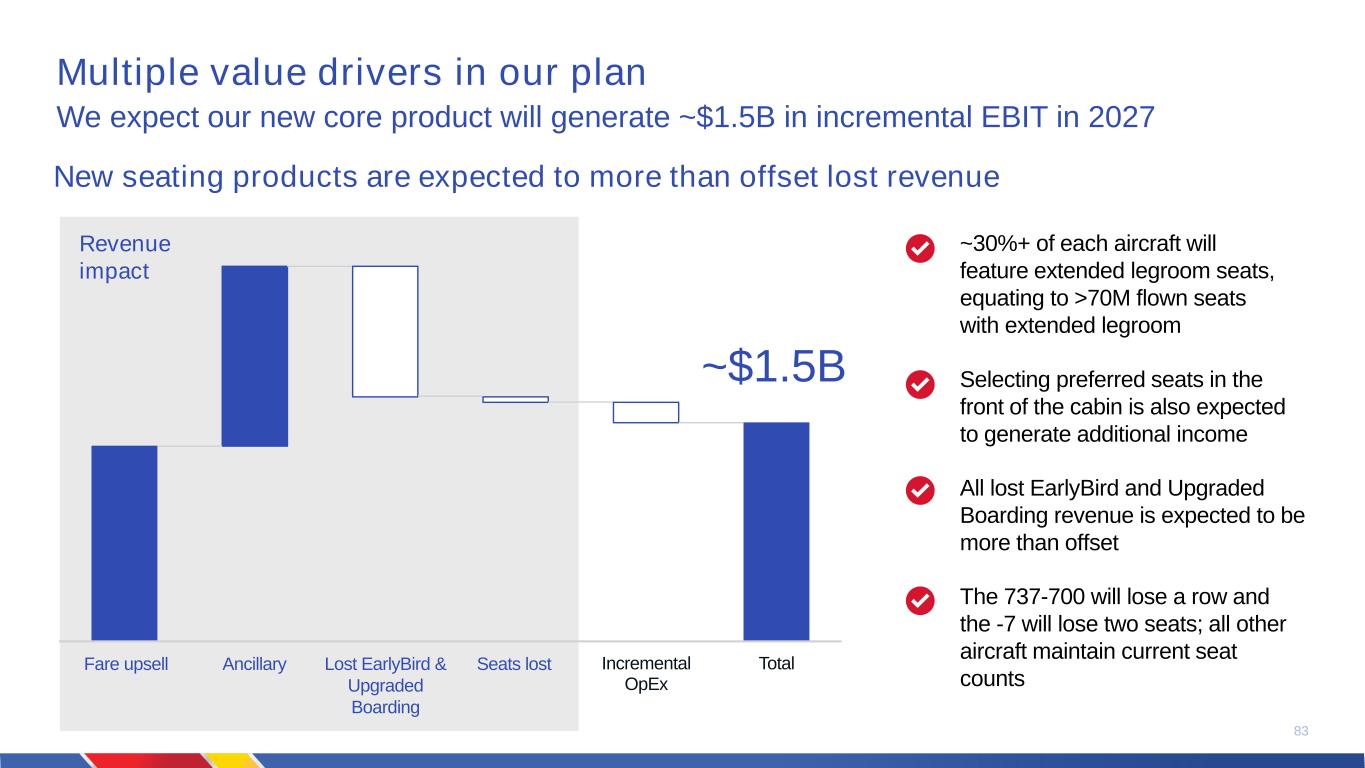
83 Multiple value drivers in our plan We expect our new core product will generate ~$1.5B in incremental EBIT in 2027 New seating products are expected to more than offset lost revenue ~30%+ of each aircraft will feature extended legroom seats, equating to >70M flown seats with extended legroom Selecting preferred seats in the front of the cabin is also expected to generate additional income All lost EarlyBird and Upgraded Boarding revenue is expected to be more than offset The 737-700 will lose a row and the -7 will lose two seats; all other aircraft maintain current seat counts Fare upsell Ancillary Lost EarlyBird & Upgraded Boarding Seats lost Incremental OpEx Total ~$1.5B ll r i l Revenue impact
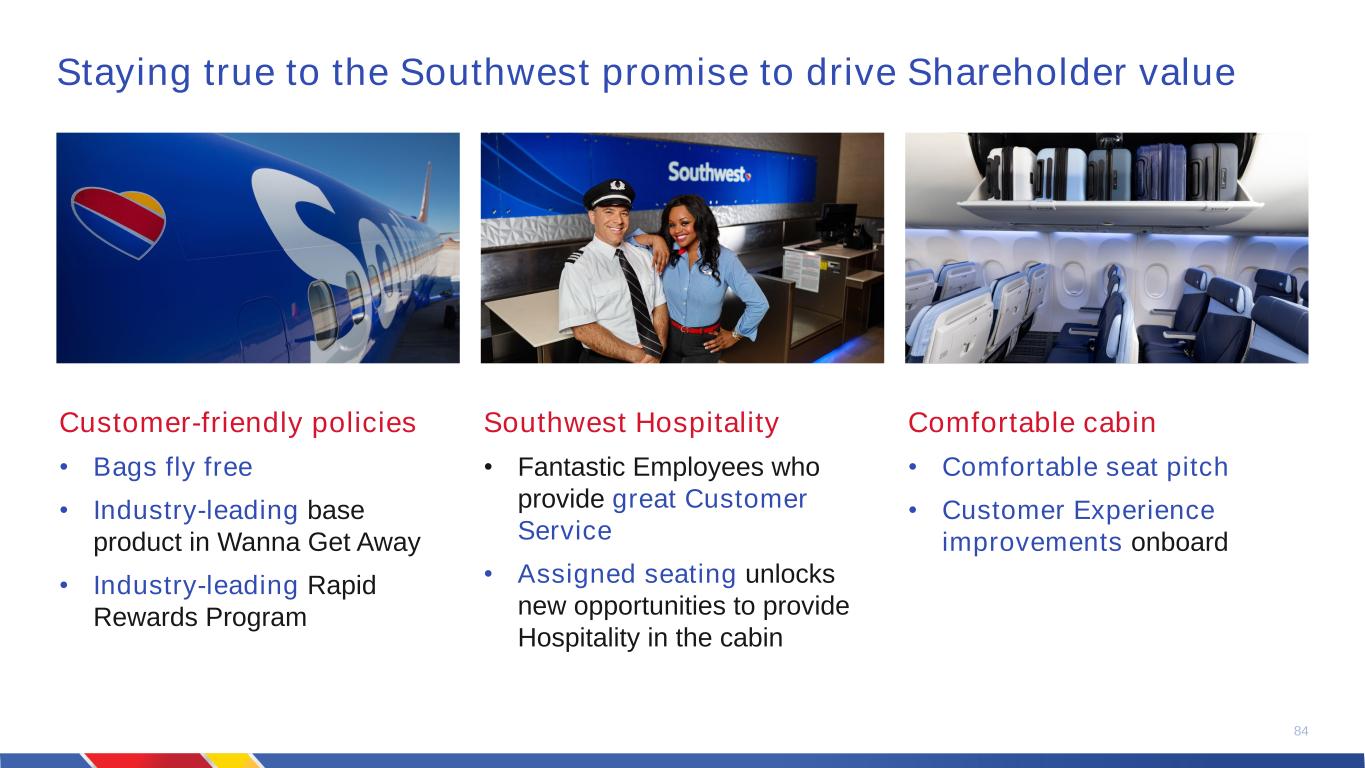
84 Staying true to the Southwest promise to drive Shareholder value Customer-friendly policies • Bags fly free • Industry-leading base product in Wanna Get Away • Industry-leading Rapid Rewards Program Southwest Hospitality • Fantastic Employees who provide great Customer Service • Assigned seating unlocks new opportunities to provide Hospitality in the cabin Comfortable cabin • Comfortable seat pitch • Customer Experience improvements onboard
Extending our value proposition beyond the core product
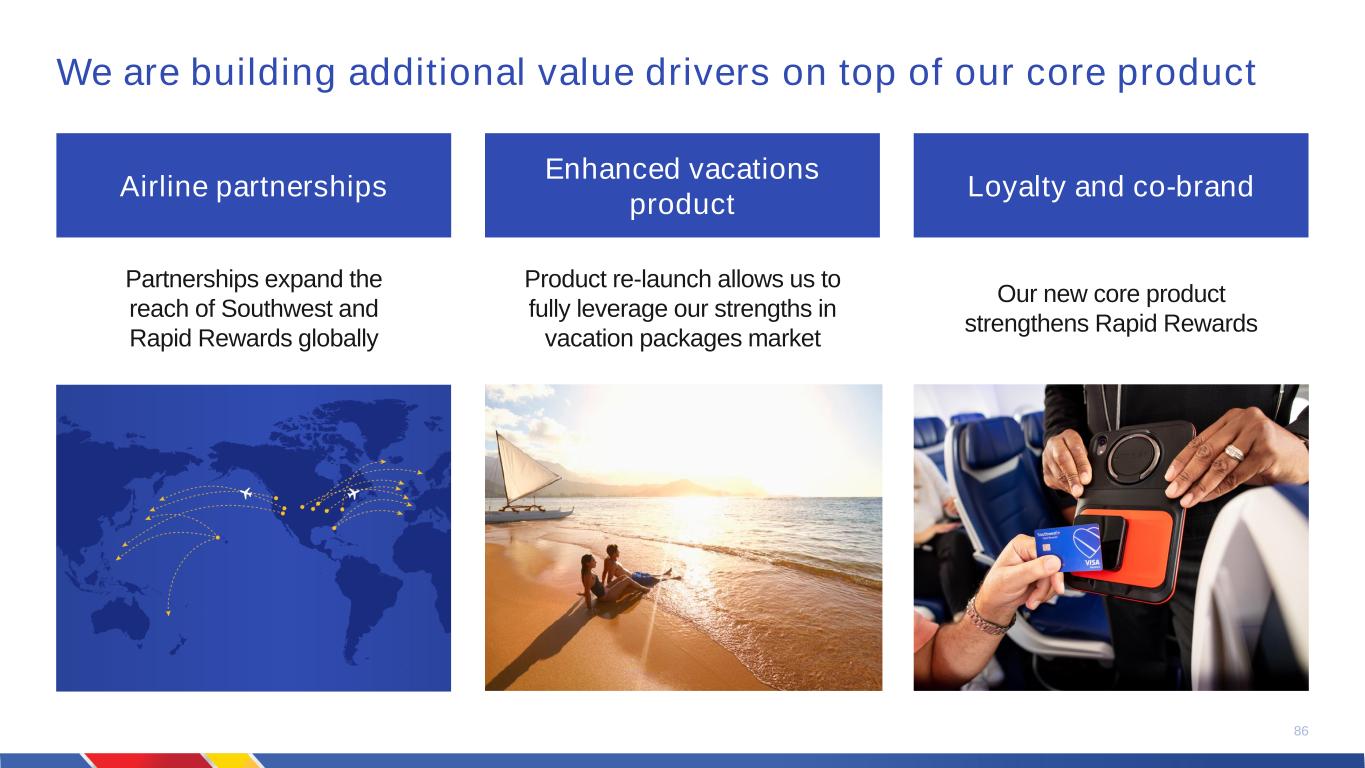
Enhanced vacations product Product re-launch allows us to fully leverage our strengths in vacation packages market 86 We are building additional value drivers on top of our core product Loyalty and co-brand Our new core product strengthens Rapid Rewards Airline partnerships Partnerships expand the reach of Southwest and Rapid Rewards globally
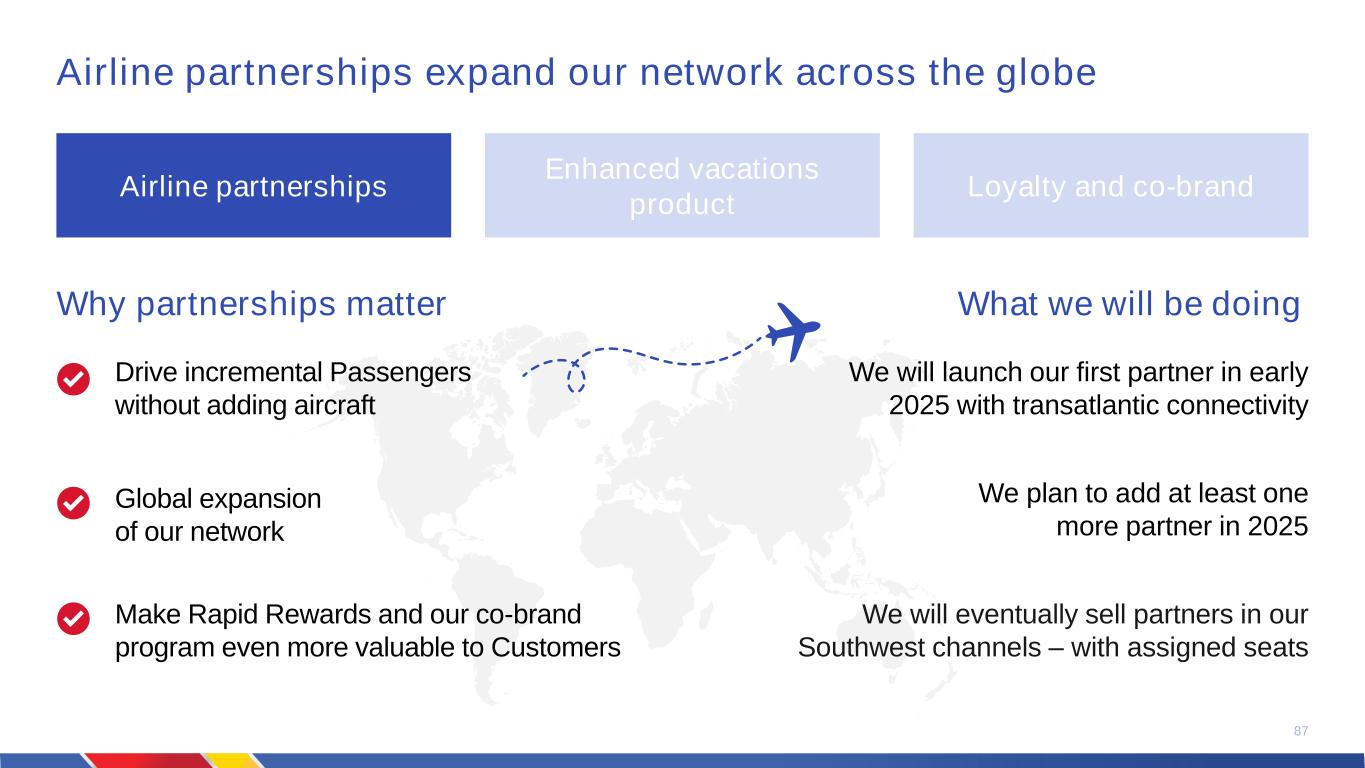
87 Airline partnerships expand our network across the globe We will launch our first partner in early 2025 with transatlantic connectivity We plan to add at least one more partner in 2025 We will eventually sell partners in our Southwest channels – with assigned seats Drive incremental Passengers without adding aircraft Global expansion of our network Make Rapid Rewards and our co-brand program even more valuable to Customers What we will be doingWhy partnerships matter Enhanced vacations product Loyalty and co-brandAirline partnerships
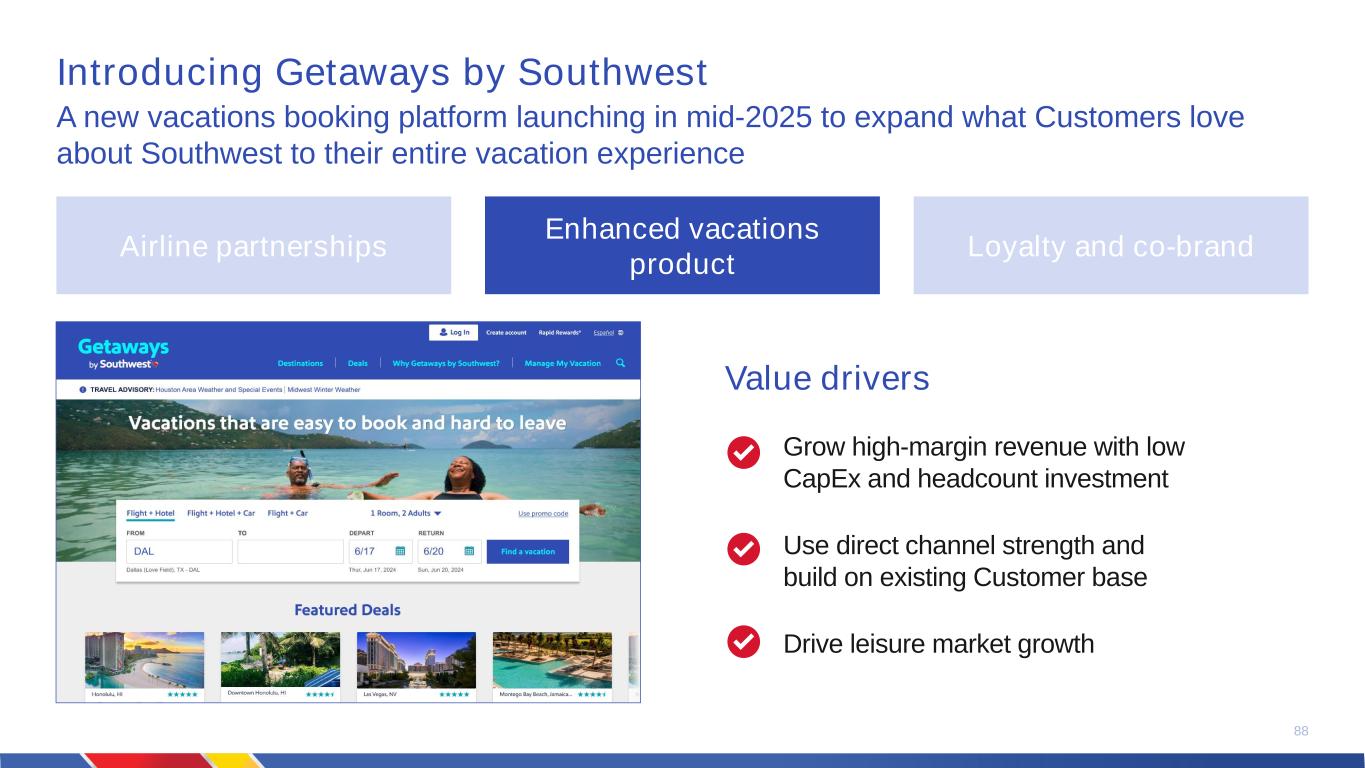
88 Introducing Getaways by Southwest A new vacations booking platform launching in mid-2025 to expand what Customers love about Southwest to their entire vacation experience Value drivers Grow high-margin revenue with low CapEx and headcount investment Use direct channel strength and build on existing Customer base Drive leisure market growth Enhanced vacations product Loyalty and co-brandAirline partnerships
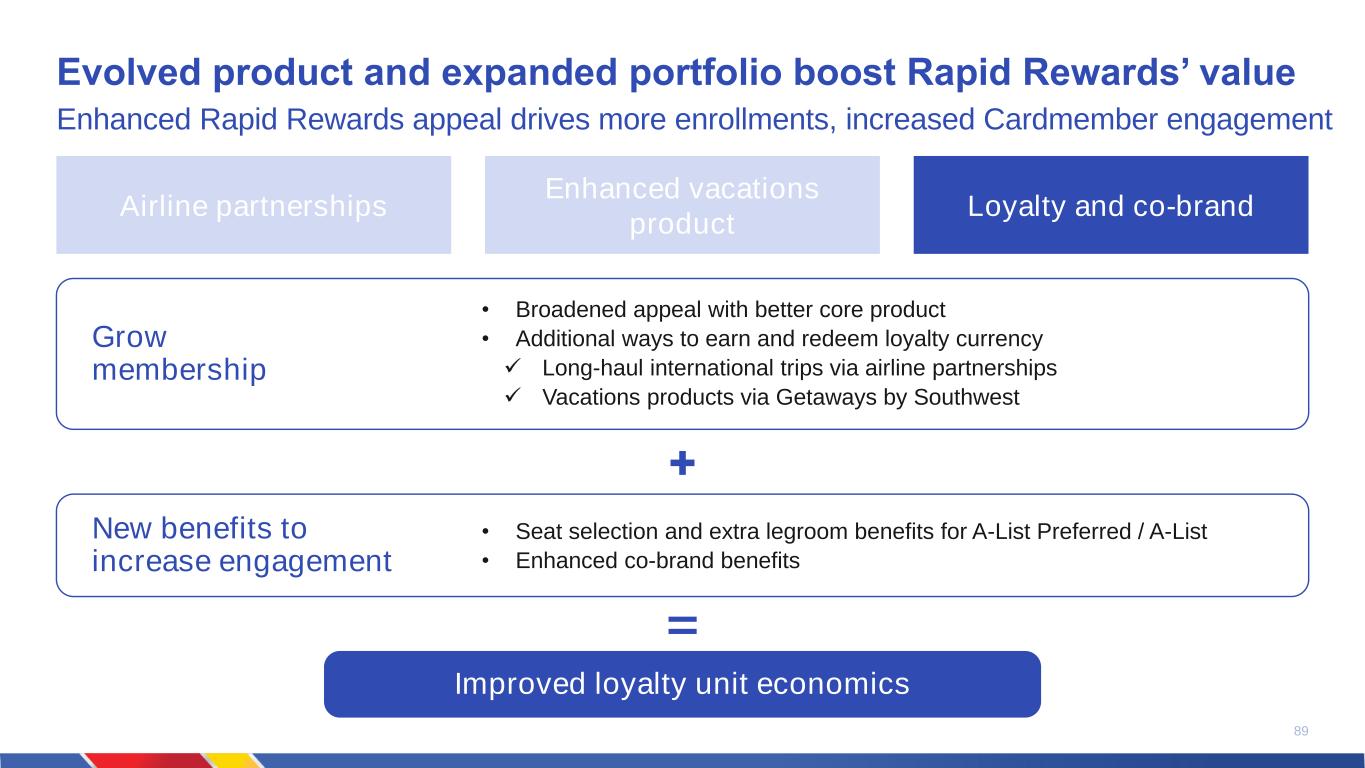
89 Evolved product and expanded portfolio boost Rapid Rewards’ value Enhanced Rapid Rewards appeal drives more enrollments, increased Cardmember engagement Grow membership • Broadened appeal with better core product • Additional ways to earn and redeem loyalty currency ✓ Long-haul international trips via airline partnerships ✓ Vacations products via Getaways by Southwest New benefits to increase engagement • Seat selection and extra legroom benefits for A-List Preferred / A-List • Enhanced co-brand benefits Improved loyalty unit economics Enhanced vacations product Loyalty and co-brandAirline partnerships
90 Key takeaways Customers want new products, and we will meet their needs We are building additional value drivers on top of our core product Changes will be made in a uniquely Southwest way The plan supports significant economic value creation
Tammy Romo Transforming for sustainable profitability and Shareholder returns
Building on a strong financial foundation
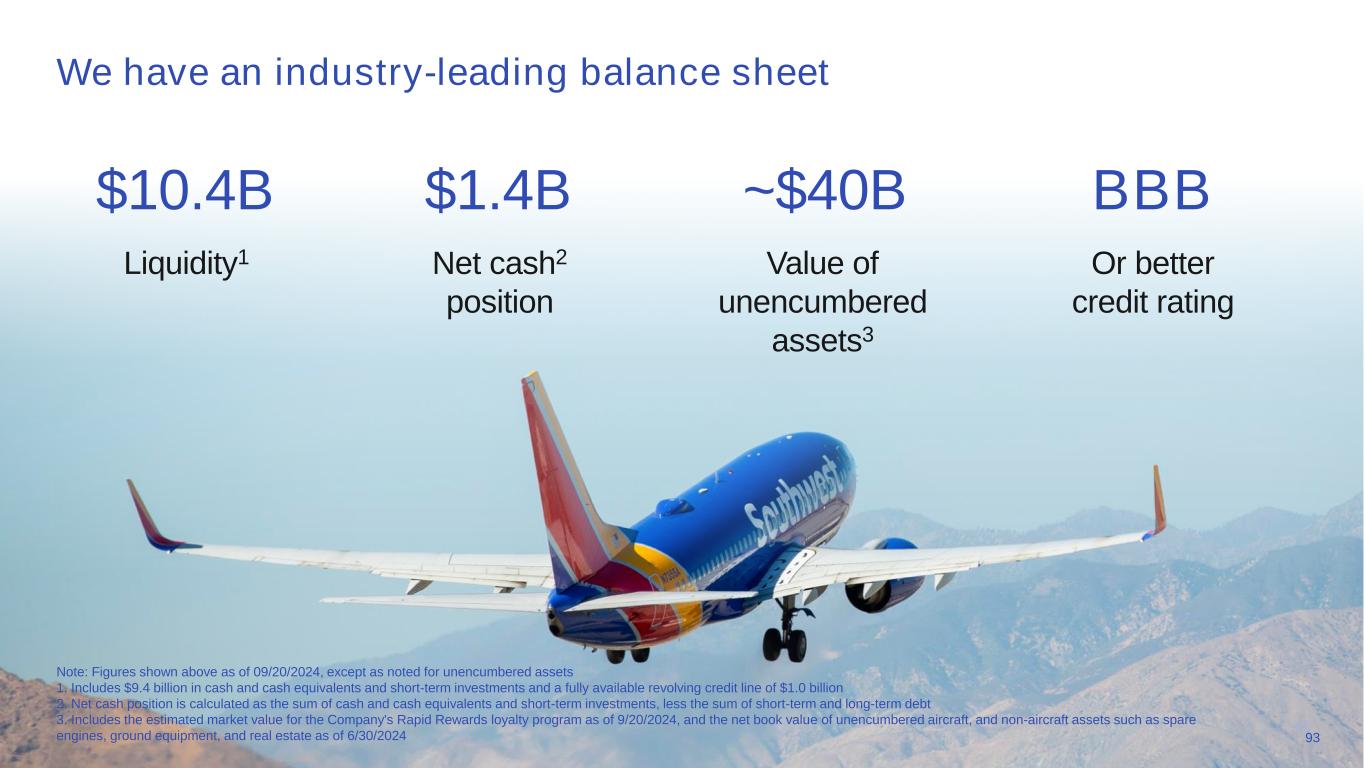
93 We have an industry-leading balance sheet Note: Figures shown above as of 09/20/2024, except as noted for unencumbered assets 1. Includes $9.4 billion in cash and cash equivalents and short-term investments and a fully available revolving credit line of $1.0 billion 2. Net cash position is calculated as the sum of cash and cash equivalents and short-term investments, less the sum of short-term and long-term debt 3. Includes the estimated market value for the Company's Rapid Rewards loyalty program as of 9/20/2024, and the net book value of unencumbered aircraft, and non-aircraft assets such as spare engines, ground equipment, and real estate as of 6/30/2024 93 $10.4B $1.4B ~$40B BBB Liquidity1 Net cash2 position Value of unencumbered assets3 Or better credit rating
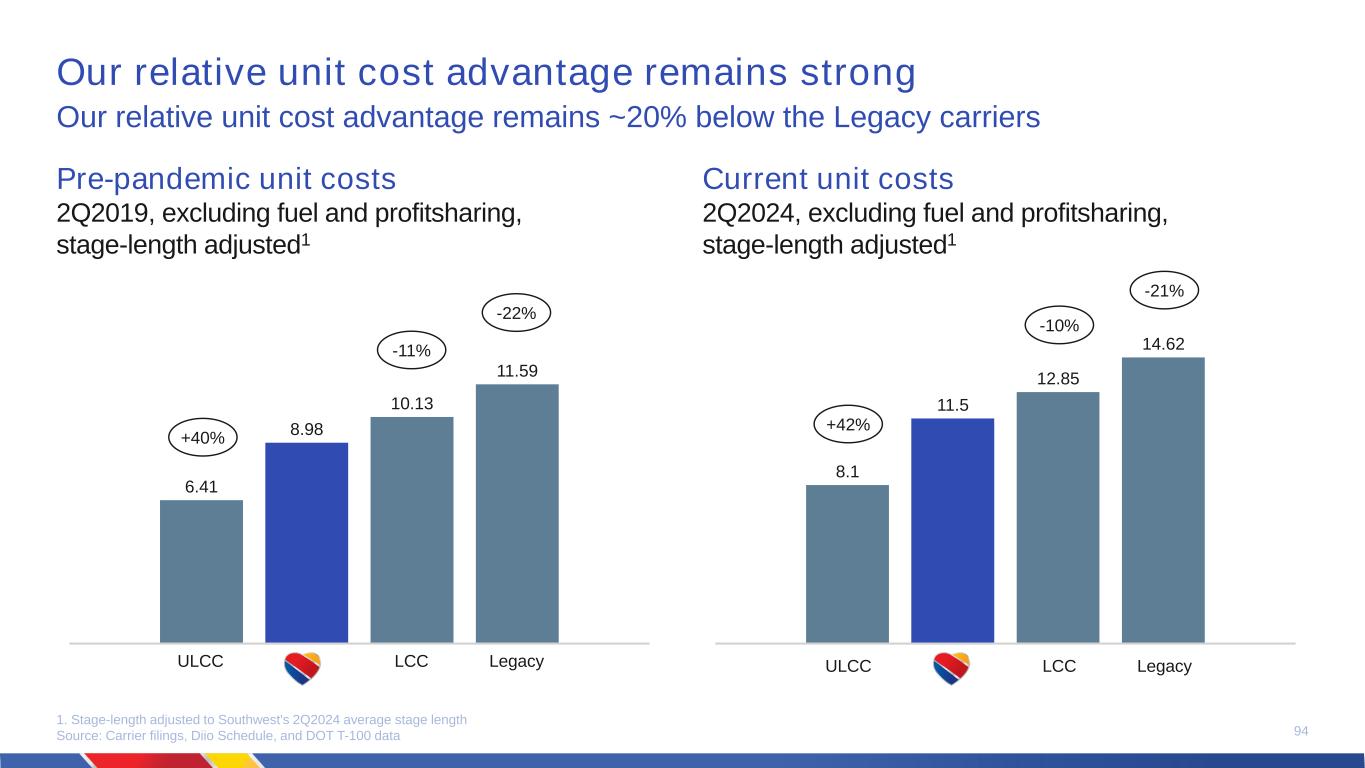
94 Our relative unit cost advantage remains strong Our relative unit cost advantage remains ~20% below the Legacy carriers 1. Stage-length adjusted to Southwest's 2Q2024 average stage length Source: Carrier filings, Diio Schedule, and DOT T-100 data 6.41 8.98 10.13 11.59 ULCC LCC Legacy 8.1 11.5 12.85 14.62 ULCC LCC Legacy +40% -11% -22% +42% -10% -21% Pre-pandemic unit costs 2Q2019, excluding fuel and profitsharing, stage-length adjusted1 Current unit costs 2Q2024, excluding fuel and profitsharing, stage-length adjusted1
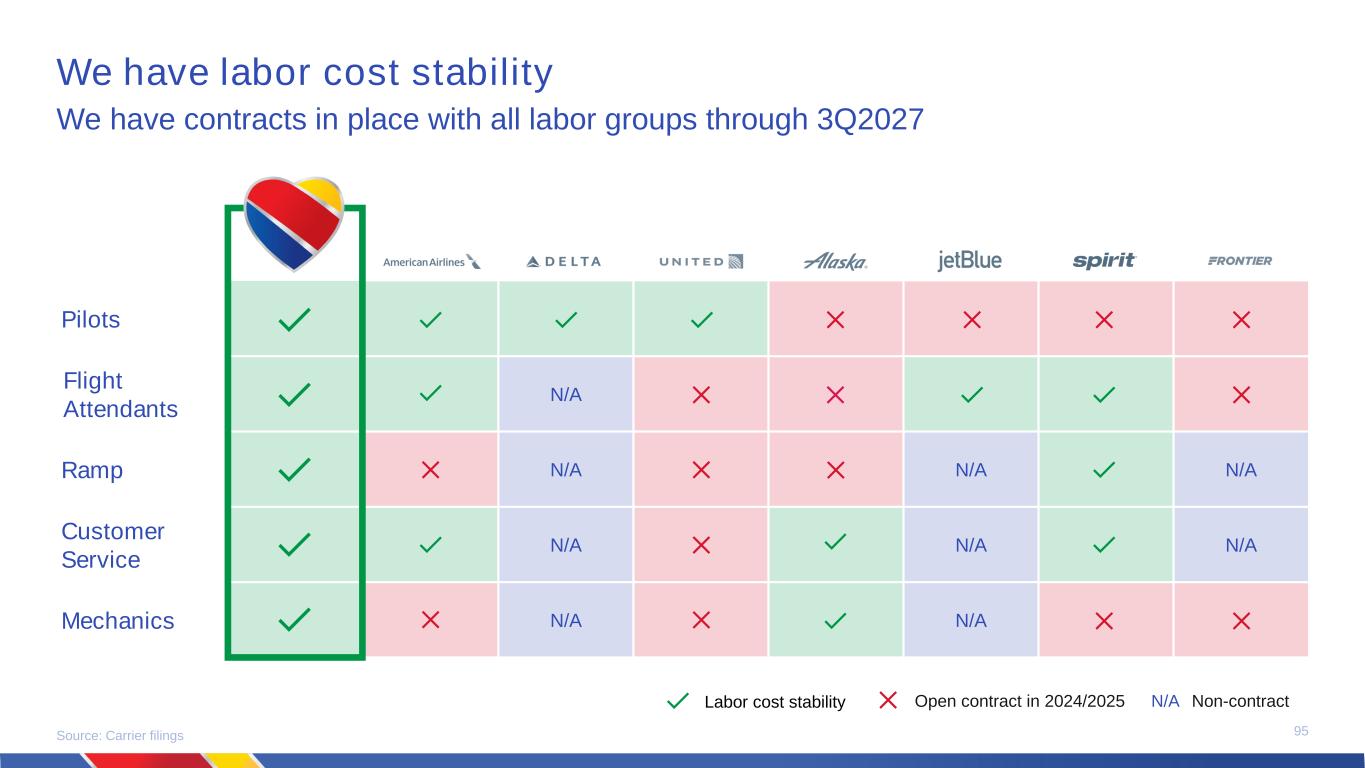
Pilots Flight Attendants N/A Ramp N/A N/A N/A Customer Service N/A N/A N/A Mechanics N/A N/A 95 We have labor cost stability We have contracts in place with all labor groups through 3Q2027 Source: Carrier filings Labor cost stability Open contract in 2024/2025 Non-contractN/A
Executing our plan to drive Shareholder returns
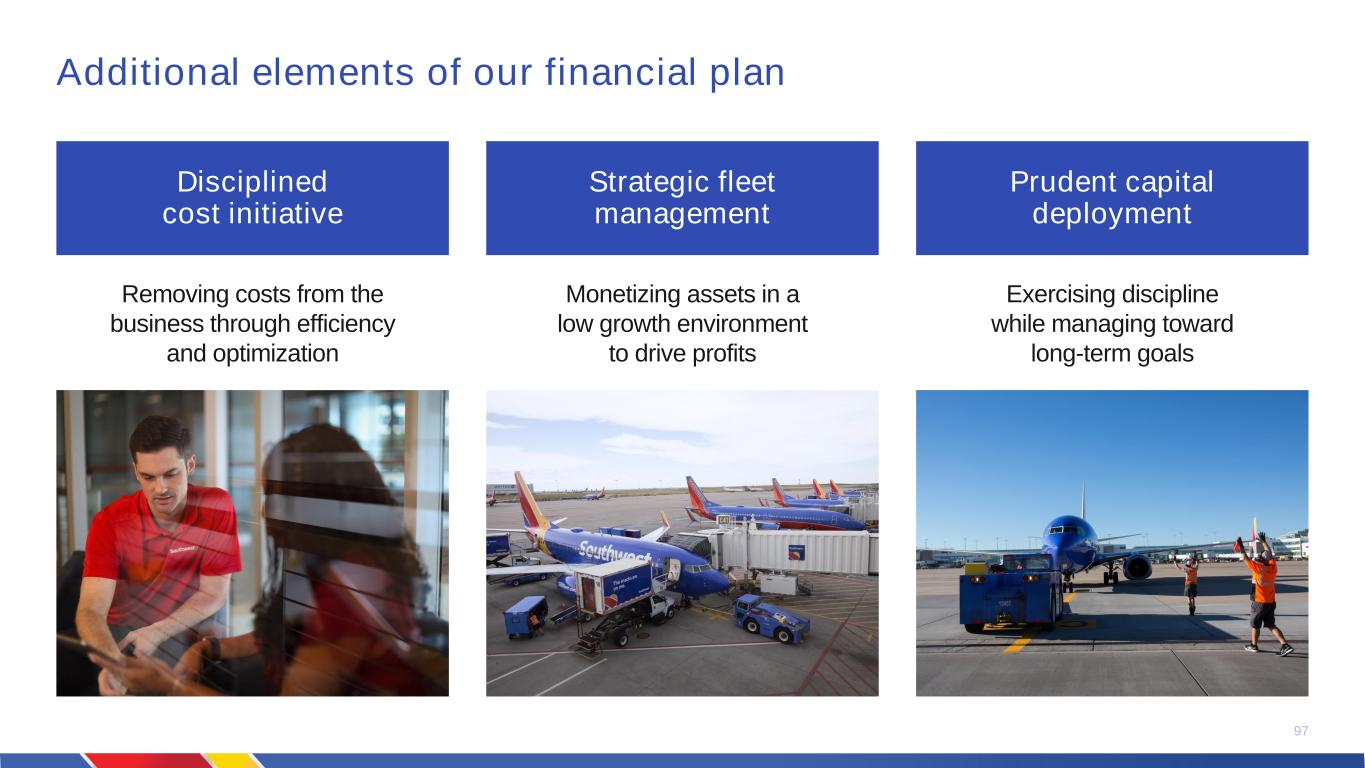
97 Additional elements of our financial plan Removing costs from the business through efficiency and optimization Monetizing assets in a low growth environment to drive profits Exercising discipline while managing toward long-term goals Disciplined cost initiative Strategic fleet management Prudent capital deployment
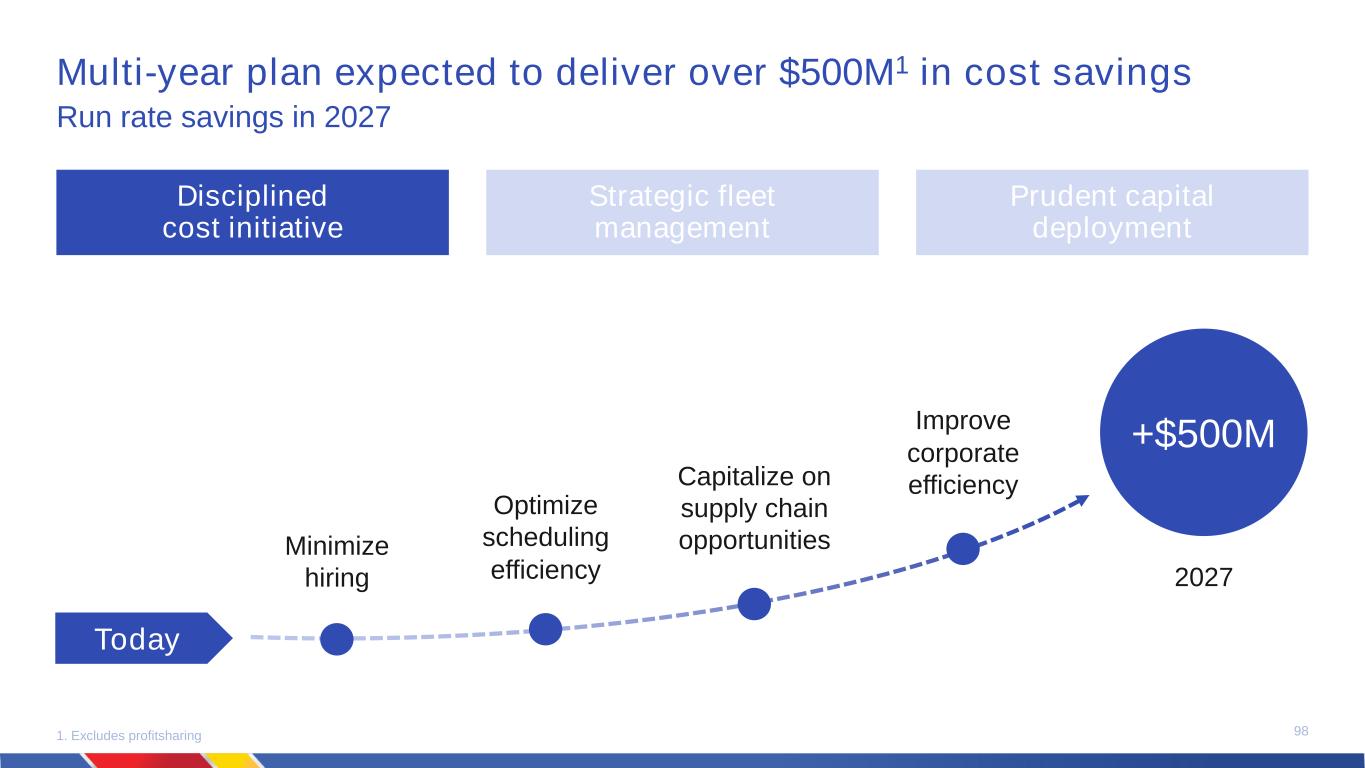
98 Multi-year plan expected to deliver over $500M1 in cost savings Run rate savings in 2027 1. Excludes profitsharing Today +$500M 2027 Minimize hiring Optimize scheduling efficiency Capitalize on supply chain opportunities Improve corporate efficiency Disciplined cost initiative Strategic fleet management Prudent capital deployment
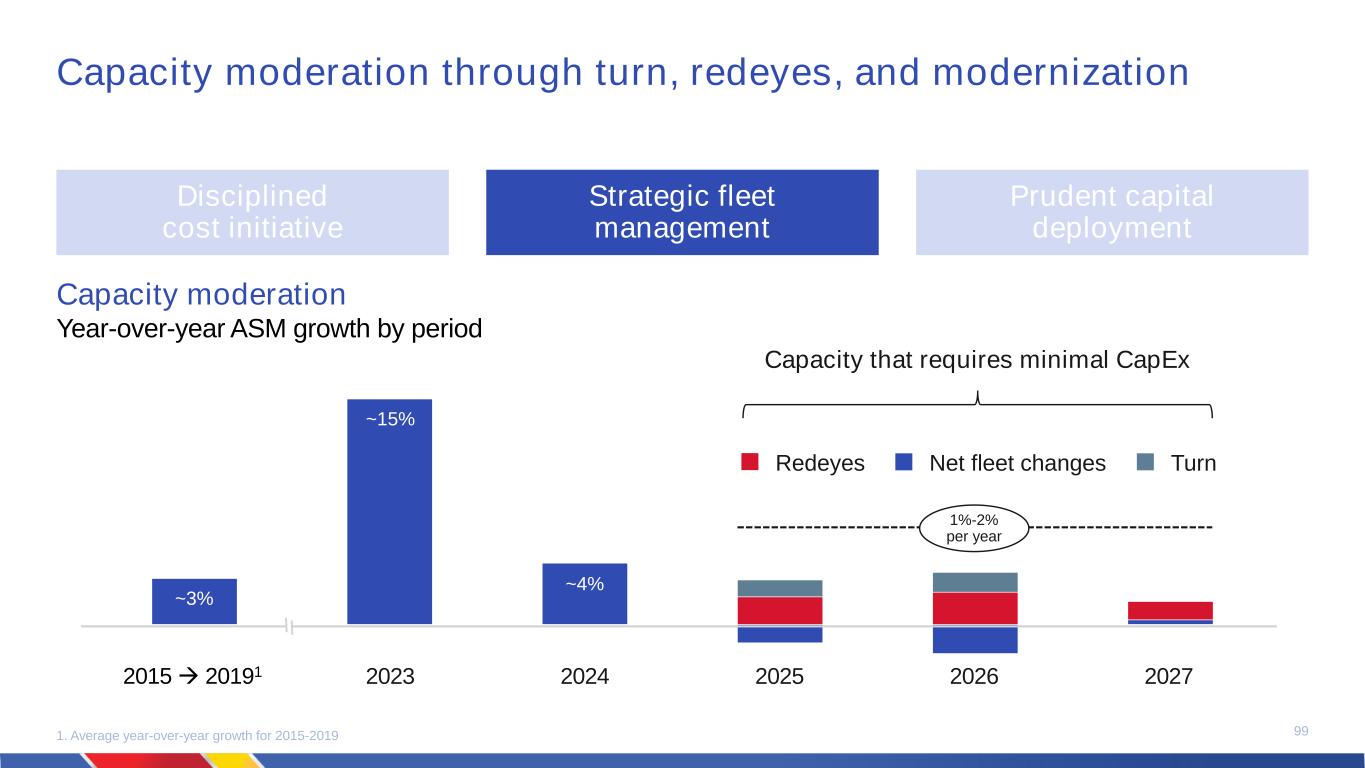
99 Capacity moderation through turn, redeyes, and modernization 1. Average year-over-year growth for 2015-2019 Capacity moderation Year-over-year ASM growth by period TurnRedeyes Net fleet changes 2015 → 20191 2023 2024 2025 2026 2027 Capacity that requires minimal CapEx 1%-2% per year Disciplined cost initiative Strategic fleet management Prudent capital deployment ~3% ~15% ~4%
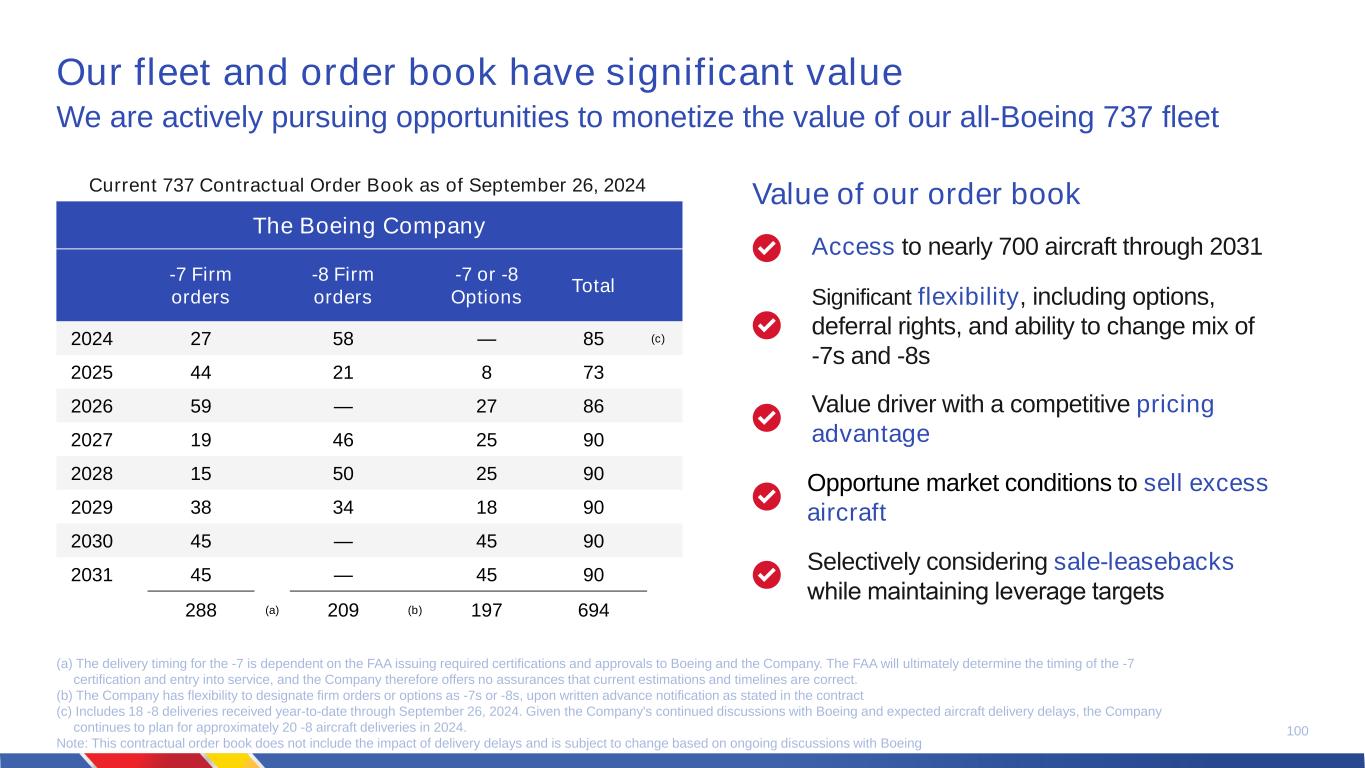
100 Our fleet and order book have significant value We are actively pursuing opportunities to monetize the value of our all-Boeing 737 fleet (a) The delivery timing for the -7 is dependent on the FAA issuing required certifications and approvals to Boeing and the Company. The FAA will ultimately determine the timing of the -7 certification and entry into service, and the Company therefore offers no assurances that current estimations and timelines are correct. (b) The Company has flexibility to designate firm orders or options as -7s or -8s, upon written advance notification as stated in the contract (c) Includes 18 -8 deliveries received year-to-date through September 26, 2024. Given the Company's continued discussions with Boeing and expected aircraft delivery delays, the Company continues to plan for approximately 20 -8 aircraft deliveries in 2024. Note: This contractual order book does not include the impact of delivery delays and is subject to change based on ongoing discussions with Boeing The Boeing Company -7 Firm orders -8 Firm orders -7 or -8 Options Total 2024 27 58 — 85 (c) 2025 44 21 8 73 2026 59 — 27 86 2027 19 46 25 90 2028 15 50 25 90 2029 38 34 18 90 2030 45 — 45 90 2031 45 — 45 90 288 (a) 209 (b) 197 694 Value of our order book Access to nearly 700 aircraft through 2031 Significant flexibility, including options, deferral rights, and ability to change mix of -7s and -8s Value driver with a competitive pricing advantage Opportune market conditions to sell excess aircraft Selectively considering sale-leasebacks while maintaining leverage targets Current 737 Contractual Order Book as of September 26, 2024
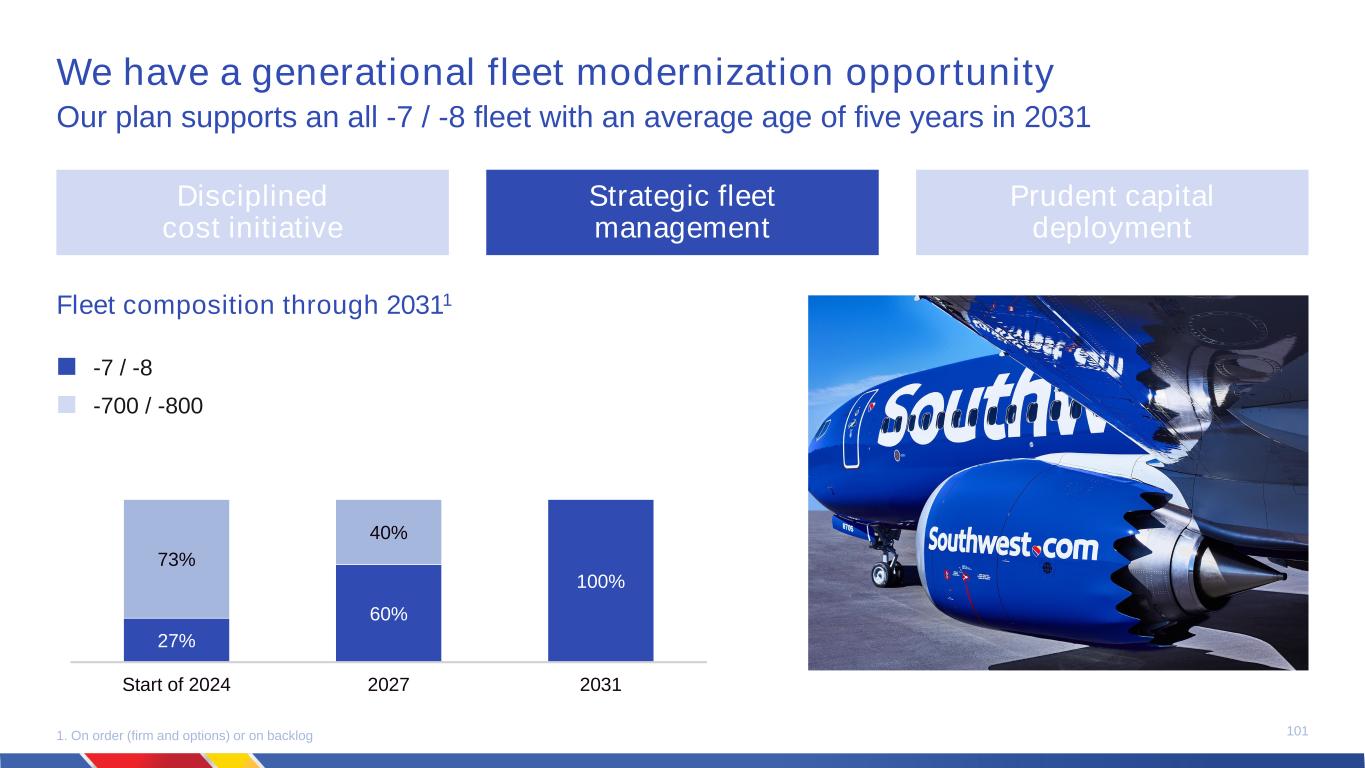
27% 60% 73% 40% 100% Start of 2024 2027 2031 101 We have a generational fleet modernization opportunity Our plan supports an all -7 / -8 fleet with an average age of five years in 2031 1. On order (firm and options) or on backlog Fleet composition through 20311 Disciplined cost initiative Strategic fleet management Prudent capital deployment -700 / -800 -7 / -8
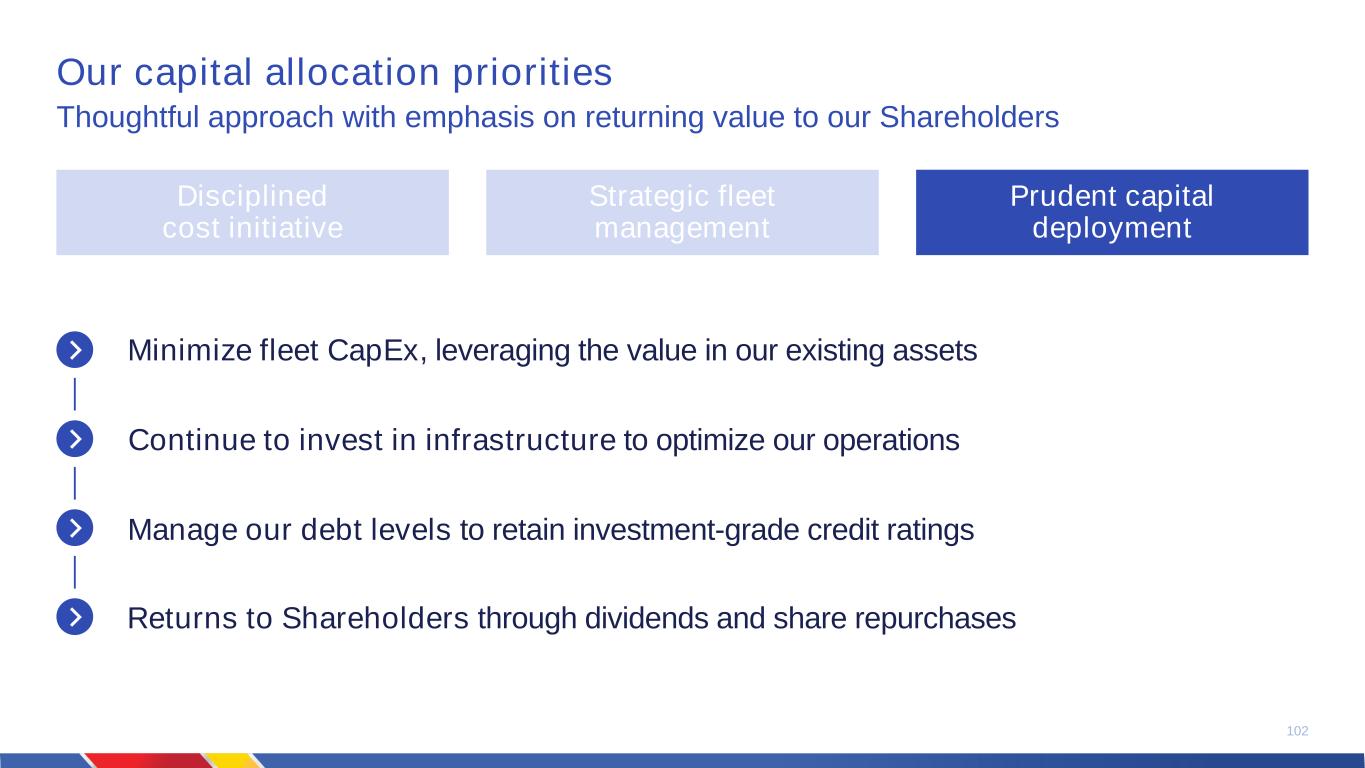
102 Our capital allocation priorities Thoughtful approach with emphasis on returning value to our Shareholders Disciplined cost initiative Strategic fleet management Prudent capital deployment Minimize fleet CapEx, leveraging the value in our existing assets Continue to invest in infrastructure to optimize our operations Manage our debt levels to retain investment-grade credit ratings Returns to Shareholders through dividends and share repurchases
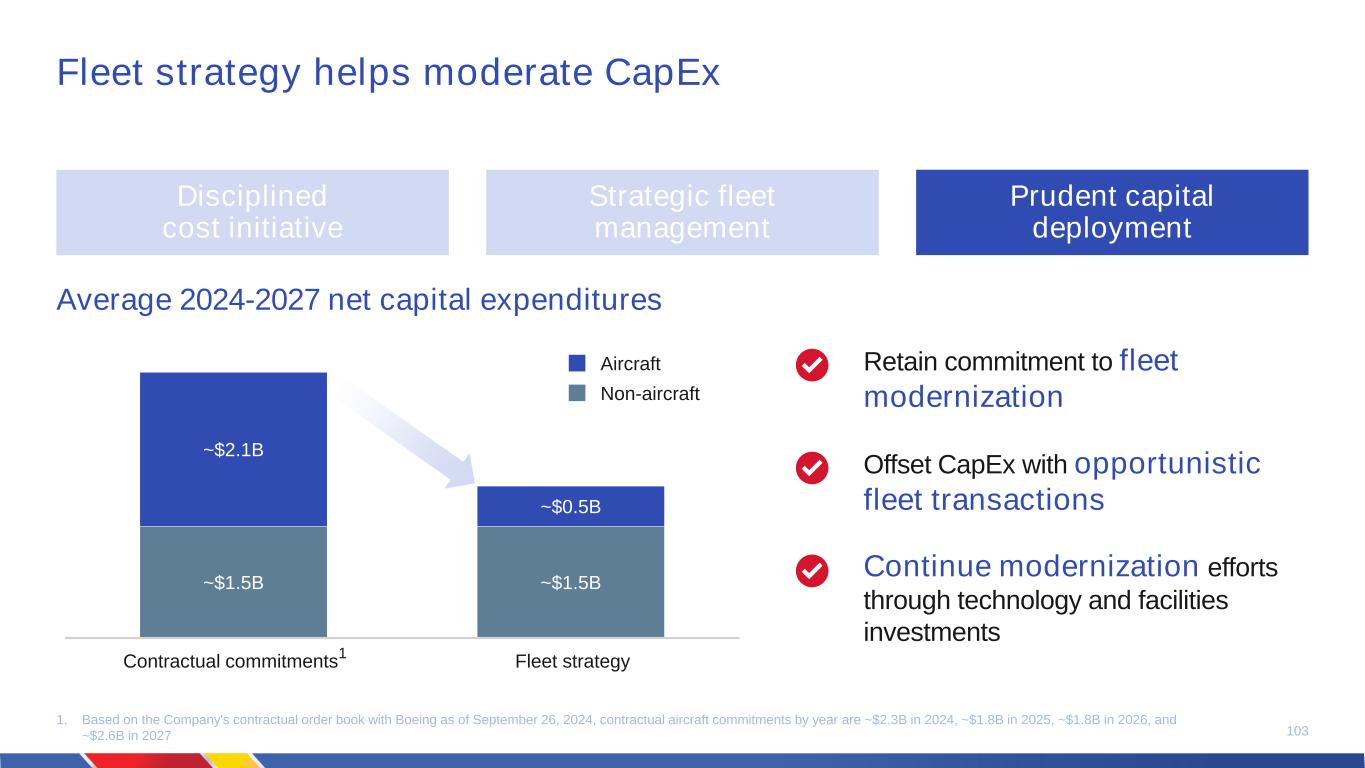
~$1.5B ~$1.5B ~$2.1B ~$0.5B 103 Fleet strategy helps moderate CapEx 1. Based on the Company's contractual order book with Boeing as of September 26, 2024, contractual aircraft commitments by year are ~$2.3B in 2024, ~$1.8B in 2025, ~$1.8B in 2026, and ~$2.6B in 2027 Aircraft Non-aircraft Contractual commitments Fleet strategy Average 2024-2027 net capital expenditures Disciplined cost initiative Strategic fleet management Prudent capital deployment Retain commitment to fleet modernization Offset CapEx with opportunistic fleet transactions Continue modernization efforts through technology and facilities investments 1
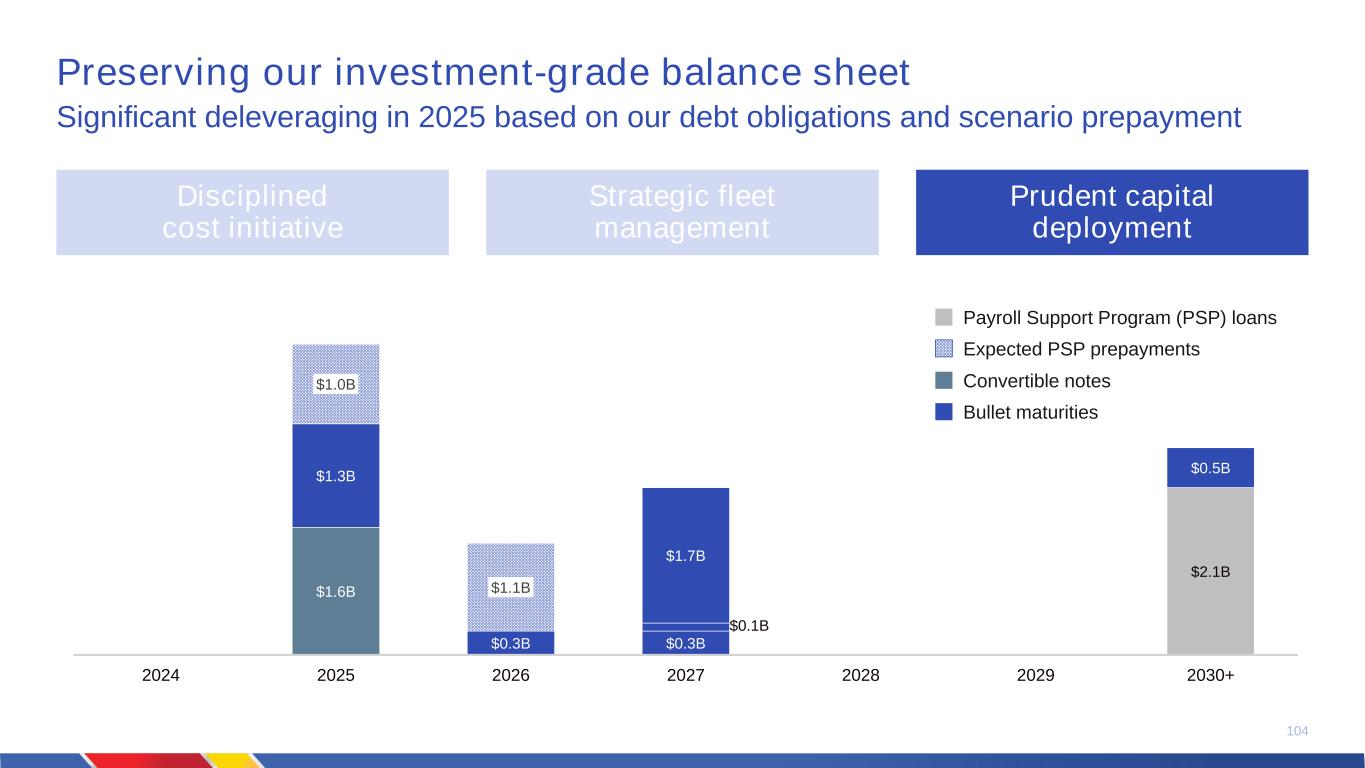
104 Preserving our investment-grade balance sheet Significant deleveraging in 2025 based on our debt obligations and scenario prepayment $0.3B $2.1B $1.6B $1.3B $0.3B $0.1B $0.5B $1.0B $1.1B $1.7B 2024 2025 2026 2027 2028 2029 2030+ Convertible notes Bullet maturities Payroll Support Program (PSP) loans Expected PSP prepayments Disciplined cost initiative Strategic fleet management Prudent capital deployment
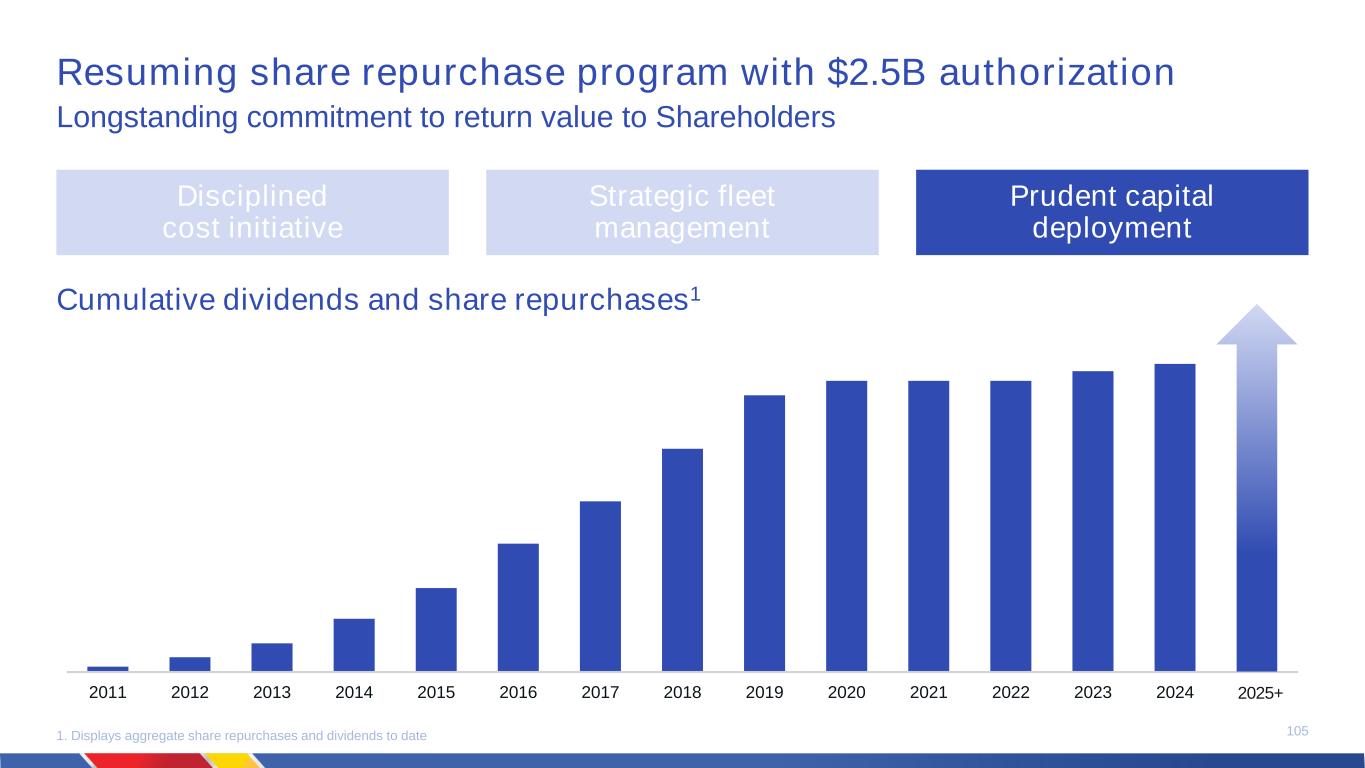
105 Resuming share repurchase program with $2.5B authorization Longstanding commitment to return value to Shareholders 1. Displays aggregate share repurchases and dividends to date Over $13B returned to shareholders since 20111 2011 2012 2013 2014 2015 2016 2017 2018 2019 2020 2021 2022 2023 2024 2027 Disciplined cost initiative Strategic fleet management Prudent capital deployment Cumulative dividends and share repurchases1 5+
Supporting a path to sustainable prosperity
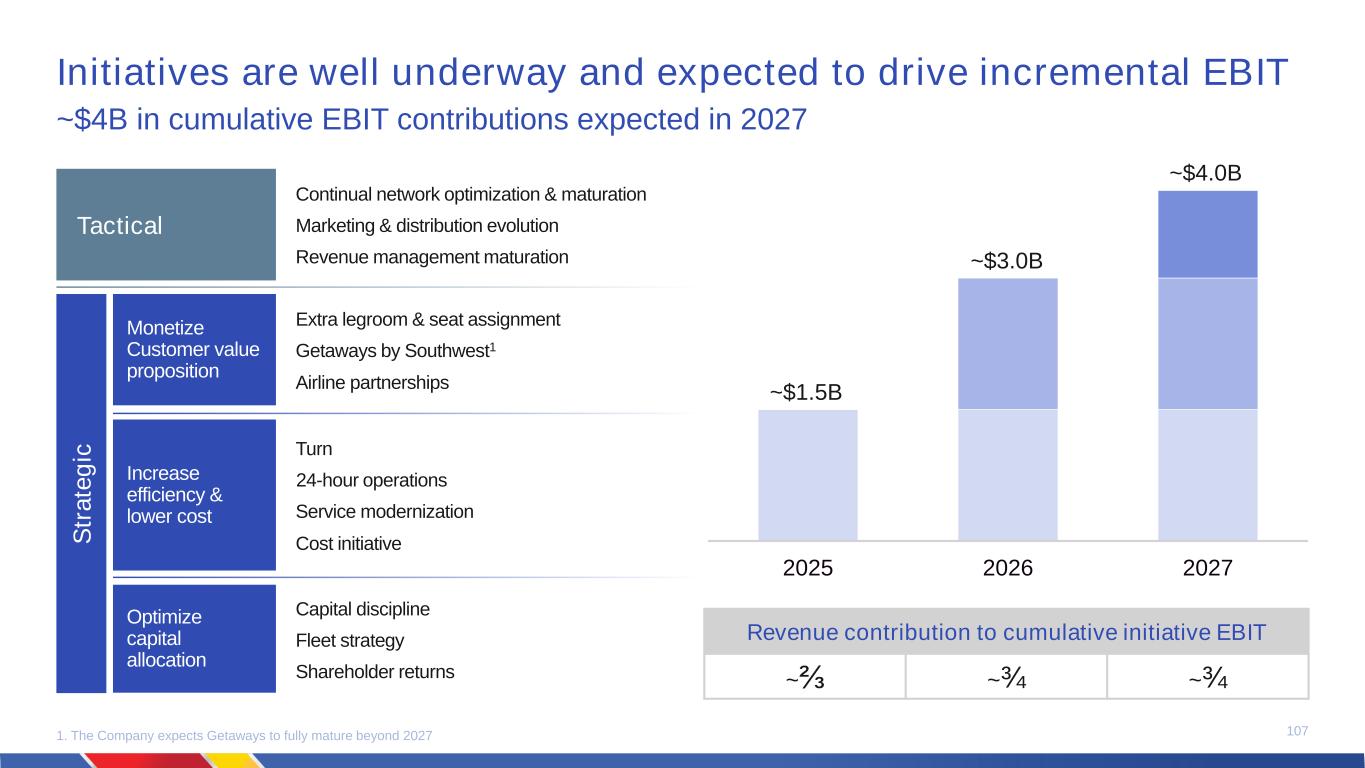
2025 2026 2027 107 Initiatives are well underway and expected to drive incremental EBIT ~$4B in cumulative EBIT contributions expected in 2027 1. The Company expects Getaways to fully mature beyond 2027 Monetize Customer value proposition Optimize capital allocation Increase efficiency & lower cost Tactical S tr a te g ic Getaways by Southwest1 Airline partnerships Extra legroom & seat assignment Capital discipline Fleet strategy Shareholder returns Turn 24-hour operations Service modernization Cost initiative Continual network optimization & maturation Marketing & distribution evolution Revenue management maturation Revenue contribution to cumulative initiative EBIT ~⅔ ~¾ ~¾ ~$1.5B ~$3.0B ~$4.0B
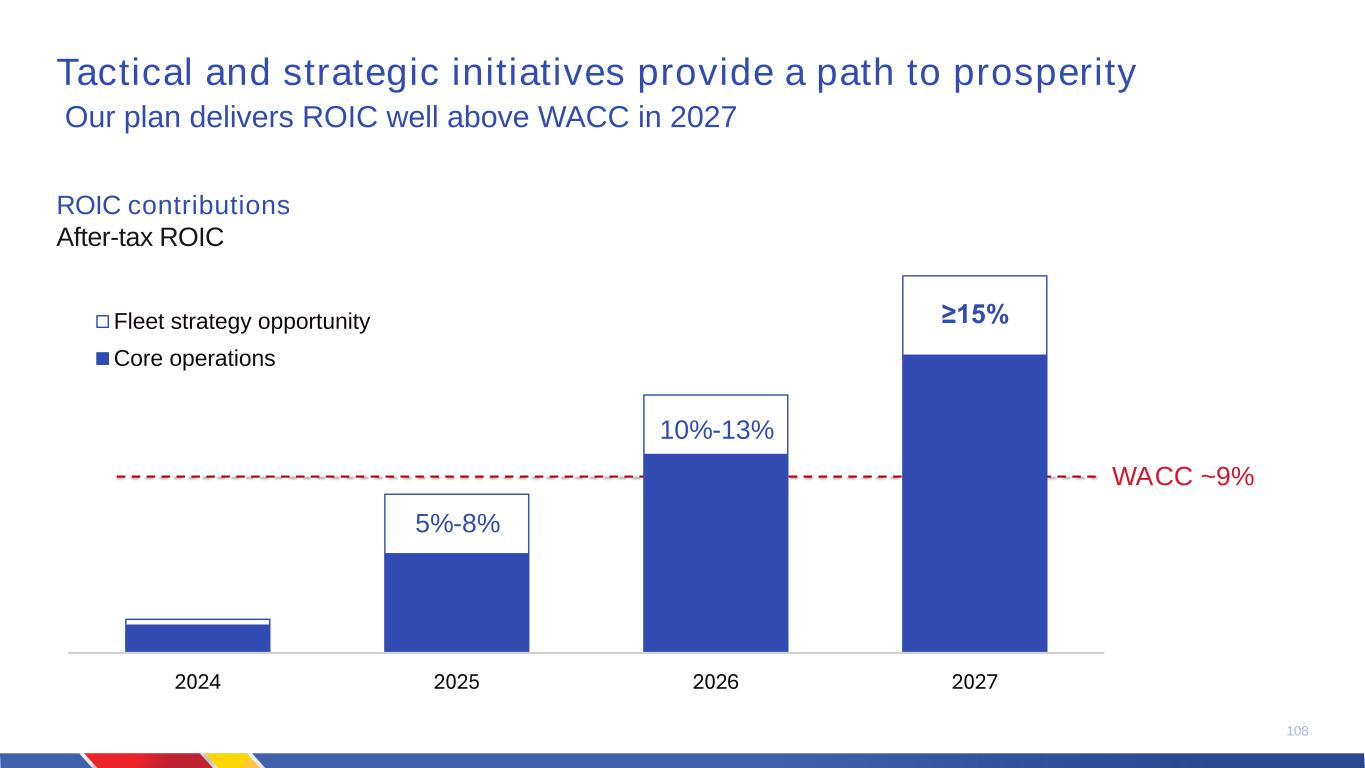
2024 2025 2026 2027 Fleet strategy opportunity Core operations 108 Tactical and strategic initiatives provide a path to prosperity Our plan delivers ROIC well above WACC in 2027 ROIC contributions After-tax ROIC WACC ~9% 5%-8% 10%-13% ≥15%
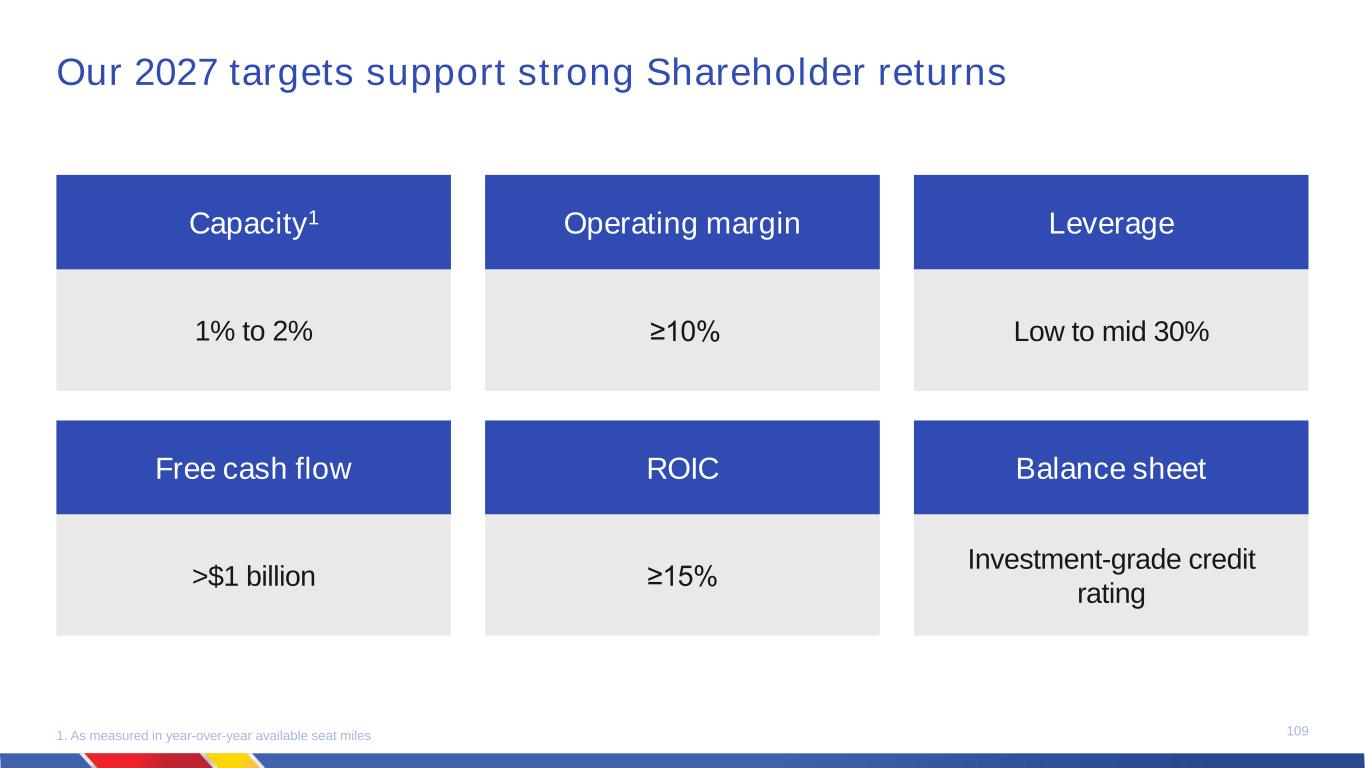
109 Our 2027 targets support strong Shareholder returns 1. As measured in year-over-year available seat miles 1% to 2% Capacity1 >$1 billion Free cash flow Low to mid 30% Leverage Investment-grade credit rating Balance sheet ~10% Operating margin ≥15% ROIC ≥
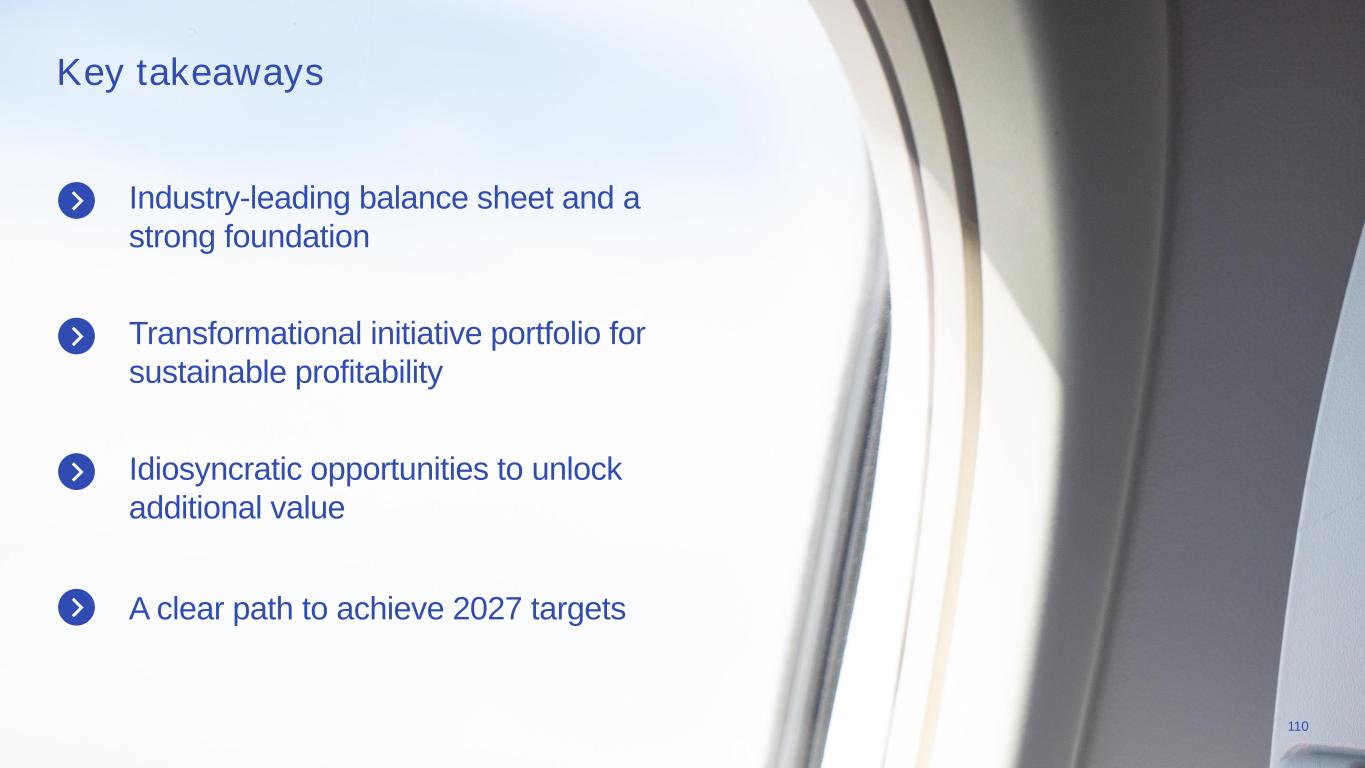
Key takeaways 110 Industry-leading balance sheet and a strong foundation Transformational initiative portfolio for sustainable profitability Idiosyncratic opportunities to unlock additional value A clear path to achieve 2027 targets
Bob Jordan Southwest. Even Better.
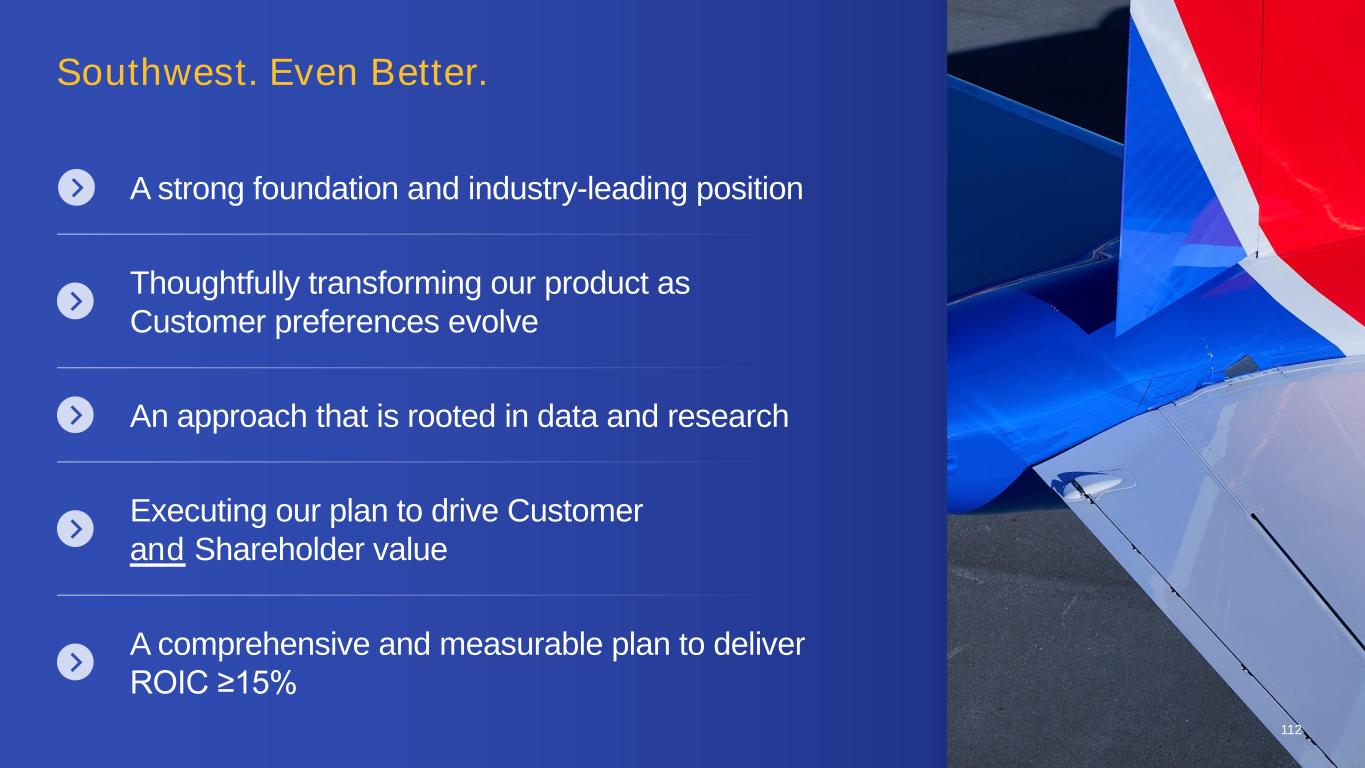
Southwest. Even Better. A strong foundation and industry-leading position Thoughtfully transforming our product as Customer preferences evolve An approach that is rooted in data and research Executing our plan to drive Customer and Shareholder value A comprehensive and measurable plan to deliver ROIC ≥15% 112