UNITED STATES
SECURITIES AND EXCHANGE COMMISSION
Washington, D.C. 20549
FORM
(Mark one)
| | ANNUAL REPORT PURSUANT TO SECTION 13 OR 15(d) OF THE SECURITIES EXCHANGE ACT OF 1934 |
For the fiscal year ended:
or
| | TRANSITION REPORT PURSUANT TO SECTION 13 OR 15(d) OF THE SECURITIES EXCHANGE ACT OF 1934 |
For the transition period from ______to ______
Commission File Number:
TRANSCAT, INC.
(Exact name of registrant as specified in its charter)
| | | |
| (State or other jurisdiction of incorporation or organization) | (I.R.S. Employer Identification No.) |
(Address of principal executive offices) (Zip Code)
(
(Registrant’s telephone number, including area code)
Securities registered pursuant to Section 12(b) of the Act:
| Title of each class | Trading Symbol | Name of each exchange on which registered | ||
| | | |
Securities registered pursuant to Section 12(g) of the Act:
None
Indicate by check mark if the registrant is a well-known seasoned issuer, as defined in Rule 405 of the Securities Act.
Indicate by check mark if the registrant is not required to file reports pursuant to Section 13 or Section 15(d) of the Act. Yes ☐
Indicate by check mark whether the registrant: (1) has filed all reports required to be filed by Section 13 or 15(d) of the Securities Exchange Act of 1934 during the preceding 12 months (or for such shorter period that the registrant was required to file such reports), and (2) has been subject to such filing requirements for the past 90 days.
Indicate by check mark whether the registrant has submitted electronically every Interactive Data File required to be submitted pursuant to Rule 405 of Regulation S-T (§232.405 of this chapter) during the preceding 12 months (or for such shorter period that the registrant was required to submit such files).
Indicate by check mark whether the registrant is a large accelerated filer, an accelerated filer, a non-accelerated filer, a smaller reporting company or an emerging growth company. See the definitions of “large accelerated filer,” “accelerated filer,” “smaller reporting company” and “emerging growth company” in Rule 12b-2 of the Exchange Act.
| | Accelerated filer ☐ |
| Non-accelerated filer ☐ | Smaller reporting company |
| Emerging growth company |
If an emerging growth company, indicate by check mark if the registrant has elected not to use the extended transition period for complying with any new or revised financial accounting standards provided pursuant to Section 13(a) of the Exchange Act. ☐
Indicate by check mark whether the registrant has filed a report on and attestation to its management’s assessment of the effectiveness of its internal control over financial reporting under Section 404(b) of the Sarbanes-Oxley Act (15 U.S.C. 7262(b)) by the registered public accounting firm that prepared or issued its audit report.
If securities are registered pursuant to Section 12(b) of the Act, indicate by check mark whether the financial statements of the registrant included in the filing reflect the correction of an error to previously issued financial statements.
Indicate by check mark whether any of those error corrections are restatements that required a recovery analysis of incentive-based compensation received by any of the registrant’s executive officers during the relevant recovery period pursuant to §240.10D-1(b). ☐
Indicate by check mark whether the registrant is a shell company (as defined in Rule 12b-2 of the Act). Yes
The aggregate market value of the voting and non-voting common equity held by non-affiliates of the registrant on September 22, 2023 (the last business day of the registrant’s most recently completed second fiscal quarter) was approximately $
The number of shares of common stock of the registrant outstanding as of May 22, 2024 was
DOCUMENTS INCORPORATED BY REFERENCE
Portions of the registrant’s definitive proxy statement relating to the Annual Meeting of Shareholders expected to be held on September 11, 2024 have been incorporated by reference into Part III, Items 10, 11, 12, 13 and 14 of this report.
CAUTIONARY NOTE REGARDING FORWARD-LOOKING STATEMENTS
Forward-Looking Statements. This report contains “forward-looking statements” within the meaning of the Private Securities Litigation Reform Act of 1995. Forward-looking statements relate to expectations, estimates, beliefs, assumptions and predictions of future events and are identified by words such as “aim,” “anticipates,” “believes,” “can,” “could,” “designed,” “estimates,” “expects,” “focus,” “goal,” “intends,” “may,” “plan,” “outlook,” “potential,” “seek,” “strategy,” “strive,” “target,” “will,” “would,” and other similar words. Forward-looking statements are not statements of historical fact and thus are subject to risks, uncertainties and other factors that could cause actual results to differ materially from historical results or those expressed in such forward-looking statements. You should evaluate forward-looking statements in light of important risk factors and uncertainties that may affect our operating and financial results and our ability to achieve our financial objectives.
These factors include, but are not limited to:
| ● |
general economic conditions applicable to our business, including impacts from the ongoing inflationary environment and interest rate changes, |
| ● |
the highly competitive nature of the industries in which we compete, |
| ● |
the significant competition we face in our Distribution segment, |
| ● |
the concentration of Service segment customers in the life science and other FDA-regulated businesses, as well as the industrial manufacturing, aerospace, defense, energy and utilities industries, |
| ● |
any impairment of our goodwill or intangible assets, |
| ● |
tariffs and changing trade relations, regional and international conflicts and political conditions, |
| ● |
negative publicity and other reputational harm, |
| ● |
our ability to successfully complete and integrate business acquisitions, |
| ● |
potential unexpected liabilities associated with companies we acquire, |
| ● |
cybersecurity risks, including the risk of significant disruptions in our information technology systems, |
| ● |
our ability to recruit, train and retain quality employees, skilled technicians and senior management, |
| ● |
our ability to achieve or maintain adequate utilization and pricing rates for our technical service providers, |
| ● |
the prices we are able to charge for our services in our Service segment, |
| ● |
our ability to adapt our technology, |
| ● |
reliance on our enterprise resource planning system, |
| ● |
supply chain delays, disruptions or product shortages, |
| ● |
the risks related to current and future indebtedness, |
| ● |
foreign currency rate fluctuations, |
| ● |
risks related to protecting our intellectual property, |
| ● |
the impact of adverse weather events or other catastrophes or natural disasters or widespread public health crises, pandemics or other epidemics, |
| ● |
fluctuations in our operating results, |
| ● |
the volatility of our stock price and the relatively low trading volume of our common stock, |
| ● |
changes in tax rates, accounting standards, legal requirements and listing standards, and |
| ● |
legal and regulatory risks related to our international operations. |
These risk factors and uncertainties are more fully described by us under the heading “Risk Factors” in Item IA. of Part I of this report. You should not place undue reliance on our forward-looking statements, which speak only as of the date they are made. Except as required by law, we undertake no obligation to update, correct or publicly announce any revisions to any of the forward-looking statements contained in this report, whether as a result of new information, future events or otherwise.
BUSINESS OVERVIEW
Transcat, Inc. (“Transcat”, the “Company,” “we” or “us”) is a leading provider of accredited calibration services, cost control and optimization services, and distribution and rental of value-added professional grade handheld test, measurement, and control instrumentation. We are focused on providing services and products to highly regulated industries, particularly the life science industry, which includes pharmaceutical, biotechnology, medical device and other FDA-regulated businesses. Additional industries served include industrial manufacturing; energy and utilities, including oil and gas; chemical manufacturing; FAA-regulated businesses, including aerospace and defense; and other industries that require accuracy in their processes, confirmation of the capabilities of their equipment, and for which the risk of failure is very costly.
All of our Calibration Service Centers have obtained ISO/IEC 17025:2017 scopes of accreditation. Our accreditations are the cornerstone of our quality program, which we believe is among the best in the industry. Our dedication to quality is highly valued by businesses that operate in the industries we serve, particularly those in life science and other regulated industries, and our accreditations provide our customers with confidence that they will receive a consistent and uniform service, regardless of which of our service centers completes the service.
Our customers include leading manufacturers in the life science/pharmaceutical, energy, defense, aerospace and industrial process control sectors. We believe our customers do business with us because of our integrity and commitment to quality service, our broad range of product and service offerings, our proprietary asset management system, CalTrak®, and our online customer portal, C3®. In our fiscal years 2024 and 2023, no customer or controlled group of customers accounted for 5% or more of our total revenue. The loss of any single customer would not have a material adverse effect on our business, cash flows, balance sheet, or results of operations.
Transcat was incorporated in Ohio in 1964. We are headquartered in Rochester, New York. Our executive offices are located at 35 Vantage Point Drive, Rochester, New York 14624. Our telephone number is 585-352-7777. Our website is www.transcat.com. Information available on our website is not a part of, and is not incorporated into, this Annual Report on Form 10-K. We trade on the Nasdaq Global Market under the ticker symbol “TRNS”.
OUR STRATEGY
Our two operating segments are highly complementary in that their offerings are of value to customers within the same industries. Our strategy is to leverage the complementary nature of our operating segments in ways that add value for all customers who select Transcat as their source for test and measurement equipment and/or calibration and laboratory instrument services. We strive to differentiate ourselves within the markets we serve and build barriers to competitive entry by offering a broad range of products and services and by integrating these solutions in a value-added manner to benefit our customers’ operations.
During fiscal year 2024, we continued our commitment to capital, people and leadership investments, advancing our “Operational Excellence” initiative. This initiative is resulting in increased productivity and operational efficiency and further differentiation from our competitors as we leverage technology, automation, and process improvements to enhance our effectiveness and our customers’ experiences. We also continued Transcat University’s build-a-tech program. This program attracts fresh talent to the organization and provides training and career advancement opportunities for our existing employees. Our Operational Excellence initiative is a multi-year, ever-evolving program designed to create an infrastructure that supports our strategic goals over a longer timeframe.
Within the Service segment, our strategy is to drive double-digit revenue growth through both organic expansion and acquisitions. We have adopted an integrated sales model to drive sales and capitalize on the cross-selling opportunities between our two segments, especially leveraging our Distribution relationships to develop new Service relationships. We leverage these relationships with our unique value proposition which resonates strongly with customers who rely on accredited calibration services and/or laboratory instrument services to maintain the integrity of their processes and/or meet the demands of regulated business environments. Our customer base values our superior quality programs and requires precise measurement capability in their processes to minimize risk, waste and defects. We execute this strategy by leveraging our quality programs, metrology expertise, geographical footprint, qualified technicians, breadth of capabilities, and tailored service delivery options. Together, this allows us to meet the most rigorous quality demands of our most highly regulated customers while simultaneously being nimble enough to meet their business needs.
We expect to continue to grow our Service business organically by taking market share from other third-party providers and original equipment manufacturers (“OEMs”), as well as by targeting the outsourcing of in-house calibration labs as multi-year client-based lab contracts. We believe an important element in taking market share is our ability to expand into new technical capabilities and adjacent service solutions that are in demand by our current and target customer base.
The other component to our Service growth strategy is acquisitions. There are three drivers of our acquisition strategy: geographic expansion, increased capabilities and expertise, and infrastructure leverage. We are disciplined in our approach to selecting target companies. One focus of our Operational Excellence initiative is to strengthen our acquisition integration process, allowing us to capitalize on acquired sales and cost synergies at a faster pace.
Our Distribution segment strategy is to be the premier distributor and rental source of leading test and measurement equipment while also providing cross-selling opportunities for our Service segment. Through our vendor relationships we have access to more than 150,000 products, which we market to our existing and prospective customers both with and without value-added service options that are unique to Transcat. In addition to offering new products, we offer our customers the options of renting selected test and measurement equipment or buying used equipment, furthering our ability to answer all of our customers’ test and measurement equipment needs. We continuously evaluate our offerings to add new in-demand vendors or products, or remove less relevant vendors and products. Our equipment rental business continues to be a strong growth offering for us and helps support our distribution and service segment growth strategies. Having new, used and rental equipment further differentiates us from our Service segment competitors.
We see these various methods of meeting our Distribution customers’ needs as a way to differentiate ourselves and to diversify this segment’s customer base from its historically niche market. This differentiation and diversification strategy has been deliberately instituted in recent years as a means to mitigate the effect of price-driven competition and to lessen the impact that any particular industry or market will have on the overall performance of this segment.
As part of our growth strategy, we completed three acquisitions during our fiscal year 2024 and four acquisitions during our fiscal year 2023:
| ● | Effective August 8, 2023, Transcat purchased all of the outstanding capital stock of Axiom, a privately-held California rental provider of electronic test equipment to customers across the United States. | |
| ● | Effective July 12, 2023, Transcat purchased all of the outstanding capital stock of SteriQual, a Florida based provider of expert consulting services to pharmaceutical, biopharmaceutical, medical device and diagnostic equipment manufacturers. | |
| ● | Effective March 27, 2023, Transcat purchased all of the outstanding capital stock of TIC-MS, a Missouri based provider of calibration services. | |
| ● | Effective February 2, 2023, Transcat acquired substantially all of the assets of Elite, a California based provider of pipette calibration services. |
|
| ● |
Effective September 28, 2022, Transcat purchased all of the outstanding capital stock of Complete Calibrations, an Irish company. Complete Calibrations is an ISO 17025 accredited calibration company specializing in calibration services for the life sciences industry. |
|
| ● | Effective September 27, 2022, Transcat acquired substantially all of the assets of e2b, an Ohio based provider of calibration services. | |
| ● | Effective May 31, 2022, Transcat acquired substantially all of the assets of Alliance, an Ohio based provider of calibration services. |
Our acquisition strategy primarily targets service businesses that expand our geographic reach, increase the depth and/or breadth of our service and distribution capabilities and expertise and leverage our infrastructure. The table below illustrates the strategic drivers for the acquisitions described above:
| Geographic |
Increased |
Leveraged |
|
| Axiom | ✓ | ✓ | |
| SteriQual | ✓ | ✓ | |
| TIC-MS | ✓ | ✓ | |
| Elite | ✓ | ||
| Complete Calibrations | ✓ | ✓ | |
| e2b | ✓ | ✓ | |
| Alliance | ✓ | ✓ |
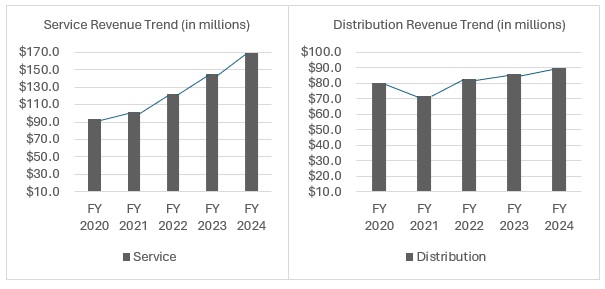
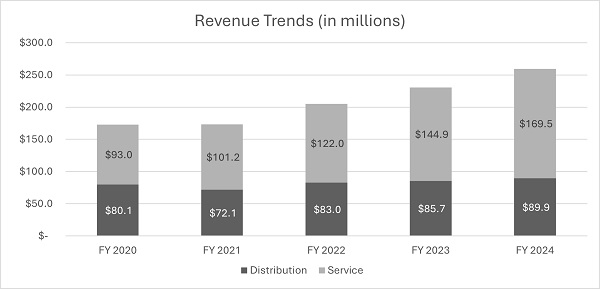
We believe our combined Service and Distribution segment offerings, experience, technical expertise and integrity create a unique and compelling value proposition for our customers, and we intend to continue to grow our business through organic revenue growth and business acquisitions. We consider the attributes of our Service segment, which include higher gross margins and recurring revenue streams from customers in regulated industries to be more compelling and scalable than our legacy Distribution segment. For this reason, we expect our Service segment to be the primary source of revenue and earnings growth in future fiscal years. The charts below illustrate Service, Distribution and consolidated revenue over the past five years:
SEGMENTS
Service Segment
Calibration. Calibration is the act of comparing a unit or instrument of unknown value to a standard of known value and reporting the result in some specifically defined form. After the calibration has been completed, a decision is made, based on rigorously defined parameters, regarding what, if anything, should be done to the unit to conform to the required standards or specifications. The decision may be to adjust, optimize or repair a unit; limit the use, range or rating of a unit; scrap the unit; or leave the unit as is. The purpose of calibration is to significantly reduce the risk of product or process failures caused by inaccurate measurements. In addition to its being an element of quality control and risk management, calibration improves an operation’s productivity and efficiency to optimal levels by assuring accurate, reliable instruments and processes.
The need for calibration is often driven by regulation, which identifies a requirement for quality calibration and laboratory instrument services as a critical component of a company’s business operation. We specifically target industries and companies that are regulated by the U.S. FDA, FAA or other regulatory bodies. As a result of the various levels of regulation within our target industries such as life sciences, pharmaceutical manufacturing and medical device manufacturing, our customers’ calibration and laboratory instrument service sourcing decisions are generally made based on the provider’s quality systems, accreditation, reliability, trust, customer service and documentation of services. To maintain our competitive position in this segment, we maintain internationally recognized third-party accredited quality systems, further detailed in the section entitled “Service Quality” below, and provide our customers with access to proprietary asset management software solutions, which offer tools to manage their internal calibration programs and provide them with visibility to their service records.
Through our Service segment, we perform recurring periodic calibrations (typically ranging from three-month to twenty-four month intervals) on new and customer-owned instruments. We perform approximately 850,000 calibrations annually and can address a significant majority of the items requested to be calibrated with our in-house capabilities. For customers’ calibration needs in less common and highly specialized disciplines, we subcontract some calibrations to third-party vendors that have unique or proprietary capabilities. While typically representing approximately 13% to 15% of our Service segment revenue, we believe the management of these items is highly valued by our customers and providing this service has enabled us to continue our pursuit of having the broadest calibration offerings in these targeted markets. We regularly review outsourced services to identify opportunities for in-house capability expansion.
Transcat’s most recent investment in capability expansion includes ground support equipment ("GSE"), an integral role in aircraft operations. The speed, efficiency, and accuracy of this equipment are crucial factors that help minimize downtime for aircraft before, between, and after flights. At Transcat, we’re proud to offer GSE certification, calibration, maintenance, and repair services for the aviation and aerospace industries.
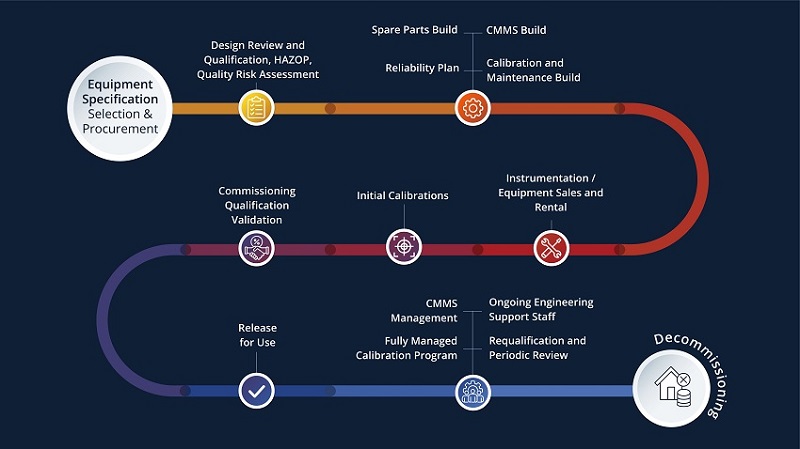
Driving Continuous Improvement through Transcat’s Cost Control and Optimization Services, we provide technical, consulting, and staffing solutions in the U.S., Canada, Ireland, Europe, and Asia Pacific to improve asset management programs for our most highly-regulated customers, especially those in the pharmaceutical, biotechnology, and medical device industries. NEXA offers six service tracks that support the creation or optimization of our client’s enterprise asset management program. Whether a facility is in preconstruction, operational or decommissioning stage, NEXA’s experienced teams can deliver results in all phases of the asset lifecycle. NEXA’s full suite of services or combination solutions are customizable to meet our customer’s unique needs.
Other Services. We provide other services to our customers such as inspection, repair and consulting services, which appeal to customers across all sectors in our customer base. These are generally value-added services and allow us to provide “one-stop shopping” for our customers.
Service Value Proposition. Our calibration services strategy encompasses multiple ways to manage a customer’s calibration and laboratory instrument service needs:
| ● |
We offer an “Integrated Calibration Service Solution” that provides a complete wrap-around service, which can be delivered in the following ways: |
| ● |
in-house services: services are performed at one of our twenty-nine Calibration Service Centers (often accompanied by pick-up and delivery services); | |
| ● |
periodic onsite services: Transcat technicians travel to a customer’s location, including aboard vessels docked at shipyards, and provide bench-top or in-line calibration or laboratory services on predetermined service cycles; | |
| ● |
client-based-laboratory services: Transcat establishes and manages a calibration service program within a customer’s facility; and | |
| ● |
mobile calibration services: services are completed on a customer’s property within one of our mobile calibration units. |
| ● |
For companies that maintain an internal calibration operation, we can provide: |
| ● |
calibration of their primary calibration assets, also called “standards”; and |
|
| ● |
overflow capability, either onsite or at one of our Calibration Service Centers, during periods of high demand. |
| ● |
Transcat Cost Control and Optimization Services: |
| ● |
Calibration – criticality risk assessment; calibration interval analysis; calibration plans/task lists; planning and scheduling. | |
| ● |
Maintenance and Spares – PM optimization; spares/BOM management; PM plans/task lists; planning and scheduling. | |
| ● |
Reliability – asset criticality assessments; asset hierarchy development; PdM plans/task lists; FMECA/RCA. | |
| ● |
CMMS – implementation and migration; data optimization; business intelligence; CMMS KPIs/reporting. | |
| ● |
Quality and Compliance – technical writing; compliance audits; remediation; compliance management. | |
| ● |
CQV – equipment and facility C&Q; cleaning and sterilization validation; process and software validation; warehouse environmental mapping. |
| ● |
Transcat Single Source Solution: |
| ● |
Commissioning, Qualification and Validation. | |
| ● |
Data build for the computerized maintenance and calibration system (CMMS). | |
| ● |
Reliability Planning. | |
| ● |
Maintenance & Spares delivery. | |
| ● |
Execution of initial Calibrations. | |
| ● |
Final activities leading to the successful turn-over of the fully completed equipment and systems to the Client in an operationally-ready state. |
Inclusive with all the above services, we provide total program management including logistics, remediation and consultation services when needed.
We strive to provide the broadest accredited calibration offering to our targeted markets, which includes certification of our technicians pursuant to the American Society for Quality standards, complete calibration management encompassing the entire metrology function, and access to our complementary service and product offerings. We believe our calibration services are of the highest technical and quality levels, with broad ranges of accreditation.
Our compliance services strategy is to identify and establish long-term relationships with life science research and development and manufacturing customers who require analytical qualifications, validation, remediation and/or preventative maintenance services. In most cases, these customers are life science companies, including pharmaceutical and biotechnology companies engaged in research and development and manufacturing, which are subject to extensive government regulation. The services we provide to these regulated customers are typically a critical component of the customer’s overall compliance program. Because many laboratory instrument service customers operate in regulated industries, these same customers typically also require accredited calibration services. This requirement allows a natural synergy between our laboratory instrument and calibration services. Our strategy includes cross-selling our services within our customer accounts to maximize our revenue opportunities with each customer.
We believe our Cost Control and Optimization services is a scalable business as it requires minimal upfront capital investment, and the services can largely be effectively completed via a virtual workforce. This allows us to follow our customers geographically and provide a high level of service whether a Transcat physical presence in that geography exists or not.
Proprietary Asset Management Software. CalTrak® is our proprietary documentation and asset management software which is used to integrate and manage both the workflow of our Calibration Service Centers and our customers’ assets. With CalTrak®, we are able to provide our customers with timely and consistent calibration service while optimizing our own efficiencies. CalTrak® has been validated to U.S. federal regulations 21 CFR Part 820.75 and 21 CFR Part 11, as applicable. This validation is important to pharmaceutical and other FDA-regulated industries where federal regulations can be particularly stringent.
Additionally, C3® provides our customers with web-based asset management capability and a safe and secure off-site archive of calibration and other service records that can be accessed 24 hours a day through our secure password-protected website. C3® stands for Compliance, Control and Cost, and we see these as the major areas of focus for our clients within the regulatory environment as it relates to instrument calibration. We specifically designed C3® to assist our customers in increasing efficiency, driving compliance to quality system and enhancing control of instrumentation, all while bringing their overall metrology costs down. Understanding the regulated environments that our clients operate within, we customized the platform to allow for single system of record utilization via capabilities that allow clients to track and manage instruments maintained internally in addition to instruments supported by Transcat. C3® is validated to 21 CFR Part 820.75 and 21 CFR Part 11 to meet stringent FDA requirements.
Through CalTrak® and C3®, each customer calibration is tracked and automatically cross-referenced to the assets used to perform the calibration, providing traceability.
Service Marketing and Sales. Under our integrated sales model, we have both inside and outside sales teams that seek to acquire new customers in our targeted markets by leveraging our unique value proposition, including our broad geographic footprint and comprehensive suite of services. We target regulated customers with multiple manufacturing operations throughout North America and Europe. We leverage our ability to manage the complete life cycle of instrumentation from purchase of calibrated equipment to long-term service and maintenance requirements. Connecting all the dots by using new and used product sales, rentals, and repair and calibration services is the goal of our marketing and sales initiatives. We also have a team of customer success managers focused on delivering ever-increasing value for our existing customers. We utilize print media, trade shows and web-based initiatives to market our services to customers and prospective customers with a strategic focus in the highly regulated industries including life science and other FDA-regulated industries, aerospace and defense, energy and utilities, and chemical manufacturing. We also target industrial manufacturing and other industries that appreciate the value of quality calibrations.
Service Competition. The calibration services industry is highly fragmented and is composed of companies ranging from internationally recognized and accredited OEMs to non-accredited sole proprietors as well as companies that perform their own calibrations in-house, resulting in a tremendous range of service levels and capabilities. The large OEMs may offer specialized services and brand-specific expertise which we do not offer, but they are generally focused on providing specialized services only for their proprietary brands and product lines, rather than servicing an array of brands and product lines as we do. A large percentage of calibration companies are small businesses that generally do not have a range of capabilities as broad as ours. There are also several companies with whom we compete that have national or regional operations.
We differentiate ourselves from our competitors by demonstrating our commitment to quality, expanding upon the largest 17025 scope of accreditation and calibration capabilities of any commercial calibration laboratory that are tailored to the markets we serve, leveraging a geographical footprint that spans North America, Puerto Rico and Ireland providing a comprehensive suite of services that spans many disciplines and hundreds of manufacturers which is not limited to certain product lines or brands. Our unique ability to bundle our products with both Transcat’s Cost Control and Optimization Services and Transcat’s Single Source Solution, provides a high level of differentiation from our competitors. As one of the only North American compliance and calibration service providers who also distributes product, our customers can seamlessly replace instruments that cannot be calibrated or are otherwise deemed to be at end of life. Our close knowledge of the products we distribute also allows our service staff to consult and advise customers on what products are best suited for their in-house calibration needs. We also believe that our proprietary software is a key differentiator from our competitors. CalTrak® and C3® are utilized by our customers in an integrated manner, providing a competitive barrier as customers realize synergies and efficiencies as a result of this integration.
Service Quality. The accreditation process is the only system currently in existence that validates measurement competence. To ensure that the quality and consistency of our calibrations are consistent with the global metrology network, designed to standardize measurements worldwide, we have sought and achieved international levels of quality and accreditation to provide uniformity across all locations with advanced levels of training for our technical staff. Our Calibration Service Centers are accredited to ISO/IEC 17025:2017 by ANSI-ASQ National Accreditation Board (“ANAB”) and other accrediting bodies. These accrediting bodies are International Laboratory Accreditation Cooperation Mutual Recognition Arrangement (“ILAC MRA”) signatories, are proficient in the technical aspects of the chemistry and physics that underlie metrology, and provide an objective, third-party, internationally accepted evaluation of the quality, consistency, and competency of our calibration processes. Accreditation also requires that all measurement standards used for accredited measurements have a fully documented path, known as Metrological Traceability, through the National Institute of Standards and Technology or the National Research Council (the National Measurement Institutes for the United States and Canada, respectively), or to other national or international standards bodies, or to measurable conditions created in our Calibration Service Centers, or accepted fundamental and/or natural physical constants, ratio type of calibration, or by comparison to consensus standards, all inclusive of measurement uncertainties.
The importance of this international oversight to our customers is the assurance that our service documentation will be accepted worldwide, removing one of the barriers to trade that they may experience if using a calibration laboratory provider whose accrediting body is not an ILAC MRA signatory. To provide the widest range of services to our customers in our target markets, our ISO/IEC 17025:2017 accreditations extend across many technical disciplines, including working-level and reference-level capabilities. We believe our scope of accreditation to ISO/IEC 17025:2017 to be the broadest for the industries we serve.
To reinforce our belief in the importance of calibration quality, we are leveraging a branding campaign for our Service segment that is centered around three simple words – “Calibrated by Transcat®”. We believe we have established a strong, differentiated brand that has a deep and meaningful association with quality, compliance and control. We want the phrase “Calibrated by Transcat®” to be synonymous with risk reduction and quality compliance.
Acquired calibration labs might use other quality registration systems. We continually evaluate when to integrate acquired quality systems with the focus on minimizing business disruptions and disruptions to our customers while maintaining our commitment to quality.
Our scopes of accreditation can be found at http://www.transcat.com/calibration-services/accreditation/calibration-lab-certificates.
Distribution Segment
Distribution Summary. We distribute professional grade test, measurement and control instrumentation throughout North America and internationally. Our customers use test and measurement instruments to ensure that their processes, and ultimately their end products, are within specification. Utilization of such diagnostic instrumentation also allows for continuous improvement processes to be in place, increasing the accuracies of their measurements. The industrial test and measurement instrumentation market, in those geographic areas where we predominately operate, has historically been serviced by broad-based national equipment distributors and niche or specialty-focused organizations such as Transcat. We offer value-added services such as calibration/certification of equipment purchases, equipment rentals, used equipment for sale, and equipment kitting.
We believe that a customer chooses a distributor based on a number of different criteria, including product availability, price, ease of doing business, timely delivery and accuracy of orders, consistent product quality, technical competence of the representative serving them and availability of value-added services. The decision to buy is generally made by plant engineers, quality managers, or their purchasing personnel, and products are typically obtained from one or more distributors as replacements, upgrades, or for expansion of manufacturing and research and development facilities. As a result, sales to Distribution customers are somewhat unpredictable and potentially non-recurring. Our online presence, including our website and e-newsletters, master catalog, supplemental mailings, and other sales and marketing activities are designed to create interest and maintain a constant presence in front of our customers to ensure we receive the order when they are ready to purchase.
We provide our customers with value-added services, including technical support, to ensure our customers receive the right product for their application, and more comprehensive instrument suitability studies to customers in regulated industries who are concerned about the technical uncertainties that their testing or in-process instruments may bring to a process. We consider our biggest value-added service for our Distribution customers is the option to have calibration service performed on their new product purchases prior to shipment, allowing them to place newly acquired equipment directly into service upon receipt, saving downtime. We also offer online procurement, credit card payment options, same day shipment of in-stock items, kitted products, the option to rent, training programs and a variety of custom product offerings. Items are regularly added to and deleted from our product offerings on the basis of customer demand, recommendations of suppliers, sales volumes and other factors. Because of the breadth of our product and service offerings, we are often a “one-stop shop” for our customers who gain operational efficiency by dealing with just one distributor for most or all of their test and measurement instrumentation needs.
We continue to focus on higher margin channels such as rentals to bolster profitability in the Distribution segment. To remain competitive, we are focusing on brand consolidation along with inventory investments to support our overall strategy of being a value-added distributor that supports our customers and Service segment. Additional areas of focus include consumable products within the life science market which is intended to offset competitive pressures in our legacy distribution business.
Distribution Marketing and Sales. We market, create demand and sell to our customers through multiple direct sales channels including our website, digital and print advertising, proactive outbound sales and an inbound call center. Our outbound and inbound sales teams are staffed with technically trained personnel who are available to help guide product selection. Our website serves as a sales channel for our products and services, and provides search capability, detailed product information, in-stock availability, selection guides, demo videos and downloadable product specification sheets. We have made investments in our website to implement the latest marketing technologies which allow us to provide an intuitive customer experience, with simple product comparison and quoting, ease at checkout and automated post-order follow-up. We also operate and maintain several industry-specific service websites, obtained through recent acquisitions. For example, the URL www.pipettes.com was obtained in connection with the acquisition of TTE Laboratories, Inc. (now known as pipettes.com). Pipettes.com focuses on selling pipettes, pipette supplies and related services to customers.
We use a multichannel approach to reach our customers and prospective customers including our master catalog, periodic supplemental catalogs, website, e-newsletters, and other direct sales and marketing programs. Our digital marketing strategy includes ongoing investment in search engine optimization, application-specific digital content, pay-per-click search engine advertising, and product listings on online marketplaces such as Amazon and Google Shopping. We continue to invest in back-end technologies designed to provide a seamless customer experience across all our marketing channels.
As a result of strong relationships with our product vendors and our historical marketing program results, we have the opportunity to carry out co-branded marketing initiatives, aimed at our existing customers and our prospective customer base, for which we receive cooperative advertising support. These co-branded marketing initiatives typically feature specific vendors, new products or targeted product categories and take the form of direct mailers, web-based initiatives or outbound sales efforts.
Distribution Competition. The distribution market for industrial test and measurement instrumentation is fragmented and highly competitive. Our competitors range from large national distributors and manufacturers that sell directly to customers to small local distributors and online distributors. Key competitive factors typically include customer service and support, quality, lead time, inventory availability, brand recognition and price. To address our customers’ needs for technical support and product application assistance, we employ a staff of highly trained technical sales specialists. In order to maintain this competitive advantage, technical training is an integral part of developing our sales staff. To differentiate ourselves from competitors, we offer pre-shipment calibration or performance data reports which allow customers to receive our products and immediately place them into service, saving them downtime and money.
Online distributors, including Amazon which typically sells lower price-point products, have become prominent competitors for sales of handheld test and measurement equipment, competing primarily on price. While online competitors lack the value-added services we offer in our Distribution segment, they have been successful in capturing some market share in the worldwide market for test and measurement instruments. To stay ahead of growing competition from these online distributors and in keeping with the general trend of increased use of e-commerce, we continue to invest in our digital platform including a well-indexed website with improved design and functionality. In addition, we have diversified our offerings by expanding the product lines that we offer and adding higher gross margin equipment rentals and used equipment sales, which we believe makes Transcat unique among our competitors.
Distribution Suppliers and Purchasing. We believe that effective purchasing is a key element to maintaining and enhancing our position as a provider of high-quality test and measurement instruments. We frequently evaluate our purchase requirements and suppliers’ offerings to obtain products at the best possible cost. We obtain our products from approximately450 suppliers of brand name and private-labeled equipment. In fiscal year 2024, our top 10 vendors accounted for approximately 58% of our aggregate Distribution sales.
We plan our product mix and inventory stock to best serve the anticipated needs of our customers, whose individual purchases vary in size. We can usually ship our top selling products to our customers the same day they are ordered.
Distribution Vendor Rebates. We have agreements with certain product vendors that provide for rebates based on meeting a specified cumulative level of purchases and/or incremental distribution sales. These rebates are recorded as a reduction of cost of distribution sales. Purchase rebates are calculated and recorded quarterly based upon our volume of purchases with specific vendors during the quarter. Point of sale rebate programs that are based on year-over-year sales performance on a calendar year basis are recorded as earned, on a quarterly basis, based upon the estimated level of annual achievement. Point of sale rebate programs that are based on year-over-year sales performance on a quarterly basis are recorded as earned in the respective quarter. The Company recorded vendor rebates of $0.6 million in both fiscal years 2024 and 2023, and $1.0 million in fiscal year 2022, respectively, as a reduction of cost of distribution sales.
Distribution Operations. Our Distribution operations primarily take place at our 48,500 square-foot facility in Rochester, New York which includes 17,000 square feet of warehouse space. The Rochester location also fulfills orders for rental equipment, serves as our corporate headquarters, houses our customer service, sales and administrative functions, and is a Calibration Service Center. We also have three smaller warehouse facilities. Our Wisconsin warehouse fulfills orders for certain large industrial scales and our Vista, California and Houston, Texas warehouses fulfill orders for used equipment and rental equipment. In fiscal year 2024, we shipped approximately30,000 product orders.
Distribution Backlog. Distribution orders include orders for instruments that we routinely stock in our inventory, customized products, and other products ordered less frequently, which we do not stock. Pending product shipments are primarily backorders, but also include products that are requested to be calibrated in one of our Calibration Service Centers prior to shipment, orders required by the customer to be shipped complete or at a future date, and other orders awaiting final credit or management review prior to shipment. Our total backlog was $5.1 million and $8.1 million as of March 30, 2024 and March 25, 2023, respectively.
CUSTOMER SERVICE AND SUPPORT
Key elements of our customer service approach are our business development sales team, outbound sales team, account management team, inbound sales and customer service organization. To ensure the quality of service provided, we monitor our customer service through customer surveys, call monitoring and daily statistical reports.
Customers may place orders via:
| ● |
Mail to Transcat, Inc., 35 Vantage Point Drive, Rochester, NY 14624; |
| ● |
Telephone at 1-800-828-1470; |
| ● |
Email at sales@transcat.com; |
| ● |
Online at www.transcat.com; or |
| ● |
Fax at 1-800-395-0543 |
INFORMATION REGARDING EXPORT SALES
In fiscal year 2024, approximately 10% of our total revenue resulted from sales to customers outside the United States. Of those export sales in fiscal year 2024, approximately 8% were denominated in U.S. dollars, 67% were denominated in Canadian dollars and 25% were denominated in Euros. Our revenue is subject to the customary risks of operating in an international environment, including the potential imposition of trade or foreign exchange restrictions, tariff and other tax increases, fluctuations in exchange rates and unstable political situations, any one or more of which could have a material adverse effect on our business, cash flows, balance sheet or results of operations. See “Foreign Currency” in Item 7A. of Part II and Note 7 to our Consolidated Financial Statements in this report for further details.
INFORMATION SYSTEMS
We utilize a turnkey enterprise software solution from Infor, Inc. (“Infor”) called Application Plus to manage our business and operations segments. This software includes a suite of fully integrated modules to manage our business functions, including customer service, warehouse management, inventory management, financial management, customer relations management and business intelligence. This solution is a fully mature business package and has been subject to more than 20 years of refinement. We utilize customer relationship management (“CRM”) software offered by SalesForce.com, Inc., which is strategically partnered with Infor, allowing us to fully integrate the CRM software with our Infor enterprise software.
We also utilize CalTrak®, our proprietary document and asset management system, to manage documentation, workflow and customers’ assets within and amongst most of our Calibration Service Centers. In addition to functioning as an internal documentation, workflow, and asset management system, CalTrak®, through C3®, provides customers with web-based calibration cycle management service and access to documentation relating to services completed by Transcat. Certain recent acquisitions utilize either third-party or their own proprietary calibration management systems. We continually evaluate when to integrate these acquired systems with a focus on obtaining operational synergies while imposing minimal disruption to customers.
INTELLECTUAL PROPERTY
We have U.S. federally registered trademarks for Transcat®, CalTrak®, C3®, Procision®, and TIC-MS, INC. ® which we consider to be of material importance to our business. The registrations for these trademarks are in good standing with the U.S. Patent & Trademark Office. Our Transcat® trademark is also registered in the European Union and Canada for four classes. Our CalTrak® trademark is also registered in Canada for one class with the Canada Intellectual Property Office and in Puerto Rico. Our trademark registrations must be renewed at various times, and we intend to renew our trademarks, as necessary, for the foreseeable future.
We have International trademark registrations for TRANSCAT TRUST IN EVERY MEASURE, CALIBRATED BY TRANSCAT, and TRANSCAT BIOMEDICAL, with pending extensions of protection to Canada and the European Union. We have pending U.S. trademark applications for TURBOCAL, TRANSCAT TRUST IN EVERY MEASURE, CALIBRATED BY TRANSCAT, and TRANSCAT BIOMEDICAL.
In addition, we own www.transcat.com, www.transcat.ca and www.pipettes.com among other Internet domain names. As with phone numbers, we do not have, and cannot acquire any property rights to an Internet address. The regulation of domain names in the United States and in other countries is also subject to change. Regulatory bodies could establish additional top-level domains, appoint additional domain name registrars or modify the requirements for holding domain names. As a result, we might not be able to maintain our domain names or obtain comparable domain names, which could harm our business.
SEASONALITY
Our business has certain historical seasonal factors. Historically, our fiscal third and fourth quarters have been stronger than our fiscal first and second quarters due to the operating cycles of our industrial sector customers. Our Distribution segment has historically been strongest in our third fiscal quarter while Service has historically been strongest in our fourth fiscal quarter.
FISCAL YEAR
We operate on a 52/53-week fiscal year, ending the last Saturday in March. In a 52-week fiscal year, each of the four quarters is a 13-week period. In a 53-week fiscal year, the last quarter is a 14-week period. Fiscal year 2024 consisted of 53 weeks and fiscal year 2023 consisted of 52 weeks. Fiscal year 2025 which ends on March 29, 2025 (“fiscal year 2025”) will have 52 weeks.
ENVIRONMENTAL MATTERS
We believe that we are in compliance with federal, state, and local provisions relating to the protection of the environment, and that continued compliance will not have any material effect on our capital expenditures, earnings, or competitive position.
HUMAN CAPITAL MANAGEMENT
As of March 30, 2024, we had 1,104 employees, 976 of whom were employed in the United States and 128 employed outside the United States. None of our employees are covered by collective bargaining agreements or work councils. Overall, we consider our employee relations to be good and believe our culture to be central to the success of the Company.
Health and Safety. The health and safety of our employees is of utmost importance to us. We have enhanced our Safety Program with additional training, communications, and internal risk and hazard assessments. We conduct policy and procedure reviews to ensure compliance with health and safety guidelines and regulatory requirements. We provide protective gear (e.g., eye protection, masks, and gloves) as required by applicable standards and as appropriate. Our goal is to achieve a level of work-related injuries as close to zero as possible through continuous investment in our safety program.
Hiring Practices. We seek to recruit and hire the most qualified people for our open positions without regard to protected status (age, color, creed, disability, domestic violence victim status, gender identity, genetic predisposition or carrier status, marital status, national origin, pregnancy, race, religion, sex, sexual orientation, status as a protected veteran or as a member of any other protected group or status).
Diversity and Inclusion. Recognizing and respecting our employees’ backgrounds and experiences, and our international presence, we strive to maintain a diverse workforce and inclusive work environment everywhere we operate. Our diversity and inclusion principles are reflected in our employee training, in particular with respect to our policies against harassment and bullying and the elimination of bias in the workplace.
Wellness. Our Calibrated Wellness Program prioritizes our employees’ well-being and is designed to enhance their health. Our program includes wellness resources, health education, pharmaceutical cost guidance, and a no-cost Employee Assistance Program, which includes worldwide access to visits with mental health care providers. Our program also incentivizes health and well-being by providing reduced health insurance premiums for employees who complete certain actions that encourage health and wellness.
Compensation and Benefits. Our compensation and benefits program is designed to attract and reward individuals who demonstrate the ability and desire to enhance our workplace culture, support our values, drive our operational and strategic goals, and create long-term value for our shareholders.
We provide employees with competitive compensation packages that include base salary and may also include annual incentive bonuses and/or long-term incentive awards, depending upon the employee’s position. We believe that a compensation program with both short-term and long-term incentive awards provides fair and competitive compensation and aligns employee and shareholder interests. In addition to salary and equity compensation, we also offer employees benefits including health (medical, dental and vision), life, and disability insurance, paid time off, paid parental leave, tuition benefits, and a 401(k) plan with a Company match.
AVAILABLE INFORMATION
We file Annual Reports on Form 10-K, Quarterly Reports on Form 10-Q, Current Reports on Form 8-K, proxy statements and other information with the Securities and Exchange Commission (“SEC”). Our filings with the SEC are available on the SEC’s website at www.sec.gov. We also maintain a website at www.transcat.com. We make available, free of charge, in the Investor Relations section of our website, documents we file with or furnish to the SEC, including our Annual Reports on Form 10-K, Quarterly Reports on Form 10-Q, Current Reports on Form 8-K and any amendments to those reports. We make this information available as soon as reasonably practicable after we electronically file such materials with, or furnish such information to, the SEC. The information found on our website is not part of this or any other report we file with, or furnish to, the SEC. Copies of such documents are available in print at no charge to any shareholder who makes a request. Such requests should be made to our corporate secretary at our corporate headquarters, 35 Vantage Point Drive, Rochester, New York 14624.
You should carefully consider the following risks and all other information included in this report. The risks and uncertainties described below and elsewhere in this report are not the only ones facing our business. If any of the following risks were to actually occur, our business, financial condition or results of operations would likely suffer.
Macroeconomic and Business Risks
Adverse changes in economic and market conditions, including an ongoing inflationary environment, or uncertainty about future market conditions, may result in increased costs of operations and negatively impact the credit and securities markets generally, which could have a material adverse effect on our results of operations and the market price of our common stock. Our results of operations and the implementation of our business strategy could be materially and adversely affected by general conditions in the U.S. and global economy, including financial and economic conditions that are outside of our control. We are subject to risks arising from adverse changes in general economic market conditions, including supply chain delays or interruptions, labor shortages, wage pressures, the ongoing inflationary environment, changes in interest rates, volatility in the banking industry, geopolitical events, political instability, global health crises, including epidemics and pandemics, such as the COVID-19 pandemic, or interruptions and other force majeure events.
Inflation has persisted in the United States and globally due in part to geopolitical events, a rise in energy prices, and strong consumer demand. An inflationary environment can increase our cost of labor as well as our energy and other operating costs which may have a material adverse impact on our financial results. In addition, economic conditions could impact and reduce the number of customers who purchase our products or services as credit becomes more expensive or unavailable. Although interest rates have increased and may continue to increase or remain relatively high for a sustained period, inflation may continue. Further, uncertainty resulting from interest rate policy or changes to interest rates in the future could have a negative effect on the securities markets generally which may, in turn, have a material adverse effect on the market price of our common stock. Further, uncertainty about future economic conditions could negatively affect our current and prospective customers causing them to delay purchase of services or test and measurement instruments. Poor economic conditions could materially and adversely impact our business, financial condition, operating results and cash flows.
The industries in which we compete are highly competitive, and we may not be able to compete successfully. Within our Service segment, we provide calibration services and compete in an industry that is highly fragmented and is composed of companies ranging from internationally recognized and accredited corporations to non-accredited sole proprietors, resulting in a tremendous range of service levels and capabilities. Also, within our Service segment, we provide compliance services and compete in an industry that is composed of both small local and regional service providers and large multi-national companies who are also OEMs. Within our Service segment, some of our larger competitors may have broader service capabilities and may have greater name recognition than us. Some manufacturers of the products we sell may also offer calibration and compliance services for their products.
Within our Distribution segment, we compete with numerous companies, including several major manufacturers and distributors to make product sales. Most of the products we sell are available from several sources and our customers tend to have relationships with several distributors. Competitors in the product distribution industry could also obtain exclusive rights to market particular products, which we would then be unable to market. Manufacturers could also increase their efforts to sell directly to end-users and bypass distributors like us. Industry consolidation among distributors, the unavailability of products, whether due to our inability to gain access to products or interruptions in supply from manufacturers, or the emergence of new competitors could also increase competition and adversely affect our business or results of operations.
In each of the industries in which we compete, some of our competitors have greater financial and other resources than we do, which could allow them to compete more successfully. In the future, we may be unable to compete successfully and competitive pressures may reduce our sales.
We face significant competition in our Distribution segment, including from suppliers and web-based distributors, to make product sales and to source products. We may not be able to compete successfully. We face substantial and increased competition throughout the world, especially in our Distribution segment. The competition is changing, with certain of our vendors engaging directly with customers and web-based distributors increasing their market share. Some of our competitors are much larger than us. Changes in the competitive landscape pose new challenges that could adversely affect our ability to compete. Entry or expansion of other vendors into this market may establish competitors that have larger customer bases and substantially greater financial and other resources with which to pursue marketing and distribution of products. Their current customer base and relationships, as well as their relationships and ability to negotiate with manufacturers, may provide them with a competitive advantage. Additionally, if our vendors sell directly to customers, they may choose not to sell to us or to do so on less favorable and more costly terms, which could have a material and adverse impact on our results of operations. If we are unable to effectively compete with our current and future competitors, our ability to sell products could be harmed and negatively impact our Distribution segment. Any erosion of our competitive position could have a material adverse effect on our business, results of operations, and financial condition.
Our Service segment has a concentration of customers in the life science and other FDA-regulated businesses, as well as the industrial manufacturing, aerospace, defense, energy and utilities industries. A number of our Service segment customers operate life science, pharmaceutical, biotechnology, medical device and other FDA-regulated businesses. We also serve the industrial manufacturing, energy and utilities, chemical manufacturing, aerospace and defense industries. This concentration of our customer base affects our overall risk profile, since a significant portion of our customers would be similarly affected by changes in economic, political, regulatory, and other industry conditions. An abrupt or unforeseen change in conditions in these industries could adversely affect customer demand for our services, which could have a material adverse effect on our financial results.
Any impairment of goodwill or intangible assets could negatively impact our results of operations. Our goodwill and intangible assets are subject to an impairment test on an annual basis and are also tested whenever events and circumstances indicate that goodwill and/or intangible assets may be impaired. Any excess goodwill and/or indefinite-lived intangible assets value resulting from the impairment test must be written off in the period of determination. Intangible assets (other than goodwill and indefinite-lived intangible assets) are amortized over the useful life of such assets. In addition, we may record goodwill when we acquire or make an investment in a business based on the purchase price and the value of the acquired tangible and intangible assets. We may subsequently experience unforeseen issues with the businesses we acquire, which may adversely affect the anticipated returns of the business or value of the intangible assets and trigger an evaluation of the recoverability of the recorded goodwill and intangible assets for the business. Future determinations of significant write-offs of goodwill or intangible assets because of an impairment test or any accelerated amortization of other intangible assets could have a material negative impact on our results of operations and financial condition.
Tariffs imposed by the United States and other countries, as well as changing trade relations, regional and international conflicts, and political conditions could have a material adverse effect on our business and results of operations. Changes in United States and foreign governments’ trade policies, as well as volatility caused by regional and international conflicts, such as the conflict between Russia and Ukraine, Israel and Hamas, and the political climate in the United States, China, and Taiwan, have resulted in, and may continue to result in, tariffs on imports into and exports from the United States. Tariffs on certain products can increase our costs of doing business. If we are unable to recover these costs, our profit margins may be negatively impacted. Diminished trade relations, conflicts between the United States and other countries, and any escalation of tariffs could have a material adverse effect on our financial performance and results of operations.
Negative publicity and other reputational harm could impact the value of our brand and materially and adversely affect our business and results of operations. Negative publicity and other reputational harm relating to events or activities attributed to us, our policies, our employees or others associated with us, whether or not justified, may tarnish our reputation and reduce the value of our brand. Additionally, disclosure of our corporate governance practices, such as our environmental, social and governance initiatives, may draw negative publicity from our shareholders and other stakeholders. If our brand is negatively impacted, we may lose existing customer relationships, which would reduce our sales and negatively impact our results of operations and financial condition, and we may be unable to attract and retain key personnel, which would negatively impact our prospects.
The impact of widespread public health crises, pandemics or other epidemics is difficult to predict and could materially and adversely affect our business and results of operations. Any adverse widespread public health crises in locations where we conduct business, as well as any measures implemented to control these events, could have a material adverse impact on our business and results of operations. Further, any actions taken to mitigate any health crises could lead to an economic recession. Such extraordinary events, like the COVID-19 pandemic, and their aftermath can cause investor fear and panic, which could further materially and adversely affect our operations, the economies in which we operate, and the financial markets generally in ways that cannot be predicted, but may amplify many of the other risk factors disclosed elsewhere in this "Item 1A. Risk Factors."
Risks Related to Acquisitions
We may not successfully integrate business acquisitions. We completed three acquisitions during fiscal year 2024 and four acquisitions during fiscal year 2023. We have a robust and diverse acquisition pipeline and may complete additional acquisitions in the future. If we fail to accurately assess and successfully integrate any recent or future business acquisitions, we may not achieve the anticipated benefits, which could result in lower revenues, unanticipated operating expenses, reduced profitability and dilution of our book value per share. Successfully integrating acquisitions involves many challenges, including:
| ● |
The difficulty of integrating acquired operations and personnel with our existing operations; |
| ● |
Implementing or remediating controls, procedures, and policies at the acquired company; |
| ● |
Integrating of the acquired company’s accounting and other administrative systems; |
| ● |
In the case of foreign acquisitions, the need to integrate operations across different cultures and languages and to address the particular economic, currency, political, and regulatory risks associated with specific countries; |
| ● |
Currency and regulatory risks associated with operations in foreign countries; |
| ● |
The difficulty of developing and marketing new products and services; |
| ● |
Diverting management’s attention while evaluating, negotiating and integrating acquisitions; |
| ● |
Our exposure to unforeseen liabilities of acquired companies; and |
| ● |
The potential loss of key employees of an acquired operation. |
In addition, an acquisition could adversely impact cash flows and/or operating results, and dilute shareholder interests for many reasons, including:
| ● |
Charges to our income to reflect the impairment of acquired intangible assets, including goodwill; |
| ● |
Contingent consideration payments; |
| ● |
Agreements to provide indemnification for certain potential liabilities; |
| ● |
Interest costs and debt service requirements for any debt incurred in connection with an acquisition or new business venture; and |
| ● |
Any issuance of securities in connection with an acquisition or new business venture that dilutes or lessens the rights of our current shareholders. |
If the integration of any or all of our acquisitions or future acquisitions is not successful, it could have a material adverse impact on our operating results and stock price.
Our future business acquisition efforts may not be successful, which may limit our growth or adversely affect our results of operations, and financing future acquisitions could result in shareholder dilution and/or increase our leverage. Business acquisitions are an important part of our growth strategy. If we identify an appropriate acquisition candidate, we may not be able to successfully negotiate terms or finance the acquisition. If economic downturns or other matters of national or global concern continue for an extensive period of time or recur, our ability to pursue and consummate potential acquisitions could be materially adversely affected. In addition, to successfully complete targeted acquisitions, we may issue additional equity securities that could dilute our shareholders’ ownership, or we may incur additional debt, which would increase our leverage and our risk of default under our existing credit facility. If we fail to successfully acquire businesses, our growth and results of operations could be materially and adversely affected.
The indemnification provisions of acquisition agreements by which we have acquired companies or may, in the future, acquire companies may not fully protect us and as a result we may face unexpected liabilities. Certain of the acquisition agreements by which we have acquired companies or may, in the future, acquire companies generally require the former owners to indemnify us against certain liabilities related to the operation of the company before we acquired it. In most of these agreements, however, the liability of the former owners is limited, and certain former owners may be unable to meet their indemnification responsibilities. We cannot assure you that these indemnification provisions will protect us fully or at all, and as a result we may face unexpected liabilities that adversely affect our financial results.
Operational Risks
Cybersecurity incidents could adversely affect our business by causing a disruption to our operations, a compromise or corruption of our confidential information and/or damage to our business relationships, all of which could negatively impact our business, results of operations or financial condition. We rely extensively on information technology (“IT”) systems, some of which are provided by third parties, to support our business activities, including for orders and the storage, processing and transmission of our electronic, business-related, information assets used in or necessary to conduct business. The data we store and process may include customer payment information, personal information concerning our employees, confidential financial information and other types of sensitive business-related information. Numerous and evolving cybersecurity threats pose potential risks to the security of our IT systems, networks and services, as well as the confidentiality, availability and integrity of our data. Some of our office personnel work in remote environments which may exacerbate various cybersecurity risks to our business, including an increased risk of phishing and other social engineering attacks, and an increased risk of unauthorized dissemination of sensitive personal, proprietary or other confidential information. Global cybersecurity threats can range from uncoordinated individual attempts to gain unauthorized access to our IT systems to sophisticated and targeted measures known as advanced persistent threats. The techniques used in these attacks change frequently and may be difficult to detect for periods of time and we may face difficulties in anticipating and implementing adequate preventative measures. While we employ comprehensive measures to prevent, detect, address and mitigate these threats (including access controls, data encryption, vulnerability assessments, management training, continuous monitoring of our IT networks and systems and maintenance of backup and protective systems), cybersecurity incidents, depending on their nature and scope, could potentially result in the misappropriation, destruction, corruption or unavailability of critical data or proprietary information and the disruption of business operations. The potential consequences of a material cybersecurity incident include reputational damage, compromised employee, customer, or third-party information, litigation with third parties, regulatory actions, and increased cybersecurity protection and remediation costs, which in turn could adversely affect our business and results of operations. We maintain insurance intended to cover certain cybersecurity events, but such insurance may not cover all risks and losses that we experience. In addition, the laws and regulations governing security of data on IT systems and otherwise held by companies is evolving and adding layers of complexity in the form of new requirements and increasing costs of attempting to protect IT systems and data and complying with new cybersecurity regulations.
If we experience a significant disruption in, or breach in security of, our IT systems, or if we fail to implement new systems and software successfully, our business could be adversely affected. Our IT systems may be susceptible to damage, disruptions or shutdowns due to power outages, hardware failures, telecommunication failures, user errors, catastrophes or other unforeseen events. Our IT systems also may experience interruptions, delays or cessations of service or produce errors in connection with system integration, software upgrades or system migration work that takes place from time to time. In addition, technology resources may be strained due to our remote users. If we were to experience a prolonged system disruption in the IT systems that involve our interactions with customers or suppliers, it could result in the loss of sales and customers and significant incremental costs, which could adversely affect our business.
Our revenue and ability to achieve our stated corporate objectives depends on our senior management and our ability to retain recruit, train and retain quality employees. Our success is dependent on our senior management and our ability to attract, retain and motivate qualified personnel, especially skilled service technicians. Competition for senior management is intense, and we may not be successful in attracting and retaining key personnel. Qualified skilled service technicians are in high demand and are subject to competing offers. The ability to meet our labor needs while controlling costs associated with hiring and training new employees is subject to external factors such as unemployment levels and prevailing wage rates. The loss of services of any member of our senior management team or key employees, and the inability to attract and retain other qualified personnel, especially skilled service technicians, could affect our ability to achieve our stated corporate objectives and could adversely impact our business and results of operations.
The profitability of our subsidiary, NEXA, depends to a large extent on our ability to achieve or maintain adequate utilization and pricing rates for our technical service providers. In our Service segment our subsidiary, NEXA, provides all of its services in the technical, consulting and staffing solutions market by providing services to improve asset management programs for our customers. The profitability of NEXA depends in part on ensuring that our technical service providers maintain adequate utilization rates (i.e., the percentage of our provider’s working hours devoted to billable activities). Our utilization rates are affected by a number of factors, including:
| ● |
The number, scope and timing of ongoing customer engagements; |
| ● |
The timing of the commencement, completion and termination of engagements, which in many cases is unpredictable; |
| ● |
Our ability to continually secure new business engagements; |
| ● |
Our ability to transition technical service providers promptly from completed projects to new assignments, and to engage newly-hired technical service providers quickly in revenue-generating activities; |
| ● |
Our ability to forecast demand for our services and thereby maintain appropriate headcount in each of our geographies and workforces; |
| ● |
Unanticipated changes in the scope of customer engagements; |
| ● |
Our need to devote time and resources to sales, training, professional development and other non-billable activities; |
| ● |
Our ability to retain key colleagues and consulting professionals; |
| ● |
Conditions affecting the industries in which our customers operate; and |
| ● |
General financial and economic conditions. |
If the utilization rate for our technical service providers declines, our revenues, profit margin and profitability could decline, and our results of operations could be materially adversely affected.
The profitability of our Service segment, including the NEXA business, depends in part on the prices we are able to charge for our services. The prices we charge for our services, including the NEXA business, are affected by a number of factors, including:
| ● |
Customers’ perception of our ability to add value through our services; |
| ● |
The market demand for the services we provide; |
| ● |
Our ability to develop new services and the introduction of new services by competitors; |
| ● |
The pricing policies of our competitors; |
| ● |
The extent to which our customers develop in-house or other capabilities to perform the services that they might otherwise purchase from us; and |
| ● |
General financial and economic conditions. |
If we are unable to achieve and maintain adequate rates for our services, our profit margin and profitability could decline, and our results of operations could be materially adversely affected.
If we do not effectively compete in the rental test and measurement equipment market, our operating results may be adversely affected. We compete in the rental market on the basis of a number of factors, including equipment availability, price, service and reliability. Some of our competitors may offer similar equipment for rent at lower prices and may offer more extensive servicing, or financing options. In addition, if the supply of rental equipment available on the market significantly increases, demand for and pricing of our rental products could be adversely impacted, lowering our gross margins on rentals. Further, customers confronting competing budget priorities and more limited resources could lead to less demand for rental equipment and increased pressure on pricing. Failure to adequately forecast the adoption of and demand for equipment may cause us not to meet our customers’ rental equipment requirements and may adversely affect our operating results.
If we fail to adapt our technology to meet customer needs and preferences, the demand for our products and services may diminish. Our future success will depend on our ability to develop services and solutions that keep pace with technological change, evolving industry standards and changing customer preferences in the markets we serve. For example, we sell our products and services to customers in several industries that may experience rapid technological changes, new product introductions, and evolving industry standards, including highly regulated industries. We cannot be sure that we will be successful in adapting existing or developing new technology or services in a timely or cost-effective manner or that the solutions we do develop will be successful in the marketplace. Our failure to keep pace with changes in technology, industry standards and customer preferences in the markets we serve could diminish our ability to retain and attract customers and retain our competitive position, which could adversely impact our business and results of operations.
We rely on our CalTrak®, Application Plus (our enterprise resource planning system (“ERP”)) and other management information systems for inventory management, distribution, workflow, accounting and other functions. If our CalTrak®, Application Plus or other management information systems fail to adequately perform these functions, experience an interruption in their operation or a security breach, our business and results of operations could be adversely affected. The efficient operation of our business depends on our management information systems. We rely on our CalTrak®, Application Plus and other management information systems to effectively manage accounting and financial functions, customer service, warehouse management, order entry, order fulfillment, inventory replenishment, documentation, asset management, and workflow. Our management information systems are vulnerable to damage or interruption from computer viruses or hackers, natural or man-made disasters, vandalism, terrorist attacks, power loss, or other computer systems, internet, telecommunications or data network failures. Any such interruptions to our management information systems could disrupt our business and could result in decreased revenues, increased overhead costs, excess inventory or product shortages, causing our business and results of operations to suffer. In addition, our management information systems are vulnerable to security breaches. Our security measures or those of our third-party service providers may fail to detect or prevent such security breaches. Security breaches could result in the unauthorized publication of our confidential business or proprietary information, the unauthorized release of customer, vendor, or employee data and payment information, the violation of privacy or other laws, and the exposure to litigation, any of which could harm our business and results of operations.
Our ERP is aging and may not be capable of integrating management information systems that we use or are used by companies we acquire, and we may experience issues from any implementation of a new ERP or be required to operate some management information systems separately from our ERP. We have an ERP to assist with the collection, storage, management and interpretation of data from our business activities to support future growth and to integrate significant processes. Although we use current versions of software and have support agreements in place, due to the age of our ERP it may not be capable of integrating management information systems that we use or are used by companies we acquire. We anticipate that a new ERP will be required to be implemented sometime in the future. ERP implementations are complex and time-consuming and involve substantial expenditures on system software and implementation activities, as well as changes in business processes. Our ERP system is critical to our ability to accurately maintain books and records, record transactions, provide important information to our management and prepare our consolidated financial statements. ERP implementations also require the transformation of business and financial processes in order to reap the benefits of the ERP system; any such transformation involves risks inherent in the conversion to a new computer system, including loss of information and potential disruption to our normal operations. Any disruptions, delays or deficiencies in the design and implementation of a new ERP system could adversely affect our ability to process orders, provide services and customer support, send invoices and track payments, fulfill contractual obligations or otherwise operate our business. Additionally, if the ERP system does not operate as intended, the effectiveness of our internal control over financial reporting could be adversely affected or our ability to assess our internal controls adequately could be delayed.
We depend on manufacturers to supply inventory to our Distribution segment and if our vendors fail to provide desired products to us, increase prices, or fail to timely deliver products, or if supply chain delays, interruptions, or product shortages occur, our revenue and gross profit could suffer. Similar to other distributors in our industry, we occasionally experience supplier shortages and are unable to purchase our desired volume of products. Our ability to offer a wide variety of products to our customers is dependent upon our ability to obtain adequate product supply from manufacturers and other suppliers. Any disruption in our sources of supply, particularly of the most commonly sold items, could result in a loss of revenues, reduced margins, and damage to our relationships with customers. Supply shortages may occur as a result of unanticipated increases in demand or difficulties in production or delivery. In addition, we may be adversely impacted by disruptions within our supply chain network. Such disruptions may result from weather-related events, natural disasters, international trade disputes or trade policy changes or restrictions, tariffs or import-related taxes, third-party strikes, lock-outs, work stoppages or slowdowns, shortages of supply chain labor and truck drivers, shipping capacity constraints, military conflicts, acts of terrorism, public health issues (including pandemics or quarantines), civil unrest or other factors beyond our control. When shortages occur, our suppliers often allocate products among distributors. The loss of, or a substantial decrease in the availability of, products from our suppliers or the loss of key supplier arrangements could adversely impact our financial condition, operating results, and cash flows, as well as our ability to benefit from ongoing supply chain initiatives.
Our future success may be affected by our current and future indebtedness. Under our credit agreement, as of March 30, 2024, we owed $4.2 million to our secured creditor, a commercial bank, under a $15.0 million term loan to fund acquisitions and provide additional working capital. We may borrow additional funds in the future to support our growth and working capital needs. We are required to meet financial tests on a quarterly basis and comply with other covenants customary in secured financings. Although we believe that we will continue to comply with such covenants, if we do not remain in compliance with such covenants, our lender may demand immediate repayment of amounts outstanding. Furthermore, we are dependent on credit from manufacturers of our products to fund our inventory purchases. If our debt burden increases to high levels, such manufacturers may restrict our credit. Our cash requirements will depend on numerous factors, including the rate of growth of our revenues, the timing and levels of products purchased, payment terms, and credit limits from manufacturers, the timing and level of our accounts receivable collections and our ability to manage our business profitably. Our ability to satisfy our existing obligations, whether or not under our secured credit facility, will depend upon our future operating performance, which may be impacted by prevailing economic conditions and financial, business, and other factors described in this report, many of which are beyond our control.
We face risks associated with foreign currency rate fluctuations. We currently transact a portion of our business in foreign currencies, namely the Canadian dollar and the Euro. During fiscal years 2024 and 2023, approximately 10% of our total revenues were denominated in Canadian dollars and Euros. Conducting business in currencies other than U.S. dollars subjects us to fluctuations in currency exchange rates that could have a negative impact on our reported operating results. Fluctuations in the value of the U.S. dollar relative to the Canadian dollar and the Euro impact our revenues, cost of revenues and operating margins and result in foreign currency transaction gains and losses. During fiscal year 2024, the value of the U.S. dollar relative to one Canadian dollar and to one Euro ranged from 1.31 to 1.39 and from 0.89 to 0.96, respectively.
We continually utilize short-term foreign exchange forward contracts to reduce the risk that future earnings denominated in Canadian dollars would be adversely affected by changes in currency exchange rates. However, this strategy does not eliminate our exposure. If there is a significant or prolonged downturn in the Canadian dollar or the Euro, it could have an adverse impact on our business and financial condition.
Our inability to adequately enforce and protect our intellectual property or defend against assertions of infringement could prevent or restrict our ability to compete. We rely on intellectual property in order to maintain a competitive advantage. Our inability to defend against the unauthorized use of these assets could have an adverse effect on our results of operations and financial condition. Litigation may be necessary to protect our intellectual property rights or defend against claims of infringement. This litigation could result in significant costs and divert our management’s focus away from operations.
Hurricanes, other adverse weather events, national or regional catastrophes or natural disasters could negatively affect the local economies we serve or disrupt our operations, which could have an adverse effect on our business or results of operations. Our market areas include the Gulf Coast and Mid-Atlantic regions of the United States, and Puerto Rico, which are susceptible to hurricanes. Such weather events can disrupt our operations, result in damage to our properties and negatively affect the local economies in which we operate. Future hurricanes or other extreme weather events could result in damage to certain of our facilities and the equipment located at such facilities, or equipment on rent with customers in those areas. Even if our properties suffer no direct damage from such events, the operations of our customers could be disrupted, and our supply chain impacted. In addition, climate change could lead to an increase in intensity or occurrence of hurricanes or other adverse weather events, including severe winter storms. Future occurrences of these events, as well as regional or national catastrophes or natural disasters, and their effects may adversely impact our business or results of operations.
We may be involved in legal proceedings from time to time arising from the operation of our business and, as such, we could incur substantial judgments, fines, legal fees, or other costs. From time to time, we may be the subject of complaints or litigation from customers, employees, vendors, or other third parties for various actions. We also may be involved in litigation involving claims related to breach of contract, tortious conduct, employment and labor law matters, and others. The damages sought against us in these matters could be substantial. Although we maintain liability insurance for certain legal claims, if one or more of the claims were to greatly exceed our insurance coverage limits or if our insurance policies do not cover a claim, our expenses could increase significantly and management’s focus could be diverted away from our operations, which could have a material adverse effect on our business, financial condition, results of operations, and cash flows.
Risks Related to our Stock
We expect that our quarterly results of operations will fluctuate. Such fluctuations could cause our stock price to decline. A large portion of our expenses for our Service segment, including expenses for facilities, equipment and personnel are relatively fixed. Accordingly, if revenues decline or do not grow as we anticipate, we may not be able to correspondingly reduce our expenses in any particular quarter. Our quarterly revenues and operating results have fluctuated in the past and are likely to do so in the future. Historically, our fiscal third and fourth quarters have been stronger than our fiscal first and second quarters due to industrial operating cycles. Fluctuations in industrial demand for products we sell and services we provide could cause our revenues and operating results to fluctuate. If our operating results in some quarters fail to meet the expectations of stock market analysts and investors, our stock price may decline.
Our stock price may be volatile. The stock market experiences significant price and volume fluctuations that are both related and unrelated to the operating performance of companies. Our stock may be affected by market volatility and by our own performance. The following factors, among others, may have a significant effect on the market price of our common stock:
| ● | Developments in our relationships with current or future manufacturers of products we distribute; |
| ● | Announcements by us or our competitors of significant acquisitions, strategic partnerships, joint ventures or capital commitments; |
| ● | Litigation or governmental proceedings or announcements involving us or our industry; |
| ● | Economic and other external factors, such as inflation, changes in interest rates, a recession, disasters or other national or global crises; |
| ● | Public health issues including pandemics and epidemics, such as the COVID-19 pandemic; |
| ● | Sales of our common stock or other securities in the open market; |
| ● | Repurchases of our common stock on the open market or in privately-negotiated transactions; |
| ● | Period-to-period fluctuations in our operating results; and |
| ● |
Our ability to satisfy our debt obligations. |
In the past, following periods of volatility in the market price of a company’s securities, securities class action litigation has often been instituted. Securities class action litigation against us could result in significant costs and divert our management’s focus away from our operations, which could have a material adverse effect on our business, financial condition, results of operations, and cash flows.
The relatively low trading volume of our common stock may limit your ability to sell your shares. Although our shares of common stock are listed on the Nasdaq Global Market, we have historically experienced a relatively low trading volume of approximately 43,000 shares a day. If our low trading volume continues in the future, holders of our shares may have difficulty selling shares of our common stock in the manner or at a price that they desire.
If significant existing shareholders sell large numbers of shares of our common stock, our stock price could decline. The market price of our common stock could decline if a large number of our shares are sold in the public market by our existing shareholders or as a result of the perception that such sales could occur. Due to the relatively low trading volume of our common stock, the sale of a large number of shares of our common stock may significantly depress the price of our common stock.
Because we do not intend to declare or pay dividends on our shares of common stock for the foreseeable future, any return to our shareholders will be limited to the increase, if any, of the price of our common stock. We have not declared any cash dividends since our inception and have no current plans to pay any dividends in the foreseeable future. Our shareholders have no contractual or other legal right to dividends that have not been declared. Any return to our shareholders will therefore be limited to the increase, if any, in the price of our common stock.
Regulatory Risks
Tax rates applicable to us may change. Tax legislation initiatives could adversely affect our net earnings and tax liabilities. We are subject to the tax laws and regulations of the United States federal, state and local governments, as well as foreign jurisdictions. From time to time, various legislative initiatives may be enacted that could adversely affect our tax positions. Tax laws and regulations are extremely complex and subject to varying interpretations. The Tax Cuts and Jobs Act of 2017 made broad and complex changes to the U.S. tax code, such as reducing the Federal corporate income tax rate from 35% to 21%. Any additional modifications to key aspects of the tax code could materially affect our tax obligations and negatively impact our effective tax rate. Although we believe that our tax positions are sound and consistent with applicable laws, regulations and existing precedent, there can be no assurance that our tax positions will not be challenged by relevant tax authorities or that we would be successful in any such challenge.
Changes in accounting standards, legal requirements and the Nasdaq Global Market listing standards, or our ability to comply with any existing requirements or standards, could adversely affect our operating results. Extensive reforms relating to public company financial reporting, corporate governance and ethics, the Nasdaq Global Market listing standards and oversight of the accounting profession have been implemented over the past several years and continue to evolve. Compliance with these rules, regulations and standards that have resulted from such reforms has increased our accounting and legal costs and has required significant management time and attention. In the event that additional rules, regulations or standards are implemented or any of the existing rules, regulations or standards to which we are subject undergoes additional material modification, we could be forced to spend significant financial and management resources to ensure our continued compliance, which could have an adverse effect on our results of operations. For example, the additional reporting requirements relating to tracking greenhouse gas emissions and other climate-related disclosure from the SEC, U.S. state regulators, and foreign jurisdictions could significantly increase our accounting, consulting and legal expenses. Should we be or become unable to comply with any of such rules, regulations and standards, as they presently exist or as they may exist in the future, our results of operations could be adversely affected and the market price of our common stock could decline.
Our international operations expose us to legal and regulatory risks, which could have a material effect on our business. Our international operations are governed by various United States laws and regulations, including the Foreign Corrupt Practices Act (“FCPA”), and other foreign anti-bribery laws. The FCPA generally prohibits companies and their intermediaries from making improper payments to foreign government officials for the purpose of obtaining or retaining business. Any alleged or actual violations of these or other relevant regulations may subject us to government scrutiny, severe criminal or civil sanctions and other liabilities and could negatively affect our business, reputation, operating results and financial condition.
ITEM 1B. UNRESOLVED STAFF COMMENTS
None.
Cybersecurity Risk Management and Strategy. We have processes for assessing, identifying, and managing cybersecurity threats, and cybersecurity is an integral part of our overall enterprise risk management program which is overseen by our Audit Committee and the Board of Directors. Our strategy includes a comprehensive cybersecurity framework, utilizing advanced technologies and methodologies, such as cloud migrations and deployment of threat detection tools to mitigate potential risks. Continuous risk assessments help us better refine our strategy, guiding the deployment of technical safeguards and shaping our incident response plans. For acquired companies, our integration strategies prioritize establishing comprehensive timelines for harmonizing information security, data privacy, and cybersecurity practices. This includes a strong focus on aligning employee education programs to ensure a seamless transition and uphold security and privacy standards across our entities.
Our cybersecurity strategy is based on a multi-layered defense framework, aligned with the U.S. National Institute of Standards and Technology ("NIST") guidelines. We take a risk-based approach to cybersecurity, which begins with the identification and evaluation of cybersecurity risks or threats that could affect our operations, finances, legal or regulatory compliance, or reputation. The scope of our evaluation encompasses risks that may be associated with both our internally managed IT systems and key business functions and sensitive data operated or managed by third-party service providers, ensuring the service providers adhere to our security standards, thereby safeguarding our integrated operations. The strategic migration of our data centers and infrastructure to secure cloud environments, coupled with the implementation of targeted technical cybersecurity measures, underscores our dedication to establishing foundational security across our users, applications, data, systems, and networks.
We have established a comprehensive incident response plan to swiftly address and recover from cybersecurity incidents, minimizing operational impact. We conduct regular trainings and simulations to enhance our team's awareness and preparedness against cyber threats. Annual penetration testing and regular assessments by external experts validate the effectiveness of our cybersecurity measures. Our proactive approach to addressing identified vulnerabilities affirms the continuous improvement of our security posture.
To further strengthen our cybersecurity risk management framework, we have instituted an Information Security Management System (“ISMS”) that equips us with advanced risk management capabilities. This system facilitates the development of a detailed risk registry, incorporating impact and likelihood scoring to prioritize risks effectively. Additionally, it guides the creation of comprehensive risk treatment plans and sets targets for residual risk, ensuring a strategic approach to risk mitigation. A key feature of our ISMS is a risk management insights dashboard, which provides real-time visibility into the current state of risk within our environment. This dashboard is an invaluable tool for our management and key stakeholders, enabling them to track risk exposure and trends accurately. Quarterly reviews are scheduled, during which key stakeholders convene to scrutinize and adjust risk treatment plans in response to the latest threat landscape. This process underscores our commitment to a dynamic and responsive cybersecurity risk management strategy, ensuring the ongoing protection of our systems, data, and operations against emerging threats.
Use of Consultants and Advisors. We engage various third-party cybersecurity service providers to assess and enhance our cybersecurity practices and assist with the protection and monitoring of our systems and information. This encompasses a range of services, including network monitoring, endpoint protection, vulnerability assessments, and penetration testing. Additionally, we engage cybersecurity consultants, auditors, and other third parties, such as a third-party consulting firm, to rigorously evaluate our cyber processes. This includes a comprehensive assessment of our incident response procedures, ensuring they meet the highest standards of readiness and effectiveness.
To ensure the integrity and security of our operations, we have implemented stringent processes to evaluate third-party service providers and vendors that have access to sensitive systems, as well as company and customer data. This evaluation may include due diligence procedures such as assessments of the service provider’s cybersecurity posture or recommendations for specific mitigation controls. Following an assessment, we determine and prioritize service provider risk based on potential threat impact and likelihood. These risk determinations are crucial in driving the level of due diligence and ongoing compliance monitoring required for each service provider.
Enhancing our third-party vendor risk management, we have introduced two distinct capabilities to further safeguard our operations and sensitive data:
1. We leverage a threat intelligence platform watchlist to curate, monitor, alert, and provide a risk rating to third-party vendors. This platform also offers a dashboard and real-time reporting, enabling us to stay ahead of potential threats by providing continuous oversight and actionable intelligence.
2. Our ISMS platform encompasses vendor risk management capabilities, facilitating initial due diligence through the collection of vendor security-related artifacts. It applies risk ratings and delivers and analyzes annual security questionnaires, scheduling reviews and tasks to ensure compliance and security standards are met consistently.
Additionally, our virtual Chief Information Security Officer ("vCISO") compiles a quarterly executive summary of third-party risk, which is presented to both management and the Board. This summary ensures that leadership is informed of the current risk landscape and can make data-driven decisions regarding third-party engagements.
Board Oversight and Management’s Role. The Board of Directors, both directly and through the delegation of responsibilities to the Audit Committee oversees the proper functioning of our cybersecurity risk management program to ensures strategic alignment and governance of our cybersecurity efforts at the highest level. In particular, the Audit Committee assists the Board of Directors in its oversight of management’s responsibility to assess, manage and mitigate risks associated with our business and operational activities, to administer our various compliance programs, in each case including cybersecurity concerns, and to oversee our information technology systems, processes and data.
Management has implemented robust risk management structures, policies, and procedures, with day-to-day cybersecurity risk management being a core responsibility. Our Chief Financial Officer ("CFO") spearheads the assessment and management of cybersecurity risks on a daily basis, ensuring that our strategies and actions are both proactive and responsive to the evolving cybersecurity landscape. Supporting this effort, we have a cross-departmental approach to cyber security management. This ensures that our executive leadership team receives comprehensive quarterly updates on cybersecurity from various teams within the organization. Such updates are instrumental in promoting stakeholder engagement across all levels and enhancing management's oversight of cybersecurity. The content of these updates includes progress on ongoing cybersecurity initiatives, insights from recent threat assessments or incidents, findings and action plans derived from external vulnerability and penetration tests, and key performance metrics aligned with industry standards.
Risks from Material Cybersecurity Threats. Despite ongoing cyber-attacks, such as unauthorized access, phishing, and ransomware, we have not identified any cybersecurity incidents that have materially affected or are reasonably anticipated to have a material effect on our business strategy, results of operations, or financial condition. Our proactive security measures, alongside those of our third-party vendors, aim to protect our information technology systems and the sensitive data they hold. To bolster our cybersecurity posture, Transcat has engaged a third-party Managed Security Services Provider ("MSSP") to enhance our defensive capabilities. This partnership includes comprehensive vulnerability scanning both internally and externally to detect potential security weaknesses before they can be exploited. Our MSSP also provides round-the-clock monitoring through a 24x7x365 Security Operations Center ("SOC"), safeguarding our digital assets ("Endpoint Detection and Response - EDR"), identities ("Identity Detection and Response - IDR"), and integrating supplemental logging sources such as firewalls and Enterprise Resource Planning systems ("Extended Detection and Response - XDR"). Furthermore, we have established Incident Response as a Service ("IRaaS") to ensure rapid and effective action in the event of a security breach.
To maintain a strategic overview of our cybersecurity landscape, we conduct quarterly strategic reporting sessions. These sessions are crucial for reviewing security activity and identifying areas for improvement. Based on these reviews, we develop a Plan of Action and Milestones ("POAM") for remediation or re-architecture as necessary. Although these risks have not yet materially impacted our business, we remain vigilant, continuously monitoring and adapting to evolving cybersecurity threats. Our commitment to cybersecurity is integral to our risk management strategy, ensuring the ongoing protection of our systems and the sensitive data they contain.
The following table presents the leased and owned properties that are material to our business as of March 30, 2024:
| Approximate |
|||||
| Property |
Location |
Square Footage |
|||
| Corporate Headquarters, Calibration Service Center and Distribution Center |
Rochester, NY |
48,500 | |||
| Calibration Service Center and Headquarters for Canadian Operations |
Montreal, QC |
27,500 | |||
| Calibration Service Center, Rental and Used Equipment Distribution Center |
Houston, TX |
22,300 | |||
| Calibration Service Center |
Denver, CO |
19,400 | |||
| Calibration Service Center |
Los Angeles, CA |
18,200 | |||
| Calibration Service Center |
Toronto, ON |
16,900 | |||
| Calibration Service Center |
Philadelphia, PA |
14,000 | |||
| Calibration Service Center |
Cleveland, OH |
13,800 | |||
| Calibration Service Center |
Milford, MA |
12,100 | |||
| Calibration Service Center |
Dayton, OH |
12,000 | |||
| Rental and Used Equipment Distribution Center |
Vista, CA |
9,900 | |||
| Calibration Service Center |
Boston, MA |
8,900 | |||
| Calibration Service Center |
Indianapolis, IN |
7,600 | |||
| Calibration Service Center |
Palm Beach, FL |
7,600 | |||
| Calibration Service Center |
Somerset, PA |
7,200 | |||
| Calibration Service Center |
Portland, OR |
7,000 | |||
| Calibration Service Center |
Cincinnati, OH |
5,900 | |||
| Calibration Service Center |
St. Louis, MO |
5,600 | |||
| Calibration Service Center |
San Diego, CA |
5,500 | |||
| Calibration Service Center |
Chesterfield, MO |
5,500 | |||
| Calibration Service Center |
Charlotte, NC |
4,900 | |||
| Calibration Service Center |
Chesapeake, VA |
4,600 | |||
| Calibration Service Center |
Phoenix, AZ |
4,200 | |||
| Calibration Service Center |
Ottawa, ON |
4,000 | |||
| Calibration Service Center |
Decatur, AL |
1,700 | |||
| Calibration Service Center |
San Juan, PR |
1,600 | |||
| Calibration Service Center |
Cork, Ireland |
1,600 | |||
| Mobile Service Unit and Offices |
Pittsburgh, PA |
6,300 | |||
| United Scale & Engineering: |
|||||
| Calibration Service Center and Warehouse |
New Berlin, WI |
16,000 | |||
| Calibration Service Center and Warehouse |
Madison, WI |
6,000 | |||
| Calibration Service Center |
Green Bay, WI |
3,300 | |||
| Spectrum Technologies Inc. (“STI”): |
|||||
| Calibration Service Center and Warehouse |
Paxinos, PA |
14,500 | |||
We believe that our properties are in good condition, are well maintained and are generally suitable and adequate to carry on our business in its current form.
From time to time we are a party to or otherwise involved in legal proceedings arising out of the normal course of business. Management does not believe that there is any pending or threatened proceeding against us, which, if determined adversely, would have a material adverse effect on our business, results of operations or financial condition.
ITEM 4. MINE SAFETY DISCLOSURES
Not applicable.
ITEM 5. MARKET FOR REGISTRANT’S COMMON EQUITY, RELATED STOCKHOLDER MATTERS AND ISSUER PURCHASES OF EQUITY SECURITIES
Our common stock is traded on the Nasdaq Global Market under the symbol “TRNS”. As of May 22, 2024, we had approximately 500 shareholders of record.
DIVIDENDS
Our credit agreement limits our ability to pay cash dividends to certain amounts in any single fiscal year and over the term of the credit agreement. See Note 3 to the Consolidated Financial Statements included in Item 8 of Part II of this report. We have not declared any cash dividends since our inception and have no current plans to pay any dividends in the foreseeable future.
ITEM 7. MANAGEMENT’S DISCUSSION AND ANALYSIS OF FINANCIAL CONDITION AND RESULTS OF OPERATIONS
The following discussion and analysis of financial condition and results of operations should be read in conjunction with our financial statements and related notes appearing elsewhere in this annual report. In addition to historical information, the following discussion and analysis includes forward looking statements that involve risks, uncertainties and assumptions. Our actual results and the timing of events could differ materially from those anticipated in these forward-looking statements as a result of a variety of factors, including those discussed in “Risk Factors” and elsewhere in this annual report. See the discussion under “Cautionary Note Regarding Forward Looking Statements” beginning on page 1 of this annual report.
OVERVIEW
Operational Overview. We are a leading provider of accredited calibration services, cost control and optimization services, and distribution and rental of value-added professional grade handheld test, measurement, and control instrumentation.
We operate our business through two reportable business segments, Service and Distribution, which offer a comprehensive range of services and products to the same customer base.
Our strength in our Service segment is based upon our wide range of disciplines, our investment in quality systems and our ability to provide accredited calibrations to customers in highly-regulated targeted market segments. Our services range from the calibration and repair of a single unit to managing a customer’s entire calibration program. We believe our Service segment offers an opportunity for long-term growth and the potential for continuing revenue from established customers with regular calibration cycles and recurring laboratory instrument service requirements.
Our Service segment has shown consistent revenue growth over the past several years, ending fiscal year 2024 with its 60th consecutive quarter of year-over-year growth. This segment has benefited from both organic growth as well as acquisitions over those 60 quarters. The business acquisitions that we made have been focused on expanding our service capabilities, increasing our geographic reach and leveraging our Calibration Service Centers and other infrastructure to create operational synergies.
Our Service segment revenue growth was 17.0% for fiscal year 2024 from fiscal year 2023. This increase was primarily due to recently completed acquisitions and strong organic demand in our highly-regulated end markets. The Service segment gross margin increased by 160 basis points. Service segment gross profit and gross margin increases were primarily due to operating leverage on our fixed costs and increased technician productivity.
In our Distribution segment, we sell and offer for rent, professional grade handheld test and measurement instruments. Because we specialize in professional grade handheld test and measurement instruments, as opposed to a wide array of industrial products, our sales and customer service personnel can provide value-added technical assistance to our customers to aid them in determining what product best meets their particular application requirements. We have expertise in the procurement and sale of used equipment, furthering our ability to add value for our customers. We also have a higher-end electronic test and measurement equipment rental business that augments our organically grown test and measurement equipment rental business. Through our website and sales teams, customers can place orders for test and measurement instruments and can elect to have their purchased instruments calibrated and certified by our Calibration Service Centers before shipment as well as on regular post-purchase intervals. Pre-shipment calibration and certification allows our customers to place newly purchased instruments into service immediately upon receipt.
Sales in our Distribution segment are generally not consumable items but are instruments purchased as replacements, upgrades or for expansion of manufacturing or research and development facilities. As such, this segment can be heavily impacted by changes in the economic environment. As customers increase or decrease capital and discretionary spending, our Distribution sales will typically be directly impacted.
In fiscal year 2024, Distribution segment sales increased by 5.0%. This increase in sales primarily due to sales from the acquisition of Axiom.
The Distribution segment gross margin in fiscal year 2024 increased by 420 basis points. The increase in segment gross margin was primarily due to increased margins from rental revenue, which now includes Axiom, and a favorable mix of higher margin products sold.
Initiatives implemented within this segment include adding new in-demand vendors and product lines, expanding the number of SKUs that we offer with and without pre-shipment calibration and offering equipment rental and used equipment options. Management believes this diversification strategy will mitigate the impact that any particular industry or sector will have on the overall performance of this segment as well as help to further differentiate us from our competitors going forward.
Financial Overview. In evaluating our results for fiscal year 2024, investors should consider that we operate on a 52/53-week fiscal year, ending the last Saturday in March. In a 52-week fiscal year, each of the four quarters is a 13-week period. In a 53-week fiscal year, the last quarter is a 14-week period. Fiscal year 2024 consisted of 53 weeks and fiscal year 2023 consisted of 52 weeks.
A discussion regarding our financial condition and results of operations for the fiscal year ended March 25, 2023 and year-to-year comparisons between fiscal year 2023 and fiscal year 2022, which are not included in this Form 10-K, can be found under “Management’s Discussion and Analysis of Financial Condition and Results of Operations” in Part II, Item 7 of the Company’s Annual Report on Form 10-K for the fiscal year ended March 25, 2023 and are incorporated by reference herein.
On September 25, 2023, we closed an underwritten public offering of our common stock for aggregate gross proceeds of $80.5 million (the “Offering”). In the Offering, we sold an aggregate of 847,371 shares at $95.00 per share. We received net proceeds of $75.2 million in the Offering, a portion of which was used during the third quarter of fiscal year 2024 to repay in full our revolving credit facility. See “Liquidity and Capital Resources” below for more information.
Total revenue for fiscal year 2024 was $259.5 million. This represented an increase of $28.9 million or 12.5% versus total revenue of $230.6 million for fiscal year 2023. This increase was primarily due to recently completed acquisitions, strong demand in our Service segment’s highly-regulated end markets and increased rental sales, which includes incremental revenue from an acquisition completed in fiscal year 2024.
Service revenue was $169.5 million in fiscal year 2024, an increase of $24.6 million or 17.0%. Service revenue accounted for 65.3% of our total revenue during fiscal year 2024. Of our Service revenue in fiscal year 2024, 86.6% was generated by our Calibration Service Centers and cost control and optimization services while 12.3% was generated through subcontracted third-party vendors, compared with 86.2% and 12.6%, respectively, in fiscal year 2023. The remainder of our Service revenue in each period was derived from freight charges.
Distribution sales were $90.0 million in fiscal year 2024, an increase of $4.3 million or 5.0%. Distribution sales accounted for 34.7% of our total revenue in fiscal year 2024.
Sales to domestic customers comprised 92.6% of total Distribution sales in fiscal year 2024, while 5.9% were to Canadian customers and 1.5% were to customers in other international markets.
Total gross profit was $83.8 million in fiscal year 2024 compared to $68.4 million in fiscal year 2023, an increase of $15.5 million or 22.6%. Total gross margin was 32.3%, which is a 270 basis point increase versus fiscal year 2023. Service gross margin was 33.8% in fiscal year 2024 compared with 32.2% in fiscal year 2023, a 160 basis point increase. Distribution gross margin was 29.5% in fiscal year 2024 compared with 25.3% in fiscal year 2023, a 420 basis point increase. This increase in service gross margin in fiscal year 2024 was primarily largely the result of operating leverage on our fixed costs and increased technician productivity. The increase in the distribution segment gross margin was primarily due to increased margins from rental revenue, which now includes Axiom, and a favorable mix of higher margin products sold.
Operating expenses were $64.0 million, or 24.7% of total revenue, in fiscal year 2024 compared with $52.1 million, or 22.6% of total revenue, in fiscal year 2023. Operating income was $19.8 million, or 7.6% of total revenue, in fiscal year 2024 compared with $16.2 million, or 7.0% of total revenue, in fiscal year 2023. The year-over-year increase in selling, marketing and warehouse expenses was due to increased expenses related to recent acquisitions, especially acquisition related amortization expense, and higher incentive-based employee costs due to higher sales. The year-over-year increase in general and administrative expenses was due to incremental expenses from acquired businesses (including stock expense), increased payroll costs for new employees and continued investments in technology.
Net income for fiscal year 2024 was $13.6 million compared with $10.7 million in fiscal year 2023, a $3.0 million increase. Diluted earnings per share for fiscal year 2024 was $1.63 compared with $1.40 for fiscal year 2023, a $0.23 per diluted share increase.
CRITICAL ACCOUNTING POLICIES AND ESTIMATES
Use of Estimates. The preparation of our Consolidated Financial Statements in accordance with accounting principles generally accepted in the United States (“GAAP”) requires that we make estimates and assumptions that affect the reported amounts of assets and liabilities, and the disclosure of contingent assets and liabilities at the date of the financial statements and the reported amounts of revenues and expenses during the reporting period. Significant estimates and assumptions are used for, but not limited to, allowance for credit losses and returns, inventory reserves, estimated levels of achievement for performance-based restricted stock units, fair value of stock options, depreciable lives of fixed assets, estimated lives of major catalogs and intangible assets, fair value of the goodwill reporting units, and the valuation of assets acquired, liabilities assumed and consideration transferred in business acquisitions. Future events and their effects cannot be predicted with certainty; accordingly, our accounting estimates require the exercise of judgment. The accounting estimates used in the preparation of our Consolidated Financial Statements will change as new events occur, as more experience is acquired, as additional information is obtained, and as our operating environment changes. Our estimates are evaluated on an ongoing basis and are drawn from historical experience and other assumptions that we believe to be reasonable under the circumstances. Actual results could differ from those estimates. Such changes and refinements in estimation methodologies are reflected in reported results of operations in the period in which the changes are made and, if material, their effects are disclosed in the Notes to our Consolidated Financial Statements.
The following items in our Consolidated Financial Statements require significant estimation or judgment:
Accounts Receivable. Accounts receivable represent amounts due from customers in the ordinary course of business. These amounts are recorded net of the allowance for credit losses and returns in the Consolidated Balance Sheets. The allowance for credit losses is based upon the expected collectability of accounts receivable. We apply a specific formula to our accounts receivable aging, which may be adjusted on a specific account basis where the formula may not appropriately reserve for loss exposure. After all attempts to collect a receivable have failed, the receivable is written-off against the allowance for credit losses. A returns reserve is calculated based upon the historical rate of returns applied to revenues over a specific timeframe. The returns reserve will increase or decrease as a result of changes in the level of revenues and/or the historical rate of returns. Management believes that the allowances are appropriate to cover anticipated losses under current conditions. However, unexpected changes or deterioration in economic conditions could materially change these expectations.
Inventory. Inventory consists of products purchased for resale and is valued at the lower of cost or net realizable value. Costs are determined using the average cost method of inventory valuation. Inventory is reduced by a reserve for items not saleable at or above cost by applying a specific loss factor, based on historical experience and current demand, to specific categories of our inventory. Inventory is at risk of obsolescence if economic conditions change. Relevant economic conditions include changing consumer demand, customer preferences or increasing competition. We believe these risks are largely mitigated because our inventory typically turns several times per year. We evaluate the adequacy of the reserve on a quarterly basis.
Business Acquisitions. We apply the acquisition method of accounting for business acquisitions. Under the acquisition method, identifiable assets acquired, liabilities assumed and consideration transferred are measured at their acquisition-date fair value. We use a valuation hierarchy to determine the fair values used. Historically, we have relied, in part, upon the use of reports from third-party valuation specialists to assist in the estimation of fair values. Purchase price allocations are subject to revision within the measurement period, not to exceed one year from the date of acquisition. The fair value of contingent consideration is determined at each reporting period with changes reflected in the statement of operations. Administration costs to acquire a business may include, but are not limited to, fees for accounting, legal and valuation services and are recorded as incurred in our Consolidated Statement of Income.
Goodwill and Intangible Assets. Goodwill represents the excess of the purchase price over the values assigned to the underlying net assets of an acquired business and is not amortized. As of March 30, 2024, we had $105.6 million of recorded goodwill.
Intangible assets, namely customer base and covenants not to compete, represent an allocation of purchase price to identifiable intangible assets of an acquired business. These intangible assets are amortized over their estimated useful lives and are reviewed for impairment if and when indicators are present.
We test goodwill for impairment for each reporting unit on an annual basis during the fourth quarter of each fiscal year or immediately if conditions indicate that such impairment could exist. We estimate the fair value of our reporting units using the fair market value measurement requirement. We have the option to perform a qualitative assessment to determine if it is more likely than not that the fair value of a reporting unit has declined below its carrying value. This assessment considers various financial, macroeconomic, industry and segment specific qualitative factors. Based on the results of our qualitative impairment testing, we have determined that it was more likely than not that the fair values exceeded the carrying values of goodwill for each reporting unit and there were no impairments as of each of March 30, 2024 and March 25, 2023.
Intangible assets are evaluated for impairment when events or changes in business circumstances indicate that the carrying amount of the assets may not be fully recoverable. In the event a trigger is identified, the carrying value of the asset group is compared to the undiscounted cash flows from that asset group. There were no intangible asset impairment indicators identified during the years ended March 30, 2024 or March 25, 2023.
Income Taxes. We record deferred income taxes for the effects of timing differences between financial and tax reporting. These differences relate primarily to accrued expenses, reserves for credit losses, inventory reserves, operating leases, goodwill and intangible assets, depreciation and amortization and stock-based compensation. We base our deferred income taxes, accrued income taxes and provision for income taxes upon income, statutory tax rates, the legal structure of our Company, interpretation of tax laws and tax planning opportunities available to us in the various jurisdictions in which we operate. We file income tax returns in the U.S. federal jurisdiction, various states, Canada and Ireland. We are regularly audited by federal, state and foreign tax authorities, but a number of years may elapse before an uncertain tax position, for which we have unrecognized tax benefits, is audited and finally resolved. From time to time, these audits result in assessments of additional tax. If a loss is determined to be probable as a result of an audit, an accrual is established.
We apply a more-likely-than-not threshold to the recognition and derecognition of uncertain tax positions. Accordingly, we recognize the amount of tax benefit that has a greater than 50% likelihood of being ultimately realized upon settlement. Future changes in judgments and estimates related to the expected ultimate resolution of uncertain tax positions will affect income in the quarter of such change. While it is often difficult to predict the final outcome or the timing of resolution of any particular uncertain tax position, we believe that our unrecognized tax benefits reflect the most likely outcome.
Stock-Based Compensation. We measure the cost of services received in exchange for all equity awards granted, including stock options and restricted stock units, based on the fair market value of the award as of the grant date. The Company uses the Black-Scholes option pricing model to estimate the fair value of stock options granted. The application of this pricing model involves assumptions that require judgment and are sensitive in the determination of compensation expense. The fair market value of our common stock on the date of each option grant is determined based on the most recent closing price on our primary trading stock exchange, currently the Nasdaq Global Market.
We record compensation cost related to unvested equity awards by recognizing, on a straight-line basis, the unamortized grant date fair value over the remaining service period for awards expected to vest. In accordance with Accounting Standards Updates (“ASU”) 2016-09, excess tax benefits for share-based award activity are reflected in the Consolidated Statement of Income as a component of the provision for income taxes. Excess tax benefits are realized benefits from tax deductions for exercised awards in excess of the deferred tax asset attributable to stock-based compensation costs for such awards. We did not capitalize any stock-based compensation costs as part of an asset. We estimate forfeiture rates based on our historical experience.
We grant timed-based and performance-based restricted stock units as a component of executive and key employee compensation. These restricted stock units are either time vested or vest following the third fiscal year from the date of grant subject to cumulative diluted earnings per share growth targets over the eligible period. Compensation cost ultimately recognized for these restricted stock units will equal the grant-date fair market value of the unit that coincides with the actual outcome of the performance conditions. On an interim basis, we record compensation cost based on the expected level of achievement of the performance conditions. The expense relating to the time vested restricted stock units is recognized on a straight-line basis over the requisite service period for the entire award.
Stock options vest either immediately or over a period of up to five years using a straight-line basis, and expire either five years or ten years from the date of grant. The expense relating to options is recognized on a straight-line basis over the requisite service period for the entire award.
See Note 6 to our Consolidated Financial Statements for further disclosure regarding our stock-based compensation.
Post-retirement Health Care Plans. The Company has a defined benefit post-retirement health care plan which provides long-term care insurance benefits, medical and dental insurance benefits, and medical premium reimbursement benefits to eligible retired corporate officers and their eligible spouses.
For accounting purposes, the defined benefit post-retirement health care plan requires assumptions to estimate the projected and accumulated benefit obligations, including the following variables: discount rate; certain employee-related factors, such as retirement age and mortality; and health care cost trend rates. These and other assumptions affect the annual expense and obligations recognized for the underlying plans. Our assumptions reflect our historical experiences and management's best judgment regarding future expectations.
Increasing the assumed health care cost trend rate by one percentage point would increase the accumulated post-retirement benefit obligation and the annual net periodic post-retirement benefit cost by $0.1 million. A one percentage point decrease in the healthcare cost trend would decrease the accumulated post-retirement benefit obligation and the annual net periodic post-retirement benefit cost by $0.1 million.
Recently Issued Accounting Pronouncements. In the normal course of business, management evaluates all new accounting pronouncements issued by the Financial Accounting Standards Board (“FASB”) to determine the potential impact they may have on our consolidated financial statements. For a discussion of the newly issued accounting pronouncements see “Recently Adopted Accounting Pronouncements” and "Recent Accounting Guidance Not Yet Adopted" under Note 1 to the Consolidated Financial Statements included in Item 8 of Part II of this report.
RESULTS OF OPERATIONS
The following table sets forth, for fiscal years 2024 and 2023, the components of our Consolidated Statements of Income.
| FY 2024 |
FY 2023 |
|||||||
| As a Percentage of Total Revenue: |
||||||||
| Service Revenue |
65.3 | % | 62.8 | % | ||||
| Distribution Sales |
34.7 | % | 37.2 | % | ||||
| Total Revenue |
100.0 | % | 100.0 | % | ||||
| Gross Profit Percentage: |
||||||||
| Service Gross Profit |
33.8 | % | 32.2 | % | ||||
| Distribution Gross Profit |
29.5 | % | 25.3 | % | ||||
| Total Gross Profit |
32.3 | % | 29.6 | % | ||||
| Selling, Marketing and Warehouse Expenses |
11.1 | % | 10.7 | % | ||||
| General and Administrative Expenses |
13.6 | % | 11.9 | % | ||||
| Total Operating Expenses |
24.7 | % | 22.6 | % | ||||
| Operating Income |
7.6 | % | 7.0 | % | ||||
| Interest and Other Expenses, net |
0.5 | % | 1.2 | % | ||||
| Income Before Provision for Income Taxes |
7.1 | % | 5.8 | % | ||||
| Provision for Income Taxes |
1.8 | % | 1.2 | % | ||||
| Net Income |
5.3 | % | 4.6 | % | ||||
FISCAL YEAR ENDED March 30, 2024 COMPARED TO FISCAL YEAR ENDED March 25, 2023 (dollars in thousands):
Revenue:
| Fiscal Year Ended |
||||||||||||||||
| March 30, |
March 25, |
Change |
||||||||||||||
| 2024 |
2023 |
$ |
% |
|||||||||||||
| Revenue: |
||||||||||||||||
| Service |
$ | 169,525 | $ | 144,883 | $ | 24,642 | 17.0 | % | ||||||||
| Distribution |
89,956 | 85,686 | 4,270 | 5.0 | % | |||||||||||
| Total |
$ | 259,481 | $ | 230,569 | $ | 28,912 | 12.5 | % | ||||||||
Total revenue was $259.5 million in fiscal year 2024 compared to $230.6 million in fiscal year 2023, an increase of $28.9 million or 12.5%. When normalizing for the extra days from fiscal year 2024’s 53 weeks, the Company estimates that its full year revenue growth was approximately 10.4%.
Service revenue, which accounted for 65.3% and 62.8% of our total revenue in fiscal years 2024 and 2023, respectively, increased $24.6 million, or 17.0% from fiscal year 2023 to fiscal year 2024. This year-over-year increase included $5.9 million of incremental revenue from the acquisitions of TIC-MS, SteriQual and Axiom, and also included organic revenue growth of 11.3% driven by strong end-market demand and continued market share gains.
Our fiscal years 2024 and 2023 Service revenue growth in relation to prior fiscal year quarter comparisons, was as follows:
| FY 2024 |
FY 2023 |
|||||||||||||||||||||||||||||||
| Q4 |
Q3 |
Q2 |
Q1 |
Q4 |
Q3 |
Q2 |
Q1 |
|||||||||||||||||||||||||
| Service Revenue Growth |
17.5 | % | 15.4 | % | 17.5 | % | 17.6 | % | 14.7 | % | 19.0 | % | 19.4 | % | 22.9 | % | ||||||||||||||||
The growth in fiscal year 2024 and fiscal year 2023 reflected both organic growth and acquisitions. The growth in Service segment revenue in fiscal year 2024 includes revenue from TIC-MS and SteriQual. The growth in Service segment revenue in fiscal year 2023 includes revenue from Alliance, e2b and Complete Calibration.
Within any year, while we add new customers, we also have customers from the prior year whose service orders may not repeat for any number of factors. Among those factors are variations in the timing of periodic calibrations and other services, customer capital expenditures and customer outsourcing decisions. Because the timing of Service segment orders can vary on a quarter-to-quarter basis, we believe a trailing twelve-month trend provides a better indication of the progress of this segment.
The following table presents the trailing twelve-month Service segment revenue for each quarter in fiscal years 2024 and 2023 as well as the trailing twelve-month revenue growth as a comparison to that of the prior fiscal year period:
| FY 2024 |
FY 2023 |
|||||||||||||||||||||||||||||||
| Q4 |
Q3 |
Q2 |
Q1 |
Q4 |
Q3 |
Q2 |
Q1 |
|||||||||||||||||||||||||
| Trailing Twelve-Month: |
||||||||||||||||||||||||||||||||
| Service Revenue |
$ | 169,525 | $ | 162,556 | $ | 157,024 | $ | 150,860 | $ | 144,883 | $ | 139,787 | $ | 134,047 | $ | 128,324 | ||||||||||||||||
| Service Revenue Growth |
17.0 | % | 16.3 | % | 17.1 | % | 17.6 | % | 18.8 | % | 20.2 | % | 20.9 | % | 21.2 | % | ||||||||||||||||
Our strategy has been to focus our investments in the core electrical, temperature, pressure, physical/dimensional and radio frequency/microwave calibration disciplines. We expect to subcontract approximately 13% to 15% of our Service revenue to third-party vendors for calibration beyond our chosen scope of capabilities. We continually evaluate our outsourcing needs and make capital investments, as deemed necessary, to add more in-house capabilities and reduce the need for third-party vendors. Capability expansion through business acquisitions is another way that we seek to reduce the need for outsourcing. The following table presents the source of our Service revenue and the percentage of Service revenue derived from each source for each quarter during fiscal years 2024 and 2023:
| FY 2024 |
FY 2023 |
|||||||||||||||||||||||||||||||
| Q4 |
Q3 |
Q2 |
Q1 |
Q4 |
Q3 |
Q2 |
Q1 |
|||||||||||||||||||||||||
| In-House |
87.0 | % | 86.2 | % | 85.8 | % | 87.3 | % | 86.9 | % | 86.2 | % | 86.2 | % | 85.4 | % | ||||||||||||||||
| Outsourced |
11.9 | % | 12.6 | % | 13.0 | % | 11.6 | % | 11.9 | % | 12.6 | % | 12.6 | % | 13.2 | % | ||||||||||||||||
| Freight Billed to Customers |
1.1 | % | 1.2 | % | 1.2 | % | 1.1 | % | 1.2 | % | 1.2 | % | 1.2 | % | 1.4 | % | ||||||||||||||||
| 100.0 | % | 100.0 | % | 100.0 | % | 100.0 | % | 100.0 | % | 100.0 | % | 100.0 | % | 100.0 | % | |||||||||||||||||
Our Distribution sales accounted for 34.7% and 37.2% of our total revenue in fiscal years 2024 and 2023, respectively. Distribution sales increased $4.3 million, or 5.0% in fiscal year 2024 compared to fiscal year 2023. This year-over-year increase is primarily due to $7.0 million of incremental revenue from the acquisition of Axiom offset by slower demand for our non-rental products. The change in fiscal year 2023 versus fiscal year 2022 was due to increased demand for rental products and was all organic. Our fiscal years 2024 and 2023 Distribution sales growth in relation to prior fiscal year quarter comparisons were as follows:
| FY 2024 |
FY 2023 |
|||||||||||||||||||||||||||||||
| Q4 |
Q3 |
Q2 |
Q1 |
Q4 |
Q3 |
Q2 |
Q1 |
|||||||||||||||||||||||||
| Distribution Sales Growth |
8.4% |
10.4% |
0.9% |
(0.2)% |
5.1% |
3.7% |
1.6% |
2.7% |
||||||||||||||||||||||||
Distribution sales orders include orders for instruments that we routinely stock in our inventory, customized products, and other products ordered less frequently, which we do not stock. Backorders are the total dollar value of orders received for which revenue has not yet been recognized. Pending product shipments are primarily backorders, but also include the total dollar value of products that are requested to be calibrated in our service centers prior to shipment, orders required by the customer to be shipped complete or at a future date, and other orders awaiting final credit or management review prior to shipment. Management uses pending product shipments and backorders as measures of our future business performance and financial performance within the Distribution segment.
Our total pending product shipments decreased $3.0 million, or 37.3%, at the end of fiscal year 2024 compared to the end of fiscal year 2023. Backorders at the end of fiscal year 2024 were $4.5 million, compared to $6.9 million at the end of fiscal year 2023. The year-over-year decrease in pending product shipments and backorders was a result of improved fulfillment of existing orders.
The following table presents the percentage of total pending product shipments that were backorders at the end of each quarter in fiscal years 2024 and 2023 and our historical trend of total pending product shipments:
| FY 2024 |
FY 2023 |
|||||||||||||||||||||||||||||||
| Q4 |
Q3 |
Q2 |
Q1 |
Q4 |
Q3 |
Q2 |
Q1 |
|||||||||||||||||||||||||
| Total Pending Product Shipments |
$ | 5,079 | $ | 4,652 | $ | 6,332 | $ | 7,109 | $ | 8,101 | $ | 9,543 | $ | 9,116 | $ | 9,034 | ||||||||||||||||
| % of Pending Product Shipments that were Backorders |
88.8 | % | 82.0 | % | 87.4 | % | 85.0 | % | 84.8 | % | 78.4 | % | 80.8 | % | 78.1 | % | ||||||||||||||||
Gross Profit:
| Fiscal Year Ended |
||||||||||||||||
| March 30, |
March 25, |
Change |
||||||||||||||
| 2024 |
2023 |
$ |
% |
|||||||||||||
| Gross Profit: |
||||||||||||||||
| Service |
$ | 57,253 | $ | 46,638 | $ | 10,615 | 22.8 | % | ||||||||
| Distribution |
26,553 | 21,717 | 4,836 | 22.3 | % | |||||||||||
| Total |
$ | 83,806 | $ | 68,355 | $ | 15,451 | 22.6 | % | ||||||||
Total gross profit in fiscal year 2024 was $83.8 million compared to $68.4 million in fiscal year 2023, an increase of $15.5 million or 22.6%. As a percentage of total revenue, total gross margin was 32.3% in fiscal year 2024 compared to 29.6% in fiscal year 2023, a 270 basis point increase.
Service gross profit was $57.3 million, an increase of $10.6 million, or 22.8%, from fiscal year 2023 to fiscal year 2024. Our annual and quarterly Service segment gross margins are a function of several factors. Our organic Service revenue growth provides some incremental gross margin growth by leveraging certain fixed costs of this segment. The mix of services provided to customers may also affect gross margins in any given period. Service gross margin increased by 160 basis points in fiscal year 2024 versus fiscal year 2023. This increase in service gross margin in fiscal year 2024 was the result of increased revenue which allows us to leverage our fixed costs and improved technician productivity.
The following table presents the quarterly historical trend of our Service gross margin as a percent of Service revenue:
| FY 2024 |
FY 2023 |
|||||||||||||||||||||||
| Q4 |
Q3 |
Q2 |
Q1 |
Q4 |
Q3 |
Q2 |
Q1 |
|||||||||||||||||
| Service Gross Margin |
35.7% |
32.5% |
34.0% |
32.5% |
34.0% |
30.0% |
32.6% |
32.0% |
||||||||||||||||
Our Distribution gross margin includes net sales less the direct cost of inventory sold and the direct costs of equipment rental revenues, primarily depreciation expense for the fixed assets in our rental equipment pool, as well as the impact of rebates and cooperative advertising income we receive from vendors, freight billed to customers, freight expenses and direct shipping costs. We recorded vendor rebates of $0.6 million in both fiscal years 2024 and 2023, as a reduction of cost of Distribution sales. In general, our Distribution gross margin can vary based upon the mix of products sold, price discounting, the timing of periodic vendor rebates offered and cooperative advertising programs from suppliers.
The following table reflects the quarterly historical trend of our Distribution gross margin as a percent of Distribution sales:
| FY 2024 |
FY 2023 |
|||||||||||||||||||||||
| Q4 |
Q3 |
Q2 |
Q1 |
Q4 |
Q3 |
Q2 |
Q1 |
|||||||||||||||||
| Distribution Gross Margin |
30.3% |
31.5% |
28.3% |
27.7% |
25.2% |
26.2% |
24.9% |
25.0% |
||||||||||||||||
Distribution segment gross margin increased 420 basis points in fiscal year 2024 compared to fiscal year 2023. The increase in the Distribution segment gross margin was primarily due to increased margins from rental revenue, which now includes Axiom and a favorable mix of higher margin products sold.
Operating Expenses:
| Fiscal Year Ended |
||||||||||||||||
| March 30, |
March 25, |
Change |
||||||||||||||
| 2024 |
2023 |
$ |
% |
|||||||||||||
| Operating Expenses: |
||||||||||||||||
| Selling, Marketing and Warehouse |
$ | 28,710 | $ | 24,761 | $ | 3,949 | 15.9 | % | ||||||||
| General and Administrative |
$ | 35,315 | $ | 27,346 | 7,969 | 29.1 | % | |||||||||
| Total |
$ | 64,025 | $ | 52,107 | $ | 11,918 | 22.9 | % | ||||||||
Total operating expenses were $64.0 million in fiscal year 2024 compared to $52.1 million in fiscal year 2023. This represented an increase of $11.9 million, or 22.9%, compared to fiscal year 2023. As a percentage of total revenue, operating expenses increased 210 basis points from 22.6% in fiscal year 2023 to 24.7% in fiscal year 2024. The year-over-year increase in selling, marketing and warehouse expenses is due to increased expenses related to recent acquisitions, especially acquisition related amortization expense, and higher incentive-based employee costs due to higher sales. The increase in general and administrative expenses includes incremental expenses related to acquired companies, increased payroll costs for new employees and continued investments in technology.
Provision for Income Taxes:
| Fiscal Year Ended |
||||||||||||||||
| March 30, |
March 25, |
Change |
||||||||||||||
| 2024 |
2023 |
$ |
% |
|||||||||||||
| Provision for Income Taxes |
$ | 4,792 | $ | 2,799 | $ | 1,993 | 71.2 | % | ||||||||
Our effective tax rate for fiscal years 2024 and 2023 was 26.0% and 20.8%, respectively. The increase in effective tax rate is due to tax expense recognized in fiscal year 2024 associated with executive compensation limitations that resulted from share-based awards. Our provision for income taxes is affected by discrete items that may occur in any given period but are not consistent from year to year. The discrete benefits related to share-based compensation activity in fiscal years 2024 and 2023 were $0.6 million and $0.4 million, respectively. We continue to evaluate our tax provision on a quarterly basis and adjust, as deemed necessary, our effective tax rate given changes in facts and circumstances expected in the future.
We expect to receive certain federal, state, Canadian and Irish tax credits in future years. We also expect to receive discrete tax benefits related to share-based compensation awards in fiscal year 2025. As such, we expect our effective tax rate in fiscal year 2025 to be between 24.0% and 26.0%.
Net Income:
| Fiscal Year Ended |
||||||||||||||||
| March 30, |
March 25, |
Change |
||||||||||||||
| 2024 |
2023 |
$ |
% |
|||||||||||||
| Net Income |
$ | 13,647 | $ | 10,688 | $ | 2,959 | 27.7 | % | ||||||||
Net income for fiscal year 2024 increased by $3.0 million or 27.7% compared to fiscal year 2023. As a percentage of revenue, net income was 5.3% in fiscal year 2024, up from 4.6% in fiscal year 2023. This year-over-year change reflects higher operating income discussed, lower interest expense, offset by a higher provision for income taxes.
Non-GAAP Financial Measures
Adjusted EBITDA:
In addition to reporting net income, a GAAP measure, we present Adjusted EBITDA (earnings before interest, income taxes, depreciation and amortization, non-cash stock compensation expense, acquisition related transaction expenses, non-cash loss on sale of building, and restructuring expense), which is a non-GAAP measure. Our management believes Adjusted EBITDA is an important measure of our operating performance because it allows management, investors and others to evaluate and compare the performance of our core operations from period to period by removing the impact of the capital structure (interest), tangible and intangible asset base (depreciation and amortization), taxes, stock-based compensation expense and other items, which is not always commensurate with the reporting period in which it is included. As such, our management uses Adjusted EBITDA as a measure of performance when evaluating our business segments and as a basis for planning and forecasting. Adjusted EBITDA is also commonly used by rating agencies, lenders and other parties to evaluate our credit worthiness.
Adjusted EBITDA is not a measure of financial performance under GAAP and is not calculated through the application of GAAP. As such, it should not be considered as a substitute or alternative for the GAAP measure of net income and, therefore, should not be used in isolation of, but in conjunction with, the GAAP measure. Adjusted EBITDA, as presented, may produce results that vary from the GAAP measure and may not be comparable to a similarly defined non-GAAP measure used by other companies.
| Fiscal Year Ended |
||||||||
| March 30, |
March 25, |
|||||||
| 2024 |
2023 |
|||||||
| Net Income |
$ | 13,647 | $ | 10,688 | ||||
| + Interest Expense, net |
1,027 | 2,417 | ||||||
| + Other Expense |
315 | 344 | ||||||
| + Tax Provision |
4,792 | 2,799 | ||||||
| Operating Income |
19,781 | 16,248 | ||||||
| + Depreciation & Amortization |
13,477 | 10,955 | ||||||
| + Transaction Expense |
1,158 | 185 | ||||||
| + Other Expense |
(315 | ) | (344 | ) | ||||
| + Noncash Stock Compensation |
4,512 | 3,377 | ||||||
| Adjusted EBITDA |
$ | 38,613 | $ | 30,421 | ||||
During fiscal year 2024, Adjusted EBITDA was $38.6 million, an increase of $8.2 million or 26.9% compared to fiscal year 2023. As a percentage of revenue, Adjusted EBITDA was 14.9% during fiscal year 2024 versus 13.2% during fiscal year 2023, a 170 basis point increase. The increase in Adjusted EBITDA during fiscal year 2024 was primarily driven by the increase in operating income, depreciation and amortization expense, transaction expense and non-cash stock compensation expense.
Adjusted Diluted Earnings Per Share:
In addition to reporting Diluted Earnings Per Share, a GAAP measure, we present Adjusted Diluted Earnings Per Share (net income plus acquisition related amortization expense, acquisition related transaction expenses, acquisition related stock-based compensation, acquisition amortization of backlog and restructuring expense; divided by the average diluted shares outstanding during the period), which is a non-GAAP measure. Our management believes Adjusted Diluted Earnings Per Share is an important measure of our operating performance because it provides a basis for comparison of our business operations between current, past and future periods by excluding items that we do not believe are indicative of our core operating performance.
Adjusted Diluted Earnings Per Share is not a measure of financial performance under GAAP and is not calculated through the application of GAAP. As such, it should not be considered as a substitute or alternative for the GAAP measure of Diluted Earnings Per Share and, therefore, should not be used in isolation of, but in conjunction with, the GAAP measure. Adjusted Diluted Earnings Per Share, as presented, may produce results that vary from the GAAP measure and may not be comparable to a similarly defined non-GAAP measure used by other companies.
| Fiscal Year Ended |
||||||||
| March 30, |
March 25, |
|||||||
| 2024 |
2023 |
|||||||
| Net Income |
$ | 13,647 | $ | 10,688 | ||||
| + Amortization of Intangible Assets |
5,630 | 4,454 | ||||||
| + Acquisition Amortization of Backlog |
67 | - | ||||||
| + Acquisition Deal Costs |
1,651 | 1,018 | ||||||
| + Income Tax Effect @ 25% |
(1,837 | ) | (1,368 | ) | ||||
| + Acquisition Earn-out Adjustment |
529 | - | ||||||
| Adjusted Net Income |
19,687 | 14,792 | ||||||
| Average Diluted Shares Outstanding |
8,352 | 7,645 | ||||||
| Diluted Earnings Per Share – GAAP |
$ | 1.63 | $ | 1.40 | ||||
| Adjusted Diluted Earnings Per Share |
$ | 2.36 | $ | 1.93 | ||||
LIQUIDITY AND CAPITAL RESOURCES
We expect that foreseeable liquidity and capital resource requirements will be met through cash and cash equivalents, anticipated cash flows from operations and borrowings from our revolving credit facility. We believe that these sources of financing will be adequate to meet our future requirements including anticipated operating expenses, capital expenditures, interest payments on our long-term debt, and planned business acquisitions. To the extent that the Company does not satisfy its liquidity requirements through cash and cash equivalents, anticipated cash flows from operations and borrowings from our revolving credit facility, it intends to satisfy such requirements through proceeds from the issuance of common stock.
Under our Second Amended and Restated Credit Facility Agreement (the “Credit Agreement”) with Manufacturers and Traders Trust Company (“M&T”), we have access to a revolving credit commitment (the “revolving credit facility”) of $80.0 million through June 2026, with a letter of credit subfacility of $10.0 million. Our 2018 term loan, with an original principal amount of $15.0 million (the “2018 Term Loan”), is also provided for under the Credit Agreement.
The Credit Agreement allows us to use up to $50.0 million under the revolving credit facility for acquisitions in any single fiscal year. The Credit Agreement restricts our ability to complete acquisitions of businesses with a principal place of business located in the United Kingdom or the European Union to an aggregate purchase price of $40.0 million during the term of the Credit Agreement, if the acquisition is financed directly or indirectly with the revolving credit facility. Under the Credit Agreement, we may make restricted payments up to $25.0 million in the aggregate over the term of the Credit Agreement and $10.0 million in any single fiscal year to repurchase shares and pay dividends.
Effective July 1, 2023, interest on outstanding borrowings under the revolving credit facility accrue, at our election, at either the variable Daily Simple SOFR or a fixed rate for a designated period at the SOFR corresponding to such period (subject to a 0.25% floor), in each case, plus a margin. Unused fees accrue based on the average daily amount of unused credit available on the revolving credit facility. Interest rate margins and unused fees are determined on a quarterly basis based upon our calculated leverage ratio. Our interest rate for the revolving credit facility for fiscal year 2024 ranged from 6.4% to 7.1%. Interest on outstanding borrowings under the 2018 Term Loan accrue at a fixed rate of 3.90% over the term of the loan.
The Credit Agreement has certain covenants with which we must comply, including a fixed charge ratio covenant, which prohibits our fixed charge coverage ratio from being less than 1.15 to 1.00, and a leverage ratio covenant, which prohibits our leverage ratio from exceeding 3.00 to 1.00. Our leverage ratio, as defined in the Credit Agreement, was 0.10 at March 30, 2024, compared with 1.60 at March 25, 2023. We were in compliance with all loan covenants and requirements during fiscal years 2024 and 2023.
As of March 30, 2024, $80.0 million was available for borrowing under the revolving credit facility. As of March 30, 2024, there were no amounts outstanding under the revolving credit facility. After the closing of the Offering, we used approximately $50.0 million of the net proceeds to repay in full the amounts outstanding under the revolving credit facility. During fiscal year 2024 and 2023 we used $12.9 million and $9.1 million, respectively, from the revolving credit facility for business acquisitions.
As of March 30, 2024,$4.2 million was outstanding on the 2018 Term Loan, of which $2.3 million was included in current liabilities on the Consolidated Balance Sheets with the remainder included in long-term debt. The 2018 Term Loan requires total repayments (principal plus interest) of $0.2 million per month through December 2025.
On March 27, 2020, the Coronavirus Aid, Relief and Economic Security (“CARES”) Act was enacted. The CARES Act included a provision that allows the Company to defer the employer portion of social security payroll tax payments that would have been paid between the enactment date and December 31, 2020, with 50% payable by December 31, 2021 and 50% payable by December 31, 2022. During fiscal year 2021, the Company deferred $2.0 million of employer social security payroll taxes. The Company repaid $1.0 million of the deferred amounts and during each of fiscal year 2023 and fiscal year 2022.
Cash Flows: The following table is a summary of our Consolidated Statements of Cash Flows (dollars in thousands):
| Fiscal Year Ended |
||||||||
| March 30, |
March 25, |
|||||||
| 2024 |
2023 |
|||||||
| Cash Provided by (Used in): |
||||||||
| Operating Activities |
$ | 32,616 | $ | 16,951 | ||||
| Investing Activities |
$ | (41,672 | ) | $ | (18,513 | ) | ||
| Financing Activities |
$ | 27,399 | $ | 876 | ||||
Operating Activities: Net cash provided by operating activities was $32.6 million during fiscal year 2024 compared to $17.0 million during fiscal year 2023. The year-over-year increase in cash provided by operations is primarily the result of changes in net working capital (defined as current assets less current liabilities). The significant working capital fluctuations were as follows:
| ● |
Receivables: Accounts receivable increased by a net amount of $3.1 million during fiscal year 2024, inclusive of $2.1 million of accounts receivable acquired as part of three acquisitions completed during the year. Accounts receivable increased by a net amount of $5.0 million during fiscal year 2023, inclusive of $0.8 million of accounts receivable acquired as part of acquisitions completed during the period. The year-over-year change reflects the timing of collections. The following table illustrates our days sales outstanding as of March 30, 2024 and March 25, 2023: |
| As of |
||||||||
| March 30, |
March 25, |
|||||||
| 2024 |
2023 |
|||||||
| Net Sales, for the last two fiscal months |
$ | 54,871 | $ | 46,679 | ||||
| Accounts Receivable, net |
$ | 47,779 | $ | 44,698 | ||||
| Days Sales Outstanding |
52 | 57 | ||||||
| ● |
Inventory: Our inventory strategy includes making appropriate large quantity, high dollar purchases with key manufacturers for various reasons, including maximizing on-hand availability of key products, expanding the number of SKUs stocked in anticipation of customer demand, reducing backorders for products with long lead times and optimizing vendor purchase and sales volume discounts. As a result, inventory levels may vary from quarter-to-quarter based on the timing of these large orders in relation to our quarter end. |
Our inventory balance increased $0.5 million during fiscal year 2024, inclusive of $1.8 million of inventory acquired during the year. Our inventory balance increased $4.2 million during fiscal year 2023. The year-over-year change is a result of strategic inventory purchases during fiscal year 2024.
| ● |
Accounts Payable: Changes in accounts payable may or may not correlate with changes in inventory balances at any given quarter end due to the timing of vendor payments for inventory, as well as the timing of payments for outsourced Service vendors and capital expenditures. |
Accounts payable decreased $4.4 million during fiscal year 2024, inclusive of $0.6 million of accounts payable acquired during the year. Accounts payable increased by $1.7 million during fiscal year 2023, inclusive of $0.1 million of accounts payable acquired during the year. The variance is largely due to the timing of inventory and capital expenditure purchases and other payments in the respective periods.
| ● |
Accrued Compensation and Other Current Liabilities: Accrued compensation and other current liabilities include, among other things, amounts paid to employees for non-equity performance-based compensation. At the end of any particular period, the amounts accrued for such compensation may vary due to many factors including, but not limited to, changes in expected performance levels, the performance measurement period, and the timing of payments to employees. |
During fiscal year 2024, accrued compensation and other liabilities increased by $6.5 million, inclusive of $3.1 million from assumed liabilities, contingent consideration and purchase price holdbacks from acquisition transactions. During fiscal year 2023, accrued compensation and other liabilities decreased by $1.2 million.
| ● |
Income Taxes Payable: In any given period, net working capital may be affected by the timing and amount of income tax payments. During fiscal year 2024, income taxes payable increased $2.9 million. During fiscal year 2023, income taxes payable decreased by $0.4 million. The year-over-year difference is due to timing of income tax payments. |
Investing Activities: During fiscal year 2024, we invested $13.3 million in capital expenditures that was used primarily for customer-driven expansion of Service segment capabilities and capacity and our rental business.
During fiscal year 2023, we invested $9.4 million in capital expenditures that was used primarily for customer-driven expansion of Service segment capabilities and our rental business.
During fiscal year 2024, we used $12.9 million for business acquisitions. During fiscal year 2023, we used $9.1 million for business acquisitions.
During each of fiscal year 2024 and fiscal year 2023, no contingent consideration was paid related to a business acquisition. During fiscal year 2024, $0.8 million of holdback amounts were paid. During fiscal year 2023, no holdback amounts were paid.
During fiscal year 2024, we purchased $15.5 million of marketable securities with the proceeds from our stock offering.
Financing Activities: During fiscal year 2024, $77.2 million in cash was generated from the issuance of common stock, net of direct costs, inclusive of $75.2 million from the Offering. In addition, we used $42.7 million to repay our revolving credit facility, $2.2 million for scheduled repayments of our term loan and $4.9 million for the “net” awarding of certain share awards to cover employee tax-withholding obligations for share award and stock option activity in fiscal year 2024, which is shown as a repurchase of shares of our common stock on our Consolidated Statements of Cash Flows.
During fiscal year 2023, $2.8 million was borrowed from the revolving line of credit and $0.7 million in cash was generated from the issuance of our common stock. In addition, we used $2.1 million for scheduled repayments of our term loan and $0.4 million for the “net” award of certain share awards to cover tax-withholding obligations for share award activity in the period which are shown as a repurchase of shares of our common stock on our Consolidated Statements of Cash Flows.
Recent Events
Effective April 15, 2024, the Company acquired Becnel Rental Tools LLC (“Becnel”). This transaction aligned with a key component of our acquisition strategy of targeting businesses that expand the depth and breadth of our rental capabilities. The total purchase price of $50.8 million was paid in combination of $33.3 million in Company common stock and $17.5 million in cash, and is subject to certain customary holdback provisions, post-closing adjustments, and indemnification claims, if any. See Note 11 to our Consolidated Financial Statements in this report for further details.
OUTLOOK
The Transcat team continues to deliver strong revenue growth and sustainable gross margin expansion as can be seen over the past decade and a half of profitable growth. As we think ahead into fiscal 2025, our business will continue to benefit from recurring revenue streams in highly regulated end markets, including life sciences, along with a growing Rentals business that performs well throughout various economic cycles. We expect another year of organic Service revenue growth in the high-single digit to low double-digit range when normalized for the extra week in fiscal 2024 and gross margin expansion. Automation of our calibration processes and overall process improvement will continue to be key enablers of future margin expansion.
Transcat expects its income tax rate to range between 24.0% and 26.0% in fiscal 2025. This estimate includes Federal, various state, Canadian and Irish income taxes and reflects the discrete tax accounting associated with share-based payment awards.
ITEM 7A. QUANTITATIVE AND QUALITATIVE DISCLOSURES ABOUT MARKET RISK
Our exposure to changes in interest rates results from our borrowing activities. In the event interest rates were to move by 1%, our yearly interest expense would increase or decrease by approximately $0.5 million assuming our average borrowing levels during fiscal year 2024 remained constant. As of March 30, 2024, $80.0 million was available under the revolving credit facility, and there were no amounts outstanding. As described above under “Liquidity and Capital Resources,” we also have a $15.0 million (original principal) term loan. The 2018 Term Loan is considered a fixed interest rate loan. As of March 30, 2024, $4.2 million was outstanding on the 2018 Term Loan and was included in long-term debt and current portion of long-term debt on the Consolidated Balance Sheets. The 2018 Term Loan requires total (principal and interest) repayments of $0.2 million per month through December 2025.
Effective July 1, 2023, at our option, we borrow from our revolving credit facility at either the variable one-month Daily Simple SOFR or a fixed rate for a designated period at the SOFR corresponding to such period (subject to a 0.25% floor), in each case, plus a margin. Our interest rate margin is determined on a quarterly basis based upon our calculated leverage ratio. Our interest rate during fiscal year 2024 for our revolving credit facility ranged from 6.4% to 7.1%. Interest on outstanding borrowings on the 2018 Term Loan accrued at a fixed rate of 3.90% over the term of the loan.
On March 30, 2024, we had no hedging arrangements in place for our revolving credit facility to limit our exposure to upward movements in interest rates.
FOREIGN CURRENCY
Approximately 90% of our total revenues for each of fiscal years 2024 and 2023 were denominated in U.S. dollars, with the remainder denominated in Canadian dollars and Euros. A 10% change in the value of the Canadian dollar to the U.S. dollar and the Euro to the U.S. dollar would impact our revenue by approximately 1%. We monitor the relationship between the U.S. dollar and Canadian dollar and the U.S. dollar and Euro on a monthly basis and adjust sales prices for products and services sold in Canadian dollars or Euros as we believe to be appropriate.
We continually utilize short-term foreign exchange forward contracts to reduce the risk that future earnings denominated in Canadian dollars would be adversely affected by changes in currency exchange rates. We do not apply hedge accounting and therefore the net change in the fair value of the contracts, which totaled a loss of less than $0.1 million and a gain of $0.4 million during fiscal year 2024 and 2023, respectively, was recognized as a component of other expense in the Consolidated Statements of Income. The change in the fair value of the contracts is offset by the change in fair value on the underlying accounts receivables denominated in Canadian dollars being hedged. On March 30, 2024, we had a foreign exchange contract, which matured in April 2024, outstanding in the notional amount of $1.8 million. The foreign exchange contract was renewed in April 2024 and continues to be in place. We do not use hedging arrangements for speculative purposes.
ITEM 8. FINANCIAL STATEMENTS AND SUPPLEMENTARY DATA
INDEX TO FINANCIAL STATEMENTS
Management’s Annual Report on Internal Control over Financial Reporting
Our management is responsible for establishing and maintaining adequate internal control over financial reporting. Our internal control system was designed to provide reasonable assurance regarding the reliability of financial reporting and the preparation of financial statements for external purposes in accordance with generally accepted accounting principles in the United States of America. In designing and evaluating our internal control system, we recognize that any controls and procedures, no matter how well designed and operated, can provide only reasonable, not absolute, assurance of achieving the desired control objectives and that the effectiveness of any system has inherent limitations including, but not limited to, the possibility of human error and the circumvention or overriding of controls and procedures. Management, including the principal executive officer and the principal financial officer, is required to apply judgment in evaluating the cost-benefit relationship of possible controls and procedures. Because of the inherent limitations in a cost-effective control system, misstatements due to error or fraud may occur and not be detected in a timely manner.
An evaluation was performed under the supervision and with the participation of our management, including our principal executive officer and our principal financial officer, of the effectiveness of the design and operation of our procedures and internal control over financial reporting using the framework and criteria described in the Internal Control-Integrated Framework (2013) issued by the Committee of Sponsoring Organizations of the Treadway Commission. Based on this evaluation, our management, including our principal executive officer and our principal financial officer, concluded that our internal control over financial reporting was effective in providing reasonable assurance regarding the reliability of financial reporting and the preparation of our financial statements for external purposes in accordance with generally accepted accounting principles as of March 30, 2024.
Freed Maxick CPAs, P.C., our independent registered public accounting firm, has audited and reported on the consolidated financial statements of the Company and the Company’s internal control over financial reporting, as stated in their report included in this Annual Report on Form 10-K.
Report of Independent Registered Public Accounting Firm
To the Shareholders and the Board of Directors of Transcat, Inc.
Opinions on the Financial Statements and Internal Control Over Financial Reporting
In our opinion, the financial statements referred to above present fairly, in all material respects, the financial position of the Company as of March 30, 2024 and March 25, 2023, and the results of its operations and its cash flows for each of the three years in the period ended March 30, 2024, in conformity with accounting principles generally accepted in the United States of America. Also in our opinion, the Company maintained, in all material respects, effective internal control over financial reporting as of March 30, 2024, based on criteria established in Internal Control — Integrated Framework issued by the Committee of Sponsoring Organizations of the Treadway Commission in 2013.
Basis for Opinions
The Company's management is responsible for these financial statements, for maintaining effective internal control over financial reporting, and for its assessment of the effectiveness of internal control over financial reporting, included in Management’s Annual Report on Internal Control over Financial Reporting. Our responsibility is to express an opinion on the Company's financial statements and an opinion on the Company's internal control over financial reporting based on our audits. We are a public accounting firm registered with the Public Company Accounting Oversight Board (United States) (PCAOB) and are required to be independent with respect to the Company in accordance with U.S. federal securities laws and the applicable rules and regulations of the Securities and Exchange Commission and the PCAOB.
We conducted our audits in accordance with the standards of the PCAOB. Those standards require that we plan and perform the audit to obtain reasonable assurance about whether the financial statements are free of material misstatement, whether due to error or fraud, and whether effective internal control over financial reporting was maintained in all material respects.
Our audits of the financial statements included performing procedures to assess the risks of material misstatement of the financial statements, whether due to error or fraud, and performing procedures that respond to those risks. Such procedures included examining, on a test basis, evidence regarding the amounts and disclosures in the financial statements. Our audits also included evaluating the accounting principles used and significant estimates made by management, as well as evaluating the overall presentation of the financial statements. Our audit of internal control over financial reporting included obtaining an understanding of internal control over financial reporting, assessing the risk that a material weakness exists, and testing and evaluating the design and operating effectiveness of internal control based on the assessed risk. Our audits also included performing such other procedures as we considered necessary in the circumstances. We believe that our audits provide a reasonable basis for our opinions.
Definition and Limitations of Internal Control Over Financial Reporting
A company's internal control over financial reporting is a process designed to provide reasonable assurance regarding the reliability of financial reporting and the preparation of financial statements for external purposes in accordance with generally accepted accounting principles. A company's internal control over financial reporting includes those policies and procedures that (1) pertain to the maintenance of records that, in reasonable detail, accurately and fairly reflect the transactions and dispositions of the assets of the company; (2) provide reasonable assurance that transactions are recorded as necessary to permit preparation of financial statements in accordance with generally accepted accounting principles, and that receipts and expenditures of the company are being made only in accordance with authorizations of management and directors of the company; and (3) provide reasonable assurance regarding prevention or timely detection of unauthorized acquisition, use or disposition of the company's assets that could have a material effect on the financial statements.
Because of its inherent limitations, internal control over financial reporting may not prevent or detect misstatements. Also, projections of any evaluation of effectiveness to future periods are subject to the risk that controls may become inadequate because of changes in conditions, or that the degree of compliance with the policies or procedures may deteriorate.
Critical Audit Matters
The critical audit matters communicated below are matters arising from the current period audit of the financial statements that were communicated or required to be communicated to the audit committee and that: (1) relate to accounts or disclosures that are material to the financial statements and (2) involved our especially challenging, subjective or complex judgments. The communication of critical audit matters does not alter in any way our opinion on the financial statements, taken as a whole, and we are not, by communicating the critical audit matters below, providing separate opinions on the critical audit matters or on the accounts or disclosures to which they relate.
Business Combinations
Critical Audit Matter Description
As discussed in Notes 1 and 9 to the consolidated financial statements, during the year ended March 30, 2024, the Company completed multiple business combinations for an aggregate purchase of approximately $52.7 million. The Company applied the acquisition method of accounting for the acquisitions. Under this method, identifiable assets acquired, liabilities assumed, and consideration transferred are measured at their acquisition-date fair value. Assumptions used include the weighted-average cost of capital, risk free rate, customer attrition, as well as forecasted revenue and earnings before income tax, interest, depreciation, and amortization (“EBITDA”). Aggregate intangible assets and goodwill represented an allocation of purchase price in the amount of $11.9 and $36.2 million, respectively.
The Company’s determination of the fair value of assets acquired is based upon assumptions of the future performance of the acquisitions and other factors. Due to the subjectivity involved we identified the fair value estimate of assets acquired as a critical audit matter, which required a higher degree of auditor judgement as well as the use of professionals with specialized skill and knowledge.
How the Critical Audit Matter Was Addressed in the Audit
Our audit procedures related to the estimation of fair value of assets acquired associated with the business combinations included the following, among others:
| ● | We obtained an understanding of the process and assumptions used by management to develop the estimate of the fair value of assets acquired and consideration transferred. | |
| ● | We obtained an understanding of management’s controls and tested the operating effectiveness of the controls. | |
| ● | We engaged an internal valuation specialist to test certain assumptions and approaches used. | |
| ● | We tested management’s estimate of the fair value of assets identified. This included testing the completeness and accuracy of source information used, testing the mathematical accuracy of management’s calculations, and evaluating the reasonableness and consistency of methodology and assumptions used. |
Nexa Earn-Out
Critical Audit Matter Description
As discussed in Notes 1, 8 and 9 to the consolidated financial statements as a result of a business combination in a previous year the Company is still obligated under a contingent consideration arrangement where the potential payout is up to $7.1 million. This arrangement is recorded at fair value at each reporting period, which was estimated as zero as of March 25, 2023. During the year ended March 30, 2024 the Company entered into an Amendment to the Share Purchase Agreement. Pursuant to the Amendment, the potential earn-out payments remained the same. The Amendment changed the conditions necessary for the sellers to receive potential earn-out payments as well as the lines of business included in the calculation of EBITDA. Assumptions used to estimate fair value include the discount rate, risk free rate, asset volatility, as well as forecasted EBITDA. As a result of the Amendment, the fair value of the contingent consideration was initially determined to be $2.8 million for which the Company recorded a liability. Later in the year ended March 30, 2024 the Company determined the fair value of the contingent consideration was $0.5 million and recognized a net $2.3 million non-cash gain.
The Company’s determination of the fair value of the contingent consideration is based upon assumptions of the future performance of the acquisition and other factors. Due to the subjectivity involved we identified the fair value estimate of the contingent consideration as a critical audit matter, which required a higher degree of auditor judgement as well as the use of professionals with specialized skill and knowledge. If, as a result of remeasurement, the value of the contingent consideration changes, any charges or income will be included in the Company’s Consolidated Statements of Income.
How the Critical Audit Matter Was Addressed in the Audit
Our audit procedures related to the estimation of fair value of the contingent consideration included the following, among others:
| ● | We obtained an understanding of the terms of the Amendment. | |
| ● | We obtained an understanding of the process and assumptions used by management to develop the estimate. | |
| ● | We obtained an understanding of the associated controls and tested those controls. | |
| ● | We engaged an internal valuation specialist to test certain assumptions and approaches used. | |
| ● | We tested management’s assumptions to determine fair value of the earn-out including projected EBITDA, discount rate, risk-free rate and asset volatility. We also tested the completeness and accuracy of source information used, tested mathematical accuracy of management’s calculations, and evaluated reasonableness and consistency of methodology and assumptions. |
/s/
We have served as the Company's auditor since 2012.
May 28, 2024
CONSOLIDATED STATEMENTS OF INCOME
(In Thousands, Except Per Share Amounts)
| For the Fiscal Years Ended | ||||||||||||
| March 30, | March 25, | March 26, | ||||||||||
| 2024 | 2023 | 2022 | ||||||||||
| Service Revenue | $ | $ | $ | |||||||||
| Distribution Sales | ||||||||||||
| Total Revenue | ||||||||||||
| Cost of Service Revenue | ||||||||||||
| Cost of Distribution Sales | ||||||||||||
| Total Cost of Revenue | ||||||||||||
| Gross Profit | ||||||||||||
| Selling, Marketing and Warehouse Expenses | ||||||||||||
| General and Administrative Expenses | ||||||||||||
| Total Operating Expenses | ||||||||||||
| Operating Income | ||||||||||||
| Interest Expense | ||||||||||||
| Interest Income | ( | ) | ||||||||||
| Other Expense | ||||||||||||
| Total Interest and Other | ||||||||||||
| Income Before Provision for Income Taxes | ||||||||||||
| Provision for Income Taxes | ||||||||||||
| Net Income | $ | $ | $ | |||||||||
| Basic Earnings Per Share | $ | $ | $ | |||||||||
| Average Shares Outstanding | ||||||||||||
| Diluted Earnings Per Share | $ | $ | $ | |||||||||
| Average Shares Outstanding | ||||||||||||
See accompanying notes to consolidated financial statements.
CONSOLIDATED STATEMENTS OF COMPREHENSIVE INCOME
(In Thousands)
| For the Fiscal Years Ended | ||||||||||||
| March 30, | March 25, | March 26, | ||||||||||
| 2024 | 2023 | 2022 | ||||||||||
| Net Income | $ | $ | $ | |||||||||
| Other Comprehensive (Loss) Income: | ||||||||||||
| Currency Translation Adjustment | ( | ) | ( | ) | ||||||||
| Other, net of tax effects of $(), $ and $() for the years ended March 30, 2024, March 25, 2023 and March 26, 2022 respectively. | ( | ) | ||||||||||
| Total Other Comprehensive Income (Loss) | ( | ) | ||||||||||
| Comprehensive Income | $ | $ | $ | |||||||||
See accompanying notes to consolidated financial statements.
CONSOLIDATED BALANCE SHEETS
(In Thousands, Except Share and Per Share Amounts)
| March 30, | March 25, | |||||||
| 2024 | 2023 | |||||||
| ASSETS | ||||||||
| Current Assets: | ||||||||
| Cash and Cash Equivalents | $ | $ | ||||||
| Marketable Securities | ||||||||
| Accounts Receivable, less allowance for credit losses of $ and $ as of March 30, 2024 and March 25, 2023, respectively | ||||||||
| Other Receivables | ||||||||
| Inventory, net | ||||||||
| Prepaid Expenses and Other Current Assets | ||||||||
| Total Current Assets | ||||||||
| Property and Equipment, net | ||||||||
| Goodwill | ||||||||
| Intangible Assets, net | ||||||||
| Right to Use Assets, net | ||||||||
| Other Assets | ||||||||
| Total Assets | $ | $ | ||||||
| LIABILITIES AND SHAREHOLDERS' EQUITY | ||||||||
| Current Liabilities: | ||||||||
| Accounts Payable | $ | $ | ||||||
| Accrued Compensation and Other Current Liabilities | ||||||||
| Income Taxes Payable | ||||||||
| Current Portion of Long-Term Debt | ||||||||
| Total Current Liabilities | ||||||||
| Long-Term Debt | ||||||||
| Deferred Tax Liabilities, net | ||||||||
| Lease Liabilities | ||||||||
| Other Liabilities | ||||||||
| Total Liabilities | ||||||||
| Shareholders' Equity: | ||||||||
| Common Stock, par value $ per share, shares authorized; and shares issued and outstanding as of March 30, 2024 and March 25, 2023, respectively | ||||||||
| Capital in Excess of Par Value | ||||||||
| Accumulated Other Comprehensive Loss | ( | ) | ( | ) | ||||
| Retained Earnings | ||||||||
| Total Shareholders' Equity | ||||||||
| Total Liabilities and Shareholders' Equity | $ | $ | ||||||
See accompanying notes to consolidated financial statements.
CONSOLIDATED STATEMENTS OF CASH FLOWS
(In Thousands)
| For the Fiscal Years Ended |
||||||||||||
| March 30, |
March 25, |
March 26, |
||||||||||
| 2024 |
2023 |
2022 |
||||||||||
| Cash Flows from Operating Activities: |
||||||||||||
| Net Income |
$ | $ | $ | |||||||||
| Adjustments to Reconcile Net Income to Net Cash |
||||||||||||
| Provided by Operating Activities: |
||||||||||||
| Net Loss on Disposal of Property and Equipment |
||||||||||||
| Deferred Income Taxes |
( |
) | ( |
) | ||||||||
| Depreciation and Amortization |
||||||||||||
| Provision for Accounts Receivable and Inventory Reserves |
||||||||||||
| Stock-Based Compensation Expense |
||||||||||||
| Changes in Assets and Liabilities, net of acquisitions: |
||||||||||||
| Accounts Receivable and Other Receivables |
( |
) | ( |
) | ( |
) | ||||||
| Inventory |
( |
) | ( |
) | ||||||||
| Prepaid Expenses and Other Current Assets |
( |
) | ( |
) | ||||||||
| Accounts Payable |
( |
) | ||||||||||
| Accrued Compensation and Other Current Liabilities |
( |
) | ( |
) | ||||||||
| Income Taxes Payable |
( |
) | ||||||||||
| Net Cash Provided by Operating Activities |
||||||||||||
| Cash Flows from Investing Activities: |
||||||||||||
| Purchase of Property and Equipment |
( |
) | ( |
) | ( |
) | ||||||
| Proceeds from Sale of Property and Equipment |
||||||||||||
| Business Acquisitions, net of cash acquired |
( |
) | ( |
) | ( |
) | ||||||
| Purchases of Marketable Securities |
( |
) | ||||||||||
| Net Cash Used in Investing Activities |
( |
) | ( |
) | ( |
) | ||||||
| Cash Flows from Financing Activities: |
||||||||||||
| (Repayment of) Proceeds from Revolving Credit Facility, net |
( |
) | ||||||||||
| Repayments of Term Loan |
( |
) | ( |
) | ( |
) | ||||||
| Issuance of Common Stock, net of direct costs |
||||||||||||
| Repurchase of Common Stock |
( |
) | ( |
) | ( |
) | ||||||
| Net Cash Provided by Financing Activities |
||||||||||||
| Effect of Exchange Rate Changes on Cash |
( |
) | ( |
) | ||||||||
| Net Increase in Cash and Cash Equivalents |
||||||||||||
| Cash and Cash Equivalents at Beginning of Fiscal Year |
||||||||||||
| Cash and Cash Equivalents at End of Fiscal Year |
$ | $ | $ | |||||||||
| Supplemental Disclosures of Cash Flow Activity: |
||||||||||||
| Cash paid during the fiscal year for: |
||||||||||||
| Interest |
$ | $ | $ | |||||||||
| Income Taxes, net |
$ | $ | $ | |||||||||
| Supplemental Disclosure of Non-Cash Investing and Financing Activities: |
||||||||||||
| Common stock issued for acquisitions |
$ | $ | $ | |||||||||
| Assets Acquired and Liabilities Assumed in Business Combinations: |
||||||||||||
| Contingent consideration related to NEXA acquisition |
$ | $ | $ | |||||||||
| Accrued holdback consideration related to acquisitions |
$ | $ | $ | |||||||||
| Balance Sheet Reclassification of Property and Equipment, net to Inventory |
$ | $ | $ | |||||||||
See accompanying notes to consolidated financial statements.
CONSOLIDATED STATEMENTS OF CHANGES IN SHAREHOLDERS’ EQUITY
(In Thousands)
| Capital |
||||||||||||||||||||||||
| Common Stock |
In |
Accumulated |
||||||||||||||||||||||
| Issued |
Excess |
Other |
||||||||||||||||||||||
| $0.50 Par Value |
of Par |
Comprehensive |
Retained |
|||||||||||||||||||||
| Shares |
Amount |
Value |
Income (Loss) |
Earnings |
Total |
|||||||||||||||||||
| Balance as of March 27, 2021 |
$ | $ | $ | ( |
) | $ | $ | |||||||||||||||||
| Proceeds from Issuance of Common Stock |
||||||||||||||||||||||||
| Repurchase of Common Stock |
( |
) | ( |
) | ( |
) | ( |
) | ( |
) | ||||||||||||||
| Stock-Based Compensation |
- | |||||||||||||||||||||||
| Other Comprehensive Income |
- | |||||||||||||||||||||||
| Net Income |
- | |||||||||||||||||||||||
| Balance as of March 26, 2022 |
( |
) | ||||||||||||||||||||||
| Proceeds from Issuance of Common Stock |
||||||||||||||||||||||||
| Repurchase of Common Stock |
( |
) | ( |
) | ( |
) | ( |
) | ( |
) | ||||||||||||||
| Stock-Based Compensation |
- | |||||||||||||||||||||||
| Other Comprehensive Loss |
- | ( |
) | ( |
) | |||||||||||||||||||
| Net Income |
- | |||||||||||||||||||||||
| Balance as of March 25, 2023 |
( |
) | ||||||||||||||||||||||
| Proceeds from Issuance of Common Stock |
||||||||||||||||||||||||
| Direct costs of Stock Offering |
- | ( |
) | ( |
) | |||||||||||||||||||
| Repurchase of Common Stock |
( |
) | ( |
) | ( |
) | ( |
) | ( |
) | ||||||||||||||
| Stock-Based Compensation |
- | |||||||||||||||||||||||
| Other Comprehensive Income |
- | |||||||||||||||||||||||
| Net Income |
- | |||||||||||||||||||||||
| Balance as of March 30, 2024 |
$ | $ | $ | ( |
) | $ | $ | |||||||||||||||||
See accompanying notes to consolidated financial statements.
NOTES TO CONSOLIDATED FINANCIAL STATEMENTS
NOTE 1 – GENERAL
Description of Business: Transcat, Inc. (“Transcat,” “we,” “us,” “our” or the “Company”) is a leading provider of accredited calibration services, cost control and optimization services, and distribution and rental of value-added professional grade handheld test, measurement, and control instrumentation. The Company is focused on providing services and products to highly regulated industries, particularly the life science industry, which includes pharmaceutical, biotechnology, medical device and other FDA-regulated businesses. Additional industries served include industrial manufacturing; energy and utilities, including oil and gas; chemical manufacturing; FAA-regulated businesses, including aerospace and defense and other industries that require accuracy in their processes, confirmation of the capabilities of their equipment, and for which the risk of failure is very costly.
Principles of Consolidation: The consolidated financial statements of Transcat include the accounts of Transcat and the Company’s wholly-owned subsidiaries, Transcat Canada, Inc., WTT Real Estate Acquisition, LLC, Cal OpEx Limited (d/b/a Transcat Ireland), Cal OpEx Inc. (d/b/a NEXA EAM), SteriQual LLC, Tangent Labs LLC, TIC-MS, LLC and Axiom Test Equipment, LLC. All intercompany balances and transactions have been eliminated in consolidation.
Use of Estimates: The preparation of Transcat’s Consolidated Financial Statements in accordance with accounting principles generally accepted in the United States (“GAAP”) requires that the Company make estimates and assumptions that affect the reported amounts of assets and liabilities, and the disclosure of contingent assets and liabilities at the date of the financial statements, and the reported amounts of revenues and expenses during the reporting period. Significant estimates and assumptions are used for, but not limited to, allowance for credit losses and returns, inventory reserves, estimated levels of achievement for performance-based restricted stock units, fair value of stock options, depreciable lives of fixed assets, estimated lives of major catalogs and intangible assets, fair value of the goodwill reporting units, and the valuation of assets acquired, liabilities assumed and consideration transferred in business acquisitions. Future events and their effects cannot be predicted with certainty; accordingly, accounting estimates require the exercise of judgment. The accounting estimates used in the preparation of the Consolidated Financial Statements may change as new events occur, as more experience is acquired, as additional information is obtained and as the operating environment changes. Actual results could differ from those estimates. Such changes and refinements in estimation methodologies are reflected in reported results of operations in the period in which the changes are made and, if material, their effects are disclosed in the Notes to the Consolidated Financial Statements.
Fiscal Year: Transcat operates on a 52/53-week fiscal year, ending the last Saturday in March. In a 52-week fiscal year, each of the four quarters is a 13-week period. In a 53-week fiscal year, the last quarter is a 14-week period. The fiscal year ended March 30, 2024 ("fiscal year 2024") consisted of 53 weeks and fiscal year 2023 which ended on March 25, 2023 consisted of 52 weeks.
Cash and Cash Equivalents: Cash equivalents consist of highly liquid investments with an original maturity when purchased of three months or less and are stated at cost, which approximates fair value.
Marketable Securities: Marketable securities consist of highly liquid investments with an original maturity when purchased of more than three months and are stated at fair value on the Consolidated Balance Sheets. These securities are considered trading securities. Earnings on the marketable securities are included in interest income in the Consolidated Statements of Income.
Accounts Receivable: Accounts receivable represent amounts due from customers in the ordinary course of business. These amounts are recorded net of the allowance for credit losses and returns in the Consolidated Balance Sheets. The allowance for credit losses is based upon the expected collectability of accounts receivable. The Company applies a specific formula to its accounts receivable aging, which may be adjusted on a specific account basis where the formula may not appropriately reserve for loss exposure. After all attempts to collect a receivable have failed, the receivable is written-off against the allowance for credit losses. The accounts receivable balance, less the allowance, as of March 26, 2022, was $
Inventory: Inventory consists of products purchased for resale and is valued at the lower of average cost or net realizable value. Costs are determined using the average cost method of inventory valuation. The Company performs physical inventory counts and cycle counts on inventory throughout the year and adjusts the recorded balance to reflect the results. Inventory is reduced by a reserve for items not saleable at or above cost by applying a specific loss factor, based on historical experience, to specific categories of inventory. The Company evaluates the adequacy of the reserve on a quarterly basis. The Company had reserves for inventory losses totaling $
Property and Equipment, Depreciation and Amortization: Property and equipment are stated at cost. Depreciation and amortization are computed under the straight-line method over the following estimated useful lives:
| Years | |||
| Machinery, Equipment and Software | |||
| Rental Equipment | |||
| Furniture and Fixtures | |||
| Leasehold Improvements |
Property and equipment determined to have no value are written off at their then remaining net book value. The Company capitalizes certain costs, including internal payroll costs incurred in the procurement and development of computer software used for internal purposes. Leasehold improvements are amortized under the straight-line method over the estimated useful life or the lease term, whichever is shorter. Maintenance and repairs are expensed as incurred. See Note 2 for further information on property and equipment.
Business Acquisitions: The Company applies the acquisition method of accounting for business acquisitions. Under the acquisition method, identifiable assets acquired, liabilities assumed and consideration transferred are measured at their acquisition-date fair value. The Company uses a valuation hierarchy, as further described under Fair Value of Financial Instruments below, to determine the fair values. Historically, we have relied, in part, upon the use of reports from third-party valuation specialists to assist in the estimation of fair values. Purchase price allocations are subject to revision within the measurement period, not to exceed one year from the date of acquisition. Costs to acquire a business may include, but are not limited to, fees for accounting, legal and valuation services, and are expensed as incurred in the Consolidated Statements of Income.
Goodwill and Intangible Assets: Goodwill represents the excess of the purchase price over the fair values of the underlying net assets of an acquired business. The Company tests goodwill for impairment for each reporting unit on an annual basis during the fourth quarter of its fiscal year, or immediately if conditions indicate that such impairment could exist. The Company is permitted, but not required, to qualitatively assess indicators of a reporting unit’s fair value to determine whether it is necessary to perform the two-step goodwill impairment test. If a quantitative test is deemed necessary, a discounted cash flow analysis is prepared to estimate fair value. The Company determined that impairment was indicated as of March 30, 2024 and March 25, 2023.
Intangible assets, namely customer base and covenants not to compete, represent an allocation of purchase price to identifiable intangible assets of an acquired business. Intangible assets are evaluated for impairment when events or changes in business circumstances indicate that the carrying amount of the assets may not be fully recoverable. A summary of changes in the Company’s goodwill and intangible assets is as follows (amounts in thousands):
| Goodwill | Intangible Assets | |||||||||||||||||||||||
| Distribution | Service | Total | Distribution | Service | Total | |||||||||||||||||||
| Net Book Value as of March 27, 2021 | $ | $ | $ | $ | $ | $ | ||||||||||||||||||
| Additions | ||||||||||||||||||||||||
| Amortization | ( | ) | ( | ) | ( | ) | ||||||||||||||||||
| Currency Translation Adjustment | ||||||||||||||||||||||||
| Net Book Value as of March 26, 2022 | ||||||||||||||||||||||||
| Additions | ||||||||||||||||||||||||
| Measurement Period Adjustments | ( | ) | ( | ) | - | - | - | |||||||||||||||||
| Amortization | ( | ) | ( | ) | ( | ) | ||||||||||||||||||
| Currency Translation Adjustment | ( | ) | ( | ) | ( | ) | ( | ) | ||||||||||||||||
| Net Book Value as of March 25, 2023 | ||||||||||||||||||||||||
| Additions | ||||||||||||||||||||||||
| Amortization | ( | ) | ( | ) | ( | ) | ||||||||||||||||||
| Currency Translation Adjustment | ||||||||||||||||||||||||
| Net Book Value as of March 30, 2024 | $ | $ | $ | $ | $ | $ | ||||||||||||||||||
The intangible assets are being amortized on an accelerated basis over their estimated useful lives of up to
Catalog Costs: Transcat capitalizes the cost of each master catalog mailed and amortizes the cost over the respective catalog’s estimated productive life. The Company reviews response results from catalog mailings on a continuous basis, and if warranted, modifies the period over which costs are recognized. The Company amortizes the cost of each master catalog over an eighteen-month period and amortizes the cost of each catalog supplement over a three-month period. There were unamortized catalog costs at March 30, 2024. Total unamortized catalog costs, included as a component of prepaid expenses and other current assets on the Consolidated Balance Sheets, were $
Deferred Taxes: The Company recognizes deferred tax assets and liabilities for the expected future tax consequences of temporary differences between the consolidated financial statement carrying amounts and the tax bases of its assets and liabilities. Deferred income tax assets and liabilities are measured using enacted tax rates expected to apply to taxable income in the years in which those temporary differences are expected to be recovered or settled. The effect on deferred tax assets and liabilities of a change in income tax rates is recognized in the Consolidated Statements of Income in the period that includes the enactment date. The Company establishes valuation allowances if it believes that it is more-likely-than-not that some or all of its deferred tax assets will not be realized. See Note 4 for further discussion on income taxes.
Fair Value of Financial Instruments: Transcat has determined the fair value of debt and other financial instruments using a valuation hierarchy. The hierarchy, which prioritizes the inputs used in measuring fair value, consists of three levels. Level 1 uses observable inputs such as quoted prices in active markets; Level 2 uses inputs other than quoted prices in active markets that are either directly or indirectly observable; and Level 3, which is defined as unobservable inputs in which little or no market data exists, requires the Company to develop its own assumptions. The carrying amount of debt on the Consolidated Balance Sheets approximates fair value due to variable interest rate pricing on a portion of the debt with the balance bearing an interest rate approximating current market rates, and the carrying amounts for cash and cash equivalents, marketable securities, accounts receivable and accounts payable approximate fair value due to their short-term nature. Investment assets, which fund the Company’s non-qualified deferred compensation plan, consist of mutual funds and are valued based on Level 1 inputs. At March 30, 2024 and March 25, 2023, investment assets totaled $
Stock-Based Compensation: The Company measures the cost of services received in exchange for all equity awards granted, including stock options and restricted stock units, based on the fair market value of the award as of the grant date. The Company records compensation cost related to unvested equity awards by recognizing, on a straight-line basis, the unamortized grant date fair value over the remaining service period for awards expected to vest. Excess tax benefits for share-based award activity are reflected in the Consolidated Statements of Income as a component of the provision for income taxes. Excess tax benefits are realized benefits from tax deductions for exercised awards in excess of the deferred tax asset attributable to stock-based compensation costs for such awards. The Company did not capitalize any stock-based compensation costs as part of an asset. The Company estimates forfeiture rates based on its historical experience. During fiscal years 2024, 2023 and 2022, the Company recorded non-cash stock-based compensation cost in the amount of $
Revenue Recognition: Distribution non-rental sales are recorded when an order’s title and risk of loss transfers to the customer, which is generally upon shipment. Distribution rental sales are recognized over time using the time-elapsed output method as this portrays the transfer of control to the customer. The Company recognizes the majority of its Service revenue based upon when the calibration or other activity is performed and then shipped and/or delivered to the customer. The majority of the Company’s revenue generating activities have a single performance obligation and are recognized at the point in time when control transfers and/or our obligation has been fulfilled. Some Service revenue is generated from managing customers’ calibration programs in which the Company recognizes revenue over time using the time-elapsed output method as this portrays the transfer of control to the customer. Revenue is measured as the amount of consideration the Company expects to receive in exchange for product shipped or services performed. Sales taxes and other taxes billed and collected from customers are excluded from revenue. The Company generally invoices its customers for freight, shipping, and handling charges. Freight billed to customers is included in revenue. Shipping and handling is not included in revenue. Provisions for customer returns are provided for in the period the related revenue is recorded based upon historical data.
Under Accounting Standards Codification ("ASC") Topic 606, Revenue from Contracts with Customers, we use judgments that could potentially impact both the timing of our satisfaction of performance obligations and our determination of transaction prices used in determining revenue recognized. Such judgments include considerations in determining our transaction prices and when our performance obligations are satisfied for our standard product sales that include general payment terms that are between net 30 and 90 days.
Revenue recognized from prior period performance obligations for fiscal year 2024 was immaterial. As of March 30, 2024, the Company had no unsatisfied performance obligations for contracts with an original expected duration of greater than one year. Pursuant to ASC Topic 606, the Company applied the practical expedient with respect to disclosure of the deferral and future expected timing of revenue recognition for transaction price allocated to remaining performance obligations. Deferred revenue, unbilled revenue and deferred contract costs recorded on our Consolidated Balance Sheets as of March 30, 2024 and March 25, 2023 were immaterial. See Note 7 for disaggregated revenue information.
The following table presents a summary of the Company's net sales by revenue recognition method as a percentage of total net sales:
| % of Total Net Sales | ||||||||||||
| 2024 | 2023 | 2022 | ||||||||||
| Point-in-Time | % | % | % | |||||||||
| Over Time - Output Method | % | % | % | |||||||||
| Total | % | % | % | |||||||||
Vendor Rebates: Vendor rebates are generally based on specified cumulative levels of purchases and/or incremental distribution sales and are recorded as a reduction of cost of distribution sales. Purchase rebates are calculated and recorded quarterly based upon the volume of purchases with specific vendors during the quarter. Point of sale rebate programs that are based on year-over-year sales performance on a calendar year basis are recorded as earned, on a quarterly basis, based upon the expected level of annual achievement. Point of sale rebate programs that are based on year-over-year sales performance on a quarterly basis are recorded as earned in the respective quarter. The Company recorded vendor rebates of $
Cooperative Advertising Income: The Company participates in co-op advertising programs with certain of its vendors. The Company records cash consideration received from these vendors for advertising as a reduction of cost of distribution sales. The Company recorded consideration in the amount of $
Advertising Costs: Advertising costs, other than catalog costs, are expensed as they are incurred and are included in Selling, Marketing and Warehouse Expenses in the Consolidated Statements of Income. Advertising costs were approximately $
Shipping and Handling Costs: Freight expense and direct shipping costs are included in the cost of revenue. These costs totaled approximately $
Foreign Currency Translation and Transactions: The accounts of Cal OpEx Limited (d/b/a Transcat Ireland), an Irish company, and Transcat Canada Inc., both of which are wholly-owned subsidiaries of the Company, are maintained in their local currencies, the Euro and the Canadian dollar, respectively, and have been translated to U.S. dollars. Accordingly, the amounts representing assets and liabilities have been translated at the period-end rates of exchange and related revenue and expense accounts have been translated at an average rate of exchange during the period. Gains and losses arising from translation of Cal OpEx Limited’s and Transcat Canada Inc.’s financial statements into U.S. dollars are recorded directly to the accumulated other comprehensive loss component of shareholders’ equity.
Transcat records foreign currency gains and losses on business transactions denominated in foreign currency. The net foreign currency loss was $
Other Comprehensive Income (Loss): Other comprehensive income (loss) is composed of currency translation adjustments, unrecognized prior service costs from post retirement plan, net of tax, and unrealized gains or losses on other assets, net of tax.
The Company determines the expense and obligations for its post-retirement plans using assumptions related to discount rates, expected long-term rates of return on invested plan assets, and certain other factors. The Company determines the fair value of plan assets and benefit obligations as of the end of each fiscal year. The unrecognized portion of the gain or loss on plan assets is included in the consolidated balance sheets as a component of accumulated other comprehensive loss in shareholders’ equity and is recognized into the plans’ expense over time. See Note 5 for further discussion on the Company’s post retirement plan.
The Company has a non-qualified deferred compensation plan for the benefit of certain management employees and non-employee directors. Investment assets, which fund the Company’s non-qualified deferred compensation plan, consist of mutual funds. The unrecognized portion of the gain or loss on plan assets is included in the Consolidated Statements of Income.
At March 30, 2024, accumulated other comprehensive loss consisted of cumulative currency translation losses of $
Earnings Per Share: Basic earnings per share of the Company's common stock, par value $
For the fiscal year 2024, the net additional common stock equivalents had a $(
| Fiscal Year Ended | ||||||||||||
| March 30, | March 25, | March 26, | ||||||||||
| 2024 | 2023 | 2022 | ||||||||||
| Average Shares Outstanding – Basic | ||||||||||||
| Effect of Dilutive Common Stock Equivalents | ||||||||||||
| Average Shares Outstanding – Diluted | ||||||||||||
| Anti-dilutive Common Stock Equivalents | ||||||||||||
Other Liabilities: A summary of other current and non-current liabilities is as follows (amounts in thousands):
| March 30, | March 25, | |||||||
| 2024 | 2023 | |||||||
| Current Liabilities: | ||||||||
| Accrued Payroll and Employee Benefits | $ | $ | ||||||
| Accrued Incentives | ||||||||
| Current Portion of Lease Liabilities | ||||||||
| Accrued Acquisition Holdbacks | ||||||||
| Accrued Sales Tax | ||||||||
| Accrued Contingent Consideration | ||||||||
| Other Current Liabilities | ||||||||
| Accrued Compensation and Other Current Liabilities | $ | $ | ||||||
| Non-Current Liabilities: | ||||||||
| Postretirement Benefit Obligation | $ | $ | ||||||
| Accrued Acquisition Holdbacks | ||||||||
| Other Non-Current Liabilities | ||||||||
| Other Liabilities | $ | $ | ||||||
Recently Adopted Accounting Pronouncements:
In June 2016, the Financial Accounting Standard Board (“FASB”) issued ASU 2016-13, Financial Instruments - Credit Losses (Topic 326), which significantly changes how entities will measure credit losses for most financial assets and certain other instruments that are not measured at fair value through net income. The ASU replaces the “incurred loss” model with an “expected credit loss” model that requires entities to estimate an expected lifetime credit loss on financial assets, including trade accounts receivable. The ASU is effective for fiscal years, and interim periods within those fiscal years, beginning after December 15, 2022. Allowance for credit losses for accounts receivable is the most significant item for the Company under this ASU. The Company adopted ASU 2016-13 effective on March 26, 2023. The adoption of this standard did not have a material impact on our consolidated financial statements.
Recent Accounting Guidance Not Yet Adopted:
In December 2023, the FASB issued ASU 2023-09, Income Taxes (Topic 740): Improvements to Income Tax Disclosures. The ASU expands the income tax disclosure requirements, principally related to the rate reconciliation table and income taxes paid. ASU 2023-09 is effective for annual periods beginning in fiscal 2025, with early adoption permitted. The adoption of the ASU is not expected to have a material impact on the Company’s financial statement disclosures.
NOTE 2 – PROPERTY AND EQUIPMENT
Property and equipment consists of (amounts in thousands):
| March 30, | March 25, | |||||||
| 2024 | 2023 | |||||||
| Machinery, Equipment and Software | $ | $ | ||||||
| Rental Equipment | ||||||||
| Furniture and Fixtures | ||||||||
| Leasehold Improvements | ||||||||
| Total Property and Equipment | ||||||||
| Less: Accumulated Depreciation and Amortization | ( | ) | ( | ) | ||||
| Total Property and Equipment, net | $ | $ | ||||||
Total depreciation and amortization expense relating to property and equipment amounted to $
NOTE 3 – LONG-TERM DEBT
On July 7, 2021, the Company entered into the Second Amended and Restated Credit Facility Agreement (the “Credit Agreement”) with Manufacturers and Traders Trust Company (“M&T”), that amended and restated in its entirety the Company’s prior credit agreement with M&T.
The Credit Agreement provides for a revolving credit commitment (the “revolving credit facility”) of $
The Credit Agreement allows the Company to use up to $
Under the Credit Agreement, the Company may make restricted payments up to $
As of March 30, 2024, $
As of March 30, 2024, $
Interest and Other Costs: Effective July 1, 2023, interest on outstanding borrowings under the revolving credit facility accrue, at Transcat’s election, at either the variable Daily Simple SOFR or a fixed rate for a designated period at the SOFR corresponding to such period (subject to a
Covenants: The Credit Agreement has certain covenants with which the Company must comply, including a fixed charge ratio covenant, which prohibits the Company's fixed charge ratio from being less than
Other Terms: The Company has pledged all of its U.S. tangible and intangible personal property, the equity interests of its U.S.-based subsidiaries, and a majority of the common stock of Transcat Canada Inc. as collateral security for the loans made under the revolving credit facility.
NOTE 4 – INCOME TAXES
Transcat’s income before income taxes on the Consolidated Statements of Income is as follows (amounts in thousands):
| FY 2024 | FY 2023 | FY 2022 | ||||||||||
| United States | $ | $ | $ | |||||||||
| Foreign | ||||||||||||
| Total | $ | $ | $ | |||||||||
The provision for income taxes for fiscal years 2024, 2023 and 2022 is as follows:
| FY 2024 | FY 2023 | FY 2022 | ||||||||||
| Current Tax Provision: | ||||||||||||
| Federal | $ | $ | $ | |||||||||
| State | ||||||||||||
| Foreign | ||||||||||||
| $ | $ | $ | ||||||||||
| Deferred Tax (Benefit) Provision: | ||||||||||||
| Federal | $ | ( | ) | $ | ( | ) | $ | |||||
| State | ( | ) | ( | ) | ( | ) | ||||||
| Foreign | ( | ) | ( | ) | ||||||||
| $ | ( | ) | $ | ( | ) | $ | ||||||
| Provision for Income Taxes | $ | $ | $ | |||||||||
A reconciliation of the income tax provision computed by applying the statutory U.S. federal income tax rate and the income tax provision reflected in the Consolidated Statements of Income is as follows (amounts in thousands):
| FY 2024 | (ETR) | FY 2023 | FY 2022 | |||||||||||||
| Federal Income Tax at Statutory Rate | $ | % | $ | $ | ||||||||||||
| State Income Taxes, net of federal benefit | % | |||||||||||||||
| Federal, State and Foreign Tax Credits | ( | ) | - | % | ( | ) | ( | ) | ||||||||
| Foreign Rate Differential | % | |||||||||||||||
| Tax Impact of Equity Awards | ( | ) | - | % | ( | ) | ( | ) | ||||||||
| 162(m) Limitation | % | |||||||||||||||
| Non-Deductible Acquisition Costs | % | |||||||||||||||
| GILTI and 78 Gross Up | % | |||||||||||||||
| Other, net | % | |||||||||||||||
| Total | $ | % | $ | $ | ||||||||||||
| March 30, | March 25, | |||||||
| 2024 | 2023 | |||||||
| Deferred Tax Assets: | ||||||||
| Accrued Liabilities | $ | $ | ||||||
| Lease Liabilities | ||||||||
| Performance-Based Stock Award Grants | ||||||||
| Inventory Reserves | ||||||||
| Non-Qualified Deferred Compensation Plan | ||||||||
| Post-Retirement Health Care Plans | ||||||||
| Stock-Based Compensation | ||||||||
| Capitalized Inventory Costs | ||||||||
| Other | ||||||||
| Total Deferred Tax Assets | $ | $ | ||||||
| Deferred Tax Liabilities: | ||||||||
| Goodwill and Intangible Assets | $ | ( | ) | $ | ( | ) | ||
| Right of Use Assets | ( | ) | ( | ) | ||||
| Depreciation | ( | ) | ( | ) | ||||
| Other | ( | ) | ( | ) | ||||
| Total Deferred Tax Liabilities | $ | ( | ) | $ | ( | ) | ||
| Net Deferred Tax Liabilities | $ | ( | ) | $ | ( | ) | ||
The Company files income tax returns with the U.S. government and various states as well as foreign governments. Open fiscal years subject to U.S. Government federal examination are 2021 through 2023. Open fiscal years subject to state examination are 2019 through 2023. The Company also files in Canada and Ireland. Open fiscal years subject to examination for Canada are 2020 through 2023; open fiscal years subject to examination for Ireland are 2020 to 2023. There are no income tax years currently under examination by the Internal Revenue Service, states, Canadian and Irish tax authorities. The Company's foreign subsidiary undistributed earnings are considered to be permanently reinvested.
The Company’s policy regarding interest and/or penalties related to income tax matters is to recognize such items as a component of the income tax provision. The Company recognized interest expense or penalties associated with uncertain tax benefits accrued for fiscal years 2024, 2023 and 2022. In accordance with applicable accounting guidance, the amount of unrecognized tax liability from uncertain positions was $
The Company assesses its deferred tax assets annually for expected utilization. If deemed necessary, valuation allowances are established to reduce the deferred tax assets to their net realizable value to the extent it is more likely than not that some portion or all of the deferred tax assets will not be realized based on the character of the carryforward item, the associated taxing jurisdiction, the relevant history for the particular item, the applicable expiration dates, and identified actions under the control of the Company in realizing such assets. The Company assesses the available positive and negative evidence surrounding the recoverability of the deferred tax assets and applies its judgment in estimating the amount of valuation allowance necessary. The Company has determined that a valuation allowance of $
NOTE 5 – EMPLOYEE BENEFIT PLANS
Defined Contribution Plan. All of Transcat’s U.S. based employees are eligible to participate in a defined contribution plan, the Long-Term Savings and Deferred Profit Sharing Plan (the “Plan”), provided they meet certain qualifications. In fiscal years 2024, 2023 and 2022, the Company matched
In the long-term savings portion of the Plan (the “401K Plan”), plan participants are entitled to a distribution of their vested account balance upon termination of employment or retirement. Plan participants are fully vested in their contributions while Company contributions are fully vested after three years of service. The Company’s matching contributions to the 401K Plan were approximately $
In the deferred profit sharing portion of the Plan, Company contributions are made at the discretion of the Company’s Board of Directors. The Company made no profit sharing contributions in fiscal years 2024, 2023 and 2022.
Employee Stock Purchase Plan. The Company has an Employee Stock Purchase Plan (the “ESPP”) that allows for eligible employees as defined in the ESPP to purchase common shares of the Company through payroll deductions at a price that is
Non-Qualified Deferred Compensation Plan. The Company has available a non-qualified deferred compensation plan (the “NQDC Plan”) for directors and officers. Participants are fully vested in their contributions. At its discretion, the Company may elect to match employee contributions, subject to legal limitations in conjunction with the 401K Plan, which fully vest after three years of service. During fiscal years 2024, 2023 and 2022, the Company did not match any employee contributions. Participant accounts are adjusted to reflect performance, whether positive or negative, of selected investment options chosen by each participant during the deferral period. In the event of bankruptcy, the assets of the NQDC Plan are available to satisfy the claims of the Company’s general creditors. The liability for compensation deferred under the NQDC Plan was $
Post-retirement Health Care Plans. The Company has a defined benefit post-retirement health care plan which provides long-term care insurance benefits, medical and dental insurance benefits and medical premium reimbursement benefits to eligible retired corporate officers and their eligible spouses (the “Officer Plan”).
The change in the post-retirement benefit obligation is as follows (amounts in thousands):
| FY 2024 | FY 2023 | FY 2022 | ||||||||||
| Post-retirement benefit obligation, at beginning of fiscal year | $ | $ | $ | |||||||||
| Service cost | ||||||||||||
|
| ||||||||||||
| Plan Amendments | ||||||||||||
| Benefits paid | ( | ) | ( | ) | ( | ) | ||||||
| Actuarial (gain) loss | ( | ) | ( | ) | ( | ) | ||||||
| Post-retirement benefit obligation, at end of fiscal year | ||||||||||||
| Fair value of plan assets, at end of fiscal year | ||||||||||||
| Funded status, at end of fiscal year | $ | ( | ) | $ | ( | ) | $ | ( | ) | |||
| Accumulated post-retirement benefit obligation, at end of fiscal year | $ | $ | $ | |||||||||
The accumulated post-retirement benefit obligation is included as a component of other liabilities (non-current) in the Consolidated Balance Sheets. The components of net periodic post-retirement benefit cost and other amounts recognized in other comprehensive income are as follows (amounts in thousands):
| FY 2024 | FY 2023 | FY 2022 | ||||||||||
| Net periodic post-retirement benefit cost: | ||||||||||||
| Service cost | $ | $ | $ | |||||||||
|
| ||||||||||||
| Amortization of prior service cost | ||||||||||||
| Benefit obligations recognized in other comprehensive income (loss): | ||||||||||||
| Amortization of prior service cost | ( | ) | ( | ) | ( | ) | ||||||
| Prior service cost | ||||||||||||
| Net actuarial gain | ( | ) | ( | ) | ( | ) | ||||||
| ( | ) | ( | ) | |||||||||
| Total recognized in net periodic benefit cost and other comprehensive income (loss) | $ | ( | ) | $ | $ | ( | ) | |||||
| Amount recognized in accumulated other comprehensive income (loss), at end of fiscal year: | ||||||||||||
| Unrecognized prior service cost | $ | $ | $ | |||||||||
The prior service cost is amortized over the average remaining life expectancy of active participants in the Officer Plan. The estimated prior service cost that will be amortized from accumulated other comprehensive income into net periodic post-retirement benefit cost during fiscal year 2025 is less than $
The post-retirement benefit obligation was computed by an independent third-party actuary. Assumptions used to determine the post-retirement benefit obligation and the net periodic postretirement benefit cost were as follows:
| March 30, | March 25, | |||||||
| 2024 | 2023 | |||||||
| Weighted average discount rate | % | % | ||||||
| Medical care cost trend rate: | ||||||||
| Trend rate assumed for next year | % | % | ||||||
| Ultimate trend rate | % | % | ||||||
| Year that rate reaches ultimate trend rate | 2075 | 2075 | ||||||
| Dental care cost trend rate: | ||||||||
| Trend rate assumed for next year and remaining at that level thereafter | % | % | ||||||
Benefit payments are funded by the Company as needed. Payments toward the cost of a retiree’s medical and dental coverage are initially determined as a percentage of a base coverage plan in the year of retirement and are limited to increase at a rate of no more than 50% of the annual increase in medical and dental costs, as defined in the plan document. The following benefit payments, which reflect expected future service, as appropriate, are expected to be paid as follows (amounts in thousands):
| Fiscal Year | Amount | |||
| 2025 | $ | |||
| 2026 | ||||
| 2027 | ||||
| 2028 | ||||
| 2029 | ||||
| Thereafter | $ | |||
Increasing the assumed health care cost trend rate by one percentage point would increase the accumulated post-retirement benefit obligation and the annual net periodic post-retirement benefit cost by $
NOTE 6 – STOCK-BASED COMPENSATION
In September 2021, the Transcat, Inc. 2021 Stock Incentive Plan (the “2021 Plan”) was approved by shareholders and became effective. The 2021 Plan replaced the Transcat, Inc. 2003 Incentive Plan (the “2003 Plan”). Shares available for grant under the 2021 Plan include any shares remaining available for issuance under the 2003 Plan and any shares that are subject to outstanding awards under the 2003 Plan that are subsequently canceled, expired, forfeited, or otherwise not issued or are settled in cash. The 2021 Plan provides for, among other awards, grants of restricted stock units and stock options to directors, officers and key employees at the fair market value at the date of grant. At March 30, 2024,
The Company receives an excess tax benefit related to restricted stock vesting and stock options exercised and redeemed. The discrete benefits related to share-based compensation and stock option activity in fiscal years 2024, 2023 and 2022 were $
Restricted Stock Units: The Company grants time-based and performance-based restricted stock units as a component of executive and key employee compensation. Expense for restricted stock unit grants is recognized on a straight-line basis for the service period of the stock award based upon fair value of the award on the date of grant. The fair value of the restricted stock unit grants is the quoted market price for the Company’s common stock on the date of grant. These restricted stock units are either time vested, or vest following the fiscal year from the date of grant subject to cumulative diluted earnings per share or cumulative Adjusted EBITDA targets over the eligible period.
On the date of each annual meeting of shareholders, the Company’s non-employee directors receive an annual grant of restricted stock units valued at $
Compensation cost ultimately recognized for performance-based restricted stock units will equal the grant date fair market value of the unit that coincides with the actual outcome of the performance conditions. On an interim basis, the Company records compensation cost based on the estimated level of achievement of the performance conditions. The expense relating to the time vested restricted stock units is recognized on a straight-line basis over the requisite service period for the entire award.
During fiscal year 2024, 38 shares of time-vested restricted stock units were granted and
The following table summarizes the restricted stock units vested and shares issued during fiscal years 2024, 2023 and 2022 (amounts in thousands, except per unit data):
| Total | Grant Date | Number | |||||||||
| Number | Fair | Target | Of | Date | |||||||
| Date | Measurement | of Units | Value | Level | Shares | Shares | |||||
| Granted | Period | Granted | Per Unit | Achieved | Issued | Issued | |||||
| April 2018 | April 2018 – March 2020 | $ | Time Vested | April 2020 | |||||||
| April 2017 | April 2017 – March 2020 | $ | 79 | % | May 2020 | ||||||
| July 2020 | July 2020 | $ | Time Vested | July 2020 | |||||||
| September 2019 | September 2019 – September 2020 | $ | Time Vested | September 2020 | |||||||
| October 2018 | October 2018 – September 2020 | $ | Time Vested | October 2020 | |||||||
| January 2021 | January 2021 | $ | Time Vested | January 2021 | |||||||
| May 2018 | April 2018 – March 2021 | $ | Time Vested | March 2021 | |||||||
| April 2018 | April 2018 – March 2021 | $ | Time Vested | April 2021 | |||||||
| May 2018 | April 2018 – March 2021 | $ | 64 | % | May 2021 | ||||||
| September 2020 | September 2020 – September 2021 | $ | Time Vested | September 2021 | |||||||
| October 2018 | October 2018 – September 2021 | $ | Time Vested | October 2021 | |||||||
| April 2019 | April 2019 – March 2022 | $ | Time Vested | March 2022 | |||||||
| April 2019 | April 2019 – March 2022 | $ | 82 | % | May 2022 | ||||||
| July 2022 | July 2022 | $ | Time Vested | July 2022 | |||||||
| September 2021 | September 2021 – September 2022 | $ | Time Vested | September 2022 | |||||||
| September 2022 | September 2022 | $ | Time Vested | September 2022 | |||||||
| October 2018 | October 2018 – September 2022 | $ | Time Vested | October 2022 | |||||||
| April 2020 | April 2020 - March 2023 | $ | Time Vested | April 2023 | |||||||
| July 2020 | July 2020 - July 2023 | $ | Time Vested | July 2023 | |||||||
| September 2020 | September 2020 - July 2023 | $ | Time Vested | July 2023 | |||||||
| September 2020 | September 2020 - July 2023 | $ | Time Vested | July 2023 | |||||||
| September 2022 | September 2022 - September 2023 | $ | Time Vested | September 2023 | |||||||
| September 2020 | September 2020 - September 2023 | $ | Time Vested | September 2023 | |||||||
| October 2018 | October 2018 – September 2023 | $ | Time Vested | October 2023 | |||||||
| June 2021 | June 2021 - March 2024 | $ | Time Vested | March 2024 | |||||||
The following table summarizes the non-vested restricted stock units outstanding as of March 30, 2024 (amounts in thousands, except per unit data):
| Total | Grant Date | Estimated | |||||||
| Number | Fair | Level of | |||||||
| Date | Measurement | of Units | Value | Achievement at | |||||
| Granted | Period | Granted | Per Unit | March 30, 2024 | |||||
| October 2018 | October 2018 – September 2027 | $ | Time Vested | ||||||
| May 2021 | May 2021 – May 2024 | $ | Time Vested | ||||||
| June 2021 | June 2021 – March 2024 | $ | 136% of target level | ||||||
| September 2021 | September 2021 – September 2024 | $ | Time Vested | ||||||
| January 2022 | January 2022 – March 2024 | $ | 136% of target level | ||||||
| January 2022 | January 2022 – January 2025 | $ | Time Vested | ||||||
| March 2022 | March 2022 – March 2025 | $ | Time Vested | ||||||
| May 2022 | May 2022 - March 2025 | $ | 55% of target level | ||||||
| May 2022 | May 2022 - March 2025 | $ | Time Vested | ||||||
| August 2022 | August 2022 - August 2025 | $ | Time Vested | ||||||
| September 2022 | September 2022 – September 2023 | $ | Time Vested | ||||||
| December 2022 | December 2022 - December 2025 | $ | Time Vested | ||||||
| December 2022 | December 2022 - December 2025 | $ | Time Vested | ||||||
| May 2023 | May 2023 – March 2026 | $ | 150% of target level | ||||||
| May 2023 | May 2023 – March 2026 | $ | Time Vested | ||||||
| May 2023 | May 2023 – May 2026 | $ | Time Vested | ||||||
| August 2023 | August 2023 – August 2024 | $ | Time Vested | ||||||
| September 2023 | September 2023 – September 2024 | $ | Time Vested | ||||||
Total expense relating to restricted stock units, based on grant date fair value and the achievement criteria, was $
Stock Options: The Company grants stock options to employees and directors with an exercise price equal to the quoted market price of the Company’s stock at the date of the grant. The fair value of stock options is estimated using the Black-Scholes option pricing formula that requires assumptions for expected volatility, expected dividends, the risk-free interest rate and the expected term of the option. Expense for stock options is recognized on a straight-lined basis over the requisite service period for each award. Options vest either immediately or over a period of up to years using a straight-line basis and expire either years or years from the date of grant.
We calculate the fair value of the stock options granted using the Black-Scholes model. The following weighted-average assumptions were used to value options granted during fiscal years 2024, 2023 and 2022:
| FY 2024 | FY 2023 | FY 2022 | ||||||||||
| Risk-Free Interest Rate | % | % | % | |||||||||
| Volatility Factor | % | % | % | |||||||||
| Expected Term (in Years) | ||||||||||||
| Annual Dividend Rate | % | % | % | |||||||||
We calculate expected volatility for stock options by taking an average of historical volatility over the expected term. The computation of expected term was determined based on safe harbor rules, giving consideration to the contractual terms of the stock-based awards and vesting schedules. The interest rate for periods within the contractual life of the award is based on the U.S. Treasury yield in effect at the time of grant. We assume expected dividends. Under FASB ASC Topic 718, “Compensation – Stock Compensation”, the Company has elected to account for forfeitures as they occur.
During fiscal year 2024, the Company granted options for
During fiscal year 2023, the Company granted options for
During fiscal year 2022, the Company granted an option for
The expense related to all stock option awards was $
The following table summarizes the Company’s options for fiscal years 2024, 2023 and 2022 (amounts in thousands, except per option data):
| Weighted | ||||||||||||||||
| Weighted | Average | |||||||||||||||
| Average | Remaining | |||||||||||||||
| Number | Exercise | Contractual | Aggregate | |||||||||||||
| Of | Price Per | Term | Intrinsic | |||||||||||||
| Options | Option | (in Years) | Value | |||||||||||||
| Outstanding as of March 27, 2021 | $ | |||||||||||||||
| Granted | ||||||||||||||||
| Exercised | ( | ) | ||||||||||||||
| Forfeited | ( | ) | ||||||||||||||
| Outstanding as of March 26, 2022 | ||||||||||||||||
| Granted | ||||||||||||||||
| Exercised | ( | ) | ||||||||||||||
| Forfeited | ||||||||||||||||
| Outstanding as of March 25, 2023 | ||||||||||||||||
| Granted | ||||||||||||||||
| Exercised | ( | ) | ||||||||||||||
| Forfeited | ( | ) | ||||||||||||||
| Outstanding as of March 30, 2024 | $ | |||||||||||||||
| Exercisable as of March 30, 2024 | $ | $ | ||||||||||||||
The aggregate intrinsic value in the table above represents the total pre-tax intrinsic value (the difference between the Company’s closing stock price on the last trading day of fiscal year 2024 and the exercise price, multiplied by the number of in-the-money stock options) that would have been received by the option holders had all holders exercised their options on March 30, 2024. The amount of aggregate intrinsic value will change based on the fair market value of the Company’s common stock.
Total unrecognized compensation cost related to non-vested stock options as of March 30, 2024 was $
NOTE 7 – SEGMENT AND GEOGRAPHIC DATA
The basis for determining our operating segments is the manner in which financial information is used in monitoring our operations. Transcat has reportable segments: Service and Distribution. Through our Service segment, we offer calibration, repair, inspection, analytical qualifications, preventative maintenance, consulting and other related services. Through our Distribution segment, we sell and rent national and proprietary brand instruments to customers globally. The Company has no inter-segment sales. We believe that reporting performance at the operating income level is the best indicator of segment performance. The following table presents segment and geographic data for fiscal years 2024, 2023 and 2022 (dollars in thousands):
| FY 2024 | FY 2023 | FY 2022 | ||||||||||
| Revenue: | ||||||||||||
| Service | $ | $ | $ | |||||||||
| Distribution | ||||||||||||
| Total | ||||||||||||
| Gross Profit: | ||||||||||||
| Service | ||||||||||||
| Distribution | ||||||||||||
| Total | ||||||||||||
| Operating Expenses: | ||||||||||||
| Service (1) | ||||||||||||
| Distribution (1) | ||||||||||||
| Total | ||||||||||||
| Operating Income: | ||||||||||||
| Service | ||||||||||||
| Distribution | ||||||||||||
| Total | ||||||||||||
| Unallocated Amounts: | ||||||||||||
| Interest and Other Expense, net | ||||||||||||
| Provision for Income Taxes | ||||||||||||
| Total | ||||||||||||
| Net Income | $ | $ | $ | |||||||||
| Total Assets: | ||||||||||||
| Service | $ | $ | $ | |||||||||
| Distribution | ||||||||||||
| Unallocated | ||||||||||||
| Total | $ | $ | $ | |||||||||
Continued on next page
| FY 2024 | FY 2023 | FY 2022 | ||||||||||
| Depreciation and Amortization (2): | ||||||||||||
| Service | $ | $ | $ | |||||||||
| Distribution | ||||||||||||
| Total | $ | $ | $ | |||||||||
| Capital Expenditures: | ||||||||||||
| Service | $ | $ | $ | |||||||||
| Distribution | ||||||||||||
| Total | $ | $ | $ | |||||||||
| Geographic Data: | ||||||||||||
| Revenues to Unaffiliated Customers (3): | ||||||||||||
| United States (4) | $ | $ | $ | |||||||||
| Canada | ||||||||||||
| Other International | ||||||||||||
| Total | $ | $ | $ | |||||||||
| Property and Equipment: | ||||||||||||
| United States (4) | $ | $ | $ | |||||||||
| Canada | ||||||||||||
| Other International | ||||||||||||
| Total | $ | $ | $ | |||||||||
| (1) | Operating expense allocations between segments are based on actual amounts, a percentage of revenues, headcount, and management’s estimates. |
| (2) | Including amortization of catalog costs and intangible assets. |
| (3) | Revenues are attributed to the countries based on the destination of a product shipment or the location where service is rendered. |
| (4) | United States includes Puerto Rico. |
NOTE 8 – COMMITMENTS
Leases:
The Company determines if an arrangement is a lease at inception. Our lease agreements generally contain lease and non-lease components. Historically, non-lease components such as utilities have been immaterial. Payments under our lease arrangements are primarily fixed. Lease assets and liabilities are recognized at the present value of the future lease payments at the lease commencement date. The interest rate used to determine the present value of the future lease payments is our incremental borrowing rate, because the interest rate implicit in our leases is not readily determinable. Our incremental borrowing rate is estimated to approximate the interest rate on a collateralized basis with similar terms and payments, and in economic environments where the leased asset is located. Our lease terms include periods under options to extend or terminate the lease when it is reasonably certain that we will exercise that option.
Transcat leases facilities, equipment, and vehicles under various non-cancelable operating leases. As of March 30, 2024, the remaining lease terms on our operating leases range from approximately year to years, and include any renewal and/or termination options that are reasonably certain to be exercised by the Company. There is no transfer of title or option to purchase the leased assets upon expiration. The weighted average discount rate for fiscal years 2024, 2023 and 2022 was
The components of lease expense for the current and prior-year comparative periods were as follows (dollars in thousands):
| FY 2024 | FY 2023 | FY 2022 | ||||||||||
| Operating lease cost | $ | $ | $ | |||||||||
| Variable lease cost | ||||||||||||
| Total lease cost | $ | $ | $ | |||||||||
Supplemental cash flow information related to leases was as follows:
| FY 2024 | FY 2023 | FY 2022 | ||||||||||
| Cash paid for amounts included in the measurement of lease liabilities: | ||||||||||||
| Operating cash flow from operating leases | $ | $ | $ | |||||||||
| Right to Use Assets obtained in exchange for lease liabilities | $ | $ | $ | |||||||||
Total rental expense was approximately $
| Fiscal Year | Amount | |||
| 2025 | ||||
| 2026 | ||||
| 2027 | ||||
| 2028 | ||||
| 2029 | ||||
| Thereafter | ||||
| Total minimum lease payments | ||||
| Less: Imputed interest | ||||
| Present value of remaining lease payments |
Term Loan:
Effective December 2018, the Company has term loan repayments (principal plus interest) of $
Contingent Consideration:
In connection with the acquisition of NEXA, there were potential earn-out payments of up to $
During fiscal year 2024, the Company entered into an Amendment to the Share Purchase Agreement (the “First Amendment”). Pursuant to the First Amendment, the potential earn-out payments would have been up to $
NOTE 9 – BUSINESS ACQUISITIONS
Axiom: Effective August 8, 2023, Transcat purchased all of the outstanding capital stock of Axiom Test Equipment, Inc. (“Axiom”), a privately-held California rental provider of electronic test equipment to customers across the United States. This transaction aligned with a key component of the Company’s acquisition strategy of targeting businesses that expand the depth and breadth of the Company’s Distribution capabilities.
The Axiom goodwill is primarily attributable to the workforce acquired, as well as operational synergies and other intangibles that do not qualify for separate recognition. All the goodwill and intangible assets relating to the Axiom acquisition has been allocated to the Distribution segment. Intangible assets related to the Axiom acquisition are being amortized for financial reporting purposes on an accelerated basis over the estimated useful life of up to twelve years and are not deductible for tax purposes. Amortization of goodwill related to the Axiom acquisition is not deductible for tax purposes.
The total purchase price for Axiom was approximately $
The following is a summary of the preliminary purchase price allocation, in the aggregate, to the fair value, based on Level 3 inputs, of Axiom's assets and liabilities acquired on August 8, 2023 (in thousands):
| Goodwill | $ | |||
| Intangible Assets – Customer Base & Contracts | ||||
| Plus: Cash | ||||
| Accounts Receivable | ||||
| Inventory | ||||
| Other Current Assets | ||||
| Property and Equipment | ||||
| Less: Current Liabilities | ( | ) | ||
| Deferred Tax Liability | ( | ) | ||
| Total Purchase Price | $ |
From the date of acquisition through the end of fiscal year 2024, Axiom has contributed revenue of $
SteriQual: Effective July 12, 2023, Transcat purchased all of the outstanding capital stock of SteriQual, Inc. (“SteriQual”), a Florida based provider of expert consulting services to pharmaceutical, biopharmaceutical, medical device and diagnostic equipment manufacturers. This transaction aligned with a key component of the Company’s acquisition strategy of targeting businesses that expand the depth and breadth of the Company’s Service capabilities.
The SteriQual goodwill is primarily attributable to the workforce acquired, as well as operational synergies and other intangibles that do not qualify for separate recognition. All the goodwill and intangible assets relating to the SteriQual acquisition has been allocated to the Service segment. Intangible assets related to the SteriQual acquisition are being amortized for financial reporting purposes on an accelerated basis over the estimated useful life of up to fifteen years and are not deductible for tax purposes. Amortization of goodwill related to the SteriQual acquisition is not deductible for tax purposes.
The total purchase price for SteriQual was approximately $
The following is a summary of the preliminary purchase price allocation, in the aggregate, to the fair value, based on Level 3 inputs, of SteriQual's assets and liabilities acquired on July 12, 2023 (in thousands):
| Goodwill | $ | |||
| Intangible Assets – Customer Base & Contracts | ||||
| Intangible Assets – Covenant Not to Compete | ||||
| Intangible Assets – Sales Backlog | ||||
| Plus: Accounts Receivable | ||||
| Less: Current Liabilities | ( | ) | ||
| Deferred Tax Liability | ( | ) | ||
| Total Purchase Price | $ |
From the date of acquisition through the end of fiscal year 2024, SteriQual has contributed revenue of $
TIC-MS: Effective March 27, 2023, Transcat purchased all of the outstanding capital stock of TIC-MS, Inc. (“TIC-MS”), a Missouri based provider of calibration services. This transaction aligned with a key component of the Company’s acquisition strategy of targeting businesses that expand the depth and breadth of the Company’s Service capabilities.
The TIC-MS goodwill is primarily attributable to the workforce acquired, as well as operational synergies and other intangibles that do not qualify for separate recognition. All the goodwill and intangible assets relating to the TIC-MS acquisition has been allocated to the Service segment. Intangible assets related to the TIC-MS acquisition are being amortized for financial reporting purposes on an accelerated basis over the estimated useful life of up to years and are not deductible for tax purposes. Amortization of goodwill related to the TIC-MS acquisition is not deductible for tax purposes.
The total purchase price for TIC-MS was approximately $
The following is a summary of the purchase price allocation, in the aggregate, to the fair value, based on Level 3 inputs, of TIC-MS's assets and liabilities acquired on March 27, 2023 (in thousands):
| Goodwill | $ | |||
| Intangible Assets – Customer Base & Contracts | ||||
| Intangible Assets – Covenant Not to Compete | ||||
| Plus: Accounts Receivable | ||||
| Property and Equipment | ||||
| Less: Current Liabilities | ( | ) | ||
| Deferred Tax Liability | ( | ) | ||
| Total Purchase Price | $ |
From the date of acquisition through the end of fiscal year 2024, TIC-MS has contributed revenue of $
Elite: Effective February 2, 2023, Transcat acquired substantially all of the assets of Elite Calibration LLC (“Elite”), a California based provider of calibration services. This transaction aligned with a key component of the Company’s acquisition strategy of targeting businesses that can leverage the Company’s already existing operating infrastructure.
All the goodwill related to the Elite acquisition has been allocated to the Service segment. Amortization of goodwill related to the Elite acquisition is deductible for tax purposes. The goodwill is primarily attributable to the workforce acquired, as well as operational synergies and other intangibles that do not qualify for separate recognition.
The total purchase price for the assets of Elite was approximately $
| Goodwill | $ | |||
| Plus: Accounts Receivable | ||||
| Total Purchase Price | $ |
Since this operation was integrated immediately into our existing operations, its separate contributed revenue and operating income is undeterminable.
Complete Calibrations: Effective September 28, 2022, Transcat purchased all of the outstanding capital stock of Galium Limited (d/b/a Complete Calibrations) ("Complete Calibrations"), an Irish company. This transaction aligned with a key component of the Company’s acquisition strategy of targeting businesses that expand the depth and breadth of the Company’s Service capabilities.
All the goodwill related to the Complete Calibrations acquisition has been allocated to the Service segment. Amortization of goodwill related to the Complete Calibrations acquisition is not deductible for tax purposes. The goodwill is primarily attributable to the workforce acquired, as well as operational synergies and other intangibles that do not qualify for separate recognition.
The total purchase price paid for Complete Calibrations was approximately $
The following is a summary of the purchase price allocation, in the aggregate, to the fair value, based on Level 3 inputs, of Complete Calibrations’ assets and liabilities acquired on September 28, 2022 (in thousands):
| Goodwill | $ | |||
| Plus: Cash | ||||
| Inventory | ||||
| Total Purchase Price | $ |
During fiscal year 2024, Complete Calibrations has contributed revenue of $
e2b: Effective September 27, 2022, Transcat acquired substantially all of the assets of e2b Calibration (“e2b”), an Ohio based provider of calibration services. This transaction aligned with a key component of the Company’s acquisition strategy of targeting businesses that expand the depth and breadth of the Company’s Service capabilities.
The e2b goodwill is primarily attributable to the workforce acquired, as well as operational synergies and other intangibles that do not qualify for separate recognition. All the goodwill and intangible assets relating to the e2b acquisition has been allocated to the Service segment. Intangible assets related to the e2b acquisition are being amortized for financial reporting purposes on an accelerated basis over the estimated useful life of up to years and are deductible for tax purposes. Amortization of goodwill related to the e2b acquisition is deductible for tax purposes.
The total purchase price paid for the assets of e2b was approximately $
The following is a summary of the purchase price allocation, in the aggregate, to the fair value, based on Level 3 inputs, of e2b’s assets and liabilities acquired on September 27, 2022 (in thousands):
| Goodwill | $ | |||
| Intangible Assets – Customer Base & Contracts | ||||
| Intangible Assets – Covenant Not to Compete | ||||
| Plus: Accounts Receivable | ||||
| Other Current Assets | ||||
| Property and Equipment | ||||
| Less: Current Liabilities | ( | ) | ||
| Total Purchase Price | $ |
During fiscal year 2024, e2b has contributed revenue of $
Alliance: Effective May 31, 2022, Transcat acquired substantially all of the assets of Charlton Jeffmont Inc., Raitz Inc. and Toolroom Calibration Inc. d/b/a Alliance Calibration (“Alliance”), an Ohio based provider of calibration services. This transaction aligned with a key component of the Company’s acquisition strategy of targeting businesses that expand the depth and breadth of the Company’s Service capabilities.
The Alliance goodwill is primarily attributable to the workforce acquired, as well as operational synergies and other intangibles that do not qualify for separate recognition. All the goodwill and intangible assets relating to the Alliance acquisition has been allocated to the Service segment. Intangible assets related to the Alliance acquisition are being amortized for financial reporting purposes on an accelerated basis over the estimated useful life of up to years and are deductible for tax purposes. Amortization of goodwill related to the Alliance acquisition is deductible for tax purposes.
The purchase price for Alliance was approximately $
The following is a summary of the purchase price allocation, in the aggregate, to the fair value, based on Level 3 inputs, of Alliance’s assets and liabilities acquired on May 31, 2022 (in thousands):
| Goodwill | $ | |||
| Intangible Assets – Customer Base & Contracts | ||||
| Intangible Assets – Covenant Not to Compete | ||||
| Plus: Accounts Receivable | ||||
| Property and Equipment | ||||
| Less: Current Liabilities | ( | ) | ||
| Total Purchase Price | $ |
During fiscal year 2024, Alliance has contributed revenue of $
NEXA: Effective August 31, 2021, Transcat purchased all of the outstanding capital stock of Cal OpEx Limited (d/b/a NEXA Enterprise Asset Management), an Irish company, which owns all of the issued and outstanding capital stock of its U.S.-based subsidiary, Cal OpEx Inc., a Delaware corporation (collectively, “NEXA”). On September 11, 2023, the Company entered into the first amendment (the “First Amendment”) to a Share Purchase Agreement dated August 31, 2021 (the “Purchase Agreement”) with John Cummins and Ross Lane (the “Sellers”) associated with the Company’s purchase of all of the outstanding capital stock of NEXA. As described below, the First Amendment changed the conditions necessary for the Sellers to receive potential earn-out payments, changes the lines of business included in the calculation of earnings before income taxes, depreciation and amortization (“EBITDA”), and changes the outside due date of any potential earn-out payments. On May 20, 2024, the Company entered into the second amendment to the Purchase Agreement (the “Second Amendment”). As described below, the Second Amendment removed the entitlement for future earn-out payments.
Pursuant to the Purchase Agreement, the Sellers were entitled to potential earn-out payments in an aggregate amount of up to $
Pursuant to the First Amendment, the Sellers were entitled to potential earn-out payments in an aggregate amount of up to $
As of March 25, 2023, the estimated fair value for the total earn-out obligations under the original Purchase Agreement, classified as Level 3 in the fair value hierarchy, was zero.
After entering into the First Amendment during the third quarter of fiscal year 2024, the Company revalued the earn-out obligations. As of September 23, 2023, the estimated fair value for the total earn-out obligations under the First Amendment, classified as Level 3 in the fair value hierarchy, was approximately $
As of December 23, 2023, the estimated fair value of the total earn-out obligations under the First Amendment was approximately $
After reviewing the fiscal year 2025 budget and revised revenue and EBITDA forecasts for the remainder of calendar 2025, during the fourth quarter of fiscal year 2024, the Company revalued the earn-out obligations. As of March 30, 2024, the estimated fair value for the total earn-out obligations under the First Amendment, classified as Level 3 in the fair value hierarchy, was zero. This amount was calculated using a Geometric Brownian motion distribution that was then used in a Monte Carlo simulation model. Assumptions used in the Monte Carlo simulation model included: 1) discount rate of
Contingent consideration is remeasured quarterly. If, as a result of remeasurement, the value of the contingent consideration changes, any charges or income will be included in the Company’s Consolidated Statements of Income. Due to the uncertainty with utilizing these significant unobservable inputs for this Level 3 fair value measurement, materially higher or lower fair value measurements may be recognized at subsequent remeasurement periods.
Pursuant to the Second Amendment, the Company agreed to pay approximately $
The results of acquired businesses are included in Transcat’s consolidated operating results as of the dates the businesses were acquired. The following unaudited pro forma information presents the Company’s results of operations as if the acquisitions of Axiom, SteriQual, TIC-MS, Elite, Complete Calibrations, e2b and Alliance had occurred at the beginning of fiscal year 2022. The pro forma results do not purport to represent what the Company’s results of operations actually would have been if the transactions had occurred at the beginning of the period presented or what the Company’s operating results will be in future periods.
| (Unaudited) | ||||||||||||
| Fiscal Year Ended | ||||||||||||
| March 30, | March 25, | March 26, | ||||||||||
| (in thousands except per share information) | 2024 | 2023 | 2022 | |||||||||
| Total Revenue | $ | $ | $ | |||||||||
| Net Income | $ | $ | $ | |||||||||
| Basic Earnings Per Share | $ | $ | $ | |||||||||
| Diluted Earnings Per Share | $ | $ | $ | |||||||||
Certain of the Company’s acquisition agreements include provisions for contingent consideration and other holdback amounts. The Company accrues for contingent consideration and holdback provisions based on their estimated fair value at the date of acquisition and at subsequent remeasurement periods, as applicable. As of March 30, 2024, $
During fiscal years 2024, 2023 and 2022, acquisition costs of $
NOTE 10 – SHAREHOLDERS' EQUITY
On September 21, 2023, the Company entered into an underwriting agreement with Oppenheimer & Co. Inc., as representative of several underwriters, for the sale of common stock in an underwritten public offering at a public offering price of $
During fiscal years 2024, 2023 and 2022, the Company repurchased and subsequently retired less than
NOTE 11 – SUBSEQUENT EVENT
Effective April 15, 2024, the Company acquired Becnel Rental Tools, LLC, a privately-held Louisiana limited liability company (“Becnel”), pursuant to an Agreement and Plan of Merger (the “Agreement”), by and among the Company, Becnel and the other parties thereto. Becnel is an ISO 9001:2015 certified provider of rental tools and services primarily utilized in the decommissioning and maintenance of oil wells. This transaction aligned with a key component of the Company’s acquisition strategy of targeting businesses that expand the depth and breadth of the Company’s rental capabilities.
Pursuant to the Agreement, the Company acquired Becnel for approximately $
The purchase price allocation has not been finalized, due to the timing of the acquisition and the filing date of this Annual Report on Form 10-K. Therefore, the allocation of the purchase price to the assets acquired and liabilities assumed, including values to be recognized for goodwill and other intangible assets, will be disclosed in the Quarterly Report on Form 10-Q for the fiscal quarter ending June 29, 2024. The pro forma results of operations from the Becnel acquisition will be disclosed in the Quarterly Report on Form 10-Q for the fiscal quarter ending June 29, 2024. The goodwill related to Becnel is not expected to be deductible for income tax purposes. The goodwill and intangible assets relating to the Becnel acquisition will be allocated to the Distribution segment.
On May 20, 2024, the Company entered into the Second Amendment to the Purchase Agreement relating to the purchase of all of the outstanding capital stock of NEXA to amend the earn-out terms under the Purchase Agreement. See Note 9 for further information on the Second Amendment.
ITEM 9. CHANGES IN AND DISAGREEMENTS WITH ACCOUNTANTS ON ACCOUNTING AND FINANCIAL DISCLOSURE
None.
ITEM 9A. CONTROLS AND PROCEDURES
(a) Conclusion Regarding the Effectiveness of Disclosure Controls and Procedures. Our principal executive officer and our principal financial officer evaluated our disclosure controls and procedures (as defined in the Securities Exchange Act of 1934, as amended, (“Exchange Act”) Rules 13a-15(e) and 15d-15(e)) as of the end of the period covered by this report. Disclosure controls and procedures are designed to ensure that information required to be disclosed in our reports filed under the Exchange Act is recorded, processed, summarized and reported within the time periods specified in the Securities and Exchange Commission’s rules and forms and that such information is accumulated and communicated to our principal executive officer and principal financial officer to allow timely decisions regarding required disclosure. Based on this evaluation, our principal executive officer and our principal financial officer concluded that our disclosure controls and procedures were effective as of such date.
(b) Management’s Annual Report on Internal Control over Financial Reporting. Management's report on internal control over financial reporting and the attestation report of our independent registered public accounting firm on our internal control over financial reporting are set forth in Item 8 of this Annual Report on Form 10-K and are incorporated by reference herein.
(c) Changes in Internal Control over Financial Reporting. There has been no change in our internal control over financial reporting that occurred during the last fiscal quarter covered by this annual report (our fourth fiscal quarter) that has materially affected, or is reasonably likely to materially affect, our internal control over financial reporting.
ITEM 9C. DISCLOSURE REGARDING FOREIGN JURISDICTIONS THAT PREVENT INSPECTIONS
Not applicable.
ITEM 10. DIRECTORS, EXECUTIVE OFFICERS AND CORPORATE GOVERNANCE
The information required by this Item 10 is incorporated herein by reference from our proxy statement for our 2024 Annual Meeting of Shareholders under the headings "Proposal One: Election of Directors," "Corporate Governance," “Delinquent Section 16(a) Reports” and "Executive Officers and Senior Management," which proxy statement will be filed pursuant to Regulation 14A within 120 days after the March 30, 2024 fiscal year end.
ITEM 11. EXECUTIVE COMPENSATION
The information required by this Item 11 is incorporated herein by reference from our proxy statement for our 2024 Annual Meeting of Shareholders under the headings "Compensation Discussion and Analysis," "Director Compensation," "Compensation Committee Report," "CEO Pay Ratio," and "Pay Versus Performance," which proxy statement will be filed pursuant to Regulation 14A within 120 days after the March 30, 2024 fiscal year end.
ITEM 12. SECURITY OWNERSHIP OF CERTAIN BENEFICIAL OWNERS AND MANAGEMENT AND RELATED STOCKHOLDER MATTERS
With the exception of the information presented in the table below, the information required by this Item 12 is incorporated herein by reference from our proxy statement for our 2024 Annual Meeting of Shareholders under the headings "Security Ownership of Certain Beneficial Owners" and "Security Ownership of Management," which proxy statement will be filed pursuant to Regulation 14A within 120 days after the March 30, 2024 fiscal year end.
Securities Authorized for Issuance Under Equity Compensation Plans as of March 30, 2024:
Equity Compensation Plan Information
(In Thousands, Except Per Share Amounts)
| Number of |
||||||
| securities |
||||||
| Number of |
remaining available |
|||||
| securities to be |
for future issuance |
|||||
| issued upon |
under equity |
|||||
| exercise of |
compensation plans |
|||||
| outstanding options |
Weighted-average |
(excluding |
||||
| and restricted stock |
exercise price of |
securities reflected |
||||
| Plan category |
units |
outstanding options |
in column (a)) |
|||
| (a) |
(b) |
(c) |
||||
| Equity compensation plans approved by security holders |
328 (1) |
$63.43 (2) |
685 (3) |
|||
| Equity compensation plans not approved by security holders |
- |
- |
- |
|||
| Total |
328 (1) |
$63.43 (2) |
685 (3) |
| (1) |
Includes time-vested restricted stock units and performance-based restricted stock units granted to officers and key employees pursuant to our 2003 Plan and 2021 Incentive Plan. See Note 6 to our Consolidated Financial Statements in Item 8 of Part II. |
|
| (2) |
The weighted-average exercise price does not take into account the shares issuable upon vesting of outstanding restricted stock units, which do not have an exercise price. |
|
| (3) |
There are 106 shares available for grant pursuant to our ESPP. |
ITEM 13. CERTAIN RELATIONSHIPS AND RELATED TRANSACTIONS, AND DIRECTOR INDEPENDENCE
The information required by this Item 13 is incorporated herein by reference from our proxy statement for our 2024 Annual Meeting of Shareholders under the headings “Corporate Governance” and “Certain Relationships and Related Transactions,” which proxy statement will be filed pursuant to Regulation 14A within 120 days after the March 30, 2024 fiscal year end.
ITEM 14. PRINCIPAL ACCOUNTANT FEES AND SERVICES
The information required by this Item 14 is incorporated herein by reference from our proxy statement for our 2024 Annual Meeting of Shareholders under the heading “Proposal Three: Ratification of Selection of our Independent Registered Public Accounting Firm,” which proxy statement will be filed pursuant to Regulation 14A within 120 days after the March 30, 2024 fiscal year end.
ITEM 15. EXHIBITS AND FINANCIAL STATEMENT SCHEDULES
| (a) |
See Index to Financial Statements included in Item 8 of Part II of this report. |
| (b) |
Exhibits. |
Index to Exhibits
| (2) |
Plan of acquisition, reorganization, arrangement, liquidation or succession |
|
| ^ | 2.1 | Agreement and Plan of Merger, dated August 8, 2023, by and among Transcat, Inc., Axiom Test Equipment, LLC, and the other parties thereto is incorporated herein by reference from Exhibit 10.1 to the Company's Registration Statement on Form S-3 (Registration No. 333-274050) filed on August 17, 2023. |
| *^ | 2.2 | Agreement and Plan of Merger, dated April 15, 2024, by and among Transcat, Inc., Becnel Rental Tools, LLC, and the other parties thereto. |
| (3) |
Articles of Incorporation and Bylaws |
|
| 3.1(a) |
||
| 3.1(b) |
||
| 3.1(c) |
||
| 3.1(d) |
||
| 3.2 |
||
| (4) |
Instruments Defining the Rights of Security Holders |
| 4.1 |
| (10) |
Material contracts |
|
| # |
10.1 |
|
| # |
10.2 |
|
| # |
10.3 |
|
| # |
10.4 |
|
| # |
10.5 |
|
| # |
10.6 |
|
| # |
10.7 |
|
| # |
10.8 |
|
| # |
10.9 |
|
| # |
10.10 |
|
| # |
10.11 |
|
| # |
10.12 |
|
| # |
10.13 |
|
| # |
10.14 |
Form of Award Notice for Non-Qualified Stock Options granted pursuant to the Transcat, Inc. 2021 Stock Incentive Plan is incorporated herein by reference from Exhibit 10.1 to the Company’s Quarterly Report on Form 10-Q for the quarter ended June 25, 2022. |
| ^ | 10.15 |
| (32) |
Section 1350 Certifications |
|
| ** |
32.1 |
Certification Pursuant to Section 906 of the Sarbanes-Oxley Act of 2002 |
| (97) |
Policy relating to recovery of erroneously awarded compensation | |
| * |
97.1 |
Transcat, Inc. Policy on Recoupment of Incentive Compensation |
| (101) |
Interactive Data File |
| * |
101.INS Inline XBRL Instance Document |
| * |
101.SCH Inline XBRL Taxonomy Extension Schema Document |
| * |
101.CAL Inline XBRL Taxonomy Extension Calculation Linkbase Document |
| * |
101.DEF Inline XBRL Taxonomy Extension Definition Linkbase Document |
| * |
101.LAB Inline XBRL Taxonomy Extension Label Linkbase Document |
| * |
101.PRE Inline XBRL Taxonomy Extension Presentation Linkbase Document |
| * |
(104) Cover Page Interactive Data File (formatted as Inline XBRL and contained in Exhibit 101) |
| * |
Exhibit filed with this report. |
|
| ** | Furnished with this report. | |
| # | Management contract or compensatory plan or arrangement. | |
| ^ | Schedules and similar attachments have been omitted pursuant to Item 601(a)(5) of Regulation S-K. The Company will furnish a copy of any omitted schedule or similar attachment to the Securities and Exchange Commission upon request. |
None.
Pursuant to the requirements of Section 13 or 15(d) of the Securities Exchange Act of 1934, the registrant has duly caused this report to be signed on its behalf by the undersigned, thereunto duly authorized.
| TRANSCAT, INC. |
|
| Date: May 28, 2024 |
/s/ Lee D. Rudow |
| By: |
Lee D. Rudow |
| President and Chief Executive Officer |
|
Pursuant to the requirements of the Securities Exchange Act of 1934, this report has been signed below by the following persons on behalf of the registrant and in the capacities and on the dates indicated.
| Date |
Signature |
Title |
||
| May 28, 2024 | /s/ Lee D. Rudow |
Director, President and Chief Executive Officer |
||
| Lee D. Rudow |
(Principal Executive Officer) |
|||
| May 28, 2024 | /s/ Thomas L. Barbato |
Senior Vice President of Finance and |
||
| Thomas L. Barbato | Chief Financial Officer |
|||
| (Principal Financial Officer) |
||||
| May 28, 2024 | /s/ Scott D. Deverell |
Controller and Principal Accounting Officer |
||
| Scott D. Deverell |
(Principal Accounting Officer) |
|||
| May 28, 2024 | /s/ Gary J. Haseley |
Chairman of the Board of Directors |
||
| Gary J. Haseley |
||||
| May 28, 2024 | /s/ Craig D. Cairns |
Director |
||
| Craig D. Cairns |
||||
|
|
|
|
|
|
| May 28, 2024 | /s/ Dawn DePerrior | Director | ||
| Dawn DePerrior | ||||
| May 28, 2024 |
/s/ Oksana Dominach |
Director |
||
| Oksana Dominach |
||||
| May 28, 2024 | /s/ Christopher Gillette |
Director |
||
| Christopher Gillette |
||||
| May 28, 2024 | /s/ Charles P. Hadeed |
Director |
||
| Charles P. Hadeed |
||||
| May 28, 2024 | /s/ Mbago M. Kaniki |
Director |
||
| Mbago M. Kaniki |
||||
| May 28, 2024 | /s/ Cynthia Langston |
Director |
||
| Cynthia Langston |
||||
| May 28, 2024 | /s/ Robert L. Mecca |
Director |
||
| Robert L. Mecca |
Exhibit 2.2
|
AGREEMENT AND PLAN OF MERGER
among
TRANSCAT, INC.
BECNEL RENTAL TOOLS, LLC
BECNEL RENTAL TOOLS, LLC
JASON M. BECNEL
and
MARK L. BECNEL
|
Dated April 15, 2024
Table of Contents
|
ARTICLE I. THE MERGER |
1 | |
|
1.1 |
The Merger |
1 |
|
1.2 |
Effective Time and Closing |
1 |
|
1.3 |
Effect of the Merger |
1 |
|
1.4 |
Governing Documents |
2 |
|
1.5 |
Merger Consideration and Payment |
2 |
|
1.6 |
Effect on Company Units |
3 |
|
1.7 |
Closing Statement; Adjustment. |
4 |
|
1.8 |
Payment of Indebtedness and Company Transaction Expenses |
6 |
|
1.9 |
Indemnification Holdback |
6 |
|
1.10 |
Additional Adjustment |
6 |
|
1.11 |
Taking of Necessary Action; Further Action |
8 |
|
1.12 |
Transaction Bonuses |
8 |
|
ARTICLE II. CLOSING |
9 | |
|
2.1 |
Closing Date |
9 |
|
2.2 |
Closing Deliveries |
9 |
|
ARTICLE III. REPRESENTATIONS AND WARRANTIES OF MEMBERS |
11 | |
|
3.1 |
Authority; Execution and Delivery |
11 |
|
3.2 |
Organization |
11 |
|
3.3 |
No Conflict; Consents |
11 |
|
3.4 |
Capitalization; Title to Company Units |
12 |
|
3.5 |
Subsidiaries |
12 |
|
3.6 |
Financial Statements; Undisclosed Liabilities |
12 |
|
3.7 |
Absence of Certain Changes or Events |
13 |
|
3.8 |
Title, Condition and Sufficiency of Assets; Rental Equipment |
14 |
|
3.9 |
Real Property |
15 |
|
3.10 |
Accounts Receivable |
16 |
|
3.11 |
Intellectual Property |
16 |
|
3.12 |
Material Contracts |
17 |
|
3.13 |
Litigation |
18 |
|
3.14 |
Compliance with Laws; Permits |
18 |
|
3.15 |
Environmental Matters |
19 |
|
3.16 |
Taxes |
19 |
|
3.17 |
Employee Relations. |
21 |
|
3.18 |
Employee Benefit Matters. |
22 |
|
3.19 |
Transactions with Related Parties |
25 |
|
3.20 |
Insurance |
25 |
|
3.21 |
Relationship with Significant Customers |
26 |
|
3.22 |
Relationship with Significant Suppliers |
26 |
|
3.23 |
Anti-Corruption Laws |
26 |
|
3.24 |
Privacy Laws |
26 |
|
3.25 |
Product and Service Warranties |
27 |
|
3.26 |
Banking Relationships |
27 |
|
3.27 |
Inventory |
27 |
|
3.28 |
Books and Records |
27 |
|
3.29 |
Purchase for Investment |
27 |
|
3.30 |
Legend |
28 |
|
3.31 |
Registration Rights |
28 |
|
3.32 |
Sophisticated Investor |
28 |
|
3.33 |
Existing Ownership |
28 |
|
3.34 |
No General Solicitation |
28 |
|
3.35 |
Reliance on Exemptions |
28 |
|
3.36 |
Brokers |
29 |
|
3.37 |
No Other Representations or Warranties |
29 |
|
ARTICLE IV. REPRESENTATIONS AND WARRANTIES OF PARENT |
29 | |
|
4.1 |
Organization |
29 |
|
4.2 |
Authority |
29 |
|
4.3 |
No Conflict |
30 |
|
4.4 |
Consents |
30 |
|
4.5 |
Litigation |
30 |
|
4.6 |
Parent Shares |
30 |
|
4.7 |
Brokers |
30 |
|
4.8 |
Financial Capacity; Solvency |
31 |
|
4.9 |
Independent Investigation |
31 |
|
4.10 |
Exclusivity of Representations and Warranties |
31 |
|
ARTICLE V. COVENANTS |
31 | |
|
5.1 |
Confidentiality |
31 |
|
5.2 |
Restrictive Covenants |
31 |
|
5.3 |
Nondisparagement |
32 |
|
5.4 |
Further Assurances |
33 |
|
5.5 |
Release |
33 |
|
5.6 |
Representation & Warranty Insurance |
33 |
|
5.7 |
Termination of Benefit Plans |
33 |
|
5.8 |
Spousal Consent |
34 |
|
ARTICLE VI. TAX MATTERS |
34 | |
|
6.1 |
Tax Indemnification |
34 |
|
6.2 |
Straddle Period |
34 |
|
6.3 |
Transfer Taxes |
34 |
|
6.4 |
Cooperation on Tax Matters |
35 |
|
6.5 |
Responsibility for Filing Tax Returns |
35 |
|
6.6 |
Refunds and Tax Benefits |
35 |
|
6.7 |
Amended Returns and Retroactive Elections |
36 |
|
6.8 |
Tax-Sharing Agreements |
36 |
|
6.9 |
Tax Proceedings. |
36 |
|
6.10 |
Agreed Tax Treatment; Merger Consideration Allocation |
37 |
|
6.11 |
Survival |
37 |
|
ARTICLE VII. SURVIVAL AND INDEMNIFICATION |
37 | |
|
7.1 |
Survival |
37 |
|
7.2 |
General Indemnification |
37 |
|
7.3 |
Process for Indemnification |
39 |
|
7.4 |
Recoupment Against Holdback; Release of Holdback. |
41 |
|
7.5 |
Payment of Losses to Parent Indemnified Parties. |
41 |
|
7.6 |
Right of Setoff |
42 |
|
7.7 |
Limitations on Payments. |
42 |
|
7.8 |
Remedies Exclusive |
43 |
|
7.9 |
Tax Treatment |
43 |
|
ARTICLE VIII. MISCELLANEOUS |
43 | |
|
8.1 |
Interpretive Provisions |
43 |
|
8.2 |
Entire Agreement |
43 |
|
8.3 |
Successors and Assigns |
44 |
|
8.4 |
Headings |
44 |
|
8.5 |
Modification and Waiver |
44 |
|
8.6 |
Expenses |
44 |
|
8.7 |
Notices |
44 |
|
8.8 |
Governing Law |
45 |
|
8.9 |
Public Announcements |
45 |
|
8.10 |
No Third Party Beneficiaries |
45 |
|
8.11 |
Counterparts |
46 |
|
8.12 |
Delivery by Facsimile and Email |
46 |
|
8.13 |
Conflict Waiver; Attorney-Client Privilege |
46 |
|
ARTICLE IX. CERTAIN DEFINITIONS |
47 | |
|
9.1 |
Defined Terms |
47 |
|
9.2 |
Other Definitions |
56 |
Exhibit A Form of Registration Rights Agreement
AGREEMENT AND PLAN OF MERGER
THIS AGREEMENT AND PLAN OF MERGER (this “Agreement”) is made and entered into as of April 15, 2024, by and among TRANSCAT, INC., an Ohio corporation (“Parent”), BECNEL RENTAL TOOLS, LLC, a Delaware limited liability company (“Merger Sub”), BECNEL RENTAL TOOLS, LLC, a Louisiana limited liability company (the “Company”), and JASON M. BECNEL and MARK L. BECNEL (each, individually, a “Member” and, collectively, “Members”). Parent, Merger Sub, the Company and each Member is referred to herein as a “Party” and together as the “Parties”.
RECITALS
A. Members own, in the aggregate, all of the issued and outstanding membership units (and the corresponding membership interests) of the Company, and Parent owns all of the issued and outstanding membership units of Merger Sub.
B. Upon the terms and subject to the conditions of this Agreement and in accordance with the Delaware General Corporation Law (the “DGCL”) and the Louisiana Limited Liability Company Law (the “LLLCL”) and other applicable Laws, Parent and the Company intend to enter into a business combination transaction by means of a merger of the Company with and into Merger Sub, with Merger Sub being the surviving entity and continuing as a wholly owned subsidiary of Parent (the “Merger”).
NOW, THEREFORE, in consideration of the mutual representations, warranties, covenants and agreements contained herein and for other good and valuable consideration, the receipt and adequacy of which are hereby acknowledged, the Parties agree as follows:
ARTICLE I.
THE MERGER
1.1 The Merger. At the Effective Time and subject to and upon the terms and conditions of this Agreement and the applicable provisions of the DGCL and the LLLCL, the Company shall be merged with and into Merger Sub, the separate limited liability company existence of the Company shall cease and Merger Sub shall continue as the surviving entity in the Merger (the “Surviving Company”).
1.2 Effective Time and Closing. Subject to the conditions of this Agreement, at the Closing, the Parties shall cause the Merger to be consummated by causing a certificate of merger or other applicable documents as may be required under the DGCL and the LLLCL (collectively, the “Certificates of Merger”) to be filed with the Secretary of State of the State of Delaware and the Secretary of State of the State of Louisiana. The Merger shall become effective at such time as the Merger Certificates are duly filed with the Secretary of State of the State of Delaware and the Secretary of State of the State of Louisiana or at such other time as Parent and the Company shall agree and specify in the Merger Certificates (the “Effective Time”).
1.3 Effect of the Merger. At the Effective Time, the effect of the Merger shall be as provided in this Agreement and the applicable provisions of the DGCL, the LLLCL and other applicable provisions of Law. Without limiting the generality of the foregoing, and subject thereto, at the Effective Time all outstanding membership units (and the corresponding membership interests) of the Company (“Company Units”) shall be canceled and all the property, rights, privileges, powers and franchises of the Company shall vest in Surviving Company, and all debts, liabilities and duties of the Company shall become the debts, liabilities and duties of Surviving Company.
1.4 Governing Documents. At the Effective Time:
(a) the Certificate of Formation of Merger Sub shall remain and become the Certificate of Formation of Surviving Company;
(b) the limited liability company agreement of Merger Sub shall remain and become the limited liability company agreement (the “LLC Agreement”) of the Surviving Company;
(c) the Managers of Merger Sub in office immediately prior to the Effective Time shall be the initial Managers of the Surviving Company and shall hold office from the Effective Time until their respective successors are duly elected or appointed and qualify in the manner provided in the LLC Agreement of the Surviving Company or as otherwise provided by Law; and
(d) the officers of Merger Sub in office immediately prior to the Effective Time shall be the initial officers of the Surviving Company and shall hold office from the Effective Time until their respective successors are duly elected or appointed and qualify in the manner provided in the LLC Agreement of the Surviving Company or as otherwise provided by Law.
1.5 Merger Consideration and Payment.
(a) Merger Consideration. Upon the terms and subject to the conditions of this Agreement and subject to the adjustments set forth in this Agreement including, without limitation, Section 1.7, at the Effective Time, by virtue of the Merger and without any action on the part of the holders thereof (but subject to Section 1.6(b)), Company Units issued and outstanding immediately prior to the Effective Time shall be converted into the right to receive, in the aggregate, the following (collectively, the “Merger Consideration”): (a) the Cash Consideration (subject to adjustment as provided in this Agreement including, without limitation, Section 1.7, Section 1.8, Section 1.10, and Section 7.4), plus (b) the Parent Share Consideration (subject to adjustment as provided in this Agreement including, without limitation, Section 1.10 and Section 1.12).
(b) Payments at Closing. Subject to the terms and conditions of this Agreement, in payment of the Merger Consideration, at Closing:
(i) Parent shall withhold from the Cash Consideration, and hold in accordance with this Agreement, $500,000 (the “Indemnification Holdback Amount”), as further described in Section 1.9.
(ii) Parent shall withhold from the Merger Consideration, and hold in accordance with this Agreement, consideration in the aggregate amount of $2,000,000 (the “Revenue Adjustment Holdback Amount”), consisting of (A) cash in the amount of $1,000,035.24 (the “Revenue Adjustment Holdback Cash”) and (B) 9,283 Parent Shares (the “Revenue Adjustment Holdback Shares”), as further described in Section 1.10. The number of Revenue Adjustment Holdback Shares was determined by dividing $999,964.76 (the “Holdback Share Value”) by the Parent Share Price.
(iii) Parent shall pay and deliver to Members, in the aggregate, the Estimated Cash Payment, by wire transfer of immediately available funds to one or more accounts that have been designated in writing by Members.
(iv) Parent shall deliver to Members, in the aggregate, 277,806 Parent Shares (the “Closing Shares”). The number of Closing Shares to be issued to Members was determined by dividing the Closing Share Value by the Parent Share Price, rounded down to the nearest whole share (with any fractional share resulting from such calculation being subject to Section 1.6(d)).
(v) Parent shall pay, or cause to be paid, on behalf of Members or the Company, the Estimated Closing Indebtedness, in accordance with Section 1.8.
(vi) Parent shall pay, or cause to be paid, on behalf of Members or the Company, the Estimated Closing Transaction Expenses, in accordance with Section 1.8.
(vii) Parent shall deliver, on behalf of Members or the Company, the Bonus Shares to the Bonus Share Recipients, in accordance with Section 1.12.
(c) All payments of the Merger Consideration to Members, including payments in respect of the Cash Consideration, Closing Shares, and any portion of the Indemnification Holdback Amount, Revenue Adjustment Holdback Cash, and Revenue Adjustment Holdback Shares paid to Members, will be allocated among Members in accordance with their respective Allocable Portions, as set forth on Schedule 1.5(c).
(d) Members acknowledge and agree that Parent shall be entitled to reduce any cash payments to Members by all applicable deductions and tax withholdings in respect of the payments pursuant to this Section 1.5. Prior to making any such withholding, Parent shall provide Members with written notice thereof and shall reasonably cooperate with Members, at Members’ expense, to obtain any available certificates as may be necessary to reduce or eliminate such withholding.
1.6 Effect on Company Units.
(a) Conversion of Company Units. Subject to the terms and conditions of this Agreement, at the Effective Time, by virtue of the Merger and this Agreement and without any action on the part of Parent, Merger Sub, the Company or the Surviving Company, the Company Units issued and outstanding immediately prior to the Effective Time will be canceled and the rights pertaining thereto will be automatically converted into each Member’s right to receive his or her Allocable Portion of the Merger Consideration.
(b) Surrender of Company Certificates. Subject to the terms of this Agreement, the Allocable Portion of the Merger Consideration shall be issued and paid to each Member upon surrender of his certificates (if any) representing the Company Units (collectively, the “Company Certificates”), or upon written confirmation that the certificates are uncertificated, or, in the case of a lost, stolen or destroyed certificate, upon delivery of an affidavit (and indemnity, if required) in a form reasonably acceptable to Parent. Company Certificates, if any, shall forthwith be cancelled. Until so surrendered, outstanding Company Certificates will be deemed, from and after the Effective Time, to evidence only the right to receive the applicable Merger Consideration pursuant to Section 1.5(a).
(c) Cancellation of Treasury Stock. At the Effective Time, each Company Unit owned by the Company immediately prior to the Effective Time shall be canceled and extinguished without any conversion or payment in respect thereof.
(d) No Fractional Shares. No fraction of a Parent Share will be issued by virtue of the Merger or the transactions contemplated hereby. Only whole Parent Shares will be delivered to Members. In the event that a Member would receive a fractional Parent Share, Parent will pay the cash value of such fractional share to such Member (as determined based on the Parent Share Price).
(e) Closing of the Company’s Transfer Books. At the Effective Time, the equity transfer books of the Company shall be closed, and there shall be no further registration of transfers on the records of the Surviving Company of Company Units that were outstanding immediately prior to the Effective Time.
(f) Waiver of Appraisal Rights. Each Member acknowledges that he has voted or consented, in his capacity as a member of the Company, to approve the Merger. Each Member hereby irrevocably and unconditionally waives, and agrees to cause to be waived and to prevent the exercise of, any rights of appraisal and dissenters’ rights and any similar rights (including any notice requirements related thereto) relating to the Merger that such Member or any other Person may have by virtue of, or with respect to, any Company Units owned by such Member.
1.7 Closing Statement; Adjustment.
(a) On the Closing Date, Members shall deliver to Parent a written statement (the “Estimated Closing Statement”) in form and substance reasonably satisfactory to Parent, setting forth Members’ good faith estimate as of the Closing Date of, and the components and calculation of, (i) the Closing Cash (the “Estimated Closing Cash”), (ii) the Closing Working Capital (the “Estimated Closing Working Capital”), (iii) the Closing Indebtedness (the “Estimated Closing Indebtedness”), and (iv) the Closing Transaction Expenses (the “Estimated Closing Transaction Expenses”). The Bonus Share Value shall not be included in the amount of Transaction Expenses for purposes of the adjustments set forth in this Section 1.7; provided, however, that all related Taxes (with respect to the delivery of Bonus Shares in payment of Transaction Bonuses) that constitute Transaction Expenses shall be included in amount of Transaction Expenses for purposes of the adjustments set forth in this Section 1.7. The Estimated Closing Statement, and the Estimated Closing Cash, Estimated Closing Working Capital, Estimated Closing Indebtedness, and Estimated Closing Transaction Expenses shall be adjusted as necessary on the Closing Date to reflect any adjustments reasonably requested by Parent and satisfactory to Members in their reasonable discretion. The Estimated Closing Statement shall set forth the Estimated Cash Payment based on such estimates.
(b) Delivery of Closing Statement. Within 120 days after the Closing Date, Parent shall cause to be prepared and shall deliver to Members a statement (the “Final Closing Statement”) setting forth in reasonable detail (A) Parent’s calculation of (i) the Closing Cash,
(ii) the Closing Working Capital, (iii) the Closing Indebtedness, and (iv) the Closing Transaction Expenses; and (B) the calculation of the Final Cash Payment based thereon.
(c) Cooperation. Parent and each Member shall, and shall use reasonable efforts to cause its respective Affiliates, agents and representatives to, cooperate and assist in the preparation of the Final Closing Statement and the calculation of the Closing Cash, Closing Working Capital, Closing Indebtedness and Closing Transaction Expenses and in the conduct of the reviews and dispute resolution process referred to in this Section 1.7.
(d) Review Period. During the 30-day period following Members’ receipt of the Final Closing Statement, Members shall be permitted to review the working papers of Parent relating to the Final Closing Statement. The Final Closing Statement and the calculation of the Closing Cash, Closing Working Capital, Closing Indebtedness and Closing Transaction Expenses shall become final and binding upon the Parties for purposes of this Section 1.7 on the 30th day following delivery thereof, unless a Member gives written notice of their disagreement with the Final Closing Statement (“Notice of Disagreement”) to Parent prior to such date, which notice, to be valid, must comply in all material respects with this Section 1.7. Any Notice of Disagreement shall (i) specify in reasonable detail the nature of any disagreement so asserted, and include all supporting schedules, analyses, working papers and other documentation, (ii) include only disagreements based on Closing Cash, Closing Working Capital, Closing Indebtedness or Closing Transaction Expenses not being calculated in accordance with this Section 1.7, (iii) specify the line item or items in the calculation of Closing Cash, Closing Working Capital, Closing Indebtedness or Closing Transaction Expenses with which Members disagree and the amount of each such line item or items as calculated by Members, and (iv) include Members’ calculation of the Closing Cash, Closing Working Capital, Closing Indebtedness or Closing Transaction Expenses, as applicable. Members and Parent shall be deemed to have agreed with all items and amounts included in the calculation of the Closing Cash, Closing Working Capital, Closing Indebtedness or Closing Transaction Expenses delivered pursuant to Section 1.7(b) except such items that are specifically disputed in the Notice of Disagreement.
(e) Resolution of Disputes. If Members deliver, in a timely manner, Notice of Disagreement pursuant to Section 1.7, then the Final Closing Statement (as revised in accordance with this Section 1.7(e)), and the resulting calculation of the Closing Cash, Closing Working Capital, Closing Indebtedness and Closing Transaction Expenses resulting therefrom, shall become final and binding upon the Parties for purposes of this Section 1.7 on the earlier of (i) the date any and all matters specified in the Notice of Disagreement are finally resolved in writing by Members and Parent and (ii) the date any and all matters specified in the Notice of Disagreement not resolved by Members and Parent are finally resolved in writing by the Independent Accountant. The Final Closing Statement shall be revised to the extent necessary to reflect any resolution by Members and Parent and any final resolution made by the Independent Accountant in accordance with this Section 1.7(e). During the 30-day period following the delivery of a timely Notice of Disagreement or such longer period as Members and Parent shall mutually agree, Members and Parent shall seek in good faith to resolve in writing any differences that they may have with respect to the matters specified in the Notice of Disagreement. If, at the end of such 30-day period (or such longer period as mutually agreed by Members and Parent), Members and Parent have not so resolved such differences, Members and Parent shall submit the dispute for resolution to BDO USA, P.C. or such other firm of accountants as the Parties may otherwise agree upon in writing (the “Independent Accountant”), for review and resolution of any and all matters which remain in dispute and which were included in the Notice of Disagreement in accordance with this Section 1.7. The determination of the Independent Accountant shall be based solely on the provisions of this Agreement and shall be final and binding upon the Parties. The Parties shall be entitled to have judgment entered upon the determination of the Independent Accountant in any court having jurisdiction over the Party against which such determination is to be enforced. The fees, costs, and expenses of the Independent Accountant shall be borne by Parent and Members in proportion to the manner in which the amount that is subject to dispute is determined in favor of, or adversely to, each Party. Each of Parent and Members shall bear all expenses of its or their own independent accountants incurred in connection with the preparation or review of the Final Closing Statement and any Notice of Disagreement.
(f) Parent and Members acknowledge and agree that the purchase price adjustment provisions set forth in this Section 1.7 shall be the sole and exclusive remedy of Parent and Members with respect to (i) determining whether or not any adjustments would be made to the Merger Consideration pursuant to this Section 1.7, (ii) determining the amount of such amounts, and/or (iii) any other claims relating to the determination of Final Closing Statement pursuant to this Section 1.7; provided, however, that the provisions of this Section 1.7 shall not limit the rights of any Parent Indemnified Party for indemnification, pursuant to Section 7.2(a), for Closing Indebtedness or Transaction Expenses that are not included in the adjustments provided for in this Section 1.7.
(g) Merger Consideration Adjustment.
(i) If the Final Cash Payment is greater than the Estimated Cash Payment, then, within five Business Days of the determination of the Final Closing Statement, Parent shall pay Members an aggregate amount equal to such excess by wire transfer of immediately available funds to an account or accounts designated in writing by Members prior to the date when such payment is due.
(ii) If the Final Cash Payment is less than the Estimated Cash Payment, then, within five Business Days of the determination of the Final Closing Statement, Members, jointly and severally, shall pay or cause to be paid to Parent an amount equal to such deficiency by wire transfer of immediately available funds to an account or accounts designated in writing by Parent prior to the date when such payment is due; provided, however, that Parent may (but shall not be obligated to) set off such amount against the Indemnification Holdback Amount pursuant to Section 7.4.
1.8 Payment of Indebtedness and Company Transaction Expenses. Members shall deliver with the Estimated Closing Statement delivered pursuant to Section 1.7(a): (i) with respect to the Estimated Closing Indebtedness, the name of each Person to which any Estimated Closing Indebtedness is owed and the amount owed to each such Person, and pay-off letters (including wire instructions for payment) in form and substance reasonably satisfactory to Parent executed at or prior to the Closing by all such Persons, and (ii) with respect to the Estimated Closing Transaction Expenses, the name of each Person to which any payment of any Estimated Closing Transaction Expenses is owed and the amount owed to each such Person, and copies of each invoice reflecting the Estimated Closing Transaction Expenses (including wire instructions for payment). Members hereby authorize and direct Parent to pay at the Closing, on behalf of the Company and Members (and apply to the payment of the Merger Consideration the amount of), the Estimated Closing Indebtedness and the Estimated Closing Transaction Expenses, in accordance with the payoff statements, invoices and wire instructions so provided by Members. Notwithstanding the foregoing, Parent may, in its sole discretion, elect not to repay on behalf of Members and the Company, at the Closing, any portion of the Closing Indebtedness, in which case such unpaid portion of the Closing Indebtedness shall remain a Liability of the Company, and shall be a part of the Closing Indebtedness for all purposes of this Agreement (including, without limitation, determining the Estimated Cash Payment and Final Cash Payment and for the adjustments provided in Section 1.7). The Parties shall cooperate in arranging for the repayment of the Estimated Closing Indebtedness and Estimated Closing Transaction Expenses at the Closing. Members shall cause the Company to facilitate such repayment and the release, in connection with such repayment, of any Encumbrances securing the Closing Indebtedness.
1.9 Indemnification Holdback. As security for the obligations of Members pursuant to this Agreement (including Section 1.7, Article VI, and Article VII), Parent shall withhold the Indemnification Holdback Amount from the Merger Consideration, and hold the Indemnification Holdback Amount during the Holdback Period, pursuant to the terms of this Agreement (including, without limitation, Section 7.4).
1.10 Additional Adjustment.
(a) Notwithstanding anything in this Agreement to the contrary, if the Company Gross Revenue for each of the First Adjustment Year and the Second Adjustment Year (as set forth in the calculation delivered by Parent pursuant to Section 1.10(b)) is less than $16,900,000 (the “Gross Revenue Threshold”), then the Merger Consideration will be reduced by an amount equal to $2,000,000 (the “Revenue Adjustment Amount”). If the Merger Consideration is reduced as a result of this Section, the reduction will be paid solely from the Revenue Adjustment Holdback Amount, and Parent shall be entitled to retain, and Members shall have no right to, the Revenue Adjustment Holdback Amount (including the Revenue Adjustment Holdback Cash and the Revenue Adjustment Holdback Shares).
(b) On or before the 30th day following the end of each calendar quarter during each Adjustment Year, Parent shall deliver to Members a report of Company Gross Revenue by customer for such calendar quarter.
(c) On or before the 30th day following the end of each Adjustment Year, Parent shall deliver to Members Parent’s detailed calculation of Company Gross Revenue (together with quarterly reports of Company Gross Revenue by customer) for such Adjustment Year (the “Revenue Statement”). If the Company Gross Revenue in either Adjustment Year is equal to or greater than the Gross Revenue Threshold, then, within five business days after the delivery of the Revenue Statement, Parent shall (i) pay to Members the Revenue Adjustment Holdback Cash, by wire transfer of immediately available funds to one or more accounts that have been designated in writing by Members, and (ii) deliver to Members the Revenue Adjustment Holdback Shares. For the avoidance of doubt, if the Company Gross Revenue for the First Adjustment Year equals or exceeds the Gross Revenue Threshold, then Parent shall deliver the Revenue Adjustment Holdback Amount to Members following the First Adjustment Year, as provided in this Section, and the Merger Consideration shall no longer be subject to adjustment pursuant to this Section 1.10, and Parent shall not be required to deliver to Members a quarterly revenue report or a Revenue Statement for the Second Adjustment Year.
(d) If the Company Gross Revenue, as set forth in the Revenue Statements, is less than the Gross Revenue Threshold in each of the Adjustment Years, then, at the time of delivery of the Revenue Statement pursuant to Section 1.10(c), (1) for the First Adjustment Year, Parent shall deliver to Members written notice that the Company Gross Revenue is less than the Gross Revenue Threshold (the “Revenue Notice”) and (2) for the Second Adjustment Year, Parent shall deliver to Members written notice that the Merger Consideration will be reduced by the Revenue Adjustment Amount (a “Revenue Adjustment Notice”). If Parent delivers a Revenue Notice or a Revenue Adjustment Notice, as applicable, then, for a period of 30 days after receipt of the Revenue Statement and the Revenue Notice or Revenue Adjustment Notice, Members shall have the right, at their cost and expense, to have an independent accounting firm selected by Members audit the books and records of the Surviving Company solely related to the calculation of the Company Gross Revenue for such Adjustment Year, and Parent shall cause the Surviving Company to provide reasonable access to such books and records on reasonable notice during regular business hours. If (i) such audit reveals an undercalculation of Company Gross Revenue, and (ii) the Company Gross Revenue, as adjusted following such audit, is equal to or greater than the Gross Revenue Threshold for such Adjustment Year, then (A) Parent shall not be entitled to reduce the Merger Consideration by the Revenue Adjustment Amount (and Parent shall deliver to Members the Revenue Adjustment Holdback Amount, as provided in Section 1.10(c); and (B) Parent shall reimburse Members for its reasonable audit costs.
(e) After the Closing, Parent shall have sole discretion with regard to all matters relating to the operation of the Surviving Company. Notwithstanding the foregoing, during the Adjustment Year, Parent shall not (and shall cause the Surviving Company to not), directly or indirectly, take any actions that would have the intended purpose of reducing the Merger Consideration by the Revenue Adjustment Amount. If, during any Adjustment Year, Parent transfers or directs the business of any customer or any potential customer of the Surviving Company on the Company’s active prospect list as of the Closing (each, a “Company Customer”) to Parent or its other Affiliates (other than the Surviving Company) for services of the type which would ordinarily be carried out by the Company (or, after the Closing, the Surviving Company) in the conduct of the Business (“Transferred Company Business”), the amount of revenue generated by Parent or its other Affiliates from the Transferred Company Business during such Adjustment Year shall be included in calculating the Company Gross Revenue for purposes of the potential adjustment in this Section 1.10. If Parent, or in the event Parent previously transferred the business of any Company Customer to an Affiliate, its Affiliates, sells the business of any Company Customer to a third party during any Adjustment Year, the net proceeds received by Parent or its other Affiliates from such sale shall be included in calculating the Company Gross Revenue.
(f) As security for the possible reduction of the Merger Consideration pursuant to this Section 1.10, Parent shall withhold the Revenue Adjustment Holdback Amount (through a holdback of the Revenue Adjustment Holdback Cash and the Revenue Adjustment Holdback Shares) from the Merger Consideration, and hold the Revenue Adjustment Holdback Amount and the Revenue Adjustment Holdback Shares until they are distributed to Members, or applied to the payment of the Revenue Adjustment Amount, pursuant to the terms of this Section 1.10. Members agree that Parent shall be entitled to set off, against the Revenue Adjustment Holdback Amount, the Revenue Adjustment Amount if due to Parent pursuant to this Section 1.10, which right may be exercised at any time after the Revenue Reduction Amount becomes due pursuant to Section 1.10(a). On the Closing Date, Parent shall direct its transfer agent to reserve for issuance a number of Parent Shares equal to the number of Revenue Adjustment Holdback Shares and Parent shall ensure that such Parent Shares shall remain reserved and eligible for distribution at all times until they are distributed to Members, or applied to the payment of the Revenue Adjustment Amount, pursuant to the terms of this Section 1.10.
1.11 Taking of Necessary Action; Further Action. If, at any time after the Effective Time, any further action is necessary or desirable to carry out the purposes of this Agreement and to vest the Surviving Company with full right, title and possession to all assets, property, rights, privileges, powers and franchises of the Company, the then current officers and directors or managers, as applicable, of Parent and Merger Sub and the officers and directors of the Company shall take all such lawful and necessary action.
1.12 Transaction Bonuses. In connection with the Merger, the Company and Members have agreed (a) to pay at the Closing transaction bonuses to certain employees of the Company, as set forth on Schedule 1.12 (the “Transaction Bonuses”), and (b) that a portion of the Transaction Bonuses payable to certain employees (the “Bonus Share Recipients”) will be paid by the delivery of an aggregate of 14,618 Parent Shares (“Bonus Shares”) that would otherwise have been included in the Parent Share Consideration. The Bonus Share Recipients, and the number of Bonus Shares payable to each of the Bonus Share Recipients with respect to Transaction Bonuses, are set forth on Schedule 1.12. Members and the Company hereby authorize and direct Parent to withhold the Bonus Shares from the Parent Share Consideration, and issue and deliver the Bonus Shares to the Bonus Share Recipients (in the respective amounts set forth on Schedule 1.12) at the Closing, on behalf of the Company in payment of Transaction Bonuses. For purposes of calculating the number of Bonus Shares issued in payment of Transaction Bonuses, the Bonus Shares shall be deemed to have a per share value equal to the Parent Share Price (and the aggregate value of the Bonus Shares, which is $1,574,650.96, is referred to as the “Bonus Share Value”). Prior to the payment of a Transaction Bonus to any recipient of a Transaction Bonus, the Company will enter into a transaction bonus agreement, in a form acceptable to Parent (a “Transaction Bonus Agreement”), with such recipient. Members shall deliver a copy of each Transaction Bonus Agreement to Parent.
ARTICLE II.
CLOSING
2.1 Closing Date. The closing of the transactions contemplated hereby (the “Closing”) shall take place at such place and time as is agreed in writing by Parent and the Company, or via electronic transmittal of documents, on the date of this Agreement (the “Closing Date”). For financial accounting and tax purposes, to the extent permitted by Law, the Closing shall be deemed to have become effective as of 11:59 p.m. on the Closing Date. This Agreement and all other agreements, certificates, documents and instruments furnished in connection with this Agreement or the other agreements, certificates, documents and instruments at the Closing shall be deemed to be delivered simultaneously on the Closing Date and may be delivered by means of an exchange of executed documents by facsimile or an attachment in “pdf” or similar format to an electronic mail message.
2.2 Closing Deliveries.
(a) Deliveries by Parent. At the Closing, Parent shall deliver or cause to be delivered the following to Members or other Persons as specified below:
(i) the amounts (including the Estimated Cash Payment and Parent Shares) set forth in Section 1.5(b), in accordance therewith;
(ii) the Certificates of Merger, duly executed by Merger Sub, as applicable;
(iii) a Registration Rights Agreement with respect to the Parent Shares, in substantially the form attached hereto as Exhibit A (the “Registration Rights Agreement”), duly executed by Parent;
(iv) evidence that, at the Closing, Parent has purchased from one or more insurers (collectively, the “R&W Insurer”) a buyer’s representation and warranty insurance policy to be issued by the R&W Insurer for Parent’s benefit and on terms and conditions and with coverage limits satisfactory to Parent (the “R&W Insurance Policy”), as described in Section 5.6;
(v) a written offer of employment for each Key Employee setting forth the terms upon which he will become or remain an employee of the Surviving Company after the Closing, duly executed by Parent and the Surviving Company (each, an “Employee Offer Letter” and collectively, the “Employee Offer Letters”);
(vi) a lease agreement between the Surviving Company and MJB Real Estate LLC, an Affiliate of the Company, for the real property located at 340 Technology Lane, Gray, Louisiana, in a form reasonably acceptable to Parent (the “Lease Agreement”), duly executed by the Surviving Company; and
(vii) such other agreements, certificates and documents as may be reasonably requested by the Company to effectuate or evidence the transactions contemplated hereby.
(b) Deliveries by the Company and Members. At the Closing, the Company and Members shall deliver or cause to be delivered the following to Parent:
(i) the Company Certificates for the Company Units, if any, as provided in Section 1.6(b);
(ii) the Certificates of Merger, duly executed by the Company, if applicable;
(iii) the Registration Rights Agreement, duly executed by Members and the Bonus Share Recipients;
(iv) a lock-up agreement, in a form reasonably acceptable to Parent, duly executed by Members and each Bonus Share Recipient, with respect to the Parent Shares issued to them hereunder;
(v) the Employee Offer Letters, duly executed by the Key Employees;
(vi) a confidentiality, proprietary rights and restrictive covenant agreement in favor of Parent and the Surviving Company, in a form reasonably acceptable to Parent, duly executed by the Key Employees;
(vii) a certificate of a Member (or an officer) of the Company certifying that attached thereto are true and complete copies of (A) the articles of organization of the Company, and all amendments thereto, as certified by the Secretary of State of Louisiana;
(B) the operating agreement of the Company, and all amendments thereto; and (C) a copy of all resolutions adopted by the Members of the Company authorizing the execution, delivery and performance of this Agreement and the other Ancillary Agreements and the consummation of the transactions contemplated hereby and thereby, including the Merger;
(viii) a certificate of good standing dated not more than 10 days prior to the Closing Date from (A) the Secretary of State of the State of Louisiana, attesting to the good standing in Louisiana of the Company, and (B) the secretary of state of each other state or jurisdiction attesting to the good standing of the Company, as applicable, in each other state or jurisdiction where the Company is qualified to transact business;
(ix) the Estimated Closing Statement (together with all payoff statements and other documents that Members are required to deliver pursuant to Section 1.8 with respect to the Estimated Closing Indebtedness and the Estimated Closing Transaction Expenses);
(x) the consents from Authorities or other Persons, if any, set forth on Schedule 3.3 in forms reasonably acceptable to Parent;
(xi) such lien releases or other written evidence reasonably satisfactory to Parent, evidencing the release of all Encumbrances on the assets of the Company that are not Permitted Encumbrances;
(xii) written confirmation of the termination, effective immediately prior to the Closing, of the 401(k) Plan and the Profit Sharing Programs, in accordance with Section 5.7;
(xiii) the Spousal Consents, as contemplated by Section 5.8;
(xiv) a Transaction Bonus Agreement between the Company and each Key Employee, duly executed by the Company and each Key Employee;
(xv) the Lease Agreement, duly executed by MJB Real Estate LLC; and
(xvi) such other agreements, certificates and documents as may be reasonably requested by Parent to effectuate or evidence the transactions contemplated hereby.
ARTICLE III.
REPRESENTATIONS AND WARRANTIES OF MEMBERS
Each Member, jointly and severally, makes the following representations and warranties to Parent:
3.1 Authority; Execution and Delivery. The Company’s execution and delivery of this Agreement and each of the other agreements, certificates, instruments and documents contemplated hereby (collectively, the “Ancillary Agreements”) to which the Company is a party, its compliance with the provisions hereof and thereof and the consummation of all of the transactions contemplated hereby and thereby, have all been duly and validly authorized by all necessary limited liability company action on the part of the Company. Each Member has all necessary power and authority, and the full legal capacity, to enter into and deliver this Agreement and each Ancillary Agreement to which such Member is a party, to carry out his obligations hereunder and thereunder and to consummate the transactions contemplated hereby and thereby. This Agreement and each Ancillary Agreement to which the Company or any Member is a party has been duly authorized, executed and delivered by the Company or such Member and constitutes a legal, valid and binding obligation of the Company or such Member, as applicable, enforceable against the Company or such Member in accordance with its terms and conditions, except as enforcement may be limited by General Enforceability Exceptions.
3.2 Organization. The Company is a limited liability company duly organized, validly existing, and in good standing under the laws of the State of Louisiana. The Company has all requisite power and authority to carry on its business. The Company is duly qualified to do business and is in good standing as a foreign corporation in all jurisdictions where the nature of the property owned or leased by it or the nature of the business conducted by it makes such qualification necessary. Schedule 3.2 sets forth a list of (i) all jurisdictions in which the Company is authorized to transact business, and (ii) all managers and officers of the Company. Members have provided to Parent true and complete copies of the Organizational Documents of the Company, all as amended to date.
3.3 No Conflict; Consents. The execution, delivery and performance by the Company and each Member of this Agreement and each Ancillary Agreement to which the Company and each Member is a party, and the consummation by the Company and each Member of the transactions contemplated hereby and thereby does not and will not, with or without the giving of notice or the lapse of time, or both, (a) violate any provision of any Law to which the Company or any Member is subject, (b) violate any provision of the Organizational Documents of the Company, or (c) except as set forth on Schedule 3.3, violate or result in a breach of or constitute a default (or an event which might, with the passage of time or the giving of notice, or both, constitute a default) under, or require the consent of any third party under, or result in or permit the termination or amendment of any provision of, or result in or permit the acceleration of the maturity or cancellation of performance of any obligation under, or result in the creation or imposition of any Encumbrance of any nature whatsoever upon any of the assets of the Company or any Member or give to others any interests or rights therein under, any Contract or Permit to which the Company or any Member is a party or by which the Company or any Member may be bound or affected. Except as set forth on Schedule 3.3, no consent, approval, or authorization of, or exemption by, or filing with, any Authority or other Person is required to be obtained or made by the Company or any Member in connection with the execution, delivery, and performance by the Company or any Member of this Agreement or any Ancillary Agreement to which the Company or any Member is a party, or the taking by the Company or any Member of any other action contemplated hereby or thereby.
3.4 Capitalization; Title to Company Units.
(a) All of the Company Units have been duly authorized, are validly issued, fully paid and non-assessable, and Members are the record and beneficial owner of all Company Units, as set forth on Schedule 3.4(a), free and clear of all Encumbrances. The Company Units constitute all of the issued and outstanding membership units of, and a 100% membership interest in, the Company.
(b) There are no outstanding or authorized options, warrants, convertible securities or other rights, agreements, arrangements or commitments of any character relating to the equity interests of the Company or obligating Members or the Company to issue or sell any membership units of, or any other interest in, the Company. The Company does not have any outstanding or authorized any unit appreciation, phantom unit, profit participation or similar rights. Except for the Operating Agreement, there are no voting trusts, buy-sell agreements, proxies or other agreements or understandings in effect with respect to the voting or transfer of any of the Company Units.
3.5 Subsidiaries. The Company does not (i) directly or indirectly own any stock of, equity interest in, or other investment in any other corporation, joint venture, partnership, trust or other Person or (ii) have any subsidiaries or any predecessors in interest by merger, liquidation, reorganization, acquisition or similar transaction.
3.6 Financial Statements; Undisclosed Liabilities. The books of account and related records of the Company fairly reflect the Company’s assets, Liabilities and transactions. Members have delivered to Parent true and current copies of the following financial statements (the “Financial Statements”): (a) the balance sheets of the Company as of December 31, 2023, December 31, 2022 and December 31, 2021 and the related statements of income and stockholder’s equity and cash flows for the years ended December 31, 2023, December 31, 2022 and December 31, 2021, and (b) the balance sheet of the Company as of the Interim Balance Sheet Date, and the related statement of income for the two-month period ended on the Interim Balance Sheet Date (the “Interim Financial Statements”). The Financial Statements (i) fairly present the financial position of the Company and the results of their operations and cash flows as of the respective dates and for the respective periods indicated therein and (ii) except as set forth on Schedule 3.6, have been prepared in accordance with GAAP, provided that the Interim Financial Statements are subject to normal year-end adjustments, none of which are expected to be material in amount or nature, and do not include disclosures normally made in footnotes. The Financial Statements have been prepared from and are in accordance with the books and records of the Company. The Company does not have any Liabilities except for (a) Liabilities reflected on or accrued and reserved against in the Interim Balance Sheet, or (b) Liabilities incurred in the Ordinary Course of Business after the Interim Balance Sheet Date (none of which is material or results from, arises out of, or relates to any material breach or violation of, or default under, a Contract or requirement of Law).
3.7 Absence of Certain Changes or Events. Except as set forth on Schedule 3.7, since December 31, 2023, the Company has conducted its business only in the Ordinary Course of Business and there has not been a Material Adverse Effect. Without limiting the foregoing, except as set forth on Schedule 3.7, since December 31, 2023, the Company has not (a) issued, purchased or redeemed any of its equity securities, or granted or issued any option, warrant or other right to purchase or acquire any such equity securities, (b) incurred or discharged any Liabilities, except Liabilities incurred or discharged in the Ordinary Course of Business
(c) encumbered any of its properties or assets, tangible or intangible, except for Encumbrances incurred in the Ordinary Course of Business, (d) (i) granted any increase in the salaries (other than normal increases for employees averaging not in excess of five percent per annum made in the Ordinary Course of Business) or other compensation or benefits payable or to become payable to, or any advance (excluding advances for ordinary business expenses consistent with past practice) or loan to, any officer, director, shareholder, member, partner, employee or independent contractor of the Company, (ii) made any payments to any pension, retirement, profit-sharing, bonus or similar plan except payments in the Ordinary Course of Business made pursuant to the Benefit Plans, (iii) granted or made any other payment of any kind to or on behalf of any officer, director, member, partner, shareholder, employee or independent contractor other than payment of base compensation and reimbursement for reasonable expenses in the Ordinary Course of Business, or (iv) except as contemplated by Section 5.7, adopted, amended or terminated any employee benefit plan (including any Benefit Plan) or any stay bonus, retention bonus, transaction bonus or change in control bonus plan or arrangement, other than, in any case, amendments required by applicable Law, (e) suffered any change or, to the knowledge of Members, received any threat of any change in any of its relations with, or any loss or, to the knowledge of Members, threat of loss of, any of the suppliers, clients, distributors, customers or employees that are material to the Business, including any loss or change which may result from the transactions contemplated by this Agreement, (f) disposed of or failed to keep in effect any rights in, to or for the use of any Permit material to the Business, (g) changed any method of keeping of its books of account or accounting practices, (h) disposed of or failed to keep in effect any rights in, to or for the use of any of the Intellectual Property material to the Business
(i) sold, transferred or otherwise disposed of any assets, properties or rights of the Business with a value in excess of $25,000, except inventory sold in the Ordinary Course of Business,
(j) entered into any transaction or Contract outside the Ordinary Course of Business or with any partner, shareholder, member, officer, director or other Affiliate of the Company or any Member, (k) made or authorized any single capital expenditure in excess of $25,000, or capital expenditures in excess of $50,000 in the aggregate, (l) changed or modified in any manner its existing credit, collection and payment policies, procedures and practices with respect to accounts receivable and accounts payable, respectively, including acceleration of collections of receivables, failure to make or delay in making collections of receivables (whether or not past due), acceleration of payment of payables or failure to pay or delay in payment of payables,
(m) incurred any material damage, destruction, theft, loss or business interruption, (n) made any declaration, payment or setting aside for payment of any distribution (whether in equity or property) with respect to any securities or interests of the Company, (o) made (except as consistent with past practice) or revoked any Tax election or settled or compromised any material Liability for Taxes with any Taxing Authority, (p) waived or released any material right or claim of the Company or incurred any modifications, amendments or terminations of any Contracts which are in the aggregate materially adverse to the Company or the Business, or
(q) instituted any material change in its conduct of the Business or any material change in its accounting practices or methods of cash management.
3.8 Title, Condition and Sufficiency of Assets; Rental Equipment.
(a) The Company has good and valid title to, or a valid leasehold interest in, all property and other assets used by it in the operation of its Business (including, for the avoidance of doubt, all Rental Equipment), reflected in the Financial Statements or acquired after the Interim Balance Sheet Date, other than properties and assets sold, consumed or otherwise disposed of in the Ordinary Course of Business since the Interim Balance Sheet Date, free and clear of all Encumbrances, except for Permitted Encumbrances. None of the Members owns or uses, or has any rights to own or use, any real or personal property, tangible or intangible, or any other assets, used in the operation of the Business. Other than Rental Equipment leased to customers pursuant to a Material Contract identified on Schedule 3.12(a), no material personal property used in the business of the Company is located at any locations other than the Leased Real Property.
(b) The buildings, plants, structures, fixtures, machinery, equipment, vehicles and other items of tangible personal property of the Company (including, for the avoidance of doubt, all Rental Equipment) are structurally sound, are in good condition and repair (except for ordinary wear and tear and routine maintenance in the Ordinary Course of Business), are adequate for the purposes for which they are presently used in the conduct of the Business, and comply with all applicable Laws. The buildings, plants, structures, fixtures, machinery, equipment, vehicles and other items of tangible personal property of the Company currently owned or leased by the Company constitute all of the assets, properties and rights necessary for the operation of the Business by the Company as the Business is currently conducted. No Person other than the Company owns any assets, properties and rights used in the Business, other than assets owned by third parties and used in the Business pursuant to a Material Contract identified on Schedule 3.12(a).
(c) Schedule 3.8(c) sets forth a list of all material items of Rental Equipment currently leased or rented by the Company to a customer of the Company including, with respect thereto, the name of the customer that is renting such Rental Equipment and the location at which the Rental Equipment is being used or held. All Rental Equipment is in compliance with all applicable Laws governing the rental and use of such Rental Equipment. All Rental Equipment is clearly and properly identified as an asset of the Company, and the Company has taken all necessary or appropriate action under applicable Law (including, without limitation, the Uniform Commercial Code) to protect its ownership (or leasehold) interest in the Rental Equipment.
3.9 Real Property.
(a) The Company does not own, and has never owned, any real property.
(b) Schedule 3.9(b) sets forth the address of each parcel of real property leased by the Company (collectively, the “Leased Real Property”). All of the Leased Real Property is leased pursuant to valid, binding and enforceable leases listed on Schedule 3.9(b) (the “Real Property Leases”). The Leased Real Property comprises all of the real property used by the Company in the operation of the Business. Except as set forth on Schedule 3.9(b), with respect to each parcel of Leased Real Property, (i) there are no pending or, to the knowledge of Members, threatened condemnation proceedings or Actions relating to it, (ii) other than the Real Property Leases, there are no other leases, subleases, licenses or concessions, written or oral, granting to any Person the right to use or occupy any portion of the Leased Real Property,
(iii) the Company’s possession and quiet enjoyment of the Leased Real Property has not been disturbed and there are no disputes with respect to the Real Property Leases; (iv) no other party to such Real Property Lease is an Affiliate of, or otherwise has any economic interest in, the Company, except as set forth on Schedule 3.9(b); (v) the Company has not collaterally assigned or granted any Encumbrance (other than Permitted Encumbrances) in such Real Property Lease or any interest therein; (vi) there are no construction liens or similar Encumbrances with respect to the Leased Real Property; and (vii) no security deposit or portion thereof deposited with respect to such Real Property Lease has been applied in respect of a breach of or default under such Real Property Lease that has not been redeposited in full. The Company does not owe, nor will it owe in the future, any brokerage commissions or finder’s fees with respect to any of the Real Property Leases. Schedule 3.9(b) lists all amendments, modifications, estoppels, subordination, non-disturbance and attornment agreements and any other agreements or understandings related to the Leased Real Property or the Real Property Leases.
(c) Neither the Company nor any Member has received written notice of any condemnation, expropriation or other proceeding in eminent domain affecting any parcel of Leased Real Property or any portion thereof or interest therein.
(d) To the knowledge of Members, the Leased Real Property is in compliance with all applicable building, planning, zoning, subdivision, health and safety (including fire regulation), land use and other applicable Laws, and all insurance requirements affecting the Leased Real Property. The Company has not received any written notice of violation of any applicable Law or insurance requirements affecting the Leased Real Property and to the knowledge of Members, there is no basis for the issuance of any such notice or the taking of any action for such violation.
(e) The current use and occupancy of the Leased Real Property and the operation of the Business of the Company as currently conducted thereon do not violate in any respect any easement, covenant, condition, restriction or similar provision in any instrument of record or, to the knowledge of Members, other unrecorded agreement affecting such Leased Real Property.
3.10 Accounts Receivable.
(a) All of the Company’s accounts and notes receivable reflected on the Interim Balance Sheet and the accounts and notes receivable arising after the Interim Balance Sheet Date (collectively, the “Accounts Receivable”) represent amounts receivable for products actually delivered or services actually provided (or, in the case of non-trade accounts or notes represent amounts receivable in respect of other bona-fide business transactions), have arisen in the Ordinary Course of Business and have been or will be billed and are generally due within 90 days after such billing. Except as set forth on Schedule 3.10(a), all of the Accounts Receivable are and will be fully collectible within 90 days after billing, net of the reserves shown on the Interim Balance Sheet (or in the books of the Company, as applicable, if such Accounts Receivable were created after the Interim Balance Sheet Date). To the knowledge of Members, there is no contest, claim, or right of set-off under any Contract with any obligor of a material Account Receivable relating to the amount or validity of such Account Receivable.
(b) Since December 31, 2023, there have not been any write-offs as uncollectible of the Company’s accounts receivable except for write-offs in the Ordinary Course of Business and not in excess of $10,000 in the aggregate.
3.11 Intellectual Property.
(a) Schedule 3.11(a)(i) contains a true and complete listing of all the material items of Intellectual Property owned by the Company and other material intangible assets and properties owned by the Company, including, without limitation, each patent and registration which has been issued to the Company, and each pending application or application for registration made by the Company, with respect to the Intellectual Property of the Company (collectively, the “Material Owned Intellectual Property”). Schedule 3.11(a)(ii) contains a true and complete listing of all material items of Intellectual Property and other material intangible assets and properties owned by third parties which the Company has a right to use pursuant to a license, sublicense, agreement or permission (the “Licensed Intellectual Property”), other than Off-the-Shelf Software. The Material Owned Intellectual Property and the Licensed Intellectual Property constitute all material Intellectual Property and other intangible assets and properties used in connection with the conduct of the Business by the Company
(b) Each item of Intellectual Property owned by the Company, including the Material Owned Intellectual Property, is valid and in full force and effect and is owned by the Company free and clear of all Encumbrances, other than Permitted Encumbrances, and other claims, including any claims of joint ownership or inventorship. All issuance, renewal, maintenance and other payments that are or have become due as of the date hereof with respect to the Material Owned Intellectual Property have been timely paid by or on behalf of the Company.
(c) Except as set forth on Schedule 3.11(c): (i) the Company owns or possesses adequate licenses or other valid rights to use all Intellectual Property used by it in the conduct of the Business, (ii) the conduct of the Business of the Company does not infringe, misappropriate, dilute or conflict with, and has not conflicted with any Intellectual Property of any other Person, (iii) neither the Company nor any Member has received any notices alleging that the conduct of the Business, including the marketing, sale and distribution of the products and services of the Business, infringes, dilutes, misappropriates or otherwise violates any Person’s Intellectual Property, (iv) no current or former employee of the Company and no other Person owns or has any proprietary, financial or other interest, direct or indirect, in whole or in part, and including any rights to royalties or other compensation, in any of Intellectual Property owned or purported to be owned by the Company, (v) there is no agreement or other contractual restriction affecting the use by the Company of any of the Intellectual Property owned or purported to be owned by the Company, and (vi) Members do not have any knowledge of any present infringement, dilution, misappropriation or other violation of any of the Intellectual Property owned or purported to be owned by the Company by any Person, and the Company has not asserted any claim or objection against any Person for any such infringement or misappropriation.
(d) The information technology systems owned, leased, licensed or otherwise used in the conduct of the Business, including all computer software, hardware, firmware, process automation systems and telecommunications systems used by the Company in the Business (the “IT Systems”) perform reliably and in material conformance with the documentation and specifications for such systems. The Company has taken commercially reasonable steps to ensure that the IT Systems do not contain any viruses, “worms,” disabling or malicious code, or other anomalies that would materially impair the functionality of the IT Systems. The Company has taken commercially reasonable steps to provide for the backup, archival and recovery of the critical business data of the Company. The Company has taken commercially reasonable measures to maintain the confidentiality and value of all of its trade secrets.
3.12 Material Contracts.
(a) Schedule 3.12(a) contains a complete and accurate list of all Material Contracts (classified (i) through (xv), as applicable, based on the definition of Material Contracts). As used in this Agreement, “Material Contracts” means all Contracts of the following types to which the Company is a party or by which the Company or any of its properties or assets is bound: (i) any real property leases; (ii) any labor or employment-related agreements; (iii) any joint venture and limited partnership agreements; (iv) mortgages, indentures, loan or credit agreements, security agreements and other agreements and instruments relating to the borrowing of money or extension of credit; (v) agreements for the sale of goods or products or performance of services by or with any vendor or customer (or any group of related vendors or customers) including, without limitation, all Contracts relating to the lease or rental of any Rental Equipment; (vi) lease agreements for machinery and equipment, motor vehicles, or furniture and office equipment or other personal property by or with any vendor (or any group of related vendors); (vii) agreements restricting in any manner the right of the Company to compete with any other Person, or restricting the right of the Company to sell to or purchase from any other Person; (viii) agreements between the Company and any of its Affiliates; (ix) guaranties, performance, bid or completion bonds, surety and appeal bonds, return of money bonds, and surety or indemnification agreements; (x) custom bonds and standby letters of credit; (xi) any license agreement or other agreements to which the Company is a party regarding any Intellectual Property of others, excluding Off-the-Shelf Software; (xii) other agreements, contracts and commitments which (A) cannot be terminated by the Company on notice of 30 days or less or (B) require payment by the Company of $5,000 or more upon termination;
(xiii) powers of attorney; (xiv) any agreements or arrangements with any employees, sales representatives, consultants, independent contractors, agents or other representatives of the Company (including sales commission agreements or arrangements); and (xv) each other agreement or contract to which the Company is a party or by which the Company or their respective assets are otherwise bound which is material to its Business, operation, financial condition or prospects.
(b) Each Material Contract is valid, binding and enforceable against the Company and the other parties thereto in accordance with its terms and is in full force and effect, except as enforcement may be limited by General Enforceability Exceptions. The Company and, to the knowledge of Members, each of the other parties thereto, have performed all obligations required to be performed by them under, and are not in default under, any of such Contracts and no event has occurred which, with notice or lapse of time, or both, would constitute such a default. The Company has not received any written claim from any other party to any Contract that the Company has breached any obligations to be performed by it thereunder, or is otherwise in default or delinquent in performance thereunder. Members have furnished to Parent a true and complete copy of each Material Contract required to be disclosed on Schedule 3.12(a).
3.13 Litigation. Except as set forth on Schedule 3.13, there is no, and during the last five years there has not been any, dispute, claim, action, suit, proceeding, review, arbitration, audit or investigation (collectively, “Action”) before any Authority pending or, to the knowledge of Members, threatened against the Company or any of its properties or assets or (to the extent the Company may have an obligation to provide indemnification or may otherwise become liable) any of its members, officers, directors or employees. The Company is not a party to or bound by any outstanding Governmental Order with respect to or affecting the properties, assets, personnel or Business of the Company. Members have provided Parent with a list setting forth a general description of settlements (regarding any actual or threatened Action) occurring since January 1, 2019 binding on the Company.
3.14 Compliance with Laws; Permits. The Company is, and for the past five years has been, in compliance with all applicable Laws. Set forth on Schedule 3.14 are all governmental or other industry permits, registrations, certificates, certifications, exemptions, licenses, franchises, consents, approvals and authorizations (“Permits”) necessary for the conduct of the Business of the Company as presently conducted, each of which the Company validly possesses and is in full force and effect. No notice, citation, summons or order has been issued, no complaint has been filed and served, no penalty has been assessed and written notice thereof given, and no investigation or review is pending or, to the knowledge of Members, threatened with respect to the Company, by any Authority with respect to any alleged (a) violation in any material respect by the Company of any Law, or (b) failure by the Company to have, or comply with, any Permit required in connection with the conduct of its Business.
3.15 Environmental Matters. The Company is conducting, and for the past five years has conducted, its operations and the Business (including, for the avoidance of doubt, the rental, use, operation, maintenance, and repair of the Rental Equipment), and has occupied and operated the Leased Real Property in compliance with all Environmental Laws. The Company holds and is in compliance with all Permits required under Environmental Laws for its operation and the conduct of its Business, and all such Permits are in full force and effect. There is no Action relating to or arising under Environmental Laws that is pending or, to the knowledge of Members, threatened against or affecting the Company or any real property currently or, to the knowledge of Members, formerly owned, operated or leased by the Company. The Company has not received any written or other notice of, or entered into or assumed by Contract or operation of laws or otherwise, any obligation, Liability, order, settlement, judgment, injunction or decree relating to or arising under Environmental Laws, and no facts, circumstances or conditions exist with respect to the Company or any property currently or formerly owned, operated or leased by the Company or any property to or at which the Company transported or arranged for the disposal or treatment of Hazardous Materials that would reasonably be expected to result in the Company incurring Environmental Liabilities. No authorization, notification, recording, filing, consent, waiting period, remediation, or approval is required under any Environmental Laws in order to consummate the transaction contemplated hereby.
3.16 Taxes.
(a) Except as set forth on Schedule 3.16(a), (i) the Company and each Member has timely filed or caused to be filed with the appropriate federal, state, local and foreign governmental entity or other authority (individually or collectively, “Taxing Authority”) all Tax Returns required to be filed with respect to the Company, and the Company has timely paid or remitted in full or caused to be paid or remitted in full all Taxes required to be paid with respect to the Company (whether or not shown due on any Tax Return); (ii) all Tax Returns are true, correct and complete; and (iii) there are no liens for Taxes upon the Company or their respective assets, except liens for current Taxes not yet due and payable. Neither the Company nor any Member has granted any waiver of any statute of limitations with respect to, or any extension of a period for the assessment of, any Taxes with respect to the Company. Members have disclosed on their Tax Returns all positions taken therein with respect to the Company that could give rise to a substantial understatement of Tax within the meaning of Section 6662 of the Code.
(b) There is no Action now pending against the Company or any Member, in respect of any Tax with respect to the Company, and no notification of an intention to examine, request for information related to Tax matters or notice of deficiency or proposed adjustment for any amount of Tax has been received by the Company or any Member. No Taxing Authority with which the Company or any Member does not file Tax Returns has claimed that the Company or any Member is or may be subject to taxation by that Taxing Authority with respect to the Company. The Company has not commenced activities in any jurisdiction that will result in an initial filing of any Tax Return with respect to Taxes imposed by a Taxing Authority that the Company had not previously been required to file in the immediately preceding taxable period.
(c) The Company has withheld and paid to the proper Taxing Authority all Taxes that it was required to withhold and pay, and has properly completed and timely filed all information returns or reports, including IRS Forms 1099 and W-2, that are required to be filed and has accurately reported all information required to be included on such returns or reports. All Taxes associated with taxable fringe benefits, that the Company is (or was) required by Law to withhold or collect in connection with amounts paid or owing to any employee, independent contractor, creditor, stockholder, member or other third party have been duly withheld or collected, and have been timely paid over to the proper Taxing Authority to the extent due and payable.
(d) There is no Tax sharing or allocation agreement, arrangement or Contract with any Person pursuant to which the Company would have liability for Taxes of another Person following the Closing. The Company (i) has not been a member of an affiliated group under Section 1504(a) of the Code or any similar group defined under a similar provision of state, local, or non-U.S. law, or (ii) does not have any liability for Taxes of another Person under Section 1.1502-6 of the Treasury Regulations (or any similar provision or state, local, or non-U.S. law), as a transferee or successor, by contract, or otherwise.
(e) Neither the Company nor any Member is or has been a party to any “listed transaction,” as defined in Section 6707A(e)(2) of the Code and Section 1.6011-4(b)(2) of the Treasury Regulations.
(f) The Company will not be required to include any item of income in, or exclude any item of deduction from, taxable income for any taxable period (or portion thereof) ending after the Closing Date as a result of any: (A) change in method of accounting for a taxable period (or portion thereof) ending on or prior to the Closing Date; (B) “closing agreement,” as described in Code Section 7121 (or any corresponding provision of state, local, or non-U.S. income Tax law); (C) intercompany transaction, as defined in Section 1.1502-13 of the Treasury Regulations, or any excess loss account, as defined in Section 1.1502-19 of the Treasury Regulations, (or any corresponding provision of state, local or non-U.S. income Tax law); (D) installment sale or open transaction made on or prior to the Closing Date; (E) prepaid amount received on or prior to the Closing Date; or (F) election under Code Section 108(i).
(g) The Company has collected all sales Tax in the ordinary course of business and remitted such sales tax amount to the applicable Authority, or has collected sales tax exemption certificates from all entities from which the Company does not collect sales tax.
(h) The Company has not distributed the stock of another Person, or had its stock distributed by another Person, in a transaction that was purported or intended to be governed in whole or in part by Code Section 355 or Code Section 361.
(i) The Company has never (i) had a permanent establishment in any country other than the country under the Law of which it is organized, as defined in any applicable treaty or convention between such country and the jurisdiction of the entity’s incorporation or formation or (ii) engaged in activities in any jurisdiction other than the jurisdiction under the Law of which it is organized that would subject it to taxation by such jurisdiction.
(j) Neither the Company nor any Member has entered into any closing agreement or requested any private letter ruling, technical advice memoranda or similar agreements or rulings relating to Taxes or Tax items with any Taxing Authority with respect to the Company.
(k) Neither the Company nor any Member is a “foreign person” as that term is used in Treasury Regulation Section 1.1445-2.
(l) Neither the Company nor any Member has received, directly or indirectly, any Tax credits, grants, subsidies, loan guarantees, or other forms of preferential treatment or assistance from any Authority with respect to the Company. The consummation of the transaction contemplated by this Agreement will not result in the loss of any Tax holiday, Tax abatement or similar Tax benefit.
3.17 Employee Relations.
(a) Schedule 3.17(a) sets forth a true and complete list setting forth the name, position, job location, salary or wage rate, commission status, date of hire, full- or part-time status, active or leave status and “exempt” or “non-exempt” status, for each employee or individual service provider of the Company as of the date hereof (including any individual absent due to short-term disability, family or medical leave, military leave or other approved absence). Except as set forth on Schedule 3.17(a), the Company is not party to any management, employment, consulting or other agreements or understandings with any individual providing for employment for a defined period of time or on an other than “at-will” basis or for termination or severance benefits.
(b) The Company is not: (i) a party to or otherwise bound by any collective bargaining or other type of union agreement, (ii) a party to, involved in or, to the knowledge of Members, threatened by, any material labor dispute or material unfair labor practice charge, or (iii) currently negotiating any collective bargaining agreement, and the Company has not experienced any work stoppage during the last three years. To the knowledge of Members, no organizational effort is presently being made or is currently threatened by or on behalf of any labor union with respect to any group of employees of the Company.
(c) The Company is, and for the past five years has been, in compliance in all material respects with all applicable Laws respecting employment and employment practices, terms and conditions of employment and wages and hours, unemployment insurance, worker’s compensation, equal employment opportunity, employment discrimination and immigration control. Except as disclosed on Schedule 3.17(c), there are no outstanding claims against the Company or the Benefit Plans (other than routine claims for benefits under such plans), whether under Law, regulation, Contract, policy or otherwise, asserted by or on behalf of any present or former employee or job applicant of the Company on account of or for (i) overtime pay, other than overtime pay for work done in the current payroll period, (ii) wages or salary for a period other than the current payroll period, (iii) any amount of vacation pay (including paid time off) or pay in lieu of vacation time off (including paid time off), other than vacation time off or pay (including paid time off) in lieu thereof earned in or in respect of the current fiscal year, (iv) any amount of severance pay or similar benefits, (v) unemployment insurance benefits, (vi) workers’ compensation or disability benefits, (vii) any violation of any Law relating to employment terminations, layoffs, or discipline, (viii) any violation of any Law relating to employee “whistleblower” or “right-to-know” rights and protections, (ix) any violation of any Law relating to the employment obligations of federal contractors or subcontractors, (x) any violation of any Law relating to minimum wages or maximum hours of work, or (xi) unfair labor practices, and none of the Members is aware of any such claims which have not been asserted. No Person (including any Authority) has asserted or, to the knowledge of Members, threatened any claims against the Company or any of its predecessors under or arising out of any regulation relating to equal opportunity employment, discrimination, harassment, or occupational safety in employment or employment practices.
(d) The Company has properly classified all employees, leased employees, consultants, independent contractors and all other Persons providing services to the Company for all purposes (including, without limitation, for all Tax purposes and for purposes related to eligibility to participate in or accrue a benefit under the Benefit Plans), and has withheld and paid all applicable Taxes and made all appropriate filings in connection with services provided by such Persons to the Company. The Company has properly classified all employees as “exempt” or “non-exempt” under the Fair Labor Standards Act and similar state or local Law.
(e) The Company has not conducted any mass layoffs or plant closings as defined by the Worker Adjustment and Retraining Notification Act of 1988, as amended, or any similar foreign, state or local Law.
3.18 Employee Benefit Matters.
(a) Schedule 3.18(a) lists all “employee benefit plans,” as defined in Section 3(3) of ERISA and all other retirement, pension, profit sharing, stock bonus, stock, restricted stock, stock option, stock purchase, equity-based, profits interest, phantom equity, employment, service, retainer, compensation, consulting, change in control, welfare, health (including medical, dental and vision), life, disability, group insurance, savings, deferred compensation, bonus or incentive compensation, paid time off, severance, salary continuation, retention, indemnification and fringe benefit and perquisite (including but not limited to benefits relating to automobiles, clubs, vacation, child care, parenting, sabbatical, sick leave, and tuition reimbursement) agreements, arrangements, plans, programs, Contracts, policies, or practices maintained, contributed to, or required to be contributed to by the Company or any ERISA Affiliate for the benefit of any current or former employee, officer, director, member, partner or independent contractor of the Company or with respect to which the Company or any ERISA Affiliate may have any Liability, whether contingent or otherwise (the “Benefit Plans”). In the case of each “employee welfare benefit plan” as defined in Section 3(1) of ERISA, Schedule 3.18(a) discloses whether such plan is (i) unfunded, (ii) funded through a “welfare benefit fund,” as such term is defined in Code Section 419(e), or other funding mechanism or (iii) insured.
(b) As applicable, with respect to each Benefit Plan, Members have delivered or made available to Parent true and complete copies of (i) all plan documents (including all amendments and modifications thereof) and in the case of an unwritten Benefit Plan, a written description thereof, (ii) the current summary plan description and each summary of material modifications thereto, (iii) the most recent IRS determination, advisory or opinion letter, (iv) all funding and administrative arrangement documents, including trust agreements, insurance contracts, custodial agreements, investment manager agreements and service agreements, (v) for the three most recent years, the filed Form 5500 for each Benefit Plan required to file Form 5500; and (vi) all communications, records, notices and filings received from or sent to the IRS, Department of Labor or Pension Benefit Guaranty Corporation within the past five years.
(c) The Company and each ERISA Affiliate are in compliance in all material respects with the provisions of ERISA, the Code and all other Laws applicable to the Benefit Plans (including all applicable aspects of the Patient Protection and Affordable Care Act, as amended, and the Health Insurance Portability and Accountability Act of 1996, as amended). Each Benefit Plan has been maintained, operated and administered in compliance in all material respects with its terms and any related documents or agreements and the applicable provisions of ERISA, the Code and all other Laws. Neither the Company nor any ERISA Affiliate has incurred, and none could reasonably be expected to incur an employer shared responsibility penalty under Section 4980H of the Code. The Company and each ERISA Affiliate have timely and accurately satisfied their reporting obligations under Sections 6055 and 6056 of the Code.
(d) No Benefit Plan provides for or continues medical or health benefits, or life insurance or other welfare benefits (through insurance or otherwise) for any Person or any dependent or beneficiary of any Person beyond termination of service or retirement other than coverage mandated by Law, and neither the Company nor any ERISA Affiliate has made a written or oral promise, or any communication that could reasonably be expected to promise, to any Person to provide any such benefits.
(e) No Benefit Plan is (or at any time has been), and neither the Company nor any ERISA Affiliate (i) has ever contributed to, or been required to contribute to, or has any liability (contingent or otherwise) under or with respect to, and no current or former employees of the Company or any ERISA Affiliate currently participate or ever have participated in (with respect to their employment with the Company or an ERISA Affiliate) any employee benefit plan that is (i) subject to Part 3, Subtitle B of Title I of ERISA, Title IV of ERISA or Code Section 412, (ii) a “multiemployer plan” (as defined in Section 3(37) of ERISA), (iii) a “multiple employer plan” as described in Section 413(e) of the Code, (iv) a “voluntary employees’ beneficiary association” (as defined in Section 501(e)(9) of the Code), or (v) a “multiple employer welfare arrangement” (as defined in Section 3(40)(A) of ERISA).
(f) All Benefit Plans which are “employee pension benefit plans” within the meaning of Section 3(2) of ERISA and which are intended to meet the qualification requirements of Code Section 401(a) now meet, and at all times since their inception have met, the requirements for such qualification, and the related trusts are now, and at all times since their inception have been, exempt from taxation under Code Section 501(a). Each Benefit Plan that is intended to be qualified under Code Section 401(a) has received a favorable determination letter (or an opinion or advisory letter on which it is entitled to rely) from the IRS that such Benefit Plan is qualified under Code Section 401(a). No event has occurred that will or could give rise to the revocation of any applicable determination letter or the loss of the right to rely on any applicable opinion or advisory letter, or the disqualification or loss of tax-exempt status of any such Benefit Plan or trust under Code Sections 401(a) or 501(a).
(g) All contributions (including all employer contributions and employee salary reduction contributions) and premium payments which are or have been due have been paid to or with respect to each Benefit Plan within the time required by Law. All required or discretionary (in accordance with historical practices) payments, premiums, contributions, reimbursements, or accruals for all periods ending prior to or as of the Closing Date shall have been made or properly accrued on the Interim Balance Sheet or will be properly accrued on the books and records of the Company and each ERISA Affiliate as of the Closing Date. None of the Benefit Plans has any unfunded Liabilities which are not reflected on the Interim Balance Sheet. Neither the Company nor any ERISA Affiliate has any assets subject to (or expected to be subject to) a lien for unpaid contributions to any Benefit Plan.
(h) The Company’s execution of, and performance of the transactions contemplated by, this Agreement will not (either alone or upon the occurrence of any additional or subsequent events) (i) constitute an event under any Benefit Plan or related agreement, trust or loan that will or may result in any payment (whether of severance pay or otherwise), acceleration, forgiveness of indebtedness, vesting (other than vesting required due to the termination of tax-qualified retirement plans, which shall not require an additional contribution to such plans), distribution, increase in benefits, or other obligation to fund benefits with respect to any Person or (ii) result in the triggering or imposition or any restrictions or limitations on the right of the Company or any ERISA Affiliate to amend or terminate any Benefit Plan (or result in any adverse consequence for so doing). The execution of this Agreement, and performance of the transactions contemplated hereby, will not (either alone or upon the occurrence of any additional or subsequent events) result in any payment or benefit that will or may be made by the Company that may be characterized as “excess parachute payment,” within the meaning of Section 280G(b)(1) of the Code. The Company does not have any Liability or obligation to make a payment that is not or will not be deductible under Code Section 280G. No Person is entitled to receive any additional payment (including any tax gross-up or other payment) as a result of the imposition of the excise taxes required by Code Section 4999.
(i) There are no pending or, to the knowledge of Members, threatened Actions by or on behalf of any Benefit Plan, any employee or beneficiary covered under any Benefit Plan, any Authority with respect to a Benefit Plan, or otherwise involving any Benefit Plan (other than routine claims for benefits). No Benefit Plan is under audit or investigation by any Authority and, to the knowledge of Members, no such audit or investigation is threatened.
(j) Each of the Benefit Plans can be terminated at any time in the sole discretion of the plan sponsor, without any additional contribution to such Benefit Plan or the payment of any additional compensation or amount or acceleration of any benefits (other than accelerated vesting with respect to tax-qualified retirement plans, which shall not require any additional contribution to be made). Nothing prohibits the prompt distribution of all amounts under any Benefit Plan subject to Section 401(a), 403(a) or 403(b) of the Code, provided that such Benefit Plan is terminated by the plan sponsor prior to Closing.
(k) Each Benefit Plan that constitutes a “non-qualified deferred compensation plan” within the meaning of Code Section 409A, complies (and has at all relevant times complied) in both form and operation with the requirements of Code Section 409A so that no amount paid pursuant to any such Benefit Plan is or will be subject to tax under Code Section 409A; and neither the Company nor any ERISA Affiliate is or has been required to report any Taxes due as a result of a failure of a Benefit Plan to comply with Code Section 409A. With respect to each Benefit Plan, neither the Company nor any ERISA Affiliate has any indemnity obligation for any Taxes or interest imposed or accelerated under Code Section 409A.
3.19 Transactions with Related Parties. Except as described on Schedule 3.19, since January 1, 2020, no member, equityholder, officer, manager or director of the Company, nor any Affiliate of the Company or of any such Person, has or had:
(a) any contractual or other claims, express or implied, of any kind whatsoever against the Company;
(b) any interest in any property or assets used by the Company;
(c) any direct or indirect ownership or other interest in any competitor of the Company; or
(d) engaged in any other material transaction with the Company (other than employment relationships at the salaries disclosed in the Schedules to this Agreement).
Except as described on Schedule 3.19, no stockholder, officer or director of the Company, nor any Affiliate of such Person, has outstanding any loan, guarantee or other obligation of borrowed money made to or from the Company.
3.20 Insurance.
(a) The Company maintains, with financially sound and reputable insurers, insurance with respect to its properties and Business against loss or damages of the kinds customarily insured against by companies of established reputation engaged in the same or similar businesses as the Company, as applicable, in such amounts that (i) are commercially reasonable and customarily carried under similar circumstances by such other companies, and (ii) satisfy the Company’s obligations to maintain insurance under all Contracts to which the Company is a party.
(b) Schedule 3.20(b)(i) contains a complete and correct list of all policies and Contracts for insurance (including coverage amounts and expiration dates) of which the Company is the owner, insured or beneficiary, or covering the Company’s properties or assets. All such policies are outstanding and in full force and effect. The Company is not in default with respect to any provision contained in any such policy, nor has the Company failed to give any notice or present any claim under any such policy in a timely fashion or in the manner or detail required by the policy. Except as set forth on Schedule 3.20(b)(ii): (i) all of such coverages are provided on a “claims made” (as opposed to “occurrence”) basis; (ii) there are no outstanding claims under such policies; (iii) there are no premiums or claims due under such policies which remain unpaid; (iv) no notice of cancellation or non-renewal with respect to, or disallowance (other than reservation of rights by the insurer) of any material claim under, any such policy has been received; and (v) the Company has not been refused any insurance, nor have any of its coverages been limited by any insurance carrier to which it has applied for insurance or with which has carried insurance.
3.21 Relationship with Significant Customers. The Company has not received any written or, to the knowledge of Members, oral communication or notice from any Significant Customer stating that any Significant Customer (a) has ceased, or will cease, to use the products or services of the Company, (b) has substantially reduced, or will substantially reduce, the use of such products or services at any time, or (c) will otherwise materially and adversely modify its business relationship with the Company (whether as a result of the consummation of the transactions contemplated hereby or otherwise). “Significant Customer” means, with respect to the Company, the top 20 customers of the Company, as applicable, by dollar volume of sales, for the two-month period ended on February 29, 2024 and the fiscal year ended December 31, 2023, as set forth on Schedule 3.21.
3.22 Relationship with Significant Suppliers. The Company has not received any written or, to the knowledge of Members, oral communication or notice from any Significant Supplier stating that any Significant Supplier, (a) will stop, materially decrease the rate of, or materially and adversely change the terms (whether related to payment, price or otherwise) with respect to, supplying materials, products or services to the Company (whether as a result of the consummation of the transactions contemplated hereby or otherwise) or (b) will otherwise materially and adversely modify its business relationship with the Company. “Significant Supplier” means, with respect to the Company, the top 20 suppliers to the Company, as applicable, by dollar volume of purchase, for the two-month period ended on February 29, 2024 and for the fiscal year ended December 31, 2023, as set forth on Schedule 3.22.
3.23 Anti-Corruption Laws. Without limiting the generality of Section 3.14, since January 1, 2019, none of Members, the Company or, to the knowledge of Members, anyone acting on the Company’s behalf has: (i) violated, or engaged in any activity, practice or conduct which would violate, any Anti-Corruption Law; (ii) used corporate funds or assets for any unlawful contribution, gift, entertainment or other unlawful expense, or made any bribe, rebate, payoff, influence payment, kickback or other unlawful payment; or (iii) directly, or indirectly through its agents, representatives or any other Person authorized to act on its behalf, offered, promised, paid, given, or authorized the payment or giving of money or anything else of value; in each case, to any Government Official or Person while knowing or having reason to believe that some portion or all of the payment or thing of value will be offered, promised, or given, directly or indirectly, to a Government Official or another Person; for the purpose of (x) influencing any act or decision of such Government Official or such Person in his, her or its official capacity, including a decision to do or omit to do any act in violation of his, her or its lawful duties or proper performance of functions, (y) inducing such Government Official or such person or entity to use his, her or its influence or position with any Governmental Authority or other person or entity to influence any act or decision, or (z) in order to obtain or retain business for, direct business to, or secure an improper advantage for, the Company.
3.24 Privacy Laws. Without limiting the generality of Section 3.14, the Company has complied in all material respects with all applicable Privacy Laws. There are no restrictions on the collection, use, disclosure and retention of Personal Information by the Company except as provided by Privacy Laws. There are no Actions, whether statutory or otherwise, pending, ongoing, or to the knowledge of Members, threatened with respect to the collection, use, disclosure or retention of Personal Information by the Company. No decision, judgment, order or award, whether statutory or otherwise is pending or has been made and no notice has been received pursuant to any Privacy Laws requiring the Company to take or refrain from taking any action with respect to Personal Information.
3.25 Product and Service Warranties. Except as set forth on Schedule 3.25 and except for warranties under applicable Law (if any), (a) there are no warranties, express or implied, written or oral, with respect to the products and services of the Company, and (b) there are no pending or, to the knowledge of Members, threatened claims with respect to any such warranties.
3.26 Banking Relationships. Schedule 3.26 sets forth (a) a list of each account, lock box or safe deposit box of the Company (including any necessary identifying information), and (b) the name of each Person authorized to draw thereon or to have access thereto and the name of each Person or entity, if any, holding powers of attorney with respect thereto or any other powers of attorney.
3.27 Inventory. All inventory of the Company, whether or not reflected in the Interim Balance Sheet, consists of a quality and quantity usable and salable in the ordinary course of business consistent with past practice, except for obsolete, damaged, defective or slow-moving items that have been written off or written down to fair market value or for which adequate reserves have been established. All such inventory is owned by the Company free and clear of all Encumbrances, other than Permitted Encumbrances, and no inventory is held on a consignment basis. The quantities of each item of inventory (whether raw materials, work-in-process or finished goods) are not excessive, but are reasonable in the present circumstances of the Company.
3.28 Books and Records. The minute books and membership unit record books of the Company, all of which have been made available to Parent, are complete and correct and have been maintained in accordance with sound business practices. The minute books of the Company contain accurate and complete records of all meetings, and actions taken by written consent of, the members, the board of managers and any committees of the board of managers of the Company. At the Closing, all of those books and records will be in the possession of the Company.
3.29 Purchase for Investment. Each Member acknowledges that the Parent Shares that will be issued pursuant to this Agreement are “restricted securities” and have not been registered under the Securities Act or under any state securities laws. With respect to any Parent Shares delivered to Members pursuant to this Agreement, each Member (a) is acquiring the Parent Shares pursuant to an exemption from registration under the Securities Act for his own account solely for investment with no present intention or plan to distribute any of the Parent Shares to any Person nor with a view to or for sale in connection with any distribution thereof, in each case in violation of the Securities Act; (b) will not sell or otherwise dispose of any of the Parent Shares, except in compliance with Rule 144 promulgated under the Securities Act (the “Rule”) or pursuant to his rights under the Registration Rights Agreement; (c) is an “accredited investor” (as that term is defined by Rule 501 of the Securities Act); and (d) is not a registered broker-dealer registered under Section 15(a) of the Exchange Act, or a member of FINRA or an entity engaged in the business of being a broker-dealer. Neither Members nor any of their respective Affiliates are affiliated with any broker-dealer registered under Section 15(a) of the Exchange Act, or a member of FINRA or an entity engaged in the business of being a broker-dealer.
3.30 Legend. Each Member acknowledges that all certificates, including book-entry representations of certificates, or other instruments representing Parent Shares issued hereunder will bear legends substantially to the following effect (in addition to any legend required under applicable federal, state, local or non-United States law):
“THE SECURITIES REPRESENTED BY THIS INSTRUMENT HAVE NOT BEEN REGISTERED UNDER THE UNITED STATES SECURITIES ACT OF 1933, AS AMENDED, OR THE SECURITIES LAWS OF ANY STATE AND MAY NOT BE TRANSFERRED, SOLD, OFFERED FOR SALE, PLEDGED, HYPOTHECATED OR OTHERWISE DISPOSED OF EXCEPT WHILE A REGISTRATION STATEMENT RELATING THERETO IS IN EFFECT UNDER SUCH ACT AND APPLICABLE STATE SECURITIES LAWS OR PURSUANT TO AN EXEMPTION FROM REGISTRATION UNDER SUCH ACT AND SUCH LAWS. ANY ATTEMPT TO TRANSFER, SELL, OFFER TO SELL, PLEDGE, HYPOTHECATE OR OTHERWISE DISPOSE OF THIS INSTRUMENT IN VIOLATION OF THESE RESTRICTIONS SHALL BE VOID.”
3.31 Registration Rights. Each Member acknowledges and understands that, except as provided in the Registration Rights Agreement, Parent is under no obligation to register the Parent Shares for public sale in the future, that any sales made publicly under the Rule must be made in accordance with the procedures of that Rule, and that any other resale of the Parent Shares may require compliance with some other exemption from registration under the Securities Act. Each Member further acknowledges that if an exemption from registration under the Securities Act is available, it may be conditioned on various requirements including, but not limited to, the time and manner of sale, the holding period for the Parent Shares, and requirements relating to Parent which are outside of such Member’s control, and which Parent is under no obligation and may not be able to satisfy.
3.32 Sophisticated Investor. Each Member is knowledgeable, sophisticated and experienced in making, and is qualified to make, decisions with respect to investments in shares representing an investment decision like that involved in the issuance of the Parent Shares, and has requested, received, reviewed and considered all information it deems relevant in making an informed decision to evaluate the merits and risks of acquiring the Parent Shares, and can bear the economic risk and complete loss of its investment in the Parent Shares.
3.33 Existing Ownership. No Member legally or beneficially owns or controls, directly or indirectly, any shares, convertible debt or any securities convertible into or exercisable or exchangeable for, or any rights, warrants or options to acquire, any shares or convertible debt in Parent, or has any agreement, understanding or arrangement to acquire any of the foregoing, except with respect to Parent Shares as to be issued to Members pursuant to the transactions contemplated herein.
3.34 No General Solicitation. Members did not learn of the transactions contemplated by this Agreement, including the issuance of the Parent Shares, as a result of any general solicitation or general advertising.
3.35 Reliance on Exemptions. Each Member understands that the Parent Shares are offered and sold to Members in reliance on specific exemptions from the registration requirements of U.S. federal and state securities laws and that Parent is relying in part upon the truth and accuracy of, and each Member’s compliance with, the representations, warranties, agreements, acknowledgements and understandings of such Member set forth in this Agreement in order to determine the availability of such exemptions and the eligibility of Members to acquire the Parent Shares.
3.36 Brokers. Except as set forth on Schedule 3.36, neither the Company nor any Member has retained, nor is the Company or any Member obligated for any commission, fee or expense to, any broker, finder or investment banking firm to act on their behalf in connection with the transactions contemplated by this Agreement or the Ancillary Agreements and, to the knowledge of Members, no other Person is entitled to receive any brokerage commission, finder’s fee or other similar compensation in connection with the transactions contemplated by this Agreement and the Ancillary Agreements.
3.37 No Other Representations or Warranties. Neither Members nor any other Person is making is making any representation or warranty of any kind or nature whatsoever, oral or written, express or implied, relating to Members or the Company (including any relating to financial condition, results of operations, assets or liabilities of the Company), except as expressly set forth in this Article III, and Members hereby disclaim any such other representations or warranties. do not make any representations or warranties to Parent, express or implied, except as contained in this Article III.
ARTICLE IV.
REPRESENTATIONS AND WARRANTIES OF PARENT
Parent makes the following representations and warranties to Members:
4.1 Organization. Parent is a corporation duly organized, validly existing, and in good standing under the laws of the State of Ohio, and has all requisite corporate power and authority to carry on its business as it is now being conducted, and to execute, deliver, and perform this Agreement and each Ancillary Agreement to which it is a party, and to consummate the transactions contemplated hereby and thereby. Merger Sub is a limited liability company duly organized, validly existing, and in good standing under the laws of the State of Delaware, and has all requisite power and authority to carry on its business as it is now being conducted, and to execute, deliver, and perform this Agreement and each Ancillary Agreement to which it is a party, and to consummate the transactions contemplated hereby and thereby.
4.2 Authority. The execution, delivery, and performance by Parent and Merger Sub of this Agreement and each Ancillary Agreement to which Parent or Merger Sub is a party, and the consummation by Parent and Merger Sub of the transactions contemplated hereby and thereby have been duly authorized by all necessary corporate action on the part of Parent and Merger Sub. This Agreement and each Ancillary Agreement to which Parent or Merger Sub is a party has been duly and validly executed and delivered by Parent or Merger Sub and constitutes the valid and binding obligation of Parent or Merger Sub, enforceable against Parent or Merger Sub in accordance with their respective terms, except as enforcement may be limited by General Enforceability Exceptions.
4.3 No Conflict. The execution, delivery, and performance by Parent and Merger Sub of this Agreement and each Ancillary Agreement to which Parent or Merger Sub is a party, and the consummation by Parent and Merger Sub of the transactions contemplated hereby and thereby, does not and will not, with or without the giving of notice or the lapse of time, or both, (i) violate any provision of Law to which Parent or Merger Sub is subject, (ii) violate any provision of the certificate of incorporation, bylaws, or other governance documents of Parent or Merger Sub, or (iii) violate or result in a breach of or constitute a default (or an event which might, with the passage of time or the giving of notice, or both, constitute a default) under, or require the consent of any third party under, or result in or permit the termination or amendment of any provision of, or result in or permit the acceleration of the maturity or cancellation of performance of any obligation under, or result in the creation or imposition of any Encumbrance of any nature whatsoever upon any assets or property or give to others any interests or rights therein under any indenture, deed of trust, mortgage, loan or credit agreement, license, Permit, Contract, lease, or other agreement, instrument or commitment to which Parent or Merger Sub is a party or by which either may be bound or affected; except, in each case, for violations, breaches, defaults, required consents, terminations, accelerations, Encumbrances or rights that in the aggregate would not materially hinder or impair the ability of Parent or Merger Sub to perform its obligations hereunder or the consummation of the transactions contemplated hereby.
4.4 Consents. No consent, approval, or authorization of, or exemption by, or filing with, any Authority is required to be obtained or made by Parent or Merger Sub in connection with the execution, delivery and performance by Parent or Merger Sub of this Agreement or any Ancillary Agreement to which Parent or Merger Sub is a party or the taking by Parent or Merger Sub of any other action contemplated hereby or thereby.
4.5 Litigation. There is no Action pending or, to the knowledge of Parent, threatened (a) against Parent or Merger Sub which, if adversely determined, would have a material adverse effect on the assets, business or financial condition of Parent or Merger Sub or (b) which seeks to prohibit, restrict or delay consummation of the transactions contemplated by this Agreement. There is no Governmental Order outstanding or, to the knowledge of Parent, threatened (i) against Parent or Merger Sub or their respective assets or business, or (ii) which seeks to prohibit, restrict or delay consummation of the transactions contemplated by this Agreement.
4.6 Parent Shares. The Parent Shares that will be issued pursuant to this Agreement have been duly authorized and, upon issuance pursuant to this Agreement, will be validly issued, fully paid and non-assessable, will be issued in compliance with all applicable federal and state securities laws, and will be issued free of any preemptive rights, liens or restrictions other than those imposed pursuant to the Securities Act.
4.7 Brokers. Parent and Merger Sub have not retained, nor are Parent and Merger Sub obligated for any commission, fee or expense to, any broker, finder or investment banking firm to act on its behalf in connection with the transactions contemplated by this Agreement or the Ancillary Agreements and, to the knowledge of Parent, no other Person is entitled to receive any brokerage commission, finder’s fee or other similar compensation in connection with the transactions contemplated by this Agreement and the Ancillary Agreements.
4.8 Financial Capacity; Solvency. Parent will have sufficient immediately available funds to pay, either in cash on hand or through debt or equity commitments from third party lenders or Affiliates, the Cash Consideration and all other amounts payable pursuant to this Agreement and the other Ancillary Agreements or otherwise necessary to consummate all the transactions contemplated hereby and thereby which are required to be paid by Parent at the Closing. Parent is, and immediately after giving effect to the transactions contemplated by this Agreement will continue to be, Solvent.
4.9 Independent Investigation. Parent has conducted its own independent investigation, review and analysis of the Company and the Business, and the results of operations, condition (financial or otherwise), and assets of the Company. Parent acknowledges and agrees that: (a) in making its decision to enter into this Agreement and to consummate the transactions contemplated hereby, Parent has relied solely upon its own investigation and the express representations and warranties of Members set forth in Article III of this Agreement (including the related portions of the Schedules); and (b) none of Members, the Company or any other Person has made any representation or warranty as to Members or the Company, except as expressly set forth in Article III of this Agreement (including the related Schedules).
4.10 Exclusivity of Representations and Warranties. Neither Parent nor any of Parent’s Affiliates or representatives or any other Person is making any representation or warranty on behalf of Parent of any kind or nature whatsoever, oral or written, express or implied, except as expressly set forth in this Article IV and Parent hereby disclaims any such other representations or warranties.
ARTICLE V.
COVENANTS
5.1 Confidentiality. Each Member shall keep confidential and not disclose to any other Person or use for his own benefit or the benefit of any other Person any confidential or proprietary information, technology, know-how, trade secrets (including all results of research and development), product formulas, industrial designs, franchises, inventions or other intellectual property regarding Parent, the Company, the Surviving Company or any of their respective businesses and operations including, without limitation, any such information regarding the Business (“Confidential Information”) in his possession or control. The obligations of each Member under this Section 5.1 shall not apply to Confidential Information which (i) is or becomes generally available in the Company’s industry or to the public without breach of the commitment provided for in this Section; or (ii) is required to be disclosed by Law; provided, however, that, in any such case, the applicable Member shall notify Parent as early as reasonably practicable prior to disclosure to allow Parent to take appropriate measures to preserve the confidentiality of such Confidential Information.
5.2 Restrictive Covenants.
(a) During the period beginning on the Closing Date and ending on the fifth anniversary of the Closing Date (the “Restricted Period”), each Member covenants and agrees not to, and shall cause his respective Affiliates not to, directly or indirectly and anywhere in the Restricted Territory, conduct, manage, operate, engage in, or have an ownership interest in any business or enterprise engaged in (i) the Business, or (ii) any activities that are otherwise similar to, or competitive with, the Business. Notwithstanding the provisions of this Section 5.2(a), the beneficial ownership of less than five percent of the shares of stock or other equity interests of any corporation or other entity having a class of equity securities actively traded on a national securities exchange or over-the-counter market and not formed for the purpose of circumventing this Agreement shall not be deemed to violate the provisions of this Section 5.2(a).
(b) During the Restricted Period, each Member covenants and agrees not to, and shall cause his respective Affiliates not to, directly or indirectly, call-on, solicit or induce, or attempt to solicit or induce, any Person which is or was a past, present or prospective customer or other business relation of the Company as of the Closing Date for the provision of products or services related to the Business or in any other manner that would otherwise interfere with business relationships between Parent and such customers and other business relations.
(c) During the Restricted Period, each Member covenants and agrees not to, and shall cause his respective Affiliates not to, directly or indirectly, call-on, solicit or induce, or attempt to solicit or induce, any Person who was employed or engaged as an independent contractor by the Company on or at any time before the Closing Date, to leave the employ or engagement of the Company, the Surviving Company or their Affiliates (including Parent) for any reason whatsoever, nor shall any Member offer or provide employment (whether such employment is for a Member or any other Person), either on a full-time basis or part-time or consulting basis, to any such Person.
(d) Members acknowledge and agree that the provisions of this Section 5.2 are reasonable and necessary to protect the legitimate business interests of Parent and its acquisition of the Company. None of the Members shall contest that Parent’s remedies at law for any breach or threat of breach by any Member or any of their respective Affiliates of the provisions of this Section 5.2 may be inadequate, and that Parent shall be entitled to an injunction or injunctions to prevent breaches of the provisions of this Section 5.2 and to enforce specifically such terms and provisions, in addition to any other remedy to which Parent may be entitled at law or equity. The restrictive covenants contained in this Section 5.2 are covenants independent of any other provision of this Agreement or any other agreement between the Parties hereunder and the existence of any claim which any Member may allege against Parent under any other provision of the Agreement or any other agreement will not prevent the enforcement of these covenants.
(e) If any of the provisions contained in this Section 5.2 shall for any reason be held to be excessively broad as to duration, scope, activity or subject, then such provision shall be construed by limiting and reducing it, so as to be valid and enforceable to the extent compatible with the applicable Law or the determination by a court of competent jurisdiction.
5.3 Nondisparagement. Each Party agrees that it shall not, and shall cause each of its Affiliates not to, at any time, in any written or oral communications with the press or other media, any customer, client, stakeholder, investor or supplier of the other Party, or its Affiliate, or any other Person, criticize, ridicule, or make or encourage any other Person to make any statement that disparages, is derogatory of, or is negative toward the personal or business reputation, conduct or practices of the other Party, any of its Affiliates, or any of their then current or former respective officers, directors, employees, representatives, agents or attorneys.
5.4 Further Assurances. From time to time after the Closing, Parent shall, at the request of Members, execute and deliver any further instruments or documents and take all such further action as Members may reasonably request in order to evidence the consummation of the transactions contemplated hereby. From time to time after the Closing, each Member shall, at the request of Parent, execute and deliver any further instruments or documents and take all such further action as Parent may reasonably request in order to evidence the consummation of the transactions contemplated hereby.
5.5 Release. Effective as of the Closing, each Member, on behalf of himself, and his respective Affiliates and their respective past, present or future predecessors or successors (each, a “Releasing Party”), hereby irrevocably waives, releases, remises, and forever discharges the Company, Parent, Merger Sub, the Surviving Company, and their respective Affiliates and their respective past, present or future shareholders, partners, members and representatives and each of their respective successors from any and all actions, promises, agreements, rights to payment, rights to any equitable remedy, rights to any equitable subordination, demands, debts, Liabilities, express or implied contractual obligations, obligations of payment or performance, rights of offset or recoupment, accounts, Losses or expenses (including, without limitation, attorneys’ fees and other professional fees and expenses), whether known or unknown, matured or unmatured, suspected or unsuspected, liquidated or unliquidated, absolute or contingent, direct or derivative, which such Releasing Party or any of its Affiliates may have against such party as of the date hereof (collectively, the “Claims”), other than claims arising under this Agreement or the other Ancillary Agreements. Each Member understands that the released Claims include not only Claims presently known to it, but also include all unknown or unanticipated Claims, rights, demands, actions, obligations, liabilities, and causes of action of every kind and character that would otherwise come within the scope of the released Claims as described above. Each Member understands that he may hereafter discover facts different from what it now believes to be true, which if known, could have materially affected this release, but it nevertheless waives any Claims or rights based on different or additional facts.
5.6 Representation & Warranty Insurance. Prior to the Closing, Parent has purchased the R&W Insurance Policy issued through the R&W Insurer; provided, however, that Members shall be responsible for 50% of all costs and expenses (including the premium, underwriting costs, brokerage commissions, taxes, and other fees and expenses) related to the issuance of the R&W Insurance Policy (the “Member R&W Insurance Expense”). The Member R&W Insurance Expense shall be characterized and treated as a Transaction Expense.
5.7 Termination of Benefit Plans. Effective immediately prior to the Closing, the Company has terminated (a) the Becnel Rental Tools Profit Sharing Plan and Trust (the “401(k) Plan”), subject to and in accordance with the terms of the 401(k) Plan, and (b) all profit sharing programs offered by the Company (collectively, the “Profit Sharing Programs”) including, without limitation, the profit sharing program dated March 24, 2022 and the profit sharing program dated January 17, 2023.
5.8 Spousal Consent. Any Member who resides in a community property state and is married on the date of this Agreement shall cause such Member’s spouse to execute and deliver to the Company a spousal consent in a form reasonably acceptable to Parent (a “Spousal Consent”).
ARTICLE VI.
TAX MATTERS
6.1 Tax Indemnification. Notwithstanding anything to the contrary contained in this Agreement, Members, jointly and severally, shall indemnify, defend and hold harmless the Surviving Company and Parent from and against the entirety of any Losses the Surviving Company or Parent may suffer resulting from, arising out of, relating to, in the nature of or caused by each and all of the following: (a) any and all Taxes (or the non-payment thereof) of the Company for all taxable periods ending on or before the Closing Date, and the portion through the end of the Closing Date for any taxable period that includes (but does not end on) the Closing Date (the “Pre-Closing Tax Period”), (b) any and all Taxes of any member of an affiliated, consolidated, combined or unitary group of which the Company (or any predecessor of the Company) is or was a member on or prior to the Closing Date, including pursuant to Section 1.1502-6 of the Treasury Regulations or any analogous or similar state, local or foreign law or regulation, and (c) any and all Taxes of any Person (other than the Company) imposed on the Company as a transferee or successor, by contract or pursuant to any law, rule or regulation, which Taxes relate to an event or transaction occurring before Closing; provided, however, that in the case of clauses (a), (b) and (c) above, Members shall be liable only to the extent that such Taxes are in excess of the amount, if any, taken into account in determining the adjustments set forth in Section 1.7.
6.2 Straddle Period. In the case of any taxable period that includes (but does not end on) the Closing Date (a “Straddle Period”), the amount of any Taxes based on or measured by income or receipts of the Company for the Pre-Closing Tax Period shall be determined based on an interim closing of the books as of the close of business on the Closing Date (and for such purpose, the taxable period of any partnership or other pass-through entity in which the Company holds a beneficial interest shall be deemed to terminate at such time), and the amount of other Taxes of the Company for a Straddle Period that relates to the Pre-Closing Tax Period shall be deemed to be the amount of such Tax for the entire taxable period multiplied by a fraction the numerator of which is the number of days in the taxable period ending on the Closing Date and the denominator of which is the number of days in such Straddle Period. For the avoidance of doubt, any Tax deductions attributable to the payment of any items included in Closing Indebtedness or Closing Transaction Expenses and any payments made in connection with change of control, stock appreciation, or phantom plans or other compensatory payments to the extent such agreements or plans existed prior to the date of this Agreement and made in connection with the Closing shall be for the benefit of Members and shall be taken into account in the taxable periods (or portions thereof) ending on or before the Closing Date.
6.3 Transfer Taxes. Members (on a joint and several basis), on the one hand, and Parent, on the other hand, shall be responsible for and pay 50% of all sales taxes, transfer taxes, stamp taxes, conveyance taxes, intangible taxes, documentary recording taxes, license and registration fees, recording fees and any similar taxes or fees incurred in connection with the consummation of the transactions contemplated by this Agreement (the “Transfer Taxes”). Parent shall file all necessary Tax Returns and other documentation with respect to Transfer Taxes (except to the extent such Tax Returns are required by law to be filed by Members), and Members shall cooperate with Parent in the filing of any such Tax Returns, including promptly supplying any information in its possession that is reasonably necessary to complete such Tax Returns. Parent and Members shall cooperate with each other in any mutually agreeable, reasonable and lawful arrangement designed to minimize any applicable Transfer Taxes.
6.4 Cooperation on Tax Matters. Parent and Members agree to furnish or cause to be furnished to each other, upon request, as promptly as is practicable, such information and assistance relating to the Company (including without limitation access to books and records) as is reasonably necessary for the filing of all Tax Returns, the making of any election relating to Taxes, the preparation for any audit by any Taxing Authority, and the prosecution or defense of any claim, suit or proceeding relating to any Tax. Parent and Members shall retain all books and records with respect to Taxes (including income related Taxes) for any period up to and including the Closing Date, pertaining to the Company, for at least seven years following the Closing Date. At the end of such period, each Party shall provide the others with at least 30 days prior written notice before destroying such books and records, during which period the Party receiving such notice can elect to take possession, at its own expense, of such books and records. Parent and Members further agree, upon request, to use their best efforts to obtain any certificate or other document from any Authority or any other Person as may be necessary to mitigate, reduce or eliminate any Tax that could be imposed (including, but not limited to, with respect to the transactions contemplated hereby). Parent and Members further agree, upon request, to provide the other with all information that either may be required to report pursuant to Code §6043, or Code §6043A, or Treasury Regulations promulgated thereunder.
6.5 Responsibility for Filing Tax Returns. Members shall, at the cost and expense of Members, prepare or cause to be prepared all Tax Returns for the Company for all taxable periods ending on or prior to the Closing Date that are due after the Closing Date (such returns, “Pre-Closing Tax Returns”). All Pre-Closing Tax Returns shall be prepared and filed in a manner that is consistent with the prior practice of the Company, except as required by applicable Law. Drafts of any such Pre-Closing Period Returns shall be delivered to Parent for its review and comment at least 30 days prior to the due date of any such Pre-Closing Period Return and Members shall make such revisions to such Pre-Closing Tax Returns as are reasonably requested by Parent. Except for the Pre-Closing Tax Returns, Parent shall prepare or cause to be prepared and file or cause to be filed all Tax Returns for the Company and shall permit Members to review and comment on a Straddle Period Tax Return and shall make such revisions to such Tax Returns as are reasonably requested by Members.
6.6 Refunds and Tax Benefits. Any Tax refunds that are received by Parent or the Surviving Company, and any amounts credited against income Tax to which Parent or the Surviving Company becomes entitled, that relate to Tax periods or portions thereof ending on or before the Closing Date shall be for the account of Members, and Parent shall pay over to Members any such refund or the amount of any such credit (net of any income Taxes of Parent or the Surviving Company attributable to such refund or credit) within 30 days after receipt or entitlement thereto; provided, however, Parent shall not be required to pay over to Members any such refund or the amount of any such credit up to the amount of any Tax asset taken into account in determining the adjustments set forth in Section 1.7.
6.7 Amended Returns and Retroactive Elections. Parent shall not, and shall not cause or permit the Surviving Company to, (i) amend any Tax Returns filed with respect to any Pre-Closing Tax Period, (ii) make any Tax election that has retroactive effect to any Pre-Closing Tax Period, (iii) file Tax Returns for a Pre-Closing Tax Period in a jurisdiction where the Company has not historically filed Tax Returns unless required by applicable Law, (iv) make any voluntary disclosures with respect to Company Taxes for Pre-Closing Tax Periods, or (v) change any accounting method or adopt any convention that shifts taxable income from a period beginning (or deemed to begin) after the Closing to a Pre-Closing Tax Period or shifts deductions or losses from a Pre-Closing Tax Period to a period beginning (or deemed to begin) after the Closing, or (vi) except as required by applicable Law, undertake any action outside of the ordinary course of business on the Closing Date but after the Closing to the extent such action would materially and adversely affect the Seller Parties for a Pre-Closing Tax Period; in each such case without the prior written consent of Members, such consent not to be unreasonably withheld.
6.8 Tax-Sharing Agreements. All tax-sharing agreements or similar agreements with respect to or involving the Company shall be terminated as of the Closing Date and, after the Closing Date, the Company shall not be bound thereby or have any liability thereunder.
6.9 Tax Proceedings. Parent agrees to give prompt written notice to Members, but in no event later than that date which is 30 days after the receipt of any written notice by the Company, Parent or any of Parent’s Affiliates which involves any audit, claim, or other proceeding involving a Governmental Official regarding any Taxes of the Company, in each case, that would reasonably be expected to result in an indemnification obligation of Members for Taxes pursuant to this Agreement (collectively, a “Tax Proceeding”), which notice must include a copy of such written notice; provided, however, that failure to comply with this provision will not affect Parent’s right to indemnification hereunder, except and only to the extent that Members are materially prejudiced by reason of such failure. Members will be entitled to control any such Tax Proceeding for a Tax period ending on or before the Closing at Members’ expense; provided, however, that (i) Parent may participate in such Tax Proceeding at its own expense and Members will keep Parent informed of all material developments with respect thereto, and (ii) Members will not settle or compromise any such Tax Proceeding in a manner that could reasonably be expected to adversely affect the Taxes or Tax position of Parent, the Company or any of their respective Affiliates in any taxable period (or portion thereof) beginning after the Closing Date without the prior written consent of Parent, such consent not to be unreasonably withheld, conditioned or delayed. Parent shall control the contest or resolution of any Tax Proceeding that is not described in the preceding sentence; provided, however, that (i) Members may participate in such Tax Proceedings at its own expense and Parent shall keep Members informed of all material developments with respect thereto, and (ii) Parent will not settle or compromise (or cause the Company to settle or compromise) any such Tax Proceeding without the prior written consent of Members, such consent not to be unreasonably withheld, conditioned or delayed. Notwithstanding anything to the contrary contained in this Agreement, the procedures for all Tax Proceedings shall be governed exclusively by this Section 6.9 (and not Section 7.3).
6.10 Agreed Tax Treatment; Merger Consideration Allocation. For income Tax purposes, the Parties agree to treat the Merger pursuant to Revenue Ruling 99-6 Situation 2 as a purchase of the assets of the Company by Parent. The Parties agree that the Merger Consideration shall be allocated for income Tax purposes among the assets of the Company in a manner consistent with the methodology set forth on Schedule 6.10 (the “Allocation”). No later than 90 days following the determination of the Final Closing Statement pursuant to Section 1.7, Parent shall provide to Members a proposed draft of the Allocation. Parent shall permit Members to review the Allocation and provide comments thereto, which comments shall be considered in good faith by Parent. If Parent and Members do not obtain a final resolution of such comments within 30 days after receipt of such comments (or such longer period as mutually agreed between Parent and Members), then the dispute shall be resolved by the Independent Accountant, and the procedures for such resolution (including the allocation of liability for the Independent Accountant’s fees and expenses) shall be consistent with the procedures set forth in Section 1.7(e). No Party shall take any position for Tax purposes inconsistent with the Allocation as finally determined (subject to amendment for adjustments to the Merger Consideration) unless otherwise required by applicable Law.
6.11 Survival. The covenants and agreements contained in this Article VI shall survive the Closing.
ARTICLE VII.
SURVIVAL AND INDEMNIFICATION
7.1 Survival. The covenants and agreements in this Agreement or in any Ancillary Agreement shall survive the Closing. The representations and warranties under this Agreement or in any Ancillary Agreement shall survive until the first anniversary of the Closing Date; provided, however, that (i) the following representations and warranties (collectively, the “Fundamental Representations”): (i) Section 3.1 (Authority; Execution and Delivery), Section 3.2 (Organization), Section 3.4 (Capitalization; Title to Company Units), Section 3.8(a) (Title to Assets), Section 3.16 (Taxes), Section 3.36 (Brokers); and (ii) Section 4.1 (Organization), Section 4.2 (Authority), and Section 4.7 (Brokers) shall survive the Closing for the full period of all applicable statutes of limitations (giving effect to any waiver, mitigation or extension thereof) plus 60 days; and (ii) the representations and warranties set forth in Section 3.15 (Environmental Matters) and Section 3.18 (Employee Benefit Matters) shall survive the Closing until the third anniversary of the Closing Date. No action or claim for Losses resulting from any breach of, or inaccuracy in, and representation and warranty shall be brought or made after the expiration of the survival period applicable to such representation or warranty (as provided in this Section), except that such time limitation shall not apply to claims which have been asserted and which are the subject of a written notice from Members to Parent or from Parent to Members, as may be applicable, prior to the expiration of such survival period.
7.2 General Indemnification.
(a) Subject to the provisions of this Article VII, Members, jointly and severally, shall indemnify, defend and hold harmless Parent and its directors, officers, Affiliates, employees, agents and representatives (collectively, the “Parent Indemnified Parties”), from and against all Losses that are incurred or suffered by any of them in connection with or resulting from any of the following:
(i) any breach of, or inaccuracy in, any representation or warranty made by any Member in this Agreement;
(ii) any breach of any covenant made by any Member in this Agreement;
(iii) any Closing Indebtedness, to the extent not included in the adjustments provided for in Section 1.7;
(iv) any Transaction Expense, to the extent not included in the adjustments provided for in Section 1.7;
(v) any matter identified on Schedule 3.13;
(vi) any matter identified on Schedule 7.2; or
(vii) the enforcement by any Parent Indemnified Party of its indemnification rights under this Agreement.
(b) Subject to the provisions of this Article VII, Parent shall indemnify, defend and hold harmless Members and their respective Affiliates, agents and representatives (collectively, the “Member Indemnified Parties”) from and against all Losses that are incurred or suffered by any of them in connection with or resulting from any of the following:
(i) any breach of, or inaccuracy in, any representation or warranty made by Parent in this Agreement;
(ii) any breach of any covenant made by Parent in this Agreement; or
(iii) the enforcement by the Member Indemnified Parties of their indemnification rights under this Agreement.
(c) Subject to the provisions of Section 7.2(d), (i) Members shall have no obligation to indemnify Parent Indemnified Parties for any Losses pursuant to claims for breaches of, or inaccuracies in, representations and warranties (other than Fundamental Representations) under Section 7.2(a)(i) unless and until the total amount of Losses incurred by Parent Indemnified Parties with respect to breaches of, or inaccuracies in, representations and warranties exceeds $125,000 (the “Threshold”), in which case Members will be liable for all such Losses in excess of the Threshold; (ii) the maximum aggregate obligation of Members for Losses pursuant to claims for breaches of, or inaccuracies in, representations and warranties (other than Fundamental Representations and RWI Excluded Representations) under Section 7.2(a)(i) shall not exceed an amount equal to $125,000 (the “Member Cap”); and (iii) the maximum aggregate obligation of Members for Losses pursuant to Section 7.2(a) (including, for the avoidance of doubt, claims for breaches of, or inaccuracies in, Fundamental Representations and RWI Excluded Representations and the matters set forth in Sections 7.2(a)(ii) through 7.2(a)(vii)) shall not exceed $50,000,000 (the “Overall Cap”). Subject to the provisions of Section 7.2(d), (i) Parent shall have no obligation to indemnify Member Indemnified Parties for any Losses pursuant to claims for breaches of, or inaccuracies in, representations and warranties (other than Fundamental Representations) under Section 7.2(b)(i) unless and until the total amount of Losses incurred by Member Indemnified Parties with respect to breaches of, or inaccuracies in, representations and warranties exceeds the Threshold, in which case Parent will be liable for all such Losses in excess of the Threshold; and (iii) the maximum aggregate obligation of Parent for Losses pursuant to claims for breaches of, or inaccuracies in, representations and warranties (other than Fundamental Representations) under Section 7.2(b)(i) shall not exceed an amount equal to $1,000,000 (the “Parent Cap”).
(d) Notwithstanding the provisions of Section 7.2(c), (i) none of the Threshold, the Member Cap or the Parent Cap shall apply to Losses suffered or incurred by any Indemnified Party as a result of, or arising out of, (A) inaccuracies in, or breach of, any Fundamental Representation, (B) the matters set forth in Sections 7.2(a)(ii) through 7.2(a)(vii), Sections 7.2(b)(ii) or 7.2(b)(iii), or Section 6.1, or (C) any fraud or intentional misrepresentation by a Party; (ii) the Member Cap shall not apply to the RWI Excluded Representations; and (iii) the Overall Cap shall not apply to Losses suffered or incurred by any Indemnified Party as a result of any fraud or intentional misrepresentation by a Party. The limitations in Section 7.2(c) shall not affect or otherwise limit any claim made or available under the R&W Insurance Policy.
(e) The representations and warranties in this Agreement and the Ancillary Agreements shall not be affected or diminished by, and no right of indemnification hereunder shall be limited by reason of any investigation or audit conducted before or after the Closing or the knowledge of any Party of any breach of a representation, warranty, covenant or agreement by the other Party at any time, or the decision of any Party to complete the Closing.
(f) For purposes of this Article VII (including for purposes of determining the existence of any inaccuracy in, or breach of, any representation or warranty and for calculating the amount of any Losses with respect thereto), any inaccuracy in or breach of any representation or warranty shall be determined without regard to any materiality, Material Adverse Effect or other similar qualification (including, for the avoidance of doubt, the phrase “in all material respects”) contained in or otherwise applicable to such representation or warranty.
7.3 Process for Indemnification.
(a) A Party seeking indemnification hereunder shall herein be referred to as an “Indemnified Party.” A Party from whom indemnification is sought shall herein be referred to as an “Indemnifying Party.” As soon as is reasonable after an Indemnified Party either (i) receives notice of any claim or the commencement of any Action by any third party which such Indemnified Party reasonably believes may give rise to a claim for indemnification from an Indemnifying Party hereunder (a “Third Party Claim”) or (ii) sustains any Loss not involving a Third Party Claim or action which such Indemnified Party reasonably believes may give rise to a claim for indemnification from an Indemnifying Party hereunder, such Indemnified Party shall, if a claim in respect thereof is to be made against an Indemnifying Party under this Article VII, notify such Indemnifying Party in writing of such claim, action or Loss, as the case may be; provided, however, that failure to notify Indemnifying Party shall not relieve such Indemnifying Party of its indemnity obligation, except to the extent such Indemnifying Party is actually prejudiced in its defense of the Action by such failure. Any such notification must be in writing and must state in reasonable detail the nature and basis of the claim, Action or Loss, to the extent known. Except as provided in this Section 7.3, the Indemnifying Party shall have the right using counsel acceptable to the Indemnified Party, to contest, defend, litigate or settle any such Third Party Claim which involves (and continues to involve) solely monetary damages; provided that the Indemnifying Party shall have notified the Indemnified Party in writing of its intention to do so within 15 days of the Indemnified Party having given notice of the Third Party Claim to the Indemnifying Party; provided, further, that (1) the Indemnifying Party expressly agrees in such notice to the Indemnified Party that, as between the Indemnifying Party and the Indemnified Party, the Indemnifying Party shall be solely obligated to fully satisfy and discharge the Third Party Claim subject to the limitations with respect to indemnification included in this Agreement; (2) if reasonably requested to do so by the Indemnified Party, the Indemnifying Party shall have made reasonably adequate provision to ensure the Indemnified Party of the financial ability of the Indemnifying Party to satisfy the full amount of any adverse monetary judgment that may result from such Third Party Claim; (3) assumption by the Indemnifying Party of such Third Party Claim would not reasonably be expected to cause a material adverse effect on the Indemnified Party’s business; and (4) the Indemnifying Party shall diligently contest the Third Party Claim (the conditions set forth in clauses (1), (2), (3) and (4) being collectively referred to as the “Litigation Conditions”). The Indemnified Party shall have the right to participate in, and to be represented by counsel (at its own expense) in any such contest, defense, litigation or settlement conducted by the Indemnifying Party; provided, that the Indemnified Party shall be entitled to reimbursement therefor if the Indemnifying Party shall lose its right to contest, defend, litigate and settle the Third Party Claim or if representation of the Indemnifying Party and the Indemnified Party by the same counsel would, in the reasonable opinion of such counsel, constitute a conflict of interest under applicable standards of professional conduct. The Indemnifying Party shall not be entitled, and shall lose its right, to contest, defend, litigate and settle the Third Party Claim if the Indemnified Party shall give written notice to the Indemnifying Party of any objection thereto based upon the Litigation Conditions.
(b) The Indemnifying Party, if it shall have assumed the defense of any Third Party Claim as provided in this Agreement, shall not consent to a settlement of, or the entry of any judgment arising from, any such Third Party Claim without the prior written consent of the Indemnified Party (which consent shall not be unreasonably withheld or delayed). The Indemnifying Party shall not, without the prior written consent of the Indemnified Party, enter into any compromise or settlement which commits the Indemnified Party to take, or to forbear to take, any action or which does not provide for a complete release by such third party of the Indemnified Party. The Indemnified Party shall have the sole and exclusive right to settle any Third Party Claim, on such terms and conditions as it deems reasonably appropriate, to the extent such Third Party Claim involves equitable or other non-monetary relief. All expenses (including attorneys’ fees) incurred by the Indemnifying Party in connection with the foregoing shall be paid by the Indemnifying Party. No failure by an Indemnifying Party to acknowledge in writing its indemnification obligations under this Article VII shall relieve it of such obligations to the extent such obligations exist.
(c) If an Indemnified Party is entitled to indemnification against a Third Party Claim, and the Indemnifying Party fails to accept a tender of, or assume the defense of, a Third Party Claim pursuant to this Section 7.3, the Indemnifying Party shall not be entitled, and shall lose its right, to contest, defend, litigate and settle such a Third Party Claim, and the Indemnified Party shall have the right, without prejudice to its right of indemnification hereunder, in its discretion exercised in good faith, to contest, defend and litigate such Third Party Claim, and may settle such Third Party Claim either before or after the initiation of litigation, at such time and upon such terms as the Indemnified Party deems fair and reasonable, provided that at least 10 days prior to any such settlement, written notice of its intention to settle is given to the Indemnifying Party. If, pursuant to this Section 7.3, the Indemnified Party so contests, defends, litigates or settles a Third Party Claim for which it is entitled to indemnification hereunder, the Indemnified Party shall be reimbursed on a monthly basis by the Indemnifying Party for the reasonable attorneys’ fees and other expenses of contesting, defending, litigating and/or settling the Third Party Claim which are incurred from time to time.
7.4 Recoupment Against Holdback; Release of Holdback.
(a) Members agree that Parent shall be entitled to set off against the Indemnification Holdback Amount any amount necessary to satisfy (a) Members’ indemnification obligations with respect to any Claim for Losses required to be paid by Members pursuant to this Article VII; (b) Members’ indemnification obligations pursuant to Article VI; and (c) any obligation of Members to pay any amounts that may become due to Parent pursuant to Section 1.7 with respect to the reductions to the Merger Consideration, which right may be exercised at any time after such payments become due. When Parent becomes entitled to any payment from the Indemnification Holdback Amount pursuant to this Agreement, Parent shall notify Members in writing of the amount due to Parent that will be set off against the Indemnification Holdback Amount.
(b) Within 10 days of the expiration of the Holdback Period, Parent shall deliver to Members the aggregate amount equal to (A) the Indemnification Holdback Amount, less (B) any amounts set off against the Indemnification Holdback Amount pursuant to this Agreement, including this Section 7.4, less (C) any amounts that Parent is permitted to continue to hold for Unresolved Claims pursuant to this Section 7.4(b). Notwithstanding the foregoing, if, at the expiration of the Holdback Period there is one or more pending Claims by a Parent Indemnified Party against Members for indemnification pursuant to Article VI or Article VII, but there has not been a final resolution of such Claim (each, an “Unresolved Claim”), then Parent may withhold from the Indemnification Holdback Amount to be released pursuant to this Section, and continue to hold, a portion of the Indemnification Holdback Amount equal to the amount that Parent reasonably deems necessary to fully satisfy the Unresolved Claim (the “Unresolved Claim Amount”), up to the full remaining Indemnification Holdback Amount, until such time as there is a final resolution of such Unresolved Claim (at which time Parent shall deliver to Members any remaining portion of the Unresolved Claim Amount to which Members are entitled pursuant to this Agreement (after satisfaction of any amounts due with respect to such Unresolved Claim).
7.5 Payment of Losses to Parent Indemnified Parties.
(a) Any Losses payable to a Parent Indemnified Party with respect to claims for breaches of, or inaccuracies in, representations and warranties pursuant to Section 7.2(a)(i), but subject to Section 7.2(c), shall be satisfied: (i) first, from the Indemnification Holdback Amount, pursuant to Section 7.4; (ii) second, to the extent such Losses exceed the then available Indemnification Holdback Amount, by recovery under the R&W Insurance Policy in accordance with the terms thereof (except for claims arising with respect to inaccuracies in, or breach of, any Fundamental Representation, which shall be satisfied by Members, jointly and severally, rather than the R&W Insurance Policy); and (iii) third, to the extent such Losses exceed the then available Indemnification Holdback Amount and are not covered by the R&W Insurance Policy for any reason (including the coverage limit being exceeded, coverage being denied, or as a result of a breach of a RWI Excluded Representation), by Members, jointly and severally, up to the Member Cap or the Overall Cap, as applicable.
(b) Any Losses payable to a Parent Indemnified Party pursuant to Section 7.2(a)(ii) through Section 7.2(a)(vii), but subject to Section 7.2(c), shall be satisfied: (i) first, from the Indemnification Holdback Amount, pursuant to Section 7.4; and (ii) second, to the extent the amount of Losses exceeds the then available Indemnification Holdback Amount, from Members, jointly and severally, up to the Overall Cap, as applicable.
7.6 Right of Setoff. Without limiting any other remedies available at law or in equity, Parent shall have the right to set off against any payments due and owing from Parent or its Affiliates to any Members (excluding employment based compensation) to the extent Parent has suffered a Loss and has made a claim for indemnity against such Member under this Article VII or has made a claim for indemnification under Article VI.
7.7 Limitations on Payments.
(a) For purposes of determining the amount of any Losses incurred in connection with any breach of any representation, warranty or covenant set forth in this Agreement, such amount shall be reduced by the amount of any insurance proceeds (other than R&W Insurance Policy proceeds) actually received by, or paid on behalf of, the Indemnified Party in respect of the Losses (net of (i) any deductible amounts and any reasonable costs and expenses actually incurred by the Indemnified Party in collecting such insurance proceeds, including reasonable attorneys’ fees, and (ii) any increase in insurance premiums (including retroactive adjustments) reasonably attributable to insurance proceeds paid in respect of such Losses).
(b) Payments by an Indemnifying Party in respect of any Loss shall, to the extent such amount is readily ascertainable, be reduced by an amount equal to any Tax benefit actually realized as a result of such Loss by the Indemnified Party taking into account the net present value of any reduction to Parent’s depreciable or amortizable basis arising out of the receipt of any indemnification payment hereunder, any costs incurred in obtaining the relevant Tax benefit, and any Tax imposed on the receipt of such indemnification payment, provided that the foregoing applies only to the extent that such Tax benefit is actually realized by the Indemnified Party within one year after such Loss. Notwithstanding the foregoing, the provisions of this Section 7.7(b) shall not limit or delay the Indemnified Party’s right to recover from an Indemnifying Party for an indemnifiable Loss.
(c) Each Indemnified Party shall use commercially reasonable efforts to mitigate any Losses sustained or incurred by the Indemnified Parties, if and to the extent required by Law.
7.8 Remedies Exclusive. The remedies provided in this Article VII shall be the sole and exclusive remedies of any Indemnified Party related to any and all Losses incurred because of or resulting from or arising out of this Agreement; provided, however, that nothing contained in this Article VII shall be deemed to limit or restrict in any manner (a) any rights or remedies which any Indemnified Party has, or might have, at law or in equity based on fraud or intentional misrepresentation, or (b) any Person’s right to seek and obtain any equitable relief to which any Person shall be entitled. Notwithstanding anything to the contrary contained herein, no limitations (including any survival limitations and other limitations set forth in this Article VII), qualifications or procedures in this Agreement shall be deemed to limit or modify the ability of Parent to make claims under or recover under the R&W Insurance Policy; it being understood that any matter for which there is coverage available under the R&W Insurance Policy shall be subject to the terms, conditions and limitations, if any, set forth in the R&W Insurance Policy.
7.9 Tax Treatment. Any indemnification payments under this Article VII shall be treated for Tax purposes as adjustments to the Merger Consideration to the extent permitted by applicable Law.
ARTICLE VIII.
MISCELLANEOUS
8.1 Interpretive Provisions.
(a) Whenever used in this Agreement, (i) “including” (or any variation thereof) means including without limitation and (ii) any reference to gender shall include all genders. The term “or” has the inclusive meaning represented by the phrase “and/or.” Reference to a particular Person includes such Person’s successors and assigns to the extent such successors and assigns are permitted by the terms of any applicable agreement. Reference to a particular agreement (including this Agreement), document or instrument means such agreement, document or instrument as amended or modified and in effect from time to time in accordance with the terms thereof. The terms “dollars” and “$” mean United States Dollars. Unless Business Days are specified, all references to “days” hereunder shall mean calendar days. The Exhibits and Schedules identified in this Agreement are incorporated into this Agreement by reference and made a part hereof.
(b) The Parties acknowledge and agree that (i) each Party and its counsel have reviewed the terms and provisions of this Agreement and have contributed to its drafting, (ii) the normal rule of construction, to the effect that any ambiguities are resolved against the drafting Party, shall not be employed in the interpretation of it, and (iii) the terms and provisions of this Agreement shall be construed fairly as to all Parties and not in favor of or against any Party, regardless of which Party was generally responsible for the preparation of this Agreement.
8.2 Entire Agreement. This Agreement (including the Schedules and the exhibits attached hereto) together with the Ancillary Agreements constitute the sole understanding and agreement of the Parties with respect to the subject matter hereof. The Parties agree and acknowledge that as of the Closing Date, the mutual non-disclosure agreement, dated December 8, 2023, between Parent and the Company is terminated.
8.3 Successors and Assigns. The terms and conditions of this Agreement shall inure to the benefit of and be binding upon the respective successors and assigns of the Parties; provided however, that this Agreement may not be assigned by any Member without the prior written consent of Parent or be assigned by Parent without the prior written consent of Members, except that (i) Parent may, at its election and provided it remains liable for its obligations hereunder, assign this Agreement to any Affiliate of Parent, and (ii) Parent or any such assignee may make a collateral assignment of its rights (but not its obligations) under this Agreement to any lender providing financing to Parent in connection with the Closing.
8.4 Headings. The headings of the Articles, Sections, and paragraphs of this Agreement are inserted for convenience only and shall not be deemed to constitute part of this Agreement or to affect the construction hereof.
8.5 Modification and Waiver. No amendment, modification, or alteration of the terms or provisions of this Agreement shall be binding unless the same shall be in writing and duly executed by the Parties, except that any of the terms or provisions of this Agreement may be waived in writing at any time by the Party that is entitled to the benefits of such waived terms or provisions. No single waiver of any of the provisions of this Agreement shall be deemed to or shall constitute, absent an express statement otherwise, a continuous waiver of such provision or a waiver of any other provision hereof (whether or not similar). No delay on the part of any Party in exercising any right, power, or privilege hereunder shall operate as a waiver thereof.
8.6 Expenses. Except as otherwise expressly provided herein, each of the Parties shall bear the expenses incurred by that Party incident to this Agreement and the transactions contemplated hereby, including all fees and disbursements of counsel and accountants retained by such Party, whether or not the transactions contemplated hereby shall be consummated.
8.7 Notices. Any notice, request, instruction, or other document to be given hereunder by any Party to any other Party shall be in writing and shall be given by delivery in person, by electronic mail, by overnight courier or by registered or certified mail, postage prepaid (and shall be deemed given when delivered if delivered by hand, when delivered if delivered by electronic mail, one Business Day after deposited with an overnight courier service if delivered by overnight courier and three days after mailing if mailed), as follows:
to Members:
Jason M. Becnel
####
Email: ####
Mark L. Becnel
####
Email: ####
with a copy (which shall not constitute notice) to:
Wiggin and Dana
Two Stamford Plaza
281 Tresser Boulevard, 14th Floor
Stamford, CT 06901
Attn: Heather Rahilly, Esq.
Email: ####
to Parent to:
Transcat, Inc.
35 Vantage Point Drive
Rochester, NY 14624
Attn: James M. Jenkins, Chief Legal and Corporate Development Officer
Email: ####
with a copy (which shall not constitute notice) to:
Harter Secrest & Emery LLP
50 Fountain Plaza, Suite 1000
Buffalo, NY 14202
Attention: Phillip A. Delmont
Email: ####
or at such other address for a Party as shall be specified by like notice.
8.8 Governing Law. This Agreement shall be construed in accordance with and governed by the laws of the State of New York applicable to agreements made and to be performed wholly within that jurisdiction.
8.9 Public Announcements. None of Members or Parent shall make any public statements, including any press releases, with respect to this Agreement and the transactions contemplated hereby without the prior written consent of the other Parties (which consent shall not be unreasonably withheld) except as may be required by Law or the applicable rules of any securities exchange. If a public statement is required to be made by Law or any securities exchange, the Parties shall consult with each other in advance as to the contents and timing thereof.
8.10 No Third Party Beneficiaries. This Agreement is intended and agreed to be solely for the benefit of the Parties and their permitted successors and assigns, and no other Party shall be entitled to rely on this Agreement or accrue any benefit, claim, or right of any kind whatsoever pursuant to, under, by, or through this Agreement.
8.11 Counterparts. This Agreement may be executed in one or more counterparts, each of which shall for all purposes be deemed to be an original and all of which shall constitute the same instrument.
8.12 Delivery by Facsimile and Email. This Agreement and any amendments hereto, to the extent signed and delivered by means of a facsimile machine or by electronic mail, shall be considered to have the same binding legal effect as if it were the original signed version thereof delivered in person. No Party shall raise the use of a facsimile machine or electronic mail to deliver a signature or the fact that any signature or agreement or instrument was transmitted or communicated through the use of a facsimile machine or electronic mail as a defense to the formation or enforceability of this Agreement and each such Party forever waives any such defense.
8.13 Conflict Waiver; Attorney-Client Privilege. Each of the Parties acknowledges and agrees, on its own behalf and on behalf of its representatives and Affiliates, that:
(a) All communications occurring on or prior to the Closing between any Member or the Company, on the one hand, and Wiggin and Dana LLP (“Wiggin”) (with respect to its representation of any Member or the Company), on the other hand, to the extent that such communications (i) relate to the negotiation, preparation, execution and delivery of this Agreement or any other Ancillary Agreement or the consummation of the transactions contemplated hereby or thereby and (ii) were privileged upon the occurrence of such communications or as of the Closing Date (collectively, the “Privileged Communications”) shall, from and after the Closing, be deemed to be attorney-client privileged and the expectation of client confidence with respect to the Privileged Communications shall belong solely to Members and shall not pass to, be claimed by or belong to (as applicable) Parent, the Company or any of their respective Affiliates. Accordingly, but without limiting the generality of the foregoing in this Section 8.13, none of Parent, the Company (from and after the Closing) nor any of their respective Affiliates (A) shall have any right to access any Privileged Communications or any files of Wiggin with respect to Wiggin’s representation of any Member or the Company relating to such negotiation, preparation, execution or delivery of this Agreement or any other Ancillary Agreement or the consummation of the transactions contemplated hereby or thereby or (B) may use or rely on any of the Privileged Communications in connection with any action or claim against or involving any of the Parties after the Closing. The Parties further understand that the consummation of the transactions contemplated by this Agreement and the Ancillary Agreements may result in the inadvertent disclosure of Privileged Communications and agree that any disclosure of Privileged Communications that may be confidential or subject to a claim of privilege will not prejudice or otherwise constitute a waiver of any claim of privilege or otherwise affect any of the rights of any Member under this Section 8.13. The Parties agree to use reasonable best efforts to return promptly any inadvertently disclosed Privileged Communication to the appropriate Party upon becoming aware of its existence.
(b) Without limiting the generality of the foregoing in this Section 8.13, (i) Members (and not Parent or the Company) shall be the sole holders of the attorney-client privilege with respect to such representation by Wiggin of Members or the Company and the Privileged Communications, and none of Parent, the Company nor any of their respective Affiliates shall be a holder of such attorney-client privilege, (ii) to the extent that files of Wiggin with respect to such engagement constitute property of the client, only Members (and not Parent or the Company) shall hold such property rights and (iii) Wiggin shall have no duty whatsoever to reveal or disclose any such attorney-client communications or files to Parent or the Company or to any of their respective Affiliates, whether by reason of any attorney-client relationship between Wiggin and the Company or otherwise. Each of the Parties shall take all steps necessary to give full force and effect to the foregoing in this Section 8.13 (including to cause such attorney-client privilege held by Members with respect to the Privileged Communications (A) to survive the Closing, (B) to remain in full force and effect and, (C) to the full extent necessary to so give full force and effect to the foregoing in this Section 8.13, to be assigned to and controlled by Members). Notwithstanding anything to the contrary foregoing in this Section 8.13, in the event that any dispute arises between Parent or any of its Affiliates (including the Company), on the one hand, and a third party other than any Member, on the other hand, Parent or any of its Affiliates (including the Company) may assert the attorney-client privilege to prevent disclosure of confidential communications to such third party; provided, however, that, notwithstanding anything to the contrary foregoing in this sentence, neither Parent nor any of its Affiliates (including the Company) may waive such privilege without the prior written consent of Members, which consent a Member may, in such Member’s sole discretion, withhold, condition or delay.
(c) This Section 8.13 is intended for the benefit of, and shall be enforceable by, Wiggin. This Section 8.13 shall be irrevocable, and no term of this Section 8.13 may be amended, waived or modified, without the prior written consent of Wiggin. Notwithstanding anything to the contrary in this Agreement (including in Section 8.10), Wiggin is an intended third-party beneficiary of this Section 8.13, with the full right to enforce this Section 8.13.
ARTICLE IX.
CERTAIN DEFINITIONS
9.1 Defined Terms. The following terms shall have the following meanings:
“Adjustment Year” means each of the First Adjustment Year and the Second Adjustment Year (and “Adjustment Years” means, collectively, the First Adjustment Year and the Second Adjustment Year).
“Affiliate” means, with respect to any Person, any other Person that directly, or indirectly through one or more intermediaries, controls, is controlled by, or is under common control with, such first Person.
“Allocable Portion” means, with respect to each Member, the quotient (expressed as a percentage) obtained by dividing (a) the number of Company Units held by such Member immediately prior to the Effective Time by (b) the total number of Company Units issued and outstanding as of immediately prior to the Effective Time.
“Ancillary Agreement” means any agreement, exhibit, schedule, statement, document or certificate executed or delivered at the Closing in accordance with, in connection with or required by this Agreement, and any other agreement or certificate specifically identified as an Ancillary Agreement for purposes of this Agreement.
“Anti-Corruption Laws” means the US Foreign Corrupt Practices Act and any other applicable anti-corruption Laws.
“Authority” means the United States of America or any other nation, any state or other political subdivision thereof, or any entity, agency, court or authority (foreign, federal, state or local) exercising executive, legislative, judicial, regulatory or administrative functions of government or any arbitrator or mediator.
“Business” means the Company’s business of renting, maintaining, operating, and repairing equipment used in decommissioning, drilling, and servicing of oil and gas wells.
“Business Day” means any day other than a day on which banks in New York, New York are required or authorized to be closed.
“Cash Consideration” means $17,500,000.
“Cash on Hand” means all cash and cash equivalents of the Company, calculated as of immediately prior to the Closing, determined in accordance with GAAP and subject to the next sentence (which, for the avoidance of doubt, may be a negative number). For the avoidance of doubt, Cash on Hand shall be calculated (i) net of (A) all issued but uncleared checks and drafts, ACH transactions and other wire transfers issued by the Company to the extent such checks, drafts, ACH transactions or other wire transfers have not yet cleared and are not included as current Liabilities in the calculation of Closing Working Capital as finally determined pursuant to Section 1.7, (B) any cash and cash equivalents of the Company that is distributed or otherwise paid to Members prior to the Effective Time and (C) investment securities (including equity securities and certificates of deposit); and (ii) shall include all checks, ACH transactions and other wire transfers and drafts deposited or received by the Company and available for deposit for the account of the Company, and to the extent not included as current assets in the calculation of Closing Working Capital as finally determined pursuant to Section 1.7.
“Closing Cash” means the amount of Cash on Hand as of immediately prior to the Closing.
“Closing Indebtedness” means the amount of Indebtedness of the Company outstanding as of immediately prior to the Closing (without giving effect to the transactions contemplated herein), as determined in accordance with GAAP.
“Closing Share Value” means (i) $32,500,000 minus (ii) the Holdback Share Value minus (iii) the Bonus Share Value.
“Closing Transaction Expenses” means, to the extent not paid by Members, the Company or otherwise prior to the Closing Date, the amount of Transaction Expenses accrued or outstanding as of immediately prior to the Closing (without giving effect to the transactions contemplated herein), as determined in accordance with GAAP.
“Closing Working Capital” means the value, as of the Closing, of the current assets of the Company, less the aggregate amount of current Liabilities of the Company all as determined in accordance with GAAP, and in accordance with the terms and conditions of, and subject to the adjustments described in, Section 1.7.
“Code” means the Internal Revenue Code of 1986, as amended.
“Company Gross Revenue” means, with respect to each Adjustment Year, the gross revenue of the Surviving Company from the conduct of the Business, determined in accordance with GAAP; provided, however, that Company Gross Revenue shall not include
(i) federal, state or municipal excise, sales or use taxes or similar taxes imposed on the sale of the Surviving Company’s products or services and collected from customers or included as part of the sales price of any products or services; (ii) proceeds from the sale of any capital asset;
(iii) investment income or interest received or accrued with respect to any investments or bank accounts of the Surviving Company; (iv) proceeds of any financing or refinancing of the Surviving Company; (v) proceeds of any insurance policy (except loss of income insurance as provided above) or condemnation or other taking; (vi) any cash refunds, rebates, discounts or credits of a similar nature, given, paid or returned in the course of obtaining gross revenues or components thereof; (vii) customer deposits or security deposits until such time as the same are applied to current fees due for services rendered or products delivered; or (viii) awards of damages, settlement proceeds and other payments received by the Surviving Company in respect of any litigation other than litigation to collect fees due for services rendered or products delivered.
“Contract” means any written or oral contract, lease, license, loan or credit agreement, bond, debenture, note, mortgage, indenture, supply agreement, sale or purchase order, or any other binding agreement, commitment, arrangement or understanding.
“control” (including the terms “controlled by” and “under common control with”) means the possession, directly or indirectly or as trustee or executor, of the power to direct or cause the direction of the management or policies of a Person, whether through the ownership of stock, as trustee or executor, by contract or credit arrangement or otherwise.
“Encumbrances” means all liens, charges, mortgages, pledges, security interests or other encumbrances of any kind.
“Environmental Laws” means all foreign, federal, state and local laws, rules, regulations, ordinances, codes, common law, judgments, orders, consent agreements, legally-binding requirements, work practices, standards and norms relating to (i) the protection of the environment (including air, surface and subsurface water, drinking water supplies, surface and subsurface land, the interior of any building or building component, soil and natural resources) or human health (including without limitation occupational health and safety) or (ii) Hazardous Substances.
“Environmental Liabilities” shall mean, with respect to any Person, all Liabilities, obligations, responsibilities, remedial actions, losses, damages, punitive damages, consequential damages, treble damages, costs and expenses (including all reasonable fees, disbursements and expenses of counsel, experts and consultants and costs of investigation and feasibility studies), fines, penalties, sanctions and interest incurred, based upon, related to, or arising under or pursuant to any Environmental Laws, or which relates to any environmental, health or safety condition.
“ERISA” means the Employee Retirement Income Security Act of 1974, as amended.
“ERISA Affiliate” means any Person, trade or business (whether or not incorporated) that is a member of a “controlled group of corporations” with, or is under “common control” with, or is a member of the same “affiliated service group” with the Company, as defined in Section 414 of the Code, or is otherwise required to be aggregated with the Company under Section 414(o) of the Code.
“Estimated Cash Payment” means an amount equal to the total of (a) the Cash Consideration, minus (b) the Indemnification Holdback Amount, minus (c) the Revenue Adjustment Holdback Cash plus (d) the Estimated Closing Cash, minus (e) the amount, if any, by which Estimated Closing Working Capital is less than Target Closing Working Capital Floor, plus (f) the amount, if any, by which Estimated Closing Working Capital is greater than Target Closing Working Capital Ceiling, minus (g) the Estimated Closing Indebtedness, minus (h) the Estimated Closing Transaction Expenses.
“Exchange Act” means the United States Securities Exchange Act of 1934, as amended.
“Final Closing Cash” means the Closing Cash set forth in the Final Closing Statement, as finally determined pursuant to Section 1.7.
“Final Cash Payment” means an amount equal to the total of (a) the Merger Consideration, minus (b) the Indemnification Holdback Amount, minus (c) the Revenue Adjustment Holdback Cash, plus (d) the Final Closing Cash, minus (e) the amount, if any, by which Final Closing Working Capital is less than Target Closing Working Capital Floor, plus
(f) the amount, if any, by which Final Closing Working Capital is greater than Target Closing Working Capital Ceiling, minus (g) the Final Closing Indebtedness, minus (h) the Final Closing Transaction Expenses.
“Final Closing Indebtedness” means the Closing Indebtedness set forth in the Final Closing Statement, as finally determined pursuant to Section 1.7.
“Final Closing Transaction Expenses” means the Closing Transaction Expenses set forth in the Final Closing Statement, as finally determined pursuant to Section 1.7.
“Final Closing Working Capital” means the Closing Working Capital set forth in the Final Closing Statement, as finally determined pursuant to Section 1.7.
“First Adjustment Year” means the period beginning on April 15, 2024 and ending on April 14, 2025.
“FINRA” means the Financial Industry Regulatory Authority.
“GAAP” means United States generally accepted accounting principles consistently applied throughout the relevant periods.
“General Enforceability Exceptions” means general principles of equity and by bankruptcy, insolvency or similar Laws and general equitable principles affecting the rights of creditors generally.
“Government Official” means (i) any director, officer, employee, agent or representative (including anyone elected, nominated, or appointed to be an officer, employee, or representative) of any Authority, or anyone otherwise acting in an official capacity on behalf of an Authority; (ii) any candidate for public or political office; (iii) any royal or ruling family member; or (iv) any agent or representative of any of those Persons listed in subcategories
(i) through (iii).
“Governmental Order” means any order, writ, judgment, injunction, decree, stipulation, ruling, determination or award entered by or with any Authority.
“Hazardous Substances” means any and all hazardous or toxic substances, materials, and wastes, solid wastes, industrial wastes, pollutants, contaminants, polychlorinated biphenyls, asbestos, volatile and semi-volatile organic compounds, oil, petroleum products and fractions thereof, radioactive materials and wastes, and any and all other chemicals, substances, materials and wastes regulated under Environmental Law.
“Holdback Period” means the period beginning on the Closing Date and ending on the first anniversary of the Closing Date.
“Indebtedness” means all principal, interest, premiums, penalties or other Liabilities related to (a) all indebtedness for borrowed money, (b) all obligations (contingent or otherwise) for the deferred purchase price of property or services (other than trade accounts payable in the Ordinary Course of Business) (including notes payable to the sellers of such property or services), (c) all other obligations evidenced by notes, bonds, debentures or other similar instruments, (d) all indebtedness created or arising under any conditional sale or other title retention agreement with respect to property acquired, (e) all obligations as lessee or lessees under leases that have been or should be, in accordance with GAAP, recorded as capital leases, (f) all obligations, contingent or otherwise, under acceptance, letter of credit or similar facilities, (g) all obligations owing pursuant to factoring agreements for accounts receivable, (h) all obligations in respect of unfunded pensions, (i) all obligations of the type referred to in clauses (a) through (h) above guaranteed directly or indirectly in any manner by the Company, or in effect guaranteed directly or indirectly by the Company through an agreement (1) to pay or purchase such obligations or to advance or supply funds for the payment or purchase of such obligations, (2) to purchase, sell or lease (as lessee or lessor) property, or to purchase or sell services, primarily for the purpose of enabling the debtor to make payment of such obligations or to assure the holder of such obligations against loss, (3) to supply funds to or in any other manner invest in the debtor (including any agreement to pay for property or services irrespective of whether such property is received or such services are rendered) or (4) otherwise to assure a creditor against loss; provided, that such Indebtedness referred under this clause (i) is of the type that would be reflected as debt on a balance sheet prepared in accordance with GAAP, (j) all Indebtedness of the type referred to in clauses (a) through (i) above secured by (or for which the holder of such obligations has an existing right, contingent or otherwise, to be secured by) any lien on property (including accounts and Contract rights) owned by the Company (including the Owned Real Property), even though such Person has not assumed, become liable for or guaranteed the payment of such Indebtedness, (k) all Liabilities of, under or in connection with any accrued bonuses and deferred compensation bonuses (including all related Taxes, including the employers share of any payroll Taxes attributable to such amounts and any amounts payable pursuant to Section 280G of the Code (or any corresponding provision of Law) or to offset or gross-up any Person for any excise Taxes, income Taxes or other Taxes related to such amounts), (l) any unfunded capital expenditures committed to by the Company, and (m) all accrued but unpaid interest (or interest equivalent) to the date of determination, and all prepayment premiums or penalties payable upon repayment of any items of Indebtedness of the type referred to in clauses (a) through (i) above.
“Intellectual Property” means all of the following in any jurisdiction throughout the world: (a) all inventions (whether patentable or unpatentable and whether or not reduced to practice), all improvements thereto, and all patents, patent applications, and patent disclosures, together with all reissuances, continuations, continuations-in-part, revisions, extensions, and reexaminations thereof, (b) all trade-marks, service marks, trade dress, logos, slogans, trade names, corporate names, internet domain names, and rights in telephone numbers, together with all translations, adaptations, derivations, and combinations thereof, and all applications, registrations, and renewals in connection therewith, (c) all copyrightable works, all copyrights, and all applications, registrations, and renewals in connection therewith, (d) all mask works and all applications, registrations, and renewals in connection therewith, (e) all trade secrets and confidential business information (including research and development, know-how, formulas, compositions, manufacturing and production processes and techniques, technical data, designs, drawings, specifications, customer and supplier lists, pricing and cost information, and business and marketing plans and proposals), (f) all computer software (including source code, executable code, data, databases, and related documentation), (g) all material advertising and promotional materials, (h) all industrial designs and integrated circuit topography rights, (i) all other proprietary rights, and (j) all copies and tangible embodiments thereof (in whatever form or medium).
“Interim Balance Sheet” means the balance sheet of the Company as of the Interim Balance Sheet Date, as set forth in the Financial Statements.
“Interim Balance Sheet Date” means February 29, 2024.
“Interim Financial Statement” has the meaning set forth in Section 3.6.
“IRS” means the Internal Revenue Service.
“Key Employee” means each of the following: Jason M. Becnel, Jake Becnel, Todd Brown, Costa Theriot and Richard Hawthorne.
“knowledge”, “to the knowledge” or “known” and words of similar import means the actual or constructive knowledge of a natural person or, with respect to a Person that is not a natural person, the actual or constructive knowledge of the officers of such Person, in each case after due inquiry.
“Laws” means any federal, state or local law (including, without limitation, principles of common law), statute, ordinance, regulation, Permit, certificate, judgment, order, award or other legally enforceable determination, decision or requirement of any Authority.
“Liabilities” means liabilities, obligations or commitments of any nature whatsoever, asserted or unasserted, known or unknown, absolute or contingent, accrued or unaccrued, matured or unmatured or otherwise.
“Losses” means any and all losses, Liabilities, damages, penalties, obligations, awards, fines, deficiencies, demands, interest, claims (including third party claims whether or not meritorious), costs and expenses whatsoever (including reasonable attorneys’, consultants’ and other professional fees and disbursements of every kind, nature and description) resulting from, arising out of or incident to any matter for which indemnification is provided under this Agreement.
“Material Adverse Effect” means any event, occurrence, fact, condition or change which, individually or in the aggregate with any other event, occurrence, fact, condition or change, is or could be reasonably expected to be material and adverse to the business, properties, operations, condition (financial or otherwise), or results of operations of the Company, taken as a whole. For purposes of this definition of Material Adverse Effect, the effect of any matter as to any past period shall be determined based on its actual effect, and its effect as to any future period shall be determined based on the effect that such matter is reasonably likely to have. Notwithstanding anything to the contrary, “Material Adverse Effect” shall not include any event, occurrence, fact, condition or change arising out of, relating to, or resulting from: (A) changes generally affecting the economy, financial or securities markets; (B) general conditions that affect the industries in which the Company operates; (C) any change in any applicable Law or GAAP or other accounting rules or principles, or the enforcement, implementation or interpretation thereof; (D) any change, effect or circumstance resulting from changes in political conditions; (E) any condition caused by any act of terrorism or war (whether or not declared), military action or the escalation thereof; (F) any epidemic, pandemic or other public health emergency (including with respect to COVID-19) or any COVID-19 response; (G) any natural or man-made disaster or act of God, including any inclement weather (including any hurricane, tropical storm or other tropical cyclone or disturbance), flood, fire, earthquake, tornado or riot or other civil disorder; (H) any change, effect or circumstance resulting from an action expressly required by this Agreement; (I) any change, effect or circumstance resulting from the execution or announcement of this Agreement; or (J) any action taken at Parent’s request or with Parent’s written consent; provided, however, that any effect arising from or relating to any of clauses (A) through (G) of this definition shall be taken into account in determining whether a Material Adverse Effect has occurred to the extent that such effect is disproportionate on the Company compared to other participants in the industries in which the Company conducts its business activities.
“Off-the-Shelf Software” means unmodified commercially-available, off-the-shelf, click-wrap, shrink-wrap or similar software obtained from a Person (a) on general commercial terms and which is generally available on similar commercial terms, and (b) which is not distributed as “open source software” or “free software” or under a similar licensing or distribution model.
“Operating Agreement” means the Operating Agreement of the Company, dated as of February 11, 2024, by and among the Members.
“Ordinary Course of Business” means, with respect to the Company, the ordinary course of business consistent with the Company’s past custom and practice (including with respect to quantity and frequency).
“Organizational Documents” means, for any entity, its constituent or organizational documents, including, in the case of a limited liability company, its articles or certificate of organization or formation and its operating agreement or limited liability company agreement.
“Parent Share” means a share of Parent’s common stock, par value $0.50 per share.
“Parent Share Consideration” means Parent Shares having an aggregate value, as determined pursuant to this Agreement based on the Parent Share Price, of $32,500,000.
“Parent Share Price” means $107.72, which is the volume weighted (based on the number of Parent Shares traded on each day that the closing price is used in this calculation) average of the closing sale prices of Parent Shares on the Nasdaq Stock Market for the 60 consecutive trading days ending on April 11, 2024 (which is the date that is two trading days prior to the Closing Date).
“Permitted Encumbrances” means (i) statutory liens for Taxes not yet due and payable or the validity or amount of which is being contested in good faith by appropriate proceedings and for which adequate reserves have been established on the Interim Financial Statements in accordance with GAAP; (ii) mechanics’, carriers’, workers’, repairers’ and other similar liens arising or incurred in the Ordinary Course of Business and securing sums that are not yet due and payable or the validity or amount of which is being contested in good faith by appropriate proceedings, and for which adequate reserves have been established on the Interim Financial Statements in accordance with GAAP and do not otherwise constitute a breach of or an event of default under any Lease.
“Person” means an individual, corporation, partnership, association, limited liability company, trust, unincorporated organization, or other entity.
“Personal Information” means the type of information regulated and/or subject to Privacy Laws and collected, used, disclosed or retained by the Company including information regarding the Company’s clients, customers, suppliers, employees, agents, dependent and independent contractors including an individual’s name, address, age, gender, identification or social insurance number, income, family status, citizenship, employment, assets, liabilities, source of funds, payment records, credit information, personal and professional references and health and/or medical records.
“Privacy Laws” means all applicable, federal, state or municipal laws governing the collection, use, disclosure and/or retention of Personal Information.
“Rental Equipment” means all rental equipment owned, leased or sub-leased by the Company (as lessees) as of the Closing Date that are related to the Business and are (i) leased or sub-leased by the Company to customers or (ii) in the possession of the Company but not, as of the Closing Date, leased or sub-leased by the Company to customers.
“Restricted Territory” means North America.
“RWI Excluded Representations” means any representations and warranties of Members set forth in Article III of this Agreement, or any portions thereof, that are excluded from, or not eligible for, coverage under the R&W Insurance Policy, as set forth in the R&W Insurance Policy.
“Second Adjustment Year” means the period beginning on April 15, 2025 and ending on April 14, 2026.
“Securities Act” means the United States Securities Act of 1933, as amended.
“Solvent” means, with respect to any Person, that (i) the sum of the assets at a fair market valuation of such Person and its subsidiaries (on a consolidated basis), exceeds their respective liabilities, (ii) each of such Person and its subsidiaries (on a consolidated basis) has not incurred, debts or other liabilities beyond its ability to pay such debts and other liabilities as such debts and other liabilities mature or become due and (iii) each of such Person and its subsidiaries (on a consolidated basis) does not have an unreasonably small amount of capital for the business in which it is engaged.
“Target Closing Working Capital Ceiling” means $3,800,000.
“Target Closing Working Capital Floor” means $3,600,000.
“Tax” means (i) any federal, state, local or non-U.S. income, gross receipts, sales, use, ad valorem, transfer, franchise, license, withholding, payroll, employment, excise, severance, stamp, occupation, property taxes (real or personal), including unpaid property taxes, premium, windfall profits, environmental assessments, alternative or add-on minimum, custom duties, capital stock, profits, social security (or similar), unemployment, disability, estimated, or any other tax of any kind whatsoever, together with any interest and any penalties, additions to tax or additional amounts, whether disputed or not, and (ii) any obligation to indemnify or otherwise assume or succeed to any Liability described in clause (i) hereof of any other Person whether by Contract or under common law doctrine of de facto merger and successor liability or otherwise.
“Tax Return” means any return, report, information return or other document (including any related or supporting information or any amended return) filed or required to be filed with any Taxing Authority in connection with the determination, assessment, or collection of any Tax paid or payable by or with respect to the Company or the administration of any laws, regulations, or administrative requirements relating to any such Tax.
“Transaction Expenses” means (without duplication), (i) the collective amount payable by the Company, or Liabilities of the Company that were incurred by the Company or Members to, outside legal counsel, accountants, advisors, brokers and other Persons in connection with the transactions contemplated by this Agreement or otherwise arising by consummation of the transactions contemplated hereby, including 100% of the costs and expenses of obtaining any third party consents (including customer consents), 100% of the filing fees incurred by the Company in connection with any filing by the Company with an Authority, and 100% of the fees and expenses payable to the Person identified on Schedule 3.36, (ii) the Member R&W Insurance Expense; and (iii) all Liabilities of the Company under or in connection with any severance arrangements, stay bonuses, incentive bonuses, transaction bonuses (including the Transaction Bonuses), termination and change of control arrangements, and similar obligations that are triggered in whole or in part by the consummation of the transactions contemplated by this Agreement (including all related Taxes, including the employer’s share of any payroll Taxes attributable to such amounts and any amounts payable pursuant to Section 280G of the Code (or any corresponding provision of Law) or to offset or gross-up any Person for any excise Taxes, income Taxes or other Taxes related to the foregoing items).
9.2 Other Definitions. Each of the following terms is defined in the Section set forth opposite such term:
|
“401(k) Plan” |
5.7 |
|
“Accounts Receivable” |
3.10(a) |
|
“Action” |
3.13 |
|
“Allocation” |
6.10 |
|
“Ancillary Agreements” |
3.1 |
|
“Agreement” |
Preamble |
|
“Benefit Plans” |
3.18(a) |
|
“Bonus Shares” |
1.12 |
|
“Bonus Share Recipients” |
1.12 |
|
“Bonus Share Value” |
1.12 |
|
“Certificates of Merger” |
1.2 |
|
“Closing” |
2.1 |
|
“Closing Date” |
2.1 |
|
“Closing Shares” |
1.5(b)(iv) |
|
“Confidential Information” |
5.1 |
|
“Company” |
Preamble |
|
“Company Certificates” |
1.6(b) |
|
“Company Customer” |
1.10(e) |
|
“Company Units” |
1.3 |
|
“Confidential Information” |
5.1 |
|
“DGCL” |
Recitals |
|
“Effective Time” |
2.1 |
|
“Estimated Closing Indebtedness” |
1.7(a) |
|
“Estimated Closing Statement” |
1.7(a) |
|
“Estimated Closing Transaction Expenses” |
1.7(a) |
|
“Estimated Closing Working Capital” |
1.7(a) |
|
“Financial Statements” |
3.6 |
|
“Final Closing Statement” |
1.7(b) |
|
“Fundamental Representations” |
7.1 |
|
“Gross Revenue Threshold” |
1.10(a) |
|
“Holdback Share Value” |
1.5(b)(ii) |
|
“Indemnification Holdback Amount” |
1.5(b)(i) |
|
“Indemnified Party” |
7.3(a) |
|
“Indemnifying Party” |
7.3(a) |
|
“Independent Accountant” |
1.7(e) |
|
“Insurance Proceeds” |
7.7(b) |
|
“Intellectual Property” |
3.12(a) |
|
“Interim Financial Statements” |
3.6 |
|
“IT Systems” |
3.11(d) |
|
“Lease Agreement” |
2.2(a)(vi) |
|
“Leased Real Property” |
3.9(b) |
|
“Licensed Intellectual Property” |
3.11(a) |
|
“Litigation Conditions” |
7.3(a) |
|
“LLC Agreement” |
1.4(b) |
|
“LLLCL” |
Recitals |
|
“Material Contracts” |
3.12(a) |
|
“Material Owned Intellectual Property” |
3.11(a) |
|
“Member” |
Preamble |
|
“Member Cap” |
7.2(c) |
|
“Member Indemnified Parties” |
7.2(b) |
|
“Member R&W Insurance Expense” |
5.6 |
|
“Members” |
Preamble |
|
“Merger” |
Recitals |
|
“Merger Consideration” |
1.5(a) |
|
“Merger Sub” |
Preamble |
|
“Notice of Disagreement” |
1.7(d) |
|
“Overall Cap” |
7.2(c) |
|
“Parent” |
Recitals |
|
“Parent Cap” |
7.2(c) |
|
“Parent Indemnified Parties” |
7.2(a) |
|
“Party” |
Preamble |
|
“Parties” |
Preamble |
|
“Permits” |
3.14 |
|
“Pre-Closing Tax Period” |
6.1 |
|
“Pre-Closing Tax Returns” |
6.5 |
|
“Privileged Communications” |
8.13(a) |
|
“Profit Sharing Programs” |
5.7 |
|
“Revenue Adjustment Amount” |
1.10(a) |
|
“Revenue Adjustment Holdback Amount” |
1.5(b)(ii) |
|
“Revenue Adjustment Holdback Cash” |
1.5(b)(ii) |
|
“Revenue Adjustment Holdback Shares” |
1.5(b)(ii) |
|
“Revenue Adjustment Notice” |
1.10(d) |
|
“Revenue Notice” |
1.10(d) |
|
“Revenue Statement” |
1.10(b) |
|
“R&W Insurer” |
2.2(a)(iv) |
|
“R&W Insurance Policy” |
2.2(a)(iv) |
|
“Real Property Leases” |
3.9(b) |
|
“Releasing Party” |
5.5 |
|
“Registration Rights Agreement” |
2.2(a)(iii) |
|
“Restricted Period” |
5.1 |
|
“Rule” |
3.27 |
|
“Significant Customer” |
3.21 |
|
“Significant Supplier” |
3.22 |
|
“Spousal Consent” |
5.8 |
|
“Straddle Period” |
6.2 |
|
“Surviving Company” |
1.1 |
|
“Tax Proceeding: |
6.9 |
|
“Taxing Authority” |
3.16(a) |
|
“Third Party Claim” |
7.3(a) |
|
“Threshold” |
7.2(c) |
|
“Transaction Bonus Agreement” |
1.12 |
|
“Transaction Bonuses” |
1.12 |
|
“Transferred Company Business” |
1.10(d) |
|
“Transfer Taxes” |
6.3 |
|
“Unresolved Claim” |
7.4(b) |
|
“Unresolved Claim Amount” |
7.4(b) |
|
“Wiggin” |
8.13(a) |
[Signature pages follow.]
IN WITNESS WHEREOF, each of the Parties has caused this Agreement to be executed on its behalf as of the date first above written.
|
PARENT: TRANSCAT, INC |
|||
|
By: |
/s/ James M. Jenkins |
||
|
Name: |
James M. Jenkins |
||
|
Title: |
Chief Legal and Corporate Development Officer |
||
|
MERGER SUB: BECNEL RENTAL TOOLS, LLC |
|||
|
By: |
/s/ James M. Jenkins |
||
|
Name: |
James M. Jenkins |
||
|
Title: |
Manager |
||
[Signature Page to Agreement and Plan of Merger]
|
COMPANY: BECNEL RENTAL TOOLS, LLC |
|||
|
By: |
/s/ Jason M. Becnel |
||
|
Name: |
Jason M. Becnel |
||
|
Title: |
Chief Executive Officer |
||
|
MEMBERS:
|
|
| /s/ Jason M. Becnel | |
| Jason M. Becnel | |
| /s/ Mark L. Becnel | |
|
Mark L. Becnel |
Exhibit A
Registration Rights Agreement
Exhibit 10.26
TRANSCAT, INC.
REGISTRATION RIGHTS AGREEMENT
THIS REGISTRATION RIGHTS AGREEMENT (this “Agreement”) is made as of April 15, 2024 (the “Effective Date”), by and among TRANSCAT, INC., an Ohio corporation (the “Company”), JASON M. BECNEL and MARK L. BECNEL (each, individually, a “Member” and, collectively, the “Members”), and CRAIG J. BECNEL, JAKE B. BECNEL, TODD A BROWN, RICHARD E. HAWTHORNE, and COSTA J. THERIOT (each, individually, a “Bonus Recipient” and, collectively, the “Bonus Recipients”). The Members and the Bonus Recipients are referred to herein, individually, as a “Holder” and, collectively, as the “Holders”.
RECITALS
A. Pursuant to an Agreement and Plan of Merger, dated as of the Effective Date, by and among the Company, Becnel Rental Tools, LLC, a Delaware limited liability company, Becnel Rental Tools, LLC, a Louisiana limited liability company (“Becnel”), and the Members (the “Merger Agreement”), the Company has issued and delivered to each Holder the number of shares of Common Stock (as defined below) as is set forth opposite such Holder’s name on Schedule A hereto.
B. Pursuant to the Merger Agreement, the Company may issue and deliver to the Members the Revenue Adjustment Holdback Shares (as defined in the Merger Agreement) that the Company is withholding from the Merger Consideration pursuant to the Merger Agreement (collectively, the “Holdback Shares”).
C. Pursuant to the Merger Agreement and certain agreements between Becnel and the Bonus Recipients entered into in connection with the Merger Agreement, the Company has issued and delivered to each Bonus Recipient the number of shares of Common Stock as is set forth opposite such Bonus Recipient’s name on Schedule A hereto.
D. In connection with the execution and delivery of the Merger Agreement and the consummation of the transactions contemplated thereby, including the issuance of the Initial Shares (as defined in Section 1.1) to the Holders, the Company has agreed to grant certain registration rights as set forth in this Agreement.
NOW, THEREFORE, in consideration of the mutual promises and covenants herein contained, and other consideration, the receipt and adequacy of which are hereby acknowledged, the parties hereto agree as follows:
ARTICLE I
Definitions
1.1 Definitions. Unless otherwise defined herein, capitalized terms used in this Agreement have the meanings ascribed to them in the Merger Agreement. As used in this Agreement, the following terms shall have the meanings set forth below:
(a)“ Additional Shares” means any shares of Common Stock issued to the Holders pursuant to a stock split, stock dividend or other distribution with respect to, or in exchange or in replacement of, the Initial Shares or the Holdback Shares, or in connection with a combination of shares, distribution, recapitalization, merger, consolidation, other reorganization or other similar event.
(b)“ Agreement” has the meaning set forth in the Preamble.
(c)“ Becnel” has the meaning set forth in the Recitals.
(d)“ Bonus Recipient” has the meaning set forth in the Preamble.
(e)“ Business Day” means any day, excluding Saturday, Sunday and any day which is a legal holiday in the City of New York or is a day on which banking institutions located in the City of New York are authorized or required by law or other governmental action to close.
(f)“ Change of Control” means an event or series of events (i) as a result of which any “person” or “group” (as such terms are used in Sections 13(d) and 14(d) of the Exchange Act) becomes the “beneficial owner” (as defined in Rules 13d-3 and 13d-5 under the Exchange Act, except that a person or group shall be deemed to have “beneficial ownership” of all Common Stock that such person or group has the right to acquire, whether such right is exercisable immediately or only after the passage of time (such right, an “option right”)), directly or indirectly, of 50% or more of the Common Stock entitled to vote for members of the Company’s Board of Directors on a fully diluted basis (and taking into account all such Common Stock that such person or group has the right to acquire pursuant to any option right); or (ii) that results in the sale of all or substantially all of the assets or businesses of the Company and its consolidated subsidiaries, taken as a whole; provided, however that such event or events shall not constitute a Change of Control if, following the occurrence thereof, shares of Common Stock continue to be listed for trading on a Trading Market.
(g)“ Common Stock” means shares of the common stock of the Company, par value $0.50 per share.
(h)“ Company” has the meaning set forth in the Preamble.
(i)“ Company Indemnified Party” has the meaning set forth in Section 2.4(b).
(j)“ Effective Date” has the meaning set forth in the Preamble.
(k)“ Effectiveness Deadline” means the Shelf Effectiveness Deadline and the Subsequent Shelf Effectiveness Deadline.
(l)“ End of Suspension Notice” has the meaning set forth in Section 2.2(c).
(m)“ Exchange Act” means the Securities Exchange Act of 1934, as amended, and the rules and regulations promulgated thereunder, as the same may be amended from time to time.
(n)“ Holder” has the meaning set forth in the Preamble.
(o)“ Holder Indemnified Parties” has the meaning set forth in Section 2.4(a).
(p)“ Indemnified Party” has the meaning set forth in Section 2.4(c).
(q)“ Initial Shares” means the shares of Common Stock issued by the Company to the Holders, as set forth opposite each Holder’s name on Schedule A hereto.
(r)“ Losses” has the meaning set forth in Section 2.4(a).
(s)“ Member” has the meaning set forth in the Preamble.
(t)“ Merger Agreement” has the meaning set forth in the Preamble.
(u)“ Person” means any person, individual, corporation, limited liability company, partnership, trust or other nongovernmental entity or any governmental agency, court, authority or other body (whether foreign, federal, state, local or otherwise).
(v)“ Prospectus” means the prospectus or prospectuses (whether preliminary or final) included in any Registration Statement and relating to Registrable Shares, as amended or supplemented and including all material incorporated by reference in such prospectus or prospectuses.
(w)“ register,” “registered” and “registration” refer to a registration effected by filing with the SEC a registration statement in compliance with the Securities Act, and the declaration or ordering by the SEC of the effectiveness of such registration statement.
(x)“ Registrable Shares” means (i) the Initial Shares, (ii) the Holdback Shares, if and when delivered to the Members pursuant to the Merger Agreement, and (iii) any Additional Shares; provided, however, that Initial Shares or Additional Shares shall cease to be treated as Registrable Shares on the earliest to occur of (A) the date such securities have been disposed of pursuant to an effective registration statement, (B) the date on which such securities are sold pursuant to Rule 144, and (C) the date on which the Holder thereof is able to dispose of its Registrable Shares in compliance with Rule 144 (or any successor rule).
(y)“ Registration Expenses” means any and all expenses incident to the Company’s performance of or compliance with this Agreement, including without limitation: (i) all SEC and other registration and filing fees, (ii) all fees and expenses associated with filings to be made with, or the listing of any Registrable Shares on, any securities exchange or over-the-counter trading market on which the Registrable Shares are to be listed or quoted, (iii) all fees and expenses with respect to filings required to be made with an exchange or any securities industry self-regulatory body, (iv) all fees and expenses of compliance with securities or “blue sky” laws (including fees and disbursements of counsel for the Company in connection therewith), (v) all transfer agent’s and registrar’s fees, (vi) all fees and disbursements of counsel for the Company and customary fees and expenses for independent certified public accountants retained by the Company, (vii) securities acts liability insurance, if the Company so desires, (viii) all internal expenses of the Company (including, without limitation, all salaries and expenses of its officers and employees performing legal or accounting duties), (ix) the expense of any annual audit, and (x) the fees and expenses of any Person, including special experts, retained by the Company. For the avoidance of doubt, “Registration Expenses” shall not include underwriting discounts or commissions attributable to the sale of the Registrable Shares or (except as otherwise set forth in this Agreement) any legal fees and expenses of counsel to the Holders.
(z)“ Registration Statement” means any registration statement of the Company under the Securities Act which covers any of the Registrable Shares pursuant to the provisions of this Agreement, including the Prospectus, all amendments and supplements to such Registration Statement, including post-effective amendments, all exhibits and all documents incorporated by reference in such Registration Statement.
(aa)“ Rule 144” means Rule 144 under the Securities Act.
(bb)“ SEC” means the U.S. Securities and Exchange Commission.
(cc)“ Securities Act” means the Securities Act of 1933, as amended, and the rules and regulations promulgated thereunder, as the same may be amended from time to time.
(dd)“ Shelf Effectiveness Deadline” has the meaning set forth in Section 2.1(b).
(ee)“ Shelf Registration” has the meaning set forth in Section 2.1(a).
(ff)“ Shelf Registration Statement” has the meaning set forth in Section 2.1(a).
(gg)“ Subsequent Shelf Effectiveness Deadline” has the meaning set forth in Section 2.1(b).
(hh)“ Subsequent Shelf Registration Statement” has the meaning set forth in Section 2.1(b).
(ii)“ Suspension Event” has the meaning set forth in Section 2.2(b).
(jj)“ Suspension Notice” has the meaning set forth in Section 2.2(c).
(kk)“ Termination Date” has the meaning set forth in Section 2.1(b).
(ll)“ Trading Day” means a day on which the Common Stock is traded on a Trading Market or, if the Common Stock is not traded on a Trading Market, then on the principal securities exchange or securities market on which the Common Stock is then traded.
(mm)“ Trading Market” means any market or exchange of The Nasdaq Stock Market LLC, or any other market or exchange on which the Registrable Shares are listed for trading.
ARTICLE II
Registration Rights
2.1 Shelf Registration.
(a) Filing. Within 60 days following the Effective Date (and, with respect to any Holdback Shares, within 60 days following the date of release of such Holdback Shares to Holders pursuant to the Merger Agreement (the “Holdback Release Date”)), the Company shall file with the SEC a Registration Statement on Form S-3 (unless the Company is ineligible to register for resale the Registrable Shares on Form S-3, in which case such registration shall be on another appropriate form) or the then appropriate form for an offering to be made on a delayed or continuous basis pursuant to Rule 415 under the Securities Act or any successor rule thereto (a “Shelf Registration Statement”) pursuant to which all of the applicable Registrable Shares shall be included (on the initial filing or by supplement or amendment thereto) to enable the public resale of such Registrable Shares on a delayed or continuous basis pursuant to Rule 415 under the Securities Act or any successor rule thereto (a “Shelf Registration”). If permitted under the Securities Act, such Shelf Registration Statement shall be an “automatic shelf registration statement” as defined in Rule 405 under the Securities Act.
(b) Effectiveness. The Company shall use its reasonable best efforts to (i) cause any Shelf Registration Statement filed pursuant to Section 2.1(a) to be declared effective by the SEC as soon as reasonably practicable, and in any event within five Trading Days after the date the Company receives written notification from the SEC that the applicable Shelf Registration will not be reviewed or will not be subject to further review (the “Shelf Effectiveness Deadline”) and (ii) maintain the effectiveness of such Shelf Registration Statement, including by filing any necessary post-effective amendments and Prospectus supplements and by filing one or more replacement or renewal Shelf Registration Statements (each, a “Subsequent Shelf Registration Statement”) upon the expiration of such Shelf Registration Statement, as required by Rule 415 under the Securities Act, continuously until the earliest to occur of (1) the 12-month anniversary of the Effective Date (or, with respect to any Shelf Registration Statement filed for any Holdback Shares, the 12-month anniversary of the applicable Holdback Release Date), (2) a Change of Control, and (3) such time as there are no Registrable Shares remaining (the “Termination Date”). If a Subsequent Shelf Registration Statement is filed, the Company shall use its reasonable best efforts to (i) cause such Subsequent Shelf Registration Statement to be declared effective by the SEC as soon as reasonably practicable after such filing, but in any event by the date that is 50 days after such Subsequent Shelf Registration Statement is filed (the “Subsequent Shelf Effectiveness Deadline”), and (ii) keep such Subsequent Shelf Registration Statement (or another Subsequent Shelf Registration Statement) continuously effective until the Termination Date. Any Subsequent Shelf Registration Statement shall be a Shelf Registration Statement.
2.2 Provisions Relating to Registration.
(a) If and whenever the Company is required to effect the registration of any Registrable Shares pursuant to this Agreement, the Company shall use its reasonable best efforts to effect and facilitate the registration of such Registrable Shares as promptly as is practicable and, pursuant thereto, the Company shall as expeditiously as possible and as applicable:
(i) prepare and file with the SEC a Registration Statement with respect to such Registrable Shares, make all required filings required in connection therewith and (if the Registration Statement is not automatically effective upon filing) use its reasonable best efforts to cause such Registration Statement to become effective as promptly as practicable;
(ii) furnish to each Holder participating in the registration, without charge, such number of copies of the Prospectus included in such Registration Statement (including each preliminary Prospectus) and any supplement thereto (in each case including all exhibits thereto and all documents incorporated by reference therein) and such other documents as such Holder may reasonably request, including in order to facilitate the disposition of the Registrable Shares owned by such Holder;
(iii) notwithstanding any other provisions of this Agreement to the contrary, cause (A) any Registration Statement (as of the effective date of the Registration Statement), any amendment thereof (as of the effective date thereof) or supplement thereto (as of its date), (1) to comply in all material respects with the applicable requirements of the Securities Act and the rules and regulations of the SEC and (2) not to contain any untrue statement of a material fact or omit to state a material fact required to be stated therein or necessary in order to make the statements therein not misleading and (B) any related Prospectus, preliminary Prospectus and any amendment thereof or supplement thereto (as of its date), (1) to comply in all material respects with the applicable requirements of the Securities Act and the rules and regulations of the SEC, and (2) not to contain any untrue statement of a material fact or omit to state a material fact required to be stated therein or necessary in order to make the statements therein, in the light of the circumstances under which they were made, not misleading; provided, however, the Company shall have no such obligations or liabilities with respect to any written information pertaining to a Holder and furnished to the Company by or on behalf of such Holder specifically for inclusion therein; provided further, that each Holder of Registrable Shares, upon receipt of any notice from the Company of any event of the kind described in this Section 2.2(a)(iii), shall immediately discontinue disposition of Registrable Shares pursuant to the Registration Statement covering such Registrable Shares until such Holder is advised in writing by the Company that the use of the Prospectus may be resumed and is furnished with a supplemented or amended Prospectus as contemplated by this Section 2.2(a)(iii);
(iv) as promptly as practicable, notify the Holders: (A) when the Registration Statement, any pre-effective amendment thereto, the Prospectus or any Prospectus supplement or any post-effective amendment thereto has been filed with the SEC and when the Registration Statement or any post-effective amendment thereto has become effective, and (B) of the issuance by the SEC of any stop order suspending the effectiveness of such Registration Statement or the initiation or threatening of any proceedings for that purpose and of any other action, event or failure to act that would cause the Registration Statement not to remain effective;
(v) in the event of the issuance of any stop order suspending the effectiveness of a Registration Statement, any order suspending or preventing the use of any related Prospectus or any suspension of the qualification or exemption from qualification of any Registrable Shares for sale in any jurisdiction, use its reasonable best efforts to promptly obtain the withdrawal or lifting of any such order or suspension, and each Holder of Registrable Shares, upon receipt of any notice from the Company of any event of the kind described in this Section 2.2(a)(v), shall immediately discontinue disposition of Registrable Shares pursuant to the Registration Statement covering such Registrable Shares until such Holder is advised in writing by the Company that the use of the Prospectus may be resumed and is furnished with a supplemented or amended Prospectus, if applicable;
(vi) not file or make any amendment to any Registration Statement with respect to any Registrable Shares, or any amendment of or supplement to the Prospectus used in connection therewith, that refers to any Holder covered thereby by name or otherwise identifies such Holder as the holder of any securities of the Company without the consent of such Holder (which consent shall not be unreasonably withheld, conditioned or delayed), unless and to the extent such disclosure is required by law; provided, that (A) each Holder shall furnish to the Company in writing such information regarding itself and the distribution proposed by it as the Company may reasonably request for use in connection with a Registration Statement or Prospectus and (B) each Holder agrees to notify the Company as promptly as practicable of any inaccuracy or change in information previously furnished to the Company by such Holder or of the occurrence of any event that would cause the Prospectus included in such Registration Statement to contain an untrue statement of a material fact regarding such Holder or the distribution of such Registrable Shares or to omit to state any material fact regarding such Holder or the distribution of such Registrable Shares required to be stated therein or necessary to make the statements made therein not misleading in light of the circumstances under which they were made and to furnish to the Company, as promptly as practicable, any additional information required to correct and update the information previously furnished by such Holder such that such Prospectus shall not contain any untrue statement of a material fact regarding such Holder or the distribution of such Registrable Shares or omit to state a material fact regarding such Holder or the distribution of such Registrable Shares necessary to make the statements therein not misleading in light of the circumstances under which they were made;
(vii) cause such Registrable Shares to be listed on each securities exchange on which the Common Stock is then listed or, if the Common Stock is not then listed on any securities exchange, use its reasonable best efforts to cause such Registrable Shares to be listed on a national securities exchange selected by the Company after consultation with the Holders participating in such registration;
(viii) provide a transfer agent and registrar (which may be the same Person) for all such Registrable Shares not later than the effective date of such Registration Statement and, within a reasonable time prior to any proposed sale of Registrable Shares pursuant to a Registration Statement, provide the transfer agent if reasonably required by the transfer agent, an opinion of counsel as to the effectiveness of the Registration Statement, together with any other authorizations, certificates and directions required by the transfer agent which authorize and direct the transfer agent to issue such Registrable Shares without legend upon sale by the Holder of such Registrable Shares under the Registration Statement, subject to the provisions of Section 3.1;
(ix) otherwise use its reasonable best efforts to comply with all applicable rules and regulations of the SEC, and make available to its shareholders, as soon as reasonably practicable, if required, an earnings statement (in a form that satisfies the provisions of Section 11(a) of the Securities Act and Rule 158 under the Securities Act or any successor rule thereto) covering the period of at least 12 months beginning with the first day of the Company’s first full fiscal quarter after the effective date of the applicable Registration Statement, which requirement shall be deemed satisfied if the Company timely files complete and accurate information on Forms 10-K, 10-Q and 8-K under the Exchange Act and otherwise complies with Rule 158 under the Securities Act or any successor rule thereto;
(x) (A) furnish to each Holder all legal opinions of outside counsel to the Company required to be included in the Registration Statement, which provision shall be satisfied by filing with the SEC any such opinion as an exhibit to the Registration Statement, and (B) obtain all consents of independent public accountants required to be included in the Registration Statement;
(xi) cooperate with the Holders of the Registrable Shares to facilitate the timely preparation and delivery of certificates representing the Registrable Shares to be sold pursuant to such Registration Statement free of any restrictive legends and representing such number of shares of Common Stock and registered in such names as the Holders of the Registrable Shares may reasonably request a reasonable period of time prior to sales of Registrable Shares pursuant to such Registration Statement; provided, that the Company may satisfy its obligations hereunder without issuing physical stock certificates through the use of The Depository Trust Company’s Direct Registration System; and
(xii) otherwise use its reasonable best efforts to take or cause to be taken all other actions necessary or reasonably advisable to effect the registration of such Registrable Shares contemplated by this Agreement.
(b) As promptly as practicable after becoming aware of such event, the Company shall notify the Holders of the happening of any event (a “Suspension Event”), of which the Company has knowledge, as a result of which the Prospectus included in a Registration Statement as then in effect includes an untrue statement of a material fact or omits to state a material fact required to be stated therein or necessary to make the statements therein not misleading in light of the circumstances under which they were made, and as promptly as practicable, the Company shall prepare and file with the SEC a supplement or amendment to the Registration Statement to correct such untrue statement or omission, and deliver such number of copies of such supplement or amendment to the Holders as the Holders may reasonably request so that, as thereafter delivered to the purchasers of such Registrable Shares, such Prospectus will not contain any untrue statement of a material fact or omit to state any fact necessary to make the statements therein not misleading in the light of the circumstances under which they were made; provided, however, that, for not more than 60 consecutive days (or a total of not more than 120 Trading Days in any 12-month period), the Company may delay or suspend the filing, effectiveness or use of a Registration Statement or Prospectus, to the extent permitted by and in a manner not in violation of applicable securities laws, if the board of directors of the Company determines in good faith, based on the advice of counsel, that (i) proceeding with the filing, effectiveness or use of such Registration Statement or Prospectus would reasonably be expected to require the Company to disclose any information the disclosure of which would have a material adverse effect on the Company and that the Company would not otherwise be required to disclose at such time or (ii) the registration or offering proposed to be delayed or suspended would reasonably be expected to, if not delayed or suspended, have a material adverse effect on any pending negotiation or plan of the Company to effect a merger, acquisition, disposition, financing, reorganization, recapitalization or similar transaction, in each case that, if consummated, would be material to the Company.
(c) Upon a Suspension Event, the Company shall promptly give written notice (a “Suspension Notice”) to the Holders to suspend sales of the affected Registrable Shares, and such notice shall state that such suspension shall continue only for so long as the Suspension Event or its effect is continuing and the Company is pursuing with reasonable diligence the completion of the matter giving rise to the Suspension Event or otherwise taking all reasonable steps to terminate suspension of the effectiveness or use of the Registration Statement. In no event shall the Company, without the prior written consent of the Holders, disclose to the Holders any of the facts or circumstances giving rise to the Suspension Event. The Holders may resume effecting sales of the Registrable Shares under the Registration Statement (or such filings), following further notice to such effect (an “End of Suspension Notice”) from the Company. The Holders shall not effect any sales of the Registrable Shares pursuant to the Registration Statement (or such filings), at any time after they have received a Suspension Notice and prior to receipt of an End of Suspension Notice. This End of Suspension Notice shall be given by the Company to the Holders in the manner described above promptly following the conclusion of any Suspension Event and its effect. For the avoidance of doubt, a Suspension Notice shall not affect or otherwise limit sales of affected Registrable Shares under Rule 144 or otherwise outside of the Registration Statement.
(d) Notwithstanding any provision herein to the contrary, if the Company gives a Suspension Notice pursuant to Section 2.2(c) with respect to any Registration Statement, the Company shall extend the period during which the Registration Statement shall be maintained effective under this Agreement by the number of days during the period from the date of the giving of the Suspension Notice to and including the date when the Holders shall have received the End of Suspension Notice and copies of the supplemented or amended Prospectus necessary to resume sales.
(e) Notwithstanding anything to the contrary contained in this Agreement, the Company shall not be required to include Registrable Shares in any Registration Statement unless the Holder owning the Registrable Shares to be registered on the Registration Statement, following reasonable advance written request by the Company, furnishes to the Company, at least ten Business Days prior to the scheduled filing date of the Registration Statement, an executed Selling Shareholder Questionnaire in the form attached hereto as Exhibit A.
2.3 Registration Expenses.
(a) The Company shall bear all Registration Expenses.
(b) The obligation of the Company to bear and pay the Registration Expenses shall apply irrespective of whether a registration becomes effective or is withdrawn or suspended; provided, that the Registration Expenses for any Registration Statement withdrawn solely at the request of one or more Holder(s) (unless withdrawn following commencement of a Suspension Event) shall be borne by such Holder(s).
2.4 Indemnification.
(a) The Company shall, to the fullest extent permitted by law, indemnify and hold harmless each Holder (collectively, the “Holder Indemnified Parties”) from and against any losses, claims, damages, liabilities or expenses, joint or several, or any actions in respect thereof (collectively, “Losses”) to which each Holder Indemnified Party may become subject under the Securities Act, the Exchange Act, any state blue sky securities laws, insofar as such Losses arise out of or are based upon (i) any untrue statement or alleged untrue statement of a material fact contained in or incorporated by reference in any Registration Statement or in any amendment thereof, in each case at the time such became effective under the Securities Act, (ii) the omission or alleged omission to state therein a material fact required to be stated therein or necessary to make the statements therein not misleading or (iii) any violation or alleged violation by the Company of the Securities Act or any other similar federal or state securities laws or any rule or regulation promulgated thereunder applicable to the Company and relating to any action or inaction required of the Company in connection with any registration of securities; provided, however, that the Company shall not be liable in any such case to the extent that such Losses arise out of or is based upon (A) any untrue statement or omission made or incorporated by reference in any such Registration Statement, any Prospectus or in any amendment thereof or supplement thereto in reliance upon and in conformity with written information pertaining to a Holder and furnished to the Company by or on behalf of such Holder or such Holder Indemnified Party specifically for inclusion therein or (B) the failure of such Holder to comply with the covenants and agreements contained in this Agreement respecting sales of Registrable Shares; provided further that the foregoing indemnity agreement is subject to the condition that, insofar as it relates to any such untrue statement or alleged untrue statement or omission or alleged omission made in any preliminary prospectus that is corrected or remedied in all respects in the amended prospectus on file with the SEC at the time any Registration Statement becomes effective or in an amended prospectus filed with the SEC pursuant to Rule 424(b) which meets the requirements of Section 10(a) of the Securities Act (each, a “Final Prospectus”), such indemnity shall not inure to the benefit of any such Holder if a copy of a Final Prospectus furnished by the Company to the Holder for delivery was not furnished to the Person asserting the loss, liability, claim or damage at or prior to the time such furnishing is required by the Securities Act and a Final Prospectus would have cured the defect giving rise to such Losses.
(b) In connection with any registration in which a Holder of Registrable Shares is participating, each such Holder shall furnish to the Company in writing such information as the Company reasonably requests for use in connection with any such Registration Statement or Prospectus, including the information requested in the Form of Selling Shareholder Questionnaire attached hereto as Exhibit A (the “Selling Shareholder Questionnaire”), and shall, severally and not jointly, to the fullest extent permitted by law, indemnify and hold harmless the Company, its directors and officers, employees and agents (a “Company Indemnified Party”) from and against any Losses to which a Company Indemnified Party may become subject under the Securities Act, the Exchange Act, any state blue sky securities laws, any equivalent non-U.S. securities laws or otherwise, insofar as such Losses arise out of or are based upon (i) any untrue statement or alleged untrue statement of a material fact contained in the Registration Statement or in any amendment thereof, in each case at the time such became effective under the Securities Act, or in any Prospectus or in any amendment thereof or supplement thereto, or (ii) the omission or alleged omission to state therein a material fact required to be stated therein or necessary to make the statements therein (in the case of any Prospectus, in the light of the circumstances under which they were made) not misleading, but in each of clauses (i) and (ii), only to the extent that the untrue statement or omission or alleged untrue statement or omission was made in reliance upon and in conformity with written information in the Selling Shareholder Questionnaire pertaining to such Holder and furnished to the Company by or on behalf of such Holder specifically for inclusion therein.
(c) Promptly after receipt by a Holder Indemnified Party or a Company Indemnified Party (each, an “Indemnified Party”) of notice of the commencement of any action or proceeding (including a governmental investigation), such Indemnified Party will, if a claim in respect thereof is to be made against the indemnifying party under this Section 2.4, notify the indemnifying party of the commencement thereof; provided, that the omission to so notify the indemnifying party will not relieve the indemnifying party from liability under Sections 2.4(a) or 2.4(b) unless and to the extent it did not otherwise learn of such action and the indemnifying party has been materially prejudiced by such failure. In case any such action is brought against any Indemnified Party, and it notifies the indemnifying party of the commencement thereof, the indemnifying party will be entitled to participate therein and, to the extent that it may wish, jointly with any other indemnifying party similarly notified, to assume the defense thereof at the indemnifying party’s expense, with counsel reasonably satisfactory to such Indemnified Party (who shall not, except with the consent of the Indemnified Party, be counsel to the indemnifying party); provided, that any Indemnified Party shall continue to be entitled to participate in the defense of such claim or action, with counsel of its own choice, but the indemnifying party shall not be obligated to reimburse such Indemnified Party for any fees, costs and expenses subsequently incurred by the Indemnified Party in connection with such defense unless (i) the indemnifying party has agreed in writing to pay such fees, costs and expenses, (ii) the indemnifying party has failed to assume the defense of such claim or action within a reasonable time after receipt of notice of such claim or action, (iii) having assumed the defense of such claim or action, the indemnifying party fails to employ counsel reasonably acceptable to the Indemnified Party or to pursue the defense of such claim or action in a reasonably vigorous manner, (iv) the use of counsel chosen by the indemnifying party to represent the Indemnified Party would present such counsel with a conflict of interest or (v) the Indemnified Party has reasonably concluded that there may be one or more legal or equitable defenses available to it and/or any other Indemnified Party which are different from or additional to those available to the indemnifying party. In no event shall the indemnifying party be liable for the fees and expenses of more than one counsel (together with appropriate local counsel) at any time for any Indemnified Party in connection with any one action or separate but substantially similar or related actions arising in the same jurisdiction out of the same general allegations or circumstances. No indemnifying party shall, without the prior written consent of the Indemnified Party (which consent shall not be unreasonably withheld, conditioned or delayed), effect any settlement of any pending or threatened action in respect of which any Indemnified Party is or could have been a party and indemnity could have been sought hereunder by such Indemnified Party unless such settlement (i) includes an unconditional release of such Indemnified Party from all liability on any claims that are the subject matter of such action, in form and substance reasonably satisfactory to such Indemnified Party, and (ii) does not include a statement as to or an admission of fault, culpability or a failure to act by or on behalf of any Indemnified Party.
(d) If the indemnification provided for in this Section 2.4 is unavailable or insufficient to hold harmless an Indemnified Party under Sections 2.4(a) or 2.4(b), then each indemnifying party shall contribute to the amount paid or payable by such Indemnified Party as a result of the losses, claims, damages or liabilities (or actions in respect thereof) referred to in Sections 2.4(a) or 2.4(b) in such proportion as is appropriate to reflect the relative fault of the indemnifying party or parties on the one hand and the Indemnified Party on the other in connection with the statements or omissions that resulted in such losses, claims, damages or liabilities (or actions in respect thereof) as well as any other relevant equitable considerations. The relative fault of the parties shall be determined by reference to, among other things, whether the untrue or alleged untrue statement of a material fact or the omission or alleged omission to state a material fact relates to information supplied by the Company on the one hand or a Holder or Holder Indemnified Party, as the case may be, on the other, and the parties’ relative intent, knowledge, access to information and opportunity to correct or prevent such statement or omission. The parties agree that it would not be just and equitable if contributions were determined by pro rata allocation (even if a Holder was treated as one Person for such purpose) or any other method of allocation that does not take account of the equitable considerations referred to above. No person guilty of fraudulent misrepresentation (within the meaning of Section 11(f) of the Securities Act) shall be entitled to contribution from any person who was not guilty of such fraudulent misrepresentation.
(e) The agreements contained in this Section 2.4 shall survive the sale of the Registrable Shares pursuant to the Registration Statement and shall remain in full force and effect, regardless of any termination or cancellation of this Agreement or any investigation made by or on behalf of any Indemnified Party.
ARTICLE III
Transfer Restrictions
3.1 Transfer Restrictions. Each Holder acknowledges and agrees that the following legend shall be imprinted on any certificate or book-entry security entitlement evidencing any of the Registrable Shares to the extent that at the time of issuance such Registrable Shares are not covered by an effective Registration Statement:
THE SECURITIES REPRESENTED HEREBY HAVE NOT BEEN REGISTERED UNDER THE SECURITIES ACT OF 1933, AS AMENDED (THE “ACT”), OR UNDER THE SECURITIES LAWS OF ANY STATE. THESE SECURITIES ARE SUBJECT TO RESTRICTIONS ON TRANSFERABILITY AND RESALE AND MAY NOT BE TRANSFERRED OR RESOLD EXCEPT AS PERMITTED UNDER THE ACT AND APPLICABLE STATE SECURITIES LAWS, PURSUANT TO REGISTRATION OR EXEMPTION THEREFROM. INVESTORS SHOULD BE AWARE THAT THEY MAY BE REQUIRED TO BEAR THE FINANCIAL RISKS OF THIS INVESTMENT FOR AN INDEFINITE PERIOD OF TIME. THE ISSUER OF THESE SECURITIES MAY REQUIRE AN OPINION OF COUNSEL IN FORM AND SUBSTANCE SATISFACTORY TO THE ISSUER TO THE EFFECT THAT ANY PROPOSED TRANSFER OR RESALE IS IN COMPLIANCE WITH THE ACT AND ANY APPLICABLE STATE SECURITIES LAWS.
This legend shall be removed by the Company from any certificate or book-entry security entitlement evidencing the Registrable Shares upon delivery by the holder thereof to the Company of a written request to that effect if at the time of such written request (a) a registration statement under the Securities Act is at that time in effect with respect to the legended security, or (b) the legended security can be transferred in a transaction in compliance with Rule 144, and, in the case of (b), upon the request and in the reasonable discretion of the Company’s transfer agent, the Holder of such Registrable Shares executes and delivers a representation letter that includes customary representations regarding the holding requirements and whether such Holder is an “affiliate” for purposes of Rule 144. The Company represents and warrants to the Holders that the Company is not currently a shell company (as defined in Rule 405 promulgated under the Securities Act).
3.2 Rule 144 Compliance. With a view to making available to the Holders of Registrable Shares the benefits of Rule 144 and any other rule or regulation of the SEC that may at any time permit a Holder to sell securities of the Company to the public without registration until such date on which the Holders no longer hold any Registrable Shares, the Company shall:
(a) make and keep public information available, as those terms are understood and defined in Rule 144;
(b) use reasonable best efforts to file with the SEC in a timely manner all reports and other documents required of the Company under the Securities Act and the Exchange Act; and
(c) furnish to any Holder of Registrable Shares, promptly upon request, a written statement by the Company as to its compliance with the reporting requirements of Rule 144 and of the Securities Act and the Exchange Act.
ARTICLE IV
Miscellaneous.
4.1 Remedies; Specific Performance. In the event of a breach or a threatened breach by any party to this Agreement of its obligations under this Agreement, any party injured or to be injured by such breach shall be entitled to specific performance of its rights under this Agreement or to injunctive relief, in addition to being entitled to exercise all rights provided in this Agreement and granted by law, it being agreed by the parties that the remedy at law, including monetary damages, for breach of any such provision will be inadequate compensation for any loss and that any defense or objection in any action for specific performance or injunctive relief for which a remedy at law would be adequate is hereby waived.
4.2 No Waivers. No failure or delay by any party in exercising any right, power or privilege hereunder shall operate as a waiver thereof nor shall any single or partial exercise thereof preclude any other or further exercise thereof or the exercise of any other right, power or privilege.
4.3 Further Assurances. Each party shall do and perform, or cause to be done and performed, all such further acts and things, and shall execute and deliver all such other agreements, certificates, instruments and documents, as any other party may reasonably request in order to carry out the intent and accomplish the purposes of this Agreement and the consummation of the transactions contemplated hereby.
4.4 Notices. All notices and other communications provided for herein shall be in writing and shall be delivered by hand or overnight courier service, mailed by certified or registered mail or sent by facsimile or e-mail as follows:
If to the Company:
Transcat, Inc.
35 Vantage Point Drive
Rochester, New York 14624
Attn: James M. Jenkins, Chief Legal and Corporate Development Officer
Email: ####
With a copy (which shall not constitute notice) to:
Harter Secrest & Emery LLP
50 Fountain Plaza, Suite 1000
Buffalo, New York 14202
Attention: Phillip A. Delmont
Email: ####
Fax No.: ####
If to a Holder, at such Holder’s address as set forth on Schedule A.
With a copy (which shall not constitute notice) to:
Wiggin and Dana
Two Stamford Plaza
281 Tresser Boulevard, 14th Floor
Stamford, Connecticut 06901
Attn: Heather Rahilly, Esq.
Email: ####
Notices or communications sent by hand or overnight courier service, or mailed by certified or registered mail, shall be deemed to have been given when received, notices or communications sent by facsimile shall be deemed to have been given when sent (except that, if not given during normal business hours for the recipient, such notice or communication shall be deemed to have been sent at the opening of business on the next Business Day for the recipient) and notices or communications sent by e-mail shall be deemed received upon the sender’s receipt of an acknowledgement from the intended recipient (such as by the “return receipt requested” function, as available, return e-mail or other written acknowledgement) (except that, if not given during the normal business hours of the recipient, such notice or communication shall be deemed to have been sent at the opening of business on the next Business Day for the recipient).
4.5 Headings. Section headings herein are included for convenience of reference only and shall not constitute a part hereof for any other purpose or be given any substantive effect.
4.6 Counterparts. This Agreement may be executed in counterparts (and by different parties hereto in different counterparts), each of which shall constitute an original, but all of which when taken together shall constitute a single contract. Delivery of an executed counterpart of a signature page of this Agreement by facsimile or in electronic (i.e., “pdf” or “tif”) format shall be effective as delivery of a manually executed counterpart of this Agreement.
4.7 Governing Law; Disputes.
(a) Governing Law. This Agreement and any claims, controversy, dispute or cause of action (whether in contract or tort or otherwise) based upon, arising out of or relating to this Agreement and the transactions contemplated hereby shall be governed by, and construed in accordance with, the law of the State of New York.
(b) Jurisdiction. Each party hereto hereby irremovably and unconditionally agrees that it will not commence any action, litigation or proceeding of any kind or description, whether in law or equity, whether in contract or tort or otherwise, against such other party in any way relating to this Agreement or the transactions relating hereto or thereto, in any forum other than the courts of the State of New York sitting in Monroe County, and of the United States District Court of the Western District of New York, and any appellate court from any thereof, and each of the parties hereto irrevocably and unconditionally submits to the jurisdiction of such courts and agrees that all claims in respect of any such action, litigation or proceeding may be heard and determined in such New York State court or, to the fullest extent permitted by applicable Law, in such federal court. Each of the parties hereto agrees that a final judgment in any such action, litigation or proceeding shall be conclusive and may be enforced in other jurisdictions by suit on the judgment or in any other manner provided by law.
(c) Waiver of Venue. Each party hereto irrevocably waives to the fullest extent permitted by law any objection that it may now or hereafter have to the laying of the venue of any suit, action or proceeding arising out of or relating to this Agreement and hereby further irrevocably waives to the fullest extent permitted by law any claim that any such suit, action or proceeding brought in any such court has been brought in an inconvenient forum. A final judgment (in respect of which time for all appeals has elapsed) in any such suit, action or proceeding shall be conclusive and may be enforced in any court to the jurisdiction of which such party is or may be subject, by suit upon judgment.
(d) Waiver of Jury Trial. EACH PARTY HERETO HEREBY IRREVOCABLY WAIVES, TO THE FULLEST EXTENT PERMITTED BY APPLICABLE LAW, ANY RIGHT IT MAY HAVE TO A TRIAL BY JURY IN ANY LEGAL PROCEEDING DIRECTLY OR INDIRECTLY ARISING OUT OF OR RELATING TO THIS AGREEMENT OR THE TRANSACTIONS CONTEMPLATED HEREBY (WHETHER BASED ON CONTRACT, TORT OR ANY OTHER THEORY). EACH PARTY HERETO (A) CERTIFIES THAT NO REPRESENTATIVE, AGENT OR ATTORNEY OF ANY OTHER PERSON HAS REPRESENTED, EXPRESSLY OR OTHERWISE, THAT SUCH OTHER PERSON WOULD NOT, IN THE EVENT OF LITIGATION, SEEK TO ENFORCE THE FOREGOING WAIVER AND (B) ACKNOWLEDGES THAT IT AND THE OTHER PARTIES HERETO HAVE BEEN INDUCED TO ENTER INTO THIS AGREEMENT BY, AMONG OTHER THINGS, THE MUTUAL WAIVERS AND CERTIFICATIONS IN THIS SECTION 4.7.
(e) Service of Process. Each party hereto irrevocably consents to service of process in the manner provided for notices in Section 4.4.
4.8 Successors and Assigns. This Agreement and the rights and obligations evidenced hereby shall be binding upon and inure to the benefit of the parties hereto and their respective successors and permitted assigns. No Holder may assign this Agreement or any rights or obligations hereunder without the prior written consent of the Company.
4.9 Amendments. No provision of this Agreement may be amended, waived or modified other than by an instrument in writing signed by the Company and the Holders.
4.10 Severability. Any provision of this Agreement held to be invalid, illegal or unenforceable in any jurisdiction shall, as to such jurisdiction, be ineffective to the extent of such invalidity, illegality or unenforceability without affecting the validity, legality and enforceability of the remaining provisions hereof, and the invalidity of a particular provision in a particular jurisdiction shall not invalidate such provision in any other jurisdiction.
4.11 Termination. This Agreement shall terminate with respect to any Holder upon such time as such Holder ceases to hold or beneficially own any remaining Registrable Shares or upon the dissolution, liquidation or winding up of the Company or a Change of Control; provided that Section 2.3, Section 2.4 of this Agreement and this Article IV shall survive such termination.
4.12 Third Party Beneficiaries. This Agreement is intended for the sole benefit of the parties hereto and their respective permitted successors and assigns and transferees, and is not for the benefit of, nor may any provision hereof be enforced by, any other person; provided, however, that the parties hereto hereby acknowledge that the Persons set forth in Section 2.4 shall be express third-party beneficiaries of the obligations of the parties hereto set forth in Section 2.4.
[signature pages follow]IN WITNESS WHEREOF, the parties hereto have duly executed this Registration Rights Agreement as of the date first written above.
|
COMPANY: |
||
|
Transcat, Inc. |
||
|
By: |
/s/ James M. Jenkins |
|
|
Name: |
James M. Jenkins |
|
|
Title: |
Chief Legal and Corporate Development Officer |
|
IN WITNESS WHEREOF, the parties hereto have duly executed this Registration Rights Agreement as of the date first written above.
|
HOLDERS: |
|
|
/s/ Jason M. Becnel Jason M. Becnel /s/ Mark L. Becnel Mark L. Becnel |
|
|
/s/ Craig J. Becnel Craig J. Becnel /s/ Jake B. Becnel Jake B. Becnel /s/ Todd A. Brown Todd A. Brown |
|
|
/s/ Richard E. Hawthorne Richard E. Hawthorne /s/ Costa J. Theriot Costa J. Theriot |
|
Schedule A
|
Holder Name and Address (for purposes of Section 4.4) |
Initial Shares |
|
Jason M. Becnel #### |
138,903 |
|
Mark L. Becnel #### |
138,903 |
|
Craig J. Becnel #### |
4,641 |
|
Jake B. Becnel #### |
4,641 |
|
Todd A. Brown #### |
2,320 |
|
Richard E. Hawthorne #### |
2,320 |
|
Costa J. Theriot #### |
696 |
|
TOTAL: |
292,424 |
Exhibit A
Form of Selling Shareholder Questionnaire
Exhibit 21.1
SUBSIDIARIES
|
Subsidiary |
Jurisdiction |
|
Transcat Canada, Inc. |
Canada |
|
WTT Real Estate Acquisition, LLC |
New York |
|
Cal OpEx Limited |
Ireland |
|
Cal OpEx Inc. |
Delaware |
| SteriQual LLC | Delaware |
| Tangent Labs LLC | Indiana |
|
TIC-MS, LLC |
Delaware |
| Axiom Test Equipment, LLC | Delaware |
Exhibit 23.1
CONSENT OF INDEPENDENT REGISTERED PUBLIC ACCOUNTING FIRM
Transcat, Inc.
Rochester, NY
We consent to the incorporation by reference in the Registration Statements on Form S-8 (Registration Nos. 333-109985, 333-191438 and 333-191631) and Form S-3 (Registration Nos. 333-250135, 333-260217, 333-272069, 333-273616, 333-274050 and 333-274611) of Transcat, Inc. of our report dated May 28, 2024 relating to the consolidated financial statements and the effectiveness of internal control over financial reporting of Transcat, Inc., which appear in this Form 10-K of Transcat, Inc. for the year ended March 30, 2024.
/s/ Freed Maxick CPAs P.C.
Rochester, New York
Exhibit 31.1
CERTIFICATION OF CHIEF EXECUTIVE OFFICER PURSUANT TO
SECTION 302 OF THE SARBANES-OXLEY ACT OF 2002
I, Lee D. Rudow, President and Chief Executive Officer of Transcat, Inc., certify that:
1. I have reviewed this annual report on Form 10-K of Transcat, Inc.;
2. Based on my knowledge, this report does not contain any untrue statement of a material fact or omit to state a material fact necessary to make the statements made, in light of the circumstances under which such statements were made, not misleading with respect to the period covered by this report;
3. Based on my knowledge, the financial statements, and other financial information included in this report, fairly present in all material respects the financial condition, results of operations and cash flows of the registrant as of, and for, the periods presented in this report;
4. The registrant’s other certifying officer and I are responsible for establishing and maintaining disclosure controls and procedures (as defined in Exchange Act Rules 13a-15(e) and 15d-15(e)) and internal control over financial reporting (as defined in Exchange Act Rules 13a-15(f) and 15d-15(f)) for the registrant and have:
(a) designed such disclosure controls and procedures, or caused such disclosure controls and procedures to be designed under our supervision, to ensure that material information relating to the registrant, including its consolidated subsidiaries, is made known to us by others within those entities, particularly during the period in which this report is being prepared;
(b) designed such internal control over financial reporting, or caused such internal control over financial reporting to be designed under our supervision, to provide reasonable assurance regarding the reliability of financial reporting and the preparation of financial statements for external purposes in accordance with generally accepted accounting principles;
(c) evaluated the effectiveness of the registrant’s disclosure controls and procedures and presented in this report our conclusions about the effectiveness of the disclosure controls and procedures, as of the end of the period covered by this report based on such evaluation; and
(d) disclosed in this report any change in the registrant’s internal control over financial reporting that occurred during the registrant’s most recent fiscal quarter (the registrant’s fourth fiscal quarter in the case of an annual report) that has materially affected, or is reasonably likely to materially affect, the registrant’s internal control over financial reporting; and
5. The registrant’s other certifying officer and I have disclosed, based on our most recent evaluation of internal control over financial reporting, to the registrant’s auditors and the audit committee of the registrant’s board of directors (or persons performing the equivalent functions):
(a) all significant deficiencies and material weaknesses in the design or operation of internal control over financial reporting which are reasonably likely to adversely affect the registrant’s ability to record, process, summarize and report financial information; and
(b) any fraud, whether or not material, that involves management or other employees who have a significant role in the registrant’s internal control over financial reporting.
|
Date: May 28, 2024 |
/s/ Lee D. Rudow |
|
Lee D. Rudow |
|
|
President and Chief Executive Officer (Principal Executive Officer) |
Exhibit 31.2
CERTIFICATION OF CHIEF FINANCIAL OFFICER PURSUANT TO
SECTION 302 OF THE SARBANES-OXLEY ACT OF 2002
I, Thomas L. Barbato, Senior Vice President of Finance and Chief Financial Officer of Transcat, Inc., certify that:
1. I have reviewed this annual report on Form 10-K of Transcat, Inc.;
2. Based on my knowledge, this report does not contain any untrue statement of a material fact or omit to state a material fact necessary to make the statements made, in light of the circumstances under which such statements were made, not misleading with respect to the period covered by this report;
3. Based on my knowledge, the financial statements, and other financial information included in this report, fairly present in all material respects the financial condition, results of operations and cash flows of the registrant as of, and for, the periods presented in this report;
4. The registrant’s other certifying officer and I are responsible for establishing and maintaining disclosure controls and procedures (as defined in Exchange Act Rules 13a-15(e) and 15d-15(e)) and internal control over financial reporting (as defined in Exchange Act Rules 13a-15(f) and 15d-15(f)) for the registrant and have:
(a) designed such disclosure controls and procedures, or caused such disclosure controls and procedures to be designed under our supervision, to ensure that material information relating to the registrant, including its consolidated subsidiaries, is made known to us by others within those entities, particularly during the period in which this report is being prepared;
(b) designed such internal control over financial reporting, or caused such internal control over financial reporting to be designed under our supervision, to provide reasonable assurance regarding the reliability of financial reporting and the preparation of financial statements for external purposes in accordance with generally accepted accounting principles;
(c) evaluated the effectiveness of the registrant’s disclosure controls and procedures and presented in this report our conclusions about the effectiveness of the disclosure controls and procedures, as of the end of the period covered by this report based on such evaluation; and
(d) disclosed in this report any change in the registrant’s internal control over financial reporting that occurred during the registrant’s most recent fiscal quarter (the registrant’s fourth fiscal quarter in the case of an annual report) that has materially affected, or is reasonably likely to materially affect, the registrant’s internal control over financial reporting; and
5. The registrant’s other certifying officer and I have disclosed, based on our most recent evaluation of internal control over financial reporting, to the registrant’s auditors and the audit committee of the registrant’s board of directors (or persons performing the equivalent functions):
(a) all significant deficiencies and material weaknesses in the design or operation of internal control over financial reporting which are reasonably likely to adversely affect the registrant’s ability to record, process, summarize and report financial information; and
(b) any fraud, whether or not material, that involves management or other employees who have a significant role in the registrant’s internal control over financial reporting.
|
Date: May 28, 2024 |
/s/ Thomas L. Barbato |
| Thomas L. Barbato | |
|
Senior Vice President of Finance and Chief Financial Officer (Principal Financial Officer) |
Exhibit 32.1
CERTIFICATION PURSUANT TO
SECTION 906 OF THE SARBANES-OXLEY ACT OF 2002
In connection with this annual report on Form 10-K of Transcat, Inc., Lee D. Rudow, the Chief Executive Officer of Transcat, Inc., and Thomas L. Barbato, the Chief Financial Officer of Transcat, Inc. certify, pursuant to Section 906 of the Sarbanes-Oxley Act of 2002, to the best of their knowledge, that:
|
1. |
This annual report on Form 10-K for the fiscal year ended March 30, 2024 fully complies with the requirements of Section 13(a) or 15(d) of the Securities Exchange Act of 1934; and |
|
2. |
The information contained in this annual report on Form 10-K for the fiscal year ended March 30, 2024 fairly presents, in all material respects, the financial condition and results of operations of Transcat, Inc. |
|
Date: May 28, 2024 |
/s/ Lee D. Rudow |
|
Lee D. Rudow |
|
|
President and Chief Executive Officer (Principal Executive Officer) |
|
Date: May 28, 2024 |
/s/ Thomas L. Barbato |
|
Thomas L. Barbato |
|
|
Senior Vice President of Finance and Chief Financial Officer (Principal Financial Officer) |
Exhibit 97.1
TRANSCAT, INC.
POLICY ON RECOUPMENT OF INCENTIVE COMPENSATION
Purpose
The Board of Directors (the “Board”) of Transcat, Inc. (the “Company”) believes it is desirable and in the best interests of the Company and its shareholders to maintain and enhance a culture that is focused on integrity and accountability, and that seeks to discourage conduct detrimental to the Company’s long-term growth. For these reasons, the Board believes that it is appropriate for the Company to recover incentive compensation provided to the current and former employees of the Company and its subsidiaries and affiliates (collectively, “employees”), including its Executive Officers, in certain circumstances and as required by the Recovery Rules (as defined below), and has adopted this Policy on Recoupment of Incentive Compensation (the “Policy”).
Definitions
“Amount” means the gross amount, before deduction of applicable taxes or other amounts, and includes the gross amount of Awards, as well as the gross amount of any dividends or dividend equivalents paid on any Awards.
“Awards” means stock options, stock appreciation rights, restricted stock awards, restricted stock unit awards, performance stock unit awards, long-term performance incentives, annual cash bonuses paid to an Executive Officer or employee, and other types of awards issued under applicable Company incentive plans.
“Covered Executive Officer” means any current or former officer of the Company who is or was subject to Section 16 of the Exchange Act (an “Executive Officer”) at any time during the applicable performance period for the affected Incentive-Based Compensation.
“Detrimental Conduct” means, with respect to an Executive Officer or employee, the occurrence of any of the following events, as reasonably determined by the Board in its discretion: (i) the Executive Officer’s or employee’s involvement in criminal activity; (ii) the Executive Officer’s or employee’s commission of, or participation in, intentional acts of fraud or dishonesty; (iii) the Executive Officer’s or employee’s intentional, material violation of any term of any contract or agreement between the Executive Officer or employee and the Company or any statutory duty the Executive Officer or employee owes to the Company; (iv) the Executive Officer’s or employee’s conduct that constitutes gross insubordination or habitual neglect of duties; (v) the Executive Officer’s or employee’s intentional, material refusal to follow the lawful directions of the Board, the Company’s Chief Executive Officer, or his or her direct manager; (vi) the Executive Officer’s or employee’s intentional, material failure to follow, or intentional conduct that violates the Company’s written policies that are generally applicable to all Executive Officers or employees of the Company; or (vii) any other action by the Executive Officer or employee that the Company reasonably deems detrimental to its interests; provided, however, that willful bad faith disregard will be deemed to constitute intentionality for purposes of this definition.
“Erroneously Awarded Compensation” means the amount of Incentive-Based Compensation Received by a Covered Executive Officer that exceeds the amount of Incentive-Based Compensation that otherwise would have been Received by the Covered Executive Officer had it been determined based on the restated amounts, computed without regard to any taxes paid. Erroneously Awarded Compensation only includes Incentive-Based Compensation that is Received (i) during the applicable Recovery Period, (ii) on or after October 2, 2023, (iii) after the Covered Executive Officer began service as an Executive Officer, and (iv) while the Company has a class of securities listed on a national securities exchange or a national securities association.
“Exchange Act” means the Securities Exchange Act of 1934, as amended.
“Financial Reporting Measure” means a measure that is determined and presented in accordance with the accounting principles used in preparing the Company’s financial statements, and any measure that is derived wholly or in part from such measures. Financial Reporting Measure shall also include the Company’s stock price and total shareholder return. A Financial Reporting Measure need not be presented within the Company’s financial statements or included in a filing with the SEC.
“Incentive-Based Compensation” means any compensation that is granted, earned, or vested based wholly or in part upon the attainment of a Financial Reporting Measure.
“Number” means the total number of shares of stock granted or paid for the Awards, before reduction for the payment of applicable taxes or other amounts, and includes the total number of any shares of stock paid on the Awards.
“Received” with respect to Incentive-Based Compensation means when the Incentive-Based Compensation is deemed received, which is the Company’s fiscal period during which the Financial Reporting Measure specified in the Incentive-Based Compensation award is attained, even if the payment or grant of the Incentive-Based Compensation occurs after the end of that period.
“Recovery Period” means the three completed fiscal years of the Company that immediately precede the Restatement Date and any transition period (that results from a change in the Company’s fiscal year) of less than nine months within or immediately following those three completed fiscal years.
“Recovery Rules” means Section 10D of the Exchange Act and any applicable rules or standards adopted by the SEC thereunder (including Rule 10D-1 under the Exchange Act) and any applicable rules or standards adopted by The Nasdaq Stock Market pursuant to Rule 10D-1 under the Exchange Act (including Rule 5608 of The Nasdaq Stock Market Listing Rules).
“Restatement” means a restatement of the Company’s financial statements due to material noncompliance of the Company with any financial reporting requirement under the federal securities laws, including any required accounting restatement to correct an error in previously issued financial statements that is material to the previously issued financial statements, or that would result in a material misstatement if the error were corrected in the current period or left uncorrected in the current period.
“Restatement Date” means the earlier of (i) the date that the Board, a committee of the Board, or the officer or officers of the Company authorized to take such action if Board action is not required, concludes, or reasonably should have concluded, that the Company is required to prepare a Restatement, and (ii) the date a court, regulator, or other legally authorized body directs the Company to prepare a Restatement.
“SEC” means the Securities and Exchange Commission.
Administration
This Policy shall be administered by the Board or its designees, including members of management with respect to recoupment from employees other than Executive Officers, who shall have authority to (i) exercise all of the powers granted under the Policy; (ii) construe, interpret, and implement this Policy; and (iii) make all determinations necessary or advisable in administering this Policy. The Board may amend this Policy at any time for any reason, including as required to comply with the Recovery Rules.
The remedies provided below shall be without prejudice to the Company’s right to recover any losses resulting from a violation of this Policy or in the event of a Restatement and shall be in addition to whatever other remedies the Company may have, at law or equity.
Executive Officers and employees shall be deemed to have accepted continuing employment on terms that include compliance with this Policy, to the extent of its otherwise applicable provisions, and to be contractually bound by its enforcement provisions.
Detrimental Conduct
If any current or former Executive Officer or employee (i) engages in Detrimental Conduct, or (ii) breaches in any material respect a restrictive covenant set forth in any agreement between the Executive Officer or employee and the Company, then the Board or its designees may, in its sole discretion, to the extent permitted by applicable law, seek to recover all or any portion of the Awards granted or paid to the Executive Officer or employee during the 36-month period preceding the earlier of the Executive Officer’s or employee’s last day of active employment and the date that the Executive Officer or employee engaged in the Detrimental Conduct pursuant to the remedies described in this Policy.
Remedies for violations include, but are not limited to, the Company’s cancellation of any outstanding Awards and the recovery from the Executive Officer or employee of the value (before taxes) on any and all Awards issued to such Executive Officer or employee. More specifically, the Company may recover: (i) the Amount of any gain realized on stock options and stock appreciation rights exercised, as of the date exercised; (ii) the Amount of any payments received for any Awards; and (iii) the value of the Number of such shares of stock at the time that the restrictions lapsed (or the Number of shares of stock whose restrictions lapsed) pursuant to a restricted stock award, restricted stock unit award, performance stock unit award or other Award. For the avoidance of doubt, the Company may cancel outstanding Awards and recover monies as set forth herein regardless of whether the Executive Officer or employee qualifies for retirement treatment as that term is defined under the applicable incentive plan.
Restatements (Covered Executive Officers only)
In the event of a Restatement, unless an exemption under the Recovery Rules applies, then the Board will, within a reasonably prompt time, require the return, repayment or forfeiture of any Erroneously Awarded Compensation Received by each Covered Executive Officer during the Recovery Period based on the Restatement.
The amount of Erroneously Awarded Compensation shall be determined by the Board. The Board shall have broad discretion to determine the appropriate means of recovery of Erroneously Awarded Compensation based on all applicable facts and circumstances. For Incentive-Based Compensation based on stock price or total shareholder return, where the amount of Erroneously Awarded Compensation is not subject to mathematical recalculation directly from the information in the Accounting Restatement, the Board shall determine the amount of Erroneously Awarded Compensation based on a reasonable estimate of the effect of the Accounting Restatement on the stock price or total shareholder return upon which the Incentive-Based Compensation was received. The Company must maintain documentation of the determination of that reasonable estimate and provide such documentation to The Nasdaq Stock Market.
To the extent that a Covered Executive Officer fails to repay any or all Erroneously Awarded Compensation to the Company, the Company shall take all actions reasonable and appropriate to promptly recover such Erroneously Awarded Compensation from the Covered Executive Officer, and the Covered Executive Officer shall be required to reimburse the Company for any and all expenses reasonably incurred (including legal fees) by the Company in seeking to recover such Erroneously Awarded Compensation.
The Company’s obligation to recover Erroneously Awarded Compensation pursuant to this Policy is not dependent on if or when the restated financial statements are filed. In addition, the recovery of Erroneously Awarded Compensation is required without regard to whether any misconduct occurred or a Covered Executive Officer’s responsibility for the erroneous financial statements.
The Company and its subsidiaries are prohibited from (a) indemnifying any Executive Officer against (i) the loss of Erroneously Awarded Compensation pursuant to this Policy or (ii) any claims relating to the Company’s enforcement of its rights under this Policy, and (b) paying or reimbursing the premiums on any insurance policy protecting against the recovery of Erroneously Awarded Compensation. Neither the Company nor any subsidiary shall enter into any agreement that exempts any Incentive-based Compensation from the application of this Policy or that waives the Company’s right to recover Erroneously Awarded Compensation, and this Policy shall supersede any such agreement (whether entered into before, on or after October 2, 2023).
The Company may require an Executive Officer to sign and return to the Company the Executive Officer Acknowledgement Form attached hereto as Exhibit A pursuant to which such Executive Officer will agree to be bound by the terms and comply with this Policy; provided, however, that this Policy shall apply to, and be enforceable against, any Executive Officer regardless of whether or not such Executive Officer properly signs and returns to the Company such Executive Officer Acknowledgement Form
General Provisions
The Board intends that this Policy will be applied to the fullest extent permitted by law. In addition, the Board intends that this Policy applies to all Awards, including but not limited to prior Awards, that expressly reference and are subject to the Company’s recoupment or clawback policies.
The Board may determine that any equity award agreement, employment agreement or similar agreement with the Company entered into or amended after adoption of this Policy will, as a condition to the grant of any benefit covered by such agreement, require the affected Executive Officer or employee to contractually agree to abide by the terms of this Policy. The provisions of this Policy shall be without prejudice to, and are intended to enhance, the effect of any recoupment or similar policies in any equity award agreement, employment agreement or similar agreement in effect with respect to an Executive Officer or employee whether prior or subsequent to the adoption of this Policy. This Policy shall be considered separate and in addition to any other policy adopted by the Company or provision in an agreement regarding the recoupment of compensation.
The terms of this Policy shall be binding and enforceable against all current and former Executive Officers and employees and their heirs, executors, administrators and legal representatives.
Amended and restated by the Board of Directors on May [__________], 2024.
TRANSCAT, INC.
POLICY ON RECOUPMENT OF INCENTIVE COMPENSATION
EXECUTIVE OFFICER
ACKNOWLEDGEMENT FORM
By signing below, the undersigned executive officer (the “Executive Officer”) acknowledges and confirms that the Executive Officer has received and reviewed a copy of the Transcat, Inc. Policy on Recoupment of Incentive Compensation (the “Policy”). Capitalized terms used but not otherwise defined in this Acknowledgement Form shall have the meanings ascribed to such terms in the Policy.
By signing this Acknowledgement Form, the Executive Officer:
|
● |
acknowledges and agrees that the Executive Officer is and will continue to be subject to the Policy and that the Policy will apply both during and after the Executive Officer’s employment with the Company and its subsidiaries; |
|
● |
agrees to abide by the terms of the Policy, including, without limitation, by promptly returning any Covered Erroneously Awarded Compensation to the Company in a manner permitted by the Policy; |
|
● |
acknowledges and agrees to reimburse the Company for any and all expenses reasonably incurred by the Company in seeking to recover such Covered Erroneously Awarded Compensation in the event that the Executive Officer fails to promptly repay any or all Covered Erroneously Awarded Compensation to the Company when due; and |
|
● |
acknowledges and agrees that the Company may, to the greatest extent permitted by law, reduce any amount that may become payable to the Executive Officer by any amount to be recovered by the Company pursuant to the Policy if such amount has not been returned to the Company prior to the date that the subsequent amount becomes payable to the Executive Officer. |
Signature
Print Name
Date