jhx-20240331false2024FY0001159152http://fasb.org/us-gaap/2024#OtherAssetsNoncurrenthttp://fasb.org/us-gaap/2024#OtherAssetsNoncurrenthttp://fasb.org/us-gaap/2024#OtherLiabilitiesCurrenthttp://fasb.org/us-gaap/2024#OtherLiabilitiesCurrenthttp://fasb.org/us-gaap/2024#OtherLiabilitiesNoncurrenthttp://fasb.org/us-gaap/2024#OtherLiabilitiesNoncurrentnilnilxbrli:sharesiso4217:USDiso4217:EURxbrli:sharesiso4217:USDxbrli:sharesxbrli:purejhx:directoriso4217:EURjhx:termiso4217:AUDjhx:claimiso4217:AUDxbrli:shares00011591522023-04-012024-03-310001159152dei:BusinessContactMember2023-04-012024-03-3100011591522024-03-3100011591522023-03-3100011591522022-04-012023-03-3100011591522021-04-012022-03-3100011591522022-03-3100011591522021-03-310001159152us-gaap:CommonStockMember2021-03-310001159152us-gaap:AdditionalPaidInCapitalMember2021-03-310001159152us-gaap:RetainedEarningsMember2021-03-310001159152us-gaap:TreasuryStockCommonMember2021-03-310001159152us-gaap:AccumulatedOtherComprehensiveIncomeMember2021-03-310001159152us-gaap:RetainedEarningsMember2021-04-012022-03-310001159152us-gaap:AccumulatedOtherComprehensiveIncomeMember2021-04-012022-03-310001159152us-gaap:CommonStockMember2021-04-012022-03-310001159152us-gaap:AdditionalPaidInCapitalMember2021-04-012022-03-310001159152us-gaap:CommonStockMember2022-03-310001159152us-gaap:AdditionalPaidInCapitalMember2022-03-310001159152us-gaap:RetainedEarningsMember2022-03-310001159152us-gaap:TreasuryStockCommonMember2022-03-310001159152us-gaap:AccumulatedOtherComprehensiveIncomeMember2022-03-310001159152us-gaap:RetainedEarningsMember2022-04-012023-03-310001159152us-gaap:AccumulatedOtherComprehensiveIncomeMember2022-04-012023-03-310001159152us-gaap:CommonStockMember2022-04-012023-03-310001159152us-gaap:AdditionalPaidInCapitalMember2022-04-012023-03-310001159152us-gaap:TreasuryStockCommonMember2022-04-012023-03-310001159152us-gaap:CommonStockMember2023-03-310001159152us-gaap:AdditionalPaidInCapitalMember2023-03-310001159152us-gaap:RetainedEarningsMember2023-03-310001159152us-gaap:TreasuryStockCommonMember2023-03-310001159152us-gaap:AccumulatedOtherComprehensiveIncomeMember2023-03-310001159152us-gaap:RetainedEarningsMember2023-04-012024-03-310001159152us-gaap:AccumulatedOtherComprehensiveIncomeMember2023-04-012024-03-310001159152us-gaap:CommonStockMember2023-04-012024-03-310001159152us-gaap:AdditionalPaidInCapitalMember2023-04-012024-03-310001159152us-gaap:TreasuryStockCommonMember2023-04-012024-03-310001159152us-gaap:CommonStockMember2024-03-310001159152us-gaap:AdditionalPaidInCapitalMember2024-03-310001159152us-gaap:RetainedEarningsMember2024-03-310001159152us-gaap:TreasuryStockCommonMember2024-03-310001159152us-gaap:AccumulatedOtherComprehensiveIncomeMember2024-03-310001159152jhx:AsbestosInjuriesCompensationFundMember2023-04-012024-03-310001159152jhx:AsbestosInjuriesCompensationFundMemberjhx:NewSouthWalesAustraliaMember2023-04-012024-03-310001159152jhx:AsbestosInjuriesCompensationFundMember2023-04-012024-03-310001159152us-gaap:BuildingMembersrt:MinimumMember2024-03-310001159152srt:MaximumMemberus-gaap:BuildingMember2024-03-310001159152us-gaap:BuildingImprovementsMembersrt:MinimumMember2024-03-310001159152srt:MaximumMemberus-gaap:BuildingImprovementsMember2024-03-310001159152us-gaap:LeaseholdImprovementsMembersrt:MinimumMember2024-03-310001159152us-gaap:LeaseholdImprovementsMembersrt:MaximumMember2024-03-310001159152srt:MinimumMemberus-gaap:MachineryAndEquipmentMember2024-03-310001159152srt:MaximumMemberus-gaap:MachineryAndEquipmentMember2024-03-310001159152srt:MinimumMember2023-04-012024-03-310001159152srt:MaximumMember2023-04-012024-03-3100011591522024-01-012024-01-010001159152us-gaap:EmployeeStockOptionMember2023-04-012024-03-310001159152jhx:ContingentSharesNotExpectedToVestMember2023-04-012024-03-310001159152jhx:ContingentSharesNotExpectedToVestMember2022-04-012023-03-310001159152jhx:ContingentSharesNotExpectedToVestMember2021-04-012022-03-310001159152jhx:NorthAmericaFiberCementMemberjhx:FiberCementMember2023-04-012024-03-310001159152jhx:AsiaPacificFiberCementMemberjhx:FiberCementMember2023-04-012024-03-310001159152jhx:FiberCementMemberjhx:EuropeBuildingProductsMember2023-04-012024-03-310001159152jhx:FiberCementMember2023-04-012024-03-310001159152jhx:NorthAmericaFiberCementMemberjhx:FiberGypsumMember2023-04-012024-03-310001159152jhx:AsiaPacificFiberCementMemberjhx:FiberGypsumMember2023-04-012024-03-310001159152jhx:FiberGypsumMemberjhx:EuropeBuildingProductsMember2023-04-012024-03-310001159152jhx:FiberGypsumMember2023-04-012024-03-310001159152jhx:NorthAmericaFiberCementMember2023-04-012024-03-310001159152jhx:AsiaPacificFiberCementMember2023-04-012024-03-310001159152jhx:EuropeBuildingProductsMember2023-04-012024-03-310001159152jhx:NorthAmericaFiberCementMemberjhx:FiberCementMember2022-04-012023-03-310001159152jhx:AsiaPacificFiberCementMemberjhx:FiberCementMember2022-04-012023-03-310001159152jhx:FiberCementMemberjhx:EuropeBuildingProductsMember2022-04-012023-03-310001159152jhx:FiberCementMember2022-04-012023-03-310001159152jhx:NorthAmericaFiberCementMemberjhx:FiberGypsumMember2022-04-012023-03-310001159152jhx:AsiaPacificFiberCementMemberjhx:FiberGypsumMember2022-04-012023-03-310001159152jhx:FiberGypsumMemberjhx:EuropeBuildingProductsMember2022-04-012023-03-310001159152jhx:FiberGypsumMember2022-04-012023-03-310001159152jhx:NorthAmericaFiberCementMember2022-04-012023-03-310001159152jhx:AsiaPacificFiberCementMember2022-04-012023-03-310001159152jhx:EuropeBuildingProductsMember2022-04-012023-03-310001159152jhx:NorthAmericaFiberCementMemberjhx:FiberCementMember2021-04-012022-03-310001159152jhx:AsiaPacificFiberCementMemberjhx:FiberCementMember2021-04-012022-03-310001159152jhx:FiberCementMemberjhx:EuropeBuildingProductsMember2021-04-012022-03-310001159152jhx:FiberCementMember2021-04-012022-03-310001159152jhx:NorthAmericaFiberCementMemberjhx:FiberGypsumMember2021-04-012022-03-310001159152jhx:AsiaPacificFiberCementMemberjhx:FiberGypsumMember2021-04-012022-03-310001159152jhx:FiberGypsumMemberjhx:EuropeBuildingProductsMember2021-04-012022-03-310001159152jhx:FiberGypsumMember2021-04-012022-03-310001159152jhx:NorthAmericaFiberCementMember2021-04-012022-03-310001159152jhx:AsiaPacificFiberCementMember2021-04-012022-03-310001159152jhx:EuropeBuildingProductsMember2021-04-012022-03-310001159152jhx:EuropeBuildingProductsMember2022-03-310001159152jhx:EuropeBuildingProductsMember2023-03-310001159152us-gaap:TradeNamesMember2024-03-310001159152us-gaap:TradeNamesMember2023-03-310001159152us-gaap:OtherIntangibleAssetsMember2024-03-310001159152us-gaap:OtherIntangibleAssetsMember2023-03-310001159152us-gaap:CustomerRelationshipsMember2024-03-310001159152us-gaap:CustomerRelationshipsMember2023-03-310001159152us-gaap:LandMember2024-03-310001159152us-gaap:LandMember2023-03-310001159152us-gaap:BuildingMember2024-03-310001159152us-gaap:BuildingMember2023-03-310001159152us-gaap:MachineryAndEquipmentMember2024-03-310001159152us-gaap:MachineryAndEquipmentMember2023-03-310001159152us-gaap:ConstructionInProgressMember2024-03-310001159152us-gaap:ConstructionInProgressMember2023-03-310001159152us-gaap:RelatedPartyMember2023-04-012024-03-310001159152us-gaap:SeniorNotesMemberjhx:A3625SeniorUnsecuredNotesDue2026Member2024-03-310001159152us-gaap:SeniorNotesMemberjhx:A3625SeniorUnsecuredNotesDue2026Member2023-03-310001159152us-gaap:SeniorNotesMemberjhx:A5000SeniorUnsecuredNotesDue2028Member2024-03-310001159152us-gaap:SeniorNotesMemberjhx:A5000SeniorUnsecuredNotesDue2028Member2023-03-310001159152jhx:TermLoanMemberus-gaap:LineOfCreditMember2024-03-310001159152jhx:TermLoanMemberus-gaap:LineOfCreditMember2023-03-310001159152us-gaap:RevolvingCreditFacilityMemberus-gaap:LineOfCreditMember2024-03-310001159152us-gaap:RevolvingCreditFacilityMemberus-gaap:LineOfCreditMember2023-03-310001159152us-gaap:FairValueInputsLevel1Memberus-gaap:SeniorNotesMember2024-03-310001159152us-gaap:FairValueInputsLevel1Memberus-gaap:SeniorNotesMember2023-03-310001159152jhx:TermLoanMember2023-10-310001159152jhx:TermLoanMember2023-10-012023-10-310001159152us-gaap:RevolvingCreditFacilityMember2024-03-310001159152us-gaap:RevolvingCreditFacilityMember2023-04-012024-03-310001159152us-gaap:RevolvingCreditFacilityMembersrt:MinimumMember2023-04-012024-03-310001159152srt:MaximumMemberus-gaap:RevolvingCreditFacilityMember2023-04-012024-03-310001159152us-gaap:LetterOfCreditMemberus-gaap:LineOfCreditMember2024-03-310001159152jhx:BankGuaranteeMemberus-gaap:LineOfCreditMember2024-03-310001159152jhx:DiscountedAndInflatedMember2024-03-310001159152jhx:UndiscountedButInflatedMember2024-03-310001159152jhx:UndiscountedAndUninflatedMember2024-03-310001159152jhx:DiscountedAndInflatedMember2023-04-012024-03-3100011591522020-03-3100011591522019-03-3100011591522020-04-012021-03-3100011591522019-04-012020-03-310001159152jhx:AsbestosLiabilityMember2023-03-310001159152jhx:InsuranceReceivablesMember2023-03-310001159152jhx:RestrictedCashAndInvestmentsMember2023-03-310001159152jhx:OtherAssetsAndLiabilitiesMember2023-03-310001159152jhx:NetUnfundedAFFALiabilityMember2023-03-310001159152jhx:DeferredTaxAssetsMember2023-03-310001159152jhx:IncomeTaxPayableMember2023-03-310001159152jhx:NetUnfundedAFFALiabilityNetofTaxMember2023-03-310001159152jhx:AsbestosLiabilityMember2023-04-012024-03-310001159152jhx:RestrictedCashAndInvestmentsMember2023-04-012024-03-310001159152jhx:NetUnfundedAFFALiabilityNetofTaxMember2023-04-012024-03-310001159152jhx:NetUnfundedAFFALiabilityMember2023-04-012024-03-310001159152jhx:InsuranceReceivablesMember2023-04-012024-03-310001159152jhx:DeferredTaxAssetsMember2023-04-012024-03-310001159152jhx:IncomeTaxPayableMember2023-04-012024-03-310001159152jhx:OtherAssetsAndLiabilitiesMember2023-04-012024-03-310001159152jhx:AsbestosLiabilityMember2024-03-310001159152jhx:InsuranceReceivablesMember2024-03-310001159152jhx:RestrictedCashAndInvestmentsMember2024-03-310001159152jhx:OtherAssetsAndLiabilitiesMember2024-03-310001159152jhx:NetUnfundedAFFALiabilityMember2024-03-310001159152jhx:DeferredTaxAssetsMember2024-03-310001159152jhx:IncomeTaxPayableMember2024-03-310001159152jhx:NetUnfundedAFFALiabilityNetofTaxMember2024-03-310001159152jhx:RestrictedCashAndInvestmentsMember2022-04-012023-03-310001159152jhx:RestrictedCashAndInvestmentsMember2021-04-012022-03-310001159152jhx:TimeDeposits24January2025MaturityDateMember2024-03-310001159152jhx:TimeDeposits16October2024MaturityDateMember2024-03-310001159152jhx:TimeDeposits24July2024MaturityDateMember2024-03-310001159152jhx:TimeDeposits15April2024MaturityDateMember2024-03-310001159152jhx:TimeDeposits5April2024MaturityDateMember2024-03-310001159152us-gaap:NondesignatedMemberus-gaap:ForeignExchangeContractMember2024-03-310001159152us-gaap:NondesignatedMemberus-gaap:ForeignExchangeContractMember2023-03-310001159152us-gaap:ForeignExchangeContractMemberjhx:AsbestosAdjustmentsMember2023-04-012024-03-310001159152us-gaap:ForeignExchangeContractMemberjhx:AsbestosAdjustmentsMember2022-04-012023-03-310001159152us-gaap:ForeignExchangeContractMemberjhx:AsbestosAdjustmentsMember2021-04-012022-03-310001159152us-gaap:SellingGeneralAndAdministrativeExpensesMemberus-gaap:ForeignExchangeContractMember2023-04-012024-03-310001159152us-gaap:SellingGeneralAndAdministrativeExpensesMemberus-gaap:ForeignExchangeContractMember2022-04-012023-03-310001159152us-gaap:SellingGeneralAndAdministrativeExpensesMemberus-gaap:ForeignExchangeContractMember2021-04-012022-03-310001159152us-gaap:ForeignExchangeContractMember2023-04-012024-03-310001159152us-gaap:ForeignExchangeContractMember2022-04-012023-03-310001159152us-gaap:ForeignExchangeContractMember2021-04-012022-03-310001159152srt:SubsidiariesMembercountry:NZjhx:NewZealandWeathertightnessMember2024-03-3100011591522020-04-012024-03-310001159152us-gaap:ForeignCountryMember2024-03-310001159152jhx:LiabilityAwardsMember2023-04-012024-03-310001159152jhx:LiabilityAwardsMember2022-04-012023-03-310001159152jhx:LiabilityAwardsMember2021-04-012022-03-310001159152jhx:EquityAwardsMember2023-04-012024-03-310001159152jhx:EquityAwardsMember2022-04-012023-03-310001159152jhx:EquityAwardsMember2021-04-012022-03-310001159152jhx:RestrictedStockUnitsServiceVestingMember2022-03-310001159152jhx:RestrictedStockUnitsPerformanceVestingMember2022-03-310001159152jhx:RestrictedStockUnitsMarketConditionMember2022-03-310001159152us-gaap:RestrictedStockUnitsRSUMember2022-03-310001159152jhx:RestrictedStockUnitsServiceVestingMember2022-04-012023-03-310001159152jhx:RestrictedStockUnitsPerformanceVestingMember2022-04-012023-03-310001159152jhx:RestrictedStockUnitsMarketConditionMember2022-04-012023-03-310001159152us-gaap:RestrictedStockUnitsRSUMember2022-04-012023-03-310001159152jhx:RestrictedStockUnitsServiceVestingMember2023-03-310001159152jhx:RestrictedStockUnitsPerformanceVestingMember2023-03-310001159152jhx:RestrictedStockUnitsMarketConditionMember2023-03-310001159152us-gaap:RestrictedStockUnitsRSUMember2023-03-310001159152jhx:RestrictedStockUnitsServiceVestingMember2023-04-012024-03-310001159152jhx:RestrictedStockUnitsPerformanceVestingMember2023-04-012024-03-310001159152jhx:RestrictedStockUnitsMarketConditionMember2023-04-012024-03-310001159152us-gaap:RestrictedStockUnitsRSUMember2023-04-012024-03-310001159152jhx:RestrictedStockUnitsServiceVestingMember2024-03-310001159152jhx:RestrictedStockUnitsPerformanceVestingMember2024-03-310001159152jhx:RestrictedStockUnitsMarketConditionMember2024-03-310001159152us-gaap:RestrictedStockUnitsRSUMember2024-03-310001159152jhx:RestrictedStockUnitsMarketConditionMemberjhx:September2023GrantMember2023-04-012024-03-310001159152jhx:RestrictedStockUnitsMarketConditionMemberjhx:September2023Grant1Member2023-04-012024-03-310001159152jhx:RestrictedStockUnitsMarketConditionMemberjhx:March2023GrantMember2023-04-012024-03-310001159152jhx:RestrictedStockUnitsMarketConditionMemberjhx:November2022GrantMember2023-04-012024-03-310001159152jhx:RestrictedStockUnitsMarketConditionMemberjhx:November2022Grant1Member2023-04-012024-03-310001159152jhx:November2022Grant2Memberjhx:RestrictedStockUnitsMarketConditionMember2023-04-012024-03-310001159152jhx:RestrictedStockUnitsMarketConditionMemberjhx:August2022GrantMember2023-04-012024-03-310001159152jhx:RestrictedStockUnitsMarketConditionMemberjhx:August2022Grant1Member2023-04-012024-03-310001159152jhx:RestrictedStockUnitsMarketConditionMemberjhx:September2023GrantMember2024-03-310001159152jhx:RestrictedStockUnitsMarketConditionMemberjhx:September2023Grant1Member2024-03-310001159152jhx:RestrictedStockUnitsMarketConditionMemberjhx:March2023GrantMember2024-03-310001159152jhx:RestrictedStockUnitsMarketConditionMemberjhx:November2022GrantMember2024-03-310001159152jhx:RestrictedStockUnitsMarketConditionMemberjhx:November2022Grant1Member2024-03-310001159152jhx:November2022Grant2Memberjhx:RestrictedStockUnitsMarketConditionMember2024-03-310001159152jhx:RestrictedStockUnitsMarketConditionMemberjhx:August2022GrantMember2024-03-310001159152jhx:RestrictedStockUnitsMarketConditionMemberjhx:August2022Grant1Member2024-03-310001159152us-gaap:RestrictedStockUnitsRSUMember2021-04-012022-03-310001159152jhx:CashSettledUnitsMember2023-04-012024-03-310001159152jhx:CashSettledUnitsMember2022-04-012023-03-310001159152jhx:CashSettledUnitsMember2021-04-012022-03-3100011591522023-11-0800011591522023-10-012023-10-3100011591522023-04-012023-04-3000011591522023-04-3000011591522023-05-012023-05-3100011591522023-05-3100011591522023-06-012023-06-3000011591522023-06-3000011591522023-07-012023-07-3100011591522023-07-3100011591522023-08-012023-08-3100011591522023-08-3100011591522023-09-012023-09-3000011591522023-09-3000011591522023-10-3100011591522023-11-012023-11-3000011591522023-11-3000011591522023-12-012023-12-3100011591522023-12-3100011591522024-01-012024-01-3100011591522024-01-3100011591522024-02-012024-02-2900011591522024-02-2900011591522024-03-012024-03-310001159152jhx:NorthAmericaFiberCementMemberus-gaap:OperatingSegmentsMember2023-04-012024-03-310001159152jhx:NorthAmericaFiberCementMemberus-gaap:OperatingSegmentsMember2022-04-012023-03-310001159152jhx:NorthAmericaFiberCementMemberus-gaap:OperatingSegmentsMember2021-04-012022-03-310001159152jhx:AsiaPacificFiberCementMemberus-gaap:OperatingSegmentsMember2023-04-012024-03-310001159152jhx:AsiaPacificFiberCementMemberus-gaap:OperatingSegmentsMember2022-04-012023-03-310001159152jhx:AsiaPacificFiberCementMemberus-gaap:OperatingSegmentsMember2021-04-012022-03-310001159152jhx:EuropeBuildingProductsMemberus-gaap:OperatingSegmentsMember2023-04-012024-03-310001159152jhx:EuropeBuildingProductsMemberus-gaap:OperatingSegmentsMember2022-04-012023-03-310001159152jhx:EuropeBuildingProductsMemberus-gaap:OperatingSegmentsMember2021-04-012022-03-310001159152jhx:ResearchAndDevelopmentMemberus-gaap:OperatingSegmentsMember2023-04-012024-03-310001159152jhx:ResearchAndDevelopmentMemberus-gaap:OperatingSegmentsMember2022-04-012023-03-310001159152jhx:ResearchAndDevelopmentMemberus-gaap:OperatingSegmentsMember2021-04-012022-03-310001159152us-gaap:OperatingSegmentsMember2023-04-012024-03-310001159152us-gaap:OperatingSegmentsMember2022-04-012023-03-310001159152us-gaap:OperatingSegmentsMember2021-04-012022-03-310001159152us-gaap:CorporateNonSegmentMember2023-04-012024-03-310001159152us-gaap:CorporateNonSegmentMember2022-04-012023-03-310001159152us-gaap:CorporateNonSegmentMember2021-04-012022-03-310001159152jhx:NorthAmericaFiberCementMemberus-gaap:OperatingSegmentsMember2024-03-310001159152jhx:NorthAmericaFiberCementMemberus-gaap:OperatingSegmentsMember2023-03-310001159152jhx:AsiaPacificFiberCementMemberus-gaap:OperatingSegmentsMember2024-03-310001159152jhx:AsiaPacificFiberCementMemberus-gaap:OperatingSegmentsMember2023-03-310001159152jhx:EuropeBuildingProductsMemberus-gaap:OperatingSegmentsMember2024-03-310001159152jhx:EuropeBuildingProductsMemberus-gaap:OperatingSegmentsMember2023-03-310001159152jhx:ResearchAndDevelopmentMemberus-gaap:OperatingSegmentsMember2024-03-310001159152jhx:ResearchAndDevelopmentMemberus-gaap:OperatingSegmentsMember2023-03-310001159152us-gaap:OperatingSegmentsMember2024-03-310001159152us-gaap:OperatingSegmentsMember2023-03-310001159152us-gaap:CorporateNonSegmentMember2024-03-310001159152us-gaap:CorporateNonSegmentMember2023-03-310001159152srt:NorthAmericaMember2023-04-012024-03-310001159152srt:NorthAmericaMember2022-04-012023-03-310001159152srt:NorthAmericaMember2021-04-012022-03-310001159152country:AU2023-04-012024-03-310001159152country:AU2022-04-012023-03-310001159152country:AU2021-04-012022-03-310001159152country:DE2023-04-012024-03-310001159152country:DE2022-04-012023-03-310001159152country:DE2021-04-012022-03-310001159152country:NZ2023-04-012024-03-310001159152country:NZ2022-04-012023-03-310001159152country:NZ2021-04-012022-03-310001159152jhx:OtherCountriesMember2023-04-012024-03-310001159152jhx:OtherCountriesMember2022-04-012023-03-310001159152jhx:OtherCountriesMember2021-04-012022-03-310001159152srt:NorthAmericaMemberus-gaap:OperatingSegmentsMember2024-03-310001159152srt:NorthAmericaMemberus-gaap:OperatingSegmentsMember2023-03-310001159152country:AUus-gaap:OperatingSegmentsMember2024-03-310001159152country:AUus-gaap:OperatingSegmentsMember2023-03-310001159152country:DEus-gaap:OperatingSegmentsMember2024-03-310001159152country:DEus-gaap:OperatingSegmentsMember2023-03-310001159152us-gaap:OperatingSegmentsMembercountry:NZ2024-03-310001159152us-gaap:OperatingSegmentsMembercountry:NZ2023-03-310001159152jhx:OtherCountriesMemberus-gaap:OperatingSegmentsMember2024-03-310001159152jhx:OtherCountriesMemberus-gaap:OperatingSegmentsMember2023-03-310001159152jhx:NorthAmericaFiberCementMemberus-gaap:CustomerConcentrationRiskMemberus-gaap:SalesRevenueNetMemberjhx:CustomerAMember2023-04-012024-03-310001159152jhx:NorthAmericaFiberCementMemberus-gaap:CustomerConcentrationRiskMemberus-gaap:SalesRevenueNetMemberjhx:CustomerAMember2022-04-012023-03-310001159152jhx:NorthAmericaFiberCementMemberus-gaap:CustomerConcentrationRiskMemberus-gaap:SalesRevenueNetMemberjhx:CustomerAMember2021-04-012022-03-310001159152us-gaap:GeographicConcentrationRiskMemberus-gaap:SalesRevenueNetMemberus-gaap:NonUsMember2023-04-012024-03-310001159152us-gaap:GeographicConcentrationRiskMemberus-gaap:SalesRevenueNetMemberus-gaap:NonUsMember2022-04-012023-03-310001159152us-gaap:GeographicConcentrationRiskMemberus-gaap:SalesRevenueNetMemberus-gaap:NonUsMember2021-04-012022-03-310001159152us-gaap:AccumulatedGainLossNetCashFlowHedgeParentMember2023-03-310001159152us-gaap:AccumulatedDefinedBenefitPlansAdjustmentNetUnamortizedGainLossMember2023-03-310001159152us-gaap:AccumulatedTranslationAdjustmentMember2023-03-310001159152us-gaap:AccumulatedGainLossNetCashFlowHedgeParentMember2023-04-012024-03-310001159152us-gaap:AccumulatedDefinedBenefitPlansAdjustmentNetUnamortizedGainLossMember2023-04-012024-03-310001159152us-gaap:AccumulatedTranslationAdjustmentMember2023-04-012024-03-310001159152us-gaap:AccumulatedGainLossNetCashFlowHedgeParentMember2024-03-310001159152us-gaap:AccumulatedDefinedBenefitPlansAdjustmentNetUnamortizedGainLossMember2024-03-310001159152us-gaap:AccumulatedTranslationAdjustmentMember2024-03-31
UNITED STATES
SECURITIES AND EXCHANGE COMMISSION
Washington, D.C. 20549
FORM 20-F
(Mark One)
☐ REGISTRATION STATEMENT PURSUANT TO SECTION 12(b) OR (g) OF THE SECURITIES EXCHANGE ACT OF 1934
OR
☒ ANNUAL REPORT PURSUANT TO SECTION 13 OR 15(d) OF THE SECURITIES EXCHANGE ACT OF 1934
For the fiscal year ended 31 March 2024
OR
☐ TRANSITION REPORT PURSUANT TO SECTION 13 OR 15(d) OF THE SECURITIES EXCHANGE ACT OF 1934
OR
☐ SHELL COMPANY REPORT PURSUANT TO SECTION 13 OR 15(d) OF THE SECURITIES EXCHANGE ACT OF 1934
Date of event requiring this shell company report
For the transition period from to
Commission file number 1-15240
JAMES HARDIE INDUSTRIES plc
(Exact name of Registrant as specified in its charter)
N/A
(Translation of Registrant’s name into English)
Ireland
(Jurisdiction of incorporation or organization)
1st Floor, Block A
One Park Place
Upper Hatch Street, Dublin 2, D02 FD79, Ireland
(Address of principal executive offices)
Aoife Rockett
Company Secretary
(Contact name)
353 1411 6924 (Telephone) 353 1479 1128 (Facsimile)
Securities registered or to be registered pursuant to Section 12(b) of the Act:
| | | | | | | | |
| Title of each class: | Trading Symbol: | Name of each exchange on which registered: |
| Common stock, represented by CHESS Units of Foreign Securities | JHX | New York Stock Exchange* |
| CHESS Units of Foreign Securities | JHX | New York Stock Exchange* |
| American Depositary Shares, each representing one unit of CHESS Units of Foreign Securities | JHX | New York Stock Exchange |
* Listed, not for trading, but only in connection with the registered American Depositary Shares, pursuant to the requirements of the U.S. Securities and Exchange Commission |
Securities registered or to be registered pursuant to Section 12(g) of the Act.
None
Securities for which there is a reporting obligation pursuant to Section 15(d) of the Act.
None
Indicate the number of outstanding shares of each of the issuer’s classes of capital or common stock as of the close of the period covered by the Annual Report: 433,784,634 shares of common stock at 31 March 2024
Indicate by check mark if the registrant is a well-known seasoned issuer, as defined in Rule 405 of the Securities Act. ☒ Yes ☐ No
If this report is an annual or transition report, indicate by check mark if the registrant is not required to file reports pursuant to Section 13 or 15(d) of the Securities Exchange Act of 1934. ☐ Yes ☒ No
Note — Checking the box will not relieve any registrant required to file reports pursuant to Section 13 or 15(d) of the Securities Exchange Act of 1934 from their obligations under those Sections.
Indicate by check mark whether the registrant (1) has filed all reports required to be filed by Section 13 or 15(d) of the Securities Exchange Act of 1934 during the preceding 12 months (or for such shorter period that the registrant was required to file such reports) and (2) has been subject to such filing requirements for the past 90 days. ☒ Yes ☐ No
Indicate by check mark whether the registrant has submitted electronically every Interactive Data File required to be submitted pursuant to Rule 405 of Regulation S-T (§232.405 of this chapter) during the preceding 12 months (or for such shorter period that the registrant was required to submit such files). ☒ Yes ☐ No
Indicate by check mark whether the registrant is a large accelerated filer, an accelerated filer, a non-accelerated filer, or an emerging growth company. See the definition of “large accelerated filer,” “accelerated filer” and “emerging growth company” in Rule 12b-2 of the Exchange Act. (Check one):
| | | | | | | | | | | | | | | | | | | | | | | |
| Large accelerated filer | ☒ | Accelerated filer | ☐ | Non-accelerated filer | ☐ | Emerging growth company | ☐ |
If an emerging growth company that prepares its financial statements in accordance with U.S. GAAP, indicate by check mark if the registrant has elected not to use the extended transition period for complying with any new or revised financial accounting standards† provided pursuant to Section 13(a) of the Exchange Act. ☐
† The term “new or revised financial accounting standard” refers to any update issued by the Financial Accounting Standards Board to its Accounting Standards Codification after 5 April 2012.
Indicate by check mark whether the registrant has filed a report on and attestation to its management’s assessment of the effectiveness of its internal control over financial reporting under Section 404(b) of the Sarbanes-Oxley Act (15 U.S.C. 7262(b)) by the registered public accounting firm that prepared or issued its audit report. ☒
If securities are registered pursuant to Section 12(b) of the Act, indicate by check mark whether the financial statements of the registrant included in the filing reflect the correction of an error to previously issued financial statements. ☐
Indicate by check mark whether any of those error corrections are restatements that required a recovery analysis of incentive-based compensation received by any of the registrant’s executive officers during the relevant recovery period pursuant to §240.10D-1(b). ☐
Indicate by check mark which basis of accounting the registrant has used to prepare the financial statements included in this filing:
| | | | | | | | | | | | | | | | | |
| U.S. GAAP | ☒ | International Financial Reporting Standards as issued by the International Accounting
Standards Board | ☐ | Other | ☐ |
If “Other” has been checked in response to the previous question, indicate by check mark which financial statement item the registrant has elected to follow: ☐ Item 17 ☐ Item 18
If this is an Annual Report, indicate by check mark whether the registrant is a shell company (as defined in Rule 12b-2 of the Exchange Act). ☐ Yes ☒ No
2024
ANNUAL REPORT
ON FORM 20-F
| | | | | |
| |
James Hardie 2024 Annual Report on Form 20-F | i |
| |
TABLE OF CONTENTS
| | | | | |
| |
James Hardie 2024 Annual Report on Form 20-F | ii |
| |
FORM 20-F CROSS REFERENCE
| | | | | |
| Page(s) |
| PART 1 | |
| Item 1. Identity of Directors, Senior Management and Advisers | Not applicable |
| Item 2. Offer Statistics and Expected Timetable | Not applicable |
| Item 3. Key Information | |
| A. [Reserved] | Not applicable |
| B. Capitalization and Indebtedness | Not applicable |
| C. Reasons for the Offer and Use of Proceeds | Not applicable |
| D. Risk Factors | 149-159 |
| Item 4. Information on the Company | |
| A. History and Development of the Company | 2-3; 12-13; 180 |
| B. Business Overview | 3-9 |
| C. Organizational Structure | 3; 10 |
| D. Property, Plants and Equipment | 11-13; 106-107 |
Item 4A. Unresolved Staff Comments | None |
| Item 5. Operating and Financial Review and Prospects | |
| A. Operating Results | 99-105 |
| B. Liquidity and Capital Resources | 105-107 |
| C. Research and Development, Patents and Licenses, etc. | 8 |
| D. Trend Information | 107 |
| E. Critical Accounting Estimates | 96-99 |
| Item 6. Directors, Senior Management and Employees | |
| A. Directors and Senior Management | 14-29 |
| B. Compensation | 30-68 |
| C. Board Practices | 22-29; 69-93 |
| D. Employees | 165 |
| E. Share Ownership | 57-60; 64-68 |
| F. Disclosure of a Registrant’s action to Recover Erroneously Awarded Compensation | None |
| Item 7. Major Shareholders and Related Party Transactions | |
| A. Major Shareholders | 181-182 |
| B. Related Party Transactions | 130 |
| C. Interests of Experts and Counsel | Not Applicable |
| Item 8. Financial Information | |
| A. Consolidated Statements and Other Financial Information | 108-147; 179 |
| B. Significant Changes | None |
| Item 9. The Offer and Listing | |
| A. Offer and Listing Details | 165-167 |
| B. Plan of Distribution | Not Applicable |
| C. Markets | 165-166 |
| D. Selling Shareholders | Not Applicable |
| E. Dilution | Not Applicable |
| F. Expenses of the Issue | Not Applicable |
| | | | | |
| |
James Hardie 2024 Annual Report on Form 20-F | iii |
| |
| | | | | |
| |
| PART 1 (continued) | Page(s) |
| Item 10. Additional Information | |
| A. Share Capital | Not Applicable |
| B. Memorandum and Articles of Association | 179 |
| C. Material Contracts | 179 |
| D. Exchange Controls | 179 |
| E. Taxation | 169-176 |
| F. Dividends and Paying Agents | Not Applicable |
| G. Statement by Experts | Not Applicable |
| H. Documents on Display | 180 |
| I. Subsidiary Information | Not Applicable |
| J. Annual Report to Security Holders | 180 |
| Item 11. Quantitative and Qualitative Disclosures About Market Risk | 177-178 |
| Item 12. Description of Securities Other Than Equity Securities | |
| A. Debt Securities | Not Applicable |
| B. Warrants and Rights | Not Applicable |
| C. Other Securities | Not Applicable |
| D. American Depositary Shares | 166-167 |
| PART II | |
Item 13. Defaults, Dividend Arrearages and Delinquencies | None |
| Item 14. Material Modifications to the Rights of Security Holders and Use of Proceeds | None |
| Item 15. Controls and Procedures | 161-162 |
| Item 16. [Reserved] | Not Applicable |
| Item 16A. Audit Committee Financial Expert | 88 |
| Item 16B. Code of Ethics | 85-87 |
| Item 16C. Principal Accountant Fees and Services | 148 |
Item 16D. Exemptions from the Listing Standards for Audit Committees | None |
| Item 16E. Purchases of Equity Securities by the Issuer and Affiliated Purchasers | 168 |
| Item 16F. Change in Registrant’s Certifying Accountant | None |
| Item 16G. Corporate Governance | 69-93 |
| Item 16H. Mine Safety Disclosure | 12 |
| Item 16I. Disclosure Regarding Foreign Jurisdictions That Prevent Inspections | Not Applicable |
| Item 16J. Insider Trading Policies | 86-87 |
| Item 16K. Cybersecurity | 163-164 |
| PART III | |
| Item 17. Financial Statements | Not Applicable |
| Item 18. Financial Statements | 108-147 |
| Item 19. Exhibits | 189-193 |
| | | | | |
| |
James Hardie 2024 Annual Report on Form 20-F | 1 |
| |
SECTION 1
INTRODUCTION
James Hardie Industries plc is a world leader in the manufacturing of fiber cement building solutions, and a market leader in Europe for fiber gypsum products. Our current primary geographic markets include the United States of America (“US,” “USA” or the “United States”), Australia, Europe, New Zealand and the Philippines.
James Hardie Industries plc is a “public limited company,” incorporated and existing under the laws of Ireland. Except as the context otherwise may require, references in this Annual Report on Form 20-F (this “Annual Report”) to “James Hardie,” the “James Hardie Group,” the “Company,” “JHI plc,” “we,” “our” or “us” refer to James Hardie Industries plc, together with its direct and indirect wholly owned subsidiaries as of the time relevant to the applicable reference.
For certain information about the basis of preparing the financial information in this Annual Report as well as an explanation of forward-looking statements and the risks, uncertainties and assumptions to which they are subject, see “Section 2 – Reading this Report.” Further, a “Glossary of Abbreviations and Definitions” has also been included under Section 4 of this Annual Report.
The term “fiscal year” refers to our fiscal year ended 31 March of such year; the term “dollars,” “US$” or “$” refers to US dollars; the term “AUD” or “A$” refers to Australian dollars; and the term “EUR” or “€” refers to Euros.
Information contained in or accessible through the websites mentioned in this Annual Report does not form a part of this Annual Report unless we specifically state that it is incorporated by reference herein. All references in this Annual Report to websites are inactive textual references and are for information only.
| | | | | |
| |
James Hardie 2024 Annual Report on Form 20-F | 2 |
| |
INFORMATION ON THE COMPANY
History and Development of the Company
About James Hardie
James Hardie Industries plc is incorporated and existing under the laws of Ireland. As an Irish plc, we are governed by the Irish Companies Act 2014 and we operate under the regulatory requirements of numerous jurisdictions and organizations, including the Australian Securities Exchange (“ASX”), Australian Securities and Investments Commission (“ASIC”), the New York Stock Exchange (“NYSE”), the United States Securities and Exchange Commission (“SEC”), the Irish Takeover Panel and various other rulemaking bodies.
The address of our registered office in Ireland is 1st Floor, Block A, One Park Place, Upper Hatch Street, Dublin 2, D02 FD79, Ireland. The telephone number is +353 1411 6924. Our corporate website is www.jameshardie.com. Our agent in the United States is CT Corporation. Its office is located at 28 Liberty Street - 42nd Floor, New York, New York 10005. The address of our registered office in Australia is Level 17, 60 Castlereagh Street, Sydney NSW 2000 and the telephone number is +61 13 11 03. Our share registry is maintained by Computershare Investor Services Pty Ltd. All inquiries and correspondence regarding holdings should be directed to: Computershare Investor Services Pty Ltd, GPO Box 2975, Melbourne, VIC 3001; telephone: +61 3 9415 4000 or toll free within Australia: 1300 855 080. Our American Depositary Receipt (“ADR”) register is maintained by Deutsche Bank. All inquiries and correspondence regarding American Depositary Shares (“ADSs”) should be directed to Deutsche Bank, 1 Columbus Circle Floor 17S, New York, New York 10019, United States; telephone 1-212-250-9100.
Our History
James Hardie was established in 1888 as an import business, listing on the ASX in 1951 to become a publicly owned company in Australia. After becoming a listed company, we built a diverse portfolio of building and industrial products. In the late-1970s, we pioneered the development of asbestos-free fiber cement technology and in the early-1980’s began designing and manufacturing a wide range of fiber cement building products that made use of the benefit that came from the products’ durability, versatility and strength. Using the technical and manufacturing expertise developed in Australia, we expanded into the United States, opening our first fiber cement plant in Fontana, California in February 1990. Since then, we have expanded our product portfolio and global footprint, with fiber cement manufacturing plants across the United States, Australia and the Philippines. In April 2018, we completed the acquisition of Fermacell, a market leader in fiber gypsum and cement-bonded boards, which has plants in Germany, the Netherlands and Spain.
Our Agreement with Asbestos Injuries Compensation Fund
Prior to 1987, ABN 60 Pty Limited (formerly James Hardie Industries Limited, then the ultimate parent company of the James Hardie Group) (“ABN 60”) and two of its former subsidiaries, Amaca Pty Limited (“Amaca”) and Amaba Pty Limited (“Amaba”) (collectively, the “Former James Hardie Companies”), manufactured products in Australia that contained asbestos. The manufacture and sale of these products has resulted in liabilities for the Former James Hardie Companies in Australia.
In February 2007, our shareholders approved the Amended and Restated Final Funding Agreement (“AFFA”) entered into on 21 November 2006 to provide long-term funding to Asbestos Injuries Compensation Fund (“AICF”) for the compensation of proven Australian-related personal injuries for which the Former James Hardie Companies are found liable. AICF, an independent trust, subsequently assumed ownership of the Former James Hardie Companies. We do not own AICF, however, we are
| | | | | |
| |
James Hardie 2024 Annual Report on Form 20-F | 3 |
| |
entitled to appoint three directors, including the Chairman, and the New South Wales (“NSW”) Government is entitled to appoint two directors.
Under the terms of the AFFA, James Hardie 117 Pty Ltd (the “Performing Subsidiary”) will make annual payments to AICF. The amount of these annual payments is dependent on several factors, including our free cash flow (as defined in the AFFA), actuarial estimations, actual claims paid, operating expenses of AICF, changes in the AUD/USD exchange rate and the annual cash flow cap. JHI plc owns 100% of the Performing Subsidiary and guarantees the Performing Subsidiary’s obligation. As a result, for US GAAP purposes, we consider JHI plc to be the primary beneficiary of AICF.
Although we have no legal ownership in AICF, for financial reporting purposes, our interest in AICF is considered variable and we consolidate AICF due to our pecuniary and contractual interests in AICF as a result of the funding arrangements outlined in the AFFA. For additional information on our consolidation of AICF and asbestos-related assets and liabilities, see Note 1 to our consolidated financial statements in Section 2.
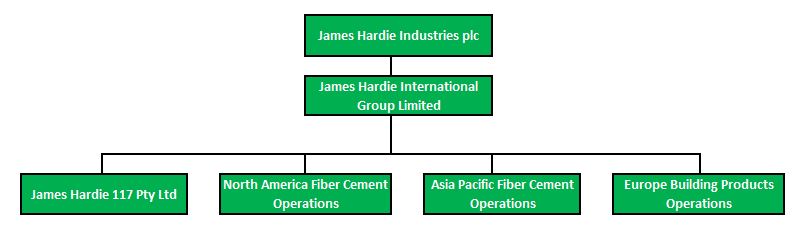
Corporate Structure
The following diagram summarizes our corporate structure at 31 March 2024:
Business Overview
General Overview of Our Business
James Hardie Industries plc is the world’s #1 producer and marketer of high-performance fiber cement and fiber gypsum building solutions. We market our fiber cement products and systems under the HardieTM brand, such as Hardie® Plank, Hardie® Panel, Hardie® Trim, Hardie® Backer, Hardie® Artisan Siding, HardieTM Architectural Collection, and other brand names such as Cemboard®, Prevail®, Scyon®, Linea® and Hardie™ Oblique™ cladding. We are also a market leader in the European premium timber frame and dry lining business, especially in Germany, Switzerland and Denmark. We market our fiber gypsum and cement-bonded boards under the fermacell® brand and our fire-protection boards under the AESTUVER® brand.
The Company has three operating segments: North America Fiber Cement, Asia Pacific Fiber Cement and Europe Building Products. See Notes 2 and 18 to our consolidated financial statements in Section 2 for a description of our operating segments and a breakdown of our net sales by operating segment and geographic market for each of our last three fiscal years.
| | | | | |
| |
James Hardie 2024 Annual Report on Form 20-F | 4 |
| |
Products
We manufacture fiber cement, fiber gypsum and cement bonded boards. Our fiber cement building materials includes a wide-range of products for both external and internal use across a broad range of applications, including external applications: siding, cladding, trim, soffit; and internal applications: walls, floors, ceilings. While there are some market specific products, our core fiber cement products, planks and flat panels, are sold across all of the markets in which we operate. Our fiber gypsum and cement-bonded boards are used mainly for interior applications such as dry lining walls, walls in timber frame buildings and flooring solutions. In addition, our cement-bonded boards are used in exterior and industrial applications as well as for fire protection.
Products Used in External Applications
We developed a proprietary technology platform that enables us to produce thicker yet lighter-weight fiber cement products that are generally easier to handle than most traditional building products. Further, we believe that our fiber cement products provide certain durability and performance advantages leading to improved maintenance, while offering comparable aesthetics to competing products, such as wood and stucco, and superior aesthetics when compared to vinyl siding.
Performance and design advantages:
•Our fiber cement products exhibit resistance to the damaging effects of moisture, fire, impact and termites compared to natural and engineered wood and wood-based products;
•Competing products do not duplicate fiber cement aesthetics;
•Our fiber cement products provide the ability to imprint designs that closely resemble the patterns and profiles of traditional building materials such as wood and stucco;
•The surface properties of our products provide an effective paint-holding finish, especially when compared to natural and engineered wood products, allowing for greater periods of time between necessary maintenance and repainting; and
•Compared to masonry construction, fiber cement is lightweight, physically flexible and can be cut using readily available tools, making our products more appealing across a broad range of architectural styles, be it of timber or steel-framed construction.
The benefits associated with our fiber cement products have enabled us to gain a competitive advantage over competing products.
Products Used in Internal Applications
Compared to natural and engineered wood and wood-based products, we believe our product range for internal applications provide the same general advantages provided by our products for external applications. In addition, our fiber cement products for internal applications exhibit less movement in response to exposure to moisture and impact damage than many competing products, providing a more consistent and durable substrate on which to install tiles. Further, we believe our ceramic tile underlayment products exhibit better handling and installation characteristics compared to fiberglass mesh cement boards. We believe our fiber gypsum products offer superior stability, fire safety and sound insulation properties compared to engineered wood and gypsum plaster boards. Furthermore, we believe our fiber gypsum flooring solutions offer superior handling properties, especially in the modernization of existing buildings, compared to wet screed solutions.
| | | | | |
| |
James Hardie 2024 Annual Report on Form 20-F | 5 |
| |
Significant New Products
In North America, new products released over the last three years include, an expanded ColorPlus® Technology offering through the Magnolia Home | James Hardie Collection and the HardieTM Architectural Collection.
In Asia Pacific, new products released over the past three years include Hardie™ Brushed Concrete Cladding to support our continued growth of our Hardie Embedded Texture Panel products and Hardie™ Oblique™ Cladding launched in Australia. In the Philippines, we debuted a product built specifically for Filipino homes and climate: HardieFlex® NexGen™ fiber cement boards with MoldBlock™ Technology.
In Europe, new products released over the past three years include HardieTM VL Plank, as well as the HardieTM Architectural Collection (which includes designs such as brushed concrete, smooth sand and the recently launched metallic) and fermacell® Therm25TM dry screed elements and the new pumpable levelling compound which helps to speed up and simplify the flooring renovation processes.
Principal Markets for Our Products
Fiber Cement
In the US and Canada, the largest application for fiber cement building products is in external siding for the residential building industry.
Competition in this market comes primarily from substitute products, such as natural wood or engineered wood, vinyl, stucco and brick. We believe we can continue to increase our market share from these competing products through targeted marketing programs designed to educate distributors, builders, contractors, installers and homeowners on our brand and the performance, design and cost advantages of our products.
In the Asia Pacific region, we principally sell into the Australian, New Zealand and Philippines markets, with the residential building industry representing the principal market for fiber cement products. The largest applications of fiber cement across our three primary markets are in external applications: siding, cladding, trim, soffit; and internal applications: walls, floors, ceilings.
In Australia, competition from imports and the locally based fiber cement manufacturer continues to be strong. Additionally, we have competition from natural and engineered wood, wallboard, masonry and brick products. In New Zealand and the Philippines, competitor fiber cement imports continue as manufacturers look to supplement their primary operating environments with additional markets.
In Europe, our fiber cement building products are used in both residential and commercial building applications in the form of external siding, soffits and internal tile underlayment for walls and floors. Competition includes timber based products as well as other manufacturers of fiber cement.
Fiber Gypsum and Cement-Bonded Boards
Our European fermacell® brand products are sold into the residential repair and remodel, commercial and residential new construction markets. The fermacell® brand of products comprise fiber gypsum and cement-bonded boards, two complementary products in the high performance board space, mainly used in timber frame construction, commercial dry lining projects and repair and remodel. Cement bonded boards are also used for several fire protection projects including tunnels.
| | | | | |
| |
James Hardie 2024 Annual Report on Form 20-F | 6 |
| |
Our key markets for fermacell® brand products in Europe include Germany, Switzerland, UK, Denmark, France, Belgium, Netherlands and Luxembourg, where we sell our products to residential and commercial new-build as well as to repair and remodel. In addition, our fire protection AESTUVER® boards are sold to projects worldwide.
Seasonality
We do not have significant seasonality, however our businesses typically follow activity levels in the building and construction industry.
Raw Materials
The principal raw materials used in the manufacture of our fiber cement products are cellulose fiber (wood-based pulp), silica (sand), Portland cement and water. The key raw materials used in the manufacture of our fiber gypsum products are gypsum, recycled paper and water. We have established supplier relationships for all of our raw materials across the various markets in which we operate, and we have supply agreements and plans in place to navigate challenges in the supply environment. The purchase price of these raw materials and other materials can fluctuate depending on the supply-demand situation at any given point in time.
We work hard to reduce the effect of both price fluctuations and supply interruptions by entering into contracts with qualified suppliers and through continuous internal improvements in both our products and manufacturing processes.
Cellulose Fiber
Reliable access to specialized and consistent quality pulp is critical to the production of fiber cement building materials. As a result of our many years of experience and expertise in the industry, we share our internal expertise with pulp producers in New Zealand, the United States, Canada and Chile to ensure they are able to provide us with a highly specialized and proprietary formula crucial to the reinforcing cement matrix of our fiber cement products. We have confidentiality agreements with our pulp producers, and we have obtained patents in the United States and in certain other countries covering certain unique aspects of our pulping formulas and processes that we believe cannot adequately be protected through confidentiality agreements. However, we cannot be assured that our intellectual property and other proprietary information will be protected in all cases. See “Section 3 – Risk Factors.”
Silica
High purity silica is sourced locally by the various production plants. In the majority of locations, we use silica sand as a silica source. In certain other locations, however, we process quartz rock and beneficiate silica sand to ensure the quality and consistency of this key raw material.
Cement
Cement is acquired in bulk from local suppliers.
Water
We primarily use local water supplies and process all wastewater to comply with environmental requirements.
| | | | | |
| |
James Hardie 2024 Annual Report on Form 20-F | 7 |
| |
Gypsum
The primary types of gypsum used in the production of our fiber gypsum products are natural and synthetic gypsum. Natural gypsum is extracted in Germany and Spain and processed in Germany, the Netherlands and Spain. Synthetic gypsum is obtained from power plants in Germany and Poland. While synthetic gypsum will be phased out due to the coal power plant phase-out in the European Union, we are well positioned for the future with natural gypsum sources.
Recycled Paper
Recycled paper, utilized in the production of our fiber gypsum products in Europe, is generally sourced locally by the various production plants in Europe.
Sales, Marketing and Distribution
Our brand names, customer education in comparative product advantages, differentiated product range and customer service, including technical advice and assistance, provide the basis for our marketing strategy. The Company leverages a global integrated marketing campaign that seeks to empower homeowners to realize their dream home, while also marketing directly to the building trades to drive demand for our products.
We offer our customers support through a specialized sales force and customer service infrastructure in North America, Australia, New Zealand, the Philippines and Europe.
Our customer service infrastructure includes inbound customer service support coordinated nationally in each country, and is complemented by outbound telemarketing capability. Within each regional market, we provide sales and marketing support to building products dealers and lumber yards and also provide support directly to the customers of these distribution channels, principally homebuilders and building contractors.
We maintain dedicated regional sales management teams in our major sales territories who maintain relationships with national and other major accounts. Our various sales forces, which in some instances manage specific product categories, include skilled trades people who provide on-site technical advice and assistance.
In North America, we sell our exterior fiber cement products for repair and remodel and new residential construction through a combination of distributors, dealers and lumber yards. Where sales are to distributors, they then sell these products to dealers or lumber yards. Our interior fiber cement products in North America are typically sold through the large home center retailers and specialist distributors or dealers. Our products are distributed across North America primarily by road and, to a lesser extent, by rail.
In Australia and New Zealand, both new construction and repair and remodel products are sold through a combination of distributors, dealers and lumber yards. In the Philippines, a network of thousands of small to medium size retail outlets sell our fiber cement products to consumers, builders and real estate developers and DIY type stores. The physical distribution of our product in each country is primarily by road, rail or sea transport.
In Europe, both new construction and repair and remodel products are primarily sold to builder’s merchants and DIY type stores. These customers then sell the products to applicators such as dry liners, timber frame companies, smaller applicators and end consumers. Our products are distributed across Europe primarily by road and rail and, to a lesser extent, by sea transport.
| | | | | |
| |
James Hardie 2024 Annual Report on Form 20-F | 8 |
| |
Despite the fact that distributors and dealers are generally our direct customers, we also aim to increase primary demand for our products by marketing our products directly to homeowners, architects and builders and building contractors. We encourage them to specify and install our products because of the quality and craftsmanship of our products.
Geographic expansion of our fiber cement business has occurred in markets where framed construction is prevalent for residential applications or where there are opportunities to change building practices from masonry to framed construction. Expansion is also possible where there are direct substitution opportunities irrespective of the methods of construction. With the exception of our current major markets, as well as Japan and certain rural areas in Asia, and Eastern Europe, most markets in the world principally utilize masonry construction for external walls in residential construction. Accordingly, further geographic expansion depends substantially on our ability to provide alternative construction solutions and for those solutions to be accepted in those markets.
Dependence on Trade Secrets and Research and Development (“R&D”)
We pioneered the successful development of cellulose reinforced fiber cement and, since the early-1980s, have progressively introduced products developed as a result of our proprietary product formulation and process technology. The introduction of differentiated products is one of the core components of our global business strategy. This product differentiation strategy is supported by our significant investment in R&D activities.
We view spending on R&D as the key to sustaining our existing product leadership position, by providing a continuous pipeline of innovative new products and technologies with sustainable performance and unique design advantages over our competitors. Further, through our investments in new process technology or by modifying existing process technology, we aim to keep reducing our capital and operating costs and to find new ways to make existing and new products. As such, we expect to continue allocating significant funding to these endeavors.
Our current patent portfolio is based mainly on fiber cement compositions, associated manufacturing processes and the resulting products. Our non-patented technical intellectual property consists primarily of our operating and manufacturing know-how and raw material and operating equipment specifications, all of which are maintained as trade secret information. We have enhanced our abilities to effectively create, manage and utilize our intellectual property and have implemented a strategy that increasingly uses patenting and trade secret protection to protect and increase our competitive advantage.
In addition, we have a variety of industrial, commercial and financial contracts relating to our proprietary manufacturing processes. While we are dependent on the competitive advantage that these items provide as a whole, we are not dependent on any one of them individually and do not consider any one of them individually to be material. We do not materially rely on intellectual property licensed from any outside third parties. However, we cannot assure that our intellectual property and other proprietary information will be protected in all cases. In addition, if our R&D efforts fail to generate new, innovative products or processes, our overall profit margins may decrease and demand for our products may fall. See “Section 3 – Risk Factors.”
| | | | | |
| |
James Hardie 2024 Annual Report on Form 20-F | 9 |
| |
Governmental Regulation
As an Irish plc, we are governed by the Irish Companies Act 2014 and are also subject to all applicable European Union level legislation. We also operate under the regulatory requirements of numerous jurisdictions and organizations, including the ASX, ASIC, the NYSE, the SEC, the Irish Takeover Panel and various other federal, state, local and foreign rulemaking bodies. See “Section 3 – Other Information – Constitution” for additional information regarding the Irish Companies Act 2014 and regulations to which we are subject.
Environmental, Health and Safety Regulation
Our operations and properties are subject to extensive federal, state, local and foreign environmental protection, health and safety laws, regulations and ordinances governing activities and operations that may have adverse environmental effects. As it relates to our operations, regulated material, including wastewater and air emissions, may be produced at some of our manufacturing plants. The wastewater produced from our manufacturing plants is internally recycled and reused before eventually being discharged to publicly owned treatment works, a process which is monitored by us, as well as by regulators. In addition, we actively monitor air emissions and other regulated materials produced by our plants so as to ensure compliance with the various environmental regulations under which we operate.
Some environmental laws provide that a current or previous owner or operator of real property may be liable for the costs of investigation, removal or remediation of certain regulated materials on, under, or in that property or other impacted properties. In addition, persons who arrange, or are deemed to have arranged, for the disposal or treatment of certain regulated materials may also be liable for the costs of investigation, removal or remediation of the regulated materials at the disposal or treatment site, regardless of whether the affected site is owned or operated by such person. Environmental laws often impose liability whether or not the owner, operator, transporter or arranger knew of, or was responsible for, the presence of such regulated materials. Also, third parties may make claims against owners or operators of properties for personal injuries, property damage and/or for clean-up associated with releases of certain regulated materials pursuant to applicable environmental laws and common law tort theories, including strict liability.
In the past, we have received notices of alleged discharges in excess of our water and air permit limits. In each case, and in compliance with our Environmental Policy, we have addressed the concerns raised in those notices, in part, through enhanced administrative controls and/or capital expenditures intended to prevent future discharges in excess of permitted levels and, on occasion, the payment of minor associated fines.
Environmental compliance costs in the future will depend, in part, on continued oversight of operations, expansion of operations and manufacturing activities, regulatory developments and future requirements that cannot presently be predicted.
| | | | | |
| |
James Hardie 2024 Annual Report on Form 20-F | 10 |
| |
Organizational Structure
JHI plc is incorporated and domiciled in Ireland and the table below sets forth our significant subsidiaries, all of which are wholly-owned by JHI plc, either directly or indirectly, as of 30 April 2024.
| | | | | | | | | | | | | | |
| Name of Company | | Jurisdiction of
Establishment | | Jurisdiction of
Tax Residence |
| James Hardie 117 Pty Ltd | | Australia | | Australia |
| James Hardie Australia Pty Ltd | | Australia | | Australia |
| James Hardie Building Products Inc. | | United States | | United States |
| James Hardie Europe GmbH | | Germany | | Germany |
| James Hardie Europe Holdings GmbH | | Germany | | Germany |
| James Hardie Holdings Limited | | Ireland | | Ireland |
| James Hardie International Finance Designated Activity Company | | Ireland | | Ireland |
| James Hardie International Group Limited | | Ireland | | Ireland |
| James Hardie International Holdings Limited | | Ireland | | Ireland |
| James Hardie NL1 B.V. | | Netherlands | | Netherlands |
| James Hardie NL2 B.V. | | Netherlands | | Netherlands |
| James Hardie North America, Inc | | United States | | United States |
| James Hardie Technology Holdings 1 Limited | | Ireland | | Ireland |
| James Hardie Technology Holdings 2 Limited | | Ireland | | Ireland |
| James Hardie Technology Limited | | Bermuda | | Ireland |
| James Hardie U.S. Investments Sierra Inc. | | United States | | United States |
| RCI Holdings Pty Ltd | | Australia | | Australia |
| | | | | |
| |
James Hardie 2024 Annual Report on Form 20-F | 11 |
| |
Property, Plants and Equipment
We have manufacturing plants across the United States, Europe, Australia and the Philippines, with our plants servicing both domestic and export markets. Our plants are ideally located to take advantage of established transportation networks, allowing us to distribute our products into key markets, while also providing easy access to key raw materials.
Manufacturing Capacity
We own all the manufacturing facilities listed below.
| | | | | | | | | | | | | | |
| Plant Location | | 31 March 2024 Nameplate Capacity (mmsf)1 | |
Planned Future Nameplate Capacity (mmsf)1 |
| United States fiber cement | | | | |
| Cleburne, Texas | | 666 | | | 666 | |
| Peru, Illinois | | 560 | | | 560 | |
| Plant City, Florida | | 600 | | | 600 | |
| Pulaski, Virginia | | 600 | | | 600 | |
| Reno, Nevada | | 300 | | | 300 | |
| Tacoma, Washington | | 500 | | | 500 | |
| Waxahachie, Texas | | 413 | | | 413 | |
| Fontana, California | | 250 | | | 250 | |
| Summerville, South Carolina | | 190 | | | 190 | |
| Prattville, Alabama | | 600 | | | 1,200 | |
Westfield, Massachusetts2 | | N/A | | N/A |
| Greenfield - Crystal City, Missouri | | — | | | 600 | |
| Total United States fiber cement | | 4,679 | | | 5,879 | |
| Asia Pacific fiber cement | | | | |
| Rosehill, New South Wales, Australia | | 180 | | | 180 | |
| Carole Park, Queensland, Australia | | 317 | | | 317 | |
Cabuyao City, Philippines | | 172 | | | 172 | |
| Total Asia Pacific fiber cement | | 669 | | | 669 | |
| Europe fiber gypsum | | | | |
| Münchehof, Germany | | 441 | | | 441 | |
| Orejo, Spain | | 275 | | | 527 | |
| Wijchen, the Netherlands | | 273 | | | 273 | |
| Siglingen, Germany | | 154 | | | 154 | |
| Total Europe fiber gypsum | | 1,143 | | | 1,395 | |
| Total Europe fiber cement greenfield plant | | — | | | 300 | |
| Europe Other | | | | |
Calbe, Germany 3 | | 41 | | | 41 | |
Schraplau, Germany 2 | | N/A | | N/A |
| | | | |
| | | | | |
| |
James Hardie 2024 Annual Report on Form 20-F | 12 |
| |
____________
1The calculated annual nameplate capacity is based on management’s historical experience with our production process and is calculated assuming continuous operation, 24 hours per day, seven days per week, producing 5/16” medium density product at a targeted operating speed. No accepted industry standard exists for the calculation of our fiber cement, fiber gypsum and cement bonded board manufacturing facility nameplate, design and utilization capacities.
2Our Westfield, Massachusetts plant is a finishing facility for fiber cement substrate made at other locations. Our Schraplau, Germany facility is a raw materials processing facility for our fiber gypsum plants. As a result, no annual nameplate capacity is available for either of these facilities.
3Our Calbe, Germany plant produces cement bonded boards.
For fiscal year 2024, actual capacity utilization across our fiber cement and fiber gypsum plants was an average of 85%, 68% and 88% in the United States, Europe and Asia Pacific, respectively. For fiscal year 2023, actual capacity utilization across our fiber cement and fiber gypsum plants was an average of 89%, 81% and 95% in the United States, Europe and Asia Pacific, respectively.
Mines
In North America, we lease a silica quartz mine site near our Tacoma, Washington facility that is being actively mined. We have contracted with a third-party mining company to perform the mining operations at that site, including providing the labor and equipment for the mining work. The lease for our quartz mine in Washington expires in February 2027, with additional options to renew. We also lease a silica quartz mine site in Nevada, maintain leases on various properties in Texas that would permit us to mine silica quartz and own property in California which could be mined for silica. As of 30 April 2024, other than the site in Washington, we are not mining at the Nevada, Texas or California sites and have no immediate plans to do so.
As a mine operator in the US, we are required by Section 1503(a) of the Dodd-Frank Wall Street Reform and Consumer Protection Act (the “Dodd-Frank Act”), and rules promulgated by the SEC implementing that section of the Dodd-Frank Act, to provide certain information concerning mine safety violations and other regulatory matters concerning the operation of our mines. During fiscal year 2024, we did not receive any notices, citations, orders, legal action or other communication from the US Department of Labor’s Mine Safety and Health Administration that would necessitate additional disclosure under Section 1503(a) of the Dodd-Frank Act. Similarly, we have not experienced any mining-related fatalities in our mining operations. There are currently no pending legal actions before the Federal Mine Safety and Health Review Commission related to our mining operations.
In Europe, we have a license to make use of a mining facility in Schraplau, Germany as a storage site. No active mining is being undertaken. We also have an investment in a natural gypsum mine in Spain.
Capital Expenditures
We utilize a mix of operating cash flow and debt facilities to fund our capital expenditure projects and investments. We continuously invest in safety, equipment maintenance and upgrades, and capacity to ensure continued environmental compliance and operating effectiveness of our plants. The following table sets forth our capital expenditures for the three most recent fiscal years:
| | | | | | | | | | | | | | | | | | | | |
| (US$ Millions) | | 2024 | | 2023 | | 2022 |
| North America Fiber Cement | | $ | 298.1 | | | $ | 392.0 | | | $ | 188.4 | |
| Asia Pacific Fiber Cement | | 47.8 | | | 136.2 | | | 46.9 | |
| Europe Building Products | | 89.7 | | | 57.8 | | | 18.7 | |
| R&D and Corporate | | 13.7 | | | 5.3 | | | 3.8 | |
| Total Capital Expenditures | | $ | 449.3 | | | $ | 591.3 | | | $ | 257.8 | |
| | | | | |
| |
James Hardie 2024 Annual Report on Form 20-F | 13 |
| |
Significant active capital expenditures
At 31 March 2024, the following significant capital expenditures remain in progress:
| | | | | | | | | | | | | | | | | | | | | | | | | | | | | | | | |
| Project Description | | Approximate
Investment
(In millions) | | Investment
to date
(In millions) | | Project
Start Date | | Expected
Completion Date | | Expected Nameplate Capacity Increase (mmsf) |
| Prattville Greenfield expansion (sheet machines #3 and #4) | | US$ | 439.0 | | US$ | 342.3 | | Q3 FY22 | | FY25 | | 600 |
Prattville ColorPlus® finishing capacity | | US$ | 83.8 | | US$ | 24.7 | | Q2 FY23 | | FY26 | | N/A |
| Orejo Brownfield expansion | | € | 134.1 | | € | 89.1 | | Q3 FY22 | | FY25 | | 252 |
Significant completed capital expenditure projects
The following is a list of significant capital expenditure projects completed in the three most recent fiscal years:
| | | | | | | | | | | | | | |
| Project Description | | Total
Investment
(US Millions) | | Fiscal Year of
Expenditure |
Massachusetts ColorPlus® finishing capacity | | $ | 56.4 | | FY21 - FY24 |
| Prattville Trim finishing capacity | | $ | 55.1 | | FY21 - FY23 |
Carole Park Brownfield expansion
| | $ | 36.8 | | FY19 - FY23 |
| Prattville Greenfield expansion (sheet machines #1 and #2) | | $ | 241.2 | | FY18 - FY22 |
| Summerville restart | | $ | 11.1 | | FY21 - FY22 |
Capital Divestitures
During the three most recent fiscal years, we did not make any material capital divestitures. However, in fiscal year 2024, we announced the cancellation of our plans to build a greenfield site in Truganina, Australia. For further information, see Note 7 to our consolidated financial statements in Section 2.
| | | | | |
| |
James Hardie 2024 Annual Report on Form 20-F | 14 |
| |
DIRECTORS, SENIOR MANAGEMENT AND EMPLOYEES
James Hardie Executive Team
The Company’s management is overseen by an executive team, whose members cover the key areas of finance, human resources, investor relations, legal, manufacturing, marketing, operations, production, R&D and sales.
Members of our management executive team at 30 April 2024 are:
| | | | | |
Aaron Erter
|
| Chief Executive Officer |
| Age | 50 |
| Expertise, experience and skills | Aaron Erter was appointed as Chief Executive Officer (“CEO”) in September 2022. A highly experienced executive, Mr. Erter possesses deep expertise in global, multi-billion dollar organizations in the consumer and industrial sectors. Specifically, he has built and managed high-performing teams, is proficient in P&L management, strategy development, product development, marketing, sales leadership and M&A. Before coming to James Hardie, Mr. Erter served as CEO of PLZ Corp, a leader of specialty liquid and aerosol manufacturing. Mr. Erter’s other career experiences include Sherwin-Williams, where he served as global president for Sherwin’s Consumer and Industrial businesses, Valspar, where he was senior vice president and general manager of the company’s Consumer business and 15 years at Stanley Black & Decker, where he held numerous leadership roles in sales and marketing for both the Black & Decker and DEWALT Brands. Mr. Erter serves on the Board of Directors for Chicagoland Habitat for Humanity.
Mr. Erter holds a Bachelor of Economics from The Wharton School at The University of Pennsylvania and an MBA from The University of Notre Dame – Mendoza College of Business.
|
| | | | | |
| |
James Hardie 2024 Annual Report on Form 20-F | 15 |
| |
| | | | | |
Rachel Wilson |
| Chief Financial Officer |
| Age | 52 |
| Expertise, experience and skills | Rachel Wilson was appointed Chief Financial Officer (“CFO”) of James Hardie in August 2023.
Ms. Wilson has a 30-year track record of driving stakeholder value for global technology, business services and consumer companies. Ms. Wilson has executed dozens of multi-billion transactions as an agent or principal and managed highly impactful finance functions including FP&A, investor relations and treasury.
Prior to James Hardie, Ms. Wilson served as the Chief Financial Officer and Treasurer of R1 RCM, a healthcare IT company that services hospitals and health systems across the United States. Ms. Wilson also previously served as the SVP Finance and Treasurer for Iron Mountain, a global enterprise information management company, and later, as its Chief Financial Officer, Data Centers.
Ms. Wilson was appointed to the Security and Exchange Commission’s (SEC) inaugural Fixed Income Market Structure Advisory Committee in 2017, and was named “Best Investor Relations Professional, Sell Side,” by Institutional Investor in 2016.
Ms. Wilson holds a joint B.A. and M.A. in international economics and international relations from Johns Hopkins University and an MBA from Columbia Business School.
|
| | | | | |
| |
James Hardie 2024 Annual Report on Form 20-F | 16 |
| |
| | | | | |
Farhaj Majeed
|
| Chief Human Resources Officer |
| Age | 46 |
| Expertise, experience and skills | Farhaj Majeed joined James Hardie as Chief Human Resources Officer (“CHRO”) in February 2023. Mr. Majeed is an accomplished human relations professional with over 20 years of experience. Prior to James Hardie, Mr. Majeed held a variety of global and regional HR roles with top-tier companies such as Kraft Foods, Mondelez International, Abbott Laboratories and most recently, Whirlpool Corporation, where he led the Europe and MEA region as VP & CHRO, EMEA.
Mr. Majeed holds an MBA from the Institute of Business Management with an emphasis on Human Resources and Marketing. |
| | | | | |
Tim Beastrom
|
| Chief Legal Counsel and Chief Compliance Officer |
| Age | 57 |
| Expertise, experience and skills | Tim Beastrom joined James Hardie in January 2023 as Chief Legal Counsel and Chief Compliance Officer. Mr. Beastrom’s resume includes 25 years of in-house legal counsel focusing on corporate governance, securities law, environmental, social and governance risk oversight, mergers and acquisitions and commercial law.
Before starting at James Hardie, Mr. Beastrom was Chief Securities Counsel and Associate General Counsel at Ecolab, Inc.
Mr. Beastrom received his Juris Doctor from the University of Minnesota Law School and holds a Bachelor of Arts in business administration and management from Gustavus Adolphus College. |
| | | | | |
| |
James Hardie 2024 Annual Report on Form 20-F | 17 |
| |
| | | | | |
Sean Gadd
|
| President, North America |
| Age | 51 |
| Expertise, experience and skills | Sean Gadd serves as President of North America for James Hardie, a position he’s held since January 2022.
Mr. Gadd began his career at James Hardie in 2004 as a Regional Engineering Manager for the Asia Pacific business and progressed to Plant Manager for both the Carole Park and Rosehill facilities in Australia. Mr. Gadd then moved to the U.S. in 2006 to take on the role of Manufacturing Manager for various manufacturing facilities across the United States.
Since then, Mr. Gadd has had a variety of roles with increasing levels of responsibilities. In October 2015, he was appointed Executive Vice President, Markets and Segments, North America, with responsibility for strategic marketing and development. In December 2018, Mr. Gadd was appointed Executive Vice President, North America, Commercial, where his responsibilities included sales, product development and marketing prior to his current appointment as President, North America.
Mr. Gadd holds a Bachelor of Science in Engineering from the University of New South Wales and an MBA from its business school, the Australian Graduate School of Management. |
| | | | | |
| |
James Hardie 2024 Annual Report on Form 20-F | 18 |
| |
| | | | | |
| Joe Liu |
| Chief Technology Officer |
| Age | 61 |
| Expertise, experience and skills | Joe Liu serves as James Hardie’s Chief Technology Officer (“CTO”), a role he’s held since January 2022. In his role, Mr. Liu leads the firm’s global research and development and innovation efforts. Before taking over CTO duties, Mr. Liu was general manager for James Hardie’s Asia Pacific business. Prior to James Hardie, Mr. Liu had an impressive 26 year career with 3M, where he held a variety of senior leadership roles in research and development, as well as commercial and international management. Mr. Liu holds a Bachelor of Science and a Ph.D. in thermal energy and power engineering from Xi’an Jiao Tong University in China and an additional Ph.D. in mechanics from the University of Minnesota. |
| | | | | |
James Johnson II
|
| Chief Information Officer |
| Age | 52 |
| Expertise, experience and skills | James Johnson II is James Hardie’s Chief Information Officer (“CIO”), a position he’s held since December 2021. With a proven track record of developing effective, leading-edge technology solutions that create business value, he is responsible for all aspects of information technology and cyber security globally. Mr. Johnson brings over 25 years of relevant and progressive IT experience, including 15 years as CIO for businesses in a variety of industries, including chemicals and metals companies. Most recently, Mr. Johnson held the role of CIO at Carpenter Technology and has also held IT roles with Honeywell International, Performance Fibers and Trinseo. Mr. Johnson holds a Bachelor of Arts in economics from the University of Virginia and an MBA from the University of Maryland. |
| | | | | |
| |
James Hardie 2024 Annual Report on Form 20-F | 19 |
| |
| | | | | |
Ryan Kilcullen
|
| Executive Vice President, Global Operations |
| Age | 43 |
| Expertise, experience and skills | Ryan Kilcullen is Executive Vice President of James Hardie’s Global Operations, a position he’s held since January 2022. Mr. Kilcullen joined the company in 2007 as a PcI/PdI Engineer. Since then, Mr. Kilcullen has worked for the company in various manufacturing and supply chain roles including Process Engineer, Production Manager and Supply Chain Engineer. Mr. Kilcullen was appointed Executive Vice President – North America Operations in 2016, where he was responsible for the company's supply chain, manufacturing, engineering and environmental and health & safety operations. Mr. Kilcullen holds a Bachelor of Science in industrial engineering from Rensselaer Polytechnic Institute and a Master of Engineering in logistics from the Massachusetts Institute of Technology. |
| | | | | |
John Arneil |
| President, Asia Pacific |
| Age | 44 |
| Expertise, experience and skills | John Arneil is President of James Hardie’s Asia Pacific operations, a role he’s held since February 2023. Since joining the company more than twenty years ago, Mr. Arneil has built an impressive career, having worked in James Hardie’s European, North American, and Asia Pacific businesses in a variety of commercial and operational roles. Mr. Arneil has enjoyed exposure to multiple markets in different phases of business maturity and complexity enabling him to fully understand value creation from a consumer and customer perspective and how that translates end-to-end through innovation, manufacturing, commercialization and supply chain management. This, coupled with deep industry relationships has enabled Mr. Arneil to deliver record results for the Australian and New Zealand businesses year-over-year. Mr. Arneil has a Bachelor of Business Management from The University of Queensland in Australia and a Master of Business Administration from The University of Leicester in the UK. |
| | | | | |
| |
James Hardie 2024 Annual Report on Form 20-F | 20 |
| |
| | | | | |
Christian Claus
|
| President, Europe |
| Age | 41 |
| Expertise, experience and skills | Christian Claus is the President of James Hardie’s Europe business, a position he’s held since January 2023. Prior to James Hardie, Mr. Claus held multiple leadership positions at Tarkett, a leading sustainable flooring and sports surface firm based out of Paris. Mr. Claus also held senior leadership positions at Air Liquide, the world’s leading manufacturer of industrial gases, as well as various commercial and international management roles at 3M. Mr. Claus holds both an undergraduate and MBA from Heinrich Heine University in Duesseldorf, Germany and has completed numerous executive education programs at Harvard Business School, London Business School and the Massachusetts Institute of Technology. |
| | | | | |
Jill Kolling |
| Chief Sustainability Officer |
| Age | 58 |
| Expertise, experience and skills | Jill Kolling has served as Jame’s Hardie’s Chief Sustainability Officer (“CSO”) since March 2022. Ms. Kolling is responsible for the development and execution of James Hardie’s global environment, social and governance strategy, ensuring integration with the company’s overall business goals. Prior to James Hardie, Ms. Kolling was the vice president for global sustainability at American conglomerate Cargill and built the first-ever global sustainability function for the corporation. Ms. Kolling has a proven track record of applying strategic insights and systems thinking to optimize shareholder value, positive environmental outcome and social good. Ms. Kolling holds a Bachelor of Science in mechanical engineering and a Master of Science in computer science, both from the University of Minnesota. |
| | | | | |
| |
James Hardie 2024 Annual Report on Form 20-F | 21 |
| |
| | | | | |
Stephen Balsavich
|
| Global Head of Transformation |
| Age | 43 |
| Expertise, experience and skills | Stephen Balsavich has served as Jame’s Hardie’s Global Head of Transformation since December 2021. Mr. Balsavich is responsible for leading the coordination and execution of various strategic and change initiatives. Mr. Balsavich began his career at James Hardie in 2016 and has worked on both finance and IT teams. During James Hardie’s acquisition of Fermacell in Europe, Mr. Balsavich served as the PMO and IT lead, which included integration efforts post deal closing. Prior to James Hardie, Mr. Balsavich spent most of his career in mergers and acquisitions for PricewaterhouseCoopers (PwC). Mr. Balsavich holds a Bachelor of Science in finance from the University of Illinois and an MBA from Dominican University. |
| | | | | |
Joel Wasserman
|
| Vice President,
Corporate Communications and Global Brand Management |
| Age | 62 |
| Expertise, experience and skills | Joel Wasserman joined James Hardie as VP of Corporate Communications and Global Brand Management in January 2023. Mr. Wasserman is responsible for the company’s global marketing and communications initiatives. He has more than 35 years of progressive communications and marketing experience that includes work at integrated marketing agencies and consumer products companies. Prior to his role with James Hardie, Mr. Wasserman spent ten years with Sherwin-Williams and Valspar where he was responsible for strategic planning and brand management for all paint brands in the consumer brands group. During his career, Mr. Wasserman has supported marketing and communications efforts for dozens of global companies and brands including Citibank, Kellogg’s, Kraft Foods and Black & Decker. Mr. Wasserman holds a Bachelor of Science in Economics from Northern Illinois University. |
| | | | | |
| |
James Hardie 2024 Annual Report on Form 20-F | 22 |
| |
Board of Directors
James Hardie’s Board of Directors (the “Board”) have widespread experience, spanning general management, finance, manufacturing, marketing and accounting. Each non-executive director also brings valuable international experience that assists with James Hardie’s growth. For additional information, see “Section 1 - Corporate Governance Report” of this Annual Report.
Members of the Board at 30 April 2024 are:
| | | | | |
Anne Lloyd, BS, CPA |
| Independent, Non-Executive Chair Appointed to the Board November 2018 Appointed as Chair November 2022 Current term expires November 2025 |
| Age | 62 |
| Committees | None |
| Qualifications | Certified Public Accountant (CPA); BS in Business Administration (University of North Carolina)
|
| Expertise, experience and skills | Anne Lloyd was appointed as an independent non-executive director of James Hardie in November 2018. Ms. Lloyd served as a member of the Audit Committee from the date of her appointment during her entire tenure as a Board member, with the exception of the period from 26 August 2019 through 25 February 2020, during which time she served as Interim CFO. She was appointed Chair of the Audit Committee effective 8 August 2020 and Deputy Chairperson effective 10 August 2022. She also served as Lead Independent Director from 6 January 2022 to 1 September 2022. Ms Lloyd was appointed Chair of the Board effective 3 November 2022 at which time she stepped down as Chair of the Audit Committee. Ms Lloyd, an experienced corporate and finance executive, served as Chief Financial Officer of Martin Marietta Materials, Inc. a leading supplier of aggregates and heavy building materials, for over 12 years from June 2005 until her retirement in August 2017. She joined Martin Marietta in 1998 as Vice President and Controller and was promoted to Chief Accounting Officer in 1999. She was subsequently appointed Treasurer (2006-2013) and promoted to Executive Vice President in 2009. Earlier in her career, Ms Lloyd spent 14 years with Ernst & Young LLP (1984-1998), latterly as a senior manager and client service executive for the natural resources, mining, insurance and healthcare industries. |
| Other current directorships (Listed) | Insteel Industries, Inc (NYSE:IIIN) (since 2019); Highwoods Properties, Inc. (NYSE:HIW) (since 2018) |
| Other current directorships (Unlisted) | New Frontier Materials LLC (since 2021) |
| Former listed company directorships (last five years) | None |
| Residency | United States |
| | | | | |
| |
James Hardie 2024 Annual Report on Form 20-F | 23 |
| |
| | | | | |
Peter-John Davis
|
| Independent, Non-Executive Director Appointed to the Board August 2022 Current term expires August 2025 |
| Age | 65 |
| Committees | Nominating and Governance Committee (Member) |
| Qualifications | Advanced Management Program (Harvard Business School); Foundation Member of Australian Institute of Company Directors (AICD) |
| Expertise, experience and skills | Peter John (PJ) Davis previously served as Chief Operating Officer (COO) of Bunnings Australia & New Zealand. During his 15-year tenure as COO, the division was one of the most profitable of the Wesfarmers Group.
With over 40 years’ experience in various retail and trade formats and home improvement industries, Mr Davis commenced his career on the sales floor and held senior roles in operations, marketing, advertising and merchandising before moving into general management and leading the development of the highly successful Bunnings Warehouse concept.
Mr Davis was responsible for the development, strategic direction, and operational management of the Bunnings businesses and its employees. His main objectives were to ensure growth in revenues and profitability and provide satisfactory returns for shareholders.
Mr Davis completed the Advanced Management Program at Harvard Business School in Boston, USA and is the Founding Director ANRA (Australian National Retailers Association) and Foundation Member of the Australian Institute of Company Directors.
|
| Other current directorships (Listed) | None |
| Other current directorships (Unlisted) | None |
| Former listed company directorships (last five years) | None |
| Residency | Australia |
| | | | | |
| |
James Hardie 2024 Annual Report on Form 20-F | 24 |
| |
| | | | | |
Persio V. Lisboa, BS
|
| Independent, Non-Executive Director Appointed to the Board February 2018 Current term expires August 2024 |
| Age | 58 |
| Committees | Remuneration Committee (Chair); Nominating and Governance Committee (Member) |
| Qualifications | BS in Business Administration (Pontificia Universidade Catolica University) |
| Expertise, experience and skills | Mr Lisboa has extensive senior executive experience. He served as President and Chief Executive Officer of Navistar, Inc. (Navistar), a leading manufacturer of commercial trucks, buses, defense vehicles and engines, a position he held from July 2020 to September 2021, when he decided to retire. Prior to that position, Mr Lisboa served at Navistar as Executive Vice President and Chief Operating Officer from March 2017 to July 2020, President of Operations from November 2014 to March 2017, Chief Procurement Officer from October 2011 to November 2014, and several other key senior leadership positions since 2005. Prior to these, Mr Lisboa held various senior leadership positions within Navistar’s South American operations. Mr Lisboa began his career at Maxion International Motores Brasil in 1986. |
| Other current directorships (Listed) | J.B. Hunt Transport Services Inc. (NASDAQ: JBHT) (since 2023) |
| Other current directorships (Unlisted) | Ascendance Trucks, LLC. (since 2023); Allegiance Trucks, LLC. (since 2023) |
| Former listed company directorships (last five years) | None |
| Residency | United States |
| | | | | |
| |
James Hardie 2024 Annual Report on Form 20-F | 25 |
| |
| | | | | |
Renee J. Peterson, BS, MBA
|
| Independent, Non-Executive Director Appointed to the Board November 2022 Current term expires August 2026 |
| Age | 63 |
| Committees | Audit Committee (Chair) |
| Qualifications | BS in Accounting (St. Cloud State University Herberger Business School); MBA (University of Minnesota); Certified Public Accountant (inactive); Six-Sigma Green Belt |
| Expertise, experience and skills | Ms Peterson served as CFO for The Toro Company, a leading worldwide provider of innovative solutions for the outdoor environment with responsibility for all aspects of finance, information technology and investor relations, until March 2023. She continued to serve as Vice President until July 2023.
She previously served as Eaton Corporation’s Vice President of Finance and Planning for the company’s truck and automotive segments.
Prior to joining Eaton, Ms Peterson served in various financial leadership positions of increasing responsibility at Honeywell International over 25-years. Ms Peterson’s career has spanned several different areas within the industrial sector, including aerospace, automotive, construction and consumer products.
She earned her Bachelor of Science degree in accounting from St. Cloud State University Herberger Business School and an MBA from the University of Minnesota. She is a certified public accountant (inactive) and holds a six-sigma green belt certification.
Ms Peterson is an independent director for Franklin Electric (FELE), a global leader in the manufacturing and distribution of water and fueling products and solutions and is currently Audit Committee Chair. She also serves as the executive sponsor for the Franklin Women’s Network.
She previously served on the Board of the Greater Twin Cities United Way (GTCUW) as the Treasurer and Finance & Human Capital Committee Chair and was also a member of the GTCUW Executive Committee. Ms Peterson is also a member of the MN Women’s Economic Roundtable (MWER) and Women Corporate Directors.
|
| Other current directorships (Listed) | Franklin Electric (NASDAQ:FELE) (since 2015) |
| Other current directorships (Unlisted) | None |
| Former listed company directorships (last five years) | None |
| Residency | United States |
| | | | | |
| |
James Hardie 2024 Annual Report on Form 20-F | 26 |
| |
| | | | | |
Rada Rodriguez, MSc
|
| Independent, Non-Executive Director Appointed to the Board November 2018 Current term expires November 2025 |
| Age | 65 |
| Committees | Nominating and Governance Committee (Chair); Remuneration Committee (Member) |
| Qualifications | MSc Construction Engineering, Diploma in Efficient Board Management (Institute of Directors, UK) |
| Expertise, experience and skills | Ms Rodriguez serves as Chief Executive Officer of Signify DACH, part of the Signify Group, a world leader in connected LED lighting systems, software and services, since May 2021. She previously served as Chief Executive Officer of Schneider Electric GmbH, part of Schneider Electric Group, a global energy management and automation company and served as Senior Vice President, Corporate Alliances until 2021. On joining the company in 1999, she held a progression of senior roles including Head of International Research and Development for Schneider Electric Sweden, and Senior Vice President and Zone President, Central and Eastern Europe.
Prior to joining Schneider Electric GmbH, she worked at Level Group (later acquired by Schneider) and before that she worked for 5 years at Colasit Scandinavia AB, a Swiss industrial machinery manufacturer. She started her career with K-Konsult AB, a Swedish technical consulting firm with a focus on installation technology where she worked for 5 years as a design engineer. |
| Other current directorships (Listed) | None |
| Other current directorships (Unlisted) | ZVEI (since 2014) |
| Former listed company directorships (last five years) | None |
| Residency | Germany |
| | | | | |
| |
James Hardie 2024 Annual Report on Form 20-F | 27 |
| |
| | | | | |
Suzanne B Rowland, MS, BS
|
| Independent, Non-Executive Director Appointed to the Board February 2021 Current term expires August 2024 |
| Age | 62 |
| Committees | Audit Committee (Member); Remuneration Committee (Member) |
| Qualifications | BS in Chemical Engineering (University of Pennsylvania); Master of Science in Business Studies (London Business School) |
| Expertise, experience and skills | Ms Rowland has extensive senior executive experience leading complex global materials and industrial businesses. She most recently served as Group Vice President of the Industrial Specialties business at Ashland Global Holdings Inc. from 2016 to 2019 where she aligned commercial and asset strategies driving focused profitable growth.
Prior to this, Ms Rowland served in separate Vice President and General Manager roles in Tyco International plc between 2009 and 2015 where she led significant improvements in customer relationships, market share gains, pricing, operational execution, and acquisition integration. Before joining Tyco, Ms Rowland worked for Rohm and Haas Company for over twenty years, where she held multiple senior executive roles including turning around the global Adhesives division and leading Procurement & Logistics for the company.
In 2023, Ms Rowland earned the Sustainability and Climate Risk Certificate from the Global Association of Risk Professionals. |
| Other current directorships (Listed) | Sealed Air Corporation (NYSE: SEE) (since 2020) |
| Other current directorships (Unlisted) | None |
| Former listed company directorships (last five years) | SPX Flow, Inc. (NYSE: SPXC) (2018-2022); L.B. Foster Co. (NASDAQ: FSTR) (2008-2022) |
| Residency | United States |
| | | | | |
| |
James Hardie 2024 Annual Report on Form 20-F | 28 |
| |
| | | | | |
Nigel Stein, CA, BSc
|
| Independent, Non-Executive Director Appointed to the Board May 2020 Current term expires August 2026 |
| Age | 68 |
| Committees | Audit Committee (Member); Nominating and Governance Committee (Member) |
| Qualifications | Bachelor of Science in Mechanical Engineering (Edinburgh University); Chartered Accountant (CA) (Institute of Chartered Accountants of Scotland) |
| Expertise, experience and skills | Mr Stein has extensive experience in the global automotive and manufacturing sectors. He previously served as Chairman of Inchcape plc (Inchcape), an automotive distribution, retail and financing company, a position he held from May 2018 to May 2024 and as a non-executive director from October 2015 to May 2024.
Prior to holding this position, Mr Stein served as Chief Executive Officer of GKN Ltd (GKN) (formerly GKN plc) from January 2012 to December 2017. He joined the automotive and aerospace components supplier in 1994 and during his time with GKN held various senior positions in general management and finance including six years as Group Chief Financial Officer. Earlier in his career, Mr Stein held senior finance positions with Laird plc and Hestair plc. From 2003 until 2011, he served as an independent non-executive director on the Board of Ferguson (formerly Wolseley) plc, the leading specialist distributor of plumbing and heating products in North America. Mr Stein is a member of the Institute of Chartered Accountants of Scotland. |
| Other current directorships (Listed) | None |
| Other current directorships (Unlisted) | None |
| Former listed company directorships (last five years) | Inchcape PLC (LSE: INCH) (2015 - 2024) |
| Residency | United Kingdom |
| | | | | |
| |
James Hardie 2024 Annual Report on Form 20-F | 29 |
| |
| | | | | |
Harold Wiens, BS
|
| Independent, Non-Executive Director Appointed to the Board May 2020 Current term expires August 2026 |
| Age | 77 |
| Committees | Audit Committee (Member) |
| Qualifications | Bachelor of Science in Mechanical Engineering (Michigan Technological University) |
| Expertise, experience and skills | Mr Wiens worked at 3M Company (3M) for thirty-eight years. He served as Executive Vice President, Industrial Business and Transportation Business from 1998 until his retirement from 3M in 2006. It is 3M’s largest and most diverse business serving many different end markets ranging from electronic to automotive and aerospace manufacturing. During this time, Mr Wiens restructured the business, leading a global implementation of Six Sigma that drove significant international growth.
Prior to holding this position, Mr Wiens served as Executive Vice President, Sumitomo 3M, 3M’s largest subsidiary, headquartered in Tokyo, Japan, from 1995 to 1998 and served as Data Storage Business Leader and Vice President from 1988 to 1995 and as Memory Technologies Group Manufacturing Manager from 1983 to 1988. Mr Wiens began his career with 3M in 1968 and held many positions of increasing responsibility over his first fifteen years with 3M.
|
| Other current directorships (Listed) | None |
| Other current directorships (Unlisted) | Rejuvi Venture LLC. (since 2021) |
| Former listed company directorships (last five years) | Bio-Techne Corporation (NASDAQ:TECH) (2014 - 2020) |
| Residency | United States |
| | | | | |
| |
James Hardie 2024 Annual Report on Form 20-F | 30 |
| |
Remuneration Report
This Remuneration Report describes the executive remuneration philosophy, programs and objectives of the Remuneration Committee and the Board of Directors (the “Board”), as well as the executive remuneration plans and programs implemented by James Hardie.
We are not required to produce a remuneration report under applicable Irish, Australian or US rules or regulations. However, taking into consideration our significant Australian and US shareholder bases and our primary listing on the Australian Securities Exchange (“ASX”), we have voluntarily produced a remuneration report consistent with those provided by similarly situated companies for non-binding shareholder approval since 2005.
This Remuneration Report outlines the key remuneration plans and programs and share ownership information for our Board of Directors and certain of our senior executive officers (Chief Executive Officer (“CEO”), Chief Financial Officer (“CFO”) and the other three highest paid executive officers based on total compensation that was earned or accrued for fiscal year 2024) (“Senior Executive Officers”) in fiscal year 2024, and also includes an outline of the key changes for fiscal year 2025. Further details of these changes will be set out in the 2024 Notice of Annual General Meeting (“AGM”).
For fiscal year 2024, our senior executive officers are:
•Aaron Erter, Chief Executive Officer;
•Rachel Wilson, Chief Financial Officer (effective 16 August 2023);
•Sean Gadd, President, North America;
•Ryan Kilcullen, Executive Vice President, Global Operations;
•Timothy Beastrom, Chief Legal Officer; and
•Jason Miele, Chief Financial Officer (former Chief Financial Officer).
As previously announced, Mr Jason Miele ended his service as Chief Financial Officer on 16 August 2023 and remained as a consultant until 17 November 2023.
This Remuneration Report has been adopted by our Board on the recommendation of the Remuneration Committee.
| | | | | |
| |
James Hardie 2024 Annual Report on Form 20-F | 31 |
| |
EXECUTIVE SUMMARY
Fiscal Year 2024 Business Highlights1
Our operating results for fiscal year 2024 reflected solid financial results, highlighted by record net sales of US$3.9 billion, an increase of 4% compared to fiscal year 2023. Adjusted earnings before interest and taxes (“EBIT”) of US$941 million and Adjusted net income of US$708 million in fiscal year 2024 increased 21% and 17%, respectively, compared to fiscal year 2023.
The following graphs show our performance for key financial measures during fiscal year 2024, with a comparison to prior corresponding periods:
____________
1Please see the “Glossary of Abbreviations and Definitions” in Section 4 of this Annual Report for a reconciliation of non-GAAP financial measures used in this Remuneration Report to the most directly comparable US GAAP financial measure.
| | | | | |
| |
James Hardie 2024 Annual Report on Form 20-F | 32 |
| |
Fiscal Year 2024 Compensation Highlights
Our fiscal year 2024 compensation continued to reflect and promote our pay-for-performance philosophy and our stated goal to position Senior Executive Officer fixed base salary and benefits at the median and total target direct remuneration (comprising fixed and target variable remuneration) at the 75th percentile of our Peer Group (defined herein), if stretch short- and long-term target performance goals are met.
The following is a summary of the key aspects and events that occurred relative to the Company’s remuneration policies, programs and arrangements during the course of fiscal year 2024:
•No changes were made to the core design of the of our Short-Term Incentive program in fiscal year 2024, which is comprised of both the Company Performance Plan (“CP Plan”) and Individual Performance Plan (“IP Plan”). The CP Plan continues to measure both Growth and Returns when assessing Company performance and shareholder value creation. A complete description of the CP Plan for fiscal year 2024 is set out in the section titled “Incentive Arrangements” later in this Remuneration Report.
•No changes were made to the design of the LTI Plan for fiscal year 2024. The LTI plan remains similar to the fiscal year 2023 plan with updated financial targets. A complete description of the LTI program, including the applicable performance hurdles, is set out in the section titled “Incentive Arrangements” later in this Remuneration Report.
Fiscal Year 2024 Total Target Compensation
Remuneration packages for Senior Executive Officers reflect our remuneration philosophy and comprise a mixture of fixed base salary, benefits and variable performance-based incentives. The Remuneration Committee seeks to appropriately balance fixed and variable remuneration in order to align our total compensation structure with our pay-for-performance philosophy. The following chart summarizes total target compensation awarded to each Senior Executive Officer in fiscal year 2024:
| | | | | | | | | | | | | | | | | |
| Summary of Fiscal Year 2024 Senior Executive Officer Target Compensation |
| Senior Executive Officer | FY2024 Annual Base Salary (US$) | FY2024 STI Target Value (US$) | FY2024 LTI Target Value (US$) | FY2024 Total Target Compensation (US$) |
| A Erter | 1,038,000 | 1,245,600 | 5,320,000 | 7,603,600 |
| R Wilson | 620,000 | 434,000 | 1,000,000 | 2,054,000 |
| S Gadd | 672,750 | 470,925 | 1,000,000 | 2,143,675 |
| R Kilcullen | 480,000 | 312,000 | 650,000 | 1,442,000 |
| T Beastrom | 450,000 | 270,000 | 400,000 | 1,120,000 |
Ms Wilson received a sign on US$500,000 restricted stock unit award with one-third vesting on 17 August 2024, 2025, and 2026. Ms Wilson also received a sign on US$500,000 Relative TSR RSU award vesting on 17 August 2026 subject to performance hurdles.
Results of 2023 Remuneration Report Vote
In August 2023, our shareholders were asked to cast a non-binding advisory vote on our remuneration report for the fiscal year ended 31 March 2023. Although we are not required under applicable Irish, Australian or US laws or regulations to provide a shareholder vote on our executive remuneration practices, the Board believes that it is important to engage shareholders on this important issue and we
| | | | | |
| |
James Hardie 2024 Annual Report on Form 20-F | 33 |
| |
have voluntarily submitted our remuneration report for non-binding shareholder approval on an annual basis since 2005 and currently intend to continue to do so.
At our 2023 Annual General Meeting, our shareholders approved our remuneration report, with 88.9% of the votes cast in support of our remuneration program. The Remuneration Committee considered the results of this advisory vote, together with investor feedback and other factors and data associated with strategic priorities discussed in this Remuneration Report, in determining our executive remuneration policies, objectives and decisions and related shareholder engagement efforts for fiscal year 2024.
APPROACH TO SENIOR EXECUTIVE REMUNERATION
Remuneration Philosophy
As our largest operating business and all of our Senior Executive Officers are located in the US, our remuneration philosophy is to provide our Senior Executive Officers with an overall package that is competitive with Peer Group companies exposed to the US housing and consumer durables market. Within this philosophy, the executive remuneration framework emphasizes operational excellence and shareholder value creation through incentives that link executive remuneration with the interests of shareholders. Our remuneration plans and programs are structured to enable us to: (i) attract and retain talented executives; (ii) reward outstanding individual and corporate performance; and (iii) align the interests of our executives to the interests of our shareholders, with the ultimate goal of creating long-term value for our shareholders. This pay-for-performance system continues to serve as the framework for executive remuneration, aligning the remuneration received with the performance achieved.
Composition of Remuneration Packages
In line with our remuneration philosophy, our goal is to position Senior Executive Officer fixed base salary and benefits at the median and total target direct remuneration (comprising fixed and target variable remuneration) at the 75th percentile of our Peer Group, if stretch short- and long-term target performance goals are met. Performance goals for target variable performance-based incentive remuneration are set with the expectation that we will deliver results in the top quartile of our Peer Group. Performance below this level will result in variable remuneration payments below target (and potentially zero for poor performance). Performance above this level will result in variable remuneration payments above target.
| | | | | |
| |
James Hardie 2024 Annual Report on Form 20-F | 34 |
| |
Relative Weightings of Fixed and Variable Remuneration
The charts below detail the relative weightings of fixed versus variable remuneration for our CEO and other Senior Executive Officers for fiscal year 2024. Fixed remuneration includes base salary and variable remuneration is comprised of target STI awards and the following three LTI components: (i) Relative Total Shareholder Return (“TSR”) Restricted Stock Units (“RSUs”); (ii) Return on Capital Employed (“ROCE”) RSUs; and (iii) Scorecard LTI at target, each of which are discussed in more detail in this Remuneration Report.
Setting Remuneration Packages
Remuneration decisions are based on the executive remuneration philosophy and framework described in this Remuneration Report. The Remuneration Committee reviews and the Board approves this framework each year.
Remuneration packages for Senior Executive Officers are evaluated each year to make sure that they continue to align with our compensation philosophy, are competitive with our Peer Group and developments in the market, and continue to support our business structure and objectives. In making decisions regarding individual Senior Executive Officers, the Remuneration Committee takes into account both the results of an annual remuneration positioning review provided by the Remuneration Committee’s independent advisers and the Senior Executive Officer’s responsibilities and performance.
All aspects of the remuneration package for our CEO and CFO are determined by the Remuneration Committee and ratified by the Board. All aspects of the remuneration package for the remaining Senior Executive Officers are determined by the Remuneration Committee on the recommendation of the CEO.
Remuneration Committee Governance
The remuneration program for our Senior Executive Officers is overseen by our Remuneration Committee, the members of which are appointed by the Board. As prescribed by the Remuneration Committee Charter, the duties of the Remuneration Committee include, among other things: (i) administering and making recommendations on our incentive compensation and equity-based remuneration plans; (ii) reviewing the remuneration framework for the Company; and (iii) making recommendations to the Board on recruitment, retention and termination policies and procedures for senior management. The current members of the Remuneration Committee are Persio Lisboa
| | | | | |
| |
James Hardie 2024 Annual Report on Form 20-F | 35 |
| |
(Chairman), PJ Davis, Rada Rodriguez and Suzanne Rowland, all of whom are independent non-executive directors. A more complete description of these and other Remuneration Committee functions is contained in the Remuneration Committee’s Charter, a copy of which is available on our Investor Relations website (ir.jameshardie.com.au).
Summary of Executive Compensation Practices
The following table summarizes certain of the key governance practices employed by the Remuneration Committee relative to our executive compensation practices, including those practices which we believe are important drivers of both short- and long-term corporate performance and those practices which we believe are not aligned with the long-term interests of our shareholders:
| | | | | | | | | | | |
| Compensation Practices We Employ |
ü | Retain independent compensation advisers reporting directly to the Remuneration Committee | û | Prohibition on hedging of stock held by executives and directors |
ü | Pay for performance model, with approximately 86% of our CEO’s total target compensation being performance-based “at risk” compensation and an average of approximately 66% total target compensation being performance-based “at risk” compensation for our other Senior Executive Officers
| û | Limited employment agreements and severance arrangements |
ü | Circuit breaker on annual STI awards to ensure that no annual incentive awards are paid unless minimum North America growth and corporate performance levels are achieved | û | Limited change-in-control benefits |
ü | Set share ownership requirements for all directors and Senior Executive Officers and Vice Presidents
| û | No dividends paid on unvested equity awards |
ü | Broad clawback policy on performance-based compensation | û | Limited perquisites and other benefits |
ü | Set performance-based vesting conditions for all equity grants to Senior Executive Officers
| û | No annual time-based LTI equity grants to Senior Executive Officers
|
ü | Provide the Remuneration Committee with ability to exercise “negative” discretion when determining the vesting and payout of our LTI programs
| û | No excessive retirement or deferred compensation arrangements |
Remuneration Advisers
As permitted by the Remuneration Committee Charter, the Remuneration Committee retained FW Cook (in the US) and Guerdon Associates (in Australia) as its independent advisers for matters regarding remuneration for fiscal year 2024. The Remuneration Committee reviews the appointment of its advisers each year. Both FW Cook and Guerdon Associates provided the Remuneration Committee with written certification during fiscal year 2024 to support their re-appointment. In those certifications, the advisers: (i) confirmed that their pay recommendations were made without undue influence from any member of our management; and (ii) provided detailed responses to the six independence factors a Remuneration Committee should consider under relevant NYSE rules, and confirmed their independence based on these factors.
The Remuneration Committee reviewed these certifications before re-appointing each advisor for fiscal year 2024.
| | | | | |
| |
James Hardie 2024 Annual Report on Form 20-F | 36 |
| |
Benchmarking Analysis
To assist the Remuneration Committee in making remuneration decisions, the Remuneration Committee evaluates the remuneration of our Senior Executive Officers against a designated set of companies (the “Peer Group”). The Peer Group, which is reviewed by the Remuneration Committee on an annual basis, consists of companies that are similar to us in terms of certain factors. The Remuneration Committee believes that US based companies are a more appropriate peer group than Australian based companies, as they are exposed to the same macroeconomic factors in the US housing market as those we face.
For fiscal year 2024, the factors used to review and define the Peer Group included:
•Size (revenue and market cap);
•Industry (builders and suppliers);
•Exposure to the US housing market;
•Operates and services global markets; and
•Focus on innovation and intellectual property as a differentiating factor for the business.
As a result, it was decided to retain the peer group as identified for FY2023. Below are the names of the 22 companies comprising the Peer Group, which was used to benchmark the remuneration of our Senior Executive Officers in fiscal year 2024.
| | | | | | | | | | | | | | |
| A.O. Smith Corporation | Louisiana-Pacific Corp | The Toro Company | |
| Acuity Brands, Inc | Martin Marietta Materials, Inc | Toll Brothers, Inc. | |
| American Woodmark Corp | Masco Corporation | Trex Co., Inc | |
| Armstrong World Indus, Inc | Mohawk Industries, Inc | Valmont Industries, Inc | |
| Builders FirstSource, Inc. | NVR, Inc. | Vulcan Materials Co | |
| Carlisle Companies Incorporated | Newell Brands, Inc. | Watsco, Inc | |
| Fortune Brands Home & Security | Owens Corning | | |
| Lennox International, Inc | Simpson Manufacturing Co., Inc | | |
Performance Linkage with Remuneration Policy
During its annual review, the Remuneration Committee assessed our performance in fiscal year 2024 against:
•our historical performance;
•our Peer Group;
•the goals in our STI and LTI variable remuneration plans; and
•the key objectives and measures the Board expects to see achieved, which are set forth in what is referred to as the “Scorecard” and further discussed later in this Remuneration Report.
Based on that review, the Board and the Remuneration Committee concluded that management’s performance in fiscal year 2024 was strong. Management continued to drive profitable growth achieving record FY24 Net Sales globally, record EBIT in North America, and record EBIT margin in North America and APAC. The long-term incentive plan three-year ROCE performance exceeded expectations and the long-term strategic measures included in the Scorecard resulted in above target payouts.
More details about this assessment are set out below in this Remuneration Report.
| | | | | |
| |
James Hardie 2024 Annual Report on Form 20-F | 37 |
| |
DESCRIPTION OF 2024 REMUNERATION ELEMENTS
Base Salaries and Other Fixed Remuneration Benefits
Base salary provides a guaranteed level of income that recognizes the market value of the position and internal equities between roles, as well as the individual’s capability, experience and performance. Annual base salary increases are not automatic. Base salaries for Senior Executive Officers are positioned around the market median for positions of similar responsibility and are reviewed by the Remuneration Committee each year.
In addition, Senior Executive Officers may receive certain other limited fixed benefits, such as medical and life insurance benefits, car allowances, participation in executive wellness programs and an annual financial planning allowance. For fiscal year 2024, the base salary and value of other fixed benefits for each of our Senior Executive Officers is provided in the Base Pay and Other Benefits columns of the remuneration table in the section titled “Remuneration Paid to Senior Executive Officers”.
Retirement Plan
In every country in which we operate, we offer employees access to pension, superannuation or individual retirement savings plans consistent with the laws of the respective country.
In the US, we sponsor a defined contribution plan, the James Hardie Retirement and Profit Sharing Plan (the “401(k) Plan”). The 401(k) Plan is a tax-qualified retirement and savings plan covering all US employees, including our Senior Executive Officers, subject to certain eligibility requirements as defined by the Internal Revenue Service (the “IRS”). In addition, we match employee contributions dollar for dollar up to a maximum of the first 6% of an employee’s eligible compensation.
Non-Qualified Deferred Compensation Plan
As of 1 January 2021, we sponsor a non-qualified deferred compensation plan, the James Hardie Executive Deferred Compensation Plan (the “Deferred Compensation Plan”). Participation in the Deferred Compensation Plan is generally limited to individuals whose annual salary exceeds the IRS limits applicable to our qualified plans or are participants in our Long-Term Incentive Plan (the “LTIP”). The Deferred Compensation Plan allows participants to elect to defer receipt of some or all of their salary or earned cash incentive to a later date. The Deferred Compensation Plan also restores matching employee contributions up to a maximum of the first 6% of an employee’s eligible compensation that would not be eligible in the 401(k) Plan due to IRS contribution limits so long as the participant defers eligible compensation to the Deferred Compensation Plan.
| | | | | |
| |
James Hardie 2024 Annual Report on Form 20-F | 38 |
| |
Incentive Arrangements
In addition to the base salary and other fixed benefits provided to our Senior Executive Officers, the Remuneration Committee reviews and approves a combination of both short-term and long-term variable incentive programs on an annual basis. For fiscal year 2024, our variable incentive plans for Senior Executive Officers were as follows:
| | | | | | | | | | | |
| Duration | Plan Name | Amount | Form Incentive Paid |
| STI (1 year) | IP Plan | 20% of STI Target | Cash |
| CP Plan | 80% of STI Target | Cash |
| LTI (3 years) | LTIP | 25% of LTI Target | ROCE RSUs |
| | 25% of LTI Target | TSR RSUs |
| | 50% of LTI Target | Cash (Scorecard LTI) |
STI Plans
On an annual basis, the Remuneration Committee approves an STI target for all Senior Executive Officers, expressed as a percentage of base salary, which is allocated between individual goals and Company goals under the IP and CP Plans, respectively. For fiscal year 2024, the STI target percentage for Mr Erter was 120% of base salary and 70% for Messrs Gadd and Miele and Ms Wilson, 65% for Mr Kilcullen and 60% for Mr Beastrom, with 80% allocated to the CP Plan and 20% allocated to the IP Plan for all Senior Executive Officers.
CP Plan
For fiscal year 2024, the core plan design was the same as prior years. However, we changed our metrics to align with our strategic direction. We measure profitable growth primarily by using share gain and profitability metrics when assessing Company performance and shareholder value creation. These metrics continue to strengthen the connection between consistent growth and strong returns. The metrics for North America and Asia Pacific are Primary Demand Growth (“PDG”) and EBIT margin. Europe is measured against three metrics - High Value Product Volume Growth, Total Net Sales and EBIT margin. The metrics are each set with a threshold, target and maximum payout scale. The metrics and scales incentivize outstanding company performance; both driving profitable share gain to derive a payout within the payout scale reinforcing shareholder value creation. The maximum payout is 3.0x of target. For fiscal year 2024, Mr Gadd is tied to the North America STI plan.
For executives with global responsibility (Messrs Erter, Kilcullen, Beastrom and Ms Wilson), their bonus is based on global metrics of Adjusted Net Income, Return on Capital Employed (“ROCE”) and HardieTM Operating Systems (“HOS”) cost savings. We believe these metrics properly align executives with global responsibility to be focused on our strategic initiatives and profitable growth globally.
IP Plan
Under the IP Plan, the Remuneration Committee approves a series of one-year individual performance goals which, along with our leadership behaviors, are used to assess the performance of our Senior Executive Officers. The IP Plan links financial rewards to the Senior Executive Officer’s achievement of specific objectives aligned with the strategic plan and contributions to shareholder value, but are not captured directly by financial measures in the CP Plan. Each Senior Executive Officer can receive between 0% and 150% of their STI target allocated to the IP Plan with Board discretion to award up to 300% of target for members of the Executive Leadership Team (“ELT”).
| | | | | |
| |
James Hardie 2024 Annual Report on Form 20-F | 39 |
| |
The Remuneration Committee has reserved for itself discretion to change the STI paid. An example of when the Remuneration Committee would consider exercising this discretion includes external factors outside of management’s control, such as, a general shift in the housing market that is considered to have a sufficiently material impact on results. The Remuneration Committee will disclose the reasons for any such exercise of its discretion.
The Remuneration Committee believes that the payout scales are appropriate because they provide management with an incentive to achieve overall corporate goals, balance growth with returns, recognize the need to flexibly respond to strategic opportunities, and incorporate Remuneration Committee discretion to ensure appropriate outcomes.
STI Plan Performance for Fiscal Year 2024
Our CP Plan results and the subsequent STI payouts for fiscal year 2024 were as follows:
•Significantly above target in North America as a result of the record level of EBIT margin and significantly outperforming the market in Primary Demand Growth.
•Significantly above target in Asia Pacific as a result of the record level of EBIT margin and outperforming the market in Primary Demand Growth.
•Slightly below target in Europe as a result of above target EBIT margin, slightly above target Net Sales growth, and missing target for High Value Product growth.
•Significantly above target for those on global metrics as a result of record Adjusted Net Income, record ROCE, and significantly above target results in HOS savings.
Regarding the IP Plan, the Senior Executive Officers’ performance and the subsequent STI payouts for fiscal year 2024 were at or above target based on each Senior Executive Officer’s achievement of fiscal year 2024 one-year individual performance and core organizational values and leadership behavior goals.
For fiscal year 2024, the amount to be paid to each of our Senior Executive Officers under the STI Plans, inclusive of the CP portion and IP portion, is provided in the STI Award column of the remuneration table, in the section titled “Remuneration Paid to Senior Executive Officers.”
LTI Plans
Each year, the Remuneration Committee approves an LTI target for all Senior Executive Officers. The approved target is allocated between three separate components to ensure that each Senior Executive Officer’s performance is assessed across factors considered important for sustainable long-term value creation:
•ROCE RSUs are used as they are an indicator of high capital efficiency required over time;
•Relative TSR RSUs are used as they are an indicator of our performance relative to our US Peer Group; and
•Scorecard LTI is an indicator of each Senior Executive Officer’s contribution to achieving our long-term strategic goals.
| | | | | |
| |
James Hardie 2024 Annual Report on Form 20-F | 40 |
| |
Awards issued under the LTI are issued pursuant to the terms of the LTIP.
During fiscal year 2024, our Senior Executive Officers were granted the following awards:
| | | | | | | | | | | | | | | | | |
| Time-Based RSUs | ROCE RSUs | TSR RSUs | Scorecard LTI Units | Stock options |
| A Erter | — | | 92,265 | | 137,718 | | 276,797 | | — | |
| R Wilson | 17,343 | | 17,343 | | 77,659 | | 52,029 | | — | |
| S Gadd | — | | 17,343 | | 25,886 | | 52,029 | | — | |
| J Kilcullen | — | | 11,273 | | 16,826 | | 33,819 | | — | |
| T Beastrom | — | | 6,937 | | 10,354 | | 20,811 | | — | |
| J Miele | — | | — | | — | | — | | — | |
RSUs and stock options issued/exercised under our LTI programs will be settled upon vesting in CHESS Units of Foreign Securities (“CUFS”) on a 1-to-1 basis. Unless the context indicates otherwise, when we refer to our common stock, we are referring to the shares of our common stock that are represented by CUFS.
ROCE RSUs (25% of target LTI for Fiscal Years 2024-2026)
The Remuneration Committee introduced ROCE RSUs in fiscal year 2013 because the US housing market had stabilized to an extent which permitted the setting of multi-year financial metrics. The Remuneration Committee believes ROCE RSUs remain an appropriate component of the LTI Plan because they:
•tie the reward’s value to share price which provides alignment with shareholder interests;
•promote that we earn appropriate returns on capital invested; and
•reward performance that is under management’s direct influence and control; and focus management on capital efficiency as the necessary precondition for the creation of additional shareholder value.
Per the plan, the maximum payout for the ROCE RSUs is 2.0x target LTI. ROCE is determined by dividing Adjusted EBIT by Adjusted Capital Employed1. The resulting Adjusted Capital Employed for each fiscal year will be averaged using the balance at the end of each of the four quarters to better reflect capital employed through a year rather than at a single point in time.
| | | | | |
| |
James Hardie 2024 Annual Report on Form 20-F | 41 |
| |
The hurdles for ROCE RSUs granted in fiscal year 2024 (for performance in fiscal years 2024 to 2026 remained the same as fiscal year 2023 as shown in the table below:
| | | | | | | | | | | |
| Fiscal Years 2024-2026 ROCE | Amount of Target to Vest | |
| < 35.0% | 0.0x | |
| ≥ 35.0%, but < 37.0% | 0.5x | |
| ≥ 37.0%, but < 38.5% | 1.0x | |
| ≥ 38.5%, but < 40.0% | 1.5x | |
| > 40.0% | 2.0x | |
| | | |
At the conclusion of this three-year performance period, the Remuneration Committee will review management’s performance based on the quality of the returns balanced against management’s delivery of market share growth and performance against the Scorecard. Following this review, the Remuneration Committee can exercise negative discretion to reduce the number of shares received on vesting of the ROCE RSUs. This discretion can only be applied to reduce the number of shares which will vest.
____________
1 For purposes of ROCE RSU vesting, “Adjusted EBIT” and “Adjusted Capital Employed” will be calculated as follows:
“Adjusted EBIT” will be calculated as (i) EBIT as reported in our financial results; adjusted by (ii) excluding the earnings impact of legacy issues (such as asbestos adjustments); and (iii) adding back asset impairment charges in the relevant period, unless otherwise determined by the Remuneration Committee.
“Adjusted Capital Employed” will be calculated as total assets minus current liabilities as reported in our financial results; adjusted by: (i) excluding balance sheet items related to legacy issues (such as asbestos adjustments), dividends payable and deferred taxes; (ii) adding back asset impairment charges in the relevant period, unless otherwise determined by the Remuneration Committee; (iii) deducting all greenfield construction-in-progress, and any brownfield construction-in-progress projects involving capacity expansion that are individually greater than US$20 million, until such assets reach commercial production and are transferred to the fixed asset register; (iv) excluding performance from any business held for sale; and (v) excluding cash and short-term debt.
ROCE RSUs Vesting in Fiscal Year 2024 (for Fiscal Years 2022-2024)
As a component of the fiscal year 2022 LTI Plan, we granted ROCE RSUs in August 2021. The ROCE RSUs comprised 25% of each Senior Executive Officer’s LTI target and were granted assuming 2.0x target. Vesting of the ROCE RSUs is dependent on the average ROCE performance for fiscal years 2022-2024 and is subject to the Remuneration Committee’s negative discretion based on its judgment regarding the quality of returns balanced against management’s delivery of market share growth. The ROCE performance hurdles for this grant were approved as follows:
| | | | | | | | | | | |
| ROCE Performance Level | Amount of Target to Vest | |
| < 35.0% | 0.0x | |
| ≥ 35.0%, but < 37.0% | 0.5x | |
| ≥37.0%, but < 38.5% | 1.0x | |
| ≥ 38.5%, but < 40.0% | 1.5x | |
| ≥ 40.0% | 2.0x | |
| | | |
Based on the average ROCE result for fiscal years 2022-2024 of 51.1%, a 2.0x target of the ROCE RSUs granted will vest on 17 August 2024.
| | | | | |
| |
James Hardie 2024 Annual Report on Form 20-F | 42 |
| |
Relative TSR RSUs (25% of target LTI for Fiscal Years 2024-2026)
The Remuneration Committee believes that Relative TSR RSUs continue to be an appropriate component of the LTI Plan because they provide alignment with shareholders. Even if macro-economic conditions create substantial shareholder value, Senior Executive Officers will only receive payouts if the TSR of our shares exceeds a specified percentage of our Peer Group over a performance period.
Relative TSR RSUs have been a component of our LTI since fiscal year 2009. Consistent with recent prior years, the maximum payout for Relative TSR RSUs granted in fiscal year 2024 is 2.0x target LTI.
Relative TSR measures changes in our share price and the share prices of our Peer Group; and assumes all dividends and capital returns are reinvested when paid. For fiscal year 2024, our relative TSR performance will be measured against the Peer Group over a three-year performance period from grant date. To eliminate the impact of short-term share price changes, the starting point and test date are measured using a 20 trading-day average closing price. Relative TSR RSUs will vest based on the following straight-line schedule:
| | | | | | | | | | | |
| Performance against Peer Group | Amount of Target to Vest | |
| < 40th Percentile | 0.0x | |
| 40th Percentile | 0.5x | |
| > 40th, but < 60th Percentile | Sliding Scale | |
| 60th Percentile | 1.0x | |
| > 60th, but < 80th Percentile | Sliding Scale | |
| ≥ 80th Percentile | 2.0x | |
The Remuneration Committee will continue to monitor the design of the Relative TSR RSU component of the LTI Plan for Senior Executive Officers with the aim of balancing investor preferences with the ability to motivate and retain Senior Executive Officers.
TSR RSUs Vested for Fiscal Years 2021-2023
As part of the fiscal year 2021 LTI Plan, in August 2020 we granted three-year Relative TSR RSUs to senior executives. Vesting of these Relative TSR RSUs was dependent on our TSR performance relative to the Peer Group in place at that time, based on the following schedule:
| | | | | | | | | | | |
| Performance against Peer Group | Amount of Target to Vest | |
| < 40th Percentile | 0.0x | |
| 40th Percentile | 0.5x | |
| > 40th, but < 60th Percentile | Sliding Scale | |
| 60th Percentile | 1.0x | |
| > 60th, but < 80th Percentile | Sliding Scale | |
| ≥ 80th Percentile | 2.0x | |
In August 2023, the only test of Relative TSR performance was completed, resulting in our TSR performance at the 42.1st percentile of the Peer Group in place at that time. As a result, 0.138x of target outstanding Relative TSR RSUs vested.
| | | | | |
| |
James Hardie 2024 Annual Report on Form 20-F | 43 |
| |
Scorecard LTI (50% of target LTI for Fiscal Years 2024-2026)
Scorecard LTI has been a component of our LTI Plan since fiscal year 2010. Each year, the Remuneration Committee approves a number of key management objectives and the results it expects to see achieved in relation to these objectives. These objectives are incorporated into that year’s grant of Scorecard LTI. At the end of the three-year performance period, the Remuneration Committee assesses our Senior Executive Officers’ collective performance on each key objective and each individual Senior Executive Officer’s contribution to those achievements and the Board reviews this assessment. Senior Executive Officers may receive different ratings depending on the contribution they have made during the three-year performance period. Although most of the objectives in the Scorecard have quantitative targets, we consider some of the targets to be commercial-in-confidence, as the Scorecard is linked to strategy. Consistent since fiscal year 2010, the maximum payout for Scorecard LTI is 3.0x target LTI.
The Remuneration Committee believes that the Scorecard LTI continues to be an appropriate component of its LTI Plan because it:
•allows the Remuneration Committee to set targets for and reward executives on a balance of longer-term financial, strategic, business, customer and organizational development goals which it believes are important contributors to long-term creation of shareholder value;
•ties the reward’s value to our share price over the medium-term; and
•allows flexibility to apply rewards across different countries, while providing Senior Executive Officers with liquidity to pay tax or other material commitments at a time that coincides with vesting of shares (via the other components of the LTI Plan), as payment is in cash.
No specific weighting is applied to any single objective and the final Scorecard assessment reflects an element of judgment by the Board. The Board may only exercise negative discretion (i.e., to reduce the amount of Scorecard LTI that will ultimately vest). It cannot enhance the maximum reward that can be received.
The amount received by Senior Executive Officers is based on both our share price performance over the three-year performance period and the Senior Executive Officer’s Scorecard rating. At the start of the three-year performance period, we calculate the number of units each Senior Executive Officer could have acquired if they received a maximum payout on the Scorecard LTI at that time (based on a 20 trading-day average closing price). Depending on the Senior Executive Officer’s performance, between 0.0x and 3.0x of the Senior Executive Officer’s Scorecard LTI awards will vest at the end of the three-year performance period. Each Senior Executive Officer will receive a cash payment based on our share price at the end of the period (based on a 20 trading-day average closing price) multiplied by the number of units they could have acquired at the start of the performance period, adjusted downward in accordance with their Scorecard rating.
Further details related to the Scorecard for fiscal year 2024, including the method of measurement, historical performance against the proposed measures and the Board of Director’s expectations, were previously set out in our Remuneration Report included in our Annual Report filed in May 2023. An assessment of our Scorecard performance for fiscal years 2022-2024 is set out below. We will provide an explanation of the final assessment of performance under the Scorecard for fiscal years 2024-2026 at the conclusion of fiscal year 2026.
Scorecard LTI Vesting in Fiscal Year 2024 (for Fiscal Years 2022-2024)
After fiscal year 2024, the Remuneration Committee reviewed our performance over fiscal years 2022-2024 against the Scorecard objectives set forth in fiscal year 2022, and the contribution of individual Senior Executive Officers towards the achievement of such objectives. As a result of this evaluation, the
| | | | | |
| |
James Hardie 2024 Annual Report on Form 20-F | 44 |
| |
Remuneration Committee determined that Senior Executive Officers would receive a weighted average Scorecard rating between 1.5x and 2.75x of target with an average weighted target of 2.6x.
| | | | | | | | |
| Performance Metric/Results | Board Assessment for the Three-year Period |
| Organic Revenue Growth | Goal: APAC: 11%+; Europe: 6%+; NA: 11%+
Result: APAC: 11.6%; Europe: 8.7%; NA: 13.9% | APAC: Exceeds Expectations
Europe: Exceeds Expectations
North America: Exceptional Performance |
| High Value Product Mix | Goal: APAC: FY22 38%; FY23 42%; FY24 44%, Europe: FY22 39%; FY23 41%; FY24 43%, NA: FY22 66%; FY23 67%; FY24 68%
Result: APAC: FY22 41%; FY23 44%; FY24 44%, Europe: FY22 28%; FY23 29%; FY24 36%, NA: FY22 77%; FY23 83%; FY24 77% | APAC: Exceeds Expectations
Europe: Below Expectations
North America: Exceeds Expectations |
| Lean - Cumulative over 3 Years (FY22-24) | Goal: APAC: US$78 million; Europe: US$63 million; NA: US$200 million
Result: APAC: US$114 million; Europe: US$58 million; NA: US$259 million | APAC: Exceptional Performance
Europe: Below Expectations
North America: Exceptional Performance |
| EBIT Margin | Goal: APAC: 25% - 30%; Europe: 11% - 16%; NA: 25% - 30%
Result: APAC: 28.0%; Europe: 9.3%; NA: 29.5% | APAC: Exceeds Expectations
Europe: Below Expectations
North America: Exceptional Performance |
| Zero Harm (“ZH”) | Goal: Dart rate: APAC: FY22=0.07; FY23=0.06; FY24= 0.05, Europe: FY22=0.55; FY23=0.44; FY24=0.35, NA: FY22=0.51; FY23=0.41; FY24=0.33 Empower all to be Zero Harm Leaders, Execute on critical ZH priorities.
Result: Dart rate: APAC: FY22=0.08; FY23=0.00; FY24=0.47, Europe: FY22=0.48; FY23=0.47; FY24=0.29, NA: FY22=1.03; FY23=0.83; FY24=0.68 APAC and Europe completed their Safe Start programs. NA completed their 5S program. Implemented ZH critical priorities. | APAC: Below Expectations
Europe: Exceeds Expectations
North America: Below Expectations |
| | | | | |
| |
James Hardie 2024 Annual Report on Form 20-F | 45 |
| |
| | | | | | | | |
| Performance Metric/Result | Board Assessment for the Three-year Period |
| Innovation | Goal: Commercial-in-confidence metrics for products and process efficiencies. | Meets Expectations |
| People & Culture | Goal: 3-Year average turnover: APAC: <11%; Europe: <7.5%; NA: <11% Enhance leadership capabilities in key areas, Talent and Performance Management, Diversity & Inclusion.
Result: 3-Year average turnover: APAC: 8.6%; Europe: 4.6%; NA: 10.8% Achieved gender diversity in Leadership and across organization. Filled three critical leadership roles in North America. Succession implemented. Implemented global system-based performance management and merit planning. Activated DEI goals at management level.
| APAC: Exceeds Expectations
Europe: Exceeds Expectations
North America: Exceeds Expectations |
| Environmental, Social & Governance (“ESG”) | Goal: Continue to globally drive ESG reporting improvement; Receive zero negative shareholder votes across any resolution due to lack of clarity; Strengthen CDP disclosures with Task Force for Climate Change Disclosure (“TCFD”) recommendations and progress towards goals; Refresh materiality assessment; Expanded TFCD reporting.
Result: Achieved all ESG deliverables and received significant positive feedback from proxy firms and investors. Undertook scenario analysis as part of TCFD analysis in FY24. CDP score increased from B- to B during FY23 as a result of expanded reporting. FY22 report showed all key targets have been met or exceeded. | Exceeds Expectations |
| | | | | |
| |
James Hardie 2024 Annual Report on Form 20-F | 46 |
| |
CHANGES TO REMUNERATION FOR FISCAL YEAR 2025
Remuneration for Fiscal Year 2025
During our May 2024 meeting, the Board, with the assistance of the Remuneration Committee and its independent remuneration advisers, undertook its annual review of our existing remuneration policies, programs and arrangements and determined to implement certain changes for fiscal year 2025.
Other Senior Executive Officer Compensation
Base pay, target STI and LTI increases in fiscal year 2024 and 2025 for the CFO and other Senior Executive Officers are as follows:
| | | | | | | | | | | | | | | | | | | | |
| Base Salary | Target STI | LTI Target |
| Name | Fiscal Year 2024 (US$) | Fiscal Year 2025 (US$) | Fiscal Year 2024 (US$) | Fiscal Year 2025 (US$) | Fiscal Year 2024 (US$) | Fiscal Year 2025 (US$) |
| A Erter | 1,038,000 | 1,090,000 | 120 | % | 130 | % | 5,320,000 | 6,100,000 |
| R Wilson | 620,000 | 644,800 | 70 | % | 75 | % | 1,000,000 | 1,100,000 |
| S Gadd | 672,750 | 699,660 | 70 | % | 70 | % | 1,000,000 | 1,100,000 |
| R Kilcullen | 480,000 | 501,120 | 65 | % | 65 | % | 650,000 | 650,000 |
| T Beastrom | 450,000 | 468,000 | 60 | % | 65 | % | 400,000 | 500,000 |
Base salary increases are made in line with our annual compensation review guidelines and were adjusted as required to maintain positioning relative to market merit increase levels. STI and LTI target changes for FY25 were made for certain Senior Executive Officers to align pay closer to market median for their respective roles, as noted above.
STI Plans
For fiscal year 2025, the core plan design will continue to be the same as fiscal year 2024. Our metrics continue to align with our strategic direction and measure profitable growth primarily by using share gain metrics and profitability metrics when assessing Company performance and shareholder value creation. These metrics will continue to strengthen the connection between consistent growth and strong returns. The metrics for North America and Asia Pacific will remain the same as FY2024 with Primary Demand Growth (“PDG”) and EBIT margin. Europe will continue to be measured against three metrics - High Value Product Volume Growth, Total Net Sales Growth, and EBIT margin. The metrics are each set with a threshold, target and maximum payout scale. The metrics and scales will incentivize outstanding company performance in a volatile market; both driving profitable share gain to derive a payout within the payout scale reinforcing shareholder value creation. The maximum payout will be 3.0x of target. For fiscal year 2025, Mr Gadd will continue to be tied to the North America STI plan.
| | | | | |
| |
James Hardie 2024 Annual Report on Form 20-F | 47 |
| |
For executives with global responsibility (Messrs Erter, Kilcullen, Beastrom and Ms Wilson), their bonus will be based on global metrics of Adjusted Net Income, HardieTM Operating Systems (“HOS”) cost savings and the safety metric of “DART”. We believe these metrics properly align executives with global responsibility to be focused on profitable share gain in all three regions as well as our strategic initiatives and Zero Harm safety priority.
LTI Plan
The Remuneration Committee believes the three components of the LTI Plan continue to (i) align management objectives with shareholder interests (Relative TSR RSU component), (ii) promote the appropriate internal management behaviors related to operating efficiency and the profitability of the Company’s assets (ROCE RSU component), and (iii) emphasize strategic long-term priorities (Scorecard LTI component). As such, the fiscal year 2025 LTI Plan is consistent with the plan for fiscal year 2024 with updates to measures based on company strategy and financial targets.
The 2024 Notice of AGM will contain further details on the Relative TSR RSU and ROCE RSU grants for fiscal year 2025.
| | | | | |
| |
James Hardie 2024 Annual Report on Form 20-F | 48 |
| |
For fiscal year 2025, the Remuneration Committee has set the following seven Scorecard goals for each region (for the performance period in fiscal years 2025 to 2027) to ensure alignment with our strategic priorities: | | | | | | | | | | | |
| APAC | Europe | North America |
| Zero Harm | •Empower all employees to be Zero Harm Leaders •Machine guarding initiatives complete •Working from heights initiatives complete •DART rate: < 0.07 | •Empower all employees to be Zero Harm Leaders •Machine guarding initiatives complete •Working from heights initiatives complete •DART Rate: < 0.43 | •Empower all employees to be Zero Harm Leaders •Machine guarding initiatives complete •Working from heights initiatives complete •DART rate: < 0.70 |
| Profitable Share Gain | 4% | High Value Product Growth: 15% | >4% |
| EBIT Margin | >29% | >14% | >30% |
HardieTM Operating System (“HOS”) | •HOS Projects: Deliver projects including capacity expansion on time and on budget •HOS Savings: Incremental HOS savings in all regions totaling more than US$160 million globally across the three-year period versus FY23 baseline •Working Capital ◦FY25 – improvement of 75 million from 31 March 2023 baseline ◦FY26 – improvement of 100 million from 31 March 2023 baseline ◦FY27 - maintain the 100 million improvement over 31 March 2023 baseline |
| Innovation | •Commercial-in-confidence metrics for products and process efficiencies |
| People & Culture | •HR Technology Roadmap - NA FY25; EU and APAC FY26 - FY27 •Job Architecture implementation across all regions •Employee Engagement Survey FY25 through FY27 - Maintain participation and introduce People Leadership Score •Succession Planning and IDP (for all ELT and GSLT) •Establish JHU - Organization structure, program strategy and governance •Roll out recognition platform globally by FY26 |
| Environmental, Social & Governance (“ESG”) | FY25: •Progress toward ESG goals related to diversity, greenhouse gas emissions, waste and water. FY26 •Achievement of FY26 diversity goals and progress toward ESG goals related to greenhouse gas emissions, waste and water. FY27 •Progress toward ESG goals related to greenhouse gas emissions, waste and water. Diversity: •30% gender diversity in senior leadership by FY26 •25% gender diversity in management by FY26 •30% underrepresented minorities in management by FY26 (U.S. only) Greenhouse Gas Emissions: •42% absolute reduction in Scope 1+2 greenhouse gas (GHG) emissions by 2030, compared to CY21 baseline, and work towards net zero by 2050 Water: •Recycle an additional 20M cubic feet of water per year by 2030, compared to CY19 baseline Waste: •Zero manufacturing waste to landfill by 2035 |
| | | | | |
| |
James Hardie 2024 Annual Report on Form 20-F | 49 |
| |
OTHER EXECUTIVE COMPENSATION PRACTICES
Clawback Provisions
The Remuneration Committee has established an executive performance-based compensation clawback policy in connection with performance-based compensation paid or awarded to certain executives. The clawback policy provides that the Board may, in all appropriate circumstances, recover from any current or former executive regardless of fault, that portion of any performance-based compensation erroneously awarded: (i) based on financial information required to be reported under applicable US or Australian securities laws or applicable exchange listing standards that would not have been paid in the three completed fiscal years preceding the year(s) in which an accounting restatement is required to correct a material error; or (ii) during the previous three completed fiscal years as a result of any errors or omissions in objective, calculable performance measures contained in formal papers presented to and relied upon by the Board for purposes of determining compensation to be paid or awarded, where the absence of such errors or omissions would have resulted in there being a material negative impact on the amount of performance-based compensation paid or awarded.
The clawback policy applies to any person designated as a participant by the Board in the annual LTI Plan and applies to any compensation that is granted, earned or vested based wholly or in part upon the attainment of any financial or other objective, calculable performance measure under any incentive, bonus, retirement or equity compensation plan maintained by the Company, including, without limitation, the STI Plan and LTI Plan. Salaries, discretionary bonuses, time-based equity awards and bonuses or equity awards based on subjective, non-financial measures, including strategic or personal performance metrics, are excluded.
The excess compensation requiring recovery shall be the amount of performance-based compensation that an executive received, based on the erroneous data, less the amount that would have been paid to the executive based on the restated or corrected data. All recoverable amounts shall be calculated on a pre-tax basis. For equity awards still held at the time of the recovery, the recoverable amount shall be the amount vested in excess of the number that should have vested under the restated or corrected financial reporting measure. For vested equity awards which have already been sold, the recoverable amount shall be the sale proceeds the executive received with respect to the excess number of shares.
In addition, all fiscal year 2024, LTI grants made to Senior Executive Officers are subject to a specific clawback provision for violation of a limited non-compete provision that specifically prohibits executives from working for designated competitors or for any company that may enter the fiber cement market within two years of departure. For fiscal year 2024, all LTI grants made to Senior Executive Officers will be subject to the clawback provision.
Stock Ownership Guidelines
The Remuneration Committee believes that Senior Executive Officers should hold a meaningful level of our stock to further align their interests with those of our shareholders. In February 2023, we reviewed our guidelines and increased the multiple of base salary. For the CEO and other Senior Executive Officers, our increased guidelines require them to accumulate holdings of five times and two times their base salary, respectively, in our stock over a period of five years. In November 2023, the Remuneration Committee included the Vice Presidents (VPs) to the Stock Ownership Guidelines requiring them to accumulate holdings of one times base salary. New Senior Executive Officers and VPs will have five years from the date the executive first becomes subject to the applicable guideline. In addition, an estimated after-tax amount of time-based restricted stock units will be counted toward the guidelines. All other features of the stock ownership guidelines remain the same.
| | | | | |
| |
James Hardie 2024 Annual Report on Form 20-F | 50 |
| |
Until the stock ownership guidelines have been met, Senior Executive Officers and VPs are required to retain at least 75% of shares obtained under our LTI Plans (net of taxes and other costs). Once the executives have met or exceeded their stock ownership guidelines, they are required to retain at least 25% of shares issued under our LTI Plans through the vesting of RSUs (net of taxes and other costs) for a period of two years (by way of a holding lock), after which time those shares can be sold (provided they remain at or above the stock ownership guideline).
As of 31 March 2024, all executives have either achieved the minimum share ownership threshold or are within the initial five year accumulation period.
Equity Award Practices
The fiscal year 2025 annual equity awards under the LTI Plan were approved by the Remuneration Committee in May with awards generally issued in August of each year. We do not time the granting of equity awards to the disclosure of material information.
For details of the application of our insider-trading policy for equity award grant participants, including our prohibition on employee hedging transactions, see the “Insider Trading” section of this Annual Report.
Loans
We did not grant loans to Senior Executive Officers during fiscal year 2024. There are no loans outstanding to Senior Executive Officers.
Employment and Severance Arrangements
During fiscal year 2024, we maintained employment or severance agreements with Mr Erter and the Senior Executive Officers. Other than as provided under the terms of their respective employment agreements, no other termination payments are payable, except as required under the terms of the applicable STI or LTI plans.
Employment Agreement with Aaron Erter
Below is a summary of the key terms of Mr Erter’s employment agreement:
•The Employment Agreement is effective 1 September 2022 providing for service as CEO.
•Mr Erter is an employee-at-will and either he or the Company may terminate his employment at any time or for any reason.
•Base salary at an initial annual rate of US$1,000,000, subject to annual review and approval by the Remuneration Committee.
•Participation in the Company’s annual STI and LTI Plans, with a minimum STI target of 120% of his annual base salary, as established by the Company’s Board.
•Participation in the Company’s benefit, health and welfare plans and certain fringe benefits made generally available to Senior Executive Officers in accordance with his agreement and Company policies.
•In the event that Mr Erter’s employment is terminated by the Company for any reason other than for “Cause”, or if Mr Erter voluntarily terminates his employment for “Good Reason”, in addition to those benefits that would be considered standard for any employee at termination (i.e., unpaid base salary, accrued vacation, unreimbursed business expenses and the payment of any earned but unpaid annual incentive award) Mr Erter will be entitled to receive the following benefits:
| | | | | |
| |
James Hardie 2024 Annual Report on Form 20-F | 51 |
| |
◦An aggregate amount equal to the sum of: (i) two times Mr Erter’s base salary plus (ii) two times Mr Erter’s target annual incentive, payable in substantially equal periodic installments over the two year period following the date of termination;
◦An amount, if any, with respect to the annual incentive award opportunity for the fiscal year in which termination of employment occurs, as determined under the terms and conditions of annual incentive program(s) then in-effect;
◦All outstanding equity awards will be subject to the terms and conditions of the applicable equity incentive plan and any corresponding award agreement(s); provided, however, that the nonqualified stock options shall vest in full and become exercisable (to the extent then unvested);
◦Monthly payments for a period of up to 24 months following the date of termination equal to the premium Mr Erter would be required to pay for continuing coverage under the Company’s health benefit plans; and
◦Reasonable professional outplacement services for a period of up to 24 months following the date of termination.
Employment Agreement with Rachel Wilson
Below is a summary of the key terms of Ms Wilson’s employment agreement:
•The Employment Agreement is effective 16 August 2023 providing for service as CFO.
•Ms Wilson is an employee-at-will and either she or the Company may terminate her employment at any time or for any reason.
•Base salary at an initial annual rate of US$620,000, subject to annual review and approval by the Remuneration Committee.
•Participation in the Company’s annual STI and LTI Plans, with an STI target of 70% of her annual base salary.
•Participation in the Company’s benefit, health and welfare plans and certain fringe benefits made generally available to Senior Executive Officers in accordance with her agreement and Company policies.
Severance Agreements with Ms Wilson, and Messrs Sean Gadd, Ryan Kilcullen, and Timothy Beastrom
During fiscal year 2024, we entered into a severance agreement with Ms Wilson, and Messrs Gadd, Kilcullen and Beastrom in order to provide them with certain severance benefits under various termination scenarios. In the event of termination by the Company without cause or by the executive for good reason or death and disability, these benefits would be in addition to what would be considered standard for any employee at termination (i.e., lump sum unpaid base salary, accrued vacation, unreimbursed business expenses and the payment of any earned but unpaid annual incentive award) and would include:
•In the event that Ms Wilson, and Messrs Gadd, Kilcullen and Beastrom are terminated by the Company without “Cause” or terminated by the executive for “Good Reason”, in addition to those benefits that would be considered standard for any employee at termination (i.e., unpaid base salary, accrued vacation, unreimbursed business expenses and the payment of any earned but unpaid annual incentive award) Ms Wilson, Messrs Gadd, Kilcullen and Beastrom will be entitled to receive the following benefits:
◦Salary continuation for the 1.5 year period following the date of termination, provided the aggregate amount of such continuation payments shall be equal to the sum of (i) 1.5 times the base salary plus (ii) 1.5 times the annual incentive award opportunity, as then in-effect;
◦All outstanding equity awards under the Company’s equity incentive plans will be subject to the terms and conditions of the applicable plan and any corresponding award
| | | | | |
| |
James Hardie 2024 Annual Report on Form 20-F | 52 |
| |
agreement(s); except that performance-based awards will fully accelerate vesting at target upon termination due to death or disability and the LTI Scorecard would pay out at 1.0x of target
◦Monthly payments for a period of 1.5 years following the date of termination equal to the premium the executive would be required to pay for continuing coverage under the Company’s health benefit plans; and
◦Reasonable professional outplacement services for a period of up to 12 months following the date of termination for Messrs Gadd and Kilcullen, and for a period of up to 18 months following the date of termination for Ms Wilson and Mr Beastrom.
Severance Agreement with Mr Miele upon Separation
During fiscal year 2024, we entered into a severance agreement with Mr Miele in order to provide him with certain severance benefits upon his separation from the Company without cause. Mr Miele also continued to work on special projects from 17 August 2023 through 17 November 2023 as requested by the Company. Mr Miele’s Continued Service terms and severance agreement include:
1.Continued Service. From 16 August 2023, through 17 November 2023, you will be employed by the Company to provide services as an advisor to the Chief Executive Officer of the Company, as requested by him, for strategic or corporate projects (“Services”), at the same rate of base salary and with the same employee benefits in effect for you immediately prior to 16 August 2023. The Company and you reasonably anticipate that the level of Services provided hereunder may permanently be reduced, but in any event to no less than 21% of the services you provided to the Company during the preceding 36-month period. Notwithstanding the foregoing, the Company reserves the right to terminate your role as an advisor to the Chief Executive Officer for Cause prior to 17 November 2023, which would accelerate the Termination Date. As used herein, “Cause” means: (i) indictment for, conviction of, or plea of guilty or no contest to, a gross misdemeanor involving dishonesty or fraud or any felony, (ii) financial dishonesty, including, without limitation, misappropriation of Company funds or property, (iii) refusal to comply with reasonable directives of the Chief Executive Officer, (iv) gross negligence or willful misconduct in the performance of the Services, (v) intentional misconduct which has a material adverse effect upon or otherwise materially injures the Company’s business or reputation, or (vi) breach of any material provision of this Agreement. In addition, upon not less than five (5) days’ written notice to the Company (c/o Farhaj Majeed), you may for any reason terminate your employment as an advisor to the Chief Executive Officer before 17 November 2023, and any such termination by you which is effective before 17 November 2023 would also accelerate the Termination Date. Acceleration of the Termination Date by you, or due to the Company’s termination of your role as an advisor to the Chief Executive Officer for Cause, will not result in forfeiture or loss of the benefits set forth in Section 3, unless acceleration of the Termination Date for Cause is due to a breach by you of any material provision of this Agreement (clause 2.(vi) herein). Any acceleration of the Termination Date will affect the ending of the vesting and proration periods of the awards and incentives referenced in Sections 1.c. and 3.b. of this Agreement.
2.Severance and Other Benefits. In exchange for the releases of claims and the promises set forth herein and in the Supplemental Release, and provided you have executed this Agreement and the Supplemental Release and have not revoked either within the revocation periods provided below and in the Supplemental Release, and provided further that the Company has not accelerated the Termination Date for Cause under clause 2(vi) above due to a breach of any material provision of this Agreement, the Company will provide you with the following severance and other benefits:
| | | | | |
| |
James Hardie 2024 Annual Report on Form 20-F | 53 |
| |
a.Salary Continuation. Commencing on the first regularly scheduled payroll date that occurs immediately following the sixty-first (61st) day following the Termination Date (the “Payment Commencement Date”), the Company will provide you with a total salary continuation payment of $1,455,795, which amount is the sum of one-and-one-half times your base salary in effect as of the Termination Date plus one-and-one-half times your target annual incentive award opportunity. The total salary continuation payment shall be paid to you in equal installments, less applicable withholding taxes, according to the Company's normal payroll cycles over the eighteen (18) month period commencing with the Payment Commencement Date; provided, that the portion of the salary continuation payment that is payable on the Payment Commencement Date shall include a lump-sum amount equal to the portion of the severance amount that would have been payable commencing on the Termination Date and ending on the Payment Commencement Date.
b.FY2024 Short-Term Incentive. In recognition of your service during the FY2024 performance period and plan design, you will be eligible to participate in the FY2024 Short-Term Incentive Plan (STIP), prorated for your days of active employment during FY2024. Per plan design, you will receive the 80% Company Performance (CP) portion consistent with actual FY2024 Company Performance for "Corporate" metrics and as paid to other plan participants measured by Corporate metrics. The 20% Individual Performance (IP) portion will be paid at 100% or consistent with "Fully Performing" performance. This FY2024 STIP payment will be paid to you consistent with the Company's normal pay date in June 2024.
c.COBRA Continuation Payments. Beginning as soon as practicable following the Effective Date of the Supplemental Release, the Company shall provide you eighteen (18) monthly payments in a gross amount equal to the premium you would be required to pay for COBRA continuation coverage under the Company’s health benefits plans (i.e., medical, dental and vision coverage) determined using the COBRA premium rate in effect for the level of coverage that you have in place immediately prior to the Termination Date; provided, that you will not be required to purchase COBRA continuation coverage. These payments shall be paid to you less applicable withholding taxes.
d.Outplacement Assistance. The Company shall provide you with reasonable professional outplacement service through the provider of the Company's choice or the cash equivalent valued at $20,000.00. If you select company-provided outplacement service, such services shall terminate when you find other employment; however, in no event shall such outplacement service continue for more than twelve (12) months following your Termination Date.
| | | | | |
| |
James Hardie 2024 Annual Report on Form 20-F | 54 |
| |
REMUNERATION PAID TO SENIOR EXECUTIVE OFFICERS
Total Remuneration for Senior Executive Officers - fiscal years 2024, 2023 and 2022 are set out below:
| | | | | | | | | | | | | | | | | | | | | | | | | | | | | | | | | | | | | | | | | | | | | | | |
| (US dollars) | | Primary | | Post-
employment | | Equity Awards | | Other | TOTAL |
| Name | | Base Pay1 | | STI Award2 | | Other Benefits3 | | 401(k) | | Ongoing Vesting 4 | | Mark-to Market5 | | Relocation Allowances, and Other Nonrecurring6 |
A Erter7 | | | | | | | | | | | | | | | |
| Fiscal Year 2024 | | 1,027,769 | | | 3,300,840 | | | 45,183 | | | 19,800 | | | 6,630,132 | | | 4,016,270 | | | — | | 15,039,994 | |
| Fiscal Year 2023 | | 556,996 | | | 278,795 | | | 29,123 | | | 12,830 | | | 2,339,393 | | | 93,635 | | | 1,832,434 | | 5,143,206 | |
R Wilson8 | | | | | | | | | | | | | | | |
| Fiscal Year 2024 | | 364,846 | | | 719,598 | | | 17,314 | | | 6,677 | | | 784,498 | | | 96,447 | | | 120,361 | | 2,109,741 | |
| S Gadd | | | | | | | | | | | | | | | |
| Fiscal Year 2024 | | 666,625 | | | 1,247,951 | | | 64,062 | | | 19,800 | | | 3,036,708 | | | 3,098,560 | | | — | | 8,133,706 | |
| Fiscal Year 2023 | | 650,000 | | | 182,000 | | | 62,333 | | | 18,300 | | | 2,758,207 | | | (1,123,392) | | | — | | 2,547,448 | |
| Fiscal Year 2022 | | 597,487 | | | 1,403,340 | | | 62,027 | | | 17,400 | | | 2,443,365 | | | 503,632 | | | — | | 5,027,251 | |
| R Kilcullen | | | | | | | | | | | | | | | |
| Fiscal Year 2024 | | 467,769 | | | 826,800 | | | 54,669 | | | 19,800 | | | 1,845,119 | | | 1,841,776 | | | — | | 5,055,933 | |
| Fiscal Year 2023 | | 435,000 | | | 113,100 | | | 54,973 | | | 18,300 | | | 1,457,435 | | | (546,586) | | | — | | 1,532,222 | |
| Fiscal Year 2022 | | 398,627 | | | 650,278 | | | 45,927 | | | 18,922 | | | 1,232,884 | | | 205,533 | | | — | | 2,552,171 | |
| T Beastrom | | | | | | | | | | | | | | | |
| Fiscal Year 2024 | | 450,000 | | | 702,000 | | | 51,254 | | | 17,723 | | | 594,019 | | | 247,600 | | | 19,422 | | 2,082,018 | |
J Miele9 | | | | | | | | | | | | | | | |
| Fiscal Year 2024 | | 446,616 | | | 655,786 | | | 33,998 | | | 19,311 | | | 1,032,559 | | | 1,508,412 | | | 355,953 | | 4,052,635 | |
| Fiscal Year 2023 | | 550,000 | | | 154,000 | | | 36,229 | | | 18,300 | | | 2,054,001 | | | (644,967) | | | 329,636 | | 2,497,199 | |
| Fiscal Year 2022 | | 487,000 | | | 1,462,785 | | | 42,480 | | | 17,400 | | | 1,291,915 | | | 148,071 | | | — | | 3,449,651 | |
| TOTAL | | | | | | | | | | | | | | | |
| Fiscal Year 2024 | | 3,423,625 | | | 7,452,975 | | | 266,480 | | | 103,111 | | | 13,923,035 | | | 10,809,065 | | | 495,736 | | 36,474,027 | |
| | | | | | | | | | | | | | | |
____________
1Base pay for fiscal years 2024, 2023 and 2022 includes salary paid to Senior Executive Officers for the 26 bi-weekly paychecks received during the fiscal years.
2For further details on STI awards payable for fiscal year 2024 see “Incentive Arrangements” above in this Remuneration section. Amounts reflect actual STI awards to be paid in June 2024 and paid in June 2023 and 2022, for fiscal years 2024, 2023 and 2022, respectively. In fiscal year 2022, Messrs Miele and Gadd also received a bonus due to the additional work from the departure of the CEO.
3Includes the aggregate amount of all other benefits received in the year indicated. Examples of benefits that may be received include medical and life insurance benefits, car allowances, membership in executive wellness programs, and financial planning and tax services.
4Includes equity award expense for grants of Scorecard LTI awards, relative TSR RSUs, ROCE RSUs and Stock Options. Relative TSR RSUs are valued using a Monte Carlo simulation method and stock options are valued using the Black-Scholes option pricing model. ROCE RSUs and Scorecard LTI awards are valued based on the Company’s share price at each balance sheet date adjusted for the fair value of estimated dividends as well as the Remuneration Committee’s current expectation of the amount of the RSUs or awards which will vest. The fair value of equity awards granted are included in compensation over the periods in which the equity awards vest. For ROCE RSUs and Scorecard LTI awards, this amount excludes adjustments to the equity award expense in previous fiscal years resulting from changes in the Company’s share price, which is disclosed separately in the Equity Awards “Mark-to-Market” column.
5The amount included in this column is the equity award expense in relation to ROCE RSUs and Scorecard LTI awards resulting from changes in fair market value of the US dollar share price during the fiscal years 2024, 2023 and 2022 as well as adjustments to performance ratings based on review by Executive Management and the Board of Directors. During fiscal year 2024, there was an 87.7% increase in our share price from US$21.36 to US$40.11. During fiscal year 2023, there was a 29.7% decrease in our share price from US$30.38 to US$21.36. During fiscal year 2022, there was a 0.3% increase in our share price from US$30.28 to US$30.38.
| | | | | |
| |
James Hardie 2024 Annual Report on Form 20-F | 55 |
| |
6Includes the aggregate of non-recurring payments or other benefits received in the year indicated. Examples include one-time signing bonus or other limited payments connected to initial retention, one-time discretionary bonus payments, relocation allowances and costs and severance payments.
7Mr Erter’s base pay includes US$220,000 in fiscal year 2024 which is allocated for tax purposes to his services on the Company’s Board.
8For Ms Wilson, amounts reflect compensation received during fiscal year 2024 based on her start date of 16 August 2023.
9For Mr Miele, amounts reflect compensation received during fiscal year 2024 including severance payments due to his separation on 17 November 2023.
Additional Summary Remuneration Table
This table shows the compensation provided to the executive that more closely reflects the amount of pay earned during each fiscal year reported. The footnotes below the table define each compensation component. The main difference between the two tables is the equity incentives. This table shows the value of the LTI Scorecard payout (not shown in previous table) in the Non-Equity Incentive Plan Compensation column, which also includes the annual STI payout. The Stock Awards column shows the value of the fiscal years 2024-2026 equity awards that were granted to each executive.
| | | | | | | | | | | | | | | | | | | | | | | | | | | | | | | | | | | | | | | | | | | | | | | |
| Name | | Base Pay1 | | Bonus2 | | Stock Awards3 | | Options Awards4 | | Non-Equity Incentive Plan Compensation5 | | Change in Pension Value and Nonqualified Deferred Compensation Earnings | | All Other Compensation6 | Total |
A Erter7 | | | | | | | | | | | | | | | |
| Fiscal year 2024 | | 1,027,769 | | | — | | | 2,659,984 | | | — | | | 4,424,565 | | | — | | | 64,983 | | 8,177,301 | |
| Fiscal year 2023 | | 556,996 | | | — | | | 2,499,965 | | | 1,999,996 | | | 278,795 | | | — | | | 1,874,387 | | 7,210,139 | |
| R Wilson | | | | | | | | | | | | | | | |
| Fiscal year 2024 | | 364,846 | | | — | | | 1,499,975 | | | — | | | 719,598 | | | — | | | 144,351 | | 2,728,770 | |
| S Gadd | | | | | | | | | | | | | | | |
| Fiscal year 2024 | | 666,625 | | | — | | | 499,988 | | | — | | | 2,474,454 | | | — | | | 83,862 | | 3,724,929 | |
| Fiscal year 2023 | | 650,000 | | | — | | | 987,480 | | | — | | | 2,301,587 | | | — | | | 80,633 | | 4,019,700 | |
| Fiscal year 2022 | | 597,487 | | | 400,000 | | | 400,003 | | | — | | | 2,349,680 | | | — | | | 79,427 | | 3,826,597 | |
| R Kilcullen | | | | | | | | | | | | | | | |
| Fiscal year 2024 | | 467,769 | | | — | | | 324,994 | | | — | | | 1,508,191 | | | — | | | 74,469 | | 2,375,423 | |
| Fiscal year 2023 | | 435,000 | | | — | | | 626,226 | | | — | | | 1,000,727 | | | — | | | 73,273 | | 2,135,226 | |
| Fiscal year 2022 | | 398,627 | | | — | | | 199,993 | | | — | | | 1,076,895 | | | — | | | 64,849 | | 1,740,364 | |
| T Beastrom | | | | | | | | | | | | | | | |
| Fiscal year 2024 | | 450,000 | | | — | | | 199,989 | | | — | | | 702,000 | | | — | | | 88,399 | | 1,440,388 | |
| J Miele | | | | | | | | | | | | | | | |
| Fiscal year 2024 | | 446,616 | | | — | | | — | | | — | | | 1,559,771 | | | — | | | 409,261 | | 2,415,648 | |
| Fiscal year 2023 | | 550,000 | | | — | | | 844,974 | | | — | | | 937,329 | | | — | | | 384,165 | | 2,716,468 | |
| Fiscal year 2022 | | 487,000 | | | 600,000 | | | 300,003 | | | — | | | 1,289,402 | | | — | | | 59,880 | | 2,736,285 | |
| TOTAL | | | | | | | | | | | | | | | |
| Fiscal Year 2024 | | 3,423,625 | | | — | | | 5,184,930 | | | — | | | 11,388,579 | | | — | | | 865,325 | | 20,862,459 | |
____________
| | | | | |
| |
James Hardie 2024 Annual Report on Form 20-F | 56 |
| |
1 Base pay for fiscal years 2024, 2023 and 2022 includes salary paid to Senior Executive Officers for the 26 bi-weekly paychecks received during the fiscal years.
2 Includes non-performance bonuses such as a special award for retention or a sign-on bonus for a new hire. Messrs Miele and Gadd received special bonuses for their work in FY22 due to the departure of the CEO in the amounts of US$600,000 and US$400,000 respectively.
3 Shows the value on the date of grant for the TSR RSUs and ROCE RSUs granted to the executive during each fiscal year. Relative TSR RSUs are valued using a Monte Carlo simulation method. ROCE RSUs are valued based on the Company’s share price on the grant date. The TSR RSU valuation for fiscal year 2024 is US$19.31 and ROCE RSU 20-day average share price of US$28.83.
4 Mr Erter was granted an award of nonqualified stock options upon hire. The stock options were granted at an exercise price of AUD33.05 and become exercisable 3 years after the grant date of 3 November 2022 with a 5 year exercise period.
5 For further details on STI awards paid for fiscal year 2024, see “Incentive Arrangements” above in this Remuneration section. Amounts reflect actual STI awards to be paid in June 2024 and paid in June 2023 and 2022, for fiscal years 2024, 2023 and 2022, respectively. In addition, the LTI Scorecard cash payouts are included that were paid in August 2023, 2022 and 2021.
6 Includes the aggregate amount of all other benefits received in the year indicated. Examples of benefits that may be received include medical and life insurance benefits, 401(K) company match, relocation, car allowances, membership in executive wellness programs, financial planning and tax services, and severance payments.
7 Mr Erter’s base pay includes US$220,000 in fiscal year 2024 which is allocated for tax purposes to his services on the Company’s Board.
Variable Remuneration Payable in Future Years
Details of the accounting cost of the variable remuneration for fiscal year 2024 that may be paid to Senior Executive Officers in future years are set out below. The minimum amount payable is nil in all cases. The maximum amount payable will depend on the share price at time of vesting, and is therefore not possible to determine. The table below is based on the fair value of the RSUs and Scorecard LTI according to US GAAP and our estimate of the rating to be applied to Scorecard LTI.
| | | | | | | | | | | | | | | | | |
Scorecard LTI1 |
| (US dollars) |
| FY2024 | FY2025 | FY2026 | FY2027 | TOTAL |
| A Erter | 1,451,371 | | 2,498,822 | | 2,498,822 | | 951,606 | | 7,400,621 | |
| R Wilson | 272,812 | | 469,700 | | 469,700 | | 178,872 | | 1,391,084 | |
| S Gadd | 272,812 | | 469,700 | | 469,700 | | 178,872 | | 1,391,084 | |
| R Kilcullen | 177,328 | | 305,306 | | 305,306 | | 116,267 | | 904,207 | |
| T Beastrom | 109,122 | | 187,874 | | 187,874 | | 71,547 | | 556,417 | |
| 2,283,445 | | 3,931,402 | | 3,931,402 | | 1,497,164 | | 11,643,413 | |
| | | | | |
| | | | | | | | | | | | | | | | | | | |
ROCE RSUs2 |
| (US dollars) |
| FY2024 | FY2025 | FY2026 | FY2027 | | | TOTAL |
| A Erter | 634,964 | | 1,093,217 | | 1,093,217 | | 416,321 | | | | 3,237,719 | |
| R Wilson | 119,354 | | 205,492 | | 205,492 | | 78,256 | | | | 608,594 | |
| S Gadd | 119,354 | | 205,492 | | 205,492 | | 78,256 | | | | 608,594 | |
| R Kilcullen | 77,574 | | 133,560 | | 133,560 | | 50,862 | | | | 395,556 | |
| T Beastrom | 47,734 | | 82,183 | | 82,183 | | 31,297 | | | | 243,397 | |
| 998,980 | | 1,719,944 | | 1,719,944 | | 654,992 | | | | 5,093,860 | |
| | | | | |
| |
James Hardie 2024 Annual Report on Form 20-F | 57 |
| |
| | | | | | | | | | | | | | | | | | | |
Relative TSR RSUs3 |
| (US dollars) |
| FY2023 | FY2024 | FY2025 | FY2026 | | | TOTAL |
| A Erter | 526,926 | | 907,208 | | 907,208 | | 345,485 | | | | 2,686,827 | |
| R Wilson | 297,133 | | 511,573 | | 511,573 | | 194,818 | | | | 1,515,097 | |
| S Gadd | 99,043 | | 170,522 | | 170,522 | | 64,939 | | | | 505,026 | |
| R Kilcullen | 64,378 | | 110,840 | | 110,840 | | 42,210 | | | | 328,268 | |
| T Beastrom | 39,616 | | 68,206 | | 68,206 | | 25,974 | | | | 202,002 | |
| 1,027,096 | | 1,768,349 | | 1,768,349 | | 673,426 | | | | 5,237,220 | |
| | | | | | | |
____________
1 Represents annual SG&A expense for Scorecard LTI granted in fiscal year 2024. The fair value of each award is adjusted for changes in JHI plc’s common stock price at each balance sheet date until the final scorecard rating is applied in August 2024, August 2025 and August 2026 at which time the final values are based on the Company’s share price and the senior executive’s scorecard rating at time of vesting.
2 Represents annual SG&A expense for the ROCE RSUs granted in fiscal year 2024. The fair value of each award is adjusted for changes in JHI plc’s common stock price at each balance sheet date until August 2024, August 2025, and August 2026 when ROCE results are known and the Remuneration Committee makes a determination on the amount of negative discretion to be applied and some, all or none of the awards become vested.
3 Represents annual SG&A expense for the Relative TSR RSUs granted in fiscal 2024 with fair market value estimated using a binomial lattice model that incorporates a Monte Carlo simulation.
OUTSTANDING EQUITY AWARDS HELD BY SENIOR EXECUTIVE OFFICERS
The following tables set forth information regarding outstanding equity awards held by our Senior Executive Officers as of 30 April 2024.
Nonqualified Stock Options
As of 30 April 2024, Mr Erter is the only executive to hold nonqualified stock options. These stock options were granted upon hire to “Buy Out” awards he forfeited when leaving his prior employer. The nonqualified stock options vest and become exercisable three years from the grant date and have a five-year exercise period.
| | | | | | | | | | | | | | | | | | | | | | | | | | | | | |
| Name | Grant
Date | Vest Date | Holding and
Unvested at
1 April 2023 | Granted | Total
Value at Grant¹
(US$) | Vested | Lapsed | Holding and
Unvested at
30 April 2024 | Fair Value per Option2 (US$) |
| A Erter | 03-Nov-22 | 03-Nov-25 | — | | 269,221 | | $ | 1,930,004 | | — | | — | | 269,221 | | $ | 7.17 | |
| | | | | |
| |
James Hardie 2024 Annual Report on Form 20-F | 58 |
| |
Restricted Stock Units
| | | | | | | | | | | | | | | | | | | | | | | | | | | | | |
| Name | Grant
Date | Release Date | Holding and
Unvested at
1 April 2023 | Granted | Total
Value at Grant¹
(US$) | Vested | Lapsed | Holding and
Unvested at
30 April 2024 | Fair Value per RSU2 (US$) |
| A Erter | 03-Nov-223 | 17-Aug-23 | 38,387 | | 38,387 | | $ | 308,631 | | (10,606) | | (27,781) | | — | | $ | 8.04 | |
| 03-Nov-224 | 17-Aug-23 | 19,862 | | 19,862 | | $ | 417,499 | | (19,862) | | — | | — | | $ | 21.02 | |
| 03-Nov-223 | 17-Aug-24 | 39,450 | | 39,450 | | $ | 308,894 | | — | | — | | 39,450 | | $ | 7.83 | |
| 03-Nov-224 | 17-Aug-24 | 19,862 | | 19,862 | | $ | 417,499 | | — | | — | | 19,862 | | $ | 21.02 | |
| 03-Nov-223 | 17-Aug-25 | 115,688 | | 115,688 | | $ | 1,543,278 | | — | | — | | 115,688 | | $ | 13.34 | |
| 03-Nov-224 | 17-Aug-25 | 79,450 | | 79,450 | | $ | 1,670,039 | | — | | — | | 79,450 | | $ | 21.02 | |
| 17-Aug-233 | 17-Aug-26 | — | | 137,718 | | $ | 2,686,878 | | — | | — | | 137,718 | | $ | 19.51 | |
| 17-Aug-234 | 17-Aug-26 | — | | 92,265 | | $ | 2,790,094 | | — | | — | | 92,265 | | $ | 30.24 | |
| R Wilson | 17-Aug-235 | 17-Aug-24 | — | | 17,343 | | $ | 524,452 | | — | | — | | 17,343 | | $ | 30.24 | |
| 17-Aug-236 | 17-Aug-26 | — | | 51,773 | | $ | 1,010,091 | | — | | — | | 51,773 | | $ | 19.51 | |
| 17-Aug-233 | 17-Aug-26 | — | | 25,886 | | $ | 505,036 | | — | | — | | 25,886 | | $ | 19.51 | |
| 17-Aug-234 | 17-Aug-26 | — | | 17,343 | | $ | 524,452 | | — | | — | | 17,343 | | $ | 30.24 | |
| S Gadd | 17-Aug-203 | 17-Aug-23 | 29,256 | | 29,256 | | $ | 426,260 | | (8,083) | | (21,173) | | — | | $ | 14.57 | |
| 17-Aug-204 | 17-Aug-23 | 18,908 | | 18,908 | | $ | 419,947 | | (18,908) | | — | | — | | $ | 22.21 | |
| 17-Aug-213 | 17-Aug-24 | 18,158 | | 18,158 | | $ | 456,492 | | — | | — | | 18,158 | | $ | 25.14 | |
| 17-Aug-214 | 17-Aug-24 | 11,459 | | 11,459 | | $ | 412,409 | | — | | — | | 11,459 | | $ | 35.99 | |
| 17-Aug-227 | 17-Aug-24 | 40,650 | | 40,650 | | $ | 385,769 | | — | | — | | 40,650 | | $ | 9.49 | |
| 17-Aug-228 | 17-Aug-24 | 19,756 | | 19,756 | | $ | 442,534 | | — | | — | | 19,756 | | $ | 22.40 | |
| 17-Aug-223 | 17-Aug-25 | 32,861 | | 32,861 | | $ | 472,541 | | — | | — | | 32,861 | | $ | 14.38 | |
| 17-Aug-224 | 17-Aug-25 | 20,262 | | 20,262 | | $ | 447,385 | | — | | — | | 20,262 | | $ | 22.08 | |
| 17-Aug-233 | 17-Aug-26 | — | | 25,886 | | $ | 505,036 | | — | | — | | 25,886 | | $ | 19.51 | |
| 17-Aug-234 | 17-Aug-26 | — | | 17,343 | | $ | 524,452 | | — | | — | | 17,343 | | $ | 30.24 | |
| R Kilcullen | 17-Aug-203 | 17-Aug-23 | 14,628 | | 14,628 | | $ | 213,130 | | (4,041) | | (10,587) | | — | | $ | 14.57 | |
| 17-Aug-204 | 17-Aug-23 | 9,454 | | 9,454 | | $ | 209,973 | | (9,454) | | — | | — | | $ | 22.21 | |
| 17-Aug-213 | 17-Aug-24 | 9,079 | | 9,079 | | $ | 228,246 | | — | | — | | 9,079 | | $ | 25.14 | |
| 17-Aug-214 | 17-Aug-24 | 5,729 | | 5,729 | | $ | 206,187 | | — | | — | | 5,729 | | $ | 35.99 | |
| 17-Aug-227 | 17-Aug-24 | 27,204 | | 27,204 | | $ | 258,166 | | — | | — | | 27,204 | | $ | 9.49 | |
| 17-Aug-228 | 17-Aug-24 | 13,221 | | 13,221 | | $ | 296,150 | | — | | — | | 13,221 | | $ | 22.40 | |
| 17-Aug-223 | 17-Aug-25 | 19,716 | | 19,716 | | $ | 283,516 | | — | | — | | 19,716 | | $ | 14.38 | |
| 17-Aug-224 | 17-Aug-25 | 12,157 | | 12,157 | | $ | 268,427 | | — | | — | | 12,157 | | $ | 22.08 | |
| 17-Aug-233 | 17-Aug-26 | — | | 16,826 | | $ | 328,275 | | — | | — | | 16,826 | | $ | 19.51 | |
| 17-Aug-234 | 17-Aug-26 | — | | 11,273 | | $ | 340,896 | | — | | — | | 11,273 | | $ | 30.24 | |
| T Beastrom | 1-Mar-239 | 9-Dec-23 | 8,970 | | 8,970 | | $ | 185,141 | | (4,485) | | — | | 4,485 | | $ | 20.64 | |
| 1-Mar-2310 | 17-Aug-25 | 16,099 | | 16,099 | | $ | 168,557 | | — | | — | | 16,099 | | $ | 10.47 | |
| 1-Mar-2311 | 17-Aug-25 | 8,970 | | 8,970 | | $ | 185,141 | | — | | — | | 8,970 | | $ | 20.64 | |
| 17-Aug-233 | 17-Aug-26 | — | | 10,354 | | $ | 202,007 | | — | | — | | 10,354 | | $ | 19.51 | |
| 17-Aug-234 | 17-Aug-23 | — | | 6,937 | | $ | 209,775 | | — | | — | | 6,937 | | $ | 30.24 | |
| J Miele | 25-Feb-2012 | 17-Aug-23 | 6,676 | | 6,676 | | $ | 90,660 | | (4,451) | | (735) | | 1,490 | | $ | 13.58 | |
| 25-Feb-2013 | 17-Aug-23 | 4,767 | | 4,767 | | $ | 85,186 | | (1,986) | | (2,116) | | 665 | | $ | 17.87 | |
| 17-Aug-203 | 17-Aug-23 | 16,457 | | 16,457 | | $ | 239,778 | | (4,547) | | (11,910) | | — | | $ | 14.57 | |
| 17-Aug-204 | 17-Aug-23 | 10,636 | | 10,636 | | $ | 236,226 | | (10,636) | | — | | — | | $ | 22.21 | |
| 17-Aug-213 | 17-Aug-24 | 13,619 | | 13,619 | | $ | 342,382 | | — | | (3,405) | | 10,214 | | $ | 25.14 | |
| 17-Aug-214 | 17-Aug-24 | 8,594 | | 8,594 | | $ | 309,298 | | — | | (2,149) | | 6,445 | | $ | 35.99 | |
| 17-Aug-227 | 17-Aug-24 | 34,396 | | 34,396 | | $ | 326,418 | | — | | — | | 34,396 | | $ | 9.49 | |
| 17-Aug-228 | 17-Aug-24 | 16,716 | | 16,716 | | $ | 374,438 | | — | | — | | 16,716 | | $ | 22.40 | |
| 17-Aug-223 | 17-Aug-25 | 28,424 | | 28,424 | | $ | 408,737 | | — | | (16,583) | | 11,841 | | $ | 14.38 | |
| 17-Aug-224 | 17-Aug-25 | 17,527 | | 17,527 | | $ | 386,996 | | — | | (10,226) | | 7,301 | | $ | 22.08 | |
____________
| | | | | |
| |
James Hardie 2024 Annual Report on Form 20-F | 59 |
| |
1 Total Value at Grant = Fair Value per RSU multiplied by number of RSUs granted. The number of RSUs granted are at maximum achievement.
2 The Fair Value of TSR RSUs is estimated on the date of grant using the binomial lattice model that incorporates a Monte Carlo simulation. The Fair Value for all other RSUs is the share price on the date of grant adjusted for the fair value of estimated dividends as the RSU holder is not entitled to dividends over the vesting period. The Fair Value of Stock Options is estimated on the date of grant using the Black-Scholes option pricing model.
3 Relative TSR RSUs granted under the LTIP. These RSUs are subject to performance hurdles.
4 ROCE RSUs granted under the LTIP. These RSUs are subject to performance hurdles as well as the potential application of negative discretion.
5 Sign-on time-based RSUs granted upon hire. Vests one-third 17 August 2024, one-third 17 August 2025, and one-third 17 August 2026.
6 Sign-on Relative TSR RSUs granted upon hire. Subject to the same performance hurdles and vesting schedule as the FY24 annual awards.
7 Leadership Team Transition and Alignment grant of Relative TSR RSUs granted under the LTIP. These were awarded due to the termination of the CEO in January 2022 and These RSUs are subject to performance hurdles and service-based vesting criteria.
8 Leadership Team Transition and Alignment grant of ROCE RSUs granted under the LTIP. These RSUs are subject to performance hurdles and service-based vesting criteria as well as the potential application of negative discretion.
9 Sign-on time-based RSUs granted upon hire. Vests 50% 9 December 2023 and 9 December 2024.
10 Sign-on Relative TSR RSUs granted upon hire. Subject to performance hurdles, vests on 17 August 2025.
11 Sign-on Relative ROCE RSUs granted upon hire. Subject to performance hurdles as well as the potential application of negative discretion. Vests on 17 August 2025.
12 Special one-time retention grant of Relative TSR RSUs granted under the LTIP. These RSUs are subject to performance hurdles and service-based vesting criteria.
13 Special one-time retention grant of ROCE RSUs granted under the LTIP. These RSUs are subject to performance hurdles and service-based vesting criteria as well as the potential application of negative discretion.
| | | | | |
| |
James Hardie 2024 Annual Report on Form 20-F | 60 |
| |
Scorecard LTI
| | | | | | | | | | | | | | | | | | | | | | | |
| Name | Grant
Date | Release Date | Holding at
1 April
2023 | Granted | Vested1 | Lapsed | Holding at 30 April 20242 |
| A Erter | 1-Sep-22 | 17-Aug-23 | 50,841 | | 50,841 | | (38,978) | | (11,863) | | — | |
| 1-Sep-22 | 17-Aug-24 | 50,841 | | 50,841 | | — | | — | | 50,841 | |
| 1-Sep-22 | 17-Aug-25 | 203,366 | | 203,366 | | — | | — | | 203,366 | |
| 17-Aug-23 | 17-Aug-26 | — | | 276,797 | | — | | — | | 276,797 | |
| R Wilson | 17-Aug-23 | 17-Aug-26 | — | | 52,029 | | — | | — | | 52,029 | |
| S Gadd | 17-Aug-20 | 17-Aug-23 | 56,724 | | 56,724 | | (42,543) | | (14,181) | | — | |
| 17-Aug-21 | 17-Aug-24 | 34,376 | | 34,376 | | — | | — | | 34,376 | |
| 17-Aug-223 | 17-Aug-24 | 59,269 | | 59,269 | | — | | — | | 59,269 | |
| 17-Aug-22 | 17-Aug-25 | 60,788 | | 60,788 | | — | | — | | 60,788 | |
| 17-Aug-23 | 17-Aug-26 | — | | 52,029 | | — | | — | | 52,029 | |
| R Kilcullen | 17-Aug-20 | 17-Aug-23 | 28,362 | | 28,362 | | (23,635) | | (4,727) | | — | |
| 17-Aug-21 | 17-Aug-24 | 17,188 | | 17,188 | | — | | — | | 17,188 | |
| 17-Aug-223 | 17-Aug-24 | 39,664 | | 39,664 | | — | | — | | 39,664 | |
| 17-Aug-22 | 17-Aug-25 | 36,473 | | 36,473 | | — | | — | | 36,473 | |
| 17-Aug-23 | 17-Aug-26 | — | | 33,819 | | — | | — | | 33,819 | |
| T Beastrom | 1-Mar-234 | 17-Aug-25 | 26,911 | | 26,911 | | — | | — | | 26,911 | |
| 17-Aug-23 | 17-Aug-26 | — | | 20,811 | | — | | — | | 20,811 | |
| J Miele | 25-Feb-205 | 17-Aug-22 | 9,534 | | 14,301 | | (9,534) | | (1,574) | | 3,193 | |
| 17-Aug-20 | 17-Aug-23 | 31,907 | | 31,907 | | (26,589) | | (5,318) | | — | |
| 17-Aug-21 | 17-Aug-24 | 25,782 | | 25,782 | | — | | (6,446) | | 19,336 | |
| 17-Aug-223 | 17-Aug-24 | 50,150 | | 50,150 | | — | | — | | 50,150 | |
| 17-Aug-22 | 17-Aug-25 | 52,582 | | 52,582 | | — | | (30,677) | | 21,905 | |
1 Represents the number of Scorecard LTI awards vesting after the Remuneration Committee’s application of the Scorecard in respect of fiscal years 2019-2023. A detailed assessment of the reasons for the Scorecard ratings was set out in the fiscal year 2022 Remuneration Report.
2 Scorecard LTI awards in respect of fiscal years 2022-2024 will vest on 17 August 2024. A detailed assessment of the Remuneration Committee’s assessment of management’s performance is set out on pages 43 to 45 of this Remuneration Report.
3 Leadership Team Transition and Alignment grant of Scorecard LTI units granted under the LTIP. The LTI Scorecard awards are subject to performance hurdles and service-based vesting criteria.
4 Sign-on Relative Scorecard LTI granted upon hire. Subject to performance hurdles set out in the FY23 LTI Scorecard, vests 17 August 2025.
5 Granted upon promotion to SVP, CFO; performance period ends 17 August 2022 with vesting one-third on 17 August 2022, 2023 and 2024.
| | | | | |
| |
James Hardie 2024 Annual Report on Form 20-F | 61 |
| |
REMUNERATION FOR NON-EXECUTIVE DIRECTORS
Fees paid to non-executive directors are determined by the Board, with the advice of the Remuneration Committee’s independent external remuneration advisers, within the maximum total amount of base and committee fees pool approved by shareholders from time-to-time. Shareholders at the 2019 AGM approved the current maximum aggregate base and committee fee pool of US$3.8 million per annum.
Remuneration Structure
Non-executive directors are paid a base fee for service on the Board. Additional fees are paid to the person occupying the positions of Chairman and Board Committee Chairmen, as well as for attendance at ad-hoc sub-committee meetings.
In 2022, the Nominating and Governance Committee together with the Company’s external executive remuneration advisers, reviewed the Company’s non-executive director compensation program (“Program”) to ensure it remained competitive with similarly sized companies. Subsequently, the Program was updated to (i) increase the non-executive base fee for calendar year 2023, and (ii) include an annual equity grant as part of non-executive directors fees whereby a portion of their base Board member fee is applied to acquiring the Company’s shares. This has ensured that the Company’s strategic objectives and establishing a cash/equity position is consistent with best practice. Non-executive directors base fees increased in fiscal year 2025, in line with the goal over a three-year period of reaching, approximately, the median compensation level of the Company’s peer group. Details of the Company’s Non-Executive Director Equity Plan are provided below.
| | | | | | | | | | | |
| Position | | Fiscal Year 2023 (US$) | Fiscal Year 2024 (US$) |
| Chairman | | 424,361 | | 435,060 | |
| Board member | | 209,301 | | 220,000 | |
| Audit Committee Chair | | 20,000 | | 20,000 | |
| Remuneration Committee Chair | | 20,000 | | 20,000 | |
| Nominating & Governance Committee Chair | | 20,000 | | 20,000 | |
Ad-hoc Board sub-committee attendance1 | | 3,000 | | 3,000 | |
____________
1 Fee is payable in respect of each ad-hoc Board sub-committee attended.
Since 2016, the Company has maintained a remuneration policy to ensure that the Company continues to attract highly qualified persons to serve on the Board irrespective of their tax residence. In accordance with the policy, the Company will ensure that each non-executive director does not have an increased income tax liability as a direct result of their appointment to the Board. Accordingly, non-executive directors who are resident outside of Ireland may receive supplemental compensation depending on their country of residence, if Irish income taxes levied on their director compensation exceed net income taxes owed on such compensation in their country of tax residence, assuming it had been derived solely in their country of tax residence.
On occasion, the Nominating and Governance Committee may approve special exertion fees in the event of an extraordinary workload imposed on a director in special circumstances. There were no special exertion fees paid to any director in fiscal year 2024.
| | | | | |
| |
James Hardie 2024 Annual Report on Form 20-F | 62 |
| |
Board Accumulation Guidelines
Non-executive directors are required to accumulate a minimum of 1.5 times (and 2 times for the Chair of the Board) the base Board member fee (the “Ownership Target”) in the Company’s shares (either personally, in the name of their spouse, or through a personal superannuation, retirement or pension plan) over a reasonable time following their appointment. In fiscal year 2021, the Company introduced a Non-Executive Director Equity Plan whereby approved non-executive directors could elect to receive some or all of their base fee in the form of ADRs or CUFS, which was approved by shareholders at the 2020 Annual General Meeting. In addition to this, in November 2022, the Board adopted a new guideline requiring approved non-executive directors to apply a portion of their base Board member fee towards acquiring the Company’s shares until such time as the application Ownership Target has been met. The applicable portion for the 2024 calendar year is US$100,000 in shares. The Nominating and Governance Committee reviews the guidelines and non-executive directors’ shareholdings on a periodic basis. During fiscal year 2024, a total of 12,363 ADRs and 1,539 CUFS were issued under the Non-Executive Director Equity Plan.
Director Retirement Benefits
We do not provide any benefits for our non-executive directors upon termination of their service on the Board.
| | | | | |
| |
James Hardie 2024 Annual Report on Form 20-F | 63 |
| |
Total Remuneration for Non-Executive Directors for the Years Ended 31 March 2024 and 2023
The table below sets out the remuneration for those non-executive directors who served on the Board during the fiscal years ended 31 March 2024 and 2023:
| | | | | | | | | | | | | | | | | | | | | | | | | | |
| (US dollars) | | | | | | | | |
Name | | Primary Directors’ Fees1 | | Other Payments2 | | Other Benefits3 | | TOTAL |
| M Hammes | | | | | | | | |
| Fiscal Year 2024 | | — | | | 46,540 | | | — | | | 46,540 | |
| Fiscal Year 2023 | | 261,275 | | | 482,921 | | | 18,147 | | | 762,343 | |
| P Lisboa | | | | | | | | |
| Fiscal Year 2024 | | 240,000 | | | 82,898 | | | 17,252 | | | 340,150 | |
| Fiscal Year 2023 | | 238,301 | | | 192,780 | | | — | | | 431,081 | |
| A Lloyd | | | | | | | | |
| Fiscal Year 2024 | | 453,060 | | | — | | | — | | | 453,060 | |
| Fiscal Year 2023 | | 324,891 | | | — | | | — | | | 324,891 | |
| R Rodriguez | | | | | | | | |
| Fiscal Year 2024 | | 240,000 | | | — | | | 13,385 | | | 253,385 | |
| Fiscal Year 2023 | | 223,507 | | | — | | | 1,598 | | | 225,105 | |
| N Stein | | | | | | | | |
| Fiscal Year 2024 | | 249,793 | | | — | | | 9,986 | | | 259,779 | |
| Fiscal Year 2023 | | 232,301 | | | — | | | — | | | 232,301 | |
| H Wiens | | | | | | | | |
| Fiscal Year 2024 | | 220,000 | | | — | | | — | | | 220,000 | |
| Fiscal Year 2023 | | 209,301 | | | 650,000 | | | — | | | 859,301 | |
| S Rowland | | | | | | | | |
| Fiscal Year 2024 | | 226,000 | | | — | | | — | | | 226,000 | |
| Fiscal Year 2023 | | 221,301 | | | — | | | — | | | 221,301 | |
| PJ Davis | | | | | | | | |
| Fiscal Year 2024 | | 220,000 | | | — | | | — | | | 220,000 | |
| Fiscal Year 2023 | | 135,505 | | | — | | | — | | | 135,505 | |
| R Peterson | | | | | | | | |
| Fiscal Year 2024 | | 246,207 | | | — | | | — | | | 246,207 | |
| Fiscal Year 2023 | | 72,890 | | | — | | | — | | | 72,890 | |
| Total Compensation for Non-Executive Directors |
| Fiscal Year 2024 | | 2,095,060 | | | 129,438 | | | 40,623 | | | 2,265,121 | |
| Fiscal Year 2023 | | 1,919,272 | | | 1,325,701 | | | 19,745 | | | 3,264,718 | |
____________
1Amount includes base, Chairman and Committee Chairman fees, as well as fees for attendance at ad hoc sub-committee meetings.
2Amount for M Hammes for fiscal year 2024 relates to: (i) a supplemental compensation payment of US$46,540 in relation to income for the calendar year ended 31 December 2022 in circumstances where Irish income taxes levied on director compensation exceeded net income taxes owed on such compensation in their country of tax residence and paid in accordance with the remuneration policy for non-executive directors.
Amount for P Lisboa for fiscal year 2024 relates to a supplemental compensation payment of US$82,898 in relation to income for the calendar year ended 31 December 2022 in circumstances where Irish income taxes levied on director compensation exceeded net income taxes owed on such compensation in their country of tax residence and paid in accordance with the remuneration policy for non-executive directors.
3Amount includes the cost of non-executive directors’ fiscal compliance in Ireland and other costs connected with Board-related events paid for by the Company.
| | | | | |
| |
James Hardie 2024 Annual Report on Form 20-F | 64 |
| |
Director Remuneration for the years ended 31 March 2024 and 2023
For Irish reporting purposes, the breakdown of director’s remuneration between managerial services (which only relate to Mr Erter) and director services is:
| | | | | | | | | | | |
| Years Ended 31 March |
| (In US dollars) | 2024 | | 2023 |
Managerial Services1 | $ | 14,819,994 | | | $ | 5,020,000 | |
Director Services2 | 2,485,121 | | | 3,447,252 | |
| $ | 17,305,115 | | | $ | 8,467,252 | |
____________
1Includes cash payments, non-cash benefits (examples include medical and life insurance benefits, car allowances, membership in executive wellness programs, financial planning and tax services), 401(k) benefits, and amounts expensed for outstanding equity awards for the CEO.
2Includes compensation for all non-executive directors, which includes base, Chairman, supplemental compensation fees (as described in footnote 2 of the table above which sets out the remuneration for non-executive directors), Committee Chairman fee and cost of non-employee directors’ fiscal compliance in Ireland. It includes costs connected with Board-related events paid for by the Company and it includes a proportion of the CEO’s remuneration paid as fees for his service on the JHIplc Board in fiscal years 2024 and 2023.
SHARE OWNERSHIP AND STOCK BASED COMPENSATION ARRANGEMENTS
As of 31 March 2024 and 31 March 2023, the number of CUFS and RSUs beneficially owned by Senior Executive Officers is set forth below:
| | | | | | | | | | | | | | | | | | | | | | | | | | | | | | | | | | | | | | |
| Name | | CUFS at
31 March 2024 | | CUFS at
31 March 2023 | | RSUs at
31 March
2024 | | RSUs at
31 March
2023 | | Stock Options at 31 March 2024 | | Stock Options at 31 March 2023 |
| A Erter | | 20,522 | | | — | | | 484,433 | | | 312,699 | | | 269,221 | | | 269,221 | |
| R Wilson | | — | | | — | | | 112,345 | | | — | | | — | | | — | |
| S Gadd | | 214,760 | | | 195,679 | | | 186,375 | | | 191,310 | | | — | | | — | |
| R Kilcullen | | 46,703 | | | 67,466 | | | 115,205 | | | 111,188 | | | — | | | — | |
| T Beastrom | | 3,170 | | | — | | | 46,845 | | | 34,039 | | | — | | | — | |
| J Miele | | 68,022 | | | 55,189 | | | 89,068 | | | 152,805 | | | — | | | — | |
As of 31 March 2024 and 31 March 2023, the number of CUFS and RSUs beneficially owned by non-executive directors is set forth below:
| | | | | | | | | | | | | | |
| Name | | CUFS at
31 March
2024 | | CUFS at
31 March
2023 |
PJ Davis 1 | | 2,035 | | | 496 | |
P Lisboa 2 | | 19,435 | | | 17,802 | |
A Lloyd 3 | | 20,827 | | | 19,374 | |
R Peterson 4 | | 2,256 | | | — | |
R Rodriguez 5 | | 4,339 | | | 2,821 | |
S Rowland 6 | | 7,013 | | | 5,486 | |
N Stein 7 | | 7,605 | | | 6,093 | |
H Wiens 8 | | 13,322 | | | 11,329 | |
| | | | | |
| |
James Hardie 2024 Annual Report on Form 20-F | 65 |
| |
____________
12,035 CUFS held in the name of Mr Davis.
219,435 CUFS held as ADSs in the name of Mr Lisboa.
318,000 CUFS held as ADSs in the name of Ms and Mr Lloyd and 2,827 CUFS held as ADSs in the name of Ms Lloyd.
42,256 CUFS held as ADSs in the name of Ms Peterson.
54,339 CUFS held as ADSs in the name of Ms Rodriguez.
67,013 CUFS held as ADSs in the name of Ms Rowland.
73,400 CUFS held in the name of Mr Stein and 4,205 CUFS held as ADSs in the name of Mr Stein.
87,370 CUFS held as ADSs in the name of Mr and Mrs Wiens and 5,952 CUFS held as ADSs in the name of Mr Wiens.
Based on 433,784,634 shares of common stock outstanding at 30 April 2024 (all of which are subject to CUFS), no director or Senior Executive Officer beneficially owned 1% or more of the outstanding shares of the Company at 30 April 2024 and none of the shares held by directors or Senior Executive Officers have any special voting rights. As of 30 April 2024, there are 269,221 stock options outstanding under the Company’s stock-based compensation arrangements. Individuals holding stock options and RSUs have no voting or investment power over these units.
Stock-Based Compensation Arrangements
At 31 March 2024, we had the following equity award plans:
•the LTIP; and
•the 2001 Equity Incentive Plan (“2001 Plan”).
LTIP
The Company uses the LTIP as the plan for LTI grants to Senior Executive Officers and selected members of executive management. Participants in the LTIP receive grants of RSUs and Scorecard LTI, each of which is subject to performance goals. Participants and award levels are approved by the Remuneration Committee based on local market standards, and the individual’s responsibility, performance and potential to enhance shareholder value. The LTIP was first approved at our 2006 AGM, and our shareholders have subsequently approved amendments to the LTIP in 2008, 2009, 2010, 2012, 2015, 2018 and 2021.
The LTIP provides for plan participants’ early exercise of certain benefits or early payout under the plan in the event of a “change in control,” takeover by certain organizations or liquidation. For RSUs, a “change of control” is deemed to occur if (1) a takeover bid is made to acquire all of the shares of the Company and it is recommended by the Board or becomes unconditional, (2) a transaction is announced which would result in one person owning all the issued shares in the Company, (3) a person owns or controls sufficient shares to enable them to influence the composition of the Board, or (4) a similar transaction occurs which the Board determines to be a control event. On a change of control, the Board can determine that all or some RSUs have vested on any conditions it determines, and any remaining RSUs lapse.
RSUs - From fiscal year 2009, the Company commenced using RSUs granted under the LTIP. RSUs issued under the LTIP are unfunded and unsecured contractual entitlements and generally provide for settlement in shares of our common stock, subject to performance vesting hurdles prior to vesting. Additionally, the Company has on occasion issued a small number of cash settled awards.
| | | | | |
| |
James Hardie 2024 Annual Report on Form 20-F | 66 |
| |
As of 31 March 2024, there were 1,558,533 RSUs granted and outstanding under the LTIP, as follows:
| | | | | | | | | | | | | | |
| Restricted Stock Units |
| Grant Type | Grant Date | Granted | Vested as of
31 March 2024 | Outstanding as of 31 March 2024 |
| TSR | February 2020 | 6,676 | | 4,451 | | 1,490 | |
| ROCE | February 2020 | 4,767 | | 1,986 | | 1,261 | |
| TSR | August 2021 | 223,469 | | — | | 62,165 | |
| ROCE | August 2021 | 141,015 | | — | | 39,227 | |
| TSR | August 2022 | 489,610 | | — | | 401,392 | |
| ROCE | August 2022 | 125,767 | | — | | 105,410 | |
| TSR | November 2022 | 193,525 | | 10,606 | | 155,138 | |
| ROCE | November 2022 | 119,174 | | 19,862 | | 99,312 | |
| TSR | March 2023 | 41,401 | | — | | 41,401 | |
| ROCE | March 2023 | 23,068 | | — | | 23,068 | |
| TSR | August 2023 | 459,831 | | — | | 452,065 | |
| ROCE | August 2023 | 176,624 | | — | | 176,624 | |
| | Total Outstanding | 1,558,553 | |
Scorecard LTI - From fiscal year 2010, the Company commenced using Scorecard LTI units granted under the LTIP. The Scorecard LTI is used by the Remuneration Committee to set strategic objectives which change from year to year, and for which performance can only be assessed over a period of time. The vesting of Scorecard LTI units is subject to the Remuneration Committee’s exercise of negative discretion. The cash payment paid to award recipients is based on JHI plc’s share price on the vesting date (which was amended from fiscal year 2012 to be based on a 20 trading-day closing average price).
As of 31 March 2024, there were 1,290,410 Scorecard LTI units granted and outstanding under the LTIP, as follows:
| | | | | | | | |
| Scorecard LTI |
| Grant Type | Grant Date | Granted and Outstanding as of 31 March 2024 |
| Scorecard | February 2020 | 3,193 | |
| Scorecard | August 2021 | 117,685 | |
| Scorecard | August 2022 | 316,242 | |
| Scorecard | September 2022 | 254,207 | |
| Scorecard | March 2023 | 69,208 | |
| Scorecard | August 2023 | 529,875 | |
| | 1,290,410 | |
For additional information regarding the LTIP and award grants made thereunder, see Note 16 to our consolidated financial statements.
| | | | | |
| |
James Hardie 2024 Annual Report on Form 20-F | 67 |
| |
2001 Plan
The 2001 Plan is intended to promote the Company’s long-term financial interests by encouraging management below the senior executive level to acquire an ownership position in the Company and align their interests with our shareholders. Selected employees under the 2001 Plan are eligible to receive awards in the form of RSUs, nonqualified stock options, performance awards, restricted stock grants, stock appreciation rights, dividend equivalent rights, phantom stock or other stock-based benefits. Award levels are determined based on the Remuneration Committee’s review of local market standards and the individual’s responsibility, performance and potential to enhance shareholder value.
The 2001 Plan was first approved by our shareholders and Board in 2001 and reapproved to continue until September 2021 at the 2011 AGM. In August 2021, the plan was reapproved at the 2021 AGM for another three years. An aggregate of 45,077,100 shares of common stock were made available for issuance under the 2001 Plan, subject to adjustment in the event of a number of prescribed events set out on the 2001 Plan. Outstanding RSUs granted under the 2001 Plan generally vest at the rate of 25% on the 1st anniversary of the grant, 25% on the 2nd anniversary date and 50% on the 3rd anniversary date.
The 2001 Plan is administered by our Remuneration Committee, and the Remuneration Committee or its delegate is authorized to determine: (i) who may participate in the 2001 Plan; (ii) the number and types of awards made to each participant; and (iii) the terms, conditions and limitations applicable to each award. The Remuneration Committee has the exclusive power to interpret and adopt rules and regulations to administer the 2001 Plan, including a limited power to amend, modify or terminate the 2001 Plan to meet any changes in legal requirements or for any other purpose permitted by law.
The purchase or exercise price of any award granted under the 2001 Plan may be paid in cash or other consideration at the discretion of our Remuneration Committee, including cashless exercises.
The exercise price for all options is the market value of the shares on the date of grant. The Company may not reduce the exercise price of such an option or exchange such an option or stock appreciation right for cash, or other awards or a new option at a reduced exercise price without shareholder approval or as permitted under specific restructuring events.
No unexercised options or unvested RSUs issued under the 2001 Plan are entitled to dividends or dividend equivalent rights.
The 2001 Plan also permits the Remuneration Committee to grant stock options, performance awards, restricted stock awards, stock appreciation rights, dividend equivalent rights or other stock based benefits.
The 2001 Plan provides for the automatic acceleration of certain benefits and the termination of the plan under certain circumstances in the event of a “change in control.” A change in control will be deemed to have occurred if either (1) any person or group acquires beneficial ownership equivalent to 30% of our voting securities, (2) individuals who are currently members of our Board cease to constitute at least a majority of the members of our Board, or (3) there occurs the consummation of certain mergers (other than a merger that results in existing voting securities continuing to represent more than 5% of the voting power of the merged entity or a recapitalization or reincorporation that does not result in a material change in the beneficial ownership of the voting securities of the Company), the sale of substantially all of our assets or our complete liquidation or dissolution.
| | | | | |
| |
James Hardie 2024 Annual Report on Form 20-F | 68 |
| |
Options - Until fiscal year 2008, the Company issued options to purchase shares of our common stock issued under the 2001 Plan. The first grant since 2008 has been awarded to Aaron Erter due to his hire in September 2022. The grants were awarded in November 2022. As of 31 March 2024, there were 269,221 options outstanding under the 2001 Plan.
| | | | | | | | | | | | | | |
| Stock Options |
| Grant Date | Granted | Vested as of
31 March 2024 | Outstanding as of 31 March 2024 |
| November 2022 | 269,221 | | — | | 269,221 | |
| | Total Outstanding | 269,221 | |
RSUs - Since fiscal year 2009, the Company has issued restricted stock units under the 2001 Plan, which are unfunded and unsecured contractual entitlements for shares to be issued in the future and may be subject to time vesting or performance hurdles prior to vesting. On vesting, restricted stock units convert into shares. We granted 530,266 restricted stock units under the 2001 Plan in the fiscal year ended 31 March 2024. As of 31 March 2024, there were 1,227,652 restricted stock units outstanding under this plan, divided as follows:
| | | | | | | | | | | |
| Restricted Stock Units |
| Grant Date | Granted | Vested as of
31 March 2024 | Outstanding as of 31 March 2024 |
| August 2021 | 7,122 | | 1,889 | | 617 | |
| December 2021 | 10,101 | | 6,382 | | 2,144 | |
| June 2022 | 505,465 | | 232,670 | | 205,183 | |
| August 2022 | 24,233 | | 7,272 | | 16,961 | |
| December 2022 | 671,469 | | 166,154 | | 445,579 | |
| March 2023 | 80,972 | | 45,107 | | 33,623 | |
| August 2023 | 76,951 | | — | | 74,350 | |
| December 2023 | 453,315 | | — | | 449,195 | |
| Total Outstanding | 1,227,652 | |
For additional information regarding the 2001 Plan and award grants made thereunder, see Note 16 to our consolidated financial statements.
| | | | | |
| |
James Hardie 2024 Annual Report on Form 20-F | 69 |
| |
CORPORATE GOVERNANCE REPORT
Corporate Governance Statement
The Company believes strong corporate governance is essential to achieving both its short and long-term performance goals and to maintaining the trust and confidence of investors, employees, regulatory agencies, customers and other stakeholders. The Board follows, both formally and informally, corporate governance principles designed to assure that the Board, through its membership, composition, Board committee structure and governance practices, is able to provide informed, competent and independent guidance and oversight and thereby promote long-term shareholder value. This Corporate Governance Statement (this “Statement”) describes the key aspects of the Company’s corporate governance framework.
During fiscal year 2024, the Board evaluated the Company’s corporate governance framework and practices and approved this Statement. This Statement is current as at 30 April 2024.
Overall Approach to Corporate Governance
The Company operates under the regulatory requirements of numerous jurisdictions, including those of its corporate domicile (Ireland) and its principal stock exchange listings (Australia and the United States). In presenting this Statement, the Board has evaluated the Company’s corporate governance framework in relation to the ASX Corporate Governance Council’s Corporate Governance Principles and Recommendations (4th Edition) (the “ASX Principles”), as well as the NYSE Corporate Governance Standards (the “NYSE Standards”).
ASX Principles
Pursuant to ASX Listing Rule 4.10.3, the Company is required to disclose in this Annual Report the extent to which it has followed the ASX Principles for fiscal year 2024 and must identify any areas where the Company has determined not to follow the ASX Principles and provide the reasons for not following them.
NYSE Standards
As a foreign private issuer with ADSs listed on the NYSE, the Company is required to disclose in this Annual Report any significant ways in which its corporate governance practices differ from those followed by domestic companies under NYSE listing standards. Based on the requirements of the NYSE Standards, the Company believes that its corporate governance framework and practices were consistent with the NYSE Standards during fiscal year 2024, except as otherwise noted below:
•Generally, in the United States, an audit committee of a public company is directly responsible for appointing the company’s independent registered public accounting firm, with such appointment being subsequently ratified by shareholders. Under Irish law, the independent registered public accounting firm is directly appointed by the shareholders where there is a new appointment. Otherwise, the appointment is deemed to continue unless the firm retires, is asked to retire or is unable to perform their duties; and
•NYSE rules require each issuer to have an audit committee, a compensation committee (equivalent to a remuneration committee) and a nominating committee composed entirely of independent directors. As a foreign private issuer, the Company does not have to comply with this requirement; however, the Board committee charters reflect Australian and Irish practices, in that such Board committees have a majority of independent directors, unless a higher number or percentage is mandated. As of the date of this Statement, the membership of each of the Audit, Remuneration and Nominating and Governance Committee is comprised solely of independent directors.
| | | | | |
| |
James Hardie 2024 Annual Report on Form 20-F | 70 |
| |
Availability of Key Governance Documents
This Statement, as well as the Company’s Constitution, Board committee charters and the other key governance and corporate policies referenced in this Statement, as updated from time to time, are available on the Company’s investor relations website (ir.jameshardie.com.au) or by requesting a copy from the Company Secretary at the Company’s corporate headquarters at 1st Floor, Block A, One Park Place, Upper Hatch Street, Dublin 2, D02 FD79, Ireland.
The Board committee charters and other key governance and corporate policies referenced in this Statement were reviewed by the Board during fiscal year 2024.
Discussion of Corporate Governance Framework and Practices
The following discussion of the Company’s corporate governance framework and practices incorporates the disclosures required by the ASX Principles, and generally follows the order of the ASX Principles.
Principle 1: Lay Solid Foundations for Management and Oversight
The Role of the Board and Management
The principal role of the Board is to promote and protect shareholder value by providing strategic guidance to management and overseeing management’s implementation of the Company’s strategic goals and objectives. On an annual basis, the Board reviews the Company’s strategic priorities with management, including the Company’s business plan, and leads discussions on execution strategy, including budgetary considerations, to ensure that the Company has the appropriate resources to deliver the agreed strategy. The Board also monitors management, operational and financial performance against the Company’s goals on an ongoing basis throughout the year. To enable it to do this, the Board receives operational and financial updates at every scheduled Board meeting.
The Board is accountable to shareholders by whom they are elected for delivering long-term shareholder value. To achieve this, the Board ensures that the Company has in place a framework of controls, which enables management to appraise and manage risk effectively with oversight from the Board, through clear and robust procedures and delegated authorities.
In accordance with the provisions of the Company’s Constitution, the Board committee charters and other applicable governance and corporate policies, the Board has delegated a number of powers to Board committees and responsibility for the day-to-day management of the Company’s affairs and the implementation of corporate strategy to the CEO. The responsibilities delegated to the CEO are established by the Board and include limits on the way in which the CEO can exercise such authority. In addition, the Board has also reserved certain matters to itself for decision, including:
•appointing, removing and assessing the performance and remuneration of the CEO and CFO;
•the appointment and removal of the Company Secretary;
•succession planning for the Board and the CEO and defining the Company’s management structure and responsibilities;
•approving the overall strategy for the Company, including the business plan and annual operating and capital expenditure budgets;
•ensuring that the Company has in place an appropriate risk management framework and that the risk appetite and tolerances are set at an appropriate level;
•ensuring that the Company has in place an appropriate framework for relevant information to be reported by management to the Board;
•convening and monitoring the operation of shareholder meetings and approving matters to be submitted to shareholders for their consideration;
| | | | | |
| |
James Hardie 2024 Annual Report on Form 20-F | 71 |
| |
•approving annual and periodic reports, results announcements and related media releases, and notices of shareholder meetings;
•approving the dividend policy and interim dividends and, when appropriate, making recommendations to shareholders regarding the annual dividend;
•reviewing the authority levels of the CEO and management;
•approving the remuneration framework for the Company;
•overseeing corporate governance matters for the Company;
•approving corporate-level Company policies;
•considering management’s recommendations on various matters which are above the authority levels delegated to the CEO or management;
•oversight of sustainability-related topics and strategy; and
•any other matter which the Board considers appropriate to be approved by the Board.
In discharging its duties, the Board aims to take into account, within the context of the industry in which the Company operates, the interests of the Company (including the interests of its employees), shareholders, and other stakeholders, and where possible, aligns its activities with current best practices in the jurisdictions in which the Company operates.
The full list of those matters reserved to the Board is formalized in our Board Charter. The Board Charter is available on our investor relations website (ir.jameshardie.com.au).
Board Committees
In order to ensure that the Board properly discharges its responsibilities and fulfills its oversight role, the Board has established the following standing Board committees:
•Audit Committee;
•Remuneration Committee; and
•Nominating and Governance Committee.
Additionally, from time to time, the Board may establish ad hoc Board committees to address particular matters. Each standing Board committee meets at least quarterly and has scheduled an annual calendar of meetings and discussion topics to assist it to properly discharge all of its responsibilities. Each Board committee Chair reports to the Board at each scheduled Board meeting on their activities.
Each of the standing Board committees operates under a written charter adopted by the Board. On an annual basis, each committee, with the assistance of the Nominating and Governance Committee, undertakes a review of its charter for consistency with applicable regulatory requirements and current corporate governance principles and practices. Each of the standing Board committee charters is available on our investor relations website (ir.jameshardie.com.au).
Full discussions of the role and oversight responsibilities for each standing committee are provided below under Principle 2 (Nominating and Governance Committee), Principle 4 (Audit Committee) and Principle 8 (Remuneration Committee).
Board and Board Committee Meetings
The Board and each of the standing Board committees meet formally at least four times a year and on an ad hoc basis as deemed necessary or appropriate. Scheduled Board meetings are normally held over a period of one or two days, with Board committee meetings also taking place during such time. This meeting structure enhances the effectiveness of the Board and the Board committees. The majority of Board and Board committee meetings are held at the Company’s corporate headquarters in Ireland. At each scheduled meeting, the Board holds executive session without management present.
| | | | | |
| |
James Hardie 2024 Annual Report on Form 20-F | 72 |
| |
Prior to each scheduled Board or Board committee meeting, directors are provided timely and necessary information by Company management to allow them to fulfill their duties. The Nominating and Governance Committee periodically reviews the format, timeliness and content of information provided to the Board and Board committees. All directors receive access to all Board committee materials and may attend any Board committee meeting, whether or not they are members of such committee. Directors also receive the minutes of each committee’s deliberations and findings, as well as oral reports from each Board committee Chair, at each scheduled Board meeting.
In discharging their duties, directors are provided with direct access to executive management and outside advisors and auditors.
The Board has regular discussions with the CEO and executive management regarding the Company’s strategy and performance, during which Board members formally review the Company’s progress. During the year, the Board and each Board committee develop and review an annual work plan created from the standing Board committee charters so that the responsibilities of each Board committee are addressed at appropriate times throughout the year.
The following table provides the composition of each standing Board committee during fiscal year 2024, as well as sets out the number of Board and Board committee meetings held, and each director’s attendance:
| | | | | | | | | | | | | | | | | | | | | | | | | | | | | | | | | | | | | | | | | | | | | | | | | | | | | | | | | | | | | | | | | | | | |
| | | Board | | Audit | | Remuneration | | Nominating &
Governance |
| Name | | H | | A | | Member | | H | | A | | Member | | H | | A | | Member | | H | | A |
A Lloyd | | 5 | | 5 | | | | | | | | | | | | | | | | | | |
PJ Davis | | 5 | | 5 | | | | | | | | • | | 4 | | 4 | | • | | 1 | | 1 |
| P Lisboa | | 5 | | 5 | | | | | | | | C* | | 5 | | 5 | | • | | 4 | | 4 |
| R Peterson | | 5 | | 5 | | C* | | 4 | | 4 | | | | | | | | | | | | |
| R Rodriguez | | 5 | | 5 | | | | | | | | • | | 5 | | 5 | | C | | 4 | | 4 |
| S Rowland | | 5 | | 5 | | • | | 4 | | 4 | | • | | 5 | | 5 | | | | | | |
| N Stein | | 5 | | 5 | | •* | | 4 | | 4 | | | | | | | | • | | 4 | | 4 |
| H Wiens | | 5 | | 5 | | • | | 1 | | 1 | | | | | | | | | | | | |
| | | | | | | | | | | | | | | | | | | | | | |
____________
● Board Committee member.
C Board Committee chair.
* N Stein and R Peterson held the Audit Committee chair position during the fiscal year.
H Number of meetings held during the time the director held office or was a member of the Board committee during the fiscal year.
A Number of meetings attended during the time the director held office or was a member of the Board committee during the fiscal year. Non-committee members may also attend Board committee meetings from time to time; these attendances are not shown.
Company Secretary
The Company Secretary is accountable to the Board through the Chair of the Board on all matters relative to the proper functioning of the Board. The Company Secretary is also responsible for ensuring that Board procedures are complied with. All directors have access to the Company Secretary for advice and services. The Board appoints and removes the Company Secretary. The duties required of the Company Secretary include:
•advising the Board and its committees on governance matters;
•monitoring that Board and committee policy and procedures are followed;
•coordinating the timely completion and dispatch of Board and committee papers;
•ensuring that the business at Board and committee meetings is accurately captured in the minutes; and
•helping to organize and facilitate the induction and professional development of directors.
| | | | | |
| |
James Hardie 2024 Annual Report on Form 20-F | 73 |
| |
Evaluation of Director Candidates
Before appointing a director or nominating a candidate to shareholders for election as a director, the Company typically undertakes background checks, including checks as to the candidate’s education, experience, criminal history, bankruptcy and character. To facilitate shareholders making an informed decision on whether or not to elect or re-elect a director, the Board details in the Notice of Meeting all material information it possesses relevant to the decision. This information includes biographical details, relevant qualifications and experience and the skills they bring to the Board and details of any other material directorships currently held by the candidate as well as the term of office currently served by the director, and if the Board considers that the director is independent.
In addition, when a director is being elected for the first time, the following information will be presented in the Notice of Meeting:
•material adverse information revealed by the checks the Company has performed about the director;
•details of any interest, position, association or influence in a material respect; and
•if the Board considers that the candidate if elected, will qualify as an independent director.
Agreements with Directors and Senior Executives
Each incoming director receives a letter of appointment setting out the key terms and conditions of his or her appointment and the Company’s expectations of them in that role. No benefits are provided to our non-executive directors upon termination of appointment. The Company has executive agreements in place with certain senior executives where it is in the Company’s strategic interest. The letter of appointment includes:
•a requirement to disclose directors’ interests and any matters which could affect the director’s independence;
•the requirement to comply with key corporate policies, including the Company’s Global Code of Conduct, its Anti-Bribery and Corruption Policy and its Insider Trading Policy;
•the requirement to notify the Company of, or to seek the Company’s approval before accepting, any new role that could impact upon the time commitment expected of the directors or give rise to a conflict of interest;
•the Company’s policy on when directors may seek independent professional advice at the expense of the Company;
•indemnity and insurance arrangements;
•ongoing rights of access to corporate information; and
•ongoing confidentiality obligations.
Management Performance Evaluations
On an annual basis, the Remuneration Committee, and subsequently the Board, review the performance of the CEO and CFO against performance measures approved by the Board and Remuneration Committee. The CEO reviews the performance of each of the CEO’s direct reports throughout the year, assessing their performance against performance measures approved by the Remuneration Committee and the Board and reports to the Board through the Remuneration Committee on the outcome of those reviews annually. Performance evaluations for fiscal year 2024 were conducted in accordance with the process outlined above in April and May 2024. Further details on the assessment criteria for the CEO and other senior executive officers are set out in “Section 1 – Remuneration Report” of this Annual Report.
| | | | | |
| |
James Hardie 2024 Annual Report on Form 20-F | 74 |
| |
Board & Board Committee’s Performance Evaluation
The Nominating and Governance Committee oversees the Board and Board committee’s evaluation process and makes recommendations to the Board. During fiscal year 2024, the process, which was undertaken in February and March 2024, involved the completion of purpose-designed surveys by each director and a private discussion between the Chair of the Board and each director, and the results were reviewed and discussed by the Nominating and Governance Committee and the Board. Further, during fiscal year 2024, the Chair of the Nominating and Governance Committee discussed with the Board, the Chair’s performance and contribution to the effectiveness of the Board as well as the performance of each of the Board committees. The Board also has responsibility for overseeing and evaluating the Nominating and Governance Committee.
Winning Culture: Inclusion and Diversity
James Hardie is fully committed to building and sustaining an inclusive culture which naturally drives the attraction, retention, and engagement of highly skilled, innovative, diverse talent; inspired to build a better future for all. Guided by our core values and rooted in our efforts to sustain a “winning culture” where all employees have a sense of belonging. James Hardie continues to recognize the value of diverse perspectives, experiences, skills, and capabilities. We unequivocally reject any form of intolerance and advocate for respect in all environments including the plant, office or at a customer / vendor site. We believe fostering this type of environment is part of our overall commitment to employee well-being.
The Workplace Inclusion and Diversity Policy, which is located on the Company’s investor relations website (ir.jameshardie.com.au), applies to all individuals recruited or employed by the Company and reflects the organization’s inclusive view of diversity, which embraces individual differences related to race, gender, age, national origin, religion, sexual orientation or disability.
The Board, with assistance from management, and guidance from Executive Leadership and appointed Global Director Inclusion and Diversity, is responsible for approving and monitoring the Company’s inclusion and diversity policy and measurable objectives in the context of the Company’s unique circumstances and industry. The Board assesses the policy and objectives annually and the Company’s progress in achieving them.
The Board has delegated responsibility to the Nominating and Governance Committee for monitoring the effectiveness of this policy to the extent it relates to diversity of the Board’s composition, senior leadership, management, and the organization as a whole and for reviewing and recommending any updates to this policy, as deemed necessary.
| | | | | |
| |
James Hardie 2024 Annual Report on Form 20-F | 75 |
| |
Details of diversity composition across various levels of the organization at the end of fiscal year 2024 are set out below:
| | | | | | | | | | | | | | |
| Level | | Percentage of female
Board members/employees | | Percentage of Board members with diversity characteristics |
James Hardie Board1 | | 50% | | 63% |
| US BUSINESS | | | | Percentage of Underrepresented Minority employees2 |
Senior leadership positions3 | | 25% | | 18% |
| All management positions | | 23% | | 23% |
| Total workforce | | 15% | | 35% |
| NON-US BUSINESSES |
| Senior leadership positions | | 19% | | |
| All management positions | | 22% | | |
| Total workforce | | 18% | | |
____________
1 Includes gender and race diversity characteristics for the Board. CEO is reported with US Business Senior leadership positions.
2 Race/national origin diversity characteristics vary between countries and are therefore not captured in aggregate for non-US business.
3 Senior Leaders are defined as individuals at director level, or head of function.
The above table is aligned with our new diversity goals introduced in the in 2023 Sustainability Report which include global commitments for women in senior leadership and management, and a North American commitment to underrepresented minorities in management.
| | | | | |
| |
James Hardie 2024 Annual Report on Form 20-F | 76 |
| |
We have identified the priorities in the table below to assess progress and guide efforts to drive our people and culture goals year over year with guidance from the voice of our people from the Hardie Heartbeat Engagement Survey: a yearly third party administered, anonymous survey focused on Employee Engagement, Job Enablement and Key Drivers of Engagement to influence and guide the people strategy at global and local levels.
| | | | | | | | |
| Strategic Pillar | FY24 Actions and Outcomes | FY25 and Beyond Plans |
Organizational Agility: Build an organization designed with James Hardie Strategy at its center and deliver HR functional excellence | • Partnering with functions on Organizational design initiatives to accelerate business strategy. •Hired VP of People Solutions to roadmap the transformation of the HR function and evaluation of key processes and technology to better serve James Hardie. •Commenced foundational work to design the HR roles of the future to position the HR function to enable our business growth. | Strategy, Governance & Transformation •Establish a global job architecture to serve as the standard infrastructure for the human capital and financial practices that drive the business. •Design and execute phase-wise the HR transformation roadmap and implement technologies to centralize and standardize employee data, increase self-service options, and improve reporting capabilities. •Build the Organizational design and effectiveness center of excellence to enable execution of business strategies. |
Great Talent: Build a robust and sustainable talent pool supported by a strong leadership and development capabilities
| Talent Acquisition •Achieved notable success in increasing completed requisitions with diverse &/or female applicants. •Continued to leverage updated career site which included mobile apply. •Signed diversity job board partner to expand talent pools and reach more diverse subsets of talent. •Completed 458 hires, a 48% increase over prior year. Includes 17 for the Engineering Development Program and 20 Interns, a 60% increase from prior year.
Talent Management •Designed and delivered a global Talent Management framework and assessment process that enables placing the right people in the right roles at the right time, resulting in 259 potential assessments of ELT +2, 11 talent review discussions and 55 succession plans reviewed for GSLT roles. •Launched global performance management and merit planning to provide a broader view into company performance and wages. •Increased focus on leadership development & capability by designing and delivering targeted programs across multiple functions/regions. •Continued to deliver Engineering Development Program (“EDP”) to ensure pipeline of talent for key Manufacturing roles. Shared best practices with Sales and Finance functions to start exploration of additional early career programs. •Initiated design of NA Intern Program, along with a structure hiring process for intern roles. •Delivered quarterly New Hire Summit programs to ensure effective onboarding and retention. •Continued Executive Assessments/ role fit initiatives including through: •The Caliper Profile: an objective assessment to accurately measure an individual’s personality characteristics and individual motivations to predict on-the-job behaviors and potential. •Sarah Bridges Executive Coaching (NA). | Talent Acquisition •Build a Robust and Sustainable Talent Pool and address gaps. •Hire for critical business Capabilities that accelerate growth strategies. •Recruitment of diverse candidates for leadership and management roles will continue to be a focus across all global locations including requirements to have diverse candidates slates as part of the recruitment process. •Dial-up early career and internship programs to provide a feeder talent pipeline. Talent Management •Align on a comprehensive global leadership development strategy and programs to nurture and empower current and future leaders at James Hardie. •Expand the Global Talent Management succession planning to the next organizational tier. Enable the strategic placement of the right people in the right roles at the right time. •Further build a learning culture establishing the James Hardie University as a Learning center of excellence. •Design and deliver Grow@Hardie Development Month across the global organization to emphasize culture of learning. Provide core program design with flexibility for local customization. •Embed Individual Development Plan (“IDP”) as a development tool at James Hardie to drive actionable people development. |
| | | | | |
| |
James Hardie 2024 Annual Report on Form 20-F | 77 |
| |
| | | | | | | | |
| Strategic Pillar | FY24 Actions and Outcomes | FY25 and Beyond Plans |
Winning Culture: Bring the James Hardie Purpose, Vision, Mission, and Values to life to enable and unlock our best.
| Diversity, Equity, Inclusion, and Belonging •Continued to develop and expand our global inclusion and diversity programs. Objectives were to align and refine our culture, define employee value proposition, grow and develop talent, and improve our hiring processes. •Maintained 5 Employee Resource Groups (“ERG”) (2 with global reach via chapters in APAC and EU) and added a 6th Veterans ERG group launching May 2024. •Global Celebrations of International Women’s Day and other diversity recognition days led by ERGs.
Engagement •Conducted Hardie Heartbeat, James Hardie’s Global Engagement Survey with world class 87% participation. Enabling action plans to increase score year over year with global focus on Well-Being, Learning and Values.
Well-being •Continued focus on employee experience and well-being. •Leveraging data driven insights engagement and separate well-being survey) to create strategy.
Employee Value Proposition •EU: Partner in Growth Launch to better James Hardie position in the marketplace. •APAC launch of Enboarder, to elevate new hire experience and connection. | Diversity, Equity, Inclusion, and Belonging •Continue to develop and expand our global inclusion and diversity programs. In alignment with our launched Purpose, Mission, Vision, and Values. •Focus on Belonging and equity to increase and broaden our efforts past representation. •Launch Diversity Outreach Partners. •ERG 2.0 reintroduction.
Engagement •Hardie Heartbeat 2.0 to include People Leadership score (“PLS”) to drive leadership behavior key for success at James Hardie.
Well-being •Launch a global well-being strategy, inclusive of a comprehensive suite of programs, initiatives, and education resources, with an intentional focus on mental, physical and financial health support.
Employee Value Proposition •Establish and promote an ecosystem of support, recognition, and values that allows James Hardie employees to achieve their highest potential. •Launch a global recognition & reward platform that will enable building a recognition culture. |
Principle 2: Structure the Board to Add Value
Composition of the Board
As of the date of this Annual Report, the Board comprises eight non-executive directors (including the Chair) and one executive director (being the CEO). In accordance with the Company’s Constitution, the Board must have no less than three and not more than twelve directors, with the precise number to be determined by the Board having regard to the requirements of the business and the need to manage changes to board composition and board committees without undue disruption.
| | | | | | | | |
| Director | Board tenure | Independence |
| Anne Lloyd | 4 November 2018 | Chair and non-executive director |
| Aaron Erter | 1 September 2022 | Chief Executive Officer and executive director |
| Peter-John Davis | 10 August 2022 | Independent non-executive director |
| Persio Lisboa | 2 February 2018 | Independent non-executive director |
| Renee Peterson | 30 November 2022 | Independent non-executive director |
| Rada Rodriguez | 13 November 2018 | Independent non-executive director |
| Nigel Stein | 14 May 2020 | Independent non-executive director |
| Suzanne B Rowland | 4 February 2021 | Independent non-executive director |
| Harold Wiens | 14 May 2020 | Independent non-executive director |
For additional information on each director, see “Section 1 – Directors, Senior Management and Employees” of this Annual Report.
| | | | | |
| |
James Hardie 2024 Annual Report on Form 20-F | 78 |
| |
Directors may be elected by the Company’s shareholders at general meetings or appointed by the Board and elected at the next general meeting if there is a vacancy. A person appointed as a director by the Board must submit his or herself for election at the next AGM. The Board and our shareholders have the right to nominate candidates for the Board. Directors may be dismissed by the Company’s shareholders at a general meeting. In accordance with the Company’s Constitution and the ASX Listing Rules, no director (other than the CEO) shall hold office for a continuous period of more than three years without being re-elected by shareholders at an AGM. The Company’s Constitution provides for a classified Board structure and the Board is divided into three classes (excluding the CEO). Upon the expiration of the term of a class of directors at an AGM, each director in that class may, if willing to act and if the Board so recommends, put themselves forward for re-election at that same AGM to serve from the time of re-election until the third AGM following his or her re-election.
The Board’s overriding desire is to maximize its effectiveness by appointing the best candidates for vacancies and closely reviewing the performance of directors subject to re-election. Directors are not automatically nominated for re-election. Nomination for re-election is based on a number of factors, including an assessment of their individual performance, independence, tenure, and their skills and experience relative to the needs of the Company. The Nominating and Governance Committee and the Board discuss the performance of each director due to stand for re-election at the next AGM before deciding whether to recommend their re-election.
As part of the appointment process, the Nominating and Governance Committee, in consultation with the Board, considers the size and composition of the Board, the current range of skills, competencies and experience and the desired range of skills, as well as Board renewal, succession and diversity plans. The Nominating and Governance Committee identifies suitable candidates, with assistance from an external consultant, where appropriate, and a number of directors meet with those candidates. Prior to the Board selecting the most suitable candidate (based on a recommendation from the Nominating and Governance Committee), the Board, with the assistance of external consultants, conducts appropriate background and reference checks.
During fiscal year 2024, the Nominating and Governance Committee executed its forward-looking plan for Board and Committee succession, to ensure orderly succession to key posts, effective recruitment and smooth onboarding of new members (including any required transition). The plan is regularly reviewed by the Board supported by updates and reports to the Board from the Nominating and Governance Committee.
Director Independence
In accordance with applicable listing standards and its Board and committee charters, the Company requires that a majority of directors on the Board and the Board committees be independent, unless a greater number is required to be independent under the rules and regulations of the ASX, the NYSE or other applicable regulatory body. Additionally, the Company’s Board and committee charters provide that the Chair of the Board and each committee must also be independent, non-executive directors, except in unusual circumstances.
All directors are expected to bring their independent views and judgment to the Board and Board committees and must declare any potential or actual conflicts of interest. For a director to be considered independent, the Board must determine the director does not have any direct or indirect business or other relationship that could materially interfere with such director’s exercise of independent judgment and to act in the best interests of the entity as a whole rather than in the interests of an individual shareholder or other party. In assessing the independence of each director, the Board considers the standards for determining director independence set forth in the ASX Principles and the NYSE Standards and evaluates
| | | | | |
| |
James Hardie 2024 Annual Report on Form 20-F | 79 |
| |
all potential conflicting relationships on a case-by-case basis, considering the materiality of each potential or actual conflict of interest.
During fiscal year 2024, the Board, with the assistance of the Nominating and Governance Committee, undertook an independence assessment of each director. The Board determined that, with the exception of Aaron Erter, the current CEO of the Company, all other members of the Board of Directors are independent.
Director Qualifications and Board Diversity
The Board seeks to achieve a mix of skills, experience and expertise to maximize the effectiveness of the Board and utilizes a skills matrix in reviewing Board composition and in succession planning. The following lists the mix of skills, experience and diversity the Board has and is looking to achieve, taking into consideration the strategic objectives of the Company.
Our Approach to Board Composition and Skills
The Board seeks to ensure it maintains an appropriate mix of skills, experience, and expertise to promote diversity of thought, maximize its effectiveness, and build a culture equipped to meet the current and emerging challenges and opportunities that James Hardie faces.
Our Board Skills Matrix (“BSM”), reviewed annually, is a key tool used by the Board to identify strengths and development areas that may require ongoing professional development and/or used as a key input into Board succession planning. In addition, our Board operates under the premise that all Directors have:
•A clear understanding of regulatory and legal compliance matters and Director responsibilities, duties, and stakeholder expectations;
•A strong understanding of its ethical obligations to all stakeholders and factors that may influence and impact our social license to operate, including with respect to our sustainability culture and strategy;
•Clarity on our purpose, strategy and culture and the ability each Director has in shaping these attributes in a prudent manner, with consideration of both financial and non-financial risks;
•Willingness to challenge management and the status quo;
•Willingness to demonstrate their technical ability and depth and breadth of experience and continuously learn and develop their skills to further James Hardie’s growth and success; and
•Adopt a collaborative approach, encouraging a diversity of perspectives.
In 2024, the Board engaged an independent provider to conduct an external review of our current BSM, with a view to ensure that:
•Disclosed skills and expertise are clearly aligned to those required to provide appropriate oversight of James Hardie’s strategic objectives, as well as current and emerging risks, challenges, and opportunities within our industry; and
•Skills definitions and assessment criteria are more robust and reflective of James Hardie’s size, scale, and complexity.
In addition, the review provided an objective assessment of the current capabilities of the Board against our desired mix of skills and experience. As part of the review, each Director undertook a detailed externally-developed survey with responses used to assess Director’s capabilities against specified criteria.
The Board, with assistance from the NGC, will consider these skills as part of any future succession planning processes, as well as ongoing professional development activities for the Board – including (but
| | | | | |
| |
James Hardie 2024 Annual Report on Form 20-F | 80 |
| |
not limited to) accredited external training courses, engagement of external subject matter experts and in-house presentations.
The following lists the mix of skills and experience the Board has and is looking to achieve, their strategic importance to James Hardie and level of representation on the current Board.
| | | | | | | | | | | |
| Skill/Experience | Description | Relevancy to James Hardie | Representation on Board |
| Industry |
| Manufacturing | Former or current executive role in the manufacturing sector, with experience in the fiber cement and building products industry and in-depth industry knowledge and experience in lean manufacturing. | To remain at the forefront of the building products industry, the JHX Board must have the relevant technical and operational experience within the industry and knowledge about how the Company’s products are manufactured. | |
| Materials | Former or current executive role in the materials industry, including building materials/products. In-depth industry knowledge and understanding of the key risks and opportunities in building materials or residential housing. | Achievement of JHX's mission to be the most respected and desired building materials brand in the world requires the JHX Board to have experience and understanding of the materials industry, particularly the building materials and/or residential construction industry. | |
| Commercial |
| Strategy | Experience in enterprise-wide strategy development and implementation, managing business operations, and designing an effective capital management framework. Experience working in an industry with projects involving large-scale capital outlays and long-term investment horizons in the planning and execution phases. | As the company seeks to grow its market share globally and innovate its product offering, we will draw upon Directors’ experience in assessing, developing and executing challenging strategic plans and driving growth. | |
| Risk Management | Senior executive role or substantial board experience with robust risk management frameworks in a large or medium-sized organization, preferably with global operations. Demonstrable ability to analyze financial and non-financial risks and opportunities and develop and implement successful business strategies. | The Board is expected to maintain strong oversight of JHX’s long-term risk management plan, including monitoring the effectiveness of management’s approach and mitigation of relevant financial and non-financial risks. | |
Financial Acumen/
Corporate Finance
| Chartered Accountant (CA), Certified Public Accountant (CPA) or former or current CFO role in a listed company with the ability to choose the most appropriate accounting framework. In-depth understanding of key financial drivers of business and corporate finance, with proven experience with M&A, capital raisings, capital restructuring, divestments, and spin-offs. | The Board is required to understand financial principles and be able to evaluate JHX’s financial reporting and other periodic corporate reporting, to ensure timely and accurate disclosures. Directors should ensure disclosure is aligned to the reporting requirements of the different jurisdictions JHX operates in. | |
| | | | | |
| |
James Hardie 2024 Annual Report on Form 20-F | 81 |
| |
| | | | | | | | | | | |
| Skill/Experience | Description | Relevancy to James Hardie | Representation on Board |
Information Technology/
Data Analytics/
Cyber Security
| Expertise and experience with digital platforms and customer interfaces, information technology and systems, software, cyber security, social media, digital marketing, programming and creating and developing efficient technological processes. | As JHX continues to grow its global presence, Directors need to be aware of the technological risks and opportunities to the business, particularly with regard to data analytics and cyber security, technologies that enable better efficiency, and those which could protect the Company from external disruptors. Technological advancements may impact JHX’s positioning in the market and provide opportunities for new products, services, processes and supply chains which Directors must be aware of when making decisions regarding the Company’s business strategy. | |
Market Experience/
Customer Centricity/
Innovation
| Proven experience in product innovation and diversification, creating and developing efficient technological processes, implementing improvements to business processes and internal systems. Proven experience in next generation insight, digital and customer experience, as well as retail industry and merchandise expertise. | Industry-leading innovation is critical for JHX to remain at the forefront of the building materials industry by providing differentiated solutions to customers. It is important for Directors to have a sufficient level of expertise in innovation to be able to assess and oversee the development of new products, processes and systems. | |
| Global Business Experience | Former or current executive role in overseas markets where James Hardie operates, with a strong understanding of global markets and different macro-political and economic environments. Experience in developing and implementing successful and sustainable operational/governance structures in new geographies and jurisdictions. | JHX’s global presence and ambition to solidify and expand its international footprint requires Directors to have experience in roles that require global leadership and an understanding of regional political, regulatory, cultural and business environments. It is critical for the Board to have experience in and knowledge of markets we currently operate in (Australia, North America and Europe), as well as those we may enter in the future. | |
| Sales, Marketing & PR | Former or current executive role with direct responsibilities for brand and product marketing, business development, promotion, sales and communications. Experience in an investor relations role. Experience in dealing with a crisis, controversy, accidents, special events and crisis management. | To meet our ambition of profitably growing market share, Directors must have a working knowledge of different aspects of business development, marketing of products, key market demand influences, competitors and market trends. | |
| Leadership, Governance & Compliance |
| Executive Leadership | Senior executive role in a publicly listed entity in Australia or overseas, with proven track record of leadership, overseeing culture and governance. | Strong executive leadership includes effective succession planning, overseeing culture, and demonstrating and promoting behaviors/ actions that align with our purpose, vision, mission and core values. | |
| | | | | |
| |
James Hardie 2024 Annual Report on Form 20-F | 82 |
| |
| | | | | | | | | | | |
| Skill/Experience | Description | Relevancy to James Hardie | Representation on Board |
| Board Experience | Experience as a non-executive director in a publicly listed entity in Australia or overseas, with proven track record of leadership and governance skills, including consideration of emerging expectations in governance. | The Board should set the ‘tone from the top’ by acting with integrity and accountability, and a commitment to the highest standards of corporate governance. | |
| Culture, Human Resources & Remuneration | Experience in building workforce capability, leading large, diverse and geographically distributed teams, and understanding / influencing organizational culture. Senior executive role or board experience with remuneration frameworks that aim to attract and retain high caliber of executives and other employees. Experience in managing recruitment, talent development and training, retention and turnover. | In line with JHX’s values of ‘embracing our diversity’ and ‘collaborate for greatness’, it is crucial for Directors to bring their skills and experience in overseeing culture, talent management, succession planning, and demonstrating values-based behaviors. | |
| Public Policy & Regulation | Former or current role in government, a government organization, body, entity or institution (including the Australian Takeovers Panel or Foreign Investment Review Board) of any jurisdiction where James Hardie operates. Public and private sector experience in economic policy development and analysis. Experience with regulatory and legal compliance, and resolution of regulatory issues and litigation/disputes, across a wide range of jurisdictions. | As we operate in multiple global jurisdictions, our Board must have a strong understanding of current and emerging regulatory and legal policies and risks, which may impact our operations, performance and reputation. | |
| People & Sustainability |
| Health & Safety | Proven experience in implementing and improving health and safety processes / management systems. Former or current member of another listed company's safety and health committee. | Our Zero Harm culture is an imperative company value and a key pillar under JHX’s sustainability strategy. Accordingly, the Board must endorse and support our commitment to operating with safe people, safe places and safe systems, through understanding the health and safety risks that employees and third parties are exposed to. | |
| Environment | Proven experience in ensuring compliance-based environmental procedures and methods, creating and developing processes and products with a focus on environmental management, recycling, biodiversity and water management. Former or current member of another listed company's environmental committee. | Operating within the building materials industry, the Board must consider the risks and opportunities as they relate to JHX’s physical environment and integrate the management of environmental issues into our sustainability and business strategies, to ensure the business operates in a sustainable and resilient manner. | |
| | | | | |
| |
James Hardie 2024 Annual Report on Form 20-F | 83 |
| |
| | | | | | | | | | | |
| Skill/Experience | Description | Relevancy to James Hardie | Representation on Board |
| Human Rights & Supply Chain Management | Demonstrable understanding of issues related to human rights and supply chains, particularly with respect to the materials industry. Proven experience in building long-term, sustainable community and end-customer relations. | With ‘communities’ as a key pillar under JHX’s sustainability strategy, Directors are expected to endorse and support initiatives that provide better visibility into supply chains and community relations, to reduce the risk of breaches in human rights and difficulties in maintaining the Company’s social license to operate. | |
Information regarding Board diversity can be found in the “Winning Culture: Inclusion and Diversity” section above.
Directors must be able to devote a sufficient amount of time to prepare for, and effectively participate in, Board and Board committee meetings. The Nominating and Governance Committee reviews the other commitments of directors annually and otherwise, as required. In fiscal year 2024, as part of the review, the Nominating and Governance Committee and Board noted that no audit committee member simultaneously serves on the audit committee of more than three public companies.
Biographical information for each member of the Board, along with the skills, qualifications, experience and relevant expertise for each director, and his or her date and term of appointment, are summarized in the Board biography section of this Annual Report and also appear on the Company’s investor relations website (ir.jameshardie.com.au).
Nominating and Governance Committee
| | | | | | | | |
| Director | Committee tenure | Independence |
| Rada Rodriguez – Committee Chair | 13 November 2018 Chair since 3 November 2022 | Independent non-executive director |
| Peter-John Davis | 2 November 2023 | Independent non-executive director |
| Persio Lisboa | 26 October 2020 | Independent non-executive director |
| Nigel Stein | 26 October 2020 | Independent non-executive director |
The Board has established the Nominating and Governance Committee to identify and recommend to the Board individuals qualified to become members of the Board, develop and recommend to the Board a set of corporate governance principles, and perform a leadership role in shaping the Company’s corporate governance policies. The duties and responsibilities of the Nominating and Governance Committee include:
•identifying and recommending to the Board individuals qualified to become directors;
•overseeing the evaluation of the Board and senior management and formulating succession plans for the CEO, CFO and senior executives;
•assessing the independence of each director;
•reviewing the remuneration of directors;
•reviewing the conduct of the AGM; and
•performing a leadership role in shaping the Company’s culture and corporate governance policies.
A more complete description of these duties and responsibilities and other Nominating and Governance Committee functions is contained in the Nominating and Governance Committee’s Charter, a copy of which is available on the Company’s investor relations website (ir.jameshardie.com.au).
| | | | | |
| |
James Hardie 2024 Annual Report on Form 20-F | 84 |
| |
Management Succession Planning
The Board, together with the Nominating and Governance Committee, has developed, and periodically reviews with the CEO, management succession plans, policies and procedures for the CEO and certain other members of executive management.
Retirement and Tenure Policy
The Company does not have a retirement and tenure policy. The length of tenure of individual directors is one of many factors considered by the Board when assessing the independence, performance and contribution of a director, in succession planning, and as part of the Board’s decision-making process when considering whether a director should be recommended by the Board for re-election.
Related Party Transactions
Other than the compensation arrangements with our executive officers and directors, which are disclosed in “Section 1 – Remuneration Report” of this Annual Report, the Company has not entered into any related party transactions requiring disclosure during fiscal year 2024.
Induction and Continuing Development
The Company has an induction program for new directors, tailored to their existing skills, knowledge and experience, to position them to discharge their responsibilities effectively and to add value. The program includes an overview of the Company’s governance arrangements and directors’ duties in Ireland, the United States and Australia, plant and market tours to understand the Company’s strategic plans and impart relevant industry knowledge, briefings on the Company’s risk management and control framework, financial results and key risks and issues, and meeting other directors, the CEO and members of management. New directors are also provided with comprehensive orientation materials including relevant corporate documents and policies.
The Nominating and Governance Committee regularly assesses whether the directors as a group have the skills, knowledge and experience to deal with new and emerging business and governance issues and professional development is provided for identified gaps. For example, training on key accounting matters is provided through internal and external sources for directors with little accounting skills or knowledge.
In addition, the Company regularly schedules time at Board meetings to develop the Board’s understanding of the Company’s operations, regulatory environment and material developments in laws, including updates on topical developments from management and external experts.
Board Leadership Structure
In an effort to promote efficient undertaking of its roles and responsibilities, the Board has appointed one of its independent, non-executive members, Anne Lloyd as Chair of the Board. In her role as Chair of the Board, Ms Lloyd co-ordinates the Board’s duties and responsibilities and acts as an active liaison between management and the Company’s non-executive directors, maintaining frequent contact with the CEO and being advised generally on the progress of Board and Board committee meetings. In her role as Chair of the Board, Ms Lloyd also:
•provides leadership to the Board and helps set the annual board calendar and quarterly meeting agendas;
•chairs Board and shareholder meetings;
•facilitates Board discussions; and
•monitors, evaluates and assesses the performance of the Board and Board committees, and attends meetings of the Audit, Remuneration and Nominating and Governance committees.
| | | | | |
| |
James Hardie 2024 Annual Report on Form 20-F | 85 |
| |
Remuneration
For a detailed discussion of the Company’s remuneration policies for directors and executives, and the link between remuneration and overall corporate performance, see “Section 1 – Remuneration Report” of this Annual Report.
Board Accumulation Guidelines
Non-executive directors are required to accumulate up to 1.5 times (and 2 times for the Chair of the Board) the base Board member fee (the “Ownership Target”) in the Company’s shares (either personally, in the name of their spouse, or through a personal superannuation, retirement or pension plan) over a reasonable time following their appointment. In addition to this, in November 2022, the Board adopted a new guideline requiring non-executive directors to apply a portion of their base Board member fee towards acquiring the Company’s shares. The applicable portion for the 2024 calendar year is US$100,000 in shares. The Nominating and Governance Committee reviews the guidelines and non-executive directors’ shareholdings on a periodic basis. Details of the Company’s Non-Executive Director Equity Plan are set out in “Section 1 –Remuneration Report” of this Annual Report.
Independent Advice and Access to Information
In addition to their access to the Company Secretary and senior management, the Board, the Board committees and individual directors may all seek independent professional advice at the Company’s expense for the proper performance of their duties.
Indemnification
The Company’s Constitution provides for indemnification of any person who is (or who was) a director, the Company Secretary, or an employee or any other person deemed by the Board to be an agent of the Company, who suffers any loss as a result of any action in discharge of their duties, in the absence of a willful act or default and subject to the provisions of the Irish Companies Acts and applicable NYSE Standards.
The Company and certain of its subsidiaries have provided Deeds of Access, Insurance and Indemnity to directors and executives who are directors or officers of the Company or its subsidiaries.
Principle 3: Instill a culture of acting lawfully, ethically and responsibly
The Company’s newly updated purpose, vision, mission and values are integral to our business and express the standards and behaviors expected of all employees.
Purpose – Building a better future for all.
Vision – To inspire how communities design, build, and grow today and tomorrow.
Mission – Be the most respected and desired building materials brand in the world today.
Values – Do the right thing, Embrace our diversity, Be bold and progressive, Collaborate for greatness, Honor our commitments.
| | | | | |
| |
James Hardie 2024 Annual Report on Form 20-F | 86 |
| |
Global Code of Business Conduct
The Company seeks to maintain high standards of integrity and is committed to ensuring that the Company conducts its business in accordance with high standards of ethical behavior. The Company requires its employees to comply with both the spirit and the letter of all laws and other statutory requirements governing the conduct of the Company’s activities in each country in which the Company operates. The Company has adopted a Global Code of Business Conduct (the “Code of Conduct”) which applies to all of the Company’s employees and directors. The Code of Conduct covers many aspects of corporate policy and addresses compliance with legal and other responsibilities to stakeholders. All directors and employees of the Company worldwide are required to review the Code of Conduct on an annual basis. As part of its oversight functions, the Audit Committee oversees the Code of Conduct and reviews the policy on an annual basis. A copy of the Code of Conduct is available in the Corporate Governance section of the Company’s investor relations website (ir.jameshardie.com.au).
The Company did not grant any waivers from the provisions of the Code of Conduct during fiscal year 2024.
Complaints/Ethics Hotline
The Code of Conduct provides employees with advice about who they should contact if they have information or questions regarding potential violations of the policy. Globally, the Company maintains an ethics hotline operated by an independent external provider which allows employees to report anonymously any concerns. All Company employees worldwide are reminded annually of the existence of the ethics hotline.
All complaints, whether to the ethics hotline or otherwise, are initially reported directly to the Chief Legal Counsel and Chief Compliance Officer, Employment Counsel, Chief Human Resources Officer and the Director of Internal Audit (except in cases where the complaint refers to one of them). The material complaints are referred immediately to the Chair of the Board and the Audit Committee. Less serious complaints are reported to the Audit Committee on a quarterly basis.
Interested parties who have a concern about the Company’s conduct, including accounting, internal controls or audit matters, may communicate directly with the Company’s Chair of the Board, directors as a group, the Chair of the Audit Committee or Audit Committee members. These communications may be confidential or anonymous, and may be submitted in writing to the Company Secretary at the Company’s corporate headquarters or submitted by phone on +353 1 4119929. All concerns will be forwarded to the appropriate directors for their review and will be simultaneously reviewed and addressed by the Company’s Chief Legal Counsel and Chief Compliance Officer in the same way that other concerns are addressed. The Company’s Code of Conduct, which is described above, prohibits any employee from retaliating or taking any adverse action against anyone for raising or helping to resolve a concern about integrity.
Insider Trading
All directors and employees of the Company are subject to the Company’s Insider Trading Policy. Under the Insider Trading Policy, employees and directors may generally conduct transactions in the Company’s securities during a four week period beginning two days after the announcement of quarterly or full year results, or such other periods as may be designated by the Board provided that such persons are not in possession of material, non-public information. The Insider Trading Policy also contains preclearance requirements for certain designated employees and directors, as well as general prohibitions on hedging activities or selling any shares for short-swing profit. There is a general prohibition on hedging unvested shares, options or RSUs.
| | | | | |
| |
James Hardie 2024 Annual Report on Form 20-F | 87 |
| |
The Board recognizes that it is the individual responsibility of each director and employee to ensure he or she complies with the Insider Trading Policy and applicable insider trading laws.
A copy of the Insider Trading Policy is available on the Company’s investor relations website (ir.jameshardie.com.au) and also included in Exhibit 11.1 to this Annual Report.
Anti-Bribery and Corruption
James Hardie is committed to ensuring a workplace free from bribery and corruption. This zero tolerance is endorsed and supported by senior management and the Board. All employees must comply with the Company’s Anti-Bribery and Corruption Policy.
All complaints are initially reported directly to the Chief Legal Counsel and Chief Compliance Officer, Employment Counsel, Chief Human Resources Officer and the Director of Internal Audit (except in cases where the complaint refers to one of them). The material complaints are referred immediately to the Chair of the Board and the Audit Committee. Less serious complaints are reported to the Audit Committee on a quarterly basis.
A copy of the Anti-Bribery and Corruption Policy is available on the Company’s investor relations website (ir.jameshardie.com.au).
Principle 4: Safeguard Integrity in Corporate Reporting
Audit Committee
| | | | | | | | |
| Director | Committee tenure | Independence |
Renee Peterson – Committee Chair | 30 November 2022
Chair since 2 November 2023 | Independent non-executive director |
| Suzanne B Rowland | 6 February 2021 | Independent non-executive director |
| Nigel Stein | 1 June 2020 | Independent non-executive director |
| Harold Wiens | 2 November 2023 | Independent non-executive director |
The Board has established the Audit Committee to oversee the adequacy and effectiveness of the Company’s accounting and financial policies and controls. The Audit Committee provides advice and assistance to the Board in fulfilling its responsibilities and, amongst other matters:
•overseeing the Company’s financial reporting process and reports on the results of its activities to the Board;
•reviewing with management and the external auditor the Company’s annual and quarterly financial statements and reports to shareholders; discussing earnings releases as well as information and earnings guidance provided to analysts;
•reviewing and assessing the Company’s risk management strategy, policies and procedures and the adequacy of the Company’s policies, processes and frameworks for managing risk to include strategic, operational, financial, treasury and IT/cybersecurity risk;
•exercising general oversight of the appointment and provision of all external audit services to the Company, the remuneration paid to the external auditor, and the performance of the Company’s internal audit function;
•reviewing the adequacy and effectiveness of the Company’s internal compliance and control procedures;
•reviewing the Company’s compliance with legal and regulatory requirements; and
•establishing procedures for complaints regarding accounting, internal accounting controls and auditing matters, including any complaints from whistle-blowers.
| | | | | |
| |
James Hardie 2024 Annual Report on Form 20-F | 88 |
| |
To ensure the appropriateness and integrity of any periodic corporate records, the Audit Committee also reviews this Annual Report, together with other reports and materials provided to stakeholders, including annual and half-yearly financial statements, quarterly results materials and our Sustainability Report, and recommend them to the Board for approval. This ensures any estimates, judgments and disclosures made by management are materially accurate and balanced.
A more complete description of these and other Audit Committee functions is contained in the Audit Committee’s Charter, a copy of which is available on the Company’s investor relations website (ir.jameshardie.com.au).
The Audit Committee meets at least quarterly in a separate executive session with the external auditor and internal auditor, respectively. The Chair of the Audit Committee reports to the full Board following each Audit Committee meeting. As part of such report, the Chair of the Audit Committee will inform the Board of any general issues that arise with respect to the quality or integrity of the Company’s financial statements, the Company’s compliance with legal or regulatory requirements, the Company’s risk management framework, the performance and independence of the external auditor, or the performance of the internal audit function.
All members of the Audit Committee are financially literate and have sufficient business, industry and financial expertise to act effectively as members of the Audit Committee. In addition, in accordance with the SEC rules, the Nominating and Governance Committee and the Board have determined that Ms Peterson and Mr Stein qualify as “audit committee financial experts”. The skills, qualifications, experience and relevant expertise for each member are summarized in the Board biography section of this Annual Report.
Internal Audit
The Vice President of Internal Audit heads the internal audit department. It is the role of the internal audit department to provide assurance, independent of management, that the Company’s internal processes, controls and procedures are operating to provide an effective financial reporting and risk management framework. The Internal Audit Charter sets out the independence of the internal audit department, its scope of work, responsibilities, and audit plan. The internal audit department’s work plan is approved annually by the Audit Committee. The Vice President of Internal Audit reports to the Chair of the Audit Committee and meets quarterly with the Audit Committee in executive sessions.
External Audit
Ernst & Young LLP has served as the Company’s external auditor since fiscal year 2009. The external auditor reviews each quarterly and half-year consolidated financial statements and audits the full year consolidated financial statements. The external auditor attends each meeting of the Audit Committee, including an executive session where members of the Audit Committee are present. The Audit Committee has approved policies to ensure that all non-audit services performed by the external auditor, including the amount of fees payable for those services, receive prior approval. The Audit Committee also reviews the remuneration paid to the external auditor and makes recommendations to the Board regarding the maximum compensation to be paid to the external auditor and concerning their reappointment as external auditor. The lead audit engagement partner is required to rotate every five years.
The Audit Committee reviews and approves management representations made to the external auditor as part of the audit of the full year results.
Representatives of Ernst & Young LLP are present at each AGM to make a statement if they desire to do so and are available to respond to appropriate questions from shareholders.
| | | | | |
| |
James Hardie 2024 Annual Report on Form 20-F | 89 |
| |
Management Representations
Consistent with applicable SEC rules, the CEO and CFO of the Company have provided the certifications required by Section 302 and 906 of the Sarbanes Oxley Act 2002, which, among other things, certify that to the best of each individual’s knowledge:
•the financial statements, and other financial information included in this Annual Report, fairly present in all material respects the financial condition, results of operations and cash flows of the Company as of, and for, the periods presented in this Annual Report; and
•this Annual Report does not contain any untrue statement of a material fact or omit to state a material fact necessary to make the statements made, in light of the circumstances under which such statements were made, not misleading with respect to the period covered by this Annual Report.
Principle 5: Make Timely and Balanced Disclosure
Continuous Disclosure and Market Communication
The Company strives to comply with all relevant disclosure laws and listing rules in Australia (ASIC and ASX) and the United States (SEC and NYSE).
The Company’s Continuous Disclosure and Market Communication Policy aims to ensure timely communications so that investors can readily:
•understand the Company’s strategy and assess the quality of its management;
•examine the Company’s financial position and the strength of its growth prospects; and
•receive any news or information that might reasonably be expected to materially affect the price or market for the Company securities.
Furthermore, the Company releases any new and substantive investor or analyst presentation on the ASX Market Announcements Platform ahead of the presentation.
The CEO is responsible for ensuring the Company complies with its continuous disclosure obligations. Senior management (CEO, CFO, Chief Legal Counsel and Chief Compliance Officer and others designated by the CEO, as applicable) is responsible for all decisions regarding market disclosure obligations outside of the Company’s normal financial reporting calendar. The Nominating and Governance Committee reviewed the Continuous Disclosure and Market Communication policy and the Audit Committee reviewed the Company’s disclosure practices under the Continuous Disclosure and Market Communication policy during fiscal year 2024. A copy of the Continuous Disclosure and Market Communication policy is available on the Company’s investor relations website (ir.jameshardie.com.au).
Principle 6: Respect the Rights of Security Holders
Communication
The Company is committed to communicating effectively with the Company’s shareholders and engaging them through its dedicated investor relations program that includes:
•making management briefings and presentations accessible via a live webcast and/or teleconference following the release of quarterly and annual results;
•audio webcasts of other management briefings and the annual shareholder meeting;
•a comprehensive investor relations website that displays all announcements and notices (promptly after they have been cleared by the ASX), major management and investor road show presentations;
•site visits and briefings on strategy for investment analysts;
| | | | | |
| |
James Hardie 2024 Annual Report on Form 20-F | 90 |
| |
•regular engagement with institutional shareholders to discuss a wide range of governance issues;
•an email alert service to advise shareholders and other interested parties of announcements and other events; and
•equality of access for shareholders and investment analysts to briefings, presentations and meetings and equality of media access to the Company, on a reasonable basis.
Shareholders can also elect to receive communications from the Company and its Share Registry, Computershare Investor Services Pty Ltd, by electronic means. In addition, shareholders can communicate directly with the Company and its registry via the Company’s investor relations website (ir.jameshardie.com.au).
Annual General Meeting
The 2023 AGM was held in Ireland and shareholders were able to participate in the AGM via teleconference of proceedings. The Company currently anticipates that the 2024 AGM will be held in Ireland, and shareholders who wish to participate in the meeting, including asking questions about the management of the Company, can do so in person or via teleconference. In addition, shareholders have the opportunity to submit questions to the Company online or by returning the question form enclosed with the Notice of Meeting in advance of the meeting. Questions received from shareholders will be collated and the Chair of the Board will address as many questions as possible at the meeting. Shareholders also have the opportunity to ask questions of the external auditor at the AGM about the conduct of the audit and the preparation of the auditor’s report.
Notices of Meeting are accompanied by explanatory notes which provide clear and concise information regarding the business to be transacted at the meeting.
Further details regarding the 2024 AGM will be set out in the 2024 AGM Notice of Meeting. This will be available electronically to all shareholders and made available on the Company’s website.
Each shareholder (other than an ADS holder) has the right to:
•attend the AGM virtually, in person or by proxy;
•speak at the AGM; and
•exercise voting rights, including at the AGM, subject to their instructions on the Voting Instruction Form.
While ADS holders cannot vote directly, ADS holders can direct the voting of their underlying shares through the ADS depositary.
At any general meeting, and as provided in the Company’s constitution, a resolution put to the vote of the meeting shall be decided on a poll.
Principle 7: Recognize and Manage Risk
Risk Management Objectives
The Company believes that sound risk management policies, procedures and controls produce a system of risk oversight, risk management and internal control that is fundamental to good corporate governance and compliance and creation of shareholder value. The objective of the Company’s risk management policies, procedures and controls is to ensure that:
•the Company’s principal strategic, operational and financial risks are identified and assessed;
•the Company’s risk appetite for each risk is considered;
•effective systems are in place to monitor and manage risks; and
| | | | | |
| |
James Hardie 2024 Annual Report on Form 20-F | 91 |
| |
•reporting systems, internal controls and arrangements for monitoring compliance with laws and regulations are adequate.
Risk management does not involve avoiding all risks. The Company’s risk management policies seek to strike a balance between ensuring that the Company continues to generate financial returns while simultaneously managing risks appropriately by setting appropriate strategies, objectives, controls and tolerance levels.
The Company’s business, operations and financial condition are subject to various risks and uncertainties, including risks related to economic and regulatory concerns. For additional information, see “Section 3 – Risk Factors” of this Annual Report which outlines the significant factors that may adversely affect the Company’s business, operations, financial performance and condition or industry, and information as to how the Company manages a number of these risks.
Risk Management Framework
The Board and its standing Board committees oversee the Company’s overall strategic direction, including setting risk management strategy, processes, tolerance and parameters. Generally, the Audit Committee is responsible for oversight of the Company’s risk management strategy, policies, procedures and controls. As there is currently no separate Risk Committee at Board level, the Audit Committee reviews, monitors and discusses these matters with the CEO, CFO, Chief Legal Counsel and Chief Compliance Officer, Vice President of Internal Audit and other senior business leaders. The Audit Committee, CEO, CFO and Chief Legal Counsel and Chief Compliance Officer report periodically to the Board on the Company’s risk management policies, processes and controls. The Audit Committee and the Board review and evaluate the Company’s risk management strategies and processes on an on-going basis throughout the course of each fiscal year.
The Audit Committee is supported in its oversight role by the policies put in place by management to oversee and manage material business risks, as well as the roles played by internal risk management committees, as described below, and internal and external audit functions. The internal and external audit functions are separate from and independent of each other and each has a direct reporting line to the Audit Committee. The CEO and the CEO’s direct reports are the primary management forum for risk assessment and management within the Company.
Consistent with its oversight functions, the Audit Committee reviewed the Company’s risk management framework and internal controls during fiscal year 2024. As part of the review, information was reported by management to the Audit Committee to enable it to assess the effectiveness of the Company’s risk management and internal control systems. In addition, consistent with the requirements of Section 404 of the Sarbanes-Oxley Act of 2002, during fiscal year 2024, management assessed the effectiveness of the Company’s internal controls over financial reporting and the effectiveness of the Company’s internal control over financial reporting has been audited by Ernst & Young LLP. Based on its assessment, management concluded that the Company’s internal controls over financial reporting were effective as of 31 March 2024. For additional information, see “Section 3 – Controls and Procedures” of this Annual Report.
Risk Management Committee
The Company maintains management level committees that focus on operation-related risks in the regions in which the Company operates and corporate-related risks (the “Risk Management Committees”). The Risk Management Committees comprise a cross-functional group of employees who review and monitor the risks facing the Company from the perspective of their particular region or area of responsibility. The activities of the Risk Management Committee are reviewed by the Chief Legal Counsel
| | | | | |
| |
James Hardie 2024 Annual Report on Form 20-F | 92 |
| |
and Chief Compliance Officer. The Vice President of Internal Audit and the Chief Legal Counsel and Chief Compliance Officer also provide quarterly reports to the Audit Committee on key risks and the procedures in place for mitigating them.
Financial Statements Disclosure Committee
The Financial Statements Disclosure Committee is a management committee comprised of senior finance, accounting, compliance, legal, tax, treasury and investor relations executives, who meet prior to the Board’s consideration of any quarterly or annual results. This meeting, which is part of the Quarterly Compliance meeting, is a forum for the CEO, CFO and Chief Legal Counsel and Chief Compliance Officer to discuss, and, on the basis of those discussions, report to the Audit Committee, about a range of risk management procedures, policies and controls, covering the draft results materials, business unit financial performance and the current status of legal, tax, treasury, accounting, compliance, internal audit, complaints and disclosure control matters.
Policies for Management of Material Business Risks
Management has put in place a number of key policies, processes and independent controls to provide assurance as to the integrity of the Company’s systems of internal control and risk management. In addition to the measures described elsewhere in this Annual Report, the more significant policies, processes or controls adopted by the Company for oversight and management of material business risks are:
•engagement with members of the Risk Management Committee, at least quarterly, to assess the key strategic, operations, reporting and compliance risks facing the Company, the level of risk and the processes implemented to manage each of these key risks over the upcoming twelve months;
•quarterly reporting to executive management, the Audit Committee, and annual reporting to the Board, of the Risk Management Committee’s assessment regarding the key strategic, operations, reporting and compliance risks facing the Company;
•a program for the Audit Committee to review in detail each year the Company’s general risk tolerance and all items identified by the Risk Management Committee as high focus risks;
•quarterly meetings of the Financial Statements Disclosure Committee to review all quarterly and annual financial statements and results;
•an internal audit department with a direct reporting line to the Chair of the Audit Committee;
•regular monitoring of the liquidity and status of the Company’s finance facilities;
•maintaining an appropriate global insurance program;
•maintaining policies and procedures in relation to treasury operations, including the use of financial derivatives and issuing procedures requiring significant capital and recurring expenditure approvals; and
•implementing and maintaining training programs in relation to legal and regulatory compliance issues such as trade practices/antitrust, insider trading, foreign corrupt practices and anti-bribery, employment law matters, trade secrecy and intellectual property protection.
James Hardie’s sustainability strategy integrates our global strategy for value creation and operational performance, and focuses on four key pillars of Communities, Planet, Innovation and Zero Harm. In FY23, we raised the level of ambition of our ESG targets, committing to science-based, absolute reductions in our Scope 1+2 greenhouse gas emissions, aiming for zero manufacturing waste sent to landfill and an increase diversity in management & senior leadership.
We are committed to continuously expanding our understanding of climate-related risks and opportunities over the short, medium and long term, as well as determining the impact of different scenarios on our business, strategy and financial planning. The table on page 56 of our FY23 Sustainability Report page
| | | | | |
| |
James Hardie 2024 Annual Report on Form 20-F | 93 |
| |
highlights our key climate risks and opportunities, how they affect our strategy and the actions we have taken in FY23.
Limitations of Control Systems
Due to the inherent limitations in all control systems and the fact that there are resource constraints in the design of any control system, management does not expect that the Company’s internal risk management and control systems will prevent or detect all error and all fraud. No matter how well it is designed and operated, no evaluation of controls can provide absolute assurance that misstatements due to error or fraud will not occur or that all control issues and instances of fraud, if any, within the Company have been detected.
The inherent limitations in all control systems include the realities that judgments in decision making can be faulty and that breakdowns can occur because of simple error or mistake. Controls can also be circumvented by the individual acts of some persons, by collusion of two or more people, or by management override of the controls. The design of any system of controls is based in part on certain assumptions about the likelihood of future events, and there can be no assurance that any design will succeed in achieving its stated goals under all potential future conditions. Projections of any evaluation of controls’ effectiveness to future periods are subject to risks. Over time, controls may become inadequate because of changes in conditions or deterioration in the degree of compliance with policies or procedures.
Principle 8: Remunerate Fairly and Responsibly
Remuneration Committee
| | | | | | | | |
| Director | Committee tenure | Independence |
Persio Lisboa – Committee Chair | 9 August 2018 Chair since 6 January 2022 | Independent non-executive director |
| Rada Rodriguez | 21 April 2022 | Independent non-executive director |
| Suzanne B Rowland | 21 April 2022 | Independent non-executive director |
The Remuneration Committee oversees the Company’s overall remuneration structure, policies and programs, assesses whether the Company’s remuneration structure establishes appropriate incentives for management and employees, and approves any significant changes in the Company’s remuneration structure, policies and programs. Amongst other things, the Remuneration Committee:
•administers and makes recommendations on the Company’s incentive compensation and equity-based remuneration plans for senior management;
•reviews the remuneration framework for the Company; and
•makes recommendations to the Board on the Company’s recruitment, retention and termination policies and procedures for senior management.
No individual director or senior executive is involved in deciding his or her own remuneration.
A more complete description of these and other Remuneration Committee functions is contained in the Remuneration Committee’s Charter, a copy of which is available on the Company’s investor relations website (ir.jameshardie.com.au), and in “Section 1 – Remuneration Report” of this Annual Report. In addition, details of the Company’s remuneration philosophy, policies, plans and procedures during fiscal year 2024 are disclosed in “Section 1 – Remuneration Report” of this Annual Report.
| | | | | |
| |
James Hardie 2024 Annual Report on Form 20-F | 94 |
| |
SECTION 2
READING THIS REPORT
Forward-Looking Statements
This Annual Report contains forward-looking statements. The Company may from time to time make forward-looking statements in its periodic reports filed with or furnished to the Securities and Exchange Commission, on Forms 20-F and 6-K, in its annual reports to shareholders, in offering circulars, invitation memoranda and prospectuses, in media releases and other written materials and in oral statements made by the Company’s officers, directors or employees to analysts, institutional investors, existing and potential lenders, representatives of the media and others. Statements that are not historical facts are forward-looking statements and such forward-looking statements are statements made pursuant to the safe harbor provisions of the Private Securities Litigation Reform Act of 1995.
Examples of forward-looking statements include:
•statements about the Company’s future performance;
•projections of the Company’s results of operations or financial condition;
•statements regarding the Company’s plans, objectives or goals, including those relating to strategies, initiatives, competition, acquisitions, dispositions and/or its products;
•expectations concerning the costs associated with the suspension or closure of operations at any of the Company’s plants and future plans with respect to any such plants;
•expectations concerning the costs associated with the significant capital expenditure projects at any of the Company’s plants and future plans with respect to any such projects;
•expectations regarding the extension or renewal of the Company’s credit facilities including changes to terms, covenants or ratios;
•expectations concerning dividend payments and share buy-backs;
•statements concerning the Company’s corporate and tax domiciles and structures and potential changes to them, including potential tax charges;
•statements regarding tax liabilities and related audits, reviews and proceedings;
•statements regarding the possible consequences and/or potential outcome of legal proceedings brought against us and the potential liabilities, if any, associated with such proceedings;
•expectations about the timing and amount of contributions to AICF, a special purpose fund for the compensation of proven Australian asbestos-related personal injury and death claims;
•expectations concerning the adequacy of the Company’s warranty provisions and estimates for future warranty-related costs;
•statements regarding the Company’s ability to manage legal and regulatory matters (including, but not limited to, product liability, environmental, intellectual property and competition law matters) and to resolve any such pending legal and regulatory matters within current estimates and in anticipation of certain third-party recoveries; and
•statements about economic or housing market conditions in the regions in which we operate, including but not limited to, the levels of new home construction and home renovations, unemployment levels, changes in consumer income, changes or stability in housing values, the availability of mortgages and other financing, mortgage and other interest rates, housing affordability and supply, the levels of foreclosures and home resales, currency exchange rates, and builder and consumer confidence.
| | | | | |
| |
James Hardie 2024 Annual Report on Form 20-F | 95 |
| |
Words such as “believe,” “anticipate,” “plan,” “expect,” “intend,” “target,” “estimate,” “project,” “predict,” “forecast,” “guideline,” “aim,” “will,” “should,” “likely,” “continue,” “may,” “objective,” “outlook” and similar expressions are intended to identify forward-looking statements but are not the exclusive means of identifying such statements. Readers are cautioned not to place undue reliance on these forward-looking statements and all such forward-looking statements are qualified in their entirety by reference to the following cautionary statements.
Forward-looking statements are based on the Company’s current expectations, estimates and assumptions and because forward-looking statements address future results, events and conditions, they, by their very nature, involve inherent risks and uncertainties, many of which are unforeseeable and beyond the Company’s control. Such known and unknown risks, uncertainties and other factors may cause actual results, performance or other achievements to differ materially from the anticipated results, performance or achievements expressed, projected or implied by these forward-looking statements. These factors, some of which are discussed under “Risk Factors” in Section 3 of this Annual Report, include, but are not limited to: all matters relating to or arising out of the prior manufacture of products that contained asbestos by current and former Company subsidiaries; required contributions to AICF, any shortfall in AICF funding and the effect of currency exchange rate movements on the amount recorded in the Company’s financial statements as an asbestos liability; compliance with and changes in tax laws and treatments; competition and product pricing in the markets in which the Company operates; the consequences of product failures or defects; exposure to environmental, asbestos, putative consumer class action or other legal proceedings; general economic and market conditions; the supply and cost of raw materials; possible increases in competition and the potential that competitors could copy the Company’s products; compliance with and changes in environmental and health and safety laws; risks of conducting business internationally; compliance with and changes in laws and regulations; currency exchange risks; dependence on customer preference and the concentration of the Company’s customer base; dependence on residential and commercial construction markets; the effect of adverse changes in climate or weather patterns; use of accounting estimates; and all other risks identified in the Company’s reports filed with Australian, Irish and US securities regulatory agencies and exchanges (as appropriate). The Company cautions you that the foregoing list of factors is not exhaustive, and that other risks and uncertainties may cause actual results to differ materially from those referenced in the Company’s forward-looking statements. Forward-looking statements speak only as of the date they are made and are statements of the Company’s current expectations concerning future results, events and conditions. The Company assumes no obligation to update any forward-looking statements or information except as required by law.
| | | | | |
| |
James Hardie 2024 Annual Report on Form 20-F | 96 |
| |
MANAGEMENT’S DISCUSSION AND ANALYSIS
The following discussion of our financial condition and results of operations should be read in conjunction with our consolidated financial statements and the related notes, including the accounting policies affecting our financial condition and results of operations, which are fully described in Note 1 to our consolidated financial statements, presented later in this Annual Report.
In the following discussion and analysis, we intend to provide management’s explanation of the factors that have affected our financial condition and results of operations for the fiscal years covered by the financial statements included in this Annual Report, as well as management’s assessment of the factors and trends which are anticipated to have a material effect on our financial condition and results of operations in future periods.
Our Management’s Discussion and Analysis is presented in the following sections and should be read in conjunction with our consolidated financial statements and the related notes, presented later in this Annual Report:
•Critical Accounting Estimates
•Operating Results
•Liquidity and Capital Allocation
•Outlook and Trend Information
Critical Accounting Estimates
As stated in Note 1 to our consolidated financial statements, the preparation of our financial statements requires management to make estimates and judgments that affect the reported amounts of assets and liabilities, the disclosure of contingent liabilities at the date of the financial statements and the reported revenue and expenses during the periods presented therein.
We have identified the following most critical accounting policies under which significant judgments, estimates and assumptions are made and where actual results may differ from these estimates under different assumptions and conditions and may materially affect financial results or the financial position reported in future periods:
Accounting for the AFFA
The amount of the asbestos liability has been recognized by reference to (but not exclusively based upon) the most recent actuarial estimate of projected future cash flows as calculated by KPMG. Based on their assumptions, KPMG arrived at a range of possible total future cash flows and calculated a central estimate, which is intended to reflect a probability-weighted expected outcome of those actuarially estimated future cash flows projected by the actuary to occur through 2072.
We recognize the asbestos liability in the consolidated financial statements on an undiscounted and uninflated basis. We considered discounting when determining the best estimate under US GAAP. We have recognized the asbestos liability by reference to (but not exclusively based upon) the central estimate as undiscounted on the basis that it is our view that the timing and amounts of such cash flows are not fixed or readily determinable. We considered inflation when determining the best estimate under US GAAP. It is our view that there are material uncertainties in estimating an appropriate rate of inflation over the extended period of the AFFA. We view the undiscounted and uninflated central estimate as the best estimate under US GAAP.
| | | | | |
| |
James Hardie 2024 Annual Report on Form 20-F | 97 |
| |
Adjustments in the asbestos liability due to changes in the actuarial estimate of projected future cash flows and changes in the estimate of future operating costs of AICF are reflected in the consolidated statements of operations and comprehensive income during the period in which they occur. Claims paid by AICF and claims-handling costs incurred by AICF are treated as reductions in the asbestos liability balances.
In estimating the potential financial exposure, KPMG has made a number of assumptions, including, but not limited to, assumptions related to the peak period of claims, total number of claims that are reasonably estimated to be asserted through 2072, the typical cost of settlement (which is sensitive to, among other factors, the industry in which a plaintiff claims exposure, the alleged disease type, the age of the claimant and the jurisdiction in which the action is brought), the legal costs incurred in the litigation of such claims, the rate of receipt of claims, the settlement strategy in dealing with outstanding claims and the timing of settlements. Changes to the assumptions may be necessary in future periods should claims reporting escalate or decline.
An updated actuarial assessment is performed as of 31 March each year. Any changes in the estimate will be reflected as a charge or credit to the consolidated statements of operations and comprehensive income for the year then ended.
Inventory
Inventories are recorded at the lower of cost or net realizable value. In order to determine net realizable value, management regularly reviews inventory quantities on hand and evaluates significant items to determine whether they are excess, slow-moving or obsolete. The estimated value of excess, slow-moving and obsolete inventory is recorded as a reduction to inventory and an expense in cost of sales in the period in which it is identified. This estimate requires management to make judgments about the future demand for inventory and is therefore at risk to change from period to period. If our estimate for the future demand for inventory is greater than actual demand and we fail to reduce manufacturing output accordingly, we could be required to record additional inventory reserves, which would have a negative impact on our gross profit.
Accrued Warranty Reserve
Our warranty programs, which vary based on our products and regions, require that we replace defective products within specified time periods from the date of sale. We record an estimate for future warranty-related costs based on an analysis by us, which includes the historical relationship of warranty costs to installed product at an estimated remediation cost per standard foot. Based on this analysis and other factors, we adjust the amount of our warranty provisions as necessary. Although our warranty costs have historically been within calculated estimates, if our future experience is significantly different from our estimates, it could result in the need for additional reserves.
Accounting for Income Tax
We recognize deferred tax assets and deferred tax liabilities for the expected tax consequences of temporary differences between the tax bases of assets and liabilities and their financially reported amounts using enacted tax rates in effect for the year in which we expect the differences to reverse. We record a valuation allowance to reduce the deferred tax assets to the amount that we believe are more likely than not to realize. We must assess whether, and to what extent, we can recover our deferred tax assets. If we cannot satisfy a more-likely-than-not threshold for full or partial recovery, we must increase our income tax expense by recording a valuation allowance against the portion of deferred tax assets that we cannot recover. If facts later indicate that we will be unable to recover all or a portion of our net
| | | | | |
| |
James Hardie 2024 Annual Report on Form 20-F | 98 |
| |
deferred tax assets, our income tax expense would increase in the period in which we determine that recovery does not meet the more-likely-than-not threshold.
We evaluate our uncertain tax positions in accordance with the guidance for accounting for uncertainty in income taxes. Positions taken by an entity in its income tax returns must satisfy a more-likely-than-not recognition threshold, assuming that the positions will be examined by taxing authorities with full knowledge of all relevant information, in order for the positions to be recognized in the consolidated financial statements. Each quarter we evaluate the income tax positions taken, or expected to be taken, to determine whether these positions meet the more-likely-than-not threshold. We are required to make subjective judgments and assumptions regarding our income tax positions and must consider a variety of factors, including the current tax statutes and the current status of audits performed by tax authorities in each tax jurisdiction in which we operate. To the extent an uncertain tax position is resolved for an amount that varies from the recorded estimated liability, our income tax expense in a given financial statement period could be materially affected.
Goodwill and Other Intangible Assets
Goodwill is the excess of purchase price over the fair value of tangible and identifiable intangible net assets acquired in various business combinations. Goodwill is not amortized but is tested at the reporting unit level for impairment annually, or more often if indicators of impairment exist. Factors that could cause an impairment in the future could include, but are not limited to, adverse macroeconomic conditions, deterioration in industry or market conditions, selecting an appropriate discount rate that reflects the risk inherent in future cash flows, decline in revenue and cash flows or increases in costs and capital expenditures compared to projected results. A goodwill impairment charge is recorded for the amount by which the carrying value of the reporting unit exceeds the fair value of the reporting unit.
Intangible assets from acquired businesses are recognized at their estimated fair values at the date of acquisition and consist of trademarks, customer relationships and other intangible assets. Finite-lived intangibles are amortized to expense over the applicable useful lives, ranging from 2 to 13 years, based on the nature of the asset and the underlying pattern of economic benefit as reflected by future net cash inflows. We perform an impairment test of intangibles annually, or whenever events or changes in circumstances indicate their carrying value may be impaired.
Impairment of Long-Lived Assets
Long-lived assets, such as property, plant and equipment, are evaluated each quarter for events or changes in circumstances that indicate that an asset might be impaired because the carrying amount of the asset may not be recoverable. These include, without limitation, a significant adverse change in the extent or manner in which a long-lived asset or asset group is being used, a current period operating or cash flow loss combined with a history of operating or cash flow losses, a projection or forecast that demonstrates continuing losses associated with the use of a long-lived asset or asset group and/or a current expectation that it is more likely than not that a long-lived asset or asset group will be sold or otherwise disposed of significantly before the end of its previously estimated useful life. Identifying these events and changes in circumstances, and assessing their impact on the appropriate valuation of the affected assets requires us to make judgments, assumptions and estimates.
When such indicators of potential impairment are identified, recoverability is tested by grouping long-lived assets that are used together and represent the lowest level for which cash flows are identifiable and distinct from the cash flows of other long-lived assets, which is typically at the production line or plant facility level, depending on the type of long-lived asset subject to an impairment review.
| | | | | |
| |
James Hardie 2024 Annual Report on Form 20-F | 99 |
| |
Recoverability is measured by a comparison of the carrying amount of the asset group to the estimated undiscounted future cash flows expected to be generated by the asset group. If the carrying amount exceeds the estimated undiscounted future cash flows, an impairment charge is recognized at the amount by which the carrying amount exceeds the estimated fair value of the asset group.
The methodology used to estimate the fair value of the asset group is based on a discounted cash flow analysis or a relative, market-based approach based on purchase offers or appraisals received from third parties, which considers the asset group’s highest and best use that would maximize the value of the asset group. In addition, the estimated fair value of an asset group also considers, to the extent practicable, a market participant’s expectations and assumptions in estimating the fair value of the asset group. If the estimated fair value of the asset group is less than the carrying value, an impairment loss is recognized at an amount equal to the excess of the carrying value over the estimated fair value of the asset group.
In estimating the fair value of the asset group, we are required to make certain estimates and assumptions that include forecasting the useful lives of the assets, selecting an appropriate discount rate that reflects the risk inherent in future cash flows, forecasting market demand for our products and recommissioning idle assets to meet anticipated capacity constraints in the future. We have not made any material changes in the accounting methodology we use to assess impairment loss during the past three fiscal years. However, if actual results are not consistent with our estimates and assumptions used in estimating future cash flows and asset fair values, we may be exposed to material impairment losses in future periods.
Operating Results
Overview
James Hardie Industries plc is a world leader in the manufacturing of fiber cement building solutions, and a market leader in fiber gypsum and cement-bonded boards in Europe. Our fiber cement building materials include a wide-range of products for both external and internal use across a broad range of applications. We have four reportable segments: North America Fiber Cement, Asia Pacific Fiber Cement, Europe Building Products and Research and Development.
Year ended 31 March 2024 compared to year ended 31 March 2023
Financial Highlights
| | | | | | | | | | | | | | | | | | | | |
| | | | | | |
| US$ Millions (except per share data) | FY24 | FY23 | | Change |
| Net sales | | $ | 3,936.3 | | | $ | 3,777.1 | | | 4 | % |
| | | | | | |
| | | | | | |
| | | | | | |
| | | | | | |
| | | | | | |
| | | | | | |
| Operating income | | 767.4 | | | 741.4 | | | 4 | % |
| Operating income margin (%) | | 19.5 | | | 19.6 | | | (0.1) | pts |
| | | | | | |
| | | | | | |
| | | | | | |
| | | | | | |
| | | | | | |
| Net income | | 510.2 | | | 512.0 | | | — | % |
| | | | | | |
| Earnings per share - basic | | $ | 1.16 | | | $ | 1.15 | | | |
| Earnings per share - diluted | | $ | 1.16 | | | $ | 1.15 | | | |
Net sales increased 4% due to increases in average net sales price in all three regions, which were attributable to strategic price increases and changes in product mix. This growth was partially offset by a volume decrease of 3% driven by lower fiber gypsum volumes in our Europe region.
| | | | | |
| |
James Hardie 2024 Annual Report on Form 20-F | 100 |
| |
Operating income margin was down slightly due to higher operating income margin in all three regions offset by higher asbestos adjustments of US$114.7 million primarily related to change in actuarial estimates and an asset impairment charge of US$20.1 million related to the cancellation of the Truganina greenfield project.
The Company's priorities remain unchanged: work safely, partner with our customers, invest in long-term growth and continue to drive profitable share gain. This has enabled us to deliver a strong year, with a record result for net sales. While end market conditions remain uncertain, we continue to focus on partnering with our customers and outperforming in the markets we participate. We are homeowner focused, customer and contractor driven, providing the entire value chain with world class products and services.
North America Fiber Cement Segment
Operating results for the North America Fiber Cement segment were as follows:
| | | | | | | | | | | | | | | | | | | | |
| |
| US$ Millions unless otherwise noted | FY24 | FY23 | Change |
| Volume (mmsf) | | 3,053.8 | | | 3,038.5 | | | 1 | % |
| Average net sales price per unit (per msf) | | US$941 | | US$912 | | 3 | % |
| | | | | | |
| Fiber cement net sales | | 2,891.4 | | | 2,787.6 | | | 4 | % |
| Gross profit | | | | | | 21 | % |
| Gross margin (%) | | | | | | 6.0 pts |
| Operating income | | 921.1 | | | 767.5 | | | 20 | % |
| Operating income margin (%) | | 31.9 | | | 27.5 | | | 4.4 pts |
| | | | | | |
| | | | | | |
| | | | | | |
| | | | | | |
| | | | | | |
| | | | | | |
| | | | | | |
FY24 vs FY23
Net sales increased 4% primarily driven by a 3% increase in the average net sales price due to strategic price increases, partially offset by a lower value product mix. The volume increase of 1% was driven by improved activity in the US single family new construction market mainly in the second half of the fiscal year.
Gross margin increased as a result of the following components:
| | | | | |
| Higher average net sales price | 2.0 | pts |
| Lower production and distribution costs | 4.0 | pts |
| Total percentage point change in gross margin | 6.0 | pts |
Lower production and distribution costs resulted primarily from lower pulp and freight costs.
SG&A expenses increased 23% primarily driven by higher marketing and employee costs. As a percentage of sales, SG&A expenses increased 1.5 percentage points.
Operating income margin increased 4.4 percentage points to 31.9%, driven by higher gross margin, partially offset by higher SG&A expenses.
| | | | | |
| |
James Hardie 2024 Annual Report on Form 20-F | 101 |
| |
Asia Pacific Fiber Cement Segment
The Asia Pacific Fiber Cement segment is comprised of the following regions: (i) Australia; (ii) New Zealand; and (iii) the Philippines.
Operating results for the Asia Pacific Fiber Cement segment in US dollars were as follows:
| | | | | | | | | | | | | | | | | | | | |
| |
| US$ Millions unless otherwise noted | FY24 | FY23 | Change |
| Volume (mmsf) | | 553.7 | | | 577.2 | | | (4 | %) |
| Average net sales price per unit (per msf) | | US$908 | | US$841 | | 8 | % |
| | | | | | |
| Fiber cement net sales | | 562.8 | | | 539.2 | | | 4 | % |
| Gross profit | | | | | | 14 | % |
| Gross margin (%) | | | | | | 3.2 pts |
| Operating income | | 166.1 | | | 142.8 | | | 16 | % |
| Operating income margin (%) | | 29.5 | | | 26.5 | | | 3.0 pts |
| | | | | | |
| | | | | | |
| | | | | | |
Operating results for the Asia Pacific Fiber Cement segment in Australian dollars were as follows:
| | | | | | | | | | | | | | | | | | | | |
| |
| A$ Millions unless otherwise noted | FY24 | FY23 | Change |
| Volume (mmsf) | | 553.7 | | | 577.2 | | | (4 | %) |
| Average net sales price per unit (per msf) | | A$1,381 | | A$1,228 | | 12 | % |
| | | | | | |
| Fiber cement net sales | | 856.3 | | | 787.0 | | | 9 | % |
| Gross profit | | | | | | 18 | % |
| Gross margin (%) | | | | | | 3.2 | pts |
| Operating income | | 252.7 | | | 208.8 | | | 21 | % |
| Operating income margin (%) | | 29.5 | | | 26.5 | | | 3.0 | pts |
| | | | | | |
| | | | | | |
| | | | | | |
FY24 vs FY23 (A$)
Net sales increased 9%, driven by a 12% increase in the average net sales price resulting primarily from strategic price increases, partially offset by lower volumes of 4% as we experienced weaker market conditions in all countries.
Gross margin increased as a result of the following components:
| | | | | |
| Higher average net sales price | 6.3 | pts |
| Higher production and distribution costs | (3.1 | pts) |
| Total percentage point change in gross margin | 3.2 | pts |
Higher production and distribution costs resulted from higher value product mix and higher cement and silica costs, partially offset by lower pulp and energy costs.
SG&A expenses increased 11% primarily due to higher employee costs. As a percentage of sales, SG&A expenses increased 0.3 percentage points.
Operating income margin of 29.5% increased 3.0 percentage points, driven by higher gross margin.
| | | | | |
| |
James Hardie 2024 Annual Report on Form 20-F | 102 |
| |
Europe Building Products Segment
The Europe Building Products segment is comprised of: (i) Europe Fiber Cement and (ii) Europe Fiber Gypsum.
Operating results for the Europe Building Products segment in US dollars were as follows:
| | | | | | | | | | | | | | | | | | | | |
| |
| US$ Millions unless otherwise noted | FY24 | FY23 | Change |
| Volume (mmsf) | | 734.4 | | | 849.0 | | | (13 | %) |
| Average net sales price per unit (per msf) | | US$521 | | US$432 | | 21 | % |
| | | | | | |
| Fiber cement net sales | | 77.0 | | | 68.6 | | | 12 | % |
Fiber gypsum net sales1 | | 405.1 | | | 381.7 | | | 6 | % |
| Net sales | | 482.1 | | | 450.3 | | | 7 | % |
| Gross profit | | | | | | 36 | % |
Gross margin (%) | | | | | | 6.4 | pts |
| Operating income | | 45.0 | | | 26.5 | | | 70 | % |
| Operating income margin (%) | | 9.3 | | | 5.8 | | | 3.5 | pts |
| | | | | | |
| | | | | | |
| | | | | | |
| | | | | | |
____________
1Also includes cement bonded board net sales.
Operating results for the Europe Building Products segment in Euros were as follows:
| | | | | | | | | | | | | | | | | | | | |
| |
| € Millions unless otherwise noted | FY24 | FY23 | Change |
| Volume (mmsf) | | 734.4 | | | 849.0 | | | (13 | %) |
| Average net sales price per unit (per msf) | | €480 | | €414 | | 16 | % |
| | | | | | |
| Fiber cement net sales | | 71.0 | | | 65.8 | | | 8 | % |
Fiber gypsum net sales1 | | 373.5 | | | 366.0 | | | 2 | % |
| Net sales | | 444.5 | | | 431.8 | | | 3 | % |
| Gross profit | | | | | | 31 | % |
| Gross margin (%) | | | | | | 6.4 | pts |
| Operating income | | 41.5 | | | 25.2 | | | 65 | % |
| Operating income margin (%) | | 9.3 | | | 5.8 | | | 3.5 | pts |
| | | | | | |
| | | | | | |
| | | | | | |
| | | | | | |
____________
1Also includes cement bonded board net sales.
FY24 vs FY23 (€)
Net sales increased 3% primarily related to a 16% increase in average net sales price and €8.4 million of favorable true-ups and adjustments to customer rebate estimates, partially offset by a 13% decrease in volumes. The growth in average net sales price was driven by our strategic price increases and a higher value product mix. The volume decrease resulted from lower fiber gypsum volumes as the housing market continued to retract.
| | | | | |
| |
James Hardie 2024 Annual Report on Form 20-F | 103 |
| |
Gross margin increased as a result of the following components:
| | | | | |
| Higher average net sales price | 10.4 | pts |
| Higher production and distribution costs | (4.0 | pts) |
| Total percentage point change in gross margin | 6.4 | pts |
Higher production and distribution costs resulted from higher fixed costs per unit driven by lower volumes, higher value product mix and increased costs of energy. These increases were partially offset by lower paper and freight costs.
SG&A expenses increased 19% primarily due to higher employee and marketing costs. As a percentage of sales, SG&A expenses increased 2.7 percentage points.
Operating income margin of 9.3% increased 3.5 percentage points primarily driven by higher gross margin, partially offset by higher SG&A expenses.
General Corporate
Results for General Corporate were as follows:
| | | | | | | | | | | | | | | | | | | | |
| |
| US$ Millions | FY24 | FY23 | Change % |
| General Corporate SG&A expenses | | $ | 154.4 | | | $ | 123.7 | | | 25 | |
| Asset impairment - greenfield site | | 20.1 | | | — | | | 100 | |
| Asbestos: | | | | | | |
Asbestos adjustments loss | | 151.7 | | | 37.0 | | | 310 | |
| AICF SG&A expenses | | 1.6 | | | 1.4 | | | 14 | |
| General Corporate costs | | $ | 327.8 | | | $ | 162.1 | | | 102 | |
| | | | | | |
General Corporate SG&A expenses increased US$30.7 million primarily driven by higher stock-based compensation and employee costs, partially offset by lower New Zealand weathertightness costs.
The Asset impairment charge of US$20.1 million is related to the strategic decision to cancel the Truganina greenfield project and sell the land.
Asbestos adjustments primarily reflect the annual actuarial adjustment recorded in line with KPMG’s actuarial report, as well as the non-cash foreign exchange re-measurement impact on asbestos related balance sheet items, driven by the change in the AUD/USD spot exchange rate from the beginning balance sheet date to the ending balance sheet date, for each respective period. In addition, these amounts are partially offset by gains and losses on foreign currency forward contracts related to future AICF payments.
The AUD/USD spot exchange rates are shown in the table below:
| | | | | | | | | | | | | | | | | | | | | | | |
| | FY24 | FY23 |
| | | | | | 31 March 2023 | | 0.6711 | | 31 March 2022 | | 0.7482 | |
| | | | | | 31 March 2024 | | 0.6510 | | 31 March 2023 | | 0.6711 | |
| | | | | | | | | | | |
| | | | | | Change | | (3) | % | Change | | (10) | % |
| | | | | | | | | | | |
| | | | | |
| |
James Hardie 2024 Annual Report on Form 20-F | 104 |
| |
Asbestos adjustments recorded by the Company were made up of the following components:
| | | | | | | | | | | | | | |
| US$ Millions | FY24 | FY23 |
| Change in estimates | | $ | 153.5 | | | $ | 57.1 | |
| Effect of foreign exchange on Asbestos net liabilities | | (9.7) | | | (45.9) | |
| Loss on foreign currency forward contracts | | 7.8 | | | 24.5 | |
| Other | | 0.1 | | | 1.3 | |
| Asbestos adjustments loss | | $ | 151.7 | | | $ | 37.0 | |
The change in estimate for the actuarial adjustment for fiscal year 2024 is due to the annual inflation adjustment and higher than expected claim numbers, partially offset by a reduction in the assumed average claims settlement costs and legal costs.
Readers are referred to Note 12 to our consolidated financial statements, which includes a sensitivity analysis that outlines the potential impact of changes to actuarial assumptions in future periods.
The following is an analysis of claims data for the fiscal years ended 31 March:
| | | | | | | | | | | | | | | | | | | | |
| |
| FY24 | FY23 | Change % |
| Claims received | | 564 | | | 555 | | | 2 | |
| Direct claims | | 410 | | | 403 | | | 2 | |
| Cross claims | | 154 | | | 152 | | | 1 | |
| Actuarial estimate for the period | | 537 | | | 543 | | | (1) | |
| Difference in claims received to actuarial estimate | | 27 | | | 12 | | | |
| | | | | | |
| Average claim settlement (A$) | | 289,000 | | | 303,000 | | | (5) | |
| Actuarial estimate for the period (A$) | | 334,000 | | | 331,000 | | | 1 | |
| Difference in claims paid to actuarial estimate | | (45,000) | | | (28,000) | | | |
| | | | | | |
For the fiscal year ended 31 March 2024, we noted the following related to asbestos-related claims:
•Total claims received were 5% above actuarial expectations and 2% higher than prior year;
•Mesothelioma claims reported were 2% above actuarial expectations and 3% lower than prior year;
•Direct mesothelioma claims were 7% above expectations and 3% higher than prior year, whereas Cross claims were 13% below expectations and 20% lower than prior year;
•Number of claims settled were 1% below actuarial expectations and 3% below prior year; and
•Average claim settlement was 13% below actuarial expectations and 5% below prior year.
Interest, net
| | | | | | | | | | | | | | | | | |
| US$ Millions | FY24 | FY23 | Change % |
| Gross interest expense | | $ | 55.9 | | | $ | 45.5 | | 23 | |
| Capitalized interest | | (19.5) | | | (8.5) | | 129 | |
| Interest income | | (12.1) | | | (2.1) | | 476 | |
| AICF interest income, net | | (9.0) | | | (4.2) | | 114 | |
| Interest, net | | $ | 15.3 | | | $ | 30.7 | | (50) | |
| | | | | |
Higher gross interest expense primarily resulted from the new term loan agreement entered into in October 2023 and higher variable interest rates. Higher interest income was driven by a higher cash balance and higher interest rates.
| | | | | |
| |
James Hardie 2024 Annual Report on Form 20-F | 105 |
| |
Income Tax Expense
| | | | | | | | | | | | | | | | | | |
| | | | | | | FY24 | | FY23 |
| Income tax expense (US$ Millions) | | | | | | 244.6 | | | 211.5 | |
| Effective tax rate (%) | | | | | | 32.4 | | | 29.2 | |
The effective tax rate increased 3.2 percentage points primarily due to asbestos and other tax adjustments.
Year ended 31 March 2023 compared to year ended 31 March 2022
Readers are referred to the “Management’s Discussion and Analysis” in Section 2 our fiscal year 2023 Form 20-F filed with the SEC on 16 May 2023 for comparative analysis relating to fiscal years 2023 and 2022.
Liquidity and Capital Allocation
Overview
Our treasury policy regarding liquidity management, foreign exchange risk management, interest rate risk management and cash management is administered by our treasury department which is centralized in Ireland. The policy is reviewed annually and is designed to ensure that we have sufficient liquidity to support our business activities and meet future business requirements in the countries in which we operate. We aim to mitigate certain risks associated with fluctuations in interest rates and foreign currency. Our strategies to reduce such risks may result in us entering into non-speculative interest rate swaps and foreign currency forward contracts. For a more detailed discussion on our financial instruments, see Note 13 to our consolidated financial statements. For a more detailed discussion on foreign currency exchange rate and interest rate risks, see ‘Quantitative and Qualitative Disclosures About Market Risk in Section 3 of this document.
Our cash position increased by US$252.0 million, from US$113.0 million at 31 March 2023 to US$365.0 million at 31 March 2024.
Our gross debt balance increased from US$1,066.1 million at 31 March 2023 to US$1,129.1 million at 31 March 2024 due to the new term loan entered into in October 2023 which had borrowings outstanding of US$298.1 million at 31 March 2024. We had no outstanding borrowings on our US$600 million revolving credit facility at 31 March 2024.
Readers are referred to Note 10 of our 31 March 2024 consolidated financial statements for further information on our debt obligations.
Sources of Liquidity
During fiscal year 2024, we met our liquidity and capital requirements through a mix of external debt facilities, cash reserves and cash flows from operations. These internal and external sources of liquidity were primarily used to fund:
•expansion, renovation and maintenance of production capacity;
•our annual contribution to AICF in accordance with the terms of the AFFA;
•our share buyback programs; and
•our working capital requirements.
There are certain restrictions that are either imposed upon us as an Irish plc operating under Irish law, or imposed upon us as a party to the AFFA, which may restrict the ability of subsidiaries to transfer funds to
| | | | | |
| |
James Hardie 2024 Annual Report on Form 20-F | 106 |
| |
us in the form of cash dividends, loans or advances. For more detailed discussion on these restrictions, see “Section 3 – Risk Factors.” Even with these restrictions, based on our existing cash balances, together with anticipated operating cash flows and unutilized credit facilities, we anticipate we will have sufficient funds to meet our planned working capital and other expected cash requirements for the next twelve months.
Cash Flow
| | | | | | | | | | | | | | | | | | | | | | | |
| US$ Millions | | FY24 | | FY23 | | Change | Change % |
| Net cash provided by operating activities | | $ | 914.2 | | | $ | 607.6 | | | $ | 306.6 | | 50 | |
| Net cash used in investing activities | | 470.5 | | | 660.1 | | | (189.6) | | (29) |
| Net cash used in financing activities | | 210.1 | | | 25.4 | | | 184.7 | 727 |
Significant sources and uses of cash during fiscal year 2024 included:
•Cash provided by operating activities:
◦Net income, adjusted for non-cash items, of US$986.3 million
◦Working capital decreased and generated cash of US$31.1 million due to lower inventory and higher accounts payable, partially offset by higher accounts receivable
◦Asbestos claims paid of US$116.0 million
•Cash used in investing activities:
◦Capital expenditures of US$449.3 million, including global capacity expansion project spend of US$268.7 million
◦AICF net investments of US$5.9 million
•Cash used in financing activities:
◦Proceeds from our new US$300.0 million term loan
◦Net repayments of US$230.0 million on our revolving credit facility
◦Repurchase of shares of US$271.4 million
Capital Expenditures
Our total capital expenditures for fiscal years 2024 and 2023 were US$449.3 million and US$591.3 million, respectively. We also had capital expenditures incurred but not yet paid of US$75.0 million and US$34.7 million at 31 March 2024 and 2023, respectively. Our capacity expansion program is guided by our expectation for sustainable long term profitable share gain. We continue to monitor macro-economic conditions and the impacts on the housing markets we do business in to ensure the program is aligned with our global strategy.
During fiscal year 2024, we:
•Purchased land for our future USA Greenfield site in Crystal City, Missouri
•Purchased land for our future Fiber Cement Greenfield site in Europe
•Announced the cancellation of our plans to build a greenfield site in Truganina, Australia
•Completed construction of the ColorPlus® finishing capacity project in Westfield, Massachusetts, and we expect to complete commissioning in Q1 FY25
•Continued construction of Sheet Machines #3 and #4 in Prattville, Alabama, and began the commissioning of Sheet Machine #3
•Continued construction of the ColorPlus® finishing capacity project in Prattville, Alabama
•Continued brownfield expansion of the fiber gypsum facility in Orejo, Spain
| | | | | |
| |
James Hardie 2024 Annual Report on Form 20-F | 107 |
| |
In fiscal year 2025, we estimate total Capital Expenditures will be approximately US$500 million to US$550 million.
Refer to “Section 1 – Property, Plants and Equipment – Capital Expenditures” for further discussion and a listing of our significant capital expenditures in fiscal years 2024 and 2023.
Capital Management
Our Capital Allocation framework prioritizes the use of free cash flow as follows:
•Invest in organic growth;
•Maintain a flexible balance sheet; and
•Deploy excess capital to shareholders.
For the fiscal year ended 31 March 2024, we repurchased a total of 8.7 million shares for a total of US$271.4 million at an average per share price of US$31.42. Refer to “Section 3 - Purchases of Equity Securities by the Issuer and Affiliated Purchasers” for further discussion of our share repurchase program.
AICF Funding
We funded US$91.8 million (A$137.5 million) to AICF during fiscal year 2024, as provided under the AFFA. From the time AICF was established in February 2007 through the date of this Annual Report, we have contributed approximately A$2,195.3 million to the fund.
In accordance with the terms of the AFFA, the Company anticipates that it will contribute approximately A$154 million (US$100 million based on the exchange rate at 31 March 2024) to AICF during the fiscal year ending 31 March 2025.
Readers are referred to Notes 1 and 12 to our consolidated financial statements for further information on asbestos.
Outlook and Trend Information
A number of external factors will impact underlying demand for our products including but not limited to, changes in the following: United States’ GDP, interest rates, mortgage affordability, household debt levels, home values, home prices, unemployment levels, consumer preferences and new household formation.
We expect our US residential end markets to be down slightly in fiscal year 2025 versus fiscal year 2024. We expect growth in New Construction to be more than offset by declines in R&R activity given our segment mix.
In Australia, we anticipate that the addressable underlying housing market will decrease in fiscal year 2025 versus fiscal year 2024. Net sales from our Australian business are expected to trend above the average growth of the domestic alterations and additions and single family detached housing markets.
In Europe, we anticipate the overall addressable market to be down in fiscal year 2025 versus fiscal year 2024, while our Europe Building Products segment is expected to perform above the market. For fiscal year 2025, we have adjusted our transfer pricing on intercompany sale of product from the US to Europe. While this has no impact on a consolidated basis, from a Europe segment perspective if this had been applied to fiscal year 2024, Europe EBIT margins would have been approximately 200 basis points lower. The positive dollars, though minimal, would have been fully reflected in the North America segment.
| | | | | |
| |
James Hardie Industries plc - Consolidated Financial Statements | 108 |
| |
INDEX
| | | | | |
| |
| Report of Independent Registered Public Accounting Firm | 109 |
| |
Report of Independent Registered Public Accounting Firm
To the Shareholders and the Board of Directors of James Hardie Industries plc
Opinion on the Financial Statements
We have audited the accompanying consolidated balance sheets of James Hardie Industries plc (the Company) as of 31 March 2024 and 2023, the related consolidated statements of operations and comprehensive income, changes in shareholders’ equity and cash flows for each of the three years in the period ended 31 March 2024, and the related notes (collectively referred to as the “consolidated financial statements”). In our opinion, the consolidated financial statements present fairly, in all material respects, the financial position of the Company at 31 March 2024 and 2023, and the results of its operations and its cash flows for each of the three years in the period ended 31 March 2024, in conformity with U.S. generally accepted accounting principles.
We also have audited, in accordance with the standards of the Public Company Accounting Oversight Board (United States) (PCAOB), the Company’s internal control over financial reporting as of 31 March 2024, based on criteria established in Internal Control-Integrated Framework issued by the Committee of Sponsoring Organizations of the Treadway Commission (2013 framework) and our report dated 20 May 2024 expressed an unqualified opinion thereon.
Basis for Opinion
These financial statements are the responsibility of the Company's management. Our responsibility is to express an opinion on the Company’s financial statements based on our audits. We are a public accounting firm registered with the PCAOB and are required to be independent with respect to the Company in accordance with the U.S. federal securities laws and the applicable rules and regulations of the Securities and Exchange Commission and the PCAOB.
We conducted our audits in accordance with the standards of the PCAOB. Those standards require that we plan and perform the audit to obtain reasonable assurance about whether the financial statements are free of material misstatement, whether due to error or fraud. Our audits included performing procedures to assess the risks of material misstatement of the financial statements, whether due to error or fraud, and performing procedures that respond to those risks. Such procedures included examining, on a test basis, evidence regarding the amounts and disclosures in the financial statements. Our audits also included evaluating the accounting principles used and significant estimates made by management, as well as evaluating the overall presentation of the financial statements. We believe that our audits provide a reasonable basis for our opinion.
Critical Audit Matter
The critical audit matter communicated below is a matter arising from the current period audit of the financial statements that was communicated or required to be communicated to the audit committee and that: (1) relates to accounts or disclosures that are material to the financial statements and (2) involved our especially challenging, subjective or complex judgments. The communication of the critical audit matter does not alter in any way our opinion on the consolidated financial statements, taken as a whole, and we are not, by communicating the critical audit matter below, providing a separate opinion on the critical audit matter or on the account or disclosure to which it relates.
| | | | | |
| |
| Report of Independent Registered Public Accounting Firm | 110 |
| |
| | | | | | | | |
| | Asbestos Liability Valuation |
| Description of the Matter | | At 31 March 2024, the aggregate asbestos liability was US$989.7 million. As disclosed in Note 12 to the consolidated financial statements, the liability relates to an agreement to provide long-term funding to the Asbestos Injuries Compensation Fund (“AICF”), a special purpose fund established to provide compensation of proven Australian-related personal injuries. Auditing management’s estimate of the asbestos liability is challenging because the estimation process is based on actuarial estimates of projected future cash flows which are inherently uncertain. The projected cash flows are complex and use subjective assumptions including the projected number of claims, estimated cost of settlement per claim, inflation rates, legal costs, and timing of receipt of claims and settlements. |
| | |
| How We Addressed the Matter in Our Audit | | We obtained an understanding, evaluated the design and tested the operating effectiveness of the Company's internal controls over the identification of claims, review of calculations performed by the Company’s third-party actuary and management’s review of the use of historical claim data and actuarial assumptions mentioned above to project the future liability. To evaluate the estimate of the asbestos liability, our audit procedures included, among others, testing the underlying claims data used in the calculation to internal and external data on a sample basis. We involved our actuarial specialists to assist in evaluating the methodologies and key assumptions mentioned above to independently develop a range for the asbestos liability and compared that range to management’s recorded liability. We also assessed the adequacy of the related disclosures in the Company’s consolidated financial statements. |
| | |
/s/ Ernst & Young LLP
We have served as the Company’s auditor since 2008.
Irvine, California
20 May 2024
| | | | | |
| |
James Hardie Industries plc - Consolidated Balance Sheets | 111 |
| |
| | | | | | | | | | | |
| (Millions of US dollars) | 31 March 2024 | | 31 March 2023 |
| Assets | | | |
| Current assets: | | | |
| Cash and cash equivalents | $ | 365.0 | | | $ | 113.0 | |
| Restricted cash and cash equivalents | 5.0 | | | 5.0 | |
| Restricted cash and cash equivalents - Asbestos | 45.8 | | | 67.6 | |
| Restricted short-term investments - Asbestos | 178.4 | | | 140.9 | |
| Accounts and other receivables, net | 366.1 | | | 354.8 | |
| Inventories | 337.8 | | | 344.2 | |
| Prepaid expenses and other current assets | 68.2 | | | 41.0 | |
| Assets held for sale | 55.4 | | | — | |
| Insurance receivable - Asbestos | 5.1 | | | 6.8 | |
| Workers’ compensation - Asbestos | 1.6 | | | 1.8 | |
| Total current assets | 1,428.4 | | | 1,075.1 | |
| Property, plant and equipment, net | 2,037.8 | | | 1,839.6 | |
| Operating lease right-of-use-assets | 60.9 | | | 59.4 | |
| Goodwill | 192.6 | | | 194.9 | |
| Intangible assets, net | 149.2 | | | 155.2 | |
| Restricted long-term investments - Asbestos | — | | | 36.2 | |
| Insurance receivable - Asbestos | 26.4 | | | 28.2 | |
| Workers’ compensation - Asbestos | 13.6 | | | 16.4 | |
| Deferred income taxes | 690.4 | | | 755.6 | |
| Deferred income taxes - Asbestos | 294.0 | | | 298.6 | |
| Other assets | 19.3 | | | 19.9 | |
| Total assets | $ | 4,912.6 | | | $ | 4,479.1 | |
| Liabilities and Shareholders’ Equity | | | |
| Current liabilities: | | | |
| Accounts payable and accrued liabilities | $ | 463.3 | | | $ | 387.7 | |
| Accrued payroll and employee benefits | 143.3 | | | 108.3 | |
| Operating lease liabilities | 19.0 | | | 18.1 | |
| Long-term debt, current portion | 7.5 | | | — | |
| Accrued product warranties | 7.3 | | | 5.4 | |
| Income taxes payable | 13.0 | | | 15.4 | |
| Asbestos liability | 116.7 | | | 119.4 | |
| Workers’ compensation - Asbestos | 1.6 | | | 1.8 | |
| Other liabilities | 26.0 | | | 41.2 | |
| Total current liabilities | 797.7 | | | 697.3 | |
| Long-term debt | 1,115.1 | | | 1,059.0 | |
| Deferred income taxes | 107.5 | | | 93.6 | |
| Operating lease liabilities | 59.4 | | | 61.1 | |
| Accrued product warranties | 28.9 | | | 30.2 | |
| Income taxes payable | — | | | 2.3 | |
| Asbestos liability | 873.0 | | | 857.7 | |
| Workers’ compensation - Asbestos | 13.6 | | | 16.4 | |
| Other liabilities | 58.5 | | | 50.1 | |
| Total liabilities | 3,053.7 | | | 2,867.7 | |
| Commitments and contingencies (Note 14) | | | |
| Shareholders’ equity: | | | |
Common stock, Euro 0.59 par value, 2.0 billion shares authorized; 433,784,634 shares issued and outstanding at 31 March 2024 and 442,056,296 shares issued and outstanding at 31 March 2023 | 224.7 | | | 230.0 | |
| Additional paid-in capital | 256.5 | | | 237.9 | |
| Retained earnings | 1,446.0 | | | 1,196.8 | |
| Accumulated other comprehensive loss | (68.3) | | | (53.3) | |
| Total shareholders’ equity | 1,858.9 | | | 1,611.4 | |
| Total liabilities and shareholders’ equity | $ | 4,912.6 | | | $ | 4,479.1 | |
The accompanying notes are an integral part of these consolidated financial statements.
| | | | | |
| |
James Hardie Industries plc - Consolidated Statements of Operations and Comprehensive Income | 112 |
| |
| | | | | | | | | | | | | | | | | |
| | Years Ended 31 March |
| (Millions of US dollars, except per share data) | 2024 | | 2023 | | 2022 |
| Net sales | $ | 3,936.3 | | | $ | 3,777.1 | | | $ | 3,614.7 | |
| Cost of goods sold | 2,347.9 | | | 2,465.1 | | | 2,301.2 | |
| Gross profit | 1,588.4 | | | 1,312.0 | | | 1,313.5 | |
| Selling, general and administrative expenses | 602.2 | | | 494.0 | | | 461.2 | |
| Research and development expenses | 47.0 | | | 39.6 | | | 38.0 | |
| Asset impairment - greenfield site | 20.1 | | | — | | | — | |
| Asbestos adjustments loss | 151.7 | | | 37.0 | | | 131.7 | |
| Operating income | 767.4 | | | 741.4 | | | 682.6 | |
| Interest, net | 15.3 | | | 30.7 | | | 39.3 | |
| | | | | |
| Other (income) expense, net | (2.7) | | | (12.8) | | | 0.2 | |
| Income before income taxes | 754.8 | | | 723.5 | | | 643.1 | |
| Income tax expense | 244.6 | | | 211.5 | | | 184.0 | |
| Net income | $ | 510.2 | | | $ | 512.0 | | | $ | 459.1 | |
| Income per share: | | | | | |
| Basic | $ | 1.16 | | | $ | 1.15 | | | $ | 1.03 | |
| Diluted | $ | 1.16 | | | $ | 1.15 | | | $ | 1.03 | |
| Weighted average common shares outstanding (Millions): | | | | | |
| Basic | 438.4 | | | 445.1 | | | 444.9 | |
| Diluted | 439.6 | | | 445.6 | | | 445.9 | |
| Comprehensive income, net of tax: | | | | | |
| Net income | $ | 510.2 | | | $ | 512.0 | | | $ | 459.1 | |
| Pension adjustments | (0.5) | | | 2.1 | | | (0.7) | |
| Currency translation adjustments | (14.5) | | | (33.4) | | | (14.7) | |
| Comprehensive income | $ | 495.2 | | | $ | 480.7 | | | $ | 443.7 | |
The accompanying notes are an integral part of these consolidated financial statements.
| | | | | |
| |
| James Hardie Industries plc – Consolidated Statements of Cash Flows | 113 |
| |
| | | | | | | | | | | | | | | | | |
| Years Ended 31 March |
| (Millions of US dollars) | 2024 | | 2023 | | 2022 |
| Cash Flows From Operating Activities | | | | | |
| Net income | $ | 510.2 | | | $ | 512.0 | | | $ | 459.1 | |
| Adjustments to reconcile net income to net cash provided by operating activities: | | | | | |
| Depreciation and amortization | 185.0 | | | 172.6 | | | 161.8 | |
| Lease expense | 26.9 | | | 23.4 | | | 23.2 | |
| Deferred income taxes | 34.6 | | | 48.4 | | | 49.8 | |
| Stock-based compensation | 28.2 | | | 15.7 | | | 9.0 | |
| Asbestos adjustments loss | 151.7 | | | 37.0 | | | 131.7 | |
| Excess tax benefits from share-based awards | (0.6) | | | (0.2) | | | (2.4) | |
| Gain on sale of land | (2.0) | | | (12.7) | | | — | |
| Asset impairment - greenfield site | 20.1 | | | — | | | — | |
| Other, net | 32.2 | | | 22.7 | | | 17.7 | |
| Changes in operating assets and liabilities: | | | | | |
| Accounts and other receivables | (19.7) | | | 32.1 | | | (70.9) | |
| Inventories | 3.4 | | | (70.8) | | | (64.3) | |
| Operating lease assets and liabilities, net | (28.0) | | | (19.0) | | | (19.2) | |
| Prepaid expenses and other assets | (21.5) | | | (12.3) | | | (5.7) | |
| Insurance receivable - Asbestos | 5.6 | | | 6.2 | | | 8.3 | |
| Accounts payable and accrued liabilities | 47.4 | | | (63.2) | | | 136.7 | |
| Claims and handling costs paid - Asbestos | (116.0) | | | (107.9) | | | (118.8) | |
| Income taxes payable | (4.9) | | | 5.5 | | | 0.2 | |
| Other accrued liabilities | 61.6 | | | 18.1 | | | 41.0 | |
| Net cash provided by operating activities | $ | 914.2 | | | $ | 607.6 | | | $ | 757.2 | |
| Cash Flows From Investing Activities | | | | | |
| Purchases of property, plant and equipment | $ | (449.3) | | | $ | (591.3) | | | $ | (257.8) | |
| Proceeds from sale of property, plant and equipment | 4.2 | | | 14.1 | | | — | |
| Capitalized interest | (19.5) | | | (8.5) | | | (1.9) | |
| Purchase of restricted investments - Asbestos | (144.2) | | | (180.1) | | | (114.6) | |
| Proceeds from restricted investments - Asbestos | 138.3 | | | 105.7 | | | 26.1 | |
| Net cash used in investing activities | $ | (470.5) | | | $ | (660.1) | | | $ | (348.2) | |
| Cash Flows From Financing Activities | | | | | |
| Proceeds from term loan | $ | 300.0 | | | $ | — | | | $ | — | |
| Repayments of term loan | (1.9) | | | — | | | — | |
| Proceeds from credit facilities | 95.0 | | | 450.0 | | | 390.0 | |
| Repayments of credit facilities | (325.0) | | | (260.0) | | | (350.0) | |
| | | | | |
| | | | | |
| Debt issuance costs | (1.2) | | | — | | | (2.1) | |
| Proceeds from issuance of shares | 0.4 | | | 0.2 | | | 0.3 | |
| Repayment of finance lease obligations | (1.1) | | | (1.5) | | | (1.0) | |
| Shares repurchased | (271.4) | | | (78.4) | | | — | |
| Dividends paid | — | | | (129.6) | | | (484.0) | |
| Taxes paid related to net share settlement of equity awards | (4.9) | | | (6.1) | | | (2.8) | |
| Net cash used in financing activities | $ | (210.1) | | | $ | (25.4) | | | $ | (449.6) | |
| Effects of exchange rate changes on cash and cash equivalents, restricted cash and restricted cash - Asbestos | $ | (3.4) | | | $ | (8.4) | | | $ | (5.9) | |
| Net increase (decrease) in cash and cash equivalents, restricted cash and restricted cash - Asbestos | 230.2 | | | (86.3) | | | (46.5) | |
| Cash and cash equivalents, restricted cash and restricted cash - Asbestos at beginning of period | 185.6 | | | 271.9 | | | 318.4 | |
| Cash and cash equivalents, restricted cash and restricted cash - Asbestos at end of period | $ | 415.8 | | | $ | 185.6 | | | $ | 271.9 | |
| Non-Cash Investing and Financing Activities | | | | | |
| Capital expenditures incurred but not yet paid | $ | 75.0 | | | $ | 34.7 | | | $ | 32.3 | |
| Supplemental Disclosure of Cash Flow Activities | | | | | |
| Cash paid for interest | $ | 41.8 | | | $ | 41.0 | | | $ | 37.0 | |
| Cash payment for income taxes, net | $ | 183.1 | | | $ | 117.1 | | | $ | 92.7 | |
| Cash paid to AICF | $ | 91.8 | | | $ | 109.6 | | | $ | 248.5 | |
The accompanying notes are an integral part of these consolidated financial statements.
| | | | | |
| |
James Hardie Industries plc – Consolidated Statements of Changes in Shareholders’ Equity | 114 |
| |
| | | | | | | | | | | | | | | | | | | | | | | | | | | | | | | | | | | |
| (Millions of US dollars) | Common
Stock | | Additional
Paid-in
Capital | | Retained
Earnings | | Treasury
Stock | | Accumulated
Other
Comprehensive Loss | | Total |
Balances as of 31 March 2021 | $ | 231.4 | | | $ | 224.6 | | | $ | 611.4 | | | $ | — | | | $ | (6.6) | | | $ | 1,060.8 | |
| Net income | — | | | — | | | 459.1 | | | — | | | — | | | 459.1 | |
| Other comprehensive loss | — | | | — | | | — | | | — | | | (15.4) | | | (15.4) | |
| Stock-based compensation | 0.7 | | | 5.5 | | | — | | | — | | | — | | | 6.2 | |
| Issuance of ordinary shares | — | | | 0.3 | | | — | | | — | | | — | | | 0.3 | |
| Dividends declared | — | | | — | | | (178.1) | | | — | | | — | | | (178.1) | |
Balances as of 31 March 2022 | $ | 232.1 | | | $ | 230.4 | | | $ | 892.4 | | | $ | — | | | $ | (22.0) | | | $ | 1,332.9 | |
| Net income | — | | | — | | | 512.0 | | | — | | | — | | | 512.0 | |
| Other comprehensive loss | — | | | — | | | — | | | — | | | (31.3) | | | (31.3) | |
| Stock-based compensation | 0.3 | | | 9.3 | | | — | | | — | | | — | | | 9.6 | |
| Issuance of ordinary shares | — | | | 0.2 | | | — | | | — | | | — | | | 0.2 | |
| Dividends declared | — | | | — | | | (133.6) | | | — | | | — | | | (133.6) | |
| Shares repurchased | — | | | — | | | — | | | (78.4) | | | — | | | (78.4) | |
| Shares cancelled | (2.4) | | | (2.0) | | | (74.0) | | | 78.4 | | | — | | | — | |
Balances as of 31 March 2023 | $ | 230.0 | | | $ | 237.9 | | | $ | 1,196.8 | | | $ | — | | | $ | (53.3) | | | $ | 1,611.4 | |
| Net income | — | | | — | | | 510.2 | | | — | | | — | | | 510.2 | |
| Other comprehensive loss | — | | | — | | | — | | | — | | | (15.0) | | | (15.0) | |
| Stock-based compensation | 0.2 | | | 23.1 | | | — | | | — | | | — | | | 23.3 | |
| Issuance of ordinary shares | — | | | 0.4 | | | — | | | — | | | — | | | 0.4 | |
| Shares repurchased | — | | | — | | | — | | | (271.4) | | | — | | | (271.4) | |
| Shares cancelled | (5.5) | | | (4.9) | | | (261.0) | | | 271.4 | | | — | | | — | |
Balances as of 31 March 2024 | $ | 224.7 | | | $ | 256.5 | | | $ | 1,446.0 | | | $ | — | | | $ | (68.3) | | | $ | 1,858.9 | |
The accompanying notes are an integral part of these consolidated financial statements.
| | | | | |
| |
James Hardie Industries plc – Notes to Consolidated Financial Statements | 115 |
| |
1. Organization and Significant Accounting Policies
Nature of Operations
James Hardie Industries plc (“JHI plc”) manufactures and sells fiber cement, fiber gypsum and cement-bonded building products for interior and exterior building construction applications, primarily in the United States, Australia, Europe, New Zealand and the Philippines.
Basis of Presentation
The consolidated financial statements represent the financial position, results of operations and cash flows of JHI plc and its wholly-owned subsidiaries and variable interest entity (“VIE”). Unless the context indicates otherwise, JHI plc and its direct and indirect wholly-owned subsidiaries and VIE (as of the time relevant to the applicable reference) are collectively referred to as “James Hardie”, the “James Hardie Group” or the “Company”. The consolidated financial statements are prepared in accordance with accounting principles generally accepted in the United States of America (“US GAAP”). All intercompany balances and transactions have been eliminated in consolidation.
Certain prior period amounts have been reclassified to conform to the current period presentation.
Summary of Significant Accounting Policies
Variable Interest Entities
A VIE is an entity that is evaluated for consolidation using more than a simple analysis of voting control. The analysis is based on: (i) what party has the power to direct the most significant activities of the VIE that impact its economic performance; and (ii) what party has rights to receive benefits or is obligated to absorb losses that are significant to the VIE. The analysis of the party that consolidates a VIE is a continual assessment.
In February 2007, the Company’s shareholders approved the Amended and Restated Final Funding Agreement (the “AFFA”), an agreement pursuant to which the Company provides long-term funding to Asbestos Injuries Compensation Fund (“AICF”), a special purpose fund that provides compensation for the Australian-related personal injuries for which certain former subsidiary companies of James Hardie in Australia (being Amaca Pty Ltd (“Amaca”), Amaba Pty Ltd (“Amaba”) and ABN 60 Pty Limited (“ABN 60”) (collectively, the “Former James Hardie Companies”)) are found liable. JHI plc owns 100% of James Hardie 117 Pty Ltd (the “Performing Subsidiary”), which, under the terms of the AFFA, has an obligation to make payments to AICF on an annual basis subject to the provisions of the AFFA. JHI plc guarantees the Performing Subsidiary’s obligation. Additionally, the Company appoints three AICF directors and the New South Wales (“NSW”) Government appoints two AICF directors.
Although the Company has no ownership interest in AICF, for financial reporting purposes, the Company consolidates AICF, which is a VIE as defined under US GAAP, due to its pecuniary and contractual interests in AICF as a result of the funding arrangements outlined in the AFFA.
For the fiscal years ended 31 March 2024, 2023 and 2022, the Company did not provide financial or other support to AICF that it was not previously contractually required to provide.
| | | | | |
| |
James Hardie Industries plc – Notes to Consolidated Financial Statements (Continued) | 116 |
| |
Use of Estimates
The preparation of financial statements in conformity with US GAAP requires management to make estimates and assumptions. These estimates and assumptions affect the reported amounts of assets and liabilities and the disclosure of contingent assets and liabilities at the date of the financial statements, and the reported amounts of revenues and expenses during the reporting period. Actual results could differ from these estimates.
Foreign Currency Translation/Remeasurement
The Company has recorded on its consolidated balance sheets certain foreign assets and liabilities, that are denominated in foreign currencies and subject to translation or remeasurement into US dollars at each reporting date under the applicable accounting guidance. Unless otherwise noted, the Company converts foreign currency denominated assets and liabilities into US dollars at the spot rate at the end of the reporting period; while revenues and expenses are converted using an average exchange rate for the period. The effects of foreign currency translation adjustments are included directly in other comprehensive income in shareholders’ equity. Gains and losses arising from foreign currency transactions are recognized in income.
The gains and losses on the remeasurement of the Company’s Euro denominated debt are economically offset by foreign exchange gains and losses on loans between subsidiaries, resulting in a net immaterial translation gain or loss which is recorded in the Selling, general and administrative expenses in the consolidated statements of operations and comprehensive income.
Restricted Cash and Cash Equivalents
Restricted cash and cash equivalents, other than those amounts directly related to the AICF, generally relate to amounts subject to letters of credit with insurance companies, which restrict the cash from use for general corporate purposes.
Accounts Receivable
The Company evaluates the collectability of accounts receivable on an ongoing basis based on historical bad debts, customer credit-worthiness, current economic trends and changes in the Company’s customer payment activity. An allowance for doubtful accounts is provided for known and estimated bad debts. Although credit losses have historically been within expectations, the Company cannot guarantee that it will continue to experience the same credit loss rates that it has had in the past.
Inventories
Inventories are valued at the lower of cost or net realizable value. Cost is generally determined under the first-in, first-out method, except that the cost of raw materials and supplies is determined using actual or average costs. Cost includes the costs of materials, labor and applied factory overhead. On a regular basis, the Company evaluates its inventory balances for excess quantities and obsolescence by analyzing demand, inventory on hand, sales levels and other information. Based on these evaluations, inventory costs are adjusted to net realizable value, if necessary.
| | | | | |
| |
James Hardie Industries plc – Notes to Consolidated Financial Statements (Continued) | 117 |
| |
Property, Plant and Equipment
Property, plant and equipment are stated at cost. Property, plant and equipment of businesses acquired are recorded at their estimated fair value at the date of acquisition. Depreciation of property, plant and equipment is computed using the straight-line method over the following estimated useful lives:
| | | | | |
| | Years |
| Buildings | 10 to 50 |
| Buildings Improvements | 1 to 27 |
| Leasehold Improvements | 1 to 40 |
| Machinery and Equipment | 1 to 30 |
Leases
At lease commencement, which is generally when the Company takes possession of the asset, the Company records a lease liability and a corresponding right-of-use (“ROU”) asset. Lease liabilities represent the present value of minimum lease payments over the expected lease term, which includes options to extend the lease when it is reasonably certain those options will be exercised. Determining the lease term and amount of lease payments to include in the calculation of the ROU asset and lease liability for leases containing options requires the use of judgment to determine whether the exercise of an option is reasonably certain, and if the option period and payments should be included in the calculation of the associated ROU asset and liability. In making this determination, the Company considers all relevant economic factors that would compel the Company to exercise an option. The Company’s leases generally do not provide a readily determinable implicit borrowing rate. As such, the discount rate used to calculate present value is the lessee’s incremental borrowing rate, which is primarily based upon the periodic risk-adjusted interest margin and the term of the lease.
Minimum lease payments include base rent as well as fixed escalation of rental payments. In determining minimum lease payments, the Company groups lease and non-lease components into a single lease component; therefore, fixed payments for common-area-maintenance are included in our operating lease right-of-use assets and liabilities. Additionally, many of the Company’s transportation and equipment leases require additional payments based on the underlying usage of the assets such as mileage and maintenance costs. Due to the variable nature of these costs, the cash flows associated with these costs are expensed as incurred and not included in the lease payments used to determine the ROU asset and associated lease liability.
ROU assets represent the right to control the use of the leased asset during the lease term and are initially recognized as an amount equal to the lease liability. In addition, prepaid rent, initial direct costs, and adjustments for lease incentives are components of the ROU asset. Over the lease term, the lease expense is amortized on a straight-line basis beginning on the lease commencement date. ROU assets are assessed for impairment as part of the impairment of long-lived assets, which is performed whenever events or changes in circumstances indicate that the carrying amount of an asset or asset group may not be recoverable.
A ROU asset and lease liability are not recognized for leases with an initial term of 12 months or less, and the lease expense is recognized on a straight-line basis over the lease term.
Depreciation and Amortization
The Company records depreciation and amortization under both Cost of goods sold and Selling, general and administrative expenses, depending on the asset’s business use. All depreciation and amortization related to plant building, machinery and equipment is recorded in Cost of goods sold.
| | | | | |
| |
James Hardie Industries plc – Notes to Consolidated Financial Statements (Continued) | 118 |
| |
Goodwill and Other Intangible Assets
Goodwill is the excess of purchase price over the fair value of tangible and identifiable intangible net assets acquired in various business combinations. Goodwill is not amortized but is tested at the reporting unit level for impairment annually, or more often if indicators of impairment exist. Factors that could cause an impairment in the future could include, but are not limited to, adverse macroeconomic conditions, deterioration in industry or market conditions, selecting an appropriate discount rate that reflects the risk inherent in future cash flows, decline in revenue and cash flows or increases in costs and capital expenditures compared to projected results. A goodwill impairment charge is recorded for the amount by which the carrying value of the reporting unit exceeds the fair value of the reporting unit.
Intangible assets from acquired businesses are recognized at their estimated fair values at the date of acquisition and consist of trademarks, customer relationships and other intangible assets. Finite-lived intangibles are amortized to expense over the applicable useful lives, ranging from 2 to 13 years, based on the nature of the asset and the underlying pattern of economic benefit as reflected by future net cash inflows.
The Company performs an impairment test of goodwill and intangibles annually, or whenever events or changes in circumstances indicate their carrying value may be impaired. At 1 January 2024, the Company performed its annual test noting no impairment.
Impairment of Long-Lived Assets
Long-lived assets, such as property, plant and equipment, are evaluated each quarter for events or changes in circumstances that indicate an asset might be impaired because the carrying amount of the asset may not be recoverable. These include, without limitation, a significant adverse change in the extent or manner in which a long-lived asset or asset group is being used, a current period operating or cash flow loss combined with a history of operating or cash flow losses, a projection or forecast that demonstrates continuing losses associated with the use of a long-lived asset or asset group and/or a current expectation that it is more likely than not that a long lived asset or asset group will be sold or otherwise disposed of significantly before the end of its previously estimated useful life.
When such indicators of potential impairment are identified, recoverability is tested by grouping long-lived assets that are used together and represent the lowest level for which cash flows are identifiable and distinct from the cash flows of other long-lived assets, which is typically at the production line or plant facility level, depending on the type of long-lived asset subject to an impairment review.
Recoverability is measured by a comparison of the carrying amount of the asset group to the estimated undiscounted future cash flows expected to be generated by the asset group. If the carrying amount exceeds the estimated undiscounted future cash flows, an impairment charge is recognized at the amount by which the carrying amount exceeds the estimated fair value of the asset group.
The methodology used to estimate the fair value of the asset group is based on a discounted cash flow analysis or a relative, market-based approach based on purchase offers or appraisals received from third parties, which considers the asset group’s highest and best use that would maximize the value of the asset group. In addition, the estimated fair value of an asset group also considers, to the extent practicable, a market participant’s expectations and assumptions in estimating the fair value of the asset group. If the estimated fair value of the asset group is less than the carrying value, an impairment loss is recognized at an amount equal to the excess of the carrying value over the estimated fair value of the asset group.
| | | | | |
| |
James Hardie Industries plc – Notes to Consolidated Financial Statements (Continued) | 119 |
| |
Accrued Product Warranties
An accrual for estimated future warranty costs is recorded based on an analysis by the Company, which includes the historical relationship of warranty costs to installed product at an estimated remediation cost per standard foot. Based on this analysis and other factors, the adequacy of the Company’s warranty provision is adjusted as necessary. Actual warranty costs could differ from the original estimates made by the Company.
Debt
The Company’s debt consists of senior unsecured notes, an unsecured revolving credit facility and a term loan. Each of the Company’s debt instruments is recorded at cost, net of any original issue discount or premium and debt issuance costs, where applicable. The related original issue discount, premium and debt issuance costs are amortized over the term of each respective borrowing using the straight line method. Debt is presented as current if the liability is due to be settled within 12 months after the balance sheet date, unless the Company has the ability and intention to refinance on a long-term basis in accordance with US GAAP.
Revenue Recognition
The Company recognizes revenues when the requisite performance obligation has been met, that is, when the Company transfers control of its products to customers, which depending on the terms of the underlying contract, is generally upon delivery. The Company considers shipping and handling activities that it performs as activities to fulfill the sales of its products, with amounts billed for such costs included in net sales and the associated costs incurred for such services recorded in cost of golds sold, in accordance with the practical expedient provided by Accounting Standards Codification (“ASC”) 606.
The Company records estimated reductions in sales for customer rebates and discounts including volume, promotional, cash and other discounts. Rebates and discounts are recorded based on management’s best estimate when products are sold. The estimates are based on historical experience for similar programs and products, and contractual obligations. Management reviews these rebates and discounts on an ongoing basis and the related accruals are adjusted, if necessary, as additional information becomes available.
The Company’s sales contracts are generally short-term in nature, generally not exceeding twelve months, with payment terms varying by the type and location of products or services offered. The period between invoicing and when payment is due is not significant.
A portion of the Company’s revenue is made through distributors under vendor managed inventory agreements whereby revenue is recognized upon the transfer of title and risk of loss to the distributors.
Advertising Costs
Advertising costs are expensed as incurred and were US$110.8 million, US$83.1 million and US$53.7 million for the fiscal years ended 31 March 2024, 2023 and 2022, respectively.
Income Taxes
The Company accounts for income taxes under the asset and liability method. Under this method, deferred income taxes are recognized by applying enacted statutory rates applicable to future years to differences between the tax bases and financial reporting amounts of existing assets and liabilities. The effect on deferred taxes of a change in tax rates is recognized in income in the period that includes the
| | | | | |
| |
James Hardie Industries plc – Notes to Consolidated Financial Statements (Continued) | 120 |
| |
enactment date. A valuation allowance is provided when it is more likely than not that all or some portion of deferred tax assets will not be realized.
Income taxes payable represents taxes currently payable which are computed at statutory income tax rates applicable to taxable income derived in each jurisdiction in which the Company conducts business. Interest and penalties related to uncertain tax positions are recognized in Income tax expense in the consolidated statements of operations and comprehensive income.
The Company accrues for tax contingencies based upon its best estimate of the taxes ultimately expected to be paid, which it updates over time as more information becomes available. Such amounts are included in taxes payable or other non-current liabilities, as appropriate. If the Company ultimately determines that payment of these amounts is unnecessary, the Company reverses the liability and recognizes a tax benefit during the period in which the Company determines that the liability is no longer necessary. The Company records additional tax expense in the period in which it determines that the recorded tax liability is less than the ultimate assessment it expects.
Taxing authorities from various jurisdictions in which the Company operates are in the process of reviewing and auditing the Company’s respective jurisdictional tax returns for various ranges of years. The Company accrues tax liabilities in connection with ongoing audits and reviews based on knowledge of all relevant facts and circumstances, taking into account existing tax laws, its experience with previous audits and settlements, the status of current tax examinations and how the tax authorities view certain issues.
Financial Instruments
The estimated fair value of the Company’s financial instruments are determined using available market information and appropriate valuation methodologies. However, considerable judgment is required in interpreting market data to develop the estimates of fair value. Accordingly, the estimates presented herein are not necessarily indicative of the amounts that the Company could realize in a current market exchange. The use of different market assumptions and/or estimation methodologies may have a material effect on the estimated fair value amounts.
Periodically, forward exchange contracts are used to manage market risks and reduce exposure resulting from fluctuations in foreign currency exchange rates. Changes in the fair value of financial instruments that are not designated as hedges are recorded in earnings within Asbestos adjustments loss or Selling, general and administrative expenses at each measurement date. The Company does not use derivatives for trading purposes.
Fair Value Measurements
Assets and liabilities of the Company that are carried or disclosed at fair value are classified in one of the following three categories:
| | | | | |
| Level 1 | Quoted market prices in active markets for identical assets and liabilities that the Company has the ability to access at the measurement date; |
| | | | | |
| Level 2 | Observable market-based inputs or unobservable inputs that are corroborated by market data for the asset or liability at the measurement date; |
| | | | | |
| Level 3 | Unobservable inputs that are not corroborated by market data used when there is minimal market activity for the asset or liability at the measurement date. |
Fair value measurements of assets and liabilities are assigned a level within the fair value hierarchy based on the lowest level of any input that is significant to the fair value measurement in its entirety.
| | | | | |
| |
James Hardie Industries plc – Notes to Consolidated Financial Statements (Continued) | 121 |
| |
The carrying amounts of Cash and cash equivalents, Restricted cash and cash equivalents, Trade receivables, Trade payables and the Revolving Credit Facility approximates their respective fair values due to the short-term nature of these instruments.
Stock-based Compensation
Stock-based compensation expense represents the estimated fair value of equity-based and liability-classified awards granted to employees and is recognized as an expense over the vesting period. Forfeitures of stock-based awards are accounted for as they occur. Stock-based compensation expense is included in the line item Selling, general and administrative expenses in the consolidated statements of operations and comprehensive income.
Equity awards with vesting based solely on a service condition are typically subject to graded vesting, in that the awards outstanding generally vest as follows: 25% at the first anniversary date of the grant; 25% at the second anniversary date of the grant; and 50% at the third anniversary date of the grant. For equity awards subject to graded vesting, the Company has elected to use the accelerated recognition method. Accordingly, each vesting tranche is valued separately, and the recognition of stock-based compensation expense is more heavily weighted earlier in the vesting period. Stock-based compensation expense for equity awards that are subject to performance or market vesting conditions are based upon an estimate of the number of awards that are expected to vest and typically recognized ratably over the vesting period. The Company issues new shares to award recipients when the vesting condition for restricted stock units (“RSUs”) has been satisfied or when a stock option is exercised.
For RSUs subject to a service vesting condition, the fair value is equal to the market value of the Company’s common stock on the date of grant, adjusted for the fair value of estimated dividends as the restricted stock holder is not entitled to dividends over the vesting period.
For RSUs subject to a performance vesting condition, the vesting of these units is subject to a return on capital employed (“ROCE”) performance hurdle being met and is subject to negative discretion by the Board. The Board’s discretion will reflect the Board’s judgment of the quality of the returns balanced against management’s delivery of market share growth and a scorecard of key qualitative and quantitative performance objectives. The expense is recognized ratably over the vesting period and is adjusted for subsequent changes in JHI plc’s common stock price at each balance sheet date adjusted for the fair value of estimated dividends as the restricted stock unit holder is not entitled to dividends over the vesting period.
For RSUs subject to a market vesting condition, the vesting of these units is based on James Hardie’s performance against its Peer Group for the 20 trading days preceding the test date. The fair value of each of these units is estimated using a binomial lattice model that incorporates a Monte Carlo simulation (the “Monte Carlo” method).
For cash settled units (“CSUs”), compensation expense is recognized based upon an estimate of the number of awards that are expected to vest and the fair market value of JHI plc’s common stock on the date of the grant. The expense is recognized ratably over the vesting period and the liability is adjusted for subsequent changes in JHI plc’s common stock price at each balance sheet date adjusted for the fair value of estimated dividends as the restricted stock unit holder is not entitled to dividends over the vesting period.
Stock options have a 3-year cliff vesting schedule from the date of grant. The Company estimates the fair value of stock options on the date of grant using the Black-Scholes option-pricing model.
| | | | | |
| |
James Hardie Industries plc – Notes to Consolidated Financial Statements (Continued) | 122 |
| |
Loss Contingencies
The Company is involved in various lawsuits and claims arising in the ordinary course of business, the outcomes of which are subject to significant uncertainty. For accrual and disclosure purposes, we regularly assess and monitor the probability and range of possible loss based on the developments in these matters. We take into consideration factors such as our historical experience with matters of a similar nature, the specific facts and circumstances asserted, the likelihood that we will prevail, and the severity of any potential loss. A liability is recorded in the financial statements if it is determined to be probable that a loss will be incurred and the amount of the loss can be reasonably estimated. Our estimates of loss contingencies do not reflect potential future recoveries from insurance carriers. Additionally, if deemed probable, insurance recoveries would result in the recording of a receivable.
Asbestos-related Accounting Policies
Asbestos Liability
The amount of the asbestos liability has been recognized by reference to (but not exclusively based upon) the most recent actuarial estimate of projected future cash flows as calculated by KPMG, who are engaged and appointed by AICF under the terms of the AFFA. Based on their assumptions, KPMG arrived at a range of possible total future cash flows and calculated a central estimate, which is intended to reflect a probability-weighted expected outcome of those actuarially estimated future cash flows projected by KPMG to occur through 2072.
The Company recognizes the asbestos liability in the consolidated financial statements by reference to (but not exclusively based upon) the undiscounted and uninflated central estimate. The Company considered discounting when determining the best estimate under US GAAP. The Company has recognized the asbestos liability by reference to (but not exclusively based upon) the central estimate as undiscounted on the basis that the timing and amounts of such cash flows are not fixed or readily determinable. The Company considered inflation when determining the best estimate under US GAAP. It is the Company’s view that there are material uncertainties in estimating an appropriate rate of inflation over the extended period of the AFFA. The Company views the undiscounted and uninflated central estimate as the best estimate under US GAAP.
Adjustments in the asbestos liability due to changes in the actuarial estimate of projected future cash flows and changes in the estimate of future operating costs of AICF are reflected in the consolidated statements of operations and comprehensive income during the period in which they occur. Claims paid by AICF and claims-handling costs incurred by AICF are treated as reductions in the asbestos liability balances.
Insurance Receivable
The insurance receivable recorded by the Company has been recognized by reference to (but not exclusively based upon) the most recent actuarial estimate of recoveries expected from insurance policies and insurance companies with exposure to the asbestos claims, as calculated by KPMG. The assessment of recoveries is based on the expected pattern of claims against such policies less an allowance for credit risk based on credit agency ratings. The insurance receivable generally includes these cash flows as undiscounted and uninflated, however, where the timing of recoveries has been agreed with the insurer, the receivables are recorded on a discounted basis. The Company records insurance receivables that are deemed probable of being realized.
| | | | | |
| |
James Hardie Industries plc – Notes to Consolidated Financial Statements (Continued) | 123 |
| |
Adjustments in the insurance receivable due to changes in the actuarial estimate, or changes in the Company’s assessment of recoverability are reflected in the consolidated statements of operations and comprehensive income during the period in which they occur. Insurance recoveries are treated as a reduction in the insurance receivable balance.
Workers’ Compensation
An estimate of the liability related to workers’ compensation claims is prepared by KPMG as part of the annual actuarial assessment. This estimate contains two components - amounts that will be met by a workers’ compensation scheme or policy and amounts that will be met by the Former James Hardie Companies.
The estimated liability is included as part of the asbestos liability and adjustments to the estimate are reflected in the consolidated statements of operations and comprehensive income during the period in which they occur. Amounts that are expected to be paid by the workers’ compensation schemes or policies are recorded as workers’ compensation receivable. Adjustments to the workers’ compensation liability result in an equal adjustment in the workers’ compensation receivable recorded by the Company and have no effect on the consolidated statements of operations and comprehensive income.
Restricted Cash and Cash Equivalents
Cash and cash equivalents of AICF are reflected as restricted assets, as the use of these assets is restricted to the settlement of asbestos claims and payment of the operating costs of AICF. Since cash and cash equivalents are highly liquid, the Company classifies these amounts as a current asset in the consolidated balance sheets.
Restricted Investments
Restricted investments of AICF consist of highly liquid investments held in the custody of major financial institutions and are classified as held to maturity (“HTM”) due to AICF’s ability and intent to hold these securities to maturity. These restricted investments are carried at amortized cost.
Deferred Income Taxes
The Performing Subsidiary can claim a tax deduction for its contributions to AICF over a five-year period commencing in the year the contribution is incurred. Consequently, a deferred tax asset has been recognized equivalent to the anticipated tax benefit over the life of the AFFA.
Adjustments are made to the deferred income tax asset as adjustments to the asbestos-related assets and liabilities are recorded.
Asbestos Adjustments loss
The Asbestos adjustments loss reflected in the consolidated statements of operations and comprehensive income reflects the net change in the actuarial estimate of the asbestos liability and insurance receivables, and the change in the estimate of AICF claims handling costs. Additionally, the effect of foreign exchange remeasurement on the asbestos-related assets and liabilities, and changes in the fair value of forward exchange contracts entered into to reduce exposure to the change in foreign currency exchange rates associated with AICF payments are recorded in Asbestos adjustments loss.
| | | | | |
| |
James Hardie Industries plc – Notes to Consolidated Financial Statements (Continued) | 124 |
| |
Accounting Standards Issued But Not Yet Adopted
In November 2023, the Financial Accounting Standards Board (“FASB”) issued Accounting Standards Update (“ASU”) No. 2023-07, Segment Reporting (Topic 280). The amendments in the standard were issued to improve the disclosures about an entity’s reportable segments and address requests from investors for additional, more detailed information about a reportable segment’s expenses. These amendments are effective for fiscal years beginning after 15 December 2023, and interim periods within fiscal years beginning after 15 December 2024, with early adoption permitted. The Company will adopt ASU No. 2023-07 starting with the fiscal year ending 31 March 2025 and expect ASU 2023-07 to require additional disclosures in the notes to the consolidated financial statements.
In December 2023, the FASB issued ASU No. 2023-09, Income Taxes (Topic 740). The amendments in this standard enhance income tax disclosures primarily related to the rate reconciliation and income taxes paid information. These amendments are effective for fiscal years beginning after 15 December 2024, with early adoption permitted. The Company will adopt ASU No. 2023-09 starting with the fiscal year ending 31 March 2026 and is currently evaluating the impact of the guidance on its consolidated financial statements.
Earnings Per Share
Basic earnings per share (“EPS”) is calculated using net income divided by the weighted average number of common shares outstanding during the period. Diluted EPS is similar to basic EPS except that the weighted average number of common shares outstanding is increased to include the number of additional common shares calculated using the treasury stock method that would have been outstanding if the dilutive potential common shares, such as stock options and RSUs, had been issued.
Basic and dilutive common shares outstanding used in determining net income per share are as follows:
| | | | | | | | | | | | | | | | | |
| | Years Ended 31 March |
| (Millions of shares) | 2024 | | 2023 | | 2022 |
| Basic common shares outstanding | 438.4 | | | 445.1 | | | 444.9 | |
| Dilutive effect of stock awards | 1.2 | | | 0.5 | | | 1.0 | |
| Diluted common shares outstanding | 439.6 | | | 445.6 | | | 445.9 | |
There were no potential common shares which would be considered anti-dilutive for the fiscal years ended 31 March 2024, 2023 and 2022.
Unless they are anti-dilutive, RSUs which vest solely based on continued employment are considered to be outstanding as of their issuance date for purposes of computing diluted EPS and are included in the calculation of diluted EPS using the treasury stock method. Once these RSUs vest, they are included in the basic EPS calculation on a weighted-average basis.
RSUs which vest based on performance or market conditions are considered contingent shares. At each reporting date prior to the end of the contingency period, the Company determines the number of contingently issuable shares to include in the diluted EPS calculation, as the number of shares that would be issuable under the terms of the RSU arrangement, if the end of the reporting period were the end of the contingency period. Once these RSUs vest, they are included in the basic EPS calculation on a weighted-average basis.
Potential common shares of 0.6 million, 0.4 million and 0.7 million for the fiscal years ended 31 March 2024, 2023 and 2022, respectively, have been excluded from the calculation of diluted common shares outstanding as they are considered contingent shares which are not expected to vest.
| | | | | |
| |
James Hardie Industries plc – Notes to Consolidated Financial Statements (Continued) | 125 |
| |
2. Revenues
The following represents the Company’s disaggregated revenues:
| | | | | | | | | | | | | | | | | | | | | | | |
| Year Ended 31 March 2024 |
| (Millions of US dollars) | North America
Fiber Cement | | Asia Pacific
Fiber Cement | | Europe Building
Products | | Consolidated |
| Fiber cement revenues | $ | 2,891.4 | | | $ | 562.8 | | | $ | 77.0 | | | $ | 3,531.2 | |
| Fiber gypsum revenues | — | | | — | | | 405.1 | | | 405.1 | |
| Total revenues | $ | 2,891.4 | | | $ | 562.8 | | | $ | 482.1 | | | $ | 3,936.3 | |
| | | | | | | | | | | | | | | | | | | | | | | |
| Year Ended 31 March 2023 |
| (Millions of US dollars) | North America
Fiber Cement | | Asia Pacific
Fiber Cement | | Europe Building
Products | | Consolidated |
| Fiber cement revenues | $ | 2,787.6 | | | $ | 539.2 | | | $ | 68.6 | | | $ | 3,395.4 | |
| Fiber gypsum revenues | — | | | — | | | 381.7 | | | 381.7 | |
| Total revenues | $ | 2,787.6 | | | $ | 539.2 | | | $ | 450.3 | | | $ | 3,777.1 | |
| | | | | | | | | | | | | | | | | | | | | | | |
| Year Ended 31 March 2022 |
| (Millions of US dollars) | North America
Fiber Cement | | Asia Pacific
Fiber Cement | | Europe Building
Products | | Consolidated |
| Fiber cement revenues | $ | 2,551.3 | | | $ | 574.9 | | | $ | 76.3 | | | $ | 3,202.5 | |
| Fiber gypsum revenues | — | | | — | | | 412.2 | | | 412.2 | |
| Total revenues | $ | 2,551.3 | | | $ | 574.9 | | | $ | 488.5 | | | $ | 3,614.7 | |
The process by which the Company recognizes revenues is similar across each of the Company’s reportable segments. Fiber cement and fiber gypsum revenues are primarily generated from the sale of siding and various boards used in external and internal applications, as well as accessories. Fiber gypsum revenues also includes the sale of cement-bonded boards in the Europe Building Products segment.
3. Cash and Cash Equivalents, Restricted Cash and Restricted Cash - Asbestos
The following table provides a reconciliation of Cash and cash equivalents, Restricted cash and Restricted cash - Asbestos reported within the consolidated balance sheets that sum to the total of the same such amounts shown in the consolidated statements of cash flows:
| | | | | | | | | | | | | | | |
| | 31 March |
| (Millions of US dollars) | 2024 | | 2023 | | | | |
| Cash and cash equivalents | $ | 365.0 | | | $ | 113.0 | | | | | |
| Restricted cash | 5.0 | | | 5.0 | | | | | |
| Restricted cash - Asbestos | 45.8 | | | 67.6 | | | | | |
| Total cash and cash equivalents, restricted cash and restricted cash - Asbestos | $ | 415.8 | | | $ | 185.6 | | | | | |
| | | | | |
| |
James Hardie Industries plc – Notes to Consolidated Financial Statements (Continued) | 126 |
| |
4. Accounts and Other Receivables
Accounts and other receivables consist of the following components:
| | | | | | | | | | | |
| | 31 March |
| (Millions of US dollars) | 2024 | | 2023 |
| Trade receivables | $ | 321.2 | | | $ | 301.2 | |
| Income taxes receivable | 34.4 | | | 29.6 | |
| Other receivables and advances | 19.0 | | | 26.6 | |
| Provision for doubtful trade receivables | (8.5) | | | (2.6) | |
| Total accounts and other receivables | $ | 366.1 | | | $ | 354.8 | |
The following are changes in the provision for doubtful trade receivables:
| | | | | | | | | | | | | | | | | |
| | 31 March |
| (Millions of US dollars) | 2024 | | 2023 | | 2022 |
| Balance at beginning of period | $ | 2.6 | | | $ | 3.4 | | | $ | 6.1 | |
| Adjustment to provision | 6.2 | | | (0.6) | | | (2.2) | |
| Write-offs, net of recoveries | (0.3) | | | (0.2) | | | (0.5) | |
| Balance at end of period | $ | 8.5 | | | $ | 2.6 | | | $ | 3.4 | |
5. Inventories
Inventories consist of the following components:
| | | | | | | | | | | |
| | 31 March |
| (Millions of US dollars) | 2024 | | 2023 |
| Finished goods | $ | 235.4 | | | $ | 237.8 | |
| Work-in-process | 25.1 | | | 23.0 | |
| Raw materials and supplies | 90.6 | | | 93.9 | |
| Provision for obsolete finished goods and raw materials | (13.3) | | | (10.5) | |
| Total inventories | $ | 337.8 | | | $ | 344.2 | |
6. Goodwill and Other Intangible Assets
Goodwill
The following are the changes in the carrying value of goodwill:
| | | | | | | |
| (Millions of US dollars) | Europe Building Products | | |
Balance - 31 March 2022 | $ | 199.5 | | | |
| Foreign exchange impact | (4.6) | | | |
Balance - 31 March 2023 | $ | 194.9 | | | |
| Foreign exchange impact | (2.3) | | | |
Balance - 31 March 2024 | $ | 192.6 | | | |
| | | | | |
| |
James Hardie Industries plc – Notes to Consolidated Financial Statements (Continued) | 127 |
| |
Intangible Assets
The following are the net carrying amount of indefinite lived intangible assets other than goodwill:
| | | | | | | | | | | |
| | 31 March |
| (Millions of US dollars) | 2024 | | 2023 |
| Trade names | $ | 111.0 | | | $ | 112.3 | |
| Other | 7.4 | | | 7.4 | |
| Total | $ | 118.4 | | | $ | 119.7 | |
The following are the net carrying amount of amortizable intangible assets:
| | | | | | | | | | | | | | | | | |
| Year Ended 31 March 2024 |
| (Millions of US dollars) | Gross Carrying Amount | | Accumulated Amortization | | Net Carrying Amount |
| Customer Relationships | $ | 47.3 | | | $ | (16.5) | | | $ | 30.8 | |
| Total | $ | 47.3 | | | $ | (16.5) | | | $ | 30.8 | |
| | | | | | | | | | | | | | | | | |
| Year Ended 31 March 2023 |
| (Millions of US dollars) | Gross Carrying Amount | | Accumulated Amortization | | Net Carrying Amount |
| Customer Relationships | $ | 47.9 | | | $ | (12.4) | | | $ | 35.5 | |
| Total | $ | 47.9 | | | $ | (12.4) | | | $ | 35.5 | |
The amortization of intangible assets was US$4.3 million, US$3.8 million and US$3.5 million for the fiscal years ended 31 March 2024, 2023 and 2022, respectively.
At 31 March 2024, the estimated future amortization of intangible assets is as follows:
| | | | | |
Years ended 31 March (Millions of US dollars): | |
| 2025 | $ | 4.4 | |
| 2026 | 4.6 | |
| 2027 | 4.8 | |
| 2028 | 4.9 | |
| 2029 | 4.6 | |
7. Property, Plant and Equipment
Property, plant and equipment consist of the following components:
| | | | | | | | | | | |
| | 31 March |
| (Millions of US dollars) | 2024 | | 2023 |
| Land | $ | 99.0 | | | $ | 79.8 | |
| Buildings | 577.4 | | | 568.1 | |
| Machinery and equipment | 2,149.9 | | | 2,044.2 | |
| Construction in progress | 675.3 | | | 502.6 | |
| Property, plant and equipment, at cost | 3,501.6 | | | 3,194.7 | |
| Less accumulated depreciation | (1,463.8) | | | (1,355.1) | |
| Property, plant and equipment, net | $ | 2,037.8 | | | $ | 1,839.6 | |
| | | | | |
| |
James Hardie Industries plc – Notes to Consolidated Financial Statements (Continued) | 128 |
| |
Depreciation expense for the fiscal years ended 31 March 2024, 2023 and 2022 was US$178.7 million, US$166.8 million and US$155.6 million, respectively.
Asset Impairment - greenfield site
For the fiscal year ended 31 March 2024, the Company recorded an impairment charge in general corporate costs of US$20.1 million based on the strategic decision to cancel the Truganina greenfield site. In accordance with the applicable accounting guidance, the impairment charge resulted from the difference between the carrying value of the land, including costs incurred to date and its estimated fair value of US$52.6 million. The estimated fair value was derived primarily from market comparables using a third-party appraisal and are considered Level 3 inputs under ASC 820.
8. Leases
The Company’s lease portfolio consists primarily of real estate, forklifts at its manufacturing facilities and a fleet of vehicles primarily for sales representatives. The lease term for all of its leases includes the non-cancellable period of the lease plus any additional periods covered by either an option to extend (or not to terminate) the lease that the Company is reasonably certain to exercise. ASC 842 requires a lessee to discount its unpaid lease payments using the interest rate implicit in the lease or, if that rate cannot be readily determined, its incremental borrowing rate.
Amounts associated with finance lease right-of-use assets and liabilities are not considered material, and have been reclassed in the current year to other assets and liabilities, respectively, on the accompanying consolidated balance sheets.
The following table represents the Company’s ROU assets and lease liabilities:
| | | | | | | | | | | |
| 31 March |
| (Millions of US dollars) | 2024 | | 2023 |
| Assets: | | | |
| Operating leases, net | $ | 60.9 | | | $ | 59.4 | |
| Finance leases, net | 3.0 | | | 2.0 | |
| Total right-of-use assets | $ | 63.9 | | | $ | 61.4 | |
| | | |
| Liabilities: | | | |
| Operating leases: | | | |
| Current | $ | 19.0 | | | $ | 18.1 | |
| Non-Current | 59.4 | | | 61.1 | |
| Total operating lease liabilities | $ | 78.4 | | | $ | 79.2 | |
| | | |
| Finance leases: | | | |
| Current | $ | 1.2 | | | $ | 0.8 | |
| Non-Current | 2.1 | | | 1.4 | |
| Total finance lease liabilities | $ | 3.3 | | | $ | 2.2 | |
| | | |
| Total lease liabilities | $ | 81.7 | | | $ | 81.4 | |
| | | | | |
| |
James Hardie Industries plc – Notes to Consolidated Financial Statements (Continued) | 129 |
| |
The following table represents the Company’s lease expense:
| | | | | | | | | | | | | | | | | | |
| Years Ended 31 March | |
| (Millions of US dollars) | 2024 | | 2023 | | 2022 | |
| Operating leases | $ | 22.3 | | | $ | 20.2 | | | $ | 21.6 | | |
| Short-term leases | 4.6 | | | 3.2 | | | 1.7 | | |
| Finance leases | 1.1 | | | 1.4 | | | 1.0 | | |
| Interest on lease liabilities | 0.2 | | | 0.2 | | | 0.1 | | |
| Total lease expense | $ | 28.2 | | | $ | 25.0 | | | $ | 24.4 | | |
The weighted-average remaining lease term of the Company’s leases is as follows:
| | | | | | | | | | | |
| 31 March |
| (In Years) | 2024 | | 2023 |
| Operating leases | 7.1 | | 7.9 |
| Finance leases | 3.4 | | 3.1 |
The weighted-average discount rate of the Company’s leases is as follows:
| | | | | | | | | | | |
| 31 March |
| 2024 | | 2023 |
| Operating leases | 5.4 | % | | 4.6 | % |
| Finance leases | 5.6 | % | | 4.3 | % |
The following are future lease payments for non-cancellable leases at 31 March 2024:
| | | | | | | | | | | | | | | | | |
Years ended 31 March (Millions of US dollars): | Operating
Leases | | Finance
Leases | | Total |
| 2025 | $ | 21.6 | | | $ | 1.3 | | | $ | 22.9 | |
| 2026 | 18.1 | | | 1.0 | | | 19.1 | |
| 2027 | 11.2 | | | 0.6 | | | 11.8 | |
| 2028 | 8.4 | | | 0.4 | | | 8.8 | |
| 2029 | 6.4 | | | 0.2 | | | 6.6 | |
| Thereafter | 30.1 | | | — | | | 30.1 | |
| Total | $ | 95.8 | | | $ | 3.5 | | | $ | 99.3 | |
| Less: imputed interest | | | | | 17.6 | |
| Total lease liabilities | | | | | $ | 81.7 | |
Supplemental cash flow and other information related to leases were as follows:
| | | | | | | | | | | |
| Years Ended 31 March |
| (Millions of US dollars) | 2024 | | 2023 |
| Cash paid for amounts included in the measurement of lease liabilities: | | | |
| Operating cash flows used for operating leases | $ | 24.3 | | | $ | 20.9 | |
| Operating cash flows used for finance leases | 0.2 | | | 0.2 | |
| Financing cash flows used for finance leases | 1.1 | | | 1.5 | |
| Non-cash ROU assets obtained in exchange for new lease liabilities | 26.0 | | | 16.8 | |
| Non-cash remeasurements (decreasing) increasing ROU assets and lease liabilities | (3.6) | | | 5.7 | |
| | | | | |
| |
James Hardie Industries plc – Notes to Consolidated Financial Statements (Continued) | 130 |
| |
9. Accounts Payable and Accrued Liabilities
Accounts payable and accrued liabilities consist of the following components:
| | | | | | | | | | | |
| | 31 March |
| (Millions of US dollars) | 2024 | | 2023 |
| Trade creditors | $ | 252.0 | | | $ | 198.2 | |
| Accrued interest | 14.5 | | | 4.7 | |
| Accrued customer rebates | 121.3 | | | 126.2 | |
| Other creditors and accruals | 75.5 | | | 58.6 | |
| Total accounts payable and accrued liabilities | $ | 463.3 | | | $ | 387.7 | |
During fiscal year 2024, the Company paid US$36.6 million to J.B. Hunt Transport Services, Inc (“JB Hunt”) for freight services in North America. One of our Board members joined the JB Hunt Board in April 2023.
The Company enters into various purchase obligations in the ordinary course of business. As of 31 March 2024, the Company has aggregate unconditional purchase obligations, primarily energy and marketing contracts, totaling US$53.9 million over the next five fiscal years, with US$27.1 million due within one year.
10. Debt
The Company’s debt obligations are as follows:
| | | | | | | | | | | |
| 31 March |
| (Millions of US dollars) | 2024 | | 2023 |
| Unsecured debt: | | | |
3.625% Senior notes due 2026 (€400.0 million) | $ | 431.0 | | | $ | 436.1 | |
5.000% Senior notes due 2028 | 400.0 | | | 400.0 | |
| Term Loan | 298.1 | | | — | |
| Unsecured revolving credit facility | — | | | 230.0 | |
| Unamortized debt issuance costs: | (6.5) | | | (7.1) | |
| Total debt | 1,122.6 | | | 1,059.0 | |
| Less current portion | (7.5) | | | — | |
| Total Long-term debt | $ | 1,115.1 | | | $ | 1,059.0 | |
| | | |
| Weighted average interest rate of Long-term debt | 5.1 | % | | 4.7 | % |
| Weighted average term of available Long-term debt | 3.2 years | | 4.0 years |
| | | |
Fair value of Senior unsecured notes (Level 1) | $ | 811.5 | | | $ | 785.2 | |
Term Loan Agreement (“TLA”)
In October 2023, James Hardie International Finance Designated Activity Company (“JHIF”) and James Hardie Building Products Inc. (“JHBP”), wholly-owned subsidiaries of JHI plc, entered into a new US$300.0 million TLA with Bank of America, N.A., as administrative agent. Borrowings under the TLA bear interest at the adjusted term Secured Overnight Financing Rate (“SOFR”), plus approximately 2.0%
| | | | | |
| |
James Hardie Industries plc – Notes to Consolidated Financial Statements (Continued) | 131 |
| |
for each period. As the interest rate is variable and based on current market conditions, the fair value of the TLA approximates book value.
Quarterly principal payments commenced in January 2024 and will continue until the maturity date of October 2028. Debt issuance costs in connection with the TLA are being amortized over the stated term of five years.
Unsecured Revolving Credit Facility (“RCF”)
The RCF, which has a maximum US$600.0 million borrowing capacity, may be increased by up to US$250.0 million through the exercise of an accordion option. The facility matures in December 2026 and may be extended for two additional one year terms.
Borrowings under the RCF bear interest rates equal to, at the borrower’s option, (i) the adjusted term SOFR plus an applicable margin; or (ii) a base rate plus an applicable margin. The Company also pays a commitment fee of between 0.20% and 0.35% on the actual daily amount of the unutilized revolving loans. Debt issuance costs in connection with the RCF are being amortized over the stated term of five years.
At 31 March 2024, the Company’s debt maturities for the next five fiscal years are as follows:
| | | | | | | | |
| (Millions of US dollars) | | Amount |
| Fiscal 2025 | | $ | 7.5 | |
| Fiscal 2026 | | 440.4 | |
| Fiscal 2027 | | 15.0 |
| Fiscal 2028 | | 415.0 |
| Fiscal 2029 | | 251.2 |
| Total | | $ | 1,129.1 | |
Guarantees and Compliance
Senior Unsecured Notes
The indenture governing the senior unsecured notes contain covenants that, among other things, limit the ability of the guarantors and their restricted subsidiaries to incur liens on assets, make certain restricted payments, engage in certain sale and leaseback transactions and merge or consolidate with or into other companies. These covenants are subject to certain exceptions and qualifications as described in the indenture. At 31 March 2024, the Company was in compliance with all of its requirements.
These notes are guaranteed by James Hardie International Group Limited (“JHIGL”), JHBP and James Hardie Technology Limited (“JHTL”), each of which are wholly-owned subsidiaries of JHI plc.
RCF and Term Loan
The RCF and the TLA both contain certain covenants that, among other things, restrict JHIGL and its restricted subsidiaries’ ability to incur indebtedness and grant liens other than certain types of permitted indebtedness and permitted liens, make certain restricted payments, and undertake certain types of mergers or consolidation actions. At 31 March 2024, the Company was in compliance with all its covenants.
Both facilities are guaranteed by JHIGL and JHTL.
| | | | | |
| |
James Hardie Industries plc – Notes to Consolidated Financial Statements (Continued) | 132 |
| |
Off Balance Sheet Arrangements
As of 31 March 2024, the Company had no outstanding borrowings under the RCF, and US$6.8 million of issued but undrawn letters of credit and bank guarantees. These letters of credit and bank guarantees relate to various operational matters including insurance, performance bonds and other items, leaving the Company with US$593.2 million of available borrowing capacity.
11. Product Warranties
The following are the changes in the product warranty provision:
| | | | | | | | | | | | | | | | | |
| | 31 March |
| (Millions of US dollars) | 2024 | | 2023 | | 2022 |
| Balance at beginning of period | $ | 35.6 | | | $ | 37.7 | | | $ | 39.6 | |
| Charges to cost of goods sold | 3.9 | | | 1.2 | | | 1.9 | |
| Settlements made in cash or in kind | (3.3) | | | (3.3) | | | (3.8) | |
| Balance at end of period | $ | 36.2 | | | $ | 35.6 | | | $ | 37.7 | |
12. Asbestos
The Asbestos adjustments loss included in the consolidated statements of operations and comprehensive income comprise the following:
| | | | | | | | | | | | | | | | | |
| | Years Ended 31 March |
| (Millions of US dollars) | 2024 | | 2023 | | 2022 |
| Change in estimates: | | | | | |
| Change in actuarial estimate - asbestos liability | $ | 148.1 | | | $ | 56.0 | | | $ | 145.6 | |
| Change in actuarial estimate - insurance receivable | (3.1) | | | (0.1) | | | (5.3) | |
| Change in estimate - AICF claims-handling costs | 8.5 | | | 1.2 | | | 0.6 | |
| Subtotal - Change in estimates | 153.5 | | | 57.1 | | | 140.9 | |
| Effect of foreign exchange on Asbestos net liabilities | (9.7) | | | (45.9) | | | (13.2) | |
| Loss on foreign currency forward contracts | 7.8 | | | 24.5 | | | 5.3 | |
| Other | 0.1 | | | 1.3 | | | (1.3) | |
| Asbestos adjustments loss | $ | 151.7 | | | $ | 37.0 | | | $ | 131.7 | |
Effect of foreign exchange on asbestos net liabilities
Prior to 31 March 2024, the effect of foreign exchange on Asbestos net liabilities resulted from a USD function currency subsidiary funding the required AICF payments under the AFFA. Effective 31 March 2024, the Company plans to fund its AICF payments primarily using operating profits of its Australian subsidiary, an Australian dollar functional currency entity. As a result, to the extent that the Australian entity is able to provide funding to meet payment obligations under the AFFA, the foreign currency movements related to the asbestos liability will now be accounted for as foreign exchange translation adjustments and included in Accumulated other comprehensive income or loss on the consolidated balance sheets.
| | | | | |
| |
James Hardie Industries plc – Notes to Consolidated Financial Statements (Continued) | 133 |
| |
Actuarial Study; Claims Estimate
AICF commissioned an updated actuarial study of potential asbestos-related liabilities as of 31 March 2024. Based on KPMG’s assumptions, KPMG arrived at a range of possible total cash flows and calculated a central estimate, which is intended to reflect a probability-weighted expected outcome of those actuarial estimated future cash flows.
The following table sets forth the central estimates, net of insurance recoveries, calculated by KPMG as of 31 March 2024:
| | | | | | | | | | | |
| As of 31 March 2024 |
| (Millions of US and Australian dollars, respectively) | US$ | | A$ |
| Central Estimate – Discounted and Inflated | 949.0 | | | 1,457.8 | |
| Central Estimate – Undiscounted but Inflated | 1,254.7 | | | 1,927.4 | |
| Central Estimate – Undiscounted and Uninflated | 907.6 | | | 1,394.3 | |
The asbestos liability has been revised to reflect the most recent undiscounted and uninflated actuarial estimate prepared by KPMG as of 31 March 2024.
In estimating the potential financial exposure, KPMG has made a number of assumptions, including, but not limited to, assumptions related to the peak period of claims, total number of claims that are reasonably estimated to be asserted through 2072, the typical cost of settlement (which is sensitive to, among other factors, the industry in which a plaintiff claims exposure, the alleged disease type, the age of the claimant and the jurisdiction in which the action is brought), the legal costs incurred in the litigation of such claims, the rate of receipt of claims, the settlement strategy in dealing with outstanding claims and the timing of settlements. Changes to the assumptions may be necessary in future periods should claims reporting escalate or decline.
Due to inherent uncertainties in the legal and medical environment, the number and timing of future claim notifications and settlements, the recoverability of claims against insurance contracts, and estimates of future trends in average claim awards, the actual liability could differ materially from that which is currently recorded.
The potential range of costs as estimated by KPMG is affected by a number of variables such as nil settlement rates, peak year of claims, past history of claims numbers, average settlement rates, past history of Australian asbestos-related medical injuries, current number of claims, average defense and plaintiff legal costs, base wage inflation and superimposed inflation. The potential range of losses disclosed includes both asserted and unasserted claims.
A sensitivity analysis was performed by KPMG to determine how the actuarial estimates would change if certain assumptions (i.e., the rate of inflation and superimposed inflation, the average costs of claims and legal fees, and the projected numbers of claims) were different from the assumptions used to determine the central estimates. The sensitivity analysis performed in the actuarial report is directly related to the discounted but inflated central estimate and the undiscounted but inflated central estimate. The actual cost of the liabilities could be outside of that range depending on the results of actual experience relative to the assumptions made.
| | | | | |
| |
James Hardie Industries plc – Notes to Consolidated Financial Statements (Continued) | 134 |
| |
The following table summarizes the results of the analysis:
| | | | | | | | | | | |
| As of 31 March 2024 |
| (Millions of US and Australian dollars, respectively) | US$ | | A$ |
Discounted (but inflated) - Low | 758.8 | | | 1,165.6 | |
Discounted (but inflated) - High | 1,416.1 | | | 2,175.4 | |
| | | |
Undiscounted (but inflated) - Low | 987.4 | | | 1,516.8 | |
Undiscounted (but inflated) - High | 1,960.5 | | | 3,011.7 | |
Potential variation in the estimated peak period of claims has an impact much greater than the other assumptions used to derive the discounted central estimate. In performing the sensitivity assessment of the estimated incidence pattern reporting for mesothelioma, if the pattern of incidence was shifted by two years, the central estimate could increase by approximately 20% on a discounted basis.
Claims Data
The following table shows the activity related to the numbers of open claims, new claims and closed claims during each of the past five years and the average settlement per settled claim and case closed:
| | | | | | | | | | | | | | | | | | | | | | | | | | | | | |
| | For the Years Ended 31 March |
| | 2024 | | 2023 | | 2022 | | 2021 | | 2020 |
| Number of open claims at beginning of period | 359 | | | 365 | | | 360 | | | 393 | | | 332 | |
| Number of new claims | | | | | | | | | |
| Direct claims | 410 | | | 403 | | | 411 | | | 392 | | | 449 | |
| Cross claims | 154 | | | 152 | | | 144 | | | 153 | | | 208 | |
| Number of closed claims | 544 | | | 561 | | | 550 | | | 578 | | | 596 | |
| Number of open claims at end of period | 379 | | | 359 | | | 365 | | | 360 | | | 393 | |
| Average settlement amount per settled claim | A$289,000 | | A$303,000 | | A$314,000 | | A$248,000 | | A$277,000 |
Average settlement amount per case closed 1 | A$262,000 | | A$271,000 | | A$282,000 | | A$225,000 | | A$245,000 |
| | | | | | | | | |
| Average settlement amount per settled claim | US$190,000 | | US$208,000 | | US$232,000 | | US$178,000 | | US$189,000 |
Average settlement amount per case closed 1 | US$172,000 | | US$186,000 | | US$208,000 | | US$162,000 | | US$167,000 |
1 The average settlement amount per case closed includes nil settlements. |
Under the terms of the AFFA, the Company has rights of access to actuarial information produced for AICF by the actuary appointed by AICF, which is currently KPMG. The Company’s disclosures with respect to claims statistics are subject to it obtaining such information, however, the AFFA does not provide the Company an express right to audit or otherwise require independent verification of such information or the methodologies to be adopted by the approved actuary. As such, the Company relies on the accuracy and completeness of the information provided by AICF to the approved actuary and the resulting information and analysis of the approved actuary when making disclosures with respect to claims statistics.
| | | | | |
| |
James Hardie Industries plc – Notes to Consolidated Financial Statements (Continued) | 135 |
| |
The following is a detailed rollforward of the Net Unfunded AFFA liability, net of tax, for the fiscal year ended 31 March 2024:
| | | | | | | | | | | | | | | | | | | | | | | | | | | | | | | | | | | | | | | | | | | | | | | |
| (Millions of US dollars) | Asbestos
Liability | | Insurance
Receivables | | Restricted
Cash and
Investments | | Other
Assets
and
Liabilities | | Net
Unfunded
AFFA
Liability | | Deferred
Tax
Assets | | Income
Tax
Payable | | Net
Unfunded
AFFA
Liability,
net of tax |
Opening Balance - 31 March 2023 | $ | (977.1) | | | $ | 35.0 | | | $ | 244.7 | | | $ | (0.6) | | | $ | (698.0) | | | $ | 298.6 | | | $ | 40.7 | | | $ | (358.7) | |
| Asbestos claims paid | 114.8 | | | — | | | (114.8) | | | — | | | — | | | — | | | — | | | — | |
| Payment received in accordance with AFFA | — | | | — | | | 91.8 | | | — | | | 91.8 | | | — | | | — | | | 91.8 | |
| AICF claims-handling costs incurred (paid) | 1.2 | | | — | | | (1.2) | | | — | | | — | | | — | | | — | | | — | |
| AICF operating costs paid - non claims-handling | — | | | — | | | (1.6) | | | — | | | (1.6) | | | — | | | — | | | (1.6) | |
| Change in actuarial estimate | (148.1) | | | 3.1 | | | — | | | — | | | (145.0) | | | — | | | — | | | (145.0) | |
| Change in claims handling cost estimate | (8.5) | | | — | | | — | | | — | | | (8.5) | | | — | | | — | | | (8.5) | |
| Impact on deferred income tax due to change in actuarial estimate | — | | | — | | | — | | | — | | | — | | | 46.0 | | | — | | | 46.0 | |
| Insurance recoveries | — | | | (5.6) | | | 5.6 | | | — | | | — | | | — | | | — | | | — | |
| Movement in income tax payable | — | | | — | | | — | | | — | | | — | | | (39.5) | | | (0.8) | | | (40.3) | |
| Other movements | — | | | — | | | 9.1 | | | 0.7 | | | 9.8 | | | (2.6) | | | 0.4 | | | 7.6 | |
| Effect of foreign exchange | 28.0 | | | (1.0) | | | (9.4) | | | 1.4 | | | 19.0 | | | (8.5) | | | (0.8) | | | 9.7 | |
Closing Balance - 31 March 2024 | $ | (989.7) | | | $ | 31.5 | | | $ | 224.2 | | | $ | 1.5 | | | $ | (732.5) | | | $ | 294.0 | | | $ | 39.5 | | | $ | (399.0) | |
AICF Funding
During the fiscal years ended 31 March 2024, 2023 and 2022, the Company contributed US$91.8 million (A$137.5 million), US$109.6 million (A$158.8 million) and US$248.5 million (A$328.2 million), respectively, to AICF.
For the fiscal year ended 31 March 2024, the Company did not provide financial or other support to AICF that it was not previously contractually required to provide.
Restricted Investments
AICF invests its excess cash in time deposits, which are classified as HTM investments and the carrying value materially approximates the fair value for each investment. The following table represents the investments outstanding as of 31 March 2024:
| | | | | | | | | | | | | | | | | | | | |
| Date Invested | | Maturity Date | | Interest Rate | | A$ Millions |
| January 2024 | | 24 January 2025 | | 5.20% | | 60.0 |
| October 2023 | | 16 October 2024 | | 5.13% | | 70.0 |
| July 2023 | | 24 July 2024 | | 5.34% | | 60.0 |
| April 2023 | | 15 April 2024 | | 4.35% | | 30.0 |
| April 2022 | | 5 April 2024 | | 2.75% | | 54.0 |
| | | | | |
| |
James Hardie Industries plc – Notes to Consolidated Financial Statements (Continued) | 136 |
| |
AICF – NSW Government Secured Loan Facility
AICF may borrow, subject to certain conditions, up to an aggregate amount of A$320.0 million (US$208.3 million, based on the exchange rate at 31 March 2024). The AICF Loan Facility is guaranteed by the Former James Hardie Companies and is available to be drawn for the payment of claims through 1 November 2030, at which point, all outstanding borrowings must be repaid. At 31 March 2024 and 2023, AICF had no amounts outstanding under the AICF Loan Facility.
13. Derivative Instruments
The following table sets forth the total outstanding notional amount and the fair value of the Company’s derivative instruments held at 31 March 2024 and 2023:
| | | | | | | | | | | | | | | | | | | | | | | | | | | | | | | | | | | |
| | | | | Fair Value as of |
| (Millions of US dollars) | Notional Amount | | 31 March 2024 | | 31 March 2023 |
| Derivatives not accounted for as hedges | 31 March 2024 | | 31 March 2023 | | Assets | | Liabilities | | Assets | | Liabilities |
| Foreign currency forward contracts | $ | 20.1 | | | $ | 269.0 | | | $ | 0.2 | | | $ | 0.7 | | | $ | 2.2 | | | $ | 11.4 | |
The Company’s foreign currency forward contracts are valued using models that maximize the use of market observable inputs including interest rate curves and both forward and spot prices for currencies and are categorized as Level 2 within the fair value hierarchy.
The following table sets forth the gain and loss on the Company’s foreign currency forward contracts recorded in the Company’s consolidated statements of operations and comprehensive income as follows:
| | | | | | | | | | | | | | | | | |
| 31 March |
| (Millions of US dollars) | 2024 | | 2023 | | 2022 |
| Asbestos adjustments loss | $ | 7.8 | | | $ | 24.5 | | | $ | 5.3 | |
| Selling, general and administrative expenses (income) | — | | | 4.0 | | | (2.1) | |
| Total loss | $ | 7.8 | | | $ | 28.5 | | | $ | 3.2 | |
14. Commitments and Contingencies
The Company is involved from time to time in various legal proceedings and administrative actions related to the normal conduct of its business, including general liability claims, putative class action lawsuits and litigation concerning its products.
Although it is impossible to predict the outcome of any pending legal proceeding, management believes that such proceedings and actions should not, individually or in the aggregate, have a material adverse effect on the Company’s consolidated financial position, results of operations or cash flows, except as described in these consolidated financial statements.
| | | | | |
| |
James Hardie Industries plc – Notes to Consolidated Financial Statements (Continued) | 137 |
| |
New Zealand Weathertightness Claims
Since fiscal year 2002, the Company’s New Zealand subsidiaries have been joined in a number of weathertightness claims in New Zealand that relate to residential buildings (single dwellings and apartment complexes) and a small number of non-residential buildings, primarily constructed from 1998 to 2004. The claims often involve multiple parties and allege that losses were incurred due to excessive moisture penetration of the buildings’ structures. The claims typically include allegations of poor building design, inadequate certification of plans, inadequate construction review and compliance certification and deficient work by sub-contractors.
Historically, the Company’s New Zealand subsidiaries have been joined to these claims as one of several co-defendants, including local government entities responsible for enforcing building codes and practices, resulting in the Company’s New Zealand subsidiaries becoming liable for only a portion of each claim. In addition, the Company’s New Zealand subsidiaries have had access to third-party recoveries to defray a portion of the costs incurred in resolving such claims.
There remains only one material outstanding New Zealand Weathertightness Claim, Cridge, et al. (Case Nos. CIV-2015-485-594 and CIV-2015-485-773), In the High Court of New Zealand, Wellington Registry (hereinafter the “Cridge litigation”), which was filed in 2015 on behalf of multiple plaintiffs against the Company and/or its subsidiaries as the sole defendants, which alleges that the New Zealand subsidiaries’ products were inherently defective. The Company believes it has substantial factual and legal defenses to the claim and is defending the claim vigorously.
From August to December 2020, the trial of phase one of the Cridge litigation was held in Wellington, New Zealand solely to determine whether the Company’s New Zealand subsidiaries had a duty to the plaintiffs and breached that duty. In August 2021, the Wellington High Court issued its decision finding in favor of the Company on all claims (the “Cridge Decision”). In September 2021, plaintiffs filed a notice of appeal of the trial court’s decision, and subsequently the appellate court held a hearing in August 2022. The Company expected a decision in calendar year 2023, and now anticipates the appellate court will issue its decision during calendar year 2024. As of 31 March 2024, the Company has not recorded a reserve related to the Cridge litigation as the chance of loss remains not probable following the Cridge Decision. An adverse judgement on the Cridge matter could have a material adverse impact on our consolidated financial position, results of operations or cash flows.
Waitakere, et al. (Case No. CIV-2015-404-3080), In the High Court of New Zealand, Auckland Registry was settled on 24 April 2023 via a negotiated commercial agreement, the terms of which are confidential.
Australia Class Action Securities Claim
On 8 May 2023, a group proceeding (class action) was filed in The Supreme Court of Victoria, Australia by Raeken Pty Ltd against James Hardie Industries plc on behalf of persons who purchased certain James Hardie equity securities from 7 February 2022 through 7 November 2022. The litigation is being funded by a litigation funder in Australia, CASL Funder Pty Ltd. The proceeding includes allegations that James Hardie breached relevant provisions of the Corporations Act 2001 (Cth) and the Australian and Securities Investment Act 2001 (Cth), including with respect to certain forward-looking statements James Hardie made about forecasted financial performance measures during the period specified above. The Company believes the challenged statements were proper and will defend the allegations vigorously. As of 31 March 2024, the Company has not recorded a reserve related to this matter as the chance of loss is not probable and the amount of loss, if any, cannot be reasonably estimated.
| | | | | |
| |
James Hardie Industries plc – Notes to Consolidated Financial Statements (Continued) | 138 |
| |
Australian Tax Office (“ATO”) Audit
In February 2024, the ATO issued a transfer pricing position paper for income years starting 1 April 2010 through 31 March 2019, setting out the ATO’s view that certain profits related to arrangements with the Company’s technology holding company based in Ireland should be allocated to Australian subsidiaries of the Company and taxed in Australia. The Company believes its transfer pricing arrangements are compliant with the applicable tax legislation and is currently responding to the position paper. As of 31 March 2024, the Company has not recorded a reserve related to this matter as the chance of loss is not probable. If the Company is ultimately unsuccessful in disputing the ATO’s position, the ATO has calculated the additional amount of tax payable to be approximately A$110 million, excluding any consequential adjustments, interest charges or penalties the ATO may impose.
Environmental
The operations of the Company, like those of other companies engaged in similar businesses, are subject to a number of laws and regulations on air, soil and water quality, waste handling and disposal. The Company’s policy is to accrue for environmental costs when it is determined that it is probable that an obligation exists and the amount can be reasonably estimated.
15. Income Taxes
Income tax expense includes income taxes currently payable and those deferred because of temporary differences between the financial statement and tax bases of assets and liabilities. Income tax expense consists of the following components:
| | | | | | | | | | | | | | | | | | | | |
| | | Years Ended 31 March |
| (Millions of US dollars) | | 2024 | | 2023 | | 2022 |
| Income before income taxes: | | | | | | |
| Domestic | | $ | 239.1 | | | $ | 270.0 | | | $ | 295.0 | |
| Foreign | | 515.7 | | | 453.5 | | | 348.1 | |
| Income before income taxes | | $ | 754.8 | | | $ | 723.5 | | | $ | 643.1 | |
| Income tax expense: | | | | | | |
| Current: | | | | | | |
| Domestic | | $ | 38.7 | | | $ | 42.9 | | | $ | 44.4 | |
| Foreign | | 133.0 | | | 81.4 | | | 53.9 | |
| Current income tax expense | | 171.7 | | | 124.3 | | | 98.3 | |
| Deferred: | | | | | | |
| Domestic | | 17.3 | | | 11.8 | | | 9.4 | |
| Foreign | | 55.6 | | | 75.4 | | | 76.3 | |
| Deferred income tax expense | | 72.9 | | | 87.2 | | | 85.7 | |
| Total income tax expense | | $ | 244.6 | | | $ | 211.5 | | | $ | 184.0 | |
Income tax expense computed at the statutory rates represents taxes on income applicable to all jurisdictions in which the Company conducts business, calculated at the statutory income tax rate in each jurisdiction multiplied by the pre-tax income attributable to that jurisdiction.
| | | | | |
| |
James Hardie Industries plc – Notes to Consolidated Financial Statements (Continued) | 139 |
| |
Income tax expense is reconciled to the tax at the statutory rates as follows:
| | | | | | | | | | | | | | | | | | | | |
| | | Years Ended 31 March |
| (Millions of US dollars) | | 2024 | | 2023 | | 2022 |
| Income tax expense computed at the statutory tax rates | | $ | 135.1 | | | $ | 135.1 | | | $ | 109.7 | |
| US state income taxes, net of the federal benefit | | 14.0 | | | 10.6 | | | 9.2 | |
| Asbestos - effect of foreign exchange | | (3.2) | | | (13.3) | | | (3.5) | |
| Expenses not deductible | | 3.6 | | | 3.3 | | | 1.9 | |
| Stock and executive compensation | | 7.6 | | | 1.9 | | | (0.8) | |
| Foreign taxes on domestic income | | 60.2 | | | 61.2 | | | 55.2 | |
| Taxes on foreign income | | 17.7 | | | 12.0 | | | 9.9 | |
| Net deferred tax remeasurement | | 7.3 | | | 2.3 | | | 3.5 | |
| Other items | | 2.3 | | | (1.6) | | | (1.1) | |
| Total income tax expense | | $ | 244.6 | | | $ | 211.5 | | | $ | 184.0 | |
| Effective tax rate | | 32.4 | % | | 29.2 | % | | 28.6 | % |
The tax effects of significant temporary differences creating deferred tax assets and liabilities were:
| | | | | | | | | | | | | | |
| | | 31 March |
| (Millions of US dollars) | | 2024 | | 2023 |
| Deferred tax assets: | | | | |
| Intangible assets | | $ | 791.7 | | | $ | 879.0 | |
| Asbestos liability | | 294.0 | | | 298.6 | |
| Tax credit carryforwards | | 113.4 | | | 115.0 | |
| Other provisions and accruals | | 90.4 | | | 85.3 | |
| Net operating loss carryforwards | | 77.9 | | | 75.4 | |
| Total deferred tax assets | | 1,367.4 | | | 1,453.3 | |
| Valuation allowance | | (257.0) | | | (258.0) | |
| Total deferred tax assets net of valuation allowance | | 1,110.4 | | | 1,195.3 | |
| Deferred tax liabilities: | | | | |
| Depreciable and amortizable assets | | (150.7) | | | (167.3) | |
| Deferred tax on unremitted earnings | | (46.7) | | | (29.4) | |
| Other | | (36.1) | | | (38.0) | |
| Total deferred tax liabilities | | (233.5) | | | (234.7) | |
| Total deferred taxes, net | | $ | 876.9 | | | $ | 960.6 | |
At 31 March 2024, the Company had tax loss carry-forwards in Australia, New Zealand, Europe and the US of US$77.9 million, that are available to offset future taxable income in the respective jurisdiction. Carry-forwards in Australia, New Zealand and Europe are not subject to expiration.
The Australian net operating loss carry-forwards primarily result from current and prior year tax deductions for contributions to AICF. James Hardie 117 Pty Limited, the performing subsidiary under the AFFA, is able to claim a tax deduction for its contributions to AICF over a five-year period commencing in the year the contribution is incurred. At 31 March 2024, the Company recognized a tax deduction of US$131.9 million (A$200.4 million) for the current year relating to total contributions to AICF of US$712.2 million (A$1,001.8 million) incurred in tax years 2020 through 2024.
| | | | | |
| |
James Hardie Industries plc – Notes to Consolidated Financial Statements (Continued) | 140 |
| |
The Company establishes a valuation allowance against a deferred tax asset if it is more likely than not that some portion or all of the deferred tax asset will not be realized.
At 31 March 2024, the Company had foreign tax credit carry-forwards of US$110.0 million that are available to offset future taxes payable and against which there is a 100% valuation allowance. The Company also had US tax credit carry-forwards of US$3.4 million that are available to offset future taxes payable which expire between tax years 2024 through 2028, and against which there is a partial valuation allowance of US$2.9 million.
In determining the need for and the amount of a valuation allowance in respect of the Company’s asbestos related deferred tax asset, management reviewed the relevant empirical evidence, including the current and past core earnings of the Australian business and forecast earnings of the Australian business considering current trends. Although realization of the deferred tax asset will occur over the life of the AFFA, which extends beyond the forecast period for the Australian business, Australia provides an unlimited carry-forward period for tax losses. Based upon managements’ review, the Company believes that it is more likely than not that the Company will realize its asbestos related deferred tax asset and that no valuation allowance is necessary as of 31 March 2024. In the future, based on review of the empirical evidence by management at that time, if management determines that realization of its asbestos related deferred tax asset is not more likely than not, the Company may need to provide a valuation allowance to reduce the carrying value of the asbestos related deferred tax asset to its realizable value.
During the fiscal year ended 31 March 2024, total income tax and withholding tax paid, net of refunds received, was US$183.1 million.
The US Coronavirus Aid, Relief, and Economic Security Act (“CARES Act”) was enacted in March 2020 providing wide ranging economic relief for individuals and businesses. One component of the CARES Act provides the Company with an opportunity to carryback US net operating losses (“NOLs”) arising during the years ended 31 March 2021 and 2020 to the prior five tax years. The Company utilized these carryback provisions and at 31 March 2024 the Company recorded current taxes receivable of US$34.2 million.
In December 2023, Ireland enacted Pillar Two rules in accordance with the Minimum Tax Directive of the European Union for implementation of Pillar Two of the Organization for Economic Cooperation and Development’s (OECD’s) Two Pillar solution. The Pillar Two rules provide that income of large groups is taxed at a minimum effective tax rate of 15% on a jurisdictional basis. The Pillar Two rules include an Income Inclusion Rule top-up tax and a domestic top-up tax, which applies to fiscal years commencing on or after 31 December 2023, and an Undertaxed Profits Rule which applies to fiscal years commencing on or after 31 December 2024. The Pillar Two rules will first apply to the Company commencing 1 April 2024. Although the Company expects an increased tax compliance burden, the Pillar Two rules are not expected to have a material impact on our effective tax rate or our consolidated results of operations.
The Company or its subsidiaries files income tax returns in various jurisdictions including Ireland, the United States, Australia and various jurisdictions in Europe and Asia Pacific. Due to the size and nature of its business, the Company is subject to ongoing audits and reviews by taxing jurisdictions on various tax matters. The Company is no longer subject to general tax examinations in Ireland for the tax years prior to tax year 2020, Australia for tax years prior to tax year 2015 and in the US for tax years prior to tax year 2016. Refer to Note 14 for further information related to the ongoing ATO audit.
| | | | | |
| |
James Hardie Industries plc – Notes to Consolidated Financial Statements (Continued) | 141 |
| |
Unrecognized Tax Benefits
For the fiscal years ended 31 March 2024, 2023, and 2022, the total amount of penalties and interest recorded in Income tax expense related to unrecognized tax benefits were immaterial. The liabilities associated with uncertain tax benefits are included in Other liabilities on the Company’s consolidated balance sheets. At 31 March 2024, the total amount of unrecognized tax benefits and the total amount of interest and penalties accrued by the Company that, if recognized, would affect the effective tax rate were US$1.1 million.
16. Stock-Based Compensation
Total stock-based compensation expense consists of the following:
| | | | | | | | | | | | | | | | | |
| | Years Ended 31 March |
| (Millions of US dollars) | 2024 | | 2023 | | 2022 |
| Liability Awards | $ | 17.3 | | | $ | 2.7 | | | $ | 3.2 | |
| Equity Awards | 28.2 | | | 15.7 | | | 9.0 | |
| Total stock-based compensation expense | $ | 45.5 | | | $ | 18.4 | | | $ | 12.2 | |
As of 31 March 2024, the unrecorded future stock-based compensation expense related to outstanding equity awards was US$39.6 million and will be recognized over an estimated weighted average amortization period of 1.9 years.
2001 Equity Incentive Plan
Under the Company’s 2001 Equity Incentive Plan (the “2001 Plan”), which was amended and restated in August 2021 and approved by shareholders, the Company can grant equity awards in the form of nonqualified stock options, performance awards, restricted stock grants, stock appreciation rights, dividend equivalent rights, phantom stock or other stock-based benefits such as restricted stock units.
Long-Term Incentive Plan 2006
The Company’s shareholders approved the establishment of a Long-Term Incentive Plan in 2006 (the “LTIP”) to provide incentives to certain members of senior management (“Executives”). The Company determines the conditions or restrictions of any awards, which may include requirements of continued employment, individual performance or the Company’s financial performance or other criteria. Currently, the plan only allows for RSUs to be granted under the LTIP.
The following table summarizes the Company’s shares available for grant as options, RSUs or other equity instruments under the LTIP and 2001 Plan:
| | | | | |
| Shares
Available for
Grant |
Balance at 31 March 2022 | 21,489,696 | |
| Granted | (2,540,893) | |
Balance at 31 March 2023 | 18,948,803 | |
| Granted | (1,169,733) | |
Balance at 31 March 2024 | 17,779,070 | |
| | | | | |
| |
James Hardie Industries plc – Notes to Consolidated Financial Statements (Continued) | 142 |
| |
Stock Options
The following table summarizes the Company’s stock options activity during the noted period:
| | | | | | | | | | | | | | |
| | Outstanding Options |
| | Number of Options | | Weighted Average
Exercise Price (A$) |
Balance at 31 March 2022 | | — | | | — | |
| Granted | | 269,221 | | | 33.05 | |
Balance at 31 March 2023 | | 269,221 | | | 33.05 | |
| Granted | | — | | | — | |
Balance at 31 March 2024 | | 269,221 | | | 33.05 | |
Options exercisable at 31 March 2024 | | — | | | — | |
Stock options vest on the third anniversary of the date of grant provided continuous employment at the applicable vesting date. Vested stock options can be exercised for shares for the exercise price at any time up to the end of the contractual term. As of 31 March 2024, the weighted-average remaining contractual term is 3.6 years and the aggregate intrinsic value is A$7.7 million.
RSUs
The Company estimates the fair value of RSUs on the date of grant and recognizes this estimated fair value as compensation expense over the periods in which the RSU vests.
The following table summarizes the Company’s RSU activity:
| | | | | | | | | | | | | | | | | | | | | | | | | | | | | |
| (Units) | Service
Vesting
(2001 Plan) | | Performance
Vesting
(LTIP) | | Market
Conditions (LTIP) | | Total | | Weighted
Average Fair
Value at Grant
Date (A$) |
Outstanding at 31 March 2022 | 414,675 | | | 291,704 | | | 494,033 | | | 1,200,412 | | | 27.83 | |
| Granted | 1,279,127 | | | 268,009 | | | 724,536 | | | 2,271,672 | | | 26.12 | |
| Vested | (449,458) | | | (87,307) | | | (256,787) | | | (793,552) | | | 25.17 | |
| Forfeited | (107,818) | | | (100,377) | | | (91,738) | | | (299,933) | | | 28.46 | |
Outstanding at 31 March 2023 | 1,136,526 | | | 372,029 | | | 870,044 | | | 2,378,599 | | | 26.97 | |
| Granted | 533,278 | | | 176,624 | | | 459,831 | | | 1,169,733 | | | 43.20 | |
| Vested | (373,440) | | | (90,452) | | | (42,581) | | | (506,473) | | | 30.88 | |
| Forfeited | (68,712) | | | (13,299) | | | (173,643) | | | (255,654) | | | 25.63 | |
Outstanding at 31 March 2024 | 1,227,652 | | | 444,902 | | | 1,113,651 | | | 2,786,205 | | | 33.36 | |
| | | | | |
| |
James Hardie Industries plc – Notes to Consolidated Financial Statements (Continued) | 143 |
| |
The following table includes the assumptions used to fair value the RSU grants (market condition):
| | | | | | | | | | | | | | | | | | | | | | | | | | | | | | | | | | | | | | | | | | | | | | | |
| Vesting Condition: | Market | | Market | | Market | | Market | | Market | | Market | | Market | | Market |
| | FY24 | | FY24 | | FY23 | | FY23 | | FY23 | | FY23 | | FY23 | | FY23 |
| Date of grant | 1-Sep-23 | | 1-Sep-23 | | 13-Mar-23 | | 3-Nov-22 | | 3-Nov-22 | | 3-Nov-22 | | 31-Aug-22 | | 31-Aug-22 |
| Dividend yield (per annum) | — | % | | — | % | | — | % | | — | % | | — | % | | — | % | | 1.5 | % | | 1.5 | % |
| Expected volatility | 35.4 | % | | 38.7 | % | | 36.3 | % | | 42.5 | % | | 35.1 | % | | 43.8 | % | | 41.9 | % | | 33.4 | % |
| Risk free interest rate | 4.6 | % | | 4.9 | % | | 4.0 | % | | 4.7 | % | | 4.7 | % | | 4.7 | % | | 3.5 | % | | 3.5 | % |
| Expected life in years | 3.0 | | 2.0 | | 2.4 | | 0.8 | | 1.8 | | 2.8 | | 3.0 | | 2.0 |
| JHX stock price at grant date (A$) | 46.72 | | 46.72 | | 30.98 | | 33.05 | | 33.05 | | 33.05 | | 33.51 | | 33.51 |
| Number of restricted stock units | 451,945 | | 7,886 | | 41,401 | | 38,387 | | 39,450 | | 115,688 | | 387,360 | | 102,250 |
The following table presents the total fair value of all of our restricted stock units vested:
| | | | | | | | | | | | | | | | | | | | |
| | Years ended 31 March |
| (Millions of US dollars) | | 2024 | | 2023 | | 2022 |
| Total fair value vested | | $ | 16.1 | | | $ | 18.4 | | | $ | 42.6 | |
Scorecard LTI – CSUs
Under the terms of the LTIP, the Company grants scorecard LTI CSUs to executives and the vesting of awards is based on the individual’s performance measured over a three year period against certain performance targets. These awards provide recipients a cash incentive based on an average 20 trading-day closing price of JHI plc’s common stock price and each executive’s scorecard rating.
The following represents the activity related to the CSUs:
| | | | | | | | | | | | | | |
| | FY24 | | FY23 |
| Granted | | 529,875 | | | 751,569 | |
| Vested | | 177,955 | | | 237,600 | |
| Cancelled | | 125,144 | | | 325,459 | |
For the fiscal years ending 31 March 2024, 2023 and 2022, US$5.1 million, US$5.9 million and US$15.2 million, respectively, was paid in cash upon vesting of CSU units.
17. Capital Management
Share Buyback Purchase Programs
On 8 November 2023, the Company announced a new share buyback program to acquire up to an additional US$250 million of its outstanding shares through 31 October 2024. Between November 2022 and October 2023, the Company completed its previously announced share buyback program and acquired approximately US$200 million of its outstanding shares.
| | | | | |
| |
James Hardie Industries plc – Notes to Consolidated Financial Statements (Continued) | 144 |
| |
Below is the activity under these programs:
| | | | | | | | | | | | | | |
| In Millions, except price per share | Total Number
of Shares
Purchased | Average Price
Paid per
Share
(US$) | Total Number of
Shares Purchased
as Part of
Publicly
Announced
Program | Maximum Dollar
Value of Shares
That May Yet be
Purchased Under
the Program
(US$) |
| Total as of 31 March 2023 | 3.8 | | 3.8 | $121.6 |
| 1 April 2023 - 30 April 2023 | — | $— | — | $121.6 |
| 1 May 2023 - 31 May 2023 | 1.0 | $24.84 | 1.0 | $96.8 |
| 1 June 2023 - 30 June 2023 | 1.0 | $25.65 | 1.0 | $72.6 |
| 1 July 2023 - 31 July 2023 | — | $— | — | $72.6 |
| 1 August 2023 - 31 August 2023 | 2.1 | $29.31 | 2.1 | $11.1 |
| 1 September 2023 - 30 September 2023 | 0.3 | $30.18 | 0.3 | $0.3 |
| 1 October 2023 - 31 October 2023 | — | $— | — | $0.3 |
| 1 November 2023 - 30 November 2023 | 1.3 | $31.20 | 1.3 | $210.3 |
| 1 December 2023 - 31 December 2023 | 1.1 | $33.21 | 1.1 | $175.0 |
| 1 January 2024 - 31 January 2024 | — | $— | — | $175.0 |
| 1 February 2024 - 29 February 2024 | 0.7 | $38.02 | 0.7 | $149.1 |
| 1 March 2024 - 31 March 2024 | 1.2 | $40.19 | 1.2 | $99.8 |
Total as of 31 March 2024 | 12.5 | | 12.5 | |
18. Operating Segment Information and Concentrations of Risk
The Company reports its operating segment information in the format that the operating segment information is available to and evaluated by the Chief Operating Decision Maker. The North America Fiber Cement segment manufactures fiber cement interior linings, exterior siding products and related accessories in the United States; these products are sold in the United States and Canada. The Asia Pacific Fiber Cement segment includes all fiber cement products manufactured in Australia and the Philippines, and sold in Australia, New Zealand and the Philippines. The Europe Building Products segment includes fiber gypsum product manufactured in Europe, and fiber cement product manufactured in the United States that is sold in Europe. The Research and Development segment represents the cost incurred by the research and development centers. General Corporate primarily consist of Asbestos adjustments loss, officer and employee compensation and related benefits, professional and legal fees, administrative costs and rental expense on the Company’s corporate offices. The Company does not report net interest expense for each segment as the segments are not held directly accountable for interest expense.
| | | | | |
| |
James Hardie Industries plc – Notes to Consolidated Financial Statements (Continued) | 145 |
| |
Operating Segments
The following is the Company’s operating segment information:
| | | | | | | | | | | | | | | | | | | | |
| | | Net Sales Years Ended 31 March |
| (Millions of US dollars) | | 2024 | | 2023 | | 2022 |
| North America Fiber Cement | | $ | 2,891.4 | | | $ | 2,787.6 | | | $ | 2,551.3 | |
| Asia Pacific Fiber Cement | | 562.8 | | | 539.2 | | | 574.9 | |
| Europe Building Products | | 482.1 | | | 450.3 | | | 488.5 | |
| Worldwide total | | $ | 3,936.3 | | | $ | 3,777.1 | | | $ | 3,614.7 | |
| | | | | | |
| | | | | | |
| | | Operating Income Years Ended 31 March |
| (Millions of US dollars) | | 2024 | | 2023 | | 2022 |
| North America Fiber Cement | | $ | 921.1 | | | $ | 767.5 | | | $ | 741.2 | |
| Asia Pacific Fiber Cement | | 166.1 | | | 142.8 | | | 160.8 | |
| Europe Building Products | | 45.0 | | | 26.5 | | | 62.9 | |
| Research and Development | | (37.0) | | | (33.3) | | | (34.4) | |
| Segments total | | 1,095.2 | | | 903.5 | | | 930.5 | |
| General Corporate | | (327.8) | | | (162.1) | | | (247.9) | |
| Total operating income | | 767.4 | | | 741.4 | | | 682.6 | |
| | | | | | | | | | | | | | | | | | | | |
| | Depreciation and Amortization Years ended 31 March |
| (Millions of US dollars) | | 2024 | | 2023 | | 2022 |
| North America Fiber Cement | | $ | 133.8 | | | $ | 126.1 | | | $ | 114.4 | |
| Asia Pacific Fiber Cement | | 17.0 | | | 14.7 | | | 13.6 | |
| Europe Building Products | | 29.7 | | | 28.0 | | | 29.8 | |
| General Corporate | | 2.4 | | | 1.8 | | | 2.8 | |
| Research and Development | | 2.1 | | | 2.0 | | | 1.2 | |
| Total | | $ | 185.0 | | | $ | 172.6 | | | $ | 161.8 | |
| | | | | | | | | | | | | | | | | | | | |
| | Research and Development Expenses |
| | | Years Ended 31 March |
| (Millions of US dollars) | | 2024 | | 2023 | | 2022 |
| North America Fiber Cement | | $ | 8.4 | | | $ | 5.5 | | | $ | 5.3 | |
| Asia Pacific Fiber Cement | | 1.3 | | | 1.3 | | | 1.5 | |
| Europe Building Products | | 3.3 | | | 1.7 | | | 0.9 | |
| Research and Development | | 34.0 | | | 31.1 | | | 30.3 | |
| | $ | 47.0 | | | $ | 39.6 | | | $ | 38.0 | |
| | | | | |
| |
James Hardie Industries plc – Notes to Consolidated Financial Statements (Continued) | 146 |
| |
| | | | | | | | | | | | | | |
| | | Total Identifiable Assets 31 March |
| (Millions of US dollars) | | 2024 | | 2023 |
| North America Fiber Cement | | $ | 1,871.8 | | | $ | 1,672.9 | |
| Asia Pacific Fiber Cement | | 434.9 | | | 509.7 | |
| Europe Building Products | | 846.6 | | | 781.5 | |
| Research and Development | | 21.7 | | | 15.6 | |
| Segments total | | 3,175.0 | | | 2,979.7 | |
General Corporate 1 | | 1,737.6 | | | 1,499.4 | |
| Worldwide total | | $ | 4,912.6 | | | $ | 4,479.1 | |
The following is the Company’s geographical information:
| | | | | | | | | | | | | | | | | | | | |
| | | Net Sales Years Ended 31 March |
| (Millions of US dollars) | | 2024 | | 2023 | | 2022 |
North America 2 | | $ | 2,891.4 | | | $ | 2,787.6 | | | $ | 2,551.3 | |
| Australia | | 403.8 | | | 380.9 | | | 391.7 | |
| Germany | | 140.5 | | | 137.8 | | | 165.0 | |
| New Zealand | | 87.7 | | | 88.1 | | | 115.9 | |
Other Countries 3 | | 412.9 | | | 382.7 | | | 390.8 | |
| Worldwide total | | $ | 3,936.3 | | | $ | 3,777.1 | | | $ | 3,614.7 | |
| | | | | | |
| | | | | | |
| | | | Total Identifiable Assets 31 March |
| (Millions of US dollars) | | | | 2024 | | 2023 |
North America 2 | | | | $ | 1,879.7 | | | $ | 1,679.8 | |
| Australia | | | | 334.6 | | | 398.8 | |
| Germany | | | | 502.7 | | | 490.9 | |
| New Zealand | | | | 29.5 | | | 41.2 | |
Other Countries 3 | | | | 428.5 | | | 369.0 | |
| Segments total | | | | 3,175.0 | | | 2,979.7 | |
General Corporate 1 | | | | 1,737.6 | | | 1,499.4 | |
| Worldwide total | | | | $ | 4,912.6 | | | $ | 4,479.1 | |
____________
1Included in General Corporate are deferred tax assets for each operating segment that are not held directly accountable for deferred income taxes and Asbestos-related assets.
2The amounts disclosed for North America are substantially all related to the USA.
3Included are all other countries that account for less than 5% of net sales and total identifiable assets individually, primarily in the Philippines, Spain and other European countries.
| | | | | |
| |
James Hardie Industries plc – Notes to Consolidated Financial Statements (Continued) | 147 |
| |
Concentrations of Risk
The distribution channels for the Company’s fiber cement products are concentrated. The Company has one customer who has contributed greater than 10% of net sales in each of the past three fiscal years. The following represents net sales generated by this customer, which is from the North America Fiber Cement segment:
| | | | | | | | | | | | | | | | | | | | | | | | | | | | | | | | | | | | | | |
| | | Years Ended 31 March |
| (Millions of US dollars) | | 2024 | | 2023 | | 2022 |
| Customer A | | $ | 558.2 | | | 14.2 | % | | $ | 450.1 | | | 12.0 | % | | $ | 418.3 | | | 12.0 | % |
Approximately 30%, 30% and 33% of the Company’s net sales in fiscal year 2024, 2023 and 2022, respectively, were from outside the United States. Consequently, changes in the value of foreign currencies could significantly affect the consolidated financial position, results of operations and cash flows of the Company’s non-US operations on translation into US dollars.
19. Accumulated Other Comprehensive Loss
Accumulated other comprehensive loss is comprised of the following at 31 March 2024:
| | | | | | | | | | | | | | | | | | | | | | | | | | |
| (Millions of US dollars) | | Cash Flow
Hedges | | Pension
Actuarial
(Loss) Gain | | Foreign
Currency
Translation
Adjustments | | Total |
Balance at 31 March 2023 | | $ | 0.2 | | | $ | 1.8 | | | $ | (55.3) | | | $ | (53.3) | |
| Other comprehensive loss | | — | | | (0.5) | | | (14.5) | | | (15.0) | |
Balance at 31 March 2024 | | $ | 0.2 | | | $ | 1.3 | | | $ | (69.8) | | | $ | (68.3) | |
20. Employee Benefit Plan
In the United States, the Company sponsors a defined contribution plan, the James Hardie Retirement and Profit Sharing Plan (the “401(k) Plan”) which is a tax-qualified retirement and savings plan covering all US employees, including the Senior Executive Officers, subject to certain eligibility requirements. In addition, the Company matches employee’s contributions dollar for dollar up to a maximum of the first 6% of an employee’s eligible compensation.
For the fiscal years ended 31 March 2024, 2023 and 2022, the Company made matching contributions of US$16.8 million, US$16.3 million and US$14.1 million, respectively.
The Company sponsors a deferred compensation plan for its executives whereby the plan assets are held in a rabbi trust. The deferred compensation is funded to the rabbi trust which holds investments directed by the participants and are accounted for as held for sale. The Company matches up to a maximum of the first 6% of an employee’s eligible compensation that would not be eligible in the 401(k) Plan due to Internal Revenue Service contribution limits so long as the participant defers eligible compensation to the deferred compensation plan. As of 31 March 2024, the assets held in trust and related deferred compensation liability recorded in the accompanying consolidated balance sheets are immaterial.
| | | | | |
| |
James Hardie 2024 Annual Report on Form 20-F | 148 |
| |
REMUNERATION OF INDEPENDENT REGISTERED PUBLIC ACCOUNTING FIRM
(UNAUDITED, NOT FORMING PART OF THE CONSOLIDATED FINANCIAL STATEMENTS)
Fees billed for each of the last three fiscal years for professional services provided by our independent registered public accounting were as follows:
| | | | | | | | | | | | | | | | | |
| | US$ Millions |
| Description of Service | FY24 | | FY23 | | FY22 |
Audit fees1 | $ | 7.2 | | | $ | 6.8 | | | $ | 6.1 | |
Audit-related fees2 | — | | | — | | | 0.1 | |
| Tax fees | — | | | — | | | — | |
| All other fees | $ | — | | | $ | — | | | $ | — | |
____________
1Audit Fees include the aggregate fees for professional services rendered by our independent registered public accounting firm. Professional services include the audit of our annual financial statements and services that are normally provided in connection with statutory and regulatory filings.
2Audit-Related Fees include the aggregate fees billed for assurance and related services rendered by our independent registered public accounting firm. Our independent registered public accounting firm engaged one temporary employee to participate in a minor portion of the audit of our consolidated financial statements for fiscal year 2022. In fiscal years 2024 and 2023, no temporary employees were used to conduct the audits of our consolidated financial statements.
Audit Committee Pre-Approval Policies and Procedures
In accordance with our Audit Committee’s policy and the requirements of the law, all services provided by our independent registered public accounting firm are pre-approved from time to time by the Audit Committee. Pre-approval includes a list of specific audit and non-audit services in the following categories: audit services, audit-related services, tax services and other services. Any additional services that we may ask our independent registered public accounting firm to perform will be set forth in a separate document requesting Audit Committee approval in advance of the service being performed.
All of the services pre-approved by the Audit Committee are permissible under the SEC’s auditor independence rules. To avoid potential conflicts of interest, the law prohibits a publicly traded company from obtaining certain non-audit services from its independent registered public accounting firm. We obtain these services from other service providers as needed.
| | | | | |
| |
James Hardie 2024 Annual Report on Form 20-F | 149 |
| |
SECTION 3
RISK FACTORS
Our business, operations and financial condition are subject to various risks and uncertainties. We have described below significant factors that may adversely affect our business, operations, financial performance and condition or industry. Readers should be aware that the occurrence of any of the events described in these risk factors, elsewhere in or incorporated by reference into this Annual Report, and other events that we have not predicted or assessed, could have a material adverse effect on our financial position, liquidity, results of operations and cash flows.
Business and Operational Risks
Our business is dependent on the residential and commercial construction markets.
Demand for our products depends in large part on the residential construction markets and, to a lesser extent, on commercial construction markets. The level of activity in residential construction markets depends on residential remodeling projects and new housing starts, which are a function of many factors outside our control, including general economic conditions, the availability of financing, regulatory changes, mortgage and other interest rates, inflation, household income and wage growth, unemployment, the inventory of unsold homes, the level of foreclosures, home resale rates, housing affordability, demographic trends, gross domestic product growth and consumer confidence in each of the countries and regions in which we operate.
Any slowdown in the markets we serve would likely result in decreased demand for our products and cause us to experience decreased sales and operating income. In addition, deterioration or continued weaknesses in general economic conditions, such as higher interest rates, high levels of unemployment, restrictive lending practices, restricted covenants, heightened regulation and increased foreclosures, could have a material adverse effect on our financial position, liquidity, results of operations and cash flows.
Substantial and increasing competition in the building products industry would likely materially adversely affect our business.
Competition in the building products industry is based largely on price, quality, performance, service and brand recognition. Our products compete with products manufactured from natural and engineered wood, vinyl, stucco, masonry, brick, gypsum and other materials, as well as fiber cement and fiber gypsum products offered by other manufacturers. Some of our competitors may have greater product diversity, greater financial and other resources, and better access to raw materials than we do and, among other factors, may be less affected by reductions in margins resulting from price competition.
Increased competition in any of the markets in which we compete would likely cause pricing pressures in those markets. Any of these factors would likely have a material adverse effect on our financial position, liquidity, results of operations and cash flows.
| | | | | |
| |
James Hardie 2024 Annual Report on Form 20-F | 150 |
| |
We may experience unforeseen delays and/or cost overruns in our planned capital expenditures in future periods, and such delays and/or cost overruns could result in additional expenses and impairment charges. Unforeseen delays may also impact our ability to add additional manufacturing capacity at the appropriate time.
We have incurred significant levels of capital expenditures in the past and we expect to incur significant capital expenditures in future periods on facility upgrades and expansions, equipment to ensure regulatory compliance, the implementation of new technologies and to improve efficiency. We may incur unforeseen delays and/or cost overruns due to a variety of factors, including, but not limited to, a decline in general economic conditions, a downturn in the principal markets in which we operate, the entrance of a key competitor, increased costs resulting from tariffs or other international trade disputes or an adverse change in the regulatory environment impacting our business. Any one or combination of these or other factors could have a significant adverse effect on the nature, timing, extent and amount of our planned capital expenditures, and may also result in potential additional expenses and a write-down in the carrying value of our capital projects and other existing production assets. Such delays, cost overruns and asset impairment charges could have a material adverse effect on our financial position, results of operations and liquidity.
As a result of unforeseen delays, we may also fail to achieve the levels of additional manufacturing capacity we have forecasted for our plants, as described in Section 1 - “Property, Plant and Equipment”. We cannot provide assurances that these additional manufacturing capacities will be achieved or that the related projects will be completed as anticipated or at all or that such additional capacities will operate at their expected utilization rate. These projections are based on our current estimates, but they involve risks, uncertainties, assumptions and other factors that may cause actual results to be materially different from our estimates. Neither our independent auditors nor any other independent auditors have examined, compiled or performed any procedures with respect to these projections, nor have they expressed any opinion or any other form of assurance on such information or their achievability. Although management believes these estimates and the assumptions underlying them to be reasonable, they could be inaccurate, and investors should not place undue reliance upon them.
We may experience adverse fluctuations in the supply and cost of raw materials and energy supply necessary to our business, which could have a material adverse effect on our business.
Cellulose fiber (wood-based pulp), silica, cement and water are the principal raw materials used in the production of fiber cement, and the availability and cost of such raw materials are critical to our operations. Our fiber cement business periodically experiences fluctuations in the supply and costs of raw materials, and some of our supply markets are concentrated.
Gypsum, paper, water and cement are the principal raw materials used in the production of fiber gypsum and cement bonded boards, and the availability and cost of such raw materials are critical to our operations. Our fiber gypsum business periodically experiences fluctuations in the supply and costs of raw materials, and some of our supply markets are concentrated.
Price fluctuations, significant cost inflation, or material delays may occur in the future due to lack of raw materials, suppliers, or supply chain disruptions. The loss or deterioration of our relationship with a major supplier, an increase in demand by third parties for a particular supplier’s products or materials, delays in obtaining materials, or significant increases in fuel and energy costs, could have a material adverse effect on our financial position, liquidity, results of operations and cash flows.
| | | | | |
| |
James Hardie 2024 Annual Report on Form 20-F | 151 |
| |
Our reliance on third-party distribution channels could impact our business.
We offer our products directly and through a variety of third-party distributors and dealers. Changes in the financial or business condition, or continued consolidation of these distributors and dealers could subject us to losses and affect our ability to bring our products to market and could have a material adverse effect on our business, financial position, liquidity, results of operations and cash flows.
Severe weather, natural disasters and climate change could have an adverse effect on our overall business.
Natural disasters and widespread adverse climate changes that directly impact our plants, other facilities or suppliers could materially adversely affect our manufacturing or other operations and, thereby, harm our overall financial position, liquidity, results of operations and cash flows.
Additionally, we rely on a continuous and uninterrupted supply of electric power, water and, in some cases, natural gas, as well as the availability of water, waste and emissions discharge facilities. Any future shortages or curtailments could significantly disrupt our operations and increase our expenses. While our insurance includes coverage for certain “business interruption” losses (i.e., lost profits) and for certain “service interruption” losses, any losses in excess of the insurance policy’s coverage limits or any losses not covered by the terms of the insurance policy could have a material adverse effect on our financial condition. Any future material and sustained interruptions in our ability to continue operations at our facilities could damage our reputation, harm our ability to retain existing customers or obtain new customers and could result in lost revenue, any of which could have a material adverse effect on our financial position, liquidity, results of operations and cash flows.
Financial Risks
Warranty claims relating to our products and exceeding our warranty reserves could have a material adverse effect on our business.
We have offered, and continue to offer, various warranties on our products, including a 30-year limited warranty on certain fiber cement siding products in the United States. We accrue for such warranties within “Accrued product warranties” on our consolidated balance sheet and have disclosed the movements in our consolidated warranty reserves in Note 11 to our consolidated financial statements in Section 2. Although we maintain reserves for warranty-related claims that we believe are adequate, we cannot assure you that warranty cost levels will not exceed our reserves. Costs significantly exceeding our warranty reserves could have a material adverse effect on our financial position, liquidity, results of operations and cash flows.
Because we have significant operations outside the United States and report our earnings in US dollars, unfavorable fluctuations in currency values and exchange rates could have a material adverse effect on our business.
Because our reporting currency is the US dollar, our non-US operations face the additional risk of fluctuating currency values and exchange rates. Such operations may also face hard currency shortages and controls on currency exchange. Approximately one third of our net sales in fiscal years 2022, 2023 and 2024 were from sales outside the United States. Consequently, changes in the value of foreign currencies (principally Australian dollars, New Zealand dollars, Philippine pesos, Euros, UK pounds and Canadian dollars) could have a material adverse effect on our business, results of operations and financial condition. We evaluate and consider foreign exchange risk mitigation by entering into contracts that require payment in local currency, hedging transactional risk, where appropriate, and having non-US operations borrow in local currencies. We enter into such financial instruments from time to time to
| | | | | |
| |
James Hardie 2024 Annual Report on Form 20-F | 152 |
| |
manage our foreign exchange risks. There can be no assurance that we will be successful in these mitigation strategies, or that fluctuation in foreign currencies and other foreign exchange risks will not have a material adverse effect on our financial position, liquidity, results of operations and cash flows.
Legal and Regulatory Risks
Our ability to sell our products is influenced by legislation and regulations such as local building codes or federal standards which may hinder our ability to compete effectively in certain markets and to increase or maintain our current market share for our products.
Most countries, states and localities in the markets in which we sell our products maintain building codes, standards, ordinances and regulations that affect both the building materials that may be purchased or used and the methods of constructing homes and buildings for which our products are intended. Our products may not qualify under building codes, standards, ordinances or regulations in certain markets or for certain applications, preventing or limiting our customers’ purchase and use of our products and limiting our ability to sell our products in those markets. In addition, ordinances and codes may change over time and any such changes may, from the time they are implemented, prospectively limit or prevent the use of our products, causing us to lose sales in those markets. Further, the raw material, utility and labor inputs for manufacturing our products are subject to environmental, safety, labor, and/or import/export regulations that can adversely affect both the cost and/or the availability of our products. Although we track and monitor current and proposed building codes, standards, ordinances and regulations in the markets in which we sell or plan to sell our products and, when appropriate, become involved in the relevant rule making or legislative processes, our efforts may be ineffective, which could have a material adverse effect on our financial condition, liquidity, results of operations and cash flows.
Losses and expenses relating to ongoing New Zealand product liability litigation could have a material adverse effect on our business.
Starting in 2015, our New Zealand subsidiaries (as well as certain other members of the James Hardie Group) began defending a number of large construction defect and/or product liability claims in New Zealand that related to weathertightness claims in residential buildings and a number of non-residential buildings, primarily constructed from 1998 to 2004.
As of 31 March 2024, there remains only one material outstanding New Zealand Weathertightness Claims (“NZWT”) claim, which the Company is currently defending vigorously and believes it has substantial factual and legal defenses to this claim. For additional information, see Note 14 to our consolidated financial statements in Section 2.
Any losses incurred in connection with defending and resolving New Zealand weathertightness claims could have a material adverse effect on our financial position, liquidity, results of operations and cash flows.
We may incur significant costs, including capital expenditures, in complying with applicable environmental and health and safety laws and regulations.
In each jurisdiction, we are subject to environmental, health and safety laws and regulations. Under these laws and regulations, we may be held jointly and severally responsible for the remediation of regulated materials at our or our predecessors’ past or present facilities and at third-party waste disposal sites. We may also be held liable for any claims, penalties or fines arising out of human exposure to regulated materials, other environmental damage, including damage to natural resources, or our failure to comply with applicable environmental regulations.
| | | | | |
| |
James Hardie 2024 Annual Report on Form 20-F | 153 |
| |
Many of our products contain crystalline silica, which can be released in a respirable form in connection with the manufacturing of our fiber cement products or while cutting our fiber cement products during installation or demolition. Respirable crystalline silica is classified as a carcinogen by certain governmental entities and is associated with certain lung diseases, including silicosis, which have been the subject of tort litigation.
Many jurisdictions, including the United States, Australia and New Zealand, have recently adopted or are considering adopting regulations that significantly reduce the occupational exposure limit to respirable crystalline silica, as well as introducing more stringent regulations on the processing of materials containing crystalline silica an imposing additional training, employee medical surveillance and exposure monitoring and recordkeeping requirements. It is possible that these regulations could have additional impacts on our business as a result of further increased compliance efforts and associated costs, if any, for our manufacturing operations, as well as those of our business partners (e.g., suppliers, home builders, distributors, installers, etc.); and, as such, the rule changes may possibly have a material adverse effect on our financial position, liquidity, results of operations and cash flows.
The costs of complying with environmental and health and safety laws relating to our operations or the liabilities arising from our failure to comply may result in us making future expenditures that could have a material adverse effect on our financial position, liquidity, results of operations and cash flows. In addition, we cannot make any assurances that the laws currently in place that directly or indirectly relate to environmental or health and safety liability will not change. Such changes could have a material adverse effect on our financial position, liquidity, results of operations and cash flows.
Because our intellectual property and other proprietary information may become publicly available, we are subject to the risk that competitors could copy our products or processes.
Our success depends, in part, on the proprietary nature of our technology, including non-patentable intellectual property, such as our process technology. To the extent that a competitor is able to reproduce or otherwise capitalize on our technology, it may be difficult, expensive or impossible for us to obtain adequate legal or equitable relief. Also, the laws of some foreign countries may not protect our intellectual property to the same extent as do the laws of the United States. In addition to patent protection of intellectual property rights, we consider elements of our product designs and processes to be proprietary and confidential and/or trade secrets. To safeguard our confidential information, we rely on employee, consultant and vendor nondisclosure agreements and contractual provisions and a system of internal and technical safeguards to protect our proprietary information. However, any of our registered or unregistered intellectual property rights may be subject to challenge or possibly exploited by others in the industry, which could materially adversely affect our financial position, liquidity, results of operations, cash flows and competitive position.
Cybersecurity risks related to the technology used in our operations, including security and data privacy incidents involving company, customer, employee, or vendor systems or information, could result in a major disruption or failure of our information technology systems, which could adversely affect our business and operations.
We rely on information systems to run most aspects of our business, including manufacturing, sales and distribution, raw material procurement, accounting and managing data and records for employees and other parties. Like other large business organizations, we face numerous and evolving cybersecurity risks of increasing scale and volume.
| | | | | |
| |
James Hardie 2024 Annual Report on Form 20-F | 154 |
| |
We have made and continue to make significant investments to continuously improve and maintain our cybersecurity program processes, procedures and controls, including careful design, implementation, updating, and internal and independent third-party assessments. Our efforts focus on continuously protecting, detecting, responding to, addressing, managing and enhancing the security of our information systems, software, networks, and other digital assets. Our systems and facilities, as well as those of third parties with which we do business, are targeted by those seeking to gain unauthorized access to technology systems and may be vulnerable to security breaches, cyber-attacks, employee theft or misconduct, computer viruses and malware infections, misplaced or lost data, programming and/or human errors or other similar events. Network, system, and data breaches could result in misappropriation of sensitive data or significant operational disruptions, including interruption to systems availability and denial of access to and misuse of applications required by our customers to conduct business with us. In addition, misuse of internal applications, theft of intellectual property, trade secrets, or other corporate assets, and inappropriate disclosure of confidential information could stem from such incidents. Theft of personal or other confidential data and sensitive proprietary information could also occur as a result of a breach in cybersecurity, exposing us to costs and liabilities associated with privacy and data security laws in the jurisdictions in which we operate. Furthermore, we face additional cybersecurity risks related to some of our employees continuing to work remotely. Although we strive to have appropriate security controls in place, prevention of all computer security incidents cannot be assured.
Any security incident involving the misappropriation, loss or other unauthorized disclosure of our confidential information, whether by us or by third parties with which we do business, could result in losses, regulatory penalties, damage to our reputation, risk of litigation, significantly disrupt our operations and have a material adverse effect on our business, results of operations and financial condition. We may be required to expend additional resources to continue to enhance our security measures or to investigate and remediate any security vulnerabilities.
Privacy and data security concerns and regulation could result in additional costs and liabilities.
As a global organization, we are subject to various regulations regarding privacy, data protection and data security, including among others those set forth in the European Economic Area’s General Data Protection Regulation (“GDPR”), the California Consumer Privacy Act (“CCPA”), and the California Privacy Rights Act (“CPRA”). Laws such as the GDPR, CCPA, and CPRA regulate and place limitations on the collection, processing, storing, sharing, and transfer of personal and customer data and impose substantial penalties for non-compliance. Our efforts to comply with GDPR, CCPA, and the CPRA and other privacy and data protection laws increases compliance complexity and related costs, with such complexities and costs likely to increase over time. We could also incur costs, penalties, reputational harm, or litigation expenses due to any violations of existing or future data privacy laws and regulations.
Asbestos-Related Risks
Our wholly-owned Australian Performing Subsidiary is required to make payments to a special purpose fund that provides compensation for Australian asbestos-related personal injury and death claims for which certain Former James Hardie Companies are found liable. These payments may affect our ability to grow the Company.
On 21 November 2006, JHI plc, AICF, the NSW Government and the Performing Subsidiary entered into the AFFA to provide long-term funding to AICF, a special purpose fund that provides compensation for Australian asbestos-related personal injury and death claims for which the Former James Hardie Companies are found liable.
| | | | | |
| |
James Hardie 2024 Annual Report on Form 20-F | 155 |
| |
As a result of our obligation to make payments under the AFFA, our funds available for capital expenditures (either with respect to our existing business or new business opportunities), repayments of debt, payments of dividends or other distributions have been, and will be, reduced by the amounts paid to AICF, and consequently, our financial position, liquidity and cash flows have been, and will be, reduced or materially adversely affected. Our obligation to make these payments could also affect or restrict our ability to access equity or debt capital markets.
Potential escalation in proven claims made against, and associated costs of AICF could require an extension of the period of time that the Company is obliged to make annual funding payments as defined in the AFFA, beyond the currently anticipated expiration date of that obligation, which may cause us to have to increase our asbestos liability in the future.
The amount of our asbestos liability is based, in part, on actuarially determined, anticipated (estimated) future annual funding payments to be made to AICF on an undiscounted and uninflated basis. Future annual payments to AICF are based on updated actuarial assessments that are to be performed as of 31 March of each year to determine expected asbestos-related personal injury and death claims to be funded under the AFFA for the financial year in which the payment is made and the next two financial years. Estimates of actuarial liabilities are based on many assumptions, which may not prove to be correct, and which are subject to considerable uncertainty, since the ultimate number and cost of claims are subject to the outcome of events that have not yet occurred, including social, legal and medical developments, as well as future economic conditions.
If future proven claims are more numerous or the liabilities arising from them are larger than that currently estimated, we may be required to increase our asbestos liability, which could have a material adverse effect on our financial position, liquidity, results of operations and cash flows.
Even though the AFFA has been implemented, we may be subject to potential additional liabilities (including claims for compensation or property remediation outside the arrangements reflected in the AFFA), because certain current and former companies of the James Hardie Group previously manufactured products that contained asbestos.
Prior to 1987, ABN 60, which is now owned and controlled by AICF, manufactured products in Australia that contained asbestos. In addition, prior to 1987, two former subsidiaries of ABN 60, Amaca and Amaba, which are now also owned and controlled by AICF, manufactured products in Australia that contained asbestos. ABN 60 also held shares in companies that manufactured asbestos-containing products in Indonesia and Malaysia, and held minority shareholdings in companies that conducted asbestos-mining operations based in Canada and Southern Africa. Former ABN 60 subsidiaries also exported asbestos-containing products to various countries. AICF is designed to provide compensation only for certain claims and to meet certain related expenses and liabilities, and legislation in New South Wales, Australia in connection with the AFFA seeks to defer all other claims against the Former James Hardie Companies. The funds contributed to AICF will not be available to meet any asbestos-related claims made outside Australia, or claims made arising from exposure to asbestos occurring outside Australia, or any claim for pure property loss or pure economic loss or remediation of property. In these circumstances, it is possible that persons with such excluded claims may seek to pursue those claims directly against us. Defending any such litigation could be costly and time consuming, and consequently, our financial position, liquidity, results of operations and cash flows could be materially adversely affected.
Prior to 1988, a New Zealand subsidiary in the James Hardie Group manufactured products in New Zealand that contained asbestos. In New Zealand, the majority of asbestos-related disease compensation claims are managed by the state-run Accident Compensation Corporation (“ACC”). Our New Zealand subsidiary that manufactured products that contained asbestos contributed financially to the ACC fund as required by law via payment of an annual levy while it carried on business. All decisions
| | | | | |
| |
James Hardie 2024 Annual Report on Form 20-F | 156 |
| |
relating to the amount and allocation of payments to such claimants in New Zealand are made by the ACC in accordance with New Zealand law. The Injury Prevention, Rehabilitation and Compensation Act 2001 (NZ) bars compensatory damages for claims that are covered by the legislation which may be made against the ACC fund. However, we may be subject to potential liability if any of these claims are found not to be covered by the legislation and are later brought against us, and consequently, our financial position, liquidity, results of operations and cash flows could be materially adversely affected.
Because the asbestos liability is denominated in Australian dollars and payments pursuant to the AFFA are made in Australian dollars, we may experience unpredictable volatility in our reported results due to changes in the US dollar compared to the Australian dollar.
Payments pursuant to the AFFA are required to be made to AICF in Australian dollars. In addition, annual payments to AICF include calculations based on various estimates that are denominated in Australian dollars. To the extent that our future obligations exceed Australian dollar cash flows from our Australian operations and to the extent we do not hedge this foreign exchange exposure, we will need to convert US dollars or other foreign currency into Australian dollars in order to meet our obligations pursuant to the AFFA.
In addition, because our results of operations are reported in US dollars and the asbestos liability is based on estimated payments denominated in Australian dollars, fluctuations in the AUD/USD exchange rate caused unpredictable volatility in our reported results.
The AFFA imposes certain non-monetary obligations.
Under the AFFA, we are also subject to certain non-monetary obligations that could prove onerous or otherwise materially adversely affect our ability to undertake proposed transactions. For example, the AFFA contains certain restrictions that generally prohibit us from undertaking transactions that would have a material adverse effect on the relative priority of AICF as a creditor, or that would materially impair our legal or financial capacity and that of the Performing Subsidiary, in each case such that we and the Performing Subsidiary would cease to be likely to be able to meet the funding obligations that would have arisen under the AFFA had the relevant transaction not occurred. Those restrictions apply to dividends and other distributions, reorganizations of, or dealings in, share capital which create or vest rights in such capital in third parties, and non-arm’s length transactions. While the AFFA contains certain exemptions from such restrictions (including, for example, exemptions for arm’s-length dealings; transactions in the ordinary course of business; certain issuances of equity securities or bonds; and certain transactions provided certain financial ratios are met and certain amounts of dividends), implementing such restrictions could materially adversely affect our ability to enter into transactions that might otherwise be favorable to us and could materially adversely affect our financial position, liquidity, results of operations and cash flows.
The AFFA does not eliminate the risk of adverse action being taken against us.
There is a possibility that, despite certain covenants agreed to by the NSW Government in the AFFA, adverse action could be directed against us by one or more of the NSW Government, the government of the Commonwealth of Australia, governments of the other states or territories of Australia or any other governments, unions or union representative groups, or asbestos disease groups, with respect to the asbestos liabilities of the Former James Hardie Companies or other current and former companies of the James Hardie Group. Any such adverse action could materially adversely affect our financial position, liquidity, results of operations and cash flows.
| | | | | |
| |
James Hardie 2024 Annual Report on Form 20-F | 157 |
| |
The complexity and long-term nature of the AFFA and related legislation and agreements may result in litigation as to their interpretation.
Certain legislation, the AFFA and related agreements, which govern the implementation and performance of the AFFA, are complex and have been negotiated over the course of extended periods between various parties. There is a risk that, over the term of the AFFA, as has already occurred, some or all parties may become involved in disputes as to the interpretation of such legislation, the AFFA or related agreements or the terms of the AFFA may change. We cannot guarantee that no party will commence litigation seeking remedies with respect to such a dispute, nor can we guarantee that a court will not order other remedies not previously anticipated which may materially adversely affect us.
We may have insufficient Australian taxable income to utilize tax deductions.
We may not have sufficient Australian taxable income to utilize the tax deductions resulting from the funding payments under the AFFA to AICF. Further, if as a result of making such funding payments we incur tax losses, we may not be able to fully utilize such tax losses in future years of income. Any inability to utilize such deductions or losses could materially adversely affect our financial position, liquidity, results of operations and cash flows.
Certain AFFA tax conditions may not be satisfied.
Despite Australian Taxation Office (“ATO”) rulings for the expected life of the AFFA, it is possible that new (and adverse) tax legislation could be enacted in the future. It is also possible that the facts and circumstances relevant to operation of the ATO rulings could change over the life of the AFFA. We may elect to terminate the AFFA if certain tax conditions are not satisfied for more than 12 months. However, we do not have a right to terminate the AFFA if, among other things, the tax conditions are not satisfied as a result of the actions of a member of the James Hardie Group.
Under certain circumstances, we may still have an obligation to make annual funding payments on an adjusted basis if the tax conditions remain unsatisfied for more than 12 months. If the tax conditions are not satisfied in a manner which does not permit us to terminate the AFFA, our financial position, liquidity, results of operations and cash flows may be materially adversely affected. The extent of this adverse effect will be determined by the nature of the tax condition which is not satisfied.
Risks Related to Ireland
Irish law contains provisions that could delay or prevent a change of control that may otherwise be beneficial to you.
Irish law contains several provisions that could have the effect of delaying or preventing a change of control of our ownership. The Irish Takeover Rules would generally (subject to certain very limited exceptions) require a mandatory cash offer to be made for our entire issued share capital if, because of an acquisition of a relevant interest (including interests held in our ordinary shares, CUFS or ADSs) in such shares, the voting rights of the shares in which a person (including persons acting in concert with that person) holds relevant interests increase: (i) from below 30% to 30% or more; or (ii) from a starting point that is above 30% and below 50%, by more than 0.05% in a 12-month period. However, this prohibition is subject to exceptions, including acquisitions that result from acceptances under a mandatory takeover bid made in compliance with the Irish Takeover Rules. Although the Irish Takeover Rules may help to ensure that no person acquires voting control of us without making an offer to all shareholders, they may also have the effect of delaying or preventing a change of control that may otherwise be beneficial to you. In addition to the operation of the Irish Takeover Rules, we may, from time
| | | | | |
| |
James Hardie 2024 Annual Report on Form 20-F | 158 |
| |
to time, put in place appropriate retention arrangements to ensure that we retain our key employees during periods of corporate change.
Our ability to pay dividends and conduct share buy-backs is dependent on Irish law and may be limited in the future if we are not able to maintain sufficient levels of distributable profits.
Under Irish law, in order to pay dividends and/or conduct a buy-back of shares, an Irish company requires sufficient distributable profits which are determined under the Irish Companies Act 2014 and applicable accounting practices generally accepted in Ireland. We believe that our current corporate structure has allowed us to maintain sufficient levels of distributable profits to continue paying dividends and/or conduct share buy-backs in accordance with our publicly disclosed capital management policy, which is updated from time to time. However, transactions or events could cause a reduction in our distributable profits, resulting in our inability to pay dividends on our securities or to conduct share buy-backs, which could have a material adverse effect on the market value of our securities.
Risks Related to Taxation
We are subject to risks related to taxation in multiple jurisdictions.
We operate in multiple jurisdictions and pay tax on our income according to the tax laws of these jurisdictions. Various factors, some of which are beyond our control, determine our effective tax rate. The primary drivers of our effective tax rate are the tax rates of the jurisdictions in which we operate, the level and geographic mix of pre-tax earnings, intra-group royalties, interest rates and the level of debt which gives rise to interest expense on external debt and intra-group debt, and the value of adjustments for timing differences and permanent differences, including the non-deductibility of certain expenses, all of which are subject to change and which could result in a material increase in our effective tax rate. Such changes to our effective tax rate could materially adversely affect our financial position, liquidity, results of operations and cash flows.
Tax laws are dynamic and subject to change as new or revised laws and treaties are passed and new interpretations are issued or applied. Due to the nature of our historic and current operations, we are exposed to potential tax risks in a number of jurisdictions, including, without limitation, Ireland, the United States, Australia, New Zealand, the Netherlands and various parts of Europe. For example, many countries are actively considering making changes to existing tax laws and treaties, which could alter or increase our tax obligations, could materially affect our business, financial condition or results of operations and could potentially have a material adverse impact on holders of our securities.
Exposure to additional tax liabilities due to audits and reviews could materially adversely affect our business.
Due to our size and the nature of our business, we are subject to ongoing audits and reviews by authorities, including the Australian Taxation Office in Australia, on various tax matters, including challenges to various positions we assert on our income tax and withholding tax returns. We accrue for tax contingencies based upon our best estimate of the taxes ultimately expected to be paid, which we update over time as more information becomes available. Such amounts are included in taxes payable or other non-current liabilities, as appropriate.
We record additional tax expense in the period in which we determine that the recorded tax liability is less than the ultimate assessment we expect. The amounts ultimately paid on resolution of reviews by taxing jurisdictions could be materially different from the amounts included in taxes payable or other non-current liabilities and result in additional tax expense which could materially adversely affect our financial position, liquidity, results of operations and cash flows.
| | | | | |
| |
James Hardie 2024 Annual Report on Form 20-F | 159 |
| |
Tax benefits are available under the US-Ireland Income Tax Treaty to US and Irish taxpayers that qualify for those benefits. Our eligibility for benefits under the US-Ireland Income Tax Treaty is determined on an annual basis and we could be audited by the Internal Revenue Service (“IRS”) for this issue. If during a subsequent tax audit or related process, the IRS determines that we are not eligible for benefits under the US-Ireland Income Tax Treaty, we may not qualify for treaty benefits. As a result, our effective tax rate could significantly increase and we could be subject to a 30% US withholding tax rate on payments of interest and dividends from our US subsidiaries to our Irish resident subsidiaries.
We believe that interest and dividends paid by our US subsidiaries to our Irish resident subsidiaries qualify for treaty benefits in the form of reduced withholding tax under the US-Ireland Income Tax Treaty.
We believe that, under the limitation on benefits (“LOB”) provision of the US-Ireland Treaty, no US withholding tax applies to interest that our US subsidiaries paid to our Irish resident subsidiaries. The LOB provision has various conditions of eligibility for reduced US withholding tax rates and other treaty benefits, all of which we believe are satisfied. If, however, we do not qualify for benefits under the US-Ireland Income Tax Treaty, those interest payments would be subject to a 30% US withholding tax.
We believe that, under the US-Ireland Income Tax Treaty, a 5% US withholding tax applies to dividends paid by our US subsidiaries to our Irish resident subsidiaries. The LOB provision of the US-Ireland Income Tax Treaty has various conditions of eligibility for reduced US withholding tax rates and other treaty benefits, all of which we believe we have satisfied. If, however, we do not qualify for benefits under the US-Ireland Treaty, dividend payments by our US subsidiaries would be subject to a 30% US withholding rate.
Our eligibility for benefits under the US-Ireland Tax Treaty is determined on an annual basis and we could be audited by the IRS for this issue. If during a subsequent tax audit or related process, the IRS determines that we are not eligible for benefits under the US-Ireland Income Tax Treaty, we may not qualify for treaty benefits. As a result, our effective tax rate could significantly increase beginning in the fiscal year that such determination is made and we could be liable for taxes owing for calendar year 2022 and subsequent periods, which could adversely affect our financial position, liquidity, results of operations and cash flows.
| | | | | |
| |
James Hardie 2024 Annual Report on Form 20-F | 160 |
| |
LEGAL PROCEEDINGS
Legal Matters and Environmental
The Company is involved from time to time in various legal proceedings and administrative actions related to the normal conduct of its business, including general liability claims, putative class action lawsuits, and litigation concerning its products.
Discussion of legal matters with respect to this item may be found in Note 14 to our audited consolidated financial statements in Section 2, which information is incorporated by reference in this “Section 3 – Legal Proceedings” of this Annual Report.
Tax Contingencies
Due to our size and the nature of our business, we are subject to ongoing audits and reviews by taxing authorities, including the Australian Taxation Office in Australia, on various tax matters. We accrue for tax contingencies based upon our best estimate of the taxes ultimately expected to be paid, which we update over time as more information becomes available. Such amounts are included in taxes payable or other non-current liabilities, as appropriate. If we ultimately determine that payment of these amounts is unnecessary, we reverse the liability and recognize a tax benefit during the period in which we determine that the liability is no longer necessary. We record additional tax expense in the period in which we determine that the recorded tax liability is less than the ultimate assessment we expect.
We file income tax returns in various jurisdictions, including Australia, Germany, Ireland, the Netherlands, New Zealand, the Philippines, Spain and the United States.
| | | | | |
| |
James Hardie 2024 Annual Report on Form 20-F | 161 |
| |
CONTROLS AND PROCEDURES
Management’s Annual Report on Internal Control Over Financial Reporting
Evaluation of Disclosure Controls and Procedures
We carried out an evaluation, under the supervision and with the participation of management, including our Chief Executive Officer and Chief Financial Officer, of the effectiveness of the design and operation of our disclosure controls and procedures (as defined in Rule 13a-15(e) under the Exchange Act) as of the end of the period covered by this Annual Report. In designing and evaluating our disclosure controls and procedures, our management recognizes that any controls and procedures, no matter how well designed and operated, can provide only reasonable assurance of achieving the desired control objectives and are subject to certain limitations, including the exercise of judgment by individuals, the difficulty in identifying unlikely future events, and the difficulty in eliminating misconduct completely. Based upon that evaluation, our Chief Executive Officer and Chief Financial Officer have concluded that, our disclosure controls and procedures were effective at a reasonable assurance level as of 31 March 2024 to ensure the information required to be disclosed in the reports that we file or submit under the Exchange Act were recorded, processed, summarized and reported within the time periods specified in the rules and forms of the SEC and that such information was accumulated and communicated to our management, including our Chief Executive Officer and Chief Financial Officer, to allow for timely decisions regarding required disclosures.
Management’s Report on Internal Control over Financial Reporting
Management is responsible for establishing and maintaining adequate internal control over financial reporting as defined in Rule 13a-15(f) of the Exchange Act. Because of its inherent limitations, internal control over financial reporting may not prevent or detect all misstatements. Also, projections of any evaluation of effectiveness to future periods are subject to the risk that controls may become inadequate because of changes in conditions, or that the degree of compliance with the policies or procedures may deteriorate.
We assessed the effectiveness of our internal control over financial reporting as of 31 March 2024. In making this assessment, we used the criteria set forth by the Committee of Sponsoring Organizations of the Treadway Commission in Internal Control – Integrated Framework (2013). Based on our assessment using those criteria, we concluded that our internal control over financial reporting was effective as of 31 March 2024.
The effectiveness of our internal control over financial reporting as of 31 March 2024 has been audited by Ernst & Young LLP, an independent registered public accounting firm, as stated in their report below.
Changes in Internal Control over Financial Reporting
There were no changes in our internal controls over financial reporting that occurred during the period covered by this Annual Report that have materially affected, or are reasonably likely to materially affect, our internal control over financial reporting.
| | | | | |
| |
James Hardie 2024 Annual Report on Form 20-F | 162 |
| |
Report of Independent Registered Public Accounting Firm
To the Shareholders and the Board of Directors of James Hardie Industries plc
Opinion on Internal Control Over Financial Reporting
We have audited James Hardie Industries plc’s internal control over financial reporting as of 31 March 2024, based on criteria established in Internal Control—Integrated Framework issued by the Committee of Sponsoring Organizations of the Treadway Commission (2013 framework) (the COSO criteria). In our opinion, James Hardie Industries plc (the Company) maintained, in all material respects, effective internal control over financial reporting as of 31 March 2024, based on the COSO criteria.
We also have audited, in accordance with the standards of the Public Company Accounting Oversight Board (United States) (PCAOB), the consolidated balance sheets of the Company as of 31 March 2024 and 2023, the related consolidated statements of operations and comprehensive income, changes in shareholders’ equity and cash flows for each of the three years in the period ended 31 March 2024, and the related notes and our report dated 20 May 2024 expressed an unqualified opinion thereon.
Basis for Opinion
The Company’s management is responsible for maintaining effective internal control over financial reporting and for its assessment of the effectiveness of internal control over financial reporting included in the accompanying Management’s Annual Report on Internal Control over Financial Reporting. Our responsibility is to express an opinion on the Company’s internal control over financial reporting based on our audit. We are a public accounting firm registered with the PCAOB and are required to be independent with respect to the Company in accordance with the U.S. federal securities laws and the applicable rules and regulations of the Securities and Exchange Commission and the PCAOB.
We conducted our audit in accordance with the standards of the PCAOB. Those standards require that we plan and perform the audit to obtain reasonable assurance about whether effective internal control over financial reporting was maintained in all material respects.
Our audit included obtaining an understanding of internal control over financial reporting, assessing the risk that a material weakness exists, testing and evaluating the design and operating effectiveness of internal control based on the assessed risk, and performing such other procedures as we considered necessary in the circumstances. We believe that our audit provides a reasonable basis for our opinion.
Definition and Limitations of Internal Control Over Financial Reporting
A company’s internal control over financial reporting is a process designed to provide reasonable assurance regarding the reliability of financial reporting and the preparation of financial statements for external purposes in accordance with generally accepted accounting principles. A company’s internal control over financial reporting includes those policies and procedures that (1) pertain to the maintenance of records that, in reasonable detail, accurately and fairly reflect the transactions and dispositions of the assets of the company; (2) provide reasonable assurance that transactions are recorded as necessary to permit preparation of financial statements in accordance with generally accepted accounting principles, and that receipts and expenditures of the company are being made only in accordance with authorizations of management and directors of the company; and (3) provide reasonable assurance regarding prevention or timely detection of unauthorized acquisition, use, or disposition of the company’s assets that could have a material effect on the financial statements.
Because of its inherent limitations, internal control over financial reporting may not prevent or detect misstatements. Also, projections of any evaluation of effectiveness to future periods are subject to the risk that controls may become inadequate because of changes in conditions, or that the degree of compliance with the policies or procedures may deteriorate.
/s/ Ernst & Young LLP
Irvine, California
20 May 2024
| | | | | |
| |
James Hardie 2024 Annual Report on Form 20-F | 163 |
| |
CYBERSECURITY
Risk Management and Strategy
The Company’s comprehensive cybersecurity program is aligned with the National Institute for Standards and Technology Cybersecurity Framework (“NIST CSF”), an industry standard that sets guidelines to manage cybersecurity risks. The cybersecurity program includes processes, procedures and controls to reasonably mitigate our cybersecurity and information technology risk. Our efforts focus on continuously protecting, detecting, responding to, managing and enhancing the security of our information systems, software, networks and digital assets. Such efforts are designed to protect against and mitigate the effects of, among other things, security and data privacy incidents including cyber-attacks, ransomware and identifying deliberate attempts to exploit known and existing vulnerabilities. The cybersecurity program is designed to minimize the impact and disruption to business operations.
The efforts to prevent, detect and respond to cybersecurity threats are managed by our VP, Cybersecurity in collaboration with our Chief Information Officer (“CIO”), whose teams are responsible for leading our cybersecurity strategy, policy, communication, training, architecture and processes. Our cybersecurity program includes:
•identifying and confirming the adequacy of security measures;
•identifying security deficiencies and data from which to predict effectiveness of proposed security measures;
•detection and reporting requirements for identifying unusual internal or external activity or events that may compromise the availability, confidentiality and integrity of our information technology resources;
•specific testing to be performed within specific timelines, including but not limited to, networks, web applications and network accounts;
•regularly review relevant threat and vulnerability information from appropriate goods and services vendors, third-parties and public domain resources;
•verifying compliance with cybersecurity policies through various methods, including but not limited to, system and tool reports, internal and external audits and feedback to the policy owner;
•review of our cybersecurity policies at least annually or when there are significant changes within the company’s facilities or infrastructure to ensure their continuing suitability, adequacy and effectiveness;
•a crisis management governance plan that outlines the members of the crisis management team, escalation path and escalation thresholds; and
•periodic tabletop exercises with our management team to test our crisis management governance plan and to familiarize our management team with the elements and operation of our crisis management governance plan.
When a cybersecurity threat or incident is identified, our security incident plan outlines the members of the security incident response team (“SIRT”), escalation path and escalation thresholds. The SIRT considers each incident’s impact to our operations, technology, safety and reputation and any legal or regulatory impacts. If any individual situation or situations in the aggregate triggers any one severity level, the event is immediately escalated according to the appropriate response path for each incident classification. We have also retained a third-party service provider to complement our incident response capabilities, if required.
We engage third parties to conduct annual security penetration testing against our networks, both internally and externally, to identify and mitigate cyber risks. We have and will continue to conduct cybersecurity program assessments to evaluate its maturity against the NIST CSF.
| | | | | |
| |
James Hardie 2024 Annual Report on Form 20-F | 164 |
| |
We require ongoing cybersecurity training for all employees, focusing on the appropriate protection and security of confidential company and third-party information. Additionally, employees participate in mandatory, monthly cybersecurity awareness training that covers a broad range of security topics, including business email compromise, phishing schemes, remote work and reporting and responding to suspicious activities.
Governance
Our executive leadership team (“ELT”) also supports and monitors the effectiveness of and compliance with the cybersecurity policies and other security and data protection requirements. The ELT externally communicates data breaches, provides protocol and processes for internal and external communication and analyzes business impacts of a cybersecurity incident.
Our VP, Cybersecurity has over 20 years of experience developing and implementing cybersecurity programs to protect organizations against cyber-attacks. The responsibilities of the VP, Cybersecurity include, but are not limited to, developing, deploying and maintaining the cybersecurity policies; developing, deploying and maintaining cybersecurity program documentation, processes and procedures; validating compliance with cybersecurity policies by staff and third parties; and reviewing and approving cybersecurity policies deviations, waivers and exceptions. The VP, Cybersecurity also evaluates security and data protection incidents, analyzes business impacts, provides security and risk guidance and recommendations, and reviews security incident reports.
Our CIO has over 30 years of IT experience, including 17 years as CIO for businesses in a variety of industries. Our CIO has a track record of developing effective, leading-edge technology solutions that create business value. The CIO reviews and approves cybersecurity policies and reviews, approves and monitors security policies, deviations, waivers and exceptions.
The Board of Directors considers cybersecurity risk as part of its risk oversight function and oversees the risks from cybersecurity threats. As such, it receives updates on our cybersecurity practices, events and risks from our CIO at the Board’s regularly scheduled meetings.
In fiscal year 2024, we did not identify any cybersecurity threats that have materially affected or are reasonably likely to materially affect our business strategy, results of operations or financial condition. Readers are referred to Section 3 – Risk Factors for cybersecurity risks.
| | | | | |
| |
James Hardie 2024 Annual Report on Form 20-F | 165 |
| |
EMPLOYEES
During each of the last three fiscal years, we employed the following average number of people:
| | | | | | | | | | | | | | | | | |
| | Fiscal Years Ended 31 March |
| | 2024 | | 2023 | | 2022 |
| Fiber Cement United States and Canada | 3,337 | | | 3,228 | | | 3,014 | |
| Europe Building Products | 1,043 | | | 981 | | | 935 | |
| Fiber Cement Australia | 597 | | | 594 | | | 583 | |
| Fiber Cement New Zealand | 43 | | | 45 | | | 53 | |
| Fiber Cement Philippines | 352 | | | 360 | | | 362 | |
| Research & Development, including Technology | 167 | | | 181 | | | 186 | |
| General Corporate | 140 | | | 84 | | | 63 | |
| Total Employees | 5,679 | | | 5,473 | | | 5,196 | |
As of the end of 31 March 2024, of the 5,679 average number of people employed, approximately 866 employees have their employment conditions determined by collective agreements negotiated with labor unions (approximately 791 and 75 employees in Europe and Australia, respectively). Under European law, employees that are part of a collective agreement are not required to inform their employer if they are a member of a labor union. In Australia, it is a matter of individual choice whether an employee in a collective agreement is a member of a union. As such, it is possible that some of our employees covered by collective agreements in Europe and Australia may not be members of a union. In accordance with Australian law, we do not keep records of union membership. Our management believes that we have a satisfactory relationship with these unions and there are currently no ongoing labor disputes. We currently have no employees who are members of a union in the United States.
LISTING DETAILS
Trading Markets
As a company incorporated under the laws of Ireland, we have listed our securities for trading on the ASX, through the Clearing House Electronic Subregister System (“CHESS”), via CHESS Units of Foreign Securities (“CUFS”). CUFS are a form of depositary security that represent a beneficial ownership interest in the securities of a non-Australian corporation. Each of our CUFS represents the beneficial ownership of one share of common stock of JHI plc, the legal ownership of which is held by CHESS Depositary Nominees Pty Ltd (“CDN”). The CUFS are listed and traded on the ASX under the symbol “JHX.”
We have also listed our securities for trading on the NYSE. We sponsor an ADS program, whereby beneficial ownership of CUFS is represented by ADS. These ADSs trade on the NYSE in the form of ADRs, under the symbol “JHX.” Deutsche Bank Trust Company Americas (“Deutsche Bank”) has acted as the depository for our ADS program. Unless the context indicates otherwise, when we refer to ADSs, we are referring to ADRs or ADSs and when we refer to our common stock we are referring to the shares of our common stock that are represented by CUFS.
We cannot predict the prices at which our shares and ADSs will trade or the volume of trading for such securities, nor can we assure you that these securities will continue to meet the applicable listing requirements of these exchanges.
| | | | | |
| |
James Hardie 2024 Annual Report on Form 20-F | 166 |
| |
Trading on the Australian Securities Exchange
The ASX is headquartered in Sydney, Australia, with branches located in each Australian state capital. Our CUFS trade on the ASX under the symbol “JHX.” The ASX is a publicly listed company with trading being undertaken by brokers licensed under the Australian Corporations Act. Trading principally takes place between the hours of 10:00 a.m. and 4:00 p.m. Australian Eastern Standard Time on each weekday (excluding Australian public holidays). Settlement of trades in uncertificated securities listed on the ASX is generally effected electronically. This is undertaken through CHESS, which is the clearing and settlement system operated by the ASX.
Trading on the New York Stock Exchange
In the United States, our ADSs trade on the NYSE under the symbol “JHX.” Trading principally takes place between the hours of 9:30 a.m. and 4:00 p.m. Eastern Time on each weekday (excluding US public holidays). All inquiries and correspondence regarding ADSs should be directed to Deutsche Bank, 1 Columbus Circle Floor 17S, New York, New York 10019, United States. To speak directly to a Deutsche Bank representative, please call 1-212-250-9100. You may also send an e-mail inquiry to adr@db.com or visit the Deutsche Bank website at https:\\www.adr.db.com.
Fees and Charges Payable by Holders of our ADSs
The following is a summary of the fee provisions of our deposit agreement with Deutsche Bank. For more complete information regarding our ADS program, investors are directed to read the entire amended deposit agreement, a copy of which has been filed as Exhibit 2.1 and 2.2 to this Annual Report.
| | | | | |
| Service | Fees |
| Issuance of ADSs, including issuances resulting from a distribution of shares or rights or other property | Up to US$0.05 per ADS issued |
| Cancellation of ADSs | Up to US$0.05 per ADS issued |
| Distribution of cash dividends or other cash distributions | Up to US$0.05 per ADS issued |
| Operational and maintenance costs | An annual fee of US $0.05 per ADS held on the applicable record date established by the depositary |
Additionally, under the terms of our deposit agreement, Deutsche Bank is entitled to charge each registered holder the following:
•taxes and other governmental charges;
•registration fees as may from time to time be in effect for the registration of transfers of CUFS generally on the CHESS;
•expenses for cable, telex and fax transmissions and delivery services;
•expenses incurred for converting foreign currency into US dollars;
•fees and expenses incurred in connection with compliance with exchange control regulations and other regulatory requirements applicable to CUFS, deposited securities, ADSs and ADRs; and
•fees and expenses incurred in connection with the delivery or servicing of CUFS on deposit.
| | | | | |
| |
James Hardie 2024 Annual Report on Form 20-F | 167 |
| |
If any tax or other governmental charge becomes payable with respect to any security on deposit, such tax or other governmental charge is payable by the ADS holder to Deutsche Bank. Deutsche Bank may refuse to affect any transfer or withdrawal of a deposited security until such payment is made. Deutsche Bank may withhold any dividends or other distributions or may sell for the account of the ADS holder any part or all of the deposited securities, and may apply such dividends, other distributions, or proceeds of any such sale in payment of such tax or other governmental charge and the ADS holder will remain liable for any deficiency.
Generally, Deutsche Bank collects its fees for delivery and surrender of ADSs directly from investors depositing shares or surrendering ADSs for the purpose of withdrawal or from intermediaries acting for them. Additionally, Deutsche Bank collects fees for making distributions to investors by deducting those fees from the amounts distributed or by selling a portion of distributable property to pay the fees. Deutsche Bank may collect its annual fee for depositary services by deductions from cash distributions or by directly billing investors or by charging the book-entry system of accounts of participants acting for them. Deutsche Bank may generally refuse to provide fee-attracting services until its fees for those services are paid.
As part of its service as depositary, Deutsche Bank has agreed: (i) to arrange for the local custody of the underlying shares and absorb the costs of servicing the same; (ii) to make certain annual reimbursements to us based on a percentage of net revenues collected for ADS issuance and cancellation fees, net of custody costs, which we will use toward investor relations expenses and other expenses related to the maintenance of the ADS program (we received US$87,803 in reimbursements of this type in fiscal year 2024); (iii) to waive the cost associated with administrative and reporting services under the ADS program, such costs being valued at US$60,000 per year; and (iv) to waive the access charges to www.adr.db.com, such costs being valued at US$10,000 per year.
| | | | | |
| |
James Hardie 2024 Annual Report on Form 20-F | 168 |
| |
PURCHASES OF EQUITY SECURITIES BY THE ISSUER AND AFFILIATED PURCHASERS
On 8 November 2023, the Company announced a new share buyback program to acquire up to an additional US$250 million of its outstanding shares through 31 October 2024. Between November 2022 and October 2023, the Company completed its previously announced share buyback program and acquired approximately US$200 million of its outstanding shares.
Below is the activity under these programs:
| | | | | | | | | | | | | | | | | | | | | | | | | | |
| In Millions, except price per share | | Total Number of Shares Purchased | | Average Price Paid per Share
(US$) | | Total Number of Shares Purchased as Part of Publicly Announced Program | | Maximum Dollar Value of Shares That May Yet be Purchased Under the Program (US$) |
| Total as of 31 March 2023 | | 3.8 | | | | | 3.8 | | | |
| 1 April 2023 - 30 April 2023 | | — | | | $ | — | | | — | | | $ | 121.6 | |
| 1 May 2023 - 31 May 2023 | | 1.0 | | | $ | 24.84 | | | 1.0 | | $ | 96.8 | |
| 1 June 2023 - 30 June 2023 | | 1.0 | | | $ | 25.65 | | | 1.0 | | $ | 72.6 | |
| 1 July 2023 - 31 July 2023 | | — | | | — | | | — | | | $ | 72.6 | |
| 1 August 2023 - 31 August 2023 | | 2.1 | | | $ | 29.31 | | | 2.1 | | $ | 11.1 | |
| 1 September 2023 - 30 September 2023 | | 0.3 | | | $ | 30.18 | | | 0.3 | | $ | 0.3 | |
| 1 October 2023 - 31 October 2023 | | — | | | — | | | — | | | $ | 0.3 | |
| 1 November 2023 - 30 November 2023 | | 1.3 | | | $ | 31.20 | | | 1.3 | | $ | 210.3 | |
| 1 December 2023 - 31 December 2023 | | 1.1 | | | $ | 33.21 | | | 1.1 | | $ | 175.0 | |
| 1 January 2024 - 31 January 2024 | | — | | | $ | — | | | — | | | $ | 175.0 | |
| 1 February 2024 - 29 February 2024 | | 0.7 | | | $ | 38.02 | | | 0.7 | | $ | 149.1 | |
| 1 March 2024 - 31 March 2024 | | 1.2 | | | $ | 40.19 | | | 1.2 | | $ | 99.8 | |
| Total as of 31 March 2024 | | 12.5 | | | | 12.5 | | |
| | | | | |
| |
James Hardie 2024 Annual Report on Form 20-F | 169 |
| |
TAXATION
The following summarizes the material US and Irish tax consequences of an investment in shares of our common stock. This summary does not address every aspect of taxation relevant to a particular investor subject to special treatment under any applicable law and is not intended to apply in all respects to all categories of investors. In addition, except for the matters discussed under “Irish Taxation”, this summary does not consider the effect of other foreign tax laws or any state, local or other tax laws that may apply to an investment in shares of our common stock. This summary assumes that we will conduct our business in the manner described in this Annual Report. Changes in our organizational structure or the manner in which we conduct our business may invalidate all or parts of this summary. The laws on which this summary is based could change, perhaps with retroactive effect, and any law changes could invalidate all or parts of this summary. We will not update this summary for any law changes after the date of this Annual Report.
This discussion does not bind either the US or Irish tax authorities or the courts of those jurisdictions. Except where outlined below, we have not sought a ruling nor will we seek a ruling of the US or Irish tax authorities about matters in this summary. We cannot assure you that those tax authorities will concur with the views in this summary concerning the tax consequences of the purchase, ownership or disposition of our common stock or that any reviewing judicial body in the United States or Ireland would likewise concur.
Prospective investors should consult their tax advisors regarding the particular tax consequences of acquiring, owning and disposing of shares of our common stock, including the effect of any foreign, state or local taxes.
United States Taxation
The following is a summary of the material US federal income tax consequences generally applicable to “US Shareholders” (as defined below) who beneficially own shares of our common stock and hold the shares as capital assets. For purposes of this summary, a “US Shareholder” means a beneficial owner of our common stock that is: (1) an individual who is a citizen or resident of the United States (as defined for US federal income tax purposes); (2) a corporation or other entity created or organized in or under the law of the United States or any of its political subdivisions; (3) an estate whose income is subject to US federal income taxation regardless of its source; or (4) a trust if (i) a court in the United States can exercise primary supervision over the administration of the trust, and one or more United States persons can control all of the substantial decisions of the trust, or (ii) the trust has in effect a valid election to be treated as a United States person for US federal income tax purposes. If a partnership (including for this purpose any entity treated as a partnership for US federal tax purposes) is a beneficial owner of a share of our common stock, the US federal tax treatment of a partner in the partnership generally will depend on the status of the partner and the activities of the partnership. A holder of our common stock that is a partnership and partners in that partnership should consult their own tax advisers regarding the US federal income tax consequences of holding and disposing of those shares.
This summary does not comprehensively describe all possible tax issues that could influence a current or prospective US Shareholder’s decision to buy or sell shares of our common stock. In particular, this summary does not discuss: (1) the tax treatment of special classes of US Shareholders, like financial institutions, life insurance companies, tax exempt organizations, tax-qualified employer plans and other tax-qualified or qualified accounts, investors liable for the alternative minimum tax, dealers in securities, shareholders who hold shares of our common stock as part of a hedge, straddle or other risk reduction arrangement, or shareholders whose functional currency is not the US dollar; (2) the tax treatment of US Shareholders who own (directly or indirectly by attribution through certain related parties) 10% or more of our voting stock; and (3) the application of other US federal taxes, like the US federal estate tax. The
| | | | | |
| |
James Hardie 2024 Annual Report on Form 20-F | 170 |
| |
summary is based on the Internal Revenue Code (the “Code”), applicable US Department of Treasury regulations, judicial decisions and administrative rulings and practice, all as of the date of this Annual Report.
Treatment of ADSs
For US federal income tax purposes, a holder of an ADS is considered the owner of the shares of stock represented by the ADS. Accordingly, except as otherwise noted, references in this summary to ownership of shares of our common stock includes ownership of the shares of our common stock underlying the corresponding ADSs.
Taxation of Distributions
Subject to the passive foreign investment company rules discussed below, the tax treatment of a distribution on shares of our common stock held by a US Shareholder depends on whether the distribution is from our current or accumulated earnings and profits (as determined under US federal income tax principles). To the extent a distribution is from our current or accumulated earnings and profits, a US Shareholder will include the amount of the distribution in gross income as a dividend. To the extent a distribution exceeds our current and accumulated earnings and profits, a US Shareholder will treat the excess first as a non-taxable return of capital to the extent of the US Shareholder’s tax basis in those shares and thereafter as capital gain. See the discussion of “Capital Gain Rates” below. Notwithstanding the foregoing described treatment, we do not intend to maintain calculations of our current and accumulated earnings and profits. Dividends received on shares of our common stock will not qualify for the inter-corporate dividends received deduction.
Distributions to US Shareholders that are treated as “qualified dividend income” are generally subject to a maximum rate of 20%. “Qualified dividend income” includes dividends received from a “qualified foreign corporation.” A “qualified foreign corporation” includes (1) a foreign corporation that is eligible for the benefits of a comprehensive income tax treaty with the United States that contains an exchange of information program and (2) a foreign corporation that pays dividends with respect to shares of its stock that are readily tradable on an established securities market in the United States. We believe that we are, and will continue to be, a “qualified foreign corporation” and that dividends we pay with respect to our shares will qualify as “qualified dividend income.” To be eligible for the 20% tax rate, a US Shareholder must hold our shares un-hedged for a minimum holding period (generally, 61 days during the 121-day period beginning on the date that is 60 days before the ex-dividend date of the distribution). Although we believe we presently are, and will continue to be, a “qualified foreign corporation,” we cannot guarantee that we will so qualify. For example, we will not constitute a “qualified foreign corporation” if we are classified as a “passive foreign investment company” (discussed below) in either the taxable year of the distribution or the preceding taxable year. In addition, the net investment income (including dividend income) of certain taxpayers are subject to an additional 3.8% tax rate.
Distributions to US Shareholders that are treated as dividends are generally considered income from sources outside the United States and, for purposes of computing the limitations on foreign tax credits that apply separately to specific categories of income, foreign source “passive category” income or, in the case of certain holders, “general category” income. In addition, special rules will apply to determine a US Shareholder’s foreign tax credit limitation if a dividend distributed with respect to our shares constitutes “qualified dividend income” (as described above). See the discussion of “Credit of Foreign Taxes Withheld” below.
| | | | | |
| |
James Hardie 2024 Annual Report on Form 20-F | 171 |
| |
The amount of any distribution we make on shares of our common stock in foreign currency generally will equal the fair market value in US dollars of that foreign currency on the date a US Shareholder receives it. A US Shareholder will have a tax basis in the foreign currency equal to its US dollar value on the date of receipt and will recognize ordinary US source gain or loss when it sells or exchanges the foreign currency. US Shareholders who are individuals will not recognize gain upon selling or exchanging foreign currency if the gain does not exceed US$200 in a taxable year and the sale or exchange constitutes a “personal transaction” under the Code. The amount of any distribution we make with respect to shares of our common stock in property other than money will equal the fair market value of that property on the date of distribution.
Credit of Foreign Taxes Withheld
Under certain conditions, including a requirement to hold shares of our common stock un-hedged for a certain period, and subject to limitations, a US Shareholder may claim a credit against the US Shareholder’s federal income tax liability for the foreign tax owed and withheld or paid with respect to distributions on our shares. Alternatively, a US Shareholder may deduct the amount of withheld foreign taxes, but only for a year for which the US Shareholder elects to deduct all foreign income taxes. Complex rules determine how and when the foreign tax credit applies, and US Shareholders should consult their tax advisers to determine whether and to what extent they may claim foreign tax credits.
Sale or Other Disposition of Shares
Subject to the passive foreign investment company rules discussed below, a US Shareholder will recognize capital gain or loss on the sale or other taxable disposition of shares of our common stock, equal to the difference between the US Shareholder’s adjusted tax basis in the shares sold or disposed of and the amount realized on the sale or disposition. Individual US Shareholders may benefit from lower marginal tax rates on capital gains recognized on shares sold, depending on the US Shareholder’s holding period for the shares. See the discussion of “Capital Gain Rates” below. Capital losses that do not offset capital gains are subject to limitations on deductibility. The gain or loss from the sale or other disposition of shares of our common stock generally will be treated as income from sources within the United States for foreign tax credit purposes, unless the US Shareholder is a US citizen residing outside the United States and certain other conditions are met.
Capital Gain Rates
Long-term capital gains of certain US individual Shareholders are subject to a maximum rate of 20%. In addition, the “net investment income” (including long and short-term capital gain income) of certain taxpayers is subject to an additional tax of 3.8%.
Passive Foreign Investment Company (“PFIC”) Status
Special US federal income tax rules apply to US Shareholders owning capital stock of a PFIC. A foreign corporation will be a PFIC for any taxable year in which 75% or more of its gross income is passive income or in which 50% or more of the average value of its assets is “passive assets” (generally assets that generate passive income or assets held for the production of passive income). For these purposes, passive income excludes certain interest, dividends or royalties from related parties. If we were a PFIC, each US Shareholder would likely face increased tax liabilities upon the sale or other disposition of shares of our common stock or upon receipt of “excess distributions,” unless the US Shareholder elects (1) to be taxed currently on its pro rata portion of our income, regardless of whether the income was distributed in the form of dividends or otherwise (provided we furnish certain information to our shareholders), or (2) to mark its shares to market by accounting for any difference between the shares’ fair market value and adjusted basis at the end of the taxable year by either an inclusion in income or a
| | | | | |
| |
James Hardie 2024 Annual Report on Form 20-F | 172 |
| |
deduction from income (provided our ADSs, CUFS or common shares satisfy a test for being regularly traded on a qualified exchange or other market). Because of the manner in which we operate our business, we are not, nor do we expect to become, a PFIC.
Controlled Foreign Corporation Status
If more than 50% of either the voting power of all classes of our voting stock or the total value of our stock is owned, directly or indirectly, by citizens or residents of the United States, United States domestic partnerships and corporations or estates or trusts other than foreign estates or trusts, each of which owns 10% or more of the total combined voting power of all classes of our stock entitled to vote, which we refer to as “10-Percent Shareholders,” we could be treated as a Controlled Foreign Corporation (“CFC”), under the Code. This classification would, among other consequences, require 10-Percent Shareholders to include in their gross income their pro rata shares of our “Subpart F income” (as specifically defined by the Code) and our earnings invested in US property (as specifically defined by the Code).
In addition, gain from the sale or exchange of our common shares by a United States person who is or was a 10-Percent Shareholder at any time during the five-year period ending with the sale or exchange is treated as dividend income to the extent of the earnings and profits attributable to the stock sold or exchanged. Under certain circumstances, a corporate shareholder that directly owns 10% or more of our voting shares may be entitled to an indirect foreign tax credit for income taxes we paid in connection with amounts so characterized as dividends under the Code.
US Federal Income Tax Provisions Applicable to Non-United States Holders
A Non-US Holder means a beneficial owner of our common stock that is (1) a non-resident alien of the United States for US federal income tax purposes; (2) a corporation created or organized in or under the law of a country, or any of its political subdivisions, other than the United States; or (3) an estate or trust that is not a US Shareholder. A Non-US Shareholder generally will not be subject to US federal income taxes, including US withholding taxes, on any dividends paid on our shares or on any gain realized on a sale, exchange or other disposition of the shares unless the dividends or gain is effectively connected with the conduct by the Non-US Shareholder of trade or business in the United States (and is attributable to a permanent establishment or fixed base the Non-US Shareholder maintains in the United States if an applicable income tax treaty so requires as a condition for the Non-US Shareholder to be subject to US taxation on a net income basis on income related to the common stock). A corporate Non-US Shareholder under certain circumstances may also be subject to an additional “branch profits tax” on that type of income, the rate of which may be reduced pursuant to an applicable income tax treaty. In addition, gain recognized on a sale, exchange or other disposition of our shares by a Non-US Shareholder who is an individual generally will be subject to US federal income taxes if the Non-US Shareholder is present in the United States for 183 days or more in the taxable year in which the sale, exchange or other disposition occurs and certain other conditions are met.
US Information Reporting and Backup Withholding
Dividend payments on shares of our common stock and proceeds from the sale, exchange or redemption of shares of our common stock may be subject to information reporting to the Internal Revenue Service and possible US backup withholding at a current rate of 24%. Backup withholding will not apply to a shareholder who furnishes a correct taxpayer identification number or certificate of foreign status and makes any other required certification or who is otherwise exempt from backup withholding. United States persons who are required to establish their exempt status generally must provide that certification on a properly completed Internal Revenue Service Form W-9 (Request for Taxpayer Identification Number and Certification). Non-US Shareholders generally will not be subject to US information reporting or backup withholding. However, Non-US Shareholders may be required to provide certification of non-
| | | | | |
| |
James Hardie 2024 Annual Report on Form 20-F | 173 |
| |
US status in connection with payments received in the United States or through certain US related financial intermediaries.
Backup withholding is not an additional tax. Amounts withheld as backup withholding may be credited against a shareholder’s US federal income tax liability, and a shareholder may obtain a refund of any excess amounts withheld under the backup withholding rules by filing the appropriate claim for refund with the Internal Revenue Service and furnishing any required information.
Irish Taxation
The following is a summary of the material Irish tax consequences generally applicable to shareholders who invest in shares of our common stock, who are neither tax resident, nor ordinarily resident in, Ireland. This summary does not contain a detailed description of all of the Irish tax consequences for all shareholders, which depend on that shareholder’s particular circumstances, and should not be a substitute for advice from an appropriate professional adviser in relation to all of the possible tax issues that could influence a prospective shareholder’s decision to acquire shares of our common stock. This summary is based on Irish tax legislation, relevant Irish case law, other Irish Revenue guidance and published opinions and administrative pronouncements of the Irish tax authorities, income tax treaties to which Ireland is a party, and such other authorities as we have considered relevant, all as in effect and available as at the date of this Annual Report, any of which may change possibly with retroactive effect.
Treatment of ADSs
In general, for Irish tax purposes, an owner of depositary receipts is considered the owner of the shares of stock represented by depositary receipts. Accordingly, except as otherwise noted, references in this Annual Report to ownership of shares of our common stock includes ownership of the shares underlying the corresponding ADSs.
Irish Dividend Withholding Tax
Distributions made by us to non-Irish resident shareholders will, subject to certain exceptions, be subject to Irish dividend withholding tax at a standard rate of income tax of 25% unless you are a shareholder who falls within one of the categories of exempt shareholders referred to below. Where dividend withholding tax applies, we will be responsible for withholding the dividend withholding tax at source. For dividend withholding tax purposes, a dividend includes any distribution made by us to our shareholders, including cash dividends, non-cash dividends and additional shares taken in lieu of a cash dividend.
Dividend withholding tax is not payable where an exemption applies provided that we have received all necessary documentation required by the relevant legislation from our shareholders prior to payment of the dividend.
Certain of our non-Irish tax resident shareholders (both individual and corporate) are entitled to an exemption from dividend withholding tax. In particular, a non-Irish tax resident shareholder is not subject to dividend withholding tax on dividends received from us where the shareholder is:
•an individual shareholder resident for tax purposes in either a member state of the EU (apart from Ireland) or in a country with which Ireland has a double tax treaty, and the individual is neither resident nor ordinarily resident in Ireland;
•a corporate shareholder not resident for tax purposes in Ireland nor ultimately controlled, directly or indirectly, by persons so resident and which is resident for tax purposes in either a member state of the EU (apart from Ireland) or a country with which Ireland has a double tax treaty;
| | | | | |
| |
James Hardie 2024 Annual Report on Form 20-F | 174 |
| |
•a corporate shareholder that is not resident for tax purposes in Ireland and which is ultimately controlled, directly or indirectly, by persons resident in either a member state of the EU (apart from Ireland) or in a country with which Ireland has a double tax treaty;
•a corporate shareholder that is not resident for tax purposes in Ireland and whose principal class of shares (or those of its 75% parent) is substantially and regularly traded on a recognized stock exchange in either a member state of the EU (including Ireland where the Company trades only on the Irish stock exchange) or in a country with which Ireland has a double tax treaty or on an exchange approved by the Irish Minister for Finance; or
•a corporate shareholder that is not resident for tax purposes in Ireland and is wholly-owned, directly or indirectly, by two or more companies the principal class of shares of each of which is substantially and regularly traded on a recognized stock exchange in either a member state of the EU (including Ireland where the Company trades only on the Irish stock exchange) or in a country with which Ireland has a double tax treaty or on an exchange approved by the Irish Minister for Finance; and
•provided that, in all cases noted above, the shareholder has made the appropriate non-resident declaration to us prior to payment of the dividend.
Where the shareholder is not the beneficial owner, we will be required to withhold Irish dividend withholding tax at an income tax rate of 25% unless the shareholder is a qualifying intermediary under Irish law and that shareholder has received all necessary documentation required by the relevant legislation, as described above, from the beneficial owner prior to payment of the dividend.
Where our shareholders hold ADSs, they may not be required to submit an appropriate declaration in order to receive dividends without deduction of Irish dividend withholding tax provided their registered address is in the US.
Shareholders must complete and send to us a non-resident declaration form in order to avoid Irish dividend withholding tax. If the appropriate declaration is not made, these shareholders will be liable for Irish dividend withholding tax of 25% on dividends paid by us and may not be entitled to offset this tax. In this case, it will be necessary for shareholders to apply for a refund of the withholding tax directly from the Irish Revenue authorities.
Shareholders that do not fulfill the documentation requirements or otherwise do not qualify for one of the withholding tax exemptions outlined above may be able to claim treaty benefits under a double taxation convention. In this regard, where a double taxation convention is in effect between Ireland and the country of residence of a non-resident shareholder, depending on the terms of that double taxation convention, such a non-resident shareholder may be eligible for a full or partial exemption resulting in a lower dividend withholding tax rate than 25%.
For example, under the US-Ireland Treaty, certain US corporate shareholders owning directly at least 10% of our voting power, are eligible for a reduction in withholding tax to 5% with respect to dividends that we pay, unless the shares of common stock held by such residents form part of the business property of a business carried on through a permanent establishment in Ireland. The same exception applies if the beneficial owner of the shares, being a citizen or resident of the United States, performs independent personal services from a fixed base situated in Ireland and the holding of the shares of common stock in respect of which the dividends are paid pertains to such fixed base in Ireland. A shareholder of our common stock, other than an individual, will be ineligible for the benefits of the US-Irish Treaty unless the shareholder satisfies certain tests under the LOB provisions of Article 23 of the US-Ireland Treaty. To prevent so-called dividend stripping, Irish law generally denies the treaty benefit of a reduced dividend withholding tax rate for any dividend paid to a recipient who is not the “beneficial owner” of the dividend.
| | | | | |
| |
James Hardie 2024 Annual Report on Form 20-F | 175 |
| |
Irish Taxes on Income and Capital Gains
Shareholders who are neither tax resident of, nor ordinarily resident in, Ireland should not be subject to any Irish taxes in respect of dividends distributed by us (other than the dividend withholding tax described above) or capital gains realized on the disposition of shares of our common stock unless such shares are used, held or acquired for the purposes of a trade carried on in Ireland through a branch or an agency. An individual who is temporarily a non-resident of Ireland at the time of the disposal may, under anti-avoidance legislation, still be liable to Irish taxation on any chargeable gains realized (subject to the availability of exemptions).
Capital Acquisitions Tax
Irish capital acquisitions tax (“CAT”) applies to gifts and inheritances. Subject to certain tax-free thresholds (which are determined by the relationship between the donor and successor or donee), gifts and inheritances are liable to tax at the rate of 33%. Gifts and inheritances passing between spouses are exempt from CAT.
Where a gift or inheritance is taken under a disposition made on or after 1 December 1999, it will be within the charge of CAT:
•to the extent that the property of which the gift or inheritance consists is situated in Ireland at the date of the gift or inheritance;
•where the person making the gift or inheritance is or was resident or ordinarily resident in Ireland at the date of the disposition under which the gift or inheritance is taken; or
•where the person receiving the gift or inheritance is resident or ordinarily resident in Ireland at the date of the gift or inheritance.
Please note that the charge to CAT in respect of appointments from a discretionary trust can be different and as a result, specific advice should be taken in this regard.
A non-Irish domiciled individual will not be regarded as resident or ordinarily resident in Ireland for CAT purposes on a particular date unless they are resident or ordinarily resident in Ireland on that date and have been resident in Ireland for the five consecutive tax years immediately preceding the year of assessment in which the date falls.
A gift or inheritance of our common stock will be within the charge of CAT, notwithstanding that the person from whom or by whom the gift or inheritance is received is domiciled or resident outside Ireland.
The Estate Tax Convention between Ireland and the United States generally provides for CAT paid on inheritances in Ireland to be credited against US federal estate tax payable in the United States and for tax paid in the United States to be credited against tax payable in Ireland, based on priority rules set forth in the Estate Tax Convention. The Estate Tax Convention does not apply to CAT paid on gifts. Irish domestic legislation also provides for a general relief from double taxation in respect of gifts and inheritances.
| | | | | |
| |
James Hardie 2024 Annual Report on Form 20-F | 176 |
| |
Irish Stamp Duty
If a shareholder undertakes an off-market transaction involving a transfer of the underlying shares, this will be subject to Irish stamp duty at a rate of 1% of market value or consideration paid, whichever is greater, and will not be able to be registered until duly stamped. A transfer of CUFS (whether off-market and evidenced in writing or through the CHESS system) will be subject to the 1% Irish stamp duty. However, in the case of electronic transfers of shares (CUFS) through the CHESS system, no stamp duty will be collected on such transfers unless and until such time as a collection and administration process has been determined by the Revenue Commissioners in Ireland. For completeness, a conversion of shares into CUFS or ADSs or a conversion of CUFS or ADSs into underlying shares will be liable to 1% Irish stamp duty where the conversion is on a sale or in contemplation of a sale. In each case, payment of this stamp duty will be the responsibility of the person receiving the transfer. Any electronic transfers of shares through the ADR system will not be regarded as transfers of interests in securities and will not be brought within the charge to Irish stamp duty.
| | | | | |
| |
James Hardie 2024 Annual Report on Form 20-F | 177 |
| |
QUANTITATIVE AND QUALITATIVE DISCLOSURES ABOUT MARKET RISK
Cash and cash equivalents include amounts on deposit in banks and cash invested temporarily in various highly liquid financial instruments with original maturities of three months or less when acquired.
We have operations in foreign countries and, as a result, are exposed to foreign currency exchange rate risk inherent in purchases, sales, assets and liabilities denominated in currencies other than the US dollar. We also are exposed to interest rate risk associated with our long-term debt, foreign exchange risk relative to our Euro denominated long-term debt and commodity price risk relative to changes in prices of commodities we use in production.
Periodically, forward exchange contracts are used to manage market risks and reduce exposure resulting from fluctuations in foreign currency exchange rates. Our policy is to enter into derivative instruments solely to mitigate risks in our business and not for trading or speculative purposes. There can be no assurance that we will be successful in these mitigation strategies or that fluctuation in interest rates, commodity prices and foreign currency exchange rates will not have a material adverse effect on our financial position, liquidity, results of operations and cash flows.
Foreign Currency Exchange Rate Risk
We have significant operations outside of the United States and, as a result, are exposed to changes in exchange rates which affect our financial position, results of operations and cash flow. In addition, payments to AICF are required to be made in Australian dollars which, because the majority of our revenues are produced in US dollars, exposes us to risks associated with fluctuations in the US dollar/Australian dollar exchange rate. See “Section 3 – Risk Factors” of this Annual Report.
For our fiscal year ended 31 March 2024, the following currencies comprised the following percentages of our net sales, expenses and liabilities:
| | | | | | | | | | | | | | | | | | | | | | | | | | | | | | | | |
| | US$ | | A$ | | Euros | | NZ$ | | Other1 |
| Net sales | | 69.7 | % | | 10.3 | % | | 10.4 | % | | 2.2 | % | | 7.4 | % |
Expenses2 | | 65.2 | % | | 14.2 | % | | 11.8 | % | | 2.2 | % | | 6.6 | % |
Liabilities (excluding borrowings)2 | | 30.5 | % | | 56.3 | % | | 10.2 | % | | 1.1 | % | | 1.9 | % |
For our fiscal year ended 31 March 2023, the following currencies comprised the following percentages of our net sales, expenses and liabilities:
| | | | | | | | | | | | | | | | | | | | | | | | | | | | | | | | |
| | US$ | | A$ | | Euros | | NZ$ | | Other1 |
| Net sales | | 70.0 | % | | 10.1 | % | | 10.2 | % | | 2.3 | % | | 7.4 | % |
Expenses2 | | 68.6 | % | | 9.3 | % | | 12.3 | % | | 3.1 | % | | 6.7 | % |
Liabilities (excluding borrowings)2 | | 25.7 | % | | 59.2 | % | | 11.0 | % | | 2.3 | % | | 1.8 | % |
____________
1Comprised of Philippine pesos, United Kingdom pounds and Canadian dollars.
2Expenses include cost of goods sold, SG&A expenses, R&D expenses and adjustments to the asbestos liability. Liabilities include the A$ denominated asbestos liability. See “Section 3 – Risk Factors,” and Note 12 to our consolidated financial statements further information regarding the asbestos liability.
| | | | | |
| |
James Hardie 2024 Annual Report on Form 20-F | 178 |
| |
We purchase raw materials and fixed assets and sell some finished product for amounts denominated in currencies other than the functional currency of the business in which the related transaction is generated. Further, in order to protect against foreign exchange rate movements, we may enter into forward exchange contracts timed to mature when settlement of the underlying transaction is due to occur. For further information, see Note 13 to our consolidated financial statements in Section 2.
Interest Rate Risk
We have market risk from changes in interest rates, related to our revolving credit facility and Term Loan. Assuming both facilities were fully drawn for the entire year, each one percentage point increase (decrease) in interest rates would result in a US$9.1 million and US$6.1 million increase (decrease) in annual cash interest expense for the year ended 31 March 2024 and 2023, respectively.
Commodity Price Risk
We are exposed to changes in prices of commodities used in our operations, primarily associated with energy, fuel and raw materials. While we expect to continue operating in tight markets for these commodities, we do enter into various sourcing arrangements in an effort to minimize additional working capital requirements caused by rising prices. These arrangements provide discounts on the prices of such commodities in relation to market prices and indices, however, if such commodity prices do not continue to rise, these fixed pricing arrangements may negatively impact our cost of sales over the longer-term.
We have assessed the market risk of our core commodities and believe that a +/- 10% change in the average cost of these materials for the year ended 31 March 2024 would have resulted in +/- US$51.1 million or 2.2% impact on our cost of sales for fiscal year 2024.
For fiscal year 2023, we have assessed the market risk of our core commodities and believe that a +/- 10% change in the average cost of these materials for the year ended 31 March 2023 would have resulted in +/- US$60.4 million or 2.5% impact on our cost of sales for fiscal year 2023.
| | | | | |
| |
James Hardie 2024 Annual Report on Form 20-F | 179 |
| |
OTHER INFORMATION
Constitution
Our corporate domicile is in Ireland and our registered office is located at 1st Floor, Block A, One Park Place, Upper Hatch Street, Dublin 2, D02 FD79, Ireland. We are registered at the Companies Registration Office of the Department of Jobs, Enterprise and Innovation in Dublin, Ireland under number 485719. Copies of our Memorandum of Association and our Articles of Association are filed as Exhibits 1.1 and 1.2 to this Annual Report. A description of our dividend distribution policy and each class of securities registered under Section 12 of the Securities Exchange Act of 1934 is included in Exhibit 2.17 to this Annual Report and is incorporated herein by reference.
Material Contracts
Other than the contracts that are described elsewhere in this Annual Report, including, without limitation, the AFFA and related agreements, our revolving credit facility and Term Loan, the indentures governing our senior unsecured notes, the deposit agreement governing our ADS program, our executive compensation and equity incentive plans and certain material employment contracts described in “Section 1 – Remuneration Report” and any material contracts that have been entered into in the ordinary course of business, the Company does not have any material contracts otherwise requiring disclosure in this Annual Report.
Exchange Controls
The European Union (“EU”) has imposed financial sanctions on a number of governments, entities, groups and individuals throughout the world in furtherance of the EU’s common foreign and security policy. Ireland has given effect to these sanctions through the implementation of regulations and statutory instruments. We do not have any subsidiaries located in countries with imposed financial sanctions by the EU. In addition, we do not conduct business or other revenue-generating activities contrary to any such sanctions.
Except for restrictions contained in the regulations or statutory instruments referred to above, there are no legislative or other legal provisions currently in force in Ireland or arising under our Constitution restricting the import or export of capital, including the availability of cash and cash equivalents for use by JHI plc and its wholly owned subsidiaries, or remittances to our security holders not resident in Ireland. In addition, except for restrictions contained in the regulations or statutory instruments referred to above, cash dividends payable in US dollars on our common stock may be officially transferred from Ireland and converted into any other convertible currency.
There are no limitations, either by Irish law or in our Constitution, on the right of non-residents of Ireland to hold or vote our common stock.
| | | | | |
| |
James Hardie 2024 Annual Report on Form 20-F | 180 |
| |
Documents Available for Review
We are subject to the reporting requirements of the Exchange Act applicable to “foreign private issuers” and in accordance therewith file reports, including annual reports, and other information with the SEC. Such reports and other information have been filed electronically with the SEC since 4 November 2002. The SEC maintains a site on the Internet, at www.sec.gov, which contains reports and other information regarding issuers that file electronically with the SEC. In addition, such reports may be obtained, upon written request, from our company secretary at our corporate headquarters in Ireland or our Investor Relations department in Australia. Such reports and other information filed with the SEC prior to November 2002 may be inspected and copied at prescribed rates at the public reference facilities maintained by the SEC at 100 F Street N.E., Washington, D.C. 20549, or obtained by written request to our company secretary. Although, as a foreign private issuer, we are exempt from the rules under the Exchange Act prescribing the furnishing and content of proxy statements and annual reports to shareholders and the quarterly reporting requirements of the Exchange Act, we:
•furnish our shareholders with annual reports containing consolidated financial statements examined by an independent registered public accounting firm; and
•furnish quarterly reports for the first three quarters of each fiscal year containing unaudited consolidated financial information in filings with the SEC under Form 6-K.
Annual Report to Security Holders
We will submit the annual report to security holders in electronic format in accordance with the EDGAR Filer Manual.
| | | | | |
| |
James Hardie 2024 Annual Report on Form 20-F | 181 |
| |
SECTION 4
SHARE/CHESS UNITS OF FOREIGN SECURITIES INFORMATION
As of 30 April 2024, JHI plc had 433,784,634 CUFS issued over ordinary shares listed on the ASX and held by CHESS Depositary Nominees Pty Ltd (“CDN”) on behalf of 37,197 CUFS holders. Each CUFS represents the beneficial ownership of one ordinary share and carries the right to one vote. Each CUFS holder can direct CDN on how to vote the ordinary shares on a one vote per CUFS basis. RSUs issued by the Company carry no voting rights.
At 30 April 2024, to our knowledge, we are not directly or indirectly owned or controlled by another corporation, by a foreign government or by any other natural or legal persons severally or jointly, and we are not aware of any arrangements the operation of which may at a subsequent date result in a change in control of the Company.
Geographic Distribution of Beneficial Ownership of James Hardie Industries plc
The following table shows the geographic distribution of the beneficial holders of our CUFS at 31 March 2024 and 2023:
| | | | | | | | | | | | | | |
| Geographic Region | | 31 March 2024 | | 31 March 2023 |
| Australia | | 48.60 | % | | 58.52 | % |
| United States | | 20.28 | % | | 14.82 | % |
| United Kingdom | | 4.63 | % | | 3.76 | % |
| Europe (excluding the United Kingdom) | | 9.82 | % | | 7.30 | % |
| Asia | | 5.61 | % | | 4.15 | % |
| Other | | 11.06 | % | | 11.45 | % |
As of 30 April 2024, 0.03% of the outstanding shares of our common stock was held by 70 CUFS holders with registered addresses in the United States. In addition, as of 30 April 2024, 1.83% of the outstanding shares of our common stock was represented by ADSs held by 12 holders, all of whom have registered addresses in the United States, except 2 holders having registered addresses in Germany and the United Kingdom. A total of 1.86% of our outstanding capital stock was registered to 80 US holders as of 30 April 2024.
Distribution Schedule of James Hardie Industries plc
The following table shows a distribution of the holders of our CUFS at 30 April 2024:
| | | | | | | | | | | | | | | | | | | | | | | | | | | | | |
| Size of Holding Range | | CUFS | | Options |
| Holders | | Holdings | Total % | | Holders | | Holdings |
| 1-1,000 | | 29,947 | | | 8,221,293 | | 1.90 | | | - | | - |
| 1,001-5,000 | | 6,125 | | | 12,911,202 | | 2.98 | | | - | | - |
| 5,001-10,000 | | 693 | | | 4,954,230 | | 1.14 | | | - | | - |
| 10,001-100,000 | | 378 | | | 8,324,971 | | 1.92 | | | - | | - |
| 100,001 and over | | 54 | | | 399,372,938 | | 92.06 | | | - | | - |
| Totals | | 37,197 | | | 433,784,634 | | 100.00 | | | - | | - |
| | | | | |
| |
James Hardie 2024 Annual Report on Form 20-F | 182 |
| |
Based on the closing price of A$54.21 on 30 April 2024, there were 328 CUFS holders that held less than a marketable parcel of shares.
Substantial CUFS holders of James Hardie Industries plc
As at 30 April 2024, the Company had received notification of the following interests in its share capital, which were equal to, or in excess of, 3%:
| | | | | | | | | | | | | | | | | | | | | |
| CUFS holder | | Shares
Beneficially
Owned | | Percentage
of Shares
Outstanding | | Date became
substantial
shareholder | |
| Blackrock, Inc. | | 26,020,998 | | | 6.00 | % | | 16 October 2014 | |
| OppenheimerFunds, Inc. | | 23,564,091 | | | 5.43 | % | | 30 June 2016 | |
| The Vanguard Group, Inc. | | 22,013,078 | | | 5.07 | % | | 17 August 2018 | |
| AustralianSuper Pty Ltd | | 21,754,891 | | | 5.02 | % | | 2 September 2019 | |
| Commonwealth Bank of Australia | | 17,819,160 | | | 4.11 | % | | 15 August 2014 | |
| KKR Entities | | 17,556,051 | | | 4.05 | % | | 1 December 2021 | |
| Challenger Limited | | 17,466,712 | | | 4.03 | % | | 23 May 2018 | |
| Bennelong Funds Management Group Pty Ltd | | 17,389,710 | | | 4.01 | % | | 16 December 2020 | |
| FIL Limited | | 13,876,711 | | | 3.20 | % | | 22 November 2023 | |
James Hardie Industries plc 20 largest CUFS holders and their holdings as of 30 April 2024
| | | | | | | | | | | | | | | | | | | | |
| Name | | CUFS Holdings | | Percentage | | Rank |
| HSBC Custody Nominees (Australia) Limited | | 162,295,086 | | | 37.41 | % | | 1 | |
| J P Morgan Nominees Australia Pty Limited | | 101,500,470 | | | 23.40 | % | | 2 | |
| Citicorp Nominees Pty Limited | | 63,410,959 | | | 14.62 | % | | 3 | |
| BNP Paribas Nominees Pty Ltd | | 12,512,225 | | | 2.88 | % | | 4 | |
| National Nominees Limited | | 8,775,243 | | | 2.02 | % | | 5 | |
| BNP Paribas Noms Pty Ltd Deutsche Bank TCA | | 7,955,340 | | | 1.83 | % | | 6 | |
| Citicorp Nominees Pty Limited | | 7,383,287 | | | 1.70 | % | | 7 | |
| BNP Paribas Noms Pty Ltd | | 6,214,916 | | | 1.43 | % | | 8 | |
| Australian Foundation Investment Company Limited | | 4,170,000 | | | 0.96 | % | | 9 | |
| HSBC Custody Nominees (Australia) Limited | | 3,126,637 | | | 0.72 | % | | 10 | |
| HSBC Custody Nominees (Australia) Limited-GSCO ECA | | 2,854,995 | | | 0.66 | % | | 11 | |
| BNPP Noms Pty Ltd HUB24 Custodial Serv Ltd | | 2,068,331 | | | 0.48 | % | | 12 | |
| HSBC Custody Nominees (Australia) Limited - A/C 2 | | 1,743,704 | | | 0.40 | % | | 13 | |
| Netwealth Investments Limited | | 1,603,281 | | | 0.37 | % | | 14 | |
| UBS Nominees Pty Ltd | | 976,606 | | | 0.23 | % | | 15 | |
| BNP Paribas Nominees Pty Ltd Barclays | | 938,682 | | | 0.22 | % | | 16 | |
| Moorgate Investments Pty Ltd | | 883,799 | | | 0.20 | % | | 17 | |
| Argo Investments Limited | | 791,000 | | | 0.18 | % | | 18 | |
| Ecapital Nominees Pty Limited | | 664,732 | | | 0.15 | % | | 19 | |
| The Senior Master of the Supreme Court | | 658,370 | | | 0.15 | % | | 20 | |
| TOTAL | | 390,527,663 | | | 90.01 | % | | |
| | | | | |
| |
James Hardie 2024 Annual Report on Form 20-F | 183 |
| |
GLOSSARY OF ABBREVIATIONS AND DEFINITIONS
Abbreviations
| | | | | | | | |
| 2001 Plan | | 2001 Equity Incentive Plan |
| ADR | | American Depositary Receipt |
| ADS | | American Depositary Share |
| AFFA | | Amended and Restated Final Funding Agreement, as amended from time to time |
| AGM | | Annual General Meeting |
| AICF | | Asbestos Injuries Compensation Fund |
| ASC | | Accounting Standards Codification |
| ASIC | | Australian Securities and Investments Commission |
| ASP | | Average net sales price per msf |
| ASU | | Accounting Standards Update |
| ASX | | Australian Securities Exchange |
| ATO | | Australian Taxation Office |
| CARES Act | | US Coronavirus Aid, Relief, and Economic Security Act |
| CCPA | | California Consumer Privacy Act |
| CDN | | CHESS Depositary Nominees Pty Ltd |
| CEO | | Chief Executive Officer |
| CFO | | Chief Financial Officer |
| CIO | | Chief Information Officer |
| CHESS | | Clearing House Electronic Subregister System |
| CP Plan | | Company Performance Plan |
| CUFS | | CHESS Units of Foreign Securities |
| ELT | | Executive Leadership Team |
| EPS | | Earnings Per Share |
| ESG | | Environmental, Social and Governance |
| FASB | | Financial Accounting Standards Board |
| GDPR | | General Data Protection Regulation |
| HMOS | | HardieTM Manufacturing Operating System |
| HOS | | HardieTM Operating System |
| IP Plan | | Individual Performance Plan |
| IRS | | Internal Revenue Service |
| JHX | | James Hardie |
| LOB | | Limitation on Benefits |
| LTI | | Long-Term Incentive |
| LTIP | | Long-Term Incentive Plan 2006 |
| NOLs | | US net operating losses |
| NSW | | New South Wales |
| NYSE | | New York Stock Exchange |
| NZWT | | New Zealand Weathertightness |
| PDG | | Primary Demand Growth |
| R&D | | Research and Development |
| ROCE | | Return on Capital Employed |
| | |
| | |
| | | | | |
| |
James Hardie 2024 Annual Report on Form 20-F | 184 |
| |
Abbreviations (continued)
| | | | | | | | |
| RSU | | Restricted Stock Unit |
| SEC | | United States Securities and Exchange Commission |
| SG&A | | Selling, General and Administrative |
| STI | | Short- Term Incentive |
| TCFD | | Taskforce on Climate-related Financial Disclosures |
| TSR | | Total Shareholder Return |
| ZH | | Zero Harm |
Definitions
This Annual Report contains financial measures that are considered to be non-US GAAP, but are consistent with those used by Australian companies. Because the Company prepares its consolidated financial statements in accordance with US GAAP, the following cross-references each US GAAP financial measure as used in the Company’s consolidated financial statements to the equivalent non-US GAAP financial measure listed.
EBIT - Earnings before interest and tax is equivalent to the US GAAP financial statement line item Operating income (loss).
EBIT margin - EBIT margin is defined as EBIT as a percentage of net sales. EBIT margin is equivalent to the US GAAP terminology Operating income (loss) margin.
Other Financial Measures
Sales Volume
mmsf – million square feet, where a square foot is defined as a standard square foot of 5/16” thickness.
msf – thousand square feet, where a square foot is defined as a standard square foot of 5/16” thickness.
Average net sales price per msf (“ASP”) – Total net sales of fiber cement and fiber gypsum products, excluding accessory sales, divided by the total volume of products sold.
Working Capital – The working capital calculation used in our cash provided by operating analysis includes the change in: (1) Accounts and other receivables, net; (2) Inventories; and (3) Accounts payable and accrued liabilities.
| | | | | |
| |
James Hardie 2024 Annual Report on Form 20-F | 185 |
| |
Non-GAAP Financial Information Derived from GAAP Measures
This Annual Report includes certain financial information to supplement the Company’s consolidated financial statements which are prepared in accordance with accounting principles generally accepted in the United States (“US GAAP”). These financial measures are designed to provide investors with an alternative method for assessing our performance from on-going operations, capital efficiency and profit generation. Management uses these financial measures for the same purposes. These financial measures include:
•Adjusted operating income;
•Adjusted net income;
•Adjusted diluted earnings per share;
•Adjusted Return on Capital Employed (“ROCE”);
•Adjusted interest, net;
•Adjusted income before income taxes;
•Adjusted income tax expense;
•Adjusted effective tax rate;
•North America Fiber Cement Segment Adjusted operating income;
•Asia Pacific Fiber Cement Segment Adjusted operating income;
•Europe Building Products Segment Adjusted operating income;
•North America Fiber Cement Segment Adjusted operating income margin;
•Asia Pacific Fiber Cement Segment Adjusted operating income margin; and
•Europe Building Products Segment Adjusted operating income margin.
These financial measures are or may be non-US GAAP financial measures as defined in the rules of the U.S. Securities and Exchange Commission and may exclude or include amounts that are included or excluded, as applicable, in the calculation of the most directly comparable financial measures calculated in accordance with US GAAP. These financial measures are not meant to be considered in isolation or as a substitute for comparable US GAAP financial measures and should be read only in conjunction with the Company’s consolidated financial statements prepared in accordance with US GAAP. In evaluating these financial measures, investors should note that other companies reporting or describing similarly titled financial measures may calculate them differently and investors should exercise caution in comparing the Company’s financial measures to similar titled measures by other companies.
| | | | | |
| |
James Hardie 2024 Annual Report on Form 20-F | 186 |
| |
Adjusted operating income
| | | | | | | | | | | | | | | | | |
| | | |
| (Millions of US dollars) | FY24 | FY23 | FY22 | FY21 | FY20 |
| Operating income | $ | 767.4 | | $ | 741.4 | | $ | 682.6 | | $ | 472.8 | | $ | 342.5 | |
| Excluding: | | | | | |
| Asbestos: | | | | | |
| Asbestos adjustments loss | 151.7 | | 37.0 | | 131.7 | | 143.9 | | 58.2 | |
| AICF SG&A expenses | 1.6 | | 1.4 | | 1.3 | | 1.2 | | 1.7 | |
| Asset impairment - greenfield site | 20.1 | | — | | — | | — | | — | |
| Restructuring and product line discontinuation expenses | — | | — | | — | | 11.1 | | 84.4 | |
| | | | | |
| Adjusted operating income | $ | 940.8 | | $ | 779.8 | | $ | 815.6 | | $ | 629.0 | | $ | 486.8 | |
| | | | | |
Adjusted net income
| | | | | | | | | | | | | | | | | |
| | | |
| (Millions of US dollars) | FY24 | FY23 | FY22 | FY21 | FY20 |
| Net income | $ | 510.2 | | $ | 512.0 | | $ | 459.1 | | $ | 262.8 | | $ | 241.5 | |
| Excluding: | | | | | |
| Asbestos: | | | | | |
| Asbestos adjustments loss | 151.7 | | 37.0 | | 131.7 | | 143.9 | | 58.2 | |
| AICF SG&A expenses | 1.6 | | 1.4 | | 1.3 | | 1.2 | | 1.7 | |
| AICF interest income, net | (9.0) | | (4.2) | | (0.9) | | (0.5) | | (1.4) | |
| Asset impairment - greenfield site | 20.1 | | — | | — | | — | | — | |
| Restructuring and product line discontinuation expenses | — | | — | | — | | 11.1 | | 84.4 | |
| | | | | |
| | | | | |
Tax adjustments1 | 32.9 | | 59.3 | | 29.5 | | 39.5 | | (31.6) | |
| Adjusted net income | $ | 707.5 | | $ | 605.5 | | $ | 620.7 | | $ | 458.0 | | $ | 352.8 | |
| | | | | |
| | | | | |
| | | | | |
| | | | | |
| | | | | |
1.Includes tax adjustments related to the amortization benefit of certain US intangible assets, asbestos, and other tax adjustments |
Adjusted diluted earnings per share
| | | | | | | | | | | | | | | | | |
| | | |
| FY24 | FY23 | FY22 | FY21 | FY20 |
| Adjusted net income (millions of US dollars) | $ | 707.5 | | $ | 605.5 | | $ | 620.7 | | $ | 458.0 | | $ | 352.8 | |
| Weighted average common shares outstanding - Diluted (millions) | 439.6 | 445.6 | 445.9 | 445.4 | 444.1 |
| Adjusted diluted earnings per share (US dollars) | 1.61 | 1.36 | 1.39 | 1.03 | 0.79 |
| | | | | |
| | | | | |
| | | | | |
| | | | | |
| | | | | |
| |
James Hardie 2024 Annual Report on Form 20-F | 187 |
| |
Adjusted Return on Capital Employed (“Adjusted ROCE”)
| | | | | | | | | | | | | | | | | |
| | | |
| (Millions of US dollars) | FY24 | FY23 | FY22 | FY21 | FY20 |
| Numerator | | | | | |
| Adjusted operating income | $ | 940.8 | | $ | 779.8 | | $ | 815.6 | | $ | 629.0 | | $ | 486.8 | |
| | | | | |
| | | | | |
| Denominator | | | | | |
| Gross capital employed (GCE) | 2,382.8 | | 1,816.5 | | 1,653.9 | | 1,780.8 | | 1,753.7 | |
Adjustments to GCE1 | (673.9) | | (184.8) | | (56.4) | | (193.6) | | (195.5) | |
| Adjusted gross capital employed | $ | 1,708.9 | | $ | 1,631.7 | | $ | 1,597.5 | | $ | 1,587.2 | | $ | 1,558.2 | |
| Adjusted ROCE | 55% | 48% | 51% | 40% | 31% |
| | | | | |
1Calculated as Total Assets minus Current Liabilities as reported in our financial results; adjusted by: (i) excluding balance sheet items related to legacy issues (such as asbestos adjustments), dividends payable and deferred taxes; (ii) adding back asset impairment charges in the relevant period, unless otherwise determined by the remuneration committee; (iii) deducting all greenfield construction-in-progress, and any brownfield construction-in-progress projects involving capacity expansion that are individually greater than US$20 million, until such assets reach commercial production and are transferred to the fixed asset register and assets held for sale; and (iv) proceeds from the Term Loan A not currently employed (FY24). |
| | | | | |
Adjusted interest, net
| | | | | | | | |
| |
| (Millions of US dollars) | FY24 | FY23 |
| Interest, net | $ | 15.3 | | $ | 30.7 | |
| | |
| AICF interest income, net | (9.0) | | (4.2) | |
| Adjusted interest, net | $ | 24.3 | | $ | 34.9 | |
| | |
| | |
| | |
| | |
Adjusted effective tax rate
| | | | | | | | |
| |
| (Millions of US dollars) | FY24 | FY23 |
| Income before income taxes | $ | 754.8 | | $ | 723.5 | |
| Asbestos: | | |
| Asbestos adjustments loss | 151.7 | | 37.0 | |
| AICF SG&A expenses | 1.6 | | 1.4 | |
| AICF interest income, net | (9.0) | | (4.2) | |
| Asset impairment - greenfield site | 20.1 | | — | |
| Adjusted income before income taxes | $ | 919.2 | | $ | 757.7 | |
| | |
| Income tax expense | 244.6 | | 211.5 | |
Tax adjustments1 | (32.9) | | (59.3) | |
| Adjusted income tax expense | $ | 211.7 | | $ | 152.2 | |
| Effective tax rate | 32.4% | 29.2% |
| Adjusted effective tax rate | 23.0% | 20.1% |
| | |
1Includes tax adjustments related to the amortization benefit of certain US intangible assets, asbestos, and other tax adjustments |
| | |
| | |
| | |
| | |
| | | | | |
| |
James Hardie 2024 Annual Report on Form 20-F | 188 |
| |
North America Fiber Cement Segment Adjusted operating income
| | | | | | | | | | | | | | | | | | |
| | | | |
| (Millions of US dollars) | FY24 | FY23 | FY22 | FY21 | FY20 | |
| Operating income | $ | 921.1 | | $ | 767.5 | | $ | 741.2 | | $ | 585.5 | | $ | 429.3 | | |
| Excluding: | | | | | | |
| Restructuring and product line discontinuation expenses | — | | — | | — | | 2.5 | | 41.2 | | |
| North America Fiber Cement Segment Adjusted operating income | $ | 921.1 | | $ | 767.5 | | $ | 741.2 | | $ | 588.0 | | $ | 470.5 | | |
| North America Fiber Cement segment net sales | 2,891.4 | | 2,787.6 | | 2,551.3 | | 2,040.2 | | 1,816.4 | | |
| North America Fiber Cement Segment Adjusted operating income margin | 31.9% | 27.5% | 29.1% | 28.8% | 25.9% | |
| | | | | | |
Asia Pacific Fiber Cement Segment Adjusted operating income
| | | | | | | | | | | | | | | | | | |
| | | | |
| (Millions of Australian dollars) | FY24 | FY23 | FY22 | FY21 | FY20 | |
| Operating income | A$ | 252.7 | | A$ | 208.8 | | A$ | 217.4 | | A$ | 172.4 | | A$ | 80.8 | | |
| Excluding: | | | | | | |
| Restructuring expenses | — | | — | | — | | 4.9 | | 58.3 | | |
| Asia Pacific Fiber Cement Segment Adjusted operating income | A$ | 252.7 | | A$ | 208.8 | | A$ | 217.4 | | A$ | 177.3 | | A$ | 139.1 | | |
| Asia Pacific Fiber Cement segment net sales | 856.3 | | 787.0 | | 777.7 | | 635.2 | | 614.1 | | |
| Asia Pacific Fiber Cement Segment Adjusted operating income margin | 29.5% | 26.5% | 28.0% | 28.0% | 22.7% | |
| | | | | | |
Europe Building Products Segment Adjusted operating income
| | | | | | | | | | | | | | | | | |
| | | | |
| (Millions of Euros) | FY24 | FY23 | FY22 | FY21 | FY20 |
| Operating income | € | 41.5 | | € | 25.2 | | € | 54.2 | | € | 31.4 | | € | 10.0 | |
| Excluding: | | | | | |
| Restructuring expenses | — | | — | | — | | 4.5 | | 4.9 | |
| Europe Building Products Segment Adjusted operating income | € | 41.5 | | € | 25.2 | | € | 54.2 | | € | 35.9 | | € | 14.9 | |
| Europe Building Products segment net sales | 444.5 | | 431.8 | | 420.5 | | 350.6 | | 334.2 | |
| Europe Building Products Segment Adjusted operating income margin | 9.3% | 5.8% | 12.9% | 10.4% | 4.5% |
| | | | | |
| | | | | |
| |
James Hardie 2024 Annual Report on Form 20-F | 189 |
| |
EXHIBIT LIST
| | | | | | | | |
Exhibit
Number | | Exhibit Description |
| | Memorandum of Association of James Hardie Industries plc, as amended (filed as Exhibit 1.1 to the Company’s Annual Report on Form 20-F filed on 18 May 2021 (Commission File 001-15240) and incorporated by reference herein) |
| | Articles of Association of James Hardie Industries plc (filed as Exhibit 1.2 to the Company’s Annual Report on Form 20-F filed on 18 May 2021 (Commission File 001-15240) and incorporated by reference herein) |
| | Amended and Restated Deposit Agreement, by and among James Hardie Industries plc, Deutsche Bank Trust Company Americas, as depositary, and the holders and beneficial owners of American depositary shares evidenced by American depositary receipts issued thereunder (filed as Exhibit 99.A to the Company’s Registration Statement on Form F-6 filed on 25 September 2014 (Commission File Number 333-198928) and incorporated by reference herein) |
| | Form of Amendment No. 1 to Amended and Restated Deposit Agreement (filed as Exhibit 99(A)(2) to the Company’s Post-Effective Amendment No. 1 to Form F-6 filed on 3 September 2015 (Commission File Number 333-198928) and incorporated by reference herein) |
| | Guarantee Trust Deed, dated 19 December 2006, by and between James Hardie Industries N.V. and AET Structured Finance Services Pty Limited (filed as Exhibit 4.12 to the Company’s Post-Effective No. 1 to Form F-4 filed on 17 June 2010 (Commission File Number 333-165531) and incorporated by reference herein) |
| | Performing Subsidiary Undertaking and Guarantee Trust Deed, dated 19 December 2006, by and between James Hardie 117 Pty Limited and AET Structured Finance Services Pty Limited (filed as Exhibit 4.14 to the Company’s Post-Effective No. 1 to Form F-4 filed on 17 June 2010 (Commission File Number 333-165531) and incorporated by reference herein)
|
| | Intercreditor Deed, dated 19 December 2006, by and among The State of New South Wales, James Hardie Industries N.V., Asbestos Injuries Compensation Fund Limited and AET Structured Finance Services Pty Limited (filed as Exhibit 10.34 to the Company’s Post-Effective No. 1 to Form F-4 filed on 17 June 2010 (Commission File Number 333-165531) and incorporated by reference herein)
|
| | Letter Agreement, dated 21 March 2007, amending the Intercreditor Deed, dated 19 December 2006, by and among The State of New South Wales, James Hardie Industries N.V., Asbestos Injuries Compensation Fund Limited and AET Structured Finance Services Pty Limited (filed as Exhibit 10.35 to the Company’s Post-Effective No. 1 to Form F-4 filed on 17 June 2010 (Commission File Number 333-165531) and incorporated by reference herein)
|
| | Performing Subsidiary Intercreditor Deed, dated 19 December 2006, by and among The State of New South Wales, James Hardie 117 Pty Limited, Asbestos Injuries Compensation Fund Limited and AET Structured Finance Services Pty Limited (filed as Exhibit 10.37 to the Company’s Post-Effective No. 1 to Form F-4 filed on 17 June 2010 (Commission File Number 333-165531) and incorporated by reference herein)
|
| | Letter Agreement, dated 21 March 2007, amending the Performing Subsidiary Intercreditor Deed, dated 19 December 2006, by and among The State of New South Wales, James Hardie 117 Pty Limited, Asbestos Injuries Compensation Fund Limited and AET Structured Finance Services Pty Limited (filed as Exhibit 10.38 to the Company’s Post-Effective No. 1 to Form F-4 filed on 17 June 2010 (Commission File Number 333-165531) and incorporated by reference herein) |
| | Amending Deed to Guarantee Trust Deed, dated 6 October 2009, by and between James Hardie Industries N.V. and AET Structured Finance Services Pty Limited (filed as Exhibit 2.10 to the Company’s Annual Report on Form 20-F filed on 30 June 2010 (Commission File 001-15240) and incorporated by reference herein)
|
| | Amending Deed to Performing Subsidiary Undertaking and Guarantee Trust Deed, dated 6 October 2009, by and between James Hardie 117 Pty Limited and AET Structured Finance Services Pty Limited (filed as Exhibit 2.12 to the Company’s Annual Report on Form 20-F filed on 30 June 2010 (Commission File 001-15240) and incorporated by reference herein)
|
| | Amending Deed (Intercreditor Deed), dated 23 June 2009, by and among The State of New South Wales, James Hardie Industries N.V., Asbestos Injuries Compensation Fund Limited and AET Structured Finance Services Pty Limited (filed as Exhibit 4.36 to the Company’s Annual Report on Form 20-F filed on 30 June 2010 (Commission File 001-15240) and incorporated by reference herein) |
| | | | | |
| |
James Hardie 2024 Annual Report on Form 20-F | 190 |
| |
| | | | | | | | |
Exhibit
Number | | Exhibit Description |
| | Amending Deed (Performing Subsidiary Intercreditor Deed), dated 23 June 2009, by and among The State of New South Wales, James Hardie 117 Pty Limited, Asbestos Injuries Compensation Fund Limited and AET Structured Finance Services Pty Limited (filed as Exhibit 4.39 to the Company’s Annual Report on Form 20-F filed on 30 June 2010 (Commission File 001-15240) and incorporated by reference herein) |
| | Indenture, dated 13 December 2017, by and among James Hardie International Finance Designated Activity Company, the guarantors named therein and Deutsche Bank Trust Company Americas (filed as Exhibit 2.13 to the Company’s Annual Report on Form 20-F filed on 22 May 2018 (Commission File 001-15240) and incorporated by reference herein) |
| | Form of 5.000% Senior Note due 2028 (filed as Exhibit 2.15 to the Company’s Annual Report on Form 20-F filed on 22 May 2018 (Commission File 001-15240) and incorporated by reference herein) |
| | Indenture, dated 4 October 2018, among James Hardie International Finance Designated Activity Company, the guarantors listed therein, Deutsche Bank Trust Company Americas, as Trustee and Registrar and Deutsche Bank AG, London Branch, as Paying Agent and Transfer Agent (filed as Exhibit 99.8 to the Company’s Report on Form 6-K filed 8 November 2018 (Commission File Number 001-15240 and incorporated by reference herein) |
| | Form of 3.625% Senior Notes due 2026 ((filed as Exhibit 99.8 to the Company’s Report on Form 6-k filed 8 November 2018 (Commission File Number 001-15240 and incorporated by reference herein)
|
| | Description of Securities Registered Under Section 12 of the Securities Exchange Act of 1934 (filed as Exhibit 2.19 to the Company’s Annual Report on Form 20-F filed on 18 May 2021 (Commission File 001-15240) and incorporated by reference herein) |
| | Credit and Guaranty Agreement, dated 21 December 2021, by and among James Hardie International Finance Designated Activity Company and James Hardie Building Products Inc., as borrowers, James Hardie International Group Limited and James Hardie Technology Limited, as guarantors, James Hardie Industries plc, as parent, HSBC Bank USA, National Association, as administrative agent, and the other lender parties thereto (filed as Exhibit 2.18 to the Company's Annual Report on Form 20-F filed on 17 May 2022 (Commission File 001-15240) and incorporated by reference herein) |
| | Credit and Guaranty Agreement, dated 27 October 2023, by and among James Hardie International Finance Designated Activity Company and James Hardie Building Products Inc., as borrowers, James Hardie International Group Limited and James Hardie Technology Limited, as guarantors, James Hardie Industries plc, as parent, Bank of America, N. A. as administrative agent, and the other lender parties thereto |
| | Amended and Restated James Hardie Industries SE 2001 Equity Incentive Plan (filed as Exhibit 4.1 to the Company's Annual Report on Form 20-F filed on 17 May 2022 (Commission File 001-15240) and incorporated by reference herein) |
| | Amended and Restated James Hardie Industries plc Long Term Incentive Plan 2006 (filed as Exhibit 4.2 to the Company's Annual Report on Form 20-F filed on 17 May 2022 (Commission File 001-15240) and incorporated by reference herein) |
| | Form of Joint and Several Indemnity Agreement among James Hardie N.V., James Hardie (USA) Inc. and certain indemnitees thereto (filed as Exhibit 4.15 to the Company’s Annual Report on Form 20-F filed on 7 July 2005 (Commission File 001-15240) and incorporated by reference herein)
|
| | Form of Joint and Several Indemnity Agreement among James Hardie Industries N.V., James Hardie Inc. and certain indemnitees thereto (filed as Exhibit 4.16 to the Company’s Annual Report on Form 20-F filed on 7 July 2005 (Commission File 001-15240) and incorporated by reference herein)
|
| | Form of Deed of Access, Insurance and Indemnity between James Hardie Industries N.V. and supervisory board directors and managing board directors (filed as Exhibit 4.9 to the Company’s Annual Report on Form 20-F filed on 8 July 2008 (Commission File 001-15240) and incorporated by reference herein)
|
| | Form of Indemnity Agreement between James Hardie Building Products, Inc. and supervisory board directors, managing board directors and certain executive officers (filed as Exhibit 4.10 to the Company’s Annual Report on Form 20-F filed on 8 July 2008 (Commission File 001-15240) and incorporated by reference herein)
|
| | | | | |
| |
James Hardie 2024 Annual Report on Form 20-F | 191 |
| |
| | | | | | | | |
Exhibit
Number | | Exhibit Description |
| | Form of Irish law-governed Deed of Access, Insurance and Indemnity between James Hardie Industries SE, a European Company registered in Ireland, and its directors, company secretary and certain senior employees thereto (filed as Exhibit 10.10 to the Company’s Registration Statement on Form F-4 filed on 23 June 2009 (Commission File 333-160177) and incorporated by reference herein)
|
| | Form of Deed of Access, Insurance and Indemnity between James Hardie Industries plc, and certain indemnitees thereto (filed as Exhibit 4.9 to the Company’s Annual Report on Form 20-F filed on 21 May 2015 (Commission File 001-15240) and incorporated by reference herein)
|
| | Deed of Release - Unions and Banton, dated 21 December 2005, by and among James Hardie Industries N.V., Australian Council of Trade Unions, Unions New South Wales, and Bernard Douglas Banton (filed as Exhibit 4.23 to the Company’s Annual Report on Form 20-F filed on 29 September 2006 (Commission File 001-15240) and incorporated by reference herein)
|
| | Deed of Release, dated 22 June 2006, by and between James Hardie Industries N.V. and The State of New South Wales (filed as Exhibit 4.25 to the Company’s Annual Report on Form 20-F filed on 29 September 2006 (Commission File 001-15240) and incorporated by reference herein) |
| | Amended and Restated Final Funding Agreement, dated 21 November 2006, by and among James Hardie Industries N.V., James Hardie 117 Pty Ltd, The State of New South Wales and Asbestos Injuries Compensation Fund Limited in its capacity as trustee of the Asbestos Injuries Compensation Fund (filed as Exhibit 99.4 to the Company’s Report on Form 6-K filed on 05 January 2007 (Commission File 001-15240) and incorporated by reference herein) |
| | Asbestos Injuries Compensation Fund Amended and Restated Trust Deed, dated 14 December 2006, by and between James Hardie Industries N.V. and Asbestos Injuries Compensation Fund Limited (filed as Exhibit 4.22 to the Company’s Annual Report on Form 20-F filed on 6 July 2007 (Commission File 001-15240) and incorporated by reference herein)
|
| | Second Irrevocable Power of Attorney, dated 14 December 2006, by and between Asbestos Injuries Compensation Fund Limited and The State of New South Wales (filed as Exhibit 4.26 to the Company’s Annual Report on Form 20-F filed on 6 July 2007 (Commission File 001-15240) and incorporated by reference herein)
|
| | Deed of Accession, dated 14 December 2006, by and among Asbestos Injuries Compensation Fund Limited, James Hardie Industries N.V., James Hardie 117 Pty Limited and The State of New South Wales (filed as Exhibit 4.27 to the Company’s Annual Report on Form 20-F filed on 6 July 2007 (Commission File 001-15240) and incorporated by reference herein)
|
| | Amendment to Amended and Restated Final Funding Agreement, dated 6 August 2007, by and among, James Hardie Industries NV, James Hardie 117 Pty Limited, The State of New South Wales and Asbestos Injuries Compensation Fund Limited in its capacity as trustee of the Asbestos Injuries Compensation Fund (filed as Exhibit 4.22 to the Company’s Annual Report on Form 20-F filed on 8 July 2008 (Commission File 001-15240) and incorporated by reference herein)
|
| | Deed Poll, dated 11 June 2008, amendment of the Asbestos Injuries Compensation Fund Amended and Restated Trust Deed (filed as Exhibit 4.27 to the Company’s Annual Report on Form 20-F filed on 8 July 2008 (Commission File 001-15240) and incorporated by reference herein)
|
| | Amendment to Amended and Restated Final Funding Agreement, dated 8 November 2007, by and among, James Hardie Industries NV, James Hardie 117 Pty Limited, The State of New South Wales and Asbestos Injuries Compensation Fund Limited in its capacity as trustee of the Asbestos Injuries Compensation Fund (filed as Exhibit 4.23 to the Company’s Annual Report on Form 20-F filed on 8 July 2008 (Commission File 001-15240) and incorporated by reference herein)
|
| | Amendment to Amended and Restated Final Funding Agreement, dated 11 June 2008, by and among, James Hardie Industries NV, James Hardie 117 Pty Limited, The State of New South Wales and Asbestos Injuries Compensation Fund Limited in its capacity as trustee of the Asbestos Injuries Compensation Fund (filed as Exhibit 4.24 to the Company’s Annual Report on Form 20-F filed on 8 July 2008 (Commission File 001-15240) and incorporated by reference herein)
|
| | | | | |
| |
James Hardie 2024 Annual Report on Form 20-F | 192 |
| |
| | | | | | | | |
Exhibit
Number | | Exhibit Description |
| | Amendment to Amended and Restated Final Funding Agreement, dated 17 July 2008, by and among, James Hardie Industries NV, James Hardie 117 Pty Limited, The State of New South Wales and Asbestos Injuries Compensation Fund Limited in its capacity as trustee of the Asbestos Injuries Compensation Fund (filed as Exhibit 10.27 to the Company’s Registration Statement on Form F-4 filed on 23 June 2009 (Commission File 333-160177) and incorporated by reference herein)
|
| | Deed of Confirmation, dated 23 June 2009, by and among James Hardie Industries N.V, James Hardie 117 Pty Limited, The State of New South Wales and Asbestos Injuries Compensation Fund Limited in its capacity as trustee of the Asbestos Injuries Compensation Fund (filed as Exhibit 10.37 to the Company’s Registration Statement on Form F-4/A filed on 10 July 2009 (Commission File 333-160177) and incorporated by reference herein)
|
| | Amending Agreement (Parent Guarantee), dated 23 June 2009, by and among Asbestos Injuries Compensation Fund Limited, The State of New South Wales and James Hardie Industries N.V. (filed as Exhibit 4.30 to the Company’s Annual Report on Form 20-F filed on 30 June 2010 (Commission File 001-15240) and incorporated by reference herein)
|
| | Deed to amend the Amended and Restated Final Funding Agreement and facilitate the Authorized Loan Facility, dated 9 December 2010, by and among James Hardie Industries SE, James Hardie 117 Pty Limited, The State of New South Wales and Asbestos Injuries Compensation Fund Limited in its capacity as trustee of each of the Compensation Funds (filed as Exhibit 4.25 to the Company’s Annual Report on Form 20-F filed on 29 June 2011 (Commission File 001-15240) and incorporated by reference herein)
|
| | AICF facility agreement, dated 9 December 2010, by and among Asbestos Injuries Compensation Fund Limited, ABN 60 Pty Limited, Amaca Pty Ltd, Amaba Pty Ltd and The State of New South Wales (filed as Exhibit 4.40 to the Company’s Annual Report on Form 20-F filed on 29 June 2011 (Commission File 001-15240) and incorporated by reference herein)
|
| | Fixed and Floating Charge, dated 9 December 2010, by and among Asbestos Injuries Compensation Fund Limited, ABN 60 Pty Limited, Amaca Pty Ltd, Amaba Pty Ltd and The State of New South Wales (filed as Exhibit 4.41 to the Company’s Annual Report on Form 20-F filed on 29 June 2011 (Commission File 001-15240) and incorporated by reference herein)
|
| | Deed to amend the Amended and Restated Final Funding Agreement, dated 29 February 2012, by and among James Hardie Industries SE, James Hardie 117 Pty Limited, The State of New South Wales and Asbestos Injuries Compensation Fund Limited in its capacity as trustee of each of the Compensation Funds (filed as Exhibit 4.27 to the Company’s Annual Report on Form 20-F filed on 2 July 2012 (Commission File 001-15240) and incorporated by reference herein)
|
| | Deed to amend the Amended and Restated Final Funding Agreement, dated 28 March 2012, by and among James Hardie Industries SE, James Hardie 117 Pty Limited, The State of New South Wales and Asbestos Injuries Compensation Fund Limited in its capacity as trustee of each of the Compensation Funds (filed as Exhibit 4.28 to the Company’s Annual Report on Form 20-F filed on 2 July 2012 (Commission File 001-15240) and incorporated by reference herein)
|
| | Summary of Amendments to Amended and Restated Final Funding Agreement, dated 20 December 2013, by and among, James Hardie Industries NV, James Hardie 117 Pty Limited, The State of New South Wales and Asbestos Injuries Compensation Fund Limited in its capacity as trustee of the Asbestos Injuries Compensation Fund (filed as Exhibit 4.37 to the Company’s Annual Report on Form 20-F filed on 26 June 2014 (Commission File 001-15240) and incorporated by reference herein)
|
| | Deed of Amendment, dated 27 February 2015, by and among Asbestos Injuries Compensation Fund Limited, ABN 60 Pty Limited, Amaca Pty Ltd, Amaba Pty Ltd and The State of New South Wales (filed as Exhibit 4.32 to the Company’s Annual Report on Form 20-F filed on 21 May 2015 (Commission File Number 001-15240) and incorporated by reference herein)
|
| | Deed of Amendment, Amended and Restated Final Funding Agreement, dated 19 December 2017, by and among James Hardie Industries plc, James Hardie 117 Pty Limited, The State of New South Wales and Asbestos Injuries Compensation Fund Limited in its capacity as trustee for each of the Compensation Fund (filed as Exhibit 4.31 to the Company’s Annual Report on Form 20-F filed on 22 May 2018 (Commission File 001-15240) and incorporated by reference herein) |
| | | | | |
| |
James Hardie 2024 Annual Report on Form 20-F | 193 |
| |
| | | | | | | | |
Exhibit
Number | | Exhibit Description |
| | James Hardie Industries plc 2020 Non-Executive Director Equity Plan (filed as Exhibit 4.34 to the Company’s Annual Report on Form 20-F filed on 18 May 2021 (Commission File 001-15240) and incorporated by reference herein) |
| | List of significant subsidiaries of James Hardie Industries plc |
| | Insider Trading Policy |
| | Certification of the Chief Executive Officer pursuant to Section 302 of the Sarbanes-Oxley Act of 2002 |
| | Certification of the Chief Financial Officer pursuant to Section 302 of the Sarbanes-Oxley Act of 2002 |
| | Certification of the Chief Executive Officer and Chief Financial Officer pursuant to Section 906 of the Sarbanes-Oxley Act of 2002 |
| | Consent of Ernst & Young LLP, independent registered public accounting firm |
| | Consent of KPMG |
| | Policy for Recovery of Erroneously Awarded Compensation |
| 101.INS* | | Inline XBRL Instance Document (the instance document does not appear in the Interactive Data File because its XBRL tags are embedded within the Inline XBRL document) |
| 101.SCH* | | Inline XBRL Taxonomy Extension Schema Document |
| 101.CAL* | | Inline XBRL Taxonomy Extension Calculation Linkbase Document |
| 101.DEF* | | Inline XBRL Taxonomy Extension Definition Linkbase Document |
| 101.LAB* | | Inline XBRL Taxonomy Extension Labels Linkbase Document |
| 101.PRE* | | Inline XBRL Taxonomy Extension Presentation Linkbase Document |
| 104* | | Cover Page Interactive Data File (formatted as Inline XBRL and included as part of the Exhibit 101 Inline XBRL Document Set) |
____________
* Filed herewith
| | | | | |
| |
James Hardie 2024 Annual Report on Form 20-F | 194 |
| |
SIGNATURES
The registrant hereby certifies that it meets all of the requirements for filing on Form 20-F and that it has duly caused and authorized the undersigned to sign this Annual Report on its behalf.
| | | | | | | | | | | | | | |
| | | | |
| | JAMES HARDIE INDUSTRIES plc |
| | | | |
| | By: | | /s/ AARON ERTER |
| | | | Aaron Erter |
Date: 20 May 2024 | | | | Chief Executive Officer |
This Annual Report has been approved by the Board of Directors of James Hardie Industries plc.
| | | | | | | | | | | | | | |
| | | | |
| | JAMES HARDIE INDUSTRIES plc |
| | | | |
| | By: | | /s/ ANNE LLOYD |
| | | | Anne Lloyd |
Date: 20 May 2024 | | | | Chairperson |
EXHIBIT 2.19
EXECUTION VERSION
Term Loan CUSIP Number: G5005HAB5
CREDIT AND GUARANTY AGREEMENT
Dated as of October 27, 2023
among
JAMES HARDIE INTERNATIONAL FINANCE DESIGNATED ACTIVITY COMPANY
and
JAMES HARDIE BUILDING PRODUCTS INC.,
as the Initial Borrowers,
JAMES HARDIE INTERNATIONAL GROUP LIMITED
and
JAMES HARDIE TECHNOLOGY LIMITED,
as Initial Guarantors,
JAMES HARDIE INDUSTRIES PLC,
as the Initial Parent
BANK OF AMERICA, N.A.,
as Administrative Agent,
and
The Other Lenders Party Hereto
BOFA SECURITIES, INC.
as Sole Lead Arranger and Sole Bookrunner
| | |
| Notice: The Borrower hereby acknowledges that, under the Credit Reporting Act 2013 of Ireland lenders are required to provide personal and credit information for credit applications and credit agreements of €500 and above to the Central Credit Register. This information will be held on the Central Credit Register and may be used by other lenders when making decisions on your credit applications and credit agreements. |
The Central Credit Register is owned and operated by the Central Bank of Ireland. For more information, including on how your data is processed, see www.centralcreditregister.ie. |
| Warning: As a guarantor of any credit, you will have to repay the debt amount(s), any interest and all associated charges if the borrower(s) do(es) not. Before you sign this guarantee you should get independent legal advice. |
TABLE OF CONTENTS
Page
i
James Hardie Credit and Guaranty Agreement
AMERICAS/2024027744.12
ii
James Hardie Credit and Guaranty Agreement
AMERICAS/2024027744.12
iii
James Hardie Credit and Guaranty Agreement
AMERICAS/2024027744.12
SIGNATURES S-1
iv
James Hardie Credit and Guaranty Agreement
AMERICAS/2024027744.12
SCHEDULES
2.01 Commitments and Applicable Percentages
5.05 Existing Material Indebtedness
5.06 Litigation
5.08 Environmental Matters
7.01 Existing Liens
7.03 Existing Indebtedness
7.07 Existing Affiliate Transactions
7.09 Existing Burdensome Agreements
10.02 Administrative Agent’s Office; Certain Addresses for Notices
EXHIBITS
A Loan Notice
B Notice of Loan Prepayment
C Form of Note
D Compliance Certificate
E-1 Assignment and Assumption
E-2 Administrative Questionnaire
F Form of U.S. Tax Compliance Certificates
G Permitted Acquisition Certificate
v
James Hardie Credit and Guaranty Agreement
AMERICAS/2024027744.12
CREDIT AND GUARANTY AGREEMENT
This CREDIT AND GUARANTY AGREEMENT is entered into as of October 27, 2023, among JAMES HARDIE INTERNATIONAL FINANCE DESIGNATED ACTIVITY COMPANY, a designated activity company duly incorporated under the laws of Ireland (company no. 471702) (“JHIFDAC” or the “Initial Borrower Agent”) and JAMES HARDIE BUILDING PRODUCTS INC., a corporation duly incorporated under the laws of Nevada (“JHBP” and, together with JHIFDAC, the “Initial Borrowers”, and each an “Initial Borrower”), JAMES HARDIE INDUSTRIES PLC, a public limited company duly incorporated under the laws of Ireland (company no. 485719) (the “Initial Parent”), JAMES HARDIE INTERNATIONAL GROUP LIMITED, a private company limited by shares duly incorporated under the laws of Ireland (company no. 504374) (“Initial Holdings”), and JAMES HARDIE TECHNOLOGY LIMITED, an exempt company duly incorporated under the laws of Bermuda (“JHT”, together with Initial Holdings, each an “Initial Guarantor” and, collectively, the “Initial Guarantors”), each lender from time to time party hereto (collectively, the “Lenders” and each individually, a “Lender”), and BANK OF AMERICA, N.A., as Administrative Agent.
The Borrowers have requested that the Lenders provide a term credit facility, and the Lenders are willing to do so on the terms and conditions set forth herein.
In consideration of the mutual covenants and agreements herein contained, the receipt and sufficiency of which are hereby acknowledged, the parties hereto hereby covenant and agree as follows:
ARTICLE I. DEFINITIONS AND ACCOUNTING TERMS
SECTION 1.01 Defined Terms. As used in this Agreement, the following terms shall have the meanings set forth below:
“Acquired EBITDA” means, with respect to any Acquired Entity or Business or any Converted Restricted Subsidiary for any period, the amount for such period of Consolidated Adjusted EBITDA, Group Adjusted EBITDA or QS Adjusted EBITDA, as applicable, of such Pro Forma Entity (determined as if references to the Consolidated Group, Group or Qualifying Subsidiary, as applicable, in the definition of the term “Consolidated Adjusted EBITDA” were references to such Pro Forma Entity and its subsidiaries that will become Restricted Subsidiaries), all as determined on a consolidated basis for such Pro Forma Entity in accordance with GAAP.
“Acquired Entity or Business” has the meaning specified in the definition of the term “Consolidated Adjusted EBITDA”, “Group Adjusted EBITDA” and “QS Adjusted EBITDA”, as applicable.
“Acquisition” means the acquisition, whether through a single transaction or a series of related transactions, of (a) a majority of the Voting Stock or other controlling ownership interest in another Person (including the purchase of an option, warrant or convertible or similar type security to acquire such a controlling interest at the time it becomes exercisable by the holder thereof), whether by purchase of such equity or other ownership interest or upon the exercise of an option or warrant for, or conversion of securities into, such equity or other ownership interest, or (b) assets of another Person which constitute all or substantially all of the assets of such Person or of a division, line of business or other business unit of such Person.
1
James Hardie Credit and Guaranty Agreement
AMERICAS/2024027744.12
“Adjusted Term SOFR” means, for purposes of any calculation, the rate per annum equal to (a) Term SOFR for such calculation plus (b) the Term SOFR Adjustment; provided that if Adjusted Term SOFR as so determined shall ever be less than the Floor, then Adjusted Term SOFR shall be deemed to be the Floor.
“Administrative Agent” means Bank of America, N.A. (or any of its designated branch offices or affiliates) in its capacity as administrative agent under any of the Loan Documents, or any successor administrative agent.
“Administrative Agent’s Office” means the Administrative Agent’s address and, as appropriate, account as set forth on Schedule 2.01, or such other address or account as the Administrative Agent may from time to time notify the Borrower Agent and the Lenders.
“Administrative Questionnaire” means an Administrative Questionnaire in substantially the form of Exhibit E-2 or any other form approved by the Administrative Agent.
“AFFA” means (i) the Amended and Restated Final Funding Agreement dated as of November 21, 2006 (as amended prior to the Closing Date and as further amended from time to time) among AICF, James Hardie Industries N.V., and the Performing Subsidiary party thereto from time to time, and the State of New South Wales together with (ii) the Amending Agreement—Parent Guarantee dated as of June 23, 2009 among AICF, the State of New South Wales and the Parent.
“Affected Financial Institution” means (a) any EEA Financial Institution or (b) any UK Financial Institution.
“Affiliate” means, with respect to a specified Person, another Person that directly, or indirectly through one or more intermediaries, Controls or is Controlled by or is under common Control with the Person specified.
“Aggregate Commitments” means the Commitments of all the Lenders.
“Agreement” means this Credit and Guaranty Agreement, as amended, restated, amended and restated, supplemented or otherwise modified from time to time, including all schedules, exhibits and annexes hereto.
“Agreement Currency” has the meaning specified in Section 11.19.
“AICF” means Asbestos Injuries Compensation Fund Limited in its personal capacity and as trustee for the Asbestos Injuries Compensation Fund.
“AICF Payments” means amounts paid by any member of the Consolidated Group (x) to the Performing Subsidiary in connection with the Performing Subsidiary’s payments to AICF pursuant to the terms of the AFFA (including, for the avoidance of doubt, amounts paid in respect of intercompany obligations from time to time owed by a member of the Consolidated Group to the Performing Subsidiary) or (y) under any Guarantee in connection therewith.
2
James Hardie Credit and Guaranty Agreement
AMERICAS/2024027744.12
“Anti-Terrorism Laws” means the Executive Order No. 13224 (effective September 24, 2001), the Patriot Act, the Money Laundering Control Act of 1986, the laws comprising or implementing the Bank Secrecy Act, the UK Proceeds of Crime Act 2002, the UK Terrorism Act 2000, the Criminal Justice (Money Laundering and Terrorist Financing) Acts 2010 to 2021 of Ireland, as amended and any other applicable Laws concerning or relating to terrorism financing or money laundering.
“Applicable Authority” means with respect to SOFR, the SOFR Administrator or any Governmental Authority having jurisdiction over the Administrative Agent or the SOFR Administrator with respect to its publication of SOFR, in each case acting in such capacity.
“Applicable Law” means, as to any Person, all applicable Laws binding upon such Person or to which such a Person is subject.
“Applicable Percentage” means with respect to any Lender at any time, the percentage (carried out to the ninth decimal place) of the Facility represented by (i) on or prior to the Closing Date, such Lender’s Commitment at such time and (ii) thereafter, the outstanding principal amount of such Lender’s Loans at such time. The Applicable Percentage of each Lender in respect of the Facility is set forth opposite the name of such Lender on Schedule 1.01(b) or in the Assignment and Assumption pursuant to which such Lender becomes a party hereto or in any documentation executed by such Lender pursuant to Section 2.17, as applicable.
“Applicable Rate” means, means, for any day, the rate per annum equal to, (x) for Base Rate Loans, 1.00%, or (y) for Term SOFR Loans, 2.00%.
“Approved Fund” means any Fund that is administered or managed by (a) a Lender, (b) an Affiliate of a Lender or (c) an entity or an Affiliate of an entity that administers or manages a Lender.
“Arranger” means BofA Securities, Inc., in its capacity as sole lead arranger and sole bookrunner.
“Asset Disposition” means any disposition of property or series of related dispositions of property that involves all or substantially all of the assets of a business, unit or division of a Person or constitutes all or substantially all of the common stock (or equivalent) of a Subsidiary.
“Assignment and Assumption” means an assignment and assumption entered into by a Lender and an Eligible Assignee (with the consent of any party whose consent is required by Section 11.06(b)), and accepted by the Administrative Agent, in substantially the form of Exhibit E-1 or any other form (including electronic documentation generated by use of an electronic platform) approved by the Administrative Agent.
“Attributable Indebtedness” means, on any date, (a) in respect of any capital lease of any Person, the capitalized amount thereof that would appear on a balance sheet of such Person prepared as of such date in accordance with GAAP, and (b) in respect of any Synthetic Lease Obligation, the capitalized amount of the remaining lease payments under the relevant lease that would appear on a balance sheet of such Person prepared as of such date in accordance with GAAP if such lease were accounted for as a capital lease.
3
James Hardie Credit and Guaranty Agreement
AMERICAS/2024027744.12
“Audited Financial Statements” means the audited consolidated balance sheet of the Initial Parent and its Subsidiaries for the fiscal year ended March 31, 2023 and the related consolidated statements of income or operations, shareholders’ equity and cash flows for such fiscal year of the Initial Parent and its Subsidiaries, including the notes thereto.
“Bail-In Action” means the exercise of any Write-Down and Conversion Powers by the applicable Resolution Authority in respect of any liability of an Affected Financial Institution.
“Bail-In Legislation” means (a) with respect to any EEA Member Country implementing Article 55 of Directive 2014/59/EU of the European Parliament and of the Council of the European Union, the implementing law, regulation rule or requirement for such EEA Member Country from time to time which is described in the EU Bail-In Legislation Schedule and (b) with respect to the United Kingdom, Part I of the United Kingdom Banking Act 2009 (as amended from time to time) and any other law, regulation or rule applicable in the United Kingdom relating to the resolution of unsound or failing banks, investment firms or other financial institutions or their affiliates (other than through liquidation, administration or other insolvency proceedings).
“Base Rate” means for any day a fluctuating rate of interest per annum equal to the highest of (a) the Federal Funds Rate plus 0.50%, (b) the rate of interest in effect for such day as publicly announced from time to time by Bank of America as its “prime rate,” and (c) Adjusted Term SOFR for an interest period of one month plus 1.00%, subject to the interest rate floors set forth therein; provided that if the Base Rate shall be less than zero, such rate shall be deemed zero for purposes of this Agreement. The “prime rate” is a rate set by Bank of America based upon various factors including Bank of America’s costs and desired return, general economic conditions and other factors, and is used as a reference point for pricing some loans, which may be priced at, above, or below such announced rate. Any change in such prime rate announced by Bank of America shall take effect at the opening of business on the day specified in the public announcement of such change. If the Base Rate is being used as an alternate rate of interest pursuant to Section 3.03 hereof, then the Base Rate shall be the greater of clauses (a) and (b) above and shall be determined without reference to clause (c) above.
“Base Rate Loan” means a Loan that bears interest based on the Base Rate.
“Beneficial Ownership Certification” means a certification regarding beneficial ownership required by the Beneficial Ownership Regulation.
“Beneficial Ownership Regulation” means 31 C.F.R. Sec. 1010.230.
“Benefit Plan” means any of (a) an “employee benefit plan” (as defined in ERISA) that is subject to Title I of ERISA, (b) a “plan” as defined in and subject to Section 4975 of the Code or (c) any Person whose assets include (for purposes of ERISA Section 3(42) or otherwise for purposes of Title I of ERISA or Section 4975 of the Code) the assets of any such “employee benefit plan” or “plan”.
4
James Hardie Credit and Guaranty Agreement
AMERICAS/2024027744.12
“Board of Directors” means, with respect to any Person, (a) in the case of any corporation, the board of directors of such person, (b) in the case of any limited liability company, the board of directors or managers, manager or managing member of such Person, (c) in the case of any partnership, the general partner of such Person and (d) in any other case, the functional equivalent of the foregoing.
“Borrower Agent” means the Initial Borrower Agent or any successor obligor to its obligations under this Agreement pursuant to the provisions of Section 7.04.
“Borrower Materials” has the meaning specified in Section 6.02.
“Borrowers” means the Initial Borrowers or any successor obligors to their respective obligations under this Agreement pursuant to the provisions of Section 7.04.
“Borrowing” means a borrowing consisting of simultaneous Loans of the same Type made by each of the Lenders pursuant to Section 2.01.
“Business Day” means any day other than a Saturday, Sunday or other day on which commercial banks are authorized to close under the Laws of, or are in fact closed in, the state where the Administrative Agent’s Office is located.
“Capital Stock” means:
(a) in the case of a corporation, corporate stock or equivalent (however designated) in any other jurisdiction;
(b) in the case of an association or business entity, any and all shares, interests, participations, rights or other equivalents (however designated) of corporate stock; and
(c) in the case of a partnership or limited liability company, partnership or membership interests (whether general or limited).
“Capitalized Lease” means any lease that has been or is required to be, in accordance with GAAP, recorded, classified and accounted for as a capitalized lease or financing lease.
“Capitalized Lease Obligations” of any Person means the obligations of such Person to pay rent or other amounts under a Capitalized Lease, and the amount of such obligation shall be the capitalized amount thereof determined in accordance with GAAP.
“Cash Consideration” has the meaning specified in Section 7.05(a)(2).
“Cash Equivalents” means any of the following types of Investments, to the extent owned by the Borrower or any of its Subsidiaries free and clear of all Liens (other than Permitted Liens):
(a) readily marketable obligations issued or directly and fully guaranteed or insured by the United States or any agency or instrumentality thereof having maturities of not more than three hundred sixty days (360) days from the date of acquisition thereof; provided that the full faith and credit of the United States is pledged in support thereof;
5
James Hardie Credit and Guaranty Agreement
AMERICAS/2024027744.12
(b) time deposits with, or insured certificates of deposit or bankers’ acceptances of, any commercial bank that (i) (A) is a Lender or (B) is organized under the laws of the United States, any state thereof or the District of Columbia or is the principal banking subsidiary of a bank holding company organized under the laws of the United States, any state thereof or the District of Columbia, and is a member of the Federal Reserve System, (ii) issues (or the parent of which issues) commercial paper rated as described in clause (c) of this definition and (iii) has combined capital and surplus of at least $1,000,000,000, in each case with maturities of not more than one hundred eighty (180) days from the date of acquisition thereof;
(c) commercial paper issued by any Person organized under the laws of any state of the United States and rated at least “Prime-1” (or the then equivalent grade) by Moody’s or at least “A-1” (or the then equivalent grade) by S&P, in each case with maturities of not more than one hundred eighty (180) days from the date of acquisition thereof; and
(d) Investments, classified in accordance with GAAP as current assets of the Borrowers or any of their Subsidiaries, in money market investment programs registered under the Investment Company Act of 1940, which are administered by financial institutions that have the highest rating obtainable from either Moody’s or S&P, and the portfolios of which are limited solely to Investments of the character, quality and maturity described in clauses (a), (b) and (c) of this definition.
“Cash Management Agreement” means any agreement that is not prohibited by the terms hereof to provide treasury or cash management services, including deposit accounts, overnight draft, credit cards, debit cards, p-cards (including purchasing cards and commercial cards), funds transfer, automated clearinghouse, zero balance accounts, returned check concentration, controlled disbursement, lockbox, account reconciliation and reporting and trade finance services and other cash management services.
“Cash Management Bank” means any Person in its capacity as a party to a Cash Management Agreement that, (a) at the time it enters into a Cash Management Agreement with a Loan Party or any Subsidiary, is a Lender or an Affiliate of a Lender, or (b) at the time it (or its Affiliate) becomes a Lender, is a party to a Cash Management Agreement with a Loan Party or any Subsidiary, in each case in its capacity as a party to such Cash Management Agreement (even if such Person ceases to be a Lender or such Person’s Affiliate ceased to be a Lender).
“Change in Law” means the occurrence, after the Closing Date, of any of the following: (a) the adoption or taking effect of any law, rule, regulation or treaty, (b) any change in any law, rule, regulation or treaty or in the administration, interpretation, implementation or application thereof by any Governmental Authority or (c) the making or issuance of any request, rule, guideline or directive (whether or not having the force of law) by any Governmental Authority; provided that notwithstanding anything herein to the contrary, (i) the Dodd-Frank Wall Street Reform and Consumer Protection Act and all requests, rules, guidelines or directives thereunder or issued in connection therewith or in the implementation thereof and (ii) all requests, rules, guidelines or directives promulgated by the Bank for International Settlements, the Basel Committee on Banking Supervision (or any successor or similar authority) or the United States or foreign regulatory authorities, in each case pursuant to Basel III or CRD IV, shall in each case be deemed to be a “Change in Law”, regardless of the date enacted, adopted, issued or implemented.
6
James Hardie Credit and Guaranty Agreement
AMERICAS/2024027744.12
“Change of Control” means the occurrence of any of the following:
(a) any “person” or “group” (as such terms are defined in Sections 13(d)(3) and 14(d)(2) of the Exchange Act, but excluding any employee benefit plan of such person or its subsidiaries, and any person or entity acting in its capacity as trustee, agent or other fiduciary or administrator of any such plan) becomes, directly or indirectly, the “beneficial owner” (as such term is defined in Rules 13d-3 and 13d-5 under the Exchange Act) of more than 50% of the voting power of the Voting Stock of the Parent, other than as a result of (i) any transaction where the voting power of the Voting Stock of the Parent immediately prior to such transaction constitutes or is converted into or exchanged for a majority of the voting power of the Voting Stock of such beneficial owner (a “Permitted Parent”) or (ii) any merger or consolidation of the Parent with or into any “person” or “group” (a “Permitted Person”) or Subsidiary of a Permitted Person, in each case, if immediately after such transaction no “person” or “group” is the beneficial owner (as defined above), directly or indirectly, of more than 50% of the voting power of the Voting Stock of such Permitted Person;
(b) the Parent ceases to own, directly or indirectly, 100% of the voting power of the Voting Stock of any Loan Party; or
(c) any “Change of Control” under and as defined in the Indenture.
For purposes of this definition and any related definition to the extent used for purposes of this definition, a “person” or “group” shall not be deemed to beneficially own securities subject to an equity or asset purchase agreement, merger agreement or similar agreement (or voting or option or similar agreement related thereto) until the consummation of the transactions contemplated by such agreement.
“Closing Date” means the first date all the conditions precedent in Section 4.01 are satisfied or waived in accordance with Section 11.01.
“Code” means the Internal Revenue Code of 1986.
“Commitment” means, as to each Lender, its obligation to make Loans to the Borrowers pursuant to Section 2.01 in an aggregate principal amount at any one time outstanding not to exceed the amount set forth opposite such Lender’s name on Schedule 2.01 under the caption “Commitment” or opposite such caption in the Assignment and Assumption pursuant to which such Lender becomes a party hereto, as applicable, as such amount may be adjusted from time to time in accordance with this Agreement. The Commitment of all of the Lenders on the Closing Date shall be $300,000,000.00.
“Communication” means this Agreement, any Loan Document and any document, amendment, approval, consent, information, notice, certificate, request, statement, disclosure or authorization related to any Loan Document.
7
James Hardie Credit and Guaranty Agreement
AMERICAS/2024027744.12
“Compliance Certificate” means a certificate substantially in the form of Exhibit D.
“Conforming Changes” means, with respect to the use, administration of or any conventions associated with Term SOFR or any SOFR Successor Rate, any technical, administrative or operational changes to the definitions of “Base Rate” and “Interest Period”, the timing and frequency of determining rates and making payments of interest and other technical, administrative or operational matters (including, for the avoidance of doubt, the definitions of “Business Day” and “U.S. Government Securities Business Day”, timing of borrowing requests or prepayment, conversion or continuation notices and length of lookback periods) as may be appropriate, in the discretion of the Administrative Agent, to reflect the adoption and implementation of such applicable rate(s) and to permit the administration thereof by the Administrative Agent in a manner substantially consistent with market practice for Dollars (or, if the Administrative Agent determines that adoption of any portion of such market practice is not administratively feasible or that no market practice for the administration of such rate for Dollars exists, in such other manner of administration as the Administrative Agent determines is reasonably necessary in connection with the administration of this Agreement and any other Loan Document).
“Connection Income Taxes” means Other Connection Taxes that are imposed on or measured by net income (however denominated) or that are franchise Taxes or branch profits Taxes.
“Consolidated Adjusted EBITDA” means, for any period, for the Consolidated Group, (1) the sum of, without duplication, the amounts for such period, taken as a single accounting period, of: (a) Consolidated Net Income; (b) Consolidated Interest Expense; (c) Consolidated Income Tax Expense (other than income tax expense (either positive or negative) attributable to extraordinary gains or losses); (d) Consolidated Depreciation and Amortization Expense; (e) Consolidated Non-cash Charges; less (2) non-cash items increasing Consolidated Net Income for such period, other than (a) the accrual of revenue consistent with past practice, and (b) reversals of prior accruals or reserves for cash items previously excluded in the calculation of Consolidated Non-cash Charges; provided, that the calculation of Consolidated Adjusted EBITDA shall exclude any Excluded Amounts to the extent such exclusion is not already reflected in the component definitions of the calculation of Consolidated Adjusted EBITDA. In addition:
(1) there shall be included in determining Consolidated Adjusted EBITDA for any period, without duplication, the Acquired EBITDA of any Person, property business or asset, acquired by any member of the Consolidated Group during such period (other than any Unrestricted Subsidiary) to the extent not subsequently sold, transferred or otherwise disposed of during such period (but not including the Acquired EBITDA of any related Person, property, business or assets to the extent not so acquired) (each such Person, property, business or asset acquired, or pursuant to a transaction consummated prior to the Closing Date, and not subsequently so disposed of, an “Acquired Entity or Business”), and the Acquired EBITDA of any Unrestricted Subsidiary that is converted into a Restricted Subsidiary during such period (each, a “Converted Restricted Subsidiary”), in each case based on the Acquired EBITDA of such Pro Forma Entity for such period (including the portion thereof occurring prior to such acquisition or conversion) determined on a historical pro forma basis; and
8
James Hardie Credit and Guaranty Agreement
AMERICAS/2024027744.12
(2) there shall be excluded in determining Consolidated Adjusted EBITDA for any period the Disposed EBITDA of any Person, property, business or asset sold, transferred or otherwise disposed of by any member of the Consolidated Group to the extent not subsequently reacquired, in each case, during such period (each such Person (other than an Unrestricted Subsidiary), property, business or asset so sold, transferred or otherwise disposed of, closed or classified, a “Sold Entity or Business”), and the Disposed EBITDA of any Restricted Subsidiary that is converted into an Unrestricted Subsidiary during such period (each, a “Converted Unrestricted Subsidiary”), in each case based on the Disposed EBITDA of such Sold Entity or Business or Converted Unrestricted Subsidiary for such period (including the portion thereof occurring prior to such Disposition) determined on a historical pro forma basis.
“Consolidated Depreciation and Amortization Expense” means with respect to the Consolidated Group for any period, the total amount of depreciation and amortization expense, including amortization of deferred financing fees, of the Consolidated Group and its Restricted Subsidiaries for such period on a consolidated basis and otherwise in accordance with GAAP.
“Consolidated Group” means the Parent, Holdings, each Loan Party and their Restricted Subsidiaries; provided that the Consolidated Group shall exclude, for the avoidance of doubt, (a) any Unrestricted Subsidiary and (b) any Excluded Entity.
“Consolidated Income Tax Expense” means, with respect to the Consolidated Group for any period the provision for federal, state, local and foreign income, franchise, excise, value added and similar taxes based on income, profit, revenue or capital (including any interest and penalties related thereto) of the Consolidated Group and its Restricted Subsidiaries for such period as determined on a consolidated basis in accordance with GAAP.
“Consolidated Interest Coverage Ratio” means, at any date of determination, the ratio of Consolidated Adjusted EBITDA for the most recently ended four fiscal quarter period ended immediately prior to such date of determination for which consolidated financial statements are available to Consolidated Interest Expense for such period.
“Consolidated Interest Expense” means, for any period, the interest expense of the Consolidated Group for such period, on a consolidated basis, determined in accordance with GAAP (including amortization of original issue discount and deferred financing costs, non-cash interest payments, the interest component of all payments associated with Capitalized Lease Obligations, capitalized interest, net payments, if any, pursuant to interest rate-related Hedging Obligations and imputed interest with respect to Attributable Indebtedness but excluding write-offs associated with the amendment and restatement or repayment of Indebtedness and excluding, to the extent otherwise included therein, any Excluded Amounts).
“Consolidated Net Debt” means, at any date of determination, the aggregate amount of all outstanding Indebtedness consisting of third party indebtedness for borrowed money (including any Loans then outstanding), and third party obligations evidenced by promissory notes or similar instruments (less any unrestricted cash and cash equivalents to the extent not constituting Excluded Amounts) of the Consolidated Group determined on a consolidated basis in accordance with GAAP.
9
James Hardie Credit and Guaranty Agreement
AMERICAS/2024027744.12
“Consolidated Net Income” means, for any period, the consolidated Net Income (or loss) of the Consolidated Group for such period as determined in accordance with GAAP. Consolidated Net Income for such period of any Unrestricted Subsidiary shall be included only to the extent of the amount of dividends or distributions or other payments in respect of equity that are actually paid in cash (or to the extent converted into cash) by such Unrestricted Subsidiary to a Consolidated Group member in respect of such period.
“Consolidated Net Leverage Ratio” means, as of the date of determination, the ratio of (a) the Consolidated Net Debt of the Consolidated Group as of the last day of the most recently ended four fiscal quarter period ended immediately prior to such date of determination for which consolidated financial statements are available to (b) Consolidated Adjusted EBITDA of the Consolidated Group for such period.
“Consolidated Net Tangible Assets” means, in each case, with respect to the Consolidated Group the total amount of assets (less applicable reserves and other properly deductible items) after deducting therefrom (i) all liabilities and liability items, except for Indebtedness payable by its terms more than one year from the date of incurrence thereof (or renewable or extendable at the option of the obligor for a period ending more than one year after such date of incurrence), capitalized rent, capital stock (including redeemable preferred stock) and surplus, surplus reserves and deferred income taxes and credits and other non-current liabilities, and (ii) all goodwill, trade names, trademarks, patents, unamortized debt discount, unamortized expenses incurred in the issuance of debt, and other like intangibles which, in each case, in accordance with GAAP would be included on a consolidated balance sheet of the Consolidated Group; provided, that the calculation of Consolidated Net Tangible Assets shall exclude, to the extent otherwise included therein, any Excluded Amounts.
“Consolidated Non-cash Charges” means, with respect to the Consolidated Group for any period, the aggregate noncash expenses of the Consolidated Group and its Subsidiaries (including without limitation any minority interest) reducing Consolidated Net Income for such period, determined on a consolidated basis in accordance with GAAP.
“Contractual Obligation” means, as to any Person, any provision of any security issued by such Person or of any agreement, instrument or other undertaking to which such Person is a party or by which it or any of its property is bound.
“Control” means the possession, directly or indirectly, of the power to direct or cause the direction of the management or policies of a Person, whether through the ability to exercise voting power, by contract or otherwise. “Controlling” and “Controlled” have meanings correlative thereto.
“Converted Restricted Subsidiary” has the meaning specified in the definition of each of the terms “Consolidated Adjusted EBITDA”, “Group Adjusted EBITDA” and “QS Adjusted EBITDA”, as applicable.
10
James Hardie Credit and Guaranty Agreement
AMERICAS/2024027744.12
“Converted Unrestricted Subsidiary” has the meaning specified in the definition of each of the terms “Consolidated Adjusted EBITDA”, “Group Adjusted EBITDA” and “QS Adjusted EBITDA”, as applicable.
“Corporate Ratings” means the Borrower Agent’s or Holdings’, as applicable, long-term senior unsecured non-credit enhanced rating from the ratings agencies.
“Covered Entity” has the meaning as specified in Section 11.23.
"CRD IV” means EU CRD IV and UK CRD IV.
“Credit Extension” means each Borrowing.
“Debt Issuance” means the issuance by any Loan Party or any Subsidiary of any Indebtedness other than Indebtedness permitted under clauses (a) through (g) of Section 7.03 and any refinancing, renewal, replacement, extension or modification thereof.
“Debtor Relief Laws” means the Bankruptcy Code of the United States, and all other liquidation, conservatorship, bankruptcy, assignment for the benefit of creditors, moratorium, rearrangement, receivership, insolvency, examinership, rescue process, reorganization, or similar debtor relief Laws of the United States or other applicable jurisdictions from time to time in effect.
“Default” means any event or condition that constitutes an Event of Default or that, with the giving of any notice, the passage of time, or both, would be an Event of Default.
“Default Rate” means (a) with respect to any Obligation for which a rate is specified, a rate per annum equal to two percent (2%) in excess of the rate otherwise applicable thereto and (b) with respect to any Obligation for which a rate is not specified or available, a rate per annum equal to the Base Rate plus the Applicable Rate plus two percent (2%), in each case, to the fullest extent permitted by Applicable Law.
“Defaulting Lender” means, subject to Section 2.16(b), any Lender that (a) has failed to (i) fund all or any portion of its Loans within two (2) Business Days of the date such Loans were required to be funded hereunder unless such Lender notifies the Administrative Agent and the Borrower Agent in writing that such failure is the result of such Lender’s determination that one or more conditions precedent to funding (each of which conditions precedent, together with any applicable default, shall be specifically identified in such writing) has not been satisfied, or (ii) pay to the Administrative Agent or any other Lender any other amount required to be paid by it hereunder within two (2) Business Days of the date when due, (b) has notified the Borrower Agent or the Administrative Agent in writing that it does not intend to comply with its funding obligations hereunder, or has made a public statement to that effect (unless such writing or public statement relates to such Lender’s obligation to fund a Loan hereunder and states that such position is based on such Lender’s determination that a condition precedent to funding (which condition precedent, together with any applicable default, shall be specifically identified in such writing or public statement) cannot be satisfied), (c) has failed, within three (3) Business Days after written request by the Administrative Agent or the Borrower Agent, to confirm in writing to the Administrative Agent and the Borrower Agent that it will comply with its prospective funding obligations hereunder (provided that such Lender shall cease to be a Defaulting Lender pursuant to this clause (c) upon receipt of such written confirmation by the Administrative Agent and the Borrower Agent), or (d) has, or has a direct or indirect parent company that has, (i) become the subject of a proceeding under any Debtor Relief Law, (ii) had appointed for it a
11
James Hardie Credit and Guaranty Agreement
AMERICAS/2024027744.12
receiver, custodian, conservator, trustee, administrator, assignee for the benefit of creditors or similar Person charged with reorganization or liquidation of its business or assets, including the Federal Deposit Insurance Corporation or any other state or federal regulatory authority acting in such a capacity or (iii) become the subject of a Bail-In Action; provided that a Lender shall not be a Defaulting Lender solely by virtue of the ownership or acquisition of any Equity Interests in that Lender or any direct or indirect parent company thereof by a Governmental Authority so long as such ownership interest does not result in or provide such Lender with immunity from the jurisdiction of courts within the United States or from the enforcement of judgments or writs of attachment on its assets or permit such Lender (or such Governmental Authority) to reject, repudiate, disavow or disaffirm any contracts or agreements made with such Lender. Any determination by the Administrative Agent that a Lender is a Defaulting Lender under any one or more of clauses (a) through (d) above, and the effective date of such status, shall be conclusive and binding absent manifest error, and such Lender shall be deemed to be a Defaulting Lender (subject to Section 2.16(b)) as of the date established therefor by the Administrative Agent in a written notice of such determination, which shall be delivered by the Administrative Agent to the Borrower Agent and each other Lender promptly following such determination.
“Designated Lender” shall have the meaning set forth in Section 2.17.
“Designated Non-cash Consideration” means the fair market value of non-cash consideration received by Holdings or any of its Restricted Subsidiaries in connection with an Asset Disposition that is designated as “Designated Non-cash Consideration” pursuant to a certificate signed by a Responsible Officer, setting forth the basis of such valuation, less the amount of cash or cash equivalents received in connection with a subsequent sale, redemption or payment of, on or with respect to such Designated Non-cash Consideration. A particular item of Designated Non-cash Consideration will no longer be considered to be outstanding when and to the extent it has been paid, redeemed or otherwise retired or sold or otherwise disposed of in exchange for consideration in the form of cash or cash equivalents in compliance with Section 7.05.
“Disposed EBITDA” means, with respect to any Sold Entity or Business or Converted Unrestricted Subsidiary for any period, the amount for such period of Consolidated Adjusted EBITDA, Group Adjusted EBITDA or QS Adjusted EBITDA, as applicable of such Sold Entity or Business or Converted Unrestricted Subsidiary (determined as if references to the Consolidated Group, the Group or the Qualifying Subsidiary, as applicable, in the definition of each of the terms “Consolidated Adjusted EBITDA”, “Group Adjusted EBITDA” or “QS Adjusted EBITDA”, as applicable (and in the component financial definitions used therein) were references to such Sold Entity or Business and its Subsidiaries or to such Converted Unrestricted Subsidiary and its Subsidiaries), all as determined on a consolidated basis for such Sold Entity or Business.
12
James Hardie Credit and Guaranty Agreement
AMERICAS/2024027744.12
“Disposition” or “Dispose” means any sale, lease, transfer or other disposition (or series of related sales, leases, transfers or dispositions) by Holdings or any Restricted Subsidiary, including any disposition by means of a merger, consolidation or similar transaction (each referred to for the purposes of this definition as a “disposition”), of:
(a) any shares of capital stock of a Restricted Subsidiary (other than directors’ qualifying shares or shares required by applicable law to be held by a Person other than Holdings or a Restricted Subsidiary);
(b) all or substantially all the assets of any division or line of business of Holdings or any Restricted Subsidiary; or
(c) any other assets of Holdings or any Restricted Subsidiary outside of the ordinary course of business of Holdings or such Restricted Subsidiary.
Notwithstanding the foregoing, none of the following shall be deemed to be a Disposition:
(1) a disposition by a Restricted Subsidiary to Holdings or by Holdings or a Restricted Subsidiary to a Restricted Subsidiary, including through any Permitted Reorganization;
(2) for purposes of Section 7.05 only, a disposition of all or substantially all the assets of Holdings and the Loan Parties, taken as a whole, in compliance with Section 7.04;
(3) a sale, contribution, conveyance or other transfer of accounts receivable and related assets of the type specified in the definition of Qualified Receivables Transaction by or to a Receivables Entity in a Qualified Receivables Transaction;
(4) the license, sublicense or cross-license of Intellectual Property or other intangibles;
(5) the lease, assignment or sublease of any real or personal property in the ordinary course of business;
(6) any surrender or waiver of contract rights or settlement, release, recovery on or surrender of contract, tort or other claims in the ordinary course of business;
(7) the granting of security interests not prohibited by Section 7.01;
(8) the disposition by Holdings or any of its Restricted Subsidiaries in the ordinary course of business of (i) cash and cash equivalents, (ii) inventory and other assets acquired and held for resale in the ordinary course of business, (iii) damaged, worn out or obsolete assets or assets that, in Holdings’ reasonable judgment, are no longer used or useful in the business of Holdings or its Restricted Subsidiaries, or (iv) rights granted to others pursuant to leases or licenses, to the extent not materially interfering with the operations of Holdings or its Restricted Subsidiaries;
(9) a Restricted Payment that does not violate Section 7.06 or any Investment by Holdings or a Restricted Subsidiary that does not constitute a Restricted Payment;
13
James Hardie Credit and Guaranty Agreement
AMERICAS/2024027744.12
(10) any exchange of assets for assets (including a combination of assets) (which assets may include Equity Interests or any securities convertible into, or exercisable or exchangeable for, Equity Interests, but which assets may not include any Indebtedness) of comparable or greater market value or usefulness to the business of Holdings and its Restricted Subsidiaries, taken as a whole, which in the event of an exchange of assets with a fair market value in excess of (a) $75.0 million shall be evidenced by a certificate signed by a Responsible Officer and (b) $150.0 million shall be set forth in a resolution approved by at least a majority of the members of the Board of Directors of Holdings; provided that Holdings may apply any cash or cash equivalents received in any such exchange of assets pursuant to Section 2.05(a);
(11) dispositions of receivables in connection with the compromise, settlement or collection thereof in the ordinary course of business or in bankruptcy or similar proceedings and exclusive of factoring or similar arrangements;
(12) the issuance by Holdings or a Restricted Subsidiary of preferred stock or any convertible securities;
(13) any sale of assets received by Holdings or any Restricted Subsidiary upon foreclosure on a security interest;
(14) the unwinding of any Hedging Obligations (including sales under forward contracts);
(15) any dispositions to the extent required by, or made pursuant to customary buy/sell arrangements between the joint venture parties set forth in joint venture arrangements and similar binding agreements;
(16) the lease or sublease of office space;
(17) the abandonment, farm-out, lease, assignment, sub-lease, license or sub-license of any real or personal property in the ordinary course of business;
(18) dispositions of property pursuant to casualty events;
(19) a single transaction or series of related transactions that involve the disposition of assets with a fair market value (as determined in good faith by Holdings) of less than $50.0 million; and
(20) any sale or disposition of Equity Interests in, or Indebtedness or other securities of, an Unrestricted Subsidiary.
“Disqualified Equity Interests” of any Person means any class of Equity Interests of such Person that, by its terms, or by the terms of any related agreement or of any security into which it is convertible, puttable or exchangeable, is, or upon the happening of any event or the passage of time would be, required to be redeemed by such Person, whether or not at the option of the holder thereof, or matures or is mandatorily redeemable, pursuant to a sinking fund obligation or otherwise, in whole or in part, on or prior to the date which is 91 days after the Maturity Date; provided, however, that any class of Equity Interests of such Person that, by its terms, authorizes such Person to satisfy in full its obligations with respect to the payment of dividends or upon maturity, redemption (pursuant to a sinking fund or otherwise) or repurchase thereof or otherwise by the delivery of Equity Interests that are not Disqualified Equity Interests, and that is not convertible, puttable or exchangeable for Disqualified Equity Interests or Indebtedness, will not be deemed to be Disqualified Equity Interests so long as such Person satisfies its obligations with
14
James Hardie Credit and Guaranty Agreement
AMERICAS/2024027744.12
respect thereto solely by the delivery of Equity Interests that are not Disqualified Equity Interests; provided, further, however, that any Equity Interests that would not constitute Disqualified Equity Interests but for provisions thereof giving holders thereof (or the holders of any security into or for which such Equity Interests are convertible, exchangeable or exercisable) the right to require the issuer to redeem such Equity Interests upon the occurrence of a change of control or a Disposition (each defined in a substantially identical manner to the corresponding definitions in this Agreement) shall not constitute Disqualified Equity Interests if (a) any rights of the holders as a result of a change of control or Disposition do not arise prior to the 91st day after the Maturity Date or (b) shall be subject to the prior repayment in full of the Loans and termination of all Commitments under this Agreement.
“Dollar” and “$” mean lawful money of the United States.
“EEA Financial Institution” means (a) any credit institution or investment firm established in any EEA Member Country which is subject to the supervision of an EEA Resolution Authority, (b) any entity established in an EEA Member Country which is a parent of an institution described in clause (a) of this definition, or (c) any financial institution established in an EEA Member Country which is a subsidiary of an institution described in clauses (a) or (b) of this definition and is subject to consolidated supervision with its parent.
“EEA Member Country” means any of the member states of the European Union, Iceland, Liechtenstein, and Norway.
“EEA Resolution Authority” means any public administrative authority or any person entrusted with public administrative authority of any EEA Member Country (including any delegee) having responsibility for the resolution of any EEA Financial Institution.
“Electronic Record” and “Electronic Signature” shall have the meanings assigned to them, respectively, by 15 USC §7006, as it may be amended from time to time.
“Eligible Assignee” means any Person that meets the requirements to be an assignee under Sections 11.06 (subject to such consents, if any, as may be required under Section 11.06(b)(iii)).
“Employee Benefit Plan” means any “employee benefit plan” as defined in Section 3(3) of ERISA (regardless of whether such plan is subject to ERISA) which is or within the past six years was sponsored, maintained or contributed to by, or required to be contributed to by, any Borrower or any of their Subsidiaries or any of their respective ERISA Affiliates.
“Engagement Letter” means the engagement letter, dated September 11, 2023, between the Borrowers, the Administrative Agent and the Arranger.
“Environmental Laws” means any and all Federal, state, local, and foreign statutes, laws, regulations, ordinances, rules, judgments, orders, decrees, permits, concessions, grants, franchises, licenses, agreements or governmental restrictions relating to pollution and the protection of the environment or the release of any materials into the environment, including those related to hazardous substances or wastes, air emissions and discharges to waste or public systems.
15
James Hardie Credit and Guaranty Agreement
AMERICAS/2024027744.12
“Environmental Liability” means any liability, contingent or otherwise (including any liability for damages, costs of environmental remediation, fines, penalties or indemnities), of the Borrowers, any other Loan Party or any of their respective Subsidiaries directly or indirectly resulting from or based upon (a) violation of any Environmental Law, (b) the generation, use, handling, transportation, storage, treatment or disposal of any Hazardous Materials, (c) exposure to any Hazardous Materials, (d) the release or threatened release of any Hazardous Materials into the environment or (e) any contract, agreement or other consensual arrangement pursuant to which liability is assumed or imposed with respect to any of the foregoing.
“Equity Interests” of any Person means (1) any and all shares or other equity interests (including common stock, preferred stock, limited liability company interests and partnership interests) in such Person and (2) all rights to purchase, warrants or options (whether or not currently exercisable), participations or other equivalents of or interests in (however designated) such shares or other interests in such Person, but excluding any debt securities that are convertible into, or exchangeable for, such shares or other interests in such Person.
"Equity Issuance” means, any issuance by Loan Party or any Subsidiary to any Person of its Equity Interests, other than (a) any issuance of its Equity Interests pursuant to the exercise of options or warrants, (b) any issuance of its Equity Interests pursuant to the conversion of any debt securities to equity or the conversion of any class of equity securities to any other class of equity securities, (c) any issuance of options or warrants relating to its Equity Interests, (d) any issuance by any Borrower of its Equity Interests as consideration for a Permitted Acquisition and (e) any issuance by any member of the Consolidated Group of its Equity Interests to another member of the Consolidated Group. The term “Equity Issuance” shall not be deemed to include any Disposition or any Debt Issuance.
“Equity Offering” means a public or private sale for cash of common stock of Holdings (or any direct or indirect parent company of Holdings to the extent the net cash proceeds therefrom are contributed to Holdings), other than (i) public offerings with respect to common stock of Holdings (or such parent) registered on Form F-4, Form S-4 or Form S-8 or (ii) any sale to any Subsidiary of Holdings.
“ERISA” means the Employee Retirement Income Security Act of 1974, as amended, and the rules and regulations promulgated thereunder, and any successor thereto..
“ERISA Affiliate” means, as applied to any Person, (i) any corporation which is a member of a controlled group of corporations within the meaning of Section 414(b) of the Code of which that Person is a member; (ii) any trade or business (whether or not incorporated) which is a member of a group of trades or businesses under common control within the meaning of Section 414(c) of the Code of which that Person is a member; and (iii) solely for purposes of Section 302 of ERISA and Section 412 of the Code, any other Person that, together with that Person, would be deemed to be a “single employer” within the meaning of Section 414(m) or (o) of the Code).
16
James Hardie Credit and Guaranty Agreement
AMERICAS/2024027744.12
“ERISA Event” means (a) a “reportable event” within the meaning of Section 4043 of ERISA and the regulations issued thereunder with respect to any Pension Plan (excluding those for which the thirty (30)-day notice period has been waived); (b) the failure to meet the minimum funding standard of Section 412 of the Code with respect to any Pension Plan, (c) the provision by the administrator of any Pension Plan pursuant to Section 4041(a)(2) of ERISA of a notice of intent to terminate such plan in a distress termination described in Section 4041(c) of ERISA; (d) the withdrawal by the Borrower, any of its Subsidiaries or any of their respective ERISA Affiliates from any Pension Plan with two or more contributing sponsors or the termination of any such Pension Plan resulting in liability to the Borrower, any of its Subsidiaries or any of their respective Affiliates pursuant to Section 4063 or 4064 of ERISA; (e) the institution by the PBGC of proceedings to terminate any Pension Plan, or the appointment of a trustee to administer any Pension Plan; (f) the imposition of liability on the Borrower, any of its Subsidiaries or any of their respective ERISA Affiliates pursuant to Section 4062(e) or 4069 of ERISA or by reason of the application of Section 4212(c) of ERISA; (g) a complete or partial withdrawal (within the meaning of Sections 4203 and 4205 of ERISA) of the Borrower, any of its Subsidiaries or any of their respective ERISA Affiliates from any Multiemployer Plan if there is any liability therefor under Title IV of ERISA, or the receipt by the Borrower, any of its Subsidiaries or any of their respective ERISA Affiliates of notice from any Multiemployer Plan that it intends to terminate or has terminated under Section 4041A or 4042 of ERISA; (h) the occurrence of an act or omission which could reasonably be expected to give rise to the imposition on the Borrower, any of its Subsidiaries or any of their respective ERISA Affiliates of fines, penalties, excise taxes or related charges under Chapter 43 of the Code or under Section 409, Section 502(c), (i) or (l), or Section 4071 of ERISA in respect of any Pension Plan; (i) a Pension Plan becomes subject to the at-risk requirements in Section 303 of ERISA or Section 430 of the Internal Revenue Code or (j) the incurrence of liability or the imposition of a Lien pursuant to Section 430(k) of the Code or pursuant to Section 303(k) of ERISA with respect to any Pension Plan, other than for PBGC premiums due but not delinquent.
“EU Bail-In Legislation Schedule” means the EU Bail-In Legislation Schedule published by the Loan Market Association (or any successor person), as in effect from time to time.
“EU CRD IV” means:
(a) Regulation (EU) No 575/2013 of the European Parliament and of the Council of 26 June 2013 on prudential requirements for credit institutions and investment firms; and
the capital requirements specified in (A) Directive 2013/36/EU of the European Parliament and of the Council of 26 June 2013 on access to the activity of credit institutions and the prudential supervision of credit institutions and investment firms, amending Directive 2002/87/EC and repealing Directives 2006/48/EC and 2006/49/EC and (B) Regulation (EU) No. 575/2013 of the European Parliament and of the Council of 26 June 2013 on prudential requirements for credit institutions and investment firms and amending Regulation (EU) No. 648/2012.
17
James Hardie Credit and Guaranty Agreement
AMERICAS/2024027744.12
“Event of Default” has the meaning specified in Section 8.01.
“Exchange Act” means the Securities Exchange Act of 1934, as amended.
“Excluded Amounts” means with respect to any Person and its Restricted Subsidiaries, without duplication, the total amount of (i) asbestos-related liabilities, assets, income, gains, losses and charges other than AICF Payments, (ii) AICF selling, general & administrative expenses, (iii) ASIC-related expenses, recoveries and asset impairments and (iv) New Zealand product liability expenses incurred by such Persons for such period on a consolidated basis and otherwise in accordance with GAAP.
“Excluded Entities” means AICF (and Asbestos Injuries Compensation Fund Limited in its personal capacity) and each of the following entities: (i) Amaba Pty Limited (CAN 000 387 342), (ii) Amaca Pty Limited (ACN 000 035 512), (iii) ABN 60 Pty Limited (ACN 000 009 263), and (iv) Marlew Mining Pty Limited (formerly known as Asbestos Mines Pty Limited) (ACN 000 049 650).
“Excluded Taxes” means any of the following Taxes imposed on or with respect to any Recipient or required to be withheld or deducted from a payment to a Recipient, (a) Taxes imposed on or measured by net income (however denominated), franchise Taxes, and branch profits Taxes, in each case, (i) imposed as a result of such Recipient being organized under the laws of, or having its principal office or, in the case of any Lender, its Lending Office located in, the jurisdiction imposing such Tax (or any political subdivision thereof) or (ii) that are Other Connection Taxes, (b) in the case of a Lender, U.S. federal withholding Taxes imposed on amounts payable to or for the account of such Lender with respect to an applicable interest in a Loan or Commitment pursuant to a law in effect on the date on which (i) such Lender acquires such interest in the Loan or Commitment (other than pursuant to an assignment request by the Borrower Agent under Section 11.13) or (ii) such Lender changes its Lending Office, except in each case to the extent that, pursuant to Sections 3.01(b) or (d), amounts with respect to such Taxes were payable either to such Lender’s assignor immediately before such Lender became a party hereto or to such Lender immediately before it changed its Lending Office, (c) Taxes attributable to such Recipient’s failure to comply with Section 3.01(f) (d) any U.S. federal withholding Taxes imposed pursuant to FATCA, and (e) Taxes comprising or attributable to VAT (which shall, for the avoidance of doubt, be dealt with pursuant to SECTION 3.01(h)).
“Existing Credit Agreement” means that certain Credit and Guaranty Agreement dated as of December 21, 2021 among the Initial Borrowers, the Initial Parent, the Initial Guarantors, HSBC Bank USA, National Association, as administrative agent, Bank of America, N.A., HSBC Continental Europe and Wells Fargo Bank, National Association, as the L/C Issuers, HSBC Continental Europe, as the swing line lender, and the lenders from time to time party thereto, as amended, restated, amended and restated, supplemented or otherwise modified from time to time.
“Existing Credit Agreement Covenants” means those certain covenants contained in Articles VI and VII of the Existing Credit Agreement (including, without limitation, any financial covenants and other terms set forth therein).
18
James Hardie Credit and Guaranty Agreement
AMERICAS/2024027744.12
“Existing Credit Agreement Events of Default” means those certain events of default contained in Section 8.01 of the Existing Credit Agreement.
“Facility” means the Commitments and the extensions of credit made in respect thereof by the Lenders.
“Facility Office” means the office or offices notified by a Lender to the Administrative Agent in writing on or before the date it becomes a Lender (or following that date, by not less than five Business Days’ written notice) as the office or offices through which it will perform its obligations under this Agreement.
“FASB ASC” means the Accounting Standards Codification of the Financial Accounting Standards Board.
“FATCA” means Sections 1471 through 1474 of the Code, as of the date of this Agreement (or any amended or successor version that is substantively comparable and not materially more onerous to comply with), any current or future regulations or official interpretations thereof, any agreements entered into pursuant to Section 1471(b)(1) of the Code, any published intergovernmental agreement entered into in connection with the implementation of such Sections of the Code and any fiscal or regulatory legislation adopted pursuant to such published intergovernmental agreements.
“FCPA” has the meaning specified in Section 5.13.
“Federal Funds Rate” means, for any day, the rate per annum calculated by the Federal Reserve Bank of New York based on such day’s federal funds transactions by depository institutions (as determined in such manner as the Federal Reserve Bank of New York shall set forth on its public website from time to time) and published on the next succeeding Business Day by the Federal Reserve Bank of New York as the federal funds effective rate; provided that if the Federal Funds Rate as so determined would be less than zero, such rate shall be deemed to be zero for the purposes of this Agreement.
“Floor” means 0.00%.
“Foreign Lender” means (a) if the relevant Borrower is a U.S. Person, a Lender that is not a U.S. Person, and (b) if the relevant Borrower is not a U.S. Person, a Lender that is resident or organized under the laws of a jurisdiction other than that in which such Borrower is resident for tax purposes. For purposes of this definition, the United States, each State thereof and the District of Columbia shall be deemed to constitute a single jurisdiction.
“FRB” means the Board of Governors of the Federal Reserve System of the United States.
“Fund” means any Person (other than a natural Person) that is (or will be) engaged in making, purchasing, holding or otherwise investing in commercial loans and similar extensions of credit in the ordinary course of its activities.
19
James Hardie Credit and Guaranty Agreement
AMERICAS/2024027744.12
“GAAP” means generally accepted accounting principles in the United States set forth in the opinions and pronouncements of the Accounting Principles Board and the American Institute of Certified Public Accountants and statements and pronouncements of the Financial Accounting Standards Board or in such other statements by such other entity as may be approved by a significant segment of the accounting profession in the United States, that are applicable to the circumstances as of the date of determination, consistently applied; provided, for the avoidance of doubt, that any obligations that are not or would not be characterized as Capitalized Lease Obligations under GAAP as in effect on December 31, 2017 shall not be reclassified as Capitalized Lease Obligations and additional liabilities associated with such obligations shall not be classified as Indebtedness as a result of any changes in interpretive releases or literature regarding GAAP or any requirements by the independent auditors of Parent.
“Governmental Authority” means the government of the United States or any other nation, or of any political subdivision thereof, whether state or local, and any agency, authority, instrumentality, regulatory body, court, central bank or other entity exercising executive, legislative, judicial, taxing, regulatory or administrative powers or functions of or pertaining to government (including, without limitation, any supra-national bodies such as the European Union or the European Central Bank).
“Group” means the Consolidated Group and any Unrestricted Subsidiary.
“Group Adjusted EBITDA” means, for any period, for the Group, (1) the sum of, without duplication, the amounts for such period, taken as a single accounting period, of: (a) Group Net Income; (b) Group Interest Expense; (c) Group Income Tax Expense (other than income tax expense (either positive or negative) attributable to extraordinary gains or losses); (d) Group Depreciation and Amortization Expense; (e) Group Non-cash Charges; less (2) non-cash items increasing Group Net Income for such period, other than (a) the accrual of revenue consistent with past practice, and (b) reversals of prior accruals or reserves for cash items previously excluded in the calculation of Group Non-cash Charges; provided, that the calculation of Group Adjusted EBITDA shall exclude any Excluded Amounts to the extent such exclusion is not already reflected in the component definitions of the calculation of Group Adjusted EBITDA. In addition:
(1) there shall be included in determining Group Adjusted EBITDA for any period, without duplication, the Acquired EBITDA of any Person, property business or asset, acquired by any member of the Group during such period (other than any Unrestricted Subsidiary) to the extent not subsequently sold, transferred or otherwise disposed of during such period (but not including the Acquired EBITDA of any Acquired Entity or Business, and the Acquired EBITDA of any Converted Restricted Subsidiary, in each case based on the Acquired EBITDA of such Pro Forma Entity for such period (including the portion thereof occurring prior to such acquisition or conversion) determined on a historical pro forma basis; and
20
James Hardie Credit and Guaranty Agreement
AMERICAS/2024027744.12
(2) there shall be excluded in determining Group Adjusted EBITDA for any period the Disposed EBITDA of any Person, property, business or asset, sold, transferred or otherwise disposed of by any member of the Group to the extent not subsequently reacquired, in each case, during such period (each such Person (other than an Unrestricted Subsidiary), property, business or asset so sold, transferred or otherwise disposed of, closed or classified, a “Sold Entity or Business”), and the Disposed EBITDA of any Converted Unrestricted Subsidiary, in each case based on the Disposed EBITDA of such Sold Entity or Business or Converted Unrestricted Subsidiary for such period (including the portion thereof occurring prior to such Disposition) determined on a historical pro forma basis.
“Group Depreciation and Amortization Expense” means with respect to the Group for any period, the total amount of depreciation and amortization expense, including amortization of deferred financing fees, of the Group for such period on a consolidated basis and otherwise in accordance with GAAP.
“Group Income Tax Expense” means, for any period, the provision for federal, state, local and foreign income, franchise, excise, value added and similar taxes based on income, profit, revenue or capital (including any interest and penalties related thereto) of the Group for such period as determined on a consolidated basis in accordance with GAAP.
“Group Interest Expense” means, for any period, the interest expense of the Group for such period, on a consolidated basis, determined in accordance with GAAP (including amortization of original issue discount and deferred financing costs, non-cash interest payments, the interest component of all payments associated with Capitalized Lease Obligations, capitalized interest, net payments, if any, pursuant to interest rate related Hedging Obligations and imputed interest with respect to Attributable Indebtedness but excluding write offs associated with the amendment and restatement or repayment of Indebtedness and excluding, to the extent otherwise included therein, any Excluded Amounts).
“Group Net Income” means, for any period, the consolidated Net Income (or loss) of the Group for such period as determined in accordance with GAAP.
“Group Non-cash Charges” means, with respect to the Group for any period, the aggregate noncash expenses of the Group (including without limitation any minority interest) reducing Group Net Income for such period, determined on a consolidated basis in accordance with GAAP.
“Guarantee” means, as to any Person, (a) any obligation, contingent or otherwise, of such Person guaranteeing or having the economic effect of guaranteeing any Indebtedness of another Person (the “primary obligor”) in any manner, whether directly or indirectly, and including any obligation of such Person, direct or indirect, (i) to purchase or pay (or advance or supply funds for the purchase or payment of) such Indebtedness, (ii) to purchase or lease property, securities or services for the purpose of assuring the obligee in respect of such Indebtedness of the payment or performance of such Indebtedness, (iii) to maintain working capital, equity capital or any other financial statement condition or liquidity or level of income or cash flow of the primary obligor so as to enable the primary obligor to pay such Indebtedness, or (iv) entered into for the purpose of assuring in any other manner the obligee in respect of such Indebtedness of the payment or performance thereof or to protect such obligee against loss in respect thereof (in whole or in part) or (b) any Lien on any assets of such Person securing any Indebtedness of any other Person, whether or not such Indebtedness is assumed by such Person (or any right, contingent or otherwise, of any holder of such Indebtedness to obtain any such Lien). The amount of any Guarantee shall be deemed to be an amount equal to the stated or determinable
21
James Hardie Credit and Guaranty Agreement
AMERICAS/2024027744.12
amount of the related primary obligation, or portion thereof, in respect of which such Guarantee is made or, if not stated or determinable, the maximum reasonably anticipated liability in respect thereof as determined by the guaranteeing Person in good faith. The term “Guarantee” as a verb has a corresponding meaning.
“Guarantee Trust Deed” means the deed entitled “Guarantee Trust Deed” dated 19 December 2006 between the Initial Parent (then known as James Hardie Industries N.V.) and AET Structured Finance Services Pty Limited.
“Guaranteed Party” means the Administrative Agent, the Lenders, each Cash Management Bank, each Hedge Bank, each Indemnitee and each co-agent or sub-agent appointed by the Administrative Agent from time to time pursuant to Section 9.05.
“Guarantors” means, collectively, Holdings and JHT, and each additional Guarantor designated pursuant to Section 6.12 and, except with respect to its own obligations, each of the Borrowers.
“Guaranty” means the Guaranty made by the Guarantors in favor of the Administrative Agent, the Lenders and the other Guaranteed Parties, in Article X of this Agreement.
“Hazardous Materials” means all explosive or radioactive substances or wastes and all hazardous or toxic substances, wastes or other pollutants, including petroleum or petroleum distillates, asbestos or asbestos-containing materials, polychlorinated biphenyls, radon gas, infectious or medical wastes and all other substances or wastes of any nature regulated pursuant to any Environmental Law.
“Hedge Agreement” means any agreement evidencing Hedging Obligations entered into by and between any Loan Party and any Hedge Bank.
“Hedge Bank” means any Person in its capacity as a party to a Hedge Agreement that, (a) at the time it enters into a Hedge Agreement required by or not prohibited under Articles VI or VII, is a Lender or an Affiliate of a Lender, or (b) at the time it (or its Affiliate) becomes a Lender, is a party to a Hedge Agreement required by or not prohibited under Articles VI or VII, in each case, in its capacity as a party to such Hedge Agreement (even if such Person ceases to be a Lender or such Person’s Affiliate ceased to be a Lender).
“Hedging Obligations” of any Person means the obligations of such Person under swap, cap, collar, forward purchase or similar agreements or arrangements dealing with interest rates, currency exchange rates or commodity prices or availability, either generally or under specific contingencies, and including both physical and financial settlement transactions.
22
James Hardie Credit and Guaranty Agreement
AMERICAS/2024027744.12
“Holding Company” means any Person who does not conduct any material operations or own directly any material assets other than the Equity Interests or Indebtedness of any other Person.
“Holdings” means Initial Holdings or its Replacement Entity.
“Indebtedness” of any Person at any date means, without duplication:
(a) all liabilities, contingent or otherwise, of such Person for borrowed money;
(b) all obligations of such Person evidenced by bonds, debentures, notes or other similar instruments;
(c) all reimbursement obligations of such Person in respect of letters of credit, letters of guaranty, bankers’ acceptances and similar credit transactions;
(d) all obligations of such Person to pay the deferred and unpaid purchase price of property or services, except trade payables and accrued expenses incurred by such Person in the ordinary course of business in connection with obtaining goods, materials or services and except obligations to pay a contingent purchase price as long as such obligation remains contingent;
(e) the maximum fixed redemption or repurchase price of all Disqualified Equity Interests of such Person (but excluding any accrued but unpaid dividends);
(f) all Capitalized Lease Obligations of such Person;
(g) all Indebtedness of others secured by a security interest on any asset of such Person, whether or not such Indebtedness is assumed by such Person;
(h) all Indebtedness of others guaranteed by such Person to the extent of such guarantee; provided that Indebtedness of (i) the Consolidated Group that is guaranteed by any Consolidated Group member shall only be counted once in the calculation of the amount of Indebtedness of the Consolidated Group on a consolidated basis and (ii) Holdings or the Restricted Subsidiaries that is guaranteed by Holdings or a Restricted Subsidiary shall only be counted once in the calculation of the amount of Indebtedness of Holdings and the Restricted Subsidiaries on a consolidated basis; and
(i) all obligations of such Person under conditional sale or other title retention agreements relating to assets purchased by such Person.
The amount of Indebtedness of any Person at any date shall be the outstanding balance at such date of all unconditional obligations as described above, the maximum liability of such Person for any such contingent obligations at such date and, in the case of clause (g), the lesser of (a) the fair market value (as determined in good faith by Holdings) of any asset subject to a security interest securing the Indebtedness of others on the date that the security interest attaches and (b) the amount of the Indebtedness secured. For purposes of clause (e), the “maximum fixed redemption or repurchase price” of any Disqualified Equity Interests that do not have a fixed redemption or repurchase price shall be calculated in accordance with the terms of such Disqualified Equity Interests as if such Disqualified Equity Interests were redeemed or repurchased on any date on which an amount of Indebtedness outstanding shall be required to be determined pursuant to this Agreement. For the avoidance of doubt, the obligations and liabilities in respect to AICF Payments do not constitute Indebtedness.
23
James Hardie Credit and Guaranty Agreement
AMERICAS/2024027744.12
“Indemnified Taxes” means all (a) Taxes, other than Excluded Taxes, imposed on or with respect to any payment made by or on account of any obligation of any Loan Party under any Loan Document and (b) to the extent not otherwise described in clause (a), Other Taxes.
“Indemnitee” has the meaning specified in Section 11.04(b).
“Indenture” means (a) initially, that certain Indenture dated as of October 4, 2018 in respect of the 3.625% Senior Notes due 2026 or (b) at any time after which the Indenture referred to in the foregoing clause (a) ceases to be in effect or is terminated for any reason (including as a result of the redemption of the notes issued under such Indenture or otherwise), that certain Indenture dated as of December 13, 2017, in respect of the 5.00% Senior Notes due 2028, and, to the extent any Loan Party shall have issued any notes in the public markets or under Rule 144A under any new indentures after the date hereof, “Indenture” shall refer to the indenture under which any Loan Party shall have most recently issued any such notes on or prior to any relevant determination date that references the term “Indenture” herein.
“Information” has the meaning specified in Section 11.07.
“Initial Borrower Agent” has the meaning specified in the introductory paragraph hereto.
“Initial Borrowers” has the meaning specified in the introductory paragraph hereto.
“Initial Holdings” has the meaning specified in the introductory paragraph hereto.
“Initial Parent” has the meaning specified in the introductory paragraph hereto.
“Intellectual Property” means (a) any patents, trademarks, service marks, designs, business names, copyrights, database rights, design rights, domain names, moral rights, inventions, confidential information, knowhow and other intellectual property rights and interests (which may now or in the future subsist), whether registered or unregistered; (b) any interest in any of them; and (c) the benefit of all applications and rights.
“Intercreditor Deed” means the deed so entitled dated 19 December 2006 between the State of New South Wales, the Initial Parent (then known as James Hardie Industries N.V.), Asbestos Injuries Compensation Fund Limited in its capacity as trustee for the Charitable Fund and AET Structured Finance Services Pty Limited as amended by the letter dated 19 December 2006 between the same parties.
“Interest Payment Date” means, (a) as to any Loan other than a Base Rate Loan, the last day of each Interest Period applicable to such Loan and the Maturity Date; provided, however, that if any Interest Period for a Term SOFR Loan exceeds three months, the respective dates that fall every three months after the beginning of such Interest Period shall also be Interest Payment Dates; and (b) as to any Base Rate Loan, the last Business Day of each March, June, September and December and the Maturity Date.
24
James Hardie Credit and Guaranty Agreement
AMERICAS/2024027744.12
“Interest Period” means as to each Term SOFR Loan, the period commencing on the date such Term SOFR Loan is disbursed or converted to or continued as a Term SOFR Loan and ending on the date one, three or six months thereafter (in each case, subject to availability), as selected by the applicable Borrower in its Loan Notice; provided that:
(i) any Interest Period that would otherwise end on a day that is not a Business Day shall be extended to the next succeeding Business Day unless, in the case of a Term SOFR Loan, such Business Day falls in another calendar month, in which case such Interest Period shall end on the next preceding Business Day;
(ii) any Interest Period pertaining to a Term SOFR Loan that begins on the last Business Day of a calendar month (or on a day for which there is no numerically corresponding day in the calendar month at the end of such Interest Period) shall end on the last Business Day of the calendar month at the end of such Interest Period; and
(iii) no Interest Period shall extend beyond the Maturity Date.
“Investments” means, with respect to any Person, all investments by such Person in other Persons (including Affiliates) in the form of loans (including guarantees), advances or capital contributions (excluding accounts receivable, trade credit and advances to customers and commission, travel and similar advances to officers, employees and consultants made in the ordinary course of business and any assets or securities received in satisfaction or partial satisfaction thereof from financially troubled account debtors and any prepayments and other credits to suppliers made in the ordinary course of business), purchases or other acquisitions for consideration of Indebtedness, Equity Interests or other securities issued by any other Person and investments that are required by GAAP to be classified on the balance sheet of such Person in the same manner as the other investments included in this definition to the extent such transactions involve the transfer of cash or other property.
For purposes of the definition of Unrestricted Subsidiary and Section 7.06, (a) “Investments” shall include the portion (proportionate to Holdings’ equity interest in such Subsidiary) of the fair market value of the net assets of a Subsidiary at the time that such Subsidiary is designated an Unrestricted Subsidiary; (b) any property transferred to or from an Unrestricted Subsidiary shall be valued at its fair market value at the time of such transfer, in each case as determined in good faith by Holdings; and (c) any transfer of Capital Stock that results in an entity which became a Restricted Subsidiary after the Closing Date ceasing to be a Restricted Subsidiary shall be deemed to be an Investment in an amount equal to the fair market value (as determined by Holdings in good faith as of the date of initial acquisition) of the Capital Stock of such entity owned by Holdings and the Restricted Subsidiaries immediately after such transfer.
“Involuntary Disposition” means any loss of, damage to or destruction of, or any condemnation or other taking for public use of, any property of any Loan Party or any Subsidiary.
“Ireland” means Ireland, exclusive of Northern Ireland, and “Irish” shall be construed accordingly.
25
James Hardie Credit and Guaranty Agreement
AMERICAS/2024027744.12
“Irish Borrower” means, for so long as it is a Borrower under this Agreement, JHIFDAC and each other Borrower organized under the laws of Ireland.
“Irish Companies Act” means the Companies Act 2014 of Ireland, as amended.
“Irish Loan Party” means a Borrower or a Guarantor incorporated under the laws of Ireland.
“Irish Guarantor” means a Guarantor incorporated or existing under the laws of Ireland.
“Irish Qualifying Lender” means a Lender, or Participant as applicable, which is beneficially entitled to interest payable to that Lender, or Participant as applicable, in respect of an advance under a Loan Document and:
(a) which is a bank within the meaning of section 246(1) of the TCA which is carrying on a bona fide banking business in Ireland for the purposes of Section 246(3) of the TCA; or
(b) which is a body corporate:
(i) which, by virtue of the law of a Relevant Territory is resident in the Relevant Territory for the purposes of tax and that Relevant Territory imposes a tax that generally applies to interest receivable in that Relevant Territory by bodies corporate from sources outside that Relevant Territory; or
(ii) which is in receipt of interest under a Loan Document which:
(x) is exempted from the charge to Irish income tax pursuant to a Treaty between Ireland the country in which the Lender or Participant is resident for tax purposes that is in force on the date the relevant interest is paid; or
(y) would be exempted from the charge to Irish income tax under a Treaty entered into between Ireland and the country in which the Lender or Participant is resident for tax purposes signed on or before the date on which the relevant interest is paid but not in force on that date, assuming that treaty had the force of law on that date by virtue of s.826(1) of the TCA;
provided that, in the case of both (i) and (ii) above, such body corporate does not provide its commitment in connection with a trade or business which is carried on in Ireland through a branch or agency; or
(c) in the case only where an Irish Borrower is a qualifying company within the meaning of Section 110 of the TCA, which is a person which by virtue of the law of a Relevant Territory is resident in a Relevant Territory for the purposes of tax provided that, where such person is a company, such person does not provide its commitment in connection with a trade or business which is carried on in Ireland through a branch or agency in Ireland; or
26
James Hardie Credit and Guaranty Agreement
AMERICAS/2024027744.12
(d) which is a U.S. corporation that is incorporated under the laws of the United States, any State thereof or the District of Columbia and is taxed in the United States on its worldwide income, provided that such U.S. corporation does not provide its commitment in connection with a trade or business which is carried on in Ireland through a branch or agency; or
(e) which is a U.S. LLC, where the ultimate recipients of the interest payable to that LLC satisfy the requirements set out in (b) or (d) above and the business conducted through the LLC is so structured for non-tax commercial reasons and not for tax avoidance purposes, provided that such LLC (or the ultimate recipients of the interest) does not provide its commitment in connection with a trade or business which is carried on by it in Ireland through a branch or agency; or
(f) which is a body corporate:
(i) which advances money in the ordinary course of a trade which includes the lending of money;
(ii) in whose hands any interest payable in respect of money so advanced is taken into account in computing the trading income of that body corporate;
(iii) which has complied with the notification requirements set out in Section 246(5)(a) of the TCA; and
(iv) whose Facility Office is located in Ireland; or
(g) which is a qualifying company (within the meaning of section 110 of the TCA); or
(h) which is an investment undertaking (within the meaning of Section 739B of the TCA); or
(i) which is an exempted approved scheme within the meaning of section 774 of the TCA; or
(j) which is a Treaty Lender.
“IRS” means the United States Internal Revenue Service.
“JHBP” has the meaning specified in the introductory paragraph hereto.
“JHIFDAC” has the meaning specified in the introductory paragraph hereto.
“JH Insurance” means James Hardie Insurance Ltd, a company incorporated in Guernsey.
“JHT” has the meaning specified in the introductory paragraph hereto (and shall include, for the avoidance of doubt, any successor Person).
27
James Hardie Credit and Guaranty Agreement
AMERICAS/2024027744.12
“Judgment Currency” has the meaning specified in Section 11.19.
“Laws” means, collectively, all international, foreign, federal, state and local statutes, treaties, rules, guidelines, regulations, ordinances, codes and administrative or judicial precedents or authorities, including the interpretation or administration thereof by any Governmental Authority charged with the enforcement, interpretation or administration thereof, and all applicable administrative orders, directed duties, requests, licenses, authorizations and permits of, and agreements with, any Governmental Authority, in each case whether or not having the force of law.
“Lender” means each of the Persons identified as a “Lender” on the signature pages hereto, each other Person that becomes a “Lender” in accordance with this Agreement and, their successors and assigns.
“Lending Office” means, as to the Administrative Agent or any Lender, the office or offices of such Person described as such in such Person’s Administrative Questionnaire, or such other office or offices as such Person may from time to time notify the Borrowers and the Administrative Agent; which office may include any Affiliate of such Person or any domestic or foreign branch of such Person or such Affiliate.
“Lien” means any mortgage, pledge, hypothecation, assignment, deposit arrangement, encumbrance, lien (statutory or otherwise), charge, or preference, priority or other security interest or preferential arrangement in the nature of a security interest of any kind or nature whatsoever (including any conditional sale or other title retention agreement, any easement, right of way or other encumbrance on title to real property, and any financing lease having substantially the same economic effect as any of the foregoing).
“Loan” means an advance made by any Lender under the Facility.
“Loan Documents” means, collectively, this Agreement, each Note, the Engagement Letter, and all other certificates, agreements, documents and instruments executed and delivered, in each case, by or on behalf of any Loan Party pursuant to the foregoing and any amendments, modifications or supplements thereto or to any other Loan Document or waivers hereof or to any other Loan Document; provided, however, that for purposes of Section 11.01, “Loan Documents” shall mean this Agreement.
“Loan Notice” means a notice of (a) a Borrowing, (b) a conversion of Loans from one Type to the other, or (c) a continuation of Term SOFR Loans, pursuant to Section 2.02(a), which shall be substantially in the form of Exhibit A or such other form as may be approved by the Administrative Agent (including any form on an electronic platform or electronic transmission system as shall be approved by the Administrative Agent), appropriately completed and signed by a Responsible Officer of the Borrower Agent.
“Loan Parties” means, collectively, the Borrowers and each Guarantor.
“Material Acquisition” means any acquisition in respect of which acquisition consideration is equal to or exceeds $100.0 million in the aggregate.
28
James Hardie Credit and Guaranty Agreement
AMERICAS/2024027744.12
“Material Adverse Effect” means (a) a material adverse change in, or a material adverse effect upon, the business, properties, liabilities (actual or contingent), or financial condition of the Parent and its Subsidiaries taken as a whole; (b) a material impairment of the ability of any Loan Party to perform its obligations under any Loan Document to which it is a party; or (c) a material adverse effect upon the legality, validity, binding effect or enforceability against any Loan Party of any Loan Document to which it is a party.
“Material Subsidiary” means any Subsidiary that would be a “significant subsidiary” as defined in Article 1, Rule 1-02 of Regulation S-X, promulgated pursuant to the Securities Act, as such Regulation is in effect on the Closing Date.
“Maturity Date” means October 27, 2028; provided, however, that if such date is not a Business Day, the Maturity Date shall be the next preceding Business Day.
“Maximum Rate” has the meaning specified in Section 11.09.
“MFN Terms” has the meaning as specified in Section 2.14.
“Moody’s” means Moody’s Investors Service, Inc. and any successor thereto.
“Multiemployer Plan” means any Employee Benefit Plan which is a “multiemployer plan” as defined in Section 3(37) of ERISA.
“Net Cash Proceeds” means the aggregate cash or Cash Equivalents proceeds received by any Loan Party or any Subsidiary in respect of any Disposition, Equity Issuance, Debt Issuance or Involuntary Disposition, net of (a) direct costs incurred in connection therewith (including, without limitation, legal, accounting and investment banking fees and sales commissions), (b) taxes paid or payable as a result thereof and (c) in the case of any Disposition or any Involuntary Disposition, the amount necessary to retire any Indebtedness secured by a Permitted Lien (ranking senior to any Lien of the Administrative Agent) on the related property; it being understood that “Net Cash Proceeds” shall include, without limitation, any cash or Cash Equivalents received upon the sale or other disposition of any non-cash consideration received by any Loan Party or any Subsidiary in any Disposition, Equity Issuance, Debt Issuance or Involuntary Disposition.
“Net Income” means, for any period, the consolidated net income (or loss) of any Person and its applicable consolidated Subsidiaries for such period as determined in accordance with GAAP, adjusted, to the extent included in calculating such net income, by excluding, without duplication:
(1) all extraordinary gains or losses (net of fees and expenses relating to the transaction giving rise thereto);
(2) the portion of net income of any Persons allocable to minority interests in unconsolidated Persons to the extent that cash dividends or distributions have not actually been received by such Persons;
29
James Hardie Credit and Guaranty Agreement
AMERICAS/2024027744.12
(3) gains or losses in respect of any sales of capital stock or asset sales outside the ordinary course of business (including in a Sale and Leaseback Transaction) by such Person;
(4) any gain or loss realized as a result of the cumulative effect of a change in accounting principles;
(5) any fees, expenses and other costs incurred or paid (and write offs recorded) in connection with this Agreement or other Indebtedness;
(6) nonrecurring or unusual gains or losses;
(7) the net after tax effects of adjustments in the inventory, property and equipment, goodwill and intangible assets line items in such Person's consolidated financial statements pursuant to GAAP resulting from the application of purchase accounting or the amortization or write off of any amounts thereof;
(8) any fees and expenses incurred (and write offs recorded) during such period, or any amortization thereof for such period, in connection with any acquisition, investment, asset sale, issuance or repayment or amendment or restatement of indebtedness, issuance of stock, stock options or other equity based awards, refinancing transaction or amendment or modification of any debt instrument (including without limitation any such transaction undertaken but not completed);
(9) any gain or loss recorded in connection with the designation of a discontinued operation (exclusive of its operating income or loss);
(10) any non-cash compensation or other non-cash expenses or charges arising from the grant of or issuance or repricing of stock, stock options or other equity based awards or any amendment, modification, substitution or change of any such stock, stock options or other equity based awards;
(11) any expenses or charges (including any break costs, redemption premium, make whole payments, liquidated damages or other penalties) related to any Equity Offering, Disposition, merger, amalgamation, consolidation, arrangement, acquisition, disposition, recapitalization or the incurrence of Indebtedness permitted to be incurred by this Agreement (including an exchange or refinancing thereof or amendment or modification of any debt instrument or issuance of stock) (whether or not successful);
(12) any non-cash impairment, restructuring or special charge or asset write off or write down, and the amortization or write off of intangibles;
(13) Excluded Amounts; and
30
James Hardie Credit and Guaranty Agreement
AMERICAS/2024027744.12
(14) any swap break or reset costs incurred and paid as part of any termination of any Hedging Obligations.
“New Loan Parties” and “New Loan Party” have the meanings specified in the definition of “Permitted Reorganization”.
“Non-Consenting Lender” means any Lender that does not approve any consent, waiver or amendment that (i) requires the approval of all Lenders or all affected Lenders in accordance with the terms of Section 11.01 and (ii) has been approved by the Required Lenders.
“Non-Defaulting Lender” means, at any time, each Lender that is not a Defaulting Lender at such time.
“Note” means a promissory note made by the Borrowers in favor of a Lender evidencing Loans made by such Lender, substantially in form of Exhibit C.
“Notice of Loan Prepayment” means a notice of prepayment with respect to a Loan, which shall be substantially in the form of Exhibit B or such other form as may be approved by the Administrative Agent (including any form on an electronic platform or electronic transmission system as shall be approved by the Administrative Agent), appropriately completed and signed by a Responsible Officer.
“Obligations” means (a) all advances to, and debts, liabilities, obligations, covenants and duties of, any Loan Party arising under any Loan Document or otherwise with respect to any Loan and all obligations under Cash Management Agreements and all Hedging Obligations and (b) all reasonable and documented costs and expenses incurred by the Agent or any Lender in connection with enforcement and collection of the foregoing and payable pursuant to Section 11.04 hereof, in each case whether direct or indirect (including those acquired by assumption), absolute or contingent, due or to become due, now existing or hereafter arising and including interest, expenses and fees that accrue after the commencement by or against any Loan Party or any Affiliate thereof pursuant to any proceeding under any Debtor Relief Laws naming such Person as the debtor in such proceeding, regardless of whether such interest, expenses and fees are allowed claims in such proceeding.
“OFAC” means the Office of Foreign Assets Control of the United States Department of the Treasury.
“Organization Documents” means, (a) with respect to any corporation, the certificate or articles of incorporation and the bylaws (or equivalent or comparable constitutive documents with respect to any non-U.S. jurisdiction including, in the case of, the Initial Parent a certificate to commence trading issued under section 1010 of the Irish Companies Act); (b) with respect to any limited liability company, the certificate or articles of formation or organization and operating agreement; and (c) with respect to any partnership, joint venture, trust or other form of business entity, the partnership, joint venture or other applicable agreement of formation or organization and any agreement, instrument, filing or notice with respect thereto filed in connection with its formation or organization with the applicable Governmental Authority in the jurisdiction of its formation or organization and, if applicable, any certificate or articles of formation or organization of such entity.
31
James Hardie Credit and Guaranty Agreement
AMERICAS/2024027744.12
“Other Connection Taxes” means, with respect to any Recipient, Taxes imposed as a result of a present or former connection between such Recipient and the jurisdiction imposing such Tax (other than connections arising from such Recipient having executed, delivered, become a party to, performed its obligations under, received payments under, received or perfected a security interest under, engaged in any other transaction pursuant to or enforced any Loan Document, or sold or assigned an interest in any Loan or Loan Document).
“Other Taxes” means all present or future stamp, court or documentary, intangible, recording, filing or similar Taxes that arise from any payment made under, from the execution, delivery, performance, enforcement or registration of, from the receipt or perfection of a security interest under, or otherwise with respect to, any Loan Document, except any such Taxes that are Other Connection Taxes imposed with respect to an assignment (other than an assignment made pursuant to Section 3.06).
“Outstanding Amount” means with respect to Loans on any date, the aggregate outstanding principal amount thereof after giving effect to any borrowings and prepayments or repayments of Loans occurring on such date.
“Parent” means the Initial Parent and, following any transaction involving a Permitted Parent or Permitted Person, shall instead mean such Permitted Parent or Permitted Person, as the case may be.
“Pari Passu Indebtedness” means any Indebtedness of the Borrower or any Guarantor that ranks pari passu in right of payment with the Loans or the Guaranty (without giving effect to collateral arrangements).
“Participant” has the meaning specified in Section 11.06(d).
“Participant Register” has the meaning specified in Section 11.06(d).
“PBGC” means the Pension Benefit Guaranty Corporation.
“Pension Plan” means any Employee Benefit Plan, other than a Multiemployer Plan, which is subject to Title IV of ERISA or Section 412 of the Code or Section 302 of ERISA.
“Performing Subsidiary” means any Subsidiary of Parent primarily liable to make funding payments to AICF under the AFFA; it being understood that the Performing Subsidiary, as of the Closing Date, is James Hardie 117 Pty Limited.
“Permitted Acquisition” means an Acquisition by a Loan Party (the Person or division, line of business or other business unit of the Person to be acquired in such Acquisition shall be referred to herein as the “Target”), in each case that is a type of business (or assets used in a type of business) permitted to be engaged in by the Borrowers and their Subsidiaries pursuant to the terms of this Agreement, in each case so long as:
32
James Hardie Credit and Guaranty Agreement
AMERICAS/2024027744.12
(a) no Default shall then exist or would exist after giving effect thereto;
(b) the Administrative Agent and the Lenders shall have received not less than thirty (30) days prior to the consummation of any such Acquisition (i) a description of the material terms of such Acquisition, (ii) audited financial statements (or, if unavailable, management-prepared financial statements) of the Target for its two most recent fiscal years and for any fiscal quarters ended within the fiscal year to date, (iii) consolidated projected income statements of the Borrowers and their Subsidiaries (giving effect to such Acquisition), and (iv) not less than five (5) Business Days prior to the consummation of any Permitted Acquisition, a Permitted Acquisition Certificate, executed by a Responsible Officer of the Borrower Agent certifying that such Permitted Acquisition complies with the requirements of this Agreement;
(c) the Target is engaged in the same or a similar line of business as the Borrowers and the other Loan Parties or business reasonably related, complementary or ancillary thereto or a logical extension thereof;
(d) the Target shall have earnings before interest, taxes, depreciation and amortization for the four (4) fiscal quarter period prior to the acquisition date in an amount greater than $0;
(e) such Acquisition shall not be a “hostile” Acquisition and shall have been approved by the board of directors (or equivalent) and/or shareholders (or equivalent) of the applicable Loan Party and the Target; and
(f) immediately before and after giving effect to such Acquisition, Holdings’ Consolidated Net Leverage Ratio on a pro forma basis will not exceed a level of 0.25:1.00 below the maximum Consolidated Net Leverage Ratio as then permitted under Section 7.11(b), as certified by a Responsible Officer in the related Permitted Acquisition Certificate.
“Permitted Acquisition Certificate” means a certificate substantially the form of Exhibit G or any other form approved by the Administrative Agent.
“Permitted Liens” means:
(1) Liens securing Indebtedness permitted by Section 7.03(d) and secured on property acquired, constructed, developed or improved after the Closing Date by Holdings or a Restricted Subsidiary and created prior to or contemporaneously with, or within 180 days after such acquisition, construction, development or improvement;
(2) Liens on property at the time of acquisition which secure obligations assumed by Holdings or a Restricted Subsidiary, or on the property or on the outstanding shares or indebtedness of a Person at the time it becomes a Restricted Subsidiary or is merged into or consolidated with Holdings or a Restricted Subsidiary, or on properties of a Person acquired by Holdings or a Restricted Subsidiary as an entirety or substantially as an entirety; provided that such Liens were not created in contemplation of such acquisition and may not extend to any other property of Holdings or Restricted Subsidiary other than proceeds and products of such property, shares or indebtedness and accessions thereto;
33
James Hardie Credit and Guaranty Agreement
AMERICAS/2024027744.12
(3) Liens arising from conditional sales agreements or title retention agreements with respect to property acquired by Holdings or any Restricted Subsidiary;
(4) Liens on accounts receivable and related assets of the types specified in the definition of “Qualified Receivables Transaction” incurred in connection with a Qualified Receivables Transaction, in an aggregate principal amount not to exceed, together with Indebtedness secured by Liens permitted by clause (26) below, the greater of (x) $300 million and (y) 15% of Consolidated Net Tangible Assets;
(5) Liens existing on the Closing Date and set forth on Schedule 7.01;
(6) any Lien arising by reason of deposits with, or the giving of any form of security to, any governmental agency or anybody created or approved by law or governmental regulations, which is required by law or governmental regulation as a condition to the transaction of any business, or the exercise of any privilege, franchise or license;
(7) carriers’, warehousemen’s, mechanics’ and other statutory liens arising in the ordinary course of business (including construction of facilities) in respect of obligations that are not more than 90 days overdue or that are being contested in good faith;
(8) Liens for taxes, assessments or governmental charges that are not more than 90 days overdue or for taxes, assessments or governmental charges that are being contested in good faith;
(9) Liens (including judgment liens) arising in connection with legal proceedings so long as such proceedings are being contested in good faith and, in the case of judgment liens, execution thereon is stayed or does not give rise to an Event of Default;
(10) landlords’ liens on fixtures on premises leased in the ordinary course of business;
(11) Liens to secure the performance of statutory obligations, insurance, surety or appeal bonds, performance bonds, or other obligations of a like nature incurred in the ordinary course of business (including Liens to secure letters of credit issued to assure payment of such obligations);
(12) Liens on assets of Holdings or any of its Restricted Subsidiaries in respect of Cash Management Agreements or Hedge Agreements;
(13) survey exceptions, easements or reservations of, or rights of others for, licenses, rights-of-way, sewers, electric lines, telegraph and telephone lines and other similar purposes, or zoning or other restrictions as to the use of real property that were not incurred in connection with Indebtedness and that do not in the aggregate materially impair the use of said properties in the operation of the business of Holdings and its Restricted Subsidiaries;
(14) Liens on insurance policies and proceeds thereof, or other deposits, to secure insurance premium financings;
34
James Hardie Credit and Guaranty Agreement
AMERICAS/2024027744.12
(15) filing of Uniform Commercial Code financing statements as a precautionary measure in connection with operating leases;
(16) bankers’ liens and rights of setoff;
(17) Liens in cash, cash equivalents or other property arising in connection with the defeasance, discharge or redemption of Indebtedness;
(18) Liens on specific items of inventory or other goods (and the proceeds thereof) of Holdings or a Restricted Subsidiary securing such Person’s obligations in respect of bankers’ acceptances or trade-related letters of credit issued or created in the ordinary course of business for the account of such Person to facilitate the purchase, shipment or storage of such inventory or other goods;
(19) grants of intellectual property licenses (including software and other technology licenses) in the ordinary course of business;
(20) Liens incurred or pledges or deposits made in the ordinary course of business in connection with workers’ compensation, unemployment insurance and other types of social security and employee health and disability benefits (including pledges or deposits securing liability to insurance carriers under insurance or self-insurance arrangements);
(21) pledges and deposits made in the ordinary course of business to secure liability to insurance carriers;
(22) Liens to secure partial, progress, advance or other payments or any indebtedness incurred for the purpose of financing all or any part of the purchase price or the cost of construction, development, or substantial repair, alteration or improvement of the property subject to such Liens if the commitment for the financing is obtained not later than 180 days after the later of the completion of or the placing into operation (exclusive of test and start-up periods) of such property;
(23) Liens on the Capital Stock of any Unrestricted Subsidiary or joint venture which secures Indebtedness or other obligations of such Unrestricted Subsidiary or joint venture:
(24) Liens on the assets of any Restricted Subsidiary that is not a Guarantor and which secures Indebtedness or other obligations of such Restricted Subsidiary (or of another Restricted Subsidiary that is not a Guarantor) otherwise not prohibited by this Agreement;
(25) Liens to secure any refinancing, refunding, extension, renewal or replacement (or successive refinancing, refunding, extensions, renewals or replacements) as a whole, or in part, of any Indebtedness secured by any Lien referred to in the foregoing clauses (1), (2), (4), (5) or (22) above or this clause (25); provided that (x) such new Lien shall be limited to all or part of the same property that secured the original Lien (plus improvements thereof, accessions thereto and proceeds and products thereof) and (y) the Indebtedness secured by such Lien at such time is not increased to any amount greater than the sum of (A) the outstanding principal amount or, if greater, committed amount of the Indebtedness described under clauses (1), (2), (4), (5) or (22) above at the time the original Lien became a Permitted Lien under the Indenture and in the case of this clause (25) at the time of refinancing, refunding, extending, renewing or replacing such Permitted Lien, and (B) an amount necessary to pay any fees and expenses, including premiums, related to such refinancing, refunding, extension, renewal or replacement; or
35
James Hardie Credit and Guaranty Agreement
AMERICAS/2024027744.12
(26) other Liens securing Indebtedness, in an aggregate principal amount for Holdings and its Restricted Subsidiaries together with the amount of Attributable Indebtedness incurred in connection with Sale and Leaseback Transactions, not exceeding at the time such Lien is created or assumed, together with Indebtedness secured by Liens permitted by clause (4) above, the greater of (x) $300 million and (y) 15% of Consolidated Net Tangible Assets.
For purposes of determining compliance with Section 7.01, a Lien need not be permitted solely by one category of Permitted Lien but may be permitted in part under any combination thereof, and if a Permitted Lien (or any portion thereof) meets the criteria of more than one of the exceptions described in clauses (1) through (26) above, Holdings may, in its sole discretion, classify or reclassify the Permitted Lien (or any portion thereof) in any manner that complies with such covenant.
“Permitted Parent” has the meaning specified in the definition of “Change of Control”.
“Permitted Person” has the meaning specified in the definition of “Change of Control”.
“Permitted Reorganization” means any amalgamation, merger, plan or scheme of arrangement, exchange offer, business combination, reincorporation, reorganization, consolidation, continuation, discontinuation, domestication, re-domestication, conversion or similar action (including, without limitation, pursuant to a dissolution, liquidation or winding up), or a sale, distribution or other disposition of all or substantially all of the assets (or any combination thereof), in each case, involving the assets of (including, as applicable, Equity Interests in), Initial Parent and its Subsidiaries, including any steps in a reorganization plan adopted in good faith by the Board of Directors of the Parent, whether or not such steps occur before, concurrently with or after other steps in such plan (a “Reorganization”) where:
(a) all of the assets of (including Equity Interests in) the relevant Subsidiary of the Consolidated Group (but excluding any Holding Companies) continue to be owned directly or indirectly by Initial Holdings (or its Replacement Entity) in the same or a greater percentage as prior to such Reorganization, except for:
(i) the Equity Interests in any Subsidiary of the Consolidated Group which has been reorganized with or into another Subsidiary of the Consolidated Group or which has otherwise ceased to exist as a result of such Reorganization; or
(ii) the assets (including Equity Interests in) Subsidiaries of the Consolidated Group which cease, in connection with such Reorganization, to be owned as a result of a transaction that otherwise is, or would be, permitted under this Agreement (but for the inclusion of this definition); and
36
James Hardie Credit and Guaranty Agreement
AMERICAS/2024027744.12
(b) immediately after giving effect to any Reorganization, including the release of any Guarantor or the addition of any Guarantor, the Borrowers and the Guarantors will own, directly or indirectly, all or substantially all of the assets (other than Equity Interests in any Holding Companies, but including all Equity Interests owned, directly or indirectly, by such Holding Companies in entities that are not Holding Companies) as they collectively owned before such Reorganization; provided that in connection with any release of the Guaranty of Initial Holdings, a direct or indirect Wholly Owned Subsidiary of the Parent, which shall be a corporation, limited liability company, partnership or trust organized and existing under the laws of Ireland, Germany, the Netherlands, Belgium, Luxembourg, Bermuda, the United States or a state thereof, Australia or a state thereof or the United Kingdom (the “Replacement Entity”), provides a Guaranty substantially concurrently with such release and such Replacement Entity owns directly or indirectly 100% of the Equity Interests of the Restricted Subsidiaries (other than Equity Interests in any Holding Companies, but including all Equity Interests owned, directly or indirectly, by such Holding Companies in entities that are not Holding Companies) immediately following the provision by the Replacement Entity of such Guaranty;
provided, however, that such Reorganization shall be subject to the delivery by each Replacement Entity and each new Loan Party formed or acquired as part of such Reorganization of the information described in Section 6.12(c) and a certificate signed by a Responsible Officer dated the date of the consummation of the Reorganization certifying that the representations and warranties contained in Article V and each other Loan Document are true and correct in all material respects on and as of such date (provided that any representation and warranty that is qualified as to “materiality,” “Material Adverse Effect” or similar language shall be true and correct in all respects) except to the extent that such representations and warranties relate solely to an earlier date (in which case such representations and warranties shall have been true and correct on and as of such earlier date).
“Permitted Transfers” means (a) Dispositions of inventory in the ordinary course of business; (b) Dispositions of property to the Borrower or any Subsidiary; provided, that if the transferor of such property is a Loan Party then the transferee thereof must be a Loan Party; (c) Dispositions of accounts receivable in connection with the collection or compromise thereof; (d) licenses, sublicenses, leases or subleases granted to others not interfering in any material respect with the business of the Borrower and its Subsidiaries; (e) the sale or disposition of Cash Equivalents for fair market value; and (f) Dispositions and Involuntary Dispositions of the Loan Parties or any Subsidiary related to the announced cancellation of the plans to build a greenfield site in Turganina, Australia.
“Person” means any natural person, corporation, limited liability company, trust, joint venture, association, company, partnership, Governmental Authority or other entity.
“Platform” has the meaning specified in Section 6.02.
"Pro Forma Determination” has the meaning specified in the definition of “Consolidated Adjusted EBITDA”.
“Pro Forma Entity” means any Acquired Entity or Business, any Sold Entity or Business, any Converted Restricted Subsidiary or any Converted Unrestricted Subsidiary.
37
James Hardie Credit and Guaranty Agreement
AMERICAS/2024027744.12
“Public Lender” has the meaning specified in Section 6.02.
“Qualified ECP Guarantor” means, at any time, each Loan Party with total assets exceeding $10,000,000 or that qualifies at such time as an “eligible contract participant” under the Commodity Exchange Act and can cause another Person to qualify as an “eligible contract participant” at such time under Section 1a(18)(A)(v)(II) of the Commodity Exchange Act.
“Qualified Equity Interests” of any Person means Equity Interests of such Person other than Disqualified Equity Interests; provided that such Equity Interests shall not be deemed Qualified Equity Interests to the extent sold to a Subsidiary of such Person or financed, directly or indirectly, using funds (1) borrowed from such Person or any Subsidiary of such Person until and to the extent such borrowing is repaid or (2) contributed, extended, guaranteed or advanced by such Person or any Subsidiary of such Person (including, without limitation, in respect of any employee stock ownership or benefit plan). Unless otherwise specified, Qualified Equity Interests refer to Qualified Equity Interests of Holdings.
“Qualified Receivables Transaction” means any transaction or series of transactions that may be entered into by Holdings or any of its Restricted Subsidiaries pursuant to which Holdings or any of its Restricted Subsidiaries may sell, convey or otherwise transfer to:
(1) a Receivables Entity (in the case of a transfer by Holdings or any of its Restricted Subsidiaries), or
(2) any other Person (in the case of a transfer by a Receivables Entity),
or may grant a security interest in, any accounts receivable (whether now existing or arising in the future) of Holdings or any of its Restricted Subsidiaries, and any assets related thereto, including all collateral securing such accounts receivable, all contracts and all Guarantees or other obligations in respect of such accounts receivable, proceeds of such accounts receivable and other assets which are customarily transferred or in respect of which security interests are customarily granted in connection with asset securitization transactions involving accounts receivable; provided, however, that the financing terms, covenants, termination events and other provisions thereof shall be market terms in all material respects at the time of such transaction (as determined in good faith by Holdings). The grant of a security interest in any accounts receivable of Holdings or any of its Restricted Subsidiaries to secure Indebtedness under Credit Facilities (as defined in the Indenture) shall not be deemed a Qualified Receivables Transaction.
“Qualifying Subsidiary” means any Subsidiary which, by itself or when aggregated with one or more other Qualifying Subsidiaries, has a QS Adjusted EBITDA in an amount sufficient that when added to the Consolidated Adjusted EBITDA the Consolidated Adjusted EBITDA then equals at least 70% of the Group Adjusted EBITDA.
“QS Adjusted EBITDA” means, for any period, for the applicable Qualifying Subsidiary, (1) the sum of, without duplication, the amounts for such period, taken as a single accounting period, of: (a) QS Net Income; (b) QS Interest Expense; (c) QS Income Tax Expense (other than income tax expense (either positive or negative) attributable to extraordinary gains or losses); (d) QS Depreciation and Amortization Expense; (e) QS Non-cash Charges; less (2) non-cash items increasing QS Net Income for such period, other than (a) the accrual of revenue consistent with past practice, and (b) reversals of prior accruals or reserves for cash items previously excluded in the calculation of QS Non-cash Charges; provided, that the calculation of QS Adjusted EBITDA shall exclude any Excluded Amounts to the extent such exclusion is not already reflected in the component definitions of the calculation of QS Adjusted EBITDA. In addition:
38
James Hardie Credit and Guaranty Agreement
AMERICAS/2024027744.12
(1) there shall be included in determining QS Adjusted EBITDA for any period, without duplication, the Acquired EBITDA of any Person, property business or asset, acquired by the applicable Qualifying Subsidiary during such period (other than any Unrestricted Subsidiary) to the extent not subsequently sold, transferred or otherwise disposed of during such period (but not including the Acquired EBITDA of any Acquired Entity or Business, and the Acquired EBITDA of any Converted Restricted Subsidiary, in each case based on the Acquired EBITDA of such Pro Forma Entity for such period (including the portion thereof occurring prior to such acquisition or conversion) determined on a historical pro forma basis; and
(2) there shall be excluded in determining QS Adjusted EBITDA for any period the Disposed EBITDA of any Person, property, business or asset, sold, transferred or otherwise disposed of by the applicable Qualifying Subsidiary to the extent not subsequently reacquired, in each case, during such period (each such Person (other than an Unrestricted Subsidiary), property, business or asset so sold, transferred or otherwise disposed of, closed or classified, a “Sold Entity or Business”), and the Disposed EBITDA of any Converted Unrestricted Subsidiary, in each case based on the Disposed EBITDA of such Sold Entity or Business or Converted Unrestricted Subsidiary for such period (including the portion thereof occurring prior to such Disposition) determined on a historical pro forma basis.
“QS Depreciation and Amortization Expense” means with respect to any Qualifying Subsidiary for any period, the total amount of depreciation and amortization expense, including amortization of deferred financing fees, of the Qualifying Subsidiary for such period on a consolidated basis and otherwise in accordance with GAAP.
“QS Income Tax Expense” means, for any period, the provision for federal, state, local and foreign income, franchise, excise, value added and similar taxes based on income, profit, revenue or capital (including any interest and penalties related thereto) of any Qualifying Subsidiary for such period in accordance with GAAP.
“QS Interest Expense” means, for any period, the interest expense of any Qualifying Subsidiary for such period, on a consolidated basis, determined in accordance with GAAP (including amortization of original issue discount and deferred financing costs, non-cash interest payments, the interest component of all payments associated with Capitalized Lease Obligations, capitalized interest, net payments, if any, pursuant to interest rate related Hedging Obligations and imputed interest with respect to Attributable Indebtedness but excluding write offs associated with the amendment and restatement or repayment of indebtedness and excluding, to the extent otherwise included therein, any Excluded Amounts).
“QS Net Income” means, for any period, the consolidated Net Income (or loss) of the Qualifying Subsidiary for such period.
“QS Non-cash Charges” means, with respect to any Qualifying Subsidiary for any period, the aggregate noncash expenses of such Qualifying Subsidiary (including without limitation any minority interest) reducing GS Net Income for such period, determined on a consolidated basis in accordance with GAAP.
39
James Hardie Credit and Guaranty Agreement
AMERICAS/2024027744.12
“Receivables Entity” means (a) a wholly-owned Subsidiary of Holdings that is designated by the Board of Directors of Holdings (as provided below) as a Receivables Entity or (b) another Person engaging in a Qualified Receivables Transaction with Holdings, which Person engages in the business of the financing of accounts receivable, and in the case of either clause (a) or (b):
(1) no portion of the Indebtedness or any other obligations (contingent or otherwise) of such entity:
(A) is Guaranteed by Holdings or any Restricted Subsidiary of Holdings (excluding Guarantees of obligations (other than the principal of, and interest on, Indebtedness) pursuant to Standard Securitization Undertakings),
(B) is recourse to or obligates Holdings or any Restricted Subsidiary of Holdings in any way (other than pursuant to Standard Securitization Undertakings), or
(C) subjects any asset of Holdings or any Restricted Subsidiary of Holdings, directly or indirectly, contingently or otherwise, to the satisfaction thereof (other than pursuant to Standard Securitization Undertakings);
(2) the entity is not an Affiliate of Holdings or is an entity with which neither Holdings nor any Restricted Subsidiary of Holdings has any material contract, agreement, arrangement or understanding other than on terms that Holdings reasonably believes to be no less favorable to Holdings or such Restricted Subsidiary than those that might be obtained at the time from Persons that are not Affiliates of Holdings; and
(3) is an entity to which neither Holdings nor any Restricted Subsidiary of Holdings has any obligation to maintain or preserve such entity’s financial condition or cause such entity to achieve certain levels of operating results.
Any such designation by the Board of Directors of Holdings shall be evidenced to the Administrative Agent by providing to the Administrative Agent a certified copy of the resolution of the Board of Directors of Holdings giving effect to such designation and a certificate signed by a Responsible Officer certifying that such designation complied with the foregoing conditions.
“Recipient” means the Administrative Agent, any Lender or any other recipient of any payment to be made by or on account of any obligation of any Loan Party hereunder or under any other Loan Document.
“Register” has the meaning specified in Section 11.06(c).
“Related Parties” means, with respect to any Person, such Person’s Affiliates and the partners, directors, officers, employees, agents, trustees, administrators, managers, advisors, consultants, service providers and representatives of such Person and of such Person’s Affiliates.
40
James Hardie Credit and Guaranty Agreement
AMERICAS/2024027744.12
“Relevant Territory” means (i) a member state of the European Communities (other than Ireland); or (ii) to the extent not a member state of the European Communities, a jurisdiction with which Ireland has a Treaty in force by virtue of section 826(1) of the TCA or (iii) not being a territory referred to in (i) or (ii) above, a country with which Ireland has signed such a Treaty which will have the force of law on completion of the procedures set out in section 826(1) of the TCA.
“Reorganization” has the meaning specified in the definition of “Permitted Reorganization”.
“Replacement Entity” has the meaning specified in the definition of “Permitted Reorganization”.
“Request for Credit Extension” means with respect to a Borrowing, conversion or continuation of Loans, a Loan Notice.
“Required Lenders” means, at any time, Lenders having Total Credit Exposures representing more than 50% of the Total Credit Exposures of all Lenders at such time; provided that at any time there is more than one Lender, at least two Lenders must constitute Required Lenders. The Total Credit Exposure of any Defaulting Lender shall be disregarded in determining Required Lenders at any time.
“Resolution Authority” means an EEA Resolution Authority or, with respect to any UK Financial Institution, a UK Resolution Authority.
“Responsible Officer” means the chief executive officer, president, chief financial officer, treasurer, assistant treasurer, director or controller of a Loan Party, solely for purposes of the delivery of incumbency certificates pursuant to Section 4.01, the secretary or any assistant secretary of a Loan Party and, solely for purposes of notices given pursuant to Article II, any other officer or employee of the applicable Loan Party so designated by any of the foregoing officers in a notice to the Administrative Agent or any other officer or employee of the applicable Loan Party designated in or pursuant to an agreement between the applicable Loan Party and the Administrative Agent. Any document delivered hereunder that is signed by a Responsible Officer of a Loan Party shall be conclusively presumed to have been authorized by all necessary corporate, partnership and/or other action on the part of such Loan Party and such Responsible Officer shall be conclusively presumed to have acted on behalf of such Loan Party. To the extent requested by the Administrative Agent, each Responsible Officer will provide an incumbency certificate and to the extent requested by the Administrative Agent, appropriate authorization documentation, in form and substance satisfactory to the Administrative Agent.
“Restricted Payment” means any of the following:
(a) the declaration or payment of any dividend or any other distribution on Equity Interests of Holdings or any payment made to the direct or indirect holders (in their capacities as such) of Equity Interests of Holdings, including, without limitation, any payment in connection with any merger or consolidation involving Holdings but excluding dividends or distributions payable solely in Qualified Equity Interests of Holdings or through accretion or accumulation of such dividends on such Equity Interests;
41
James Hardie Credit and Guaranty Agreement
AMERICAS/2024027744.12
(b) the redemption of any Equity Interests of Holdings, including, without limitation, any payment in connection with any merger or consolidation involving Holdings; or
(c) any Investment in an Unrestricted Subsidiary.
“Restricted Subsidiary” means, at any time, any direct or indirect Subsidiary of Holdings that is not then an Unrestricted Subsidiary; provided, however, that upon the occurrence of an Unrestricted Subsidiary ceasing to be an Unrestricted Subsidiary, such Subsidiary shall be included in the definition of Restricted Subsidiary.
“Revenue Commissioners” means the Revenue Commissioners of Ireland.
“S&P” means Standard & Poor’s Financial Services LLC, a subsidiary of S&P Global Inc., and any successor thereto.
“Sale and Leaseback Transaction” means, with respect to any Loan Party or any Subsidiary, any arrangement, directly or indirectly, with any Person whereby such Loan Party or such Subsidiary shall sell or transfer any property used or useful in its business, whether now owned or hereafter acquired, and thereafter rent or lease such property or other property that it intends to use for substantially the same purpose or purposes as the property being sold or transferred.
“Sanctions” has the meaning specified in Section 5.12.
“SEC” means the Securities and Exchange Commission, or any Governmental Authority succeeding to any of its principal functions.
“Securities Act” means the Securities Act of 1933, as amended.
“SOFR” means a rate equal to the secured overnight financing rate as administered by the SOFR Administrator.
“SOFR Administrator” means the Federal Reserve Bank of New York, as the administrator of SOFR, or any successor administrator of SOFR designated by the Federal Reserve Bank of New York or other Person acting as the SOFR Administrator at such time that is satisfactory to the Administrative Agent.
“SOFR Successor Rate” has the meaning specified in Section 3.03(b).
“SOFR Scheduled Unavailability Date” has the meaning specified in Section 3.03(b)(iii).
“Sold Entity or Business” has the meaning specified in the definition of the term “Consolidated Adjusted EBITDA”, “Group Adjusted EBITDA” or “QS Adjusted EBITDA”, as applicable.
42
James Hardie Credit and Guaranty Agreement
AMERICAS/2024027744.12
“Specified Loan Party” means any Loan Party that is not then an “eligible contract participant” under the Commodity Exchange Act (determined prior to giving effect to Section 10.12).
“Standard Securitization Undertakings” means representations, warranties, covenants and indemnities entered into by Holdings or any Restricted Subsidiary of Holdings that, taken as a whole, are customary in an accounts receivable transaction (as determined in good faith by Holdings).
“Subsidiary” of a Person means a corporation, association, partnership, limited liability company or other entity of which more than 50% of the outstanding Voting Stock is owned, directly or indirectly by such Person or by one or more other Subsidiaries of such Person. Unless otherwise specified, all references herein to a “Subsidiary” or to “Subsidiaries” shall refer to a Subsidiary or Subsidiaries of Holdings.
“Swap Contract” means (a) any and all rate swap transactions, basis swaps, credit derivative transactions, forward rate transactions, commodity swaps, commodity options, forward commodity contracts, equity or equity index swaps or options, bond or bond price or bond index swaps or options or forward bond or forward bond price or forward bond index transactions, interest rate options, forward foreign exchange transactions, cap transactions, floor transactions, collar transactions, currency swap transactions, cross-currency rate swap transactions, currency options, spot contracts, or any other similar transactions or any combination of any of the foregoing (including any options to enter into any of the foregoing), whether or not any such transaction is governed by or subject to any master agreement, and (b) any and all transactions of any kind, and the related confirmations, which are subject to the terms and conditions of, or governed by, any form of master agreement published by the International Swaps and Derivatives Association, Inc., any International Foreign Exchange Master Agreement, or any other master agreement (any such master agreement, together with any related schedules, a “Master Agreement”), including any such obligations or liabilities under any Master Agreement.
“Swap Obligations” means with respect to any Loan Party any obligation to pay or perform under any agreement, contract or transaction that constitutes a “swap” within the meaning of Section 1a(47) of the Commodity Exchange Act.
“Swap Termination Value” means, in respect of any one or more Swap Contracts, after taking into account the effect of any legally enforceable netting agreement relating to such Swap Contracts, (a) for any date on or after the date such Swap Contracts have been closed out and termination value(s) determined in accordance therewith, such termination value(s), and (b) for any date prior to the date referenced in clause (a), the amount(s) determined as the mark-to-market value(s) for such Swap Contracts, as determined based upon one or more mid-market or other readily available quotations provided by any recognized dealer in such Swap Contracts (which may include a Lender or any Affiliate of a Lender).
“Synthetic Lease Obligation” means the monetary obligation of a Person under (a) a so-called synthetic, off-balance sheet or tax retention lease, or (b) an agreement for the use or possession of property creating obligations that do not appear on the balance sheet of such Person but which, upon the insolvency or bankruptcy of such Person, would be characterized as the indebtedness of such Person (without regard to accounting treatment).
“Tax Deduction” means a deduction or withholding for or on account of Irish Tax from a payment under a Loan Document, other than a FATCA deduction.
43
James Hardie Credit and Guaranty Agreement
AMERICAS/2024027744.12
“Taxes” means all present or future taxes, levies, imposts, duties, deductions, withholdings (including backup withholding), assessments, fees or other charges imposed by any Governmental Authority, including any interest, additions to tax or penalties applicable thereto.
“TCA” means the Taxes Consolidation Act 1997 of Ireland.
“Term SOFR” means,
(a) for any calculation with respect to a Term SOFR Loan, the Term SOFR Reference Rate for a tenor comparable to the applicable Interest Period on the day (such day, the “Periodic Term SOFR Determination Day”) that is two (2) U.S. Government Securities Business Days prior to the first day of such Interest Period, as such rate is published by the Term SOFR Administrator; provided, however, that if as of 5:00 p.m. (New York City time) on any Periodic Term SOFR Determination Day the Term SOFR Reference Rate for the applicable tenor has not been published by the Term SOFR Administrator, then Term SOFR will be the Term SOFR Reference Rate for such tenor as published by the Term SOFR Administrator on the first preceding U.S. Government Securities Business Day for which such Term SOFR Reference Rate for such tenor was published by the Term SOFR Administrator so long as such first preceding U.S. Government Securities Business Day is not more than three (3) U.S. Government Securities Business Days prior to such Periodic Term SOFR Determination Day, and
(b) for any calculation with respect to a Base Rate Loan on any day, the Term SOFR Reference Rate for a tenor of one month on the day (such day, the “Base Rate Term SOFR Determination Day”) that is two (2) U.S. Government Securities Business Days prior to such day, as such rate is published by the Term SOFR Administrator; provided, however, that if as of 5:00 p.m. (New York City time) on any Base Rate Term SOFR Determination Day the Term SOFR Reference Rate for the applicable tenor has not been published by the Term SOFR Administrator, then Term SOFR will be the Term SOFR Reference Rate for such tenor as published by the Term SOFR Administrator on the first preceding U.S. Government Securities Business Day for which such Term SOFR Reference Rate for such tenor was published by the Term SOFR Administrator so long as such first preceding U.S. Government Securities Business Day is not more than three (3) U.S. Government Securities Business Days prior to such Base Rate Term SOFR Determination Day.
“Term SOFR Adjustment” means, for any calculation with respect to a Base Rate Loan or a Term SOFR Loan, a percentage per annum equal to 0.10% for any applicable tenor.
“Term SOFR Administrator” means CME Group Benchmark Administration Limited (CBA) (or a successor administrator of the Term SOFR Reference Rate selected by the Administrative Agent in its reasonable discretion).
“Term SOFR Loan” means a Loan that bears interest at a rate based on Adjusted Term SOFR, other than pursuant to clause (z) of the definition of “Base Rate”.
44
James Hardie Credit and Guaranty Agreement
AMERICAS/2024027744.12
“Term SOFR Reference Rate” means the forward-looking term rate based on SOFR.
“Threshold Amount” means $75,000,000.
“Total Credit Exposure” means, as to any Lender at any time, the Outstanding Amount of all Loans of such Lender at such time
“Treaty” has the meaning given to it within the definition of “Treaty State”
“Treaty Lender” means a Lender, or Participant as applicable, (other than a Lender falling within paragraph (b), (c), (d) or (e) of the definition of Irish Qualifying Lender) which:
(i) is treated as a resident of a Treaty State for the purposes of the Treaty; and
(ii) does not carry on a business in Ireland through a permanent establishment with which that Lender’s, or Participant’s as applicable, participation in the Loan is effectively connected; and
(iii) fulfils any other conditions which must be fulfilled under the relevant Treaty for residents of that Treaty State to obtain exemption from Irish tax on interest, subject to provision of the relevant self-certification form, or, where the self-certification procedure does not apply, completion of any necessary procedural formalities.
“Treaty State” means a jurisdiction having a double taxation agreement (a “Treaty”) with Ireland which has the force of law and which makes provision for full exemption from tax imposed by Ireland on interest.
“Type” means, with respect to a Loan, its character as a Base Rate Loan or a Term SOFR Loan.
“United States” and “U.S.” mean the United States of America.
“UK Bribery Act” has the meaning specified in Section 5.13.
“UK CRD IV” means:
(a) Regulation (EU) No 575/2013 of the European Parliament and of the Council of 26 June 2013 on prudential requirements for credit institutions and investment firms and amending Regulation (EU) No 648/2012 as it forms part of domestic law of the United Kingdom by virtue of the European Union (Withdrawal) Act 2018 (the Withdrawal Act);
(b) the law of the United Kingdom or any part of it, which immediately before IP completion day (as defined in the European Union (Withdrawal Agreement) Act 2020) implemented Directive 2013/36/EU of the European Parliament and of the Council of 26 June 2013 on access to the activity of credit institutions and the prudential supervision of credit institutions and investment firms, amending Directive 2002/87/EC and repealing Directives 2006/48/EC and 2006/49/EC and its implementing measures; and
direct EU legislation (as defined in the Withdrawal Act), which immediately before IP completion day (as defined in the European Union (Withdrawal Agreement) Act 2020)
45
James Hardie Credit and Guaranty Agreement
AMERICAS/2024027744.12
implemented EU CRD IV as it forms part of domestic law of the United Kingdom by virtue of the Withdrawal Act.
“UK Financial Institution” means any BRRD Undertaking (as such term is defined under the PRA Rulebook (as amended form time to time) promulgated by the United Kingdom Prudential Regulation Authority) or any person falling within IFPRU 11.6 of the FCA Handbook (as amended from time to time) promulgated by the United Kingdom Financial Conduct Authority, which includes certain credit institutions and investment firms, and certain affiliates of such credit institutions or investment firms.
“UK Resolution Authority” means the Bank of England or any other public administrative authority having responsibility for the resolution of any UK Financial Institution.
“Unrestricted Subsidiary” means (a) James Hardie 117 Pty Ltd (unless, such Person has been designated as a Restricted Subsidiary after the Closing Date as provided below) and (b) any other Subsidiary of Holdings other than the Borrowers that at the time of determination is an Unrestricted Subsidiary (as designated by the Board of Directors of Holdings after the Closing Date, as provided below) and (c) any Subsidiary of an Unrestricted Subsidiary. The Board of Directors of Holdings may designate any Subsidiary of Holdings (including any existing Subsidiary and any newly acquired or newly formed Subsidiary) to be an Unrestricted Subsidiary after the Closing Date unless such Subsidiary or any of its Subsidiaries owns any Equity Interests or Indebtedness of, or owns or holds any lien on, any property of, Holdings or any Restricted Subsidiary of Holdings (other than any Subsidiary of the Subsidiary to be so designated), provided that (i) such designation complies with Section 6.12 and (ii) each of (1) the Subsidiary to be so designated and (2) its Subsidiaries has not at the time of designation, and does not thereafter, create, incur, issue, assume, guarantee or otherwise become directly or indirectly liable with respect to any Indebtedness pursuant to which the lender has recourse to any of the assets of Holdings or any Restricted Subsidiary. The Board of Directors of Holdings may designate any Unrestricted Subsidiary to be a Restricted Subsidiary; provided that, such designation will be deemed to be an incurrence of Indebtedness by a Restricted Subsidiary of Holdings of any outstanding Indebtedness of such Unrestricted Subsidiary, and such designation will only be permitted if immediately after giving effect to such designation, no Default or Event of Default shall have occurred and be continuing. Any such designation by the Board of Directors shall be notified by Holdings to the Administrative Agent by promptly delivering to the Administrative Agent a copy of the board resolution giving effect to such designation and a Responsible Officer’s certificate certifying that such designation complied with the foregoing provisions. For the avoidance of doubt, Unrestricted Subsidiaries will not be subject to any of the restrictive covenants set forth in this Agreement.
46
James Hardie Credit and Guaranty Agreement
AMERICAS/2024027744.12
“U.S. Government Securities Business Day” means any day except for (a) a Saturday, (b) a Sunday or (c) a day on which the Securities Industry and Financial Markets Association recommends that the fixed income departments of its members be closed for the entire day for purposes of trading in United States government securities.
“U.S. Person” means any Person that is a “United States Person” as defined in Section 7701(a)(30) of the Code (or an entity disregarded as separate entity with respect to such a Person for U.S. federal income tax purposes).
“U.S. Tax Compliance Certificate” has the meaning specified in Section 3.01(f)(ii)(B)(3).
“VAT” means:
(a) any tax imposed in compliance with the Council Directive of 28 November 2006 on the common system of value added tax (EC Directive 2006/112); and
(b) any other tax of a similar nature, whether imposed in a member state of the European Union in substitution for, or levied in addition to, such tax referred to in paragraphs (a) above, or imposed elsewhere.
“VAT Group” means a group or unity or fiscal unity for VAT purposes within the meaning of section 15 of VATCA, and otherwise as applicable a group or unity or fiscal unity for VAT purposes under any applicable law implementing Article 11 of Council Directive of 28 November 2006 on the common system of value added tax (EC Directive 2006/112).
“VATCA” means the Value-Added Tax Consolidation Act 2010 of Ireland.
“Voting Stock” means any class or classes of Capital Stock pursuant to which the holders thereof have power to vote in the election of directors, managers or trustees of any Person (irrespective of whether or not, at the time, stock of any other class or classes shall have, or might have, voting power by reason of the happening of any contingency).
“Wholly Owned Subsidiary” of any Person means a Subsidiary of such Person all of the outstanding Capital Stock or other ownership interests of which (other than directors’ qualifying shares) shall at the time be owned by such Person or by one or more Wholly Owned Subsidiaries of such Person or by such Person and one or more Wholly Owned Subsidiaries of such Person.
47
James Hardie Credit and Guaranty Agreement
AMERICAS/2024027744.12
“Write-Down and Conversion Powers” means, (a) with respect to any EEA Resolution Authority, the write-down and conversion powers of such EEA Resolution Authority from time to time under the Bail-In Legislation for the applicable EEA Member Country, which write-down and conversion powers are described in the EU Bail-In Legislation Schedule, and (b) with respect to the United Kingdom, any powers of the applicable Resolution Authority under the Bail-In Legislation to cancel, reduce, modify or change the form of a liability of any UK Financial Institution or any contract or instrument under which that liability arises, to convert all or part of that liability into shares, securities or obligations of that person or any other person, to provide that any such contract or instrument is to have effect as if a right had been exercised under it or to suspend any obligation in respect of that liability or any of the powers under that Bail-In Legislation that are related to or ancillary to any of those powers.
SECTION 1.02 Other Interpretive Provisions. With reference to this Agreement and each other Loan Document, unless otherwise specified herein or in such other Loan Document:
(a) The definitions of terms herein shall apply equally to the singular and plural forms of the terms defined. Whenever the context may require, any pronoun shall include the corresponding masculine, feminine and neuter forms. The words “include,” “includes” and “including” shall be deemed to be followed by the phrase “without limitation.” The word “will” shall be construed to have the same meaning and effect as the word “shall.” Unless the context requires otherwise, (i) any definition of or reference to any agreement, instrument or other document (including any Organization Document) shall be construed as referring to such agreement, instrument or other document as from time to time amended, supplemented or otherwise modified (subject to any restrictions on such amendments, supplements or modifications set forth herein or in any other Loan Document), (ii) any reference herein to any Person shall be construed to include such Person’s successors and assigns, (iii) the words “hereto,” “herein,” “hereof” and “hereunder,” and words of similar import when used in any Loan Document, shall be construed to refer to such Loan Document in its entirety and not to any particular provision thereof, (iv) all references in a Loan Document to Articles, Sections, Exhibits and Schedules shall be construed to refer to Articles and Sections of, and Exhibits and Schedules to, the Loan Document in which such references appear, (v) any reference to any law shall include all statutory and regulatory provisions consolidating, amending, replacing or interpreting such law and any reference to any law or regulation shall, unless otherwise specified, refer to such law or regulation as amended, modified or supplemented from time to time, and (vi) the words “asset” and “property” shall be construed to have the same meaning and effect and to refer to any and all tangible and intangible assets and properties, including cash, securities, accounts and contract rights. Any and all references to “Borrower” regardless of whether preceded by the term “a”, “any”, “each of”, “all”, “and/or”, or any other similar term shall be deemed to refer, as the context requires, to each and every (and/or any, one or all) parties constituting a Borrower, individually and/or in the aggregate.
(b) In the computation of periods of time from a specified date to a later specified date, the word “from” means “from and including;” the words “to” and “until” each mean “to but excluding;” and the word “through” means “to and including.”
(c) Section headings herein and in the other Loan Documents are included for convenience of reference only and shall not affect the interpretation of this Agreement or any other Loan Document.
48
James Hardie Credit and Guaranty Agreement
AMERICAS/2024027744.12
(d) Any reference herein to a merger, transfer, consolidation, amalgamation, assignment, sale, disposition or transfer, or similar term, shall be deemed to apply to a division of or by a limited liability company, or an allocation of assets to a series of a limited liability company (or the unwinding of such a division or allocation), as if it were a merger, transfer, consolidation, amalgamation, assignment, sale, disposition or transfer, or similar term, as applicable, to, of or with a separate Person. Any division of a limited liability company shall constitute a separate Person hereunder (and each division of any limited liability company that is a Subsidiary, joint venture or any other like term shall also constitute such a Person or entity.
SECTION 1.03 Accounting Terms.
(a) Generally. All accounting terms not specifically or completely defined herein shall be construed in conformity with, and all financial data (including financial ratios and other financial calculations) required to be submitted pursuant to this Agreement shall be prepared in conformity with, GAAP applied on a consistent basis, as in effect from time to time, applied in a manner consistent with that used in preparing the Audited Financial Statements, except as otherwise specifically prescribed herein. Notwithstanding the foregoing, for purposes of determining compliance with any covenant (including the computation of any financial covenant) contained herein, (i) Indebtedness of the Parent and its Subsidiaries shall be deemed to be carried at 100% of the outstanding principal amount thereof, and the effects of FASB ASC 825 on financial liabilities shall be disregarded, and (ii) all terms of an accounting or financial nature used herein shall be construed, and all computations of amounts and ratios referred to herein shall be made, without giving effect to any election under FASB ASC Topic 825 “Financial Instruments” (or any other financial accounting standard having a similar result or effect) to value any Indebtedness of the Borrower or any Subsidiary at “fair value”, as defined therein. For purposes of determining the amount of any outstanding Indebtedness, no effect shall be given to any election by the Borrower to measure an item of Indebtedness using fair value (as permitted by Financial Accounting Standards Board Accounting Standards Codification 825–10–25 (formerly known as FASB 159) or any similar accounting standard).
(b) Changes in GAAP. If at any time any change in GAAP would affect the computation of any financial ratio or requirement set forth in any Loan Document, and either the Borrower Agent or the Required Lenders shall so request, the Administrative Agent, the Lenders and the Borrower Agent shall negotiate in good faith to amend such ratio or requirement to preserve the original intent thereof in light of such change in GAAP (subject to the approval of the Required Lenders); provided that, until so amended, (A) such ratio or requirement shall continue to be computed in accordance with GAAP prior to such change therein and (B) the Borrowers shall provide to the Administrative Agent and the Lenders financial statements and other documents required under this Agreement or as reasonably requested hereunder setting forth a reconciliation between calculations of such ratio or requirement made before and after giving effect to such change in GAAP. Without limiting the foregoing, leases shall continue to be classified and accounted for on a basis consistent with that reflected in the Audited Financial Statements for all purposes of this Agreement, notwithstanding any change in GAAP relating thereto, unless the parties hereto shall enter into a mutually acceptable amendment addressing such changes, as provided for above.
49
James Hardie Credit and Guaranty Agreement
AMERICAS/2024027744.12
SECTION 1.04 Rounding. Any financial ratios required to be maintained by the Borrowers pursuant to this Agreement shall be calculated by dividing the appropriate component by the other component, carrying the result to one place more than the number of places by which such ratio is expressed herein and rounding the result up or down to the nearest number (with a rounding-up if there is no nearest number).
SECTION 1.05 Times of Day; Rates. Unless otherwise specified, all references herein to times of day shall be references to Eastern time (daylight or standard, as applicable). The Administrative Agent does not warrant, nor accept responsibility, nor shall the Administrative Agent have any liability with respect to the administration, submission or any other matter related to the rates in the definition of “Term SOFR” or with respect to any comparable or successor rate thereto.
SECTION 1.06 [Reserved].
SECTION 1.07 Pro Forma and Other Calculations.
(a) Notwithstanding anything to the contrary herein, financial ratios and tests (including measurements of Consolidated Adjusted EBITDA, Group Adjusted EBITDA and QS Adjusted EBITDA), including the Consolidated Interest Coverage Ratio and Consolidated Net Leverage Ratio, shall be calculated in the manner prescribed by this Section 1.07; provided that, notwithstanding anything to the contrary in this Section 1.07, when calculating the Consolidated Interest Coverage Ratio and Consolidated Net Leverage Ratio for purposes of Section 7.11, the events described in this Section 1.07 that occurred subsequent to the end of the applicable four fiscal quarter test period (other than as specifically described in the definition of Consolidated Adjusted EBITDA) shall not be given pro forma effect. In addition, whenever a financial ratio or test is to be calculated on a pro forma basis or requires pro forma compliance, the reference to “Test Period” for purposes of calculating such financial ratio or test shall be deemed to be a reference to, and shall be based on, the most recently ended Test Period for which financial statements have been delivered under Section 6.01.
(b) For purposes of calculating any financial ratio or test (including Consolidated Adjusted EBITDA, Group Adjusted EBITDA and QS Adjusted EBITDA), any acquisition and disposition that shall have occurred since the first day of any twelve month period which Consolidated Adjusted EBITDA, Group Adjusted EBITDA or QS Adjusted EBITDA is being calculated, such calculation shall give pro forma effect to such disposition or acquisition including, for the avoidance of doubt, any Indebtedness incurred in connection with such disposition or acquisition.
(c) In the event that any Consolidated Group member incurs, redeems, retires, defeases or extinguishes any Indebtedness (other than Indebtedness under a revolving credit facility unless such Indebtedness has been permanently paid and not replaced) subsequent to the commencement of the period for which the Consolidated Net Leverage Ratio is being calculated but prior to or simultaneously with the event for which the calculation of the Consolidated Net Leverage Ratio is made, then the Consolidated Net Leverage Ratio shall be calculated giving pro forma effect to such incurrence, redemption, retirement, defeasance or extinguishment of Indebtedness as if the same had occurred at the beginning of the applicable four quarter period.
50
James Hardie Credit and Guaranty Agreement
AMERICAS/2024027744.12
(d) Notwithstanding anything to the contrary set forth in the definition of Consolidated Adjusted EBITDA, Group Adjusted EBITDA and QS Adjusted EBITDA (and all component definitions referenced in such definitions), whenever pro forma effect is to be given to any acquisition, disposition or incurrence, redemption, retirement, defeasance or extinguishment of Indebtedness as if the same had occurred at the beginning of the applicable four quarter period, the pro forma calculations shall be determined in good faith by a responsible officer of the Parent or Holdings.
SECTION 1.08 Sanctions. Provisions of this Agreement relating to Sanctions, such as Section 5.12 and Section 7.12 are only applicable to the extent that agreement on them does not result in a violation of, a conflict with or liability under Section 7 of the German Foreign Trade Regulation (Außenwirtschaftsverordnung) (in connection with the German Foreign Trade Act (Außenwirtschaftsgesetz)), EU Regulation (EC) 2271/96 or any similar applicable anti-boycott law, regulation or statute in force from time to time.
SECTION 1.09 Most Favored Nation Provision. Notwithstanding anything to the contrary contained in this Agreement, if any Existing Credit Agreement Covenants or Existing Credit Agreement Events of Default (the “MFN Terms”)), as may be amended, supplemented, amended or restated, modified or refinanced from time to time, are more restrictive than, or not comparable to, the covenants set forth in Articles VI and VII or the Events of Default set forth in Section 8.01 hereunder, as applicable, then such MFN Term(s) shall also be deemed to be incorporated to this Agreement for the benefit of the then outstanding Loans hereunder without any further action or consent required from any party hereto. The Borrower Agent shall give prompt written notice to the Administrative Agent of the effectiveness of any amendment, supplement, amendment or restatement, modification or refinancing of the Existing Credit Agreement affecting the MFN Terms, providing to the Administrative Agent true and complete copies thereof, and shall execute any and all further documents and agreements, including amendments hereto, and take all such further actions as shall be reasonably requested by the Administrative Agent to give effect to the provisions of this paragraph. Failure by any Borrower or any Subsidiary to observe or perform any such incorporated covenant shall constitute an Event of Default under clauses (b) or (c) of Section 8.01, after giving due consideration to all applicable grace and cure periods thereunder and under the Existing Credit Agreement (in each case, as applicable).
SECTION 1.10 Irish Terms
(a) “Dissolution” of an Irish Loan Party includes such entity being struck off the Register of Companies in Ireland.
(b) An “examiner” means an examiner (including any interim examiner) appointed under section 509 of the Irish Companies Act and “examinership” shall be construed accordingly.
(c) A “process advisor” means a person appointed or acting as a process advisor within the meaning of section 558A(1) of the Irish Companies Act.
51
James Hardie Credit and Guaranty Agreement
AMERICAS/2024027744.12
(d) A “rescue process” means the rescue process for small and micro companies contemplated by Part 10A of the Irish Companies Act.
(e) A person being unable to pay its debts (howsoever described in any Loan Document) includes that person being unable to pay its debts within the meaning of section 509(3) and section 570 of the Irish Companies Act.
(f) Any references to Ireland exclude Northern Ireland.
(g) A reference to an Irish Loan Party being “organized” under the laws of a jurisdiction shall include, as the context requires, a reference to that Irish Loan Party being incorporated or established under the laws of that jurisdiction
ARTICLE II. THE COMMITMENTS AND CREDIT EXTENSIONS
SECTION 2.01 Loans. Subject to the terms and conditions set forth herein, each Lender severally agrees to make a single loan to the Borrowers, in Dollars, on the Closing Date in an amount not to exceed such Lender’s Applicable Percentage of the Facility. The Borrowing shall consist of Loans made simultaneously by the Lenders in accordance with their respective Applicable Percentage of the Facility. Borrowings repaid or prepaid may not be reborrowed. Loans may be Base Rate Loans or Term SOFR Loans, as further provided herein.
SECTION 2.02 Borrowings, Conversions and Continuations of Loans.
(a) Each Borrowing, each conversion of Loans from one Type to the other, and each continuation of Term SOFR Loans shall be made upon a Borrower’s irrevocable notice to the Administrative Agent, which may be given by: (i) telephone or (ii) a Loan Notice; provided that any telephonic notice must be confirmed immediately by delivery to the Administrative Agent of a Loan Notice. Each such Loan Notice must be received by the Administrative Agent not later than 11:00 a.m. (A) three (3) Business Days prior to the requested date of any Borrowing of Term SOFR Loans, and (B) on the requested date of any Borrowing of Base Rate Loans. Each Borrowing of, conversion to Term SOFR Loans shall be in a principal amount of $5,000,000 or a whole multiple of $1,000,000 in excess thereof (or, in connection with any conversion or continuation of a Loan, if less, the entire principal thereof then outstanding). Each Borrowing of or conversion to Base Rate Loans shall be in a principal amount of $500,000 or a whole multiple of $100,000 in excess thereof (or, in connection with any conversion or continuation of a Loan, if less, the entire principal thereof then outstanding). Each Loan Notice and each telephonic notice shall specify (I) whether the applicable Borrower is requesting a Borrowing, a conversion of Loans from one Type to the other, or a continuation of Loans, as the case may be, (II) the requested date of the Borrowing, conversion or continuation, as the case may be (which shall be a Business Day), (III) the principal amount of Loans to be borrowed, converted or continued, (IV) the Type of Loans to be borrowed or to which existing Loans are to be converted, and (V) if applicable, the duration of the Interest Period with respect thereto. If the applicable Borrower fails to specify a Type of Loan in a Loan Notice or if the applicable Borrower fails to give a timely notice requesting a conversion or continuation, then the applicable Loans shall be made as, or converted to, Base Rate Loans. If a Borrower requests a Borrowing of, conversion to, or continuation of Term SOFR Loans in any such Loan Notice, but fails to specify an Interest Period, it will be deemed to have specified an Interest Period of one (1) month.
52
James Hardie Credit and Guaranty Agreement
AMERICAS/2024027744.12
(b) Following receipt of a Loan Notice, the Administrative Agent shall promptly notify each Lender of the amount of its Applicable Percentage of the applicable Loans, and if no timely notice of a conversion or continuation is provided by the applicable Borrower, the Administrative Agent shall notify each Lender of the details of any automatic conversion to Base Rate described in Section 2.02(a). In the case of a Borrowing, each Lender shall make the amount of its Loan available to the Administrative Agent in immediately available funds at the Administrative Agent’s Office not later than 1:00 p.m. on the Business Day specified in the applicable Loan Notice. Upon satisfaction of the applicable conditions set forth in Section 4.01, the Administrative Agent shall make all funds so received available to the applicable Borrower in like funds as received by the Administrative Agent either by (i) crediting the account of such Borrower on the books of Bank of America with the amount of such funds or (ii) wire transfer of such funds, in each case in accordance with instructions provided to (and reasonably acceptable to) the Administrative Agent by such Borrower.
(c) Except as otherwise provided herein, a Term SOFR Loan may be continued or converted only on the last day of an Interest Period for such Term SOFR Loan. During the existence of a Default, no Loans may be requested as, converted to or continued as Term SOFR Loans without the consent of the Required Lenders.
(d) Each determination of an interest rate by the Administrative Agent pursuant to any provision of this Agreement shall be conclusive and binding on the Borrowers and the Lenders in the absence of manifest error.
(e) After giving effect to all Term SOFR Loans and all continuations of Term SOFR Loans as the same Type, there shall not be more than ten Interest Periods in effect in respect of the Facility.
(f) Notwithstanding anything to the contrary in this Agreement, any Lender may exchange, continue or rollover all or the portion of its Loans in connection with any refinancing, extension, loan modification or similar transaction permitted by the terms of this Agreement, pursuant to a cashless settlement mechanism approved by the Borrowers, the Administrative Agent and such Lender.
(g) In connection with the implementation of Term SOFR, the Administrative Agent will have the right to make Conforming Changes from time to time and, notwithstanding anything to the contrary herein or in any other Loan Document, any amendments implementing such Conforming Changes will become effective without any further action or consent of any other party to this Agreement or any other Loan Document; provided that, with respect to any such amendment effected, the Administrative Agent shall post each such amendment implementing such Conforming Changes to the Borrowers and the Lenders reasonably promptly after such amendment becomes effective.
53
James Hardie Credit and Guaranty Agreement
AMERICAS/2024027744.12
SECTION 2.03 [Reserved].
SECTION 2.04 [Reserved].
SECTION 2.05 Prepayments.
(a) Optional. The Borrowers may, upon notice to the Administrative Agent pursuant to delivery to the Administrative Agent of a Notice of Loan Prepayment, at any time or from time to time voluntarily prepay Loans in whole or in part without premium or penalty subject to Section 3.05; provided that, unless otherwise agreed by the Administrative Agent, (A) such notice must be received by the Administrative Agent not later than 11:00 a.m. (1) three (3) Business Days prior to any date of prepayment of Term SOFR Loans and (2) on the date of prepayment of Base Rate Loans; (B) any prepayment of Term SOFR Loans shall be in a principal amount of $5,000,000 or a whole multiple of $1,000,000 in excess thereof; and (C) any prepayment of Base Rate Loans shall be in a principal amount of $500,000 or a whole multiple of $100,000 in excess thereof or, in each case, if less, the entire principal amount thereof then outstanding. Each such notice shall specify the date and amount of such prepayment and the Type(s) of Loans to be prepaid and, if a Term SOFR Loan is to be prepaid, the Interest Period(s) of such Loans. The Administrative Agent will promptly notify each Lender of its receipt of each such notice, and of the amount of such Lender’s ratable portion of such prepayment (based on such Lender’s Applicable Percentage). If such notice is given by a Borrower, such Borrower shall make such prepayment and the payment amount specified in such notice shall be due and payable on the date specified therein. Any prepayment of any Term SOFR Loan shall be accompanied by all accrued interest on the amount prepaid, together with any additional amounts required pursuant to Section 3.05. Each prepayment of the outstanding Loans pursuant to this Section 2.05(a) shall be applied to the remaining principal repayment installments thereof on a pro rata basis, including, without limitation, the final principal repayment installment on the Maturity Date. Subject to Section 2.16, such prepayments shall be paid to the Lenders in accordance with their respective Applicable Percentages.
(b) Mandatory.
(i) Dispositions and Involuntary Dispositions. The Borrowers shall prepay the Loans as hereinafter provided in an aggregate amount equal to 100% of the Net Cash Proceeds received by any Loan Party or any Subsidiary from any Disposition (other than Permitted Transfers) or Involuntary Disposition that is in either case in excess of $25 million within ten (10) Business Days of the date of such Disposition or Involuntary Disposition; provided, however, that so long as no Default shall have occurred and be continuing, such Net Cash Proceeds shall not be required to be so applied at the election of the Borrowers (as notified by the Borrowers to the Administrative Agent on or prior to the date of such Disposition or Involuntary Disposition) to the extent such Loan Party or such Subsidiary reinvests all or any portion of such Net Cash Proceeds in like assets (but specifically excluding current assets as classified by GAAP) within one hundred and eighty (180) days after the receipt of such Net Cash Proceeds (or, to the extent such Net Cash Proceeds have been committed to be reinvested within 180 days of receipt thereof, actually reinvested within an additional 180 days thereafter); provided that, if such Net Cash Proceeds shall have not been so reinvested, such Net Cash Proceeds shall be immediately applied to prepay the Loans.
54
James Hardie Credit and Guaranty Agreement
AMERICAS/2024027744.12
(ii) Equity Issuance. Within ten (10) Business Days of the receipt by any Loan Party or any Subsidiary of the Net Cash Proceeds of any Equity Issuance, the Borrowers shall prepay the Loans as hereinafter provided in an aggregate amount equal to 100% of such Net Cash Proceeds.
(iii) Debt Issuance. Within ten (10) Business Days of the receipt by any Loan Party or any Subsidiary of the Net Cash Proceeds of any Debt Issuance, the Borrowers shall prepay the Loans as hereinafter provided in an aggregate amount equal to 100% of such Net Cash Proceeds.
(iv) Application of Payments. Each prepayment of Loans pursuant to the foregoing provisions of clauses (i) through (iii) of this Section 2.05(b) shall be applied to the remaining principal repayment installments of the Term Loan on a pro rata basis, including, without limitation, the final principal repayment installment on the Maturity Date. Such prepayments shall be paid to the Lenders in accordance with their respective Applicable Percentages.
(v) Change of Control. Upon the 90th day after the occurrence of a Change of Control, the Borrowers shall prepay the Loans in an amount equal to the aggregate principal amount of all Loans outstanding on such date.
Within the parameters of the applications set forth above, prepayments pursuant to this Section 2.05(b) shall be applied first to Base Rate Loans and then to Term SOFR Loans. All prepayments under this Section 2.05(b) shall be subject to Section 3.05, but otherwise without premium or penalty, and shall be accompanied by interest on the principal amount prepaid through the date of prepayment.
SECTION 2.06 Termination of Commitments. The aggregate Commitments shall be automatically and permanently reduced to zero on the date of the Borrowing.
SECTION 2.07 Repayment of Loans(a) . The Borrowers shall jointly and severally repay to the Lenders the aggregate principal amount of all Loans outstanding on the following dates in the respective amounts set forth opposite such dates (which amounts shall be reduced as a result of the application of prepayments in accordance with the order of priority set forth in Section 2.05), unless accelerated sooner pursuant to Section 8.02;
55
James Hardie Credit and Guaranty Agreement
AMERICAS/2024027744.12
| | | | | |
| Payment Dates | Principal Repayment Installments |
| January 27, 2024 | $1,875,000 |
| April 27, 2024 | $1,875,000 |
| July 27, 2024 | $1,875,000 |
| October 27, 2024 | $1,875,000 |
| January 27, 2025 | $1,875,000 |
| April 27, 2025 | $1,875,000 |
| July 27, 2025 | $1,875,000 |
| October 27, 2025 | $1,875,000 |
| January 27, 2026 | $3,750,000 |
| April 27, 2026 | $3,750,000 |
| July 27, 2026 | $3,750,000 |
| October 27, 2026 | $3,750,000 |
| January 27, 2027 | $3,750,000 |
| April 27, 2027 | $3,750,000 |
| July 27, 2027 | $3,750,000 |
| October 27, 2027 | $3,750,000 |
| January 27, 2028 | $3,750,000 |
| April 27, 2028 | $3,750,000 |
| July 27, 2028 | $3,750,000 |
| |
provided, however, that (i) the final principal repayment installment of the Loans shall be repaid on the Maturity Date for the Facility and in any event shall be in an amount equal to the aggregate principal amount of all Loans outstanding on such date, and (ii) if any principal repayment installment to be made by the Borrowers shall come due on a day other than a Business Day, such principal repayment installment shall be due on the next succeeding Business Day, and such extension of time shall be reflected in computing interest or fees, as the case may be.
SECTION 2.08 Interest.
(a) Subject to the provisions of Section 2.08(b), (i) each Base Rate Loan under a Facility shall bear interest on the outstanding principal amount thereof from the applicable borrowing date at a rate per annum equal to the Base Rate plus the Applicable Rate for such Facility; and (ii) each Term SOFR Loan shall bear interest on the outstanding principal amount thereof for each Interest Period at a rate per annum equal to the Adjusted Term SOFR for such Interest Period plus the Applicable Rate. To the extent that any calculation of interest or any fee required to be paid under this Agreement shall be based on (or result in) a calculation that is less than zero, such calculation shall be deemed zero for purposes of this Agreement.
(b) If any amount of principal of any Loan is not paid when due (without regard to any applicable grace periods), whether at stated maturity, by acceleration or otherwise, such amount shall thereafter bear interest at a fluctuating interest rate per annum at all times equal to the Default Rate to the fullest extent permitted by Applicable Laws.
56
James Hardie Credit and Guaranty Agreement
AMERICAS/2024027744.12
(i) If any amount (other than principal of any Loan) payable by a Borrower under any Loan Document is not paid when due (without regard to any applicable grace periods), whether at stated maturity, by acceleration or otherwise, then upon the request of the Required Lenders, such amount shall thereafter bear interest at a fluctuating interest rate per annum at all times equal to the Default Rate to the fullest extent permitted by Applicable Laws.
(ii) Upon the request of the Required Lenders, while any Event of Default exists (including a payment default) all outstanding Obligations may accrue at a fluctuating interest rate per annum at all times equal to the Default Rate to the fullest extent permitted by Applicable Laws.
(iii) Accrued and unpaid interest on past due amounts (including interest on past due interest) shall be due and payable upon demand.
(c) Interest on each Loan shall be due and payable in arrears on each Interest Payment Date applicable thereto and at such other times as may be specified herein. Interest hereunder shall be due and payable in accordance with the terms hereof before and after judgment, and before and after the commencement of any proceeding under any Debtor Relief Law.
SECTION 2.09 Fees.
(a) [Reserved].
(b) Other Fees. The Borrowers shall pay to the Administrative Agent and the Arranger for its own account, fees in the amounts and at the times specified in the Engagement Letter. The Borrowers shall also pay to the Arranger for the account of each Lender, fees in the amounts and at the times specified in the Engagement Letter. Such fees shall be fully earned when paid and shall not be refundable for any reason whatsoever. The Borrowers shall pay to the Lenders such fees as shall have been separately agreed upon in writing in the amounts and at the times so specified. Such fees shall be fully earned when paid and shall not be refundable for any reason whatsoever.
SECTION 2.10 Computation of Interest and Fees.
All computations of interest for Base Rate Loans (including Base Rate Loans determined by reference to Term SOFR) shall be made on the basis of a year of 365 or 366 days, as the case may be, and actual days elapsed. All other computations of fees and interest, including those with respect to Term SOFR Loans, shall be made on the basis of a three hundred sixty (360) day year and actual days elapsed (which results in more fees or interest, as applicable, being paid than if computed on the basis of a 365 day year). Interest shall accrue on each Loan for the day on which the Loan is made, and shall not accrue on a Loan, or any portion thereof, for the day on which the Loan or such portion is paid, provided that any Loan that is repaid on the same day on which it is made shall, subject to Section 2.12(a), bear interest for one (1) day. Each determination by the Administrative Agent of an interest rate or fee hereunder shall be conclusive and binding for all purposes, absent manifest error.
SECTION 2.11 Evidence of Debt. The Credit Extensions made by each Lender shall be evidenced by one or more accounts or records maintained by such Lender in the ordinary course of business. The Administrative Agent shall maintain the Register in accordance with Section 11.06(c). The accounts or records maintained by each Lender shall be conclusive
57
James Hardie Credit and Guaranty Agreement
AMERICAS/2024027744.12
absent manifest error of the amount of the Credit Extensions made by the Lenders to the Borrowers and the interest and payments thereon. Any failure to so record or any error in doing so shall not, however, limit or otherwise affect the obligation of the Borrowers hereunder to pay any amount owing with respect to the Obligations. In the event of any conflict between the accounts and records maintained by any Lender and the Register, the Register shall control in the absence of manifest error. Upon the request of any Lender made through the Administrative Agent, the Borrowers shall execute and deliver to such Lender (through the Administrative Agent) a Note, which shall evidence such Lender’s Loans in addition to such accounts or records. Each Lender may attach schedules to its Note and endorse thereon the date, Type (if applicable), amount and maturity of its Loans and payments with respect thereto.
SECTION 2.12 Payments Generally; Administrative Agent’s Clawback.
(a) General. All payments to be made by the Borrowers shall be made free and clear of and without condition or deduction for any counterclaim, defense, recoupment or setoff. Except as otherwise expressly provided herein, all payments by the Borrowers hereunder shall be made to the Administrative Agent, for the account of the respective Lenders to which such payment is owed, at the Administrative Agent’s Office in Dollars and in immediately available funds not later than 2:00 p.m. on the date specified herein. The Administrative Agent will promptly distribute to each Lender its Applicable Percentage (or other applicable share as provided herein) of such payment in like funds as received by wire transfer to such Lender’s Lending Office. All payments received by the Administrative Agent after 2:00 p.m. shall be deemed received on the next succeeding Business Day and any applicable interest or fee shall continue to accrue. Subject to Section 2.07 and as otherwise specifically provided for in this Agreement, if any payment to be made by a Borrower shall come due on a day other than a Business Day, payment shall be made on the next following Business Day, and such extension of time shall be reflected in computing interest or fees, as the case may be.
(b) (i) Funding by Lenders; Presumption by Administrative Agent. Unless the Administrative Agent shall have received notice from a Lender prior to the proposed date of any Borrowing of Term SOFR Loans (or, in the case of any Borrowing of Base Rate Loans, prior to 12:00 noon on the date of such Borrowing) that such Lender will not make available to the Administrative Agent such Lender’s share of such Borrowing, the Administrative Agent may assume that such Lender has made such share available on such date in accordance with Section 2.02 (or, in the case of a Borrowing of Base Rate Loans, that such Lender has made such share available in accordance with and at the time required by Section 2.02) and may, in reliance upon such assumption, make available to the Borrowers a corresponding amount. In such event, if a Lender has not in fact made its share of the applicable Borrowing available to the Administrative Agent, then the applicable Lender and the Borrowers severally agree to pay to the Administrative Agent forthwith on demand such corresponding amount in immediately available funds with interest thereon, for each day from and including the date such amount is made available to such Borrower to but excluding the date of payment to the Administrative Agent, at (A) in the case of a payment to be made by such Lender, the greater of the Federal Funds Rate and a rate determined by the Administrative Agent in accordance with banking industry rules on interbank compensation, plus any administrative, processing or similar fees customarily charged by the Administrative Agent in connection with the foregoing, and (B) in the case of a payment to be made by a Borrower, the interest rate applicable to Base Rate Loans. If such Borrower and such Lender shall pay such interest to the Administrative Agent for the same or an overlapping period, the Administrative Agent shall promptly remit to such Borrower the amount of such interest paid by such Borrower for such period. If such Lender pays its share of the applicable Borrowing to the Administrative Agent, then the amount so paid shall constitute such Lender’s Loan included in such Borrowing. Any payment by a Borrower shall be without prejudice to any claim such
58
James Hardie Credit and Guaranty Agreement
AMERICAS/2024027744.12
Borrower may have against a Lender that shall have failed to make such payment to the Administrative Agent.
(ii) Payments by Borrowers; Presumptions by Administrative Agent. Unless the Administrative Agent shall have received notice from a Borrower prior to the date on which any payment is due to the Administrative Agent for the account of the Lenders hereunder that such Borrower will not make such payment, the Administrative Agent may assume that such Borrower has made such payment on such date in accordance herewith and may, in reliance upon such assumption, distribute to the Lenders the amount due. With respect to any payment that the Administrative Agent makes for the account of the Lenders hereunder as to which the Administrative Agent determines (which determination shall be conclusive absent manifest error) that any of the following applies (such payment referred to as the “Rescindable Amount”): (1) such Borrower has not in fact made such payment; (2) the Administrative Agent has made a payment in excess of the amount so paid by such Borrower (whether or not then owed); or (3) the Administrative Agent has for any reason otherwise erroneously made such payment, then each of the Lenders severally agrees to repay to the Administrative Agent forthwith on demand the amount so distributed to such Lender, in immediately available funds with interest thereon, for each day from and including the date such amount is distributed to it to but excluding the date of payment to the Administrative Agent, at the greater of the Federal Funds Rate and a rate determined by the Administrative Agent in accordance with banking industry rules on interbank compensation.
A notice of the Administrative Agent to any Lender or any Borrower with respect to any amount owing under this subsection (b) shall be conclusive, absent manifest error.
(c) Failure to Satisfy Conditions Precedent. If any Lender makes available to the Administrative Agent funds for any Loan to be made by such Lender as provided in the foregoing provisions of this Article II, and such funds are not made available to the applicable Borrower by the Administrative Agent because the conditions to the applicable Credit Extension set forth in Article IV are not satisfied or waived in accordance with the terms hereof, the Administrative Agent shall return such funds (in like funds as received from such Lender) to such Lender, without interest.
(d) Obligations of Lenders Several. The obligations of the Lenders hereunder to make Loans and to make payments pursuant to Section 11.04(c) are several and not joint. The failure of any Lender to make any Loan or to make any payment under Section 11.04(c) on any date required hereunder shall not relieve any other Lender of its corresponding obligation to do so on such date, and no Lender shall be responsible for the failure of any other Lender to so make its Loan, to purchase its participation or to make its payment under Section 11.04(c).
(e) Funding Source. Nothing herein shall be deemed to obligate any Lender to obtain the funds for any Loan in any particular place or manner or to constitute a representation by any Lender that it has obtained or will obtain the funds for any Loan in any particular place or manner.
59
James Hardie Credit and Guaranty Agreement
AMERICAS/2024027744.12
(f) Insufficient Funds. If at any time insufficient funds are received by and available to the Administrative Agent to pay fully all amounts of principal, interest and fees then due hereunder, such funds shall be applied (i) first, toward payment of interest and fees then due hereunder, ratably among the parties entitled thereto in accordance with the amounts of interest and fees then due to such parties, and (ii) second, toward payment of principal then due hereunder, ratably among the parties entitled thereto in accordance with the amounts of principal then due to such parties.
(g) Pro Rata Treatment. Except to the extent otherwise provided herein: (i) each Borrowing shall be made from the Lenders, each payment of fees under Section 2.09 shall be made for account of the Lenders, and each termination or reduction of the amount of the Commitments shall be applied to the respective Commitments of the Lenders, pro rata according to the amounts of their respective Commitments; (ii) each Borrowing shall be allocated pro rata among the Lenders according to the amounts of their respective Commitments or their respective Loans that are to be included in such Borrowing (in the case of conversions and continuations of Loans); (iii) each payment or prepayment of principal of Loans by the Borrowers shall be made for account of the Lenders pro rata in accordance with the respective unpaid principal amounts of the Loans held by them; and (iv) each payment of interest on Loans by the Borrowers shall be made for account of the Lenders pro rata in accordance with the amounts of interest on such Loans then due and payable to the respective Lenders.
SECTION 2.13 Sharing of Payments by Lenders. If any Lender shall, by exercising any right of setoff or counterclaim or otherwise, obtain payment in respect of (a) Obligations due and payable to such Lender hereunder and under the other Loan Documents at such time in excess of its ratable share (according to the proportion of (i) the amount of such Obligations due and payable to such Lender at such time to (ii) the aggregate amount of the Obligations in respect of the Facilities due and payable to all Lenders hereunder and under the other Loan Documents at such time) of payments on account of the Obligations due and payable to all Lenders hereunder and under the other Loan Documents at such time obtained by all the Lenders at such time or (b) Obligations owing (but not due and payable) to such Lender hereunder and under the other Loan Documents at such time in excess of its ratable share (according to the proportion of (i) the amount of such Obligations owing (but not due and payable) to such Lender at such time to (ii) the aggregate amount of the Obligations owing (but not due and payable) to all Lenders hereunder and under the other Loan Documents at such time) of payments on account of the Obligations owing (but not due and payable) to all Lenders hereunder and under the other Loan Documents at such time obtained by all of the Lenders at such time, then, in each case under clauses (a) and (b) above, the Lender receiving such greater proportion shall (A) notify the Administrative Agent of such fact, and (B) purchase (for cash at face value) participations in the Loans of the other Lenders, or make such other adjustments as shall be equitable, so that the benefit of all such payments shall be shared by the Lenders ratably in accordance with the aggregate amount of Obligations then due and payable to the Lenders or owing (but not due and payable) to the Lenders, as the case may be, provided that:
(i) if any such participations or sub-participations are purchased and all or any portion of the payment giving rise thereto is recovered, such participations or sub-participations shall be rescinded and the purchase price restored to the extent of such recovery, without interest; and
60
James Hardie Credit and Guaranty Agreement
AMERICAS/2024027744.12
(ii) the provisions of this Section 2.13 shall not be construed to apply to (A) any payment made by or on behalf of any Borrower pursuant to and in accordance with the express terms of this Agreement (including the application of funds arising from the existence of a Defaulting Lender), or (B) any payment obtained by a Lender as consideration for the assignment of or sale of a participation in any of its Loans to any assignee or participant, other than an assignment to any Loan Party or any Affiliate thereof (as to which the provisions of this Section 2.13 shall apply).
Each Loan Party consents to the foregoing and agrees, to the extent it may effectively do so under Applicable Law, that any Lender acquiring a participation pursuant to the foregoing arrangements may exercise against such Loan Party rights of setoff and counterclaim with respect to such participation as fully as if such Lender were a direct creditor of such Loan Party in the amount of such participation.
SECTION 2.14 [Reserved].
SECTION 2.15 [Reserved].
SECTION 2.16 Defaulting Lenders.
(a) Adjustments. Notwithstanding anything to the contrary contained in this Agreement, if any Lender becomes a Defaulting Lender, then, until such time as that Lender is no longer a Defaulting Lender, to the extent permitted by Applicable Law:
(i) Waivers and Amendments. Such Defaulting Lender’s right to approve or disapprove any amendment, waiver or consent with respect to this Agreement shall be restricted as set forth in the definition of “Required Lenders” and Section 11.01.
(ii) Defaulting Lender Waterfall. Any payment of principal, interest, fees or other amounts received by the Administrative Agent for the account of such Defaulting Lender (whether voluntary or mandatory, at maturity, pursuant to Article VIII or otherwise) or received by the Administrative Agent from a Defaulting Lender pursuant to Section 11.08 shall be applied at such time or times as may be determined by the Administrative Agent as follows: first, to the payment of any amounts owing by such Defaulting Lender to the Administrative Agent hereunder; second, as the Borrower Agent may request (so long as no Default or Event of Default exists), to the funding of any Loan in respect of which such Defaulting Lender has failed to fund its portion thereof as required by this Agreement, as determined by the Administrative Agent; third, to the payment of any amounts owing to the Lenders as a result of any judgment of a court of competent jurisdiction obtained by any Lender against such Defaulting Lender as a result of such Defaulting Lender’s breach of its obligations under this Agreement; fourth, so long as no Default or Event of Default exists, to the payment of any amounts owing to the Borrowers as a result of any judgment of a court of competent jurisdiction obtained by a Borrower against such Defaulting Lender as a result of such Defaulting Lender’s breach of its obligations under this Agreement; and fifth, to such Defaulting Lender as directed by a court of competent jurisdiction; provided that if (x) such payment is a payment of the principal amount of any Loans in respect of which such Defaulting Lender has not fully funded its appropriate share, and (y) such Loans were made at a time when the conditions set forth in Section 4.01 were satisfied or waived, such payment shall be applied solely to pay the Loans of all Non-Defaulting Lenders on a pro rata basis prior to being applied to the payment of any Loans of such Defaulting Lender until such time as all Loans are held by the Lenders pro rata in accordance with the Commitments
61
James Hardie Credit and Guaranty Agreement
AMERICAS/2024027744.12
hereunder. Any payments, prepayments or other amounts paid or payable to a Defaulting Lender that are applied (or held) to pay amounts owed by a Defaulting Lender pursuant to this Section 2.16(a)(ii) shall be deemed paid to and redirected by such Defaulting Lender, and each Lender irrevocably consents hereto.
(b) Defaulting Lender Cure. If the Borrower Agent and the Administrative Agent agree in writing that a Lender is no longer a Defaulting Lender, the Administrative Agent will so notify the parties hereto, whereupon as of the effective date specified in such notice and subject to any conditions set forth therein, that Lender will, to the extent applicable, purchase at par that portion of outstanding Loans of the other Lenders or take such other actions as the Administrative Agent may determine to be necessary to cause the Loans to be held on a pro rata basis by the Lenders in accordance with their Applicable Percentages, whereupon such Lender will cease to be a Defaulting Lender; provided that no adjustments will be made retroactively with respect to fees accrued or payments made by or on behalf of the Borrowers while that Lender was a Defaulting Lender; and provided, further, that except to the extent otherwise expressly agreed by the affected parties, no change hereunder from Defaulting Lender to Lender will constitute a waiver or release of any claim of any party hereunder arising from that Lender’s having been a Defaulting Lender.
SECTION 2.17 Designated Lenders(a) . Each of the Administrative Agent and each Lender at its option may make any Credit Extension or otherwise perform its obligations hereunder through any Lending Office (each, a “Designated Lender”); provided that any exercise of such option shall not affect the obligation of such Borrower to repay any Credit Extension in accordance with the terms of this Agreement. Any Designated Lender shall be considered a Lender; provided that designation of a Designated Lender is for administrative convenience only and does not expand the scope of liabilities or obligations of any Lender or Designated Lender beyond those of the Lender designating such Person as a Designated Lender as provided in this Agreement.
SECTION 2.18 [Reserved].
SECTION 2.19 Appointment and Authorization of Borrower Agent.
(a) JHBP (and each successor obligor to its obligations under this Agreement) hereby designates, appoints, authorizes and empowers JHIFDAC (and each successor obligor to its obligations under this Agreement) as its agent and hereby irrevocably authorizes and directs JHIFDAC to take such action on its behalf under the provisions of this Agreement and the other Loan Documents, and any other instruments, documents and agreements referred to herein or therein, and to exercise such powers and to perform such duties hereunder and thereunder, and such other powers as are reasonably incidental thereto, including, without limitation, to submit on behalf of JHBP (and each successor obligor to its obligations under this Agreement) Requests for Credit Extension in accordance with the provisions of this Agreement and each such document to be submitted by JHBP (and each successor obligor to its obligations under this Agreement) to the applicable recipient as soon as practicable after its receipt of a request to do so from JHBP (and each successor obligor to its obligations under this Agreement).
62
James Hardie Credit and Guaranty Agreement
AMERICAS/2024027744.12
(b) JHIFDAC (and each successor obligor to its obligations under this Agreement) is further authorized and directed by JHBP (and each successor obligor to its obligations under this Agreement) to take all such actions on behalf of JHBP (and each successor obligor to its obligations under this Agreement) necessary to exercise the specific powers granted in Section 2.19(a) and to perform such other duties hereunder and under the other Loan Documents, and deliver such documents as delegated to or required of JHIFDAC (and each successor obligor to its obligations under this Agreement). The Administrative Agent and each Lender may regard any notice or other communication pursuant to any Loan Documents from JHIFDAC (and each successor obligor to its obligations under this Agreement) as a notice or communication from all Borrowers, and may give any notice or communication required or permitted to be given to JHBP (and each successor obligor to its obligations under this Agreement) hereunder to JHIFDAC (and each successor obligor to its obligations under this Agreement) on behalf of JHBP (and each successor obligor to its obligations under this Agreement). JHBP (and each successor obligor to its obligations under this Agreement) agrees that each notice, election, representation and warranty, covenant, agreement and undertaking made on its behalf by JHIFDAC (and each successor obligor to its obligations under this Agreement) shall be deemed for all purposes to have been made by JHBP (and each successor obligor to its obligations under this Agreement) and shall be binding upon and enforceable against JHBP (and each successor obligor to its obligations under this Agreement) to the same extent as if the same had been made directly by JHBP (and each successor obligor to its obligations under this Agreement).
(c) JHIFDAC (and each successor obligor to its obligations under this Agreement) may perform any of its duties hereunder or under any of the other Loan Documents by or through its agents or employees.
ARTICLE III. TAXES, YIELD PROTECTION AND ILLEGALITY
SECTION 3.01 Taxes.
(a) Payments Free of Taxes; Obligation to Withhold; Payments on Account of Taxes.
(i) Any and all payments by or on account of any obligation of any Loan Party under any Loan Document shall be made without deduction or withholding for any Taxes, except as required by Applicable Laws. If any Applicable Laws (as determined in the good faith discretion of the Administrative Agent with consent of the Loan Parties, such consent not to be unreasonably withheld) require the deduction or withholding of any Tax from any such payment by the Administrative Agent or a Loan Party, then the Administrative Agent or such Loan Party shall be entitled to make such deduction or withholding, upon the basis of the information and documentation to be delivered pursuant to subsection (e) below.
63
James Hardie Credit and Guaranty Agreement
AMERICAS/2024027744.12
(ii) If any Loan Party or the Administrative Agent shall be required by the Code to withhold or deduct any Taxes, including both United States federal backup withholding and withholding taxes, from any payment, then (A) the Administrative Agent or an applicable Loan Party shall withhold or make such deductions as are determined by the Administrative Agent to be required based upon the information and documentation it has received pursuant to subsection (e) below, (B) the Administrative Agent or an applicable Loan Party shall timely pay the full amount withheld or deducted to the relevant Governmental Authority in accordance with the Code, and (C) to the extent that the withholding or deduction is made on account of Indemnified Taxes, the sum payable by the applicable Loan Party shall be increased as necessary so that after any required withholding or the making of all required deductions (including deductions applicable to additional sums payable under this Section 3.01) the applicable Recipient receives an amount equal to the sum it would have received had no such withholding or deduction been made.
(iii) If any Loan Party or the Administrative Agent shall be required by any applicable Laws other than the Code to withhold or deduct any Taxes from any payment, then (A) such Loan Party or the Administrative Agent, as required by such Laws, shall withhold or make such deductions as are determined by it to be required based upon the information and documentation it has received pursuant to subsection (e) below, (B) such Loan Party or the Administrative Agent, to the extent required by such Laws, shall timely pay the full amount withheld or deducted to the relevant Governmental Authority in accordance with such Laws, and (C) to the extent that the withholding or deduction is made on account of Indemnified Taxes, the sum payable by the applicable Loan Party shall be increased as necessary so that after any required withholding or the making of all required deductions (including deductions applicable to additional sums payable under this Section 3.01) the applicable Recipient receives an amount equal to the sum it would have received had no such withholding or deduction been made.
(b) Payment of Other Taxes by the Loan Parties. Without limiting the provisions of subsection (a) above, the Loan Parties shall timely pay to the relevant Governmental Authority in accordance with applicable Laws, or at the option of the Administrative Agent timely reimburse the Administrative Agent for the payment of, any Other Taxes.
(c) Tax Indemnifications. (i) Each of the Loan Parties shall, and does hereby, jointly and severally indemnify each Recipient, and shall make payment in respect thereof within 10 days after demand therefor, for the full amount of any Indemnified Taxes (including Indemnified Taxes imposed or asserted on or attributable to amounts payable under this Section 3.01) payable or paid by such Recipient or required to be withheld or deducted from a payment to such Recipient, and any reasonable expenses arising therefrom or with respect thereto, whether or not such Indemnified Taxes were correctly or legally imposed or asserted by the relevant Governmental Authority. A certificate as to the amount of such payment or liability delivered to the Borrower Agent by a Lender (with a copy to the Administrative Agent), or by the Administrative Agent on its own behalf or on behalf of a Lender, shall be conclusive absent manifest error. Each of the Loan Parties shall, and does hereby, jointly and severally indemnify the Administrative Agent, and shall make payment in respect thereof within 10 days after demand therefor, for any amount which a Lender for any reason fails to pay indefeasibly to the Administrative Agent as required pursuant to Section 3.01(c)(ii) below.
64
James Hardie Credit and Guaranty Agreement
AMERICAS/2024027744.12
(ii) Each Lender shall, and does hereby, severally indemnify, and shall make payment in respect thereof within 10 days after demand therefor, (x) the Administrative Agent against any Indemnified Taxes attributable to such Lender (but only to the extent that any Loan Party has not already indemnified the Administrative Agent for such Indemnified Taxes and without limiting the obligation of the Loan Parties to do so), (y) the Administrative Agent and the Loan Parties, as applicable, against any Taxes attributable to such Lender’s failure to comply with the provisions of Section 11.06(d) relating to the maintenance of a Participant Register and (z) the Administrative Agent and the Loan Parties, as applicable, against any Excluded Taxes attributable to such Lender that are payable or paid by the Administrative Agent or a Loan Party in connection with any Loan Document, and any reasonable expenses arising therefrom or with respect thereto, whether or not such Taxes were correctly or legally imposed or asserted by the relevant Governmental Authority. A certificate as to the amount of such payment or liability delivered to any Lender by the Administrative Agent shall be conclusive absent manifest error. Each Lender hereby authorizes the Administrative Agent to set off and apply any and all amounts at any time owing to such Lender under this Agreement or any other Loan Document against any amount due to the Administrative Agent under this clause (ii).
(d) Evidence of Payments. As soon as practicable after any payment of Taxes by a Loan Party to a Governmental Authority as provided in this Section 3.01, such Loan Party shall deliver to the Administrative Agent the original or a certified copy of a receipt or other similar evidence issued or made available by such Governmental Authority evidencing such payment, a copy of any return required by applicable Laws to report such payment or other evidence of such payment reasonably satisfactory to the Administrative Agent.
(e) Status of Lenders; Tax Documentation.
(i) Any Lender that is entitled to an exemption from or reduction of withholding Tax with respect to payments made under any Loan Document shall deliver to the Borrower Agent and the Administrative Agent, at the time or times reasonably requested by the Borrower Agent or the Administrative Agent, such properly completed and executed documentation reasonably requested by the Borrower Agent or the Administrative Agent as will permit such payments to be made without withholding or at a reduced rate of withholding. In addition, any Lender, if reasonably requested by the Borrower Agent or the Administrative Agent, shall deliver such other documentation prescribed by Applicable Laws or reasonably requested by the Borrower Agent or the Administrative Agent as will enable the Borrower Agent or the Administrative Agent to determine whether or not such Lender is subject to backup withholding or information reporting requirements. Notwithstanding anything to the contrary in the preceding two sentences, the completion, execution and submission of such documentation (other than such documentation set forth in Section 3.01(e)(ii)(A), (ii)(B) and (ii)(D) below) shall not be required if in the Lender’s reasonable judgment such completion, execution or submission would subject such Lender to any material unreimbursed cost or expense or would materially prejudice the legal or commercial position of such Lender.
65
James Hardie Credit and Guaranty Agreement
AMERICAS/2024027744.12
(ii) Without limiting the generality of the foregoing, in the event that a Borrower is a U.S. Person,
(A) any Lender that is a U.S. Person shall, to the extent U.S. federal tax laws so allow, deliver to the Borrower Agent and the Administrative Agent on or prior to the date on which such Lender becomes a Lender under this Agreement (and from time to time thereafter upon the reasonable request of the Borrower Agent or the Administrative Agent), executed copies of IRS Form W-9 certifying that such Lender is exempt from U.S. federal backup withholding tax;
(B) any Foreign Lender shall, to the extent it is legally entitled to do so, deliver to the Borrower Agent and the Administrative Agent (in such number of copies as shall be requested by the recipient) on or prior to the date on which such Foreign Lender becomes a Lender under this Agreement (and from time to time thereafter upon the reasonable request of the Borrower Agent or the Administrative Agent), whichever of the following is applicable:
(1) in the case of a Foreign Lender claiming the benefits of an income tax treaty to which the United States is a party (x) with respect to payments of interest under any Loan Document, executed copies of IRS Form W-8BEN-E (or W-8BEN, as applicable) establishing an exemption from, or reduction of, U.S. federal withholding Tax pursuant to the “interest” article of such tax treaty and (y) with respect to any other applicable payments under any Loan Document, IRS Form W-8BEN-E (or W-8BEN, as applicable) establishing an exemption from, or reduction of, U.S. federal withholding Tax pursuant to the “business profits” or “other income” article of such tax treaty;
(2) executed copies of IRS Form W-8ECI;
(3) in the case of a Foreign Lender claiming the benefits of the exemption for portfolio interest under Section 881(c) of the Code, (x) a certificate substantially in the form of Exhibit F-1 to the effect that such Foreign Lender is not a “bank” within the meaning of Section 881(c)(3)(A) of the Code, a “10 percent shareholder” of the Borrowers within the meaning of Section 881(c)(3)(B) of the Code, or a “controlled foreign corporation” related to the Borrowers as described in Section 881(c)(3)(C) of the Code (a “U.S. Tax Compliance Certificate”) and (y) executed copies of IRS Form W-8BEN-E (or W-8BEN, as applicable); or
66
James Hardie Credit and Guaranty Agreement
AMERICAS/2024027744.12
(4) to the extent a Foreign Lender is not the beneficial owner, executed copies of IRS Form W-8IMY, accompanied by IRS Form W-8ECI, IRS Form W-8BEN-E (or W-8BEN, as applicable), a U.S. Tax Compliance Certificate substantially in the form of Exhibit F-2 or Exhibit F-3, IRS Form W-9, and/or other certification documents from each beneficial owner, as applicable; provided that if the Foreign Lender is a partnership and one or more direct or indirect partners of such Foreign Lender are claiming the portfolio interest exemption, such Foreign Lender may provide a U.S. Tax Compliance Certificate substantially in the form of Exhibit F-4 on behalf of each such direct and indirect partner;
(C) any Foreign Lender shall, to the extent it is legally entitled to do so, deliver to the Borrower Agent and the Administrative Agent (in such number of copies as shall be requested by the recipient) on or prior to the date on which such Foreign Lender becomes a Lender under this Agreement (and from time to time thereafter upon the reasonable request of the Borrower Agent or the Administrative Agent), executed copies of any other form prescribed by applicable Laws as a basis for claiming exemption from or a reduction in U.S. federal withholding Tax, duly completed, together with such supplementary documentation as may be prescribed by applicable Laws to permit the Borrower Agent or the Administrative Agent to determine the withholding or deduction required to be made; and
(D) if a payment made to a Lender under any Loan Document would be subject to U.S. federal withholding Tax imposed by FATCA if such Lender were to fail to comply with the applicable reporting requirements of FATCA (including those contained in Section 1471(b) or 1472(b) of the Code, as applicable), such Lender shall deliver to the Borrower Agent and the Administrative Agent at the time or times prescribed by law and at such time or times reasonably requested by the Borrower Agent or the Administrative Agent such documentation prescribed by applicable law (including as prescribed by Section 1471(b)(3)(C)(i) of the Code) and such additional documentation reasonably requested by the Borrower Agent or the Administrative Agent as may be necessary for the Borrowers and the Administrative Agent to comply with their obligations under FATCA and to determine that such Lender has complied with such Lender’s obligations under FATCA or to determine the amount to deduct and withhold from such payment. Solely for purposes of this clause (D), “FATCA” shall include any amendments made to FATCA after the date of this Agreement.
(iii) Each Lender agrees that if any form or certification it previously delivered pursuant to this Section 3.01 expires or becomes obsolete or inaccurate in any respect, it shall update such form or certification or promptly notify the Borrower Agent and the Administrative Agent in writing of its legal inability to do so.
(iv) Each Lender or Participant as applicable shall, on or before the date it becomes a party hereto, inform the Irish Borrower whether it is an Irish Qualifying Lender. Any such Lender shall also promptly notify the Borrower Agent if it subsequently ceases to be an Irish Qualifying Lender or subsequently becomes an Irish Qualifying Lender.
67
James Hardie Credit and Guaranty Agreement
AMERICAS/2024027744.12
(v) If a Lender or Participant as applicable with respect to a Loan to an Irish Borrower fails to confirm that it is an Irish Qualifying Lender in accordance with Section 3.01(e)(iv) then such Lender or Participant as applicable shall be treated for purposes of this Agreement as if it was not an Irish Qualifying Lender until such time as it confirms that it is an Irish Qualifying Lender.
(vi) Notwithstanding anything to the contrary in any Loan Document (but subject to the proviso in this Section 3.01(e)(vi)), no Irish Borrower shall be required to make an increased payment to a Lender under this Section 3.01 or any Loan Document for any Tax Deduction imposed under the laws of Ireland from a payment of interest by any Irish Borrower under a Loan Document if:
(A) on the date on which the payment falls due the payment could have been made to the relevant Lender without a Tax Deduction if the Lender was an Irish Qualifying Lender but, on that date, the Lender is not or has ceased to be an Irish Qualifying Lender other than as a result of any change after the date it became a Lender under a Loan Document in (or in the interpretation, administration, or application of) any law or Treaty, or any published practice or concession of any relevant tax authority, or
(B) the relevant Lender is a Treaty Lender and the applicable Irish Borrower is able to demonstrate that the payment could have been made to the Lender without the Tax Deduction had the Treaty Lender complied with its obligations under Section 3.01(e)(viii); provided, however, that (1) if a Lender assigns or transfers any of its rights or obligations under the Loan Documents to an assignee Lender (or designates a new Lending Office), and at the date of such assignment or transfer (or designation of a new Lending Office) an Irish Borrower would be obliged to make an increased payment to such assignor Lender under Section 3.01(a), then such assignee Lender shall be entitled to receive increased payments under Section 3.01(a) from such Irish Borrower to the same extent such assignor Lender would have been entitled to if the assignment or transfer (or designation of new Lending Office) had not occurred and (2) the applicable Irish Borrower shall be required to make increased payments under Section 3.01(a) to a Lender that is an assignee pursuant to a request by the applicable Borrower under Section 3.06.
(vii) Upon request from an Irish Borrower, each Lender or Participant as applicable with respect to a Loan to an Irish Borrower shall promptly provide such information as shall be reasonably requested to enable such Irish Borrower to verify that such Lender is an Irish Qualifying Lender and to comply with the provisions of sections 891A, 891E, 891F and 891G of the TCA (or any regulations made in respect of or in connection with such sections).
68
James Hardie Credit and Guaranty Agreement
AMERICAS/2024027744.12
(viii) Each Lender that is a Treaty Lender shall, promptly after it becomes a Lender (i) deliver to each applicable Irish Borrower that makes a payment to which that Treaty Lender is entitled a certificate in the form prescribed by the Revenue Commissioners certifying that it is entitled to receive interest from the Irish Borrower without any Tax Deduction imposed under the laws of Ireland in accordance with the Treaty entered into between Ireland and that Lender’s country of residence (which, for the avoidance of doubt, shall be provided in advance of the first Interest Payment Date following the date upon which it becomes a Lender under this Agreement) and (ii) use all reasonable endeavors to ensure that all procedural formalities are completed, so that the Irish Borrower which makes a payment to which that Treaty Lender is entitled to make that payment without a Tax Deduction including, but not limited to, making and filing an appropriate application for relief under the relevant Treaty.
(f) Treatment of Certain Refunds. Unless required by applicable Laws, at no time shall the Administrative Agent have any obligation to file for or otherwise pursue on behalf of a Lender, or have any obligation to pay to any Lender any refund of Taxes withheld or deducted from funds paid for the account of such Lender. If any Recipient determines, in its sole discretion exercised in good faith, that it has received a refund of any Taxes as to which it has been indemnified by any Loan Party or with respect to which any Loan Party has paid additional amounts pursuant to this Section 3.01, it shall pay to the applicable Loan Party an amount equal to such refund (but only to the extent of indemnity payments made, or additional amounts paid, by a Loan Party under this Section 3.01 with respect to the Taxes giving rise to such refund), net of all out-of-pocket expenses (including Taxes) incurred by such Recipient, and without interest (other than any interest paid by the relevant Governmental Authority with respect to such refund), provided that the applicable Loan Party, upon the request of the Recipient, agrees to repay the amount paid over to such Loan Party (plus any penalties, interest or other charges imposed by the relevant Governmental Authority) to the Recipient in the event the Recipient is required to repay such refund to such Governmental Authority. Notwithstanding anything to the contrary in this subsection, in no event will the applicable Recipient be required to pay any amount to such Loan Party pursuant to this subsection the payment of which would place the Recipient in a less favorable net after-Tax position than such Recipient would have been in if the Tax subject to indemnification and giving rise to such refund had not been deducted, withheld or otherwise imposed and the indemnification payments or additional amounts with respect to such Tax had never been paid. This subsection shall not be construed to require any Recipient to make available its tax returns (or any other information relating to its taxes that it deems confidential) to any Loan Party or any other Person.
(g) Survival. Each party’s obligations under this Section 3.01 shall survive the resignation or replacement of the Administrative Agent or any assignment of rights by, or the replacement of a Lender, the termination of the Commitments and the repayment, satisfaction or discharge of all other Obligations.
(h) VAT:
69
James Hardie Credit and Guaranty Agreement
AMERICAS/2024027744.12
(i) All amounts expressed to be payable under a Loan Document by any Party to a Recipient which (in whole or in part) constitute the consideration for any supply for VAT purposes are deemed to be exclusive of any VAT which is chargeable on that supply, and accordingly, subject to paragraph (ii) below, if VAT is or becomes chargeable on any supply made by any Recipient to any Party under a Loan Document and such Recipient is required to account to the relevant tax authority for the VAT, that Party must pay to such Recipient (in addition to and at the same time as paying any other consideration for such supply) an amount equal to the amount of the VAT (and such Recipient must promptly provide an appropriate VAT invoice to that Party).
(ii) If VAT is or becomes chargeable on any supply made by any Recipient (the “Supplier”) to any other Recipient (the “Receiver”) under a Loan Document, and any Party other than the Receiver (the “Relevant Party”) is required by the terms of a Loan Document to pay an amount equal to the consideration for that supply to the Supplier (rather than being required to reimburse or indemnify the Receiver in respect of that consideration):
(A) (where the Supplier is the person required to account to the relevant tax authority for the VAT) the Relevant Party must also pay to the Supplier (at the same time as paying that amount) an additional amount equal to the amount of the VAT. The Receiver must (where this paragraph (A) applies) promptly pay to the Relevant Party an amount equal to any credit or repayment the Receiver receives from the relevant tax authority which the Receiver reasonably determines relates to the VAT chargeable on that supply; and
(B) (where the Receiver is the person required to account to the relevant tax authority for the VAT) the Relevant Party must promptly, following demand from the Receiver, pay to the Receiver an amount equal to the VAT chargeable on that supply but only to the extent that the Receiver reasonably determines that it is not entitled to credit or repayment from the relevant tax authority in respect of that VAT.
(iii) Where a Loan Document requires any Party to reimburse or indemnify a Recipient for any cost or expense, that Party shall reimburse or indemnify (as the case may be) such Recipient for the full amount of such cost or expense, including such part thereof as represents VAT, save to the extent that such Recipient reasonably determines that it is entitled to credit or repayment in respect of such VAT from the relevant tax authority.
(iv) Any reference in this SECTION 3.01(h) to any Party shall, at any time when such Party is treated as a member of a VAT Group, include (where appropriate and unless the context otherwise requires) a reference to the representative member of such group at such time (the term “representative member” to have the same meaning, in Ireland, as the group member notified by the Revenue Commissioners in accordance with section 15(1)(a) VATCA as being the member responsible for complying with the provisions of that Act in respect of the VAT Group or the equivalent meaning under relevant VAT legislation where such legislation uses a term other than “representative member”).
70
James Hardie Credit and Guaranty Agreement
AMERICAS/2024027744.12
(i) In relation to any supply made by a Recipient to any Party under a Loan Document, if reasonably requested by such Recipient, that Party must promptly provide such Recipient with details of that Party’s VAT registration (if applicable) and such other information as is reasonably requested in connection with such Recipient’s VAT reporting requirements in relation to such supply
SECTION 3.02 Illegality. (a) If any Lender determines that any Law has made it unlawful, or that any Governmental Authority has asserted that it is unlawful, for any Lender or its Lending Office to make, maintain or fund or charge interest with respect to any Credit Extension, or to determine or charge interest rates based upon Term SOFR, or to purchase or sell, or to take deposits of, Dollars in the interbank market, then, upon notice thereof by such Lender to the Borrower Agent (through the Administrative Agent), (i) any obligation of such Lender to make or continue Term SOFR Loans or to convert Base Rate Loans to Term SOFR Loans shall be suspended, and (ii) if such notice asserts the illegality of such Lender making or maintaining Base Rate Loans the interest rate on which is determined by reference to the Term SOFR component of the Base Rate, the interest rate on which Base Rate Loans of such Lender shall, if necessary to avoid such illegality, be determined by the Administrative Agent without reference to the Term SOFR component of the Base Rate, in each case until such Lender notifies the Administrative Agent and the Borrower Agent that the circumstances giving rise to such determination no longer exist. Upon receipt of such notice, (A) the Borrowers shall, upon demand from such Lender (with a copy to the Administrative Agent), prepay all Term SOFR Loans or, if applicable, convert all Term SOFR Loans of such Lender to Base Rate Loans (the interest rate on which Base Rate Loans of such Lender shall, if necessary to avoid such illegality, be determined by the Administrative Agent without reference to the Term SOFR component of the Base Rate), in each case, immediately, and (B) if such notice asserts the illegality of such Lender determining or charging interest rates based upon the SOFR, the Administrative Agent shall during the period of such suspension compute the Base Rate applicable to such Lender without reference to the Term SOFR component thereof until the Administrative Agent is advised in writing by such Lender that it is no longer illegal for such Lender to determine or charge interest rates based upon Term SOFR. Upon any such prepayment or conversion, the Borrowers shall also pay accrued interest on the amount so prepaid or converted, together with any additional amounts required pursuant to Section 3.05.
(b) If, in any applicable jurisdiction, the Administrative Agent, any Lender or any Designated Lender determines that any Law has made it unlawful, or that any Governmental Authority has asserted that it is unlawful, for the Administrative Agent or any Lender or its applicable Designated Lender to (i) perform any of its obligations hereunder or under any other Loan Document, (ii) to fund, hold a commitment or maintain its participation in any Loan or (iii) issue, make, maintain, fund or charge interest or fees with respect to any Credit Extension to any Borrower who is organized under the laws of a jurisdiction other than the United States, a State thereof or the District of Columbia such Person shall promptly notify the Administrative Agent, then, upon the Administrative Agent notifying the Borrower Agent, and until such notice by such Person is revoked, any obligation of such Person to issue, make, maintain, fund or charge interest or fees with respect to any such Credit Extension shall be suspended, and to the extent required by Applicable Law, cancelled. Upon receipt of such notice, the Loan Parties shall, (A) repay that Person’s participation in the Loans or other applicable Obligations on the last day of the Interest Period for each Loan or other Obligation occurring after the Administrative Agent has notified the Borrower Agent or, if earlier, the date specified by such Person in the notice delivered to the Administrative Agent (being no earlier than the last day of any applicable grace period permitted by Applicable Law) and (B) take all reasonable actions requested by such Person to mitigate or avoid such illegality.
71
James Hardie Credit and Guaranty Agreement
AMERICAS/2024027744.12
SECTION 3.03 Inability to Determine Rates; Benchmark Replacements.
(a) If in connection with any request for a Term SOFR Loan or a conversion of Base Rate Loans to a Term SOFR or a continuation of any of such Loans, as applicable, (i) the Administrative Agent determines (which determination shall be conclusive absent manifest error) that (A) no SOFR Successor Rate has been determined in accordance with Section 3.03(b) and the circumstances under clause (i) of Section 3.03(b), or the SOFR Scheduled Unavailability Date under clause (ii) of Section 3.03(b), has occurred with respect to Term SOFR for any requested Interest Period, or (B) adequate and reasonable means do not otherwise exist for determining Term SOFR for any requested Interest Period with respect to a proposed Term SOFR Loan or in connection with an existing or proposed Base Rate Loan, or (ii) the Administrative Agent or the Required Lenders determine that for any reason that Term SOFR for any requested Interest Period does not adequately and fairly reflect the cost to such Lenders of funding such Loan, the Administrative Agent will promptly so notify the Borrower Agent and each Lender. Thereafter, (x) the obligation of the Lenders to make or maintain Term SOFR Loans or to convert Base Rate Loans to Term SOFR Loans, shall be suspended in each case to the extent of the affected Term SOFR Loans or Interest Periods and (y) in the event of a determination described in the preceding sentence with respect to the Term SOFR component of the Base Rate, the utilization of the Term SOFR component in determining the Base Rate shall be suspended, in each case until the Administrative Agent (or, in the case of a determination by the Required Lenders described in clause (ii) of this Section 3.03(a), until the Administrative Agent upon instruction of the Required Lenders) revokes such notice. Upon receipt of such notice, (i) the Borrowers may revoke any pending request for a Borrowing of, continuation of or conversion to Term SOFR Loans (to the extent of the affected Term SOFR Loans or Interest Periods) or, failing that, will be deemed to have converted such request into a request for a Borrowing of Base Rate Loans and (ii) any outstanding Term SOFR Loans (to the extent of the affected Term SOFR Loans or Interest Periods) shall be deemed to have been converted to Base Rate Loans immediately.
Notwithstanding the foregoing, if the Administrative Agent has made the determination described in the immediately preceding clause (i) of this Section 3.03(a), the Administrative Agent, in consultation with the Borrower Agent and the Required Lenders, may establish an alternative interest rate for the affected Term SOFR Loans, in which case, such alternative rate of interest shall apply with respect to such affected Term SOFR Loans until (1) the Administrative Agent revokes the notice delivered with respect to such under the immediately preceding clause (i) of this Section 3.03(a), (2) the Administrative Agent or the Required Lenders notify the Administrative Agent and the Borrower Agent that such alternative interest rate does not adequately and fairly reflect the cost to such Lenders of funding such affected Term SOFR Loans, or (3) any Lender determines that any Law has made it unlawful, or that any Governmental Authority has asserted that it is unlawful, for any such Lender or its applicable Lending Office to make, maintain or fund Loans whose interest is determined by reference to such alternative rate of interest or to determine or charge interest rates based upon such rate or any Governmental Authority has imposed material restrictions on the authority of such Lender to do any of the foregoing and provides the Administrative Agent and the Borrower Agent written notice thereof.
72
James Hardie Credit and Guaranty Agreement
AMERICAS/2024027744.12
(b) Replacement of SOFR or SOFR Successor Rate. Notwithstanding anything to the contrary in this Agreement or any other Loan Documents, if the Administrative Agent determines (which determination shall be conclusive absent manifest error), or the Borrower Agent or Required Lenders notify the Administrative Agent (with, in the case of the Required Lenders, a copy to the Borrower Agent) that the Borrower Agent or Required Lenders (as applicable) have determined, that:
(i) adequate and reasonable means do not exist for ascertaining Term SOFR because Term SOFR is not available or published on a current basis and such circumstances are unlikely to be temporary; or
(ii) the Applicable Authority has made a public statement identifying a specific date after which Term SOFR shall or will no longer be representative or made available, or permitted to be used for determining the interest rate of syndicated loans denominated in Dollars, or shall or will otherwise cease, provided, that, in each case, at the time of such statement, there is no successor administrator that is reasonably satisfactory to the Administrative Agent that will continue to provide Term SOFR on a representative basis (the date on which Term SOFR is no longer representative or available permanently or indefinitely, the “SOFR Scheduled Unavailability Date”);
(iii) or if the events or circumstances of the type described in Section 3.03(b)(i) or (ii) have occurred with respect to the SOFR Successor Rate then in effect,
then, the Administrative Agent and the Borrower Agent may select an alternative benchmark rate giving due consideration to any evolving or then existing convention for similar credit facilities syndicated and agented in the U.S. and denominated in Dollars for such alternative benchmarks, including any mathematical or other adjustments to such benchmark giving due consideration to any evolving or then existing convention for similar credit facilities syndicated and agented in the U.S. and denominated in Dollars for such benchmarks (any such proposed rate, including for the avoidance of doubt, any adjustment thereto, a “SOFR Successor Rate”) and amend this Agreement solely for the purpose of replacing Term SOFR or any then current SOFR Successor Rate in accordance with this Section 3.03 with such SOFR Successor Rate, and any such amendment shall become effective at 5:00 p.m. on the fifth (5) Business Day after the Administrative Agent shall have posted such proposed amendment to all Lenders and the Borrower Agent unless, prior to such time, Lenders comprising the Required Lenders have delivered to the Administrative Agent written notice that such Required Lenders object to such amendment.
(c) [Reserved].
73
James Hardie Credit and Guaranty Agreement
AMERICAS/2024027744.12
(d) Successor Rate. The Administrative Agent will promptly (in one or more notices) notify the Borrower Agent and each Lender of the implementation of the SOFR Successor Rate. The SOFR Successor Rate shall be applied in a manner consistent with market practice; provided that to the extent such market practice is not administratively feasible for the Administrative Agent, the SOFR Successor Rate shall be applied in a manner as otherwise reasonably determined by the Administrative Agent. Notwithstanding anything else herein, if at any time the SOFR Successor Rate as so determined would otherwise be less than 0%, the SOFR Successor Rate will be deemed to be 0% for the purposes of this Agreement and the other Loan Documents.
(e) Conforming Changes. In connection with the implementation of the SOFR Successor Rate, the Administrative Agent will have the right to make Conforming Changes from time to time and, notwithstanding anything to the contrary herein or in any other Loan Document, any amendments implementing such Conforming Changes will become effective without any further action or consent of any other party to this Agreement; provided that, with respect to any such amendment effected, the Administrative Agent shall post each such amendment implementing such Conforming Changes to the Borrower and the Lenders reasonably promptly after such amendment becomes effective.
SECTION 3.04 Increased Costs.
(a) Increased Costs Generally. If any Change in Law shall:
(i) impose, modify or deem applicable any reserve, special deposit, compulsory loan, insurance charge or similar requirement against assets of, deposits with or for the account of, or credit extended or participated in by, any Lender;
(ii) subject any Recipient to any Taxes (other than (A) Indemnified Taxes, (B) Taxes described in clauses (b) through (d) of the definition of Excluded Taxes and (C) Connection Income Taxes) on its loans, loan principal, commitments, or other obligations, or its deposits, reserves, other liabilities or capital attributable thereto; or
(iii) impose on any Lender or the relevant interbank market any other condition, cost or expense affecting this Agreement or Term SOFR Loans made by such Lender;
and the result of any of the foregoing shall be to increase the cost to such Lender of making, converting to, continuing or maintaining any Loan (or of maintaining its obligation to make any such Loan), or to increase the cost to such Lender, or to reduce the amount of any sum received or receivable by such Lender (whether of principal, interest or any other amount) then, upon request of such Lender, the Borrowers will pay to such Lender such additional amount or amounts as will compensate such Lender for such additional costs incurred or reduction suffered.
74
James Hardie Credit and Guaranty Agreement
AMERICAS/2024027744.12
(b) Capital Requirements. If any Lender determines that any Change in Law affecting such Lender or any Lending Office of such Lender or such Lender’s holding company, if any, regarding capital or liquidity requirements has or would have the effect of reducing the rate of return on such Lender’s capital or on the capital of such Lender’s holding company, if any, as a consequence of this Agreement, the Commitments of such Lender or the Loans made by, such Lender, to a level below that which such Lender or such Lender’s holding company could have achieved but for such Change in Law (taking into consideration such Lender’s policies and the policies of such Lender’s holding company with respect to capital adequacy), then from time to time the Borrowers will pay to such Lender such additional amount or amounts as will compensate such Lender or such Lender’s holding company for any such reduction suffered.
(c) Certificates for Reimbursement. A certificate of a Lender setting forth the amount or amounts necessary to compensate such Lender or its holding company, as the case may be, as specified in subsection (a) or (b) of this Section and delivered to the Borrower Agent shall be conclusive absent manifest error. The Borrowers shall pay such Lender, as the case may be, the amount shown as due on any such certificate within fifteen (15) days after receipt thereof.
(d) Delay in Requests. Failure or delay on the part of any Lender to demand compensation pursuant to the foregoing provisions of this Section 3.04 shall not constitute a waiver of such Lender’s right to demand such compensation, provided that the Borrowers shall not be required to compensate a Lender pursuant to the foregoing provisions of this Section for any increased costs incurred or reductions suffered more than six months prior to the date that such Lender notifies the Borrower Agent of the Change in Law giving rise to such increased costs or reductions and of such Lender’s intention to claim compensation therefor (except that, if the Change in Law giving rise to such increased costs or reductions is retroactive, then the six-month period referred to above shall be extended to include the period of retroactive effect thereof).
SECTION 3.05 Compensation for Losses. Upon demand of any Lender (with a copy to the Administrative Agent) from time to time, the applicable Borrower shall promptly compensate such Lender for and hold such Lender harmless from any loss, cost or expense incurred by it as a result of:
(a) any continuation, conversion, payment or prepayment of any Loan other than a Base Rate Loan on a day other than the last day of the Interest Period for such Loan (whether voluntary, mandatory, automatic, by reason of acceleration, or otherwise);
(b) any failure by such Borrower (for a reason other than the failure of such Lender to make a Loan) to prepay, borrow, continue or convert any Loan other than a Base Rate Loan on the date or in the amount notified by such Borrower; or
(c) any assignment of a Term SOFR Loan on a day other than the last day of the Interest Period therefor as a result of a request by the Borrower Agent pursuant to Section 11.13;
including any loss of anticipated profits and any loss or expense arising from the liquidation or reemployment of funds obtained by it to maintain such Loan or from fees payable to terminate the deposits from which such funds were obtained. The Borrowers shall also pay any customary administrative fees charged by such Lender in connection with the foregoing.
SECTION 3.06 Mitigation Obligations; Replacement of Lenders.
75
James Hardie Credit and Guaranty Agreement
AMERICAS/2024027744.12
(a) Designation of a Different Lending Office. If any Lender requests compensation under Section 3.04, or requires a Borrower to pay any Indemnified Taxes or additional amounts to any Lender, or any Governmental Authority for the account of any Lender pursuant to Section 3.01, or if any Lender gives a notice pursuant to Section 3.02, then at the request of the Borrower Agent such Lender shall, as applicable, use reasonable efforts to designate a different Lending Office for funding or booking its Loans hereunder or to assign its rights and obligations hereunder to another of its offices, branches or affiliates, if, in the judgment of such Lender, such designation or assignment (i) would eliminate or reduce amounts payable pursuant to Section 3.01 or 3.04, as the case may be, in the future, or eliminate the need for the notice pursuant to Section 3.02, as applicable, and (ii) in each case, would not subject such Lender, as the case may be, to any unreimbursed cost or expense and would not otherwise be disadvantageous to such Lender. The Borrowers hereby agree to pay all reasonable costs and expenses incurred by any Lender in connection with any such designation or assignment.
(b) Replacement of Lenders. If any Lender requests compensation under Section 3.04, or if a Borrower is required to pay any Indemnified Taxes or additional amounts to any Lender or any Governmental Authority for the account of any Lender pursuant to Section 3.01 and, in each case, such Lender has declined or is unable to designate a different lending office in accordance with Section 3.06(a), the Borrower Agent may replace such Lender in accordance with Section 11.13.
SECTION 3.07 Survival. All of the Borrowers’ obligations under this Article III shall survive termination of the Aggregate Commitments, repayment of all other Obligations hereunder, resignation of the Administrative Agent and the Maturity Date.
ARTICLE IV. CONDITIONS PRECEDENT TO CREDIT EXTENSIONS
SECTION 4.01 Conditions of Effectiveness of Commitment to Make Credit Extension. The effectiveness of the Commitment of each Lender on the Closing Date to make its Credit Extension hereunder and the obligation of each Lender to honor a Request for Credit Extension (other than a Committed Loan Notice requesting only a conversion of Loans to the other Type, or a continuation of Term SOFR Loans) is subject to satisfaction of the following conditions precedent:
(a) The Administrative Agent’s receipt of the following, each of which shall be originals or telecopies (followed promptly by originals) unless otherwise specified, each properly executed by a Responsible Officer of the signing Loan Party, each dated the Closing Date (or, in the case of certificates of governmental officials, a recent date before the Closing Date) and each in form and substance satisfactory to the Administrative Agent and each of the Lenders:
(i) executed counterparts of this Agreement, sufficient in number for distribution to the Administrative Agent, each Lender and each Loan Party and the Parent;
(ii) such certificates of resolutions or other action, incumbency certificates and/or other certificates of Responsible Officers of each Loan Party and the Parent as the Administrative Agent may require evidencing the identity, authority and capacity of each Responsible Officer thereof authorized to act as a Responsible Officer in connection with this Agreement and the other Loan Documents to which such Loan Party or the Parent is a party;
76
James Hardie Credit and Guaranty Agreement
AMERICAS/2024027744.12
(iii) such certifications as the Administrative Agent may reasonably require to evidence that each Loan Party and the Parent is duly organized or formed, and that each Loan Party and the Parent is validly existing and in good standing (to the extent good standing is applicable) in the jurisdiction of its organization;
(iv) a customary opinion of (i) Nixon Peabody LLP, counsel to the Loan Parties and the Parent and (ii) local counsel to the Loan Parties and the Parent located in Bermuda, Ireland and Nevada, each addressed to the Administrative Agent and each Lender, in form and substance reasonably satisfactory to the Administrative Agent; and
(v) a certificate signed by a Responsible Officer of the Borrower Agent certifying that the conditions specified in this Sections 4.01(e) and 4.01(f) have been satisfied.
(b) Any fees required to be paid on or before the Closing Date shall have been paid.
(c) Unless waived by the Administrative Agent, the Borrowers shall have paid the reasonable and documented out of pocket fees, charges and disbursements of one firm of counsel to the Administrative Agent and one firm of local counsel to the Administrative Agent in each relevant jurisdiction (directly to such counsel if requested by the Administrative Agent), in each case to the extent invoiced at least 2 Business Days prior to the Closing Date.
(d) (i) The Administrative Agent shall have received, at least three (3) Business Days prior to the Closing Date, all documentation and other information about any Loan Party required by regulatory authorities under applicable “know your customer” and anti-money laundering rules and regulations, including the Act, as requested by the Administrative Agent or any Lender at least ten (10) Business Days prior to the Closing Date and (ii) to the extent any Borrower qualifies as a “legal entity customer” under the Beneficial Ownership Regulation, the Administrative Agent and/or each applicable Lender shall have received, at least three (3) Business Days prior to the Closing Date, a Beneficial Ownership Certification in relation to such Borrower, as requested by the Administrative Agent and/or such Lender at least ten (10) Business Days prior to the Closing Date.
(e) Representations and Warranties. The representations and warranties of each Borrower and each other Loan Party contained in Article II, Article V or any other Loan Document, or which are contained in any document furnished at any time under or in connection herewith or therewith, shall be true and correct in all material respects (provided that any representation and warranty that is qualified as to “materiality,” “Material Adverse Effect” or similar language shall be true and correct in all respects) on such respective dates on and as of the date of the Credit Extension, except to the extent that such representations and warranties specifically refer to an earlier date, in which case they shall be true and correct in all material respects (provided that any representation and warranty that is qualified as to “materiality,” “Material Adverse Effect” or similar language shall be true and correct in all respects) on such respective dates as of such earlier date, and except that for purposes of this Section 4.01, the representations and warranties contained in subsections (a) and (b) of Section 5.05 shall be deemed to refer to the most recent statements furnished pursuant to subsections (a) and (b), respectively, of Section 6.01.
77
James Hardie Credit and Guaranty Agreement
AMERICAS/2024027744.12
(f) Default. No Default shall exist, or would result from the proposed Credit Extension or from the application of the proceeds thereof.
(g) Request for Credit Extension. The Administrative Agent shall have received a Request for Credit Extension in accordance with the requirements hereof.
The Request for Credit Extension (other than a Committed Loan Notice requesting only a conversion of Committed Loans to the other Type or a continuation of Term SOFR Loans) submitted by the Borrowers shall be deemed to be a representation and warranty that the conditions specified in this Section 4.01(e) and Section 4.01(f) have been satisfied on and as of the date of the Credit Extension.
Without limiting the generality of the provisions of the last paragraph of Section 9.03(c), for purposes of determining compliance with the conditions specified in this Section 4.01, each Lender that has signed this Agreement shall be deemed to have consented to, approved or accepted or to be satisfied with, each document or other matter required thereunder to be consented to or approved by or acceptable or satisfactory to a Lender unless the Administrative Agent shall have received notice from such Lender prior to the proposed Closing Date specifying its objection thereto.
ARTICLE V. REPRESENTATIONS AND WARRANTIES
Each Loan Party and, solely with respect to Sections 5.01, 5.02, 5.03, 5.04, 5.05, 5.06, 5.12, 5.13, and 5.15, the Parent represents and warrants to the Administrative Agent and the Lenders that:
SECTION 5.01 Existence, Qualification and Power. The Parent and each Loan Party (a) is duly organized or formed and is validly existing or the local equivalent under the Laws of the jurisdiction of its incorporation or organization, (b) has all requisite power and authority and all requisite governmental licenses, authorizations, consents and approvals to (i) own or lease its assets and carry on its business and (ii) execute, deliver and perform its obligations under the Loan Documents to which it is a party, and (c) is duly qualified and is licensed and, as applicable, in good standing or the local equivalent, if any under the Laws of each jurisdiction where its ownership, lease or operation of properties or the conduct of its business requires such qualification or license; except in each case referred to in clause (b)(i) or (c), to the extent that failure to do so could not reasonably be expected to have a Material Adverse Effect.
SECTION 5.02 Authorization; No Contravention. The execution, delivery and performance by the Parent and each Loan Party of each Loan Document to which such Person is party, have been duly authorized by all necessary corporate or other organizational action, and do not and will not (a) contravene the terms of any of such Person’s Organization Documents; (b) conflict with or result in any breach or contravention of, or the creation of any Lien under, or require any payment to be made under (i) any material Contractual Obligation to which such Person is a party or affecting such Person or the properties of such Person or any of its Subsidiaries or (ii) any order, injunction, writ or decree of any Governmental Authority or any arbitral award to which such Person or its property is subject; or (c) violate any Law.
78
James Hardie Credit and Guaranty Agreement
AMERICAS/2024027744.12
SECTION 5.03 Governmental Authorization; Other Consents. No approval, consent, exemption, authorization, or other action by, or notice to, or filing with, any Governmental Authority or any other Person is necessary or required in connection with the execution, delivery or performance by, or enforcement against, the Parent or any Loan Party of this Agreement or any other Loan Document that has not been given or provided.
SECTION 5.04 Binding Effect. This Agreement has been, and each other Loan Document, when delivered hereunder, will have been, duly executed and delivered by the Parent and each Loan Party that is party thereto, as applicable. This Agreement constitutes, and each other Loan Document when so delivered will constitute, a legal, valid and binding obligation enforceable against the Parent and each Loan Party that is party thereto in accordance with its terms, subject to applicable bankruptcy, insolvency, reorganization, moratorium or other similar laws affecting creditors’ rights generally and subject to equitable principles (regardless of whether enforcement is sought in equity or at law).
SECTION 5.05 Financial Statements; No Material Adverse Effect.
(a) The Audited Financial Statements (i) were prepared in accordance with GAAP consistently applied throughout the period covered thereby, except as otherwise expressly noted therein; (ii) fairly present in all material respects the financial condition of the Parent and its Subsidiaries as of the date thereof and their results of operations for the period covered thereby in accordance with GAAP consistently applied throughout the period covered thereby, except as otherwise expressly noted therein; and (iii) show all material indebtedness and other liabilities, direct or contingent, of the Parent and its Subsidiaries as of the date thereof, including liabilities for taxes, material commitments and Indebtedness.
(b) The unaudited consolidated balance sheets of the Parent and its Subsidiaries dated June 30, 2023, and the related consolidated statements of income or operations, shareholders’ equity and cash flows for the fiscal quarter ended on that date (i) were prepared in accordance with GAAP consistently applied throughout the period covered thereby, except as otherwise expressly noted therein, and (ii) fairly present in all material respects the financial condition of the Parent and its Subsidiaries as of the date thereof and their results of operations for the period covered thereby, subject, in the case of clauses (i) and (ii), to the absence of footnotes and to normal year-end audit adjustments. Schedule 5.05 sets forth all material indebtedness and other liabilities, direct or contingent, of the Parent and its consolidated Subsidiaries as of the date of such financial statements, including liabilities for taxes, material commitments and Indebtedness.
(c) Since the date of the Audited Financial Statements, there has been no event or circumstance, either individually or in the aggregate, that has had or could reasonably be expected to have a Material Adverse Effect.
79
James Hardie Credit and Guaranty Agreement
AMERICAS/2024027744.12
SECTION 5.06 Litigation. There are no actions, suits, proceedings, claims or disputes pending or, to the knowledge of the Parent or any Loan Party threatened or contemplated, at law, in equity, in arbitration or before any Governmental Authority, by or against the Parent or any of its Subsidiaries or against any of their properties or revenues that (a) purport to affect or pertain to this Agreement or any other Loan Document, or any of the transactions contemplated hereby, or (b) except as specifically disclosed in Schedule 5.06, either individually or in the aggregate could reasonably be expected to have a Material Adverse Effect, and there has been no adverse change in the status, or financial effect on the Parent or any Subsidiary thereof, of the matters described on Schedule 5.06.
SECTION 5.07 No Default. No Loan Party or any Subsidiary thereof is in default under or with respect to any Contractual Obligation that could, either individually or in the aggregate, reasonably be expected to have a Material Adverse Effect. No Default has occurred and is continuing or would result from the consummation of the transactions contemplated by this Agreement or any other Loan Document.
SECTION 5.08 Environmental Compliance. Each Loan Party and its Subsidiaries conduct in the ordinary course of business a review of the effect of existing Environmental Laws and claims alleging potential liability or responsibility for violation of any Environmental Law on their respective businesses, operations and properties, and as a result thereof such Loan Party has reasonably concluded that, except as specifically disclosed in Schedule 5.08, such Environmental Laws and claims could not, individually or in the aggregate, reasonably be expected to have a Material Adverse Effect.
SECTION 5.09 Margin Regulations; Investment Company Act.
(a) No Borrower is engaged and each Borrower will not engage, principally or as one of its important activities, in the business of purchasing or carrying margin stock (within the meaning of Regulation U issued by the FRB), or extending credit for the purpose of purchasing or carrying margin stock.
(b) None of the Borrower, any Person Controlling a Borrower, or any Subsidiary is or is required to be registered as an “investment company” under the Investment Company Act of 1940.
SECTION 5.10 Disclosure. The reports, financial statements, certificates and the other written information furnished in writing by or on behalf of any Loan Party to the Administrative Agent or any Lender in connection with the transactions contemplated hereby and the negotiation of this Agreement or delivered hereunder or under any other Loan Document (in each case, as modified or supplemented by other information so furnished), when taken as a whole and when taken together with any reports, proxy statements and other materials filed by Parent and/or any of its Subsidiaries with the Securities and Exchange Commission, or any Governmental Authority succeeding to any or all of the functions of such commission, or with any other national securities exchange or regulator, as the case may be, do not contain any material misstatement of fact or omit to state any material fact necessary to make the statements therein, in the light of the circumstances under which they were made, not materially misleading (after giving effect to all supplements and updates thereto heretofore made); it being understood and agreed that for purposes of this Section 5.10, such information shall not include projections (including financial estimates, forecasts and other forward-looking information), pro forma financial information or information of a general economic or industry specific nature, with respect to which, the Borrowers represent only that such projected information was prepared in good faith based upon assumptions believed to be reasonable at the time.
80
James Hardie Credit and Guaranty Agreement
AMERICAS/2024027744.12
SECTION 5.11 Compliance with Laws. Each Loan Party and each Subsidiary thereof is in compliance with the requirements of all Laws and all orders, writs, injunctions and decrees applicable to it or to its properties, except in such instances in which (a) such requirement of Law or order, writ, injunction or decree is being contested in good faith by appropriate proceedings diligently conducted or (b) the failure to comply therewith, either individually or in the aggregate, could not reasonably be expected to have a Material Adverse Effect.
SECTION 5.12 OFAC. None of the Parent, any Loan Party, any of its Subsidiaries, any director or officer, or any employee, agent, or Affiliate, of the Parent, any Loan Party or any of its Subsidiaries is an individual or entity (“Person”) that is, or is owned or controlled by Persons that are, (i) the subject of any sanctions administered or enforced by the US Department of the Treasury’s Office of Foreign Assets Control (“OFAC”), the US Department of State, the United Nations Security Council, the European Union, Her Majesty’s Treasury, Department of Foreign Affairs and Trade of the Commonwealth of Australia, the Hong Kong Monetary Authority, or other relevant sanctions authority (collectively, “Sanctions”), or (ii) located, organized or resident in a country or territory that is, or whose government is, the subject of Sanctions, including, without limitation, currently, the Crimea Region, Cuba, Iran, North Korea, Sudan and Syria.
SECTION 5.13 Anti-Corruption Laws. None of the Parent, each Borrower, each other Loan Party, nor to the knowledge of any Loan Party or the Parent, any director, officer, agent, employee, Affiliate or other person acting on behalf of the Parent or any of its Subsidiaries is aware of or has taken any action, directly or indirectly, that would result in a violation by such persons of any applicable anti-bribery law, including but not limited to, the United Kingdom Bribery Act 2010 (the “UK Bribery Act”) and the U.S. Foreign Corrupt Practices Act of 1977 (the “FCPA”), or any Anti-Terrorism Laws. Furthermore, the Parent, each Loan Party and, to the knowledge of each Loan Party, its Affiliates have conducted their businesses in compliance with the UK Bribery Act, the FCPA and similar laws, rules or regulations and with any Anti-Terrorism Laws and have instituted and maintain policies and procedures designed to ensure, and which are reasonably expected to continue to ensure, continued compliance therewith. No part of the proceeds of the Loans will be used, directly or indirectly, for any payment that could constitute a violation of the UK Bribery Act, the FCPA, any other applicable anti-bribery law and any Anti-Terrorism Laws.
SECTION 5.14 Pari Passu Ranking. Each Loan Party’s obligations under this Agreement and the other Loan Documents, will, upon the execution and delivery thereof, respectively, rank pari passu, without preference or priority, with all of the other outstanding unsecured and unsubordinated Indebtedness of such Loan Party.
81
James Hardie Credit and Guaranty Agreement
AMERICAS/2024027744.12
SECTION 5.15 Holding Company. (a) The Parent does not have any material liabilities other than (i) creditors, provisions and indemnities incidental to its activities as a holding company without a material operating business; (ii) liabilities under this Agreement, and its liabilities (if any) under the Guarantee Trust Deed and the Intercreditor Deed; (iii) liabilities under the AFFA; (iv) liabilities in relation to taxation; and (v) liabilities to shareholders in their capacity as such not prohibited under the AFFA and (b) the only Person (excluding Holdings) which is a Subsidiary of the Parent, and not also a Subsidiary of Holdings, is JH Insurance and other Holding Companies.
SECTION 5.16 Beneficial Ownership Certification. As of the Closing Date and each other date on which a Beneficial Ownership Certification is provided, the information included in such applicable Beneficial Ownership Certification, if applicable, is true and correct in all respects.
SECTION 5.17 ERISA Compliance.
(a) Except as would not reasonably be expected to have a Material Adverse Effect, each Employee Benefit Plan is in compliance in all material respects with the applicable provisions of ERISA, the Internal Revenue Code and the regulations and published interpretations thereunder.
(b) Except as would not reasonably be expected to have a Material Adverse Effect, (i) no ERISA Event has occurred or is reasonably expected to occur; (ii) no Pension Plan has any unfunded pension liability and no other Employee Benefit Plan providing retiree welfare benefits has any unfunded liability for benefits; (iii) no Loan Party or any ERISA Affiliate has incurred, or reasonably expects to incur, any liability under Title IV of ERISA with respect to any Pension Plan (other than premiums due and not delinquent under Section 4007 of ERISA); (iv) no Loan Party or any ERISA Affiliate has incurred, or reasonably expects to incur, any liability (and no event has occurred which, with the giving of notice under Section 4219 of ERISA, would result in such liability) under Sections 4201 or 4243 of ERISA with respect to a Multiemployer Plan; and (v) no Loan Party or any ERISA Affiliate has engaged in a transaction that could be subject to Section 4069 or 4212(c) of ERISA.
SECTION 5.18 Affected Financial Institution. No Loan Party is an Affected Financial Institution.
SECTION 5.19 Covered Entities. No Loan Party is a Covered Entity.
SECTION 5.20 Irish Loan Parties
(a) No Irish Borrower is:
(i) a small company or micro company (as defined under sections 280A and 280D respectively of the Irish Companies Act);
(ii) a micro, small or medium sized enterprise for the purposes of the Central Bank (Supervision and Enforcement) Act 2013 (Section 48) (Lending to Small and Medium - Sized Enterprises) Regulations 2015 of Ireland; or
(iii) a consumer for the purposes of any relevant laws or codes, including the Consumer Protection Code 2012 (as amended) of Ireland
82
James Hardie Credit and Guaranty Agreement
AMERICAS/2024027744.12
(b) Each Irish Loan Party is a member of the same group of companies consisting of a holding company and its subsidiaries (each within the meaning of section 8 of the Irish Companies Act for the purposes of section 239 of the Irish Companies Act).
(c) For the purposes of Regulation (EU) 2015/848 of the European Parliament and of the Council of 20 May 2015 on insolvency proceedings (recast) (the “Regulation”), the centre of main interest (as that term is used in Article 3(1) of the Regulation) for each Irish Loan Party is situated in its jurisdiction of incorporation and, in each case, no Irish Loan Party has any “establishment” (as that term is used in Article 2(10) of the Regulation) in any other jurisdiction.
ARTICLE VI. AFFIRMATIVE COVENANTS
So long as any Lender shall have any Commitment hereunder, any Loan or other Obligation hereunder shall remain unpaid or unsatisfied, each Loan Party shall, and shall (except in the case of the covenants set forth in Sections 6.01, 6.02, and 6.03) cause each Restricted Subsidiary to:
SECTION 6.01 Financial Statements. Deliver to the Administrative Agent for distribution to each Lender:
(a) as soon as available, but in any event within 90 days after the end of each fiscal year of the Parent, a consolidated balance sheet of the Parent and its Subsidiaries as at the end of such fiscal year, and the related consolidated statements of income or operations, changes in shareholders’ equity, and cash flows for such fiscal year, setting forth in each case in comparative form the figures for the previous fiscal year, all in reasonable detail and prepared in accordance with GAAP, audited and accompanied by a report and opinion of an independent certified public accountant of nationally recognized standing reasonably acceptable to the Administrative Agent, which report and opinion shall be prepared in accordance with generally accepted auditing standards and shall not be subject to any “going concern” or like qualification or any qualification as to the scope of such audit; and
(b) as soon as available, but in any event within 60 days after the end of each of the first three fiscal quarters of each fiscal year of the Parent, a consolidated balance sheet of the Parent and its Subsidiaries as at the end of such fiscal quarter, the related consolidated statements of income or operations for such fiscal quarter and for the portion of the Parent’s fiscal year then ended, and the related consolidated statements of changes in shareholders’ equity, and cash flows for the portion of the Parent’s fiscal year then ended, in each case setting forth in comparative form, as applicable, the figures for the corresponding fiscal quarter of the previous fiscal year and the corresponding portion of the previous fiscal year, all in reasonable detail, certified by the chief executive officer, chief financial officer, treasurer or controller of the Parent as fairly presenting the financial condition, results of operations, shareholders’ equity and cash flows of the Parent and its Subsidiaries in accordance with GAAP, subject only to normal year-end audit adjustments and the absence of footnotes.
83
James Hardie Credit and Guaranty Agreement
AMERICAS/2024027744.12
As to any information contained in materials furnished pursuant to Section 6.02(b), the Loan Parties shall not be separately required to furnish such information under subsection (a) or (b) above, but the foregoing shall not be in derogation of the obligation of such Loan Party to furnish the information and materials described in subsections (a) and (b) above at the times specified therein.
SECTION 6.02 Certificates; Other Information. Deliver to the Administrative Agent for distribution to each Lender:
(a) concurrently with the delivery of the financial statements referred to in Sections 6.01(a) and (b), a duly completed Compliance Certificate signed by the chief executive officer, chief financial officer, treasurer or controller of the Borrower Agent (which delivery may, unless the Administrative Agent, or a Lender requests executed originals, be by electronic communication including fax or email and shall be deemed to be an original authentic counterpart thereof for all purposes);
(b) promptly after the same are available, copies of each annual report, proxy or financial statement or other report or communication sent to the stockholders of the Parent or the Loan Parties, and copies of all annual, regular, periodic and special reports and registration statements which the Parent or the Loan Parties may file or be required to file with the SEC under Section 13 or 15(d) of the Exchange Act, and not otherwise required to be delivered to the Administrative Agent pursuant hereto;
(c) promptly after the furnishing thereof, copies of any statement or report furnished to any holder of debt securities of the Parent or any Loan Party or any Subsidiary thereof pursuant to the terms of any indenture, loan or credit or similar agreement and not otherwise required to be furnished to the Lenders pursuant to Section 6.01 or any other clause of this Section 6.02;
(d) promptly, and in any event within five Business Days after receipt thereof by the Parent or any Loan Party or any Subsidiary thereof, copies of each notice or other correspondence received from the SEC or the Australian Securities and Investments Commission (or comparable agency in any other applicable jurisdiction) concerning any investigation or possible investigation or other inquiry by such agency regarding financial or other operational results of the Parent or any Loan Party or any Subsidiary thereof;
(e) promptly following any request therefor, information and documentation reasonably requested by the Administrative Agent or any Lender for purposes of compliance with applicable “know your customer” and anti-money-laundering rules and regulations, including, without limitation, the Patriot Act; and
(f) promptly, such additional information regarding the business, financial or corporate affairs of the Parent or any Loan Party or any Subsidiary, or compliance with the terms of the Loan Documents, as the Administrative Agent or any Lender may from time to time reasonably request.
Documents required to be delivered pursuant to Section 6.01(a) or (b) (to the extent any such documents are included in materials otherwise filed with the SEC) may be delivered electronically and if so delivered, shall be deemed to have been delivered on the date (i) on which the Parent or such Loan Party posts such documents, or provides a link thereto on the Parent’s website on the Internet at the website address listed on Schedule 10.02; or (ii) which such documents are posted on the Parent’s behalf on an Internet or intranet website, if any, to
84
James Hardie Credit and Guaranty Agreement
AMERICAS/2024027744.12
which each Lender and the Administrative Agent have access (whether a commercial, third-party website or whether sponsored by the Administrative Agent); provided that: (i) the Borrower Agent shall notify the Administrative Agent and each Lender (by facsimile or electronic mail) of the posting of any such documents and (ii) the Borrower Agent shall provide to the Administrative Agent or any Lender by electronic mail electronic versions (i.e., soft copies) of such documents upon its request to the Borrower Agent to deliver such electronic versions. The Administrative Agent shall have no obligation to request the delivery of or to maintain electronic copies of the documents referred to above, and in any event shall have no responsibility to monitor compliance by the Borrower Agent with any such request by a Lender for delivery, and each Lender shall be solely responsible for requesting delivery to it or maintaining its electronic copies of such documents.
The Parent and the Loan Parties hereby acknowledge that (a) the Administrative Agent, the Arranger and/or an Affiliate thereof may, but shall not be obligated to, make available to the Lenders materials and/or information provided by or on behalf of the Parent and the Loan Parties hereunder (collectively, “Borrower Materials”) by posting the Borrower Materials on IntraLinks, Syndtrak, ClearPar, or a substantially similar electronic transmission system (the “Platform”) and (b) certain of the Lenders (each, a “Public Lender”) may have personnel who do not wish to receive material non-public information with respect to the Parent and each Loan Party or their respective Affiliates, or the respective securities of any of the foregoing, and who may be engaged in investment and other market-related activities with respect to such Persons’ securities. The Parent and the Loan Parties hereby agree that so long as the Parent or any Loan Party is the issuer of any outstanding debt or equity securities that are registered or issued pursuant to a private offering or is actively contemplating issuing any such securities (w) all Borrower Materials that are to be made available to Public Lenders shall be clearly and conspicuously marked “PUBLIC” which, at a minimum, shall mean that the word “PUBLIC” shall appear prominently on the first page thereof; (x) by marking Borrower Materials “PUBLIC,” the Parent and the Loan Parties shall be deemed to have authorized the Administrative Agent, any Affiliate thereof, the Arranger and the Lenders to treat such Borrower Materials as not containing any material non-public information with respect to the Parent and each Loan Party or its securities for purposes of United States Federal and state securities laws (provided, however, that to the extent such Borrower Materials constitute Information, they shall be treated as set forth in Section 11.07); (y) all Borrower Materials marked “PUBLIC” are permitted to be made available through a portion of the Platform designated “Public Side Information;” and (z) the Administrative Agent, any Affiliate thereof and the Arranger shall be entitled to treat any Borrower Materials that are not marked “PUBLIC” as being suitable only for posting on a portion of the Platform not designated “Public Side Information.”
SECTION 6.03 Notices. Promptly notify the Administrative Agent and each Lender (by facsimile or electronic mail):
(a) of the occurrence of any Default;
(b) of any matter that has resulted or could reasonably be expected to result in a Material Adverse Effect, including (i) breach or non-performance of, or any default under, a Contractual Obligation of the Loan Parties or any Subsidiary; (ii) any dispute, litigation, investigation, proceeding or suspension between the Loan Parties or any Subsidiary and any Governmental Authority; or (iii) the commencement of, or any material development in, any litigation or proceeding affecting the Loan Parties or any Subsidiary, including pursuant to any applicable Environmental Laws which, in each case, if adversely determined, would have a Material Adverse Effect;
85
James Hardie Credit and Guaranty Agreement
AMERICAS/2024027744.12
(c) of any material amendment to the AFFA (it being understood notice pursuant to this subsection shall not be required prior to the time of any disclosure requirement under Item 1.01 of Form 8-K or comparable disclosure requirements for the entry into material agreements under applicable law); and
(d) of any ERISA Event.
Each notice pursuant to Section 6.03(a) and (b) shall be accompanied by a statement of a Responsible Officer of such Loan Party setting forth details of the occurrence referred to therein and stating what action such Loan Party has taken and proposes to take with respect thereto. Each notice pursuant to Section 6.03(a) shall describe with particularity any and all provisions of this Agreement and any other Loan Document that have been breached.
SECTION 6.04 Payment of Obligations. Except where the failure to do so could not reasonably be expected to have a Material Adverse Effect, pay and discharge as the same shall become due and payable, (a) all tax liabilities, assessments and governmental charges or levies upon it or its properties or assets, unless the same are being contested in good faith by appropriate proceedings diligently conducted and adequate reserves in accordance with GAAP are being maintained by the Parent and the Loan Parties or such Subsidiary; and (b) all lawful claims which, if unpaid, would by law become a Lien, other than a Lien permitted by Section 7.01 upon its property.
SECTION 6.05 Preservation of Existence, Etc. (a) Preserve, renew and maintain in full force and effect its legal existence and, as applicable, good standing under the Laws of the jurisdiction of its organization except in a transaction permitted by Section 7.04 or 7.05 or otherwise in connection with a Permitted Reorganization and except, other than with respect to the preservation of the existence of any Borrower, to the extent that failure to be in such compliance could not reasonably be expected to have a Material Adverse Effect; (b) take all reasonable action to maintain all rights, privileges, permits, licenses and franchises necessary or desirable in the normal conduct of its business, except to the extent that failure to do so could not reasonably be expected to have a Material Adverse Effect; and (c) preserve or renew all of its registered patents, trademarks, trade names and service marks, the non-preservation of which could reasonably be expected to have a Material Adverse Effect.
SECTION 6.06 Maintenance of Properties. (a) Maintain, preserve and protect all of its properties and equipment necessary in the operation of its business in good working order and condition, ordinary wear and tear excepted; and (b) make all necessary repairs thereto and renewals and replacements thereof except, in the case of each of clauses (a) and (b), where the failure to do so could not reasonably be expected to have a Material Adverse Effect.
86
James Hardie Credit and Guaranty Agreement
AMERICAS/2024027744.12
SECTION 6.07 Maintenance of Insurance. Maintain with financially sound and reputable insurance companies not Affiliates of the Loan Parties, insurance with respect to its properties and business against loss or damage of the kinds customarily insured against by Persons engaged in the same or similar business, of such types and in such amounts (after giving effect to any self-insurance) as are customarily carried under similar circumstances by such other Persons and providing for not less than 30 days’ prior notice to the Administrative Agent of termination, lapse or cancellation of such insurance.
SECTION 6.08 Compliance with Laws. Comply in all material respects with the requirements of all Laws and all orders, writs, injunctions and decrees applicable to it or to its business or property, except in such instances in which (a) such requirement of Law or order, writ, injunction or decree is being contested in good faith by appropriate proceedings diligently conducted; or (b) the failure to comply therewith could not reasonably be expected to have a Material Adverse Effect.
SECTION 6.09 Books and Records. (a) Maintain proper books of record and account, in which full, true and correct entries in conformity with GAAP consistently applied shall be made of all financial transactions and matters involving the assets and business of such Loan Party or such Subsidiary, as the case may be; and (b) maintain such books of record and account in material conformity with all applicable requirements of any Governmental Authority having regulatory jurisdiction over such Loan Party or such Subsidiary, as the case may be.
SECTION 6.10 Inspection Rights. Permit representatives and independent contractors of the Administrative Agent and each Lender (which shall be coordinated through the Administrative Agent) to visit and inspect any of its properties, to examine its corporate, financial and operating records, and make copies thereof or abstracts therefrom, and to discuss its affairs, finances and accounts with its directors, officers, and independent public accountants, all at the expense of the Loan Parties and at such reasonable times during normal business hours and as often as may be reasonably desired, upon reasonable advance notice to the Loan Parties; provided, however, that (i) there shall be no more than one such visit per calendar year for as long as no Event of Default shall be continuing during such calendar year and if an Event of Default shall not be then continuing, only the Administrative Agent on behalf of the Lender may exercise the visitation rights under this Section 6.10 and (ii) when an Event of Default exists the Administrative Agent or any Lender (or any of their respective representatives or independent contractors) may do any of the foregoing at the expense of the Loan Parties at any time during normal business hours and without advance notice. The Administrative Agent and the Lenders shall give the Loan Parties the opportunity to participate in any discussions with the Parent’s or the Loan Parties’ independent public accountants. Notwithstanding anything to the contrary in Section 6.02 or this Section 6.10, none of Parent, Holdings, the Borrowers or any Restricted Subsidiary will be required to disclose, permit the inspection, examination or making copies or abstracts of, or discussion of, any document, information or other matter (i) in respect of which disclosure to the Administrative Agent or any Lender (or their respective representatives or contractors) is prohibited by applicable law or any binding third party agreement or (ii) that is subject to attorney-client privilege or which constitutes attorney work product; provided that in the event that Parent, Holdings, the Borrowers or any Restricted Subsidiary does not provide any information in reliance on any of the foregoing exclusions, it shall provide notice to the Administrative Agent that such information is being withheld.
87
James Hardie Credit and Guaranty Agreement
AMERICAS/2024027744.12
SECTION 6.11 Use of Proceeds. Use the proceeds of the Credit Extensions (i) to reduce outstandings under the Existing Credit Agreement and (ii) for general corporate purposes (including working capital, refinance of existing debt, acquisitions, capital expenditures and distributions) not in contravention of any Law or of any Loan Document.
SECTION 6.12 Additional Guarantors.
(a) Ensure that, as of the Closing Date, the Consolidated Adjusted EBITDA constitutes at least 70% of the Group Adjusted EBITDA.
(b) If, at the time of delivery of the annual financial statements pursuant to Section 6.01(a), the Consolidated Adjusted EBITDA constitutes less than 70% of the Group Adjusted EBITDA as of the end of the fiscal year reflected in such financial statements, Borrower Agent shall notify the Administrative Agent, and promptly thereafter (and in any event within 30 days), cause one or more Qualifying Subsidiaries to (i) become a Guarantor hereunder and under the Loan Documents by executing and delivering to the Administrative Agent a joinder agreement (in form and substance reasonably satisfactory to the Administrative Agent) to this Agreement and the Guaranty contained hereunder or such other document as the Administrative Agent shall deem appropriate for such purpose, such that after giving pro forma effect to each joinder of a Guarantor pursuant to this subsection (b), the Consolidated Adjusted EBITDA constitutes at least 70% of the Group Adjusted EBITDA, and (ii) deliver to the Administrative Agent documents of the types referred to in clauses (ii) and (iii) of Section 4.01(a) and, to the extent reasonably requested by the Administrative Agent, opinions of counsel of such Qualifying Subsidiary (which shall cover, among other things, the legality, validity, binding effect and enforceability of the documentation referred to in the foregoing clause (i)), all in form, content and scope substantially similar to opinions referred to in clause (iv) of Section 4.01(a) and customary for transactions of this type (taking into account changes in law and in jurisdiction). For the avoidance of doubt, each designation of an additional Guarantor pursuant to this Section 6.12 shall be accompanied by a designation by the Board of Directors of Holdings making such Guarantor a Restricted Subsidiary for all purposes of this Agreement.
(c) In addition, in the event of a Permitted Reorganization, upon the release of the Guaranty from Initial Holdings in connection therewith, its Replacement Entity, as specified by Parent to the Administrative Agent shall substantially simultaneously with such release (x) become a Guarantor by executing and delivering to the Administrative Agent a counterpart of the Guaranty or such other document as the Administrative Agent shall deem appropriate for such purpose, and (y) deliver to the Administrative Agent documents of the types referred to in clauses (ii) and (iii) of Section 4.01(a) and, to the extent reasonably requested by the Administrative Agent, opinions of counsel of such Replacement Entity (which shall cover, among other things, the legality, validity, binding effect and enforceability of the documentation referred to in the foregoing clause (y)), all in form, content and scope substantially similar to opinions referred to in clause (iv) of Section 4.01(a) and customary for transactions of this type (taking into account changes in law and in jurisdiction)).
88
James Hardie Credit and Guaranty Agreement
AMERICAS/2024027744.12
SECTION 6.13 Continued Listing on the ASX/NYSE/LSE. Ensure at all times that the common stock Equity Interests of the Parent continue to be listed on at least one of the New York Stock Exchange, the London Stock Exchange or the Australian Stock Exchange.
SECTION 6.14 Anti-Corruption Laws; Sanctions. Conduct its business in compliance in all material respects with the United States Foreign Corrupt Practices Act of 1977, the UK Bribery Act 2010 and other applicable anti-corruption legislation in other jurisdictions and with all applicable Sanctions, and maintain policies and procedures designed to promote and achieve compliance with such laws and Sanctions.
ARTICLE VII. NEGATIVE COVENANTS
A. COVENANTS OF THE LOAN PARTIES: So long as any Lender shall have any Commitment hereunder, any Loan or other Obligation hereunder shall remain unpaid or unsatisfied,
SECTION 7.01 Liens. No Loan Party shall, nor shall it permit any Restricted Subsidiary to, directly or indirectly, create, incur, assume or suffer to exist any Lien (except Permitted Liens) on any of their assets (including Capital Stock of Subsidiaries), whether owned on the Closing Date or acquired after that date.
SECTION 7.02 Investments. No Loan Party shall, nor shall it permit any Restricted Subsidiary to, directly or indirectly, make any Investments, except:
(a) Investments held by such Loan Party or such Subsidiary in the form of cash equivalents;
(b) advances to officers, directors and employees of the Loan Parties and Subsidiaries in an aggregate amount not to exceed $15 million at any time outstanding, for travel, entertainment, relocation and analogous ordinary business purposes;
(c) Investments of the Loan Parties in any wholly-owned Subsidiary and Investments of any wholly-owned Subsidiary in the Loan Parties or in another wholly-owned Subsidiary;
(d) Investments consisting of extensions of credit in the nature of accounts receivable or notes receivable arising from the grant of trade credit in the ordinary course of business, and Investments received in satisfaction or partial satisfaction thereof from financially troubled account debtors to the extent reasonably necessary in order to prevent or limit loss;
(e) Permitted Acquisitions;
(f) Guarantees permitted by Section 7.03; and
(g) Other Investments so long as, after consummation thereof, no Default is continuing and the Borrowers are in compliance with Section 7.06.
89
James Hardie Credit and Guaranty Agreement
AMERICAS/2024027744.12
SECTION 7.03 Indebtedness. No Loan Party shall, nor shall it permit any Restricted Subsidiary to, directly or indirectly, create, incur, assume or suffer to exist any Indebtedness, except:
(a) Indebtedness under the Loan Documents;
(b) Indebtedness under the Existing Credit Agreement;
(c) Indebtedness outstanding on the date hereof and listed on Schedule 7.03 and any refinancings, refundings, renewals or extensions thereof; provided that (i) the amount of such Indebtedness is not increased at the time of such refinancing, refunding, renewal or extension except by an amount equal to a reasonable premium or other reasonable amount paid, and fees and expenses reasonably incurred, in connection with such refinancing and by an amount equal to any existing commitments unutilized thereunder and (ii) the terms relating to principal amount, amortization, maturity, collateral (if any) and subordination (if any), and other material terms taken as a whole, of any such refinancing, refunding, renewing or extending Indebtedness, and of any agreement entered into and of any instrument issued in connection therewith, are no more restrictive on the Loan Parties (when taken as whole) than the terms of any agreement or instrument governing the Indebtedness being refinanced, refunded, renewed or extended (when taken as a whole) and the interest rate applicable to any such refinancing, refunding, renewing or extending Indebtedness does not exceed the then applicable market interest rate (as determined in good faith by Holdings);
(d) Guarantees of (i) a Loan Party in respect of Indebtedness otherwise permitted hereunder of the other Loan Parties and (ii) Indebtedness of Subsidiaries which are not Loan Parties, provided that the aggregate principal amount of Indebtedness at any time outstanding guaranteed in accordance with this clause (ii) shall not exceed $75 million;
(e) Indebtedness in respect of capital leases, Synthetic Lease Obligations and purchase money obligations for fixed or capital assets; provided, however, that the aggregate amount of all such Indebtedness at any one time outstanding shall not exceed $150 million;
(f) Indebtedness secured by a Permitted Lien set forth in clauses (2), (4), (11), (12), (14), (16), (22) (provided that the aggregate amount of such Indebtedness, together with the Indebtedness permitted pursuant to clause (d) above, at any one time outstanding shall not exceed $150 million), (24), (25) and (26) of the definition thereof and any other clause to the extent deemed to constitute Indebtedness (other than indebtedness for borrowed money); and
(g) Other unsecured Indebtedness.
SECTION 7.04 Fundamental Changes(a) (a) None of Holdings or any Loan Party shall merge, dissolve, liquidate, consolidate with or into another Person, or, in a single transaction or series of related transactions, Dispose of all or substantially all of the assets of Holdings and the Loan Parties, taken as a whole, to or in favor of any Person, unless (i) otherwise permitted under the Indenture, or (ii):
90
James Hardie Credit and Guaranty Agreement
AMERICAS/2024027744.12
(1) if such transaction involves a Borrower, such Borrower shall be the continuing Person or the successor or transferee shall be a Person organized and existing under the laws of Ireland, the United Kingdom, the United States or a state thereof or Australia or a state thereof, and the successor or transferee Person expressly assumes, by a supplement or amendment to this Agreement and the other Loan Documents, such Borrower’s Obligations hereunder and under the other Loan Documents;
(2) if such transaction involves Holdings or any other Loan Parties, Holdings or such Loan Party, as the case may be, shall be the continuing Person or the successor or transferee shall be a Person organized and existing under the laws of Ireland, Germany, the Netherlands, Belgium, Luxembourg, Bermuda, the United Kingdom, the United States or a state thereof or Australia or a state thereof, and the successor or transferee Person expressly assumes, by a supplement or amendment to this Agreement and the other Loan Documents, the prior Holdings’ or Loan Party’s Obligations, as the case may be, hereunder and under the other Loan Documents; and
(3) after giving effect to any such transaction, no Default or Event of Default, shall have occurred or be continuing.
(b) Holdings shall deliver, or cause to be delivered, to the Administrative Agent a Responsible Officer’s certificate, each to the effect that such transaction referred to in clauses (a) and (d) of this Section 7.04 complies with the requirements of this Agreement, and an opinion of counsel stating that Obligations constitute valid and binding obligations of the successor or transferee entity, if any, subject to customary exceptions.
(c) Notwithstanding the preceding clauses (a) and (b), a Permitted Reorganization shall be permitted at any time.
(d) Notwithstanding the preceding clauses (a)(3), (b) and (c) of this Section 7.04, subject to clause (f) of this Section 7.04, (x) the Borrowers may liquidate, dissolve or merge or consolidate with or into one of Holdings’ Subsidiaries for any purpose and (y) Holdings, the Borrowers or a Subsidiary may merge or consolidate solely for the purpose of reincorporating Holdings, the Borrowers or a Subsidiary, as the case may be, in another jurisdiction.
(e) For purposes of this Section 7.04, the Disposition of all or substantially all of the assets of one or more Subsidiaries of Holdings, which assets, if held by Holdings or the Borrowers instead of such Subsidiaries, would constitute all or substantially all of the assets of Holdings on a consolidated basis, will be deemed to be the Disposition of all or substantially all of the assets of Holdings.
(f) Upon any consolidation, combination, merger, dissolution or liquidation of Holdings or the Borrowers, or any Disposition of all or substantially all of its assets in accordance with the foregoing provisions, in which Holdings or a Borrower is not the continuing obligor under this Agreement and the other Loan Documents, as the case may be, the surviving or transferee entity formed by such consolidation or into which Holdings or such Borrower is merged, dissolved into or liquidated into or to which such Disposition of all or substantially all of its assets is made shall expressly assume, by a supplement or amendment to this Agreement and the other Loan Documents, the prior Holdings’ Obligations or such Borrower’s, as the case may be, hereunder and under the other Loan Documents, and will thereafter succeed to, and be substituted for, and may exercise every right and power of Holdings or such Borrower under this
91
James Hardie Credit and Guaranty Agreement
AMERICAS/2024027744.12
Agreement and the other Loan Documents, as the case may be, with the same effect as if such surviving entity had been named therein as Holdings or a Borrower and, to the extent not the surviving or transferee entity, the entity formerly referred to as Holdings or the Borrower, as the case may be, will be released from the Obligations and covenants under this Agreement and the other Loan Documents; provided that the Administrative Agent shall have received, with respect to each such surviving or transferee entity, all documentation and other information required by regulatory authorities under applicable “know your customer” and anti-money laundering rules and regulations, including the Act and the Beneficial Ownership Regulation, as reasonably requested by the Administrative Agent or any Lender.
SECTION 7.05 Dispositions. (a) No Loan Party shall, nor shall it permit any Restricted Subsidiary to, directly or indirectly, make any Disposition, other than as set forth in subsection (c), unless:
(1) Holdings or such Restricted Subsidiary receives consideration at least equal to the fair market value (such fair market value to be determined in good faith by Holdings on the date of contractually agreeing to such Disposition) of the assets subject to such Disposition; and
(2) at least 75% of the consideration received by Holdings or such Restricted Subsidiary is in the form of cash or cash equivalents or any combination thereof (collectively, the “Cash Consideration”).
(b) For the purposes of this Section 7.05, the following are deemed to be Cash Consideration:
(1) any liabilities (as reflected on the Consolidated Group’s most recent consolidated balance sheet or in the footnotes thereto, or if incurred, accrued or increased subsequent to the date of such balance sheet, such liabilities that would have been reflected on the Consolidated Group’s consolidated balance sheet or in the footnotes thereto if such incurrence, accrual or increase had taken place on or prior to the date of such balance sheet, as determined in good faith by Holdings) of Holdings or such Restricted Subsidiary (other than contingent liabilities) that are assumed by the transferee of any such assets (or are otherwise extinguished in connection with the transactions relating to such Disposition);
(2) any securities, notes or other obligations received by Holdings or any Restricted Subsidiary from such transferee that are converted by Holdings or such Restricted Subsidiary into cash or cash equivalents within 180 days after such Disposition, to the extent of the cash and cash equivalents received in that conversion; and
92
James Hardie Credit and Guaranty Agreement
AMERICAS/2024027744.12
(3) any Designated Non-cash Consideration received by Holdings or any of its Restricted Subsidiaries in such Disposition having an aggregate fair market value, taken together with all other Designated Non-cash Consideration received pursuant to this clause that has at that time not been converted into cash or a cash equivalent, not to exceed the greater of $150 million and 5.0% of Consolidated Net Tangible Assets (with the fair market value of each item of Designated Non-cash Consideration being measured at the time received and without giving effect to subsequent changes in value).
(c) JHT may not make any Disposition of any Intellectual Property unless the Disposition:
(1) is of obsolete assets no longer required or useful for its business;
(2) is in the ordinary course of business; provided that such Dispositions in the aggregate do not exceed 10% of the fair market value of its Intellectual Property in any fiscal year; or
(3) occurs with the prior consent of the Required Lenders.
For the avoidance of doubt, nothing in this Section 7.05(c) restricts or prohibits any distribution by JHT of cash or inter-company receivables to a shareholder of JHT through dividends or the making of subordinated loans.
SECTION 7.06 Restricted Payments. No Loan Party shall, nor shall it permit any Restricted Subsidiary to, directly or indirectly, declare or make, directly or indirectly, any Restricted Payment, or incur any obligation (contingent or otherwise) to do so, or issue or sell any Equity Interests, except that, so long as no Default shall have occurred and be continuing or would result therefrom, the Loan Parties and their Subsidiaries may make Restricted Payments to the extent permitted by the Indenture; provided, however, that, so long as no Default is continuing and would not result therefrom, the limitations set forth in this Section 7.06 shall cease to apply upon the first date on which (a) the Corporate Rating from S&P is at least BBB- and the Corporate Rating from Moody’s is at least Baa3, or (b) all obligations and indebtedness of any Loan Party pursuant to the Indenture have been terminated or repaid, respectively.
SECTION 7.07 Change in Nature of Business. No Loan Party shall, nor shall it permit any Restricted Subsidiary to engage in business in any industry sector substantially different from the industry sector in which such Loan Party and its Restricted Subsidiaries conducts business on the date hereof.
SECTION 7.08 Transactions with Affiliates. No Loan Party shall, nor shall it permit any Restricted Subsidiary to, directly or indirectly, enter into any transaction of any kind with any Affiliate of any Loan Party, whether or not in the ordinary course of business, other than on fair and reasonable terms (taken as a whole) substantially as favorable to such Loan Party or such Subsidiary as would be obtainable by such Loan Party or such Subsidiary at the time in a comparable arm’s length transaction with a Person that is not an Affiliate except:
93
James Hardie Credit and Guaranty Agreement
AMERICAS/2024027744.12
(a) if such transaction is among Parent, any Holding Companies, JH Insurance, Holdings, the Borrowers and/or one or more Restricted Subsidiaries or any entity that becomes a Restricted Subsidiary as a result of such transaction;
(b) the issuance of Equity Interest by Parent, Holdings or any other Restricted Subsidiary to the management of such Person, pursuant to arrangements described in clause (k) below;
(c) equity issuances, repurchases, retirements, redemptions or other acquisitions or retirements of Equity Interest by Parent, Holdings, or the Borrower permitted under Section 7.06 and any actions by Parent, Holdings, or the Borrower to permit the same;
(d) loans, guarantees and other transactions by Parent, Holdings, or the Borrower to the extent not prohibited by this Article VII (other than by reliance on this Section 7.08);
(e) the entry into, performance under, and making of any payments in respect of any employment, compensation and severance arrangements and health, disability and similar insurance or benefit plans or supplemental executive retirement benefit plans or arrangements between Parent, Holdings, the Borrower and the Restricted Subsidiaries and their respective directors, officers, managers, employees, consultants or independent contractors (including management and/or employee benefit plans or agreements, stock/equity/option plans, management equity plans, subscription agreements or similar agreements pertaining to the repurchase of Equity Interests pursuant to put/call rights or similar rights with current or former employees, officers, managers, directors, consultants or independent contractors and stock option or incentive plans and other compensation arrangements) in the ordinary course of business or as otherwise approved by the Board of Directors of Parent or Holdings;
(f) the payment of customary fees, compensation and reasonable out-of-pocket costs to, and benefits, indemnities and reimbursements and employment and severance arrangements provided on behalf of, or for the benefit of, future, current or former, directors, managers, consultants, officers, employees and independent contractors of Parent, Holdings, the Borrower and the Restricted Subsidiaries in the ordinary course of business to the extent attributable to the ownership or operation of Parent, Holdings and the Restricted Subsidiaries;
(g) transactions pursuant to permitted agreements in existence on the Closing Date and set forth on Schedule 7.07 or any amendment thereto to the extent such an amendment is not adverse, taken as a whole, to the interests of the Lenders in any material respect as compared to the applicable agreement in effect on the Closing Date (in the good-faith judgment of Holdings);
(h) Restricted Payments permitted under Section 7.06, and Investments permitted under Section 7.02;
(i) any issuance or transfer of Equity Interests, or other payments, awards or grants in cash, securities, Capital Stock or otherwise pursuant to, or the funding of, employment arrangements, equity options and equity ownership plans approved by the Board of Directors of Parent, Holdings, the Borrower or any Restricted Subsidiary, as the case may be and the granting and performing of customary registration rights;
94
James Hardie Credit and Guaranty Agreement
AMERICAS/2024027744.12
(j) the issuance and sale of any Equity Interests of the Borrower permitted under this Agreement;
(k) any contribution by Parent to the capital of Holdings or any Restricted Subsidiary;
(l) any transaction between or among Parent, Holdings, the Borrower or any Restricted Subsidiary and any Affiliate of Parent, Holdings, the Borrower or a joint venture or similar Person that would constitute an Affiliate transaction solely because Parent, Holdings, the Borrower, or a Restricted Subsidiary owns Capital Stock in or otherwise controls such Affiliate, joint venture or similar Person or due to the fact that a director of such joint venture or similar Person is also a director of the Parent, Holdings, Borrower or any Restricted Subsidiary (or any parent entity);
(m) customary transactions effected as part of any Qualified Receivables Transaction that are otherwise permitted under this Agreement;
(n) the entering into, and payments by, the Parent, Holdings, the Borrower, and the Restricted Subsidiaries pursuant to tax sharing agreements among any such Persons on customary terms;
(o) transactions in which the Borrower or any Restricted Subsidiary, as the case may be, delivers to the Administrative Agent a letter from an independent financial advisor (reasonably satisfactory to the Administrative Agent) stating that such transaction is fair to Parent, Holdings, the Borrower, or such Restricted Subsidiary from a financial point of view or meets the requirements of the introductory paragraph of this Section;
(p) payments, loans, advances or guarantees (or cancellation of loans, advances or guarantees) to future, current or former employees, directors or consultants of Parent, Holdings, the Borrower, any of the Restricted Subsidiaries in an aggregate amount not to exceed, at any time, $40 million, and employment agreements, stock option plans and other compensatory arrangements with any such employees, directors or consultants which, in each case, are approved by Holdings in good faith;
(q) pledges of Capital Stock of Unrestricted Subsidiaries;
(r) the existence and performance of agreements and transactions with any Unrestricted Subsidiary that were entered into prior to the designation of a Restricted Subsidiary as such Unrestricted Subsidiary to the extent that the transaction was permitted at the time that it was entered into with such Restricted Subsidiary (and not entered into in contemplation of such designation) and transactions entered into by an Unrestricted Subsidiary with an Affiliate prior to the redesignation of any such Unrestricted Subsidiary as a Restricted Subsidiary (and not entered into in contemplation of such designation); and
95
James Hardie Credit and Guaranty Agreement
AMERICAS/2024027744.12
(s) the existence of, and performance under, customary obligations under the terms of any equityholders agreement, principal investors agreement (including any registration rights or purchase agreement related thereto) to which Parent, Holdings, the Borrower, or any Restricted Subsidiary is a party as of the Closing Date (as such agreement may be amended or otherwise modified from time to time) and any similar agreements relating to the Capital Stock of any of the foregoing which the relevant parties may enter into after the Closing Date (except to the extent the performance of such obligations is otherwise prohibited under the terms of this Agreement).
SECTION 7.09 Burdensome Agreements.
(a) No Loan Party shall, nor shall it permit any Restricted Subsidiary to, directly or indirectly enter into any Contractual Obligations (other than this Agreement or any other Loan Document) that limit the ability of any Subsidiary to make Restricted Payments to any Loan Party or any Guarantor or to otherwise transfer property to any Loan Party or any Guarantor; and (b) no Loan Party shall, nor shall it permit any Restricted Subsidiary to, enter into Pari Passu Indebtedness unless such Indebtedness permits the Obligations to be secured; provided that the foregoing clause (a) shall not apply to Contractual Obligations that:
(i) (x) exist on the Closing Date and are listed on Schedule 7.09 hereto and (y) to the extent Contractual Obligations permitted by clause (x) are set forth in an agreement evidencing any permitted refinancing Indebtedness incurred to refinance such Indebtedness or obligation so long as such permitted refinancing Indebtedness does not materially expand the scope of such Contractual Obligation (as determined in good faith by Holdings);
(ii) are binding on a Restricted Subsidiary at the time such Restricted Subsidiary first becomes a Restricted Subsidiary of Holdings, so long as such contractual obligations were not entered into in contemplation of such Person becoming a Restricted Subsidiary of Holdings;
(iii) represent Indebtedness of a Restricted Subsidiary of the Borrower that is not a Loan Party to the extent such Indebtedness is permitted by Section 7.03;
(iv) arise pursuant to agreements entered into with respect to any sale, transfer, lease, license or other Disposition permitted by Section 7.05, including customary restrictions with respect to a Subsidiary of Holdings pursuant to an agreement that has been entered into for the sale, transfer, lease, license or other Disposition of the Equity Interests of such Subsidiary, and applicable solely to assets under such sale, transfer, lease, license or other Disposition;
(v) are customary provisions in joint venture agreements, partnership agreements, limited liability company organizational governance document, and other similar agreements applicable to partnerships, limited liability companies, joint ventures and similar Persons permitted by Section 7.02 or Section 7.06 and applicable solely to such Persons or the transfer of ownership therein;
96
James Hardie Credit and Guaranty Agreement
AMERICAS/2024027744.12
(vi) are customary restrictions on leases, subleases, service agreements, product sales, licenses and sublicenses (including with respect to Intellectual Property) or asset sale agreements otherwise permitted hereby so long as such restrictions relate to the assets subject thereto;
(vii) are compromise restrictions imposed by any agreement relating to secured Indebtedness permitted pursuant to Section 7.07 to the extent that such restrictions apply only to the specific property or asset securing such Indebtedness;
(viii) are customary provisions restricting subletting or assignment or transfers of any lease governing a leasehold interest of the Borrower or any Restricted Subsidiary;
(ix) are customary provisions restricting assignment or transfers of any lease governing a leasehold interest of the Borrower or any Restricted Subsidiary;
(x) are restrictions on cash or other deposits or net worth imposed (including by customers) under agreements entered into in the ordinary course of business;
(xi) are imposed by applicable law;
(xii) are customary net worth provisions contained in real property leases entered into by Subsidiaries of Holdings, so long as Holdings has determined in good faith that such net worth provisions could not reasonably be expected to impair the ability of Holdings to meet their ongoing obligation;
(xiii) comprise restrictions imposed by any agreement governing Indebtedness entered into after the Closing Date and permitted under Section 7.03 that are, taken as a whole, in the good-faith judgment of Holdings, no more restrictive with respect to Holdings or any Restricted Subsidiary than customary market terms for Indebtedness of such type (and, in any event, are no more restrictive than the restrictions contained in this Agreement), so long as Holdings shall have determined in good faith that such restrictions will not materially impair its obligation or ability to make any payments required hereunder;
(xiv) arise in connection with purchase money obligations for property acquired in the ordinary course of business or Capitalized Lease Obligations;
(xv) arise in connection with any agreement or other instrument of a Person or relating to Indebtedness or Capital Stock of a Person, which Person is acquired by or merged, consolidated or amalgamated with or into Holdings or any of its Restricted Subsidiaries, or any other transaction is entered into with any such Acquisition, merger, consolidation or amalgamation, in existence at the time of such Acquisition or at the time it merges, consolidates or amalgamates with or into Holdings or any of its Restricted Subsidiaries or assumed in connection with the acquisition of assets from such Person (but, in any such case, not created in contemplation thereof), which encumbrance or restriction is not applicable to any Person, or the properties or assets of any Person, other than the Person so acquired and its Subsidiaries, or the property or assets of the Person so acquired and its Subsidiaries or the property or assets so acquired or redesignated;
97
James Hardie Credit and Guaranty Agreement
AMERICAS/2024027744.12
(xvi) are restrictions or conditions contained in any trading, netting, operating, construction, service, supply, purchase, sale or other agreement to which Holdings or any of its Restricted Subsidiaries is a party entered into in the ordinary course of business;
(xvii) arise in connection with case or other deposits imposed by agreements permitted under Section 7.01, Section 7.02 or Section 7.06 entered into in the ordinary course of business;
(xviii) restrictions with respect to a Restricted Subsidiary that was previously an Unrestricted Subsidiary pursuant to or by reason of an agreement that such Restricted Subsidiary is a party to or entered into before the date on which such Subsidiary became a Restricted Subsidiary; provided that such agreement was not entered into in anticipation of an Unrestricted Subsidiary becoming a Restricted Subsidiary and any such or restriction does not extend to any assets or property of Holdings or any other Restricted Subsidiary other than the assets and property of such Subsidiary;
(xix) restrictions created in connection with any Qualified Receivables Transaction that, in the good faith determination of the Borrower, are necessary or advisable to effect such Qualified Receivables Transaction;
(xx) are any encumbrances or restrictions imposed by any amendments, modifications, restatements, renewals, increases, supplements, refundings, replacements or refinancings of the contracts, instruments or obligations referred to in clauses (i) through (xix) of this Section 7.09; provided that such amendments, modifications, restatements, renewals, increases, supplements, refundings, replacements or refinancings are, in the good-faith judgment of Holdings, no more restrictive in any material respect with respect to such encumbrance and other restrictions taken as a whole than those prior to such amendment, modification, restatement, renewal, increase, supplement, refunding, replacement or refinancing; and
(c) No Loan Party shall, nor shall it permit as Restricted Subsidiary to, directly or indirectly enter into any guarantee, indemnity or other form of financial support in relation to the obligations under the AFFA of the Performing Subsidiary, other than as existing as of the Closing Date.
SECTION 7.10 Use of Proceeds. No Loan Party shall, nor shall it permit any Restricted Subsidiary to, directly or indirectly, use the proceeds of any Credit Extension, whether directly or indirectly, and whether immediately, incidentally or ultimately, to purchase or carry margin stock (within the meaning of Regulation U of the FRB) or to extend credit to others for the purpose of purchasing or carrying margin stock or to refund indebtedness originally incurred for such purpose or for any purpose which would cause this Agreement or any other Loan Document to breach section 82 of the Irish Companies Act.
98
James Hardie Credit and Guaranty Agreement
AMERICAS/2024027744.12
SECTION 7.11 Financial Covenants.
(a) Consolidated Interest Coverage Ratio. Holdings shall not permit the Consolidated Interest Coverage Ratio as of the end of any four fiscal quarter period of the Parent for which financial statements have been delivered under Section 6.01 to be less than 3.25:1.00; and
(b) Consolidated Net Leverage Ratio. Holdings shall not permit the Consolidated Net Leverage Ratio as of the end of any four fiscal quarter period of the Parent for which financial statements have been delivered under Section 6.01 to be greater than 3.00:1.00; provided that such ratio shall be reset to 3:25:1.00 after a Material Acquisition for a period of four full fiscal quarters from the date of such Material Acquisition.
SECTION 7.12 Sanctions. None of Holdings and its Subsidiaries shall use the proceeds of any Credit Extension, or lend, contribute or otherwise make available such proceeds to any Subsidiary, joint venture partner or other Person, (i) to fund any activities or business of or with any Person, or in any country or territory, that, at the time of such funding, is, or whose government is, the subject of Sanctions or (ii) in any other manner that would result in a violation of Sanctions by any Person (including any Person participating in the Credit Extension, whether as underwriter, advisor, investor or otherwise).
SECTION 7.13 Anti-Corruption Laws. None of Holdings and its Subsidiaries shall use the proceeds of any Credit Extension for any purpose which would breach the United States Foreign Corrupt Practices Act of 1977 or the UK Bribery Act 2010 or any Anti-Terrorism Laws.
B. COVENANTS OF THE PARENT: So long as any Lender shall have any Commitment hereunder, any Loan or other Obligation hereunder shall remain unpaid or unsatisfied, the Parent shall not, directly or indirectly:
SECTION 7.14 AFFA Amendments. Voluntarily agree to any amendment to the AFFA, the primary effect of which is to increase the mandatory annual funding obligations of the Performing Subsidiary (as defined in the AFFA). Notwithstanding the foregoing, other than as described above with respect to the proposed changes to mandatory annual payment obligations under the AFFA, the Loan Parties shall not be restricted in any manner whatsoever from their ability to amend the AFFA in any other respect and to make payments, including prepayments, or otherwise exercise their respective rights and comply with their respective obligations under the AFFA in their sole discretion.
SECTION 7.15 Change in Nature of Business. (a) Engage in business in any industry sector substantially different from the industry sector in which Parent conducts business on the date hereof.
(b) Permit to exist any material liabilities other than those listed in Section 5.15.
(c) Hold, directly or indirectly through any Subsidiaries who are not Holdings or any Subsidiary of Holdings, any material assets (other than Equity Interests of any Person who also does not hold any material assets), provided, that for the avoidance of doubt, neither any Unrestricted Subsidiary nor JH Insurance and its assets constitute “material assets” for the purposes of this clause (c).
99
James Hardie Credit and Guaranty Agreement
AMERICAS/2024027744.12
(d) permit any Person other than Holdings, JH Insurance and any Holding Companies to be Subsidiaries of the Parent unless such Person is also a Subsidiary of Holdings.
ARTICLE VIII. EVENTS OF DEFAULT AND REMEDIES
SECTION 8.01 Events of Default. Any of the following shall constitute an Event of Default (each, an “Event of Default”):
(a) Non-Payment. Any Borrower or any other Loan Party fails to pay (i) when and as required to be paid herein, any amount of principal of any Loan; provided, any failure to pay that would otherwise constitute an Event of Default under this Section 8.01(a)(i) shall not result in an Event of Default if (x) such failure is attributable solely to an administrative or technical error; (y) such Borrower can demonstrate to the reasonable satisfaction of the Administrative Agent that sufficient funds were available to enable such Borrower to make the relevant payment when due; and (z) such default is remedied within one (1) Business Day, or (ii) within five days after the same becomes due or any interest on any Loan, any fee due hereunder or any other amount payable hereunder or under any other Loan Document; or
(b) Specific Covenants. Any Loan Party or the Parent fails to perform or observe any term, covenant or agreement contained in any of Section 6.03 (a), 6.05 (a) (with respect to the legal existence of Holdings and the Borrowers only), 6.11 or Article VII; or
(c) Other Defaults. Any Loan Party fails to perform or observe any other covenant or agreement (not specified in subsection (a) or (b) above) contained in any Loan Document on its part to be performed or observed and such failure continues for 30 days after notice of such failure shall have been delivered by the Administrative Agent or the Required Lenders to any Loan Party; or
(d) Representations and Warranties. Any representation, warranty, certification or statement of fact made or deemed made by or on behalf of any Borrower, any other Loan Party or the Parent herein, in any other Loan Document, or in any document delivered in connection herewith or therewith shall be incorrect or misleading in any material respect when made or deemed made; or
(e) Cross-Default. (i) Any Borrower or any Subsidiary (A) fails to make any payment when due (whether by scheduled maturity, required prepayment, acceleration, demand, or otherwise) and such failure continues beyond the period of grace if any set forth in the documentation governing such payment in respect of any Indebtedness or Guarantee (other than Indebtedness hereunder and Indebtedness under Swap Contracts) having an aggregate principal amount (including undrawn committed or available amounts and including amounts owing to all creditors under any combined or syndicated credit arrangement) of more than the Threshold Amount, or (B) fails to observe or perform any other agreement or condition relating to any such Indebtedness or Guarantee or contained in any instrument or agreement evidencing, securing or relating thereto, or any other event occurs, the effect of which default or other event is to cause, or to permit the holder or holders of such Indebtedness or the beneficiary or beneficiaries of such Guarantee (or a trustee or agent on behalf of such holder or holders or beneficiary or beneficiaries) to cause, with the giving of notice if required, such Indebtedness to be demanded or to become due or to be repurchased, prepaid, defeased or redeemed (automatically or otherwise), prior to its stated maturity, or (ii) there occurs under any Swap Contract an Early Termination Date (as defined in such Swap Contract) resulting from (A) any event of default under such Swap Contract as to which any Borrower or any Subsidiary is the Defaulting Party (as defined in such Swap Contract) but in any event excluding any Termination Event (as so
100
James Hardie Credit and Guaranty Agreement
AMERICAS/2024027744.12
defined) under such Swap Contract as to which any Borrower or any Subsidiary is an Affected Party (as so defined) and, in either event, the Swap Termination Value owed by such Borrower or such Subsidiary as a result thereof is greater than the Threshold Amount; or
(f) Insolvency Proceedings, Etc. Any Loan Party or any of its Material Subsidiaries institutes or consents to the institution of any proceeding under any Debtor Relief Law, or makes an assignment for the benefit of creditors; or applies for or consents to the appointment of any receiver, trustee, custodian, conservator, liquidator, rehabilitator, examiner, process advisor or similar officer for it or for all or any material part of its property; or any receiver, trustee, custodian, conservator, liquidator, rehabilitator, examiner, process advisor or similar officer is appointed without the application or consent of such Person and the appointment continues undischarged or unstayed for 60 calendar days; or any proceeding under any Debtor Relief Law relating to any such Person or to all or any material part of its property is instituted without the consent of such Person and continues undismissed or unstayed for 60 calendar days, or an order for relief is entered in any such proceeding; or
(g) Inability to Pay Debts; Attachment. (i) Any Borrower or any Material Subsidiary becomes unable or admits in writing its inability or fails generally to pay its debts as they become due or is overindebted (überschuldet) pursuant to the insolvency laws applicable to it, or (ii) any writ or warrant of attachment or execution or similar process is issued or levied against all or any material part of the property of any Borrower or any Material Subsidiary and is not released, vacated or fully bonded within 60 days after its issue or levy; or
(h) Judgments. There is entered against any Borrower or any Material Subsidiary one or more final judgments or orders for the payment of money in an aggregate amount (as to all such judgments or orders) exceeding the Threshold Amount (to the extent not covered by independent third-party insurance as to which the insurer does not dispute coverage), and enforcement proceedings are commenced by any creditor upon such judgment or order, unless such judgments or orders shall have been satisfied, vacated, discharged, stayed or bonded pending appeal within 60 days from the entry thereof; or
(i) Invalidity of Loan Documents. Any provision of any Loan Document, at any time after its execution and delivery and for any reason other than as expressly permitted hereunder or thereunder or satisfaction in full of all the Obligations, ceases to be in full force and effect; or any Loan Party or any other Person contests in any manner the validity or enforceability of any provision of any Loan Document; or any Loan Party denies that it has any or further liability or obligation under any Loan Document, or purports to revoke, terminate or rescind any provision of any Loan Document; or
(j) Employee Benefit Plans. There shall occur one or more ERISA Events, which individually or in the aggregate results in liability of any Borrower or any of their Subsidiaries in an aggregate amount which could reasonably be expected to result in a Material Adverse Effect.
101
James Hardie Credit and Guaranty Agreement
AMERICAS/2024027744.12
SECTION 8.02 Remedies Upon Event of Default. If any Event of Default occurs and is continuing, the Administrative Agent shall, at the request of, or may, with the consent of, the Required Lenders, take any or all of the following actions:
(a) declare the commitment of each Lender to make Loans to be terminated, whereupon such commitments and obligation shall be terminated;
(b) declare the unpaid principal amount of all outstanding Loans, all interest accrued and unpaid thereon, and all other amounts owing or payable hereunder or under any other Loan Document to be immediately due and payable, without presentment, demand, protest or other notice of any kind, all of which are hereby expressly waived by the Borrowers;
(c) [Reserved]; and
(d) exercise on behalf of itself and the Lenders all rights and remedies available to it and the Lenders under the Loan Documents;
provided, however, that upon the occurrence of an actual or deemed entry of an order for relief with respect to a Borrower under the Bankruptcy Code of the United States or under any bankruptcy or insolvency Laws of any other applicable jurisdiction, the obligation of each Lender to make Loans shall automatically terminate and the unpaid principal amount of all outstanding Loans and all interest and other amounts as aforesaid shall automatically become due and payable, in each case without further act of the Administrative Agent or any Lender.
SECTION 8.03 Application of Funds. After the exercise of remedies provided for in Section 8.02 (or after the Loans have automatically become immediately due and payable as set forth in the proviso to Section 8.02), any amounts received on account of the Obligations shall, subject to the provisions of Sections 2.15 and 2.16, be applied by the Administrative Agent in the following order:
First, to payment of that portion of the Obligations constituting fees, indemnities, expenses and other amounts (including fees, charges and disbursements of counsel to the Administrative Agent and amounts payable under Article III) payable to the Administrative Agent in its capacity as such;
Second, to payment of that portion of the Obligations constituting fees, indemnities and other amounts (other than principal and interest) payable to the Lenders (including fees, charges and disbursements of counsel to the respective Lenders and amounts payable under Article III), ratably among them in proportion to the respective amounts described in this clause Second payable to them;
102
James Hardie Credit and Guaranty Agreement
AMERICAS/2024027744.12
Third, to payment of that portion of the Obligations constituting accrued and interest on the Loans and other Obligations, ratably among the Lenders in proportion to the respective amounts described in this clause Third payable to them;
Fourth, to payment of that portion of the Obligations constituting unpaid principal of the Loans, and any breakage, termination or other payments under Cash Management Agreements or Hedge Agreements, ratably among the Lenders, Cash Management Banks and Hedge Banks in proportion to the respective amounts described in this clause Fourth held by them; and
Last, the balance, if any, after all of the Obligations have been indefeasibly paid in full, to the Borrowers or as otherwise required by Law.
Notwithstanding the foregoing, Obligations arising under Cash Management Agreements and Hedge Agreements shall be excluded from the application described above if the Administrative Agent has not received written notice thereof, together with such supporting documentation as the Administrative Agent may request, from the applicable Cash Management Bank or Hedge Bank, as the case may be. Each Cash Management Bank or Hedge Bank not a party to this Agreement that has given the notice contemplated by the preceding sentence shall, by such notice, be deemed to have acknowledged and accepted the appointment of the Administrative Agent pursuant to the terms of Article IX hereof for itself and its Affiliates as if a “Lender” party hereto.
ARTICLE IX. ADMINISTRATIVE AGENT
SECTION 9.01 Appointment and Authority. Each of the Lenders hereby irrevocably appoints, designates and authorizes Bank of America, N.A. to act on its behalf as the Administrative Agent hereunder and under the other Loan Documents and authorizes the Administrative Agent to take such actions on its behalf and to exercise such powers as are delegated to the Administrative Agent by the terms hereof or thereof, together with such actions and powers as are reasonably incidental thereto. The provisions of this Article IX are solely for the benefit of the Administrative Agent and the Lenders, and no Borrower nor any other Loan Party shall have rights as a third party beneficiary of any of such provisions. It is understood and agreed that the use of the term “agent” herein or in any other Loan Documents (or any other similar term) with reference to the Administrative Agent is not intended to connote any fiduciary or other implied (or express) obligations arising under agency doctrine of any Applicable Law. Instead such term is used as a matter of market custom, and is intended to create or reflect only an administrative relationship between contracting parties.
SECTION 9.02 Rights as a Lender. The Person serving as the Administrative Agent hereunder shall have the same rights and powers in its capacity as a Lender as any other Lender and may exercise the same as though it were not the Administrative Agent and the term “Lender” or “Lenders” shall, unless otherwise expressly indicated or unless the context otherwise requires, include the Person serving as the Administrative Agent hereunder in its individual capacity. Such Person and its Affiliates may accept deposits from, lend money to, own securities of, act as the financial advisor or in any other advisory capacity for and generally engage in any kind of banking, trust, financial, advisory, underwriting or other business with any Loan Party or any Subsidiary or other Affiliate thereof as if such Person were not the Administrative Agent hereunder and without any duty to account therefor to the Lenders or to provide notice to or consent of the Lenders with respect thereto.
103
James Hardie Credit and Guaranty Agreement
AMERICAS/2024027744.12
SECTION 9.03 Exculpatory Provisions. (a) The Administrative Agent or the Arranger, as applicable, shall not have any duties or obligations except those expressly set forth herein and in the other Loan Documents, and their duties hereunder shall be administrative in nature. Without limiting the generality of the foregoing, the Administrative Agent or the Arranger, as applicable, and its Related Parties:
(i) shall not be subject to any fiduciary or other implied duties, regardless of whether a Default has occurred and is continuing;
(ii) shall not have any duty to take any discretionary action or exercise any discretionary powers, except discretionary rights and powers expressly contemplated hereby or by the other Loan Documents that the Administrative Agent is required to exercise as directed in writing by the Required Lenders (or such other number or percentage of the Lenders as shall be expressly provided for herein or in the other Loan Documents), provided that the Administrative Agent shall not be required to take any action that, in its opinion or the opinion of its counsel, may expose the Administrative Agent to liability or that is contrary to any Loan Document or Applicable Law, including for the avoidance of doubt any action that may be in violation of the automatic stay under any Debtor Relief Law or that may effect a forfeiture, modification or termination of property of a Defaulting Lender in violation of any Debtor Relief Law; and
(iii) shall not have any duty or responsibility to disclose, and shall not be liable for the failure to disclose, to any Lender any credit or other information concerning the business, prospects, operations, property, financial and other condition or creditworthiness of any of the Loan Parties or any of their Affiliates that is communicated to, or in the possession of, the Administrative Agent, Arranger or any of their Related Parties in any capacity, except for notices, reports and other documents expressly required to be furnished to the Lenders by the Administrative Agent herein.
(b) Neither the Administrative Agent nor any of its Related Parties shall be liable for any action taken or not taken by the Administrative Agent under or in connection with this Agreement or any other Loan Document or the transactions contemplated hereby or thereby (i) with the consent or at the request of the Required Lenders (or such other number or percentage of the Lenders as shall be necessary), or as the Administrative Agent shall believe in good faith shall be necessary, under the circumstances as provided in Sections 11.01 and 8.02) or (ii) in the absence of its own gross negligence or willful misconduct as determined by a court of competent jurisdiction by final and non-appealable judgment. The Administrative Agent shall be deemed not to have knowledge of any Default unless and until notice describing such Default is given in writing to the Administrative Agent by the Borrower Agent or a Lender.
(c) Neither the Administrative Agent nor any of its Related Parties have any duty or obligation to any Lender or any other Person to ascertain or inquire into (i) any statement, warranty or representation made in or in connection with this Agreement or any other Loan Document, (ii) the contents of any certificate, report or other document delivered hereunder or thereunder or in connection herewith or therewith, (iii) the performance or observance of any of the covenants, agreements or other terms or conditions set forth herein or therein or the occurrence of any Default, (iv) the validity, enforceability, effectiveness or genuineness of this Agreement, any other Loan Document or any other agreement, instrument or document, or (v) the satisfaction of any condition set forth in Article IV or elsewhere herein, other than to confirm receipt of items expressly required to be delivered to the Administrative Agent.
104
James Hardie Credit and Guaranty Agreement
AMERICAS/2024027744.12
SECTION 9.04 Reliance by Administrative Agent. The Administrative Agent shall be entitled to rely upon, and shall be fully protected in relying and shall not incur any liability for relying upon, any notice, request, certificate, communication, consent, statement, instrument, document or other writing (including any electronic message, internet or intranet website posting or other distribution) believed by it to be genuine and to have been signed, sent or otherwise authenticated by the proper Person. The Administrative Agent also may rely upon any statement made to it orally or by telephone and believed by it to have been made by the proper Person, and shall be fully protected in relying and shall not incur any liability for relying thereon. In determining compliance with any condition hereunder to the making of a Loan, that by its terms must be fulfilled to the satisfaction of a Lender, the Administrative Agent may presume that such condition is satisfactory to such Lender unless the Administrative Agent shall have received notice to the contrary from such Lender prior to the making of such Loan. The Administrative Agent may consult with legal counsel (who may be counsel for the Loan Parties), independent accountants and other experts selected by it, and shall not be liable for any action taken or not taken by it in accordance with the advice of any such counsel, accountants or experts. For purposes of determining compliance with the conditions specified in Section 4.01, each Lender that has signed this Agreement shall be deemed to have consented to, approved or accepted or to be satisfied with, each document or other matter required thereunder to be consented to or approved by or acceptable or satisfactory to a Lender unless the Administrative Agent shall have received notice from such Lender prior to the proposed Closing Date specifying its objections.
SECTION 9.05 Delegation of Duties. The Administrative Agent may perform any and all of its duties and exercise its rights and powers hereunder or under any other Loan Document by or through any one or more sub-agents appointed by the Administrative Agent. The Administrative Agent and any such sub-agent may perform any and all of its duties and exercise its rights and powers by or through their respective Related Parties. The exculpatory provisions of this Article IX shall apply to any such sub-agent and to the Related Parties of the Administrative Agent and any such sub-agent, and shall apply to their respective activities in connection with the syndication of the Facilities as well as activities as Administrative Agent. The Administrative Agent shall not be responsible for the negligence or misconduct of any sub-agents except to the extent that a court of competent jurisdiction determines in a final and non-appealable judgment that the Administrative Agent acted with gross negligence or willful misconduct in the selection of such sub-agents.
SECTION 9.06 Resignation of Administrative Agent.
(a) Notice. The Administrative Agent may at any time give notice of its resignation to the Lenders and the Borrower Agent. Upon receipt of any such notice of resignation, the Required Lenders shall have the right, with, unless an Event of Default has occurred and is continuing, the consent of Holdings (such consent not to be unreasonably withheld or delayed), to appoint a successor, which shall be a bank with an office in the United States, or an Affiliate of any such bank with an office in the United States. If no such successor shall have been so appointed by the Required Lenders and shall have accepted such appointment within thirty (30) days after the retiring Administrative Agent gives notice of its resignation (or such earlier day as shall be agreed by the Required Lenders) (the “Resignation Effective Date”), then the retiring Administrative Agent may (but shall not be obligated to) on behalf of the Lenders, appoint a successor Administrative Agent meeting the qualifications set forth above; provided that in no event shall any successor Administrative Agent be a Defaulting Lender. Whether or not a successor has been appointed, such resignation shall become effective in accordance with such notice on the Resignation Effective Date.
105
James Hardie Credit and Guaranty Agreement
AMERICAS/2024027744.12
(b) Defaulting Lender. If the Person serving as Administrative Agent is a Defaulting Lender pursuant to clause (d) of the definition thereof, the Required Lenders may, to the extent permitted by Applicable Law, by notice in writing to the Borrower Agent and such Person remove such Person as Administrative Agent and, with, unless an Event of Default has occurred and is continuing, the consent of Holdings (such consent not to be unreasonably withheld or delayed), appoint a successor. If no such successor shall have been so appointed by the Required Lenders and shall have accepted such appointment within thirty (30) days (or such earlier day as shall be agreed by the Required Lenders) (the “Removal Effective Date”), then such removal shall nonetheless become effective in accordance with such notice on the Removal Effective Date.
(c) Effect of Resignation or Removal. With effect from the Resignation Effective Date or the Removal Effective Date (as applicable) (i) the retiring or removed Administrative Agent shall be discharged from its duties and obligations hereunder and under the other Loan Documents and (ii) except for any indemnity payments or other amounts then owed to the retiring or removed Administrative Agent, all payments, communications and determinations provided to be made by, to or through the Administrative Agent shall instead be made by or to each Lender directly, until such time, if any, as the Required Lenders appoint a successor Administrative Agent as provided for above. Upon the acceptance of a successor’s appointment as Administrative Agent hereunder, such successor shall succeed to and become vested with all of the rights, powers, privileges and duties of the retiring (or removed) Administrative Agent (other than as provided in Section 3.01(g) and other than any rights to indemnity payments or other amounts owed to the retiring or removed Administrative Agent as of the Resignation Effective Date or the Removal Effective Date, as applicable), and the retiring or removed Administrative Agent shall be discharged from all of its duties and obligations hereunder or under the other Loan Documents (if not already discharged therefrom as provided above in this Section 9.06). The fees payable by the Borrowers to a successor Administrative Agent shall be the same as those payable to its predecessor unless otherwise agreed between the Borrowers and such successor. After the retiring or removed Administrative Agent’s resignation or removal hereunder and under the other Loan Documents, the provisions of this Article XI and Section 11.04 shall continue in effect for the benefit of such retiring or removed Administrative Agent, its sub-agents and their respective Related Parties in respect of any actions taken or omitted to be taken by any of them (A) while the retiring or removed Administrative Agent was acting as Administrative Agent and (B) after such resignation or removal in respect of any actions taken or omitted to be taken by the retiring or removed Administrative Agent while acting as Administrative Agent, including, without limitation, actions taken in connection with transferring the agency to any successor Administrative Agent.
106
James Hardie Credit and Guaranty Agreement
AMERICAS/2024027744.12
SECTION 9.07 Non-Reliance on Administrative Agent, the Arranger and Other Lenders. Each Lender expressly acknowledges that none of the Administrative Agent nor the Arranger has made any representation or warranty to it, and that no act by the Administrative Agent or the Arranger hereafter taken, including any consent to, and acceptance of any assignment or review of the affairs of any Loan Party or any Affiliate thereof, shall be deemed to constitute any representation or warranty by the Administrative Agent or the Arranger to any Lender as to any matter, including whether the Administrative Agent or the Arranger have disclosed material information in their (or their Related Parties’) possession. Each Lender represents to the Administrative Agent and the Arranger that it has, independently and without reliance upon the Administrative Agent, the Arranger, any other Lender or any of their Related Parties and based on such documents and information as it has deemed appropriate, made its own credit analysis of, appraisal of, and investigation into, the business, prospects, operations, property, financial and other condition and creditworthiness of the Loan Parties and their Subsidiaries, and all applicable bank or other regulatory Laws relating to the transactions contemplated hereby, and made its own decision to enter into this Agreement and to extend credit to the Borrowers hereunder. Each Lender also acknowledges that it will, independently and without reliance upon the Administrative Agent, the Arranger, any other Lender or any of their Related Parties and based on such documents and information as it shall from time to time deem appropriate, continue to make its own credit analysis, appraisals and decisions in taking or not taking action under or based upon this Agreement, any other Loan Document or any related agreement or any document furnished hereunder or thereunder, and to make such investigations as it deems necessary to inform itself as to the business, prospects, operations, property, financial and other condition and creditworthiness of the Loan Parties. Each Lender represents and warrants that (i) the Loan Documents set forth the terms of a commercial lending facility and (ii) it is engaged in making, acquiring or holding commercial loans in the ordinary course and is entering into this Agreement as a Lender for the purpose of making, acquiring or holding commercial loans and providing other facilities set forth herein as may be applicable to such Lender, and not for the purpose of purchasing, acquiring or holding any other type of financial instrument, and each Lender agrees not to assert a claim in contravention of the foregoing. Each Lender represents and warrants that it is sophisticated with respect to decisions to make, acquire and/or hold commercial loans and to provide other facilities set forth herein, as may be applicable to such Lender, and either it, or the Person exercising discretion in making its decision to make, acquire and/or hold such commercial loans or to provide such other facilities, is experienced in making, acquiring or holding such commercial loans or providing such other facilities.
SECTION 9.08 No Other Duties, Etc. Anything herein to the contrary notwithstanding, none of the titles listed on the cover page hereof shall have any powers, duties or responsibilities under this Agreement or any of the other Loan Documents, except in its capacity, as applicable, as the Administrative Agent, the Arranger or a Lender hereunder.
SECTION 9.09 Administrative Agent May File Proofs of Claim.
107
James Hardie Credit and Guaranty Agreement
AMERICAS/2024027744.12
(a) In case of the pendency of any proceeding under any Debtor Relief Law or any other judicial proceeding relative to any Loan Party, the Administrative Agent (irrespective of whether the principal of any Loan shall then be due and payable as herein expressed or by declaration or otherwise and irrespective of whether the Administrative Agent shall have made any demand on any Borrower) shall be entitled and empowered, by intervention in such proceeding or otherwise:
(i) to file and prove a claim for the whole amount of the principal and interest owing and unpaid in respect of the Loans that are owing and unpaid and to file such other documents as may be necessary or advisable in order to have the claims of the Lenders and the Administrative Agent (including any claim for the reasonable compensation, expenses, disbursements and advances of the Lenders and the Administrative Agent and their respective agents and counsel and all other amounts due the Lenders and the Administrative Agent under Sections 2.09 and 11.04) allowed in such judicial proceeding; and
(ii) to collect and receive any monies or other property payable or deliverable on any such claims and to distribute the same;
and any custodian, receiver, assignee, trustee, liquidator, sequestrator or other similar official in any such judicial proceeding is hereby authorized by each Lender to make such payments to the Administrative Agent and, in the event that the Administrative Agent shall consent to the making of such payments directly to the Lenders, to pay to the Administrative Agent any amount due for the reasonable compensation, expenses, disbursements and advances of the Administrative Agent and its agents and counsel, and any other amounts due the Administrative Agent under Sections 2.09 and 11.04.
(b) Nothing contained herein shall be deemed to authorize the Administrative Agent to authorize or consent to or accept or adopt on behalf of any Lender any plan of reorganization, arrangement, adjustment or composition affecting the Obligations or the rights of any Lender to authorize the Administrative Agent to vote in respect of the claim of any Lender in any such proceeding.
SECTION 9.10 Guaranty Matters. Each of the Lenders (including in its capacities as a potential Cash Management Bank and a potential Hedge Bank) irrevocably authorize the Administrative Agent, at its option and in its discretion to release any Guarantor from its obligations under the Guaranty if such Person ceases to be a Subsidiary as a result of a transaction permitted under the Loan Documents.
Upon request by the Administrative Agent at any time, the Required Lenders will confirm in writing the Administrative Agent’s authority to release any Guarantor from its obligations under the Guaranty pursuant to this Section 9.10. As specified in this Section 9.10, the Administrative Agent will, at the Borrowers’ expense, execute and deliver to the applicable Loan Party such documents as such Loan Party may reasonably request to release such Guarantor from its obligations under the Guaranty, in accordance with the terms of the Loan Documents and this Section 9.10.
108
James Hardie Credit and Guaranty Agreement
AMERICAS/2024027744.12
SECTION 9.11 Certain ERISA Matters
(b) Each Lender (x) represents and warrants, as of the date such Person became a Lender party hereto, to, and (y) covenants, from the date such Person became a Lender party hereto to the date such Person ceases being a Lender party hereto, for the benefit of, the Administrative Agent and not, for the avoidance of doubt, to or for the benefit of the Borrowers or any other Loan Party, that at least one of the following is and will be true:
(i) such Lender is not using “plan assets” (within the meaning of Section 3(42) of ERISA or otherwise) of one or more Benefit Plans with respect to such Lender’s entrance into, participation in, administration of and performance of the Loans, the Commitments, or this agreement,
(ii) the transaction exemption set forth in one or more PTEs, such as PTE 84–14 (a class exemption for certain transactions determined by independent qualified professional asset managers), PTE 95–60 (a class exemption for certain transactions involving insurance company general accounts), PTE 90–1 (a class exemption for certain transactions involving insurance company pooled separate accounts), PTE 91–38 (a class exemption for certain transactions involving bank collective investment funds) or PTE 96–23 (a class exemption for certain transactions determined by in-house asset managers), is applicable with respect to such Lender’s entrance into, participation in, administration of and performance of the Loans, the Commitments and this Agreement,
(iii) (A) such Lender is an investment fund managed by a “Qualified Professional Asset Manager” (within the meaning of Part VI of PTE 84–14), (B) such Qualified Professional Asset Manager made the investment decision on behalf of such Lender to enter into, participate in, administer and perform the Loans, the Commitments and this Agreement, (C) the entrance into, participation in, administration of and performance of the Loans, the Commitments and this Agreement satisfies the requirements of sub-sections (b) through (g) of Part I of PTE 84–14 and (D) to the best knowledge of such Lender, the requirements of subsection (a) of Part I of PTE 84–14 are satisfied with respect to such Lender’s entrance into, participation in, administration of and performance of the Loans, the Commitments and this Agreement, or
(iv) such other representation, warranty and covenant as may be agreed in writing between the Administrative Agent, in its sole discretion, and such Lender.
In addition, unless either (1) clause (i) in the immediately preceding clause (a) is true with respect to a Lender or (2) a Lender has provided another representation, warranty and covenant in accordance with clause (iv) in the immediately preceding clause (a), such Lender further (x) represents and warrants, as of the date such Person became a Lender party hereto, to, and (y) covenants, from the date such Person became a Lender party hereto to the date such Person ceases being a Lender party hereto, for the benefit of, the Administrative Agent and not, for the avoidance of doubt, to or for the benefit of the Borrowers or any other Loan Party, that the Administrative Agent is not a fiduciary with respect to the assets of such Lender involved in such Lender’s entrance into, participation in, administration of and performance of the Loans, the Commitments and this Agreement (including in connection with the reservation or exercise of any rights by the Administrative Agent under this Agreement, any Loan Document or any documents related hereto or thereto).
109
James Hardie Credit and Guaranty Agreement
AMERICAS/2024027744.12
SECTION 9.12 Recovery of Erroneous Payments
Without limitation of any other provision in this Agreement, if at any time the Administrative Agent makes a payment hereunder in error to any Lender, whether or not in respect of an Obligation due and owing by any Borrower at such time, where such payment is a Rescindable Amount, then in any such event, each Lender receiving a Rescindable Amount severally agrees to repay to the Administrative Agent forthwith on demand the Rescindable Amount received by such Lender in immediately available funds in the currency so received, with interest thereon, for each day from and including the date such Rescindable Amount is received by it to but excluding the date of payment to the Administrative Agent, at the greater of the Federal Funds Rate and a rate determined by the Administrative Agent in accordance with banking industry rules on interbank compensation. Each Lender irrevocably waives any and all defenses, including any “discharge for value” (under which a creditor might otherwise claim a right to retain funds mistakenly paid by a third party in respect of a debt owed by another) or similar defense to its obligation to return any Rescindable Amount. The Administrative Agent shall inform each Lender promptly upon determining that any payment made to such Lender comprised, in whole or in part, a Rescindable Amount.
ARTICLE X. GUARANTY
SECTION 10.01 Guaranty. Each Guarantor hereby absolutely and unconditionally, jointly and severally guarantees, as primary obligor and as a guaranty of payment and performance and not merely as a guaranty of collection, prompt payment when due, whether at stated maturity, by required prepayment, upon acceleration, demand or otherwise, and at all times thereafter, of any and all Obligations (for each Guarantor, subject to the proviso in this sentence, its “Guaranteed Obligations”); provided that the liability of each Guarantor individually with respect to this Guaranty shall be limited to an aggregate amount equal to the largest amount that would not render its obligations hereunder subject to avoidance under Section 548 of the Bankruptcy Code of the United States or any comparable provisions of any applicable state law or other Applicable Law. Without limiting the generality of the foregoing, the Guaranteed Obligations shall include any such indebtedness, obligations, and liabilities, or portion thereof, which may be or hereafter become unenforceable or compromised or shall be an allowed or disallowed claim under any proceeding or case commenced by or against any debtor under any Debtor Relief Laws. The Administrative Agent’s books and records showing the amount of the Obligations shall be admissible in evidence in any action or proceeding, and shall be binding upon each Guarantor, and conclusive for the purpose of establishing the amount of the Obligations. This Guaranty shall not be affected by the genuineness, validity, regularity or enforceability of the Obligations or any instrument or agreement evidencing any Obligations, or by the existence, validity, enforceability, perfection, non-perfection or extent of any collateral therefor, or by any fact or circumstance relating to the Obligations which might otherwise constitute a defense to the obligations of the Guarantors, or any of them, under this Guaranty, and each Guarantor hereby irrevocably waives any defenses it may now have or hereafter acquire in any way relating to any or all of the foregoing.
110
James Hardie Credit and Guaranty Agreement
AMERICAS/2024027744.12
SECTION 10.02 Rights of Lenders. Each Guarantor consents and agrees that the Guaranteed Parties may, at any time and from time to time, without notice or demand, and without affecting the enforceability or continuing effectiveness hereof: (a) amend, extend, renew, compromise, discharge, accelerate or otherwise change the time for payment or the terms of the Obligations or any part thereof; (b) take, hold, exchange, enforce, waive, release, fail to perfect, sell, or otherwise dispose of any security for the payment of this Guaranty or any Obligations; (c) apply such security and direct the order or manner of sale thereof as the Administrative Agent and the Lenders in their sole discretion may determine; and (d) release or substitute one or more of any endorsers or other guarantors of any of the Obligations. Without limiting the generality of the foregoing, each Guarantor consents to the taking of, or failure to take, any action which might in any manner or to any extent vary the risks of each Guarantor under this Guaranty or which, but for this provision, might operate as a discharge of each Guarantor.
SECTION 10.03 Certain Waivers. Each Guarantor waives (a) any defense arising by reason of any disability or other defense of any Borrower or any other guarantor, or the cessation from any cause whatsoever (including any act or omission of any Guaranteed Party) of the liability of any Borrower or any other Loan Party; (b) any defense based on any claim that each Guarantor’s obligations exceed or are more burdensome than those of any Borrower or any other Loan Party; (c) the benefit of any statute of limitations affecting each Guarantor’s liability hereunder; (d) any right to proceed against any Borrower or any other Loan Party, proceed against or exhaust any security for the Obligations, or pursue any other remedy in the power of any Guaranteed Party whatsoever; (e) any benefit of and any right to participate in any security now or hereafter held by any Guaranteed Party; and (f) to the fullest extent permitted by law, any and all other defenses or benefits that may be derived from or afforded by Applicable Law limiting the liability of or exonerating guarantors or sureties. Each Guarantor expressly waives all setoffs and counterclaims and all presentments, demands for payment or performance, notices of nonpayment or nonperformance, protests, notices of protest, notices of dishonor and all other notices or demands of any kind or nature whatsoever with respect to the Obligations, and all notices of acceptance of this Guaranty or of the existence, creation or incurrence of new or additional Obligations.
SECTION 10.04 Obligations Independent. The obligations of each Guarantor hereunder are those of primary obligor, and not merely as surety, and are independent of the Obligations and the obligations of any other guarantor, and a separate action may be brought against each Guarantor to enforce this Guaranty whether or not any Borrower or any other person or entity is joined as a party.
SECTION 10.05 Subrogation. No Guarantor shall exercise any right of subrogation, contribution, indemnity, reimbursement or similar rights with respect to any payments it makes under this Guaranty until all of the Obligations and any amounts payable under this Guaranty have been indefeasibly paid and performed in full and the Commitments and the Facilities are terminated. If any amounts are paid to a Guarantor in violation of the foregoing limitation, then such amounts shall be held in trust for the benefit of the Guaranteed Parties and shall forthwith be paid to the Guaranteed Parties to reduce the amount of the Obligations, whether matured or unmatured.
111
James Hardie Credit and Guaranty Agreement
AMERICAS/2024027744.12
SECTION 10.06 Termination; Reinstatement. This Guaranty is a continuing and irrevocable guaranty of all Obligations now or hereafter existing and shall remain in full force and effect until all Obligations (other than contingent obligations not then due, Hedging Obligations and obligations under Cash Management Agreements) and any other amounts payable under this Guaranty are indefeasibly paid in full in cash and the Commitments are terminated. Notwithstanding the foregoing, this Guaranty shall continue in full force and effect or be revived, as the case may be, if any payment by or on behalf of any Borrower or each Guarantor is made, or any of the Guaranteed Parties exercises its right of setoff, in respect of the Obligations and such payment or the proceeds of such setoff or any part thereof is subsequently invalidated, declared to be fraudulent or preferential, set aside or required (including pursuant to any settlement entered into by any of the Guaranteed Parties in their discretion) to be repaid to a trustee, receiver or any other party, in connection with any proceeding under any Debtor Relief Laws or otherwise, all as if such payment had not been made or such setoff had not occurred and whether or not the Guaranteed Parties are in possession of or have released this Guaranty and regardless of any prior revocation, rescission, termination or reduction. The obligations of each Guarantor under this paragraph shall survive termination of this Guaranty.
SECTION 10.07 Subordination. Each Guarantor hereby subordinates the payment of all obligations and indebtedness of any Borrower owing to each Guarantor, whether now existing or hereafter arising, including but not limited to any obligation of any Borrower to such Guarantor as subrogee of the Guaranteed Parties or resulting from such Guarantor’s performance under this Guaranty, to the indefeasible payment in full in cash of all Obligations. If the Guaranteed Parties so request, any such obligation or indebtedness of any Borrower to such Guarantor shall be enforced and performance received by such Guarantor as trustee for the Guaranteed Parties and the proceeds thereof shall be paid over to the Guaranteed Parties on account of the Obligations, but without reducing or affecting in any manner the liability of such Guarantor under this Guaranty.
SECTION 10.08 Stay of Acceleration. If acceleration of the time for payment of any of the Obligations is stayed, in connection with any case commenced by or against each Guarantor or any Borrower under any Debtor Relief Laws, or otherwise, all such amounts shall nonetheless be payable by each Guarantor, jointly and severally, immediately upon demand by the Guaranteed Parties.
SECTION 10.09 Condition of Borrowers. Each Guarantor acknowledges and agrees that it has the sole responsibility for, and has adequate means of, obtaining from each Borrower and any other guarantor such information concerning the financial condition, business and operations of such Borrower and any such other guarantor as such Guarantor requires, and that none of the Guaranteed Parties has any duty, and such Guarantor is not relying on the Guaranteed Parties at any time, to disclose to such Guarantor any information relating to the business, operations or financial condition of any Borrower or any other guarantor (such Guarantor waiving any duty on the part of the Guaranteed Parties to disclose such information and any defense relating to the failure to provide the same).
112
James Hardie Credit and Guaranty Agreement
AMERICAS/2024027744.12
SECTION 10.10 Right of Contribution . The Guarantors agree among themselves that, in connection with payments made hereunder, each Guarantor shall have contribution rights against the other Guarantors as permitted under Applicable Law.
SECTION 10.11 Keepwell. Each Loan Party that is a Qualified ECP Guarantor at the time the Guaranty, by any Specified Loan Party becomes effective with respect to any Swap Obligation, hereby jointly and severally, absolutely, unconditionally and irrevocably undertakes to provide such funds or other support to each Specified Loan Party with respect to such Swap Obligation as may be needed by such Specified Loan Party from time to time to honor all of its obligations under the Loan Documents in respect of such Swap Obligation (but, in each case, only up to the maximum amount of such liability that can be hereby incurred without rendering such Qualified ECP Guarantor’s obligations and undertakings under this Article X voidable under Applicable Law relating to fraudulent conveyance or fraudulent transfer, and not for any greater amount). The obligations and undertakings of each Qualified ECP Guarantor under this Section 10.11 shall remain in full force and effect until the Obligations have been indefeasibly paid and performed in full. Each Loan Party intends this Section 10.11 to constitute, and this Section 10.11 shall be deemed to constitute, a guarantee of the obligations of, and a “keepwell, support, or other agreement” for the benefit of, each Specified Loan Party for all purposes of the Commodity Exchange Act.
SECTION 10.12 Limitations with respect to Irish Guarantors.
(a) Notwithstanding anything to the contrary contained in this Agreement or in any other Loan Document, the obligations of any Irish Guarantor, under or pursuant to Section 10.01 (Guaranty) shall exclude any obligation to the extent that it would result in the relevant obligation constituting:
(i) unlawful financial assistance within the meaning of section 82 of the Irish Companies Act; or
(ii) a breach of section 239 of the Irish Companies Act,
provided that (in the case of both (a) and (b) above), for the avoidance of doubt, to the extent that any such obligations under Section 10.01 (Guaranty) have been validated by a summary approval procedure in accordance with the Irish Companies Act, they shall not constitute unlawful financial assistance under the said section 82 or a breach of the said section 239 (as applicable).
(b) The obligations of any Guarantor, under or pursuant to Section 10.01 (Guaranty) will not be affected by any reduction occurring in, or other arrangement being made relating to any Obligation as a result of any arrangement or composition, made pursuant to any of the provisions of the Irish Companies Act or any analogous provisions or made pursuant to any proceedings or actions whatsoever and whether or not following the appointment of an administrator, administrator receiver, trustee, liquidator, receiver, examiner, process advisor or any similar officer or any analogous event occurring under the laws of any relevant jurisdiction to any Loan Party or over all or a substantial part of the assets (as the case may be) of any Loan Party and each Guarantor hereby agrees that the amount recoverable from that Guarantor hereunder will be and continue to be the full amount which would have been recoverable from the Loan Parties in respect of the Obligations had no such arrangement or composition or event as aforesaid been entered.
113
James Hardie Credit and Guaranty Agreement
AMERICAS/2024027744.12
ARTICLE XI. MISCELLANEOUS
SECTION 11.01 Amendments, Etc. Except as otherwise set forth herein, no amendment or waiver of any provision of this Agreement or any other Loan Document, and no consent to any departure by any Borrower or any other Loan Party therefrom, shall be effective unless in writing signed by the Required Lenders (or by the Administrative Agent with the consent of the Required Lenders) and the Borrower Agent or the applicable Loan Party, as the case may be, and acknowledged by the Administrative Agent, and each such waiver or consent shall be effective only in the specific instance and for the specific purpose for which given; provided, however, that no such amendment, waiver or consent shall:
(a) waive any condition set forth in Section 4.01(a) or Section 2.13 without the written consent of each Lender;
(b) extend or increase the Commitment of any Lender (or reinstate any Commitment terminated pursuant to Section 8.02) without the written consent of such Lender;
(c) postpone any date fixed by this Agreement or any other Loan Document for any payment (excluding mandatory prepayments) of principal, interest, fees or other amounts due to the Lenders (or any of them) or reduce the amount of, waive or excuse any such payment hereunder or under such other Loan Document without the written consent of each Lender entitled to such payment hereunder or under any other Loan Document without the written consent of each Lender;
(d) reduce the principal of, or the rate of interest specified herein on, any Loan, or (subject to clause (iv) of the second proviso to this Section 11.01) any fees or other amounts payable hereunder or under any other Loan Document, without the written consent of each Lender entitled to such amount; provided, however, that only the consent of the Required Lenders shall be necessary (i) to amend the definition of “Default Rate” or (ii) to waive any obligation of the Borrowers to pay interest at the Default Rate;
(e) (i) change Section 8.03 or Section 2.13 in a manner that would alter the pro rata sharing of payments required thereby without the written consent of each Lender or (ii) subordinate, or have the effect of subordinating, the Obligations hereunder to any other Indebtedness or other obligation, without the written consent of each Lender;
(f) change any provision of this Section 11.01 or the percentage of Lenders in the definition of “Required Lenders” or any other provision of any Loan Document specifying the number or percentage of Lenders required to amend, waive or otherwise modify any rights hereunder or thereunder or make any determination or grant any consent hereunder or thereunder, without the written consent of each Lender; or
(g) release all or substantially all of the value of the Guaranty without the written consent of each Lender, except to the extent the release of any Guarantor is permitted pursuant to Section 9.10 (in which case such release may be made by the Administrative Agent acting alone);
114
James Hardie Credit and Guaranty Agreement
AMERICAS/2024027744.12
and, provided further, that (i) no amendment, waiver or consent shall, unless in writing and signed by the Administrative Agent in addition to the Lenders required above, affect the rights or duties of the Administrative Agent under this Agreement or any other Loan Documents; and (ii) the Engagement Letter may be amended, or rights or privileges thereunder waived, in a writing executed only by the parties thereto. Notwithstanding anything to the contrary herein, no Defaulting Lender shall have any right to approve or disapprove any amendment, waiver or consent hereunder (and any amendment, waiver or consent which by its terms requires the consent of all Lenders or each affected Lender may be effected with the consent of the applicable Lenders other than Defaulting Lenders), except that (x) the Commitment of any Defaulting Lender may not be increased or extended without the consent of such Lender and (y) any waiver, amendment or modification requiring the consent of all Lenders or each affected Lender that by its terms affects any Defaulting Lender disproportionately adversely relative to other affected Lenders shall require the consent of such Defaulting Lender.
Notwithstanding any provision of this Section 11.01 to the contrary, (a) any provision of this Agreement or any other Loan Document may be amended by an agreement in writing entered into by Holdings, the Borrower Agent and the Administrative Agent to cure any ambiguity, omission, defect or inconsistency so long as, in each case, the Lenders shall have received at least five Business Days’ prior written notice thereof and the Administrative Agent shall not have received, within five Business Days of the date of such notice to the Lenders, a written notice from the Required Lenders stating that the Required Lenders object to such amendment and (b) in connection with the addition of a new Guarantor to this Agreement organized in a new jurisdiction from those of the existing Guarantors, the provisions of Article X may be amended or supplemented by an agreement in writing entered into by Holdings, the Borrower Agent and the Administrative Agent without the consent of any Lender in order to add guaranty limitations customary for the jurisdiction of such Guarantor.
Notwithstanding anything to the contrary herein, this Agreement may be amended and restated without the consent of any Lender (but with the consent of the Borrower and the Administrative Agent) if, upon giving effect to such amendment and restatement, such Lender shall no longer be a party to this Agreement (as so amended and restated), the Commitments of such Lender shall have terminated, such Lender shall have no other commitment or other obligation hereunder and shall have been paid in full all principal, interest and other amounts owing to it or accrued for its account under this Agreement.
SECTION 11.02 Notices; Effectiveness; Electronic Communication.
(a) Notices Generally. Except in the case of notices and other communications expressly permitted to be given by telephone (and except as provided in subsection (b) below), all notices and other communications provided for herein shall be in writing and shall be delivered by hand or overnight courier service, mailed by certified or registered mail or sent by fax transmission or e-mail transmission as follows, and all notices and other communications expressly permitted hereunder to be given by telephone shall be made to the applicable telephone number, as follows:
115
James Hardie Credit and Guaranty Agreement
AMERICAS/2024027744.12
(i) if to the Parent, any Borrower or any other Loan Party or the Administrative Agent, to the address, facsimile number, electronic mail address or telephone number specified for such Person on Schedule 10.02; and
(ii) if to any other Lender, to the address, facsimile number, electronic mail address or telephone number specified in its Administrative Questionnaire (including, as appropriate, notices delivered solely to the Person designated by a Lender on its Administrative Questionnaire then in effect for the delivery of notices that may contain material non-public information relating to the Borrowers).
Notices and other communications sent by hand or overnight courier service, or mailed by certified or registered mail, shall be deemed to have been given when received; notices and other communications sent by facsimile shall be deemed to have been given when sent (except that, if not given during normal business hours for the recipient, shall be deemed to have been given at the opening of business on the next Business Day for the recipient). Notices and other communications delivered through electronic communications to the extent provided in subsection (b) below, shall be effective as provided in such subsection (b).
This Agreement was prepared by: Shearman & Sterling LLP
599 Lexington Avenue
New York, NY 10022
Attention: Tomasz Kulawik
Phone: 202.508.8041
E-mail: tomasz.kulawik@shearman.com
(b) Electronic Communications. Notices and other communications to the Administrative Agent and Lenders hereunder may be delivered or furnished by electronic communication (including e mail, FpML messaging, and Internet or intranet websites) pursuant to an electronic communications agreement (or such other procedures approved by the Administrative Agent in its sole discretion), provided that the foregoing shall not apply to notices to any Lender pursuant to Article II if such Lender has notified the Administrative Agent that it is incapable of receiving notices under such Article by electronic communication. The Administrative Agent or the Borrower Agent may each, in its discretion, agree to accept notices and other communications to it hereunder by electronic communications pursuant to procedures approved by it, provided that approval of such procedures may be limited to particular notices or communications.
Unless the Administrative Agent otherwise prescribes, (A) notices and other communications sent to an e-mail address shall be deemed received upon the sender’s receipt of an acknowledgment from the intended recipient (such as by the “return receipt requested” function, as available, return e-mail or other written acknowledgement) and (B) notices and other communications posted to an internet or intranet website shall be deemed received by the intended recipient upon the sender’s receipt of an acknowledgement from the intended recipient (such as by the “return receipt requested” function, as available, return e-mail address or other written acknowledgement) indicating that such notice or communication is available and identifying the website address therefor; provided that for both clauses (A) and (B), if such notice or other communication is not sent during the normal business hours of the recipient, such notice, email or communication shall be deemed to have been sent at the opening of business on the next Business Day for the recipient.
116
James Hardie Credit and Guaranty Agreement
AMERICAS/2024027744.12
(c) The Platform. THE PLATFORM IS PROVIDED “AS IS” AND “AS AVAILABLE.” THE AGENT PARTIES (AS DEFINED BELOW) DO NOT WARRANT THE ACCURACY OR COMPLETENESS OF THE BORROWER MATERIALS OR THE ADEQUACY OF THE PLATFORM, AND EXPRESSLY DISCLAIM LIABILITY FOR ERRORS IN OR OMISSIONS FROM THE BORROWER MATERIALS. NO WARRANTY OF ANY KIND, EXPRESS, IMPLIED OR STATUTORY, INCLUDING ANY WARRANTY OF MERCHANTABILITY, FITNESS FOR A PARTICULAR PURPOSE, NON-INFRINGEMENT OF THIRD PARTY RIGHTS OR FREEDOM FROM VIRUSES OR OTHER CODE DEFECTS, IS MADE BY ANY AGENT PARTY IN CONNECTION WITH THE BORROWER MATERIALS OR THE PLATFORM. In no event shall the Administrative Agent or any of its Related Parties (collectively, the “Agent Parties”) have any liability to the Borrowers, any Loan Party, any Lender or any other Person for losses, claims, damages, liabilities or expenses of any kind (whether in tort, contract or otherwise) arising out of any Borrower’s, any Loan Party’s or the Administrative Agent’s transmission of Borrower Materials or notices through the Platform, any other electronic platform or electronic messaging service, or through the Internet.
(d) Change of Address, Etc. Each of the Borrowers and the Administrative Agent may change its address, fax number or telephone number or email address for notices and other communications hereunder by notice to the other parties hereto. Each other Lender may change its address, fax number or telephone number or email address for notices and other communications hereunder by notice to the Borrower Agent and the Administrative Agent. In addition, each Lender agrees to notify the Administrative Agent from time to time to ensure that the Administrative Agent has on record (i) an effective address, contact name, telephone number, fax number and e-mail address to which notices and other communications may be sent and (ii) accurate wire instructions for such Lender. Furthermore, each Public Lender agrees to cause at least one individual at or on behalf of such Public Lender to at all times have selected the “Private Side Information” or similar designation on the content declaration screen of the Platform in order to enable such Public Lender or its delegate, in accordance with such Public Lender’s compliance procedures and Applicable Law, including United States Federal and state securities Laws, to make reference to Borrower Materials that are not made available through the “Public Side Information” portion of the Platform and that may contain material non-public information with respect to each Borrower or its securities for purposes of United States Federal or state securities laws.
(e) Reliance by Administrative Agent and Lenders. The Administrative Agent and the Lenders shall be entitled to rely and act upon any notices (including, without limitation, telephonic or electronic notices and Loan Notices) purportedly given by or on behalf of the Borrower Agent even if (i) such notices were not made in a manner specified herein, were incomplete or were not preceded or followed by any other form of notice specified herein, or (ii) the terms thereof, as understood by the recipient, varied from any confirmation thereof. The Loan Parties shall indemnify the Administrative Agent, each Lender and the Related Parties of each of them from all losses, costs, expenses and liabilities resulting from the reliance by such Person on each notice purportedly given by or on behalf of any Borrower. All telephonic notices to and other telephonic communications with the Administrative Agent may be recorded by the Administrative Agent, and each of the parties hereto hereby consents to such recording.
117
James Hardie Credit and Guaranty Agreement
AMERICAS/2024027744.12
SECTION 11.03 No Waiver; Cumulative Remedies; Enforcement. No failure by any Lender or the Administrative Agent to exercise, and no delay by any such Person in exercising, any right, remedy, power or privilege hereunder or under any other Loan Document shall operate as a waiver thereof; nor shall any single or partial exercise of any right, remedy, power or privilege hereunder or under any other Loan Document preclude any other or further exercise thereof or the exercise of any other right, remedy, power or privilege. The rights, remedies, powers and privileges herein provided, and provided under each other Loan Document, are cumulative and not exclusive of any rights, remedies, powers and privileges provided by law.
Notwithstanding anything to the contrary contained herein or in any other Loan Document, the authority to enforce rights and remedies hereunder and under the other Loan Documents against the Loan Parties or any of them shall be vested exclusively in, and all actions and proceedings at law in connection with such enforcement shall be instituted and maintained exclusively by, the Administrative Agent in accordance with Section 8.02 for the benefit of all the Lenders; provided, however, that the foregoing shall not prohibit (a) the Administrative Agent from exercising on its own behalf the rights and remedies that inure to its benefit (solely in its capacity as Administrative Agent) hereunder and under the other Loan Documents, (b) [reserved], (c) any Lender from exercising setoff rights in accordance with Section 11.08 (subject to the terms of Section 2.13), or (d) any Lender from filing proofs of claim or appearing and filing pleadings on its own behalf during the pendency of a proceeding relative to any Loan Party under any Debtor Relief Law; and provided, further, that if at any time there is no Person acting as Administrative Agent hereunder and under the other Loan Documents, then (i) the Required Lenders shall have the rights otherwise ascribed to the Administrative Agent pursuant to Section 8.02 and (ii) in addition to the matters set forth in clauses (b), (c) and (d) of the preceding proviso and subject to Section 2.13, any Lender may, with the consent of the Required Lenders, enforce any rights and remedies available to it and as authorized by the Required Lenders.
SECTION 11.04 Expenses; Indemnity; Damage Waiver.
(a) Costs and Expenses. The Borrowers shall pay (i) all reasonable and documented out of pocket expenses incurred by the Administrative Agent (including the reasonable fees, charges and disbursements of one firm of counsel (and a single local counsel in each appropriate jurisdiction) for the Administrative Agent), in connection with the syndication of the credit facilities provided for herein, the preparation, negotiation, execution, delivery and administration of this Agreement and the other Loan Documents or any amendments, modifications or waivers of the provisions hereof or thereof (whether or not the transactions contemplated hereby or thereby shall be consummated), and (ii) all reasonable and documented out of pocket expenses incurred by the Administrative Agent or any Lender (including the reasonable fees, charges and disbursements of one firm of counsel and a single firm of local counsel in each appropriate jurisdiction, for the Administrative Agent and all Lenders taken as a whole) in connection with the enforcement or protection of its rights (A) in connection with this Agreement and the other Loan Documents, including its rights under this Section, or (B) in connection with the Loans made hereunder, including all such reasonable and documented out of pocket expenses incurred during any workout, restructuring or negotiations in respect of such Loans (and, in the case of an actual or perceived conflict of interest where the Administrative Agent or any Lender affected by such conflict notifies Borrower Agent of the existence of such conflict and, thereafter one additional law firm in each applicable jurisdiction for each affected group of Persons).
118
James Hardie Credit and Guaranty Agreement
AMERICAS/2024027744.12
(b) Indemnification by the Borrower. The Borrowers shall indemnify the Administrative Agent (and any sub-agent thereof) and each Lender, and each Related Party of any of the foregoing Persons (each such Person being called an “Indemnitee”) against, and hold each Indemnitee harmless from, any and all losses, claims, damages, liabilities and related expenses (including the fees, charges and disbursements of one firm of counsel for all Indemnitees, a single firm of local counsel in each appropriate jurisdiction and, in the case of an actual or perceived conflict of interest where the Indemnitees affected by such conflict notify Borrower Agent of the existence of such conflict, one additional law firm in each applicable jurisdiction for each group of affected Indemnitees), incurred by any Indemnitee or asserted against any Indemnitee by any Person (including any Borrower or any other Loan Party) other than such Indemnitee and its Related Parties arising out of, in connection with, or as a result of any actual or prospective claim, litigation, investigation or proceeding relating to (i) the execution or delivery of this Agreement, any other Loan Document or any agreement or instrument contemplated hereby or thereby, the performance by the parties hereto of their respective obligations hereunder or thereunder, the consummation of the transactions contemplated hereby or thereby, or, in the case of the Administrative Agent (and any sub-agent thereof) and its Related Parties only, the administration of this Agreement and the other Loan Documents (including in respect of any matters addressed in Section 3.01), (ii) any Loan or the use or proposed use of the proceeds therefrom or (iii) any actual or alleged presence or release of Hazardous Materials on or from any property owned or operated by each Borrower or any of its Subsidiaries, or any Environmental Liability related in any way to each Borrower or any of its Subsidiaries, whether based on contract, tort or any other theory, whether brought by a third party or by any Borrower or any other Loan Party, and regardless of whether any Indemnitee is a party thereto; provided that such indemnity shall not, as to any Indemnitee, be available to the extent that such losses, claims, damages, liabilities or related expenses are determined by a court of competent jurisdiction by final and nonappealable judgment to have resulted from the gross negligence or willful misconduct of such Indemnitee or any of its Related Parties or any material breach of the obligations of such Indemnitee or any of its Related Parties under this Agreement or the other Loan Documents. Without limiting the provisions of Section 3.01(c), this Section 11.04(b) shall not apply with respect to Taxes other than any Taxes that represent losses, claims, damages, etc. arising from any non-Tax claim.
(c) Reimbursement by Lenders. To the extent that any Borrower for any reason fails to indefeasibly pay any amount required under subsection (a) or (b) of this Section to be paid by it to the Administrative Agent (or any sub-agent thereof) or any Related Party of any of the foregoing, each Lender severally agrees to pay to the Administrative Agent (or any such sub-agent) or such Related Party such Lender’s pro rata share (determined as of the time that the applicable unreimbursed expense or indemnity payment is sought based on each Lender’s share of the Total Credit Exposure at such time) of such unpaid amount (including any such unpaid amount in respect of a claim asserted by such Lender), such payment to be made severally among them based on such Lenders’ Applicable Percentage (determined as of the time that the applicable unreimbursed expense or indemnity payment is sought), provided, further that, the unreimbursed expense or indemnified loss, claim, damage, liability or related expense, as the case may be, was incurred by or asserted against the Administrative Agent (or any such sub-agent) or against any Related Party acting for the Administrative Agent (or any such sub-agent) in connection with such capacity. The obligations of the Lenders under this subsection (c) are subject to the provisions of Section 2.12(d).
119
James Hardie Credit and Guaranty Agreement
AMERICAS/2024027744.12
(d) Waiver of Consequential Damages, Etc. To the fullest extent permitted by applicable law, no party hereto shall assert, and each party hereto hereby waives, and acknowledges that no other Person shall have, any claim against any other Person, on any theory of liability, for special, indirect, consequential or punitive damages (as opposed to direct or actual damages) arising out of, in connection with, or as a result of, this Agreement, any other Loan Document or any agreement or instrument contemplated hereby, the transactions contemplated hereby or thereby, any Loan or the use of the proceeds thereof provided that nothing in this paragraph shall limit the Borrowers’ indemnity and reimbursement obligations to the extent that such indirect, special, punitive or consequential damages are included in any claim by a third party with respect to which the applicable Indemnitee is entitled to indemnification under this Section 11.04. No Indemnitee referred to in subsection (b) above shall be liable for any damages arising from the use by unintended recipients of any information or other materials distributed to such unintended recipients by such Indemnitee through telecommunications, electronic or other information transmission systems in connection with this Agreement or the other Loan Documents or the transactions contemplated hereby or thereby except to the extent such damages are determined by a court of competent jurisdiction by final and nonappealable judgment to have resulted from the gross negligence or willful misconduct of such Person.
(e) Survival. The agreements in this Section and the indemnity provisions of Section 11.02(e) shall survive the resignation of the Administrative Agent, the replacement of any Lender, the termination of the Aggregate Commitments and the repayment, satisfaction or discharge of all the other Obligations.
SECTION 11.05 Payments Set Aside. To the extent that any payment by or on behalf of any Borrower is made to the Administrative Agent or any Lender, or the Administrative Agent or any Lender exercises its right of setoff, and such payment or the proceeds of such setoff or any part thereof is subsequently invalidated, declared to be fraudulent or preferential, set aside or required (including pursuant to any settlement entered into by the Administrative Agent or such Lender in its discretion) to be repaid to a trustee, receiver or any other party, in connection with any proceeding under any Debtor Relief Law or otherwise, then (a) to the extent of such recovery, the obligation or part thereof originally intended to be satisfied shall be revived and continued in full force and effect as if such payment had not been made or such setoff had not occurred, and (b) each Lender severally agrees to pay to the Administrative Agent upon demand its applicable share (without duplication) of any amount so recovered from or repaid by the Administrative Agent, plus interest thereon from the date of such demand to the date such payment is made at a rate per annum equal to the Federal Funds Rate from time to time in effect. The obligations of the Lenders under clause (b) of the preceding sentence shall survive the payment in full of the Obligations and the termination of this Agreement.
120
James Hardie Credit and Guaranty Agreement
AMERICAS/2024027744.12
SECTION 11.06 Successors and Assigns.
(a) Successors and Assigns Generally. The provisions of this Agreement and the other Loan Documents shall be binding upon and inure to the benefit of the parties hereto and thereto and their respective successors and assigns permitted hereby, except that, except as otherwise permitted pursuant to the terms of this Agreement, including in connection with any Permitted Reorganization or as permitted under Sections 7.04 or 7.05, neither any Borrower nor any other Loan Party may assign or otherwise transfer any of its rights or obligations hereunder without the prior written consent of the Administrative Agent and each Lender and no Lender may assign or otherwise transfer any of its rights or obligations hereunder except (i) to an assignee in accordance with the provisions of Section 11.06(b), (ii) by way of participation in accordance with the provisions of Section 11.06(d), or (iii) by way of pledge or assignment of a security interest subject to the restrictions of Section 11.06(e) (and any other attempted assignment or transfer by any party hereto shall be null and void). Nothing in this Agreement, expressed or implied, shall be construed to confer upon any Person (other than the parties hereto, their respective successors and assigns permitted hereby, Participants to the extent provided in Section 11.06(d) and, to the extent expressly contemplated hereby, the Related Parties of each of the Administrative Agent and the Lenders) any legal or equitable right, remedy or claim under or by reason of this Agreement.
(b) Assignments by Lenders. Any Lender may at any time assign to one or more assignees all or a portion of its rights and obligations under this Agreement and the other Loan Documents (including all or a portion of its Commitment and the Loans at the time owing to it); provided that any such assignment shall be subject to the following conditions:
(i) Minimum Amounts.
(A) in the case of an assignment of the entire remaining amount of the assigning Lender’s Commitment and/or the Loans at the time owing to it or contemporaneous assignments to related Approved Funds (determined after giving effect to such assignments) that equal at least the amount specified in clause (b)(i)(B) of this Section 11.06 in the aggregate or in the case of an assignment to a Lender, an Affiliate of a Lender or an Approved Fund, no minimum amount need be assigned; and
(B) in any case not described in clause (b)(i)(A) of this Section 11.06, the aggregate amount of the Commitment (which for this purpose includes Loans outstanding thereunder) or, if the Commitment is not then in effect, the principal outstanding balance of the Loans of the assigning Lender subject to each such assignment, determined as of the date the Assignment and Assumption with respect to such assignment is delivered to the Administrative Agent or, if “Trade Date” is specified in the Assignment and Assumption, as of the Trade Date, shall not be less than $5,000,000 unless each of the Administrative Agent and, so long as no Event of Default has occurred and is continuing, the Borrower Agent otherwise consents (each such consent not to be unreasonably withheld or delayed).
121
James Hardie Credit and Guaranty Agreement
AMERICAS/2024027744.12
(ii) Proportionate Amounts. Each partial assignment shall be made as an assignment of a proportionate part of all the assigning Lender’s rights and obligations under this Agreement and the other Loan Documents with respect to the Loans and/or the Commitment assigned.
(iii) Required Consents. No consent shall be required for any assignment except to the extent required by clause (b)(i)(B) of this Section 11.06 and, in addition:
(A) the consent of the Borrower Agent (such consent not to be unreasonably withheld or delayed) shall be required unless (1) an Event of Default has occurred and is continuing at the time of such assignment or (2) such assignment is to a Lender, an Affiliate of a Lender or an Approved Fund; provided that the Borrowers shall be deemed to have consented to any such assignment unless it shall object thereto by written notice to the Administrative Agent within five (5) Business Days after having received notice thereof; and provided, further, that the Borrowers’ consent shall not be required during the primary syndication of the Facility; and
(B) the consent of the Administrative Agent (such consent not to be unreasonably withheld or delayed) shall be required if such assignment is to a Person that is not a Lender, an Affiliate of a Lender or an Approved Fund.
(iv) Assignment and Assumption. The parties to each assignment shall execute and deliver to the Administrative Agent an Assignment and Assumption, together with a processing and recordation fee in the amount of $3,500; provided, however, that the Administrative Agent may, in its sole discretion, elect to waive such processing and recordation fee in the case of any assignment. The assignee shall confirm in such assignment whether it is (x) an Irish Qualifying Lender (other than a Treaty Lender) (y) a Treaty Lender or (z) not an Irish Qualifying Lender. The assignee, if it is not a Lender, shall deliver to the Administrative Agent an Administrative Questionnaire.
(v) No Assignment to Certain Persons. No such assignment shall be made (A) to any Loan Party or any of the Loan Parties’ Affiliates or Subsidiaries, (B) to any Defaulting Lender or any of its Subsidiaries, or any Person who, upon becoming a Lender hereunder, would constitute any of the foregoing Persons described in this clause (B), or (C) to a natural Person (or a holding company, investment vehicle or trust for, or owned and operated by or for the primary benefit of one or more natural Persons).
(vi) Certain Additional Payments. In connection with any assignment of rights and obligations of any Defaulting Lender hereunder, no such assignment shall be effective unless and until, in addition to the other conditions thereto set forth herein, the parties to the assignment shall make such additional payments to the Administrative Agent in an aggregate amount sufficient, upon distribution thereof as appropriate (which may be outright payment, purchases by the assignee of participations or subparticipations, or other compensating actions, including funding, with the consent of the Borrower Agent and the Administrative Agent, the applicable pro rata share of Loans previously requested but not funded by the Defaulting Lender, to each of which the applicable assignee and assignor hereby irrevocably consent), to (x) pay and satisfy in full all payment liabilities then owed by such Defaulting Lender to the Administrative Agent or any Lender hereunder (and interest accrued thereon) and (y) acquire (and fund as appropriate) its full pro rata share of all Loans in accordance with its Applicable
122
James Hardie Credit and Guaranty Agreement
AMERICAS/2024027744.12
Percentage. Notwithstanding the foregoing, in the event that any assignment of rights and obligations of any Defaulting Lender hereunder shall become effective under Applicable Law without compliance with the provisions of this paragraph, then the assignee of such interest shall be deemed to be a Defaulting Lender for all purposes of this Agreement until such compliance occurs.
Subject to acceptance and recording thereof by the Administrative Agent pursuant to subsection (c) of this Section, from and after the effective date specified in each Assignment and Assumption, the assignee thereunder shall be a party to this Agreement and, to the extent of the interest assigned by such Assignment and Assumption, have the rights and obligations of a Lender under this Agreement, and the assigning Lender thereunder shall, to the extent of the interest assigned by such Assignment and Assumption, be released from its obligations under this Agreement (and, in the case of an Assignment and Assumption covering all of the assigning Lender’s rights and obligations under this Agreement, such Lender shall cease to be a party hereto) but shall continue to be entitled to the benefits of Sections 3.01, 3.04, 3.05, and 11.04 with respect to facts and circumstances occurring prior to the effective date of such assignment; provided, that except to the extent otherwise expressly agreed by the affected parties, no assignment by a Defaulting Lender will constitute a waiver or release of any claim of any party hereunder arising from that Lender’s having been a Defaulting Lender. Upon request, the Borrower Agent (at its expense) shall execute and deliver a Note to the assignee Lender. Any assignment or transfer by a Lender of rights or obligations under this Agreement that does not comply with this subsection shall be treated for purposes of this Agreement as a sale by such Lender of a participation in such rights and obligations in accordance with subsection (d) of this Section.
(c) Register. The Administrative Agent, acting solely for this purpose as a non-fiduciary agent of the Borrower Agent (and such agency being solely for Tax purposes), shall maintain at the Administrative Agent’s Office a copy of each Assignment and Assumption delivered to it (or the equivalent thereof in electronic form) and a register for the recordation of the names and addresses of the Lenders, and the Commitments of, and principal amounts (and interest amounts) of the Loans owing to, each Lender pursuant to the terms hereof from time to time (the “Register”). The entries in the Register shall be conclusive absent manifest error, and the Borrower, the Administrative Agent and the Lenders shall treat each Person whose name is recorded in the Register pursuant to the terms hereof as a Lender hereunder for all purposes of this Agreement. The Register shall be available for inspection by the Borrowers and any Lender (with respect to such Lender’s interest only), at any reasonable time and from time to time upon reasonable prior notice.
123
James Hardie Credit and Guaranty Agreement
AMERICAS/2024027744.12
(d) Participations. Any Lender may at any time, without the consent of, or notice to, the Borrower Agent or the Administrative Agent, sell participations to any Person (other than a natural Person, or a holding company, investment vehicle or trust for, or owned and operated for the primary benefit of one or more natural Persons, a Defaulting Lender or any Borrower or any of the Borrower’s Affiliates or Subsidiaries) (each, a “Participant”) in all or a portion of such Lender’s rights and/or obligations under this Agreement (including all or a portion of its Commitment and/or the Loans owing to it); provided that (i) such Lender’s obligations under this Agreement shall remain unchanged, (ii) such Lender shall remain solely responsible to the other parties hereto for the performance of such obligations and (iii) the Borrowers, the Administrative Agent and the Lenders shall continue to deal solely and directly with such Lender in connection with such Lender’s rights and obligations under this Agreement. For the avoidance of doubt, each Lender shall be responsible for the indemnity under Section 11.04(c) without regard to the existence of any participation.
Any agreement or instrument pursuant to which a Lender sells such a participation shall provide that such Lender shall retain the sole right to enforce this Agreement and to approve any amendment, modification or waiver of any provision of this Agreement; provided that such agreement or instrument may provide that such Lender will not, without the consent of the Participant, agree to any amendment, waiver or other modification described in the first proviso to Section 11.01 that affects such Participant. The Borrowers agree that each Participant shall be entitled to the benefits of Sections 3.01, 3.04 and 3.05 (subject to the requirements and limitations therein, including the requirements under Section 3.01(e) (it being understood that the documentation required under Section 3.01(e) shall be delivered to the Lender who sells the participation)) to the same extent as if it were a Lender and had acquired its interest by assignment pursuant to paragraph (b) of this Section; provided that such Participant (A) agrees to be subject to the provisions of Sections 3.06 and 11.13 as if it were an assignee under paragraph (b) of this Section and (B) shall not be entitled to receive any greater payment under Sections 3.01 or 3.04, with respect to any participation, than the Lender from whom it acquired the applicable participation would have been entitled to receive, except to the extent such entitlement to receive a greater payment results from a Change in Law that occurs after the Participant acquired the applicable participation. Each Lender that sells a participation agrees, at the Borrowers’ request and expense, to use reasonable efforts to cooperate with the Borrowers to effectuate the provisions of Section 3.06 with respect to any Participant. To the extent permitted by law, each Participant also shall be entitled to the benefits of Section 11.08 as though it were a Lender; provided that such Participant agrees to be subject to Section 2.13 as though it were a Lender. Each Lender that sells a participation shall, acting solely for this purpose as a non-fiduciary agent of the Borrower Agent, maintain a register on which it enters the name and address of each Participant and the principal amounts (and interest amounts) of each Participant’s interest in the Loans or other obligations under the Loan Documents (the “Participant Register”); provided that no Lender shall have any obligation to disclose all or any portion of the Participant Register (including the identity of any Participant or any information relating to a Participant’s interest in any commitments, loans or its other obligations under any Loan Document) to any Person except to the extent that such disclosure is necessary to establish that such commitment, loan, letter of credit or other obligation is in registered form under Section 5f.103-1(c) of the United States Treasury Regulations. The entries in the Participant Register shall be conclusive absent manifest error, and such Lender shall treat each Person whose name is recorded in the Participant Register as the owner of such participation for all purposes of this Agreement notwithstanding any notice to the contrary. For the avoidance of doubt, the Administrative Agent (in its capacity as Administrative Agent) shall have no responsibility for maintaining a Participant Register.
124
James Hardie Credit and Guaranty Agreement
AMERICAS/2024027744.12
(e) Certain Pledges. Any Lender may at any time pledge or assign a security interest in all or any portion of its rights under this Agreement (including under its Note, if any) to secure obligations of such Lender, including any pledge or assignment to secure obligations to a Federal Reserve Bank; provided that no such pledge or assignment shall release such Lender from any of its obligations hereunder or substitute any such pledgee or assignee for such Lender as a party hereto.
SECTION 11.07 Treatment of Certain Information; Confidentiality. Each of the Administrative Agent and the Lenders agrees to maintain the confidentiality of the Information (as defined below), except that Information may be disclosed (a) to its Affiliates and to its Related Parties (it being understood that the Persons to whom such disclosure is made will be informed of the confidential nature of such Information and instructed to keep such Information confidential with the applicable Person being responsible for breaches by its Affiliates or Related Parties), (b) to the extent required or requested by any regulatory authority purporting to have jurisdiction over such Person or its Related Parties (including any self-regulatory authority, such as the National Association of Insurance Commissioners), (c) to the extent required by applicable laws or regulations or by any subpoena or similar legal process, (d) to any other party hereto, (e) in connection with the exercise of any remedy or the enforcement of any right under this Agreement or any other Loan Document in any litigation or arbitration action or proceeding relating thereto, to the extent such disclosure is reasonably necessary in connection with such litigation or arbitration action or proceeding (provided that the Borrowers shall be given notice thereof and a reasonable opportunity to seek a protective court order with respect to such Information prior to such disclosure (it being understood that the refusal by a court to grant such a protective order shall not prevent the disclosure of such Information thereafter)) and to the extent permitted by Law, (f) subject to an agreement containing provisions substantially the same as those of this Section, to (i) any assignee of or Participant in, or any prospective assignee of or Participant in, any of its rights and obligations under this Agreement or (ii) any actual or prospective party (or its Related Parties) to any swap, derivative or other transaction under which payments are to be made by reference to each Borrower and its obligations, this Agreement or payments hereunder, (g) [reserved], (h) with the consent of the Borrower Agent or (i) to the extent such Information (x) becomes publicly available other than as a result of a breach of this Section 11.07 or similar obligation of confidentiality, (y) becomes available to the Administrative Agent or any Lender or any of their respective Affiliates on a nonconfidential basis from a source other than the Borrower or (z) is independently discovered or developed by a party hereto without utilizing any Information received from the Borrower or violating the terms of this Section 11.07. In addition, the Administrative Agent and the Lenders may disclose the existence of this Agreement and information about this Agreement to market data collectors, similar service providers to the lending industry and service providers to the Administrative Agent and the Lenders in connection with the administration of this Agreement, the other Loan Documents, and the Commitments.
For purposes of this Section, “Information” means all information received from any Loan Party or any Subsidiary relating to Parent, any Loan Party or any Subsidiary or any of their respective businesses, other than any such information that is available to the Administrative Agent or any Lender on a nonconfidential basis prior to disclosure by any Borrower or any Subsidiary, provided that, in the case of information received from any Borrower or any Subsidiary after the date hereof, such information, unless otherwise noted shall be deemed as confidential. Any Person required to maintain the confidentiality of Information as provided in this Section shall be considered to have complied with its obligation to do so if such Person has exercised the same degree of care to maintain the confidentiality of such Information as such Person would accord to its own confidential information.
125
James Hardie Credit and Guaranty Agreement
AMERICAS/2024027744.12
Each of the Administrative Agent and the Lenders acknowledges that (a) the Information may include material non-public information concerning a Borrower or a Subsidiary, as the case may be, (b) it has developed compliance procedures regarding the use of material non-public information and (c) it will handle such material non-public information in accordance with applicable Law, including United States Federal and state securities Laws.
Nothing in this Section 11.07 shall restrict any person from complying with its obligations under the Credit Reporting Act 2013 of Ireland, as amended.
SECTION 11.08 Right of Setoff. If an Event of Default shall have occurred and be continuing, each Lender and each of their respective Affiliates is hereby authorized at any time and from time to time, after obtaining the prior written consent of the Required Lenders, to the fullest extent permitted by Applicable Law, to set off and apply any and all deposits (general or special, time or demand, provisional or final, in whatever currency) at any time held and other obligations (in whatever currency) at any time owing by such Lender or any such Affiliate to or for the credit or the account of any Borrower or any other Loan Party against any and all of the obligations of such Borrower or such Loan Party now or hereafter existing under this Agreement or any other Loan Document to such Lender or their respective Affiliates, irrespective of whether or not such Lender or Affiliate shall have made any demand under this Agreement or any other Loan Document and although such obligations of the Borrowers may be contingent or unmatured, secured or unsecured, or are owed to a branch, office or Affiliate of such Lender different from the branch, office or Affiliate holding such deposit or obligated on such indebtedness; provided, that in the event that any Defaulting Lender shall exercise any such right of setoff, (x) all amounts so set off shall be paid over immediately to the Administrative Agent for further application in accordance with the provisions of Section 2.16 and, pending such payment, shall be segregated by such Defaulting Lender from its other funds and deemed held in trust for the benefit of the Administrative Agent and the Lenders, and (y) the Defaulting Lender shall provide promptly to the Administrative Agent a statement describing in reasonable detail the Obligations owing to such Defaulting Lender as to which it exercised such right of setoff. The rights of each Lender and their respective Affiliates under this Section are in addition to other rights and remedies (including other rights of setoff) that such Lender or their respective Affiliates may have. Each Lender agrees to notify the Borrower Agent and the Administrative Agent promptly after any such setoff and application, provided that the failure to give such notice shall not affect the validity of such setoff and application.
SECTION 11.09 Interest Rate Limitation. Notwithstanding anything to the contrary contained in any Loan Document, the interest paid or agreed to be paid under the Loan Documents shall not exceed the maximum rate of non-usurious interest permitted by Applicable Law (the “Maximum Rate”). If the Administrative Agent or any Lender shall receive interest in an amount that exceeds the Maximum Rate, the excess interest shall be applied to the principal of the Loans or, if it exceeds such unpaid principal, refunded to the Borrower Agent. In determining whether the interest contracted for, charged, or received by the Administrative Agent or a Lender exceeds the Maximum Rate, such Person may, to the extent permitted by Applicable Law, (a) characterize any payment that is not principal as an expense, fee, or premium rather than interest, (b) exclude voluntary prepayments and the effects thereof, and (c) amortize, prorate, allocate, and spread in equal or unequal parts the total amount of interest throughout the contemplated term of the Obligations hereunder.
126
James Hardie Credit and Guaranty Agreement
AMERICAS/2024027744.12
SECTION 11.10 Counterparts; Integration; Effectiveness. This Agreement may be executed in counterparts (and by different parties hereto in different counterparts), each of which shall constitute an original, but all of which when taken together shall constitute a single contract. This Agreement, the other Loan Documents, and any separate letter agreements with respect to fees payable to the Administrative Agent, constitute the entire contract among the parties relating to the subject matter hereof and supersede any and all previous agreements and understandings, oral or written, relating to the subject matter hereof. Except as provided in Section 4.01, this Agreement shall become effective when it shall have been executed by the Administrative Agent and when the Administrative Agent shall have received counterparts hereof that, when taken together, bear the signatures of each of the other parties hereto, and thereafter shall be binding upon and inure to the benefit of the parties hereto and their respective successors and assigns.
SECTION 11.11 Survival of Representations and Warranties. All representations and warranties made hereunder and in any other Loan Document or other document delivered pursuant hereto or thereto or in connection herewith or therewith shall survive the execution and delivery hereof and thereof. Such representations and warranties have been or will be relied upon by the Administrative Agent and each Lender, regardless of any investigation made by the Administrative Agent or any Lender or on their behalf and notwithstanding that the Administrative Agent or any Lender may have had notice or knowledge of any Default at the time of any Credit Extension, and shall continue in full force and effect as long as any Loan or any other Obligation hereunder shall remain unpaid or unsatisfied.
SECTION 11.12 Severability. If any provision of this Agreement or the other Loan Documents is held to be illegal, invalid or unenforceable, (a) the legality, validity and enforceability of the remaining provisions of this Agreement and the other Loan Documents shall not be affected or impaired thereby and (b) the parties shall endeavor in good faith negotiations to replace the illegal, invalid or unenforceable provisions with valid provisions the economic effect of which comes as close as possible to that of the illegal, invalid or unenforceable provisions. The invalidity of a provision in a particular jurisdiction shall not invalidate or render unenforceable such provision in any other jurisdiction. Without limiting the foregoing provisions of this Section 11.12, if and to the extent that the enforceability of any provisions in this Agreement relating to Defaulting Lenders shall be limited by Debtor Relief Laws, as determined in good faith by the Administrative Agent then such provisions shall be deemed to be in effect only to the extent not so limited.
127
James Hardie Credit and Guaranty Agreement
AMERICAS/2024027744.12
SECTION 11.13 Replacement of Lenders. If the Borrower Agent is entitled to replace a Lender pursuant to the provisions of Section 3.06, or if any Lender is a Defaulting Lender or a Non-Consenting Lender, then the Borrower Agent may, at its sole expense and effort, upon notice to such Lender and the Administrative Agent, require such Lender to assign and delegate, without recourse (in accordance with and subject to the restrictions contained in, and consents required by, Section 11.06), all of its interests, rights (other than its existing rights to payments pursuant to Sections 3.01 and 3.04) and obligations under this Agreement and the related Loan Documents to an Eligible Assignee that shall assume such obligations (which assignee may be another Lender, if a Lender accepts such assignment), provided that:
(a) the Borrowers shall have paid to the Administrative Agent the assignment fee (if any) specified in Section 11.06(b);
(b) such Lender shall have received payment of an amount equal to 100% of the outstanding principal of its Loans, accrued interest thereon, accrued fees and all other amounts payable to it hereunder and under the other Loan Documents (including any amounts under Section 3.05) from the assignee (to the extent of such outstanding principal and accrued interest and fees) or the Borrowers (in the case of all other amounts);
(c) in the case of any such assignment resulting from a claim for compensation under Section 3.04 or payments required to be made pursuant to Section 3.01, such assignment will result in a reduction in such compensation or payments thereafter;
(d) such assignment does not conflict with Applicable Laws; and
(e) in the case of an assignment resulting from a Lender becoming a Non-Consenting Lender, the applicable assignee shall have consented to the applicable amendment, waiver or consent.
A Lender shall not be required to make any such assignment or delegation if, prior thereto, as a result of a waiver by such Lender or otherwise, the circumstances entitling any Borrower to require such assignment and delegation cease to apply.
Each party hereto agrees that (i) an assignment required pursuant to this Section 11.13 may be effected pursuant to an Assignment and Assumption executed by the Borrower Agent, the Administrative Agent and the assignee and (ii) the Lender required to make such assignment need not be a party thereto in order for such assignment to be effective and shall be deemed to have consented to an be bound by the terms thereof; provided, that, following the effectiveness of any such assignment, the other parties to such assignment agree to execute and deliver such documents necessary to evidence such assignment as reasonably requested by the applicable Lender, provided further that any such documents shall be without recourse to or warranty by the parties thereto.
Notwithstanding anything in this Section 11.13 to the contrary, the Lender that acts as the Administrative Agent may not be replaced hereunder except in accordance with the terms of Section 9.06.
SECTION 11.14 Governing Law; Jurisdiction; Etc.
(a) GOVERNING LAW. THIS AGREEMENT AND THE OTHER LOAN DOCUMENTS (EXCEPT, AS TO ANY OTHER LOAN DOCUMENT, AS EXPRESSLY SET
128
James Hardie Credit and Guaranty Agreement
AMERICAS/2024027744.12
FORTH THEREIN) AND ANY CLAIMS, CONTROVERSY, DISPUTE OR CAUSE OF ACTION (WHETHER IN CONTRACT OR TORT OR OTHERWISE) BASED UPON, ARISING OUT OF OR RELATING TO THIS AGREEMENT OR ANY OTHER LOAN DOCUMENT (EXCEPT, AS TO ANY OTHER LOAN DOCUMENT, AS EXPRESSLY SET FORTH THEREIN) AND THE TRANSACTIONS CONTEMPLATED HEREBY AND THEREBY SHALL BE GOVERNED BY, AND CONSTRUED IN ACCORDANCE WITH, THE LAW OF THE STATE OF NEW YORK.
(b) SUBMISSION TO JURISDICTION. THE BORROWER AND EACH OTHER LOAN PARTY IRREVOCABLY AND UNCONDITIONALLY AGREES THAT IT WILL NOT COMMENCE ANY ACTION, LITIGATION OR PROCEEDING OF ANY KIND OR DESCRIPTION, WHETHER IN LAW OR EQUITY, WHETHER IN CONTRACT OR IN TORT OR OTHERWISE, AGAINST THE ADMINISTRATIVE AGENT, ANY LENDER OR ANY RELATED PARTY OF THE FORGOING IN ANY WAY RELATING TO THIS AGREEMENT OR ANY OTHER LOAN DOCUMENT OR THE TRANSACTIONS RELATING HERETO OR THERETO, IN ANY FORUM OTHER THAN THE COURTS OF THE STATE OF NEW YORK SITTING IN NEW YORK COUNTY AND OF THE UNITED STATES DISTRICT COURT OF THE SOUTHERN DISTRICT OF NEW YORK, AND ANY APPELLATE COURT FROM ANY THEREOF, AND EACH OF THE PARTIES HERETO IRREVOCABLY AND UNCONDITIONALLY SUBMITS TO THE JURISDICTION OF SUCH COURTS AND AGREES THAT ALL CLAIMS IN RESPECT OF ANY SUCH ACTION, LITIGATION OR PROCEEDING MAY BE HEARD AND DETERMINED IN SUCH NEW YORK STATE COURT OR, TO THE FULLEST EXTENT PERMITTED BY APPLICABLE LAW, IN SUCH FEDERAL COURT. EACH OF THE PARTIES HERETO AGREES THAT A FINAL JUDGMENT IN ANY SUCH ACTION, LITIGATION OR PROCEEDING SHALL BE CONCLUSIVE AND MAY BE ENFORCED IN OTHER JURISDICTIONS BY SUIT ON THE JUDGMENT OR IN ANY OTHER MANNER PROVIDED BY LAW. NOTHING IN THIS AGREEMENT OR IN ANY OTHER LOAN DOCUMENT SHALL AFFECT ANY RIGHT THAT THE ADMINISTRATIVE AGENT OR ANY LENDER MAY OTHERWISE HAVE TO BRING ANY ACTION OR PROCEEDING RELATING TO THIS AGREEMENT OR ANY OTHER LOAN DOCUMENT AGAINST THE BORROWER OR ANY OTHER LOAN PARTY OR ITS PROPERTIES IN THE COURTS OF ANY JURISDICTION.
(c) WAIVER OF VENUE. THE BORROWER AND EACH OTHER LOAN PARTY IRREVOCABLY AND UNCONDITIONALLY WAIVES, TO THE FULLEST EXTENT PERMITTED BY APPLICABLE LAW, ANY OBJECTION THAT IT MAY NOW OR HEREAFTER HAVE TO THE LAYING OF VENUE OF ANY ACTION OR PROCEEDING ARISING OUT OF OR RELATING TO THIS AGREEMENT OR ANY OTHER LOAN DOCUMENT IN ANY COURT REFERRED TO IN PARAGRAPH (B) OF THIS SECTION. THE BORROWER AND EACH OTHER LOAN PARTY IRREVOCABLY AND UNCONDITIONALLY WAIVES, TO THE FULLEST EXTENT PERMITTED BY APPLICABLE LAW, THE DEFENSE OF AN INCONVENIENT FORUM TO THE MAINTENANCE OF SUCH ACTION OR PROCEEDING IN ANY SUCH COURT.
129
James Hardie Credit and Guaranty Agreement
AMERICAS/2024027744.12
(d) SERVICE OF PROCESS. EACH PARTY HERETO IRREVOCABLY CONSENTS TO SERVICE OF PROCESS IN THE MANNER PROVIDED FOR NOTICES IN SECTION 11.02. NOTHING IN THIS AGREEMENT WILL AFFECT THE RIGHT OF ANY PARTY HERETO TO SERVE PROCESS IN ANY OTHER MANNER PERMITTED BY APPLICABLE LAW.
(e) PROCESS AGENT. EACH LOAN PARTY THAT IS NOT ORGANIZED OR FORMED UNDER THE LAWS OF THE UNITED STATES OR ANY STATE THEREOF HEREBY IRREVOCABLY APPOINTS JHBP AS ITS AGENT UNDER THIS AGREEMENT AND THE OTHER LOAN DOCUMENTS FOR SERVICE OF PROCESS IN RELATION TO ANY PROCEEDINGS BEFORE THE NEW YORK COURTS AND AGREES THAT FAILURE BY A PROCESS AGENT TO NOTIFY IT (OR ANY OTHER PERSON) OF THE PROCESS WILL NOT INVALIDATE THE PROCEEDINGS CONCERNED. JHBP HEREBY ACCEPTS SUCH APPOINTMENT AS PROCESS AGENT. IF ANY PERSON APPOINTED AS AGENT FOR SERVICE OF PROCESS IS UNABLE FOR ANY REASON TO ACT AS AGENT FOR SERVICE OF PROCESS UNDER THIS AGREEMENT AND THE OTHER LOAN DOCUMENTS , THE BORROWERS MUST PROMPTLY (AND IN ANY EVENT WITHIN TEN DAYS OF THE EVENT TAKING PLACE) APPOINT ANOTHER AGENT ON TERMS ACCEPTABLE TO THE ADMINISTRATIVE AGENT.
SECTION 11.15 Waiver of Jury Trial. EACH PARTY HERETO HEREBY IRREVOCABLY WAIVES, TO THE FULLEST EXTENT PERMITTED BY APPLICABLE LAW, ANY RIGHT IT MAY HAVE TO A TRIAL BY JURY IN ANY LEGAL PROCEEDING DIRECTLY OR INDIRECTLY ARISING OUT OF OR RELATING TO THIS AGREEMENT OR ANY OTHER LOAN DOCUMENT OR THE TRANSACTIONS CONTEMPLATED HEREBY OR THEREBY (WHETHER BASED ON CONTRACT, TORT OR ANY OTHER THEORY). EACH PARTY HERETO (A) CERTIFIES THAT NO REPRESENTATIVE, AGENT OR ATTORNEY OF ANY OTHER PERSON HAS REPRESENTED, EXPRESSLY OR OTHERWISE, THAT SUCH OTHER PERSON WOULD NOT, IN THE EVENT OF LITIGATION, SEEK TO ENFORCE THE FOREGOING WAIVER AND (B) ACKNOWLEDGES THAT IT AND THE OTHER PARTIES HERETO HAVE BEEN INDUCED TO ENTER INTO THIS AGREEMENT AND THE OTHER LOAN DOCUMENTS BY, AMONG OTHER THINGS, THE MUTUAL WAIVERS AND CERTIFICATIONS IN THIS SECTION.
SECTION 11.16 No Advisory or Fiduciary Responsibility. In connection with all aspects of each transaction contemplated hereby (including in connection with any amendment, waiver or other modification hereof or of any other Loan Document), each Borrower and each other Loan Party acknowledges and agrees, and acknowledges its Affiliates’ understanding, that: (i) (A) the arranging and other services regarding this Agreement provided by the Administrative Agent, the Arranger and the Lenders and their respective affiliates are arm’s-length commercial transactions between each Borrower, each other Loan Party and their respective Affiliates, on the one hand, and the Administrative Agent, the Arranger and the Lenders and their respective affiliates, on the other hand, (B) each Borrower and each other Loan Party has consulted its own legal, accounting, regulatory and tax advisors to the extent it has deemed appropriate, and (C) each Borrower and each other Loan Party is capable of evaluating, and understands and accepts, the terms, risks and conditions of the transactions contemplated hereby and by the other Loan Documents; (ii) (A) the Administrative Agent, the Arranger and each Lender and each of their respective Affiliates each is and has been acting solely as a principal and, except as expressly agreed in writing by the relevant parties, has not been, is not, and will not be acting as an advisor, agent or fiduciary for the Borrowers, any other Loan Party or any of their respective Affiliates, or any other Person and (B) neither the Administrative
130
James Hardie Credit and Guaranty Agreement
AMERICAS/2024027744.12
Agent, the Arranger or any Lender or their respective Affiliates has any obligation to the Borrowers, any other Loan Party or any of their respective Affiliates with respect to the transactions contemplated hereby except those obligations expressly set forth herein and in the other Loan Documents; and (iii) the Administrative Agent, the Arranger, the Lenders and their respective Affiliates may be engaged in a broad range of transactions that involve interests that differ from those of the Borrowers, the other Loan Parties and their respective Affiliates, and neither the Administrative Agent, any Arranger nor any Lender has any obligation to disclose any of such interests to the Borrowers, any other Loan Party or any of their respective Affiliates. To the fullest extent permitted by law, each Borrower and each other Loan Party hereby waives and releases any claims that it may have against the Administrative Agent, the Arranger or any Lender and their respective Affiliates with respect to any breach or alleged breach of agency or fiduciary duty in connection with any aspect of any transactions contemplated hereby.
SECTION 11.17 Electronic Execution; Electronic Records; Counterparts. This Agreement, any Loan Document and any other Communication, including Communications required to be in writing, may be in the form of an Electronic Record and may be executed using Electronic Signatures. Each of the Loan Parties and each of the Administrative Agent and each Lender agrees that any Electronic Signature on or associated with any Communication shall be valid and binding on such Person to the same extent as a manual, original signature, and that any Communication entered into by Electronic Signature, will constitute the legal, valid and binding obligation of such Person enforceable against such Person in accordance with the terms thereof to the same extent as if a manually executed original signature was delivered. Any Communication may be executed in as many counterparts as necessary or convenient, including both paper and electronic counterparts, but all such counterparts are one and the same Communication. For the avoidance of doubt, the authorization under this paragraph may include, without limitation, use or acceptance of a manually signed paper Communication which has been converted into electronic form (such as scanned into PDF format), or an electronically signed Communication converted into another format, for transmission, delivery and/or retention. The Administrative Agent and each of the Lenders may, at its option, create one or more copies of any Communication in the form of an imaged Electronic Record (“Electronic Copy”), which shall be deemed created in the ordinary course of such Person’s business, and destroy the original paper document. All Communications in the form of an Electronic Record, including an Electronic Copy, shall be considered an original for all purposes, and shall have the same legal effect, validity and enforceability as a paper record. Notwithstanding anything contained herein to the contrary, the Administrative Agent is not under any obligation to accept an Electronic Signature in any form or in any format unless expressly agreed to by such Person pursuant to procedures approved by it; provided, further, without limiting the foregoing, (a) to the extent the Administrative Agent has agreed to accept such Electronic Signature, the Administrative Agent and each of the Lenders shall be entitled to rely on any such Electronic Signature purportedly given by or on behalf of any Loan Party and/or any Lender without further verification and (b) upon the request of the Administrative Agent or any Lender, any Electronic Signature shall be promptly followed by such manually executed counterpart.
The Administrative Agent shall not be responsible for or have any duty to ascertain or inquire into the sufficiency, validity, enforceability, effectiveness or genuineness of any Loan Document or any other agreement, instrument or document (including, for the avoidance of doubt, in connection with the Administrative Agent’s reliance on any Electronic Signature transmitted by telecopy, emailed .pdf or any other electronic means). The Administrative Agent shall be entitled to rely on, and shall incur no liability under or in respect of this Agreement or any other Loan Document by acting upon, any Communication (which writing may be a fax, any electronic message, internet or intranet website posting or other distribution or signed using an
131
James Hardie Credit and Guaranty Agreement
AMERICAS/2024027744.12
Electronic Signature) or any statement made to it orally or by telephone and believed by it to be genuine and signed or sent or otherwise authenticated (whether or not such Person in fact meets the requirements set forth in the Loan Documents for being the maker thereof).
Each of the Loan Parties and each Lender hereby waives (i) any argument, defense or right to contest the legal effect, validity or enforceability of this Agreement, any other Loan Document based solely on the lack of paper original copies of this Agreement, such other Loan Document, and (ii) waives any claim against the Administrative Agent, each Lender and each Related Party for any liabilities arising solely from the Administrative Agent’s and/or any Lender’s reliance on or use of Electronic Signatures, including any liabilities arising as a result of the failure of the Loan Parties to use any available security measures in connection with the execution, delivery or transmission of any Electronic Signature.
SECTION 11.18 USA PATRIOT Act and Beneficial Ownership Regulation. Each Lender that is subject to the Patriot Act and the Administrative Agent (for itself and not on behalf of any Lender) hereby notifies the Borrowers and the other Loan Parties that pursuant to the requirements of the USA PATRIOT Act (Title III of Pub. L. 107–56 (signed into law October 26, 2001)) (the “Patriot Act”), it is required to obtain, verify and record information that identifies the Borrowers and each other Loan Party, which information includes the name and address of the Borrowers and each other Loan Party and other information that will allow such Lender or the Administrative Agent, as applicable, to identify the Borrowers and each other Loan Party in accordance with the Patriot Act. The Borrowers and each other Loan Party shall, promptly following a request by the Administrative Agent or any Lender, provide all such other documentation and information that the Administrative Agent or such Lender requests in order to comply with its ongoing obligations under applicable “know your customer” and anti-money laundering rules and regulations, including the Patriot Act.
SECTION 11.19 Judgment Currency. If, for the purposes of obtaining judgment in any court, it is necessary to convert a sum due hereunder or any other Loan Document in one currency into another currency, the rate of exchange used shall be that at which in accordance with normal banking procedures the Administrative Agent could purchase the first currency with such other currency on the Business Day preceding that on which final judgment is given. The obligation of the Loan Party in respect of any such sum due from it to the Administrative Agent or any Lender hereunder or under the other Loan Documents shall, notwithstanding any judgment in a currency (the “Judgment Currency”) other than that in which such sum is denominated in accordance with the applicable provisions of this Agreement (the “Agreement Currency”), be discharged only to the extent that on the Business Day following receipt by the Administrative Agent or such Lender, as the case may be, of any sum adjudged to be so due in the Judgment Currency, the Administrative Agent or such Lender, as the case may be, may in accordance with normal banking procedures purchase the Agreement Currency with the Judgment Currency. If the amount of the Agreement Currency so purchased is less than the sum originally due to the Administrative Agent or any Lender from any Loan Party in the Agreement Currency, such Loan Party agrees, as a separate obligation and notwithstanding any such judgment, to indemnify the Administrative Agent or such Lender, as the case may be, against such loss. If the amount of the Agreement Currency so purchased is greater than the sum originally due to the Administrative Agent or any Lender in such currency, the Administrative Agent or such Lender, as the case may be, agrees to return the amount of any excess to such Loan Party (or to any other Person who may be entitled thereto under Applicable Law).
132
James Hardie Credit and Guaranty Agreement
AMERICAS/2024027744.12
SECTION 11.20 Designation as Senior Debt. All Obligations shall be designated “Pari Passu Indebtedness” for purposes of and as defined in the Indenture and all supplemental indentures thereto.
SECTION 11.21 Release of Guarantors and Borrowers.
(a) Subject in each case to Section 6.12, the Lenders hereby irrevocably agree that (i) the Guarantors shall be released from the Guaranty upon consummation of any transaction permitted hereunder resulting in a Person ceasing to constitute a Subsidiary (including in connection with any designation of an Unrestricted Subsidiary), or, in the case of Holdings, upon notice to the Administrative Agent that a Permitted Reorganization has occurred and that a Replacement Entity will be substituted as “Holdings” under the terms of the Loan Documents in accordance with the terms hereof and (ii) any Borrower, upon notice to the Administrative Agent that a Permitted Reorganization has occurred and/or in connection with any other transaction permitted by Section 7.04, so long as the successor or transferee entity for such Borrower is substituted as a “Borrower” under the terms of the Loan Documents in accordance with the terms hereof. Notwithstanding the foregoing or anything to the contrary in this Agreement, the release of any Guarantor under this Section 11.21 or otherwise hereunder shall only be permitted if (x) no Default shall have occurred and be continuing or would result therefrom, (y) the permitted transaction pursuant to which such Guarantor ceases to be a Subsidiary is consummated with a bona fide third-party that is not an Affiliate of Holdings or any Loan Party and (z) any such permitted transaction or series of related permitted transactions is not undertaken or consummated for the primary purpose of effecting the release of any Guarantor from the Guaranty in accordance with the terms hereof. Holdings shall deliver, or cause to be delivered, to the Administrative Agent a Responsible Officer’s certificate, each to the effect that the release of any Guarantor from the Guaranty complies with the requirements set forth in the foregoing sentence. The Lenders hereby authorize the Administrative Agent to execute and deliver any instruments, documents, and agreements necessary or desirable to evidence and confirm the release of any Guarantor or Borrower pursuant to the foregoing provisions of this paragraph, all without the further consent or joinder of any Lender. Any representation, warranty or covenant contained in any Loan Document relating to any such Guarantor or Borrower shall no longer be deemed to be repeated.
(b) Notwithstanding anything to the contrary contained herein or any other Loan Document, when all Obligations (other than (i) Hedging Obligations, (ii) obligations under Cash Management Agreements and (iii) any contingent obligations or contingent indemnification obligations not then due and payable) have been paid in full, all Commitments have terminated or expired the Administrative Agent shall (without notice to, or vote or consent of, any Lender) take such actions as to release all obligations under any Loan Document, whether or not on the date of such release there may be any (i) Hedging Obligations, (ii) obligations under Cash Management Agreements and (iii) any contingent obligations or contingent indemnification obligations not then due and payable. Any such release of Obligations shall be deemed subject to the provision that such Obligations shall be reinstated if after such release any portion of any payment in respect of the Obligations guaranteed thereby shall be rescinded or must otherwise be restored or returned upon the insolvency, bankruptcy, dissolution, liquidation or reorganization of the Borrowers or any Guarantor, or upon or as a result of the appointment of a receiver, intervenor or conservator of, or trustee or similar officer for, the Borrowers or any Guarantor or any substantial part of its property, or otherwise, all as though such payment had not been made.
133
James Hardie Credit and Guaranty Agreement
AMERICAS/2024027744.12
SECTION 11.22 Acknowledgment and Consent to Bail-In of Affected Financial Institutions. Solely to the extent any Lender that is an Affected Financial Institution is a party to this Agreement and notwithstanding anything to the contrary in any Loan Document or in any other agreement, arrangement or understanding among any such parties, each party hereto acknowledges that any liability of any Lender that is an Affected Financial Institution arising under any Loan Document, to the extent such liability is unsecured, may be subject to the Write-Down and Conversion Powers of the applicable Resolution Authority and agrees and consents to, and acknowledges and agrees to be bound by:
(a) the application of any Write-Down and Conversion Powers by the applicable Resolution Authority to any such liabilities arising hereunder which may be payable to it by any Lender that is an Affected Financial Institution; and
(b) the effects of any Bail-In Action on any such liability, including, if applicable:
(i) a reduction in full or in part or cancellation of any such liability;
(ii) a conversion of all, or a portion of, such liability into shares or other instruments of ownership in such Affected Financial Institution, its parent undertaking, or a bridge institution that may be issued to it or otherwise conferred on it, and that such shares or other instruments of ownership will be accepted by it in lieu of any rights with respect to any such liability under this Agreement or any other Loan Document; or
(iii) the variation of the terms of such liability in connection with the exercise of the Write-Down and Conversion Powers of the applicable Resolution Authority.
SECTION 11.23 Acknowledgement Regarding Any Supported QFCs. To the extent that the Loan Documents provide support, through a guarantee or otherwise, for Hedge Agreements or any other agreement or instrument that is a QFC (such support, “QFC Credit Support” and each such QFC a “Supported QFC”), the parties acknowledge and agree as follows with respect to the resolution power of the Federal Deposit Insurance Corporation under the Federal Deposit Insurance Act and Title II of the Dodd-Frank Wall Street Reform and Consumer Protection Act (together with the regulations promulgated thereunder, the “U.S. Special Resolution Regimes”) in respect of such Supported QFC and QFC Credit Support (with the provisions below applicable notwithstanding that the Loan Documents and any Supported QFC may in fact be stated to be governed by the laws of the State of New York and/or of the United States or any other state of the United States):
134
James Hardie Credit and Guaranty Agreement
AMERICAS/2024027744.12
(a) In the event a Covered Entity that is party to a Supported QFC (each, a “Covered Party”) becomes subject to a proceeding under a U.S. Special Resolution Regime, the transfer of such Supported QFC and the benefit of such QFC Credit Support (and any interest and obligation in or under such Supported QFC and such QFC Credit Support, and any rights in property securing such Supported QFC or such QFC Credit Support) from such Covered Party will be effective to the same extent as the transfer would be effective under the U.S. Special Resolution Regime if the Supported QFC and such QFC Credit Support (and any such interest, obligation and rights in property) were governed by the laws of the United States or a state of the United States. In the event a Covered Party or a BHC Act Affiliate of a Covered Party becomes subject to a proceeding under a U.S. Special Resolution Regime, Default Rights under the Loan Documents that might otherwise apply to such Supported QFC or any QFC Credit Support that may be exercised against such Covered Party are permitted to be exercised to no greater extent than such Default Rights could be exercised under the U.S. Special Resolution Regime if the Supported QFC and the Loan Documents were governed by the laws of the United States or a state of the United States. Without limitation of the foregoing, it is understood and agreed that rights and remedies of the parties with respect to a Defaulting Lender shall in no event affect the rights of any Covered Party with respect to a Supported QFC or any QFC Credit Support.
(b) As used in this Section 11.22, the following terms have the following meanings:
“BHC Act Affiliate” of a party means an “affiliate” (as such term is defined under, and interpreted in accordance with, 12 U.S.C. 1841(k)) of such party.
“Covered Entity” means any of the following:
(i) a “covered entity” as that term is defined in, and interpreted in accordance with, 12 C.F.R. § 252.82(b);
(ii) a “covered bank” as that term is defined in, and interpreted in accordance with, 12 C.F.R. § 47.3(b); or
(iii) a “covered FSI” as that term is defined in, and interpreted in accordance with, 12 C.F.R. § 382.2(b).
“Default Right” has the meaning assigned to that term in, and shall be interpreted in accordance with, 12 C.F.R. §§ 252.81, 47.2 or 382.1, as applicable.
135
James Hardie Credit and Guaranty Agreement
AMERICAS/2024027744.12
“QFC” has the meaning assigned to the term “qualified financial contract” in, and shall be interpreted in accordance with, 12 U.S.C. 5390(c)(8)(D).
136
James Hardie Credit and Guaranty Agreement
AMERICAS/2024027744.12
IN WITNESS WHEREOF, the parties hereto have caused this Agreement to be duly executed as of the date first above written.
JAMES HARDIE INTERNATIONAL FINANCE DESIGNATED ACTIVITY COMPANY, as an Initial Borrower
By: /s/ Aoife Rockett
Name: Aoife Rockett
Title: Director Secretary
By: /s/ Lorcan Murtagh
Name: Lorcan Murtagh
Title: Treasurer Director
AMERICAS/2024027744.12 [Signature Page to James Hardie Credit and Guaranty Agreement]
JAMES HARDIE BUILDING PRODUCTS INC., as an Initial Borrower
By: /s/ K. William Franken
Name: K. William Franken
Title: Secretary
By: /s/ Jon Sadayasu
Name: Jon Sadayasu
Title: Assistant Secretary
AMERICAS/2024027744.12 [Signature Page to James Hardie Credit and Guaranty Agreement]
JAMES HARDIE INTERNATIONAL GROUP LIMITED, as a Guarantor
By: /s/ Aoife Rockett
Name: Aoife Rockett
Title: Director Secretary
By: /s/ Lorcan Murtagh
Name: Lorcan Murtagh
Title: Treasurer Director
AMERICAS/2024027744.12 [Signature Page to James Hardie Credit and Guaranty Agreement]
JAMES HARDIE TECHNOLOGY LIMITED, as a Guarantor
By: /s/ Aoife Rockett
Name: Aoife Rockett
Title: Director Authorized Person
By: /s/ Lorcan Murtagh
Name: Lorcan Murtagh
Title: Treasurer Director
AMERICAS/2024027744.12 [Signature Page to James Hardie Credit and Guaranty Agreement]
JAMES HARDIE INDUSTRIES PLC
as the Initial Parent (solely for purposes of its representations made in Article V and its covenants set forth in Article VII and the provisions in Article XI)
By: /s/ Aoife Rockett
Name: Aoife Rockett
Title: Company Secretary
By: /s/ Lorcan Murtagh
Name: Lorcan Murtagh
Title: Treasurer Authorized Person
AMERICAS/2024027744.12 [Signature Page to James Hardie Credit and Guaranty Agreement]
BANK OF AMERICA, N.A., as Administrative Agent
By: /s/ Denise Jones
Name: Denise Jones
Title: Vice President
AMERICAS/2024027744.12 [Signature Page to James Hardie Credit and Guaranty Agreement]
BANK OF AMERICA, N.A., as a Lender
By: /s/ Aaron Marks
Name: Aaron Marks
Title: Senior Vice President
AMERICAS/2024027744.12 [Signature Page to James Hardie Credit and Guaranty Agreement]
HSBC Continental Europe, as a Lender
By: /s/ Nigel Fallon
Name: Nigel Fallon
Title: Director
By: /s/ David McKenna
Name: David McKenna
Title: Relationship Director
AMERICAS/2024027744.12 [Signature Page to James Hardie Credit and Guaranty Agreement]
WELLS FARGO BANK, NATIONAL ASSOCIATION, as a Lender
By: /s/ Nathan R. Rantala
Name: Nathan R. Rantala
Title: Managing Director
AMERICAS/2024027744.12 [Signature Page to James Hardie Credit and Guaranty Agreement]
EXHIBIT 8.1
LIST OF SIGNIFICANT SUBSIDIARIES
The table below sets forth our significant subsidiaries as of 31 March 2024 all of which are 100% owned by James Hardie Industries plc, either directly or indirectly.
| | | | | | | | | | | |
| Name of Company | Jurisdiction of
Establishment | | Jurisdiction of
Tax Residence |
| James Hardie 117 Pty Ltd | Australia | | Australia |
| James Hardie Australia Pty Ltd | Australia | | Australia |
| James Hardie Building Products Inc. | United States | | United States |
| James Hardie Europe GmbH | Germany | | Germany |
| James Hardie Europe Holdings GmbH | Germany | | Germany |
| James Hardie Holdings Limited | Ireland | | Ireland |
| James Hardie International Finance Designated Activity Company | Ireland | | Ireland |
| James Hardie International Group Limited | Ireland | | Ireland |
| James Hardie International Holdings Limited | Ireland | | Ireland |
| James Hardie NL1 B.V. | Netherlands | | Netherlands |
| James Hardie NL2 B.V. | Netherlands | | Netherlands |
| James Hardie North America, Inc | United States | | United States |
| James Hardie Technology Holdings 1 Limited | Ireland | | Ireland |
| James Hardie Technology Holdings 2 Limited | Ireland | | Ireland |
| James Hardie Technology Limited | Bermuda | | Ireland |
| James Hardie U.S. Investments Sierra Inc. | United States | | United States |
| RCI Holdings Pty Ltd | Australia | | Australia |
INSIDER TRADING POLICY
INTRODUCTION
As a director, officer, or employee of James Hardie Industries plc (James Hardie) or its subsidiaries or affiliates (collectively, the Group), you are uniquely positioned to help direct both the day-to-day operations and long-term objectives of James Hardie and position it for continued success. However, in the course of performing your duties, you may, at times, have information regarding the Group that is not known to the public. As a consequence of your relationship with James Hardie, you are subject to various complex securities laws, which prohibit you from trading in James Hardie securities on the basis of such material non-public information or providing material non-public information to others who may trade on the basis of such information.
This Insider Trading Policy (this Policy) outlines the conditions under which you may conduct transactions in James Hardie securities and in the securities of other companies with which the Group has relationships (e.g., with which James Hardie conducts business). This Policy also applies to certain family members, other members of your household and entities controlled by you or such other persons, as described below.
This Policy has been adopted by James Hardie in order to promote compliance with applicable securities laws and preserve the confidence of the securities markets in the fairness of trading in James Hardie securities and in order to reduce the likelihood that persons associated with the Group may contravene applicable insider trading laws and thereby protect James Hardie’s reputation for integrity and ethical conduct. It is your obligation to understand and comply with this Policy.
Should you have any questions regarding this Policy, please contact James Hardie’s Chief Compliance Officer (JHIplcComplianceOfficer@jameshardie.com).
This Policy applies globally and has been approved by the Board of Directors of James Hardie (the Board) and is reviewed and re-approved by the Board on an annual basis. As part of the Board’s annual review process, this Policy is updated as required to reflect appropriate legal and regulatory changes. The Appendices to this Policy summarize certain provisions of Australian and U.S. laws that apply.
PERSONS TO WHOM THIS POLICY APPLIES
This Policy extends to all directors, officers, and employees of the Group, as well as any consultants, contractors or other individuals retained by the Group who are designated as “insiders” by James Hardie. Additionally, this Policy extends to family members or anyone else residing in your household and any family members, not otherwise residing in your household, whose transactions in James Hardie securities are directed by you or are subject to your influence or control (e.g., your parents or children). This Policy also applies to any entities that you or other persons who you have a relationship with may influence or control, including any corporations, partnerships, or trusts (charitable or otherwise). Finally, this Policy prohibits the Group from transacting in James Hardie securities while in possession of material non-public information.
You are responsible for the transactions conducted by your family members and other affiliated persons or entities and should make them aware of their obligations under this Policy. Transactions by your family
| | | | | |
| James Hardie Industries plc Insider Trading Policy | |
| Effective as of 12 May, 2023; Las reviewed 12 May, 2023 | |
| EAST\202589178.3 | 1 |
members and other persons or entities subject to this Policy are treated for purposes of this Policy as if they were undertaken by you or for your benefit. Accordingly, all references to you with regard to trading restrictions or pre-clearance procedures in this Policy also apply to your family members or other persons or entities with whom you have a relationship that are subject to this Policy.
TRANSACTIONS COVERED BY THIS POLICY
James Hardie is a company incorporated under the laws of Ireland and it has listed its ordinary shares for trading on the Australian Securities Exchange (ASX) through the use of the Clearing House Electronic Subregister System (CHESS) via CHESS Units of Foreign Securities (CUFS). CUFS are a form of depositary security that represents a beneficial ownership interest in the securities of a non-Australian corporation. In addition, James Hardie has also listed its equity securities for trading on the New York Stock Exchange in the form of American Depositary Receipts (ADRs) and James Hardie International Finance Designated Activity Company (JHIF) has listed certain of its debt securities for trading on the Global Exchange Market (GEM) of the Irish Stock Exchange.
Transactions covered by this Policy include purchases and sales of ordinary shares, CUFS, ADRs, derivatives securities (such as put or call options) and debt securities. Trading also includes certain transactions under Group equity plans.
Please note that certain additional restrictions, prohibitions, and recordkeeping requirements are applicable to GEM-listed debt securities issued by JHIF. For additional information, please contact James Hardie’s Chief Compliance Officer.
PROHIBITION ON TRADING OR TIPPING OF MATERIAL NON-PUBLIC INFORMATION
While in possession of material non-public information, you are prohibited from buying or selling any James Hardie securities or engaging in any other direct or indirect actions to take advantage of material non-public information. This is true even if it will cause negative personal consequences (e.g., foregoing gains or avoiding losses) or was planned before learning of material, non-public information. This prohibition applies to both securities purchases and securities sales, regardless of how or from whom the material non-public information was obtained and continues to apply post-employment until the information becomes public or non-material. You are also prohibited from disclosing material non-public information to others who might use it for trading or might pass it along to others who might trade (referred to as “tipping”). This includes family members or any other person with whom you have a pattern of sharing confidences but can include strangers. You should keep non-public information in utmost confidence. For additional guidance and examples regarding what information may constitute material, non-public information, please see the Appendices to this Policy.
There are no exceptions to this general prohibition. Persons to whom this Policy applies, including the Group, may not transact in securities while in possession of material non-public information. Transactions that may be necessary or justifiable for independent reason (e.g., raising money for a charity or an emergency) or small transactions are not excepted. This prohibition also applies to material non-public information relating to other publicly traded companies, including Group vendors, suppliers, and customers. You should treat material non-public information about the Group’s business partners with the
| | | | | |
| James Hardie Industries plc Insider Trading Policy | |
| Effective as of 12 May, 2023; Las reviewed 12 May, 2023 | |
| EAST\202589178.3 | 2 |
same level of care required with respect information related to the Group. Information that is not material to the Group may nevertheless be material to the other firm.
PROHIBITION ON SHORT SELLING, HEDGING TRANSACTIONS AND SHORT-TERM TRADING
Short sales of stock are transactions involving the borrowing of stock, selling it, and then buying stock at a later date to replace the borrowed shares. Short sales generally evidence an expectation on the part of the seller that the securities will decline in value and have the potential to signal to the market a lack of confidence in the company. Consequently, short sales of James Hardie securities are prohibited. Similarly, you are prohibited from purchasing or using, directly or indirectly, financial instruments (e.g., swaps, collars, forward contracts, etc.) that are designed to hedge or offset any decrease in the market value of James Hardie securities, including both vested and unvested securities.
Short-term trading of James Hardie’s securities can create a focus on our short-term stock market performance instead of promoting the Group’s long-term business objectives. For these reasons, Designated Persons (as defined herein) who purchase (or sell) James Hardie securities in the open market may not sell (or purchase) any James Hardie securities of the same class during the six months following the transaction.
PRE-CLEARANCE ON USE OF MARGIN ACCOUNTS AND PLEDGING OF SECURITIES
If your James Hardie securities are held in a margin account or pledged as collateral, they may be sold without your consent under certain circumstances. As a result, a margin or foreclosure sale of James Hardie securities could occur when you are otherwise in possession of material, non-public information. Consequently, to the extent you desire to enter a margin trading or pledging arrangement involving James Hardie securities, you must first obtain pre-clearance from the Chief Compliance Officer, as described below.
PROHIBITION ON TRADING OUTSIDE OF DESIGNATED OPEN WINDOW PERIODS
Trading in James Hardie securities by you may only occur during the designated open window periods (unless the trade occurs pursuant to a Rule 10b5-1 trading plan in accordance with this Policy).
James Hardie has four routine open window periods, which generally are each a period of four weeks commencing two ASX trading days following the release of James Hardie’s quarterly earnings announcement. James Hardie has the right to modify an open window period at any time and for any reason. The Board in its sole discretion may approve additional open window periods from time to time. For the avoidance of doubt, no person covered by this Policy is permitted to trade or otherwise conduct transactions in James Hardie securities outside of the designated open window periods. Moreover, you should note that consummating transactions in James Hardie securities, even during an open window period, does not protect you from insider trading violations if you are trading while otherwise in possession of material, non-public information. Consequently, you should always use good judgment regarding information you may possess. To the extent you have any questions regarding the nature or timing of the open window periods or the application of this policy to your particular situation, please contact James Hardie’s Chief Compliance Officer (JHIplcComplianceOfficer@jameshardie.com).
| | | | | |
| James Hardie Industries plc Insider Trading Policy | |
| Effective as of 12 May, 2023; Las reviewed 12 May, 2023 | |
| EAST\202589178.3 | 3 |
SPECIFIC EXEMPTIONS TO PROHIBITIONS
You may request a specific exemption from the prohibitions outlined in this Policy, setting out the reasons and providing specific information regarding the scope and nature of the transaction. An exemption will only be granted if James Hardie is satisfied that there are good reasons that a prohibited transaction should be waived, for instance employee hardship, and such approval will not undermine the underlying spirit of the Policy and applicable securities laws.
In the application for a specific exemption, you must confirm in a written communication to the Chief Compliance Officer that the proposed transaction is the only action available and that you are not otherwise in possession of material non-public information.
An exemption is at the sole discretion of the Chief Compliance Officer, or in the case of an exemption for a director or direct report to the Chief Executive Officer, by the Chairman of the Board or Audit Committee. If the exemption request is refused, you must keep that information confidential and must not disclose it to anyone. If an exemption is given, it will be provided to you in writing, and you must effect the instructions to trade within 48 hours or such period as may be specified in the exemption. Other than those provided by applicable securities laws and expressly approved by James Hardie in accordance with this Policy, there are no exceptions to this Policy.
PRE-CLEARANCE OF DEALINGS BY DESIGNATED PERSONS
Designated Persons and their respective family members and other affiliated persons or entities must pre-clear with the Chief Compliance Officer any intended transaction in James Hardie securities, other than transactions that are not subject to this Policy or transactions pursuant to a Rule 10b5-1 trading plan authorized by the Chief Compliance Offer. Requests for pre-clearance must be submitted via email to the Chief Compliance Officer at least two trading days before the date of the intended transaction. If the Designated Person does not receive a response from the Chief Compliance Officer within 24 hours, the Designated Person must follow up to ensure that the message was received. This notice must contain the following information:
•The nature of the intended transaction (e.g., purchase, sale, gift, contribution);
•The identity and number of James Hardie securities involved;
•The date and the stock exchange on which the intended transaction is proposed to occur;
•Contact information for the broker who will execute the transaction;
•A confirmation that the Designated Person has carefully considered whether he or she may be aware of any material non-public information relating to the Group (describing any borderline matters or items of potential concern) and has concluded that he or she does not; and
•Any other information that is material to the Chief Compliance Officer’s consideration of the proposed transaction.
| | | | | |
| James Hardie Industries plc Insider Trading Policy | |
| Effective as of 12 May, 2023; Las reviewed 12 May, 2023 | |
| EAST\202589178.3 | 4 |
The Chief Compliance Officer may withhold or condition pre-clearance in his or her sole discretion. Designated Persons can only conduct transactions if: (i) the Chief Compliance Officer approves the specified transaction; and (ii) such person is not otherwise in possession of material non-public information. If the Chief Compliance Officer approves the intended transaction, such transaction must take place on the approved terms within three days following the approval (or such other period specified), at which time the transaction must comply with this Policy and applicable securities laws in all other respects. Subsequent confirmation of the transaction must be provided.
Clearance provided by the Chief Compliance Officer does not constitute investment advice and if clearance is denied, the denial must be kept confidential and must not be disclosed to anyone.
For purposes of this Policy, “Designated Persons” include: (i) all directors of James Hardie; and (ii) employees of the Group who have been designated such by or on behalf of the Chief Compliance Officer, including, without limitation, persons with the titles Chief Executive Officer, Chief Financial Officer, Executive Vice President or Controller, as well as certain employees who work in accounting, finance, treasury, legal and compliance and investor relations roles within the Group. All Group employees who are classified as Designated Persons for purposes of this Policy will be notified of such classification by the Chief Compliance Officer and will remain classified as a Designated Person until further notice. Additional employees may be temporarily subject to preclearance subject to their involvement in specific projects or events.
PRE-CLEARANCE OF ADOPTION OR MODIFICATION OF RULE 10b5-1 PLANS BY DESIGNATED PERSONS
All Designated Persons must also receive pre-clearance from the Chief Compliance Officer to enter into or modify a Rule 10b5-1 trading plan (10b5-1 Plan). Plans that are not pre-cleared may not be used by a Designated Person. Pre-clearance must be requested at least five full trading days prior to entry into or modification of the 10b5-1 Plan and be accompanied by a copy of the plan. However, pre-clearance will not be required for individual transactions effected pursuant to a pre-cleared 10b5-1 Plan.
The Chief Compliance Officer may withhold or condition pre-clearance of any proposed 10b5-1 Plan (Proposed Plan) for any reason, in his or her sole discretion. The Chief Compliance Officer will not pre-clear a Proposed Plan if he or she concludes that the Proposed Plan:
•Fails to comply with the requirements of Rule 10b5-1, as amended from time to time;
•Would permit a transaction to occur before the later of (i) 90 days after adoption (including deemed adoption) of the Proposed Plan or (ii) two trading days after disclosure of the Group’s financial results for the quarter in which the Proposed Plan was adopted (subject to a maximum of 120 days after adoption of the Proposed Plan);
•Is established during a “closed” window period or a special “blackout” period, or you are unable to represent to the satisfaction of the Chief Compliance Officer that you are not in possession of material non-public information regarding the Group;
•Lacks appropriate mechanisms to ensure your compliance with all rules and regulations applicable to securities transactions by you;
| | | | | |
| James Hardie Industries plc Insider Trading Policy | |
| Effective as of 12 May, 2023; Las reviewed 12 May, 2023 | |
| EAST\202589178.3 | 5 |
•Does not provide the Group the right to suspend all transactions under the Proposed Plan if the Chief Compliance Officer, in his or her sole discretion, deems such suspension necessary or advisable, including suspensions to comply with any “lock-up” agreement the Group agrees to in connection with a financing or other similar events;
•Exposes the Group to liability under any applicable state or federal rule, regulation or law;
•Creates any appearance of impropriety;
•Fails to comply with this Policy in all respects; or
•Otherwise fails to satisfy the Chief Compliance Officer for any reason.
Any modifications to or deviations from a 10b5-1 Plan are deemed to be entering into a new 10b5-1 Plan and, accordingly, require pre-clearance of such modification or deviation pursuant to the pre-clearance procedures outlined herein.
Any termination of a 10b5-1 Plan must be immediately reported to the Chief Compliance Officer. If you have pre-cleared a new 10b5-1 Plan intended to succeed an earlier pre-cleared 10b5-1 Plan, you may not affirmatively terminate the first plan without pre-clearance pursuant to the pre-clearance procedures outlined herein, because such termination is deemed to be entering into the second plan.
None of the Group, the Chief Compliance Officer, nor any of the Group’s officers, employees or other representatives shall be deemed, solely by their pre-clearance of a Proposed Plan, to have represented that it complies with Rule 10b5-1 or to have assumed any liability or responsibility to you or any other party if the 10b5-1 Plan fails to comply with Rule 10b5-1.
Upon entering into or amending a 10b5-1 Plan, you must promptly provide a copy of the plan to the Group and, upon request, confirm the Group’s planned disclosure regarding the entry into or termination of a plan (including the date of adoption or termination of the plan, duration of the plan, and aggregate number of securities to be sold or purchased under the plan.
OBLIGATION OF CERTAIN PERSONS TO PROVIDE NOTICE OF DEALINGS
All directors must also notify James Hardie within two ASX trading days of any changes to their relevant interest in James Hardie securities so that James Hardie can notify the ASX of such changes through lodgment of an Appendix 3Y.
ROLE OF THE CHIEF COMPLIANCE OFFICER
The Chief Compliance Officer is responsible for administering this Policy and all determinations and interpretations of this Policy by the Chief Compliance Officer are final and not subject to further review. The Chief Compliance Officer will keep a record of all notifications of transactions supplied in accordance with this Policy. The Chief Compliance Officer may appoint assistants for purposes of administering this Policy. The Chief Compliance Officer may establish policies and procedures for the investigation of potential violations and enforcement against persons who violate this Policy. The Chief Compliance Officer is empowered to design and require training about the obligations under this Policy as
| | | | | |
| James Hardie Industries plc Insider Trading Policy | |
| Effective as of 12 May, 2023; Las reviewed 12 May, 2023 | |
| EAST\202589178.3 | 6 |
he or she considers appropriate, and provide copies of this Policy and other appropriate materials to all current and new directors, officers and employees, and such other persons as the Chief Compliance Officer determines may have access to material non-public information concerning the Group.
INDIVIDUAL RESPONSIBILITY
You have an ethical and legal obligation to maintain the confidentiality of information about the Group and to not trade in James Hardie securities (or the securities of another company or firm) while in possession of material non-public information. The Group will provide periodic training opportunities about your obligations under this Policy and the Group’s enforcement of this Policy. However, the ultimate responsibility for adhering to this Policy and avoiding improper conduct rests with you in all cases, and any action on the part of the Group, the Chief Compliance Officer, or any other employee pursuant to this Policy does not in any way constitute legal advice or insulate you from liability under applicable securities laws.
Applicable law may vary according to the jurisdiction in which the Group operates and where the applicable transaction occurs. The jurisdictions and applicable laws therein of significance to most persons covered by this Policy as of the date hereof, include (but may not be limited to):
•Australia: Corporations Act 2001 (Cth): prohibited conduct by persons in possession of inside information (1043A), use of position and use of information (ss 182-183), market manipulation (ss1041A), and false or misleading statements (s 1041E); and
•United States: Securities Act of 1933, as amended; the Securities Exchange Act of 1934, as amended; the rules and regulations thereunder, and case law interpreting the same.
A summary of the insider trading laws and regulations in the United States and Australia applicable as of the date of this Policy are provided in the Appendices to this Policy. These laws may change over time or may be subject to new interpretations by relevant courts or administrative bodies. James Hardie undertakes no obligation to update the legal summaries attached to this Policy or to advise of changes relative to such laws and regulations. You are expected to keep yourself familiar with your legal obligations and to fully comply with those obligations. You are encouraged to retain your own legal counsel in the event you have any question regarding the application of applicable law to your specific situation.
ENFORCEMENT
The Group may investigate potential violations of this Policy according to the procedures determined by the Chief Compliance Officer. In the event of a violation of this Policy, James Hardie may take disciplinary action, including, but not limited to, declaring you ineligible for future participation in the Group’s equity incentive plans, and suspension or termination of your employment for cause.
In addition, insider trading violations are aggressively pursued by relevant government agencies and violators may be subject to significant legal penalties, including criminal and civil fines and/or
| | | | | |
| James Hardie Industries plc Insider Trading Policy | |
| Effective as of 12 May, 2023; Las reviewed 12 May, 2023 | |
| EAST\202589178.3 | 7 |
imprisonment, under applicable securities laws. The same legal penalties apply to those who tip information even if they did not actually trade or benefit.
ACKNOWLEDGMENT OF RECEIPT AND UNDERSTANDING OF THIS POLICY
All Designated Persons and others as determined by the Chief Compliance Officer must certify that they have received a copy of this Policy and that they understand its contents. In addition, each Designated Person must inform their respective family members and other affiliated persons or entities of their obligations under this Policy.
LODGING POLICY WITH GOVERNMENT AGENCY
This Policy will be lodged with any government agency where the law in that particular jurisdiction requires it.
| | | | | |
| James Hardie Industries plc Insider Trading Policy | |
| Effective as of 12 May, 2023; Las reviewed 12 May, 2023 | |
| EAST\202589178.3 | 8 |
INSIDER TRADING POLICY – AUSTRALIA
The following summary is intended to provide you with an overview of applicable Australian securities laws and to highlight important requirements. The law in this area is complex and this Appendix does not cover every issue or situation. You should consult your own legal counsel as issues arise, and you should make yourself familiar with applicable legal requirements and with the requirements of the James Hardie Industries plc (James Hardie and together with its subsidiaries and affiliates, the Group) Insider Trading Policy (the Policy). In addition, you may wish to obtain your own legal advice or financial advice before you trade in securities.
The Policy does not in any way limit your obligations under applicable law. In addition, you are required to comply with all provisions of the Policy even if the laws of any applicable jurisdiction do not prevent you from acting in that way, or do not specifically require a certain provision of the Policy.
Should you have any questions regarding the information contained in this Appendix 1, please contact James Hardie’s Chief Compliance Officer (JHIplcComplianceOfficer@jameshardie.com).
INSIDER TRADING
Section 1043A of the Corporations Act 2001 (Cth) prohibits insider trading. The section applies where a person is in possession of information and:
•the information is not generally available;
•a reasonable person would have expected that information to have a material effect on the price or value of a security if it was generally available;
•the person knew, or ought reasonably to have known, that the information was not generally available and if it were so, a reasonable person would expect it to affect the price or value of the security.
If the section applies, it is an offence for the person to:
(a)whether as a principal or agent subscribe for, or enter into an agreement to subscribe for, purchase or sell, securities;
(b)whether as a principal or agent procure another person to subscribe for, purchase or sell securities; and
(c)communicate information to another person if the person knows, or ought reasonably to know, the other person will or is likely to do (a) or (b).
For the purposes of section 1043A, information is “generally available” where the information is either readily observable or made known in a manner that would bring it to the attention of people who commonly invest in securities of the kind whose price or value would be affected by the information and a reasonable period for the information to be disseminated among such persons has elapsed.
| | | | | |
| James Hardie Industries plc Insider Trading Policy | |
| Effective as of 12 May, 2023; Las reviewed 12 May, 2023 | |
| EAST\202589178.3 | 9 |
Section 1043A of the Corporations Act 2001 (Cth) does not require that the “insider” be “connected” with the company whose securities are traded. It is sufficient that the person has information that is not generally available and undertaken one of the acts prescribed above.
The penalties for breach of the statutory prohibitions of the Corporations Act may result in:
•criminal liability – penalties include heavy fines and imprisonment of up to 15 years;
•civil liability – including being sued by another party or the James Hardie for any loss because of illegal trading activities; and
•civil penalty provisions – the Australian Securities and Investment Commission may seek civil penalties against you personally and may even seek a court order that you be disqualified from managing a corporation.
PROHIBITION ON IMPROPER USE OF INFORMATION
Use of information obtained as a director, officer, or employee of the Group for his or her own gain may breach duties of confidence and of good faith owed to the Group under Australian corporate law. Sections 182 and 183 of the Corporations Act 2001 (Cth) prohibit directors, officers, and employees of a corporation from making improper use of his or her position as a director, officer or employee or information gained by virtue of that position to gain directly or indirectly an advantage for him or herself or for any other person or to cause detriment to the Group. Contravention of sections 182 and 183 may render a director, officer, or employee liable for a monetary penalty or imprisonment.
MARKET MANIPULATION
Section 1041A of the Corporations Act 2001 (Cth) prohibits certain transactions that have the effect of creating an artificial price or maintaining prices at an artificial level.
Section 1041B of the Corporations Act 2001 (Cth) prohibits any action or omission which has, or is likely to have, the effect of creating a false or misleading appearance of active trading in any securities on a stock market, or that creates a false or misleading appearance concerning the market for or the price of such securities. The section prohibits certain conduct, including purchases or sales of securities which do not involve a change in the beneficial ownership of the securities, and which influence the market price of the securities.
FALSE OR MISLEADING STATEMENTS
Section 1041E of the Corporations Act 2001 (Cth) prohibits making a statement or disseminating information that is false in a material particular or materially misleading and is likely to induce the sale or purchase of or subscription for securities or to affect the market price of the securities where a person does not care whether the statement is true or false or knows or ought reasonably to have known that the statement or information was false in a material particular or materially misleading.
Section 1041F of the Corporations Act 2001 (Cth) prohibits a person from inducing another person to deal in securities:
| | | | | |
| James Hardie Industries plc Insider Trading Policy | |
| Effective as of 12 May, 2023; Las reviewed 12 May, 2023 | |
| EAST\202589178.3 | 10 |
•by making or publishing a statement, promise or forecast if the person knows, or is reckless as to whether, the statement is misleading, false, or deceptive; or
•by dishonest concealment of material facts; or
•by recording or storing information that the person knows to be false or misleading in a material particular or materially misleading, if:
othe information is recorded or stored in, or by means of, a mechanical, electronic, or other device; and
owhen the information was recorded or stored, the person had reasonable grounds for expecting that it would be available to the other person, or a class of persons that includes the other person.
| | | | | |
| James Hardie Industries plc Insider Trading Policy | |
| Effective as of 12 May, 2023; Las reviewed 12 May, 2023 | |
| EAST\202589178.3 | 11 |
INSIDER TRADING POLICY – UNITED STATES
The following summary is intended to provide you with an overview of applicable United States federal securities law and to highlight important requirements. The law in this area is complex, so this memorandum cannot cover every issue. You should consult your own legal counsel as issues arise, and you should make yourself familiar with applicable legal requirements and with the requirements of the James Hardie Industries plc (James Hardie and together with its subsidiaries and affiliates, the Group) Insider Trading Policy (the Policy).
The Policy does not in any way limit your obligations under applicable law. In addition, you are required to comply with all provisions of the Policy even if the laws of any applicable jurisdiction do not specifically require a certain provision of the Policy.
Should you have any questions regarding the information contained in this Appendix 1, please contact James Hardie’s Chief Compliance Officer (JHIplcComplianceOfficer@jameshardie.com).
UNITED STATES FEDERAL ANTIFRAUD RULES
A.Nature of Liability
Rule 10b-5, promulgated under Section 10(b) of the Securities Exchange Act of 1934, as amended (the Exchange Act), makes it unlawful for any person, in connection with the purchase or sale of any security, to make any untrue statement of a material fact or omit to state any material fact which would be necessary to make the statement made, in the light of the circumstances under which they were made, not misleading. Rule 10b-5 is the primary source of the United States case law that prohibits “insider trading.”
Rule 10b-5 also imposes an affirmative duty upon individuals to refrain from buying, selling, or otherwise trading in securities while in possession of material information which is not yet publicly disseminated (inside information).
Rule 10b-5 also prohibits conveying inside information to others and from suggesting that anyone purchase or sell any securities while aware of inside information. These practices, known as “tipping,” violate the United States securities laws and can result in the same civil and criminal penalties that apply to insider trading directly, even if the violator does not receive any money or derive any benefit from trades made by persons to whom the violator passed inside information.
The Policy applies to securities of James Hardie as well as to securities of other companies, such as the Group’s customers and suppliers or a firm with which the Group is negotiating a major transaction with respect to which you may have access to confidential information. Directors, officers and employees of the Group, its subsidiaries and affiliates, certain consultants and contractors, or persons to whom they disclose inside information, should not trade for their own benefit, or recommend trading in securities based on inside information. The same guidelines should be observed by the immediate family and close associates of such persons. The Policy also prohibits the Group from transacting in its own securities while in possession of material inside information.
Directors, officers, and employees of the Group should keep in mind the following important considerations regarding insider trading:
| | | | | |
| James Hardie Industries plc Insider Trading Policy | |
| Effective as of 12 May, 2023; Las reviewed 12 May, 2023 | |
| EAST\202589178.3 | 12 |
Determining what information is “material” and “inside” at any given time can be difficult. Under US law “material” information is that which would be considered important by reasonable investors in deciding whether to buy, sell or hold the securities in question or if the information is likely to have a significant effect on the market price of a security. Information generally would be considered material if it concerns earnings estimates, significant merger or acquisition proposals or agreements, major contract awards or cancellations, proposed increases or decreases in dividends, stock splits, significant expansion or curtailment of operations, extraordinary borrowing, liquidity or litigation problems, important management changes, research developments or any other important developments, trends or uncertainties which may have an impact on the Group. Regulators will scrutinize a questionable trade after the fact with the benefit of hindsight, so it is best always to err on the side of deciding that the information is material and not trade if in doubt. Key points include:
•The standard for assessing whether information is “inside” or non-public, is whether the information is generally available to the public. Information generally could be considered to be available to the public when it has been released to the public through appropriate channels (i.e., public regulatory filings, by means of an official press release or a statement from one of the Group’s senior officers or designated spokespersons), and enough time has elapsed to permit the market to absorb and evaluate the information. As a general rule, without limiting other provisions of the Policy, you should consider information to be non-public until at least two full trading days have elapsed following public disclosure. All directors, officers, employees, and consultants must maintain the confidentiality of Group information for competitive, security and other business reasons, as well as to comply with securities laws. All information about the Group or its business plans is potentially non-public information until it is publicly disclosed.
•The insider trading rules apply to sales as well as purchases of Group securities.
•“Trading” in Group securities includes the purchase and sale of Group securities in public markets, sales of Group securities obtained through the exercise of employee stock options, the purchase and sale of puts, calls and options, or other derivative securities (rights that are exercisable for or have a value based on the Group’s securities), making gifts of Group securities, and using Group securities to secure a loan.
•Family members and close associates might be presumed to have an insider’s knowledge.
•Violation of the insider trading laws could result in criminal and administrative penalties (including fines, disgorgement of profits and imprisonment), civil damages, injunctions, and consent decrees. Litigation, of course, also is expensive, time consuming and potentially embarrassing for a company and the individuals involved.
•Transactions by insiders can violate securities laws even if no “inside information” is involved. Transactions which manipulate the price of the Group’s securities will also give rise to liability.
•There is no exception for small transactions or transactions that may seem necessary or justifiable for independent reasons, such as the need to raise money for an emergency expenditure.
| | | | | |
| James Hardie Industries plc Insider Trading Policy | |
| Effective as of 12 May, 2023; Las reviewed 12 May, 2023 | |
| EAST\202589178.3 | 13 |
While Rule 10b-5 makes it unlawful trade on the basis of material non-public information, Rule 10b5-1 under the Exchange Act provides a means for persons subject to the Policy to trade Group securities without violating Rule 10b-5’s prohibition on insider trading. Rule 10b5-1(c) provides an affirmative defense to insider trading with respect to transactions made pursuant to a pre-determined trading plan (10b5-1 Plan) that is entered into when the party to such transactions are not aware of material non-public information. 10b5-1 Plans are discussed further in the following section.
B.10b5-1 Plans
10b5-1 Plans enable an insider to transact in a company’s securities on predetermined dates according to terms that are fixed at the time the plan is established. Such plans provide an affirmative defense to insider trading as long as the following conditions are satisfied:
Mandatory Cooling off Periods. Mandatory cooling off periods require a minimum period of time between the date on which a 10b5-1 Plan is adopted or modified and the date of the first trade. 10b5-1 Plans established by officers or directors are subject to a mandatory cooling off period that is the later of (i) 90 days after adoption of or certain modifications to the 10b5-1 Plan or (ii) two trading days after disclosure of the company’s financial results for the quarter in which the 10b5-1 Plan is adopted. The cooling off period is subject to a maximum of 120 days after adoption of the 10b5-1 Plan. The cooling off period for non-officers and non-directors is 30 days after adoption or modification of the 10b5-1 Plan, if such modification changes the amount, price or timing of the purchase or sale of securities.
•Good Faith. For the affirmative defense to be available, the plan must be entered into in good faith and not as part of a scheme to evade the prohibitions of Rule 10b-5. The good faith requirement applies at the time of plan adoption and throughout the duration of the plan.
•Restriction on Overlapping Plans. Rule 10b5-1 restricts the adoption and use of multiple overlapping plans by anyone other than the Group. This restriction does not apply to participation in employee stock ownership plans. There are certain exceptions to this restriction, including:
oThe use of multiple brokers to execute trades through a series of separate contracts under a single 10b5-1 Plan, as long as each contract meets all the requirements of and remains subject to the provisions of the rule;
oConsecutive 10b5-1 Plans whereby two separate plans are maintained at the same time, but trades under the latter plan are not authorized to commence until all trades under the first plan are completed or expired, provided that this exception is not available if the first trade under the second plan is scheduled to occur during the cooling off period that would be applicable to the second plan had it been adopted on the date the first plan terminated; and
oA second plan under which only qualified sell-to-cover transactions to satisfy tax withholding obligations are authorized.
| | | | | |
| James Hardie Industries plc Insider Trading Policy | |
| Effective as of 12 May, 2023; Las reviewed 12 May, 2023 | |
| EAST\202589178.3 | 14 |
•Mandatory Certifications. To receive the benefit of the affirmative defense, directors and officers must certify when adopting or modifying a 10b5-1 Plan that they are not aware of material non-public information regarding the Group or its securities, and that they are adopting the trading plan in good faith and not as part of a plan or scheme to evade the prohibitions of Rule 10b-5.
In addition to conditioning the availability of the affirmative defense on the above requirements, the Securities and Exchange Commission (SEC) established several disclosure requirements relating to 10b5-1 Plans:
•Companies must publicly disclose their insider trading policies and procedures.
•Companies must publicly disclose whether any director or officer adopted or terminated a 10b5-1 Plan during the most recent fiscal quarter and provide a description of the material terms of such plan, including the name and title of the insider, the date on which the plan was adopted or terminated, the duration of the plan, and the aggregate number of securities to be sold or purchased under the plan. Any modification to a 10b5-1 Plan that changes the amount, price, or timing of a purchase or sale of securities is considered a termination of a plan and the adoption of a new plan. Such modifications must be publicly disclosed.
•Companies must disclose awards of options or similar equity instruments that occur close in time to the release of material non-public information. Such disclosures must consist of narrative and tabular elements that include (i) how the timing of equity awards is determined, (ii) whether material non-public information was considered in determining the timing of awards, (iii) whether disclosure of such information was timed to affect the value of such awards, and (iv) a list of each award granted to a Named Executive Officer in the last completed fiscal year that occurred within four trading days preceding or one business day following the disclosure of material non-public information (including the name of the grantee, date of grant, number of underlying securities, and exercise price).
C.Insider Trading and Securities Fraud Enforcement Act
Under the Insider Trading and Securities Fraud Enforcement Act of 1988 (ITSFEA), the Group and other controlling persons (which may be deemed to include directors and officers and the Group) who recklessly fail to prevent insider trading violations by employees, and the violator, may be held liable for civil penalties of up to the greater of about $1.5 million (subject to increase) or three times the profit realized or the losses avoided for each violation by a controlled person, and may be subject to criminal fines of up to $5 million and/or a jail sentence of up to 20 years. Both the violating controlled person and controlling persons may be held liable. In addition, the controlling person may also be held liable for violations by “tippers.” ITSFEA also provides a private cause of action to contemporaneous traders against the violator as well as his or her controlling persons.
The SEC, the New York Stock Exchange and US criminal prosecutors in the Department of Justice (DOJ) are very effective at detecting and pursuing insider trading cases. The SEC and DOJ have successfully prosecuted cases involving employees trading through foreign accounts, trading by family members and friends, and trading only a small number of shares.
| | | | | |
| James Hardie Industries plc Insider Trading Policy | |
| Effective as of 12 May, 2023; Las reviewed 12 May, 2023 | |
| EAST\202589178.3 | 15 |
LIMITATION ON PUBLIC SALES OF GROUP SECURITIES BY DIRECTORS, OFFICERS AND OTHER DESIGNATED PERSONS
Rule 144 under the Securities Act of 1933, as amended (the Securities Act), provides a means by which persons who might otherwise be required to register stock under the Securities Act prior to its public resale (those who might otherwise be considered to be “statutory underwriters” under the Securities Act) may resell their stock without registration. Two types of shareholders are covered: (a) those that hold “restricted securities” and (b) those that hold “control securities” and are deemed “affiliates” of the Group. Rule 144 compliance will be a part of the pre-clearance process discussed in the Policy.
A.Definition of Affiliate
An affiliate is defined as a person who directly, or indirectly through one or more intermediaries, controls, or is controlled by, or is under common control with, the issuer of securities. In general, directors, executive officers and significant shareholders who have the power to influence or affect corporate affairs of the Group are “affiliates” of the Group. The SEC has defined control as direct or indirect power to direct or cause the direction of the management and policies of a person, whether through ownership of voting securities, by contract or otherwise. Control is dependent upon the circumstances of each case.
B.Definition of Restricted Securities and Control Securities
In general, restricted securities as defined in Rule 144 are securities acquired directly or indirectly from the Group or from an affiliate of the Group in a transaction or chain of transactions not involving any public offering (i.e., not acquired in a transaction registered with the SEC). Because the securities acquired upon exercise of a stock option granted under the Group’s 2001 Equity Incentive Plan have been registered with the SEC, these securities are not “restricted securities.” However, even where restricted securities are not involved, an affiliate must still comply with Rule 144 when selling securities acquired upon exercise of these stock options or otherwise.
Control securities are securities held by an affiliate of the issuing company.
C.Application of Rule 144
Unless their resale is registered with the SEC or some other exemption applies, the resale of control securities is always subject to restrictions under Rule 144. The maximum amount of control securities that may be sold in any three-month period by an affiliate of the Group pursuant to Rule 144 is the greater of (i) 1% of all outstanding shares of the applicable class of Group securities or (ii) the average weekly trading volume for such Group securities during the four calendar weeks preceding the proposed sale.
The volume limitations apply to the sum of sales by the shareholder personally plus sales by members of such person’s household and minor children and sales by entities in which the shareholder holds a ten percent or more equity interest.
Rule 144 generally permits shareholders who are not affiliates of the Group, however, to resell their restricted securities free from Rule 144 requirements after a six-month holding period has been satisfied.
| | | | | |
| James Hardie Industries plc Insider Trading Policy | |
| Effective as of 12 May, 2023; Las reviewed 12 May, 2023 | |
| EAST\202589178.3 | 16 |
Other important restrictions applicable to an affiliate selling control securities exist as to the manner of offering and as to the filing of an appropriate notice with the SEC, and all of these must be carefully evaluated in considering the use of Rule 144 to provide a resale exemption in each individual situation.
In the case of securities acquired upon the exercise of stock options, the holding period does not commence until exercise of the option. However, again, note that the securities acquired upon exercise of options granted under the Group’s 2001 Equity Incentive Plan have been registered with the SEC and therefore are not restricted securities. Securities acquired under options issued outside of the 2001 Equity Incentive Plan from time to time may or may not be restricted securities.
Before making sales of Group securities, affiliates (who own control securities) and those who think they may own restricted stock should discuss the proposed transaction with counsel.
| | | | | |
| James Hardie Industries plc Insider Trading Policy | |
| Effective as of 12 May, 2023; Las reviewed 12 May, 2023 | |
| EAST\202589178.3 | 17 |
Exhibit 12.1
CERTIFICATION OF CHIEF EXECUTIVE OFFICER
PURSUANT TO SECTION 302 OF THE SARBANES-OXLEY ACT OF 2002
I, Aaron Erter, certify that:
1.I have reviewed this annual report on Form 20-F of James Hardie Industries plc;
2.Based on my knowledge, this report does not contain any untrue statement of a material fact or omit to state a material fact necessary to make the statements made, in light of the circumstances under which such statements were made, not misleading with respect to the period covered by this report;
3.Based on my knowledge, the financial statements, and other financial information included in this report, fairly present in all material respects the financial condition, results of operations and cash flows of the company as of, and for, the periods presented in this report;
4.The company’s other certifying officer and I are responsible for establishing and maintaining disclosure controls and procedures (as defined in Exchange Act Rules 13a-15(e) and 15d-15(e)) and internal control over financial reporting (as defined in Exchange Act Rules 13a-15(f) and 15d-15(f)) for the company and have:
a)Designed such disclosure controls and procedures, or caused such disclosure controls and procedures to be designed under our supervision, to ensure that material information relating to the company, including its consolidated subsidiaries, is made known to us by others within those entities, particularly during the period in which this report is being prepared;
b)Designed such internal control over financial reporting, or caused such internal control over financial reporting to be designed under our supervision, to provide reasonable assurance regarding the reliability of financial reporting and the preparation of financial statements for external purposes in accordance with generally accepted accounting principles;
c)Evaluated the effectiveness of the company’s disclosure controls and procedures and presented in this report our conclusions about the effectiveness of the disclosure controls and procedures, as of the end of the period covered by this report based on such evaluation; and
d)Disclosed in this report any change in the company’s internal control over financial reporting that occurred during the period covered by the annual report that has materially affected, or is reasonably likely to materially affect, the company’s internal control over financial reporting; and
5.The company’s other certifying officer and I have disclosed, based on our most recent evaluation of internal control over financial reporting, to the company’s auditors and the audit committee of the company’s board of directors (or persons performing the equivalent functions):
a)All significant deficiencies and material weaknesses in the design or operation of internal control over financial reporting which are reasonably likely to adversely affect the company’s ability to record, process, summarize and report financial information; and
b)Any fraud, whether or not material, that involves management or other employees who have a significant role in the company’s internal control over financial reporting.
| | | | | | | | |
| | | /s/ Aaron Erter |
| Date: 20 May 2024 | | Aaron Erter Chief Executive Officer |
Exhibit 12.2
CERTIFICATION OF CHIEF FINANCIAL OFFICER
PURSUANT TO SECTION 302 OF THE SARBANES-OXLEY ACT OF 2002
I, Rachel Wilson, certify that:
1.I have reviewed this annual report on Form 20-F of James Hardie Industries plc;
2.Based on my knowledge, this report does not contain any untrue statement of a material fact or omit to state a material fact necessary to make the statements made, in light of the circumstances under which such statements were made, not misleading with respect to the period covered by this report;
3.Based on my knowledge, the financial statements, and other financial information included in this report, fairly present in all material respects the financial condition, results of operations and cash flows of the company as of, and for, the periods presented in this report;
4.The company’s other certifying officer and I are responsible for establishing and maintaining disclosure controls and procedures (as defined in Exchange Act Rules 13a-15(e) and 15d-15(e)) and internal control over financial reporting (as defined in Exchange Act Rules 13a-15(f) and 15d-15(f)) for the company and have:
a)Designed such disclosure controls and procedures, or caused such disclosure controls and procedures to be designed under our supervision, to ensure that material information relating to the company, including its consolidated subsidiaries, is made known to us by others within those entities, particularly during the period in which this report is being prepared;
b)Designed such internal control over financial reporting, or caused such internal control over financial reporting to be designed under our supervision, to provide reasonable assurance regarding the reliability of financial reporting and the preparation of financial statements for external purposes in accordance with generally accepted accounting principles;
c)Evaluated the effectiveness of the company’s disclosure controls and procedures and presented in this report our conclusions about the effectiveness of the disclosure controls and procedures, as of the end of the period covered by this report based on such evaluation; and
d)Disclosed in this report any change in the company’s internal control over financial reporting that occurred during the period covered by the annual report that has materially affected, or is reasonably likely to materially affect, the company’s internal control over financial reporting; and
5.The company’s other certifying officer and I have disclosed, based on our most recent evaluation of internal control over financial reporting, to the company’s auditors and the audit committee of the company’s board of directors (or persons performing the equivalent functions):
a)All significant deficiencies and material weaknesses in the design or operation of internal control over financial reporting which are reasonably likely to adversely affect the company’s ability to record, process, summarize and report financial information; and
b)Any fraud, whether or not material, that involves management or other employees who have a significant role in the company’s internal control over financial reporting.
| | | | | | | | |
| | | /s/ Rachel Wilson |
| Date: 20 May 2024 | | Rachel Wilson Chief Financial Officer |
EXHIBIT 13.1
CERTIFICATION PURSUANT TO
18 U.S.C. SECTION 1350,
AS ADOPTED PURSUANT TO
SECTION 906 OF THE SARBANES-OXLEY ACT OF 2002*
Each of the undersigned hereby certifies, in his or her capacity as an officer of James Hardie Industries plc (the “Company”), for purposes of 18 U.S.C. Section 1350, as adopted pursuant to Section 906 of the Sarbanes-Oxley Act of 2002, that to the best of his knowledge:
•the Annual Report on Form 20-F for the fiscal year ended 31 March 2024 fully complies with the requirements of Section 13(a) or 15(d) of the Securities Exchange Act of 1934; and
•the information contained in such report fairly presents, in all material respects, the financial condition and results of operation of the Company.
Dated: 20 May 2024
| | | | | |
| /s/ Aaron Erter | |
Aaron Erter Chief Executive Officer | |
| | | | | |
| /s/ Rachel Wilson | |
Rachel Wilson Chief Financial Officer | |
| | | | | |
| * | The foregoing certification is being furnished as an exhibit pursuant to the rules of Form 20-F and Section 906 of the Sarbanes-Oxley Act of 2002 and, accordingly, is not being filed with the Securities and Exchange Commission as part of the Form 20-F and is not to be incorporated by reference into any filing of the Company under the Securities Act of 1933 or the Securities Exchange Act of 1934 (whether made before or after the date of the Form 20-F, irrespective of any general incorporation language contained in such filing). |
Exhibit 15.1
Consent of Independent Registered Public Accounting Firm
We consent to the incorporation by reference in the following Registration Statements:
| | | | | | | | |
| (1) | | Registration Statement (Form S-8 No. 333-14036) pertaining to the Amended and Restated James Hardie Industries plc 2001 Equity Incentive Plan; |
| | | |
| (2) | | Registration Statement (Form S-8 No. 333-153446) pertaining to the Amended and Restated James Hardie Industries plc Managing Board Transitional Stock Option Plan 2005 and the Amended and Restated James Hardie Industries plc Supervisory Board Share Plan 2006; |
| | | |
| (3) | | Registration Statements (Forms S-8 No. 333-161482, 333-190551, 333-198169, 333-206470 and 333-246178) pertaining to the Amended and Restated James Hardie Industries plc Long Term Incentive Plan 2006; |
| | |
| (4) | | Registration Statement (Form S-8 No. 333-253533) pertaining to the James Hardie Industries plc 2020 Non-Executive Director Equity Plan |
| | | |
of our reports dated 20 May 2024, with respect to the consolidated financial statements of James Hardie Industries plc and the effectiveness of internal control over financial reporting of James Hardie Industries plc included in this Annual Report (Form 20-F) of James Hardie Industries plc for the year ended 31 March 2024.
/s/ Ernst & Young LLP
Irvine, California
20 May 2024
DocumentExhibit 15.2
Consent of KPMG in relation to Form 20-F filing
We hereby consent to your references to KPMG and to our actuarial valuation report effective as of 31 March 2024, dated 18 May 2024 (the “Report”), and to make use of, or quote, information and analyses contained within that Report for the purpose of James Hardie Industries plc’s (“JHI plc”) Annual Report on Form 20-F for fiscal year ended 31 March 2024.
In addition, we hereby consent to your references to past actuarial valuations performed by KPMG (formerly KPMG Actuarial, KPMG Actuarial Pty Ltd or KPMG Actuaries Pty Ltd) for the purpose of JHI plc’s (formerly JHI SE’s) Annual Report on Form 20-F for the fiscal year ended 31 March 2024.
Your attention is drawn to the Important Note at the beginning of the Executive Summary of the Report.
| | | | | |
| /s/ Neil Donlevy | |
| |
Neil Donlevy MA FIA FIAA Partner KPMG Fellow of the Institute of Actuaries of Australia Fellow of the Institute of Actuaries (London) | |
Sydney, Australia
20 May 2024
DocumentPERFORMANCE-BASED COMPENSATION CLAWBACK POLICY
INTRODUCTION
As required by Section 10D of the Securities Exchange Act of 1934, as amended, James Hardie Industries plc (James Hardie) has adopted this performance-based compensation clawback policy (this Policy) to provide for the recovery of excess performance-based compensation from current and former Executives (as defined herein) of James Hardie under certain circumstances.
POLICY STATEMENT
The Board of Directors (the Board) may, in all appropriate circumstances, recover from any current or former Executive regardless of fault, that portion of any performance-based compensation erroneously awarded: (i) based on financial information required to be reported under applicable U.S. or Australian securities laws or applicable exchange listing standards that would not have been paid in the three (3) completed fiscal years preceding the year(s) in which an accounting restatement is required to correct a material error; or (ii) during the previous three (3) completed fiscal years as a result of any errors or omissions in objective, calculable performance measures contained in formal papers presented to and relied upon by the Board for purposes of determining compensation to be paid or awarded where the absence of such errors or omissions would have resulted in there being a material negative impact on the amount of performance-based compensation paid or awarded (Calculable Performance Measures).
This Policy shall be enforced and appropriate disclosures made in accordance with the U.S. Securities and Exchange Commission’s compensation clawback rules and applicable exchange listing standards.
PERSONS TO WHOM THIS POLICY APPLIES
This Policy applies to any person serving as an Executive at any time during the performance period relevant to the performance-based compensation. For purposes of this Policy, an Executive is defined as any James Hardie employee designated as a participant by the Board of Directors in the annual James Hardie long term incentive plan (LTI Plan).
APPLICATION OF POLICY
This Policy provides for the recovery of any erroneously award performance-based compensation that was awarded or paid based on financial information or metrics that would not have been awarded or paid as a result of an accounting restatement or any other errors or omissions in Calculable Performance Measures
Recovery is required for any accounting restatement to correct an error deemed “material” to the previously issued financial statements and which would otherwise require disclosure under applicable law that the previously issued financial statements can no longer be relied upon. The date on which any compensation clawback shall be required is the date the Board of Directors, or any committee thereof, determines that previous financial statements contain a material error or, if earlier, the date appropriate regulatory authorities direct James Hardie to restate its financial statements to correct a material error.
Further, in the event of errors or omissions in Calculable Performance Measures, the Board of Directors, or a committee or subcommittee of independent directors thereof, may in its discretion require recovery upon its determination that such errors or omissions would have resulted in there being a material negative impact on the amount of performance-based compensation paid or awarded. The date on which any compensation clawback shall be required is the date the Board of Directors makes such a determination.
This Policy shall apply to any compensation that is granted, earned or vested based wholly or in part upon the attainment of any Calculable Performance Measures under any incentive, bonus, retirement or equity compensation plan maintained by James Hardie, including, without limitation, the annual short- term incentive plan and annual LTI Plan. Financial reporting measures include those measures that are determined and presented in James Hardie’s financial statements, including any measures derived wholly or in part from such
James Hardie Industries plc
Performance-Based Compensation-Clawback Policy
15 May 2016
financial information, as well as stock price and total shareholder return calculations. Calculable Performance Measures include those specific measures that are contained in formal papers presented to and relied upon by the Board for purposes of determining compensation to be paid or awarded where the absence of such errors or omissions would have resulted in there being a material negative impact on the amount of performance-based compensation paid or awarded, Salaries, discretionary bonuses, time-based equity awards and bonuses or equity awards based on subjective, non-financial measures, including strategic or personal performance metrics, are excluded.
For purposes of this Policy, excess compensation requiring recovery shall be the amount of performance-based compensation that an Executive received, based on the erroneous data, less the amount that would have been paid to the Executive based on the restated or corrected financial data or corrected Calculable Performance Measures. All recoverable amounts shall be calculated on a pre-tax basis. For equity awards still held at the time of the recovery, the recoverable amount shall be the amount vested in excess of the number that should have vested under the restated or corrected financial reporting data or corrected Calculable Performance Measures. For vested equity awards which have already been sold, the recoverable amount shall be the sale proceeds the Executive received with respect to the excess number of shares.
The Board of Directors shall pursue recovery of excess performance-based compensation recoverable under this Policy due to an accounting restatement in all circumstances, except to the extent that pursuit of recovery would be impracticable because it would impose undue costs on James Hardie or would otherwise violate home country law and certain conditions are met. In making any such determination, the Board of Directors, or a committee or subcommittee of independent directors thereof, shall be permitted to consider: (a) whether the direct costs of enforcing recovery would exceed the recoverable amounts; and (b) whether recovery would violate home country law. In either case, the Board of Directors shall make a reasonable attempt to recover such excess compensation and document such efforts.
James Hardie Industries plc
Performance-Based Compensation-Clawback Policy
15 May 2016