TABLE OF CONTENTS

As filed with the Securities and Exchange Commission on May 17, 2024
Registration No. 333-276696
UNITED STATES
SECURITIES AND EXCHANGE COMMISSION
WASHINGTON, D.C. 20549
AMENDMENT NO. 2
to
FORM F-1
REGISTRATION STATEMENT
UNDER
THE SECURITIES ACT OF 1933
APRINOIA Therapeutics Inc.
(Exact name of Registrant as specified in its charter)
Not Applicable
(Translation of Registrant’s name into English)
Cayman Islands
2834
Not Applicable
(State or Other Jurisdiction of
Incorporation or Organization)
(Primary Standard Industrial
Classification Code Number)
(I.R.S. Employer
Identification Number)
245 Main Street, 2nd Floor
Cambridge, MA 02142
Telephone: 617-225-4415
(Address, including zip code, and telephone number, including area code, of Registrant’s principal executive offices)
245 Main Street, 2nd Floor
Cambridge, MA 02142
Telephone: 617-225-4415
(Name, address, including zip code, and telephone number, including area code, of agent for service)
Copies to:
Will H. Cai, Esq.
Timothy Pitrelli, Esq.
Cooley LLP
c/o 35th Floor
Two Exchange Square
8 Connaught Place
Central, Hong Kong
+852 3758-1200
Reid S. Hooper, Esq.
Cooley LLP
1299 Pennsylvania Avenue
NW, Suite 700
Washington, DC 20004
(202) 842 7899
Michael J. Blankenship
Winston & Strawn LLP
800 Capitol Street, Suite 2400
Houston, Texas 77002
(713) 651 2600
Approximate date of commencement of proposed sale to the public: as soon as practicable after the effective date of this registration statement.
If any of the securities being registered on this Form are to be offered on a delayed or continuous basis pursuant to Rule 415 under the Securities Act of 1933, check the following box.
If this Form is filed to register additional securities for an offering pursuant to Rule 462(b) under the Securities Act, please check the following box and list the Securities Act registration statement number of the earlier effective registration statement for the same offering.
If this Form is a post-effective amendment filed pursuant to Rule 462(c) under the Securities Act, check the following box and list the Securities Act registration statement number of the earlier effective registration statement for the same offering.
If this Form is a post-effective amendment filed pursuant to Rule 462(d) under the Securities Act, check the following box and list the Securities Act registration statement number of the earlier effective registration statement for the same offering.
Indicate by check mark whether the registrant is an emerging growth company as defined in Rule 405 of the Securities Act of 1933. Emerging growth company ☒
If an emerging growth company that prepares its financial statements in accordance with U.S. GAAP, indicate by check mark if the registrant has elected not to use the extended transition period for complying with any new or revised financial accounting standards† provided pursuant to Section 7(a)(2)(B) of the Securities Act.

The term “new or revised financial accounting standard” refers to any update issued by the Financial Accounting Standards Board to its Accounting Standards Codification (“ASC”) after April 5, 2012.
The Registrant hereby amends this Registration Statement on such date or dates as may be necessary to delay its effective date until the Registrant shall file a further amendment which specifically states that this Registration Statement shall thereafter become effective in accordance with Section 8(a) of the Securities Act of 1933 or until the Registration Statement shall become effective on such date as the Securities and Exchange Commission, acting pursuant to said Section 8(a), may determine.

TABLE OF CONTENTS

The information in this preliminary prospectus is not complete and may be changed. We may not sell these securities until the registration statement filed with the Securities and Exchange Commission is effective. This preliminary prospectus is not an offer to sell these securities and we are not soliciting offers to buy these securities in any state where the offer or sale is not permitted.
PRELIMINARY PROSPECTUS (Subject to Completion)
Issued May 17, 2024
2,000,000 Ordinary Shares


APRINOIA Therapeutics Inc.
This is an initial public offering of the ordinary shares of APRINOIA Therapeutics Inc. We are offering 2,000,000 ordinary shares, par value $0.40 per share.
Prior to this offering, there has been no public market for our ordinary shares. We anticipate the initial public offering price per share will be between $10.00 and $14.00.
We have applied for the listing of the ordinary shares on the Nasdaq Global Market (“Nasdaq”), under the symbol “APRI.” There is no assurance that such application will be approved, and if our application is not approved, this offering will not be completed.
We are an “emerging growth company” and a “foreign private issuer” under applicable U.S. federal securities laws and are eligible for reduced public company reporting requirements. See “Prospectus Summary—Implications of Being an Emerging Growth Company” and “Prospectus Summary—Implications of Being a Foreign Private Issuer” for additional information.

Investing in our ordinary shares involves a high degree of risk, including the risk of losing your entire investment. See “Risk Factors” beginning on page 17 of this prospectus for a discussion of information that should be considered in connection with an investment in our ordinary shares.
Neither the Securities and Exchange Commission nor any other state securities commission has approved or disapproved of these securities or passed upon the accuracy or adequacy of this prospectus. Any representation to the contrary is a criminal offense.

 
Per ordinary
share
Total
Public offering price
$  
$  
Underwriting discounts and commissions(1)
$
$
Proceeds, before expenses, to APRINOIA Therapeutics Inc.
$
$
(1)
See “Underwriting” for additional disclosure regarding compensation payable by us to the underwriters.
Delivery of the ordinary shares in this offering is expected to be made on or about   , 2024. We have granted the underwriters an option, exercisable within 45 days from the date of this prospectus, to purchase up to an aggregate of 300,000 additional ordinary shares.
US Tiger Securities, Inc.
Kingswood Investments
division of Kingswood Capital Partners, LLC
WallachBeth Capital LLC
    , 2024

TABLE OF CONTENTS

Table of Contents
No dealer, salesperson or other person is authorized to give any information or to represent as to anything not contained in this prospectus or in any free writing prospectus we may authorize to be delivered or made available to you. You must not rely on any unauthorized information or representations. This prospectus is an offer to sell, and we are seeking offers to buy, only the ordinary shares offered hereby, and only under circumstances and in jurisdictions where it is lawful to do so. The information contained in this prospectus is current only as of its date, regardless of the time of delivery of this prospectus or any sale of the ordinary shares.
Neither we nor the underwriters have done anything that would permit this offering or the possession or distribution of this prospectus or any filed free writing prospectus in any jurisdiction where other action for that purpose is required, other than in the United States. Persons outside the United States who come into possession of this prospectus or any free writing prospectus filed with the U.S. Securities and Exchange Commission (the “SEC”) must inform themselves about, and observe any restrictions relating to, the offering of the ordinary shares and the distribution of this prospectus or any filed free writing prospectus outside of the United States.
Until    , 2024 (the 25th day after the date of this prospectus), all dealers that buy, sell or trade the ordinary shares, whether or not participating in this offering, may be required to deliver a prospectus. This is in addition to the obligation of dealers to deliver a prospectus when acting as underwriters and with respect to their unsold allotments or subscriptions.
i

TABLE OF CONTENTS

PROSPECTUS SUMMARY
The following summary is qualified in its entirety by, and should be read in conjunction with, the more detailed information and financial statements appearing elsewhere in this prospectus. This summary does not contain all of the information that may be important to you in making your investment decision. In addition to this summary, we urge you to read the entire prospectus carefully, especially the risks of investing in our ordinary shares discussed under “Risk Factors,” before deciding whether to invest in our ordinary shares.
Overview
We are a clinical-stage biotechnology company committed to protecting patients’ brain health and changing clinical outcomes for a broad range of neurodegenerative diseases by developing novel, highly sensitive and selective diagnostic tools and novel therapeutics.
Our name, APRINOIA, merges “apricum,” the Latin word for sunlight, and “noia,” the Greek suffix for the mind, reflecting our mission to shed light on ways to better diagnose and treat dreaded neurodegenerative diseases with a vision to offer a brighter future for patients with novel diagnostic tools and targeted therapeutics worldwide.
Neurodegenerative diseases are relentless and largely fatal, resulting from progressive loss of nerve cells in the brain and, depending on the specific disorders, can affect a broad range of cognitive, behavioral, and motor functions, such as memory, thinking, speaking, walking, and breathing. Although our understanding of the underlying pathophysiology has grown over the past decade due to advances in neuroscience, a significant unmet need remains for both accurate, safe and personalized diagnostics and effective and safe treatments.
In harnessing the power of precision neuroscience, we are developing several different diagnostic and therapeutic platforms to detect and target both common and neurodegenerative disorders marked by abnormal protein aggregates of tau and alpha-synuclein (“α-Syn”) that are toxic to brain cells.
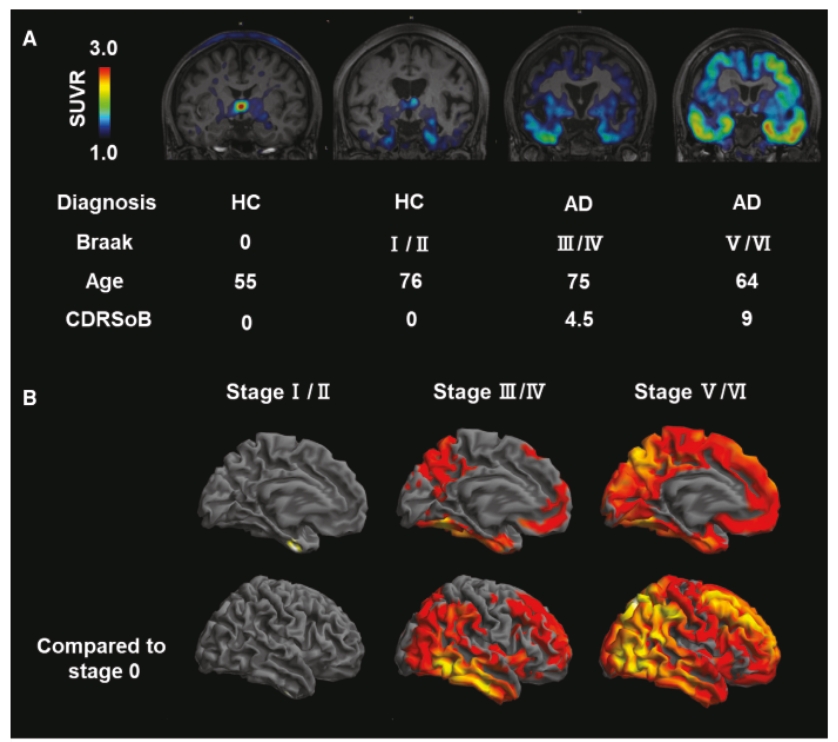
Tau & Tauopathies. Tau is an important protein in the brain that exists in different forms and plays a critical role in brain function. Tauopathies are neurodegenerative diseases characterized by accumulation of aggregated tau protein in distinct brain regions, such as Progressive Supranuclear Palsy (“PSP”), Alzheimer’s disease (“AD”) and Pick’s disease (“PiD”). Cumulative increases of these abnormal aggregates correlate with disease progression, and depending on the disorder can result in loss of memory, balance, walking and control of eye movements with the eventual loss of independent neurologic function.
α-Syn & synucleinopathies. α-Syn is an important and highly abundant protein in the brain that regulates the release of neurochemicals between brain cells. Synucleinopathies are neurodegenerative diseases characterized by aggregation of abnormal α-Syn proteins. In synucleinopathies such as Parkinson’s disease (“PD”), Lewy Body Dementia (“LBD”) and Multiple System Atrophy (“MSA”), abnormal α-Syn aggregates accumulate in specific brain regions, and depending on the disorder can result in progressive loss of neurologic function, leading to problems with motor control, walking, balance, behavior and memory.
Tauopathies and synucleinopathies affect approximately 50 million and 10 million people worldwide, respectively, and collectively account for most cases of dementia and movement disorders, resulting in devastating emotional and socio-economic consequences, including prolonged hospitalizations, nursing home placement and death. See “––Business––Overview of Unmet Medical Needs and Market Opportunities in Neurodegenerative Diseases” for more information.
As detailed below, we are developing three platforms to diagnose and treat these disorders, namely: (1) positron emission tomography (“PET”) diagnostic tracers for tau and α-Syn aggregates, with 18F-APN-1607 (INN: florzolotau (18F)) (“APN-1607”) being a 3 carboxy-terminal (“3R”)/4 carboxy-terminal domains (“4R”) tau PET tracer for the diagnosis of PSP and related disorders, as well as AD; (2) an antibody platform, with APNmAb005 being a novel monoclonal antibody designed to offer greater selectivity for pathologic forms of tau that contribute to the pathogenesis of AD and primary tauopathies; and (3) a protein degrader platform based on the proteolysis targeting chimeras (“PROTAC”) that targets pathological α-Syn and tau proteins, which we believe potentially represents one of the more innovative therapeutic approaches for the treatment of neurodegenerative diseases, an area previously thought to be undruggable by traditional small molecules.
PET diagnostic tracer APN-1607. We are developing APN-1607 as a PET imaging tracer for the detection of 3R and 4R tau aggregates, which contribute to the pathogenesis of various tauopathies, including PSP, a rare neurodegenerative disease. There is no FDA-approved diagnostic marker for PSP. Based on Title 21
1

TABLE OF CONTENTS

of the Code of Federal Regulations, Part 315, Diagnostics Radiopharmaceuticals, we seek two indication claims for APN-1607: (1) as a pathological or disease marker of 4R tau in PSP and (2) as clinically useful marker for the diagnostic management in patients who present with parkinsonian syndromes in whom the diagnosis of PSP is uncertain or requires confirmation. We have received an Orphan Drug Designation (“ODD”) from the U.S. Food and Drug Administration (the “FDA”) in 2017 for APN-1607 as a diagnostic agent for PSP. Under the U.S. Orphan Drug Act, the FDA may grant ODDs to drugs or biologics intended to treat a “rare disease or condition” (defined as affecting fewer than 200,000 individuals in the United States). If a product with an ODD receives an initial FDA marketing approval, the product is entitled to orphan exclusivity, which means the FDA may not approve any other applications to market the same drug for the same indication for a period of seven years following marketing approval, except in certain very limited circumstances, such as if the later product shows clinical superiority to the orphan product or where the manufacturer of the earlier product is unable to assure sufficient product quantity. However, we may not be the first to obtain marketing approval for the orphan indication due to the competition from the market. Further, ODD neither curtails the development period or regulatory review time needed before the commercialization of a product candidate nor presents the product candidate any advantage in the regulatory review or approval process.
We are developing APN-1607 in PSP and AD globally, independently or in collaboration with our partner: We obtained a Study May Proceed letter from the FDA on December 8, 2023 allowing us to conduct a Phase 3 clinical trial to evaluate the efficacy and safety of APN-1607 as a diagnostic marker for PSP. We also have a Phase 2 clinical trial for APN-1607 in AD in the United States, Japan and Taiwan, which is active and not recruiting for the time being due to a reprioritization of resources, with the last patient enrolled on July 11, 2022. Additionally, in collaboration with Yantai Yitai Pharmaceutical Technology Co., Ltd. (“Yitai”), we launched a Phase 3 clinical trial, also for AD, in mainland China, which met its target enrollment of 230 subjects, with the last subject enrolled on December 21, 2023. Contingent on the results of this trial, Yitai plans to submit an NDA to China’s National Medical Products Administration (“NMPA”) for the marketing approval of APN-1607 for the diagnosis of AD in mainland China. See below for further details regarding these clinical programs.
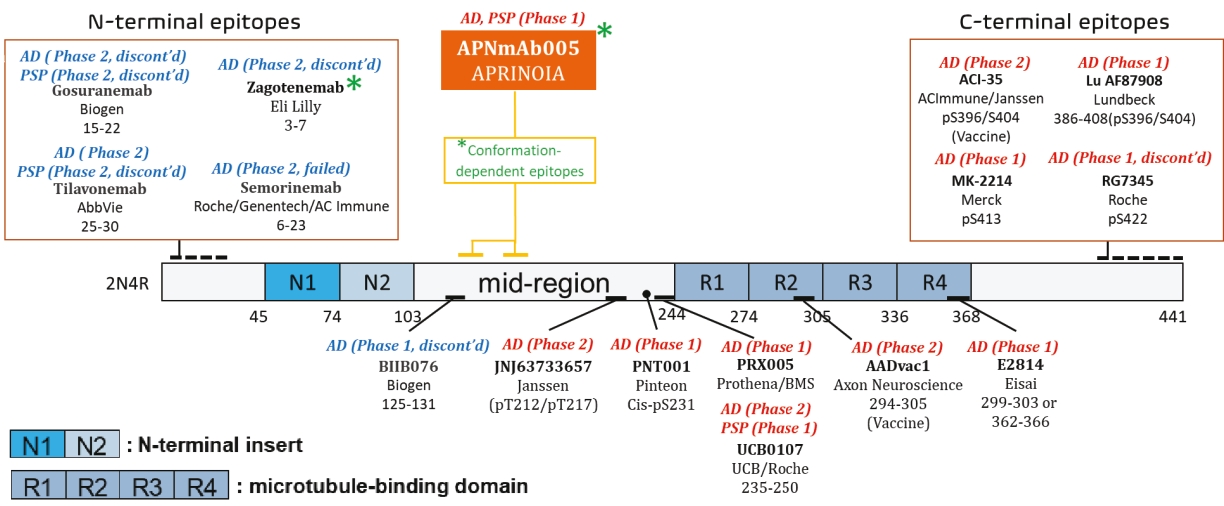
Antibody platform and APNmAb005. APNmAb005 is a humanized anti-tau antibody we are developing for the treatment of AD, non-AD primary tauopathies including rare neurodegenerative disorders, such as PSP, cortico-basal degeneration (“CBD”) and behavioral variant Frontal Temporal Dementia (“FTD”) or its subcategory, Pick’s Disease (“PiD”). Unlike most other anti-tau antibodies currently in clinical development that bind to all forms of tau or phospho-tau (i.e., sites on tau protein that undergo phoshoprylation in disease state), APNmAb005 is designed to target a specific conformation epitope in the mid region that confers selectivity for misfolded tau oligomers/aggregates formed at axons/dendrites at early stages of disease that may contribute to disease progression. Based on existing clinical studies, we believe that blocking the pathological tau transmission has the potential to offer an effective treatment to slow down the disease progression for AD patients. While the recent approval of two anti-amyloid antibody treatments – aducanumab (Aduhelm®) and lecanemab (Leqembi®) – represents a significant advance in the field, their widespread use will be likely limited due to safety concerns arising from anti-amyloid imaging related abnormalities (“ARIA”). Furthermore, despite the dramatic reductions in amyloid pathology, suggested by recent studies, their efficacy in slowing cognitive decline in such studies was modest. These findings are consistent with the long-standing notion that although the accumulation of amyloid plays a critical role in the pathogenesis of AD, clearing amyloid alone is insufficient to completely block or prevent disease progression and argues for the discovery of other disease modifying targets such pathological forms of tau, which correlate with disease progression and cognitive decline. An IND for APNmAb005 was filed on February 24, 2022, and the FDA granted a Study May Proceed letter on April 20, 2022, for the Phase 1 trial to evaluate the safety of APNmAb005 in healthy volunteers. The first cohort of 8 subjects was dosed at 5mg/kg and the safety review was completed on August 18, 2023. There were no clinically significant safety findings. The study is currently active and not recruiting for the time being due to a reprioritization of resources. To accelerate development of APNmAb005, cohorts composed of patients with early AD and PSP will be dosed using a staggered parallel group design. Dosing is anticipated to resume in the fourth quarter of 2024. It is our intention to transition the study to evaluate single and
2

TABLE OF CONTENTS

multiple dosing in patients, in order to continue to evaluate safety and tolerability at higher doses but also to acquire exploratory biomarker data. We will also seek a partnership to advance this program beyond Phase 1 into potential proof-of-concept clinical studies.
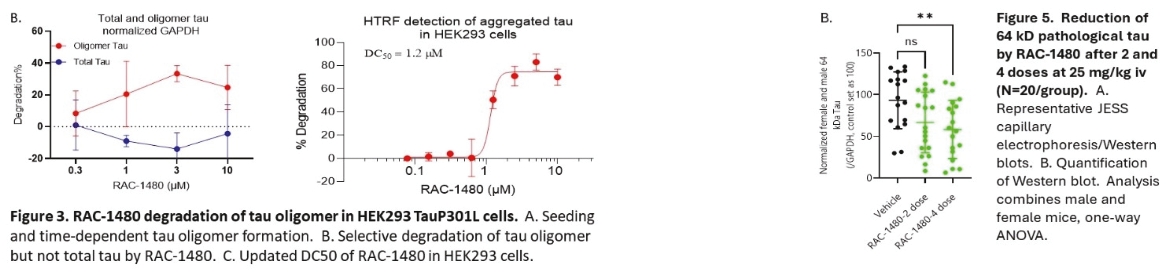
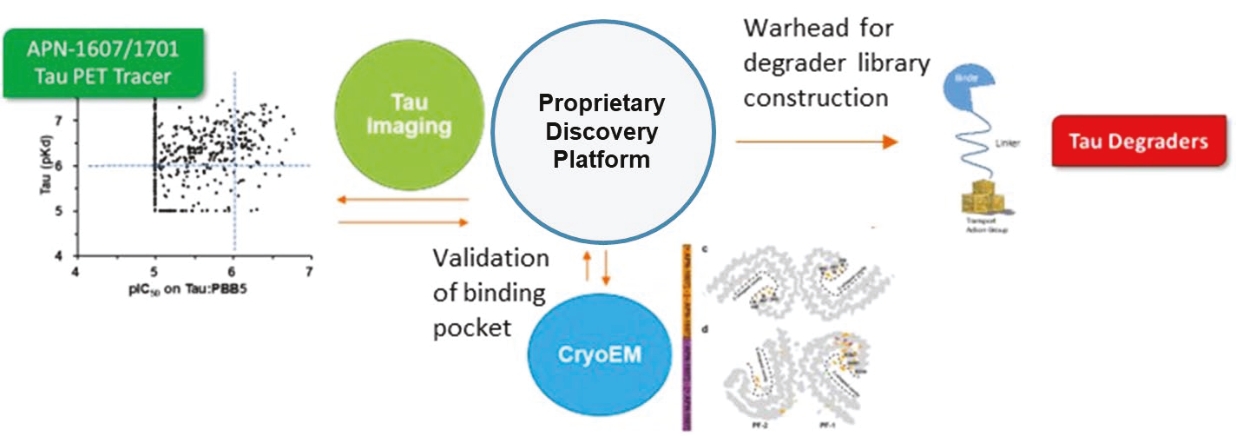
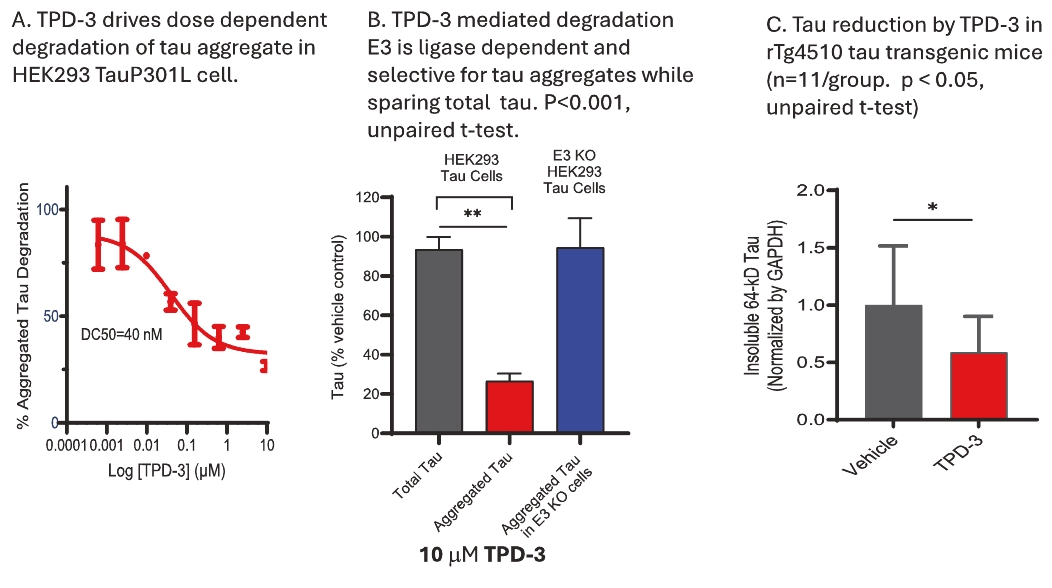
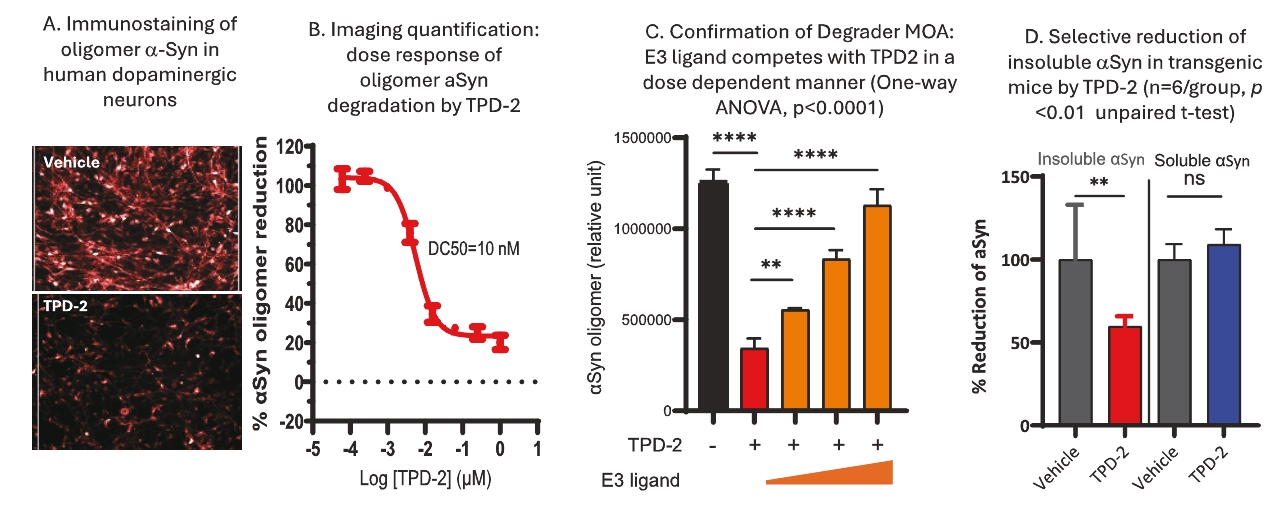
Protein degrader platform and PROTAC degraders. Our proprietary PROTAC degrader programs for α-Syn and tau are our most innovative and cutting-edge platforms and have the potential to herald an entirely new class of drugs for the treatment of neurodegenerative disorders such as AD and PD. Our tau and α-Syn degrader programs are currently in the preclinical stages. Empowered by our knowledge of aggregated protein binder chemistry from our PET tracer programs we have generated a proprietary degrader library of 800+ compounds in α-Syn and tau degrader space. α-Syn degraders are identified from a cellular model of human dopaminergic neurons and the active degraders have been validated in animal models for selectivity, mechanism of action, physicochemical and metabolic properties. Based on our preclinical data disclosed in “Business — Our Differentiated Therapeutic Platforms and Pipeline — Our Therapeutic Product Candidates — α-Syn Degrader — Preclinical Results” and “Business — Our Differentiated Therapeutic Platforms and Pipeline — Our Therapeutic Product Candidates — Tau Degrader — Preclinical Results”, we believe that it would be feasible for this class of molecules to achieve reasonable brain penetration. Importantly, in preliminary studies we have observed significant reduction of pathological α-Syn in transgenic mice. Our tau degrader program is supported by Alzheimer’s Drug Discovery Foundation (“ADDF”) following their scientific review of the program which included an independent review by external scientists from academia and industry, who are members of the foundation’s Scientific Review Board in addition to a review by members of the foundation’s Business Review Board. In the ADDF proposal, submitted to ADDF in December 2022, we described an experimental tau degrader RAC-1480, our lead compound at the time, which showed selective reduction of seed-induced tau aggregated formation in HEK293 cells and primary neurons. Intravenous injection of RAC-1480 at 25 mg/kg in rTg4510 tau transgenic mice reduced pathological tau species. The program has evolved rapidly since then and several new degraders have emerged with improved potency and ADME properties. TPD3 described in this document is one such improved tau degrader. The active compounds identified from our degrader library are highly selective for aggregated pathological tau while sparing the normal monomer tau. Similar to that with α-Syn degraders, we have conducted extensive work to validate the degrader mechanism and characterize metabolic and pharmacokinetic features. Both degrader programs are currently at lead optimization stages aiming for improved physicochemical properties, brain exposure and eventually robust in vivo efficacy by oral dosing. Our goal is to advance at least one degrader compound to IND-enabling GLP toxicology studies in 2025.
See “Business Our Next-Generation Diagnostic Pipeline” and “Business Our Differentiated Therapeutic Platforms and Pipeline Our Therapeutic Platforms” below for further details regarding our platforms. An inherent risk in all clinical trials, is that these trials may fail for different reasons if the results do not meet the primary endpoint. For a detailed discussion of the risks associated with clinical trials, see “Risk Factors — If the clinical trials of any of our product candidates fail to demonstrate safety and efficacy to the satisfaction of the FDA or other regulatory authorities, or do not otherwise produce favorable results, we may incur additional costs or experience delays in completing, or ultimately be unable to complete, the development and commercialization of our product candidates.”
3

TABLE OF CONTENTS

Our Pipeline
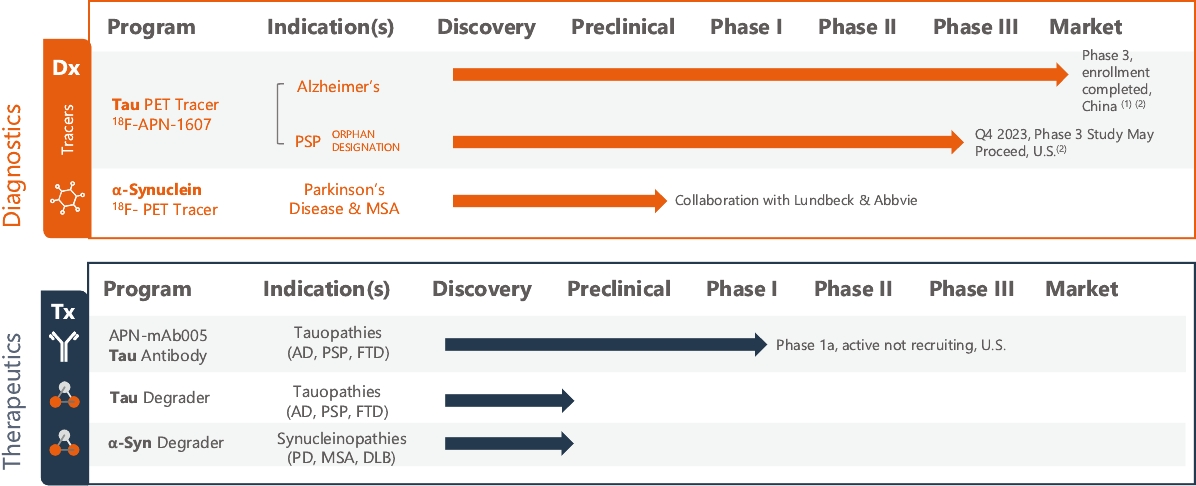
Leveraging our three platforms, we are developing a pipeline as shown below:

Notes:

(1)
Phase 2 clinical trial of APN-1607 tau tracer for AD in the United States, Japan and Taiwan, is active non-recruiting.
(2)
Our tau PET tracer APN-1607 improved upon a previously developed first generation compound from National Institute for Quantum Science and Technology (“QST”) in Japan. We obtained an exclusive worldwide license from QST for its patent for APN-1607 in 2016. We have an exclusive license for worldwide rights to develop and commercialize APN-1607, except for mainland China, where we granted an exclusive sublicense for its development, manufacture, marketing and distribution to Yantai Yitai Pharmaceutical Technology Co., Ltd.
Diagnostics Pipeline
We are developing PET imaging agents for the diagnosis and tracking of neurodegenerative disorders such as AD, PSP and related tauopathies and synucleinopathies. Our diagnostic pipeline includes PET tracers that target abnormal tau and α-Syn protein aggregates and enable (i) the visualization of their distribution in brain regions and (ii) their quantification.
Currently, early diagnostic markers for most neurodegenerative diseases do not exist. This is particularly true for patients who may have PSP or one of its variants, where in most cases clinicians cannot differentiate among these disorders or make specific diagnoses without pathological confirmation (i.e., autopsy). Our diagnostic product candidates, if approved, may provide clinicians with powerful and quantifiable tools to make more accurate clinical diagnoses earlier in the course of a neurodegenerative disease, potentially enable differentiation among different neurodegenerative disorders that clinically can resemble each other, such as PSP and PD, and importantly, enable clinicians to intervene with novel therapies that may be more likely effective at earlier stages of the disorder. These tracers may also improve the probability of success of clinical trials, by enabling the recruitment of patients at earlier stages of disease, who are more likely respond to treatment as was recently shown in the Phase 3 clinical trials for lecanemab and donanemab.
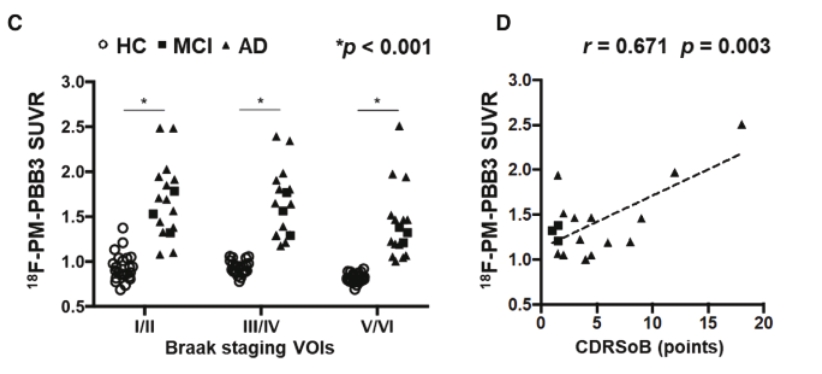
Our lead diagnostic product candidate (APN-1607). APN-1607 is our 3R/4R tau PET tracer and most clinically advanced diagnostic product candidate. APN-1607 is designed as a new generation tau PET tracer to achieve a higher specificity for the pathological tau aggregates. We believe that APN-1607, if approved, has the potential to be a powerful enabling tool for the diagnosis of various tauopathies, as it has shown low non-specific binding to other brain proteins, and the ability to detect different forms of tau in clinical studies. APN-1607 may therefore potentially be used in more precise diagnosis and stage classification of various tauopathies, including PSP, AD and PiD.
APN-1607 is being studied in PSP, for which we hold an ODD. In July 2023, the FDA agreed that we could conduct a single Phase 3 clinical trial of APN-1607 as a basis for approval without a pathology study, normally required for these types of programs. In lieu of a second trial, we will provide confirmatory evidence to support the diagnostic accuracy of the APN-1607 using other data sources such as the existing clinical imaging data obtained from our investigator-initiated studies in PSP patients.
4

TABLE OF CONTENTS

On November 9, 2023, we filed an IND with the FDA to launch a single Phase 3 global clinical trial for APN-1607 in subjects suspected to have PSP. On December 8, 2023, the FDA issued a Study May Proceed letter, allowing us to conduct a Phase 3 trial to evaluate the efficacy and safety of APN-1607 as a diagnostic marker for PSP. We plan to launch a prospective multicenter trial in approximately 130 patients with suspected PSP, atypical Parkinsonism disorder, and PD. A visual read method will be used to establish the diagnosis of PSP in those patients who show the expected pattern of APN-1607 uptake in brain regions typically affected in PSP. We plan to implement this trial in the fourth quarter of 2024 in the United States, Europe, the United Kingdom, Japan and Taiwan. We have also initiated a Phase 2 clinical trial of APN-1607 in AD in the United States, Japan and Taiwan, which is active and not recruiting for the time being due to a reprioritization of resources, with the last patient enrolled on July 11, 2022.
APN-1607 is also being studied in a Phase 3 clinical trial in AD in mainland China through our collaboration with Yitai, a wholly-owned subsidiary of Yantai Dongcheng Biochemicals Co., Ltd (together with its subsidiaries, “Dongcheng Pharma”). The trial has met its target enrollment of 230 patients, with the last patient dosed on December 21, 2023. Contingent on the results of this trial, Yitai plans to submit an NDA to the NMPA for the marketing approval of APN-1607 for the diagnosis of AD in mainland China.
We also plan to combine (i) the results from APN-1607’s Phase 2 clinical trial in AD in the United States, Japan and Taiwan, (ii) the results from APN-1607’s Phase 3 clinical trial in AD in mainland China together with (iii) imaging data of APN-1607 collected from investigator-initiated studies in over 3,300 patients to seek concurrence from the FDA for a single pivotal trial of APN-1607 as a diagnostic marker for AD in the United States and potentially other markets.
To support Aprinoia’s investigator-initiated and our programs, we have established relationships with contract manufacturing organization (“CMOs”) at 20 sites across Asia, Europe and the United States to produce and distribute APN-1607 to clinical trial sites.
See “Business Our Next-Generation Diagnostic Pipeline” below for more details about APN-1607 and our other preclinical stage tracers.
Therapeutics Pipeline
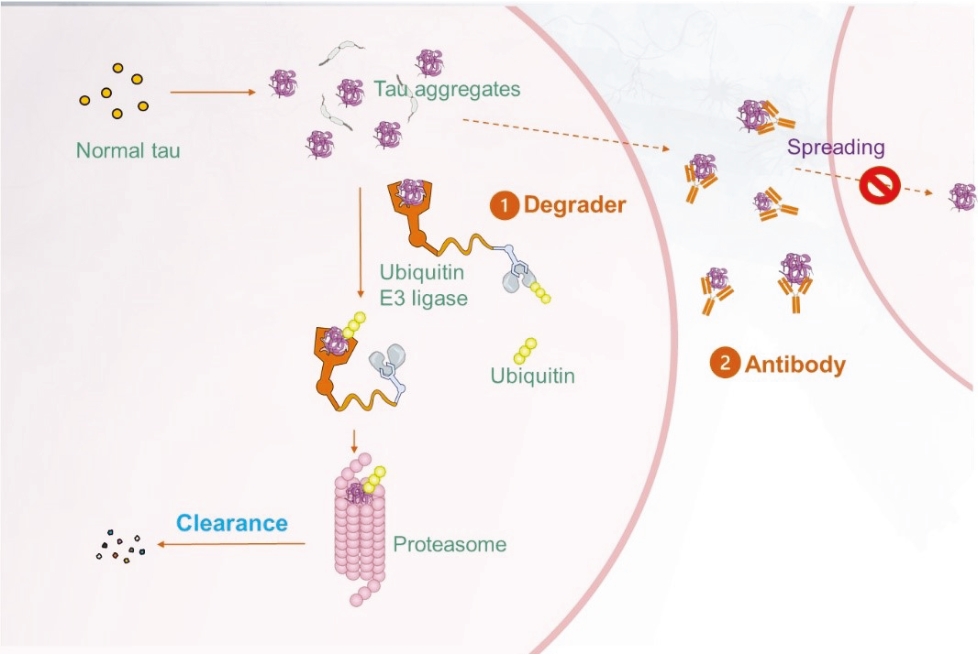
Our lead clinical therapeutic product candidates arise through our screening platforms with the aim to precisely recognize and neutralize the pathological tau and α-Syn aggregates that contribute to the pathogenesis underlying several neurodegenerative disorders. Our monoclonal antibodies to pathological forms of tau aim to reduce the damaging effects and “spreading” of such tau forms outside the affected neuron cells to slow or even prevent disease progression. Meanwhile, our degrader pipeline aims to tackle the diseases from inside neurons by removing distinct protein aggregates inside cells by delivering these toxic proteins to the cell’s machinery for degradation.
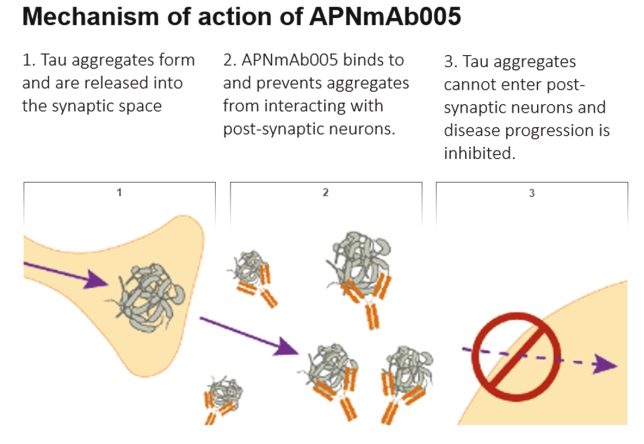
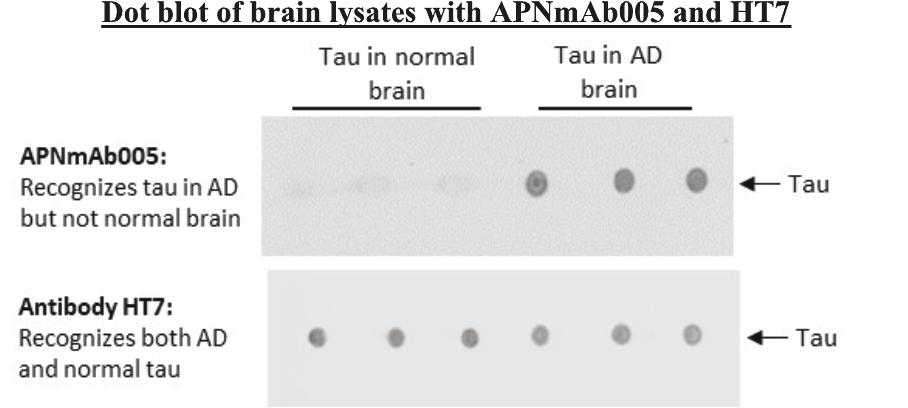
Our lead therapeutic product candidate (APNmAb005). APNmAb005 is a humanized anti-tau antibody and our most clinically advanced therapeutic product candidate. APNmAb005 is designed to preferentially bind pathological tau aggregates, not normal tau, that accumulate at the neuronal synapses with disease. In addition, based on preclinical studies we conducted, APNmAb005 recognizes a three-dimensional conformation-dependent epitope that is only present in tau abnormal aggregates but not in normal tau protein, thus suggesting this product candidate may achieve a high level of selectivity for pathological forms of tau.
An IND for APNmAb005 was filed on February 24, 2022, and the FDA granted a Study May Proceed letter on April 20, 2022, for the Phase 1 trial to evaluate the safety of APNmAb005 in healthy volunteers. The first cohort of 8 subjects was dosed at 5mg/kg and the safety review was completed on August 18, 2023. There were no clinically significant safety findings. The study is currently active and not recruiting for the time being due to a reprioritization of resources. To accelerate development of APNmAb005, cohorts composed of patients with early AD and PSP will be dosed using a staggered parallel group design. Dosing is anticipated to resume in the fourth quarter of 2024. It is our intention to transition the study to evaluate single and multiple dosing in patients, in order to continue to evaluate safety and tolerability at higher doses but also to acquire exploratory biomarker data. We will also seek a partnership to advance this program beyond Phase 1 into potential proof-of-concept clinical studies.
Our lead therapeutic product candidate (Degrader). PROTACs offer a highly novel platform for the targeted degradation of toxic proteins that are causative in a number of neurodegenerative disorders as
5

TABLE OF CONTENTS

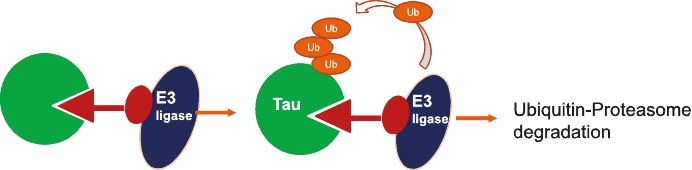
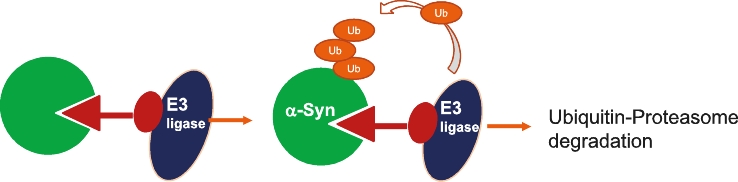
described above. These are bifunctional molecules that combine an active site selective for binding to the target of interest (tau or α-Syn) and a ligand (a binding site) for E3 ubiquitin ligase to drive the selective degradation of these proteins inside the cell’s proteasome. First-generation degraders are now entering clinical trials for cancer treatment, but currently there are no degraders in clinical development for neurodegenerative diseases. PROTAC is a potentially ground-breaking approach for the treatment of proteinopathies in neurodegenerative diseases that have been considered undruggable targets for traditional small molecules. Most of the PROTAC drugs currently in development are based on published E3 ligand structures, which leaves the warhead that targets the protein of interest as the key component that drives target specificity. It is noteworthy that the popular PROTAC targets in cancer are well characterized by soluble proteins such as CDK2, BTK4 and ER and in some cases allow for structure guided drug design. By contrast, the pathological proteins implicated in neurodegenerative diseases are more complex for warhead discovery as well as degrader screening. In this regard, we believe our PROTAC program is highly competitive in this field due to innovation in our PET ligand chemistry and expertise in disease biology which have enabled us to generate a diverse library to screen tau and α-Syn degraders and characterize them in cellular assays and animal models that recapitulate pathological α-Syn or tau formation.
Our tau and α-Syn degrader programs are currently in the preclinical stage. Built upon our PET tracer programs we have generated a degrader sub-library by combining our collection of pathological tau and α-Syn binders with various linkers and E3 ligands. We have since identified candidate degraders that were shown to selectively drive the degradation of pathological α-Syn and tau in cellular models. We are in the process of further charactering these candidate degraders in preclinical studies and hope to eventually advance them into clinical development.
See “Business Our Differentiated Therapeutic Platforms and Pipeline Our Therapeutic Product Candidates” below for more details about APNmAb005, tau degraders and α-Syn degraders.
Our Strategy
We aim to combine novel diagnostic tools and targeted therapies to better diagnose and treat debilitating and deadly neurodegenerative diseases. Our strategy encompasses the following clinical and commercialization elements:
Develop novel solutions to overcome the challenges in diagnosing and treating neurodegenerative diseases.
Continue to execute our versatile R&D and commercialization strategy to maximize asset value.
Create product-by-product and region-by-region commercialization strategies in anticipation of our future product launches.
Our Management Team
We have brought together a world-class management team with extensive experience to bring drugs forward.
Our founder and chairman of the board, Dr. Ming-Kuei Jang, Ph.D., has over 20 years of experience in neurodegenerative diseases. He also serves as the Chief Scientific Officer of APRINOIA USA and President of our Asia operations. Prior to founding our company, Dr. Jang held an associate director role at GlaxoSmithKline in Shanghai, served as senior research biologist of Merck & Co in Boston, Massachusetts, and led Neurodegeneration Consortium at MD Anderson Cancer Center in Houston, Texas.
Our Chief Executive Officer, Dr. Mark S. Shearman, Ph.D., has extensive experience in pharmaceutical research, drug development and strategic partnerships. Prior to joining us, Dr. Shearman served as the Chief Scientific Officer at Editas Medicine, Chief Scientific Officer at Applied Genetic Technologies Corporation, a Senior Vice President of research and early development at Merck KGAa. He also served at Merck & Co., with his last position as an executive director, and Merck, Sharp & Dohme, with his last position as a senior director of department of cellular & molecular neuroscience responsible for the research and development of AD.
Our Chief Medical Officer, Dr. Bradford A. Navia, M.D., Ph.D., has over 17 years of experience in clinical development (including Phase 1 through Phase 3), neuroimaging and biomarkers in psychiatry and neurology, including several INDs, sNDAs and an NDA. Prior to joining us, Dr. Navia was an Associate Professor of Neurology and Psychiatry at Tufts Medical School, and the recipient of numerous awards and funding from National Institute of Health; executive director of Sunovion Pharmaceuticals, where he was
6

TABLE OF CONTENTS

the global project lead for the development of KYNMOBI; senior director, strategic and clinical lead in the neuroscience division at AbbVie Inc.; senior director and head of neuroimaging at Eisai Co., Ltd. and director in the neuroscience clinical development division at Johnson & Johnson.
Our Chief Financial Officer, Brian Achenbach, M.B.A., has over 30 years of experience in finance and accounting primarily in the biotech, pharmaceutical and medical device industries. Prior to joining us, Mr. Achenbach served as Chief Financial Officer at On Demand Pharmaceuticals, Senior Vice President of Finance & Principal Financial Officer at Mustang Bio (Nasdaq: MBIO), and has held leadership positions in finance and accounting in multiple life sciences companies.
Our General Counsel, Lana Gladstein, J.D., has over 23 years of experience in legal and pharmaceutical industry. Prior to joining us, Ms. Gladstein served as Chief Legal Officer and General Counsel of Arranta Bio (acquired by Recipharm), Chief Legal Officer of Recipharm (Americas) post acquisition of Arranta Bio, Executive VP and General Counsel at Brammer Bio (acquired by Thermo Fisher Scientific), and General Counsel of Viral Vector Services of Thermo Fisher Scientific post acquisition of Brammer Bio. Prior to that, Ms. Gladstein spent over 16 years in private practice, including as partner at Nutter McClennen & Fish LLP and Pepper Hamilton LLP, where she focused her practices in intellectual property litigation and strategies.
Summary of Risk Factors
Our business is subject to numerous risks and uncertainties that you should be aware of before making a decision to invest in our ordinary shares. These risks are more fully described in the section entitled “Risk Factors” immediately following this prospectus summary. These risks include, among others, the following:
Risks Related to Our Limited Operating History, Financial Position and Need for Additional Capital
We are a clinical-stage biotechnology company with a limited operating history and face significant challenges and expenses as we build our capabilities and develop our pipeline of diagnostic and therapeutic product candidates.
We have incurred net losses since our inception and anticipate that we will continue to incur significant losses for the foreseeable future. We have never generated any revenue from product sales and may never be profitable.
We recorded net cash outflow from operating activities since our inception. We may need to acquire funding from time to time to complete the development and commercialization of our pipeline candidates, which may not be available on acceptable terms, or at all. If we are unable to raise capital when needed, we may be forced to delay, reduce or eliminate certain of our product development programs or other operations.
Our independent registered public accounting firm’s report contains an explanatory paragraph that expresses substantial doubt about our ability to continue as a “going concern.”
Raising additional capital may cause dilution to the interests of our shareholders, restrict our operations or require us to relinquish rights to our technologies or product candidates.
Risks Related to the Development of Our Product Candidates
We depend heavily on the success of our lead diagnostic product candidate APN-1607, and, to a lesser extent, our anti-tau antibody product candidate, APNmAb005, and our degrader programs, all of which are currently or expected to be in clinical development. If our clinical trials are unsuccessful, we or our collaboration partner, Yantai Yitai Pharmaceutical Technology Co., Ltd. (“Yitai”), a wholly-owned subsidiary of Dongcheng Pharma, do not obtain regulatory approval in the targeted jurisdictions, or we or Yitai are unable to commercialize APN-1607, APNmAb005 or degraders, or experience significant delays in doing so, our business, our financial condition and results of operations will be materially adversely affected.
We operate in highly competitive and rapidly changing industries. Our competitors are evaluating diagnostic product candidates in the same indication as our lead diagnostic product candidate, APN-1607, such as AD and PSP, and could enter the market with competing products of our product candidates, which may result in a material decline in sales of affected product candidates.
7

TABLE OF CONTENTS

A fast track, breakthrough therapy or other designation by the FDA may not actually lead to a faster development or regulatory review or approval process.
Even if we successfully obtain regulatory approvals for our product candidates, they may not gain market acceptance, in which case we may not be able to generate product revenues, which will materially adversely affect our business, financial condition and results of operations.
Risks Related to Our Operations
As a company with operations outside of the United States, our business is subject to economic, political, regulatory and other risks associated with international operations.
Our future growth and ability to compete depend on retaining our key personnel and recruiting additional qualified personnel.
We are a fast-growing emerging company and expect to expand our development and regulatory capabilities, and as a result, we may encounter difficulties in managing our growth, which could disrupt our operations.
Risks Related to Our Relationships with Third Parties
If we fail to maintain our relationships with our current or future business and licensing partners, our business, commercialization prospects and financial condition may be materially adversely affected.
We may seek to form additional strategic alliances in the future with respect to our product candidates, and if we do not realize the benefits of such alliances, our business, financial condition, commercialization prospects and results of operations may be materially adversely affected.
We rely on third parties to conduct our nonclinical studies and clinical trials and perform other tasks for us. If these third parties do not successfully carry out their contractual duties, meet expected deadlines, or comply with regulatory requirements, we may not be able to obtain regulatory approval for or commercialize our product candidates and our business could be substantially harmed.
Risks Related to Regulatory Approval of Our Product Candidates and Other Legal Compliance Matters
All material aspects of the research, development, manufacturing and commercialization of pharmaceutical products are heavily regulated, and we may face difficulties in complying with or be unable to comply with such regulations, which could have a material adverse effect on our business.
The approval processes of regulatory authorities in the United States are lengthy, time-consuming and inherently unpredictable. If we are ultimately unable to obtain regulatory approval for our product candidates, our business will be substantially harmed.
Even if we complete the necessary preclinical studies and clinical trials, the regulatory approval process is expensive, time-consuming and uncertain and may prevent us from obtaining approvals for the commercialization of some or all of our product candidates. As a result, we cannot predict when or if, and in which territories, we will obtain marketing approval to commercialize product candidates.
Obtaining and maintaining regulatory approval of our product candidates in one jurisdiction does not mean that we will be successful in obtaining regulatory approval of our product candidates in other jurisdictions.
Risks Related to the Commercialization of Our Product Candidates
If we are unable to establish sales, marketing and distribution capabilities for our product candidates, or enter into sales, marketing and distribution agreements with third parties, we may not be successful in commercializing our product candidates, if and when they are approved.
The successful commercialization of our product candidates will depend in part on the extent to which governmental authorities and health insurers establish adequate coverage and reimbursement levels and pricing policies.
We have never commercialized a product candidate before, which may make it difficult to evaluate the prospects for our future viability, and may lack the necessary expertise, personnel and resources to successfully commercialize our product candidates on our own or together with suitable partners.
8

TABLE OF CONTENTS

Risks Related to Our Intellectual Property
We may not have sufficient patent terms to effectively protect our future approved product candidates and business.
If we or our collaboration partner are unable to obtain, maintain, defend and enforce patent and other intellectual property rights for our technologies and product candidates, or if the scope of the patent and other intellectual property rights obtained is not sufficiently broad, our competitors and other third parties could develop and commercialize technology and biologics similar or identical to ours, and our ability to successfully commercialize our technology and product candidates may be impaired.
We or our collaboration partner may become subject to intellectual property-related litigation or other proceedings to protect or enforce our patents or the patents of our licensors or collaborators, any of which could be expensive, time-consuming, and unsuccessful, and may ultimately result in our loss of ownership of intellectual property.
General Risk Factors
Business interruptions could seriously harm our future revenue and financial condition, increase our costs and expenses and delay us in the process of developing our product candidates.
We may be subject to claims by third parties asserting that we or our employees, consultants or independent contractors have misappropriated, wrongfully used or disclosed their confidential information or trade secrets or other intellectual property or claiming ownership of what we regard as our own intellectual property.
Corporate History and Information
We commenced our operations under APRINOIA Therapeutics, Inc., which was incorporated under the laws of Taiwan in May 2015 (“APRINOIA Taiwan”). In June 2016, our company, APRINOIA Therapeutics, Inc. was incorporated in the Cayman Islands as the holding company for APRINOIA Taiwan, which was subsequently dissolved in May 2022. In June 2017, we incorporated APRINOIA Therapeutics Limited (“APRINOIA HK”) as our wholly-owned subsidiary in Hong Kong. Subsequently in July 2017, APRINOIA HK incorporated a direct wholly-owned subsidiary, Suzhou APRINOIA Therapeutics Co., Ltd., in Suzhou. In September 2017 and April 2021, respectively, we incorporated APRINOIA Therapeutics as our wholly-owned subsidiary in Japan, and APRINOIA Therapeutics, LLC as our wholly-owned subsidiary in the United States. In December 2023, we incorporated APRINOIA Therapeutics Limited as our wholly-owned subsidiary in Ireland. Our principal executive offices are located at 245 Main Street, 2nd Floor, Cambridge, MA 02142. Our telephone number at this address is 617-225-4415. Our registered office is located at the offices of Maples Corporate Services Limited, PO Box 309, Ugland House, Grand Cayman, KY1-1104, Cayman Island. Investors should submit any inquiries to the address and telephone number of our principal executive offices set forth above.
Our main website is www.aprinoia.com. The information contained on this website is not a part of this prospectus.
This prospectus includes certain trademarks, service marks and trade names, such as “APRINOIA,” which are registered under applicable intellectual property laws and are APRINOIA’s property or for which APRINOIA has pending applications or common law rights. Solely for convenience, trademarks, service marks and trade names referred to in this prospectus are listed without any ®, ™ or other symbols, but APRINOIA intends to assert, to the fullest extent under applicable law, its right or the rights of the applicable licensors to these trademarks, service marks and trade names. The use or display of other companies’ trademarks, service marks or trade names should not be interpreted to imply a relationship with, or endorsement or sponsorship of APRINOIA by, any other companies.
Implications of Being an Emerging Growth Company
We are an “emerging growth company” as defined in the Jumpstart Our Business Startups Act (“JOBS Act”) enacted in April 2012, and we may remain an emerging growth company for up to five years following the completion of this offering. For so long as we remain an emerging growth company, we are permitted and intend to rely on certain exemptions from various public company reporting requirements, including not being required to have our internal control over financial reporting audited by our independent registered public accounting firm pursuant to Section 404(b) of the Sarbanes-Oxley Act of 2002 (“Sarbanes-Oxley Act”) reduced disclosure obligations
9

TABLE OF CONTENTS

regarding executive compensation in our periodic reports and proxy statements, and exemptions from the requirements of holding a nonbinding advisory vote on executive compensation and any golden parachute payments not previously approved. In particular, in this prospectus, we have provided only two years of audited financial statements and have not included all of the executive compensation-related information that would be required if we were not an emerging growth company. Accordingly, the information contained herein may be different than the information you receive from other public companies in which you hold shares.
In addition, the JOBS Act provides that an emerging growth company can take advantage of an extended transition period for complying with new or revised accounting standards. This provision allows an emerging growth company to delay the adoption of some accounting standards until those standards would otherwise apply to private companies. We have elected to take advantage of the benefits of this extended transition period and, therefore, we are not subject to the same requirements to adopt new or revised accounting standards as other public companies that are not emerging growth companies; however, we may adopt certain new or revised accounting standards early. We would cease to be an “emerging growth company” upon the earliest to occur of: (i) the last day of the fiscal year in which we have $1.235 billion or more in annual revenue; (ii) the date on which we first qualify as a large accelerated filer under the rules of the SEC; (iii) the date on which we have, in any three-year period, issued more than $1.0 billion in non-convertible debt securities; and (iv) the last day of the fiscal year ending after the fifth anniversary of this offering.
We are also a “smaller reporting company” as defined in the Securities Exchange Act of 1934, as amended (the “Exchange Act”). We may continue to be a smaller reporting company even after we are no longer an emerging growth company. We may take advantage of certain of the scaled disclosures available to smaller reporting companies and will be able to take advantage of these scaled disclosures for so long as our ordinary shares held by non-affiliates is less than $250.0 million measured on the last business day of our second fiscal quarter, or our annual revenue is less than $100.0 million during the most recently completed fiscal year and our ordinary shares held by non-affiliates is less than $700.0 million measured on the last business day of our second fiscal quarter.
Implications of Being a Foreign Private Issuer
Upon completion of this offering, we will report under the Exchange Act as a non-U.S. company with foreign private issuer status. Even after we no longer qualify as an emerging growth company, as long as we qualify as a foreign private issuer under the Exchange Act we will be exempt from certain provisions of the Exchange Act that are applicable to U.S. domestic public companies, including:
the sections of the Exchange Act regulating the solicitation of proxies, consents or authorizations in respect of a security registered under the Exchange Act;
the sections of the Exchange Act requiring insiders to file public reports of their share ownership and trading activities and liability for insiders who profit from trades made in a short period of time; and
the rules under the Exchange Act requiring the filing with the SEC of quarterly reports on Form 10-Q containing unaudited financial and other specified information, or current reports on Form 8-K, upon the occurrence of specified significant events.
Additionally, Nasdaq market rules permit a foreign private issuer like us to follow the corporate governance practices of its home country. Certain corporate governance practices in the Cayman Islands, which is our home country, may differ significantly from Nasdaq corporate governance listing standards. We may elect to follow home country practice in lieu of one or more of the following requirements:
the requirement that a majority of the board of directors must be comprised of independent directors as defined in Nasdaq Rule 5605(a)(2);
the requirement that each member of the compensation committee must be an independent director as set forth in Nasdaq Rule 5605(d)(2)(A);
the requirement that director nomination should be made by a vote in which only independent directors participate or by a nominations committee comprised solely of independent directors as set forth in Nasdaq Rule 5605(e)(1);
the requirement to obtain shareholder approval for certain issuances of securities, including shareholder approval of stock option plans;
the requirement that the board of directors shall have regularly scheduled meetings at which only independent directors are present as set forth in Nasdaq Rule 5605(b)(2); and
10

TABLE OF CONTENTS

the requirement that an annual shareholders meeting must be held no later than one year after the end of the fiscal year-end as set forth in Nasdaq Rule 5620(a).
Both foreign private issuers and emerging growth companies are also exempt from certain more stringent executive compensation disclosure rules. Thus, even if we no longer qualify as an emerging growth company, but remain a foreign private issuer, we will continue to be exempt from the more stringent compensation disclosures required of companies that are neither an emerging growth company nor a foreign private issuer.
Conventions that Apply to this Prospectus
Unless otherwise indicated or the context otherwise requires, in this prospectus:
“Cayman Islands Companies Act” or “Companies Act” means the Companies Act (As Revised) of the Cayman Islands.
“option” means an option to purchase Ordinary Shares granted under an incentive plan.
“ordinary shares” means ordinary shares of our company, par value $0.40 per share.
“our incentive plans” means, collectively, (i) the equity incentive plan we adopted in 2018, (ii) the equity incentive plan #2 we adopted in 2019, (iii) the equity incentive plan #3 we adopted in 2022, and (iv) the equity incentive plan #4 we adopted in 2023, and each individually, an “incentive plan.”
“preferred shares” means, collectively, Series B Preferred Shares, Pre-Series C Preferred Shares and Series C Preferred Shares.
“Pre-Series C Preferred Shares” means Pre-Series C preferred shares of our company, of a nominal or par value of $0.40 each.
“Series B Preferred Shares” means Series B preferred shares of our company, of a nominal or par value of $0.40 each.
“Series C Preferred Shares” means Series C preferred shares of our company, of a nominal or par value of $0.40 each.
“shares” means, collectively, ordinary shares and preferred shares.
“U.S.” means the United States.
“we,” “us,” “our company” and “our” means to APRINOIA Therapeutics Inc. and its subsidiaries.
“$,” “U.S. dollars,” “$,” or “dollars” means the legal currency of the United States.
Conventions that Apply to this Prospectus
Unless otherwise indicated or the context otherwise requires, in this prospectus:
“3R” means 3 carboxy-terminal domains.
“4R” means 4 carboxy-terminal domains.
“AD” means Alzheimer’s disease.
“AEs” means adverse events.
“APN-1607” means 18F-APN-1607 (INN: florzolotau (18F)).
“ARIA” means antiamyloid imaging related abnormalities.
“a-Syn” means alpha-synuclein.
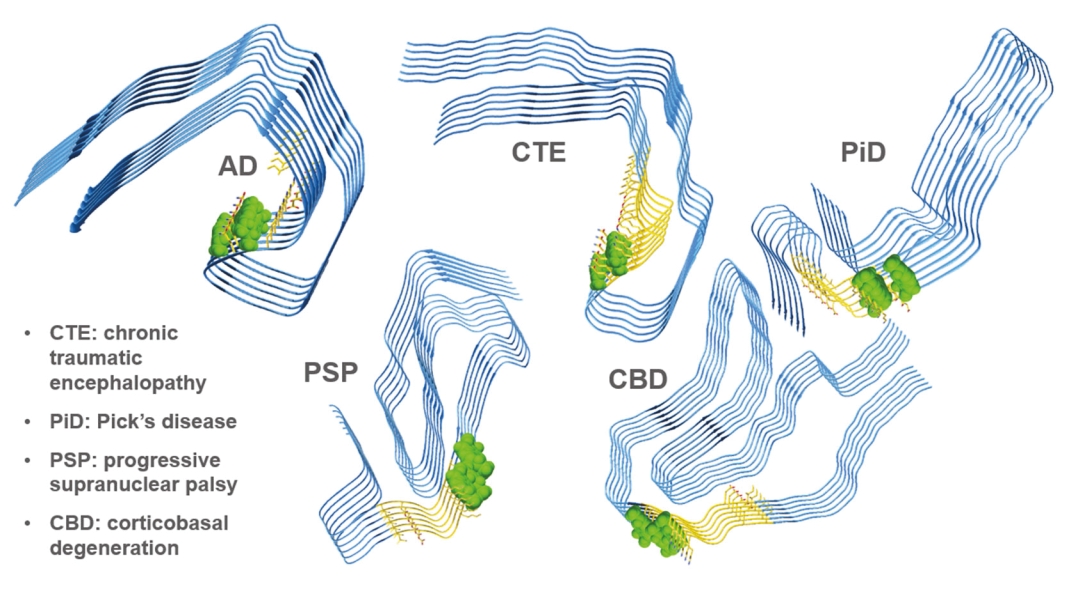
“CBD” means cortico-basal degeneration.
“CMO” means contract manufacturing organization.
“CNS” means central nervous system.
“cryoEM” means cryogenic electron microscopy.
“CTE” means Chronic Traumatic Encephalopathy.
11

TABLE OF CONTENTS

“FTD” means Frontal Temporal Dementia.
“IND” means Investigational New Drug.
“LBD” means Lewy Body Dementia.
“MSA” means Multiple System Atrophy.
“NDA” means New Drug Application.
“ODD” means Orphan Drug Designation.
“PD” means Parkinson’s disease.
“PET” means positron emission tomography.
“PiD” means Pick’s disease.
“PROTAC” means proteolysis targeting chimeras.
“PSP” means Progressive Supranuclear Palsy.
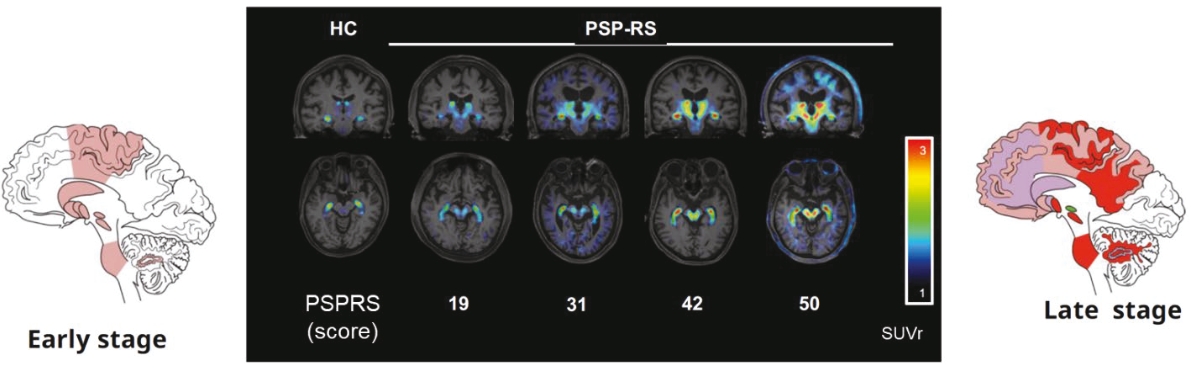
“PSPRS” means Progressive Supranuclear Palsy Rating Scale.
“SAEs” means serious adverse events.
“SUVr” means Standardized Uptake Value Ratio.
“UPS” means ubiquitin-proteasome system.
12

TABLE OF CONTENTS

THE OFFERING
Offering price
We expect that the initial public offering price will be between $10.00 and $14.00 per ordinary share.
Ordinary shares offered by us
2,000,000 ordinary shares (or 2,300,000 ordinary shares if the underwriters exercise their option to purchase additional ordinary shares in full).
Over-allotment option
We have granted to the underwriters an option, exercisable within 45 days from the date of this prospectus, to purchase up to an aggregate of 300,000 additional ordinary shares.
Ordinary shares issued and outstanding immediately after this offering
27,936,819 ordinary shares (or 28,236,819 ordinary shares if the underwriters exercise their option to purchase additional ordinary shares in full).
Use of proceeds
We expect that our net proceeds from this offering will be approximately $20.5 million (or approximately $23.8 million if the underwriters exercise their option to purchase additional ordinary shares in full), assuming an initial public offering price of $12.00 per ordinary share, which is the midpoint of the price range set forth on the cover page of this prospectus, after deducting the estimated underwriting discounts and commissions and estimated offering expenses payable by us.
We intend to use the net proceeds from this offering, together with our existing cash and cash equivalents, to advance the clinical development of APN-1607 and APNmAb005, research and development of our degrader therapeutic candidates, other research and development activities as well as for working capital and other general corporate purposes. See “Use of Proceeds” for additional information.
Lock-up
We and certain of our shareholders have agreed with the underwriters not to sell, transfer or dispose of any ordinary shares or similar securities for a period of 180 days after the date of this prospectus, subject to certain exceptions. See “Shares Eligible for Future Sale” and “Underwriting.”
Risk factors
See “Risk Factors” and other information included in this prospectus for a discussion of the risks relating to investing in our ordinary shares. You should carefully consider these risks before deciding to invest in our ordinary shares.
Listing
We have applied to have the ordinary shares listed on the Nasdaq. The ordinary shares and shares will not be listed on any other stock exchange or traded on any automated quotation system.
Nasdaq trading symbol
APRI
The number of ordinary shares that will be issued and outstanding immediately after this offering:
is based on the (i) 23,584,957 ordinary shares issued and outstanding as of the date of this prospectus, which consists of (a) 10,179,304 ordinary shares issued and outstanding as of the date of this prospectus,
13

TABLE OF CONTENTS

and (b) the conversion of all of our issued and outstanding convertible preferred shares into 13,405,653 ordinary shares immediately prior to the closing of this offering, and (ii) the conversion of all of our issued and convertible promissory notes and associated interest into 2,351,862 ordinary shares upon the consummation of this offering, based on 80% of an assumed initial public offering price of $12.00 per ordinary share, which is the midpoint of the price range set forth on the cover page of this prospectus;
excludes 3,429,848 ordinary shares issuable upon the exercise of options outstanding as of the date of this prospectus; and
there are no ordinary shares available for future issuance under our equity incentive plans upon the completion of this offering.
Except as otherwise indicated, all information in this prospectus reflects and assumes:
a 1-for-4 reverse share split of our ordinary shares and preferred shares effected on March 8, 2024;
no exercise of the outstanding options described above;
no exercise of the underwriters’ option to purchase additional ordinary shares; and
the effectiveness of our amended and restated memorandum and articles of association, which will occur immediately prior to the completion of this offering.
14

TABLE OF CONTENTS

SUMMARY CONSOLIDATED FINANCIAL DATA
The following summary consolidated statements of operations data for the years ended December 31, 2023 and 2022, summary consolidated balance sheets data as of December 31, 2023 and 2022, and summary consolidated statements of cash flows data for the years ended December 31, 2023 and 2022 have been derived from our audited consolidated financial statements included elsewhere in this prospectus. Our consolidated financial statements are prepared and presented in conformity with generally accepted accounting principles in the United States of America (“U.S. GAAP”). Our historical results are not necessarily indicative of results expected for future periods. You should read this section together with our consolidated financial statements and the related notes and “Management’s Discussion and Analysis of Financial Condition and Results of Operations” included elsewhere in this prospectus.
The following table sets forth a summary of our consolidated statements of operations for the years indicated.
 
Year Ended December 31,


2023
2022
Change
%
 
(in thousands, except percentages)
Selected consolidated statements of operations:


Revenue
$513
$394
$119
30
Revenue - related party
8,556
8,556
Total revenue
9,069
394
8,675
2,202
Operating expenses


Research and development
16,980
21,617
(4,637)
(21)
General and administrative
16,296
7,041
9,255
131
Total operating expenses
33,276
28,658
4,618
16
Loss from operations
(24,207)
(28,264)
4,057
(14)
Other (expense) income:


Interest expense, net
(4,019)
(67)
(3,952)
5,899
Changes in fair value of derivative liabilities
379
379
Other income, net
117
117
Total other (expense) income
(3,523)
50
(3,573)
(7,146)
Loss before income taxes
(27,730)
(28,214)
484
(2)
Provision for income taxes
(887)
(17)
(870)
5,118
Net loss
$(28,617)
$(28,231)
$(386)
1
The following table sets forth selected consolidated balance sheets as of the years indicated.
 
December 31,
 
2023
2022
 
(in thousands)
Selected consolidated balance sheets:
 
 
Assets
 
 
Current assets:
 
 
Cash
$1,578
$1,221
Accounts receivable - related party
71
Prepaid expenses and other current assets
454
590
Total current assets
2,103
1,811
Property and equipment, net
1,789
2,153
Deferred offering costs
503
1,288
Operating lease right-of-use assets
422
154
Prepaid expenses, net of current portion and other long-term assets
129
237
Total assets
$4,946
$5,643
15

TABLE OF CONTENTS

 
December 31,
 
2023
2022
 
(in thousands)
Liabilities, redeemable convertible preferred shares, and shareholders' deficit
 
 
Current liabilities:
 
 
Accounts payable
$9,538
$8,887
Accrued expenses and other current liabilities
6,285
2,466
Operating lease liabilities, current
215
124
Related party payable
1,167
904
Short-term borrowings
1,408
1,450
Convertible notes (including related party convertible notes of $4,425 and $753 as of December 31, 2023 and 2022, respectively, net of debt discount and issuance costs)
17,157
1,093
Derivative liabilities (including related party derivative liabilities of $847 and $173 as of December 31, 2023 and 2022, respectively)
3,581
251
Total current liabilities
39,351
15,175
Operating lease liabilities, net of current portion
208
42
Total liabilities
39,559
15,217
Commitments and Contingencies (Note 15)
 
 
Redeemable convertible preferred shares (Series B, Pre-C and C), $0.4 par value; 14,243,334 shares authorized; 13,405,653 shares issued and outstanding; redemption and liquidation value of $66,166 as of December 31, 2023 and 2022
65,876
65,876
Shareholders' deficit:
 
 
Ordinary shares, $0.4 par value, 110,756,666 shares authorized; 10,123,054 and 9,654,266 shares issued and outstanding as of December 31, 2023 and 2022, respectively
4,050
3,862
Additional paid-in capital
15,567
12,296
Accumulated deficit
(119,255)
(90,638)
Accumulated other comprehensive loss
(854)
(970)
Total shareholders' deficit
(100,489)
(75,450)
Total liabilities, redeemable convertible preferred shares, and shareholders' deficit
$4,946
$5,643
The following table sets forth a consolidated statements of cash flows for the years indicated.
 
Years Ended December 31,
 
2023
2022
 
(in thousands)
Selected consolidated cash flows:
 
 
Net cash used in operating activities
$(14,739)
$(17,237)
Net cash used in investing activities
(1,167)
(2,016)
Net cash provided by financing activities
16,288
11,354
Effect of exchange rates on cash
(25)
(554)
Net increase (decrease) in cash
$357
$(8,453)
16

TABLE OF CONTENTS

RISK FACTORS
An investment in our ordinary shares involves a high degree of risk. You should carefully consider the risks and uncertainties described below, together with all of the information contained in this prospectus, including our financial statements and the related notes, before making an investment decision regarding the ordinary shares. If any of the following risks are realized, our business, financial condition, results of operations or prospects could be materially and adversely affected. In that event, the market price of our securities could decline, and you could lose part or all of your investment. The risks discussed below also include forward-looking statements, and our actual results may differ substantially from those discussed in these forward-looking statements. See “Special Note Regarding Forward-Looking Statements.”
Risks Related to Our Limited Operating History, Financial Position and Need for Additional Capital
We are a clinical-stage biotechnology company with a limited operating history and face significant challenges and expenses as we build our capabilities and develop our pipeline of diagnostic and therapeutic product candidates.
We are a clinical-stage biotechnology company with limited operating history. We expect to continue to incur significant operating losses in the future as we continue our research and development efforts for our current and future diagnostic and therapeutic product candidates and seek to obtain regulatory approval and commercialization of such diagnostic and therapeutic product candidates, if approved.
Investments in biotechnology and pharmaceutical product development are highly speculative because they entail substantial upfront capital expenditures and a significant risk that any potential product candidate will fail to demonstrate adequate effect or an acceptable safety profile, gain regulatory approval and become commercially viable. All of our diagnostic and therapeutic product candidates, including our lead diagnostic candidate, 18F-APN-1607 (“APN-1607”), a tau PET tracer, are still under clinical or preclinical development and none have been approved for commercial sale. We have not demonstrated an ability to successfully complete late-stage clinical trials, obtain regulatory approvals, arrange for a third-party to manufacture our product candidates at a commercial scale on our behalf, conduct sales and marketing activities necessary for successful commercialization, or obtain reimbursement in the countries of sale. We may encounter unforeseen expenses, difficulties, complications, and delays in achieving our business objectives. Our short history as an operating company makes any evaluation of our future success or capability subject to significant uncertainty. If we do not address these risks successfully or are unable to transition at some point from a company with a research and development focus to a company capable of supporting commercial activities, then our business may be materially harmed.
We have incurred net losses since our inception and anticipate that we will continue to incur significant losses for the foreseeable future. We have never generated any revenue from product sales and may never be profitable.
We have no products approved for commercial sale and have never generated any revenue from product sales and may never be profitable. We have incurred substantial operating losses since we commenced operations in 2015, despite that we have generated certain revenue through our product licensing by providing our third-party and related-party licensees with the right to access our product candidates, and through research and development services performed. For the years ended December 31, 2023 and 2022, our net losses were $26.4 million and $28.2 million, respectively. Our losses have resulted principally from research and development expenses and general and administrative expenses. We have been devoting the majority of our financial resources and efforts to our research and development activities, including preclinical testing, research and development of our diagnostic and therapeutic product candidates for tauopathies and α-synucleinopathies as well as building our tauopathies and α-synucleinopathies research and development capabilities.
None of our diagnostic or therapeutic product candidates have received marketing approval, and we may never be successful in obtaining marketing approval and commercializing them. We expect to continue to incur significant expenses and increasing operating losses for the foreseeable future. These net losses will adversely impact our shareholders’ deficit and net assets and may fluctuate significantly from quarter to quarter and year to year. We anticipate that our expenses will increase substantially as we:
continue our ongoing and planned research and development of our lead diagnostic product candidate, APN-1607;
continue our ongoing and planned research and development of our pipeline of diagnostic and therapeutic product candidates, such as α-Syn PET tracers and APNmAb005;
17

TABLE OF CONTENTS

conduct preclinical studies and clinical trials for any additional product candidates that we may pursue in the future, including ongoing and planned development of additional diagnostic or therapeutic product candidates for the diagnosis or treatment of tauopathies, such as Alzheimer’s Disease (“AD”) and Progressive Supranuclear Palsy (“PSP”), and α-synucleinopathies, such as Parkinson’s Disease (“PD”) and Multiple System Atrophy (“MSA”);
seek to discover and develop additional diagnostic and therapeutic product candidates and further expand our current pipeline;
seek regulatory approvals for any product candidates that successfully complete clinical trials;
meet the requirements for clinical trials and potential commercialization;
establish sales, marketing and distribution infrastructure to commercialize any product candidate for which we may obtain regulatory approval;
develop, maintain, expand and protect our intellectual property portfolio;
add clinical, operational, financial and management information systems and/or personnel, including personnel to support our product development and planned future commercialization efforts;
expand our operations in the United States, Japan, Taiwan and other geographic regions; and
incur additional legal, accounting and other expenses associated with operating as a public company.
To become and remain profitable, we must succeed in developing and eventually commercializing products that generate significant revenue. This will require us to be successful in a range of challenging activities, including completing preclinical studies and clinical trials of our product candidates, obtaining regulatory approval, manufacturing, marketing and selling any products for which we may obtain regulatory approval, as well as discovering and developing additional product candidates. We may never succeed in these activities and, even if we do, may never generate revenue that is significant enough to achieve profitability. Because of the numerous risks and uncertainties associated with the development and commercialization of biotechnologies and biopharmaceuticals, we are unable to accurately predict the timing or amount of expenses or when, or if, we will be able to achieve profitability. If we are required by regulatory authorities to perform studies in addition to those currently expected, or if there are any delays in the initiation and completion of our clinical trials or the development of any of our product candidates, our expenses could increase and profitability could be further delayed. If we are unable to maintain adequate working capital, we may default on our payment obligations and may not be able to meet our capital expenditure requirements, which may have a material adverse effect on our business, financial condition and results of operations. Even if we achieve profitability, we may not be able to sustain or increase profitability on a quarterly or annual basis. Our failure to become and remain profitable after this offering would depress the value of our ordinary shares and could impair our ability to raise capital, expand our business, maintain our research and development efforts or continue our operations. A decline in the value of our ordinary shares after this offering could also cause you to lose all or part of your investment.
We recorded net cash outflow from operating activities since our inception. We may need to acquire funding from time to time to complete the development and any commercialization of our pipeline candidates, which may not be available on acceptable terms, or at all. If we are unable to raise capital when needed, we may be forced to delay, reduce or eliminate certain of our product development programs or other operations.
Since our inception in 2015, we have recorded net cash outflow from operating activities and used substantial amounts of cash to fund our operations and expect our expenses to increase substantially during the next few years. The development of biotechnology and biopharmaceutical product candidates is capital intensive. As our product candidates enter and advance through preclinical studies and clinical trials, we will require substantial additional funding to meet our financial needs and to pursue our business objectives.
Based upon our current operating plan, we have determined that additional financing will be required to fund our operations for the next 12 months from the date of the issuance of the accompanying consolidated financial statements included elsewhere in this prospectus and our ability to continue as a going concern is dependent upon obtaining additional capital and financing, including through the consummation of this offering. See “— Our independent registered public accounting firm’s report contains an explanatory paragraph that expresses substantial doubt about our ability to continue as a “going concern” below for a risk relating our ability to continue as a going concern. We do not expect to generate any revenue from product sales unless and until we successfully complete
18

TABLE OF CONTENTS

development and obtain regulatory approval for one or more of our product candidates which we expect will take several years. As a result, until we can generate substantial product revenue, we expect to finance our cash needs through equity offerings, debt financings or other capital sources, including collaborations, licenses and other similar arrangements, to complete the development and commercialization of our lead diagnostic product candidate APN-1607, and our other diagnostic and therapeutic product candidates. Our future capital requirements will depend on many factors, including:
the progress, results and costs of laboratory testing, manufacturing, and preclinical and clinical development for our current product candidates;
the scope, progress, results and costs of preclinical development, laboratory testing and clinical trials of other diagnostic and/or therapeutic product candidates that we may pursue;
the development requirements of other diagnostic and/or therapeutic product candidates that we may pursue;
the timing and amounts of any milestone or royalty payments we may be required to make under future license agreements if we enter into such agreements;
the costs of improving our research and development capacities and infrastructure, including hiring additional research and development, clinical, and quality control personnel;
the costs, timing and outcome of regulatory review of our product candidates;
the costs and timing of future commercialization activities, including product manufacturing, marketing, sales and distribution, for any of our product candidates for which we receive marketing approval;
the amount of revenue, if any, received from commercial sales of our product candidates for which we receive marketing approval;
the costs and timing of preparing, filing and prosecuting patent applications, obtaining, maintaining, protecting and enforcing our intellectual property rights and defending against any intellectual property-related claims;
the costs associated with operating as a public company; and
the extent to which we acquire or in-license other product candidates and technologies.
It is a time-consuming, expensive and uncertain process to identify potential product candidates and conduct preclinical testing and clinical trials, which takes years to complete. We may never generate the necessary data or results required to obtain regulatory approval and achieve product sales. Furthermore, our preclinical or clinical product candidates, if approved, may not achieve commercial success. To date, we have no products approved for commercial sale, nor have we generated any revenue from product sales. Accordingly, we will need to continue to rely on additional financing to achieve our business objectives. Sufficient additional financing may not be available to us on acceptable terms or may not be available to us at all. Also, we may seek additional capital due to favorable market conditions or strategic considerations even if we believe we have sufficient funds for our current or future operating plans. If we raise additional funds through collaboration and licensing arrangements with third parties, we may have to relinquish some rights to our technologies or our product candidates on terms that are not favorable to us. Any additional capital-raising efforts may divert our management from their day-to-day activities, which may adversely affect our ability to develop and commercialize our current and future product candidates if approved. If we are unable to raise capital when needed or on acceptable terms, we may be forced to delay, reduce or altogether cease our research and development programs or future commercialization efforts.
Our independent registered public accounting firm’s report contains an explanatory paragraph that expresses substantial doubt about our ability to continue as a “going concern.”
In connection with our assessment of going concern considerations in accordance with Financial Accounting Standard Board’s Accounting Standards Update (“ASU”) 2014-15, “Disclosures of Uncertainties about an Entity’s Ability to Continue as a Going Concern,” our independent registered public accounting firm expresses substantial doubt regarding our ability to continue as a going concern within one year from the date of issuance of our consolidated financial statements absent of the completion of this offering. We cannot provide assurance that we can increase our cash balance or limit our cash consumption, complete offerings or obtain other capital resources, and thus maintain a sufficient cash balance for our
19

TABLE OF CONTENTS

planned operations. We will need to raise additional capital in the future and cannot assure that we will be able to do so on favorable terms, or at all. If we are not able to raise capital, we may reduce costs through delaying the development timelines of certain programs or termination of such programs.
Raising additional capital may cause dilution to the interests of our shareholders, restrict our operations or require us to relinquish rights to our technologies or product candidates.
We expect that significant additional capital may be needed in the future to continue our planned operations, including conducting clinical trials, commercialization efforts, expanded research and development activities and costs associated with operating a public company after the consummation of the offering. If we cannot generate substantial product revenue, until then, we expect to finance our cash needs through any or a combination of securities offerings, debt financings, equity financings, license and collaboration agreements, and research grants. Our additional financing and capital raising activities may cause material dilution to the interests of our shareholders immediately upon the consummation of the offering. As new investors could gain rights, such activities may also result in preferences and privileges senior to our existing shareholders. To the extent that we raise additional capital through the sale of equity or convertible debt securities, your ownership interest after the offering will be diluted, and the terms of these securities may include liquidation or other preferences that adversely affect your rights as a shareholder. Debt financing and preferred equity financing, if available, could result in fixed payment obligations, and we may be required to accept terms that restrict our ability to incur additional indebtedness, force us to maintain specified liquidity or other ratios or restrict our ability to pay dividends or make acquisitions. If we raise additional funds through collaborations, strategic alliances or marketing, distribution or licensing arrangements with third parties, we may be required to relinquish valuable rights to our technologies, future revenue streams, research programs or product candidates or to grant licenses on terms that may not be favorable to us. In addition, we could also be required to seek funds through arrangements with collaborators or others at an earlier stage than otherwise would be desirable. If we raise funds through research grants, we may be subject to certain requirements, which may limit our ability to use the funds or require us to share information from our research and development. If we are unable to raise additional funds through equity or debt financings when needed, we may be required to delay, limit, reduce or terminate our product development or future commercialization efforts or grant rights to a third party to develop and market product candidates that we would otherwise prefer to develop and market ourselves. Raising additional capital through any of these or other means could adversely affect our business and the holdings or rights of our shareholders and may cause the market price of our ordinary shares to decline.
Risks Related to the Development of Our Product Candidates
We depend heavily on the success of our lead diagnostic product candidate APN-1607, and, to a lesser extent, our anti-tau antibody product candidate, APNmAb005, and our degrader programs, all of which are currently or expected to be in clinical development. If our clinical trials are unsuccessful, we or our collaboration partner, Yantai Yitai Pharmaceutical Technology Co., Ltd. (“Yitai”), a wholly-owned subsidiary of Dongcheng Pharma, do not obtain regulatory approval in the targeted jurisdictions, or we or Yitai are unable to commercialize APN-1607, APNmAb005 or degraders, or experience significant delays in doing so, our business, our financial condition and results of operations will be materially adversely affected.
We have no products approved for commercial sale and invested a significant portion of our efforts and financial resources in the development of our lead diagnostic product candidate, APN-1607, our anti-tau antibody product candidate, APNmAb005, and degrader programs, all of which are currently or expected to be in clinical development. We cannot commercialize our product candidates in the United States without first obtaining regulatory approval for the product from the U.S. Food and Drug Administration (the “FDA”); similarly, we cannot commercialize our product candidates in jurisdictions without us or our collaboration partner obtaining regulatory approval from comparable regulatory authorities in relevant jurisdictions. To gain regulatory approvals for the commercial sale of any product candidate for a particular indication, we must demonstrate with substantial evidence gathered in preclinical studies and clinical trials that the product candidate is safe and effective for that indication and that the manufacturing facilities, processes and controls comply with regulatory requirements with respect to such product candidate. Before seeking approval for any of our product candidates, we will also need to consult with the FDA or other regulatory authorities regarding the design of our clinical trials and the type and amount of clinical data necessary to pursue and obtain approval for our product candidates. Furthermore, approval policies, regulations, or the type and amount of preclinical and clinical data necessary to gain approval may change during a product candidate’s research and development and may vary among jurisdictions. Our ability to generate revenues from product sales, if ever, will depend heavily on successful clinical development, obtaining regulatory approval and eventual commercialization of these product candidates. We currently generate no revenues from product sales, and we may never be able to develop or commercialize a marketable product. The success of our current and future product candidates will depend on several factors, including the following:
20

TABLE OF CONTENTS

completing clinical trials that demonstrate the efficacy and safety of our product candidates;
receiving marketing approvals from applicable regulatory authorities;
obtaining commercial manufacturing capabilities;
launching commercial sales, marketing and distribution operations;
acceptance of our diagnostic and therapeutic product candidates by patients, the medical community and/or third-party payors, if such product candidates are approved;
a continued acceptable safety profile following approval;
competing effectively with other diagnostics or therapies; and
qualifying for, obtaining, maintaining, enforcing and defending our intellectual property rights and claims and not infringing on third parties’ intellectual property rights.
If we or Yitai do not achieve one or more of these factors promptly or at all, we could experience significant delays or an inability to successfully commercialize our current or future product candidates, which would materially adversely affect our business, financial condition and results of operations.
We operate in highly competitive and rapidly changing industries. Our competitors are evaluating diagnostic product candidates in the same indication as our lead diagnostic product candidate, APN-1607, such as AD and PSP, and could enter the market with competing products of our product candidates, which may result in a material decline in sales of affected product candidates.
We operate in highly competitive and rapidly changing industries. Our competitors could enter the market with products that compete with our product candidates, which may result in a material decline in sales of our affected product candidates after they are approved for marketing. For instance, certain of our competitors might be evaluating a tau PET tracer candidate in clinical development and/or the same indication as our lead diagnostic product candidate, APN-1607, such as AD and PSP. Our competitors may be able to obtain marketing approval for their respective tau PET tracer candidates before us. Should this occur, the sales of our tau PET tracer candidates, when approved, may experience strong market competition. As a result, our business, financial condition and results of operations may be materially impacted.
A fast track, breakthrough therapy or other designation by the FDA may not actually lead to a faster development or regulatory review or approval process.
We may seek fast track, breakthrough therapy or similar designation for our drug candidates. On May 8, 2024, the FDA granted fast track designation to APN-1607, underscoring the significant unmet medical need for a diagnostic marker for the early diagnosis of PSP and potentially other tau-related and neurodegenerative diseases, including AD. Fast track designation is designed to facilitate the development and expedite the review of product candidates that demonstrate the potential to address an unmet medical need, with the goal of advancing important new diagnostic and treatment options to patients more quickly than traditional regulatory routes. Once a drug candidate receives fast track designation, early and frequent communication with the FDA, including discussions around the product candidate's development plan and regulatory review process are ensured. If the relevant criteria are met, the product candidate may be eligible for accelerated approval and priority review by the FDA. Fast track designation, however, does not guarantee an accelerated review by the FDA or an increased likelihood that a product candidate will receive approval. Even if we do receive fast track designation, we may not experience a faster development process, review or approval compared to conventional FDA procedures. The FDA may withdraw fast track designation if it believes that the designation is no longer supported by data from our clinical development program.
Additionally, we may, in the future seek a breakthrough therapy designation for some of our product candidates that reach the regulatory review process. A breakthrough therapy is a drug candidate that is intended, alone or in combination with one or more other drugs, to treat a serious or life-threatening disease or condition, and that, as indicated by preliminary clinical evidence, may demonstrate substantial improvement over existing therapies on one or more clinically significant endpoints, such as substantial treatment effects observed early in clinical development. Drugs designated as breakthrough therapies by the FDA are eligible for accelerated approval and increased interaction and communication with the FDA designed to expedite the development and review process.
21

TABLE OF CONTENTS

As with fast-track designation, designation as a breakthrough therapy is within the discretion of the FDA. Accordingly, even if we believe one of our product candidates meets the criteria for designation as a breakthrough therapy, the FDA may disagree and may determine not to grant such a designation. Even if we receive a breakthrough therapy designation for any of our product candidates, the designation may not result in a materially faster development process, review or approval compared to conventional FDA procedures. Further, obtaining a breakthrough therapy designation does not assure or increase the likelihood of the FDA’s approval of the applicable product candidate. In addition, even if one or more of our product candidates qualifies as a breakthrough therapy, the FDA could later determine that those products no longer meet the conditions for the designation or determine not to shorten the time period for FDA review or approval.
Even if we successfully obtain regulatory approvals for our product candidates, they may not gain market acceptance, in which case we may not be able to generate product revenues, which will materially adversely affect our business, financial condition and results of operations.
Our product candidates may not achieve market acceptance among physicians, patients, hospitals, including pharmacy directors and/or third-party payors, as applicable, even if we successfully obtain regulatory approvals from the FDA or other regulatory authorities and can initiate commercialization of our product candidates or any other product candidates we may develop. Thus, our product candidates ultimately may not be commercially successful. The market acceptance of our product candidates, when approved, for commercial sale, will depend on several factors, which may include:
the accuracy of diagnosis for which our diagnostic product candidates are approved;
the clinical indications for which our product candidates are approved;
the accuracy and specificity to the pathological protein aggregates of our PET tracer candidates;
hospitals and medical imaging centers establishing the infrastructure required, such as the PET scanners, for the administration of PET scan;
the cost of our PET tracer candidates and the cost of administrating PET scan in relation to alternative diagnostic methods;
the cost of product candidates in relation to alternative therapies;
physicians, hospitals, and patients considering our product candidates as safe and effective therapies;
the potential and perceived advantages of our product candidates over alternative therapies;
the prevalence and severity of any side effects;
product labeling or product insert requirements of the FDA or other regulatory authorities;
limitations or warnings contained in the labeling approved by the FDA or other regulatory authorities;
the timing of market introduction of our product candidates as well as competitive products;
the amount of upfront costs or training required for physicians to administer our product candidates;
the availability of coverage, adequate reimbursement, and pricing by third-party payors and government authorities;
the willingness of patients to pay out-of-pocket in the absence of comprehensive coverage and reimbursement by third-party payors and government authorities;
relative convenience and ease of administration of our diagnostics, including as compared to alternative diagnostic methods and competitive diagnostics;
relative convenience and ease of administration of our product candidates including as compared to alternative treatments and therapies; and
the effectiveness of our sales and marketing efforts and distribution support.
We may need significant resources to educate physicians, patients, third-party payors and others in the medical community on the benefits of our product candidates if approved, and we may never be successful despite our tremendous efforts. Such efforts may require more resources than are typically required due to the complexity and
22

TABLE OF CONTENTS

uniqueness of our product candidates. Because we expect sales of our product candidates, if approved, to generate substantially most of our product revenue for the foreseeable future, the failure of our product candidates to find market acceptance would harm our business and could require us to seek additional financing. Furthermore, we may not be able to maintain market acceptance over time, even if we achieve market acceptance for our products, as new products or technologies are introduced and may become more favorably received than our future approved products, are more cost-effective or render our affected products obsolete.
Results of preclinical studies or early phases of clinical trials may not be predictive of future study results or marketing approval.
Results from preclinical or early-stage studies may not be predictive of late-stage clinical studies or product approval by the FDA or comparable foreign regulatory authorities. Positive or timely results observed in preclinical or early-stage studies do not guarantee positive or timely results in late-stage clinical studies. Also, product candidates that show positive preclinical or early clinical results may not show sufficient safety or efficacy in later-stage clinical studies and therefore may fail to obtain regulatory approvals. We also have a pipeline of earlier-stage diagnostic and therapeutic product candidates, and because they are in earlier stages of development, we do not know whether these candidates will be effective and safe for the intended indications in humans. Our product candidates may fail to show the desired safety and efficacy in clinical development despite results in preclinical studies or, in the future, having successfully advanced through Phase 1 clinical trials that are supportive of further development. For example, we received FDA clearance in March 2022 to initiate Phase 1 clinical trial of APNmAb005 but we may fail to achieve success in such trial. If we fail to establish sufficient efficacy and safety profiles for our product candidates, we may need to abandon the clinical development of such product candidates.
Moreover, preclinical and clinical data are frequently susceptible to varying interpretations and analyses. Many companies have nonetheless failed to obtain marketing approval for the product candidates, despite their product candidates’ satisfactory performances in preclinical studies and clinical trials. The FDA and other regulatory authorities have substantial discretion in the approval process and in determining when or whether regulatory approval will be obtained for any of our product candidates. Even if we believe the data collected from clinical trials of our product candidates are promising, such data may not be sufficient to support approval by the FDA or other regulatory authorities.
If we or our collaboration partners are required to conduct additional clinical trials or other testing of any of our current or future product candidates that we or our collaboration partners develop beyond the studies and testing that we or our collaboration partners contemplate if we or our collaboration partners are unable to successfully complete clinical trials of our product candidates or another testing, if the results of these studies or tests are unfavorable or are only modestly favorable or if there are safety concerns associated with our current or future product candidates, we may:
be delayed in obtaining marketing approval for our product candidates;
not obtain marketing approval;
obtain approval for indications or patient populations that are not as broad as intended or desired;
obtain approval with labeling that includes significant use or distribution restrictions or significant safety warnings, including boxed warnings;
be subject to additional post-marketing testing or other requirements; or
remove the product from the market after obtaining marketing approval.
If we experience delays in testing or marketing approvals, our product development costs may increase and we may be required to obtain additional funds to bring our clinical studies to their completion. We cannot assure you that our clinical studies will start as planned or complete on schedule, if at all, or that we will not need to restructure our studies after they have begun. Also, significant clinical study delays could shorten any periods during which we may have the exclusive right to commercialize our product candidates or allow our competitors to bring products to market before we do or shorten any periods during which we have the exclusive right to commercialize our product candidates, which may harm our business and results of operations. Furthermore, some of the factors that cause, or lead to, clinical study delays may ultimately lead to the denial of regulatory approval of our product candidates.
23

TABLE OF CONTENTS

Clinical trials are difficult to design and implement, involve uncertain outcomes and may not be successful.
Human clinical trials are difficult to design and implement, in part because they are subject to rigorous regulatory requirements. The failure rate is high for pharmaceutical product candidates proceeding through clinical trials. The design of a clinical trial is crucial and could affect whether its results will support the approval of a product candidate. The flaws in the design of a clinical trial may not become apparent until the clinical trial has proceeded into an advanced stage. Many companies in the pharmaceutical and biotechnology industries have suffered significant setbacks in late-stage clinical trials even after achieving results in preclinical testing and earlier-stage clinical trials that are supportive of further development. As a clinical-stage biotechnology company with limited operating history, we have limited experience designing clinical trials and may be unable to design and execute clinical trials to support regulatory approval. We cannot assure you that any clinical studies that either we or our collaboration partners may conduct will demonstrate consistent or adequate efficacy and safety to obtain regulatory approval to market our product candidates. In some instances, there can be significant variability in safety and/or efficacy results between different studies of the same product candidate due to numerous factors, including changes in study procedures set forth in protocols, differences in the size and type of the patient populations, adherence to the dosing regimen and other study protocols and the rate of dropout among clinical study participants. In the case of our late-stage clinical diagnostic product candidate, APN-1607, results may differ in general because of the larger number of clinical study sites and additional countries and languages involved in the clinical studies. We may experience regulatory delays or rejections because of many factors, including changes in regulatory policy during the period of our product candidate development. Any such delays could negatively impact our business, financial condition, results of operations and prospects.
We depend on enrollment of patients in our clinical trials for our product candidates. If we encounter difficulties enrolling patients in our clinical trials, our clinical development activities could be delayed or otherwise adversely affected.
Patient enrollment in clinical trials of our product candidates is essential to our success. We may experience difficulties in identifying and qualifying patients to participate in our clinical trials for a variety of reasons, including due to disease outbreaks, such as an epidemic or pandemic. The timely completion of clinical trials according to the protocols depends, among other things, on our ability to enroll enough patients who remain in the study until its completion. The enrollment of patients depends on various factors, including:
the patient eligibility criteria defined in the protocol;
the number of patients with the disease or condition being studied;
the understanding of risks and benefits of the product candidate in the clinical trial;
clinicians’ and patients’ perceptions as to the potential advantages of the product candidate being studied in relation to other available diagnostic methods or therapeutics, including any diagnostics that may be approved to diagnose the indications or new therapeutics that may be approved for the indications we are investigating or therapeutics that may be used off-label for these indications;
the size and nature of the patient population who meet inclusion criteria;
the proximity of patients to study sites;
sufficient supply of PET tracer by third-party suppliers, including contract manufacturing organizations (“CMOs”);
the design of the clinical trial;
competing clinical trials for similar or other new diagnostics or therapeutics for tauopathies and α-synucleinopathies; and
our ability to obtain and maintain patient consents.
In particular, some of our clinical trials aim to enroll patients with characteristics that are found in a very small population. For example, PSP and Frontotemporal Dementia (“FTD”), two indications for our lead tau PET tracer candidate, are rare tauopathies with low incidence overall and therefore clinical study enrollment will take longer. Delays in patient enrollment may result in increased costs or may affect the timing or outcome of the planned clinical
24

TABLE OF CONTENTS

trials, which could prevent the completion of these clinical trials and adversely affect our ability to advance the development of our product candidates. In addition, many of the factors that may lead to a delay in the commencement or completion of clinical trials may also ultimately lead to the denial of regulatory approval of our product candidates.
If serious adverse, undesirable or unacceptable side effects are identified during the development of our product candidates or following approval, if any, we may need to abandon our development of such product candidates, the commercial profile of any approved label may be limited, or we may be subject to other significant negative consequences following marketing approval, if any.
Undesirable or unacceptable side effects caused by our product candidates could cause us or regulatory authorities to interrupt, delay or pause clinical trials and could result in a more restrictive label or the delay or denial of regulatory approval by the FDA or other regulatory authorities. We may need to abandon or limit the development of our product candidates to certain uses or sub-populations in which such side effects are less prevalent, less severe, or more acceptable from a risk-benefit perspective. Many compounds that initially showed promise in preclinical or early-stage testing have later been found to cause side effects that restricted their use and prevented further development of the compound for larger indications. Occurrence of serious procedure- or treatment-related side effects could impede clinical study enrollment and receipt of marketing approval from the FDA and other regulatory authorities. Adverse events could also adversely affect physician or patient acceptance of our product candidates.
Additionally, if one or more of our product candidates receives marketing approval, and we or others later identify undesirable side effects caused by such products, several potentially significant negative consequences could result, including:
regulatory authorities may withdraw approvals of such products and require us to take any approved products off the market;
regulatory authorities may require the addition of labeling statements, specific warnings, a contraindication or field alerts to physicians and pharmacies;
we may be required to create a medication guide outlining the risks of such side effects and make it available to patients;
we may be required to change the way the product is administered, conduct additional studies or change the labeling of such products;
we may be subject to limitations in how we promote such products;
sales of the product may decrease substantially;
we could be sued and held liable for any harm that such products caused to patients; and
our reputation and physician or patient acceptance of our products may suffer.
Any of the aforementioned events could prevent us from achieving or maintaining market acceptance of such product candidates, if approved, and could significantly harm our business, results of operations and prospects.
If the clinical trials of any of our product candidates fail to demonstrate safety and efficacy to the satisfaction of the FDA or other regulatory authorities, or do not otherwise produce favorable results, we may incur additional costs or experience delays in completing, or ultimately be unable to complete, the development and commercialization of our product candidates.
We may not commercialize, market, promote or sell any product candidate without obtaining marketing approval from the FDA or other regulatory authorities, and we may never obtain such approvals. It is impossible to predict accurately when or if any of our product candidates will prove effective or safe in humans and will receive regulatory approval. Before obtaining marketing approval from regulatory authorities for the commercial sale of any of our product candidates, we must demonstrate through lengthy, complex, and expensive preclinical studies and clinical trials that our product candidates are both safe and effective for use in each proposed indication. Clinical trials are expensive, difficult to design and implement, can take many years to complete and are uncertain as to outcome. A failure of one or more clinical trials can occur at any stage of clinical development.
25

TABLE OF CONTENTS

We may experience numerous unforeseen events prior to, during or because of clinical trials that could delay or prevent our ability to receive marketing approval or commercialize any of our product candidates, including:
the FDA or other regulatory authorities may disagree as to the number, design or implementation of our clinical trials, or may not interpret the results from clinical trials as we do;
regulators or institutional review boards may not authorize us or our investigators to commence a clinical trial or conduct a clinical trial at a prospective trial site;
we may not reach an agreement on acceptable terms with prospective clinical trial sites, the terms of which can be subject to extensive negotiation and may vary significantly among different clinical trial sites;
clinical trials of our product candidates may produce negative or inconclusive results;
we may decide, or regulators may require us, to conduct additional clinical trials or abandon product development programs;
the number of patients required for clinical trials of our product candidates may be larger than we anticipate, enrollment in these clinical trials may be slower than we anticipate, participants may drop out of these clinical trials at a higher rate than we anticipate or we may fail to recruit eligible patients to participate in a trial;
our third-party contractors may fail to comply with regulatory requirements or meet their contractual obligations to us promptly, or at all;
regulators may issue a clinical hold, or regulators or institutional review boards may require that we or our investigators suspend or terminate clinical research for various reasons, including non-compliance with regulatory requirements or a finding that the participants are being exposed to unacceptable health risks;
the cost of clinical trials of our product candidates may be greater than we anticipate;
the FDA or other regulatory authorities may fail to approve our manufacturing processes or facilities;
the supply or quality of our product candidates or other materials necessary to conduct clinical trials of our product candidates may be insufficient or inadequate;
our product candidates may have undesirable side effects or other unexpected characteristics, leading to possible suspension or termination of the clinical trials; and
the approval policies or regulations of the FDA or other regulatory authorities may significantly change in a manner rendering our clinical data insufficient for approval.
To the extent that the results of the trials are not satisfactory for the FDA or other regulatory authorities to approve our new drug application (“NDA”) or other comparable applications, the commercialization of our product candidates may be significantly delayed, or we may be required to expend significant additional resources, which may not be available to us, to conduct additional trials in support of potential approval of our product candidates.
Our preclinical programs may experience delays or may never advance to clinical trials, which would adversely affect our ability to obtain regulatory approvals or commercialize these product candidates on a timely basis or at all, which would have an adverse effect on our business.
All of our product candidates are still in the preclinical development or clinical stage, and the risk of failure is high. Before we can commence registrational clinical trials for a product candidate, we must complete extensive preclinical testing and studies to obtain regulatory clearance to initiate registrational human clinical trials. We cannot assure of the timely completion or outcome of our preclinical testing and studies and cannot predict if the FDA or other regulatory authorities will accept our proposed clinical programs or if the outcome of our preclinical testing and studies will ultimately support the further development of our programs. As a result, we cannot guarantee that we or our collaboration partner will be able to submit IND applications or similar applications for our preclinical programs on the timelines we expect, or at all, and we cannot guarantee that submission of IND applications or similar applications will result in the FDA or other regulatory authorities allowing registrational clinical trials to begin.
26

TABLE OF CONTENTS

We may not be successful in our efforts to extend our pipeline of diagnostic and therapeutic product candidates, including identifying or discovering additional product candidates in the future.
We focus on the development of a pipeline of diagnostic and therapeutic product candidates targeting two types of neurodegenerative diseases – tauopathies and α-synucleinopathies, including our lead diagnostic product candidate, APN-1607, for the diagnosis of AD and PSP, and APNmAb005, primarily for the treatment of AD and potentially other rare tauopathies, and the progression of these product candidates through clinical development. We also have a broad portfolio of earlier-stage product candidates with great potential regarding the diagnosis and treatment of neurodegenerative diseases. However, we may not be able to develop product candidates that are safe and effective, or which compare favorably with other commercially available alternatives. Even if we are successful in continuing to build our pipeline and developing next-generation product candidates, the potential product candidates that we identify may not be suitable for clinical development, including as a result of safety issues, poor stability, poor penetration into the brain, formulation issues, difficulty in administration, or other intrinsic characteristics that indicate that they are unlikely to be products that will receive marketing approval, achieve market acceptance or obtain reimbursements from third-party payors. There is no assurance that we will be able to successfully advance any of these additional product candidates through the development process. Our research programs may initially show promise in identifying potential product candidates, yet fail to yield product candidates for clinical development or commercialization for many reasons, including the following:
we may not be successful in identifying additional product candidates;
we may not be able or willing to assemble sufficient resources to acquire or discover additional product candidates;
our product candidates may not succeed in preclinical or clinical studies;
a product candidate may on further study be shown to have harmful side effects or other characteristics that indicate it is unlikely to be effective or otherwise does not meet applicable regulatory criteria;
competitors may develop alternatives that render our product candidates obsolete or less attractive;
product candidates we develop may nevertheless be covered by third parties’ patents or other exclusive rights;
the market for a product candidate may change during our development program so that the continued development of that product candidate is no longer reasonable;
a product candidate may not be capable of being produced in commercial quantities at an acceptable cost, or at all; and
a product candidate may not be accepted as safe and effective by patients, the medical community or third-party payors, if applicable.
If any of these events occur, we may be forced to abandon our development efforts for a program or programs, or we may not be able to identify, discover, develop or commercialize additional product candidates, which would have a material adverse effect on our business and could potentially cause us to cease operations.
Even if we receive approval from the FDA or other regulatory authorities to market our product candidates, we cannot assure you that any such product candidates will be successfully commercialized, widely accepted in the marketplace or more effective than other commercially available alternatives. Further, because of our limited financial and managerial resources, we are required to focus our research programs on certain product candidates and specific diseases. As a result, we may fail to capitalize on viable commercial products or profitable market opportunities, be required to forego or delay the pursuit of opportunities with other product candidates or other diseases that may later prove to have greater commercial potential, or relinquish valuable rights to such product candidates through collaboration, licensing or other royalty arrangements in cases in which it would have been advantageous for us to retain sole development and commercialization rights.
If we do not successfully develop and commercialize product candidates or collaborate with others to do so, we will not be able to obtain product revenue in future periods, which could significantly harm our financial position and adversely affect the trading price of our ordinary shares after the consummation of the offering.
27

TABLE OF CONTENTS

Due to our limited resources and access to capital, we must prioritize development of certain product candidates. Therefore, we may fail to capitalize on product candidates or indications that may be more profitable or have a greater likelihood of success.
Given the limited resources and capital available to support our business operations, we must decide which product candidates to pursue and the amount of resources to allocate to each product candidate. Therefore, we are currently primarily focused on the development of diagnostic and therapeutic product candidates for two types of neurodegenerative diseases – tauopathies and α-synucleinopathies, such as our lead diagnostic product candidate, APN-1607, for the diagnosis of AD and PSP, our lead therapeutic product candidate, APNmAb005 for the treatment of PSP and AD, and our lead therapeutic product candidate. Our decisions concerning the allocation of research, collaboration, management and financial resources toward compounds, diagnostic and therapeutic product candidates or therapeutic areas may not lead to the development of viable commercial products and may divert resources away from better opportunities. Similarly, our potential decisions to delay, terminate or collaborate with third parties in respect of certain product development programs may also prove not to be optimal and could cause us to miss valuable opportunities. If we make incorrect determinations regarding the market potential of our product candidates or misread trends in the biotechnology and biopharmaceutical industry, for neurodegenerative diseases, our business, financial condition and results of operations could be materially adversely affected.
We may seek to obtain Orphan Drug Designation (“ODD”) for certain of our product candidates such as APN-1607. ODD may not ensure that we will enjoy market exclusivity in a particular market, and if we fail to obtain or maintain orphan drug exclusivity for such product candidates, we may be subject to earlier competition and our potential revenue will be reduced.
FDA may designate a product as an orphan drug if the product is designed to treat a rare disease or condition according to the Orphan Drug Act. A rare disease or condition is defined as a patient population of fewer than 200,000 in the United States, or a patient population greater than 200,000 in the United States where there is no reasonable expectation that the cost associated with the development of the drug will be recovered from sales in the United States. ODD presents financial incentives such as opportunities for grant funding towards clinical study costs, tax advantages and user-fee waivers. Furthermore, if a product is the first FDA approval for the indication to receive an ODD, the product is entitled to orphan drug exclusivity and the FDA may not approve any other application to market the same drug for the same indication for seven years, except in limited circumstances, such as a showing of clinical superiority over the product with orphan exclusivity or where the manufacturer is unable to assure sufficient product quantity.
As of the date of this prospectus, we hold an ODD for APN-1607 in PSP. We may seek to obtain ODD for APN-1607 in other indications or for certain of our other product candidates. However, we may not be successful in obtaining such ODD, and even if we do, we may not be the first to obtain marketing approval for any orphan indication due to the competition from the market and uncertainties associated with developing pharmaceutical products. Further, even if we obtain ODD for a product, the orphan drug exclusivity may not effectively protect the product from competition because different diagnostics or therapies with different working mechanisms and can be approved for the same condition. ODD neither curtails the development period or regulatory review time needed before the commercialization of a product candidate nor presents the product candidate any advantage in the regulatory review or approval process. ODD may not be able to safeguard our market exclusivity in a particular market, and if we fail to obtain or maintain orphan drug exclusivity for such product candidates, we may be subject to earlier competition and our potential revenue will be reduced.
Risks Related to Our Operations
As a company with operations outside of the United States, our business is subject to economic, political, regulatory and other risks associated with international operations.
As a company with operations outside of the United States, our business is subject to risks associated with conducting business outside of the United States. For example, certain of our operations, suppliers and clinical trial relationships are located outside the United States. Accordingly, our future results could be harmed by various factors, including, without limitation, the following:
economic weakness, including inflation, or political instability in particular non-U.S. economics and markets;
changes in a specific country’s or region’s political or economic environment;
different and changing regulatory requirements for product approvals in different jurisdictions;
28

TABLE OF CONTENTS

differing reimbursement regimes and price controls in certain non-U.S. markets;
potentially reduced protection for intellectual property rights;
different issues for securing, maintaining or obtaining freedom to operate presented in different jurisdictions;
difficulties to comply with different, complex and changing laws, regulations and court systems of multiple jurisdictions and a wide variety of foreign laws, treaties and regulations, as well as potential negative consequences from any non-compliance of such laws, treaties and regulations;
potential negative consequences from changes in tax laws; compliance with tax, employment, immigration and labor laws for employees living or traveling abroad, including, for example, the variable tax treatment in different jurisdictions of options granted under our share incentive plans;
litigation or administrative actions resulting from claims against us by current or former employees or consultants individually or as part of class actions, including claims of wrongful terminations, discrimination, misclassification or other violations of labor law or other alleged conduct;
changes in non-U.S. regulations and customs, tariffs and trade barriers;
risks relating foreign exchange and currency controls;
trade protection measures, import or export licensing requirements or other restrictive actions by governments;
transportation or supply chain interruption due to cancellation of public transport or restrictions on logistics;
governments imposed lockdowns such as stringent quarantine measures and mandate temporary shutdown of business operations;
production shortages resulting from any events affecting raw material supply or manufacturing capabilities abroad;
difficulties associated with staffing and managing international operations, including differing labor relations;
workforce uncertainty in countries where labor unrest is more common than in the United States; and
business interruptions resulting from geo-political actions, including war and terrorism, health epidemics, or natural disasters including earthquakes, typhoons, floods and fires.
Our lead diagnostic product candidate, APN-1607, is being studied in a Phase 3 clinical trial in AD in mainland China through our collaboration with Yitai. Our subsidiary in Suzhou, China shall provide consulting services to Yitai to support the development and regulatory activities for certain clinical study of the product with the aim to obtain marketing authorization of such product in the field of Tau imaging tracer in mainland China. These afore-mentioned activities are governed by laws and regulations of mainland China. According to the relevant laws and regulations in mainland China, APN-1607 cannot be commercialized without Yitai obtaining the marketing approval from the China’s National Medical Products Administration (“NMPA”), and we cannot guarantee that the marketing approval of APN-1607 for the diagnosis of AD in mainland China could be obtained in a timely manner or at all. Failure to obtain such approval in a timely manner or at all would materially and adversely affect our business in mainland China. As a general matter, the PRC government could also interfere in, or exercise control over, the operations of Yitai and our Suzhou subsidiary, by the promulgation of new laws or regulations, or the new interpretation of existing laws and regulations, which could result in a material adverse change in our operations.
Our future growth and ability to compete depend on retaining our key personnel and recruiting additional qualified personnel.
Our ability to compete in the highly competitive biotechnology industry depends upon our ability to attract and retain our key personnel, highly qualified management, research and development, clinical, financial and business development personnel. We are highly dependent on our world-class management team with extensive scientific, preclinical, clinical and regulatory expertise. See “Business Our Management Teamfor more details regarding our management team. Although we have entered into employment arrangements with the members of our senior management, each of them may terminate their employment with us at any time and will continue to be able to do so after the offering. We do not maintain “key person” insurance for any of our employees.
29

TABLE OF CONTENTS

Recruiting and retaining qualified personnel will be critical to our success. We need scientific and clinical personnel to support our research and development, and clinical programs. We will also need commercialization, regulatory, supply chain and sales and marketing personnel if we progress the development of any of our product candidates to the commercialization stage. The loss of the services of members of our senior management or other key employees could hinder our research, development and commercialization objectives and seriously harm our ability to successfully implement our business strategy. While we have entered into non-competition agreements with our employees, there is no guarantee that these agreements will be fully complied with by such employees after their departure from us. Furthermore, replacing members of our senior management and key employees may be difficult and may take an extended time because of the limited number of individuals in our industry with the breadth of skills and experience required to successfully develop, gain regulatory approval of and commercialize our product candidates. Our success also depends on our ability to continue to attract, retain and motivate highly skilled junior, mid-level and senior managers, as well as junior, mid-level and senior scientific and medical personnel. Competition to hire from this limited candidate pool is intense, and we may be unable to hire, train, retain or motivate these key personnel on acceptable terms given the competition among numerous biotechnology and pharmaceutical companies for similar personnel. We also experience competition from universities and research institutions for the hiring of scientific and clinical personnel.
We are a fast-growing emerging company and expect to expand our development and regulatory capabilities, and as a result, we may encounter difficulties in managing our growth, which could disrupt our operations.
We had 64 full-time employees as of December 31, 2023. We expect to need additional managerial, operational, financial and other personnel, including personnel to support our preclinical or early-stage research, product development and planned future commercialization efforts, as our development plans and commercialization strategies progress and develop, and as we transition into operating as a public company. Future growth will impose significant added responsibilities on members of management, including:
identifying, recruiting, integrating, maintaining and motivating additional employees;
managing our internal development efforts effectively, including the clinical, FDA review processes for our product candidates; and
improving our operational, financial and management controls, reporting systems and procedures.
There is a finite number of individuals with experience in neurodegenerative diseases, and the competition for these individuals is high. Our future financial performance and our ability to commercialize our product candidates will depend, in part, on our ability to effectively manage any future growth, and our management may also have to divert a disproportionate amount of its attention away from day-to-day activities to devote a substantial amount of time to managing these growth activities.
If we are not able to effectively expand our organization by hiring new employees, we may not be able to successfully implement the tasks necessary to further develop and commercialize our product candidates and, accordingly, may not achieve our research, development and commercialization goals.
In addition to enlarging our talent pool, we are increasing the size of our research facilities and building our product development capabilities, which requires substantial capital expenditures and technology. If these capital expenditures are higher than expected, it may adversely affect our financial condition and capital sufficiency. Furthermore, if we could not expand our research facilities as planned, it may restrict our ability to speedily enlarge the size of our talent pool to support our business and growth goals.
Health pandemics or epidemics could adversely impact our business, including our clinical trials.
Health pandemics or epidemics could adversely impact our business, including our clinical trials. For example, although the COVID-19 pandemic has not had a material adverse impact on our business and operations as of the date of this prospectus, we cannot predict the potential future impacts of COVID-19 on us and third parties with whom we conduct business. We may experience disruptions that could severely impact our business and clinical trials, including:
disruptions to our business and clinical activities caused by potential future governments-imposed lockdowns such as stringent quarantine measures, mandate of temporary shutdown of business operations, limitation in patient enrollment, disruptions to patient follow-up, and curtailed screening visits, delays or difficulties in enrolling patients;
30

TABLE OF CONTENTS

interruption to supply chain due to cancellation of public transport or restrictions on logistics;
delays in clinical sites receiving the supplies and materials needed to conduct our clinical trials;
diversion of healthcare resources away from the conduct of clinical trials, including the diversion of hospitals serving as our clinical trial sites and hospital staff supporting the conduct of our clinical trials;
interruption of key clinical trial activities, such as clinical trial site monitoring, due to limitations on travel imposed or recommended by governments, employers and others;
restrictions on employee resources that would otherwise be focused on the conduct of our clinical trials, including because of sickness of employees or their families or the desire of employees to avoid contact with crowds;
delays in receiving approval from local regulatory authorities to initiate our planned clinical trials;
interruption in global shipping that may affect the transport of clinical trial materials;
changes in local regulations as part of a response to the health pandemics or epidemics which may require us to change how our clinical trials are conducted, which may result in unexpected costs, or to pause the clinical trials altogether;
delays in necessary interactions with local regulators, ethics committees and other important agencies and contractors due to limitations in employee resources or forced furlough of government employees; and
refusal of the relevant regulatory authorities to accept data from clinical trials in health pandemics or epidemics affected geographic regions.
We have granted, and may continue to grant, options and other types of awards under our share incentive plans, which may result in significant share-based non-cash compensation expenses and you will incur immediate and substantial dilution.
We have adopted five equity incentive plans to grant share-based compensation awards to employees, directors and consultants to incentivize their performance and align their interests with ours, namely, the Equity Incentive Plan of APRINOIA adopted on June 19, 2018, the Equity Incentive Plan #2 of APRINOIA adopted on September 3, 2019, the Equity Incentive Plan #3 of APRINOIA adopted on November 9, 2021, and the Equity Incentive Plan #4 of APRINOIA adopted on July 25, 2022, and the Equity Incentive Plan adopted on March 6, 2024 (collectively, the “Equity Incentive Plans” and each an “Equity Incentive Plan”). As of the date of this prospectus, options to purchase a total of 5,871,052 ordinary shares have been granted under the Equity Incentive Plans, in which 2,124,302 options were exercised and fully paid and 316,902 options were canceled or forfeited, resulting in 3,429,848 options outstanding.
Following the consummation of this offering, we may continue to grant options and other types of awards under the Equity Incentive Plans or potentially other share incentive plans. We believe the granting of share-based compensation is of significant importance to our ability to attract and retain key personnel and employees, and we will continue to grant share-based compensation awards to employees in the future. As a result, our expenses associated with share-based compensation may increase, which may have an adverse effect on our results of operations. We may re-evaluate the vesting schedules, lock-up period, exercise price or other key terms applicable to the grants under our currently effective employee stock option plans from time to time. If we choose to do so, we may experience a substantial change in our share-based compensation charges in the reporting periods following the consummation of the offering.
Our research and development activities could be affected or delayed because of possible restrictions on animal testing.
We are required by laws and regulations to test our product candidates on animals before initiating clinical studies in humans. There has been certain controversy and adverse publicity regarding animal testing activities. Animal rights groups have protested against animal testing activities and pressed for legislation and regulation, attempting to stop animal testing activities. If the animal rights groups are successful, our research and development activities may be disrupted, postponed or subjected to additional expenses.
Our information technology systems could face serious disruptions that could adversely affect our business.
We rely on our information technology and other internal infrastructure systems to operate our business. Our information technology system includes corporate servers, leased lines and connection to the internet. We also employ
31

TABLE OF CONTENTS

reasonable security measures to protect our information technology system. Nonetheless, we bear the risk of possible systemic failure of our information technology system, which could disrupt our business operations. Such disruption could cause interruptions in our collaborations with our partners and delays in our research and development work. The loss of product development or clinical study data could result in delays in our regulatory approval efforts and significantly increase our costs. We could incur liability and experience delays in our development programs and the development of our product candidates if any disruption or security breach were to result in a loss of, or damage to, our data or applications, or inappropriate disclosure of confidential or proprietary information.
We are or may become subject to a variety of privacy and data security laws, policies and contractual obligations, and our failure or the failure of our third-party vendors, collaborators, contractors or consultants to comply with them could harm our business.
We collect, maintain and process, and our third-party vendors, collaborators, contractors and consultants collect, maintain and process on our behalf, sensitive information, including confidential business information and information regarding our employees, and are subject to federal, state and foreign laws and regulations governing the privacy and security of such information. Failure by us, our third-party vendors, collaborators, contractors and consultants to comply with any of these laws and regulations could result in enforcement action against us, including fines, imprisonment of company officers and public censure, claims for damages by affected individuals, damage to our reputation and loss of goodwill, any of which could have a material adverse effect on our business, financial condition, results of operations or prospects.
In the United States, there are numerous federal and state privacy and data security laws and regulations governing the collection, use, disclosure and protection of personal information, including federal and state health information privacy laws, federal and state security breach notification laws, and federal and state consumer protection laws. Each of these constantly evolving laws can be subject to varying interpretations. For example, regulations promulgated under the Health Insurance Portability and Accountability Act of 1996 (“HIPAA”) establish privacy and security standards that limit the use and disclosure of individually identifiable health information, or protected health information, and require the implementation of administrative, physical and technological safeguards to protect the privacy of protected health information and ensure the confidentiality, integrity and availability of electronically protected health information. Determining whether protected health information has been handled in compliance with applicable privacy standards and our contractual obligations can be complex and may be subject to changing interpretation. The U.S. Department of Health and Human Services (“HHS”) has the discretion to impose penalties without attempting to first resolve violations. HHS enforcement activity can result in financial liability and reputational harm, and responses to such enforcement activity can consume significant internal resources.
In addition, states in the United States are constantly adopting new laws or amending existing laws, requiring attention to frequently changing regulatory requirements. For example, the California Consumer Privacy Act (“CCPA”) which went into effect on January 1, 2020, gives California residents expanded rights to access and delete their personal information, opt-out of certain personal information sharing, and receive detailed information about how their personal information is used. The CCPA provides for civil penalties for violations, as well as a private right of action for data breaches that is expected to increase data breach litigation. The CCPA may increase our compliance costs and potential liability. Although there are limited exemptions for certain health-related information, including certain clinical trial data, the precise application and scope of these exemptions as well as how they would apply to our business is not yet clear. As currently written, the CCPA may impact our business activities and exemplifies the vulnerability of our business to the evolving regulatory environment related to personal data and protected health information. Some observers have noted that the CCPA could mark the beginning of a trend toward more stringent privacy legislation in the United States, which could increase our potential liability and adversely affect our business.
We may be required to put in place additional mechanisms to ensure compliance with the new data protection rules, as compliance with these and any other applicable privacy and data security laws and regulations is a rigorous and time-intensive process. If we or our third-party vendors, collaborators, contractors and consultants fail to comply with any such laws or regulations, we may face regulatory investigations, significant fines and penalties, reputational damage or be required to change our business practices, all of which could adversely affect our business, financial condition and results of operations.
32

TABLE OF CONTENTS

Risks Related to Our Relationships with Third Parties
If we fail to maintain our relationships with our current or future business and licensing partners, our business, commercialization prospects and financial condition may be materially adversely affected.
We are continuously exploring potential business and licensing partners for the co-development of diagnostic or therapeutic drugs for neurodegenerative diseases and for the commercialization of our diagnostic and therapeutic product candidates. If our current or future business and licensing partners, such as National Institute for Quantum Science and Technology (“QST”) from which we obtained an exclusive worldwide license for its patent for APN-1607, terminates its agreement with us at any time, it could delay or prevent the development of our product candidates and probably harm our business, financial condition, commercialization prospects and results of operations.
Maintaining good relationships with our current and future business and licensing partners is important for our business. If our relationships with our current or future business and licensing partners were to deteriorate substantially or such strategic partners were to challenge our use of their intellectual property, our business, financial condition, commercialization prospects and results of operations could be adversely affected.
We may seek to form additional strategic alliances in the future with respect to our product candidates, and if we do not realize the benefits of such alliances, our business, financial condition, commercialization prospects and results of operations may be materially adversely affected.
We will need substantial additional cash and resources to fund and support our product candidate development, the possible commercialization of product candidates and, if approved, the sales and marketing of our future products. Therefore, we may decide to enter into new collaborations, strategic alliances, or create joint ventures with other pharmaceutical or biopharmaceutical companies for the further development and potential commercialization of our product candidates.
When seeking potential collaborators, we face substantial competition. Negotiating and documenting collaborations are complicated and time-consuming. Potential delays in establishing new collaborations for our product candidates could delay the development and commercialization of our product candidates and could also diminish their competitiveness when, if ever, they reach the market. We may also be restricted under existing and future collaboration agreements from entering into strategic partnerships or collaboration agreements on certain terms with other potential collaborators. We may not be able to negotiate collaborations on acceptable terms, or at all, for any of our existing or future product candidates, as potential collaborators may think that our pipeline or research and development pipeline is inadequately developed or not advanced enough to justify a collaborative effort, or that our existing or future product candidates do not have the necessary potential to demonstrate safety and efficacy in the target population. In such a case that we failed to establish and maintain collaboration for a particular product candidate, we may cut or restrict or delay the development of such product candidate and may also cut or restrict or delay the development of one or more of our other product candidates, interrupting its potential commercialization. Also, if we failed to establish and maintain a collaboration for a particular product candidate, we may end up increasing our expenditures and undertake development or commercialization activities at our own expense for which we have not budgeted. If we elect to increase our expenditures to fund development or commercialization activities on our own, we may need to obtain additional capital, which may not be available to us on acceptable terms or at all. If we do not have sufficient funds, we will not be able to bring our product candidates to market and generate product revenue. Even if we are successful in establishing a new collaboration, we cannot assure that we will be able to progress the development and commercialization of the applicable product candidates as planned, or that we will achieve the revenues that would justify such collaboration, and we could be subject to the following risks, each of which may materially harm our business, commercialization prospects and financial condition:
we may not be able to control the amount and timing of resources that our collaboration partner chooses to dedicate to the development of such product candidates;
the collaboration partner may itself experience financial difficulties and disrupt our collaboration efforts;
we may be required to grant or otherwise relinquish important rights such as marketing, distribution and intellectual property rights;
a collaboration partner could move forward with a competing product developed either independently or in collaboration with third parties, including our competitors; or
33

TABLE OF CONTENTS

business combinations or significant changes in a collaboration partner’s business strategy may adversely affect our willingness to complete our obligations under any arrangement.
We rely on third parties to conduct our nonclinical studies and clinical trials and perform other tasks for us. If these third parties do not successfully carry out their contractual duties, meet expected deadlines, or comply with regulatory requirements, we may not be able to obtain regulatory approval for or commercialize our product candidates and our business could be substantially harmed.
We have depended on and intend to continue to depend on third-party clinical research organizations (“CROs”) to monitor and manage data for our current preclinical and clinical studies of our product candidates. Even if we depend on CROs for the execution of our preclinical and clinical studies and retain control over only certain aspects of CROs’ activities, we are directly responsible for ensuring that each of our studies is conducted in accordance with the applicable protocol, legal, regulatory and scientific standards. Our dependence on the CROs does not relieve us of our responsibilities imposed by regulatory authorities. We and our CROs and other vendors are required to comply with current good manufacturing practices (“cGMP”) current good clinical practice (“cGCP”) and Good Laboratory Practice (“GLP”) which are regulations and guidelines enforced by the FDA and other regulatory authorities for our product candidates in preclinical and clinical studies. Regulatory authorities enforce these regulations through periodic inspections of study sponsors, study sites and other contractors. If we or any of our CROs or vendors fail to comply with applicable regulations, the data generated in our preclinical and clinical studies may be deemed unreliable and the FDA and other regulatory authorities may ask us to perform additional studies before approving our marketing applications. We cannot assure you that upon inspection by a given regulatory authority, such regulatory authority will determine that our clinical studies properly comply with cGCP regulations. In addition, our clinical studies must be conducted with products produced under cGMP regulations. Our failure to comply with these regulations may require us to repeat clinical studies, which would delay the regulatory approval process.
If we terminate our relationships with any of these third-party CROs, we may not be able to find a proper replacement or do so on commercially reasonable terms. Moreover, as CROs are third-party contractors and not our employees, we cannot control whether they have dedicated sufficient time and resources to our ongoing preclinical studies or clinical trials. The remedies available to us are largely contractual remedies under our agreements with such CROs. We may have to extend, delay, or terminate our clinical trials and may not be able to obtain regulatory approval for or successfully commercialize our product candidates, if these CROs do not successfully carry out their contractual duties or responsibilities or proceed as scheduled or meet expected deadlines, if they need to be replaced or if the quality or accuracy of the data they obtain is compromised due to the failure to adhere to our protocols, regulatory requirements, or for other reasons. Also, we may incur higher costs than anticipated with CROs. As a result, our results of operations and the commercial prospects for our product candidates would be harmed, our costs could increase, and our ability to generate revenue could be delayed.
Replacing or adding new CROs involves extra cost and requires management time and focus. There is a transition period when a new CRO commences work. As a result, delays may occur and our ability to meet our desired clinical development timelines may be impaired. Though we carefully manage our relationships with our CROs, we cannot assure that we will not encounter CRO-related challenges or delays in the future or that these delays or challenges will not have a material adverse impact on our business, financial condition and prospects.
We currently rely on third parties for the manufacturing and supply of certain of our product candidates for use in preclinical studies and clinical trials or for commercial use in the future, which supply could become limited or interrupted or may not be of satisfactory quality and quantity. Our dependence on these third parties may also impair the advancement of our research and development programs and the development of our product candidates.
We currently rely on and expect to continue to rely on third-party suppliers including CMOs for the manufacturing and supply of chemical compounds for the clinical studies of our current and future product candidates and commercial scale production of future approved products. We expect to continue to rely on such third-party suppliers or CMOs for the manufacture of any of our product candidates on a clinical or commercial scale if approved. Reliance on third-party providers may expose us to different risks than if we were to manufacture product candidates ourselves. Our CMOs must use facilities, which were approved by the FDA or other regulatory authorities pursuant to inspections that will be conducted after we submit our NDA or comparable marketing application with the FDA or other regulatory authority, to manufacture our product candidates. We do not have control over whether our third-party suppliers or CMOs have properly complied with these laws, regulations and applicable cGMP standards and other laws and regulations, such as those related to environmental health and safety matters. If
34

TABLE OF CONTENTS

third-party suppliers or CMOs cannot successfully manufacture material that conforms to our specifications and the strict regulatory requirements of the FDA or others, they will not be able to secure and/or maintain regulatory approval for their manufacturing facilities. Moreover, we have no control over the ability of our third-party suppliers or CMOs to maintain adequate quality control, quality assurance and qualified personnel. If the FDA or other regulatory authority does not approve these facilities for the manufacture of our product candidates or if it withdraws any such approval in the future, we may need to find alternative manufacturing facilities, which would significantly impact our ability to develop, obtain regulatory approval for or market our product candidates, if approved. Any failure to achieve and maintain compliance with these laws, regulations and standards could subject us to the risk that we may have to suspend the manufacturing of our product candidates or that obtained approvals could be revoked, which would adversely affect our business and reputation.
Furthermore, third-party suppliers or CMOs may breach their contractual obligation because of factors beyond our control. As third-party suppliers or CMOs often encounter difficulties involving production yields, quality control and quality assurance, as well as shortages of qualified personnel, they may early terminate or refuse to renew their agreements because of their own financial difficulties or business priorities, potentially when it is costly or inconvenient for us. If we were unable to timely secure proper replacement or come up with another satisfactory solution, our clinical studies could be disrupted or delayed or our commercial activities could be harmed.
In addition, as we depend on third-party suppliers or CMOs for the manufacture of our product candidates, we bear the risk that our product candidates and, if approved, commercial products may have manufacturing defects, which is largely beyond our capability to prevent or control. The sale of products with manufacturing defects could cause recalls or regulatory enforcement action that could adversely affect our business, financial condition and results of operations.
An increase in the costs of components or raw materials may also adversely influence our business, financial condition and results of operations. Also, components or raw materials supplies could be disrupted from time to time and, if disrupted, we cannot assure that supplies could resume within a reasonable timeframe and at an acceptable cost or at all. Our current and anticipated future dependence upon third-party suppliers or CMOs for the manufacturing of our current and future product candidates may adversely affect our future profit margins and our ability to commercialize any products that receive marketing approval on a timely and competitive basis.
If we engage in future acquisitions or strategic collaborations, this may increase our capital requirements, dilute our shareholders, cause us to incur debt or assume contingent liabilities and subject us to other risks.
We may evaluate various acquisitions and strategic collaborations in the future, including licensing or acquiring complementary products, intellectual property rights, technologies or businesses, as we may deem appropriate to carry out our business plan. Any potential acquisition or strategic collaboration may entail numerous risks, including:
increased operating expenses and cash requirements;
the assumption of additional indebtedness or contingent liabilities;
assimilation of operations, intellectual property and products of an acquired company, including difficulties associated with integrating new personnel;
the diversion of our management’s attention from our existing programs and initiatives in pursuing such a strategic partnership, merger or acquisition;
retention of key employees, the loss of key personnel and uncertainties in our ability to maintain key business relationships;
risks and uncertainties associated with the other party to such a transaction, including the prospects of that party and their existing products or product candidates and regulatory approvals; and
our inability to generate revenue from acquired technology sufficient to meet our objectives in undertaking the acquisition or even to offset the associated acquisition and maintenance costs.
Additionally, if we undertake acquisitions, we may issue dilutive securities, assume or incur debt obligations, incur large one-time expenses and acquire intangible assets that could result in significant future amortization expenses. Moreover, we may not be able to locate suitable acquisition opportunities, and this inability could impair our ability to grow or obtain access to technology or products that may be important to the development of our business.
35

TABLE OF CONTENTS

Risks Related to Regulatory Approval of Our Product Candidates and Other Legal Compliance Matters
All material aspects of the research, development, manufacturing and commercialization of pharmaceutical products are heavily regulated, and we may face difficulties in complying with or be unable to comply with such regulations, which could have a material adverse effect on our business.
All jurisdictions in which we conduct or intend to conduct our pharmaceutical-industry activities regulate these activities in great depth and detail. We are currently focusing our activities in the United States and Asia. These geopolitical areas all strictly regulate the pharmaceutical industry, and in doing so they employ broadly similar regulatory strategies, including regulation of product development and approval, manufacturing, and marketing, sales and distribution of products. However, there are differences in the regulatory regimes – some minor, some significant – that make for a more complex and costly regulatory compliance burden for a company like ours that plans to operate in each of these regions.
The process of obtaining regulatory approvals and compliance with appropriate laws and regulations require the expenditure of substantial time and financial resources. Failure to comply with the applicable requirements at any time during the product development process, approval process, or after approval, may subject us to administrative or judicial sanctions. These sanctions could include a regulator’s refusal to approve pending applications, withdrawal of an approval, license revocation, a clinical hold, voluntary or mandatory product recalls, product seizures, total or partial suspension of production or distribution, injunctions, fines, refusals of government contracts, restitution, disgorgement, or civil or criminal penalties. Additionally, even if we obtained regulatory approvals of our product candidates in the future, regulatory authorities could still suspend or withdraw these approvals. The failure to comply with these regulations could have a material adverse effect on our business. To market approved products in any given jurisdiction, we must comply with numerous and varying regulatory requirements of such jurisdiction regarding safety, efficacy and quality. In any event, obtaining regulatory approval does not assure the success of our commercialization efforts for our product candidates.
The approval processes of regulatory authorities in the United States are lengthy, time-consuming and inherently unpredictable. If we are ultimately unable to obtain regulatory approval for our product candidates, our business will be substantially harmed.
The time required to obtain approval by the FDA or other regulatory authorities is unpredictable and typically takes many years following the commencement of preclinical studies and clinical trials and depends on numerous factors, including the substantial discretion of the regulatory authorities. Our product candidates could be delayed or fail to receive regulatory approval for many reasons, including:
failure to begin or complete clinical trials due to disagreements with regulatory authorities;
failure to demonstrate that a product candidate is safe and effective;
failure of clinical trial results to meet the level of statistical significance required for approval;
reporting or data integrity issues related to our clinical trials;
disagreement with our interpretation of data from preclinical studies or clinical trials;
changes in approval policies or regulations that render our preclinical and clinical data insufficient for approval or require us to amend our clinical trial protocols;
regulatory requests for additional analyses, reports, data, nonclinical studies and clinical trials, or questions regarding interpretations of data and results and the emergence of new information regarding our product candidates or other products;
failure to satisfy regulatory conditions regarding endpoints, patient population, available therapies and other requirements for our clinical trials in order to support marketing approval on an accelerated basis or at all;
a delay in or the inability of health authorities to complete regulatory inspections of our development activities, regulatory filings or manufacturing operations, whether as a result of the COVID-19 pandemic or other reasons, or our failure to satisfactorily complete such inspections;
our failure to conduct a clinical trial in accordance with regulatory requirements or our clinical trial protocols; and
36

TABLE OF CONTENTS

clinical sites, investigators or other participants in our clinical trials deviating from a trial protocol, failing to conduct the trial in accordance with regulatory requirements, or dropping out of a trial.
The FDA and/or other regulatory authorities may require more information, including additional preclinical, chemistry, manufacturing and controls information and/or clinical data, to support approval, which may delay or prevent approval and our commercialization plans, or we may decide to abandon the development of such product candidate.
Changes in regulatory requirements and guidance may also occur, and we may need to amend clinical trial protocols submitted to applicable regulatory authorities to reflect these changes. Amendments may require us to resubmit clinical trial protocols to institutional review boards (“IRBs”) or ethics committees for re-examination, which may impact the costs, timing or successful completion of a clinical trial.
If we experience delays in the completion of, or the termination of, a clinical trial of any of our product candidates, the commercial prospects of that product candidate will be harmed, and our ability to generate product revenues from that product candidate will be delayed. Furthermore, any delays in completing our clinical trials will increase our costs, slow down our product development and approval process, and jeopardize our ability to commence product sales and generate revenues for that product candidate. Any of these occurrences may harm our business, financial condition and prospects significantly. Also, many of the factors that cause, or lead to, a delay in the commencement or completion of clinical trials may also ultimately lead to the denial of regulatory approval of our product candidates.
Our development activities, regulatory filings and manufacturing operations also could be harmed or delayed by a shutdown of the U.S. government, including the FDA, or governments and regulatory authorities in other jurisdictions. For example, as of May 2021, the FDA noted it is continuing to ensure timely reviews of applications for medical products during the COVID-19 pandemic in line with its user fee performance goals. However, the FDA may not be able to continue its current pace and approval timelines could be extended, including where a pre-approval inspection or an inspection of clinical sites is required and due to the COVID-19 pandemic and travel restrictions the FDA is unable to complete such required inspections during the review period. The FDA has developed a rating system to assist in determining when and where it is safest to conduct prioritized domestic inspections. In May 2021, certain inspections, such as foreign preapproval, surveillance, and for-cause inspections that are not deemed mission-critical, were temporarily suspended. In April 2021, the FDA issued guidance for the industry formally announcing plans to employ remote interactive evaluations, using risk management methods, to meet user fee commitments and goal dates and in May 2021, announced plans to continue progress toward resuming standard operation levels. Should the FDA determine that an inspection is necessary for approval and an inspection cannot be completed during the review cycle due to restrictions on travel, and the FDA does not determine a remote interactive evaluation to be adequate, the agency has stated that it generally intends to issue a complete response letter or defer action on the application until an inspection can be completed. In July 2021, the FDA issued a Q&A to further illustrate the actions that it may take when it cannot inspect a facility due to factors including travel restrictions. In 2020 and 2021, a number of companies announced receipt of complete response letters due to the FDA’s inability to complete required inspections for their applications. Regulatory authorities outside the United States may adopt similar restrictions or other policy measures in response to the COVID-19 pandemic or other situations and may experience delays in their regulatory activities. If the FDA or other health authorities are delayed or unable to complete required regulatory inspections of our development activities, regulatory filings or manufacturing operations, or we do not satisfactorily complete such inspections, our business could be materially harmed.
Even if we complete the necessary preclinical studies and clinical trials, the regulatory approval process is expensive, time-consuming and uncertain and may prevent us from obtaining approvals for the commercialization of some or all of our product candidates. As a result, we cannot predict when or if, and in which territories, we will obtain marketing approval to commercialize product candidates.
Our product candidates and the activities associated with their development and commercialization, including their design, research, testing, manufacture, safety, efficacy, quality control, recordkeeping, labeling, packaging, storage, approval, advertising, promotion, sale, distribution, import, export, and reporting of safety and other post-market information, are subject to comprehensive regulation by the FDA or other regulatory authorities. Failure to obtain marketing approval for a product candidate will prevent us from commercializing the product candidate. We have not received approval to market any of our product candidates from regulatory authorities in any jurisdiction. We have only limited experience in filing and supporting the applications necessary to gain marketing approvals and may rely on third-party CROs to assist us in this process. Obtaining marketing approval requires the submission of extensive preclinical and clinical data and supporting information to regulatory authorities for each diagnostic or therapeutic indication to
37

TABLE OF CONTENTS

establish the product candidate’s safety and efficacy. Securing marketing approval also requires the submission of information about the product manufacturing process to, and inspection of manufacturing facilities by, the regulatory authorities. Our product candidates may not be effective, may be only moderately effective or may prove to have undesirable or unintended side effects, toxicities or other characteristics that may preclude our obtaining marketing approval or prevent or limit commercial use. If any of our product candidates receives marketing approval, the accompanying label may limit its approved use, which could limit sales of the product.
The process of obtaining marketing approvals in the United States and elsewhere is expensive and may take many years, if approval is obtained at all, and can vary substantially based upon a variety of factors, including the type, complexity and novelty of the product candidates involved. Securing marketing approval requires the submission of extensive preclinical and clinical data and supporting information to regulatory authorities for each diagnostic or therapeutic indication to establish the product candidate’s safety and efficacy. Securing marketing approval also requires the submission of information about the product manufacturing process to, and inspection of manufacturing facilities by, the regulatory authorities. The FDA or other regulatory authorities may determine that our product candidates are not safe and effective, only moderately effective or have undesirable or unintended side effects, toxicities or other characteristics that preclude our obtaining marketing approval or prevent or limit commercial use. Any marketing approval we ultimately obtain may be limited or subject to restrictions or post-approval commitments that render the approved product not commercially viable.
In addition, changes in marketing approval policies during the development period, changes in or the enactment of additional statutes or regulations, or changes in regulatory review for each submitted product application may cause delays in the approval or rejection of an application. Regulatory authorities have substantial discretion in the approval process and may refuse to accept any application or may decide that our data is insufficient for approval and require additional preclinical, clinical or other studies. In addition, varying interpretations of the data obtained from preclinical and clinical testing could delay, limit or prevent marketing approval of a product candidate. Any marketing approval we ultimately obtain may be limited or subject to restrictions or post-approval commitments that render the approved product not commercially viable.
If we experience delays in obtaining approval or if we fail to obtain approval of our product candidates, the commercial prospects for our product candidates may be harmed and our ability to generate revenue will be impaired.
Obtaining and maintaining regulatory approval of our product candidates in one jurisdiction does not mean that we will be successful in obtaining regulatory approval of our product candidates in other jurisdictions.
To market and sell our products in other jurisdictions outside of the United States in the future, we or our collaboration partner must obtain separate marketing approvals and comply with numerous and varying regulatory requirements. Approval procedures vary among jurisdictions and can involve requirements and administrative review periods different from those in the United States, including additional preclinical studies or clinical trials as clinical studies conducted in one jurisdiction may not be accepted by regulatory authorities in other jurisdictions.
The time required to obtain approval may differ substantially from that required to obtain approval from the FDA. The regulatory approval process outside the United States generally includes all of the risks associated with obtaining approval from the FDA. Obtaining and maintaining regulatory approval of our product candidates in one jurisdiction does not guarantee that we or our collaboration partner will be able to obtain or maintain regulatory approval in any other jurisdiction, but a failure or delay in obtaining regulatory approval in one jurisdiction may have a negative effect on the regulatory approval process in others. For example, even if the FDA grants marketing approval of a product candidate, other regulatory authorities must also approve the manufacturing, marketing and promotion of the product candidate in those countries. In many jurisdictions outside the United States, a product candidate must be approved for reimbursement before it can be approved for sale in that jurisdiction. In some cases, the price that we intend to charge for our products is also subject to approval. If we fail to comply with the regulatory requirements in international markets and/or to receive applicable marketing approvals, our target market will be reduced and our ability to realize the full market potential of our product candidates will be harmed.
Our collaboration partner is currently conducting and we may in the future conduct clinical trials for our product candidates outside the United States, and the FDA and comparable foreign regulatory authorities may not accept data from such trials.
Our collaboration partner, Yitai, a wholly-owned subsidiary of Dongcheng Pharma, is currently conducting and we may in the future conduct clinical trials for our product candidates outside the United States. The acceptance of data from clinical trials conducted outside the United States by the FDA may be subject to certain conditions or may not be accepted
38

TABLE OF CONTENTS

at all. The FDA will generally not consider the data from a foreign clinical trial not conducted under an IND unless (i) the trial was well-designed and well-conducted in accordance with GCP requirements, including requirements for the design, conduct, performance, monitoring, auditing, recording, analysis, and reporting of clinical trials in a way that provides assurance that the data and reported results are credible and accurate and that the rights, safety, and well-being of trial subjects are protected, and (ii) the FDA is able to validate the data from the trial through an onsite inspection, if necessary. In cases where data from foreign clinical trials are intended to serve as the sole basis for marketing approval in the United States, the FDA will generally not approve the application on the basis of foreign data alone unless (i) the data are applicable to the U.S. population and U.S. medical practice; (ii) the trials were performed by clinical investigators of recognized competence; and (iii) the data may be considered valid without the need for an on-site inspection by the FDA or, if the FDA considers such as an inspection to be necessary, the FDA is able to validate the data through an on-site inspection or other appropriate means. Additionally, the FDA’s clinical trial requirements, including sufficient size of patient populations and statistical power, must be met. Many foreign regulatory authorities have similar approval requirements. In addition, such foreign trials would be subject to the applicable local laws of the foreign jurisdictions where the trials are conducted. There can be no assurance that the FDA or any comparable foreign regulatory authority will accept data from trials conducted outside of the United States or the applicable jurisdiction. If the FDA or any comparable foreign regulatory authority does not accept such data, it would result in the need for additional trials, which could be costly and time-consuming, and which may result in product candidates that we may develop not receiving approval for commercialization in the applicable jurisdiction.
Any product candidate for which we obtain marketing approval may be subject to post-approval regulatory obligations and continued regulatory review, which may result in significant additional expense, and we may be subject to penalties if we fail to comply with regulatory requirements or experience unanticipated problems with our diagnostic and therapeutic product candidates.
The FDA and other federal and state agencies, including the U.S. Department of Justice (“DOJ”) closely regulate compliance with all requirements governing prescription drug products, including requirements pertaining to marketing and promotion of products in accordance with the provisions of the approved labeling and manufacturing of products in accordance with cGMP requirements. The FDA and DOJ impose stringent restrictions on manufacturers’ communications regarding off-label use and if we do not market our future approved products for their approved indications, or if other of our marketing claims are deemed false or misleading, we may be subject to enforcement action. Violations of such requirements may lead to investigations alleging violations of the Food, Drug and Cosmetic Act and other statutes, including the False Claims Act and other federal and state healthcare fraud and abuse laws as well as state consumer protection laws.
Our failure to comply with all regulatory requirements, and later discovery of previously unknown adverse events or other problems with our future approved products, manufacturers or manufacturing processes, may yield various results, including:
litigation involving patients taking such products;
restrictions on such products, manufacturers or manufacturing processes;
restrictions on the labeling or marketing of such product;
restrictions on product distribution or use;
requirements to conduct post-marketing studies or clinical trials;
warning or untitled letters;
withdrawal of such products from the market;
refusal to approve pending applications or supplements to approved applications that we submit;
recall of products;
fines, restitution or disgorgement of profits or revenue;
suspension or withdrawal of marketing approvals;
suspension of any ongoing clinical trials;
damage to relationships with any potential collaborators;
39

TABLE OF CONTENTS

unfavorable press coverage and damage to our reputation;
refusal to permit the import or export of our products;
product seizure; or
injunctions or the imposition of civil or criminal penalties.
Non-compliance by us or any current or future collaboration partners with regulatory requirements regarding safety monitoring or pharmacovigilance, and with requirements related to the development of products for the pediatric population, can also result in significant financial penalties. Similarly, failure to comply with regulatory requirements regarding the protection of personal information can also lead to significant penalties and sanctions.
If any of these events occurs, our ability to sell such products may be impaired, and we may incur substantial additional expenses to comply with regulatory requirements, which could adversely affect our business, financial condition, and results of operations.
Our employees, independent contractors, CMOs, consultants, commercial partners and vendors may engage in misconduct or other improper activities, including non-compliance with regulatory standards and requirements.
We are exposed to the risk of employee and third-party fraud or other misconduct or failure to comply with applicable regulatory requirements. Any past, current or future misconduct or non-compliance by our prior, existing or future employees, independent contractors, partners or vendors, with any industry or regulatory standards or requirements may result in a material adverse effect on our operations or harm to our reputation. Misconduct by employees and independent contractors, such as CMOs, consultants, commercial partners, and vendors, could include failures to comply with regulations of the FDA and/or other comparable regulatory authorities, to provide accurate information to such regulators, to comply with manufacturing standards we have established, to comply with healthcare fraud and abuse laws, to report financial information or data accurately or to disclose unauthorized activities to us. Particularly, sales, marketing and other business arrangements in the healthcare industry are subject to extensive laws and regulations intended to prevent fraud, misconduct, kickbacks, self-dealing and other abusive practices. These laws and regulations may restrict or prohibit a wide range of business activities, including, but not limited to, research, manufacturing, distribution, pricing, discounting, marketing and promotion, sales commission, customer incentive programs and other business arrangements. Employee and independent contractor misconduct could also involve the improper use of individually identifiable information, including, without limitation, information obtained during clinical trials, which could result in regulatory sanctions and serious harm to our reputation.
It is not always possible to identify and deter employee and independent contractor misconduct, and any precautions we take to detect and prevent improper activities may not be effective in controlling unknown or unmanaged risks or losses or in protecting us from governmental investigations or other actions or lawsuits stemming from a failure to comply with such laws. If any such actions are instituted against us, those actions could have a significant impact on our business, including the imposition of significant civil, criminal and administrative penalties, damages, monetary fines, disgorgement of profits, imprisonment, possible exclusion from participation in Medicare, Medicaid and other federal healthcare programs, or other government-supported healthcare in other jurisdictions, contractual damages, reputational harm, diminished profits and future earnings, additional reporting or oversight obligations if we become subject to a corporate integrity agreement or other agreement to resolve allegations of non-compliance with the law and curtailment or restructuring of our operations, any of which could adversely affect our ability to operate.
Recently enacted and future legislation may increase the difficulty and cost for us to obtain regulatory approval of and commercialize our diagnostic and therapeutic product candidates and affect the prices we may obtain.
In the United States and many other countries, rising healthcare costs have been a concern for governments, patients and the health insurance sector, which resulted in several changes to laws and regulations, and may result in further legislative and regulatory action regarding the healthcare and health insurance systems that could affect our ability to profitably sell any product candidates for which we obtain marketing approval. We expect that healthcare reform measures may result in more rigorous coverage criteria and in additional downward pressure on the price that we receive for any future approved products. Any reduction in reimbursement from Medicare or other government programs may result in a similar reduction in payments from private payors. The implementation of cost containment measures or other healthcare reforms may prevent us from being able to generate revenue, attain profitability, or commercialize our product candidates.
40

TABLE OF CONTENTS

Legislative and regulatory proposals have been made to expand post-approval requirements and restrict sales and promotional activities for pharmaceutical products. We cannot be sure whether additional legislative changes will be enacted, or whether any regulations, guidance or interpretations will be changed, or what the impact of such changes on the regulatory approvals of our diagnostic and therapeutic product candidates may be.
For example, in the United States, there have been numerous judicial, administrative, executive, and legislative challenges to certain aspects of the Affordable Care Act (the “ACA”), and there could be additional challenges and amendments to the ACA in the future, which could have a material adverse impact on our business, results of operations and financial condition. See “Government Regulation—United States Regulation—Healthcare Reform” for a detailed discussion of healthcare reform initiatives of importance to the pharmaceutical industry.
We are subject to certain foreign export and import controls, sanctions, embargoes, anti-corruption laws, and anti-money laundering laws and regulations. Any violation of such laws and regulations may subject us to criminal liability and other serious consequences.
We are subject to export control and import laws and regulations, including the U.S. Export Administration Regulations, U.S. Customs regulations, various economic and trade sanctions regulations administered by the U.S. Treasury Department’s Office of Foreign Assets Controls, the U.S. Foreign Corrupt Practices Act of 1977, as amended, and other applicable state and national anti-bribery and anti-money laundering laws in the countries in which we conduct activities. Anti-corruption laws are interpreted broadly and prohibit companies and their employees, agents, contractors, and other collaborators from authorizing, promising, offering, or providing, directly or indirectly, improper payments or anything else of value to recipients in the public or private sector. We may engage third parties to sell our products outside the United States to conduct clinical trials, and/or to obtain necessary permits, licenses, patent registrations, and other regulatory approvals. We have direct or indirect interactions with officials and employees of government agencies or government-affiliated hospitals, universities, and other organizations. We can be held liable for the corrupt or other illegal activities of our employees, agents, contractors, and other collaborators, even if we do not explicitly authorize or have the actual knowledge of such activities. Any violations of the laws and regulations described above may result in substantial civil and criminal fines and penalties, imprisonment, the loss of export or import privileges, debarment, tax reassessments, breach of contract and fraud litigation, reputational harm, and other consequences.
If we fail to comply with environmental, health and safety and social impact assessment laws and regulations, we could become subject to fines or penalties or incur costs that could harm our business.
We are subject to numerous environmental, health and safety laws and regulations, including those governing laboratory procedures and the handling, use, storage, treatment and disposal of hazardous materials and wastes. Our operations involve the use of hazardous materials, including chemicals and biological materials. Our operations also produce hazardous waste products. We generally contract with third parties for the disposal of these materials and wastes. We cannot eliminate the risk of contamination or injury from these materials. In the event of contamination or injury resulting from our use of hazardous materials, we could be held liable for any resulting damages, and any liability could exceed our resources. We also could incur significant costs associated with civil or criminal fines and penalties for failure to comply with such laws and regulations.
Although we maintain insurance to cover us for costs and expenses we may incur due to injuries to our employees resulting from the use of hazardous materials, this insurance may not provide adequate coverage against potential liabilities. We do not maintain insurance for environmental liability or toxic tort claims that may be asserted against us in connection with our storage or disposal of biological or hazardous materials.
Furthermore, we are subject to numerous international, national, municipal and local environmental, health and safety laws and regulations relating to, among other matters, safe working conditions, product stewardship and environmental protection. However, environmental and social laws and regulations have tended to become increasingly stringent. To the extent regulatory changes occur in the future, they could result in, among other things, increased costs to our company.
In addition, we may incur substantial costs to comply with current or future environmental, health and safety laws and regulations. These current or future laws and regulations may impair our research, development or production efforts. Our failure to comply with these laws and regulations also may result in substantial fines, penalties or other sanctions.
41

TABLE OF CONTENTS

Our business operations and relationships with healthcare professionals, consultants, customers and third-party payors in the United States and elsewhere are subject, directly or indirectly, to applicable anti-kickback, fraud and abuse, false claims, physician payment transparency, health information privacy and security and other healthcare laws and regulations, which could expose us to substantial penalties.
Healthcare providers, physicians and third-party payors in the United States and elsewhere will play a primary role in the recommendation and prescription of any product candidates for which we obtain marketing approval. Our current and future arrangements with healthcare professionals, consultants, customers and third-party payors may expose us to broadly applicable healthcare laws, including, without limitation, the U.S. federal Anti-Kickback Statute and the U.S. federal False Claims Act, that may constrain the business or financial arrangements and relationships through which we sell, market and distribute any product candidates for which we obtain marketing approval. In addition, we may be subject to physician payment transparency laws and privacy and security regulation by the U.S. federal government and by the states and foreign jurisdictions in which we conduct our business. The applicable federal, state and foreign healthcare laws that may affect our ability to operate include the following:
the U.S. federal Anti-Kickback Statute, which prohibits, among other things, persons from knowingly and willfully soliciting, offering, receiving or providing remuneration, directly or indirectly, in cash or in kind, to induce or reward, or in return for, either the referral of an individual for, or the purchase, lease, order or recommendation of, any good, facility, item or service, for which payment may be made, in whole or in part, under federal and state healthcare programs such as Medicare and Medicaid. The term “remuneration” has been broadly interpreted to include anything of value. This statute has been interpreted to apply to arrangements between pharmaceutical manufacturers on the one hand and prescribers, purchasers and formulary managers on the other hand. Although there are several statutory exceptions and regulatory safe harbors protecting certain common activities from prosecution or other regulatory sanctions, the exceptions and safe harbors are drawn narrowly, and practices that involve remuneration that are alleged to be intended to induce prescribing, purchases or recommendations may be subject to scrutiny if they do not qualify for an exception or safe harbor. Failure to meet all of the requirements of a particular applicable statutory exception or regulatory safe harbor does not make the conduct per se illegal under the federal Anti-Kickback Statute. Instead, the legality of the arrangement will be evaluated on a case-by-case basis based on a cumulative review of all its facts and circumstances. Several courts have interpreted the statute’s intent requirement to mean that if any one purpose of an arrangement involving remuneration is to induce referrals of federal healthcare covered business, the federal Anti-Kickback Statute has been violated;
U.S. federal civil and criminal false claims laws, including the federal False Claims Act, which can be enforced through civil whistleblower or qui tam actions, and civil monetary penalty laws, which, among other things, impose criminal and civil penalties, against individuals or entities for, among other things, knowingly presenting, or causing to be presented, to the federal government, including the Medicare and Medicaid programs, claims for payment that are false or fraudulent or making a false statement to avoid, decrease or conceal an obligation to pay money to the federal government. Pharmaceutical and other healthcare companies have been prosecuted under these laws for, among other things, allegedly inflating drug prices they report to pricing services, which in turn were used by the government to set Medicare and Medicaid reimbursement rates, and for allegedly providing free product to customers with the expectation that the customers would bill federal programs for the product. In addition, certain marketing practices, including off-label promotion, may also violate false claims laws. Further, pharmaceutical manufacturers can be held liable under the False Claims Act even when they do not submit claims directly to government payors if they are deemed to “cause” the submission of false or fraudulent claims. Criminal prosecution is also possible for making or presenting a false, fictitious or fraudulent claim to the federal government;
HIPAA, which contains new federal criminal statutes that prohibit knowingly and willfully executing, or attempting to execute, a scheme to defraud any healthcare benefit program or obtain, by means of false or fraudulent pretenses, representations or promises, any of the money or property owned by, or under the custody or control of, any healthcare benefit program, regardless of whether the payor is public or private, knowingly and willfully embezzling or stealing from a healthcare benefit program, willfully obstructing a criminal investigation of a healthcare offense and knowingly and willfully falsifying, concealing or covering up by any trick or device a material fact or making any materially false statements in connection with the delivery of, or payment for, healthcare benefits, items or services relating to healthcare matters;
42

TABLE OF CONTENTS

HIPAA, as amended by the Health Information Technology for Economic and Clinical Health Act of 2009 (“HITECH”) and their respective implementing regulations, which impose obligations on “covered entities,” including certain healthcare providers, health plans, and healthcare clearinghouses, as well as their respective “business associates “that create, receive, maintain or transmit individually identifiable health information for or on behalf of a covered entity, with respect to safeguarding the privacy, security and transmission of individually identifiable health information. Additionally, HITECH also contains four new tiers of civil monetary penalties; amends HIPAA to make civil and criminal penalties directly applicable to business associates and gave state attorneys general new authority to file civil actions for damages or injunctions in U.S. federal courts to enforce the federal HIPAA laws and to seek attorneys’ fees and costs associated with pursuing federal civil actions;
the U.S. federal Food, Drug and Cosmetic Act, which prohibits, among other things, the adulteration or misbranding of drugs, biologics and medical devices;
the U.S. federal Physician Payments Sunshine Act, created under Section 6002 of the Patient Protection and Affordable Care Act, as amended by the Health Care and Education Reconciliation Act, or collectively, the ACA, and its implementing regulations, created annual reporting requirements for certain manufacturers of drugs, devices, biologicals and medical supplies for which payment is available under Medicare, Medicaid or the Children’s Health Insurance Program (with certain exceptions), to report information related for certain payments and “transfers of value” provided to physicians (defined to include doctors, dentists, optometrists, podiatrists and chiropractors) and teaching hospitals, as well as ownership and investment interests held by physicians and their immediate family members; and analogous state laws and regulations and foreign laws, such as state anti-kickback and false claims laws, which may apply to sales or marketing arrangements and claims involving healthcare items or services reimbursed by non-governmental third-party payors, including private insurers; state and foreign laws that require pharmaceutical companies to comply with the pharmaceutical industry’s voluntary compliance guidelines and the relevant compliance guidance promulgated by the federal government or to adopt compliance programs as prescribed by state laws and regulations, or that otherwise restrict payments that may be made to healthcare providers; state and foreign laws that require drug manufacturers to report information related to payments and other transfers of value to physicians and other healthcare providers, marketing expenditures or drug pricing; state and local laws that require the registration of pharmaceutical sales representatives; and state and foreign laws governing the privacy and security of health information in certain circumstances, many of which differ from each other in significant ways and often are not preempted by HIPAA, thus complicating compliance efforts.
Further, the ACA, among other things, amended the intent requirement of the federal Anti-Kickback Statute and certain criminal statutes governing healthcare fraud. A person or entity no longer needs to have actual knowledge of the statute or specific intent to violate it. In addition, the ACA provided that the government may assert that a claim including items or services resulting from a violation of the federal Anti-Kickback Statute constitutes a false or fraudulent claim for purposes of the False Claims Act.
Because of the breadth of these laws and the narrowness of their exceptions and safe harbors, it is possible that our business activities can be subject to challenge under one or more of such laws. The scope and enforcement of each of these laws is uncertain and subject to rapid change in the current environment of healthcare reform. Federal and state enforcement bodies have recently increased their scrutiny of interactions between healthcare companies and healthcare providers, which has led to many investigations, prosecutions, convictions and settlements in the healthcare industry.
We will incur substantial costs to ensure that our internal operations and future business arrangements with third parties will comply with applicable healthcare laws and regulations. If our operations are found to be in violation of any of these laws or any other governmental regulations that may apply to us, we may be subject to significant civil, criminal and administrative penalties, including, without limitation, damages, monetary fines, imprisonment, disgorgement of profits, possible exclusion from participation in Medicare, Medicaid and other federal healthcare programs, contractual damages, reputational harm, diminished profits and future earnings, additional reporting or oversight obligations if we become subject to a corporate integrity agreement or other agreement to resolve allegations of non-compliance with the law and curtailment or restructuring of our operations, any of which could adversely affect our ability to operate our business and pursue our strategy. If any of the physicians or other
43

TABLE OF CONTENTS

healthcare providers or entities with whom we expect to do business, including future collaborators, are found not complying with applicable laws, they may be subject to significant criminal, civil or administrative sanctions, including exclusions from participation in government healthcare programs, as result of which our business could also be affected.
Risks Related to the Commercialization of Our Product Candidates
If we are unable to establish sales, marketing and distribution capabilities for our product candidates, or enter into sales, marketing and distribution agreements with third parties, we may not be successful in commercializing our product candidates, if and when they are approved.
We may not be successful in establishing sales, marketing and distribution capabilities for our product candidates. We may need to work with third parties to market and distribute our product candidates, if approved. We would have limited control over such third parties, and any of them may fail to devote the necessary resources and attention to sell and market our product candidates effectively. Partnering with third parties regarding sales, marketing and distribution of our product candidates bears inherent risks:
it takes time and resources to negotiate and execute sales, marketing or distribution agreements and we may not end up with an agreement being signed and may delay the development or commercialization of the affected product candidate;
sales, marketing or distribution agreements are subject to cancellation or nonrenewal by our collaborators, or may not be fully complied with by our collaborators;
in the case of a license granted by us, we lose control of the development of the product candidate licensed;
in such cases we would have only limited control over the means and resources allocated by our partner for the sales, marketing or distribution of our future approved product; and
collaborators may not properly obtain, maintain, enforce, or defend our intellectual property or proprietary rights or may use our proprietary information in such a way as to invite litigation that could jeopardize or invalidate our proprietary information or expose us to potential litigation.
Should any of these risks materialize, or should we fail to find suitable collaborators, this could have a material adverse effect on our business, prospects, financial condition and results of operations.
The successful commercialization of our product candidates will depend in part on the extent to which governmental authorities and health insurers establish adequate coverage and reimbursement levels and pricing policies.
The availability of coverage and reimbursement from government and health administration authorities, private health insurers and other third-party payors for our future approved products is important for the successful commercialization of our product candidates. Many governments and third-party payors have been increasingly scrutinizing the pricing of new technologies and require greater levels of evidence of favorable clinical outcomes and cost-effectiveness before extending coverage to these new technologies. Given such challenges to prices and increasing levels of evidence of the benefits and clinical outcomes, we cannot be sure that coverage will be available for any of our current or future product candidates that we commercialize and, if available, that the reimbursement rates will be adequate. If we are unable to obtain adequate levels of coverage and reimbursement for our product candidates, their marketability will be negatively and materially impacted.
Third-party payors may deny coverage and reimbursement status altogether of a given product, or cover the product but may also establish prices at levels that are too low to enable us to realize an appropriate return on our investment in such product development. Because the rules and regulations regarding coverage and reimbursement change frequently, in some cases at short notice, even when there is favorable coverage and reimbursement, future changes may occur that adversely impact the favorable status. Further, the net reimbursement for pharmaceutical products may be subject to additional reductions if there are changes to laws that presently restrict imports of drugs from countries where they may be sold at lower prices than in the United States.
The unavailability or inadequacy of third-party coverage and reimbursement could have a material adverse effect on the market acceptance of our product candidates and the future revenues we may expect to receive from those products. In addition, we are unable to predict what additional legislation or regulation relating to the healthcare industry or third-party coverage and reimbursement may be enacted in the future, or what effect such legislation or regulation would have on our business.
44

TABLE OF CONTENTS

We have never commercialized a product candidate before, which may make it difficult to evaluate the prospects for our future viability, and may lack the necessary expertise, personnel and resources to successfully commercialize our product candidates on our own or together with suitable partners.
We have never commercialized a product candidate, and we currently do not carry any sales force, marketing or distribution capabilities. We may have to develop our own sales and marketing team or outsource these activities to a third party to successfully commercialize our product candidates if approved.
Factors that may affect our ability to commercialize our product candidates on our own include attracting and retaining enough sales and marketing talents, obtaining access to or persuading adequate numbers of radiologists to utilize our future approved diagnostics when administrating PET scans for potential patients, or persuading adequate numbers of physicians to prescribe our future approved therapeutics for the treatment of potential patients, and other unforeseen costs associated with creating an independent sales and marketing organization. Developing a sales and marketing team requires significant investment, is time-consuming and could delay the launch of our product candidates. We may not be able to build an effective sales and marketing team. If we are unable to build our own distribution and marketing capabilities or to find suitable partners for the commercialization of our product candidates, we may not generate revenues from them or be able to reach or sustain profitability.
Our projections regarding the size of the addressable market of our product candidates may not be accurate. In addition, the market opportunities for our diagnostic product candidates may be limited, as the relevant effective treatments for those patients may be unavailable.
Our projections of both the number of people who have the neurodegenerative diseases that we are targeting, as well as the size of the patient population subset of people with tauopathies and α-synucleinopathies and who have the potential to benefit from treatment with our product candidates, are based on our beliefs and estimates. These estimates have been derived from a variety of sources, including scientific literature, surveys of clinics, patient foundations, or market research and may prove to be incorrect. Further, new studies may change the estimated incidence or prevalence of neurodegenerative diseases. The number of patients may turn out to be fewer than expected. Additionally, the potentially addressable patient population for our product candidates may be limited or may not be amenable to treatment with our product candidates. For example, if the treatment of AD is not as effective or available as our beliefs and estimates, the willingness of potential patients to be screened for AD may decrease and our projections regarding the size of the addressable market of diagnostics for AD may be incorrect. The market opportunities for our diagnostic product candidates, such as APN-1607, may be limited, as the relevant effective treatments for those patients may be unavailable.
We may become exposed to costly and damaging liability claims, either when testing our product candidates in the clinic or at the commercial stage, which may limit commercialization of any product candidates that we may develop, and our product liability insurance may not cover all damages from such claims.
We are exposed to potential product liability and professional indemnity risks that are inherent in the research, development, manufacturing, marketing and use of pharmaceutical product candidates. Currently we have no product candidate approved for commercial sale; however, our current and future use of product candidates in clinical studies, and the sale of any approved products in the future, may expose us to liability claims. These claims might be made by patients that use the product, healthcare providers, pharmaceutical companies or others selling such products. Any claims against us, regardless of their merit, could be difficult and costly to defend and could materially adversely affect the market for our product candidates or any prospects for commercialization of our product candidates.
Although the clinical study process is designed to identify and assess potential side effects, it is always possible that a drug, even after regulatory approval, may exhibit unforeseen side effects. If any of our product candidates were to cause adverse side effects during clinical studies or after approval of the product candidate, we may be exposed to substantial liabilities. Physicians and patients may not comply with any warnings that identify known potential adverse effects and patients who should not use our product candidates. We purchase liability insurance in connection with the clinical studies that we undertake in amounts that we consider to be consistent with industry norms. Our liabilities may exceed our insurance coverage. We intend to expand our insurance coverage to include the sale of commercial products if we obtain marketing approval for any of our product candidates. However, we may not be able to maintain insurance coverage at a reasonable cost or obtain insurance coverage that will be adequate to satisfy any liability that may arise. If a successful product liability claim or series of claims is brought against us for uninsured liabilities or in excess of insured liabilities, our assets may not be sufficient to cover such claims and our business operations could be impaired. Should any of such events occur, our business could be materially and adversely affected, financial condition and results of operations.
45

TABLE OF CONTENTS

We face an inherent risk of product liability exposure related to the testing of our product candidates in human clinical trials and will face an even greater risk if we commercially sell any products that we may develop. If we cannot successfully defend ourselves against claims that our product candidates or products caused injuries, we will incur substantial liabilities. Regardless of merit or eventual outcome, liability claims may result in:
reduced resources of our management to pursue our business strategy;
decreased demand for any product candidates or products that we may develop;
injury to our reputation and significant negative media attention;
withdrawal of clinical trial participants;
initiation of investigations by regulators;
product recalls, withdrawals or labeling, marketing or promotional restrictions;
significant costs to defend the resulting litigation;
substantial monetary awards paid to clinical trial participants or patients;
loss of revenue; and
the inability to commercialize any products that we may develop.
While we maintain liability insurance, which covers certain bodily injury or damage in connection with the clinical trials for our product candidates, our insurance coverage may not be adequate to cover all liabilities that we may incur. We may need to increase our insurance coverage as we expand our clinical trials or if we commence commercialization of our product candidates. Insurance coverage is increasingly expensive. We may not be able to maintain insurance coverage at a reasonable cost or in an amount adequate to satisfy any liability that may arise.
Risks Related to Our Intellectual Property
We may not have sufficient patent terms to effectively protect our future approved product candidates and business.
The life of a patent and the protection it affords is limited. For example, in the United States, if all maintenance fees are timely paid, the natural expiration of a patent is generally 20 years from its earliest U.S. non-provisional filing date. Even if we successfully obtain patent protection for an approved product candidate, it may face competition from generic or biosimilar medications. Manufacturers of generic or biosimilar drugs may challenge the scope, validity or enforceability of our patents in court or before a patent office, and we may not be successful in enforcing or defending those intellectual property rights and, as a result, may not be able to develop or market the relevant product exclusively, which would materially adversely affect any potential sales of that product.
Given the amount of time required for the development, testing and regulatory review of new product candidates, patents protecting such product candidates might expire before or shortly after such product candidates are commercialized. As a result, our patents and patent applications may not provide us with sufficient rights to exclude others from commercializing products similar or identical to ours. Even if we believe that we are eligible for certain patent term extensions, there can be no assurance that the applicable authorities, including the FDA and the U.S. Patent and Trademark Office (“USPTO”) in the United States, and any equivalent regulatory authority in other countries, will agree with our assessment of whether such extensions are available, and such authorities may refuse to grant extensions to our patents, or may grant more limited extensions than we request. For example, depending upon the timing, duration and specifics of any FDA marketing approval of any product candidates we may develop, one or more of our U.S. patents may be eligible for limited patent term extension under the Drug Price Competition and Patent Term Restoration Action of 1984 (the “Hatch-Waxman Amendments”). The Hatch-Waxman Amendments permit a patent extension term of up to five years as compensation for patent term lost during the FDA regulatory review process. A patent term extension cannot extend the remaining term of a patent beyond a total of 14 years from the date of product approval, only one patent may be extended and only those claims covering the approved drug, a method for using it, or a method for manufacturing it may be extended. In addition, we may not be granted an extension for a number of reasons, including, for example, failing to exercise due diligence during the testing phase or regulatory review process, failing to apply within applicable deadlines, failing to apply prior to the expiration of relevant patents, or otherwise failing to satisfy applicable requirements. Moreover, the applicable time period or the
46

TABLE OF CONTENTS

scope of patent protection afforded could be less than we request. If we are unable to obtain patent term extension or term of any such extension is less than we request, our competitors may obtain approval of competing products following our patent expiration, and our business could be harmed.
The pending patent applications, if issued, for our product candidates are expected to expire on various dates as described in the section entitled “Business—Intellectual Property.” Upon the expiration of our patents that may issue from our pending patent applications, we will not be able to assert such patent rights against potential competitors, which would materially adversely affect our business, financial condition, results of operations and prospects.
If we or our collaboration partner are unable to obtain, maintain, defend and enforce patent and other intellectual property rights for our technologies and product candidates, or if the scope of the patent and other intellectual property rights obtained is not sufficiently broad, our competitors and other third parties could develop and commercialize technology and biologics similar or identical to ours, and our ability to successfully commercialize our technology and product candidates may be impaired.
Our commercial success depends in part on our ability to obtain and maintain patent and other proprietary protection in the United States and other countries with respect to our proprietary technology and products. We seek to protect our proprietary position by filing patent applications in the United States and abroad related to our novel technologies and product candidates. Any disclosure to or misappropriation by third parties of our confidential proprietary information could enable competitors to quickly duplicate or surpass our technological achievements, thus eroding our competitive position in our market. Moreover, the patent applications we own, co-own or license may fail to result in issued patents in the United States or in other foreign countries.
The patent prosecution process is expensive and time-consuming, and we may not be able to file and prosecute all necessary or desirable patent applications at a reasonable cost or in a timely manner. It is also possible that we will fail to identify patentable aspects of our research and development output before it is too late to obtain patent protection. Moreover, in some circumstances, we do not have the right to control the preparation, filing and prosecution of patent applications, or to maintain the patents, covering technology that we license from third parties. Therefore, these patents and applications may not be prosecuted and enforced in a manner consistent with the best interests of our business.
Prosecution of our patent portfolio is at a very early stage. Much of our patent portfolio consists of pending applications (including priority applications) in United States, Europe, and under the PCT that have not been examined. Neither priority applications nor PCT applications can themselves give rise to issued patents. Rather, protection for the inventions disclosed in these applications must be further pursued by applicable deadlines via on-provisional or national stage applications that are subject to examination. As applicable deadlines for the priority and PCT applications become due, we will need to decide whether and in which countries or jurisdictions to pursue patent protection for the various inventions claimed in these applications, and we can only pursue and obtain patents in those jurisdictions where we pursue protection. Moreover, the coverage claimed in a patent application can be significantly reduced before the patent is issued, and its scope can be reinterpreted after issuance. Even if patent applications we own currently or in the future issue as patents, they may not issue in a form that will provide us with any meaningful protection, prevent competitors or other third parties from competing with us, or otherwise provide us with any competitive advantage. Any patents that we own or in-license may be challenged, narrowed, circumvented, or invalidated by third parties. Consequently, we do not know whether any of our platform advances and product candidates we may develop will be protectable or remain protected by valid and enforceable patents. Our competitors or other third parties may be able to circumvent our patents by developing similar or alternative technologies or products in a non-infringing manner.
We may not be aware of all third-party intellectual property rights potentially relating to our current and future product candidates. Publications of discoveries in the scientific literature often lag behind the actual discoveries, and patent applications in the United States and other jurisdictions are typically not published until 18 months after filing, or in some cases not at all. Therefore, we cannot be certain that we were the first to make the inventions claimed in our patents or pending patent applications, or that we were the first to file for patent protection of such inventions. Similarly, should we own or in-license any patents or patent applications in the future, we may not be certain that we or the applicable licensor were the first to file for patent protection for the inventions claimed in such patents or patent applications. As a result, the issuance, scope, validity and commercial value of our patent rights cannot be predicted with any certainty.
47

TABLE OF CONTENTS

We may be subject to a third-party pre-issuance submission of prior art to the USPTO or become involved in opposition, derivation, reexamination, post-grant, inter partes review or interference proceedings, in the United States or elsewhere, challenging our patent rights or the patent rights of others. An adverse determination in any such submission, proceeding or litigation could reduce the scope of, hold unenforceable or invalidate, our patent rights, allow third parties to commercialize our technology or product candidates and compete directly with us, without payment to us, or result in our inability to manufacture or commercialize products without infringing third-party patent rights, which could significantly harm our business and results of operations. Moreover, we may have to participate in interference proceedings declared by the USPTO to determine priority of invention or in post-grant challenge proceedings, such as oppositions in the courts or patent offices in the United States or elsewhere, that challenge priority of invention or other features of patentability. Such challenges may result in loss of patent rights, loss of exclusivity, or in patent claims being narrowed, invalidated, or held unenforceable, which could limit our ability to stop others from using or commercializing similar or identical technology and products, or limit the duration of the patent protection of our technology and product candidates. Such proceedings also may result in substantial cost and require significant time from our scientists and management, even if the eventual outcome is favorable to us.
Our pending and future patent applications may not result in patents being issued that protect our technology or product candidates, in whole or in part, or which effectively prevent others from commercializing competitive technologies and products. Moreover, the coverage claimed in a patent application can be significantly reduced before the patent is issued, and its scope can be reinterpreted after issuance. Even if our patent applications issue as patents, they may not issue in a form that will provide us with any meaningful protection against competing products or processes sufficient to achieve our business objectives, prevent competitors from competing with us or otherwise provide us with any competitive advantage. Our competitors or other third parties may be able to circumvent our patents, should they issue, by developing similar or alternative technologies or products in a non-infringing manner. Our competitors or other third parties may seek approval to market their own products similar to or otherwise competitive with our products. In these circumstances, we may need to defend and/or assert our patents, including by filing lawsuits alleging patent infringement. In any of these types of proceedings, a court or other agency with jurisdiction may find our patents invalid and/or unenforceable. Consequently, we do not know whether any of our technologies and product candidates will be protectable or remain protected by valid and enforceable patents.
In addition, given the amount of time required for the development, testing and regulatory review of new product candidates, patents protecting such candidates might expire before or shortly after such candidates are commercialized. As a result, our intellectual property may not provide us with sufficient rights to exclude others from commercializing products similar or identical to ours. Any of the foregoing could have a material adverse effect on our business.
We or our collaboration partner may become subject to intellectual property-related litigation or other proceedings to protect or enforce our patents or the patents of our licensors or collaborators, any of which could be expensive, time-consuming, and unsuccessful, and may ultimately result in our loss of ownership of intellectual property.
We may involve in intellectual property-related litigation or other proceedings to protect ourselves or enforce our rights, as competitors may infringe our patents or the patents of our licensors or collaborators. To counter such infringement, we may be required to file claims against those competitors, which can be expensive and time-consuming. If we or our collaboration partner were to initiate legal proceedings against a third party to enforce a patent covering one of our product candidates, the defendant could counterclaim that the patent covering our product candidate is invalid or unenforceable, or that we infringe the defendant’s patents. It is common for a defendant’s counterclaims to allege invalidity or unenforceability in patent litigation in the United States. Such validity challenges could be based on a variety of grounds including an alleged failure to meet any of several statutory requirements, including lack of novelty, obviousness, obviousness-type double patenting, lack of written description, or non-enablement. Such unenforceability assertion could be based on grounds including that someone connected with the prosecution of the patent made a misleading statement or withheld relevant information from the USPTO during prosecution. Furthermore, third parties may raise similar claims before administrative bodies in the United States or abroad, even outside the context of litigation. Such mechanisms include re-examination, post-grant review, inter partes review, interference and derivation proceedings as well as equivalent proceedings in foreign jurisdictions. The outcome following legal assertions of invalidity and unenforceability is unpredictable. Such proceedings or patent litigations could result in the revocation or cancellation of or amendment to our patents in such a way that they
48

TABLE OF CONTENTS

no longer cover our product candidates or otherwise provide any competitive advantage. An adverse result in any proceeding could put one or more of our patents at risk of being invalidated or interpreted narrowly, which could have a material adverse effect on our business and financial condition.
Also, given the substantial amount of discovery required in connection with intellectual property litigation, certain of our confidential information may be compromised by disclosure during this type of litigation. There could be public announcements of the results of hearings, motions, decisions or other interim proceedings or developments. If securities analysts or investors perceive these results to be negative, it could have a material adverse effect on the price of our ordinary shares.
We may be subject to claims challenging the inventorship of our patents and other intellectual property.
We generally enter into confidentiality and intellectual property assignment arrangements with our employees, consultants, outside scientific collaborators, sponsored researchers and other advisors. However, these agreements may be breached and may not effectively assign intellectual property rights to us. For example, disputes may arise from conflicting obligations of consultants or others who are involved in developing our technology and product candidates. Litigation may be necessary to defend against these and other claims challenging inventorship or ownership. If we fail in defending any such claims, in addition to paying monetary damages, we may lose valuable intellectual property rights, such as exclusive ownership of, or right to use, valuable intellectual property. Such an outcome could have a material adverse effect on our business. Even if we are successful in defending against such claims, litigation could result in substantial costs and be a distraction to management and other employees.
We may need to license intellectual property from third parties, and such licenses may not be available or may not be available on commercially reasonable terms or at all.
A third party may hold intellectual property rights, including patent rights, that are important or necessary to the development or manufacture of our product candidates. It may be necessary for us to use the patented or proprietary technology of third parties to commercialize our product candidates, in which case we would be required to obtain a license from these third parties. Such a license may not be available on commercially reasonable terms, or at all, and we could be forced to accept unfavorable contractual terms. In that event, we may be required to expend significant time and resources to redesign our technology, product candidates, or the methods for manufacturing them or to develop or license replacement technology, all of which may not be feasible on a technical or commercial basis. If we are unable to do so, our business could be harmed.
The licensing or acquisition of third-party intellectual property rights is a competitive area, and several more established companies may pursue strategies to license or acquire third-party intellectual property rights that we may consider attractive or necessary. These established companies may have a competitive advantage over us due to their size, capital resources and greater clinical development and commercialization capabilities. In addition, companies that perceive us to be a competitor may be unwilling to assign or license rights to us. We also may be unable to license or acquire third-party intellectual property rights on terms that would allow us to make an appropriate return on our investment or at all. If we are unable to successfully obtain rights to required third party intellectual property rights or maintain the existing intellectual property rights we have, we may have to abandon the development of the relevant program or product candidate, which could have a material adverse effect on our business, financial condition, results of operations, and prospects.
Any trademarks we may obtain may be infringed or successfully challenged, resulting in harm to our business.
We expect to rely on trademarks as one means to distinguish any of our product candidates that are approved for marketing from the products of our competitors. We have not yet selected trademarks for our product candidates and have not yet begun the process of applying to register trademarks for our product candidates. Once we select trademarks and apply to register them, our trademark applications may not be approved. Third parties may oppose our trademark applications, or otherwise challenge our use of the trademarks. If our trademarks are successfully challenged, we could be forced to rebrand our products, which could result in loss of brand recognition and could require us to devote resources to advertising and marketing new brands. Our competitors may infringe our trademarks and we may not have adequate resources to enforce our trademarks.
In addition, any proprietary name we propose to use with our clinical-stage product candidates or any other product candidate in the United States must be approved by the FDA, regardless of whether we have registered it, or applied to register it, as a trademark. The FDA typically conducts a review of proposed product names, including
49

TABLE OF CONTENTS

an evaluation of the potential for confusion with other product names. If the FDA objects to any of our proposed proprietary product names, we may be required to expend significant additional resources to identify a suitable proprietary product name that would qualify under applicable trademark laws, not infringe the existing rights of third parties and be acceptable to the FDA.
If our trademarks and trade names are not adequately protected, then we may not be able to build name recognition in our markets of interest and our business may be adversely affected. Over the long term, if we are unable to establish name recognition based on our trademarks and trade names, then we may not be able to compete effectively and our business may be adversely affected. Our efforts to enforce or protect our proprietary rights related to trademarks, trade secrets, domain names, copyrights or other intellectual property may be ineffective and could result in substantial costs and diversion of resources and could adversely affect our business, financial condition, results of operations and growth prospects.
Changes in the patent law in the United States and other jurisdictions could diminish the value of patents in general, thereby impairing our ability to protect our future approved product candidates.
The patent position of biotechnology and pharmaceutical companies generally is highly uncertain. Changes in either the patent laws or interpretation of the patent laws in the United States and other jurisdictions may diminish the value of our patents or narrow the scope of our patent protection. In addition, the protections offered by laws of different countries vary. No consistent policy regarding the breadth of claims allowed in biotechnology and pharmaceutical patents has emerged to date in the United States or in other jurisdictions. In addition, the determination of patent rights concerning pharmaceutical compounds and technologies commonly involves complex legal and factual questions, which has in recent years been the subject of much litigation. As a result, the issuance, scope, validity, enforceability and commercial value of our patent rights are highly uncertain. Furthermore, recent changes in patent laws in the United States may affect the scope, strength, validity and enforceability of our patent rights or the nature of proceedings that may be brought by or against us related to our patent rights. Additionally, the U.S. Supreme Court has ruled on several patent cases in recent years either narrowing the scope of patent protection available in certain circumstances or weakening the rights of patent owners in certain situations. For example, in the case, Assoc. for Molecular Pathology v. Myriad Genetics, Inc., the U.S. Supreme Court held that certain claims to DNA molecules are not patentable. In addition to increasing uncertainty concerning our ability to obtain patents in the future, this combination of events has created uncertainty concerning the value of patents, once obtained. Depending on decisions by the U.S. Congress, the U.S. federal courts, and the USPTO, the laws and regulations governing patents could change in unpredictable ways that could weaken our ability to obtain patents or to enforce any patents that we might obtain in the future.
We may not be able to protect our intellectual property rights throughout the world.
Filing, prosecuting and defending patents on product candidates in all countries throughout the world would be prohibitively expensive, and our intellectual property rights in some countries outside the United States could be less extensive than those in the United States. In some cases, we may not be able to obtain patent protection for certain technology outside the United States. In addition, the laws of some foreign countries do not protect intellectual property rights to the same extent as federal and state laws in the United States, even in jurisdictions where we do pursue patent protection. Consequently, we may not be able to prevent third parties from practicing our inventions in all countries outside the United States, even in jurisdictions where we do pursue patent protection or from selling or importing products made using our inventions in and into the United States or other jurisdictions.
Competitors may use our technologies in jurisdictions where we have not pursued and obtained patent protection to develop their products and, further, may export otherwise infringing products to territories where we have patent protection, but enforcement is not as strong as that in the United States. These products may compete with our product candidates and preclinical programs and our patents or other intellectual property rights may not be effective or sufficient to prevent them from competing.
Many companies have encountered significant problems in protecting and defending intellectual property rights in foreign jurisdictions. The legal systems of certain countries, particularly certain developing countries, do not favor the enforcement of patents, trade secrets and other intellectual property protection, particularly those relating to biotechnology products, which could make it difficult for us to stop the infringement of our patents, if pursued and obtained, or marketing of competing products in violation of our intellectual property and other proprietary rights generally. Proceedings to enforce our patent rights in foreign jurisdictions could result in substantial costs and divert our efforts and attention from other
50

TABLE OF CONTENTS

aspects of our business could put our patents at risk of being invalidated or interpreted narrowly and our patent applications at risk of not issuing and could provoke third parties to assert claims against us. We may not prevail in any lawsuits that we initiate and the damages or other remedies awarded, if any, may not be commercially meaningful. Accordingly, our efforts to enforce our intellectual property rights around the world may be inadequate to obtain a significant commercial advantage from the intellectual property that we develop or license. Moreover, the initiation of proceedings by third parties to challenge the scope or validity of our patent rights in foreign jurisdictions could result in substantial cost and divert our efforts and attention from other aspects of our business. Accordingly, our efforts to enforce our intellectual property and proprietary rights around the world may be inadequate to obtain a significant commercial advantage from the intellectual property that we develop or license.
Many countries have compulsory licensing laws under which a patent owner may be compelled to grant licenses to third parties. In addition, many countries limit the enforceability of patents against government agencies or government contractors. In these countries, the patent owner may have limited remedies, which could materially diminish the value of such patent. If we or any of our licensors is forced to grant a license to third parties for any patents relevant to our business, our competitive position may be impaired, and our business, financial condition, results of operations, and prospects may be adversely affected.
Confidentiality agreements with employees and third parties may not prevent unauthorized disclosure of trade secrets and other proprietary information.
Besides the protection afforded by patents, we seek to rely on trade secret protection and confidentiality agreements to protect proprietary know-how that is not patentable, processes for which patents are difficult to enforce and any other elements of our product discovery and development processes that involve proprietary know-how, information or technology that is not covered by patents. Trade secrets, however, may be difficult to protect. Although we require all of our employees to assign their inventions to us, and require all of our employees and key consultants who have access to our proprietary know-how, information, or technology to enter into confidentiality agreements, we cannot be certain that our trade secrets and other confidential proprietary information will not be disclosed or that competitors will not otherwise gain access to our trade secrets or independently develop substantially equivalent information and techniques. Furthermore, the laws of some foreign countries do not protect proprietary rights to the same extent or in the same manner as the laws of the United States. As a result, we may encounter significant problems in protecting and defending our intellectual property both in the United States and abroad. If we are unable to prevent unauthorized material disclosure of our intellectual property to third parties, we will not be able to establish or maintain a competitive advantage in our market, which could materially adversely affect our business, operating results and financial condition.
Obtaining and maintaining our patent protection depends on compliance with various procedural, document submission, fee payment and other requirements imposed by governmental patent agencies, and our patent protection could be reduced or eliminated for non-compliance with these requirements.
Periodic maintenance, renewal fees, annuity fees and various other government fees on patents and applications are due to be paid to the USPTO and other patent agencies in several stages over the lifetime of the patent and applications. The USPTO and other patent agencies require compliance with several procedural, documentary, fee payment and other similar provisions during the patent application process. While an inadvertent lapse can in many cases be cured by payment of a late fee or by other means per the applicable rules, there are situations in which non-compliance can result in abandonment or lapse of the patent or patent application, resulting in partial or complete loss of patent rights in the relevant jurisdiction. Non-compliance events that could result in abandonment or lapse of a patent or patent application include failure to respond to official actions within prescribed time limits, non-payment of fees and failure to properly legalize and submit formal documents. If we fail to maintain the patents and patent applications covering our products or product candidates, our competitors might be able to enter the market, which would harm our business.
General Risk Factors
Business interruptions could seriously harm our future revenue and financial condition, increase our costs and expenses and delay us in the process of developing our product candidates.
Natural disasters, acts of war or terrorism or other factors beyond our control may adversely affect the economy, infrastructure and livelihood of the people in the regions where we conduct our business. Our operations may be under the threat of floods, earthquakes, sandstorms, snowstorms, fire or drought, power, water or fuel shortages, failures, malfunction and breakdown of information management systems, unexpected maintenance, or technical problems, or may be
51

TABLE OF CONTENTS

susceptible to potential wars or terrorist attacks. Serious natural disasters may result in loss of lives, injury, destruction of assets and disruption of our business and operations. Acts of war or terrorism may also injure our employees, cause loss of lives, disrupt our business network and destroy our markets. Furthermore, eruptions of regional tensions, such as the ongoing military conflict involving Ukraine and Russia, and the related sanctions against Russia have resulted in major economic shocks worldwide and substantial volatility across global financial markets. Any of these factors and other factors beyond our control could have an adverse effect on the overall business sentiment and environment, cause uncertainties in the regions where we conduct business, cause our business to suffer in ways that we cannot predict and materially and adversely impact our business, financial conditions and results of operations.
We may be subject to claims by third parties asserting that we or our employees, consultants or independent contractors have misappropriated, wrongfully used or disclosed their confidential information or trade secrets or other intellectual property or claiming ownership of what we regard as our own intellectual property.
Many of our employees, consultants and advisors are currently or were previously employed at universities or other biotechnology or pharmaceutical companies, including our competitors or potential competitors. Although we try to ensure that our employees, consultants and advisors do not use the proprietary information or know-how of third parties in their work for us, we may be subject to claims that we or these individuals have inadvertently or otherwise used intellectual property, including trade secrets or other proprietary information, of any such individual’s former employer. We may also in the future be subject to claims that we have caused such individual to breach the terms of his or her non-competition or non-solicitation agreement. Litigation may be necessary to defend against these potential claims.
In addition, while it is our policy to require each of our employees and contractors who may be involved in the conception, development or reduction to practice of intellectual property to execute an at-will employment, confidential information, and invention assignment agreement assigning such intellectual property to us, we may be unsuccessful in executing such an agreement with all such parties who, in fact, conceives, develops or reduces to practice intellectual property that we regard as our own or such employees and contractors may breach the agreement and claim the developed intellectual property as their own. Our assignment agreements may not be self-executing or may be breached, and we may be forced to bring claims against third parties or defend claims they may bring against us, to determine the ownership of what we regard as our intellectual property. Such claims could have a material adverse effect on our business, financial condition, results of operations and prospects.
If we fail in prosecuting or defending any such claims, in addition to paying monetary damages, we may lose valuable intellectual property rights or personnel. A court could prohibit us from using technologies or features that are essential to our product candidates if such technologies or features are found to incorporate or be derived from the trade secrets or other proprietary information of the former employers. Even if we are successful in prosecuting or defending against such claims, litigation could result in substantial costs and could be a distraction to management. In addition, any litigation or threat thereof may adversely affect our ability to hire employees or contract with independent service providers. Moreover, a loss of key personnel or their work product could hamper or prevent our ability to commercialize our product candidates.
We are an emerging growth company within the meaning of the Securities Act and may take advantage of certain reduced reporting requirements.
As a company with less than US$1.235 billion in revenues for our last fiscal year, we qualify as an “emerging growth company” pursuant to the JOBS Act, and we may take advantage of certain reduced reporting and other requirements that are otherwise applicable generally to public companies. These provisions include exemption from the auditor attestation requirement under Section 404 of the Sarbanes-Oxley Act of 2002 (“Section 404”) in the assessment of the emerging growth company’s internal control over financial reporting and permission to delay adopting new or revised accounting standards until such time as those standards apply to private companies. As a result, if we elect not to comply with such reporting and other requirements, in particular the auditor attestation requirements, our investors may not have access to certain information they may deem important.
The JOBS Act also provides that an emerging growth company does not need to comply with any new or revised financial accounting standards until such date that a private company is otherwise required to comply with such new or revised accounting standards. We may elect to take advantage of the extended transition period for complying with new or revised accounting standards until those standards would otherwise apply to private companies. As a result, our results of operations and financial statements may not be comparable to the results of operations and financial
52

TABLE OF CONTENTS

statements of other companies that have adopted the new or revised accounting standards. If we cease to be an emerging growth company, we will no longer be able to take advantage of these exemptions or the extended transition period for complying with new or revised accounting standards.
There can be no assurance that we will not be a passive foreign investment company (“PFIC”) for U.S. federal income tax purposes for any taxable year, which could result in adverse U.S. federal income tax consequences to U.S. investors in our ordinary shares.
We will be a PFIC for any taxable year in which (1) 75% or more of our gross income consists of passive income or (2) 50% or more of the value of our assets (generally determined on the basis of a weighted quarterly average) consists of assets that produce, or are held for the production of, passive income. For purposes of these tests, passive income includes dividends, interest, certain gains from the sale or exchange of investment property and certain rents and royalties. Cash and cash-equivalents generally are passive assets for these purposes. In addition, for purposes of the above calculations, a non-U.S. corporation that directly or indirectly owns at least 25% by value of the shares of another corporation is treated as holding and receiving directly its proportionate share of assets and income of such corporation. If we are a PFIC for any taxable year during which a U.S. Holder holds our shares, the U.S. Holder may be subject to adverse tax consequences regardless of whether we continue to qualify as a PFIC, including ineligibility for any preferential tax rates on capital gains or on actual or deemed dividends, interest charges on certain taxes treated as deferred and additional reporting requirements.
Based on our analysis of our income, assets, and activities, we believe that we were not a PFIC for our taxable year ended December 31, 2023. However, as the determination of whether we are a PFIC for any taxable year is a fact-intensive determination made after the end of such taxable year applying principles and methodologies that in some circumstances are unclear and subject to varying interpretation, there can be no assurance that we will not be treated as a PFIC for any prior, current or future taxable year. The total value of our assets for PFIC testing purposes (including goodwill) may be determined in part by reference to the market price of our ordinary shares from time to time, which may fluctuate considerably. Accordingly, if our market capitalization declines while we hold a substantial amount of cash and cash-equivalents for any taxable year we may be a PFIC for that taxable year. Under the income test, our status as a PFIC depends on the composition of our income for the relevant taxable year which will depend on the transactions we enter into in the future and our corporate structure. The composition of our income and assets is also affected by how we spend the cash we raise in any offering, including this global offering. Even if we determine that we are not a PFIC for a taxable year, there can be no assurance that the Internal Revenue Service will agree with our conclusion and that the Internal Revenue Service would not successfully challenge our position. Accordingly, our U.S. counsel expresses no opinion with respect to our PFIC status for any prior, current or future taxable year.
See “Taxation—U.S. Federal Income Taxation—Passive Foreign Investment Company Rules.”
An active trading market for our ordinary shares may not be available on a consistent basis to provide shareholders with adequate liquidity. The share price may be volatile, and shareholders could lose a significant part of their investment.
Prior to this initial public offering, there has been no public market for our shares. We have applied to list our ordinary shares on Nasdaq under the symbol “APRI.” If an active trading market for our ordinary shares does not develop after this offering, the market price and liquidity of our ordinary shares will be materially and adversely affected. The initial public offering price for our ordinary share was determined by negotiation between us and the underwriter based upon several factors, and we can provide no assurance that the trading price of our ordinary shares after this offering will not decline below the initial public offering price. As a result, investors in our securities may experience a significant decrease in the value of their ordinary shares.
The trading price of our ordinary shares is likely to be volatile and could fluctuate widely due to multiple factors, some of which are beyond our control. This may happen because of broad market and industry factors. In addition to market and industry factors, the price and trading volume for the ordinary shares may be highly volatile for factors specific to our own operations, including the following:
changes in the industries in which we operate;
developments involving our competitors;
changes in laws and regulations affecting our business;
53

TABLE OF CONTENTS

variations in our operating performance and the performance of its competitors in general;
actual or anticipated fluctuations in our quarterly or annual operating results;
publication of research reports by securities analysts about us or our competitors or our industry;
the public’s reaction to our press releases, its other public announcements and its filings with the SEC;
actions by holders in respect of any of their ordinary shares;
additions and departures of key personnel;
commencement of, or involvement in, litigation involving us;
changes in our capital structure, such as future issuances of securities or the incurrence of debt;
the volume of our ordinary shares available for public sale; and
general economic and political conditions, recessions, volatility in the markets, interest rates, local and national elections, fuel prices, international currency fluctuations, corruption, political instability, and acts of war or terrorism.
Any of these factors may result in large and sudden changes in the volume and price at which the ordinary shares will trade.
In the past, shareholders of public companies have often brought securities class action suits against companies following periods of instability in the market price of their securities. If we were involved in a class action suit, it could divert a significant amount of our management’s attention and other resources from our business and operations and require us to incur significant expenses to defend the suit, which could harm our operating results. Any such class action suit, whether or not successful, could harm our reputation and restrict our ability to raise capital in the future. In addition, if a claim is successfully made against us, we may be required to pay significant damages, which could have a material adverse effect on our business, operating results and financial condition.
Further, the stock market in general has experienced extreme price and volume fluctuations that have often been unrelated or disproportionate to the operating performance of companies. The stock price volatility, including any stock run up, may be unrelated to our actual or expected operating performance and financial condition or prospects. As a result, potential investors may find it difficult to assess the rapidly changing value of our securities.
Future sales, or the possibility of future sales of, a substantial number of our ordinary shares may depress the price of such securities.
Future sales of a substantial number of our ordinary shares in the public market after this offering, or the perception that these sales might occur, could depress the market price of our ordinary shares and could impair its ability to raise capital through the sale of additional equity securities.
The requirements of being a public company may strain our resources, divert our management’s attention and affect our ability to attract and retain qualified board members.
We will be subject to the reporting requirements of the Securities Exchange Act, the Sarbanes-Oxley Act, the Dodd-Frank Act, Nasdaq listing requirements and other applicable securities rules and regulations. As such, we will incur additional legal, accounting and other expenses following this offering.
These expenses may increase even more if we no longer qualify as an “emerging growth company,” as defined in Section 2(a) of the Securities Act. The Exchange Act requires, among other things, that we file annual and current reports with respect to its business and operating results. The Sarbanes-Oxley Act requires, among other things, that we maintain effective disclosure controls and procedures and internal control over financial reporting. We may need to hire more employees after this offering or engage outside consultants to comply with these requirements, which will increase its costs and expenses after this offering.
Changing laws, regulations and standards relating to corporate governance and public disclosure are creating uncertainty for public companies, increasing legal and financial compliance costs and making some activities more time-consuming. These laws, regulations and standards are subject to varying interpretations, in many cases due to their lack of specificity, and, as a result, their application in practice may evolve over time as new guidance is provided by regulatory and governing bodies. This could result in continuing uncertainty regarding compliance
54

TABLE OF CONTENTS

matters and higher costs necessitated by ongoing revisions to disclosure and governance practices. We expect these laws and regulations to increase its legal and financial compliance costs after the offering and to render some activities more time-consuming and costly, although we are currently unable to estimate these costs with any degree of certainty.
Many members of our management team will have limited experience managing a publicly traded company, interacting with public company investors and complying with the increasingly complex laws pertaining to public companies. Our management team may not successfully or efficiently manage the transition to being a public company subject to significant regulatory oversight and reporting obligations under the federal securities laws and regulations and the continuous scrutiny of securities analysts and investors. The need to establish the corporate infrastructure demanded of a public company may divert the management’s attention from implementing its growth strategy, which could prevent us from improving its business, financial condition and results of operations. Furthermore, we expect these rules and regulations to make it more difficult and more expensive for us to obtain director and officer liability insurance, and consequently we may be required to incur substantial costs to maintain the same or similar coverage. These additional obligations could have a material adverse effect on its business, financial condition, results of operations and prospects. These factors could also make it more difficult for us to attract and retain qualified members of its board of directors, particularly to serve on our finance and audit committee and nomination and compensation committee, and to attract and retain qualified executive officers.
As a result of disclosure of information in this prospectus and in filings required of a public company, our business and financial condition will become more visible, which we believe may result in threatened or actual litigation, including by competitors and other third parties. If such claims are successful, our business and operating results could be adversely affected, and, even if the claims do not result in litigation or are resolved in our favor, these claims, and the time and resources necessary to resolve them, could cause an adverse effect on its business, financial condition, results of operations, prospects and reputation.
We have identified two material weaknesses in our internal control over financial reporting. In the event of any failure to maintain an effective system of disclosure controls and internal control over financial reporting, we may not be able to accurately report its financial results or prevent fraud. As a result, holders of our ordinary shares could lose confidence in our financial and other public reporting, which is likely to negatively affect our business and the market price of our ordinary shares.
Prior to this offering, we have been a private company with limited accounting personnel and other resources with which to address our internal controls and procedures. Our management has not completed an assessment of the effectiveness of our internal control over financial reporting and our independent registered public accounting firm has not conducted an audit of our internal control over financial reporting.
In connection with the audits of our consolidated financial statements included in this prospectus, two material weaknesses were identified in our internal control over financial reporting. Under standards established by the PCAOB, a “material weakness” is a deficiency, or combination of deficiencies in internal control over financial reporting, such that there is a reasonable possibility that a material misstatement of the annual or interim financial statements will not be prevented or detected on a timely basis. The material weaknesses that have been identified relate to our lack of segregation of duties related to journal entries and account reconciliations, and lack of a formal review process that includes multiple levels of review in the financial reporting process.
We are in the process of implementing a number of measures to address the material weaknesses that have been identified including: (i) hiring experienced accounting and financial reporting personnel with U.S. GAAP and SEC reporting experience, (ii) expanding the capabilities of existing accounting and financial reporting personnel through continuous training and education in the accounting and reporting requirements under U.S. GAAP, and SEC rules and regulations, (iii) enhancing internal audit function as well as engaging an external consulting firm to assist us in assessing compliance with the SEC requirements and improve overall internal control, and (iv) developing, communicating and implementing more comprehensive accounting policies and period-end closing procedures for our accounting and financial reporting personnel. However, we cannot predict the success of such plan or the outcome of our assessment of these plans at this time. If we are unable to remediate the material weakness we have identified, or if we identify additional material weaknesses in the future or otherwise fail to develop and maintain an effective system of internal controls, we may not be able to produce timely and accurate financial statements. The failure to implement and maintain effective internal control over financial reporting could result in errors in our financial statements that could result in a restatement of its financial statements, which in turn could have a material adverse effect on our financial condition and results of operations.
55

TABLE OF CONTENTS

In addition, we cannot assure you that we will not identify material weaknesses after this offering. Upon becoming a public company, we will be subject to the reporting requirements of the Exchange Act, the Sarbanes-Oxley Act and the rules and regulations of the applicable listing standards of the Nasdaq. Any failure to implement and maintain effective internal control over financial reporting also could adversely affect the results of periodic management evaluations and annual independent registered public accounting firm attestation reports regarding the effectiveness of our internal control over financial reporting that we will eventually be required to include in our periodic reports that will be filed with the SEC. Ineffective internal control over financial reporting could expose us to increased risk of fraud or misuse of corporate assets and subject us to potential delisting from the stock exchange on which we are listed, regulatory investigations and civil or criminal sanctions. We may also be required to restate our financial statements from prior periods. If we fail to achieve and maintain an effective internal control environment, we could suffer material misstatements in our financial statements and fail to meet our reporting obligations, which would likely cause investors to lose confidence in our reported financial information. This could in turn limit our access to capital markets, harm our financial condition and results of operations, and lead to a decline in the market price of our ordinary shares.
It is not expected that we will pay dividends in the foreseeable future after this offering.
It is expected that we will retain most, if not all, of our available funds and any future earnings after this offering to fund the development and growth of our business. As a result, it is not expected that we will pay any cash dividends in the foreseeable future.
Following completion of this offering, our board of directors will have complete discretion as to whether to distribute dividends. Even if the board of directors decides to declare and pay dividends, the timing, amount and form of future dividends, if any, will depend on the future results of operations and cash flow, capital requirements and surplus, the amount of distributions, if any, received by us from subsidiaries, our financial condition, contractual restrictions and other factors deemed relevant by the board of directors. There is no guarantee that our Ordinary Shares will appreciate in value after the offering or that the trading price of our ordinary shares will not decline.
Because our initial public offering price is substantially higher than our net tangible book value per share, you will experience immediate and substantial dilution.
If you purchase our ordinary shares in this offering, you will pay more for your ordinary shares than the amount paid by our existing shareholders for their ordinary shares on a per share basis. As a result, you will experience immediate and substantial dilution of approximately US$11.62 per share, representing the difference between the initial public offering price of US$12.00 per share, the midpoint of the estimated public offering price range shown on the front cover of this prospectus, and our net tangible book value per share as of December 31, 2023, after giving effect to the net proceeds to us from this offering. See “Dilution” for a more complete description of how the value of your investment in our ordinary shares will be diluted upon the completion of this offering.
If securities or industry analysts do not publish research or publish inaccurate or unfavorable research about our business, the price and trading volume of our ordinary shares after this offering could decline.
The trading market for our ordinary shares after this offering will be influenced by the research and reports that equity research analysts publish about us and our business. We do not currently have and may never obtain research coverage by equity research analysts. Equity research analysts may elect not to provide research coverage of our ordinary shares after the consummation of this offering, and such lack of research coverage may adversely affect the market price of our ordinary shares. In the event we do have equity research analyst coverage, we will not have any control over the analysts or the content and opinions included in their reports. The price of our ordinary shares could decline if one or more equity research analysts downgrade our ordinary shares or issue other unfavorable commentary or research about us. If one or more equity research analysts cease coverage of us or fail to publish reports on us regularly, demand for our ordinary shares could decrease, which in turn could cause the trading price or trading volume of our ordinary shares to decline.
We are a foreign private issuer within the meaning of the rules under the Exchange Act, and as such we are exempt from certain provisions applicable to domestic public companies in the United States.
Because we are a foreign private issuer under the Exchange Act, we are exempt from certain provisions of the securities rules and regulations in the United States that are applicable to U.S. domestic issuers, including: (i) the rules under the Exchange Act requiring the filing of quarterly reports on Form 10-Q or current reports on Form 8-K with
56

TABLE OF CONTENTS

the SEC; (ii) the sections of the Exchange Act regulating the solicitation of proxies, consents, or authorizations in respect of a security registered under the Exchange Act; (iii) the sections of the Exchange Act requiring insiders to file public reports of their stock ownership and trading activities and liability for insiders who profit from trades made in a short period of time; and (iv) the selective disclosure rules by issuers of material nonpublic information under Regulation FD.
We will be required to file an annual report on Form 20-F within four months of the end of each fiscal year. In addition, we intend to publish our results on a quarterly basis through press releases, distributed pursuant to the rules and regulations of Nasdaq. Press releases relating to financial results and material events will also be furnished to the SEC on Form 6-K. However, the information we are required to file with or furnish to the SEC will be less extensive and less timely compared to that required to be filed with the SEC by U.S. domestic issuers. As a result, you may not be afforded the same protections or information, which would be made available to you, were you investing in a U.S. domestic issuer.
You may face difficulties in protecting your interests, and your ability to protect your rights through U.S. courts may be limited as we are incorporated under the law of the Cayman Islands. We conduct a portion of our operations, and certain directors and executive officers of our company reside, outside of the United States.
We are an exempted company limited by shares incorporated under the laws of the Cayman Islands, and following this offering, will conduct a portion of our operations outside the United States. A portion of our assets are located outside of the United States. A portion of our officers and directors reside outside the United States and a portion of the assets of those persons are located outside of the United States. As a result, it could be difficult or impossible for you to bring an action against us or against these individuals outside of the United States in the event that you believe that your rights have been infringed upon under the applicable securities laws or otherwise. Even if you are successful in bringing an action of this kind, the laws of the Cayman Islands could render you unable to enforce a judgment against our assets or the assets of our directors and officers.
In addition, our corporate affairs will be governed by our amended and restated memorandum and articles of association, the Companies Act and the common law of the Cayman Islands. The common law of the Cayman Islands is derived in part from comparatively limited judicial precedent in the Cayman Islands as well as from the common law of England, the decisions of whose courts are of persuasive authority, but are not binding, on a court in the Cayman Islands. The rights of our ordinary shareholders and the fiduciary duties of our directors under Cayman Islands law may not be as clearly established as they would be under statutes or judicial precedent in some jurisdictions in the United States. In particular, the Cayman Islands has a different body of securities laws than the United States. Some U.S. states, such as Delaware, may have more fully developed and judicially interpreted bodies of corporate law than the Cayman Islands.
Shareholders of Cayman Islands exempted companies like us have no general rights under Cayman Islands law to inspect corporate records or to obtain copies of lists of shareholders of these companies (other than the memorandum and articles of association, the registers of mortgages and charges, and copies of any special resolutions passed by the shareholders of such companies). The Registrar of Companies of the Cayman Islands shall make available the list of the names of the current directors of the Company (and where applicable the current alternate directors of the Company) for inspection by any person upon payment of a fee by such person. Our directors will have discretion under our amended and restated memorandum and articles of association to determine whether or not, and under what conditions, our corporate records may be inspected by our ordinary shareholders, but we are not obliged to make them available to the ordinary shareholders. This may make it more difficult for you to obtain the information needed to establish any facts necessary for a shareholder to motion or to solicit proxies from other shareholders in connection with a proxy contest. See “Description of Share Capital—Our Post-Offering Amended and Restated Memorandum and Articles of Association—Inspection of Books and Records.”
Certain corporate governance practices in the Cayman Islands, which is our home country, differ significantly from requirements for companies incorporated in other jurisdictions such as the United States. To the extent we choose to follow home country practice with respect to corporate governance matters, our shareholders may be afforded less protection than they otherwise would under rules and regulations applicable to U.S. domestic issuers.
As a result of all of the above, our shareholders may have more difficulty in protecting their interests in the face of actions taken by management, members of the board of directors or controlling shareholders than they would as public shareholders of a company incorporated in the United States.
57

TABLE OF CONTENTS

As an exempted company incorporated in the Cayman Islands, we are permitted to adopt certain home country practices in relation to corporate governance matters that differ significantly from Nasdaq corporate governance listing standards; these practices may afford less protection to holders of our ordinary shares than they would enjoy if we complied fully with Nasdaq corporate governance listing standards.
We are an exempted company incorporated in the Cayman Islands, and, after the consummation of this offering, will be listed on Nasdaq. Nasdaq market rules permit a foreign private issuer like us to follow the corporate governance practices of its home country. Certain corporate governance practices in the Cayman Islands, which is our home country, may differ significantly from Nasdaq corporate governance listing standards applicable to domestic U.S. companies.
Among other things, we are not required to have: (i) a majority of the board of directors consist of independent directors; (ii) a compensation committee consisting of independent directors; (iii) a nominating committee consisting of independent directors; or (iv) regularly scheduled executive sessions with only independent directors each year.
We may rely on home country practice with respect to our corporate governance after we complete this offering. As a result, you may not be provided with the benefits of certain corporate governance requirements of Nasdaq applicable to U.S. domestic public companies.
Because under certain attribution rules our non-U.S. subsidiaries may be treated as controlled foreign corporations for U.S. federal income tax purposes, there could be adverse U.S. federal income tax consequences to certain U.S. holders of our ordinary shares who own, directly or indirectly, ten percent or more of our ordinary shares.
For U.S. federal income tax purposes, each “Ten Percent Shareholder” (as defined below) in a non-U.S. corporation that is classified as a “controlled foreign corporation” (a “CFC”) generally is required to include in income such Ten Percent Shareholder’s pro rata share of the CFC’s “Subpart F income,” investment of earnings in U.S. property, and “global intangible low-taxed income,” even if the CFC has made no distributions to its shareholders. Subpart F income generally includes dividends, interest, rents, royalties, gains from the sale of securities and income from certain transactions with related parties, and “global intangible low-taxed income” generally consists of net income of the CFC, other than Subpart F income and certain other types of income, in excess of certain thresholds. A non-U.S. corporation generally will be classified as a CFC if Ten Percent Shareholders own, directly, indirectly or constructively (through attribution), more than 50% of either the total combined voting power of all classes of stock entitled to vote of such corporation or of the total value of the stock of such corporation. A “Ten Percent Shareholder” is a United States person (as defined by the Internal Revenue Code of 1986, as amended) who owns or is considered to own, directly, indirectly or constructively, 10% or more of either the total combined voting power of all classes of stock entitled to vote of such corporation or the total value of the stock of such corporation. The determination of CFC status is complex and includes certain “downward attribution” rules pursuant to which our non-U.S. subsidiaries may be treated as constructively owned by our U.S. subsidiaries and, therefore, our non-U.S. subsidiaries may be treated as CFCs. Prospective holders of our ordinary shares that may be or become Ten Percent Shareholders should consult their tax advisors with respect to the potential adverse tax consequences of investing in us.
Future changes to tax laws could materially and adversely affect us and reduce net returns to our shareholders.
Our tax treatment is subject to changes in tax laws, regulations, and treaties, or the interpretation thereof, tax policy initiatives and reforms under consideration, and the practices of tax authorities in jurisdictions in which we operate. The income and other tax rules in the jurisdictions in which we operate are constantly under review by taxing authorities and other governmental bodies. Changes to tax laws (which changes may have retroactive application) could adversely affect us or our shareholders. We are unable to predict what tax proposals may be proposed or enacted in the future or what effect such changes would have on our business, but such changes, to the extent they are brought into tax legislation, regulations, policies, or practices, could affect our financial position and overall or effective tax rates in the future in countries where we have operations and where we are organized or resident for tax purposes, and increase the complexity, burden, and cost of tax compliance. We urge investors to consult with their legal and tax advisors regarding the implication of potential changes in tax laws on an investment in our ordinary shares.
Our amended and restated articles of association to be in effect prior to the completion of this offering designate specific courts in Cayman Islands and the United States as the exclusive forum for certain litigation that may be initiated by our shareholders, which could limit their ability to obtain a favorable judicial forum for disputes with us.
Pursuant to our amended and restated articles of association to be in effect prior to the completion of this offering, unless we consent in writing to the selection of an alternative forum, the courts of the Cayman Islands shall
58

TABLE OF CONTENTS

have exclusive jurisdiction to hear, settle and/or determine any dispute, controversy or claim (including any non-contractual dispute, controversy or claim) whether arising out of or in connection with these articles or otherwise, including any questions regarding their existence, validity, formation or termination, or the Cayman Forum Provision. The Cayman Forum Provision will not apply to any causes of action arising under the Securities Act or Exchange Act. Our amended and restated articles of association further provide that unless we consent in writing to the selection of an alternative forum, to the fullest extent permitted by relevant law, the federal district courts of the United States shall be the exclusive forum for the resolution of any complaint asserting a cause of action arising under the Securities Act, regardless of whether such legal suit, action, or proceeding also involves parties other than us, or the Federal Forum Provision. In addition, our amended and restated articles of association provide that any person or entity purchasing or otherwise acquiring any shares or other securities in us is deemed to have notice of and consented to the Cayman Forum Provision and the Federal Forum Provision. Notwithstanding the above, holders of our ordinary shares or other securities cannot and will not be deemed to have waived our compliance with the U.S. federal securities laws and the rules and regulations thereunder.
We recognize that the Cayman Forum Provision and the Federal Forum Provision in our amended and restated articles of association may impose additional litigation costs on our shareholders in pursuing their claims, particularly if the holders do not reside in or near the Cayman Islands or the United States. Additionally, the forum selection clauses in our amended and restated articles of association may limit the holders’ ability to bring a claim in a judicial forum that they find favorable for disputes with us or our directors, officers or employees, which may discourage the filing of lawsuits against us and our directors, officers and employees, even though an action, if successful, might benefit holders of our securities. In addition, while the Delaware Supreme Court ruled in March 2020 that federal forum selection provisions purporting to require claims under the Securities Act be brought in federal court were “facially valid” under Delaware law and the California Supreme Court made a similar ruling under the California law, there is uncertainty as to whether other courts will enforce our Federal Forum Provision. If the Federal Forum Provision is found to be unenforceable, we may incur additional costs associated with resolving such matters. The Federal Forum Provision may also impose additional litigation costs on holders of our securities who assert that the provision is not enforceable or invalid.
59

TABLE OF CONTENTS

SPECIAL NOTE REGARDING FORWARD-LOOKING STATEMENTS
This prospectus contains forward-looking statements that reflect our current expectations and views of future events. The forward-looking statements are contained principally in the sections entitled “Prospectus summary,” “Risk Factors,” “Management’s Discussion and Analysis of Financial Condition and Results of Operations,” and “Business.” Known and unknown risks, uncertainties and other factors, including those listed under “Risk Factors,” may cause our actual results, performance or achievements to be materially different from those expressed or implied by the forward-looking statements.
You can identify some of these forward-looking statements by words or phrases, such as “may,” “will,” “expect,” “anticipate,” “aim,” “estimate,” “intend,” “plan,” “believe,” “is/are likely to,” “potential,” “continue” or other similar expressions. We have based these forward-looking statements largely on our current expectations and projections about future events that we believe may affect our financial condition, results of operations, business strategy and financial needs. These forward-looking statements include statements relating to:
our ability to execute our strategies and develop our pipeline;
our ability to obtain regulatory approvals for our product candidates and gain market acceptance;
our ability to generate revenue from product sales and become profitable in the future;
our ability to develop and protect intellectual property;
our ability to properly manage a public company;
our manufacturing, commercialization, and marketing capabilities and strategy;
our plans relating to commercializing our product candidates, if approved, including the geographic areas of focus and sales strategy;
the need to hire additional personnel and our ability to attract and retain such personnel;
the size of the market opportunity for our product candidates, including our estimates of the number of patients who suffer from the diseases we are targeting;
our ability to implement measures to address the material weakness that has been identified;
our competitive position and the success of competing therapies that are or may become available;
our estimates regarding expenses, future revenue, capital requirements and needs for additional financing;
our financial performance;
the period over which we estimate our existing cash and cash equivalents will be sufficient to fund our future operating expenses and capital expenditure requirements;
the impact of laws and regulations;
our ability to obtain, and negotiate favorable terms of, any collaboration, licensing or other arrangements that may be necessary or desirable to develop, manufacture or commercialize our product candidates;
our expectations regarding the period during which we will qualify as an emerging growth company under the JOBS Act; and
our anticipated use of our existing resources and the proceeds from this offering.
These forward-looking statements involve various risks and uncertainties. Although we believe that our expectations expressed in these forward-looking statements are reasonable, our expectations may later be found to be incorrect. Our actual results could be materially different from our expectations. Important risks and factors that could cause our actual results to be materially different from our expectations are generally set forth in “Prospectus Summary,” “Risk Factors,” “Management’s Discussion and Analysis of Financial Condition and Results of Operations,” “Business,” and other sections in this prospectus. You should read thoroughly this prospectus and the documents that we refer to with the understanding that our actual future results may be materially different from and worse than what we expect. We qualify all of our forward-looking statements by these cautionary statements.
The forward-looking statements made in this prospectus relate only to events or information as of the date on which the statements are made in this prospectus. Except as required by law, we undertake no obligation to update
60

TABLE OF CONTENTS

or revise publicly any forward-looking statements, whether as a result of new information, future events or otherwise, after the date on which the statements are made or to reflect the occurrence of unanticipated events. You should read this prospectus and the documents that we refer to in this prospectus and have filed as exhibits to the registration statement, of which this prospectus is a part, completely and with the understanding that our actual future results may be materially different from what we expect.
61

TABLE OF CONTENTS

USE OF PROCEEDS
We estimate that we will receive net proceeds from this offering of approximately $20.5 million (or approximately $23.8 million if the underwriters exercise their option to purchase additional ordinary shares in full), after deducting the estimated underwriting discounts and commissions and the estimated offering expenses payable by us. These estimates are based upon an assumed initial public offering price of $12.00 per ordinary share, which is the midpoint of the price range shown on the front page of this prospectus.
A $1.00 increase or decrease in the assumed initial public offering price of $12.00 per ordinary share would increase or decrease, as applicable, the net proceeds to us from this offering by $1.9 million (or approximately $2.1 million if the underwriters exercise their option to purchase additional ordinary shares in full), assuming the number of ordinary shares offered by us, as set forth on the front cover of this prospectus, remains the same and after deducting the estimated underwriting discounts and commissions and estimated offering expenses payable by us.
The principal purposes of this offering are to obtain additional capital to support our operations, establish a public market for our ordinary shares and facilitate our future access to the public capital markets. We intend to use the net proceeds from this offering, together with our existing cash and cash equivalents, as follows:
30% of the net proceeds to advance the clinical development of our lead diagnostic product candidate, APN-1607, including the initiation of a phase 3 clinical trial in the second half of 2024 in the United States, Europe, Japan, Taiwan and Asia for approximately 130 patients clinically suspected to have Progressive Supranuclear Palsy (“PSP”), with which we expect to cover part of the operational and imaging costs and complete the clinical trial of one third of patients expected to be enrolled;
10% of the net proceeds to advance the clinical development of our lead therapeutic product candidate, APNmAb005, including the advancement of our ongoing phase 1 clinical trial in the United States;
10% of the net proceeds to advance the preclinical development of our lead protein degraders toward IND-enabling studies; and
the remainder to fund other research and development activities, working capital requirements and general corporate purposes.
Based on our current operating plan, we believe that the net proceeds from this offering, together with our existing cash and cash equivalents, will enable us to fund our planned operating expenses and capital expenditures through at least the next nine months. We have based this estimate on assumptions that may prove to be inaccurate, and we could use our available capital resources sooner than we expect. The expected net proceeds from this offering, together with our existing cash and cash equivalents, will not be sufficient for us to fund any of our product candidates through regulatory approval and commercialization, and we will need to raise substantial additional capital in order to do so. To obtain the capital necessary to fund our programs through regulatory approval and commercialization, we expect to finance our cash needs primarily through equity offerings and potentially through debt financings, collaborations, licenses, and development agreements.
Our expected use of the net proceeds from this offering represents our intentions based upon our current plans and business conditions. As of the date of this prospectus, we cannot predict with certainty all of the particular uses for the net proceeds to be received upon the completion of this offering or the amounts that we will actually spend on the uses set forth above. We believe that opportunities may exist from time to time to expand our current business through acquisitions of, or investments in, complementary businesses, products or technologies. While we have no current agreements, commitments or understandings for any specific acquisition or investments at this time, we may use a portion of the net proceeds for these purposes.
Our management will have broad discretion over the use of the net proceeds from this offering. The amounts and timing of our expenditures will depend upon numerous factors, including our ability to obtain additional financing, the amount of cash obtained through our existing collaborations and future collaborations, if any, and any unforeseen cash needs.
Pending any use described above, we may invest the net proceeds of this offering in short- and intermediate-term interest-bearing obligations, investment-grade instruments, certificates of deposit or direct or guaranteed obligations of the U.S. government.
62

TABLE OF CONTENTS

DIVIDEND POLICY
Our board of directors has discretion on whether to distribute dividends, subject to the amended and restated memorandum and articles of association of our company and certain requirements of Cayman Islands law. In addition, our shareholders may by ordinary resolution declare a dividend, but no dividend may exceed the amount recommended by our board of directors. In either case, all dividends are subject to certain restrictions under Cayman Islands law, namely that our company may only pay dividends out of our profits or share premium account, and provided always that in no circumstances may a dividend be paid if this would result in our company being unable to pay its debts as they fall due in the ordinary course of business immediately following the date on which the distribution or dividend is paid. Even if we decide to pay dividends, the form, frequency and amount will depend upon our future operations and earnings, capital requirements and surplus, general financial condition, contractual restrictions and other factors that the board of directors may deem relevant.
We do not have any present plan to pay any cash dividends on our ordinary shares in the foreseeable future after this offering. We currently intend to retain most, if not all, of our available funds and any future earnings to operate and expand our business. Cash dividends on our ordinary shares, if any, will be paid in U.S. dollars.
63

TABLE OF CONTENTS

CAPITALIZATION
The following table sets forth our capitalization as of December 31, 2023
on an actual basis;
on a pro forma basis to reflect (i) the conversion of all of our issued and outstanding convertible preferred shares into 13,405,653 ordinary shares on a one-for-one basis upon the completion of this offering; and (ii) the conversion of all of our issued convertible promissory notes and associated interest into 2,351,862 ordinary shares upon the completion of this offering based on 80% of an assumed initial public offering price of $12.00 per ordinary share, which is the midpoint of the price range set forth on the cover page of this prospectus; and 
on a pro forma as adjusted basis to reflect (i) the pro forma adjustments set forth above, and (ii) the sale of 2,000,000 ordinary shares by us in this offering at an assumed initial public offering price of $12.00 per ordinary share, which is the midpoint of the estimated range of the initial public offering price shown on the front cover of this prospectus, after deducting the underwriting discounts and commissions and estimated offering expenses payable by us, assuming the underwriters do not exercise their option to purchase additional ordinary shares.
The pro forma as adjusted information set forth below is illustrative only and will be adjusted based on the actual initial public offering price and other terms of this offering determined at pricing. You should read this information in conjunction with our financial statements and the related notes that appear elsewhere in this prospectus, as well as the sections of this prospectus titled “Management’s Discussion and Analysis of Financial Condition and Results of Operations.”
 
As of December 31, 2023
 
Actual
Pro Forma
(1)
Pro Forma
As Adjusted
(1)(2)
 
(Amounts in thousands, except share
and per share data)
Cash
$1,578
$5,559(3)
$26,029
Convertible notes (including related party convertible notes of $4,425, net of debt discount and issuance costs)
$17,157
$
$
Derivative liabilities (including related party derivative liabilities of $847)
3,581
Redeemable convertible preferred shares (Series B, Pre-C and C), $0.4 par value; 14,243,334 shares authorized; 13,405,653 shares issued and outstanding, actual; no shares authorized, issued and outstanding, pro forma and pro forma as adjusted
65,876
Shareholders' equity (deficit):


Ordinary shares, $0.4 par value, 110,756,666 shares authorized; 10,123,054 shares issued and outstanding, actual; $0.4 par value, 110,756,666 shares authorized, 25,936,819 shares issued and outstanding, pro forma; and $0.4 par value, 110,756,666 shares authorized, 27,936,819 shares issued and outstanding, pro forma as adjusted
4,050
10,376
11,176
Additional paid-in capital
15,567
97,726
117,396
Accumulated deficit
(119,255)
(117,145)
(117,145)
Accumulated other comprehensive loss
(851)
(851)
(851)
Total shareholders' equity (deficit)
(100,489)
(9,894)
10,576
Total capitalization
$(13,875)
$(9,894)
$10,576
(1)
The unaudited pro forma and pro forma as adjusted information does not include the impact of share-based compensation expense for share options which we expect to record upon the completion of this offering.
(2)
The pro forma as adjusted information discussed above is illustrative only. Our additional paid-in capital and total shareholders’ equity (deficit) following the completion of this offering are subject to adjustment based on the actual initial public offering price and other terms of this offering determined at pricing. A $1.00 increase (decrease) in the assumed initial public offering price of $12.00 per ordinary share,
64

TABLE OF CONTENTS

the midpoint of the estimated range of the initial public offering price shown on the cover page of this prospectus, would increase (decrease) each of total equity (deficit) and total capitalization by $1.9 million, assuming the number of ordinary shares offered by us, as set forth on the cover page of this prospectus, remains the same and after deducting the estimated underwriting discounts and commissions and estimated expenses payable by us.
(3)
Cash as of December 31, 2023 on a pro forma basis increases by approximately $4.0 million compared to our cash as of December 31, 2023 on an actual basis, reflecting, subsequent to December 31, 2023 and up to the date of this prospectus, (i) the issuance of two new convertible promissory notes for an aggregate of cash proceeds of $4.0 million, (ii) the repayment of one convertible promissory note for $0.05 million, and (iii) the exercise of 56,250 share options for cash proceeds of $0.03 million. See “Management’s Discussion and Analysis of Financial Condition and Results of Operations — Subsequent Events — Issuance and Renewal of Convertible Promissory Notes” for more details.
The table above is based on the number of shares of ordinary shares outstanding as of December 31, 2023, and excludes:
3,448,598 ordinary shares issuable upon exercise of share options outstanding as of December 31, 2023, at a weighted average exercise price of $0.63 per share;
37,500 ordinary shares reserved for future issuance under our Equity Incentive Plan #4, or the 2022 Plan as of December 31, 2023;
2,813,000 ordinary shares reserved for future issuance under the 2024 Plan, which will become effective on the date immediately prior to the date our registration statement relating to this offering becomes effective, as well as any future increases in the number of ordinary shares reserved for issuance under the 2024 Plan; and
280,000 ordinary shares reserved for future issuance under the ESPP, which will become effective on the date immediately prior to the date our registration statement relating to this offering becomes effective, as well as any future increases in the number of ordinary shares reserved for issuance under the ESPP.
65

TABLE OF CONTENTS

DILUTION
If you invest in our ordinary shares, your interest will be diluted to the extent of the difference between the initial public offering price per ordinary share and our net tangible book value per ordinary share after this offering. Dilution results from the fact that the initial public offering price per ordinary share is substantially in excess of the book value per ordinary share attributable to the existing shareholders for our presently outstanding ordinary shares and holders of our preferred shares which will automatically convert into our ordinary shares upon the completion of this offering.
Our net tangible book value as of December 31, 2023, was approximately negative $(9.98) per ordinary share. Net tangible book value per ordinary share represents the amount of total tangible assets, minus the amount of total liabilities, divided by the total number of ordinary shares outstanding. Pro forma net tangible book value per ordinary share is calculated after giving effect to the conversion of all of our outstanding convertible preferred shares and convertible promissory notes and associated interest, including the convertible promissory notes issued and the exercise of share options subsequent to December 31, 2023. Dilution is determined by subtracting pro forma net tangible book value per ordinary share from the assumed public offering price per ordinary share.
Without taking into account any other changes in such net tangible book value after December 31, 2023, other than to give effect to our issuance and sale of 2,000,000 ordinary shares in this offering at an assumed initial public offering price of $12.00 per ordinary share, the midpoint of the estimated public offering price range, and after deduction of underwriting discounts and commissions and estimated offering expenses payable by us (assuming the over-allotment option is not exercised), our pro forma as adjusted net tangible book value as of December 31, 2023 would have been $0.38 per outstanding ordinary share. This represents an immediate increase in net tangible book value of $0.78 per ordinary share to existing shareholders on a pro forma as adjusted basis and an immediate dilution in net tangible book value of $11.62 per ordinary share to purchasers of ordinary shares in this offering. The following table illustrates such dilution:
 
Per Ordinary
Share
Assumed initial public offering price per ordinary share
$12.00
Net tangible book value per ordinary share
$(9.98)
Pro forma net tangible book value per ordinary share after giving effect to the pro forma adjustments described above
$(0.40)
Pro forma net tangible book value per ordinary share as adjusted to give effect to the pro forma adjustments described above, and this offering
$0.38
Amount of dilution in net tangible book value per ordinary share to new investors in the offering
$11.62
A $1.00 change in the assumed public offering price of $12.00 per ordinary share, which is the midpoint of the price range set forth on the cover page of this prospectus, would increase or decrease, as applicable, our pro forma as adjusted net tangible book value after giving effect to the offering by $1.9 million, the pro forma as adjusted net tangible book value per ordinary share after giving effect to this offering by $0.07 per ordinary share and the dilution in pro forma as adjusted net tangible book value per ordinary share to new investors in this offering by $0.93 per ordinary share, assuming no change to the number of ordinary shares offered by us as set forth on the cover page of this prospectus, and after deducting underwriting discounts and commissions and estimated offering expenses. The pro forma information discussed above is illustrative only. Our net tangible book value following the completion of this offering is subject to adjustment based on the actual initial public offering price of our ordinary shares and other terms of this offering determined at pricing.
66

TABLE OF CONTENTS

The following table summarizes, on a pro forma basis as of December 31, 2023, the differences between our shareholders as of December 31, 2023, and the new investors with respect to the number of ordinary shares purchased from us, the total consideration paid and the average price per ordinary share paid at an assumed initial public offering price of $12.00 per ordinary share, which is the midpoint of the price range set forth on the cover page of this prospectus, before deducting estimated underwriting discounts and commissions and estimated offering expenses.
 
Ordinary Shares
Purchased
Total
Consideration
Average Price Per
Ordinary Share
 
Number
Percent
Amount
Percent
(in thousands, except share, per share and percent data)


Existing shareholders
25,936,819
92.8%
$101,863
80.9%
$3.93
New investors
2,000,000
7.2%
$24,000
19.1%
$12.00
Total
27,936,819
100.0%
$125,863
100.0%
 
A $1.00 change in the assumed public offering price of $12.00 per ordinary share, which is the midpoint of the price range set forth on the cover page of this prospectus, would, increase or decrease, as applicable, the consideration paid by new investors, total consideration paid by all shareholders, average price per ordinary share paid by new investors, and average price per ordinary share paid by all shareholders by $2.0 million, $2.0 million, $1.00 and $0.07, respectively, assuming no change to the number of ordinary shares offered by us as set forth on the cover page of this prospectus, and after deducting underwriting discounts and commissions and estimated offering expenses payable by us.
The discussion and tables above also assume no exercise of any outstanding share options outstanding as of the date of this prospectus. As of the date of this prospectus, there are 3,429,848 ordinary shares issuable upon exercise of outstanding share options at a weighted average exercise price of $0.63 per ordinary share, and there were zero ordinary shares available for future issuance upon exercise of future grants under our equity incentive plans upon the completion of this offering. To the extent that any of these options are exercised, there will be further dilution to new investors. In addition, we may choose to raise additional capital because of market conditions or strategic considerations, even if we believe that we have sufficient funds for our current or future operating plans. If we raise additional capital through the sale of equity or convertible debt securities, the issuance of these securities could result in further dilution to our shareholders.
67

TABLE OF CONTENTS

ENFORCEABILITY OF CIVIL LIABILITIES
We are incorporated under the laws of the Cayman Islands as an exempted company with limited liability. We are incorporated in the Cayman Islands to take advantage of certain benefits associated with being a Cayman Islands exempted company, such as:
political and economic stability;
an effective judicial system;
tax neutrality;
the absence of exchange control or currency restrictions; and
the availability of professional and support services.
However, certain disadvantages accompany incorporation in the Cayman Islands. These disadvantages include but are not limited to:
the Cayman Islands has a less-developed body of securities laws as compared to the United States and these securities laws provide significantly less protection to investors as compared to those of the United States; and
Cayman Islands companies may not have standing to sue before the federal courts of the United States.
Our memorandum and articles of association do not contain provisions requiring that disputes, including those arising under the securities laws of the United States, between us, our officers, directors and shareholders, be arbitrated.
All of our directors are nationals or residents of jurisdictions other than the United States and most of their assets are located outside the United States. As a result, it may be difficult for a shareholder to effect service of process within the United States upon these individuals, or to bring an action against us or these individuals in the United States, or to enforce against us or them judgments obtained in United States courts, including judgments predicated upon the civil liability provisions of the securities laws of the United States or any state in the United States.
Maples and Calder (Hong Kong) LLP, our counsel as to Cayman Islands law, has advised us that there is uncertainty as to whether the courts of the Cayman Islands would (i) recognize or enforce judgments of U.S. courts obtained against us or our directors or officers that are predicated upon the civil liability provisions of the federal securities laws of the United States or the securities laws of any state in the United States, or (ii) entertain original actions brought in the Cayman Islands against us or our directors or officers that are predicated upon the federal securities laws of the United States or the securities laws of any state in the United States.
Maples and Calder (Hong Kong) LLP has informed us that although there is no statutory enforcement in the Cayman Islands of judgments obtained in the federal or state courts of the United States (and the Cayman Islands are not a party to any treaties for the reciprocal enforcement or recognition of such judgments), the courts of the Cayman Islands would recognize and enforce a final and conclusive judgement in personam obtained in federal or state courts in the United States under which a sum of money is payable (other than a sum of money payable in respect of multiple damages, taxes or other charges of a like nature, a fine or a penalty or similar fiscal or revenue obligations) or, in certain circumstances, an in personam judgment for non-monetary relief, and would give a judgment based thereon provided that: (a) such courts had proper jurisdiction over the parties subject to such judgment; (b) such courts did not contravene the rules of the natural justice of Cayman Islands; (c) such judgment was not obtained by fraud; (d) such judgment was not obtained in a manner, and is not a kind the enforcement of which, is contrary to natural justice or the public policy of the Cayman Islands; (e) no new admissible evidence relevant to the action is submitted prior to the rendering of the judgment by the courts of the Cayman Islands; and (f) there is due compliance with the correct procedures under the laws of the Cayman Islands. However, the Cayman Islands courts are unlikely to enforce a punitive judgment of a United States court predicated upon the civil liability provisions of the federal securities laws in the United States without retrial on the merits if such judgment is determined by the courts of the Cayman Islands to give rise to obligations to make payments that may be regarded as fines, penalties or punitive in nature. A Cayman Islands court may stay enforcement proceedings if concurrent proceedings are being brought elsewhere.
68

TABLE OF CONTENTS

MANAGEMENT’S DISCUSSION AND ANALYSIS OF FINANCIAL CONDITION
AND RESULTS OF OPERATIONS
You should read the following discussion and analysis of our financial condition and results of operations together with the “Summary Consolidated Financial Data” section of this prospectus and our consolidated financial statements for the years ended December 31, 2023 and 2022 and the related notes appearing elsewhere in this prospectus. This discussion contains forward-looking statements that reflect our plans, estimates, and beliefs that involve risks and uncertainties. As a result of many factors, such as those set forth under the “Risk Factors” and “Forward-Looking Statements” sections and elsewhere in this prospectus, our actual results may differ materially from those anticipated in these forward-looking statements. All dollar amounts are expressed in United States dollars (“$”), unless otherwise indicated.
Overview
We are a clinical-stage biotechnology company committed to protecting patients’ brain health and changing clinical outcomes for a broad range of neurodegenerative diseases by developing novel, highly sensitive and selective diagnostic tools and novel therapeutics.
Our name, APRINOIA, merges “apricum,” the Latin word for sunlight, and “noia,” the Greek suffix for the mind, reflecting our mission to shed light on ways to better diagnose and treat dreaded neurodegenerative diseases with a vision to offer a brighter future for our patients with novel diagnostic tools and targeted therapeutics.
Since our inception in 2015, our operations have focused on organizing and staffing our company, business planning, raising capital, establishing our intellectual property portfolio, conducting research and development activities, including drug discovery, preclinical studies and clinical trials, and providing general and administrative support for these operations. We do not have any product candidates approved for commercialization and have not generated any revenue from product sales.
We have funded our operations to date primarily through equity and debt financing and licensing arrangements. We have received net proceeds of $65.9 million from the sale of preferred shares, $17.2 million from the issuance of convertible promissory notes through December 31, 2023, and $4.0 million from the issuance of convertible promissory notes subsequent to December 31, 2023. Subsequent to December 31, 2023, we entered into a short-term loan agreement with a financial institution and a loan agreement with a related party in the principal amounts of $0.7 million and $0.3 million, respectively. During the year ended December 31, 2023, we recognized an aggregate of approximately $8.6 million payment primarily due to the upfront payment and consulting services payment we received from Yantai Yitai Pharmaceutical Technology Co., Ltd. (“Yitai”), a wholly-owned subsidiary of our collaboration partner and related party, Yantai Dongcheng Biochemicals Co., Ltd (together with its subsidiaries, “Dongcheng Pharma”) pursuant to our license and collaboration arrangements with Yitai. As of December 31, 2023, we had $1.6 million in cash.
We have incurred significant operating losses since our inception – our total comprehensive loss was $28.5 million and $28.7 million for the years ended December 31, 2023 and 2022, respectively. We expect to continue to incur net losses for the foreseeable future, and we expect that our research and development expenses, general and administrative expenses and capital expenditures will continue to increase substantially for the foreseeable future in connection with our ongoing activities, as we:
continue our ongoing and planned clinical research and development of our lead diagnostic product candidate, APN-1607, in the United States for the diagnosis of AD and PSP;
continue our ongoing and planned preclinical studies and clinical research and development of our other diagnostic and therapeutic product candidates, including our lead therapeutic product candidate, APNmAb005, and our Tau and α-Syn degrader candidates;
continue our other ongoing and planned discovery and research and development activities;
seek to discover and develop additional product candidates and further expand our clinical product pipeline;
seek regulatory approvals for any product candidates that successfully complete clinical trials;
establish sales, marketing and distribution infrastructure to commercialize any product candidate for which we may obtain regulatory approval;
develop, maintain, expand and protect our intellectual property portfolio;
69

TABLE OF CONTENTS

hire additional research, clinical, quality control, and administrative personnel;
expand our operations globally; and
incur additional legal, accounting, investor relations, insurance and other expenses associated with operating as a public company following the completion of this offering.
Because of the numerous risks and uncertainties associated with product development, we may never achieve or sustain profitability and, unless and until we are able to develop and commercialize our product candidates, we will need to continue to raise additional capital. Until such time as we can generate significant revenue from product sales, if ever, we expect to finance our operations through public or private equity or debt financings, or potentially other capital sources, such as collaboration or licensing arrangements with third parties or other strategic transactions. There are no assurances that we will be successful in obtaining an adequate level of financing to support our business plans when needed on acceptable terms, or at all. To the extent that we raise additional capital through the sale of equity or convertible debt securities or the ownership interest of our shareholders upon consummation of this offering, will be or could be diluted, and the terms of these securities may include liquidation or other preferences that adversely affect the rights of our shareholders upon consummation of this offering. Debt financing and equity financing, if available, may involve agreements that include covenants limiting or restricting our ability to take specific actions, such as incurring additional debt, making capital expenditures or declaring dividends. If we raise additional funds through collaboration or licensing arrangements with third parties or other strategic transactions, we may have to relinquish rights to our intellectual property, future revenue streams, research programs, or product candidates or grant licenses on terms that may not be favorable to us. If we are unable to raise capital as and when needed, or on attractive terms, we may have to significantly delay, reduce, or discontinue the development and commercialization of our product candidates or scale back or terminate our pursuit of new in-licenses and acquisitions.
Based upon our current operating plan, we have determined that additional financing will be required to fund our operations for the next twelve months from the date of the issuance of the accompanying consolidated financial statements included elsewhere in this prospectus and our ability to continue as a going concern is dependent upon obtaining additional capital and financing, including through the consummation of this offering. See “––Liquidity and Capital Resources––Funding Requirements” below for more details.
On January 17, 2023, we entered into a business combination agreement (the “Business Combination Agreement”) with Ross Acquisition Corp II (“RAC”), a publicly traded special purpose acquisition company (“SPAC”), APRINOIA Therapeutics Holdings Limited (“PubCo”), APRINOIA Therapeutics Merger Sub 1, Inc., a direct wholly-owned subsidiary of PubCo, APRINOIA Therapeutics Merger Sub 2, Inc., a direct wholly-owned subsidiary of RAC, and APRINOIA Therapeutics Merger Sub 3, Inc., a direct wholly-owned subsidiary of RAC (collectively, the “Business Combination”). In connection with the Business Combination, we and RAC entered into an advance agreement (the “Advance Agreement”), pursuant to which, we advanced an aggregate of $990,000 to RAC’s trust account during the year ended December 31, 2023. On August 21, 2023, we and RAC terminated the Business Combination Agreement in a mutual decision. As a result of the termination, the Business Combination Agreement is of no further force and effect, with the exception of the specified provisions in Section 11.02 of the Business Combination Agreement – Effect of Termination, which shall survive the termination of the Business Combination Agreement and remain in full force and effect in accordance with their respective terms. As a result of the termination of the Business Combination, we expensed approximately $2.7 million in capitalized deferred operating costs related to the Business Combination within the accompanying consolidated statements of operations and comprehensive loss for the year ended December 31, 2023. In addition, we wrote off the aggregate advance payments made to RAC of $990,000 in general and administrative expense within the accompanying consolidated statements of operations and comprehensive loss for the year ended December 31, 2023. RAC and its affiliates are no longer considered related parties to us subsequent to the termination of the Business Combination Agreement.
Significant Components of Our Results of Operations
Revenue
We currently generate revenue through our product licensing by providing our third-party and related party licensees with the right to access our product candidates, through providing our data and documentation for certain clinical research and studies, and through providing consulting services for product development. To date, we have not generated revenue from product sales. Our ability to generate product revenue and to become profitable in the future will depend on our ability to successfully develop, obtain regulatory approval for, and commercialize our product candidates.
70

TABLE OF CONTENTS

Operating Expenses
Research and Development Expenses
The largest component of our total operating expenses has historically been, and we expect will continue to be, research and development expenses, which consist primarily of costs incurred in connection with our research activities and include:
expenses incurred under agreements with organizations that support our drug discovery and development activities;
expenses incurred in connection with the preclinical and clinical development of our product candidates and programs;
costs related to contract research organizations (“CROs”) and contract development and manufacturing organizations (“CDMOs”), that are primarily engaged to provide drug substance and product for our clinical trials, research and development programs, as well as investigative sites and consultants that conduct our clinical trials, nonclinical studies and other scientific development services;
costs of acquiring and manufacturing nonclinical and clinical trial materials, including manufacturing registration and validation batches;
employee-related expenses, including salaries, related benefits and equity-based compensation expense, for employees engaged in research and development functions;
costs related to compliance with quality and regulatory requirements;
payments made under third-party licensing agreements; and
direct and allocated costs related to facilities, information technology, personnel and other overhead.
Research and development costs are expensed as incurred. Costs for certain activities, such as preclinical studies and clinical trials, are generally recognized based on an evaluation of the progress to completion of specific tasks using information and data provided to us by our vendors and investigators. We currently do not track research and development expenses by program.
Research and development activities are central to our business model. Product candidates in later stages of clinical development generally have higher development costs than those in earlier stages of clinical development, primarily due to the increased size and duration of later-stage clinical trials. We expect our research and development expenses to increase over the next several years as our existing clinical programs progress and as we seek to advance our preclinical product candidates into clinical development and initiate clinical trials of additional product candidates. We also expect to incur increased research and development expenses as we selectively identify and develop additional product candidates. However, it is difficult to determine with certainty the duration and completion costs of our current or future preclinical programs and clinical trials of our product candidates.
The duration, costs and timing of clinical trials and development of our product candidates will depend on a variety of factors that include, but are not limited to, the following:
per patient trial costs;
the number of patients that participate in the trials;
the number of sites included in the trials;
the countries in which the trials are conducted;
the length of time required to enroll eligible patients;
the drop-out or discontinuation rates of patients;
potential additional safety monitoring or other studies requested by regulatory agencies;
the duration of patient follow-up;
the efficacy and safety profile of the product candidates;
the number of trials required for regulatory approval;
71

TABLE OF CONTENTS

the receipt of regulatory approvals from applicable regulatory authorities;
the timing, receipt and terms of any marketing approvals from applicable regulatory authorities; and
the extent to which we establish collaboration, licensing or similar arrangements and the performance of any related third parties.
A change in the outcome of any of these variables with respect to the development of any of our product candidates could significantly change the costs and timing associated with the development of such product candidate. In addition, the probability of success for each product candidate will depend on numerous factors, including competition, manufacturing capability and commercial viability. We will determine which programs to pursue and how much to fund each program in response to the scientific and clinical success of each product candidate, as well as an assessment of each product candidate’s commercial potential. Because our product candidates are still in clinical and preclinical development and the outcome of these efforts is uncertain, we cannot estimate the actual amounts necessary to successfully complete the development and commercialization of product candidates and whether, or when, we may achieve profitability.
General and Administrative Expenses
General and administrative expenses consist primarily of personnel expenses, including salaries, benefits and share-based compensation expense, if any, for personnel in executive, finance, accounting, business development, legal and human resource functions. General and administrative expenses also include corporate facility costs not otherwise included in research and development expenses, legal fees related to intellectual property and corporate matters and fees for accounting and consulting services. General and administrative costs are expensed as incurred, and we accrue for services provided by third parties related to the above expenses by monitoring the status of services provided and adjusting our accruals as actual costs become known.
We expect our general and administrative expenses to increase in the foreseeable future to support our continued research and development activities, potential commercialization of our product candidates and operating as a public company. These increased costs are anticipated to be related to the hiring of additional personnel, developing commercial infrastructure, fees to outside consultants, lawyers and accountants, and costs associated with being a public company such as accounting, audit, legal, regulatory, compliance and director and officer insurance costs, as well as investor and public relations expenses.
Results of Operations
The following table summarizes our results of operations for the years ended December 31, 2023 and 2022:
 
Year Ended December 31,


2023
2022
Change
%
 
(in thousands, except percentages)
Revenue
$513
$394
$119
30
Revenue - related party
8,556
8,556
Total revenue
9,069
394
8,675
2,202
Operating expenses


Research and development
16,980
21,617
(4,637)
(21)
General and administrative
16,296
7,041
9,255
131
Total operating expenses
33,276
28,658
4,618
16
Loss from operations
(24,207)
(28,264)
4,057
(14)
Other (expense) income:


Interest expense, net
(4,019)
(67)
(3,952)
5,899
Changes in fair value of derivative liabilities
379
379
Other income, net
117
117
Total other income (expense)
(3,523)
50
(3,573)
(7,146)
Loss before income taxes
(27,730)
(28,214)
484
(2)
Provision for income taxes
(887)
(17)
(870)
5,118
Net loss
$(28,617)
$(28,231)
$(386)
1
72

TABLE OF CONTENTS

Comparison of Years Ended December 31, 2023 and 2022
Revenue
Revenue for the year ended December 31, 2023 was $9.1 million, compared to $0.4 million for the year ended December 31, 2022. The net increase of $8.7 million was primarily due to the upfront payment and services payment we received from Yitai pursuant to our license and collaboration arrangements with Yitai.
Operating Expenses
Research and Development Expenses
The following table summarizes our research and development expenses for the years ended December 31, 2023 and 2022:
 
For the Year Ended December 31,


2023
2022
Change
%
 
(in thousands, except percentages)
Outsourced research services
$7,602
$12,583
$(4,981)
(40)
Personnel expenses (including share-based compensation)
5,928
6,072
(144)
(2)
Facilities and lab supplies
1,548
1,332
216
16
Legal, professional and consulting fees
849
893
(44)
(5)
Other expenses
1,053
737
316
43
 
$16,980
$21,617
$(4,637)
(21)
Research and development expenses for the year ended December 31, 2023 were $17.0 million, compared to $21.6 million for the year ended December 31, 2022. The decrease of $4.6 million was primarily due to a decrease of $5.0 million in outsourced research services as we reduced the utilization of third-party service providers in research and development activities to conserve cash.
General and Administrative Expenses
The following table summarizes our general and administrative expenses for the years ended December 31, 2023 and 2022:
 
For the Year Ended December 31,


2023
2022
Change
%
 
(in thousands, except percentages)
Personnel expenses (including share-based compensation)
$7,668
$3,549
$4,119
116
Legal, professional and consulting fees
7,120
2,709
4,411
163
Facilities and office supplies
522
412
110
27
Other expenses
986
371
615
166
 
$16,296
$7,041
$9,255
131
General and administrative expenses for the year ended December 31, 2023 were $16.3 million, compared to $7.0 million for the year ended December 31, 2022. The increase of $9.3 million was primarily due to (i) an increase of $4.1 million in employee compensation for our general and administrative personnel as a result of additions to our executive team, including a $1.5 million increase in non-cash share-based compensation expense, (ii) an increase of $4.4 million in legal, professional and consulting fees related to the terminated business combination and the proposed initial public offering, including the write off of $1.0 million in advance payments to RAC, (iii) an increase of $0.1 million in facilities and office supplies, and (iv) an increase of $0.6 million in other expenses primarily due to a $0.4 million increase in system-related service fees.
Other (Expense) Income
Interest Expense, Net
Interest expense, net for the year ended December 31, 2023 was $4.0 million, compared to $0.1 million for the year ended December 31, 2022. This increase of $3.9 million was primarily due to non-cash interest expense accrued on the convertible promissory notes issued in 2022 and 2023.
73

TABLE OF CONTENTS

Changes in Fair Value of Derivative Liabilities
Changes in fair value of derivative liabilities for the year ended December 31, 2023 were $0.4 million, compared to $0 for the year ended December 31, 2022. This increase of $0.4 million reflects the changes in the fair value of the embedded redemption features at issuance of the respective convertible promissory notes and each reporting period.
Other Income, Net
Other income, net remained relatively stable at $0.1 million for the years ended December 31, 2023 and 2022.
Provision for Income Taxes
Provision for income taxes of $0.9 million and $0.02 million for the years ended December 31, 2023 and 2022, respectively, was generated as a result of taxable income in the United States and Japan. The increase of $0.9 million was primarily due to taxable income earned in Japan in connection with the Yitai License Agreement entered in 2023.
Net Loss
As a result of the foregoing, we had a net loss of $28.6 million and $28.2 million for the years ended December 31, 2023 and 2022, respectively.
Liquidity and Capital Resources
Funding Requirements
We do not currently have any approved products and have not generated any revenue from product sales. We have funded our operations to date primarily through equity and debt financing and licensing arrangements. We have received net proceeds of $65.9 million from the sale of preferred shares, $17.2 million from the issuance of convertible promissory notes through December 31, 2023, and $4.0 million from the issuance of convertible promissory notes subsequent to December 31, 2023. Subsequent to December 31, 2023, we entered into a short-term loan agreement with a financial institution and a loan agreement with a related party in the principal amounts of $0.7 million and $0.3 million, respectively. During the year ended December 31, 2023, we recognized an aggregate of approximately $8.6 million payment primarily due to the upfront payment and consulting services payment we received from Yitai pursuant to our license and collaboration arrangements with Yitai. As of December 31, 2023, we had $1.6 million in cash.
Since our inception, we have incurred significant operating losses. We expect to incur significant expenses and operating losses for the foreseeable future as we advance the preclinical studies and clinical development of our research programs and product candidates. We expect that our research and development and general and administrative expenses will increase in connection with conducting additional clinical trials and preclinical studies for our current and future research programs and product candidates, contracting with CROs and CDMOs to support clinical trials and preclinical studies, expanding our intellectual property portfolio, and providing general and administrative support for our operations. As a result, we expect that we will need additional capital to fund our operations.
Based upon our current operating plan, we have determined that additional financing will be required to fund our operations for the next 12 months from the date of the issuance of the accompanying consolidated financial statements included elsewhere in this prospectus and our ability to continue as a going concern is dependent upon obtaining additional capital and financing, including through the consummation of this offering. We do not expect to generate any revenue from product sales unless and until we successfully complete development and obtain regulatory approval for one or more of our product candidates which we expect will take several years. As a result, until we can generate substantial product revenue, we expect to finance our cash needs through equity offerings, debt financings or other capital sources, including collaborations, licenses and other similar arrangements.
However, we may be unable to raise additional funds or enter into such other arrangements when needed on favorable terms or at all. If we do raise additional capital through public or private equity offerings, the ownership interest of our existing shareholders, including investors in this offering, will be diluted, and the terms of these securities may include liquidation or other preferences that adversely affect our shareholders’ rights. If we raise additional capital through debt financing, we may be subject to covenants limiting or restricting our ability to take specific actions, such as incurring additional debt, making capital expenditures or declaring dividends. If we raise funds through additional collaborations,
74

TABLE OF CONTENTS

strategic alliances or licensing arrangements with third parties, we may have to relinquish valuable rights to our technologies, future revenue streams, research programs or product candidates or to grant licenses on terms that may not be favorable to us. Any failure to raise capital as and when needed could have a negative impact on our financial condition and on our ability to pursue our business plans and strategies. If we are unable to raise capital, we may reduce costs through delaying the development timelines of certain programs or termination of such programs.
Because of the numerous risks and uncertainties associated with research, development and commercialization of pharmaceutical products, we are unable to estimate the exact amount of our operating capital requirements. Our future funding requirements will depend on many factors, including, but not limited to:
the timing, receipt and amount of sales of any future approved or cleared products, if any;
the scope, progress, results and costs of researching and developing our existing product candidates or any future product candidates, and conducting preclinical studies and clinical trials;
the timing of, and the costs involved in, obtaining regulatory approvals or clearances for our existing product candidates or any future product candidates;
the time and costs involved in obtaining regulatory approval for our product candidates and any delays we may encounter as a result of evolving regulatory requirements or adverse results with respect to any of these product candidates;
the number and characteristics of any additional product candidates we develop or acquire;
the cost of manufacturing our product candidates and any products we successfully commercialize, including costs associated with developing our manufacturing capabilities;
the costs of preparing, filing and prosecuting patent applications, maintaining and enforcing our intellectual property rights and defending intellectual property-related claims;
the extent to which we acquire or in-license other product candidates and technologies;
our ability to establish and maintain strategic collaborations, licensing or other arrangements and the financial terms of any such agreements that we may enter into;
the expenses needed to attract and retain skilled personnel and senior management; and
the costs associated with being a public company.
Further, our operating plans may change, and we may need additional funds to meet operational needs and capital requirements for clinical trials and other research and development activities. Because of the numerous risks and uncertainties associated with the development and commercialization of our product candidates, we are unable to estimate the amounts of increased capital outlays and operating expenditures associated with our current and anticipated product development programs. These matters raise substantial doubt about our ability to continue as a going concern for a period of twelve months from the issue date of this prospectus. The financial statements included elsewhere in this prospectus have been prepared assuming that we will continue to operate as a going concern, which contemplate the realization of assets and settlement of liabilities in the normal course of business and do not include any adjustments to reflect the possible future effects on the recoverability and classification of assets or the amounts and classifications of liabilities that may result from uncertainty related to our ability to continue as a going concern.
75

TABLE OF CONTENTS

Cash Flows
The following table shows a summary of our cash flows for the years ended December 31, 2023 and 2022:
 
Years Ended December 31,
 
2023
2022
 
(in thousands)
Net cash used in operating activities
$(14,739)
$(17,237)
Net cash used in investing activities
(1,167)
(2,016)
Net cash provided by financing activities
16,288
11,354
Effect of exchange rates on cash
(25)
(554)
Net increase (decrease) in cash
$357
$(8,453)
Operating Activities
Net cash used in operating activities in the year ended December 31, 2023 consisted primarily of a net loss of $28.6 million, as adjusted for certain non-cash items of $11.2 million, primarily including non-cash interest expense of $4.1 million associated with convertible promissory notes, share-based compensation expense of $3.2 million, the write-off of deferred offering costs of $2.7 million, advance payments to RAC of $1.0 million under the Advance Agreement, and depreciation expense of $0.4 million, offset by the changes in fair value of derivative liabilities of $0.4 million. The net cash used in operating activities also included a net increase in operating assets and liabilities of $2.6 million for the year ended December 31, 2023, which was primarily attributable to an increase in accrued expenses and other current liabilities of $2.0 million and an increase in accounts payable of $0.6 million.
Net cash used in operating activities in 2022 consisted primarily of a net loss of $28.2 million, as adjusted for certain non-cash items, primarily including a net increase in operating assets and liabilities of $8.6 million and share-based compensation expense of $1.9 million. The increase in operating assets and liabilities was primarily attributable to an increase in accounts payable of $7.9 million.
Investing Activities
Net cash used in investing activities for the year ended December 31, 2023 was $1.2 million, consisting of purchases of property and equipment of $0.2 million and advance payments to RAC under the Advance Agreement of $1.0 million.
Net cash used in investing activities for the year ended December 31, 2022 was $2.0 million, consisting of purchases of property and equipment.
Financing Activities
Net cash provided by financing activities for the year ended December 31, 2023 was $16.3 million, consisting primarily of proceeds from short-term borrowings of $1.4 million, proceeds from the exercise of share options of $0.3 million, proceeds from issuance of convertible promissory notes of $15.7 million, including $3.3 million proceeds from related party convertible promissory notes, and proceeds from related party payables of $1.5 million. These financing cash inflows were partially offset by the repayment of short-term borrowings of $1.4 million, and repayment of related party payables of $1.2 million.
Net cash provided by financing activities for the year ended December 31, 2022 was $11.4 million, consisting primarily of proceeds from issuance of preferred shares of $9.0 million, proceeds from short-term borrowings of $1.5 million, proceeds from issuance of convertible promissory notes of $1.4 million, including $1.0 million proceeds from a related party convertible promissory note, and proceeds from related party payables of $0.9 million. These financing cash inflows were partially offset by the repayment of short-term borrowings of $0.7 million, and cash settlements related to deferred offering costs associated with the aforementioned terminated business combination of $0.7 million.
Off-Balance Sheet Arrangements
Since the date of our incorporation, we have not engaged in any off-balance sheet arrangements, as defined in the rules and regulations of the SEC.
76

TABLE OF CONTENTS

Subsequent Events
Changes to Board of Directors
On March 14, 2024, Michael Hui Xin submitted his resignation from our Board. His resignation will become effective upon the effectiveness of the registration statement on Form F-1 of which this prospectus forms a part. In addition to Mr. Hui’s resignation, on April 1, 2024, our board approved the appointment of three new independent directors, Jonathan Lieber, Ling Zeng and Walter Lau, each effective upon the effectiveness of the registration statement on Form F-1 of which this prospectus forms a part.
2024 Incentive Plan and Employee Stock Purchase Plan
On March 6, 2024, our board adopted the 2024 Equity Incentive Plan (the “2024 Plan”) and 2024 Employee Stock Purchase Plan (the “ESPP”) to be in effect upon the effectiveness of the registration statement on Form F-1 of which this prospectus forms a part. Pursuant to the 2024 Plan and the ESPP, a sum of 2,813,000 shares plus any shares available for issuance under the prior plans and 280,000 shares are initially reserved for initial issuance, respectively, which will increase as defined in the plans.
Subsequent Short-Term Borrowing
On December 27, 2023, we entered into a short-term loan agreement with a financial institution in the principal amount of RMB 5.0 million or USD $0.7 million (using the exchange rate in effect on December 27, 2023), maturing in December 2024, which funds were received on January 1, 2024. The bank loan bears interest at a fixed rate of 4.8% and such interest is payable on a monthly basis. In addition, this bank loan is guaranteed by the Chairman of the Board.
Related Party Loan
On April 30, 2024, we entered into a loan agreement with Dr. Ming-Kuei Jang, the Chairman of our Board, in the principal amount of RMB 2.0 million or USD $0.3 million (using the exchange rate in effect on April 30, 2024), which funds were received on May 13, 2024. The loan bears interest at 7.0% per annum and matures one year after the effective date of the loan.
Issuance and Renewal of Convertible Promissory Notes
On December 21, 2023, a convertible promissory note that was issued to one of our officers for consideration of $0.1 million matured. On January 24, 2024, we fully repaid the note in the amount of $0.1 million, including interest. On January 9, 2024, we issued convertible promissory notes to two related party investors in the aggregate principal amount of $4.0 million. Each note bears a simple interest rate of 8% per annum and is due one year after the date of the note issuance. The terms of these notes are substantially the same as those issued to other investors, including optional-conversion terms upon the occurrence of aforementioned specific conversion events.
On January 12, 2024, a convertible promissory note that was issued for consideration of $7.5 million matured. The noteholder agreed to extend the note to February 15, 2024 with an increase in the simple interest rate from 5% to 12.5% per annum. On February 15, 2024, we executed a security agreement with the noteholder, which granted a security interest in and to certain collateral of ours in order to secure the obligations of the convertible promissory note, which was extended to January 31, 2025, at 12% interest rate per annum. All other material terms of this note have remained unchanged pursuant to its original convertible note purchase agreement. A copy of the security agreement with such note holder is attached as Exhibit 10.22 to this registration statement of which this prospectus forms a part.
In January and February 2024, we refinanced two convertible promissory notes with the aggregate principal amount of $3.3 million with related parties. We further refinanced a convertible promissory note with a principal amount of $0.1 million with a third-party investor in February 2024. The simple interest rate of these notes has increased from 5% to 8% per annum. The notes are due one year after their respective refinance date. All other terms of these notes have remained unchanged pursuant to their respective original convertible note purchase agreement.
Qualitative and Quantitative Disclosures about Market Risk
We are exposed to market risks in the ordinary course of our business. Market risk represents the risk of loss that may impact our financial position due to adverse changes in financial market prices and rates. Our market risk exposure is primarily the result of fluctuations in foreign exchange and interest rate risk.
77

TABLE OF CONTENTS

Foreign Exchange Risk
Our reporting currency is the U.S. dollar. We maintain the financial statements of certain subsidiaries in their local currency which is also such entity’s functional currency and therefore are exposed to foreign exchange risk relating to multiple foreign currencies. Accordingly, assets and liabilities are generally translated into U.S. dollars at the current rates of exchange as of the balance sheet date, and revenues and expenses are translated using weighted average rates prevailing during the period. Adjustments from foreign currency translation, net of tax are included as a separate component of accumulated other comprehensive income (loss). Exchange gains or losses arising from foreign currency transactions are included in other income (expense), net in the consolidated statements of operations and comprehensive loss.
The volatility of exchange rates depends on many factors that we cannot forecast with reliable accuracy. We have experienced and will continue to experience fluctuations in foreign exchange gains and losses related to changes in foreign currency exchange rates. In the event our foreign currency denominated assets, liabilities, revenue, or expenses increase, our results of operations may be more greatly affected by fluctuations in the exchange rates of the currencies in which we do business, resulting in unrealized foreign exchange gains or losses. We have not engaged in the hedging of foreign currency transactions to date, although we may choose to do so in the future.
A hypothetical 10% change in the relative value of the U.S. dollar to other currencies during any of the periods presented would not have had a material effect on our consolidated financial statements, but could result in significant unrealized foreign exchange gains or losses for any given period.
Interest Rate Risk
Our primary exposure to market risk is interest rate sensitivity, which is affected by changes in the general level of interest rates. Our cash flow interest rate risk is mainly concentrated on the fluctuation of interest rates on bank balances and variable rates arising from our bank borrowings, which is being regularly monitored and evaluated by reference to anticipated changes in market interest rate by us. As of December 31, 2023 and 2022, we had cash of $1.6 million and $1.2 million, and short-term borrowings of $1.4 million and $1.5 million respectively. Subsequent to December 31, 2023, we entered into a short-term loan agreement with a financial institution in the principal amount of $0.7 million. We generally hold our cash in interest-bearing demand deposit accounts. Due to the nature of our cash and the balance of our bank borrowings, a hypothetical 1% change in interest rates would not have a material effect on our operational performance. Our cash and bank borrowings are held for working capital purposes. We do not enter into financial instruments for trading or speculative purposes.
Recently Issued Accounting Pronouncements
A description of recently issued accounting pronouncements that may potentially impact our financial position, results of operations or cash flows is disclosed in Note 2 to our consolidated financial statements included elsewhere in this prospectus.
Critical Accounting Policies, Judgments and Estimates
Our management’s discussion and analysis of our financial condition and results of operations is based on our consolidated financial statements, which are presented in U.S. dollars and have been prepared in conformity with U.S. GAAP, which include the accounts of APRINOIA Therapeutics Inc. and its wholly-owned subsidiaries. All intercompany transactions and balances have been eliminated in the consolidation process.
The preparation of our financial statements in conformity with U.S. GAAP requires us to make estimates and assumptions that affect the reported amounts of assets, liabilities and expenses, and the disclosure of contingent assets and liabilities at the date of consolidated financial statements and the reported amounts of expenses during the reporting periods. Significant estimates and assumptions reflected in our consolidated financial statements include, but not limited to, revenue recognition, the fair value of derivative liabilities, the inputs and model assumptions related to the valuation of our share options, and the fair value of our ordinary shares. Our estimates are based on our historical experience and on various other factors that we believe are reasonable under the circumstances, the results of which form the basis for making judgments about the carrying value of assets and liabilities that are not readily apparent from other sources. Actual results may differ from these estimates under different assumptions or conditions. We believe that the accounting policies discussed below are critical to understanding our historical and future performance, as these policies relate to the more significant areas involving management’s judgments and estimates. For further information, refer to Note 1 “Nature of Business and Basis of Presentation” and Note 2 “Summary of Significant Accounting Policies” to our consolidated financial statements included elsewhere in this prospectus.
78

TABLE OF CONTENTS

Revenue Recognition
Under ASC 606 – Revenue Recognition (“ASC 606”), we recognize revenue when our customer obtains control of promised goods or services, in an amount that reflects the consideration that the entity expects to receive in exchange for those goods or services. To determine revenue recognition for arrangements within the scope of ASC 606, we perform the following five steps: (i) identify the contract(s) with a customer; (ii) identify the performance obligations in the contract; (iii) determine the transaction price, including variable consideration, if any; (iv) allocate the transaction price to the performance obligations in the contract; and (v) recognize revenue when (or as) the entity satisfies a performance obligation. We only apply the five-step model to contracts when it is probable that the entity will collect the consideration to which it is entitled in exchange for the goods or services it transfers to the customer.
At contract inception, once the contract is determined to be within the scope of ASC 606, we assess whether the promised goods or services promised within each contract are distinct and, therefore, represent a separate performance obligation. Goods and services that are determined not to be distinct are combined with other promised goods and services until a distinct bundle is identified. In determining whether goods or services are distinct, we evaluate certain criteria, including whether (i) the customer can benefit from the good or service either on its own or together with other resources that are readily available to the customer (capable of being distinct) and (ii) the good or service is separately identifiable from other goods or services in the contract (distinct in the context of the contract).
We then determine the transaction price, which is the amount of consideration we expect to be entitled from a customer in exchange for the promised goods or services for each performance obligation and recognize the associated revenue as each performance obligation is satisfied. Our estimate of the transaction price for each contract includes all variable consideration to which we expect to be entitled. Variable consideration includes payments in the form of royalties and milestone payments. If an arrangement includes milestone payments, we evaluate whether the milestones are considered probable of being reached and estimate the amount to be included in the transaction price using the most likely amount method. If it is probable that a significant revenue reversal would not occur, the associated milestone value is included in the transaction price. For arrangements with product licenses that include sales-based royalties or milestone payments based on the level of sales, and the license is deemed to be the predominant item to which the royalties or milestone payments relate, we recognize royalty revenue and sales-based milestones at the later of (i) when the related sales occur, or (ii) when the performance obligation to which the royalty or milestone payment has been allocated has been satisfied. At the end of each reporting period, we re-evaluate the estimated variable consideration included in the transaction price and any related constraint and, as necessary, adjust the estimate of the overall transaction price. Any adjustments will be recorded on a cumulative catch-up basis, which would affect revenues and earnings in the period of adjustment.
ASC 606 requires us to allocate the arrangement consideration on a relative standalone selling price basis for each performance obligation after determining the transaction price of the contract and identifying the performance obligations to which that amount should be allocated. The relative standalone selling price is defined in the revenue standard as the price at which an entity would sell a promised good or service separately to a customer. We then recognize as revenue the amount of the transaction price that is allocated to the respective performance obligation as each performance obligation is satisfied, either at a point in time or over time, and if over time, recognition is based on the use of an output or input method.
We currently generate revenue through our product licensing by providing third-party and related party licensees with the right to access our product candidates, through providing data and documentation for certain clinical research and studies, and through providing consulting services for product development. All revenues that are earned and received in mainland China are subject to a Chinese value-added tax (“VAT”) at applicable tax rates of gross proceeds. We report applicable revenues net of the Chinese VAT for all the periods presented in the accompanying consolidated statements of operations and comprehensive loss. An entity that is a VAT general taxpayer is allowed to offset qualified input VAT on purchases against its output VAT liabilities. The VAT payable is reflected in accrued expenses and other current liabilities while the VAT receivable is reflected in prepaid expenses and other current assets in the accompanying consolidated financial statements.
79

TABLE OF CONTENTS

Licensing arrangements
The terms of the licensing arrangements include payment to us for a combination of one or more of the following: upfront license fees, development and regulatory milestone payments, and material fees. We use judgment to determine whether milestones or other variable considerations should be included in the transaction price.
Upfront license fees
We grant licensees a worldwide, non-exclusive, non-transferable, non-sublicensable license to manufacture and use our product candidates with support services for a development program for a defined period of time (generally two to six years). A “development program” refers to one or more scientific research or development studies owned, controlled, and sponsored by the licensees including, without limitation, the use of our product candidates in any clinical studies of the licensees’ products in the specified research fields and geographical territories pursuant to the terms of the licensing agreement. If the license to our intellectual property is determined to be distinct from the other performance obligations identified in the arrangement, we will recognize revenue from upfront license fees allocated to the license when the license is transferred to the licensee and the licensee is able to use and benefit from the license. The license granted is considered a functional license under ASC 606 and is a single performance obligation. We recognize revenue for the upfront license fees at a point in time.
Development and regulatory milestone payments
We grant licensees a non-exclusive, non-transferable, fully paid, royalty-free license, without right of sublicense, to use our background intellectual property solely to the extent required for the licensees to perform their obligations pursuant to the terms of the licensing agreement for a defined period of time (generally three years). At the inception of each arrangement that includes payments based on the achievement of certain development and regulatory events, we evaluate whether the milestones are considered probable of being achieved and estimates the amount to be included in the transaction price using the most likely amount method. If it is probable that a significant revenue reversal would not occur, the associated milestone value is included in the transaction price. Milestone payments that are not within our or the licensee’s control, such as regulatory approvals, are not considered probable of being achieved until regulatory approval is received. The licensees have no contractual right to take possession of our background intellectual property and we are the sole owner of inventions and intellectual property relating to the chemical matter generated during the course of the licensing agreement. The development and regulatory milestone payments contain multiple preclinical and clinical performance milestones, and each milestone represents a performance obligation that also drives the licensee payment schedule. At the end of each subsequent reporting period, we will re-evaluate the probability of achieving such development and regulatory milestones and any related constraint, and if necessary, adjust our estimate of the overall transaction price. Upon the completion of the licensing agreement, all results generated in the performance of the work plan during the term are jointly owned by both parties. “Results” refer to any information or data including, but not limited to, raw data, method, protocol, analysis, conclusions and reports, generated under the work plan. The license granted is considered a functional license under ASC 606. We recognize revenue for development and regulatory milestone payments based on the related labor utilization over the achievement of the milestones pursuant to the terms of the licensing agreement.
Material fees
In connection with the licensing agreement, certain materials and supplies are also paid for by licensees on a transactional basis. We recognize these revenues as the materials and supplies are delivered at a point in time.
Research and development services arrangements
The research and development arrangements represent the promises to transfer our data and documentation for certain clinical research and studies to customers. We recognize these revenues as the goods are delivered at a point in time. In addition, we provide consulting services to assist certain licensee’s product development. Consulting service revenues are generally recognized at a point-in-time when services are provided.
80

TABLE OF CONTENTS

Share-Based Compensation
We account for all share-based payment awards granted to employees and non-employees as share-based compensation expense at fair value. We grant equity awards under our share-based compensation programs. The measurement date for employee and non-employee awards is the date of grant, and share-based compensation costs are recognized as expense over the requisite service period, which is the vesting period, on a straight-line basis. Share-based compensation expense is classified in the accompanying consolidated statements of operations and comprehensive loss based on the function to which the related services are provided. We recognize share-based compensation expense for the portion of awards that have vested. Forfeitures are recorded as they occur. There have been no performance conditions attached to the share options granted to date. The fair value of each share option grant is estimated on the date of grant using the Binomial option pricing model with assumptions as follows:
Expected Volatility – Expected volatility was determined by using the historical volatility of the comparable companies’ share prices over the previous 5 years. The expected life used in the model has been adjusted, based on the directors’ best estimate, for the effects of non-transferability, exercise restrictions and behavioral considerations.
Expected Terms – The expected terms of the options are based on evaluations of historical and expected future employee exercise behavior.
Risk-free interest rate – The risk-free interest rate is determined by reference to the United States Treasury yield curve in effect at the time of grant of the award for time periods that are approximately equal to the expected term of the award.
Expected dividend – The expected dividend yield is zero because we have never paid cash dividends on our ordinary shares and do not expect to pay any cash dividends in the foreseeable future.
Fair value of our ordinary sharesGiven the absence of an active market for our ordinary shares, we and the board of directors (the “Board”), the members of which we believe have extensive business, finance, and venture capital experience, are required to estimate the fair value of our ordinary shares at the time of each grant of a share-based award. The grant date fair value of share options is calculated based on the grant date fair value of the underlying ordinary shares. We calculate the fair value of our ordinary shares by considering independent valuations by a third-party valuation specialist who considers factors it believes are material to the valuation process, including but not limited to, the price at which recent equity was issued by us to independent third parties or transacted between third parties, actual and projected financial results, risks, prospects, economic and market conditions, and estimates of weighted average cost of capital. We also assess additional objective and subjective factors that we believe are relevant and which may have changed from the date of the most recent third-party valuation through the date of the grant.
The assumptions we used in the valuation model are based on future expectations combined with management judgement, with inputs of numerous objective and subjective factors, to determine the fair value of our equity value, including the following factors:
our stage of development;
progress of our research and development efforts;
the impact of significant corporate events or milestones;
material risks related to the business;
our actual operating results and financial condition, including our level of available capital resources;
rights, preferences and privileges of the preferred shares relative to those of the ordinary shares;
equity market conditions affecting comparable public companies;
the likelihood and potential timing of achieving a liquidity event for the holders of ordinary shares underlying our equity awards, such as an initial public offering, given prevailing market conditions; and
that the grants involved illiquid securities in a private company.
We believe the combination of these factors provides an appropriate estimate of the expected fair value of APRINOIA and reflects the best estimate of the fair value of our ordinary shares at each grant date. The assumptions
81

TABLE OF CONTENTS

underlying these valuations represent management’s best estimates, which involve inherent uncertainties and the application of management judgment. As a result, if factors or expected outcomes change and we use significantly different assumptions or estimates, our equity-based compensation could be materially different.
Our valuation of our ordinary shares is prepared using a market approach, based on precedent transactions in the shares, to estimate our total equity value using an option-pricing method (“OPM”). The OPM method derives an equity value such that the value indicated for our ordinary shares by allocating the equity value to each of our securities. Key inputs into the OPM calculation include the risk-free rate, expected time to liquidity and volatility. A reasonable discount for lack of marketability is applied to the total equity value to arrive at an estimate of the total fair value of equity on a non-marketable basis.
Following the closing of this offering, the fair value of our ordinary shares will be determined based on the quoted market price of our ordinary shares.
The following table sets forth the fair value of our ordinary shares estimated at the grant date during the financial statements period presented in this prospectus with assistance from the third-party valuation specialist:
Grant Date
Per Share Fair Value of Ordinary Shares on Grant Date
August 15, 2022
$1.734
February 1, 2023
$3.673
March 15, 2023
$3.734
July 17, 2023
$6.428
December 1, 2023
$9.474
Valuation of Derivative Liabilities
The derivative liabilities relate to the embedded redemption features in connection with the convertible promissory notes. The fair value of the embedded redemption features at issuance of the convertible promissory notes and each reporting period was estimated based on significant inputs not observable in the market, which represent Level 3 measurements within the fair value hierarchy. We used a scenario-based model (“SBM”) and a discounted cash flow method to incorporate estimates and assumptions concerning company prospects and market indications into a model to estimate the value of the derivative liability. An SBM considers a range of various potential scenario outcomes assumed to occur with associated probabilities. Cash flow outcomes are then discounted to present value to estimate fair value. The most significant estimates and assumptions used as inputs in the SBM valuation technique impacting the fair value of the embedded redemption features are the timing and probability of a successful financing, delay or renegotiation and dissolution scenario outcomes. We calculated the payment due to the holders of the convertible promissory notes with and without the embedded redemption feature and discounted to present value. We discounted the cash flows using a discount rate at the issuance dates and at reporting date, based on an assessment of our credit position and market yields of companies with similar credit risk at the date of valuation estimation.
Emerging Growth Company Status
We are an “emerging growth company,” as defined in the Jumpstart Our Business Startups Act of 2012 (the “JOBS Act”). Under the JOBS Act, emerging growth companies can delay adopting new or revised accounting standards issued subsequent to the enactment of the JOBS Act until such time as those standards apply to private companies. We have elected to use this extended transition period for complying with new or revised accounting standards that have different effective dates for public and private companies until the earlier of the date that we (i) are no longer an emerging growth company or (ii) affirmatively and irrevocably opt out of the extended transition period provided in the JOBS Act. As a result, the accompanying consolidated financial statements may not be comparable to companies that comply with the new or revised accounting pronouncements as of public company effective dates. The JOBS Act also exempts us from having to provide an auditor attestation of internal control over financial reporting under Sarbanes-Oxley Act Section 404(b).
As described in Note 2 “Summary of Significant Accounting Policies” to our consolidated financial statements included elsewhere in this prospectus, we early adopted certain accounting standards, as the JOBS Act does not preclude an emerging growth company from adopting a new or revised accounting standard earlier than the time that such standard applies to private companies. We expect to use the extended transition period for any other new or revised accounting standards during the period in which we remain an emerging growth company.
82

TABLE OF CONTENTS

We will remain an emerging growth company until the earlier of: (1) the last day of the fiscal year (a) following the fifth anniversary of the completion of the completion of this offering, (b) in which we have total annual gross revenue of at least $1.235 billion, or (c) in which we are deemed to be a large accelerated filer, which means the market value of our common equity that is held by nonaffiliates exceeds $700 million as of the end of the prior fiscal year’s second fiscal quarter; and (2) the date on which we have issued more than $1.00 billion in non-convertible debt during the prior three-year period. References herein to “emerging growth company” shall have the meaning associated with it in the JOBS Act.
83

TABLE OF CONTENTS

MARKET, INDUSTRY AND OTHER DATA
This prospectus contains estimates, projections and other information concerning our industry, our business and the markets for our product candidates, including data regarding the estimated size of such markets and the incidence of certain medical conditions. We obtained the industry, market and similar data set forth in this prospectus from our internal estimates and research and from academic and industry research, publications, surveys and studies conducted by third parties, including governmental agencies. In some cases, we do not expressly refer to the sources from which this data is derived. Information that is based on estimates, forecasts, projections, market research or similar methodologies is inherently subject to uncertainties and actual events or circumstances may differ materially from events and circumstances that are assumed in this information. While we believe that the data we use from third parties are reliable, we have not separately verified this data. Further, while we believe that our internal research is reliable, such research has not been verified by any third party. You are cautioned not to give undue weight to any such information, projections and estimates.
84

TABLE OF CONTENTS

BUSINESS
Overview
We are a clinical-stage biotechnology company committed to protecting patients’ brain health and changing clinical outcomes for a broad range of neurodegenerative diseases by developing novel, highly sensitive and selective diagnostic tools and novel therapeutics.
Our name, APRINOIA, merges “apricum,” the Latin word for sunlight, and “noia,” the Greek suffix for the mind, reflecting our mission to shed light on ways to better diagnose and treat dreaded neurodegenerative diseases with a vision to offer a brighter future for patients with novel diagnostic tools and targeted therapeutics worldwide.
Neurodegenerative diseases are relentless and largely fatal, resulting from progressive loss of nerve cells in the brain and, depending on the specific disorders, can affect a broad range of cognitive, behavioral, and motor functions, such as memory, thinking, speaking, walking, and breathing. Although our understanding of the underlying pathophysiology has grown over the past decade due to advances in neuroscience, a significant unmet need remains for both accurate, safe and personalized diagnostics and effective and safe treatments.
In harnessing the power of precision neuroscience, we are developing several different diagnostic and therapeutic platforms to detect and target both common and neurodegenerative disorders marked by abnormal protein aggregates of tau and alpha-synuclein (“α-Syn”) that are toxic to brain cells.
Tau & Tauopathies. Tau is an important protein in the brain that exists in different forms and plays a critical role in brain function. Tauopathies are neurodegenerative diseases characterized by accumulation of aggregated tau protein in distinct brain regions, such as Progressive Supranuclear Palsy (“PSP”), Alzheimer’s disease (“AD”) and Pick’s disease (“PiD”). Cumulative increases of these abnormal aggregates correlate with disease progression, and depending on the disorder can result in loss of memory, balance, walking and control of eye movements with the eventual loss of independent neurologic function.
α-Syn & synucleinopathies. α-Syn is an important and highly abundant protein in the brain that regulates the release of neurochemicals between brain cells. Synucleinopathies are neurodegenerative diseases characterized by aggregation of abnormal α-Syn proteins. In synucleinopathies such as Parkinson’s disease (“PD”), Lewy Body Dementia (“LBD”) and Multiple System Atrophy (“MSA”), abnormal α-Syn aggregates accumulate in specific brain regions, and depending on the disorder can result in progressive loss of neurologic function, leading to problems with motor control, walking, balance, behavior and memory.
Tauopathies and synucleinopathies affect approximately 50 million and 10 million people worldwide, respectively, and collectively account for most cases of dementia and movement disorders, resulting in devastating emotional and socio-economic consequences, including prolonged hospitalizations, nursing home placement and death. See “––Overview of Unmet Medical Needs and Market Opportunities in Neurodegenerative Diseases” for more information.
As detailed below, we are developing three platforms to diagnose and treat these disorders, namely: (1) positron emission tomography (“PET”) diagnostic tracers for tau and α-Syn aggregates, with 18F-APN-1607 (INN: florzolotau (18F)) (“APN-1607”) being a 3 carboxy-terminal (“3R”)/4 carboxy-terminal domains (“4R”) tau PET tracer for the diagnosis of PSP and related disorders, as well as AD; (2) an antibody platform, with APNmAb005 being a novel monoclonal antibody designed to offer greater selectivity for pathologic forms of tau that contribute to the pathogenesis of AD and primary tauopathies; and (3) a protein degrader platform based on the proteolysis targeting chimeras (“PROTAC”) that targets pathological α-Syn and tau proteins, which we believe potentially represents one of the more innovative therapeutic approaches for the treatment of neurodegenerative diseases, an area previously thought to be undruggable by traditional small molecules.
PET diagnostic tracer APN-1607. We are developing APN-1607 as a PET imaging tracer for the detection of 3R and 4R tau aggregates, which contribute to the pathogenesis of various tauopathies, including PSP, a rare neurodegenerative disease. Based on Title 21 of the Code of Federal Regulations, Part 315, Diagnostics Radiopharmaceuticals, we seek two indication claims for APN-1607: (1) as a pathological or disease marker of 4R tau in PSP and (2) as clinically useful marker for the diagnostic management in patients who present with parkinsonian syndromes in whom the diagnosis of PSP is uncertain or requires confirmation. We have received an Orphan Drug Designation (“ODD”) from the U.S. Food and Drug Administration (the “FDA”) in 2017 for APN-1607 as a diagnostic agent for PSP. Under the U.S. Orphan Drug Act, the FDA may grant ODDs to drugs or biologics intended to treat a “rare disease or condition” (defined as affecting fewer than 200,000 individuals in the United States). If a product with an ODD
85

TABLE OF CONTENTS

receives an initial FDA marketing approval, the product is entitled to orphan exclusivity, which means the FDA may not approve any other applications to market the same drug for the same indication for a period of seven years following marketing approval, except in certain very limited circumstances, such as if the later product shows clinical superiority to the orphan product or where the manufacturer of the earlier product is unable to assure sufficient product quantity. However, we may not be the first to obtain marketing approval for the orphan indication due to the competition from the market. Further, ODD neither curtails the development period or regulatory review time needed before the commercialization of a product candidate nor presents the product candidate any advantage in the regulatory review or approval process.
We are developing APN-1607 in PSP and AD globally, independently or in collaboration with our partner: We obtained a Study May Proceed letter from the FDA on December 8, 2023 allowing us to conduct a Phase 3 clinical trial to evaluate the efficacy and safety of APN-1607 as a diagnostic marker for PSP. We also have a Phase 2 clinical trial for APN-1607 in AD in the United States, Japan and Taiwan, which is active and not recruiting for the time being due to a reprioritization of resources, with the last patient enrolled on July 11, 2022. Additionally, in collaboration with Yantai Yitai Pharmaceutical Technology Co., Ltd. (“Yitai”), we launched a Phase 3 clinical trial, also for AD, in mainland China, which met its target enrollment of 230 subjects, with the last subject enrolled on December 21, 2023. Contingent on the results of this trial, Yitai plans to submit an NDA to China’s National Medical Products Administration (“NMPA”) for the marketing approval of APN-1607 for the diagnosis of AD in mainland China. See below for further details regarding these clinical programs.
Antibody platform and APNmAb005. APNmAb005 is a humanized anti-tau antibody we are developing for the treatment of AD, non-AD primary tauopathies including rare neurodegenerative disorders, such as PSP, cortico-basal degeneration (“CBD”) and behavioral variant Frontal Temporal Dementia (“FTD”) or its subcategory, Pick’s Disease (“PiD”). Unlike most other anti-tau antibodies currently in clinical development that bind to all forms of tau or phospho-tau (i.e., sites on tau protein that undergo phoshoprylation in disease state), APNmAb005 is designed to target a specific conformation epitope in the mid region that confers selectivity for misfolded tau oligomers/aggregates formed at axons/dendrites at early stages of disease that may contribute to disease progression. Based on existing clinical studies, we believe blocking the pathological tau transmission has the potential to offer an effective treatment to slow down the disease progression for AD patients. While the recent approval of two anti-amyloid antibody treatments – aducanumab (Aduhelm®) and lecanemab (Leqembi®) – represents a significant advance in the field, their widespread use will be likely limited due to safety concerns arising from anti-amyloid imaging related abnormalities (“ARIA”). Furthermore, despite the dramatic reductions in amyloid pathology, suggested by recent studies, their efficacy in slowing cognitive decline in such studies was modest. These findings are consistent with the long-standing notion that although the accumulation of amyloid plays a critical role in the pathogenesis of AD, clearing amyloid alone is insufficient to completely block or prevent disease progression and argues for the discovery of other disease modifying targets such pathological forms of tau, which correlate with disease progression and cognitive decline. An IND for the APNmAb005 program was filed on February 24, 2022, and the FDA granted a Study May Proceed letter on April 20, 2022 for the Phase 1 trial to evaluate the safety of APNmAb005 in healthy volunteers. The first cohort of 8 subjects was dosed at 5mg/kg and the safety review was completed on August 18, 2023. There were no clinically significant safety findings. The study is currently active and not recruiting for the time being due to a reprioritization of resources. To accelerate development of APNmAb005, cohorts composed of patients with early AD and PSP will be dosed using a staggered parallel group design. Dosing is anticipated to resume in the fourth quarter of 2024. It is our intention to transition the study to evaluate single and multiple dosing in patients, in order to continue to evaluate safety and tolerability at higher doses but also to acquire exploratory biomarker data. We will also seek a partnership to advance this program beyond Phase 1 into potential proof-of-concept clinical studies.
Protein degrader platform and PROTAC degraders. Our proprietary PROTAC degrader programs for α-Syn and tau are our most innovative and cutting-edge platforms and have the potential to herald an entirely new class of drugs for the treatment of neurodegenerative disorders such as AD and PD. Our tau and α-Syn degrader programs are currently in the preclinical stages. Empowered by our knowledge of aggregated protein binder chemistry from our PET tracer programs we have generated a proprietary degrader library of 800+ compounds in α-Syn and tau degrader space. α-Syn degraders are identified from a cellular model of human dopaminergic neurons and the active degraders have been validated in animal
86

TABLE OF CONTENTS

models for selectivity, mechanism of action, physicochemical and metabolic properties. Based on our preclinical data disclosed in “—Our Differentiated Therapeutic Platforms and Pipeline -- Our Therapeutic Product Candidates — α-Syn Degrader –Preclinical Results” and “—Our Differentiated Therapeutic Platforms and Pipeline – Our Therapeutic Product Candidates — Tau Degrader – Preclinical Results”, we believe that it would be feasible for this class of molecules to achieve reasonable brain penetration. Importantly, in preliminary studies we have observed significant reduction of pathological α-Syn in transgenic mice. Our tau degrader program is supported by Alzheimer’s Drug Discovery Foundation (“ADDF”) following their scientific review of the program, which included an independent review by external scientists from academia and industry, who are members of the foundation’s Scientific Review Board in addition to a review by members of the foundation’s Business Review Board. In the ADDF proposal, submitted to ADDF in December 2022, we described an experimental tau degrader RAC-1480, our lead compound at the time, which showed selective reduction of seed-induced tau aggregated formation in HEK293 cells and primary neurons, as shown in figure 3B and 3C. Intravenous injection of RAC-1480 at 25 mg/kg in rTg4510 tau transgenic mice reduced pathological tau species, as shown in figure 5B. The program has evolved rapidly since then and several new degraders have emerged with improved potency and ADME properties. TPD3 described in this document is one such improved tau degrader. TPD3 reduces tau aggregates in cellular assays with DC50 15-20 fold lower than RAC-1480. Although TPD3’s in vivo efficacy profile is similar to RAC-1480, TPD3 mediated tau degradation is 100% E3 ligase dependent while RAC-1480 likely involves a mixed mode action that also includes inhibition of tau aggregation. TPD3, rather than RAC-1480 as described in the ADDF proposal, reflects the current status of our tau degrader program. The active compounds identified from our degrader library are highly selective for aggregated pathological tau while sparing the normal monomer tau. Similar to that with α-Syn degraders, we have conducted extensive work to validate the degrader mechanism and characterize metabolic and pharmacokinetic features. Both degrader programs are currently at lead optimization stages aiming for improved physicochemical properties, brain exposure and eventually robust in vivo efficacy by oral dosing. Our goal is to advance at least one degrader compound to IND-enabling GLP toxicology studies in 2025.

Source: Company information as shown at the 2023 AAIC (Alzheimer’s Association International Conference).
See “—Our Next-Generation Diagnostic Pipeline” and “—Our Differentiated Therapeutic Platforms and Pipeline Our Therapeutic Platforms” below for further details regarding our platforms. An inherent risk in all clinical trials, is that these trials may fail for different reasons if the results do not meet the primary endpoint. For a detailed discussion of the risks associated with clinical trials, see ‘‘Risk Factors — If the clinical trials of any of our product candidates fail to demonstrate safety and efficacy to the satisfaction of the FDA or other regulatory authorities, or do not otherwise produce favorable results, we may incur additional costs or experience delays in completing, or ultimately be unable to complete, the development and commercialization of our product candidates.”
87

TABLE OF CONTENTS

Our Pipeline
Leveraging our three platforms, we are developing a pipeline as shown below:


Notes:

(1)
Phase 2 clinical trial of APN-1607 tau tracer for AD in the United States, Japan and Taiwan, is active non-recruiting.
(2)
Our tau PET tracer APN-1607 improved upon a previously developed first generation compound from National Institute for Quantum Science and Technology ("QST") in Japan. We obtained an exclusive worldwide license from QST for its patent for APN-1607 in 2016. We have an exclusive license for worldwide rights to develop and commercialize APN-1607, except for mainland China, where we granted an exclusive sublicense for its development, manufacture, marketing and distribution to Yantai Yitai Pharmaceutical Technology Co., Ltd.
Diagnostics Pipeline
We are developing PET imaging agents for the diagnosis and tracking of neurodegenerative disorders such as AD, PSP and related tauopathies and synucleinopathies. Our diagnostic pipeline includes PET tracers that target abnormal tau and α-Syn protein aggregates and enable (i) the visualization of their distribution in brain regions and (ii) their quantification.
Currently, early diagnostic markers for most neurodegenerative diseases do not exist. This is particularly true for patients who may have PSP or one of its variants, where in most cases clinicians cannot differentiate among these disorders or make specific diagnoses without pathological confirmation (i.e., autopsy). Our diagnostic product candidates, if approved, may provide clinicians with powerful and quantifiable tools to make more accurate clinical diagnoses earlier in the course of a neurodegenerative disease, potentially enable differentiation among different neurodegenerative disorders that clinically can resemble each other, such as PSP and PD, and importantly, enable clinicians to intervene with novel therapies that may be more likely effective at earlier stages of the disorder. These tracers may also improve the probability of success of clinical trials, by enabling the recruitment of patients at earlier stages of disease, who are more likely respond to treatment as was recently shown in the Phase 3 clinical trials for lecanemab and donanemab.
Our lead diagnostic product candidate (APN-1607). APN-1607 is our 3R/4R tau PET tracer and most clinically advanced diagnostic product candidate. APN-1607 is designed as a new generation tau PET tracer to achieve a higher specificity for the pathological tau aggregates. We believe that APN-1607, if approved, has the potential to be a powerful enabling tool for the diagnosis of various tauopathies, as it has shown low non-specific binding to other brain proteins, and the ability to detect different forms of tau in clinical studies. APN-1607 may therefore potentially be used in more precise diagnosis and stage classification of various tauopathies, including PSP, AD and PiD.
APN-1607 is being studied in PSP, for which we hold an ODD. In July 2023, the FDA agreed that we could conduct a single Phase 3 clinical trial of APN-1607 as a basis for approval without a pathology study, normally required for these types of programs. In lieu of a second trial, we will provide confirmatory evidence to support the diagnostic accuracy of the APN-1607 using other data sources such as the existing clinical imaging data obtained from our investigator-initiated studies in PSP patients.
88

TABLE OF CONTENTS

On November 9, 2023, we filed an IND with the FDA to launch a single Phase 3 global clinical trial for APN-1607 in subjects suspected to have PSP. On December 8, 2023, the FDA issued a Study May Proceed letter, allowing us to conduct a Phase 3 trial to evaluate the efficacy and safety of APN-1607 as a diagnostic marker for PSP. We plan to launch a prospective multicenter trial in approximately 130 patients with suspected PSP, atypical Parkinsonism disorder, and PD. A visual read method will be used to establish the diagnosis of PSP in those patients who show the expected pattern of APN-1607 uptake in brain regions typically affected with PSP. We plan to implement this trial in the fourth quarter of 2024 United States, Europe, the United Kingdom, Japan and Taiwan. We have also initiated a Phase 2 clinical trial of APN-1607 in AD in the United States, Japan and Taiwan, which is active and not recruiting for the time being due to a reprioritization of resources, with the last patient enrolled on July 11, 2022.
APN-1607 is also being studied in a Phase 3 clinical trial in AD in mainland China through our collaboration with Yitai, a wholly-owned subsidiary of Yantai Dongcheng Biochemicals Co., Ltd (together with its subsidiaries, “Dongcheng Pharma”). The trial has met its target enrollment of 230 patients, with the last patient dosed on December 21, 2023. Contingent on the results of this trial, Yitai plans to submit an NDA to the NMPA for the marketing approval of APN-1607 for the diagnosis of AD in mainland China.
We also plan to combine (i) the results from APN-1607’s Phase 2 clinical trial in AD in the United States, Japan and Taiwan, (ii) the results from APN-1607’s Phase 3 clinical trial in AD in mainland China together with (iii) imaging data of APN-1607 collected from investigator-initiated studies in over 3,300 patients to seek concurrence from the FDA for a single pivotal trial of APN-1607 as a diagnostic marker for AD in the United States and potentially other markets.
See “—Our Next-Generation Diagnostic Pipeline” below for more details about APN-1607 and our other preclinical stage tracers.
Therapeutics Pipeline
Our lead clinical therapeutic product candidates arise through our screening platforms with the aim to precisely recognize and neutralize the pathological tau and α-Syn aggregates that contribute to the pathogenesis underlying several neurodegenerative disorders. Our monoclonal antibodies to pathological forms of tau aim to reduce the damaging effects and “spreading” of such tau forms outside the affected neuron cells to slow or even prevent disease progression. Meanwhile, our degrader pipeline aims to tackle the diseases from inside neurons by removing distinct protein aggregates inside cells by delivering these toxic proteins to the cell’s machinery for degradation.
Our lead therapeutic product candidate (APNmAb005). APNmAb005 is a humanized anti-tau antibody and our most clinically advanced therapeutic product candidate. APNmAb005 is designed to preferentially bind pathological tau aggregates, not normal tau, that accumulate at the neuronal synapses with disease. In addition, based on preclinical studies we conducted, APNmAb005 recognizes a three-dimensional conformation-dependent epitope that is only present in tau abnormal aggregates but not in normal tau protein, thus suggesting this product candidate may achieve a high level of selectivity for pathological forms of tau.
An IND for APNmAb005 was filed on February 24, 2022, and the FDA granted a Study May Proceed letter on April 20, 2022 for the Phase 1 trial to evaluate the safety of APNmAb005 in healthy volunteers. The first cohort of 8 subjects was dosed at 5mg/kg and the safety review was completed on August 18, 2023. There were no clinically significant safety findings. The study is currently active and not recruiting for the time being due to a reprioritization of resources. To accelerate development of APNmAb005, cohorts composed of patients with early AD and PSP will be dosed using a staggered parallel group design. Dosing is anticipated to resume in the fourth quarter of 2024. It is our intention to transition the study to evaluate single and multiple dosing in patients, in order to continue to evaluate safety and tolerability at higher doses but also to acquire exploratory biomarker data. We will also seek a partnership to advance this program beyond Phase 1 into potential proof-of-concept clinical studies.
Our lead therapeutic product candidate (Degrader). PROTACs offer a highly novel platform for the targeted degradation of toxic proteins that are causative in a number of neurodegenerative disorders as described above. These are bifunctional molecules that combine an active site selective for binding to the target of interest (tau or α-Syn) and a ligand (a binding site) for E3 ubiquitin ligase to drive the selective degradation of these proteins inside the cell’s proteasome. First-generation degraders are now entering
89

TABLE OF CONTENTS

clinical trials for cancer treatment, but currently there are no degraders in clinical development for neurodegenerative diseases. PROTAC is a potentially ground-breaking approach for the treatment of proteinopathies in neurodegenerative diseases that have been considered undruggable targets for traditional small molecules. Most of the PROTAC drugs currently in development are based on published E3 ligand structures, which leaves the warhead that targets the protein of interest as the key component that drives target specificity. It is noteworthy that the popular PROTAC targets in cancer are well characterized by soluble proteins such as CDK2, BTK4 and ER and in some cases allow for structure guided drug design. By contrast, the pathological proteins implicated in neurodegenerative diseases are more complex for warhead discovery as well as degrader screening. In this regard, we believe our PROTAC program is highly competitive in this field due to innovation in our PET ligand chemistry and expertise in disease biology which have enabled us to generate a diverse library to screen tau and α-Syn degraders and characterize them in cellular assays and animal models that recapitulate pathological α-Syn or tau formation.
Our tau and α-Syn degrader programs are currently in the preclinical stage. Built upon our PET tracer programs we have generated a degrader sub-library by combining our collection of pathological tau and α-Syn binders with various linkers and E3 ligands. We have since identified candidate degraders that were shown to selectively drive the degradation of pathological α-Syn and tau in cellular models. We are in the process of further charactering these candidate degraders in preclinical studies and hope to eventually advance them into clinical development.
See “—Our Differentiated Therapeutic Platforms and Pipeline Our Therapeutic Product Candidates” below for more details about APNmAb005, tau degraders and α-Syn degraders.
Our Management Team
We have brought together a world-class management team with extensive experience to bring drugs forward.
Our founder and chairman of the board, Dr. Ming-Kuei Jang, Ph.D., has over 20 years of experience in neurodegenerative diseases. He also serves as the Chief Scientific Officer of APRINOIA USA and President of our Asia operations. Prior to founding the Company, Dr. Jang held an associate director role at GlaxoSmithKline in Shanghai, served as senior research biologist of Merck & Co in Boston, Massachusetts, and led Neurodegeneration Consortium at MD Anderson Cancer Center in Houston, Texas.
Our Chief Executive Officer, Dr. Mark S. Shearman, Ph.D., has extensive experience in pharmaceutical research, drug development and strategic partnerships. Prior to joining us, Dr. Shearman served as the Chief Scientific Officer at Editas Medicine, Chief Scientific Officer at Applied Genetic Technologies Corporation, a Senior Vice President of research and early development at Merck KGAa. He also served at Merck & Co., with his last position as an executive director, and Merck, Sharp & Dohme, with his last position as a senior director of department of cellular & molecular neuroscience responsible for the research and development of AD.
Our Chief Medical Officer, Dr. Bradford A. Navia, M.D., Ph.D., has over 17 years of experience in clinical development (including Phase 1 through Phase 3), neuroimaging and biomarkers in psychiatry and neurology, including several INDs, sNDAs and an NDA. Prior to joining us, Dr. Navia was an Associate Professor of Neurology and Psychiatry at Tufts Medical School, and the recipient of numerous awards and funding from National Institute of Health; executive director of Sunovion Pharmaceuticals, where he was the global project lead for the development of KYNMOBI; senior director, strategic and clinical lead in the neuroscience division at AbbVie Inc.; senior director and head of neuroimaging at Eisai Co., Ltd. and director in the neuroscience clinical development division at Johnson & Johnson.
Our Chief Financial Officer, Brian Achenbach, M.B.A., has over 30 years of experience in finance and accounting primarily in the biotech, pharmaceutical and medical device industries. Prior to joining us, Mr. Achenbach served as Chief Financial Officer at On Demand Pharmaceuticals, Senior Vice President of Finance & Principal Financial Officer at Mustang Bio (Nasdaq: MBIO), and has held leadership positions in finance and accounting in multiple life sciences companies.
Our General Counsel, Lana Gladstein, J.D., has over 23 years of experience in legal and pharmaceutical industry. Prior to joining us, Ms. Gladstein served as Chief Legal Officer and General Counsel of Arranta Bio (acquired by Recipharm), Chief Legal Officer of Recipharm (Americas) post acquisition of Arranta Bio, Executive VP and General Counsel at Brammer Bio (acquired by Thermo Fisher Scientific), and
90

TABLE OF CONTENTS

General Counsel of Viral Vector Services of Thermo Fisher Scientific post acquisition of Brammer Bio. Prior to that, Ms. Gladstein spent over 16 years in private practice, including as partner at Nutter McClennen & Fish LLP and Pepper Hamilton LLP, where she focused her practices in intellectual property litigation and strategies.
Our Strategy
We aim to combine novel diagnostic tools and targeted therapies to better diagnose and treat debilitating and deadly neurodegenerative diseases. Our strategy encompasses the following clinical and commercialization elements:
Develop novel solutions to overcome the challenges in diagnosing and treating neurodegenerative diseases. We aim to develop solutions to overcome past failures in drug development by other companies in central nervous system (“CNS”) related clinical trials. These failures were attributable to one or more reasons, including wrong targets, molecules, patients, drug doses, and treatment timing or duration. We will focus our discovery and research capabilities on tau and α-Syn protein aggregates. We aim to leverage our unique PET tracers and protein binders, which specifically recognize tau and α-Syn in pathological aggregates instead of their normal forms, to develop and commercialize our diagnostic and therapeutic assets.
Continue to execute our versatile R&D and commercialization strategy to maximize asset value. We plan to seek collaboration opportunities with leading pharmaceutical and biotechnology companies to develop and commercialize our product candidates at different stages of clinical development. We expect this strategy to provide us with the flexibility to optimize the value of our product pipeline and the ability to generate cash inflow with a higher degree of certainty prior to drug commercialization.
Diagnostic programs strategy. We have adopted different strategies for our early- and late-stage PET assets. We formed early research collaborations with pharmaceutical companies to support the development of our early-stage programs, such as α-Syn PET tracers. For our late-stage clinical programs, we plan to provide non-exclusive licenses to pharmaceutical companies while retaining the rights to fund our clinical trials to NDA to allow us to capture the full commercialization value.
Therapeutic programs strategy. Our clinical development strategy is to start with rare diseases attributable to pathological mechanisms involving tau or α-Syn such as PSP, PiD, and MSA, and fund the clinical trials to NDA through internal resources. For more prevalent diseases, such as AD and PD, which will require larger and more complex trials, we may consider forming partnerships with other biotechnology and pharmaceutical companies to help fund those clinical trials. In both situations, we will leverage our proprietary PET tracer, APN-1607, for patient selection and monitoring treatment response, thereby improving the probability of success of these trials.
With our various R&D assets and strategies, we may be able to attain greater flexibility in clinical trial design, increase the value of our product pipeline, and retain the ability to generate cash inflow with a higher degree of certainty prior to product commercialization.
Create product-by-product and region-by-region commercialization strategies in anticipation of our future product launches. We will evaluate commercialization strategies on a product-by-product and region-by-region basis in order to maximize the value of our future approved products. We will take into consideration a matrix of factors, including capital investment necessary to execute on each option, manufacturing and distribution partners and infrastructure available in each market, availabilities of sales and marketing specialists, size of the market, competition, and availability of pharmaceutical and biotechnology partners to form a tailored commercialization strategy for each product candidate.
Overview of Unmet Medical Needs and Market Opportunities in Neurodegenerative Diseases
Neurodegenerative diseases are relentless and often fatal, and affect a range of cognitive, behavioral, and motor functions such as memory, thinking, speaking, walking, and breathing. Tauopathies and synucleinopathies are two major types of neurodegenerative diseases characterized by accumulation of abnormal protein aggregates of tau and α-Syn in distinct brain regions, respectively. These abnormal aggregates are toxic to brain cells/neurons and pathogenic in several common as well as rare neurodegenerative disorders. The most prevalent form of tauopathy is AD, which was reported by the Alzheimer’s Association to affect approximately 50 million people worldwide in 2020. The most prevalent form of synucleinopathy is PD, which was reported by Parkinson’s Foundation to affect approximately 10 million people worldwide in 2020. In addition to AD and PD, there are other primary tauopathies
91

TABLE OF CONTENTS

and synucleinopathies diseases that result in the neurodegeneration, which are rare or orphan diseases (with less than 200,000 cases in the United States), such as PSP, PiD, LBD and MSA. These neurodegenerative diseases continue to burden and devastate patients, families, and society at large. Representative information on disease prevalence and the economic burden imposed on society can be found here: Alzheimer’s Association. Alzheimer’s Facts & Figures (2023); World Health Organization. Parkinson’s disease, a public health approach (2022); Ren et al. The China Alzheimer Report 2022; Li et al. Parkinson’s disease in China Transl. Neurodegeneration 2019.
Tauopathies
Tauopathies are neurodegenerative diseases characterized by the accumulation of aggregated tau protein in distinct brain regions and include PSP, AD, and PiD. Certain native forms of tau are believed to be essential in maintaining microtubule stability, which is critical to neuronal function and brain health. Misfolded toxic forms of tau accumulate in the brains of patients afflicted with tauopathy and contribute to a progressive loss of neurons and decline in neurological function. Additionally, toxic tau aggregates can “spread” to connecting cell and across brain regions, thereby contributing to disease progression. Major tauopathies include PSP, AD and FTD, with AD being the most prevalent form of tauopathy.
PSP. PSP is a rare neurodegenerative disorder with a prevalence ranging from 1.39 to 17.3 affected individuals per 100,000 people. The characteristic signs of PSP are postural instability, falls, disturbances controlling in eye movements, cognitive or behavioral changes. The condition gradually worsens until death, an average of seven years after onset of symptoms. Reliable diagnosis, particularly during the early stages of disease, remains a major clinical challenge and currently a definitive diagnosis can be made only by postmortem examination. There is a significant unmet need to identify biomarkers for the diagnosis of PSP and related tauopathies, particularly during the early stages of the disease.
AD. AD is the most common cause of dementia. AD and neurodegenerative diseases affected approximately 50 million people worldwide in 2020 and are expected to affect 139 million people worldwide by 2050. In the United States, approximately 6.5 million people have AD and the number could reach 12 million by 2050. AD is projected to cost the United States more than $379 billion in economic burden annually by 2040. Approximately 90% of physicians in the United States believe that early diagnosis of AD is critical to be able to delay the progression of the disease. Regardless, many physicians remain uncomfortable adopting early diagnosis given the scarcity of reliable diagnostic tools for early diagnosis, underscoring the unmet need to identify more precise diagnostics.
α-Synucleinopathies
α-Synucleinopathies are neurodegenerative diseases characterized by aggregation of abnormal α-Syn proteins. α-Syn is believed to play an important role in regulating neurotransmitter release and maintaining synaptic function between neurons. Misfolded α-Syn aggregates lead to the formation of insoluble fibrils in neurons and glia. Accumulations of α-Syn aggregates are associated with degeneration in multiple systems, causing a broad spectrum of clinical syndromes, including movement disorders and dementia. Major α-Synucleinopathies include PD, LBD, and MSA, with PD being the most prevalent disorder.
PD. PD is the most prevalent movement disorder in the elderly and affects approximately 10 million people worldwide in 2020 and the number is growing with an aging population. Currently, PD affects about 1 million people in the United States.
Our Next-Generation Diagnostics Pipeline
Leveraging our proprietary PET diagnostic tracer platform for tau and α-Syn aggregates, we are developing the APN-1607 tracer, which is in late clinical stage development in addition to preclinical-stage tracers for tau and α-Syn. The APN-1607 tracer is our most clinically advanced diagnostic product candidate, which we believe will be the 3R/4R tau PET tracer for the diagnosis of PSP and related tauopathies, as well as AD.
Our Clinical-Stage Diagnostic Pipeline
18F-APN-1607 PET Tracer
Overview
As shown in the figure below, APN-1607 is a new tau PET tracer that binds to different isoforms of the pathological tau aggregates implicated in the pathogenesis of tau-related disorders such as AD, PSP, CBD and PiD.
92

TABLE OF CONTENTS

APN-1607 has been clinically utilized in over 3,300 patients through investigator initiated and sponsor trials (Phase 2 trial for AD in the United States, Japan and Taiwan, which is active and not recruiting for the time being due to a reprioritization of resources, and a Phase 3 clinical trial for AD in China, which met its target enrollment of 230 subjects on December 21, 2023, and the data collected during this trial is being reviewed). The investigator initiated studies have generated imaging data that have been published since 2021 and have demonstrated statistically significant correlations with disease severity in AD and PSP patients, as measured by clinically relevant scales and described in Li et al 2021, and Tagai et al 2021, and Lu et al 2022.
Li et al 2021 was a cross sectional study which enrolled patients with PSP (N = 20); patients with α-Synucleinopathies (multiple system atrophy with predominant parkinsonism (“MSA-P”), (N = 7); PD, (N = 10); and age- and sex-matched healthy controls (“HCs”), N = 13). PSP was diagnosed and classified into specific subtypes in accordance with the 2017 Movement Disorder Society (“MDS”) diagnostic criteria. The diagnosis of PD and MSA-P followed the widely accepted PD and MSA-P criteria. All healthy controls had a negative history for neurologic and psychiatric disorders. The primary aim was to evaluate the uptake of APN-1607 in patients with PSP compared to HC, patients with MSA-P and PD. Evaluation of safety was not an objective.
Tagai et al 2021 was a cross sectional study, which enrolled 23 HCs, 35 patients with diverse tauopathies, including AD and PSP. All HCs were without a history of neurologic and psychiatric disorders. Seventeen AD patients met accepted diagnostic criteria. Eighteen PSP patients were clinically diagnosed according to the MDS new diagnostic criteria and classified into each clinical variant: 16 PSP-Richardson, one PSP-Parkinson’s and PSP-pure akinesia with gait freezing (“PSP-PGF”). The primary aim of study was to compare the regional distribution of APN-1607 in AD and PSP patients to age-matched HCs and to correlate uptake levels of APN-1607 with the severity of disease. Safety was not an objective of this study.
Lu et al 2022 was also a cross sectional study, which enrolled a total of 148 patients diagnosed as PSP. Of these, 56.8% (N = 84) had probable PSP-Richardson’s syndrome and the remainder 43.2% (N = 64) PSP-non-Richardson. Disease severity was characterized with the PSP rating scale. The primary aim of the study was to evaluate the regional distribution of APN-1607 uptake across the spectrum of PSP and correlate the regional patterns with the severity of disease. Safety was not an objective of this study.
These published results suggest that APN-1607 may enable a more accurate diagnosis at earlier stages of the disease, potentially resulting in more efficient clinical trial designs for novel therapies and potentially a more personalized approach to treatment. Therefore, the primary aim of the sponsor trials for AD and the planned Phase 3 trial for PSP is to demonstrate the diagnostic accuracy of APN-1697 for these indications. We believe APN-1607, if approved, has the potential to provide a robust clinical tool for patients and physicians for early diagnosis and staging of various tauopathies, particularly PSP and AD.
Summary of Safety for APN-1607
Adverse events were not reported in any of the published studies, including inn Tagai et al, Li et al, Liu et al, Zhou et al. Nonetheless, we have collected adverse event information from investigator-initiated as well as Sponsor-led trials. Adverse events data is provided for Phase 2 trial (active and not recruiting) and Phase 3 trial (for which enrollment in China was completed on December 21, 2023) as described below. The following summary of safety is provided based on the information submitted in the November 9, 2023, IND No.: 162721 to the FDA for which we received the Study May Proceed letter on December 8, 2023, allowing us to conduct a Phase 3 trial to evaluate the efficacy and safety of APN-1607 as a diagnostic marker for PSP.
As of May 31, 2023, between investigator initiated and our studies, APN-1607 had been administered to approximately 2,853 healthy adults and patients with a broad range of primary and secondary tauopathies, including PSP, as well as other disorders associated with tau aggregation, such as AD, FTD, CBS, and traumatic brain injury. A total of 67 AEs and one SAE had been reported by 43 subjects. The SAE was not attributed to APN-1607 and all AEs were mild or moderate in severity, resolved without intervention and, importantly, were also not considered to be related to APN-1607. Across all sponsor- and investigator-initiated studies, APN-1607 was well tolerated.
The Phase 3 trial for PSP will be a prospective multicenter trial in approximately 130 patients comprising patients with suspected PSP, atypical Parkinsonism disorder, and PD. A visual read method will be used to establish the diagnosis of PSP in those patients who show the expected pattern of APN-1607 uptake in brain regions typically affected with PSP. We plan to implement this trial in the fourth quarter of 2024 in the United States, Europe, the United Kingdom, Japan and Taiwan. We have also initiated a Phase 2 clinical trial of APN-1607 in AD in the
93

TABLE OF CONTENTS

United States, Japan and Taiwan, which is active and not recruiting for the time being due to a reprioritization of resources, with the last patient enrolled on July 11, 2022.
APN-1607 is also currently being studied in a Phase 3 clinical trial in AD in mainland China through our partner Yitai, with an NDA submission planned contingent on the results of this trial. In addition, we plan to combine (i) the results from APN-1607’s Phase 2 clinical trial in AD in the United States, Japan and Taiwan, (ii) the results from APN-1607’s Phase 3 clinical trial in AD in mainland China together with (iii) imaging data of APN-1607 collected from investigator-initiated studies in over 3,300 patients to seek concurrence from the FDA for a single pivotal trial of APN-1607 as a diagnostic marker for AD in the United States and potentially other markets.
We have an exclusive license for worldwide rights to develop and commercialize APN-1607, except for mainland China, where we granted to Yitai an exclusive sublicense for the development, manufacture, marketing and distribution of APN-1607 as a tau imaging tracer for any indication, with the right to further sublicense in mainland China.
Mechanism of Action
Six tau splicing isoforms are expressed in the adult human brain, including isoforms containing R1, R3 and R4 (3R) and R1, R2, R3 and R4 (4R) repeat domains in the microtubule-binding region (“MTBR”). Based on the dominant isoforms found in tau aggregates, tauopathies can be classified into 3R, 4R and 3R/4R mixed tauopathies. As a result, the brain distribution of toxic 3R and 4R tau protein in different tauopathies conveys key information that may enable clinicians to diagnose patients early in the course of their disease such as PSP, FTD and PiD.
APN-1607 is a small molecule PET tracer designed to bind aggregated tau in various tauopathies, including PSP, CBD, PiD, CTE (chronic traumatic encephalopathy) in addition to AD (see figure below). Preclinical pharmacological studies of APN-1607 show selective and high affinity binding to 3R and 4R tau fibrils without significant off target binding to other brain proteins, including Monoamine Oxidase-A (“MAO-A”) and Monoamine Oxidase B (“MAO-B”), critical enzymes that regulate levels of amine transmitters in the brain. With a single PET imaging, APN-1607 is designed to provide a high-resolution, quantifiable 3-D maps revealing the brain distribution of toxic 3R and 4R tau protein in different tauopathies, and we therefore believe APN-1607 can potentially be used in more precise diagnosis and stage classification for those diseases.


Source: unpublished, Makoto Higuchi, National Institute for Quantum Science and Technology (“QST”) in Japan.
As shown in the figures below, APN-1607’s PET results, as measured by Standardized Uptake Value Ratio (“SUVr”), show the amount of pathological tau aggregates within specific brain regions that are implicated in the pathogenesis of PSP, a 4R tauopathy. These regions include the subthalamus, basal ganglia and brainstem. The increase in uptake of APN-1607 in these regions, particularly in the subthalamus, reflects the binding of APN-1607 to 4R tau fibrils and show a strong correlation with Progressive Supranuclear Palsy Rating Scale (“PSPRS”) scores (Lu et al 2020, Li et al 2021, and Tagai et al 2021). PSPRS is a clinically validated rating measure of disease severity for PSP. PET imaging with APN-1607 may
94

TABLE OF CONTENTS

offer physicians information regarding patients’ stage of disease and severity for PSP. We now have published results in nearly 180 patients with PSP from different laboratories which show consistent uptake of APN-1607 in these brain regions and a significant correlation with PSPRS scores. There are no FDA approved diagnostic biomarkers for PSP or any of the non-AD tauopathies such as CDB and PiD, hence the development of such a biomarker represents a significant unmet medical need. As was shown with amyloid PET imaging for AD, accurate information from APN-1607 PET imaging would be valuable to confirm or establish a diagnosis of PSP, particularly in patients at earlier stages of the disease where the diagnosis may be equivocal. In addition, staging could be critical for the decision-making about treatment intervention once therapeutic options for PSP become available.

Notes: HC = Healthy control; PSPRS = Progressive Supranuclear Palsy Rating Scale (a higher score signifies greater severity); SUVr = Standardized Uptake Value Ratio
Source: Tagai K, Ono M, Kubota M, et al. High-Contrast In Vivo Imaging of Tau Pathologies in Alzheimer’s and Non-Alzheimer’s Disease Tauopathies. Neuron. 2021; 109(1): 42-58

Notes:
Associations between Clinical Disease Severity and the Extension of APN 1697 binding in PSP-Richardson Patients
95

TABLE OF CONTENTS

(A)
Coronal (upper) and axial (lower) APN-1607-PET images of HC and PSP-Richardson patients with different disease severities scored by PSPRS. Signals are localized to basal ganglia areas (yellow arrowhead) and midbrain (green arrowhead) and expansion to the primary motor and adjacent cerebral cortices containing white matter (white arrowhead) with clinical advancement. The asterisked image was derived from an autopsy-confirmed PSP case.
(B)
Voxel-based analyses of brain atrophy (voxel-based morphometry [VBM]; red), APN-1607signal increase (green), and their spatial overlaps (yellow) in PSP-Richardson patients relative to HCs (p < 0.05, familywise error corrected at cluster level). Statistical maps are displayed in the Montreal Neurological Institute coordinate space.
(C)
Comparisons of APN-1607 uptake in subcortical regions, including the globus pallidus (GP), substantia nigra (SN), raphe nucleus (RN), and subthalamic nucleus (STN) between 23 HCs (white circles) and 16 PSP-Richardson patients (black circles). *p < 0.001 by two-sample t test.
Correlation of APN-1607 SUVR values in the STN with PSPRS, r = 0.566 and p = 0.018 by Pearson’s correlation analysis.
Source: Tagai K, Ono M, Kubota M, et al. High-Contrast In Vivo Imaging of Tau Pathologies in Alzheimer’s and Non-Alzheimer’s Disease Tauopathies. Neuron. 2021; 109(1): 42-58
Competitive Landscape
Tauvid® (marketed by Eli Lilly) is the only FDA-approved tau tracer and its use is limited to the diagnosis of AD in its later stages. There are no other approved diagnostic markers diagnosis of AD or other 3R and 4R tauopathies, including PSP, FTD and Chronic Traumatic Encephalopathy (“CTE”). Although other tau tracers such as Merck’s MK-6240 and Life Molecular Imaging’s PI-2620 have been developed with improved selectivity and good binding to the AD brain, none can reliably bind to 3R or 4R forms of tau to diagnose PSP and other non-AD primary tauopathies. The lack of non-invasive diagnostic tools for these indications represents a significant unmet need.
APN-1607 has been shown to bind to 3R, 4R or mixed 3R and 4R tau isoforms. APN-1607 shows high affinity to tau aggregates in diverse tauopathies, including AD, PSP, and CBD, as well as FTD due to tau mutations (Lu et al 2020; Li et al 2021; Tagai et al 2021; Zhou et al 2022). As shown in the figure below, binding studies using postmortem brain tissues demonstrated high affinity binding to tau aggregates in postmortem brain tissue from donors with AD and PSP (Tagai et al 2021). Specificity of binding to tau aggregates was demonstrated by autoradiography in brain tissues enriched with AD and PSP tau fibrils (Tagai et al 2021). Immunohistochemistry of the same slices demonstrated that regions without tau pathology lacked such binding.
Autoradiography of APN-1607 on the Brain Slices of Patients with AD and PSP

Notes: AD = Alzheimer’s disease; NSB = non-specific binding; PSP = progressive supranuclear palsy.
Autoradiographic labeling of brain sections of patients with AD, including the hippocampal formation and inferior temporal cortex (AD-2, left) and a PSP motor cortex section (PSP-2, right) with 5 nM of APN-1607 in the absence (top, total binding) and presence (bottom, NSB) of 100 mM of non-radiolabeled PBB5, an analog of PM-PBB3.
Furthermore, competition binding studies were performed to identify potential off-target binding to non-tau targets, including Aβ, MAO-A, and MAO-B that might confound interpretation of APN-1607 PET scans. Limited cross-reactivity to amyloid fibrils was seen in vitro, while barely any interaction was noted with the MAOs (Tagai et al 2021). Finally, no significant off-target binding was observed in a panel of 87 enzymes, including MAOs.
To further demonstrate the specificity of APN-1607 binding to 3R and 4R tau fibrils, triple staining studies were conducted with APN-1607, Gallyas-Braak silver impregnation (“GB”), and an antibody against phosphorylated tau
96

TABLE OF CONTENTS

(“AT8”) for tangles and tau in brain tissues of patients with PSP (4R), CBD (4R0), and PiD (3R). As shown in the figure below, the results showed localization of APN-1607 uptake to specific tau-containing cells in each of these diseases, establishing the specificity of APN-1607 binding to tau fibrils across the spectrum of 3R and 4R tauopathies.

Notes:
PET Images of 18F-PM-PBB3 Retentions in Patients with Biopsy-Confirmed CBD and Autopsy-Confirmed PSP and PiD
(A)
Coronal and sagittal brain images of a 68-year-old subject clinically diagnosed with CBS (upper panels). Enhanced radioligand binding was observed in the primary motor and adjacent cortices and subcortical regions, including basal ganglia, subthalamic nucleus, midbrain, pons, and choroid plexus (red arrowheads). Neuropathological assays of biopsy tissues collected from the middle frontal gyrus revealed the existence of astrocytic plaques, ballooned neurons, and coiled bodies stained with RD4 and/or GB in the cortex and corticomedullary junction (lower panels), in agreement with CBD tau pathologies.
(B)
Axial and coronal 18F-PM-PBB3 PET images of a 65-year-old patient with a clinical diagnosis of PSP-Richardson (PSP-3, upper panels). The radioligand binding was augmented in the midbrain, subthalamic nucleus, neighboring subcortical structures, and choroid plexus (red arrowheads). Brain autopsy conducted 2 years after the PET scan demonstrated abundant accumulation of tufted astrocytes stained with non-radiolabeled PM-PBB3,AT8, and GB in the midbrain tegmentum and subthalamic nucleus (lower panels), indicating PSP as a definite diagnosis of this individual.
(C)
Coronal 18F-PM-PBB3 PET images of a 59-year-old patient clinically diagnosed with bvFTD (PiD-2, upper panels). Accumulations of radio signals were noticeable in the frontal cortex, in contrast with a lack of radioligand binding in the occipital cortex. Brain autopsy was carried out 1 year after the PET scan, showing great abundance of Pick bodies and neuropil threads stained with non-radiolabeled PM-PBB3 and AT8 in the inferior frontalgyrus (lower panels). This was in sharp distinction from the few tau pathologies in the primary visual cortex (lower panels), collectively supporting a definite diagnosis of this case as PiD.
97

TABLE OF CONTENTS

The diagram below further illustrates the PET imaging profile of APN-1607 across different tauopathies and a healthy control (“HC”).


Source: Tagai K, Ono M, Kubota M, et al. High-Contrast In Vivo Imaging of Tau Pathologies in Alzheimer’s and Non-Alzheimer’s Disease Tauopathies. Neuron. 2021; 109(1): 42-58
Due to the significant unmet market need for the diagnosis and management of neurodegenerative disorders we anticipate direct competition from other companies investing in the diagnostics for PSP, AD or other neurodegenerative diseases, such as Eli Lilly, Life Molecular Imaging, Abbvie, Roche and Merck & Co.
PET Scan Results Highly Correlate with Severity of AD
To investigate the ability of APN-1607 to capture the progression of AD and spreading of tau fibrils, an exploratory study was performed by Makoto Higuchi and colleagues to measure tau and amyloid accumulation using scans with APN-1607 and 11C-PiB,respectively, for three mild cognitive impairment (“MCI”) and 14 AD patients (mean age ± SD, 70.7 ± 11.9 years) as well as 23 HCs (mean age ± SD, 65.2 ± 7.9 years). As shown in the figure and graphic below, APN-1607’s SUVr results quantitatively capture the amount of pathological tau aggregates within different brain regions in patients with AD and show a strong correlation with AD stages. A higher SUVr indicates greater uptake of the tracer, evidencing a greater amount of tau burden in the scanned area. The SUVr results below show increasing uptake with disease progression as patients advance from early stages (MCI) where tau aggregates are predominantly localized to the temporal lobes to later stages where tau aggregates have spread to other brain regions such as the frontal lobes. APN-1607 SUVrs in stage I/II were also elevated in a subset of HCs, overlapping with values observed in MCI and AD patients. This may imply accumulations of tau fibrils in the medial temporal cortex at a preclinical stage of AD or in primary age-related tauopathy (PART). By contrast, SUVrs in stage III/IV and stage V/VI were much less variable among HCs, and all 17 AD (MCI + AD) cases exhibited increased SUVrs beyond the HC range. Moreover, APN-1607 accumulation in stage V/VI was significantly correlated with the severity of dementia as assessed by clinical dementia rating sum of boxes (“CDRSoB”) (r = 0.671; p =0.003). These results, as shown in the figure below, indicate that APN-1607 can detect tau depositions at preclinical and prodromal stages of AD and that the formation of APN-1607-positive tau fibrils is closely associated with loss of cortical neurons in subjects with cognitive decline. We believe that the use of PET imaging with APN-1607 may help physicians diagnose and importantly stage patients more accurately. In addition, as new evidence suggests that the amount of tau burden may be a critical factor in treatment response, we believe APN-1607 could enable better selection of patients at earlier stages of disease who may be more likely to respond to treatment.
98

TABLE OF CONTENTS


Notes:
Associations between the Clinical Disease Severity and the Extent of Areas Showing Increased 18F-PM-PBB3 Binding in AD.
(A)
Coronal 18F-PM-PBB3-PET images of HCs and AD patients classified into different Braak tau stages.
(B)
The topology of increased 18F-PM-PBB3 binding in subjects at each Braak stage compared to 22 HCs (stage zero). p <0.005, uncorrected, for one HC (stage I/II); p <0.05, familywise error corrected at cluster level, for four MCI/AD patients (stage III/IV) and for 13 MCI/AD patients (stage V/VI).
(C)
Comparisons of 18F-PM-PBB3 binding in Braak stage VOIs between 23 HCs (white circles) and three MCI (black squares) and 14 AD (black triangles) cases. *p <0.001 by two-sample t test.
(D)
Correlation of 18F-PM-PBB3 binding in the Braak stage V/VI VOI with CDRSoB points in MCI (black squares) and AD (black triangles) patients. r = 0.671 and p =0.003 by Pearson’s correlation analysis. Associations between the clinical disease severity and the extension of 18F-PM-PBB3 binding among MCI/AD patients.
Source: Tagai K, Ono M, Kubota M, et al. High-Contrast In Vivo Imaging of Tau Pathologies in Alzheimer's and Non-Alzheimer's Disease Tauopathies. Neuron. 2021; 109(1): 42-58
Phase 3 Clinical Trial in AD in Mainland China
We initiated a Phase 3 clinical trial of APN-1607 in AD in mainland China in October 2020. This multicenter study aims to evaluate the distribution of APN-1607 in subjects at different stages of AD (including mild cognitive impairment (“MCI”) and AD) compared to age-matched HCs. The study is intended to measure APN-1607 SUVr in an integrated region of interest (“iROI”). The secondary endpoint will measure safety assessments for APN-1607 administration, including AEs and SAEs, vital signs (“VS”), electrocardiograms (“ECGs”), and clinical laboratory assessments.
99

TABLE OF CONTENTS

In March 2023, we exclusively sublicensed the development and commercialization of APN-1607 to Yitai, in mainland China for all indications.
The study has met its target enrollment of 230 patients, with the last patient enrolled on December 21, 2023. Available safety data in 202 subjects who were administered APN-1607 showed that a total of 32 subjects experienced 46 AEs. Common AEs (reported in more than 3 subjects) included red blood cells urine positive (6 out of 202, 2.97%), sinus bradycardia (6 out of 202, 2.97%), and electrocardiogram T wave abnormal (4 out of 202, 1.98%), and blood pressure increased (3 out of 202, 1.48%). No subjects reported SAEs and no AE led to discontinuation of APN-1607 or discontinuation of study.
Phase 2 Clinical Trial in AD in the United States, Taiwan and Japan
We initiated a Phase 2 clinical trial of APN-1607 in AD in the United States, Taiwan, and Japan in November 2019. This multicenter, multinational and cross-sectional study aimed to evaluate the distribution of APN-1607 in patients at different stages of AD (including MCI and AD) compared to aged-matched HCs. This study requires that subjects have a positive amyloid PET imaging scan combined with pre-specified cutoffs on clinical scales to establish the diagnosis of MCI and AD. This multicenter, multinational and cross-sectional study is planned to measure APN-1607 SUVr in an iROI. The secondary endpoint will measure safety assessments for APN-1607 administration, including AEs and SAEs, VS, ECGs, and clinical laboratory assessments. The study is active and not recruiting for the time being due to a reprioritization of resources. The last patient was enrolled July 11, 2022. As of December 15, 2023, 61 subjects were enrolled into Phase 2 clinical trial of APN-1607 in AD, including 32 AD, 6 MCI, and 23 healthy volunteer subjects. Of the 61 subjects, 2 (3.3%) had AEs of headache and throat pain. One SAE was reported for a relapse of bipolar disorder during the screening period for the Phase 2 clinical trial. The subject had not yet received APN-1607 and the event was considered not related to APN-1607. No deaths have been reported in this study and no AE led to discontinuation of APN-1607 or discontinuation of the study.
We plan to approach the FDA in the second quarter of 2024 to request that this Phase 2 clinical trial be converted to a single, pivotal, Phase 3 clinical trial as a basis for approval of APN-1607 as diagnostic imaging agent in AD.
Collaborations
Our tau PET tracer APN-1607 improved upon a previously developed first generation compound from National Institute for Quantum Science and Technology (“QST”) in Japan. We obtained an exclusive worldwide license from QST for its patent for APN-1607 in 2016. We have an exclusive license for worldwide rights to develop and commercialize APN-1607, except for mainland China, where we granted an exclusive sublicense for its development, manufacture, marketing and distribution to Yitai. See “—License Agreements and Collaborations” for more details. APN-1607, with its unique properties of binding to different forms of tau has been shown to detect different stages of PSP, AD and wide range of other tauopathies, and as a result has attracted interest from pharmaceutical industry leaders in using this tracer to monitor treatment response in clinical trials for new therapies. To date, more than 3,300 human subjects worldwide have been scanned using APN-1607 PET tracer, with longitudinal data on more than 250 patients. This has been achieved through an extensive production and distribution network and deployment at almost 30 clinical centers.
Future Clinical Plans
APN-1607 in PSP (United States, Europe, United Kingdom, Japan and Taiwan)
The FDA granted a Study May Proceed letter on December 8, 2023, for a Phase 3 trial to evaluate the efficacy and safety of APN-1607 as a diagnostic marker in patients suspected to have PSP. We plan to launch a prospective multicenter trial in approximately 130 patients with suspected PSP, atypical Parkinsonism disorder, and PD. A visual read method will be used establish the diagnosis of PSP in those patients who show the expected pattern of APN-1607 uptake in brain regions typically affected with PSP. We plan to implement this trial in the fourth quarter of 2024 in the United States, Europe, the United Kingdom, Japan and Taiwan. On May 8, 2024, the FDA granted “fast track” designation to APN-1607, underscoring the significant unmet medical need for a diagnostic marker for the early diagnosis of PSP and potentially other tau-related and neurodegenerative diseases, including AD. Fast track designation is designed to facilitate the development and expedite the review of product candidates that demonstrate the potential to address an unmet medical need, with the goal of advancing important new diagnostic and treatment options to patients more quickly than traditional regulatory routes. Once a drug candidate receives fast track designation, early and frequent communication with the FDA, including discussions around the product candidate's
100

TABLE OF CONTENTS

development plan and regulatory review process are ensured. If the relevant criteria are met, the product candidate may be eligible for Accelerated Approval and Priority Review by the FDA. Fast track designation, however, does not guarantee an accelerated review by the FDA or an increased likelihood that a product candidate will receive approval. See “Risk Factors — A fast track, breakthrough therapy or other designation by the FDA may not actually lead to a faster development or regulatory review or approval process.
APN-1607 in AD (Mainland China)
Contingent on the results of the Phase 3 clinical trial of APN-1607 in AD in mainland China, Yitai plans to submit an NDA to the NMPA for the marketing approval of APN-1607 for the diagnosis of AD in mainland China.
APN-1607 in AD (United States, Japan and Taiwan)
We plan to leverage the mainland China submission data and the investigator-initiated imaging data to discuss the possibility with the FDA of converting the APN-1607’s Phase 2 clinical trial in AD in the United States, Japan and Taiwan, to a single, pivotal Phase 3 clinical trial.
To support our Sponsor-led and investigator-initiated programs, we have established relationships with CMOs at 20 sites across Asia, Europe and the United States to produce and distribute APN-1607 to clinical trial sites.
Our Preclinical-Stage Diagnostic Pipeline
α-Syn PET Tracer. The discovery and development of a PET imaging tracer that can detect α-synuclein aggregates in patients with PD and related α-synucleinopathies such as MSA represents a significant unmet need in the field. There are no approved tracers for this indication. We have entered into a Research Collaboration Agreement with H. Lundbeck A/S (“Lundbeck”) and Abbvie Inc. (“Abbvie”), in which we share the responsibilities to advance development of aSyn PET tracer candidates. We initially identified 16 lead compounds. Among them, we transferred four compounds to Lundbeck and another four compound to Abbvie for further evaluation, including autoradiography, brain tissue binding, and PK studies. The remaining eight compounds were evaluated in-house by us. These results were shared among the three parties. Our α-Syn PET tracer lead candidate (RAC0523 binds to abnormal α-Syn aggregates in multiple α-Synucleinopathies including PD and MSA. Non-human primate imaging study indicates moderate brain penetration, promising kinetics and slow washout. RAC 0523 was observed to be well tolerated in a rodent toxicology study conducted by our vendor under GLP conditions, which is an important stage-gate in determining the possibility of advancing the molecule into clinical development. Lundbeck continues to perform binding studies and Abbvie is contributing radiological chemistry resources. See “— License Agreements and Collaborations” for more details.
We believe our diagnostic platform has broad applicability across a wide array of targets and indications. We are also exploring other potential promising targets and indications.
101

TABLE OF CONTENTS

Our Differentiated Therapeutic Platforms and Pipeline
Our Therapeutic Platforms
We have established two therapeutic platforms with different modalities: an anti-tau antibody platform and a PROTAC degraders platform. Each platform is utilized to develop therapeutic agents targeting pathological protein aggregates in the brain. Our lead product candidates are designed to selectively target the pathological protein aggregates of the underlying diseases.
Below is a diagram illustrating how our two therapeutic platforms would work in the brain:

Note: The development of tauopathy involves two pathways. The first is misfolded tau aggregate formation inside neurons and the second is tau released into the extracellular space spreading to healthy neurons, which trigger more pathological tau development. Tau degraders would engage E3 ligase and facilitate the intracellular clearance of misfolded tau by the proteasome, while tau antibody would block the extracellular spreading of tau.
Source: Company information
As depicted in the diagram above, our degrader portfolio is designed to tackle diseases from inside neurons by removing distinct protein aggregates such as Tau and α-Syn through proteasomal degradation, potentially reversing protein deposition associated with disease. Meanwhile, our antibodies are designed to target aggregates in the extracellular spaces to reduce or stop their accumulation or “spreading” to neighboring neurons and brain regions to slow or even prevent disease progression.
Degrader platform. Our degrader platform has four parts, namely (i) a proprietary PROTAC degrader compound library, (ii) cryogenic electron microscopy (“cryoEM”) technology to validate the binding of select compounds at the molecular level, (iii) diagnostic tools in the form of PET tracers which can potentially be used as pharmacodynamic biomarkers to monitor the removal of pathological tau, and (iv) animal models to confirm compounds’ activity therapeutic value in vivo. Leveraging our degrader platform, we can quickly assay our CNS protein binding compound collection to select promising candidates. Once promising candidates are identified, we can use cryoEM to confirm a binding mode and to facilitate the development and optimization of structural activity relationship (“SAR”). Finally, using our PET tracers, we can measure target engagement of our candidates in vivo. We are building a small molecule library designed to target pathological aggregates.
Antibody platform. Both hybridoma and phage display library approaches were employed to generate more than 40 anti-tau antibodies for our antibody library. Moreover, we designed a disease-focus screening
102

TABLE OF CONTENTS

framework to identify several anti-tau conformational antibodies recognizing pathological tau species enriched at neuronal synapses. Our most clinically advanced product candidate from the antibody platform is APNmAb005. Based on this experience, we believe we have the capability of generating novel antibodies targeting other pathological protein aggregates.
Our Therapeutic Product Candidates
APNmAb005 (Humanized Anti-tau Antibody)
Overview
Recent results from the anti-amyloid therapy trials (lecanemab, donanemab) showed that these treatments can slow cognitive decline by about 30%. It is widely accepted that the accumulation of tau fibrils and tangles and their spread across brain regions with disease progression is a much stronger correlate of cognitive decline than the accumulation of amyloid. Therefore, targeting tau represents the next logical path to therapeutic development in AD. APNmAb005 is a humanized anti-tau antibody, originally selected from a proprietary library of monoclonal antibodies recognizing different tau species. It is our most clinically advanced therapeutic product candidate. APNmAb005 is being studied in a Phase 1 single-ascending dose clinical trial in healthy subjects in the United States. Unlike all known anti-tau antibodies in clinical development, APNmAb005 is designed to preferentially bind pathological tau aggregates, that accumulate at the neuronal synapses with disease while sparing normal forms of tau. As a result, we believe there is evidence as described below that APNmAb005 may be more efficient in targeting pathological tau and therefore could provide a more effective treatment to reduce its spread and, further slow cognitive decline. Further, given the pathogenic importance of tau in other neurodegenerative disorders such as PSP and variants of FTD, and the fact there are no approved disease modifying therapies for these disorders, we plan to develop APNmAb005 for these indications. We hold the worldwide rights to develop and commercialize APNmAb005.
Mechanism of Action
As detailed below, APNmAb005 has demonstrated the potential to only target pathological tau aggregates present in the brain tissues of AD patients, but not normal tau protein in healthy brain tissues. In addition, there is no evidence of off-target binding based on the results of our preclinical studies, as set forth below. Therefore, based on these preclinical studies, APNmAb005 has the potential to achieve high specificity for targeting pathological tau aggregates. Furthermore, APNmAb005 is designed to preferentially bind tau aggregates that have accumulated at neuronal synapses, which are specialized sites for information transfer and release of transmissible abnormal tau species between brain cells. This transmission of abnormal tau species across synapses initiates early in disease development prior to the formation of neurofibrillary tangles.
Supporting preclinical studies including rat and monkey toxicology studies administering up to 400 mg/kg (about 8-fold of the highest dosage planned for clinical trials) showed no detectable toxicity. Furthermore, dosing of an aggregated tau transgenic mouse model, rTg4510, showed significant rescue of neuronal loss in the hippocampus, center of learning and memory, at 50 mg/kg dosage. In summary, we conducted two animal models for toxicology studies and based on these results, the FDA granted a Study May Proceed letter on April 20, 2022, for a Phase 1 single ascending dose in healthy volunteers.
For an illustration of the APNmAb005 therapeutic scheme, see the diagram under “—Our Differentiated Therapeutic Platforms and Pipeline––Our Therapeutic Platforms” above.
Competitive Landscape
APNmAb005, unlike other anti-tau antibodies, recognizes a three-dimensional conformation-dependent epitope that is only present in tau abnormal aggregates but not in normal tau protein, while other anti-tau antibodies, such as tilavonemab and gosuranemab, target the N-terminus that present in both abnormal tau aggregates and normal tau protein. Clinical trials of tilavonemab and gosuranemab failed to meet the primary endpoint in subjects with MCI. A third antibody, semorinemab, which also targets the N-terminus, failed in a trial of subjects with MCI and AD, Together, these results suggest that antibodies like APNmAb005 that target the mid-region rather than the N-terminus, and pathological forms of tau, may offer a novel therapeutic approach to be evaluated in clinical trials.
Due to the significant market potential for treatments of neurodegenerative disorders, we anticipate direct competition from other companies investing in anti-tau antibody therapeutic programs for AD or other tauopathies
103

TABLE OF CONTENTS

such as AC Immune, Johnson & Johnson, Eli Lilly and Biogen. In this regard, we are also exploring, through collaboration, potential ways of increasing the brain exposure of antibody and delivering antibody directly into the brain using a viral vector.
Preclinical Results
APNmAb005 is a humanized anti-tau antibody targeting a unique conformation epitope of pathological tau oligomers that emerge at early stages of disease and may play a critical role in AD disease progression. Lessons learned from amyloid antibody development show that the target selectivity matters and removing the toxic protein species effectively is critical. APNmAb005 was generated and selected with these two properties in mind. Multiple lines of evidence have pointed to the pathogenic role of tau oligomers, specifically, oligomers localized to the synaptic area, in disease development. We designed vesicle-stabilized tau oligomers as antigens to immunize (known as passive immunization) mice and screened for antibodies recognizing conformations only in the AD brain. As shown in the figures below, APNmAb005 is a highly selective antibody recognizing a unique discontinuous epitope in mid-region of tau protein. More importantly, APNmAb005-targeted tau species are associated with the axonodendrites in early stage of disease, a profile consistent with that implicated in synaptic transmission and disease spreading.
APNmAb005 is distinct from and potentially advantageous over the tau antibodies that target the N-terminus or lack selectivity for pathological forms of tau and thus has the potential to succeed in providing clinical benefit to AD patients, particularly at the earlier stages of the disease. The mechanism of action for APNmAb005 is described in the figure below.

Source: Company information
One of the lessons learned from the development of anti-amyloid antibody in the past 20 years is the importance of selective binding to disease relevant proteins, which reduces side effects but also allows for more effective treatment. As shown in the figure below, APNmAB005 shows selective binding to pathological forms of tau in AD brains but not normal tau. The data is a representative of at least three independent dot blot binding assays and error bars are the standard deviations of three replicates in the experiment (Two-way ANOVA, **** p < 0.0001).
104

TABLE OF CONTENTS


Source: Company information
Evidence for a pharmacodynamic effect for APNmAb005 is shown in the figure below, where APNmAB005 is shown to dose dependently block tau seeding in a cellular assay. It is believed that pathological tau released to extracellular space entering normal cells can act as seed to promote tau aggregate development and contribute to disease progression. In this experiment incubation of tau from brain lysates led to the development of tau aggregates as detected by antibody staining (green spots in upper panels) while co-incubation with APNmAb005 significantly reduced the tau aggregates. The graph on the right is representative of more than three independent runs of quantification of tau aggregates by high content imaging analysis. Error bars represent standard deviation of images from n=9 replicate wells in 96-well plate (Two-tailed t-test, p<0.0001).

Source: Company information
In addition, as shown in the figure below, chronic administration of APNmAb005 significantly ameliorates the neuronal loss in CA1 region in rTg4510 mice, an animal model that genetically overexpresses tau. A high dose of APNmAb-005 can neutralize the secreted tau and reduce the synaptic loss. On the left is the representative immunostaining with NeuN antibody and on the right is the image quantification. The group size n=15 was designed to achieve 80% power of the study and the statistics was using one-way ANOVA in GraphPad Prism software (*: p < 0.05; **: p < 0.01).
105

TABLE OF CONTENTS


Source: Company information
To further evaluate the selectivity of APNmAb005 to pathological tau aggregates, additional studies were performed in AD brain tissues and brain lysates. The figure below on the left shows tangles of pathological tau in post-mortem AD brain detected by APNmAb005 immunohistochemistry (“IHC”) staining but no staining of brain cells that contain normal tau. The dot blot figure on the right shows that in brain lysates (i.e., brain cells whose cell membrane was broken down and its inter-cellular materials released) taken from normal and AD brains treated with APNmAB005 and a commercially available tau monoclonal antibody, HT7, APNmAB005 displays selective binding to tau forms from the AD brain (as shown by appearance of dots on the right hand side of the upper blot), but no binding to normal brain cells (as shown by the absence of dots on the left hand side of the upper blot). In contrast, HT7 antibody did not discriminate between healthy and pathological tau, with the dots appearing across both normal and AD cells on the lower blot. In addition, tau species recognized by APN-mAb005 are enriched in synaptosome species as compared to the competitor antibody that binds mostly tau in cytosole. This unique property of APNmAb005 designed to offer selectivity of diseased tau species with no evidence of off-target binding observed is expected to result in improved efficacy and safety of our antibody treatment.


Source: Company information
Further, as depicted in the figure below, the binding profile of APNmAb005 is distinct from other antibody drug candidates currently at various stages of clinical development, whose binding profiles are similar to that of HT7, a mid-region pan-antibody widely used as a control antibody that does not distinguish normal and aggregated tau.
106

TABLE OF CONTENTS

Novel Epitopes on Pathological Tau Species Have Been Discovered

Note: Material used for mapping of mAb005 and mAb037: AD brain sarkosyl-insoluble fraction
Phase 1 Clinical Trial in Healthy Volunteers in the United States
The preclinical body of data (antibody screening and isolation, PK, pharmacodynamic and toxicology studies) were presented to the FDA. We received a Study May Proceed letter from the FDA in May 2022 to initiate a Phase 1 clinical trial (single ascending dose) of APNmAb005 in healthy volunteers in the United States. This clinical trial aims to evaluate the safety and tolerability of APNmAb005 across a dose range of 5 mg/kg to 70 mg/kg, administered by intravenous injection. Safety and tolerability were evaluated in 8 healthy participants as part of Cohort 1 (5 mg/kg) enrollment. The data from this Cohort was reviewed by the Safety Review Committee (“SRC”) on August 18, 2023 and based upon the review of the available safety information, the recommendation from the SRC was to proceed with the dose escalation to the next Cohort, Cohort 2, at 10 mg/kg APNmAb005 or placebo. No SAEs were reported in Cohort 1.
Future Clinical Plan
To accelerate development of APNmAb005, cohorts composed of patients with early AD and PSP will be dosed using a staggered parallel group design. Dosing is anticipated to resume in the fourth quarter of 2024. It is our intention to transition the study from healthy volunteers to evaluate single and multiple dosing in AD and PSP patients, in order to continue to evaluate safety and tolerability at higher doses but also to acquire exploratory biomarker data. We will also seek a partnership to advance this program beyond Phase 1 into potential proof-of-concept clinical studies.
Tau Degraders
Overview
PROTACs are bifunctional molecules combining an active site selective for binding to the target of interest and a ligand of E3 ubiquitin ligase to drive selective proteasome mediated degradation.
Mechanism of Action
Our tau PROTAC degrader is designed to link the proprietary tau binders to a ligand of E3 ligase, as shown in the figure below. In this manner, the degrader is expected to form a ternary structure with tau oligomer/aggregate and E3 ligase, which is subject to the cellular ubiquitin-proteasome system (“UPS”) for degradation. While traditional small molecule drugs act by sustained binding to an active site of a target, degraders can reform the ternary complex. As a result, less drug exposure may be needed to achieve efficacy. Our large collection of tau binders enables us to generate a sub-library of compounds from which we can screen and optimize degraders for potency as well as selectivity.
107

TABLE OF CONTENTS


Upon entering the cells, a degrader forms a ternary complex with tau and E3 ligase. The latter transfers ubiquitin to tau and marks it as substrate to be removed by proteasome degradation.
Source: Company information
Competitive Landscape
First-generation degraders are now entering clinical trials, but all of the reported activities are in the oncology space. The rapid development of the PROTAC degrader field provides an exciting opportunity for its application to neurological disorders. Its further development as a therapeutic platform to selectively target toxic proteins implicated in neurodegenerative diseases that have been considered undruggable targets for traditional small molecules would introduce a transformative approach to the discovery of novel therapies for these disorders. Most of the PROTAC drugs currently in development are based on published structures of E3 ligands, which leaves the warheads as the key component driving target specificity as well as potentially securing an IP position.
Despite high interest and the high potential of the degrader approach to neurodegenerative diseases, very limited data is in the public domain. Several pharmaceutical companies are pursuing degraders internally and/or in collaboration with leading PROTAC companies in the field of cancer. However, based on the available data, we believe we are one of the frontrunners, if not the frontrunner, in the development of this platform in the neurodegenerative space. Our compound library of proprietary binders that target CNS aggregated proteins gives us a unique advantage to develop novel degraders targeting neurodegeneration. We have generated a sub-library of compounds by transforming the binders to warheads of PROTAC degraders. We expect our degraders to selectively target disease forms of pathological tau aggregates while sparing the normal tau proteins to avoid possible off-target side effects. We are investigating the utility of these disease-specific degraders in preclinical models with the eventual goal of advancing them into the clinic for the treatment of tauopathies, including AD, as well as rare primary tauopathies such as PSP, FTD and CBD. Given the heterogeneous nature of the prevalent diseases, like AD, patient selection is critical and we expect this to be addressed using our proprietary PET imaging diagnostic tools.

Source: Company information
Preclinical Results and Plans
Using our cellular tau degrader assay we have identified compounds that may selectively degrade the pathological tau aggregates while sparing the native (healthy) tau. As shown below, these results were confirmed in a rat primary neuron assay. Our lead compound (TPD-3) has demonstrated in vivo degradation activity in a mouse tauopathy model. Our current effort is focusing on further screening and optimizing the physicochemical properties of tau degraders with the goal to identify lead candidates for IND-enabling preclinical studies and eventual clinical development. The cellular assays in A and B are representatives of more than three independent runs and error bars are SD of n=3 replicates in one experiment. The graph in C is the preliminary study of a single intravenous dose at 25 mg/kg.
108

TABLE OF CONTENTS


α-Syn Degrader
Overview
Similar to the tau degrader program, our α-Syn degraders comprise a ligand to E3-ligase and a target binding component, to engage pathological α-Syn aggregates to enable transfer to the ubiquitin-proteasome system for degradation and clearance. Our α-Syn degraders are designed to specifically recognize and remove pathological α-Syn proteins from the nervous system to treat α-synucleinopathies such as PD, MSA, and LBD.
Mechanism of Actions
For illustration of α-Syn degraders’ therapeutic scheme, please refer to the diagram under “—Our Differentiated Therapeutic Platforms and Pipeline—Our Therapeutic Platforms” above.

Similar to that described for tau degraders, α-Syn degraders drive the formation of a ternary complex with α-Syn and E3 ligase. α-Syn labeled with ubiquitin by E3 ligase is then removed by proteasome degradation.
Competitive Landscape
Similar to the tau degrader field, α-Syn degrader development is in its early stage. There is very limited information available on the status of preclinical development except a few patent publications. We believe our α-Syn degrader program has the potential to be one of the front runners in IND-enabling preclinical development. We anticipate direct competition from other companies investing in α-Syn degraders programs, such as Arvinas and Biogen/C4 Therapeutics.
Preclinical Results
We have developed a human dopaminergic neuronal model to test α-Syn soluble oligomer degradation with our compounds. Upon screening with our proprietary degrader library, we have identified several α-Syn degraders as shown in A and B below, which demonstrate characteristics of a PROTAC-based mechanism resulting in proteasome-mediated degradation as shown in C. The cellular data here are representative of more than three independent runs and error bars are standard deviation from three replicate wells in a 96-well plate. Our lead Compound (TPD-2) has also shown degradation of α-Syn in a transgenic mouse model expressing human wild-type α-Syn after given a single intravenous dose at 25 mg/kg. Our current effort, including toxicology studies, is focusing on optimizing the drug properties of our degrader for preclinical candidate selection and eventual clinical development.
109

TABLE OF CONTENTS


Source: Company information
License Agreements and Collaborations
License Agreement with National Institutes for Quantum Science and Technology
We obtained an exclusive worldwide license from QST for its patent for APN-1607 and its progeny (the “Licensed Patents”) as well as the rights to sublicense the exclusive right to others under the Exclusive License Agreement entered into with QST in October 2016, as amended and restated from time to time (the “QST License Agreement”). The Licensed Patents cover groups of compounds which have the potential to act as PET imaging tracers for neurodegenerative diseases, including the precursor of APN-1607. Pursuant to the QST License Agreement, we hold the worldwide patent rights to develop and commercialize APN-1607 upon its regulatory approval (except for mainland China, which we exclusively sublicensed to Yitai, a wholly-owned subsidiary of Dongcheng Pharma as further discussed below), including the right to sublicense it to third parties to develop and commercialize APN-1607, as we did with Yitai.
Pursuant to the QST License Agreement, our company paid an upfront license fee of $50,000. QST is eligible to receive five milestone payments totaling approximately $630,000, upon and subject to the achievement of certain development milestones. Royalty payments in the low single digits are due to QST on net sales of licensed products, and we are obligated to share with QST up to 10% of income received in connection with a sublicense. To date, we have expensed an aggregate amount of approximately $557,000 for the upfront license fee, three milestone payments, and sublicense income received in connection with the QST License Agreement. The term of the QST License Agreement is seven years and may be renewed for two additional five-year terms by us until the expiration of the Licensed Patents, provided a 30-day prior written notice is given to QST. On September 1, 2023, we renewed the QST License Agreement for an additional five-year term until October 20, 2028. QST can convert exclusive license granted under the QST License Agreement to nonexclusive license if we and our sub-licensees failed to expend specified amounts on the research and/or development of the product using the Licensed Patents in each calendar year until the first commercial sale of such product. QST has the right, at its option, upon written notice to us to terminate the QST License Agreement if we are in default of royalty payment obligation or any other material obligation and fail to remedy such breach within 30 days after receipt of QST’s written notice. We have the right to terminate the QST License Agreement if QST breaches the agreement and fails to cure the breach within 30 days after receipt of our written notice. Either QST or us may terminate the QST License Agreement immediately without any notice if certain conditions occur on the other party. Upon termination of the QST License Agreement, all rights and licenses granted to us will be terminated and we must return or destroy the information received from QST upon instructions of QST.
Copies of the QST License Agreement and amendments thereto are attached as Exhibits 10.7 through 10.11 to this registration statement of which this prospectus forms a part.
Research Collaboration Agreement with Lundbeck and Abbvie
On December 20, 2018, we entered into the Research Collaboration Agreement, as amended and restated from time to time, with Lundbeck and Abbvie (the “Research Collaboration Agreement”), pursuant to which the three parties are collaborating on Stage 1 of the project (the “Project”) to evaluate and develop α-Syn PET tracers,
110

TABLE OF CONTENTS

designed to reveal the brain accumulation of pathological α-synuclein proteins, a hallmark for α-synucleinopathies such as PD and MSA. We granted Lundbeck and Abbvie, during the term of the Research Collaboration Agreement, a paid-up, non-exclusive, worldwide, non-transferable right to use our experimental α-Syn PET tracer compounds and our related pre-existing intellectual property. The Project is conducted under the direction of individual principal investigators designated by each party, and each party is responsible for using commercially reasonable efforts to carry out its respective activities at its own cost. All arising intellectual properties, including any discoveries, inventions, improvements, know-how and further development which solely relates to the compounds used by any party under the Research Collaboration Agreement (the “Arising IP”), will be owned solely by us. Each party shall own all results (the “Results”), including but not limited to, data including raw data, information, analysis, documents, reports, know-how, discoveries, inventions and improvements generated by the parties during the term of the agreement through conduct of the Project, except for Arising IP. Each party grants to the other parties a worldwide, perpetual, non-exclusive, paid-up license to use the party’s results and write reports summarizing such Results for any purpose. Upon completion of Stage 1, Lundbeck and Abbvie have an option to continue the collaboration into Stage 2 on the terms to be negotiated. Under the Research Collaboration Agreement, the parties have the option to enter into a further development of a clinical candidate. The Research Collaboration Agreement shall remain in full force and effect until the earlier of (i) completion of the Project, (ii) December 31, 2024 or (iii) termination by one party on certain days prior written notice to the other parties.
Agreements with Dongcheng Pharma and its subsidiary, Yitai
License and Commercialization Agreement
On March 30, 2023, we entered into a License and Commercialization Agreement with Dongcheng Pharma and Yitai, a wholly owned subsidiary of Dongcheng Pharma (the “Yitai License Agreement”). Under the Dongcheng License Agreement, we sublicensed to Yitai the right of development and commercialization of APN-1607 to be used as a PET imaging tracer for Tau protein aggregates (the “Licensed Product”) in mainland China. Pursuant to the Yitai License Agreement, Yitai is required to use its best efforts to conduct all clinical development and regulatory activities of the Licensed Product in mainland China, including but not limited to communicating with the NMPA, preparing, applying for, and obtaining all regulatory filings and approvals in connection with the manufacturing and commercialization of the Licensed Product in mainland China. Yitai has the exclusive right to file NDA and obtain the marketing authorization of the Licensed Product in mainland China. The NDA and marketing authorization of the Licensed Product in mainland China will be held in the sole name of Yitai. Yitai is required to pay us approximately $8 million as an upfront payment, as well as milestone payments and royalties of up a mid-teen percentage of future sales in mainland China. Dongcheng Pharma warrants that Yitai will properly perform its payment obligations under the Yitai License Agreement. If Yitai fails to properly perform any of its payment obligations under the Yitai License Agreement, upon our request, Dongcheng Pharma shall make the application payment to us. As of the date of this prospectus, the upfront payment has been fully paid to us by Yitai.
The Yitai License Agreement remains effective until the patents for the Licensed Product cease to be valid. Upon expiry of the Yitai License Agreement, Yitai will have a fully-paid up, royalty free and non-exclusive license to use the know-how for the development, manufacture, use and commercialization of the Licensed Product in mainland China. Yitai has the right, at its option, upon written notice to us to terminate the Yitai License Agreement if we are in material breach of the agreement and fail to cure such breach within 30 days after receipt of Yitai’s written notice. We have the right to terminate the Yitai License Agreement if Yitai is in breach of any payment obligations or any other material obligations and fails to cure the breach within 30 days after receipt of our written notice. Either Yitai or us may terminate the Yitai License Agreement immediately by written notice if certain conditions occur on the other party. Upon termination of the Yitai License Agreement, subject to certain exceptions, Yitai will cease all commercialization activities in respect of the Licensed Product.
Assignment and Consulting Service Agreement
On March 30, 2023 and in connection with the Yitai License Agreement, we entered into the Assignment and Consulting Service Agreement with Dongcheng Pharma and Yitai (the “Yitai Assignment and Service Agreement”), pursuant to which we will transfer, deliver and assign to Yitai the right to use the materials relating to certain clinical study possessed by us (the “Materials”) as of the date of the Yitai Assignment and Service Agreement. In addition, we will provide limited consulting services to Yitai to support transition of the development and regulatory activities for certain clinical study of APN-1607 with the aim to obtain marketing authorization in mainland China. Pursuant to the Yitai Assignment and Service Agreement, Yitai paid us an upfront payment of RMB 13.5 million or
111

TABLE OF CONTENTS

approximately $2.0 million as the consideration for the transfer and assignment of the Materials and an upfront consulting service fee of RMB 0.5 million or approximately $0.1 million based on the exchange rate on the transaction date (at 6.8833 RMB to 1.00 U.S. dollar). If we fail to complete the transfer and assignment the Materials within one year after the execution of the Yitai Assignment and Service Agreement, we will refund to Yitai the full transfer and assignment consideration with the corresponding interest which shall accrue from the relevant due date to the date of actual repayment at the rate of 4% per annum.
In addition, on December 12, 2023, we entered into the Consulting Service Agreement (the “Phase III Clinical Trial Consulting Services Agreement”) with Yitai, pursuant to which we agreed to provide additional consulting services for product development based on a fixed contractual rate per hour for services provided.
Copies of the agreements with Dongcheng Pharma and its subsidiary, Yitai are attached as Exhibits 10.12, 10.13, and 10.28 to this registration statement of which this prospectus forms a part.
Apart from the license, service, and collaboration agreements discussed above, as part of our ordinary course of business, we are partnering with renowned organizations and elite research institutions to bring precision medicine to neuroscience and push boundaries in the treatment of neurodegenerative diseases.
Manufacturing and Supply
The manufacturing and supply of our PET tracer are currently done in collaboration with contract manufacturing organizations (“CMOs”). For instance, for the APN-1607 tracer, the precursor is made under GMP conditions at a third party CMO before being transferred to another CMO, where it is radio-labeled and converted to APN-1607. The ready-to-use PET tracer is then transferred to our partner hospitals and dosed to patients. We have standard operating procedures to govern how APN-1607 is manufactured, tested and transferred to clinical sites.
When assessing CMOs, we typically consider the availability of the technical skills necessary to support the project, the business and commercial aspects related to the collaboration and the compliance of our CMOs with local and international regulations. Furthermore, out relationships with our CMOs are managed through a dedicated project management team with the representatives of each key function from us and our CMOs. The teams conduct regular meetings either by telephone conferences or face-to-face communications to update short-term arrangements and discuss mid-long term development plans and schedules.
The facilities used by our CMOs to manufacture our product candidates have been systematically audited by us and local authorities and occasionally inspected by requisite authorities where the clinical trials are ongoing. The facilities where the commercial productions are performed must be approved by the FDA or other relevant regulatory authorities pursuant to inspections that are conducted after we submit our NDA or comparable marketing applications. We perform periodic quality audits of our CMOs to monitor their compliance with the regional laws, regulations and applicable cGMP standards and other applicable laws and regulations, such as those related to environmental health and safety matters. The scope of our audits also involves monitoring the ability of our providers to maintain adequate quality controls and quality assurance systems including personnel qualification.
After manufacturing, our products will be submitted to extensive characterization and quality control testing plans performed by using qualified or validated analytical methods that are appropriately designed to generate accurate results and provides proof of the quality of our products. In addition, our products are submitted to detailed and standardized stability programs aimed at demonstrating the stability during the storage period; this, while it ensures the safety of the products, supports our ability to plan for a proper supply chain that may cover the distribution of the products in different areas.
Intellectual Property
We strive to protect the proprietary technology that we believe is important to our business, including seeking and maintaining U.S. and foreign patents intended to cover our products and compositions, their methods of use and processes for their manufacture, and our proprietary technology platforms, diagnostic candidates and any other inventions that are commercially important to our business. We also rely on trade secrets and know-how to protect aspects of our business that are not amenable to, or that we do not consider appropriate for, patent protection.
Our success will significantly depend on our and our collaboration and licensing partners’ ability to obtain and maintain patent and other proprietary protection for commercially important technology, inventions and know-how related to our business, to defend and enforce patents, to preserve the confidentiality of our trade secrets and to
112

TABLE OF CONTENTS

operate our business without infringing any patents and other intellectual property or proprietary rights of third parties. The patents we in-license, or patents that issue from our owned patent applications, if any, may be challenged by third parties, may not effectively prevent third parties from commercializing competitive technologies or may not otherwise provide us with a competitive advantage. See the section entitled “Risk Factors—Risks Related to Intellectual Property” for additional information regarding the risks related to our intellectual property.
As of the date of this prospectus, we owned or licensed from licensing partners, approximately six issued U.S. patents and 34 issued patents in other jurisdictions, namely Australia, Canada, China, Hong Kong, India, Japan, South Korea, Singapore, European Union, Switzerland, Germany, Denmark, Estonia, Finland, France, United Kingdom, Italy, Netherlands, Sweden, South Africa, and Taiwan, as well as six pending U.S. patent applications and 33 pending foreign patent applications in Australia, Brazil, Canada, China, Hong Kong, India, Israel, Japan, Malaysia, Mexico, New Zealand, South Korea, Singapore, European Union, Switzerland, Germany, Denmark, Estonia, Finland, France, United Kingdom, Italy, Netherlands, Sweden, South Africa, Taiwan, Thailand, and Vietnam.
Our patent portfolio can be generally organized into four patent families: tau PET tracer family (including patents licensed from QST), tau binder family, degrader family (including tau and α-Syn degraders), and anti-tau antibody family. The patent portfolios for our most advanced product candidates as of this prospectus are summarized below:
Tau PET tracer patent family (including APN-1607 related patents licensed from QST). We exclusively license a portfolio of patents and patent applications describing composition-of-matter claims encompassing tau PET tracers including APN-1607 as well as claims to associated methods of use for PET imaging from QST in Japan. See “—License Agreements and Collaborations—License Agreement with National Institutes for Quantum Science and Technology” above for more details. As of the date of this prospectus, our tau PET tracers’ patent portfolio, licensed from QST, includes two issued U.S. patents and one pending U.S. patent application, as well as 21 issued patents in Taiwan, Australia, Canada, China, Hong Kong, Japan, South Korea, Singapore, European Patent Office, Switzerland, Germany, Denmark, Estonia, Finland, France, United Kingdom, Italy, Netherlands, and Sweden, and one pending patent application in India. The issued U.S. patents will expire in December 2032 and October 2033, respectively, and other patents granted in other jurisdictions of this patent family will expire no earlier than December 2032, without taking potential patent term extensions into account.
α-Syn PET tracer patent family. As of the date of this prospectus, under our α-syn PET tracer patent family, we owned seven issued patents in Australia, China, India, Japan, South Korea, New Zealand, and South Africa, as well as two pending patent applications in the United States and 12 pending patent applications in Taiwan, Brazil, Canada, Hong Kong, European Patent Office, Israel, Japan, South Korea, Malaysia, Mexico, New Zealand, Thailand, and Vietnam. These pending patent applications contain composition-of-matter claims encompassing various α-Syn small molecules as well as claims to associated methods of manufacture and methods of use. These patents, if granted, will expire in 2039 without taking potential patent term extensions into account.
Degrader patent families. As of the date of this prospectus, under our degrader patent families, we owned two issued patents in the United State claiming degrader compositions of matter targeting tau and α-syn, respectively and one issued patent in Taiwan. The issued U.S. patents will expire in November 2040, without taking potential patent term extensions into account. We also owned one issued patent in Taiwan, which will expire no earlier than November 2040, without taking potential patent term extensions into account. We also own two pending patent applications in the United States and 16 pending patent applications in Taiwan, Australia, Canada, China, Hong Kong, European Patent Office, Japan, South Korea, and Singapore pertaining to tauopathies and α-synucleinopathies.
Anti-tau antibody patent family (including APNmAb005). As of the date of this prospectus, under our anti-tau antibody patent family, we owned two issued patents in the United States and five issued patents in Australia, China, Japan, South Korea and Taiwan, as well as one pending patent application in the United States and five pending patent applications in Taiwan, Canada, Hong Kong, European Patent Office, and Singapore. These issued patents and pending patent applications are directed to composition-of-matter claims encompassing anti-tau antibodies including our product candidates APNmAb005. The issued U.S. patents will expire in August 2040, and other patents granted in other jurisdictions of this patent family will expire no earlier than 2040, without taking potential patent term extensions into account.
113

TABLE OF CONTENTS

Competition
The biotechnology industry, and specifically areas of diagnostic tools and novel therapeutics for neurodegenerative diseases, are characterized by increasing and rapidly changing competition to develop new technologies and proprietary products. While we believe that our technology platforms, know-how and scientific expertise in novel diagnostic tools and therapeutics provide us with competitive advantages, we face potential competition from many different sources, including biotechnology or biopharmaceutical companies, academic research institutions, government agencies and public and private research institutions.
For our tau PET tracer programs, we anticipate direct competition from other companies investing in the diagnostics for PSP, AD or other neurogenerative diseases, such as Avid/Eli Lilly, Merck & Co/Cerveau, Life Molecular Imaging GmbH, Roche/Genentech and Janssen. For our tau antibody programs, we anticipate competitions from companies investing in anti-tau antibody therapeutic programs for AD or other tauopathies, such as AC Immune, Johnson & Johnson, Eli Lilly and Biogen.
With respect to PROTAC degraders, although we are aware of several pharmaceutical companies that are pursuing degraders internally and/or in collaboration with leading PROTAC companies in the field of cancer, we believe we are one of the frontrunners, if not the frontrunner, in the neuroscience space. For our α-Syn PET tracer programs, we anticipate direct competition from other companies investing in α-Syn PET tracer programs, such as AC Immune. For our α-Syn degrader programs, we believe we are one of the front runners in preclinical development, and anticipate direct competition from other companies investing in α-Syn degraders programs, such as Arvinas and Biogen/C4 Therapeutics.
For more details regarding the competitive landscape for our product candidates, see “—Our Next-Generation Diagnostics Pipeline” and “—Our Differentiated Therapeutic Platforms and Pipeline” for more details.
Our commercial opportunity could be reduced or eliminated if our competitors develop and commercialize products that are more effective, safer, have fewer or less severe side effects, and more convenient, or cost less than any products that we may develop. Our competitors also compete with us in recruiting and retaining qualified scientific and management personnel, and establishing clinical trial sites and patient enrollment for clinical trials.
Employees
We had 67 and 64 full-time employees as of December 31, 2022 and 2023, respectively. Of the 64 full-time employees as of December 31, 2023, 21 hold M.D. and/or Ph.D. degrees, 39 were engaged in research and development activities and 25 were engaged in business development, finance, information systems, facilities, human resources or administrative support. Approximately 18 of our employees are located in the United States, 25 of them in China, 17 in Hong Kong and Taiwan, and 4 in Japan. None of our employees are subject to a collective bargaining agreement. We believe that we maintain a good working relationship with our employees, and we have not experienced any material disputes with our employees in our history.
Facilities
We are headquartered in Cambridge, Massachusetts. We currently lease office space, which serves as our corporate offices for administrative and clinical operations in Cambridge, Massachusetts. We also lease a total of approximately twelve thousand square feet of space in Japan, China and Hong Kong to serve as our corporate offices as well as research facility and laboratories. We believe that our existing facilities will be sufficient for our needs for the foreseeable future.
Legal Proceedings
We are not currently a party to any litigation or legal proceedings that, in the opinion of our management, are likely to have a material adverse effect on our business. From time to time, we may become involved in litigation or other legal proceedings. Regardless of outcome, litigation can have an adverse impact on us because of defense and settlement costs, diversion of management resources and other factors.
114

TABLE OF CONTENTS

Government Regulation
United States Regulation
The clinical studies, manufacturing, labeling, storage, distribution, record-keeping, advertising, promotion, import, export and marketing, among other things, of our product candidates are subject to extensive regulation by governmental authorities in the United States and other countries. The U.S. FDA, under the Federal Food, Drug, and Cosmetic Act (“FDCA”), regulates pharmaceutical products in the United States. The steps required before a drug may be approved for marketing in the United States generally include:
the completion of preclinical laboratory tests and animal tests conducted under cGLP regulations;
the submission to the FDA of an IND application for human clinical testing, which must become effective before human clinical studies commence;
obtaining a positive opinion from the ethics committee (Europe)/institutional review board (U.S.) to commence study on human subjects;
the performance of adequate and well-controlled human clinical studies to establish the safety and efficacy of the product candidate for each proposed indication and conducted in accordance with cGCP requirements;
pre-NDA submission meeting with FDA (highly recommended);
the submission to the FDA of an NDA;
the FDA’s acceptance of the NDA;
satisfactory completion of an FDA Pre-Approval Inspection (“PAI”) of the manufacturing facilities at which the product is made to assess compliance with cGMP requirements;
the FDA’s review and approval of an NDA prior to any commercial marketing or sale of the drug in the United States; and
having parallel scientific advice from the EMA or Health Technology Assessment body whereby the payors are involved at the outset (Phase 2), which is intended to facilitate the design of clinical studies to target primarily populations with a high chance of obtaining reimbursement and accelerate the process of time to reimbursement.
The FDA has various programs, including Fast Track, Priority review, Accelerated Approval and Breakthrough Therapy designation, which are intended to increase agency interactions, expedite or facilitate the process for reviewing product candidates, and/or provide for initial approval based on surrogate endpoints. We believe that one or more of our product candidates may qualify for some of these expedited development and review programs. However, even if a product candidate qualifies for one or more of these programs, the FDA may later decide that the product candidate no longer meets the conditions for qualification.
The Fast Track program is intended to expedite or facilitate the process for reviewing new drugs that meet certain criteria. Specifically, new drugs are eligible for Fast Track designation if they are designed to treat a serious or life-threatening condition and demonstrate the potential to address unmet medical needs for the condition. Fast Track designation applies to the combination of the product and the specific indication for which it is being studied. The sponsor of a new drug may request the FDA to designate the drug as a Fast Track product at any time during the clinical development of the product. AD, for example, meets both pre-requisites—it is life-threatening and constitutes an unmet medical need. Unique to a Fast Track product, the FDA may consider for review sections of the marketing application on a rolling basis before the complete application is submitted if the sponsor provides a schedule for the submission of the sections of the application, the FDA agrees to accept sections of the application and determines that the schedule is acceptable, and the sponsor pays any required user fees upon submission of the first section of the application.
Any product submitted to the FDA for marketing, including under a Fast Track program may be eligible for other types of FDA programs intended to expedite development and review, such as Priority Review and Accelerated Approval. Any product is eligible for priority review if it has the potential to provide safe and effective therapy where no satisfactory alternative therapy exists or it provides a significant improvement in the treatment, diagnosis or prevention of a disease compared with marketed products. The FDA will attempt to direct additional resources to the evaluation of an application for a new drug designated for Priority Review to facilitate the review. Additionally, a product may be eligible for the
115

TABLE OF CONTENTS

Accelerated Approval program. Product candidates that are studied for their safety and effectiveness in treating serious or life-threatening illnesses and that provide meaningful therapeutic benefit over existing treatments may receive Accelerated Approval, which means that they may be approved on the basis of adequate and well-controlled clinical studies establishing that the product has an effect on a surrogate endpoint that is reasonably likely to predict a clinical benefit, or on the basis of an effect on a clinical endpoint other than survival or irreversible morbidity. As a condition of approval, the FDA may require that a sponsor of a drug receiving Accelerated Approval perform adequate and well-controlled post-marketing clinical studies. Failure to conduct required post-approval trials, or the inability to confirm a clinical benefit during post-marketing trials, may allow the FDA to withdraw the drug from the market on an expedited basis. In addition, as a condition for Accelerated Approval the FDA currently requires pre-approval of promotional materials, which could adversely impact the timing of the commercial launch of the product. The Fast Track, Priority Review and Accelerated Approval programs do not change the standards for approval but may expedite the development or approval process.
The Food and Drug Administration Safety and Innovation Act of 2012 also amended the FDCA to require the FDA to expedite the development and review of a breakthrough therapy. A drug can be designated as a breakthrough therapy if it is intended to treat a serious or life-threatening disease or condition and preliminary clinical evidence indicates that it may demonstrate substantial improvement over existing therapies in one or more clinically significant endpoints. A sponsor may request that a drug be designated as a breakthrough therapy at any time during the clinical development of the product. If so designated, the FDA shall act to expedite the development and review of the product’s marketing application, including by meeting with the sponsor throughout the product’s development, providing timely advice to the sponsor to ensure that the development program to gather nonclinical and clinical data is as efficient as practicable, involving senior managers and experienced review staff in a cross-disciplinary review, assigning a cross-disciplinary project lead for the FDA review team to facilitate an efficient review of the development program and to serve as a scientific liaison between the review team and the sponsor, and taking steps to ensure that the design of the clinical trials is as efficient as practicable.
The testing and approval process requires substantial time, effort and financial resources, and the receipt and timing of any approval is uncertain. Given this paradigm, AD has been given Life-Threatening Disease status by the FDA and therefore AD therapies are eligible for the expanded access program for investigational drugs and other pathways such as Breakthrough Therapy, Accelerated Approval and Priority Review. Additionally, a single well-designed, well-conducted, pivotal clinical study could be sufficient to trigger market approval pending a successful PAI.
Preclinical studies include laboratory evaluations of the product candidate, as well as animal studies to assess the potential safety and efficacy of the product candidate. The results of the preclinical studies, together with manufacturing information and analytical data, are submitted to the FDA as part of the IND, which must become effective before clinical studies may be commenced. The IND will automatically become effective 30 days after receipt by the FDA, unless the FDA raises concerns or questions about the conduct of the studies as outlined in the IND prior to that time. In this case, the IND sponsor and the FDA must resolve any outstanding concerns before clinical studies can proceed.
Clinical studies involve the administration of the product candidates to healthy volunteers or patients with the disease to be treated under the supervision of a qualified principal investigator. Clinical studies are conducted under protocols detailing, among other things, the objectives of the study, the parameters to be used in monitoring safety and the efficacy criteria to be evaluated. A protocol for each clinical study and any subsequent protocol amendments must be submitted to the FDA as part of the IND. Further, each clinical study must be reviewed and approved by an independent IRB, either centrally or individually at each institution at which the clinical study will be conducted. The IRB will consider, among other things, ethical factors, the safety of human subjects and the possible liability of the institution. There are also requirements governing the reporting of ongoing clinical studies and clinical study results to public registries. The FDA, the IRB or the clinical study sponsor may suspend or terminate clinical studies at any time on various grounds, including a finding that the subjects or patients are being exposed to an unacceptable health risk. Additionally, some clinical studies are overseen by an independent group of qualified experts organized by the clinical study sponsor, known as a Data Safety Monitoring Board/Committee. This group provides authorization for whether or not a study may move forward at designated checkpoints based on access to certain data from the study. We may also suspend or terminate a clinical study based on evolving business objectives and/or competitive climate.
116

TABLE OF CONTENTS

Clinical studies are typically conducted in three sequential phases prior to approval, but the phases may overlap. These phases generally include the following:
Phase 1. Phase 1 clinical studies represent the initial introduction of a product candidate into human subjects, frequently healthy volunteers. In Phase 1, the product candidate is usually tested for safety, including adverse effects, dosage tolerance, absorption, distribution, metabolism, excretion and pharmacodynamics.
Phase 2. Phase 2 clinical studies usually involve studies in a limited patient population to (i) evaluate the efficacy of the product candidate for specific indications, (ii) determine dosage tolerance and optimal dosage, and (iii) identify possible adverse effects and safety risks.
Phase 3. If a product candidate is found to be potentially effective and to have an acceptable safety profile in Phase 2 studies, the clinical study program will be expanded to Phase 3 clinical studies to further demonstrate clinical efficacy, optimal dosage and safety within an expanded patient population at geographically dispersed clinical study sites.
Phase 4. Phase 4 clinical studies are conducted after approval to gain additional experience from the treatment of patients in the intended therapeutic indication and to document a clinical benefit in the case of drugs approved under Accelerated Approval regulations, or when otherwise requested by the FDA in the form of post-marketing requirements or commitments. Failure to conduct any required Phase 4 clinical studies promptly could result in withdrawal of approval.
The results of preclinical studies and clinical studies, including negative or ambiguous results as well as positive findings, together with detailed information on the manufacture, composition and quality of the product, are submitted to the FDA in the form of an NDA requesting approval to market the product. The NDA must be accompanied by a significant user-fee payment. The FDA has substantial discretion in the approval process and may refuse to accept any application or decide that the data is insufficient for approval and require additional preclinical, clinical or other studies.
We estimate that it generally takes ten to 15 years, or possibly longer, to discover, develop and bring to market a new pharmaceutical or biopharmaceutical product in the United States. Several years may be needed to complete each phase, including discovery, preclinical, Phase 1, 2 or 3, or marketing authorization.
In addition, under the Pediatric Research Equity Act, an NDA or supplement to an NDA must contain data to assess the safety and effectiveness of the drug for the claimed indications in all relevant pediatric subpopulations and to support dosing and administration for each pediatric subpopulation for which the product is safe and effective. Recently, the Food and Drug Administration Safety and Innovation Act (“FDASIA”), which was signed into law on July 9, 2012, amended the FDCA. The FDASIA requires that a sponsor who is planning to submit a marketing application for a drug or biological product that includes a new active ingredient, new indication, new dosage form, new dosing regimen or new route of administration submit an initial Pediatric Study Plan within 60 days of an end-of-Phase-2 meeting or as may be agreed between the sponsor and the FDA. The initial Pediatric Study Plan must include an outline of the pediatric study or studies that the sponsor plans to conduct, including study objectives and design, age groups, relevant endpoints and statistical approach, or a justification for not including such detailed information, and any request for a deferral of pediatric assessments or a full or partial waiver of the requirement to provide data from pediatric studies along with supporting information. The FDA and the sponsor must reach agreement on the Pediatric Study Plan. A sponsor can submit amendments to an agreed-upon initial Pediatric Study Plan at any time if changes to the pediatric plan need to be considered based on data collected from nonclinical studies, early-phase clinical trials, and/or other clinical development programs.
The cost of preparing and submitting an NDA is substantial. Under federal law, NDAs are subject to substantial application user fees and the sponsor of an approved NDA is also subject to annual product and establishment user fees. Under the Prescription Drug User Fee Act (“PDUFA”), as amended, each NDA must be accompanied by a user fee. The FDA adjusts the PDUFA user fees on an annual basis. PDUFA VI eliminates fees for supplements as well as for establishments, although applicants will be assessed for annual prescription drug program fees for prescription drug products, rather than the prescription drug product fee assessed under the previous iteration of PDUFA. According to the FDA’s fee schedule for the 2022 FY, the user fee for each NDA application requiring clinical data is USD 3,242,026 and the annual program fee is USD 393,933. Fee waivers or reductions are available in certain circumstances, including a waiver of the application fee for the first application filed by a small business. Additionally, no user fees are assessed on NDAs for products designated as orphan drugs, unless the product also includes a non-orphan indication.
117

TABLE OF CONTENTS

Once the NDA submission has been submitted, the FDA has 60 days after submission of the NDA to conduct an initial review to determine whether it is sufficient to accept for filing. Under the PDUFA, the FDA sets a goal date by which it plans to complete its review. This is typically 12 months from the date of submission of the NDA application. The review process is often extended by FDA requests for additional information or clarification. Before approving an NDA, the FDA will inspect the facilities at which the product is manufactured and will not approve the product unless the manufacturing facility complies with cGMP regulations and may also inspect clinical study sites for integrity of the data supporting safety and efficacy. The FDA may also convene an advisory committee of external experts to provide input on certain review issues relating to risk, benefit and interpretation of clinical study data. The FDA is not bound by the recommendations of an advisory committee, but generally follows such recommendations in making its decisions. The FDA may delay approval of an NDA if applicable regulatory criteria are not satisfied and/or the FDA requires additional testing or information. The FDA may require post-marketing testing and surveillance to monitor safety or efficacy of a product.
After the FDA evaluates the NDA and conducts inspections of the manufacturing facilities where the drug product and/or its API will be produced, it may issue an Approval Letter or a Complete Response Letter. An Approval Letter authorizes commercial marketing of the drug with specific prescribing information for specific indications. A Complete Response Letter indicates that the review cycle of the application is complete and the application is not ready for approval. A Complete Response Letter may require additional clinical data and/or an additional pivotal Phase 3 clinical study or studies, and/or other significant, expensive and time-consuming requirements related to clinical studies, preclinical studies or manufacturing. Even if such additional information is submitted, the FDA may ultimately decide that the NDA does not satisfy the criteria for approval. The FDA could also approve the NDA with a Risk Evaluation and Mitigation Strategy (REMS), plan to mitigate risks, which could include medication guides, physician communication plans, or elements to assure safe use, such as restricted distribution methods, patient registries and other risk minimization tools. The FDA also may condition approval on, among other things, changes to proposed labeling, development of adequate controls and specifications, or a commitment to conduct one or more post-marketing studies or clinical studies. Such post-marketing testing may include Phase 4 clinical studies and surveillance to further assess and monitor the product’s safety and effectiveness after commercialization.
Special Protocol Assessment
The FDA and an IND sponsor may agree in writing on the design and size of clinical studies intended to form the primary basis of a claim of effectiveness in an NDA. This process is known as a special protocol assessment (“SPA”). Upon a specific request for a SPA by an IND sponsor, the FDA will evaluate the protocol. If an SPA agreement is reached, however, it is not a guarantee of product approval by the FDA or approval of any permissible claims about the product. The FDA retains significant latitude and discretion in interpreting the terms of the SPA agreement and the data and results from any study that is the subject of the SPA agreement. In particular, the SPA agreement is not binding on the FDA if previously unrecognized public health concerns later come to light, other new scientific concerns regarding product safety or efficacy arise, the IND sponsor fails to comply with the agreed-upon protocol, or the relevant data, assumptions, or information provided by the IND sponsor when requesting an SPA agreement change, are found to be false statements or misstatements, or are found to omit relevant facts. An SPA agreement may not be changed by the sponsor or the FDA after the study begins except with the written agreement of the sponsor and the FDA, or if the FDA determines that a substantial scientific issue essential to determining the safety or effectiveness of the drug was identified after the testing began.
Orphan-Drug Designation
Under the Orphan Drug Act, the FDA may grant orphan designation to a drug or biological product intended to treat a rare disease or condition, which is a disease or condition that either affects fewer than 200,000 individuals in the United States, or affects more than 200,000 individuals in the United States but there is no reasonable expectation that the cost of developing and making a drug product available in the United States for this type of disease or condition will be recovered from sales of the product in the U.S.. Orphan-product designation must be requested before submitting an NDA. After the FDA grants orphan-product designation, the identity of the therapeutic agent and its potential orphan use are disclosed publicly by the FDA. Orphan-product designation does not convey any advantage in or shorten the duration of the regulatory review and approval process.
If a product that has orphan designation subsequently receives the first FDA approval for the disease or condition for which it has such designation, the product is entitled to orphan-product exclusivity, which means that the FDA cannot approve any other applications to market the same drug or biological product for the same indication for seven years, except in limited circumstances, such as a showing of clinical superiority to the product with orphan
118

TABLE OF CONTENTS

exclusivity. The designation of such drug also entitles a party to financial incentives such as opportunities for grant funding toward clinical study costs, tax advantages and user-fee waivers. Competitors, however, may receive approval of different products for the indication for which the orphan product has exclusivity or obtain approval for the same product but for a different indication for which the orphan product has exclusivity. Orphan-product exclusivity also could block the approval of one of our products for seven years if a competitor obtains approval of the same drug or biological product as defined by the FDA or if our product candidate is determined to be contained within the competitor’s product for the same indication or disease. If a drug product designated as an orphan product receives marketing approval for an indication broader than what is designated, it may not be entitled to orphan-product exclusivity. Orphan-drug status in the EU has similar but not identical benefits in that jurisdiction.
Disclosure of Clinical Trial Information
Sponsors of clinical trials (other than Phase 1 clinical trials) of FDA-regulated products, including drugs, are required to register and disclose certain clinical trial information. Information related to the product, comparator, patient population, phase of investigation, trial sites and investigators and other aspects of the clinical trial is made public as part of the registration. Sponsors are also obligated to disclose the results of their clinical trials after completion. Disclosure of the results of certain trials may be delayed until the new product or new indication being studied has been approved. However, there are evolving rules and increasing requirements for publication of trial-related information, and it is possible that data and other information from trials involving drugs that never garner approval could be required to be disclosed in the future. In addition, publication policies of major medical journals mandate certain registration and disclosures as a pre-condition for potential publication, even when this is not presently mandated as a matter of law. Competitors may use this publicly available information to gain knowledge regarding the progress of development programs.
Post-Approval Requirements
Drugs manufactured or distributed pursuant to FDA approvals are subject to pervasive and continuing regulation by the FDA, including, among other things, requirements relating to record-keeping, periodic reporting, product distribution, advertising and promotion and reporting of adverse experiences with the product. After approval, most changes to the approved product, such as adding new indications or other labeling claims, are subject to prior FDA review and approval. There also are continuing, annual user-fee requirements for any marketed products and the establishments at which such products are manufactured, as well as new application fees for supplemental applications with clinical data.
In addition, drug manufacturers and other entities involved in the manufacture and distribution of approved drugs are required to register their establishments with the FDA and state agencies, and are subject to periodic unannounced inspections by the FDA and these state agencies for compliance with cGMP requirements. Changes to the manufacturing process are strictly regulated and often require prior FDA approval before being implemented. FDA regulations also require investigation and correction of any deviations from cGMP and impose reporting and documentation requirements upon the sponsor and any third-party manufacturers that the sponsor may decide to use. Accordingly, manufacturers must continue to expend time, money, and effort in the areas of production and QC to maintain cGMP compliance.
Once an approval is granted, the FDA may withdraw the approval if compliance with regulatory requirements and standards is not maintained or if problems occur after the product reaches the market. Later discovery of previously unknown problems with a product, including AEs of unanticipated severity or frequency, or with manufacturing processes, or failure to comply with regulatory requirements, may result in revisions to the approved labeling to add new safety information, imposition of post-marketing studies or clinical studies to assess new safety risks, or imposition of distribution or other restrictions under a REMS program. Other potential consequences include, among other things:
restrictions on the marketing or manufacturing of the product, complete withdrawal of the product from the market or product recalls;
fines, warning letters or holds on post-approval clinical studies;
refusal of the FDA to approve pending NDAs or supplements to approved NDAs, or suspension or revocation of product license approvals;
product seizure or detention, or refusal to permit the import or export of products; or
injunctions or the imposition of civil or criminal penalties.
119

TABLE OF CONTENTS

The FDA strictly regulates marketing, labeling, advertising and promotion of products that are placed on the market. Drugs may be promoted only for the approved indications and in accordance with the provisions of the approved label. The FDA and other agencies actively enforce the laws and regulations prohibiting the promotion of off-label uses, and a company that is found to have improperly promoted off-label uses may be subject to significant liability.
Patent Term Restoration and Marketing Exclusivity
Depending upon the timing, duration, and specifics of FDA approval of the use of our product candidates, some of our U.S. patents may be eligible for limited patent term extension under the Drug Price Competition and Patent Term Restoration Act of 1984, referred to as the Hatch-Waxman Act. The Hatch-Waxman Act permits a patent term to be extended up to 5 years as compensation for patent term effectively lost due to the FDA’s pre-market approval requirements. However, patent term restoration cannot extend the remaining term of a patent beyond a total of 14 years from the product’s approval date. The patent term restoration period is generally one-half of the time between the effective date of an IND and the submission date of an NDA, plus the time between the submission date of an NDA and the approval of that application, except that the review period is reduced by any time during which the applicant failed to exercise due diligence. Only one patent applicable to an approved drug is eligible for the extension. Extensions are not granted as a matter of right and the extension must be applied for prior to the expiration of the patent and within a 60-day period from the date the product is first approved for commercial marketing. The USPTO, in consultation with the FDA, reviews and approves the application for any patent term extension or restoration. Where a product contains multiple active ingredients, if any one active ingredient has not been previously approved, it can form the basis of an extension of patent term provided the patent claims that ingredient or the combination containing it.
In the future, we may apply for patent term restoration for some of our presently owned patents to add patent life beyond their current expiration date, depending on the expected length of clinical studies and other factors involved in the submission of the relevant NDA; however, there can be no assurance that any such extension will be granted to us.
The Biologics Price Competition and Innovation Act of 2009 provides up to 12 years of non-patent data exclusivity within the United States to the first applicant to gain approval of a Biologics License Application for a new biologic product that has not previously been approved by the FDA, which we refer to as a reference product. This 12-year data exclusivity does prohibit the FDA from approving a biosimilar or interchangeable product of such reference product until 12 years after the licensure of such reference product. In addition, the FDA will not accept a biosimilar or interchangeable product application for review until four years after the date of first licensure of such reference product. Under 21CFR314.108, five years’ exclusivity is also granted to new chemical entities that contain no active moiety that has been approved by the FDA under section 505(b). This market exclusivity bars the FDA from accepting for review any ANDA or 505(b)(2) application for a drug containing the same active moiety for (i) five years if an ANDA or 505(b)(2) application does not contain a paragraph IV certification to a listed patent, or (ii) four years if an ANDA or 505(b)(2) is submitted containing a paragraph IV certification to a listed patent. Moreover, pediatric exclusivity, if granted, may add six months of exclusivity if the reference product has been studied with respect to a pediatric indication in accordance with certain regulatory requirements. A reference product may also be granted seven years of orphan-drug exclusivity for the treatment of a rare disease or condition under section 527(a) of FDCA, which would run in parallel with the 12 years of data exclusivity of the reference product, if applicable.
Other U.S. Healthcare Laws and Compliance Requirements
In addition to FDA restrictions on marketing of pharmaceutical or biopharmaceutical products, federal and state healthcare laws restrict certain business practices in the pharmaceutical and biopharmaceutical industries. These laws include, but are not limited to, anti-kickback, false claims, data privacy and security, and transparency statutes and regulations.
The U.S. federal Anti-Kickback Statute prohibits, among other things, knowingly and willfully offering, paying, soliciting or receiving remuneration, directly or indirectly, to induce, or in return for, purchasing, leasing, ordering or arranging for the purchase, lease or order of any good, facility, item or service reimbursable under Medicare, Medicaid or other federal healthcare programs. The term “remuneration” has been broadly interpreted to include anything of value, including for example, gifts, discounts, the furnishing of supplies or equipment, credit arrangements, payments of cash, waivers of payment, ownership interests and providing anything at less than its fair
120

TABLE OF CONTENTS

market value. The Anti-Kickback Statute has been interpreted to apply to arrangements between pharmaceutical and biopharmaceutical manufacturers on the one hand and prescribers, purchasers and formulary managers on the other. Although there are a number of statutory exceptions and regulatory safe harbors protecting certain common activities from prosecution, the exceptions and safe harbors are drawn narrowly, and our practices may not in all cases meet all the criteria for a statutory exception or safe harbor protection. Practices involving remuneration that may be alleged to be intended to induce prescribing, purchases or recommendations may be subject to scrutiny if they do not qualify for an exception or safe harbor. Failure to meet all the requirements of a particular applicable statutory exception or regulatory safe harbor does not make the conduct per se illegal under the Anti-Kickback Statute. Instead, the legality of the arrangement will be evaluated on a case-by-case basis based on a cumulative review of all its facts and circumstances. Several courts have interpreted the statute’s intent requirement to mean that if any one purpose of an arrangement involving remuneration is to induce referrals of federal healthcare-covered business, the statute has been violated. The Patient Protection and Affordable Care Act as amended by the Health Care and Education Reconciliation Act (collectively, the Health Care Reform Law), amended the intent requirement under the Anti-Kickback Statute and criminal healthcare fraud statutes (discussed below) such that a person or entity no longer needs to have actual knowledge of the statute or the specific intent to violate it in order to have committed a violation. In addition, the Health Care Reform Law provides that the government may assert that a claim including items or services resulting from a violation of the federal Anti-Kickback Statute constitutes a false or fraudulent claim for purposes of the civil False Claims Act (discussed below). Further, the Civil Monetary Penalties Law imposes penalties against any person or entity that, among other things, is determined to have presented or caused to be presented a claim to a federal health program that the person knows or should know is for an item or service that was not provided as claimed or is false or fraudulent.
The federal false claims laws prohibit, among other things, any person or entity from knowingly presenting, or causing to be presented, a false or fraudulent claim for payment or approval to the federal government or knowingly making, using or causing to be made or used a false record or statement material to a false or fraudulent claim to the federal government. As a result of a modification made by the Fraud Enforcement and Recovery Act of 2009, a claim includes “any request or demand” for money or property presented to the U.S. government. Recently, several pharmaceutical and other healthcare companies have been prosecuted under these laws for, among other things, allegedly providing free product to customers with the expectation that the customers would bill federal programs for the product. Other companies have been prosecuted for causing false claims to be submitted because of the companies’ marketing of the product for unapproved, and thus non-covered, uses. The federal HIPAA created new federal criminal statutes that prohibit knowingly and willfully executing, or attempting to execute, a scheme to defraud any healthcare benefit program, including private third-party payors, and knowingly and willfully falsifying, concealing or covering up a material fact or making any materially false, fictitious or fraudulent statement in connection with the delivery of, or payment for, healthcare benefits, items or services.
Additionally, the Health Care Reform Law also included the federal Physician Payments Sunshine Act, which requires that certain manufacturers of drugs, devices, biologicals and medical supplies for which payment is available under Medicare, Medicaid or the Children’s Health Insurance Program (with certain exceptions) to report information related to certain payments or other transfers of value made or distributed to physicians and teaching hospitals, or to entities or individuals at the request of, or designated on behalf of, the physicians and teaching hospitals and to report annually certain ownership and investment interests held by physicians and their immediate family members.
Additionally, many states have similar healthcare statutes or regulations that apply to items and services reimbursed under Medicaid and other state programs, or, in several states, apply regardless of the payor. Certain states require the posting of information relating to clinical studies, and require pharmaceutical companies to implement a comprehensive compliance program that includes a limit on expenditures for, or payments to, individual medical or health professionals and to track and report gifts and other payments made to physicians and other healthcare providers. If our operations are found to be in violation of any of the health regulatory laws described above or any other laws that apply to us, we may be subject to penalties, including potentially significant criminal, civil and/or administrative penalties, damages, fines, disgorgement, individual imprisonment, exclusion of products from reimbursement under government programs, contractual damages, reputational harm, administrative burdens, diminished profits and future earnings, and the curtailment or restructuring of our operations, any of which could adversely affect our ability to operate our business and our results of operations. To the extent that any of our products will be sold in a foreign country, we may be subject to similar foreign laws and regulations, which may include, for instance, applicable post-marketing requirements, including safety surveillance, anti-fraud and abuse laws, implementation of corporate compliance programs and reporting of payments or transfers of value to healthcare professionals.
121

TABLE OF CONTENTS

Coverage and Reimbursement
Significant uncertainty exists as to the coverage and reimbursement status of any pharmaceutical or biological product for which we obtain regulatory approvals. Sales of any product depend, in part, on the extent to which such product will be covered by third-party payors, such as federal, state, and foreign government healthcare programs, commercial insurance and managed healthcare organizations, and the level of reimbursement for such product by third-party payors. Decisions regarding the extent of coverage and amount of reimbursement to be provided are made on a plan-by-plan basis. As there is no uniform policy of coverage and reimbursement for drug products among third-party payors in the United States, coverage and reimbursement policies for drug products can differ significantly from payor to payor. There may be significant delays in obtaining coverage and reimbursement as the process of determining coverage and reimbursement is often time-consuming and costly which will require us to provide scientific and clinical support for the use of our products to each payor separately, with no assurance that coverage or adequate reimbursement will be obtained. It is difficult to predict at this time what government authorities and third-party payors will decide with respect to coverage and reimbursement for our drug products. For products administered under the supervision of a physician, obtaining coverage and adequate reimbursement may be particularly difficult because of the higher prices often associated with such drugs. Additionally, separate reimbursement for the product itself or the treatment or procedure in which the product is used may not be available, which may impact physician utilization.
In addition, the U.S. government, state legislatures and foreign governments have continued implementing cost-containment programs, including price controls, restrictions on coverage and reimbursement and requirements for substitution of generic products. Third-party payors are increasingly challenging the prices charged for medical products and services, examining the medical necessity and reviewing the cost effectiveness of pharmaceutical or biological products, medical devices and medical services, in addition to questioning safety and efficacy.
Adoption of price controls and cost-containment measures, and adoption of more restrictive policies in jurisdictions with existing controls and measures, could further limit sales of any product. Decreases in third-party reimbursement for any product or a decision by a third-party payor not to cover a product could reduce physician usage and patient demand for the product.
Healthcare Reform
The United States and some foreign jurisdictions are considering or have enacted a number of reform proposals to change the healthcare system. There is significant interest in promoting changes in healthcare systems with the stated goals of containing healthcare costs, improving quality or expanding access. In the United States, the pharmaceutical industry has been a particular focus of these efforts and has been significantly affected by federal and state legislative initiatives, including those designed to limit the pricing, coverage, and reimbursement of pharmaceutical and biopharmaceutical products, especially under government-funded healthcare programs, and increased governmental control of drug pricing.
In March 2010, the ACA was signed into law, which substantially changed the way healthcare is financed by both governmental and private insurers in the United States, and significantly affected the pharmaceutical industry. The ACA contains a number of provisions of particular import to the pharmaceutical and biotechnology industries, including, but not limited to, those governing enrollment in federal healthcare programs, a new methodology by which rebates owed by manufacturers under the Medicaid Drug Rebate Program are calculated for drugs that are inhaled, infused, instilled, implanted or injected, and annual fees based on pharmaceutical companies’ share of sales to federal healthcare programs. Since its enactment, there have been judicial, Congressional, and executive branch challenges to certain aspects of the ACA, and we expect there will be additional challenges and amendments to the ACA in the future. For example, the 2020 federal spending package permanently eliminate, effective January 1, 2020, the ACA-mandated “Cadillac” tax on high-cost employer-sponsored health coverage and medical device tax and, effective January 1, 2021, also eliminates the health insurer tax. In addition, the Tax Cuts and Jobs Act was enacted, which, among other things, removes penalties for not complying with ACA’s individual mandate to carry health insurance. On December 14, 2018, a U.S. District Court Judge in the Northern District of Texas ruled that the individual mandate is a critical and inseverable feature of the ACA, and therefore, because it was repealed as part of the Tax Act, the remaining provisions of the ACA are invalid as well. Additionally, on December 18, 2019, the U.S. Court of Appeals for the 5th Circuit upheld the District Court ruling that the individual mandate was unconstitutional and remanded the case back to the District Court to determine whether the remaining provisions of the ACA are invalid as well. In March 2020, the Supreme Court granted a writ of certiorari and agreed to review the judgement of the federal appeals court. On June 17, 2021, the Supreme Court held that the plaintiffs (comprised of the state of Texas, as well as numerous other states and certain individuals) did not have standing to
122

TABLE OF CONTENTS

challenge the constitutionality of the ACA’s individual mandate and, accordingly, vacated the Fifth Circuit’s decision and instructed the district court to dismiss the case. As a result, the ACA will remain in effect in its current form for the foreseeable future. However, we cannot predict what additional challenges may arise in the future, the outcome thereof, or the impact any such actions may have on our business.
Additionally, there has been increasing legislative and enforcement interest in the United States with respect to specialty drug pricing practices. Specifically, there have been several recent U.S. presidential executive orders, congressional inquiries and proposed and enacted federal and state legislation designed to, among other things, bring more transparency to drug pricing, reduce the cost of prescription drugs under Medicare, review the relationship between pricing and manufacturer patient programs, and reform government program reimbursement methodologies for drugs. For example, in July 2021, the Biden administration released an executive order, “Promoting Competition in the American Economy,” with multiple provisions aimed at prescription drugs. In response to Biden’s executive order, on September 9, 2021, the U.S. Department of Health and Human Services (HHS) released a Comprehensive Plan for Addressing High Drug Prices that outlines principles for drug pricing reform and sets out a variety of potential legislative policies that Congress could pursue as well as potential administrative actions HHS can take to advance these principles. In addition, the IRA, among other things, (1) directs HHS to negotiate the price of certain single-source drugs and biologics covered under Medicare and (2) imposes rebates under Medicare Part B and Medicare Part D to penalize price increases that outpace inflation. These provisions take effect progressively starting in fiscal year 2023, although they may be subject to legal challenges. Further, the Biden administration released an additional executive order on October 14, 2022, directing HHS to submit a report on how the Center for Medicare and Medicaid Innovation can be further leveraged to test new models for lowering drug costs for Medicare and Medicaid beneficiaries.
At the state level, legislatures have increasingly passed legislation and implemented regulations designed to control pharmaceutical product pricing, including price or patient reimbursement constraints, discounts, restrictions on certain product access and marketing cost disclosure and transparency measures, and, in some cases, designed to encourage importation from other countries and bulk purchasing. In addition, regional healthcare authorities and individual hospitals are increasingly using bidding procedures to determine what pharmaceutical products and which suppliers will be included in their prescription drug and other healthcare programs. This could reduce the ultimate demand for a particular product or put pressure on product pricing, which could negatively affect a company’s business, financial condition, results of operations and prospects.
China Regulation
The China’s National Medical Products Administration, the predecessor of which is known as the National Medical Products Administration is the China Food and Drug Administration (the “CFDA”, together with the National Medical Products Administration, hereinafter collectively, the “NMPA”) is the primary regulatory agency for pharmaceutical products and businesses and regulates almost all of the key stages of the life-cycle of pharmaceutical products, including nonclinical studies, clinical trials, marketing approvals, manufacturing, advertising and promotion, distribution, and pharmacovigilance, and it is under the supervision of State Administration for Market Regulation (the “SAMR”), an institution for supervising and administrating the market in China.
Drug Research and Development
Pursuant to the Drug Administration Law of the PRC (the “Drug Administration Law”), last amended on August 26, 2019 and became effective on December 1, 2019, the State encourages the R&D of new drugs, and protects the legal rights and interests of citizens, legal persons and other organizations in the research and development of new drugs. The dossier on new drug R&D, including the manufacturing method, quality standards, results of pharmacological and toxicological tests and the related data, documents and the samples, shall, in accordance with the regulations of NMPA be submitted to the competent authority for approval before the clinical trial is conducted. The NMPA shall, within 60 business days from the date on which the application for such clinical trial is accepted, decide on whether to approve it and then notify the clinical trial applicant. In the case of failure to notify the applicant within the prescribed time limit, it shall be deemed as approved. When a new drug has gone through the clinical trial and passed the evaluation, a drug registration certificate shall be issued upon approval by NMPA.
According to the Provisions for Drug Registration (the “Drug Registration Provisions”) which was last revised on January 22, 2020 and became effective on July 1, 2020, non-clinical safety evaluation study of drugs shall be
123

TABLE OF CONTENTS

carried out by qualified organizations and comply with the good laboratory practices for non-clinical drug research. Clinical trial of drugs shall be subject to approval, and bioequivalence test shall be filed; clinical trial of drugs shall comply with the Good Practice for Clinical Trials of Drugs (the “Good Clinical Practice”) and shall be carried out by drug clinical trial organizations which comply with the relevant provisions. Clinical trials of drugs shall consist of Phases 1, 2, 3 and 4 clinical trials as well as bioequivalence test. Based on the characteristics of drugs and research objective, the research contents shall include clinical pharmacology research, exploratory clinical trial, confirmatory clinical trial and post-marketing clinical research. On September 6, 2013, the Announcement of the NMPA on Drug Clinical Trial Information Platform providing that, instead of the aforementioned registration filed with the NMPA, all clinical trials approved by the NMPA and conducted in the PRC shall complete clinical trial registration and publish trial information through the Drug Clinical Trial Information Platform.
The Announcement on Adjusting Evaluation and Approval Procedures for Clinical Trials for Drugs was promulgated by the NMPA on July 24, 2018, according to which, if the applicant does not receive any negative or questioning opinions from the Center for Drug Evaluation (the “CDE”) within 60 days after the application is accepted and the fees are paid, the applicant can carry out the clinical trials in accordance with the submitted trial protocol.
The institutions for non-clinical safety evaluation study and clinical trial organizations shall respectively implement the Good Laboratory Practice for Non-Clinical Drug Research which became effective on September 1, 2017, and Good Practice for Clinical Trials of Drugs which was effective on September 1, 2003 and lastly revised on April 23, 2020 and became effective on July 1, 2020.
Drug Registration
According to the currently effective Drug Registration Provisions, after completing non-clinical study of drugs and clinical trials of drugs and other regulatory requirements are satisfied, the applicant could submit an NDA to the NMPA. The CDE, a subsidiary of the NMPA, shall organize pharmacist, medical and other technical personnel to conduct a comprehensive review of safety, effectiveness and quality control of the drug. Where the application is cleared by the comprehensive review, the NMPA will grant a new drug certificate and a drug approval number, assuming the applicant and the manufacturing enterprise have obtained valid Drug Manufacturing License and the requisite production conditions for the new medicine have been met. All pharmaceutical products produced in China must bear drug approval numbers issued by the NMPA, with the exception of certain Chinese herbs and Chinese herbal medicines in soluble form. A drug approval number issued by the NMPA is valid for five years and the applicant shall apply for renewal six months prior to its expiration date.
Drug Manufacturing
Pursuant to the Drug Administration Law and the Implementing Regulations of the Drug Administration Law of the PRC (the “Drug Administration Implementing Regulations”), a drug manufacturing enterprise is required to obtain a Drug Manufacturing License from the relevant provincial drug administration authority of the PRC. The grant of such permit is subject to an inspection of the manufacturing facilities, and an inspection to determine whether the sanitary condition, quality assurance systems, management structure and equipment meet the required standards. Pursuant to the Drug Administration Implementing Regulations and the Measures on the Supervision and Administration of the Manufacture of Drugs, which was last amended on January 22, 2020 and effective on July 1, 2020 (the “Drug Manufacture Supervision Measures”), the drug manufacturing license is valid for five years and the drug manufacturing enterprises shall apply to the original authority that issued such license for renewal six months prior to its expiration date.
The Good Manufacturing Practices of Drugs (the “Guidelines”) which were last amended in 2010, set the basic standards for the manufacture of pharmaceuticals. The Guidelines comprise a set of detailed standard guidelines governing the manufacture of drugs, including quality management, organization and personnel, plant and facilities, equipment, materials and products, confirmation and verification, production management, quality control and quality assurance, commissioned production and commissioned inspection, product shipping and recall, and self-inspection.
According to the Drug Administration Law, the requirement of obtaining a Good Manufacturing Practice Certificate is cancelled and the pharmaceutical manufacturing company shall comply with Good Manufacturing Practice for Drugs, establish and improve upon a drug manufacturing quality management system, ensure the whole drug manufacturing process continuously comply with statutory requirements.
124

TABLE OF CONTENTS

Administration of Affairs concerning Laboratory Animals
If an enterprise utilizes laboratory animals and related products for scientific research and experiments, it is required to obtain a License for Use of Laboratory Animals according to Regulations for Administration of Affairs Concerning Laboratory Animals approved by the State Council on October 31, 1988 and last revised on March 1, 2017, and the Administrative Measures on the Certificate for Laboratory Animals (Trial) implemented on January 1, 2002.
Advertisements of Drugs
On April 29, 2021, the Standing Committee of the National People’s Congress (the “SCNPC”) revised the Advertising Law of the PRC, according to which certain contents shall not be included in advertisement of drugs, such as an assertion or guarantee on the efficacy or the safety, stating a cure rate or effective rate. In addition, the contents of the drug advertisements shall be examined by the relevant advertising examination authorities before the publication of such drug advertisements.
Drug Recalls
According to the Measures on Drug Recall effective from November 1, 2022, a drug marketing authorization holder should establish and improve its recall system by collecting relevant information about drug safety and making an investigation and evaluation with respect to the drugs with potential safety hazards. If there are any potential safety hazards that endanger human health and life safety or any violation of statutory requirements in respect of any drugs sold in PRC, such holder must start the drug recall procedures. Where a drug is recalled, the drug manufacturers, drug distributors and drug users should assist such holder to satisfy its recall obligations by communicating the drug recall information and any feedback, controlling and recovering such drugs according to the recall plan.
Regulation in the Rest of the World
For other countries outside of the United States, the requirements governing the conduct of clinical trials, drug licensing, pricing and reimbursement vary from country to country. In all cases the clinical trials must be conducted in accordance with GCP requirements and the applicable regulatory requirements and the ethical principles having their origin in the Declaration of Helsinki.
125

TABLE OF CONTENTS

MANAGEMENT
Directors and Executive Officers
The following table sets forth certain information relating to our directors and executive officers as of the date of this prospectus:
Name
Age
Position(s)
Ming-Kuei Jang, Ph.D.
52
Chairman of the Board of Directors
Mark S. Shearman, Ph.D.
62
Director and Chief Executive Officer
Michael Xin Hui, M.B.A.*
52
Director
Zhigang Luo, M.B.A.
53
Director
Roger James Pomerantz, M.D., F.A.C.P.
66
Director
Ling Zeng, J.D.**
55
Independent Director
Jonathan Lieber, M.B.A.**
54
Independent Director
Walter Lau, Ph.D.**
55
Independent Director
Bradford A. Navia, M.D., Ph.D.
69
Chief Medical Officer
Brian Achenbach, M.B.A.
59
Chief Financial Officer
Lana Gladstein, J.D.
48
General Counsel
*
Mr. Michael Xin Hui will resign from our board of directors upon the effectiveness of our registration statement on Form F-1, of which this prospectus is a part.
**
Each of Ms. Ling Zeng, Mr. Jonathan Lieber and Dr. Walter Lau has accepted our appointment to be a director of the company upon the effectiveness of our registration statement on Form F-1, of which this prospectus is a part.
Ming-Kuei Jang, Ph.D. is a co-founder of our company. Dr. Jang has served as our Chairman of the board of directors since 2015, and served as our Chief Executive Officer from February 2015 to July 2023. Dr. Jang has over 20 years of experience in neurodegenerative diseases. Dr. Jang also serves as the Chief Scientific Officer of APRINOIA USA and President of our Asia operations. Prior to founding our company, Dr. Jang held associate director role at GlaxoSmithKline in Shanghai from March 2010 to March 2012. He also served as senior research biologist of Merck & Co in Boston, Massachusetts from October 2006 to March 2010. Dr. Jang also led Neurodegeneration Consortium at MD Anderson Cancer Center in Houston, Texas from April 2012 to April 2014. Dr. Jang holds a Ph.D. in Pharmacology/Neuroscience from Boston University School of Medicine, and a B.S. in Chemistry from National Taiwan University.
Mark S. Shearman, Ph.D. has served as our Chief Executive Officer since August 2023, and as our director since October 2023. Dr. Shearman has extensive experience in pharmaceutical research, drug development and strategic partnerships. Prior to joining our company, Dr. Shearman served as the Chief Scientific Officer at Editas Medicine from 2021 to March 2023. Prior to Editas Medicine, Dr. Shearman was the Chief Scientific Officer at Applied Genetic Technologies Corporation from 2015 to 2021. Prior to that, Dr. Shearman served as a Senior Vice President of research and early development at Merck KGAa from 2009 to 2015, where he established and led productive research teams in the United States and Switzerland. Prior to Merck KGAa, Dr. Shearman served at Merck & Co. from 2006 to 2009, with his last position as an executive director, and Merck, Sharp & Dohme from 1992 to 2005, with his last position as a Senior Director of department of cellular & molecular neuroscience responsible for the research and development of Alzheimer’s Disease. Dr. Shearman received a Ph.D. in Neuroscience from University of Nottingham and a B.S. in Biochemistry from University of Bristol.
Michael Xin Hui, M.B.A. has served as our director since October 2022. Mr. Hui is the managing director of Pandect Bioventures, and the founder and chairman of Yingli Pharma Limited and ShangPharma Group. Mr. Hui also serves as the director of ChemPartner, a company listed on the Shenzhen Stock Exchange (stock code: 300149). From 2000 to 2002, Mr. Hui served as the vice president of Investment Banking, Greater China, Softbank Investment E2-Capital, a subsidiary of the leading Japanese investment and venture firm, where he was responsible for managing the Shanghai office operation as well as executing IPO, M&A, and private placement deals in China. Mr. Hui also served as Investment Manager of Phytomedica from 1999 to 2000. Mr. Hui holds an M.B.A. from the Stern School of Business at New York University, an M.S. in Chemistry from Tulane University and a B.S. in Chemistry from Oregon State University.
126

TABLE OF CONTENTS

Zhigang Luo, M.B.A. has served as our director since June 2021. Mr. Luo has also served as the director and general manager of Yantai Dongcheng Biochemicals Co., Ltd., a company listed on the Shenzhen Stock Exchange (stock code: 002675), since January 2021. Mr. Luo has served as an engineer in the General Hospital of Beijing Military Region, the manager and deputy general manager of Beijing AMS Electronics Co., Ltd., and the general manager of Jyams PET Research & Development Limited. Mr. Luo holds an M.B.A. from Beijing University of Posts and Telecommunications and a B.S. in Medical Engineering from Guangzhou First Military Medical University.
Roger J. Pomerantz, M.D., F.A.C.P. has served as our independent director since November 30, 2023. Dr. Pomerantz is the President, CEO, and Chairman of ContraFect Inc. (Nasdaq: CFRX), and Senior Clinical Advisor to the Board of Directors, Seres Therapeutics, Inc. (Nasdaq: MCRB) and, previously, President, CEO and Founding Chairman of the Board of Directors of Seres Therapeutics Inc. He also serves as Chairman of the Board of Directors of Viracta, Inc (Nasdaq: VIRX), founding Chairman of the Board of Indaptus Therapeutics Inc. (Nasdaq: INDP), founding Chairman of the Board of Stingthera Biosciences, Inc., Vice Chairman of the Board of Enlivex Therapeutics, Inc., and Senior Strategic Consultant to the CEO and Board of I2O, Inc. Dr. Pomerantz holds an M.D. from Johns Hopkins School of Medicine and a B.S. in Biochemistry from John Hopkins University.
Ling Zeng, J.D. will serve as our independent director upon the effectiveness of our registration statement. Ms. Zeng has served as the Chief Legal and Administrative Officer for Omega Therapeutics (Nasdaq: OMGA) since 2022. Prior to that, she served as the Chief Legal Officer and Secretary for Dicerna Pharmaceuticals, Inc. (Nasdaq: DRNA, acquired by Novo Nordisk in 2021) from 2020 to 2022. Prior to Dicerna, Ms. Zeng served as the Deputy Head Legal, Group M&A for Novartis AG from 2017 to 2020 primarily responsible for global merger and acquisition (M&A) transactions for the Novartis Group including all business units and regions. Prior to Novartis, Ms. Zeng held several senior-level positions at Bausch Health Companies, Inc. from 2009 to 2017, with her last position as Vice President and General Counsel for Europe, the Middle East and Africa (EMEA). She also served as the Associate General Counsel for Penwest Pharmaceuticals Co., Inc. (Nasdaq: PPCO, acquired by Endo Pharmaceuticals in 2010) from 2006 to 2009 and the Associate Counsel for Barr Laboratories, Inc. (NYSE: BRL, acquired by Teva Pharmaceuticals in 2008) from 2002 to 2006. Earlier in her career, Ms. Zeng was an associate at Cleary Gottlieb Steen & Hamilton LLP from 1999 to 2002. Prior to her legal career, Ms. Zeng was a research associate responsible for drug and antibody development. Ms. Zeng holds a J.D. from Georgetown University where she graduated cum laude. She also holds a M.S. in biophysics from Brandeis University and a B.S. in physics from Peking University where she graduated with honors.
Jonathan Lieber, M.B.A. will serve as our independent director upon the effectiveness of our registration statement. Mr. Lieber has almost 30 years of experience in financial and executive management at emerging and growth-stage healthcare companies, as well as in investment banking. He is currently the Chief Financial Officer for Rallybio Corporation (Nasdaq: RLYB) and has been a member of the board of directors of Salarius Pharmaceuticals, Inc. (Nasdaq: SLRX). Prior to Rallybio, he served as the Chief Financial Officer for Applied Genetic Technologies Corporation (Nasdaq: AGTC, acquired by Syncona Limited in 2022) from 2021 to 2022. Prior to AGTC, Mr. Lieber served as the Chief Financial Officer for several public and private life sciences companies where he led multiple capital raises including three IPOs and several additional public and private equity and debt financings. Mr. Lieber started his career in investment banking having initially worked in the leveraged finance, gaming and lodging and healthcare groups at Salomon Brothers Inc and the healthcare group at Cowen and Company/SG Cowen. He holds an M.B.A. in finance from New York University Stern School of Business and a B.S. in business administration and finance from Boston University.
Walter Lau, Ph.D. will serve as our independent director upon the effectiveness of our registration statement. Dr. Lau has served as the Chief Executive Officer for Seven and Eight Biopharmaceuticals Inc. from 2017 to 2023 where he is responsible for leading the global immune-oncology biotech. Prior to that, Dr. Lau served as an independent director for Taiwan Liposome Company, Ltd. (TWO: 4152, Nasdaq: TLC, acquired by Woods Investment in 2021) from 2014 to 2018 primarily responsible for board level activities. He also served as the Co-Founder, Managing Partner and Venture Partner of Cenova Capital from 2010 to 2021 and the Vice President for Fidelity Asia Ventures from 2008 to 2010, primarily responsible for investment in healthcare sectors in China. Prior to that, Dr. Lau also served as Director of Corporate Development for Onyx Pharmaceuticals from 2006 to 2008 primarily responsible for all corporate development activities with transactions ranging from M&A to product acquisition. Prior to Onyx, he served as the Associate Director of Corporate and Business Development of Bristol-Myers Squibb Company from 2002 to 2006 responsible for all aspects of business development activities.
127

TABLE OF CONTENTS

Dr. Lau was also the co-founder of Sinova Pharmaceuticals, Inc. and In Vivo, Inc. Dr. Lau holds a Ph.D. in biophysics and an M.S. in pharmaceutical chemistry from University of California, San Francisco. He holds a B.S. in chemistry from California Institute of Technology where he graduated with distinct honor.
Bradford A. Navia, M.D., Ph.D. has served as our Chief Medical Officer since December 2021. Dr. Navia has over 17 years of experience in clinical development and regulatory affairs in neurodegenerative disorders, including Alzheimer’s disease, Parkinson’s disease and various psychiatric disorders. Prior to joining our company, Dr. Navia served as Executive Director of Sunovion Pharmaceuticals from September 2014 to November 2021. Prior to that, Dr. Navia served as the strategic and clinical Lead of AbbVie Inc. from January to August 2014, senior director and head of imaging of Eisai Co., Ltd. from January to March 2013 and director of Johnson & Johnson from March 2005 to December 2009. Dr. Navia was an Associate Professor at Tufts Medical School from 1997 to 2013. Dr. Navia received an M.D. from Columbia University Vagelos College of Physicians and Surgeons, a Ph.D. in Neuroscience and Genetics from Harvard University, and a B.A. in Comparative Literature from Columbia University.
Brian Achenbach, M.B.A. has served as our Chief Financial Officer since January 2023. Mr. Achenbach has over 30 years of experience in finance and accounting primarily in the biotech, pharmaceutical and medical device industries. Prior to joining our company, Mr. Achenbach served as the Chief Financial Officer for On Demand Pharmaceuticals from April 2022 to January 2023. Prior to that, he served as Senior Vice President of Finance and Principal Financial Officer at Mustang Bio from October 2017 to April 2022. Prior to Mustang Bio, Mr. Achenbach served as Vice President & Corporate Controller at Amerigen Pharmaceuticals, where he oversaw all finance and accounting functions. Prior to Amerigen, Mr. Achenbach served as Vice President of Finance for the Americas and Vice President of Global Financial Planning & Analysis at ConvaTec Group PLC, a global medical products and technologies company, where he led finance and accounting operations in the U.S., Canada and South America. Earlier in his career, Mr. Achenbach held roles of increasing responsibility in finance and accounting at companies including Mylan N.V., Andrx Corporation and IVAX Corporation. Mr. Achenbach holds an M.B.A. in finance from Roosevelt University, and a B.S. in Economics from the University of Florida.
Lana Gladstein, J.D. has served as our General Counsel since May 2023. Prior to joining our company, Ms. Gladstein served as the Chief Legal Officer and General Counsel for Arranta Bio (acquired by Recipharm in 2022) and as Chief Legal Officer of Recipharm (Americas) post acquisition of Arranta Bio. Prior to Arranta and Recipharm, Ms. Gladstein served as the Executive Vice President and General Counsel at Brammer Bio (acquired by Thermo Fisher Scientific Inc. in 2019), and as General Counsel of Viral Vector Services of Thermo Fisher Scientific post acquisition of Arranta Bio. Prior to that, Ms. Gladstein was a partner at the law firm of Nutter McClennen & Fish LLP and Pepper Hamilton LLP. Ms. Gladstein holds a J.D. from Northeastern University School of Law and a B.A. in Biology from Brandeis University.
Board of Directors
Our board of directors will consist of seven directors upon the effectiveness of our registration statement on Form F-1 of which this prospectus is a part. A director is not required to hold any shares in our company by way of qualification. A director who is in any way, whether directly or indirectly, interested in a contract or transaction or proposed contract or transaction with our company is required to declare the nature of his or her interest at a meeting of the board of directors (including by way of a general notice to the board of directors). A director may vote in respect of any contract or transaction or proposed contract or transaction notwithstanding that he or she may be interested therein and if he or she does so, his or her vote shall be counted and he or she may be counted in the quorum of any meeting of the board of directors at which any such contract or transaction or proposed contract or transaction shall come before the meeting for consideration. The directors may exercise all the powers of our company to raise or borrow money, mortgage or charge its undertaking, property and assets (present and future) and uncalled capital or any part thereof, and issue debentures, debenture stock, shares, bonds or other securities, whether outright or as collateral security for any debt, liability or obligation of our company or of any third party. None of the non-executive directors has a service contract with our company that provides for benefits upon termination of service.
Duties of Directors
Under Cayman Islands law, our directors owe fiduciary duties to our company, including a duty of loyalty, a duty to act honestly, and a duty to act in what they consider in good faith to be in our best interests. Our directors must also exercise their powers only for a proper purpose. Our directors also have a duty to exercise the skills they actually possess and such care and diligence that a reasonably prudent person would exercise in comparable circumstances.
128

TABLE OF CONTENTS

It was previously considered that a director need not exhibit in the performance of his duties a greater degree of skill than what may reasonably be expected from a person of his knowledge and experience. However, English and Commonwealth courts have moved towards an objective standard with regard to the required skill and care, and these authorities are likely to be followed in the Cayman Islands. In fulfilling their duty of care to us, our directors must ensure compliance with our memorandum and articles of association. Our company has the right to seek damages if a duty owed by our directors is breached. A shareholder may in certain circumstances have rights to damages if a duty owed by the directors is breached.
The functions and powers of our board of directors include, among others:
conducting and managing the business of our company;
representing our company in contracts and deals;
appointing attorneys for our company;
selecting and removing senior management;
providing employee benefits and pensions;
managing our company’s finance and bank accounts;
evaluating the performance and determining the compensation level of chief executive officer;
exercising the borrowing powers of our company and mortgaging the property of our company; and
exercising any other powers conferred by the shareholders meetings or under our amended and restated memorandum and articles of association.
Terms of Directors and Executive Officers
Our directors may be appointed by a resolution of our board of directors or by an ordinary resolution of our shareholders. In addition, our board of directors may, by the affirmative vote of a simple majority of the directors present and voting at a board meeting appoint any person as a director either to fill a casual vacancy on our board or as an addition to the existing board. Unless otherwise determined by our company in general meeting, we shall have not less than three directors, and there shall be no maximum number of directors. Our directors will be divided into three classes designated as follows:
Class I, which will consist of Zhigang Luo, Ling Zeng and Walter Lau, whose term will expire at our first annual general meeting of shareholders to be held after the closing of this offering or until their successors are elected and qualified;
Class II, which will consist of Roger James Pomerantz and Mark Steven Shearman, whose term will expire at our second annual general meeting of shareholders to be held after the closing of this offering or until their successors are elected and qualified; and
Class III, which will consist of Jang Ming-Kuei and Jonathan Lieber, whose term will expire at our third annual general meeting of shareholders to be held after the closing of this offering or until their successors are elected and qualified.
Our directors shall be assigned to each class in accordance with a resolution or resolutions adopted by our board of directors. At the first annual general meeting of shareholders, the term of office of the Class I directors shall expire and Class I directors appointed at such meeting shall be elected for a full term of three years. At the second annual general meeting of shareholders, the term of office of the Class II directors shall expire and Class II directors appointed at such meeting shall be elected for a full term of three years. At the third annual general meeting of shareholders, the term of office of the Class III directors shall expire and Class III directors at such meeting appointed shall be elected for a full term of three years. At each succeeding annual general meeting of shareholders, our directors shall be elected for a full term of three years to succeed the directors of the class whose terms expire at such annual general meeting. Notwithstanding the foregoing, each director shall hold office until the expiration of his or her term, until his or her successor shall have been duly elected and qualified or until his or her earlier death, resignation or removal. A director will be removed from office automatically if the director (i) becomes bankrupt or makes any arrangement or composition with his creditors; (ii) dies or is found to be or becomes of unsound mind; (iii) resigned his or her office by notice in writing to us; (iv) without special leave of absence from the board of
129

TABLE OF CONTENTS

directors, is absent from three consecutive board meetings and the board of directors resolves that his or her office be vacated; or (v) is removed from office pursuant to any other provisions of the Amended Articles.
Our officers are elected by and serve at the discretion of the board of directors.
Board Committees
The board of directors will have an audit committee, a compensation committee and a nominating committee. Each committee’s members and functions are described below:
Audit Committee
Our audit committee will initially consist of Jonathan Lieber, Ling Zeng and Walter Lau. Jonathan Lieber will be the chairman of our audit committee. We have determined that each of Jonathan Lieber, Ling Zeng and Walter Lau satisfies the independence requirements under Rule 5605(c)(2) of the Nasdaq Stock Market Rules, and meets the criteria for independence set forth in Rule 10A-3 of the Exchange Act. We have determined that Jonathan Lieber satisfies the criteria of an audit committee financial expert as set forth under the applicable rules of the SEC.
The audit committee will oversee our accounting and financial reporting processes and the audits of our financial statements. Our audit committee will be responsible for, among others:
appointment, compensation, retention, oversight and, when necessary, termination of the independent auditor;
annually reviewing the independent auditor’s report describing the auditing firm’s internal quality control procedures, any material issues raised by the most recent internal quality control review, or peer review, of the independent auditors and all relationships between the independent auditor and our company;
review responsibilities, budget and staffing of our internal audit function;
reviewing with the independent auditor any audit problems or difficulties and management’s response;
reviewing, approving or ratifying and overseeing all related party transactions required to be disclosed pursuant to Item 404(a) of Regulation S-K;
reviewing and discussing the annual audited financial statements with management and the independent auditor;
reviewing and discussing with management and the independent auditors major issues regarding accounting principles and financial statement presentations;
reviewing reports prepared by management or the independent auditors relating to significant financial reporting issues and judgments;
discussing earnings press releases with management and the independent auditor as appropriate, as well as financial information and earnings guidance provided to analysts and rating agencies;
reviewing with management and the independent auditors the effect of regulatory and accounting initiatives, as well as off-balance sheet structures, on our financial statements;
discussing policies with respect to risk assessment and risk management with management and as appropriate, the independent auditor;
timely reviewing reports from the independent auditor regarding all critical accounting policies and practices to be used by our company, all alternative treatments of financial information within US GAAP for material items that have been discussed with management and all other material written communications between the independent auditor and management;
establishing procedures for the receipt, retention and treatment of complaints received by our company regarding accounting, internal accounting controls or auditing matters and the confidential, anonymous submission by our employees of concerns regarding questionable accounting or auditing matters;
such other matters that are specifically delegated to our audit committee by our board of directors from time to time; and
meeting separately, periodically, with management, internal auditors and the independent auditor.
130

TABLE OF CONTENTS

Compensation Committee
Our compensation committee will initially consist of Roger James Pomerantz, Jonathan Lieber and Ling Zeng. Roger James Pomerantz will be the chairman of our compensation committee. We have determined that each of Roger James Pomerantz, Jonathan Lieber and Ling Zeng satisfies the independence requirements under Rule 5605(a)(2) of the Nasdaq Stock Market Rules.
Our compensation committee will be responsible for, among others:
overseeing our overall compensation practices and objectives, and assessing whether our compensation practices establish appropriate incentives in light of our specific business objectives;
reviewing and evaluating the performance of our CEO and determining, approving or recommending the compensation of relevant executive officers;
reviewing and approving our executive officers’ employment agreements with us;
administering our equity-based compensation plans in accordance with the terms thereof; and
such other matters that are specifically delegated to the compensation committee by our board of directors from time to time.
Nominating and Corporate Governance Committee
Our nominating and corporate governance committee will initially consist of Ling Zeng, Roger James Pomerantz and Walter Lau. Ling Zeng will be the chairwoman of our nominating and corporate governance committee. We have determined that each of Ling Zeng, Roger James Pomerantz and Walter Lau satisfies the independence requirements under Rule 5605(a)(2) of the Nasdaq Stock Market Rules.
The nominating and corporate governance committee will be responsible for, among others:
selecting and recommending to our board of directors nominees for election by the shareholders or appointment by the board;
reviewing and making recommendations to our board of directors concerning the current composition, size, structure and functioning of our board of directors;
periodically reviewing the corporate governance guidelines and code of conduct, recommending changes to the same from time to time as appropriate, and overseeing and monitoring compliance with such guidelines and code of conduct; and
overseeing succession planning for our board of directors and key leadership roles on our board of directors and its committees
Code of Business Conduct and Ethics
Prior to the closing of this offering, we will adopt a written code of business conduct and ethics, or the Code of Business Conduct and Ethics, that applies to our directors, officers and employees. We seek to conduct business ethically, honestly, and in compliance with applicable laws and regulations. Our Code of Business Conduct and Ethics sets out the principles designed to guide our business practices—compliance, integrity, respect, and dedication.
Compensation of Directors and Executive Officers
For the year ended December 31, 2023, we paid an aggregate of approximately $2.4 million in cash and benefits to our executive officers. During the year ended December 31, 2023, we did not pay our non-employee directors. For share incentive grants to our officers and directors, see “—Equity-Based Incentive Awards” below. We have not set aside or accrued any amount to provide pension, retirement or other similar benefits to our executive officers and directors.
Employment Agreements and Indemnification Agreements
We have entered into employment agreements with each of our executive officers. Under these agreements, each of our executive officers is employed for a specified time period. We may terminate employment for cause, at any time, without advance notice or remuneration, for certain acts of the executive officer, such as conviction or plea of
131

TABLE OF CONTENTS

guilty to a felony or any misdemeanor involving moral turpitude, gross negligent or dishonest acts to our detriment, or willful misconduct or a continued failure to perform agreed duties. We may also terminate an executive officer’s employment without cause upon 60-day advanced written notice. In such case of termination by us, we will pay to the executive officer, in lieu of benefits under any severance plan or policy of our company, any such amount as may be agreed between us and the executive officer.
Each executive officer has agreed to hold, both during and after the termination or expiry of his or her employment agreement, in strict confidence and not to publish, make known, disclose, furnish, reproduce, make available or utilize except as required in the proper performance of his or her duties in connection with the employment, any confidential information or trade secrets of us or concerning our clients or prospective clients without our prior express written approval. The executive officers have also agreed to disclose to us all inventions, designs and ideas which they conceive, develop or reduce to practice during the executive officer’s employment with us and to assign all rights, title and interest in them to us, and assist us in obtaining and enforcing patents, copyrights and other legal rights for these inventions, designs and ideas.
In addition, each executive officer has agreed to be bound by non-competition and non-solicitation restrictions during the term of his or her employment and typically for one year following the last date of employment. Specifically, each executive officer has agreed not to (i) approach agents, developers, real estate buyers or other persons or entities introduced to the executive officer in his or her capacity as a representative of us for the purpose of doing business with such persons or entities that will harm our business relationships with these persons or entities; (ii) assume employment with any of our competitors, or engage, whether as principal, partner, licensor or otherwise, any of our competitors; or (iii) directly or indirectly, to solicit the employment or services of any of our employees who is known to be employed or engaged by us.
We have also entered into indemnification agreements with each of our directors and executive officers. Under these agreements, we agree to indemnify our directors and executive officers against certain liabilities and expenses incurred by such persons in connection with claims made by reason of their being a director or officer of us.
Equity-Based Incentive Awards
Our equity-based incentive awards are designed to align our executive officers’ interests with those of our stockholders and to retain and incentivize our executive officers over the long-term. Our board of directors is responsible for approving equity grants. Vesting of equity awards is generally tied to continuous service with us and serves as an additional retention measure. Our executive officers generally are awarded an initial new hire grant upon commencement of employment. Additional grants may occur periodically in order to specifically incentivize our executive officers with respect to achieving certain corporate goals or to reward our executive officers for exceptional performance.
We adopted five equity incentive plans, which include the Equity Incentive Plan adopted in 2018 (the “2018 Plan”), the Equity Incentive Plan #2 adopted in 2019 (the “2019 Plan”), the Equity Incentive Plan #3 adopted in 2021 (the “2021 Plan”), and the Equity Incentive Plan #4 (the “2022 Plan”), and the Equity Incentive Plan adopted in 2024 (the “2024 Plan”), together with the 2018 Plan, the 2019 Plan, the 2021 Plan and the 2022 Plan, the “Incentive Plans”). The Incentive Plans enable our company to grant incentive share options or non-qualified share options to our employees, consultants and advisors at the discretion of our board of directors.
Prior to this offering, we have granted all equity awards pursuant to our Incentive Plans. The terms of our Incentive Plans are described below. All options are granted with a per share exercise price equal to no less than the fair market value of a share of our common stock on the date of the grant of such award. Generally, our option awards vest over a two-year period subject to the holder’s continuous service to us, as further described in the table below.
2018 Plan
As of the date of this prospectus, the maximum aggregate number of ordinary shares that may be granted under the 2018 Plan is 1,280,639 shares, and there were no shares available for future grants under the 2018 Plan. The following paragraphs summarize the principal terms of the 2018 Plan.
Types of Awards. The awards granted under the plan mean the option to purchase the ordinary shares of our company.
Plan Administration. The plan will be administered by a committee appointed by our board of directors, which shall consist of four directors.
132

TABLE OF CONTENTS

Award Agreement. Awards granted under the plan are evidenced by a written instrument executed by the relevant participant to whom an award is granted and our company, containing such terms, conditions, limitations and restrictions as the committee that administers the plan shall deem advisable which are not inconsistent with the plan.
Exercise Price. The exercise price for the ordinary shares purchased under an award shall be determined by the committee that administers the plan, but shall be no less than the fair market value per share on the date of grant.
Eligibility. Persons eligible to participate in the plan include our employees, consultants and advisors.
Term of the Awards. The maximum of an award shall be established by the committee that administers the plan or, if not so established, shall be ten (10) years from the date of grant.
Vesting Schedule. The vesting schedule will be set forth in the written instrument evidencing the awards granted.
Assignability. No award or interest in an award under the plan may be sold, assigned, pledged or transferred by the participants or made subject to attachment or similar proceedings otherwise than by will or by the applicable laws of descent and distribution. However, the committee may in its sole discretion permit the transfer of an award subject to the terms and conditions of the plan and the relevant instrument.
Term and Termination. The plan shall terminate ten (10) years from its effective date, unless sooner terminated by our board of directors.
2019 Plan
As of the date of this prospectus, the maximum aggregate number of ordinary shares that may be granted under the 2019 Plan is 1,645,154 shares, and there were no shares available for future grants under the 2019 Plan. The principal terms of the 2019 Plan are substantially similar with the 2018 Plan above.
2021 Plan
As of the date of this prospectus, the maximum aggregate number of ordinary shares that may be granted under the 2021 Plan is 337,500 shares, and there were no shares available for future grants under the 2021 Plan. The principal terms of the 2021 Plan are substantially the same as the 2018 Plan above, except that the committee appointed by our board of directors to administer the 2021 Plan shall consist of five directors.
In addition, the 2021 Plan is supplemented by two appendixes containing provisions applicable only to awards granted to U.S. participants and PRC participants, respectively.
Principal Provisions Applicable Only to U.S. Participants
The share options granted to U.S. participants may be either “non-qualified share options” or “incentive share options.” Incentive share options (“ISOs”) will be designed in a manner intended to comply with the provisions of Section 422 of the Internal Revenue Code of 1986, as amended, and will be subject to specified restrictions contained in the Internal Revenue Code of 1986, as amended. Both ISOs and non-qualified share options will have an exercise price of not less than the fair market value of an ordinary share on the date of grant, and do not contain any feature for the deferral of compensation subject to Section 409A of the Internal Revenue Code of 1986, as amended. The type of the awards shall be specified in the option agreement for a U.S. participant. Among such restrictions, ISOs will only be granted to employees, and will not be exercisable after a period of ten (10) years measured from the date of grant. In the case of an ISO granted to an individual who owns (or is deemed to own) at least 10% of the total combined voting power of all classes of our shares, the exercise price must be at least 110% of the fair market value of an ordinary share on the date of grant and the ISO must not be exercisable after a period of five (5) years measured from the date of grant.
Our board of directors or the committee that administers the plan will ensure its compliance with applicable U.S. laws and may change the terms of the awards and need not obtain U.S. participants’ consent for any changes for the purpose of complying with the present or future U.S. laws governing or regulating the maintenance or operation of the plan.
133

TABLE OF CONTENTS

Principal Provisions Applicable Only to PRC Participants
Our board of directors or the committee that administers the plan will ensure its compliance with applicable PRC laws. By exercising the stock option under the awards, a PRC participant shall agree to take all steps to comply and assist us to comply with all applicable PRC laws and regulations including reporting and approval requirements.
2022 Plan
As of the date of this prospectus, the maximum aggregate number of ordinary shares that may be granted under the 2022 Plan is 2,372,105 shares, and there were no shares available for future grants under the 2022 Plan. The principal terms of the 2022 Plan are substantially similar with the 2021 Plan above.
2024 Plan
We have adopted the 2024 Plan, which will be effective on the day prior to the first public trading date of our ordinary shares. The material terms of the 2024 Plan, as it is currently contemplated, are summarized below.
Share Reserve. Under the 2024 Plan, 2,813,000 ordinary shares are reserved for future issuance and the number of shares initially reserved for issuance or transfer pursuant to awards under the 2024 Plan will be increased by (i) the number of shares represented by awards outstanding under our prior plan (Prior Plan Awards), that become available for issuance under the counting provisions described in the 2024 Plan following the effective date and (ii) an annual increase on each January 1 beginning in 2025 and ending in 2034, equal to the lesser of (A) 5% of the ordinary shares outstanding on the immediately preceding calendar year and (B) such smaller number of ordinary shares as determined by our board of directors.
Administration. Our board of directors or a committee to the extent that the board of directors’ powers or authority under the 2024 Plan have been delegated to such committee is expected to administer the 2024 Plan.
Eligibility. Employees of our company or our subsidiaries, consultant engaged by our company or our subsidiaries or our directors may be granted awards under the 2024 Plan.
Awards. The 2024 Plan provides that the administrator may grant or issue stock options, stock appreciation right, restricted share, restricted share units, other stock- or cash-based awards and dividend equivalents. Each award will be set forth in a separate agreement with the person receiving the award and will indicate the type, terms and conditions of the award.
The following table summarizes, as of the date of this prospectus, the options granted under our Incentive Plans to several of our directors and executive officers, excluding awards that were forfeited or cancelled after the relevant grant dates.
Name
Ordinary
Shares
Underlying
Options
Exercise Price
($/Share)
Date of Grant
Date of
Expiration
Ming-Kuei Jang
250,000
0.400
November 1, 2018
October 31, 2023
 
341,389
0.400
October 1, 2019
September 30, 2024
 
805,000
0.624
November 1, 2019
October 31, 2024
 
*
0.624
August 15, 2022
August 14, 2027
 
700,000
0.632
August 15, 2022
August 14, 2027
Mark S. Shearman
*
0.400
November 1, 2018
October 31, 2023
 
*
0.632
August 15, 2022
August 14, 2027
 
*
0.632
July 17, 2023
July 16, 2028
 
*
0.632
December 1, 2023
November 30, 2028
 
*
0.632
February 1, 2024
January 31, 2029
 
*
0.632
March 1, 2024
February 28, 2029
Michael Xin Hui**


Zhigang Luo
Roger James Pomerantz
134

TABLE OF CONTENTS

Name
Ordinary
Shares
Underlying
Options
Exercise Price
($/Share)
Date of Grant
Date of
Expiration
Ling Zeng***
Jonathan Lieber***
Walter Lau***
Bradford A. Navia
337,500
0.632
December 1, 2021
November 30, 2026
Brian Achenbach
250,000
0.632
February 1, 2023
January 31, 2028
Lana Gladstein
*
0.632
July 17, 2023
July 16, 2028
 
*
0.632
December 1, 2023
November 30, 2028
 
*
0.632
January 12, 2024
January 11, 2029
 
*
0.632
March 1, 2024
February 28, 2029
All directors and executive officers as a group
3,004,271


*
Less than 1% of our total outstanding ordinary shares on an as-converted basis.
**
Mr. Michael Xin Hui will resign from our board of directors upon the effectiveness of our registration statement on Form F-1, of which this prospectus is a part.
***
Each of Ms. Ling Zeng, Mr. Jonathan Lieber and Dr. Walter Lau has accepted our appointment to be a director of the company upon the effectiveness of our registration statement on Form F-1, of which this prospectus is a part.
2024 Employee Share Purchase Plan
We have adopted the 2024 Employee Share Purchase Plan, which we refer to as our ESPP, which will be effective on the date immediately prior to the date the registration statement relating to this offering becomes effective. The material terms of the ESPP, as it is currently contemplated, are summarized below.
Administration. Subject to the terms and conditions of the ESPP, our compensation committee will administer the ESPP. Our compensation committee can delegate administrative tasks under the ESPP to the services of an agent and/or employees to assist in the administration of the ESPP. We will bear all expenses and liabilities incurred by the ESPP administrator.
Share Reserve. The maximum number of shares of our ordinary shares which will be authorized for sale under the ESPP is equal to the sum of (i) 280,000 and (ii) an annual increase commencing on January 1, 2025 and ending in 2034, equal to the lesser of (A) 1% of the ordinary shares outstanding on the last day of the immediately preceding calendar year and (B) such smaller number of ordinary shares as determined by our board of directors.
Eligibility. Employees eligible to participate in the ESPP for a given offering period generally include employees who are employed by us or one of our subsidiaries on the first day of the offering period, or the enrollment date. Our employees (and, if applicable, any employees of our subsidiaries) who customarily work less than five months in a calendar year or are customarily scheduled to work less than 20 hours per week will not be eligible to participate in the ESPP. Finally, an employee who owns (or is deemed to own through attribution) 5% or more of the combined voting power or value of all our classes of shares or of one of our subsidiaries will not be allowed to participate in the ESPP.
Participation. Employees will enroll under the ESPP by completing a payroll deduction form permitting the deduction from their compensation of at least 1% of their compensation but not more than 15% of their compensation. Such payroll deductions may be expressed as a whole number percentage. However, a participant may not purchase more than 100,000 shares in each offering period and may not accrue the right to purchase shares at a rate that exceeds $25,000 in fair market value of shares (determined at the time the option is granted) for each calendar year the option is outstanding (as determined in accordance with Section 423 of the Code).
Offering. Under the ESPP, participants are offered the option to purchase shares of our common stock at a discount during a series of successive offering periods, the duration and timing of which will be determined by the ESPP administrator. However, in no event may an offering period be longer than 27 months in length.
135

TABLE OF CONTENTS

PRINCIPAL SHAREHOLDERS
Except as specifically noted, the following table sets forth information with respect to the beneficial ownership of our ordinary shares as of the date of this prospectus:
•  each of our directors and executive officers;
•  all of our directors and executive officers as a group; and
•  each person known to us to beneficially own more than 5% of our ordinary shares.
The calculations in the table below are based on 25,936,819 ordinary shares outstanding on an as-converted basis as of the date of this prospectus and 27,936,819 ordinary shares issued and outstanding immediately after the completion of this offering, assuming the underwriters do not exercise their over-allotment option.
Beneficial ownership is determined in accordance with the rules and regulations of the SEC. In computing the number of shares beneficially owned by a person and the percentage ownership of that person, we have included shares that the person has the right to acquire within 60 days of the date of this prospectus, including through the exercise of any option, warrant or other right or the conversion of any other security. These shares, however, are not included in the computation of the percentage ownership of any other person.
 
Ordinary Shares
Beneficially Owned Prior to
This Offering
Ordinary Shares
Beneficially Owned After
This Offering
 
Number
%
Number
%
Directors and Executive Officers**:


Ming-Kuei Jang(1)
2,181,166
8.0%
2,181,166
7.4%
Mark S. Shearman
*
*
*
*
Michael Xin Hui***
Zhigang Luo
Roger James Pomerantz
Ling Zeng****
Jonathan Lieber****
Walter Lau****
Bradford A. Navia(2)
337,500
1.3%
337,500
1.2%
Brian Achenbach
*
*
*
*
Lana Gladstein
*
*
*
*
All Directors and Executive Officers as a Group
2,882,145
11.2%
2,882,145
10.4%


Principal Shareholders:


Entities Affiliated with Dongcheng Pharma(3)
4,810,052
18.6%
4,810,052
17.3%
Wealth Path Investments Limited(4)
2,475,000
9.6%
2,475,000
8.9%
Daiwa Taiwan-Japan Biotech Fund(5)
2,437,500
9.4%
2,437,500
8.8%
KTB China Synergy Fund(6)
2,149,067
8.3%
2,149,067
7.7%
ShangPharma Investment Group Limited(7)
1,625,750
6.3%
1,625,750
5.8%
*
Less than 1% of our total outstanding shares.
**
Except as otherwise indicated below, the business address of our directors and executive officers is 245 Main Street, 2nd Floor, Cambridge, MA 02142.
***
Mr. Michael Xin Hui will resign from our board of directors upon the effectiveness of our registration statement on Form F-1, of which this prospectus is a part.
****
Each of Ms. Ling Zeng, Mr. Jonathan Lieber and Dr. Walter Lau has accepted our appointment to be a director of the company upon the effectiveness of our registration statement on Form F-1, of which this prospectus is a part.
(1)
Represents 639,264 ordinary shares held by Mr. Ming-Kuei Jang and 1,541,902 ordinary shares issuable upon the exercise of options held by Mr. Jang within 60 days of the date of this prospectus.
(2)
Represents 337,500 ordinary shares issuable upon the exercise of options held by Mr. Bradford A. Navia within 60 days of the date of this prospectus.
(3)
Represents 963,563 ordinary shares and 3,371,805 Series C preferred shares directly held by Yantai Dongcheng Biochemicals Co., Ltd. (“Dongcheng Pharma”) and 474,684 Series C preferred shares directly held by DongCheng International (HongKong) Limited
136

TABLE OF CONTENTS

(“Dongcheng HK”), a wholly owned subsidiary of Dongcheng Pharma. The registered address of Dongcheng Pharma is No.7 Chang Bai Shan Road, Yantai Economic and Technological Development Zone, Shandong Province, China, and the registered address of Dongcheng HK is Room 413, 4/F, Lucky Centre, 165-171 Wan Chai Road, Wan Chai, Hong Kong. Dongcheng Pharma is a company publicly listed on the Shenzhen Stock Exchange (stock code: 002675).
(4)
Represents 2,475,000 ordinary shares held by Wealth Path Investments Limited (“Wealth Path”). Wealth Path is wholly owned by Mr. Spencer Lee. By virtue of being the controlling shareholder and the director of Wealth Path, Mr. Spencer Lee may be deemed to have beneficial ownership over shares held by Wealth Path. The registered address of Wealth Path is Vistra Corporate Services Centre, Wickhams Cay II, Road Town, Tortola, VG1110, British Virgin Islands.
(5)
Represents 1,500,000 ordinary shares and 937,500 Series B preferred shares directly held by Daiwa Taiwan-Japan Biotech Fund (“Daiwa”). DCI Partners Co., Ltd. (“DCIP”) is the general partner of Daiwa. The voting and investment power of shares held by Daiwa is exercised by majority vote of an investment committee consisting of DCIP’s employees, each of whom disclaims beneficial ownership for the shares held by Daiwa, except to the extent of any pecuniary interest therefrom. The principal business address of Daiwa is 1-9-1 Marunouchi, Chiyoda-ku, Tokyo, 100-6756, Japan.
(6)
Represents 1,562,500 Series B preferred shares, 400,000 Series Pre-C preferred shares and 186,567 Series C preferred shares directly held by KTB China Synergy Fund (“KTB”). The voting and investment power of shares held by KTB is exercised by its general partner, Woori Venture Partners, which disclaims beneficial ownership for the shares held by KTB. The principal business address of KTB is 670 Daewangpangyo-ro, Bundang-gu, Seongnam-si, Gyeonggi-do 10FL, USpace 2A dong, Republic of Korea.
(7)
Represents 1,313,250 ordinary shares and 312,500 Series B preferred shares directly held by ShangPharma Investment Group Limited (“ShangPharma”). The voting and investment power of shares held by ShangPharma is exercised by its managing director, Mr. Michael Xin Hui. The registered address of ShangPharma is Kingston Chambers, P.O. Box 173, Road Town, Tortola, British Virgin Islands.
As of the date of this prospectus, we have 178,750 ordinary shares held by record holders in the United States, representing approximately 0.7% of our total issued and outstanding shares on an as-converted basis. We are not aware of any arrangement that may, at a subsequent date, result in a change of control of our company.
137

TABLE OF CONTENTS

CERTAIN RELATIONSHIPS AND RELATED PARTY TRANSACTIONS
The following is a summary of transactions since January 1, 2022 to which we have been a participant in which the amount involved exceeded or will exceed $120,000, and in which any of our then directors, executive officers or holders of more than 5% of any class of our voting securities at the time of such transaction, or any members of their immediate family, had or will have a direct or indirect material interest.
Private Placements
See “Description of Share Capital—History of Securities Issuances.”
Agreements With Our Shareholders
See “Description of Share Capital—Registration Rights.”
Employment Agreements and Indemnification Agreement
See “Management—Employment Agreements and Indemnification Agreements.”
Share Incentives
See “Management—Equity-Based Incentive Awards.”
Other Related Party Transactions
Transactions with Dr. Ming-Kuei Jang
Loan Agreements with Dr. Ming-Kuei Jang
We entered into three loan agreements with Dr. Ming-Kuei Jang, our co-founder, chairman of the board and former Chief Executive Officer, in 2022. These loans bear an interest rate of 5% and matured in 2023. Upon the maturity of the loans, the Board approved an extension of these loans through 2024. As of December 31, 2023 and 2022, we recorded an aggregate loan balance of $952,000 and $899,000 and an interest payable of $12,000 and $5,000, respectively, within related party payable on the consolidated balance sheet in connection with these three loan agreements.
For the years ended December 31, 2023 and 2022, we incurred interest expense of $15,000 and $5,000, respectively, related to these loan balances.
On April 30, 2024, we entered into a loan agreement with Dr. Jang in the principal amount of RMB 2.0 million or approximately $276,000 (using the exchange rate in effect on April 30, 2024), which funds were received on May 13, 2024. The loan bears interest at 7.0% per annum and matures one year after the effective date of the loan.
Bank Loans Guaranteed by Dr. Ming-Kuei Jang
As of December 31, 2023 and 2022, the 2023 Bank Loans of $1,408,000 and the 2022 Bank Loans of $1,450,000 were guaranteed by Dr. Ming-Kuei Jang. The 2022 June Bank Loan bore interest at a LPR plus 0.1%. The 2022 July Bank Loan bore interest at a fixed rate of 4.35%. The 2023 Bank Loans bear interest at a LPR minus 0.45%. Interest on the 2023 Bank Loans and the 2022 Bank Loans are payable on a monthly basis. The 2023 Bank Loans and the 2022 Bank Loans are repayable within one year from their respective issuance dates and are included as short-term borrowings on the accompanying consolidated balance sheets. During the year ended December 31, 2023, the aggregate outstanding balance of the 2022 Bank Loans was paid in full at maturity.
On December 27, 2023, we entered into a short-term loan agreement with a financial institution in the principal amount of RMB 5.0 million or approximately $700,000 (using the exchange rate in effect on December 27, 2023), maturing in December 2024, which funds were received on January 1, 2024. The bank loan bears interest at a fixed rate of 4.8% and such interest is payable on a monthly basis. In addition, this bank loan is guaranteed by Dr. Jang.
Loan Agreement with the Chief Financial Officer of the Company
On October 4, 2023, we entered into a $200,000 loan agreement with our Chief Financial Officer. The loan bore an annual interest rate of 7%. As of December 31, 2023, we had an outstanding loan balance of $200,000 and an interest payable of $3,000 within related party payable on the accompanying consolidated balance sheet. For the year ended December 31, 2023, we incurred interest expense of $3,000 related to this loan on the consolidated statements of operations and comprehensive loss. We repaid the principal and accrued interest in full in January 2024 pursuant to the loan agreement.
138

TABLE OF CONTENTS

Convertible Promissory Note Agreement with Various Related Parties
DongCheng International (HongKong) Limited
In December 2022, we issued multiple unsecured convertible notes to several investors, inclusive of a related party, DongCheng International (HongKong) Limited, a wholly-owned subsidiary of our related party and collaboration partner, Yantai Dongcheng Biochemicals Co., Ltd. (together with its subsidiaries, “Dongcheng Pharma”) who owns more than 5% of our outstanding ordinary shares as of December 31, 2023 and 2022. The principal amount of this related party convertible note issued in 2022 was $1,000,000, with terms substantially the same as those issued to other investors, including the terms related to the automatic conversion upon certain specific events. We renewed the note with Dongcheng Pharma on December 18, 2023, with terms substantially the same as those offered to another investor for its renewed note, including an increased 8% per annum simple interest from the date of the renewal.
Daiwa Taiwan Japan BioVenture Investment Limited Partnership II
In January 2023, we issued an unsecured convertible note to a related party, Daiwa Taiwan Japan BioVenture Investment Limited Partnership II. Daiwa Taiwan-Japan Biotech Fund, who owns more than 5% of our outstanding ordinary shares as of December 31, 2023 and 2022, shares the same general partner, DCIP, with Daiwa Taiwan Japan BioVenture Investment Limited Partnership II. The principal amount of this related party convertible note issued in 2023 was $3,000,000, with terms substantially the same as those issued to other investors, including the terms related to the automatic conversion upon certain specific events. We renewed the note with Daiwa Taiwan Japan BioVenture Investment Limited Partnership II on January 12, 2024, with terms substantially the same as those offered to another investor for its renewed note, including an increased 8% per annum simple interest from the date of the renewal.
Dr. Ming-Kuei Jang
In February 2023, we issued an unsecured convertible promissory note to Dr. Ming-Kuei Jang. The principal amount of this related party convertible note issued in 2023 was $250,000, with terms substantially the same as those issued to other investors, including the terms related to the automatic conversion upon certain specific events.
On February 7, 2024, we renewed the promissory note with Dr. Ming-Kuei Jang, with terms substantially the same as those offered to other investors for their renewed promissory notes, including an increased 8% per annum simple interest from the date of the renewal.
Tsung Han Lee and Tsung Yen Lee
In January 2024, we issued an unsecured convertible promissory note to each of the related parties, Tsung Han Lee and Tsung Yen Lee, who are family members of the sole shareholder of Wealth Path Investments Limited, who owns more than 5% of our outstanding ordinary shares as of December 31, 2023 and 2022. The principal amount of each of these two related party convertible promissory notes issued in 2024 was $2,000,000, with terms substantially the same as those issued to other investors, except that these two related party convertible promissory notes have optional-conversion terms upon certain specific events and bear a simple interest of 8% per annum on their respective principal amount.
Unless otherwise noted above, the above convertible promissory notes are due and payable at their respective maturity date and bear interest on their principal amounts at the rate ranging from 5% to 12% per annum. As of December 31, 2023 and 2022, the carrying value of the related party convertible notes, net of the debt discount and issuance costs and the related accrued interest was $4,425,000 and $753,000, respectively. The fair value of the derivative liabilities associated with the embedded redemption features in connection with the related parties convertible promissory notes was $847,000 and $173,000 as of December 31, 2023 and 2022, respectively.
Agreements with Dongcheng Pharma, a Related Party, and Its Subsidiary
See “Business—License Agreements and Collaborations.”
139

TABLE OF CONTENTS

DESCRIPTION OF SHARE CAPITAL
We are a Cayman Islands exempted company incorporated with limited liability and our affairs are governed by our memorandum and articles of association, as amended from time to time, the Companies Act (As Revised) of the Cayman Islands, which we refer to as the Companies Act below and the common law of the Cayman Islands.
As of the date of this prospectus, our authorized share capital is $50,000,000 divided into four classes of shares as follows: (i) 110,756,666 ordinary shares, (ii) 3,750,000 Series B Preferred Shares, (iii) 2,993,334 Pre-Series C Preferred Shares, and (iv) 7,500,000 Series C Preferred Shares.
As of the date of this prospectus, we had (i) 10,179,304 ordinary shares, (ii) 3,470,750 Series B Preferred Shares, (iii) 2,993,334 Pre-Series C Shares, and (iv) 6,941,569 Series C Preferred Shares, in each case issued and outstanding. All of our shares issued and outstanding prior to the completion of the offering will be fully paid, and all of our shares to be issued in the offering will be issued as fully paid.
Immediately prior to the completion of this offering, our authorized share capital will be $50,000,000 divided into 125,000,000 shares, comprising of (i) 100,000,000 ordinary shares of a par value of $0.4 each, and (ii) 25,000,000 undesignated shares of a par value of $0.4 each of such class or classes (however designated) as our board of directors may determine in accordance with our post-offering amended and restated memorandum and articles of association. Immediately prior to the completion of this offering, all of our issued and outstanding preferred shares will be converted into ordinary shares on a one-for-one basis. Following such conversion, we will have 23,584,957 ordinary shares issued and outstanding prior to the completion of this offering. All of our shares issued and outstanding prior to the completion of the offering will be fully paid, and all of our shares to be issued in this offering will be issued as fully paid.
Upon the completion of this offering, our board of directors may, without further action by our shareholders, fix the rights, preferences, privileges, and restrictions of up to an aggregate of 25,000,000 undesignated shares, including preferred shares, in one or more classes or series and authorize their issuance. These rights, preferences, and privileges could include dividend rights, conversion rights, voting rights, terms of redemption, liquidation preferences, sinking fund terms, and the number of shares constituting any series or the designation of such series, any or all of which may be greater than the rights of our ordinary shares. The issuance of our other shares, including potentially preferred shares, could adversely affect the voting power of holders of ordinary shares and the likelihood that such holders will receive dividend payments and payments upon liquidation. In addition, the issuance of other shares, including preferred shares, could have the effect of delaying, deferring, or preventing a change of control or other corporate action. Upon the completion of this offering, no preferred shares will be outstanding, and we have no present plan to issue any preferred shares.
Our Post-Offering Amended and Restated Memorandum and Articles of Association
Our shareholders intend to adopt an amended and restated memorandum and articles of association, which will become effective and replace our current amended and restated memorandum and articles of association in its entirety immediately prior to the completion of this offering. The following are summaries of material provisions of the amended and restated memorandum and articles of association, or our post-offering amended and restated memorandum and articles of association, that we expect will become effective immediately prior to completion of this offering, and of the Companies Act, insofar as they relate to the material terms of our ordinary shares.
Objects of Our Company. Under our post-offering amended and restated memorandum and articles of association, the objects of our company are unrestricted and we have the full power and authority to carry out any object not prohibited by the law of the Cayman Islands.
Ordinary Shares. Our ordinary shares are issued in registered form and are issued when registered in our register of members. We may not issue shares to bearer. Our shareholders who are non-residents of the Cayman Islands may freely hold and vote their shares.
Dividends. The holders of our ordinary shares are entitled to such dividends as may be declared by our board of directors. In addition, our shareholders may declare dividends by ordinary resolution, but no dividend may exceed the amount recommended by our directors. Our post-offering amended and restated memorandum and articles of association provide that the directors may, before recommending or declaring any dividend, set aside out of the funds legally available for distribution such sums as they think proper as a reserve or reserves which shall, in the absolute discretion of the directors, be applicable for meeting contingencies or for equalizing dividends or for any other purpose to which those funds may be properly applied. Under the laws of the Cayman Islands, our company may pay
140

TABLE OF CONTENTS

a dividend out of either profit or the credit standing in our company’s share premium account, provided that in no circumstances may a dividend be paid if this would result in our company being unable to pay its debts as they fall due in the ordinary course of business immediately following the date on which the distribution or dividend is paid.
Voting Rights. Holders of our ordinary shares have the right to receive notice of, attend, speak and vote at general meetings of our company. On all matters subject to a vote at general meetings of our company, (1) on a show of hands, every shareholder present in person and every person representing a shareholder by proxy shall be entitled to one vote, whereas (2) on a poll, every shareholder and every person representing a shareholder by proxy shall be entitled to one vote per ordinary share. Voting at any shareholders’ meeting is by show of hands unless a poll is demanded (before or on the declaration of the result of the show of hands). A poll may be demanded by the chairman of such meeting or any one or more shareholders who together hold not less than 10% of the votes attaching to the total number of ordinary shares which are present in person or by proxy at the general meeting.
An ordinary resolution to be passed at a meeting by the shareholders requires the affirmative vote of a simple majority of the votes attaching to the ordinary shares cast at a general meeting, while a special resolution requires the affirmative vote of no less than two-thirds of the votes attaching to the ordinary shares cast at a general meeting. Both ordinary resolutions and special resolutions may also be passed by a unanimous written resolution signed by all the shareholders of our company, as permitted by the Companies Act and our post-IPO memorandum and articles of association. Under the Companies Act, a special resolution will be required in order for our company to effect certain important matters as stipulated in the Companies Act, such as a change of name or making changes to our amended and restated memorandum and articles of association. Holders of the ordinary shares may, among others, subdivide or consolidate their shares by ordinary resolution.
General Meetings of Shareholders. As a Cayman Islands exempted company, we are not obliged by the Companies Act to call shareholders’ annual general meetings. Our post-offering amended and restated memorandum and articles of association provide that we may (but are not obliged to) in each year hold a general meeting as our annual general meeting in which case we shall specify the meeting as such in the notices calling it, and the annual general meeting shall be held at such time and place as may be determined by our directors.
Shareholders’ general meetings may be convened by the chairman of our board or by a majority of our board of directors. Advance notice of at least ten calendar days is required for the convening of our annual general shareholders’ meeting (if any) and any other general meeting of our shareholders. A quorum required for any general meeting of shareholders consists of at least one shareholder present or by proxy, representing not less than one-third of all votes attaching to all of our shares in issue and entitled to vote.
The Companies Act provides shareholders with only limited rights to requisition a general meeting, and does not provide shareholders with any right to put any proposal before a general meeting. However, these rights may be provided in a company’s articles of association. Our post-IPO memorandum and articles of association provide that upon the requisition of any one or more of our shareholders who together hold shares which carry in aggregate not less than one-third of the total number of votes attaching to all issued and outstanding shares of our company entitled to vote at general meetings, our board will be required to convene an extraordinary general meeting and put the resolutions so requisitioned to a vote at such meeting. However, our post-IPO memorandum and articles of association do not provide our shareholders with any right to put any proposals before annual general meetings or extraordinary general meetings not called by such shareholders.
Transfer of Ordinary Shares. Subject to the restrictions set out below, any of our shareholders may transfer all or any of his or her ordinary shares by an instrument of transfer in the usual or common form or any other form approved by our board of directors.
Our board of directors may, in its absolute discretion, decline to register any transfer of any ordinary share which is not fully paid up or on which we have a lien. Our board of directors may also decline to register any transfer of any ordinary share unless:
the instrument of transfer is lodged with us, accompanied by the certificate for the ordinary shares to which it relates and such other evidence as our board of directors may reasonably require to show the right of the transferor to make the transfer;
the instrument of transfer is in respect of only one class of ordinary shares;
the instrument of transfer is properly stamped, if required;
141

TABLE OF CONTENTS

in the case of a transfer to joint holders, the number of joint holders to whom the ordinary share is to be transferred does not exceed four; and
a fee of such maximum sum as the Nasdaq may determine to be payable or such lesser sum as our directors may from time to time require is paid to us in respect thereof.
If our directors refuse to register a transfer they shall, within three months after the date on which the instrument of transfer was lodged, send to each of the transferor and the transferee notice of such refusal.
The registration of transfers may, on ten calendar days’ notice being given by advertisement in such one or more newspapers, by electronic means or by any other means in accordance with the requirement of the Nasdaq, be suspended and the register closed at such times and for such periods as our board of directors may from time to time determine, provided, however, that the registration of transfers shall not be suspended nor the register closed for more than 30 calendar days in any year.
Liquidation. On the winding up of our company, if the assets available for distribution amongst our shareholders shall be more than sufficient to repay the whole of the share capital at the commencement of the winding up, the surplus shall be distributed amongst our shareholders in proportion to the par value of the shares held by them at the commencement of the winding up, subject to a deduction from those shares in respect of which there are monies due, of all monies payable to our company for unpaid calls or otherwise. If our assets available for distribution are insufficient to repay the whole of the share capital, the assets will be distributed so that, as nearly as may be, the losses shall be borne by our shareholders in proportion to the par value of the shares held by them.
Calls on Shares and Forfeiture of Shares. Our board of directors may from time to time make calls upon shareholders for any amounts unpaid on their shares in a notice served to such shareholders at least 14 calendar days prior to the specified time and place of payment. The shares that have been called upon and remain unpaid are subject to forfeiture.
Redemption, Repurchase and Surrender of Shares. Subject to the Companies Act, our post-offering amended and restated memorandum and articles of association and to any applicable requirements imposed from time to time by the Nasdaq, the Securities and Exchange Commission, or by any other recognized stock exchange on which our securities are listed, we may issue shares on terms that such shares are subject to redemption, at our option or at the option of the holders of these shares, on such terms and in such manner as may be determined, before the issue of such shares, by our board of directors or by special resolutions of our shareholders. We may also repurchase any of our shares provided that the terms and manner have been approved by our board of directors or by an ordinary resolution of our shareholders. Under the Companies Act, the redemption or repurchase of any share may be paid out of our profits or out of the proceeds of a fresh issue of shares made for the purpose of such redemption or repurchase, or, if so authorized by its articles of association, out of capital (including share premium account and capital redemption reserve) if our company can, immediately following such payment, pay its debts as they fall due in the ordinary course of business. In addition, under the Companies Act no such share may be redeemed or repurchased (a) unless it is fully paid up, (b) if such redemption or repurchase would result in there being no shares issued and outstanding or (c) if the company has commenced liquidation. In addition, our company may accept the surrender of any fully paid share for no consideration.
Variations of Rights of Shares. If at any time our share capital is divided into different classes of shares, the rights attached to any class of shares may, subject to any rights or restrictions for the time being attached to any class, only be materially adversely varied with the consent in writing of the holders of not less than two-thirds of the issued shares of that class or with the sanction of a special resolution passed at a separate meeting of the holders of the shares of the class. The rights conferred upon the holders of the shares of any class issued with preferred or other rights shall not, subject to any rights or restrictions for the time being attached to the shares of that class, be deemed to be materially adversely varied by the creation, allotment to or issue of further shares ranking pari passu with or subsequent to such existing class of shares or redemption or purchase of any shares of any class by the Company. The rights of the holders of shares shall not be deemed to be materially adversely varied by the creation or issue of shares with preferred or other rights including, without limitation, the creation of shares with enhanced or weighted voting rights.
Issuance of Additional Shares. Our post-offering amended and restated memorandum of association authorizes our board of directors to issue additional ordinary shares from time to time as our board of directors shall determine, to the extent of available authorized but unissued shares.
142

TABLE OF CONTENTS

Our post-offering amended and restated memorandum of association also authorizes our board of directors to establish from time to time one or more series of preferred shares and to determine, with respect to any series of preferred shares, the terms and rights of that series, including:
the designation of the series;
the number of shares of the series;
the dividend rights, dividend rights, conversion rights, voting rights;
the rights and terms of redemption and liquidation preferences; and
any other powers, preferences and relative, participating, optional and other special rights.
Our board of directors may issue preference shares without action by our shareholders to the extent authorized but unissued. Issuance of these shares may dilute the voting power of holders of ordinary shares.
Inspection of Books and Records. Holders of our ordinary shares will have no general right under Cayman Islands law to inspect or obtain copies of our corporate records (other than our memorandum and articles of association, our register of mortgages and charges and special resolutions of our shareholders). However, we will provide our shareholders with annual audited financial statements. See “Where You Can Find Additional Information.”
Anti-Takeover Provisions. Some provisions of our post-offering amended and restated memorandum and articles of association may discourage, delay or prevent a change of control of our company or management that shareholders may consider favorable, including provisions that:
authorize our board of directors to issue preference shares in one or more series and to designate the price, rights, preferences, privileges and restrictions of such preference shares without any further vote or action by our shareholders; and
limit the ability of shareholders to requisition and convene general meetings of shareholders.
However, under Cayman Islands law, our directors may only exercise the rights and powers granted to them under our amended and restated memorandum and articles of association for a proper purpose and for what they believe in good faith to be in the best interests of our company.
Exempted Company. We are an exempted company with limited liability under the Companies Act. The Companies Act distinguishes between ordinary resident companies and exempted companies. Any company that is registered in the Cayman Islands but conducts business mainly outside of the Cayman Islands may apply to be registered as an exempted company. The requirements for an exempted company are essentially the same as for an ordinary company except that an exempted company:
does not have to file an annual return of its shareholders with the Registrar of Companies;
is not required to open its register of members for inspection;
does not have to hold an annual general meeting;
may issue shares or shares with no par value;
may obtain an undertaking against the imposition of any future taxation (such undertakings are usually given for 20 years in the first instance);
may register by way of continuation in another jurisdiction and be deregistered in the Cayman Islands;
may register as a limited duration company; and
may register as a segregated portfolio company.
“Limited liability” means that the liability of each shareholder is limited to the amount unpaid by the shareholder on the shares of the company (except in exceptional circumstances, such as involving fraud, the establishment of an agency relationship or an illegal or improper purpose or other circumstances in which a court may be prepared to pierce or lift the corporate veil).
143

TABLE OF CONTENTS

Differences in Corporate Law
The Companies Act of the Cayman Islands is derived, to a large extent, from the older Companies Acts of England but does not follow recent English statutory enactments and accordingly there are significant differences between the Companies Act of the Cayman Islands and the current Companies Act of England. In addition, the Companies Act of the Cayman Islands differs from laws applicable to U.S. corporations and their shareholders. Set forth below is a summary of certain significant differences between the provisions of the Companies Act of the Cayman Islands applicable to us and the laws applicable to companies incorporated in the United States and their shareholders.
Mergers and Similar Arrangements. The Companies Act permits mergers and consolidations between Cayman Islands companies and between Cayman Islands companies and non-Cayman Islands companies. For these purposes, (i) “merger” means the merging of two or more constituent companies and the vesting of their undertaking, property and liabilities in one of such companies as the surviving company, and (ii) a “consolidation” means the combination of two or more constituent companies into a consolidated company and the vesting of the undertaking, property and liabilities of such companies to the consolidated company. In order to effect such a merger or consolidation, the directors of each constituent company must approve a written plan of merger or consolidation, which must then be authorized by (a) a special resolution of the shareholders of each constituent company, and (b) such other authorization, if any, as may be specified in such constituent company’s articles of association. The written plan of merger or consolidation must be filed with the Registrar of Companies of the Cayman Islands together with a declaration as to the solvency of the consolidated or surviving company, a list of the assets and liabilities of each constituent company and an undertaking that a copy of the certificate of merger or consolidation will be given to the members and creditors of each constituent company and that notification of the merger or consolidation will be published in the Cayman Islands Gazette. Court approval is not required for a merger or consolidation which is effected in compliance with these statutory procedures.
A merger between a Cayman parent company and its Cayman subsidiary or subsidiaries does not require authorization by a resolution of shareholders of that Cayman subsidiary if a copy of the plan of merger is given to every member of that Cayman subsidiary to be merged unless that member agrees otherwise. For this purpose a company is a “parent” of a subsidiary if it holds issued shares that together represent at least 90% of the votes at a general meeting of the subsidiary.
The consent of each holder of a fixed or floating security interest over a constituent company is required unless this requirement is waived by a court in the Cayman Islands.
Save in certain limited circumstances, a shareholder of a Cayman constituent company who dissents from the merger or consolidation is entitled to payment of the fair value of his shares (which, if not agreed between the parties, will be determined by the Cayman Islands court) upon dissenting to the merger or consolidation, provide the dissenting shareholder complies strictly with the procedures set out in the Companies Act. The exercise of dissenter rights will preclude the exercise by the dissenting shareholder of any other rights to which he or she might otherwise be entitled by virtue of holding shares, save for the right to seek relief on the grounds that the merger or consolidation is void or unlawful.
Separate from the statutory provisions relating to mergers and consolidations, the Companies Act also contains statutory provisions that facilitate the reconstruction and amalgamation of companies by way of schemes of arrangement, provided that the arrangement is approved by (a) 75% in value of shareholders; or (b) a majority representing 75% in value of creditors with whom the arrangement is to be made, as the case may be, that are present and voting either in person or by proxy at a meeting, or meetings, convened for that purpose. The convening of the meetings and subsequently the arrangement must be sanctioned by the Grand Court of the Cayman Islands. While a dissenting shareholder has the right to express to the court the view that the transaction ought not to be approved, the court can be expected to approve the arrangement if it determines that:
the statutory provisions as to the required majority vote have been met;
the shareholders have been fairly represented at the meeting in question and the statutory majority are acting bona fide without coercion of the minority to promote interests adverse to those of the class;
the arrangement is such that may be reasonably approved by an intelligent and honest man of that class acting in respect of his interest; and
144

TABLE OF CONTENTS

the arrangement is not one that would more properly be sanctioned under some other provision of the Companies Act.
The Companies Act also contains a statutory power of compulsory acquisition which may facilitate the “squeeze out” of dissentient minority shareholder upon a tender offer. When a tender offer is made and accepted by holders of 90.0% of the shares affected within four months, the offeror may, within a two-month period commencing on the expiration of such four month period, require the holders of the remaining shares to transfer such shares to the offeror on the terms of the offer. An objection can be made to the Grand Court of the Cayman Islands but this is unlikely to succeed in the case of an offer which has been so approved unless there is evidence of fraud, bad faith or collusion.
If an arrangement and reconstruction by way of scheme of arrangement is thus approved and sanctioned, or if a tender offer is made and accepted, in accordance with the foregoing statutory procedures, a dissenting shareholder would have no rights comparable to appraisal rights, save that objectors to a takeover offer may apply to the Grand Court of the Cayman Islands for various orders that the Grand Court of the Cayman Islands has a broad discretion to make, which would otherwise ordinarily be available to dissenting shareholders of Delaware corporations, providing rights to receive payment in cash for the judicially determined value of the shares.
Shareholders’ Suits. In principle, we will normally be the proper plaintiff to sue for a wrong done to us as a company, and as a general rule a derivative action may not be brought by a minority shareholder. However, based on English authorities, which would in all likelihood be of persuasive authority in the Cayman Islands, the Cayman Islands courts can be expected (and have on occasion) to follow and apply the common law principles (namely the rule in Foss v. Harbottle and the exceptions thereto) so that a non-controlling shareholder may be permitted to commence a class action against or derivative actions in the name of the company to challenge actions where:
a company acts or proposes to act illegally or ultra vires;
the act complained of, although not ultra vires, could only be effected duly if authorized by more than a simple majority vote that has not been obtained; and
those who control the company are perpetrating a “fraud on the minority.”
Indemnification of Directors and Executive Officers and Limitation of Liability. Cayman Islands law does not limit the extent to which a company’s memorandum and articles of association may provide for indemnification of officers and directors, except to the extent any such provision may be held by the Cayman Islands courts to be contrary to public policy, such as to provide indemnification against civil fraud or the consequences of committing a crime. Our post-offering amended and restated memorandum and articles of association provide that we shall indemnify our officers and directors against all actions, proceedings, costs, charges, expenses, losses, damages or liabilities incurred or sustained by such directors or officer, other than by reason of such person’s own dishonesty, willful default or fraud, in or about the conduct of our company’s business or affairs or in the execution or discharge of his duties, powers, authorities or discretions (including as a result of any mistake of judgment), including without prejudice to the generality of the foregoing, any costs, expenses (including reasonable attorneys fees), losses or liabilities incurred by such director or officer in defending (whether successfully or otherwise) any civil proceedings concerning our company or its affairs in any court whether in the Cayman Islands or elsewhere. This standard of conduct is generally the same as permitted under the Delaware General Corporation Law for a Delaware corporation.
In addition, we intend to enter into indemnification agreements with our directors and executive officers prior to the completion of this offering, that provide such persons with additional indemnification beyond that provided in our post-offering amended and restated memorandum and articles of association.
Insofar as indemnification for liabilities arising under the Securities Act may be permitted to our directors, officers or persons controlling us under the foregoing provisions, we have been informed that in the opinion of the SEC, such indemnification is against public policy as expressed in the Securities Act and is therefore unenforceable.
Directors’ Fiduciary Duties. Under Delaware corporate law, a director of a Delaware corporation has a fiduciary duty to the corporation and its shareholders. This duty has two components: the duty of care and the duty of loyalty. The duty of care requires that a director act in good faith, with the care that an ordinarily prudent person would exercise under similar circumstances. Under this duty, a director must inform himself of, and disclose to shareholders, all material information reasonably available regarding a significant transaction. The duty of loyalty requires that a
145

TABLE OF CONTENTS

director acts in a manner he reasonably believes to be in the best interests of the corporation. He must not use his corporate position for personal gain or advantage. This duty prohibits self-dealing by a director and mandates that the best interest of the corporation and its shareholders take precedence over any interest possessed by a director, officer or controlling shareholder and not shared by the shareholders generally. In general, actions of a director are presumed to have been made on an informed basis, in good faith and in the honest belief that the action taken was in the best interests of the corporation. However, this presumption may be rebutted by evidence of a breach of one of the fiduciary duties. Should such evidence be presented concerning a transaction by a director, the director must prove the procedural fairness of the transaction, and that the transaction was of fair value to the corporation.
As a matter of Cayman Islands law, a director of a Cayman Islands exempted company is in the position of a fiduciary with respect to the company and therefore it is considered that he owes the following duties to the company—a duty to act in good faith in the best interests of the company, a duty not to make a personal profit based on his position as director (unless the company permits him to do so), a duty not to put himself in a position where the interests of the company conflict with his personal interest or his duty to a third party, and a duty to exercise powers for the purpose for which such powers were intended. A director of a Cayman Islands exempted company owes to the company a duty to act with skill and care. It was previously considered that a director need not exhibit in the performance of his duties a greater degree of skill than may reasonably be expected from a person of his knowledge and experience. However, English and Commonwealth courts have moved towards an objective standard with regard to the required skill and care and these authorities are likely to be followed in the Cayman Islands.
Shareholder Action by Written Resolution. Under the Delaware General Corporation Law, a corporation may eliminate the right of shareholders to act by written consent by amendment to its certificate of incorporation. Cayman Islands law and our post-offering amended and restated memorandum and articles of association provide that shareholders may approve corporate matters by way of a unanimous written resolution signed by or on behalf of each shareholder who would have been entitled to vote on such matter at a general meeting without a meeting being held, and any such resolution in writing shall be as valid and effective as if the same had been passed at a general meeting of our company duly convened and held.
Shareholder Proposals. Under the Delaware General Corporation Law, a shareholder has the right to put any proposal before the annual meeting of shareholders, provided it complies with the notice provisions in the governing documents. A special meeting may be called by the board of directors or any other person authorized to do so in the governing documents, but shareholders may be precluded from calling special meetings.
The Companies Act provides shareholders with only limited rights to requisition a general meeting. However, these rights may be provided in a company’s articles of association. Our post-offering amended and restated memorandum and articles of association allow our shareholders holding in aggregate not less than one-third of all votes attaching to the issued and outstanding shares of our company entitled to vote at general meetings to requisition an extraordinary general meeting of our shareholders, in which case our board is obliged to convene an extraordinary general meeting and to put the resolutions so requisitioned to a vote at such meeting. Shareholders seeking to bring business before the annual general meeting or to nominate candidates for election as directors of the Company at the annual general meeting must deliver notice to the registered office of the Company not later than the close of business on the 90th day nor earlier than the close of business on the 120th day prior to the scheduled date of the annual general meeting. Other than these rights, our post-offering amended and restated memorandum and articles of association do not provide our shareholders with any other right to put proposals before annual general meetings or extraordinary general meetings. As a Cayman Islands exempted company, we may but are not obliged by law to call shareholders’ annual general meetings. See “—Our Post-Offering Amended and Restated Memorandum and Articles of Association—General Meetings of Shareholders” for more information on the rights of our shareholders’ rights to put proposals before the annual general meeting.
Cumulative Voting. Under the Delaware General Corporation Law, cumulative voting for elections of directors is not permitted unless the corporation’s certificate of incorporation specifically provides for it. Cumulative voting potentially facilitates the representation of minority shareholders on a board of directors since it permits the minority shareholder to cast all the votes to which the shareholder is entitled for a single director, which increases the shareholder’s voting power with respect to electing such director. There are no prohibitions in relation to cumulative voting under the laws of the Cayman Islands but our post-offering amended and restated memorandum and articles of association do not provide for cumulative voting. As a result, our shareholders are not afforded any less protections or rights on this issue than shareholders of a Delaware corporation.
146

TABLE OF CONTENTS

Removal of Directors. Under the Delaware General Corporation Law, a director of a corporation with a classified board may be removed only for cause with the approval of a majority of the outstanding shares entitled to vote, unless the certificate of incorporation provides otherwise. Under our post-offering amended and restated memorandum and articles of association, subject to the restrictions as contained therein, directors may be removed by an ordinary resolution of our shareholders. An appointment of a director may be on terms that the director shall automatically retire from office (unless he has sooner vacated office) at the next or a subsequent annual general meeting or upon any specified event or after any specified period in a written agreement between the company and the director, if any; but no such term shall be implied in the absence of express provision. In addition, a director’s office shall be vacated if the director (i) becomes bankrupt or makes any arrangement or composition with his creditors; (ii) dies or is found to be or becomes of unsound mind or dies; (iii) resigns his office by notice in writing to the company; (iv) without special leave of absence from our board of directors, is absent from three consecutive meetings of the board and the board resolves that his office be vacated; or (v) is removed from office pursuant to any other provisions of our post-offering amended and restated memorandum and articles of association.
Transactions with Interested Shareholders. The Delaware General Corporation Law contains a business combination statute applicable to Delaware corporations whereby, unless the corporation has specifically elected not to be governed by such statute by amendment to its certificate of incorporation, it is prohibited from engaging in certain business combinations with an “interested shareholder” for three years following the date that such person becomes an interested shareholder. An interested shareholder generally is a person or a group who or which owns or owned 15% or more of the target’s outstanding voting share within the past three years. This has the effect of limiting the ability of a potential acquirer to make a two-tiered bid for the target in which all shareholders would not be treated equally. The statute does not apply if, among others, prior to the date on which such shareholder becomes an interested shareholder, the board of directors approves either the business combination or the transaction which resulted in the person becoming an interested shareholder. This encourages any potential acquirer of a Delaware corporation to negotiate the terms of any acquisition transaction with the target’s board of directors.
Cayman Islands law has no comparable statute. As a result, we cannot avail ourselves of the types of protections afforded by the Delaware business combination statute. However, although Cayman Islands law does not regulate transactions between a company and its significant shareholders, it does provide that such transactions must be entered into bona fide in the best interests of the company and not with the effect of constituting a fraud on the minority shareholders.
Restructuring. A company may present a petition to the Grand Court of the Cayman Islands for the appointment of a restructuring officer on the grounds that the company: (a) is or is likely to become unable to pay its debts; and (b) intends to present a compromise or arrangement to its creditors (or classes thereof) either pursuant to the Companies Act, the law of a foreign country or by way of a consensual restructuring. The Grand Court may, among others, make an order appointing a restructuring officer upon hearing of such petition, with such powers and to carry out such functions as the court may order. At any time (i) after the presentation of a petition for the appointment of a restructuring officer but before an order for the appointment of a restructuring officer has been made, and (ii) when an order for the appointment of a restructuring officer is made, until such order has been discharged, no suit, action or other proceedings (other than criminal proceedings) shall be proceeded with or commenced against the company, no resolution to wind up the company shall be passed, and no winding up petition may be presented against the company, except with the leave of the court. However, notwithstanding the presentation of a petition for the appointment of a restructuring officer or the appointment of a restructuring officer, a creditor who has security over the whole or part of the assets of the company is entitled to enforce the security without the leave of the court and without reference to the restructuring officer appointed.
Dissolution; Winding up. Under the Delaware General Corporation Law, unless the board of directors approves the proposal to dissolve, dissolution must be approved by shareholders holding 100% of the total voting power of the corporation. Only if the dissolution is initiated by the board of directors may it be approved by a simple majority of the corporation’s outstanding shares. Delaware law allows a Delaware corporation to include in its certificate of incorporation a supermajority voting requirement in connection with dissolutions initiated by the board.
Under Cayman Islands law, a company may be wound up by either an order of the courts of the Cayman Islands or by a special resolution of its members or, if the company is unable to pay its debts as they fall due, by an ordinary resolution of its members. The court has authority to order winding up in a number of specified circumstances including where it is, in the opinion of the court, just and equitable to do so.
147

TABLE OF CONTENTS

Variation of Rights of Shares. Under the Delaware General Corporation Law, a corporation may vary the rights of a class of shares with the approval of a majority of the outstanding shares of such class, unless the certificate of incorporation provides otherwise. Under Cayman Islands law and our post-offering amended and restated memorandum and articles of association, if our share capital is divided into more than one class of shares, we may materially adversely vary the rights attached to any class with the written consent of the holders of two-thirds of the issued shares of that class or with the sanction of a special resolution passed at a separate meeting of the holders of the shares of that class.
Amendment of Governing Documents. Under the Delaware General Corporation Law, a corporation’s governing documents may be amended with the approval of a majority of the outstanding shares entitled to vote, unless the certificate of incorporation provides otherwise. Under the Companies Act and our post-offering amended and restated memorandum and articles of association, our memorandum and articles of association may only be amended by a special resolution of our shareholders.
Rights of Non-resident or Foreign Shareholders. There are no limitations imposed by our post-offering amended and restated memorandum and articles of association on the rights of non-resident or foreign shareholders to hold or exercise voting rights on our shares. In addition, there are no provisions in our post-offering amended and restated memorandum and articles of association governing the ownership threshold above which shareholder ownership must be disclosed.
History of Securities Issuances
The following is a summary of our securities issuances in the past three years:
Ordinary Shares
On March 5, 2021, we issued a total of 214,188 ordinary shares to certain of our employees for an aggregate consideration of $93,473 in connection with their exercise of options.
On January 6, 2022, we issued a total of 1,261,452 ordinary shares to certain of our officers, employees and consultants for an aggregate consideration of $581,875 in connection with their exercise of options.
On July 5, 2022, we issued a total of 66,250 ordinary shares to certain employees for an aggregate consideration of $38,820 in connection with their exercise of options.
On July 5, 2023, we issued a total of 468,788 ordinary shares to certain employees for an aggregate consideration of $288,971 in connection with their exercise of options.
On March 20, 2024, we issued a total of 56,250 ordinary shares to certain employees for an aggregate consideration of $31,200 in connection with their exercise of options.
Preferred Shares
On March 24, 2021, we issued a total of 563,433 Series C Preferred Shares to existing shareholders and a new investor for an aggregate consideration of approximately $3.0 million.
On June 8, 2021, we issued 3,371,805 Series C Preferred Shares to an existing shareholder for an aggregate consideration of approximately $18.1 million.
On October 14, 2021, we issued a total of 1,582,279 Series C Preferred Shares to new investors for an aggregate consideration of approximately $10.0 million.
On April 13, 2022, we issued a total of 1,424,052 Series C Preferred Shares to new investors for an aggregate consideration of approximately $9.0 million.
Options
We have granted options to purchase our ordinary shares to certain of our executive officers and employees and other grantees. See “Management—Equity-Based Incentive Awards.”
Convertible Promissory Notes
On December 20 and 21, 2022, we issued convertible promissory notes to investors and one of our officers for an aggregate consideration of $1,450,000. Each note bears a simple interest of 5% per annum and is due one year after the date of note issuance.
148

TABLE OF CONTENTS

On January 12, 2023, we issued convertible promissory notes to investors for an aggregate consideration of $10,500,000. Each note bears a simple interest of 5% per annum and is due one year after the date of note issuance. One of the notes with an aggregate consideration of $7,500,000 has optional conversion mechanism upon certain specific events.
On February 7, 2023, we issued a convertible promissory note to one of our directors for consideration of $250,000, which bears a simple interest rate of 5% per annum and is due one year after the date of note issuance.
On May 23, 2023, we issued convertible promissory notes to a new investor for an aggregate consideration of $4,357,900. Each note bears a simple interest of 5% per annum and is due one year after the date of note issuance.
On June 30, 2023, we issued a convertible promissory note to a new investor for consideration of $100,000, which bears a simple interest rate of 5% per annum accruing from February 17, 2023 and is due one year thereafter.
On November 10, 2023, we issued a convertible promissory note to a new investor for consideration of $100,000, which bears a simple interest rate of 5% per annum and is due one year after the date of note issuance.
On November 20, 2023, we issued a convertible promissory note to a new investor for consideration of $400,000, which bears a simple interest rate of 5% per annum and is due one year after the date of note issuance.
On December 12 and 18, 2023, we renewed two convertible promissory notes, with an aggregate principal amount of $1,400,000, with its respective investor. Each renewed note bears a simple interest of 5% per annum from the issuance date of the original note and an increased simple interest of 8% per annum from the date of renewal, and is due one year after the renewal date of such note.
On December 21, 2023, a convertible promissory note that was issued to one of our officers for consideration of $50,000 matured.
On January 9, 2024, we issued convertible promissory notes to two new investors for an aggregate consideration of $4,000,000. Each note bears a simple interest rate of 8% per annum and is due one year after the date of note issuance. Both notes have optional conversion mechanisms upon certain specific events.
On January 12, 2024, we renewed a convertible promissory note with a principal amount of $3,000,000. The renewed note bears a simple interest of 5% per annum from the issuance date of the original note and an increased simple interest of 8% per annum from the date of renewal and is due one year after the renewal date.
On January 12, 2024, a convertible promissory note with the principal amount of $7,500,000 matured and we executed an agreement with the investor to extend the maturity date to February 15, 2024 for the purpose of renegotiating the terms of the promissory note. We agreed to increase the interest rate to the equivalent of 12.5% per annum during the period of extension. All other terms of the promissory note remain unchanged. In February 2024, we entered into an Amended and Restated Promissory Note Agreement and Security Agreement with R. Investments, LLC, extending the maturity date of the original promissory note to January 31, 2025, at 12% interest, and securing the promissory note with collateral comprising revenue derived from our licensing out of certain of our intellectual property.
On February 7, 2024, we renewed a convertible promissory note with a principal amount of $250,000. The renewed promissory note bears a simple interest of 5% from the date of the original issuance and an increased simple interest of 8% per annum from the date of renewal and is due one year after the renewal date.
Registration Rights
Upon the completion of this offering, the holders of (i) any ordinary shares issued or issuable upon conversion of the preferred shares, (ii) any ordinary shares issued (or issuable upon the conversion or exercise of any warrant, right or other security which is issued) as a dividend or other distribution with respect to, or in exchange for or in replacement of, any preferred shares, and (iii) any other ordinary shares owned or hereafter acquired by certain institutional shareholders (collectively, the “Registrable Securities”). Registrable Securities exclude securities that are (a) sold by a person in a transaction in which the registration rights are not assigned in accordance with the Shareholders Agreement, (b) sold in a registered public offering under the Securities Act or (c) sold pursuant to Rule 144 promulgated under the Securities Act.
These rights are provided under the terms of the shareholders’ agreement between us and our shareholders, dated September 24, 2021, as amended by the addendum to shareholders’ agreement dated November 16, 2021 (the “Shareholders Agreement”). The Shareholders Agreement includes demand registration rights, piggyback registration
149

TABLE OF CONTENTS

rights and Form F-3 registration rights as described below. The demand, piggyback and Form F-3 registration rights described below shall terminate on the fifth anniversary of this offering. Pursuant to the Shareholders Agreement, upon the completion of this offering, the holders of 19,657,463 of our ordinary shares, or Registrable Securities, will be entitled to the registration rights as described below.
Demand Registration Rights
If our company shall, at any time following the effectiveness of a registration statement for a qualified initial public offering, receive a written request from the holders of at least 50% of the Registrable Securities then outstanding that we file a registration statement under the Securities Act covering the registration of at least 50% of the registrable securities, then we shall, within ten business days of the receipt of such written request, give written notice of such request to all holders, and use our best efforts to effect, as soon as practicable, the registration under the Securities Act of all Registrable Securities that the holders request to be registered and included in such registration by written notice given by such holders to our company within 20 days after receipt of such request. We are not obligated to effect more than two demand registrations. In addition, if in the good faith judgment of our board of directors, it would be materially detrimental to our company and our shareholders for such registration statement to be filed at such time, then we have the right to defer such filing for a period of not more than 90 days after receipt of the request for demand registration, subject to certain limitations. A demand right shall not be deemed to have been exercised until such deferred registration shall have been effected.
Piggyback Registration Rights
Upon the closing of the offering, all holders of Registrable Securities will be entitled to certain piggyback registration rights. After this offering, we shall notify all holders of Registrable Securities in writing at least 30 days prior to filing any registration statement under the Securities Act for purposes of effecting a public offering of securities of our company (including, but not limited to, registration statements relating to secondary offerings of securities of our company, but excluding registrations relating to any registration under Section 11.3 or Section 11.5 of the Shareholders Agreement) and shall afford each such holder an opportunity to include in such registration statement all or any part of the Registrable Securities then held by such holder.
Form F-3 Registration.
Upon the closing of this offering, holder(s) of at least 50% of all Registrable Securities then outstanding can make a written request that we register their shares on Form F-3 and any related qualification or compliance with respect to all or a part of the Registrable Securities owned by such holder(s). We shall effect the registration of the securities on Form F-3 as soon as practicable, except in certain circumstances, including (i) if the Form F-3 is not available for such offering by the holder(s), (ii) if the holders, together with the holders of any other securities of our company entitled to inclusion in such registration, propose to sell Registrable Securities and such other securities (if any) at an aggregate price to the public of less than $1 million, (iii) if, in the good faith judgment of our board of directors, it would be materially detrimental to us and our shareholders for such Form F-3 registration to be effected at such time, in which event we shall have the right to defer the filing of the Form F-3 registration statement subject to certain limitations, (iv) if we have, within the six-month period preceding the date of such request, already effected one registration under the Securities Act other than a registration from which the Registrable Securities of the holders have been excluded (with respect to all or any portion of the Registrable Securities the holder requested be included in such registration) pursuant to the Shareholders Agreement.
150

TABLE OF CONTENTS

SHARES ELIGIBLE FOR FUTURE SALE
All of the ordinary shares sold in this offering will be freely transferable by persons other than our “affiliates” without restriction or further registration under the Securities Act. Sales of substantial amounts of our ordinary shares in the public market could adversely affect prevailing market prices of our ordinary shares. Prior to this offering, there has been no public market for our ordinary shares. While we intend to list the ordinary shares on the Nasdaq, we cannot assure you that a regular trading market will develop in the ordinary shares.
Lock-Up Agreements
[Certain of our shareholders have agreed with the underwriters on the lock-up restrictions for a period of 180 days following the date of this prospectus. During the lock-up period, such shareholders shall not (i) lend, sell, offer to sell, contract or agree to sell, hypothecate, pledge or otherwise encumber, grant any option or warrant to purchase or otherwise dispose of or agree to dispose of, directly or indirectly, or establish or increase a put equivalent position or liquidate or decrease a call equivalent position within the meaning of Section 16 of the Exchange Act, and the rules and regulations of the SEC promulgated thereunder, with respect to the Ordinary Shares, (ii) enter into any swap or other arrangement that transfers to another person, in whole or in part, any of the economic consequences of ownership of the Ordinary Shares, whether any such transaction is to be settled by delivery of such Ordinary Shares, in cash or otherwise, or (iii) publicly announce any intention to effect any transaction, including the filing of a registration statement specified in clause (i) or (ii). In addition, the Sponsor and certain other parties shall also enter into an investor rights agreement and be subject to similar lock-up restrictions.]
Rule 144
All of our ordinary shares outstanding prior to this offering are “restricted shares” as that term is defined in Rule 144 under the Securities Act and may be sold publicly in the United States only if they are subject to an effective registration statement under the Securities Act or pursuant to an exemption from the registration requirements. Under Rule 144 as currently in effect, a person who has beneficially owned our restricted shares for at least six months is generally entitled to sell the restricted securities without registration under the Securities Act beginning 90 days after the date of this prospectus, subject to certain additional restrictions.
Our affiliates are subject to additional restrictions under Rule 144. Our affiliates may only sell a number of restricted shares within any three-month period that does not exceed the greater of the following:
1% of our then outstanding ordinary shares, which will equal approximately 279,368 ordinary shares immediately after this offering, assuming the underwriters do not exercise their over-allotment option; or
the average weekly trading volume of our ordinary shares on the Nasdaq, during the four calendar weeks preceding the date on which notice of the sale is filed with the SEC.
Affiliates who sell restricted securities under Rule 144 may not solicit orders or arrange for the solicitation of orders, and they are also subject to notice requirements and the availability of current public information about us.
Persons who are not our affiliates are only subject to one of these additional restrictions, the requirement of the availability of current public information about us, and this additional restriction does not apply if they have beneficially owned our restricted shares for more than one year.
Rule 701
In general, under Rule 701 of the Securities Act as currently in effect, each of our employees, consultants or advisors who purchases our ordinary shares from us in connection with a compensatory stock or option plan or other written agreement relating to compensation is eligible to resell such ordinary shares 90 days after we became a reporting company under the Exchange Act in reliance on Rule 144, but without compliance with some of the restrictions, including the holding period, contained in Rule 144.
Registration Rights
Upon completion of this offering, certain holders of our ordinary shares or their transferees will be entitled to request that we register their shares under the Securities Act, following the expiration of the lock-up agreements described above. See “Description of Share Capital—Registration Rights.”
151

TABLE OF CONTENTS

TAXATION
The following is a general summary of certain Cayman Islands and United States federal income tax consequences relevant to an investment in our ordinary shares. To the extent that the discussion below relates to matters of Cayman Islands tax law, it is the opinion of Maples and Calder (Hong Kong) LLP, our Cayman Islands counsel. The discussion is not intended to be, nor should it be construed as, legal or tax advice to any particular prospective purchaser. The discussion is based on laws and relevant interpretations thereof in effect as of the date of this prospectus, all of which are subject to change or different interpretations, possibly with retroactive effect. The discussion does not address U.S. state or local tax laws, or tax laws of jurisdictions other than the Cayman Islands and the United States. You should consult your tax advisors with respect to the consequences of acquisition, ownership and disposition of our ordinary shares.
Cayman Islands Taxation
The Cayman Islands currently levies no taxes on individuals or corporations based upon profits, income, gains or appreciation and there is no taxation in the nature of inheritance tax or estate duty.
No other taxes are likely to be material to us levied by the Government of the Cayman Islands except for stamp duties which may be applicable on instruments executed in, or after execution brought within, the jurisdiction of the Cayman Islands. The Cayman Islands is not party to any double tax treaties which are applicable to any payments made to or by our company. There are no exchange control regulations or currency restrictions in the Cayman Islands.
Payments of dividends and capital in respect of our ordinary shares will not be subject to taxation in the Cayman Islands and no withholding will be required on the payment of dividends or capital to any holder of our ordinary shares, nor will gains derived from the disposal of our ordinary shares be subject to Cayman Islands income or corporation tax.
U.S. Federal Income Taxation
The following is a description of certain material U.S. federal income tax consequences to the U.S. Holders described below of owning and disposing of our ordinary shares. It is not a comprehensive description of all tax considerations that may be relevant to a particular person’s decision to acquire securities. This discussion applies only to a U.S. Holder that holds our ordinary shares as a capital asset for tax purposes (generally, property held for investment). In addition, it does not describe all of the tax consequences that may be relevant in light of a U.S. Holder’s particular circumstances, including state, local and non-U.S. tax consequences, gift or estate tax consequences, alternative minimum tax consequences, the impact of special tax accounting rules under Section 451(b) of the Internal Revenue Code of 1986, as amended, or the Code, the potential application of the Medicare contribution tax, and tax consequences applicable to U.S. Holders subject to special rules, such as:
banks, insurance companies, and certain other financial institutions;
pension plans;
U.S. expatriates and certain former citizens or long-term residents of the United States;
persons holding ordinary shares as part of a hedging transaction, “straddle,” wash sale, conversion transaction or integrated transaction or persons entering into a constructive sale with respect to ordinary shares;
persons whose “functional currency” for U.S. federal income tax purposes is not the U.S. dollar;
brokers, dealers or traders in securities, commodities or currencies;
tax-exempt entities or government organizations;
S corporations, partnerships, or other entities or arrangements classified as partnerships for U.S. federal income tax purposes (and investors therein);
regulated investment companies or real estate investment trusts;
persons investing through individual retirement accounts or other tax deferred accounts;
persons who acquired our ordinary shares pursuant to the exercise of any employee stock option or otherwise as compensation;
persons that own or are deemed to own ten percent or more of our shares (by vote or value); and
152

TABLE OF CONTENTS

persons holding our ordinary shares in connection with a trade or business, permanent establishment, or fixed place of business outside the United States.
If an entity that is classified as a partnership for U.S. federal income tax purposes holds ordinary shares, the U.S. federal income tax treatment of a partner in such entity will generally depend on the status of the partner and the activities of the partnership. Partnerships holding ordinary shares and partners in such partnerships are encouraged to consult their tax advisors as to the particular U.S. federal income tax consequences of holding and disposing of ordinary shares.
The discussion is based on the Code, administrative pronouncements, judicial decisions, and final, temporary and proposed U.S. Treasury Regulations, all as of the date hereof, changes to any of which may affect the tax consequences described herein — possibly with retroactive effect. There can be no assurances that the U.S. Internal Revenue Service, or the IRS, will not take a position different from what is described below concerning the tax consequences of the acquisition, ownership and disposition of ordinary shares or that such a position would not be sustained by a court.
A “U.S. Holder” is a holder who, for U.S. federal income tax purposes, is a beneficial owner of ordinary shares and is:
(1)
an individual who is a citizen or resident of the United States;
(2)
a corporation, or other entity taxable as a corporation for U.S. federal income tax purposes, created or organized in or under the laws of the United States, any state therein or the District of Columbia;
(3)
an estate the income of which is subject to U.S. federal income taxation regardless of its source; or
(4)
a trust if (1) a U.S. court is able to exercise primary supervision over the administration of the trust and one or more U.S. persons have authority to control all substantial decisions of the trust or (2) the trust has a valid election to be treated as a U.S. person under applicable U.S. Treasury Regulations.
U.S. Holders are encouraged to consult their tax advisors concerning the U.S. federal, state, and local and non-U.S. tax consequences of owning and disposing of ordinary shares in their particular circumstances.
Taxation of Distributions
Subject to the discussion below under “Passive Foreign Investment Company Rules,” distributions paid on ordinary shares, other than certain pro rata distributions of ordinary shares, will generally be treated as dividends to the extent paid out of our current or accumulated earnings and profits (as determined under U.S. federal income tax principles). Because we may not calculate our earnings and profits under U.S. federal income tax principles, we expect that distributions generally will be reported to U.S. Holders as dividends. Subject to applicable limitations, including conditions relating to holding period and the absence of certain risk reduction transactions, dividends paid to certain non-corporate U.S. Holders may be taxable at preferential rates applicable to “qualified dividend income.” However, the qualified dividend income treatment will not apply if we are treated as a PFIC with respect to the U.S. Holder for our taxable year of the distribution or the preceding taxable year. The amount of the dividend will be treated as foreign-source dividend income to U.S. Holders and will not be eligible for the dividends-received deduction generally available to U.S. corporations under the Code. Dividends will generally be included in a U.S. Holder’s income on the date of the U.S. Holder’s receipt of the dividend. The amount of any dividend income paid in foreign currency will be the U.S. dollar amount calculated by reference to the exchange rate in effect on the date of actual or constructive receipt, regardless of whether the payment is in fact converted into U.S. dollars. If the dividend is converted into U.S. dollars on the date of receipt, a U.S. Holder should not be required to recognize foreign currency gain or loss in respect of the dividend income. A U.S. Holder may have foreign currency gain or loss if the dividend is converted into U.S. dollars after the date of receipt. Such gain or loss would generally be treated as U.S.-source ordinary income or loss. The amount of any distribution of property other than cash (and other than certain pro rata distributions of ordinary shares or rights to acquire ordinary shares) will be the fair market value of such property on the date of distribution.
For foreign tax credit purposes, our dividends will generally be treated as passive category income. Recently issued U.S. Treasury Regulations, which apply to foreign taxes paid or accrued in taxable years beginning on or after December 28, 2021, may in some circumstances prohibit a U.S. person from claiming a foreign tax credit with respect to certain non-U.S. taxes that are not creditable under applicable income tax treaties. The rules governing foreign tax credits are complex and U.S. Holders should consult their tax advisors regarding the creditability of foreign taxes in
153

TABLE OF CONTENTS

their particular circumstances. In lieu of claiming a foreign tax credit, U.S. Holders may, at their election, deduct foreign taxes in computing their taxable income, subject to generally applicable limitations under U.S. law. An election to deduct foreign taxes instead of claiming foreign tax credits applies to all foreign taxes paid or accrued in the taxable year.
Sale or Other Taxable Disposition of Ordinary Shares
Subject to the discussion below under “Passive Foreign Investment Company Rules,” gain or loss realized on the sale or other taxable disposition of ordinary shares will be capital gain or loss, and will be long-term capital gain or loss if the U.S. Holder held the ordinary shares for more than one year. The amount of the gain or loss will equal the difference between the U.S. Holder’s tax basis in the ordinary shares disposed of and the amount realized on the disposition, in each case as determined in U.S. dollars. This gain or loss will generally be U.S.-source gain or loss for foreign tax credit purposes. The deductibility of capital losses is subject to limitations.
If the consideration received by a U.S. Holder is not paid in U.S. dollars, the amount realized will be the U.S. dollar value of the payment received determined by reference to the spot rate of exchange on the date of the sale or other disposition. However, if the ordinary shares are treated as traded on an “established securities market” and the U.S. Holder is either a cash basis taxpayer or an accrual basis taxpayer that has made a special election (which must be applied consistently from year to year and cannot be changed without the consent of the IRS), the U.S. Holder will determine the U.S. dollar value of the amount realized in a non-U.S. dollar currency by translating the amount received at the spot rate of exchange on the settlement date of the sale. If the U.S. Holder is an accrual basis taxpayer that is not eligible to or does not elect to determine the amount realized using the spot rate on the settlement date, the U.S. Holder will recognize foreign currency gain or loss to the extent of any difference between the U.S. dollar amount realized on the date of sale or disposition and the U.S. dollar value of the currency received at the spot rate on the settlement date.
Passive Foreign Investment Company Rules
We will be a passive foreign investment company (“PFIC”) for any taxable year in which (1) 75% or more of our gross income consists of passive income or (2) 50% or more of the value of our assets (generally determined on the basis of a weighted quarterly average) consists of assets that produce, or are held for the production of, passive income. For purposes of these tests, passive income includes dividends, interest, certain gains from the sale or exchange of investment property and certain rents and royalties. Cash and cash-equivalents generally are passive assets for these purposes. In addition, for purposes of the above calculations, a non-U.S. corporation that directly or indirectly owns at least 25% by value of the shares of another corporation is treated as holding and receiving directly its proportionate share of assets and income of such corporation. If we are a PFIC for any taxable year during which a U.S. Holder holds our shares, the U.S. Holder may be subject to adverse tax consequences regardless of whether we continue to qualify as a PFIC, including ineligibility for any preferential tax rates on capital gains or on actual or deemed dividends, interest charges on certain taxes treated as deferred and additional reporting requirements.
Based on our analysis of our income, assets, and activities, we believe that we were not a PFIC for our taxable year ended December 31, 2023. However, as the determination of whether we are a PFIC for any taxable year is a fact-intensive determination made after the end of such taxable year applying principles and methodologies that in some circumstances are unclear and subject to varying interpretation, there can be no assurance that we will not be treated as a PFIC for any prior, current or future taxable year. The total value of our assets for PFIC testing purposes (including goodwill) may be determined in part by reference to the market price of our ordinary shares from time to time, which may fluctuate considerably. Accordingly, if our market capitalization declines while we hold a substantial amount of cash and cash-equivalents for any taxable year we may be a PFIC for that taxable year. Under the income test, our status as a PFIC depends on the composition of our income for the relevant taxable year which will depend on the transactions we enter into in the future and our corporate structure. The composition of our income and assets is also affected by how we spend the cash we raise in any offering, including this global offering. Even if we determine that we are not a PFIC for a taxable year, there can be no assurance that the IRS will agree with our conclusion and that the IRS would not successfully challenge our position. Accordingly, our U.S. counsel expresses no opinion with respect to our PFIC status for any prior, current or future taxable year.
If we are classified as a PFIC in any taxable year with respect to which a U.S. Holder owns our ordinary shares, we will continue to be treated as a PFIC with respect to such U.S. Holder in all succeeding taxable years during which such U.S. Holder owns the ordinary shares, regardless of whether we continue to meet the tests described above
154

TABLE OF CONTENTS

unless we cease to be a PFIC and such U.S. Holder has made a “deemed sale” election under the PFIC rules. If such a deemed sale election is made, a U.S. Holder will be deemed to have sold the ordinary shares the U.S. Holder holds at their fair market value and any gain from such deemed sale would be subject to the rules described below. After the deemed sale election, so long as we do not become a PFIC in a subsequent taxable year, the U.S. Holder’s ordinary shares with respect to which such election was made will not be treated as shares in a PFIC and the U.S. Holder will not be subject to the rules described below with respect to any “excess distribution” the U.S. Holder receives from us or any gain from an actual sale or other disposition of our ordinary shares. U.S. Holders should consult their tax advisors as to the possibility and consequences of making a deemed sale election if we are a PFIC and cease to be a PFIC and such election becomes available.
For each taxable year that we are treated as a PFIC with respect to a U.S. Holder, such U.S. Holder will be subject to special tax rules with respect to any “excess distribution” such U.S. Holder receives from us and any gain such U.S. Holder recognizes from a sale or other disposition (including a pledge) of our ordinary shares, unless (i) such U.S. Holder makes a “qualified electing fund” election, or QEF election, as discussed below, with respect to all taxable years during such U.S. Holder’s holding period in which we were a PFIC or (ii) our ordinary shares constitute “marketable stock” and such U.S. Holder makes a mark-to-market election (as discussed below). Distributions a U.S. Holder receives in a taxable year that are greater than 125% of the average annual distributions a U.S. Holder received during the shorter of the three preceding taxable years or the U.S. Holder’s holding period for the ordinary shares will be treated as an excess distribution. Under these special tax rules:
the excess distribution or gain will be allocated ratably over a U.S. Holder’s holding period for the ordinary shares;
the amount allocated to the taxable year of the disposition or distribution (as applicable), and any taxable year prior to the first taxable year in which we became a PFIC, will be treated as ordinary income; and
the amount allocated to each other year will be subject to the highest tax rate in effect for that year and the interest charge generally applicable to underpayments of tax will be imposed on the resulting tax attributable to each such year.
The tax liability for amounts allocated to taxable years prior to the taxable year of disposition or “excess distribution” cannot be offset by any net operating losses for such years, and gains (but not losses) realized on the sale of the ordinary shares cannot be treated as capital gains, even if a U.S. Holder holds the ordinary shares as capital assets.
If we are a PFIC, a U.S. Holder generally will be subject to similar rules with respect to distributions we receive from, and our dispositions of the stock of, any of our direct or indirect subsidiaries or any other entities in which we hold equity interests that also are PFICs, or lower-tier PFICs, as if such distributions were indirectly received by, and/or dispositions were indirectly carried out by, such U.S. Holder. U.S. Holders should consult their tax advisors regarding the application of the PFIC rules to lower-tier PFICs.
U.S. Holders can avoid the interest charge on excess distributions or gain relating to the ordinary shares by making an effective QEF Election. However, a U.S. Holder can only make a QEF election with respect to ordinary shares in a PFIC if such company agrees to furnish such U.S. Holder with certain tax information annually. We do not presently intend to provide the information required to allow a U.S. Holder to make a QEF election if we or any of our subsidiaries are a PFIC.
U.S. Holders can avoid the interest charge on excess distributions or gain relating to the ordinary shares by making a mark-to-market election with respect to the ordinary shares, provided that the ordinary shares are “marketable stock.” Ordinary shares will be marketable stock if they are “regularly traded” on certain U.S. stock exchanges or on a non-U.S. stock exchange that meets certain conditions. For these purposes, the ordinary shares will be considered regularly traded during any calendar year during which they are traded, other than in de minimis quantities, on at least 15 days during each calendar quarter. Any trades that have as one of their principal purposes meeting this requirement will be disregarded. Our ordinary shares will be listed on the Nasdaq, which is a qualified exchange for these purposes. Consequently, if our ordinary shares remain listed on the Nasdaq and are regularly traded, and you are a holder of ordinary shares, we expect the mark-to-market election would be available to U.S. Holders if we are a PFIC. Each U.S. Holder should consult its tax advisor as to the whether a mark-to-market election is available or advisable with respect to the ordinary shares.
A U.S. Holder that makes a mark-to-market election must include in ordinary income for each year an amount equal to the excess, if any, of the fair market value of the ordinary shares at the close of the taxable year over the U.S. Holder’s
155

TABLE OF CONTENTS

adjusted tax basis in the ordinary shares. An electing U.S. Holder may also claim an ordinary loss deduction for the excess, if any, of the U.S. Holder’s adjusted basis in the ordinary shares over the fair market value of the ordinary shares at the close of the taxable year, but this deduction is allowable only to the extent of any net mark-to-market gains for prior years. Gains from an actual sale or other disposition of the ordinary shares in any year in which we are a PFIC will be treated as ordinary income, and any losses incurred on a sale or other disposition of our ordinary shares will be treated as an ordinary loss to the extent of any net mark-to-market gains for prior years. Once made, the election cannot be revoked without the consent of the IRS unless the ordinary shares cease to be marketable stock.
However, a mark-to-market election generally cannot be made for equity interests in any lower-tier PFICs that we own, unless shares of such lower-tier PFIC are themselves “marketable stock.” As a result, even if a U.S. Holder validly makes a mark-to-market election with respect to our ordinary shares, the U.S. Holder may continue to be subject to the PFIC rules (described above) with respect to its indirect interest in any of our investments that are treated as an equity interest in a PFIC for U.S. federal income tax purposes. U.S. Holders should consult their tax advisors as to the availability and desirability of a mark-to-market election, as well as the impact of such election on interests in any lower-tier PFICs.
Unless otherwise provided by the U.S. Treasury, each U.S. shareholder of a PFIC is required to file an annual report containing such information as the U.S. Treasury may require. A U.S. Holder’s failure to file the annual report may result in substantial penalties and extend the statute of limitations with respect to the U.S. Holder’s federal income tax return. U.S. Holders should consult their tax advisors regarding the requirements of filing such information returns under these rules.
WE STRONGLY URGE YOU TO CONSULT YOUR TAX ADVISOR REGARDING THE IMPACT OF OUR PFIC STATUS ON YOUR INVESTMENT IN THE ORDINARY SHARES AS WELL AS THE APPLICATION OF THE PFIC RULES TO YOUR INVESTMENT IN THE ORDINARY SHARES.
Information Reporting and Backup Withholding
Payments of dividends and sales proceeds that are made within the United States or through certain U.S.-related financial intermediaries generally are subject to information reporting, and may be subject to backup withholding, unless (i) the U.S. Holder is a corporation or other exempt recipient or (ii) in the case of backup withholding, the U.S. Holder provides a correct taxpayer identification number and certifies that it is not subject to backup withholding.
Backup withholding is not an additional tax. The amount of any backup withholding from a payment to a U.S. Holder will be allowed as a credit against the holder’s U.S. federal income tax liability and may entitle it to a refund, provided that the required information is timely furnished to the IRS.
Information With Respect to Foreign Financial Assets
Certain U.S. Holders who are individuals and certain closely-held entities may be required to report information relating to our ordinary shares, subject to certain exceptions (including an exception for ordinary shares held in accounts maintained by financial institutions, in which case the accounts themselves may have to be reported if maintained by non-U.S. financial institutions). Any U.S. Holders who fail to timely furnish the required information may be subject to a penalty and the statute of limitations with respect to tax returns of such U.S. Holder to which the information relates may not close until three years after such information is filed. U.S. Holders should consult their tax advisors regarding their reporting obligations with respect to their ownership and disposition of our ordinary shares.
THIS DISCUSSION OF CERTAIN MATERIAL U.S. FEDERAL INCOME TAX CONSEQUENCES IS FOR INFORMATIONAL PURPOSES ONLY. IT IS NOT, AND IS NOT INTENDED TO CONSTITUTE, LEGAL OR TAX ADVICE. PROSPECTIVE INVESTORS SHOULD CONSULT THEIR OWN TAX ADVISORS REGARDING THE U.S. FEDERAL, STATE, AND LOCAL AND NON-U.S. INCOME AND NON-INCOME TAX CONSEQUENCES OF OWNING AND DISPOSING OF OUR ORDINARY SHARES IN THEIR PARTICULAR CIRCUMSTANCES, INCLUDING INFORMATION REPORTING REQUIREMENTS AND THE IMPACT OF ANY POTENTIAL CHANGE IN LAW.
156

TABLE OF CONTENTS

UNDERWRITING
US Tiger Securities, Inc. (“US Tiger”) is acting as the representative of the underwriters of this Offering (the “Representative”). Under the terms and subject to the conditions contained in the underwriting agreement dated as of the date of this prospectus, each of the underwriters named below has severally but not jointly agreed to purchase, and we have agreed to sell to those underwriters, the number of ordinary shares set forth opposite the underwriter’s name below:
Underwriters
Number of
Shares
US Tiger Securities, Inc.
[•]
Kingswood Investments, division of Kingswood Capital Partners LLC
[•]
WallachBeth Capital LLC
[•]
Total
2,000,000
The underwriting agreement provides that the obligations of the underwriters to pay for and accept delivery of the ordinary shares offered by this prospectus are subject to the approval of certain legal matters by their counsel and to other conditions. The underwriters are obligated to take and pay for all of the ordinary shares offered by this prospectus if any such shares are taken. However, the underwriters are not required to take or pay for the shares covered by the underwriters’ option to purchase additional shares described below. The underwriting agreement only relates to the underwritten shares being sold by us. The underwriters do not have any agreement or understanding with respect to the shares being sold by the selling stockholders.
Any offers or sales in the United States will be conducted by broker-dealers registered with the SEC.
We have granted the underwriters an option, exercisable for 45 days from the date of this prospectus, to purchase up to an additional 15% of the total number of ordinary shares to be offered at the initial public offering price listed on the cover page of this prospectus, less underwriting discounts and commissions. The underwriters may exercise this option solely for the purpose of covering over-allotments, if any, made in connection with this offering. To the extent the option is exercised, the underwriters will become obligated, subject to certain conditions, to purchase about the same percentage of the additional ordinary shares as the number listed next to each underwriter’s name in the preceding table bears to the total number of ordinary shares listed in the preceding table.
The underwriters will initially offer the shares to the public at the initial public offering price set forth on the cover of this prospectus. The securities are offered by the underwriters as stated herein, subject to receipt and acceptance by them and subject to their right to reject any order in whole or in part.
Discounts and Expenses
The underwriting discounts and commissions are equal to 7.0% of the initial public offering price set forth on the cover of this prospectus up to gross proceeds of $29,999,999.99, or 6.5% if the gross proceeds exceed $30 million.
The following table shows the per share and total initial public offering price, underwriting discounts and commissions, and proceeds before expenses to us. These amounts are shown assuming both no exercise and full exercise of the underwriters’ option to purchase up to 300,000 additional ordinary shares to cover over-allotments.
 
Per Share
Total Without
Exercise of
Over-
allotment
Option
Total With
Full Exercise
of Over-
allotment
Option
Initial public offering price
$[•]
[•]
[•]
Underwriting discounts and commissions to be paid by us
$[•]
[•]
[•]
Proceeds, before expenses, to us
$[•]
[•]
[•]
We will also pay to the underwriters by deduction from the net proceeds of this offering, a non-accountable expense allowance equal to one percent (1%) of the gross proceeds received by us from the sale of our ordinary shares.
We have agreed to reimburse the Representative for its reasonable out-of-pocket accountable expenses (including the legal fees and other disbursements as disclosed below).
157

TABLE OF CONTENTS

We agreed to pay US Tiger a total of a maximum of $300,000 for its out-of-pocket expenses. Any expense deposits in excess of the amount paid by us on account of the Representative’s out-of-pocket expenses will be refunded to us in accordance with FINRA Rule 5110(g)(4).
We estimate that the total expenses of the offering payable by us, excluding the underwriting discounts and commissions, non-accountable expense allowance and reimbursement of the Representative’s out-of-pocket expenses, will be approximately [•].
We have applied to list our ordinary shares on the Nasdaq Global Market under the symbol “APRI.” There is no assurance that such application will be approved, and if our application is not approved, this offering will not be completed.
For a period of two years from the closing of this offering, we will (i) furnish to the underwriters and distribute to our security holders an annual report and annual financial statements; (ii) furnish to the underwriters with copies of all filings with the SEC; and (iii) furnish to the underwriters with special security position reports and tracking reports as prepared by Depository Trust Company for a period of two years from the closing of this offering.
Indemnification
We have agreed to indemnify the underwriters against certain liabilities, including liabilities under the Securities Act and liabilities arising from breaches of representations and warranties contained in the underwriting agreement, or to contribute to payments that the underwriters may be required to make in respect of those liabilities.
Right of Participation
We have agreed to grant US Tiger the right to participate as an investment banker, joint book-runner and/or joint placement agent, for every future public and private equity and/or debt offering, including all equity linked financings during such 12 months period following the closing of this offering, for us or any of our successors or any subsidiary under customary terms. In accordance with FINRA Rule 5110(g)(6)(A), such right of first refusal shall not have a duration of more than three years from the date of commencement of sales of this offering or the termination date of the engagement between us and the underwriters.
Lock-Up Agreements
Our officers, directors and 5% stockholders have agreed, subject to certain exceptions, to a “lock-up” for a period of 180 days after the date of this prospectus with respect to the ordinary shares that they beneficially own, including the issuance of shares upon the exercise of convertible securities and options that are currently outstanding or which may be issued. This means that, for a period of 180 days after the date of this prospectus, such persons may not offer, sell, pledge or otherwise transfer or dispose of, directly or indirectly, these securities without the prior written consent of the Representative. In addition, we, including any of our successors, have agreed for a period of 180 days from the closing of this offering, that each will not (a) offer, sell, or otherwise transfer or dispose of, directly or indirectly, any ordinary shares of the Company or any securities convertible into or exercisable or exchangeable for ordinary shares; or (b) file or caused to be filed any registration statement with the SEC relating to the offering of any ordinary shares of the Company or any securities convertible into or exercisable or exchangeable for ordinary shares. The underwriters have no present intention to waive or shorten the lock-up period; however, the terms of the lock-up agreements may be waived at its discretion. In determining whether to waive the terms of the lock-up agreements, the underwriters may base their decision on their assessment of the relative strengths of the securities markets and companies similar to ours in general, and the trading pattern of, and demand for, our securities in general.
Pricing of the Offering
Prior to this offering, there has been no public market for our ordinary shares. The initial public offering price of the shares has been negotiated between us and the Representative. Among the factors considered in determining the initial public offering price of the shares, in addition to the prevailing market conditions, are our historical performance, estimates of our business potential and earnings prospects, an assessment of our management and the consideration of the above factors in relation to market valuation of companies in related businesses.
Electronic Offer, Sale and Distribution of Securities
A prospectus in electronic format may be made available on the websites maintained by the underwriters or selling group members, if any, participating in this offering and the underwriters may distribute prospectuses electronically. The underwriters may agree to allocate a number of ordinary shares to selling group members for sale to their online
158

TABLE OF CONTENTS

brokerage account holders. The ordinary shares to be sold pursuant to internet distributions will be allocated on the same basis as other allocations. Other than the prospectus in electronic format, the information on these websites is not part of, nor incorporated by reference into, this prospectus or the registration statement of which this prospectus forms a part, has not been approved or endorsed by us or the underwriters, and should not be relied upon by investors.
Price Stabilization, Short Positions and Penalty Bids
In connection with this offering, the underwriters may engage in transactions that stabilize, maintain or otherwise affect the price of our ordinary shares. Specifically, the underwriters may sell more shares than they are obligated to purchase under the underwriting agreement, creating a short position. A short sale is covered if the short position is no greater than the number of shares available for purchase by the underwriters under option to purchase additional shares. The underwriters can close out a covered short sale by exercising the option to purchase additional shares or purchasing shares in the open market. In determining the source of shares to close out a covered short sale, the underwriters will consider, among other things, the open market price of shares compared to the price available under the option to purchase additional shares. The underwriters may also sell shares in excess of the option to purchase additional shares, creating a naked short position. The underwriters must close out any naked short position by purchasing shares in the open market. A naked short position is more likely to be created if the Underwriter are concerned that there may be downward pressure on the price of the shares in the open market after pricing that could adversely affect investors who purchase in the offering.
The underwriters may also impose a penalty bid. This occurs when a particular underwriters or dealer repays selling concessions allowed to it for distributing our ordinary shares in this offering because such underwriters repurchase those shares in stabilizing or short covering transactions.
Finally, the underwriters may bid for, and purchase, our ordinary shares in market making transactions, including “passive” market making transactions as described below.
These activities may stabilize or maintain the market price of our ordinary shares at a price that is higher than the price that might otherwise exist in the absence of these activities. The Underwriter are not required to engage in these activities and may discontinue any of these activities at any time without notice. These transactions may be effected on the Nasdaq Global Market, in the over-the-counter market, or otherwise.
Passive Market Making
In connection with this offering, the underwriters may engage in passive market making transactions in our ordinary shares on the Nasdaq Global Market in accordance with Rule 103 of Regulation M under the Exchange Act, during a period before the commencement of offers or sales of the shares and extending through the completion of the distribution. A passive market maker must display its bid at a price not in excess of the highest independent bid of that security. However, if all independent bids are lowered below the passive market maker’s bid, then that bid must then be lowered when specified purchase limits are exceeded.
Potential Conflicts of Interest
The underwriters and their affiliates may, from time to time, engage in transactions with and perform services for us in the ordinary course of their business for which they may receive customary fees and reimbursement of expenses. In the ordinary course of their various business activities, the underwriters, their affiliates, directors, officers and employees may at any time purchase, sell, make or hold a broad array of investments and actively trade debt and equity securities (or related derivative securities) and financial instruments (including bank loans) for their own accounts and for the accounts of their customers and such investment and securities activities may involve securities and/or instruments of our Company and our affiliates. The underwriters and their affiliates, directors, officers and employees may also make investment recommendations and/or publish or express independent research views in respect of such securities or financial instruments and may at any time hold, or recommend to clients that they acquire, long and/or short positions in such securities and instruments.
Other Relationships
The underwriters are full service financial institutions engaged in various activities, which may include the sales and trading of securities, commercial and investment banking, advisory, investment management, investment research, principal investment, hedging, market making, financing, brokerage and other financial and non-financial activities
159

TABLE OF CONTENTS

and services. The underwriters may in the future perform a variety of such activities and services for us and for persons or entities with relationships with us for which they received or will receive customary fees, commissions and expenses.
Selling Restrictions outside the United States
Notice to Prospective Investors in Australia
This prospectus is not a product disclosure statement, prospectus or other type of disclosure document for the purposes of Corporations Act 2001 (Commonwealth of Australia) (the “Act”) and does not purport to include the information required of a product disclosure statement, prospectus or other disclosure document under Chapter 6D.2 of the Act. No product disclosure statement, prospectus, disclosure document, offering material or advertisement in relation to the offer of the ordinary shares has been or will be lodged with the Australian Securities and Investments Commission or the Australian Securities Exchange.
Accordingly, (1) the offer of the ordinary shares under this prospectus may only be made to persons: (i) to whom it is lawful to offer the ordinary shares without disclosure to investors under Chapter 6D.2 of the Act under one or more exemptions set out in Section 708 of the Act, and (ii) who are “wholesale clients” as that term is defined in section 761G of the Act, (2) this prospectus may only be made available in Australia to persons as set forth in clause (1) above, and (3) by accepting this offer, the offeree represents that the offeree is such a person as set forth in clause (1) above, and the offeree agrees not to sell or offer for sale any of the ordinary shares sold to the offeree within 12 months after their issue except as otherwise permitted under the Act.
Notice to Prospective Investors in Canada
Securities legislation in certain provinces or territories of Canada may provide a purchaser with remedies for rescission or damages if this prospectus (including any amendment thereto) contains a misrepresentation, provided that the remedies for rescission or damages are exercised by the purchaser within the time limit prescribed by the securities legislation of the purchaser’s province or territory. The purchaser should refer to any applicable provisions of the securities legislation of the purchaser’s province or territory for particulars of these rights or consult with a legal advisor.
Pursuant to section 3A.3 (or, in the case of securities issued or guaranteed by the government of a non-Canadian jurisdiction, section 3A.4) of National Instrument 33-105 Underwriting Conflicts (NI 33-105), the Underwriter is not required to comply with the disclosure requirements of NI 33-105 regarding Underwriter conflicts of interest in connection with this offering.
The ordinary shares may be sold only to purchasers purchasing, or deemed to be purchasing, as principal that are accredited investors, as defined in National Instrument 45-106 Prospectus Exemptions or subsection 73.3(1) of the Securities Act (Ontario), and are permitted clients, as defined in National Instrument 31-103 Registration Requirements, Exemptions and Ongoing Registrant Obligations. Any resale of the ordinary shares must be made in accordance with an exemption from, or in a transaction not subject to, the prospectus requirements of applicable securities laws.
Notice to Prospective Investors in the United Kingdom
This prospectus is only being distributed to and is only directed at persons in the United Kingdom that are qualified investors within the meaning of Article 2(1)(e) of the Prospectus Directive that are also (i) to investment professionals falling within Article 19(5) of the Financial Services and Markets Act 2000 (Financial Promotion) Order 2005 within, and/or (ii) high net worth entities, and other persons to whom it may lawfully be communicated, falling with Article 49(2)(a) to (d) (all such persons together being referred to as “relevant persons”).
This prospectus and its contents are confidential and should not be distributed, published or reproduced (in whole or in part) or disclosed by recipients to any other persons in the United Kingdom. Any person in the United Kingdom who is not a relevant person should not act or rely on this prospectus or any of its contents.
Notice to Prospective Investors in Malaysia
The ordinary shares have not been and may not be approved by the securities commission Malaysia, or SC, and this document has not been and will not be registered as a prospectus with the SC under the Malaysian capital markets and services act of 2007, or CMSA. Accordingly, no securities or offer for subscription or purchase of securities or
160

TABLE OF CONTENTS

invitation to subscribe for or purchase securities are being made to any person in or from within Malaysia under this document except to persons falling within any of paragraphs 2(g)(i) to (xi) of schedule 5 of the CMSA and distributed only by a holder of a capital markets services license who carries on the business of dealing in securities and subject to the issuer having lodged this prospectus with the SC within seven days from the date of the distribution of this prospectus in Malaysia. The distribution in Malaysia of this document is subject to Malaysian laws. Save as aforementioned, no action has been taken in Malaysia under its securities laws in respect of this document. This document does not constitute and may not be used for the purpose of a public offering or an issue, offer for subscription or purchase, invitation to subscribe for or purchase any securities requiring the approval of the SC or the registration of a prospectus with the SC under the CMSA.
Notice to Prospective Investors in Singapore
This prospectus has not been registered as a prospectus with the Monetary Authority of Singapore. Accordingly, this prospectus and any other document or material in connection with the offer or sale, or invitation for subscription or purchase, of the ordinary shares may not be circulated or distributed, nor may the ordinary shares be offered or sold, or be made the subject of an invitation for subscription or purchase, whether directly or indirectly, to persons in Singapore other than (i) to an institutional investor under Section 274 of the Securities and Futures Act, Chapter 289 of Singapore (the “SFA”), (ii) to a relevant person pursuant to Section 275(1), or any person pursuant to Section 275(1A), and in accordance with the conditions specified in Section 275 of the SFA or (iii) otherwise pursuant to, and in accordance with the conditions of, any other applicable provision of the SFA, in each case subject to compliance with conditions set forth in the SFA.
Notice to Prospective Investors in the People’s Republic of China
This prospectus may not be circulated or distributed in China and the ordinary shares may not be offered or sold, and will not offer or sell to any person for re-offering or resale directly or indirectly to any resident of China except pursuant to applicable laws, rules and regulations of China. For the purpose of this paragraph only, China does not include Taiwan and the special administrative regions of Hong Kong and Macau.
Notice to Prospective Investors in Hong Kong
The ordinary shares may not be offered or sold in Hong Kong by means of any document other than (i) in circumstances which do not constitute an offer to the public within the meaning of the Companies Ordinance (Cap. 32, Laws of Hong Kong), (ii) to “professional investors” within the meaning of the Securities and Futures Ordinance (Cap. 571, Laws of Hong Kong) and any rules made thereunder, or (iii) in other circumstances which do not result in the document being a “prospectus” within the meaning of the Companies Ordinance (Cap. 32, Laws of Hong Kong) and no advertisement, invitation or document relating to our ordinary shares be issued or may be in possession of any person for the purpose of issue (in each case whether in Hong Kong or elsewhere), which is directed at, or the contents of which are likely to be accessed or read by, the public in Hong Kong (except if permitted to do so under the laws of Hong Kong) other than with respect to our ordinary shares which are or are intended to be disposed of only to persons outside Hong Kong or only to “professional investors” within the meaning of the Securities and Futures Ordinance (Cap. 571, Laws of Hong Kong) and any rules made thereunder.
Notice to Prospective Investors in the Republic of China (Taiwan)
The ordinary shares have not been and will not be registered with the Financial Supervisory Commission of Taiwan, pursuant to relevant securities laws and regulations and may not be offered or sold in Taiwan through a public offering or in any manner which would constitute an offer within the meaning of the Securities and Exchange Act of Taiwan or would otherwise require registration with or the approval of the Financial Supervisory Commission of Taiwan.
Notice to Prospective Investors in Indonesia:
This prospectus does not, and is not intended to, constitute a public offering in Indonesia under Law Number 8 of 1995 regarding Capital Market. This prospectus may not be distributed in the Republic of Indonesia and the ordinary shares may not be offered or sold in the Republic of Indonesia or to Indonesian citizens wherever they are domiciled, or to Indonesia residents, in a manner which constitutes a public offering under the laws of the Republic of Indonesia.
161

TABLE OF CONTENTS

Notice to Prospective Investors in Vietnam:
This offering of ordinary shares has not been and will not be registered with the State Securities Commission of Vietnam under the Law on Securities of Vietnam and its guiding decrees and circulars. The ordinary shares will not be offered or sold in Vietnam through a public offering and will not be offered or sold to Vietnamese persons other than those who are licensed to invest in offshore securities under the Law on Investment of Vietnam.
Notice to Prospective Investors in Thailand:
This prospectus does not, and is not intended to, constitute a public offering in Thailand. The ordinary shares may not be offered or sold to persons in Thailand, unless such offering is made under the exemptions from approval and filing requirements under applicable laws, or under circumstances which do not constitute an offer for sale of the shares to the public for the purposes of the Securities and Exchange Act of 1992 of Thailand, nor require approval from the Office of the Securities and Exchange Commission of Thailand.
Notice to Prospective Investors in Korea:
The ordinary shares may not be offered, sold and delivered directly or indirectly, or offered or sold to any person for reoffering or resale, directly or indirectly, in Korea or to any resident of Korea except pursuant to the applicable laws and regulations of Korea, including the Korea Securities and Exchange Act and the Foreign Exchange Transaction Law and the decrees and regulations thereunder. The ordinary shares have not been registered with the Financial Services Commission of Korea for public offering in Korea. Furthermore, the ordinary shares may not be resold to Korean residents unless the purchaser of the ordinary shares complies with all applicable regulatory requirements (including but not limited to government approval requirements under the Foreign Exchange Transaction Law and its subordinate decrees and regulations) in connection with the purchase of the ordinary shares.
Notice to Prospective Investors in Japan:
The ordinary shares offered in this prospectus have not been and will not be registered under the Financial Instruments and Exchange Law of Japan. The ordinary shares have not been offered or sold and will not be offered or sold, directly or indirectly, in Japan or to or for the account of any resident of Japan (including any corporation or other entity organized under the laws of Japan), except (1) pursuant to an exemption from the registration requirements of the Financial Instruments and Exchange Law and (2) in compliance with any other applicable requirements of Japanese law.
Notice to Prospective Investors in New Zealand:
This document has not been registered, filed with, or approved by any New Zealand regulatory authority under the Financial Markets Conduct Act 2013 (New Zealand) (“FMCA”). This document is not a product disclosure statement under New Zealand law and is not required to, and may not, contain all the information that a product disclosure statement under New Zealand law is required to contain. The Securities are not being offered or sold in New Zealand (or allotted with a view to being offered for sale in New Zealand) other than to a person who is a “wholesale investor” within the meaning of clause 3(2) of Schedule 1 of the FMCA – that is, a person who:
is an “investment business” within the meaning of clause 37 of Schedule 1 of the FMCA;
meets the “investment activity criteria” specified in clause 38 of Schedule 1 of the FMCA;
is “large” within the meaning of clause 39 of Schedule 1 of the FMCA; or
is a “government agency” within the meaning of clause 40 of Schedule 1 of the FMCA.
The Securities are not being offered or sold to retail investors in New Zealand.
Notice to Prospective Investors in the European Economic Area:
The units are not intended to be offered, sold or otherwise made available to and should not be offered, sold or otherwise made available to any retail investor in the European Economic Area (“EEA”). For these purposes, a retail investor means a person who is one (or more) of: (i) a retail client as defined in point (11) of Article 4(1) of Directive 2014/65/EU (as amended, “MiFID II”); or (ii) a customer within the meaning of Directive (EU) 2016/97 (as amended, the “Insurance Distribution Directive”), where that customer would not qualify as a professional client as
162

TABLE OF CONTENTS

defined in point (10) of Article 4(1) of MiFID II; or (iii) not a qualified investor as defined in Regulation (EU) 2017/1129 (the “Prospectus Regulation”). Consequently, no key information document required by Regulation (EU) No 1286/2014 (as amended, the “PRIIPs Regulation”) for offering or selling the units or otherwise making them available to retail investors in the EEA has been prepared and therefore offering or selling the units or otherwise making them available to any retail investor in the EEA may be unlawful under the PRIIPs Regulation.
Notice to Prospective Investors in the Cayman Islands:
No offer or invitation, whether directly or indirectly, may be made to the public in the Cayman Islands to subscribe for our securities.
EXPENSES RELATED TO THIS OFFERING
Set forth below is an itemization of the total expenses, excluding underwriting discounts and commissions, that we expect to incur in connection with this offering. With the exception of the SEC registration fee, the Financial Industry Regulatory Authority (“FINRA”), filing fee, and the stock exchange application and listing fee, all amounts are estimates.
SEC Registration Fee
$7,380
FINRA Filing Fee
4,250
Stock Exchange Application and Listing Fee
295,000
Transfer Agent’s fees and expenses
3,500
Printing and Engraving Expenses
50,000
Legal Fees and Expenses
800,000
Accounting Fees and Expenses
150,000
Miscellaneous
540,000
Total
$1,850,130
163

TABLE OF CONTENTS

LEGAL MATTERS
We are being represented by Cooley LLP with respect to certain legal matters as to United States federal securities and New York State law. The underwriters are being represented by Winston & Strawn LLP with respect to certain legal matters as to United States federal securities and New York State law. The validity of the ordinary shares offered in this offering and legal matters as to Cayman Islands law will be passed upon for us by Maples and Calder (Hong Kong) LLP. Cooley LLP may rely upon Maples and Calder (Hong Kong) LLP with respect to matters governed by Cayman Islands law.
164

TABLE OF CONTENTS

EXPERTS
The consolidated financial statements for the years ended December 31, 2022 and 2023, included in this prospectus, have been audited by MaloneBailey, LLP, independent registered public accounting firm, as set forth in their report, thereon (which contains an explanatory paragraph regarding our company’s ability to continue as a going concern) given upon the authority of said firm as experts in auditing and accounting. The current address of MaloneBailey, LLP is 10370 Richmond Avenue, Houston, TX 77042.
165

TABLE OF CONTENTS

WHERE YOU CAN FIND ADDITIONAL INFORMATION
We have filed a registration statement, including relevant exhibits, with the SEC on Form F-1 under the Securities Act with respect to the underlying ordinary shares to be sold in this offering. This prospectus, which constitutes a part of the registration statement on Form F-1, does not contain all of the information contained in the registration statement. You should read our registration statements and their exhibits and schedules for further information with respect to us and the ordinary shares. Statements made in this prospectus concerning the contents of any contract, agreement or other document are summaries of all material information about the documents summarized, but are not complete descriptions of all terms of these documents. If we file any of these documents as an exhibit to the registration statement, we refer you to the copy of the document that has been filed for a complete description of its terms. Each statement in this prospectus relating to a document filed as an exhibit is qualified in all respects by the filed exhibit.
Immediately upon the effectiveness of the registration statement on Form F-1 of which this prospectus forms a part, we will become subject to periodic reporting and other informational requirements of the Exchange Act as applicable to foreign private issuers. Accordingly, we will be required to file reports, including annual reports on Form 20-F, and other information with the SEC. All information filed with the SEC can be obtained over the internet at the SEC’s website at www.sec.gov.
As a foreign private issuer, we are exempt under the Exchange Act from, among others, the rules prescribing the furnishing and content of proxy statements, and our executive officers, directors and principal shareholders are exempt from the reporting and short-swing profit recovery provisions contained in Section 16 of the Exchange Act. In addition, we will not be required under the Exchange Act to file periodic reports and financial statements with the SEC as frequently or as promptly as U.S. companies whose securities are registered under the Exchange Act. However, we intend to furnish the depositary with our annual reports, which will include a review of operations and annual audited consolidated combined financial statements prepared in conformity with IFRS, and all notices of shareholders’ meetings and other reports and communications that are made generally available to our shareholders.
We maintain a corporate website at www.aprinoia.com. Information contained on, or that can be accessed through, our website does not constitute a part of this prospectus and our website address is included in this prospectus as an inactive textual reference only.
166

TABLE OF CONTENTS

F-1

TABLE OF CONTENTS

REPORT OF INDEPENDENT REGISTERED PUBLIC ACCOUNTING FIRM
To the Shareholders and Board of Directors of
Aprinoia Therapeutics Inc.
Opinion on the Financial Statements
We have audited the accompanying consolidated balance sheets of Aprinoia Therapeutics Inc. and its subsidiaries (collectively, the “Company”) as of December 31, 2023 and 2022, and the related consolidated statements of operations and comprehensive loss, redeemable convertible preferred shares and shareholders’ deficit, and cash flows for the years then ended, and the related notes (collectively referred to as the “financial statements”). In our opinion, the financial statements present fairly, in all material respects, the financial position of the Company as of December 31, 2023 and 2022, and the results of their operations and their cash flows for the years then ended, in conformity with accounting principles generally accepted in the United States of America.
Going Concern Matter
The accompanying financial statements have been prepared assuming that the Company will continue as a going concern. As discussed in Note 1 to the financial statements, the Company has suffered recurring losses from operations and has a net capital deficiency that raises substantial doubt about its ability to continue as a going concern. Management's plans in regard to these matters are also described in Note 1. The financial statements do not include any adjustments that might result from the outcome of this uncertainty.
Basis for Opinion
These financial statements are the responsibility of the Company’s management. Our responsibility is to express an opinion on the Company’s financial statements based on our audits. We are a public accounting firm registered with the Public Company Accounting Oversight Board (United States) (“PCAOB”) and are required to be independent with respect to the Company in accordance with the U.S. federal securities laws and the applicable rules and regulations of the Securities and Exchange Commission and the PCAOB.
We conducted our audits in accordance with the standards of the PCAOB. Those standards require that we plan and perform the audit to obtain reasonable assurance about whether the financial statements are free of material misstatement, whether due to error or fraud. The Company is not required to have, nor were we engaged to perform, an audit of its internal control over financial reporting. As part of our audits we are required to obtain an understanding of internal control over financial reporting but not for the purpose of expressing an opinion on the effectiveness of the Company’s internal control over financial reporting. Accordingly, we express no such opinion.
Our audits included performing procedures to assess the risks of material misstatement of the financial statements, whether due to error or fraud, and performing procedures that respond to those risks. Such procedures included examining, on a test basis, evidence regarding the amounts and disclosures in the financial statements. Our audits also included evaluating the accounting principles used and significant estimates made by management, as well as evaluating the overall presentation of the financial statements. We believe that our audits provide a reasonable basis for our opinion.
/s/ MaloneBailey, LLP
www.malonebailey.com
We have served as the Company's auditor since 2023.
Houston, Texas
May 17, 2024
F-2

TABLE OF CONTENTS

APRINOIA Therapeutics, Inc
Consolidated Balance Sheets
(Amounts in thousands of US$, except for share and per share amounts)
 
December 31,
 
2023
2022
Assets
 
 
Current assets:
 
 
Cash
$1,578
$1,221
Accounts receivable - related party
71
Prepaid expenses and other current assets
454
590
Total current assets
2,103
1,811
Property and equipment, net
1,789
2,153
Deferred offering costs
503
1,288
Operating lease right-of-use assets
422
154
Prepaid expenses, net of current portion and other long-term assets
129
237
Total assets
$4,946
$5,643


Liabilities, redeemable convertible preferred shares, and shareholders’ deficit
 
 
Current liabilities:
 
 
Accounts payable
$9,538
$8,887
Accrued expenses and other current liabilities
6,285
2,466
Operating lease liabilities, current
215
124
Related party payable
1,167
904
Short-term borrowings
1,408
1,450
Convertible notes (including related party convertible notes of $4,425 and $753 as of December 31, 2023 and 2022, respectively, net of debt discount and issuance costs)
17,157
1,093
Derivative liabilities (including related party derivative liabilities of $847 and $173 as of December 31, 2023 and 2022, respectively)
3,581
251
Total current liabilities
39,351
15,175
Operating lease liabilities, net of current portion
208
42
Total liabilities
39,559
15,217


Commitments and Contingencies (Note 15)


Redeemable convertible preferred shares (Series B, Pre-C and C), $0.4 par value; 14,243,334 shares authorized; 13,405,653 shares issued and outstanding; redemption and liquidation value of $66,166 as of December 31, 2023 and 2022
65,876
65,876
Shareholders’ deficit:
Ordinary shares, $0.4 par value, 110,756,666 shares authorized; 10,123,054 and 9,654,266 shares issued and outstanding as of December 31, 2023 and 2022, respectively
4,050
3,862
Additional paid-in capital
15,567
12,296
Accumulated deficit
(119,255)
(90,638)
Accumulated other comprehensive loss
(851)
(970)
Total shareholders’ deficit
(100,489)
(75,450)
Total liabilities, redeemable convertible preferred shares, and shareholders’ deficit
$4,946
$5,643
The accompanying notes are an integral part of these consolidated financial statements.
F-3

TABLE OF CONTENTS

APRINOIA Therapeutics, Inc
Consolidated Statements of Operations and Comprehensive Loss
(Amounts in thousands of US$, except for share and per share amounts)
 
Year Ended December 31,
 
2023
2022
Revenue
$513
$394
Revenue - related party
8,556
Total revenue
9,069
394
Operating expenses
 
 
Research and development
16,980
21,617
General and administrative
16,296
7,041
Total operating expenses
33,276
28,658
Loss from operations
(24,207)
(28,264)
Other (expense) income:
 
 
Interest expense, net
(4,019)
(67)
Changes in fair value of derivative liabilities
379
Other income, net
117
117
Total other income (expense)
(3,523)
50
Loss before income taxes
(27,730)
(28,214)
Provision for income taxes
(887)
(17)
Net loss
(28,617)
(28,231)
Net loss attributable to ordinary shareholders
$(28,617)
$(28,231)
Net loss per share attributable to ordinary shareholders
 
 
Basic and diluted
$(2.88)
$(2.93)
Weighted-average shares outstanding
 
 
Basic and diluted
9,936,953
9,620,506
Comprehensive loss:
 
 
Net loss
(28,617)
(28,231)
Foreign currency translation adjustment
119
(481)
Total comprehensive loss
$(28,498)
$(28,712)
The accompanying notes are an integral part of these consolidated financial statements.
F-4

TABLE OF CONTENTS

APRINOIA Therapeutics, Inc
Consolidated Statements of Redeemable Convertible Preferred Shares and Shareholders’ Deficit
(Amounts in thousands of US$, except for share amounts)
 
Redeemable Convertible
Preferred
Ordinary Shares
Additional
Paid-In
Capital
Accumulated
Deficit
Accumulated
Other
Comprehensive
Loss
Total
Shareholders’
Deficit
 
Shares
Amount
Shares
Amount
Balance as of December 31, 2021
11,981,601
$56,913
9,588,016
$3,835
$10,373
$(62,407)
$(489)
$(48,688)
Issuance of series C redeemable convertible preferred shares, net of issuance costs
1,424,052
8,963
Share-based compensation expense
1,911
1,911
Share options exercised
66,250
27
12
39
Net loss
(28,231)
(28,231)
Foreign currency translation adjustment
(481)
(481)
Balance as of December 31, 2022
13,405,653
65,876
9,654,266
3,862
12,296
(90,638)
(970)
(75,450)
Share-based compensation expense
3,170
3,170
Share options exercised
468,788
188
101
289
Net loss
(28,617)
(28,617)
Foreign currency translation adjustment
119
119
Balance as of December 31, 2023
13,405,653
$65,876
10,123,054
$4,050
$15,567
$(119,255)
$(851)
$(100,489)
The accompanying notes are an integral part of these consolidated financial statements.
F-5

TABLE OF CONTENTS

APRINOIA Therapeutics, Inc
Consolidated Statements of Cash flows
(Amounts in thousands of US$)
 
Year Ended December 31,
 
2023
2022
Operating Activities:
 
 
Net loss
$(28,617)
$(28,231)
Adjustments to reconcile net loss to net cash used in operating activities:
 
 
Depreciation expense
438
295
Non-cash interest expense
4,082
15
Amortization of operating lease right-of-use assets
179
148
Share-based compensation expense
3,170
1,911
Loss on asset disposal
47
Write off of deferred offering costs
2,717
Write off of advances to RAC in connection with the advance agreement
990
Changes in fair value of derivative liabilities
(379)
Changes in operating assets and liabilities:
 
 
Accounts receivable
148
Accounts receivable - related party
(71)
Prepaid expenses and other current assets
122
1,358
Accounts payable
650
7,853
Operating lease obligations
(189)
(145)
Accrued expenses and other current liabilities
2,022
(1,933)
Prepaid expenses, net of current portion and other long-term assets
100
1,344
Net cash used in operating activities
(14,739)
(17,237)
Investing Activities:
 
 
Purchase of property and equipment
(177)
(2,016)
Advances to RAC in connection with the advance agreement
(990)
Net cash used in investing activities
(1,167)
(2,016)
Financing Activities:
 
 
Proceeds from issuance of preferred shares, net of issuance costs
8,963
Proceeds from exercise of share options
289
39
Proceeds from issuance of convertible notes (including proceeds from related party convertible notes of $3,250 and $1,000 as of December 31, 2023 and 2022, respectively)
15,708
1,450
Proceeds from short-term borrowings
1,412
1,486
Proceeds from related party payable
1,472
899
Repayment of short-term borrowings
(1,412)
(743)
Repayment of related party payable
(1,181)
Deferred offering costs
(740)
Net cash provided by financing activities
16,288
11,354
Effect of exchange rates on cash
(25)
(554)
Net increase (decrease) in cash
357
(8,453)
Cash at beginning of period
1,221
9,674
Cash at end of period
$1,578
$1,221
Supplemental disclosure of cash flow information:
 
 
Cash paid for loan interest
$79
$41
Cash paid for income tax
$47
$
Supplemental cash flow information on non-cash investing and financing activities:
 
 
Right-of-use assets obtained in exchange of lease liabilities
$451
$
Debt issuance cost associated with convertible notes included in accounts payable, accrued liabilities and other current liabilities
$18
$116
Issuance of derivative instrument related to convertible notes
$3,709
$251
Deferred offering costs in accounts payables, accrued expenses and other current liabilities
$503
$548
The accompanying notes are an integral part of these consolidated financial statements.
F-6

TABLE OF CONTENTS

APRINOIA Therapeutics, Inc
Notes to the Consolidated Financial Statements
(All amounts in thousands of US$, except for share and per share data)
NOTE 1 – NATURE OF BUSINESS AND BASIS OF PRESENTATION
Nature of the business – APRINOIA Therapeutics Inc. was incorporated and registered as an exempted company with limited liability under the Companies Act of the Cayman Islands on June 24, 2016 (together with its subsidiaries, the “Company”). The Company is a clinical-stage biotechnology company committed to protecting patients’ brain health and changing clinical outcomes for a broad range of neurodegenerative diseases through diagnostic tools and novel therapeutics.
The Company has four direct wholly-owned subsidiaries, which are i) APRINOIA Therapeutics in Japan (“APRINOIA Japan”), ii) APRINOIA Therapeutics Limited in Hong Kong (“APRINOIA HK”), which has a direct wholly-owned subsidiary, Suzhou APRINOIA Therapeutics Co., Ltd., in Suzhou (“APRINOIA Suzhou”), iii) APRINOIA Therapeutics, LLC in the United States (“APRINOIA USA”), and iv) APRINOIA Therapeutics Limited in Ireland (“APRINOIA Ireland”). APRINOIA Ireland was acquired by the Company on December 20, 2023 and was previously under the name of Kellersview Limited (“Kellersview”). Kellersview was a shell company registered in Ireland. The Company acquired 100 percent of Kellersview’s stock for a net cash purchase price of one hundred Euros. Subsequent to the acquisition, the new subsidiary was registered under the name of APRINOIA Therapeutics Limited and is wholly owned by the Company. The Company also had a subsidiary in Taiwan (APRINOIA Therapeutics Inc. (Taiwan) or “APRINOIA Taiwan”), which was inactive in late 2021 and dissolved on May 20, 2022.
Business combination agreement – On January 17, 2023, the Company entered into a business combination agreement (the “Business Combination Agreement”) with Ross Acquisition Corp II (“RAC”), a publicly traded special purpose acquisition company (“SPAC”), APRINOIA Therapeutics Holdings Limited (“PubCo”), APRINOIA Therapeutics Merger Sub 1, Inc., a direct wholly-owned subsidiary of PubCo, APRINOIA Therapeutics Merger Sub 2, Inc., a direct wholly-owned subsidiary of RAC, and APRINOIA Therapeutics Merger Sub 3, Inc., a direct wholly-owned subsidiary of RAC (collectively, the “Business Combination”). In connection with the Business Combination, the Company and RAC entered into an advance agreement (the “Advance Agreement”), pursuant to which, the Company advanced an aggregate of $990 to RAC’s trust account from March 2023 through August 2023. On August 21, 2023, the Company and RAC terminated the Business Combination Agreement in a mutual decision. As a result of the termination, the Advance Agreement and the Business Combination Agreement are of no further force and effect, with the exception of the specified provisions in Section 11.02 of the Business Combination Agreement – Effect of Termination, which shall survive the termination of the Business Combination Agreement and remain in full force and effect in accordance with their respective terms. As the result of the termination of the Business Combination, the Company expensed approximately $2,717 in capitalized deferred offering costs related to the Business Combination within the accompanying consolidated statements of operations and comprehensive loss for the year ended December 31, 2023. In addition, the Company wrote off the aggregate advance payments made to RAC of $990 in general and administrative expense within the consolidated statements of operations and comprehensive loss for the year ended December 31, 2023. RAC and its affiliates are no longer considered as related parties to the Company subsequent to the termination of the Business Combination Agreement.
Reverse share split - In March 2024, the Company effected a 1-for-4 reverse share split of its authorized ordinary shares and preferred shares, including its issued and outstanding ordinary shares and preferred shares (“the Reverse Share Split”). The par value of the Company’s ordinary shares and preferred shares have been adjusted from $0.1 per share to $0.4 per share, respectively, in connection with the Reverse Share Split. Any fractional shares owned by the shareholders as a result of the Reverse Share Split were rounded up to the nearest whole number of shares. The accompanying consolidated financial statements and notes thereto give retrospective effect to the Reverse Share Split for all periods presented. Ordinary shares underlying outstanding share options were proportionately decreased and the respective per share value and exercise prices, if applicable, were proportionately increased in accordance with the terms of the agreements governing such securities.
Basis of presentation – The accompanying consolidated financial statements are presented in United States (“U.S.”) dollars and have been prepared in conformity with generally accepted accounting principles in the United States of America (“U.S. GAAP”), which include the accounts of the Company and its wholly-owned subsidiaries. All intercompany transactions and balances have been eliminated in the consolidation process.
F-7

TABLE OF CONTENTS

Liquidity and going concern – The accompanying consolidated financial statements have been prepared in accordance with Financial Accounting Standards Board (“FASB”) Accounting Standards Update (“ASU”) No. 2014-15, Disclosure of Uncertainties about an Entity’s Ability to Continue as a Going Concern (Subtopic 205-40), which requires the Company to evaluate whether there are certain conditions and events, considered in the aggregate, that raise substantial doubt about the Company’s ability to continue as a going concern within one year after the date that the consolidated financial statements are issued. The Company has incurred significant losses and negative cash flows from operations since its inception and expects to continue to incur losses and negative cash flows for the foreseeable future as the Company advances the preclinical studies and clinical development of its research programs and product candidates. To date, none of the Company’s product candidates have been approved for sale and, therefore, the Company has not generated any revenue from product sales. The Company has historically financed its operations through the issuance of convertible notes, the sale of its ordinary shares and preferred shares and the payments received under certain license agreements and research and development arrangements. For the years ended December 31, 2023 and 2022, the Company incurred net losses of $28,617 and $28,231, respectively, and net cash used in operating activities of $14,739 and $17,237, respectively. As of December 31, 2023, the Company had cash of $1,578 and an accumulated deficit of $119,255.
As of December 31, 2023, the Company believes its current cash balances coupled with anticipated cash flow from operating and financing activities may not be sufficient to meet its working capital requirements for at least one year from the date of the issuance of the accompanying consolidated financial statements. The Company has received net proceeds of $65,876 from the sale of the Company’s preferred shares through December 31, 2023. Additionally, the Company issued an aggregate principal amount of $17,158 in convertible notes through December 31, 2023 to various new and existing investors including related party investors, which generated net cash proceeds of approximately $17,024. In January 2024, the Company issued an additional aggregate principal amount of $4,000 in convertible notes to two related parties (See Note 16). These convertible notes could be automatically or optionally converted into the Company’s shares upon certain events/transactions, including an initial public offering, a merger or other business combination of the Company with a public SPAC or other material financing transactions in the future. As of December 31, 2023, the Company is preparing for an initial public offering (“IPO”) of its ordinary shares, however, there is no certainty that the IPO can be completed. Subsequent to December 31, 2023, the Company entered into a short-term loan agreement with a financial institution and a loan agreement with a related party in the principal amounts of approximately $700 and $276, respectively (see Note 16).
During the year ended December 31, 2023, the Company recognized $6,368 net upfront payment under the Yitai License Agreement (as defined below) and $1,865 payment under the Yitai Service Agreement (as defined below) from Yantai Yitai Pharmaceutical Technology Co., Ltd. (“Yitai”), a wholly-owned subsidiary of our collaboration partner and related party, Yantai Dongcheng Biochemicals Co., Ltd (together with its subsidiaries, “Dongcheng Pharma”), pursuant to the license and commercialization agreement with Dongcheng and Yitai (the “Yitai License Agreement”) and assignment and consulting service agreement (the “Yitai Assignment Agreement”, together with the Yitai License Agreement, “Yitai Agreements”). In connection with the Yitai License Agreement, the Company expects to receive milestone payments upon the achievement of certain marketing milestone and royalty payments based on future net sales (see Note 14).
The Company expects that its research and development and general and administrative expenses will increase in connection with conducting additional clinical trials and preclinical studies for the current and future research programs and product candidates, contracting with contract research organizations (“CROs”) and contract development and manufacturing organization (“CDMOs”) to support clinical trials and preclinical studies, expanding the intellectual property portfolio, and providing general and administrative support for the Company’s operations. As a result, the Company expects that it will need additional capital to fund its operations. The Company does not expect to generate any revenue from product sales unless and until the Company successfully completes development and obtains regulatory approval for one or more of our product candidates, which the Company expects will take several years. As a result, until such time, if ever, the Company can generate substantial product revenue, the Company expects to finance its cash needs through equity offerings, debt financings or other capital sources, including collaborations, licenses and other similar arrangements.
As a result of the above, there is substantial doubt regarding the Company’s ability to continue as a going concern within one year from the date of issuance of these consolidated financial statements absent the completion of the IPO. The Company cannot give assurance that it can increase its cash balance or limit its cash consumption, complete a public offering or other alternative offerings, or obtain other capital sources, and thus maintain a sufficient
F-8

TABLE OF CONTENTS

cash balance for its planned operations. The Company will need to raise additional capital in the future and cannot assure that it will be able to do so on favorable terms, or at all. If the Company is unable to raise capital, the Company may reduce costs through delaying the development timelines of certain programs or termination of such programs.
The accompanying consolidated financial statements have been prepared assuming the Company will continue to operate as a going concern, which contemplates the realization of assets and settlement of liabilities in the normal course of business and do not include any adjustments to reflect the possible future effects on the recoverability and classification of assets or the amounts and classifications of liabilities that may result from the uncertainty related to its ability to continue as a going concern.
Risks and uncertainties – The Company is subject to risks common to companies in the biopharmaceutical industry. The Company believes that changes in any of the following areas could have a material adverse effect on future financial position or results of operations: ability to obtain future financing; regulatory approval and market acceptance of product candidates; performance of third-party clinical research organizations and manufacturers upon which the Company relies; protection of the Company’s intellectual property; litigation or claims against the Company based on intellectual property, patent, product, regulatory or other factors; and the Company’s ability to attract and retain employees. Clinical assets currently under development will require significant additional research and development efforts, including extensive preclinical and clinical testing and regulatory approval prior to commercialization. These efforts will require significant amounts of additional capital, adequate personnel, infrastructure, and extensive compliance and reporting capabilities. Even if the Company’s efforts are successful, it is uncertain when, if ever, the Company will realize significant revenue from product sales.
NOTE 2 – SUMMARY OF SIGNIFICANT ACCOUNTING POLICIES
Use of estimates – The presentation of accompanying consolidated financial statements in conformity with U.S. GAAP requires management to make estimates and assumptions that affect the reported amounts of assets, liabilities, and expenses, and the disclosure of contingent assets and liabilities at the date of the consolidated financial statements and the reported amounts of expenses during the reporting period. Significant estimates and assumptions reflected in the accompanying consolidated financial statements include revenue recognition, fair value of derivative liabilities, the inputs and model assumptions related to the valuation of the Company’s share options, and the fair value of the Company’s ordinary shares. Actual results could differ from those estimates. Estimates are periodically reviewed in light of changes in circumstances, facts, and experience. Changes in estimates are recorded in the period in which they become known.
Fair value measurements – Fair value is the price that would be received to sell an asset or paid to transfer a liability in an orderly transaction between market participants at the measurement date. There is a hierarchy based upon the transparency of inputs used in the valuation of an asset or liability. The valuation hierarchy contains three levels:
Level 1
Observable inputs such as unadjusted, quoted prices in active markets for identical assets or liabilities at the measurement date;
Level 2
Inputs (other than quoted prices included in Level 1) are either directly or indirectly observable for the asset or liability. These include quoted prices for similar assets or liabilities in active markets and quoted prices for identical or similar assets or liabilities in markets that are not active; and
Level 3
Unobservable inputs that are supported by little or no market activity and that are significant to the fair value of the assets or liabilities.
To the extent that the valuation is based on models or inputs that are less observable or unobservable in the market, the determination of fair value requires more judgment. Accordingly, the degree of judgment exercised by the Company in determining fair value is greatest for instruments categorized in Level 3. A financial instrument’s level within the fair value hierarchy is based on the lowest level of any input that is significant to the fair value measurement. Valuation techniques used need to maximize the use of observable inputs and minimize the use of unobservable inputs.
In determining the appropriate levels, the Company performs a detailed analysis of the assets and liabilities that are measured and reported on a fair value basis. At each reporting period, all assets and liabilities for which the fair value measurement is based on significant unobservable inputs are classified as Level 3.
The fair value of cash, accounts receivable – related party, prepaid expenses and other current assets, deferred offering costs, accounts payable, accrued liabilities and other currently liabilities, related party payable, convertible
F-9

TABLE OF CONTENTS

notes and short-term borrowings approximate their carrying amounts due to the short-term nature of these instruments. The derivative liabilities associated with the Company’s convertible notes are carried at fair value, determined according to Level 3 inputs in the fair value hierarchy described above (See Note 8).
During the years ended December 31, 2023 and 2022, there were no transfers between Level 1, Level 2, and Level 3.
Concentrations of credit risk – Financial instruments potentially subjecting the Company to concentrations of credit risk consist primarily of accounts payable and bank demand deposits that may, from time to time, exceed Federal Depository Insurance Corporation (“FDIC”) insurance limits. The total cash balances in the U.S. are insured by the FDIC to a maximum amount of $250 per bank as of December 31, 2023 and 2022. The Company has not experienced any losses in such accounts and believes it is not exposed to any significant risk regarding its cash balances. As of December 31, 2023 and 2022, the Company also had cash on deposit with non-U.S. banks of approximately $1,576 and $1,138, respectively.
Foreign currency translation – The Company’s reporting currency is the U.S. dollar. The Company maintains the financial statements of certain entities within the group in its local currency which is also such entity’s functional currency. The functional currency of the Company’s subsidiaries are as follows: APRINOIA HK and APRINOIA USA use U.S. Dollars, APRINOIA Japan uses Japanese Yen (“JPY”), and APRINOIA Ireland uses Euros (“EUR”). Additionally, APRINOIA Suzhou, the wholly-owned subsidiary of APRINOIA HK, uses Chinese Yuan (“RMB”) as its functional currency. Accordingly, assets and liabilities are generally translated into U.S. dollars at the current rates of exchange as of the balance sheet date, and revenues and expenses are translated using weighted average rates prevailing during the period. Adjustments from foreign currency translation, net of tax are included as a separate component of accumulated other comprehensive income (loss).
Exchange gains or losses arising from foreign currency transactions are included in other income (expense), net in the consolidated statements of operations and comprehensive loss. The Company’s foreign exchange adjustment was immaterial for the years ended December 31, 2023 and 2022.
Accounts receivable – related party – Accounts receivable – related party is generally recorded at the invoiced amount. The allowance for doubtful accounts or expected credit losses are estimated based on an analysis of the aging of the receivable, historical write-offs, customer payment patterns, individual customer credit worthiness, current economic trends, reasonable and supportable forecasts of future economic conditions, and/or establishment of specific reserves for customers in an adverse financial condition. As of December 31, 2023 and 2022, the Company had no reserve for allowance for doubtful accounts as there have not been significant customer collection issues historically. As of December 31, 2023 and 2022, the Company had accounts receivable – related party of $71 and $0, respectively, related to a consulting services agreement with Dongcheng Pharma (see Note 14).
Deferred offering costs – Deferred offering costs consist of direct legal, accounting, filing and other fees and costs directly attributable to the Company’s initiative of preparing for public readiness that is probable of successful completion. After consummation of the initiative, these costs will be reclassified to additional paid-in capital to offset the proceeds received as a result of the transaction. Should a public readiness initiative be abandoned, terminated, or significantly delayed, the deferred offering costs are immediately written off to operating expenses in the accompanying consolidated statements of operations and comprehensive loss in the period of determination. As of December 31, 2023 and 2022, the Company has accumulated deferred offering costs of $503 related to the IPO and $1,288 related to the Business Combination that was terminated in August 2023, respectively (see Note 1). In connection with the termination of the Business Combination, the Company expensed approximately $2,717 in deferred offering costs related to the Business Combination as general and administrative expense within the consolidated statements of operations and comprehensive loss for the year ended December 31, 2023. The deferred offering costs related to the IPO will be reclassified to the Company’s additional paid-in-capital upon the completion of the IPO.
Property and equipment, net – Property and equipment are stated at cost and depreciated using the straight-line method over the estimated useful lives. Leasehold improvements are amortized on a straight-line basis over the shorter of the asset’s estimated useful life or the term of the lease. Construction in progress is related to the construction or development of property and equipment that have not yet been placed in service for their intended use. When the asset is available for use, it is transferred from construction in progress to the appropriate category of property and equipment and depreciation on the item commences.
F-10

TABLE OF CONTENTS

Upon retirement or sale, the related cost and accumulated depreciation are removed from the accounts and any resulting gain or loss is included in the accompanying consolidated statements of operations. Costs of maintenance and repairs are charged to expense as incurred; significant renewals and betterments are capitalized.
Leases – The Company has operating leases for corporate offices and research and development space that are accounted for under Accounting Standards Codification (“ASC”) 842, Leases (“ASC 842”). The Company determines if an arrangement is a lease at inception. Operating lease right of use (“ROU”) assets represent the Company’s right to use an underlying asset for the lease term and operating lease liabilities represent the Company’s obligation to make lease payments arising from a lease. Operating lease ROU assets and lease liabilities are recognized at the commencement date based on the present value of the future minimum lease payments over the lease term. The Company recognizes lease expense for lease payments on a straight-line basis over the term of the lease. Variable lease payments not dependent on an index or rate are expensed as incurred and not included within the calculation of ROU assets and lease liabilities. Operating lease ROU assets also include the impact of any lease incentives. An amendment to a lease is assessed to determine if it represents a lease modification or a separate contract. Lease modifications are reassessed as of the effective date of the modification. For modified leases the Company also reassesses the lease classification as of the effective date of the modification.
The interest rate used to determine the present value of the future lease payments is the Company’s incremental borrowing rate, because the interest rate implicit in the Company’s operating leases is not readily determinable. The incremental borrowing rate is estimated to approximate the interest rate on a collateralized basis with similar terms and payments, and in the economic environments where the leased asset is located. The incremental borrowing rate is calculated by modeling the Company’s credit rating on its historical arm’s-length secured borrowing facility and estimating an appropriate credit rating for similar secured debt instruments. Using the spread adjusted yield curve with a maturity equal to the remaining lease term, the Company determines the borrowing rates for all operating leases. Operating lease transactions are included in operating lease right-of-use assets, current operating lease liabilities and operating lease liabilities, net of current portion on the accompanying consolidated balance sheets.
The Company’s operating lease terms include periods under options to extend or terminate the operating lease when it is reasonably certain that the Company will exercise that option in the measurement of its operating lease ROU assets and liabilities. The Company considers contractual-based factors such as the nature and terms of the renewal or termination, asset-based factors such as the physical location of the asset and entity-based factors such as the importance of the leased asset to the Company’s operations to determine the operating lease term. The Company generally uses the base, non-cancelable lease term when determining the operating lease ROU assets and lease liabilities. The Company has elected not to recognize on the balance sheet leases with terms of 12 months or less. The ROU asset is tested for impairment whenever events or changes in circumstances indicate that the carrying amount may not be fully recoverable in accordance with FASB ASC Topic 360, Property, Plant, and Equipment.
Impairment of long-lived assets – All of the Company’s long-lived assets held and used are evaluated for impairment whenever events or changes in circumstances indicate that the carrying amounts may not be recoverable. Factors that the Company considers in deciding when to perform an impairment review include significant underperformance of the business in relation to expectations, significant negative industry or economic trends and significant changes or planned changes in the use of the assets. When such an event occurs, future cash flows expected to result from the use of the asset and its eventual disposition is estimated. If the undiscounted expected future cash flows are less than the carrying amount of the asset, an impairment loss is recognized for the difference between the asset’s fair value and its carrying value. The Company did not record any impairment losses on long-lived assets for the years ended December 31, 2023 and 2022.
Convertible notes –The Company issued convertible promissory notes to several new and existing investors, including various related parties (see Note 6). The Company’s convertible notes are carried at amortized cost basis, net of unamortized debt issuance costs and discount and include accrued interests associated with the notes. The debt issuance costs and discount associated with these convertible notes are recorded as a reduction of the carrying value of the notes and amortized to interest expense as a component of other income (expenses), net in the accompanying consolidated statements of operations and comprehensive loss using the effective interest method over the contractual terms of the notes.
Derivative liabilities – The Company evaluates its convertible notes to determine if such instruments contain features that meet the definition of embedded derivatives. Embedded derivatives must be separately measured from the host contract if all the requirements for bifurcation are met. The assessment of the conditions surrounding the
F-11

TABLE OF CONTENTS

bifurcation of embedded derivatives depends on the nature of the host contract. The Company classifies bifurcated embedded derivatives as derivative liabilities on its consolidated balance sheets which are classified with the related host contract in the Company’s accompanying consolidated balance sheets. The derivative liabilities are initially recorded at fair value upon issuance of the convertible notes and are subsequently remeasured to fair value at each reporting period, with changes in fair value recognized in the accompanying consolidated statements of operations and comprehensive loss. Changes in the fair value of the derivative liabilities will continue to be recognized until the Company’s convertible notes are no longer outstanding.
Classification of redeemable convertible preferred shares – The holders of Series B, Pre-Series C, and Series C redeemable convertible preferred shares have certain liquidation rights in the event of a liquidation event or a deemed liquidation event that, in certain situations, is not solely within the control of the Company and would call for the redemption of the then outstanding Series B, Pre-Series C, and Series C redeemable convertible preferred shares (see Note 10). Therefore, the Series B, Pre-Series C, and Series C redeemable convertible preferred shares are classified as temporary equity on the accompanying consolidated balance sheets.
Accumulated other comprehensive income (loss) - Accumulated other comprehensive income (loss) accumulates historical gains and losses that are recorded to other comprehensive income (loss), net of tax. Other comprehensive income (loss), net of tax, consisted of gains and losses associated with changes in foreign currency as a result of the translation of the financial statements of the Company’s non-U.S. dollar subsidiaries.
Segment reporting – The Company operates in a single segment. The segment reflects how the Company’s operations are evaluated by senior management and the structure of its internal financial reporting. Both financial and certain non-financial data are reported and evaluated to assist senior management with strategic planning.
Revenue recognition – Under ASC 606 – Revenue Recognition (“ASC 606”), the Company recognizes revenue when its customer obtains control of promised goods or services, in an amount that reflects the consideration that the entity expects to receive in exchange for those goods or services. To determine revenue recognition for arrangements within the scope of ASC 606, the Company performs the following five steps: (i) identify the contract(s) with a customer; (ii) identify the performance obligations in the contract; (iii) determine the transaction price, including variable consideration, if any; (iv) allocate the transaction price to the performance obligations in the contract; and (v) recognize revenue when (or as) the entity satisfies a performance obligation. The Company only applies the five-step model to contracts when it is probable that the entity will collect the consideration to which it is entitled in exchange for the goods or services it transfers to the customer.
At contract inception, once the contract is determined to be within the scope of ASC 606, the Company assesses whether the promised goods or services promised within each contract are distinct and, therefore, represent a separate performance obligation. Goods and services that are determined not to be distinct are combined with other promised goods and services until a distinct bundle is identified. In determining whether goods or services are distinct, the Company evaluates certain criteria, including whether (i) the customer can benefit from the good or service either on its own or together with other resources that are readily available to the customer (capable of being distinct) and (ii) the good or service is separately identifiable from other goods or services in the contract (distinct in the context of the contract).
The Company then determines the transaction price, which is the amount of consideration it expects to be entitled from a customer in exchange for the promised goods or services for each performance obligation and recognizes the associated revenue as each performance obligation is satisfied. The Company’s estimate of the transaction price for each contract includes all variable consideration to which it expects to be entitled. Variable consideration includes payments in the form of royalties and milestone payments. If an arrangement includes milestone payments, the Company evaluates whether the milestones are considered probable of being reached and estimates the amount to be included in the transaction price using the most likely amount method. If it is probable that a significant revenue reversal would not occur, the associated milestone value is included in the transaction price. For arrangements with product licenses that include sales-based royalties or milestone payments based on the level of sales, and the license is deemed to be the predominant item to which the royalties or milestone payments relate, the Company recognizes royalty revenue and sales-based milestones at the later of (i) when the related sales occur, or (ii) when the performance obligation to which the royalty or milestone payment has been allocated has been
F-12

TABLE OF CONTENTS

satisfied. At the end of each reporting period, the Company re-evaluates the estimated variable consideration included in the transaction price and any related constraint and, as necessary, adjusts the estimate of the overall transaction price. Any adjustments will be recorded on a cumulative catch-up basis, which would affect revenues and earnings in the period of adjustment.
ASC 606 requires the Company to allocate the arrangement consideration on a relative standalone selling price basis for each performance obligation after determining the transaction price of the contract and identifying the performance obligations to which that amount should be allocated. The relative standalone selling price is defined in the revenue standard as the price at which an entity would sell a promised good or service separately to a customer. The Company then recognizes as revenue the amount of the transaction price that is allocated to the respective performance obligation as each performance obligation is satisfied, either at a point in time or over time, and if over time, recognition is based on the use of an output or input method.
The Company currently generates revenue through its product licensing by providing its third-party and related party licensees with the right to use its product candidates, through providing its data and documentation for certain clinical research and studies, and through providing consulting services for product development. All of the Company’s revenues that are earned and received in mainland China are subject to a Chinese value-added tax (“VAT”) at applicable tax rates of gross proceeds. The Company reports applicable revenues net of the Chinese VAT for all the periods presented in the accompanying consolidated statements of operations and comprehensive loss. An entity that is a VAT general taxpayer is allowed to offset qualified input VAT on purchases against its output VAT liabilities. The VAT payable is reflected in accrued expenses and other current liabilities while the VAT receivable is reflected in prepaid expenses and other current assets in the accompanying consolidated balance sheets.
Licensing arrangements
The terms of the licensing arrangements include payment to the Company for a combination of one or more of the following: upfront license fees, development and regulatory milestone payments, and material fees. The Company uses its judgment to determine whether milestones or other variable consideration should be included in the transaction price.
Upfront license fees
The Company grants licensees a worldwide, non-exclusive, non-transferable, non-sublicensable license to manufacture and use its product candidates with support services for a development program for a defined period of time (generally two to six years). The “development program” refers to one or more scientific research or development studies owned, controlled, and sponsored by the licensees including, without limitation, the use of the Company’s product candidates in any clinical studies of the licensees’ products in the specified research field and territories pursuant to the terms of the licensing agreement. If the license to the Company’s intellectual property is determined to be distinct from the other performance obligations identified in the arrangement, the Company will recognize revenue from upfront license fees allocated to the license when the license is transferred to the licensee and the licensee is able to use and benefit from the license. The license granted is considered a functional license under ASC 606 and is a single performance obligation. The Company recognizes revenue for the upfront license fees at a point in time.
Development and regulatory milestone payments
The Company grants licensees a non-exclusive, non-transferable, fully paid, royalty-free license, without right of sublicense, to use the Company’s background intellectual property solely to the extent required for the licensees to perform their obligations pursuant to the terms of the licensing agreement for a defined period of time (generally three years). At the inception of each arrangement that includes payments based on the achievement of certain development and regulatory events, the Company evaluates whether the milestones are considered probable of being achieved and estimates the amount to be included in the transaction price using the most likely amount method. If it is probable that a significant revenue reversal would not occur, the associated milestone value is included in the transaction price. Milestone payments that are not within the Company’s or the licensee’s control, such as regulatory approvals, are not considered probable of being achieved until regulatory approval is received. The licensees have no contractual right to take possession of the Company’s background intellectual property and the Company is the sole owner of inventions and intellectual property relating to the chemical matter generated during the course of the licensing agreement. The development and regulatory milestone payments contain multiple preclinical and clinical
F-13

TABLE OF CONTENTS

performance milestones, and each milestone represents a performance obligation that also drives the licensee payment schedule. At the end of each subsequent reporting period, the Company will re-evaluate the probability of achieving such development and regulatory milestones and any related constraint, and if necessary, adjust the Company’s estimate of the overall transaction price. Upon the completion of the licensing agreement, all results generated in the performance of the work plan during the term are jointly owned by both parties. Results refer to any information or data including, but not limited to, raw data, method, protocol, analysis, conclusions and reports, generated under the work plan. The license granted is considered a functional license under ASC 606. The Company recognizes revenue for development and regulatory milestone payments based on the related labor utilization over the achievement of the milestones pursuant to the terms of the licensing agreement.
Material fees
In connection with the licensing agreement, certain materials and supplies are also paid for by licensees on a transactional basis. The Company recognizes these revenues as the materials and supplies are delivered at a point in time.
Research and development arrangements
The research and development arrangements represent the promises to transfer the Company’s data and documentation for certain clinical research and studies to customers. The Company recognizes these revenues as the goods are delivered at a point in time. In addition, the Company provides consulting services to assist certain licensee’s product development. Consulting service revenues are generally recognized at a point-in-time when services are provided.
The Company has entered into licensing agreements and research and development agreements in various regions. For the year ended December 31, 2023, the Company generated approximately 76% and 24% of revenue from Japan and Asia ex-Japan, respectively. For the year ended December 31, 2022, the Company generated approximately 53% and 47% of revenue from Asia ex-Japan and Japan, respectively.
Deferred revenues – In connection with the licensing arrangements, the Company invoices licensees pursuant to the terms of the licensing agreement. Amounts billed and/or collected in advance of revenue recognition are recorded as deferred revenue within “Accrued expenses and other current liabilities” in the accompanying consolidated balance sheets and are recognized as the performance obligations are satisfied, control is transferred to licensees, and the applicable revenue recognition criteria is met.
Research and development expenses – Research and development expenses consist primarily of costs incurred in connection with the research and development of the Company’s product candidates and pipelines. The Company expenses research and development costs and intangible assets acquired that have no alternative future use as incurred. These expenses include:
expenses incurred under agreements with organizations that support the Company’s drug discovery and development activities;
expenses incurred in connection with the preclinical and clinical development of the Company’s product candidates and programs;
costs related to CROs or CDMOs, that are primarily engaged to provide drug substance and product for our clinical trials, research and development programs, as well as investigative sites and consultants that conduct the Company’s clinical trials, nonclinical studies and other scientific development services;
the costs of acquiring and manufacturing nonclinical and clinical trial materials, including manufacturing registration and validation batches;
employee-related expenses, including salaries, related benefits and equity-based compensation expense, for employees engaged in research and development functions;
costs related to compliance with quality and regulatory requirements;
payments made under third-party licensing agreements; and
direct and allocated costs related to facilities, information technology, personnel and other overhead.
F-14

TABLE OF CONTENTS

Advance payments that the Company makes for goods or services to be received in the future for use in research and development activities are recorded as prepaid expenses. Such amounts are recognized as an expense as the goods are delivered or consumed or the related services are performed, or until it is no longer expected that the goods will be delivered, or the services rendered.
General and administrative expenses – General and administrative expenses consist primarily of personnel expenses, including salaries, benefits and share-based compensation expense, if any, for personnel in executive, finance, accounting, business development, legal and human resource functions. General and administrative expenses also include corporate facility costs not otherwise included in research and development expenses, legal fees related to intellectual property and corporate matters and fees for accounting and consulting services. General and administrative costs are expensed as incurred, and the Company accrues for services provided by third parties related to these expenses by monitoring the status of services provided and adjusting the Company’s accruals as actual costs become known.
Share-based compensation – The Company accounts for all share-based payment awards granted to employees and non-employees as share-based compensation expense at fair value. The Company grants equity awards under its share-based compensation programs. The measurement date for employee and non-employee awards is the date of grant, and share-based compensation costs are recognized as expense over the requisite service period, which is the vesting period, on a straight-line basis. Share-based compensation expense is classified in the accompanying consolidated statements of operations and comprehensive loss based on the function to which the related services are provided. The Company recognizes share-based compensation expense for the portion of awards that have vested. Forfeitures are recorded as they occur. There have been no performance conditions attached to the share options granted by the Company to date. The fair value of each share option grant is estimated on the date of grant using the Binomial option pricing model with assumptions as follows:
Expected Volatility - Expected volatility was determined by using the historical volatility of the comparable companies’ share prices over the previous 5 years. The expected life used in the model has been adjusted, based on the director’s best estimate, for the effects of non-transferability, exercise restrictions and behavioral considerations.
Expected Terms - The expected terms of the options are based on evaluations of historical and expected future employee exercise behavior.
Risk-free interest rate - The risk-free interest rate is determined by reference to the U.S. Treasury yield curve in effect at the time of grant of the award for time periods that are approximately equal to the expected term of the award.
Expected dividend – The expected dividend yield is zero because the Company has never paid cash dividends on its ordinary shares and does not expect to pay any cash dividends in the foreseeable future.
Fair value of the Company’s Ordinary shares – Given the absence of an active market for the Company’s ordinary shares, the Company and the board of directors (the “Board”), the members of which the Company believes have extensive business, finance, and venture capital experience, are required to estimate the fair value of the Company’s ordinary shares at the time of each grant of a share-based award. The grant date fair value of share options is calculated based on the grant date fair value of the underlying ordinary shares. The Company calculates the fair value of its ordinary shares by considering independent valuations by a third-party valuation specialist and considers factors it believes are material to the valuation process, including but not limited to, the price at which recent equity was issued by the Company to independent third parties or transacted between third parties, actual and projected financial results, risks, prospects, economic and market conditions, and estimates of weighted average cost of capital. The Company believes the combination of these factors provides an appropriate estimate of the expected fair value of the Company and reflects the best estimate of the fair value of the Company’s ordinary shares at each grant date.
The Company’s valuation of its ordinary shares is prepared using a market approach, based on precedent transactions in the shares, to estimate the Company’s total equity value using an option-pricing method, or OPM. The OPM method derives an equity value such that the value indicated for the Company’s ordinary shares by allocating the Company’s equity value to each of the Company’s securities. Key inputs into the OPM calculation included the risk-free rate, expected time to liquidity and volatility. A reasonable discount for lack of marketability is applied to the total equity value to arrive at an estimate of the total fair value of equity on a non-marketable basis.
Income taxes – The Company accounts for income taxes under the asset and liability method under ASC 740, Accounting for Income Taxes,” which requires the recognition of deferred tax assets and liabilities for the expected
F-15

TABLE OF CONTENTS

future tax consequences of events that have been included in the financial statements. Under this method, the Company determined deferred tax assets and liabilities on the basis of the differences between the financial statement and tax bases of assets and liabilities by using enacted tax rates in effect for the year in which the differences are expected to reverse. The effect of a change in tax rates on deferred tax assets and liabilities is recognized in income in the period that includes the enactment date.
The Company recognizes deferred tax assets to the extent that it believes that these assets are more likely than not to be realized. In making such a determination, the Company considers all available positive and negative evidence, including future reversals of existing taxable temporary differences, projected future taxable income, tax-planning strategies, and results of recent operations. If the Company determines that it would be able to realize its deferred tax assets in the future in excess of their net recorded amount, it would make an adjustment to the deferred tax asset valuation allowance, which would reduce the provision for income taxes. The Company accounts for uncertain tax positions in accordance with ASC 740 on the basis of a two-step process in which (1) the Company determines whether it is more likely than not that the tax positions will be sustained on the basis of the technical merits of the position and (2) for those tax positions that meet the more-likely-than-not recognition threshold, the Company recognizes the largest amount of tax benefit that is more than 50 percent likely to be realized upon ultimate settlement with the related tax authority. The Company’s policy is to recognize any interest and penalties related to liabilities of uncertain tax positions in income tax expense of its consolidated financial statements.
Net loss per share attributable to ordinary shareholders – The Company applies the two-class method to compute basic and diluted net loss per share attributable to holders of ordinary shares of the Company when shares meet the definition of participating securities. The two-class method determines net loss per share for each class of ordinary and redeemable convertible preferred shares according to dividends declared or accumulated and participation rights in undistributed earnings. The two-class method requires income (loss) available to holders of ordinary shares for the period to be allocated between ordinary and redeemable convertible preferred shares based upon their respective rights to share in the earnings as if all income (loss) for the period had been distributed. During periods of loss, there is no allocation required under the two-class method since the redeemable convertible preferred shares does not have a contractual obligation to share in the Company’s losses. Basic net loss per share attributable to holders of the Company’s ordinary shares is computed by dividing net loss attributable to the Company’s shareholders by the weighted-average number of ordinary shares outstanding during the period without consideration of potentially dilutive ordinary shares. Diluted net loss per share attributable to the Company’s ordinary shareholders reflects the potential dilution that could occur if securities or other contracts to issue ordinary shares were exercised or converted into ordinary shares or resulted in the issuance of ordinary shares that then shared in the earnings of the Company unless inclusion of such shares would be anti-dilutive. For periods in which the Company reports net losses, diluted net loss per ordinary share attributable to the Company’s shareholders is the same as basic net loss per ordinary share attributable to the Company’s shareholders, because potentially dilutive ordinary shares are not assumed to have been issued if their effect is anti-dilutive. The Company’s potentially dilutive securities, which include outstanding share options under the Company’s equity incentive plan, redeemable convertible preferred shares and shares from convertible notes, have been considered in the computation of diluted earnings per share.
Emerging growth company status – The Company is an emerging growth company, as defined in the Jumpstart Our Business Startups Act of 2012 (the “JOBS Act”). Under the JOBS Act, emerging growth companies can delay adopting new or revised accounting standards issued subsequent to the enactment of the JOBS Act until such time as those standards apply to private companies. The Company has elected to use this extended transition period for complying with new or revised accounting standards that have different effective dates for public and private companies until the earlier of the date that it (i) is no longer an emerging growth company or (ii) affirmatively and irrevocably opts out of the extended transition period provided in the JOBS Act. As a result, these consolidated financial statements may not be comparable to companies that comply with the new or revised accounting pronouncements as of public company effective dates. The Company expects to use the extended transition period for any other new or revised accounting standards during the period in which it remains an emerging growth company.
Recent accounting pronouncements standards – In June 2016, the FASB issued ASU 2016-13, Financial Instruments - Credit Losses: Measurement of Credit Losses on Financial Instruments (“ASU 2016-13”). ASU 2016-13 creates a new model for determining current expected credit losses (“CECL”) on trade and other receivables, net investments in leases, contract assets and long-term receivables. The CECL impairment model
F-16

TABLE OF CONTENTS

requires companies to consider the risk of loss even if it is remote and to include forecasts of future economic conditions as well as information about past events and current conditions. As an emerging growth company, the Company adopted ASU 2016-13 on January 1, 2023, and the amendment did not have a significant impact on the Company’s consolidated financial statements.
In November 2023, the FASB issued ASU 2023-07, Segment Reporting (Topic 280): Improvements to Reportable Segment Disclosures, which requires all public entities, including public entities with a single reportable segment, to provide in interim and annual periods one or more measures of segment profit or loss used by the chief operating decision maker to allocate resources and assess performance. Additionally, the standard requires disclosures of significant segment expenses and other segment items as well as incremental qualitative disclosures. The guidance in this update is effective for fiscal years beginning after December 15, 2023. The Company is currently evaluating the potential impact of the adoption of this new accounting standard on its consolidated financial statements upon adoption.
In December 2023, the FASB issued ASU 2023-09, Income Taxes (Topic 740): Improvements to Income Tax Disclosures, which focuses on the rate reconciliation and income taxes paid (“ASU 2023-09”). ASU 2023-09 requires a public business entity (“PBE”) to disclose, on an annual basis, a tabular rate reconciliation using both percentages and currency amounts, broken out into specified categories with certain reconciling items further broken out by nature and jurisdiction to the extent those items exceed a specified threshold. In addition, all entities are required to disclose income taxes paid, net of refunds received disaggregated by federal, state/local, and foreign and by jurisdiction if the amount is at least 5% of total income tax payments, net of refunds received. For PBEs, the new standard is effective for annual periods beginning after December 15, 2024, with early adoption permitted. An entity may apply the amendments in this ASU prospectively by providing the revised disclosures for the period ending December 31, 2025 and continuing to provide the pre-ASU disclosures for the prior periods or may apply the amendments retrospectively by providing the revised disclosures for all period presented. The Company is currently evaluating the potential impact of the adoption of this new accounting standard on the Company and its consolidated financial statements upon adoption.
In March 2024, the FASB issued ASU 2024-02, Codification Improvements—Amendments to Remove References to the Concepts Statements, which amends the Codification to remove references to various concepts statements and impacts various topics in the Codification. The amendments apply to all reporting entities within the scope of the affected accounting guidance, but in most instances the references removed are extraneous and not required to understand or apply the guidance. Generally, the amendments in ASU 2024-02 are not intended to result in significant accounting changes for most entities. The guidance in this update is effective for fiscal years beginning after December 15, 2024. The Company is currently evaluating the potential impact of the adoption of this new accounting standard on the Company and its consolidated financial statements upon adoption.
No other new accounting pronouncements issued or effective as of December 31, 2023 had, or are expected to have, a material impact on the Company’s consolidated financial statements.
NOTE 3 – PROPERTY AND EQUIPMENT, NET
Property and equipment, net consisted of the following:
 
Estimated Useful
Life (in Years)
December 31,
 
2023
2022
Machinery and equipment
3-5
$2,021
$2,044
Computers and purchased software
3-5
66
65
Leasehold improvements
lease term
137
141
Furniture and fixtures
3-5
38
39
Construction in progress
N/A
396
350
Property and equipment, at cost
 
2,658
2,639
Less: accumulated depreciation and amortization
 
(869)
(486)
Property and equipment, net
 
$1,789
$2,153
Depreciation expenses related to property and equipment for the years ended December 31, 2023 and 2022 were $438 and $295, respectively.
F-17

TABLE OF CONTENTS

NOTE 4 – COMPOSITION OF CERTAIN FINANCIAL STATEMENT CAPTIONS
The components of the Company’s prepaid expenses and other current assets, and prepaid expenses, net of current portion and other long-term assets consist of the following:
 
December 31,
 
2023
2022
Prepayment
$317
$592
Deposit
208
121
Income tax receivable
41
Other receivables
17
114
Total
583
827
Less: current portion of prepaid expenses and other assets
(454)
(590)
Total prepaid expenses, net of current portion and other long-term assets
$129
$237
The components of the Company’s accrued expenses and other current liabilities consist of the following:
 
December 31,
 
2023
2022
Accrued expense and other payables
$3,258
$1,112
Payroll, employee benefits and bonus payable
1,980
1,053
Deferred revenue
16
213
Other current liabilities
1,031
88
Total accrued expenses and other current liabilities
$6,285
$2,466
NOTE 5 – LEASES
The Company has operating leases for corporate offices and operational facilities located in the U.S., Japan and Asia ex-Japan. The following table presents lease costs and cash paid for amounts included in the measurement of lease liabilities for operating leases for the years ended December 31, 2023 and 2022.
 
Year Ended December 31,
Lease Cost
2023
2022
Operating lease cost
$195
$137
Short-term lease cost
181
249
Variable lease cost
366
241
Total lease cost
$742
$627


Other Information:
 
 
Cash paid for amounts included in the measurement of lease liabilities:
 
 
Operating cash flows for operating leases
$201
$134
Right-of-Use assets obtained in the exchange for new operating lease liabilities
$451
$
The following table presents the weighted-average remaining lease terms and weighted-average discount rates for operating leases for the years ended December 31, 2023 and 2022:
 
2023
2022
Weighted-average remaining lease terms - operating leases
2.07 years
1.34 years
Weighted average discount rate - operating leases
8.53%
4.02%
The operating lease ROU assets and liabilities were $422 and $423, respectively, as of December 31, 2023, and $154 and $166, respectively, as of December 31, 2022. The lease costs are included in “Research and development” and “General and administrative” expenses within the accompanying consolidated statements of operations and comprehensive loss.
F-18

TABLE OF CONTENTS

Future undiscounted cash flows for each of the next five years through 2028 and thereafter and a reconciliation to the operating lease liabilities recognized on the accompanying consolidated balance sheet as of December 31, 2023 are as follows:
Years Ending
Amount
2024
$243
2025
157
2026
65
2027
2028 and Thereafter
Total lease payments
465
Less: imputed interest
(42)
Total operating lease liabilities
$423
NOTE 6 – CONVERTIBLE PROMISSORY NOTES AND DERIVATIVE LIABILITIES
As of December 31, 2023 and 2022, the carrying value of convertible promissory notes and the fair value of derivative liabilities are as follows:
 
December 31,
2023
December 31,
2022
Principal
$17,158
$1,450
Accrued interest
734
2
Unamortized discount
(735)
(359)
Total carrying value of convertible notes
17,157
1,093
Derivative liabilities
3,581
251
Total convertible promissory notes and derivative liabilities
$20,738
$1,344
In December 2022, the Company entered into a convertible note purchase agreement with several investors which provided for the issuance of convertible promissory notes up to $35,000. The convertible promissory notes bear a simple interest rate of 5% per annum and are due and payable one year after the date of notes issuance (the “Maturity Date”), unless previously repaid or converted.
In December 2022, the Company issued three convertible promissory notes (the “2022 Convertible Notes”) in the aggregate principal amount of $450 to various new and existing investors and $1,000 to a related party. Each note bore a simple interest rate of 5% per annum and was due one year after the date of the note issuance. On the Maturity Date in December 2023, the Company refinanced two of the three 2022 Convertible Notes, with an aggregate principal amount of $1,400 and an increase in the simple interest rate from 5% to 8% per annum. These refinanced notes are due one year after the refinance date of such note. The refinancing of the notes has been accounted for as a debt modification in accordance with ASC Topic No. 470-50, Debt – Modifications and Extinguishments, thus no gain or loss was recorded in the consolidated statements of operations and comprehensive loss for the year ended December 31, 2023. On January 24, 2024, the Company repaid the principal amount of the remaining 2022 Convertible Note of $50 in full plus accrued interest.
In 2023, the Company issued eight additional convertible promissory notes (the “2023 Convertible Notes”, together with the 2022 Convertible Notes, the “Convertible Notes”) in the aggregate principal amount of $12,458 to new and existing investors and $3,250 to related parties, including the Chairman of the Board (See Note 14). Each note bears a simple interest rate of 5% per annum and is due one year after the date of the note issuance.
The Convertible Notes, plus all accrued and unpaid interest, can be repaid in cash or, upon mutual consent of the Company and the noteholders, in Company’s ordinary shares or a combination of both. Additionally, on or before the Maturity Date, certain Convertible Notes and the associated interest will automatically convert into the Company’s ordinary shares upon the occurrence of specific conversion events. Certain Convertible Notes and the associated interest, at the option of the note holder, may convert into the Company’s ordinary shares upon the occurrence of the same specified conversion events. The specified conversion events include an IPO (“Qualified IPO”), a sale, qualifying financing round (where the Company raises at least $15,000) of the Company’s preferred
F-19

TABLE OF CONTENTS

shares or ordinary shares to investors (“Qualified Financing”), or a consolidation, merger, or any transaction where more than half of the Company’s voting power is transferred (“Qualified Business Combination”). The conversion price would be (i) in the case of a Qualified IPO, 80% of the price per share at which the Company’s ordinary shares is sold in such event, (ii) in the case of a Qualified Financing, 80% of the price per share for the Company’s equity securities issued in such event, or (iii) in the case of a Qualified Business Combination, 80% of the implied share price of the Company’s ordinary shares in such event.
The Company concluded that all of the automatic and optional redemption features in the event of a Qualified IPO, a Qualified Financing and a Qualified Business Combination met the definition of embedded derivatives that were required to be bifurcated and accounted for as a separate unit of accounting. The Company recorded the fair value of the derivative liabilities of $3,709 and $251, respectively, as a liability with the offset being recorded as a debt discount on the issuance dates of the 2023 and 2022 Convertible Notes, respectively, of which, $736 and $173, respectively, was associated with the related party convertible notes issued in 2023 and 2022 (see Note 8). The resulting debt discount is presented as a reduction to the carrying value of the Convertible Notes and is being amortized to interest expense using the effective interest method over the terms of the Convertible Notes. The derivative liabilities are subsequently remeasured to fair value at each reporting date. Any change in the fair value of the derivative liabilities is recognized in the consolidated statements of operations and comprehensive loss. For the years ended December 31, 2023 and 2022, changes in the fair value of derivative liabilities of $379 and $0 were recorded within the consolidated statements of operations and comprehensive loss, respectively.
As of December 31, 2023 and 2022, the carrying value of the Convertible Notes, net of the debt discount and issuance costs, and the related accrued interest was $17,157 and $1,093, respectively, of which, $4,425 and $753, respectively, was associated with the related parties convertible notes (see Note 14). The Company recorded interest expense of $4,082, including amortization of debt discount and issuance costs, in interest expense, net in the accompanying consolidated statements of operations and comprehensive loss for the year ended December 31, 2023. Such interest expense for the year ended December 31, 2022 was immaterial. As of December 31, 2023 and 2022, the unamortized debt discount and issuance costs on the Convertible Notes was $735 and $359, respectively.
Subsequent to December 31, 2023, the Company issued convertible promissory notes to two related party investors (see Note 16) in the aggregate principal amount of $4,000. Each note bears a simple interest rate of 8%per annum and is due one year after the date of the note issuance. The terms of these notes are substantially the same as those issued to other investors, including optional-conversion terms upon the occurrence of aforementioned specific conversion events.
On January 12, 2024, a 2023 Convertible Note that was issued for a principal amount of $7,500 matured. The noteholder agreed to extend the note to February 15, 2024 with an increase in the simple interest rate from 5% to 12.5% per annum. On February 15, 2024, the Company executed a security agreement with the note holder, which granted a security interest in and to certain collateral of the Company in order to secure the obligations of the convertible promissory note, which was extended to January 31, 2025, at 12% interest rate per annum. All other terms of this note have remained unchanged pursuant to its original convertible note purchase agreement.
In January and February 2024, the Company refinanced two 2023 Convertible Notes with the aggregate principal amount of $3,250 with related parties (see Note 14). The Company further refinanced a 2023 Convertible Note with a principal amount of $100 with a third-party investor in February 2024. The simple interest rate of these notes has increased from 5% to 8% per annum. The notes are due one year after their respective refinance date. All other terms of these notes have remained unchanged pursuant to their respective original convertible note purchase agreement.
NOTE 7 – SHORT-TERM BORROWINGS
The short-term borrowings consisted of the following:
 
December 31,
 
2023
2022
2022 June Bank Loan
$
$725
2022 July Bank Loan
725
2023 August Bank Loan
704
2023 September Bank Loan
704
Total short-term borrowings from third parties
$1,408
$1,450
F-20

TABLE OF CONTENTS

In June and July 2022, the Company entered into two short-term loan agreements with a financial institution in the principal amount of RMB 5.0 million each (the “2022 June Bank Loan” and the “2022 July Bank Loan”, collectively the “2022 Bank Loans”), maturing in June 2023 and July 2023, respectively. The 2022 June Bank Loan bore interest at a Loan Prime Rate (“LPR”) plus 0.1% and such interest was payable on a monthly basis. The 2022 July Bank Loan bore interest at a fixed rate of 4.35% and such interest was payable on a monthly basis. The 2022 Bank Loans were guaranteed by the Chairman of the Board (see Note 14). As of December 31, 2022, the aggregate outstanding balance of the 2022 Bank Loans was $1,450. As of December 31, 2023, the aggregate outstanding balance of the 2022 Bank Loans was paid in full at maturity.
In August and September 2023, the Company entered into two short-term loan agreements with a financial institution in the principal amount of RMB 5.0 million each (the “2023 Bank Loans”), maturing in August 2024 and September 2024, respectively. The 2023 Bank Loans bear interest at a LPR minus 0.45% and such interest is payable on a monthly basis. The 2023 Bank Loans are guaranteed by the Chairman of the Board (see Note 14). As of December 31, 2023, the aggregate outstanding balance of the 2023 Bank Loans was $1,408.
The 2022 Bank Loans and the 2023 Bank Loans are repayable within one year from their respective issuance dates and are recorded as short-term borrowings on the Company’s consolidated balance sheets as of December 31, 2023 and 2022. For the years ended December 31, 2023 and 2022, the interest expense associated with the 2022 Bank Loans and the 2023 Bank Loans was $41 for both periods and included in interest expense, net in the accompanying consolidated statements of operations and comprehensive loss.
NOTE 8 – FAIR VALUE MEASUREMENTS
The following table presents information about the Company’s financial liabilities that are measured at fair value on a recurring basis and indicates the fair value hierarchy of the valuation as of December 31, 2023 and 2022. As of December 31, 2023 and 2022, there were no financial assets and liabilities that were measured at fair value on a recurring basis under Levels 1 and 2.
 
Level 3 Fair Value
 
As of December 31,
2023
As of December 31,
2022
Liabilities:
 
 
Derivative liabilities
$3,581
$251
Total
$3,581
$251
Valuation of Derivative Liabilities — The derivative liabilities in the table above relate to the embedded redemption features in connection with the Convertible Notes discussed in Note 6. The fair values of the embedded redemption features at the respective issuance dates of the Convertible Notes and at the reporting periods were estimated based on significant inputs not observable in the market, which represent Level 3 measurements within the fair value hierarchy. The Company used a scenario-based model (“SBM”) and a discounted cash flow method to incorporate estimates and assumptions concerning company prospects and market indications into a model to estimate the value of the derivative liabilities. An SBM considers a range of various potential scenario outcomes assumed to occur with associated probabilities. Cash flow outcomes are then discounted to present value to estimate fair value. The most significant estimates and assumptions used as inputs in the SBM valuation technique impacting the fair value of the embedded redemption features are the timing and probability of a successful financing or IPO, delayed offering or renegotiation, and dissolution scenario outcomes (see the table below). The Company calculated the payment due to the holders of the Convertible Notes with and without the embedded redemption feature and discounted to present value. The Company discounted the cash flows using discount rates ranging from 17.91 percent to 50.76 percent annualized at the issuance dates, based on an assessment of the Company’s credit position and market yields of companies with similar credit risk at the date of valuation estimation. As of December 31, 2023 and 2022, the Company recorded the fair value of the derivative liabilities of $3,581 and $251, including related parties’ derivative liabilities of $847 and $173, respectively.
F-21

TABLE OF CONTENTS

The significant unobservable inputs that are included in the valuation of the derivative liabilities as of December 31, 2023 and 2022, are as follows:
 
December 31, 2023
December 31, 2022
Significant Unobservable Inputs
Input
Range
Weighted
Average
Input
Range
Weighted
Average
Discount rate
17.91% - 50.76%
28.20%
26.69%
26.69%
Expected term (in years)
0.033 - 1.000
0.31
0.750 - 0.978
0.61
Probability scenarios:


Successful financing/IPO
85%
 
85%
 
Delayed offering/renegotiation
10%
 
10%
 
Dissolution
5%
 
5%
 
The following table provides a roll forward of the aggregate fair values of the Company’s financial instruments described above, for which fair value is determined using Level 3 inputs:
 
Derivative
Liabilities
Balance as of December 31, 2021
$
Initial fair value of instrument
251
Changes in fair value
Balance as of December 31, 2022
$251
Initial fair value of instrument
3,709
Changes in fair value
(379)
Balance as of December 31, 2023
$3,581
NOTE 9 – INCOME TAXES
The income tax expense (benefit) is comprised of the following for the periods indicated:
 
Year Ended December 31,
 
2023
2022
Current
 
 
Federal
$39
$17
State
Foreign
848
Total Current
$887
$17
The following table reconciles the statutory rates to the Company’s effective tax rate for the periods indicated:
 
Year Ended December 31,
 
2023
2022
State taxes, net of federal benefit
0.1%
0.0%
Foreign rate differential
-1.9%
17.6%
Valuation allowance
-36.5%
-8.6%
Non-deductible R&D expenses
-5.4%
-8.9%
Non-taxable gain from intangible sale
39.7%
0.0%
Other
0.8%
-0.2%
Effective tax rate
-3.2%
-0.1%
As of December 31, 2023, the Company had U.S. Federal and state net operating loss carryforwards of $690 that have an unlimited carryforward period and $576 that expires in 2041, respectively.
As of December 31, 2023, the Company had $29,906 total foreign net operating loss carryforwards, comprised of $22,518 in mainland China that expires at various dates from 2023 through 2028, $3,685 in Japan that expires at various dates from 2026 through 2035, and $3,702 in Hong Kong that have an unlimited carryforward period.
F-22

TABLE OF CONTENTS

Significant components of deferred tax assets and liabilities were as follows:
 
Year Ended December 31,
 
2023
2022
Deferred tax assets
 
 
Tax loss carried forward
$7,548
$6,255
Accruals and reserves
244
Lease liability
122
In process R&D
8,477
Deferred advertising expenses
13
7
Total deferred tax assets
16,404
6,262
Less: valuation allowance
(16,282)
(6,257)
Total deferred tax assets
122
5


Deferred tax liabilities
 
 
Depreciation
(5)
ROU asset
(122)
Total deferred tax liabilities
(122)
(5)
Deferred tax assets, net of valuation allowance and deferred tax liabilities
$
$
As of December 31, 2023, the Company is in a net deferred tax asset position before valuation allowance driven primarily by net operating loss carryforwards. The future realization of the tax benefits from existing temporary differences and tax attributes ultimately depends on the existence of sufficient taxable income. In assessing the realization of the deferred tax assets, the Company considers whether it is more likely than not that some portion or all of the deferred tax assets will not be realized. The Company considers projected future taxable income, scheduled reversal of existing deferred tax liabilities, and tax planning strategies in making this assessment. As of December 31, 2023, the Company has considered all available evidence, both positive and negative, and concluded that a valuation allowance is required against the Company’s net deferred tax assets because it is more likely than not they will not be realized in the foreseeable future. However, based on recent trends indicating increased profitability and improved financial performance in the Company’s Japanese operations, it is reasonably possible that the Company will release some or all of the valuation allowance within the next 12 months.
The Company files income tax returns in various jurisdictions, including in the United States, Japan and Asia, excluding Japan, and therefore subject to tax examination by various taxing authorities. The Company is not currently under examination and is not aware of any issues under review that could result in significant payments, accruals or material deviation from its tax positions. To the extent the Company has tax attribute carryforwards, the tax years in which the attribute was generated may still be adjusted upon examination by the Internal Revenue Service and state tax authorities to the extent utilized in a future period.
The calculation and assessment of the Company’s tax exposures generally involve the uncertainties in the application of complex tax laws and regulations for federal, state and foreign jurisdictions. A tax benefit from an uncertain tax position may be recognized when it is more likely than not that the position will be sustained upon examination, including resolutions of any related appeals or litigation, on the basis of the technical merits. As of December 31, 2023, the Company has not recorded any liabilities related to uncertain tax positions in its consolidated financial statements. Similarly, the Company has not accrued any interest and penalties related to uncertain tax positions as of December 31, 2023.
NOTE 10 – SHAREHOLDERS’ DEFICIT
Redeemable convertible preferred shares – In September 2017, the Company entered into the Series B preferred shares purchase agreements for 3,470,750 Series B preferred shares with par value of $0.4 each (“Series B Preferred Shares”) at a price of $3.20 per share with a group of investors for total consideration of $11,106. The net proceeds of the Series B Preferred Shares were $10,995.
F-23

TABLE OF CONTENTS

In 2019 and 2020, the Company entered into the Pre-Series C preferred shares purchase agreements for an aggregate of 2,993,334 Pre-Series C preferred shares with par value of $0.4 each (“Pre-Series C Preferred Shares”) at a price of $5.00 per share with a group of investors for a total consideration of $14,967. The net proceeds of the Pre-Series C Preferred Shares were $14,918.
In February 2021, the Company entered into Series C preferred shares purchase agreements for 3,935,238 Series C preferred shares with par value of $0.4 each (“Series C Preferred Shares”) at a price of $5.36 per share with a group of investors for a total consideration of $21,093 (Series C Preferred Shares and together with Series B Preferred Shares and Pre-Series C Preferred Shares, the “Preferred Shares”).
In September 2021, the Company entered into Series C preferred share purchase agreements for 3,006,331 Series C Preferred Shares with par value of $0.4 each at a price of $6.32 per share with a group of investors for a total consideration of $19,000, of which 1,582,279 Series C Preferred Shares were issued and the net consideration of $9,907 was received in October 2021, and the remaining Series C Preferred Shares were issued and the net consideration of $8,963 was received in April 2022.
The following table summarizes the Company’s Preferred Shares as of December 31, 2023 and 2022:
 
Preferred Shares
Authorized
Preferred Shares Issued
and Outstanding
Carrying Value
Liquidation
Preference
Ordinary Shares
Issuable Upon
Conversion
Series B Preferred Shares
3,750,000
3,470,750
$10,995
$11,106
3,470,750
Pre-Series C Preferred Shares
2,993,334
2,993,334
14,918
14,967
2,993,334
Series C Preferred Shares
7,500,000
6,941,569
39,963
40,093
6,941,569
Total
14,243,334
13,405,653
$65,876
$66,166
13,405,653
The key terms of Preferred Shares are as follows:
a.
Dividend rights – If declared, each holder of the Preferred Shares shall be entitled to receive dividends for the respective Preferred Share held by the holder, payable out of funds or assets when and as such funds or assets become legally available therefor, prior and in preference to, and satisfied before, any dividend on the Company’s ordinary shares.
b.
Conversion feature – The holder of Preferred Shares shall have the right to convert all or a portion of its Preferred Shares into the Company’s ordinary shares at the then-applicable Series B, Pre-Series C and Series C conversion price at any time without payment of additional consideration. The initial conversion price for each Preferred Shares shall be the original Series B, Pre-Series C and Series C purchase price paid, with the initial conversion made on a one-for-one basis, subject to the conversion price adjustment made. The Series B, Pre-Series C and Series C conversion price for the Preferred Shares shall be adjusted appropriately for subdivision or combination of the Company’s ordinary shares, distribution of dividends on the Company’s ordinary shares, capital reorganization, recapitalization, or reclassification of the Company’s ordinary shares. If the Company issues or proposes to issue any new securities at a per share price or conversion price less than the original Series B, Pre-Series C and Series C purchase price, such Series B, Pre-Series C and Series C conversion price for the Preferred Shares will be adjusted based on the broad-based weighted average method.
In addition, the Preferred Shares will be converted automatically into the Company’s ordinary shares at the then-applicable Series B, Pre-Series C and Series C conversion price upon the occurrence of (i) the immediate closing of a firm commitment underwritten public offering of the Company’s ordinary shares at a price per share of not less than the original Series B, Pre-Series C and Series C purchase price per share or (ii) obtaining the affirmative vote or written consent of at least a majority of the then-outstanding shares of the Preferred Shares.
c.
Liquidation preferences – In the event of any voluntary or involuntary liquidation, change in control, sale of substantially all of the Company’s assets or upon the occurrence of other transaction defined as a deemed liquidation event pursuant to the Company’s articles of association (a “Deemed Liquidation Event”), each shareholder of Preferred Shares shall be entitled to receive, prior to, and in preference to, any distribution of assets or property of the Company to the holders of the Company’s ordinary shares, in an amount per share equal to the Preferred Shares’ original purchase price, plus any declared unpaid dividends. The assets
F-24

TABLE OF CONTENTS

of the Company shall be distributed to the holders of Preferred Shares in the following order: Series C Preferred Shares, Pre-Series C Preferred Shares, and Series B Preferred Shares. If upon any such liquidation event or a Deemed Liquidation Event, the assets of the Company available for distribution to its shareholders is insufficient to pay all holders of Preferred Shares the full amount to which they shall be entitled, the holders of Preferred Shares shall share ratably in any distribution of the assets available for distribution in proportion to the respective amounts which would otherwise have been payable in the order indicated.
d.
Voting rights – Each holder of outstanding shares of Preferred Shares shall be entitled to cast the number of votes equal to the number of the Company’s ordinary shares into which the shares of such Preferred Shares held by such holder are convertible as of the record date for determining shareholders entitled to vote on such matter.
e.
Redemption rights – The holders of the Company’s Preferred Shares have no voluntary rights to redeem shares. Upon certain change in control events that are outside of the Company’s control, including sale of substantially all of the Company’s assets or the occurrence of a Deemed Liquidation Event, the holders of the Preferred Shares may cause redemption of the Preferred Shares. Accordingly, these shares are considered contingently redeemable and are classified as temporary equity on the accompanying consolidated balance sheets.
Ordinary shares – As of December 31, 2023, the Company is authorized to issue 110,756,666 ordinary shares with a par value of $0.4 per share. The holders of the Company’s ordinary shares are entitled to receive dividends if declared by the Board. No dividends have been declared since the inception of the Company. As of December 31, 2023 and 2022, the Company had 10,123,054 and 9,654,266 ordinary shares issued and outstanding, respectively.
NOTE 11 – SHARE-BASED COMPENSATION
APRINOIA Therapeutics Inc. Equity Incentive Plans
The APRINOIA Therapeutics Inc. Equity Incentive Plans (the “Incentive Plan”) are administered by the Company’s Board. The plans are intended to promote the long-term interests of the Company and its shareholders by strengthening the Company’s ability to attract, motivate and retain employees of the Company and its subsidiaries. The plans enable the Company to grant incentive share options or non-qualified share options to employees, consultants and advisors of the Company and its subsidiaries at the discretion of the Board.
Plan #1
Effective June 19, 2018, the Company adopted an equity-based compensation plan, the APRINOIA Therapeutics Inc. Equity Incentive Plan #1 (“Plan #1”). The Company reserved up to 1,280,639 ordinary shares for issuance pursuant to Plan #1. All shares in Plan #1 have expired as of December 31, 2023.
Plan #2
Effective September 3, 2019, the Company adopted an equity-based compensation plan, the APRINOIA Therapeutics Inc. Equity Incentive Plan #2 (“Plan #2”). The Company has reserved up to 1,645,155 ordinary shares for issuance pursuant to Plan #2. Shares that are lapsed, expired, terminated, or canceled without having been fully exercised will be available for future awards. As of December 31, 2023, there were no shares available for future grants under Plan #2.
Plan #3
Effective November 9, 2021, the Company adopted an equity-based compensation plan, the APRINOIA Therapeutics Inc. Equity Incentive Plan #3 (“Plan #3”). The Company has reserved up to 337,500 ordinary shares for issuance pursuant to Plan #3. Shares that are lapsed, expired, terminated, or canceled without having been fully exercised will be available for future awards. As of December 31, 2023, there were no shares available for future grants under Plan #3.
Plan #4
Effective July 25, 2022, the Company adopted an equity-based compensation plan, the APRINOIA Therapeutics Inc. Equity Incentive Plan #4 (“Plan #4”). The Company has reserved up to 2,372,105 ordinary shares for issuance pursuant to Plan #4. Shares that are lapsed, expired, terminated, or canceled without having been fully exercised will be available for future awards. As of December 31, 2023, there were 37,500 available for future grants under Plan #4.
F-25

TABLE OF CONTENTS

Share Options
The share options outstanding noted below consist of service-based options to purchase the Company’s ordinary shares, which vest up to a two-year service period and have a five-year contractual term. These awards are subject to the risk of forfeiture until vested by virtue of continued employment or service to the Company.
The following table presents the summary of share option activities as of December 31, 2023 and 2022 and changes during the periods:
 
Number of
Options
Weighted
Average
Exercise Price
Weighted
Average
Remaining
Contractual Term
(in years)
Aggregate
Intrinsic Value
Outstanding as of December 31, 2021
1,800,280
$0.60
3.19
$2,757
Granted
1,787,902
0.63
Exercised
(66,250)
0.59
Outstanding as of December 31, 2022
3,521,932
0.62
3.43
3,939
Granted
701,106
0.63
Exercised
(468,788)
0.62
Cancelled/expired/forfeited
(305,652)
0.52
Outstanding as of December 31, 2023
3,448,598
$0.63
2.82
$30,506
Exercisable as of December 31, 2023
3,061,973
$0.63
2.66
$27,087
The weighted-average grant-date fair value of options granted during the years ended December 31, 2023 and 2022 was $4.86 and $1.18, respectively. The total intrinsic value of options exercised for the years ended December 31, 2023 and 2022 was $4,152 and $76, respectively.
The Company estimates the fair value of share options using the binomial option pricing model on the date of grant. During the years ended December 31, 2023 and 2022, the assumptions used in the binomial option pricing model were as follows:
 
Year Ended December 31,
 
2023
2022
Exercise period
5 years
5 years
Volatility
76.80% - 79.86%
75.85%
Risk-free interest rate
3.3966% - 3.8412%
2.91%
Expected dividend yield
0.00%
0.00%
For the years ended December 31, 2023 and 2022, the Company recorded share-based compensation expense of $3,170 and $1,911, respectively, and included in the Company’s consolidated statements of operations and comprehensive loss as follows:
 
Year Ended December 31,
 
2023
2022
General and administrative
$2,659
$1,143
Research and development
511
768
Total share-based compensation expense
$3,170
$1,911
As of December 31, 2023, total unrecognized compensation cost related to the unvested share-based awards was $749, which is expected to be recognized over a weighted average period of 0.95 years.
F-26

TABLE OF CONTENTS

NOTE 12 – BASIC AND DILUTED NET LOSS PER SHARE
The following table sets forth the computation of basic and diluted net loss per share attributable to the Company’s ordinary shareholders:
 
Year Ended December 31,
 
2023
2022
Numerator:
 
 
Net loss
$(28,617)
$(28,231)
Net loss attributable to ordinary shareholders
$(28,617)
$(28,231)
Denominator:
 
 
Weighted-average shares outstanding used in calculating net loss per share – basic and diluted
9,936,953
9,620,506
Net loss per share attributable to ordinary shareholders – basic and diluted
$(2.88)
$(2.93)
The Company’s potentially dilutive securities, which include share options, Preferred Shares, and Convertible Notes, have been excluded from the computation of diluted net loss per share as the effect would reduce the net loss per share. Therefore, the weighted average number of ordinary shares outstanding used to calculate both basic and diluted net loss per share attributable to holders of ordinary shares is the same.
The following outstanding shares of potentially dilutive securities were excluded from the computation of diluted net loss per share attributable to ordinary shareholders for the periods presented because including them would have been antidilutive:
 
Year Ended December 31,
 
2023
2022
Preferred Shares (as converted to ordinary shares) (see Note 10)
13,405,653
13,405,653
Outstanding options to purchase ordinary shares (see Note 11)
3,448,598
3,521,932
Total
16,854,251
16,927,585
Additionally, the Company issued the Convertible Notes that were contingently convertible into shares of the Company’s ordinary shares upon the occurrence of certain specified future events (see Note 6). The Company’s Convertible Notes did not meet the condition to be converted to the Company’s ordinary shares as of the reporting periods and therefore were not included in the computation of dilutive net loss per share for the years ended December 31, 2023 and 2022. However, had the contingency been satisfied as of the reporting periods, these notes would have been excluded from the computation of diluted net loss per share as the effect would reduce the net loss per share.
NOTE 13 – RETIREMENT PLAN
The Company sponsors a 401k and profit-sharing plan, in which all eligible APRINOIA USA employees may participate after completing three months of employment. The Company is required to make contributions to their employees under a government-mandated defined contribution pension scheme for its eligible employees in Hong Kong, according to which the Company is required to contribute a specified percentage of the participants’ relevant income based on their ages and wages level. In addition, the Company is required to make pension contributions in accordance with the regulations established by the Ministry of Human Resources and Social Security of the People’s Republic of China for its eligible employees in China. The Company is required to contribute a specified percentage of participants’ relevant income, within a defined minimum and maximum payment base. During the years ended December 31, 2023 and 2022, the Company made contributions of $459 and $315, respectively, under the aforementioned retirement plans.
NOTE 14 – RELATED-PARTY TRANSACTIONS
Transactions with the Chairman of the Board
Loan Agreements with the Chairman of the Board – Related party payable
In 2022, the Company entered into three loan agreements with Dr. Ming-Kuei Jang, the Chairman of the Board. These loans bore an interest rate of 5% and were matured in 2023. Upon the maturity of the loans, the Board approved
F-27

TABLE OF CONTENTS

an extension of these loans through 2024. During the year ended December 31, 2023, the Chairman of the Board funded additional loans in the aggregate principal of $1,272 to the Company for operational support and the Company repaid $1,181 of the outstanding principal balance and accrued interest. As of December 31, 2023 and 2022, the Company had an aggregate loan balance with the Chairman of the Board of $952 and $899, respectively, and an interest payable of $12 and $5, within related party payable on the accompanying consolidated balance sheet, respectively. For the years ended December 31, 2023 and 2022, the Company incurred interest expense of $15 and $5, respectively, related to these loans on the consolidated statements of operations and comprehensive loss.
Bank Loans Guaranteed by the Chairman of the Board
As of December 31, 2023 and 2022, the 2023 Bank Loans of $1,408 and the 2022 Bank Loans of $1,450 were guaranteed by the Chairman of the Board. The 2022 June Bank Loan bore interest at a LPR plus 0.1%. The 2022 July Bank Loan bore interest at a fixed rate of 4.35%. The 2023 Bank Loans bear interest at a LPR minus 0.45%. Interest on the 2023 Bank Loans and the 2022 Bank Loans are payable on a monthly basis. The 2023 Bank Loans and the 2022 Bank Loans are repayable within one year from their respective issuance dates and are included as short-term borrowings on the accompanying consolidated balance sheets. During the year ended December 31, 2023, the aggregate outstanding balance of the 2022 Bank Loans was paid in full at maturity (see Note 7).
Loan Agreement with the Chief Financial Officer – Related party payable
On October 4, 2023, the Company entered into a $200 loan agreement with the Chief Financial Officer of the Company. The loan bore an annual interest rate of 7% and the Company agreed to repay the loan and interest on or before October 18, 2023. As of December 31, the loan was in default and the Company had an outstanding loan balance of $200 and an interest payable of $3 within related party payable on the accompanying consolidated balance sheet. For the year ended December 31, 2023, the Company incurred interest expense of $3 related to this loan on the consolidated statements of operations and comprehensive loss. Subsequent to December 31, 2023, the Company amended the repayment terms of the loan and repaid the principal and accrued interest in full in January 2024.
Convertible Promissory Note Agreement with Various Related Parties
DongCheng International (HongKong) Limited
In December 2022, the Company entered into multiple unsecured convertible promissory notes with several investors, inclusive of a related party, DongCheng International (Hong Kong) Limited, a wholly-owned subsidiary of the Company’s related party and collaboration partner, Dongcheng Pharma who owns more than 5% of the Company’s outstanding ordinary shares as of December 31, 2023 and 2022. The principal amount of this related party convertible note issued in 2022 was $1,000, with terms substantially the same as those issued to other investors, including the terms related to the automatic conversion upon certain specific events. In December 2023, the Company refinanced this note (see Note 6).
Daiwa Taiwan Japan BioVenture Investment Limited Partnership II
In January 2023, the Company entered into an unsecured convertible promissory note with a related party, Daiwa Taiwan Japan BioVenture Investment Limited Partnership II who, together with Daiwa Taiwan-Japan Biotech Fund, owns more than 5% of the Company’s outstanding ordinary shares as of December 31, 2023 and 2022. The principal amount of this related party convertible note issued in 2023 was $3,000, with terms substantially the same as those issued to other investors, including the terms related to the automatic conversion upon certain specific events. In January 2024, the Company refinanced this note (see Note 6).
The Chairman of the Board
In February 2023, the Company entered into multiple unsecured convertible promissory notes with several investors, inclusive of a related party, the Chairman of the Board. The principal amount of this related party convertible note issued in 2023 was $250, with terms substantially the same as those issued to other investors, including the terms related to the automatic conversion upon certain specific events. In February 2024, the Company refinanced this note (see Note 6).
The Convertible Notes are due and payable at their respective Maturity Dates and bear interest on their principal amounts at the rate ranging from 5% - 12% per annum (see Note 6). As of December 31, 2023 and 2022, the carrying
F-28

TABLE OF CONTENTS

value of the related party convertible notes, net of the debt discount and issuance costs and the related accrued interest was $4,425 and $753, respectively. The fair value of the derivative liabilities associated with the embedded redemption features in connection with the related party convertible notes was $847 and $173 as of December 31, 2023 and 2022, respectively (see Note 8).
Agreements with Dongcheng Pharma, a Related Party, and Its Subsidiary
License and Commercialization Agreement
On March 30, 2023, APRINOIA Japan entered into a license agreement with Dongcheng Pharma and Yitai, pursuant to which APRINOIA Japan granted to Yitai exclusive rights to develop, manufacture, use, market, advertise, promote, launch, distribute, offer to sell, sell and sub-license the licensed product described in the agreement related to the field of Tau imaging tracer in China. Upon execution of this agreement, Yitai paid APRINOIA Japan an upfront payment of $6,368, net of the Chinese VAT of $1,632 upon the receipt of an invoice from APRINOIA Japan and will pay up to $2,000 upon the achievement of a certain marketing milestone, and low double-digit percentage royalty payments based on net sales. For the year ended December 31, 2023, the Company recognized the $6,368 upfront payment as the upfront license fee which was included in “Revenue – related party” within the accompanying consolidated statements of operations and comprehensive loss. As of December 31, 2023, no marketing milestone has been reached.
Assignment and Consulting Service Agreement
On March 30, 2023, the Company and APRINOIA Suzhou entered into a service agreement (the “Assignment and Consulting Service Agreement”) with Dongcheng Pharma and Yitai, pursuant to which APRINOIA Suzhou transfers, delivers and assigns Yitai the right to use the materials relating to certain clinical study possessed by APRINOIA Suzhou (the “Materials”) as of the effective date of this agreement. Additionally, APRINOIA Suzhou shall provide limited consulting services to Yitai to support the transition of development and regulatory activities for certain clinical study of the product with the aim to obtain marketing authorization of such product in the field of Tau imaging tracer in China. Upon execution of this agreement, Yitai paid APRINOIA Suzhou a gross upfront payment of RMB 13.5 million as the consideration for the transfer and assignment of the Materials and a gross upfront consulting service fee of RMB 0.5 million. The promises of the assignment of the Materials and the consulting support service were treated as a single, combined performance obligation because the promise of providing consulting support service was not distinct from the assignment of the Materials and did not provide a benefit to Yitai without the assignment of the Materials. The assignment of the Materials was determined to be the predominant promise and the Company recognized the revenue at the point in time when the control of the Materials was transferred. For the year ended December 31, 2023, the Company recognized the aggregate payment of RMB 13.2 million or $1,865, net of the Chinese VAT of RMB 0.8 million or $112 in “Revenue – related party” within the accompanying consolidated statements of operations and comprehensive loss.
In connection with the Assignment and Consulting Service Agreement, APRINOIA Suzhou entered into a clinical trial institution fees agreement (the “Clinical Trial Fees Agreement”) with Yitai on July 4, 2023, pursuant to which APRINOIA Suzhou will submit the payment of clinical trial institution fees on behalf of Yitai to the specific clinical trial institution as defined in the agreement and Yitai will reimburse APRINOIA Suzhou for such expenses incurred. For the year ended December 31, 2023, the Clinical Trial Fees Agreement does not result in material impact to the Company’s consolidated financial statements.
In addition, on December 12, 2023, APRINOIA Suzhou entered into a service agreement (the “Phase III Clinical Trial Consulting Services Agreement”) with Yitai, pursuant to which APRINOIA Suzhou agreed to provide additional consulting services for product development based on a fixed contractual rate per hour for services provided. For the year ended December 31, 2023, the Company recognized $323 in “Revenue – related party” within the accompanying consolidated statements of operations and comprehensive loss. As of December 31, 2023, the Company had accounts receivable – related party of $71 related to the Phase III Clinical Trial Consulting Services Agreement within the consolidated balance sheets.
NOTE 15 – COMMITMENTS AND CONTINGENCIES
The Company maintains operating leases for various facilities. See Note 5, Leases, for further information.
Litigation – From time to time, the Company may become involved in various legal proceedings in the ordinary course of its business and may be subject to third-party infringement claims.
F-29

TABLE OF CONTENTS

In the normal course of business, the Company may agree to indemnify third parties with whom it enters into contractual relationships, including customers, lessors, and parties to other transactions with the Company, with respect to certain matters. The Company has agreed, under certain conditions, to hold these third parties harmless against specified losses, such as those arising from a breach of representations or covenants, other third-party claims that the Company’s products when used for their intended purposes infringe the intellectual property rights of such other third parties, or other claims made against certain parties. It is not possible to determine the maximum potential amount of liability under these indemnification obligations due to the Company’s limited history of prior indemnification claims and the unique facts and circumstances that are likely to be involved in each particular claim. As of December 31, 2023 and 2022, the Company has not been subject to any pending litigation claims.
NOTE 16 – SUBSEQUENT EVENTS
For its consolidated financial statements as of December 31, 2023, and for the period then ended, the Company evaluated subsequent events through the date on which those financial statements were available to be issued. Other than the items noted throughout the accompanying consolidated financial statements and below, there were no subsequent events identified for disclosure as of the date the financial statements were available to be issued.
Issuance of Convertible Promissory Notes
In January 2024, the Company issued unsecured convertible promissory notes (the “2024 Convertible Notes”) to two related parties, the family members of the sole shareholder of Wealth Path Investments Limited who owns more than 5% of the Company’s outstanding ordinary shares as of December 31, 2023 and 2022 (see Note 6). The aggregate principal amount of the 2024 Convertible Notes was $4,000, with terms substantially the same as those issued to other investors, including the terms related to the conversion upon certain specific events at the option of the note holder. Each note bears a simple interest rate of 8%per annum and is due one year after the date of the note issuance.
Changes to Board of Directors
On March 14, 2024, Michael Hui Xin submitted his resignation from the Board of the Company. His resignation will become effective upon the declaration by the United States Securities and Exchange Commission (the “Commission”) of the effectiveness of the Company’s registration statement relating to its IPO. In addition, on April 1, 2024, the Board appointed three new independent directors, Jonathan Lieber, Ling Zeng and Walter Lau effective upon the Commission’s declaration of the effectiveness of the aforementioned registration statement.
2024 Incentive Plan and Employee Stock Purchase Plan
On March 6, 2024, the Board adopted the 2024 Equity Incentive Plan (the “2024 Plan”) and 2024 Employee Stock Purchase Plan (the “ESPP”) to be in effect on the date upon which the Company’s registration statement for the IPO is declared effective by the Commission. Pursuant to the 2024 Plan and the ESPP, a sum of 2,813,000 shares and 280,000 shares are initially reserved for initial issuance, respectively, which will increase as defined in the plans.
Subsequent Short-Term Borrowing
On December 27, 2023, the Company entered into a short-term loan agreement with a financial institution in the principal amount of RMB 5.0 million or approximately USD $700 (using the exchange rate in effect on December 27, 2023), maturing in December 2024, which funds were received on January 1, 2024. The bank loan bears interest at a fixed rate of 4.8% and such interest is payable on a monthly basis. In addition, this bank loan is guaranteed by the Chairman of the Board.
Related Party Loan
On April 30, 2024, the Company entered into a loan agreement with Dr. Ming-Kuei Jang, the Chairman of the Board, in the principal amount of RMB 2.0 million or approximately USD $276 (using the exchange rate in effect on April 30, 2024), which funds were received on May 13, 2024. The loan bears interest at 7.0% per annum and matures one year after the effective date of the loan.
F-30

TABLE OF CONTENTS

PART II

INFORMATION NOT REQUIRED IN PROSPECTUS
Item 6.
Indemnification of Directors and Officers
Cayman Islands law does not limit the extent to which a company’s memorandum and articles of association may provide for indemnification of officers and directors, except to the extent any such provision may be held by the Cayman Islands courts to be contrary to public policy, such as to provide indemnification against civil fraud or the consequences of committing a crime.
The memorandum and articles of association that we expect to adopt and to become effective immediately prior to the completion of this offering provide that we shall indemnify our directors and officers (each an indemnified person) against all actions, proceedings, costs, charges, expenses, losses, damages or liabilities incurred or sustained by such indemnified person, other than by reason of such person’s own dishonesty, willful default or fraud, in or about the conduct of our company’s business or affairs (including as a result of any mistake of judgment) or in the execution or discharge of his duties, powers, authorities or discretions, including without prejudice to the generality of the foregoing, any costs, expenses, losses or liabilities incurred by such indemnified person in defending (whether successfully or otherwise) any civil proceedings concerning our company or its affairs in any court whether in the Cayman Islands or elsewhere.
We intend to enter into indemnification agreements with each of our directors and executive officers prior to completion of this offering, the form of which is filed as Exhibit 10.5 to this registration statement. Under these agreements, we may agree to indemnify our directors and executive officers against certain liabilities and expenses incurred by such persons in connection with claims made by reason of their being a director or officer of our company.
The underwriting agreement, the form of which will be filed as Exhibit 1.1 to this registration statement, will also provide indemnification for us and our officers and directors for certain liabilities.
Insofar as indemnification for liabilities arising under the Securities Act may be permitted to directors, officers or persons controlling us pursuant to the foregoing provisions, we have been informed that in the opinion of the SEC such indemnification is against public policy as expressed in the Securities Act and is therefore unenforceable.
Item 7.
Recent Sales of Unregistered Securities.
During the past three years, we have issued the following securities. We believe that each of the following issuances was exempt from registration under the Securities Act in reliance on Regulation D under the Securities Act or pursuant to Section 4(a)(2) of the Securities Act regarding transactions not involving a public offering or in reliance on Regulation S under the Securities Act regarding sales by an issuer in offshore transactions. No underwriters were involved in these issuances of securities.
Ordinary Shares
On March 5, 2021, we issued a total of 214,188 ordinary shares to certain of our employees for an aggregate consideration of $93,473 in connection with their exercise of options.
On January 6, 2022, we issued a total of 1,261,452 ordinary shares to certain of our officers, employees and consultants for an aggregate consideration of $581,875 in connection with their exercise of options.
On July 5, 2022, we issued a total of 66,250 ordinary shares to certain employees for an aggregate consideration of $38,820 in connection with their exercise of options.
On July 5, 2023, we issued a total of 468,788 ordinary shares to certain employees for an aggregate consideration of $288,971 in connection with their exercise of options.
On March 20, 2024, we issued a total of 56,250 ordinary shares to certain employees for an aggregate consideration of $31,200 in connection with their exercise of options.
Preferred Shares
On March 24, 2021, we issued a total of 563,433 Series C Preferred Shares to existing shareholders and a new investor for an aggregate consideration of approximately $3.0 million.
II-1

TABLE OF CONTENTS

On June 8, 2021, we issued 3,371,805 Series C Preferred Shares to an existing shareholder for an aggregate consideration of approximately $18.1 million.
On October 14, 2021, we issued a total of 1,582,279 Series C Preferred Shares to new investors for an aggregate consideration of approximately $10.0 million.
On April 13, 2022, we issued a total of 1,424,052 Series C Preferred Shares to new investors for an aggregate consideration of approximately $9.0 million.
Options
During the past three years, we granted to certain directors, officers, employees and consultants on various dates options to purchase an aggregate of 2,875,258 ordinary shares for their past and future services to us.
Convertible Promissory Notes
On December 20 and 21, 2022, we issued convertible promissory notes to investors and one of our officers for an aggregate consideration of $1,450,000. Each note bears a simple interest of 5% per annum and is due one year after the date of note issuance.
On January 12, 2023, we issued convertible promissory notes to investors for an aggregate consideration of $10,500,000. Each note bears a simple interest of 5% per annum and is due one year after the date of note issuance. One of the notes with an aggregate consideration of $7,500,000 has optional conversion mechanism upon certain specific events.
On February 7, 2023, we issued a convertible promissory note to one of our directors for consideration of $250,000, which bears a simple interest rate of 5% per annum and is due one year after the date of note issuance.
On May 23, 2023, we issued convertible promissory notes to a new investor for an aggregate consideration of $4,357,900. Each note bears a simple interest of 5% per annum and is due one year after the date of note issuance.
On June 30, 2023, we issued a convertible promissory note to a new investor for consideration of $100,000, which bears a simple interest rate of 5% per annum accruing from February 17, 2023 and is due one year thereafter.
On November 10, 2023, we issued a convertible promissory note to a new investor for consideration of $100,000, which bears a simple interest rate of 5% per annum and is due one year after the date of note issuance.
On November 20, 2023, we issued a convertible promissory note to a new investor for consideration of $400,000, which bears a simple interest rate of 5% per annum and is due one year after the date of note issuance.
On December 12 and 18, 2023, we renewed two convertible promissory notes, with an aggregate principal amount of $1,400,000, with its respective investor. Each renewed note bears a simple interest of 5% from the issuance date of the original note and an increased simple interest of 8% per annum from the date of renewal, and is due one year after the renewal date of such note.
On December 21, 2023, a convertible promissory note that was issued to one of our officers for consideration of $50,000 matured. We paid all principal and interest due per the terms of the promissory note in January 2024.
On January 9, 2024, we issued convertible promissory notes to two new investors for an aggregate consideration of $4,000,000. Each note bears a simple interest rate of 8% per annum and is due one year after the date of note issuance. Both notes have optional conversion mechanism upon certain specific events.
On January 12, 2024, we renewed a convertible promissory note with a principal amount of $3,000,000. The renewed promissory note bears a simple interest of 5% per annum from the issuance date of the original note and an increased simple interest of 8% per annum from the date of renewal and is due one year after the renewal date.
On January 12, 2024, a convertible note with principal amount of $7,500,000 matured and we executed an agreement with the investor to extend the maturity date to February 15, 2024 for the purpose of renegotiating the terms of the promissory note. We agreed to increase the interest rate to the equivalent of 12.5% per annum during the period of extension and all other terms of the promissory note remain unchanged. In February 2024, we entered into an Amended and Restated Promissory Note Agreement and Security Agreement with R. Investments, LLC, extending the maturity date of the original promissory note to January 31, 2025, at 12% interest, and securing the promissory note with collateral comprising revenue derived from our licensing out of certain of our intellectual property.
II-2

TABLE OF CONTENTS

On February 7, 2024, we renewed a convertible promissory note with a principal amount of $250,000. The renewed promissory note bears a simple interest of 5% from the date of the original issuance and an increased simple interest of 8% per annum from the date of renewal and is due one year after the renewal date.
On or before the maturity date of our convertible promissory notes, the convertible promissory notes (except for three of the convertible promissory notes) and the associated interest will automatically convert into the Company’s ordinary shares upon the occurrence of the specified conversion events at their respective conversion prices, including an initial public offering (“Qualified IPO”), a sale, qualifying financing round (where the company raises at least $15,000,000) of the Company’s preferred shares or ordinary shares to investors (“Qualified Financing”), or a consolidation, merger, or any transaction where more than half of the Company’s voting power is transferred (“Qualified Business Combination”). The conversion price would be (i) in the case of a Qualified IPO, 80% of the price per share at which the Company’s ordinary shares is sold in such event, (ii) in the case of a Qualified Financing, 80% of the price per share for the Company’s equity securities issued in such event, or (iii) in the case of a Qualified Business Combination, 80% of the implied share price of the Company’s ordinary shares in such event. Three of the convertible promissory notes and the associated interest may convert into the Company's ordinary shares upon occurrence of the Qualified IPO, Qualified Financing or Qualified Business Combination at the same conversion price at the election of the respective investors and one of these three convertible promissory notes may also be convertible into the Company’s ordinary shares upon consummation of the transactions under the Business Combination Agreement at the election of the corresponding investor, which is no longer applicable as a result of the termination of the Business Combination Agreement.
Item 8.
Exhibits and Financial Statement Schedules.
(a) Exhibits
See the Exhibit Index.
The agreements included as exhibits to this registration statement contain representations and warranties by each of the parties to the applicable agreement. These representations and warranties were made solely for the benefit of the other parties to the applicable agreement and (i) were not intended to be treated as categorical statements of fact, but rather as a way of allocating the risk to one of the parties if those statements prove to be inaccurate; (ii) may have been qualified in such agreement by disclosure that was made to the other party in connection with the negotiation of the applicable agreement; (iii) may apply contract standards of “materiality” that are different from “materiality” under the applicable securities laws; and (iv) were made only as of the date of the applicable agreement or such other date or dates as may be specified in the agreement.
We acknowledge that, notwithstanding the inclusion of the foregoing cautionary statements, we are responsible for considering whether additional specific disclosure of material information regarding material contractual provisions is required to make the statements in this registration statement not misleading.
(b) Financial Statement Schedules
Schedules have been omitted because the information required to be set forth therein is not applicable or is shown in the Consolidated Financial Statements or the Notes thereto.
(c) Calculation of Filing Fee Tables
The Filing Fee Tables are filed as Exhibit 107 to this registration statement.
Item 9.
Undertakings.
The undersigned registrant hereby undertakes to provide to the underwriters at the closing specified in the underwriting agreements, certificates in such denominations and registered in such names as required by the underwriters to permit prompt delivery to each purchaser.
Insofar as indemnification for liabilities arising under the Securities Act may be permitted to directors, officers and controlling persons of the registrant pursuant to the provisions described in Item 6, or otherwise, the registrant has been advised that in the opinion of the SEC such indemnification is against public policy as expressed in the Securities Act and is, therefore, unenforceable. In the event that a claim for indemnification against such liabilities (other than the payment by the registrant of expenses incurred or paid by a director, officer or controlling person of the registrant in the successful defense of any action, suit or proceeding) is asserted by such director, officer or
II-3

TABLE OF CONTENTS

controlling person in connection with the securities being registered, the registrant will, unless in the opinion of its counsel the matter has been settled by controlling precedent, submit to a court of appropriate jurisdiction the question whether such indemnification by it is against public policy as expressed in the Securities Act and will be governed by the final adjudication of such issue.
The undersigned registrant hereby undertakes that:
(1) For purposes of determining any liability under the Securities Act, the information omitted from the form of prospectus filed as part of this registration statement in reliance upon Rule 430A and contained in a form of prospectus filed by the registrant pursuant to Rule 424(b)(1) or (4) or 497(h) under the Securities Act shall be deemed to be part of this registration statement as of the time it was declared effective.
(2) For the purpose of determining any liability under the Securities Act, each post-effective amendment that contains a form of prospectus shall be deemed to be a new registration statement relating to the securities offered therein, and the offering of such securities at that time shall be deemed to be the initial bona fide offering thereof.
II-4

TABLE OF CONTENTS

EXHIBIT INDEX
Exhibit
Number
Description of Document
Form of Underwriting Agreement
Memorandum and Articles of Association of the Registrant
Form of Amended and Restated Memorandum and Articles of Association of the Registrant (to be effective immediately prior to the completion of this offering)
Registrant’s Specimen Certificate for ordinary shares
Shareholders’ Agreement, dated as of September 24, 2021, among the Registrant, the holders of the Registrant’s ordinary and preferred shares and certain parties thereto
Addendum to Shareholders’ Agreement, dated November 16, 2021, among the Registrant, the holders of the Registrant’s ordinary and preferred shares and certain parties thereto
Opinion of Maples and Calder (Hong Kong) LLP regarding the validity of the ordinary shares being registered
Opinion of Maples and Calder (Hong Kong) LLP regarding certain Cayman Islands tax matters (included in Exhibit 5.1)
2018 Equity Incentive Plan
2019 Equity Incentive Plan #2
2021 Equity Incentive Plan #3
2022 Equity Incentive Plan #4
Form of Indemnification Agreement between the Registrant and a director of Registrant
Form of Employment Agreement between the Registrant and an executive officer of Registrant
Exclusive License Agreement dated October 20, 2016 among National Institutes for Quantum and Radiological Science and Technology and APRINOIA Therapeutics Inc. (a corporation of Taiwan)
Amendment Agreement of Exclusive License Agreement dated January 11, 2018 among National Institutes for Quantum and Radiological Science and Technology, APRINOIA Therapeutics Inc. (a corporation of Taiwan) and APRINOIA Therapeutics Inc. (a corporation of Cayman Islands)
Amendment Number Two Agreement of Exclusive License Agreement dated May 27, 2019 among National Institutes for Quantum and Radiological Science and Technology, APRINOIA Therapeutics Inc. (a corporation of Taiwan) and APRINOIA Therapeutics Inc. (a corporation of Cayman Islands)
Amendment Number Three Agreement of Exclusive License Agreement dated March 16, 2021 among National Institutes for Quantum and Radiological Science and Technology, APRINOIA Therapeutics Inc. (a corporation of Taiwan), APRINOIA Therapeutics Inc. (a corporation of Japan) and Suzhou APRINOIA Therapeutics Co., Ltd.
Amendment Number Four Agreement of Exclusive License Agreement dated November 21, 2022 among National Institutes for Quantum and Radiological Science and Technology, APRINOIA Therapeutics Inc. (a corporation of Japan) and Suzhou APRINOIA Therapeutics Co., Ltd.
License and Commercialization Agreement dated March 30, 2023 among APRINOIA Therapeutics Inc. (a corporation of Japan), APRINOIA Therapeutics Inc. (a corporation of the Cayman Islands), Yantai Yitai Pharmaceutical Technology Co., Ltd. and Yantai Dongcheng Pharmaceutical Group Co., Ltd.
Assignment and Consulting Service Agreement dated March 30, 2023 among Suzhou APRINOIA Therapeutics Co., Ltd., APRINOIA Therapeutics Inc. (a corporation of the Cayman Islands), Yantai Yitai Pharmaceutical Technology Co., Ltd. and Yantai Dongcheng Pharmaceutical Group Co., Ltd.
Research Collaboration Agreement dated December 20, 2018 among H. Lundbeck A/S, AbbVie Inc. and APRINOIA Therapeutics Inc. (a corporation of Taiwan)
First Amendment, effective February 20, 2019, to the Research Collaboration Agreement among H. Lundbeck A/S, AbbVie Inc. and APRINOIA Therapeutics Inc. (a corporation of Taiwan)
Second Amendment, effective December 1, 2019, to the Research Collaboration Agreement among H. Lundbeck A/S, AbbVie Inc. and APRINOIA Therapeutics Inc. (a corporation of Taiwan)
Third Amendment, effective November 30, 2020, to the Research Collaboration Agreement among H. Lundbeck A/S, AbbVie Inc. and APRINOIA Therapeutics Inc. (a corporation of Taiwan)
Assignment Agreement dated August 4, 2021 among H. Lundbeck A/S, AbbVie Inc., APRINOIA Therapeutics Inc. (a corporation of Taiwan) and APRINOIA Therapeutics Limited
II-5

TABLE OF CONTENTS

Exhibit
Number
Description of Document
Fourth Amendment, effective January 25, 2022, to the Research Collaboration Agreement among H. Lundbeck A/S, AbbVie Inc. and APRINOIA Therapeutics Limited
Fifth Amendment, effective January 25, 2023, to the Research Collaboration Agreement among H. Lundbeck A/S, AbbVie Inc. and APRINOIA Therapeutics Limited
Sixth Amendment, effective September 20, 2023, to the Research Collaboration Agreement among H. Lundbeck A/S, AbbVie Inc. and APRINOIA Therapeutics Limited
Security Agreement dated February 15, 2024 between R Investments LLC and the Registrant
2024 Incentive Award Plan
Form of Stock Option Grant Notice and Stock Option Agreement under the 2024 Incentive Award Plan
Form of Restricted Share Unit Award Grant Notice and Restricted Share Unit Award Agreement under the 2024 Incentive Award Plan
Employee Share Purchase Plan
Form of Director Agreement between the Registrant and a director of Registrant
English translation of Consulting Service Agreement dated December 12, 2023 among Suzhou APRINOIA Therapeutics Co., Ltd. and Yantai Yitai Pharmaceutical Technology Co., Ltd.
Principal subsidiaries of the Registrant
Consent of Maples and Calder (Hong Kong) LLP (included in Exhibit 5.1)
Consent of MaloneBailey, LLP
Powers of Attorney (included on signature page)
Code of Business Conduct and Ethics
Consent of Ling Zeng as director nominee
Consent of Jonathan Lieber as director nominee
Consent of Walter Lau as director nominee
Filing Fee Table
*
To be filed by amendment.
**
Previously filed.

Schedules and/or certain portions of the exhibits omitted pursuant to Item 601(b)(10) of Regulation S-K. The registrant agrees to furnish supplementally a copy of such schedules, or any section thereof, to the SEC upon request.
II-6

TABLE OF CONTENTS

SIGNATURES
Pursuant to the requirements of the Securities Act of 1933, as amended, the registrant certifies that it has reasonable grounds to believe that it meets all of the requirements for filing on Form F-1 and has duly caused this registration statement to be signed on its behalf by the undersigned, thereunto duly authorized, in Cambridge, Massachusetts, on May 17, 2024.
 
APRINOIA Therapeutics Inc.


By:
/s/ Mark S. Shearman
 
 
Name: Mark S. Shearman
 
 
Title: Chief Executive Officer
II-7

TABLE OF CONTENTS

POWER OF ATTORNEY
KNOW ALL BY THESE PRESENTS, that each person whose signature appears below hereby constitutes and appoints Mark S. Shearman and Brian Achenbach and each of them, his or her true and lawful agent, proxy and attorney-in-fact, with full power of substitution and resubstitution, for and in his or her name, place and stead, in any and all capacities, to (i) act on, sign and file with the Securities and Exchange Commission any and all amendments (including post-effective amendments) to this Registration Statement together with all schedules and exhibits thereto and any subsequent registration statement filed pursuant to Rule 462(b) under the Securities Act of 1933, as amended, together with all schedules and exhibits thereto, (ii) act on, sign and file such certificates, instruments, agreements and other documents as may be necessary or appropriate in connection therewith, (iii) act on and file any supplement to any prospectus included in this Registration Statement or any such amendment or any subsequent registration statement filed pursuant to Rule 462(b) under the Securities Act of 1933, as amended, and (iv) take any and all actions which may be necessary or appropriate to be done, as fully for all intents and purposes as he or she might or could do in person, hereby approving, ratifying and confirming all that such agent, proxy and attorney-in-fact or any of his or her substitutes may lawfully do or cause to be done by virtue thereof.
Pursuant to the requirements of the Securities Act of 1933, as amended, this Registration Statement has been signed by the following persons in the capacities and on the dates indicated.
Signature
Title
Date
*
Founder and Chairman of the Board
May 17, 2024
Ming-Kuei Jang


/s/ Mark S. Shearman
Chief Executive Officer and Director
(principal executive officer)
May 17, 2024
Mark S. Shearman


/s/ Brian Achenbach
Chief Financial Officer
(principal financial and accounting officer)
May 17, 2024
Brian Achenbach


*
Director
May 17, 2024
Michael Xin Hui


*
Director
May 17, 2024
Zhigang Luo


*
Director
May 17, 2024
Roger James Pomerantz
 
*By: /s/ Mark S. Shearman
Mark S. Shearman
Attorney-in-Fact
 
II-8


Exhibit 1.1


2,000,000 Shares


APRINOIA Therapeutics Inc.


Ordinary Shares of Par Value US$0.40 Per Share


UNDERWRITING AGREEMENT


[●], 2024


US Tiger Securities, Inc. (“US Tiger”)
437 Madison Ave., 27th Floor
New York, NY 10022


As the representative of the several Underwriters named in Schedule I hereto (the “Representative”)


Ladies and Gentlemen:


APRINOIA Therapeutics Inc., an exempted company with limited liability incorporated in the Cayman Islands (the “Company”), proposes, subject to the terms and conditions in this agreement (the “Agreement”), to issue and sell to the several underwriters listed in Schedule I hereto (collectively, the “Underwriters”) an aggregate of 2,000,000 ordinary shares (the “Ordinary Shares”) of par value $0.40 per share of the Company (such Ordinary Shares are hereinafter referred to as the “Firm Shares”). At the option of the Underwriters, the Company agrees, subject to the terms and conditions herein, to issue and sell to the Underwriters up to an aggregate of 300,000 additional Ordinary Shares (the “Option Shares”). The Firm Shares and the Option Shares, are herein referred to collectively as the “Shares.” The respective number of Shares to be purchased by each Underwriter is set forth opposite its name in Schedule I hereto.


Definitions


Affiliate” has the meaning set forth in Rule 405 under the Securities Act.


Applicable Time” means [●] p.m. New York City Time on the date of this Agreement when the first time that sales of the Shares are made by the Underwriters.


Bona Fide Electronic Road Show” means a “bona fide electronic road show” (as defined in Rule 433(h)(5) under the Securities Act) that the Company has made available without restriction by “graphic means” (as defined in Rule 405 under the Securities Act) to any person.


business day” means a day on which both (i) Nasdaq (as defined below) is open for trading and on which and (ii) banks in New York are open for business and not permitted by law or executive order to be closed; provided, however, for clarification, commercial banks shall not be deemed to be authorized or required by law to close due to “stay at home”, “shelter-in-place,” “non-essential employee” or any other similar orders or restrictions or the closure of any physical branch locations at the direction of any governmental authority so long as the electronic funds transfer systems (including for wire transfers) of commercial banks in New York City generally are open for use by customers on such day.


Commission” means the United States Securities and Exchange Commission.


Emerging Growth Company” means an “emerging growth company” (as defined in Section 2(a) of the Securities Act).


Exchange Act” means the Securities Exchange Act of 1934, as amended, and the rules and regulations promulgated thereunder.


1 


Final Prospectus” means the prospectus in the form first filed with the Commission pursuant to and within the time limits described in Rule 424(b) under the Securities Act.


Free Writing Prospectus” has the meaning set forth in Rule 405 under the Securities Act.


Investment Company Act” means the Investment Company Act of 1940, as amended, and the rules and regulations promulgated thereunder.


Issuer Free Writing Prospectus” means an “issuer free writing prospectus” (as defined in Rule 433(h)(1) under the Securities Act).


Preliminary Prospectus” means any preliminary prospectus included in the Registration Statement, as originally filed or as part of any amendment or supplement thereto, or filed with the Commission pursuant to Rule 424 under the Securities Act.


Pricing Disclosure Package” means the Pricing Prospectus collectively with the documents and pricing information set forth in Schedule II hereto.


Pricing Prospectus” means the Preliminary Prospectus included in the Registration Statement immediately prior to the Applicable Time.


Prospectus Delivery Period” means such period of time after the first date of the public offering of the Shares as in the opinion of counsel for the Underwriters a prospectus relating to the Shares is required by law to be delivered (or required to be delivered but for Rule 172 under the Securities Act) in connection with sales of the Shares by any Underwriter or dealer.


Registration Statement” means (a) the registration statement on Form F-1 (File No. 333-276696), including a prospectus, registering the offer and sale of the Shares under the Securities Act, as the same may be amended at the time the Commission declared it effective, including each of the exhibits, financial statements and schedules thereto, (b) any Rule 430A Information, and (c) any Rule 462(b) Registration Statement.


Rule 430A Information” means the information deemed, pursuant to Rule 430A under the Securities Act, to be part of the Registration Statement at the time the Commission declared the Registration Statement effective.


Rule 462(b) Registration Statement” means an abbreviated registration statement to register the offer and sale of additional Ordinary Shares pursuant to Rule 462(b) under the Securities Act.


Sarbanes-Oxley Act” means the Sarbanes-Oxley Act of 2002, as amended, and the rules and regulations promulgated thereunder.


Securities Act” means the Securities Act of 1933, as amended, and the rules and regulations promulgated thereunder.


Written Communication” has the meaning set forth in Rule 405 under the Securities Act.


As used herein, the terms “Registration Statement,” “Preliminary Prospectus,” “Pricing Prospectus,” “Pricing Disclosure Package,” and “Prospectus” shall include the documents, if any, incorporated by reference therein as of the date hereof.


2 


1. Representations and Warranties of the Company.


The Company hereby represents and warrants to, and agrees with, each Underwriter that:


(a) Registration Statement.


(i) The Company has prepared and filed the Registration Statement with the Commission under the Securities Act. The Commission has declared the Registration Statement and any amendment or supplement thereto effective under the Securities Act on [●]. As of the date of this Agreement, the Commission has not issued any stop order suspending the effectiveness of the Registration Statement or any post-effective amendment thereto or any order preventing or suspending the use of the Registration Statement, the Pricing Disclosure Package, the Final Prospectus, any Preliminary Prospectus, any Issuer Free Writing Prospectus, and no proceedings for such purpose or pursuant to Section 8A of the Securities Act against the Company or related to the offering of the Shares have been initiated, are pending before or, to the Company’s knowledge, threatened by the Commission. The Company has complied in all material respects with each request, if any, from the Commission for additional information.


(ii) The Registration Statement, at the time it became effective, did not contain, and any post-effective amendment thereto, as of the effective date of such amendment, will not contain, any untrue statement of a material fact or omit to state a material fact required to be stated therein or necessary to make the statements therein not misleading; provided, however, that no representation is made by the Company with respect to Underwriter Information (as defined below), as hereinafter defined, all of which information was provided by the Representative for inclusion in the Prospectus.


(iii) Each of the Registration Statement and any post-effective amendment thereto, at the time it became effective and at the date hereof, complied and will comply with the Securities Act and the applicable rules and regulations of the Commission thereunder.


(b) Pricing Disclosure Package. The Pricing Disclosure Package and any post-effective amendment thereto, as of the Applicable Time, did not, and as of the Closing Date (as defined below) and as of any Additional Closing Date (as defined below), as the case may be, will not, contain any untrue statement of a material fact or omit to state a material fact necessary in order to make the statements therein, in the light of the circumstances under which they were made, not misleading; provided, however, that no representation is made by the Company with respect to the Underwriter Information (as defined below), all of which information was provided by the Representative for inclusion in the Pricing Disclosure Package.


(c) Final Prospectus.


(i) Each of the Final Prospectus and any amendments or supplements thereto, as of its date, as of the time it was filed with the Commission pursuant to Rule 424(b) under the Securities Act, as of the Closing Date and as of any Additional Closing Date, as the case may be, did not and will not contain any untrue statement of a material fact or omit to state a material fact necessary in order to make the statements therein, in the light of the circumstances under which they were made, not misleading; provided, however, that this representation and warranty shall not apply to statements or omissions furnished to the Company in writing with respect to the Underwriters by the Representative expressly for use in the Registration Statement, the Pricing Prospectus or the Final Prospectus or any amendment thereof or supplement thereto. The parties hereto acknowledge and agree that such information furnished to the Company by the Representative consists solely of (x) the names of the Representative in the Registration Statement, the Pricing Disclosure Package and the Final Prospectus and (y) the following the third paragraph under “Underwriting” in the Final Prospectus and the sub-captions under “Underwriting” in the Final Prospectus: “Electronic Offer, Sale and Distribution of Securities,” “Price Stabilization, Short Positions and Penalty Bids,” “Passive Market Making,” “Potential Conflicts of Interest,” “Other Relationships,” and “Selling Restrictions outside the United States.” (collectively, the “Underwriter Information”).


(ii) Each of the Final Prospectus and any amendments or supplements thereto, at the time it was filed with the Commission pursuant to Rule 424(b) under the Securities Act, as of the Closing Date and as of any Additional Closing Date, as the case may be, complied and will comply, in all material respects, with the applicable requirements of the Securities Act.


3 


(d) [Reserved].


(e) Issuer Free Writing Prospectuses.


(i) Each Issuer Free Writing Prospectus, when considered together with the Registration Statement, Preliminary Prospectus or Pricing Disclosure Package, or delivered prior to the delivery of the Final Prospectus, did not, as of the date of such Issuer Free Writing Prospectus, contain any untrue statement of a material fact or omit to state a material fact necessary in order to make the statements therein, in the light of the circumstances under which they were made, not misleading.


(ii) Any Free Writing Prospectus that the Company is required to file pursuant to Rule 433(d) under the Securities Act has been, or will be, filed with the Commission in accordance with the requirements of the Securities Act and the applicable rules and regulations of the Commission thereunder. Each Issuer Free Writing Prospectus that the Company has filed, or is required to file, pursuant to Rule 433(d) under the Securities Act or that was prepared by or on behalf of or used or referred to by the Company (i) complies or will comply with the Securities Act and the applicable rules and regulations of the Commission thereunder and (ii) does not conflict and will not conflict with the information contained in the Registration Statement, Pricing Disclosure Package or Final Prospectus, including any preliminary or other prospectus deemed to be a part thereof that has not been superseded or modified.


(iii) The Company will file with the Commission, if any, within the time period specified in Rule 433(d) under the Securities Act, any Free Writing Prospectus it is required to file pursuant to Rule 433(d) under the Securities Act. The Company has made available any Bona Fide Electronic Road Show used by it in compliance with Rule 433(d)(8)(ii) under the Securities Act such that no filing of any “road show” (as defined in Rule 433(h) under the Securities Act) (“Road Show”) is required in connection with the offering of the Shares. Each Bona Fide Electronic Road Show, when considered together with the Registration Statement, the Preliminary Prospectus or the Pricing Disclosure Package, does not contain any untrue statement of a material fact or omit to state a material fact necessary to make the statements therein, in the light of the circumstances under which they were made, not misleading, except that no representation is made as to the Underwriter Information.


(iv) Except for the Issuer Free Writing Prospectuses, if any, and electronic Road Shows, if any, each furnished to the Representative before first use, the Company has not prepared, used, authorized the use of, referred to or participated in the planning for use of, and will not, without the prior consent of the Representative, prepare, use, authorize the use of, refer to or participate in the planning for use of, any Free Writing Prospectus. The Company has satisfied and agrees that it will satisfy the conditions in Rule 433 under the Securities Act to avoid a requirement to file with the Commission any electronic Road Show.


(f) No Other Disclosure Materials. Other than the Registration Statement, the Pricing Disclosure Package, the Final Prospectus, each Preliminary Prospectus, and each Issuer Free Writing Prospectus (if any), the Company (including its agents and representatives) has not, directly or indirectly, distributed, prepared, used, authorized, approved or referred to, and will not distribute, prepare, use, authorize, approve or refer to, any offering material in connection with the offering and sale of the Shares.


(g) Ineligible Issuer. The Company is not an “ineligible issuer” in connection with the offering pursuant to Rules 164, 405 and 433 under the Securities Act, without taking into account any determination by the Commission pursuant to Rule 405 under the Securities Act that it is not necessary that the Company be considered an Ineligible Issuer.


(h) EGC Status and Testing-the-Waters Communication.


(i) From the time of the initial confidential submission of the Registration Statement to the Commission (or, if earlier, the first date on which the Company engaged directly or through any person authorized to act on its behalf in any Testing-the-Waters Communication) through the date hereof, the Company has been and is an “emerging growth company,” as defined in Section 2(a) of the Securities Act (an “Emerging Growth Company”). “Testing-the-Waters Communication” means any oral or written communication with potential investors undertaken in reliance on Section 5(d) of the Securities Act.


4 


(ii) The Company (i) has not alone engaged in any Testing-the-Waters Communication other than Testing-the-Waters Communications with the consent of the Representative with entities that are qualified institutional buyers within the meaning of Rule 144A under the Securities Act or institutions that are institutional accredited investors within the meaning of Rule 501 under the Securities Act, and (ii) has not authorized anyone other than the Representative to engage in Testing-the-Waters Communications. The Company reconfirms that the Representative has been authorized to act on its behalf in undertaking Testing-the-Waters Communications.


(iii) The Company has not distributed any Written Testing-the-Waters Communications other than those approved by the Representative with prior written consent. “Written Testing-the-Waters Communication” means any Testing-the-Waters Communication that is a written communication within the meaning of Rule 405 under the Securities Act. As of the Closing Date and each Additional Closing Date in connection with the offering when the Final Prospectus is not yet available to prospective purchasers, no individual Written Testing-the-Waters Communications, when considered together with the Pricing Disclosure Package, included, includes or will include an untrue statement of a material fact or omitted, omits or will omit to state a material fact necessary in order to make the statements therein, in the light of the circumstances under which they were made, not misleading.


(i) Due Authorization.


(i) The Company has full right, power and authority to execute and deliver this Agreement and to perform its obligations hereunder; and all action required to be taken for the due and proper authorization, execution and delivery by it of this Agreement and the consummation by it of the transactions contemplated hereby has been duly and validly taken.


(ii) The Registration Statement, the Preliminary Prospectus, the Pricing Prospectus, the Pricing Disclosure Package, the Final Prospectus and any Issuer Free Writing Prospectus, and the filing of the Registration Statement, the Preliminary Prospectus, the Pricing Prospectus, the Pricing Disclosure Package, the Final Prospectus and any Issuer Free Writing Prospectus with the Commission have been duly authorized by and on behalf of the Company, and the Registration Statement has been duly executed pursuant to such authorization by and on behalf of the Company.


(j) Underwriting Agreement. This Agreement has been duly authorized, executed and delivered by the Company and, assuming the due authorization, execution and delivery by the other parties hereto, constitutes a valid and legally binding agreement of the Company, enforceable in accordance with its terms, except as (i) the enforcement hereof may be limited by bankruptcy, insolvency, fraudulent transfer, reorganization, moratorium or other laws of general application relating to or affecting the rights and remedies of creditors or by general equitable principles (whether considered in a proceeding at law or in equity) relating to enforceability and (ii) rights to indemnification and contribution hereunder may be limited by applicable law and public policy considerations, which exceptions in subsections (i) and (ii) above are referred to as the “Enforceability Exceptions.”


(k) Scheme or Arrangement with Shareholders. Neither the Company nor any of its affiliates is a party to any scheme or arrangement through which shareholders or potential shareholders are being loaned, given or otherwise having money made available for the purchase of Ordinary Shares whether before, in or after the offering, made pursuant to in the Registration Statement, the Pricing Disclosure Package and the Final Prospectus. Neither the Company nor any of its affiliates is aware of any such scheme or arrangement, regardless of whether it is a party to a formal agreement.


5 


(l) No Material Adverse Change. Except as described in the Registration Statement, the Pricing Disclosure Package and the Final Prospectus, since the date of the most recent audited financial statements included in the Registration Statement, the Pricing Disclosure Package and the Final Prospectus: (i) there has been no material adverse change, or any development or event that would result in a material adverse change, in or affecting the condition (financial or otherwise), earnings, business, properties, management, financial position, shareholder’s equity, results of operations or prospects, whether or not arising from transactions in the ordinary course of business, of the Company and its Subsidiaries, considered as one entity, or adversely affect the performance by the Company of its obligations under this Agreement (a “Material Adverse Change”); (ii) there has been no change in the share capital (other than the issuance of Ordinary Shares upon the exercise or settlement (including any “net” or “cashless” exercises or settlements) of share options, restricted share units or warrants described as outstanding, as described in the Registration Statement, the Pricing Disclosure Package and the Final Prospectus, or material adverse change in the revenue, net current assets, net assets, short-term debt or long-term debt of the Company or any of its Subsidiaries, considered as one entity; (iii) the Company and its Subsidiaries, considered as one entity, have not incurred any material liability or obligation, indirect, direct or contingent (whether or not in the ordinary course of business); nor entered into any transaction or agreement (whether or not in the ordinary course of business) that is material to the Company and its Subsidiaries, considered as one entity; (iv) there has been no dividend or distribution of any kind declared, set aside for payment, paid or made by the Company or any of its Subsidiaries on any class of share capital, or no repurchase or redemption by the Company or any of its Subsidiaries of any class of share capital; (v) neither the Company nor any of its Subsidiaries has (1) entered into or assumed any material transaction or agreement, (2) incurred, assumed or acquired any material liability or obligation, direct or contingent, (3) acquired or disposed of or agreed to acquire or dispose of any business or any other asset, or (4) agreed to take any of the foregoing actions; and (vi) neither the Company nor any of its Subsidiaries has sustained any material loss or interference with its business from fire, explosion, flood, typhoon, or other calamity, whether or not covered by insurance, or from any labor dispute or court or governmental action, order or decree.


(m) Organization and Good Standing of the Company and its Subsidiaries.


(i) The Company has been incorporated and is validly existing and in good standing under the laws of the Cayman Islands, is duly qualified to do business and is in good standing in each jurisdiction in which its ownership or lease of property or the conduct of its business requires such qualification (to the extent that good standing is recognized by such jurisdiction), and has all power and authority (corporate and other) necessary to own, lease or hold its properties and to conduct the business in which it is engaged as described in the Registration Statement, the Pricing Disclosure Package and the Final Prospectus. The currently effective memorandum and articles of association and form of amended and restated memorandum and articles of association, filed as Exhibit 3.1 and Exhibit 3.2, respectively, to the Registration Statement, comply with the requirements of applicable Cayman Islands laws and are, or will be on the Closing Date, in full force and effect. Complete and correct copies of all constitutive documents of the Company and all amendments thereto have been delivered to the Representative; except for the adoption of the amended and restated memorandum and articles of association filed as Exhibit 3.2 to the Registration Statement on the Closing Date, no change will be made to any such constitutive documents on or after the date of this Agreement through and including the Closing Date.


(ii) Each of the Company’s direct and indirect subsidiaries (as such term is defined in Rule 405 under the Securities Act) (each a “Subsidiary” and collectively, the “Subsidiaries”) has been identified in Exhibit 21.1 to the Registration Statement. Each of the Subsidiaries has been incorporated or otherwise organized, is validly existing as a corporation or limited liability company, in good standing under the laws of the jurisdiction of its incorporation (to the extent that good standing is recognized by the jurisdiction of its incorporation), has the corporate or other power and authority to own its property and to conduct its business as described in the Registration Statement and is duly qualified to transact business and is in good standing in each jurisdiction in which the conduct of its business or its ownership or leasing of property requires such qualification (to the extent that good standing is recognized by such jurisdiction). All of the currently effective constitutive or organizational documents of each of the Subsidiaries comply with the requirements of applicable laws of its jurisdiction of incorporation or organization and are in full force and effect. Apart from the Subsidiaries, the Company has no direct or indirect subsidiaries or any other company over which it has direct or indirect effective control.


6 


(n) Capitalization.


(i) The authorized share capital of the Company conforms as to legal matters to the description thereof contained in the Registration Statement, the Pricing Disclosure Package and the Final Prospectus. All of the outstanding Ordinary Shares have been duly authorized and validly issued and are fully paid and non-assessable. The Shares have been duly authorized and, when issued and paid for as provided herein, will be validly issued, fully paid and non-assessable. As of the date hereof, the Company has the authorized share capital and issued share capital as set forth in the Registration Statement, the Pricing Disclosure Package and the Final Prospectus under the heading “Capitalization” and “Description of Share Capital,” and as of the Closing Date, the Company shall have the authorized share capital and issued share capital as set forth in the Registration Statement, the Pricing Disclosure Package and the Final Prospectus under the heading “Capitalization” and “Description of Share Capital.”


(ii) None of the outstanding Ordinary Shares or equity interest of the Company or the Subsidiaries was issued in violation of any preemptive rights, rights of first refusal or other similar rights to subscribe for or purchase securities of the Company or the Subsidiaries. Except as disclosed in the Registration Statement, the Pricing Disclosure Package and the Final Prospectus, there are no authorized or outstanding options, warrants, preemptive rights, rights of first refusal or other rights to acquire, or instruments convertible into or exchangeable or exercisable for, or any obligation of the Company to issue, any Ordinary Shares, or other equity interest in, the Company or any of its Subsidiaries. All of the outstanding Ordinary Shares of, or other equity interest in, each of the Company’s Subsidiaries (i) have been duly authorized and validly issued, (ii) are fully paid and non-assessable and (iii) are owned by the Company, directly or indirectly through a subsidiary, free and clear of any security interest, mortgage, pledge, lien, encumbrance, charge, claim or restriction on voting or transfer (collectively, “Liens”). There are no restrictions on transfer of the Ordinary Shares under the laws of the Cayman Islands or the United States, aside from those restrictions which are contained in the memorandum and articles of association of the Company and described in the Registration Statement, and other than with respect to the Ordinary Shares that are restricted securities, as defined by the Securities Act, and the Ordinary Shares that are subject to Lock-Up Agreements pursuant to this Agreement.


(o) No Violation or Default. Neither the Company nor any of its Subsidiaries is: (i) in breach or violation of its business license, memorandum and articles of association, operating agreement or other constitutional or organizational documents, except as described in the Registration Statement, the Pricing Disclosure Package and the Final Prospectus; (ii) in default, and no event has occurred that, with notice or lapse of time or both, would constitute such a default, in the due performance or observance of any term, covenant, condition or other obligation contained in any material indenture, mortgage, deed of trust, loan agreement, contract, undertaking or other agreement or instrument to which the Company or any of its Subsidiaries is a party or by which the Company or any of its Subsidiaries is bound or to which any property, right or asset of the Company or any of its Subsidiaries is subject; or (iii) in breach or violation of any applicable laws, statutes, rules, regulations, judgments, orders, decrees or writs, guidelines or notices of any court, arbitrator, governmental or regulatory authority, administrative agency or other authority, body or agency having jurisdiction over the Company or any of its Subsidiaries, or any of their respective properties, operations or assets (each a “Governmental Entity”) (including, but not limited to, any applicable laws or regulations concerning the dissemination of information over the Internet and user privacy protection), except, in the case of clauses (ii) and (iii) above, for any such default or violation that would not, individually or in the aggregate, result in a Material Adverse Change.


(p) No Conflicts. None of (i) the execution, delivery and performance of this Agreement by the Company, (ii) the issuance, sale and delivery of the Shares , (iii) the application of the proceeds of the offering as described under “Use of Proceeds” in the Registration Statement, the Pricing Disclosure Package and the Final Prospectus, or (iv) the consummation of the transactions contemplated herein will: (x) result in any breach or violation of the terms or provisions of the memorandum and articles of association, operating agreement, memorandum and articles of association or other constitutional or organizational documents, as applicable, of the Company or any of its Subsidiaries; (y) conflict with, result in a breach or violation of any of the terms or provisions of, constitute a default under, result in the termination, modification, or acceleration of, or result in the creation or imposition of any Lien upon any property, right or asset of the Company or any of its Subsidiaries pursuant to, any indenture, mortgage, deed of trust, loan agreement, note agreement, contract, undertaking or other agreement, obligation, condition, covenant or instrument to which the Company or any of its Subsidiaries is a party or by which the Company or any of its Subsidiaries is bound or to which any property, right or asset of the Company or any of its Subsidiaries is subject; or (z) result in the breach or violation of any applicable law, statute, judgment, order, rule, decree or writ, regulation, guideline or notice of any Governmental Entity having jurisdiction over the Company or any of its Subsidiaries or any of their respective properties, rights or assets, except, in the case of clauses (y) and (z) above, for any such conflict, breach, violation, default, and Liens that would not, individually or in the aggregate, result in a Material Adverse Change.


7 


(q) No Consents Required. No consent, approval, authorization, order, filing, registration, license or qualification of or with any Governmental Entity is required for (i) the execution, delivery and performance by the Company of this Agreement; (ii) the issuance, sale and delivery of the Shares; or (iii) the consummation of the transactions contemplated herein, except for such consents, approvals, authorizations, orders, filings, registrations or qualifications as (x) have already been obtained or made or will have been obtained or made by the effective date of the Registration Statement and are or will on such effective date be in full force and effect, as described in the Registration Statement, the Pricing Disclosure Package and the Final Prospectus, and (y) may be required under applicable state securities laws in connection with the purchase, distribution and resale of the Shares by the Underwriters other than the approval by Nasdaq of the listing of the Ordinary Shares including the Shares.


(r) Independent Accountants. MaloneBailey, LLP, an independent registered public accounting firm, which expressed its unqualified opinion with respect to the consolidated financial statements (which term as used in this Agreement includes the related notes thereto) included in the Registration Statement, the Pricing Disclosure Package and the Final Prospectus, is an independent registered public accounting firm with respect to the Company within the meaning of the rules and regulations of the Commission and the Public Company Accounting Oversight Board and as required by the Securities Act.


(s) Financial Statements and Other Financial Data. The financial statements, together with the related notes included in the Registration Statement, the Pricing Disclosure Package and the Final Prospectus comply in all material respects with the applicable requirements of the Securities Act and the related rules and regulations adopted by the Commission and present fairly, in all material respects, the consolidated financial position of the Company and the Subsidiaries at the balance sheet dates and the consolidated results of operations and cash flows for the periods specified. Such financial statements, notes and schedules have been prepared in conformity with the United States generally accepted accounting principles (the “GAAP”) applied on a consistent basis throughout the periods involved. The historical financial data set forth in the Registration Statement, the Pricing Disclosure Package and the Final Prospectus under the captions “Selected Financial Data,” “Capitalization” and “Management’s Discussion and Analysis of Financial Condition and Results of Operations” to the extent such historical financial data are extracted or derived from the consolidated financial statements and the related schedules and notes thereto have been duly extracted or derived from the consolidated financial statements included in the Registration Statement and Final Prospectus and present fairly the information set forth therein. The other financial data contained in the Registration Statement, the Pricing Disclosure Package and the Final Prospectus are accurately and fairly presented and prepared on a basis consistent with the financial statements and books and records of the Company; and the Company and the Subsidiaries do not have any material liabilities or obligations, direct or contingent (including any off-balance sheet obligations) not described in the Registration Statement, the Pricing Disclosure Package and the Final Prospectus.


(t) Critical Accounting Policies. The section entitled “Management’s Discussion and Analysis of Financial Condition and Results of Operations” together with the notes to consolidated financial statements for the years ended December 31, 2022 and 2023 in the Registration Statement, the Pricing Disclosure Package and the Final Prospectus together accurately and fairly describes (i) the accounting policies that the Company believes are the most important in the portrayal of the Company’s financial condition and results of operations and that require management’s most difficult subjective or complex judgment; (ii) the material judgments and uncertainties affecting the application of critical accounting policies and estimates; (iii) material trends, demands, commitments and events known to the Company, and uncertainties, and the potential effects thereof, that the Company believes would materially affect its liquidity and are reasonably likely to occur; and (iv) all off-balance sheet commitments and arrangements of the Company and its Subsidiaries, if any. The Company’s directors and management have reviewed and agreed with the selection, application and disclosure of the Company’s critical accounting policies as described in the notes to the consolidated financial statements that are included in the Registration Statement, the Pricing Disclosure Package and the Final Prospectus and have consulted with its independent accountants with regards to such disclosure.


8 


(u) Statistical and Market-Related Data. The statistical, industry-related and market-related data included in the Registration Statement, the Pricing Disclosure Package and the Final Prospectus are based on or derived from sources that the Company in good faith believes to be accurate and reliable, and such data agree with the sources from which they are derived, and the Company has obtained the written consent for the use of such data from such sources to the extent required.


(v) Forward-Looking Statements. No forward-looking statement (within the meaning of Section 27A of the Securities Act and Section 21E of the Exchange Act) included in the Registration Statement, the Pricing Disclosure Package or the Final Prospectus (including all amendments and supplements thereto) has been made or reaffirmed without a reasonable basis or has been disclosed other than in good faith.


(w) Legal Proceedings. Except as disclosed in the Registration Statement, the Pricing Disclosure Package and the Final Prospectus, (i) there are no legal, governmental or regulatory investigations, actions, demands, claims, suits, arbitrations, inquiries or proceedings (collectively, “Actions”) pending, or to the Company’s knowledge, threatened or contemplated by the Governmental Entity to which the Company or any of its Subsidiaries is or may be a party or to which any property, right or asset of the Company or any of its Subsidiaries is or may be the subject, except such that would not individually or in the aggregate result in a Material Adverse Change and (ii) there are no such Actions known to the Company that are required to be described in the Registration Statement or the Pricing Disclosure Package or the Final Prospectus and are not so described; and there are no contracts, agreements, or other documents that are required to be described in the Registration Statement or the Pricing Disclosure Package or the Final Prospectus or to be filed as exhibits to the Registration Statement that are not described or filed as required, except such that would not individually or in the aggregate result in a Material Adverse Change.


(x) Labor Disputes. Except as disclosed in the Registration Statement, the Pricing Disclosure Package and the Final Prospectus, no labor disturbance by or dispute with the employees or third-party contractors of the Company or any of its Subsidiaries exists or, to the Company’s knowledge, is threatened or contemplated, except such that would not individually or in the aggregate result in a Material Adverse Change; and the Company is not aware of any existing, threatened or contemplated labor disturbance by the employees of any of the principal customers and suppliers, except such that would not individually or in the aggregate result in a Material Adverse Change.


(y) Intellectual Property Rights.


(i) The Company and its Subsidiaries own, possess, have the full right to use all patents, patent applications, trademarks, service marks, trade names, trademark and service mark applications, domain names and other source indicators, copyrights and copyrightable works, technology and know-how, trade secrets, inventions, licenses, approvals, proprietary or confidential information and all other intellectual property and related proprietary rights, interests and protection (collectively, the “Intellectual Property Rights”) as disclosed in the Registration Statement, the Pricing Disclosure Package and the Final Prospectus, necessary to conduct their respective businesses in all applicable jurisdictions.


9 


(ii) To the knowledge of the Company, (i) there are no rights of third parties to any of the Intellectual Property Rights owned by the Company or its Subsidiaries; (ii) there is no infringement, misappropriation, breach, default or other violation, or the occurrence of any event that with notice or the passage of time would constitute any of the foregoing, by the Company or its Subsidiaries or third parties of any of the Intellectual Property Rights of the Company or its Subsidiaries (and neither the Company nor any of its Subsidiaries is otherwise aware of any such infringement, misappropriation, breach, default or other violation), except for such infringement, misappropriation or other conflict as, if the subject of an unfavorable decision, would not result in a Material Adverse Change; (iii) there are no pending or threatened Actions by others challenging the Company’s or the Subsidiaries’ rights in or to, or the violation of any of the terms of, any of their Intellectual Property Rights, and the Company is unaware of any facts which would form a reasonable basis for any such Actions; (iv) there are no pending or threatened Actions by others challenging the validity, enforceability or scope of any such Intellectual Property Rights, and the Company is unaware of any facts which would form a reasonable basis for any such Actions; (v) there are no pending or threatened Actions by others that the Company, any Subsidiary infringes, misappropriates or otherwise violates or conflicts with any Intellectual Property Rights or other proprietary rights of others and the Company is unaware of any other fact which would form a reasonable basis for any such Actions; and (vi) none of the Intellectual Property Rights used by the Company or its Subsidiaries in their businesses has been obtained or is being used by the Company or its Subsidiaries in violation of any contractual obligation binding on the Company or its Subsidiaries in violation of the rights of any persons.


(z) Licenses and Permits. (i) The Company and its Subsidiaries possess all valid and current certificates, authorizations, approvals, licenses, permits, consents, and declarations (collectively, the “Authorizations”) issued by, and have made all declarations, amendments, supplements, reports and filings with, the appropriate local, provincial or state, national or federal or foreign regulatory agencies or bodies having jurisdiction over the Company and each of its Subsidiaries and their respective assets, rights and properties that are necessary to own, lease and operate their respective properties and to conduct their respective businesses as set forth in the Registration Statement, the Pricing Disclosure Package and the Final Prospectus; (ii) all such Authorizations, as provided in paragraph (i) hereof, are valid and in full force and effect and the Company and its Subsidiaries are in compliance with the terms and conditions of all such Authorizations, and contain no burdensome restrictions or conditions; and (iii) neither the Company nor any of its Subsidiaries has received notice of any revocation, termination or modification of, or non-compliance with, any such Authorization, as provided in paragraph (i) hereof, or has any reason to believe that any such Authorization will not be renewed in the ordinary course, except where the failure of any of the foregoing will not result in a Material Adverse Change.


(aa) Title to Property. The Company and its Subsidiaries have good and marketable title to all material personal property, free and clear of all Liens, defects and imperfections of title; and any real property and buildings held under lease by the Company and its Subsidiaries are held by them under valid, subsisting and, to the Company’s knowledge, enforceable leases, except such Liens, defects and imperfections as (i) are disclosed in the Registration Statement, the Pricing Disclosure Package and the Final Prospectus, or (ii) do not materially affect the value of such property and do not materially interfere with the use made or proposed to be made of such property by the Company and its subsidiaries.


(bb) Taxes. The Company and each of its Subsidiaries have filed all national or federal, provincial or state, local and foreign tax returns required to be filed through the date hereof or have timely requested extensions thereof and have paid all taxes required to be paid thereon, except where the failure to make such payment or filing will not result in a Material Adverse Change, and no material tax deficiency has been determined adversely to the Company or any of its Subsidiaries by any tax authorities (nor does the Company nor any of its Subsidiaries has any notice or knowledge of any tax deficiency which could reasonably be expected to be determined adversely to the Company or its Subsidiaries by any tax authorities). The charges, accruals and reserves on the books of the Company in respect of any income and other tax liability are adequate to meet any assessments for any taxes of the Company accruing through the end of the last fiscal year specified in such consolidated financial statements. Any unpaid income and other tax liability of the Company for any years not finally determined have been accrued on the Company’s consolidated financial statements in accordance with U.S. GAAP.


10 


(cc) No Stamp or Transaction Taxes. Except as disclosed in the Registration Statement under the section “Taxation,” no transaction, stamp, documentary, registration, issuance, transfer, or other similar taxes or duties and no capital gains, income, withholding or other taxes are payable by or on behalf of the Underwriters to the government of the Cayman Islands, Hong Kong, the United States or any political subdivision or taxing authority thereof in connection with: (A) the creation, allotment, and issuance of the Shares by the Company, (B) the sale, transfer or delivery by the Company of the Shares to or for the respective accounts of the several Underwriters, (C) the purchase from the Company and the sale, transfer or delivery by the Underwriters of the Shares to the initial purchasers thereof in the manner contemplated by this Agreement, or (D) the execution and delivery of and performance under this Agreement.


(dd) Passive Foreign Investment Company. The Company was not a passive foreign investment company (“PFIC,” as defined in Section 1297 of the United States Internal Revenue Code of 1986, as amended, the “Code”) for its most recent taxable year.


(ee) Investment Company Act. Neither the Company nor any of its Subsidiaries is, after giving effect to the offer and sale of the Shares and the application of the proceeds therefrom as described under “Use of Proceeds” in the Registration Statement, the Pricing Disclosure Package and the Final Prospectus will be, required to register as an “investment company” (as defined in the Investment Company Act).


(ff) Insurance. (i) The Company and its Subsidiaries are insured by institutions which the Company believes to be recognized, financially sound, in such amounts, with such deductibles and covering such losses and risks as the Company believes is adequate or customary for the conduct of their respective businesses and the value of their respective assets, rights and properties; (ii) all insurance policies and fidelity or surety bonds, if applicable, insuring the Company and its Subsidiaries or their respective businesses, assets, employees, officers and directors are in full force and effect; (iii) the Company and its Subsidiaries are in compliance with the terms and conditions of such policies; (iv) neither the Company nor any of its Subsidiaries has received notice from any insurer or agent of such insurer that capital improvements or other expenditures are required to be made in order to continue such insurance; and (v) neither the Company nor any of its Subsidiaries has been refused any insurance coverage sought or applied for, in each as of (i) through (v), except for such that would not individually or in the aggregate result in a Material Adverse Change. There are no claims by the Company or any of its Subsidiaries under any such policy as to which any insurer is denying liability or defending under a reservation of rights clause, and neither the Company nor any of its Subsidiaries has any reason to believe that it will not be able to renew its existing insurance coverage as and when such coverage expires or to obtain similar coverage from similar insurers as may be necessary to continue its business at a reasonable cost, except for such that would not individually or in the aggregate result in a Material Adverse Change.


(gg) No Stabilization or Manipulation. None of the Company, its Subsidiaries, or any of their directors, officers, Affiliates, controlling persons or any person acting on its or any of their behalf (other than the Underwriters, as to which no representation or warranty is given) has taken, directly or indirectly, any action designed to or that has constituted or that could reasonably be expected to cause or result in the stabilization or manipulation of the price of any securities of the Company.


(hh) No Sale, Issuance and Distribution of Shares. Except as described in the Registration Statement, Pricing Disclosure Package and the Final Prospectus, the Company has not sold, issued or distributed any shares during the six-month period preceding the date hereof, including any sales pursuant to Rule 144A under, or Regulation D or Regulation S of, the Securities Act, other than shares issued pursuant to employee benefit plans, qualified stock option plans or other employee compensation plans or pursuant to outstanding options, rights or warrants.


(ii) Compliance with the Sarbanes-Oxley Act. The Company, its Subsidiaries, officers and directors, in their capacities as such, are and have been in compliance with the Sarbanes-Oxley Act of 2002, as amended and the rules and regulations promulgated in connection therewith (the “Sarbanes-Oxley Act”), including but not limited to, Section 402 related to loans and Section 302 and Section 906 related to certifications and all applicable rules of the Nasdaq, to the extent that such compliance is required prior to the effectiveness of the Registration Statement to the extent that such laws were applicable to the Company prior to the effective date of Registration Statement.


11 


(jj) Internal Controls. Upon the effectiveness of the Registration Statement, and except as disclosed in the Registration Statement, Pricing Disclosure Package and the Final Prospectus, the Company and its Subsidiaries will maintain a system of internal controls, including but not limited to, disclosure controls and procedures, “internal control over financial reporting” (as defined in Rule 13a-15(f) of the Exchange Act), an internal audit function and legal and regulatory compliance controls (collectively, the “Internal Controls”) that comply with all the applicable laws and regulations, including without limitation the Securities Act, the Exchange Act, the Sarbanes-Oxley Act, the rules and regulations of the Commission and the rules of the Nasdaq and are sufficient to provide reasonable assurance that (i) transactions are executed in accordance with management’s general or specific authorizations; (ii) transactions are recorded as necessary to permit preparation of financial statements in conformity with GAAP and to maintain asset accountability; (iii) access to assets is permitted only in accordance with management’s general or specific authorization; and (iv) the recorded accountability for assets is compared with the existing assets at reasonable intervals and appropriate action is taken with respect to any differences. Except as disclosed in the Registration Statement, the Pricing Disclosure Package and the Final Prospectus, the Internal Controls are effective and the Company is not aware of any deficiency or material weaknesses in its Internal Controls. The Internal Controls upon the effectiveness of the Registration Statement will be overseen by the audit committee of the board of Directors of the Company (the “Audit Committee”) in accordance with the rules of the Nasdaq. Since the date of the most recent balance sheet included in the Registration Statement, the Pricing Disclosure Package and the Final Prospectus, (x) the Company’s auditors and the Audit Committee of the Company have not been advised of (A) any significant deficiencies or material weaknesses in the design or operation of the Internal Controls of the Company and its Subsidiaries; or (B) any fraud, whether or not material, that involves management or other employees who have a role in the Internal Controls of the Company or its Subsidiaries; and (y) there have been no significant changes in the Internal Controls of the Company or its Subsidiaries or in other factors that could adversely affect such Internal Controls. As applicable, each of the deficiency, material weakness and other adverse events of the Internal Controls as described in the Registration Statement, the Pricing Disclosure Package and the Final Prospectus has been duly and completely corrected and rectified. Each of the Company’s independent directors meets the criterial for “independence” under the Sarbanes-Oxley Act, the rules and regulations of the Commission and the rules of the Nasdaq.


(kk) Disclosure Controls and Procedures. Upon the effectiveness of the Registration Statement, and except as disclosed in the Registration Statement, Pricing Disclosure Package and the Final Prospectus, the Company and its Subsidiaries will establish and maintain an effective system of “disclosure controls and procedures” (as defined in Rule 13a-15(e) of the Exchange Act) that are designed to comply and complies with the requirements of the Exchange Act and that have been designed to ensure that information required to be disclosed by the Company in the reports it files or submits under the Exchange Act is recorded, processed, summarized and reported within the time periods specified in the Commission’s rules and forms, including controls and procedures designed to ensure that such information is accumulated and communicated to the Company’s management as appropriate to allow timely decisions regarding required disclosure.


(ll) Margin Rules. Neither the issuance, sale and delivery of the Shares nor the application of the proceeds thereof by the Company, in each case, as described in the Registration Statement, the Pricing Disclosure Package and the Final Prospectus, will violate Regulation T, U or X of the Board of Governors of the Federal Reserve System or any other regulation of such Board of Governors.


(mm) Related Party Transactions. Except as disclosed in the Registration Statement, the Pricing Disclosure Package and the Final Prospectus, no relationship or transaction, direct or indirect, exists between or among the Company or any of its Subsidiaries, on the one hand, and their respective directors, officers, shareholders, sponsors, other Affiliates, customers or suppliers, or affiliates or family members of the foregoing persons, on the other hand.


12 


(nn) Compliance with Anti-Corruption Laws. Neither the Company nor any of its Subsidiaries nor, to the Company’s knowledge, any director, officer, agent, employee, Affiliate or other person associated with or acting on behalf of the Company or any of its Subsidiaries has (i) used any funds for any unlawful contribution, gift, entertainment or other unlawful expense relating to political activity; (ii) made, or taken any action in furtherance of, an offer, payment, promise to pay or authorization or approval of any direct or indirect unlawful payment, giving of money, property, gifts, benefit or anything else of value to any foreign or domestic government or regulatory official (including any officer or employee of a government or a government-owned or controlled entity or of a public international organization, or any person acting in an official capacity for or on behalf of any of the foregoing, or any political party or party official or candidate for political office); (iii) made, offered, agreed, requested or take an act in furtherance of any unlawful payment, including without limitation, any bribe, rebate, payoff, influence payment, kickback or other unlawful payment; or (iv) taken any action, directly or indirectly, that would result in a violation by such person of any provision of the Foreign Corrupt Practices Act of 1977, as amended, and the rules and regulations thereunder (the “FCPA”), or any applicable law or regulation implementing the OECD Convention on Combating Bribery of Foreign Public Officials in International Business Transactions, or committed an offence under the Bribery Act 2010 of the United Kingdom, or any other applicable anti-bribery or anti-corruption laws, statute or regulation. The Company and its Subsidiaries have conducted their businesses in compliance with applicable anti-corruption laws, and have instituted and maintained and will continue to maintain and enforce policies and procedures designed to promote and ensure compliance with all applicable anti-bribery and anti-corruption laws as well as the representations and warranties contained herein.


(oo) Compliance with Anti-Money Laundering Laws. The operations of the Company and its Subsidiaries are and have been conducted at all times in compliance with all applicable financial recordkeeping and reporting requirements, including those of the Currency and Foreign Transactions Reporting Act of 1970, as amended, the Organized and Serious Crimes Ordinance (Chapter 455 of the Laws of Hong Kong), the Anti-Money Laundering and Counter-Terrorist Financing (Financial Institutions) Ordinance (Chapter 615 of the Laws of Hong Kong), the Bank Secrecy Act, as amended by Title III of the Uniting and Strengthening America by Providing Appropriate Tools Required to Intercept and Obstruct Terrorism Act of 2001 (USA PATRIOT Act), any other applicable anti-money laundering statutes of all jurisdictions where the Company or any of its Subsidiaries and conduct business or their respective properties, rights and assets are subject to, the rules and regulations thereunder and any related or similar rules, regulations or guidelines issued, administered or enforced by any Governmental Entity (collectively, the “Anti-Money Laundering Laws”); and no action, suit or proceeding by or before any Governmental Entity involving the Company or any of its Subsidiaries with respect to the Anti-Money Laundering Laws is pending or threatened.


(pp) Compliance with OFAC. Neither the Company nor any of its Subsidiaries nor, to the Company’s knowledge. any director, officer, agent, employee, Affiliate or representative of the Company or any of its Subsidiaries, is or undertakes any business with an individual or entity (an “OFAC Person”) or is owned or controlled by an OFAC Person, (i) that is the subject or target of any sanctions administered or enforced by the U.S. government (including, without limitation, the Office of Foreign Assets Control of the U.S. Treasury Department (“OFAC”), the U.S. Department of State and including, without limitation, the designation as a “specially designated national” or “blocked person”), the United Nations Security Council, the European Union, His Majesty’s Treasury, the Swiss State Secretariat for Economic Affairs or the Swiss Directorate of International Law, the Monetary Authority of Singapore, the Hong Kong Monetary Authority, or other relevant sanctions authority (collectively, “Sanctions”), and (ii) located, organized or resident in a country, region or territory that is, or whose government is, the subject or the target of Sanctions, including, without limitation, the Crimea region of Ukraine, the so-called Donetsk People’s Republic, the so-called Luhansk People’s Republic, Cuba, Iran, North Korea, Sudan and Syria (each, a “Sanctioned Country”); and the Company and its Subsidiaries and their respective directors and officers, employees, agents, Affiliates or representatives will not directly or indirectly use the proceeds of the offering, or lend, contribute or otherwise make available such proceeds to any subsidiary, joint venture partner or other OFAC Person (i) to fund or facilitate any activities of or business with any OFAC Person that, at the time of such funding or facilitation, is the subject or the target of Sanctions, (ii) to fund or facilitate any activities or business in any Sanctioned Country or (iii) in any other manner that will result in a violation by any OFAC Person (including any OFAC Person participating in the transaction, whether as underwriter, advisor, investor or otherwise) of Sanctions. Since their respective inception, the Company and its Subsidiaries have not engaged in and are not now engaged in any dealings or transactions with any OFAC Person that at the time of the dealing or transaction is or was, or whose government is or was, the subject or the target of Sanctions or with any Sanctioned Country, except for such that would not individually or in the aggregate result in a Material Adverse Change.


13 


(qq) Environmental Laws. (A) The Company and its Subsidiaries (i) are in compliance with any and all applicable national, provincial, local and foreign laws and regulations relating to the protection of human health and safety, the environment or hazardous or toxic substances or wastes, pollutants or contaminants (the “Environmental Laws”), (ii) have received all permits, licenses or other approvals required of them under applicable Environmental Laws to conduct their respective businesses and (iii) are in compliance with all terms and conditions of any such permit, license or approval. (B) There are no costs or liabilities associated with Environmental Laws (including, without limitation, any capital or operating expenditures required for clean-up, closure of properties or compliance with Environmental Laws or any permit, license or approval, any related constraints on operating activities and any potential liabilities to third parties), except where the failure of any of the foregoing will not have a Material Adverse Change.


(rr) Cybersecurity; Data Protection. To the best knowledge of the Company after due inquiry, the Company’s and its Subsidiaries’ information technology assets and equipment, computers, systems, networks, hardware, software, websites, applications, and databases (collectively, “IT Systems”) are adequate for, and operate and perform as required in connection with the operation of the business of the Company and its Subsidiaries as currently conducted, free and clear of all material bugs, errors, defects, Trojan horses, time bombs, malware and other corruptants. The Company and its Subsidiaries have implemented and maintained commercially reasonable controls, policies, procedures, and safeguards to maintain and protect their material confidential information and the integrity, continuous operation, redundancy and security of all IT Systems and data (including all personal, personally identifiable, sensitive, confidential or regulated data (“Personal Data”)) used in connection with their businesses, and there have been no breaches, violations, outages or unauthorized uses of or accesses to same, except for those that have been remedied without material cost or liability or the duty to notify any other person, nor any incidents under internal review or investigations relating to the same. The Company and its Subsidiaries are presently in compliance with all applicable laws or statutes and all judgments, orders, rules and regulations of any Governmental Entity, internal policies and contractual obligations relating to the privacy and security of IT Systems and Personal Data and to the protection of such IT Systems and Personal Data from unauthorized use, access, misappropriation or modification.


(ss) Rated Securities. Neither the Company nor any of the Subsidiaries has any outstanding securities rated by any “nationally recognized statistical rating organization,” as such term is defined in Section 3(a)(62) of the Exchange Act.


(tt) Registration Statement Exhibits. There are no legal or governmental proceedings or contracts or other documents of a character required to be described in the Registration Statement, the Pricing Disclosure Package or the Final Prospectus or, in the case of documents, to be filed as exhibits to the Registration Statement, the Pricing Disclosure Package or the Final Prospectus, that are not described and filed as required.


(uu) No Unapproved Marketing Documents. The Company has not distributed and, prior to the later to occur of any delivery date and completion of the distribution of the Shares, will not distribute any offering material in connection with the offering and sale of the Shares other than the Preliminary Prospectus filed as part of the Registration Statement as originally confidentially submitted or as part of any amendment thereto, the Pricing Disclosure Package and the Final Prospectus and any Issuer Free Writing Prospectus to which the Representative has consented.


14 


(vv) No Registration Rights. Except as described in the Registration Statement, the Pricing Disclosure Package and the Final Prospectus, there are no contracts, agreements or understandings between the Company or any of its Subsidiaries, on the one hand, and any person, on the other hand, granting such person any rights to require the Company or any of its Subsidiaries to file a registration statement under the Securities Act with respect to any securities of the Company or any of its Subsidiaries owned or to be owned by such person or to require the Company or any of its Subsidiaries to include such securities in the securities registered pursuant to the Registration Statement or in any securities being or to be registered pursuant to any registration statement files or to be filed by the Company or any of its subsidiaries under the Securities Act, and any person to whom the Company has granted registration rights has agreed not to exercise such rights until after the expiration of the Lock-Up Period referred to in Section 3(k)(i) hereof. Each of the individuals and entities listed on Schedule III has furnished to the Representative on or prior to the date hereof a letter or letters relating to sales and certain other dispositions of the Shares or certain other securities, substantially in the form of Exhibit A hereto (the “Lock-Up Agreement”).


(ww) Disclosure; Accurate Summaries. The statements set forth in each of the Registration Statement, the Pricing Disclosure Package and the Final Prospectus under the captions “Prospectus Summary,” “Risk Factors,” “Enforceability of Civil Liabilities,” “Plan of Distribution,” “Selected Financial Data,” “Management’s Discussion and Analysis of Financial Condition and Results of Operations,” “Business,” “Regulation,” “Management,” “Principal Stockholders,” “Selling Stockholders,” “Certain Relationships and Related Party Transactions,” “Shares Eligible for Future Sale,” “Description of Share Capital” and “Underwriting”, insofar as they purport to summarize legal matters, agreements, documents or proceedings referred to therein, are accurate, complete and fair summaries of such laws, agreements, documents or proceedings. The share capital (including the Shares) conforms to the description thereof contained in the Registration Statement, the Pricing Disclosure Package and the Final Prospectus.


(xx) Merger or Consolidation. Neither the Company nor any of its Subsidiaries is a party to any memorandum of understanding, letter of intent, definitive agreement or any similar agreements with respect to a merger or consolidation or an acquisition or disposition of assets, technologies, business units or businesses which is required to be described in the Registration Statement, the Pricing Disclosure Package and the Final Prospectus and which is not so described.


(yy) Termination of Contracts. Neither the Company nor any of its Subsidiaries has sent or received any communication regarding termination of, or intent not to renew, any material contract or agreement referred to or described in the Registration Statement, the Pricing Disclosure Package and the Final Prospectus or filed as an exhibit to the Registration Statement, and no such termination or non-renewal has been threatened by the Company or any of its Subsidiaries or by any other party to any such contract or agreement.


(zz) [Reserved].


(aaa) [Reserved].


(bbb) No Broker’s Fees. Neither the Company nor any of its Subsidiaries is a party to, or subject to, any contract, agreement or understanding (other than this Agreement) with any person that would give rise to a valid claim against the Company or any of its Subsidiaries or any Underwriter for a brokerage commission, finder’s fee or like payment in connection with the offer and sale of the Shares; there are no any other arrangements, agreements, understandings, payments or issuance with respect to the Company and its Subsidiaries or any of their respective officers, directors, shareholders, partners, employees, affiliates, agents or representatives that may affect the Underwriters’ compensation as determined by the Financial Industry Regulatory Authority(“FINRA”).


(ccc) No Broker-Dealer Affiliation. There are no affiliations or associations between (i) any member of FINRA and (ii) the Company or any of its Subsidiaries or any of their respective officers, directors or 5% or greater securityholders or any beneficial owner of the Company’s unregistered equity securities that were acquired at any time on or after the 180 days immediately preceding the date that the Registration Statement was initially filed with the Commission.


15 


(ddd) Listing on Nasdaq. The Shares have been approved for listing on the Nasdaq Global Market (“Nasdaq”), subject to official notice of issuance, and the Company has taken no action designed to, or likely to have the effect of, terminating the listing of the Shares on Nasdaq nor has the Company received any notification that Nasdaq is contemplating revoking or withdrawing approval for listing of the Shares.


(eee) Governing Law; Consent to Jurisdiction; Trial by Jury.


(i) This Agreement shall be governed by and construed and enforced in accordance with the laws of the State of New York, without giving effect to conflict of laws principles thereof. To the extent that the Company has or hereafter may acquire any immunity (on the grounds of sovereignty or otherwise) from the jurisdiction of any court or from any legal process with respect to itself or its property, the Company irrevocably waives, to the fullest extent permitted by law, such immunity in respect of any such suit, action, or proceeding.


(ii) By the execution and delivery of this Agreement, the Company hereby irrevocably designates and appoints [●], located at New York, New York as its authorized agent upon whom process may be served in any suit, proceeding or other action against it instituted by any Underwriter or by any person controlling an Underwriter as to which such Underwriter or any such controlling person is a party and based upon this Agreement, or in any other action against the Company in the New York Supreme Court, County of New York or the United States District Court for the Southern District of New York, arising out of the offering made by the Preliminary Prospectus, the Prospectus, the Registration Statement, or any purchase or sale of Shares in connection therewith, provided, however, that the Company may (and shall, to the extent [●] ceases to be able to be served on the basis contemplated herein), by written notice of the Representative, designate such additional or alternative agent for service of process under this Section (eee) that (i) maintains an office located in the Borough of Manhattan, City of New York, State of New York and (ii) is a corporate service company which acts as agent for service of process for other persons in the ordinary course of its business. Such written notice shall identify the name of such agent for service of process and the address of the office of such agent for service of process in the Borough of Manhattan, City of New York, State of New York. The Company expressly accepts jurisdiction of any such court in respect of any such suit, proceeding or other action and, without limiting other methods of obtaining jurisdiction, expressly submits to nonexclusive personal jurisdiction of any such court in respect of any such suit, proceeding, or other action. Such designation and appointment shall be irrevocable, unless and until a successor authorized agent in the County and State of New York reasonably acceptable to the Representative shall have been appointed by the Company, such successor shall have accepted such appointment and written notice thereof shall have been given to the Underwriters. The Company further agrees that service of process upon its authorized agent or successor shall be deemed in every respect personal service of process upon the Company in any such suit, proceeding, or other action. In the event that service of any process or notice of motion or other application to any such court in connection with any such motion in connection with any such action or proceeding cannot be made in the manner described above, such service may be made in the manner set forth in conformance with the Hague Convention on the Service Abroad of Judicial and Extrajudicial Documents on Civil and Commercial Matters or any successor convention or treaty. The Company hereby irrevocably waives, to the fullest extent permitted by law, any objection that it may have or hereafter have to the laying of venue of any such action or proceeding arising out of or based on the Shares or this Agreement or otherwise relating to the offering, issuance, and sale of the Shares in any Federal or state court sitting in the County of New York and hereby further irrevocably waives any claim that any such action or proceeding in any such court has been brought in an inconvenient forum. The Company agrees that any final judgment after exhaustion of all appeals or the expiration of time to appeal in any such action or proceeding arising out of the sale of the Shares or this Agreement rendered by any such Federal court or state court shall be conclusive and may be enforced in any other jurisdiction by suit on the judgment or in any other manner provided by law. Nothing contained in this Agreement shall affect or limit the right of the Underwriters or any person controlling an Underwriter to serve any process or notice of motion or other application in any other manner permitted by law or limit or affect the right of the Underwriters or any person controlling an Underwriter to bring any action or proceeding against the Company or any of its properties in the courts of any other jurisdiction. The Company further agrees to take any and all action, including the execution and filing of all such instruments and documents, as may be necessary to continue such designations and appointments or such substitute designations and appointments in full force and effect. The Company hereby agrees with the New York Supreme Court, County of New York or the Underwriters to the exclusive jurisdiction of the United States District Court for the Southern District of New York in connection with any action or proceeding arising from the sale of the Shares or this Agreement brought by the Company, the Underwriters or any person controlling an Underwriter. The Company (on its behalf and, to the extent permitted by applicable law, on behalf of its shareholders and affiliates) and each of the Underwriters hereby irrevocably waives, to the fullest extent permitted by applicable law, any and all right to trial by jury in any legal proceeding arising out of or relating to this Agreement or the transactions contemplated hereby.


16 


(iii) The Company agrees that in any suit (whether in a court in the United States or elsewhere) seeking enforcement of this Agreement or provisions of this Agreement, if the plaintiffs therein seek a judgment in either United States dollars or Chinese Yuan, the Company will not interpose any defense or objection to or otherwise oppose judgment, if any, being awarded in such currencies. The Company agrees that it will not initiate or seek to initiate any action, suit or proceeding, in any other jurisdiction other than in the United States, seeking damages in respect of or for the purpose of obtaining any injunction or declaratory judgment against the enforcement of, or a declaratory judgment concerning any alleged breach by the Company or other claim by the Underwriters, or any person controlling an Underwriter in respect of this Agreement or any of the Underwriters’ rights under this Agreement, including without limitation any action, suit or proceeding challenging the enforceability of or seeking to invalidate in any respect the submission by the Company hereunder to the jurisdiction of the courts or the designation of the laws as the law applicable to this Agreement, in each case as set forth herein.


(iv) The Company agrees that if any payment of any sum due under this Agreement from the Company is made to or received by the Underwriters or any controlling person of any Underwriter in a currency other than freely transferable United States dollars, whether by judicial judgment or otherwise, the obligations of the Company under this Agreement shall be discharged only to the extent of the net amount of freely transferable United States dollars that the Underwriters or such controlling persons, as the case may be, in accordance with normal bank procedures, are able to lawfully purchase with such amount of such other currency. To the extent that the Underwriters or such controlling persons are not able to purchase sufficient United States dollars with such amount of such other currency to discharge the obligations of the Company to the Underwriters or such controlling persons, the obligations of the Company shall not be discharged with respect to such difference, and any such undischarged amount will be due as a separate obligation and shall not be affected by payment of or judgment being obtained for any other sums due under or in respect of this Agreement.


(fff) Representation of Officers. Any certificate signed by any officer of the Company and delivered to the Underwriters or to counsel for the Underwriters shall be deemed to be a representation and warranty by the Company to the Underwriters as to the matters set forth therein.


(ggg) [Reserved].


2. Purchase; Payment.


(a) Agreements to Sell and Purchase. On the basis of the representations, warranties and covenants herein and subject to the conditions herein,


(i) The Company agrees to issue and sell the Firm Shares to the several Underwriters; and


(ii) The Underwriters agree, severally and not jointly, to purchase from the Company the number of Firm Shares set forth opposite such Underwriter’s name in Schedule I hereto, subject to such adjustments among the Underwriters as the Representative in its sole discretion shall make to eliminate any sales or purchases of fractional Shares.


17 


(iii) The purchase price per Firm Share to be paid by the several Underwriters to the Company shall be US$[●] per share (the “Purchase Price”).


(iv) Payment for the Firm Shares (the “Firm Shares Payment”) shall be made, against delivery of the Firm Shares to be purchased, by wire transfer in immediately available funds to the account(s) specified by the Company to the Representative at least two (2) business days in advance of such payment at [10:00] a.m., New York City Time, on [●], or at such other place on the same or such other date and time, as shall be designated in writing by the Representative (the “Closing Date”).


(b) Over-Allotment Option. On the basis of the representations, warranties and covenants herein and subject to the conditions herein,


(i) the Company hereby agrees to issue and sell to the Underwriters the Option Shares, and the Underwriters shall have the option to purchase, severally and not jointly, in whole or in part, the Option Shares from the Company (the “Over-Allotment Option”), in each case, at a price per share equal to the Purchase Price less an amount per share equal to any dividends or distributions per share declared by the Company and payable on the Firm Shares but not payable on the Option Shares (the “Over-Allotment Option Purchase Price”);


(ii) the Underwriters represent that they will only exercise the Over-Allotment Option for the purpose of covering over-allotments made in connection with the offering of the Firm Shares.


(iii) The Representative may exercise the Over-Allotment Option on behalf of the Underwriters at any time in whole, or from time to time in part, on or before the forty-fifth (45th) day after effective date of the Registration Statement, by giving written notice to the Company (the “Over-Allotment Exercise Notice”). Each exercise date must be at least two (2) business days after the written notice is given and may not be earlier than the Closing Date nor later than ten (10) business days after the date of such notice. On each day, if any, that the Option Shares are to be purchased, each Underwriter agrees, severally and not jointly, to purchase the number of the Option Shares (subject to such adjustments to eliminate fractional shares as the Representative may determine) that bears the same proportion to the total number of the Option Shares to be purchased on such Additional Closing Date as the number of Firm Shares set forth in Schedule I hereto opposite the name of such Underwriter bears to the total number of the Firm Shares. The Representative may cancel any exercise of the Over-Allotment Option at any time prior to the Closing Date or the applicable Additional Closing Date, as the case may be, by giving written notice of such cancellation to the Company.


(iv) The Over-Allotment Exercise Notice shall set forth:


(A) the aggregate number of Option Shares as to which the Over-Allotment Option is being exercised;


(B) the Over-Allotment Option Purchase Price;


(C) the names and denominations in which the Option Shares are to be registered; and


(D) the applicable Additional Closing Date.


(v) Payment for the Option Shares (the “Option Shares Payment”) shall be made, against delivery of the Option Shares to be purchased, by wire transfer in immediately available funds to the account(s) specified by the Company to the Representative at least two (2) business day in advance of such payment at 10:00 a.m., New York City Time, on the date specified in the corresponding Over-Allotment Exercise Notice, or on the same or such other date and time, as shall be designated in writing by the Representative (an “Additional Closing Date”).


18 


(c) Public Offering. The Company understands that the Underwriters intend to make a public offering of their respective portion of the Shares as soon after the effectiveness of the Registration Statement and this Agreement as in the reasonable judgment of the Representative is advisable, and initially to offer the Shares on the terms set forth in the Final Prospectus. The Company acknowledges and agrees that the Underwriters may offer and sell Shares to or through any Affiliate of an Underwriter. The Company is further advised by the Representative that the Shares are to be offered to the public initially at US$[•] per Share (the “Public Offering Price”) and to certain dealers selected by the Representative at a price that represents a concession not in excess of US$[•] per Share under the Public Offering Price.


(d) The Shares to be delivered to each Underwriter shall be delivered in book entry form, and in such denominations and registered in such names as the Representative may request in writing not later than one (1) business day prior to the Closing Date or Additional Closing Date, as the case may be. Such Shares shall be delivered by or on behalf of the Company to the Representative through the facilities of The Depository Trust Company (“DTC”), unless the Representative shall otherwise instruct, for the account of such Underwriter, against payment by or on behalf of such Underwriter of the Purchase Price therefor. The Purchase Price payable by the Underwriters shall be reduced by (i) any transfer taxes or stamp duties paid by, or on behalf of, the Underwriters in connection with the transfer of the Shares to the Underwriters duly paid and (ii) any withholding required by law. It is being understood that under current law no such withholding is required. The Underwriters understand that all the Ordinary Shares will be in book entry form and no stock certificates will be issued.


3. Covenants of the Company. The Company, in addition to its other agreements and obligations hereunder, hereby covenants and agrees with each Underwriter as follows:


(a) Filings with the Commission. The Company will:


(i) prepare and file the Final Prospectus (in a form approved by the Representative and containing the Rule 430A Information) with the Commission in accordance with and within the time periods specified by Rules 424(b) and 430A under the Securities Act;


(ii) file any Issuer Free Writing Prospectus with the Commission to the extent required by Rule 433 under the Securities Act; and


(iii) file with the Commission such reports as may be required by Rule 463 under the Securities Act.


(b) Notice to the Representative. The Company will advise the Representative promptly, and confirm such advice in writing or by email:


(i) when the Registration Statement has become effective;


(ii) when the Final Prospectus has been filed with the Commission;


(iii) when any amendment to the Registration Statement has been filed or becomes effective;


(iv) when any Rule 462(b) Registration Statement has been filed with the Commission;


(v) when any supplement to the Final Prospectus, any Issuer Free Writing Prospectus, or any amendment to the Final Prospectus has been filed with the Commission or distributed;


(vi) of (x) any request by the Commission for any amendment or supplement to the Registration Statement, the Pricing Disclosure Package, the Final Prospectus, or any Issuer Free Writing Prospectus, (y) the receipt of any comments from the Commission relating to the Registration Statement or (z) any other request by the Commission for any additional information;


19 


(vii) of (x) the issuance by any Governmental Entity (including the Commission) of any order suspending the effectiveness of the Registration Statement or preventing or suspending the use of the Registration Statement, the Pricing Disclosure Package, the Final Prospectus, any Preliminary Prospectus, any Issuer Free Writing Prospectus or (y) the initiation or threatening of any proceeding for that purpose or (z) the notice of proceedings pursuant to Section 8A of the Securities Act against the Company or related to this offering;


(viii) of the occurrence of any event or development within the Prospectus Delivery Period as a result of which, the Final Prospectus, the Pricing Disclosure Package or any Issuer Free Writing Prospectus as then amended or supplemented would include any untrue statement of a material fact or omit to state a material fact necessary in order to make the statements therein, in the light of the circumstances existing when the Final Prospectus, the Pricing Disclosure Package or any Issuer Free Writing Prospectus is delivered to a purchaser, not misleading; and


(ix) [Reserved]


(x) of the receipt by the Company of any notice with respect to any suspension of the qualification of the Shares for offer and sale in any jurisdiction or the initiation or threatening of any proceeding for such purpose.


(c) Orders and Notices. The Company will use its best efforts to prevent the issuance of any order or notice described in Sections 3(b)(vii) or 3(b)(x); and, if any such order or notice is issued, will use its best efforts to obtain the lifting or removal of such order or notice as soon as possible.


(d) Ongoing Compliance.


(i) If during the Prospectus Delivery Period:


(A) any event or development shall occur or condition shall exist as a result of which it is necessary to amend or supplement the Final Prospectus so as not to include any untrue statement of a material fact or omit to state any material fact necessary in order to make the statements therein, in the light of the circumstances existing when the Final Prospectus (or in lieu thereof the notice referred to in Rule 173(a) of the Securities Act) is delivered to a purchaser, not misleading, the Company will immediately notify the Underwriters thereof and forthwith prepare and, subject to Section 3(e) hereof, file with the Commission and furnish, at its own expense, to the Underwriters and to such dealers as the Representative may designate such amendments or supplements to the Final Prospectus so that the statements in the Final Prospectus as so amended or supplemented will not, in the light of the circumstances existing when the Final Prospectus is delivered (or in lieu thereof the notice referred to in Rule 173(a) of the Securities Act) to a purchaser, be misleading; or


(B) if in the opinion of counsel for the Underwriters, it is necessary to amend or supplement the Final Prospectus to comply with applicable law, the Company will immediately notify the Underwriters thereof and forthwith prepare and, subject to Section 3(e) hereof, file with the Commission and furnish, at its own expense, to the Underwriters and to such dealers as the Representative may designate such amendments or supplements to the Final Prospectus so that the Final Prospectus as amended or supplemented will comply with applicable law; and


(ii) if at any time prior to the Closing Date or any Additional Closing Date, as the case may be:


(A) any event or development shall occur or condition shall exist as a result of which it is necessary to amend or supplement the Pricing Disclosure Package so as to not include any untrue statement of a material fact or omit to state any material fact necessary in order to make the statements therein, in the light of the circumstances existing when the Pricing Disclosure Package is delivered to a prospective purchaser, not misleading, the Company will immediately notify the Underwriters thereof and forthwith prepare and, subject to Section 3(e) hereof, file with the Commission and furnish, at its own expense, to the Underwriters and to such dealers as the Representative may designate such amendments or supplements to the Pricing Disclosure Package so that the statements in the Pricing Disclosure Package as so amended or supplemented will not, in the light of the circumstances existing when the Pricing Disclosure Package is delivered to a prospective purchaser, be misleading; or


20 


(B) if any event shall occur or condition shall exist as a result of which the Pricing Disclosure Package conflicts with the information contained in the Registration Statement then on file, or if in the opinion of counsel for the Underwriters, it is necessary to amend or supplement the Pricing Disclosure Package to comply with applicable law, and such conflict or discrepancy is not updated and corrected in the Final Prospectus, the Company will immediately notify the Underwriters thereof and forthwith prepare and, subject to Section 3(e) hereof, file with the Commission and furnish, at its own expense, to the Underwriters and to such dealers as the Representative may designate such amendments or supplements to the Pricing Disclosure Package so that the Pricing Disclosure Package as amended or supplemented will no longer conflict with the Registration Statement, or will comply with applicable law.


(iii) [Reserved].


(iv) [Reserved]


(v) The Company shall use its best efforts to rectify or cure any non-compliance, and implement and maintain content control and other measures in continuing compliance with appliable laws and regulations concerning information dissemination on the Internet and user privacy protection.


(e) Amendments, Supplements and Issuer Free Writing Prospectuses. Before (i) using, authorizing, approving, referring to, distributing or filing any Issuer Free Writing Prospectus, (ii) filing (x) any Rule 462(b) Registration Statement or (y) any amendment or supplement to the Registration Statement, the Pricing Disclosure Package or the Final Prospectus, or (iii) distributing any amendment or supplement to the Registration Statement, the Pricing Disclosure Package or the Final Prospectus, the Company will furnish to the Representative and counsel for the Underwriters a copy of the proposed Issuer Free Writing Prospectus, Rule 462(b) Registration Statement or other amendment or supplement thereto for review and will not use, authorize, approve, refer to, distribute or file any such Issuer Free Writing Prospectus or Rule 462(b) Registration Statement, or file or distribute any such proposed amendment or supplement thereto (A) to which the Representative reasonably objects in a timely manner and (B) which is not in compliance with the Securities Act. The Company will, pursuant to reasonable procedures developed in good faith, retain copies of each Issuer Free Writing Prospectus that is not filed with the Commission in accordance with Rule 433 under the Securities Act. The Company will file with the Commission within the applicable period specified in Rule 424(b) under the Securities Act any such supplements or amendments or prospectus as approved by the Representative required to be filed pursuant to such Rule; provided that, the Company will not take any action that would result in an Underwriter or the Company being required to file with the Commission pursuant to Rule 433(d) under the Securities Act a Free Writing Prospectus prepared by or on behalf of the Underwriter that the Underwriter otherwise would not have been required to file thereunder.


(f) Delivery of Copies. The Company will deliver, without charge during the Prospectus Delivery Period, as many copies of the Pricing Disclosure Package and the Final Prospectus (including all amendments and supplements thereto or to the Registration Statement and each Issuer Free Writing Prospectus) as the Representative may reasonably request; provided that, the delivery requirement shall not be applicable to any documents filed on EDGAR.


21 


(g) Emerging Growth Company Status. The Company will promptly notify the Representative if the Company ceases to be an Emerging Growth Company at any time prior to the later of (i) completion of the distribution of the Shares within the meaning of the Securities Act and (ii) completion of the Lock-Up Period (as defined below).


(h) [Reserved]


(i) Earning Statement. The Company will make generally available to its securityholders and the Representative as soon as practicable an earning statement that satisfies the provisions of Section 11(a) of the Securities Act and the rules and regulations of the Commission thereunder (including, but not limited to, Rule 158 under the Securities Act) covering a period of at least 12 months beginning with the first fiscal quarter of the Company occurring after the “effective date” (as defined in Rule 158 under the Securities Act) of the Registration Statement.


(j) Use of Proceeds. The Company shall apply the net proceeds from the sale of the Shares in the manner described under the caption “Use of Proceeds” in the Registration Statement, the Pricing Disclosure Package and the Final Prospectus, unless otherwise permitted by applicable laws and regulations, and file such reports with the Commission with respect to the sale of the Shares and the application of the proceeds therefrom as may be required by Rule 463 under the Securities Act.


(k) Clear Market.


(i) The Company will obtain the agreement of its officers, directors and holders of 5% or more of the outstanding Ordinary Shares prior to the offering that for a period of 180 days after the effective date of the Registration Statement (each such period, a “Lock-Up Period”), the Company and any successor will not, without the prior written consent of the Representative, (x) offer, pledge, sell, contract to sell, sell any option or contract to purchase, purchase any option or contract to sell, grant any option, right or warrant to purchase, lend, or otherwise transfer or dispose of, directly or indirectly, any shares or any securities convertible into or exercisable or exchangeable for shares, or (y) enter into any swap or other agreement that transfers, in whole or in part, any of the economic consequences of ownership of the shares, whether any such transaction described in clause (x) or (y) above is to be settled by delivery of shares or such other securities, in cash or otherwise, or (c) file or submit with the Commission any registration statement under the Securities Act relating to the offering of any shares, or any securities convertible into or exercisable or exchangeable for shares, or (4) publicly disclose the intention to do any of the foregoing; provided, that nothing in this Section 3(k)(i) shall in any manner preclude the Company from granting equity-based incentive pursuant to an equity-based incentive plan or prohibit the Company from filing a registration statement on Form S-8 or from issuing securities in connection with an acquisition of assets or a business and filing any registration statement in connection with such acquisition.


(ii) The restrictions contained in Section 3(k)(i) hereof shall not apply to the offer and sale of the Shares hereunder.


(iii) If the Representative, in its sole discretion, agrees to release or waive the restrictions set forth in any Lock-Up Agreement (as defined below) for an officer or director of the Company and provide the Company with notice of the impending release or waiver substantially in the form of Exhibit B hereto at least three business days before the effective date of the release or waiver, then the Company agrees to announce the impending release or waiver by a press release substantially in the form of Exhibit C hereto through a major news service at least two business days before the effective date of the release or waiver.


22 


(l) No Stabilization or Manipulation. None of the Company, its subsidiaries, other Affiliates or any person acting on behalf of any foregoing persons (other than the Underwriters, as to which no covenant is given) will take, directly or indirectly, any action designed to or that would constitute or that could reasonably be expected to cause or result in the stabilization or manipulation of the price of any securities of the Company.


(m) Investment Company Act. The Company shall not invest, or otherwise use the proceeds received by the Company from the sale of the Shares in such a manner as would require the Company or any of its Subsidiaries to register as an “investment company” (as defined in the Investment Company Act) under the Investment Company Act.


(n) Transfer Agent. The Company shall engage and maintain, at its expense, a transfer agent for the Ordinary Shares.


(o) Reports. During the period when the Final Prospectus is required to be delivered under the Securities Act, the Company shall file all documents required to be filed with the Commission pursuant to the Exchange Act within the time periods required by the Exchange Act and the rules and regulations of the Commission thereunder. For the period of three years from the date of this Agreement, the Company will furnish to the Representative and, upon request, to each of the other Underwriters, as soon as practicable after the end of each fiscal year, copies of all reports or other communications (financial or other) furnished to holders of the Shares, and copies of any reports, financial statements, and definitive proxy statements furnished to or filed with the Commission or any national securities exchange or automatic quotation system, and from time to time as the Representative may reasonably request, such other information concerning the Company; provided that the Company will be deemed to have furnished such reports and financial statements to the Representative to the extent they are filed on EDGAR.


(p) The Company agrees to instruct its transfer agent not to give effect to any share transfers directly or indirectly by any shareholder who is a party to a Lock-up Agreement during the Lock-up Period, unless with the prior written consent of the Representative on behalf of the Underwriters.


(q) The Company agrees to indemnify and hold harmless the Underwriters against any stamp, issuance, registration, transaction, transfer, or other similar taxes or duties, including any interest and penalties, on the creation, issuance and sale of the Shares to the Underwriters and on the execution and delivery of, and the performance of the obligations (including the initial resale of the Shares by the Underwriters) under, this Agreement. All payments to be made hereunder by the Company shall be paid free and clear of and without withholding or deduction for or on account of any present or future taxes, duties or governmental charges whatsoever unless the Company is compelled by law to deduct or withhold such taxes, duties or charges. In that event, the Company shall pay such additional amounts as may be necessary in order that the net amounts received after such withholding or deduction shall equal the amounts that would have been received if no withholding or deduction had been made.


(r) The Company will use its best efforts to maintain the listing of the Ordinary Shares on Nasdaq for a minimum of three years from the Closing Date, unless such listing is terminated as a result of a transaction approved by the holders of a majority of the voting securities of the Company.


4. [Reserved].


5. Consideration; Expenses.


(a) In consideration of the services to be provided for hereunder, the Company shall pay to the Representative, which, with respect to clause (i) is on behalf of the Underwriters) the following compensation with respect to the Shares:


(i) a commission equal to (i) seven percent (7%) of the aggregate gross proceeds received by the Company from the sale of Shares in the offering, up to US$29,999,999.99, or (ii) six and a half percent (6.5%) of the aggregate gross proceeds if the aggregate gross proceeds exceed US$30,000,000.00;


23 


(ii) a non-accountable expense allowance to be paid to the Representative equal to one percent (1%) of the aggregate gross proceeds received by the Company from the sale of the Shares in the offering; and


(iii) an accountable expense allowance of up to US$300,000 of which up to US$300,000 shall be paid to the Representative at the Closing; provided, that the Company shall pay the accountable expense allowance regardless of whether the transactions contemplated by this Agreement are consummated or this Agreement is terminated. Notwithstanding the foregoing, any advance received by the Representative will be returned to the Company to the extent not actually incurred in compliance with FINRA Rule 5110(f)(2)(C).


(b) Company Expenses. Whether or not the transactions contemplated by this Agreement are consummated or this Agreement is terminated, the Company agrees to pay or cause to be paid all costs and expenses incident to the performance of its obligations hereunder, including, without limitation, (i) all expenses incident to the authorization, issuance, sale, preparation, transfer and delivery of the Shares (including all printing and engraving costs), (ii) all costs and expenses, including any issue, transfer, stamp and other taxes in connection with the authorization, issuance, sale, preparation, transfer and delivery of the Shares to the Underwriters, (iii) all fees, disbursements and expenses of the Company’s counsel (including local, overseas and special counsel), independent public or certified public accountants and other advisors, (iv) all costs and expenses incurred in connection with the preparation, printing or reproduction, and filing with the Commission of the Registration Statement, the Pricing Disclosure Package, the Final Prospectus, any Preliminary Prospectus, any Issuer Free Writing Prospectus, including, in each case, financial statements, schedules, exhibits, consents, amendments and supplements thereto, (v) all costs and expenses incurred in connection with the shipping and distribution (including postage, air freight charges and charges for packaging) of the Registration Statement, the Pricing Disclosure Package, the Final Prospectus, any Preliminary Prospectus, any Issuer Free Writing Prospectus, including, in each case, financial statements, schedules, exhibits, consents, amendments and supplements thereto, as may, in each case, be reasonably requested by the Underwriters or dealers for use in connection with the offer and sale of the Shares, (vi) all fees and expenses (including fees and expenses of counsel) of the Company in connection with approval of the Shares by DTC for “book-entry” transfer, (vii) all costs and expenses and application fees related to the registration of the shares of the Company under the Exchange Act and the listing of the shares of the Company, including the Shares, on Nasdaq, (viii) all costs and expenses incurred by the Company in connection with any Road Show presentation to potential investors, including, without limitation, expenses associated with the preparation or dissemination of any electronic Road Show, expenses associated with the production of Road Show slides and graphics, expenses associated with hosting investor meetings or luncheons, fees and expenses of any consultants engaged in connection with the Road Show presentations, and travel, meals and lodging expenses of any such consultants and the Company’s representatives, and the cost of any aircraft chartered in connection with the Road Show, (ix) the costs and charges of the transfer agent and the registrar for the share of the Company, (x) all application fees, and fees, disbursements and expenses of counsel for the Underwriters incurred in connection with any filing with, and clearance of the offering by FINRA; (xi) all reasonable fees and expenses incurred by the Underwriters, including the fees, expenses and disbursements of counsel for the Underwriters and any stamp duties, similar taxes, duties or other taxes, (xii) the cost of printing certificates representing the Shares, the document production charges and expenses associated with printing this Agreement, and (xiii) all other expenses incident to the performance by the Company of its other obligations under this Agreement; provided, however, to the extent such expenses constitute reimbursement by the Company to the Representative, the aggregate of such amount shall not exceed US$300,000.


24 


6. Conditions of the Obligations of the Underwriters. The obligations of the several Underwriters to purchase the Firm Shares as provided herein on the Closing Date or the Option Shares as provided herein on any Additional Closing Date, as the case may be, shall be subject to the timely performance by the Company of its covenants and other obligations hereunder, and to each of the following additional conditions:


(a) Registration Compliance; No Stop Order.


(i) The Registration Statement and any post-effective amendment thereto shall have become effective, no stop order suspending the effectiveness of the Registration Statement, any Rule 462 Registration Statement or any post-effective amendment thereto shall be in effect, and no proceeding for such purpose or pursuant to Section 8A of the Securities Act shall be pending before or threatened by the Commission.


(ii) The Company shall have filed the Final Prospectus, any post-effective amendment and each Issuer Free Writing Prospectus with the Commission in accordance with and within the time periods prescribed by Section 3(a) hereof.


(iii) The Company shall have (A) disclosed to the Representative all requests by the Commission for additional information relating to the offer and sale of the Shares and (B) complied with such requests to the satisfaction of the Representative.


(b) Representations and Warranties. The representations and warranties of the Company contained herein shall be true and correct on the date hereof and on and as of the Closing Date or any Additional Closing Date, as the case may be; and the statements of the Company and its officers made in any certificates delivered pursuant to this Agreement shall be true and correct on and as of the Closing Date or any Additional Closing Date, as the case may be.


(c) Accountants’ Comfort Letters; CFO Certificates. On the date of this Agreement and on the Closing Date or any Additional Closing Date, as the case may be, MaloneBailey, LLP, an independent registered public accounting firm, shall have furnished to the Representative, letters dated the respective dates of delivery thereof and addressed to the Underwriters, in form and substance satisfactory to the Representative, containing statements and information of the type customarily included in accountants’ “comfort letters” to Underwriters with respect to the financial statements and certain financial information contained in each of the Registration Statement, the Pricing Disclosure Package and the Final Prospectus.


On the Closing Date or any Additional Closing Date, as the case may be, the Company shall have furnished to the Representative a certificate of the Company’s chief financial officer, dated the respective dates of their delivery and signed by the chief financial officer and addressed to the Underwriters, with respect to certain operating and financial data contained in each of the Registration Statement, the Pricing Disclosure Package and the Final Prospectus, providing “management comfort” with respect to such information, in form and substance satisfactory to the Representative (attached as Exhibit D hereto).


(d) FINRA Clearance. On or before the Closing Date, the Underwriters shall have received clearance from FINRA as to the amount of compensation allowable or payable to the Underwriters as described in the Registration Statement. FINRA shall not have raised any objection with respect to the fairness or reasonableness of the underwriting, or other arrangements of the transactions contemplated hereby.


(e) No Material Adverse Change. No event or condition of a type described in Section 1(l) hereof shall have occurred or shall exist, the effect of which in the reasonable judgment of the Representative makes it impracticable or inadvisable to proceed with the offering, sale or delivery of the Shares prior to or on the Closing Date or any Additional Closing Date, as the case may be, in the manner and on the terms contemplated by this Agreement, the Pricing Disclosure Package and the Final Prospectus.


(f) Opinion and Negative Assurance Letter of U.S. Counsel to the Company. Cooley LLP, U.S. counsel to the Company, shall have furnished to the Representative its (i) written opinion, addressed to the Underwriters and dated the Closing Date or any Additional Closing Date, as the case may be, and (ii) negative assurance letter, addressed to the Underwriters and dated the Closing Date or any Additional Closing Date, as the case may be, in each case, in form and substance satisfactory to the Representative.


25 


(g) [Reserved].


(h) [Reserved].


(i) [Reserved].


(j) Opinion and Negative Assurance Letter of Counsel to the Underwriters. Winston & Strawn LLP, counsel to the Underwriters, shall have furnished to the Representative its written opinion and negative assurance letter, addressed to the Underwriters and dated the Closing Date or any Additional Closing Date, as the case may be, and the Company shall have furnished to such counsel such documents and information as such counsel may reasonably request to enable them to pass on such matters.


(k) Opinion of Cayman Islands Counsel to the Underwriters. Maples and Calder (Hong Kong) LLP, Cayman Islands counsel to the Underwriters, shall have furnished to the Representative its written opinion, addressed to the Underwriters and dated the Closing Date or any Additional Closing Date, as the case may be, in form and substance satisfactory to the Representative.


(l) Officer’s Certificate. The Representative shall have received on and as of the Closing Date or any Additional Closing Date, as the case may be, a certificate substantially in the form of Exhibit E hereto, dated such date, signed by a duly authorized executive officer of the Company who has specific knowledge of the Company’s operating and financial matters and in form and substance satisfactory to the Representative.


(m) No Legal Impediment to Issuance and Sale. No action shall have been taken and no statute, rule, regulation or order shall have been enacted, adopted or issued by any federal, state or foreign Governmental Entity that would, as of the Closing Date or any Additional Closing Date, as the case may be, prevent the issuance, sale or delivery of the Shares by the Company; and no injunction or order of any federal, state or foreign court shall have been issued that would, as of the Closing Date or any Additional Closing Date, as the case may be, prevent the issuance, sale or delivery of the Shares.


(n) Good Standing. The Representative shall have received on and as of the Closing Date and any Additional Closing Date, as the case may be, satisfactory evidence of the good standing (or the applicable equivalent thereof in the Cayman Islands) of the Company and each of the Company’s Subsidiaries in their respective jurisdictions of organization and their good standing in such other jurisdictions as the Representative may reasonably request, in each case, in writing from the appropriate governmental authorities of such jurisdictions or, for any such jurisdiction in which evidence of good standing may not be obtained from appropriate governmental authorities, in the form of an opinion of counsel licensed in the applicable jurisdiction.


(o) Lock-Up Agreements. The Lock-Up Agreements, in the form of Exhibit A hereto, executed by the individuals and entities listed on Schedule III relating to sales and certain other dispositions of the Shares or certain other securities, delivered to the Representative on or before the date hereof, shall be in full force and effect on the Closing Date or any Additional Closing Date, as the case may be.


(p) Exchange Listing. On the Closing Date or any Additional Closing Date, as the case may be, the Shares shall have been approved for listing on Nasdaq, subject to only official notice of issuance.


(q) If the Company elects to rely upon Rule 462(b) under the Securities Act, the Company shall have filed a Rule 462 Registration Statement with the Commission in compliance with Rule 462(b) promptly after [●] p.m., New York City Time, on the date of this Agreement, and the Company shall have at the time of filing either paid to the Commission the filing fee for the Rule 462 Registration Statement or given irrevocable instructions for the payment of such fee pursuant to Rule 111(b) under the Securities Act.


26 


(r) Additional Documents. On or prior to the Closing Date or any Additional Closing Date, as the case may be, the Representative shall have received such information, opinions, certificates and other additional documents from the Company as they may reasonably require for the purpose of enabling them to pass upon the accuracy and completeness of any statement in the Registration Statement, the Pricing Disclosure Package and the Final Prospectus, the issuance and sale of the Shares as contemplated herein or in order to evidence the accuracy of any of the representations and warranties, or the satisfaction of any of the covenants, closing conditions or other obligations, contained in this Agreement.


All opinions, letters, certificates and other documents delivered pursuant to this Agreement will be deemed to be in compliance with the provisions hereof only if they are satisfactory in form and substance to counsel for the Underwriters.


If any condition specified in this Section 6 is not satisfied when and as required to be satisfied, this Agreement and all obligations of the Underwriters hereunder may be terminated by the Representative by notice to the Company at any time on or prior to the Closing Date or any Additional Closing Date, as the case may be, which termination shall be without liability on the part of any party to any other party, except that the Company shall continue to be liable for the payment of actual expenses under Section 5 and Section 10 hereof and except that the provisions of Section 7 and Section 8 hereof shall at all times be effective and shall survive any such termination.


7. Indemnification.


(a) Indemnification. The Company agrees to indemnify and hold harmless each Underwriter, its Affiliates, each person, if any, who controls any Underwriter within the meaning of Section 15 of the Securities Act or Section 20 of the Exchange Act, and each director, officer, employee and agent of any of the foregoing (each an “Underwriter Indemnified Party,” collectively the “Underwriter Indemnified Parties”), from and against any and all losses, claims, damages and liabilities (including, without limitation, any and all legal fees and other expenses incurred in connection with any suit, action or proceeding or any claim asserted, as such fees and expenses are incurred), joint or several, that arise out of or are based upon (i) any untrue statement or alleged untrue statement of a material fact contained in the Registration Statement (or any amendment or supplement thereto), the Pricing Disclosure Package or any amendment or supplement thereto, any Issuer Free Writing Prospectus, any Company information that the Company has filed, or is required to file, pursuant to Rule 433(d) under the Securities Act, any Road Show, or the Final Prospectus or any amendment or supplement thereto, or any Written Testing-the-Waters Communication, or (ii) any omission or alleged omission therefrom of a material fact required to be stated therein or necessary in order to make the statements therein, in light of the circumstances under which they were made, not misleading, and reimburse each such Underwriter Indemnified Party for any legal or other out-of-pocket expenses incurred by such person in connection with any suit, action or proceeding or any claim asserted, whether or not such foregoing person is a party to any action or proceeding. The indemnity agreement set forth in this Section 7(a) shall be in addition to any liabilities that the Company may otherwise have; provided that the indemnity provided in this Section 7(a) shall not relate to any liability or claim based on the Underwriter Information.


(b) Indemnification of the Company by the Underwriters. Each Underwriter agrees, severally and not jointly, to indemnify and hold harmless the Company, its directors, each officer who has signed the Registration Statement and each person, if any, who controls the Company within the meaning of Section 15 of the Securities Act or Section 20 of the Exchange Act from and against any and all losses, claims, damages and liabilities (including, without limitation, any and all legal fees and other expenses incurred in connection with any suit, action or proceeding or any claim asserted, as such fees and expenses are incurred), joint or several, to the same extent as the indemnity set forth in Section 7(a) hereof; provided, however, that each Underwriter shall be liable only to the extent that any untrue statement or omission or alleged untrue statement or omission was made in the Registration Statement (or any amendment or supplement thereto), any Pricing Disclosure Package (including any Pricing Disclosure Package that has subsequently been amended), the Final Prospectus (or any amendment or supplement thereto), any Issuer Free Writing Prospectus or any Road Show in reliance upon, and in conformity with, the Underwriter Information relating to such Underwriter; it being understood and agreed that the only information furnished by the Underwriters to the Company in connection with the offering are their respective names. The indemnity agreement set forth in this Section 7(b) shall be in addition to any liabilities that each Underwriter may otherwise have.


27 


(c) Notifications and Other Indemnification Procedures. If any suit, action, proceeding (including any governmental or regulatory investigation), claim or demand shall be brought or asserted against any person in respect of which indemnification may be sought pursuant to this Section 7, such person (the “Indemnified Person”) shall promptly notify the person against whom such indemnification may be sought (the “Indemnifying Person”) in writing; provided that the failure to notify the Indemnifying Person shall not relieve it from any liability that it may have under this Section 7 except to the extent that it has been materially prejudiced by such failure; and provided, further, that the failure to notify the Indemnifying Person shall not relieve it from any liability that it may have to an Indemnified Person otherwise than under this Section 7. If any such proceeding shall be brought or asserted against an Indemnified Person and it shall notify the Indemnifying Person thereof, the Indemnifying Person shall retain counsel satisfactory to the Indemnified Person (which counsel shall not, without the consent of the Indemnified Person, be counsel to the Indemnifying Person) to represent the Indemnified Person in such proceeding and shall pay all the fees and expenses of such counsel related to such proceeding, as incurred. In any such proceeding, any Indemnified Person shall have the right to retain its own counsel, but the fees and expenses of such counsel shall be at the expense of such Indemnified Person unless (i) the Indemnifying Person and the Indemnified Person shall have mutually agreed to the retention of such counsel; (ii) the Indemnifying Person has failed within a reasonable time to assume the defense or retain counsel satisfactory to the Indemnified Person; (iii) the Indemnified Person shall have reasonably concluded that there may be legal defenses available to it that are different from or in addition to those available to the Indemnifying Person; (iv) the named parties in any such proceeding (including any impleaded parties) include both the Indemnifying Person and the Indemnified Person and representation of both parties by the same counsel would be inappropriate due to actual or potential differing interest between them; or (v) the Indemnified Person has incurred such fees and expenses of the counsel retained by it in connection with any regulatory investigation or inquiry. Any firm for (i) any Underwriter Indemnified Party shall be designated in writing by the Representative; and (ii) the Company, its directors, its officers who have signed the Registration Statement and each person, if any, who controls the Company within the meaning of Section 15 of the Securities Act or Section 20 of the Exchange Act shall be designated in writing by the Company. For the avoidance of doubt, the Indemnifying Person shall be liable for all the fees and expenses of one firm (in addition to local counsel, if any) representing all Indemnified Persons designated as provided in the preceding sentence, except as prohibited by applicable laws.


(d) Settlements. The Indemnifying Person under this Section 7 shall not be liable for any settlement of any proceeding effected without its written consent, which consent may not be unreasonably withheld, but if settled with such consent or if there be a final judgment for the plaintiff, the Indemnifying Person agrees to indemnify the Indemnified Person from and against any loss, claim, damage, liability or expense by reason of such settlement or judgment. Notwithstanding the foregoing sentence, if at any time an Indemnified Person shall have requested an Indemnifying Person to reimburse the Indemnified Person for any fees and expenses of counsel as contemplated by this Section 7, the Indemnifying Person agrees that it shall be liable for any settlement of any proceeding effected without its written consent if (i) such settlement is entered into more than 30 days after receipt by such Indemnifying Person of the aforesaid request, (ii) such Indemnifying Person shall not have reimbursed the Indemnified Person in accordance with such request prior to the date of such settlement and (iii) such Indemnified Person shall have given the Indemnifying Person 30 days’ prior notice of its intention to settle. No Indemnifying Person shall, without the prior written consent of the Indemnified Person, which consent may not be unreasonably withheld, effect any settlement, compromise or consent to the entry of judgment in any pending or threatened action, suit or proceeding in respect of which any Indemnified Person is or could have been a party and indemnity was or could have been sought hereunder by such Indemnified Person, unless such settlement, compromise or consent (x) includes an unconditional release of such Indemnified Person, in form and substance reasonably satisfactory to such Indemnified Person, from and against all liability on claims that are the subject matter of such action, suit or proceeding and (y) does not include any statements as to or any admission of fault, culpability or failure to act by or on behalf of any Indemnified Person.


28 


8. Contribution. To the extent the indemnification provided for in Section 7 is unavailable to or insufficient to hold harmless an Indemnified Person in respect of any losses, claims, damages, liabilities or expenses referred to therein, then each Indemnifying Person, in lieu of indemnifying such Indemnified Person thereunder, shall contribute to the aggregate amount paid or payable by such Indemnified Person, as incurred, as a result of any losses, claims, damages, liabilities or expenses referred to therein (i) in such proportion as is appropriate to reflect the relative benefits received by the Indemnifying Person, on the one hand, and the Indemnified Person, on the other hand, from the offering of the Shares pursuant to this Agreement or (ii) if the allocation provided by clause (i) above is not permitted by applicable law, in such proportion as is appropriate to reflect not only the relative benefits referred to in clause (i) above but also the relative fault of the Indemnifying Person, on the one hand, and the Indemnified Person, on the other hand, in connection with the statements or omissions that resulted in such losses, claims, damages, liabilities or expenses, as well as any other relevant equitable considerations. The relative benefits received by the Company, on the one hand, and the Underwriters, on the other hand, in connection with the offering of the Shares pursuant to this Agreement shall be deemed to be in the same respective proportions as the total net proceeds from the offering of the Shares pursuant to this Agreement (before deducting expenses) received by the Company, on the one hand, and the total underwriting discounts and commissions received by the Underwriters, on the other hand, in each case as set forth in the table on the cover of the Final Prospectus bear to the aggregate initial offering price of the Shares. The relative fault of the Company, on the one hand, and the Underwriters, on the other hand, shall be determined by reference to, among other things, whether the untrue or alleged untrue statement of a material fact or omission or alleged omission to state a material fact relates to information supplied by the Company, on the one hand, or the Underwriters, on the other hand, and the parties’ relative intent, knowledge, access to information and opportunity to correct or prevent such statement or omission.


The amount paid or payable by a party as a result of the losses, claims, damages, liabilities and expenses referred to above shall be deemed to include, subject to the limitations set forth in Section 7 hereof, any and all legal or other fees or expenses incurred by such party in connection with investigating or defending any action or claim. The provisions set forth in Section 7 hereof with respect to notice of commencement of any action shall apply if a claim for contribution is to be made under this Section 8; provided, however, that no additional notice shall be required with respect to any action for which notice has been given under Section 8 hereof for purposes of indemnification.


The Company and the Underwriters agree that it would not be just and equitable if contribution pursuant to this Section 8 were determined by pro rata allocation (even if the Underwriters were treated as one entity for such purpose) or by any other method of allocation which does not take account of the equitable considerations referred to in this Section 8.


Notwithstanding the provisions of this Section 8, no Underwriter shall be required to contribute any amount in excess of the amount by which the total underwriting discounts and commissions received by such Underwriter in connection with the Shares distributed by it exceeds the amount of any damages that such Underwriter has otherwise paid or been required to pay by reason of such untrue or alleged untrue statement or omission or alleged omission. No person guilty of fraudulent misrepresentation (within the meaning of Section 11 of the Securities Act) shall be entitled to contribution from any person who was not guilty of such fraudulent misrepresentation. The Underwriters’ respective obligations to contribute pursuant to this Section 8 are several, and not joint, in proportion to their respective commitments as set forth opposite their names in Schedule I hereto.


For purposes of this Section 8, each Affiliate, director, officer, employee and agent of an Underwriter and each person, if any, who controls an Underwriter within the meaning of Section 15 of the Securities Act or Section 20 of the Exchange Act shall have the same rights to contribution as such Underwriter, and each director, and each officer of the Company who has signed the Registration Statement, and each person, if any, who controls the Company with the meaning of Section 15 of the Securities Act or Section 20 of the Exchange Act, shall have the same rights to contribution as the Company.


29 


The remedies provided for in Section 7 and Section 8 hereof are not exclusive and shall not limit any rights or remedies which may otherwise be available to any Indemnified Person at law or in equity.


The indemnity and contribution provisions contained in this Section 8 and Section 3(q) and the representations, warranties and other statements of the Company contained in this Agreement shall remain operative and in full force and effect regardless of (i) any termination of this Agreement, (ii) any investigation made by or on behalf of (a) any Underwriter, its directors, officers, employees, any person controlling any Underwriter or any affiliate of any Underwriter, or (b) the Company, its officers or directors or any person controlling the Company, and (iii) acceptance of and payment for any of the Shares.


9. Termination. Prior to the delivery of and payment for the Shares on the Closing Date or any Additional Closing Date, as the case may be, this Agreement may be terminated by the Underwriters by notice given to the Company if after the execution and delivery of this Agreement: (i) trading or quotation of any securities issued by the Company shall have been suspended or materially limited on any securities exchange, quotation system or in any over-the-counter market; (ii) trading generally on any of the New York Stock Exchange, the NYSE American, the Nasdaq Capital Market, the Nasdaq Global Select Market, shall have been suspended or materially limited, or minimum or maximum prices for trading have been fixed, or maximum ranges for prices have been required, by any of said exchanges or by order of the Commission, FINRA or any other government authority; (iii) a general banking moratorium on commercial banking activities shall have been declared by federal or New York state; (iv) there shall have occurred a material disruption in commercial banking or securities settlement, payment or clearance services in the United States, the Europe or Hong Kong; (v) there shall have occurred any outbreak or escalation of hostilities (excluding an anticipated escalation of hostilities by the Russian Federation against Ukraine), declaration by the United States of a national emergency or war, or any change in the financial markets, currency exchange rates, or controls or any calamity or crisis or any change or development involving a prospective change in general economic, financial or political conditions (other than an anticipated increase in interest rates by the Board of Governors of the United States Federal Reserve System) that, as in the reasonable judgment of the Representative is material and adverse and which, singly or together with any other event specified in this clause (v) makes it impracticable or inadvisable to proceed with the offer, sale or delivery of the Shares on the Closing Date or any Additional Closing Date, as the case may be, in the manner and on the terms described in the Pricing Disclosure Package or Final Prospectus to enforce contracts for the sale of the Shares; (vi) the Company or any of its Subsidiaries shall have sustained a loss by strike, fire, flood, earthquake, accident or other calamity of such character as in the reasonable judgment of the Representative may interfere materially with the conduct of the business and operations of the Company and its Subsidiaries, considered as one entity, regardless of whether or not such loss shall have been insured; (vii) there has been, in the reasonable judgment of the Representative, since the time of execution of this Agreement or since the respective dates as of which information is given in the Registration Statement, the Pricing Disclosure Package or the Final Prospectus, any Material Adverse Change of the Company, the Subsidiaries considered as one enterprise, whether or not in the ordinary course of business.


Any termination pursuant to this Section 9 shall be without liability on the part of: (x) the Company to the Underwriters, except that the Company shall continue to be liable for the payment of actual expenses under Section 5 hereof; (y) any Underwriter to the Company; or (z) any party hereto to any other party except that the provisions of Section 7 and Section 8 hereof shall at all times be effective and shall survive any such termination.


10. Reimbursement of the Underwriters’ Expenses. If the Company fails to deliver the Shares to the Underwriters for any reason (other than by reason of a default by any of the Underwriters) at the Closing Date or any Additional Closing Date, as the case may be, in accordance with this Agreement, then the Company agrees to reimburse the Underwriters severally on demand for all reasonable out-of-pocket costs and expenses (including the fees and expenses of counsel to the Underwriters) actually incurred by the Underwriters in connection with this Agreement and the applicable offering contemplated hereby in accordance with Section 5(a)(iii) hereof, subject to the maximum amount set forth in Section 5.


11. Representations and Indemnities to Survive Delivery. The respective indemnities, rights of contribution, agreements, representations, warranties, covenants and other statements of the Company and the several Underwriters set forth in or made pursuant to this Agreement or made by or on behalf of the Company or the Underwriters pursuant to this Agreement or any certificate delivered pursuant hereto shall remain in full force and effect, regardless of any investigation made by or on behalf of any Underwriter, the Company or any of their respective officers or directors or any controlling person, as the case may be, and shall survive delivery of and payment for the Shares sold hereunder and any termination of this Agreement.


30 


12. Notices. All notices, requests, consents, claims, demands, waivers and other communications under this Agreement shall be in writing and shall be deemed to have been duly given (i) when delivered by hand (with written confirmation of receipt), (ii) when received by the addressee if sent by a nationally recognized overnight courier (receipt requested), (iii) on the date sent by email of a PDF document if sent during normal business hours of the recipient, and on the next business day if sent after normal business hours of the recipient, or (iv) on the third day after the date mailed, by certified or registered mail (in each case, return receipt requested, postage pre-paid). Such communications must be sent to the respective parties at the following addresses (or at such other address for a party as shall be specified in a notice given in accordance with this Section 12):


If to the Underwriters: US Tiger Securities, Inc.
437 Madison Ave., 27th Floor
New York, NY 10022
Email: lei.huang@ustigersecurities.com
Attention: Lei Huang
   
with a copy to: Winston & Strawn LLP
800 Capitol St., Suite 2400
Houston, TX 77002
Email: mblankenship@winston.com
Attention: Mike Blankenship
   
If to the Company: APRINOIA Therapeutics Inc.
245 Main Street, 2nd Floor
Cambridge, MA 02142
Email: lgladstein@aprinoi.com
Attention: Lana Gladstein
   
with a copy to: Cooley LLP
c/o 35th Floor
Two Exchange Square
8 Connaught Place
Central, Hong Kong
Email: wcai@cooley.com
Attention: Will H. Cai, Esq.
   

Any party hereto may change the address or email address for receipt of communications by giving written notice to the others in accordance with this Section 12.


13. Parties at Interest; Successors.


(a) The Agreement set forth has been and is made solely for the benefit of the Underwriters, the Company and to the extent provided in Section 7 and Section 8 hereof the controlling persons, partners, affiliates, directors, officers and employees referred to in such Sections and their respective successors, assignees, heirs, personal representatives and executors and administrators. No other person, partnership, association or corporation (including a purchaser, as such purchaser, from any of the Underwriters) shall acquire or have any rights under or by virtue of this Agreement.


(b) This Agreement shall be binding upon the Underwriters, the Company and their successors and assignees and any successor or assignee of any substantial portion of the Company’s and any of the Underwriters’ respective business and/or assets. This Agreement and the terms and provisions hereof are for the sole benefit of only those persons, except that the representations, warranties, indemnities and agreements of the Company contained in this Agreement shall also be deemed to be for the benefit of the directors, officers, employees and affiliates of the Underwriters and each person or persons, if any, who control any Underwriter within the meaning of Section 15 of the Securities Act. Nothing in this Agreement is intended, or shall be construed, to give any other person or entity any legal or equitable right, benefit, remedy or claim under, or in respect of or by virtue of, this Agreement or any provision contained herein. The term “successors,” as used herein, shall not include any purchaser of the Shares from any Underwriter merely by reason of such purchase.


31 


14. Authority of the Representative. Any action by the Underwriters hereunder may be taken by the Representative on behalf of the Underwriters, and any such action taken by the Representative shall be binding upon the Underwriters.


15. Partial Unenforceability. The invalidity or unenforceability of any Section, paragraph or provision of this Agreement shall not affect the validity or enforceability of any other Section, subsection, paragraph or provision hereof. If any Section, subsection, paragraph or provision of this Agreement is for any reason determined to be invalid or unenforceable, there shall be deemed to be made such minor changes (and only such minor changes) as are necessary to make it valid and enforceable.


16. Governing Law. This Agreement and any claim, controversy or dispute arising under or related to this Agreement, whether sounding in contract, tort or statute, shall be governed by and construed in accordance with the internal laws of the State of New York applicable to agreements made and to be performed in such state (including its statute of limitations), without giving effect to the conflict of laws provisions thereof to the extent such principles or rules would require or permit the application of the laws of any jurisdiction other than those of the State of New York.


17. Consent to Jurisdiction. No legal suit, action or proceeding arising out of or relating to this Agreement, the Registration Statement, the Pricing Disclosure Package, the Final Prospectus, the offering of the Shares or the transactions contemplated hereby (each, a “Related Proceeding”) may be commenced, prosecuted or continued in any court other than the courts of the State of New York located in the City and County of New York or in the United States District Court for the Southern District of New York, which courts (collectively, the “Specified Courts”) shall have jurisdiction over the adjudication of any Related Proceeding, and the parties to this Agreement hereby irrevocably consent to the exclusive jurisdiction (except for proceedings instituted in regard to the enforcement of a judgment of any Specified Court (a “Related Judgment”), as to which such jurisdiction is non-exclusive) of the Specified Courts and personal service of process with respect thereto. The parties to this Agreement hereby irrevocably and unconditionally waive any objection to the laying of venue of any Related Proceeding in the Specified Courts and irrevocably and unconditionally waive and agree not to plead or claim in any Specified Court that any Related Proceeding brought in any Specified Court has been brought in an inconvenient forum.


18. Waiver of Immunity. To the extent that the Company or any of its properties, assets or revenues is or may hereafter become entitled to, or have attributed to them, any right of immunity, on the grounds of sovereignty or otherwise, from any legal action, suit or proceeding, from set-off or counterclaim, from the jurisdiction of any court, from service of process, from attachment upon or prior to judgment, or from attachment in aid of execution of judgment, or from execution of judgment, or other legal process or proceeding for the giving of any relief or for the enforcement of any judgment, in any jurisdiction in which proceedings may at any time be commenced, with respect to its obligations, liabilities or any other matter under or arising out of or in connection with this Agreement or the Shares, the Company hereby irrevocably and unconditionally, to the extent permitted by applicable law, waives and agrees not to plead or claim any such immunity and consent to such relief and enforcement.


19. Judgment Currency. The Company agrees to indemnify the Underwriters against any loss incurred by the Underwriters as a result of any judgment or order being given or made against the Company for any amount due hereunder and such judgment or order being expressed and paid in a currency (the “Judgment Currency”) other than United States dollars and as a result of any variation as between (i) the rate of exchange at which the United States dollar amount is converted into the Judgment Currency for the purpose of each judgment or order, and (ii) the rate of exchange in The City of New York at which an Underwriter on the date of receipt of payment of such judgment or order is able to purchase United States dollars with the amount of the Judgment Currency actually received by such Underwriter if such Underwriter had utilized such amount of Judgment Currency to purchase United States dollars within two business days following such Underwriter’s receipt thereof. The foregoing indemnity shall constitute a separate and independent obligation of the Company and shall continue in full force and effect notwithstanding any such judgment or order as aforesaid. If the United States dollars so purchased are less than the sum originally due to such Underwriter, the Company agrees as a separate obligation and notwithstanding any such judgment, to indemnify such Underwriter against such loss. If the United States dollars so purchased are greater than the sum originally due to the Underwriters hereunder, the Underwriters agree to pay to the Company an amount equal to the excess of the dollars so purchased over the sum originally due to the Underwriters hereunder. The term “rate of exchange” shall include any premiums and costs of exchange payable in connection with the purchase of, or conversion into, the relevant currency.


32 


20. Waiver of Jury Trial. The parties to this Agreement hereby irrevocably waive, to the fullest extent permitted by applicable law, any and all right to trial by jury in any Related Proceeding.


21. No Fiduciary Relationship. The Company acknowledges and agrees that: (i) the purchase and sale of the Shares pursuant to this Agreement, including the determination of the offering price of the Shares and any related discounts and commissions, is an arm’s-length commercial transaction between the Company, on the one hand, and the several Underwriters, on the other hand; the Company is capable of evaluating and understanding and understands and accepts the terms, risks and conditions of the transactions contemplated by this Agreement; (ii) in connection with each transaction contemplated hereby and the process leading to such transaction each Underwriter is and has been acting solely as a principal and is not the agent or fiduciary of the Company or its Affiliates, shareholders, members, partners, creditors or employees or any other party; (iii) no Underwriter has assumed or will assume an advisory or fiduciary responsibility in favor of the Company with respect to any of the transactions contemplated hereby or the process leading thereto (irrespective of whether such Underwriter has advised or is currently advising the Company on other matters) or any other obligation to the Company except the obligations expressly set forth in this Agreement; (iv) the several Underwriters and their respective Affiliates may be engaged in a broad range of transactions that involve interests that differ from those of the Company, and the several Underwriters have no obligation to disclose any of such interests or transactions to the Company by virtue of any agency, fiduciary or advisory relationship; and (v) the Underwriters have not provided any legal, accounting, regulatory or tax advice in any jurisdiction with respect to the offering contemplated hereby and the transactions contemplated under this Agreement, and the Company has consulted its own legal, accounting, regulatory and tax advisors to the extent they deemed appropriate. The Company waives and releases, to the fullest extent permitted by applicable law, any claims it may have against the Underwriters arising from breach of fiduciary duty or an alleged breach of fiduciary duty, and agrees that none of the Underwriters shall have any liability (whether direct or indirect) to the Company in respect of such a fiduciary duty claim or to any person asserting a fiduciary duty claim on behalf of or in right of the Company in connection with the offering of the Shares or any matters leading up to the offering of the Shares.


22. Compliance with the USA Patriot Act. In accordance with the requirements of the USA Patriot Act (Title III of Pub. L. 107-56 (signed into law October 26, 2001)), the Underwriters are required to obtain, verify and record information that identifies their respective clients, including the Company, which information may include the name and address of its clients, as well as other information that will allow the Underwriters to properly identify their respective clients.


23. Effectiveness; Defaulting Underwriters.


(a) This Agreement shall become effective upon the execution and delivery hereof by the parties hereto;


(b) If, on the Closing Date or any Additional Closing Date, as the case may be, any one or more of the Underwriters shall fail or refuse to purchase the Shares that it has or they have agreed to purchase hereunder on such date, and the aggregate number of the Shares which such defaulting Underwriter or Underwriters agreed but failed or refused to purchase is not more than one-tenth (10%) of the aggregate number of the Shares to be purchased on such date, the other Underwriters shall be obligated severally in the proportions that the number of Firm Shares set forth opposite their respective names in Schedule I bears to the aggregate number of Firm Shares set forth opposite the names of all such non-defaulting Underwriters, or in such other proportions as the Representative may specify, to purchase the Shares which such defaulting Underwriter or Underwriters agreed but failed or refused to purchase on such date; provided that, in no event shall the number of Shares that any Underwriter has agreed to purchase pursuant to this Agreement be increased pursuant to this Section 23 by an amount in excess of one-ninth (1/9) of such number of Shares without the written consent of such Underwriter. If, on the Closing Date, any Underwriter or Underwriters shall fail or refuse to purchase Firm Shares and the aggregate number of Firm Shares with respect to which such default occurs is more than one-tenth (10%) of the aggregate number of Firm Shares to be purchased on such date, and arrangements satisfactory to the Representative and the Company for the purchase of such Firm Shares are not made within thirty six (36) hours after such default, this Agreement shall terminate without liability on the part of any non-defaulting Underwriter or the Company. In any such case, either the Representative or the Company shall have the right to postpone the Closing Date, but in no event for longer than seven days, in order that the required changes, if any, in the Registration Statement, in the Pricing Disclosure Package, in the Final Prospectus or in any other documents or arrangements may be effected. If, on an Additional Closing Date, any Underwriter or Underwriters shall fail or refuse to purchase Option Shares and the aggregate number of Option Shares with respect to which such default occurs is more than one-tenth (10%) of the aggregate number of Option Shares to be purchased on such Additional Closing Date, the non-defaulting Underwriters shall have the option to (i) terminate their obligation hereunder to purchase the Option Shares to be sold on such Additional Closing Date or (ii) purchase not less than the number of Option Shares that such non-defaulting Underwriters would have been obligated to purchase in the absence of such default. Any action taken under this paragraph shall not relieve any defaulting Underwriter from liability in respect of any default of such Underwriter under this Agreement.


33 


(c) If this Agreement shall be terminated by the Underwriters, or any of them, because of any failure or refusal on the part of the Company to comply with the terms or to fulfill any of the conditions of this Agreement, or if for any reason the Company shall be unable to perform its obligations under this Agreement, the Company will reimburse the Underwriters or such Underwriters as have so terminated this Agreement with respect to themselves, severally, for all reasonable out-of-pocket expenses (including the reasonable fees and disbursements of their counsel) incurred by such Underwriters in connection with this Agreement or the offering contemplated hereunder; provided, however, that the Company’s obligations with respect to the Representative’s accountable expenses shall be applied to payment pursuant to this Section 23(c).


24. Entire Agreement. This Agreement supersedes the engagement letter dated September 14, 2023, by and between the Company and the Representative and any prior negotiations and understandings that relate to the offer, sale and purchase of the Shares, and represents the entire agreement among the Company and the Underwriters with respect to the preparation of the Registration Statement, the Pricing Disclosure Package, the Final Prospectus, each Preliminary Prospectus, each Issuer Free Writing Prospectus and each road show, the purchase and sale of the Shares and the offering of the Shares, and the conduct of the offering contemplated hereby.


25. Amendments or Waivers. No amendment or waiver of any provision of this Agreement, nor any consent or approval to any departure therefrom, shall in any event be effective unless the same shall be in writing and signed by all the parties hereto. No waiver by any party shall operate or be construed as a waiver in respect of any failure, breach or default not expressly identified by such written waiver, whether of a similar or different character, and whether occurring before or after the waiver. No failure to exercise, or delay in exercising, any right, remedy, power or privilege arising from this Agreement shall operate or be construed as a waiver thereof; nor shall any single or partial exercise of any right, remedy, power or privilege hereunder preclude any other or further exercise of any other right, remedy power or privilege.


26. Section Headings. The headings of the Sections herein are included for convenience of reference only and are not intended to be part of, or to affect the meaning or interpretation of, this Agreement.


27. Counterparts. This Agreement may be executed in counterparts (which may include counterparts delivered by any standard form of telecommunication), each of which shall be deemed an original and all of which together shall constitute one and the same agreement.


[signature page follows]


34 


If the foregoing is in accordance with your understanding, please indicate your acceptance of this Agreement by signing in the space provided below.


  Very truly yours,
   
  APRINOIA Therapeutics Inc.
   
  By:  
  Name:  
  Title:  


Confirmed and accepted as of the date first above written:


US Tiger Securities, Inc.

Acting on behalf of itself and as Representative of the several Underwriters


By:    
Name:    
Title:    


SCHEDULE I

Underwriters


Underwriter   Number of Firm Shares to Be Purchased     Number of Option Shares to Be Purchased if the Maximum Over-Allotment Option Is Exercised  
US Tiger Securities, Inc.     [●]       [●]  
Kingswood Capital Partners, LLC     [●]       [●]  
WallachBeth Capital LLC     [●]       [●]  
Total:     2,000,000       [●]  


Schedule II

Pricing Disclosure Package


The initial public offering price per ordinary shares is US$[●].


The number of Firm Shares purchased by the Underwriters is 2,000,000.


Schedule III


List of Lock-Up Parties


[●]


Exhibit A


Form of Lock-Up Agreement


US Tiger Securities, Inc.
437 Madison Ave., 27th Floor
New York, NY 10022


As Representative of the several underwriters


Ladies and Gentlemen:


The undersigned understands that US Tiger Securities, Inc., as representative (the “Representative”) of the several underwriters (the “Underwriters”) named in Schedule I to the Underwriting Agreement (as defined below), proposes to enter into an underwriting agreement (the “Underwriting Agreement”) with APRINOIA Therapeutics Inc., an exempted company with limited liability incorporated in the Cayman Islands (the “Company”), in relation to the initial public offering (the “Initial Public Offering”) of the ordinary shares, par value $0.40 per share, of the Company (the “Shares”). Capitalized terms used herein and not otherwise defined shall have the meanings ascribed to them in the Underwriting Agreement.


To induce the Underwriters to purchase and make the Initial Public Offering, the undersigned hereby agrees that, without the prior written consent of the Representative on behalf of the Underwriters, the undersigned, who is a director, officer or holder of 5% or more of the total issued and outstanding Shares as of the date hereof, during the period commencing on the date hereof and ending 180 days after the effective date of the Registration Statement (the “Lock-Up Period”), will not (1) offer, pledge, announce the intention to sell, sell, contract to sell, sell any option or contract to purchase, purchase any option or contract to sell, grant any option, right or warrant to purchase, make any short sale, lend, or otherwise transfer or dispose of, directly or indirectly, any Shares or any securities convertible into or exercisable or exchangeable for or represent the right to receive Shares, whether now beneficially owned (as such term is used in Rule 13d-3 of the Securities Exchange Act of 1934, as amended (the “Exchange Act”)) or hereafter acquired by the undersigned (collectively, the “Lock-Up Securities”); (2) enter into a transaction which would have the same effect, or any swap or other arrangement that transfers to another, in whole or in part, any of the economic consequences of ownership of the Lock-Up Securities, whether any such transaction described in clause (1) above or this clause (2) is to be settled by delivery of Shares or such other securities, in cash or otherwise; (3) make any written demand for or exercise any right with respect to the registration of any Shares or any security convertible into or exercisable or exchangeable for Shares; or (4) publicly disclose the intention to do any of the foregoing; provided, that nothing in this agreement shall in any manner preclude the Company from granting equity-based incentive pursuant to an equity-based incentive plan or prohibit the Company from filing a registration statement on Form S-8 from issuing securities in connection with an acquisition of assets or a business and filing any registration statement in connection with such acquisition. Notwithstanding the foregoing, and subject to the conditions below, the undersigned may transfer Lock-Up Securities without the prior written consent of the Underwriters in connection with, as the case may be, (a) transactions relating to Lock-Up Securities acquired in open market transactions after the completion of the Initial Public Offering, provided that no filing under Section 16(a) of the Exchange Act shall be required or shall be voluntarily made in connection with subsequent sales of the Lock-up Securities acquired in such open market transactions; (b) transfers of Lock-Up Securities as a bona fide gift, by will or intestacy upon the death of the undersigned or to an immediate family member or trust for the benefit of the undersigned and/or one or more family members (for purposes of this lock-up agreement, “family member” means any relationship by blood, marriage or adoption, not more remote than first cousin); (c) transfers of Lock-Up Securities to a charity or educational institution or other not-for-profit organization; (d) if the undersigned, directly or indirectly, controls a corporation, partnership, limited liability company or other business entity, any transfers of Lock-Up Securities to any such corporation, partnership, limited liability company or other business entity, or any shareholder, partner or member of, or owner of similar equity interests in, the same, as the case may be; (e) a sale or surrender to the Company of any share options or Shares underlying share options in order to pay the exercise price or taxes associated with the exercise of share options pursuant to the Company’s equity incentive plans which are outstanding as of the date of the Registration Statement, provided that such lock-up restrictions shall apply to any of the undersigned’s Shares issued upon such exercise; or (f) transfers or distributions pursuant to any bona fide third-party tender offer, merger, acquisition, consolidation or other similar transaction made to all holders of the Shares involving a Change of Control (as defined below) of the Company, provided that in the event that such tender offer, merger, acquisition, consolidation or other such transaction is not completed, the Lock-Up Securities held by the undersigned shall remain subject to the provisions of this agreement; provided that in the case of any transfer pursuant to the foregoing clauses (b), (c) or (d), (i) any such transfer shall not involve a disposition for value, (ii) each transferee shall sign and deliver to the Underwriters a lock-up agreement in the form of this lock-up agreement and (iii) no filing under Section 16(a) of the Exchange Act of shall be required or shall be voluntarily made (collectively, “Permitted Transfers”). For the avoidance of doubt, if such filing under Section 16(a) of the Exchange Act is required, the prior written consent of the Representative is required in connection with such proposed transfer. For purposes of this paragraph, the term “Change of Control” shall mean any transaction or series of related transactions pursuant to which any “person” or “group” (as such terms are used in Sections 13(d) and 14(d) of the Exchange Act) becomes the “beneficial owner” (as such term is defined in Rules 13d-3 and 13d-5 under the Exchange Act), directly or indirectly, of more than 50% of the total voting power of the Shares of the Company on a fully diluted basis. In addition, the undersigned agrees that, without the prior written consent of the Representative on behalf of the Underwriters, the undersigned will not, during the Lock-up Period, make any demand for or exercise any right with respect to, the registration of any Shares or any securities convertible into or exercisable or exchangeable for the Shares. The undersigned also agrees and consents to the entry of stop transfer instructions with the Company’s transfer agent against the transfer of the undersigned’s Lock-Up Securities except in compliance with this lock-up agreement.


If the undersigned is an officer or director of the Company, the undersigned agrees that the foregoing restrictions shall be equally applicable to any Company-directed Shares that the undersigned may purchase in the Initial Public Offering.


If the undersigned is an officer or director of the Company, the Representative on behalf of the Underwriters agrees that at least three (3) business days before the effective date of any release or waiver of the foregoing restrictions in connection with a transfer of Lock-Up Securities, the Representative on behalf of the Underwriters will notify the Company of the impending release or waiver. Any release or waiver granted by the Representative on behalf of the Underwriters hereunder to the Company or any of its officers or directors shall only be effective two (2) business days after the publication date of such announcement. The provisions of this paragraph will not apply if (a) the release or waiver is effected solely to permit a transfer of Lock-Up Securities not for consideration or in connection with any other Permitted Transfer and (b) the transferee has agreed in writing to be bound by a lock-up agreement in the form of this lock-up agreement and for the duration such terms of this agreement remain in effect at the time of the transfer.


No provision in this agreement shall be deemed to restrict or prohibit the exercise, exchange or conversion by the undersigned of any securities exercisable or exchangeable for or convertible into Shares, as applicable; provided that the undersigned does not transfer the Shares acquired on such exercise, exchange or conversion during the Lock-Up Period, unless in connection with a Permitted Transfer or in a transfer otherwise permitted pursuant to the terms of this lock-up agreement. In addition, no provision herein shall be deemed to restrict or prohibit the entry into or modification of a so-called “10b5-1” plan at any time (other than the entry into or modification of such a plan in such a manner as to cause the sale of any Lock-Up Securities within the Lock-Up Period).


The undersigned understands that the Company and the Underwriters are relying upon this lock-up agreement in proceeding toward consummation of the Initial Public Offering. The undersigned further understands that this lock-up agreement is irrevocable and shall be binding upon the undersigned’s heirs, legal Underwriters, successors and assigns.


This agreement shall automatically terminate and be of no further force and effect, and the undersigned shall be released from all obligations under this agreement, upon the earliest of (i) the six (6) month anniversary of the effective date of the Registration Statement, if the Underwriting Agreement is not executed by such date; (ii) the date that the Company advises the Representative in writing, prior to the execution of the Underwriting Agreement, that it has determined not to proceed with the Initial Public Offering; or (iii) the date the Underwriting Agreement (other than the provisions thereof which survive termination) terminates or is terminated prior to payment for and delivery of the Shares to be sold thereunder.


Whether or not the Initial Public Offering actually occurs depends on a number of factors, including market conditions. The Initial Public Offering will only be made pursuant to an Underwriting Agreement, the terms of which are subject to negotiation between the Company and the Underwriters.


This agreement shall be governed by and construed in accordance with the laws of the State of New York, without regard to the conflict of laws principles thereof. The undersigned hereby submits to the exclusive jurisdiction of any court of the State of New York located in the City and County of New York or in the United States District Court for the Southern District of New York over any suit, action or proceeding arising out of or relating to this agreement (each, a “Related Proceeding”). The undersigned irrevocably waives, to the fullest extent permitted by law, any objection which he or she or it may now or hereafter have to the laying of venue of any Related Proceeding brought in such a court and any claim that any such Related Proceeding brought in such a court has been brought in an inconvenient forum. Delivery of a signed copy of this lock-up agreement by facsimile or e-mail/.pdf transmission shall be effective as the delivery of the original hereof.


[SIGNATURE PAGE TO FOLLOW]


  Very truly yours,
   
   
  (Signature)
   
  Address:
   

[SIGNATURE PAGE OF LOCK-UP AGREEMENT]


Exhibit B


Form of Lock-Up Waiver


APRINOIA Therapeutics Inc.


[Name and Address of
The Company or Officer or Director
Requesting Waiver]


Dear [Name]:


This letter is being delivered to you in connection with the offering by APRINOIA Therapeutics Inc. (the “Company”) of [●] ordinary shares of the Company, par value US$0.40 per share, and the lock-up agreement dated [date], 2024 (the “Lock-Up Agreement”), executed by you in connection with such offering, and your request for a [waiver]/[release] dated [date], with respect to [number] ordinary shares (the “Shares”).


The undersigned hereby agrees to [waive]/[release] the transfer restrictions set forth in the Lock-up Agreement, but only with respect to the Shares, effective [date]; provided, however, that such [waiver]/[release] is conditioned on the Company announcing the impending [waiver]/[release] by press release through a major news service at least two business days before effectiveness of such [waiver]/[release]. This letter will serve as notice to the Company of the impending [waiver]/[release].


Except as expressly [waived]/[released] hereby, the Lock-up Agreement shall remain in full force and effect.


  Yours very truly,
   
  US Tiger Securities, Inc.
   
  By:  
  Name:  
  Title:  


Exhibit C


Form of Lock-Up Waiver Press Release


APRINOIA Therapeutics Inc.


[●]


APRINOIA Therapeutics Inc. (the “Company”) announced today that US Tiger Securities, Inc., the lead book-running manager in the Company’s recent public sale of [●] ordinary shares, are [waiving]/[releasing] a lock-up restriction with respect to [number] ordinary shares held by the [Company/certain officers/directors of the Company] (the “Shares”). The [waiver]/[release] will take effect on [date], and the Shares may be sold on or after such date.


This announcement is not an offer for sale of the securities in the United States or in any other jurisdiction where such offer is prohibited, and such securities may not be offered or sold in the United States absent registration or an exemption from registration under the United States Securities Act of 1933, as amended.


Exhibit D


Certificate of the Company’s Chief Financial Officer


[●]


Exhibit E


Certificate of the Company’s Chief Executive Officer


[●]


Exhibit 3.1


Registrar of Companies 

Government Administration Building

133 Elgin Avenue 

George Town

Grand Cayman


APRINOIA Therapeutics Inc. (ROC # 312841) (the “Company”)


TAKE NOTICE that by written resolutions of the shareholders of the Company dated 8 March 2024, the following resolution was passed:


2. VARIATION OF SHARE CAPITAL


2.1 IT IS NOTED:


(a) the authorized share capital of the Company is currently US$50,000,000 divided into four classes of shares as follows: (a) 443,026,664 ordinary shares of a par value of US$0.1 each (the “Pre-Consolidation Ordinary Shares”); (b) 15,000,000 Series B Preferred Shares of a par value of US$0.1 each (the “Pre-Consolidation Series B Preferred Shares”); (c) 11,973,336 Pre-Series C Preferred Shares of a par value of US$0.1 each (the “Pre-Consolidation Pre-Series C Preferred Shares”); and (d) 30,000,000 Series C Preferred Shares of a par value of US$0.1 each (the “Pre-Consolidation Series C Preferred Shares”);


(b) the Company has proposed that its shareholders approve, with immediate effect, the consolidation of the shares in the Company as follows (the “Share Consolidation”):


(i) every four Pre-Consolidation Ordinary Shares of a par value of US$0.1 each in the authorised share capital of the Company (including all issued and unissued Pre- Consolidation Ordinary Shares) be consolidated into one ordinary share of the Company of a par value of US$0.4 each (the “Ordinary Shares”);


(ii) every four Pre-Consolidation Series B Preferred Shares of a par value of US$0.1 each in the authorised share capital of the Company (including all issued and unissued Pre- Consolidation Series B Preferred Shares) be consolidated into one Series B Preferred Share of the Company of a par value of US$0.4 each (the “Series B Preferred Shares”);


(iii) every four Pre-Consolidation Pre-Series C Preferred Shares of a par value of US$0.1 each in the authorised share capital of the Company (including all issued and unissued Pre-Consolidation Pre-Series C Preferred Shares) be consolidated into one Pre-Series C Preferred Share of the Company of a par value of US$0.4 each (the “Pre-Series C Preferred Shares”); and


(iv) every four Pre-Consolidated Series C Preferred Shares of a par value of US$0.1 each in the authorised share capital of the Company (including all issued and unissued Pre- Consolidation Series C Preferred Shares) be consolidated into one Series C Preferred Share of the Company of a par value of US$0.4 each (the “Series C Preferred Shares”, together with the Series B Preferred Shares and the Pre-Series C Preferred Shares, the “Preferred Shares”),


www.verify.gov.ky File#: 312841

Filed: 30-Apr-2024 15:39 EST
Auth Code: H93633367933


such that following the Share Consolidation, the authorised share capital of the Company shall be US$50,000,000 divided into four classes of shares as follows: (a) 110,756,666 Ordinary Shares of a par value of US$0.4 each; (b) 3,750,000 Series B Preferred Shares of a par value of US$0.4 each; (c) 2,993,334 Pre-Series C Preferred Shares of a par value of US$0.4 each; and (d) 7,500,000 Series C Preferred Shares of a par value of US$0.4 each, and no fractional shares be issued in connection with the Share Consolidation and all fractional shares resulting from the Share Consolidation be rounded up to the nearest whole number of shares;


2.2 IT IS RESOLVED AS ORDINARY RESOLUTIONS that:


(a) the Share Consolidation be and is hereby approved and shall be effected with immediate effect;


(b) the Register of Members of the Company be updated to record the Share Consolidation and that share certificates be issued to the holders thereof upon request, with full power and authority hereby granted to any one Director or Authorized Officer (as defined below) to prepare, sign, seal and deliver any such share certificates; and


(c) any Authorized Officers or the registered office provider of the Company be and is hereby directed to make all such necessary filings with the Registrar of Companies in the Cayman Islands as may be required in relation to the foregoing resolutions.


 /s/ Nikki Sandoval


Nikki Sandoval

Corporate Administrator

for and on behalf of 

Maples Corporate Services Limited


Dated this 30th day of April 2024 


2


www.verify.gov.ky File#: 312841

Filed: 30-Apr-2024 15:39 EST
Auth Code: H93633367933


Registrar of Companies
Government Administration Building
133 Elgin Avenue
George Town

Grand Cayman


APRINOIA Therapeutics Inc. (ROC # 312841) (the “Company”)


TAKE NOTICE that at an Extraordinary General Meeting of the Shareholders of the Company held on 22 November 2022, the following resolutions were passed:


4
INCREASE OF AUTHORIZED SHARE CAPITAL


4.1
It was resolved as an ordinary resolution that the authorized share capital of the Company be increased and amended:


FROM: US$16,697,333.6 divided into four classes of shares as follows (a) 110,000,000 Ordinary Shares of a nominal or par value of US$0.10 each; (b) 15,000,000 Series B Preferred Shares of a nominal or par value of US$0.10 each; (c) 11,973,336 Pre-Series C Preferred Shares of a nominal or par value of US$0.10 each; and (d) 30,000,000 Series C Preferred Shares of a nominal or par value of US$0.10 each.


TO: US$50,000,000 divided into four classes of shares as follows (a) 443,026,664 Ordinary Shares of a nominal or par value of US$0.10 each; (b) 15,000,000 Series B Preferred Shares of a nominal or par value of US$0.10 each; (c) 11,973,336 Pre-Series C Preferred Shares of a nominal or par value of US$0.10 each; and (d) 30,000,000 Series C Preferred Shares of a nominal or par value of US$0.10 each by the creation of additional 333,026,664 Ordinary Shares of a nominal or par value of US$0.10 each.


/s/ Sophia Marsh
 
Sophia Marsh
Senior Corporate Administrator
for and on behalf of
Maples Corporate Services Limited


Dated this 8th day of December 2022


  www.verify.gov.ky File#: 312841  
Filed: 08-Dec-2022 11:32 EST
Auth Code: C04671256467


Registrar of Companies
Government Administration Building
133 Elgin Avenue
George Town

Grand Cayman


APRINOIA Therapeutics Inc. (ROC# 312841) (the “Company”)


TAKE NOTICE that an extraordinary general meeting of the shareholders of the Company held on 26 September 2021, the following resolution was passed and became effective on 14 October 2021:


ADOPTION OF THE AMENDED AND RESTATED MEMORANDUM AND ARTICLES OF ASSOCIATION


It was noted that the Existing M&A currently in effect were proposed to be amended and restated by their deletion in their entirety and the substitution in their place of the Amended and Restated Memorandum and Articles of Association (“Amended M&A”), a copy of which is annexed hereto as Schedule 1.


It was resolved as a special resolution that the Existing M&A be amended and restated by their deletion in their entirety and the substitution in their place of the Amended M&A to take effect immediately prior to the date of the first C-2 Closing (as defined in the series C preferred share purchase agreements dated September-24th, 2021 entered into between the Company and certain subscribers).

/s/ Edward A. Caudeiron  
Edward A. Caudeiron
Corporate Administrator
For and on behalf of
Maples Corporate Services Limited
Dated this 21st day of October 2021


  www.verify.gov.ky File#: 312841  
Filed: 21-Oct-2021 09:02 EST
Auth Code: C26221669196


THE COMPANIES ACT (AS REVISED)


COMPANY LIMITED BY SHARES


AMENDED AND RESTATED


MEMORANDUM OF ASSOCIATION


OF


APRINOIA Therapeutics Inc.


(Adopted by Special Resolution dated the 26th day of September 2021, effective on the 14th day of October 2021)


1. The name of the Company is APRINOIA Therapeutics Inc.


2. The Registered Office shall be at the offices of Maples Corporate Services Limited, PO Box 309, Ugland House, Grand Cayman, KY1-1104, Cayman Islands.


3. Subject to the following provisions of this Memorandum, the objects for which the Company is established are unrestricted and the Company shall have full power and authority to carry out any object not prohibited by law.


4. Subject to the following provisions of this Memorandum, the Company shall have and be capable of exercising all the functions of a natural person of full capacity irrespective of any question of corporate benefit, as provided by Section 27(2) of The Companies Act.


5. Nothing in this Memorandum shall permit the Company to carry on a business for which a license is required under the laws of the Cayman Islands unless duly licensed.


  www.verify.gov.ky File#: 312841  
Filed: 21-Oct-2021 09:02 EST
Auth Code: F60677028394


- 2 -


6. If the Company is an exempted company, it shall not trade in the Cayman Islands with any person, firm or corporation except in furtherance of the business of the Company carried on outside the Cayman Islands; provided that nothing in this clause shall be construed as to prevent the Company effecting and concluding contracts in the Cayman Islands, and exercising in the Cayman Islands all of its powers necessary for the carrying on of its business outside the Cayman Islands.


7. The liability of each member is limited to the amount from time to time unpaid on such member’s shares.


8. The share capital of the Company is US$16,697,333.6 divided into four classes of shares as follows:


(a) 110,000,000 Ordinary Shares of a nominal or par value of US$0.10 each;


(b) 15,000,000 Series B Preferred Shares of a nominal or par value of US$0.10 each;


(c) 11,973,336 Pre-Series C Preferred Shares of a nominal or par value of US$0.10 each; and


(d) 30,000,000 Series C Preferred Shares of a nominal or par value of US$0.10 each.


  www.verify.gov.ky File#: 312841  
Filed: 21-Oct-2021 09:02 EST
Auth Code: F60677028394


- 3 -


THE COMPANIES ACT (AS REVISED)

COMPANY LIMITED BY SHARES


AMENDED AND RESTATED


ARTICLES OF ASSOCIATION


OF


APRINOIA Therapeutics Inc.


(Adopted by Special Resolution dated the 26th day of September 2021, effective on the 14th day of October 2021)


INTERPRETATION


1. The Regulations contained or incorporated in Table A of the First Schedule of the Companies Act shall not apply to this Company.


2. (a) In these Articles the following terms shall have the meanings set opposite unless the context otherwise requires:-


(i) Act means the Companies Act (As Revised) of the Cayman Islands and any amendment or other statutory modification thereof and where in these Articles any provision of the Act is referred to, the reference is to that provision as modified by any law for the time being in force;
     
(ii) APRINOIA Suzhou means Suzhou APRINOIA Therapeutics Co., Ltd (China);


  www.verify.gov.ky File#: 312841  
Filed: 21-Oct-2021 09:02 EST
Auth Code: F60677028394


- 4 -


(iii) Articles means these Amended and Restated Articles of Association as from time to time amended by Special Resolution;
     
(iv) Auditors means the Auditors for the time being of the Company, if any;
     
(v) Business Plan has the meaning given to it in Article  122(b);
     
(vi) Company means the above-named company;
     
(vii) Control of a given Person means the power or authority, whether exercised or not, to direct the business, management and policies of such Person, directly or indirectly, whether through the ownership of voting securities, by contract or otherwise; provided, that such power or authority shall conclusively be presumed to exist upon possession of beneficial ownership or power to direct the vote of more than fifty percent (50%) of the votes entitled to be cast at a meeting of the members or shareholders of such Person or power to control the composition of a majority of the board of directors of such Person. The terms “Controlled” and “Controlling” have meanings correlative to the foregoing;
     
(viii) Cooperation Agreements has the meaning given to it in Article 89(h);
     
(ix) Daiwa means Daiwa Taiwan-Japan Biotech Fund;
     
(x) DCB means  Yantai  Dongcheng  Biochemicals  Co., Ltd.;


  www.verify.gov.ky File#: 312841  
Filed: 21-Oct-2021 09:02 EST
Auth Code: F60677028394


- 5 -


(xi) Deemed Liquidation Event has the meaning given to it in Article 3(e)(i);
     
(xii) Directors means the directors of the Company for the time being or, as the case may be, the directors assembled as a board or as a committee thereof;
     
(xiii) Drag-Along Sale has the meaning given to it in Article 44(c);
     
(xiv) Electronic Record has the same meaning as in the Electronic Transactions Act;
     
(xv) Electronic Transactions Act
means the Electronic Transactions Act (As Revised) of the Cayman Islands;
     
(xvi) Exercising Institutional Shareholders has the meaning given to it in Article 40;
     
(xvii) Group Companies means, collectively, the Company and all other Subsidiaries of the Company;
   
(xviii) Harvest Capital means Suzhou Harvest Capital Co., Ltd.;
     
(xix) Initial Refusal Period has the meaning given to in Article  39;
     
(xx) Institutional Shareholder means any Member who enters into the Shareholders’ Agreement as defined in the Shareholders’ Agreement, as may be amended from time to time;


  www.verify.gov.ky File#: 312841  
Filed: 21-Oct-2021 09:02 EST
Auth Code: F60677028394


- 6 -


(xxi) Institutional Shareholder Directors has the meaning given to it in Article 104;
     
(xxii) Institutional Shareholder Notice Period has the meaning given to in Article 40;
     
(xxiii) KTB means KTB China Synergy Fund;
     
(xxiv) Liquidation Event means any voluntary or involuntary liquidation, dissolution, or winding-up concerning the Company, or the appointment of a receiver, administrator, external or judicial manager or like officer;
     
(xxv) Management Team means the chief executive officer of the Company and certain employees as determined by the board of Directors from time to time;
     
(xxvi) Member means a person who is registered in the Register of members as the holder of any Share in the Company;
     
(xxvii) Memorandum or Memorandum of Association means the Amended and Restated Memorandum of Association of the Company as from time to time amended by Special Resolution;
     
(xxviii) Minimum Price means the per share price at the Drag-Along Sale that is equal to two (2) times of the applicable Series C Original Purchase Price;
     
(xxix) month means a calendar month;


  www.verify.gov.ky File#: 312841  
Filed: 21-Oct-2021 09:02 EST
Auth Code: F60677028394


- 7 -


(xxx) New Securities means any shares or any securities, warrants or options convertible into or exercisable for Shares in the Company;
     
(xxxi) Offered Shares has the meaning given to it in Article  37;
     
(xxxii) Ordinary Resolution means a resolution passed by a simple majority of the Members as, being entitled to vote in person or, where proxies are allowed by proxy at a general meeting, and includes a unanimous written resolution signed by all Members entitled to vote. In computing the majority when a poll is demanded regard shall be had to the number of votes to which each Member is entitled by the Articles;
     
(xxxiii) Ordinary Share means a voting ordinary share of a nominal or par value of US$0.10 each in the capital of the Company;
     
(xxxiv) Original Pre-Series C Purchase Price means the subscription price for a Pre-Series C Preferred Share;
     
(xxxv) Original Series B Purchase Price means the subscription price for a Series B Preferred Share;
     
(xxxvi) Original Series C Purchase Price means the subscription price for a Series C Preferred Share;
     
(xxxvii) Participating Period has the meaning given to it in Article 47;


  www.verify.gov.ky File#: 312841  
Filed: 21-Oct-2021 09:02 EST
Auth Code: F60677028394


- 8 -


(xxxviii) Person means any individual, corporation, partnership, trust, limited liability company, association or other entity.
     
(xxxix) Pre-Series C Preferred Share means a convertible preferred share of a nominal or par value of US$0.10 each in the capital of the Company;
     
(xl) Pre-Series C Conversion Price has the meaning given to it in Article 4(c)(ii);
     
(xli) Preferred Shares means any and all series of preferred shares of the Company, including the Series B Preferred Shares, the Pre-Series C Preferred Shares and the Series C Preferred Shares;
     
(xlii) Proposed Transfer means any proposed assignment, sale, offer to sell, disposition of or any other like transfer of any shares (or any interest therein) proposed by any of the Institutional Shareholders or the individuals of the Management Team;
     
(xliii) Proposed Transfer Notice means the written notice delivered by an Institutional Shareholder or an individual of the Management Team pursuant to Article 38 setting forth the terms and conditions of a Proposed Transfer;
     
(xliv) Pro Rata Share means, in relation to each Institutional Shareholder and each individual of the Management Team, such proportion calculated according to the respective number of Shares for the time being registered
     
    in the name of such Institutional Shareholder and individual of the Management Team as such Shares bear to the total number of issued Shares held by all Institutional Shareholders and individuals of the Management Team (and in the case of the Series B Preferred Shares, the Pre- Series C Preferred Shares and the Series C Preferred Shares, on an as-if converted basis), excluding the Shares held by the Transferor immediately prior to the issue of a Transfer Notice;


  www.verify.gov.ky File#: 312841  
Filed: 21-Oct-2021 09:02 EST
Auth Code: F60677028394


- 9 -


(xlv) Prospective Transferee means any person to whom an Institutional Shareholder or an individual of the Management Team proposes to make a Proposed Transfer;
     
(xlvi) Purchasing Parties has the meaning given to it in Article 40;
     
(xlvii) Qualified IPO means a firm underwritten public offering of Ordinary Shares of the Company on a recognized regional or national securities exchange in the United States or Hong Kong (or any other exchange in any other jurisdiction acceptable to the Institutional Shareholders), with an offering price (exclusive of underwriting commissions and expenses) that reflects the pre-offering valuation of the Company being at least US$231,000,000 before December 31, 2023;
     
(xlviii) Re-allotment Notice has the meaning given to it in Article 40;
     
(xlix) Registered Office means the registered office of the Company as provided in section 50 of the Act;
     
(l) Register of Members means the register of Members to be kept pursuant to section 40 of the Act;


  www.verify.gov.ky File#: 312841  
Filed: 21-Oct-2021 09:02 EST
Auth Code: F60677028394


- 10 -


(li) Right of First Refusal means the right, but not an obligation, of the Company, or its permitted transferees or assigns, to purchase some or all of the Transfer Shares with respect to a Proposed Transfer, on the terms and conditions specified in the Proposed Transfer Notice, as set out in Article 38;
     
(lii) Seal means the common seal of the Company (if applicable) or any facsimile or official seal (if applicable) and includes every duplicate seal;
     
(liii) Secondary Notice means the written notice delivered by the Company to each Institutional Shareholder pursuant to Article 39 when the Company does not intend to exercise its Right of First Refusal for all Transfer Shares with respect to any Proposed Transfer;
     
(liv) Secondary Refusal Right has the meaning given to it in Article 39;
     
(lv) Secretary means any person appointed by the Directors to perform any of the duties of the secretary of the Company and including any assistant secretary;
     
(lvi) Selling Notice has the meaning given to it in Article 46;
     
(lvii) Selling Party has the meaning given to it in Article 46;
     
(lviii) Selling Shares has the meaning given to it in Article 46;
     
(lix) Series B Conversion Price has the meaning given to it in Article  4(c)(ii);


  www.verify.gov.ky File#: 312841  
Filed: 21-Oct-2021 09:02 EST
Auth Code: F60677028394


- 11 -


(lx) Series B Preferred Share means a convertible preferred share of a nominal or par value of US$0.10 each in the capital of the Company;
     
(lxi) Series C Conversion Price has the meaning given to it in Article  4(c)(ii);
     
(lxii) Series C Preferred Share means a convertible preferred share of a nominal or par value of US$0.10 each in the capital of the Company;
     
(lxiii) ShangPharma means ShangPharma Investment Group Limited;
     
(lxiv) Share means a share in the capital of the Company of any class including a fraction of such share;
     
(lxv) Shareholders’ Agreement means the effective shareholders’ agreement (as amended or restated from time to time) entered into by the Company and certain Institutional Shareholders thereto (from time to time);
     
(lxvi) Shareholding Proportion means, in relation to each Member, such proportion calculated according to the respective number of Shares for the time being registered in the name of such Member as such Shares bear to the total number of issued Shares held by all Members (and in the case of the Series B Preferred Shares, the Pre-Series C Preferred Shares and the Series C Preferred Shares on an as-if converted basis);
     
(lxvii) Special Resolution has the same meaning as in the Act, and for this purpose, means a resolution passed by a majority at least two-thirds of such Members as, being entitled to vote in person or, where proxies are allowed by proxy at a general meeting, and includes a unanimous written resolution signed by all Members entitled to vote;


  www.verify.gov.ky File#: 312841  
Filed: 21-Oct-2021 09:02 EST
Auth Code: F60677028394


- 12 -


(lxviii) Subsequent Refusal Period has the meaning given to it in Article 40;
     
(lxix) Subsidiary means, with respect to any given Person (except any individual), any other Person (except any individual) that is Controlled directly or indirectly by such given Person;
     
(lxx) Transfer has the meaning given to it in Article  38;
     
(lxxi) Transfer Notice has the meaning given to it in Article  38;
     
(lxxii) Transferor has the meaning given to it in Article  37;
     
(lxxiii) Treasury Shares means the shares that were previously issued but were purchased, redeemed, surrendered or otherwise acquired by the Company and not cancelled;
     
(lxxiv) Transfer Shares means the shares of the Company subject to a Proposed Transfer;
     
(lxxv) Undersubscription Notice means the written notice delivered by an Exercising Institutional Shareholder pursuant to Article 41 indicating its intention to exercise the option to purchase a portion of the Transfer Shares not purchased pursuant to the Right of First Refusal or the Secondary Refusal Right;
     
(lxxvi) Wealth Path means Wealth Path Investments Limited.


(b) Unless the context otherwise requires, expressions defined in the Act and used herein shall have the meanings so defined.


  www.verify.gov.ky File#: 312841  
Filed: 21-Oct-2021 09:02 EST
Auth Code: F60677028394


- 13 -


(c) In these Articles unless the context otherwise requires:-


(i) words importing the singular number shall include the plural number and vice-versa;


(ii) words importing the masculine gender only shall include the feminine gender;


(iii) words importing persons only shall include companies, partnerships, trusts, associations or bodies of persons whether incorporated or not;


(iv) a notice provided for herein shall be in writing unless otherwise specified and all reference herein to “in writing” and “written” shall include printing, lithography, photography and other modes of representing or reproducing words in permanent visible form including in the form of an Electronic Record;


(v) in these Articles, Sections 8 and 19(3) of the Electronic Transactions Act shall not apply; and


(vi) “may” shall be construed as permissive and “shall” shall be construed as imperative.


(d) Heading used herein are intended for convenience only and shall not affect the construction of these Articles.


RIGHTS OF SERIES C PREFERRED SHARES


3. The holders of Series C Preferred Shares shall have the rights and privileges and be subject to the restrictions set out in this Article 3. Except to the extent expressly set out in this Article, the Series C Preferred Shares shall rank at least pari passu in all respects with all other Shares of the Company:


(a) Voting Rights. The holders of Series C Preferred Shares shall be entitled to:


(i) receive notice of and to attend and speak and to vote at all general meetings of the Company and on any Ordinary Resolution or Special Resolution;


  www.verify.gov.ky File#: 312841  
Filed: 21-Oct-2021 09:02 EST
Auth Code: F60677028394


- 14 -


(ii) vote together with holders of Pre-Series C Preferred Shares, Series B Preferred Shares and the Ordinary Shares as a single class; and


(iii) cast such number of votes equal to the number of Ordinary Shares into which the Series C Preferred Shares held by it are convertible as of the record date for determining the Members entitled to vote on such matter;


(b) Dividends. A holder of Series C Preferred Shares shall be entitled to receive dividends, for each Series C Preferred Share held by such holder, payable out of funds or assets when and as such funds or assets become legally available therefor, prior and in preference to, and satisfied before, any dividend on the Pre-Series C Preferred Shares, Series B Preferred Shares and the Ordinary Shares. Such dividends shall be cumulative, but a holder of Series C Preferred Shares may not further participate in any subsequent distribution among the Pre-Series C Preferred Shares, Series B Preferred Shares or the Ordinary Shares.


(c) Conversion.


(i) Optional Conversion. A holder of Series C Preferred Shares shall have the right to convert all or a portion of its Series C Preferred Shares into Ordinary Shares at the then-applicable Series C Conversion Price at any time without payment of additional consideration;


(ii) Conversion Price. The initial conversion price for each Series C Preferred Share shall be the Original Series C Purchase Price (i.e., the initial conversion shall be on a one-for-one basis), subject to the conversion price adjustments made pursuant to Article 44(d) (the “Series C Conversion Price”);


(iii) Fractional Shares. No fractional Ordinary Shares will be issued upon the conversion of the Series C Preferred Shares. For any fraction of a Share that a holder of Series C Preferred Shares would otherwise be entitled to upon conversion, the Company may, at its election, pay cash for such fractional Share in an amount equal to such fraction multiplied by the then-applicable Series C Conversion Price, or the Company may round up to the next whole Ordinary Share, in lieu of issuing fractional shares;


  www.verify.gov.ky File#: 312841  
Filed: 21-Oct-2021 09:02 EST
Auth Code: F60677028394


- 15 -


(iv) Mandatory Conversion. The Series C Preferred Shares will automatically convert into Ordinary Shares at the then-applicable Series C Conversion Price upon the occurrence of one of the following events:


(1) immediately prior to the closing of a firmly underwritten public offering of Ordinary Shares at a price per share of not less than the Original Series C Purchase Price per share; or


(2) the affirmative vote or written consent of at least 100% or more of the then-outstanding Series C Preferred Shares;


(d) Conversion Price Adjustment.


(i) The Series C Conversion Price for the Series C Preferred Shares shall be adjusted appropriately for subdivision or combination of the Ordinary Shares, distribution of dividends on Ordinary Shares, capital reorganization, recapitalization or reclassification of Ordinary Shares and the like based on the mechanisms set forth in paragraphs (iii) to (vi) below. In the event that the Company issues or proposes to issue any New Securities at a per share price or conversion price less than the Original Series C Purchase Price, such Series C Conversion Price for the Series C Preferred Shares will be adjusted based on the broad-based weighted average method by multiplying by a fraction equal to:


(1) the numerator of which shall be (A) the number of Ordinary Shares deemed outstanding (as defined below) immediately prior to such issue or sale, plus (B) the number of Ordinary Shares which the consideration received by the Company for the total number of additional Ordinary Shares so issued would purchase at the applicable Series C Conversion Price in effect immediately prior to such issuance or sale, and


(2) the denominator of which shall be the number of Ordinary Shares deemed outstanding (as defined below) immediately prior to such issue or sale plus the total number of additional Ordinary Shares so issued.


For the purposes of the preceding paragraph, the number of Ordinary Shares deemed to be outstanding as of a given date shall be the sum of (A) the number of Ordinary Shares actually outstanding, (B) the number of Ordinary Shares into which the then outstanding Preferred Shares could be converted if fully converted on the day immediately preceding the given date, (C) the number of Ordinary Shares which could be obtained through the exercise or conversion of all other rights, options and convertible securities outstanding, and (D) the number of Ordinary Shares reserved for future issuance under the Company’s stock incentive plan on the date immediately preceding the given date.


  www.verify.gov.ky File#: 312841  
Filed: 21-Oct-2021 09:02 EST
Auth Code: F60677028394


- 16 -


(ii) Notwithstanding paragraph (i) above, the following issues will not trigger a conversion price adjustment as required in Article 3(d)(i) above:


(1) Shares issued to employees, directors, advisors, consultants and officers pursuant to share incentive plans approved by the Company’s board of Directors;


(2) Shares issued in connection with sponsored research, collaboration, technology license, development, marketing, or of similar nature approved by the Company’s board of Directors;


(3) Shares issued upon conversion of any preferred shares, debenture, warrant, option, or other convertible security that are issued with the approval by the Company’s board of Directors;


(4) Shares issued for consideration other than cash pursuant to a merger, consolidation, acquisition, or similar business combination approved by the Company’s board of Directors; and


(5) Shares with respect to which the holders of at least 100% or more of the outstanding Series C Preferred Shares waive their rights on the conversion price adjustment;


(iii) Adjustment for Subdivision and Combinations. If the Company effects a subdivision of the outstanding Ordinary Shares without a corresponding subdivision of the Series C Preferred Shares, the Series C Conversion Price in effect immediately before that subdivision shall be proportionately decreased. Conversely, if the Company consolidates the Ordinary Shares then outstanding without a corresponding consolidation of the Series C Preferred Shares, the Series C Conversion Price in effect immediately before the consolidation shall be proportionately increased. Any adjustment under this Article 3(d)(iii) shall become effective at the close of business on the date the subdivision or consolidation becomes effective;


  www.verify.gov.ky File#: 312841  
Filed: 21-Oct-2021 09:02 EST
Auth Code: F60677028394


- 17 -


(iv) Adjustment for Distributions Paid in Kind. If the Company pays a dividend or other distribution in additional Ordinary Shares, the Series C Conversion Price then in effect shall be decreased as of the time of such issuance, as provided below:


(1) the Series C Conversion Price shall be adjusted by multiplying the Series C Conversion Price then in effect by a fraction equal to:


(a) the numerator of which shall be the total number of Ordinary Shares issued and outstanding immediately prior to the time of such issuance or the close of business on the record date; and


(b) the denominator of which shall be the total number of Ordinary Shares issued and outstanding immediately prior to the time of such issuance or the close of business on the record date, plus the number of Ordinary Shares issuable in payment of such dividend or distribution.


(2) Notwithstanding the foregoing, no adjustment to the Series C Conversion Price shall be made if all holders of Series C Preferred Shares simultaneously receive a dividend or other distribution of Ordinary Shares in an amount equal to the Ordinary Shares it would have received if all outstanding Series C Preferred Shares had been converted into Ordinary Shares on the date of such event.


(v) Adjustment for Reclassification, Exchange and Substitution. If at any time the Ordinary Shares issuable upon conversion of the Series C Preferred Shares are changed into the same or a different number of Shares of any class or classes, whether by recapitalization, reclassification or otherwise (other than as a result of a share dividend, subdivision, split or consolidation otherwise referred to herein), on the happening of such event the holders of Series C Preferred Shares shall have a right to convert such Series C Preferred Shares into the kind and amount of Shares and other securities and property receivable upon such recapitalization, reclassification or other change so that such holders receive the maximum number of Ordinary Shares into which such Series C Preferred Shares would have been converted immediately prior to such recapitalization, reclassification or change, all subject to further adjustment as provided herein or with respect to such other securities or property by the terms thereof.


  www.verify.gov.ky File#: 312841  
Filed: 21-Oct-2021 09:02 EST
Auth Code: F60677028394


- 18 -


(vi) Reorganizations, Mergers or Consolidations. If at any time there is a capital reorganization of the Ordinary Shares or the merger or consolidation of the Company with or into another company or another person (other than as a result of a share dividend, subdivision, split or consolidation otherwise referred to above), as a part of such capital reorganization, provision shall be made so that the holders of Series C Preferred Shares shall thereafter be entitled to receive upon conversion of their Series C Preferred Shares the number of Shares or other securities or property of the Company to which a holder of the number of Ordinary Shares deliverable upon conversion would have been entitled on such capital reorganization, subject to adjustment in respect of such Shares or securities by the terms thereof. In such case, appropriate adjustment shall be made in the application of the provisions of this Article 3(d)(vi) with respect to the rights of the holders of Series C Preferred Shares after the capital reorganization, such that the provisions of this Article 3(d)(vi) (including adjustment of the Series C Conversion Price then in effect and the number of Shares issuable upon conversion of the Series C Preferred Shares) shall be applicable after that event and be as nearly equivalent as practicable.


(vii) Certificate of Adjustment. The Company shall, at its own expense, compute such adjustment or readjustment in accordance with the provisions hereof and prepare a certificate showing such adjustment or readjustment, and shall mail such certificate, by first class mail, postage prepaid, to the holders of Series C Preferred Shares at their addresses shown in the Company’s register of members. The Company shall update its register of members to reflect such adjustment in accordance with the laws of the Cayman Islands.


(viii) Payment of Taxes. The Company will pay all taxes (other than taxes based upon income) and other governmental charges that may be imposed with respect to the issue or delivery of Ordinary Shares upon conversion of Series C Preferred Shares, excluding any tax or other charge imposed in connection with any transfer involved in the issue and delivery of Ordinary Shares in a name other than that in which the Series C Preferred Shares so converted were registered.


  www.verify.gov.ky File#: 312841  
Filed: 21-Oct-2021 09:02 EST
Auth Code: F60677028394


- 19 -


(e) Distribution of capital upon liquidation.


(i) Any of the following whether in a single transaction or series of related transactions shall be considered a “Deemed Liquidation Event”:


(1) any merger, amalgamation, consolidation, acquisition, tender offer, reorganization or scheme thereof or other business combination in which the Members holding a majority of the voting power of the Company immediately prior to such transaction do not hold a majority of the voting power of the Company or the surviving or acquiring entity (or its parent) immediately after the consummation of the transaction; or


(2) any sale of all or substantially all of any assets of the Company (including by means of the exclusive licensing of all or substantially all of any intellectual property of the Company); excluding the sale to other Group Companies.


(ii) The Company shall ensure that the agreement for a Deemed Liquidation Event provides that the consideration payable to the Members of the Company shall be allocated among the holders of Shares of the Company in accordance with Articles 3(e)(ii) to 3(e)(v).


(iii) In the event of a Deemed Liquidation Event where the Company exclusively licenses all or substantially all of any intellectual property of the Company, so long as the holders of (i) 75% or more of the then outstanding Series C Preferred Shares, (ii) 75% or more of the then outstanding Pre-Series C Preferred Shares and (iii) 75% or more of the then outstanding Series B Preferred Shares agree, the liquidation preference as described under this Article 44(e) shall not be triggered. Notwithstanding the foregoing, at the request of the holders of 75% or more of the then outstanding Series C Preferred Shares in a written instrument delivered to the Company not later than one hundred twenty (120) days after the occurrence of such Deemed Liquidation Event, the Company shall use the assets of the Company available for distribution to its Members, including the consideration received by the Company for such Deemed Liquidation Event (net of any retained liabilities associated with the assets sold or intellectual property licensed, as determined in good faith by the board of Directors), to redeem all outstanding Series C Preferred Shares in accordance with Articles 3(e)(ii) to 3(e)(v);


  www.verify.gov.ky File#: 312841  
Filed: 21-Oct-2021 09:02 EST
Auth Code: F60677028394


- 20 -


(iv) Except as prohibited by law, on the occurrence of a Liquidation Event or a Deemed Liquidation Event, the holders of Series C Preferred Shares shall be entitled to be paid out of the assets of the Company available for distribution to its Members before any payment shall be made to the holders of Pre-Series C Preferred Shares, Series B Preferred Shares and the holders of Ordinary Shares, an amount per share equal to the Original Series C Purchase Price, plus any dividends declared but unpaid thereon;


(v) If upon any such Liquidation Event or Deemed Liquidation Event, the assets of the Company available for distribution to its Members shall be insufficient to pay the holders of Series C Preferred Shares the full amount to which they shall be entitled under Article 3(e)(i) the holders of Series C Preferred Shares shall share ratably in any distribution of the assets available for distribution in proportion to the respective amounts which would otherwise have been payable under Article 3(e)(i).


(vi) After payment of all preferential amounts required to be paid to the holders of Series C Preferred Shares, the remaining assets of the Company available for distribution to its Members shall be distributed among the holders of Series C Preferred Shares, Series B Preferred Shares and then the Ordinary Shares in accordance with Article 4(e)(ii) and Article 5(e)(ii).


(vii) Notwithstanding the forgoing, the holders of Series C Preferred Shares shall be entitled to the greater of:


(1) the aggregate amount of assets calculated in accordance with Article 3(e)(ii); or


(2) the amount of assets that such holder of Series C Preferred Shares would have received had the outstanding Series C Preferred Shares held by such holder been converted into Ordinary Shares, in each case taking into account any carve-outs, escrows, or other delayed or contingent payments.


  www.verify.gov.ky File#: 312841  
Filed: 21-Oct-2021 09:02 EST
Auth Code: F60677028394


- 21 -


(f) Limited Redemption Right. If the Company breaches Articles 89, 90 or 123 or uses the Institutional Shareholder’s subscription monies in a manner not contemplated by the terms of such Institutional Shareholder’s subscription, each Institutional Shareholder may request such breach to be cured within a reasonable deadline. If the Company fails to cure such breach to the reasonable satisfaction of such Institutional Shareholder within the prescribed deadline specified by such Institutional Shareholder, such Institutional Shareholder is entitled to demand, within 60 days after such deadline, acting separately but not jointly, the Company to redeem all of the Series C Preferred Shares it holds at a price per Series C Preferred Shares equal to the Original Series C Purchase Price plus an annual compounded rate of return of eight percent (8%) yield.


RIGHTS OF PRE-SERIES C PREFERRED SHARES


4. The holders of Pre-Series C Preferred Shares shall have the rights and privileges and be subject to the restrictions set out in this Article 4. Except to the extent expressly set out in Article 3 and this Article, the Pre-Series C Preferred Shares shall rank at least pari passu in all respects with all other Shares of the Company:


(a) Voting Rights. The holders of Pre-Series C Preferred Shares shall be entitled to:


(i) receive notice of and to attend and speak and to vote at all general meetings of the Company and on any Ordinary Resolution or Special Resolution;


(ii) vote together with holders of Series B Preferred Shares, Series C Preferred Shares and the Ordinary Shares as a single class; and


(iii) cast such number of votes equal to the number of Ordinary Shares into which the Pre-Series C Preferred Shares held by it are convertible as of the record date for determining the Members entitled to vote on such matter;


(b) Dividends. A holder of Pre-Series C Preferred Shares shall be entitled to receive dividends, for each Pre-Series C Preferred Share held by such holder, payable out of funds or assets when and as such funds or assets become legally available therefor (after the satisfaction of the payment of any dividends payable to the holders of the Series C Preferred Shares), prior and in preference to, and satisfied before, any dividend on the Series B Preferred Shares and the Ordinary Shares. Such dividends shall be cumulative, but a holder of Pre-Series C Preferred Shares may not further participate in any subsequent distribution among the Series B Preferred Shares or the Ordinary Shares.


  www.verify.gov.ky File#: 312841  
Filed: 21-Oct-2021 09:02 EST
Auth Code: F60677028394


- 22 -


(c) Conversion.


(i) Optional Conversion. A holder of Pre-Series C Preferred Shares shall have the right to convert all or a portion of its Pre-Series C Preferred Shares into Ordinary Shares at the then-applicable Pre-Series C Conversion Price at any time without payment of additional consideration;


(ii) Conversion Price. The initial conversion price for each Pre-Series C Preferred Share shall be the Original Pre-Series C Purchase Price (i.e., the initial conversion shall be on a one-for-one basis), subject to the conversion price adjustments made pursuant to Article 4(d) (the “Pre-Series C Conversion Price”);


(iii) Fractional Shares. No fractional Ordinary Shares will be issued upon the conversion of the Pre-Series C Preferred Shares. For any fraction of a Share that a holder of Pre-Series C Preferred Shares would otherwise be entitled to upon conversion, the Company may, at its election, pay cash for such fractional Share in an amount equal to such fraction multiplied by the then-applicable Pre-Series C Conversion Price, or the Company may round up to the next whole Ordinary Share, in lieu of issuing fractional shares;


(iv) Mandatory Conversion. The Pre-Series C Preferred Shares will automatically convert into Ordinary Shares at the then-applicable Pre-Series C Conversion Price upon the occurrence of one of the following events:


(1) immediately prior to the closing of a firmly underwritten public offering of Ordinary Shares at a price per share of not less than the Original Pre-Series C Purchase Price per share; or


(2) the affirmative vote or written consent of at least a majority of the then-outstanding Pre-Series C Preferred Shares;


  www.verify.gov.ky File#: 312841  
Filed: 21-Oct-2021 09:02 EST
Auth Code: F60677028394


- 23 -


(d) Conversion Price Adjustment.


(i) The Pre-Series C Conversion Price for the Pre-Series C Preferred Shares shall be adjusted appropriately for subdivision or combination of the Ordinary Shares, distribution of dividends on Ordinary Shares, capital reorganization, recapitalization or reclassification of Ordinary Shares and the like based on the mechanisms set forth in paragraphs (iii) to (vi) below. In the event that the Company issues or proposes to issue any New Securities at a per share price or conversion price less than the Original Pre-Series C Purchase Price, such Pre-Series C Conversion Price for the Pre-Series C Preferred Shares will be adjusted based on the broad-based weighted average method by multiplying by a fraction equal to:


(1) the numerator of which shall be (A) the number of Ordinary Shares deemed outstanding (as defined below) immediately prior to such issue or sale, plus (B) the number of Ordinary Shares which the consideration received by the Company for the total number of additional Ordinary Shares so issued would purchase at the applicable Pre-Series C Conversion Price in effect immediately prior to such issuance or sale, and


(2) the denominator of which shall be the number of Ordinary Shares deemed outstanding (as defined below) immediately prior to such issue or sale plus the total number of additional Ordinary Shares so issued.


For the purposes of the preceding paragraph, the number of Ordinary Shares deemed to be outstanding as of a given date shall be the sum of (A) the number of Ordinary Shares actually outstanding, (B) the number of Ordinary Shares into which the then outstanding Preferred Shares could be converted if fully converted on the day immediately preceding the given date, (C) the number of Ordinary Shares which could be obtained through the exercise or conversion of all other rights, options and convertible securities outstanding, and (D) the number of Ordinary Shares reserved for future issuance under the Company’s stock incentive plan on the date immediately preceding the given date.


  www.verify.gov.ky File#: 312841  
Filed: 21-Oct-2021 09:02 EST
Auth Code: F60677028394


- 24 -


(ii) Notwithstanding paragraph (i) above, the following issues will not trigger a conversion price adjustment as required in Article 4(d)(i) above:


(1) Shares issued to employees, directors, advisors, consultants and officers pursuant to share incentive plans approved by the Company’s board of Directors;


(2) Shares issued in connection with sponsored research, collaboration, technology license, development, marketing, or of similar nature approved by the Company’s board of Directors;


(3) Shares issued upon conversion of any preferred shares, debenture, warrant, option, or other convertible security that are issued with the approval by the Company’s board of Directors;


(4) Shares issued for consideration other than cash pursuant to a merger, consolidation, acquisition, or similar business combination approved by the Company’s board of Directors; and


(5) Shares with respect to which the holders of a majority of the outstanding Pre-Series C Preferred Shares waive their rights on the conversion price adjustment;


(iii) Adjustment for Subdivision and Combinations. If the Company effects a subdivision of the outstanding Ordinary Shares without a corresponding subdivision of the Pre-Series C Preferred Shares, the Pre-Series C Conversion Price in effect immediately before that subdivision shall be proportionately decreased. Conversely, if the Company consolidates the Ordinary Shares then outstanding without a corresponding consolidation of the Pre-Series C Preferred Shares, the Pre-Series C Conversion Price in effect immediately before the consolidation shall be proportionately increased. Any adjustment under this Article 4(d)(iii) shall become effective at the close of business on the date the subdivision or consolidation becomes effective;


(iv) Adjustment for Distributions Paid in Kind. If the Company pays a dividend or other distribution in additional Ordinary Shares, the Pre-Series C Conversion Price then in effect shall be decreased as of the time of such issuance, as provided below:


  www.verify.gov.ky File#: 312841  
Filed: 21-Oct-2021 09:02 EST
Auth Code: F60677028394


- 25 -


(1) the Pre-Series C Conversion Price shall be adjusted by multiplying the Pre-Series C Conversion Price then in effect by a fraction equal to:


(a) the numerator of which shall be the total number of Ordinary Shares issued and outstanding immediately prior to the time of such issuance or the close of business on the record date; and


(b) the denominator of which shall be the total number of Ordinary Shares issued and outstanding immediately prior to the time of such issuance or the close of business on the record date, plus the number of Ordinary Shares issuable in payment of such dividend or distribution.


(2) Notwithstanding the foregoing, no adjustment to the Pre-Series C Conversion Price shall be made if all holders of Pre-Series C Preferred Shares simultaneously receive a dividend or other distribution of Ordinary Shares in an amount equal to the Ordinary Shares it would have received if all outstanding Pre-Series C Preferred Shares had been converted into Ordinary Shares on the date of such event.


(v) Adjustment for Reclassification, Exchange and Substitution. If at any time the Ordinary Shares issuable upon conversion of the Pre-Series C Preferred Shares are changed into the same or a different number of Shares of any class or classes, whether by recapitalization, reclassification or otherwise (other than as a result of a share dividend, subdivision, split or consolidation otherwise referred to herein), on the happening of such event the holders of Pre-Series C Preferred Shares shall have a right to convert such Pre-Series C Preferred Shares into the kind and amount of Shares and other securities and property receivable upon such recapitalization, reclassification or other change so that such holders receive the maximum number of Ordinary Shares into which such Pre-Series C Preferred Shares would have been converted immediately prior to such recapitalization, reclassification or change, all subject to further adjustment as provided herein or with respect to such other securities or property by the terms thereof.


(vi) Reorganizations, Mergers or Consolidations. If at any time there is a capital reorganization of the Ordinary Shares or the merger or consolidation of the Company with or into another company or another person (other than as a result of a share dividend, subdivision, split or consolidation otherwise referred to above), as a part of such capital reorganization, provision shall be made so that the holders of Pre-Series C Preferred Shares shall thereafter be entitled to receive upon conversion of their Pre-Series C Preferred Shares the number of Shares or other securities or property of the Company to which a holder of the number of Ordinary Shares deliverable upon conversion would have been entitled on such capital reorganization, subject to adjustment in respect of such Shares or securities by the terms thereof. In such case, appropriate adjustment shall be made in the application of the provisions of this Article 4(d)(v) with respect to the rights of the holders of Pre-Series C Preferred Shares after the capital reorganization, such that the provisions of this Article 4(d)(v) (including adjustment of the Pre-Series C Conversion Price then in effect and the number of Shares issuable upon conversion of the Pre-Series C Preferred Shares) shall be applicable after that event and be as nearly equivalent as practicable.


  www.verify.gov.ky File#: 312841  
Filed: 21-Oct-2021 09:02 EST
Auth Code: F60677028394


- 26 -


(vii) Certificate of Adjustment. The Company shall, at its own expense, compute such adjustment or readjustment in accordance with the provisions hereof and prepare a certificate showing such adjustment or readjustment, and shall mail such certificate, by first class mail, postage prepaid, to the holders of Pre-Series C Preferred Shares at their addresses shown in the Company’s register of members. The Company shall update its register of members to reflect such adjustment in accordance with the laws of the Cayman Islands.


(viii) Payment of Taxes. The Company will pay all taxes (other than taxes based upon income) and other governmental charges that may be imposed with respect to the issue or delivery of Ordinary Shares upon conversion of Pre-Series C Preferred Shares, excluding any tax or other charge imposed in connection with any transfer involved in the issue and delivery of Ordinary Shares in a name other than that in which the Pre-Series C Preferred Shares so converted were registered.


(e) Distribution of capital upon liquidation.


(i) In the event of a Deemed Liquidation Event referred to in Article 3(e)(i) where the Company exclusively licenses all or substantially all of any intellectual property of the Company, so long as the holders of (i) 75% or more of the then outstanding Series C Preferred Shares, (ii) 75% or more of the then outstanding Pre-Series C Preferred Shares and (iii) 75% or more of the then outstanding Series B Preferred Shares agree, the liquidation preference as described under this Article 4(e) shall not be triggered. Notwithstanding the foregoing, at the request of both the holders of 75% or more of the then outstanding Pre-Series C Preferred Shares in a written instrument delivered to the Company not later than one hundred twenty (120) days after the occurrence of such Deemed Liquidation Event, the Company shall use the assets of the Company available for distribution to its Members, including the consideration received by the Company for such Deemed Liquidation Event (net of any retained liabilities associated with the assets sold or intellectual property licensed, as determined in good faith by the board of Directors), to redeem all outstanding Pre-Series C Preferred Shares in accordance with Articles 4(e)(ii) to 4(e)(v) below;


  www.verify.gov.ky File#: 312841  
Filed: 21-Oct-2021 09:02 EST
Auth Code: F60677028394


- 27 -


(ii) Except as prohibited by law, on the occurrence of a Liquidation Event or a Deemed Liquidation Event, the holders of Pre-Series C Preferred Shares shall be entitled to be paid out of the assets of the Company available for distribution to its Members (after the satisfaction of the distribution to the holders of the Series C Preferred Shares in accordance with Articles 3(e)(iv) to (v)) before any payment shall be made to the holders of Series B Preferred Shares and the holders of Ordinary Shares, an amount per share equal to the Original Pre-Series C Purchase Price, plus any dividends declared but unpaid thereon;


(iii) If upon any such Liquidation Event or Deemed Liquidation Event, the assets of the Company available for distribution to its Members shall be insufficient to pay the holders of Pre-Series C Preferred Shares the full amount to which they shall be entitled under Article 4(e)(i) the holders of Pre-Series C Preferred Shares shall share ratably in any distribution of the assets available for distribution in proportion to the respective amounts which would otherwise have been payable under Article 4(e)(i) .


(iv) After payment of all preferential amounts required to be paid to the holders of Pre-Series C Preferred Shares, the remaining assets of the Company available for distribution to its Members shall be distributed among the holders of Series B Preferred Shares and then the Ordinary Shares in accordance with Article 5(e)(ii).


  www.verify.gov.ky File#: 312841  
Filed: 21-Oct-2021 09:02 EST
Auth Code: F60677028394


- 28 -


(v) Notwithstanding the forgoing, the holders of Pre-Series C Preferred Shares shall be entitled to the greater of:


(1) the aggregate amount of assets calculated in accordance with Article 4(e)(i); or


(2) the amount of assets that such holder of Pre-Series C Preferred Shares would have received had the outstanding Pre-Series C Preferred Shares held by such holder been converted into Ordinary Shares, in each case taking into account any carve-outs, escrows, or other delayed or contingent payments.


(f) Limited Redemption Right. If the Company breaches Articles 89, 90 or 123 or uses the Institutional Shareholder’s subscription monies in a manner not contemplated by the terms of such Institutional Shareholder’s subscription, each Institutional Shareholder may request such breach to be cured within a reasonable deadline. If the Company fails to cure such breach to the reasonable satisfaction of such Institutional Shareholder within the prescribed deadline specified by such Institutional Shareholder, such Institutional Shareholder is entitled to demand, within 60 days after such deadline, acting separately but not jointly, the Company to redeem all of the Pre-Series C Preferred Shares it holds at a price per Pre-Series C Preferred Shares equal to the Original Pre-Series C Purchase Price plus an annual compounded rate of return of eight percent (8%) yield.


RIGHTS OF SERIES B PREFERRED SHARES


5. The holders of Series B Preferred Shares shall have the rights and privileges and be subject to the restrictions set out in this Article 5. Except to the extent expressly set out in Article3, Article 4 and this Article, the Series B Preferred Shares shall rank at least pari passu in all respects with all other Shares of the Company:


(a) Voting Rights. The holders of Series B Preferred Shares shall be entitled to:


(i) receive notice of and to attend and speak and to vote at all general meetings of the Company and on any ordinary resolution or Special Resolution;


(ii) vote together with holders of the Series C Preferred Shares, Pre-Series C Preferred Shares and the Ordinary Shares as a single class; and


  www.verify.gov.ky File#: 312841  
Filed: 21-Oct-2021 09:02 EST
Auth Code: F60677028394


- 29 -


(iii) cast such number of votes equal to the number of Ordinary Shares into which the Series B Preferred Shares held by it are convertible as of the record date for determining the Members entitled to vote on such matter;


(b) Dividends. A holder of Series B Preferred Shares shall be entitled to receive dividends, for each Series B Preferred Share held by such holder, payable out of funds or assets when and as such funds or assets become legally available therefor (after the satisfaction of the payment of any dividends payable to the holders of the Pre-Series C Preferred Shares and the Series C Preferred Shares), prior and in preference to, and satisfied before, any dividend on the Ordinary Shares. Such dividends shall be cumulative, but a holder of Series B Preferred Share may not further participate in any subsequent distribution among the Ordinary Shares.


(c) Conversion.


(i) Optional Conversion. A holder of Series B Preferred Shares shall have the right to convert all or a portion of its Series B Preferred Shares into Ordinary Shares at the then-applicable Series B Conversion Price at any time without payment of additional consideration;


(ii) Conversion Price. The initial conversion price for each Series B Preferred Share shall be the Original Series B Purchase Price (i.e., the initial conversion shall be on a one-for-one basis), subject to the conversion price adjustments made pursuant to Article 5(d) (the “Series B Conversion Price”);


(iii) Fractional Shares. No fractional Ordinary Shares will be issued upon the conversion of the Series B Preferred Shares. For any fraction of a Share that a holder of Series B Preferred Shares would otherwise be entitled to upon conversion, the Company may, at its election, pay cash for such fractional Share in an amount equal to such fraction multiplied by the then-applicable Series B Conversion Price, or the Company may round up to the next whole Ordinary Share, in lieu of issuing fractional shares;


  www.verify.gov.ky File#: 312841  
Filed: 21-Oct-2021 09:02 EST
Auth Code: F60677028394


- 30 -


(iv) Mandatory Conversion. The Series B Preferred Shares will automatically convert into Ordinary Shares at the then-applicable Series B Conversion Price upon the occurrence of one of the following events:


(1) immediately prior to the closing of a firmly underwritten public offering of Ordinary Shares at a price per share of not less than the Original Series B Purchase Price per share; or


(2) the affirmative vote or written consent of at least a majority of the then-outstanding Series B Preferred Shares;


(d) Conversion Price Adjustment.


(i) The Series B Conversion Price for the Series B Preferred Shares shall be adjusted appropriately for subdivision or combination of the Ordinary Shares, distribution of dividends on Ordinary Shares, capital reorganization, recapitalization or reclassification of Ordinary Shares and the like based on the mechanisms set forth in paragraphs (iii) to (vi) below. In the event that the Company issues or proposes to issue any New Securities at a per share price or conversion price less than the Original Series B Purchase Price, such Series B Conversion Price for the Series B Preferred Shares will be adjusted based on the broad-based weighted average method by multiplying by a fraction equal to:


(1) the numerator of which shall be (A) the number of Ordinary Shares deemed outstanding (as defined below) immediately prior to such issue or sale, plus (B) the number of Ordinary Shares which the consideration received by the Company for the total number of additional Ordinary Shares so issued would purchase at the applicable Series B Conversion Price in effect immediately prior to such issuance or sale, and


(2) the denominator of which shall be the number of Ordinary Shares deemed outstanding (as defined below) immediately prior to such issue or sale plus the total number of additional Ordinary Shares so issued.


For the purposes of the preceding paragraph, the number of Ordinary Shares deemed to be outstanding as of a given date shall be the sum of (A) the number of Ordinary Shares actually outstanding, (B) the number of Ordinary Shares into which the then outstanding Preferred Shares could be converted if fully converted on the day immediately preceding the given date, (C) the number of Ordinary Shares which could be obtained through the exercise or conversion of all other rights, options and convertible securities outstanding, and (D) the number of Ordinary Shares reserved for future issuance under the Company’s stock incentive plan on the date immediately preceding the given date.


  www.verify.gov.ky File#: 312841  
Filed: 21-Oct-2021 09:02 EST
Auth Code: F60677028394


- 31 -


(ii) Notwithstanding paragraph (i) above, the following issues will not trigger a conversion price adjustment as required in Article 5(d)(i) above:


(1) Shares issued to employees, directors, advisors, consultants and officers pursuant to share incentive plans approved by the Company’s board of Directors;


(2) Shares issued in connection with sponsored research, collaboration, technology license, development, marketing, or of similar nature approved by the Company’s board of Directors;


(3) Shares issued upon conversion of any preferred shares, debenture, warrant, option, or other convertible security that are issued with the approval by the Company’s board of Directors;


(4) Shares issued for consideration other than cash pursuant to a merger, consolidation, acquisition, or similar business combination approved by the Company’s board of Directors; and


(5) Shares with respect to which the holders of a majority of the outstanding Series B Preferred Shares waive their rights on the conversion price adjustment;


(iii) Adjustment for Subdivision and Combinations. If the Company effects a subdivision of the outstanding Ordinary Shares without a corresponding subdivision of the Series B Preferred Shares, the Series B Conversion Price in effect immediately before that subdivision shall be proportionately decreased. Conversely, if the Company consolidates the Ordinary Shares then outstanding without a corresponding consolidation of the Series B Preferred Shares, the Series B Conversion Price in effect immediately before the consolidation shall be proportionately increased. Any adjustment under this Article 5(d)(iii) shall become effective at the close of business on the date the subdivision or consolidation becomes effective;


  www.verify.gov.ky File#: 312841  
Filed: 21-Oct-2021 09:02 EST
Auth Code: F60677028394


- 32 -


(iv) Adjustment for Distributions Paid in Kind. If the Company pays a dividend or other distribution in additional Ordinary Shares, the Series B Conversion Price then in effect shall be decreased as of the time of such issuance, as provided below:


(1) the Series B Conversion Price shall be adjusted by multiplying the Series B Conversion Price then in effect by a fraction equal to:


(a) the numerator of which shall be the total number of Ordinary Shares issued and outstanding immediately prior to the time of such issuance or the close of business on the record date; and


(b) the denominator of which shall be the total number of Ordinary Shares issued and outstanding immediately prior to the time of such issuance or the close of business on the record date, plus the number of Ordinary Shares issuable in payment of such dividend or distribution.


(2) Notwithstanding the foregoing, no adjustment to the Series B Conversion Price shall be made if all holders of Series B Preferred Shares simultaneously receive a dividend or other distribution of Ordinary Shares in an amount equal to the Ordinary Shares it would have received if all outstanding Series B Preferred Shares had been converted into Ordinary Shares on the date of such event.


(v) Adjustment for Reclassification, Exchange and Substitution. If at any time the Ordinary Shares issuable upon conversion of the Series B Preferred Shares are changed into the same or a different number of Shares of any class or classes, whether by recapitalization, reclassification or otherwise (other than as a result of a share dividend, subdivision, split or consolidation otherwise referred to herein), on the happening of such event the holders of Series B Preferred Shares shall have a right to convert such Series B Preferred Shares into the kind and amount of Shares and other securities and property receivable upon such recapitalization, reclassification or other change so that such holders receive the maximum number of Ordinary Shares into which such Series B Preferred Shares would have been converted immediately prior to such recapitalization, reclassification or change, all subject to further adjustment as provided herein or with respect to such other securities or property by the terms thereof.


  www.verify.gov.ky File#: 312841  
Filed: 21-Oct-2021 09:02 EST
Auth Code: F60677028394


- 33 -


(vi) Reorganizations, Mergers or Consolidations. If at any time there is a capital reorganization of the Ordinary Shares or the merger or consolidation of the Company with or into another company or another person (other than as a result of a share dividend, subdivision, split or consolidation otherwise referred to above), as a part of such capital reorganization, provision shall be made so that the holders of Series B Preferred Shares shall thereafter be entitled to receive upon conversion of their Series B Preferred Shares the number of Shares or other securities or property of the Company to which a holder of the number of Ordinary Shares deliverable upon conversion would have been entitled on such capital reorganization, subject to adjustment in respect of such Shares or securities by the terms thereof. In such case, appropriate adjustment shall be made in the application of the provisions of this Article 5(d)(v) with respect to the rights of the holders of Series B Preferred Shares after the capital reorganization, such that the provisions of this Article 5(d)(v) (including adjustment of the Series B Conversion Price then in effect and the number of Shares issuable upon conversion of the Series B Preferred Shares) shall be applicable after that event and be as nearly equivalent as practicable.


(vii) Certificate of Adjustment. The Company shall, at its own expense, compute such adjustment or readjustment in accordance with the provisions hereof and prepare a certificate showing such adjustment or readjustment, and shall mail such certificate, by first class mail, postage prepaid, to the holders of Series B Preferred Shares at their addresses shown in the Company’s register of members. The Company shall update its register of members to reflect such adjustment in accordance with the laws of the Cayman Islands.


(viii) Payment of Taxes. The Company will pay all taxes (other than taxes based upon income) and other governmental charges that may be imposed with respect to the issue or delivery of Ordinary Shares upon conversion of Series B Preferred Shares, excluding any tax or other charge imposed in connection with any transfer involved in the issue and delivery of Ordinary Shares in a name other than that in which the Series B Preferred Shares so converted were registered.


  www.verify.gov.ky File#: 312841  
Filed: 21-Oct-2021 09:02 EST
Auth Code: F60677028394


- 34 -


(e) Distribution of capital upon liquidation.


(i) In the event of a Deemed Liquidation Event referred to in Article 3(e)(i) where the Company exclusively licenses all or substantially all of any intellectual property of the Company, so long as both the holders of (i) 75% or more of the then outstanding Series C Preferred Shares, (ii) 75% or more of the then outstanding Pre-Series C Preferred Shares and (iii) 75% or more of the then outstanding Series B Preferred Shares agree, the liquidation preference as described under this Article 5(e) shall not be triggered. Notwithstanding the foregoing, at the request of both the holders of 75% or more of the then outstanding Series B Preferred Shares in a written instrument delivered to the Company not later than one hundred twenty (120) days after the occurrence of such Deemed Liquidation Event, the Company shall use the assets of the Company available for distribution to its Members, including the consideration received by the Company for such Deemed Liquidation Event (net of any retained liabilities associated with the assets sold or intellectual property licensed, as determined in good faith by the board of Directors), to redeem all outstanding Series B Preferred Shares in accordance with Articles 5(e)(ii) to 5(e)(v) below;


(ii) Except as prohibited by law, on the occurrence of a Liquidation Event or a Deemed Liquidation Event, the holders of Series B Preferred Shares shall be entitled to be paid out of the assets of the Company available for distribution to its Members (after the satisfaction of the distribution to the holders of the Series C Preferred Shares in accordance with Articles 3(e)(ii) to 3(e)(v) and Pre-Series C Preferred Shares in accordance with Articles 4(e)(ii) to 4(e)(v)) before any payment shall be made to the holders of Ordinary Shares, an amount per share equal to the Original Series B Purchase Price, plus any dividends declared but unpaid thereon;


(iii) If upon any such Liquidation Event or Deemed Liquidation Event, the assets of the Company available for distribution to its Members shall be insufficient to pay the holders of Series B Preferred Shares the full amount to which they shall be entitled under Article 5(e)(i) the holders of Series B Preferred Shares shall share ratably in any distribution of the assets available for distribution in proportion to the respective amounts which would otherwise have been payable under Article 5(e)(i).


  www.verify.gov.ky File#: 312841  
Filed: 21-Oct-2021 09:02 EST
Auth Code: F60677028394


- 35 -


(iv) After payment of all preferential amounts required to be paid to the holders of Series B Preferred Shares, the remaining assets of the Company available for distribution to its Members shall be distributed ratably among the holders of the Ordinary Shares.


(v) Notwithstanding the forgoing, the holders of Series B Preferred Shares shall be entitled to the greater of:


(1) the aggregate amount of assets calculated in accordance with Article 5(e)(i); or


(2) the amount of assets that such holder of Series B Preferred Shares would have received had the outstanding Series B Preferred Shares held by such holder been converted into Ordinary Shares, in each case taking into account any carve-outs, escrows, or other delayed or contingent payments.


(f) Limited Redemption Right. If the Company breaches Articles 89, 90 or 123 or uses the Institutional Shareholder’s subscription monies in a manner not contemplated by the terms of such Institutional Shareholder’s subscription, each Institutional Shareholder may request such breach to be cured within a reasonable deadline. If the Company fails to cure such breach to the reasonable satisfaction of such Institutional Shareholder within the prescribed deadline specified by such Institutional Shareholder, such Institutional Shareholder is entitled to demand, within 60 days after such deadline, acting separately but not jointly, the Company to redeem all of the Series B Preferred Shares it holds at a price per Series B Preferred Share equal to the Original Series B Purchase Price plus an annual compounded rate of return of eight percent (8%) yield.


RIGHTS OF ORDINARY SHARES


6. The holders of Ordinary Shares shall have the rights and privileges and be subject to the restrictions set out in this Article 6. Where the Directors issue a Share having no preferred, deferred, redemption or other special rights, it shall be issued as an Ordinary Share and shall entitle the holder to:


(a) Voting Rights. Receive notice of and to attend and speak and to vote at all general meetings of the Company and on any ordinary resolution or Special Resolution (with each Ordinary Share entitling its holder to one vote)


  www.verify.gov.ky File#: 312841  
Filed: 21-Oct-2021 09:02 EST
Auth Code: F60677028394


- 36 -


(b) Dividends. No dividends shall be declared and paid on any Ordinary Shares unless and until a dividend in the same amount on a per Share basis has been declared and paid in full on each (i) Series C Preferred Share, (ii) Pre-Series C Preferred Share and (iii) Series B Preferred Share;


(c) Distribution of capital upon liquidation. Subject to the rights of the Series C Preferred Shares, Pre-Series C Preferred Shares and the Series B Preferred Shares, on a Liquidation Event, the assets of the Company shall be distributed to holders of Ordinary Shares in accordance with Article137.


SHARES


7. (a) Subject to the provisions of the Act, if any, in that behalf in the Memorandum of Association, and without prejudice to any special rights previously conferred on the holders of existing Shares, including the Series C Preferred Shares , Pre-Series C Preferred Shares and the Series B Preferred Shares, any Share may be issued with such preferred, deferred, or other special rights, or such restrictions, whether in regard to dividend, voting, return of Share capital or otherwise, as the Company may from time to time by Special Resolution determine, and subject to the provisions of section 37 of the Act, any Share may, with the sanction of a Special Resolution, be issued on the terms that it is, or at the option of the Company or the holder is liable, to be redeemed.


(b) Subject to Articles 122(k) and 123(d), if at any time the share capital is divided into different classes of Shares, the rights attached to any class (unless otherwise provided by the terms of issue of the Shares of that class) may be varied with the consent in writing of the holders of three-fourths of the issued Shares of that class or with the sanction of a resolution passed by not less than three-fourths of such holders of the Shares of that class as may be present in person or by proxy at a separate general meeting of the holders of the Shares of that class. To every such separate general meeting, the provisions of these Articles relating to general meetings shall mutatis mutandis apply, but so that the necessary quorum shall be any one or more persons holding or representing by proxy not less than one-third of the issued Shares of the class and that any holder of Shares of the class present in person or by proxy may demand a poll.


  www.verify.gov.ky File#: 312841  
Filed: 21-Oct-2021 09:02 EST
Auth Code: F60677028394


- 37 -


8. (a) Every person whose name is entered as a Member in the Register of Members shall be entitled, without payment, to a certificate of the Company specifying the Share or Shares held by him and the amount paid up thereon, provided that in respect of a Share or Shares held jointly by several persons, the Company shall not be bound to issue more than one certificate, and delivery of a certificate for a Share to one of several joint holders shall be sufficient delivery to all.


(b) If a Share certificate is defaced, lost or destroyed it may be renewed on payment of such fee, if any, and on such terms, if any, as to evidence and indemnity, as the Directors think fit.


9. Except as required by law, no person shall be recognised by the Company as holding any Share upon any trust, and the Company shall not be bound by or be compelled in any way to recognise (even when having notice thereof) any equitable, contingent, future or partial interest in any Share (except only as by these Articles or by law otherwise provided or under an order of a court of competent jurisdiction) or any other rights in respect of any Share except an absolute right to the entirety thereof in the registered holder, but the Company may, subject to Article 3(c)(iii), Article 4(c)(iii) and Article 5(c)(iii), in accordance with the Act issue fractions of Shares.


ISSUE OF SHARES


10. Subject to Articles 11, 122(g) and 89(e), the Shares shall be at the disposal of the Directors, and they may (subject to the provisions of the Act) allot, grant options over, or otherwise dispose of them to such persons, on such terms and conditions, and at such times as they think fit, but so that no Share shall be issued at a discount, except in accordance with the provisions of the Act.


11. If the Company intends to issue any New Securities, to the extent permitted by applicable laws, the Company shall offer to:


(a) the Institutional Shareholders; and


(b) each individual of the Management Team,


  www.verify.gov.ky File#: 312841  
Filed: 21-Oct-2021 09:02 EST
Auth Code: F60677028394


- 38 -


the right to participate in the subscription of New Securities according to their Shareholding Proportion.


12. Each Institutional Shareholder and individual of the Management Team that subscribes for their respective Shareholding Proportion of New Securities shall have a right of over-allotment such that, if any other Institutional Shareholder or individual of the Management Team fails to exercise in full its/his/her right hereunder to subscribe its/his/her Shareholding Proportion of New Securities, such Institutional Shareholder and individuals of the Management Team may subscribe for the non-subscribed portion of the New Securities on a pro rata basis.


13. The Company may issue New Securities without complying with provisions of Articles 11 and 12 if such New Securities are:


(a) Shares issued to employees, directors, advisors, consultants and officers pursuant to stock incentive plans approved by the board of Directors;


(b) Shares issued in connection with sponsored research, collaboration, technology license, development, marketing, or of similar nature approved by the board of Directors;


(c) Shares issued upon conversion of any preferred shares, debenture, warrant, option, or other convertible security that are issued with the approval by the board of Directors; or


(d) Shares issued for consideration other than cash pursuant to a merger, consolidation, acquisition, or similar business combination approved by the board of Directors.


TREASURY SHARES


14. Shares that the Company purchases, redeems or acquires (by way of surrender or otherwise) may, at the option of the Company, be cancelled immediately or held as Treasury Shares in accordance with the Act. In the event that the Directors do not specify that the relevant Shares are to be held as Treasury Shares, such Shares shall be cancelled.


15. No dividend may be declared or paid, and no other distribution (whether in cash or otherwise) of the Company’s assets (including any distribution of assets to members on a winding up) may be declared or paid in respect of a Treasury Share.


  www.verify.gov.ky File#: 312841  
Filed: 21-Oct-2021 09:02 EST
Auth Code: F60677028394


- 39 -


16. The Company shall be entered in the Register of Members as the holder of the Treasury Shares provided that:


(a) the Company shall not be treated as a member for any purpose and shall not exercise any right in respect of the Treasury Shares, and any purported exercise of such a right shall be void;


(b) a Treasury Share shall not be voted, directly or indirectly, at any meeting of the Company and shall not be counted in determining the total number of issued shares at any given time, whether for the purposes of these Articles or the Act, save that an allotment of Shares as fully paid bonus shares in respect of a Treasury Share is permitted and Shares allotted as fully paid bonus shares in respect of a treasury share shall be treated as Treasury Shares.


17. Treasury Shares may be disposed of by the Company on such terms and conditions as determined by the Directors.


LIEN


18. The Company shall have a first and paramount lien on every Share (not being a fully paid Share) for all moneys (whether presently payable or not) called or payable at a fixed time in respect of that Share, and the Company shall also have a lien on all Shares (other than fully paid-up Shares) standing registered in the name of a single person for all moneys presently payable by him or his estate to the Company; but the Directors may at any time declare any Share to be wholly or in part exempt from the provisions of this Article. The Company’s lien, if any, on a Share shall extend to all dividends payable thereon.


19. The Company may sell, in such manner as the Directors think fit, any Shares on which the Company has a lien, but no sale shall be made unless some sum in respect of which the lien exists is presently payable nor until the expiration of fourteen days after a notice in writing, stating and demanding payment of such part of the amount in respect of which the lien exists as is presently payable, has been given to the registered holder for the time being of the Share, or the persons entitled thereto by reason of his death or bankruptcy.


20. For giving effect to any such sale, the Directors may authorise some person to transfer the Shares sold to the purchaser thereof. The purchaser shall be registered as the holder of the Shares comprised in any such transfer and he shall not be bound to see to the application of the purchase money, nor shall his title to the Shares be affected by any irregularity or invalidity in the proceedings in reference to the sale.


  www.verify.gov.ky File#: 312841  
Filed: 21-Oct-2021 09:02 EST
Auth Code: F60677028394


- 40 -


21. The proceeds of the sale shall be received by the Company and applied in payment of such part of the amount in respect of which the lien exists as is presently payable, and the residue shall (subject to a like lien for sums not presently payable as existed upon the Shares prior to the sale) be paid to the person entitled to the Shares at the date of the sale.


CALLS ON SHARES


22. The Directors may from time to time make calls upon the Members in respect of any moneys unpaid on their Shares provided that no call shall be payable earlier than one month from the last call; and each Member shall (subject to receiving at least fourteen days’ notice specifying the time or times of payment) pay to the Company at the time or times so specified the amount called on his Shares.


23. The joint holders of a Share shall be jointly and severally liable to pay calls in respect thereof.


24. If a sum called in respect of a Share is not paid before or on the day appointed for payment thereof, the person from whom the sum is due shall pay interest upon the sum at the rate of six per cent per annum from the day appointed for the payment thereof to the time of the actual payment, but the Directors shall be at liberty to waive payment of that interest wholly or in part.


25. The provisions of these Articles as to the liability of joint holders and as to payment of interest shall apply in the case of non-payment of any sum which, by the terms of issue of a Share, becomes payable at a fixed time, whether on account of the amount of the Share, or by way of premium, as if the same had become payable by virtue of a call duly made and notified.


26. The Directors may make arrangements on the issue of Shares for a difference between the holders in the amount of calls to be paid and in the times of payment.


27. The Directors may, if they think fit, receive from any Member willing to advance the same all or any part of the moneys uncalled and unpaid upon any Shares held by him; and upon all or any of the moneys so advanced may (until the same would, but for such advance, become presently payable) pay interest at such rate (not exceeding without the sanction of the Company in general meeting six per cent) as may be agreed upon between the Member paying the sum in advance and the Directors.


  www.verify.gov.ky File#: 312841  
Filed: 21-Oct-2021 09:02 EST
Auth Code: F60677028394


- 41 -


FORFEITURE OF SHARES


28. If a Member fails to pay any call or instalment of a call on the day appointed for payment thereof, the Directors may, at any time thereafter during such time as any part of such call or instalment remains unpaid, serve a notice on him requiring payment of so much of the call or instalment as is unpaid, together with any interest which may have accrued.


29. The notice shall name a further day (not earlier than the expiration of fourteen days from the date of the notice) on or before which the payment required by the notice is to be made, and shall state that in the event of non-payment at or before the time appointed, the Shares in respect of which the call was made will be liable to be forfeited.


30. If the requirements of any such notice as aforesaid are not complied with, any Share in respect of which the notice has been given may at any time thereafter, before the payment required by the notice has been made, be forfeited by a resolution of the Directors to that effect.


31. A forfeited Share may be sold or otherwise disposed of on such terms and in such manner as the Directors think fit, and at any time before a sale or disposition, the forfeiture may be cancelled on such terms as the Directors think fit.


32. A person whose Shares have been forfeited shall cease to be a Member in respect of the forfeited Shares, but shall, notwithstanding, remain liable to pay to the Company all moneys which at the date of forfeiture were payable by him to the Company in respect of the Shares, but his liability shall cease if and when the Company receives payment in full of the amount due on the Shares.


33. A statutory declaration in writing that the declarant is a Director of the Company, and that a Share in the Company has been duly forfeited on a date stated in the declaration, shall be conclusive evidence of the facts therein stated as against all persons claiming to be entitled to the Share. The Company may receive the consideration, if any, given for the Share on any sale or disposition thereof and may execute a transfer of the Share in favour of the person to whom the Share is sold or disposed of and he shall thereupon be registered as the holder of the Share, and shall not be bound to see to the application of the purchase money, if any, nor shall his title to the Share be affected by any irregularity or invalidity in the proceedings in reference to the forfeiture, sale or disposal of the Share.


34. The provisions of these Articles as to forfeiture shall apply in the case of non-payment of any sum which, by the terms of issue of a Share, becomes payable at a fixed time, whether on account of the amount of the Share, or by way of premium, as if the same had been made payable by virtue of a call duly made and notified.


  www.verify.gov.ky File#: 312841  
Filed: 21-Oct-2021 09:02 EST
Auth Code: F60677028394


- 42 -


RESTRICTIONS ON TRANSFERS OF SHARES


35. No Shares owned by any of the Management Team may be sold, transferred, or disposed of without the prior written approval of the Institutional Shareholders who in aggregate hold more than 50% of the total shareholding of the Institutional Shareholders of the Company on a fully diluted basis, and shall be further subject to the Right of First Refusal by the Company and the Institutional Shareholders as stipulated in Article 37 below.


36. Shares owned by an Institutional Shareholder shall be freely transferable to:


(a) subject to Article 37, any third party that is not a direct competitor to the Company’s products or services; and


(b) any holding company or subsidiary wholly owned by the Institutional Shareholder or any company which is managed by the same fund management company retained by it without any restriction notwithstanding any other provision in these Articles.


RIGHTS OF FIRST REFUSAL


37. The Company shall have a Right of First Refusal to purchase all or any portion of Transfer Shares that the Institutional Shareholders and/or individuals of the Management Team (the “Transferor”) may propose to transfer in a Proposed Transfer, at the same price and on the same terms and conditions as those offered to the Prospective Transferee.


38. Each Transferor proposing to make a Proposed Transfer must promptly deliver a Proposed Transfer Notice to the Company and each Institutional Shareholder not later than 60 calendar days prior to the consummation of such Proposed Transfer. Such Proposed Transfer Notice shall contain: (i) a description and the number of the Transfer Shares to be transferred, (ii) subject to any applicable non-disclosure agreement with such third party, the identity of the Prospective Transferee, and (iii) the consideration and the material terms and conditions upon which the Proposed Transfer is to be made. The Proposed Transfer Notice shall certify that the Transferor has received a firm offer from the Prospective Transferee and in good faith believes a binding agreement for the Proposed Transfer is obtainable on the terms set forth in the Proposed Transfer Notice. Upon receipt of a Proposed Transfer Notice, the Company shall have the right to purchase all or a portion of the Transfer Shares described in the Proposed Transfer Notice subject to the same terms and conditions as set forth in the Proposed Transfer Notice. The Company may exercise its Right of First Refusal under Article 37 by giving a Company Notice to the selling Institutional Shareholder or the individual of the Management Team within 30 calendar days after receipt of the Proposed Transfer Notice.


  www.verify.gov.ky File#: 312841  
Filed: 21-Oct-2021 09:02 EST
Auth Code: F60677028394


- 43 -


39. Each Institutional Shareholders shall have a right of refusal (the “Secondary Refusal Right”) to purchase all or any portion of the Transfer Shares not purchased by the Company pursuant to the Right of First Refusal. If the Company does not intend to exercise its Right of Refusal with respect to all Transfer Shares subject to a Proposed Transfer, the Company must deliver a Secondary Notice to each Institutional Shareholder no later than 30 calendar days after the Transferor delivers the Proposed Transfer Notice to the Company. Upon receipt of a Secondary Notice, each Institutional Shareholder shall have the right to purchase all or a portion of the Transfer Shares described in the Secondary Notice subject to the same terms and conditions as set forth in the Secondary Notice. The Institutional Shareholder that chooses to exercise such right shall do so on a pro rata basis based on the Company’s fully diluted capitalization with respect to the Proposed Transfer. To exercise its Secondary Refusal Right, an Institutional Shareholder may deliver an Institutional Shareholder Notice to the Transferor and the Company within 20 calendar days after the date of delivery of the Secondary Notice.


40. If options to purchase in accordance with any rights of refusal have been exercised by the Company or the Institutional Shareholders with respect to some but not all of the Transfer Shares by the end of the 20-day period specified in the last sentence of Article 39 (the “Institutional Shareholder Notice Period”), then the Company shall, immediately after the expiration of the Institutional Shareholder Notice Period, send written notice to those Institutional Shareholders who fully exercised their options within the Institutional Shareholder Notice Period (the “Exercising Institutional Shareholders”).


41. Each Exercising Institutional Shareholder shall have an additional option to purchase all or any part of the balance of any such remaining unsubscribed shares of Transfer Shares on the terms and conditions set forth in the Proposed Transfer Notice. To exercise such option, an Exercising Institutional Shareholder may deliver an Undersubscription Notice to the selling Institutional Shareholder or the individual of the Management Team and the Company within 10 calendar days after the expiration of the Institutional Shareholder Notice Period (the “Subsequent Refusal Period”). In the event there are two or more such Exercising Institutional Shareholders that choose to exercise the last-mentioned option for a total number of remaining shares in excess of the number available, the remaining shares available for purchase under this Article 41 shall be allocated to such Exercising Institutional Shareholders on a pro rata basis among all Exercising Institutional Shareholders who have elected to purchase. If the options to purchase the remaining shares are exercised in full by the Institutional Shareholders, the Company shall immediately notify all of the Exercising Institutional Shareholders of that fact.


  www.verify.gov.ky File#: 312841  
Filed: 21-Oct-2021 09:02 EST
Auth Code: F60677028394


- 44 -


42. If any Transfer Shares remain unpurchased after completion of the procedures stipulated above, the Transferor shall be free to sell such remaining Transfer Shares pursuant to the Proposed Transfer Notice, provided that such sale shall be completed within 45 calendar days after the end of the Subsequent Refusal Period based on terms and conditions that are not favorable to those set forth in the Proposed Transfer Notice. If the Transfer Shares are not so transferred during such 45-calendar day period, then the Transferor may not transfer any of such Offered Shares without complying again in full with the provisions of Articles 37 to 42. For the avoidance of doubt, no Institutional Shareholder or individual of the Management Team may invoke the Right of First Refusal as stipulated herein in the event of a Drag-Along Sale.


43. For the avoidance of doubt, the Company may not invoke the Right of First Refusal and no Institutional Shareholder may invoke the Secondary Refusal Right as stipulated herein in the event of a Drag-Along Sale.


DRAG-ALONG RIGHTS


44. If there is:


(a) an offer that may constitute a Deemed Liquidation Event of the Company;


(b) an offer for the sale of all or more than 50% of the equity or assets of the Company by way of a merger, acquisition, share swap and/or other means; or


(c) an offer of an asset purchase transaction where all or substantially all of the assets of the Company or any of the Subsidiary will be disposed of in a transaction or a series of transactions within six (6) months taken as a whole, and in each case the Series C Holders will be entitled to receive consideration with a value that is equal to or greater than the Minimum Price with respect to each of the Series C Preferred Shares then held by it (on a fully-diluted basis),


  www.verify.gov.ky File#: 312841  
Filed: 21-Oct-2021 09:02 EST
Auth Code: F60677028394


- 45 -


(collectively, a “Drag-Along Sale”), then subject to the approval of:


(i) (x) the approval of Institutional Shareholders who in aggregate hold more than 50% of the total shareholding of the Institutional Shareholders, on a fully diluted basis; and (y) the approval of Members, including the Institutional Shareholders giving their approval under this Article 44(c)(i), who in aggregate hold more than 50% of the issued and outstanding Shares of the Company, on a fully diluted basis; or


(ii) the Drag-Along Sale takes place after December 31, 2023 and no less than 75% of the total shareholding of the Institutional Shareholders of the Company on a fully diluted and as converted basis approve the Drag-Along Sale,


then the Institutional Shareholders and the Management Team shall vote in favour of such Drag-Along Sale and sell and transfer their Shares, respectively, pursuant to the Drag-Along Sale.


45. In the event of a Drag-Along Sale (regardless of whether the Drag-Along Rights stipulated in Article 44 above are exercised or not), subject to the approval of:


(a) the Institutional Shareholders who in aggregate hold more than 50% of the total shareholding of the Institutional Shareholders, on a fully diluted basis; and


(b) Members, including the Institutional Shareholders giving their approval under Article 45(a), who in aggregate hold more than 50% of the issued and outstanding Shares of the Company, on a fully diluted basis,


the Institutional Shareholders and the Management Team shall take all necessary actions to procure that the fees incurred by the Company in engaging and retaining any financial advisor, chartered professional accountant, legal and other out-sourced professionals in respect of the Drag-Along Sale, shall be borne by all Members in proportion to each Members Shareholding Proportion. This allocation of fees shall apply notwithstanding that the Drag-Along Sale is commenced but not consummated. In the event that only some Shares are included in the Drag-Along Sale, the aforementioned fees shall be borne by the Members who participate in such Drag-Along Sale in proportion to their selling percentage of the aggregate Shares to be sold in such Drag-Along Sale.


  www.verify.gov.ky File#: 312841  
Filed: 21-Oct-2021 09:02 EST
Auth Code: F60677028394


- 46 -


TAG-ALONG RIGHTS


46. If each individual of the Management Team (the “Selling Party”) intends to sell his/her Shares (the “Selling Shares”) at any time (the “Selling”), to the extent permitted by applicable laws, the Selling Party shall give the Institutional Shareholders and the Company a written notice of the Selling Party’s intention to transfer the Selling Shares (the “Selling Notice”), which shall include (i) a description and the number of the Selling Shares to be transferred, (ii) subject to any applicable non-disclosure agreement with such third party, the identity of the prospective transferee, and (iii) the consideration and the material terms and conditions upon which the proposed Selling is to be made. The Selling Notice shall certify that the Selling Party has received a firm offer from the prospective transferee and in good faith believes a binding agreement for the Selling is obtainable on the terms set forth in the Selling Notice.


47. Each Institutional Shareholder shall have an option but not an obligation for a period of 30 calendar days following their receipt of the Selling Notice (the “Participating Period”) to elect to sell its respective pro rata share of the Selling Shares at the same price and subject to the same material terms and conditions as described in the Selling Notice. “Pro rata share” used in this Article 47 shall be determined according to the respective number of Shares owned by each Institutional Shareholder respectively on an as-converted basis in relation to the total number of the Shares owned by the Selling Party and all the Institutional Shareholders exercising their tag-along rights hereunder on an as-converted basis immediately prior to the issue of a Selling Notice.


48. Each Institutional Shareholder may exercise its right to participate in the Selling and sell its Shares proportionately, by notifying the Selling Party and the Company in writing, before the expiration of the Participating Period.


PROCEDURE FOR TRANSFERS OF SHARES


49. The instrument of transfer of any Share shall be executed by or on behalf of the transferor and transferee, and the transferor shall be deemed to remain a holder of the Share until the name of the transferee is entered in the Register of Members in respect thereof.


  www.verify.gov.ky File#: 312841  
Filed: 21-Oct-2021 09:02 EST
Auth Code: F60677028394


- 47 -


50. Shares shall be transferred in the following form, or in any usual or common form approved by the Directors:


I/we, ____________________ of _________________________ in consideration of the sum of $________________ paid to me/us by _____________________, of _____________________ (hereinafter called “the Transferee”) do hereby transfer to the Transferee the _____ Share (or Shares) numbered ___________ in the Company called _________________ to hold the same unto the Transferee, subject to the several conditions on which I/we hold the same and I/we, the Transferee, do hereby agree to take the said Share (or Shares) subject to the conditions aforesaid.


As witness our hands on the ______ day of _______________, 20__.


Transferor   Transferee


51. (a) The Directors may refuse to register any transfer of Shares not complying with Articles 35 to 45.


(b) The Directors may, in their absolute discretion and without assigning any reason therefor, decline to register any transfer of Shares to a person of whom they do not approve.


(c) The Directors may also suspend the registration of transfers during the fourteen days immediately preceding the annual general meeting in each year.


(d) The Directors may decline to recognise any instrument of transfer unless (a) a fee not exceeding one dollar is paid to the Company in respect thereof, and (b) the instrument of transfer is accompanied by the certificate of the Shares to which it relates, and such other evidence as the Directors may reasonably require to show the right of the transferor to make the transfer.


(e) If the Directors refuse to register a transfer of Shares, they shall within one month after the date on which the transfer was lodged with the Company, send to the transferee notice of the refusal.


TRANSMISSION OF SHARES


52. The legal personal representative of a deceased sole holder of a Share shall be the only person recognised by the Company as having any title to the Share. In case of a Share registered in the names of two or more holders, the survivors or survivor, or the legal personal representatives of the deceased survivor, shall be the only persons recognised by the Company as having any title to the Share.


  www.verify.gov.ky File#: 312841  
Filed: 21-Oct-2021 09:02 EST
Auth Code: F60677028394


- 48 -


53. Any person becoming entitled to a Share in consequence of the death or bankruptcy of a Member shall upon such evidence being produced as may from time to time be properly required by the Directors, have the right either to be registered as a Member in respect of the Share or, instead of being registered himself, to make such transfer of the Share as the deceased or bankrupt person could have made; but the Directors shall, in either case, have the same right to decline or suspend registration as they would have had in the case of a transfer of the Share by the deceased or bankrupt person before the death or bankruptcy.


54. A person becoming entitled to a Share by reason of the death or bankruptcy of the holder shall be entitled to the same dividends and other advantages to which he would be entitled if he were the registered holder of the Share, except that he shall not, before being registered as a Member in respect of the Share, be entitled in respect of it to exercise any right conferred by membership in relation to meetings of the Company.


CONVERSION OF SHARES INTO STOCK


55. The Company may by Ordinary Resolution convert any paid-up Shares into stock, and reconvert any stock into paid-up Shares of any denomination.


56. The holders of stock may transfer the same, or any part thereof in the same manner and subject to the same regulations as and subject to which the Shares from which the stock arose might prior to conversion have been transferred, or as near thereto as circumstances admit; but the Directors may from time to time fix the minimum amount of stock transferable, and restrict or forbid the transfer of fractions of that minimum, but the minimum shall not exceed the nominal amount of the Shares from which the stock arose.


57. The holders of stock shall, according to the amount of the stock held by them, have the same rights, privileges and advantages as regards dividends, voting at meetings of the Company and other matters as if they held the Shares from which the stock arose, but no such privilege or advantage (except participation in the dividends and profits of the Company) shall be conferred by any such aliquot part of stock as would not, if existing as Shares, have conferred that privilege or advantage.


  www.verify.gov.ky File#: 312841  
Filed: 21-Oct-2021 09:02 EST
Auth Code: F60677028394


- 49 -


58. Such of the Articles of the Company as are applicable to paid-up Shares shall apply to stock, and the words “Share” and “Member” herein shall include “stock” and “stock-holder”.


ALTERATION OF CAPITAL


59. Subject to Articles 122(g) and 89(e), the Company may from time to time by Ordinary Resolution increase the share capital by such sum, to be divided into new Shares of such amount, as the resolution shall prescribe.


60. Subject to any direction to the contrary that may be given by the Company in general meeting, all new Shares shall be at the disposal of the Directors in accordance with Article 10.


61. The new Shares shall be subject to the same provisions with reference to the payment of calls, lien, transfer, transmission, forfeiture and otherwise as the Shares in the original share capital.


62. Subject to Articles 122(k) and 123(d), the Company may by Ordinary Resolution:


(a) consolidate and divide all or any of its Share capital into Shares of larger amount than its existing Shares;


(b) sub-divide its existing Shares, or any of them, into Shares of smaller amount than is fixed by the Memorandum of Association, subject nevertheless to the provisions of section 13 of the Act; and


(c) cancel any Shares which, at the date of the passing of the resolution, have not been taken or agreed to be taken by any person.


63. Subject to the provisions of the Act, the Memorandum and Articles 122(k) and 123(d), the Company may purchase its own Shares, including any redeemable Shares, provided that the manner of purchase has first been authorised by Ordinary Resolution and may make payment therefor or for any redemption or purchase of Shares in any manner authorised by the Act, including out of capital.


64. Subject to the provisions of the Act and Articles 122(k) and 123(d), the Company may accept the surrender for no consideration of any fully paid Share (including any redeemable Share) on such terms and in such manner as the Directors may determine.


  www.verify.gov.ky File#: 312841  
Filed: 21-Oct-2021 09:02 EST
Auth Code: F60677028394


- 50 -


GENERAL MEETINGS


65. The Company shall in each year hold a general meeting as its annual general meeting, provided that, if the Company is an exempted company, an annual general meeting need not be held unless determined by the Directors. The time and place of an annual general meeting shall be determined by the Directors.


66. General Meetings other than annual general meetings shall be called extraordinary general meetings. The Directors may call or authorise the calling of an extraordinary general meeting whenever they think fit.


REQUISITION OF GENERAL MEETINGS


67. The Directors may whenever they think fit, convene an extraordinary general meeting. If at any time there are not sufficient Directors capable of acting to form a quorum, any Director or any one or more Members holding in the aggregate not less than one-third of the total issued share capital of the Company entitled to vote may convene an extraordinary general meeting in the same manner as nearly as possible as that in which meetings may be convened by the Directors. The Directors shall, upon the requisition in writing of one or more Members holding in the aggregate not less than one-tenth of such paid-up capital of the Company as at the date of the requisition carries the right of voting at general meetings, convene an extraordinary general meeting. Any such requisition shall express the object of the meeting proposed to be called, and shall be left at the Registered Office of the Company. If the Directors do not proceed to convene a general meeting within twenty-one days from the date of such requisition being left as aforesaid, the requisitionists or any or either of them or any other Member or Members holding in the aggregate not less than one-tenth of such paid-up capital of the Company as at the date of the requisition carries the right of voting at general meetings, may convene an extraordinary general meeting to be held at the Registered Office of the Company or at some convenient place within the Cayman Islands at such time, subject to the Company’s Articles as to notice, as the persons convening the meeting fix.


68. Seven days’ notice at the least (exclusive of the day on which the notice is served or deemed to be served, but inclusive of the day for which the notice is given) specifying the place, the day and the hour of meeting and, in the case of special business, the general nature of that business shall be given in manner hereinafter provided, or in such other manner (if any) as may be prescribed by the Company in general meetings, to such persons as are entitled to vote or may otherwise be entitled under the Articles of the Company to receive such notices from the Company; but with the consent of all the Members entitled to receive notice of some particular meeting, that meeting may be convened by such shorter notice or without notice and in such manner as those Members may think fit.


  www.verify.gov.ky File#: 312841  
Filed: 21-Oct-2021 09:02 EST
Auth Code: F60677028394


- 51 -


69. The accidental omission to give notice of a meeting to, or the non-receipt of a notice of a meeting by, any Member entitled to receive notice shall not invalidate the proceedings at any meeting.


70. All business shall be deemed special that is transacted at an extraordinary general meeting, and all that is transacted at an annual general meeting shall be deemed special with the exception of sanctioning a dividend, the consideration of the accounts, balance sheets, the report of the Directors and Auditors, the election of Directors and other officers in the place of those retiring (if any) and the appointment and fixing of remuneration of Auditors.


71. (a) No business shall be transacted at any general meeting unless a quorum of Members is present at the time that the meeting proceeds to business; save as herein otherwise provided, one or more Members holding in the aggregate not less than one-third of the total issued share capital of the Company present in person or by proxy and entitled to vote shall be a quorum.


(b) An Ordinary Resolution or a Special Resolution (subject to the provisions of the Act) in writing signed by all the Members for the time being entitled to receive notice of and to attend and vote at general meetings, (or being corporations by their duly authorised representatives) including a resolution signed in counterpart by or on behalf of such Members or by way of signed telefax transmission, shall be as valid and effective as if the same had been passed at a general meeting of the Company duly convened and held.


72. If within half an hour from the time appointed for the meeting a quorum is not present, the meeting, if convened upon the requisition of Members, shall be dissolved. In any other case it shall stand adjourned to the same day in the next week, at the same time and place, and if at the adjourned meeting a quorum is not present within half an hour from the time appointed for the meeting, the Members present shall be a quorum.


73. The chairman, if any, of the Board of Directors shall preside as chairman at every general meeting of the Company.


74. If there is no such chairman, or if at any meeting he is not present within fifteen minutes after the time appointed for holding the meeting or is unwilling to act as chairman, the Members present shall choose one of their number to be chairman.


  www.verify.gov.ky File#: 312841  
Filed: 21-Oct-2021 09:02 EST
Auth Code: F60677028394


- 52 -


75. The chairman may with the consent of any meeting at which a quorum is present (and shall if so directed by the meeting) adjourn the meeting from time to time and from place to place, but no business shall be transacted at any adjourned meeting other than the business left unfinished at the meeting from which the adjournment took place. When a meeting is adjourned for ten days or more, notice of the adjourned meeting shall be given as in the case of an original meeting. Save as aforesaid it shall not be necessary to give any notice of an adjournment or of the business to be transacted at an adjourned meeting.


76. At any general meeting a resolution put to the vote of the meeting shall be decided on a show of hands, unless a poll is (before or on the declaration of the result of the show of hands) demanded by one or more Members present in person or by proxy who together hold not less than fifteen per cent of the paid-up capital of the Company entitled to vote, and, unless a poll is so demanded, a declaration by the chairman that a resolution has, on a show of hands, been carried or carried unanimously, or by a particular majority, or lost and an entry to that effect in the minutes of the proceedings of the Company, shall be conclusive evidence of the fact, without proof of the number or proportion of the votes recorded in favour of, or against, that resolution.


77. If a poll is duly demanded it shall be taken in such manner as the chairman directs, and the result of the poll shall be deemed to be the resolution of the meeting at which the poll was demanded.


78. In the case of an equality of votes, whether on a show of hands or on a poll, the chairman of the meeting at which the show of hands takes place or at which the poll is demanded, shall be entitled to a second or casting vote.


79. A poll demanded on the election of a chairman or on a question of adjournment shall be taken forthwith. A poll demanded on any other question shall be taken at such time as the chairman of the meeting directs.


VOTES OF MEMBERS


80. On a show of hands every Member present in person or by proxy and entitled to vote shall have one vote. For the avoidance of doubt, holders of Series C Preferred Share, Pre-Series C Preferred Shares and Series B Preferred Shares shall vote together with holders of Ordinary Shares as a single class. On a poll every Member present in person or by proxy and entitled to vote shall have one vote for each Share of which he is the holder. Each holder of a Series C Preferred Share, Pre-Series C Preferred Share and Series B Preferred Share shall be entitled to cast such number of votes equal to the number of Ordinary Shares into which the Series C Preferred Share, Pre-Series C Preferred Shares and Series B Preferred Shares held by it are convertible as of the record date for determining the Members entitled to vote on such matter.


  www.verify.gov.ky File#: 312841  
Filed: 21-Oct-2021 09:02 EST
Auth Code: F60677028394


- 53 -


81. In the case of joint holders the vote of the senior who tenders a vote whether in person or by proxy, shall be accepted to the exclusion of the votes of the other joint holders; and for this purpose seniority shall be determined by the order in which the names stand in the Register of Members.


82. A Member of unsound mind, or in respect of whom an order has been made by any court having jurisdiction in lunacy, may vote, whether on a show of hands or on a poll, by his committee or other person in the nature of a committee appointed by that court, and any such committee or other person may vote by proxy.


83. No Member shall be entitled to vote at any general meeting, unless all calls or other sums presently payable by him in respect of Shares in the Company have been paid.


84. On a poll votes may be given either personally or by proxy.


85. The instrument appointing a proxy shall be in writing under the hand of the Member or, if the Member is a corporation, either under seal or under the hand of a director or officer or attorney duly authorised. A proxy need not be a Member of the Company. A vote given in accordance with the terms of an instrument of proxy shall be valid notwithstanding the previous death or insanity of the principal or revocation of the proxy or of the authority under which the proxy is given Provided that no intimation in writing of such death, insanity or revocation as aforesaid shall have been received by the Company at its Registered Office before the commencement of the general meeting, or adjourned meeting, at which it is sought to use the proxy.


86. The instrument appointing a proxy shall be deposited at the Registered Office of the Company or at such other place as is specified for that purpose in the notice convening the meeting no later than the time for holding the meeting or adjourned meeting at which the person named in the instrument proposes to vote, and in default the instrument of proxy shall not be treated as valid PROVIDED that the chairman of the meeting may in his discretion accept an instrument of proxy sent by fax, email or other electronic means.


  www.verify.gov.ky File#: 312841  
Filed: 21-Oct-2021 09:02 EST
Auth Code: F60677028394


- 54 -


87. An instrument appointing a proxy may be in the following form or any other form approved by the Directors:


[Ltd./Limited]


“I, _________________, of ____________________________, hereby appoint ____________________ of ____________________ as my proxy, to vote for me and on my behalf at the [annual or extraordinary, as the case may be] general meeting of the Company to be held on the _____ day of _______________, 20__.


Signed this ______ day of ______________________, 20__.


88. The instrument appointing a proxy shall be deemed to confer authority to demand or join in demanding a poll.


GENERAL PROTECTIVE PROVISIONS


89. The Company shall not undertake, enter into, or give effect to any of the matters listed below without the consent of Institutional Shareholders who in aggregate hold more than 75% of the total shareholding of the Institutional Shareholders of the Company on a fully diluted and as converted basis. For the avoidance of doubt, unless required by Act or the Memorandum or these Articles, the following matters need not be resolved upon by a resolution of the Directors:


(a) any adoption or change to the Memorandum or the Articles (subject also to compliance with Article 146);


(b) any material change in the scope of business, operations or activities of the Company (subject also to compliance with Article 122(e));


(c) any changes in the dividend policy of the Company (subject also to compliance with Articles 4(b), 4(b), 6(b), 6(b) and 126 to 134);


(d) any change in the authorized number, manner of election, or term of office of Directors of the Company;


  www.verify.gov.ky File#: 312841  
Filed: 21-Oct-2021 09:02 EST
Auth Code: F60677028394


- 55 -


(e) the allotment or issue of, or agreement to allot or issue, any Shares (whether voting or non-voting) or debenture or other securities convertible into Shares (whether voting or non-voting) or other debenture or other securities or capital of the Company in whatever form and upon whatever terms, other than pursuant to employee share option plan approved by the board of Directors of the Company (subject also to compliance with Articles 11, 59 and 122(g));


(f) any material decision on making an initial public offering or listing of the Company and/or any withdrawal therefrom;


(g) any sale, assignment, disposal or transfer by the Company (whether in a single transaction or series of transactions) of all or substantially all of the assets, undertaking or business of the Company (subject also to compliance with Articles 44 and 45);


(h) entry by the Company into, or the modification of the terms of, any agreement, contract, arrangement or transaction with parties in which a Director or Member or an affiliate of either or affiliated companies, employees, officers, Members, or any of their related parties has a direct or indirect pecuniary or beneficial interest (subject also to compliance with Article 122(i)), except for the business cooperation agreements between the Company and DCB (the “Cooperation Agreements”), pursuant to which (i) DCB shall be engaged by the Group Companies as the exclusive supplier of the Group Companies’ CMO business in the PRC; and (ii) to the extent any Group Company has a demand for CRO or CSO services or has any businesses in relation thereof in the PRC, the Group Companies shall consider giving preference to the services provided by DCB if the terms of the services offered by DCB are no less favorable than other service provider(s), provided that the Company is not obligated to procure such services from DCB and shall have full discretion to decide the service provider in the best interest of the Company in all respects;


(i) winding up, dissolution, liquidation or similar bankruptcy action, or any reorganization, restructuring, merger or amalgamation of the Company, or the taking of any step by the Company or its Members for the appointment of a receiver, judicial manager or like officer (subject also to compliance with Articles 4(e), 4(e), 6(c) and 6(c)),


provided that, notwithstanding anything to the contrary in these Articles, where any of the matters listed in this Article 89 has not received the written consent of 75% of the Institutional Shareholder, the shares of any Shareholder who votes against any resolution relating to such matter shall carry the number of votes equal to the votes of all Shareholders voting in favour of such resolution plus one.


  www.verify.gov.ky File#: 312841  
Filed: 21-Oct-2021 09:02 EST
Auth Code: F60677028394


- 56 -


SPECIAL PROTECTIVE PROVISIONS FOR HOLDERS OF PREFERRED SHARES


90. The Company undertakes not to enter into, or give effect to, any of the matters listed below without the prior written approval of the holders of, as applicable, (1) Series C Preferred Shares who aggregately represent at least 75% of Series C Preferred Shares, (2) Pre-Series C Preferred Shares who aggregately represent at least 50% of the Pre-Series C Preferred Shares, or (3) Series B Preferred Shares who aggregately represent at least 50% of the Series B Preferred Shares, in each case the required prior written approval of holders of such class of Shares is required only when such action in (a) and (b) below affects that class of Shares:


(a) any action that alters or changes the rights, preferences, or privileges of Pre-Series C Preferred Shares or Series B Preferred Shares; or any action relating to the merger, consolidation, acquisition, or similar business combination that has been approved by the Company’s board of Directors or by the general meeting and equally alter or changes the powers, preferences or special rights of the Series C Preferred Shares; and


(b) increase or decrease the authorized number of shares of such class of the Preferred Shares.


CORPORATIONS ACTING BY REPRESENTATIVES AT MEETING


91. Any corporation which is a Member of the Company may by resolution of its directors or other governing body authorise such person as it thinks fit to act as its representative at any meeting of the Company or of any class of Members of the Company, and the person so authorised shall be entitled to exercise the same powers on behalf of the corporation which he represents as that corporation could exercise if it were an individual Member of the Company.


DIRECTORS AND OFFICERS


92. (a) The names of the first Directors shall be determined in writing by the subscribers of the Memorandum of Association.


(b) Notwithstanding any provision in these Articles to the contrary, a sole Director shall be entitled to exercise all of the powers and functions of the Directors which may be imposed on them by Act or by these Articles.


  www.verify.gov.ky File#: 312841  
Filed: 21-Oct-2021 09:02 EST
Auth Code: F60677028394


- 57 -


93. The remuneration of the Directors shall from time to time be determined by the Directors. The Directors shall also be entitled to be reimbursed their reasonable out-of-pocket travelling, hotel and other expenses (consistent with the Company’s travel policy) properly incurred by them in going to, attending and returning from meetings of the Directors, or any committee of the Directors, or general meetings of the Company, or otherwise in connection with the business of the Company, or to receive a fixed allowance in respect thereof as may be determined by the Directors from time to time, or a combination partly of one such method and partly the other.


94. No shareholding qualification shall be required for Directors unless otherwise required by the Company by Ordinary Resolution.


95. Each Director shall have the power to nominate another Director or any other person to act as alternate Director in his place at any meeting of the Directors at which he is unable to be present and at his discretion to remove such alternate Director. On such appointment being made the alternate Director shall (except as regards the power to appoint an alternate Director) be subject in all respects to the terms and conditions existing with reference to the other Directors of the Company and each alternate Director, whilst acting in the place of an absent Director, shall exercise and discharge all the functions powers and duties of the Director he represents. Any Director of the Company who is appointed as alternate Director shall be entitled at a meeting of the Directors to cast a vote on behalf of his appointor in addition to the vote to which he is entitled in his own capacity as a Director of the Company, and shall also be considered as two Directors for the purpose of making a quorum of Directors. Any person appointed as an alternate Director shall automatically vacate such office as such alternate Director if and when the Director by whom he has been appointed vacates his office of Director. The remuneration of an alternate Director shall be payable out of the remuneration of the Director appointing him and shall be agreed between them.


96. The Directors may by resolution appoint a managing director or president upon such terms as to duration of office, remuneration and otherwise as they may think fit.


97. The Directors may also by resolution appoint a Secretary and such other officers as may from time to time be required upon such terms as to duration of office, remuneration and otherwise as they may think fit. Such Secretary or other officers need not be Directors and in the case of the other officers may be ascribed such titles as the Directors may decide.


  www.verify.gov.ky File#: 312841  
Filed: 21-Oct-2021 09:02 EST
Auth Code: F60677028394


- 58 -


POWERS AND DUTIES OF DIRECTORS


98. The business of the Company shall be managed by the Directors, who may pay all expenses incurred in setting up and registering the Company and may exercise all such powers of the Company as are not, by the Act or these Articles, required to be exercised by the Company in general meeting, subject, nevertheless, to any clause of these Articles, to the provisions of the Act, and to such regulations, being not inconsistent with the aforesaid clauses or provisions, as may be prescribed by the Company in general meeting but no regulation made by the Company in general meeting shall invalidate any prior act of the Directors which would have been valid if that regulation had not been made.


99. Subject to Articles 122(d) and 123(b), the Directors may exercise all the powers of the Company to borrow money and to mortgage or charge its undertaking, property and uncalled capital or any part thereof, to issue debentures, debenture stock and other securities whenever money is borrowed or as security for any debt, liability or obligation of the Company or of any third party.


100. (a) The Directors may from time to time and at any time by power of attorney appoint any company, firm or person or body of persons, whether nominated directly or indirectly by the Directors, to be the attorney or attorneys of the Company for such purposes and with such powers, authorities and discretions (not exceeding those vested in or exercisable by the Directors under these Articles) and for such period and subject to such conditions as they may think fit, and any such appointment may contain such provisions for the protection and convenience of persons dealing with any such attorney as the Directors may think fit and may also authorise any such attorney to sub-delegate all or any of the powers, authorities and discretions vested in him.


(b) The Directors may delegate any of the powers exercisable by them to a managing director or any other person or persons acting individually or jointly as they may from time to time by resolution appoint upon such terms and conditions and with such restrictions as they may think fit, and may from time to time by resolution revoke, withdraw, alter or vary all or any such powers.


(c) All cheques, promissory notes, drafts, bills of exchange and other negotiable instruments, and all receipts for moneys paid to the Company shall be signed, drawn, accepted, endorsed, or otherwise executed, as the case may be, in such manner as the Directors shall from time to time by resolution determine.


  www.verify.gov.ky File#: 312841  
Filed: 21-Oct-2021 09:02 EST
Auth Code: F60677028394


- 59 -


(d) No document or deed otherwise duly executed and delivered by or on behalf of the Company shall be regarded as invalid merely because at the date of delivery of the deed or document, the Director, Secretary or other officer or person who shall have executed the same and/or affixed the Seal (if any) thereto as the case may be for and on behalf of the Company shall have ceased to hold such office or to hold such authority on behalf of the Company.


101. The Directors shall cause minutes to be prepared:-


(a) of all appointments of officers made by the Directors;


(b) of the names of the Directors or Alternate Directors present at each meeting of the Directors and of any committee of the Directors;


(c) of all resolutions and proceedings at all meetings of the Members of the Company and of the Directors and of committees of Directors; and the chairman of all such meetings or of any meeting confirming the minutes thereof shall sign the same.


DISQUALIFICATION AND CHANGES OF DIRECTORS


102. The office of Director shall be vacated if the Director:-


(a) becomes bankrupt or makes any arrangement or composition with his creditors generally; or


(b) is found to be or becomes of unsound mind; or


(c) resigns his office by notice in writing to the Company; or


(d) if he ceases to be a Director by virtue of, or becomes prohibited from being a Director by reason of, an order made under any provisions of any law or enactment.


103. Subject to Article 89(d), the number of Directors shall be up to seven (7).


104. As long as each of KTB, DAIWA, Wealth Path, ShangPharma and DCB holds any Shares in the Company, each of them shall have the right to nominate one (1) Director to the board of the Company (together, the “Institutional Shareholder Directors”) and to replace such nominees.


  www.verify.gov.ky File#: 312841  
Filed: 21-Oct-2021 09:02 EST
Auth Code: F60677028394


- 60 -


105. The Management Team shall, collectively (and not individually), have a right to nominate two (2) Directors to the board of the Company and to replace such nominees.


106. Each Member shall, by Ordinary Resolution, vote its Shares or execute any written resolutions of the Shareholders to appoint and remove such Directors nominated by the Institutional Shareholders and the Management Team to give effect to the provisions of Articles 103 and 104.


107. If an Institutional Shareholder or the Management Team wishes to remove or replace its nominee Director, it shall deliver a written notice to the Director, the other Members and the Company.


108. Any vacancy occurring on the Board by reason of the death, disqualification, inability to act, resignation, or removal of any director may be filled only by a new nominee of the Institutional Shareholder or Management Team whose nominee was so affected, and the provisions of Article 106 shall apply to any such replacement.


PROCEEDINGS OF DIRECTORS


109. The Directors shall meet together (either within or outside of the Cayman Islands) at least once each quarter, or at such other frequency as the Directors may determine, for the dispatch of business, and they may adjourn, and otherwise regulate their meetings and proceedings, as they think fit. The Directors shall notify each Institutional Shareholder in writing, together with a detailed agenda at least seven (7) calendar days before such meeting is held. Subject to Article 122, questions arising at any meeting shall be decided by a majority of votes. In case of an equality of votes the chairman shall have a second or casting vote.


110. Each of KTB, DAIWA, Wealth Path and ShangPharma shall be allowed to appoint a representative as an observer and all holders of Pre-Series C Preferred Shares as a class and all holders of Series C Preferred Shares as a class shall be allowed to respectively appoint a representative as an observer to attend any meeting, provided, however, such observer may not express his or her opinion at any such meeting without the invitation of the chairman of the meeting.


111. A Director or alternate Director may, and the Secretary on the requisition of a Director or alternate Director shall, at any time, summon a meeting of Directors by at least five days’ notice in writing to every Director and alternate Director which notice shall set forth the general nature of the business to be considered PROVIDED HOWEVER that notice may be waived by all the Directors (or their alternates) either at, before or after the meeting is held PROVIDED FURTHER that notice or waiver thereof may be given by telex, telefax, electronic mail or other electronic means.


  www.verify.gov.ky File#: 312841  
Filed: 21-Oct-2021 09:02 EST
Auth Code: F60677028394


- 61 -


112. Subject to Article 122, the quorum necessary for the transaction of the business of the Directors, may be fixed by the Directors and unless so fixed by the Directors, shall be two Directors or their proxies if there are two or more Directors, and shall be one if there is only one Director. For the purpose of this Article, an alternate appointed by a Director shall be counted in a quorum at a meeting at which the Director appointing him is not present.


113. The continuing Directors may act notwithstanding any vacancy in their body, but, if and so long as their number is reduced below the number fixed by or pursuant to the Articles of the Company as the necessary quorum of Directors, the continuing Directors may act for the purpose of increasing the number of Directors to that number, or of summoning a general meeting of the Company, but for no other purpose.


114. Any Director or officer may act by himself or his firm in a professional capacity for the Company, and he or his firm shall be entitled to remuneration for professional services as if he were not a Director or officer provided that nothing herein contained shall authorise a Director or officer or his firm to act as Auditor of the Company.


115. No person shall be disqualified from the office of Director or alternate Director or prevented by such office from contracting with the Company, either as vendor, purchaser or otherwise, nor shall any such contract or any contract or transaction entered into by or on behalf of the Company in which any Director or alternate Director shall be in any way interested be or be liable to be avoided, nor shall any Director or alternate Director so contracting or being so interested be liable to account to the Company for any profit realised by any such contract or transaction by reason of such Director holding office or of the fiduciary relation thereby established. A Director (or his alternate Director in his absence) shall be counted in the quorum of any relevant meeting which he attends and shall be at liberty to vote in respect of any contract or transaction in which he is so interested as aforesaid PROVIDED HOWEVER that the nature of the interest of any Director or alternate Director in any such contract or transaction shall be disclosed by him or the alternate Director appointed by him at or prior to its consideration and any vote thereon and a general notice that a Director or alternate Director is a shareholder of any specified firm or company and/or is to be regarded as interested in any transaction with such firm or company shall be sufficient disclosure hereunder and after such general notice it shall not be necessary to give special notice relating to any particular transaction.


  www.verify.gov.ky File#: 312841  
Filed: 21-Oct-2021 09:02 EST
Auth Code: F60677028394


- 62 -


116. The Directors may elect a chairman of their meetings and determine the period for which he is to hold office; but if no such chairman is elected, or if at any meeting the chairman is not present in person or his alternate Director within five minutes after the time appointed for holding the same, the Directors present may choose one of their number to be chairman of the meeting.


117. The Directors may delegate any of their powers to committees consisting of such member or members of their body as they think fit; any committee so formed shall, in the exercise of the powers so delegated, conform to any regulations that may be imposed on it by the Directors.


118. A committee may elect a chairman of its meetings; if no such chairman is elected, or if at any meeting the chairman is not present within five minutes after the time appointed for holding the same, the members present may choose one of their number to be chairman of the meeting.


119. A committee may meet and adjourn as it thinks proper. Subject to Article 122, questions arising at any meeting of the committee shall be determined by a majority of votes of the members present and in case of an equality of votes the chairman shall have a second or casting vote.


120. All acts done by any meeting of the Directors or of a committee of Directors, or by any person acting as a Director shall, notwithstanding that it be afterwards discovered that there was some defect in the appointment of any such Director or person acting as aforesaid, or that they or any of them were disqualified, be as valid as if every such person had been duly appointed and was qualified to be a Director.


121. (a) A resolution signed by all of the Directors or all of the members of a committee of Directors, including a resolution signed in counterpart or in the form of an Electronic Record, shall be as valid and effectual as if it had been passed at a meeting of the Directors or of a committee of Directors duly called and constituted.


(b) To the extent permitted by law, the Directors or a committee of Directors may also meet by telephone conference call where all Directors or committee members are capable of speaking to and hearing the other Directors or committee members at the same time.


(c) When the chairman signs the minutes of a meeting of the Directors the same shall be deemed to have been duly held notwithstanding that the Directors have not actually come together physically or that there may have been a technical defect in the proceedings.


  www.verify.gov.ky File#: 312841  
Filed: 21-Oct-2021 09:02 EST
Auth Code: F60677028394


- 63 -


BOARD MATTERS REQUIRING SPECIAL APPROVAL


122. The Company shall not undertake, enter into, or give effect to any of the matters listed below without the approval of at least four (4) Directors at a duly convened meeting of the board of Directors attended by at least six (6) Directors of the Company:


(a) approval of unbudgeted investment by the Company in any business opportunity, or any unbudgeted transaction, exceeding USD 300,000 (subject also to compliance with Article 123(a));


(b) approval of the annual business plan and budget of the Company (the “Business Plan”);


(c) approval of dividends or other distributions to Members (subject also to compliance with Articles 4(b), 4(b), 6(b), 6(b) and 126 to 134);


(d) incurring of indebtedness or liabilities, and extension of credit or guarantees by the Company exceeding budget and in excess of USD 300,000 (subject also to compliance with Article 123(b));


(e) approval of a material change in the scope of business, operations or activities of the Company (subject also to compliance with Article 89(b));


(f) unbudgeted purchases or disposals of major assets by the Company in excess of USD 300,000 in transaction value;


(g) changes in the share capital structure of the Company, including the issue of any New Securities, other than pursuant to an employee share option plan approved by the board of Directors of the Company (subject also to compliance with Articles 11, 59 and 89(e));


(h) introduction of, or modification to, management incentive schemes, share options, and compensation plans of the Company;


  www.verify.gov.ky File#: 312841  
Filed: 21-Oct-2021 09:02 EST
Auth Code: F60677028394


- 64 -


(i) transactions by the Company with its Directors, Members and/or related parties (subject also to compliance with Article 89(h)) except for the transaction as contemplated under the Cooperation Agreements;


(j) appointment or removal of auditors of the Company; or


(k) any change in the issued share capital of the Company (including, without prejudice to the generality of the foregoing, the alteration, increase, purchase, redemption, cancellation, consolidation, sub-division, conversion or reduction of all or any part of the issued Shares of the Company, or the creation or issue of any other interest or rights in the capital of the Company or the variation of any rights attaching to any Shares (whether voting or non-voting) of the Company (subject also to compliance with Articles 7(b), 62 to 64, and 123(d)).


SPECIAL PROTECTIVE PROVISIONS FOR IMPORTANT MATTERS


123. The Company shall not undertake, enter into, or give effect to any of the matters listed below without the unanimous written consent of the Institutional Shareholder Directors. For the avoidance of doubt, unless required by Act or the Memorandum or these Articles, the following matters need not be resolved upon by a resolution of the Directors:


(a) the entry by the Company into any joint ventures, partnerships or any other form of investment or participation by way of equity which is not budgeted for in the Business Plan (subject also to compliance with Article 122(a));


(b) the entry by the Company into any transaction of a financial nature, including the incurrence of any borrowing under any existing or future banking and credit facilities, or the granting of any debenture, note, loan stock, guarantee, indemnity, performance bond, lien, pledge, charge (including fixed and floating charges), mortgage or other security, or the incurrence of any other form of indebtedness in excess of $1 million (USD1,000,000) (subject also to compliance with Article 122(d));


(c) the Company engaging in any activities which involve any loan to third party or the purchase of equity interests of any third party; and


(d) any action that alters or changes the rights, preferences, or privileges of the Ordinary Shares, the Series B Preferred Shares or the Pre-Series C Preferred Shares or the Series C Preferred Shares (subject also to compliance with Articles 7(b) and 122(k)).


  www.verify.gov.ky File#: 312841  
Filed: 21-Oct-2021 09:02 EST
Auth Code: F60677028394


- 65 -


SPECIAL REDEMPTION RIGHTS


124.


(a) At any time and from time to time, (i) in the event that any of the Group Companies or Management Team breaches Articles 89, 90 or 123, its undertaking to use its best efforts complete a Qualified IPO, or such other rights as approved by the Company; or (ii) in the event that there is any breaches or violation of applicable laws and/or regulations which is reasonably expected to have a material adverse effect on the Company (including but not limited to the violation by Management Team of any criminal laws, misrepresentation or moral turpitude or violation of applicable securities law, violation of any anti-corruption/anti-bribery laws, regulations or policies or any conviction, in each case causing any member of the Management Team unable to perform his duties to the Group Companies); or (iii) applicable to Harvest Capital only, in the event that APRINOIA Suzhou moves its principal place of business out of Suzhou Industrial Park, each affected Institutional Shareholder (and Harvest Capital in the case of (iii)) may request such breach to be cured within a reasonable deadline. If the Company fails to cure such breach to the reasonable satisfaction of such Institutional Shareholder within the prescribed deadline specified by such Institutional Shareholder, such Institutional Shareholder is entitled to demand by mailing written notice (a “Redemption Request”), within 60 days after such deadline, acting separately but not jointly, the Company to redeem all of the shares it holds (the “Redemption Shares”) at a price per share equal to the applicable original purchase price of the Preferred Shares plus an annual compounded rate of return of eight percent (8%) yield (the “Redemption Price”) pursuant to the procedures set forth in this Article 124.


(b) No later than three months following delivery of the Redemption Request (the “Redemption Date”), the Company shall pay the holders of the Redemption Shares the Redemption Price in immediately available funds in U.S. dollars.


  www.verify.gov.ky File#: 312841  
Filed: 21-Oct-2021 09:02 EST
Auth Code: F60677028394


- 66 -


(c) Notwithstanding anything to the contrary contained herein, if the Company’s assets and funds which are legally available on the date that any amount of aggregate Redemption Price for any series of Redemption Shares under this Article 124 is due are insufficient to pay in full such amount of aggregate Redemption Price to be paid on such due date, or if the Company is otherwise prohibited by applicable laws from making such redemption, the funds that are legally available shall nonetheless be paid and applied on the Redemption Date as follows: (i) prior and in preference to redeeming Pre-Series C Preferred Share, redeeming Series B Preferred Share and redeeming Ordinary Share, in a pro-rata manner against each redeeming Series C Preferred Share in accordance with the relative full amounts owed thereon, and the shortfall shall be paid and applied from time to time out of legally available funds immediately as and when such funds become legally available in a pro-rata manner against each redeeming Series C Preferred Share in accordance with the relative remaining amounts owed thereon; (ii) then if there is any remaining fund after the Redemption Price in respect of the redeeming Series C Preferred Shares have been paid in full, and prior and in preference to redeeming Series B Preferred Shares and Ordinary Share, in a pro-rata manner against each redeeming Pre-Series C Preferred Share in accordance with the relative full amounts owed thereon, and the shortfall shall be paid and applied from time to time out of legally available funds immediately as and when such funds become legally available in a pro-rata manner against each redeeming Pre-Series C Preferred Share in accordance with the relative remaining amounts owed thereon; (iii) then if there is any remaining fund after the Redemption Price in respect of the redeeming Series C Preferred Shares and redeeming Pre-Series C Preferred Shares have been paid in full, and prior and in preference to redeeming Ordinary Share, in a pro-rata manner against each redeeming Series B Preferred Share in accordance with the relative full amounts owed thereon, and the shortfall shall be paid and applied from time to time out of legally available funds immediately as and when such funds become legally available in a pro-rata manner against each redeeming Series B Preferred Share in accordance with the relative remaining amounts owed thereon; and (iv) then if there is any remaining fund after the Redemption Price in respect of the redeeming Series C Preferred Shares, redeeming Pre-Series C Preferred Shares and redeeming Series B Preferred Shares have been paid in full, in a pro-rata manner against each redeeming Ordinary Share in accordance with the relative full amounts owed thereon, and the shortfall shall be paid and applied from time to time out of legally available funds immediately as and when such funds become legally available in a pro-rata manner against each redeeming Ordinary Share in accordance with the relative remaining amounts owed thereon.


(d) Without limiting any rights of the Institutional Shareholders, or are otherwise available under the applicable laws, the full amount of the aggregate Redemption Price for any series of Redemption Shares due but not paid to the holders of such Redemption Shares shall accrue interest daily (on the basis of a 365-day year) at a rate of ten percent (10%) per annum from the 60th day after the date of delivery of Redemption Request to the date on which such aggregate Redemption Price for such series of Redemption Shares and all accrued interest thereon has been paid in full. Once the Company has received the Redemption Request, it shall not, and shall procure that none of the Group Companies shall, take any action which might have the effect of delaying, undermining or restricting the redemption, and the Company shall in good faith use all best efforts to increase as expeditiously as possible the amount of legally available redemption funds including causing any other Group Companies to distribute any and all available funds to the Company for purposes of paying the applicable Redemption Price for all Redemption Shares on the Redemption Date. If the Company fails to redeem any Redemption Shares on its due date for redemption then, as from such date until the date on which the same are redeemed, the Company shall not declare or pay any dividend nor otherwise make any distribution of or otherwise decrease its profits available for distribution.


  www.verify.gov.ky File#: 312841  
Filed: 21-Oct-2021 09:02 EST
Auth Code: F60677028394


- 67 -


SEALS AND DEEDS


125. (a) If the Directors determine that the Company shall have a Seal, the Directors shall provide for the safe custody of the common Seal and the common Seal of the Company shall not be affixed to any instrument except by the authority of a resolution of the Directors, and in the presence of a Director or of the Secretary or of such other person as the Directors may appoint for the purpose; and that Director or the Secretary or other person as aforesaid shall sign every instrument to which the common Seal of the Company is so affixed in his presence. Notwithstanding the provisions hereof, annual returns and notices filed under the Act may be executed either as a deed in accordance with the Act or by the common Seal being affixed thereto in either case without the authority of a resolution of the Directors by one Director or the Secretary.


(b) The Company may maintain a facsimile of any common Seal in such countries or places as the Directors shall appoint and such facsimile Seal shall not be affixed to any instrument except by the authority of the Directors and in the presence of such person or persons as the Directors shall for this purpose appoint and such person or persons as aforesaid shall sign every instrument to which the facsimile Seal of the Company is so affixed in his presence and such affixing of the facsimile Seal and signing as aforesaid shall have the same meaning and effect as if the common Seal had been affixed in the presence of and the instrument signed by a Director or the Secretary or such other person as the Directors may appoint for the purpose.


(c) In accordance with the Act, the Company may execute any deed or other instrument which would otherwise be required to be executed under Seal by the signature of such deed or instrument as a deed by a Director or by the Secretary of the Company or by such other person as the Directors may appoint or authorise or by any other person or attorney on behalf of the Company appointed by a deed or other instrument executed as a deed by a Director or the Secretary or such other person as aforesaid.


  www.verify.gov.ky File#: 312841  
Filed: 21-Oct-2021 09:02 EST
Auth Code: F60677028394


- 68 -


DIVIDENDS, DISTRIBUTIONS AND RESERVE


126. Subject to the Act, Articles 4(b), 4(b), 6(b), 6(b), 122(c) and 89(c), and the special rights attaching to Shares of any class, including the Series C Preferred Shares, Pre-Series C Preferred Shares and the Series B Preferred Shares, the Directors may, in their absolute discretion, declare dividends and distributions on Shares in issue and authorise payment of the dividends or distributions out of the funds of the Company lawfully available therefor.


127. Subject to compliance with Article 126, the Directors may from time to time pay to the Members interim dividends.


128. No dividend or distribution shall be paid otherwise than out of realised or unrealised profits or out of the share premium account of the Company, or as otherwise permitted by the Act.


129. Subject to the rights of persons, if any, entitled to Shares with special rights as to dividends or distributions, all dividends or distributions on any class of Shares not fully paid shall be declared and paid according to the amounts paid on the Shares of that class, but if and so long as nothing is paid-up on any of the Shares in the Company, dividends or distributions may be declared and paid according to the number of Shares. No amount paid on a Share in advance of calls shall, while carrying interest, be treated for the purposes of this Article as paid on the Share.


130. The Directors may, before recommending any dividend or distributions, set aside out of the profits of the Company such sums as they think proper as a reserve or reserves which shall, at the discretion of the Directors, be applicable for meeting contingencies, or for equalising dividends, or for any other purpose to which the profits of the Company may be properly applied, and pending such application may, at the like discretion, either be employed in the business of the Company or be invested in such investments as the Directors may from time to time think fit.


131. If several persons are registered as joint holders of any Share, any of them may give effectual receipts for any dividend, distributions or other moneys payable on or in respect of the Share.


132. Any dividend or distribution may be paid by cheque or warrant sent through the post to the registered address of the Member or person entitled thereto or in the case of joint holders to any one of such joint holders at his registered address or to such person and such address as the Member or person entitled or such joint holders as the case may be may direct. Every such cheque or warrant shall be made payable to the order of the person to whom it is sent or to the order of such other person as the Member or person entitled or such joint holders as the case may be may direct.


  www.verify.gov.ky File#: 312841  
Filed: 21-Oct-2021 09:02 EST
Auth Code: F60677028394


- 69 -


133. The Directors may declare that any dividend or distribution is paid wholly or partly by the distribution of specific assets and in particular of paid-up shares, debentures or debenture stock of any other company or in any one or more of such ways, and the Directors shall give effect to such resolution, and where any difficulty arises in regard to such distribution, the Directors may settle the same as they think expedient, and in particular may issue fractional certificates and fix the value for distribution of such specific assets or any part thereof and may determine that cash payments shall be made to any Members upon the footing of the value so fixed in order to adjust the rights of all parties, and may vest any such specific assets in trustees as may seem expedient to the Directors.


134. No dividend or distribution shall bear interest against the Company. All unclaimed dividends or distributions may be invested or otherwise made use of by the Directors for the benefit of the Company until claimed. Any dividend or distribution unclaimed by a Member six years after the dividend or distribution payment date shall revert to the Company.


CAPITALISATION OF PROFITS


135. The Company may upon the recommendation of the Directors by Ordinary Resolution authorise the Directors to capitalise any sum standing to the credit of any of the Company’s reserve accounts (including share premium account and capital redemption reserve fund) or any sum standing to the credit of the profit and loss account or otherwise available for distribution and to appropriate such sums to Members in the proportions in which such sum would have been divisible amongst them had the same been a distribution of profits by way of dividend and to apply such sum on their behalf in paying up in full unissued Shares for allotment and distribution credited as fully paid-up to and amongst them in the proportion aforesaid. In such event the Directors shall do all acts and things required to give effect to such capitalisation, with full power to the Directors to make such provision as they think fit for the case of Shares becoming distributable in fractions (including provision whereby the benefit of fractional entitlements accrue to the Company rather than to the Members concerned). The Directors may authorise any person to enter on behalf of all the Members interested into an agreement with the Company providing for such capitalisation and matters incidental thereto and any agreement made under such authority shall be effective and binding on all concerned.


  www.verify.gov.ky File#: 312841  
Filed: 21-Oct-2021 09:02 EST
Auth Code: F60677028394


- 70 -


ACCOUNTS


136. The books of account relating to the Company’s affairs shall be kept in accordance with the Act and otherwise in such manner as may be determined from time to time by the Directors of the Company.


137. Subject to Article 122(j), such Auditors may be appointed and the accounts relating to the Company’s affairs may be audited in such manner as may be determined by the Directors.


WINDING UP


138. If the Company shall be wound up, the liquidator may, with the sanction of a Special Resolution of the Company and any other sanction required by the Act, divide amongst the Members in specie or kind the whole or any part of the assets of the Company (whether they shall consist of property of the same kind or not) and may for such purpose set such value as he deems fair upon any property to be divided as aforesaid and may determine how such division shall be carried out as between the Members or different classes of Members. The liquidator may with the like sanction, vest the whole or any part of such assets in trustees upon such trusts for the benefit of the contributories as the liquidator, with the like sanction, shall think fit, but so that no Member shall be compelled to accept any Shares or other securities whereon there is any liability.


139. If the Company shall be wound up and the assets available for distribution amongst the Members as such shall be insufficient to repay the whole of the paid-up capital, such assets shall be distributed so that, as nearly as may be, the losses shall be borne by the Members in proportion to the capital paid up, or which ought to have been paid up, at the commencement of the winding up, on the Shares held by them respectively. And if in a winding up the assets available for distribution amongst the Members shall be more than sufficient to repay the whole of the capital paid up at the commencement of the winding up, the excess shall be distributed amongst the Members in proportion to the capital paid up at the commencement of the winding up on the Shares held by them respectively. This Article is to be without prejudice to the rights of the holders of Shares issued upon special terms and conditions.


NOTICES


140. (a) A notice may be given by the Company to any Member either personally or by sending it by post, electronic mail, telex or telefax to him to his registered address, or (if he has no registered address) to the address, if any, supplied by him to the Company for the giving of notices to him.


  www.verify.gov.ky File#: 312841  
Filed: 21-Oct-2021 09:02 EST
Auth Code: F60677028394


- 71 -


(b) Where a notice is sent by post, service of the notice shall be deemed to be effected by properly addressing, prepaying, and posting a letter containing the notice (by airmail if available) and to have been effected, in the case of a notice of a meeting at the expiration of three days after it was posted.


(c) Where a notice is sent by telex, electronic mail or telefax, service of the notice shall be deemed to be effected by properly addressing and sending such notice through the appropriate transmitting medium and to have been effected on the day the same is sent.


141. If a Member has no registered address and has not supplied to the Company an address for the giving of notice to him, a notice addressed to him and advertised in a newspaper circulating in the Cayman Islands shall be deemed to be duly given to him at noon on the day following the day on which the newspaper is circulated and the advertisement appeared therein.


142. A notice may be given by the Company to the joint holders of a Share by giving the notice to the joint holder named first in the Register of Members in respect of the Share.


143. A notice may be given by the Company to the person entitled to a Share in consequence of the death or bankruptcy of a Member by sending it through the post in a prepaid letter addressed to them by name, or by the title of representatives of the deceased, or trustee of the bankrupt, or by any like description, at the address, if any, supplied for the purpose by the persons claiming to be so entitled, or (until such an address has been so supplied) by giving the notice in any manner in which the same might have been given if the death or bankruptcy had not occurred.


144. Notice of every general meeting shall be given in some manner hereinbefore authorised to:


(a) every Member entitled to vote except those Members entitled to vote who (having no registered address) have not supplied to the Company an address for the giving of notices to them; and


(b) every person entitled to a Share in consequence of the death or bankruptcy of a Member, who, but for his death or bankruptcy would be entitled to receive notice of the meeting.


No other persons shall be entitled to receive notices of general meetings.


  www.verify.gov.ky File#: 312841  
Filed: 21-Oct-2021 09:02 EST
Auth Code: F60677028394


- 72 -


RECORD DATE


145. The Directors may fix in advance a date as the record date for any determination of Members entitled to notice of or to vote at a meeting of the Members and, for the purpose of determining the Members entitled to receive payment of any dividend, the Directors may, at or within 90 days prior to the date of the declaration of such dividend, fix a subsequent date as the record date for such determination.


AMENDMENT OF MEMORANDUM AND ARTICLES


146. Subject to Article 89(a), and insofar as permitted by the provisions of the Act, the Company may from time to time by Special Resolution alter or amend its Memorandum or these Articles in whole or in part Provided however that no such amendment shall affect the rights attaching to any class of Shares without the consent or sanction provided for in Article 7(b).


ORGANISATION EXPENSES


147. The preliminary and organisation expenses incurred in forming the Company shall be paid by the Company and may be amortised in such manner and over such period of time and at such rate as the Directors shall determine and the amount so paid shall in the accounts of the Company, be charged against income and/or capital.


OFFICES OF THE COMPANY


148. The Registered Office of the Company shall be at such address in the Cayman Islands as the Directors shall from time to time determine. The Company, in addition to its Registered Office, may establish and maintain an office in the Cayman Islands or elsewhere as the Directors may from time to time determine.


  www.verify.gov.ky File#: 312841  
Filed: 21-Oct-2021 09:02 EST
Auth Code: F60677028394


- 73 -


INDEMNITY


149. Every Director and officer for the time being of the Company or any trustee for the time being acting in relation to the affairs of the Company and their respective heirs, executors, administrators, personal representatives or successors or assigns shall, in the absence of willful neglect or default, be indemnified by the Company against, and it shall be the duty of the Directors out of the funds and other assets of the Company to pay, all costs, losses, damages and expenses, including travelling expenses, which any such Director, officer or trustee may incur or become liable in respect of by reason of any contract entered into, or act or thing done by him as such Director, officer or trustee or in any way in or about the execution of his duties and the amount for which such indemnity is provided shall immediately attach as a lien on the property of the Company and have priority as between the Members over all other claims. No such Director, officer or trustee shall be liable or answerable for the acts, receipts, neglects or defaults of any other Director, officer or trustee or for joining in any receipt or other act for conformity or for any loss or expense happening to the Company through the insufficiency or deficiency of any security in or upon which any of the monies of the Company shall be invested or for any loss of any of the moneys of the Company which shall be invested or for any loss or damage arising from the bankruptcy, insolvency or tortious act of any person with whom any monies, securities or effects shall be deposited, or for any other loss, damage or misfortune whatsoever which shall happen in or about the execution of the duties of his respective office or trust or in relation thereto unless the same happen through his own willful neglect or default.


  www.verify.gov.ky File#: 312841  
Filed: 21-Oct-2021 09:02 EST
Auth Code: F60677028394


- 74 -


Annex


The financial year of the Company shall end on 31st December in each year.1


1 As confirmed by the Company by way of e-mail on 20 October 2021.


  www.verify.gov.ky File#: 312841  
Filed: 21-Oct-2021 09:02 EST
Auth Code: F60677028394


Exhibit 3.2 


THE COMPANIES ACT (AS REVISED)


OF THE CAYMAN ISLANDS


COMPANY LIMITED BY SHARES


AMENDED AND RESTATED


MEMORANDUM OF ASSOCIATION


OF


APRINOIA THERAPEUTICS INC.


(adopted by a Special Resolution passed on March 8, 2024 and effective immediately prior to the completion of the initial public offering of APRINOIA Therapeutics Inc.’s ordinary shares)


1. The name of the Company is APRINOIA Therapeutics Inc.


2. The registered office of the Company shall be at the offices of Maples Corporate Services Limited, PO Box 309, Ugland House, Grand Cayman, KY1-1104, Cayman Islands, or at such other location as the Directors may from time to time determine.


3. The objects for which the Company is established are unrestricted and the Company shall have full power and authority to carry out any object not prohibited by the Companies Act or any other law of the Cayman Islands.


4. The Company shall have and be capable of exercising all the functions of a natural person of full capacity irrespective of any question of corporate benefit as provided by the Companies Act.


5. The Company will not trade in the Cayman Islands with any person, firm or corporation except in furtherance of the business of the Company carried on outside the Cayman Islands; provided that nothing in this section shall be construed as to prevent the Company from effecting and concluding contracts in the Cayman Islands, and exercising in the Cayman Islands all of its powers necessary for the carrying on of its business outside the Cayman Islands.


6. The liability of each Shareholder is limited to the amount, if any, unpaid on the Shares held by such Shareholder.


7. The authorised share capital of the Company is US$50,000,000 divided into 125,000,000 Shares, comprising of (i) 100,000,000 Ordinary Shares of a par value of US$0.4 each, and (ii) 25,000,000 shares of which shall be Undesignated Shares of a par value of US$0.4 each of such class or classes (however designated) as the Board of Directors may determine in accordance with the Articles. Subject to the Companies Act, the Articles and, where applicable, the Designated Stock Exchange Rules, the Board of Directors is authorized, in their absolute discretion, to establish from the Undesignated Shares, by resolution, one or more classes or series of shares as they deem necessary or appropriate and to determine the designations, powers, preferences, privileges and other rights attaching to such shares or securities, at such times and on such other terms as they think proper. Subject to the Companies Act, the Articles and, where applicable, the Designated Stock Exchange Rules, the Company shall have power to redeem or purchase any of its Shares and to increase or reduce its authorised share capital and to sub-divide or consolidate the said Shares or any of them and to issue all or any part of its capital whether original, redeemed, increased or reduced with or without any preference, priority, special privilege or other rights or subject to any postponement of rights or to any conditions or restrictions whatsoever and so that unless the conditions of issue shall otherwise expressly provide every issue of shares whether stated to be ordinary, preference or otherwise shall be subject to the powers on the part of the Company hereinbefore provided.


8. The Company has the power contained in the Companies Act to deregister in the Cayman Islands and be registered by way of continuation in some other jurisdiction.


9. Capitalised terms used and not defined in this Memorandum of Association shall bear the same meaning as those given in the Articles of Association of the Company.


THE COMPANIES ACT (AS REVISED)


OF THE CAYMAN ISLANDS


COMPANY LIMITED BY SHARES


AMENDED AND RESTATED


ARTICLES OF ASSOCIATION


OF


APRINOIA THERAPEUTICS INC.


(adopted by a Special Resolution passed on March 8, 2024 and effective immediately prior to the completion of the initial public offering of APRINOIA Therapeutics Inc.’s ordinary shares)


TABLE A


The regulations contained or incorporated in Table ‘A’ in the First Schedule of the Companies Act shall not apply to the Company and the following Articles shall comprise the Articles of Association of the Company.


INTERPRETATION


1. In these Articles the following defined terms will have the meanings ascribed to them, if not inconsistent with the subject or context:


“ADS” means an American Depositary Share representing the Company’s Ordinary Shares (if applicable).
“Affiliate” means in respect of a Person, any other Person that, directly or indirectly, through (1) one or more intermediaries, controls, is controlled by, or is under common control with, such Person, and (i) in the case of a natural person, shall include, without limitation, such person’s spouse, parents, children, siblings, mother-in-law and father-in-law and brothers and sisters-in-law, a trust for the benefit of any of the foregoing, a company, partnership or any natural person or entity wholly or jointly owned by any of the foregoing, and (ii) in the case of an entity, shall include a partnership, a corporation or any natural person or entity which directly, or indirectly through one or more intermediaries, controls, is controlled by, or is under common control with, such entity. The term “control” shall mean the ownership, directly or indirectly, of shares possessing more than fifty percent (50%) of the voting power of the corporation, or the partnership or other entity (other than, in the case of corporation, shares having such power only by reason of the happening of a contingency), or having the power to control the management or elect a majority of members to the board of directors or equivalent decision-making body of such corporation, partnership or other entity;
“Articles” means these articles of association of the Company, as amended or substituted from time to time;
“Board” and “Board of Directors” and “Directors” means the directors of the Company for the time being, or as the case may be, the directors assembled as a board or as a committee thereof;
“Chairman” means the chairman of the Board of Directors;
“Class” or “Classes” means any class or classes of Shares as may from time to time be issued by the Company;


“Commission” means the Securities and Exchange Commission of the United States or any other federal agency for the time being administering the Securities Act;
“Company” means APRINOIA Therapeutics Inc., a Cayman Islands exempted company;
“Companies Act” means the Companies Act (As Revised) of the Cayman Islands and any statutory amendment or re-enactment thereof;
“Company’s Website” means the website of the Company, the address or domain name of which has been notified to Shareholders;
“Designated Stock Exchange” means the stock exchange in the United States that the Shares or ADSs (if applicable) are listed for trading;
“Designated Stock Exchange Rules” means the relevant code, rules and regulations, as amended, from time to time, applicable as a result of the original and continued listing of any Shares or ADSs (if applicable) on the Designated Stock Exchange;
“electronic” means the meaning given to it in the Electronic Transactions Act and any amendment thereto or re-enactments thereof for the time being in force and includes every other law incorporated therewith or substituted therefor;
“electronic communication” means electronic posting to the Company’s Website, transmission to any number, address or internet website or other electronic delivery methods as otherwise decided and approved by not less than two-thirds of the vote of the Board;
“Electronic Transactions Act” means the Electronic Transactions Act (As Revised) of the Cayman Islands and any statutory amendment or re-enactment thereof;
“electronic record” has the meaning given to it in the Electronic Transactions Act and any amendment thereto or re-enactments thereof for the time being in force and includes every other law incorporated therewith or substituted therefor;
“Independent Director” means a Director who is an independent director as defined in the Designated Stock Exchange Rules;
“Interested Director” means a Director who has a direct or indirect interest in any contract, business or arrangement in which the Company or its Affiliates is a party or becomes a party to;
“Law” means the Companies Act and every other law and regulation of the Cayman Islands for the time being in force concerning companies and affecting the Company;
“Memorandum of Association” means the memorandum of association of the Company, as amended or substituted from time to time;

“Ordinary Resolution”


means a resolution:


(a) passed by a simple majority of the votes of such Shareholders as, being entitled to do so, vote in person or, where proxies are allowed, by proxy or, in the case of corporations, by their duly authorised representatives, at a general meeting of the Company held in accordance with these Articles; or


(b) approved in writing by all of the Shareholders entitled to vote at a general meeting of the Company in one or more instruments each signed by one or more of the Shareholders and the effective date of the ordinary resolution so adopted shall be the date on which the instrument, or the last of such instruments, if more than one, is executed;


“Ordinary Share” means an ordinary share in the capital of the Company of US$0.4 par value designated as an Ordinary Share and having the rights provided for under these Articles;


“paid up” means paid up as to the par value in respect of the issue of any Shares and includes credited as paid up;
“Person” means any natural person, firm, company, joint venture, partnership, corporation, association or other entity (whether or not having a separate legal personality) or any of them as the context so requires;
“Register” means the register of Shareholders of the Company maintained in accordance with the Companies Act;
“Registered Office” means the registered office of the Company as required by the Companies Act;
“Seal” means the common seal of the Company (if adopted) including any facsimile thereof;
“Secretary” means any Person appointed by the Directors to perform any of the duties of the secretary of the Company;
“Securities Act” means the Securities Act of 1933 of the United States, as amended, or any similar federal statute and the rules and regulations of the Commission thereunder, all as the same shall be in effect at the time;
“Share” means a share in the capital of the Company. All references to “Shares” herein shall be deemed to be Shares of any or all Classes, designated or undesignated as the context may require. For the avoidance of doubt in these Articles the expression “Share” shall include a fraction of a Share;
“Shareholder” means a Person who is registered as the holder of one or more Shares in the Register;
“Share Premium Account” means the share premium account established in accordance with these Articles and the Companies Act;
“signed” means bearing a signature or representation of a signature affixed by mechanical means or an electronic symbol or process attached to or logically associated with an electronic communication and executed or adopted by a person with the intent to sign the electronic communication;
“Special Resolution”

means a special resolution of the Company passed in accordance with the Companies Act, being a resolution:


(a) passed by not less than two-thirds of the votes of such Shareholders as, being entitled to do so, vote in person or, where proxies are allowed, by proxy or, in the case of corporations, by their duly authorised representatives, at a general meeting of the Company of which notice specifying the intention to propose the resolution as a special resolution has been duly given; or


(b) approved in writing by all of the Shareholders entitled to vote at a general meeting of the Company in one or more instruments each signed by one or more of the Shareholders and the effective date of the special resolution so adopted shall be the date on which the instrument, or the last of such instruments, if more than one, is executed;


“Treasury Share” means a Share held in the name of the Company as a treasury share in accordance with the Companies Act;
“Undesignated Share” means an undesignated share in the capital of the Company of US$0.4 par value; and
“United States” means the United States of America, its territories, its possessions and all areas subject to its jurisdiction.
   

2. In these Articles, save where the context requires otherwise:


(a) words importing the singular number shall include the plural number and vice versa;


(b) words importing the masculine gender only shall include the feminine gender and any Person as the context may require;


(c) the word “may” shall be construed as permissive and the word “shall” shall be construed as imperative;


(d) the word “year” shall mean calendar year, the word “quarter” shall mean calendar quarter and the word “month” shall mean calendar month;


(e) reference to a dollar or dollars or USD (or US$) and to a cent or cents is reference to dollars and cents of the United States of America;


(f) reference to a statutory enactment shall include reference to any amendment or re-enactment thereof for the time being in force;


(g) reference to any determination by the Directors shall be construed as a determination by the Directors in their sole and absolute discretion and shall be applicable either generally or in any particular case;


(h) reference to “written” or “in writing” shall be construed as written or represented by any means reproducible in writing, including any form of print, lithograph, email, facsimile, photograph or telex or represented by any other substitute or format for storage or transmission for writing including in the form of an electronic record or partly one and partly another;


(i) any requirements as to delivery under the Articles include delivery in the form of an electronic record or an electronic communication;


(j) any requirements as to execution or signature under the Articles, including the execution of the Articles themselves, can be satisfied in the form of an electronic signature as defined in the Electronic Transactions Act; and


(k) Section 8 and 19(3) of the Electronic Transactions Act shall not apply.


3. Subject to the last two preceding Articles, any words defined in the Companies Act shall, if not inconsistent with the subject or context, bear the same meaning in these Articles.


PRELIMINARY


4. The business of the Company may be conducted as the Directors see fit.


5. The Registered Office shall be at such address in the Cayman Islands as the Directors may from time to time determine. The Company may in addition establish and maintain such other offices and places of business and agencies in such places as the Directors may from time to time determine.


6. The expenses incurred in the formation of the Company and in connection with the offer for subscription and issue of Shares shall be paid by the Company. Such expenses may be amortised over such period as the Directors may determine and the amount so paid shall be charged against income and/or capital in the accounts of the Company as the Directors shall determine.


7. The Directors shall keep, or cause to be kept, the Register at such place as the Directors may from time to time determine and, in the absence of any such determination, the Register shall be kept at the Registered Office.


SHARES


8. Subject to these Articles and, where applicable, the Designated Stock Exchange Rules, all Shares for the time being unissued shall be managed by the control of the Directors who may, in their absolute discretion and without the approval of the Shareholders, cause the Company to:


(a) allot, issue and dispose of Shares (including, without limitation, preferred shares) (whether in certificated form or non-certificated form) to such Persons, in such manner, on such terms and having such rights and being subject to such restrictions as they may from time to time determine;


(b) grant rights over existing Shares or issue other securities in one or more classes or series as they deem necessary or appropriate and determine the designations, powers, preferences, privileges and other rights attaching to such Shares or securities, including dividend rights, voting rights, conversion rights, terms of redemption and liquidation preferences, any or all of which may be greater than the powers, preferences, privileges and rights associated with the then issued and outstanding Shares, at such times and on such other terms as they think proper; and


(c) grant options with respect to Shares and issue warrants or similar instruments with respect thereto.


9. The Directors may authorise the division of Shares into any number of Classes and the different Classes shall be authorised, established and designated (or re-designated as the case may be) and the variations in the relative rights (including, without limitation, voting, dividend and redemption rights), restrictions, preferences, privileges and payment obligations as between the different Classes (if any) may be fixed and determined by the Directors or by a Special Resolution. The Directors may issue Shares with such preferred or other rights, all or any of which may be greater than the rights of Ordinary Shares, at such time and on such terms as they may think appropriate. Notwithstanding Article 13, the Directors may issue from time to time, out of the authorised share capital of the Company (other than the authorised but unissued Ordinary Shares), series of preferred shares in their absolute discretion and without approval of the Shareholders; provided, however, before any preferred shares of any such series are issued, the Directors shall by resolution of Directors determine, with respect to any series of preferred shares, the terms and rights of that series, including:


(a) the designation of such series, the number of preferred shares to constitute such series and the subscription price thereof if different from the par value thereof;


(b) whether the preferred shares of such series shall have voting rights, in addition to any voting rights provided by law, and, if so, the terms of such voting rights, which may be general or limited;


(c) the dividends, if any, payable on such series, whether any such dividends shall be cumulative, and, if so, from what dates, the conditions and dates upon which such dividends shall be payable, and the preference or relation which such dividends shall bear to the dividends payable on any shares of any other class or any other series of shares;


(d) whether the preferred shares of such series shall be subject to redemption by the Company, and, if so, the times, prices and other conditions of such redemption;


(e) whether the preferred shares of such series shall have any rights to receive any part of the assets available for distribution amongst the Shareholders upon the liquidation of the Company, and, if so, the terms of such liquidation preference, and the relation which such liquidation preference shall bear to the entitlements of the holders of shares of any other class or any other series of shares;


(f) whether the preferred shares of such series shall be subject to the operation of a retirement or sinking fund and, if so, the extent to and manner in which any such retirement or sinking fund shall be applied to the purchase or redemption of the preferred shares of such series for retirement or other corporate purposes and the terms and provisions relative to the operation thereof;


(g) whether the preferred shares of such series shall be convertible into, or exchangeable for, shares of any other class or any other series of preferred shares or any other securities and, if so, the price or prices or the rate or rates of conversion or exchange and the method, if any, of adjusting the same, and any other terms and conditions of conversion or exchange;


(h) the limitations and restrictions, if any, to be effective while any preferred shares of such series are outstanding upon the payment of dividends or the making of other distributions on, and upon the purchase, redemption or other acquisition by the Company of, the existing shares or shares of any other class of shares or any other series of preferred shares;


(i) the conditions or restrictions, if any, upon the creation of indebtedness of the Company or upon the issue of any additional shares, including additional shares of such series or of any other class of shares or any other series of preferred shares; and


(j) any other powers, preferences and relative, participating, optional and other special rights, and any qualifications, limitations and restrictions thereof;


and, for such purposes, the Directors may reserve an appropriate number of Shares for the time being unissued.


10. The Company shall not issue Shares to bearer.


11. The Company may insofar as may be permitted by Law, pay a commission to any Person in consideration of his or her subscribing or agreeing to subscribe whether absolutely or conditionally for any Shares. Such commissions may be satisfied by the payment of cash or the lodgement of fully or partly paid-up Shares or partly in one way and partly in the other. The Company may also pay such brokerage as may be lawful on any issue of Shares.


12. The Directors may refuse to accept any application for Shares, and may accept any application in whole or in part, for any reason or for no reason.


MODIFICATION OF RIGHTS


13. Whenever the capital of the Company is divided into different Classes the rights attached to any such Class may, subject to any rights or restrictions for the time being attached to any Class, only be materially adversely varied with the consent in writing of the holders of not less than two-thirds (2/3) of the issued Shares of that Class or with the sanction of a Special Resolution passed at a separate meeting of the holders of the Shares of that Class. To every such separate meeting all the provisions of these Articles relating to general meetings of the Company or to the proceedings thereat shall, mutatis mutandis, apply, except that the necessary quorum shall be one or more Persons at least holding or representing by proxy one-third in nominal or par value amount of the issued Shares of the relevant Class (but so that if at any adjourned meeting of such holders a quorum as above defined is not present, those Shareholders who are present shall form a quorum) and that, subject to any rights or restrictions for the time being attached to the Shares of that Class, every Shareholder of the Class shall on a poll have one (1) vote for each Share of the Class held by him. For the purposes of this Article the Directors may treat all the Classes or any two or more Classes as forming one Class if they consider that all such Classes would be affected in the same way by the proposals under consideration, but in any other case shall treat them as separate Classes.


14. The rights conferred upon the holders of the Shares of any Class issued with preferred or other rights shall not, subject to any rights or restrictions for the time being attached to the Shares of that Class, be deemed to be materially adversely varied by, inter alia, the creation, allotment or issue of further Shares ranking pari passu with or subsequent to them or the redemption or purchase of any Shares of any Class by the Company. The rights of the holders of Shares shall not be deemed to be materially adversely varied by the creation or issue of Shares with preferred or other rights including, without limitation, the creation of Shares with enhanced or weighted voting rights.


CERTIFICATES


15. Unless and until the Directors resolve to issue share certificates, no share certificate shall be issued, and the records of the shareholdings of each Shareholder shall be in uncertified book entry form. If the Directors do resolve to issue share certificates in respect of any one or more classes of Shares, then every Shareholder holding such Shares shall be entitled, upon written request only, to a certificate signed by a Director or Secretary, or any other person authorised by a resolution of the Directors, or under the Seal specifying the number of Shares held by him and the signature of the Director, Secretary or authorised person and the Seal may be facsimiles or affixed by electronic means pursuant to the Electronic Transactions Act. Any Shareholder receiving a certificate shall indemnify and hold the Company and its Directors and Officers harmless from any loss or liability which it or they may incur by reason of any wrongful or fraudulent use or representation made by any person by virtue of the possession thereof.


16. Every share certificate of the Company shall bear legends required under the applicable laws, including the Securities Act.


17. Any two or more certificates representing Shares of any one Class held by any Shareholder may at the Shareholder’s request be cancelled and a single new certificate for such Shares issued in lieu on payment (if the Directors shall so require) of one dollar (US$1.00) or such smaller sum as the Directors shall determine.


18. If a share certificate shall be damaged or defaced or alleged to have been lost, stolen or destroyed, a new certificate representing the same Shares may be issued to the relevant Shareholder upon request subject to delivery up of the old certificate or (if alleged to have been lost, stolen or destroyed) compliance with such conditions as to evidence and indemnity and the payment of out-of-pocket expenses of the Company in connection with the request as the Directors may think fit.


19. In the event that Shares are held jointly by several Persons, any request may be made by any one of the joint holders and if so made shall be binding on all of the joint holders.


FRACTIONAL SHARES


20. The Directors may issue fractions of a Share and, if so issued, a fraction of a Share shall be subject to and carry the corresponding fraction of liabilities (whether with respect to nominal or par value, premium, contributions, calls or otherwise), limitations, preferences, privileges, qualifications, restrictions, rights (including, without prejudice to the generality of the foregoing, voting and participation rights) and other attributes of a whole Share. If more than one fraction of a Share of the same Class is issued to or acquired by the same Shareholder such fractions shall be accumulated.


LIEN


21. The Company has a first and paramount lien on every Share (whether or not fully paid) for all amounts (whether presently payable or not) payable at a fixed time or called in respect of that Share. The Company also has a first and paramount lien on every Share registered in the name of a Person indebted or under liability to the Company (whether he or she is the sole registered holder of a Share or one of two or more joint holders) for all amounts owing by him or her or his or her estate to the Company (whether or not presently payable). The Directors may at any time declare a Share to be wholly or in part exempt from the provisions of this Article. The Company’s lien on a Share extends to any amount payable in respect of it, including but not limited to dividends.


22. The Company may sell, in such manner as the Directors in their absolute discretion think fit, any Share on which the Company has a lien, but no sale shall be made unless an amount in respect of which the lien exists is presently payable nor until the expiration of fourteen (14) calendar days after a notice in writing, demanding payment of such part of the amount in respect of which the lien exists as is presently payable, has been given to the registered holder for the time being of the Share, or the Persons entitled thereto by reason of his or her death or bankruptcy.


23. For giving effect to any such sale the Directors may authorise a Person to transfer the Shares sold to the purchaser thereof. The purchaser shall be registered as the holder of the Shares comprised in any such transfer and he or she shall not be bound to see to the application of the purchase money, nor shall his or her title to the Shares be affected by any irregularity or invalidity in the proceedings in reference to the sale.


24. The proceeds of the sale after deduction of expenses, fees and commissions incurred by the Company shall be received by the Company and applied in payment of such part of the amount in respect of which the lien exists as is presently payable, and the residue shall (subject to a like lien for sums not presently payable as existed upon the Shares prior to the sale) be paid to the Person entitled to the Shares immediately prior to the sale.


CALLS ON SHARES


25. Subject to the terms of the allotment, the Directors may from time to time make calls upon the Shareholders in respect of any moneys unpaid on their Shares, and each Shareholder shall (subject to receiving at least fourteen (14) calendar days’ notice specifying the time or times of payment) pay to the Company at the time or times so specified the amount called on such Shares. A call shall be deemed to have been made at the time when the resolution of the Directors authorising such call was passed.


26. The joint holders of a Share shall be jointly and severally liable to pay calls in respect thereof.


27. If a sum called in respect of a Share is not paid before or on the day appointed for payment thereof, the Person from whom the sum is due shall pay interest upon the sum at the rate of eight percent (8%) per annum from the day appointed for the payment thereof to the time of the actual payment, but the Directors shall be at liberty to waive payment of that interest wholly or in part.


28. The provisions of these Articles as to the liability of joint holders and as to payment of interest shall apply in the case of non-payment of any sum which, by the terms of issue of a Share, becomes payable at a fixed time, whether on account of the amount of the Share, or by way of premium, as if the same had become payable by virtue of a call duly made and notified.


29. The Directors may make arrangements with respect to the issue of partly paid Shares for a difference between the Shareholders, or the particular Shares, in the amount of calls to be paid and in the times of payment.


30. The Directors may, if they think fit, receive from any Shareholder willing to advance the same all or any part of the moneys uncalled and unpaid upon any partly paid Shares held by him, and upon all or any of the moneys so advanced may (until the same would, but for such advance, become presently payable) pay interest at such rate (not exceeding without the sanction of an Ordinary Resolution, eight percent (8%) per annum) as may be agreed upon between the Shareholder paying the sum in advance and the Directors. No such sum paid in advance of calls shall entitle the Shareholder paying such sum to any portion of a dividend declared in respect of any period prior to the date upon which such sum would, but for such payment, become presently payable.


FORFEITURE OF SHARES


31. If a Shareholder fails to pay any call or instalment of a call in respect of any Shares on the day appointed for payment, the Directors may, at any time thereafter during such time as any part of such call or instalment remains unpaid, serve a notice on him requiring payment of so much of the call or instalment as is unpaid, together with any interest which may have accrued.


32. The notice shall name a further day (not earlier than the expiration of fourteen (14) calendar days from the date of the notice) on or before which the payment required by the notice is to be made, and shall state that in the event of non-payment at or before the time appointed the Shares in respect of which the call was made will be liable to be forfeited.


33. If the requirements of any such notice as aforesaid are not complied with, any Share in respect of which the notice has been given may at any time thereafter, before the payment required by notice has been made, be forfeited by a resolution of the Directors to that effect.


34. A forfeited Share may be sold or otherwise disposed of on such terms and in such manner as the Directors think fit, and at any time before a sale or disposition the forfeiture may be cancelled on such terms as the Directors think fit.


35. A Person whose Shares have been forfeited shall cease to be a Shareholder in respect of the forfeited Shares, but shall, notwithstanding, remain liable to pay to the Company all moneys which at the date of forfeiture were payable by him or her to the Company in respect of the Shares forfeited, but his or her liability shall cease if and when the Company receives payment in full of the amount unpaid on the Shares forfeited.


36. A certificate in writing under the hand of a Director of the Company that a Share has been duly forfeited on a date stated in the certificate, shall be conclusive evidence of the facts in the declaration as against all Persons claiming to be entitled to the Share.


37. The Company may receive the consideration, if any, given for a Share on any sale or disposition thereof pursuant to the provisions of these Articles as to forfeiture and may execute a transfer of the Share in favour of the Person to whom the Share is sold or disposed of and that Person shall be registered as the holder of the Share, and shall not be bound to see to the application of the purchase money, if any, nor shall his or her title to the Shares be affected by any irregularity or invalidity in the proceedings in reference to the disposition or sale.


38. The provisions of these Articles as to forfeiture shall apply in the case of non-payment of any sum which by the terms of issue of a Share becomes due and payable, whether on account of the amount of the Share, or by way of premium, as if the same had been payable by virtue of a call duly made and notified.


TRANSFER OF SHARES


39. Subject to the rules or regulations of the Designated Stock Exchange or any relevant securities laws, any Shareholder may transfer all or any Shares by an instrument of transfer in any usual or common form or in a form prescribed by the Designated Stock Exchange or in any other form approved by the Directors and may be under hand or, if the transferor or transferee is a clearing house or its nominee(s), by hand or by machine imprinted signature or by such other manner of execution as the Directors may, in their absolute discretion, approve. The instrument of transfer shall be executed by or on behalf of the transferor and if in respect of a nil or partly paid up Share, or if so required by the Directors, shall also be executed on behalf of the transferee and shall be accompanied by the certificate (if any) of the Shares to which it relates and such other evidence as the Directors may reasonably require to show the right of the transferor to make the transfer. The transferor shall be deemed to remain a Shareholder until the name of the transferee is entered in the Register in respect of the relevant Shares.


40. (a) The Directors may in their absolute discretion decline to register any transfer of Shares which is not fully paid up or on which the Company has a lien.


(b) The Directors may also decline to register any transfer of any Share unless:


(i) the instrument of transfer is lodged with the Company, accompanied by the certificate for the Shares to which it relates and such other evidence as the Board may reasonably require to show the right of the transferor to make the transfer;


(ii) the instrument of transfer is in respect of only one Class of Shares;


(iii) the instrument of transfer is properly stamped, if required;


(iv) in the case of a transfer to joint holders, the number of joint holders to whom the Share is to be transferred does not exceed four;


(v) the Shares transferred are free of any lien in favour of the Company; and


(vi) a fee of such maximum sum as the Designated Stock Exchange may determine to be payable, or such lesser sum as the Board of Directors may from time to time require, is paid to the Company in respect thereof.


41. The registration of transfers may, on fourteen (14) calendar days’ notice being given by advertisement in such one or more newspapers, by electronic means or by any other means in accordance with the Designated Stock Exchange Rules, be suspended and the Register closed at such times and for such periods as the Directors may, in their absolute discretion, from time to time determine, provided always that such registration of transfer shall not be suspended nor the Register closed for more than thirty (30) calendar days in any year.


42. All instruments of transfer that are registered shall be retained by the Company. If the Directors refuse to register a transfer of any Shares, they shall within three (3) months after the date on which the transfer was lodged with the Company send to each of the transferor and the transferee notice of the refusal.


TRANSMISSION OF SHARES


43. The legal personal representative of a deceased sole holder of a Share shall be the only Person recognised by the Company as having any title to the Share. In the case of a Share registered in the name of two or more holders, the survivors or survivor, or the legal personal representatives of the deceased survivor, shall be the only Person recognised by the Company as having any title to the Share.


44. Any Person becoming entitled to a Share in consequence of the death or bankruptcy of a Shareholder shall upon such evidence being produced as may from time to time be required by the Directors, have the right either to be registered as a Shareholder in respect of the Share or, instead of being registered himself or herself, to make such transfer of the Share as the deceased or bankrupt Person could have made; but the Directors shall, in either case, have the same right to decline or suspend registration as they would have had in the case of a transfer of the Share by the deceased or bankrupt Person before the death or bankruptcy.


45. A Person becoming entitled to a Share by reason of the death or bankruptcy of a Shareholder shall be entitled to the same dividends and other advantages to which he or she would be entitled if he or she were the registered Shareholder, except that he or she shall not, before being registered as a Shareholder in respect of the Share, be entitled in respect of it to exercise any right conferred by membership in relation to meetings of the Company, provided however, that the Directors may at any time give notice requiring any such person to elect either to be registered himself or herself or to transfer the Share, and if the notice is not complied with within ninety (90) calendar days, the Directors may thereafter withhold payment of all dividends, bonuses or other monies payable in respect of the Share until the requirements of the notice have been complied with.


REGISTRATION OF EMPOWERING INSTRUMENTS


46. The Company shall be entitled to charge a fee not exceeding one dollar (US$1.00) on the registration of every probate, letters of administration, certificate of death or marriage, power of attorney, notice in lieu of distringas, or other instrument.


ALTERATION OF SHARE CAPITAL


47. The Company may from time to time by Ordinary Resolution increase the share capital by such sum, to be divided into Shares of such Classes and amount, as the resolution shall prescribe.


48. The Company may by Ordinary Resolution:


(a) consolidate and divide all or any of its share capital into Shares of a larger amount than its existing Shares;


(b) convert all or any of its paid up Shares into stock and reconvert that stock into paid up Shares of any denomination;


(c) subdivide its existing Shares, or any of them into Shares of a smaller amount provided that in the subdivision the proportion between the amount paid and the amount, if any, unpaid on each reduced Share shall be the same as it was in case of the Share from which the reduced Share is derived; and


(d) cancel any Shares that, at the date of the passing of the resolution, have not been taken or agreed to be taken by any Person and diminish the amount of its share capital by the amount of the Shares so cancelled.


49. The Company may by Special Resolution reduce its share capital and any capital redemption reserve in any manner authorised by Law.


REDEMPTION, PURCHASE AND SURRENDER OF SHARES


50. Subject to the Companies Act, provisions of these Articles, and were applicable, the Designated Stock Exchange Rules, the Company may:


(a) issue Shares on terms that they are to be redeemed or are liable to be redeemed at the option of the Shareholder or the Company. The redemption of Shares shall be effected in such manner and upon such terms as may be determined, before the issue of such Shares, by either the Board or by the Shareholders by Special Resolution;


(b) purchase its own Shares (including any redeemable Shares) on such terms and in such manner and terms as have been approved by the Board or by the Shareholders by Ordinary Resolution, or are otherwise authorised by these Articles;


(c) make a payment in respect of the redemption or purchase of its own Shares in any manner permitted by the Companies Act, including out of capital; and


(d) accept the surrender for no consideration of any partly paid up Share (including any redeemable Share) on such terms and in such manner as may be determined by either the Board or by the Shareholders by Ordinary Resolution.


51. The purchase of any Share shall not oblige the Company to purchase any other Share other than as may be required pursuant to applicable law and any other contractual obligations of the Company.


52. The holder of the Shares being purchased shall be bound to deliver up to the Company the certificate(s) (if any) thereof for cancellation and thereupon the Company shall pay to him the purchase or redemption monies or consideration in respect thereof.


53. The Directors may accept the surrender for no consideration of any fully paid Share.


TREASURY SHARES


54. The Directors may, prior to the purchase, redemption or surrender of any Share, determine that such Share shall be held as a Treasury Share.


55. The Directors may determine to cancel a Treasury Share or transfer a Treasury Share on such terms as they think proper (including, without limitation, for nil consideration).


56. No dividend may be declared or paid, and no other distribution (whether in cash or otherwise) of the Company’s assets (including any distribution of assets to Shareholders on a winding up) may be declared or paid in respect of a Treasury Share.


57. The Company shall be entered in the Register as the holder of the Treasury Shares provided that:


(a) the Company shall not be treated as a Shareholder for any purpose and shall not exercise any right in respect of the Treasury Shares, and any purported exercise of such a right shall be void;


(b) a Treasury Share shall not be voted, directly or indirectly, at any meeting of the Company and shall not be counted in determining the total number of issued shares at any given time, whether for the purposes of these Articles or the Law, save that an allotment of Shares as fully paid bonus shares in respect of a Treasury Share is permitted and Shares allotted as fully paid bonus shares in respect of a treasury share shall be treated as Treasury Shares.


58. Treasury Shares may be disposed of by the Company on such terms and conditions as determined by the Directors.


GENERAL MEETINGS


59. All general meetings other than annual general meetings shall be called extraordinary general meetings.


60. (a) The Company may (but shall not be obligated to) in each year hold a general meeting as its annual general meeting and shall specify the meeting as such in the notices calling it. The annual general meeting shall be held at such time and place as may be determined by the Directors.


(b) At these meetings a report of the Directors (if any) may be presented.


61. (a) The Chairman or a majority of the Directors may call general meetings, and they shall on a Shareholders’ requisition forthwith proceed to convene an extraordinary general meeting of the Company. If the Directors, in their absolute discretion, consider that it is impractical or undesirable for any reason to hold a general meeting on the date or at the time or place specified in the notice calling the general meeting, the Directors may postpone or move the general meeting to another date, time and/or place provided that notice of the date, time and place of the rearranged general meeting is given to any Member trying to attend the general meeting at the original time and place. Notice of the business to be transacted at such rearranged general meeting shall not be required. If a general meeting is rearranged in accordance with this Article, the appointment of a proxy will be valid if it is received as required by the Articles not less than 48 hours before the time appointed for holding the rearranged meeting. The Directors may also postpone or move the rearranged general meeting under this Article.


(b) A Shareholders’ requisition is a request of Shareholders holding at the date of deposit of the request in aggregate not less than one-third (1/3) of the aggregate number of votes attaching to all issued and outstanding Shares of the Company as at the date of the deposit carries the right of voting at general meetings of the Company.


(c) Subject to Article 62, the requisition must state the objects of the meeting and must be signed by the Shareholders that made the request (the requisitionists) and deposited at the Registered Office, and may consist of several documents in like form each signed by one or more requisitionists.


(d) If the Directors do not within twenty-one (21) calendar days from the date of the deposit of the requisition duly proceed to convene a general meeting to be held within a further twenty-one (21) calendar days, the requisitionists, or any of them representing more than one-half of the total voting rights of all of them, may themselves convene a general meeting, but any meeting so convened shall not be held after the expiration of three (3) months after the expiration of the said twenty-one (21) calendar days.


(e) A general meeting convened as aforesaid by requisitionists shall be convened in the same manner as nearly as possible as that in which general meetings are to be convened by Directors.


62. Shareholders seeking to bring business before the annual general meeting or to nominate candidates for election as Directors at the annual general meeting must deliver notice to the Registered Office not later than the close of business on the 90th day nor earlier than the close of business on the 120th day prior to the scheduled date of the annual general meeting.


NOTICE OF GENERAL MEETINGS


63. At least seven (7) calendar days’ notice shall be given for any general meeting. Every notice shall be exclusive of the day on which it is given or deemed to be given but inclusive of the day for which it is given and shall specify the place, the day and the hour of the meeting and the general nature of the business and shall be given in the manner hereinafter mentioned or in such other manner if any as may be prescribed by the Company, provided that a general meeting of the Company shall, whether or not the notice specified in this Article has been given and whether or not the provisions of these Articles regarding general meetings have been complied with, be deemed to have been duly convened if it is so agreed:


(a) in the case of an annual general meeting by all the Shareholders (or their proxies) entitled to attend and vote thereat; and


(b) in the case of an extraordinary general meeting by a majority in number of the Shareholders (or their proxies) having a right to attend and vote at the meeting, being a majority together holding not less than ninety five percent (95%) in par value of the Shares giving that right.


64. The accidental omission to give notice of a meeting to or the non-receipt of a notice of a meeting by any Shareholder shall not invalidate the proceedings at any meeting.


PROCEEDINGS AT GENERAL MEETINGS


65. No business except for the appointment of a chairman for the meeting shall be transacted at any general meeting unless a quorum of Shareholders is present at the time when the meeting proceeds to business. At least two holders of Shares being not less than an aggregate of fifty percent (50%) of all votes attaching to all Shares in issue and entitled to vote present in person or by proxy or, if a corporation or other non-natural person, by its duly authorised representative, shall be a quorum for all purposes.


66. If within half an hour from the time appointed for the meeting a quorum is not present, the meeting shall be dissolved.


67. If the Directors wish to make this facility available for a specific general meeting or all general meetings of the Company, participation in any general meeting of the Company may be by means of a telephone or similar communication equipment by way of which all Persons participating in such meeting can communicate with each other and such participation shall be deemed to constitute presence in person at the meeting.


68. The Chairman (if any) shall preside as chairman at every general meeting of the Company.


69. If there is no Chairman, or if at any general meeting he or she is not present within fifteen (15) minutes after the time appointed for holding the meeting or is unwilling to act as Chairman, any Director or Person nominated by the Directors shall preside as chairman of that meeting, failing which the Shareholders present in person or by proxy shall choose any Person present to be chairman of that meeting.


70. The chairman may with the consent of any general meeting at which a quorum is present (and shall if so directed by the meeting) adjourn a meeting from time to time and from place to place, but no business shall be transacted at any adjourned meeting other than the business left unfinished at the meeting from which the adjournment took place. When a meeting, or adjourned meeting, is adjourned for fourteen (14) calendar days or more, notice of the adjourned meeting shall be given as in the case of an original meeting. Save as aforesaid it shall not be necessary to give any notice of an adjournment or of the business to be transacted at an adjourned meeting.


71. The Directors may cancel or postpone any duly convened general meeting at any time prior to such meeting, except for general meetings requisitioned by requisitionists in accordance with these Articles, for any reason or for no reason, upon notice in writing to Shareholders. A postponement may be for a stated period of any length or indefinitely as the Directors may determine.


72. At any general meeting a resolution put to the vote of the meeting shall be decided on a show of hands, unless a poll is (before or on the declaration of the result of the show of hands) demanded by the chairman of the meeting or any Shareholder holding not less than ten percent (10%) of the votes attaching to the Shares present in person or by proxy, and unless a poll is so demanded, a declaration by the chairman of the meeting that a resolution has, on a show of hands, been carried, or carried unanimously, or by a particular majority, or lost, and an entry to that effect in the book of the proceedings of the Company, shall be conclusive evidence of the fact, without proof of the number or proportion of the votes recorded in favour of, or against, that resolution.


73. If a poll is duly demanded it shall be taken in such manner as the chairman of the meeting directs, and the result of the poll shall be deemed to be the resolution of the meeting at which the poll was demanded.


74. All questions submitted to a meeting shall be decided by an Ordinary Resolution except where a greater majority is required by these Articles or by the Law. In the case of an equality of votes, whether on a show of hands or on a poll, the chairman of the meeting at which the show of hands takes place or at which the poll is demanded, shall be entitled to a second or casting vote.


75. A poll demanded on the election of a chairman of the meeting or on a question of adjournment shall be taken forthwith. A poll demanded on any other question shall be taken at such time as the chairman of the meeting directs.


VOTES OF SHAREHOLDERS


76. Subject to any rights and restrictions for the time being attached to any Share, on a show of hands every Shareholder present in person and every Person representing a Shareholder by proxy shall, at a general meeting of the Company, each have one vote and on a poll every Shareholder and every Person representing a Shareholder by proxy shall have one (1) vote for each Ordinary Share of which he or she or the Person represented by proxy is the holder.


77. In the case of joint holders the vote of the senior who tenders a vote whether in person or by proxy shall be accepted to the exclusion of the votes of the other joint holders and for this purpose seniority shall be determined by the order in which the names stand in the Register.


78. A Shareholder of unsound mind, or in respect of whom an order has been made by any court having jurisdiction in lunacy, may vote in respect of Shares carrying the right to vote held by him, whether on a show of hands or on a poll, by his or her committee, or other Person in the nature of a committee appointed by that court, and any such committee or other Person, may vote in respect of such Shares by proxy.


79. No Shareholder shall be entitled to vote at any general meeting of the Company unless all calls, if any, or other sums presently payable by him in respect of Shares carrying the right to vote held by him have been paid.


80. On a poll votes may be given either personally or by proxy.


81. Each Shareholder, other than a recognised clearing house (or its nominee(s)) or depositary (or its nominee(s)), may only appoint one proxy on a show of hand. The instrument appointing a proxy shall be in writing under the hand of the appointor or of his or her attorney duly authorised in writing or, if the appointor is a corporation, either under Seal or under the hand of an officer or attorney duly authorised. A proxy need not be a Shareholder.


82. An instrument appointing a proxy may be in any usual or common form or such other form as the Directors may approve.


83. The instrument appointing a proxy shall be deposited at the Registered Office or at such other place as is specified for that purpose in the notice convening the meeting, or in any instrument of proxy sent out by the Company:


(a) not less than 48 hours before the time for holding the meeting or adjourned meeting at which the Person named in the instrument proposes to vote; or


(b) in the case of a poll taken more than 48 hours after it is demanded, be deposited as aforesaid after the poll has been demanded and not less than 24 hours before the time appointed for the taking of the poll; or


(c) where the poll is not taken forthwith but is taken not more than 48 hours after it was demanded be delivered at the meeting at which the poll was demanded to the Chairman or to the secretary or to any Director;


provided that the Directors may in the notice convening the meeting, or in an instrument of proxy sent out by the Company, direct that the instrument appointing a proxy may be deposited at such other time (no later than the time for holding the meeting or adjourned meeting) at the Registered Office or at such other place as is specified for that purpose in the notice convening the meeting, or in any instrument of proxy sent out by the Company. The Chairman may in any event at his or her discretion direct that an instrument of proxy shall be deemed to have been duly deposited. An instrument of proxy that is not deposited in the manner permitted shall be invalid.


84. The instrument appointing a proxy shall be deemed to confer authority to demand or join in demanding a poll.


85. No action shall be taken by the Shareholders except at an annual or extraordinary general meeting called in accordance with these Articles and no action shall be taken by the Shareholders by written consent or electronic transmission.


CORPORATIONS ACTING BY REPRESENTATIVES AT MEETINGS


86. Any corporation which is a Shareholder or a Director may by resolution of its directors or other governing body authorise such Person as it thinks fit to act as its representative at any meeting of the Company or of any meeting of holders of a Class or of the Directors or of a committee of Directors, and the Person so authorised shall be entitled to exercise the same powers on behalf of the corporation which he or she represents as that corporation could exercise if it were an individual Shareholder or Director.


DEPOSITARY AND CLEARING HOUSES


87. If a recognised clearing house (or its nominee(s)) or depositary (or its nominee(s)) is a Shareholder of the Company it may, by resolution of its directors or other governing body or by power of attorney, authorise such Person(s) as it thinks fit to act as its representative(s) at any general meeting of the Company or of any Class of Shareholders provided that, if more than one (1) Person is so authorised, the authorisation shall specify the number and Class of Shares in respect of which each such Person is so authorised. A Person so authorised pursuant to this Article shall be entitled to exercise the same powers on behalf of the recognised clearing house (or its nominee(s)) or depositary (or its nominee(s)) which he or she represents as that recognised clearing house (or its nominee(s)) or depositary (or its nominee(s)) could exercise if it were an individual Shareholder holding the number and Class of Shares specified in such authorisation, including the right to vote individually on a show of hands.


DIRECTORS


88. (a) Unless otherwise determined by the Company in general meeting, the number of Directors shall not be less than three (3) Directors, the exact number of Directors to be determined exclusively by resolutions adopted by a majority of the authorised number of Directors constituting the Board from time to time. For so long as Shares are listed on the Designated Stock Exchange, the Directors shall include such number of Independent Directors as applicable law, rules or regulations or the Designated Stock Exchange Rules require for a foreign private issuer under the United States securities laws, so long as the Company is a foreign private issuer.


(b) The Directors shall be divided into three (3) classes designated as Class I, Class II and Class III, respectively. Directors shall be assigned to each class in accordance with a resolution or resolutions adopted by the Board of Directors. At the first annual general meeting of Shareholders, the term of office of the Class I Directors shall expire and Class I Directors appointed at such meeting shall be elected for a full term of three (3) years. At the second annual general meeting of Shareholders, the term of office of the Class II Directors shall expire and Class II Directors appointed at such meeting shall be elected for a full term of three (3) years. At the third annual general meeting of Shareholders, the term of office of the Class III Directors shall expire and Class III Directors at such meeting appointed shall be elected for a full term of three (3) years. At each succeeding annual general meeting of Shareholders, Directors shall be elected for a full term of three (3) years to succeed the Directors of the class whose terms expire at such annual general meeting. Notwithstanding the foregoing provisions of this Article, each Director shall hold office until the expiration of his or her term, until his or her successor shall have been duly elected and qualified or until his or her earlier death, resignation or removal. No decrease in the number of Directors constituting the Board of Directors shall shorten the term of any incumbent Director.


(c) Subject to the rights of the holders of any series of preferred shares, any vacancies on the Board of Directors resulting from death, resignation, disqualification, removal or other causes, and any newly created directorships resulting from any increase in the number of directors, shall, unless the Board of Directors determines by resolution that any such vacancies or newly created directorships shall be filled by the Shareholders, except as otherwise provided by law, be filled only by the affirmative vote of a majority of the Directors then in office, even though less than a quorum of the Board of Directors, and not by the Shareholders. Any Director elected in accordance with the preceding sentence shall hold office for the remainder of the full term of the Director for which the vacancy was created or occurred and until such Director’s successor shall have been elected and qualified.


(d) The Board of Directors shall have a Chairman (who shall be a Director) elected and appointed by a majority of the Directors then in office. The period for which the Chairman will hold office will also be determined by a majority of all of the Directors then in office. The Chairman shall preside as chairman at every meeting of the Board of Directors. To the extent the Chairman is not present at a meeting of the Board of Directors within fifteen (15) minutes after the time appointed for holding the same, the attending Directors may choose one of their number to be the chairman of the meeting.


(e) The Company may by Ordinary Resolution appoint any person to be a Director.


(f) Subject to the Company’s compliance with director nomination procedures required under the Designated Stock Exchange Rules as long as Shares are listed on the Designated Stock Exchange, the Board may appoint any person as a Director as an addition to the existing Board.


(g) An appointment of a Director may be on terms that the Director shall automatically retire from office (unless he or she has sooner vacated office) at the next or a subsequent annual general meeting or upon any specified event or after any specified period; but no such term shall be implied in the absence of express provision. Each Director whose term of office expires shall be eligible for re-election at a meeting of the Shareholders or re-appointment by the Board.


89. A Director may be removed from office by Ordinary Resolution, notwithstanding anything in these Articles or in any agreement between the Company and such Director (but without prejudice to any claim for damages under such agreement). A vacancy on the Board created by the removal of a Director under the previous sentence may be filled by Ordinary Resolution or by the affirmative vote of a simple majority of the remaining Directors present and voting at a Board meeting. The notice of any meeting at which a resolution to remove a Director shall be proposed or voted upon must contain a statement of the intention to remove that Director and such notice must be served on that Director not less than ten (10) calendar days before the meeting. Such Director is entitled to attend the meeting and be heard on the motion for his or her removal.


90. The Board may, from time to time, and except as required by applicable law or the Designated Stock Exchange Rules, adopt, institute, amend, modify or revoke the corporate governance policies or initiatives, which shall be intended to set forth the policies of the Company and the Board on various corporate governance related matters as the Board shall determine by resolution of Directors from time to time.


91. A Director shall not be required to hold any Shares in the Company by way of qualification. A Director who is not a Shareholder of the Company shall nevertheless be entitled to attend and speak at general meetings.


92. The remuneration of the Directors may be determined by the Directors or by Ordinary Resolution.


93. The Directors shall be entitled to be paid their travelling, hotel and other expenses properly incurred by them in going to, attending and returning from meetings of the Directors, or any committee of the Directors, or general meetings of the Company, or otherwise in connection with the business of the Company, or to receive such fixed allowance in respect thereof as may be determined by the Directors from time to time, or a combination partly of one such method and partly the other.


ALTERNATE DIRECTOR


94. Any Director may in writing appoint another Person to be his or her alternate and, save to the extent provided otherwise in the form of appointment, such alternate shall have authority to sign written resolutions on behalf of the appointing Director, but shall not be required to sign such written resolutions where they have been signed by the appointing director, and to act in such Director’s place at any meeting of the Directors at which the appointing Director is unable to be present. Every such alternate shall be entitled to attend and vote at meetings of the Directors as a Director when the Director appointing him or her is not personally present and where he or she is a Director to have a separate vote on behalf of the Director he or she is representing in addition to his or her own vote. A Director may at any time in writing revoke the appointment of an alternate appointed by him or her. Such alternate shall be deemed for all purposes to be a Director of the Company and shall not be deemed to be the agent of the Director appointing him or her. The remuneration of such alternate shall be payable out of the remuneration of the Director appointing him and the proportion thereof shall be agreed between them.


POWERS AND DUTIES OF DIRECTORS


95. Subject to the Companies Act, these Articles and to any resolutions passed in a general meeting, the business of the Company shall be managed by the Directors, who may pay all expenses incurred in setting up and registering the Company and may exercise all powers of the Company. No resolution passed by the Company in general meeting shall invalidate any prior act of the Directors that would have been valid if that resolution had not been passed.


96. Subject to these Articles, the Directors may from time to time appoint any natural person or corporation, whether or not a Director to hold such office in the Company as the Directors may think necessary for the administration of the Company, including but not limited to, the office of president, one or more vice-presidents, treasurer, assistant treasurer, manager or controller, and for such term and at such remuneration (whether by way of salary or commission or participation in profits or partly in one way and partly in another), and with such powers and duties as the Directors may think fit. Any natural person or corporation so appointed by the Directors may be removed by the Directors. The Directors may also appoint one or more of their number to the office of managing director upon like terms, but any such appointment shall ipso facto terminate if any managing director ceases for any cause to be a Director, or if the Company by Ordinary Resolution resolves that his or her tenure of office be terminated.


97. The Directors may appoint any natural person or corporation to be a Secretary (and if need be an assistant Secretary or assistant Secretaries) who shall hold office for such term, at such remuneration and upon such conditions and with such powers as they think fit. Any Secretary or assistant Secretary so appointed by the Directors may be removed by the Directors or by the Company by Ordinary Resolution.


98. The Directors may delegate any of their powers to committees consisting of such member or members of their body as they think fit; any committee so formed shall in the exercise of the powers so delegated conform to any regulations that may be imposed on it by the Directors.


99. The Directors may from time to time and at any time by power of attorney (whether under Seal or under hand) or otherwise appoint any company, firm or Person or body of Persons, whether nominated directly or indirectly by the Directors, to be the attorney or attorneys or authorised signatory (any such person being an “Attorney” or “Authorised Signatory”, respectively) of the Company for such purposes and with such powers, authorities and discretion (not exceeding those vested in or exercisable by the Directors under these Articles) and for such period and subject to such conditions as they may think fit, and any such power of attorney or other appointment may contain such provisions for the protection and convenience of Persons dealing with any such Attorney or Authorised Signatory as the Directors may think fit, and may also authorise any such Attorney or Authorised Signatory to delegate all or any of the powers, authorities and discretion vested in him.


100. The Directors may from time to time provide for the management of the affairs of the Company in such manner as they shall think fit and the provisions contained in the three next following Articles shall not limit the general powers conferred by this Article.


101. The Directors from time to time and at any time may establish any committees, local boards or agencies for managing any of the affairs of the Company and may appoint any natural person or corporation to be a member of such committees or local boards and may appoint any managers or agents of the Company and may fix the remuneration of any such natural person or corporation.


102. The Directors from time to time and at any time may delegate to any such committee, local board, manager or agent any of the powers, authorities and discretions for the time being vested in the Directors and may authorise the members for the time being of any such local board, or any of them to fill any vacancies therein and to act notwithstanding vacancies and any such appointment or delegation may be made on such terms and subject to such conditions as the Directors may think fit and the Directors may at any time remove any natural person or corporation so appointed and may annul or vary any such delegation, but no Person dealing in good faith and without notice of any such annulment or variation shall be affected thereby.


103. Any such delegates as aforesaid may be authorised by the Directors to sub-delegate all or any of the powers, authorities, and discretion for the time being vested in them.


BORROWING POWERS OF DIRECTORS


104. The Directors may from time to time at their discretion exercise all the powers of the Company to raise or borrow money and to mortgage or charge its undertaking, property and assets (present and future) and uncalled capital or any part thereof, to issue debentures, debenture stock, bonds and other securities, whether outright or as collateral security for any debt, liability or obligation of the Company or of any third party.


THE SEAL


105. The Seal shall not be affixed to any instrument except by the authority of a resolution of the Directors provided always that such authority may be given prior to or after the affixing of the Seal and if given after may be in general form confirming a number of affixings of the Seal. The Seal shall be affixed in the presence of a Director or a Secretary (or an assistant Secretary) or in the presence of any one or more Persons as the Directors may appoint for the purpose and every Person as aforesaid shall sign every instrument to which the Seal is so affixed in their presence.


106. The Company may maintain a facsimile of the Seal in such countries or places as the Directors may appoint and such facsimile Seal shall not be affixed to any instrument except by the authority of a resolution of the Directors provided always that such authority may be given prior to or after the affixing of such facsimile Seal and if given after may be in general form confirming a number of affixings of such facsimile Seal. The facsimile Seal shall be affixed in the presence of such Person or Persons as the Directors shall for this purpose appoint and such Person or Persons as aforesaid shall sign every instrument to which the facsimile Seal is so affixed in their presence and such affixing of the facsimile Seal and signing as aforesaid shall have the same meaning and effect as if the Seal had been affixed in the presence of and the instrument signed by a Director or a Secretary (or an assistant Secretary) or in the presence of any one or more Persons as the Directors may appoint for the purpose.


107. Notwithstanding the foregoing, a Secretary or any assistant Secretary shall have the authority to affix the Seal, or the facsimile Seal, to any instrument for the purposes of attesting authenticity of the matter contained therein but which does not create any obligation binding on the Company.


DISQUALIFICATION OF DIRECTORS


108. The office of Director shall be vacated, if the Director:


(a) becomes bankrupt or makes any arrangement or composition with his or her creditors;


(b) dies or is found to be or becomes of unsound mind;


(c) resigns his or her office by notice in writing to the Company;


(d) without special leave of absence from the Board, is absent from meetings of the Board for three (3) consecutive meetings and the Board resolves that his or her office be vacated; or


(e) is removed from office pursuant to any other provision of these Articles.


PROCEEDINGS OF DIRECTORS


109. The Directors may meet together (either within or outside of the Cayman Islands) for the despatch of business, adjourn, and otherwise regulate their meetings and proceedings as they think fit. Questions arising at any meeting shall be decided by a majority of votes. At any meeting of the Directors, each Director present in person or represented by his or her proxy or alternate shall be entitled to one (1) vote. In case of an equality of votes the Chairman shall have a second or casting vote. A Director may, and a Secretary or assistant Secretary on the requisition of a Director shall, at any time summon a meeting of the Directors.


110. A Director may participate in any meeting of the Directors, or of any committee appointed by the Directors of which such Director is a member, by means of telephone or similar communication equipment by way of which all Persons participating in such meeting can communicate with each other and such participation shall be deemed to constitute presence in person at the meeting.


111. The quorum necessary for the transaction of the business of the Directors may be fixed by the Directors, and unless so fixed, the quorum shall be a majority of Directors then in office. A Director represented by proxy or by an alternate Director at any meeting shall be deemed to be present for the purposes of determining whether or not a quorum is present.


112. A Director who is in any way, whether directly or indirectly, interested in a contract or transaction or proposed contract or transaction with the Company shall declare the nature of his or her interest at a meeting of the Directors. A general notice given to the Directors by any Director to the effect that he or she is a member of any specified company or firm and is to be regarded as interested in any contract or transaction which may thereafter be made with that company or firm shall be deemed a sufficient declaration of interest in regard to any contract so made or transaction so consummated. A Director may vote in respect of any contract or transaction or proposed contract or transaction notwithstanding that he or she may be interested therein and if he or she does so, his or her vote shall be counted and he or she may be counted in the quorum of any meeting of the Directors at which any such contract or transaction or proposed contract or transaction shall come before the meeting for consideration.


113. A Director may hold any other office or place of profit under the Company (other than the office of auditor) in conjunction with his or her office of Director for such period and on such terms (as to remuneration and otherwise) as the Directors may determine and no Director or intending Director shall be disqualified by his office from contracting with the Company either with regard to his or her tenure of any such other office or place of profit or as vendor, purchaser or otherwise, nor shall any such contract or arrangement entered into by or on behalf of the Company in which any Director is in any way interested, be liable to be avoided, nor shall any Director so contracting or being so interested be liable to account to the Company for any profit realised by any such contract or arrangement by reason of such Director holding that office or of the fiduciary relation thereby established. A Director, notwithstanding his or her interest, may be counted in the quorum present at any meeting of the Directors whereat he or she or any other Director is appointed to hold any such office or place of profit under the Company or whereat the terms of any such appointment are arranged, and he or she may vote on any such appointment or arrangement.


114. Any Director may act by himself or herself or through his or her firm in a professional capacity for the Company, and he or she or his or her firm shall be entitled to remuneration for professional services as if he or she were not a Director; provided that nothing herein contained shall authorise a Director or his or her firm to act as auditor to the Company.


115. The Directors shall cause minutes to be made for the purpose of recording:


(a) all appointments of officers made by the Directors;


(b) the names of the Directors present at each meeting of the Directors and of any committee of the Directors; and


(c) all resolutions and proceedings at all meetings of the Company, and of the Directors and of committees of Directors.


116. When the Chairman of a meeting of the Directors signs the minutes of such meeting the same shall be deemed to have been duly held notwithstanding the absence of a Director or Directors (so long as a quorum was present) or that there may have been a technical defect in the proceedings.


117. A resolution in writing signed by all the Directors or all the members of a committee of Directors entitled to receive notice of a meeting of Directors or committee of Directors, as the case may be (an alternate Director, subject as provided otherwise in the terms of appointment of the alternate Director, being entitled to sign such a resolution on behalf of his or her appointer), shall be as valid and effectual as if it had been passed at a duly called and constituted meeting of Directors or committee of Directors, as the case may be. When signed a resolution may consist of several documents each signed by one or more of the Directors or his or her duly appointed alternate.


118. The continuing Directors may act notwithstanding any vacancy in their body but if and for so long as their number is reduced below the number fixed by or pursuant to these Articles as the necessary quorum of Directors, the continuing Directors may act for the purpose of increasing the number, or of summoning a general meeting of the Company, but for no other purpose.


119. Subject to any regulations imposed on it by the Directors, a committee appointed by the Directors may elect a chairman of its meetings. If no such chairman is elected, or if at any meeting the chairman is not present within fifteen (15) minutes after the time appointed for holding the meeting, the committee members present may choose one of their number to be chairman of the meeting.


120. A committee appointed by the Directors may meet and adjourn as it thinks proper. Subject to any regulations imposed on it by the Directors, questions arising at any meeting shall be determined by a majority of votes of the committee members present and in case of an equality of votes the chairman shall have a second or casting vote.


121. All acts done by any meeting of the Directors or of a committee of Directors, or by any Person acting as a Director, shall notwithstanding that it be afterwards discovered that there was some defect in the appointment of any such Director or Person acting as aforesaid, or that they or any of them were disqualified, be as valid as if every such Person had been duly appointed and was qualified to be a Director.


PRESUMPTION OF ASSENT


122. A Director of the Company who is present at a meeting of the Board of Directors at which an action on any Company matter is taken shall be presumed to have assented to the action taken unless his or her dissent shall be entered in the minutes of the meeting or unless he or she shall file his or her written dissent from such action with the person acting as the chairman or secretary of the meeting before the adjournment thereof or shall forward such dissent by personal delivery, registered post, recognized overnight courier, or by electronic means with confirmation of receipt, to such person immediately after the adjournment of the meeting. Such right to dissent shall not apply to a Director who voted in favour of such action.


DIVIDENDS


123. Subject to any rights and restrictions for the time being attached to any Shares, the Directors may from time to time declare dividends (including interim dividends) and other distributions on Shares in issue and authorise payment of the same out of the funds of the Company lawfully available therefor.


124. Subject to any rights and restrictions for the time being attached to any Shares, the Company may by Ordinary Resolution declare dividends, but no dividend shall exceed the amount recommended by the Directors.


125. The Directors may, before recommending or declaring any dividend, set aside out of the funds legally available for distribution such sums as they think proper as a reserve or reserves which shall, in the absolute discretion of the Directors be applicable for meeting contingencies, or for equalising dividends or for any other purpose to which those funds may be properly applied and pending such application may in the absolute discretion of the Directors, either be employed in the business of the Company or be invested in such investments (other than Shares of the Company) as the Directors may from time to time think fit.


126. Any dividend payable in cash to the holder of Shares may be paid in any manner determined by the Directors. If paid by cheque it will be sent by mail addressed to the holder at his or her address in the Register, or addressed to such person and at such addresses as the holder may direct. Every such cheque or warrant shall, unless the holder or joint holders otherwise direct, be made payable to the order of the holder or, in the case of joint holders, to the order of the holder whose name stands first on the Register in respect of such Shares, and shall be sent at his or her or their risk and payment of the cheque or warrant by the bank on which it is drawn shall constitute a good discharge to the Company.


127. The Directors may determine that a dividend shall be paid wholly or partly by the distribution of specific assets (which may consist of the shares or securities of any other company) and may settle all questions concerning such distribution. Without limiting the generality of the foregoing, the Directors may fix the value of such specific assets, may determine that cash payment shall be made to some Shareholders in lieu of specific assets and may vest any such specific assets in trustees on such terms as the Directors think fit.


128. Subject to any rights and restrictions for the time being attached to any Shares, all dividends shall be declared and paid according to the amounts paid up on the Shares, but if and for so long as nothing is paid up on any of the Shares dividends may be declared and paid according to the par value of the Shares. No amount paid on a Share in advance of calls shall, while carrying interest, be treated for the purposes of this Article as paid on the Share.


129. If several Persons are registered as joint holders of any Share, any of them may give effective receipts for any dividend or other moneys payable on or in respect of the Share.


130. No dividend shall bear interest against the Company.


131. Any dividend unclaimed after a period of six (6) years from the date of declaration of such dividend may be forfeited by the Board of Directors and, if so forfeited, shall revert to the Company.


ACCOUNTS, AUDIT AND ANNUAL RETURN AND DECLARATION


132. The books of account relating to the Company’s affairs shall be kept in such manner as may be determined from time to time by the Directors.


133. The books of account shall be kept at the Registered Office, or at such other place or places as the Directors think fit, and shall always be open to the inspection of the Directors.


134. The Directors may from time to time determine whether and to what extent and at what times and places and under what conditions or regulations the accounts and books of the Company or any of them shall be open to the inspection of Shareholders not being Directors, and no Shareholder (not being a Director) shall have any right of inspecting any account or book or document of the Company except as conferred by law or authorised by the Directors or by Ordinary Resolution.


135. The accounts relating to the Company’s affairs shall be audited in such manner and with such financial year end as may be determined from time to time by the Directors or failing any determination as aforesaid shall not be audited.


136. The Directors may appoint an auditor of the Company who shall hold office until removed from office by a resolution of the Directors and may fix his or her or their remuneration.


137. Every auditor of the Company shall have a right of access at all times to the books and accounts and vouchers of the Company and shall be entitled to require from the Directors and officers of the Company such information and explanation as may be necessary for the performance of the duties of the auditors.


138. The auditors shall, if so required by the Directors, make a report on the accounts of the Company during their tenure of office at the next annual general meeting following their appointment, and at any time during their term of office, upon request of the Directors or any general meeting of the Shareholders.


139. The Directors in each year shall prepare, or cause to be prepared, an annual return and declaration setting forth the particulars required by the Companies Act and deliver a copy thereof to the Registrar of Companies in the Cayman Islands.


CAPITALISATION OF RESERVES


140. Subject to the Companies Act, the Directors may, with the authority of an Ordinary Resolution:


(a) resolve to capitalise an amount standing to the credit of reserves (including a Share Premium Account, capital redemption reserve and profit and loss account), whether or not available for distribution;


(b) appropriate the sum resolved to be capitalised to the Shareholders in proportion to the nominal amount of Shares (whether or not fully paid) held by them respectively and apply that sum on their behalf in or towards:


(i) paying up the amounts (if any) for the time being unpaid on Shares held by them respectively, or


(ii) paying up in full unissued Shares or debentures of a nominal amount equal to that sum,


and allot the Shares or debentures, credited as fully paid, to the Shareholders (or as they may direct) in those proportions, or partly in one way and partly in the other, but the Share Premium Account, the capital redemption reserve and profits which are not available for distribution may, for the purposes of this Article, only be applied in paying up unissued Shares to be allotted to Shareholders credited as fully paid;


(c) make any arrangements they think fit to resolve a difficulty arising in the distribution of a capitalised reserve and in particular, without limitation, where Shares or debentures become distributable in fractions the Directors may deal with the fractions as they think fit;


(d) authorise a Person to enter (on behalf of all the Shareholders concerned) into an agreement with the Company providing for either:


(i) the allotment to the Shareholders respectively, credited as fully paid, of Shares or debentures to which they may be entitled on the capitalisation, or


(ii) the payment by the Company on behalf of the Shareholders (by the application of their respective proportions of the reserves resolved to be capitalised) of the amounts or part of the amounts remaining unpaid on their existing Shares,


and any such agreement made under this authority being effective and binding on all those Shareholders; and


(e) generally do all acts and things required to give effect to the resolution.


141. Notwithstanding any provisions in these Articles, the Directors may resolve to capitalise an amount standing to the credit of reserves (including the share premium account, capital redemption reserve and profit and loss account) or otherwise available for distribution by applying such sum in paying up in full unissued Shares to be allotted and issued to:


(a) employees (including Directors) or service providers of the Company or its Affiliates upon exercise or vesting of any options or awards granted under any share incentive scheme or employee benefit scheme or other arrangement which relates to such persons that has been adopted or approved by the Directors or the Shareholders;


(b) any trustee of any trust or administrator of any share incentive scheme or employee benefit scheme to whom shares are to be allotted and issued by the Company in connection with the operation of any share incentive scheme or employee benefit scheme or other arrangement which relates to such persons that has been adopted or approved by the Directors or Shareholders; or


(c) any depositary of the Company for the purposes of the issue, allotment and delivery by the depositary of ADSs (if applicable) to employees (including Directors) or service providers of the Company or its Affiliates upon exercise or vesting of any options or awards granted under any share incentive scheme or employee benefit scheme or other arrangement which relates to such persons that has been adopted or approved by the Directors or the Shareholders.


SHARE PREMIUM ACCOUNT


142. The Directors shall in accordance with the Companies Act establish a Share Premium Account and shall carry to the credit of such account from time to time a sum equal to the amount or value of the premium paid on the issue of any Share.


143. There shall be debited to any Share Premium Account on the redemption or purchase of a Share the difference between the nominal value of such Share and the redemption or purchase price provided always that at the discretion of the Directors such sum may be paid out of the profits of the Company or, if permitted by the Companies Act, out of capital.


NOTICES


144. Except as otherwise provided in these Articles, any notice or document may be served by the Company or by the Person entitled to give notice to any Shareholder either personally, or by posting it by airmail or air courier service in a prepaid letter addressed to such Shareholder at his or her address as appearing in the Register, or by electronic mail to any electronic mail address such Shareholder may have specified in writing for the purpose of such service of notices, or by facsimile to any facsimile number such Shareholder may have specified in writing for the purpose of such service of notices or by placing it on the Company’s Website should the Directors deem it appropriate. In the case of joint holders of a Share, all notices shall be given to that one of the joint holders whose name stands first in the Register in respect of the joint holding, and notice so given shall be sufficient notice to all the joint holders.


145. Any Shareholder present, either personally or by proxy, at any meeting of the Company shall for all purposes be deemed to have received due notice of such meeting and, where requisite, of the purposes for which such meeting was convened.


146. Any notice or other document, if served by:


(a) post, shall be deemed to have been served five calendar days after the time when the letter containing the same is posted;


(b) facsimile, shall be deemed to have been served upon production by the transmitting facsimile machine of a report confirming transmission of the facsimile in full to the facsimile number of the recipient;


(c) recognised courier service, shall be deemed to have been served 48 hours after the time when the letter containing the same is delivered to the courier service; or


(d) electronic means, shall be deemed to have been served immediately (i) upon the time of the transmission by electronic mail or (ii) upon the time of its placement on the Company’s Website.


In proving service by post or courier service it shall be sufficient to prove that the letter containing the notice or documents was properly addressed and duly posted or delivered to the courier service.


147. Any notice or document delivered or sent in accordance with the terms of these Articles shall notwithstanding that such Shareholder be then dead or bankrupt, and whether or not the Company has notice of his or her death or bankruptcy, be deemed to have been duly served in respect of any Share registered in the name of such Shareholder as sole or joint holder, unless his or her name shall at the time of the service of the notice or document, have been removed from the Register as the holder of the Share, and such service shall for all purposes be deemed a sufficient service of such notice or document on all Persons interested (whether jointly with or as claiming through or under him) in the Share.


148. Notice of every general meeting of the Company shall be given to:


(a) all Shareholders holding Shares with the right to receive notice and who have supplied to the Company an address for the giving of notices to them; and


(b) every Person entitled to a Share in consequence of the death or bankruptcy of a Shareholder, who but for his or her death or bankruptcy would be entitled to receive notice of the meeting.


No other Person shall be entitled to receive notices of general meetings.


INFORMATION


149. Subject to the relevant laws, rules and regulations applicable to the Company, no Shareholder shall be entitled to require discovery of any information in respect of any detail of the Company’s trading or any information which is or may be in the nature of a trade secret or secret process which may relate to the conduct of the business of the Company and which in the opinion of the Board would not be in the interests of the Shareholders to communicate to the public.


150. Subject to due compliance with the relevant laws, rules and regulations applicable to the Company, the Board shall be entitled to release or disclose any information in its possession, custody or control regarding the Company or its affairs to any of its Shareholders including, without limitation, information contained in the Register and transfer books of the Company.


INDEMNITY


151. Every Director, Secretary, assistant Secretary, or other officer for the time being and from time to time of the Company (but not including the Company’s auditors) (each an “Indemnified Person”) shall be indemnified and secured harmless against all actions, proceedings, costs, charges, expenses, losses, damages or liabilities incurred or sustained by such Indemnified Person, other than by reason of such Indemnified Person’s own dishonesty, willful default or fraud, in or about the conduct of the Company’s business or affairs or in the execution or discharge of his or her duties, powers, authorities or discretions (including as a result of any mistake of judgment), including without prejudice to the generality of the foregoing, any costs, expenses (including reasonable attorneys’ fees), losses or liabilities incurred by such Indemnified Person in defending (whether successfully or otherwise) any civil proceedings concerning the Company or its affairs in any court whether in the Cayman Islands or elsewhere (the “Indemnified Matters”).


152. Without prejudice to the generality of the foregoing, the Indemnified Matters include:


(a) for the acts, receipts, neglects, defaults or omissions of any other Director or officer or agent of the Company; or


(b) for any loss on account of defect of title to any property of the Company; or


(c) on account of the insufficiency of any security in or upon which any money of the Company shall be invested; or


(d) for any loss incurred through any bank, broker or other similar Person; or


(e) for any loss occasioned by any negligence, default, breach of duty, breach of trust, error of judgement or oversight on such Indemnified Person’s part; or


(f) for any loss, damage or misfortune whatsoever which may happen in or arise from the execution or discharge of the duties, powers, authorities, or discretions of such Indemnified Person’s office or in relation thereto;


unless the same shall happen through such Indemnified Person’s own dishonesty, willful default or fraud.


FINANCIAL YEAR


153. Unless the Directors otherwise prescribe, the financial year of the Company shall end on December 31st in each year and shall begin on January 1st in each year.


NON-RECOGNITION OF TRUSTS


154. No Person shall be recognised by the Company as holding any Share upon any trust and the Company shall not, unless required by law, be bound by or be compelled in any way to recognise (even when having notice thereof) any equitable, contingent, future or partial interest in any Share or (except only as otherwise provided by these Articles or as the Companies Act requires) any other right in respect of any Share except an absolute right to the entirety thereof in each Shareholder registered in the Register.


WINDING UP


155. If the Company shall be wound up the liquidator may, with the sanction of a Special Resolution of the Company and any other sanction required by the Companies Act, divide amongst the Shareholders in species or in kind the whole or any part of the assets of the Company (whether they shall consist of property of the same kind or not) and may for that purpose value any assets and determine how the division shall be carried out as between the Shareholders or different classes of Shareholders. The liquidator may, with the like sanction, vest the whole or any part of such assets in trustees upon such trusts for the benefit of the Shareholders as the liquidator, with the like sanction, shall think fit, but so that no Shareholder shall be compelled to accept any asset upon which there is a liability.


156. If the Company shall be wound up, and the assets available for distribution amongst the Shareholders shall be insufficient to repay the whole of the share capital, such assets shall be distributed so that, as nearly as may be, the losses shall be borne by the Shareholders in proportion to the par value of the Shares held by them. If in a winding up the assets available for distribution amongst the Shareholders shall be more than sufficient to repay the whole of the share capital at the commencement of the winding up, the surplus shall be distributed amongst the Shareholders in proportion to the par value of the Shares held by them at the commencement of the winding up subject to a deduction from those Shares in respect of which there are monies due, of all monies payable to the Company for unpaid calls or otherwise. This Article is without prejudice to the rights of the holders of Shares issued upon special terms and conditions.


AMENDMENT OF ARTICLES OF ASSOCIATION


157. Subject to the Companies Act, the Company may at any time and from time to time by Special Resolution alter or amend these Articles in whole or in part.


CLOSING OF REGISTER OR FIXING RECORD DATE


158. For the purpose of determining those Shareholders that are entitled to receive notice of, attend or vote at any meeting of Shareholders or any adjournment thereof, or those Shareholders that are entitled to receive payment of any dividend, or in order to make a determination as to who is a Shareholder for any other purpose, the Directors may provide that the Register shall be closed for transfers for a stated period which shall not exceed in any case forty (40) calendar days. If the Register shall be so closed for the purpose of determining those Shareholders that are entitled to receive notice of, attend or vote at a meeting of Shareholders the Register shall be so closed for at least ten (10) calendar days immediately preceding such meeting and the record date for such determination shall be the date of the closure of the Register.


159. In lieu of or apart from closing the Register, the Directors may fix in advance a date as the record date for any such determination of those Shareholders that are entitled to receive notice of, attend or vote at a meeting of the Shareholders and for the purpose of determining those Shareholders that are entitled to receive payment of any dividend the Directors may, at or within ninety (90) calendar days prior to the date of declaration of such dividend, fix a subsequent date as the record date for such determination.


160. If the Register is not so closed and no record date is fixed for the determination of those Shareholders entitled to receive notice of, attend or vote at a meeting of Shareholders or those Shareholders that are entitled to receive payment of a dividend, the date on which notice of the meeting is posted or the date on which the resolution of the Directors declaring such dividend is adopted, as the case may be, shall be the record date for such determination of Shareholders. When a determination of those Shareholders that are entitled to receive notice of, attend or vote at a meeting of Shareholders has been made as provided in this Article, such determination shall apply to any adjournment thereof.


REGISTRATION BY WAY OF CONTINUATION


161. The Company may by Special Resolution resolve to be registered by way of continuation in a jurisdiction outside the Cayman Islands or such other jurisdiction in which it is for the time being incorporated, registered or existing. In furtherance of a resolution adopted pursuant to this Article, the Directors may cause an application to be made to the Registrar of Companies to deregister the Company in the Cayman Islands or such other jurisdiction in which it is for the time being incorporated, registered or existing and may cause all such further steps as they consider appropriate to be taken to effect the transfer by way of continuation of the Company.


DISCLOSURE


162. The Directors, or any service providers (including the officers, the Secretary and the registered office agent of the Company) specifically authorised by the Directors, shall be entitled to disclose to any regulatory or judicial authority any information regarding the affairs of the Company including without limitation information contained in the Register and books of the Company.


EXCLUSIVE FORUM


163. Unless the Company consents in writing to the selection of an alternative forum, to the fullest extent permitted by relevant law, the federal district courts of the United States shall be the exclusive forum for the resolution of any complaint asserting a cause of action arising under the Securities Act, regardless of whether such legal suit, action, or proceeding also involves parties other than the Company.


164. Unless the Company consents in writing to the selection of an alternative forum, the courts of the Cayman Islands shall have exclusive jurisdiction to hear, settle and/or determine any dispute, controversy or claim (including any non-contractual dispute, controversy or claim) whether arising out of or in connection with these Articles or otherwise, including any questions regarding their existence, validity, formation or termination. For the avoidance of doubt and without limiting the jurisdiction of the courts of the Cayman Islands to hear, settle and/or determine disputes related to the Company, the courts of the Cayman Islands shall be the sole and exclusive forum for (i) any derivative action or proceeding brought on behalf of the Company, (ii) any action asserting a claim of breach of a fiduciary duty owed by any Director, officer or other employee of the Company to the Company or the Company’s Shareholders, (iii) any action or petition asserting a claim arising pursuant to any provision of the Law or these Articles including but not limited to any purchase or acquisition of Shares, securities or guarantee provided in consideration thereof, or (iv) any action asserting a claim against the Company which if brought in the United States would be a claim arising under the internal affairs doctrine (as such concept is recognised under the laws of the United States from time to time). This Article 164 shall not apply to claims or causes of action brought to enforce a duty or liability created by the Securities Act or the Securities Exchange Act of 1934, as amended, or any other claim based on securities laws for which claim the federal district courts of the United States have exclusive jurisdiction.


165. Any person or entity purchasing or otherwise acquiring any Share or other securities in the Company, or purchasing or otherwise acquiring ADSs issued pursuant to relevant deposit agreements, whether such acquisition be by transfer, sale, operation of law or otherwise, shall be deemed to have notice of, irrevocably agreed and consented to the provisions of this Article and Articles 163 and 164 above. Without prejudice to the foregoing, if any part of this Article, Article 163 and/or Article 164 are held to be illegal, invalid or unenforceable under applicable law, the legality, validity or enforceability of the rest of these Articles shall not be affected nor be impaired and this Article, Article 163 and/or Article 164 shall be interpreted and construed to the maximum extent possible to apply in the relevant jurisdiction with whatever modification or deletion as may be necessary so as best to give effect to the intention of the Company.


MERGERS AND CONSOLIDATIONS


166. The Company shall have the power to merge or consolidate with one or more other constituent companies (as defined in the Statute) upon such terms as the Directors may determine and (to the extent required by the Statute) with the approval of a Special Resolution.


Exhibit 4.1

 NUMBER  SHARES  COUNTERSIGNED:  BROADRIDGE CORPORATE ISSUER SOLUTIONS, LLC  TRANSFER AGENT  BY:  AUTHORIZED SIGNATURE  A  CUSIP G0437V 10 7  SEE REVERSE FOR CERTAIN DEFINITIONS  This CerTifies ThaT:  o r D i n a r Y s h a r e s  CHIEF FINANCIAL OFFICER  AprinoiA TherApeuTics inc.  INCORPORATED UNDER THE LAWS OF THE CAYMAN ISLANDS  is The owner of  FULLY PAID AND NON-ASSESSABLE ORDINARY SHARES OF THE PAR VALUE OF $0.40 EACH OF  AprinoiA TherApeuTics inc.   transferable on the books of the Company in person or by attorney upon surrender of this certificate duly endorsed or assigned. This certificate and the shares represented hereby are subject to the laws of the Cayman Islands, and to the Memorandum and Articles of Association of the Company, as now or hereafter amended.  This certificate is not valid unless countersigned by the Transfer Agent.  Witness the facsimile seal of the Company and the facsimile signatures of its duly authorized officers.  PROOF  PROOF  PROOF  PROOF  PROOF  PROOF  PROOF  PROOF 


Exhibit 5.1


Our ref                  YCU/757220-000003/28512654v4


APRINOIA Therapeutics Inc. 

PO Box 309 

Ugland House

Grand Cayman

KY1-1104 

Cayman Islands


17 May 2024


Dear Sirs


APRINOIA Therapeutics Inc.


We have acted as Cayman Islands legal advisers to APRINOIA Therapeutics Inc. (the "Company") in connection with the Company’s registration statement on Form F-1, including all amendments or supplements thereto (the "Registration Statement"), filed with the Securities and Exchange Commission under the U.S. Securities Act of 1933, as amended to date relating to the offering by the Company of the Company's ordinary shares of par value US$0.4 each (the "Shares").


We are furnishing this opinion as Exhibits 5.1, 8.1 and 23.1 to the Registration Statement.


1 Documents Reviewed


For the purposes of this opinion, we have reviewed only originals, copies or final drafts of the following documents:


1.1 The certificate of incorporation of the Company dated 24 June 2016 issued by the Registrar of Companies in the Cayman Islands.


1.2 The amended and restated memorandum and articles of association of the Company as adopted by a special resolution passed on 26 September 2021 and effective on 14 October 2021 and amended by resolutions of the shareholders of the Company passed on 22 November 2022 (the "Pre-IPO Memorandum and Articles").


1.3 The second amended and restated memorandum and articles of association of the Company as conditionally adopted by a special resolution passed on 8 March 2024 and effective immediately prior to the completion of the Company’s initial public offering of the Shares (the "Post-IPO Memorandum and Articles").


1.4 The written resolutions of the board of directors of the Company dated 24 January 2024 and 6 March 2024 (the "Board Resolutions").


1.5 The written resolutions of the shareholders of the Company dated 8 March 2024 (the "Shareholders' Resolutions").


1.6 A certificate from a director of the Company, a copy of which is attached hereto (the "Director's Certificate").


1.7 A certificate of good standing dated 26 April 2024, issued by the Registrar of Companies in the Cayman Islands (the "Certificate of Good Standing").


1.8 The Registration Statement.


2 Assumptions


The following opinions are given only as to, and based on, circumstances and matters of fact existing and known to us on the date of this opinion letter. These opinions only relate to the laws of the Cayman Islands which are in force on the date of this opinion letter. In giving these opinions we have relied (without further verification) upon the completeness and accuracy, as of the date of this opinion letter, of the Director's Certificate and the Certificate of Good Standing. We have also relied upon the following assumptions, which we have not independently verified:


2.1 Copies of documents, conformed copies or drafts of documents provided to us are true and complete copies of, or in the final forms of, the originals.


2.2 All signatures, initials and seals are genuine.


2.3 There is nothing under any law (other than the law of the Cayman Islands), which would or might affect the opinions set out below.


3 Opinion


Based upon the foregoing and subject to the qualifications set out below and having regard to such legal considerations as we deem relevant, we are of the opinion that:


3.1 The Company has been duly incorporated as an exempted company with limited liability and is validly existing and in good standing with the Registrar of Companies under the laws of the Cayman Islands.


3.2 The authorised share capital of the Company immediately prior to the completion of the Company’s initial public offering of the Shares will be US$50,000,000 divided into 125,000,000 shares, comprising of (i) 100,000,000 ordinary shares of a par value of US$0.4 each, and (ii) 25,000,000 undesignated shares of a par value of US$0.4 each of such class or classes (however designated) as the board of directors of the Company may determine in accordance with the Post-IPO Memorandum and Articles.


3.3 The issue and allotment of the Shares have been duly authorised and when allotted, issued and paid for as contemplated in the Registration Statement, the Shares will be legally issued and allotted, fully paid and non-assessable. As a matter of Cayman Islands law, a share is only issued when it has been entered in the register of members (shareholders).


3.4 The statements under the caption "Taxation" in the prospectus forming part of the Registration Statement, to the extent that they constitute statements of Cayman Islands law, are accurate in all material respects and that such statements constitute our opinion.


4 Qualifications


In this opinion the phrase "non-assessable" means, with respect to shares in the Company, that a shareholder shall not, solely by virtue of its status as a shareholder and in absence of a contractual arrangement, or an obligation pursuant to the memorandum and articles of association, to the contrary, be liable for additional assessments or calls on the shares by the Company or its creditors (except in exceptional circumstances, such as involving fraud, the establishment of an agency relationship or an illegal or improper purpose or other circumstances in which a court may be prepared to pierce or lift the corporate veil). 

2

Except as specifically stated herein, we make no comment with respect to any representations and warranties which may be made by or with respect to the Company in any of the documents or instruments cited in this opinion or otherwise with respect to the commercial terms of the transactions, which are the subject of this opinion.


We hereby consent to the filing of this opinion as an exhibit to the Registration Statement and to the reference to our name under the headings "Enforceability of Civil Liabilities", "Taxation" and "Legal Matters" and elsewhere in the prospectus included in the Registration Statement. In giving such consent, we do not thereby admit that we come within the category of persons whose consent is required under Section 7 of the U.S. Securities Act of 1933, as amended, or the Rules and Regulations of the Commission thereunder.


Yours faithfully


/s/ Maples and Calder (Hong Kong) LLP


Maples and Calder (Hong Kong) LLP


3


Exhibit 10.5


APRINOIA Therapeutics Inc.

INDEMNIFICATION AGREEMENT


THIS INDEMNIFICATION AGREEMENT (this “Agreement”) is made as of ____________, 2024 by and between APRINOIA Therapeutics Inc., an exempted company incorporated and existing under the laws of the Cayman Islands (the “Company”), and __________________ (the “Indemnitee”).


WHEREAS, the Indemnitee has agreed to serve as a director or officer of the Company and in such capacity will render valuable services to the Company; and


WHEREAS, in order to induce and encourage highly experienced and capable persons such as the Indemnitee to render valuable services to the Company, the board of directors of the Company (the “Board”) has determined that this Agreement is not only reasonable and prudent, but necessary to promote and ensure the best interests of the Company and its shareholders;


NOW, THEREFORE, in consideration of the premises and mutual agreements hereinafter set forth, and other good and valuable consideration, including, without limitation, the service of the Indemnitee, the receipt of which hereby is acknowledged, and in order to induce the Indemnitee to render valuable services the Company, the Company and the Indemnitee hereby agree as follows:


1.             Definitions. As used in this Agreement:


(a)          “Change in Control” shall mean a change in control of the Company of a nature that would be required to be reported in response to Item 6(e) of Schedule 14A of Regulation 14A (or in response to any similar item on any similar or successor schedule or form) promulgated under the United States Securities Exchange Act of 1934, as amended, and the rules and regulations promulgated thereunder (collectively, the “Act”), whether or not the Company is then subject to such reporting requirement; provided, however, that, without limitation, such a Change in Control shall be deemed to have occurred (irrespective of the applicability of the initial clause of this definition) if (i) any “person” (as such term is used in Sections 13(d) and 14(d) of the Act, but excluding any trustee or other fiduciary holding securities pursuant to an employee benefit or welfare plan or employee share plan of the Company or any subsidiary or affiliate of the Company, or any entity organized, appointed, established or holding securities of the Company with voting power for or pursuant to the terms of any such plan) becomes the “beneficial owner” (as defined in Rule 13d-3 under the Act), directly or indirectly, of securities of the Company representing 30% or more of the combined voting power of the Company’s then outstanding securities without the prior approval of at least two-thirds of the Continuing Directors (as defined below) in office immediately prior to such person’s attaining such interest; (ii) the Company is a party to a merger, consolidation, scheme of arrangement, sale of assets or other reorganization, or a proxy contest, as a consequence of which Continuing Directors in office immediately prior to such transaction or event constitute less than a majority of the Board of the Company (or any successor entity) thereafter; or (iii) during any period of two (2) consecutive years, individuals who at the beginning of such period constituted the Board of the Company (including for this purpose any new director whose election or nomination for election by the Company’s shareholders was approved by a vote of at least two-thirds of the directors then still in office who were directors at the beginning of such period) (such directors being referred to herein as “Continuing Directors”) cease for any reason to constitute at least a majority of the Board of the Company.


(b)          “Disinterested Director” with respect to any request by the Indemnitee for indemnification or advancement of expenses hereunder shall mean a director of the Company who neither is nor was a party to the Proceeding (as defined below) in respect of which indemnification or advancement is being sought by the Indemnitee.


(c)          The term “Expenses” shall mean, without limitation, expenses of Proceedings, including attorneys’ fees, disbursements and retainers, accounting and witness fees, expenses related to preparation for service as a witness and to service as a witness, travel and deposition costs, expenses of investigations, judicial or administrative proceedings and appeals, amounts paid in settlement of a Proceeding by or on behalf of the Indemnitee, costs of attachment or similar bonds, any expenses of attempting to establish or establishing a right to indemnification or advancement of expenses, under this Agreement, the Company’s Memorandum of Association and Articles of Association as currently in effect (the “Articles”), applicable law or otherwise, and reasonable compensation for time spent by the Indemnitee in connection with the investigation, defense or appeal of a Proceeding or action for indemnification for which the Indemnitee is not otherwise compensated by the Company or any third party. The term “Expenses” shall not include the amount of judgments, fines, interest or penalties, or excise taxes assessed with respect to any employee benefit or welfare plan, which are actually levied against or sustained by the Indemnitee to the extent sustained after final adjudication.


(d)          The term “Independent Legal Counsel” shall mean any firm of attorneys reasonably selected by the Board of the Company, so long as such firm has not represented the Company, the Company’s subsidiaries or affiliates, the Indemnitee, any entity controlled by the Indemnitee, or any party adverse to the Company, within the preceding five (5) years. Notwithstanding the foregoing, the term “Independent Legal Counsel” shall not include any person who, under applicable standards of professional conduct then prevailing, would have a conflict of interest in representing either the Company or the Indemnitee in an action to determine the Indemnitee’s right to indemnification or advancement of expenses under this Agreement, the Company’s Articles, applicable law or otherwise.


(e)          The term “Proceeding” shall mean any threatened, pending or completed action, suit, arbitration, alternate dispute resolution mechanism, or other proceeding (including, without limitation, an appeal therefrom), formal or informal, whether brought in the name of the Company or otherwise, whether of a civil, criminal, administrative or investigative nature, and whether by, in or involving a court or an administrative, other governmental or private entity or body (including, without limitation, an investigation by the Company or its Board), by reason of (i) the fact that the Indemnitee is or was a director or officer of the Company, or is or was serving at the request of the Company as an agent of another enterprise, whether or not the Indemnitee is serving in such capacity at the time any liability or expense is incurred for which indemnification or reimbursement is to be provided under this Agreement, (ii) any actual or alleged act or omission or neglect or breach of duty, including, without limitation, any actual or alleged error or misstatement or misleading statement, which the Indemnitee commits or suffers while acting in any such capacity, or (iii) the Indemnitee attempting to establish or establishing a right to indemnification or advancement of expenses pursuant to this Agreement, the Company’s Articles, applicable law or otherwise.

- 2 -


(f)           The phrase “serving at the request of the Company as an agent of another enterprise” or any similar terminology shall mean, unless the context otherwise requires, serving at the request of the Company as a director, officer, employee or agent of another corporation, partnership, joint venture, limited liability company, trust, employee benefit or welfare plan or other enterprise, foreign or domestic. The phrase “serving at the request of the Company” shall include, without limitation, any service as a director/an executive officer of the Company which imposes duties on, or involves services by, such director/executive officer with respect to the Company or any of the Company’s subsidiaries, affiliates, employee benefit or welfare plans, such plan’s participants or beneficiaries or any other enterprise, foreign or domestic. In the event that the Indemnitee shall be a director, officer, employee or agent of another corporation, partnership, joint venture, limited liability company, trust, employee benefit or welfare plan or other enterprise, foreign or domestic, 50% or more of the ordinary shares, combined voting power or total equity interest of which is owned by the Company or any subsidiary or affiliate thereof, then it shall be presumed conclusively that the Indemnitee is so acting at the request of the Company.


2.             Services by the Indemnitee. The Indemnitee agrees to serve as a director or officer of the Company under the terms of the Indemnitee’s agreement with the Company for so long as the Indemnitee is duly elected or appointed or until such time as the Indemnitee tenders a resignation in writing or is removed from the Indemnitee’s position; provided, however, that the Indemnitee may at any time and for any reason resign from such position (subject to any other contractual obligation or other obligation imposed by operation of law).


3.             Proceedings by or in the Right of the Company. The Company shall indemnify the Indemnitee if the Indemnitee is a party to or threatened to be made a party to or is otherwise involved in any Proceeding by or in the right of the Company to procure a judgment in its favor by reason of the fact that the Indemnitee is or was a director or officer of the Company, or is or was serving at the request of the Company as an agent of another enterprise, against all Expenses, judgments, fines, interest or penalties, and excise taxes assessed with respect to any employee benefit or welfare plan, which are actually and reasonably incurred by the Indemnitee in connection with the defense or settlement of such a Proceeding, if the Indemnitee acted in good faith and in a manner the Indemnitee reasonably believed to be in, or not opposed to, the best interests of the Company; except that no indemnification under this section shall be made in respect of any claim, issue or matter as to which such person shall have been adjudicated by final judgment by a court of competent jurisdiction to be liable to the Company for willful misconduct in the performance of his/her duty to the Company, unless and only to the extent that the court in which such Proceeding was brought shall determine upon application that, despite the adjudication of liability but in view of all the circumstances of the case, such person is fairly and reasonably entitled to indemnity for such amounts which such other court shall deem proper.


4.             Proceeding Other Than a Proceeding by or in the Right of the Company. The Company shall indemnify the Indemnitee if the Indemnitee is a party to or threatened to be made a party to or is otherwise involved in any Proceeding (other than a Proceeding by or in the right of the Company), by reason of the fact that the Indemnitee is or was a director or officer of the Company, or is or was serving at the request of the Company as an agent of another enterprise, against all Expenses, judgments, fines, interest or penalties, and excise taxes assessed with respect to any employee benefit or welfare plan, which are actually and reasonably incurred by the Indemnitee in connection with such a Proceeding, to the fullest extent permitted by applicable law; provided, however, that any settlement of a Proceeding must be approved in advance in writing by the Company (which approval shall not be unreasonably withheld).

- 3 -


5.             Indemnification for Costs, Charges and Expenses of Witness or Successful Party. Notwithstanding any other provision of this Agreement (except as set forth in subparagraph 9(a) hereof), and without a requirement for determination as required by Paragraph 8 hereof, to the extent that the Indemnitee (a) has prepared to serve or has served as a witness in any Proceeding in any way relating to (i) the Company or any of the Company’s subsidiaries, affiliates, employee benefit or welfare plans or such plan’s participants or beneficiaries or (ii) anything done or not done by the Indemnitee as a director or officer of the Company or in connection with serving at the request of the Company as an agent of another enterprise, or (b) has been successful in defense of any Proceeding or in defense of any claim, issue or matter therein, on the merits or otherwise, including the dismissal of a Proceeding without prejudice or the settlement of a Proceeding without an admission of liability, the Indemnitee shall be indemnified against all Expenses actually and reasonably incurred by the Indemnitee in connection therewith to the fullest extent permitted by applicable law.


6.             Partial Indemnification. If the Indemnitee is entitled under any provision of this Agreement to indemnification by the Company for a portion of the Expenses, judgments, fines, interest or penalties, or excise taxes assessed with respect to any employee benefit or welfare plan, which are actually and reasonably incurred by the Indemnitee in the investigation, defense, appeal or settlement of any Proceeding, but not, however, for the total amount of the Indemnitee’s Expenses, judgments, fines, interest or penalties, or excise taxes assessed with respect to any employee benefit or welfare plan, then the Company shall nevertheless indemnify the Indemnitee for the portion of such Expenses, judgments, fines, interest or penalties or excise taxes to which the Indemnitee is entitled.


7.             Advancement of Expenses. The Expenses incurred by the Indemnitee in any Proceeding shall be paid promptly by the Company in advance of the final disposition of the Proceeding at the written request of the Indemnitee to the fullest extent permitted by applicable law; provided, however, that the Indemnitee shall set forth in such request reasonable evidence that such Expenses have been incurred by the Indemnitee in connection with such Proceeding, a statement that such Expenses do not relate to any matter described in subparagraph 9(a) of this Agreement, and an undertaking in writing to repay any advances if it is ultimately determined as provided in subparagraph 8(b) of this Agreement that the Indemnitee is not entitled to indemnification under this Agreement.


8.             Indemnification Procedure; Determination of Right to Indemnification.


(a)          Promptly after receipt by the Indemnitee of notice of the commencement of any Proceeding, the Indemnitee shall, if a claim for indemnification or advancement of Expenses in respect thereof is to be made against the Company under this Agreement, notify the Company of the commencement thereof in writing. The omission to so notify the Company will not relieve the Company from any liability which the Company may have to the Indemnitee under this Agreement unless the Company shall have lost significant substantive or procedural rights with respect to the defense of any Proceeding as a result of such omission to so notify.

- 4 -


(b)          The Indemnitee shall be conclusively presumed to have met the relevant standards of conduct, if any, as defined by applicable law, for indemnification pursuant to this Agreement and shall be absolutely entitled to such indemnification, unless a determination is made that the Indemnitee has not met such standards by a court of competent jurisdiction.


(c)          If a claim for indemnification or advancement of Expenses under this Agreement is not paid by the Company within thirty (30) days after receipt by the Company of written notice thereof, the rights provided by this Agreement shall be enforceable by the Indemnitee in any court of competent jurisdiction. Such judicial proceeding shall be made de novo. The burden of proving that indemnification or advances are not appropriate shall be on the Company. Neither the failure of the directors or shareholders of the Company or Independent Legal Counsel to have made a determination prior to the commencement of such action that indemnification or advancement of Expenses is proper in the circumstances because the Indemnitee has met the applicable standard of conduct, if any, nor an actual determination by the directors or shareholders of the Company or Independent Legal Counsel that the Indemnitee has not met the applicable standard of conduct shall be a defense to an action by the Indemnitee or create a presumption for the purpose of such an action that the Indemnitee has not met the applicable standard of conduct. The termination of any Proceeding by judgment, order, settlement or conviction, or upon a plea of nolo contendere or its equivalent, shall not, of itself (i) create a presumption that the Indemnitee did not act in good faith and in a manner which he reasonably believed to be in the best interests of the Company and/or its shareholders, and, with respect to any criminal Proceeding, that the Indemnitee had reasonable cause to believe that his conduct was unlawful or (ii) otherwise adversely affect the rights of the Indemnitee to indemnification or advancement of Expenses under this Agreement, except as may be provided herein.


(d)          If a court of competent jurisdiction shall determine that the Indemnitee is entitled to any indemnification or advancement of Expenses hereunder, the Company shall pay all Expenses actually and reasonably incurred by the Indemnitee in connection with such adjudication (including, but not limited to, any appellate proceedings).


(e)          With respect to any Proceeding for which indemnification or advancement of Expenses is requested, the Company will be entitled to participate therein at its own expense and, except as otherwise provided below, to the extent that it may wish, the Company may assume the defense thereof, with counsel reasonably satisfactory to the Indemnitee. After notice from the Company to the Indemnitee of its election to assume the defense of a Proceeding, the Company will not be liable to the Indemnitee under this Agreement for any Expenses subsequently incurred by the Indemnitee in connection with the defense thereof, other than as provided below. The Company shall not settle any Proceeding in any manner which would impose any penalty or limitation on the Indemnitee without the Indemnitee’s written consent. The Indemnitee shall have the right to employ his/her own counsel in any Proceeding, but the fees and expenses of such counsel incurred after notice from the Company of its assumption of the defense of the Proceeding shall be at the expense of the Indemnitee, unless (i) the employment of counsel by the Indemnitee has been authorized by the Company, (ii) the Indemnitee shall have reasonably concluded that there may be a conflict of interest between the Company and the Indemnitee in the conduct of the defense of a Proceeding, or (iii) the Company shall not in fact have employed counsel to assume the defense of a proceeding, in each of which cases the fees and expenses of the Indemnitee’s counsel shall be advanced by the Company. The Company shall not be entitled to assume the defense of any Proceeding brought by or on behalf of the Company or as to which the Indemnitee has reasonably concluded that there may be a conflict of interest between the Company and the Indemnitee.

- 5 -


9.             Limitations on Indemnification. No payments pursuant to this Agreement shall be made by the Company:


(a)          To indemnify or advance funds to the Indemnitee for Expenses with respect to (i) Proceedings initiated or brought voluntarily by the Indemnitee and not by way of defense, except with respect to Proceedings brought to establish or enforce a right to indemnification under this Agreement or any other statute or law or otherwise as required under applicable law or (ii) Expenses incurred by the Indemnitee in connection with preparing to serve or serving, prior to a Change in Control, as a witness in cooperation with any party or entity who or which has threatened or commenced any action or proceeding against the Company, or any director, officer, employee, trustee, agent, representative, subsidiary, parent corporation or affiliate of the Company, but such indemnification or advancement of Expenses in each such case may be provided by the Company if the Board finds it to be appropriate;


(b)          To indemnify the Indemnitee for any Expenses, judgments, fines, interest or penalties, or excise taxes assessed with respect to any employee benefit or welfare plan, sustained in any Proceeding for which payment is actually made to the Indemnitee under a valid and collectible insurance policy, except in respect of any excess beyond the amount of payment under such insurance;


(c)          To indemnify the Indemnitee for any Expenses, judgments, fines, interest or penalties sustained in any Proceeding for an accounting of profits made from the purchase or sale by the Indemnitee of securities of the Company pursuant to the provisions of Section 16(b) of the Act or similar provisions of any foreign or United States federal, state or local statute or regulation;


(d)          To indemnify the Indemnitee for any Expenses, judgments, fines, interest or penalties, or excise taxes assessed with respect to any employee benefit or welfare plan, for which the Indemnitee is indemnified by the Company otherwise than pursuant to this Agreement;


(e)           To indemnify the Indemnitee for any Expenses (including without limitation any Expenses relating to a Proceeding attempting to enforce this Agreement), judgments, fines, interest or penalties, or excise taxes assessed with respect to any employee benefit or welfare plan, on account of the Indemnitee’s conduct if such conduct shall be finally adjudged to have been knowingly fraudulent, deliberately dishonest or willful misconduct, including, without limitation, breach of the duty of loyalty; or


(f)           If a court of competent jurisdiction finally determines that any indemnification hereunder is unlawful. In this respect, the Company and the Indemnitee have been advised that the Securities and Exchange Commission takes the position that indemnification for liabilities arising under securities laws is against public policy and is, therefore, unenforceable and that claims for indemnification should be submitted to appropriate courts for adjudication;


(g)          To indemnify the Indemnitee in connection with Indemnitee’s personal tax matter; or


(h)          To indemnify the Indemnitee with respect to any claim related to any dispute or breach arising under any contract or similar obligation between the Company or any of its subsidiaries or affiliates and such Indemnitee.

- 6 -


10.           Continuation of Indemnification. All agreements and obligations of the Company contained herein shall continue during the period that the Indemnitee is a director or officer of the Company (or is or was serving at the request of the Company as an agent of another enterprise, foreign or domestic) and shall continue thereafter so long as the Indemnitee shall be subject to any possible Proceeding by reason of the fact that the Indemnitee was a director or officer of the Company or serving in any other capacity referred to in this Paragraph 10.


11.           Indemnification Hereunder Not Exclusive. The indemnification provided by this Agreement shall not be deemed to be exclusive of any other rights to which the Indemnitee may be entitled under the Company’s Articles, any agreement, vote of shareholders or vote of Disinterested Directors, provisions of applicable law, or otherwise, both as to action or omission in the Indemnitee’s official capacity and as to action or omission in another capacity on behalf of the Company while holding such office.


12.           Successors and Assigns.


(a)           This Agreement shall be binding upon the Indemnitee, and shall inure to the benefit of, the Indemnitee and the Indemnitee’s heirs, executors, administrators and assigns, whether or not the Indemnitee has ceased to be a director or officer, and the Company and its successors and assigns. Upon the sale of all or substantially all of the business, assets or share capital of the Company to, or upon the merger of the Company into or with, any corporation, partnership, joint venture, trust or other person, this Agreement shall inure to the benefit of and be binding upon both the Indemnitee and such purchaser or successor person. Subject to the foregoing, this Agreement may not be assigned by either party without the prior written consent of the other party hereto.


(b)           If the Indemnitee is deceased and is entitled to indemnification under any provision of this Agreement, the Company shall indemnify the Indemnitee’s estate and the Indemnitee’s spouse, heirs, executors, administrators and assigns against, and the Company shall, and does hereby agree to assume, any and all Expenses actually and reasonably incurred by or for the Indemnitee or the Indemnitee’s estate, in connection with the investigation, defense, appeal or settlement of any Proceeding. Further, when requested in writing by the spouse of the Indemnitee, and/or the Indemnitee’s heirs, executors, administrators and assigns, the Company shall provide appropriate evidence of the Company’s agreement set out herein to indemnify the Indemnitee against and to itself assume such Expenses.


13.           Subrogation. In the event of payment under this Agreement, the Company shall be subrogated to the extent of such payment to all of the rights of recovery of the Indemnitee, who shall execute all documents required and shall do all acts that may be necessary to secure such rights and to enable the Company effectively to bring suit to enforce such rights.


14.           Severability. Each and every paragraph, sentence, term and provision of this Agreement is separate and distinct so that if any paragraph, sentence, term or provision thereof shall be held to be invalid, unlawful or unenforceable for any reason, such invalidity, unlawfulness or unenforceability shall not affect the validity, unlawfulness or enforceability of any other paragraph, sentence, term or provision hereof. To the extent required, any paragraph, sentence, term or provision of this Agreement may be modified by a court of competent jurisdiction to preserve its validity and to provide the Indemnitee with the broadest possible indemnification permitted under applicable law. The Company’s inability, pursuant to a court order or decision, to perform its obligations under this Agreement shall not constitute a breach of this Agreement.

- 7 -


15.           Savings Clause. If this Agreement or any paragraph, sentence, term or provision hereof is invalidated on any ground by any court of competent jurisdiction, the Company shall nevertheless indemnify the Indemnitee as to any Expenses, judgments, fines, interest or penalties, or excise taxes assessed with respect to any employee benefit or welfare plan, which are incurred with respect to any Proceeding to the fullest extent permitted by any (a) applicable paragraph, sentence, term or provision of this Agreement that has not been invalidated or (b) applicable law.


16.           Interpretation; Governing Law. This Agreement shall be construed as a whole and in accordance with its fair meaning and any ambiguities shall not be construed for or against either party. Headings are for convenience only and shall not be used in construing meaning. This Agreement shall be governed and interpreted in accordance with the laws of the Cayman Islands without regard to the conflict of laws principles thereof.


17.           Amendments. No amendment, waiver, modification, termination or cancellation of this Agreement shall be effective unless in writing signed by the party against whom enforcement is sought. The indemnification rights afforded to the Indemnitee hereby are contract rights and may not be diminished, eliminated or otherwise affected by amendments to the Company’s Articles, or by other agreements, including directors’ and officers’ liability insurance policies, of the Company.


18.           Counterparts. This Agreement may be executed in one or more counterparts, all of which shall be considered one and the same agreement and shall become effective when one or more counterparts have been signed by each party and delivered to the other.


19.           Notices. Any notice required to be given under this Agreement shall be directed to _________ of the Company, at _________________________ and to the Indemnitee at _________________________ or to such other address as either shall designate to the other in writing.


[The remainder of this page is intentionally left blank.]

- 8 -


IN WITNESS WHEREOF, the parties have executed this Indemnification Agreement as of the date first written above.


  APRINOIA Therapeutics Inc.
     
  By:                
  Name:  
  Title:  
     
  INDEMNITEE
     
  By:  
  Name:  


[Signature Page to Indemnification Agreement]


Exhibit 10.6 


APRINOIA THERAPEUTICS INC.


EMPLOYMENT AGREEMENT


This EMPLOYMENT AGREEMENT (the “Agreement”) is entered into as of _____________, 2024 by and between APRINOIA Therapeutics Inc., an exempted company incorporated and existing under the laws of the Cayman Islands (the “Company”) and ____________ (the “Executive”).


RECITALS


WHEREAS, the Company desires to employ the Executive and to assure itself of the services of the Executive during the term of Employment (as defined below) and under the terms and conditions of the Agreement;


WHEREAS, the Executive desires to be employed by the Company during the term of Employment and under the terms and conditions of the Agreement;


AGREEMENT


NOW, THEREFORE, in consideration of the premises and the mutual covenants and agreements herein contained, the Company and the Executive agree as follows:


1. Employment


The Company hereby agrees to employ the Executive and the Executive hereby accepts such employment, on the terms and conditions hereinafter set forth (the “Employment”).


2. Term


Subject to the terms and conditions of the Agreement, the initial term of the Employment shall be _____ years, commencing on __________, (the “Effective Date”) and ending on ___________, _____ (the “Initial Term”), unless terminated earlier pursuant to the terms of the Agreement. Upon expiration of the Initial Term of the Employment, the Employment shall be automatically extended for successive periods of _____ months each (each, an “Extension Period”) unless either party shall have given 60 days advance written notice to the other party, in the manner set forth in Section 19 below, prior to the end of the Initial Term or the Extension Period in question, as applicable, that the term of this Agreement that is in effect at the time such written notice is given is not to be extended or further extended, as the case may be (the period during which this Agreement is effective being referred to hereafter as the “Term”).


3. Position and Duties


(a) During the Term, the Executive shall serve as ___________ of the Company or in such other position or positions with a level of duties and responsibilities consistent with the foregoing with the Company and/or its subsidiaries and affiliates as the Board of Directors of the Company (the “Board”) may specify from time to time and shall have the duties, responsibilities and obligations customarily assigned to individuals serving in the position or positions in which the Executive serves hereunder and as assigned by the Board, or with the Board's authorization, by the Company’s Chief Executive Officer.


(b) The Executive agrees to serve without additional compensation, if elected or appointed thereto, as a director of the Company or any subsidiaries or affiliated entity of the Company (collectively, the “Group”) and as a member of any committees of the board of directors of any such entity, provided that the Executive is indemnified for serving in any and all such capacities on a basis no less favorable than is currently provided to any other director of any member of the Group.


(c) The Executive agrees to devote all of his/her working time and efforts to the performance of his/her duties for the Company and to faithfully and diligently serve the Company in accordance with the Agreement and the guidelines, policies and procedures of the Company approved from time to time by the Board.


4. No Breach of Contract


The Executive hereby represents to the Company that: (i) the execution and delivery of the Agreement by the Executive and the performance by the Executive of the Executive’s duties hereunder shall not constitute a breach of, or otherwise contravene, the terms of any other agreement or policy to which the Executive is a party or by which the Executive is otherwise bound, except that the Executive does not make any representation with respect to agreements required to be entered into by and between the Executive and any member of the Group pursuant to the applicable law of the jurisdiction in which the Executive is based, if any; (ii) that the Executive is not in possession of any information (including, without limitation, confidential information and trade secrets) the knowledge of which would prevent the Executive from freely entering into the Agreement and carrying out his/her duties hereunder; and (iii) that the Executive is not bound by any confidentiality, trade secret or similar agreement with any person or entity other than any member of the Group.


5. Location


The Executive will be based in ____________, _____ or any other location as requested by the Company during the Term.


6. Compensation and BenefitS


(a) Cash Compensation. As compensation for the performance by the Executive of his/her obligations hereunder, during the Term, the Company shall pay the Executive cash compensation (inclusive of the statutory benefit contributions that the Company is required to set aside for the Executive under applicable law) pursuant to Schedule A hereto, subject to annual review and adjustment by the Board or any committee designated by the Board.


(b) Equity Incentives. During the Term, the Executive shall be eligible to participate, at a level comparable to similarly situated executives of the Company, in such long-term compensation arrangements as may be authorized from time to time by the Board, including any share incentive plan the Company may adopt from time to time in its sole discretion.
2


(c) Benefits. During the Term, the Executive shall be entitled to participate in all of the employee benefit plans and arrangements made available by the Company to its similarly situated executives, including, but not limited to, any retirement plan, medical insurance plan and travel/holiday policy, subject to and on a basis consistent with the terms, conditions and overall administration of such plans and arrangements.


7. Termination of the Agreement


The Employment may be terminated as follows:


(a) Death. The Employment shall terminate upon the Executive's death.


(b) Disability. The Employment shall terminate if the Executive has a disability, including any physical or mental impairment which, as reasonably determined by the Board, renders the Executive unable to perform the essential functions of his/her position at the Company, even with reasonable accommodation that does not impose an undue burden on the Company, for more than 180 days in any 12-month period, unless a longer period is required by applicable law, in which case that longer period shall apply.


(c) Cause. The Company may terminate the Executive’s employment hereunder for Cause. The occurrence of any of the following, as reasonably determined by the Company, shall be a reason for Cause, provided that, if the Company determines that the circumstances constituting Cause are curable, then such circumstances shall not constitute Cause unless and until the Executive has been informed by the Company of the existence of Cause and given an opportunity of ten business days to cure, and such Cause remains uncured at the end of such ten-day period:


(1) continued failure by the Executive to satisfactorily perform his/her duties;


(2) willful misconduct or gross negligence by the Executive in the performance of his/her duties hereunder, including insubordination;


(3) the Executive’s conviction or entry of a guilty or nolo contendere plea of any felony or any misdemeanor involving moral turpitude;


(4) the Executive’s commission of any act involving dishonesty that results in material financial, reputational or other harm, monetary or otherwise, to any member of the Group, including but not limited to an act constituting misappropriation or embezzlement of the property of any member of the Group as determined in good faith by the Board; or


(5) any material breach by the Executive of this Agreement.


(d) Good Reason. The Executive may terminate his/her employment hereunder for “Good Reason” upon the occurrence, without the written consent of the Company, of an event constituting a material breach of this Agreement by the Company that has not been fully cured within ten business days after written notice thereof has been given by the Executive to the Company setting forth in sufficient detail the conduct or activities the Executive believes constitute grounds for Good Reason, including but not limited to:
3


(1) the failure by the Company to pay to the Executive any portion of the Executive’s current compensation or to pay to the Executive any portion of an installment of deferred compensation under any deferred compensation program of the Company, within 20 business days of the date such compensation is due; or


(2) any material breach by the Company of this Agreement.


(e) Without Cause by the Company; Without Good Reason by the Executive. The Company may terminate the Executive’s employment hereunder at any time without Cause upon 60-day prior written notice to the Executive. The Executive may terminate the Executive’s employment voluntarily for any reason or no reason at any time by giving 60-day prior written notice to the Company.


(f) Notice of Termination. Any termination of the Executive’s employment under the Agreement shall be communicated by written notice of termination (“Notice of Termination”) from the terminating party to the other party. The notice of termination shall indicate the specific provision(s) of the Agreement relied upon in effecting the termination.


(g) Date of Termination. The “Date of Termination” shall mean (i) the date set forth in the Notice of Termination, or (ii) if the Executive’s employment is terminated by the Executive’s death, the date of his/her death.


(h) Compensation upon Termination.


(1) Death. If the Executive’s employment is terminated by reason of the Executive’s death, the Company shall have no further obligations to the Executive under this Agreement and the Executive’s benefits shall be determined under the Company’s retirement, insurance and other benefit and compensation plans or programs then in effect in accordance with the terms of such plans and programs.


(2) By Company without Cause or by the Executive for Good Reason. If the Executive’s employment is terminated by the Company other than for Cause or by the Executive for Good Reason, the Company shall (i) continue to pay and otherwise provide to the Executive, during any notice period, all compensation, base salary and previously earned but unpaid incentive compensation, if any, and shall continue to allow the Executive to participate in any benefit plans in accordance with the terms of such plans during such notice period; and (ii) pay to the Executive, in lieu of benefits under any severance plan or policy of the Company, any such amount as may be agreed between the Company and the Executive.
4


(3) By Company for Cause or by the Executive other than for Good Reason. If the Executive’s employment shall be terminated by the Company for Cause or by the Executive other than for Good Reason, the Company shall pay the Executive his/her base salary at the rate in effect at the time Notice of Termination is given through the Date of Termination, and the Company shall have no additional obligations to the Executive under this Agreement.


(i) Return of Company Property. The Executive agrees that following the termination of the Executive’s employment for any reason, or at any time prior to the Executive’s termination upon the request of the Company, he/she shall return all property of the Group that is then in or thereafter comes into his/her possession, including, but not limited to, any Confidential Information (as defined below) or Intellectual Property (as defined below), or any other documents, contracts, agreements, plans, photographs, projections, books, notes, records, electronically stored data and all copies, excerpts or summaries of the foregoing, as well as any automobile or other materials or equipment supplied by the Group to the Executive, if any.


(j) Requirement for a Release. Notwithstanding the foregoing, the Company’s obligations to pay or provide any benefits shall (1) cease as of the date the Executive breaches any of the provisions of Sections 8, 9 and 11 hereof, and (2) be conditioned on the Executive signing the Company’s customary release of claims in favor of the Group and the expiration of any revocation period provided for in such release.


8. Confidentiality and NonDisclosure


(a) Confidentiality and Non-Disclosure.


(1) The Executive acknowledges and agrees that: (A) the Executive holds a position of trust and confidence with the Company and that his/her employment by the Company will require that the Executive have access to and knowledge of valuable and sensitive information, material, and devices relating to the Company and/or its business, activities, products, services, customers and vendors, including, but not limited to, the following, regardless of the form in which the same is accessed, maintained or stored: the identity of the Company’s actual and prospective customers and, as applicable, their representatives; prior, current or future research or development activities of the Company; the products and services provided or offered by the Company to customers or potential customers and the manner in which such services are performed or to be performed; the product and/or service needs of actual or prospective customers; pricing and cost information; information concerning the development, engineering, design, specifications, acquisition or disposition of products and/or services of the Company; user base personal data, programs, software and source codes, licensing information, personnel information, advertising client information, vendor information, marketing plans and techniques, forecasts, and other trade secrets (“Confidential Information”); and (B) the direct and indirect disclosure of any such Confidential Information would place the Company at a competitive disadvantage and would do damage, monetary or otherwise, to the Company’s business.
5


(2) During the Term and at all times thereafter, the Executive shall not, directly or indirectly, whether individually, as a director, stockholder, owner, partner, employee, consultant, principal or agent of any business, or in any other capacity, publish or make known, disclose, furnish, reproduce, make available, or utilize any of the Confidential Information without the prior express written approval of the Company, other than in the proper performance of the duties contemplated herein, unless and until such Confidential Information is or shall become general public knowledge through no fault of the Executive.


(3) In the event that the Executive is required by law to disclose any Confidential Information, the Executive agrees to give the Company prompt advance written notice thereof and to provide the Company with reasonable assistance in obtaining an order to protect the Confidential Information from public disclosure.


(4) The failure to mark any Confidential Information as confidential shall not affect its status as Confidential Information under this Agreement.


(c) Third Party Information in the Executive’s Possession. The Executive agrees that he/she shall not, during the Term, (i) improperly use or disclose any proprietary information or trade secrets of any former employer or other person or entity with which the Executive has an agreement or duty to keep in confidence information acquired by Executive, if any, or (ii) bring into the premises of Company any document or confidential or proprietary information belonging to such former employer, person or entity unless consented to in writing by such former employer, person or entity. The Executive will indemnify the Company and hold it harmless from and against all claims, liabilities, damages and expenses, including reasonable attorneys’ fees and costs of litigation, arising out of or in connection with any violation of the foregoing.


(d) Third Party Information in the Company’s Possession. The Executive recognizes that the Company may have received, and in the future may receive, from third parties their confidential or proprietary information subject to a duty on the Company’s part to maintain the confidentiality of such information and to use it only for certain limited purposes. The Executive agrees that the Executive owes the Company and such third parties, during the Term and thereafter, a duty to hold all such confidential or proprietary information in strict confidence and not to disclose such information to any person or firm, or otherwise use such information, in a manner inconsistent with the limited purposes permitted by the Company’s agreement with such third party.


This Section 8 shall survive the termination of the Agreement for any reason. In the event the Executive breaches this Section 8, the Company shall have right to seek remedies permissible under applicable law.

6


9. Intellectual property


(a) Prior Inventions. The Executive has attached hereto, as Schedule B, a list describing all inventions, ideas, improvements, designs and discoveries, whether or not patentable and whether or not reduced to practice, original works of authorship and trade secrets made or conceived by or belonging to the Executive (whether made solely by the Executive or jointly with others) that (i) were developed by Executive prior to the Executive’s employment by the Company (collectively, “Prior Inventions”), (ii) relate to the Company’ actual or proposed business, products or research and development, and (iii) are not assigned to the Company hereunder; or, if no such list is attached, the Executive represents that there are no such Prior Inventions. Except to the extent set forth in Schedule B, the Executive hereby acknowledges that, if in the course of his/her service for the Company, the Executive incorporates into a Company product, process or machine a Prior Invention owned by the Executive or in which he/she has an interest, the Company is hereby granted and shall have a nonexclusive, royalty-free, irrevocable, perpetual, worldwide right and license (which may be freely transferred by the Company to any other person or entity) to make, have made, modify, use, sell, sublicense and otherwise distribute such Prior Invention as part of or in connection with such product, process or machine.
     
  (b)
Assignment of Intellectual Property. The Executive hereby assigns to the Company or its designees, without further consideration and free and clear of any lien or encumbrance, the Executive’s entire right, title and interest (within the United States and all foreign jurisdictions) to any and all inventions, discoveries, improvements, developments, works of authorship, concepts, ideas, plans, specifications, software, formulas, databases, designees, processes and contributions to Confidential Information created, conceived, developed or reduced to practice by the Executive (alone or with others) during the Term which (i) are related to the Company’s current or anticipated business, activities, products, or services, (ii) result from any work performed by Executive for the Company, or (iii) are created, conceived, developed or reduced to practice with the use of Company property, including any and all Intellectual Property Rights (as defined below) therein (“Work Product”). Any Work Product which falls within the definition of “work made for hire”, as such term is defined in the U.S. Copyright Act, shall be considered a “work made for hire”, the copyright in which vests initially and exclusively in the Company. The Executive waives any rights to be attributed as the author of any Work Product and any “droit morale” (moral rights) in Work Product. The Executive agrees to immediately disclose to the Company all Work Product. For purposes of this Agreement, “Intellectual Property” shall mean any patent, copyright, trademark or service mark, trade secret, or any other proprietary rights protection legally available.


(c) Patent and Copyright Registration. The Executive agrees to execute and deliver any instruments or documents and to do all other things reasonably requested by the Company in order to more fully vest the Company with all ownership rights in the Work Product. If any Work Product is deemed by the Company to be patentable or otherwise registrable, the Executive shall assist the Company (at the Company’s expense) in obtaining letters of patent or other applicable registration therein and shall execute all documents and do all things, including testifying (at the Company’s expense) as necessary or appropriate to apply for, prosecute, obtain, or enforce any Intellectual Property right relating to any Work Product. Should the Company be unable to secure the Executive’s signature on any document deemed necessary to accomplish the foregoing, whether due to the Executive’s disability or other reason, the Executive hereby irrevocably designates and appoints the Company and each of its duly authorized officers and agents as the Executive’s agent and attorney-in-fact to act for and on the Executive’s behalf and stead to take any of the actions required of Executive under the previous sentence, with the same effect as if executed and delivered by the Executive, such appointment being coupled with an interest.
7


This Section 9 shall survive the termination of the Agreement for any reason. In the event the Executive breaches this Section 9, the Company shall have right to seek remedies permissible under applicable law.


10. Conflicting Employment


The Executive hereby agrees that, during the Term, he/she will not engage in any other employment, occupation, consulting or other business activity related to the business in which the Company is now involved or becomes involved during the Term, nor will the Executive engage in any other activities that conflict with his/her obligations to the Company without the prior written consent of the Company.


11. Non-competition and Non-Solicitation


(a) Non-Competition. In consideration of the compensation provided to the Executive by the Company hereunder, the adequacy of which is hereby acknowledged by the parties hereto, the Executive agree that during the Term and for a period of one year following the termination of the Employment for whatever reason, the Executive shall not engage in Competition (as defined below) with the Group. For purposes of this Agreement, “Competition” by the Executive shall mean the Executive’s engaging in, or otherwise directly or indirectly being employed by or acting as a consultant or lender to, or being a director, officer, employee, principal, agent, stockholder, member, owner or partner of, or permitting the Executive’s name to be used in connection with the activities of, any other business or organization which competes, directly or indirectly, with the Group in the Business; provided, however, it shall not be a violation of this Section 11(a) for the Executive to become the registered or beneficial owner of up to five percent (5%) of any class of the capital stock of a publicly traded corporation in Competition with the Group, provided that the Executive does not otherwise participate in the business of such corporation.


For purposes of this Agreement, “Business” means interior design, decoration and construction, and any other business and any other business which the Group engages in, or is preparing to become engaged in, during the Term.

8


(b) Non-Solicitation; Non-Interference. During the Term and for a period of one year following the termination of the Executive’s employment for any reason, the Executive agrees that he/she will not, directly or indirectly, for the Executive’s benefit or for the benefit of any other person or entity, do any of the following:


(1) solicit from any customer doing business with the Group during the Term business of the same or of a similar nature to the Business;


(2) solicit from any known potential customer of the Group business of the same or of a similar nature to that which has been the subject of a known written or oral bid, offer or proposal by the Group, or of substantial preparation with a view to making such a bid, proposal or offer;


(3) solicit the employment or services of, or hire or engage, any person who is known to be employed or engaged by the Group; or


(4) otherwise interfere with the business or accounts of the Group, including, but not limited to, with respect to any relationship or agreement between the Group and any vendor or supplier.


(c) Injunctive Relief; Indemnity of Company. The Executive agrees that any breach or threatened breach of subsections (a) and (b) of this Section 11 would result in irreparable injury and damage to the Company for which an award of money to the Company would not be an adequate remedy. The Executive therefore also agrees that in the event of said breach or any reasonable threat of breach, the Company shall be entitled to seek an immediate injunction and restraining order to prevent such breach and/or threatened breach and/or continued breach by the Executive and/or any and all persons and/or entities acting for and/or with the Executive. The terms of this paragraph shall not prevent the Company from pursuing any other available remedies for any breach or threatened breach hereof, including, but not limited to, remedies available under this Agreement and the recovery of damages. The Executive and the Company further agree that the provisions of this Section 11 are reasonable. The Executive agrees to indemnify and hold harmless the Company from and against all reasonable expenses (including reasonable fees and disbursements of counsel) which may be incurred by the Company in connection with, or arising out of, any violation of this Agreement by the Executive. This Section 11 shall survive the termination of the Agreement for any reason.


12. Withholding Taxes


Notwithstanding anything else herein to the contrary, the Company may withhold (or cause there to be withheld, as the case may be) from any amounts otherwise due or payable under or pursuant to the Agreement such national, state, provincial, local or any other income, employment, or other taxes as may be required to be withheld pursuant to any applicable law or regulation.


13. Assignment


The Agreement is personal in its nature and neither of the parties hereto shall, without the consent of the other, assign or transfer the Agreement or any rights or obligations hereunder; provided, however, that the Company may assign or transfer the Agreement or any rights or obligations hereunder to any member of the Group without such consent. If the Executive should die while any amounts would still be payable to the Executive hereunder if the Executive had continued to live, all such amounts unless otherwise provided herein shall be paid in accordance with the terms of this Agreement to the Executive’s devisee, legatee, or other designee or, if there be no such designee, to the Executive’s estate. The Company will require any and all successors (whether direct or indirect, by purchase, merger, consolidation or otherwise) to all or substantially all of the business and/or assets of the Company to expressly assume and agree to perform this Agreement in the same manner and to the same extent that the Company would be required to perform it if no such succession had taken place. Failure of the Company to obtain such assumption and agreement prior to the effectiveness of any such succession shall be a breach of this Agreement and shall entitle the Executive to compensation from the Company in the same amount and on the same terms as the Executive would be entitled to hereunder if the Company had terminated the Executive’s employment other than for Cause, except that for purposes of implementing the foregoing, the date on which any such succession becomes effective shall be deemed the Date of Termination. As used in this Section 13, “Company” shall mean the Company as herein before defined and any successor to its business and/or assets as aforesaid which executes and delivers the agreement provided for in this Section 13 or which otherwise becomes bound by all the terms and provisions of this Agreement by operation of law.

9


14. Severability


If any provision of the Agreement or the application thereof is held invalid, the invalidity shall not affect other provisions or applications of the Agreement which can be given effect without the invalid provisions or applications and to this end the provisions of the Agreement are declared to be severable.


15. Entire Agreement


The Agreement constitutes the entire agreement and understanding between the Executive and the Company regarding the terms of the Employment and supersedes all prior or contemporaneous oral or written agreements concerning such subject matter. The Executive acknowledges that he/she has not entered into the Agreement in reliance upon any representation, warranty or undertaking which is not set forth in the Agreement.


16. Governing Law


The Agreement shall be governed by and construed in accordance with the law of the Cayman Islands.


17. AMENDMENT


The Agreement may not be amended, modified or changed (in whole or in part), except by a formal, definitive written agreement expressly referring to the Agreement, which agreement is executed by both of the parties hereto.

10


18. Waiver


Neither the failure nor any delay on the part of a party to exercise any right, remedy, power or privilege under the Agreement shall operate as a waiver thereof, nor shall any single or partial exercise of any right, remedy, power or privilege preclude any other or further exercise of the same or of any right, remedy, power or privilege, nor shall any waiver of any right, remedy, power or privilege with respect to any occurrence be construed as a waiver of such right, remedy, power or privilege with respect to any other occurrence. No waiver shall be effective unless it is in writing and is signed by the party asserted to have granted such waiver.


19. Notices


All notices, requests, demands and other communications required or permitted under the Agreement shall be in writing and shall be deemed to have been duly given and made if (i) delivered by hand, (ii) otherwise delivered against receipt therefor, (iii) sent by a recognized courier with next-day or second-day delivery to the last known address of the other party; or (iv) sent by e-mail with confirmation of receipt.


20. Counterparts


The Agreement may be executed in any number of counterparts, each of which shall be deemed an original as against any party whose signature appears thereon, and all of which together shall constitute one and the same instrument. The Agreement shall become binding when one or more counterparts hereof, individually or taken together, shall bear the signatures of all of the parties reflected hereon as the signatories. Photographic copies of such signed counterparts may be used in lieu of the originals for any purpose.


21. No Interpretation against Drafter


Each party recognizes that the Agreement is a legally binding contract and acknowledges that such party has had the opportunity to consult with legal counsel of choice. In any construction of the terms of the Agreement, the same shall not be construed against either party on the basis of that party being the drafter of such terms.


[Remainder of the page intentionally left blank.]

11


IN WITNESS WHEREOF, the Agreement has been executed as of the date first written above.


COMPANY: APRINOIA THERAPEUTICS INC.
  a Cayman Islands exempted company
     
     
  By:            
  Name:  
  Title:  
     
EXECUTIVE:  
       
  Name:
  Address:


Schedule A


Cash Compensation


Amount

Pay Period 

Base Salary    
Cash Bonus    


Schedule B


List of Prior Inventions


Title   Date  

Identifying Number

or Brief Description


______ No inventions or improvements


______ Additional Sheets Attached


Signature of Executive: ________________


Print Name of Executive: _______________


Date: ____________


Exhibit 10.22


SECURITY AGREEMENT


Certain confidential information contained in this document, marked by [***], has been omitted because such information is both not material and is the type that the Company customarily and actually treats that as private or confidential. 


This Security Agreement (this “Security Agreement”) is made as of the 15th day of February 2024, by and between Aprinoia Therapeutics Inc., an exempted company incorporated under the laws of the Cayman Islands whose registered office is at Maples Corporate Services Limited, PO Box 309, Ugland House, Grand Cayman, KY1-1104, Cayman Islands (“Grantor”) and R Investments LLC, a Delaware limited liability company, or such party’s assigns (“Noteholder”) with offices at 1 Pelican Lane, Palm Beach, Florida 33480.


RECITALS


A.Noteholder has agreed to extend certain financial accommodations to Grantor pursuant to that certain Convertible Note Purchase Agreement dated as of December 22, 2022 (“Note Purchase Agreement”) along with a certain Convertible Promissory Note, dated as of January 12, 2023 (the “Original Note”), both by and among Grantor and the Noteholder.


B.Noteholder is willing to enter into an extension of the Maturity Date (as defined in the Original Note) of the Original Note by signing an Amended and Restated Convertible Promissory Note (the “Amended Note”) simultaneously on the date of signing of this Security Agreement with Grantor but only upon the condition, among others, that Grantor shall grant to Noteholder a security interest in and to the Collateral (as defined in this Agreement) in order to secure the obligations of Grantor under the Note Agreement. The terms of the Note Purchase Agreement and the Amended Note are incorporated herein by reference. In the event of a conflict between the Amended Note and this Security Agreement, the terms of the Security Agreement shall control. Defined terms used but not defined herein shall have the same meanings as in the Note Purchase Agreement and/or the Amended Note (collectively referred to herein as the “Note Agreement”).


NOW, THEREFORE, for good and valuable consideration, receipt of which is hereby acknowledged and intending to be legally bound, as collateral security for the prompt and complete payment when due of Indebtedness (as defined below), Grantor hereby represents, warrants, covenants and agrees as follows:


1.Grant of Security Interest. As collateral security for the prompt and complete payment and performance of all of the Grantor’s present or future indebtedness, obligations and liabilities to Noteholder under the Note Agreement (hereinafter, the “Indebtedness”), subject to obtaining requisite approvals and consents, if any, Grantor hereby grants to Noteholder a security interest in all of the present and future right, title and interest of such Grantor in, to and under the following property, whether now owned or existing or hereafter acquired or arising, as more specifically described in 1(a) and 1(b) below and collectively is referred to as the “Collateral”:


a.All license fees and royalties, damages and payments now and hereafter due and/or payable under and with respect to any of the foregoing, arising from that certain exclusive license agreement set forth on Exhibit A, attached hereto (the “Dongcheng License”) including, without limitation, payments under the Dongcheng License; and


b.All license fees and royalties, damages and payments now and hereafter due and/or payable under and with respect to any of the foregoing, arising from any license agreement entered into in connection therewith and damages and payments for past or future infringements, misappropriations or dilutions thereof, and the right to sue for past, present and future infringements, misappropriations and dilutions of any of the foregoing arising from all agreements, whether written or oral, providing for the grant by or to Grantor or its Group Company (as defined in the Note Purchase Agreement) of any right under any Patent listed in Exhibit B attached hereto and made a part hereof (collectively, the “ex-Dongcheng Licenses”). The term “Patents” for purposes of this Security Agreement shall mean all patents, patent applications and like protections including, without limitation, improvements, divisions, continuations, renewals, reissues, extensions and continuations-in-part of the same issued or pending outside of mainland China, exclusively licensed by Grantor’s Group Company and wholly owned subsidiary, Aprinoia Therapeutics, Inc. (Japan) (“Aprinoia Japan”), from National Institutes for Quantum Science and Technology (Japan) (“QST”) pursuant to the October 20, 2016, Exclusive License Agreement by and between QST and Aprinoia Japan Grantor (the “QST License,” attached as Exhibit C hereto) (attached as Exhibit B hereto). Under the QST License, QST granted Grantor’s Group Company a worldwide exclusive license in respect of a proprietary compound, [18F] APN-1607 (“APN-1607”), which can be potentially used as a PET imaging tracer for Tau protein to develop and commercialize APN-1607.


1


The provisions of this Section 1 shall automatically apply to any such additional property or rights described in subsections 1(a) and 1(b), above, all of which shall be deemed to be and treated as “Licenses” or “Patents,” as applicable, within the meaning of this Security Agreement. Upon the acquisition, execution, registration or application by Grantor or any of Grantor’s Group Company of any additional Patents or Licenses pursuant to the Patents, Grantor shall promptly, but in no event more than [***] days hereafter, deliver to the Noteholder an updated Exhibit A and/or Exhibit B (as applicable) to this Agreement. Upon the reasonable written request of the Noteholder, the Grantor shall execute and deliver, and have recorded, any and all agreements, instruments, documents and papers as the Noteholder may reasonably request, including but not limited to notices of security interests to evidence the Noteholder’s security interest in the Collateral, and the Grantor hereby appoints the Noteholder as its attorney-in-fact for the sole purpose of executing and filing all such writings for the foregoing purposes, all such acts of such attorney being hereby ratified and confirmed; provided, however, the Noteholder’s taking of such action shall not be a condition to the creation or perfection of the security interest created hereby.


2.Covenants and Warranties. Grantor represents, warrants, covenants and agrees as follows:


a.This Security Agreement creates in favor of Noteholder a valid and perfected first priority security interest in the Collateral securing the payment and performance of the obligations evidenced by the Note Agreement;


b.All Collateral is, and shall remain, free and clear of all Liens (as defined in the Note Agreement), encumbrances, or security interests in favor of any Person (as defined in the Note Agreement), other than Permitted Liens (as defined in the Note Agreement) and liens in favor of the Noteholder under this Security Agreement. The Noteholder agrees that it shall not grant, create, or allow any liens, security interests or encumbrances that would have a priority or ranking superior or junior to the security interest granted herein.


c.Grantor or its Group Company controls the Collateral, except for non-exclusive licenses granted by Grantor or its Group Company to its collaborators and service providers in the ordinary course of business and Permitted Liens (as defined in the Note Agreement);


d.Performance of this Security Agreement does not conflict with or result in a breach of any material agreement to which Grantor is bound;


2


e.During the term of this Security Agreement, Grantor and any Group Company, whether now owned or existing or hereafter acquired or arising, will, at their expense, take all steps required to fulfill its obligations under the QST License and Dongcheng License;


f.The Dongcheng License is valid, subsisting, in full force and effect and binding upon the Grantor and upon the other parties thereto;


g.The QST License is valid, subsisting, in full force and effect and binding upon the Grantor and/or its Group Company, and upon QST;


h.Group Company, Aprinoia Japan, is a wholly owned subsidiary of Grantor;


i.To the knowledge of Grantor, each of the Patents is valid and enforceable and no claim has been made that any Patent violates the rights of any third party;


j.Grantor shall (i) protect, defend and maintain the validity and enforceability of the Patents, (ii)  use its best efforts to detect infringements of the Patents, and promptly advise Noteholder in writing of infringements detected and (iii) not allow any Patents to be abandoned, forfeited or dedicated to the public without the written consent of Noteholder, which shall not be unreasonably withheld;


k.Grantor shall file within [***] days any documentation needed to perfect the Noteholder’s interest in the Collateral and take such further actions as Noteholder may reasonably request from time to time to perfect or continue the perfection of Noteholder’s interest in the Collateral;


l.Except for, and upon, the filing of notice filings, recordation, or notations in appropriate filing offices, to the extent necessary to perfect the security interests created hereunder, no authorization, approval or other action by, and no notice to or filing with, any Japanese governmental authority or Japan regulatory body is required either (i) for the grant by Grantor of the security interest granted hereby, or for the execution, delivery or performance of this Security Agreement by Grantor or (ii) for the perfection in Japan or the exercise by Noteholder of its rights and remedies thereunder;


m.Grantor shall give the Noteholder prompt written notice (with reasonable detail), but in no event more than [***] days following the occurrence of any of the following:

i.filing of a patent application with any patent office or otherwise acquiring ownership of any issued patent relating to APN-1607.

ii.entering into any new Licenses with respect to the Patents of Exhibit B;

iii.knowledge that a Patent of Exhibit B could reasonably be expected to become forfeited, abandoned or dedicated to the public (other than at the end of any non-renewable statutory term), or of any adverse determination (including, without limitation, the institution of, or any such determination in, any proceeding in the in any patent office or any court, or tribunal) regarding the validity of, or enforceability of any Patent of Exhibit B.


n.All information heretofore, herein, or hereafter supplied to Noteholder by or on behalf of Grantor with respect to the Collateral is accurate and complete in all material respects;


3


o.Grantor shall not enter into any agreement that would or could reasonably be expected to materially impair or conflict with Grantor’s obligations hereunder without Noteholder’s prior written consent, which consent shall not be unreasonably withheld. Grantor shall not permit the inclusion in any contract to which it becomes a party of any provisions that could or might in any way prevent the creation of a security interest in Grantor’s rights and interest in any property included within the definition of the Collateral acquired under such contracts; and


p.Upon any executive officer of Grantor obtaining actual knowledge thereof, Grantor will within 24 hours notify Noteholder in writing of any event that materially adversely affects the value of any material Collateral, the ability of Grantor to dispose of any material Collateral or the rights and remedies of Noteholder in relation thereto, including the levy of any legal process against any of the Collateral.


3.Further Assurances; Attorney in Fact.


a.On a continuing basis, Grantor will, upon request by Noteholder, subject to any prior licenses, encumbrances and restrictions and prospective licenses, make, execute, acknowledge and deliver, and file and record in the proper filing and recording places in Japan, all such instruments, and take all such action as may reasonably be deemed necessary or advisable, or as requested by Noteholder, to perfect Noteholder’s security interest in and otherwise to carry out the intent and purposes of this Security Agreement, or for assuring and confirming to Noteholder the grant or perfection of a security interest in all Collateral.


b.Grantor hereby irrevocably appoint Noteholder as Grantor’s attorney-in-fact, with full authority in the place and stead of Grantor and in the name of Grantor, Noteholder or otherwise, from time to time in Noteholder’s discretion, upon Grantor’s failure or inability to do so, to take any action and to execute any instrument which Noteholder may deem necessary or advisable to accomplish the purposes of this Security Agreement, including:


i.To modify, in its sole discretion, this Security Agreement without first obtaining Grantor’s approval of or signature to such modification by amending Exhibit B hereof, as appropriate, to include reference to any right, title or interest in any Patents acquired by Grantor or its Group Company after the execution hereof or to delete any reference to any right, title or interest in any Patents in which Grantor or its Group Company no longer has or claims any right, title or interest provided that Noteholder shall provide prompt notice of such amendment or modification to Grantor; and


ii.To file, in its sole discretion, one or more financing or continuation statements and amendments thereto, or other notice filings or notations in appropriate filing offices, relative to any of the Collateral, with notice to Grantor, with all appropriate jurisdictions, as Noteholder deems appropriate, in order to further perfect or protect Noteholder’s interest in the Collateral.


4.Events of Default. The occurrence of any of the following events listed in subsections (a) and (b) below shall constitute an Event of Default and at the option and upon the declaration of the Noteholder and upon written notice to Grantor (provided that such election and notice shall not be required in the case of an Event of Default under Section 5(b)(ii) and 5(b)(iii) of the Amended Note), the Indebtedness shall accelerate and become due and payable if the Event of Default is not cured by Grantors within [***] days after its occurrence:


4


a.An Event of Default occurs under the Note Agreement as defined in Section 5(b) of the Amended Note; or


b.Grantor’s breach any warranty or agreement made by Grantor in this Security Agreement.


5.Remedies. Upon occurrence and continuance of any Event of Default that has not been cured after [***] days, the rights and remedies of the Noteholder shall be self-executing and immediately enforceable without the need for any further action or notice by the Noteholder. Grantor acknowledges that the Noteholder is entitled to exercise all available remedies as provided under this Security Agreement or by law without any requirement for additional demand, notice, or judicial intervention. Noteholder shall have a nonexclusive, royalty free license to use the Patents (except for the Patents licensed under the Dongcheng License) to the extent reasonably necessary to permit Noteholder to exercise its rights and remedies upon the occurrence of an Event of Default. Grantor will pay reasonable expenses (including reasonable attorney’s fees) incurred by Noteholder in connection with the exercise of any of Noteholder’s rights hereunder. All of Noteholder’s rights and remedies with respect to the Collateral shall be cumulative.


6.Indemnity. Grantor agrees to defend, indemnify and hold harmless Noteholder and its officers, employees, and agents against: (a) all obligations, demands, claims, and liabilities claimed or asserted by any other party in connection with the transactions contemplated by this Security Agreement, and (b)  all losses or expenses in any way suffered, incurred, or paid by Noteholder as a result of or in any way arising out of, following or consequential to transactions between Noteholder and Grantor, whether under this Security Agreement or otherwise (including without limitation, reasonable attorneys fees and reasonable expenses), except for losses arising from or out of Noteholder’s negligence or willful misconduct.


7.Termination. At such time as Grantor shall completely satisfy all of the obligations secured hereunder, then this Security Agreement shall be deemed released and terminated. Noteholder shall deliver all releases and terminations required by Grantor to implement the foregoing.


8.Law and Jurisdiction. This Security Agreement shall be governed by and construed in accordance with the laws of the State of New York. THE NOTEHOLDER SHALL HAVE THE RIGHT TO BRING ANY ACTION OR PROCEEDING AGAINST THE GRANTOR OR ITS PROPERTY IN THE COURTS OF ANY JURISDICTION WHICH THE NOTEHOLDER DEEMS NECESSARY OR APPROPRIATE IN ORDER TO REALIZE ON THE COLLATERAL OR TO OTHERWISE ENFORCE THE NOTEHOLDER’S RIGHTS AGAINST THE GRANTOR OR ITS PROPERTY.


9.Confidentiality. In handling any confidential information, Noteholder shall exercise the same degree of care that it exercises for its own proprietary information, but disclosure of information may be made: (i) to Noteholder’s subsidiaries or affiliates in connection with their present or prospective business relations with Grantor; (ii) to prospective transferees or purchasers of any interest in the Note; (iii) as required by law, regulation, subpoena, or other order; (iv) as required in connection with Noteholder’s examination or audit; and (v) as Noteholder considers appropriate in exercising remedies under this Agreement. Confidential information does not include information that either: (a)  is in the public domain or in Noteholder’s possession when disclosed to Noteholder or becomes part of the public domain after disclosure to Noteholder; or (b) is disclosed to Noteholder by a third party, if Noteholder reasonably does not know that the third party is prohibited from disclosing the information.


5


10.Course of Dealing. No course of dealing, nor any failure to exercise, nor any delay in exercising any right, power or privilege hereunder shall operate as a waiver thereof.


11.Amendments. This Security Agreement may be amended only by a written instrument signed by each of the parties hereto.


12.Counterparts. This Security Agreement may be executed in two or more counterparts, each of which shall be deemed an original but all of which together shall constitute the same instrument.


(Remainder of page intentionally left blank)


6


The parties have executed this Security Agreement as of the date first noted above.


  GRANTOR:
       
  Aprinoia Therapeutics Inc. (Cayman)
       
  By: /s/ Mark Shearman 
    Name: Mark Shearman
    Title: Chief Executive Officer


  E-mail: [***]
  Address: 245 Main Street, 2nd Floor,
      Cambridge, MA 02142, United
      States of America


7


The parties have executed this Security Agreement as of the date first noted above.


  NOTEHOLDER:
       
  R Investments, LLC
       
  By: /s/ Wilbur Ross 
    Name: Wilbur Ross
    Title: Managing Member


  E-mail: [***]
  Address: [***]
      [***]


8


EXHIBIT A


[***]


9


EXHBIT B


[***]


10


EXHBIT C


[***]


11


Exhibit 10.23


APRINOIA THERAPEUTICS INC.

2024 INCENTIVE AWARD PLAN


ARTICLE I.

PURPOSE


The Plan’s purpose is to enhance the Company’s ability to attract, retain and motivate persons who make (or are expected to make) important contributions to the Company by providing these individuals with equity ownership opportunities.


ARTICLE II.

DEFINITIONS


As used in the Plan, the following words and phrases have the meanings specified below, unless the context clearly indicates otherwise:


2.1 “Administrator” means the Board or a Committee to the extent that the Board’s powers or authority under the Plan have been delegated to such Committee. With reference to the Board’s or a Committee’s powers or authority under the Plan that have been delegated to one or more officers pursuant to Section 4.2, the term “Administrator” shall refer to such officer(s) unless and until such delegation has been revoked.


2.2 “Applicable Law” means any applicable law, including without limitation: (a) provisions of the Code, the Securities Act, the Exchange Act and any rules or regulations thereunder; (b) corporate, securities, tax or other laws, statutes, rules, requirements or regulations, whether federal, state, local or foreign; and (c) rules of any securities exchange or automated quotation system on which the Shares are listed, quoted or traded.


2.3 “Automatic Exercise Date” means, with respect to an Option or a Stock Appreciation Right, the last business day of the applicable Option term or Stock Appreciation Right term that was initially established by the Administrator for such Option or Stock Appreciation Right (e.g., the last business day prior to the tenth anniversary of the date of grant of such Option or Stock Appreciation Right if the Option or Stock Appreciation Right initially had a ten-year Option term or Stock Appreciation Right term, as applicable).


2.4 “Award” means an Option award, Stock Appreciation Right award, Restricted Share award, Restricted Share Unit award, Performance Bonus Award, Performance Share Unit award, Dividend Equivalents award or Other S or Cash Based Award granted to a Participant under the Plan.


2.5 “Award Agreement” means an agreement evidencing an Award, which may be written or electronic, that contains such terms and conditions as the Administrator determines, consistent with and subject to the terms and conditions of the Plan.


2.6 “Board” means the Board of Directors of the Company.


2.7 “Cause” shall have the meaning ascribed to such term, or term of similar effect, in any offer letter, employment, severance or similar agreement, including any Award Agreement, between the Participant and the Company; provided, that in the absence of an offer letter, employment, severance or similar agreement containing such definition, Cause means, with respect to a Participant, the occurrence of any of the following: (a) the Participant’s conviction of, or plea of guilty or nolo contendere with respect to, any (x) felony or (y) misdemeanor involving moral turpitude, fraud, misrepresentation, embezzlement or theft; (b) Participant’s willful act of misappropriation, embezzlement or fraud in the performance of Participant’s duties; (c) Participant’s willful and continued refusal to perform Participant’s duties in any material respect that is not cured within thirty (30) days after receipt of specific written notice from the Company (if curable); (d) Participant’s willful misconduct or gross negligence in the performance of Participant’s duties and responsibilities to the Company that is, or could reasonably be expected to be, harmful in any material respect to the Company or its affiliates monetarily or otherwise (including with respect to the reputation, business or business relationships of the Company or any of its affiliates); (e) Participant’s willful violation of any state or federal law relating to the workplace environment (including, without limitation, laws relating to sexual harassment or age, sex or other prohibited discrimination) or any Company policy related thereto; (f) Participant’s material breach of any written agreement between the Company and Participant, or any material Company policy that is not cured within thirty (30) days after receipt of specific written notice from the Company (if curable); (g) Participant willfully engaging in any activity that is, or could reasonably be expected to be harmful in any material respect to the Company or its affiliates monetarily or otherwise (including with respect to the reputation, business or business relationships of the Company or any of its affiliates), that is not cured within thirty (30) days after receipt of specific written notice from the Company (if curable); or (h) Participant’s willful violation of any material law or regulation applicable to Participant’s work for the Company, that is not cured within thirty (30) after receipt of specific written notice from the Company (if curable). 


2.8 “Change in Control” means any of the following:


(a) A transaction or series of transactions (other than an offering of Ordinary Shares to the general public through a registration statement filed with the Securities and Exchange Commission) whereby any “person” or related “group” of “persons” (as such terms are used in Sections 13(d) and 14(d)(2) of the Exchange Act) directly or indirectly acquires beneficial ownership (within the meaning of Rules 13d-3 and 13d-5 under the Exchange Act) of the Company’s securities possessing more than 50% of the total combined voting power of the Company’s securities outstanding immediately after such acquisition; provided, however, that the following acquisitions shall not constitute a Change in Control: (i) any acquisition by the Company or any Subsidiary; (ii) any acquisition by an employee benefit plan maintained by the Company or any Subsidiary, (iii) any acquisition which complies with Sections 2.8(c)(i), 2.8(c)(ii) and 2.8(c)(iii); or (iv) in respect of an Award held by a particular Participant, any acquisition by the Participant or any group of persons including the Participant (or any entity controlled by the Participant or any group of persons including the Participant);


(b) The Incumbent Directors cease for any reason to constitute a majority of the Board;


(c) The consummation by the Company (whether directly involving the Company or indirectly involving the Company through one or more intermediaries) of (x) a merger, consolidation, reorganization, or business combination, (y) a sale or other disposition of all or substantially all of the Company’s assets in any single transaction or series of related transactions or (z) the acquisition of assets or stock or shares of another entity, in each case other than a transaction:


(i) which results in the Company’s voting securities outstanding immediately before the transaction continuing to represent (either by remaining outstanding or by being converted into voting securities of the Company or the person that, as a result of the transaction, controls, directly or indirectly, the Company or owns, directly or indirectly, all or substantially all of the Company’s assets or otherwise succeeds to the business of the Company (the Company or such person, the “Successor Entity”)) directly or indirectly, at least a majority of the combined voting power of the Successor Entity’s outstanding voting securities immediately after the transaction;


(ii) after which no person or group beneficially owns voting securities representing 50% or more of the combined voting power of the Successor Entity; providedhowever, that no person or group shall be treated for purposes of this Section 2.8(c)(ii) as beneficially owning 50% or more of the combined voting power of the Successor Entity solely as a result of the voting power held in the Company prior to the consummation of the transaction; and


(iii) after which at least a majority of the members of the board of directors (or the analogous governing body) of the Successor Entity were Board members at the time of the Board’s approval of the execution of the initial agreement providing for such transaction; or


(d) The completion of a liquidation or dissolution of the Company.


Notwithstanding the foregoing, if a Change in Control constitutes a payment event with respect to any Award (or any portion of an Award) that provides for the deferral of compensation that is subject to Section 409A, to the extent required to avoid the imposition of additional taxes under Section 409A, the transaction or event described in subsection (a), (b), (c) or (d) of this Section 2.8 with respect to such Award (or portion thereof) shall only constitute a Change in Control for purposes of the payment timing of such Award if such transaction also constitutes a “change in control event,” as defined in Treasury Regulation Section 1.409A-3(i)(5). 


The Administrator shall have full and final authority, which shall be exercised in its sole discretion, to determine conclusively whether a Change in Control has occurred pursuant to the above definition, the date of such Change in Control and any incidental matters relating thereto; provided that any exercise of authority in conjunction with a determination of whether a Change in Control is a “change in control event” as defined in Treasury Regulation Section 1.409A-3(i)(5) shall be consistent with such regulation.


2.9 “Code” means the U.S. Internal Revenue Code of 1986, as amended, and all regulations, guidance, compliance programs and other interpretative authority issued thereunder.


2.10 “Committee” means one or more committees or subcommittees of the Board, which may include one or more Directors or executive officers of the Company, to the extent permitted by Applicable Law. To the extent required to comply with the provisions of Rule 16b-3, it is intended that each member of the Committee will be, at the time the Committee takes any action with respect to an Award that is subject to Rule 16b-3, a “non-employee director” within the meaning of Rule 16b-3; however, a Committee member’s failure to qualify as a “non-employee director” within the meaning of Rule 16b-3 will not invalidate any Award granted by the Committee that is otherwise validly granted under the Plan.


2.11 “Ordinary Shares” means the ordinary shares of the Company.


2.12 “Company” means APRINOIA Therapeutics Inc., a Cayman Islands exempted company, or any successor.


2.13 “Consultant” means any person, including any adviser, engaged by the Company or a Subsidiary to render services to such entity if the consultant or adviser: (i) renders bona fide services to the Company or a Subsidiary; (ii) renders services not in connection with the offer or sale of securities in a capital-raising transaction and does not directly or indirectly promote or maintain a market for the Company’s securities; and (iii) who qualifies as a consultant or advisor under Instruction A.1.(a)(1) of Form S-8 under the Securities Act.


2.14 “Designated Beneficiary” means, if permitted by the Company, the beneficiary or beneficiaries the Participant designates, in a manner the Company determines, to receive amounts due or exercise the Participant’s rights if the Participant dies. Without a Participant’s effective designation, “Designated Beneficiary” will mean the Participant’s estate or legal heirs.


2.15 “Director” means a Board member.


2.16 “Disability” means a permanent and total disability under Section 22(e)(3) of the Code.


2.17 “Dividend Equivalents” means a right granted to a Participant to receive the equivalent value (in cash or Shares) of dividends paid on a specified number of Shares. Such Dividend Equivalent shall be converted to cash or additional Shares, or a combination of cash and Shares, by such formula and at such time and subject to such limitations as may be determined by the Administrator.


2.18 “DRO” means a “domestic relations order” as defined by the Code or Title I of the Employee Retirement Income Security Act of 1974, as amended, or the rules thereunder.


2.19 “Effective Date” has the meaning set forth in Section 11.3.


2.20 “Employee” means any employee of the Company or any of its Subsidiaries.


2.21 “Equity Restructuring” means a nonreciprocal transaction between the Company and its shareholders, such as a share dividend, share subdivision (including a share consolidation), spin-off or recapitalization through a large, nonrecurring cash dividend, that affects the number or kind of Shares (or other Company securities) or the share price of Ordinary Shares (or other Company securities) and causes a change in the per share value of the Ordinary Shares underlying outstanding Awards. 


2.22 “Exchange Act” means the U.S. Securities Exchange Act of 1934, as amended, and all regulations, guidance and other interpretative authority issued thereunder.


2.23 “Fair Market Value” means, as of any date, the value of a Share determined as follows: (i) if the Ordinary Shares are listed on any established stock exchange, the value of a Share will be the closing sales price for a Share as quoted on such exchange for such date, or if no sale occurred on such date, the last day preceding such date during which a sale occurred, as reported in The Wall Street Journal or another source the Administrator deems reliable; (ii) if the Ordinary Shares are not listed on an established stock exchange but is quoted on a national market or other quotation system, the value of a Share will be the closing sales price for a Share on such date, or if no sales occurred on such date, then on the last date preceding such date during which a sale occurred, as reported in The Wall Street Journal or another source the Administrator deems reliable; or (iii) if the Ordinary Shares are not listed on any established stock exchange or quoted on a national market or other quotation system, the value established by the Administrator in its sole discretion. Notwithstanding the foregoing, with respect to any Award granted after the effectiveness of the Company’s registration statement relating to its initial public offering but prior to the Public Trading Date, the Fair Market Value means the initial public offering price of a Share as set forth in the Company’s final prospectus relating to its initial public offering filed with the Securities and Exchange Commission.


2.24 “Good Reason” shall have the meaning ascribed to such term, or term of similar effect, in any offer letter, employment, severance or similar agreement, including any Award Agreement, between the Participant and the Company or any Subsidiary; provided, that in the absence of an offer letter, employment, severance or similar agreement containing such definition, Good Reason means the occurrence of one or more of the following without the Participant’s consent: (i) a material diminution in the Participant’s base salary or wage rate (other than a reduction in base salary or wage rate of not more than ten percent (10%) that is consistent with reductions in base salary for all similarly situated employees of the Company (including a reduction due to any economic downturn, market dislocation or volatility or other financial crisis)) or (ii) a relocation of the principal place at which the Participant must perform services that increases the Participant’s one way commute by more than 35 miles. In order to establish Good Reason, the Participant must provide the Administrator with notice of the event giving rise to Good Reason within 30 days of the initial occurrence of such event, the event shall remain uncured 30 days thereafter and the Participant must actually terminate services with the Company or Subsidiary to which Participant provides services within 30 days following the end of such cure period.


2.25 “Greater Than 10% Shareholder” means an individual then owning (within the meaning of Section 424(d) of the Code) more than 10% of the total combined voting power of all classes of stock of the Company or any parent corporation or subsidiary corporation of the Company, as determined in accordance with Section 424(e) and (f) of the Code, respectively.


2.26 “Incentive Stock Option” means an Option that meets the requirements to qualify as an “incentive stock option” as defined in Section 422 of the Code.


2.27 “Incumbent Directors” means, for any period of 12 consecutive months, individuals who, at the beginning of such period, constitute the Board together with any new Director(s) (other than a Director designated by a person who shall have entered into an agreement with the Company to effect a transaction described in clause (a) or (c) of the Change in Control definition) whose election or nomination for election to the Board was approved by a vote of at least a majority (either by a specific vote or by approval of the proxy statement of the Company in which such person is named as a nominee for Director without objection to such nomination) of the Directors then still in office who either were Directors at the beginning of the 12-month period or whose election or nomination for election was previously so approved. No individual initially elected or nominated as a director of the Company as a result of an actual or threatened election contest with respect to Directors or as a result of any other actual or threatened solicitation of proxies by or on behalf of any person other than the Board shall be an Incumbent Director.


2.28 “Non-Employee Director means a Director who is not an Employee.


2.29 “Nonqualified Stock Option” means an Option that is not an Incentive Stock Option. 


2.30 “Option” means a right granted under Article VI to purchase a specified number of Shares at a specified price per Share during a specified time period. An Option may be either an Incentive Stock Option or a Nonqualified Stock Option.


2.31 “Other Share or Cash Based Awards” means cash awards, awards of Shares, and other awards valued wholly or partially by referring to, or are otherwise based on, Shares or other property.


2.32 “Overall Share Limit” means the sum of (i) 2,813,000 plus (ii) any Shares that are available for issuance under the Prior Plans as of the Effective Date plus (iii) any Shares that are subject to Prior Plans Awards that become available for issuance under the Plan pursuant to Article V plus (iv) an increase commencing on January 1, 2025 and continuing annually on the anniversary thereof through (and including) January 1, 2034, equal to the lesser of (A) 5% of the Shares outstanding on the last day of the immediately preceding calendar year and (B) such smaller number of Shares as determined by the Board or the Committee.


2.33 “Participant” means a Service Provider who has been granted an Award.


2.34 “Performance Bonus Award” has the meaning set forth in Section 8.3.


2.35 “Performance Share Unit” means a right granted to a Participant pursuant to Section 8.1 and subject to Section 8.2, to receive cash or Shares, the payment of which is contingent upon achieving certain performance goals or other performance-based targets established by the Administrator.


2.36 “Permitted Transferee” means, with respect to a Participant, any “family member” of the Participant, as defined in the General Instructions to Form S-8 Registration Statement under the Securities Act (or any successor form thereto), or any other transferee specifically approved by the Administrator after taking into account Applicable Law.


2.37 “Plan” means this 2024 Incentive Award Plan.


2.38 “Prior Plans” means the APRINOIA Therapeutics Inc. 2018, 2019, 2021 and 2022 Equity Incentive Plans, as may have been amended from time to time.


2.39 “Prior Plans Award” means an award outstanding under the Prior Plans as of immediately prior to the Effective Date.


2.40 “Public Trading Date” means the first date upon which Ordinary Shares are listed (or approved for listing) upon notice of issuance on any securities exchange or designated (or approved for designation) upon notice of issuance as a national market security on an interdealer quotation system.


2.41 “Restricted Share” means Shares awarded to a Participant under Article VII, subject to certain vesting conditions and other restrictions.


2.42 “Restricted Share Unit” means an unfunded, unsecured right to receive, on the applicable settlement date, one Share or an amount in cash or other consideration determined by the Administrator to be equal to the Fair Market Value as of such settlement date, subject to certain vesting conditions and other restrictions.


2.43 “Rule 16b-3” means Rule 16b-3 promulgated under the Exchange Act, including any amendments thereto.


2.44 “Section 409A” means Section 409A of the Code and the regulations promulgated thereunder by the United States Treasury Department, as amended or as may be amended from time to time.


2.45 “Securities Act” means the U.S. Securities Act of 1933, as amended, and all regulations, guidance and other interpretative authority issued thereunder.


2.46 “Service Provider” means an Employee, Consultant or Director. 


2.47 “Shares” means Ordinary Shares.


2.48 “Stock Appreciation Right” or “SAR” means a right granted under Article VI to receive a payment equal to the excess of the Fair Market Value of a specified number of Shares on the date the right is exercised over the exercise price set forth in the applicable Award Agreement.


2.49 “Subsidiary” means any entity (other than the Company), whether U.S. or non-U.S., in an unbroken chain of entities beginning with the Company if each of the entities other than the last entity in the unbroken chain beneficially owns, at the time of the determination, securities or interests representing at least 50% of the total combined voting power of all classes of securities or interests in one of the other entities in such chain.


2.50 “Substitute Awards” means Awards granted or Shares issued by the Company in assumption of, or in substitution or exchange for, awards previously granted, or the right or obligation to make future awards, in each case by a company or other entity acquired by the Company or any Subsidiary or with which the Company or any Subsidiary combines.


2.51 “Tax-Related Items” means any U.S. and non-U.S. federal, state and/or local taxes (including, without limitation, income tax, social insurance contributions, fringe benefit tax, employment tax, stamp tax and any employer tax liability which has been transferred to a Participant) for which a Participant is liable in connection with Awards and/or Shares.


2.52 “Termination of Service” means:


(a) As to a Consultant, the time when the engagement of a Participant as a Consultant to the Company or a Subsidiary is terminated for any reason, with or without Cause, including, without limitation, by resignation, discharge, death or retirement, but excluding terminations where the Consultant simultaneously commences or remains in employment or service with the Company or any Subsidiary.


(b) As to a Non-Employee Director, the time when a Participant who is a Non-Employee Director ceases to be a Director for any reason, including, without limitation, a termination by resignation, failure to be elected, death or retirement, but excluding terminations where the Participant simultaneously commences or remains in employment or service with the Company or any Subsidiary.


(c) As to an Employee, the time when the employee-employer relationship between a Participant and the Company or any Subsidiary is terminated for any reason, including, without limitation, a termination by resignation, discharge, death, disability or retirement; but excluding terminations where the Participant simultaneously commences or remains in employment or service with the Company or any Subsidiary.


The Company, in its sole discretion, shall determine the effect of all matters and questions relating to any Termination of Service, including, without limitation, whether a Termination of Service has occurred, whether a Termination of Service resulted from a discharge for Cause and all questions of whether particular leaves of absence constitute a Termination of Service. For purposes of the Plan, a Participant’s employee-employer relationship or consultancy relationship shall be deemed to be terminated in the event that the Subsidiary employing or contracting with such Participant ceases to remain a Subsidiary following any merger, sale of stock or other corporate transaction or event (including, without limitation, a spin-off), even though the Participant may subsequently continue to perform services for that entity.


ARTICLE III. 

ELIGIBILITY


Service Providers are eligible to be granted Awards under the Plan, subject to the limitations described herein. No Service Provider shall have any right to be granted an Award pursuant to the Plan and neither the Company nor the Administrator is obligated to treat Service Providers, Participants or any other persons uniformly. 


ARTICLE IV. 

ADMINISTRATION AND DELEGATION


4.1 Administration.


(a) The Plan is administered by the Administrator. The Administrator has authority to determine which Service Providers receive Awards, grant Awards and set Award terms and conditions, subject to the conditions and limitations in the Plan. The Administrator also has the authority to take all actions and make all determinations under the Plan, to interpret the Plan and Award Agreements and to adopt, amend and repeal Plan administrative rules, guidelines and practices as it deems advisable. The Administrator may correct defects and ambiguities, supply omissions, reconcile inconsistencies in the Plan or any Award and make all other determinations that it deems necessary or appropriate to administer the Plan and any Awards. The Administrator (and each member thereof) is entitled to, in good faith, rely or act upon any report or other information furnished to the Administrator or member thereof by any officer or other Employee, the Company’s independent certified public accountants, or any executive compensation consultant or other professional retained by the Company to assist in the administration of the Plan. The Administrator’s determinations under the Plan are in its sole discretion and will be final, binding and conclusive on all persons having or claiming any interest in the Plan or any Award.


(b) Without limiting the foregoing, the Administrator has the exclusive power, authority and sole discretion to: (i) designate Participants; (ii) determine the type or types of Awards to be granted to each Participant; (iii) determine the number of Awards to be granted and the number of Shares to which an Award will relate; (iv) subject to the limitations in the Plan, determine the terms and conditions of any Award and related Award Agreement, including, but not limited to, the exercise price, grant price, purchase price, any performance criteria, any restrictions or limitations on the Award, any schedule for vesting, lapse of forfeiture restrictions or restrictions on the exercisability of an Award, and accelerations, waivers or amendments thereof; (v) determine whether, to what extent, and under what circumstances an Award may be settled in, or the exercise price of an Award may be paid in cash, Shares, or other property, or an Award may be canceled, forfeited, or surrendered; and (vi) make all other decisions and determinations that may be required pursuant to the Plan or as the Administrator deems necessary or advisable to administer the Plan.


4.2 Delegation of Authority. To the extent permitted by Applicable Law, the Board or any Committee may delegate any or all of its powers under the Plan to one or more Committees or officers of the Company or any of its Subsidiaries; provided, however, that in no event shall an officer of the Company or any of its Subsidiaries be delegated the authority to grant Awards to, or amend Awards held by, the following individuals: (a) individuals who are subject to Section 16 of the Exchange Act, or (b) officers of the Company or any of its Subsidiaries or Directors to whom authority to grant or amend Awards has been delegated hereunder. Any delegation hereunder shall be subject to the restrictions and limits that the Board or Committee specifies at the time of such delegation or that are otherwise included in the applicable organizational documents, and the Board or Committee, as applicable, may at any time rescind the authority so delegated or appoint a new delegatee. At all times, the delegatee appointed under this Section 4.2 shall serve in such capacity at the pleasure of the Board or the Committee, as applicable, and the Board or the Committee may abolish any committee at any time and re-vest in itself any previously delegated authority. Further, regardless of any delegation, the Board or a Committee may, in its discretion, exercise any and all rights and duties as the Administrator under the Plan delegated thereby, except with respect to Awards that are required to be determined in the sole discretion of the Board or Committee under the rules of any securities exchange or automated quotation system on which the Shares are listed, quoted or traded.


ARTICLE V.

SHARES AVAILABLE FOR AWARDS


5.1 Number of Shares. Subject to adjustment under Article IX and the terms of this Article V, Awards may be made under the Plan covering up to the Overall Share Limit. As of the Effective Date, the Company will cease granting awards under the Prior Plans; however, Prior Plans Awards will remain subject to the terms of the Prior Plans. Shares issued or delivered under the Plan may consist of authorized but unissued Shares, Shares purchased on the open market or treasury Shares. 


5.2 Share Recycling.


(a) If all or any part of an Award or Prior Plans Award expires, lapses or is terminated, converted into an award in respect of shares of another entity in connection with a spin-off or other similar event, exchanged or settled for cash, surrendered, repurchased, canceled without having been fully exercised or forfeited, in any case, in a manner that results in the Company acquiring Shares covered by the Award or Prior Plans Award at a price not greater than the price (as adjusted to reflect any Equity Restructuring) paid by the Participant for such Shares or not issuing any Shares covered by the Award or Prior Plans Award, the unused Shares covered by the Award or Prior Plans Award will, as applicable, become or again be available for Awards under the Plan. The payment of Dividend Equivalents in cash in conjunction with any outstanding Awards or Prior Plans Awards shall not count against the Overall Share Limit.


(b) In addition, the following shall be available as Shares for future grants of Awards: (i) Shares tendered by a Participant or withheld by the Company in payment of the exercise price of an Option or any stock option granted under the Prior Plans; (ii) Shares tendered by the Participant or withheld by the Company to satisfy any tax withholding obligation with respect to an Award or any Prior Plans Award; and (iii) Shares subject to a Stock Appreciation Right that are not issued in connection with the share settlement of the Stock Appreciation Right on exercise thereof. Notwithstanding the provisions of this Section 5.2(b), no Shares may again be optioned, granted or awarded pursuant to an Incentive Stock Option if such action would cause such Option to fail to qualify as an incentive stock option under Section 422 of the Code.


5.3 Incentive Stock Option Limitations. Notwithstanding anything to the contrary herein, the maximum aggregate number of Shares that may be issued in the form of Incentive Stock Options shall not exceed the Overall Share Limit (as adjusted to reflect any Equity Restructuring).


5.4 Substitute Awards. In connection with an entity’s merger or consolidation with the Company or any Subsidiary or the Company’s or any Subsidiary’s acquisition of an entity’s property or stock, the Administrator may grant Substitute Awards in respect of any options or other share or share-based awards granted before such merger or consolidation by such entity or its affiliate. Substitute Awards may be granted on such terms and conditions as the Administrator deems appropriate, notwithstanding limitations on Awards in the Plan. Substitute Awards will not count against the Overall Share Limit (nor shall Shares subject to a Substitute Award be added to the Shares available for Awards under the Plan as provided under Section 5.2 above), except that Shares acquired by exercise of substitute Incentive Stock Options will count against the maximum number of Shares that may be issued pursuant to the exercise of Incentive Stock Options under the Plan. Additionally, in the event that a company acquired by the Company or any Subsidiary or with which the Company or any Subsidiary combines has shares available under a pre-existing plan approved by stockholders and not adopted in contemplation of such acquisition or combination, the shares available for grant pursuant to the terms of such pre-existing plan (as appropriately adjusted to reflect the transaction) may be used for Awards under the Plan and shall not count against the Overall Share Limit (and Shares subject to such Awards may again become available for Awards under the Plan as provided under Section 5.2 above); provided that Awards using such available shares shall not be made after the date awards or grants could have been made under the terms of the pre-existing plan, absent the acquisition or combination, and shall only be made to individuals who were not Service Providers prior to such acquisition or combination.


5.5 Non-Employee Director Award Limit. Notwithstanding any provision to the contrary in the Plan or in any policy of the Company regarding non-employee director compensation, the sum of the grant date fair value (determined as of the grant date in accordance with Financial Accounting Standards Board Accounting Standards Codification Topic 718, or any successor thereto) of all equity-based Awards and the maximum amount that may become payable pursuant to all cash-based Awards that may be granted to a Service Provider as compensation for services as a Non-Employee Director during any calendar year under the Plan shall not exceed US$1,000,000 for such Service Provider’s first year of service as a Non-Employee Director and US$750,000 for each year thereafter. 


ARTICLE VI. 

STOCK OPTIONS AND STOCK APPRECIATION RIGHTS


6.1 General. The Administrator may grant Options or Stock Appreciation Rights to one or more Service Providers, subject to such terms and conditions not inconsistent with the Plan as the Administrator shall determine. The Administrator will determine the number of Shares covered by each Option and Stock Appreciation Right, the exercise price of each Option and Stock Appreciation Right and the conditions and limitations applicable to the exercise of each Option and Stock Appreciation Right. A Stock Appreciation Right will entitle the Participant (or other person entitled to exercise the Stock Appreciation Right) to receive from the Company upon exercise of the exercisable portion of the Stock Appreciation Right an amount determined by multiplying (x) the excess, if any, of the Fair Market Value of one Share on the date of exercise over the exercise price per Share of the Stock Appreciation Right by (y) the number of Shares with respect to which the Stock Appreciation Right is exercised, subject to any limitations of the Plan or that the Administrator may impose, and payable in cash, Shares valued at Fair Market Value on the date of exercise or a combination of the two as the Administrator may determine or provide in the Award Agreement.


6.2 Exercise Price. The Administrator will establish each Option’s and Stock Appreciation Right’s exercise price and specify the exercise price in the Award Agreement. Subject to Section 6.7, the exercise price will not be less than 100% of the Fair Market Value on the grant date of the Option or Stock Appreciation Right. Notwithstanding the foregoing, in the case of an Option or Stock Appreciation Right that is a Substitute Award, the exercise price per share of the Shares subject to such Option or Stock Appreciation Right, as applicable, may be less than the Fair Market Value on the date of grant; provided that the exercise price of any Substitute Award shall be determined in accordance with the applicable requirements of Sections 424 and 409A of the Code.


6.3 Duration of Options. Subject to Section 6.7, each Option or Stock Appreciation Right will be exercisable at such times and as specified in the Award Agreement, provided that the term of an Option or Stock Appreciation Right will not exceed ten years; provided, further, that, unless otherwise determined by the Administrator or specified in the Award Agreement, (a) no portion of an Option or Stock Appreciation Right which is unexercisable at a Participant’s Termination of Service shall thereafter become exercisable and (b) the portion of an Option or Stock Appreciation Right that is unexercisable at a Participant’s Termination of Service shall automatically expire on the date of such Termination of Service. In addition, in no event shall an Option or Stock Appreciation Right granted to an Employee who is a non-exempt employee for purposes of overtime pay under the U.S. Fair Labor Standards Act of 1938 be exercisable earlier than six months after its date of grant. Notwithstanding the foregoing, if the Participant, prior to the end of the term of an Option or Stock Appreciation Right, commits an act of Cause (as determined by the Administrator), or violates any non-competition, non-solicitation or confidentiality provisions of any employment contract, confidentiality and nondisclosure agreement or other agreement between the Participant and the Company or any of its Subsidiaries, the right to exercise the Option or Stock Appreciation Right, as applicable, may be terminated by the Company and the Company may suspend the Participant’s right to exercise the Option or Stock Appreciation Right when it reasonably believes that the Participant may have participated in any such act or violation.


6.4 Exercise. Options and Stock Appreciation Rights may be exercised by delivering to the Company (or such other person or entity designated by the Administrator) a notice of exercise, in a form and manner the Company approves (which may be written, electronic or telephonic and may contain representations and warranties deemed advisable by the Administrator), signed or authenticated by the person authorized to exercise the Option or Stock Appreciation Right, together with, as applicable, (a) payment in full of the exercise price for the number of Shares for which the Option is exercised in a manner specified in Section 6.5 and (b) satisfaction in full of any withholding obligation for Tax-Related Items in a manner specified in Section 10.5. The Administrator may, in its discretion, limit exercise with respect to fractional Shares and require that any partial exercise of an Option or Stock Appreciation Right be with respect to a minimum number of Shares.


6.5 Payment Upon Exercise. The Administrator shall determine the methods by which payment of the exercise price of an Option shall be made, including, without limitation:


(a) Cash, check or wire transfer of immediately available funds; provided that the Company may limit the use of one of the foregoing methods if one or more of the methods below is permitted; 


(b) If there is a public market for Shares at the time of exercise, unless the Company otherwise determines, (A) delivery (including electronically or telephonically to the extent permitted by the Company) of a notice that the Participant has placed a market sell order with a broker acceptable to the Company with respect to Shares then issuable upon exercise of the Option and that the broker has been directed to deliver promptly to the Company funds sufficient to pay the exercise price, or (B) the Participant’s delivery to the Company of a copy of irrevocable and unconditional instructions to a broker acceptable to the Company to deliver promptly to the Company an amount sufficient to pay the exercise price by cash, wire transfer of immediately available funds or check; provided that such amount is paid to the Company at such time as may be required by the Company;


(c) To the extent permitted by the Administrator, delivery (either by actual delivery or attestation) of Shares owned by the Participant valued at their Fair Market Value on the date of delivery;


(d) To the extent permitted by the Administrator, surrendering Shares then issuable upon the Option’s exercise valued at their Fair Market Value on the exercise date;


(e) To the extent permitted by the Administrator, delivery of a promissory note or any other lawful consideration; or


(f) To the extent permitted by the Administrator, any combination of the above payment forms.


6.6 Expiration of Option Term or Stock Appreciation Right Term: Automatic Exercise of In-The-Money Options and Stock Appreciation Rights. Unless otherwise provided by the Administrator in an Award Agreement or otherwise or as otherwise directed by a holder of an Option or a Stock Appreciation Right in writing to the Company, each vested and exercisable Option and Stock Appreciation Right outstanding on the Automatic Exercise Date with an exercise price per Share that is less than the sum of the Fair Market Value and any related broker’s fees (as described in Section 11.19(c)) per Share as of such date shall automatically and without further action by the holder of the Option or Stock Appreciation Right or the Company be exercised on the Automatic Exercise Date. In the sole discretion of the Administrator, payment of the exercise price of any such Option shall be made pursuant to Section 6.5(b) or 6.5(d) and the Company or any Subsidiary shall be entitled to deduct or withhold an amount sufficient to satisfy any withholding obligation for Tax-Related Items associated with such exercise in accordance with Section 10.5. Unless otherwise determined by the Administrator, this Section 6.6 shall not apply to an Option or Stock Appreciation Right if the holder of such Option or Stock Appreciation Right incurs a Termination of Service on or before the Automatic Exercise Date. For the avoidance of doubt, no Option or Stock Appreciation Right with an exercise price per Share that is equal to or greater than the Fair Market Value on the Automatic Exercise Date shall be exercised pursuant to this Section 6.6.


6.7 Additional Terms of Incentive Stock Options. The Administrator may grant Incentive Stock Options only to employees of the Company, any of its present or future parent or subsidiary corporations, as defined in Sections 424(e) or (f) of the Code, respectively, and any other entities the employees of which are eligible to receive Incentive Stock Options under the Code. If an Incentive Stock Option is granted to a Greater Than 10% Shareholder, the exercise price will not be less than 110% of the Fair Market Value on the Option’s grant date, and the term of the Option will not exceed five years. All Incentive Stock Options (and Award Agreements related thereto) will be subject to and construed consistently with Section 422 of the Code. By accepting an Incentive Stock Option, the Participant agrees to give prompt notice to the Company of dispositions or other transfers (other than in connection with a Change in Control) of Shares acquired under the Option made within the later of (a) two years from the grant date of the Option or (b) one year after the transfer of such Shares to the Participant, specifying the date of the disposition or other transfer and the amount the Participant realized, in cash, other property, assumption of indebtedness or other consideration, in such disposition or other transfer. Neither the Company nor the Administrator will be liable to a Participant, or any other party, if an Incentive Stock Option fails or ceases to qualify as an “incentive stock option” under Section 422 of the Code. Any Incentive Stock Option or portion thereof that fails to qualify as an “incentive stock option” under Section 422 of the Code for any reason, including becoming exercisable with respect to Shares having a fair market value exceeding the US$100,000 limitation under Treasury Regulation Section 1.422-4, will be a Nonqualified Stock Option. 


ARTICLE VII.

RESTRICTED SHARE; RESTRICTED SHARE UNITS


7.1 General. The Administrator may grant Restricted Share, or the right to purchase Restricted Share, to any Service Provider, subject to forfeiture or the Company’s right to repurchase all or part of the underlying Shares at their issue price or other stated or formula price from the Participant if conditions the Administrator specifies in the Award Agreement are not satisfied before the end of the applicable restriction period or periods that the Administrator establishes for such Award. In addition, the Administrator may grant Restricted Share Units, which may be subject to vesting and forfeiture conditions during the applicable restriction period or periods, as set forth in an Award Agreement, to Service Providers. The Administrator shall establish the purchase price, if any, and form of payment for Restricted Share and Restricted Share Units; provided, however, that if a purchase price is charged, such purchase price shall be no less than the par value, if any, of the Shares to be purchased, unless otherwise permitted by Applicable Law. In all cases, legal consideration shall be required for each issuance of Restricted Share and Restricted Share Units to the extent required by Applicable Law. The Award Agreement for each Award of Restricted Share and Restricted Share Units shall set forth the terms and conditions not inconsistent with the Plan as the Administrator shall determine.


7.2 Restricted Share.


(a) Shareholder Rights. Unless otherwise determined by the Administrator, each Participant holding Shares of Restricted Share will be entitled to all the rights of a shareholder with respect to such Shares, subject to the restrictions in the Plan and the applicable Award Agreement, including the right to receive all dividends and other distributions paid or made with respect to the Shares to the extent such dividends and other distributions have a record date that is on or after the date on which such Participant becomes the record holder of such Shares; provided, however, that with respect to a share of Restricted Share subject to restrictions or vesting conditions, except in connection with a spin-off or other similar event as otherwise permitted under Section 9.2, dividends which are paid to Company shareholders prior to the removal of restrictions and satisfaction of vesting conditions shall only be paid to the Participant to the extent that the restrictions are subsequently removed and the vesting conditions are subsequently satisfied and the share of Restricted Share vests.


(b) Share Certificates. The Company may require that the Participant deposit in escrow with the Company (or its designee) any share certificates issued in respect of Shares of Restricted Share, together with a stock power endorsed in blank.


(c) Section 83(b) Election. If a Participant makes an election under Section 83(b) of the Code to be taxed with respect to the Restricted Share as of the date of transfer of the Restricted Share rather than as of the date or dates upon which such Participant would otherwise be taxable under Section 83(a) of the Code, such Participant shall be required to deliver a copy of such election to the Company promptly after filing such election with the Internal Revenue Service along with proof of the timely filing thereof.


7.3 Restricted Share Units. The Administrator may provide that settlement of Restricted Share Units will occur upon or as soon as reasonably practicable after the Restricted Share Units vest or will instead be deferred, on a mandatory basis or at the Participant’s election, subject to compliance with Applicable Law. A Participant holding Restricted Share Units will have only the rights of a general unsecured creditor of the Company (solely to the extent of any rights then applicable to Participant with respect to such Restricted Share Units) until delivery of Shares, cash or other securities or property is made as specified in the applicable Award Agreement.


ARTICLE VIII.

OTHER TYPES OF AWARDS


8.1 General. The Administrator may grant Performance Share Unit awards, Performance Bonus Awards, Dividend Equivalents or Other Share or Cash Based Awards, to one or more Service Providers, in such amounts and subject to such terms and conditions not inconsistent with the Plan as the Administrator shall determine. 


8.2 Performance Share Unit Awards. Each Performance Share Unit award shall be denominated in a number of Shares or in unit equivalents of Shares or units of value (including a dollar value of Shares) and may be linked to any one or more of performance or other specific criteria, including service to the Company or Subsidiaries, determined to be appropriate by the Administrator, in each case on a specified date or dates or over any period or periods determined by the Administrator. In making such determinations, the Administrator may consider (among such other factors as it deems relevant in light of the specific type of award) the contributions, responsibilities and other compensation of the particular Participant.


8.3 Performance Bonus Awards. Each right to receive a bonus granted under this Section 8.3 shall be denominated in the form of cash (but may be payable in cash, stock or a combination thereof) (a “Performance Bonus Award”) and shall be payable upon the attainment of performance goals that are established by the Administrator and relate to one or more of performance or other specific criteria, including service to the Company or Subsidiaries, in each case on a specified date or dates or over any period or periods determined by the Administrator.


8.4 Dividend Equivalents. If the Administrator provides, an Award (other than an Option or Stock Appreciation Right) may provide a Participant with the right to receive Dividend Equivalents. Dividend Equivalents may be paid currently or credited to an account for the Participant, settled in cash or Shares and subject to the same restrictions on transferability and forfeitability as the Award with respect to which the Dividend Equivalents are granted and subject to other terms and conditions as set forth in the Award Agreement. Notwithstanding anything to the contrary herein, Dividend Equivalents with respect to an Award subject to vesting shall either (a) to the extent permitted by Applicable Law, not be paid or credited or (b) be accumulated and subject to vesting to the same extent as the related Award. All such Dividend Equivalents shall be paid at such time as the Administrator shall specify in the applicable Award Agreement or as determined by the Administrator in the event not specified in such Award Agreement.


8.5 Other Share or Cash Based Awards. Other Share or Cash Based Awards may be granted to Participants, including Awards entitling Participants to receive cash or Shares to be delivered in the future and annual or other periodic or long-term cash bonus awards (whether based on specified performance criteria or otherwise), in each case subject to any conditions and limitations in the Plan. Such Other Share or Cash Based Awards will also be available as a payment form in the settlement of other Awards, as standalone payments and as payment in lieu of compensation to which a Participant is otherwise entitled, subject to compliance with Section 409A. Other Share or Cash Based Awards may be paid in Shares, cash or other property, as the Administrator determines. Subject to the provisions of the Plan, the Administrator will determine the terms and conditions of each Other Share or Cash Based Award, including any purchase price, performance goal(s), transfer restrictions, and vesting conditions, which will be set forth in the applicable Award Agreement. Except in connection with a spin-off or other similar event as otherwise permitted under Article IX, dividends that are paid prior to vesting of any Other Share or Cash Based Award shall only be paid to the applicable Participant to the extent that the vesting conditions are subsequently satisfied and the Other Share or Cash Based Award vests.


ARTICLE IX. 

ADJUSTMENTS FOR CHANGES IN ORDINARY SHARES 

AND CERTAIN OTHER EVENTS


9.1 Equity Restructuring. In connection with any Equity Restructuring, notwithstanding anything to the contrary in this Article IX, the Administrator will equitably adjust the terms of the Plan and each outstanding Award as it deems appropriate to reflect the Equity Restructuring, which may include (a) adjusting the number and type of securities subject to each outstanding Award or with respect to which Awards may be granted under the Plan (including, but not limited to, adjustments of the limitations in Article V hereof on the maximum number and kind of shares that may be issued); (b) adjusting the terms and conditions of (including the grant or exercise price), and the performance goals or other criteria included in, outstanding Awards; and (c) granting new Awards or making cash payments to Participants. The adjustments provided under this Section 9.1 will be nondiscretionary and final and binding on all interested parties, including the affected Participant and the Company; provided that the Administrator will determine whether an adjustment is equitable. 


9.2 Corporate Transactions. In the event of any extraordinary dividend or other distribution (whether in the form of cash, Ordinary Shares, other securities, or other property), reorganization, merger, consolidation, split-up, spin off, combination, amalgamation, repurchase, recapitalization, liquidation, dissolution, or sale, transfer, exchange or other disposition of all or substantially all of the assets of the Company, or sale or exchange of Ordinary Shares or other securities of the Company, Change in Control, issuance of warrants or other rights to purchase Ordinary Shares or other securities of the Company, other similar corporate transaction or event, other unusual or nonrecurring transaction or event affecting the Company or its financial statements or any change in any Applicable Law or accounting principles, the Administrator, on such terms and conditions as it deems appropriate, either by the terms of the Award or by action taken prior to the occurrence of such transaction or event (except that action to give effect to a change in Applicable Law or accounting principles may be made within a reasonable period of time after such change) and either automatically or upon the Participant’s request, is hereby authorized to take any one or more of the following actions whenever the Administrator determines that such action is appropriate in order to (x) prevent dilution or enlargement of the benefits or potential benefits intended by the Company to be made available under the Plan or with respect to any Award granted or issued under the Plan, (y) to facilitate such transaction or event or (z) give effect to such changes in Applicable Law or accounting principles:


(a) To provide for the cancellation of any such Award in exchange for either an amount of cash or other property with a value equal to the amount that could have been obtained upon the exercise or settlement of the vested portion of such Award or realization of the Participant’s rights under the vested portion of such Award, as applicable, in each case as of the date of such cancellation; provided that, if the amount that could have been obtained upon the exercise or settlement of the vested portion of such Award or realization of the Participant’s rights, in any case, is equal to or less than zero, then the Award may be terminated without payment;


(b) To provide that such Award shall vest and, to the extent applicable, be exercisable as to all Shares (or other property) covered thereby, notwithstanding anything to the contrary in the Plan or the provisions of such Award;


(c) To provide that such Award be assumed by the successor or survivor corporation or entity, or a parent or subsidiary thereof, or shall be substituted for by awards covering the stock of the successor or survivor corporation or entity, or a parent or subsidiary thereof, with appropriate adjustments as to the number and kind of shares and applicable exercise or purchase price, in all cases, as determined by the Administrator;


(d) To make adjustments in the number and type of Shares (or other securities or property) subject to outstanding Awards or with respect to which Awards may be granted under the Plan (including, but not limited to, adjustments of the limitations in Article V hereof on the maximum number and kind of Shares which may be issued) or in the terms and conditions of (including the grant or exercise price), and the criteria included in, outstanding Awards;


(e) To replace such Award with other rights or property selected by the Administrator; or


(f) To provide that the Award will terminate and cannot vest, be exercised or become payable after the applicable event.


9.3 Change in Control.


(a) Notwithstanding any other provision of the Plan, in the event of a Change in Control, unless the Administrator elects to (i) terminate an Award in exchange for cash, rights or property, or (ii) cause an Award to become fully exercisable and no longer subject to any forfeiture restrictions prior to the consummation of a Change in Control, pursuant to Section 9.2, (A) such Award (other than any portion subject to performance-based vesting) shall continue in effect or be assumed or an equivalent Award substituted by the successor corporation or a parent or subsidiary of the successor corporation and (B) the portion of such Award subject to performance-based vesting shall be subject to the terms and conditions of the applicable Award Agreement and, in the absence of applicable terms and conditions, the Administrator’s discretion. 


(b) In the event that the successor corporation in a Change in Control refuses to assume or substitute for an Award (other than any portion subject to performance-based vesting, which shall be handled as specified in the individual Award Agreement or as otherwise provided by the Administrator), the Administrator shall cause such Award to become fully vested and, if applicable, exercisable immediately prior to the consummation of such transaction and all forfeiture restrictions on such Award to lapse and, to the extent unexercised upon the consummation of such transaction, to terminate in exchange for cash, rights or other property. The Administrator shall notify the Participant of any Award that becomes exercisable pursuant to the preceding sentence that such Award shall be fully exercisable for a period of time as determined by the Administrator from the date of such notice (which shall be 15 days if no period is determined by the Administrator), contingent upon the occurrence of the Change in Control, and such Award shall terminate upon the consummation of the Change in Control in accordance with the preceding sentence.


(c) For the purposes of this Section 9.3, an Award shall be considered assumed if, following the Change in Control, the Award confers the right to purchase or receive, for each Share subject to the Award immediately prior to the Change in Control, the consideration (whether stock, cash, or other securities or property) received in the Change in Control by holders of Ordinary Shares for each Share held on the effective date of the transaction (and if holders were offered a choice of consideration, the type of consideration chosen by the holders of a majority of the outstanding Shares); provided, however, that if such consideration received in the Change in Control was not solely Ordinary Shares of the successor corporation or its parent, the Administrator may, with the consent of the successor corporation, provide for the consideration to be received upon the exercise of the Award, for each Share subject to an Award, to be solely Ordinary Shares of the successor corporation or its parent equal in fair market value to the per-share consideration received by holders of Ordinary Shares in the Change in Control.


9.4 Administrative Stand Still. In the event of any pending stock dividend, share subdivision, combination or exchange of shares, merger, consolidation or other distribution (other than normal cash dividends) of Company assets to shareholders, or any other extraordinary transaction or change affecting the Shares or the share price of Ordinary Shares (including any Equity Restructuring or any securities offering or other similar transaction) or for reasons of administrative convenience or to facilitate compliance with any Applicable Law, the Administrator may refuse to permit the exercise or settlement of one or more Awards for such period of time as the Company may determine to be reasonably appropriate under the circumstances.


9.5 General. Except as expressly provided in the Plan or the Administrator’s action under the Plan, no Participant will have any rights due to any subdivision or consolidation of Shares of any class, dividend payment, increase or decrease in the number of Shares of any class or dissolution, liquidation, merger, or consolidation of the Company or other corporation. Except as expressly provided with respect to an Equity Restructuring under Section 9.1 above or the Administrator’s action under the Plan, no issuance by the Company of Shares of any class, or securities convertible into Shares of any class, will affect, and no adjustment will be made regarding, the number of Shares subject to an Award or the Award’s grant price or exercise price. The existence of the Plan, any Award Agreements and the Awards granted hereunder will not affect or restrict in any way the Company’s right or power to make or authorize (a) any adjustment, recapitalization, reorganization or other change in the Company’s capital structure or its business, (b) any merger, consolidation, spinoff, dissolution or liquidation of the Company or sale of Company assets or (c) any sale or issuance of securities, including securities with rights superior to those of the Shares or securities convertible into or exchangeable for Shares.


ARTICLE X. 

PROVISIONS APPLICABLE TO AWARDS


10.1 Transferability.


(a) No Award may be sold, assigned, transferred, pledged or otherwise encumbered, either voluntarily or by operation of law, except by will or the laws of descent and distribution, or, subject to the Administrator’s consent, pursuant to a DRO, unless and until such Award has been exercised or the Shares underlying such Award have been issued, and all restrictions applicable to such Shares have lapsed. During the life of a Participant, Awards will be exercisable only by the Participant, unless it has been disposed of pursuant to a DRO. After the death of a Participant, any exercisable portion of an Award may, prior to the time when such portion becomes unexercisable under the Plan or the applicable Award Agreement, be exercised by the Participant’s personal representative or by any person empowered to do so under the deceased Participant’s will or under the then-Applicable Law of descent and distribution. References to a Participant, to the extent relevant in the context, will include references to a transferee approved by the Administrator. 


(b) Notwithstanding Section 10.1(a), the Administrator, in its sole discretion, may determine to permit a Participant or a Permitted Transferee of such Participant to transfer an Award other than an Incentive Stock Option (unless such Incentive Stock Option is intended to become a Nonqualified Stock Option) to any one or more Permitted Transferees of such Participant, subject to the following terms and conditions: (i) an Award transferred to a Permitted Transferee shall not be assignable or transferable by the Permitted Transferee other than (A) to another Permitted Transferee of the applicable Participant or (B) by will or the laws of descent and distribution or, subject to the consent of the Administrator, pursuant to a DRO; (ii) an Award transferred to a Permitted Transferee shall continue to be subject to all the terms and conditions of the Award as applicable to the original Participant (other than the ability to further transfer the Award to any Person other than another Permitted Transferee of the applicable Participant); (iii) the Participant (or transferring Permitted Transferee) and the receiving Permitted Transferee shall execute any and all documents requested by the Administrator, including, without limitation, documents to (A) confirm the status of the transferee as a Permitted Transferee, (B) satisfy any requirements for an exemption for the transfer under Applicable Law and (C) evidence the transfer; and (iv) any transfer of an Award to a Permitted Transferee shall be without consideration, except as required by Applicable Law. In addition, and further notwithstanding Section 10.1(a), the Administrator, in its sole discretion, may determine to permit a Participant to transfer Incentive Stock Options to a trust that constitutes a Permitted Transferee if, under Section 671 of the Code and other Applicable Law, the Participant is considered the sole beneficial owner of the Incentive Stock Option while it is held in the trust.


(c) Notwithstanding Section 10.1(a), if permitted by the Administrator, a Participant may, in the manner determined by the Administrator, designate a Designated Beneficiary. A Designated Beneficiary, legal guardian, legal representative, or other person claiming any rights pursuant to the Plan is subject to all terms and conditions of the Plan and any Award Agreement applicable to the Participant and any additional restrictions deemed necessary or appropriate by the Administrator. If the Participant is married or a domestic partner in a domestic partnership qualified under Applicable Law and resides in a community property state, a designation of a person other than the Participant’s spouse or domestic partner, as applicable, as the Participant’s Designated Beneficiary with respect to more than 50% of the Participant’s interest in the Award shall not be effective without the prior written or electronic consent of the Participant’s spouse or domestic partner. Subject to the foregoing, a beneficiary designation may be changed or revoked by a Participant at any time; provided that the change or revocation is delivered in writing to the Administrator prior to the Participant’s death.


10.2 Documentation. Each Award will be evidenced in an Award Agreement in such form as the Administrator determines in its discretion. Each Award may contain such terms and conditions as are determined by the Administrator in its sole discretion, to the extent not inconsistent with those set forth in the Plan.


10.3 Discretion. Except as the Plan otherwise provides, each Award may be made alone or in addition or in relation to any other Award. The terms of each Award to a Participant need not be identical, and the Administrator need not treat Participants or Awards (or portions thereof) uniformly.


10.4 Changes in Participant’s Status. The Administrator will determine how the disability, death, retirement, authorized leave of absence or any other change or purported change in a Participant’s Service Provider status affects an Award and the extent to which, and the period during which, the Participant, the Participant’s legal representative, conservator, guardian or Designated Beneficiary may exercise rights under the Award, if applicable. Except to the extent otherwise required by Applicable Law or expressly authorized by the Company or by the Company’s written policy on leaves of absence, no service credit shall be given for vesting purposes for any period the Participant is on a leave of absence. 


10.5 Withholding. Each Participant must pay the Company or a Subsidiary, as applicable, or make provision satisfactory to the Administrator for payment of, any Tax-Related Items required by Applicable Law to be withheld in connection with such Participant’s Awards and/or Shares by the date of the event creating the liability for Tax-Related Items. At the Company’s discretion and subject to any Company insider trading policy (including black-out periods), any withholding obligation for Tax-Related Items may be satisfied by (i) deducting an amount sufficient to satisfy such withholding obligation from any payment of any kind otherwise due to a Participant; (ii) accepting a payment from the Participant in cash, by wire transfer of immediately available funds, or by check made payable to the order of the Company or a Subsidiary, as applicable; (iii) accepting the delivery of Shares, including Shares delivered by attestation; (iv) retaining Shares from the Award creating the withholding obligation for Tax-Related Items, valued on the date of delivery; (v) if there is a public market for Shares at the time the withholding obligation for Tax-Related Items is to be satisfied, selling Shares issued pursuant to the Award creating the withholding obligation for Tax-Related Items, either voluntarily by the Participant or mandatorily by the Company; (vi) accepting delivery of a promissory note or any other lawful consideration; or (vii) any combination of the foregoing payment forms. The amount withheld pursuant to any of the foregoing payment forms shall be determined by the Company and may be up to, but no greater than, the aggregate amount of such obligations based on the maximum statutory withholding rates in the applicable Participant’s jurisdiction for all Tax-Related Items that are applicable to such taxable income. If any tax withholding obligation will be satisfied under clause (v) of the preceding paragraph, each Participant’s acceptance of an Award under the Plan will constitute the Participant’s authorization to the Company and instruction and authorization to any brokerage firm selected by the Company to effect the sale to complete the transactions described in clause (v).


10.6 Amendment of Award; Repricing. The Administrator may amend, modify or terminate any outstanding Award, including by substituting another Award of the same or a different type, changing the exercise or settlement date, and converting an Incentive Stock Option to a Nonqualified Stock Option. The Participant’s consent to such action will be required unless (a) the action, taking into account any related action, does not materially and adversely affect the Participant’s rights under the Award, or (b) the change is permitted under Article IX or pursuant to Section 11.6. In addition, the Administrator shall, without the approval of the shareholders of the Company, have the authority to (i) amend any outstanding Option or Stock Appreciation Right to reduce its exercise price per Share or (ii) cancel any Option or Stock Appreciation Right in exchange for cash or another Award.


10.7 Conditions on Delivery of Shares. The Company will not be obligated to deliver any Shares under the Plan or remove restrictions from Shares previously delivered under the Plan until (a) all Award conditions have been met or removed to the Company’s satisfaction, (b) as determined by the Company, all other legal matters regarding the issuance and delivery of such Shares have been satisfied, including, without limitation, any applicable securities laws and stock exchange or stock market rules and regulations, (c) any approvals from governmental agencies that the Company determines are necessary or advisable have been obtained, and (d) the Participant has executed and delivered to the Company such representations or agreements as the Administrator deems necessary or appropriate to satisfy Applicable Law. The inability or impracticability of the Company to obtain or maintain authority to issue or sell any securities from any regulatory body having jurisdiction, which authority is deemed by the Company’s counsel to be necessary to the lawful issuance and sale of any Shares hereunder, shall relieve the Company of any liability in respect of the failure to issue or sell such Shares as to which such requisite authority shall not have been obtained, and shall constitute circumstances in which the Administrator may determine to amend or cancel Awards pertaining to such Shares, with or without consideration to the Participant.


10.8 Acceleration. The Administrator may at any time provide that any Award will become immediately vested and fully or partially exercisable, free of some or all restrictions or conditions, or otherwise fully or partially realizable.


ARTICLE XI.

MISCELLANEOUS


11.1 No Right to Employment or Other Status. No person will have any claim or right to be granted an Award, and the grant of an Award will not be construed as giving a Participant the right to commence or continue employment or any other relationship with the Company or a Subsidiary. The Company and its Subsidiaries expressly reserve the right at any time to dismiss or otherwise terminate its relationship with a Participant free from any liability or claim under the Plan or any Award, except as expressly provided in an Award Agreement or other written agreement between the Participant and the Company or any Subsidiary.


11.2 No Rights as Shareholder; Certificates. Subject to the Award Agreement, no Participant or Designated Beneficiary will have any rights as a shareholder with respect to any Shares to be distributed under an Award until becoming the record holder of such Shares. Notwithstanding any other provision of the Plan, unless the Administrator otherwise determines or Applicable Law requires, the Company will not be required to deliver to any Participant certificates evidencing Shares issued in connection with any Award and instead such Shares may be recorded in the register of members of the Company (or, as applicable, its transfer agent or stock plan administrator). The Company may place legends on any share certificate or book entry to reference restrictions applicable to the Shares (including, without limitation, restrictions applicable to Restricted Share). 


11.3 Effective Date. The Plan will become effective on the date prior to the Public Trading Date (the “Effective Date”), provided that it is approved by the Company’s shareholders prior to such date and occurring within 12 months following the date the Board approved the Plan. If the Plan is not approved by the Company’s shareholders within the foregoing time frame, the Plan will not become effective. No Incentive Stock Option may be granted pursuant to the Plan after the tenth anniversary of the earlier of (a) the date the Plan was approved by the Board or (b) the date the Plan was approved by the Company’s shareholders.


11.4 Amendment of Plan. The Board may amend, suspend or terminate the Plan at any time and from time to time; provided that (a) no amendment requiring shareholder approval to comply with Applicable Law shall be effective unless approved by the shareholders, and (b) no amendment, other than an increase to the Overall Share Limit or pursuant to Article IX or Section 11.6, may materially and adversely affect any Award outstanding at the time of such amendment without the affected Participant’s consent. No Awards may be granted under the Plan during any suspension period or after Plan termination. Awards outstanding at the time of any Plan suspension or termination will continue to be governed by the Plan and the Award Agreement, each as in effect before such suspension or termination. The Board will obtain shareholders’ approval of any Plan amendment to the extent necessary to comply with Applicable Law.


11.5 Provisions for Foreign Participants. The Administrator may modify Awards granted to Participants who are nationals of a country other than the United States or employed or residing outside the United States, establish subplans or procedures under the Plan or take any other necessary or appropriate action to address Applicable Law, including (a) differences in laws, rules, regulations or customs of such jurisdictions with respect to tax, securities, currency, employee benefit or other matters, (b) listing and other requirements of any non-U.S. securities exchange, and (c) any necessary local governmental or regulatory exemptions or approvals.


11.6 Section 409A.


(a) General. The Company intends that all Awards be structured to comply with, or be exempt from, Section 409A, such that no adverse tax consequences, interest, or penalties under Section 409A apply. Notwithstanding anything in the Plan or any Award Agreement to the contrary, the Administrator may, without a Participant’s consent, amend this Plan or Awards, adopt policies and procedures, or take any other actions (including amendments, policies, procedures and retroactive actions) as are necessary or appropriate to preserve the intended tax treatment of Awards, including any such actions intended to (i) exempt this Plan or any Award from Section 409A, or (ii) comply with Section 409A, including regulations, guidance, compliance programs and other interpretative authority that may be issued after an Award’s grant date. The Company makes no representations or warranties as to an Award’s tax treatment under Section 409A or otherwise. The Company will have no obligation under this Section 11.6 or otherwise to avoid the taxes, penalties or interest under Section 409A with respect to any Award and will have no liability to any Participant or any other person if any Award, compensation or other benefits under the Plan are determined to constitute noncompliant “nonqualified deferred compensation” subject to taxes, penalties or interest under Section 409A.


(b) Separation from Service. If an Award constitutes “nonqualified deferred compensation” under Section 409A, any payment or settlement of such Award upon a Participant’s Termination of Service will, to the extent necessary to avoid taxes under Section 409A, be made only upon the Participant’s “separation from service” (within the meaning of Section 409A), whether such “separation from service” occurs upon or after the Participant’s Termination of Service. For purposes of this Plan or any Award Agreement relating to any such payments or benefits, references to a “termination,” “termination of employment” or like terms means a “separation from service.”


(c) Payments to Specified Employees. Notwithstanding any contrary provision in the Plan or any Award Agreement, any payment(s) of “nonqualified deferred compensation” required to be made under an Award to a “specified employee” (as defined under Section 409A and as the Administrator determines) due to such person’s “separation from service” will, to the extent necessary to avoid taxes under Section 409A(a)(2)(B)(i) of the Code, be delayed for the six-month period immediately following such “separation from service” (or, if earlier, until the specified employee’s death) and will instead be paid (as set forth in the Award Agreement) on the day immediately following such six-month period or as soon as administratively practicable thereafter (without interest). Any payments of “nonqualified deferred compensation” under such Award payable more than six months following the Participant’s “separation from service” will be paid at the time or times the payments are otherwise scheduled to be made. 


(d) Separate Payments. If an Award includes a “series of installment payments” within the meaning of Section 1.409A-2(b)(2)(iii) of Section 409A, the Participant’s right to the series of installment payments will be treated as a right to a series of separate payments and not as a right to a single payment and, if an Award includes “dividend equivalents” within the meaning of Section 1.409A-3(e) of Section 409A, the Participant’s right to receive the dividend equivalents will be treated separately from the right to other amounts under the Award.


(e) Change in Control. Any payment due upon a Change in Control of the Company will be paid only if such Change in Control constitutes a “change in ownership” or “change in effective control” within the meaning of Section 409A, and in the event that such Change in Control does not constitute a “change in the ownership” or “change in the effective control” within the meaning of Section 409A, such Award for which payment is due upon a Change in Control of the Company will vest upon the Change in Control and any payment will be delayed until the first compliant date under Section 409A.


11.7 Limitations on Liability. Notwithstanding any other provisions of the Plan, no individual acting as a Director, officer or other Employee will be liable to any Participant, former Participant, spouse, beneficiary, or any other person for any claim, loss, liability, or expense incurred in connection with the Plan or any Award, and such individual will not be personally liable with respect to the Plan because of any contract or other instrument executed in such person’s capacity as an Administrator, Director, officer or other Employee. The Company will indemnify and hold harmless each Director, officer or other Employee that has been or will be granted or delegated any duty or power relating to the Plan’s administration or interpretation, against any cost or expense (including attorneys’ fees) or liability (including any sum paid in settlement of a claim with the Administrator’s approval) arising from any act or omission concerning this Plan unless arising from such person’s own fraud or bad faith; provided that such person gives the Company an opportunity, at its own expense, to handle and defend the same before undertaking to handle and defend it on such person’s own behalf.


11.8 Data Privacy. As a condition for receiving any Award, each Participant explicitly and unambiguously consents to the collection, use and transfer, in electronic or other form, of personal data as described in this Section 11.8 by and among the Company and its Subsidiaries and affiliates exclusively for implementing, administering and managing the Participant’s participation in the Plan. The Company and its Subsidiaries and affiliates may hold certain personal information about a Participant, including the Participant’s name, address and telephone number; birthdate; social security, insurance number or other identification number; salary; nationality; job title(s); any Shares held in the Company or its Subsidiaries and affiliates; and Award details, to implement, manage and administer the Plan and Awards (the “Data”). The Company and its Subsidiaries and affiliates may transfer the Data amongst themselves as necessary to implement, administer and manage a Participant’s participation in the Plan, and the Company and its Subsidiaries and affiliates may transfer the Data to third parties assisting the Company with Plan implementation, administration and management. These recipients may be located in the Participant’s country, or elsewhere, and the Participant’s country may have different data privacy laws and protections than a recipient’s country. By accepting an Award, each Participant authorizes such recipients to receive, possess, use, retain and transfer the Data, in electronic or other form, to implement, administer and manage the Participant’s participation in the Plan, including any required Data transfer to a broker or other third party with whom the Company or the Participant may elect to deposit any Shares. The Data related to a Participant will be held only as long as necessary to implement, administer, and manage the Participant’s participation in the Plan. A Participant may, at any time, view the Data that the Company holds regarding such Participant, request additional information about the storage and processing of the Data regarding such Participant, recommend any necessary corrections to the Data regarding the Participant or refuse or withdraw the consents in this Section 11.8 in writing, without cost, by contacting the local human resources representative. The Company may cancel Participant’s ability to participate in the Plan and, in the Administrator’s sole discretion, the Participant may forfeit any outstanding Awards if the Participant refuses or withdraws the consents in this Section 11.8. For more information on the consequences of refusing or withdrawing consent, Participants may contact their local human resources representative. 


11.9 Severability. If any portion of the Plan or any action taken under it is held illegal or invalid for any reason, the illegality or invalidity will not affect the remaining parts of the Plan, and the Plan will be construed and enforced as if the illegal or invalid provisions had been excluded, and the illegal or invalid action will be null and void.


11.10 Governing Documents. If any contradiction occurs between the Plan and any Award Agreement or other written agreement between a Participant and the Company (or any Subsidiary), the Plan will govern, unless such Award Agreement or other written agreement was approved by the Administrator and expressly provides that a specific provision of the Plan will not apply.


11.11 Governing Law. The Plan and all Awards will be governed by and interpreted in accordance with the laws of the Cayman Islands, without regard to the conflict of law rules thereof or of any other jurisdiction. By accepting an Award, each Participant irrevocably and unconditionally consents to submit to the exclusive jurisdiction of the courts of the Cayman Islands, for any action arising out of or relating to the Plan (and agrees not to commence any litigation relating thereto except in such courts), and further agrees that service of any process, summons, notice or document by U.S. registered mail to the address contained in the records of the Company shall be effective service of process for any litigation brought against it in any such court. By accepting an Award, each Participant irrevocably and unconditionally waives any objection to the laying of venue of any litigation arising out of the Plan or Award hereunder in the courts of the Cayman Islands, and further irrevocably and unconditionally waives and agrees not to plead or claim in any such court that any such litigation brought in any such court has been brought in an inconvenient forum. By accepting an Award, each Participant irrevocably and unconditionally waives, to the fullest extent permitted by applicable law, any and all rights to trial by jury in connection with any litigation arising out of or relating to the Plan or any Award hereunder.


11.12 Clawback Provisions. The Administrator may, in its discretion, specify in an Award Agreement or a policy that will be deemed incorporated into an Award Agreement by reference (regardless of whether such policy is established before or after the date of such Award Agreement), that a Participant’s rights, payments, and benefits with respect to an Award shall be subject to reduction, cancellation, forfeiture, rescission or recoupment upon the occurrence of certain specified events, in addition to any otherwise applicable vesting, restrictions or performance conditions of an Award. Such events may include, but shall not be limited to, Termination of Service with or without Cause, breach of noncompetition, confidentiality, or other restrictive covenants that may apply to the Participant, or restatement of the Company’s financial statements to reflect adverse results from those previously released financial statements, as a consequence of errors, omissions, fraud, or misconduct. Without limiting the foregoing, all Awards (including, without limitation, any proceeds, gains or other economic benefit actually or constructively received by a Participant upon any receipt or exercise of any Award or upon the receipt or resale of any Shares underlying the Award) shall be subject to the provisions of any clawback policy implemented by the Company, including, without limitation, any clawback policy adopted to comply with Applicable Law (including the U.S. Dodd-Frank Wall Street Reform and Consumer Protection Act and any rules or regulations promulgated thereunder) as and to the extent set forth in such clawback policy or the Award Agreement.


11.13 Titles and Headings. The titles and headings in the Plan are for convenience of reference only and, if any conflict, the Plan’s text, rather than such titles or headings, will control.


11.14 Conformity to Applicable Law. Participant acknowledges that the Plan is intended to conform to the extent necessary with Applicable Law. Notwithstanding anything herein to the contrary, the Plan and all Awards will be administered only in a manner intended to conform with Applicable Law. To the extent Applicable Law permits, the Plan and all Award Agreements will be deemed amended as necessary to conform to Applicable Law.


11.15 Relationship to Other Benefits. No payment under the Plan will be taken into account in determining any benefits under any pension, retirement, savings, profit sharing, group insurance, welfare or other benefit plan of the Company or any Subsidiary, except as expressly provided in writing in such other plan or an agreement thereunder.


11.16 Unfunded Status of Awards. The Plan is intended to be an “unfunded” plan for incentive compensation. With respect to any payments not yet made to a Participant pursuant to an Award, nothing contained in the Plan or Award Agreement shall give the Participant any rights that are greater than those of a general creditor of the Company or any Subsidiary. 


11.17 Limitations Applicable to Section 16 Persons. Notwithstanding any other provision of the Plan, the Plan and any Award granted or awarded to any individual who is then subject to Section 16 of the Exchange Act shall be subject to any additional limitations set forth in any applicable exemptive rule under Section 16 of the Exchange Act (including Rule 16b-3) that are requirements for the application of such exemptive rule. To the extent permitted by Applicable Law, the Plan and Awards granted or awarded hereunder shall be deemed amended to the extent necessary to conform to such applicable exemptive rule.


11.18 Prohibition on Executive Officer and Director Loans. Notwithstanding any other provision of the Plan to the contrary, no Participant who is a Director or an “executive officer” of the Company within the meaning of Section 13(k) of the Exchange Act shall be permitted to make payment with respect to any Awards granted under the Plan, or continue any extension of credit with respect to such payment, with a loan from the Company or a loan arranged by the Company in violation of Section 13(k) of the Exchange Act.


11.19 Broker-Assisted Sales. In the event of a broker-assisted sale of Shares in connection with the payment of amounts owed by a Participant under or with respect to the Plan or Awards, including amounts to be paid under the final sentence of Section 10.5: (a) any Shares to be sold through the broker-assisted sale will be sold on the day the payment first becomes due, or as soon thereafter as practicable; (b) such Shares may be sold as part of a block trade with other Participants in the Plan in which all Participants receive an average price; (c) the applicable Participant will be responsible for all broker’s fees and other costs of sale, and by accepting an Award, each Participant agrees to indemnify and hold the Company and its Directors, officers and other Employees harmless from any losses, costs, damages, or expenses relating to any such sale; (d) to the extent the Company or its designee receives proceeds of such sale that exceed the amount owed, the Company will pay such excess in cash to the applicable Participant as soon as reasonably practicable; (e) the Company and its designees are under no obligation to arrange for such sale at any particular price; and (f) in the event the proceeds of such sale are insufficient to satisfy the Participant’s applicable obligation, the Participant may be required to pay immediately upon demand to the Company or its designee an amount in cash sufficient to satisfy any remaining portion of the Participant’s obligation.


* * * * *


Exhibit 10.24


APRINOIA THERAPEUTICS INC.

2024 INCENTIVE AWARD PLAN

STOCK OPTION GRANT NOTICE


APRINOIA Therapeutics Inc., a Cayman Islands exempted company, (the “Company”), pursuant to its 2024 Incentive Award Plan, as may be amended from time to time (the “Plan”), hereby grants to the holder listed below (“Participant”), an option to purchase the number of the Company’s Ordinary Shares (the “Shares”), set forth below (the “Option”). This Option is subject to all of the terms and conditions set forth herein, as well as in the Plan and the Stock Option Agreement attached hereto as Exhibit A (the “Stock Option Agreement”), each of which are incorporated herein by reference. Unless otherwise defined herein, the terms defined in the Plan shall have the same defined meanings in this Stock Option Grant Notice (the “Grant Notice”) and the Stock Option Agreement.


Participant:


  [____________]

Grant Date:


  [____________]

Vesting Commencement Date:


  [____________]

Exercise Price per Share:


  $[___________]

Total Exercise Price:


  $[___________]

Total Number of Shares Subject to the Option:


  [____________]

Expiration Date:


  [____________]

Vesting Schedule:


  [____________]
Type of Option:   ☐ Incentive Stock Option   ☐ Nonqualified Stock Option


If the Company uses an electronic equity management system (such as Shareworks, Carta or Global Shares) and the fields in this Grant Notice are blank or the information is otherwise provided in a different format electronically, the blank fields and other information will be deemed to come from the electronic capitalization system and is considered part of this Grant Notice. In addition, the Company’s signature below shall be deemed to have occurred by the Company’s input of the Option in such electronic capitalization table system and Participant’s signature below shall be deemed to have occurred by Participant’s online acceptance of the Option through such electronic capitalization table system.


By Participant’s acceptance of the Option through the online acceptance procedure established by the Company or by signature below, Participant agrees to be bound by the terms and conditions of the Plan, the Stock Option Agreement and this Grant Notice. Participant has reviewed the Plan, the Stock Option Agreement and this Grant Notice in their entirety, has had an opportunity to obtain the advice of counsel prior to executing this Grant Notice and fully understands all provisions of the Plan, the Stock Option Agreement and this Grant Notice. Participant hereby agrees to accept as binding, conclusive and final all decisions or interpretations of the Administrator upon any questions arising under the Plan, the Stock Option Agreement or this Grant Notice. 

                 
APRINOIA THERAPEUTICS INC.:       PARTICIPANT:
         
By:         By:  
Print Name:         Print Name:  
Title:              
Address:         Address:  


EXHIBIT A

TO STOCK OPTION GRANT NOTICE


STOCK OPTION AGREEMENT


Pursuant to the Stock Option Grant Notice (the “Grant Notice”) to which this Stock Option Agreement (this “Agreement”) is attached, APRINOIA Therapeutics Inc., a Cayman Islands exempted company (the “Company”), has granted to Participant an Option under the Company’s 2024 Incentive Award Plan, as may be amended from time to time (the “Plan”), to purchase the number of Shares indicated in the Grant Notice.


ARTICLE 1.


GENERAL


1.1 Defined Terms. Capitalized terms not specifically defined herein shall have the meanings specified in the Plan and the Grant Notice.


1.2 Incorporation of Terms of Plan. The Option is subject to the terms and conditions of the Plan which are incorporated herein by reference. In the event of any inconsistency between the Plan and this Agreement, the terms of the Plan shall control.


ARTICLE 2.


GRANT OF OPTION


2.1 Grant of Option. In consideration of Participant’s past and/or continued employment with or service to the Company or any Subsidiary and for other good and valuable consideration, effective as of the Grant Date set forth in the Grant Notice (the “Grant Date”), the Company irrevocably grants to Participant the Option to purchase any part or all of an aggregate of the number of Shares set forth in the Grant Notice, upon the terms and conditions set forth in the Plan and this Agreement, subject to adjustments as provided in Article IX of the Plan. Unless designated as a Nonqualified Stock Option in the Grant Notice, the Option shall be an Incentive Stock Option to the maximum extent permitted by law.


2.2 Exercise Price. The exercise price of the Shares subject to the Option shall be as set forth in the Grant Notice, without commission or other charge; providedhowever, that the exercise price per share of the Shares subject to the Option shall not be less than 100% of the Fair Market Value of a Share on the Grant Date. Notwithstanding the foregoing, if this Option is designated as an Incentive Stock Option and Participant is a Greater Than 10% Stockholder as of the Grant Date, the exercise price per share of the Shares subject to the Option shall not be less than 110% of the Fair Market Value of a Share on the Grant Date.


ARTICLE 3.


PERIOD OF EXERCISABILITY


3.1 Commencement of Exercisability.


(a) Subject to this Section 3.1 and Sections 3.2, 3.3, 5.11 and 5.17 hereof, the Option shall become vested and exercisable in such amounts and at such times as are set forth in the Grant Notice.


(b) No portion of the Option which has not become vested and exercisable at the date of Participant’s Termination of Service shall thereafter become vested and exercisable, except as may be otherwise provided by the Administrator or as set forth in a written agreement between the Company (or any Subsidiary that is the employer of Participant) and Participant.


(c) Notwithstanding Section 3.1(a) hereof and the Grant Notice, but subject to Section 3.1(b) hereof, in the event of a Change in Control the Option shall be treated pursuant to Sections 9.2 and 9.3 of the Plan.


3.2 Duration of Exercisability. The installments provided for in the vesting schedule set forth in the Grant Notice are cumulative. Each such installment which becomes vested and exercisable pursuant to the vesting schedule set forth in the Grant Notice shall remain vested and exercisable until it becomes unexercisable under Section 3.3 hereof. 


3.3 Expiration of Option. The Option may not be exercised to any extent by anyone after the first to occur of the following events:


(a) The Expiration Date set forth in the Grant Notice, which shall in no event be more than ten years from the Grant Date;


(b) If this Option is designated as an Incentive Stock Option and Participant, at the time the Option was granted, was a Greater Than 10% Stockholder, the expiration of five years from the Grant Date;


(c) The expiration of three months from the date of Participant’s Termination of Service, unless such termination occurs by reason of Participant’s death or Disability or Cause;


(d) The expiration of one year from the date of Participant’s Termination of Service by reason of Participant’s death or Disability; or


(e) Participant’s Termination of Service for Cause.


3.4 Special Tax Consequences. Participant acknowledges that, to the extent that the aggregate Fair Market Value (determined as of the time the Option is granted) of all Shares with respect to which Incentive Stock Options, including the Option (if applicable), are exercisable for the first time by Participant in any calendar year exceeds $100,000, the Option and such other options shall be Nonqualified Stock Options to the extent necessary to comply with the limitations imposed by Section 422(d) of the Code. Participant further acknowledges that the rule set forth in the preceding sentence shall be applied by taking the Option and other “incentive stock options” into account in the order in which they were granted, as determined under Section 422(d) of the Code and the Treasury Regulations thereunder. Participant also acknowledges that an Incentive Stock Option exercised more than three months after Participant’s termination of employment, other than by reason of death or Disability, will be taxed as a Nonqualified Stock Option.


3.5 Tax Indemnity.


(a) Participant agrees to hold harmless, indemnify and keep indemnified the Company, any Subsidiary and Participant’s employing company, if different, from and against any liability for or obligation to pay any Tax-Related Items that is attributable to (1) the grant or exercise of, or any benefit derived by Participant from, the Option, (2) the acquisition by Participant of the Shares on exercise of the Option or (3) the disposal of any Shares.


(b) The Option cannot be exercised until Participant has made such arrangements as the Company may require for the satisfaction of any Tax-Related Items that may arise in connection with the exercise of the Option or the acquisition of the Shares by Participant. The Company shall not be required to issue, allot or transfer Shares until Participant has satisfied this obligation.


(c) Participant hereby acknowledges that the Company (i) makes no representations or undertakings regarding the treatment of any Tax-Related Items in connection with any aspect of the Option and (ii) does not commit to and is under no obligation to structure the terms of the grant or any aspect of any Award, including the Option, to reduce or eliminate Participant’s liability for Tax-Related Items or achieve any particular tax result. Furthermore, if Participant becomes subject to tax in more than one jurisdiction between the date of grant of an Award, including the Option, and the date of any relevant taxable event, Participant acknowledges that the Company may be required to withhold or account for Tax-Related Items in more than one jurisdiction.


ARTICLE 4.


EXERCISE OF OPTION


4.1 Person Eligible to Exercise. Except as provided in Section 5.3 hereof, during the lifetime of Participant, only Participant may exercise the Option or any portion thereof, unless it has been disposed of pursuant to a DRO. After the death of Participant, any exercisable portion of the Option may, prior to the time when the Option becomes unexercisable under Section 3.3 hereof, be exercised by the deceased Participant’s personal representative or by any person empowered to do so under the deceased Participant’s will or under the then applicable laws of descent and distribution.


4.2 Partial Exercise. Any exercisable portion of the Option or the entire Option, if then wholly exercisable, may be exercised in whole or in part at any time prior to the time when the Option or portion thereof becomes unexercisable under Section 3.3 hereof. However, the Option shall not be exercisable with respect to fractional Shares. 


4.3 Manner of Exercise. The Option, or any exercisable portion thereof, may be exercised solely by delivery to the Secretary of the Company (or any third party administrator or other person or entity designated by the Company; for the avoidance of doubt, delivery shall include electronic delivery), during regular business hours, of all of the following prior to the time when the Option or such portion thereof becomes unexercisable under Section 3.3 hereof:


(a) An exercise notice in a form specified by the Administrator, stating that the Option or portion thereof is thereby exercised, such notice complying with all applicable rules established by the Administrator. The notice shall be signed by Participant or other person then entitled to exercise the Option or such portion of the Option;


(b) The receipt by the Company of full payment for the Shares with respect to which the Option or portion thereof is exercised, including payment of any applicable Tax-Related Items, which shall be made by deduction from other compensation payable to Participant or in such other form of consideration permitted under Section 4.4 hereof that is acceptable to the Company;


(c) Any other written representations or documents as may be required in the Administrator’s sole discretion to evidence compliance with the Securities Act, the Exchange Act or any other Applicable Law; and


(d) In the event the Option or portion thereof shall be exercised pursuant to Section 4.1 hereof by any person or persons other than Participant, appropriate proof of the right of such person or persons to exercise the Option.


Notwithstanding any of the foregoing, the Company shall have the right to specify all conditions of the manner of exercise, which conditions may vary by country and which may be subject to change from time to time.


4.4 Method of Payment. Payment of the exercise price shall be by any of the following, or a combination thereof, at the election of Participant:


(a) Cash or check;


(b) With the consent of the Administrator, surrender of Shares (including, without limitation, Shares otherwise issuable upon exercise of the Option) held for such period of time as may be required by the Administrator in order to avoid adverse accounting consequences and having a Fair Market Value on the date of delivery equal to the aggregate exercise price of the Option or exercised portion thereof; or


(c) Other legal consideration acceptable to the Administrator (including, without limitation, through the delivery of a notice that Participant has placed a market sell order with a broker with respect to Shares then issuable upon exercise of the Option, and that the broker has been directed to pay a sufficient portion of the net proceeds of the sale to the Company in satisfaction of the Option exercise price; provided that payment of such proceeds is then made to the Company at such time as may be required by the Company, but in any event not later than the settlement of such sale).


4.5 Conditions to Issuance of Shares. The Shares deliverable upon the exercise of the Option, or any portion thereof, may be either previously authorized but unissued Shares or issued Shares which have then been repurchased by the Company. Such Shares shall be fully paid and nonassessable. The Company shall not be required to issue or deliver any Shares purchased upon the exercise of the Option or portion thereof prior to fulfillment of all of the conditions in Section 10.7 of the Plan and the following conditions:


(a) The admission of such Shares to listing on all stock exchanges on which such Shares are then listed;


(b) The completion of any registration or other qualification of such Shares under any state or federal law or under rulings or regulations of the Securities and Exchange Commission or of any other governmental regulatory body, which the Administrator shall, in its absolute discretion, deem necessary or advisable;


(c) The obtaining of any approval or other clearance from any state or federal governmental agency which the Administrator shall, in its absolute discretion, determine to be necessary or advisable;


(d) The receipt by the Company of full payment for such Shares, including payment of any applicable Tax-Related Items, which may be in one or more of the forms of consideration permitted under Section 4.4 hereof; and


(e) The lapse of such reasonable period of time following the exercise of the Option as the Administrator may from time to time establish for reasons of administrative convenience.


4.6 Rights as Shareholder. The holder of the Option shall not be, nor have any of the rights or privileges of, a shareholder of the Company, including, without limitation, voting rights and rights to dividends, in respect of any Shares purchasable upon the exercise of any part of the Option unless and until such Shares shall have been issued by the Company and held of record by such holder (as evidenced by the appropriate entry on the register of members of the Company). No adjustment shall be made for a dividend or other right for which the record date is prior to the date the Shares are issued, except as provided in Article IX of the Plan. 


ARTICLE 5.


OTHER PROVISIONS


5.1 Administration. The Administrator shall have the power to interpret the Plan and this Agreement and to adopt such rules for the administration, interpretation and application of the Plan as are consistent therewith and to interpret, amend or revoke any such rules. All actions taken and all interpretations and determinations made by the Administrator in good faith shall be final and binding upon Participant, the Company and all other interested persons. No member of the Committee or the Board shall be personally liable for any action, determination or interpretation made in good faith with respect to the Plan, this Agreement or the Option.


5.2 Whole Shares. The Option may only be exercised for whole Shares.


5.3 Transferability. The Option shall be subject to the restrictions on transferability set forth in Section 10.1 of the Plan.


5.4 Tax Consultation. Participant understands that Participant may suffer adverse tax consequences as a result of the grant, vesting or exercise of the Option, or with the purchase or disposition of the Shares subject to the Option. Participant represents that Participant has consulted with any tax consultants Participant deems advisable in connection with the purchase or disposition of such Shares and that Participant is not relying on the Company for any tax advice.


5.5 Binding Agreement. Subject to the limitation on the transferability of the Option contained herein, this Agreement will be binding upon and inure to the benefit of the heirs, legatees, legal representatives, successors and assigns of the parties hereto.


5.6 Adjustments Upon Specified Events. The Administrator may accelerate the vesting of the Option in such circumstances as it, in its sole discretion, may determine. Participant acknowledges that the Option is subject to adjustment, modification and termination in certain events as provided in this Agreement and Article IX of the Plan.


5.7 Notices. Any notice to be given under the terms of this Agreement to the Company shall be addressed to the Company in care of the Secretary of the Company at the Company’s principal office, and any notice to be given to Participant shall be addressed to Participant at Participant’s last address reflected on the Company’s records. By a notice given pursuant to this Section 5.7, either party may hereafter designate a different address for notices to be given to that party. Any notice which is required to be given to Participant shall, if Participant is then deceased, be given to the person entitled to exercise his or her Option pursuant to Section 4.1 hereof by written notice under this Section 5.7. Any notice shall be deemed duly given when sent via email or when sent by certified mail (return receipt requested) and deposited (with postage prepaid) in a post office or branch post office regularly maintained by the United States Postal Service.


5.8 Titles. Titles are provided herein for convenience only and are not to serve as a basis for interpretation or construction of this Agreement.


5.9 Governing Law. The laws of the Cayman Islands shall govern the interpretation, validity, administration, enforcement and performance of the terms of this Agreement regardless of the law that might be applied under principles of conflicts of laws. By entering into this Agreement, Participant irrevocably and unconditionally consents to submit to the exclusive jurisdiction of the courts of the Cayman Islands, for any action arising out of or relating to this Agreement and the Plan (and agrees not to commence any litigation relating thereto except in such courts), and further agrees that service of any process, summons, notice or document by U.S. registered mail to the address contained in the records of the Company shall be effective service of process for any litigation brought against it in any such court. By entering into this Agreement, Participant irrevocably and unconditionally waives any objection to the laying of venue of any litigation arising out of the Plan or this Agreement in the courts of the Cayman Islands, and further irrevocably and unconditionally waives and agrees not to plead or claim in any such court that any such litigation brought in any such court has been brought in an inconvenient forum. By entering into this Agreement, Participant irrevocably and unconditionally waives, to the fullest extent permitted by applicable law, any and all rights to trial by jury in connection with any litigation arising out of or relating to the Plan or this Agreement.


5.10 Conformity to Applicable Law. Participant acknowledges that the Plan and this Agreement are intended to conform to the extent necessary with all provisions of the Securities Act and the Exchange Act and any other Applicable Law. Notwithstanding anything herein to the contrary, the Plan shall be administered, and the Option is granted and may be exercised, only in such a manner as to conform to such Applicable Law. To the extent permitted by Applicable Law, the Plan and this Agreement shall be deemed amended to the extent necessary to conform to such Applicable Law.


5.11 Amendment, Suspension and Termination. To the extent permitted by the Plan, this Agreement may be wholly or partially amended or otherwise modified, suspended or terminated at any time or from time to time by the Administrator or the Board; provided, however, that, except as may otherwise be provided by the Plan, no amendment, modification, suspension or termination of this Agreement shall adversely affect the Option in any material way without the prior written consent of Participant, unless such action is necessary to ensure or facilitate compliance with Applicable Law, as determined by the Administrator. 


5.12 Successors and Assigns. The Company may assign any of its rights and delegate any of its obligations under this Agreement to single or multiple assignees, and this Agreement shall inure to the benefit of the successors and assigns of the Company. Subject to the restrictions on transfer herein set forth in Section 5.3 hereof, this Agreement shall be binding upon Participant and his or her heirs, executors, administrators, successors and assigns.


5.13 Notification of Disposition. If this Option is designated as an Incentive Stock Option, Participant shall give prompt notice to the Company of any disposition or other transfer of any Shares acquired under this Agreement if such disposition or transfer is made (a) within two years from the Grant Date with respect to such Shares or (b) within one year after the transfer of such Shares to Participant. Such notice shall specify the date of such disposition or other transfer and the amount realized, in cash, other property, assumption of indebtedness or other consideration, by Participant in such disposition or other transfer.


5.14 Limitations Applicable to Section 16 Persons. Notwithstanding any other provision of the Plan or this Agreement, if Participant is subject to Section 16 of the Exchange Act, then the Plan, the Option and this Agreement shall be subject to any additional limitations set forth in any applicable exemptive rule under Section 16 of the Exchange Act (including any amendment to Rule 16b-3 of the Exchange Act) that are requirements for the application of such exemptive rule. To the extent permitted by Applicable Law, this Agreement shall be deemed amended to the extent necessary to conform to such applicable exemptive rule.


5.15 Not a Contract of Service Relationship. Nothing in this Agreement or in the Plan shall confer upon Participant any right to commence or continue to serve as an Employee or other Service Provider or shall interfere with or restrict in any way the rights of the Company and its Subsidiaries, which rights are hereby expressly reserved, to discharge or terminate the services of Participant at any time for any reason whatsoever, with or without cause, except to the extent expressly provided otherwise by Applicable Law or in a written agreement between the Company or a Subsidiary (as applicable) and Participant.


5.16 Entire Agreement. The Plan, the Grant Notice and this Agreement (including all Exhibits thereto, if any) constitute the entire agreement of the parties and supersede in their entirety all prior undertakings and agreements of the Company and Participant with respect to the subject matter hereof, provided that the Option shall be subject to any accelerated vesting provisions in any written agreement between Participant and the Company (or any Subsidiary that is the employer of Participant) or a Company plan pursuant to which Participant participates, in each case, in accordance with the terms therein.


5.17 Section 409A. This Option is not intended to constitute “nonqualified deferred compensation” within the meaning of Section 409A of the Code (together with any Department of Treasury regulations and other interpretive guidance issued thereunder, including without limitation any such regulations or other guidance that may be issued after the date hereof, “Section 409A”). However, notwithstanding any other provision of the Plan, the Grant Notice or this Agreement, if at any time the Administrator determines that the Option (or any portion thereof) may be subject to Section 409A, the Administrator shall have the right in its sole discretion (without any obligation to do so or to indemnify Participant or any other person for failure to do so) to adopt such amendments to the Plan, the Grant Notice or this Agreement, or adopt other policies and procedures (including amendments, policies and procedures with retroactive effect), or take any other actions, as the Administrator determines are necessary or appropriate either for the Option to be exempt from the application of Section 409A or to comply with the requirements of Section 409A.


5.18 Limitation on Participant’s Rights. Participation in the Plan confers no rights or interests other than as herein provided. This Agreement creates only a contractual obligation on the part of the Company as to amounts payable and shall not be construed as creating a trust. Neither the Plan nor any underlying program, in and of itself, has any assets. Participant shall have only the rights of a general unsecured creditor of the Company and its Subsidiaries with respect to amounts credited and benefits payable, if any, with respect to the Option, and rights no greater than the right to receive the Shares as a general unsecured creditor with respect to the Option, as and when exercised pursuant to the terms hereof.


*    *    *    *    *


Exhibit 10.25


APRINOIA THERAPEUTICS INC.

2024 INCENTIVE AWARD PLAN


RESTRICTED SHARE UNIT AWARD GRANT NOTICE


APRINOIA Therapeutics Inc., a Cayman Islands exempted company, (the “Company”), pursuant to its 2024 Incentive Award Plan, as may be amended from time to time (the “Plan”), hereby grants to the holder listed below (“Participant”), an award of restricted share units (“Restricted Share Units or RSUs”). Each vested RSU represents the right to receive, in accordance with the Restricted Share Unit Award Agreement attached hereto as Exhibit A (the “Agreement”), one Ordinary Share (“Share”). This award of RSUs is subject to all of the terms and conditions set forth herein and in the Agreement and the Plan, each of which are incorporated herein by reference. Unless otherwise defined herein, the terms defined in the Plan shall have the same defined meanings in this Restricted Share Unit Award Grant Notice (the “Grant Notice”) and the Agreement.

     
Participant:  

[_____________]


Grant Date:  

[_____________]


Total Number of RSUs:  

[_____________]


Vesting Commencement Date:  

[_____________]


Vesting Schedule:  

[_____________]


Termination of Service:   Except as otherwise provided by the Administrator and Section 9.3 of the Plan, if Participant experiences a Termination of Service, all RSUs that have not become vested on or prior to the date of such Termination of Service will thereupon be automatically forfeited by Participant without payment of any consideration therefor.


Participant understands that the terms of this award of RSUs explicitly include the following (a “Sell to Cover”):


Upon vesting of the RSUs and issuance of the resulting Shares, the Company, on Participant’s behalf, will instruct the Company’s transfer agent (together with any other party the Company determines necessary to execute the Sell to Cover, the “Agent”) to sell that number of Shares determined in accordance with Section 2.5 of the Agreement as may be necessary to satisfy any resulting withholding tax obligations on the Company, and the Agent will remit the cash proceeds of such sale to the Company. The Company shall then make a cash payment equal to the required tax withholding from the cash proceeds of such sale directly to the appropriate taxing authorities.


If the Company uses an electronic equity management system (such as Shareworks, Carta or Global Shares) and the fields in this Grant Notice are blank or the information is otherwise provided in a different format electronically, the blank fields and other information will be deemed to come from the electronic capitalization system and is considered part of this Grant Notice. In addition, the Company’s signature below shall be deemed to have occurred by the Company’s input of the RSUs in such electronic capitalization table system and Participant’s signature below shall be deemed to have occurred by Participant’s online acceptance of the RSUs through such electronic capitalization table system.


By Participant’s acceptance of the RSUs through the online acceptance procedure established by the Company or by signature below, Participant agrees to be bound by the terms and conditions of the Plan, the Agreement and this Grant Notice. Participant has reviewed the Plan, the Agreement and this Grant Notice in their entirety, has had an opportunity to obtain the advice of counsel prior to executing this Grant Notice and fully understands all provisions of the Plan, the Agreement and this Grant Notice. Participant hereby agrees to accept as binding, conclusive and final all decisions or interpretations of the Administrator upon any questions arising under the Plan, the Agreement or this Grant Notice.


APRINOIA THERAPEUTICS, INC.:       PARTICIPANT:
         
By:         By:  
Print Name:         Print Name:  
Title:              
Address:         Address:  


EXHIBIT A

TO RESTRICTED SHARE UNIT AWARD GRANT NOTICE


RESTRICTED SHARE UNIT AWARD AGREEMENT


Pursuant to the Restricted Share Unit Award Grant Notice (the “Grant Notice”) to which this Restricted Share Unit Award Agreement (this “Agreement”) is attached, APRINOIA Therapeutics Inc., a Cayman Islands exempted company (the “Company”), has granted to Participant the number of Restricted Share units (“Restricted Share Units or RSUs”) set forth in the Grant Notice under the Company’s 2024 Incentive Award Plan, as may be amended from time to time (the “Plan”). Each RSU represents the right to receive one Ordinary Share (a “Share”) upon vesting.


ARTICLE 1.


GENERAL


1.1 Defined Terms. Capitalized terms not specifically defined herein shall have the meanings specified in the Plan and the Grant Notice.


1.2 Incorporation of Terms of Plan. The RSUs are subject to the terms and conditions of the Plan, which are incorporated herein by reference. In the event of any inconsistency between the Plan and this Agreement, the terms of the Plan shall control.


ARTICLE 2.


GRANT OF RESTRICTED SHARE UNITS


2.1 Grant of RSUs. Pursuant to the Grant Notice and upon the terms and conditions set forth in the Plan and this Agreement, effective as of the Grant Date set forth in the Grant Notice, the Company hereby grants to Participant an award of RSUs under the Plan in consideration of Participant’s past and/or continued employment with or service to the Company or any Subsidiary and for other good and valuable consideration.


2.2 Unsecured Obligation to RSUs. Unless and until the RSUs have vested in the manner set forth in Article 2 hereof, Participant will have no right to receive Ordinary Share under any such RSUs. Prior to actual payment of any vested RSUs, such RSUs will represent an unsecured obligation of the Company, payable (if at all) only from the general assets of the Company.


2.3 Vesting Schedule. Subject to Section 2.4 hereof, the RSUs shall vest and become nonforfeitable with respect to the applicable portion thereof according to the vesting schedule set forth in the Grant Notice (rounding down to the nearest whole Share). Notwithstanding the foregoing and the Grant Notice, but subject to Section 2.4 hereof, in the event of a Change in Control, the RSUs shall be treated pursuant to Sections 9.2 and 9.3 of the Plan. 


2.4 Forfeiture, Termination and Cancellation upon Termination of Service. Notwithstanding any contrary provision of this Agreement or the Plan, except as otherwise provided by the Administrator, upon Participant’s Termination of Service for any or no reason, all RSUs which have not vested prior to or in connection with such Termination of Service shall thereupon automatically be forfeited, terminated and cancelled as of the applicable termination date without payment of any consideration by the Company, and Participant, or Participant’s beneficiary or personal representative, as the case may be, shall have no further rights hereunder. No portion of the RSUs which has not become vested as of the date on which Participant incurs a Termination of Service shall thereafter become vested, except as may otherwise be provided by the Administrator or as set forth in a written agreement between the Company (or any Subsidiary that is the employer of Participant) and Participant.


2.5 Issuance of Ordinary Share upon Vesting.


(a) As soon as administratively practicable following the vesting of any RSUs pursuant to Section 2.3 hereof, but in no event later than March 15 of the year after the year of vesting (for the avoidance of doubt, this deadline is intended to comply with the “short term deferral” exemption from Section 409A of the Code), the Company shall deliver to Participant (or any transferee permitted under Section 3.2 hereof) a number of Shares equal to the number of RSUs subject to this Award that vest on the applicable vesting date. Notwithstanding the foregoing, in the event Shares are not issued pursuant to Section 10.7 of the Plan, the Shares shall be issued pursuant to the preceding sentence as soon as administratively practicable after the Administrator determines that Shares can again be issued in accordance with such Section.


(b) As set forth in Section 10.5 of the Plan, the Company shall have the authority and the right to deduct or withhold, or to require Participant to remit to the Company, an amount sufficient to satisfy all applicable Tax-Related Items required by law to be withheld with respect to any taxable event arising in connection with the RSUs. Such Tax-Related Items shall be satisfied by using a Sell to Cover pursuant to the Grant Notice. The Company shall not be obligated to deliver any Shares to Participant or Participant’s legal representative unless and until Participant or Participant’s legal representative shall have paid or otherwise satisfied in full the amount of all Tax-Related Items applicable to the taxable income of Participant resulting from the grant or vesting of the RSUs or the issuance of Shares. By accepting this award of RSUs, Participant has agreed to a Sell to Cover to satisfy any Tax-Related Items calculated at up to the maximum statutory tax rate, as determined by the Company, and Participant hereby acknowledges and agrees:


(i) Participant hereby appoints the Agent as Participant’s agent and authorizes the Agent to (1) sell on the open market at the then prevailing market price(s), on Participant’s behalf, as soon as practicable on or after the date the Shares are issued upon vesting of the RSUs, that number (rounded up to the next whole number) of the Shares so issued necessary to generate proceeds to cover (x) any Tax-Related Items incurred with respect to such vesting or issuance based on up to the maximum statutory tax rates, as determined by the Company, and (y) all applicable fees and commissions due to, or required to be collected by, the Agent with respect thereto and (2) in the Company’s discretion, apply any remaining funds to Participant’s federal tax withholding or remit such remaining funds to Participant.


(ii) Participant hereby authorizes the Company and the Agent to cooperate and communicate with one another to determine the number of Shares that must be sold pursuant to subsection (i) above.


(iii) Participant understands that the Agent may effect sales as provided in subsection (i) above in one or more sales and that the average price for executions resulting from bunched orders will be assigned to Participant’s account. In addition, Participant acknowledges that it may not be possible to sell Shares as provided in subsection (i) above due to (1) a legal or contractual restriction applicable to Participant or the Agent, (2) a market disruption or (3) rules governing order execution priority on the national exchange where the Shares may be traded. In the event of the Agent’s inability to sell Shares, Participant will continue to be responsible for the timely payment to the Company and/or its affiliates of all Tax-Related Items that are required by applicable laws and regulations to be withheld.


(iv) Participant acknowledges that regardless of any other term or condition of this Section 2.5(b), the Agent will not be liable to Participant for (1) special, indirect, punitive, exemplary or consequential damages, or incidental losses or damages of any kind or (2) any failure to perform or for any delay in performance that results from a cause or circumstance that is beyond its reasonable control. 


(v) Participant hereby agrees to execute and deliver to the Agent any other agreements or documents as the Agent reasonably deems necessary or appropriate to carry out the purposes and intent of this Section 2.5(b). The Agent is a third-party beneficiary of this Section 2.5(b).


This Section 2.5(b) shall terminate not later than the date on which all tax withholding and obligations arising in connection with the vesting and issuance of the RSUs have been satisfied.


2.6 Conditions to Delivery of Shares. The Shares deliverable hereunder may be either previously authorized but unissued Shares, treasury Shares or issued Shares which have then been repurchased by the Company. Such Shares shall be fully paid and nonassessable. The Company shall not be required to issue Shares deliverable hereunder prior to fulfillment of the conditions set forth in Section 10.7 of the Plan.


2.7 Rights as Shareholder. The holder of the RSUs shall not be, nor have any of the rights or privileges of, a shareholder of the Company, including, without limitation, voting rights and rights to dividends, in respect of the RSUs and any Shares underlying the RSUs and deliverable hereunder unless and until such Shares shall have been issued by the Company and held of record by such holder (as evidenced by the appropriate entry on the register of members of the Company). No adjustment shall be made for a dividend or other right for which the record date is prior to the date the Shares are issued, except as provided in Article IX of the Plan.


ARTICLE 3.


OTHER PROVISIONS


3.1 Administration. The Administrator shall have the power to interpret the Plan and this Agreement and to adopt such rules for the administration, interpretation and application of the Plan as are consistent therewith and to interpret, amend or revoke any such rules. All actions taken and all interpretations and determinations made by the Administrator in good faith shall be final and binding upon Participant, the Company and all other interested persons. No member of the Committee or the Board shall be personally liable for any action, determination or interpretation made in good faith with respect to the Plan, this Agreement or the RSUs.


3.2 Transferability. The RSUs shall be subject to the restrictions on transferability set forth in Section 10.1 of the Plan.


3.3 Tax Consultation. Participant understands that Participant may suffer adverse tax consequences in connection with the RSUs granted pursuant to this Agreement (and the Shares issuable with respect thereto). Participant represents that Participant has consulted with any tax consultants Participant deems advisable in connection with the RSUs and the issuance of Shares with respect thereto and that Participant is not relying on the Company for any tax advice.


3.4 Binding Agreement. Subject to the limitation on the transferability of the RSUs contained herein, this Agreement will be binding upon and inure to the benefit of the heirs, legatees, legal representatives, successors and assigns of the parties hereto.


3.5 Adjustments Upon Specified Events. The Administrator may accelerate the vesting of the RSUs in such circumstances as it, in its sole discretion, may determine. Participant acknowledges that the RSUs are subject to adjustment, modification and termination in certain events as provided in this Agreement and Article IX of the Plan.


3.6 Notices. Any notice to be given under the terms of this Agreement to the Company shall be addressed to the Company in care of the Secretary of the Company at the Company’s principal office, and any notice to be given to Participant shall be addressed to Participant at Participant’s last address reflected on the Company’s records. By a notice given pursuant to this Section 3.6, either party may hereafter designate a different address for notices to be given to that party. Any notice shall be deemed duly given when sent via email or when sent by certified mail (return receipt requested) and deposited (with postage prepaid) in a post office or branch post office regularly maintained by the United States Postal Service. 


3.7 Participant’s Representations. If the Shares issuable hereunder have not been registered under the Securities Act or any applicable state laws on an effective registration statement at the time of such issuance, Participant shall, if required by the Company, concurrently with such issuance, make such written representations as are deemed necessary or appropriate by the Company or its counsel.


3.8 Titles. Titles are provided herein for convenience only and are not to serve as a basis for interpretation or construction of this Agreement.


3.9 Governing Law. The laws of the Cayman Islands shall govern the interpretation, validity, administration, enforcement and performance of the terms of this Agreement regardless of the law that might be applied under principles of conflicts of laws. By entering into this Agreement, Participant irrevocably and unconditionally consents to submit to the exclusive jurisdiction of the courts of the Cayman Islands, for any action arising out of or relating to this Agreement and the Plan (and agrees not to commence any litigation relating thereto except in such courts), and further agrees that service of any process, summons, notice or document by U.S. registered mail to the address contained in the records of the Company shall be effective service of process for any litigation brought against it in any such court. By entering into this Agreement, Participant irrevocably and unconditionally waives any objection to the laying of venue of any litigation arising out of the Plan or this Agreement in the courts of the Cayman Islands, and further irrevocably and unconditionally waives and agrees not to plead or claim in any such court that any such litigation brought in any such court has been brought in an inconvenient forum. By entering into this Agreement, Participant irrevocably and unconditionally waives, to the fullest extent permitted by applicable law, any and all rights to trial by jury in connection with any litigation arising out of or relating to the Plan or this Agreement.


3.10 Conformity to Applicable Law. Participant acknowledges that the Plan and this Agreement are intended to conform to the extent necessary with all provisions of the Securities Act and the Exchange Act and any other Applicable Law. Notwithstanding anything herein to the contrary, the Plan shall be administered, and the RSUs are granted, only in such a manner as to conform to Applicable Law. To the extent permitted by Applicable Law, the Plan and this Agreement shall be deemed amended to the extent necessary to conform to such Applicable Law.


3.11 Amendment, Suspension and Termination. To the extent permitted by the Plan, this Agreement may be wholly or partially amended or otherwise modified, suspended or terminated at any time or from time to time by the Administrator or the Board; provided, however, that, except as may otherwise be provided by the Plan, no amendment, modification, suspension or termination of this Agreement shall adversely affect the RSUs in any material way without the prior written consent of Participant, unless such action is necessary to ensure or facilitate compliance with Applicable Law, as determined by the Administrator.


3.12 Successors and Assigns. The Company may assign any of its rights and delegate any of its obligations under this Agreement to single or multiple assignees, and this Agreement shall inure to the benefit of the successors and assigns of the Company. Subject to the restrictions on transfer herein set forth in Section 3.2 hereof, this Agreement shall be binding upon Participant and Participant’s heirs, executors, administrators, successors and assigns.


3.13 Limitations Applicable to Section 16 Persons. Notwithstanding any other provision of the Plan or this Agreement, if Participant is subject to Section 16 of the Exchange Act, then the Plan, the RSUs and this Agreement shall be subject to any additional limitations set forth in any applicable exemptive rule under Section 16 of the Exchange Act (including any amendment to Rule 16b-3 of the Exchange Act) that are requirements for the application of such exemptive rule. To the extent permitted by Applicable Law, this Agreement shall be deemed amended to the extent necessary to conform to such applicable exemptive rule.


3.14 Not a Contract of Service Relationship. Nothing in this Agreement or in the Plan shall confer upon Participant any right to commence or continue to serve as an Employee or other Service Provider or shall interfere with or restrict in any way the rights of the Company and its Subsidiaries, which rights are hereby expressly reserved, to discharge or terminate the services of Participant at any time for any reason whatsoever, with or without cause, except to the extent expressly provided otherwise by Applicable Law or in a written agreement between the Company or a Subsidiary (as applicable) and Participant. 


3.15 Entire Agreement. The Plan, the Grant Notice and this Agreement (including all Exhibits thereto, if any) constitute the entire agreement of the parties and supersede in their entirety all prior undertakings and agreements of the Company and Participant with respect to the subject matter hereof, provided that the RSUs shall be subject to any accelerated vesting provisions in any written agreement between Participant and the Company (or any Subsidiary that is the employer of Participant) or a Company plan pursuant to which Participant participates, in each case, in accordance with the terms therein.


3.16 Section 409A. This Award is not intended to constitute “nonqualified deferred compensation” within the meaning of Section 409A of the Code (together with any Department of Treasury regulations and other interpretive guidance issued thereunder, including without limitation any such regulations or other guidance that may be issued after the date hereof, “Section 409A”). However, notwithstanding any other provision of the Plan, the Grant Notice or this Agreement, if at any time the Administrator determines that this Award (or any portion thereof) may be subject to Section 409A, the Administrator shall have the right in its sole discretion (without any obligation to do so or to indemnify Participant or any other person for failure to do so) to adopt such amendments to the Plan, the Grant Notice or this Agreement, or adopt other policies and procedures (including amendments, policies and procedures with retroactive effect), or take any other actions, as the Administrator determines are necessary or appropriate for this Award either to be exempt from the application of Section 409A or to comply with the requirements of Section 409A.


3.17 Limitation on Participant’s Rights. Participation in the Plan confers no rights or interests other than as herein provided. This Agreement creates only a contractual obligation on the part of the Company as to amounts payable and shall not be construed as creating a trust. Neither the Plan nor any underlying program, in and of itself, has any assets. Participant shall have only the rights of a general unsecured creditor of the Company and its Subsidiaries with respect to amounts credited and benefits payable, if any, with respect to the RSUs, and rights no greater than the right to receive the Shares as a general unsecured creditor with respect to RSUs, as and when payable hereunder.


*    *    *    *    *


Exhibit 10.26


APRINOIA THERAPEUTICS INC.

2024 EMPLOYEE SHARE PURCHASE PLAN


ARTICLE 1

PURPOSE


The Plan’s purpose is to assist employees of the Company and its Designated Subsidiaries in acquiring a share ownership interest in the Company, and to help such employees provide for their future security and to encourage them to remain in the employment of the Company and its Subsidiaries.


The Plan consists of two components: the Section 423 Component and the Non-Section 423 Component. The Section 423 Component is intended to qualify as an “employee share purchase plan” under Section 423 of the Code and shall be administered, interpreted and construed in a manner consistent with the requirements of Section 423 of the Code. In addition, this Plan authorizes the grant of Options under the Non-Section 423 Component, which need not qualify as Options granted pursuant to an “employee share purchase plan” under Section 423 of the Code; such Options granted under the Non-Section 423 Component shall be granted pursuant to separate Offerings containing such sub-plans, appendices, rules or procedures as may be adopted by the Administrator and designed to achieve tax, securities laws or other objectives for Eligible Employees and the Designated Subsidiaries in locations outside of the United States. Except as otherwise provided herein, the Non-Section 423 Component will operate and be administered in the same manner as the Section 423 Component. Offerings intended to be made under the Non-Section 423 Component will be designated as such by the Administrator at or prior to the time of such Offering.


For purposes of this Plan, the Administrator may designate separate Offerings under the Plan, the terms of which need not be identical, in which Eligible Employees will participate, even if the dates of the applicable Offering Period(s) in each such Offering is identical, provided that the terms of participation are the same within each separate Offering under the Section 423 Component as determined under Section 423 of the Code. Solely by way of example and without limiting the foregoing, the Company could, but shall not be required to, provide for simultaneous Offerings under the Section 423 Component and the Non-Section 423 Component of the Plan.


ARTICLE 2

DEFINITIONS


As used in the Plan, the following words and phrases have the meanings specified below, unless the context clearly indicates otherwise:


2.1 “Administrator” means the Committee, or such individuals to which authority to administer the Plan has been delegated under Section 7.1 hereof.


2.2 “Agent” means the brokerage firm, bank or other financial institution, entity or person(s), if any, engaged, retained, appointed or authorized to act as the agent of the Company or an Employee with regard to the Plan.


2.3 “Board” means the Board of Directors of the Company.


2.4 “Code” means the U.S. Internal Revenue Code of 1986, as amended, and all regulations, guidance, compliance programs and other interpretative authority issued thereunder.


2.5 “Committee” means the Compensation Committee of the Board.


2.6 “Ordinary Shares” means the ordinary shares of the Company.


2.7 “Company” means APRINOIA Therapeutics Inc., a Cayman Islands exempted company, or any successor. 


2.8 “Compensation” of an Employee means the regular earnings or base salary paid to the Employee from the Company on each Payday as compensation for services to the Company or any Designated Subsidiary, before deduction for any salary deferral contributions made by the Employee to any tax-qualified or nonqualified deferred compensation plan, including overtime, shift differentials, vacation pay, salaried production schedule premiums, holiday pay, jury duty pay, funeral leave pay, paid time off, military pay and prior week adjustments, but excluding bonuses and commissions, education or tuition reimbursements, imputed income arising under any group insurance or benefit program, travel expenses, business and moving reimbursements, including tax gross ups and taxable mileage allowance, income received in connection with any options, restricted share, restricted share units or other compensatory equity awards and all contributions made by the Company or any Designated Subsidiary for the Employee’s benefit under any employee benefit plan now or hereafter established. For any Participants in non-U.S. jurisdictions, any equivalent amounts of the foregoing compensation shall be determined by the Administrator. Compensation shall be calculated before deduction of any income or employment tax withholdings, but such amounts shall be withheld from the Employee’s net income.


2.9 “Designated Subsidiary” means each Subsidiary, including any Subsidiary in existence on the Effective Date and any Subsidiary formed or acquired following the Effective Date, that has been designated by the Board or Committee from time to time in its sole discretion as eligible to participate in the Plan, in accordance with Section 7.2 hereof, such designation to specify whether such participation is in the Section 423 Component or Non-Section 423 Component. A Designated Subsidiary may participate in either the Section 423 Component or Non-Section 423 Component, but not both; provided that a Subsidiary that, for U.S. tax purposes, is disregarded from the Company or any Subsidiary that participates in the Section 423 Component shall automatically constitute a Designated Subsidiary that participates in the Section 423 Component. The designation by the Administrator of Designated Subsidiaries and changes in such designations by the Administrator shall not require shareholders' approval. Only Subsidiary Corporations may be designated as Designated Subsidiaries for purposes of the Section 423 Component, and if an entity does not so qualify, it shall automatically be deemed to constitute a Designated Subsidiary that participates in the Non-Section 423 Component.


2.10 “Effective Date” means the date immediately prior to the Public Trading Date.


2.11 “Eligible Employee” means, except as otherwise provided by the Administrator or in an Offering Document, an Employee:


(a) who is customarily scheduled to work at least 20 hours per week;


(b) whose customary employment is more than five months in a calendar year; and


(c) who, after the granting of the Option, would not be deemed for purposes of Section 423(b)(3) of the Code to possess 5% or more of the total combined voting power or value of all classes of shares of the Company or any Subsidiary.


For purposes of clause (c), the rules of Section 424(d) of the Code with regard to the attribution of share ownership shall apply in determining the share ownership of an individual, and share which an Employee may purchase under outstanding options shall be treated as share owned by the Employee.


Notwithstanding the foregoing, the Administrator may exclude from participation in the Section 423 Component as an Eligible Employee:


(x) any Employee that is a “highly compensated employee” of the Company or any Designated Subsidiary (within the meaning of Section 414(q) of the Code), or that is such a “highly compensated employee” (A) with compensation above a specified level, (B) who is an officer or (C) who is subject to the disclosure requirements of Section 16(a) of the Exchange Act; or


(y) any Employee who is a citizen or resident of a foreign jurisdiction (without regard to whether they are also a citizen of the United States or a resident alien (within the meaning of Section 7701(b)(1)(A) of the Code)) if either (A) the grant of the Option is prohibited under the laws of the jurisdiction governing such Employee, or (B) compliance with the laws of the foreign jurisdiction would cause the Section 423 Component, any Offering thereunder or an Option granted thereunder to violate the requirements of Section 423 of the Code; 


provided that any exclusion in clauses (x) or (y) shall be applied in an identical manner under each Offering to all Employees of the Company and all Designated Subsidiaries, in accordance with Treas. Reg. § 1.423-2(e). Notwithstanding the foregoing, with respect to the Non-Section 423 Component, the first sentence in this definition shall apply in determining who is an “Eligible Employee,” except (a) the Administrator may limit eligibility further within the Company or a Designated Subsidiary so as to only designate some Employees of the Company or a Designated Subsidiary as Eligible Employees, and (b) to the extent the restrictions in the first sentence in this definition are not consistent with applicable local laws, the applicable local laws shall control.


2.12 “Employee” means an individual who renders services to a Designated Subsidiary in the status of an employee, and, with respect to the Section 423 Component, a person who is an officer or other employee (as defined in accordance with Section 3401(c) of the Code) of the Company or any Designated Subsidiary. The Company shall determine in good faith and in the exercise of its discretion whether an individual has become or has ceased to be an Employee and the effective date of such individual’s attainment or termination of such status. For purposes of an individual’s participation in, or other rights under the Plan, all such determinations by the Company shall be final, binding and conclusive, notwithstanding that any court of law or governmental agency subsequently makes a contrary determination. For purposes of the Plan, the employment relationship shall be treated as continuing intact while the individual is on sick leave or other leave of absence approved by the Company or a Designated Subsidiary (which, for purposes of the Section 423 Component, must meet the requirements of Treas. Reg. § 1.421-7(h)(2)). For purposes of the Section 423 Component, where the period of an approved leave of absence exceeds three months, or such other period specified in Treas. Reg. § 1.421-1(h)(2), and the individual’s right to reemployment is not provided either by statute or contract, the employment relationship shall be deemed to have terminated for purposes of the Plan on the first day immediately following such three-month period, or such other period specified in Treas. Reg. § 1.421-1(h)(2).


2.13 “Enrollment Date” means the first date of each Offering Period.


2.14 “Exchange Act” means the Securities Exchange Act of 1934, as amended.


2.15 “Exercise Date” means the last day of each Purchase Period, except as provided in Section 5.2 hereof.


2.16 “Fair Market Value” means, as of any date, the value of Ordinary Shares determined as follows:


(a) If the Ordinary Shares are (i) listed on any established securities exchange (such as the New York Stock Exchange or Nasdaq Stock Market), (ii) listed on any national market system or (iii) listed, quoted or traded on any automated quotation system, its Fair Market Value shall be the closing sales price for an Ordinary Share as quoted on such exchange or system for such date or, if there is no closing sales price for an Ordinary Share on the date in question, the closing sales price for an Ordinary Share on the last preceding date for which such quotation exists, as reported in The Wall Street Journal or such other source as the Administrator deems reliable;


(b) If the Ordinary Shares are not listed on an established securities exchange, national market system or automated quotation system, but the Ordinary Shares are regularly quoted by a recognized securities dealer, its Fair Market Value shall be the mean of the high bid and low asked prices for such date or, if there are no high bid and low asked prices for an share of Ordinary Share on such date, the high bid and low asked prices for an Ordinary Share on the last preceding date for which such information exists, as reported in The Wall Street Journal or such other source as the Administrator deems reliable; or


(c) If the Ordinary Shares are neither listed on an established securities exchange, national market system or automated quotation system nor regularly quoted by a recognized securities dealer, its Fair Market Value shall be established by the Administrator in good faith (and, with respect to the initial Offering Period of the Plan, as set forth in the Offering Document for the initial Offering Period).


2.17 “Grant Date” means the first day of an Offering Period (or, with respect to the initial Offering Period of the Plan, such date set forth in the Offering Document approved by the Administrator with respect to the initial Offering Period).


2.18 “New Exercise Date” has the meaning set forth in Section 5.2(b) hereof. 


2.19 “Non-Section 423 Component” means those Offerings under the Plan, together with the sub-plans, appendices, rules or procedures, if any, adopted by the Administrator as a part of this Plan, in each case, pursuant to which Options may be granted to non-U.S. Eligible Employees that need not satisfy the requirements for Options granted pursuant to an “employee share purchase plan” that are set forth under Section 423 of the Code.


2.20 “Offering” means an offer under the Plan of an Option that may be exercised during an Offering Period as further described in Section 4 hereof. Unless otherwise specified by the Administrator, each Offering to the Eligible Employees of the Company or a Designated Subsidiary shall be deemed a separate Offering, even if the dates and other terms of the applicable Offering Periods of each such Offering are identical and the provisions of the Plan will separately apply to each Offering. To the extent permitted by Treas. Reg. § 1.423-2(a)(1), the terms of each separate Offering under the Section 423 Component need not be identical, provided that the terms of the Section 423 Component and an Offering thereunder together satisfy Treas. Reg. § 1.423-2(a)(2) and (a)(3).


2.21 “Offering Period means such period of time commencing on such date(s) as determined by the Board or Committee, in its discretion, and with respect to which Options shall be granted to Participants. The duration and timing of Offering Periods may be established or changed by the Board or Committee at any time, in its sole discretion. Notwithstanding the foregoing, in no event may an Offering Period exceed 27 months.


2.22 “Option” means the right to purchase Ordinary Shares pursuant to the Plan during each Offering Period.


2.23 “Option Price” means the purchase price of an Ordinary Share hereunder as provided in Section 4.2 hereof.


2.24 “Parent” means any entity that is a parent corporation of the Company within the meaning of Section 424 of the Code.


2.25 “Participant” means any Eligible Employee who elects to participate in the Plan.


2.26 “Payday” means the regular and recurring established day for payment of Compensation to an Employee of the Company or any Designated Subsidiary.


2.27 “Plan” means this 2024 Employee Share Purchase Plan, including both the Section 423 Component and Non-Section 423 Component and any other sub-plans or appendices hereto, as amended from time to time.


2.28 “Plan Account” means a bookkeeping account established and maintained by the Company in the name of each Participant.


2.29 “Purchase Period” means such period of time commencing on such dates as determined by the Board or Committee, in its discretion, within each Offering Period. The duration and timing of Purchase Periods may be established or changed by the Board or Committee at any time, in its sole discretion. Notwithstanding the foregoing, in no event may a Purchase Period exceed the duration of the Offering Period under which it is established.


2.30 “Section 409A” means Section 409A of the Code and the regulations promulgated thereunder by the United States Treasury Department, as amended or as may be amended from time to time.


2.31 “Section 423 Component” means those Offerings under the Plan that are intended to meet the requirements under Section 423(b) of the Code.


2.32 “Subsidiary” means (a) any Subsidiary Corporation, and (b) with respect to any Offering pursuant to the Non-Section 423 Component only, Subsidiary may also include any corporate or noncorporate entity in which the Company has a direct or indirect equity interest or significant business relationship.


2.33 “Subsidiary Corporation” shall mean any corporation, other than the Company, in an unbroken chain of corporations beginning with the Company if, at the time of the determination, each of the corporations other than the last corporation in an unbroken chain owns shares possessing 50% or more of the total combined voting power of all classes of shares in one of the other corporations in such chain, or any other entity that is a subsidiary corporation of the Company within the meaning of Section 424 of the Code. 


2.34 “Treas. Reg.” means U.S. Department of the Treasury regulations.


2.35 “Withdrawal Election” has the meaning set forth in Section 6.1(a) hereof.


ARTICLE 3

PARTICIPATION


3.1 Eligibility.


(a) Any Eligible Employee who is employed by the Company or a Designated Subsidiary on a given Enrollment Date for an Offering Period shall be eligible to participate in the Plan during such Offering Period, subject to the requirements of Articles 4 and 5 hereof, and, for the Section 423 Component, the limitations imposed by Section 423(b) of the Code.


(b) No Eligible Employee shall be granted an Option under the Section 423 Component which permits the Participant’s rights to purchase Ordinary Shares under the Plan, and to purchase shares under all other employee share purchase plans of the Company, any Parent or any Subsidiary subject to Section 423 of the Code, to accrue at a rate which exceeds US$25,000 of fair market value of such shares (determined at the time such Option is granted) for each calendar year in which such Option is outstanding at any time. The limitation under this Section 3.1(b) shall be applied in accordance with Section 423(b)(8) of the Code.


3.2 Election to Participate; Payroll Deductions


(a) Except as provided in Sections 3.2(e) and 3.3 hereof or in an applicable Offering Document, an Eligible Employee may become a Participant in the Plan only by means of payroll deduction. Each individual who is an Eligible Employee as of an Offering Period’s Enrollment Date may elect to participate in such Offering Period and the Plan by delivering to the Company a payroll deduction authorization no later than the period of time prior to the applicable Enrollment Date that is determined by the Administrator, in its sole discretion.


(b) Subject to Section 3.1(b) hereof and except as may otherwise be determined by the Administrator and/or as set forth in the Offering Document, payroll deductions (i) shall equal at least 1% of the Participant’s Compensation as of each Payday of the Offering Period following the Enrollment Date, but not more than 15% of the Participant’s Compensation as of each Payday of the Offering Period following the Enrollment Date; and (ii) will be expressed as a whole number percentage. Amounts deducted from a Participant’s Compensation with respect to an Offering Period pursuant to this Section 3.2 shall be deducted each Payday through payroll deduction and credited to the Participant’s Plan Account.


(c) Unless otherwise determined by the Administrator and/or as set forth in the Offering Document, following at least one payroll deduction, a Participant may decrease (to as low as zero) the amount deducted from such Participant’s Compensation only once during an Offering Period upon ten calendar days’ prior written notice to the Company. Unless otherwise determined by the Administrator and/or as set forth in the Offering Document, a Participant may not increase the amount deducted from such Participant’s Compensation during an Offering Period.


(d) Upon the completion of an Offering Period, each Participant in such Offering Period shall automatically participate in the immediately following Offering Period at the same payroll deduction percentage as in effect at the termination of such Offering Period, unless such Participant delivers to the Company a different election with respect to the successive Offering Period in accordance with Section 3.2(a) hereof, or unless such Participant becomes ineligible for participation in the Plan. 


(e) Notwithstanding any other provisions of the Plan to the contrary, in non-U.S. jurisdictions where participation in the Plan through payroll deductions is prohibited, the Administrator may provide that an Eligible Employee may elect to participate through contributions to the Participant’s account under the Plan in a form acceptable to the Administrator in lieu of or in addition to payroll deductions; provided, however, that, for any Offering under the Section 423 Component, the Administrator must determine that any alternative method of contribution is applied on an equal and uniform basis to all Eligible Employees in the Offering.


(f) To determine which Designated Subsidiaries shall participate in the Non-Section 423 Component and which shall participate in the Section 423 Component.


ARTICLE 4

PURCHASE OF SHARES


4.1 Grant of Option. The Company may make one or more Offerings under the Plan, which may be successive or overlapping with one another, until the earlier of: (i) the date on which the Ordinary Shares available under the Plan have been sold or (ii) the date on which the Plan is suspended or terminates. The Administrator shall designate the terms and conditions of each Offering in writing, including without limitation, the Offering Period and the Purchase Periods, as set forth in an offering document (the “Offering Document”). Each Participant shall be granted an Option with respect to an Offering Period on the applicable Grant Date. Subject to the limitations of Section 3.1(b) hereof, the number of Ordinary Shares subject to a Participant’s Option shall be determined by dividing (a) such Participant’s payroll deductions accumulated prior to an Exercise Date and retained in the Participant’s Plan Account on such Exercise Date by (b) the applicable Option Price; provided that, unless otherwise set forth in the Offering Document, in no event shall a Participant be permitted to purchase during each Offering Period more than 100,000 Ordinary Shares (subject to any adjustment pursuant to Section 5.2 hereof). The Administrator and/or the Offering Document may, for future Offering Periods, increase or decrease, in its absolute discretion, the maximum number of Ordinary Shares that a Participant may purchase during such future Offering Periods. Each Option shall expire on the last Exercise Date for the applicable Offering Period immediately after the automatic exercise of the Option in accordance with Section 4.3 hereof, unless such Option terminates earlier in accordance with Article 6 hereof.


4.2 Option Price. The “Option Price” per Ordinary Share to be paid by a Participant upon exercise of the Participant’s Option on an Exercise Date for an Offering Period shall equal 85% of the lesser of the Fair Market Value of an Ordinary Share on (a) the applicable Grant Date and (b) the applicable Exercise Date, or such other price designated by the Administrator; provided that in no event shall the Option Price per share of Ordinary Share be less than the par value per share of the Ordinary Share; provided further, that no Option Price shall be designated by the Administrator that would cause the Section 423 Component to fail to meet the requirements under Section 423(b) of the Code.


4.3 Purchase of Shares.


(a) On each Exercise Date for an Offering Period, each Participant shall automatically and without any action on such Participant’s part be deemed to have exercised the Participant’s Option to purchase at the applicable per share Option Price the largest number of whole Ordinary Shares which can be purchased with the amount in the Participant’s Plan Account. Except as may otherwise be provided by the Administrator with respect to any Offering and/or as set forth in the Offering Document, any balance less than the per share Option Price that is remaining in the Participant’s Plan Account (after exercise of such Participant’s Option) as of the Exercise Date shall be carried forward to the next Purchase Period or Offering Period, unless the Participant has elected to withdraw from the Plan pursuant to Section 6.1 hereof or, pursuant to Section 6.2 hereof, such Participant has ceased to be an Eligible Employee. Any balance not carried forward to the next Purchase Period or Offering Period in accordance with the prior sentence shall be promptly refunded to the applicable Participant. In no event shall an amount greater than or equal to the per share Option Price as of an Exercise Date be carried forward to the next Purchase Period or Offering Period. 


(b) As soon as practicable following each Exercise Date, the number of Ordinary Shares purchased by such Participant pursuant to Section 4.3(a) hereof shall be delivered (either registered in the register of members of the Company or/and in share certificate or book entry form), in the Company’s sole discretion, to either (i) the Participant or (ii) an account established in the Participant’s name at a stock brokerage or other financial services firm designated by the Company. If the Company is required to obtain from any commission or agency authority to issue any such Ordinary Shares, the Company shall seek to obtain such authority. Inability of the Company to obtain from any such commission or agency authority which counsel for the Company deems necessary for the lawful issuance of any such shares shall relieve the Company from liability to any Participant except to refund to the Participant such Participant’s Plan Account balance, without interest thereon. The Company may require that such Ordinary Shares be retained with a particular broker or agent for a designated period of time and/or may establish other procedures to permit tracking of qualifying and disqualifying dispositions of such Ordinary Shares.


4.4 Automatic Termination of Offering Period. If the Fair Market Value of an Ordinary Share on any Exercise Date (except the final scheduled Exercise Date of any Offering Period) is lower than the Fair Market Value of an Ordinary Share on the Grant Date for an Offering Period, then such Offering Period shall terminate on such Exercise Date after the automatic exercise of the Option in accordance with Section 4.3 hereof, and each Participant shall automatically be enrolled in the Offering Period that commences immediately following such Exercise Date and such Participant’s payroll deduction authorization shall remain in effect for such Offering Period.


4.5 Transferability of Rights. An Option granted under the Plan shall not be transferable, other than by will or the applicable laws of descent and distribution, and is exercisable during the Participant’s lifetime only by the Participant. No option or interest or right to the Option shall be available to pay off any debts, contracts or engagements of the Participant or the Participant’s successors in interest or shall be subject to disposition by pledge, encumbrance, assignment or any other means whether such disposition be voluntary or involuntary or by operation of law by judgment, levy, attachment, garnishment or any other legal or equitable proceedings (including bankruptcy), and any attempt at disposition of the Option shall have no effect.


ARTICLE 5

PROVISIONS RELATING TO ORDINARY SHARES


5.1 Ordinary Shares Reserved. Subject to adjustment as provided in Section 5.2 hereof, the maximum number of Ordinary Shares that shall be made available for sale under the Plan shall be the sum of (a) 280,000 and (b) an increase commencing on January 1, 2025 and continuing annually on the anniversary thereof through (and including) January 1, 2034, equal to the lesser of (A) 1% of the Ordinary Shares outstanding on the last day of the immediately preceding calendar year and (B) such smaller number of Ordinary Shares as determined by the Board or the Committee. Ordinary Shares made available for sale under the Plan may be authorized but unissued shares, treasury shares, or repurchased shares reserved for issuance under the Plan. All or any portion of such maximum number of shares may be issued under the Section 423 Component.


5.2 Adjustments Upon Changes in Capitalization, Dissolution, Liquidation, Merger or Asset Sale.


(a) Changes in Capitalization. Subject to any required action by the shareholders of the Company, the number of Ordinary Shares which have been authorized for issuance under the Plan but not yet placed under Option, as well as the price per share and the number of Ordinary Shares covered by each Option under the Plan which has not yet been exercised shall be proportionately adjusted for any increase or decrease in the number of issued Ordinary Shares resulting from a share subdivision, share consolidation, share dividend, combination or reclassification of the Ordinary Shares, or any other increase or decrease in the number of Ordinary Shares effected without receipt of consideration by the Company; providedhowever, that conversion of any convertible securities of the Company shall not be deemed to have been “effected without receipt of consideration.” Such adjustment shall be made by the Administrator, whose determination in that respect shall be final, binding and conclusive. Except as expressly provided herein, no issuance by the Company of shares of any class, or securities convertible into shares of any class, shall affect, and no adjustment by reason thereof shall be made with respect to, the number or price of Ordinary Shares subject to an Option.


(b) Dissolution or Liquidation. In the event of the proposed dissolution or liquidation of the Company, the Offering Periods then in progress shall be shortened by setting a new Exercise Date (the “New Exercise Date”), and shall terminate immediately prior to the consummation of such proposed dissolution or liquidation, unless provided otherwise by the Administrator. The New Exercise Date shall be before the date of the Company’s proposed dissolution or liquidation. The Administrator shall notify each Participant in writing prior to the New Exercise Date, that the Exercise Date for the Participant’s Option has been changed to the New Exercise Date and that the Participant’s Option shall be exercised automatically on the New Exercise Date, unless prior to such date the Participant has withdrawn from the Offering Period as provided in Section 6.1 hereof or the Participant has ceased to be an Eligible Employee as provided in Section 6.2 hereof. 


(c) Merger or Asset Sale. In the event of a proposed sale of all or substantially all of the assets of the Company, or the merger of the Company with or into another corporation, each outstanding Option shall be assumed or an equivalent Option substituted by the successor corporation or a Parent or Subsidiary of the successor corporation. If the successor corporation refuses to assume or substitute for the Option, any Offering Periods then in progress shall be shortened by setting a New Exercise Date and any Offering Periods then in progress shall end on the New Exercise Date. The New Exercise Date shall be before the date of the Company’s proposed sale or merger. The Administrator shall notify each Participant in writing prior to the New Exercise Date, that the Exercise Date for the Participant’s Option has been changed to the New Exercise Date and that the Participant’s Option shall be exercised automatically on the New Exercise Date, unless prior to such date the Participant has withdrawn from the Offering Period as provided in Section 6.1 hereof or the Participant has ceased to be an Eligible Employee as provided in Section 6.2 hereof.


5.3 Insufficient Shares. If the Administrator determines that, on a given Exercise Date, the number of Ordinary Shares with respect to which Options are to be exercised may exceed the number of Ordinary Shares remaining available for sale under the Plan on such Exercise Date, the Administrator shall make a pro rata allocation of the Ordinary Shares available for issuance on such Exercise Date in as uniform a manner as shall be practicable and as it shall determine in its sole discretion to be equitable among all Participants exercising Options to purchase Ordinary Share on such Exercise Date, and unless additional shares are authorized for issuance under the Plan, no further Offering Periods shall take place and the Plan shall terminate pursuant to Section 7.5 hereof. If an Offering Period is so terminated, then the balance of the amount credited to the Participant’s Plan Account which has not been applied to the purchase of Ordinary Shares shall be paid to such Participant in one lump sum in cash within 30 days after such Exercise Date, without any interest thereon.


5.4 Rights as Shareholders. With respect to Ordinary Shares subject to an Option, a Participant shall not be deemed to be a shareholder of the Company and shall not have any of the rights or privileges of a shareholder. A Participant shall have the rights and privileges of a shareholder of the Company when, but not until, Ordinary Shares have been registered under the name of the Participant in the register of members of the Company or deposited in the designated brokerage account following exercise of the Participant’s Option.


ARTICLE 6

TERMINATION OF PARTICIPATION


6.1 Cessation of Contributions; Voluntary Withdrawal.


(a) A Participant may cease payroll deductions during an Offering Period and elect to withdraw from the Plan by delivering written notice of such election to the Company in such form and at such time prior to the Exercise Date for such Offering Period as may be established by the Administrator (a “Withdrawal Election”). A Participant electing to withdraw from the Plan may elect to either (i) withdraw all of the funds then credited to the Participant’s Plan Account as of the date on which the Withdrawal Election is received by the Company, in which case amounts credited to such Plan Account shall be returned to the Participant in one lump-sum payment in cash within 30 days after such election is received by the Company, without any interest thereon, and the Participant shall cease to participate in the Plan and the Participant’s Option for such Offering Period shall terminate; or (ii) exercise the Option for the maximum number of whole Ordinary Shares on the applicable Exercise Date with any remaining Plan Account balance returned to the Participant in one lump-sum payment in cash within 30 days after such Exercise Date, without any interest thereon, and after such exercise cease to participate in the Plan. Upon receipt of a Withdrawal Election, the Participant’s payroll deduction authorization and the Participant’s Option shall terminate.


(b) A Participant’s withdrawal from the Plan shall not have any effect upon the Participant’s eligibility to participate in any similar plan which may hereafter be adopted by the Company or in succeeding Offering Periods which commence after the termination of the Offering Period from which the Participant withdraws. 


(c) Except as otherwise permitted by the Administrator and/or as set forth in the Offering Document, a Participant who ceases contributions to the Plan during any Offering Period shall not be permitted to resume contributions to the Plan during that Offering Period.


6.2 Termination of Eligibility. Upon a Participant’s ceasing to be an Eligible Employee, for any reason, such Participant’s Option for the applicable Offering Period shall automatically terminate, the Participant shall be deemed to have elected to withdraw from the Plan, and such Participant’s Plan Account shall be paid to such Participant or, in the case of the Participant’s death, to the person or persons entitled thereto pursuant to applicable law, within 30 days after such cessation of being an Eligible Employee, without any interest thereon. If a Participant transfers employment from the Company or any Designated Subsidiary participating in the Section 423 Component to any Designated Subsidiary participating in the Non-Section 423 Component, such transfer shall not be treated as a termination of employment, but the Participant shall immediately cease to participate in the Section 423 Component; however, any contributions made for the Offering Period in which such transfer occurs shall be transferred to the Non-Section 423 Component, and such Participant shall immediately join the then-current Offering under the Non-Section 423 Component upon the same terms and conditions in effect for the Participant’s participation in the Section 423 Component, except for such modifications otherwise applicable for Participants in such Offering. A Participant who transfers employment from any Designated Subsidiary participating in the Non-Section 423 Component to the Company or any Designated Subsidiary participating in the Section 423 Component shall not be treated as terminating the Participant’s employment and shall remain a Participant in the Non-Section 423 Component until the earlier of (i) the end of the current Offering Period under the Non-Section 423 Component, or (ii) the Enrollment Date of the first Offering Period in which the Participant is eligible to participate following such transfer. Notwithstanding the foregoing, the Administrator may establish different rules to govern transfers of employment between companies participating in the Section 423 Component and the Non-Section 423 Component, consistent with the applicable requirements of Section 423 of the Code.


ARTICLE 7

GENERAL PROVISIONS


7.1 Administration.


(a) The Plan shall be administered by the Committee, which shall be composed of members of the Board. The Committee may delegate administrative tasks under the Plan to the services of an Agent or Employees to assist in the administration of the Plan, including establishing and maintaining an individual securities account under the Plan for each Participant.


(b) It shall be the duty of the Administrator to conduct the general administration of the Plan in accordance with the provisions of the Plan. The Administrator shall have the power, subject to, and within the limitations of, the express provisions of the Plan:


(i) To establish and terminate Offerings;


(ii) To determine when and how Options shall be granted and the provisions and terms of each Offering (which need not be identical);


(iii) To select Designated Subsidiaries in accordance with Section 7.2 hereof;


(iv) To impose a mandatory holding period pursuant to which Participants may not dispose of or transfer Ordinary Shares purchased under the Plan for a period of time determined by the Administrator in its discretion; and


(v) To construe and interpret the Plan, the terms of any Offering and the terms of the Options and to adopt such rules for the administration, interpretation, and application of the Plan as are consistent therewith and to interpret, amend or revoke any such rules. The Administrator, in the exercise of this power, may correct any defect, omission or inconsistency in the Plan, any Offering or any Option, in a manner and to the extent it shall deem necessary or expedient to administer the Plan, subject to Section 423 of the Code for the Section 423 Component. 


(c) The Administrator may adopt rules or procedures relating to the operation and administration of the Plan to accommodate the specific requirements of local laws and procedures. Without limiting the generality of the foregoing, the Administrator is specifically authorized to adopt rules and procedures regarding handling of participation elections, payroll deductions, payment of interest, conversion of local currency, payroll tax, withholding procedures and handling of share certificates which vary with local requirements. In its absolute discretion, the Board may at any time and from time to time exercise any and all rights and duties of the Administrator under the Plan.


(d) The Administrator may adopt sub-plans applicable to particular Designated Subsidiaries or locations, which sub-plans may be designed to be outside the scope of Section 423 of the Code. The rules of such sub-plans may take precedence over other provisions of this Plan, with the exception of Section 5.1 hereof, but unless otherwise superseded by the terms of such sub-plan, the provisions of this Plan shall govern the operation of such sub-plan.


(e) All expenses and liabilities incurred by the Administrator in connection with the administration of the Plan shall be borne by the Company. The Administrator may, with the approval of the Committee, employ attorneys, consultants, accountants, appraisers, brokers or other persons. The Administrator, the Company and its officers and directors shall be entitled to rely upon the advice, opinions or valuations of any such persons. All actions taken and all interpretations and determinations made by the Administrator in good faith shall be final and binding upon all Participants, the Company and all other interested persons. No member of the Board or Administrator shall be personally liable for any action, determination or interpretation made in good faith with respect to the Plan or the options, and all members of the Board or Administrator shall be fully protected by the Company in respect to any such action, determination, or interpretation.


7.2 Designation of Subsidiary Corporations. The Board or Administrator shall designate from time to time the Subsidiaries that shall constitute Designated Subsidiaries, and determine whether such Designated Subsidiaries shall participate in the Section 423 Component or Non-Section 423 Component. The Board or Administrator may designate a Subsidiary, or terminate the designation of a Subsidiary, without the approval of the shareholders of the Company.


7.3 Reports. Individual accounts shall be maintained for each Participant in the Plan. Statements of Plan Accounts shall be made available to Participants at least annually, which statements shall set forth the amounts of payroll deductions, the Option Price, the number of shares purchased and the remaining cash balance, if any.


7.4 No Right to Employment. Nothing in the Plan shall be construed to give any person (including any Participant) the right to remain in the employ of the Company, a Parent or a Subsidiary or to affect the right of the Company, any Parent or any Subsidiary to terminate the employment of any person (including any Participant) at any time, with or without cause, which right is expressly reserved.


7.5 Amendment and Termination of the Plan.


(a) The Board may, in its sole discretion, amend, suspend or terminate the Plan at any time and from time to time. To the extent necessary to comply with Section 423 of the Code (or any successor rule or provision), with respect to the Section 423 Component, or any other applicable law, regulation or stock exchange rule, the Company shall obtain shareholders' approval of any such amendment to the Plan in such a manner and to such a degree as required by Section 423 of the Code or such other law, regulation or rule.


(b) If the Administrator determines that the ongoing operation of the Plan may result in unfavorable financial accounting consequences, the Administrator may, to the extent permitted under Section 324 of the Code, for the Section 423 Component, in its discretion and, to the extent necessary or desirable, modify or amend the Plan to reduce or eliminate such accounting consequence including, but not limited to:


(i) altering the Option Price for any Offering Period including an Offering Period underway at the time of the change in Option Price;


(ii) shortening any Offering Period so that the Offering Period ends on a new Exercise Date, including an Offering Period underway at the time of the Administrator action; and


(iii) allocating Ordinary Shares. 


Such modifications or amendments shall not require shareholders' approval or the consent of any Participant.


(c) Upon termination of the Plan, the balance in each Participant’s Plan Account shall be refunded as soon as practicable after such termination, without any interest thereon.


7.6 Use of Funds; No Interest Paid. All funds received by the Company by reason of purchase of Ordinary Shares under the Plan shall be included in the general funds of the Company free of any trust or other restriction and may be used for any corporate purpose, except for funds contributed under Offerings in which the local law of a non-U.S. jurisdiction requires that contributions to the Plan by Participants be segregated from the Company’s general corporate funds and/or deposited with an independent third party for Participants in non-U.S. jurisdictions. No interest shall be paid to any Participant or credited under the Plan, except as may be required by local law in a non-U.S. jurisdiction. If the segregation of funds and/or payment of interest on any Participant’s account is so required, such provisions shall apply to all Participants in the relevant Offering except to the extent otherwise permitted by U.S. Treasury Regulation Section 1.423-2(f). With respect to any Offering under the Non-Section 423 Component, the payment of interest shall apply as determined by the Administrator (but absent any such determination, no interest shall apply).


7.7 Term; Approval by Shareholders. No Option may be granted during any period of suspension of the Plan or after termination of the Plan. The Plan shall be submitted for the approval of the Company’s shareholders within 12 months after the date of the Board’s initial adoption of the Plan. Options may be granted prior to such shareholders’ approval; providedhowever, that such Options shall not be exercisable prior to the time when the Plan is approved by the shareholders; providedfurther that if such approval has not been obtained by the end of the 12-month period, all Options previously granted under the Plan shall thereupon terminate and be canceled and become null and void without being exercised.


7.8 Effect Upon Other Plans. The adoption of the Plan shall not affect any other compensation or incentive plans in effect for the Company, any Parent or any Subsidiary. Nothing in the Plan shall be construed to limit the right of the Company, any Parent or any Subsidiary (a) to establish any other forms of incentives or compensation for Employees of the Company or any Parent or any Subsidiary, or (b) to grant or assume Options otherwise than under the Plan in connection with any proper corporate purpose, including, but not by way of limitation, the grant or assumption of options in connection with the acquisition, by purchase, lease, merger, consolidation or otherwise, of the business, shares or assets of any corporation, firm or association.


7.9 Conformity to Securities Laws. Notwithstanding any other provision of the Plan, the Plan and the participation in the Plan by any individual who is then subject to Section 16 of the Exchange Act shall be subject to any additional limitations set forth in any applicable exemption rule under Section 16 of the Exchange Act (including any amendment to Rule 16b-3 of the Exchange Act) that are requirements for the application of such exemptive rule. To the extent permitted by applicable law, the Plan shall be deemed amended to the extent necessary to conform to such applicable exemptive rule.


7.10 Notice of Disposition of Shares. Each Participant in the Section 423 Component shall give the Company prompt notice of any disposition or other transfer of any Ordinary Shares, acquired pursuant to the exercise of an Option granted under the Section 423 Component, if such disposition or transfer is made (a) within two years after the applicable Grant Date or (b) within one year after the transfer of such Ordinary Shares to such Participant upon exercise of such Option. The Company may direct that any certificates evidencing shares acquired pursuant to the Plan refer to such requirement.


7.11 Tax Withholding. The Company or any Parent or any Subsidiary shall be entitled to require payment in cash or deduction from other compensation payable to each Participant of any sums required by federal, state or local tax law to be withheld with respect to any purchase of Ordinary Shares under the Plan or any sale of such shares.


7.12 Governing Law. The Plan and all rights and obligations thereunder shall be construed and enforced in accordance with the laws of the Cayman Islands. 


7.13 Notices. All notices or other communications by a Participant to the Company under or in connection with the Plan shall be deemed to have been duly given when received in the form specified by the Company at the location, or by the person, designated by the Company for the receipt thereof.


7.14 Conditions to Issuance of Shares.


(a) Notwithstanding anything herein to the contrary, the Company shall not be required to issue or deliver any certificates or make any book entries or registration on the register of members of the Company evidencing Ordinary Shares pursuant to the exercise of an Option by a Participant, unless and until the Board or the Committee has determined, with advice of counsel, that the issuance of such Ordinary Shares is in compliance with all applicable laws, regulations of governmental authorities and, if applicable, the requirements of any securities exchange or automated quotation system on which the Ordinary Shares are listed or traded, and the Ordinary Shares are covered by an effective registration statement or applicable exemption from registration. In addition to the terms and conditions provided herein, the Board or the Committee may require that a Participant make such reasonable covenants, agreements, and representations as the Board or the Committee, in its discretion, deems advisable in order to comply with any such laws, regulations, or requirements.


(b) All certificates for Ordinary Shares delivered pursuant to the Plan and all Ordinary Shares issued pursuant to book entry procedures or registration on the register of members of the Company are subject to any stop-transfer orders and other restrictions as the Committee deems necessary or advisable to comply with federal, state, or foreign securities or other laws, rules and regulations and the rules of any securities exchange or automated quotation system on which the Ordinary Shares are listed, quoted, or traded. The Committee may place legends on any certificate or book entry evidencing Ordinary Shares to reference restrictions applicable to the Ordinary Shares.


(c) The Committee shall have the right to require any Participant to comply with any timing or other restrictions with respect to the settlement, distribution or exercise of any Option, including a window-period limitation, as may be imposed in the sole discretion of the Committee.


(d) Notwithstanding any other provision of the Plan, unless otherwise determined by the Committee or required by any applicable law, rule or regulation, the Company may, in lieu of delivering to any Participant certificates evidencing Ordinary Shares issued in connection with any Option, record the issuance of Ordinary Shares in the register of members of the Company.


7.15 Equal Rights and Privileges. All Eligible Employees of the Company (or of any Designated Subsidiary) granted Options pursuant to an Offering under the Section 423 Component shall have equal rights and privileges under this Plan to the extent required under Section 423 of the Code so that the Section 423 Component qualifies as an “employee stock purchase plan” within the meaning of Section 423 of the Code. Any provision of the Section 423 Component that is inconsistent with Section 423 of the Code shall, without further act or amendment by the Company or the Board, be reformed to comply with the equal rights and privileges requirement of Section 423 of the Code. Eligible Employees participating in the Non-Section 423 Component need not have the same rights and privileges as Eligible Employees participating in the Section 423 Component. 


7.16 Rules Particular to Specific Countries. Notwithstanding anything herein to the contrary, the terms and conditions of the Plan with respect to Participants who are tax residents of a particular non-U.S. country or who are foreign nationals or employed in non-U.S. jurisdictions may be subject to an addendum to the Plan in the form of an appendix or sub-plan (which appendix or sub-plan may be designed to govern Offerings under the Section 423 Component or the Non-Section 423 Component, as determined by the Administrator). To the extent that the terms and conditions set forth in an appendix or sub-plan conflict with any provisions of the Plan, the provisions of the appendix or sub-plan shall govern. The adoption of any such appendix or sub-plan shall be pursuant to Section 7.1 above. Without limiting the foregoing, the Administrator is specifically authorized to adopt rules and procedures, with respect to Participants who are foreign nationals or employed in non-U.S. jurisdictions, regarding the exclusion of particular Subsidiaries from participation in the Plan, eligibility to participate, the definition of Compensation, handling of payroll deductions or other contributions by Participants, payment of interest, conversion of local currency, data privacy security, payroll tax, withholding procedures, establishment of bank or trust accounts to hold payroll deductions or contributions. Without limiting the foregoing, the Administrator is specifically authorized to adopt rules and procedures, with respect to Participants who are foreign nationals or employed in non-U.S. jurisdictions, regarding the exclusion of particular Subsidiaries from participation in the Plan, eligibility to participate, the definition of Compensation, handling of payroll deductions or other contributions by Participants, payment of interest, conversion of local currency, data privacy security, payroll tax, withholding procedures, establishment of bank or trust accounts to hold payroll deductions or contributions. Without limiting the generality of the foregoing, the Administrator is specifically authorized to adopt rules and procedures regarding the exclusion of particular Subsidiaries from participation in the Plan, eligibility to participate, the definition of Compensation, handling of payroll deductions or other contributions by Participants, payment of interest, conversion of local currency, data privacy security, payroll tax, withholding procedures, establishment of bank or trust accounts to hold payroll deductions or contributions, determination of beneficiary designation requirements, and handling of stock certificates. The Administrator also is authorized to determine that, to the extent permitted by U.S. Treasury Regulation Section 1.423-2(f), the terms of a purchase right granted under the Plan or an Offering to citizens or residents of a non-U.S. jurisdiction will be less favorable than the terms of purchase rights granted under the Plan or the same Offering to Employees resident solely in the U.S. To the extent any sub-plan or appendix or other changes approved by the Administrator are inconsistent with the requirements of Section 423 of the Code or would jeopardize the tax-qualified status of the Section 423 Component, the change shall cause the Designated Subsidiaries affected thereby to be considered Designated Subsidiaries in a separate Offering under the Non-Section 423 Component instead of the Section 423 Component. To the extent any Employee of a Designated Subsidiary in the Section 423 Component is a citizen or resident of a foreign jurisdiction (without regard to whether they are also a U.S. citizen or a resident alien (within the meaning of Section 7701(b)(1)(A) of the Code)) and compliance with the laws of the foreign jurisdiction would cause the Section 423 Component, any Offering or the option to violate the requirements of Section 423 of the Code, such Employee shall be considered a Participant in a separate Offering under the Non-Section 423 Component.


Notwithstanding any other provisions of the Plan to the contrary, in non-U.S. jurisdictions where participation in the Plan through payroll deductions is prohibited, the Administrator may provide that an Eligible Employee may elect to participate through contributions to his or her account under the Plan in a form acceptable to the Administrator in lieu of or in addition to payroll deductions; provided, however, that, for any Offering under the Section 423 Component, the Administrator must determine that any alternative method of contribution is applied on an equal and uniform basis to all Eligible Employees in the Offering.


7.17 Transfer of Employment. A transfer of employment from one Designated Subsidiary to another shall not be treated as a termination of employment. If a Participant transfers employment from the Company or any Designated Subsidiary participating in the Section 423 Component to a Designated Subsidiary participating in the Non-Section 423 Component, he or she shall immediately cease to participate in the Section 423 Component; however, any payroll deductions made for the Offering Period in which such transfer occurs shall be transferred to the Non-Section 423 Component, and such Participant shall immediately join the then current Offering under the Non-Section 423 Component upon the same terms and conditions in effect for his or her participation in the Section 423 Component, except for such modifications otherwise applicable for Participants in such Offering. A Participant who transfers employment from a Designated Subsidiary participating in the Non-Section 423 Component to the Company or any Designated Subsidiary participating in the Section 423 Component shall remain a Participant in the Non-Section 423 Component until the earlier of (i) the end of the current Offering Period under the Non-Section 423 Component, or (ii) the Enrollment Date of the first Offering Period in which he or she is eligible to participate following such transfer. Notwithstanding the foregoing, the Administrator may establish different rules to govern transfers of employment between companies participating in the Section 423 Component and the Non-Section 423 Component, consistent with the applicable requirements of Section 423 of the Code.


7.18 Section 409A. The Section 423 Component of the Plan and the Options granted pursuant to Offerings thereunder are intended to be exempt from the application of Section 409A. Neither the Non-Section 423 Component nor any Option granted pursuant to an Offering thereunder is intended to constitute or provide for “nonqualified deferred compensation” within the meaning of Section 409A. Notwithstanding any provision of the Plan to the contrary, if the Administrator determines that any Option granted under the Plan may be or become subject to Section 409A or that any provision of the Plan may cause an Option granted under the Plan to be or become subject to Section 409A, the Administrator may adopt such amendments to the Plan and/or adopt other policies and procedures (including amendments, policies and procedures with retroactive effect), or take any other actions as the Administrator determines are necessary or appropriate to avoid the imposition of taxes under Section 409A, either through compliance with the requirements of Section 409A or with an available exemption therefrom.


*    *    *    *    *


Exhibit 10.27 


APRINOIA THERAPEUTICS INC.


DIRECTOR AGREEMENT


This Director Agreement (the “Agreement”) is made and entered into as of _______________, 2024, by and between APRINOIA Therapeutics Inc., a Cayman Islands company (the “Company”), and _______________ (ID Card No.: _______________) (the “Director”).


I. SERVICES


1.1            Board of Directors. The Director is appointed to serve as a director of the Company’s Board of Directors (the “Board”), effective as of the date (the “Effective Date”) when the Securities and Exchange Commission (the “SEC”) declares effectiveness the Company’s registration statement on Form F-1 that was initially submitted to the SEC confidentially on November 13, 2023, until the earlier of (i) the date on which the Director ceases to be a member of the Board for any reason or (ii) the date of termination of this Agreement in accordance with Section 5.2 hereof (such earlier date being the “Expiration Date”). The Board shall consist of the Director and such other members as are nominated and elected pursuant to the then-current Memorandum and Articles of Association of the Company (the “Memorandum and Articles”).


1.2            Director Services. The Director’s services to the Company hereunder shall include service on the Board and service on the ______________________________ committee of the Board in accordance with applicable law and stock exchange rules as well as the Memorandum and Articles, and such other services mutually agreed to by the Director and the Company (the “Director Services”).


II. COMPENSATION


2.1            Expense Reimbursement. The Company shall reimburse the Director for all reasonable travel and other out-of-pocket expenses incurred in connection with the Director Services rendered by the Director.


2.2            Compensation to Director. The Director shall receive from the Company compensation pursuant to Exhibit A hereto.


2.3            Director and Officer Liability Insurance. The Company shall maintain a customary director and officer liability insurance policy to insure the Director against any losses incurred in lawsuits or other legal proceedings brought against the Director in connection with the Director Services.


III. duties of director


3.1            Fiduciary Duties. In fulfilling his/her managerial responsibilities, the Director shall be charged with a fiduciary duty to the Company. The Director shall be attentive and inform himself/herself of all material facts regarding a decision before taking action. In addition, the Director’s actions shall be motivated solely by the best interests of the Company.


3.2            Confidentiality. During the Term of this Agreement, and for a period of one (1) year after the Expiration Date, the Director shall maintain in strict confidence all information he/she has obtained or shall obtain from the Company that the Company has designated as “confidential” or that is by its nature confidential, relating to the Company’s business, operations, properties, assets, services, condition (financial or otherwise), liabilities, employee relations, customers (including customer usage statistics), suppliers, prospects, technology, or trade secrets, except to the extent such information (i) is in the public domain through no act or omission of the Director, (ii) is required to be disclosed by law or a valid order by a court or other governmental body, or (iii) is independently learned by the Director outside of his/her relationship with the Company and its affiliates (the “Confidential Information”).


3.3            Nondisclosure and Nonuse Obligations. The Director will use the Confidential Information solely to perform the Director Services for the benefit of the Company. The Director will treat all Confidential Information of the Company with the same degree of care as the Director treats his/her own Confidential Information, and the Director will use his/her best efforts to protect the Confidential Information. The Director will not use the Confidential Information for his/her own benefit or the benefit of any other person or entity, except as may be specifically permitted in this Agreement. The Director will immediately give notice to the Company of any unauthorized use or disclosure by or through him/her, or of which he/she becomes aware, of the Confidential Information. The Director agrees to assist the Company in remedying any such unauthorized use or disclosure of the Confidential Information.


3.4            Return of the Company Property. All materials furnished to the Director by the Company, whether delivered to the Director by the Company or made by the Director in the performance of Director Services under this Agreement (the “Company Property”), are the sole and exclusive property of the Company. The Director agrees to promptly deliver the original and any copies of the Company Property to the Company at any time upon the Company’s request. Upon termination of this Agreement by either party for any reason, the Director agrees to promptly deliver to the Company or destroy, at the Company’s option, the original and any copies of the Company Property. The Director agrees to certify in writing that the Director has so returned or destroyed all such Company Property.


IV. COVENANTS OF director


4.1            No Conflict of Interest. During the Term of this Agreement, the Director shall not be employed by, own, manage, control or participate in the ownership, management, operation or control of any business entity that is competitive with the Company or otherwise undertake any obligation inconsistent with the terms hereof, provided that Director may continue the Director’s current affiliation or other current relationships with the entity or entities described on Exhibit B (all of which entities are referred to collectively as “Current Affiliations”). This Agreement is subject to the current terms and agreements governing the Director’s relationship with Current Affiliations, and nothing in this Agreement is intended to be or will be construed to inhibit or limit any of the Director’s obligations to Current Affiliations. The Director represents that nothing in this Agreement conflicts with the Director’s obligations to Current Affiliations. A business entity shall be deemed to be “competitive with the Company” for purpose of this Article IV only if and to the extent it engages in the business substantially similar to the Company’s business. If the Director undertakes any duty, investment or other obligation that may present a conflict of interest prohibited under this Section 4.1, the Director shall inform the Board in advance. If the Board decides such proposed new obligation would present an actual conflict of interest prohibited hereunder and the Director still undertakes the new obligation, the Board shall have the right to remove the Director from the Board.


4.2            Noninterference with Business. During the Term of this Agreement, and for a period of one (1) year after the Expiration Date, the Director agrees not to interfere with the business of the Company in any manner. By way of example and not of limitation, the Director agrees not to solicit or induce any employee, independent contractor, customer, supplier or business partner of the Company to terminate or breach his/her/its employment, contractual or other relationship with the Company.


V. Term and Termination


5.1            Term. This Agreement is effective as of the Effective Date as provided for in Section 1.1 above and will continue until the Expiration Date (the “Term”).


5.2            Termination. Either party may terminate this Agreement at any time upon thirty (30) days prior written notice to the other party, or such shorter period as the parties may agree upon.


5.3            Survival. The rights and obligations contained in Articles III and IV will survive any termination or expiration of this Agreement.


VI. Miscellaneous


6.1            Assignment. Except as expressly permitted by this Agreement, neither party shall assign, delegate, or otherwise transfer any of its rights or obligations under this Agreement without the prior written consent of the other party. Subject to the foregoing, this Agreement will be binding upon and inure to the benefit of the parties hereto and their respective heirs, legal representatives, successors and assigns.


6.2            No Waiver. The failure of any party to insist upon the strict observance and performance of the terms of this Agreement shall not be deemed a waiver of other obligations hereunder, nor shall it be considered a future or continuing waiver of the same terms.


6.3            Notices. Any notice required or permitted by this Agreement shall be in writing and shall be delivered as follows with notice deemed given as indicated: (i) by personal delivery when delivered personally; (ii) by overnight courier upon written verification of receipt; (iii) by facsimile transmission upon acknowledgment of receipt of electronic transmission; or (iv) by certified or registered mail, return receipt requested, upon verification of receipt. Notice shall be sent to the addresses set forth on the signature page of this Agreement or such other address as either party may specify in writing.


6.4            Governing Law. This Agreement shall be governed in all respects by the laws of the Cayman Islands without regard to conflicts of law principles thereof.


6.5            Severability. Should any provisions of this Agreement be held by a court of law to be illegal, invalid or unenforceable, the legality, validity and enforceability of the remaining provisions of this Agreement shall not be affected or impaired thereby.


6.6            Entire Agreement. This Agreement constitutes the entire agreement between the parties relating to this subject matter and supersedes all prior or contemporaneous oral or written agreements concerning such subject matter. The terms of this Agreement will govern all Director Services undertaken by the Director for the Company.


6.7            Amendments. This Agreement may only be amended, modified or changed by an agreement signed by the Company and the Director. The terms contained herein may not be altered, supplemented or interpreted by any course of dealing or practices.


6.8            Counterparts. This Agreement may be executed in two counterparts, each of which shall be deemed an original, but all of which together shall constitute one and the same instrument.


[The remainder of this page is intentionally left blank.]


IN WITNESS WHEREOF, the parties have executed this Agreement as of the date first written above.


Company:   APRINOIA THERAPEUTICS INC.
Address:    
245 Main Street, 2nd Floor,    
Cambridge, MA 02142,   By:               
United States of America   Name:
    Title:


Director:   [Name of director]
Address:    


[Signature Page to Director Agreement]


EXHIBIT A


Compensation to Director


The compensation is US$[      ][ per year], consisting of:


(i) US$[        ] in cash[ per year], effective as of the Effective Date and to be paid [quarterly] in arrears by the Company; and


(ii) [Options/Restricted share units] in an amount that equals to US$[       ] divided by the public offering price per ordinary share of the Company, to be vested per year, on each anniversary of the Effective Date. Vesting of [options/restricted share units] is conditioned on the continued service as a director on the board of the Company. If you cease to serve as a director on the board, your right to any unvested restricted share units will terminate immediately.


The compensation will be reviewed and may be amended as determined in accordance with the constitutional documents of the Company from time to time.


EXHIBIT B


Director’s Current Affiliations


Certain confidential information contained in this document, marked by [***], has been omitted because such information is both not material and is the type that the Company customarily and actually treats that as private or confidential.

Exhibit 10.28

CONSULTING SERVICE AGREEMENT


Project Name: Consulting Services for the Phase III Clinical Trial of [18F] APN-1607


Client (Party A): Yantai Yitai Pharmaceutical Technology Co., Ltd.


Service Provider (Party B): Suzhou APRINOIA Therapeutics Co., Ltd.


Place of Signing: Yantai City, Shandong Province

Term: Date of execution to the date when the marketing authorization is obtained for [18F] APN-1607
1


Whereas, Party A has entered into that certain License and Commercialization Agreement with an affiliate of Party B, APRINOIA Therapeutics Inc., a company duly organized under the laws of Japan with its place of business at Shinkawa 1-2-8, Chuo-ku, Tokyo 104-0033, Japan (“APN JP”), under which APN JP grants to Party A an exclusive license under [18F] APN-1607 within the Licensed Field in the Licensed Territory.

Whereas, Party A and Party B have entered into that certain Assignment and Consulting Service Agreement, under which Party B shall assign to Party A certain approval documents relating to the National Medical Products Administration (NMPA) registrational clinical trial No. CTR20212222 and the rights and interests therein, and shall provide consulting services to Party A for a period of no more than 200 hours per year.

Whereas, Party A intends to engage Party B to render consulting services for the Phase III clinical trial of [18F] APN-1607 outside of the service period as agreed in the Assignment and Consulting Service Agreement and pay for such consulting services, and Party B wishes to accept the engagement and provide such services.

After friendly consultation, and on the basis of true and full expression of their respective wills, Party A and Party B hereby enter into the following agreement in connection with the research and development of the Project, the ownership of deliverables, the distribution of proceeds, the liability for risk, and the technical and legal issues related to the Project in accordance with the Civil Code of the People’s Republic of China and other laws and regulations, which agreement shall be observed by both parties hereto.

Section 1 Engagement

1.1 Project Objective: Party A hereby engages Party B to render consulting services for the Phase III clinical trial of [18F] APN-1607.

1.2 Project Description: Pursuant to the NMPA registrational clinical trial No. CTR20212222, after Party A proposes the “specific work items” or after Party A agrees in writing to the “specific work items” proposed by Party B based on the work required to complete the clinical trial No. CTR20212222, Party B’s clinical team shall be responsible for solving or supporting the relevant clinical trials, manufacturing license application and marketing authorization application in cooperation with various investigational sites and suppliers (see Annex I for the list of investigational sites and suppliers). For the avoidance of doubt: (i) Party A shall have the right to engage Party B to conduct other clinical and non-clinical studies and related registration work as necessary to support the commercialization of [18F] APN-1607; (ii) for the period from March 31, 2023 until the date of this Agreement, the services provided by Party B as agreed upon by both parties shall be deemed to be within the scope of the “specific work items”; and (iii) the registration work for the marketing authorization application shall be conducted in the name of, and led by, Party A or its designated affiliate.

Section 2 Place, Manner and Schedule of Performance

2.1 Place of Performance: Location of Suzhou APRINOIA Therapeutics Co., Ltd.

2.2 Manner of Performance: Party B shall complete the consulting services for the corresponding clinical trial within the time period as agreed upon by both parties herein, and after completion of the entire clinical trial, Party B shall ensure to deliver to Party A the documents, data and summary report related to the clinical trial in a standardized and truthful manner.

Section 3 Contractual Amount and Payment

3.1 The contractual amount hereunder shall consist of disbursements and labor costs.

Disbursements shall include travel, communication, courier and photocopying expenses incurred by Party B in the performance of this Agreement, for which Party B shall provide formal invoices as evidence. The settlement amount of the disbursements shall be consistent with the amount shown in the invoices. If a single disbursement exceeds RMB[***], or the travel expenses exceed RMB[***] in a single month, Party B shall notify Party A of such expense items and details before incurring such disbursements, which will be paid by Party A upon its confirmation.
2


Labor costs shall refer to the actual labor costs of Party B during the implementation of the Project (labor costs = hourly rate * working hours), and the number of working hours of each month shall be subject to the itemized timesheet submitted by Party B on the last day of each month. Party A and Party B have agreed on the hourly rates for Party B’s key supporting staff, as set out in Annex II.

Party A and Party B acknowledge and agree that the amount of labor costs to be paid by Party A to Party B hereunder shall not exceed RMB[***] (pre-tax) per year. The cap is calculated based on Party B’s workload under normal circumstances, and if additional workload arises due to force majeure, the parties may communicate and negotiate to enter into another supplemental agreement not subject to such cap.

3.2 Party B shall submit to Party A on the last day of each month a billing statement for the settlement of monthly expenses, which shall include details of disbursements, scanned copies of the corresponding formal invoices, and an itemized timesheet. After Party A receives the billing statement and confirms its accuracy, Party A shall pay Party B the amount set out in the billing statement within [***] days, unless there is a dispute over the settlement amount. If Party A has a dispute over any amount set out in the billing statement, Party A shall raise the dispute with Party B within [***] days after receipt of the billing statement, Party B shall provide a written explanation within [***] days after receipt of Party A’s notice, and both parties shall negotiate to resolve the dispute. Party A shall pay the undisputed amount to Party B within [***] days after receipt of the billing statement and confirmation of its accuracy, and any disputed amount shall be paid to Party B within [***] days after the dispute is resolved. Party A shall not be liable for any delay in payment due to negotiation over the disputed amount. If Party A does not raise a dispute with Party B within [***] days after receipt of the billing statement, Party A shall be deemed to have accepted all amounts set out in the billing statement.

3.3 Party B shall fill out the timesheets in a complete, accurate and careful manner to ensure the accuracy of the labor costs, and submit the itemized timesheet of the previous week to Party A on every Monday, in order to illustrate the allocation of working hours of various departments of Party B in the process of Project implementation. After receipt of the itemized timesheet, Party A shall provide feedback on the following day, and Party A shall have the right to verify the completion of the timesheet by Party B’s personnel who fill out the timesheet.

3.4 Party B’s designated account:

A/C: Suzhou APRINOIA Therapeutics Co., Ltd.

A/C No.: [***]

Bank: Suzhou Dushu Lake Sub-Branch, China Merchants Bank

3.5 Any payment to be made by Party A to Party B pursuant to this Agreement shall include all taxes, and Party B shall assume the obligation to pay the taxes on such payment and shall bear all applicable taxes. However, in the event of a change in the tax rate due to national laws and regulations, the tax amount shall increase or decrease accordingly based on the difference in the tax rate. In the absence of any other disputes, the “Name of Taxable Items” in the invoice shall be limited to “Technical Service Fee”.

Section 4 Rights and Obligations of the Parties

4.1 Party A’s Rights and Obligations

(a) to pay the relevant fees to Party B when due and payable as agreed in the Agreement;

(b) to review (or confirm) the Project materials provided by Party B in a timely manner in the course of Project implementation, with the review (or confirmation) period not exceeding [***] days;

(c) to appoint personnel to participate in the co-monitoring of the clinical trial and attend meetings related to the clinical trial as required; and

(d) to promptly provide Party B with instructions necessary to complete the specific work items.
3


4.2 Party B’s Rights and Obligations

(a) pursuant to the NMPA registrational clinical trial No. CTR20212222, after Party A proposes the “specific work items”, Party B’s clinical team to be responsible for solving or supporting the relevant clinical trials, manufacturing license application and marketing authorization application in cooperation with various investigational sites and suppliers;

(b) after Party A proposes the “specific work items”, to formulate a work plan based on the specific work items and the current progress of the clinical trial, and to deploy professional staff;

(c) to comply with GCP to ensure the standardization of the clinical trial process and authenticity of the clinical trial results;

(d) to communicate with Party A on the progress of the work in a timely manner and complete all phases of the work as scheduled in accordance with this Agreement;

(e) to report weekly on the progress of the Project and keep a true and complete record of each meeting; and

(f) to deliver to Party A the documents, data and summary report related to the clinical trial to Party A within 1 month after the completion of all solution and support work and the end of the clinical trial.

Section 5 Ownership and Sharing of Technical Deliverables

The intellectual property rights in all materials and information provided by Party A to Party B, as well as the final and phased deliverables provided by Party B to Party A hereunder, shall be owned by Party A. Without Party A’s prior written consent, Party B shall not make any unauthorized use of such deliverables, nor shall it transfer or disclose such deliverables to any third party for use.

Section 6 Allocation of Liability for Risk

6.1 If the clinical trial fails, is suspended or delayed in whole or in part due to technical difficulties that are difficult to overcome with the existing state of technology and conditions in the performance of this Agreement, the losses caused thereby shall be borne by Party A, and Party B shall not bear the corresponding risk.

6.2 Party A shall be liable for any delay in, or failure of, the clinical trial due to any cause attributable to Party A.

6.3 Party B shall be liable for any delay in, or failure of, the clinical trial due to a breach of this Agreement by Party B.

6.4 If the clinical trial fails in whole or in part due to force majeure in the performance of this Agreement, Party B shall not bear any liability for the losses caused thereby.

6.5 In the event that either party discovers that a technical risk exists and may lead to the failure or partial failure of the clinical trial, it shall notify the other party in writing within [***] days of discovery of the risk and take appropriate measures to minimize the losses. The other party shall inform in writing whether to continue to perform this Agreement after receipt of the first party’s notice.
4


Section 7 Liability for Breach

7.1 To the extent permitted by law, the maximum amount of Party B’s total liability under this Agreement shall be limited to the total amount of fees received by Party B hereunder, except in the case where Party A suffers economic loss due to Party B’s willful misconduct or negligence.

7.2 The following cases shall not constitute a breach of this Agreement:

(a) The inability to perform this Agreement due to a change in national policy or other force majeure reasons;

(b) Failure or partial failure of research and development due to technical difficulties that are difficult to overcome with the existing state of technology and conditions in the performance of this Agreement shall not be deemed a breach of this Agreement by Party B; and

(c) Adjustment to the clinical trial protocol by mutual consent shall not be deemed a breach of this Agreement by either party.

7.3 All overdue payments shall bear interest at the rate of four percent (4%) per annum from the due date to the date of payment.

Section 8 Termination

8.1 If Party A fails to pay the relevant fees as agreed in this Agreement, or if the clinical trial cannot be conducted within 6 months from the date hereof or has to be extended for more than 6 months due to Party A’s reasons, Party B shall have the right to unilaterally terminate this Agreement.

8.2 During the term of this Agreement, Party A may unilaterally terminate this Agreement upon [***] days’ written notice.

8.3 This Agreement may be terminated by mutual consent.

8.4 In the event of termination, if the actual costs incurred exceed the amount received by Party B hereunder, Party B shall have the right to collect the difference from Party A, and Party A shall make the payment within [***] days after receipt of the payment notice. Party B shall, within [***] days after receipt of the payment, return to Party A all materials and deliverables related to the Project that shall be owned by Party A. In the event of termination, if the amount received by Party B hereunder exceeds the actual costs incurred, Party B shall refund to Party A the remaining amount after deducting the actual costs incurred as well as taxes and comprehensive management fees (equal to 10% of the actual costs incurred).

Section 9 Governing Law and Dispute Resolution

This Agreement shall be governed by and construed in accordance with the laws of the People’s Republic of China. Any dispute raising out of the performance of this Agreement shall be resolved by friendly consultation between the parties, failing which, either party may file a lawsuit before the people’s court of the place where Party A is located.

Section 10 Interpretations

“Day” refers to a statutory business day; “month” refers to a calendar month.
5


Section 11 Confidentiality

11.1 “Confidential Information” refers to the material information of the other party that has come to the knowledge of either party as a result of executing and performing this Agreement, including but not limited to capital operation plans, financial information, business decisions, test methods, manufacturing costs, pricing policies, project designs, technical secrets, technical solutions, formulas, operating methods, technical data, intellectual property rights and other related information. Both Party A and Party B shall be obliged to maintain the confidentiality of each other’s Confidential Information. Neither party shall disclose the Confidential Information of the other party to any third party, or use such Confidential Information in any way, either alone or with others or for other projects, without the written consent of the other party, except as permitted in Section 11.2 below.

11.2 The parties hereto may disclose the Confidential Information referred to in Section 11.1 above only in the following cases:

(a) as required by law;

(b) as required by any governmental or regulatory authority of competent jurisdiction;

(c) disclosure to such party’s professional advisors or counsel;

(d) disclosure of the information covered by this Agreement through no fault of such party; and

(e) with the prior written consent of each party.

11.3 Party A and Party B shall strictly limit access to each other’s Confidential Information to their respective employees or representatives who have signed a confidentiality agreement with one of the parties hereto, and the confidentiality obligations of such employees or representatives shall be no less stringent than those set forth in this Agreement. If an employee or representative of Party A or Party B breaches the confidentiality obligations, the receiving party shall be jointly and severally liable for such breach.

11.4 This Section shall survive the termination of this Agreement for an indefinite period of time.

11.5 If a party breaches the confidentiality obligations set forth above, it shall be liable for such breach and shall compensate for any losses caused thereby.

Section 12 Miscellaneous

12.1 The parties may adjust the services hereunder according to the progress of the Project and enter into a supplemental agreement based on the service fee incurred, which shall have the same legal effect as this Agreement.

12.2 The annexes hereto shall form an integral part of this Agreement and shall have the same legal effect as this Agreement.

12.3 This Agreement shall come into force as of the date of signature and seal by both parties.

12.4 This Agreement is made in two copies, one for each party, with the same legal effect.
6


Party A:

/s/Yantai Yitai Pharmaceutical Technology Co., Ltd.
Yantai Yitai Pharmaceutical Technology Co., Ltd.

Authorized signatory:

/s/ Xiping Shen
Xiping Shen

Party B:

/s/ Suzhou APRINOIA Therapeutics Co., Ltd.
Suzhou APRINOIA Therapeutics Co., Ltd.

Authorized signatory:

/s/ Ming-Kuei Jang
Ming-Kuei Jang


Annex I

List of Investigational Sites and Suppliers

[***]


Annex II

List and Hourly Rates for Party B’s Key Supporting Staff

[***]


Exhibit 23.2

CONSENT OF INDEPENDENT REGISTERED PUBLIC ACCOUNTING FIRM

We consent to the inclusion in this Registration Statement on Form F-1 (Amendment No. 2) of our report dated May 17, 2024 with respect to the audited consolidated financial statements of Aprinoia Therapeutics Inc. and its subsidiaries (collectively, the “Company”) for the years ended December 31, 2023 and 2022. Our report contains an explanatory paragraph regarding the Company’s ability to continue as a going concern.

We also consent to the references to us under the heading “Experts” in such Registration Statement.

/s/ MaloneBailey, LLP
www.malonebailey.com
Houston, Texas
May 17, 2024


Exhibit 99.1


APRINOIA Therapeutics Inc.


Code of Business Conduct and Ethics


(Adopted by the Board of Directors of APRINOIA Therapeutics Inc. on March 6, 2024, effective upon the effectiveness of the Company’s registration statement on Form F-1 relating to the Company’s initial public offering)


I. PURPOSE


This Code of Business Conduct and Ethics (the “Code”) contains general guidelines for conducting the business of APRINOIA Therapeutics Inc., its subsidiaries and consolidated affiliated entities (collectively, the “Company”) consistent with the highest standards of business ethics, and is intended to qualify as a “code of ethics” within the meaning of Section 406 of the Sarbanes-Oxley Act of 2002 and the rules promulgated thereunder. To the extent this Code requires a higher standard than required by commercial practice or applicable laws, rules or regulations, we adhere to these higher standards.


This Code is designed to deter wrongdoing and to promote:


honest and ethical conduct, including the ethical handling of actual or apparent conflicts of interest between personal and professional relationships;


full, fair, accurate, timely, and understandable disclosure in reports and documents that the Company files with, or submits to, the U.S. Securities and Exchange Commission (the “SEC”) and in other public communications made by the Company;


compliance with applicable laws, rules and regulations;


prompt internal reporting of violations of the Code; and


accountability for adherence to the Code.


II. APPLICABILITY


This Code applies to all directors, officers and employees of the Company, whether they work for the Company on a full-time, part-time, consultative or temporary basis (each, an “employee” and collectively, the “employees”). Certain provisions of the Code apply specifically to our chief executive officer, chief financial officer, senior financial officer, controller, senior vice presidents, vice presidents and any other persons who perform similar functions for the Company (each, a “senior officer,” and collectively, the “senior officers”).


If you believe there is a conflict between this Code and a specific procedure, please consult the Chairman of the Board of the Director of the Company (the “Board”) for guidance. If you have any questions regarding the Code or would like to report any violation of the Code, please email to the General Counsel, at lgladstein@aprinoia.com.


This Code has been adopted by the Board of Directors of the Company on March 6, 2024, and shall become effective (the “Effective Time”) upon the effectiveness of the Company’s registration statement on Form F-1 relating to the Company’s initial public offering .

1

III. CONFLICT OF INTEREST


A.           Identifying Conflicts of Interest


A conflict of interest occurs when an employee’s private interest interferes, or appears to interfere, in any way with the interests of the Company as a whole. An employee should actively avoid any private interest that may impact such employee’s ability to act in the interests of the Company or that may make it difficult to perform the employee’s work objectively and effectively. In general, conflicts of interest include, but are not limited to:


Competing Business. No employee may be employed by a business that competes with the Company or deprives or seeks to deprive it of any business.


Corporate Opportunity. No employee should use corporate property, information or his/her position with the Company to secure a business opportunity that would otherwise be available to the Company or would otherwise not be available to the employee. If an employee discovers a business opportunity that is in the Company’s line of business or through the use of the Company’s property, information or position, the employee must first present the business opportunity to the Company before pursuing the opportunity in his/her individual capacity.


Financial Interests.


1.            No employee may have any financial interest (ownership or otherwise), either directly or indirectly through a spouse or other family member, in any other business or entity if such interest adversely affects the employee’s performance of duties or responsibilities to the Company, or requires the employee to devote time to it during such employee’s working hours at the Company;


2.            No employee may hold any ownership interest in a privately held company that is in competition with the Company;


3.            An employee may hold up to 5% ownership interest in a publicly traded company that is in competition with the Company; provided that if the employee’s ownership interest in such publicly traded company increases to more than 5%, the employee must immediately report such ownership to the General Counsel;


4.            No employee may hold any ownership interest in a company that has a business relationship with the Company if such employee’s duties at the Company include managing or supervising or if such employee holds a role or position at the Company that provides substantial influence over managing or supervising the Company’s business relations with that company; and


5.            Notwithstanding the other provisions of this Code,


a.            a director or any family member of such director (collectively, “Director Affiliates”) or a senior officer or any family member of such senior officer (collectively, “Officer Affiliates”) may hold or continue to hold his/her investment or other financial interest in a business or entity (an “Interested Business”) that:


(i)            was made or obtained either (x) before the Company invested in or otherwise became interested in such business or entity; or (y) before the director or senior officer joined the Company (for the avoidance of doubt, regardless of whether the Company had or had not already invested in or otherwise become interested in such business or entity at the time the director or senior officer joined the Company); or 

2

(ii)           may in the future be made or obtained by the director or senior officer, provided that at the time such investment or other financial interest is made or obtained, the Company has not yet invested in or otherwise become interested in such business or entity; provided that such director or senior officer shall disclose such investment or other financial interest to the Board;


b.            an interested director or senior officer shall refrain from participating in any discussion among senior officers of the Company relating to Company decisions related to the Company’s business with an Interested Business and shall not be involved in any proposed transaction between the Company and an Interested Business; and


c.            before any Director Affiliate or Officer Affiliate invests, or otherwise acquires any equity or other financial interest, in a business or entity that (i) is in competition with the Company; or (ii) enters into any transaction with the Company, the related director or senior officer shall obtain prior approval from the Audit Committee of the Board.


Loans or Other Financial Transactions. No employee may obtain loans or guarantees of personal obligations from, or enter into any other personal financial transaction with the Company or any company that is a material customer, business partner or competitor of the Company. This guideline does not prohibit arms-length transactions with recognized banks or other financial institutions.


Service on Boards and Committees. No employee shall serve on a board of directors or trustees or on a committee of any entity (whether profit or not-for-profit) whose interests could reasonably be expected to conflict with those of the Company. Employees must obtain prior approval from the Board before accepting any such board or committee position. The Company may revisit its approval of any such position at any time to determine whether an employee’s service in such position is still appropriate.


The above is in no way a complete list of situations where conflicts of interest may arise. The following questions might serve as a useful guide in assessing a potential conflict of interest situation not specifically addressed above:


Is the action to be taken legal?


Is it in the best interests of the Company?


Is it honest and fair to the Company?


B.       Disclosure of Conflicts of Interest


The Company requires that employees fully disclose any situations that give rise to a conflict of interest, or could reasonably be expected to do so. If an employee suspects that he/she has a conflict of interest, or a situation that others could reasonably perceive as a conflict of interest, the employee must report it immediately to the General Counsel. Conflicts of interest affecting senior officers may only be waived by the Board, or the appropriate committee of the Board, and will be promptly disclosed to the public to the extent required by law and applicable rules of the applicable stock exchange. Conflicts of interest affecting employees who are not senior officers may only be waived by the Company following review by such employee’s supervisor and the General Counsel. 

3

C.       Family Members and Work


The actions of family members outside the workplace may also give rise to conflicts of interest because they may influence an employee’s objectivity in making decisions on behalf of the Company. If a member of an employee’s family or a business they are associated with is interested in doing business with the Company, the criteria as to whether to enter into or continue the business relationship and the terms and conditions of the relationship must be based solely on the best interests of the Company and, at a minimum, must be no less favorable to the Company compared with those that would apply to an unrelated party seeking to do business with the Company under similar circumstances.


Employees should report any situation involving family members that could reasonably be expected to give rise to a conflict of interest to their supervisor or the General Counsel. For purposes of this Code, “family members” or “members of employee’s family” include an employee’s spouse, parents, children and siblings, whether by blood, marriage or adoption or anyone residing in such employee’s home.


IV. GIFTS AND ENTERTAINMENT


The giving and receiving of appropriate gifts may be considered a common business practice. Appropriate business gifts and entertainment are welcome courtesies designed to build relationships and understanding among business partners. However, gifts and entertainment should never compromise, or appear to compromise, an employee’s ability to make objective and fair business decisions.


It is the responsibility of employees to use good judgment in this area. As a general rule, employees may give or receive gifts or entertainment to or from customers or business partners only if the gift or entertainment is in compliance with applicable law, insignificant in amount and not given in consideration or expectation of any action by the recipient. All gifts and entertainment expenses made on behalf of the Company must be properly accounted for on expense reports.


We encourage employees to report and submit gifts received to the Company. While it is not mandatory to submit small gifts, gifts of over US$150 must be submitted immediately to the General Counsel.


Bribes and kickbacks are criminal acts, strictly prohibited by law. An employee must not offer, give, solicit or receive any form of bribe or kickback anywhere in the world.


V. FCPA COMPIANCE


The U.S. Foreign Corrupt Practices Act (“FCPA”) prohibits giving anything of value, directly or indirectly, to officials of foreign governments or foreign political candidates in order to obtain or retain business. In many countries, healthcare professionals (i.e., physicians and hospital personnel) are frequently considered by local law to be civil servants and government employees.


A violation of FCPA does not only violate the Company’s policy but also constitutes a civil or criminal offense under FCPA which the Company is subject to after the Effective Time. No employee shall give or authorize directly or indirectly any illegal payments to government officials of any country. While the FCPA does, in certain limited circumstances, allow nominal “facilitating payments” to be made, any such payment must be subject to careful scrutiny and, at a minimum, be discussed with and approved by an employee’s supervisor in advance before it can be made. The Company will not tolerate attempts to improperly influence government personnel or private individuals to secure favorable regulatory treatment or improperly advance our commercial interests.

4

VI. PROTECTION AND USE OF COMPANY ASSETS


Employees should protect the Company’s assets and ensure their efficient use for legitimate business purposes only. Theft, carelessness and waste have a direct impact on the Company’s profitability. Any use of the funds or assets of the Company, whether for personal gain or not, for any unlawful or improper purpose is strictly prohibited.


To ensure the protection and proper use of the Company’s assets, each employee should:


exercise reasonable care to prevent theft, damage or misuse of the Company’s assets;


promptly report any actual or suspected theft, damage or misuse of the Company’s assets;


safeguard all electronic programs, data, communications and written materials from unauthorized access; and


use the Company’s assets only for legitimate business purposes.


Except as approved in advance by the Chief Financial Officer of the Company, the Company prohibits political contributions (directly or through trade associations) by any employee on behalf of the Company. Prohibited political contributions include:


any contributions of the Company’s funds or other assets for political purposes;


encouraging individual employees to make any such contribution; and


reimbursing an employee for any political contribution.


VII. INTELLECTUAL PROPERTY AND CONFIDENTIALITY


Employees should abide by the Company’s rules and policies in protecting the Company’s intellectual property and confidential information, including the following:


All right, title, and interest in and to any and all inventions, original works of authorship, developments, concepts, improvements, designs, discoveries, ideas, trademarks, or trade secrets, whether or not patentable or registrable under patent, copyright, or similar laws, which are solely or jointly conceived or developed or reduced to practice, or caused to be conceived or developed or reduced to practice by an employee while in the employ of the Company (including during off-duty hours), or with the use of Company’s equipment, supplies, facilities, resources, or Company’s confidential information shall be the property of the Company.


Employees should maintain the confidentiality of information entrusted to them by the Company or entities with which the Company has business relations, except when disclosure is authorized or legally mandated. Confidential information includes all non-public information that might be of use to competitors, or harmful to the company or its business associates, if disclosed, including but not limited to any non-public information that relates to the actual or anticipated business, research or development of the Company, or that relates to the Company technical data, trade secrets, or know-how, including, but not limited to, research, product plans, or other information regarding the Company products or services and markets therefor, customer lists and customers (including, but not limited to, customers of the Company on which an employee calls or with which an employee may become acquainted during the term employment), software, developments, inventions, ideas, processes, formulas, technologies, designs, drawings, engineering, specifications, information regarding routes of synthesis, patent analyses relating to products, test results, reports, studies, analyses, hardware configuration information, marketing, distribution and sales, finances, projects, strategies, opportunities, and all other information which if disclosed would materially adversely affect the Company or would aid or benefit its competitors; provided, however, Company confidential information does not include any of the foregoing items to the extent the same have become publicly known and made generally available through no wrongful act.

5

The Company maintains a strict confidentiality policy. During an employee’s term of employment with the Company, the employee shall comply with any and all written or unwritten rules and policies concerning confidentiality and shall fulfill the duties and responsibilities concerning confidentiality applicable to the employee.


In addition to fulfilling the responsibilities associated with his/her position in the Company, an employee shall not, without obtaining prior approval from the Company, disclose, announce or publish trade secrets or other confidential business information of the Company, nor shall an employee use such confidential information outside the course of his/her duties to the Company.


Even outside the work environment, an employee must maintain vigilance and refrain from disclosing important information regarding the Company or its business, business associates or employees.


An employee’s duty of confidentiality with respect to the confidential information of the Company survives the termination of such employee’s employment with the Company for any reason until such time as the Company discloses such information publicly or the information otherwise becomes available in the public sphere through no fault of the employee.


Upon termination of employment, or at such time as the Company requests, an employee must return to the Company all of its property without exception, including all forms of media containing confidential information, and may not retain duplicate materials.


VIII. ACCURACY OF FINANCIAL REPORTS AND OTHER PUBLIC COMMUNICATIONS


Upon the Effective Time, the Company will be legally required to report its financial results and other material information about its business to the public and the SEC. Accordingly, it is the Company’s policy to timely disclose accurate and complete information regarding its business, financial condition and results of operations. Employees must strictly comply with all applicable standards, laws, regulations and policies for accounting and financial reporting of transactions, estimates and forecasts. Inaccurate, incomplete or untimely reporting will not be tolerated and can severely damage the Company and its shareholders, and could result in legal liability.


Employees should be on guard for, and promptly report, any possibility of inaccurate or incomplete financial reporting. Particular attention should be paid to:


Financial results that seem inconsistent with the performance of the underlying business;


Transactions that do not seem to have an obvious business purpose; and


Requests to circumvent ordinary review and approval procedures.

6

The Company’s senior financial officers and other employees working in the finance department have a special responsibility to ensure that all of the Company’s financial disclosures are full, fair, accurate, timely and understandable. Any practice or situation that might undermine this objective should be reported to the General Counsel.


Employees are prohibited from directly or indirectly taking any action to coerce, manipulate, mislead or fraudulently influence the Company’s independent auditors for the purpose of rendering the financial statements of the Company materially misleading. Prohibited actions include but are not limited to:


issuing or reissuing a report on the Company’s financial statements that is not warranted in the circumstances (including due to material violations of International Financial Reporting Standards, U.S. GAAP, generally accepted auditing standards or other professional or regulatory standards);


not performing audit, review or other procedures required by generally accepted auditing standards or other professional standards;


not withdrawing an issued report when withdrawal is warranted under the circumstances; or


not communicating matters required to be communicated to the Company’s Audit Committee.


IX. COMPANY RECORDS


Accurate and reliable records are crucial to the Company’s business and form the basis of its earnings statements, financial reports and other disclosures to the public. The Company’s records are a source of essential data that guides business decision-making and strategic planning. Company records include, but are not limited to, booking information, payroll, timecards, travel and expense reports, e-mails, accounting and financial data, measurement and performance records, electronic data files and all other records maintained in the ordinary course of business.


All Company records must be complete, accurate and reliable in all material respects. There is never an acceptable reason to create false or misleading records, or false or misleading entries in records. Undisclosed or unrecorded funds, payments or receipts are strictly prohibited. An employee is responsible for understanding and complying with the Company’s recordkeeping policy. An employee should contact the General Counsel if he/she has any questions regarding the recordkeeping policy.


X. COMPLIANCE WITH LAWS AND REGULATIONS


Each employee has an obligation to comply with the laws of the cities, provinces, regions and countries in which the Company operates. This includes, without limitation, laws covering commercial bribery and kickbacks, patent, copyrights, trademarks and trade secrets, information privacy, insider trading, offering or receiving gratuities, employment harassment, environmental protection, occupational health and safety, false or misleading financial information, misuse of corporate assets and foreign currency exchange activities. Employees are expected to understand and comply with all laws, rules and regulations that apply to their positions at the Company. If any doubt exists about whether a course of action is lawful, the employee should seek advice immediately from the General Counsel.

7

XI. COMPUTER AND INFORMATION SYSTEMS


For business purposes, officers and employees are in some cases provided telephones and computer workstations and software, including network access to computing systems such as the Internet and e-mail, to improve personal productivity and to efficiently manage proprietary information in a secure and reliable manner. Each officer and employee must use good judgment when installing any software on any Company computer or connect any personal laptop to the Company network. As with other equipment and assets of the Company, we are each responsible for the appropriate use of these assets. Officers and employees should not expect a right to privacy of their e-mail or Internet use. All e-mails or Internet use on Company equipment is subject to monitoring by the Company.


XII. DISCRIMINATION AND HARASSMENT


The Company is firmly committed to providing equal opportunity in all aspects of employment and will not tolerate any illegal discrimination or harassment based on race, ethnicity, religion, gender, age, national origin or any other protected class. For further information, employees should consult the General Counsel.


XIII. FAIR DEALING


Each employee should endeavor to deal fairly with the Company’s customers, business partners, competitors and employees. None should take unfair advantage of anyone through manipulation, concealment, abuse of privileged information, misrepresentation of material facts, or any other unfair-dealing practice.


XIV. HEALTH AND SAFETY


The Company strives to provide employees with a safe and healthy work environment. Each employee has responsibility for maintaining a safe and healthy workplace for other employees by following environmental, safety and health rules and practices and reporting accidents, injuries and unsafe equipment, practices or conditions. Violence or threats of violence are not permitted.


Each employee is expected to perform his/her duty to the Company in a safe manner, not under the influence of alcohol, illegal drugs or other controlled substances. The use of illegal drugs or other controlled substances in the workplace is prohibited.


XV. VIOLATIONS OF THE CODE


All employees have a duty to report any known or suspected violation of this Code to the General Counsel, including any violation of laws, rules, regulations or policies that apply to the Company. Reporting a known or suspected violation of this Code by others will not be considered an act of disloyalty, but an action to safeguard the reputation and integrity of the Company and its employees.


If an employee knows of or suspects a violation of this Code, it is such employee’s responsibility to immediately report the violation to the General Counsel, who will work with the employee to investigate his/her concern. All questions and reports of known or suspected violations of this Code will be treated with sensitivity and discretion. The General Counsel and the Company will protect the employee’s confidentiality to the extent possible, consistent with the law and the Company’s need to investigate the employee’s concern.


It is the Company’s policy that any employee who violates this Code will be subject to appropriate discipline, including termination of employment, based upon the facts and circumstances of each particular situation. An employee’s conduct, if it does not comply with the law or with this Code, can result in serious consequences for both the employee and the Company. 

8

The Company strictly prohibits retaliation against an employee who, in good faith, seeks help or reports known or suspected violations of this Code or the law. An employee inflicting reprisal or retaliation against another employee for reporting a known or suspected violation will be subject to disciplinary action, including termination of employment.


XVI. WAIVERS OF THE CODE


Waivers of this Code may only be granted on a case-by-case basis and only in extraordinary circumstances. Waivers of this Code may be made only by the Board, or the appropriate committee of the Board, and may be promptly disclosed to the public if so required by applicable laws and regulations and rules of the applicable stock exchange.


XVII. CONCLUSION


This Code contains general guidelines for conducting the business of the Company consistent with the highest standards of business ethics. If employees have any questions about these guidelines, they should contact the General Counsel. We expect all employees to adhere to these standards. Each employee is separately responsible for his/her actions. Conduct that violates the law or this Code cannot be justified by claiming that it was ordered by a supervisor or someone in higher management positions. If an employee engages in conduct prohibited by the law or this Code, such employee will be deemed to have acted outside the scope of his/her employment. Such conduct will subject the employee to disciplinary action, including termination of employment.


* * *


9


Exhibit 99.2


CONSENT OF DIRECTOR NOMINEE


Pursuant to Rule 438 of Regulation C promulgated under the Securities Act of 1933, as amended (the “Securities Act”), in connection with the Registration Statement on Form F-1 (the “Registration Statement”) of APRINOIA Therapeutics Inc., the undersigned hereby consents to being named and described as a person who will become a director of APRINOIA Therapeutics Inc. in the Registration Statement and any amendment or supplement to any prospectus included in such Registration Statement, any amendment to such Registration Statement or any subsequent Registration Statement filed pursuant to Rule 462(b) under the Securities Act and to the filing or attachment of this consent with such Registration Statement and any amendment or supplement thereto.


Dated: May 17, 2024


  /s/ Ling Zeng
  Ling Zeng


Exhibit 99.3


CONSENT OF DIRECTOR NOMINEE


Pursuant to Rule 438 of Regulation C promulgated under the Securities Act of 1933, as amended (the “Securities Act”), in connection with the Registration Statement on Form F-1 (the “Registration Statement”) of APRINOIA Therapeutics Inc., the undersigned hereby consents to being named and described as a person who will become a director of APRINOIA Therapeutics Inc. in the Registration Statement and any amendment or supplement to any prospectus included in such Registration Statement, any amendment to such Registration Statement or any subsequent Registration Statement filed pursuant to Rule 462(b) under the Securities Act and to the filing or attachment of this consent with such Registration Statement and any amendment or supplement thereto.


Dated: May 17, 2024


  /s/ Jonathan Lieber
  Jonathan Lieber


Exhibit 99.4


CONSENT OF DIRECTOR NOMINEE


Pursuant to Rule 438 of Regulation C promulgated under the Securities Act of 1933, as amended (the “Securities Act”), in connection with the Registration Statement on Form F-1 (the “Registration Statement”) of APRINOIA Therapeutics Inc., the undersigned hereby consents to being named and described as a person who will become a director of APRINOIA Therapeutics Inc. in the Registration Statement and any amendment or supplement to any prospectus included in such Registration Statement, any amendment to such Registration Statement or any subsequent Registration Statement filed pursuant to Rule 462(b) under the Securities Act and to the filing or attachment of this consent with such Registration Statement and any amendment or supplement thereto.


Dated: May 17, 2024


  /s/ Walter Lau
  Walter Lau