ahl-20240405TRUE0001267395F-1/A4,330.04,131.31,527.01,576.765.71.65.114.7—494.9537.70.0102.97.73.73.721.025.0112.444.823.925.315.912.7323.2232.12.14.51.21.314.9—129.8—19.63.1—9.44.95.85.05.05.08.70.4—P3YP3Yhttp://fasb.org/us-gaap/2023#AccumulatedOtherComprehensiveIncomeLossNetOfTax00012673952023-01-012023-12-310001267395ahl:UsSurplusLinesTrustFundMember2023-12-31iso4217:USD0001267395ahl:UsSurplusLinesTrustFundMember2022-12-3100012673952023-12-3100012673952022-12-31xbrli:pure0001267395us-gaap:FairValueMeasurementsRecurringMemberahl:ApolloOriginatingPartnershipMember2023-12-310001267395us-gaap:FairValueMeasurementsRecurringMemberahl:ApolloOriginatingPartnershipMember2022-12-310001267395us-gaap:FairValueMeasurementsRecurringMemberahl:ApolloRealEstateFundMember2023-12-310001267395us-gaap:FairValueMeasurementsRecurringMemberahl:ApolloRealEstateFundMember2022-12-310001267395us-gaap:AssetManagementArrangementMember2023-12-310001267395us-gaap:AssetManagementArrangementMember2022-12-310001267395ahl:ManagementConsultingAgreementMember2023-12-310001267395ahl:ManagementConsultingAgreementMember2022-12-310001267395us-gaap:FairValueMeasurementsRecurringMemberahl:CLOsMember2023-12-310001267395us-gaap:FairValueMeasurementsRecurringMemberahl:CLOsMember2022-12-3100012673952022-01-012022-12-3100012673952021-01-012021-12-31iso4217:USDxbrli:shares0001267395ahl:ManagementConsultingAgreementMember2023-01-012023-12-310001267395ahl:ManagementConsultingAgreementMember2022-01-012022-12-310001267395ahl:ManagementConsultingAgreementMember2021-01-012021-12-310001267395us-gaap:AssetManagementArrangementMember2023-01-012023-12-310001267395us-gaap:AssetManagementArrangementMember2022-01-012022-12-310001267395us-gaap:AssetManagementArrangementMember2021-01-012021-12-310001267395ahl:ManagementConsultingAgreementMember2023-01-012023-12-310001267395ahl:ManagementConsultingAgreementMember2022-01-012022-12-310001267395ahl:ManagementConsultingAgreementMember2021-01-012021-12-310001267395ahl:ClassABNotesMember2023-01-012023-12-310001267395ahl:ClassABNotesMember2022-01-012022-12-310001267395ahl:ClassABNotesMember2021-01-012021-12-310001267395us-gaap:CommonStockMember2022-12-310001267395us-gaap:CommonStockMember2021-12-310001267395us-gaap:CommonStockMember2020-12-310001267395us-gaap:CommonStockMember2023-12-310001267395us-gaap:PreferredStockMember2022-12-310001267395us-gaap:PreferredStockMember2021-12-310001267395us-gaap:PreferredStockMember2020-12-310001267395us-gaap:PreferredStockMember2023-12-310001267395us-gaap:AdditionalPaidInCapitalMember2022-12-310001267395us-gaap:AdditionalPaidInCapitalMember2021-12-310001267395us-gaap:AdditionalPaidInCapitalMember2020-12-310001267395us-gaap:AdditionalPaidInCapitalMember2023-12-310001267395us-gaap:RetainedEarningsMember2022-12-310001267395us-gaap:RetainedEarningsMember2021-12-310001267395us-gaap:RetainedEarningsMember2020-12-310001267395us-gaap:RetainedEarningsMemberus-gaap:CommonStockMember2023-01-012023-12-310001267395us-gaap:RetainedEarningsMemberus-gaap:CommonStockMember2022-01-012022-12-310001267395us-gaap:RetainedEarningsMemberus-gaap:CommonStockMember2021-01-012021-12-310001267395us-gaap:RetainedEarningsMember2023-12-310001267395us-gaap:AccumulatedTranslationAdjustmentMember2022-12-310001267395us-gaap:AccumulatedTranslationAdjustmentMember2021-12-310001267395us-gaap:AccumulatedTranslationAdjustmentMember2020-12-310001267395us-gaap:AccumulatedTranslationAdjustmentMember2023-01-012023-12-310001267395us-gaap:AccumulatedTranslationAdjustmentMember2022-01-012022-12-310001267395us-gaap:AccumulatedTranslationAdjustmentMember2021-01-012021-12-310001267395us-gaap:AccumulatedTranslationAdjustmentMember2023-12-310001267395us-gaap:AccumulatedGainLossCashFlowHedgeIncludingNoncontrollingInterestMember2022-12-310001267395us-gaap:AccumulatedGainLossCashFlowHedgeIncludingNoncontrollingInterestMember2021-12-310001267395us-gaap:AccumulatedGainLossCashFlowHedgeIncludingNoncontrollingInterestMember2020-12-310001267395us-gaap:AccumulatedGainLossCashFlowHedgeIncludingNoncontrollingInterestMember2023-12-310001267395us-gaap:AccumulatedNetUnrealizedInvestmentGainLossMember2022-12-310001267395us-gaap:AccumulatedNetUnrealizedInvestmentGainLossMember2021-12-310001267395us-gaap:AccumulatedNetUnrealizedInvestmentGainLossMember2020-12-310001267395us-gaap:AccumulatedNetUnrealizedInvestmentGainLossMember2023-01-012023-12-310001267395us-gaap:AccumulatedNetUnrealizedInvestmentGainLossMember2022-01-012022-12-310001267395us-gaap:AccumulatedNetUnrealizedInvestmentGainLossMember2021-01-012021-12-310001267395us-gaap:AccumulatedNetUnrealizedInvestmentGainLossMember2023-12-3100012673952021-12-3100012673952020-12-310001267395srt:MinimumMemberus-gaap:ComputerEquipmentMember2023-12-310001267395us-gaap:ComputerEquipmentMembersrt:MaximumMember2023-12-310001267395us-gaap:FurnitureAndFixturesMember2023-12-310001267395us-gaap:LeaseholdImprovementsMember2023-12-310001267395srt:MinimumMemberus-gaap:ComputerSoftwareIntangibleAssetMember2023-12-310001267395srt:MaximumMemberus-gaap:ComputerSoftwareIntangibleAssetMember2023-12-31ahl:periodahl:segement0001267395us-gaap:OperatingSegmentsMemberahl:ReinsuranceMember2023-01-012023-12-310001267395us-gaap:OperatingSegmentsMemberahl:InsuranceMember2023-01-012023-12-310001267395ahl:ReinsuranceMember2023-12-310001267395ahl:InsuranceMember2023-12-310001267395ahl:ReinsuranceMember2023-01-012023-12-310001267395ahl:InsuranceMember2023-01-012023-12-310001267395us-gaap:OperatingSegmentsMemberahl:ReinsuranceMember2022-01-012022-12-310001267395us-gaap:OperatingSegmentsMemberahl:InsuranceMember2022-01-012022-12-310001267395ahl:ReinsuranceMember2022-12-310001267395ahl:InsuranceMember2022-12-310001267395ahl:ReinsuranceMember2022-01-012022-12-310001267395ahl:InsuranceMember2022-01-012022-12-310001267395us-gaap:OperatingSegmentsMemberahl:ReinsuranceMember2021-01-012021-12-310001267395us-gaap:OperatingSegmentsMemberahl:InsuranceMember2021-01-012021-12-310001267395ahl:ReinsuranceMember2021-12-310001267395ahl:InsuranceMember2021-12-310001267395ahl:ReinsuranceMember2021-01-012021-12-310001267395ahl:InsuranceMember2021-01-012021-12-310001267395srt:AsiaPacificMember2023-01-012023-12-310001267395srt:AsiaPacificMember2022-01-012022-12-310001267395srt:AsiaPacificMember2021-01-012021-12-310001267395srt:EuropeMember2023-01-012023-12-310001267395srt:EuropeMember2022-01-012022-12-310001267395srt:EuropeMember2021-01-012021-12-310001267395country:GB2023-01-012023-12-310001267395country:GB2022-01-012022-12-310001267395country:GB2021-01-012021-12-310001267395ahl:UnitedStatesAndCanadaMember2023-01-012023-12-310001267395ahl:UnitedStatesAndCanadaMember2022-01-012022-12-310001267395ahl:UnitedStatesAndCanadaMember2021-01-012021-12-310001267395us-gaap:NonUsMember2023-01-012023-12-310001267395us-gaap:NonUsMember2022-01-012022-12-310001267395us-gaap:NonUsMember2021-01-012021-12-310001267395ahl:WorldwideIncludingUnitedStatesMember2023-01-012023-12-310001267395ahl:WorldwideIncludingUnitedStatesMember2022-01-012022-12-310001267395ahl:WorldwideIncludingUnitedStatesMember2021-01-012021-12-310001267395ahl:OtherCountriesMember2023-01-012023-12-310001267395ahl:OtherCountriesMember2022-01-012022-12-310001267395ahl:OtherCountriesMember2021-01-012021-12-3100012673952024-01-012024-06-300001267395us-gaap:DebtSecuritiesMember2023-01-012023-12-310001267395us-gaap:DebtSecuritiesMember2022-01-012022-12-310001267395us-gaap:DebtSecuritiesMember2021-01-012021-12-310001267395us-gaap:FixedIncomeSecuritiesMember2023-01-012023-12-310001267395us-gaap:FixedIncomeSecuritiesMember2022-01-012022-12-310001267395us-gaap:FixedIncomeSecuritiesMember2021-01-012021-12-310001267395us-gaap:ShortTermInvestmentsMember2023-01-012023-12-310001267395us-gaap:ShortTermInvestmentsMember2022-01-012022-12-310001267395us-gaap:ShortTermInvestmentsMember2021-01-012021-12-310001267395ahl:ShorttermInvestmentTradingMember2023-01-012023-12-310001267395ahl:ShorttermInvestmentTradingMember2022-01-012022-12-310001267395ahl:ShorttermInvestmentTradingMember2021-01-012021-12-310001267395us-gaap:CashAndCashEquivalentsMember2023-01-012023-12-310001267395us-gaap:CashAndCashEquivalentsMember2022-01-012022-12-310001267395us-gaap:CashAndCashEquivalentsMember2021-01-012021-12-310001267395ahl:CatastropheBondsMember2023-01-012023-12-310001267395ahl:CatastropheBondsMember2022-01-012022-12-310001267395ahl:CatastropheBondsMember2021-01-012021-12-310001267395ahl:PrivatelyHeldInvestmentsAvailableForSaleMember2023-01-012023-12-310001267395ahl:PrivatelyHeldInvestmentsAvailableForSaleMember2022-01-012022-12-310001267395ahl:PrivatelyHeldInvestmentsAvailableForSaleMember2021-01-012021-12-310001267395ahl:PrivatelyheldinvestmentsMember2023-01-012023-12-310001267395ahl:PrivatelyheldinvestmentsMember2022-01-012022-12-310001267395ahl:PrivatelyheldinvestmentsMember2021-01-012021-12-310001267395us-gaap:OtherAggregatedInvestmentsMember2023-01-012023-12-310001267395us-gaap:OtherAggregatedInvestmentsMember2022-01-012022-12-310001267395us-gaap:OtherAggregatedInvestmentsMember2021-01-012021-12-310001267395ahl:MVIMember2023-01-012023-12-310001267395ahl:MVIMember2022-01-012022-12-310001267395ahl:MVIMember2021-01-012021-12-310001267395ahl:MultiLineReinsurerMember2023-01-012023-12-310001267395ahl:MultiLineReinsurerMember2022-01-012022-12-310001267395ahl:MultiLineReinsurerMember2021-01-012021-12-310001267395us-gaap:USTreasurySecuritiesMember2023-12-310001267395us-gaap:USGovernmentAgenciesDebtSecuritiesMember2023-12-310001267395us-gaap:MunicipalBondsMember2023-12-310001267395us-gaap:CorporateDebtSecuritiesMember2023-12-310001267395us-gaap:ForeignCorporateDebtSecuritiesMember2023-12-310001267395us-gaap:ForeignGovernmentDebtSecuritiesMember2023-12-310001267395ahl:AgencyCommercialMortgageBackedSecuritiesMember2023-12-310001267395us-gaap:ResidentialMortgageBackedSecuritiesMember2023-12-310001267395us-gaap:DebtSecuritiesMember2023-12-310001267395us-gaap:DebtSecuritiesMember2023-12-310001267395ahl:PrivatelyHeldInvestmentsAvailableForSaleMember2023-12-310001267395us-gaap:FixedMaturitiesMember2023-12-310001267395us-gaap:USTreasurySecuritiesMember2022-12-310001267395us-gaap:USGovernmentAgenciesDebtSecuritiesMember2022-12-310001267395us-gaap:MunicipalBondsMember2022-12-310001267395us-gaap:CorporateDebtSecuritiesMember2022-12-310001267395us-gaap:ForeignCorporateDebtSecuritiesMember2022-12-310001267395us-gaap:ForeignGovernmentDebtSecuritiesMember2022-12-310001267395ahl:AgencyCommercialMortgageBackedSecuritiesMember2022-12-310001267395us-gaap:MortgageBackedSecuritiesMember2022-12-310001267395us-gaap:DebtSecuritiesMember2022-12-310001267395us-gaap:DebtSecuritiesMember2022-12-310001267395us-gaap:FixedMaturitiesMember2022-12-310001267395ahl:HighYieldLoansMember2023-12-310001267395us-gaap:AssetBackedSecuritiesMember2023-12-310001267395us-gaap:MortgageBackedSecuritiesMember2023-12-310001267395ahl:TradingFixedMaturityInvestmentsMember2023-12-310001267395us-gaap:ShortTermInvestmentsMember2023-12-310001267395ahl:CatastropheBondsMember2023-12-310001267395us-gaap:CommercialMortgageBackedSecuritiesMember2023-12-310001267395ahl:MiddlemarketloansMember2023-12-310001267395ahl:SecuritiesassetbackedMember2023-12-310001267395ahl:GlobalSecuritiesCorporateMember2023-12-310001267395ahl:ShortTermInvestmentsPrivatelyHeldInvestmentsMember2023-12-310001267395ahl:PrivatelyheldinvestmentsMember2023-12-310001267395ahl:TotalTradingMember2023-12-310001267395ahl:HighYieldLoansMember2022-12-310001267395us-gaap:AssetBackedSecuritiesMember2022-12-310001267395ahl:TradingFixedMaturityInvestmentsMember2022-12-310001267395us-gaap:ShortTermInvestmentsMember2022-12-310001267395ahl:CatastropheBondsMember2022-12-310001267395us-gaap:CommercialMortgageBackedSecuritiesMember2022-12-310001267395ahl:MiddlemarketloansMember2022-12-310001267395ahl:SecuritiesassetbackedMember2022-12-310001267395ahl:GlobalSecuritiesCorporateMember2022-12-310001267395us-gaap:EquitySecuritiesMember2022-12-310001267395ahl:ShortTermInvestmentsPrivatelyHeldInvestmentsMember2022-12-310001267395ahl:PrivatelyheldinvestmentsMember2022-12-310001267395ahl:TotalTradingMember2022-12-310001267395ahl:MVIMember2021-03-012021-03-310001267395ahl:DigitalRiskMember2017-01-010001267395ahl:MultiLineReinsurerMember2019-12-230001267395ahl:MVIMember2022-12-310001267395ahl:MultiLineReinsurerMember2022-12-310001267395ahl:DigitalRiskMember2022-12-310001267395ahl:DigitalRiskMember2023-01-012023-12-310001267395ahl:MVIMemberus-gaap:EquityMethodInvestmentNonconsolidatedInvesteeOtherMember2023-01-012023-12-310001267395us-gaap:EquityMethodInvestmentNonconsolidatedInvesteeOtherMemberahl:MultiLineReinsurerMember2023-01-012023-12-310001267395us-gaap:EquityMethodInvestmentNonconsolidatedInvesteeOtherMemberahl:DigitalRiskMember2023-01-012023-12-310001267395us-gaap:EquityMethodInvestmentNonconsolidatedInvesteeOtherMember2023-01-012023-12-310001267395ahl:MVIMember2023-12-310001267395ahl:MultiLineReinsurerMember2023-12-310001267395ahl:DigitalRiskMember2023-12-310001267395ahl:MVIMember2021-12-310001267395ahl:MultiLineReinsurerMember2021-12-310001267395ahl:DigitalRiskMember2021-12-310001267395ahl:DigitalRiskMember2022-01-012022-12-310001267395ahl:MVIMemberus-gaap:EquityMethodInvestmentNonconsolidatedInvesteeOtherMember2022-01-012022-12-310001267395us-gaap:EquityMethodInvestmentNonconsolidatedInvesteeOtherMemberahl:MultiLineReinsurerMember2022-01-012022-12-310001267395us-gaap:EquityMethodInvestmentNonconsolidatedInvesteeOtherMemberahl:DigitalRiskMember2022-01-012022-12-310001267395us-gaap:EquityMethodInvestmentNonconsolidatedInvesteeOtherMember2022-01-012022-12-310001267395us-gaap:LimitedPartnerMember2017-12-200001267395us-gaap:FairValueMeasurementsRecurringMember2023-12-310001267395us-gaap:FairValueMeasurementsRecurringMember2022-12-310001267395us-gaap:LimitedPartnerMemberahl:ManagedLendingFundMember2020-12-310001267395us-gaap:LimitedPartnerMemberahl:ManagedLendingFundMember2023-04-010001267395us-gaap:FairValueMeasurementsRecurringMemberahl:ManagedLendingFundDec2020Member2023-12-310001267395us-gaap:FairValueMeasurementsRecurringMemberahl:ManagedLendingFundDec2020Member2022-12-310001267395Unfunded Commitment, Managed lending fund2023-12-310001267395us-gaap:FairValueMeasurementsRecurringMemberahl:PledgeAccountsCustodianBankApril2021Member2023-12-310001267395us-gaap:FairValueMeasurementsRecurringMemberahl:PledgeAccountsCustodianBankApril2021Member2022-12-310001267395us-gaap:LimitedPartnerMember2021-09-300001267395us-gaap:LimitedPartnerMember2022-04-010001267395us-gaap:FairValueMeasurementsRecurringMemberahl:RealEstateFundSept2021Member2023-12-310001267395us-gaap:FairValueMeasurementsRecurringMemberahl:RealEstateFundSept2021Member2022-12-310001267395Unfunded Commitment, Real Estate Fund (Sept 2021)2023-12-310001267395us-gaap:LimitedPartnerMemberus-gaap:RealEstateFundsMemberahl:ApolloRealEstateFundMember2022-04-010001267395Unfunded Commitment, Apollo Real Estate Fund2023-12-310001267395us-gaap:LimitedPartnerMemberahl:InfrastructureFundMember2022-05-050001267395us-gaap:FairValueMeasurementsRecurringMemberahl:InfrastructureFundMember2023-12-310001267395us-gaap:FairValueMeasurementsRecurringMemberahl:InfrastructureFundMember2022-12-310001267395Unfunded Commitment, Infrastructure fund2023-12-310001267395us-gaap:LimitedPartnerMemberahl:ManagedDebtFundMember2023-08-310001267395us-gaap:FairValueMeasurementsRecurringMemberahl:ManagedDebtFundMember2023-12-310001267395us-gaap:FairValueMeasurementsRecurringMemberahl:ManagedDebtFundMember2022-12-310001267395Unfunded Commitment, Managed Debt Fund2023-12-310001267395us-gaap:FairValueMeasurementsRecurringMemberus-gaap:RealEstateFundsMember2022-12-310001267395us-gaap:FixedIncomeSecuritiesMember2023-12-310001267395us-gaap:FixedMaturitiesMember2023-12-310001267395us-gaap:FixedIncomeSecuritiesMember2022-12-310001267395us-gaap:FixedMaturitiesMember2022-12-31ahl:security0001267395us-gaap:AvailableforsaleSecuritiesMember2022-12-31ahl:Security0001267395us-gaap:ExternalCreditRatingNonInvestmentGradeMember2023-12-31ahl:Investment0001267395us-gaap:FairValueMeasurementsRecurringMemberus-gaap:FixedIncomeSecuritiesMemberus-gaap:FairValueInputsLevel1Memberus-gaap:USTreasurySecuritiesMember2023-12-310001267395us-gaap:FairValueMeasurementsRecurringMemberus-gaap:FixedIncomeSecuritiesMemberus-gaap:USTreasurySecuritiesMemberus-gaap:FairValueInputsLevel2Member2023-12-310001267395us-gaap:FairValueMeasurementsRecurringMemberus-gaap:FixedIncomeSecuritiesMemberus-gaap:FairValueInputsLevel3Memberus-gaap:USTreasurySecuritiesMember2023-12-310001267395us-gaap:FairValueMeasurementsRecurringMemberus-gaap:FixedIncomeSecuritiesMemberus-gaap:USTreasurySecuritiesMember2023-12-310001267395us-gaap:FairValueMeasurementsRecurringMemberus-gaap:FixedIncomeSecuritiesMemberus-gaap:USGovernmentAgenciesDebtSecuritiesMemberus-gaap:FairValueInputsLevel1Member2023-12-310001267395us-gaap:FairValueMeasurementsRecurringMemberus-gaap:FixedIncomeSecuritiesMemberus-gaap:USGovernmentAgenciesDebtSecuritiesMemberus-gaap:FairValueInputsLevel2Member2023-12-310001267395us-gaap:FairValueMeasurementsRecurringMemberus-gaap:FixedIncomeSecuritiesMemberus-gaap:FairValueInputsLevel3Memberus-gaap:USGovernmentAgenciesDebtSecuritiesMember2023-12-310001267395us-gaap:FairValueMeasurementsRecurringMemberus-gaap:FixedIncomeSecuritiesMemberus-gaap:USGovernmentAgenciesDebtSecuritiesMember2023-12-310001267395us-gaap:FairValueMeasurementsRecurringMemberus-gaap:FixedIncomeSecuritiesMemberus-gaap:FairValueInputsLevel1Memberus-gaap:MunicipalBondsMember2023-12-310001267395us-gaap:FairValueMeasurementsRecurringMemberus-gaap:FixedIncomeSecuritiesMemberus-gaap:FairValueInputsLevel2Memberus-gaap:MunicipalBondsMember2023-12-310001267395us-gaap:FairValueMeasurementsRecurringMemberus-gaap:FixedIncomeSecuritiesMemberus-gaap:FairValueInputsLevel3Memberus-gaap:MunicipalBondsMember2023-12-310001267395us-gaap:FairValueMeasurementsRecurringMemberus-gaap:FixedIncomeSecuritiesMemberus-gaap:MunicipalBondsMember2023-12-310001267395us-gaap:FairValueMeasurementsRecurringMemberus-gaap:FixedIncomeSecuritiesMemberus-gaap:FairValueInputsLevel1Memberus-gaap:CorporateDebtSecuritiesMember2023-12-310001267395us-gaap:FairValueMeasurementsRecurringMemberus-gaap:FixedIncomeSecuritiesMemberus-gaap:CorporateDebtSecuritiesMemberus-gaap:FairValueInputsLevel2Member2023-12-310001267395us-gaap:FairValueMeasurementsRecurringMemberus-gaap:FixedIncomeSecuritiesMemberus-gaap:FairValueInputsLevel3Memberus-gaap:CorporateDebtSecuritiesMember2023-12-310001267395us-gaap:FairValueMeasurementsRecurringMemberus-gaap:FixedIncomeSecuritiesMemberus-gaap:CorporateDebtSecuritiesMember2023-12-310001267395us-gaap:FairValueMeasurementsRecurringMemberus-gaap:FixedIncomeSecuritiesMemberus-gaap:FairValueInputsLevel1Memberus-gaap:ForeignCorporateDebtSecuritiesMember2023-12-310001267395us-gaap:FairValueMeasurementsRecurringMemberus-gaap:FixedIncomeSecuritiesMemberus-gaap:ForeignCorporateDebtSecuritiesMemberus-gaap:FairValueInputsLevel2Member2023-12-310001267395us-gaap:FairValueMeasurementsRecurringMemberus-gaap:FixedIncomeSecuritiesMemberus-gaap:FairValueInputsLevel3Memberus-gaap:ForeignCorporateDebtSecuritiesMember2023-12-310001267395us-gaap:FairValueMeasurementsRecurringMemberus-gaap:FixedIncomeSecuritiesMemberus-gaap:ForeignCorporateDebtSecuritiesMember2023-12-310001267395us-gaap:FairValueMeasurementsRecurringMemberus-gaap:FixedIncomeSecuritiesMemberus-gaap:FairValueInputsLevel1Memberus-gaap:ForeignGovernmentDebtSecuritiesMember2023-12-310001267395us-gaap:FairValueMeasurementsRecurringMemberus-gaap:FixedIncomeSecuritiesMemberus-gaap:FairValueInputsLevel2Memberus-gaap:ForeignGovernmentDebtSecuritiesMember2023-12-310001267395us-gaap:FairValueMeasurementsRecurringMemberus-gaap:FixedIncomeSecuritiesMemberus-gaap:FairValueInputsLevel3Memberus-gaap:ForeignGovernmentDebtSecuritiesMember2023-12-310001267395us-gaap:FairValueMeasurementsRecurringMemberus-gaap:FixedIncomeSecuritiesMemberus-gaap:ForeignGovernmentDebtSecuritiesMember2023-12-310001267395us-gaap:FairValueMeasurementsRecurringMemberus-gaap:FixedIncomeSecuritiesMemberahl:AgencyCommercialMortgageBackedSecuritiesMemberus-gaap:FairValueInputsLevel1Member2023-12-310001267395us-gaap:FairValueMeasurementsRecurringMemberus-gaap:FixedIncomeSecuritiesMemberahl:AgencyCommercialMortgageBackedSecuritiesMemberus-gaap:FairValueInputsLevel2Member2023-12-310001267395us-gaap:FairValueMeasurementsRecurringMemberus-gaap:FixedIncomeSecuritiesMemberus-gaap:FairValueInputsLevel3Memberahl:AgencyCommercialMortgageBackedSecuritiesMember2023-12-310001267395us-gaap:FairValueMeasurementsRecurringMemberus-gaap:FixedIncomeSecuritiesMemberahl:AgencyCommercialMortgageBackedSecuritiesMember2023-12-310001267395us-gaap:FairValueMeasurementsRecurringMemberus-gaap:ResidentialMortgageBackedSecuritiesMemberus-gaap:FixedIncomeSecuritiesMemberus-gaap:FairValueInputsLevel1Member2023-12-310001267395us-gaap:FairValueMeasurementsRecurringMemberus-gaap:ResidentialMortgageBackedSecuritiesMemberus-gaap:FixedIncomeSecuritiesMemberus-gaap:FairValueInputsLevel2Member2023-12-310001267395us-gaap:FairValueMeasurementsRecurringMemberus-gaap:ResidentialMortgageBackedSecuritiesMemberus-gaap:FixedIncomeSecuritiesMemberus-gaap:FairValueInputsLevel3Member2023-12-310001267395us-gaap:FairValueMeasurementsRecurringMemberus-gaap:ResidentialMortgageBackedSecuritiesMemberus-gaap:FixedIncomeSecuritiesMember2023-12-310001267395us-gaap:FairValueMeasurementsRecurringMemberus-gaap:FairValueInputsLevel1Memberus-gaap:AvailableforsaleSecuritiesMember2023-12-310001267395us-gaap:FairValueMeasurementsRecurringMemberus-gaap:AvailableforsaleSecuritiesMemberus-gaap:FairValueInputsLevel2Member2023-12-310001267395us-gaap:FairValueMeasurementsRecurringMemberus-gaap:FairValueInputsLevel3Memberus-gaap:AvailableforsaleSecuritiesMember2023-12-310001267395us-gaap:FairValueMeasurementsRecurringMemberus-gaap:AvailableforsaleSecuritiesMember2023-12-310001267395us-gaap:FairValueMeasurementsRecurringMemberus-gaap:ShortTermInvestmentsMemberus-gaap:FairValueInputsLevel1Member2023-12-310001267395us-gaap:FairValueMeasurementsRecurringMemberus-gaap:ShortTermInvestmentsMemberus-gaap:FairValueInputsLevel2Member2023-12-310001267395us-gaap:FairValueMeasurementsRecurringMemberus-gaap:FairValueInputsLevel3Memberus-gaap:ShortTermInvestmentsMember2023-12-310001267395us-gaap:FairValueMeasurementsRecurringMemberus-gaap:ShortTermInvestmentsMember2023-12-310001267395ahl:PrivatelyHeldInvestmentsAvailableForSaleMemberus-gaap:FairValueMeasurementsRecurringMemberus-gaap:FairValueInputsLevel1Member2023-12-310001267395ahl:PrivatelyHeldInvestmentsAvailableForSaleMemberus-gaap:FairValueMeasurementsRecurringMemberus-gaap:FairValueInputsLevel2Member2023-12-310001267395ahl:PrivatelyHeldInvestmentsAvailableForSaleMemberus-gaap:FairValueMeasurementsRecurringMemberus-gaap:FairValueInputsLevel3Member2023-12-310001267395ahl:PrivatelyHeldInvestmentsAvailableForSaleMemberus-gaap:FairValueMeasurementsRecurringMember2023-12-310001267395us-gaap:FairValueMeasurementsRecurringMemberus-gaap:FairValueInputsLevel1Memberus-gaap:USTreasurySecuritiesMemberus-gaap:TradingAssetsExcludingDebtAndEquitySecuritiesMember2023-12-310001267395us-gaap:FairValueMeasurementsRecurringMemberus-gaap:USTreasurySecuritiesMemberus-gaap:TradingAssetsExcludingDebtAndEquitySecuritiesMemberus-gaap:FairValueInputsLevel2Member2023-12-310001267395us-gaap:FairValueMeasurementsRecurringMemberus-gaap:FairValueInputsLevel3Memberus-gaap:USTreasurySecuritiesMemberus-gaap:TradingAssetsExcludingDebtAndEquitySecuritiesMember2023-12-310001267395us-gaap:FairValueMeasurementsRecurringMemberus-gaap:USTreasurySecuritiesMemberus-gaap:TradingAssetsExcludingDebtAndEquitySecuritiesMember2023-12-310001267395us-gaap:FairValueMeasurementsRecurringMemberus-gaap:FairValueInputsLevel1Memberus-gaap:TradingAssetsExcludingDebtAndEquitySecuritiesMemberus-gaap:MunicipalBondsMember2023-12-310001267395us-gaap:FairValueMeasurementsRecurringMemberus-gaap:TradingAssetsExcludingDebtAndEquitySecuritiesMemberus-gaap:FairValueInputsLevel2Memberus-gaap:MunicipalBondsMember2023-12-310001267395us-gaap:FairValueMeasurementsRecurringMemberus-gaap:FairValueInputsLevel3Memberus-gaap:TradingAssetsExcludingDebtAndEquitySecuritiesMemberus-gaap:MunicipalBondsMember2023-12-310001267395us-gaap:FairValueMeasurementsRecurringMemberus-gaap:TradingAssetsExcludingDebtAndEquitySecuritiesMemberus-gaap:MunicipalBondsMember2023-12-310001267395us-gaap:FairValueMeasurementsRecurringMemberus-gaap:FairValueInputsLevel1Memberus-gaap:CorporateDebtSecuritiesMemberus-gaap:TradingAssetsExcludingDebtAndEquitySecuritiesMember2023-12-310001267395us-gaap:FairValueMeasurementsRecurringMemberus-gaap:CorporateDebtSecuritiesMemberus-gaap:TradingAssetsExcludingDebtAndEquitySecuritiesMemberus-gaap:FairValueInputsLevel2Member2023-12-310001267395us-gaap:FairValueMeasurementsRecurringMemberus-gaap:FairValueInputsLevel3Memberus-gaap:CorporateDebtSecuritiesMemberus-gaap:TradingAssetsExcludingDebtAndEquitySecuritiesMember2023-12-310001267395us-gaap:FairValueMeasurementsRecurringMemberus-gaap:CorporateDebtSecuritiesMemberus-gaap:TradingAssetsExcludingDebtAndEquitySecuritiesMember2023-12-310001267395us-gaap:FairValueMeasurementsRecurringMemberus-gaap:FairValueInputsLevel1Memberus-gaap:ForeignCorporateDebtSecuritiesMemberus-gaap:TradingAssetsExcludingDebtAndEquitySecuritiesMember2023-12-310001267395us-gaap:FairValueMeasurementsRecurringMemberus-gaap:ForeignCorporateDebtSecuritiesMemberus-gaap:TradingAssetsExcludingDebtAndEquitySecuritiesMemberus-gaap:FairValueInputsLevel2Member2023-12-310001267395us-gaap:FairValueMeasurementsRecurringMemberus-gaap:FairValueInputsLevel3Memberus-gaap:ForeignCorporateDebtSecuritiesMemberus-gaap:TradingAssetsExcludingDebtAndEquitySecuritiesMember2023-12-310001267395us-gaap:FairValueMeasurementsRecurringMemberus-gaap:ForeignCorporateDebtSecuritiesMemberus-gaap:TradingAssetsExcludingDebtAndEquitySecuritiesMember2023-12-310001267395us-gaap:FairValueMeasurementsRecurringMemberahl:HighYieldLoansMemberus-gaap:FairValueInputsLevel1Memberus-gaap:TradingAssetsExcludingDebtAndEquitySecuritiesMember2023-12-310001267395us-gaap:FairValueMeasurementsRecurringMemberahl:HighYieldLoansMemberus-gaap:TradingAssetsExcludingDebtAndEquitySecuritiesMemberus-gaap:FairValueInputsLevel2Member2023-12-310001267395us-gaap:FairValueMeasurementsRecurringMemberus-gaap:FairValueInputsLevel3Memberahl:HighYieldLoansMemberus-gaap:TradingAssetsExcludingDebtAndEquitySecuritiesMember2023-12-310001267395us-gaap:FairValueMeasurementsRecurringMemberahl:HighYieldLoansMemberus-gaap:TradingAssetsExcludingDebtAndEquitySecuritiesMember2023-12-310001267395us-gaap:FairValueMeasurementsRecurringMemberus-gaap:FairValueInputsLevel1Memberus-gaap:TradingAssetsExcludingDebtAndEquitySecuritiesMemberus-gaap:ForeignGovernmentDebtSecuritiesMember2023-12-310001267395us-gaap:FairValueMeasurementsRecurringMemberus-gaap:TradingAssetsExcludingDebtAndEquitySecuritiesMemberus-gaap:FairValueInputsLevel2Memberus-gaap:ForeignGovernmentDebtSecuritiesMember2023-12-310001267395us-gaap:FairValueMeasurementsRecurringMemberus-gaap:FairValueInputsLevel3Memberus-gaap:TradingAssetsExcludingDebtAndEquitySecuritiesMemberus-gaap:ForeignGovernmentDebtSecuritiesMember2023-12-310001267395us-gaap:FairValueMeasurementsRecurringMemberus-gaap:TradingAssetsExcludingDebtAndEquitySecuritiesMemberus-gaap:ForeignGovernmentDebtSecuritiesMember2023-12-310001267395us-gaap:FairValueMeasurementsRecurringMemberus-gaap:FairValueInputsLevel1Memberus-gaap:AssetBackedSecuritiesMemberus-gaap:TradingAssetsExcludingDebtAndEquitySecuritiesMember2023-12-310001267395us-gaap:FairValueMeasurementsRecurringMemberus-gaap:AssetBackedSecuritiesMemberus-gaap:TradingAssetsExcludingDebtAndEquitySecuritiesMemberus-gaap:FairValueInputsLevel2Member2023-12-310001267395us-gaap:FairValueMeasurementsRecurringMemberus-gaap:FairValueInputsLevel3Memberus-gaap:AssetBackedSecuritiesMemberus-gaap:TradingAssetsExcludingDebtAndEquitySecuritiesMember2023-12-310001267395us-gaap:FairValueMeasurementsRecurringMemberus-gaap:AssetBackedSecuritiesMemberus-gaap:TradingAssetsExcludingDebtAndEquitySecuritiesMember2023-12-310001267395us-gaap:FairValueMeasurementsRecurringMemberus-gaap:MortgageBackedSecuritiesMemberus-gaap:FairValueInputsLevel1Memberus-gaap:TradingAssetsExcludingDebtAndEquitySecuritiesMember2023-12-310001267395us-gaap:FairValueMeasurementsRecurringMemberus-gaap:MortgageBackedSecuritiesMemberus-gaap:TradingAssetsExcludingDebtAndEquitySecuritiesMemberus-gaap:FairValueInputsLevel2Member2023-12-310001267395us-gaap:FairValueMeasurementsRecurringMemberus-gaap:MortgageBackedSecuritiesMemberus-gaap:FairValueInputsLevel3Memberus-gaap:TradingAssetsExcludingDebtAndEquitySecuritiesMember2023-12-310001267395us-gaap:FairValueMeasurementsRecurringMemberus-gaap:MortgageBackedSecuritiesMemberus-gaap:TradingAssetsExcludingDebtAndEquitySecuritiesMember2023-12-310001267395us-gaap:FairValueMeasurementsRecurringMemberus-gaap:FairValueInputsLevel1Memberus-gaap:TradingAssetsExcludingDebtAndEquitySecuritiesMember2023-12-310001267395us-gaap:FairValueMeasurementsRecurringMemberus-gaap:TradingAssetsExcludingDebtAndEquitySecuritiesMemberus-gaap:FairValueInputsLevel2Member2023-12-310001267395us-gaap:FairValueMeasurementsRecurringMemberus-gaap:FairValueInputsLevel3Memberus-gaap:TradingAssetsExcludingDebtAndEquitySecuritiesMember2023-12-310001267395us-gaap:FairValueMeasurementsRecurringMemberus-gaap:TradingAssetsExcludingDebtAndEquitySecuritiesMember2023-12-310001267395us-gaap:FairValueMeasurementsRecurringMemberahl:ShortTermInvestmentsTradingAtFairValueMemberus-gaap:FairValueInputsLevel1Member2023-12-310001267395us-gaap:FairValueMeasurementsRecurringMemberahl:ShortTermInvestmentsTradingAtFairValueMemberus-gaap:FairValueInputsLevel2Member2023-12-310001267395us-gaap:FairValueMeasurementsRecurringMemberahl:ShortTermInvestmentsTradingAtFairValueMemberus-gaap:FairValueInputsLevel3Member2023-12-310001267395us-gaap:FairValueMeasurementsRecurringMemberahl:ShortTermInvestmentsTradingAtFairValueMember2023-12-310001267395us-gaap:FairValueMeasurementsRecurringMemberus-gaap:FairValueInputsLevel1Member2023-12-310001267395us-gaap:FairValueMeasurementsRecurringMemberus-gaap:FairValueInputsLevel2Member2023-12-310001267395us-gaap:FairValueMeasurementsRecurringMemberus-gaap:FairValueInputsLevel3Member2023-12-310001267395us-gaap:FairValueMeasurementsRecurringMemberus-gaap:RealEstateFundsMemberus-gaap:FairValueInputsLevel1Member2023-12-310001267395us-gaap:FairValueMeasurementsRecurringMemberus-gaap:RealEstateFundsMemberus-gaap:FairValueInputsLevel2Member2023-12-310001267395us-gaap:FairValueMeasurementsRecurringMemberus-gaap:RealEstateFundsMemberus-gaap:FairValueInputsLevel3Member2023-12-310001267395us-gaap:FairValueMeasurementsRecurringMemberus-gaap:RealEstateFundsMember2023-12-310001267395us-gaap:FairValueMeasurementsRecurringMemberus-gaap:ForeignExchangeContractMemberus-gaap:DerivativeFinancialInstrumentsAssetsMemberus-gaap:FairValueInputsLevel2Member2023-12-310001267395us-gaap:FairValueMeasurementsRecurringMemberus-gaap:ForeignExchangeContractMemberus-gaap:DerivativeFinancialInstrumentsAssetsMember2023-12-310001267395us-gaap:FairValueMeasurementsRecurringMemberus-gaap:ForeignExchangeContractMemberus-gaap:DerivativeFinancialInstrumentsLiabilitiesMemberus-gaap:FairValueInputsLevel1Member2023-12-310001267395us-gaap:FairValueMeasurementsRecurringMemberus-gaap:ForeignExchangeContractMemberus-gaap:DerivativeFinancialInstrumentsLiabilitiesMemberus-gaap:FairValueInputsLevel2Member2023-12-310001267395us-gaap:FairValueMeasurementsRecurringMemberus-gaap:FairValueInputsLevel3Memberus-gaap:ForeignExchangeContractMemberus-gaap:DerivativeFinancialInstrumentsLiabilitiesMember2023-12-310001267395us-gaap:FairValueMeasurementsRecurringMemberus-gaap:ForeignExchangeContractMemberus-gaap:DerivativeFinancialInstrumentsLiabilitiesMember2023-12-310001267395us-gaap:FairValueMeasurementsRecurringMemberus-gaap:DerivativeFinancialInstrumentsLiabilitiesMemberahl:LossPortfolioTransferMemberus-gaap:FairValueInputsLevel1Member2023-12-310001267395us-gaap:FairValueMeasurementsRecurringMemberus-gaap:FairValueInputsLevel3Memberus-gaap:DerivativeFinancialInstrumentsLiabilitiesMemberahl:LossPortfolioTransferMember2023-12-310001267395us-gaap:FairValueMeasurementsRecurringMemberus-gaap:DerivativeFinancialInstrumentsLiabilitiesMemberahl:LossPortfolioTransferMember2023-12-310001267395us-gaap:FairValueMeasurementsRecurringMemberus-gaap:FixedIncomeSecuritiesMemberus-gaap:FairValueInputsLevel1Memberus-gaap:USTreasurySecuritiesMember2022-12-310001267395us-gaap:FairValueMeasurementsRecurringMemberus-gaap:FixedIncomeSecuritiesMemberus-gaap:USTreasurySecuritiesMemberus-gaap:FairValueInputsLevel2Member2022-12-310001267395us-gaap:FairValueMeasurementsRecurringMemberus-gaap:FixedIncomeSecuritiesMemberus-gaap:FairValueInputsLevel3Memberus-gaap:USTreasurySecuritiesMember2022-12-310001267395us-gaap:FairValueMeasurementsRecurringMemberus-gaap:FixedIncomeSecuritiesMemberus-gaap:USTreasurySecuritiesMember2022-12-310001267395us-gaap:FairValueMeasurementsRecurringMemberus-gaap:FixedIncomeSecuritiesMemberus-gaap:USGovernmentAgenciesDebtSecuritiesMemberus-gaap:FairValueInputsLevel1Member2022-12-310001267395us-gaap:FairValueMeasurementsRecurringMemberus-gaap:FixedIncomeSecuritiesMemberus-gaap:USGovernmentAgenciesDebtSecuritiesMemberus-gaap:FairValueInputsLevel2Member2022-12-310001267395us-gaap:FairValueMeasurementsRecurringMemberus-gaap:FixedIncomeSecuritiesMemberus-gaap:FairValueInputsLevel3Memberus-gaap:USGovernmentAgenciesDebtSecuritiesMember2022-12-310001267395us-gaap:FairValueMeasurementsRecurringMemberus-gaap:FixedIncomeSecuritiesMemberus-gaap:USGovernmentAgenciesDebtSecuritiesMember2022-12-310001267395us-gaap:FairValueMeasurementsRecurringMemberus-gaap:FixedIncomeSecuritiesMemberus-gaap:FairValueInputsLevel1Memberus-gaap:MunicipalBondsMember2022-12-310001267395us-gaap:FairValueMeasurementsRecurringMemberus-gaap:FixedIncomeSecuritiesMemberus-gaap:FairValueInputsLevel2Memberus-gaap:MunicipalBondsMember2022-12-310001267395us-gaap:FairValueMeasurementsRecurringMemberus-gaap:FixedIncomeSecuritiesMemberus-gaap:FairValueInputsLevel3Memberus-gaap:MunicipalBondsMember2022-12-310001267395us-gaap:FairValueMeasurementsRecurringMemberus-gaap:FixedIncomeSecuritiesMemberus-gaap:MunicipalBondsMember2022-12-310001267395us-gaap:FairValueMeasurementsRecurringMemberus-gaap:FixedIncomeSecuritiesMemberus-gaap:FairValueInputsLevel1Memberus-gaap:CorporateDebtSecuritiesMember2022-12-310001267395us-gaap:FairValueMeasurementsRecurringMemberus-gaap:FixedIncomeSecuritiesMemberus-gaap:CorporateDebtSecuritiesMemberus-gaap:FairValueInputsLevel2Member2022-12-310001267395us-gaap:FairValueMeasurementsRecurringMemberus-gaap:FixedIncomeSecuritiesMemberus-gaap:FairValueInputsLevel3Memberus-gaap:CorporateDebtSecuritiesMember2022-12-310001267395us-gaap:FairValueMeasurementsRecurringMemberus-gaap:FixedIncomeSecuritiesMemberus-gaap:CorporateDebtSecuritiesMember2022-12-310001267395us-gaap:FairValueMeasurementsRecurringMemberus-gaap:FixedIncomeSecuritiesMemberus-gaap:FairValueInputsLevel1Memberus-gaap:ForeignCorporateDebtSecuritiesMember2022-12-310001267395us-gaap:FairValueMeasurementsRecurringMemberus-gaap:FixedIncomeSecuritiesMemberus-gaap:ForeignCorporateDebtSecuritiesMemberus-gaap:FairValueInputsLevel2Member2022-12-310001267395us-gaap:FairValueMeasurementsRecurringMemberus-gaap:FixedIncomeSecuritiesMemberus-gaap:FairValueInputsLevel3Memberus-gaap:ForeignCorporateDebtSecuritiesMember2022-12-310001267395us-gaap:FairValueMeasurementsRecurringMemberus-gaap:FixedIncomeSecuritiesMemberus-gaap:ForeignCorporateDebtSecuritiesMember2022-12-310001267395us-gaap:FairValueMeasurementsRecurringMemberus-gaap:FixedIncomeSecuritiesMemberus-gaap:FairValueInputsLevel1Memberus-gaap:ForeignGovernmentDebtSecuritiesMember2022-12-310001267395us-gaap:FairValueMeasurementsRecurringMemberus-gaap:FixedIncomeSecuritiesMemberus-gaap:FairValueInputsLevel2Memberus-gaap:ForeignGovernmentDebtSecuritiesMember2022-12-310001267395us-gaap:FairValueMeasurementsRecurringMemberus-gaap:FixedIncomeSecuritiesMemberus-gaap:FairValueInputsLevel3Memberus-gaap:ForeignGovernmentDebtSecuritiesMember2022-12-310001267395us-gaap:FairValueMeasurementsRecurringMemberus-gaap:FixedIncomeSecuritiesMemberus-gaap:ForeignGovernmentDebtSecuritiesMember2022-12-310001267395us-gaap:FairValueMeasurementsRecurringMemberahl:AgencyCommercialMortgageBackedSecuritiesMemberus-gaap:FixedIncomeSecuritiesMemberus-gaap:FairValueInputsLevel1Member2022-12-310001267395us-gaap:FairValueMeasurementsRecurringMemberahl:AgencyCommercialMortgageBackedSecuritiesMemberus-gaap:FixedIncomeSecuritiesMemberus-gaap:FairValueInputsLevel2Member2022-12-310001267395us-gaap:FairValueMeasurementsRecurringMemberahl:AgencyCommercialMortgageBackedSecuritiesMemberus-gaap:FixedIncomeSecuritiesMemberus-gaap:FairValueInputsLevel3Member2022-12-310001267395us-gaap:FairValueMeasurementsRecurringMemberahl:AgencyCommercialMortgageBackedSecuritiesMemberus-gaap:FixedIncomeSecuritiesMember2022-12-310001267395us-gaap:FairValueMeasurementsRecurringMemberus-gaap:MortgageBackedSecuritiesMemberus-gaap:FixedIncomeSecuritiesMemberus-gaap:FairValueInputsLevel1Member2022-12-310001267395us-gaap:FairValueMeasurementsRecurringMemberus-gaap:MortgageBackedSecuritiesMemberus-gaap:FixedIncomeSecuritiesMemberus-gaap:FairValueInputsLevel2Member2022-12-310001267395us-gaap:FairValueMeasurementsRecurringMemberus-gaap:MortgageBackedSecuritiesMemberus-gaap:FixedIncomeSecuritiesMemberus-gaap:FairValueInputsLevel3Member2022-12-310001267395us-gaap:FairValueMeasurementsRecurringMemberus-gaap:MortgageBackedSecuritiesMemberus-gaap:FixedIncomeSecuritiesMember2022-12-310001267395us-gaap:FairValueMeasurementsRecurringMemberus-gaap:FairValueInputsLevel1Memberus-gaap:AvailableforsaleSecuritiesMember2022-12-310001267395us-gaap:FairValueMeasurementsRecurringMemberus-gaap:AvailableforsaleSecuritiesMemberus-gaap:FairValueInputsLevel2Member2022-12-310001267395us-gaap:FairValueMeasurementsRecurringMemberus-gaap:FairValueInputsLevel3Memberus-gaap:AvailableforsaleSecuritiesMember2022-12-310001267395us-gaap:FairValueMeasurementsRecurringMemberus-gaap:AvailableforsaleSecuritiesMember2022-12-310001267395us-gaap:FairValueMeasurementsRecurringMemberus-gaap:ShortTermInvestmentsMemberus-gaap:FairValueInputsLevel1Member2022-12-310001267395us-gaap:FairValueMeasurementsRecurringMemberus-gaap:ShortTermInvestmentsMemberus-gaap:FairValueInputsLevel2Member2022-12-310001267395us-gaap:FairValueMeasurementsRecurringMemberus-gaap:FairValueInputsLevel3Memberus-gaap:ShortTermInvestmentsMember2022-12-310001267395us-gaap:FairValueMeasurementsRecurringMemberus-gaap:ShortTermInvestmentsMember2022-12-310001267395us-gaap:FairValueMeasurementsRecurringMemberus-gaap:FairValueInputsLevel1Memberus-gaap:USTreasurySecuritiesMemberus-gaap:TradingAssetsExcludingDebtAndEquitySecuritiesMember2022-12-310001267395us-gaap:FairValueMeasurementsRecurringMemberus-gaap:USTreasurySecuritiesMemberus-gaap:TradingAssetsExcludingDebtAndEquitySecuritiesMemberus-gaap:FairValueInputsLevel2Member2022-12-310001267395us-gaap:FairValueMeasurementsRecurringMemberus-gaap:FairValueInputsLevel3Memberus-gaap:USTreasurySecuritiesMemberus-gaap:TradingAssetsExcludingDebtAndEquitySecuritiesMember2022-12-310001267395us-gaap:FairValueMeasurementsRecurringMemberus-gaap:USTreasurySecuritiesMemberus-gaap:TradingAssetsExcludingDebtAndEquitySecuritiesMember2022-12-310001267395us-gaap:FairValueMeasurementsRecurringMemberus-gaap:FairValueInputsLevel1Memberus-gaap:TradingAssetsExcludingDebtAndEquitySecuritiesMemberus-gaap:MunicipalBondsMember2022-12-310001267395us-gaap:FairValueMeasurementsRecurringMemberus-gaap:TradingAssetsExcludingDebtAndEquitySecuritiesMemberus-gaap:FairValueInputsLevel2Memberus-gaap:MunicipalBondsMember2022-12-310001267395us-gaap:FairValueMeasurementsRecurringMemberus-gaap:FairValueInputsLevel3Memberus-gaap:TradingAssetsExcludingDebtAndEquitySecuritiesMemberus-gaap:MunicipalBondsMember2022-12-310001267395us-gaap:FairValueMeasurementsRecurringMemberus-gaap:TradingAssetsExcludingDebtAndEquitySecuritiesMemberus-gaap:MunicipalBondsMember2022-12-310001267395us-gaap:FairValueMeasurementsRecurringMemberus-gaap:FairValueInputsLevel1Memberus-gaap:CorporateDebtSecuritiesMemberus-gaap:TradingAssetsExcludingDebtAndEquitySecuritiesMember2022-12-310001267395us-gaap:FairValueMeasurementsRecurringMemberus-gaap:CorporateDebtSecuritiesMemberus-gaap:TradingAssetsExcludingDebtAndEquitySecuritiesMemberus-gaap:FairValueInputsLevel2Member2022-12-310001267395us-gaap:FairValueMeasurementsRecurringMemberus-gaap:FairValueInputsLevel3Memberus-gaap:CorporateDebtSecuritiesMemberus-gaap:TradingAssetsExcludingDebtAndEquitySecuritiesMember2022-12-310001267395us-gaap:FairValueMeasurementsRecurringMemberus-gaap:CorporateDebtSecuritiesMemberus-gaap:TradingAssetsExcludingDebtAndEquitySecuritiesMember2022-12-310001267395us-gaap:FairValueMeasurementsRecurringMemberus-gaap:FairValueInputsLevel1Memberus-gaap:ForeignCorporateDebtSecuritiesMemberus-gaap:TradingAssetsExcludingDebtAndEquitySecuritiesMember2022-12-310001267395us-gaap:FairValueMeasurementsRecurringMemberus-gaap:ForeignCorporateDebtSecuritiesMemberus-gaap:TradingAssetsExcludingDebtAndEquitySecuritiesMemberus-gaap:FairValueInputsLevel2Member2022-12-310001267395us-gaap:FairValueMeasurementsRecurringMemberus-gaap:FairValueInputsLevel3Memberus-gaap:ForeignCorporateDebtSecuritiesMemberus-gaap:TradingAssetsExcludingDebtAndEquitySecuritiesMember2022-12-310001267395us-gaap:FairValueMeasurementsRecurringMemberus-gaap:ForeignCorporateDebtSecuritiesMemberus-gaap:TradingAssetsExcludingDebtAndEquitySecuritiesMember2022-12-310001267395us-gaap:FairValueMeasurementsRecurringMemberahl:HighYieldLoansMemberus-gaap:FairValueInputsLevel1Memberus-gaap:TradingAssetsExcludingDebtAndEquitySecuritiesMember2022-12-310001267395us-gaap:FairValueMeasurementsRecurringMemberahl:HighYieldLoansMemberus-gaap:TradingAssetsExcludingDebtAndEquitySecuritiesMemberus-gaap:FairValueInputsLevel2Member2022-12-310001267395us-gaap:FairValueMeasurementsRecurringMemberus-gaap:FairValueInputsLevel3Memberahl:HighYieldLoansMemberus-gaap:TradingAssetsExcludingDebtAndEquitySecuritiesMember2022-12-310001267395us-gaap:FairValueMeasurementsRecurringMemberahl:HighYieldLoansMemberus-gaap:TradingAssetsExcludingDebtAndEquitySecuritiesMember2022-12-310001267395us-gaap:FairValueMeasurementsRecurringMemberus-gaap:FairValueInputsLevel1Memberus-gaap:TradingAssetsExcludingDebtAndEquitySecuritiesMemberus-gaap:ForeignGovernmentDebtSecuritiesMember2022-12-310001267395us-gaap:FairValueMeasurementsRecurringMemberus-gaap:TradingAssetsExcludingDebtAndEquitySecuritiesMemberus-gaap:FairValueInputsLevel2Memberus-gaap:ForeignGovernmentDebtSecuritiesMember2022-12-310001267395us-gaap:FairValueMeasurementsRecurringMemberus-gaap:FairValueInputsLevel3Memberus-gaap:TradingAssetsExcludingDebtAndEquitySecuritiesMemberus-gaap:ForeignGovernmentDebtSecuritiesMember2022-12-310001267395us-gaap:FairValueMeasurementsRecurringMemberus-gaap:TradingAssetsExcludingDebtAndEquitySecuritiesMemberus-gaap:ForeignGovernmentDebtSecuritiesMember2022-12-310001267395us-gaap:FairValueMeasurementsRecurringMemberus-gaap:FairValueInputsLevel1Memberus-gaap:AssetBackedSecuritiesMemberus-gaap:TradingAssetsExcludingDebtAndEquitySecuritiesMember2022-12-310001267395us-gaap:FairValueMeasurementsRecurringMemberus-gaap:AssetBackedSecuritiesMemberus-gaap:TradingAssetsExcludingDebtAndEquitySecuritiesMemberus-gaap:FairValueInputsLevel2Member2022-12-310001267395us-gaap:FairValueMeasurementsRecurringMemberus-gaap:FairValueInputsLevel3Memberus-gaap:AssetBackedSecuritiesMemberus-gaap:TradingAssetsExcludingDebtAndEquitySecuritiesMember2022-12-310001267395us-gaap:FairValueMeasurementsRecurringMemberus-gaap:AssetBackedSecuritiesMemberus-gaap:TradingAssetsExcludingDebtAndEquitySecuritiesMember2022-12-310001267395us-gaap:FairValueMeasurementsRecurringMemberus-gaap:MortgageBackedSecuritiesMemberus-gaap:FairValueInputsLevel1Memberus-gaap:TradingAssetsExcludingDebtAndEquitySecuritiesMember2022-12-310001267395us-gaap:FairValueMeasurementsRecurringMemberus-gaap:MortgageBackedSecuritiesMemberus-gaap:TradingAssetsExcludingDebtAndEquitySecuritiesMemberus-gaap:FairValueInputsLevel2Member2022-12-310001267395us-gaap:FairValueMeasurementsRecurringMemberus-gaap:MortgageBackedSecuritiesMemberus-gaap:FairValueInputsLevel3Memberus-gaap:TradingAssetsExcludingDebtAndEquitySecuritiesMember2022-12-310001267395us-gaap:FairValueMeasurementsRecurringMemberus-gaap:MortgageBackedSecuritiesMemberus-gaap:TradingAssetsExcludingDebtAndEquitySecuritiesMember2022-12-310001267395us-gaap:FairValueMeasurementsRecurringMemberus-gaap:FairValueInputsLevel1Memberus-gaap:TradingAssetsExcludingDebtAndEquitySecuritiesMember2022-12-310001267395us-gaap:FairValueMeasurementsRecurringMemberus-gaap:TradingAssetsExcludingDebtAndEquitySecuritiesMemberus-gaap:FairValueInputsLevel2Member2022-12-310001267395us-gaap:FairValueMeasurementsRecurringMemberus-gaap:FairValueInputsLevel3Memberus-gaap:TradingAssetsExcludingDebtAndEquitySecuritiesMember2022-12-310001267395us-gaap:FairValueMeasurementsRecurringMemberus-gaap:TradingAssetsExcludingDebtAndEquitySecuritiesMember2022-12-310001267395ahl:ShortTermInvestmentsTradingAtFairValueMemberus-gaap:FairValueMeasurementsRecurringMemberus-gaap:FairValueInputsLevel1Member2022-12-310001267395ahl:ShortTermInvestmentsTradingAtFairValueMemberus-gaap:FairValueMeasurementsRecurringMemberus-gaap:FairValueInputsLevel2Member2022-12-310001267395ahl:ShortTermInvestmentsTradingAtFairValueMemberus-gaap:FairValueMeasurementsRecurringMemberus-gaap:FairValueInputsLevel3Member2022-12-310001267395ahl:ShortTermInvestmentsTradingAtFairValueMemberus-gaap:FairValueMeasurementsRecurringMember2022-12-310001267395us-gaap:FairValueMeasurementsRecurringMemberus-gaap:TradingAssetsExcludingDebtAndEquitySecuritiesMemberus-gaap:FairValueInputsLevel1Member2022-12-310001267395us-gaap:FairValueMeasurementsRecurringMemberus-gaap:TradingAssetsExcludingDebtAndEquitySecuritiesMemberus-gaap:FairValueInputsLevel2Member2022-12-310001267395us-gaap:FairValueMeasurementsRecurringMemberus-gaap:TradingAssetsExcludingDebtAndEquitySecuritiesMemberus-gaap:FairValueInputsLevel3Member2022-12-310001267395us-gaap:FairValueMeasurementsRecurringMemberus-gaap:TradingAssetsExcludingDebtAndEquitySecuritiesMember2022-12-310001267395us-gaap:FairValueMeasurementsRecurringMemberus-gaap:RealEstateFundsMemberus-gaap:FairValueInputsLevel1Member2022-12-310001267395us-gaap:FairValueMeasurementsRecurringMemberus-gaap:RealEstateFundsMemberus-gaap:FairValueInputsLevel2Member2022-12-310001267395us-gaap:FairValueMeasurementsRecurringMemberus-gaap:RealEstateFundsMemberus-gaap:FairValueInputsLevel3Member2022-12-310001267395us-gaap:FairValueMeasurementsRecurringMemberus-gaap:ForeignExchangeContractMemberus-gaap:FairValueInputsLevel1Memberus-gaap:DerivativeFinancialInstrumentsAssetsMember2022-12-310001267395us-gaap:FairValueMeasurementsRecurringMemberus-gaap:ForeignExchangeContractMemberus-gaap:DerivativeFinancialInstrumentsAssetsMemberus-gaap:FairValueInputsLevel2Member2022-12-310001267395us-gaap:FairValueMeasurementsRecurringMemberus-gaap:FairValueInputsLevel3Memberus-gaap:ForeignExchangeContractMemberus-gaap:DerivativeFinancialInstrumentsAssetsMember2022-12-310001267395us-gaap:FairValueMeasurementsRecurringMemberus-gaap:ForeignExchangeContractMemberus-gaap:DerivativeFinancialInstrumentsAssetsMember2022-12-310001267395us-gaap:FairValueMeasurementsRecurringMemberus-gaap:ForeignExchangeContractMemberus-gaap:DerivativeFinancialInstrumentsLiabilitiesMemberus-gaap:FairValueInputsLevel1Member2022-12-310001267395us-gaap:FairValueMeasurementsRecurringMemberus-gaap:ForeignExchangeContractMemberus-gaap:DerivativeFinancialInstrumentsLiabilitiesMemberus-gaap:FairValueInputsLevel2Member2022-12-310001267395us-gaap:FairValueMeasurementsRecurringMemberus-gaap:FairValueInputsLevel3Memberus-gaap:ForeignExchangeContractMemberus-gaap:DerivativeFinancialInstrumentsLiabilitiesMember2022-12-310001267395us-gaap:FairValueMeasurementsRecurringMemberus-gaap:ForeignExchangeContractMemberus-gaap:DerivativeFinancialInstrumentsLiabilitiesMember2022-12-310001267395us-gaap:FairValueMeasurementsRecurringMemberus-gaap:DerivativeFinancialInstrumentsLiabilitiesMemberahl:LossPortfolioTransferMemberus-gaap:FairValueInputsLevel1Member2022-12-310001267395us-gaap:FairValueMeasurementsRecurringMemberus-gaap:DerivativeFinancialInstrumentsLiabilitiesMemberahl:LossPortfolioTransferMemberus-gaap:FairValueInputsLevel2Member2022-12-310001267395us-gaap:FairValueMeasurementsRecurringMemberus-gaap:FairValueInputsLevel3Memberus-gaap:DerivativeFinancialInstrumentsLiabilitiesMemberahl:LossPortfolioTransferMember2022-12-310001267395us-gaap:FairValueMeasurementsRecurringMemberus-gaap:DerivativeFinancialInstrumentsLiabilitiesMemberahl:LossPortfolioTransferMember2022-12-310001267395us-gaap:FairValueMeasurementsRecurringMemberus-gaap:FairValueInputsLevel1Member2022-12-310001267395us-gaap:FairValueMeasurementsRecurringMemberus-gaap:FairValueInputsLevel2Member2022-12-310001267395us-gaap:FairValueMeasurementsRecurringMemberus-gaap:FairValueInputsLevel3Member2022-12-310001267395us-gaap:FairValueMeasurementsRecurringMemberus-gaap:AssetsMemberus-gaap:FairValueInputsLevel3Member2023-01-012023-12-310001267395us-gaap:FairValueMeasurementsRecurringMemberus-gaap:AssetsMemberus-gaap:FairValueInputsLevel3Member2022-01-012022-12-310001267395us-gaap:FairValueMeasurementsRecurringMemberus-gaap:AssetsMemberahl:AssetBackedSecuritiesPrivatelyHeldAfsMemberus-gaap:FairValueInputsLevel3Member2022-12-310001267395us-gaap:FairValueMeasurementsRecurringMemberus-gaap:AssetsMemberahl:AssetBackedSecuritiesPrivatelyHeldAfsMemberus-gaap:FairValueInputsLevel3Member2023-01-012023-12-310001267395us-gaap:FairValueMeasurementsRecurringMemberahl:AssetBackedSecuritiesPrivatelyHeldAfsMemberus-gaap:FairValueInputsLevel3Member2023-12-310001267395us-gaap:FairValueMeasurementsRecurringMemberahl:AssetBackedSecuritiesPrivatelyHeldAfsMemberus-gaap:FairValueInputsLevel3Member2023-01-012023-12-310001267395us-gaap:FairValueMeasurementsRecurringMemberus-gaap:AssetsMemberus-gaap:FairValueInputsLevel3Memberus-gaap:CommercialMortgageBackedSecuritiesMember2022-12-310001267395us-gaap:FairValueMeasurementsRecurringMemberus-gaap:AssetsMemberus-gaap:FairValueInputsLevel3Memberus-gaap:CommercialMortgageBackedSecuritiesMember2023-01-012023-12-310001267395us-gaap:FairValueMeasurementsRecurringMemberus-gaap:FairValueInputsLevel3Memberus-gaap:CommercialMortgageBackedSecuritiesMember2023-12-310001267395us-gaap:FairValueMeasurementsRecurringMemberus-gaap:FairValueInputsLevel3Memberus-gaap:CommercialMortgageBackedSecuritiesMember2023-01-012023-12-310001267395us-gaap:FairValueMeasurementsRecurringMemberahl:MiddlemarketloansMemberus-gaap:AssetsMemberus-gaap:FairValueInputsLevel3Member2022-12-310001267395us-gaap:FairValueMeasurementsRecurringMemberahl:MiddlemarketloansMemberus-gaap:AssetsMemberus-gaap:FairValueInputsLevel3Member2023-01-012023-12-310001267395us-gaap:FairValueMeasurementsRecurringMemberahl:MiddlemarketloansMemberus-gaap:FairValueInputsLevel3Member2023-12-310001267395us-gaap:FairValueMeasurementsRecurringMemberahl:MiddlemarketloansMemberus-gaap:FairValueInputsLevel3Member2023-01-012023-12-310001267395us-gaap:FairValueMeasurementsRecurringMemberus-gaap:AssetsMemberus-gaap:AssetBackedSecuritiesMemberus-gaap:FairValueInputsLevel3Member2022-12-310001267395us-gaap:FairValueMeasurementsRecurringMemberus-gaap:AssetsMemberus-gaap:AssetBackedSecuritiesMemberus-gaap:FairValueInputsLevel3Member2023-01-012023-12-310001267395us-gaap:FairValueMeasurementsRecurringMemberus-gaap:AssetBackedSecuritiesMemberus-gaap:FairValueInputsLevel3Member2023-12-310001267395us-gaap:FairValueMeasurementsRecurringMemberus-gaap:AssetBackedSecuritiesMemberus-gaap:FairValueInputsLevel3Member2023-01-012023-12-310001267395us-gaap:FairValueMeasurementsRecurringMemberus-gaap:AssetsMemberahl:GlobalCorporateSecuritiesMemberus-gaap:FairValueInputsLevel3Member2022-12-310001267395us-gaap:FairValueMeasurementsRecurringMemberus-gaap:AssetsMemberahl:GlobalCorporateSecuritiesMemberus-gaap:FairValueInputsLevel3Member2023-01-012023-12-310001267395us-gaap:FairValueMeasurementsRecurringMemberahl:GlobalCorporateSecuritiesMemberus-gaap:FairValueInputsLevel3Member2023-12-310001267395us-gaap:FairValueMeasurementsRecurringMemberahl:GlobalCorporateSecuritiesMemberus-gaap:FairValueInputsLevel3Member2023-01-012023-12-310001267395us-gaap:EquitySecuritiesMemberus-gaap:FairValueMeasurementsRecurringMemberus-gaap:AssetsMemberus-gaap:FairValueInputsLevel3Member2022-12-310001267395us-gaap:EquitySecuritiesMemberus-gaap:FairValueMeasurementsRecurringMemberus-gaap:AssetsMemberus-gaap:FairValueInputsLevel3Member2023-01-012023-12-310001267395us-gaap:EquitySecuritiesMemberus-gaap:FairValueMeasurementsRecurringMemberus-gaap:FairValueInputsLevel3Member2023-12-310001267395us-gaap:EquitySecuritiesMemberus-gaap:FairValueMeasurementsRecurringMemberus-gaap:FairValueInputsLevel3Member2023-01-012023-12-310001267395us-gaap:FairValueMeasurementsRecurringMemberus-gaap:AssetsMemberus-gaap:FairValueInputsLevel3Memberahl:ShortTermInvestmentsPrivatelyHeldInvestmentsMember2022-12-310001267395us-gaap:FairValueMeasurementsRecurringMemberus-gaap:AssetsMemberus-gaap:FairValueInputsLevel3Memberahl:ShortTermInvestmentsPrivatelyHeldInvestmentsMember2023-01-012023-12-310001267395us-gaap:FairValueMeasurementsRecurringMemberus-gaap:FairValueInputsLevel3Memberahl:ShortTermInvestmentsPrivatelyHeldInvestmentsMember2023-12-310001267395us-gaap:FairValueMeasurementsRecurringMemberus-gaap:FairValueInputsLevel3Memberahl:ShortTermInvestmentsPrivatelyHeldInvestmentsMember2023-01-012023-12-310001267395us-gaap:FairValueMeasurementsRecurringMemberus-gaap:AssetsMemberus-gaap:FairValueInputsLevel3Member2022-12-310001267395us-gaap:FairValueMeasurementsRecurringMemberus-gaap:FairValueInputsLevel3Member2023-01-012023-12-310001267395us-gaap:FairValueMeasurementsRecurringMemberus-gaap:LiabilityMemberus-gaap:FairValueInputsLevel3Memberahl:LossPortfolioTransferMember2022-12-310001267395us-gaap:FairValueMeasurementsRecurringMemberus-gaap:LiabilityMemberus-gaap:FairValueInputsLevel3Memberahl:LossPortfolioTransferMember2023-01-012023-12-310001267395us-gaap:FairValueMeasurementsRecurringMemberus-gaap:LiabilityMemberus-gaap:FairValueInputsLevel3Memberahl:LossPortfolioTransferMember2023-12-310001267395us-gaap:FairValueMeasurementsRecurringMemberus-gaap:LiabilityMemberus-gaap:FairValueInputsLevel3Member2022-12-310001267395us-gaap:FairValueMeasurementsRecurringMemberus-gaap:LiabilityMemberus-gaap:FairValueInputsLevel3Member2023-01-012023-12-310001267395us-gaap:FairValueMeasurementsRecurringMemberus-gaap:LiabilityMemberus-gaap:FairValueInputsLevel3Member2023-12-310001267395us-gaap:FairValueMeasurementsRecurringMemberus-gaap:AssetsMemberus-gaap:FairValueInputsLevel3Memberus-gaap:CommercialMortgageBackedSecuritiesMember2021-12-310001267395us-gaap:FairValueMeasurementsRecurringMemberus-gaap:AssetsMemberus-gaap:FairValueInputsLevel3Memberus-gaap:CommercialMortgageBackedSecuritiesMember2022-01-012022-12-310001267395us-gaap:FairValueMeasurementsRecurringMemberus-gaap:FairValueInputsLevel3Memberus-gaap:CommercialMortgageBackedSecuritiesMember2022-12-310001267395us-gaap:FairValueMeasurementsRecurringMemberus-gaap:FairValueInputsLevel3Memberus-gaap:CommercialMortgageBackedSecuritiesMember2022-01-012022-12-310001267395us-gaap:FairValueMeasurementsRecurringMemberahl:MiddlemarketloansMemberus-gaap:AssetsMemberus-gaap:FairValueInputsLevel3Member2021-12-310001267395us-gaap:FairValueMeasurementsRecurringMemberahl:MiddlemarketloansMemberus-gaap:AssetsMemberus-gaap:FairValueInputsLevel3Member2022-01-012022-12-310001267395us-gaap:FairValueMeasurementsRecurringMemberahl:MiddlemarketloansMemberus-gaap:FairValueInputsLevel3Member2022-12-310001267395us-gaap:FairValueMeasurementsRecurringMemberahl:MiddlemarketloansMemberus-gaap:FairValueInputsLevel3Member2022-01-012022-12-310001267395us-gaap:FairValueMeasurementsRecurringMemberus-gaap:AssetsMemberus-gaap:AssetBackedSecuritiesMemberus-gaap:FairValueInputsLevel3Member2021-12-310001267395us-gaap:FairValueMeasurementsRecurringMemberus-gaap:AssetsMemberus-gaap:AssetBackedSecuritiesMemberus-gaap:FairValueInputsLevel3Member2022-01-012022-12-310001267395us-gaap:FairValueMeasurementsRecurringMemberus-gaap:AssetBackedSecuritiesMemberus-gaap:FairValueInputsLevel3Member2022-12-310001267395us-gaap:FairValueMeasurementsRecurringMemberus-gaap:AssetBackedSecuritiesMemberus-gaap:FairValueInputsLevel3Member2022-01-012022-12-310001267395us-gaap:FairValueMeasurementsRecurringMemberus-gaap:AssetsMemberahl:GlobalCorporateSecuritiesMemberus-gaap:FairValueInputsLevel3Member2021-12-310001267395us-gaap:FairValueMeasurementsRecurringMemberus-gaap:AssetsMemberahl:GlobalCorporateSecuritiesMemberus-gaap:FairValueInputsLevel3Member2022-01-012022-12-310001267395us-gaap:FairValueMeasurementsRecurringMemberahl:GlobalCorporateSecuritiesMemberus-gaap:FairValueInputsLevel3Member2022-12-310001267395us-gaap:FairValueMeasurementsRecurringMemberahl:GlobalCorporateSecuritiesMemberus-gaap:FairValueInputsLevel3Member2022-01-012022-12-310001267395us-gaap:EquitySecuritiesMemberus-gaap:FairValueMeasurementsRecurringMemberus-gaap:AssetsMemberus-gaap:FairValueInputsLevel3Member2021-12-310001267395us-gaap:EquitySecuritiesMemberus-gaap:FairValueMeasurementsRecurringMemberus-gaap:AssetsMemberus-gaap:FairValueInputsLevel3Member2022-01-012022-12-310001267395us-gaap:EquitySecuritiesMemberus-gaap:FairValueMeasurementsRecurringMemberus-gaap:FairValueInputsLevel3Member2022-12-310001267395us-gaap:EquitySecuritiesMemberus-gaap:FairValueMeasurementsRecurringMemberus-gaap:FairValueInputsLevel3Member2022-01-012022-12-310001267395us-gaap:FairValueMeasurementsRecurringMemberus-gaap:AssetsMemberus-gaap:FairValueInputsLevel3Memberahl:ShortTermInvestmentsPrivatelyHeldInvestmentsMember2021-12-310001267395us-gaap:FairValueMeasurementsRecurringMemberus-gaap:AssetsMemberus-gaap:FairValueInputsLevel3Memberahl:ShortTermInvestmentsPrivatelyHeldInvestmentsMember2022-01-012022-12-310001267395us-gaap:FairValueMeasurementsRecurringMemberus-gaap:FairValueInputsLevel3Memberahl:ShortTermInvestmentsPrivatelyHeldInvestmentsMember2022-12-310001267395us-gaap:FairValueMeasurementsRecurringMemberus-gaap:FairValueInputsLevel3Memberahl:ShortTermInvestmentsPrivatelyHeldInvestmentsMember2022-01-012022-12-310001267395us-gaap:FairValueMeasurementsRecurringMemberus-gaap:AssetsMemberus-gaap:FairValueInputsLevel3Member2021-12-310001267395us-gaap:FairValueMeasurementsRecurringMemberus-gaap:FairValueInputsLevel3Member2022-01-012022-12-310001267395us-gaap:FairValueMeasurementsRecurringMemberus-gaap:LiabilityMemberus-gaap:FairValueInputsLevel3Memberahl:LossPortfolioTransferMember2021-12-310001267395us-gaap:FairValueMeasurementsRecurringMemberus-gaap:LiabilityMemberus-gaap:FairValueInputsLevel3Memberahl:LossPortfolioTransferMember2022-01-012022-12-310001267395us-gaap:FairValueMeasurementsRecurringMemberus-gaap:LiabilityMemberus-gaap:FairValueInputsLevel3Member2021-12-310001267395us-gaap:FairValueMeasurementsRecurringMemberus-gaap:LiabilityMemberus-gaap:FairValueInputsLevel3Member2022-01-012022-12-31ahl:quotesPerInvestment0001267395us-gaap:FairValueMeasurementsRecurringMemberus-gaap:ValuationTechniqueDiscountedCashFlowMemberus-gaap:FairValueInputsLevel3Memberus-gaap:CommercialMortgageBackedSecuritiesMember2023-12-310001267395srt:MinimumMemberus-gaap:ValuationTechniqueDiscountedCashFlowMemberus-gaap:FairValueInputsLevel3Memberus-gaap:CommercialMortgageBackedSecuritiesMember2023-12-310001267395us-gaap:ValuationTechniqueDiscountedCashFlowMemberus-gaap:FairValueInputsLevel3Membersrt:MaximumMemberus-gaap:CommercialMortgageBackedSecuritiesMember2023-12-310001267395us-gaap:ValuationTechniqueDiscountedCashFlowMembersrt:WeightedAverageMemberus-gaap:FairValueInputsLevel3Memberus-gaap:CommercialMortgageBackedSecuritiesMember2023-12-310001267395us-gaap:FairValueMeasurementsRecurringMemberahl:MiddlemarketloansMemberus-gaap:ValuationTechniqueDiscountedCashFlowMemberus-gaap:FairValueInputsLevel3Member2023-12-310001267395srt:MinimumMemberahl:MiddlemarketloansMemberus-gaap:ValuationTechniqueDiscountedCashFlowMemberus-gaap:FairValueInputsLevel3Member2023-12-310001267395ahl:MiddlemarketloansMemberus-gaap:ValuationTechniqueDiscountedCashFlowMemberus-gaap:FairValueInputsLevel3Membersrt:MaximumMember2023-12-310001267395ahl:MiddlemarketloansMemberus-gaap:ValuationTechniqueDiscountedCashFlowMembersrt:WeightedAverageMemberus-gaap:FairValueInputsLevel3Member2023-12-310001267395us-gaap:FairValueMeasurementsRecurringMemberus-gaap:ValuationTechniqueDiscountedCashFlowMemberus-gaap:AssetBackedSecuritiesMemberus-gaap:FairValueInputsLevel3Member2023-12-310001267395srt:MinimumMemberus-gaap:ValuationTechniqueDiscountedCashFlowMemberus-gaap:AssetBackedSecuritiesMemberus-gaap:FairValueInputsLevel3Member2023-12-310001267395us-gaap:ValuationTechniqueDiscountedCashFlowMemberus-gaap:AssetBackedSecuritiesMemberus-gaap:FairValueInputsLevel3Membersrt:MaximumMember2023-12-310001267395us-gaap:ValuationTechniqueDiscountedCashFlowMembersrt:WeightedAverageMemberus-gaap:AssetBackedSecuritiesMemberus-gaap:FairValueInputsLevel3Member2023-12-310001267395us-gaap:FairValueMeasurementsRecurringMemberus-gaap:ValuationTechniqueDiscountedCashFlowMemberahl:GlobalCorporateSecuritiesMemberus-gaap:FairValueInputsLevel3Member2023-12-310001267395srt:MinimumMemberus-gaap:ValuationTechniqueDiscountedCashFlowMemberahl:GlobalCorporateSecuritiesMemberus-gaap:FairValueInputsLevel3Member2023-12-310001267395us-gaap:ValuationTechniqueDiscountedCashFlowMemberahl:GlobalCorporateSecuritiesMemberus-gaap:FairValueInputsLevel3Membersrt:MaximumMember2023-12-310001267395us-gaap:ValuationTechniqueDiscountedCashFlowMembersrt:WeightedAverageMemberahl:GlobalCorporateSecuritiesMemberus-gaap:FairValueInputsLevel3Member2023-12-310001267395us-gaap:FairValueMeasurementsRecurringMemberus-gaap:ValuationTechniqueDiscountedCashFlowMemberus-gaap:FairValueInputsLevel3Memberus-gaap:ShortTermInvestmentsMember2023-12-310001267395srt:MinimumMemberus-gaap:ValuationTechniqueDiscountedCashFlowMemberus-gaap:FairValueInputsLevel3Memberus-gaap:ShortTermInvestmentsMember2023-12-310001267395us-gaap:ValuationTechniqueDiscountedCashFlowMemberus-gaap:FairValueInputsLevel3Memberus-gaap:ShortTermInvestmentsMembersrt:MaximumMember2023-12-310001267395us-gaap:ValuationTechniqueDiscountedCashFlowMembersrt:WeightedAverageMemberus-gaap:FairValueInputsLevel3Memberus-gaap:ShortTermInvestmentsMember2023-12-310001267395us-gaap:FairValueMeasurementsRecurringMemberus-gaap:AssetBackedSecuritiesMemberus-gaap:FairValueInputsLevel3Memberus-gaap:MarketApproachValuationTechniqueMember2023-12-310001267395us-gaap:NondesignatedMemberus-gaap:ForeignExchangeContractMemberus-gaap:DerivativeFinancialInstrumentsAssetsMember2023-12-310001267395us-gaap:NondesignatedMemberus-gaap:ForeignExchangeContractMemberus-gaap:DerivativeFinancialInstrumentsAssetsMember2022-12-310001267395ahl:DerivativeLiabilitiesMemberus-gaap:NondesignatedMemberus-gaap:ForeignExchangeContractMember2023-12-310001267395ahl:DerivativeLiabilitiesMemberus-gaap:NondesignatedMemberus-gaap:ForeignExchangeContractMember2022-12-310001267395ahl:DerivativeLiabilitiesMemberus-gaap:NondesignatedMemberus-gaap:EmbeddedDerivativeFinancialInstrumentsMember2023-12-310001267395ahl:DerivativeLiabilitiesMemberus-gaap:NondesignatedMemberus-gaap:EmbeddedDerivativeFinancialInstrumentsMember2022-12-310001267395us-gaap:NondesignatedMemberus-gaap:ForeignExchangeContractMember2023-12-310001267395us-gaap:NondesignatedMemberus-gaap:ForeignExchangeContractMember2022-12-310001267395us-gaap:DesignatedAsHedgingInstrumentMemberus-gaap:ForeignExchangeContractMemberus-gaap:DerivativeFinancialInstrumentsAssetsMember2023-12-310001267395us-gaap:DesignatedAsHedgingInstrumentMemberus-gaap:ForeignExchangeContractMemberus-gaap:DerivativeFinancialInstrumentsAssetsMember2022-12-310001267395us-gaap:NondesignatedMemberus-gaap:ForeignExchangeContractMember2023-01-012023-12-310001267395us-gaap:NondesignatedMemberus-gaap:ForeignExchangeContractMember2022-01-012022-12-310001267395us-gaap:NondesignatedMemberahl:LossPortfolioTransferLiabilityEmbeddedDerivativeMember2023-01-012023-12-310001267395us-gaap:NondesignatedMemberahl:LossPortfolioTransferLiabilityEmbeddedDerivativeMember2022-01-012022-12-310001267395us-gaap:GeneralAndAdministrativeExpenseMemberus-gaap:DesignatedAsHedgingInstrumentMemberus-gaap:ForeignExchangeContractMember2023-01-012023-12-310001267395us-gaap:GeneralAndAdministrativeExpenseMemberus-gaap:DesignatedAsHedgingInstrumentMemberus-gaap:ForeignExchangeContractMember2022-01-012022-12-310001267395us-gaap:DesignatedAsHedgingInstrumentMemberus-gaap:ForeignExchangeContractMemberahl:NetchangefromcurrentperiodhedgedtransactionsMember2023-01-012023-12-310001267395us-gaap:DesignatedAsHedgingInstrumentMemberus-gaap:ForeignExchangeContractMemberahl:NetchangefromcurrentperiodhedgedtransactionsMember2022-01-012022-12-310001267395us-gaap:GeneralAndAdministrativeExpenseMembersrt:ScenarioForecastMemberus-gaap:DesignatedAsHedgingInstrumentMemberus-gaap:ForeignExchangeContractMember2023-01-012023-12-310001267395Funds withheld credited with interest for periods after October 1, 20222022-10-012022-10-010001267395LPT2022-05-300001267395ahl:EnstarMember2020-03-020001267395ahl:EnstarMemberLPT net losses reinsured2022-01-102022-01-100001267395Retroactive Reinsurance2023-12-310001267395Retroactive Reinsurance2022-12-310001267395us-gaap:ShortdurationInsuranceContractsAccidentYear2014Memberus-gaap:PropertyInsuranceProductLineMember2014-12-310001267395us-gaap:ShortdurationInsuranceContractsAccidentYear2014Memberus-gaap:PropertyInsuranceProductLineMember2015-12-310001267395us-gaap:ShortdurationInsuranceContractsAccidentYear2014Memberus-gaap:PropertyInsuranceProductLineMember2016-12-310001267395us-gaap:ShortdurationInsuranceContractsAccidentYear2014Memberus-gaap:PropertyInsuranceProductLineMember2017-12-310001267395us-gaap:ShortdurationInsuranceContractsAccidentYear2014Memberus-gaap:PropertyInsuranceProductLineMember2018-12-310001267395us-gaap:ShortdurationInsuranceContractsAccidentYear2014Memberus-gaap:PropertyInsuranceProductLineMember2019-12-310001267395us-gaap:ShortdurationInsuranceContractsAccidentYear2014Memberus-gaap:PropertyInsuranceProductLineMember2020-12-310001267395us-gaap:ShortdurationInsuranceContractsAccidentYear2014Memberus-gaap:PropertyInsuranceProductLineMember2021-12-310001267395us-gaap:ShortdurationInsuranceContractsAccidentYear2014Memberus-gaap:PropertyInsuranceProductLineMember2022-12-310001267395us-gaap:ShortdurationInsuranceContractsAccidentYear2014Memberus-gaap:PropertyInsuranceProductLineMember2023-12-31ahl:Integer0001267395us-gaap:ShortdurationInsuranceContractsAccidentYear2015Memberus-gaap:PropertyInsuranceProductLineMember2015-12-310001267395us-gaap:ShortdurationInsuranceContractsAccidentYear2015Memberus-gaap:PropertyInsuranceProductLineMember2016-12-310001267395us-gaap:ShortdurationInsuranceContractsAccidentYear2015Memberus-gaap:PropertyInsuranceProductLineMember2017-12-310001267395us-gaap:ShortdurationInsuranceContractsAccidentYear2015Memberus-gaap:PropertyInsuranceProductLineMember2018-12-310001267395us-gaap:ShortdurationInsuranceContractsAccidentYear2015Memberus-gaap:PropertyInsuranceProductLineMember2019-12-310001267395us-gaap:ShortdurationInsuranceContractsAccidentYear2015Memberus-gaap:PropertyInsuranceProductLineMember2020-12-310001267395us-gaap:ShortdurationInsuranceContractsAccidentYear2015Memberus-gaap:PropertyInsuranceProductLineMember2021-12-310001267395us-gaap:ShortdurationInsuranceContractsAccidentYear2015Memberus-gaap:PropertyInsuranceProductLineMember2022-12-310001267395us-gaap:ShortdurationInsuranceContractsAccidentYear2015Memberus-gaap:PropertyInsuranceProductLineMember2023-12-310001267395us-gaap:ShortdurationInsuranceContractsAccidentYear2016Memberus-gaap:PropertyInsuranceProductLineMember2016-12-310001267395us-gaap:ShortdurationInsuranceContractsAccidentYear2016Memberus-gaap:PropertyInsuranceProductLineMember2017-12-310001267395us-gaap:ShortdurationInsuranceContractsAccidentYear2016Memberus-gaap:PropertyInsuranceProductLineMember2018-12-310001267395us-gaap:ShortdurationInsuranceContractsAccidentYear2016Memberus-gaap:PropertyInsuranceProductLineMember2019-12-310001267395us-gaap:ShortdurationInsuranceContractsAccidentYear2016Memberus-gaap:PropertyInsuranceProductLineMember2020-12-310001267395us-gaap:ShortdurationInsuranceContractsAccidentYear2016Memberus-gaap:PropertyInsuranceProductLineMember2021-12-310001267395us-gaap:ShortdurationInsuranceContractsAccidentYear2016Memberus-gaap:PropertyInsuranceProductLineMember2022-12-310001267395us-gaap:ShortdurationInsuranceContractsAccidentYear2016Memberus-gaap:PropertyInsuranceProductLineMember2023-12-310001267395us-gaap:PropertyInsuranceProductLineMemberus-gaap:ShortDurationInsuranceContractsAccidentYear2017Member2017-12-310001267395us-gaap:PropertyInsuranceProductLineMemberus-gaap:ShortDurationInsuranceContractsAccidentYear2017Member2018-12-310001267395us-gaap:PropertyInsuranceProductLineMemberus-gaap:ShortDurationInsuranceContractsAccidentYear2017Member2019-12-310001267395us-gaap:PropertyInsuranceProductLineMemberus-gaap:ShortDurationInsuranceContractsAccidentYear2017Member2020-12-310001267395us-gaap:PropertyInsuranceProductLineMemberus-gaap:ShortDurationInsuranceContractsAccidentYear2017Member2021-12-310001267395us-gaap:PropertyInsuranceProductLineMemberus-gaap:ShortDurationInsuranceContractsAccidentYear2017Member2022-12-310001267395us-gaap:PropertyInsuranceProductLineMemberus-gaap:ShortDurationInsuranceContractsAccidentYear2017Member2023-12-310001267395us-gaap:PropertyInsuranceProductLineMemberus-gaap:ShortDurationInsuranceContractsAccidentYear2018Member2018-12-310001267395us-gaap:PropertyInsuranceProductLineMemberus-gaap:ShortDurationInsuranceContractsAccidentYear2018Member2019-12-310001267395us-gaap:PropertyInsuranceProductLineMemberus-gaap:ShortDurationInsuranceContractsAccidentYear2018Member2020-12-310001267395us-gaap:PropertyInsuranceProductLineMemberus-gaap:ShortDurationInsuranceContractsAccidentYear2018Member2021-12-310001267395us-gaap:PropertyInsuranceProductLineMemberus-gaap:ShortDurationInsuranceContractsAccidentYear2018Member2022-12-310001267395us-gaap:PropertyInsuranceProductLineMemberus-gaap:ShortDurationInsuranceContractsAccidentYear2018Member2023-12-310001267395us-gaap:ShortDurationInsuranceContractAccidentYear2019Memberus-gaap:PropertyInsuranceProductLineMember2019-12-310001267395us-gaap:ShortDurationInsuranceContractAccidentYear2019Memberus-gaap:PropertyInsuranceProductLineMember2020-12-310001267395us-gaap:ShortDurationInsuranceContractAccidentYear2019Memberus-gaap:PropertyInsuranceProductLineMember2021-12-310001267395us-gaap:ShortDurationInsuranceContractAccidentYear2019Memberus-gaap:PropertyInsuranceProductLineMember2022-12-310001267395us-gaap:ShortDurationInsuranceContractAccidentYear2019Memberus-gaap:PropertyInsuranceProductLineMember2023-12-310001267395us-gaap:ShortDurationInsuranceContractAccidentYear2020Memberus-gaap:PropertyInsuranceProductLineMember2020-12-310001267395us-gaap:ShortDurationInsuranceContractAccidentYear2020Memberus-gaap:PropertyInsuranceProductLineMember2021-12-310001267395us-gaap:ShortDurationInsuranceContractAccidentYear2020Memberus-gaap:PropertyInsuranceProductLineMember2022-12-310001267395us-gaap:ShortDurationInsuranceContractAccidentYear2020Memberus-gaap:PropertyInsuranceProductLineMember2023-12-310001267395us-gaap:ShortDurationInsuranceContractAccidentYear2021Memberus-gaap:PropertyInsuranceProductLineMember2021-12-310001267395us-gaap:ShortDurationInsuranceContractAccidentYear2021Memberus-gaap:PropertyInsuranceProductLineMember2022-12-310001267395us-gaap:ShortDurationInsuranceContractAccidentYear2021Memberus-gaap:PropertyInsuranceProductLineMember2023-12-310001267395us-gaap:PropertyInsuranceProductLineMemberus-gaap:ShortDurationInsuranceContractAccidentYear2022Member2022-12-310001267395us-gaap:PropertyInsuranceProductLineMemberus-gaap:ShortDurationInsuranceContractAccidentYear2022Member2023-12-310001267395us-gaap:PropertyInsuranceProductLineMemberus-gaap:ShortDurationInsuranceContractAccidentYear2023Member2023-12-310001267395us-gaap:PropertyInsuranceProductLineMember2023-12-310001267395us-gaap:ShortdurationInsuranceContractsAccidentYear2014Memberahl:CasualtyCommercialInsuranceProductLineMember2014-12-310001267395us-gaap:ShortdurationInsuranceContractsAccidentYear2014Memberahl:CasualtyCommercialInsuranceProductLineMember2015-12-310001267395us-gaap:ShortdurationInsuranceContractsAccidentYear2014Memberahl:CasualtyCommercialInsuranceProductLineMember2016-12-310001267395us-gaap:ShortdurationInsuranceContractsAccidentYear2014Memberahl:CasualtyCommercialInsuranceProductLineMember2017-12-310001267395us-gaap:ShortdurationInsuranceContractsAccidentYear2014Memberahl:CasualtyCommercialInsuranceProductLineMember2018-12-310001267395us-gaap:ShortdurationInsuranceContractsAccidentYear2014Memberahl:CasualtyCommercialInsuranceProductLineMember2019-12-310001267395us-gaap:ShortdurationInsuranceContractsAccidentYear2014Memberahl:CasualtyCommercialInsuranceProductLineMember2020-12-310001267395us-gaap:ShortdurationInsuranceContractsAccidentYear2014Memberahl:CasualtyCommercialInsuranceProductLineMember2021-12-310001267395us-gaap:ShortdurationInsuranceContractsAccidentYear2014Memberahl:CasualtyCommercialInsuranceProductLineMember2022-12-310001267395us-gaap:ShortdurationInsuranceContractsAccidentYear2014Memberahl:CasualtyCommercialInsuranceProductLineMember2023-12-310001267395us-gaap:ShortdurationInsuranceContractsAccidentYear2015Memberahl:CasualtyCommercialInsuranceProductLineMember2015-12-310001267395us-gaap:ShortdurationInsuranceContractsAccidentYear2015Memberahl:CasualtyCommercialInsuranceProductLineMember2016-12-310001267395us-gaap:ShortdurationInsuranceContractsAccidentYear2015Memberahl:CasualtyCommercialInsuranceProductLineMember2017-12-310001267395us-gaap:ShortdurationInsuranceContractsAccidentYear2015Memberahl:CasualtyCommercialInsuranceProductLineMember2018-12-310001267395us-gaap:ShortdurationInsuranceContractsAccidentYear2015Memberahl:CasualtyCommercialInsuranceProductLineMember2019-12-310001267395us-gaap:ShortdurationInsuranceContractsAccidentYear2015Memberahl:CasualtyCommercialInsuranceProductLineMember2020-12-310001267395us-gaap:ShortdurationInsuranceContractsAccidentYear2015Memberahl:CasualtyCommercialInsuranceProductLineMember2021-12-310001267395us-gaap:ShortdurationInsuranceContractsAccidentYear2015Memberahl:CasualtyCommercialInsuranceProductLineMember2022-12-310001267395us-gaap:ShortdurationInsuranceContractsAccidentYear2015Memberahl:CasualtyCommercialInsuranceProductLineMember2023-12-310001267395us-gaap:ShortdurationInsuranceContractsAccidentYear2016Memberahl:CasualtyCommercialInsuranceProductLineMember2016-12-310001267395us-gaap:ShortdurationInsuranceContractsAccidentYear2016Memberahl:CasualtyCommercialInsuranceProductLineMember2017-12-310001267395us-gaap:ShortdurationInsuranceContractsAccidentYear2016Memberahl:CasualtyCommercialInsuranceProductLineMember2018-12-310001267395us-gaap:ShortdurationInsuranceContractsAccidentYear2016Memberahl:CasualtyCommercialInsuranceProductLineMember2019-12-310001267395us-gaap:ShortdurationInsuranceContractsAccidentYear2016Memberahl:CasualtyCommercialInsuranceProductLineMember2020-12-310001267395us-gaap:ShortdurationInsuranceContractsAccidentYear2016Memberahl:CasualtyCommercialInsuranceProductLineMember2021-12-310001267395us-gaap:ShortdurationInsuranceContractsAccidentYear2016Memberahl:CasualtyCommercialInsuranceProductLineMember2022-12-310001267395us-gaap:ShortdurationInsuranceContractsAccidentYear2016Memberahl:CasualtyCommercialInsuranceProductLineMember2023-12-310001267395ahl:CasualtyCommercialInsuranceProductLineMemberus-gaap:ShortDurationInsuranceContractsAccidentYear2017Member2017-12-310001267395ahl:CasualtyCommercialInsuranceProductLineMemberus-gaap:ShortDurationInsuranceContractsAccidentYear2017Member2018-12-310001267395ahl:CasualtyCommercialInsuranceProductLineMemberus-gaap:ShortDurationInsuranceContractsAccidentYear2017Member2019-12-310001267395ahl:CasualtyCommercialInsuranceProductLineMemberus-gaap:ShortDurationInsuranceContractsAccidentYear2017Member2020-12-310001267395ahl:CasualtyCommercialInsuranceProductLineMemberus-gaap:ShortDurationInsuranceContractsAccidentYear2017Member2021-12-310001267395ahl:CasualtyCommercialInsuranceProductLineMemberus-gaap:ShortDurationInsuranceContractsAccidentYear2017Member2022-12-310001267395ahl:CasualtyCommercialInsuranceProductLineMemberus-gaap:ShortDurationInsuranceContractsAccidentYear2017Member2023-12-310001267395ahl:CasualtyCommercialInsuranceProductLineMemberus-gaap:ShortDurationInsuranceContractsAccidentYear2018Member2018-12-310001267395ahl:CasualtyCommercialInsuranceProductLineMemberus-gaap:ShortDurationInsuranceContractsAccidentYear2018Member2019-12-310001267395ahl:CasualtyCommercialInsuranceProductLineMemberus-gaap:ShortDurationInsuranceContractsAccidentYear2018Member2020-12-310001267395ahl:CasualtyCommercialInsuranceProductLineMemberus-gaap:ShortDurationInsuranceContractsAccidentYear2018Member2021-12-310001267395ahl:CasualtyCommercialInsuranceProductLineMemberus-gaap:ShortDurationInsuranceContractsAccidentYear2018Member2022-12-310001267395ahl:CasualtyCommercialInsuranceProductLineMemberus-gaap:ShortDurationInsuranceContractsAccidentYear2018Member2023-12-310001267395us-gaap:ShortDurationInsuranceContractAccidentYear2019Memberahl:CasualtyCommercialInsuranceProductLineMember2019-12-310001267395us-gaap:ShortDurationInsuranceContractAccidentYear2019Memberahl:CasualtyCommercialInsuranceProductLineMember2020-12-310001267395us-gaap:ShortDurationInsuranceContractAccidentYear2019Memberahl:CasualtyCommercialInsuranceProductLineMember2021-12-310001267395us-gaap:ShortDurationInsuranceContractAccidentYear2019Memberahl:CasualtyCommercialInsuranceProductLineMember2022-12-310001267395us-gaap:ShortDurationInsuranceContractAccidentYear2019Memberahl:CasualtyCommercialInsuranceProductLineMember2023-12-310001267395us-gaap:ShortDurationInsuranceContractAccidentYear2020Memberahl:CasualtyCommercialInsuranceProductLineMember2020-12-310001267395us-gaap:ShortDurationInsuranceContractAccidentYear2020Memberahl:CasualtyCommercialInsuranceProductLineMember2021-12-310001267395us-gaap:ShortDurationInsuranceContractAccidentYear2020Memberahl:CasualtyCommercialInsuranceProductLineMember2022-12-310001267395us-gaap:ShortDurationInsuranceContractAccidentYear2020Memberahl:CasualtyCommercialInsuranceProductLineMember2023-12-310001267395us-gaap:ShortDurationInsuranceContractAccidentYear2021Memberahl:CasualtyCommercialInsuranceProductLineMember2021-12-310001267395us-gaap:ShortDurationInsuranceContractAccidentYear2021Memberahl:CasualtyCommercialInsuranceProductLineMember2022-12-310001267395us-gaap:ShortDurationInsuranceContractAccidentYear2021Memberahl:CasualtyCommercialInsuranceProductLineMember2023-12-310001267395ahl:CasualtyCommercialInsuranceProductLineMemberus-gaap:ShortDurationInsuranceContractAccidentYear2022Member2022-12-310001267395ahl:CasualtyCommercialInsuranceProductLineMemberus-gaap:ShortDurationInsuranceContractAccidentYear2022Member2023-12-310001267395ahl:CasualtyCommercialInsuranceProductLineMemberus-gaap:ShortDurationInsuranceContractAccidentYear2023Member2023-12-310001267395ahl:CasualtyCommercialInsuranceProductLineMember2023-12-310001267395us-gaap:ShortdurationInsuranceContractsAccidentYear2014Memberahl:MarineAviationandEnergyCommercialInsuranceProductLineMember2014-12-310001267395us-gaap:ShortdurationInsuranceContractsAccidentYear2014Memberahl:MarineAviationandEnergyCommercialInsuranceProductLineMember2015-12-310001267395us-gaap:ShortdurationInsuranceContractsAccidentYear2014Memberahl:MarineAviationandEnergyCommercialInsuranceProductLineMember2016-12-310001267395us-gaap:ShortdurationInsuranceContractsAccidentYear2014Memberahl:MarineAviationandEnergyCommercialInsuranceProductLineMember2017-12-310001267395us-gaap:ShortdurationInsuranceContractsAccidentYear2014Memberahl:MarineAviationandEnergyCommercialInsuranceProductLineMember2018-12-310001267395us-gaap:ShortdurationInsuranceContractsAccidentYear2014Memberahl:MarineAviationandEnergyCommercialInsuranceProductLineMember2019-12-310001267395us-gaap:ShortdurationInsuranceContractsAccidentYear2014Memberahl:MarineAviationandEnergyCommercialInsuranceProductLineMember2020-12-310001267395us-gaap:ShortdurationInsuranceContractsAccidentYear2014Memberahl:MarineAviationandEnergyCommercialInsuranceProductLineMember2021-12-310001267395us-gaap:ShortdurationInsuranceContractsAccidentYear2014Memberahl:MarineAviationandEnergyCommercialInsuranceProductLineMember2022-12-310001267395us-gaap:ShortdurationInsuranceContractsAccidentYear2014Memberahl:MarineAviationandEnergyCommercialInsuranceProductLineMember2023-12-310001267395us-gaap:ShortdurationInsuranceContractsAccidentYear2015Memberahl:MarineAviationandEnergyCommercialInsuranceProductLineMember2015-12-310001267395us-gaap:ShortdurationInsuranceContractsAccidentYear2015Memberahl:MarineAviationandEnergyCommercialInsuranceProductLineMember2016-12-310001267395us-gaap:ShortdurationInsuranceContractsAccidentYear2015Memberahl:MarineAviationandEnergyCommercialInsuranceProductLineMember2017-12-310001267395us-gaap:ShortdurationInsuranceContractsAccidentYear2015Memberahl:MarineAviationandEnergyCommercialInsuranceProductLineMember2018-12-310001267395us-gaap:ShortdurationInsuranceContractsAccidentYear2015Memberahl:MarineAviationandEnergyCommercialInsuranceProductLineMember2019-12-310001267395us-gaap:ShortdurationInsuranceContractsAccidentYear2015Memberahl:MarineAviationandEnergyCommercialInsuranceProductLineMember2020-12-310001267395us-gaap:ShortdurationInsuranceContractsAccidentYear2015Memberahl:MarineAviationandEnergyCommercialInsuranceProductLineMember2021-12-310001267395us-gaap:ShortdurationInsuranceContractsAccidentYear2015Memberahl:MarineAviationandEnergyCommercialInsuranceProductLineMember2022-12-310001267395us-gaap:ShortdurationInsuranceContractsAccidentYear2015Memberahl:MarineAviationandEnergyCommercialInsuranceProductLineMember2023-12-310001267395us-gaap:ShortdurationInsuranceContractsAccidentYear2016Memberahl:MarineAviationandEnergyCommercialInsuranceProductLineMember2016-12-310001267395us-gaap:ShortdurationInsuranceContractsAccidentYear2016Memberahl:MarineAviationandEnergyCommercialInsuranceProductLineMember2017-12-310001267395us-gaap:ShortdurationInsuranceContractsAccidentYear2016Memberahl:MarineAviationandEnergyCommercialInsuranceProductLineMember2018-12-310001267395us-gaap:ShortdurationInsuranceContractsAccidentYear2016Memberahl:MarineAviationandEnergyCommercialInsuranceProductLineMember2019-12-310001267395us-gaap:ShortdurationInsuranceContractsAccidentYear2016Memberahl:MarineAviationandEnergyCommercialInsuranceProductLineMember2020-12-310001267395us-gaap:ShortdurationInsuranceContractsAccidentYear2016Memberahl:MarineAviationandEnergyCommercialInsuranceProductLineMember2021-12-310001267395us-gaap:ShortdurationInsuranceContractsAccidentYear2016Memberahl:MarineAviationandEnergyCommercialInsuranceProductLineMember2022-12-310001267395us-gaap:ShortdurationInsuranceContractsAccidentYear2016Memberahl:MarineAviationandEnergyCommercialInsuranceProductLineMember2023-12-310001267395us-gaap:ShortDurationInsuranceContractsAccidentYear2017Memberahl:MarineAviationandEnergyCommercialInsuranceProductLineMember2017-12-310001267395us-gaap:ShortDurationInsuranceContractsAccidentYear2017Memberahl:MarineAviationandEnergyCommercialInsuranceProductLineMember2018-12-310001267395us-gaap:ShortDurationInsuranceContractsAccidentYear2017Memberahl:MarineAviationandEnergyCommercialInsuranceProductLineMember2019-12-310001267395us-gaap:ShortDurationInsuranceContractsAccidentYear2017Memberahl:MarineAviationandEnergyCommercialInsuranceProductLineMember2020-12-310001267395us-gaap:ShortDurationInsuranceContractsAccidentYear2017Memberahl:MarineAviationandEnergyCommercialInsuranceProductLineMember2021-12-310001267395us-gaap:ShortDurationInsuranceContractsAccidentYear2017Memberahl:MarineAviationandEnergyCommercialInsuranceProductLineMember2022-12-310001267395us-gaap:ShortDurationInsuranceContractsAccidentYear2017Memberahl:MarineAviationandEnergyCommercialInsuranceProductLineMember2023-12-310001267395us-gaap:ShortDurationInsuranceContractsAccidentYear2018Memberahl:MarineAviationandEnergyCommercialInsuranceProductLineMember2018-12-310001267395us-gaap:ShortDurationInsuranceContractsAccidentYear2018Memberahl:MarineAviationandEnergyCommercialInsuranceProductLineMember2019-12-310001267395us-gaap:ShortDurationInsuranceContractsAccidentYear2018Memberahl:MarineAviationandEnergyCommercialInsuranceProductLineMember2020-12-310001267395us-gaap:ShortDurationInsuranceContractsAccidentYear2018Memberahl:MarineAviationandEnergyCommercialInsuranceProductLineMember2021-12-310001267395us-gaap:ShortDurationInsuranceContractsAccidentYear2018Memberahl:MarineAviationandEnergyCommercialInsuranceProductLineMember2022-12-310001267395us-gaap:ShortDurationInsuranceContractsAccidentYear2018Memberahl:MarineAviationandEnergyCommercialInsuranceProductLineMember2023-12-310001267395us-gaap:ShortDurationInsuranceContractAccidentYear2019Memberahl:MarineAviationandEnergyCommercialInsuranceProductLineMember2019-12-310001267395us-gaap:ShortDurationInsuranceContractAccidentYear2019Memberahl:MarineAviationandEnergyCommercialInsuranceProductLineMember2020-12-310001267395us-gaap:ShortDurationInsuranceContractAccidentYear2019Memberahl:MarineAviationandEnergyCommercialInsuranceProductLineMember2021-12-310001267395us-gaap:ShortDurationInsuranceContractAccidentYear2019Memberahl:MarineAviationandEnergyCommercialInsuranceProductLineMember2022-12-310001267395us-gaap:ShortDurationInsuranceContractAccidentYear2019Memberahl:MarineAviationandEnergyCommercialInsuranceProductLineMember2023-12-310001267395us-gaap:ShortDurationInsuranceContractAccidentYear2020Memberahl:MarineAviationandEnergyCommercialInsuranceProductLineMember2020-12-310001267395us-gaap:ShortDurationInsuranceContractAccidentYear2020Memberahl:MarineAviationandEnergyCommercialInsuranceProductLineMember2021-12-310001267395us-gaap:ShortDurationInsuranceContractAccidentYear2020Memberahl:MarineAviationandEnergyCommercialInsuranceProductLineMember2022-12-310001267395us-gaap:ShortDurationInsuranceContractAccidentYear2020Memberahl:MarineAviationandEnergyCommercialInsuranceProductLineMember2023-12-310001267395us-gaap:ShortDurationInsuranceContractAccidentYear2021Memberahl:MarineAviationandEnergyCommercialInsuranceProductLineMember2021-12-310001267395us-gaap:ShortDurationInsuranceContractAccidentYear2021Memberahl:MarineAviationandEnergyCommercialInsuranceProductLineMember2022-12-310001267395us-gaap:ShortDurationInsuranceContractAccidentYear2021Memberahl:MarineAviationandEnergyCommercialInsuranceProductLineMember2023-12-310001267395us-gaap:ShortDurationInsuranceContractAccidentYear2022Memberahl:MarineAviationandEnergyCommercialInsuranceProductLineMember2022-12-310001267395us-gaap:ShortDurationInsuranceContractAccidentYear2022Memberahl:MarineAviationandEnergyCommercialInsuranceProductLineMember2023-12-310001267395us-gaap:ShortDurationInsuranceContractAccidentYear2023Memberahl:MarineAviationandEnergyCommercialInsuranceProductLineMember2023-12-310001267395ahl:MarineAviationandEnergyCommercialInsuranceProductLineMember2023-12-310001267395us-gaap:ShortdurationInsuranceContractsAccidentYear2014Memberahl:FinancialandProfessionalCommercialInsuranceProductLineMember2014-12-310001267395us-gaap:ShortdurationInsuranceContractsAccidentYear2014Memberahl:FinancialandProfessionalCommercialInsuranceProductLineMember2015-12-310001267395us-gaap:ShortdurationInsuranceContractsAccidentYear2014Memberahl:FinancialandProfessionalCommercialInsuranceProductLineMember2016-12-310001267395us-gaap:ShortdurationInsuranceContractsAccidentYear2014Memberahl:FinancialandProfessionalCommercialInsuranceProductLineMember2017-12-310001267395us-gaap:ShortdurationInsuranceContractsAccidentYear2014Memberahl:FinancialandProfessionalCommercialInsuranceProductLineMember2018-12-310001267395us-gaap:ShortdurationInsuranceContractsAccidentYear2014Memberahl:FinancialandProfessionalCommercialInsuranceProductLineMember2019-12-310001267395us-gaap:ShortdurationInsuranceContractsAccidentYear2014Memberahl:FinancialandProfessionalCommercialInsuranceProductLineMember2020-12-310001267395us-gaap:ShortdurationInsuranceContractsAccidentYear2014Memberahl:FinancialandProfessionalCommercialInsuranceProductLineMember2021-12-310001267395us-gaap:ShortdurationInsuranceContractsAccidentYear2014Memberahl:FinancialandProfessionalCommercialInsuranceProductLineMember2022-12-310001267395us-gaap:ShortdurationInsuranceContractsAccidentYear2014Memberahl:FinancialandProfessionalCommercialInsuranceProductLineMember2023-12-310001267395ahl:FinancialandProfessionalCommercialInsuranceProductLineMemberus-gaap:ShortdurationInsuranceContractsAccidentYear2015Member2015-12-310001267395ahl:FinancialandProfessionalCommercialInsuranceProductLineMemberus-gaap:ShortdurationInsuranceContractsAccidentYear2015Member2016-12-310001267395ahl:FinancialandProfessionalCommercialInsuranceProductLineMemberus-gaap:ShortdurationInsuranceContractsAccidentYear2015Member2017-12-310001267395ahl:FinancialandProfessionalCommercialInsuranceProductLineMemberus-gaap:ShortdurationInsuranceContractsAccidentYear2015Member2018-12-310001267395ahl:FinancialandProfessionalCommercialInsuranceProductLineMemberus-gaap:ShortdurationInsuranceContractsAccidentYear2015Member2019-12-310001267395ahl:FinancialandProfessionalCommercialInsuranceProductLineMemberus-gaap:ShortdurationInsuranceContractsAccidentYear2015Member2020-12-310001267395ahl:FinancialandProfessionalCommercialInsuranceProductLineMemberus-gaap:ShortdurationInsuranceContractsAccidentYear2015Member2021-12-310001267395ahl:FinancialandProfessionalCommercialInsuranceProductLineMemberus-gaap:ShortdurationInsuranceContractsAccidentYear2015Member2022-12-310001267395ahl:FinancialandProfessionalCommercialInsuranceProductLineMemberus-gaap:ShortdurationInsuranceContractsAccidentYear2015Member2023-12-310001267395ahl:FinancialandProfessionalCommercialInsuranceProductLineMemberus-gaap:ShortdurationInsuranceContractsAccidentYear2016Member2016-12-310001267395ahl:FinancialandProfessionalCommercialInsuranceProductLineMemberus-gaap:ShortdurationInsuranceContractsAccidentYear2016Member2017-12-310001267395ahl:FinancialandProfessionalCommercialInsuranceProductLineMemberus-gaap:ShortdurationInsuranceContractsAccidentYear2016Member2018-12-310001267395ahl:FinancialandProfessionalCommercialInsuranceProductLineMemberus-gaap:ShortdurationInsuranceContractsAccidentYear2016Member2019-12-310001267395ahl:FinancialandProfessionalCommercialInsuranceProductLineMemberus-gaap:ShortdurationInsuranceContractsAccidentYear2016Member2020-12-310001267395ahl:FinancialandProfessionalCommercialInsuranceProductLineMemberus-gaap:ShortdurationInsuranceContractsAccidentYear2016Member2021-12-310001267395ahl:FinancialandProfessionalCommercialInsuranceProductLineMemberus-gaap:ShortdurationInsuranceContractsAccidentYear2016Member2022-12-310001267395ahl:FinancialandProfessionalCommercialInsuranceProductLineMemberus-gaap:ShortdurationInsuranceContractsAccidentYear2016Member2023-12-310001267395ahl:FinancialandProfessionalCommercialInsuranceProductLineMemberus-gaap:ShortDurationInsuranceContractsAccidentYear2017Member2017-12-310001267395ahl:FinancialandProfessionalCommercialInsuranceProductLineMemberus-gaap:ShortDurationInsuranceContractsAccidentYear2017Member2018-12-310001267395ahl:FinancialandProfessionalCommercialInsuranceProductLineMemberus-gaap:ShortDurationInsuranceContractsAccidentYear2017Member2019-12-310001267395ahl:FinancialandProfessionalCommercialInsuranceProductLineMemberus-gaap:ShortDurationInsuranceContractsAccidentYear2017Member2020-12-310001267395ahl:FinancialandProfessionalCommercialInsuranceProductLineMemberus-gaap:ShortDurationInsuranceContractsAccidentYear2017Member2021-12-310001267395ahl:FinancialandProfessionalCommercialInsuranceProductLineMemberus-gaap:ShortDurationInsuranceContractsAccidentYear2017Member2022-12-310001267395ahl:FinancialandProfessionalCommercialInsuranceProductLineMemberus-gaap:ShortDurationInsuranceContractsAccidentYear2017Member2023-12-310001267395ahl:FinancialandProfessionalCommercialInsuranceProductLineMemberus-gaap:ShortDurationInsuranceContractsAccidentYear2018Member2018-12-310001267395ahl:FinancialandProfessionalCommercialInsuranceProductLineMemberus-gaap:ShortDurationInsuranceContractsAccidentYear2018Member2019-12-310001267395ahl:FinancialandProfessionalCommercialInsuranceProductLineMemberus-gaap:ShortDurationInsuranceContractsAccidentYear2018Member2020-12-310001267395ahl:FinancialandProfessionalCommercialInsuranceProductLineMemberus-gaap:ShortDurationInsuranceContractsAccidentYear2018Member2021-12-310001267395ahl:FinancialandProfessionalCommercialInsuranceProductLineMemberus-gaap:ShortDurationInsuranceContractsAccidentYear2018Member2022-12-310001267395ahl:FinancialandProfessionalCommercialInsuranceProductLineMemberus-gaap:ShortDurationInsuranceContractsAccidentYear2018Member2023-12-310001267395ahl:FinancialandProfessionalCommercialInsuranceProductLineMemberus-gaap:ShortDurationInsuranceContractAccidentYear2019Member2019-12-310001267395ahl:FinancialandProfessionalCommercialInsuranceProductLineMemberus-gaap:ShortDurationInsuranceContractAccidentYear2019Member2020-12-310001267395ahl:FinancialandProfessionalCommercialInsuranceProductLineMemberus-gaap:ShortDurationInsuranceContractAccidentYear2019Member2021-12-310001267395ahl:FinancialandProfessionalCommercialInsuranceProductLineMemberus-gaap:ShortDurationInsuranceContractAccidentYear2019Member2022-12-310001267395ahl:FinancialandProfessionalCommercialInsuranceProductLineMemberus-gaap:ShortDurationInsuranceContractAccidentYear2019Member2023-12-310001267395us-gaap:ShortDurationInsuranceContractAccidentYear2020Memberahl:FinancialandProfessionalCommercialInsuranceProductLineMember2020-12-310001267395us-gaap:ShortDurationInsuranceContractAccidentYear2020Memberahl:FinancialandProfessionalCommercialInsuranceProductLineMember2021-12-310001267395us-gaap:ShortDurationInsuranceContractAccidentYear2020Memberahl:FinancialandProfessionalCommercialInsuranceProductLineMember2022-12-310001267395us-gaap:ShortDurationInsuranceContractAccidentYear2020Memberahl:FinancialandProfessionalCommercialInsuranceProductLineMember2023-12-310001267395ahl:FinancialandProfessionalCommercialInsuranceProductLineMemberus-gaap:ShortDurationInsuranceContractAccidentYear2021Member2021-12-310001267395ahl:FinancialandProfessionalCommercialInsuranceProductLineMemberus-gaap:ShortDurationInsuranceContractAccidentYear2021Member2022-12-310001267395ahl:FinancialandProfessionalCommercialInsuranceProductLineMemberus-gaap:ShortDurationInsuranceContractAccidentYear2021Member2023-12-310001267395ahl:FinancialandProfessionalCommercialInsuranceProductLineMemberus-gaap:ShortDurationInsuranceContractAccidentYear2022Member2022-12-310001267395ahl:FinancialandProfessionalCommercialInsuranceProductLineMemberus-gaap:ShortDurationInsuranceContractAccidentYear2022Member2023-12-310001267395ahl:FinancialandProfessionalCommercialInsuranceProductLineMemberus-gaap:ShortDurationInsuranceContractAccidentYear2023Member2023-12-310001267395ahl:FinancialandProfessionalCommercialInsuranceProductLineMember2023-12-310001267395us-gaap:ShortdurationInsuranceContractsAccidentYear2014Memberahl:AssumedPropertyCatastropheandOtherPropertyCommercialInsuranceProductLineMember2014-12-310001267395us-gaap:ShortdurationInsuranceContractsAccidentYear2014Memberahl:AssumedPropertyCatastropheandOtherPropertyCommercialInsuranceProductLineMember2015-12-310001267395us-gaap:ShortdurationInsuranceContractsAccidentYear2014Memberahl:AssumedPropertyCatastropheandOtherPropertyCommercialInsuranceProductLineMember2016-12-310001267395us-gaap:ShortdurationInsuranceContractsAccidentYear2014Memberahl:AssumedPropertyCatastropheandOtherPropertyCommercialInsuranceProductLineMember2017-12-310001267395us-gaap:ShortdurationInsuranceContractsAccidentYear2014Memberahl:AssumedPropertyCatastropheandOtherPropertyCommercialInsuranceProductLineMember2018-12-310001267395us-gaap:ShortdurationInsuranceContractsAccidentYear2014Memberahl:AssumedPropertyCatastropheandOtherPropertyCommercialInsuranceProductLineMember2019-12-310001267395us-gaap:ShortdurationInsuranceContractsAccidentYear2014Memberahl:AssumedPropertyCatastropheandOtherPropertyCommercialInsuranceProductLineMember2020-12-310001267395us-gaap:ShortdurationInsuranceContractsAccidentYear2014Memberahl:AssumedPropertyCatastropheandOtherPropertyCommercialInsuranceProductLineMember2021-12-310001267395us-gaap:ShortdurationInsuranceContractsAccidentYear2014Memberahl:AssumedPropertyCatastropheandOtherPropertyCommercialInsuranceProductLineMember2022-12-310001267395us-gaap:ShortdurationInsuranceContractsAccidentYear2014Memberahl:AssumedPropertyCatastropheandOtherPropertyCommercialInsuranceProductLineMember2023-12-310001267395us-gaap:ShortdurationInsuranceContractsAccidentYear2015Memberahl:AssumedPropertyCatastropheandOtherPropertyCommercialInsuranceProductLineMember2015-12-310001267395us-gaap:ShortdurationInsuranceContractsAccidentYear2015Memberahl:AssumedPropertyCatastropheandOtherPropertyCommercialInsuranceProductLineMember2016-12-310001267395us-gaap:ShortdurationInsuranceContractsAccidentYear2015Memberahl:AssumedPropertyCatastropheandOtherPropertyCommercialInsuranceProductLineMember2017-12-310001267395us-gaap:ShortdurationInsuranceContractsAccidentYear2015Memberahl:AssumedPropertyCatastropheandOtherPropertyCommercialInsuranceProductLineMember2018-12-310001267395us-gaap:ShortdurationInsuranceContractsAccidentYear2015Memberahl:AssumedPropertyCatastropheandOtherPropertyCommercialInsuranceProductLineMember2019-12-310001267395us-gaap:ShortdurationInsuranceContractsAccidentYear2015Memberahl:AssumedPropertyCatastropheandOtherPropertyCommercialInsuranceProductLineMember2020-12-310001267395us-gaap:ShortdurationInsuranceContractsAccidentYear2015Memberahl:AssumedPropertyCatastropheandOtherPropertyCommercialInsuranceProductLineMember2021-12-310001267395us-gaap:ShortdurationInsuranceContractsAccidentYear2015Memberahl:AssumedPropertyCatastropheandOtherPropertyCommercialInsuranceProductLineMember2022-12-310001267395us-gaap:ShortdurationInsuranceContractsAccidentYear2015Memberahl:AssumedPropertyCatastropheandOtherPropertyCommercialInsuranceProductLineMember2023-12-310001267395us-gaap:ShortdurationInsuranceContractsAccidentYear2016Memberahl:AssumedPropertyCatastropheandOtherPropertyCommercialInsuranceProductLineMember2016-12-310001267395us-gaap:ShortdurationInsuranceContractsAccidentYear2016Memberahl:AssumedPropertyCatastropheandOtherPropertyCommercialInsuranceProductLineMember2017-12-310001267395us-gaap:ShortdurationInsuranceContractsAccidentYear2016Memberahl:AssumedPropertyCatastropheandOtherPropertyCommercialInsuranceProductLineMember2018-12-310001267395us-gaap:ShortdurationInsuranceContractsAccidentYear2016Memberahl:AssumedPropertyCatastropheandOtherPropertyCommercialInsuranceProductLineMember2019-12-310001267395us-gaap:ShortdurationInsuranceContractsAccidentYear2016Memberahl:AssumedPropertyCatastropheandOtherPropertyCommercialInsuranceProductLineMember2020-12-310001267395us-gaap:ShortdurationInsuranceContractsAccidentYear2016Memberahl:AssumedPropertyCatastropheandOtherPropertyCommercialInsuranceProductLineMember2021-12-310001267395us-gaap:ShortdurationInsuranceContractsAccidentYear2016Memberahl:AssumedPropertyCatastropheandOtherPropertyCommercialInsuranceProductLineMember2022-12-310001267395us-gaap:ShortdurationInsuranceContractsAccidentYear2016Memberahl:AssumedPropertyCatastropheandOtherPropertyCommercialInsuranceProductLineMember2023-12-310001267395us-gaap:ShortDurationInsuranceContractsAccidentYear2017Memberahl:AssumedPropertyCatastropheandOtherPropertyCommercialInsuranceProductLineMember2017-12-310001267395us-gaap:ShortDurationInsuranceContractsAccidentYear2017Memberahl:AssumedPropertyCatastropheandOtherPropertyCommercialInsuranceProductLineMember2018-12-310001267395us-gaap:ShortDurationInsuranceContractsAccidentYear2017Memberahl:AssumedPropertyCatastropheandOtherPropertyCommercialInsuranceProductLineMember2019-12-310001267395us-gaap:ShortDurationInsuranceContractsAccidentYear2017Memberahl:AssumedPropertyCatastropheandOtherPropertyCommercialInsuranceProductLineMember2020-12-310001267395us-gaap:ShortDurationInsuranceContractsAccidentYear2017Memberahl:AssumedPropertyCatastropheandOtherPropertyCommercialInsuranceProductLineMember2021-12-310001267395us-gaap:ShortDurationInsuranceContractsAccidentYear2017Memberahl:AssumedPropertyCatastropheandOtherPropertyCommercialInsuranceProductLineMember2022-12-310001267395us-gaap:ShortDurationInsuranceContractsAccidentYear2017Memberahl:AssumedPropertyCatastropheandOtherPropertyCommercialInsuranceProductLineMember2023-12-310001267395us-gaap:ShortDurationInsuranceContractsAccidentYear2018Memberahl:AssumedPropertyCatastropheandOtherPropertyCommercialInsuranceProductLineMember2018-12-310001267395us-gaap:ShortDurationInsuranceContractsAccidentYear2018Memberahl:AssumedPropertyCatastropheandOtherPropertyCommercialInsuranceProductLineMember2019-12-310001267395us-gaap:ShortDurationInsuranceContractsAccidentYear2018Memberahl:AssumedPropertyCatastropheandOtherPropertyCommercialInsuranceProductLineMember2020-12-310001267395us-gaap:ShortDurationInsuranceContractsAccidentYear2018Memberahl:AssumedPropertyCatastropheandOtherPropertyCommercialInsuranceProductLineMember2021-12-310001267395us-gaap:ShortDurationInsuranceContractsAccidentYear2018Memberahl:AssumedPropertyCatastropheandOtherPropertyCommercialInsuranceProductLineMember2022-12-310001267395us-gaap:ShortDurationInsuranceContractsAccidentYear2018Memberahl:AssumedPropertyCatastropheandOtherPropertyCommercialInsuranceProductLineMember2023-12-310001267395us-gaap:ShortDurationInsuranceContractAccidentYear2019Memberahl:AssumedPropertyCatastropheandOtherPropertyCommercialInsuranceProductLineMember2019-12-310001267395us-gaap:ShortDurationInsuranceContractAccidentYear2019Memberahl:AssumedPropertyCatastropheandOtherPropertyCommercialInsuranceProductLineMember2020-12-310001267395us-gaap:ShortDurationInsuranceContractAccidentYear2019Memberahl:AssumedPropertyCatastropheandOtherPropertyCommercialInsuranceProductLineMember2021-12-310001267395us-gaap:ShortDurationInsuranceContractAccidentYear2019Memberahl:AssumedPropertyCatastropheandOtherPropertyCommercialInsuranceProductLineMember2022-12-310001267395us-gaap:ShortDurationInsuranceContractAccidentYear2019Memberahl:AssumedPropertyCatastropheandOtherPropertyCommercialInsuranceProductLineMember2023-12-310001267395us-gaap:ShortDurationInsuranceContractAccidentYear2020Memberahl:AssumedPropertyCatastropheandOtherPropertyCommercialInsuranceProductLineMember2020-12-310001267395us-gaap:ShortDurationInsuranceContractAccidentYear2020Memberahl:AssumedPropertyCatastropheandOtherPropertyCommercialInsuranceProductLineMember2021-12-310001267395us-gaap:ShortDurationInsuranceContractAccidentYear2020Memberahl:AssumedPropertyCatastropheandOtherPropertyCommercialInsuranceProductLineMember2022-12-310001267395us-gaap:ShortDurationInsuranceContractAccidentYear2020Memberahl:AssumedPropertyCatastropheandOtherPropertyCommercialInsuranceProductLineMember2023-12-310001267395us-gaap:ShortDurationInsuranceContractAccidentYear2021Memberahl:AssumedPropertyCatastropheandOtherPropertyCommercialInsuranceProductLineMember2021-12-310001267395us-gaap:ShortDurationInsuranceContractAccidentYear2021Memberahl:AssumedPropertyCatastropheandOtherPropertyCommercialInsuranceProductLineMember2022-12-310001267395us-gaap:ShortDurationInsuranceContractAccidentYear2021Memberahl:AssumedPropertyCatastropheandOtherPropertyCommercialInsuranceProductLineMember2023-12-310001267395us-gaap:ShortDurationInsuranceContractAccidentYear2022Memberahl:AssumedPropertyCatastropheandOtherPropertyCommercialInsuranceProductLineMember2022-12-310001267395us-gaap:ShortDurationInsuranceContractAccidentYear2022Memberahl:AssumedPropertyCatastropheandOtherPropertyCommercialInsuranceProductLineMember2023-12-310001267395us-gaap:ShortDurationInsuranceContractAccidentYear2023Memberahl:AssumedPropertyCatastropheandOtherPropertyCommercialInsuranceProductLineMember2023-12-310001267395ahl:AssumedPropertyCatastropheandOtherPropertyCommercialInsuranceProductLineMember2023-12-310001267395us-gaap:ShortdurationInsuranceContractsAccidentYear2014Memberahl:AssumedCasualtyCommercialInsuranceProductLineMember2014-12-310001267395us-gaap:ShortdurationInsuranceContractsAccidentYear2014Memberahl:AssumedCasualtyCommercialInsuranceProductLineMember2015-12-310001267395us-gaap:ShortdurationInsuranceContractsAccidentYear2014Memberahl:AssumedCasualtyCommercialInsuranceProductLineMember2016-12-310001267395us-gaap:ShortdurationInsuranceContractsAccidentYear2014Memberahl:AssumedCasualtyCommercialInsuranceProductLineMember2017-12-310001267395us-gaap:ShortdurationInsuranceContractsAccidentYear2014Memberahl:AssumedCasualtyCommercialInsuranceProductLineMember2018-12-310001267395us-gaap:ShortdurationInsuranceContractsAccidentYear2014Memberahl:AssumedCasualtyCommercialInsuranceProductLineMember2019-12-310001267395us-gaap:ShortdurationInsuranceContractsAccidentYear2014Memberahl:AssumedCasualtyCommercialInsuranceProductLineMember2020-12-310001267395us-gaap:ShortdurationInsuranceContractsAccidentYear2014Memberahl:AssumedCasualtyCommercialInsuranceProductLineMember2021-12-310001267395us-gaap:ShortdurationInsuranceContractsAccidentYear2014Memberahl:AssumedCasualtyCommercialInsuranceProductLineMember2022-12-310001267395us-gaap:ShortdurationInsuranceContractsAccidentYear2014Memberahl:AssumedCasualtyCommercialInsuranceProductLineMember2023-12-310001267395us-gaap:ShortdurationInsuranceContractsAccidentYear2015Memberahl:AssumedCasualtyCommercialInsuranceProductLineMember2015-12-310001267395us-gaap:ShortdurationInsuranceContractsAccidentYear2015Memberahl:AssumedCasualtyCommercialInsuranceProductLineMember2016-12-310001267395us-gaap:ShortdurationInsuranceContractsAccidentYear2015Memberahl:AssumedCasualtyCommercialInsuranceProductLineMember2017-12-310001267395us-gaap:ShortdurationInsuranceContractsAccidentYear2015Memberahl:AssumedCasualtyCommercialInsuranceProductLineMember2018-12-310001267395us-gaap:ShortdurationInsuranceContractsAccidentYear2015Memberahl:AssumedCasualtyCommercialInsuranceProductLineMember2019-12-310001267395us-gaap:ShortdurationInsuranceContractsAccidentYear2015Memberahl:AssumedCasualtyCommercialInsuranceProductLineMember2020-12-310001267395us-gaap:ShortdurationInsuranceContractsAccidentYear2015Memberahl:AssumedCasualtyCommercialInsuranceProductLineMember2021-12-310001267395us-gaap:ShortdurationInsuranceContractsAccidentYear2015Memberahl:AssumedCasualtyCommercialInsuranceProductLineMember2022-12-310001267395us-gaap:ShortdurationInsuranceContractsAccidentYear2015Memberahl:AssumedCasualtyCommercialInsuranceProductLineMember2023-12-310001267395us-gaap:ShortdurationInsuranceContractsAccidentYear2016Memberahl:AssumedCasualtyCommercialInsuranceProductLineMember2016-12-310001267395us-gaap:ShortdurationInsuranceContractsAccidentYear2016Memberahl:AssumedCasualtyCommercialInsuranceProductLineMember2017-12-310001267395us-gaap:ShortdurationInsuranceContractsAccidentYear2016Memberahl:AssumedCasualtyCommercialInsuranceProductLineMember2018-12-310001267395us-gaap:ShortdurationInsuranceContractsAccidentYear2016Memberahl:AssumedCasualtyCommercialInsuranceProductLineMember2019-12-310001267395us-gaap:ShortdurationInsuranceContractsAccidentYear2016Memberahl:AssumedCasualtyCommercialInsuranceProductLineMember2020-12-310001267395us-gaap:ShortdurationInsuranceContractsAccidentYear2016Memberahl:AssumedCasualtyCommercialInsuranceProductLineMember2021-12-310001267395us-gaap:ShortdurationInsuranceContractsAccidentYear2016Memberahl:AssumedCasualtyCommercialInsuranceProductLineMember2022-12-310001267395us-gaap:ShortdurationInsuranceContractsAccidentYear2016Memberahl:AssumedCasualtyCommercialInsuranceProductLineMember2023-12-310001267395us-gaap:ShortDurationInsuranceContractsAccidentYear2017Memberahl:AssumedCasualtyCommercialInsuranceProductLineMember2017-12-310001267395us-gaap:ShortDurationInsuranceContractsAccidentYear2017Memberahl:AssumedCasualtyCommercialInsuranceProductLineMember2018-12-310001267395us-gaap:ShortDurationInsuranceContractsAccidentYear2017Memberahl:AssumedCasualtyCommercialInsuranceProductLineMember2019-12-310001267395us-gaap:ShortDurationInsuranceContractsAccidentYear2017Memberahl:AssumedCasualtyCommercialInsuranceProductLineMember2020-12-310001267395us-gaap:ShortDurationInsuranceContractsAccidentYear2017Memberahl:AssumedCasualtyCommercialInsuranceProductLineMember2021-12-310001267395us-gaap:ShortDurationInsuranceContractsAccidentYear2017Memberahl:AssumedCasualtyCommercialInsuranceProductLineMember2022-12-310001267395us-gaap:ShortDurationInsuranceContractsAccidentYear2017Memberahl:AssumedCasualtyCommercialInsuranceProductLineMember2023-12-310001267395us-gaap:ShortDurationInsuranceContractsAccidentYear2018Memberahl:AssumedCasualtyCommercialInsuranceProductLineMember2018-12-310001267395us-gaap:ShortDurationInsuranceContractsAccidentYear2018Memberahl:AssumedCasualtyCommercialInsuranceProductLineMember2019-12-310001267395us-gaap:ShortDurationInsuranceContractsAccidentYear2018Memberahl:AssumedCasualtyCommercialInsuranceProductLineMember2020-12-310001267395us-gaap:ShortDurationInsuranceContractsAccidentYear2018Memberahl:AssumedCasualtyCommercialInsuranceProductLineMember2021-12-310001267395us-gaap:ShortDurationInsuranceContractsAccidentYear2018Memberahl:AssumedCasualtyCommercialInsuranceProductLineMember2022-12-310001267395us-gaap:ShortDurationInsuranceContractsAccidentYear2018Memberahl:AssumedCasualtyCommercialInsuranceProductLineMember2023-12-310001267395us-gaap:ShortDurationInsuranceContractAccidentYear2019Memberahl:AssumedCasualtyCommercialInsuranceProductLineMember2019-12-310001267395us-gaap:ShortDurationInsuranceContractAccidentYear2019Memberahl:AssumedCasualtyCommercialInsuranceProductLineMember2020-12-310001267395us-gaap:ShortDurationInsuranceContractAccidentYear2019Memberahl:AssumedCasualtyCommercialInsuranceProductLineMember2021-12-310001267395us-gaap:ShortDurationInsuranceContractAccidentYear2019Memberahl:AssumedCasualtyCommercialInsuranceProductLineMember2022-12-310001267395us-gaap:ShortDurationInsuranceContractAccidentYear2019Memberahl:AssumedCasualtyCommercialInsuranceProductLineMember2023-12-310001267395us-gaap:ShortDurationInsuranceContractAccidentYear2020Memberahl:AssumedCasualtyCommercialInsuranceProductLineMember2020-12-310001267395us-gaap:ShortDurationInsuranceContractAccidentYear2020Memberahl:AssumedCasualtyCommercialInsuranceProductLineMember2021-12-310001267395us-gaap:ShortDurationInsuranceContractAccidentYear2020Memberahl:AssumedCasualtyCommercialInsuranceProductLineMember2022-12-310001267395us-gaap:ShortDurationInsuranceContractAccidentYear2020Memberahl:AssumedCasualtyCommercialInsuranceProductLineMember2023-12-310001267395us-gaap:ShortDurationInsuranceContractAccidentYear2021Memberahl:AssumedCasualtyCommercialInsuranceProductLineMember2021-12-310001267395us-gaap:ShortDurationInsuranceContractAccidentYear2021Memberahl:AssumedCasualtyCommercialInsuranceProductLineMember2022-12-310001267395us-gaap:ShortDurationInsuranceContractAccidentYear2021Memberahl:AssumedCasualtyCommercialInsuranceProductLineMember2023-12-310001267395ahl:AssumedCasualtyCommercialInsuranceProductLineMemberus-gaap:ShortDurationInsuranceContractAccidentYear2022Member2022-12-310001267395ahl:AssumedCasualtyCommercialInsuranceProductLineMemberus-gaap:ShortDurationInsuranceContractAccidentYear2022Member2023-12-310001267395us-gaap:ShortDurationInsuranceContractAccidentYear2023Memberahl:AssumedCasualtyCommercialInsuranceProductLineMember2023-12-310001267395ahl:AssumedCasualtyCommercialInsuranceProductLineMember2023-12-310001267395us-gaap:ShortdurationInsuranceContractsAccidentYear2014Memberahl:AssumedSpecialtyCommercialInsuranceProductLineMember2014-12-310001267395us-gaap:ShortdurationInsuranceContractsAccidentYear2014Memberahl:AssumedSpecialtyCommercialInsuranceProductLineMember2015-12-310001267395us-gaap:ShortdurationInsuranceContractsAccidentYear2014Memberahl:AssumedSpecialtyCommercialInsuranceProductLineMember2016-12-310001267395us-gaap:ShortdurationInsuranceContractsAccidentYear2014Memberahl:AssumedSpecialtyCommercialInsuranceProductLineMember2017-12-310001267395us-gaap:ShortdurationInsuranceContractsAccidentYear2014Memberahl:AssumedSpecialtyCommercialInsuranceProductLineMember2018-12-310001267395us-gaap:ShortdurationInsuranceContractsAccidentYear2014Memberahl:AssumedSpecialtyCommercialInsuranceProductLineMember2019-12-310001267395us-gaap:ShortdurationInsuranceContractsAccidentYear2014Memberahl:AssumedSpecialtyCommercialInsuranceProductLineMember2020-12-310001267395us-gaap:ShortdurationInsuranceContractsAccidentYear2014Memberahl:AssumedSpecialtyCommercialInsuranceProductLineMember2021-12-310001267395us-gaap:ShortdurationInsuranceContractsAccidentYear2014Memberahl:AssumedSpecialtyCommercialInsuranceProductLineMember2022-12-310001267395us-gaap:ShortdurationInsuranceContractsAccidentYear2014Memberahl:AssumedSpecialtyCommercialInsuranceProductLineMember2023-12-310001267395us-gaap:ShortdurationInsuranceContractsAccidentYear2015Memberahl:AssumedSpecialtyCommercialInsuranceProductLineMember2015-12-310001267395us-gaap:ShortdurationInsuranceContractsAccidentYear2015Memberahl:AssumedSpecialtyCommercialInsuranceProductLineMember2016-12-310001267395us-gaap:ShortdurationInsuranceContractsAccidentYear2015Memberahl:AssumedSpecialtyCommercialInsuranceProductLineMember2017-12-310001267395us-gaap:ShortdurationInsuranceContractsAccidentYear2015Memberahl:AssumedSpecialtyCommercialInsuranceProductLineMember2018-12-310001267395us-gaap:ShortdurationInsuranceContractsAccidentYear2015Memberahl:AssumedSpecialtyCommercialInsuranceProductLineMember2019-12-310001267395us-gaap:ShortdurationInsuranceContractsAccidentYear2015Memberahl:AssumedSpecialtyCommercialInsuranceProductLineMember2020-12-310001267395us-gaap:ShortdurationInsuranceContractsAccidentYear2015Memberahl:AssumedSpecialtyCommercialInsuranceProductLineMember2021-12-310001267395us-gaap:ShortdurationInsuranceContractsAccidentYear2015Memberahl:AssumedSpecialtyCommercialInsuranceProductLineMember2022-12-310001267395us-gaap:ShortdurationInsuranceContractsAccidentYear2015Memberahl:AssumedSpecialtyCommercialInsuranceProductLineMember2023-12-310001267395us-gaap:ShortdurationInsuranceContractsAccidentYear2016Memberahl:AssumedSpecialtyCommercialInsuranceProductLineMember2016-12-310001267395us-gaap:ShortdurationInsuranceContractsAccidentYear2016Memberahl:AssumedSpecialtyCommercialInsuranceProductLineMember2017-12-310001267395us-gaap:ShortdurationInsuranceContractsAccidentYear2016Memberahl:AssumedSpecialtyCommercialInsuranceProductLineMember2018-12-310001267395us-gaap:ShortdurationInsuranceContractsAccidentYear2016Memberahl:AssumedSpecialtyCommercialInsuranceProductLineMember2019-12-310001267395us-gaap:ShortdurationInsuranceContractsAccidentYear2016Memberahl:AssumedSpecialtyCommercialInsuranceProductLineMember2020-12-310001267395us-gaap:ShortdurationInsuranceContractsAccidentYear2016Memberahl:AssumedSpecialtyCommercialInsuranceProductLineMember2021-12-310001267395us-gaap:ShortdurationInsuranceContractsAccidentYear2016Memberahl:AssumedSpecialtyCommercialInsuranceProductLineMember2022-12-310001267395us-gaap:ShortdurationInsuranceContractsAccidentYear2016Memberahl:AssumedSpecialtyCommercialInsuranceProductLineMember2023-12-310001267395ahl:AssumedSpecialtyCommercialInsuranceProductLineMemberus-gaap:ShortDurationInsuranceContractsAccidentYear2017Member2017-12-310001267395ahl:AssumedSpecialtyCommercialInsuranceProductLineMemberus-gaap:ShortDurationInsuranceContractsAccidentYear2017Member2018-12-310001267395ahl:AssumedSpecialtyCommercialInsuranceProductLineMemberus-gaap:ShortDurationInsuranceContractsAccidentYear2017Member2019-12-310001267395ahl:AssumedSpecialtyCommercialInsuranceProductLineMemberus-gaap:ShortDurationInsuranceContractsAccidentYear2017Member2020-12-310001267395ahl:AssumedSpecialtyCommercialInsuranceProductLineMemberus-gaap:ShortDurationInsuranceContractsAccidentYear2017Member2021-12-310001267395ahl:AssumedSpecialtyCommercialInsuranceProductLineMemberus-gaap:ShortDurationInsuranceContractsAccidentYear2017Member2022-12-310001267395ahl:AssumedSpecialtyCommercialInsuranceProductLineMemberus-gaap:ShortDurationInsuranceContractsAccidentYear2017Member2023-12-310001267395ahl:AssumedSpecialtyCommercialInsuranceProductLineMemberus-gaap:ShortDurationInsuranceContractsAccidentYear2018Member2018-12-310001267395ahl:AssumedSpecialtyCommercialInsuranceProductLineMemberus-gaap:ShortDurationInsuranceContractsAccidentYear2018Member2019-12-310001267395ahl:AssumedSpecialtyCommercialInsuranceProductLineMemberus-gaap:ShortDurationInsuranceContractsAccidentYear2018Member2020-12-310001267395ahl:AssumedSpecialtyCommercialInsuranceProductLineMemberus-gaap:ShortDurationInsuranceContractsAccidentYear2018Member2021-12-310001267395ahl:AssumedSpecialtyCommercialInsuranceProductLineMemberus-gaap:ShortDurationInsuranceContractsAccidentYear2018Member2022-12-310001267395ahl:AssumedSpecialtyCommercialInsuranceProductLineMemberus-gaap:ShortDurationInsuranceContractsAccidentYear2018Member2023-12-310001267395us-gaap:ShortDurationInsuranceContractAccidentYear2019Memberahl:AssumedSpecialtyCommercialInsuranceProductLineMember2019-12-310001267395us-gaap:ShortDurationInsuranceContractAccidentYear2019Memberahl:AssumedSpecialtyCommercialInsuranceProductLineMember2020-12-310001267395us-gaap:ShortDurationInsuranceContractAccidentYear2019Memberahl:AssumedSpecialtyCommercialInsuranceProductLineMember2021-12-310001267395us-gaap:ShortDurationInsuranceContractAccidentYear2019Memberahl:AssumedSpecialtyCommercialInsuranceProductLineMember2022-12-310001267395us-gaap:ShortDurationInsuranceContractAccidentYear2019Memberahl:AssumedSpecialtyCommercialInsuranceProductLineMember2023-12-310001267395us-gaap:ShortDurationInsuranceContractAccidentYear2020Memberahl:AssumedSpecialtyCommercialInsuranceProductLineMember2020-12-310001267395us-gaap:ShortDurationInsuranceContractAccidentYear2020Memberahl:AssumedSpecialtyCommercialInsuranceProductLineMember2021-12-310001267395us-gaap:ShortDurationInsuranceContractAccidentYear2020Memberahl:AssumedSpecialtyCommercialInsuranceProductLineMember2022-12-310001267395us-gaap:ShortDurationInsuranceContractAccidentYear2020Memberahl:AssumedSpecialtyCommercialInsuranceProductLineMember2023-12-310001267395us-gaap:ShortDurationInsuranceContractAccidentYear2021Memberahl:AssumedSpecialtyCommercialInsuranceProductLineMember2021-12-310001267395us-gaap:ShortDurationInsuranceContractAccidentYear2021Memberahl:AssumedSpecialtyCommercialInsuranceProductLineMember2022-12-310001267395us-gaap:ShortDurationInsuranceContractAccidentYear2021Memberahl:AssumedSpecialtyCommercialInsuranceProductLineMember2023-12-310001267395ahl:AssumedSpecialtyCommercialInsuranceProductLineMemberus-gaap:ShortDurationInsuranceContractAccidentYear2022Member2022-12-310001267395ahl:AssumedSpecialtyCommercialInsuranceProductLineMemberus-gaap:ShortDurationInsuranceContractAccidentYear2022Member2023-12-310001267395ahl:AssumedSpecialtyCommercialInsuranceProductLineMemberus-gaap:ShortDurationInsuranceContractAccidentYear2023Member2023-12-310001267395ahl:AssumedSpecialtyCommercialInsuranceProductLineMember2023-12-310001267395us-gaap:PropertyInsuranceProductLineMember2022-12-310001267395ahl:CasualtyCommercialInsuranceProductLineMember2022-12-310001267395ahl:MarineAviationandEnergyCommercialInsuranceProductLineMember2022-12-310001267395ahl:FinancialandProfessionalCommercialInsuranceProductLineMember2022-12-310001267395us-gaap:PropertyAndCasualtyCommercialInsuranceProductLineMember2023-12-310001267395us-gaap:PropertyAndCasualtyCommercialInsuranceProductLineMember2022-12-310001267395ahl:AssumedPropertyCatastropheandOtherPropertyCommercialInsuranceProductLineMember2022-12-310001267395ahl:AssumedCasualtyCommercialInsuranceProductLineMember2022-12-310001267395ahl:AssumedSpecialtyCommercialInsuranceProductLineMember2022-12-310001267395us-gaap:OtherShortdurationInsuranceProductLineMember2023-12-310001267395us-gaap:OtherShortdurationInsuranceProductLineMember2022-12-310001267395us-gaap:OtherLongdurationInsuranceProductLineMember2023-12-310001267395us-gaap:OtherLongdurationInsuranceProductLineMember2022-12-310001267395us-gaap:OfficeOfTheTaxCommissionerBermudaMember2023-01-012023-12-310001267395us-gaap:HerMajestysRevenueAndCustomsHMRCMember2023-01-012023-12-310001267395us-gaap:OfficeOfTheTaxCommissionerBermudaMember2022-01-012022-12-310001267395us-gaap:HerMajestysRevenueAndCustomsHMRCMember2022-01-012022-12-310001267395us-gaap:OfficeOfTheTaxCommissionerBermudaMember2021-01-012021-12-310001267395us-gaap:HerMajestysRevenueAndCustomsHMRCMember2021-01-012021-12-310001267395us-gaap:InternalRevenueServiceIRSMember2023-12-310001267395us-gaap:InternalRevenueServiceIRSMember2022-12-310001267395us-gaap:InternalRevenueServiceIRSMemberahl:USOperatingSubsidiariesMember2023-12-310001267395us-gaap:InternalRevenueServiceIRSMemberahl:AspenUKsU.S.BranchMember2023-12-310001267395us-gaap:HerMajestysRevenueAndCustomsHMRCMember2023-12-310001267395us-gaap:HerMajestysRevenueAndCustomsHMRCMember2022-12-310001267395ahl:LloydsMemberus-gaap:HerMajestysRevenueAndCustomsHMRCMember2023-12-310001267395ahl:LloydsMemberus-gaap:HerMajestysRevenueAndCustomsHMRCMember2022-12-310001267395ahl:OtherJuridictionsMemberus-gaap:HerMajestysRevenueAndCustomsHMRCMember2023-12-310001267395ahl:OtherJuridictionsMemberus-gaap:HerMajestysRevenueAndCustomsHMRCMember2022-12-310001267395srt:MinimumMemberus-gaap:InternalRevenueServiceIRSMember2023-01-012023-12-310001267395us-gaap:InternalRevenueServiceIRSMembersrt:MaximumMember2023-01-012023-12-310001267395us-gaap:InternalRevenueServiceIRSMemberahl:AspenUKMember2023-12-310001267395us-gaap:InternalRevenueServiceIRSMemberahl:AspenUKMemberus-gaap:SubsequentEventMember2024-12-310001267395us-gaap:InternalRevenueServiceIRSMemberahl:USOperatingSubsidiariesMemberus-gaap:SubsequentEventMember2025-12-31xbrli:shares0001267395us-gaap:SeriesDPreferredStockMember2023-01-012023-12-310001267395us-gaap:SeriesDPreferredStockMember2022-01-012022-12-310001267395us-gaap:SeriesDPreferredStockMember2023-12-310001267395us-gaap:SeriesDPreferredStockMember2022-12-310001267395us-gaap:SeriesEPreferredStockMember2023-12-310001267395us-gaap:SeriesEPreferredStockMember2022-12-310001267395us-gaap:SeriesEPreferredStockMember2023-01-012023-12-310001267395us-gaap:SeriesEPreferredStockMember2022-01-012022-12-310001267395us-gaap:SeriesFPreferredStockMember2023-01-012023-12-310001267395us-gaap:SeriesFPreferredStockMember2022-01-012022-12-310001267395us-gaap:SeriesFPreferredStockMember2023-12-310001267395us-gaap:SeriesFPreferredStockMember2022-12-310001267395us-gaap:SeriesDPreferredStockMember2013-05-020001267395us-gaap:SeriesDPreferredStockMember2013-05-022013-05-020001267395us-gaap:SeriesEPreferredStockMember2016-09-200001267395us-gaap:SeriesEPreferredStockMember2016-09-202016-09-200001267395us-gaap:SeriesFPreferredStockMember2019-08-130001267395us-gaap:SeriesFPreferredStockMember2019-08-132019-08-130001267395us-gaap:AdditionalPaidInCapitalMemberus-gaap:PreferredStockMember2019-08-132019-08-1300012673952019-08-130001267395country:GB2023-12-31iso4217:GBP0001267395country:BM2023-01-012023-12-310001267395country:BM2023-12-310001267395country:US2023-12-310001267395country:US2022-12-310001267395country:BM2022-12-310001267395country:GB2022-12-310001267395ahl:SubsidiariesOneMember2023-12-310001267395country:BMahl:SubsidiariesOneMember2023-12-310001267395us-gaap:SeriesDPreferredStockMember2023-01-012023-03-310001267395us-gaap:SeriesEPreferredStockMember2023-01-012023-03-310001267395us-gaap:SeriesFPreferredStockMember2023-01-012023-03-3100012673952023-01-012023-03-310001267395us-gaap:SeriesDPreferredStockMember2023-04-012023-06-300001267395us-gaap:SeriesEPreferredStockMember2023-04-012023-06-300001267395us-gaap:SeriesFPreferredStockMember2023-04-012023-06-3000012673952023-04-012023-06-300001267395us-gaap:SeriesDPreferredStockMember2023-07-012023-09-300001267395us-gaap:SeriesEPreferredStockMember2023-07-012023-09-300001267395us-gaap:SeriesFPreferredStockMember2023-07-012023-09-3000012673952023-07-012023-09-300001267395us-gaap:SeriesDPreferredStockMember2023-10-012023-12-310001267395us-gaap:SeriesEPreferredStockMember2023-10-012023-12-310001267395us-gaap:SeriesFPreferredStockMember2023-10-012023-12-3100012673952023-10-012023-12-3100012673952023-12-282023-12-280001267395us-gaap:PerformanceSharesMember2023-01-012023-12-310001267395us-gaap:PerformanceSharesMember2022-01-012022-12-310001267395us-gaap:StockCompensationPlanMember2023-12-310001267395us-gaap:StockCompensationPlanMember2022-12-310001267395ahl:ManagementEquityPlanMember2023-01-012023-12-310001267395ahl:AspenTrademarkMember2023-12-310001267395us-gaap:LicensingAgreementsMember2023-12-310001267395srt:MaximumMember2023-01-012023-12-310001267395srt:MaximumMember2023-12-310001267395us-gaap:FairValueMeasurementsRecurringMemberahl:FundsManagedByApolloMember2023-12-310001267395us-gaap:FairValueMeasurementsRecurringMemberahl:FundsManagedByApolloMember2022-12-310001267395ahl:ApolloRealEstateFundMember2023-01-012023-12-310001267395ahl:ApolloRealEstateFundMember2022-01-012022-12-310001267395us-gaap:FairValueMeasurementsRecurringMemberahl:ApolloSPVMember2023-12-310001267395us-gaap:FairValueMeasurementsRecurringMemberahl:ApolloSPVMember2022-12-310001267395ahl:ApolloSPVMember2023-12-310001267395ahl:ApolloSPVMember2022-12-310001267395ahl:CLOsMember2023-01-012023-12-310001267395ahl:CLOsMember2022-01-012022-12-310001267395us-gaap:FairValueMeasurementsRecurringMemberahl:MiddleMarketTermLoansMember2023-12-310001267395us-gaap:FairValueMeasurementsRecurringMemberahl:MiddleMarketTermLoansMember2022-12-310001267395ahl:MiddleMarketTermLoansMember2023-01-012023-12-310001267395ahl:MiddleMarketTermLoansMember2022-01-012022-12-310001267395us-gaap:BeneficialOwnerMember2023-12-310001267395us-gaap:BeneficialOwnerMember2022-12-310001267395ahl:UsMultiBeneficiaryTrustFundMember2023-12-310001267395ahl:AspenBermudaMember2023-12-310001267395ahl:AspenBermudaMember2022-12-310001267395ahl:UsMultiBeneficiaryTrustFundMember2022-12-310001267395ahl:CanadianTrustFundMember2023-12-31iso4217:CAD0001267395ahl:CanadianTrustFundMember2022-12-310001267395ahl:AustralianTrustFundMember2023-12-31iso4217:AUD0001267395ahl:AustralianTrustFundMember2022-12-310001267395ahl:SwissTrustFundMember2023-12-31iso4217:CHF0001267395ahl:SwissTrustFundMember2022-12-310001267395ahl:SingaporeTrustFundMember2023-12-31iso4217:SGD0001267395ahl:SingaporeTrustFundMember2022-12-310001267395ahl:ARatingOrHigherMember2023-01-012023-12-310001267395ahl:ARatingOrLowerMember2023-01-012023-12-310001267395ahl:ARatingOrHigherMember2022-01-012022-12-310001267395ahl:ARatingOrLowerMember2022-01-012022-12-310001267395srt:MaximumMember2022-01-012022-12-310001267395srt:MedianMember2023-01-012023-12-310001267395srt:MedianMember2022-01-012022-12-310001267395srt:MinimumMember2023-01-012023-12-310001267395srt:MinimumMember2022-01-012022-12-310001267395us-gaap:ReclassificationOutOfAccumulatedOtherComprehensiveIncomeMemberus-gaap:AccumulatedNetInvestmentGainLossIncludingPortionAttributableToNoncontrollingInterestMember2023-01-012023-12-310001267395us-gaap:ReclassificationOutOfAccumulatedOtherComprehensiveIncomeMemberus-gaap:AccumulatedNetInvestmentGainLossIncludingPortionAttributableToNoncontrollingInterestMember2022-01-012022-12-310001267395us-gaap:ReclassificationOutOfAccumulatedOtherComprehensiveIncomeMemberus-gaap:AccumulatedNetInvestmentGainLossIncludingPortionAttributableToNoncontrollingInterestMember2021-01-012021-12-310001267395us-gaap:ReclassificationOutOfAccumulatedOtherComprehensiveIncomeMemberus-gaap:AccumulatedGainLossCashFlowHedgeIncludingNoncontrollingInterestMember2023-01-012023-12-310001267395us-gaap:ReclassificationOutOfAccumulatedOtherComprehensiveIncomeMemberus-gaap:AccumulatedGainLossCashFlowHedgeIncludingNoncontrollingInterestMember2022-01-012022-12-310001267395us-gaap:ReclassificationOutOfAccumulatedOtherComprehensiveIncomeMemberus-gaap:AccumulatedGainLossCashFlowHedgeIncludingNoncontrollingInterestMember2021-01-012021-12-310001267395us-gaap:ReclassificationOutOfAccumulatedOtherComprehensiveIncomeMember2023-01-012023-12-310001267395us-gaap:ReclassificationOutOfAccumulatedOtherComprehensiveIncomeMember2022-01-012022-12-310001267395us-gaap:ReclassificationOutOfAccumulatedOtherComprehensiveIncomeMember2021-01-012021-12-310001267395ahl:SecuredAndUnsecuredFinancingFacilitiesMember2023-12-3100012673952021-12-0100012673952021-12-012021-12-010001267395ahl:AspenEuropeanMemberahl:AspenUKMemberus-gaap:LetterOfCreditMember2019-02-110001267395ahl:AspenEuropeanMemberahl:AspenUKMemberus-gaap:LetterOfCreditMember2023-02-070001267395ahl:AspenUnderwritingLimitedMemberahl:LloydsMember2023-10-240001267395ahl:AspenUnderwritingLimitedMemberahl:LloydsMembersrt:MaximumMember2020-11-030001267395ahl:AspenUnderwritingLimitedMemberahl:LloydsMember2021-11-300001267395ahl:AspenUnderwritingLimitedMemberahl:LloydsMember2020-11-300001267395srt:FederalHomeLoanBankOfBostonMemberahl:AspenSpecialtyMember2021-04-010001267395srt:FederalHomeLoanBankOfBostonMemberahl:AAICMember2021-04-010001267395ahl:NatixisMemberahl:AspenBermudaMember2021-11-050001267395ahl:AspenBermudaMemberahl:HSBCBankUSANationalAssociationMember2021-12-290001267395ahl:A2026TermLoanMember2023-07-260001267395ahl:A2026TermLoanMember2023-01-012023-12-310001267395ahl:A2026TermLoanMember2022-01-012022-12-310001267395us-gaap:ShortTermDebtMember2023-12-310001267395us-gaap:SeriesDPreferredStockMemberus-gaap:SubsequentEventMember2024-03-010001267395us-gaap:SeriesDPreferredStockMemberus-gaap:SubsequentEventMember2024-04-012024-04-010001267395us-gaap:SeriesDPreferredStockMemberus-gaap:SubsequentEventMember2024-03-152024-03-150001267395us-gaap:SubsequentEventMemberus-gaap:SeriesEPreferredStockMember2024-04-012024-04-010001267395us-gaap:SubsequentEventMemberus-gaap:SeriesEPreferredStockMember2024-03-010001267395us-gaap:SubsequentEventMemberus-gaap:SeriesEPreferredStockMember2024-03-152024-03-150001267395us-gaap:SeriesFPreferredStockMemberus-gaap:SubsequentEventMember2024-04-012024-04-010001267395us-gaap:SeriesFPreferredStockMemberus-gaap:SubsequentEventMember2024-03-010001267395us-gaap:SeriesFPreferredStockMemberus-gaap:SubsequentEventMember2024-03-152024-03-150001267395us-gaap:SubsequentEventMember2024-04-212024-04-210001267395us-gaap:USTreasurySecuritiesMember2023-12-310001267395us-gaap:USGovernmentAgenciesDebtSecuritiesMember2023-12-310001267395us-gaap:MunicipalBondsMember2023-12-310001267395us-gaap:CorporateDebtSecuritiesMember2023-12-310001267395us-gaap:ForeignCorporateDebtSecuritiesMember2023-12-310001267395us-gaap:ForeignGovernmentDebtSecuritiesMember2023-12-310001267395us-gaap:AssetBackedSecuritiesMember2023-12-310001267395ahl:AgencyCommercialMortgageBackedSecuritiesMember2023-12-310001267395us-gaap:MortgageBackedSecuritiesMember2023-12-310001267395us-gaap:EquityMethodInvestmentsMember2023-12-310001267395ahl:OtherInvestmentsTotalMember2023-12-310001267395srt:ParentCompanyMember2023-12-310001267395srt:ParentCompanyMember2022-12-310001267395srt:ParentCompanyMember2023-01-012023-12-310001267395srt:ParentCompanyMember2022-01-012022-12-310001267395srt:ParentCompanyMember2021-01-012021-12-310001267395us-gaap:ParentMember2023-01-012023-12-310001267395us-gaap:ParentMember2022-01-012022-12-310001267395us-gaap:ParentMember2021-01-012021-12-310001267395srt:ParentCompanyMember2021-12-310001267395srt:ParentCompanyMember2020-12-310001267395us-gaap:PremiumsReceivableMember2022-12-310001267395us-gaap:PremiumsReceivableMember2023-01-012023-12-310001267395us-gaap:PremiumsReceivableMember2023-12-310001267395ahl:ReinsuranceMember2022-12-310001267395ahl:ReinsuranceMember2023-01-012023-12-310001267395ahl:ReinsuranceMember2023-12-310001267395us-gaap:PremiumsReceivableMember2021-12-310001267395us-gaap:PremiumsReceivableMember2022-01-012022-12-310001267395ahl:ReinsuranceMember2021-12-310001267395ahl:ReinsuranceMember2022-01-012022-12-310001267395us-gaap:PremiumsReceivableMember2020-12-310001267395us-gaap:PremiumsReceivableMember2021-01-012021-12-310001267395ahl:ReinsuranceMember2020-12-310001267395ahl:ReinsuranceMember2021-01-012021-12-31
As filed with the Securities and Exchange Commission on April 5, 2024.
Registration No. 333-276163
UNITED STATES
SECURITIES AND EXCHANGE COMMISSION
Washington, D.C. 20549
Amendment No. 2
to
Form F-1
REGISTRATION STATEMENT
UNDER
THE SECURITIES ACT OF 1933
ASPEN INSURANCE HOLDINGS LIMITED
(Exact Name of Registrant as Specified in its Charter)
| | | | | | | | |
| Bermuda | 6331 | 98-0501000 |
(State or Other Jurisdiction
of Incorporation or Organization) | (Primary Standard Industrial
Classification Code Number) | (I.R.S. Employer Identification Number) |
141 Front Street
Hamilton, HM19
Bermuda
Telephone: (441) 295-8201
(Address, Including Zip Code, and Telephone Number, Including Area Code, of Registrant’s Principal Executive Offices)
Cogency Global Inc.
122 East 42nd Street, 18th Floor
New York, New York 10168
Telephone: (212) 947-7200
(Name, Address, Including Zip Code, and Telephone Number, Including Area Code,
of Agent For Service)
Copies to:
| | | | | | | | |
Samir A. Gandhi
Robert A. Ryan
Adam M. Gross
Sidley Austin LLP
787 Seventh Avenue
New York, New York 10019
(212) 839-5300 | Sarah Demerling
Natalie Neto
Rachel Nightingale
Walkers (Bermuda) Limited
Park Place
55 Par La Ville Road, Third Floor
Hamilton HM11
Bermuda
(441) 242-1500 | Marc D. Jaffe
Erika L. Weinberg
Latham & Watkins LLP
1271 Avenue of the Americas
New York, New York 10020
(212) 906-1200 |
Approximate date of commencement of proposed sale to the public: As soon as practicable after the effective date of this registration statement.
If any of the securities being registered on this form are to be offered on a delayed or continuous basis pursuant to Rule 415 under the Securities Act of 1933, please check the following box. ☐
If this form is filed to register additional securities for an offering pursuant to Rule 462(b) under the Securities Act, check the following box and list the Securities Act registration statement number of the earlier effective registration statement for the same offering. ☐
If this form is a post-effective amendment filed pursuant to Rule 462(c) under the Securities Act, check the following box and list the Securities Act registration statement number of the earlier effective registration statement for the same offering. ☐
If this form is a post-effective amendment filed pursuant to Rule 462(d) under the Securities Act, check the following box and list the Securities Act registration statement number of the earliest effective registration statement for the same offering. ☐
Indicate by check mark whether the registrant is an emerging growth company as defined in Rule 405 of the Securities Act of 1933.
Emerging growth company ☐
If an emerging growth company that prepares its financial statements in accordance with U.S. GAAP, indicate by check mark if the registrant has elected not to use the extended transition period for complying with any new or revised financial accounting standards† provided pursuant to Section 7(a)(2)(B) of the Securities Act. ☐
†The term “new or revised financial accounting standard” refers to any update issued by the Financial Accounting Standards Board to its Accounting Standards Codification after April 5, 2012.
The registrant hereby amends this registration statement on such date or dates as may be necessary to delay its effective date until the registrant shall file a further amendment which specifically states that this registration statement shall thereafter become effective in accordance with Section 8(a) of the Securities Act of 1933, as amended, or until the registration statement shall become effective on such date as the Securities and Exchange Commission, acting pursuant to Section 8(a), may determine.
The information in this preliminary prospectus is not complete and may be changed. The selling shareholders may not sell these securities until the registration statement filed with the Securities and Exchange Commission is effective. This preliminary prospectus is not an offer to sell nor does it seek an offer to buy these securities in any jurisdiction where the offer or sale is not permitted.
Subject to Completion, Dated April 5, 2024
Preliminary Prospectus
Ordinary Shares
Aspen Insurance Holdings Limited
This is the initial public offering of the ordinary shares, par value $0.01 per share, of Aspen Insurance Holdings Limited (the “ordinary shares”). The selling shareholders identified in this prospectus are offering ordinary shares. We are not selling any ordinary shares under this prospectus and we will not receive any of the proceeds from the sale of ordinary shares by the selling shareholders.
Immediately prior to this offering, there has been no public market for our ordinary shares. It is currently estimated that the initial public offering price will be between $ and $ per ordinary share. We intend to apply to list our ordinary shares on the New York Stock Exchange (the “NYSE”) under the symbol “AHL.”
Following the completion of this offering, we will continue to have one class of authorized and outstanding ordinary shares and one class of authorized and outstanding preference shares, consisting of three series, which are our Fixed-Floating Rate Perpetual Non-Cumulative Preference Shares (“AHL PRC Shares”), our 5.625% Perpetual Non-Cumulative Preference Shares (“AHL PRD Shares”) and our 5.625% Perpetual Non-Cumulative Preference Shares (“AHL PRE Shares” and, together with our AHL PRC Shares and our AHL PRD Shares, the “Preference Shares”). The AHL PRE Shares are represented by depositary shares, each representing a 1/1000th interest in an AHL PRE Share (“Depositary Shares”). For a more detailed description of our ordinary shares and Preference Shares, see “Description of Share Capital.”
We are a “foreign private issuer” as defined under the U.S. federal securities laws and, as such, will be subject to reduced public company reporting and stock exchange governance requirements. See “Management and Corporate Governance—Foreign Private Issuer Exemption” for additional information.
AP Highlands Co-Invest, L.P., a Cayman exempted limited partnership (“AP Highlands Co-Invest”), and AP Highlands Holdings, L.P., a Cayman exempted limited partnership (“AP Highlands Holdings” and, together with AP Highlands Co-Invest, the “Apollo Shareholders”), each an affiliate of certain investment funds managed by affiliates of Apollo Global Management, Inc. (collectively with its subsidiaries, “Apollo”), are the selling shareholders in this offering (the “selling shareholders”). Following this offering, the Apollo Shareholders will collectively beneficially own approximately % of our ordinary shares (or % if the underwriters exercise in full their option to purchase additional ordinary shares from the selling shareholders). As a result, we will be a “controlled company” under the corporate governance rules of the NYSE applicable to listed companies, and therefore are permitted to elect not to comply with certain corporate governance requirements thereunder.
Investing in our ordinary shares involves a high degree of risk. Before investing in our ordinary shares, you should carefully read the “Risk Factors” beginning on page 31 of this prospectus. Neither the Securities and Exchange Commission (the “SEC”) nor any other regulatory body has approved or disapproved of these securities or passed upon the accuracy or adequacy of this prospectus. Any representation to the contrary is a criminal offense.
| | | | | | | | | | | |
| Per ordinary share | | Total |
| Initial public offering price | $ | | | | $ | | |
Underwriting discount(1) | $ | | | | $ | | |
| Proceeds, before expenses, to the selling shareholders | $ | | | | $ | | |
__________________
(1)Please see “Underwriting (Conflicts of Interest)” for a description of all compensation payable to the underwriters.
The underwriters have an option to purchase up to an additional ordinary shares from the selling shareholders at the initial public offering price less the underwriting discount for 30 days from the date of this prospectus.
The underwriters expect to deliver the ordinary shares against payment in New York, New York on or about , 2024.
| | | | | | | | |
| Goldman Sachs & Co. LLC | Citigroup | Jefferies |
Prospectus dated , 2024.
TABLE OF CONTENTS
ABOUT THIS PROSPECTUS
About This Prospectus
We, the selling shareholders and the underwriters have not authorized anyone to provide any information different from that contained in this prospectus or in any free writing prospectuses prepared by us or on our behalf or to which we have referred prospective investors. We, the selling shareholders and the underwriters take no responsibility for, and can provide no assurance as to the reliability of, any other information that others may give prospective investors. This prospectus is an offer to sell only the ordinary shares offered hereby, but only under circumstances and in jurisdictions where it is lawful to do so. The information contained in this prospectus is accurate only at the date on the front cover of this prospectus, regardless of the time of delivery of this prospectus or any sale of our ordinary shares.
We further note that the representations, warranties and covenants made by us in any agreement that is filed as an exhibit to the registration statement of which this prospectus is a part were made solely for the benefit of the parties to such agreement, including, in some cases, for the purpose of allocating risk among the parties to such agreement, and should not be deemed to be a representation, warranty or covenant made to prospective investors or for the benefit of prospective investors. Moreover, such representations, warranties or covenants were accurate only at the date they were made. Accordingly, such representations, warranties and covenants should not be relied on as accurately representing the current state of our affairs.
Certain Defined Terms
References in this prospectus to the “Company,” “Aspen,” the “Aspen Group,” “Group,” “we,” “us” or “our” refer to Aspen Insurance Holdings Limited (“Aspen Holdings”) or Aspen Holdings and its consolidated subsidiaries, as the context requires, including after giving effect to the Pre-IPO Merger Transaction (as defined below) pursuant to which Highlands Bermuda Holdco, Ltd., a holding company affiliate of certain investment funds managed by affiliates of Apollo whose sole asset is ordinary shares of Aspen, will merge with and into the Company with the Company surviving the merger as the surviving company. See “Summary—Our Corporate Structure and the Pre-IPO Merger Transaction” for more information. Our principal operating subsidiaries are: Aspen Bermuda Limited (“Aspen Bermuda”), Aspen Specialty Insurance Company (“Aspen Specialty”), Aspen American Insurance Company (“AAIC”), Aspen Insurance UK Limited (“Aspen UK”) and Aspen Underwriting Limited (“AUL”) (as corporate member of our Lloyd’s operations, Lloyd’s Syndicate 4711 (“Syndicate 4711”), which are managed by Aspen Managing Agency Limited (“AMAL”) (together, “Aspen Lloyd’s”)), each referred to herein as an “Operating Subsidiary” and collectively referred to as the “Operating Subsidiaries.” References to “Aspen Capital Markets” or “ACM” means business conducted by our subsidiaries that participate in alternative reinsurance markets, including through Peregrine Reinsurance Ltd (“Peregrine”) and related management entities, including Aspen Capital Management, Ltd. (“ACML”). ACM forms part of the Aspen Capital Partners platform, in recognition of the synergies between ACM and the Company’s outwards reinsurance teams.
We manage our underwriting operations as two distinct business segments, insurance and reinsurance. References in this prospectus to our “Insurance segment” or “Aspen Insurance” refer to our insurance segment and references to the “Reinsurance segment” or “Aspen Re” refer to our reinsurance segment.
Under Bermuda law there is no concept of “outstanding” share capital. However, for purposes of this prospectus, to align with U.S. share capital terminology and for the avoidance of doubt, references to “outstanding” with respect to our share capital refer to our “issued” share capital under Bermuda law.
Exchange Control
Ordinary shares may be offered or sold in Bermuda only in compliance with the provisions of the Investment Business Act of 2003, as amended, the Bermuda Companies Act 1981, as amended (the “Companies Act”), and the Exchange Control Act 1972, as amended (the “Exchange Control Act”), and related regulations of Bermuda that regulate the sale of securities in Bermuda. In addition, specific permission is required from the Bermuda Monetary Authority (the “BMA”), pursuant to the provisions of the Exchange Control Act and related regulations, for all issuances and transfers of securities of Bermuda companies, other than in cases where the BMA has granted a
general permission. The BMA in its policy dated June 1, 2005 provides that where any equity securities of a Bermuda company are listed on an appointed stock exchange (the NYSE is such an exchange), general permission is given for the issue and subsequent transfer of any securities of the company (which includes the ordinary shares described herein) from and/or to a non-resident of Bermuda, for as long as any equity securities of the company remain so listed.
Service of Process and Enforcement of Civil Liberties
We are a Bermuda exempted company. As a result, the rights of holders of our ordinary shares will be governed by Bermuda law and our memorandum of association (our “memorandum of association”) and our amended and restated bye-laws (our “bye-laws”). The rights of shareholders under Bermuda law may differ from the rights of shareholders of companies incorporated in other jurisdictions. In addition, certain of our directors and officers reside outside the United States (“U.S.”), and a substantial portion of our assets and the assets of such persons are located in jurisdictions outside the United States. As such, it may be difficult or impossible to effect service of process upon us or those persons in the United States or to recover against us or them on judgments of U.S. courts, including judgments predicated upon civil liability provisions of the U.S. federal securities laws. It is doubtful whether courts in Bermuda will enforce judgments obtained in other jurisdictions, including the United States, against us or our directors or officers under the securities laws of those jurisdictions or entertain actions in Bermuda against us or our directors or officers under the securities laws of other jurisdictions.
Investors Outside the United States
Neither we nor the selling shareholders have done anything that would permit the possession or distribution of this prospectus in any jurisdiction where action for that purpose is required, other than in the United States. Persons outside the United States who come into possession of this prospectus must inform themselves about, and observe any restrictions relating to, the offering of our ordinary shares and the distribution of this prospectus outside of the United States.
Registered Trademarks and Trademark Applications
We own or have rights to use trademarks, service marks or trade names that we use in connection with the operation of our business. Other trademarks, service marks and trade names appearing in this prospectus are the property of their respective owners. Solely for convenience, the trademarks, service marks, trade names and copyrights referred to in this prospectus are listed without the ©, ® and ™ symbols, but we will assert, to the fullest extent under applicable law, our rights or the rights of the applicable licensors to these trademarks, service marks, trade names and copyrights.
Market & Industry Data and Forecasts
Certain market and industry data and forecasts included in this prospectus were obtained from independent market research, industry publications and surveys, governmental agencies and publicly available information. Industry surveys, publications and forecasts generally state that the information contained therein has been obtained from sources believed to be reliable, but that the accuracy and completeness of such information is not guaranteed. We have not independently verified any of the data from third-party sources, nor have we ascertained the underlying assumptions relied upon therein. Similarly, independent market research and industry forecasts, which we believe to be reliable based upon our management’s knowledge of the industry, have not been independently verified. While we are not aware of any material misstatements regarding the market or industry data presented herein, our estimates involve risks and uncertainties and are subject to change based on various factors, including those discussed under the heading “Risk Factors.”
Basis of Presentation
The financial information included herein has been derived from the financial statements and accounting records of the Company and has been prepared in accordance with generally accepted accounting principles in the United States (“GAAP”). Amounts in this prospectus and the financial statements included in this prospectus are
presented in U.S. dollars, unless otherwise noted. Certain amounts presented in tables are subject to rounding adjustments and, as a result, the totals in such tables may not sum.
Key Performance Measures and Non-GAAP Financial Measures
In presenting Aspen’s results, management has included key performance measures and discussed certain measurements that are considered “non-GAAP financial measures” under SEC rules and regulations. Management believes that these non-GAAP financial measures, which may be defined differently by other companies, help explain and enhance the understanding of Aspen’s results of operations. However, these measures should not be viewed as a substitute for those determined in accordance with GAAP.
Gross written premiums represents the total insurance premium for policies written or assumed during a specific period of time before the reduction for policy acquisition costs or other deductions. Gross written premiums is a volume measure commonly used in the insurance industry to compare sales performance by period.
Net written premiums are gross written premiums less ceded written premiums. Ceded written premiums are the amounts recognized for the purchases of reinsurance or retrocessional coverage, and are accounted for using the same methodology as gross written premiums.
Net earned premiums are the earned portion of an insurance contract. Net written premium is earned/recognized proportionately over the coverage period and associated risk patterns. Premiums written which are not yet recognized as earned are recorded on the balance sheet as unearned premiums.
Losses and loss adjustment expenses represents the amount paid or expected to be paid to claimants, including the cost of investigating, resolving and processing these claims, net of recoveries under the reinsurance and retrocession agreements. This can be broken out into the following categories:
•Current accident year losses, excluding catastrophe losses, represents the losses arising in the current financial period, excluding any prior year reserve development and catastrophe losses; and
•Catastrophe losses are losses that arise from various unpredictable events, including, but not limited to, weather-related natural catastrophes, pandemic or contagious disease and man-made events such as acts of war and terrorism.
Prior year adverse/(favorable) reserve development - post LPT years:
Prior year adverse/(favorable) reserve development represents the strengthening/(releases) in net ultimate loss reserves and claim adjustment expense reserves at each reporting date for claims which occurred in previous calendar years/periods.
Aspen entered into a loss portfolio transfer (the “LPT”) with a subsidiary of Enstar Group Limited (“Enstar”). Under the terms of the LPT, Enstar’s subsidiary will reinsure net losses incurred on or prior to December 31, 2019 on all of Aspen’s net loss reserves of $3.12 billion as of September 30, 2021. The LPT provides a limit of $3.57 billion for 2019 and prior accident year loss development.
Prior year reserve development post LPT years represents the performance of our business for accident years 2020 onwards, reflecting the underlying underwriting performance of the ongoing business.
Adjusted losses and loss adjustment expenses is a non-GAAP financial measure. It is the sum of current accident year losses, catastrophe losses and prior year reserve strengthening/(releases) post LPT years. Adjusted losses and loss adjustment expenses excludes the change in the deferred gain on retroactive reinsurance contracts and represents the performance of our business for accident years 2020 onwards, which management believes reflects the underlying underwriting performance of the ongoing business.
Impact of the LPT represents the deferral of a portion of loss recoveries on 2019 and prior accident year loss development as per accounting requirements for retroactive reinsurance under GAAP. The LPT contract with Enstar is a retroactive reinsurance contract.
Underwriting result or income/ loss is a non-GAAP financial measure. Income or loss for each of the business segments is measured by underwriting income or loss. Underwriting income or loss is the excess of net earned premiums over the underwriting expenses. Underwriting expenses are the sum of losses and loss adjustment expenses, acquisition costs and general and administrative expenses. Underwriting income or loss provides a basis for management to evaluate the segment’s underwriting performance.
Adjusted underwriting income or loss is a non-GAAP financial measure. It is the underwriting profit or loss adjusted for the change in deferred gain on retroactive reinsurance contracts in order to economically match the loss recoveries under the adverse development cover (“ADC”)/LPT contracts with the underlying loss development of the assumed net loss reserves for the subject business of 2019 and prior accident years. Adjusted underwriting income or loss also excludes certain costs related to the LPT contract with Enstar that closed in the second quarter of 2022. Adjusted underwriting income represents the performance of our business for accident years 2020 onwards, which management believes reflects the underlying underwriting performance of the ongoing portfolio.
Loss ratio is the sum of current year net losses, catastrophe losses, prior year reserve strengthening/(releases), and the impact of the LPT as a percentage of net earned premiums.
Adjusted loss ratio is a non-GAAP financial measure. It is the sum of current year net losses, catastrophe losses and prior year reserve strengthening/(releases) post LPT years, as a percentage of net earned premiums. Adjusted loss ratio excludes the change in the deferred gain on retroactive reinsurance contracts and represents the performance of our business for accident years 2020 onwards, which management believes reflects the underlying underwriting performance of the ongoing business.
Along with most property and casualty insurance companies, we use the loss ratio, the expense ratio and the combined ratio as measures of underwriting performance. These ratios are relative measurements that describe, for every $100 of net earned premiums, the amount of losses and loss adjustment expenses, and the amount of other underwriting expenses that would be incurred. A combined ratio of less than 100 indicates an underwriting profit and a combined ratio of over 100 indicates an underwriting loss.
Combined ratio is the sum of the loss ratio and expense ratio. The loss ratio is calculated by dividing losses and loss adjustment expenses by net earned premiums. The expense ratio is calculated by dividing the sum of acquisition costs and general and administrative expenses, by net earned premiums.
Adjusted combined ratio is a non-GAAP financial measure. It is the sum of the adjusted loss ratio and the expense ratio. The adjusted loss ratio is calculated by dividing the adjusted losses and loss adjustment expenses by net earned premiums. The expense ratio is calculated by dividing the sum of acquisition costs and general and administrative expenses, by net earned premium.
Operating income is a non-GAAP financial measure. Operating income is an internal performance measure used by Aspen in the management of its operations and represents after-tax operating results. Operating income includes an adjustment for the change in deferred gain on retroactive reinsurance contracts in order to economically match the loss recoveries under the ADC/LPT contracts with the underlying loss development of the assumed net loss reserves for the subject business of 2019 and prior accident years. Operating income also excludes certain costs related to the LPT contract with Enstar that closed in the second quarter of 2022, net foreign exchange gains or losses, including net realized and unrealized gains and losses from foreign exchange contracts, net realized and unrealized gains or losses on investments and non-operating expenses and income.
Average equity is a non-GAAP financial measure and is used in calculating ordinary shareholders return on average equity. Average equity is calculated by taking the arithmetic average of total shareholders’ equity on a quarterly basis for the stated periods excluding the average value of Preference Shares (as defined below) less issue expenses.
Ratio of debt and hybrids to total capital is calculated by adding Preference Shares (aggregate liquidation preference net of issuance costs) and the aggregate principal amount of short-term and long-term debt and dividing by total capital. Total capital is defined as shareholders’ equity plus outstanding debt.
Total return on average cash and investments, pre-tax represents total pre-tax return/(loss) on investments as a percentage of average beginning and ending total cash and investments during the period.
Compound annual growth rate (“CAGR”) represents the annualized average rate of growth over a certain time period.
SUMMARY
Who We Are
We are a leading specialty (re)insurer focused on total value creation for all of our stakeholders. With $3,968 million of gross written premiums in 2023, we are a scaled multinational business with a diverse product mix balanced across our primary specialty insurance and opportunistic reinsurance franchises, which are both supported by our fee generating capital markets capabilities. We go to market with a single view of risk through our ‘One Aspen’ approach, which is designed to cater to complex, bespoke solutions that bring together our expertise spanning different lines of business, segments and platforms, enabling us to develop enhanced and differentiated offerings for our distribution partners and customers. We are focused on underwriting excellence and profitable growth to consistently deliver top quartile results, targeting mid-teen operating return on equity across market cycles. This is demonstrated by our combined ratio of 87.5% (adjusted combined ratio of 86.4%), return on average equity adjusted for Preference Share dividends of 26.7% and operating return on average equity (“Op. ROE”) of 20.2% for the twelve months ended December 31, 2023.
Our primary specialty insurance product set is centered around niche specialty lines, such as professional liability, credit and political risk, cyber and environmental, where we can apply our extensive underwriting and industry expertise. Our opportunistic reinsurance business is centered around both specialty and traditional reinsurance lines where we apply risk selection criteria to create unique risk profiles rather than an index of the market as other larger peers may do. Our size presents a distinct advantage, providing us with enough scale to be relevant while still maintaining the ability to be nimble and decisive, which enables us to enter, exit or change the nature of our underwriting positions faster and with greater precision.
Through our ‘One Aspen’ approach, we actively manage our insurance and reinsurance portfolios across market cycles and identify the most attractive risk versus return opportunities to allocate capital. We adopt a dynamic capital allocation approach, utilizing our strong balance sheet and our multiple platforms across the United States, the United Kingdom (“U.K.”), Lloyd’s of London (“Lloyd’s”) and Bermuda to match risk with the most appropriate source of capital, and to drive efficiencies and optimal outcomes for our customers. Our ability to offer our broker and client partners holistic and customized solutions across our entire platform provides us the opportunity to execute larger, more complex deals which frequently result in more attractive terms and conditions.
For the twelve months ended December 31, 2023, we wrote $3,968 million in gross written premiums across our Insurance and Reinsurance segments, at a combined ratio of 87.5%. Our shareholders’ equity, excluding accumulated other comprehensive income/(loss) (“AOCI”) of $(400) million and Preference Shares, net of issuance costs, with a total value of $754 million, was $2,555 million as of December 31, 2023. For the twelve months ended December 31, 2023, we generated $535 million of net income, representing a 26.7% return on average equity adjusted for Preference Share dividends and $368 million of operating income, representing a 20.2% Op. ROE.
Our Transformation
We have undertaken a comprehensive transformation of the business since our acquisition by Apollo in February 2019, centered around a clear strategic vision that has four core tenets: (1) focused underwriting; (2) reduced volatility; (3) improved operational efficiency; and (4) culture.
•Focused Underwriting: We have significantly reduced the breadth of our Insurance and Reinsurance product offerings to focus on core lines of business where we have a distinct relevance and leading market positions and believe we can achieve superior underwriting results with successful long-term track records. Since our acquisition by Apollo in 2019, we have exited twelve Insurance and five Reinsurance lines of business as part of the strategic repositioning of our underwriting portfolio, which accounted for approximately $911 million of gross written premiums for the twelve months ended December 31, 2018. We have classified $820 million of this as “Legacy” (as defined in “Management’s Discussion and Analysis of Financial Condition and Results of Operations—Key Performance Measures and Non-GAAP Financial Measures—Summary of Continuing and Legacy Business”) business for purposes of reporting on historical legacy underwriting results as these lines of business were exited during the main underwriting remediation period from 2018 to 2021. There were additional exits of two Reinsurance lines of business in
2022, which were part of further refinements to our underwriting strategy, but not classified as part of Legacy underwriting results. We have delivered significant growth in our continuing lines of business, with gross written premiums of $3,968 million in 2023, having grown at a CAGR of 8.6% from 2018 to 2023 (with annual growth rates of 5.1%, 13.7%, 22.5%, 11.8% and (7.7)% for 2019, 2020, 2021, 2022 and 2023, respectively). There can be no assurance that such growth trends will continue. At the same time, we improved our underwriting performance, as illustrated by our adjusted loss ratio and combined ratio decreasing by 12.7 and 16.5 percentage points respectively, over the same period.
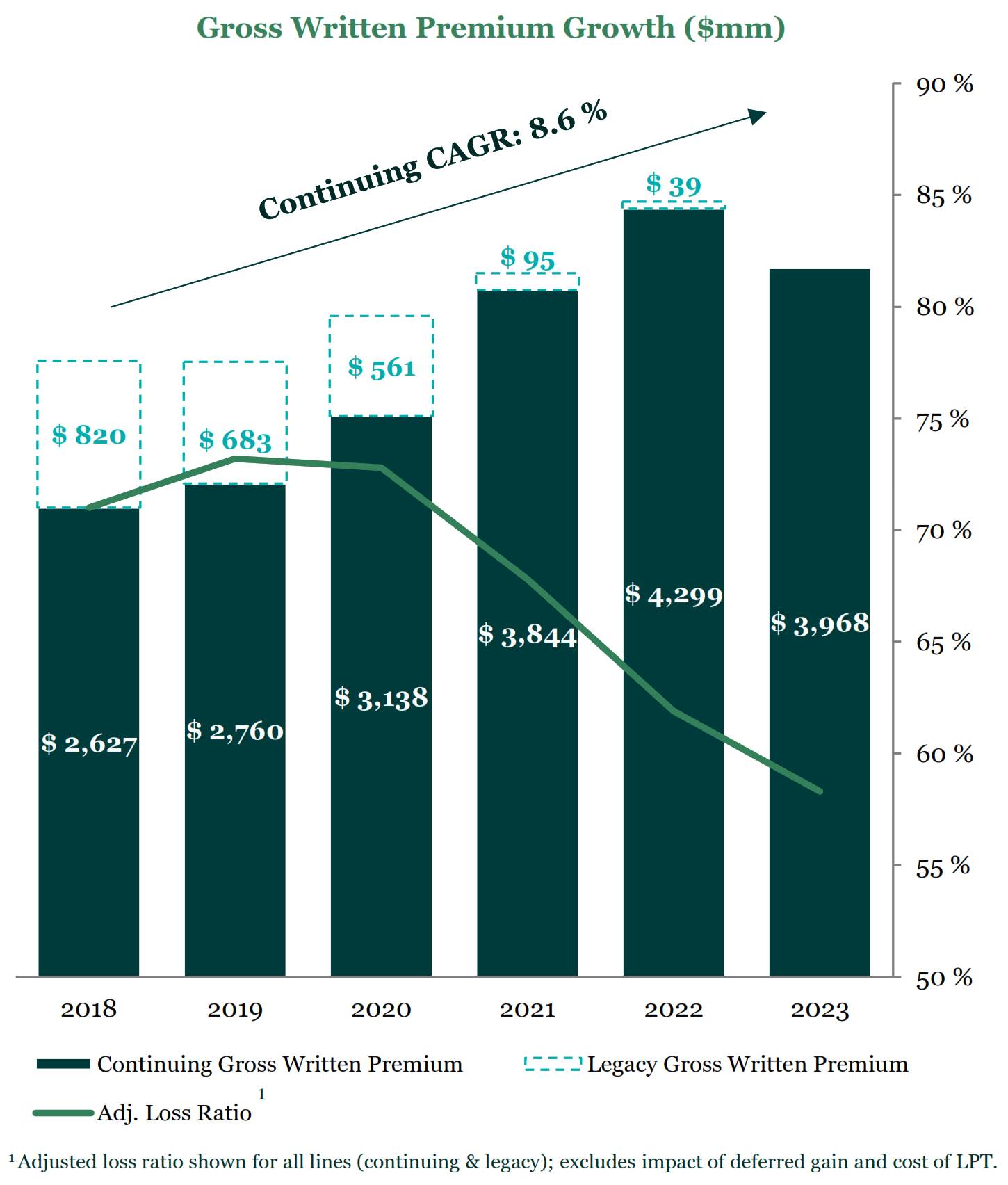
•Reduced Volatility: We have taken extensive action to reduce volatility within both our existing in-force and go-forward businesses. We have dramatically decreased our property catastrophe exposure, with January 1, 2024 net 250-year probable maximum loss (“PML”) exposure of $336 million, which has declined by approximately 64% relative to the start of 2018. This allowed us to generate a 20.2% Op. ROE for the twelve months ended December 31, 2023, despite worldwide insured losses of $95 billion, according to Munich Re. We also entered into the LPT with Enstar in May 2022 to limit our exposure to adverse development on the carried reserves for the accident years prior to 2020. This provides substantial ongoing protection against both social and economic inflation, while freeing up capital for our underwriters to deploy into the current attractive pricing environment and allowing our management team to focus on delivering profitable growth from within our continuing lines of business. Our use of ACM is also highly strategic to our business as a tool to manage net line size and overall volatility, while generating more
stable fee income. Over 90% of our fee income is derived from continuous investor relationships of 4+ years or investment structures with multi-year commitments.
_______________
(1)Represents Occurrence Exceedance Probability PML (1-in-250) for all perils worldwide as of January 1.
(2)Guy Carpenter U.S. Property CAT Rate-On-Line Index.
•Improved Operational Efficiency: We have significantly rationalized our operating footprint, reducing our office locations from 43 to 18, while growing our gross written premiums per employee by 25.8% from 2018 to 2023, and driving a reduction in our expense ratio from 32.9% in 2018 to 28.1% in 2023. We continue to invest in operational efficiencies, which we believe will bring meaningful cost benefits in the medium term through traditional operational expense reductions, as well as improvements to our loss ratio achieved through enhanced underwriting systems and data analytics.
•Culture: We have undertaken a transformation so that we can execute our go-forward strategy in adherence with our values. Since Apollo’s acquisition in 2019, to align with our culture and mission, each member of Aspen’s executive team has been newly appointed, through either internal promotions or new external hires. Our culture is defined by our core values to be open minded, to do the right thing, to be in it together, to own it, and to innovate. We empower our decision makers, who bring to bear their expertise for clients, and build our reputation as thought leaders in our market spaces. Our employees are challenged to be not just risk allocators, but considered risk managers who demonstrate underwriting judgment, exercising restraint in soft markets and pursuing growth in favorable market conditions.
The result of this transformation has been a significant shift in our culture, and a strategic repositioning of the underwriting portfolio that is now being reflected in our financial results, providing a dynamic platform on which to execute our go-forward strategy of growing our core lines of business.
Our Business
We manage our underwriting operations as two distinct business segments: Insurance and Reinsurance. We have a diversified yet complementary portfolio across these segments, constructed through the lens of our ‘One Aspen’ approach, where we balance risk on an aggregate basis and tactically deploy capital to the lines of business and platforms that we believe will generate the best returns for the Aspen Group. Our Insurance and Reinsurance segments both leverage third-party capital through ACM, which utilizes our capabilities in the third-party capital space (namely, the Insurance Linked Securities markets) to provide our core Insurance and Reinsurance segments with enhanced capital flexibility and operating leverage.
Our size provides an advantage relative to our larger peers, allowing us to be nimble and decisive; entering, exiting or changing the nature of our underwriting positions faster and with greater precision. For instance, as part of our active portfolio management process for the 2023 planning year, we made the decision to step back from the aviation, space and bloodstock reinsurance markets as we did not see medium-term returns meeting our targets, while also reducing our risk appetite for mortgage reinsurance. In addition, in the Insurance segment we actively managed down from our original 2023 planned growth within selected U.S. management liability and professional liability lines of business, where we have observed a softening rate environment.
The strength of our Insurance and Reinsurance businesses is evidenced by our numerous nominations for industry awards in 2023, including being shortlisted for Insurance Insider’s (Re)insurer of the Year, shortlisted for Insider Honours’ Diversity & Inclusion and Carrier of the Year, and our CEO and Executive Chair, Mark Cloutier, being awarded Inside P&C’s CEO of the Year.
Insurance: Our Insurance segment underwrites primary specialty risks across a diversified set of property and casualty lines of business. We focus on market segments with high barriers to entry that require bespoke underwriting and industry expertise and customized solutions to address client needs. We have long-standing relationships with key distribution partners, primarily comprised of a diversified group of leading retail brokers and wholesale brokers, along with a select number of managing general agents (“MGAs”). We believe our experience in these niche markets has cemented our role as a partner of choice for many of our distributors, as we are able to leverage our capabilities to develop one-stop custom solutions across multiple lines of business, platforms and geographies.
We have niche underwriting capabilities across multiple platforms, including: U.S. admitted lines; U.S. excess and surplus (“E&S”) lines; Lloyd’s; the U.K. Company Market and Bermuda. The breadth of our capabilities across these platforms allows for solutions that can be tailored to our clients’ needs while also allowing us to optimize returns based upon prevailing market conditions.
Specialty is at the heart of our capabilities and product offerings. We define our specialty orientation to include the following:
•Product spaces which are non-commoditized where bespoke underwriting expertise and innate sector knowledge is required and serves as a true differentiator;
•Clients that have complex business challenges requiring customized insurance solutions to fit their specific risk transfer needs; and
•Risks that are underwritten on an individual basis, frequently requiring advanced analysis and modeling as well as specialized active claims management.
Our Insurance segment is organized into four primary portfolios of business: (1) financial and professional lines; (2) casualty and liability lines; (3) first party lines; and (4) specialty lines. Each portfolio has multiple product offerings which are overseen by experienced teams of underwriters who are experts in their given niche. The
composition of our Insurance product offering is included below with percentages based on gross written premiums for the twelve months ended December 31, 2023.
________________
(1)Percentages represent 2023 gross written premium as a percent of total Insurance gross written premium.
(2)Primarily consists of Carbon Syndicate.
Specific examples of our expertise and differentiated approach across product lines include:
•Specialized Expert Underwriters. We employ underwriters who are experts in their respective fields, with the requisite sector knowledge to best assess, select and price risk. For example, the team that handles our ocean marine product line includes former members of the Merchant Marines; our credit and political risk business is led by former bankers who understand the nuanced complexity associated with credit risk, while our cyber and tech liability teams are trained to field-recognized designations that would traditionally sit outside the insurance industry.
•Customized Product Offering. We have significantly narrowed our focus to concentrate on niche offerings, seeking to underwrite beyond the traditional lines of business that would result in a portfolio that stands and performs as just an index of the market. Examples of some of our specific product offerings include:
◦Credit and Political Risk: Bespoke contracts for complex credit and project finance deals underwritten by an experienced team of underwriters, supported by dedicated in-house credit analysts, offering one of the widest product suites in the market;
◦Cyber and Tech Liability: A team of global underwriters providing robust risk selection capabilities, who are all required to pass a credentialed network security exam (Certified Information Privacy Professional or Certified Information Privacy Technologist) to ensure consistent risk assessment expertise across the team;
◦Environmental: Specialist liability products to mitigate the financial impacts of environmental financial claims with a team of over 25 underwriters with experience across law, engineering,
consulting and risk management, that provide global capabilities from eight cities around the world;
◦Inland Marine: Within this business line, we underwrite both fine arts and construction. Fine arts is underwritten by a dedicated underwriting team with members having over ten years of experience on average. Our construction team has industry relationships with Engineering News Record Top 25 General Contractors, supported by an on-staff engineer, who provides clients access to risk control review, industry recommendations and best practice health checks;
◦U.K. Property & Construction: Structured as three underwriting teams across property investors, business & public sector, and construction, our U.K. property & construction team excels at unusual and special circumstances. We work in collaboration with our U.K. & international casualty underwriters to provide cross-class solutions for our clients and broker partners; and
◦U.S. Management Liability: A portfolio tactically balanced between open market writings (with greater exposure to fluctuations in market conditions) and delegated underwriting authority business in the small and midsize enterprise space (which is more stable and less price sensitive). As a subset of our management liability portfolio, transactional liability is a true specialty class where we have long-standing partnerships with two of the most respected underwriting facilities in the market, Ambridge Partners and Euclid Transactional.
•Tailored Portfolio Solutions. We have designed bespoke portfolio solutions across multiple lines of business for a number of our long-term trading partners. We continue to leverage our multiple operating platforms, bringing the ‘One Aspen’ approach to market, where our Reinsurance and ACM capabilities facilitate support of and alignment with our Insurance offerings. An example of this is a binder agreement we have with a leading wholesaler, whereby we provide underwriting capacity to multiple specialty programs across both the United States and Europe, utilizing our multiple operating platforms.
This approach has been the foundation for establishing a long-term track record of underwriting profitability across numerous lines of business. Aspen’s insurance segment includes a number of highly specialized lines of business that have returned favorable combined ratios across the cycle, highlighting the strength and niche nature of this business. We strive to maintain this caliber of underwriting performance in these lines, while building our track record within our other primary insurance lines of business.
For the twelve months ended December 31, 2023, our Insurance segment had $2,447 million of gross written premiums, generated $113 million of underwriting income and had a combined ratio of 92.3%. For the five-year period 2018 to 2023, continuing lines gross written premiums within our Insurance segment grew at a CAGR of 9.5% (with annual growth rates of 8.0%, 9.7%, 22.7%, 11.0% and (2.3)% for 2019, 2020, 2021, 2022 and 2023, respectively). There can be no assurance that such growth trends will continue.
Reinsurance: Within this segment, we offer expertise in a variety of global reinsurance lines including property catastrophe reinsurance, other property reinsurance, casualty reinsurance, and specialty reinsurance. We implement a simple, yet effective, distribution model targeting long-term relationships and product spaces that have demonstrated strong underwriting returns through market cycles. Our focus goes beyond traditional reinsurance, as we seek to provide our clients with innovative solutions, through both traditional retrocession, and the utilization of third-party capital through ACM alongside our own Aspen balance sheet capital. We are opportunistic yet disciplined in our approach, positioned to benefit from market dislocations and underwriting modest lines to reduce volatility from loss events with the aim of generating highly attractive risk-adjusted returns, as opposed to returns that just track the market index.
Our Reinsurance segment is organized into four portfolios: (1) property catastrophe reinsurance; (2) other property reinsurance; (3) casualty reinsurance; and (4) specialty reinsurance.
•Property Catastrophe Reinsurance: Our success in the property catastrophe market is based on strong risk controls and deep, embedded relationships with our clients, giving us differentiated insights to manage exposures. We utilize advanced models, analytical tools and our experienced global underwriting teams to
set terms and deliver timely capacity. Our opportunistic strategy in this line has allowed us to take advantage of a hard market cycle, using price increases, improvement in terms and ACM to enhance our underwriting margins and reshape our exposures. Importantly, we have used the hard market conditions not just for premium growth, but to reduce volatility, as evidenced by a significant reduction in PMLs from 2018 to 2023.
•Other Property Reinsurance: We provide tailored solutions for a broad spectrum of property risks worldwide through our dual distribution approach, writing business both directly to ceding firms and through brokers.
•Casualty Reinsurance: Our casualty treaty team operates on a global basis, and our analysis of market-wide trends in key territories, supported by close coordination with our claims, legal and actuarial teams, gives us insights that we believe will enable us to succeed in the changing liability landscape.
•Specialty Reinsurance: We target niche or unusual risks and are focused on offering tailor-made risk transfer solutions for several specialty lines. We believe our global expertise is well recognized and our team of underwriters across London, Singapore, Zurich and the United States give us valuable regional and global expertise to support our clients.
The composition of our Reinsurance business mix based on gross written premiums for the twelve months ended December 31, 2023 is included in the following chart:
For the twelve months ended December 31, 2023, our Reinsurance segment had $1,521 million of gross written premiums, generated $214 million of underwriting income and had a combined ratio of 81.4%. For the five-year period 2018 to 2023, continuing lines gross written premiums within our Reinsurance segment grew at a CAGR of 7.2% (with annual growth rates of 0.9%, 19.9%, 22.3%, 13.0% and (15.3)% for 2019, 2020, 2021, 2022 and 2023, respectively). There can be no assurance that such growth trends will continue.
ACM: We participate in the alternative reinsurance market through ACM, which acts as a conduit between Aspen’s balance sheet and third-party investors and supports each of our Insurance and Reinsurance segments. Through reinsurance sidecar investments, ACM provides investors direct access to our underwriting expertise and earns underwriting, management and performance fees for Aspen from other third-party investors primarily through the placement and management of sidecars, insurance linked securities (“ILS”) funds and other offerings. ACM is highly strategic to our business, providing a unique set of capabilities and tactical optionality to manage risk and improve our returns. Unlike other offerings in the market that are predominantly property catastrophe reinsurance focused, ACM offers investors a broader product suite that provides direct, fully aligned participation to risk
underwritten by Aspen’s primary specialty insurance and reinsurance portfolios, including actively managed fund products and sidecars. Notably, ACM’s capabilities in longer-tail lines of business bring greater stability to our fee income, and thus our underwriting results, as this fee income is associated with “stickier” third-party capital structured over multiple years. As of December 31, 2023, approximately 55% of third-party capital within ACM supported longer-tail products.
ACM is a core differentiator for Aspen, bringing our expertise in capital markets alongside that of our traditional outwards reinsurance capabilities, providing us with increased optionality across cycles in terms of access to capital, complementing our dynamic capital allocation approach. The ACM portfolio generally mirrors our own through collateralized quota share arrangements that provide third-party investors with aligned participation to our Insurance and Reinsurance underwriting. ACM is recognized as an innovator across both catastrophe and non-catastrophe risks and was one of the leaders in developing ILS capabilities for cyber risk. Our strong relationships and reputation in the market have enabled ACM to achieve significant growth since 2018, including in recent years where many insurance capital markets players reduced capacity. The following charts reflect the fee income generated by ACM for each of the twelve months ended December 31, 2018 through December 31, 2023, and the diversification of ACM’s fee income for the twelve months ended December 31, 2023.
ACM generated $135.5 million in fee income for the twelve months ended December 31, 2023. For the five-year period from 2018 to 2023, fee income grew at a CAGR of 41.4% (with annual growth rates of (22.9)%, 67.6%, 98.1%, 69.2%, and 30.4% for 2019, 2020, 2021, 2022 and 2023, respectively). There can be no assurance that such growth trends will continue. This fee income is primarily reflected as an offset to our acquisition costs and is therefore embedded in our underwriting results. For the five-year period from 2018 to 2023, third-party capital grew at a CAGR of 20.0% (with annual growth rates of (12.6)%, 16.8%, 34.8%, 36.5% and 32.7% for 2019, 2020, 2021, 2022 and 2023, respectively). There can be no assurance that such growth trends will continue.
Investments: Our investment strategy is focused on delivering stable investment income and total return through all market cycles, while maintaining high credit quality and portfolio liquidity. We manage a conservative investment portfolio that is appropriately balanced between our liquidity needs and investment returns, with an average credit rating of AA- and duration of 2.6 years of fixed income securities within our portfolio, as of December 31, 2023. We have access to world-class investment managers and execute this strategy through thoughtful allocations of investment assets to our key investment management partners.
To enhance investment returns, we tactically calibrate asset allocation and the duration of our investment portfolio, taking into account the duration of our insurance and reinsurance liabilities, as well as our view of interest rates, the yield curve, credit spreads and other general market conditions. In recent years we have diversified the range of asset classes in which we invest to include collateralized loan obligations, broadly syndicated loans, private credit, real estate equity and debt, private equity related infrastructure investments, high yield bonds and leveraged loans. We hold these investments directly or through fund vehicles. As of December 31, 2023, we allocated $1.8 billion (24%) of our investment portfolio to these asset classes. Apollo Asset Management Europe PC LLP
(“AAME”) manages $1.6 billion (22%) of these asset classes with the remainder managed by other third party managers.
As of December 31, 2023, we had $7.4 billion of total cash and investments, excluding catastrophe bonds, net receivables for securities sold and accrued interest receivable, on our balance sheet and for the twelve months ended December 31, 2023, we generated $276 million of net investment income.
________________
(1)Excludes catastrophe bonds, net receivables for securities sold and accrued interest receivable.
(2)Other includes U.S. Agency, Municipals and short-term investments.
(3)Based on the Bloomberg Barclays Rating Methodology.
For more information on our aggregate portfolio reflected in the chart above (including the characterization of our investments as available for sale and trading), please refer to “Management’s Discussion and Analysis of Financial Condition and Results of Operations—Balance Sheet—Total cash and investments.”
Our Competitive Strengths
We believe that our competitive strengths include:
‘One Aspen’ Approach, Supported by Dynamic Capital Allocation
Through our ‘One Aspen’ approach, we can actively manage our portfolio across counter-cyclical pricing environments in the insurance and reinsurance markets, shifting capital between our two segments and being opportunistic in markets where we perceive advantageous risk versus return opportunities. The markets we serve require capabilities that are not easily replicated and we come to market in a way that allows us to bring our product offerings together and execute on large new deals across different lines of business, platforms and segments. This provides us with greater control over capital allocation and underwriting outcomes, and is a key pillar of our go-forward offering and growth strategy.
Our operating and risk allocation strategy has been carefully designed to optimize the use of both our own assets, as well as third-party capital. Business sourced is carefully analyzed and directed to the appropriate underwriting platform, taking into account client characteristics, as well as operational and efficiency considerations. We have a scaled but nimble (re)insurance presence across the most important global underwriting hubs for our lines of business, including the U.S. admitted, U.S. E&S, Bermuda, Lloyd’s and the U.K. Company Market, all leveraging our third-party capital markets capabilities (through ACM).
Niche Primary Insurance Platform
Our insurance strategy is focused on underwriting complex, highly curated, niche lines of business with high barriers to entry. Our Insurance segment generated $2,447 million in gross written premiums for the twelve months ended December 31, 2023. We only participate in lines of business in which our underwriters have deep, technical expertise and where they can be well supported by our platforms and strong capabilities, allowing us to provide innovative and coordinated solutions to clients. From 2018 to 2023, we experienced aggregate rate increases of 66.4% in our portfolio, driven by pricing improvements from our core lines of business. We adopt an efficient tactical use of outwards reinsurance, enabling us to write higher exposure policies while appropriately managing our net retained exposure.
Since being acquired by Apollo, we have exited a number of lines of business (legacy business) while also achieving strong growth in our continuing lines of business generating attractive profitability. The gross written premiums CAGR within these continuing lines of business has been 9.5% since 2018 (with annual growth rates of 8.0%, 9.7%, 22.7%, 11.0% and (2.3)% for 2019, 2020, 2021, 2022 and 2023, respectively). There can be no assurance that such growth trends will continue. The combined ratio has improved from 99.1% in 2018, to 92.3% in 2023.
Opportunistic Specialist Reinsurance Franchise
We have built a nimble reinsurance strategy focused on core lines of business within property, casualty and specialty. Our Reinsurance segment generated $1,521 million in gross written premiums for the twelve months ended December 31, 2023 and is positioned to capitalize on dislocation within a broad set of markets. Our strategy is to underwrite modest line sizes to limit exposure from large loss events, and our property catastrophe portfolio has been optimized to generate higher risk-adjusted returns and manage overall volatility. The gross written premiums CAGR within these continuing lines of business has been 7.2% since 2018 (with annual growth rates of 0.9%, 19.9%, 22.3%, 13.0% and (15.3)% for 2019, 2020, 2021, 2022 and 2023, respectively). There can be no assurance that such growth trends will continue. The combined ratio has improved from 104.7% in 2018, to 81.4% in 2023.
Our opportunistic approach has allowed us to take upside from attractive reinsurance underwriting conditions, where we have experienced strong rate increases in a hard market cycle. We have experienced cumulative rate increases of 70% from 2018 to 2023. We continued to benefit from an attractive pricing environment with a rate increase of 8.1% on 2024 renewed premium for existing policies that were renewed from January 1, 2024 through January 31, 2024. Our strength in reinsurance is bolstered through the deployment of third-party capital through ACM, which provides us with differentiated access to capital and allows us to “flex” into attractive market opportunities.
Growing and Highly Complementary Capital Markets Business
Since its inception in 2013, ACM uses our capabilities in the third-party capital markets, to increase the flexibility Aspen’s Insurance and Reinsurance underwriters have in allocating risk to the best source of capital. ACM leverages the full breadth of our expertise across distribution, underwriting, modelling, actuarial and claims, to create attractive opportunities for our investor partners. ACM has experienced significant growth, with third-party capital growing from $667 million in 2018 to $1,663 million at the end of 2023, and generating $136 million in fee income for Aspen in 2023. We believe we have driven innovation in this market and have cultivated close relationships with third-party capital investors. ACM is a differentiated capability and highly strategic to our business, allowing us to support our Insurance and Reinsurance segments with third-party capital, and serving as a mechanism for tactical de-risking as we leverage fee income from our on-balance sheet underwriting risk. This capability provides us with the ability to “flex” into attractive opportunities in accordance with underwriting cycles and enhances our go-to-market strategy.
Deep Trading Partner Relationships
We have seasoned and diversified relationships with partners across our (re)insurance segments. The distribution strategy within our Insurance segment is focused on specialized intermediaries with whom we have long-standing relationships. Our distributors are experts in their field and know our products and risk appetite well.
We have flexibility across retail brokers, wholesale brokers and MGAs to drive value and maintain deep relationships without being overly reliant on any one large partner. Our Reinsurance segment is characterized by the longevity of our relationships with cedants, with 89% of premium for underwriting year 2023 having been written with cedants who have maintained their reinsurance relationship with us since 2013. We believe we are viewed as a strong, reliable counterparty.
Strong Balance Sheet
We have an efficient capital structure and strong capitalization with $3,209 million of total capital as of December 31, 2023. Additionally, we have strong financial strength ratings from both A.M. Best Company, Inc. (“A.M. Best”) (“A”) and Standard & Poor’s Financial Services LLC (“S&P”) (“A-”) and maintain Group BMA Bermuda Solvency Capital Requirement (“BSCR”) of 237% as of December 31, 2022. We maintain our Group BMA BSCR significantly in excess of regulatory minimums.
The strength of our balance sheet and underwriting platform is supported by the LPT transaction with Enstar, which provides protection against deterioration on 2019 and prior accident year carried reserves, significantly limiting Aspen’s exposure to the risk of unfavorable development from these accident years while still retaining the scale, market relationships, and operational infrastructure to capitalize on current market conditions to continue to grow our business. The following chart shows our pre-2020 accident year carried reserves, as well as the LPT coverage above such carried reserves, as of September 30, 2021 and December 31, 2023.
Highly Experienced Management Team
Led by our CEO and Executive Chair, Mark Cloutier, we have an experienced executive leadership team from diverse backgrounds, each with a specific role and purpose to drive the transformation of our business. Since Apollo’s acquisition in 2019, to align with our corporate culture and mission, each member of Aspen’s executive team has been newly appointed, through either internal promotions or new external hires. Our team has an average of 28 years of experience across all facets of the global specialty property & casualty (re)insurance and financial services sectors, including underwriting, claims, technology, investment management, risk management, finance, brokering, actuarial, people and operations.
Our Strategy
As an institution we aim to bring “Clarity from Complexity.” We seek to transform complex risks into opportunities through efficient and innovative solutions, leveraging our multi-platform capabilities across our Insurance and Reinsurance segments, both of which are supported by ACM. We believe we are a market leader in our industry that provides our clients with confidence and the best possible outcomes. Our culture, which prioritizes collaboration, accountability and service, allows us to provide intelligent, swift solutions in the face of challenges. Whatever the challenge is, we are ‘One Aspen’.
Our vision statement is ‘to be a top quartile specialty risk (re)insurer focused on total value creation through underwriting profit and investment performance.’ Our ability to achieve this goal is based on three key pillars, which we believe create a virtuous cycle for success:
1.Sustained Profitability: This encompasses several items, including profitable growth, delivering consistent results, managing Funds at Lloyd’s (as defined below) and efficiently allocating capital, retaining agility and embedding cross functional collaboration. These goals all highlight the importance of financial success and sound risk management for Aspen.
2.Brand Strength and Market Presence: This priority relates to being a partner of choice, easy to transact with, a provider of creative solutions and outstanding service and our use of data and analytics to improve performance and service and a healthy control environment.
3.Employer of Choice: Talent development, leadership, and building a strong, engaged workforce are emphasized throughout Aspen. Improving the effectiveness of the Group Executive Committee (the “Group Executive Committee”), managing people and communication implications, and developing a sustainable model all point to the importance of investing in human capital and fostering a positive work environment.
Our technology strategy is underpinned by our mission to underwrite excellent business and to automate and digitize operations from ingestion to downstream functions. As part of our strategy, we amplify underwriting and claims results through the use of data and technology insights. Underlying data is key to our decision making and we have extensively invested in enterprise-wide data and analytics capabilities. We are transitioning to a single, comprehensive enterprise-wide data repository, built on over 20 years of underwriting history, which we expect will form the foundation for our reporting, business intelligence, analytics and other advanced data capabilities. We believe this agile platform will allow us to develop our real time access to analytics and provide us with an advantage in managing our risk and better claims / portfolio management. In addition, we have invested in a variety of application programming interface and cloud capabilities, which give us greater flexibility in integrating our multi-national underwriting operations and leveraging software as a service and third-party data sources to ensure a competitive advantage.
Underpinning all of this is our ability to maintain a strong balance sheet and manage our capital prudently. We have a highly efficient capital structure and our capitalization is strong, as evidenced by our strong financial strength ratings. We are constantly monitoring rating agency guidelines, changes in our regulatory environment and market opportunities to ensure that our capital structure is appropriate for our strategic ambitions. We maintain robust procedures for setting loss reserves and actively managing risk in our portfolio. Our reserve confidence was further strengthened by the previously mentioned LPT transaction executed in May 2022. In today’s attractive underwriting environment, we see ample opportunity to deploy excess capital into both our Insurance and Reinsurance segments, but through the cycle we may return capital to shareholders when opportunities are limited during soft insurance markets. See “Dividend Policy.”
We are guided by the phrase “One Aspen Team, Creating Value,” which is underpinned by our core set of values – to be open minded, to do the right thing, to be in it together, to own it, and to innovate. We have built
Aspen’s culture around these guiding principles to foster an environment that promotes innovation, collaboration, inclusiveness and accountability.
Our Markets and Opportunity
We operate within the global (re)insurance market, where we have significant opportunities to capture attractive risk-adjusted returns across the cycle through our multi-platform capabilities. The global macroeconomic and social environment continues to drive demand for increasingly complex (re)insurance solutions delivered as a joined-up offering, which is where we thrive. In recent years, rate increases have been driven by the increased frequency and severity of natural catastrophe events globally (impacted by changing weather patterns), inflation (both social and economic), increased geopolitical tensions and other risks that have grown and emerged, increasing the demand for specialty solutions. As a result, the global commercial insurance industry has seen 25 consecutive quarters of price increases according to Marsh’s Global Insurance Market Index Q4’2023.
We expect these hard market conditions will persist, as they are driven by uncorrelated and continuing macroeconomic and social dynamics. This will provide opportunities for us to deliver profitable growth as we target new business and clients at favorable rates and with improved terms and conditions, while maintaining disciplined risk selection. Furthermore, our chosen lines of business within Insurance have high barriers to entry requiring the bespoke tailoring of products and the need for specialized and experienced underwriters with tenured distribution relationships.
The higher interest rate environment provides additional tailwinds for our business. Higher returns from our fixed income portfolio complement our underwriting income with attractive investment income and contribute to our ability to generate strong risk-adjusted returns for our shareholders. With a low-risk fixed income portfolio of relatively short duration 2.6 years as of December 31, 2023, we are well placed to take advantage of attractive investment yields as we rotate and reinvest.
Global Insurance Market
Within Insurance, we operate within both the U.S. specialty and international insurance markets.
U.S. Specialty
Aspen operates within the broadly defined U.S. commercial lines market, which generated annual industry direct premiums of approximately $474 billion as for the twelve months ended December 31, 2023. The industry has experienced improved underwriting performance following the COVID-19 pandemic and wider economic uncertainty. Within commercial insurance, the excess and surplus (“E&S,” “non-admitted” or “surplus lines”) market has demonstrated strong growth, with highly attractive rate increases and improvement in terms and conditions. For the twelve months ended December 31, 2023 we wrote $879 million of gross premiums in the E&S market. A.M. Best estimates that this market segment is approaching $100 billion in annual premiums, nearly doubling since 2018. Driving this growth is the macroeconomic and social environment and challenges within the
admitted space, which continues to drive demand for specialized insurance solutions due to both increasing and more complex risks from the commercial market.
E&S carriers are generally permitted to craft insurance terms to suit the particular risk they are assuming as the underlying risks tend to have unique qualities. Consequently, in this space we are able to provide tailored contracts and limit exposure to loss by either excluding coverage or providing a sub-limit on coverage. This customized approach provides the opportunity to achieve attractive long-term profitability. E&S combined ratios have outperformed admitted combined ratios by approximately 3% on average from 2018 through 2022, according to A.M. Best.
We underwrite business in the United States through Aspen American Insurance Company and Aspen Specialty Insurance Company on an admitted and E&S basis, respectively. For the twelve months ended December 31, 2023, we generated $879 million and $863 million of gross written premiums in the U.S. E&S and admitted markets, respectively.
International Insurance
Our international insurance products are underwritten in the London Market, through both our Lloyd’s and U.K. Company Market platforms.
Lloyd’s is a competitive insurance market where individual underwriters accept risks on behalf of groups, called syndicates, of individual and corporate members whose resources provide the security behind Lloyd’s policies. Lloyd’s is the world’s largest specialty insurance marketplace, underwriting £52 billion of premiums during the twelve months ended December 31, 2023, up 12% from the same period in the prior year. The Lloyd’s global distribution network is where many of the world’s most complex risks are placed, across more than 60 specialty lines of business. Over 50 leading insurance companies participate in the market with more than 380 registered Lloyd’s brokers and a global network of over 4,000 local coverholders. We have a significant presence at Lloyd’s through our integrated Lloyd’s vehicle, comprising Syndicate 4711, managed by AMAL with fully aligned capital, which in addition to access to complex risks also provides us (re)insurance licensing access for 80 territories (and an additional 20 territories on a reinsurance only basis) across the Americas, the United Kingdom, Europe, and Asia Pacific. AUL, as the sole corporate member of Syndicate 4711, must deposit sufficient capital to support its underwriting at Lloyd’s. For the twelve months ended December 31, 2023, AUL supported capacity of £1,115 million on Syndicate 4711. Aspen is well positioned within Lloyd’s, with Syndicate 4711 having a reported combined ratio of 86.7% for 2023 and increased underwriting capacity for 2024. For the twelve months ended December 31, 2023, we wrote $1,054 million of gross premiums in the Lloyd’s market.
The U.K. Company Market is an important market for global specialty insurance, with companies and individuals worldwide turning to this market to protect against niche and hard-to-place risks, ranging from liability and professional lines, to cyber and renewable energy exposures. Gross premium written in this market stood at £44 billion in 2023 up 34% from £33 billion in 2020. While there is no standard definition of this market, there is a general agreement that the core of its activity is internationally traded non-life, commercial and specialty insurance and reinsurance business written by standalone insurers operating outside Lloyd’s, but within its wider ecosystem. This is mostly P&C (re)insurance, with an increasing emphasis on high-exposure risks. The diversity and expertise of insurers and underwriting talent, as well as the ecosystem of service providers, make this a highly attractive market to write our U.K.-centric lines of business. We write business in this market through Aspen Insurance UK Limited. For the twelve months ended December 31, 2023, we wrote $320 million of gross written premiums in this market.
Global Reinsurance Market
The global reinsurance market has approximately $670 billion of capital committed as of December 31, 2023, a decrease of 0.7% from December 31, 2021. We believe the market is witnessing an opportunity for margin expansion. There is a supply and demand imbalance in global reinsurance due to limited new capacity entering the market, retreating rated reinsurers, reduced ILS capacity for traditional property catastrophe focused managers, increased exposure from inflation, and reduced capital positions as a result of unrealized losses on fixed income portfolios. While the opportunity is currently led by property catastrophe pricing, which has seen an approximately
29% increase in rates in 2023 according to Guy Carpenter’s Global Property Rate-On-Line Index, along with significantly better terms and conditions and primary retention, there remains broader opportunity to cross sell to quality, non-retreating carriers. Our global underwriting platforms in reinsurance, and differentiated, diverse ACM capabilities provide us with an opportunity to react quickly to market conditions and benefit from the current market cycle.
Our Reinsurance business segment is underwritten through four core platforms, which include AAIC, Aspen UK, Syndicate 4711 and Aspen Bermuda, and our branch offices including our European hub in Zurich and Asia Pacific hub in Singapore. For the twelve months ended December 31, 2023, we wrote $1,521 million of gross written premiums in the reinsurance market.
Our Sustainability Principles
Our goal is to be a diverse and inclusive business, providing strong risk-adjusted returns as we work towards a goal of having a deep sense of social responsibility, whether that be supporting the local communities in which we operate or proactively managing the environmental footprint of our direct operations. Sustainability and Environmental, Social and Governance (“ESG”) are closely linked, and we expect to play our part pragmatically in the transition to net zero. Our vision is to bring “Clarity from Complexity” and this is reflected in the approach we take and how we deliver our long-term objectives in respect of sustainability. We believe our heritage of deep sector expertise, strong culture and our proven ability to apply the full breadth of our capabilities to solve problems created by new and changing risks, makes us uniquely positioned to be a relevant partner as the energy and other sectors work towards this transition. Our philosophy is centered around three pillars:
1.Environmental: We have calculated our Scope 1, Scope 2 and, in relation to certain categories, Scope 3 greenhouse gas emissions utilizing estimates, methodologies and conversion factors aligned to the Greenhouse Gas Protocol for our industry. As we work towards carbon reductions across our value chain, we also make use of offsetting projects accredited by the Verified Carbon Standard (“VCS”) and Gold Standard (“GS”) to compensate for 100% of our Scope 1 and 2 greenhouse gas emissions, along with all calculated Scope 3 categories (i.e., fuel and energy related activities, waste generated in our operations, business travel and employee commuting (including working from home)) directly relating to our employees. We plan to continue our carbon offsets program to continue addressing our overall carbon footprint. Our sustainability development and focus is enabling us to be more data-led when determining projects to fund, where we invest and how to consider clients’ sustainability in our underwriting;
2.Social: Our policies are designed to empower our staff to support their own charitable passions, with the goal of providing opportunities for future success in our global and local communities. We develop collaborative engagement with our employees and our third sector partners, instilling a sense of pride in current staff and building a platform to attract future talent. In tandem with attracting talent, we have a clear workplan that is led by people from across our business and championed by executive sponsors to foster a diverse and inclusive culture; and
3.Governance: In an age of increased risks, we employ a comprehensive risk management framework, which provides the foundation through which we evaluate and manage business opportunities and related risks in a disciplined manner across the Group. Strong governance is the bedrock of our focus on offering value to our clients, employees and communities around us and we have a clear structure in place to deliver on this.
Summary Risk Factors
Investing in our ordinary shares involves risks. Prospective investors should carefully consider the risks described in “Risk Factors” below, as well as other information contained in this prospectus before making a decision to invest in our ordinary shares. Any of the factors set forth under “Risk Factors” could materially adversely affect our business, financial condition, results of operations or cash flows and could impact any forward-looking statements. Prospective investors should note that such risks are not the only ones we face. Additional risks
and uncertainties not currently known to us or that we currently deem to be immaterial may also materially and adversely affect us in the future. Among these important risks are the following:
•we may be adversely affected by the occurrence of natural disasters and other catastrophe events, as well as outbreaks of pandemic or contagious diseases, and we could face unanticipated losses from war, terrorism and political unrest, government action that is hostile to commercial interests and from sovereign, sub-sovereign and corporate defaults; these or other unanticipated losses could have a material adverse effect on our financial condition or operating results;
•global climate change, as well as increasing laws, regulation and litigation in the area of climate change, may have an adverse effect on our results of operations, financial condition or liquidity;
•our results may fluctuate as a result of many factors, including cyclical changes in the reinsurance and insurance industries;
•our reinsurers may not reimburse us for claims on a timely basis, or at all, which may materially and adversely affect our business, results of operations and financial condition;
•a material proportion of our business relies on the assessment and pricing of individual risks by third parties;
•the failure of any risk management and loss limitation methods we employ could have a material adverse effect on our financial condition and operating results;
•our financial condition and operating results may be adversely affected if actual claims exceed our loss reserves;
•we may be adversely impacted by economic inflation;
•our investments are subject to interest rate, credit, and real estate related risks, which may adversely affect our net income and may adversely affect the adequacy of our capital
•our operating results may be adversely affected by the failure of policyholders, brokers or other intermediaries or reinsurers to honor their payment obligations;
•competition and consolidation in the (re)insurance industry could reduce our growth and profitability;
•our Operating Subsidiaries are rated and our Lloyd’s business benefits from a rating by one or more of A.M. Best and S&P and a decline in any of these ratings could adversely affect our standing among brokers and customers and cause our premiums and earnings to decrease, or may otherwise result in an adverse effect on our business, financial condition and operating results;
•we depend on a few brokers for a large portion of our insurance and reinsurance revenues and the loss of business provided by any one of those brokers could adversely affect us;
•political, regulatory, governmental and industry initiatives may have a material adverse effect on our business, financial condition, results of operations, liquidity, cash flows and prospects;
•our internal controls over financial reporting have gaps or other deficiencies;
•we could be adversely affected by the loss of one or more of our senior underwriters or other members of our senior management team or by an inability to attract and retain senior staff;
•as a foreign private issuer and “controlled company” within the meaning of the NYSE corporate governance rules, we are permitted to, and do, rely on exemptions from certain of the NYSE corporate governance standards; our reliance on such exemptions may afford less protection to holders of our ordinary shares;
•a failure in our data security and/or technology systems or infrastructure or those of third parties, including those caused by security breaches or cyber-attacks or through the incorporation of artificial intelligence (“AI”), could disrupt our business, damage our reputation and cause losses;
•following this offering, we will continue to be controlled by Apollo, and Apollo’s interests may conflict with our interests and the interests of our other shareholders;
•our holding company structure and certain Companies Act, regulatory and other constraints may limit our ability to pay dividends on our securities;
•we cannot pay a dividend on our ordinary shares unless the full dividends for the most recently ended dividend period on all outstanding Preference Shares have been declared and paid; and
•the other factors identified under “Risk Factors” in this prospectus.
Our Corporate Structure and the Pre-IPO Merger Transaction
We were incorporated on May 23, 2002 in Bermuda as a holding company operating under the laws of Bermuda. Our principal office is located at 141 Front Street, Hamilton, HM19, Bermuda. Our telephone number is +1 441-295-8201 and our website address is www.aspen.co. Information contained on, or that can be accessed through, our website is not part of and is not incorporated by reference into this prospectus, and you should not consider information on our website to be part of this prospectus.
Prior to this offering on , 2024, we effected a for 1 share split of our ordinary shares (the “Share Split”). As of , 2024, giving effect to the Share Split, we had an aggregate of ordinary shares outstanding.
Prior to this offering, Highlands Bermuda Holdco, Ltd., a holding company affiliate of certain investment funds managed by affiliates of Apollo, owned all of our issued and outstanding ordinary shares, which constituted its sole assets. Immediately prior to the consummation of this offering, Highlands Bermuda Holdco, Ltd. will merge with and into the Company, with the Company surviving the merger as the surviving entity (the “Pre-IPO Merger Transaction”). As a result of the Pre-IPO Merger Transaction, all of our outstanding ordinary shares previously held by Highlands Bermuda Holdco, Ltd. will, after the Pre-IPO Merger Transaction, be held by the existing holders of equity interests in Highlands Bermuda Holdco, Ltd., including AP Highlands Co-Invest and AP Highlands Holdings, both of which are affiliated with and managed by affiliates of Apollo, and certain members of our management team. Upon completion of the Pre-IPO Merger Transaction, but prior to the consummation of this offering and the sale of our ordinary shares by the selling shareholders, we will have ordinary shares outstanding, ordinary shares of which will be held by AP Highlands Co-Invest, ordinary shares of which will be held by AP Highlands Holdings and ordinary shares of which will be held by certain members of our management team.
Following the completion of this offering, we will continue to have one class of authorized and outstanding ordinary shares and one class of authorized and outstanding Preference Shares, consisting of three series, which are the AHL PRC Shares, the AHL PRD Shares and the AHL PRE Shares, which are represented by Depositary Shares. For a more detailed description of our ordinary shares and Preference Shares, see “Description of Share Capital.”
The following diagram sets forth a simplified view of our corporate structure after giving effect to this offering and the Pre-IPO Merger Transaction. The chart assumes no exercise of the option granted to the underwriters to purchase up to additional ordinary shares in connection with the offering and an initial public offering price of $ per ordinary share, which is the midpoint of the price range set forth on the cover page of this prospectus. This chart is for illustrative purposes only and does not represent all legal entities affiliated with the entities depicted. Unless otherwise noted, each entity is wholly-owned by its immediate parent.
________________
(1)Represents ordinary shares held by AP Highlands Co-Invest and ordinary shares held by AP Highlands Holdings. See “Principal and Selling Shareholders” for detail of the percentage ownership following this offering.
(2)Represents ordinary shares held by certain members of our management team.
Implications of Being a Foreign Private Issuer
We are considered a “foreign private issuer” and report under the Securities Exchange Act of 1934, as amended (the “Exchange Act”) as a non-U.S. company with foreign private issuer status. This means that, as long as we qualify as a foreign private issuer under the Exchange Act, we will be exempt from certain provisions of the Exchange Act that are applicable to U.S. domestic public companies, including:
•the sections of the Exchange Act regulating the solicitation of proxies, consents or authorizations in respect of a security registered under the Exchange Act;
•the sections of the Exchange Act requiring insiders to file public reports of their share ownership and trading activities and liability for insiders who profit from trades made in a short period of time; and
•the rules under the Exchange Act requiring the filing with the SEC of quarterly reports on Form 10-Q containing unaudited financial and other specified information, or current reports on Form 8-K, upon the occurrence of specified significant events.
We may take advantage of these exemptions until such time as we are no longer a foreign private issuer. We would cease to be a foreign private issuer at such time as more than 50% of our outstanding voting securities are held by U.S. residents and any of the following three circumstances applies: (i) the majority of our executive officers or directors are U.S. citizens or residents, (ii) more than 50% of our assets are located in the United States or (iii) our business is administered principally in the United States.
In addition, as a foreign private issuer, the Company is also entitled to rely on exceptions from certain corporate governance requirements of the NYSE. As a result, you may not have the same protections afforded to shareholders of companies that are not foreign private issuers.
In this prospectus, we have taken advantage of certain of the reduced reporting requirements as a result of being a foreign private issuer. Accordingly, the information contained herein may be different than the information you receive from other public companies in which you hold equity securities.
Apollo and Controlled Company Status
On February 15, 2019, the Company completed its merger with Highlands Merger Sub, Ltd. (“Merger Sub”), a wholly owned subsidiary of Highlands Bermuda Holdco, Ltd. Merger Sub merged with and into the Company, with the Company continuing as the surviving company and as a wholly owned subsidiary of Highlands Bermuda Holdco, Ltd. Highlands Bermuda Holdco, Ltd. is a holding company affiliate of certain investment funds managed by affiliates of Apollo. Apollo is a leading global investment manager and had total assets under management of $651 billion as of December 31, 2023.
Immediately prior to the consummation of this offering, Highlands Bermuda Holdco, Ltd. will merge with and into the Company, with the Company surviving the merger as the surviving entity. As a result of the Pre-IPO Merger Transaction, all of our outstanding ordinary shares previously held by Highlands Bermuda Holdco, Ltd. will, after the Pre-IPO Merger Transaction, be held by the existing holders of equity interests in Highlands Bermuda Holdco, Ltd., including AP Highlands Co-Invest and AP Highlands Holdings, both of which are affiliated with and managed by affiliates of Apollo, and certain members of our management team. Upon completion of the Pre-IPO Merger Transaction, but prior to the consummation of this offering and the sale of our ordinary shares by the selling shareholders, we will have ordinary shares outstanding, ordinary shares of which will be held by AP Highlands Co-Invest, ordinary shares of which will be held by AP Highlands Holdings and ordinary shares of which will be held by certain members of our management team.
Apollo’s indirect subsidiary, AAME, is the investment manager for the Company and certain of the Company’s subsidiaries pursuant to investment management agreements (“IMAs”) that have been entered into with AAME. In addition, Apollo’s indirect subsidiary, Apollo Management Holdings, L.P. (“Apollo Management”), provides the Company with management consulting services and advisory services under a management consulting agreement (the “Management Consulting Agreement”). Further, certain of our directors are employees of Apollo and its affiliates and will continue to serve on our Board of Directors (the “Board”) following this offering. A description of
relationships and transactions that have existed or that the Company and certain of the Company’s subsidiaries has entered into with Apollo and its affiliates are described in the section titled “Material Contracts and Related Party Transactions—Relationships and Related Party Transactions with Apollo or its Affiliates.” For a discussion of the risks relating to our relationship with Apollo, see “Risk Factors—Risks Related to Our Ordinary Shares and this Offering—Following this offering, we will continue to be controlled by Apollo, and Apollo’s interests may conflict with our interests and the interests of our other shareholders.”
Following this offering, the Apollo Shareholders will control a majority of the combined voting power of our outstanding shares, making us a “controlled company” within the meaning of the NYSE corporate governance rules. A “controlled company” under the NYSE corporate governance rules is a company of which more than 50% of the voting power for the election of directors is held by an individual, group or another company. In the event we no longer qualify as a foreign private issuer, if then applicable, we may rely on the “controlled company” exemption under the NYSE corporate governance rules. As a controlled company, we are eligible to, and, in the event we no longer qualify as a foreign private issuer, we may, elect not to comply with certain requirements of the NYSE corporate governance standards, including (i) the requirement that a majority of the board of directors consist of independent directors, (ii) the requirement that we have a compensation committee that is composed entirely of independent directors with a written charter addressing the committee’s purpose and responsibilities and (iii) the requirement that our director nominations be made, or recommended to the Board, by a nominating committee that consists entirely of independent directors and that we adopt a written charter addressing the nominations process. We may take advantage of certain of these exemptions, and, as a result, you may not have the same protections afforded to shareholders of companies that are subject to all of the NYSE corporate governance requirements. In the event that we cease to be a “controlled company,” we will be required to comply with these provisions within the transition periods specified in the NYSE corporate governance rules.
THE OFFERING
This summary highlights information presented in greater detail elsewhere in this prospectus. This summary is not complete and does not contain all the information you should consider before investing in our ordinary shares. You should carefully read this entire prospectus before investing in our ordinary shares including “Risk Factors” and our consolidated financial statements.
| | | | | | | | |
| Ordinary shares offered by the selling shareholders | | ordinary shares. |
| | |
| Underwriters’ option to purchase additional ordinary shares. | | The underwriters have an option to purchase up to an additional ordinary shares from the selling shareholders at the initial public offering price less the underwriting discount for 30 days from the date of this prospectus. |
| | |
| Ordinary shares to be outstanding after this offering | | ordinary shares.
|
| | |
| Use of proceeds | | The selling shareholders will receive all of the net proceeds from this offering. We will not receive any proceeds from the sale of ordinary shares by the selling shareholders (including any proceeds from any sale of ordinary shares pursuant to the underwriters’ option to purchase additional ordinary shares from the selling shareholders). See “Use of Proceeds” |
| | |
| Voting rights | | In general, subject to the adjustments regarding voting set forth in “Description of Share Capital—Voting Power Adjustments,” holders of our ordinary shares have one vote for each ordinary share held by them and are entitled to vote, on a non-cumulative basis, at all meetings of shareholders. |
| | |
| Listing | | We intend to apply to list our ordinary shares on the NYSE under the symbol “AHL.” |
| | |
| Dividend policy | | The declaration, amount and payment of any dividends on our ordinary shares will be at the sole discretion of the Board, which may take into account general and economic conditions, our financial condition and results of operations, our available cash and current and anticipated cash needs, capital requirements, contractual, legal, tax and regulatory restrictions and implications on the payment of dividends by us to our shareholders or by our subsidiaries to us, including restrictions under any of our then outstanding indebtedness, the terms of our Preference Shares and such other factors as the Board may deem relevant. If we elect to pay dividends in the future, we may reduce or discontinue entirely the payment of such dividends at any time. See “Dividend Policy.” |
| | |
| | | | | | | | |
| Controlled company | | Following this offering, the Apollo Shareholders will collectively beneficially own approximately % of our ordinary shares (or % if the underwriters exercise in full their option to purchase additional ordinary shares from the selling shareholders). As a result, we will be a “controlled company” under the corporate governance rules of the NYSE applicable to listed companies, and therefore are permitted to elect not to comply with certain corporate governance requirements thereunder. See “Management and Corporate Governance—Controlled Company Status.” |
| | |
| Risk factors | | See “Risk Factors” and the other information included in this prospectus for a discussion of factors you should consider before deciding to invest in our ordinary shares. |
| | |
| Conflicts of interest | | Apollo Global Securities, LLC, an affiliate of Apollo, is an underwriter in this offering. Affiliates of Apollo beneficially own in excess of 10% of our issued and outstanding ordinary shares. In addition, the Apollo Shareholders are affiliates of Apollo and will receive in excess of 5% of the net proceeds of this offering. As a result, Apollo Global Securities, LLC is deemed to have a “conflict of interest” under Rule 5121 (“Rule 5121”) of the Financial Industry Regulatory Authority, Inc. (“FINRA”). Accordingly, this offering will be conducted in compliance with the requirements of Rule 5121. Pursuant to that rule, the appointment of a “qualified independent underwriter” is not required in connection with this offering as the members primarily responsible for managing the public offering do not have a conflict of interest, are not affiliates of any member that has a conflict of interest and meet the requirements of paragraph (f)(12)(E) of Rule 5121. See “Underwriting (Conflicts of Interest).” |
Except as otherwise noted, all information contained in this prospectus assumes:
•the completion of the Share Split and the Pre-IPO Merger Transaction;
•no exercise of the option granted to the underwriters to purchase up to additional ordinary shares from the selling shareholders in connection with the offering; and
•an initial public offering price of $ per ordinary share, which is the midpoint of the price range set forth on the cover page of this prospectus.
The number of ordinary shares that will be outstanding after this offering is based on ordinary shares outstanding as of , 2024 giving effect to the Share Split and the Pre-IPO Merger Transaction and excludes :
• ordinary shares reserved for future issuance under the Aspen Insurance Holdings Limited 2024 Equity and Incentive Plan (the “2024 Incentive Plan”) as described in “Executive Compensation—2024 Equity and Incentive Plan”;
• ordinary shares issuable upon the vesting of share option awards granted as replacement awards with respect to legacy share option awards granted to certain employees of the Company as described in “Executive Compensation—2024 Equity and Incentive Plan”;
• ordinary shares issuable upon the vesting of restricted share units granted in connection with this offering;
• ordinary shares that may be issued upon exercise of share options issued under the 2024 Incentive Plan; and
• ordinary shares reserved for future issuance under the Aspen Insurance Holdings Limited 2024 Employee Share Purchase Plan (our “ESPP”) as described in “Executive Compensation—Employee Share Purchase Plan.”
SUMMARY FINANCIAL AND OPERATING DATA
The following table sets forth our summary financial and operating data for the periods ended and as of the dates indicated.
The summary income statement data for the twelve months ended December 31, 2023, 2022 and 2021, and the summary consolidated balance sheet data as of December 31, 2023, 2022 and 2021 are derived from our audited consolidated financial statements. Our historical results are not necessarily indicative of the results that should be expected in any future period.
You should read the following summary financial and operating data in conjunction with our audited consolidated financial statements and related notes, as well as “Management’s Discussion and Analysis of Financial Condition and Results of Operations,” included elsewhere in this prospectus.
| | | | | | | | | | | | | | | | | | | | | |
| Twelve Months Ended December 31, | | | | |
| 2023 | | 2022 | | 2021 | | | | |
| ($ in millions) | | | | |
| Summary Income Statement Data | | | | | | | | |
| Gross written premiums | $ | 3,967.6 | | | $ | 4,338.7 | | | $ | 3,938.4 | | | | | |
| Net written premiums | 2,581.9 | | | 2,896.0 | | | 2,587.7 | | | | | |
| Net earned premiums | 2,614.5 | | | 2,688.7 | | | 2,410.5 | | | | | |
| Net investment income | 275.7 | | | 188.1 | | | 147.5 | | | | | |
| Net investment gains/(losses) | 14.5 | | | (177.6) | | | 8.8 | | | | | |
| Loss and loss adjustment expenses | (1,553.0) | | | (1,680.0) | | | (1,693.3) | | | | | |
| Acquisition costs | (380.2) | | | (431.8) | | | (414.1) | | | | | |
| General, administrative and corporate expenses | (354.5) | | | (494.2) | | | (418.0) | | | | | |
| | | | | | | | | |
Net income after income tax | $ | 534.7 | | | $ | 51.1 | | | $ | 29.8 | | | | | |
| | | | | | | | | |
| | | | | | | | | | | | | | | | | | | | | |
| As at December 31, |
| 2023 | | 2022 | | 2021 | | | | |
| ($ in millions) | | | | |
| Summary Balance Sheet Data | | | | | | | | | |
| Total cash and investments | $ | 7,440.5 | | | $ | 7,045.0 | | | $ | 7,831.0 | | | | | |
| Underwriting premiums receivable | 1,435.3 | | | 1,482.4 | | | 1,304.6 | | | | | |
| Unpaid losses recoverable from reinsurers | 4,577.8 | | | 4,897.7 | | | 3,298.1 | | | | | |
| Ceded unearned premiums | 733.5 | | | 737.3 | | | 596.1 | | | | | |
| Other assets | 1,037.7 | | | 994.9 | | | 814.3 | | | | | |
Total Assets | $ | 15,224.8 | | | $ | 15,157.3 | | | $ | 13,844.1 | | | | | |
| | | | | | | | | |
| Loss and loss adjustment expense reserves | $ | 7,810.6 | | | $ | 7,710.9 | | | $ | 7,611.8 | | | | | |
| Reserves for unearned premiums | 2,426.3 | | | 2,457.5 | | | 2,112.3 | | | | | |
| Reinsurance premiums | 1,416.6 | | | 1,980.1 | | | 575.7 | | | | | |
Long-term /Short-term debt | 300.0 | | | 299.9 | | | 299.9 | | | | | |
| Other liabilities | 362.8 | | | 350.9 | | | 469.6 | | | | | |
Total Liabilities | $ | 12,316.3 | | | $ | 12,799.3 | | | $ | 11,069.3 | | | | | |
Total Shareholders’ Equity | $ | 2,908.5 | | | $ | 2,358.0 | | | $ | 2,774.8 | | | | | |
| | | | | | | | | | | | | | | | | | | | | | | | | |
| Twelve Months Ended December 31, |
| 2023 | | | | 2022 | | 2021 | | | | | | |
| ($ in millions, except percentages and per share amounts) |
| Selected Key Performance Measures | | | | | | | | | | | | | |
| Loss ratio | 59.4 | % | | | | 62.5 | % | | 70.2 | % | | | | | | |
| Expense ratio | 28.1 | % | | | | 30.5 | % | | 31.0 | % | | | | | | |
| Combined ratio | 87.5 | % | | | | 93.0 | % | | 101.2 | % | | | | | | |
Adjusted combined ratio (1) | 86.4 | % | | | | 92.4 | % | | 98.8 | % | | | | | | |
Underwriting income/(loss) (1) | $ | 326.8 | | | | | $ | 190.4 | | | $ | (30.0) | | | | | | | |
| | | | | | | | | | | | | |
Adjusted underwriting income (1) | $ | 355.3 | | | | | $ | 205.5 | | | $ | 28.3 | | | | | | | |
| | | | | | | | | | | | | |
Operating income (1) | $ | 367.6 | | | | | $ | 202.3 | | | $ | 50.6 | | | | | | | |
Operating return on average equity (1) | 20.2 | % | | | | 11.9 | % | | 2.4 | % | | | | | | |
Total return on average cash and investments, pre-tax | 5.7 | % | | | | (5.1) | % | | 0.0 | % | | | | | | |
| | | | | | | | | | | | | |
| As at December 31, |
| 2023 | | | | 2022 | | 2021 | | | | | | |
| Book Value per Ordinary Share (“BVPS”) | | | | | | | | | | | | | |
| Book value per share | $ | 35.68 | | | | | $ | 26.57 | | | $ | 33.47 | | | | | | | |
Growth in BVPS adjusted for ordinary dividends (2) | 33.5 | % | | | | (18.6) | % | | (5.3) | % | | | | | | |
| Basic weighted average shares outstanding (millions) | 60.90 | | | | | 60.90 | | | 60.90 | | | | | | | |
| | | | | | | | | | | | | |
| | | | | | | | | | | | | |
| | | | | | | | | | | | | |
| | | | | | | | | | | | | |
| | | | | | | | | | | | | |
| | | | | | | | | | | | | |
_______________
(1)Adjusted combined ratio, underwriting income/(loss), adjusted underwriting income, operating income and operating return on average equity are non-GAAP financial measures as defined in Regulation G. The reconciliations to the most comparable GAAP financial measures and a discussion of the rationale for the presentation of these items are provided in “Management’s Discussion and Analysis of Financial Condition and Results of Operations—Key Performance Measures and Non-GAAP Financial Measures.”
(2)Growth in BVPS is adjusted to add back ordinary dividends of $40.3 million and $40.0 million for the twelve months ended December 31, 2023 and 2022, respectively, and also deducts the capital contributions of $45.0 million for the twelve months ended December 31, 2021.
RISK FACTORS
Investing in our ordinary shares involves risks. Prospective investors should carefully consider the risks described below, as well as other information contained in this prospectus before making a decision to invest in our ordinary shares. The risks described below are not the only ones we face. Additional risks and uncertainties not currently known to us or that we currently deem to be immaterial may also materially and adversely affect us in the future. Any of the following risks could materially adversely affect our business, financial condition, results of operations or cash flows and could impact any forward-looking statements. See “Cautionary Note Regarding Forward-Looking Statements.” In such case, the trading price of our ordinary shares may decline and investors may lose all or part of their original investments.
Risks Related to Our Business
(Re)insurance Risks
We may be adversely affected by the occurrence of natural disasters and other catastrophe events, as well as outbreaks of pandemic or contagious diseases, and we could face unanticipated losses from war, terrorism and political unrest, government action that is hostile to commercial interests and from sovereign, sub-sovereign and corporate defaults. These or other unanticipated losses could have a material adverse effect on our financial condition or operating results.
As part of our insurance and reinsurance operations, we assume substantial exposure to losses resulting from weather-related natural catastrophes, other natural disasters and other catastrophe events. Catastrophes can be caused by various unpredictable events, including, but not limited to, tropical storms, cyclones, hurricanes, winter storms, tornadoes, hailstorms, floods, wildfires, drought, pandemic or contagious disease, volcanic eruptions, earthquakes and tsunamis. For example, we have experienced exposure to Hurricane Idalia, wildfires in Hawaii, the earthquake in Morocco, Cyclone Gabrielle and other weather-related events.
Catastrophes can also be man-made such as acts of war, acts of terrorism and other intentionally destructive acts, including those involving nuclear, biological, chemical or radiological events, cyber-attacks, explosions, infrastructure failures and losses resulting from political instability, government action that is hostile to commercial interests and sovereign, sub-sovereign and corporate defaults. For example, we have experienced exposure to the Russia/Ukraine war. In addition, though the current and ongoing conflict in Israel and Gaza has not materially impacted our business to date, it, or a similar conflict in the future has the potential to escalate into an event which could impact our cash flows and results of operations as well as the insurance and reinsurance industry generally.
Terrorist events could generate greater interest in political violence insurance coverage and greater awareness of the risks multinational corporations face in conflict-prone regions. We closely monitor the amount and types of coverage we provide for terrorism risk under insurance policies and reinsurance treaties. Even in cases where we have deliberately sought to exclude such coverage, there can be no assurance that a court or arbitration panel will interpret policy language or issue a ruling favorable to us. Accordingly, we may not be able to eliminate our exposure to terrorist events and there remains a risk that our reserves will not be adequate to cover such losses should they materialize. Notably, the Terrorism Risk Insurance Program Reauthorization Act of 2019 (the “TRIA Reauthorization”) does not provide coverage for reinsurance losses. In addition, we have limited terrorism coverage for exposure to catastrophe losses related to acts of terrorism in the reinsurance that we purchase. Although the TRIA Reauthorization provides benefits in the event of certain acts of terrorism occurring in the United States, those benefits are subject to a deductible and other limitations.
Our credit and political risk insurance line of business protects insureds with interests in foreign jurisdictions in the event governmental action prevents them from exercising their contractual rights and may also protect their assets against physical damage perils. The insurance provided may include cover for loss arising from expropriation, forced abandonment, license cancellation, trade embargo, contract frustration, non-payment, war on land or political violence (including terrorism, revolution, insurrection and civil unrest).
Our credit and political risk line of business also provides non-payment coverage on specific loan obligations. We insure sovereign non-payment and corporate non-payment as a result of commercial as well as political risk
events. The vast majority of the corporate non-payment credit insurance provided is for single-named illiquid risks, primarily in the form of senior bank loans that can be individually analyzed and underwritten. We also aim to avoid terms in our credit insurance contracts which introduce liquidity risk, most notably, in the form of a collateralization requirement upon a ratings downgrade. We also attempt to manage our exposure, by among other things, setting credit limits by country, region, industry and individual counterparty and regularly reviewing our aggregate exposures. However, due to globalization, political instability in one region can spread to other regions. Geopolitical uncertainty regarding a variety of domestic and international matters, such as the U.S. political and regulatory environment, could lead to the potential default by one or more European sovereign debt issuers.
The incidence, severity and magnitude of catastrophes are inherently unpredictable and our losses from such catastrophes have been and can be substantial, and it may be difficult to estimate the amount of loss such an occurrence may generate. In addition, we expect that increases in the values and concentrations of insured property will increase the severity of such occurrences in the future and that global climate change may increase the frequency and severity of severe weather events, wildfires and flooding. Similarly, changes in global political and economic conditions may increase both the frequency and severity of man-made catastrophe events in the future.
Although we attempt to manage our exposure, including the accumulation of risk exposures, to such events through a multitude of approaches (including geographic diversification, geographic limits, individual policy limits, exclusions or limitations from coverage, purchase of reinsurance, expansion of supportive collateralized capacity and adherence to Group-level risk tolerance criteria and key risk limits), the availability of these management tools may be dependent on market factors and, to the extent available, may not respond in the way that we expect. In addition, a single catastrophic event could affect multiple geographic zones or the frequency or severity of catastrophic events could exceed our estimates. As a result, the occurrence of one or more catastrophic events or an unusual frequency of smaller events has resulted in, and may in the future result in, substantial volatility in, and may materially adversely affect, our business, financial condition or operating results.
Aspen has material man-made and natural peril catastrophe risks in different areas which are all managed within strict risk limits. As of January 1, 2024, our top natural peril risk is California Earthquake, with modelled one in 100 year and one in 250 year occurrence net PML exposures of $165.5 million and $199.8 million, respectively. Other top natural peril accumulations include Florida and Southeast Windstorm, Texas and Gulf Windstorm, U.S. Northeast and Mid-Atlantic Windstorm, European Windstorm and Japan Windstorm and Earthquake.
Global climate change, as well as increasing laws, regulation and litigation in the area of climate change, may have an adverse effect on our results of operations, financial condition or liquidity.
There is widespread consensus in the scientific community that there is a long-term upward trend in global air and sea temperatures that, along with shifting demographic trends in catastrophe exposed regions, has increased the severity and frequency of severe weather events and other natural catastrophes, and is likely to further increase the average economic value of expected losses in the future. Rising sea levels are also expected to increase the risk of coastal flooding in many geographical areas. Extreme weather events can disrupt business continuity by negatively impacting our infrastructure, systems and processes including, but not limited to, outsourcing arrangements in geographical locations exposed to severe weather events.
A substantial portion of our property coverages may be adversely impacted by climate change. Large-scale climate change could also increase both the frequency and severity of natural catastrophes and our loss costs associated with property damage and business interruption due to storms, floods, wildfires and other weather-related events. In addition, global climate change could impair our ability to predict the costs associated with future weather events. We cannot predict with certainty the frequency or severity of hurricanes, tropical cyclones, wildfires or other natural catastrophes, and our risk assessments may not accurately reflect shifting environmental and climate related risks. Unanticipated factors could lead to additional insured losses that exceed our current estimates, resulting in disruptions to or adverse impacts on our business, the market or our clients. Further, some of our investments, such as catastrophe-linked securities or other managed investment portfolios, could also be adversely impacted by climate change and may ultimately impact our asset-liability management practices.
While we have invested heavily and introduced procedures to understand the influence of climate change, such as scenario analysis and the ongoing review of assumptions in pricing models and risk selection, given the scientific uncertainty of predicting the effect of climate cycles and global climate change on the frequency and severity of natural catastrophes and the lack of adequate predictive tools, we may not be able to adequately model the associated exposures and potential losses in connection with such catastrophes, which could have a material adverse effect on our business, financial condition or operating results.
We may also be exposed to liability risks. Liability risks relate to losses or damages suffered by our insureds from physical or transition risks, such as losses stemming from climate-related litigation in liability lines. These risks could arise from management and boards of directors not fully considering or responding to the impacts of climate change, or not appropriately disclosing current and future risks.
In addition, global climate change could impair our ability to predict the costs associated with future weather events and could also give rise to new environmental liability claims in the energy, manufacturing and other industries we serve. For example, a single catastrophic event could affect multiple geographic zones in unprecedented ways or the frequency or severity of such events could exceed our estimates, driving loss costs higher than we could have predicted.
In addition to exposure to the physical risks of climate change, there are transition risks associated with climate change that could impact our business and investment portfolio. Transition risks arise from the process of adjustment towards a low-carbon economy, including from the proliferation of governmental and regulatory scrutiny related to climate change and greenhouse gases and other factors, including international, federal, state, and local regulations, scrutiny, and enforcement and societal changes. A range of factors influence this adjustment, including climate-related developments in policy and regulation, the emergence of disruptive technology or business models, shifting sentiment and societal preferences, or evolving evidence, frameworks and legal interpretations. Climate change could also give rise to new environmental liability claims in the energy, manufacturing and other industries we serve, as those that have suffered losses seek compensation. In addition, the transition to a less polluting, greener economy could impact the value of our investments in impacted sectors, or demand for insurance in our casualty classes or energy exposed lines. Our investment assets could be affected by a market shift away from carbon-intensive industries or businesses, increased costs or fees associated with the production of greenhouse gases and decreased profitability in sectors that produce or use carbon-based fuels. For example, a sudden change in investment conditions could constrain our available investment universe, such as a climate event that changes global interest rate conditions leading to a change in bond prices, or a change in credit spreads contributing to capital requirement increases. Additionally, a rapid technological change, such as the development of electric vehicles or renewable energy technology, may affect the value of financial assets in these sectors; and companies in the wider economy that fail to mitigate, adapt or disclose the financial risks from climate change may be exposed to climate-related litigation, potentially leading to higher liability claims.
Additionally, demand and supply of insurance and reinsurance coverage could be negatively impacted to the extent that carbon-intensive businesses are impacted by this transition, and certain claims and losses related to those industries could increase, either of which could have a material negative effect on our business and results of operations.
More broadly, ESG and sustainability matters have become major topics that encompass a wide range of issues, including climate change and other environmental risks. We are subject to complex and changing laws, regulations and public policy debates relating to climate change which are difficult to predict and quantify and may have an adverse impact on our business. Changes in regulations relating to climate change or our own leadership decisions implemented as a result of assessing the impact of climate change on our business may result in an increase in the cost of doing business or a decrease in premiums. For further information, see “—Strategic Risks—Increasing scrutiny and evolving expectations from investors, customers, regulators, policymakers and other stakeholders regarding environmental, social and governance matters may adversely affect our reputation or otherwise adversely impact our business and results of operations.”
Moreover, concerns over the negative impacts of climate change have led and will continue to lead to new regulatory responses. New laws and regulations relating to ESG, sustainability and climate change are under
consideration for monitoring and/or adoption, which may include specific disclosure requirements, restrictions, or obligations, including, but not limited to, underwriting and exposure data, and this may result in additional investments and implementation of new practices and reporting processes, all entailing additional compliance costs and risk. For example, the EU recently adopted the Corporate Sustainability Reporting Directive (“CSRD”) that will require disclosure of the risks and opportunities arising from social and environmental issues, and on the impact of companies’ activities on people and the environment. Additionally, in March 2023, the SEC adopted new rules requiring disclosure of material climate-related risks; activities to mitigate or adapt to such risks; board oversight of climate-related risks and management’s role in managing material climate-related risks; material climate-related targets or goals; greenhouse gas emissions and related attestation; and related financial impacts. These rules, and any future or similar requirements (including, by way of illustration, California’s SB 253, or the “Climate Corporate Data Accountability Act,” may apply to certain of the Company’s U.S. operations), could significantly increase compliance burdens and associated regulatory costs and complexity as well as lead to additional scrutiny of our goals and practices. In addition, refer to “Certain Regulatory Considerations—Bermuda Insurance Regulation—Management of Climate Change Risks” for information regarding the BMA’s Guidance Note on Management of Climate Change Risks for Commercial Insurers (“Climate Change Guidance Notes”). These emerging changes can vary by jurisdiction in the geographies in which we and our customers operate. While we have procedures to monitor regulatory change, such as the ongoing review of litigation and claims trends and monitoring of regulatory requirements in the jurisdictions in which we operate, it is not possible to predict the impact of such regulatory and legislative changes, and such changes may affect the way we conduct our business and manage our capital and risk profile, which in turn could affect our results of operations, financial condition and liquidity.
The effects of emerging claim and coverage issues in our business and social inflation are uncertain.
As industry practices and legislative, regulatory, judicial, socio-economic, financial, technological and other environmental conditions change, unexpected and unintended issues related to claims liabilities and coverage may emerge. These issues may adversely affect our business by either extending coverage beyond our underwriting intent or by increasing the frequency and severity of claims. Moreover, legislative, regulatory, judicial or social influences may impose new obligations on insurers or reinsurers in connection with climate change that extend coverage beyond the intended contractual obligations, or result in an increase in the frequency or severity of claims beyond expected levels, as described in “—Global climate change, as well as increasing laws, regulation and litigation in the area of climate change, may have an adverse effect on our results of operations, financial condition or liquidity.”
In addition, increasing fraud and abuses at the primary claims level, as well as other forms of social inflation, including increased litigation, expanded theories of liability and rising settlement amounts and jury awards, have affected our reserving practices and loss exposures, and these trends may continue. In some instances, these changes may not become apparent until after we have issued insurance or reinsurance contracts that are affected by the changes. We regularly review the impact of these trends on loss reserves for notified claims to ensure our reserved position aligns to the latest information. In addition, actual losses may vary materially from the current estimate of losses based on a number of factors, as described elsewhere in these risk factors. As a result, the full extent of liability under our insurance or reinsurance contracts may not be known for many years after issuance.
Our results may fluctuate as a result of many factors, including cyclical changes in the reinsurance and insurance industries.
Historically, the performance of the property and casualty reinsurance and insurance industries has tended to fluctuate in cyclical periods of price competition and excess underwriting capacity, followed by periods of high premium rates and shortages of underwriting capacity. Although an individual reinsurance and insurance company’s performance is dependent on its own specific business characteristics, the profitability of most property and casualty reinsurance and insurance companies tends to follow this market cycle. Further, this cyclical market pattern can be more pronounced in the reinsurance market in which Aspen Re competes and in the excess and surplus market in which Aspen Insurance primarily competes than in the standard insurance market. In addition, compared with historical cyclical periods, a cycle of increased price competition and excess underwriting capacity may continue for a prolonged period of time as new and existing reinsurance and insurance market participants and products continue to enter the reinsurance and insurance markets. Unfavorable market conditions may affect the ability of our reinsurance and insurance subsidiaries to write business at rates they consider appropriate relative to the risk
assumed. If we cannot write business at appropriate rates, our business would be significantly and adversely affected. We are currently in a hard market cycle that has impacted a number of lines of business that we write, and we cannot predict whether or for how long such market cycle will continue in the future. This hard market cycle has been supported by the increased frequency and severity of natural catastrophe events, inflation and geopolitical tensions. Our business may be significantly and adversely affected if these conditions do not persist.
When premium rates are high and there is a shortage of capacity in the standard insurance market, growth in the excess and surplus market can be significantly more rapid than growth in the standard insurance market. Similarly, when there is price competition and excess underwriting capacity in the standard insurance market, many customers that were previously driven into the excess and surplus market may return to the standard insurance market, exacerbating the effects of price competition.
Demand for reinsurance is influenced significantly by underwriting and investment results in both the standard insurance and the excess and surplus markets and market conditions. The supply of reinsurance is related to prevailing prices, the levels of insured losses and the levels of reinsurance industry surplus, among other factors. These in turn may fluctuate in response to changes in rates of return on investments being earned in the reinsurance industry. In addition, the supply of reinsurance is affected by a reinsurer’s confidence in its ability to accurately assess the probability of expected underwriting outcomes, particularly with respect to catastrophe losses.
Since cyclicality is due in large part to the collective actions of insurers and reinsurers, general economic conditions and the occurrence of unpredictable events, we cannot predict the timing or duration of changes in the market cycle. These cyclical patterns cause our revenues and net earnings to fluctuate, which could have a material adverse effect on our financial condition or operating results.
Our reinsurers may not reimburse us for claims on a timely basis, or at all, which may materially and adversely affect our business, results of operations and financial condition.
The reinsurance contracts that we enter into to help manage our risks require us to pay premiums to the reinsurance carriers who will in turn reimburse us for a portion of covered policy claims. In many cases, a reinsurer will be called upon to reimburse us for policy claims many years after we have paid reinsurance premiums to the reinsurer. Although reinsurance makes the reinsurer liable to us to the extent the risk is transferred or ceded to the reinsurer, it does not relieve us (the ceding insurer) of our primary liability to our policyholders. Our current reinsurance program is designed to limit our financial risk. However, our reinsurers may not pay claims we incur on a timely basis, or they may not pay some or any of these claims at all. For example, reinsurers may default in their financial obligations to us in the event of insolvency, insufficient liquidity, operational failure, political and/or regulatory prohibitions, fraud (including in relation to any collateral fraudulently provided), asserted defenses based on agreement wordings or the principle of utmost good faith, asserted deficiencies in the documentation of agreements or other reasons. Any disputes with reinsurers regarding coverage under reinsurance contracts could be time-consuming, costly and may not be resolved successfully. These risks could cause us to incur increased net losses, and, therefore, adversely affect our business, results of operations and financial condition.
A material proportion of our business relies on the assessment and pricing of individual risks by third parties.
We authorize managing general agents, general agents and other producers to write business on our behalf within underwriting authorities we prescribe. We rely on the underwriting controls of these agents and producers to write business within the underwriting authorities we provide. Although we monitor our underwriting on an ongoing basis, our monitoring efforts may not be adequate and our agents and producers may exceed their underwriting authorities or otherwise breach obligations owed to us. There is also the risk that we may be held responsible for obligations that arise from the acts or omissions of third parties if they are deemed to have acted on our behalf. In addition, our agents, producers, insureds or other third parties may commit fraud or otherwise breach their obligation to us. To the extent that our agents, producers, insureds or other third parties exceed their authorities, commit fraud or otherwise breach obligations owed to us, our operating results and financial condition may be materially adversely affected.
Our reliance on third-party assessment and pricing of individual risk extends to our reinsurance treaty business. Similar to other reinsurers, we do not separately evaluate each of the individual risks assumed under most
reinsurance treaties. We are therefore largely dependent on the original underwriting decisions made by ceding companies. We are subject to the risk that the ceding companies may not have adequately evaluated the risks to be reinsured and that the premiums ceded to us may not adequately compensate us for the risks we assume and the losses we may incur. As a result of this reliance on ceding companies, our operating results and financial condition may be materially adversely affected.
The failure of any risk management and loss limitation methods we employ could have a material adverse effect on our financial condition and operating results.
We employ various risk management and loss limitation methods. We seek to manage our loss exposure by maintaining disciplined underwriting processes designed to guide the pricing, terms and acceptance of risk. These processes, which may include the use of pricing models, are intended to ensure that premiums received are sufficient to cover the expected levels of attritional losses and a contribution to the cost of catastrophes and large losses, where necessary. We also seek to mitigate our loss exposure by writing a number of our insurance and reinsurance contracts on an excess of loss basis, such that we only pay losses that exceed a specified retention. We also seek to limit certain risks, such as catastrophes and political risks, by geographic diversification. Geographic zone limitations involve significant underwriting judgments, including the determination of zone boundaries and the allocation of policy limits to zones. In the case of proportional (also known as pro rata) property reinsurance treaties, we often seek per occurrence limitations or loss and loss expense ratio caps to limit the impact of losses from any one event, although we may not be able to obtain such limits in certain markets. Various provisions in our policies intended to limit our risks, such as limitations or exclusions from certain coverage and choice of forum, may not always be enforceable. Purchasing reinsurance is another loss limitation method we employ which may not always respond in the way intended due to disputes relating to coverage terms, exclusions or counterparty credit risk.
There are inherent limitations in all of these actions and it is possible that an event or series of events could result in loss levels that could have an adverse effect on our financial condition and results of operations. It is also possible that our controls and monitoring efforts may be ineffective, permitting one or more underwriters to exceed their underwriting authority and cause us to (re)insure risks outside the agreed upon guidelines or that losses could manifest themselves in ways that we do not anticipate and that our risk mitigation strategies are not designed to address. Additionally, various provisions in our policies, such as limitations or exclusions from coverage or choice of forum negotiated to limit our risk may not be enforceable in the manner we intend. As a result, one or more natural catastrophes and/or terrorism or other events could result in claims that substantially exceed our expectations, which could have a material adverse effect on our financial condition or operating results.
In January 2022, Aspen Holdings and certain of its subsidiaries entered into the LPT with a subsidiary of Enstar. See “Material Contracts and Related Party Transactions—Loss Portfolio Transfer Agreement” for additional information. The LPT represents a repositioning of the adverse development cover previously entered into between the Company and Enstar in March 2020. The LPT transaction successfully closed in May 2022. The nature and structure of the LPT present certain risks to us, including risks related to claims, marketing, credit and reserving, as well as general management risks and the risk of differences in interpretation between the parties of the availability, scope and terms of coverage, all or any of which may have an uncertain impact across multiple operational functions and on our business generally.
The reinsurance that we purchase may not always be available on favorable terms or we may choose to retain a higher proportion of particular risks compared to previous years.
From time to time, market conditions have limited, and in some cases prevented, insurers and reinsurers from obtaining the types and amounts of reinsurance that they consider adequate for their business needs. Accordingly, we may not be able to obtain our desired amount of reinsurance or retrocession protection on terms that are acceptable to us from entities with a satisfactory credit rating or which is collateralized. Even if such capacity is available, we may also choose to retain a higher proportion of particular risks than in previous years due to pricing, terms and conditions or strategic emphasis. We may also seek alternative means of transferring risk, including expanded participation via our ACM platform in alternative reinsurance structures. These solutions may not provide commensurate levels of protection compared to traditional retrocession. Our inability to obtain adequate reinsurance
or other protection for our own account at favorable prices and on acceptable terms could have a material adverse effect on our business, operating results and financial condition.
Our financial condition and operating results may be adversely affected if actual claims exceed our loss reserves.
Our operating results and financial condition depend on our ability to accurately assess the potential losses associated with the risks that we (re)insure. While we believe that our loss reserves as of December 31, 2023 are adequate, establishing an appropriate level of loss reserves is an inherently uncertain process and requires a considerable amount of judgment. There are many factors that would cause our reserves to increase or decrease, which include, but are not limited to, changes in claim severity, changes in the expected level of reported claims, judicial action changing the scope and/or liability of coverage, changes in the legislative, regulatory, social and economic environment and unexpected changes in loss inflation. To the extent actual claims exceed our expectations, we will be required to recognize the less favorable experience immediately which could cause a material increase in our provisions for liabilities and a reduction in our profitability, including operating losses and reduction of capital.
We cannot estimate losses from widespread catastrophic events, such as hurricanes, earthquakes or pandemic events like COVID-19, using traditional actuarial methods. The magnitude and complexity of losses associated with certain of these events inherently increase the level of uncertainty and, therefore, there is a significant level of management judgment involved in arriving at loss reserve estimates. Similarly, our estimate of ultimate losses related to the COVID-19 pandemic continues to be subject to significant uncertainty, as such claims may emerge over time as the full impact of the pandemic and its effects on the global economy are realized. As a result, actual losses for these events may ultimately differ materially from current estimates.
While we believe that our historical experience is capable of providing us with meaningful actuarial indications, estimates and judgments for new (re)insurance lines of business are more difficult to make than those made for more mature lines of business because we have more limited historical information through December 31, 2023. A significant portion of our current loss reserves is in respect of incurred but not reported (“IBNR”) reserves. This IBNR reserve is based almost entirely on estimates involving actuarial and statistical projections of our expectations of the ultimate loss and claims handling expenses. In addition to limited historical information for certain lines of business, we utilize actuarial models as well as historical insurance industry loss development patterns to establish loss reserves. Accordingly, actual claims and claim expenses paid may deviate, perhaps substantially, from our reserve estimates, which could materially adversely affect our financial results.
Only reserves applicable to losses and loss adjustment expenses incurred up to the reporting date may be set aside in our financial statements, with no allowance for future losses. Our estimates of reserves for losses and loss expenses also include assumptions about future payments for settlement of claims and claims-handling expenses, such as medical treatment, awards for pain and suffering and litigation costs. We write casualty business in certain jurisdictions and other territories where claims inflation has for many years run at higher rates than general inflation. To the extent economic or social inflation, such as through outsized court awards, particularly in the United States, causes these costs to increase above reserves established for these claims, we will be required to increase our loss reserves with a corresponding reduction in our net income in the period in which the deficiency is identified, which could materially adversely affect our financial results.
We may be adversely impacted by economic inflation.
Our operations, like those of other (re)insurers, are susceptible to the effects of economic inflation because premiums are established before the ultimate amounts of losses and loss expenses are known. Although we consider the potential effects of economic inflation when setting premium rates, premiums may not fully offset the effects of inflation and thereby essentially result in underpricing the risks we insure and reinsure. Loss reserves include assumptions about future payments for settlement of claims and claims-handling expenses, such as the cost of replacing property, associated labor costs and litigation costs for the property business we write. To the extent inflation causes costs to increase above loss reserves established for claims, we will be required to increase loss reserves with a corresponding reduction in net income in the period in which the deficiency is identified, which may have a material adverse effect on our results of operations or financial condition. Unanticipated higher inflation
could also lead to higher interest rates, which would negatively impact the value of our fixed income securities and potentially other investments.
During 2022 and 2023, economic inflation reached and stayed unusually high in many parts of the world, and central banks in the United States and other countries aggressively raised interest rates to counter inflation by slowing economic activity. Monetary policy tightening actions were ongoing during 2023, and their long-term impact on financial markets and the real economy is still uncertain. Uncertainty and market turmoil has affected and may in the future affect, among other aspects of our business, the demand for and claims made under our products, the ability of customers, counterparties and others to establish or maintain their relationships with us, our ability to access and efficiently use internal and external capital resources and our investment performance and portfolio.
In addition, steps taken by central banks to control inflation and/or governments to stabilize financial markets and improve economic conditions may be ineffective, and actual or anticipated efforts to continue to unwind some of such steps could disrupt financial markets and/or could adversely impact the value of our investment portfolio. Further increases in interest rates could decrease unrealized gains or increase unrealized losses on our debt securities portfolio. Higher inflation could lead to even higher interest rates, which would continue to negatively impact the value of our existing fixed income or other investments.
We monitor the risk that the principal markets in which we operate could continue to experience increased inflationary conditions, which would, among other things, cause policyholder loss costs to increase, and negatively impact the performance of our investment portfolio. Inflation related to medical costs, wage costs, construction costs and tort issues in particular have impacted and continue to impact the property and casualty industry, and broader market inflation has increased and may continue to increase overall loss costs. The impact of inflation on loss costs could be more pronounced for those lines of business that are considered to be long-tail in nature, as they require a relatively long period of time to finalize and settle claims. We also provide coverage to the mortgage industry through insurance and reinsurance of mortgage insurance companies and U.S. government sponsored entity credit risk sharing transactions, and deteriorating economic conditions could cause mortgage insurance losses to increase and adversely affect our results of operations or financial condition.
In response to these inflationary impacts, we continue to assess and, where appropriate, initiate new or enhanced modeling and monitoring approaches to forecast and manage our results; however, there can be no assurance these approaches will shield us from the negative effects of rising inflation, which could materially and adversely impact our results of operations or financial condition.
Increases in the frequency and severity of cyber-attacks on our policyholders could adversely affect our financial condition and operating results.
The cybersecurity threat landscape is evolving, and there is a risk that increases in the frequency and severity of cyber-attacks on our policyholders could adversely affect our financial condition and operating results. This risk is also dependent on our policyholders’ cybersecurity defenses, and our issuance of policy terms which respond to the evolving threat landscape. In addition, our exposure to cyber-attacks includes exposure to silent cyber risks, meaning risks and potential losses associated with policies where cyber risk is not specifically included nor excluded in the policies. Even in cases where we attempt to exclude losses from cyber-related risks, there can be no assurance that a court or arbitration panel will interpret policy language, or otherwise issue a ruling, favorable to us.
Market and Liquidity Risks
Our investments are subject to interest rate, credit, and real estate related risks, which may adversely affect our net income and may adversely affect the adequacy of our capital.
We invest the net premiums we receive until such time as we pay out losses and/or until they are made available for distribution to ordinary and preferred shareholders, pay interest on or redeem debt and preferred shares or otherwise use such net premiums for general corporate purposes. Investment income comprises a substantial portion of our Group income. We therefore are exposed to significant financial and capital market risks, including changes in interest rates, credit spreads, credit defaults, foreign exchange rates, market volatility impacting the valuation of our investments, the performance of the economy in general and other factors outside our control. The impact of
geopolitical tension, such as a deterioration in the bilateral relationship between the United States and China or an escalated or prolonged conflict between Russia and Ukraine and Israel and Gaza, including any resulting sanctions, export controls or other restrictive actions that may be imposed by the United States and/or other countries against governmental or other entities in, for example, Russia, also could lead to disruption, instability and volatility in the global markets, which may have an impact on our investments across negatively impacted sectors or geographies.
A significant portion of our investments could be influenced by changes in interest rates across a number of geographies. Interest rates are highly sensitive to many factors, including fiscal and monetary policies of major economies, inflation, economic and political conditions and other factors outside our control. Changes in interest rates can negatively affect net investment income in that, in a declining interest rate environment, investments in fixed maturities and short-term investments (fixed maturity portfolio) would earn interest income at lower rates. In a declining interest rate environment, the market value of our fixed income portfolio would increase. However, in a rising interest rate environment, the market value of our fixed income portfolio will decline, which we experienced in 2022. Furthermore, depending on our liquidity needs and investment strategy, we may liquidate investments prior to maturity at a loss in order to cover liabilities as they become due or to invest in other investment opportunities that have better expected longer term profitability.
In 2022 and 2023, many central banks have raised interest rates, which could act as a partially mitigating force against some inflationary pressures. Historic increases in interest rates have driven significant short-term mark-to-market losses in our investment portfolio. We expect to see a reversal of the mark-to-market losses from accretion to par for certain securities that we hold to maturity. However, interest rates are highly sensitive to many factors, including fiscal and monetary policies of major economies, inflation, economic and political conditions and other factors outside our control.
Our fixed maturity portfolio is primarily invested in high quality, investment grade securities, including collateralized loan obligations (“CLOs”). However, we invest a portion of the portfolio in securities that are below investment grade. We also invest a portion of our portfolio in other investments such as unrated private fixed and floating rate investments, and other specialty asset classes. These securities generally pay a higher rate of interest or return and may have a higher degree of credit or default risk. These securities may also be less liquid in times of economic weakness or market disruptions. Within these investments, we invest directly and indirectly in private loans and real estate assets, which, as described more fully below, are subject to additional risks.
Our business may be negatively impacted by adverse developments affecting the financial services industry, such as actual events or concerns involving liquidity, defaults or non-performance by financial institutions and the potential contagion impact to, and resulting stress on, the financial services sector generally.
Actual events involving limited liquidity, defaults, non-performance or other adverse developments that affect financial institutions or other companies in the financial services industry or the financial services industry generally, or concerns or rumors about any events of these kinds or other similar risks, have in the past and may in the future lead to market-wide liquidity problems. Such events could include the failure of financial institutions, such as the closure of Silicon Valley Bank on March 10, 2023 by the California Department of Financial Protection and Innovation.
Although we assess our banking relationships as we believe necessary or appropriate, we cannot guarantee that the banks or other financial institutions that hold our funds will not experience liquidity issues or failures in the future. We cannot predict whether such events may occur in the future, or what impact such events would have on the financial services sector and any heightened macroeconomic or political instability that may follow, including any regulatory changes. This could include impacts on the availability of our existing cash and cash equivalents or market value of our investments, or those of our trading partners such as regional program managers. In addition, we could be exposed to losses through our underwriting segments, including, but not limited to, within our financial and professional insurance portfolio.
In addition, widespread investor concerns regarding the U.S. or international financial systems could result in less favorable commercial financing terms, including higher interest rates or costs and tighter financial and operating covenants, or systemic limitations on access to credit and liquidity sources, thereby making it more difficult for us to
acquire financing on acceptable terms or at all. Any decline in available funding or access to our cash and liquidity resources could, among other risks, adversely impact our ability to meet our operating expenses, financial obligations or fulfill our other obligations, or result in breaches of our financial and/or contractual obligations. Any of these impacts, or any other impacts resulting from the factors described above or other related or similar factors not described above, could have material adverse impacts on our liquidity and our current and/or projected business operations and financial condition and results of operations.
Our business may be adversely impacted by these developments in ways that we cannot predict at this time and we cannot guarantee that we will be able to avoid negative consequences directly or indirectly from any failure of one or more banks or other financial institutions. Any of the foregoing could have a material adverse effect on our business, financial condition, liquidity and results of operations. In addition, the foregoing may have the effect of triggering or intensifying many of the risks described elsewhere in this “Risk Factors” section.
Our investments in private, secured commercial mortgage loans (“CML”) and private, secured middle market loans (“MML”) are subject to credit risk, market risk, servicing risk, loss from catastrophic events and other risks, which could diminish the value that we obtain from such investments.
As of December 31, 2023, $359.7 million of our total invested assets were invested in private, secured CMLs, in private, secured MMLs and other private debt. Defaults by borrowers in the payment or performance of their obligations underlying these assets could reduce our investment income and realized investment gains or result in the recognition of investment losses. For example, the value of our real estate-related loans depends in part on the financial condition of the borrowers, the value of the real properties underlying the mortgages and, for commercial properties, the financial condition of the tenants of the properties underlying those mortgages, as well as general and specific economic trends affecting the overall default rate. Certain of these borrowers have in the past, and may in the future, experience financial difficulties that could: (1) impact the value of our investments in such CMLs or MMLs, which impact could be significant; or (2) adversely affect our business, operating results or financial condition. An unexpectedly high rate of default on CMLs and/or MMLs may limit substantially the ability of the borrower or issuer of such securities to make payments to the loan holders, reducing the value of those loans or securities.
The CML and MML portfolios that we hold face both default and delinquency risk. An increase in the delinquency or default rate of our CML/MML portfolios or geographic or sector concentration within our CML/MML portfolios could materially and adversely impact our financial condition and results of operations. Any failure to manage these risks effectively could materially and adversely affect our financial condition and results of operations. In general, any significant weakness in the broader macro economy or significant problems in a particular real estate market or corporate market may cause a decline in the value of the real estate market and corporate assets securing the loans in that market, thereby increasing the risk of delinquency, default and foreclosure. This could, in turn, have a material adverse effect on our credit loss experience.
For more information on our CML and MML investments, which we also refer to as “privately-held investments,” refer to “Note 4—Investments” to our audited consolidated financial statements.
A portion of our invested assets are relatively illiquid and we may fail to realize profits from these assets for a considerable period of time, or lose some or all of the principal amount we invest in these assets if we are required to sell our invested assets at a loss to meet our insurance, reinsurance or other obligations.
We seek to configure our investment portfolio to provide and maintain sufficient liquidity to support our insurance, reinsurance and other obligations. However, in order to provide necessary long-term returns and to achieve our strategic goals, at times a portion of our assets may be relatively illiquid. A portion of our investments are in securities that are not publicly traded or that otherwise lack liquidity, such as our privately-held fixed maturity and floating rate securities, below investment grade securities and alternative investments.
We record our relatively illiquid types of investments at fair value. If we were forced to sell some or all of these assets, there can be no assurance that we would be able to sell them for the values at which such assets are recorded and we might consequently sell these assets at significantly lower values to the recorded value. When we hold a security or position, it is vulnerable to price and value fluctuations and may experience losses if we are unable to sell
or hedge the position. Thus, it may be impossible or costly for us to liquidate positions rapidly in order to meet unexpected obligations. This potential mismatch between the liquidity of our assets and liabilities could have a material and adverse effect on our business, financial condition, results of operations and cash flows.
We also invest in CLOs and control over the CLOs in which we invest is exercised through collateral managers, who may take actions that could adversely affect our interests, and we may not have the right to direct collateral management. There may also be less information available to us regarding the underlying debt instruments held by CLOs than if we had invested directly in the debt of the underlying companies. Our investments in CLOs are also subject to liquidity risk as there is a less liquid market for CLOs (when compared, by way of illustration, to U.S. Government Treasuries). Accordingly, we may suffer unrealized depreciation and could incur realized losses in connection with the sale of our CLO investments.
Volatility and uncertainty in general economic conditions and in financial and mortgage markets could adversely impact our business prospects, operating results, financial position and liquidity.
In 2022 and 2023, due to significant inflation, the rapid and strong rise in interest rates and ongoing uncertainty with respect thereto, the possibility of a recession, ongoing uncertainty as to the emergence of potential new COVID-19 variants, the collapse of Silicon Valley Bank, ongoing stress on the financial services sector, the ongoing Russian invasion of Ukraine and the conflict between Israel and Gaza, global financial markets have been characterized by volatility and uncertainty. Unfavorable economic conditions could increase our funding costs, limit our access to the capital markets or make credit harder to obtain. Uncertainties in the financial and mortgage markets may also affect our counterparties which could adversely affect their ability to meet their obligations to us.
Deterioration or volatility in the financial markets or general economic and political conditions could result in a prolonged economic downturn or trigger another recession and our operating results, financial position and liquidity could be materially and adversely affected. Further, unfavorable economic conditions could have a material adverse effect on certain or any of the lines of business we write, including, but not limited to, credit and political risks and professional liability risks.
We provide credit reinsurance to mortgage guaranty insurers and commercial credit insurers. We are exposed to the risk that losses from mortgage insurance materially exceed the net premiums that are received to cover such risks, which may, subject to liability caps, result in operating and economic losses to us. Mortgage insurance underwriting losses that have the potential to exceed our risk appetite are associated with the systemic impacts of severe mortgage defaults, driven by large scale economic downturns and high unemployment.
Such matters may have the effect of triggering or intensifying many of the risks described elsewhere in this “Risk Factors” section.
The determination of the amount of allowances and impairments taken on our investments is highly subjective and could materially impact our operating results or financial position.
We perform a detailed analysis each reporting period end to assess movements in the fair values of available for sale debt securities in accordance with applicable accounting guidance regarding the recognition and presentation of current expected losses. The process of determining an allowance for available for sale securities requires judgment and involves analyzing many factors. For additional information regarding this process, and the changes to the applicable accounting policies, refer to “Note 2(c)—Basis of Presentation and Significant Accounting Policies—Accounting for Investments, Cash and Cash Equivalents” and “Note 2(m)—Basis of Presentation and Significant Accounting Policies—Accounting Pronouncements” to our audited consolidated financial statements. Assessing the accuracy of the allowances reflected in our financial statements is inherently uncertain given the subjective nature of the process. Furthermore, additional impairments may need to be taken or allowances provided in the future with respect to events that may impact specific investments. While our current allowance is not material, the current allowance may not be indicative of future impairments or allowances. Thus, future material impairments themselves or any error in accurately accounting for them may have a material adverse effect on our financial condition or results of operations.
Our financial condition or operating results may be adversely affected by currency fluctuations that we may not be effective at mitigating.
Our reporting currency is the U.S. dollar. However, a significant portion of our operations is conducted outside the United States in a variety of foreign (non-U.S.) currencies. Accordingly, we are subject to legal, economic and market risks associated with devaluations and fluctuations in currency exchange rates. Our assets and liabilities denominated in foreign currencies are therefore exposed to changes in currency exchange rates, which may be material. The principal currencies creating foreign exchange risk are the British Pound, the Euro, the Swiss Franc, the Australian Dollar, the Canadian Dollar and the Singapore Dollar. At December 31, 2023, 14.3% of gross written premiums were denominated in non-U.S. currencies. We employ various strategies, including the use of foreign exchange forward contracts and other derivative financial instruments, to manage our exposure to foreign currency exchange risk. To the extent that these exposures are not fully offset or hedged, or the hedges are ineffective at mitigating adverse effects, our financial results and condition may be negatively impacted by fluctuations in foreign currency exchange rates.
Credit Risks
Our operating results may be adversely affected by the failure of policyholders, brokers or other intermediaries or reinsurers to honor their payment obligations.
In accordance with industry practice, we generally pay amounts owed on claims under our insurance and reinsurance contracts to brokers and these brokers, in turn, pay these amounts to the policyholders that purchased insurance and reinsurance from us. In some jurisdictions where we write a significant amount of business, if a broker fails to make such a payment it is highly likely that we will be liable to the policyholder for the deficiency because of local laws or contractual obligations. Likewise, when the policyholder pays premiums for policies to brokers for payment to us, these premiums are generally considered to have been paid and, in most cases, the policyholder will no longer be liable to us for those amounts whether or not we have actually received the premiums. Consequently, we assume a degree of credit risk associated with brokers with respect to most of our (re)insurance business.
In addition, bankruptcy, liquidity problems, distressed financial conditions or the general effects of economic recession may increase the risk that policyholders may not pay a part of, or the full amount of, premiums owed to us despite an obligation to do so. The terms of our contracts or local law may not permit us to cancel our insurance even if we have not received payment. If non-payment becomes widespread, whether as a result of bankruptcy, lack of liquidity, adverse economic conditions, operational failure, delay due to litigation, bad faith and fraud or other events, it could have a material adverse impact on our business and operating results.
We purchase reinsurance for our own account in order to mitigate the effect of certain large and multiple losses upon our financial condition. Our reinsurers or capital market counterparts are dependent on their ratings in order to continue to write business and some have suffered downgrades in ratings in the past as a result of their exposures. Our reinsurers or capital market counterparties may also be affected by adverse developments in the financial markets, which could adversely affect their ability to meet their obligations to us. Insolvency of these counterparties, their inability to continue to write business or reluctance to make timely payments under the terms of their agreements with us could have a material adverse effect on us because we remain liable to our insureds or cedants in respect of the reinsured risks.
During periods of economic uncertainty, such as the current environment, our consolidated credit risk to these parties may materially increase.
Strategic Risks
Competition and consolidation in the (re)insurance industry could reduce our growth and profitability.
Insurance and reinsurance markets are highly competitive. We compete on an international and regional basis with major U.S., Bermuda, European and other international (re)insurers and underwriting syndicates, including Lloyd's, some of which have greater financial, marketing and management resources than we do. We also compete with new companies that continue to be formed to enter the (re)insurance markets. In addition, capital market
participants have created alternative products that are intended to compete with reinsurance products. Until recently, new and alternative capital inflows in the (re)insurance market and the retention by cedants of more business had caused an excess supply of (re)insurance capital and may again in the future. We have sought to address this risk by developing our own capital markets capability through ACM. See “—We are exposed to risks in connection with our management of alternative reinsurance platforms on behalf of investors in any entities ACM manages or could manage in the future.”
There has also been a large volume of merger and acquisition activity in the (re)insurance sector in recent years which may continue and we may experience increased competition as a result of that consolidation with consolidated entities having enhanced market power. As the (re)insurance industry consolidates, competition for customers will become more intense and the importance of acquiring and properly servicing each customer will become greater.
Increased competition could result in fewer submissions, lower premium rates, less favorable policy terms and conditions and greater expenses relating to customer acquisition and retention, which could have a material adverse impact on our operating results or financial condition.
Our Operating Subsidiaries are rated and our Lloyd’s business benefits from a rating by one or more of A.M. Best and S&P and a decline in any of these ratings could adversely affect our standing among brokers and customers and cause our premiums and earnings to decrease, or may otherwise result in an adverse effect on our business, financial condition and operating results.
Ratings have become an increasingly important factor in establishing the competitive position of insurance and reinsurance companies and will also impact the cost and availability of capital to an insurance company. Rating agencies represent independent opinions of the financial strength of insurers and reinsurers and their ability to meet policyholder obligations. Our existing ratings by A.M. Best and S&P represent an important consideration in maintaining customer confidence in us and in our ability to market insurance products. Rating organizations regularly analyze the financial performance and condition of insurers and some policyholders are required to obtain insurance coverage from insurance companies that have an “A-” (Strong) rating or higher.
The S&P financial strength and issuer credit ratings of Aspen Bermuda, AAIC and Aspen UK are “A-” (Strong), while the long-term issuer credit rating of Aspen Holdings is “BBB.” On January 29, 2024, S&P affirmed the issuer credit ratings of Aspen Bermuda, AAIC and Aspen UK and removed the issuer credit rating of Aspen Holdings from CreditWatch negative. The outlook assigned to all these ratings is stable. Aspen Specialty is not currently rated by S&P and has a financial strength rating of “A” (Excellent) by A.M. Best with a stable outlook. On April 30, 2021, A.M. Best affirmed the financial strength rating of “A” (Excellent) for Aspen Bermuda, Aspen UK, Aspen Specialty and AAIC and upgraded its outlook to stable from negative, and both the rating and outlook were affirmed on May 26, 2022 and June 16, 2023. Aspen Lloyd’s benefits from the Lloyd’s market financial strength rating of “A” (Excellent) with a stable outlook by A.M. Best and “AA-” (Very Strong) with a stable outlook by S&P.
The ratings of our Operating Subsidiaries are subject to periodic review by, and may be placed on credit watch, revised downward or revoked at the sole discretion of, A.M. Best or S&P. For more information, see “Business—Ratings.” These ratings are intended to measure a company’s ability to repay its obligations and are based upon criteria established by the rating agencies. Ratings may be solicited or unsolicited.
In addition, as a result of their rating of Highlands Holdings Bond Issuer, Ltd. and Highlands Holdings Bond Co-Issuer, Inc. (the “Issuers”), each of which is an affiliate of Highlands Bermuda Holdco, Ltd., and the $500 million aggregate principal amount of their 7.625% / 8.375% Senior Secured PIK Toggle Notes due 2025 (the “Notes”), S&P takes into consideration the Issuers in their view of the wider Aspen Group when evaluating the adequacy of our capital reserves for purposes of determining financial strength and issuer credit ratings accorded to our Operating Subsidiaries. In addition, S&P expects us to maintain capital adequacy above the extreme stress scenario (99.99% confidence level) under the S&P capital model to maintain our “A-” rating. Should we experience weaker than expected underwriting performance, should our capital adequacy position decline and remain below the extreme stress scenario (99.99% confidence level) for a prolonged period, should our financial leverage materially
increase or liquidity materially decrease, among other factors, we may be required to maintain a greater amount of capital in order to maintain our existing ratings or become subject to a ratings downgrade.
The rating agencies with whom we maintain an interactive rating relationship for the purposes of the solicited ratings, currently A.M. Best and S&P, continuously evaluate us to confirm that we continue to meet the criteria of the rating assigned to us. Our ratings may be revised downward or revoked at the sole discretion of the rating agencies at any time. The financial strength ratings assigned by rating agencies to insurance or reinsurance companies are based upon factors relevant to cedants, which include factors not entirely within our control, including factors impacting the financial services, insurance and reinsurance industries generally. Financial strength ratings by rating agencies are not ratings of securities or recommendations to buy, hold or sell any security, including our ordinary shares.
If our Operating Subsidiaries’ or if Lloyd’s ratings are reduced from their current levels by either A.M. Best or S&P, our competitive position in the (re)insurance industry might suffer and it may be more difficult for us to market our products, expand our (re)insurance portfolio and renew our existing (re)insurance policies and agreements. A rating downgrade may also require us to establish trusts or post letters of credit for ceding company clients and could trigger provisions allowing some clients to terminate their (re)insurance contracts with us. Some contracts also provide for the return of premium to the ceding client in the event of a rating downgrade. It is increasingly common for our reinsurance contracts to contain such terms. Whether a cedant would exercise any of these rights could depend on various factors, such as the reason for and the extent of such downgrade, the prevailing market conditions and the pricing and availability of replacement reinsurance coverage. A downgrade could result in a substantial loss of business as ceding companies and brokers that place such business move to other reinsurers with higher ratings and therefore such downgrade may materially and adversely impact our business, operating results, liquidity and financial flexibility.
In addition, a downgrade of the financial strength rating of Aspen UK, Aspen Bermuda, AAIC or Aspen Specialty by A.M. Best below “B++” would constitute an event of default under one or more of our financing facilities. Additionally, the cost and availability of unsecured financing are generally dependent on the borrower’s long-term and short-term debt ratings. A lower rating may lead to higher borrowing costs, thereby adversely impacting our liquidity and financial flexibility and by extension our business, financial condition and results of operations.
On November 15, 2023, S&P published the final insurance criteria “Insurer Risk-Based Capital Adequacy – Methodology and Assumptions” for analyzing the risk-based capital adequacy of insurers and reinsurers that is used as a key rating factor in determining a company’s financial strength rating. The new methodology represents a wholesale change from the previous criteria which was last updated in 2010. Certain issuers have been placed under criteria observation that may result in a change in their financial strength rating. Aspen has not been placed under criteria observation because S&P does not expect to take rating actions as a result of the updated criteria.
On November 17, 2023, S&P also published a note placing ratings on 15 non-operating holding companies of Bermuda-based (re)insurers on credit watch with negative implications, including Aspen Holdings. On January 29, 2024, S&P, after reviewing their base case assumption on the potential regulatory restrictions to payments from Bermuda-based operating (re)insurance companies to non-operating holding companies, as well as the possible mitigants to these restrictions according to their group rating methodology, determined that the potential regulatory restrictions applicable to these payments are low, and subsequently removed Aspen Holdings from CreditWatch negative.
Increasing scrutiny and evolving expectations from investors, customers, regulators, policymakers and other stakeholders regarding environmental, social and governance matters may adversely affect our reputation or otherwise adversely impact our business and results of operations.
Internal and external stakeholders, including regulators and investors, have placed increased and rapidly evolving importance on how we are addressing ESG issues. Reputational risks develop through the insurance coverage provided, or not provided, to policyholders that conduct business activities with negative impacts on the climate or from investments held in certain industries. In addition, regulators have adopted and may continue to
adopt ESG-related rules and guidance, which may conflict with one another and impose additional costs and operational burdens on us. For further information, see “—Risks Related to Our Business—Global climate change, as well as increasing laws, regulation and litigation in the area of climate change, may have an adverse effect on our results of operations, financial condition or liquidity.” ESG encompasses a wide range of issues, including climate change and other environmental risks, and failure to communicate a clear strategy to manage these risks and/or lacking progress on the implementation of a comprehensive climate risk management framework can pose reputational or litigation risks. A lack of harmonization globally and within jurisdictions in relation to ESG legal and regulatory reform leads to a risk of fragmentation in group level priorities as a result of the different pace and type of sustainability transition across global jurisdictions. This may create conflicts across our global business which could risk inhibiting our future implementation of, and compliance with, rapidly developing ESG standards and requirements, and potentially pose litigation and/or reputational risks. If we are unable to meet targets, standards, or expectations, whether established by us or third parties, it could result in adverse publicity, reputational harm, or loss of customer and/or investor confidence, which could adversely affect our business and results of operations.
Any future acquisitions, growth of our operations through the addition of new lines of (re)insurance business, expansion into new geographic regions and/or joint ventures or partnerships may expose us to risks.
As part of our long-term strategy, we have pursued, and may continue to pursue, growth through acquisitions and/or strategic investments in new businesses or entering into strategic ventures with third parties. The negotiation of these transactions as well as the integration of an acquired business or new personnel could result in a substantial diversion of management resources. Successful integration depends, among other things, on our ability to effectively integrate acquired businesses or new personnel into our existing risk management and financial and operational reporting systems, establish satisfactory budgetary and other financial controls, manage any regulatory issues created by our entry into new markets and geographic locations, retain key personnel and obtain personnel required for expanded operations. The failure to integrate successfully or to manage the challenges presented by the integration process may have an adverse effect on our business, financial condition or results of operations.
There can be no assurance that the integration of acquired businesses or new personnel will be successful, that we will realize anticipated synergies, cost savings and operational efficiencies, or that the business acquired will prove to be profitable or sustainable. The failure to integrate acquired businesses successfully or to manage the challenges presented by the integration process may adversely impact our financial results. Acquisitions could involve numerous additional risks such as potential losses from unanticipated litigation or levels of claims and inability to generate sufficient revenue to offset acquisition costs. In addition, the value of assets acquired may be lower than expected or may diminish due to credit defaults or changes in interest rates or the liabilities assumed may be greater than expected. Our ability to grow through acquisitions will depend, in part, on our success in addressing these risks. Our failure to manage successfully any of the foregoing challenges and risks may adversely impact our results of operations.
We depend on a few brokers for a large portion of our insurance and reinsurance revenues and the loss of business provided by any one of those brokers could adversely affect us.
We market our (re)insurance worldwide primarily through (re)insurance brokers and derive a significant portion of our business from a limited number of brokers. For the twelve months ended December 31, 2023, three brokers, Marsh & McLennan Companies, Inc., Aon Corporation and Arthur J. Gallagher, accounted for 30.3%, 26.0% and 14.0%, respectively, of our reinsurance gross written premiums. In our insurance business, ten brokers collectively accounted for 61.7% of our gross written premiums, with Ryan Specialty and Aon Corporation accounting for 11.1% and 10.3%, respectively, for the twelve months ended December 31, 2023. Refer to “Business—Business Distribution” below for our principal brokers by segment. Our relationships with our brokers and agents are based on the quality of our underwriting and claim services, as well as our financial strength ratings. Any deterioration in these factors could result in the brokers advising our clients to place their business with other (re)insurers. In addition, these brokers and agents also have, or may in the future acquire, ownership interests in insurance and reinsurance companies that may compete with us and these brokers may favor their own (re)insurers over other companies. Loss of all or a substantial portion of the business provided by one or more of these brokers could have a material adverse impact on our business and results of operations.
In addition, there has been a trend of increased consolidation of agents and brokers and of agents and brokers reducing the numbers of insurers with which they do business to gain efficiency for their placement efforts. As we distribute most of our products through agents and brokers, consolidation could impact our ability to access business and our relationships with, and fees paid to, agents and brokers. In the Lloyd’s market, independent London wholesalers continue to be acquired by larger global brokers, which may result in enhanced market power for these larger brokers in placing (re)insurance. Consolidation of distributors may also increase the likelihood that distributors will try to renegotiate the terms of existing selling agreements to terms less favorable to us. As brokers merge with or acquire each other, any resulting failure or inability of brokers to market our products successfully, or the loss of a substantial portion of the business sourced by one or more of our key brokers, could have a material adverse effect on our business and results of operations.
We are exposed to risks in connection with our management of alternative reinsurance platforms on behalf of investors in any entities ACM manages or could manage in the future.
Those of our subsidiaries that are engaged in the management of alternative reinsurance platforms as part of our ACM division may owe certain legal duties and obligations to third-party investors (including reporting obligations) and are subject to a variety of often complex laws and regulations relating to the management of those structures. Although we continually monitor our policies and procedures to ensure compliance, faulty judgments, simple errors or mistakes, or the failure of our personnel to adhere to established policies and procedures could result in our failure to comply with applicable laws or regulations which could result in significant liabilities, penalties or other losses and significantly harm our business and results of operations. Additionally, ACM also raises capital from third-party investors that may be invested in a vehicle that is a reinsurer of an Aspen entity but may be managed by a third-party administrator.
Our third-party investors may decide to redeem their interests, which could materially impact the financial condition of the entities supporting our underwriting. Certain of our third-party capital investors provide significant capital investment. The loss or alteration of this capital support could be detrimental to our financial condition and results of operations. Moreover, we can provide no assurance that we may be able to attract and raise additional third-party capital for our existing entities or for potential new entities and therefore we may forego existing and/or potential attractive fee income and other income-generating opportunities.
Furthermore, notwithstanding any capital holdback, we may decide to return to our investors all or a portion of their capital held as collateral prior to the maturity specified in the terms of the particular underlying transactional documents. A return of capital to our investors is final. As a result, if we release collateral early and capital is returned to our investors, we may not have sufficient collateral to pay the claims associated with such losses in the event losses are significantly larger than we anticipated. In addition, the value of any collateral held may be impacted by macroeconomic, geopolitical or other factors that could lead to investment volatility.
We may require additional capital in the future, which may not be available or may only be available on unfavorable terms. We may have to raise capital following significant insured losses, potentially resulting in capital being raised at valuations significantly below the original ordinary share price.
Our future capital requirements depend on many factors, including our ability to write new business successfully, deploy capital into more profitable business lines, identify acquisition opportunities, manage investments and preserve capital in volatile markets, and establish premium rates and reserves at levels sufficient to cover losses.
We require liquidity to:
•pay claims;
•fund our operating expenses;
•to the extent declared, pay dividends (including the payment of dividends to the holders of our Preference Shares);
•fund liquidity needs caused by investment losses;
•replace or improve capital in the event of a depletion of our capital as a result of significant reinsurance losses;
•meet rating agency or regulatory capital requirements;
•respond to competitive pressures; and
•service our debt.
To the extent our funds are insufficient or unavailable to fund future operating requirements or cover claims losses, whether due to regulatory or contractual restrictions, underwriting or investment losses or otherwise, we may need to raise additional funds through corporate finance transactions or curtail our growth and reduce our liabilities. Any such financing, if available at all, may be on terms that are not favorable to us. Additionally, in a rising interest rate environment such as the one prevailing recently, such financing may result in a higher cost of capital. Our ability to raise such capital successfully would depend upon the facts and circumstances at the time, including our financial position and operating results, market conditions and applicable regulatory filings and legal issues. If we cannot obtain adequate capital on favorable terms, or obtain it at all, our business, financial condition and operating results could be adversely affected. Furthermore, financial markets have experienced extreme volatility and disruption due in part to financial stresses affecting the liquidity of the banking system and the financial markets generally. These circumstances have reduced access to the public and private equity and debt markets at such times.
In addition, we may not achieve the desired regulatory capital treatment for any potential issuance of debt or equity securities due to changing solvency capital eligibility requirements under the Bermuda Insurance (Group Supervision) Rules 2011 (the “Group Supervision Rules”) to which we are subject. For these instruments to continue to receive the intended regulatory capital treatment, their terms must reflect the criteria contained in the Group Supervision Rules and any amendments thereto. If the BMA applies any changes to the Group Supervision Rules governing eligible capital such that our outstanding Preference Shares or other securities we may issue in the future no longer receive their intended capital treatment under the Group Supervision Rules, we may be unable to maintain adequate regulatory capital. If we cannot obtain adequate capital or credit, our business, results of operations and financial condition could be adversely affected by, among other things, our inability to finance future acquisitions.
Our debt, credit and International Swaps and Derivatives Association (“ISDA”) agreements may limit our financial and operational flexibility, which may affect our financial condition, liquidity and ability to conduct our business.
We have incurred indebtedness and may incur additional indebtedness in the future. Additionally, we have incurred indebtedness under the Term Loan Credit Agreement (as defined below) and have entered into credit facilities with various institutions which provide revolving lines of credit to us and our Operating Subsidiaries and issue letters of credit to our clients in the ordinary course of business. We have also entered into ISDA agreements relating to derivative transactions.
The agreements relating to our debt, including the Term Loan Credit Agreement, credit facilities and our ISDA agreements contain covenants that may limit our ability, among other things, to borrow money, make particular types of investments or other restricted payments, sell assets, merge or consolidate. Such agreements also typically contain reporting and disclosure affirmative covenants. Some of these agreements also require us to maintain specified ratings and financial ratios, including a minimum net worth covenant. If we fail to comply with these covenants or meet required financial ratios, the lenders or counterparties under these agreements could declare a default and demand immediate repayment of all amounts owed to them and require collateralization of any current or future obligations of the Company. Additionally, a default under our debt, credit facilities or ISDA agreements could limit our ability to obtain credit or enter into such transactions on favorable terms, or at all. As a result, our business, financial condition and operating results could be adversely affected.
If we are in default under the terms of these agreements, we may also be restricted in our ability to declare or pay any dividends, redeem, purchase or acquire any shares or make a liquidation payment and are at risk of cross-
default on other arrangements. In addition, the cost and availability of these arrangements vary and any adverse change in the cost or availability of such arrangements could adversely impact our business, financial condition and operating results.
Regulatory Risks
Political, regulatory, governmental and industry initiatives may have a material adverse effect on our business, financial condition, results of operations, liquidity, cash flows and prospects.
Certain of the laws and regulations to which our Operating Subsidiaries are subject are summarized under “Certain Regulatory Considerations.” Changes in the laws and regulations relevant to our business may have a material adverse effect on our business, financial condition, results of operations, liquidity, cash flows and prospects. The laws and regulations of the jurisdictions in which our insurance and reinsurance subsidiaries are domiciled require, among other things, maintenance of minimum levels of statutory capital, surplus, and liquidity; various solvency standards; and periodic examinations of subsidiaries’ financial condition. In some jurisdictions, laws and regulations also restrict payments of dividends and reductions of capital and require prior approval in connection with a potential acquisition or change of control. Applicable statutes, regulations, and policies may also restrict the ability of these subsidiaries to write insurance and reinsurance policies, to make certain investments, and to distribute funds. In addition, as industry practices and legislative, regulatory, judicial, social, financial, technological and other environmental conditions change, unexpected and unintended issues related to claims and coverage may emerge. These issues may adversely affect our business by either extending coverage beyond our underwriting intent or by increasing the frequency and severity of claims. In some instances, these changes may not become apparent until after we have issued insurance or reinsurance contracts that are affected by the changes.
Some of these authorities regularly consider enhanced or new regulatory requirements intended to prevent future crises or otherwise assure the stability of institutions under their supervision. These authorities may also seek to exercise their supervisory authority in new and more robust ways, and new regulators could become authorized to oversee parts of our business. The purpose of insurance laws and regulations generally is to protect policyholders and ceding insurance companies, not our shareholders or other security holders. Failure to comply with or obtain appropriate authorizations and/or exemptions under any applicable laws and regulations could result in restrictions on our ability to do business or undertake activities that are regulated in one or more of the jurisdictions in which we conduct business and could subject us to fines, other sanctions and reputational injury.
It is not possible to predict all future impacts of political, regulatory, governmental or industry changes but they could affect the way we conduct our business and manage our capital, and may require us to satisfy increased capital requirements or to incur additional expenses, any of which, in turn, could affect our results of operations, financial condition and liquidity.
The foreign and U.S. federal and state laws and regulations that are applicable to our operations are complex and may increase the costs of regulatory compliance or subject our business to the possibility of regulatory actions or proceedings. In addition to insurance and financial industry regulations, our activities are also subject to relevant economic and trade sanctions administered by the U.S. Department of the Treasury’s Office of Foreign Assets Control, the U.S. Department of State, the U.S. Department of Commerce, the United Nations Security Council, and other relevant sanctions authorities, as well as money laundering regulations and anti-corruption laws including, but not limited to, the U.S. Foreign Corrupt Practices Act and the U.K. Bribery Act 2010, which may increase the costs of regulatory compliance, limit or restrict our ability to do business or engage in certain regulated activities, or subject us to the possibility of regulatory actions, proceedings and fines.
We maintain policies and procedures designed to comply with applicable anti-corruption laws and regulations. However, we cannot provide assurance that our internal controls and compliance systems will always protect us from liability for acts committed by employees, agents, third parties or business partners of ours (or of businesses we acquire or partner with) that would violate U.S. and/or non-U.S. laws, including the laws governing payments to government officials, bribery, fraud, kickbacks and other related laws. Any such improper actions or allegations of such acts could subject us to significant sanctions, including civil or criminal fines and penalties, disgorgement of profits, injunctions and debarment from government contracts, as well as related shareholder lawsuits and other
remedial measures, all of which could adversely affect our reputation, business, financial condition and results of operations. Investigations of alleged violations can also be disruptive and cause us to incur significant legal and investigatory fees.
Our global operations expose us to the risk of violating, or being accused of violating, economic and trade sanctions laws and regulations. As part of our business, we may, from time to time, engage in limited sales and transactions involving certain countries, entities and individuals that are targets of economic sanctions, provided that such sales and transactions are authorized pursuant to applicable economic sanctions laws and regulations. However, we cannot predict the nature, scope or effect of future regulatory requirements, including changes that may affect existing regulatory authorizations, and we cannot predict the manner in which existing laws and regulations might be administered or interpreted. Further, while we maintain policies and procedures designed to maintain compliance with applicable economic and trade sanctions, there can be no guarantee that our policies and procedures will be effective in preventing violations, which could adversely affect our reputation, business, financial condition or results of operations. If in the future we are found to be in violation of U.S. or other applicable economic sanctions or export control laws, it could result in substantial fines and penalties for us, including criminal fines, imprisonment, civil fines, disgorgement of profits, injunctions and other remedial measures. Investigations of alleged violations can be expensive and disruptive. The insurance industry is also affected by political, judicial, and legal developments that may create new and expanded regulations and theories of liability. The current economic and financial climates present additional uncertainties and risks relating to increased regulation and the potential for increased involvement of the United States and other governments in the financial services industry.
During 2022, and in response to changes to U.S. credit for reinsurance rules arising from the 2017 Covered Agreement between the United States and European Union (“E.U.”) and the 2018 Covered Agreement between the United States and the United Kingdom, Aspen Bermuda obtained reciprocal jurisdiction reinsurer status with Texas as its lead state. Reinsurers licensed in reciprocal jurisdictions (which include the United Kingdom, E.U. member states, Bermuda, Japan and Switzerland) are not required to post reinsurance collateral to U.S. cedants if approved as reciprocal jurisdiction reinsurers in the cedant’s U.S. state of domicile. With its approval from Texas, Aspen Bermuda was able to facilitate passporting applications in additional U.S. states throughout 2022 and renewed the same for 2023. “Passporting” refers to the process under which a U.S. state has the discretion to defer to the determination by another U.S. state that a reinsurer is a reciprocal jurisdiction reinsurer, thereby excusing the approved reinsurer from collateral requirements in such state. Aspen Bermuda also retains its status as a certified reinsurer in a number of U.S. states, enabling it to provide reduced collateral for historical risks written. There is no guarantee that Aspen Bermuda will maintain its reciprocal jurisdiction reinsurer or certified reinsurer status, and changes in laws and regulations applicable to the provision of collateral by offshore or unauthorized reinsurers such as Aspen Bermuda may have a material adverse impact on our capital management approach, financial condition, results of operations, liquidity, cash flows and prospects. Refer to “Certain Regulatory Considerations—U.S. Insurance Regulation—Credit for Reinsurance” for more information.
In the event or absence of changes in applicable laws and regulations in particular jurisdictions, we may from time to time face challenges, or changes in approach to oversight of our business from insurance or other regulators, including challenges resulting from implementing new or additional processes or procedures that cannot be quickly adapted to address new regulatory requirements. Moreover, we could be, or our employees acting on our behalf, could be found to have violated existing laws, rules or regulations. Our regulators have the ability to make regulatory interventions using their powers, including through investigations, requests for data and analysis, interviews or reviews (including skilled persons reports under section 166 of the U.K. Financial Services and Markets Act 2000 (“FSMA”)), which regulatory intervention may require specific remediation, including via guidance on a confidential basis, in respect of historical practices, changes to our existing practices, public censure, the loss or restriction of regulatory permissions necessary to carry out our business in the same manner as before, and/or additional regulatory capital to be held.
We are involved in periodic meetings with, and reviews by, regulators, pursuant to which they review our business and provide challenges in order to test and validate the supervisory and work plan adopted by their supervisory teams. Through such processes, our regulators may validate and/or challenge, among other things, our strategy, business plans, internal governance, risk and capital management and compliance frameworks. Our regulators have required us, and we are under continuing obligations, to remediate failures, weaknesses and other
issues that they have identified, including, but not limited to, with respect to our underwriting performance, reserving risk and capital management and governance, which, if we are unsuccessful in remediating could result in greater regulatory intrusion, enforcement action and/or the exercise of our regulators’ own initiative powers (including imposing restrictions on our underwriting and/or a requirement to maintain additional capital, which would reduce our underwriting capacity). We are currently in the process of implementing initiatives to improve our business, including our underwriting performance, risk and capital management and governance, which, if we are unable to successfully implement could result in greater regulatory intrusion and/or enforcement action or the exercise of our regulators’ own initiative powers, which could have a material adverse effect on our business, results of operations and financial condition.
We believe it is likely there will continue to be increased regulation of, and other forms of government participation in, our industry in the future, which could materially adversely affect our business by, among other things: providing reinsurance capacity in markets and to policyholders that we target or requiring our participation in industry pools and guaranty associations; further restricting our operational or capital flexibility; expanding the scope of coverage under existing policies; regulating the terms of our (re)insurance policies; adopting further or changing compliance requirements which may result in additional costs which may adversely impact our results of operation; or disproportionately benefiting the companies domiciled in one country over those domiciled in another.
Changes in regulations that adversely affect the U.S. mortgage insurance and reinsurance market could affect our operations significantly and could reduce the demand for mortgage insurance.
In addition to the general regulatory risks to which we are subject, the reinsurance we write could also be indirectly affected by various additional regulations relating particularly to our U.S. mortgage reinsurance operations. U.S. federal and state regulations affect the scope of operations of mortgage guaranty insurers and commercial credit insurers, to whom we provide credit reinsurance. Legislative and regulatory changes could cause demand for private mortgage insurance to decrease, which could have an adverse impact on our U.S. mortgage reinsurance operations. Increases in the maximum loan amount that the U.S. Federal Housing Administration can insure, and reductions in the mortgage insurance premiums it charges, can reduce the demand for private mortgage insurance. Decreases in the maximum loan amounts government-sponsored enterprises, such as the Federal National Mortgage Association (Fannie Mae) and the Federal Home Loan Mortgage Corporation (Freddie Mac) (the “GSEs”), will purchase or guarantee, increases in GSE fees, or decreases in the maximum loan-to-value ratio for loans the GSEs will purchase, can also reduce demand for private mortgage insurance. Changes in these laws or regulations could have an indirect adverse impact on the profitability of our U.S. mortgage reinsurance business.
The United Kingdom’s withdrawal from the European Union has had, and may continue to have, an adverse impact on our business, results of operations and financial condition.
The Company continues to face regulatory costs and challenges as a result of Brexit. The United Kingdom left the European Union as of January 31, 2020 and economic relations between the United Kingdom and the European Union are now governed by a Trade and Cooperation Agreement (“TCA”). Following a report published by the European Affairs Committee in June 2022, which found that the TCA is limited in scope and silent as to E.U. equivalence in decisions over financial services, a Memorandum of Understanding (“MoU”) on regulatory cooperation between the United Kingdom and the European Union was signed in June 2023. However, the MoU does not impose binding substantive commitments nor is there any mention of taking forward the commitment in the Political Declaration accompanying the TCA regarding mutual equivalence. As a result of Brexit, Aspen UK has lost its financial services passports which provided it the license to operate across borders within the European Economic Area (the “EEA”) without obtaining local regulatory approval where insurers and cedants are located. The Company’s Lloyd’s operations are able to continue in the EEA through Lloyd’s Insurance Company, S.A. (“Lloyd’s Insurance Company”).
However, operational and capital requirements relating thereto might result in increased costs or Funds at Lloyd’s and might not provide the same access to markets that the Company formerly enjoyed to conduct business in the EEA. In addition, the ability to access the EEA market through Syndicate 4711 depends on Lloyd's being able to comply with E.U. regulations through its Belgium subsidiary. Lloyd’s continues to engage in discussions with the Belgium Financial Services Markets Authority (the “Belgium FSMA”) and the National Bank of Belgium (“NBB”)
regarding the Lloyd’s Insurance Company operating model and the activities performed for it by managing agents (through an outsourcing agreement between AMAL and Lloyd’s) and the question of whether it is possible that they could be construed as constituting insurance distribution under Directive (EU) 2016/97 (the “Insurance Distribution Directive”), which would therefore require them to be authorized within the EEA.
We face risks related to changes in Bermuda law and regulations, and the political environment in Bermuda.
We are incorporated and headquartered in Bermuda and one of our principal Operating Subsidiaries, Aspen Bermuda, is domiciled in Bermuda. Therefore, changes in Bermuda law and regulation may have an adverse impact on our operations, such as the imposition of tax liability, increased regulatory supervision or changes in regulation.
In addition, we are subject to changes in the political environment in Bermuda, which could make it difficult to operate in, or attract talent to, Bermuda. In addition, Bermuda, which is currently an overseas territory of the United Kingdom, may consider changes to its relationship with the United Kingdom in the future. These changes could adversely affect Bermuda or the international reinsurance market focused there, either of which could adversely impact us commercially.
Changes in current accounting practices and future pronouncements may materially impact our reported financial results.
Unanticipated developments in accounting practices may require us to incur considerable additional expenses to comply with such developments, particularly if we are required to prepare information relating to prior periods for comparative purposes or to apply the new requirements retroactively. Such developments may also significantly impact the presentation of such financial statements and may require restatements. The impact of changes in current accounting practices and future pronouncements cannot be predicted but they may affect the calculation of net income, net equity and other relevant financial statement line items.
Other Operational Risks
Our internal controls over financial reporting have gaps or other deficiencies.
Operational risk and losses can result from, among other things, fraud, errors, failure to document transactions properly or to obtain proper internal authorization, failure to comply with regulatory requirements, information technology failures and failure to appropriately transition new hires or external events. We continue to enhance our operating procedures and internal controls (including information technology initiatives and controls over financial reporting) to effectively support our business and our regulatory and reporting requirements. Our management does not expect that our disclosure controls or our internal controls will prevent all errors and all fraud. A control system, no matter how well designed and operated, can provide only reasonable, not absolute, assurance that the objectives of the control system are met. Further, the design of a control system must reflect the fact that there are resource constraints, and the benefits of controls must be considered relative to their costs. As a result of the inherent limitations in all control systems, no evaluation of controls can provide absolute assurance that all control issues and instances of fraud, if any, within the company have been detected. These inherent limitations include the realities that judgments in decision making can be faulty, and that breakdowns can occur because of simple error or mistake. Additionally, controls can be circumvented by the individual acts of some persons or by collusion of two or more people. The design of any system of controls also is based in part upon certain assumptions about the likelihood of future events, and there can be no assurance that any design will succeed in achieving its stated goals under all potential future conditions; over time, controls may become inadequate because of changes in conditions, or the degree of compliance with the policies or procedures may deteriorate. As a result of the inherent limitations in a cost-effective control system, misstatement due to error or fraud may occur and not be detected.
We are required, pursuant to the requirements of Section 404 of the Sarbanes-Oxley Act of 2002 (the “Sarbanes-Oxley Act”), to furnish a report from management on, among other things, the effectiveness of our internal control over financial reporting in connection with the filing of our annual report on Form 20-F that is filed with the SEC. We also expect, assuming that we will become an accelerated filer, that our auditors will be required to express an opinion on the effectiveness of our internal control over financial reporting beginning with our first annual report on Form 20-F following this offering. We are currently required to report, among other things, control
deficiencies that constitute a “material weakness” or changes in internal controls that, or that are reasonably likely to, materially affect internal controls over financial reporting. A “material weakness” is a deficiency, or a combination of deficiencies, in internal control over financial reporting such that there is a reasonable possibility that a material misstatement of our annual or interim consolidated financial statements will not be prevented or detected on a timely basis.
Our internal control system is designed to provide reasonable assurance regarding the reliability of financial reporting and the preparation of financial statements for external purposes in accordance with generally accepted accounting principles. In 2023, 2022 and 2021, as a result of material weaknesses in our internal control over financial reporting, management concluded that our internal controls over financial reporting were ineffective as of December 31, 2023, 2022 and 2021, respectively. All but one of the material weaknesses identified in 2021 have been remediated, with management identifying an ongoing material weakness in 2022 and 2023 in internal control over financial reporting relating to our process level procedures and controls around reinsurance premiums payable and reinsurance receivables. Additionally, as of December 31, 2023, 2022, and 2021, management concluded that our disclosure controls and procedures were ineffective in ensuring that information required to be disclosed in the reports filed or submitted to the SEC under the Exchange Act by the Company were recorded, processed, summarized and reported in a timely fashion, and were accumulated and communicated to management, including the Company’s Chief Executive Officer and Chief Financial Officer, to allow timely decisions regarding required disclosure.
To remediate the material weakness, we implemented remedial measures that included, but were not limited to:
•strengthened the outwards reinsurance teams, through a combination of hiring additional accounting and operational resources, both permanent and temporary, together with engaging external consulting and other business process third-party organizations, to ensure that we have a sufficient number of personnel with the skills and experience commensurate with the size and complexity of the organization who can effectively design and execute our process level procedures and controls around reinsurance premiums payable and reinsurance receivables, and associated disclosure controls;
•strengthened our documentation of reinsurance premiums payable and reinsurance receivables processes and procedures relating to cash matching controls, enhancing the scope of existing outward reinsurance credit controls while also implementing new outwards reinsurance credit control processes and procedures; and
•designed and implemented various additional new procedures and internal controls over reinsurance premiums payable and reinsurance receivables, improved segregation of duties, and enhanced certain existing internal controls, including timeliness and accuracy of reporting.
We have, as discussed above, implemented remedial measures in advance of and as at December 31, 2023, however, these controls will need to be in operation for a sufficient period of time before management has concluded, through testing, that these new controls are operating effectively. We expect that the testing of the new controls will be completed over the first half of 2024.
The implementation of the remediation measures may not fully address the deficiencies in our disclosure controls and procedures or material weakness in our internal controls over financial reporting, and therefore we might not be able to conclude that it has been fully remediated in the future. Any such gaps or deficiencies may require significant resources to remediate and may also expose us to litigation, regulatory fines or penalties, or other losses. Inadequate process design or a failure in operating effectiveness could result in a material misstatement of our financial statements due to, but not limited to, poorly designed systems, changes in end-user computing, poorly designed information technology reports, ineffective oversight of outsourced processes, failure to perform relevant management reviews, accounting errors or duplicate payments, any of which could result in a restatement of financial accounts.
There can be no guarantee that the deficiencies in our disclosure controls and procedures or material weakness will not recur, that additional material weaknesses will not develop, or that our remediation efforts will be successful.
If we identify any additional material weaknesses in our internal control over financial reporting, fail to properly remediate the existing material weaknesses identified, or are unable to comply with the requirements of Section 404 of the Sarbanes-Oxley Act or assert that our internal control over financial reporting is effective in the future, if we are required to make restatements of our financial statements, or if our independent registered public accounting firm is unable to express an opinion as to the effectiveness of our internal control over financial reporting, investors may lose confidence in the accuracy, completeness or reliability of our financial reports and the trading price of our ordinary shares may be adversely affected, and we could become subject to sanctions or investigations by the NYSE, the SEC or other regulatory authorities, which could require additional financial and management resources. In addition, if we fail to remedy any material weakness, our financial statements could be inaccurate and we could face restricted access to the capital markets.
We could be adversely affected by the loss of one or more of our senior underwriters or other members of our senior management team or by an inability to attract and retain senior staff.
Our success has depended and will continue to depend, in substantial part, on our ability to attract and retain our teams of underwriters in various business lines and other key employees. The loss of one or more of our senior underwriters could adversely impact our business by, for example, making it more difficult to retain clients or other business contacts whose relationship depends in part on the service of the departing personnel. In general, the loss of key services of any members of our current underwriting teams may adversely affect our business and operating results.
We also rely substantially upon the services of our senior management team. Although we have employment agreements with all members of our senior management team, if we were to unexpectedly lose the services of one or more of our senior management team or other key personnel, our business or ratings could be adversely affected. For example, an unplanned change in our senior management team could cause a risk of disruption to our business including, but not limited to, our underwriting, claims handling, reserving and financial reporting functions. We do not currently maintain key-man life insurance policies with respect to any of our employees.
Management turnover creates uncertainties and could harm our business.
We rely heavily on our executive officers to manage our operations for the success of our business. Management must have a thorough understanding of our various business lines, as well as the skills and experience necessary to manage our organization. Often, the appointment of new executives leads to changes in strategic or operating goals, which can create uncertainty and negatively impact our ability to execute quickly and effectively, and may ultimately be unsuccessful. In addition, executive leadership transition periods are often difficult as the new executives gain detailed knowledge of our operations, and friction can result from changes in strategy and management style. Management turnover inherently causes some loss of institutional knowledge, which can negatively affect strategy and execution. If we do not integrate new executives successfully, we may be unable to manage and grow our business, and our financial condition and profitability may suffer as a result. In addition, to the extent we experience additional management turnover, competition for top management is high and it may take time to find a candidate that meets our requirements. If we are unable to attract and retain qualified management personnel, our business could suffer. We are unable to predict with certainty the impact that any leadership changes may have on our business operations, prospects, financial results, retention of key professionals and other employees or morale.
Our business may be adversely affected if third-party outsourced service providers fail to satisfactorily perform certain technology and business process functions.
We outsource certain technology and business process functions to third parties including offshore and cloud service providers and may increasingly do so in the future. If we do not effectively develop, implement and monitor our outsourcing strategy, third-party providers do not perform as anticipated or we experience technological or other problems with a transition, we may not realize productivity improvements or cost efficiencies and may experience operational difficulties, increased costs and loss of business. Our outsourcing of certain technology and business processes and functions to third parties may expose us to enhanced risks related to data security, which could result in monetary and reputational damages. In addition, our ability to receive services from third-party providers may be
impacted by cultural differences, political instability, unanticipated regulatory requirements or policies. As a result, our ability to conduct our business may be adversely affected.
We may be exposed to general employee and third-party litigation risks, which could harm our business, financial condition, and results of operations.
In the ordinary course of business, we may be involved in various litigation matters, including, but not limited to, commercial disputes, employee claims and class actions (including, by way of example, employee allegations of improper termination and discrimination and claims related to violations of applicable government laws regarding religious freedom, advertising and intellectual property) and from time to time may be involved in governmental or regulatory investigations or similar matters arising out of our current or future business. Any claims asserted against us, regardless of merit or eventual outcome, could harm our reputation and have an adverse impact on our relationship with our customers, partners and other third parties and could lead to additional related claims. Our insurance or indemnities may not cover all claims that may be asserted against us, and any claims asserted against us, regardless of merit or eventual outcome, may harm our reputation and cause us to expend resources in our defense. Furthermore, there is no guarantee that we will be successful in defending ourselves in future litigation or similar matters under various laws. If judgments or settlements in any future litigation or investigation significantly exceed our insurance coverage, our business, financial condition, and results of operations could be adversely affected.
As a foreign private issuer and “controlled company” within the meaning of the NYSE corporate governance rules, we are permitted to, and do, rely on exemptions from certain of the NYSE corporate governance standards. Our reliance on such exemptions may afford less protection to holders of our ordinary shares.
The corporate governance rules of the NYSE require listed companies to have, among other things, a majority of independent directors and independent director oversight of executive compensation, nomination of directors and corporate governance matters. Although the Board is currently comprised of a majority of independent directors, as a foreign private issuer, we rely on the foreign private issuer exemption to certain NYSE rules and, where applicable, follow home country practice in lieu of the above requirements. As long as we rely on the foreign private issuer exemption to certain of the NYSE corporate governance standards, a majority of the directors on the Board are not required to be independent directors, we are not required to have a compensation committee composed entirely of independent directors and director nominations are not required to be made, or recommended to the Board, by a nominating committee that consists entirely of independent directors. Therefore, the Board’s approach to governance may be different from other companies, and, as a result, management oversight of the Company may be more limited than if we were subject to all of the NYSE corporate governance standards. We are also subject to certain reduced disclosure obligations as a result of being a foreign private issuer. As such, investors will not have access to the same information as for similar companies that are not foreign private issuers.
In the event we no longer qualify as a foreign private issuer, if then applicable, we may rely on the “controlled company” exemption under the NYSE corporate governance rules. A “controlled company” under the NYSE corporate governance rules is a company of which more than 50% of the voting power for the election of directors is held by an individual, group or another company. Following this offering, the Apollo Shareholders will control a majority of the combined voting power of our outstanding shares, making us a “controlled company” within the meaning of the NYSE corporate governance rules. As a controlled company, we are eligible to, and, in the event we no longer qualify as a foreign private issuer, we may, elect not to comply with certain requirements of the NYSE corporate governance standards, including (i) the requirement that a majority of the board of directors consist of independent directors, (ii) the requirement that we have a compensation committee that is composed entirely of independent directors with a written charter addressing the committee’s purpose and responsibilities and (iii) the requirement that our director nominations be made, or recommended to the Board, by a nominating committee that consists entirely of independent directors and that we adopt a written charter addressing the nominations process.
Accordingly, our shareholders will not have the same protection afforded to shareholders of companies that are subject to all of the NYSE corporate governance standards, and the ability of our independent directors to influence our business policies and affairs may be reduced.
We may lose our foreign private issuer status which would then require us to comply with the Exchange Act’s domestic reporting regime and cause us to incur significant legal, accounting and other expenses.
For so long as we qualify as a foreign private issuer, we are not required to comply with all of the periodic disclosure and current reporting requirements of the Exchange Act applicable to U.S. domestic issuers. We may no longer be a foreign private issuer as early as June 30, 2024 (the last business day of the second fiscal quarter of 2024), which would require us to comply with all of the periodic disclosure and current reporting requirements of the Exchange Act applicable to U.S. domestic issuers as of January 1, 2025. In order to maintain our current status as a foreign private issuer, either (a) a majority of our voting, ordinary securities must be either directly or indirectly owned of record by non-residents of the United States or (b)(i) a majority of our executive officers or directors cannot be U.S. citizens or residents, (ii) more than 50% of our assets must be located outside the United States and (iii) our business must be administered principally outside the United States. If we lose our status as a foreign private issuer, we would be required to comply with the Exchange Act reporting and other requirements applicable to U.S. domestic issuers, which are more detailed and extensive than the requirements for foreign private issuers. We may also be required to make changes in our corporate governance practices in accordance with various SEC and NYSE rules. As a result of the above, you may not have the same protections afforded to shareholders of companies that are not foreign private issuers. Should we lose our foreign private issuer status, we will incur significant additional legal, accounting and other expenses that we would not incur as a foreign private issuer, which could have a material adverse effect on our business, nature of operations and financial results.
As a foreign private issuer, there is less required publicly available information concerning us than there would be if we were a U.S. public company.
We are a “foreign private issuer,” as defined in the SEC’s rules and regulations and, consequently, we are not subject to all of the disclosure requirements applicable to public companies organized within the United States. For example, we are exempt from certain rules under the Exchange Act that regulate disclosure obligations and procedural requirements related to the solicitation of proxies, consents or authorizations applicable to a security registered under the Exchange Act, including the U.S. proxy rules under Section 14 of the Exchange Act. In addition, our senior management and directors are exempt from the reporting and “short-swing” profit recovery provisions of Section 16 of the Exchange Act and related rules with respect to their purchases and sales of ordinary shares or our other securities. Moreover, we are not required to file periodic reports and financial statements with the SEC as frequently or as promptly as U.S. public companies.
We rely on the execution of internal processes to maintain our operations and the operational risks that are inherent to our business, including those resulting from fraud or employee errors or omissions, may result in financial losses.
We rely on the effective execution of internal processes to maintain our operations. We seek to monitor and control our exposure to risks arising from these processes through a risk control framework encompassing a variety of reporting systems, internal controls, management review processes and other mechanisms. We cannot provide absolute assurance that these processes and procedures will effectively control all known risks or effectively identify unforeseen risks, or that our employees and third-party agents will effectively implement them. Loss may result from, among other things, fraud, errors, failure to document transactions properly, failure to obtain proper internal authorization, failure to comply with underwriting or other internal guidelines or failure to comply with regulatory requirements. Loss from these risks could adversely affect our business, results of operations and financial condition. In addition, insurance policies that we have in place with third parties may not protect us in the event that we experience a significant loss from these risks.
A failure in our data security and/or technology systems or infrastructure or those of third parties, including those caused by security breaches or cyber-attacks or through the incorporation of artificial intelligence (“AI”), could disrupt our business, damage our reputation and cause losses.
Our operations rely on the secure processing, storage, and transmission of confidential and other information and assets, including in our computer systems and networks. Our business, including our ability to adequately price products and services, establish reserves, provide an effective and secure service to our customers, value our
investments and report our financial results in a timely and accurate manner, depends significantly on the integrity, availability and timeliness of the data we maintain, as well as the data and assets held through third-party outsourcers, service providers and systems. Cybersecurity and technology threats can include phishing scams, account takeovers, introductions of malware (including ransomware), attempts at electronic break-ins, and the computerized submission of fraudulent and/or duplicative payment requests. Any such breaches or interference (including attempted breaches or interference) by third parties or by insiders that may occur in the future could have a material adverse impact on our business, reputation, financial condition or results of operations.
In an effort to ensure the integrity of such data, we implement new security measures and systems and improve or upgrade our existing security measures and systems on a continuing basis. Although we have implemented administrative and technical controls and take protective actions to reduce the risk of cyber incidents and to protect our information technology and assets, and we endeavor to modify such procedures as circumstances warrant and negotiate agreements with third-party providers to protect our assets, such measures may be insufficient to prevent, among other things, unauthorized access, computer viruses, malware or other malicious code or cyber-attack, catastrophic events, system failures and disruptions (including in relation to new security measures and systems), employee errors or malfeasance, third-party (including outsourced service providers) errors or malfeasance, loss of assets and other security events (each, a “Security Event”). Like other global companies, we have from time to time experienced, and are likely to continue to be subject to, Security Events, none of which to date have had a material adverse impact on our business, results of operations or financial condition. If additional Security Events occur, these events may jeopardize our or our policyholders’ or counterparties’ confidential and other information processed and stored with us, and transmitted through our computer systems and networks potentially resulting in a violation of applicable privacy, data protection or other laws, or otherwise cause interruptions, delays, or malfunctions in our, our policyholders’, counterparties’ or third parties’ operations, or result in data loss or loss of assets which could result in significant losses and/or fines, reputational damage or a material adverse effect on our business, financial condition or operating results. We may be required to expend significant additional resources to modify our protective measures or to investigate and remediate vulnerabilities or other exposures and to pursue recovery of lost data or assets and we may be subject to litigation and financial losses. We currently maintain cyber liability insurance that provides third-party or first party liability coverages to protect us, subject to policy limits and coverages, against certain events that could be a Security Event. However, a Security Event could nonetheless have a material adverse effect on our operating results or financial condition.
Despite the contingency plans and facilities we have in place and our efforts to observe the regulatory requirements surrounding information security, our ability to conduct business may be adversely affected by a disruption of the infrastructure that supports our business in the communities in which we are located, or of outsourced services or functions, including a disruption involving electrical, communications, transportation, or other services we use. If a disruption occurs in one location and our employees in that location are unable to conduct business or communicate with other locations, our ability to service and interact with policyholders may suffer and we may not be able to successfully implement contingency plans that depend on communication. If sustained or repeated, such business interruption, system failure, service denial or data loss and/or damage could result in a deterioration of our ability to write and process business, provide customer service, pay claims in a timely fashion or perform other necessary business functions.
Damage to our computer infrastructure and software systems and issues relating to the incorporation of artificial intelligence solutions into our systems, or those of our competitors and suppliers, could harm our business.
We may incorporate traditional and generative AI solutions into our information systems, products, offerings, services and features, and these solutions may become important in our operations over time. The ever-increasing use and evolution of technology, including cloud-based computing and AI, both within our own systems and within those of our suppliers, heightens the risk of cybersecurity incidents in the future and creates opportunities for the potential loss or misuse of personal data that forms part of any data set and was collected, used, stored, or transferred to run our business, and unintentional dissemination or intentional destruction of confidential information stored in our or our third-party providers’ systems, portable media or storage devices may result in significantly increased business and security costs, a damaged reputation, administrative penalties, or costs related to defending legal claims. If the content, analyses, or recommendations that AI programs assist in producing are or are alleged to be deficient, inaccurate, or biased, our business, financial condition, and results of operations and our reputation may be
adversely affected. AI programs may be costly and require significant expertise to develop, may be difficult to set up and manage, and require periodic upgrades. There is also a risk that we may not have access to the technology and qualified AI personnel resources to adequately incorporate ongoing advancements into our AI initiatives, including access to the licensing of key intellectual property from third parties. Our competitors or other third parties may incorporate AI into their products more quickly or more successfully than us, which could impair our ability to compete effectively and adversely affect our results of operations. Our competition may have access to greater financial and technological resources, giving them a competitive advantage in recruiting, motivating, and retaining sought-after AI professionals. AI also presents emerging ethical issues and if our use of AI becomes controversial, we may experience brand or reputational harm, competitive harm, or legal liability. The rapid evolution of AI, including potential government regulation of AI, will require significant resources to develop, test and maintain our platform, offerings, services, and features to help us implement AI ethically in order to minimize unintended, harmful impact.
Such matters could have a negative impact to our business and result in business interruptions, remediation costs and/or legal claims, which could have a material adverse effect on our financial position, results of operations, cash flows and liquidity.
Compliance with ever evolving national, federal, state, and international laws relating to the handling of information collected from or about individuals involves significant expenditure and resources, and any failure by us or our vendors to comply may result in significant liability, negative publicity and/or an erosion of trust, which could materially adversely affect our business, results of operations and financial condition.
We receive, store, handle, transmit, use and otherwise process business information and information related to individuals, including from and about actual and prospective customers, policy holders, as well as our employees and service providers. We also depend on a number of third party vendors in relation to the operation of our business, a number of which process data on our behalf.
We are subject to a range of data privacy and cyber security laws globally including those that apply generally to the handling of information about individuals, and those that are specific to certain industries, sectors, contexts or locations. These requirements, and their application, interpretation and amendment are constantly evolving and developing as set out in “Certain Regulatory Considerations—Bermuda Insurance Regulation—Privacy and Cyber Security Laws,” “—U.K. and E.U. Insurance Regulation—E.U. Cybersecurity and Privacy Laws and Regulations” and “—U.S. Insurance Regulation—Cybersecurity and Privacy Laws and Regulations.”
Our business is also subject to the Bermuda Personal Information Protection 2016 Act (“PIPA”). For more information, refer to “Certain Regulatory Considerations—Bermuda Insurance Regulation—Privacy and Cyber Security Laws.” In addition to U.K./E.U. and Bermuda privacy laws, our business is subject to various U.S. state and federal privacy legislation, including both state financial privacy and insurance laws which apply specifically to our business lines, and potentially more generally applicable state privacy laws, with the most comprehensive having been enacted in California. The applicability of these state comprehensive laws to the business of insurance is not yet settled. U.S. state legislatures, attorneys general, and insurance and other regulatory bodies continue to develop and implement further standards and governance requirements. Such evolving privacy and data security regulations could expose our business to reputational harm and cause losses.
We depend on a number of third parties in relation to the operation of our business, a number of which process personal data on our behalf. There can be no assurances that the privacy and security-related measures and safeguards we have put in place in relation to these third parties will be effective to protect us and/or the relevant personal data from the risks associated with the third-party processing, storage and transmission of such data. Any violation of data or security laws, or of our relevant measures and safeguards, by our third party processors could have a material adverse effect on our business, result in applicable fines and penalties, damage our reputation and/or result in civil claims.
We are also subject to evolving E.U. and U.K. privacy laws on cookies, tracking technologies and e-marketing. Recent European court and regulator decisions are driving increased attention to cookies and tracking technologies. If the trend of increasing enforcement by regulators of the strict approach to opt-in consent for all but essential use
cases as seen in recent guidance and decisions continues, this could lead to substantial costs, require significant systems changes, limit the effectiveness of our marketing activities, divert the attention of our technology personnel, adversely affect our margins and subject us to additional liabilities. In light of the complex and evolving nature of E.U., E.U. Member State and U.K. privacy laws on cookies and tracking technologies, there can be no assurances that we will be successful in our efforts to comply with such laws; violations of such laws could result in regulatory investigations, fines, orders to cease/change our use of such technologies, as well as civil claims including class actions and reputational damage.
We use analytical models to assist our decision making in key areas such as underwriting, claims, reserving and catastrophe risks but actual results could differ materially from the model outputs and related analyses.
We have made substantial investments to develop proprietary analytic and modeling capabilities to facilitate our underwriting, risk management, capital modeling and allocation and risk assessments relating to the risks we assume. We also use vendor models where available and, where appropriate, we use our proprietary model in combination with vendor models. These models and other tools help us to manage our risks, understand our capital utilization and risk aggregation, inform management and other stakeholders of capital requirements and seek to improve the risk/return profile or optimize the efficiency of the amount of capital we apply to cover the risks in the individual contracts we sell and in our portfolio as a whole. However, given the inherent uncertainty of modeling techniques and the application of such techniques, the possibility of human or systems error, the challenges inherent in consistent application of complex methodologies in a fluid business environment and other factors, our models, tools and databases may not accurately address the risks we currently cover or the emergence of new matters which might be deemed to impact certain of our coverages.
Furthermore, there are risks associated with catastrophic events, which are either poorly represented or not represented at all by analytical models. Each modeling assumption or un-modeled risk introduces uncertainty into the estimates that management must consider. These uncertainties can include, but are not limited to, the following:
•The models do not address all the possible hazard characteristics of a catastrophe peril (e.g., the precise path and wind speed of a hurricane);
•The models may not accurately reflect the true frequency of events;
•The models may not accurately reflect a risk’s vulnerability or susceptibility to damage for a given event characteristic;
•The models may not accurately represent loss potential to reinsurance contract coverage limits, terms and conditions; and
•The models may not accurately reflect the impact on the economy of the area affected or the financial, judicial, political, or regulatory impact on insurance claim payments during or following a catastrophe event.
Accordingly, our models may understate the exposures we are assuming. Conversely, our models may prove too conservative and contribute to factors which may impede our ability to grow in respect of new markets or perils or in connection with our current portfolio of coverages or the loss environment otherwise may prove more benign than our capital loading for catastrophes or other modeled losses. In such case of excess capital, we would make a judgment about redeploying the capital in lines of businesses or pursuing other capital management activities, such as dividends or share repurchases, which judgment will also depend on modeling techniques and results. If capital models prove inadequate, our result of operations and financial condition may be materially adversely impacted.
Risks Related to Our Ordinary Shares and this Offering
Following this offering, we will continue to be controlled by Apollo, and Apollo’s interests may conflict with our interests and the interests of our other shareholders.
Apollo currently controls and is expected, following the completion of this offering, to continue to control a majority of the aggregate voting power of our outstanding ordinary shares. Following this offering, the Apollo
Shareholders will collectively beneficially own approximately % of our ordinary shares (or % if the underwriters exercise in full their option to purchase additional ordinary shares from the selling shareholders). As a result, the Apollo Shareholders could exercise significant influence over all matters requiring shareholder approval for the foreseeable future, including approval of significant corporate transactions, appointment of members of our management, election of directors and determination of our corporate policies, which may impair the market price of our ordinary shares.
The interests of the Apollo Shareholders may conflict with the interests of our other shareholders. Actions that the Apollo Shareholders may take as shareholders may not be favorable to our other shareholders. For example, the concentration of voting power held by the Apollo Shareholders and the significant representation on the Board by individuals affiliated with Apollo could delay, defer or prevent a change of control of us or impede a merger, takeover or other business combination which another shareholder may otherwise view favorably. The concentration of voting power held by the Apollo Shareholders could deprive you of an opportunity to receive a premium for your ordinary shares as part of a sale of the Company and ultimately might affect the market price of our ordinary shares. Additionally, the Apollo Shareholders may, in their role as shareholders, vote in favor of a merger, takeover or other business combination transaction which our other shareholders may not consider in their best interests. Our Conflicts Committee reviews certain material transactions between Aspen Holdings and/or its subsidiaries and Apollo or Apollo’s non-Aspen affiliates that may present a conflict of interest. See “Material Contracts and Related Party Transactions—Policies and Procedures for Approval of Related Party Transactions.” However, these conflicts guidelines will not, by themselves, prohibit transactions with Apollo or its affiliates.
Apollo’s indirect subsidiary, AAME, is the investment manager for the Company and certain of the Company’s subsidiaries, and Apollo’s indirect subsidiary, Apollo Management, provides the Company with management consulting and advisory services. Under our IMAs with AAME, approximately 22% of our invested assets are managed by AAME as of December 31, 2023. Our policies permit AAME to invest in securities of issuers affiliated with Apollo, including funds managed by Apollo, and to retain on our behalf and at our cost sub-advisors, including affiliates of Apollo. AAME may make such investments or retain such sub-advisors at its discretion, subject only to the approval of our Conflicts Committee in certain cases and/or certain regulatory approvals. Accordingly, AAME may have a conflict of interest in managing our investments, including by retaining an affiliate of Apollo to act as its sub-advisor, which would increase amounts payable by us for investment advisory services or could cause us to receive less return on our investments than if our investment portfolio was managed by another party. Under the Management Consulting Agreement with Apollo Management, Aspen will pay to Apollo Management in consideration for its services under the Management Consulting Agreement an annual management consulting fee equal to the greater of (1) 1% of the consolidated net income of the Aspen Group for the applicable fiscal year and (2) $5 million.
Affiliates of Apollo manage and expect to continue to manage other client accounts, some of which have objectives similar to ours, including collective investment vehicles managed by Apollo and in which Apollo may have an equity interest. We will compete with other Apollo clients not only in terms of time spent on management of our portfolio, but also for allocation of investments in assets that may be limited in supply. As a result, we may compete with other Apollo clients for the same investment opportunities, potentially disadvantaging us. Apollo may also manage accounts whose advisory fee schedules, investment objectives and policies differ from ours, which may cause Apollo to allocate securities in a manner that may have an adverse effect on our ability to source appropriate assets and meet our strategic objectives. In addition, where AAME has retained an Apollo affiliate as our sub-advisor, it is possible that due to the fees charged by such sub-advisor in addition to the AAME fees that we pay, we may either experience a reduced return on an investment or may forego purchasing an investment that we would have purchased if such investment opportunity were sourced directly by AAME. Furthermore, service providers affiliated with Apollo may be engaged by us or AAME to provide services to us that may include, without limitation, the arranging, brokering, sourcing or originating of investments or providing other advisory services, and there can be no assurance that such services will be provided on terms comparable to those of an unaffiliated third party. We also may from time to time be part of a syndicate that provides insurance to Apollo-affiliated entities and conflicts may arise to the extent such affiliated entities make claims under their policies.
From time to time, AAME or Apollo may acquire investments on our behalf which are senior or junior to other instruments of the same issuer that are held by, or acquired for, another AAME or Apollo client (for example, we
may acquire junior debt while another AAME or Apollo client may acquire senior debt). In the event such an issuer enters bankruptcy or becomes otherwise insolvent, the client holding securities which are senior in preference may have the right to aggressively pursue the issuer’s assets to fully satisfy the issuer’s indebtedness to the client, and the client holding the investment which is junior in the capital structure may not have access to sufficient assets of the issuer to completely satisfy its claim against the issuer and may suffer a loss. AAME and Apollo have adopted procedures that are designed to enable AAME and Apollo to address such conflicts and to ensure that clients are treated fairly and equitably in these situations. However, given AAME’s or Apollo’s fiduciary obligations to the other client, AAME and Apollo may be unable to manage our investment in the same manner as would have been possible without the conflict of interest. In such event, we may receive less return on such investment than if we and another AAME or Apollo client had not invested in the capital structure of the same issuer.
Apollo and its affiliates have diverse and expansive private equity, credit and real estate investment platforms, investing in numerous companies across many industries. If Apollo acquires or forms a company with a business strategy competing with ours, additional conflicts may arise between us and Apollo or between us and such company in executing our plans, including with respect to the allocation of investments or the ability to execute on corporate opportunities.
Further, Apollo and its affiliates regularly obtain material non-public information regarding various potential acquisition or trading targets. When Apollo and its affiliates obtain material non-public information regarding a potential acquisition or trading target, AAME and Apollo become restricted from trading in the securities of such potential acquisition or trading target. Some of such securities may be potential investment opportunities for us, or may be owned by us and be potential disposition opportunities. The inability of AAME or Apollo to purchase or sell such investments on our behalf as a result of these restrictions may result in us acquiring investments that may otherwise underperform the restricted investments that AAME or Apollo would have otherwise acquired, or incurring losses on investments that AAME or Apollo would have otherwise sold, on our behalf, had such restrictions not been in place.
A description of relationships and transactions that have existed or that the Company and certain of the Company’s subsidiaries have entered into with Apollo and its affiliates are described in the section titled “Material Contracts and Related Party Transactions—Relationships and Related Party Transactions with Apollo or its Affiliates.”
Our holding company structure and certain Companies Act, regulatory and other constraints may limit our ability to pay dividends on our securities.
Aspen Holdings is a holding company and, as such, it does not have any significant operations. Aspen Holdings’ assets primarily consist of ownership of the shares of its subsidiaries, including our Operating Subsidiaries, a portfolio of fixed income securities and cash and cash equivalents. Dividends and other permitted distributions and loans from our Operating Subsidiaries are expected to be our sole source of funds to meet ongoing cash requirements, including our debt service payments and other expenses, and dividend payments to our ordinary shareholders or preference shareholders, as appropriate. Our Operating Subsidiaries are subject to capital, regulatory and other requirements that inform their ability to declare and pay dividends and make loans to other Aspen Group companies. See “Certain Regulatory Considerations—Bermuda Insurance Regulation—Restrictions on Dividends, Distributions and Reduction of Capital,” “Certain Regulatory Considerations—U.K. and E.U. Insurance Regulation—Restrictions on Dividend Payments by Insurers,” and “Certain Regulatory Considerations—U.S. Insurance Regulation—State Dividend Limitations,” “Dividend Policy” and “Management’s Discussion and Analysis of Financial Condition and Results of Operations—Liquidity and Capital Resources” for more information on our ability to pay dividends. These and other requirements may mean that our Operating Subsidiaries are unable to pay sufficient dividends to enable us to meet our ongoing cash requirements, which could materially adversely affect our liquidity or financial condition. As we are a holding company, our right, and hence the right of our creditors and shareholders, to participate in any distribution of assets by any of our subsidiaries, upon our liquidation or reorganization or otherwise, is subject to the prior claims of policyholders and creditors of these subsidiaries.
Additionally, we are subject to Bermuda regulatory constraints that affect our ability to pay dividends and make other distributions on our ordinary shares, Preference Shares or other securities. Under the Companies Act, we may
declare or pay a dividend only if we have reasonable grounds to believe that we are, and would after the payment be, able to meet our liabilities as they become due and if the realizable value of our assets would thereby not be less than our liabilities. See “Certain Regulatory Considerations—Bermuda Insurance Regulation—Restrictions on Dividends, Distributions and Reduction of Capital,” “Dividend Policy,” “Management’s Discussion and Analysis of Financial Condition and Results of Operations—Liquidity and Capital Resources” and “Note 14—Statutory Requirements and Dividends Restrictions” to our audited consolidated financial statements for more information on our ability to pay dividends. Additionally, agreements relating to our debt, including our revolving credit facility and 2026 Term Loan (as defined below), contain covenants that may limit our ability to pay cash dividends on our ordinary shares if a default or event of default has occurred and is continuing or would result therefrom. If we are unable to pay a cash dividend, or the Board determines not to pay a cash dividend on our ordinary shares, your ability to achieve a return on your investment will depend on the appreciation in the price of our ordinary shares, which may never occur.
We cannot pay a dividend on our ordinary shares unless the full dividends for the most recently ended dividend period on all outstanding Preference Shares have been declared and paid.
Our Preference Shares rank senior to our ordinary shares with respect to the payment of dividends. As a result, unless the full dividends for the most recently ended dividend period on all outstanding Preference Shares have been declared and paid (or declared and a sum sufficient for the payment thereof has been set aside), we cannot declare or pay a dividend on our ordinary shares. Accordingly, the ability of holders of our ordinary shares to receive dividends may be restricted by the terms of our Preference Shares. See “Description of Share Capital—Outstanding Series of Preference Shares” for more information.
No market currently exists for our ordinary shares, and an active, liquid trading market for our ordinary shares may not develop, which may cause our ordinary shares to trade at a discount from the initial offering price and make it difficult to sell our ordinary shares.
Prior to this offering, there has not been a public trading market for our ordinary shares. We cannot predict the extent to which investor interest in us will lead to the development of a trading market or how active and liquid that market may become. If an active and liquid trading market does not develop or continue, investors may have difficulty selling their ordinary shares at an attractive price or at all. The initial public offering price per ordinary share will be determined by negotiations between us, the selling shareholders and the underwriters, and may not be indicative of the price at which our ordinary shares will trade in the public market following the consummation of this offering. The market price of our ordinary shares may decline below the initial offering price and investors may not be able to sell their ordinary shares at or above the price they paid in this offering, or at all.
The price per ordinary share may change significantly following this offering, and investors may not be able to resell their ordinary shares at or above the price they paid or at all, and investors could lose all or part of their investment as a result.
We, the selling shareholders and the underwriters will negotiate to determine the initial public offering price. Investors may not be able to resell their ordinary shares at or above the initial public offering price due to a number of factors such as those listed in this “Risk Factors” section and the following:
•occurrence of a large catastrophic loss;
•results of operations that vary from the expectations of securities analysts and investors;
•results of operations that vary from those of our competitors compared to market expectations;
•changes in expectations as to our future financial performance, including financial estimates and investment recommendations by securities analysts and investors;
•changes in market valuations of, or earnings and other announcements by, companies in the (re)insurance industry;
•declines in the market prices of stocks generally, particularly those in the (re)insurance industry;
•announcements by us or our competitors of significant contracts, new products or technologies, acquisitions, joint ventures, other strategic relationships or capital commitments;
•changes in general economic or market conditions or trends in the (re)insurance industry or the economy as a whole and, in particular, in the softening of rates;
•changes in business or regulatory conditions which adversely affect the (re)insurance industry or our business;
•future issuances, exchanges or sales, or expected issuances, exchanges or sales of our ordinary shares or our other securities;
•investor perceptions of, or the investment opportunity associated with, our ordinary shares relative to other investment alternatives;
•the market’s reaction to our reduced disclosure and other requirements as a result of being treated as a “foreign private issuer”;
•the public’s response to press releases or other public announcements by us or third parties, including our filings with the SEC;
•guidance, if any, that we provide to the public, any changes in this guidance or our failure to meet this guidance;
•the development and sustainability of an active trading market for our ordinary shares; and
•other events or factors, including those resulting from informational technology system failures and disruptions, natural disasters, war, acts of terrorism or responses to these events.
Furthermore, the stock market has experienced and is likely to continue to experience extreme volatility and significant price and volume fluctuations that, in some cases, have been and may be unrelated or disproportionate to the operating performance of particular companies. These broad market and industry fluctuations may adversely affect the market price of our ordinary shares, regardless of our actual operating performance. In addition, price volatility may be greater if the public float and trading volume of our ordinary shares is low.
In the past, following periods of market volatility, shareholders have instituted securities class action litigation. If we were to become involved in securities litigation, it could have a substantial cost and divert resources and the attention of executive management from our business regardless of the outcome of such litigation.
If securities or industry analysts do not publish research or reports about our business or if they downgrade our ordinary shares or the (re)insurance industry generally, or if there is any fluctuation in our ratings, the price of our ordinary shares and trading volume could decline.
The trading market for our ordinary shares will rely in part on the research and reports that industry or financial analysts publish about us and our business. We do not control these analysts. Furthermore, if one or more of the analysts who do cover us downgrade our ordinary shares or the (re)insurance industry, or the stock of any of our competitors, or publish inaccurate or unfavorable research about our business, the price of our ordinary shares could decline. If one or more of these analysts stop covering us or fail to publish reports on us regularly, we could lose visibility in the market, which in turn could cause the price or trading volume of our ordinary shares to decline.
Additionally, any fluctuation in our ratings may impact our ability to access debt markets in the future or increase the cost of future debt, which could have a material adverse effect on our operations and financial condition, which in return may adversely affect the trading price of our ordinary shares.
If the Apollo Shareholders (or the secured parties in connection with the Margin Loan (as defined below)) sell additional ordinary shares after this offering or are perceived by the public markets as intending to sell additional ordinary shares, the market price of our ordinary shares could decline.
The sale of substantial amounts of our ordinary shares in the public market, or the perception that such sales could occur, could harm the prevailing market price of our ordinary shares. These sales, or the possibility that these sales may occur, also might make it more difficult for us to sell ordinary shares in the future at a time and at a price that we deem appropriate.
Upon completion of this offering, an affiliate of AP Highlands Holdings will enter into a margin loan agreement (the “Margin Loan Agreement”) related to borrowings under a margin loan (the “Margin Loan”). In connection with the Margin Loan, AP Highlands Holdings will pledge all of our ordinary shares that it owns, excluding those shares being sold in this offering by AP Highlands Holdings, pursuant to the Margin Loan Agreement with customary default provisions. Certain of the underwriters and/or their affiliates, together with other lenders, will be lenders under the Margin Loan and will not be subject to a lock-up agreement in the event of a foreclosure on our ordinary shares. In the event of a default under the Margin Loan, the lenders, as secured parties, may foreclose upon any and all ordinary shares pledged to them and also may seek recourse against the borrower, as well as AP Highlands Holdings. Any foreclosure upon those ordinary shares by the secured parties could result in sales of a substantial number of our ordinary shares, which could substantially decrease the market price of our ordinary shares.
Upon completion of this offering, we will have a total of ordinary shares outstanding. All of our ordinary shares sold in this offering will be freely tradable without restriction or further registration under the Securities Act, by persons other than our “affiliates,” as that term is defined under Rule 144 of the Securities Act. The remaining ordinary shares that will be outstanding after this offering are “restricted securities” within the meaning of Rule 144 under the Securities Act.
Upon the completion of this offering, we intend to file one or more registration statements on Form S-8 under the Securities Act to register our ordinary shares to be issued under the 2024 Incentive Plan and the ESPP. These registration statements will become effective immediately on filing. Shares covered by these registration statements will then be eligible for sale in public markets, subject to vesting restrictions, the lock-up agreements described below (if applicable) and Rule 144 limitations applicable to affiliates. If our ordinary shares granted under the 2024 Incentive Plan and the ESPP are sold or it is perceived that they will be sold in the public market, the trading price of our ordinary shares could decline substantially. These sales also could impede our ability to raise future capital.
We and our officers, directors and certain holders of our ordinary shares, including the selling shareholders, will agree with the underwriters, subject to certain exceptions, not to dispose of or hedge any of our ordinary shares or securities convertible into or exchangeable for our ordinary shares during the period from the date of this prospectus continuing through the date 180 days after the date of this prospectus, except with the prior written consent of . These lock-up agreements contain important exceptions that govern their applicability, including, with respect to the Apollo Shareholders, (1) the pledge of our ordinary shares as collateral or security pursuant to the Margin Loan, (2) transfers to any third-party pledgee in a bona fide transaction as collateral to secure obligations pursuant to lending or other similar arrangement relating to a financing arrangement between such third parties (or their affiliates or designees) and the lock-up party and/or its affiliates and (3) transfers pursuant to a bona fide loan or pledge and/or as a grant or maintenance of a bona fide lien, security interest, pledge or other similar encumbrance in connection with a loan to the lock-up party, in each case subject to certain restrictions. Upon the expiration of these lock-up agreements, all of such ordinary shares will be eligible for resale in the public market, subject, in the case of ordinary shares held by our affiliates, to volume, manner of sale and other limitations under Rule 144 and Rule 701. The market price of our ordinary shares may decline when the restrictions on resale lapse. A decline in the price of our ordinary shares might impede our ability to raise capital through the issuance of additional ordinary shares or other equity securities. For more information, see “Description of Share Capital” and “Shares Eligible for Future Sale.”
The Apollo Shareholders may engage in financing transactions whereby our ordinary shares are pledged as security.
In connection with the Margin Loan, AP Highlands Holdings will pledge all of our ordinary shares that it owns, excluding those shares being sold in this offering by AP Highlands Holdings, pursuant to the Margin Loan Agreement with customary default provisions. Additionally, the Apollo Shareholders may from time to time engage in additional financing transactions involving our ordinary shares whereby our ordinary shares are pledged as security. We are unable to influence the timing or terms of financing transactions (including the ability to pledge as collateral any of our ordinary shares they hold) by the Apollo Shareholders involving our ordinary shares.
In the event of a default under the Margin Loan, the lenders, as secured parties, may foreclose upon any and all ordinary shares pledged to them and also may seek recourse against the borrower, as well as AP Highlands Holdings. The foreclosure on our ordinary shares that are initially pledged as collateral under the Margin Loan (or any similar future financing transaction) could, subject to obtaining required regulatory approvals (if applicable), cause a change of control of us that could trigger a default under, or acceleration of, the obligations under our 2026 Term Loan and our revolving credit facility, and if such ordinary shares are sold, such sales could cause the trading price of our ordinary shares to decline. Sales of our ordinary shares in connection with the Margin Loan and any other such financing transactions, whether by the Apollo Shareholders or upon enforcement against collateral, could have a material and adverse effect on our business, results of operations, access to equity capital and the trading price of our ordinary shares.
There are provisions in our bye-laws which may reduce or increase the voting rights of our ordinary shares.
In general, and except as provided below, shareholders have one vote for each ordinary share held by them and are entitled to vote at all meetings of shareholders. However, if, and so long as, the ordinary shares of a shareholder in the Company are treated as “controlled shares” (as defined in our bye-laws by reference to Sections 957 and 958 of the U.S. Internal Revenue Code of 1986, as amended (the “Code”)) of any U.S. person (as that term is defined in the Code) and such “controlled shares” constitute 9.5% or more of the voting power of all the ordinary shares of the Company and such person would be generally required to recognize income with respect to the Company under Section 951(a)(1) of the Code, if the Company were a controlled foreign corporation as defined in Section 957 of the Code and if the ownership threshold under Section 951(b) of the Code were 9.5% (“9.5% U.S. Shareholder”), the voting rights with respect to the controlled shares owned by such U.S. person shall be limited, in the aggregate, to a voting power of less than 9.5% under a formula specified in our bye-laws. The formula is applied repeatedly until the voting power of all 9.5% U.S. Shareholders has been reduced to less than 9.5%.
In addition, the Board may limit a shareholder’s voting rights when it deems it appropriate to do so to (1) avoid the existence of any 9.5% U.S. Shareholder; and (2) avoid adverse tax, legal or regulatory consequences to the Company, any of its subsidiaries, any shareholder or its affiliates or any direct or indirect investor in, or any other person holding a direct or indirect beneficial or economic ownership interest in, a shareholder of ours. “Controlled shares” includes all ordinary shares of the Company that such U.S. person is deemed to own directly, indirectly or constructively (within the meaning of Sections 957 and 958 of the Code). Pursuant to our bye-laws the amount of any reduction of votes that occurs by operation of the above limitations will generally be reallocated proportionately among all other shareholders of the Company whose shares were not “controlled shares” of any 9.5% U.S. Shareholder so long as such reallocation does not cause any person to become a 9.5% U.S. Shareholder.
Under these provisions, certain shareholders may have their voting rights limited to less than one vote per share, while other shareholders may have voting rights in excess of one vote per share. See “Description of Share Capital—Voting Power Adjustments” for more information. Moreover, these provisions could have the effect of reducing the votes of certain shareholders who would not otherwise be subject to the 9.5% limitation by virtue of their direct share ownership.
We have the authority to request from any shareholder, and such shareholder is required to provide, such information that we may reasonably request for the purposes of determining whether any shareholder’s voting rights are to be adjusted pursuant to the voting adjustment provisions in our bye-laws described above. If any shareholder fails to respond to this request or submits incomplete or inaccurate information, we may, in our reasonable
discretion, eliminate or reduce the shareholder’s voting rights. All information provided by the shareholder shall be treated by us as confidential information and shall be used by us solely for the purpose of establishing whether any 9.5% U.S. Shareholder exists (except as otherwise required by applicable law or regulation).
Our multiple class share structure could impact our ability to engage in certain transactions, change the composition of the Board and prohibit us from paying dividends to our ordinary shareholders.
Following the completion of this offering, we will continue to have one class of authorized and outstanding ordinary shares and one class of authorized and outstanding Preference Shares. Our authorized and outstanding Preference Shares consist of three series, which are the AHL PRC Shares, the AHL PRD Shares and the AHL PRE Shares, which are represented by Depositary Shares. As further discussed above under “—There are provisions in our bye-laws which may reduce or increase the voting rights of our ordinary shares,” in general, and except as provided therein, each ordinary share is entitled to one vote at any meeting of shareholders.
Holders of our Preference Shares and, in turn, the Depositary Shares have no voting rights with respect to matters that generally require the approval of voting ordinary shareholders. However, the limited voting rights of holders of our Preference Shares include the right to vote as a class on certain matters that affect the preference or special rights of our Preference Shares, such as (1) the authorization or issuance of any class or series of shares ranking senior to our Preference Shares as to dividend rights or rights upon liquidation and (2) for amendments to our memorandum of association or our bye-laws that would materially adversely affect the rights of holders of our Preference Shares, in each case as further described under “Description of Share Capital—Outstanding Series of Preference Shares—Fixed-to-Floating Rate Perpetual Non-Cumulative Preference Shares,” “—5.625% Perpetual Non-Cumulative Preference Shares” and “—5.625% Perpetual Non-Cumulative Preference Shares Represented by Depositary Shares.” Accordingly, our ability to engage in certain transactions may be constrained by the voting rights of holders of our Preference Shares, which may deprive you of an opportunity to receive a premium for your ordinary shares as part of a sale of the Company and ultimately might affect the market price of our ordinary shares.
In addition, if dividends on our Preference Shares have not been declared or paid for the equivalent of six dividend periods, whether or not for consecutive dividend periods, holders of our issued Preference Shares, and in turn, the Depositary Shares, voting together as a single class, will be entitled to appoint two additional directors to the Board subject to the terms and to the limited extent described under “Description of Share Capital—Outstanding Series of Preference Shares—Fixed-to-Floating Rate Perpetual Non-Cumulative Preference Shares,” “—5.625% Perpetual Non-Cumulative Preference Shares” and “—5.625% Perpetual Non-Cumulative Preference Shares Represented by Depositary Shares.” Any changes to the composition of the Board may affect our strategy and operations and the appointment of additional directors to the Board by holders of our Preference Shares could prevent a change of control of the Company or other actions the result of which could impair the prevailing market price of our ordinary shares.
Additionally, our Preference Shares rank senior to our ordinary shares with respect to the payment of dividends. As a result, unless the full dividends for the most recently ended dividend period on all outstanding Preference Shares have been declared and paid (or declared and a sum sufficient for the payment thereof has been set aside), we cannot declare or pay a dividend on our ordinary shares. If we are unable to pay a cash dividend to holders of our ordinary shares, or the Board determines not to pay a cash dividend on our ordinary shares, your ability to achieve a return on your investment will depend on the appreciation in the price of our ordinary shares, which may never occur.
There are provisions in our bye-laws which may restrict the ability to transfer ordinary shares and which may require shareholders to sell their ordinary shares.
The Board may decline to register a transfer of any ordinary shares if it appears to the Board, in its sole discretion, after taking into account the limitations on voting rights contained in our bye-laws, that any non-de minimis adverse tax, regulatory or legal consequences to us, any of our subsidiaries, any of our shareholders or their affiliates or any direct or indirect investor in, or beneficial owner of an interest in, a shareholder of ours would result from such transfer.
Under our bye-laws and subject to Bermuda law, we have the option, but not the obligation, to require a shareholder to sell to us or a third party at fair market value, as determined in the good faith discretion of the Board, the minimum number of ordinary shares which is necessary to eliminate any material adverse tax consequences to us, our subsidiaries, our shareholders or their affiliates or any direct or indirect investor in, or any other person holding a direct or indirect beneficial or economic ownership interest in, a shareholder of ours if the Board unanimously determines that failure to exercise such option would result in such material adverse tax consequences.
Some of the provisions in our bye-laws and in the laws and regulations of the jurisdictions where we conduct business could delay or deter a takeover attempt that shareholders might consider desirable and may make it more difficult to replace members of the Board.
Our bye-laws contain provisions that may entrench directors and make it more difficult for shareholders to replace directors even if shareholders consider it beneficial to do so. These provisions could delay or prevent a change of control that shareholders might consider favorable. For example, these provisions may prevent a shareholder from receiving the benefit from any premium over the market price of our ordinary shares offered by a bidder in a potential takeover. Even in the absence of an attempt to effect a change in management or a takeover attempt, these provisions may adversely affect the prevailing market price of our ordinary shares if they are viewed as discouraging changes in management and takeover attempts in the future.
For example, our bye-laws contain the following provisions that could have such an effect:
•directors may decline to approve or register a transfer of any ordinary shares if it appears to the Board, in its sole discretion, after taking into account the limitations on voting rights contained in our bye-laws, that any non-de minimis adverse tax, regulatory or legal consequences to us, any of our subsidiaries, any of our shareholders or their affiliates or any direct or indirect investor in, or beneficial owner of an interest in, a shareholder of ours would result from such transfer;
•the Board has the option, but not the obligation, to require a shareholder to sell to us or a third party at fair market value, as determined in the good faith discretion of the Board, the minimum number of ordinary shares which is necessary to eliminate any material adverse tax consequences to us, our subsidiaries, our shareholders or their affiliates or any direct or indirect investor in, or any other person holding a direct or indirect beneficial or economic ownership interest in, a shareholder of ours if the Board unanimously determines that failure to exercise such option would result in such material adverse tax consequences; and
•if our ordinary shares of any U.S. person constitute 9.5% or more of the votes conferred by our issued shares, the voting rights with respect to the controlled shares of such U.S. person shall be limited, in the aggregate, to a voting power of less than 9.5%.
Further, as described under “Certain Regulatory Considerations—Bermuda Insurance Regulation—Fit and Proper Controllers,” prospective shareholders are required to notify our regulators on becoming “controllers” of any of our Operating Subsidiaries through ownership of ordinary shares above certain thresholds, typically 10% of outstanding ordinary shares. Some regulators may require their approval prior to such shareholder becoming a “controller.” Other regulators may serve a notice of objection or are entitled to injunctive relief. There can be no assurance that the applicable regulatory body would agree that a shareholder who owned greater than 10% of our ordinary shares did not, because of the limitation on the voting power of such shares, control the applicable Operating Subsidiary.
These laws may discourage potential acquisition proposals and may delay, deter or prevent a change of control of the Company, including through transactions, and in particular unsolicited transactions, that some or all of our shareholders might consider to be desirable. If these restrictions delay, deter or prevent a change of control, such restrictions may make it more difficult to replace members of the Board and may have the effect of entrenching management regardless of their performance.
Our ordinary shares rank junior to all our debts and liabilities and our Preference Shares in the event of our liquidation, dissolution or winding-up.
In the event of our liquidation, dissolution or winding-up, the holders of our ordinary shares are entitled to share equally and ratably in our assets, if any remain after the payment of all our debts and liabilities and the liquidation preference of any outstanding preference shares, including our Preference Shares. In such an event, there may not be sufficient assets remaining after payments to holders of our debts and liabilities and Preference Shares to ensure payments to holders of our ordinary shares. See “Description of Share Capital—Ordinary Shares” and “Description of Share Capital—Outstanding Series of Preference Shares” for more information.
Future offerings of debt or equity securities which would rank senior to our ordinary shares may adversely affect the market price of our ordinary shares.
If, in the future, we decide to issue debt or equity securities that rank senior to our ordinary shares, it is likely that such securities will be governed by an indenture or other instrument containing covenants restricting our operating flexibility. Additionally, any convertible or exchangeable securities that we may issue in the future may have rights, preferences and privileges more favorable than those of our ordinary shares and may result in dilution to owners of our ordinary shares. We and, indirectly, our shareholders, will bear the cost of issuing and servicing such securities.
Because the decision to issue debt or equity securities in any future offering will depend on market conditions and other factors beyond our control, we cannot predict or estimate the amount, timing or nature of such future offerings. Thus, holders of ordinary shares will bear the risk of future offerings reducing the market price of our ordinary shares and diluting the value of their holdings in us.
U.S. persons who own our ordinary shares may have more difficulty in protecting their interests than U.S. persons who are shareholders of a U.S. corporation.
The Companies Act, which applies to us, differs in some material respects from laws generally applicable to U.S. corporations and their shareholders. These differences include, but are not limited to, the manner in which directors must disclose transactions in which they have an interest, the rights of shareholders to bring class action and derivative lawsuits, the scope of indemnification available to directors and officers and provisions relating to the amalgamations, mergers and acquisitions and takeovers. Holders of our ordinary shares may therefore have more difficulty protecting their interests than would shareholders of a corporation incorporated in a jurisdiction within the United States.
Generally, the duties of directors and officers of a Bermuda company are owed to the company only. Shareholders of Bermuda companies typically do not have rights to take action against directors or officers of the company and may only do so in limited circumstances. Class actions and derivative actions are typically not available to shareholders under Bermuda law. The Bermuda courts, however, would ordinarily be expected to permit a shareholder to commence an action in the name of a company to remedy a wrong to the company where the act complained of is alleged to be beyond the corporate power of the company or illegal, or would result in the violation of the company’s memorandum of association or bye-laws. Furthermore, consideration would be given by a Bermuda court to acts that are alleged to constitute a fraud against the minority shareholders or, for instance, where an act requires the approval of a greater percentage of the company’s shareholders than that which actually approved it. When the affairs of a company are being conducted in a manner that is oppressive or prejudicial to the interests of some shareholders, one or more shareholders may apply to the Supreme Court of Bermuda, which may make such order as it sees fit, including an order regulating the conduct of the company’s affairs in the future or ordering the purchase of the shares of any shareholders by other shareholders or by the company. Additionally, under our bye-laws and as permitted by Bermuda law, each shareholder has waived any claim or right of action against our directors or officers for any action taken by directors or officers in the performance of their duties, except for actions involving fraud or dishonesty. In addition, the rights of holders of our securities and the fiduciary responsibilities of our directors under Bermuda law are not as clearly established as under statutes or judicial precedent in U.S. jurisdictions, particularly the State of Delaware.
See “Comparison of Shareholder Rights” for a summary of certain significant provisions of the Companies Act and our bye-laws that differ in certain respects from provisions of Delaware corporate law.
Members of the Board are permitted to participate in decisions in which they have interests that are different from those of the other shareholders.
Under Bermuda law, directors are not required to recuse themselves from voting on matters in which they have an interest. The directors may have interests that are different from, or in addition to, the interests of the shareholders. Provided the directors disclose their interests in a matter under consideration by the Board in accordance with Bermuda law and our bye-laws, they are entitled to participate in the deliberation on and vote in respect of that matter.
We are a Bermuda company and it may be difficult to effect service of process on us or enforce judgments against us or our directors and executive officers in the United States.
We are incorporated under the laws of Bermuda and our business is based in Bermuda. In addition, certain of our directors and officers reside outside the United States, and a substantial portion of our assets and the assets of such persons are located in jurisdictions outside the United States. As such, it may be difficult or impossible to effect service of process upon us or those persons in the United States or to recover against us or them on judgments of U.S. courts, including judgments predicated upon civil liability provisions of the U.S. federal securities laws.
We have been advised by Bermuda counsel that currently there is no treaty in force between the United States and Bermuda providing for the reciprocal recognition and enforcement of judgments in civil and commercial matters. As a result, whether a U.S. judgment would be enforceable in Bermuda against us or our directors and officers depends on whether the U.S. court that entered the judgment is recognized by the Bermuda court as having jurisdiction over us or our directors and officers, as determined by reference to Bermuda conflict of law rules. A judgment debt from a U.S. court that is final and for a sum certain based on U.S. federal securities laws will not be enforceable in Bermuda unless the judgment debtor had submitted to the jurisdiction of the U.S. court, and the issue of submission and jurisdiction is a matter of Bermuda (not U.S.) law.
In addition to and irrespective of jurisdictional issues, the Bermuda courts will not enforce a U.S. federal securities law that is either penal or contrary to public policy in Bermuda. It is the advice of our Bermuda counsel that an action brought pursuant to a public or penal law, the purpose of which is the enforcement of a sanction, power or right at the instance of the state in its sovereign capacity, will not be entertained by a Bermuda court. Certain remedies available under the laws of U.S. jurisdictions, including certain remedies under U.S. federal securities laws, would not be available under Bermuda law or enforceable in a Bermuda court, as they would be contrary to Bermuda public policy. Further, no claim may be brought in Bermuda against us or our directors and officers in the first instance for violation of U.S. federal securities laws because these laws have no extraterritorial jurisdiction under Bermuda law and do not have force of law in Bermuda. A Bermuda court may, however, impose civil liability on us or our directors and officers if the facts alleged in a complaint constitute or give rise to a cause of action under Bermuda law.
Our bye-laws contain an exclusive jurisdiction provision that may discourage lawsuits against us and our directors and officers.
Unless we consent in writing to the selection of an alternative forum, in the event that any dispute arises concerning the Companies Act or out of or in connection with our bye-laws, including any question regarding the existence and scope of any bye-law and/or whether there has been any breach of the Companies Act or our bye-laws by one of our officers or directors (whether or not such a claim is brought in the name of a shareholder or in the name of the Company), any such dispute shall be subject to the exclusive jurisdiction of the Supreme Court of Bermuda. For the avoidance of doubt, this exclusive jurisdiction clause does not apply to actions predicated upon civil liability protections of U.S. federal securities laws or actions arising under the Securities Act or the Exchange Act.
This exclusive jurisdiction provision may limit the ability of our shareholders to bring a claim in a judicial forum that such shareholders find favorable for disputes with us or our directors or officers, which may discourage
such lawsuits against us and our directors and officers. Alternatively, if a court were to find this exclusive forum provision inapplicable to, or unenforceable in respect of, one or more of the specified types of actions or proceedings described above, we may incur additional costs associated with resolving such matters in other jurisdictions, which could negatively affect our business, results of operations and financial condition.
Risks Related to Taxation
Our structure involves complex provisions of tax law for which no clear precedent or authority may be available, and is subject to ongoing future potential legislative, judicial or administrative and differing interpretations.
The tax treatment of our structure and transactions undertaken by us depends in some instances on determinations of fact and interpretations of complex provisions of tax law for which no clear precedent or authority may be available. In addition, tax rules are constantly under review, which frequently results in revised interpretations of established concepts, statutory changes, revisions to regulations and other modifications and interpretations.
We cannot predict whether any particular proposed legislation will be enacted or, if enacted, what the specific provisions or the effective date of any such legislation would be, or whether it would have any effect on us. As such, we cannot assure you that future legislative, administrative or judicial developments will not result in an increase in the amount of tax payable by us, our subsidiaries or investors in our ordinary shares. If any such developments occur, our business, results of operations and cash flows could be adversely affected and such developments could have an adverse effect on your investment in our ordinary shares.
Our effective tax rate and tax liability is based on the application of current income tax laws, regulations and treaties. These laws, regulations and treaties are complex, and the manner in which they apply to us and our subsidiaries is sometimes open to interpretation. Significant management judgment is required in determining our provision for income taxes and our deferred tax assets and liabilities. Although management believes its application of current laws, regulations and treaties to be correct and sustainable upon examination by the tax authorities, the tax authorities could challenge our interpretation and the final determination of tax upon resolution of any such challenge could be materially different from our historical tax provisions and accruals. Should additional material taxes be assessed, there could be an adverse effect on our results of operations and cash flows in the period or periods for which that determination is made.
The application of recently enacted U.S. tax reform and regulations promulgated thereunder to us is complex, and may have a material adverse effect on your investment.
The Tax Cuts and Jobs Act (the “2017 Act”) was passed by the U.S. Congress and signed into law on December 22, 2017, with certain provisions intended to eliminate certain perceived tax advantages of companies (including insurance companies) that have legal domiciles outside the U.S., but have certain U.S. connections, and U.S. persons investing in such companies. Among other things, the 2017 Act revised the rules applicable to passive foreign investment companies (“PFICs”) and controlled foreign corporations (“CFCs”) in ways that could affect the timing or amount of U.S. federal income taxes imposed on certain investors that are U.S. persons. Further, it is possible that other legislation could be introduced and enacted by the current Congress or future Congresses that could have an adverse impact on Aspen Holdings and its subsidiaries or U.S. shareholders. Additionally, tax laws and interpretations regarding whether a company is engaged in a U.S. trade or business or whether a company is a CFC or a PFIC or has related person insurance income (“RPII”) are subject to change, possibly on a retroactive basis. The Treasury Department recently issued final and proposed regulations intended to clarify the application of the insurance income exception to the classification of a non-U.S. insurer as a PFIC and provide guidance on a range of issues relating to PFICs, and recently issued proposed regulations that would expand the scope of the RPII rules. New regulations or pronouncements interpreting or clarifying such rules may be forthcoming as well. We cannot be certain if, when, or in what form such regulations or pronouncements may be provided and whether such guidance will have a retroactive effect.
Our non-U.S. companies may be subject to U.S. taxes, which may have a material adverse effect on our operating results and your investment.
Aspen Holdings and its non-U.S. subsidiaries (other than AUL and Aspen UK) intend to manage their business so that they are not treated as engaged in a trade or business within the United States and thus not subject to U.S. federal income tax on their net income. However, because there is considerable uncertainty as to the activities which constitute being engaged in a trade or business within the United States, we cannot be certain that the U.S. Internal Revenue Service (“IRS”) will not contend successfully that one or more of these companies is engaged in a trade or business in the United States. If any of these companies is considered to be engaged in a trade or business in the United States during a taxable year, it generally will be subject to U.S. federal income tax (including an additional branch profits tax) on its net income that is treated as effectively connected with the conduct of a U.S. trade or business for such year (except to the extent an applicable income tax treaty provides otherwise), in which case its operating results could be materially adversely affected.
Non-U.S. corporations not engaged in a trade or business within the United States are nonetheless subject to United States income tax imposed by withholding on certain “fixed or determinable annual or periodic gains, profits and income” derived from sources within the United States (such as dividends and certain interest on investments), subject to exemption under the Code or reduction by applicable treaties.
The United States also imposes an excise tax on insurance and reinsurance premiums (“FET”) paid to non-U.S. insurers or reinsurers that are not eligible for the benefits of a U.S. income tax treaty that provides for an exemption from the FET with respect to risks (i) of a U.S. entity or individual, located wholly or partially within the United States and (ii) of a non-U.S. entity or individual engaged in a trade or business in the U.S., located within the United States. The rates of tax are 4% for property casualty insurance premiums and 1% for reinsurance premiums.
Our non-U.K. companies may be subject to U.K. tax, which may have a material adverse effect on our operating results and your investment.
Our subsidiaries that are incorporated in the United Kingdom (the “U.K. Subsidiaries”) and APJ Asset Protection Jersey Limited, a Jersey registered insurance company (“APJ Jersey”), should be treated as resident in the United Kingdom and accordingly be subject to U.K. tax in respect of their worldwide income and gains. Any change in the basis or rate of U.K. corporation tax or HMRC’s practice and interpretation of U.K. tax law could materially adversely affect the business, prospects, financial condition or results of operations of the U.K. resident companies or their ability to provide returns to shareholders. The U.K. corporation tax rate is currently 25%.
The Organization for Economic Co-operation and Development (“OECD”) published its final reports on Base Erosion and Profit Shifting (“BEPS Reports”) in October 2015, containing recommendations on measures to coordinate multilateral action on international tax rules.
The implementation of recommendations arising from the action points comprising BEPS has resulted in significant changes to local tax legislation and international tax treaties over recent years. For example, BEPS has resulted in jurisdictions implementing laws which (among other things): limit deductibility of interest payments; expand the scope of permanent establishments (thereby extending the scope of jurisdictions’ taxing rights); counteract hybrid mismatch arrangements; and strengthen “Controlled Foreign Company” rules. U.K. domestic legislation introduced in relation to hybrid mismatches came into effect on January 1, 2017, and legislation to restrict tax deductions for interest expenses of large groups was brought into effect from April 1, 2017.
In addition, domestic law implementation of BEPS has resulted in taxpayers and/or their advisers and intermediaries being required to engage in discussions and disclose information to tax authorities regarding their tax affairs and transactions. Accordingly, Aspen Group may be required to enter into discussions with and provide information to tax authorities which may require the disclosure of transactions and operations of the Aspen Group, in addition to its obligations under the related information reporting measures (including E.U. and other mandatory disclosure regimes, such as Council Directive 2014/107/EU of 9 December 2014 and Council Directive 2018/822 EU of 25 May 2018) (commonly known as “DAC 6”) and the U.K. domestic mandatory disclosure regime (“MDR”)). At the end of the Brexit transition period on December 31, 2020, obligations requiring the United Kingdom to implement DAC 6 fell away and temporary legislation (effective December 31, 2020) was published,
narrowing the scope of the United Kingdom’s DAC 6 regulations. On January 17, 2023, HMRC published final regulations (to replace the United Kingdom’s DAC 6), the U.K. MDR, which are broadly in line with the OECD’s mandatory disclosure rules and which took effect from March 28, 2023. The U.K. MDR requires taxpayers and intermediaries to disclose information regarding certain types of OECD Common Reporting Standard avoidant arrangements and opaque offshore structures to HMRC. Under the MDR as now in effect, the Company or any of its advisors or intermediaries may be required to enter into discussions with, or make certain disclosures to, HMRC regarding its arrangements and structure.
Further reforms have been, and are expected to be made in response to the proposed extensions of BEPS (i.e., BEPS: Pillar One and Two, commonly known as “BEPS 2.0”). For more information, see “—The OECD’s initiative to limit harmful tax competition may result in higher taxation and increased complexity, burden and cost of compliance.” BEPS and BEPS 2.0 may (depending on their final implementation) have a material adverse effect on our intra-group arrangements, our operations, and our results. Relevant to our U.K. Subsidiaries and APJ Jersey, the U.K. enacted legislation in July 2023 which implements one aspect of Pillar Two (the income inclusion rule imposing top-up tax on a parent entity in respect of the low-taxed income of a constituent entity) via a “multinational top-up tax” (“MTT”) together with a “domestic top-up tax”. Broadly, the multinational top-up tax and domestic top-up tax will apply to multinational groups with revenues of at least €750 million for accounting periods beginning on or after December 31, 2023. On February 22, 2024, the U.K. enacted amendments to the MTT including new provisions relating to the U.K.’s implementation of an under-taxed payments rule and a new domestic top-up tax, both of which are intended to apply for accounting periods beginning on or after December 31, 2024. The U.K. legislation implementing the BEPS 2.0 reforms is complex and in particular may be affected by the implementation (or lack thereof) of similar rules in other jurisdiction in which we operate (for example, see “—The OECD’s initiative to limit harmful tax competition may result in higher taxation and increased complexity, burden and cost of compliance”).
Legislation restricting the amount of U.K. profit in any particular accounting period that can be offset by historical tax losses was brought into effect from April 1, 2017. Should utilization of any tax losses be delayed or restricted as a result of this legislation, this could have a material adverse effect on our results.
The U.K. diverted profits tax (“DPT”) is separate from U.K. corporation tax and is set at a charge 6% higher than the standard rate of corporation tax. The DPT is an anti-avoidance measure aimed at protecting the U.K. tax base against the artificial diversion of profits that are being earned by activities carried out in the United Kingdom but which are not otherwise being taxed in the United Kingdom, in particular as a result of arrangements amongst companies in the same multinational group. The United Kingdom’s network of tax treaties does not offer protection from a DPT charge. In the event that the rules apply to certain arrangements, then upfront payment of HMRC’s estimate of the deemed tax liability may be required. If any of our U.K. or non-U.K. companies is liable for DPT as a result of intra-group arrangements, this could have a material adverse effect on our results.
On June 19, 2023, HMRC announced a consultation regarding potential reforms to three areas of the United Kingdom’s international tax legislation (transfer pricing, permanent establishment and DPT) with a view to achieving closer alignment with international tax rules and simplification and clarification of certain aspects of these rules. Although it is not yet possible to predict whether and to what extent HMRC’s response to this consultation could impact us, any extension of the scope of the U.K.’s transfer pricing rules or broadening of the U.K.’s definition of permanent establishment could have adverse effects on our results of operations.
Our U.K. and U.S. operations may be adversely affected by a transfer pricing adjustment in computing U.K. or U.S. taxable profits.
Any arrangements between U.K.-resident entities of the Aspen Group and other members of the Aspen Group are subject to the U.K. transfer pricing regime. Consequently, if any agreement (including any reinsurance agreements) between a U.K.-resident entity of the Aspen Group and any other Aspen Group entity (whether that entity is resident in or outside the United Kingdom) is found not to be on arm’s length terms and as a result a U.K. tax advantage is being or has been obtained, an adjustment will be required to compute U.K. taxable profits as if such an agreement were or had been on arm’s length terms. Similar rules apply in the United States and would have a similar impact on our U.S. resident entities if transfer pricing adjustments were required. Any transfer pricing
adjustment could adversely impact the tax charge suffered by the relevant U.K. or U.S. resident entities of the Aspen Group.
The BEPS Reports included a recommendation that groups should be required to report details of their operations and intra-group transactions in each jurisdiction, known as country by country reporting. The U.K. has implemented these recommendations with effect from January 1, 2016. It is possible that our approach to transfer pricing may become subject to greater scrutiny from the tax authorities in the jurisdictions in which we operate, which may lead to transfer pricing audits in the future. Any transfer pricing adjustment could adversely impact the tax charge suffered by the relevant entities of the Aspen Group.
Recent and future changes in U.S. federal income tax law or the manner in which it is interpreted could materially adversely affect our results of operations.
The Inflation Reduction Act of 2022 (the “IRA”) contains a number of tax-related provisions, including a 15% corporate alternative minimum tax imposed on certain corporations that meet an income-based test, as well as a 1% nondeductible excise tax on certain stock repurchases. It is unclear how these provisions of the IRA will be applied and what impact the IRA will have on our tax liability. We will continue to evaluate the IRA’s impact as further information becomes available.
It is possible that other legislation could be introduced and enacted by the current Congress or future Congresses of the United States, or that regulations or other interpretations could be issued, possibly with retroactive effect, that could have an adverse impact on us or our shareholders. These recent and potential future changes in law or interpretation could materially adversely affect our business, access to capital, financial condition and results of operations.
U.S. persons who hold 10% or more of the total voting power or value of our ordinary shares may be subject to U.S. federal income taxation on our undistributed earnings.
In general, a “10% U.S. Shareholder” (as defined below) of a non-U.S. corporation that is a CFC at any time during a taxable year must include in its gross income for U.S. federal income tax purposes its pro rata share of the CFC’s “subpart F income” and “tested income” (with various adjustments) with respect to any shares that such 10% U.S. Shareholder owns in such non-U.S. corporation (directly or indirectly through certain entities) on the last day in the non-U.S. corporation’s taxable year on which it is a CFC, even if the subpart F income or tested income is not distributed. A “10% U.S. Shareholder” generally is a U.S. person that owns (directly, indirectly through non-U.S. entities or by attribution by application of the constructive ownership rules of section 958(b) of the Code (i.e., “constructively”)) at least 10% of the total combined voting power or value of all classes of stock of a non-U.S. corporation. “Subpart F income” of a CFC generally includes “foreign personal holding company income” (such as interest, dividends and other types of passive income), as well as insurance and reinsurance income (including underwriting and investment income), and tested income is generally any income of the CFC other than subpart F income and certain other categories of income. An entity treated as a foreign corporation for U.S. federal income tax purposes generally is considered a CFC if 10% U.S. Shareholders own (directly, indirectly through non-U.S. entities or constructively), in the aggregate, more than 50% of the total combined voting power of all classes of voting stock of that non-U.S. corporation or more than 50% of the total value of all stock of that non-U.S. corporation. However, for the purposes of taking into account insurance income, these 50% thresholds are generally reduced to 25%. Further, special rules apply for purposes of taking into account any RPII of a non-U.S. corporation, as described below.
Whether Aspen Holdings is a CFC for a taxable year will depend upon facts regarding our direct and indirect shareholders, about which we have limited information. Accordingly, no assurance can be provided that Aspen Holdings will not be a CFC. Further, regardless of whether Aspen Holdings is a CFC, most or all of our non-U.S. subsidiaries are generally treated as CFCs because our U.S. subsidiaries generally are treated as constructively owning the stock of our non-U.S. subsidiaries. Accordingly, any 10% U.S. Shareholders of Aspen Holdings may be required to include in gross income for U.S. federal income tax purposes for each taxable year their pro rata shares of all or a portion of the subpart F income and tested income generated by our non-U.S. companies (with various
adjustments), regardless of whether any distributions are made to them. Any such 10% U.S. Shareholders should consult their own tax advisors regarding the application of these rules to them.
U.S. persons who hold ordinary shares may be subject to U.S. federal income taxation at ordinary income rates on their proportionate share of our related person insurance income.
In general, if a non-U.S. corporation is a “RPII CFC” (as defined below) at any time during a taxable year, a U.S. person who owns (directly or indirectly through certain entities) any shares of the non-U.S. corporation (a “U.S. RPII Shareholder”) must include in its gross income for U.S. federal income tax purposes its pro rata share of the non-U.S. corporation’s RPII with respect to any shares that such U.S. RPII Shareholder owns (directly or indirectly through certain entities) on the last day in the non-U.S. corporation’s taxable year, even if the RPII is not distributed. Further, a U.S. RPII Shareholder’s pro rata share of any RPII is determined as if all RPII for the taxable year were distributed proportionately only to U.S. RPII Shareholders on that date but generally may not exceed the U.S. RPII Shareholder’s pro rata share of the non-U.S. corporation’s earnings and profits for the taxable year. In addition, a U.S. RPII Shareholder is required to comply with certain reporting requirements, regardless of the number of shares owned by the U.S. RPII Shareholder.
For these purposes, a “RPII CFC” is any non-U.S. corporation if, on any day of its taxable year, U.S. RPII Shareholders collectively own (directly, indirectly through non-U.S. entities or constructively) 25% or more of the total combined voting power of all classes of stock of such corporation entitled to vote or 25% or more of the total value of the stock of such corporation. However, the RPII rules generally do not apply with respect to a non-U.S. corporation if either (i) at all times during its taxable year less than 20% of the total combined voting power of all classes of stock of the corporation entitled to vote and less than 20% of the total value of the corporation is owned (directly or indirectly) by persons who are (directly or indirectly) insured under any policy of insurance or reinsurance issued by the corporation or who are related persons to any such person (the “ownership exception”), or (ii) the RPII (determined on a gross basis) of the corporation for the taxable year is less than 20% of its gross insurance income for the taxable year (the “de minimis exception”).
We believe that each of our non-U.S. Operating Subsidiaries and each of Peregrine and APJ Jersey is a RPII CFC. Nonetheless, we expect that each such company will qualify for one or both of the ownership exception and the de minimis exception in the current taxable year and for the foreseeable future. However, the RPII provisions have never been interpreted by the courts, and regulations interpreting the RPII provisions exist only in proposed form. Certain recently issued proposed regulations would expand the scope of RPII. It is not certain whether any of these regulations will be adopted in their proposed form or what changes or clarifications might ultimately be made thereto or whether any such changes, as well as any interpretation or application of the RPII rules by the IRS, the courts, or otherwise, might have retroactive effect. The U.S. Treasury Department has authority to impose, among other things, additional reporting requirements with respect to RPII. Accordingly, the meaning of the RPII provisions and the application thereof to us is uncertain. Further, the applicability of the ownership and de minimis exceptions and the RPII rules more generally depends upon facts regarding our direct and indirect shareholders and insureds, about which we have limited information. Accordingly, no assurances can be provided that any of our companies will satisfy either exception. Moreover, to the extent the exceptions do not apply, we may be unable to correctly determine the amount of RPII that any U.S. RPII Shareholder is required to take into account.
U.S. persons who dispose of ordinary shares may be subject to U.S. federal income taxation at the rates applicable to dividends on a portion of such disposition.
Section 1248 of the Code may apply to a disposition of our ordinary shares. Section 1248 provides that if a U.S. person sells or exchanges stock in a non-U.S. corporation and such person owned, directly, indirectly through certain non-U.S. entities or constructively, 10% or more of the voting power of the corporation at any time during the five-year period ending on the date of disposition when the corporation was a CFC, any gain from the sale or exchange of the shares will be treated as a dividend to the extent of the CFC’s earnings and profits (determined under U.S. federal income tax principles) during the period that the shareholder held the shares and while the corporation was a CFC (with certain adjustments). As described above, our bye-laws may reduce the voting power of our ordinary shares in certain circumstances, although it is unclear if such reduction would be respected for purposes of Section 1248 of the Code.
Additionally, Section 1248, in conjunction with the RPII rules, generally provides that if a U.S. person disposes of shares in a RPII CFC (determined without regard to the ownership or de minimis exceptions) that would be taxable as an insurance company under the Code if it were a U.S. corporation, any gain from the disposition will generally be treated as a dividend to the extent of the holder’s share of the corporation’s undistributed earnings and profits that were accumulated during the period that the holder owned the shares (whether or not such earnings and profits are attributable to RPII). In addition, such a holder will be required to comply with certain reporting requirements, regardless of the number of shares owned by the holder. These RPII rules should not apply to dispositions of our ordinary shares because Aspen Holdings will not itself be directly engaged in the insurance business. However, as discussed above, there is uncertainty in the interpretation of the RPII provisions and thus no assurances can be provided.
U.S. persons who hold ordinary shares may be subject to adverse tax consequences if we are considered to be a passive foreign investment company.
If Aspen Holdings is characterized as a PFIC, a U.S. person holding shares of Aspen Holdings generally would be subject to an increased tax liability at the time of the sale at a gain of, or receipt of an “excess distribution” with respect to, their ordinary shares. In addition, if Aspen Holdings is considered a PFIC, upon the death of any U.S. individual owning ordinary shares, such individual’s heirs or estate would not be entitled to a “step-up” in the basis of the ordinary shares that might otherwise be available under U.S. federal income tax laws. Further, a distribution paid by Aspen Holdings to U.S. shareholders that is characterized as a dividend and is not characterized as an excess distribution will not be eligible for reduced rates of tax as qualified dividend income if Aspen Holdings is considered a PFIC in the taxable year in which such dividend is paid or was a PFIC in the preceding taxable year. A U.S. shareholder may also be subject to additional information reporting requirements, including the filing of an IRS Form 8621, if Aspen Holdings is a PFIC. These rules generally will apply to a U.S. person if Aspen Holdings was a PFIC at any time during the U.S. person’s holding period with respect to our ordinary shares. Different consequences may apply if the U.S. person has elected to treat Aspen Holdings as a “qualified electing fund” or if the U.S. person is a 10% U.S. Shareholder of Aspen Holdings and Aspen Holdings is a CFC. Further, if Aspen Holdings is considered a PFIC for any taxable year and our ordinary shares are treated as “marketable stock” in such year, then a U.S. shareholder may make a mark-to-market election with respect to its ordinary shares. Our ordinary shares will be marketable if they are regularly traded on certain qualifying stock exchanges, including the NYSE. However, there can be no assurance that such election will be available. Additionally, because a mark-to-market election usually cannot be made for any lower-tier PFICs, a U.S. holder will generally continue to be subject to the special tax rules discussed above with respect its indirect interest in any non-U.S. subsidiary of Aspen Holdings classified as a PFIC. As a result, it is possible that any mark-to-market election with respect to our ordinary shares will be of limited benefit. In general, if a U.S. holder of our ordinary shares were to make a timely and effective mark-to-market election, such holder would include in its taxable income each year the excess, if any, of the fair market value of its ordinary shares at the end of the taxable year over its adjusted basis in such shares. Amounts included in taxable income are treated as gains on the sale of the ordinary shares and are taxed as ordinary income. Any gain recognized by such holder on the sale or other disposition of ordinary shares would be ordinary income, and any loss would be an ordinary loss to the extent of the net amount of previously included income as a result of the mark-to-market election and, thereafter, a capital loss. U.S. investors are urged to consult with their tax advisors regarding the availability and consequences of making a mark-to-market election with respect to our ordinary shares.
In general, a non-U.S. corporation will be a PFIC during a given year if (i) 75% or more of its gross income constitutes “passive income” (the “75% test”) or (ii) 50% or more of its assets produce (or are held for the production of) passive income (the “50% test”). For these purposes, passive income generally includes interest, dividends, annuities and other investment income. However, the PFIC provisions contain a look-through rule under which a non-U.S. corporation that directly or indirectly owns at least 25% of the value of the stock of another corporation generally is treated, for purposes of determining whether it is a PFIC, as if it received directly its proportionate share of the income, and held its proportionate share of the assets, of the other corporation (the “look-through rule”). As a result, it is expected that the PFIC status of Aspen Holdings should generally depend on the application of the look-through rule to its subsidiaries and whether the income and assets of its subsidiaries will be characterized as passive or active for this purpose. In addition, pursuant to an insurance exception, (a) passive income does not include income that a qualifying insurance corporation (“QIC”) derives in the active conduct of an
insurance business or income of a qualifying domestic insurance corporation (“QDIC”) (generally, a U.S. corporation with respect to which the look-through rule applies that is taxable as an insurance company and is subject to U.S. federal income tax on its net income), and (b) passive assets do not include assets of a QIC available to satisfy liabilities of the QIC related to its insurance business, if the QIC is engaged in the active conduct of an insurance business, or assets of a QDIC.
Generally, a non-U.S. corporation will be a QIC for a taxable year if it would be taxable as an insurance company if it were a U.S. corporation and its applicable insurance liabilities constitute more than 25% of its total assets for a taxable year. Further, under recently proposed regulations (the “2021 Proposed Regulations”), a QIC is engaged in the “active conduct” of an insurance business only if it satisfies either a “factual requirements test” or an “active conduct percentage test.” The factual requirements test requires that the officers and employees of the QIC carry out substantial managerial and operational activities on a regular and continuous basis with respect to its core functions (generally its underwriting activities, investment activities, contract and claims management activities and sales activities) and that they perform virtually all of the active decision-making functions relevant to underwriting functions. The active conduct percentage test generally requires that (i) the total costs incurred by the QIC with respect to its officers and employees for services rendered with respect to its core functions (other than investment activities) equal or exceed 50% of the total costs incurred by the QIC with respect to its officers and employees and any other person or entities for services rendered with respect to its core functions (other than investment activities) and (ii) to the extent the QIC outsources any part of its core functions to unrelated entities, officers and employees of the QIC with experience and relevant expertise must select and supervise the person that performs the outsourced functions, establish objectives for performance of the outsourced functions and prescribe rigorous guidelines relating to the outsourced functions which are routinely evaluated and updated. Under certain exceptions, however, a QIC that has no or only a nominal number of employees or that is a vehicle that has the effect of securitizing or collateralizing insurance risks underwritten by other insurance or reinsurance companies or is an insurance linked securities fund that invests in securitization vehicles generally is deemed not engaged in the active conduct of an insurance business. The officers and employees of certain related entities generally may be taken into account for these purposes, provided that the QIC exercises regular oversight and supervision over the services performed by the related entity’s officers and employees. The 2021 Proposed Regulations will not be effective unless and until adopted in final form, but taxpayers may rely on them for taxable years beginning after December 31, 2017 if they are consistently followed.
We believe that, based on the implementation of our current business plan and the application of the insurance exception, our non-U.S. insurance subsidiaries should be considered QICs engaged in the active conduct of an insurance business under one or both of the “factual requirements test” or the “active conduct percentage test,” our U.S. insurance subsidiaries should be considered QDICs and none of the income or assets of such insurance subsidiaries should be treated as passive. In addition, the income and assets attributable to our non-U.S. subsidiaries that are not insurance subsidiaries are minimal, relative to the income and assets attributable to our other subsidiaries. As a result, based on the application of the look-through rule, we believe that Aspen Holdings should not be characterized as a PFIC for the current year or the foreseeable future. However, because of legal uncertainties with respect to the interpretation of the PFIC rules and whether the 2021 Proposed Regulations will be adopted as final regulations in their current form, and factual uncertainties with respect to our planned operations, there is a risk that Aspen Holdings will be characterized as a PFIC in one or more years. If Aspen Holdings is considered a PFIC, it could have material adverse tax consequences for an investor that is subject to U.S. federal income taxation. Prospective investors should consult their tax advisors as to the effects of the PFIC rules on an investment in our ordinary shares.
U.S. tax-exempt organizations who own ordinary shares may recognize unrelated business taxable income.
A U.S. tax-exempt organization generally will recognize unrelated business taxable income if the organization is required to include in gross income any of our insurance income under the CFC rules described above (including the RPII provisions). U.S. tax-exempt organizations are advised to consult their own tax advisors regarding the applicability of these rules to their ownership of ordinary shares.
The OECD’s initiative to limit harmful tax competition may result in higher taxation and increased complexity, burden and cost of compliance.
On June 21, 2016, the E.U.’s ministers of Finance and Economic Affairs unanimously approved the Anti-Tax Avoidance Directive to harmonize potential BEPS changes in the European Union. These measures are largely directed at counteracting the effects of tax havens and preferential tax regimes in countries around the world. We expect that countries may change their tax laws in response to this project, and several countries have already changed or proposed changes to their tax laws. Council Directive (EU) 2017/952 of 29 May 2017 amending Council Directive (EU) 2016/1164 (commonly known as “ATAD II”) was introduced (subject to local implementation with effect from January 1, 2022) to prevent hybrid mismatches giving rise to a double deduction or to a deduction without taxation in different tax jurisdictions. In certain cases, taxpayers may be denied the right to recognize tax deductible costs on payments subject to a double deduction.
On December 22, 2021, the European Union published the draft Anti-Tax Avoidance Directive III (“ATAD III”) designed to impose new minimum substance rules to prevent the misuse of shell entities for improper tax purposes. ATAD III proposes to introduce reporting requirements for certain E.U. tax resident companies with mobile and/or passive income (such as interest, dividends and royalty income) that have inadequate economic substance (as prescribed under ATAD III). If an entity fails to meet these substance requirements, it will be denied benefits under tax treaties and various E.U. directives. The European Parliament approved the European Commission’s draft directive on ATAD III, which will now go before the Council of the European Union prior to being implemented by member states of the European Union. ATAD III is currently in draft form and is subject to public consultation. The details of these rules are therefore subject to change.
In addition, the OECD is continuing to work on a two-pillar initiative, “BEPS 2.0,” which is aimed at (1) shifting taxing rights to the jurisdiction of the consumer (“Pillar One”) and (2) ensuring all companies pay a global minimum tax (“Pillar Two”). Pillar One will, broadly, re-allocate taxing rights over 25% of the residual profits of multinational enterprises (“MNEs”) with global turnover in excess of 20 billion euros (excluding extractives and regulated financial services) to the jurisdictions where the customers and users of those MNEs are located. Pillar Two will, broadly, consist of two interlocking domestic rules (together the Global anti-Base Erosion Rules (the “GloBE Rules”)): (i) an Income Inclusion Rule (“IIR”), which imposes top-up tax on a parent entity in respect of the low-taxed income of a constituent entity; and (ii) an Undertaxed Payment Rule, which denies deductions or requires an equivalent adjustment to the extent the low-taxed income of a constituent entity is not subject to tax under an IIR. There will also be a treaty-based Subject To Tax Rule that allows source jurisdictions to impose limited source taxation on certain related party payments subject to tax below a minimum rate.
The OECD recommended model GloBE Rules for Pillar Two in late 2021. The OECD also released further guidance on the model GloBE Rules during 2022 and has continued to release guidance on a rolling basis throughout 2023. This includes the release in early February 2023 of further technical guidance which comments in particular on the interaction between the model GloBE Rules and current U.S. tax law and the release in July 2023 of agreed administrative guidance which contains details of how to calculate tax for the purposes of Pillar Two. The OECD has previously indicated that the Two-Pillar Solution will not come into force until 2024 at the earliest, subject to local implementation.
Relevant to our U.K. Subsidiaries and APJ Jersey, as U.K. tax resident entities, the U.K. enacted legislation in July 2023 which implements the IIR via a “multinational top-up tax” (alongside a U.K. domestic top-up tax). The U.K.’s multinational top-up tax will apply to multinational enterprises for accounting periods beginning on or after December 31, 2023.
Separately, in the European Union the Council Directive (EU) 2022/2523, adopted on December 15, 2022, requires that E.U. Member States implement the Pillar Two rules into domestic law by December 31, 2023. The Bermuda Government has responded to the Pillar Two initiative passing the Corporate Income Tax Act 2023 (the “CIT Act”), on December 27, 2023, to introduce a corporate income tax on certain Bermuda entities with effect from January 1, 2025. For more information, see “—Changes to Bermuda tax policies may impact our financial position.” The implications of this proposal for our business remain uncertain in terms of how any such Bermuda corporate income tax regime (once it comes into effect) might interact with the U.K.’s multinational top-up tax and
undertaxed payments rule or other Pillar Two implementing legislation in relevant jurisdictions in which we operate. The Bermuda corporate income tax regime will be effective for tax years beginning on or after January 1, 2025, which means that there is (on current proposed timings) a period of at least one year in which the U.K. multinational top-up tax is expected to apply to our group before any changes are effected in Bermuda.
Changes to Bermuda tax policies may impact our financial position.
Under current Bermuda law, we are not subject to tax on income, profits, withholding, capital gains or capital transfers. Furthermore, we obtained from the Minister of Finance of Bermuda under the Exempted Undertakings Tax Protection Act 1966 (as amended) (the “EUTP Act”) an assurance that, in the event Bermuda enacts legislation imposing tax computed on profits, income, any capital asset, gain or appreciation, or any tax in the nature of estate duty or inheritance tax, then the imposition of the tax will not be applicable to us or our operations or to our ordinary shares, debentures or other obligations except insofar as such tax applies to persons ordinarily resident in Bermuda or to any taxes payable by us in respect of real property owned or leased by us in Bermuda until March 31, 2035. As a result of changes made to the EUTP Act by the CIT Act, this assurance has been made subject to the application of any taxes pursuant to the CIT Act, as described further below.
In the 2023 Budget, the Bermuda Government announced the formation of an International Tax Working Group consisting of specialists in international tax matters and representatives of various bodies whose members may be directly impacted by such to examine how Bermuda can appropriately implement the Global Minimum Tax initiative. The Working Group reported its findings and provided recommendations to the Bermuda Government in July 2023. The Bermuda Government subsequently issued three public consultation papers as part of its considerations on the introduction of a corporate income tax in Bermuda, on August 8, 2023, October 5, 2023 and November 10, 2023. On December 27, 2023, Bermuda passed the CIT Act, which will become fully operative with respect to the imposition of corporate income tax on January 1, 2025.
Under the CIT Act, Bermuda corporate income tax will be chargeable in respect of fiscal years beginning on or after January 1, 2025 and will apply only to Bermuda entities that are part of MNE groups with EUR 750 million or more in annual revenues in at least two of the four fiscal years immediately preceding the fiscal year in question (“Bermuda Constituent Entity Group”). Where corporate income tax is chargeable to a Bermuda Constituent Entity Group, the amount of corporate income tax chargeable for a fiscal year shall be (1) 15% of the net taxable income of the Bermuda Constituent Entity Group less (2) tax credits applicable to the Bermuda Constituent Entity Group under Part 4 of the CIT Act, or as prescribed. The CIT Act introduces certain “qualified refundable tax credits” which are set to be developed during 2024 to incentivize companies to support Bermuda residents through investments in key areas such as education, healthcare, housing, and other projects to help develop Bermuda’s workforce. Bermuda will continue to monitor further developments around the world as other jurisdictions address the OECD’s standards.
We have adjusted our deferred tax as at December 31, 2023 to account for provisions within the CIT Act that allow for an equitable transition to the new regime including the Economic Transition Adjustments (“ETA”) and opening tax loss carryforward (“OTLC”). Deferred tax asset in Bermuda consists of $156.6 million in respect of the ETA and $44.5 million in respect of an OTLC. We expect this deferred tax asset to be utilized predominantly over a 10-year period. We expect to incur and pay increased taxes in Bermuda beginning in 2025.
More broadly, Bermuda remains committed to tax transparency, which is evidenced by adopting economic substance legislation, which has been deemed compliant by the European Union and was designed to implement the work of the Forum on Harmful Tax Practices under Action 5 of the OECD’s BEPS Reports. Any changes in the tax law of an OECD member state or in response to a change in E.U. policies could subject us to additional taxes, and we are unable to predict at this time whether it would have a material adverse impact on our operations and results.
USE OF PROCEEDS
We will not receive any proceeds from the sale of ordinary shares by the selling shareholders (including any proceeds from any sale of ordinary shares pursuant to the underwriters’ option to purchase additional ordinary shares from the selling shareholders). The selling shareholders will receive all of the net proceeds from the sale of ordinary shares in this offering.
DIVIDEND POLICY
The declaration, amount and payment of any dividends on our ordinary shares will be at the sole discretion of the Board, which may take into account general and economic conditions, our financial condition and results of operations, our available cash and current and anticipated cash needs, capital requirements, contractual, legal, tax and regulatory restrictions and implications on the payment of dividends by us to our shareholders or by our subsidiaries to us, including restrictions under any of our then outstanding indebtedness, the terms of our Preference Shares (as defined below) and such other factors as the Board may deem relevant. If we elect to pay dividends in the future, we may reduce or discontinue entirely the payment of such dividends at any time.
At the Board’s discretion, we declare and pay quarterly dividends on our AHL PRC Shares, our AHL PRD Shares and our AHL PRE Shares, which are represented by Depositary Shares, each representing a 1/1000th interest in an AHL PRE Share. Such Preference Shares rank senior to our ordinary shares with respect to the payment of dividends and distributions of assets upon our liquidation, dissolution or winding-up. During the twelve months ended December 31, 2023, we paid aggregate dividends of $21.7 million, $14.1 million and $14.1 million on our AHL PRC Shares, AHL PRD Shares and AHL PRE Shares, respectively. During the twelve months ended December 31, 2022, we paid aggregate dividends of $16.4 million, $14.1 million and $14.1 million on our AHL PRC Shares, AHL PRD Shares and AHL PRE Shares, respectively. The terms of our Preference Shares contain restrictions on our ability to pay dividends to holders of our ordinary shares. For a more detailed description of our Preference Shares, see “Description of Share Capital—Outstanding Series of Preference Shares.”
Additionally, in the twelve months ended December 31, 2023, the Company paid an ordinary shares dividend of $40.3 million (December 31, 2022 — $40 million) to Highlands Bermuda Holdco, Ltd., the holder of all the Company’s ordinary shares prior to the Pre-IPO Merger Transaction.
Aspen Holdings is a holding company and, as such, it does not have any significant operations. Aspen Holdings’ assets primarily consist of ownership of the shares of its subsidiaries, including our Operating Subsidiaries, a portfolio of fixed income securities and cash and cash equivalents. As a result, we may not be able to pay any dividends to the holders of our ordinary shares unless our Operating Subsidiaries make distributions in an amount sufficient to cover the dividend that may be declared by us. Our Operating Subsidiaries are subject to capital, regulatory and other requirements that inform their ability to declare and pay dividends and make loans to other Aspen Group companies, which may limit their ability to declare and pay dividends to Aspen Holdings. Refer to “Certain Regulatory Considerations—Bermuda Insurance Regulation—Restrictions on Dividends, Distributions and Reduction of Capital,” “Certain Regulatory Considerations—U.K. and E.U. Insurance Regulation—Restrictions on Dividend Payments,” and “Certain Regulatory Considerations—U.S. Insurance Regulation—State Dividend Limitations” and “Management’s Discussion and Analysis of Financial Condition and Results of Operations—Liquidity and Capital Resources” for more information on our ability to pay dividends.
Furthermore, we are subject to Bermuda regulatory constraints that affect our ability to pay dividends and make other distributions on our ordinary shares or other securities. Under the Companies Act, we may declare or pay a dividend only if we have reasonable grounds to believe that we are, and would after the payment be, able to meet our liabilities as they become due and if the realizable value of our assets would thereby not be less than our liabilities. Additionally, as the BMA is the group supervisor for the Aspen Group for insurance group solvency and reporting requirements, we may not be able to declare or pay a dividend if we are or, after giving effect to such payment, would be in breach of applicable group solvency and liquidity requirements or our target level of capital above the applicable group enhanced capital requirements (“ECR”) or such other applicable rules, regulations or restrictions as may from time to time be issued or imposed by the BMA (or any successor agency or other then applicable regulatory authority) pursuant to the terms of the Bermuda Insurance Act 1978, as amended (the “Insurance Act”) or any successor legislation or other then applicable law or regulation. For more information regarding risk factors that could materially and adversely affect us and our ability to pay dividends on our ordinary shares, please see “Risk Factors.”
CAPITALIZATION
The following table sets forth our cash and cash equivalents and consolidated capitalization as of December 31, 2023 on an actual basis and on an as-adjusted basis giving effect to the Share Split and the Pre-IPO Merger Transaction.
You should read the following table in conjunction with the sections entitled “Summary Financial and Operating Data” and “Management’s Discussion and Analysis of Financial Condition and Results of Operations,” as well as our consolidated financial statements and accompanying notes included elsewhere in this prospectus.
| | | | | | | | | | | |
| As of December 31, 2023 |
| Actual | | As Adjusted |
| (in millions, except for share data) |
| Cash and Cash Equivalents | $ | 1,028.1 | | | $ | | |
Long-term Debt Obligations(1): | | | |
Revolving credit facility(2) | $ | — | | | $ | | |
2026 Term Loan | 300.0 | | | |
Total Long-term Debt Obligations | $ | 300.0 | | | $ | | |
| Shareholders’ Equity: | | | |
| Ordinary Shares: | | | |
60,395,839 ordinary shares of par value $0.01 issued and outstanding, and 70,000,000 ordinary shares authorized, actual; ordinary shares of par value $0.01 issued and outstanding, and ordinary shares authorized, as adjusted | $ | 0.6 | | | $ | | |
| Preference Shares: | | | |
| 11,000,000 Fixed-to-Floating Rate Preference Shares of par value 0.15144558¢ per share (liquidation preference $25 each) | 270.6 | | | |
| 10,000,000 5.625% Preference Shares of par value 0.15144558¢ per share (liquidation preference $25 per share) | 241.3 | | | |
| 10,000 5.625% Preference Shares of par value 0.15144558¢ per share (liquidation preference $25,000 per share)(represented by depositary shares, each with a liquidation preference of $25 per share) | 241.6 | | | |
| Additional Paid-in Capital | 761.2 | | | |
| Retained Earnings | 1,793.5 | | | |
| Accumulated Other Comprehensive Income (Loss) | (400.3) | | | |
| Total Shareholders’ Equity | $ | 2,908.5 | | | $ | | |
| Total Capitalization | $ | 3,208.5 | | | $ | | |
________________
(1)Does not reflect letters of credit outstanding under our letter of credit facilities and revolving credit facility. For a discussion of the letter of credit facilities and revolving credit facility we have entered into, see “Management’s Discussion and Analysis of Financial Condition and Results of Operation—Liquidity and Capital Resources” and “Note 24—Credit Facilities and Long-term Debt” to our audited consolidated financial statements included elsewhere in this prospectus.
(2)As of December 31, 2023, we had undrawn commitments available for borrowings under our revolving credit facility of up to $300 million (after giving effect to $0 of outstanding letters of credit under such facility). We have the option to increase the aggregate amount of the revolving credit facility by up to $100.0 million, subject to certain conditions.
DILUTION
All of our ordinary shares being sold in this offering were issued and outstanding prior to this offering. As a result, this offering will not have a dilutive effect on our ordinary shareholders. As of December 31, 2023, we had a total net tangible book value of $ million, corresponding to a net tangible book value of $ per ordinary share. Net tangible book value represents the amount of our total assets less our total liabilities, excluding goodwill and other intangible assets. Net tangible book value per ordinary share represents net tangible book value available to ordinary shareholders divided by , the total number of our ordinary shares outstanding at December 31, 2023.
The following table summarizes, as of December 31, 2023, the number of our ordinary shares, the total consideration and the average price per share (1) paid to us by existing shareholders and (2) to be paid by new investors acquiring our ordinary shares in this offering at an assumed initial public offering price of $ per share, the midpoint of the price range set forth on the cover page of this prospectus, before deducting the estimated underwriting discount and estimated expenses of this offering that are payable by us.
| | | | | | | | | | | | | | | | | | | | | | | | | | | | | |
| Shares Purchased | | Total Consideration | | Average Price |
| Number | | Percent | | Amount | | Percent | | Per Share |
Existing shareholders(1) | | | % | | $ | | % | | $ |
| New investors | | | % | | $ | | % | | $ |
| Totals | | | 100.0 | % | | $ | | 100.0 | % | | $ |
________________
(1)The number of ordinary shares disclosed for the existing shareholders includes ordinary shares being sold by the selling shareholders in this offering.
Each $1.00 increase (decrease) in the assumed initial public offering price of $ per ordinary share, the midpoint of the price range set forth on the cover page of this prospectus, would increase (decrease) the total consideration paid by new investors and total consideration paid by all shareholders by approximately $ million, assuming that the number of ordinary shares offered by the selling shareholders, as set forth on the cover page of this prospectus, remains the same. Similarly, each increase (decrease) of 1,000,000 shares in the number of ordinary shares offered by the selling shareholders would increase (decrease) the total consideration paid by new investors and total consideration paid by all shareholders by $ million, assuming the assumed initial public offering price of $ per ordinary share remains the same.
The foregoing table gives effect to the Share Split and the Pre-IPO Merger Transaction and excludes:
• ordinary shares reserved for future issuance under the 2024 Incentive Plan as described in “Executive Compensation—2024 Equity and Incentive Plan”;
• ordinary shares issuable upon the vesting of share option awards granted as replacement awards with respect to legacy share option awards granted to certain employees of the Company as described in “Executive Compensation—2024 Equity and Incentive Plan”;
• ordinary shares issuable upon the vesting of restricted share units granted in connection with this offering;
• ordinary shares that may be issued upon exercise of share options issued under the 2024 Incentive Plan; and
• ordinary shares reserved for future issuance under our ESPP as described in “Executive Compensation—Employee Share Purchase Plan.”
CAUTIONARY NOTE REGARDING FORWARD-LOOKING STATEMENTS
This prospectus contains forward-looking statements that are intended to enhance the reader’s ability to assess our future financial and business performance. These statements are based on the beliefs and assumptions of our management, and are subject to known and unknown risks and uncertainties. Generally, statements that are not about historical facts, including statements concerning our possible or assumed future actions or results of operations, are forward-looking statements. In particular, statements that use the words such as “believe,” “anticipate,” “expect,” “assume,” “objective,” “target,” “plan,” “estimate,” “project,” “seek,” “will,” “may,” “aim,” “likely,” “continue,” “intend,” “guidance,” “outlook,” “trends,” “future,” “could,” “would,” “should,” “target,” “predict,” “potential,” “on track” or their negatives or variations and similar terminology and words of similar import generally involve forward-looking statements. These statements reflect our current views with respect to future events and because our business is subject to numerous risks, uncertainties and other factors, our actual results could differ materially from those anticipated in the forward-looking statements. We believe that these factors include, but are not limited to, the following:
•the occurrence of natural disasters and other catastrophic events;
•global climate change;
•war, terrorism and political unrest, government action that is hostile to commercial interests and from sovereign, sub-sovereign and corporate defaults;
•emerging claim and coverage issues in our business and social inflation;
•cyclical changes in the insurance and reinsurance industries;
•our reinsurers may not reimburse us for claims on a timely basis, or at all;
•the reliance on third parties for the assessment and pricing of individual risks;
•the failure of any risk management and loss limitation methods we employ;
•the reinsurance that we purchase may not always be available on favorable terms or we may choose to retain a higher proportion of particular risks compared to previous years;
•actual claims exceeding our loss reserves;
•economic inflation;
•increases in the frequency and severity of cyber-attacks on our policyholders;
•interest rate risk, credit risk, real estate related risks, market risk, servicing risk, loss from catastrophic events and other risks;
•adverse developments affecting the financial services industry and the potential contagion impact to, and resulting stress on, the financial services sector generally;
•failing to realize profits from or losing some or all of the principal amount of our invested assets if we are required to sell our invested assets at a loss to meet our insurance, reinsurance or other obligations;
•volatility and uncertainty in general economic conditions and in financial and mortgage markets;
•the determination of the amount of allowances and impairments taken on our investments;
•currency fluctuations that we may not be effective at mitigating;
•the failure of policyholders, brokers or other intermediaries or reinsurers to honor their payment obligations;
•competition and consolidation in the (re)insurance industry;
•a decline in any of the ratings of our Operating Subsidiaries could adversely affect our standing among brokers and customers and cause our premiums and earnings to decrease;
•increasing scrutiny and evolving expectations from investors, customers, regulators, policymakers and other stakeholders regarding environmental, social and governance matters;
•future acquisitions, growth of our operations through the addition of new lines of (re)insurance business, expansion into new geographic regions and/or joint ventures or partnerships;
•the loss of business provided by brokers that account for a large portion of our insurance and reinsurance revenues;
•our management of alternative reinsurance platforms on behalf of investors in any entities ACM manages or could manage in the future;
•the inability to obtain additional capital or to only obtain capital on unfavorable terms;
•our debt, credit and ISDA agreements may limit our financial and operational flexibility;
•political, regulatory, governmental and industry initiatives;
•changes in regulations that adversely affect the U.S. mortgage insurance and reinsurance market;
•the United Kingdom’s withdrawal from the European Union;
•changes in Bermuda law and regulations, and the political environment in Bermuda;
•changes in current accounting practices and future pronouncements;
•our internal controls over financial reporting have gaps or other deficiencies;
•the loss of one or more of our senior underwriters or other members of our senior management team or an inability to attract and retain senior staff;
•third-party outsourced service providers failing to satisfactorily perform certain technology and business process functions;
•general employee and third-party litigation risks;
•management turnover;
•the loss of our foreign private issuer or “controlled company” status;
•the execution of internal processes to maintain our operations and the operational risks that are inherent to our business, including those resulting from fraud or employee errors or omissions;
•the failure in our data security and/or technology systems or infrastructure or those of third parties, including those caused by security breaches or cyber-attacks;
•compliance with ever evolving national, federal, state, and international laws relating to the handling of information;
•actual results differing materially from model outputs and related analyses;
•the influence that the Apollo Shareholders will continue to have over us;
•our holding company structure and certain regulatory and other constraints may limit our ability to pay dividends;
•U.S. persons who own our securities may have more difficulty in protecting their interests than U.S. persons who are shareholders of a U.S. corporation;
•changes in government regulations or tax laws in jurisdictions where we conduct business; and
•other risk factors discussed in this prospectus under “Risk Factors.” All forward-looking statements included in this prospectus are expressly qualified in their entirety by these cautionary statements. The foregoing list should not be construed as exhaustive and should be read in conjunction with other information included in this prospectus. We do not intend, and do not undertake, any obligation to update any forward-looking statements to reflect future events or circumstances after the date of this prospectus. You should review carefully the section captioned “Risk Factors” in this prospectus for a more complete discussion of risks and uncertainties before making a decision to invest in our ordinary shares.
MANAGEMENT'S DISCUSSION AND ANALYSIS OF FINANCIAL CONDITION AND RESULTS OF OPERATIONS
The following discussion and analysis of our financial condition and results of operations should be read together with the section entitled “Summary Financial and Operating Data” and the consolidated financial statements and related notes that appear elsewhere in this prospectus. In addition to historical financial information, this prospectus contains “forward-looking statements.” You should review the “Cautionary Note Regarding Forward-Looking Statements” and “Risk Factors” sections of this prospectus for factors and uncertainties that may cause our actual future results to be materially different from those in our forward-looking statements. Forward-looking statements in this prospectus are based on information available to us as of the date hereof, and we assume no obligation to update any such forward-looking statements.
Overview
We are a leading specialty (re)insurer focused on total value creation for all of our stakeholders. With $3,967.6 million of gross written premiums in 2023, we are a scaled multinational business with a diverse product mix balanced across our primary specialty insurance and opportunistic reinsurance franchises, which are both supported by our fee generating capital markets capabilities. We go to market with a single view of risk through our ‘One Aspen' approach, which is designed to cater to complex, bespoke solutions that bring together our expertise spanning different lines of business, segments and platforms, enabling us to develop enhanced and differentiated offerings for our distribution partners and customers. We are focused on underwriting excellence and profitable growth to consistently deliver top quartile results, targeting mid-teen operating return on equity across market cycles. This is demonstrated by our combined ratio of 87.5% (adjusted combined ratio of 86.4%), return on average equity adjusted for Preference Share dividends of 26.7% and Op. ROE of 20.2% for the twelve months ended December 31, 2023.
Our primary specialty insurance product set is centered around niche specialty lines, such as professional liability, credit and political risk, cyber and environmental, where we can apply our extensive underwriting and industry expertise. Our opportunistic reinsurance business is centered around both specialty and traditional reinsurance lines where we apply risk selection criteria to create unique risk profiles rather than an index of the market as other larger peers may do. Our size presents a distinct advantage, providing us with enough scale to be relevant while still maintaining the ability to be nimble and decisive, which enables us to enter, exit or change the nature of our underwriting positions faster and with greater precision.
Through our ‘One Aspen’ approach, we actively manage our insurance and reinsurance portfolios across market cycles and identify the most attractive risk versus return opportunities to allocate capital. We adopt a dynamic capital allocation approach, utilizing our strong balance sheet and our multiple platforms across the United States, the United Kingdom, Lloyd’s and Bermuda to match risk with the most appropriate source of capital, and to drive efficiencies and optimal outcomes for our customers. Our ability to offer our broker and client partners holistic and customized solutions across our entire platform provides us the opportunity to execute larger, more complex deals which frequently result in more attractive terms and conditions.
Recent Trends and Strategic Business Initiatives
Over the course of 2022 and 2023, we continued to observe certain ongoing trends and implement a number of strategic initiatives including: strengthening our consolidated balance sheet through a significant loss portfolio transfer transaction; expanding our scale of business written via our Lloyd’s syndicate; and other simplifications of our business model.
2023 Performance
Our 2023 result reflects the work we have done over a number of years to reshape our business to drive robust and sustainable value creation. We continue to build a diversified business with meaningful contributions from each of our core earning engines, underwriting, investments and capital market fees, while significantly reducing exposure.
Underwriting Performance. In 2023, the Company reported an underwriting income of $326.8 million (adjusted underwriting income of $355.3 million) in the twelve months ended December 31, 2023, up from $190.4 million ($205.5 million adjusted underwriting income) in the twelve months ended December 31, 2022 resulting in a combined ratio of 87.5% (adjusted combined ratio of 86.4%) compared to 93.0% (adjusted combined ratio of 92.4%) in 2022.
Active management of the portfolio and management’s initiatives to mitigate exposure are part of continued portfolio optimization aimed at focusing on classes where Aspen has a distinct market relevance and ability to achieve superior underwriting results. We have exited programs that did not meet our pricing expectations and reduced exposure in certain lines due to concerns around market conditions. By restructuring our approach to buying reinsurance, leveraging our ACM platform and reducing PMLs we are reducing our catastrophe volatility while maintaining a presence in catastrophe reinsurance.
The business continues to benefit from the LPT agreement with Enstar, which closed in 2022. It has positively impacted the Aspen Group’s overall capital position and enabled the deployment of capital into the continued attractive market environment, while significantly improving the protection of its balance sheet and future earnings from the potential impact of the reserve volatility on 2019 and prior accident years. As at December 31, 2023, we estimate that we have approximately $420 million of remaining limit available under the terms of the LPT (2022 — $420.0 million).
Aspen Capital Partners. Aspen Capital Partners, our capital markets franchise, reported total fee income of $135.5 million for the twelve months ended December 31, 2023 compared to $103.9 million in 2022, an increase of $31.6 million. This fee income is reflected as an offset to our acquisition costs and therefore benefits underwriting income. Our capital markets franchise has continued to grow with sourced third-party capital increasing to $1,662.6 million at the end of 2023, up from $1,252.7 million at the end of 2022. Our ability to grow and diversify the capital we source, notwithstanding a challenging environment, supports our core proposition that capital markets investors are key partners in Aspen’s future growth and innovation efforts.
Investment Performance. In 2023, we generated net investment income of $275.7 million, an increase of 46.6% from the prior year (2022 — $188.1 million). The increase in net investment income is due to both higher income from floating rate assets and the reinvestment of maturing assets. The book yield on the fixed income securities portfolio as at December 31, 2023, was 3.8% compared with 3.2% as at December 31, 2022. The Company recognized net realized and unrealized investment gains of $14.5 million compared to a loss of $177.6 million in 2022. The change is a result of mark to market valuations, predominantly driven by credit spread tightening in our corporate bond and structured credit portfolios.
LPT Agreement
On January 10, 2022, the Company entered into the LPT agreement with Enstar. The LPT resulted in Enstar assuming net loss reserves of $3,120 million, for losses with dates of loss on or prior to December 31, 2019, subject to a limit of $3,570 million. The existing ADC between the parties that closed in June 2020 was absorbed into the LPT. The LPT transaction closed on May 20, 2022, following receipt of regulatory approvals and satisfaction of various other closing conditions.
The LPT transaction has positively impacted the Aspen Group’s overall capital position and enabled the deployment of capital into the continued attractive market environment, while significantly improving the protection of its balance sheet and future earnings from the potential impact of the reserve volatility on 2019 and prior accident years.
As at December 31, 2023, we estimate that we have approximately $420 million of remaining limit, net of foreign exchange, available under the terms of the LPT.
Increased Lloyd’s Capacity
Following a successful business planning process with Lloyd’s, Aspen received approval to significantly grow its Lloyd’s capacity to £1,115.0 million for the 2023 year of account. In 2022, the Company expanded the scale of
business written via its Lloyd’s syndicate, including a significant book of reinsurance that was previously written by Aspen UK, which was in line with our strategy to simplify our operations and more strategically align our platforms. This increased the relevance and scale in the important Lloyd’s market. Growing our presence in Lloyd’s is a critical part of our overall balance sheet simplification strategy. It also allows us to better utilize the advantages of the Lloyd’s platform, both for capital efficiencies and ease of access.
Price Inflation and Social Inflation
The elevated level of inflation relative to pre-pandemic levels, as well as the elevated level of uncertainty regarding the outlook for inflation in future periods, could affect our results. Specifically, with respect to premium pricing and loss reserving, those trends contribute to the risk of understating loss costs, which may be higher than anticipated due to increased inflation. Inflation’s outlook is currently more uncertain than it has been in the past, according to policymakers and business owners. The Federal Reserve and other monetary authorities see the level of uncertainty around their forecasts for core Personal Consumption Expenditures inflation as high, compared to the average over the past 20 years. The path of inflation has been historically and objectively difficult to predict since the pandemic started.
In addition, social inflation, or the increase in loss compensation cost over and above basic economic trends, is putting pressure on and contributing to the uncertainty in our pricing and reserving of loss costs. Unlike inflation, where economic price indices over a time period can be measured and monitored, social inflation is difficult to explicitly measure over time and to project. It is caused by a broad set of underlying drivers, such as increasing litigation costs, outsized jury awards and litigation funding. U.S. litigation is fueled by a growing influx of third-party capital, enabling plaintiffs to pursue more cases, staff them with more experts and lawyers, and extend their lifespan. The increasingly litigious environment is further fueled by a rise in anti-corporate sentiment. There is an observed tendency to attribute fault to corporate actors for accidents, even if they did not directly cause the accident. COVID-19 further distorted the current exposure landscape. While the pandemic period offered some reprieve in terms of frequency loss reduction and fewer excessive judicial verdicts, this was only temporary. In 2020, cases slowed amid court closures and public health measures associated with the COVID-19 pandemic. At present, court data suggests that a large proportion of injury cases remain unresolved in the court system and will work their way through over time. Uncertainty about the impact of social inflation on loss costs is something we are monitoring closely and that could have an effect on our results and financial condition.
Leadership, Talent and Culture
We continue to strive to establish a culture at Aspen that attracts and retains the very best talent. Of critical importance is that we continue to build a diverse and inclusive environment that encourages and empowers our people, while also taking steps to consider how we can best manage our impact on the environment and positively affect the communities we serve. In 2023, work continued to build a more diverse, equitable and inclusive business. We have established employee-led gender and ethnicity communities across the United Kingdom, the United States and Bermuda. We continued collecting ethnicity data for our employees to better understand our workforce and build a more inclusive working environment. In 2023, we published our second Environmental Social and Governance (ESG) Report, building on the work started in 2021. We believe the report shows steady progress across all three pillars of ESG, and the continued focus on embedding ESG and sustainability into Aspen’s strategy and values.
Consolidated Group Result
| | | | | | | | | | | | | | | | | | | | |
| | | Twelve Months Ended December 31, |
| | | 2023 | | 2022 | | 2021 |
| | | ($ in millions, except for percentages) |
| Underwriting Revenues | | | | | | |
| Gross written premiums | | $ | 3,967.6 | | | $ | 4,338.7 | | | $ | 3,938.4 | |
| Net written premiums | | 2,581.9 | | | 2,896.0 | | | 2,587.7 | |
| Net earned premiums | | 2,614.5 | | | 2,688.7 | | | 2,410.5 | |
| Underwriting Expenses | | | | | | |
| Losses and loss adjustment expenses | | (1,553.0) | | | (1,680.0) | | | (1,693.3) | |
| Acquisition costs | | (380.2) | | | (431.8) | | | (414.1) | |
| General and administrative expenses | | (354.5) | | | (386.5) | | | (333.1) | |
Underwriting income/(loss) | | $ | 326.8 | | | $ | 190.4 | | | $ | (30.0) | |
| | | | | | |
| Other Income and Expense | | | | | | |
Corporate and other net expenses (1) | | $ | (114.0) | | | $ | (83.6) | | | $ | (60.4) | |
| Non-operating expenses | | (35.1) | | | (36.0) | | | (20.6) | |
| | | | | | |
| | | | | | |
| Net investment income | | 275.7 | | | 188.1 | | | 147.5 | |
| Realized and unrealized investment gains/(losses) | | 14.5 | | | (177.6) | | | 8.8 | |
| Change in fair value of derivatives | | 26.1 | | | (80.5) | | | (35.9) | |
| Interest expense | | (55.2) | | | (43.7) | | | (14.3) | |
| Net realized and unrealized foreign exchange (losses)/gains | | (36.2) | | | 15.9 | | | 40.0 | |
| Income/(loss) before income tax | | 402.6 | | | (27.0) | | | 35.1 | |
| Income tax benefit/(expense) | | 132.1 | | | 78.1 | | | (5.3) | |
| Net income | | 534.7 | | | 51.1 | | | 29.8 | |
| Preference share dividends | | (49.9) | | | (44.6) | | | (44.5) | |
Net income/(loss) available to ordinary shareholders | | $ | 484.8 | | | $ | 6.5 | | | $ | (14.7) | |
| | | | | | |
| Other Metrics | | | | | | |
| Loss ratio | | 59.4 | % | | 62.5 | % | | 70.2 | % |
| Expense ratio | | 28.1 | | | 30.5 | | | 31.0 | |
| Combined ratio | | 87.5 | % | | 93.0 | % | | 101.2 | % |
| | | | | | |
Adjusted combined ratio (2) | | 86.4 | % | | 92.4 | % | | 98.8 | % |
Adjusted underwriting income (2) | | $ | 355.3 | | | $ | 205.5 | | | $ | 28.3 | |
| Operating income | | $ | 367.6 | | | $ | 202.3 | | | $ | 50.6 | |
Operating return on average equity | | 20.2 | % | | 11.9 | % | | 2.4 | % |
Total return on average cash and investments, pre-tax | | 5.7 | % | | (5.1) | % | | 0.0 | % |
________________
(1)Corporate and other net expenses includes corporate expenses, other income and other expenses.
(2)The adjusted underwriting income and adjusted combined ratio remove the impact of the change in deferred gain on retroactive reinsurance contracts in order to match the loss recoveries under the LPT/ADC contracts with the underlying loss development of the assumed net loss reserves for the subject business of 2019 and prior accident years. The adjusted underwriting income and adjusted combined ratio represent the performance of our business for accident years 2020 onwards, which management believe reflects the underlying underwriting performance of the ongoing portfolio. Adjusted underwriting income and adjusted combined ratio are non-GAAP financial measures as defined under SEC rules and regulations. Refer to “—Key Performance Measures and Non-GAAP Financial Measures” for further details.
Operating highlights for the twelve months ended December 31, 2023
•Gross written premiums of $3,967.6 million in 2023, a decrease of 8.6% from 2022, primarily due to management’s decision to reduce premiums and exposure in a few areas in response to market conditions as part of its focus on optimizing the portfolio, partially offset by strong rate increases on renewal business.
•Overall underwriting income of $326.8 million (combined ratio of 87.5%) for 2023, including $120.1 million, or 4.6 combined ratio points, of pre-tax catastrophe losses related to significant industry events, including Hurricane Idalia, wildfires in Hawaii, the earthquake in Morocco, Cyclone Gabrielle and other weather-related events. Underwriting income of $190.4 million (combined ratio of 93.0%) for 2022, which included $306.8 million, or 11.4 combined ratio points, of pre-tax catastrophe losses, related to significant industry events, including Hurricane Ian, floods in Australia and South Africa, the Russia/Ukraine war and other weather-related events.
•Net adverse prior year loss reserve development, on accident years 2020 onwards, of $32.3 million, or 1.2 combined ratio points for 2023, compared with net adverse development for 2022 of $13.0 million, or 0.5 combined ratio points. Adverse development on the casualty and liability insurance line, and the property reinsurance lines, totaled $64.4 million for 2023, resulting from reserve strengthening. This was partially offset by favorable development on the casualty and specialty reinsurance line of $33.4 million, resulting from better than expected loss emergence.
•Adjusted underwriting income of $355.3 million (adjusted combined ratio of 86.4% for 2023) includes an adjustment of $28.5 million for the net impact of the LPT. Adjusted underwriting income represents the performance of our business for accident years 2020 onwards. Adjusted underwriting income of $205.5 million (adjusted combined ratio of 92.4%) for 2022 included an adjustment of $15.1 million for the net impact of the LPT.
•Our capital markets business contributed total fee income of $135.5 million in the twelve months ended December 31, 2023, an increase of $31.6 million compared to $103.9 million in 2022. Income from ACM’s activities represents ceding commissions and is accounted for as a reduction of acquisition expenses. Third-party capital grew to more than $1.7 billion as at December 31, 2023, compared with $1.3 billion at December 31, 2022.
•Operating return on average equity was 20.2% for 2023 compared with 11.9% in 2022.
•On December 27, 2023, the Government of Bermuda enacted the CIT Act, which will apply a 15% corporate income tax to certain Bermuda businesses in fiscal years beginning on or after January 1, 2025. The CIT Act includes a provision referred to as the economic transition adjustment, which is intended to provide a fair and equitable transition into the new tax regime and has resulted in the recognition of a deferred tax benefit of $201.1 million in the fourth quarter of 2023. The year ended December 31, 2022 benefited from the recognition of deferred tax benefit of $94.1 million in relation to our U.S. operating subsidiaries due to the reversal of a valuation allowance.
Shareholders’ equity. Total shareholders’ equity increased by $550.5 million, or 23.3%, from $2,358.0 million as at December 31, 2022 to $2,908.5 million as at December 31, 2023, the most significant movements of which were as follows:
•other comprehensive income of $106.0 million which included $105.6 million of net unrealized gains on available for sale investments, a $14.4 million gain in foreign currency translation on investments classified as available for sale and a $14.0 million net loss in the value of hedged foreign exchange contracts; and
•an increase of $444.5 million in retained earnings primarily due to a net income of $534.7 million off-set by the payments of $40.3 million in dividends on our Ordinary Shares and $49.9 million in dividends on our Preference Shares.
As at December 31, 2023, our total shareholders’ equity included Preference Shares of $775.0 million less issue costs of $21.5 million (2022 — $775.0 million less issue costs of $21.5 million).
On July 26, 2023, the Company entered into a $300.0 million term loan facility at a borrowing rate of Term Secured Overnight Financing Rate (“SOFR”) plus an applicable margin (ranging from 1.13% to 1.75% based on the Company’s credit ratings and 1.38% as of December 31, 2023) and a SOFR adjustment of 0.10% pursuant to a term loan credit agreement among the Company, the several lenders from time to time party thereto, HSBC Bank Bermuda Limited, as structuring agent, Lloyds Bank Plc, as syndication agent, and Citibank, N.A., as administrative agent (the “Term Loan Credit Agreement”). On November 9, 2023, the Company drew down on the term loan; repayment of the principal drawn is due November 9, 2026 (the “2026 Term Loan”). The proceeds were used to redeem the 4.65% Senior Notes due 2023 (the “2023 Senior Notes”). Subject to applicable law, the 2026 Term Loan will be the senior unsecured obligations of Aspen Holdings and will rank equally in right of payment with all of our other senior unsecured indebtedness from time to time outstanding.
Key Performance Measures and Non-GAAP Financial Measures
In presenting Aspen’s results, management has included key performance measures and discussed certain measurements that are considered “non-GAAP financial measures” under SEC rules and regulations. Management believes that these non-GAAP financial measures, which may be defined differently by other companies, help explain and enhance the understanding of Aspen’s results of operations. However, these measures should not be viewed as a substitute for those determined in accordance with GAAP.
Gross written premiums represents the total insurance premium for policies written or assumed during a specific period of time before the reduction for policy acquisition costs or other deductions. Gross written premiums is a volume measure commonly used in the insurance industry to compare sales performance by period.
Net written premiums are gross written premiums less ceded written premiums. Ceded written premiums are the amounts recognized for the purchases of reinsurance or retrocessional coverage, and are accounted for using the same methodology as gross written premiums.
Net earned premiums are the earned portion of an insurance contract. Net written premium is earned/recognized proportionately over the coverage period and associated risk patterns. Premiums written which are not yet recognized as earned are recorded on the balance sheet as unearned premiums.
Losses and loss adjustment expenses represents the amount paid or expected to be paid to claimants, including the cost of investigating, resolving and processing these claims, net of recoveries under the reinsurance and retrocession agreements. This can be broken out into the following categories:
•Current accident year losses, excluding catastrophe losses, represents the losses arising in the current financial period, excluding any prior year reserve development and catastrophe losses; and
•Catastrophe losses are losses that arise from various unpredictable events, including, but not limited to, weather-related natural catastrophes, pandemic or contagious disease and man-made events such as acts of war and terrorism.
Prior year adverse/(favorable) reserve development - post LPT years:
Prior year adverse/(favorable) reserve development represents the strengthening/(releases) in net ultimate loss reserves and claim adjustment expense reserves at each reporting date for claims which occurred in previous calendar years/periods.
Aspen entered into the LPT with a subsidiary of Enstar. Under the terms of the LPT, Enstar’s subsidiary will reinsure net losses incurred on or prior to December 31, 2019 on all of Aspen’s net loss reserves of $3.12 billion as of September 30, 2021. The LPT provides a limit of $3.57 billion for 2019 and prior accident year loss development.
Prior year reserve development post LPT years represents the performance of our business for accident years 2020 onwards, reflecting the underlying underwriting performance of the ongoing business.
Adjusted losses and loss adjustment expenses is a non-GAAP financial measure. It is the sum of current accident year losses, catastrophe losses and prior year reserve strengthening/(releases) post LPT years. Adjusted losses and loss adjustment expenses excludes the change in the deferred gain on retroactive reinsurance contracts and represents the performance of our business for accident years 2020 onwards, which management believes reflects the underlying underwriting performance of the ongoing business.
Impact of the LPT represents the deferral of a portion of loss recoveries on 2019 and prior accident year loss development as per accounting requirements for retroactive reinsurance under GAAP. The LPT contract with Enstar is a retroactive reinsurance contract.
Underwriting result or income/ loss is a non-GAAP financial measure. Income or loss for each of the business segments is measured by underwriting income or loss. Underwriting income or loss is the excess of net earned premiums over the underwriting expenses. Underwriting expenses are the sum of losses and loss adjustment expenses, acquisition costs and general and administrative expenses. Underwriting income or loss provides a basis for management to evaluate the segment’s underwriting performance.
Adjusted underwriting income or loss is a non-GAAP financial measure. It is the underwriting profit or loss adjusted for the change in deferred gain on retroactive reinsurance contracts in order to economically match the loss recoveries under the ADC/LPT contracts with the underlying loss development of the assumed net loss reserves for the subject business of 2019 and prior accident years. Adjusted underwriting income or loss also excludes certain costs related to the LPT contract with Enstar that closed in the second quarter of 2022. Adjusted underwriting income represents the performance of our business for accident years 2020 onwards, which management believes reflects the underlying underwriting performance of the ongoing portfolio.
Loss ratio is the sum of current year net losses, catastrophe losses, prior year reserve strengthening/(releases), and the impact of the LPT as a percentage of net earned premiums.
Adjusted loss ratio is a non-GAAP financial measure. It is the sum of current year net losses, catastrophe losses and prior year reserve strengthening/(releases) post LPT years, as a percentage of net earned premiums. Adjusted loss ratio excludes the change in the deferred gain on retroactive reinsurance contracts and represents the performance of our business for accident years 2020 onwards, which management believes reflects the underlying underwriting performance of the ongoing business.
Along with most property and casualty insurance companies, we use the loss ratio, the expense ratio and the combined ratio as measures of underwriting performance. These ratios are relative measurements that describe, for every $100 of net earned premiums, the amount of losses and loss adjustment expenses, and the amount of other underwriting expenses that would be incurred. A combined ratio of less than 100 indicates an underwriting profit and a combined ratio of over 100 indicates an underwriting loss.
Combined ratio is the sum of the loss ratio and expense ratio. The loss ratio is calculated by dividing losses and loss adjustment expenses by net earned premiums. The expense ratio is calculated by dividing the sum of acquisition costs and general and administrative expenses, by net earned premiums.
Adjusted combined ratio is a non-GAAP financial measure. It is the sum of the adjusted loss ratio and the expense ratio. The adjusted loss ratio is calculated by dividing the adjusted losses and loss adjustment expenses by net earned premiums. The expense ratio is calculated by dividing the sum of acquisition costs and general and administrative expenses, by net earned premium.
Combined ratios differ from U.S. statutory combined ratios primarily due to the deferral of certain third-party acquisition expenses for GAAP reporting purposes and the use of net earned premiums rather than net written premiums in the denominator when calculating the acquisition cost and the general and administrative expense ratios.
| | | | | | | | | | | | | | | | | |
| Adjusted Combined Ratio | Twelve Months Ended December 31, |
($ in millions, except for percentages) | 2023 | | 2022 | | 2021 |
Net earned premium | $ | 2,614.5 | | | $ | 2,688.7 | | | $ | 2,410.5 | |
| Current accident year net losses and loss expenses | 1,372.1 | | | 1,345.1 | | | 1,321.5 | |
| Catastrophe losses | 120.1 | | | 306.8 | | | 326.7 | |
| Prior year reserve development, post LPT years | 32.3 | | | 13.0 | | | (13.2) | |
Adjusted losses and loss adjustment expenses | 1,524.5 | | | 1,664.9 | | | 1,635.0 | |
Impact of the LPT | 28.5 | | | 15.1 | | | 58.3 | |
Losses and loss adjustment expenses | 1,553.0 | | | 1,680.0 | | | 1,693.3 | |
| Acquisition costs | 380.2 | | | 431.8 | | | 414.1 | |
| General and administrative expenses | 354.5 | | | 386.5 | | | 333.1 | |
Underwriting expenses | $ | 2,287.7 | | | $ | 2,498.3 | | | $ | 2,440.5 | |
Underwriting income/(loss) | $ | 326.8 | | | $ | 190.4 | | | $ | (30.0) | |
Combined ratio | 87.5 | % | | 93.0 | % | | 101.2 | % |
Adjusted underwriting income (1) | $ | 355.3 | | | $ | 205.5 | | | $ | 28.3 | |
Adjusted combined ratio (1) | 86.4 | % | | 92.4 | % | | 98.8 | % |
________________
(1)The adjusted underwriting income and adjusted combined ratio remove the impact of the change in the deferred gain on retroactive reinsurance contracts in order to match the loss recoveries under the LPT/ADC contracts with the underlying loss development of the assumed net loss reserves for the subject business of 2019 and prior accident years. The adjusted underwriting income and adjusted combined ratio represent the performance of our business for accident years 2020 onwards, which management believes reflects the underlying underwriting performance of the ongoing portfolio.
Operating income is a non-GAAP financial measure. Operating income is an internal performance measure used by Aspen in the management of its operations and represents after-tax operating results. Operating income includes an adjustment for the change in deferred gain on retroactive reinsurance contracts in order to economically match the loss recoveries under the ADC/LPT contracts with the underlying loss development of the assumed net loss reserves for the subject business of 2019 and prior accident years. Operating income also excludes certain costs related to the LPT contract with Enstar that closed in the second quarter of 2022, net foreign exchange gains or losses, including net realized and unrealized gains and losses from foreign exchange contracts, net realized and unrealized gains or losses on investments and non-operating expenses and income.
Aspen excludes the items above from its calculation of operating income because management believes they are not reflective of underlying performance or the amount of these gains or losses is heavily influenced by, and fluctuates according to prevailing investment market and interest rate movements. Aspen believes these amounts are either largely independent of its business and underwriting process, not aligned with the economics of transactions undertaken, or including them would distort the analysis of trends in its operations. In addition to presenting net income determined in accordance with GAAP, Aspen believes that showing operating income enables users of its financial information to analyze Aspen’s results of operations in a manner similar to how management analyzes Aspen’s underlying business performance. Operating income should not be viewed as a substitute for GAAP net income.
| | | | | | | | | | | | | | | | | | | | | | | | | | | | | | | | | | | |
| Twelve Months Ended December 31, |
| Operating Income Reconciliation | 2023 | | 2022 | | 2021 | | 2020 | | 2019 | | 2018 |
| ($ in millions) | | | | | | | | | | | |
Net income/(loss) | $ | 534.7 | | | $ | 51.1 | | | $ | 29.8 | | | $ | (56.4) | | | $ | (239.5) | | | $ | (145.8) | |
| Amount attributable to non-controlling interest | — | | | — | | | — | | | — | | | 1.2 | | | (1.0) | |
| Preference share dividends | (49.9) | | | (44.6) | | | (44.5) | | | (44.5) | | | (35.9) | | | (30.5) | |
Net income/(loss) available to Aspen Insurance Holdings Limited’s ordinary shareholders | 484.8 | | | 6.5 | | | (14.7) | | | (100.9) | | | (274.2) | | | (177.3) | |
Add/(deduct) items before tax: | | | | | | | | | | | |
Net foreign exchange losses/(gains) | 10.1 | | | 64.6 | | | (4.1) | | | (2.2) | | | 23.6 | | | 35.3 | |
| Net realized and unrealized investment (gains)/losses | (14.5) | | | 177.6 | | | (8.8) | | | 10.0 | | | 44.0 | | | 64.7 | |
| Non-operating expenses | 35.1 | | | 36.0 | | | 20.6 | | | 32.7 | | | 125.6 | | | 77.2 | |
| Non-operating income | — | | | — | | | — | | | (43.1) | | | — | | | — | |
| Net realized loss on debt extinguishment | — | | | — | | | — | | | — | | | 5.5 | | | 8.6 | |
Impact of the LPT, net of certain costs related to the LPT contract with Enstar | 50.5 | | | 22.8 | | | 58.3 | | | — | | | — | | | — | |
Non-operating income tax (benefit)/expense | (198.4) | | | (105.2) | | | (0.7) | | | 6.8 | | | (7.6) | | | (8.2) | |
| Operating income/(loss) | $ | 367.6 | | | $ | 202.3 | | | $ | 50.6 | | | $ | (96.7) | | | $ | (83.1) | | | $ | 0.3 | |
| | | | | | | | | | | |
Average equity is a non-GAAP financial measure and is used in calculating ordinary shareholders return on average equity. Average equity is calculated by taking the arithmetic average of total shareholders’ equity on a quarterly basis for the stated periods excluding the average value of Preference Shares less issue expenses.
| | | | | | | | | | | | | | | | | | | | | | | | | | | | | | | | | | | | | |
| Twelve Months Ended December 31, | | |
| ($ in millions, except percentages) | 2023 | | 2022 | | 2021 | | 2020 | | 2019 | | 2018 | | |
| Total shareholders’ equity | $ | 2,908.5 | | | $ | 2,358.0 | | | $ | 2,774.8 | | | $ | 2,887.2 | | | $ | 2,628.0 | | | $ | 2,640.4 | | | |
| Non-controlling interest | $ | — | | | $ | — | | | $ | — | | | $ | — | | | $ | — | | | $ | (3.7) | | | |
| Preference shares less issue expenses | (753.5) | | | (753.5) | | | (753.5) | | | (753.5) | | | (753.5) | | | (511.9) | | | |
| Closing equity | 2,155.0 | | | 1,604.5 | | | 2,021.3 | | | 2,133.7 | | | 1,874.5 | | | 2,124.8 | | | |
| Average adjustment | (336.2) | | | 101.5 | | | 55.2 | | | (260.2) | | | 246.6 | | | 156.8 | | | |
| Average equity | 1,818.8 | | | 1,706.0 | | | 2,076.5 | | | 1,873.5 | | | 2,121.1 | | | 2,281.6 | | | |
| | | | | | | | | | | | | |
Net income/(loss) | $ | 534.7 | | | $ | 51.1 | | | $ | 29.8 | | | $ | (56.4) | | | $ | (239.5) | | | $ | (145.8) | | | |
| Net change attributable to non-controlling interest | — | | | — | | | — | | | — | | | 1.2 | | | (1.0) | | | |
| Preference share dividends | (49.9) | | | (44.6) | | | (44.5) | | | (44.5) | | | (35.9) | | | (30.5) | | | |
Net income/(loss) available to Aspen Insurance Holdings Limited’s ordinary shareholders | 484.8 | | | 6.5 | | | (14.7) | | | (100.9) | | | (274.2) | | | (177.3) | | | |
| | | | | | | | | | | | | |
| Operating income/(loss) | $ | 367.6 | | | $ | 202.3 | | | $ | 50.6 | | | $ | (96.7) | | | $ | (83.1) | | | $ | 0.3 | | | |
| | | | | | | | | | | | | |
Operating return on average equity | 20.2 | % | | 11.9 | % | | 2.4 | % | | (5.2) | % | | (3.9) | % | | 0.0% | | |
| | | | | | | | | | | | | |
Net income, adjusted for preference share dividends, on average equity | 26.7 | % | | 0.4 | % | | (0.7) | % | | (5.4) | % | | (12.9) | % | | (7.8) | % | | |
| | | | | | | | | | | | | |
Ratio of debt and hybrids to total capital is calculated by adding Preference Shares (aggregate liquidation preference net of issuance costs) and the aggregate principal amount of short-term and long-term debt and dividing by total capital. Total capital is defined as shareholders’ equity plus outstanding debt.
Total return on average cash and investments, pre-tax represents total pre-tax return/(loss) on investments as a percentage of average beginning and ending total cash and investments during the period.
CAGR represents the annualized average rate of growth over a certain time period.
Summary of Continuing and Legacy Business
The following tables present supplementary financial information regarding our two reporting segments, Reinsurance and Insurance, for the twelve months ended December 31, 2023, 2022, 2021, 2020, 2019 and 2018 to show the impact on our financial performance from the business which we have ceased underwriting and has been classified as “Legacy.” “Legacy” business has been represented on a like for like basis, meaning all the same lines of business have been included as Legacy in all the tables. We believe this presentation provides for a more complete understanding of the impact that these lines of business have had on our underlying performance. The following tables show U.S. dollars in millions, except for percentages.
| | | | | | | | | | | | | | | | | | | | | | | | | | | | | | | | | | | | | | | | | | | | | |
| Twelve Months Ended December 31, 2023 | | |
| Reinsurance | | Insurance | | | | | | |
| Continuing Reinsurance | | Legacy (1) | | Reinsurance Total | | Continuing Insurance | | Legacy (2) | | Insurance Total | | Group Total | | | | |
| | | | | | | | | | | | | | | | | |
| | | | | | | | | | | | | | | | | |
| | | | | | | | | | | | | | | | | |
| Gross written premium | $ | 1,521.0 | | | $ | — | | | $ | 1,521.0 | | | $ | 2,446.6 | | | $ | — | | | $ | 2,446.6 | | | $ | 3,967.6 | | | | | |
| Net earned premiums | 1,098.0 | | | — | | | 1,098.0 | | | 1,460.0 | | | — | | | 1,460.0 | | | 2,614.5 | | | | | |
| Losses and loss adjustment expenses | 611.1 | | | — | | | 611.1 | | | 941.9 | | | — | | | 941.9 | | | 1,553.0 | | | | | |
| Acquisition costs | 208.6 | | | — | | | 208.6 | | | 171.6 | | | — | | | 171.6 | | | 380.2 | | | | | |
| General and administrative expenses | 120.6 | | | — | | | 120.6 | | | 233.9 | | | — | | | 233.9 | | | 354.5 | | | | | |
Underwriting income | $ | 214.2 | | | $ | — | | | $ | 214.2 | | | $ | 112.6 | | | $ | — | | | $ | 112.6 | | | $ | 326.8 | | | | | |
| | | | | | | | | | | | | | | | | |
Corporate and other net expenses (3) | | (114.0) | | | | | |
Non-operating expenses (4) | | (35.1) | | | | | |
| Net investment income | | 275.7 | | | | | |
| Realized and unrealized investment gains | | 75.9 | | | | | |
| Realized and unrealized investment losses | | (61.4) | | | | | |
| Change in fair value of derivatives | | 26.1 | | | | | |
| Interest expense | | (55.2) | | | | | |
Net realized and unrealized foreign exchange (losses) | | (36.2) | | | | | |
| | | | | | |
| | | | | | |
Income before tax | | 402.6 | | | | | |
| Income tax benefit | | 132.1 | | | | | |
Net income | | $ | 534.7 | | | | | |
| Ratios | | | | | | | | | | | | | | | | | |
Current accident year loss ratio, excluding catastrophe losses | 46.7 | % | | — | % | | 46.7 | % | | 57.1 | % | | — | % | | 57.1 | % | | 52.5 | % | | | | |
Current accident year catastrophe loss ratio | 7.5 | | | — | | | 7.5 | | | 2.3 | | | — | | | 2.3 | | | 4.6 | | | | | |
Prior accident year loss ratio | (1.3) | % | | — | % | | (1.3) | % | | 5.2 | % | | — | % | | 5.2 | % | | 2.3 | % | | | | |
| Loss ratio | 52.9 | % | | — | % | | 52.9 | % | | 64.5 | % | | — | % | | 64.5 | % | | 59.4 | % | | | | |
| Policy acquisition expense ratio | 18.1 | | | — | | | 18.1 | | | 11.8 | | | — | | | 11.8 | | | 14.5 | | | | | |
General and administrative expense ratio (5) | 10.4 | | | — | | | 10.4 | | | 16.0 | | | — | | | 16.0 | | | 13.6 | | | | | |
| | | | | | | | | | | | | | | | | |
| Expense ratio | 28.5 | % | | — | % | | 28.5 | % | | 27.8 | % | | — | % | | 27.8 | % | | 28.1 | % | | | | |
| | | | | | | | | | | | | | | | | |
| Combined ratio | 81.4 | % | | — | % | | 81.4 | % | | 92.3 | % | | — | % | | 92.3 | % | | 87.5 | % | | | | |
| | | | | | | | | | | | | | | | | |
| | | | | | | | | | | | | | | | | |
| | | | | | | | | | | | | | | | | |
| | | | | | | | | | | | | | | | | |
Current accident year combined ratio | 82.7 | % | | — | % | | 82.7 | % | | 87.2 | % | | — | % | | 87.2 | % | | 85.2 | % | | | | |
| | | | | | | | | | | | | | | | | | | | | | | | | | | | | | | | | | | | | | | | | | | | | |
| Twelve Months Ended December 31, 2022 | | |
| Reinsurance | | Insurance | | | | | | |
| Continuing Reinsurance | | Legacy (1) | | Reinsurance Total | | Continuing Insurance | | Legacy (2) | | Insurance Total | | Group Total | | | | |
| | | | | | | | | | | | | | | | | |
| | | | | | | | | | | | | | | | | |
| | | | | | | | | | | | | | | | | |
| Gross written premium | $ | 1,796.3 | | | $ | 10.7 | | | $ | 1,807.0 | | | $ | 2,503.0 | | | $ | 28.7 | | | $ | 2,531.7 | | | $ | 4,338.7 | | | | | |
| Net earned premiums | 1,224.2 | | | 27.6 | | | 1,251.8 | | | 1,427.6 | | | 9.2 | | | 1,436.9 | | | 2,688.7 | | | | | |
| Losses and loss adjustment expenses | 774.6 | | | (4.3) | | | 770.3 | | | 889.8 | | | 19.8 | | | 909.7 | | | 1,680.0 | | | | | |
| Acquisition costs | 236.6 | | | 15.8 | | | 252.4 | | | 171.1 | | | 8.3 | | | 179.4 | | | 431.8 | | | | | |
| General and administrative expenses | 141.5 | | | 1.0 | | | 142.5 | | | 244.0 | | | — | | | 244.0 | | | 386.5 | | | | | |
| Underwriting income/(loss) | $ | 71.5 | | | $ | 15.1 | | | $ | 86.6 | | | $ | 122.7 | | | $ | (18.9) | | | $ | 103.8 | | | $ | 190.4 | | | | | |
| | | | | | | | | | | | | | | | | |
| Corporate expenses | | (71.7) | | | | | |
Non-operating expenses (4) | | (36.0) | | | | | |
| Net investment income | | 188.1 | | | | | |
| Realized and unrealized investment gains | | 5.0 | | | | | |
| Realized and unrealized investment losses | | (182.6) | | | | | |
| Change in fair value of derivatives | | (80.5) | | | | | |
| Interest expense | | (43.7) | | | | | |
| Net realized and unrealized foreign exchange gains | | 15.9 | | | | | |
| Other income | | 8.2 | | | | | |
| Other expenses | | (20.1) | | | | | |
(Loss) before tax | | (27.0) | | | | | |
| Income tax benefit | | 78.1 | | | | | |
Net income | | $ | 51.1 | | | | | |
| Ratios | | | | | | | | | | | | | | | | | |
Current accident year loss ratio, excluding catastrophe losses | 47.0 | % | | 31.0 | % | | 46.7 | % | | 52.8 | % | | 78.4 | % | | 53.0 | % | | 50.0 | % | | | | |
Current accident year catastrophe loss ratio | 20.0 | | | — | | | 19.6 | | | 4.3 | | | — | | | 4.3 | | | 11.4 | | | | | |
Prior accident year loss ratio | (3.8) | | | (46.6) | | | (4.7) | | | 5.2 | | | 136.9 | | | 6.0 | | | 1.0 | | | | | |
| Loss ratio | 63.3 | % | | (15.6) | % | | 61.5 | % | | 62.3 | % | | 215.3 | % | | 63.3 | % | | 62.5 | % | | | | |
| Policy acquisition expense ratio | 19.3 | | | 57.2 | | | 20.2 | | | 12.0 | | | 89.8 | | | 12.5 | | | 16.1 | | | | | |
General and administrative expense ratio (5) | 11.6 | | | 3.6 | | | 11.4 | | | 17.1 | | | 0.1 | | | 17.0 | | | 14.4 | | | | | |
| | | | | | | | | | | | | | | | | |
| Expense ratio | 30.9 | % | | 60.8 | % | | 31.6 | % | | 29.1 | % | | 89.9 | % | | 29.5 | % | | 30.5 | % | | | | |
| | | | | | | | | | | | | | | | | |
| Combined ratio | 94.2 | % | | 45.2 | % | | 93.1 | % | | 91.4 | % | | 305.2 | % | | 92.8 | % | | 93.0 | % | | | | |
| | | | | | | | | | | | | | | | | |
| | | | | | | | | | | | | | | | | |
| | | | | | | | | | | | | | | | | |
| | | | | | | | | | | | | | | | | |
Current accident year combined ratio | 98.0 | % | | 91.8 | % | | 97.8 | % | | 86.2 | % | | 168.3 | % | | 86.8 | % | | 92.0 | % | | | | |
| | | | | | | | | | | | | | | | | | | | | | | | | | | | | | | | | | | | | | | | | | | | | |
| Twelve Months Ended December 31, 2021 | | |
| Reinsurance | | Insurance | | | | | | |
| Continuing Reinsurance | | Legacy (1) | | Reinsurance Total | | Continuing Insurance | | Legacy (2) | | Insurance Total | | Group Total | | | | |
| | | | | | | | | | | | | | | | | |
| | | | | | | | | | | | | | | | | |
| | | | | | | | | | | | | | | | | |
| Gross written premium | $ | 1,588.9 | | | $ | 8.1 | | | $ | 1,597.0 | | | $ | 2,254.8 | | | $ | 86.6 | | | $ | 2,341.4 | | | $ | 3,938.4 | | | | | |
| Net earned premiums | 1,080.2 | | | 38.6 | | | 1,118.8 | | | 1,256.9 | | | 34.8 | | | 1,291.7 | | | 2,410.5 | | | | | |
| Losses and loss adjustment expenses | 700.4 | | | 4.8 | | | 705.2 | | | 868.1 | | | 120.0 | | | 988.1 | | | 1,693.3 | | | | | |
| Acquisition costs | 202.5 | | | 19.1 | | | 221.6 | | | 168.9 | | | 23.6 | | | 192.5 | | | 414.1 | | | | | |
| General and administrative expenses | 118.6 | | | 2.7 | | | 121.3 | | | 210.2 | | | 1.6 | | | 211.8 | | | 333.1 | | | | | |
| Underwriting income/(loss) | $ | 58.7 | | | $ | 12.0 | | | $ | 70.7 | | | $ | 9.7 | | | $ | (110.4) | | | $ | (100.7) | | | $ | (30.0) | | | | | |
| | | | | | | | | | | | | | | | | |
| Corporate expenses | | (64.3) | | | | | |
Non-operating expenses (4) | | (20.6) | | | | | |
| Net investment income | | 147.5 | | | | | |
| Realized and unrealized investment gains | | 56.2 | | | | | |
| Realized and unrealized investment losses | | (47.4) | | | | | |
| | | | | | |
| | | | | | |
| Change in fair value of derivatives | | (35.9) | | | | | |
| Interest expense | | (14.3) | | | | | |
| Net realized and unrealized foreign exchange gains | | 40.0 | | | | | |
| Other income | | 14.7 | | | | | |
| Other expenses | | (10.8) | | | | | |
Income before tax | | 35.1 | | | | | |
| Income tax (expense) | | (5.3) | | | | | |
Net income | | $ | 29.8 | | | | | |
| Ratios | | | | | | | | | | | | | | | | | |
Current accident year loss ratio, excluding catastrophe losses | 52.3 | % | | 50.1 | % | | 52.3 | % | | 57.1 | % | | 55.9 | % | | 57.1 | % | | 54.8 | % | | | | |
Current accident year catastrophe loss ratio | 23.6 | | | — | | | 22.8 | | | 5.7 | | | — | | | 5.5 | | | 13.5 | | | | | |
Prior accident year loss ratio | (11.1) | | | (37.7) | | | (12.0) | | | 6.3 | | | 289.0 | | | 13.9 | | | 1.9 | | | | | |
| Loss ratio | 64.8 | % | | 12.4 | % | | 63.0 | % | | 69.1 | % | | 344.8 | % | | 76.5 | % | | 70.2 | % | | | | |
| Policy acquisition expense ratio | 18.7 | | | 49.5 | | | 19.8 | | | 13.4 | | | 67.8 | | | 14.9 | | | 17.2 | | | | | |
General and administrative expense ratio (5) | 11.0 | | | 7.0 | | | 10.8 | | | 16.7 | | | 4.6 | | | 16.4 | | | 13.8 | | | | | |
| | | | | | | | | | | | | | | | | |
| Expense ratio | 29.7 | % | | 56.5 | % | | 30.6 | % | | 30.1 | % | | 72.4 | % | | 31.3 | % | | 31.0 | % | | | | |
| | | | | | | | | | | | | | | | | |
| Combined ratio | 94.5 | % | | 68.9 | % | | 93.6 | % | | 99.2 | % | | 417.2 | % | | 107.8 | % | | 101.2 | % | | | | |
| | | | | | | | | | | | | | | | | |
| | | | | | | | | | | | | | | | | |
| | | | | | | | | | | | | | | | | |
| | | | | | | | | | | | | | | | | |
| | | | | | | | | | | | | | | | | |
| | | | | | | | | | | | | | | | | |
| | | | | | | | | | | | | | | | | |
Current accident year combined ratio | 105.6 | % | | 106.6 | % | | 105.6 | % | | 92.9 | % | | 128.2 | % | | 93.9 | % | | 99.3 | % | | | | |
| | | | | | | | | | | | | | | | | | | | | | | | | | | | | | | | | | | | | | | | | | | | | | |
| Twelve Months Ended December 31, 2020 | | |
| Reinsurance | | Insurance | | | | | | |
| Continuing Reinsurance | | | Legacy (1) | | Reinsurance Total | | Continuing Insurance | | Legacy (2) | | Insurance Total | | Group Total | | | | |
| | | | | | | | | | | | | | | | | | |
| | | | | | | | | | | | | | | | | | |
| | | | | | | | | | | | | | | | | | |
| Gross written premium | $ | 1,299.6 | | | | $ | 356.8 | | | $ | 1,656.4 | | | $ | 1,837.9 | | | $ | 204.2 | | | $ | 2,042.1 | | | $ | 3,698.5 | | | | | |
| Net earned premiums | 1,004.1 | | | | 283.6 | | | 1,287.7 | | | 1,077.0 | | | 162.8 | | | 1,239.8 | | | 2,527.5 | | | | | |
| Losses and loss adjustment expenses | 711.9 | | | | 246.7 | | | 958.6 | | | 728.2 | | | 154.0 | | | 882.2 | | | 1,840.8 | | | | | |
| Acquisition costs | 216.0 | | | | 30.0 | | | 246.0 | | | 171.6 | | | 48.1 | | | 219.7 | | | 465.7 | | | | | |
| General and administrative expenses | 107.3 | | | | 3.5 | | | 110.8 | | | 178.1 | | | 19.1 | | | 197.2 | | | 308.0 | | | | | |
| Underwriting (loss)/income | $ | (31.1) | | | | $ | 3.4 | | | $ | (27.7) | | | $ | (0.9) | | | $ | (58.4) | | | $ | (59.3) | | | $ | (87.0) | | | | | |
| | | | | | | | | | | | | | | | | | |
| Corporate expenses | | (70.2) | | | | | |
Non-operating expenses (4) | | (32.7) | | | | | |
| Net investment income | | 154.6 | | | | | |
| Realized and unrealized investment gains | | 98.5 | | | | | |
| Realized and unrealized investment losses | | (27.4) | | | | | |
| | | | | | |
| | | | | | |
| Change in fair value of derivatives | | (65.1) | | | | | |
| Interest expense on long term debt | | (33.9) | | | | | |
| Net realized and unrealized foreign exchange (losses) | | (13.8) | | | | | |
| Other income | | 49.8 | | | | | |
| Other expenses | | (10.8) | | | | | |
(Loss) before tax | | (38.0) | | | | | |
| Income tax (expense) | | (18.4) | | | | | |
Net (loss) | | $ | (56.4) | | | | | |
| Ratios | | | | | | | | | | | | | | | | | | |
Current accident year loss ratio, excluding catastrophe losses | 50.3 | % | | | 86.6 | % | | 58.3 | % | | 58.3 | % | | 62.7 | % | | 58.9 | % | | 58.6 | % | | | | |
Current accident year catastrophe loss ratio | 24.0 | | | | 1.2 | | | 18.9 | | | 8.8 | | | 13.6 | | | 9.4 | | | 14.3 | | | | | |
Prior accident year loss ratio | (3.4) | | | | (0.8) | | | (2.8) | | | 0.5 | | | 18.3 | | | 2.8 | | | — | | | | | |
| Loss ratio | 70.9 | % | | | 87.0 | % | | 74.4 | % | | 67.6 | % | | 94.6 | % | | 71.1 | % | | 72.8 | % | | | | |
| Policy acquisition expense ratio | 21.5 | | | | 10.6 | | | 19.1 | | | 15.9 | | | 29.5 | | | 17.7 | | | 18.4 | | | | | |
General and administrative expense ratio (5) | 10.7 | | | | 1.2 | | | 8.6 | | | 16.5 | | | 11.7 | | | 15.9 | | | 12.2 | | | | | |
| | | | | | | | | | | | | | | | | | |
| Expense ratio | 32.2 | % | | | 11.8 | % | | 27.7 | % | | 32.4 | % | | 41.2 | % | | 33.6 | % | | 30.6 | % | | | | |
| | | | | | | | | | | | | | | | | | |
| Combined ratio | 103.1 | % | | | 98.8 | % | | 102.1 | % | | 100.0 | % | | 135.8 | % | | 104.7 | % | | 103.4 | % | | | | |
| | | | | | | | | | | | | | | | | | |
| | | | | | | | | | | | | | | | | | |
| | | | | | | | | | | | | | | | | | |
| | | | | | | | | | | | | | | | | | |
| | | | | | | | | | | | | | | | | | |
| | | | | | | | | | | | | | | | | | |
| | | | | | | | | | | | | | | | | | |
Current accident year combined ratio | 106.5 | % | | | 99.6 | % | | 104.9 | % | | 99.5 | % | | 117.5 | % | | 101.9 | % | | 103.4 | % | | | | |
| | | | | | | | | | | | | | | | | | | | | | | | | | | | | | | | | | | | | | | | | | | | | | |
| Twelve Months Ended December 31, 2019 | | |
| Reinsurance | | Insurance | | | | | | |
| Continuing Reinsurance | | | Legacy (1) | | Reinsurance Total | | Continuing Insurance | | Legacy (2) | | Insurance Total | | Group Total | | | | |
| | | | | | | | | | | | | | | | | | |
| | | | | | | | | | | | | | | | | | |
| | | | | | | | | | | | | | | | | | |
| Gross written premiums | $ | 1,084.0 | | | | $ | 401.5 | | | $ | 1,485.5 | | | $ | 1,675.9 | | | $ | 281.0 | | | $ | 1,956.9 | | | $ | 3,442.4 | | | | | |
| Net earned premiums | 862.3 | | | | 392.9 | | | 1,255.2 | | | 807.3 | | | 230.8 | | | 1,038.1 | | | 2,293.3 | | | | | |
| Losses and loss adjustment expenses | 572.7 | | | | 345.1 | | | 917.9 | | | 510.8 | | | 251.1 | | | 761.8 | | | 1,679.7 | | | | | |
| Acquisition costs | 199.5 | | | | 65.5 | | | 264.9 | | | 100.3 | | | 47.4 | | | 147.8 | | | 412.7 | | | | | |
| General and administrative expenses | 103.5 | | | | 8.2 | | | 111.7 | | | 176.9 | | | 52.9 | | | 229.8 | | | 341.5 | | | | | |
| Underwriting (loss)/income | $ | (13.4) | | | | $ | (25.9) | | | $ | (39.3) | | | $ | 19.3 | | | $ | (120.6) | | | $ | (101.3) | | | $ | (140.6) | | | | | |
| | | | | | | | | | | | | | | | | | |
| Corporate expenses | | (54.5) | | | | | |
Non-operating expenses (4) | | (125.6) | | | | | |
| Net investment income | | 197.3 | | | | | |
| Realized and unrealized investment gains | | 97.1 | | | | | |
| Realized and unrealized investment losses | | (10.9) | | | | | |
| Realized loss on debt extinguishment | | (5.5) | | | | | |
| Change in fair value of loan notes issued by variable interest entities | | (3.1) | | | | | |
| Change in fair value of derivatives | | (144.2) | | | | | |
| Interest expense on long term debt | | (20.2) | | | | | |
| Net realized and unrealized foreign exchange (losses) | | (11.8) | | | | | |
| Other income | | 4.9 | | | | | |
| Other expenses | | (1.7) | | | | | |
(Loss) before tax | | (218.8) | | | | | |
| Income tax (expense) | | (22.9) | | | | | |
Net (loss) | | $ | (241.7) | | | | | |
| Ratios | | | | | | | | | | | | | | | | | | |
Current accident year loss ratio, excluding catastrophe losses | 56.8 | % | | | 89.6 | % | | 67.4 | % | | 60.0 | % | | 63.6 | % | | 60.7 | % | | 64.3 | % | | | | |
Current accident year catastrophe loss ratio | 15.2 | | | | — | | | 10.1 | | | 1.9 | | | 0.5 | | | 1.7 | | | 6.3 | | | | | |
Prior accident year loss ratio | (5.6) | | | | (1.8) | | | (4.4) | | | 1.4 | | | 44.7 | | | 11.0 | | | 2.6 | | | | | |
| Loss ratio | 66.4 | % | | | 87.8 | % | | 73.1 | % | | 63.3 | % | | 108.8 | % | | 73.4 | % | | 73.2 | % | | | | |
| Policy acquisition expense ratio | 23.1 | | | | 16.7 | | | 21.1 | | | 12.4 | | | 20.5 | | | 14.2 | | | 18.0 | | | | | |
General and administrative expense ratio (5) | 12.0 | | | | 2.1 | | | 8.9 | | | 21.9 | | | 22.9 | | | 22.1 | | | 14.9 | | | | | |
| | | | | | | | | | | | | | | | | | |
| Expense ratio | 35.1 | % | | | 18.8 | % | | 30.0 | % | | 34.3 | % | | 43.4 | % | | 36.3 | % | | 32.9 | % | | | | |
| | | | | | | | | | | | | | | | | | |
| Combined ratio | 101.5 | % | | | 106.6 | % | | 103.1 | % | | 97.6 | % | | 152.2 | % | | 109.7 | % | | 106.2 | % | | | | |
| | | | | | | | | | | | | | | | | | |
| | | | | | | | | | | | | | | | | | |
| | | | | | | | | | | | | | | | | | |
| | | | | | | | | | | | | | | | | | |
Current accident year combined ratio | 107.1 | % | | | 108.4 | % | | 107.5 | % | | 96.2 | % | | 107.5 | % | | 98.7 | % | | 103.6 | % | | | | |
| | | | | | | | | | | | | | | | | | | | | | | | | | | | | | | | | | | | | | | | | | | | | | |
| Twelve Months Ended December 31, 2018 | | |
| Reinsurance | | Insurance | | | | | | |
| Continuing Reinsurance | | | Legacy (1) | | Reinsurance Total | | Continuing Insurance | | Legacy (2) | | Insurance Total | | Group Total | | | | |
| | | | | | | | | | | | | | | | | | |
| | | | | | | | | | | | | | | | | | |
| | | | | | | | | | | | | | | | | | |
| Gross written premiums | $ | 1,074.6 | | | | $ | 421.1 | | | $ | 1,495.7 | | | $ | 1,552.3 | | | $ | 398.9 | | | $ | 1,951.2 | | | $ | 3,446.9 | | | | | |
| Net earned premiums | 874.3 | | | | 382.1 | | | 1,256.4 | | | 657.9 | | | 300.4 | | | 958.3 | | | 2,214.7 | | | | | |
| Losses and loss adjustment expenses | 621.7 | | | | 305.3 | | | 927.0 | | | 418.9 | | | 227.1 | | | 646.0 | | | 1,573.0 | | | | | |
| Acquisition costs | 185.2 | | | | 75.7 | | | 260.9 | | | 54.3 | | | 56.4 | | | 110.7 | | | 371.6 | | | | | |
| General and administrative expenses | 108.6 | | | | 9.9 | | | 118.5 | | | 178.9 | | | 60.4 | | | 239.3 | | | 357.8 | | | | | |
| Underwriting (loss)/income | $ | (41.2) | | | | $ | (8.8) | | | $ | (50.0) | | | $ | 5.8 | | | $ | (43.5) | | | $ | (37.7) | | | $ | (87.7) | | | | | |
| | | | | | | | | | | | | | | | | | |
| Corporate expenses | | (56.8) | | | | | |
Non-operating expenses (4) | | (77.2) | | | | | |
| Net investment income | | 198.2 | | | | | |
| Realized and unrealized investment gains | | 110.0 | | | | | |
| Realized and unrealized investment losses | | (174.7) | | | | | |
| Realized loss on debt extinguishment | | (8.6) | | | | | |
| Change in fair value of loan notes issued by variable interest entities | | (4.4) | | | | | |
| Change in fair value of derivatives | | (31.8) | | | | | |
| Interest expense on long term debt | | (25.9) | | | | | |
| Net realized and unrealized foreign exchange (losses) | | (3.5) | | | | | |
| Other income | | 9.0 | | | | | |
| Other expenses | | (2.7) | | | | | |
| (Loss) before tax | | (156.0) | | | | | |
| Income tax benefit | | 10.2 | | | | | |
| Net (loss) | | $ | (145.8) | | | | | |
| Ratios | | | | | | | | | | | | | | | | | | |
Current accident year loss ratio, excluding catastrophe losses | 56.2 | % | | | 73.6 | % | | 61.5 | % | | 69.2 | % | | 60.3 | % | | 66.4 | % | | 63.6 | % | | | | |
Current accident year catastrophe loss ratio | 24.6 | | | | 1.8 | | | 17.7 | | | 7.2 | | | 1.5 | | | 5.4 | | | 12.4 | | | | | |
Prior accident year loss ratio | (9.8) | | | | 4.5 | | | (5.4) | | | (12.8) | | | 13.8 | | | (4.4) | | | (5.0) | | | | | |
| Loss ratio | 71.0 | % | | | 79.9 | % | | 73.8 | % | | 63.6 | % | | 75.6 | % | | 67.4 | % | | 71.0 | % | | | | |
| Policy acquisition expense ratio | 21.2 | | | | 19.8 | | | 20.8 | | | 8.3 | | | 18.8 | | | 11.6 | | | 16.8 | | | | | |
General and administrative expense ratio (5) | 12.4 | | | | 2.6 | | | 9.4 | | | 27.2 | | | 20.0 | | | 25.0 | | | 16.1 | | | | | |
| | | | | | | | | | | | | | | | | | |
| Expense ratio | 33.6 | % | | | 22.4 | % | | 30.2 | % | | 35.5 | % | | 38.8 | % | | 36.6 | % | | 32.9 | % | | | | |
| | | | | | | | | | | | | | | | | | |
| Combined ratio | 104.6 | % | | | 102.3 | % | | 104.0 | % | | 99.1 | % | | 114.4 | % | | 104.0 | % | | 103.9 | % | | | | |
| | | | | | | | | | | | | | | | | | |
| | | | | | | | | | | | | | | | | | |
| | | | | | | | | | | | | | | | | | |
| | | | | | | | | | | | | | | | | | |
Current accident year combined ratio | 114.4 | % | | | 97.8 | % | | 109.4 | % | | 111.9 | % | | 100.6 | % | | 108.4 | % | | 108.9 | % | | | | |
________________
Note: “Legacy” reflects business we have elected to cease underwriting following a series of strategic underwriting reviews. These are consistent across all five years shown in these tables.
(1)Legacy (reinsurance) represents:
(i)U.S. crop insurance business which was previously written on a reinsurance basis through a strategic partnership until disposed of in the fourth quarter of 2020;
(ii)our global credit and surety reinsurance business that we ceased underwriting during the third quarter of 2019; and
(iii)our U.S. Agricultural business written via AgriLogic which was sold in December 2017.
(2)Legacy (insurance) represents:
(i)U.S. food and beverage product recall business, the renewal rights to which was sold to a third party in December 2020;
(ii)U.S. surety business, which in July 2020 was subject to a renewal rights transaction;
(iii)includes international marine and energy liability products, and our global accident and health line of business, which, following a strategic review of our underwriting portfolio that began in December 2019, we determined to cease underwriting and started to wind down in February 2020 and March 2020, respectively;
(iv)professional liability and property and casualty coverages for small to medium sized U.K.-based businesses that were bound through our managing general agent, Aspen Risk Management Limited that we placed into runoff during the third quarter of 2019;
(v)international cargo insurance that we ceased underwriting during the fourth quarter of 2018;
(vi)our aviation line of business, which ceased underwriting during the third quarter of 2018;
(vii)marine hull insurance written through the Lloyd’s platform that we ceased underwriting during the third quarter of 2018;
(viii)international property insurance previously written via a joint underwriting initiative that we ceased underwriting during the first quarter of 2017; and
(ix)employers and public liability lines previously written that we ceased underwriting during the fourth quarter of 2015.
(3)Corporate and other net expenses for 2023 includes corporate expenses, other income and other expenses.
(4)Non-operating expenses includes costs related to severance, retention awards, amortization of intangible assets and other non-operating expenses.
(5)The general and administrative expense ratio in the total column excludes corporate and non-operating expenses.
Results of Operations for the twelve months ended December 31, 2023, 2022 and 2021.
Our consolidated financial statements are prepared in accordance with GAAP. The discussions that follow include tables and commentary relating to our consolidated income statement and our segmental operating results for the twelve months ended December 31, 2023, 2022 and 2021 and should be read in conjunction with our audited consolidated financial statements and related notes included elsewhere in this prospectus.
Gross written premiums
The following table sets forth the gross written premiums for our two business segments in the twelve months ended December 31, 2023, 2022 and 2021 and the percentage change in gross written premiums:
| | | | | | | | | | | | | | | | | | | | | | | | | | | | | | | | |
| | | Gross Written Premiums for the Twelve Months Ended December 31, |
| Business Segment | | 2023 | | 2022 | | 2021 |
| | | ($ in millions) | | % change | | ($ in millions) | | % change | | ($ in millions) |
| Reinsurance | | $ | 1,521.0 | | | (15.8) | % | | $ | 1,807.0 | | | 13.1 | % | | $ | 1,597.0 | |
| Insurance | | 2,446.6 | | | (3.4) | % | | 2,531.7 | | | 8.1 | % | | 2,341.4 | |
| Total | | $ | 3,967.6 | | | (8.6) | % | | $ | 4,338.7 | | | 10.2 | % | | $ | 3,938.4 | |
2023 compared to 2022
Overall gross written premiums decreased by 8.6% in 2023 compared to 2022. Gross written premiums in our reinsurance segment decreased by 15.8% in 2023 compared to 2022 mainly due to exited lines and management’s decision to proactively manage exposure in certain lines in response to market conditions. We recognized a reduction in gross written premiums of approximately $65 million in relation to aviation, and space and bloodstock which we exited during 2022. In addition, planned exposure management initiatives resulted in a reduction of premiums which primarily impacted mortgage of $137.6 million, proportional property of $51.5 million and U.S. casualty of $27.9 million. These reductions were partially offset by strong rate increases on our renewing business across all lines and in particular, property exposed lines, driven by market reactions to increasing insured losses from major events, inflation and high interest rates.
Gross written premiums in our insurance segment decreased by 3.4% primarily due to management’s decision to reduce writing certain property programs, which did not meet our profitability expectations. We recognized a reduction in gross written premiums of approximately $115 million across our casualty and liability insurance, first party insurance, and financial and professional insurance business lines as a result. We recognized further reductions of $140.2 million in our financial and professional lines business due to declining rates in the D&O open market environment and a depressed M&A environment globally. This was partially offset by strong new business activity
and a strong rate environment, driven by hard market conditions caused by increasing insured losses from major events, inflation and high interest rates, which resulted in an increase to gross written premiums of approximately $167 million.
2022 compared to 2021
Overall gross written premiums increased by 10.2% in 2022 compared to 2021. Gross written premiums in our reinsurance segment increased by 13.1% in 2022 compared to 2021 driven by several key factors, most notably: rate improvements on our renewing business of approximately 10%, an increase of $142.9 million in mortgage reinsurance compared with 2021 high retention rates, and increased line sizes contributing to a $166.8 million increase in casualty reinsurance. These were partially offset by management’s decision to reduce exposure in certain lines, particularly property reinsurance (including property catastrophe), which resulted in a $66.4 million reduction in premiums.
Gross written premiums in our insurance segment increased by 8.1% in 2022 compared to 2021 primarily due to strong performance across renewal business, positive rate improvements and new business across both financial and professional insurance lines and casualty and liability insurance lines, partially offset by the decrease in first party insurance and specialty insurance due to our decision to cease underwriting in accident and health and the decision to withdraw from certain first party insurance program business.
Ceded written premiums
The following table sets forth the ceded written premiums for our two business segments in the twelve months ended December 31, 2023, 2022 and 2021 and the percentage change in ceded written premiums:
| | | | | | | | | | | | | | | | | | | | | | | | | | | | | | | | |
| | | Ceded Written Premiums for the Twelve Months Ended December 31, |
| Business Segment | | 2023 | | 2022 | | 2021 |
| | | ($ in millions) | | % change | | ($ in millions) | | % change | | ($ in millions) |
Reinsurance | | $ | 423.0 | | | 11.1 | % | | $ | 380.6 | | | (4.4) | % | | $ | 398.0 | |
| Insurance | | 962.7 | | | (9.4) | % | | 1,062.1 | | | 11.5 | % | | 952.7 | |
| Total | | $ | 1,385.7 | | | (4.0) | % | | $ | 1,442.7 | | | 6.8 | % | | $ | 1,350.7 | |
2023 compared to 2022
Total ceded written premiums in 2023 decreased by $57.0 million, or 4.0%, compared to 2022. Changes in our reinsurance program decreased our retention ratio, which is defined as net written premiums as a percentage of gross written premiums, from 66.7% in 2022 to 65.1% in 2023. Ceded reinsurance premiums increased for our reinsurance segment, primarily due to an increase in the level of reinsurance purchased to protect our property catastrophe reinsurance business line, including increased cessions to our capital markets partners. Ceded reinsurance premiums decreased for our insurance segment primarily driven by a change in business mix and the decision to restructure a portion of our outwards reinsurance.
2022 compared to 2021
Total ceded written premiums in 2022 increased by $92.0 million, or 6.8%, compared to 2021. Changes in our reinsurance program increased our retention ratio, which is defined as net written premiums as a percentage of gross written premiums, from 65.7% in 2021 to 66.7% in 2022. Ceded reinsurance premiums decreased for our reinsurance segment, primarily due to a decrease in the level of reinsurance purchased to protect our reduced property catastrophe reinsurance business line. Ceded reinsurance premiums increased for our insurance segment primarily within casualty and liability, and financial and professional lines due to increase in gross written premium and consequently increase in the proportion of business ceded via quota share arrangements.
Net earned premiums
The following table sets forth the net earned premiums for our two business segments in the twelve months ended December 31, 2023, 2022 and 2021 and the percentage change in net earned premiums:
| | | | | | | | | | | | | | | | | | | | | | | | | | | | | | | | |
| | | Net Earned Premiums for the Twelve Months Ended December 31, |
| Business Segment | | 2023 | | 2022 | | 2021 |
| | | ($ in millions) | | % change | | ($ in millions) | | % change | | ($ in millions) |
| Reinsurance | | $ | 1,154.5 | | | (7.8) | % | | $ | 1,251.8 | | | 11.9 | % | | $ | 1,118.8 | |
| Insurance | | 1,460.0 | | | 1.6 | % | | 1,436.9 | | | 11.2 | % | | 1,291.7 | |
| Total | | $ | 2,614.5 | | | (2.8) | % | | $ | 2,688.7 | | | 11.5 | % | | $ | 2,410.5 | |
2023 compared to 2022
Net earned premiums decreased by $74.2 million, or 2.8%, in 2023 compared to 2022 due to an $18.8 million increase in gross earned premiums offset by a $93.0 million increase in ceded earned premiums in the twelve months ended December 31, 2023.
2022 compared to 2021
Net earned premiums increased by $278.2 million, or 11.5%, in 2022 compared to 2021 due to a $369.7 million increase in gross earned premiums offset by a $91.5 million increase in ceded earned premiums primarily due to the increase in gross written premiums in the twelve months ended December 31, 2022.
Losses and loss adjustment expenses
We have presented the different components of the loss ratios, including adjusting for the impact of the LPT, which includes changes in retroactive reinsurance contracts as we believe that the presentation of adjusted loss ratios reflects the underlying performance of the ongoing portfolio. Additionally, we have also presented current year loss ratios (excluding the impact of catastrophe losses), the impact of catastrophe losses and prior accident year development for accident years that are not covered by the LPT.
| | | | | | | | | | | | | | | | | | | | | | | | | | | | | | | | | | | |
| | Twelve Months Ended December 31, |
| | 2023 | | 2022 | | 2021 |
| Net Loss Expense | | Loss Ratio | | Net Loss Expense | | Loss Ratio | | Net Loss Expense | | Loss Ratio |
| ($ in millions) | | % | | ($ in millions) | | % | | ($ in millions) | | % |
| Current accident year losses, excluding catastrophe losses | $ | 1,372.1 | | | 52.5 | % | | $ | 1,345.1 | | | 50.0 | % | | $ | 1,321.5 | | | 54.7 | % |
| Catastrophe losses | $ | 120.1 | | | 4.6 | | | $ | 306.8 | | | 11.4 | | | $ | 326.7 | | | 13.6 | |
| Current accident year | $ | 1,492.2 | | | 57.1 | | | $ | 1,651.9 | | | 61.4 | | | $ | 1,648.2 | | | 68.3 | |
| Prior year adverse/(favorable) reserve development — Post-LPT years | $ | 32.3 | | | 1.2 | | | $ | 13.0 | | | 0.5 | | | $ | (13.2) | | | (0.5) | |
Adjusted losses and loss adjustment expenses (1) | $ | 1,524.5 | | | 58.3 | | | $ | 1,664.9 | | | 61.9 | | | $ | 1,635.0 | | | 67.8 | |
Impact of the LPT | $ | 28.5 | | | 1.1 | | | $ | 15.1 | | | 0.6 | | | $ | 58.3 | | | 2.4 | |
| Total losses and loss adjustment expenses | $ | 1,553.0 | | | 59.4 | % | | $ | 1,680.0 | | | 62.5 | % | | $ | 1,693.3 | | | 70.2 | % |
_______________
(1)Adjusted losses and loss adjustment expenses and the adjusted loss ratio are non-GAAP financial measures as defined under SEC rules and regulations. The calculation of the adjusted loss ratio is presented above. Refer to “—Key Performance Measures and Non-GAAP Financial Measures” for further details.
2023 compared to 2022
The overall loss ratio for 2023 of 59.4% improved by 3.1 percentage points compared to 2022, and losses and loss adjustment expenses decreased from $1,680.0 million in 2022 to $1,553.0 million in 2023. This was mainly due to the following:
Current accident year losses, excluding the impact of catastrophe losses. Current accident year losses, excluding the impact of catastrophe losses, contributed $1,372.1 million or 52.5 percentage points for 2023 compared to $1,345.1 million or 50.0 percentage points for 2022. The increase in the current accident year loss ratio, excluding the impact of catastrophe losses, was primarily due to an increase in the claims handling provision and higher initial loss estimates to account for uncertainty in relation to the potential impact of social and economic inflation. While social inflation is not a new influence, general economic inflation has been elevated in recent years, and there is uncertainty as to whether this will continue. Various factors such as behavioral and political elements, arising from changing views of the general public, as well as institutional and legislative developments from court rulings, regulators and legislators, have contributed to a greater presence of social inflation risk within our portfolios. Rising costs to adjust and settle claims and the impact of a more pervasive litigation financing trend has also contributed to this. All of these factors have the potential to have a material adverse effect on the adequacy of our reserves for losses and loss adjustment expenses, especially in longer-tailed lines of business, as well as on the market value of our investment portfolio through rising interest rates. The anticipated effects of inflation and social inflation are considered in our pricing models, reserving processes, and exposure management, across all lines of business and types of loss including natural catastrophe events. The actual effects of inflation on our results cannot be accurately known until claims are ultimately settled and will vary by the specific type of inflation affecting each line of business.
Catastrophe losses. Catastrophe losses contributed $120.1 million or 4.6 percentage points for the twelve months ended December 31, 2023 compared to $306.8 million or 11.4 percentage points for the twelve months ended December 31, 2022. Catastrophe losses in 2023 include losses associated with Hurricane Idalia, wildfires in Hawaii, the earthquake in Morocco, Cyclone Gabrielle and other weather-related events. Catastrophe losses in 2022 were defined as losses associated with Hurricane Ian, floods in Australia and South Africa, the Russia/Ukraine war and other weather-related events. Refer to “Business—Risk Management—Risk Management Strategy—Natural Catastrophe Risk” for details on our PMLs.
Prior year development on post-LPT years. Reserve development for accident years 2020 onwards, for the twelve months ended December 31, 2023, contributed adverse development of 1.2% towards the overall loss ratio, while for the twelve months ended December 31, 2022, contributed adverse development of 0.5% towards the overall loss ratio. Adverse development on the casualty and liability insurance line, and the property reinsurance lines totaled $64.4 million for 2023, resulting from reserve strengthening. This was partially offset by favorable development on the casualty and specialty reinsurance line of $33.4 million, resulting from better than expected loss emergence.
Adjusted losses and loss adjustment expenses and related losses. The adjusted losses and loss adjustment expenses relate to the post-LPT accident years and exclude the change in deferred gain associated with retroactive reinsurance contracts. Adjusted losses and loss adjustment expenses and related losses represents the performance of our business for accident years 2020 onwards, which we believe reflects the underlying underwriting performance of the ongoing portfolio. Refer to Item 18, Note 2 of our consolidated financial statements, “Basis of Presentation and Significant Accounting Policies” for additional details of the retroactive reinsurance contracts. The adjusted losses and loss adjustment expenses is the basis on which we report adjusted underwriting income and adjusted combined ratio, as well as the basis in which underwriting income contributes to operating income.
Impact of the LPT includes the impact of prior year development on 2019 and prior accident years, net of the change in the deferred gain recognized in relation to retroactive reinsurance contracts which is primarily driven by the LPT, totaling $28.5 million.
2022 compared to 2021
The overall loss ratio for 2022 of 62.5% improved by 7.7 percentage points compared to 2021 and losses and loss adjustment expenses decreased from $1,693.3 million in 2021 to $1,680.0 million in 2022. This was mainly due to the following:
Current accident year losses excluding catastrophe losses. Current accident year loss ratio excluding catastrophe losses for 2022 of 50.0% improved by 4.7 percentage points compared to 2021 due to improved underlying loss experience and improved pricing within our first party insurance, specialty insurance and casualty and specialty lines.
Catastrophe losses. Catastrophe losses contributed $306.8 million or 11.4 percentage points for the twelve months ended December 31, 2022 compared to $326.7 million or 13.6 percentage points for the twelve months ended December 31, 2021. Catastrophe losses in 2022 include losses associated with Hurricane Ian, floods in Australia and South Africa, the Russia/Ukraine war and other weather-related events. Catastrophe losses in 2021 were defined as losses associated with Texas winter storms, Hurricane Ida, European floods and other weather-related events.
Prior year development on post-LPT years. Reserve development related to 2020 and 2021 accident years, which for the twelve months ended December 31, 2022, contributed an adverse development of 0.5% towards the overall loss ratio, while for the twelve months ended December 31, 2021, including reserve development for 2020 accident year, contributed a favorable development of 0.5% towards the overall loss ratio.
Adjusted losses and loss adjustment expenses and related losses. The adjusted losses and loss adjustment expenses relate to the post-LPT accident years and exclude the cost of the LPT recognized in 2022, as well as the change in deferred gain associated with retroactive reinsurance contracts. Adjusted losses and loss adjustment expenses and related losses represents the performance of our business for accident years 2020 onwards, which reflects the underlying underwriting performance of the ongoing portfolio. The adjusted losses and loss adjustment expenses is the basis on which we report adjusted underwriting income and adjusted combined ratio, as well as the basis in which underwriting income contributes to operating income.
Impact of the LPT. Impact of the LPT includes the one-off associated costs in relation to the LPT recognized in 2022 and changes in retroactive reinsurance contracts, totaling $15.1 million.
Acquisition costs and general and administrative expenses
We monitor the ratio of expenses to net earned premium as a measure of the cost effectiveness of our acquisition costs, and general and administrative expenses. The table below presents the contribution of the acquisition costs and general and administrative expenses to the net expense ratios for the twelve months ended December 31, 2023, 2022 and 2021.
| | | | | | | | | | | | | | | | | | | | |
| | Twelve Months Ended December 31, |
| Ratios Based on Net Earned Premiums | | 2023 | | 2022 | | 2021 |
| Net acquisition cost ratio | | 14.5 | % | | 16.1 | % | | 17.2 | % |
| General and administrative expense ratio | | 13.6 | % | | 14.4 | % | | 13.8 | % |
| Total expense ratio | | 28.1 | % | | 30.5 | % | | 31.0 | % |
2023 compared to 2022
Net acquisition cost ratio improved from 16.1% in 2022 to 14.5% in 2023. This improvement was primarily driven by an increase in fee income derived from Aspen Capital Markets, which increased by $31.6 million in comparison to the prior period. Fee income from Aspen Capital Markets’ activities represents ceding commissions and reduces our net acquisition expenses. The Company also benefited from a change in business mix, driven by the exit of certain U.S. programs which have higher acquisition expenses.
General and administrative expense ratio improved from 14.4% in 2022 to 13.6% in 2023. This decrease of $32.0 million from $386.5 million in 2022 to $354.5 million in 2023 is primarily driven by the favorable year over year foreign exchange rates given a large proportion of our expense base is in British Pounds Sterling and the U.S. dollar strengthened, coupled with various cost saving initiatives.
2022 compared to 2021
Net acquisition cost ratio improved to 16.1% in 2022 from 17.2% in 2021. This improvement was primarily within our insurance segment due to a greater proportion of our business being ceded to ACM businesses, partially offset by higher expenses incurred within reinsurance lines due to changes in the mix of business.
General and administrative expense ratio increased to 14.4% in 2022 from 13.8% in 2021. This increase of $53.4 million from $333.1 million in 2021 to $386.5 million in 2022 is due to increased staff costs, higher professional and consulting fees, an increase in IT and organizational change related costs and an increase in Lloyd’s related costs due to increased capacity in the year.
Aspen Capital Markets
ACM sources third-party capital and develops reinsurance structures that leverage the Company’s underwriting and analytical expertise and earns underwriting, management and performance fees from third-party investors primarily through the placement and management of collateralized quota share sidecar vehicles.
The following table sets forth a summary of fee income and third-party capital with respect to our ACM activity, for the twelve months ended December 31, 2023, 2022 and 2021. The increase in fee income is due to the growth achieved in the third-party capital and greater ceded earned premium, including the expansion of our capital markets business into long-tail casualty lines.
| | | | | | | | | | | | | | | | | | | | | | | | |
| | | Twelve Months Ended December 31, |
| ACM (in $ millions) | | 2023 | | 2022 | | 2021 | | | |
| | | | | | | | | |
Fee income (1) | | $ | 135.5 | | | $ | 103.9 | | | $ | 61.4 | | | | | |
| | As at December 31, |
| | 2023 | | 2022 | | 2021 | | | |
| Third-party capital | | $ | 1,662.6 | | | $ | 1,252.7 | | | $ | 917.7 | | | | | |
______________
(1)Fee income earned through cessions to third-party capital vehicles is recorded through underwriting income/(loss) as a decrease to acquisition expenses.
Corporate and other net expenses
2023, 2022 and 2021
In 2023, we incurred corporate and other net expenses of $114.0 million (2022 — $83.6 million). In 2023, corporate and other net expenses includes other income and other expenses which were previously disclosed separately. The comparative has been re-presented to the current year presentation. The increase in corporate and other net expenses in 2023 compared to 2022 was due to increases in professional fees, IT related costs and higher letter of credit fees.
In 2022, we incurred corporate expenses of $71.7 million (2021 — $64.3 million), other income of $8.2 million (2021 — $14.7 million) and other expenses of $20.1 million (2021 — $10.8 million). The increase in corporate expenses in 2022 compared to 2021 was due to higher staff costs, higher professional and consulting fees and an increase in IT and organizational change related costs. The reduction in other income in 2022 compared to 2021 was largely due to a gain of $9.7 million recognized in 2021 relating to the sale of our surety business. The increase in other expenses in 2022 compared to 2021 was due to higher letter of credit and revolving credit facility charges.
Non-operating expenses
2023, 2022 and 2021
In 2023, we incurred non-operating expenses of $35.1 million, which included expenses in relation to consulting fees paid to Apollo of $5.0 million, non-recurring transformation and change activities of $25.2 million, a fixed asset write-off of $3.6 million and other non-recurring costs of $1.3 million.
In 2022, we incurred non-operating expenses of $36.0 million which included $32.7 million in relation to fixed assets, including capitalized project costs written off, $10.0 million of severance, consulting and professional services in relation to non-recurring projects and other costs, offset by $6.7 million of write backs related to leased office space.
Non-operating costs in 2021 of $20.6 million included $19.3 million of severance, consulting and professional services in relation to non-recurring projects and other costs, $0.4 million of impairment charges related to lease assets as a result of exiting certain office space and $0.9 million of amortization of intangible assets and other non-operating expenses.
Investment performance
The following table sets forth a summary of total investment returns, average cash and investments and total return on average cash and investments, pre-tax for the twelve months ended December 31, 2023 , 2022 and 2021.
| | | | | | | | | | | | | | | | | | | | |
| | Twelve Months Ended December 31, |
| (in US$ millions, except for percentages) | | 2023 | | 2022 | | 2021 |
| Net investment income | | $ | 275.7 | | | $ | 188.1 | | | $ | 147.5 | |
| Net realized and unrealized investment gains/(losses) | | 14.5 | | | (177.6) | | | 8.8 | |
Change in unrealized gains/(losses) on available for sale securities (1) | | 126.2 | | | (391.7) | | | (158.3) | |
Total investment returns | | $ | 416.4 | | | $ | (381.2) | | | $ | (2.0) | |
| | | | | | |
Average cash and investments (2) | | $ | 7,242.8 | | | $ | 7,438.0 | | | $ | 7,666.8 | |
| | | | | | |
Total return on average cash and investments, pre-tax | | 5.7 | % | | (5.1) | % | | 0.0 | % |
____________
(1)For a discussion on the change in unrealized gains/(losses) on available for sale securities, please refer to “Other comprehensive income,” below.
(2)Average cash and investments are calculated by taking the average of the opening period and closing period balances for total investments plus cash and cash equivalents.
2023 compared to 2022
In the twelve months ended December 31, 2023, net investment income was $275.7 million, an increase of 46.6% from the prior year (2022 — $188.1 million), largely as a result of the higher interest rate environment but also from the benefit of active repositioning of our investments, including a higher allocation to floating rate securities. The investment portfolio as at December 31, 2023 is comprised largely of interest income generating fixed income securities. Book yield on the fixed income securities portfolio as at December 31, 2023 was 3.8% compared with 3.2% as at December 31, 2022. Book yield is the yield of the security after adjusting for accretion/amortization of the difference between par value and purchase price.
Total net realized and unrealized investment gains for the twelve months ended December 31, 2023 were $14.5 million (2022 — losses of $177.6 million), which included $51.8 million of unrealized gains (2022 — losses of $116.8 million). The change in net realized and unrealized investment gains and losses is a result of mark to market valuations, predominantly driven by credit spread tightening in our corporate bond and structured credit portfolios.
2022 compared to 2021
In the twelve months ended December 31, 2022, net investment income was $188.1 million, an increase of 27.5% from the prior year (2021 — $147.5 million), largely as a result of interest rate increases in the United States. This led to both higher income on floating rate assets and higher income from the reinvestment of maturing assets. Book yield on the fixed income securities portfolio as at December 31, 2022 was 3.2% compared with 2.1% as at December 31, 2021.
Total net realized and unrealized investment losses for the twelve months ended December 31, 2022 were $177.6 million (2021 — gains of $8.8 million), which included $106.3 million of unrealized losses (2021 — gains of $5.0 million) caused by the mark to market valuation impact from higher interest rates and credit spread widening. These unrealized losses will unwind as the investments mature.
Change in fair value of derivatives
We use derivative instruments to economically hedge foreign currency exposure, in the form of foreign currency forward contracts. We also hold an embedded derivative relating to the variable interest expense on the funds withheld arrangement included as part of the Company’s LPT contract.
2023 compared to 2022
For the twelve months ended December 31, 2023, the impact of these derivative contracts on net income was a gain of $26.1 million (2022 — loss of $80.5 million), attributable to foreign exchange contracts that had a gain of $10.9 million (2022 — loss of $66.0 million), and an additional gain within the LPT embedded derivative of $15.2 million (2022 — loss of $14.5 million). The gain on the foreign exchange contracts was largely attributable to the impact from the continued strengthening of the U.S. dollar against the British Pound and the Euro.
2022 compared to 2021
For the twelve months ended December 31, 2022, the impact of these derivative contracts on net income was a loss of $80.5 million (2021 — loss of $35.9 million), attributable to foreign exchange contracts that had a loss of $65.9 million (2021 — loss of $35.9 million), and an additional loss within the LPT embedded derivative of $14.6 million (2021 — $Nil).
Interest expense
The following table sets forth a summary of the interest expense for the twelve months ended December 31, 2023, 2022 and 2021:
| | | | | | | | | | | | | | | | | |
| Twelve Months Ended December 31, |
| 2023 | | 2022 | | 2021 |
| ($ in millions) |
| Interest on LPT Funds Withheld | $ | 39.6 | | | $ | 29.4 | | | $ | — | |
| Interest on 2023 Senior Notes | 12.6 | | | 14.3 | | | 14.3 | |
| Interest on 2026 Term Loan | 3.0 | | | — | | | — | |
Interest expense | $ | 55.2 | | | $ | 43.7 | | | $ | 14.3 | |
2023 compared to 2022
The increase in interest expense for 2023 was primarily driven by the increase in the interest expense on the funds withheld account related to the LPT contract with Enstar. This increase was due to a higher variable crediting rate due to higher total investment returns in 2023 compared to 2022, partially offset by a lower average funds withheld account balance as the underlying losses were paid down.
2022 compared to 2021
Interest expense of $43.7 million in the twelve months ended December 31, 2022 represents the interest on the 2023 Senior Notes of $14.3 million and interest payable on the funds withheld account on the LPT contract with Enstar of $29.4 million. This compared to $14.3 million of interest expense for the twelve months ended December 31, 2021 for interest on the 2023 Senior Notes.
Income tax benefit
The following table sets forth the income tax benefit/(expense) by jurisdiction for the twelve months ended December 31, 2023, 2022 and 2021:
| | | | | | | | | | | | | | | | | |
| Twelve Months Ended December 31, |
| 2023 | | 2022 | | 2021 |
| ($ in millions) |
| Bermuda tax | $ | 201.1 | | | $ | — | | | $ | — | |
| U.S. tax | (55.4) | | | 88.1 | | | (5.8) | |
| U.K. tax | (5.4) | | | (7.0) | | | 0.3 | |
| Other | (8.2) | | | (3.0) | | | 0.2 | |
| Income tax benefit/(expense) | $ | 132.1 | | | $ | 78.1 | | | $ | (5.3) | |
2023, 2022 and 2021
The effective tax rate (defined as the tax expense or benefit, divided by the profit or loss before tax), for the twelve months ended December 31, 2023, on profit before tax was (32.8)% (2022 — 289.3%, 2021 — 15.1%).
On December 27, 2023, the Government of Bermuda enacted the CIT Act, which will apply a 15% corporate income tax to certain Bermuda businesses in fiscal years beginning on or after January 1, 2025. The CIT Act includes a provision referred to as the economic transition adjustment, which is intended to provide a fair and equitable transition into the new tax regime and has resulted in the recognition of a deferred tax benefit of $201.1 million in the fourth quarter of 2023.
The 2022 effective tax rate benefited from the reversal of a $94.1 million valuation allowance in our U.S. subsidiaries.
The 2021 effective tax rate was driven by Base Erosion and Anti-abuse Tax in our U.S. operations and foreign taxes on profits in branches of U.K. entities that are subsequently unable to utilize foreign tax credits arising from their branches.
The effective tax rate is impacted by the relative profitability of the business underwritten in Bermuda, the United Kingdom and the United States, all of which have different income tax rates.
Other comprehensive income
2023 compared to 2022
Other comprehensive income, net of taxes, was $106.0 million, for the twelve months ended December 31, 2023 (2022 — $383.3 million loss). Other comprehensive income includes a net unrealized gain on the available for sale investment portfolio of $105.6 million (2022 — net unrealized loss of $367.8 million), which consists of a net unrealized gain of $72.0 million (2022 — $423.3 million net unrealized loss) and a reclassification adjustment of $33.6 million (2022— $55.5 million) related to the realized loss on the sale of available for sale securities. The net unrealized loss in 2022 was attributable to the impact of rising interest rates on our bond portfolios. The remaining movement is due to an unrealized gain in foreign currency translation on available for sale investments of $14.4 million (2022 — $31 million unrealized loss) largely attributable to the impact from the strengthening of the British Pound against the U.S. dollar, and a $14.0 million unrealized loss (2022 — $15.4 million unrealized gain) on the hedged derivative contracts.
2022 compared to 2021
Total other comprehensive income decreased by $383.3 million (2021 — $142.7 million decrease), net of taxes, for the twelve months ended December 31, 2022. The decrease in total other comprehensive income includes a net unrealized loss of $423.3 million in the available for sale investment portfolio (2021 — $137.5 million net unrealized loss) attributable to the impact of rising interest rates on our bond portfolios, a $55.5 million reclassification of net realized loss to net income (2021 — $20.4 million reclassified realized gains), a $15.4 million unrealized gain (2021 — $6.2 million unrealized loss) on the hedged derivative contracts, and an unrealized loss in foreign currency translation on available for sale investments of $30.9 million (2021 — $21.4 million unrealized gain) largely attributable to the impact from the continued strengthening of the U.S. dollar against the British Pound and the Euro.
Underwriting Results by Business Segment
We are organized into two reportable business segments, Reinsurance and Insurance. We have determined our reportable segments by taking into account the manner in which management and ultimately the chief operating decision maker determines operating decisions and assesses operating performance. Profit or loss for each of the business segments is measured by underwriting income or loss. Underwriting profit is the excess of net earned premiums over the sum of losses and loss expenses, acquisition costs and general and administrative expenses. Underwriting income or loss provides a basis for management to evaluate the segment’s underwriting performance.
Management measures segment results on the basis of the combined ratio, which is obtained by dividing the sum of the losses and loss expenses, acquisition costs and general and administrative expenses by net earned premiums.
Non-underwriting disclosures. We provide additional disclosures for corporate and other (non-operating) income and expenses. Corporate and other income and expenses include: corporate and other expenses, non-operating expenses, net investment income, net realized and unrealized investment gains or losses, changes in fair value of derivatives, interest expenses, net realized and unrealized foreign exchange gains or losses, and income taxes. These income and expense items are not allocated to our business segments as they are not directly related to our business segment operations and is consistent with how management measures the performance of its segments.
We do not allocate our assets by business segment as we evaluate underwriting results of each segment separately from the results of our investment portfolio. Segment profit or loss for each of our business segments is measured by underwriting income or loss. Refer to “Note 3—Segment Reporting” of our audited consolidated financial statements for information on gross and net premiums written and earned, underwriting income or loss, and combined ratios and reserves for each of our business segments.
Reinsurance
Our reinsurance segment consists of property catastrophe reinsurance, other property reinsurance, casualty reinsurance and specialty reinsurance.
| | | | | | | | | | | | | | | | | | | | | | | | | | | | | |
| | Twelve Months Ended December 31, |
| | 2023 | | % Change | | 2022 | | % Change | | 2021 |
| | ($ in millions, except for percentages) |
| Underwriting Revenues | | | | | | | | | |
| Gross written premiums | $ | 1,521.0 | | | (15.8) | % | | $ | 1,807.0 | | | 13.1 | % | | $ | 1,597.0 | |
| Net written premiums | 1,098.0 | | | (23.0) | % | | 1,426.4 | | | 19.0 | % | | 1,199.0 | |
| Net earned premiums | 1,154.5 | | | (7.8) | % | | 1,251.8 | | | 11.9 | % | | 1,118.8 | |
| Underwriting Expenses | | | | | | | | | |
| Current accident year net losses and loss expenses, excluding catastrophe losses | 538.6 | | | (7.8) | % | | 584.0 | | | (0.1) | % | | 584.6 | |
| Catastrophe losses | 87.0 | | | (64.5) | % | | 245.1 | | | (3.9) | % | | 255.0 | |
| Prior year reserve development, post LPT years | 5.7 | | | (123.2) | % | | (24.6) | | | (86.0) | % | | (175.8) | |
Adjusted losses and loss adjustment expenses (1) | 631.3 | | | (21.5) | % | | 804.5 | | | 21.2 | % | | 663.8 | |
| Impact of the LPT | (20.2) | | | (40.9) | % | | (34.2) | | | (182.6) | % | | 41.4 | |
| Losses and loss adjustment expenses | 611.1 | | | (20.7) | % | | 770.3 | | | 9.2 | % | | 705.2 | |
| Acquisition costs | 208.6 | | | (17.4) | % | | 252.4 | | | 13.9 | % | | 221.6 | |
| General and administrative expenses | 120.6 | | | (15.4) | % | | 142.5 | | | 17.5 | % | | 121.3 | |
| Underwriting income | $ | 214.2 | | | 147.3 | % | | $ | 86.6 | | | 22.5 | % | | $ | 70.7 | |
Adjusted underwriting income (2) | $ | 194.0 | | | 270.2 | % | | $ | 52.4 | | | (53.3) | % | | $ | 112.1 | |
| | | | | | | | | |
| Ratios | | | % Point Change | | | | % Point Change | | |
| Current accident year loss ratio, excluding catastrophe losses | 46.7 | % | | 0.1 | | | 46.6 | % | | (5.6) | | | 52.2 | % |
| Catastrophe losses | 7.5 | % | | (12.1) | | | 19.6 | % | | (3.2) | | | 22.8 | % |
| Current accident year loss ratio | 54.2 | % | | (12.0) | | | 66.2 | % | | (8.8) | | | 75.0 | % |
| Prior year reserve development ratio, post LPT years | 0.5 | % | | 2.5 | | | (2.0) | % | | 13.7 | | | (15.7) | % |
Adjusted loss ratio (1) | 54.7 | % | | (9.5) | | | 64.2 | % | | 4.9 | | | 59.3 | % |
| Impact of the LPT | (1.8) | % | | 0.9 | | | (2.7) | % | | (6.4) | | | 3.7 | % |
| Loss ratio | 52.9 | % | | (8.6) | | | 61.5 | % | | (1.5) | | | 63.0 | % |
| Acquisition cost ratio | 18.1 | % | | (2.1) | | | 20.2 | % | | 0.4 | | | 19.8 | % |
| General and administrative expense ratio | 10.4 | % | | (1.0) | | | 11.4 | % | | 0.6 | | | 10.8 | % |
| Combined ratio | 81.4 | % | | (11.7) | | | 93.1 | % | | (0.5) | | | 93.6 | % |
Adjusted combined ratio (2) | 83.2 | % | | (12.6) | | | 95.8 | % | | 5.8 | | | 90.0 | % |
________________
(1)Adjusted losses and loss adjustment expenses and adjusted loss ratio are calculated by adjusting the losses and loss adjustment expenses and loss ratio to remove the impact of the LPT. Adjusted losses and loss adjustment expenses and adjusted loss ratio are non-GAAP financial measures as defined under SEC rules and regulations. The calculations are presented above. Refer to “—Key Performance Measures and Non-GAAP Financial Measures” for further details.
(2)Adjusted underwriting income and adjusted combined ratio are calculated by adjusting the underwriting income and the combined ratio to remove the impact of the LPT. Adjusted underwriting income and adjusted combined ratio are non-GAAP financial measures as defined under SEC rules and regulations. The calculations are presented above. Refer to “—Key Performance Measures and Non-GAAP Financial Measures” for further details.
Gross written premiums
The table below shows our gross written premiums for each line of business in our reinsurance segment for the twelve months ended December 31, 2023, 2022 and 2021 and the percentage change in gross written premiums for each line of business:
| | | | | | | | | | | | | | | | | | | | | | | | | | | | | | | | |
| | | Twelve Months Ended December 31, |
| Lines of Business | | 2023 | | 2022 | | 2021 |
| ($ in millions) | | % change | | ($ in millions) | | % change | | ($ in millions) |
| Property catastrophe reinsurance | | $ | 366.6 | | | 3.3 | % | | $ | 354.9 | | | (5.7) | % | | $ | 376.4 | |
| Other property reinsurance | | 384.2 | | | (10.4) | % | | 428.8 | | | (9.5) | % | | 473.6 | |
| Casualty reinsurance | | 558.9 | | | (6.3) | % | | 596.4 | | | 33.9 | % | | 445.5 | |
| Specialty reinsurance | | 211.3 | | | (50.5) | % | | 426.9 | | | 41.6 | % | | 301.5 | |
| Total | | $ | 1,521.0 | | | (15.8) | % | | $ | 1,807.0 | | | 13.1 | % | | $ | 1,597.0 | |
2023 compared to 2022
Gross written premiums decreased by 15.8% in 2023 compared to 2022. The increase in property catastrophe reinsurance was primarily due to a stronger rate environment, largely offset by a reduction in exposure. The decreases in other property reinsurance, casualty reinsurance and specialty reinsurance were mainly due to planned exposure management initiatives and portfolio optimization in response to market conditions. These actions resulted in reducing premiums in mortgage by $137.6 million, proportional property by $51.5 million and U.S. casualty by $27.9 million. Further reductions in gross written premiums were due to management’s decision to discontinue writing certain lines of business, primarily in aviation of $48.4 million, and space and bloodstock of $16.4 million.
2022 compared to 2021
The decrease in gross written premiums in 2022 compared to 2021 in property catastrophe and other property reinsurance was primarily due to management’s decision to reduce exposure, notwithstanding increased rates of approximately 12% on our renewing business. The increase in gross written premiums in casualty reinsurance was primarily due to rate improvements on our renewing business of approximately 8%, new treaty business of $112.2 million and higher retention rates. The increase in gross written premiums in specialty reinsurance was primarily due to an increase in our mortgage business of $142.9 million.
Ceded written premiums
2023 compared to 2022
Total ceded written premiums in 2023 were $423.0 million, an increase of $42.4 million compared to 2022. This was due to an increase in the level of reinsurance purchased protecting our property catastrophe reinsurance business lines, including higher cessions to our capital markets partners.
2022 compared to 2021
Total ceded written premiums in 2022 were $380.6 million, a decrease of $17.4 million compared to 2021. This was due to a decrease in the level of reinsurance purchased protecting our property catastrophe reinsurance business lines, reflecting the decrease in exposures assumed.
Net earned premiums
The table below shows our net earned premiums for each line of business in our reinsurance segment for the twelve months ended December 31, 2023, 2022 and 2021 and the percentage change in net earned premiums for each line of business:
| | | | | | | | | | | | | | | | | | | | | | | | | | | | | | | | |
| | | Twelve Months Ended December 31, |
| Lines of Business | | 2023 | | 2022 | | 2021 |
| ($ in millions) | | % change | | ($ in millions) | | % change | | ($ in millions) |
| Property catastrophe reinsurance | | $ | 125.9 | | | (19.9) | % | | $ | 157.2 | | | 13.0 | % | | $ | 139.1 | |
| Other property reinsurance | | 354.7 | | | (15.4) | % | | 419.2 | | | (1.7) | % | | 426.6 | |
| Casualty reinsurance | | 428.5 | | | 13.9 | % | | 376.2 | | | 30.7 | % | | 287.9 | |
| Specialty reinsurance | | 245.4 | | | (18.0) | % | | 299.2 | | | 12.8 | % | | 265.2 | |
| Total | | $ | 1,154.5 | | | (7.8) | % | | $ | 1,251.8 | | | 11.9 | % | | $ | 1,118.8 | |
2023 compared to 2022
Net earned premiums decreased by $97.3 million, or 7.8%, in 2023 compared to 2022. The reduction in property catastrophe reinsurance is due to the increase in the level of reinsurance purchased protecting our property catastrophe reinsurance business lines. The reduction in other property reinsurance largely reflects the decrease in gross written premiums for that line of business. Net earned premiums on casualty reinsurance and specialty reinsurance changed in contrast to the reductions noted in net written premiums on these lines of business. This is a result of the significant increases in gross premiums written in 2022 on these lines, as those policies continued to earn into 2023.
2022 compared to 2021
Net earned premiums increased by $133.0 million, or 11.9%, in 2022 compared to 2021. The increase in property catastrophe reinsurance is due to the decrease in the level of reinsurance purchased protecting our property catastrophe reinsurance business lines. The reduction in other property reinsurance is largely due to the decrease in net written premiums for that line of business, partially offset by an increase in premiums earned in 2022 on policies written in the previous year. Net earned premiums on casualty reinsurance has increased in line with the increase noted in net written premiums for that line of business. The increase in specialty reinsurance is largely due to the increase in gross written premiums on that line of business. However, the increase in net earned premiums is not as significant as the increase in gross written premiums as a significant portion of the premiums on those policies have been deferred and will be earned in 2023 in line with the terms of the policies.
Losses and loss adjustment expenses
2023 compared to 2022
The loss ratio was 52.9% in 2023, a decrease of 8.6 percentage points compared to 61.5% in 2022. The main drivers of the change in loss ratio were the following:
Current accident year loss ratio. Current accident year loss ratio, excluding catastrophe losses, for 2023 changed slightly from 46.6% in 2022 to 46.7% in 2023. The favorable impact of loss experience and rate changes outpacing loss cost trend were offset by an increase in higher initial loss estimates to account for uncertainty in relation to the potential impact of social and economic inflation. While social inflation is not a new influence, general economic inflation has been elevated in recent years, and there is uncertainty as to whether this will continue. Various factors such as behavioral and political elements, arising from changing views of the general public, as well as institutional and legislative developments from court rulings, regulators and legislators, have contributed to a greater presence of social inflation risk within our portfolios. Rising costs to adjust and settle claims and the impact of a more pervasive litigation financing trend has also contributed to this. All of these factors have the potential to have a material adverse effect on the adequacy of our reserves for losses and loss adjustment expenses, especially in longer-tailed lines of business, as well as on the market value of our investment portfolio
through rising interest rates. The anticipated effects of inflation and social inflation are considered in our pricing models, reserving processes, and exposure management, across all lines of business and types of loss including natural catastrophe events. The actual effects of inflation on our results cannot be accurately known until claims are ultimately settled and will vary by the specific type of inflation affecting each line of business.
Catastrophe losses. Catastrophe losses decreased from $245.1 million in 2022 to $87.0 million in 2023, improving the loss ratio by 12.1 percentage points. In 2023, the net catastrophe losses of $87.0 million included $8.1 million from the earthquake in Morocco, $7.6 million from Hurricane Idalia, $7.3 million from wildfires in Hawaii, $5.9 million from floods in New Zealand, $5.9 million from Cyclone Gabrielle and $52.2 million of other weather-related events. In 2022, the net catastrophe losses of $245.1 million included $95.0 million from Hurricane Ian, $31.9 million from Australian floods, $55.0 million from the Russia/Ukraine war, $10.8 million from floods in South Africa and $52.4 million of other weather-related events.
Prior year development. Prior year reserve development on post-LPT years totaled adverse development of $5.7 million in 2023 compared with favorable development of $24.6 million in 2022. This change in prior year reserve development resulted in an increase in the loss ratio of 2.5 percentage points. The prior year reserve development in 2023 consisted of adverse development of $39.1 million primarily due to reserve strengthening on the property catastrophe reinsurance business and other property reinsurance business. This was partially offset by favorable development on casualty and specialty reinsurance business of $33.4 million, resulting from better-than-expected loss emergence. The prior year reserve development in 2022 consisted of favorable development of $47.2 million resulting from better-than-expected loss emergence primarily in the casualty reinsurance business, partially offset by adverse development of $22.6 million due to reserve strengthening in property catastrophe reinsurance.
Impact of the LPT includes a favorable movement of $20.2 million in the current period compared with favorable movement of $34.2 million in the twelve months ended December 31, 2022. This reflects development in the 2019 and prior accident years net of the movement in the deferred gain on retroactive contracts allocated to the reinsurance segment.
2022 compared to 2021
Current accident year loss ratio. The loss ratio was 61.5% in 2022, a decrease of 1.5 percentage points compared to 63.0% in 2021. This was mainly as a result of the current accident year loss ratio for 2022 of 46.6% which improved by 5.6 percentage points compared to 2021, due to improved underlying loss experience and improved pricing mainly from our casualty and specialty reinsurance business lines. Additionally, large losses experienced in our reinsurance segment during 2022 of $10.4 million, which primarily comprised of fire damage related losses. Large losses experienced in our reinsurance segment during 2021 were $21.7 million, comprised of $4.7 million of satellite related losses, $12.5 million of fire damage related losses and $4.5 million of cyber related losses.
Catastrophe losses. Catastrophe losses decreased from $255.0 million in 2021 to $245.1 million in 2022, improving the loss ratio by 3.2 percentage points. In 2022, the net catastrophe losses of $245.1 million included $95.0 million from Hurricane Ian, $31.9 million from Australia floods, $10.8 million from South Africa floods and $52.4 million of other weather-related events. 2022 also included $55.0 million of losses from the Russia/Ukraine war. Large losses experienced in our reinsurance segment during 2022 were $10.4 million, which primarily comprised of fire damage related losses. In 2021, the net catastrophe losses of $255.0 million included, $97.5 million from Hurricane Ida, $61.1 million from U.S. winter storms, $65.7 million from European floods and $30.7 million of other weather-related events. Large losses experienced in our reinsurance segment during 2021 were $21.7 million, comprised of $4.7 million of satellite related losses, $12.5 million of fire damage related losses and $4.5 million of cyber related losses.
Prior year development. Favorable prior year development totaled $24.6 million in the twelve months ended December 31, 2022 compared to $175.8 million in the twelve months ended December 31, 2021. Reserve releases in 2022 were primarily from casualty reinsurance and property catastrophe. The reserve releases in 2021 were primarily from specialty reinsurance and casualty reinsurance. There is no net development for the 2019 and prior accident years, since loss development remains within the LPT reinsured limits.
Impact of the LPT included a favorable movement of $34.2 million or 2.7 percentage points in the twelve months ended December 31, 2022 compared with an unfavorable movement arising from the ADC and other retroactive contracts, of $41.4 million or 3.7 percentage points in the twelve months ended December 31, 2021.
Acquisition costs
2023 compared to 2022
Net acquisition costs were $208.6 million for the twelve months ended December 31, 2023, equivalent to 18.1% of net earned premiums (2022 — $252.4 million or 20.2% of net earned premiums). The decrease in the acquisition cost ratio was mainly attributable to higher ceding commissions resulting from additional reinsurance purchased on property catastrophe reinsurance business lines.
2022 compared to 2021
Acquisition costs were $252.4 million for the twelve months ended December 31, 2022, equivalent to 20.2% of net earned premiums (2021 — $221.6 million or 19.8% of net earned premiums). The increase in the acquisition costs were mainly attributable to higher ceded commissions on casualty reinsurance.
General and administrative expenses
2023 compared to 2022
Our general and administrative expenses decreased by $21.9 million from $142.5 million in 2022 to $120.6 million in 2023. Our general and administrative expense ratio was 10.4% in 2023 compared to 11.4% in 2022 largely driven by the favorable year over year foreign exchange rates, coupled with various cost saving initiatives.
2022 compared to 2021
Our general and administrative expenses increased by $21.2 million from $121.3 million in 2021 to $142.5 million in 2022. Our general and administrative expense ratio was 11.4% in 2022 compared to 10.8% in 2021 largely driven by an increase in Lloyd’s related costs due to increase in capacity, higher professional and consulting fees and an increase in IT and organizational change related costs.
Insurance
Our insurance segment consists of casualty and liability insurance, first party insurance, specialty insurance, financial and professional insurance, and Carbon Syndicate.
| | | | | | | | | | | | | | | | | | | | | | | | | | | | | |
| | Twelve Months Ended December 31, |
| | 2023 | | % Change | | 2022 | | % Change | | 2021 |
| | ($ in millions, except for percentages) |
| Underwriting Revenues | | | | | | | | | |
| Gross written premiums | $ | 2,446.6 | | | (3.4) | % | | $ | 2,531.7 | | | 8.1 | % | | $ | 2,341.4 | |
| Net written premiums | 1,483.9 | | | 1.0 | % | | 1,469.6 | | | 5.8 | % | | 1,388.7 | |
| Net earned premiums | 1,460.0 | | | 1.6 | % | | 1,436.9 | | | 11.2 | % | | 1,291.7 | |
| Underwriting Expenses | | | | | | | | | |
| Current accident year net losses and loss expenses, excluding catastrophe losses | 833.5 | | | 9.5 | % | | 761.1 | | | 3.3 | % | | 736.9 | |
| Catastrophe losses | 33.1 | | | (46.4) | % | | 61.7 | | | (13.9) | % | | 71.7 | |
| Prior year reserve development, post LPT years | 26.6 | | | (29.3) | % | | 37.6 | | | (76.9) | % | | 162.6 | |
Adjusted losses and loss adjustment expenses (1) | 893.2 | | | 3.8 | % | | 860.4 | | | (11.4) | % | | 971.2 | |
| Impact of the LPT | 48.7 | | | (1.2) | % | | 49.3 | | | 191.7 | % | | 16.9 | |
| Losses and loss adjustment expenses | 941.9 | | | 3.5 | % | | 909.7 | | | (7.9) | % | | 988.1 | |
| Acquisition costs | 171.6 | | | (4.3) | % | | 179.4 | | | (6.8) | % | | 192.5 | |
| General and administrative expenses | 233.9 | | | (4.1) | % | | 244.0 | | | 15.2 | % | | 211.8 | |
Underwriting income/(loss) | $ | 112.6 | | | 8.5 | % | | $ | 103.8 | | | 203.1 | % | | $ | (100.7) | |
Adjusted underwriting income/(loss) (2) | $ | 161.3 | | | 5.4 | % | | $ | 153.1 | | | (282.7) | % | | $ | (83.8) | |
| | | | | | | | | |
| Ratios | | | % Point Change | | | | % Point Change | | |
| Current accident year loss ratio, excluding catastrophe losses | 57.1 | % | | 4.1 | | | 53.0 | % | | (4.0) | | | 57.0 | % |
| Catastrophe losses | 2.3 | % | | (2.0) | | | 4.3 | % | | (1.3) | | | 5.6 | % |
| Current accident year loss ratio | 59.4 | % | | 2.1 | | | 57.3 | % | | (5.3) | | | 62.6 | % |
| Prior year reserve development ratio, post LPT years | 1.8 | % | | (0.8) | | | 2.6 | % | | (10.0) | | | 12.6 | % |
Adjusted loss ratio (1) | 61.2 | % | | 1.3 | | | 59.9 | % | | (15.3) | | | 75.2 | % |
| Impact of the LPT | 3.3 | % | | (0.1) | | | 3.4 | % | | 2.1 | | | 1.3 | % |
| Loss ratio | 64.5 | % | | 1.2 | | | 63.3 | % | | (13.2) | | | 76.5 | % |
| Acquisition cost ratio | 11.8 | % | | (0.7) | | | 12.5 | % | | (2.4) | | | 14.9 | % |
| General and administrative expense ratio | 16.0 | % | | (1.0) | | | 17.0 | % | | 0.6 | | | 16.4 | % |
| Combined ratio | 92.3 | % | | (0.5) | | | 92.8 | % | | (15.0) | | | 107.8 | % |
Adjusted combined ratio (2) | 89.0 | % | | (0.3) | | | 89.3 | % | | (17.2) | | | 106.5 | % |
________________
(1)Adjusted losses and loss adjustment expenses and adjusted loss ratio are calculated by adjusting the losses and loss adjustment expenses and loss ratio to remove the impact of the LPT. Adjusted losses and loss adjustment expenses and adjusted loss ratio are non-GAAP financial measures as defined under SEC rules and regulations. The calculations are presented above. Refer to “—Key Performance Measures and Non-GAAP Financial Measures” for further details.
(2)Adjusted underwriting income/(loss) and adjusted combined ratio are calculated by adjusting the underwriting income and the combined ratio to remove the impact of the LPT. Adjusted underwriting income and adjusted combined ratio are non-GAAP financial measures as defined under SEC rules and regulations. The calculations are presented above. Refer to “—Key Performance Measures and Non-GAAP Financial Measures” for further details.
Gross written premiums
The table below shows our gross written premiums for each line of business for the twelve months ended December 31, 2023, 2022 and 2021 and the percentage change in gross written premiums for each line:
| | | | | | | | | | | | | | | | | | | | | | | | | | | | | | | | |
| | | Twelve Months Ended December 31, |
| Lines of Business | | 2023 | | 2022 | | 2021 |
| | | ($ in millions) | | % change | | ($ in millions) | | % change | | ($ in millions) |
First party insurance (1) | | $ | 318.2 | | | (14.6) | % | | $ | 372.5 | | | (12.2) | % | | $ | 424.5 | |
Specialty insurance (1) | | 407.6 | | | 10.3 | % | | 369.4 | | | (3.7) | % | | 383.4 | |
| Casualty and liability insurance | | 670.9 | | | (1.1) | % | | 678.6 | | | 10.3 | % | | 615.4 | |
| Financial and professional lines insurance | | 1,002.1 | | | (7.3) | % | | 1,081.2 | | | 19.1 | % | | 907.6 | |
Insurance other (2) | | 47.8 | | | 59.3 | % | | 30.0 | | | 185.7 | % | | 10.5 | |
| Total | | $ | 2,446.6 | | | (3.4) | % | | $ | 2,531.7 | | | 8.1 | % | | $ | 2,341.4 | |
________________
(1)Effective January 1, 2023, the insurance segment restructured its first party and specialty insurance lines of business into two separate lines: first party insurance and specialty insurance due to changes in management structures. The prior periods have been re-presented to ensure consistency of information.
(2)Relates to gross written premiums written by Aspen Underwriting Limited via Carbon Syndicate 4747.
2023 compared to 2022
Gross written premiums decreased by 3.4% in 2023 compared to 2022. The decrease in first party insurance premiums from 2022 to 2023 was primarily attributable to our decision to withdraw from several programs that did not meet our profitability expectations, reducing our gross written premiums by approximately $89 million. This was partially offset by favorable market conditions in U.S. property, yielding positive rate on renewals of 29.8%.
The increase in gross written premiums in specialty insurance from 2022 to 2023 was primarily due to new business growth in international credit and political risk, contributing approximately $13 million, favorable market conditions in international crisis management, resulting in an increase of approximately $13 million, and an increase in new business within international natural resources & construction.
The decrease in gross premiums written within casualty and liability insurance was largely attributable to management’s planned initiatives to reduce exposure in certain lines in response to market conditions, including a reduction in new business due to increased competition impacting rates and terms and conditions. These factors impacted gross written premiums by approximately $17 million in 2023. This was partially offset by favorable premium adjustments in U.S. primary casualty DUA and higher renewals in U.K. liability, totaling $8.2 million.
The overall decrease in financial and professional insurance was largely due to reductions of $140.2 million noted in management liability business. This reduction was due to declining rates in the D&O open market business and a depressed M&A environment globally, impacting insurance written associated with M&A activity. This line of business was further impacted by our decision to exit most of our surety business coupled with increased competition in the U.S. professional liability business, the combination of which decreased our gross written premiums by approximately $46 million. This was partially offset by new partnerships via cross class binders which contributed approximately $107 million of gross written premium.
2022 compared to 2021
Gross written premiums in our insurance segment increased by 8.1%, or $190.2 million, in 2022 as compared to 2021. The increase was largely attributable to expansion of existing lines of business, new business opportunities, and strong rate and retention, offset by our decision to cease underwriting specific lines of business and programs.
The increase in financial and professional lines was largely due to new business opportunities across various program partners and expansion of existing program relationships, resulting in approximately $97 million of new business premium. An increase in merger and acquisition activity throughout the year also drove an increase in
transaction liability business of $31.0 million, and favorable market conditions within U.S. cyber yielded overall rate increases of approximately 39% for the year for that line of business.
The increase in gross written premiums in casualty and liability lines was largely attributable to organic new business growth and a strong rate environment across primary and excess casualty and U.S. environmental, resulting in $35.0 million of additional gross written premiums in the year, and renewal retention north of 80.0% coupled with low double-digit rate increases across several casualty lines.
The overall growth across all lines of business was partially offset by a decrease in gross written premiums in first party and specialty lines. Our decision to cease underwriting accident and health business resulted in a $31.0 million decrease in our specialty portfolio as compared to prior year. Further downside impact was a result of our decision to withdraw from several U.S. first party programs which resulted in a $65.0 million decrease in gross written premium.
New business growth in 2022 was also evident through our support of Carbon Syndicate, which yielded $30.0 million of additional gross written premiums for the year.
Ceded written premiums
2023 compared to 2022
Total ceded written premiums for 2023 was $962.7 million, a decrease of $99.4 million from 2022. Retention ratio increased from 58.0% in 2022 to 60.7% in 2023 as a result of a change in business mix and the decision to restructure a portion of our outwards reinsurance renewals.
2022 compared to 2021
Total ceded written premiums for 2022 was $1,062.1 million, an increase of $109.4 million from 2021. Ceded written premiums increased primarily within casualty and liability, and financial and professional lines due to increase in gross written premiums and consequently increase in the proportion of business ceded to quota share programs.
Net earned premiums
The table below shows our net earned premiums for each line of business in our insurance segment for the twelve months ended December 31, 2023, 2022 and 2021 and the percentage change in gross earned premiums for each line of business:
| | | | | | | | | | | | | | | | | | | | | | | | | | | | | | | | |
| | | Twelve Months Ended December 31, |
| | 2023 | | 2022 | | 2021 |
| Lines of Business | | ($ in millions) | | % change | | ($ in millions) | | % change | | ($ in millions) |
First party insurance (1) | | $ | 273.8 | | | (9.0) | % | | $ | 301.0 | | | 7.1 | % | | $ | 281.0 | |
Specialty insurance (1) | | 284.0 | | | 11.0 | % | | 255.9 | | | 13.3 | % | | 225.8 | |
| Casualty and liability insurance | | 352.0 | | | 3.0 | % | | 341.6 | | | 20.6 | % | | 283.3 | |
| Financial and professional lines insurance | | 528.5 | | | 0.3 | % | | 526.9 | | | 5.6 | % | | 498.8 | |
Insurance other (2) | | 21.7 | | | 88.7 | % | | 11.5 | | | 310.7 | % | | 2.8 | |
| Total | | $ | 1,460.0 | | | 1.6 | % | | $ | 1,436.9 | | | 11.2 | % | | $ | 1,291.7 | |
________________
(1)Effective January 1, 2023, the insurance segment restructured its first party and specialty insurance lines of business into two separate lines: first party insurance and specialty insurance due to changes in management structures. The prior periods have been re-presented to ensure consistency of information.
(2)Relates to gross written premiums written by Aspen Underwriting Limited via Carbon Syndicate 4747.
2023 compared to 2022
Net earned premiums increased by $23.1 million, or 1.6%, in 2023 as compared to 2022 largely due to a decrease in ceded written premium within the period, offset by a reduction in gross written premium.
2022 compared to 2021
Net earned premiums increased by $145.2 million, or 11.2%, in 2022 compared to 2021 largely due to increased gross written premiums written within the year.
Losses and loss adjustment expenses
2023 compared to 2022
The loss ratio in 2023 was 64.5%, an increase of 1.2 percentage points as compared to 63.3% in 2022. The main drivers of the change in loss ratio were the following:
Current accident year loss ratio. Current accident year loss ratio, excluding catastrophe losses, for 2023 increased by 4.1 percentage points as compared to 2022, primarily due to an increase in the claims handling provision and higher initial loss estimates to account for uncertainty in relation to the potential impact of social and economic inflation. While social inflation is not a new influence, general economic inflation has been elevated in recent years, and there is uncertainty as to whether this will continue. Various factors such as behavioral and political elements, arising from changing views of the general public, as well as institutional and legislative developments from court rulings, regulators and legislators, have contributed to a greater presence of social inflation risk within our portfolios. Rising costs to adjust and settle claims and the impact of a more pervasive litigation financing trend has also contributed to this. All of these factors have the potential to have a material adverse effect on the adequacy of our reserves for losses and loss adjustment expenses, especially in longer-tailed lines of business, as well as on the market value of our investment portfolio through rising interest rates. The anticipated effects of inflation and social inflation are considered in our pricing models, reserving processes, and exposure management, across all lines of business and types of loss including natural catastrophe events. The actual effects of inflation on our results cannot be accurately known until claims are ultimately settled and will vary by the specific type of inflation affecting each line of business.
Catastrophe losses. Catastrophe losses decreased from $61.7 million in 2022 to $33.1 million in 2023, improving the loss ratio by 2.0 percentage points. In 2023, the net catastrophe losses included $9.3 million from wildfires in Hawaii and $23.8 million of other weather-related events, while 2022 included $29.8 million from Hurricane Ian, $7.5 million from the Russia/Ukraine war and $24.4 million from other weather-related events.
Prior year development. Prior year development on post-LPT years was $26.6 million in the twelve months ended December 31, 2023 as compared to $37.6 million in the twelve months ended December 31, 2022. This reduction in adverse development resulted in a decrease in the loss ratio of 0.8 percentage points. The prior year reserve development in 2023 was largely due to reserve strengthening on the casualty and liability insurance line of $25.3 million. The prior year reserve development in 2022 was largely due to reserve strengthening on the casualty and liability insurance line of $24.1 million. There was also notable reserve strengthening on both the financial and professional lines insurance line, and specialty insurance line, totaling $16.0 million.
Impact of the LPT included an unfavorable movement of $48.7 million or 3.3 percentage points in the current period compared with unfavorable development of $49.3 million in the twelve months ended December 31, 2022. This reflects reserve development in the 2019 and prior accident years covered by the LPT, net of the movement in the deferred gain on retroactive contracts allocated to the insurance segment.
2022 compared to 2021
The loss ratio in 2022 was 63.3%, a decrease of 13.2 percentage points compared to 76.5% in 2021. This was mainly due to the following:
Current accident year loss ratio. Current accident year loss ratio for 2022 of 53.0% improved by 4.0 percentage points compared to 2021 due to improved underlying loss experience and improved pricing mainly from our first party insurance, specialty insurance and casualty and liability business lines. Additionally large losses experienced during 2022 included $31.0 million, comprised of $9.8 million of terror related losses, $13.5 million of fire related losses, $3.8 million of property damage related losses and $3.9 million related to professional liability related losses. Large losses experienced during 2021 included $34.6 million, comprised of $13.7 million of fire related losses, $5.9 million of property damage related losses, $6.0 million of terror related losses and $9.0 million related to cyber-crime.
Catastrophe losses. Catastrophe losses decreased from $71.7 million in 2021 to $61.7 million 2022 improving the loss ratio by 1.3 percentage points. In 2022, the net catastrophe losses of $61.7 million included, $29.8 million from Hurricane Ian and $24.4 million from other weather-related events. 2022 also included $7.5 million of losses from the Russia/Ukraine war. In 2021, the net catastrophe losses of $71.7 million included $25.6 million from U.S. winter storm losses, $23.2 million from Hurricane Ida and $22.9 million from other weather-related events.
Prior year development on post-LPT years. Prior year development on post-LPT years totaled unfavorable development of $37.6 million in the twelve months ended December 31, 2022 compared with unfavorable development of $162.6 million in the twelve months ended December 31, 2021. This reduction in unfavorable development resulted in an improvement in loss ratio of 10.0 percentage points.
Impact of the LPT included an unfavorable movement of $49.3 million or 3.4 percentage points in the current period compared with unfavorable development of $16.9 million in the twelve months ended December 31, 2021. This mainly reflects the one-off costs in relation to the LPT recognized in 2022.
Acquisition costs
2023 compared to 2022
Net acquisition costs were $171.6 million in 2023, equivalent to 11.8% of net earned premiums, versus $179.4 million or 12.5% of net earned premiums in 2022. The decrease in the acquisition cost ratio in 2023 was primarily driven by an increase in fee income derived from Aspen Capital Markets and favorable brokerage expenses across U.S. programs due to exited lines.
2022 compared to 2021
Net acquisition costs were $179.4 million in 2022, equivalent to 12.5% of net earned premiums (2021 — $192.5 million or 14.9% of net earned premiums). The decrease in the acquisition cost ratio in 2022 compared with 2021 was due to a greater proportion of our business being ceded to ACM businesses.
General and administrative expenses
2023 compared to 2022
General and administrative expenses decreased by $10.1 million from $244.0 million in 2022 to $233.9 million in 2023. The general and administrative expense ratio was 16.0% in 2023, an improvement of 1.0 percentage point from 2022, primarily attributable to favorable year over year foreign exchange rates.
2022 compared to 2021
General and administrative expenses increased by $32.2 million to $244.0 million in 2022 from $211.8 million in 2021. Our general and administrative expense ratio was 17.0% in 2022 compared to 16.4% in 2021 due to increased staff costs, higher professional and consulting fees and additional expenses arising from investment in Carbon Syndicate and organizational change.
Balance Sheet
Total cash and investments
As at December 31, 2023 and 2022, total cash and investments, including accrued interest receivable were $7.5 billion and $7.1 billion, respectively. Total cash and investments increased mainly due to the increase in the fair value of investments during 2023, including $126.2 million unrealized gains on available for sale investments partially offset by payments of ordinary and preference dividends of $90.2 million, and was also impacted by cash provided by operating activities in the year. Our investment strategy is focused on delivering stable investment income and total investment returns through all market cycles while maintaining appropriate portfolio liquidity and credit quality to meet the requirements of our customers, rating agencies and regulators. We also consider how our investments should match the liability characteristics in terms of duration and foreign currencies.
As of December 31, 2023, a significant majority of funds available for investment were deployed in a diversified portfolio of high quality, investment grade securities, including U.S. government, corporate and U.S. agency mortgage-backed securities. As part of our strategic asset allocation, we also invest a portion of our portfolio in investments such as unrated private fixed and floating rate investments, and other investments not categorized as fixed income. These securities generally pay a higher rate of interest or return and may have a higher degree of credit or default risk, or less liquidity.
The duration of total fixed income securities (the aggregate of available for sale and trading) as at December 31, 2023 was 2.6 years compared to 3.0 years as at December 31, 2022. In addition, as at December 31, 2023, the average credit rating of these fixed income securities was “AA-,” with 86.6% being rated “A-” or higher. As at December 31, 2022, the average credit rating of our fixed income securities portfolio was “AA-,” with 85.4% being rated “A-” or higher. The average credit rating is calculated using the Bloomberg Barclays Index credit quality methodology.
As at December 31, 2023, the Company had a 2.8% allocation to investment funds and a 4.8% allocation to MMLs and other private debt and CMLs, representing in total 7.6% of our portfolio. As at December 31, 2022, the Company had a 3.1% allocation to investment funds and a 6.0% allocation to MML and CML representing in total 9.1% of our portfolio.
Cumulative unrealized losses in the available for sale investment portfolio, net of taxes, were $227.6 million as at December 31, 2023, a decrease of $105.6 million from the net $333.2 million unrealized losses as at December 31, 2022. The available for sale portfolio is in an unrealized loss position due to increases in U.S.Treasury yields in 2022. During 2023, the unrealized loss position has reduced as securities approach maturity or are sold. Additionally, given the influence of U.S. Treasury yields on the investment portfolio, the reduction in U.S. Treasury yields in the period has caused an improvement in the unrealized loss.
As at December 31, 2023, the aggregate current fair value of the real estate funds investments was $209.3 million (December 31, 2022 — $221.3 million). For further information regarding these investments, refer to “Note 4—Investments” of our audited consolidated financial statements.
The composition of our cash and investments as at December 31, 2023 and 2022 is summarized below:
| | | | | | | | | | | | | | | | | | | | | | | | | | |
| | As at December 31, 2023 | | As at December 31, 2022 |
| | Estimated
Fair Value | | Percentage of
Total Cash and
Investments | | Estimated
Fair Value | | Percentage of
Total Cash and
Investments |
| | ($ in millions except for percentages) |
| Fixed Income Securities — Available for Sale | | | | | | | | |
| U.S. government | | $ | 1,202.6 | | | 16.2 | % | | $ | 953.0 | | | 13.5 | % |
| U.S. agency | | 7.2 | | | 0.1 | | | 8.8 | | | 0.1 | |
| Municipal | | 128.1 | | | 1.7 | | | 149.5 | | | 2.1 | |
| Corporate | | 1,959.3 | | | 26.3 | | | 1,845.0 | | | 26.2 | |
| | | | | | | | | | | | | | | | | | | | | | | | | | |
| Non-U.S. government-backed corporate | | 100.7 | | | 1.4 | | | 110.4 | | | 1.6 | |
| Non-U.S. government | | 273.8 | | | 3.7 | | | 213.6 | | | 3.1 | |
| | | | | | | | |
| Agency commercial mortgage-backed | | 5.8 | | | 0.1 | | | 5.6 | | | 0.1 | |
| Agency residential mortgage-backed | | 445.1 | | | 6.0 | | | 502.7 | | | 7.1 | |
Total Fixed Income Securities — Available for Sale | | 4,122.6 | | | 55.5 | | | 3,788.6 | | | 53.8 | |
| Fixed Income Securities — Trading | | | | | | | | |
| U.S. government | | 245.5 | | | 3.3 | | | 261.6 | | | 3.7 | |
| | | | | | | | |
| Municipal | | 3.1 | | | 0.1 | | | 3.6 | | | 0.1 | |
| Corporate | | 171.5 | | | 2.3 | | | 162.1 | | | 2.3 | |
| High yield loans | | 92.1 | | | 1.2 | | | 88.3 | | | 1.2 | |
| Non-U.S. government-backed corporate | | 8.3 | | | 0.1 | | | 11.6 | | | 0.2 | |
| Non-U.S. government | | 34.8 | | | 0.5 | | | 30.4 | | | 0.4 | |
| Asset-backed | | 908.2 | | | 12.2 | | | 896.5 | | | 12.7 | |
| | | | | | | | |
| Agency mortgage-backed securities | | 22.2 | | | 0.3 | | | 21.4 | | | 0.3 | |
Total Fixed Income Securities — Trading | | 1,485.7 | | | 20.0 | | | 1,475.5 | | | 20.9 | |
| Total other investments, equity method | | 7.6 | | | 0.1 | | | 6.2 | | | 0.1 | |
Total other investments (1) | | 209.3 | | | 2.8 | | | 221.3 | | | 3.1 | |
| Total catastrophe bonds — trading | | 1.6 | | | — | | | 2.9 | | | 0.1 | |
| Privately-held investments — Trading | | | | | | | | |
| Commercial mortgage loans | | 274.9 | | | 3.7 | | | 312.1 | | | 4.5 | |
| Middle market loans and other private debt | | 84.8 | | | 1.1 | | | 106.9 | | | 1.5 | |
| Asset-backed securities | | 82.9 | | | 1.1 | | | 66.8 | | | 0.9 | |
| Global corporate securities | | 14.4 | | | 0.2 | | | 15.0 | | | 0.2 | |
| Equity securities | | — | | | — | | | 6.6 | | | 0.1 | |
| Short-term investments | | 18.0 | | | 0.2 | | | 25.6 | | | 0.4 | |
Total Privately-held investments — Trading | | 475.0 | | | 6.3 | | | 533.0 | | | 7.6 | |
| Total privately-held investments — available for sale | | 14.9 | | | 0.2 | | | — | | | — | |
| Total short-term investments — available for sale | | 93.6 | | | 1.3 | | | 52.0 | | | 0.7 | |
| Total short-term investments — trading | | 2.1 | | | — | | | 6.3 | | | 0.1 | |
| Total cash and cash equivalents | | 1,028.1 | | | 13.8 | | | 959.2 | | | 13.6 | |
Total Cash and Investments | | $ | 7,440.5 | | | 100.0 | % | | $ | 7,045.0 | | | 100.0 | % |
Net (payable)/receivable for securities (purchased)/sold (2) | | $ | (13.3) | | | | | $ | 6.6 | | | |
Accrued interest receivable (3) | | 51.9 | | | | | 44.9 | | | |
Total Investable Assets | | $ | 7,479.1 | | | | | $ | 7,096.5 | | | |
________________
(1)Total other investments represents our investments in investment funds. For further information refer to Note 4 of our consolidated financial statements, “Investments.”
(2)Net (payable)/receivable for securities (purchased)/sold consists of a payable for securities purchased of $22.3 million (December 31, 2022 — $6.9 million) and a receivable for securities sold of $9.0 million (December 31, 2022 — $13.5 million). The receivable for securities sold is included within other assets on the consolidated balance sheet.
(3)Accrued interest receivable is included within other assets on the consolidated balance sheet.
As at December 31, 2023, the Company had no investments in equity securities as part of the Company’s strategic asset allocation (2022 — $6.6 million).
Reserves for Losses and Loss Adjustment Expenses
Provision is made at the end of each year for the estimated ultimate cost of claims incurred but not settled at the balance sheet date, including the cost of IBNR claims and development of existing reported claims. The estimated cost of claims includes expenses to be incurred in settling claims and a deduction for the expected value of salvage and other recoveries. Estimated amounts recoverable from reinsurers on unpaid losses and loss adjustment expenses are calculated to arrive at a net claims reserve.
Reserves by segment. As at December 31, 2023, we had total net loss and loss adjustment expense reserves of $3,232.8 million (December 31, 2022 — $2,813.2 million). This amount represented our best estimate of the ultimate liability for payment of losses and loss adjustment expenses. Of the total gross reserves for unpaid losses of $7,810.6 million at the balance sheet date of December 31, 2023, a total of $4,695.1 million, or 60.1%, represented IBNR claims (December 31, 2022 — $4,323.1 million and 56.1%, respectively). The following tables analyze gross and net loss and loss adjustment expense reserves by business segment as at December 31, 2023 and 2022, respectively:
| | | | | | | | | | | | | | | | | | | | |
| | As at December 31, 2023 |
Business Segment | | Gross | | Reinsurance
Recoverable | | Net |
| | ($ in millions) |
| Reinsurance | | $ | 3,129.3 | | | $ | (1,756.2) | | | $ | 1,373.1 | |
| Insurance | | 4,681.3 | | | (2,821.6) | | | 1,859.7 | |
| Total losses and loss expense reserves | | $ | 7,810.6 | | | $ | (4,577.8) | | | $ | 3,232.8 | |
| | | | | | | | | | | | | | | | | | | | |
| | At December 31, 2022 |
Business Segment | | Gross | | Reinsurance
Recoverable | | Net |
| | ($ in millions) |
| Reinsurance | | $ | 3,350.5 | | | $ | (1,989.8) | | | $ | 1,360.7 | |
| Insurance | | 4,360.4 | | | (2,907.9) | | | 1,452.5 | |
| Total losses and loss expense reserves | | $ | 7,710.9 | | | $ | (4,897.7) | | | $ | 2,813.2 | |
Within reinsurance recoverables we have recognized $1,627.4 million of recoverables on the LPT as at December 31, 2023 (December 31, 2022 — $2,132.0 million).
The gross reserves may be further analyzed between outstanding claims and IBNR as at December 31, 2023 and 2022 as follows:
| | | | | | | | | | | | | | | | | | | | | | | | | | |
| | As at December 31, 2023 |
| | Gross Case Reserves | | Gross IBNR | | Gross Reserve | | % IBNR |
| | ($ in millions, except for percentages) |
| Reinsurance | | $ | 1,487.3 | | | $ | 1,642.0 | | | $ | 3,129.3 | | | 52.5 | % |
| Insurance | | 1,628.2 | | | 3,053.1 | | | 4,681.3 | | | 65.2 | % |
| Total losses and loss expense reserves | | $ | 3,115.5 | | | $ | 4,695.1 | | | $ | 7,810.6 | | | 60.1 | % |
| | | | | | | | | | | | | | | | | | | | | | | | | | |
| | As at December 31, 2022 |
| | Gross Case Reserves | | Gross IBNR | | Gross Reserve | | % IBNR |
| | ($ in millions, except for percentages) |
| Reinsurance | | $ | 1,750.9 | | | $ | 1,599.6 | | | $ | 3,350.5 | | | 47.7 | % |
| Insurance | | 1,636.9 | | | 2,723.5 | | | 4,360.4 | | | 62.5 | % |
| Total losses and loss expense reserves | | $ | 3,387.8 | | | $ | 4,323.1 | | | $ | 7,710.9 | | | 56.1 | % |
Prior year loss reserves. For the twelve months ended December 31, 2023, there was an overall increase in our estimate of ultimate net claims to be paid in respect of prior accident years. An analysis of this overall net increase/(decrease) by business segment is as follows for each of the twelve months ended December 31, 2023, 2022 and 2021:
| | | | | | | | | | | | | | | | | | | | |
| | Twelve Months Ended December 31, |
Business Segment | | 2023 | | 2022 | | 2021 |
| | ($ in millions) |
| Reinsurance | | $ | (14.5) | | | $ | (58.8) | | | $ | (134.4) | |
| Insurance | | 75.3 | | | 86.9 | | | 179.5 | |
| Total losses and loss expense reserves changes | | $ | 60.8 | | | $ | 28.1 | | | $ | 45.1 | |
For the twelve months ended December 31, 2023. The analysis of the development by each segment is as follows:
Reinsurance. Net reserve releases of $14.5 million in 2023, due to adverse reserve development on post-LPT accident years of $5.7 million and the favorable impact of the LPT of $20.2 million.
Insurance. Net adverse reserve development of $75.3 million in 2023, due to adverse prior year development on post-LPT accident years of $26.6 million and the unfavorable movement of $48.7 million due to the impact of the LPT and retroactive accounting by deferring the gains on the contract over the settlement period.
For the twelve months ended December 31, 2022. The analysis of the development by each segment is as follows:
Reinsurance. Net reserve releases of $58.8 million in 2022, primarily from favorable reserve development on accident years 2020 and 2021 of $24.6 million on casualty reinsurance and other property reinsurance lines and the favorable impact of the LPT of $34.2 million.
Insurance. Net unfavorable reserve development of $86.9 million in 2022, mainly due to adverse prior year development on accident years 2020 and 2021 within international marine and energy liability, U.S. management and professional liability and excess and U.S. casualty of $37.6 million and the unfavorable movement of $49.3 million due to the impact of the LPT, mainly reflecting the one-off costs in relation to the LPT recognized in 2022.
We did not make any significant changes in methodologies used in our reserving process between 2022 and 2023.
Reinsurance Premiums Payable
Reinsurance Premiums Payable. As at December 31, 2023, we had reinsurance premiums payables totaling $1,416.6 million compared to $1,980.1 million at December 31, 2022, a decrease of $563.5 million, primarily driven by the reduction in the fund withheld balance in regards to the LPT contract with Enstar.
Critical Accounting Policies
We believe that the following are critical accounting policies used in the preparation of our consolidated financial statements. A statement of all the significant accounting policies we use to prepare our financial statements is included in the Notes to the consolidated financial statements. If factors such as those described in “Risk Factors” cause actual events to differ from the assumptions used in applying the accounting policies and calculating financial results, there could be a material adverse effect on our operating results, financial condition and liquidity.
Written Premiums
Written premiums comprise the estimated premiums on contracts of insurance and reinsurance entered into in the reporting period, except in the case of proportional reinsurance contracts, where written premiums relate only to
our estimated proportional share of premiums due on contracts entered into by the ceding company prior to the end of the reporting period.
All premium estimates are reviewed regularly, comparing actual reported premiums to expected ultimate premiums along with a review of the collectability of premiums receivable. Based on management’s review, the appropriateness of the premium estimates is evaluated, and any adjustments to these estimates are recorded in the periods in which they become known. Adjustments to original premium estimates could be material and these adjustments may directly and significantly impact earnings in the period they are determined because the subject premium may be fully or substantially earned.
We refer to premiums receivable which are not fixed at the inception of the contract as adjustment premiums. The proportion of adjustment premiums included in the premium estimates varies between business lines with the largest adjustment premiums associated with property and casualty reinsurance business and the smallest with property and liability insurance lines.
Adjustment premiums are most significant in relation to reinsurance contracts. Different considerations apply to non-proportional and proportional treaties as follows:
Non-proportional treaties
A large number of the reinsurance contracts we write are written on a non-proportional or excess of loss treaty basis. As the ultimate level of business written by each cedant can only be estimated at the time the reinsurance is placed, the reinsurance contracts generally stipulate a minimum and deposit premium payable under the contract with an adjustable premium determined by variables such as the number of contracts covered by the reinsurance, the total premium received by the cedant and the nature of the exposures assumed. Minimum and deposit premiums generally cover the majority of premiums due under such treaty reinsurance contracts and the adjustable portion of the premium is usually a small portion of the total premium receivable. For excess of loss contracts, the minimum and deposit premium, as defined in the contract, is generally considered to be the best estimate of the contract’s written premium at inception. Accordingly, this is the amount we generally record as written premium in the period the underlying risks incept.
During the life of a contract, notifications from cedants and brokers may affect the estimate of ultimate premium and result in either increases or reductions in reported revenue. Changes in estimated adjustable premiums do not generally have a significant impact on short-term liquidity as the payment of adjustment premiums generally occurs after the expiration of a contract.
Many non-proportional treaties also include a provision for the payment to us by the cedant of reinstatement premiums based on loss experience under such contracts. Reinstatement premiums are the premiums charged for the restoration of the reinsurance limit of an excess of loss contract to its full amount after payment by the reinsurer of losses as a result of an occurrence. These premiums relate to the future coverage obtained during the remainder of the initial policy term and are included in revenue in the same period as the corresponding losses.
Proportional treaties (“treaty pro rata”)
Estimates of premiums assumed under treaty pro rata reinsurance contracts are recorded in the period in which the underlying risks are expected to incept and are based on information provided by brokers and ceding companies and estimates of the underlying economic conditions at the time the risk is underwritten. We estimate premiums receivable initially and update our premium estimates regularly throughout the contract term based on treaty statements received from the ceding company.
The reported gross written premiums for treaty pro rata business include estimates of premiums due to us but not yet reported by the cedant because of time delays between contracts being written by our cedants and their submission of treaty statements to us. This additional premium is normally described as pipeline premium. Treaty statements disclose information on the underlying contracts of insurance written by our cedants and are generally submitted on a monthly or quarterly basis, from 30 to 90 days in arrears. In order to report all risks incepting prior to a period end, we estimate the premiums written between the last submitted treaty statement and the period end.
Treaty pro rata premiums are written predominantly in our other property, specialty and casualty reinsurance lines of business.
Property treaty pro rata contributed significantly to our reinsurance segment where we wrote $243.4 million in gross written premiums in 2023 (2022 — $294.9 million, 2021 — $319.6 million), or 16.0% (2022 — 16.3%, 2021— 20.0%) of the gross written premiums in our reinsurance segment, of which $42.6 million was estimated (2022 — $22.4 million, 2021 — $31.3 million) and $200.8 million was reported by the cedants (2022 — $272.5 million, 2021 — $288.3 million). Excluding the impact of costs, such as reinsurance premiums and operating expenses, we estimate that the impact of a $1.0 million increase/decrease in our estimated gross written premiums in our property treaty pro rata business would increase/decrease net income before tax by approximately $0.3 million for the year ended December 31, 2023 (2022 — $0.1 million increase/decrease, 2021 — $0.1 million increase/decrease).
The most likely drivers of change in our premium estimates in decreasing order of magnitude are:
•changes in renewal rate or rate of new business acceptances by cedant insurance companies leading to lower or greater volumes of ceded premiums than our estimate, which could result from changes in the relevant primary market that could affect more than one of our cedants or could be a consequence of changes in marketing strategy or risk appetite by a particular cedant;
•changes in the rates being charged by cedants; and
•differences between the pattern of inception dates assumed in our estimate and the actual pattern of inception dates.
Earned premiums
Premiums are recognized as earned over the policy exposure periods. The premium related to the unexpired portion of each policy at the end of the reporting period is included in the balance sheet as unearned premiums.
Accounting for retroactive reinsurance agreements
Retroactive reinsurance agreements are reinsurance agreements under which a reinsurer agrees to reimburse the Company as a result of past insurable events. For these agreements, the excess of the amounts ultimately collectible under the agreement over the consideration paid is recognized as a deferred gain liability which is amortized into income over the settlement period of the ceded reserves once the paid losses have exceeded the minimum retention. The amount of the deferral is recalculated each period based on actual loss payments and updated estimates of ultimate losses. If the consideration paid exceeds the ultimate losses collectible under the agreement, the net loss on the retroactive reinsurance agreement is recognized within income immediately.
Premiums payable for retroactive reinsurance coverage and meeting the conditions of reinsurance accounting are reported as reinsurance recoverables to the extent that those amounts do not exceed recorded liabilities relating to underlying reinsurance contracts. To the extent that recorded liabilities on an underlying reinsurance contract exceed premiums payable for retroactive coverage, a deferred gain is recognized.
Critical Accounting Estimates
Our consolidated financial statements contain certain amounts that are inherently subjective in nature and require management to make assumptions and best estimates to determine the reported values. We believe that the following critical accounting estimates are the most significant estimates used in the preparation of our consolidated financial statements.
Reserving Approach
We are required by GAAP to establish loss reserves for the estimated unpaid portion of the ultimate liability for losses and loss expenses (“ultimate losses”) under the terms of our policies and agreements with our insured and reinsured customers. Our loss reserves comprise the following components:
•the cost of claims reported to us but not yet paid known as case reserves (“case reserves”);
•reserves to cover the anticipated cost of IBNR claims. Within this, we also include the potential development of reported claims; and
•the expenses associated with settling claims, including legal and other fees and the general expenses of administering the claims adjustment process, known as the loss adjustment expenses (“LAE”).
Case Reserves
For reported claims, reserves are established on a case-by-case basis within the parameters of coverage provided in the insurance policy or reinsurance agreement. The method of establishing case reserves for reported claims differs among our operations. With respect to our insurance operations, we are advised of potential insured losses and our claims handlers’ record reserves for the estimated amount of the expected indemnity settlement, loss adjustment expenses and cost of defense where appropriate. The reserve estimate reflects the judgment of the claims personnel and is based on claim information obtained to date, general reserving practices, the experience and knowledge of the claims personnel regarding the nature of the specific claim and where appropriate and available, advice from legal counsel, loss adjusters and other claims experts.
With respect to our reinsurance claims operations, claims handlers set case reserves for reported claims generally based on the claims reports received from our ceding companies and take into consideration our cedants’ own reserve recommendations and our prior loss experience with the cedant. Additional case reserves (“ACR”), in addition to the cedants’ own recommended reserves, may be established by us to reflect our estimated ultimate cost of a loss. ACRs are generally the result of either a claims handler’s own experience and knowledge of handling similar claims, general reserving practices or the result of reserve recommendations following an audit of cedants’ reserves.
Case reserves are based on a subjective judgment of facts and circumstances and are established for the purposes of internal reserving only. Accordingly, they do not represent a commitment to any course of conduct or admission of liability on our behalf in relation to any specific claim.
IBNR Reserves
The need for IBNR reserves arises from time lags between when a loss occurs and when it is actually reported and settled. By definition, we do not have specific information on IBNR claims so they need to be estimated by actuarial methodologies. IBNR reserves are therefore generally calculated at a class of business level and cannot generally be identified as reserves for a particular loss or contract. We calculate IBNR reserves by class of business within each line of business. Where appropriate, analyses may be conducted on sub-sets of a class of business. IBNR reserves are calculated by projecting our ultimate losses on each class of business and subtracting paid losses and case reserves. IBNR reserves also cover the anticipated cost of claims incurred but not reported, within this we also include any potential development of reported claims. Over recent years, we have begun to place greater reliance on our actual actuarial experience for our long-tail lines of business that we have written since our inception in 2002. We believe that our earliest accident years are now capable of providing us with meaningful actuarial indications. Estimates and judgments for new insurance and reinsurance lines of business are more difficult to make than those made for more mature lines of business because we have more limited historical information through December 31, 2023.
Sources of Information
Claims information received typically includes the loss date, details of the claim, the recommended reserve and reports from the loss adjusters dealing with the claim. In respect of pro rata treaties and any business written through
managing general agents, we receive regular statements (bordereaux) which provide paid and outstanding claims information, often with large losses separately identified. Following widely reported loss events, such as catastrophes, we adopt a proactive approach to establish our likely exposure to claims by reviewing policy listings and contacting brokers and policyholders as appropriate.
Actuarial Methodologies
The main projection methodologies that are used by our actuaries are as follows:
•Initial expected loss ratio (“IELR”) method: This method calculates an estimate of ultimate losses by applying an estimated loss ratio to an estimate of ultimate earned premium for each accident year. The estimated loss ratio may be based on pricing information and/or industry data and/or historical claims experience revalued to the year under review.
•Bornhuetter-Ferguson (“BF”) method: The BF method uses as a starting point an assumed IELR and blends in the loss ratio, which is implied by the claims experience to date using benchmark loss development patterns on paid claims data (“Paid BF”) or reported claims data (“Reported BF”). Although the method tends to provide less volatile indications at early stages of development and reflects changes in the external environment, it can be slow to react to emerging loss development and can, if the IELR proves to be inaccurate, produce loss estimates which take longer to converge with the final settlement value of loss.
•Loss development (“Chain Ladder”) method: This method uses actual loss data and the historical development profiles on older accident years to project more recent, less developed years to their ultimate position.
•Exposure-based method: This method is typically used for specific large catastrophic events such as a major hurricane. All exposure is identified and we work with known market information and information from our cedants to determine a percentage of the exposure to be taken as the ultimate loss.
In addition to these methodologies, our actuaries may use other approaches depending upon the characteristics of the class of business and available data. In addition, as required pursuant to Bermuda law, we have appointed a third party as loss reserve specialist for Aspen Bermuda Limited and as group actuary in relation to Aspen Holdings, in each case to provide an external view on the Company’s reserves.
In general terms, the IELR method is most appropriate for classes of business and/or accident years where the actual paid or reported loss experience is not yet mature enough to modify our initial expectations of the ultimate loss ratios. Typical examples would be recent accident years for classes of business in casualty reinsurance. The BF method is generally appropriate where there are few reported claims and a relatively less stable pattern of reported losses. Typical examples would be our treaty risk excess class of business in our reinsurance segment and marine hull class of business in our insurance segment. The Chain Ladder method is appropriate when there are relatively stable patterns of loss emergence and a relatively large number of reported claims. Typical examples are the U.K. commercial property and U.K. commercial liability classes of business in our international insurance business.
Reserving Procedures and Process
Our actuaries calculate the IELR, BF and Chain Ladder and, if appropriate, other methods for each class of business and each accident year. They then calculate a single point actuarial central estimate (“ultimate”) for each class of business. The actuarial methodologies involve significant subjective judgments reflecting many factors, including, but not limited to, changes in legislative conditions, changes in judicial interpretation of legal liability policy coverages and heightened inflation. Our actuaries collaborate with our underwriting, claims, legal and finance teams in identifying factors which are incorporated in their range of ultimates in which management’s best estimate is most likely to fall.
There are no differences between our year-end and our quarterly internal reserving procedures and processes because our actuaries perform the basic projections and analyses described above for each class of business quarterly.
Selection of Reported Gross Reserves
The Reserve Committee signs off on the group-level reserves, which reflects, amongst other matters, key areas of reserving uncertainty within the group actuarial central estimate. Levels of uncertainty are factored into the management best estimate, which provides the basis for management’s recommendation to the Audit Committee and the Board regarding the reserve amounts to be recorded in the financial statements.
As at December 31, 2023, the Reserve Committee was chaired by the Group Chief Actuarial Officer and its membership includes members of senior management from various functions of the business.
Each significant class of business is reviewed in detail by management through its Reserve Committee at least once a year. The timing of such reviews varies throughout the year. Additionally, we review the emergence of actual losses relative to expectations every fiscal quarter for all classes of business. If warranted from this analysis, we may accelerate the timing of our detailed actuarial reviews.
Uncertainties
While the management selected reserves make a reasonable provision for unpaid loss and loss adjustment expense obligations, we note that the process of estimating required reserves, by its very nature, involves uncertainty and therefore the ultimate claims may fall outside the actuarial range. The level of uncertainty can be influenced by such factors as the existence of coverage with long duration reporting patterns and changes in claims handling practices, as well as the other factors described above.
Given many of the coverages underwritten involve claims that may not be ultimately settled for many years after they are incurred, subjective judgments as to the ultimate exposure to losses are an integral and necessary component of the loss reserving process. We review our reserves regularly, using a variety of statistical and actuarial techniques to analyze current claims costs, frequency and severity data, and prevailing economic, social and legal factors. Reserves established in prior periods are adjusted as claims experience develops and new information becomes available.
Estimates of IBNR are generally subject to a greater degree of uncertainty than estimates of the cost of settling claims already notified to us, where more information about the claim event is generally available. IBNR claims often may not be apparent to the insured until many years after the event giving rise to the claims has happened. Classes of business where the IBNR proportion of the total reserve is high, such as casualty insurance, will typically display greater variations between initial estimates and final outcomes because of the greater degree of difficulty of estimating these reserves.
Classes of business where claims are typically reported relatively quickly after the claim event tend to display lower levels of volatility between initial estimates and final outcomes. Reinsurance claims are subject to a longer time lag both in their reporting and in their time to final settlement. The time lag is a factor which is included in the projections to ultimate claims within the actuarial analyses and helps to explain why in general a higher proportion of the initial reinsurance reserves are represented by IBNR than for insurance reserves for business in the same class. Delays in receiving information from cedants are an expected part of normal business operations and are included within the statistical estimate of IBNR to the extent that current levels of backlog are consistent with historical data. Currently, there are no processing backlogs which would materially affect our financial statements.
Allowance is made, however, for changes or uncertainties which may create distortions in the underlying statistics or which might cause the cost of unsettled claims to increase or reduce when compared with the cost of previously settled claims, including:
•changes in our processes which might accelerate or slow down the development and/or recording of paid or incurred claims;
•changes in the legal environment (including challenges to tort reform);
•the effects of inflation, which rose rapidly over 2022 and 2023;
•changes in the mix of business;
•the impact of large losses; and
•changes in our cedants’ reserving methodologies.
These factors are incorporated in the management’s best estimate of reserves. We take all reasonable steps to ensure that we utilize all appropriate information and actuarial techniques in establishing our IBNR reserves. However, given the uncertainty in establishing claims liabilities, it is likely that the final outcome will prove to be different from the original provision established at the balance sheet date. Changes to our previous estimates of prior period loss reserves impact the reported calendar year underwriting results by worsening our reported results if the prior year reserves prove to be deficient or improving our reported results if the prior year reserves prove to be redundant. As at December 31, 2023, a 5% change in the gross reserve for IBNR losses would have equated to a change of approximately $234.8 million (2022 — $216.2 million) in loss reserves.
A 5% change in our net loss reserves equates to $161.6 million and represents 5.6% of shareholders’ equity as at December 31, 2023.
There are specific areas of our selected reserves which have additional uncertainty associated with them. See “Risk Factors—Risks Related to Our Business—(Re)insurance Risks—Our financial condition and operating results may be adversely affected if actual claims exceed our loss reserves” for a discussion of the specific areas of our selected reserves which have additional uncertainty. In each case, management believes they have selected an appropriate best estimate based on current information and current analyses.
Loss Reserving Sensitivity Analysis
The most significant key assumptions identified in the reserving process are that (i) the historic loss development and trend experience is assumed to be indicative of future loss development and trends, (ii) the information developed from internal and independent external sources can be used to develop meaningful estimates of the initial expected ultimate loss ratios, and (iii) no significant losses or types of losses will emerge that are not represented in either the initial expected loss ratios or the historical development patterns.
We believe that there is potentially significant risk in estimating loss reserves for long-tail lines of business and for immature accident years that may not be adequately captured through traditional actuarial projection methodologies. As discussed above, these methodologies usually rely heavily on projections of prior year trends into the future. In selecting our best estimate of future liabilities, we consider both the results of actuarial point estimates of loss reserves in addition to the stochastic distribution of reserves. In determining the appropriate best estimate, we review (i) the result of bottom up analysis by accident year reflecting the impact of parameter uncertainty in actuarial calculations, and (ii) specific qualitative information on events that may have an effect on future claims development but which may not have been adequately reflected in actuarial best estimates, such as the potential for outstanding litigation or claims practices of cedants to have an adverse impact.
Effect if Actual Results Differ From Assumptions
Given the risks and uncertainties associated with the process for estimating reserves for losses and loss expenses, management has performed an evaluation of the potential variability in loss reserves and the impact this variability may have on reported results, financial condition and liquidity. Because of the inherent uncertainties discussed above, we have developed a reserving philosophy which attempts to incorporate prudent assumptions and estimates.
Management’s best estimate of the net reserve for losses and loss expenses as at December 31, 2023 was $3,232.8 million. The following tables show the effect on estimated net reserves for losses and loss expenses as at December 31, 2023 of a change in two of the most critical assumptions in establishing reserves: (i) loss emergence
patterns, accelerated or decelerated by three and six months; and (ii) expected loss ratios varied by plus or minus five and ten percent. Accelerated loss emergence patterns indicates a higher development percentage of losses, therefore requiring lower IBNR than previously expected and hence resulting in a lower ultimate.
Management believes that these scenarios present a reasonable range of variability around the booked reserves using standard actuarial techniques. Loss reserves may vary beyond these scenarios in periods of heightened or reduced claim activity. The reserves resulting from the changes in the assumptions are not additive and should be considered separately. The following tables vary the assumptions employed therein independently. In addition, the tables below do not adjust any parameters other than the ones described above.
Net reserve for losses and loss expenses as at December 31, 2023 — Sensitivity to loss emergence patterns
| | | | | | | | |
| Change in assumption | | Reserve for losses and loss expenses |
| | ($ in millions) |
| Six month acceleration | | $ | 3,020.1 | |
| Three month acceleration | | $ | 3,120.0 | |
| No change (selected) | | $ | 3,232.8 | |
| Three month deceleration | | $ | 3,366.4 | |
| Six month deceleration | | $ | 3,534.1 | |
Net reserve for losses and loss expenses as at December 31, 2023 — Sensitivity to expected loss ratios
| | | | | | | | |
| Change in assumption | | Reserve for losses and loss expenses |
| | ($ in millions) |
| 10% favorable | | $ | 2,994.4 | |
| 5% favorable | | $ | 3,085.3 | |
| No change (selected) | | $ | 3,232.8 | |
| 5% unfavorable | | $ | 3,380.3 | |
| 10% unfavorable | | $ | 3,471.2 | |
The most significant variance in the above scenarios (i.e., a 10% unfavorable movement in expected loss ratios) would have the effect of increasing losses and loss expenses by $238.4 million.
Management believes that the reserve for losses and loss expenses are sufficient to cover expected claims incurred before the reporting date on the basis of the methodologies and judgments used to support its estimates. However, there can be no assurance that actual payments will not vary significantly from total reserves. The reserve for losses and loss expenses and the methodology of estimating such reserve are regularly reviewed and updated as new information becomes known. Any resulting adjustments are reflected in income in the period in which they become known.
Recoverability of Deferred Tax Asset
In assessing the recoverability of deferred tax assets, and the recognition/de-recognition of associated valuation allowances, the Company considered a number of factors that required significant judgement, such as successive years of achieving three-year cumulative net taxable income, recent operating trends, growth and profitability forecasts, premium and investment return assumptions, etc. when making its determination. At December 31, 2023, the valuation allowance reflects management’s assessment that it is more likely than not that the deferred tax assets in the U.K. operating subsidiaries will not be realized. Management believe that the deferred tax assets of the U.S. and Bermuda operating subsidiaries will more likely than not be fully utilized over time, and therefore no valuation allowance has been recognized in the U.S. and Bermuda operating subsidiaries.
Valuation of Investments Measured Using Significant Unobservable Inputs
The Company’s estimates of fair value for financial assets and liabilities are based on the framework established in the fair value accounting guidance included in ASC Topic 820, “Fair Value Measurements and Disclosures.” The framework prioritizes the inputs, which refer broadly to assumptions market participants would use in pricing an asset or liability.
The Company considers prices for actively traded securities to be derived based on quoted prices in an active market for identical assets.
The Company considers prices for other securities that may not be as actively traded which are priced via pricing services, vendors and broker-dealers, or with reference to interest rates and yield curves, to be derived based on inputs that are observable for the asset, either directly or indirectly.
The Company considers securities, other financial instruments, privately-held investments and derivative insurance contracts subject to fair value measurement whose valuation is derived by internal valuation models to be based largely on unobservable inputs. Unobservable inputs are assumptions used by the Company using the best available information at the time of making these valuation assumptions. Level 3 financial instruments have the least use of observable market inputs used to determine fair value. As at December 31, 2023, the Company classified privately-held investments of $489.9 million as Level 3 as a result of significant unobservable inputs used to determine fair value (2022 — $533.0 million).
Privately-held investments are initially valued at cost or transaction value which approximates fair value. In subsequent measurement periods, the fair values of these securities are determined using discounted cash flow models. These models include inputs that are specific to each investment. The inputs used in the fair value measurements include dividend or interest rates and appropriate discount rates. The selection of an appropriate discount rate is judgmental and is the most significant unobservable input used in the valuation of these securities. A significant increase (decrease) in this input in isolation could result in significantly lower (higher) fair value measurement for privately-held investments. In order to assess the reasonableness of the inputs the Company uses in the discounted cash flow models, the Company maintains an understanding of current market conditions, issuer specific information that may impact future cash flows as well as collaboration with independent vendors for most securities to assess the reasonableness of the discount rate being used.
The Company’s other investments represent our investments in investment funds. Adjustments to the fair values are made based on the net asset value of the investments. The net valuation criteria established by the manager of such investments are established in accordance with the governing documents and the asset manager’s valuation guidelines, which include: the discounted cash flows method and the performance multiple approach, which uses a multiple derived from market data of comparable companies or assets to produce operating performance metrics. Alternative valuation methodologies may be employed for investments with unusual characteristics.
See also “—Quantitative and Qualitative Disclosures about Market Risk” in this prospectus for further details on interest rate and credit spread risk and a sensitivity analysis of interest rate on the valuation of the Company’s investments.
Liquidity and Capital Resources
Liquidity
Liquidity is a measure of a company’s ability to generate cash flows sufficient to meet short-term and long-term cash requirements of its business operations. Management monitors the liquidity of Aspen Holdings and of each of its Operating Subsidiaries and arranges credit facilities to enhance short-term liquidity and capital resources on a stand-by basis. As a holding company, Aspen Holdings relies on dividends and other distributions from its Operating Subsidiaries to provide cash flow to meet ongoing cash requirements, including claims settlements, any future debt service payments and other expenses, and to pay dividends, if any, to our preference and ordinary shareholders.
Aspen Holdings’ principal sources of liquidity include (i) cash, cash equivalents and investments, (ii) dividends, capital distributions and interest payments from our Operating Subsidiaries and (iii) our availability under our revolving credit facility and letter of credit facilities. As at December 31, 2023, Aspen Holdings held $87.1 million (December 31, 2022 — $84.9 million) of cash, cash equivalents and investments. Our Operating Subsidiaries collectively paid dividends to Aspen Holdings of $364.4 million and $122.0 million for the twelve months ended December 31, 2023 and 2022, respectively. As at December 31, 2023, we had approximately $724 million of availability for borrowings under our revolving credit facility and letter of credit facilities (December 31, 2022 — $664 million). Management considers the current cash and cash equivalents, together with dividends declared or expected to be declared by subsidiary companies and our credit facilities, sufficient to appropriately satisfy planned and expected liquidity requirements of Aspen Holdings during 2024 and in light of liquidity projections for at least the next twelve months. Aspen Holdings’ liquidity depends on dividends, capital distributions and interest payments from our Operating Subsidiaries. Aspen Holdings also has recourse to the credit facility described under “Letter of Credit Facilities” below.
The ability of our Operating Subsidiaries to pay dividends or other distributions is subject to the laws and regulations applicable to each jurisdiction, as well as the Operating Subsidiaries’ need to maintain capital requirements adequate to maintain their insurance and reinsurance operations and their financial strength ratings issued by independent rating agencies. We do not expect to suffer tax on foreign earnings since our significant source of earnings outside of Bermuda is the U.K. and no taxes are imposed on profits repatriated from the U.K. to Bermuda. For a further discussion of the various restrictions on our ability and our Operating Subsidiaries’ ability to pay dividends, see “Risk Factors—Risks Related to Our Ordinary Shares and this Offering—Our holding company structure and certain Companies Act, regulatory and other constraints may limit our ability to pay dividends on our securities” and “Dividend Policy” for more information.
Operating Subsidiaries
As at December 31, 2023, the Operating Subsidiaries held $1,073.8 million (December 31, 2022 — $869.1 million) in cash and short-term investments that are readily realizable securities. Management monitors the value, currency and duration of cash and investments held by the Operating Subsidiaries to ensure they are able to meet their insurance and other liabilities as they become due and was satisfied that there was a comfortable margin of liquidity as at December 31, 2023 and for the foreseeable future.
On an ongoing basis, our Operating Subsidiaries’ sources of funds primarily consist of premiums written, investment income and proceeds from sales and redemptions of investments. Cash is used primarily to pay reinsurance premiums, losses and loss adjustment expenses, brokerage commissions, general and administrative expenses, taxes, interest and dividends and to purchase new investments. The potential for individual large claims and for accumulations of claims from single events means that substantial and unpredictable payments may need to be made within relatively short periods of time.
We ensure that sufficient cash and short-term investments are held to enable us to meet potential claims without liquidating long term investments and adversely affecting our investment return.
We manage these risks by making regular forecasts of the timing and amount of expected cash outflows and ensuring that we maintain sufficient balances in cash and short-term investments to meet these estimates. Notwithstanding this policy, if these cash flow forecasts are incorrect, we could be forced to liquidate investments prior to maturity, potentially at a significant loss. Historically, we have not had to liquidate investments at a material loss to maintain sufficient levels of liquidity.
Where we incur losses in currencies which are not normally held, we will convert funds into the appropriate currencies to mitigate our currency risk and also make funds available to settle claims in local currencies as and when they become due. For local regulatory reasons, we hold assets in trusts which limits our liquidity to some degree. The process of matching assets with liabilities in currency means, however, that at any one time we will hold cash and short-term assets in all major currencies which are available to settle claims.
The liquidity of our Operating Subsidiaries is also affected by the terms of our contractual obligations to policyholders and by undertakings to certain regulatory authorities to facilitate the issue of letters of credit or
maintain certain balances in trust funds for the benefit of policyholders, or restricted for other reasons. The following table shows the forms of collateral or other security provided in respect of these obligations and undertakings as at December 31, 2023 and December 31, 2022:
| | | | | | | | | | | |
| As at December 31, 2023 | | As at December 31, 2022 |
| ($ in millions, except percentages) |
| Regulatory trusts and deposits: | | | |
| Affiliated transactions | $ | 660.8 | | | $ | 707.1 | |
| Third party | 2,714.4 | | | 2,817.7 | |
| Letters of credit / guarantees | 172.0 | | | 471.3 | |
| | | |
| Total restricted assets (excluding illiquid assets) | 3,547.2 | | | 3,996.1 | |
| Other investments — illiquid assets | 209.3 | | | 221.3 | |
| Total restricted assets and illiquid assets | $ | 3,756.5 | | | $ | 4,217.4 | |
| Total as percent of cash and invested assets | 50.2 | % | | 59.4 | % |
Refer to “Note 21(a)—Commitments and Contingent Liabilities—Restricted Assets” of our audited consolidated financial statements for further detail on our trust fund balances which we are required to maintain in accordance with contractual obligations to policyholders and in compliance with regulatory requirements.
Consolidated cash flows for the twelve months ended December 31, 2023, December 31, 2022 and December 31, 2021:
| | | | | | | | | | | | | | | | | |
| Twelve Months Ended December 31, |
| 2023 | | 2022 | | 2021 |
| | (in millions) |
| Cash flows from operating activities | $ | 324.7 | | | $ | (55.0) | | | $ | 524.7 | |
| Cash flows from investing activities | (172.2) | | | (196.5) | | | (950.3) | |
| Cash flows from financing activities | (90.2) | | | (84.6) | | | 0.5 | |
| Effect of exchange rate movements on cash and cash equivalents | 6.6 | | | (18.8) | | | (8.1) | |
| Increase/(decrease) in cash and cash equivalents | 68.9 | | | (354.9) | | | (433.2) | |
| Cash and cash equivalents at beginning of period | 959.2 | | | 1,314.1 | | | 1,747.3 | |
| Cash and cash equivalents at end of period | $ | 1,028.1 | | | $ | 959.2 | | | $ | 1,314.1 | |
Consolidated cash flows for the twelve months ended December 31, 2023
Total net cash flow provided by operations for the twelve months ended December 31, 2023 was $324.7 million, a $379.7 million increase in cash flow from the equivalent period in 2022. The increase in cash generated through operating activities was mainly due to improved underwriting performance, an improvement on the returns generated by our investment portfolio, and a decrease in reinsurance recoverables for payments made on gross claims and not yet collected from the reinsurer. We paid net claims of $1,173.0 million in 2023 and utilized net cash of $172.2 million for investing during the period.
Cash flow from financing activities were an outflow of $90.2 million, due to the payment of ordinary and Preference Share dividends. At December 31, 2023, we had a balance of cash and cash equivalents of $1,028.1 million.
Consolidated cash flows for the twelve months ended December 31, 2022
Total net cash flow used in operations for the twelve months ended December 31, 2022 was $55.0 million, a $579.7 million decrease in cash used from the equivalent period in 2021. The decrease in cash used in operations for the twelve months ended December 31, 2022 was mainly due to an increase in reinsurance recoverables, for
payments made on gross claims and not yet collected from the reinsurer, and the repayment of our credit facility. We paid net claims of $1,291.1 million in 2022 and utilized cash of $196.5 million for investing during the period.
Cash flow from financing activities were an outflow of $84.6 million, due to the payment of ordinary and Preference Share dividends. At December 31, 2022, we had a balance of cash and cash equivalents of $959.2 million.
Consolidated cash flows for the twelve months ended December 31, 2021
Total net cash flow generated in operations for the twelve months ended December 31, 2021 was $524.7 million, an increase in cash from the equivalent period in 2020. The increase in cash generated in operations for the twelve months ended December 31, 2021 was mainly attributable to the cash outflow in 2020 due to the purchase of the adverse development cover. We paid net claims of $1,309.8 million in 2021 and utilized cash of $950.3 million for investing during the period.
Cash flow from financing activities were $0.5 million, including additional capital contribution of $45.0 million, offset by Preference Share dividends of $44.5 million. At December 31, 2021, we had a balance of cash and cash equivalents of $1,314.1 million.
Capital Resources
We maintain our capital at an appropriate level as determined by our internal risk appetite and the financial strength required by our customers, regulators and rating agencies, sufficient to address such capital requirements during 2024 and in light of projected capital requirements for at least the next twelve months. We monitor and review the Aspen Group and the Operating Subsidiaries’ capital and liquidity positions on an ongoing basis. The following table shows our capital structures as at December 31, 2023 compared to December 31, 2022:
| | | | | | | | | | | |
| As at December 31, 2023 | | At December 31, 2022 |
| | ($ in millions) |
| Share capital, additional paid-in capital, retained income and accumulated other comprehensive loss | $ | 2,155.0 | | | $ | 1,604.5 | |
| Preference shares (net of issue costs) | 753.5 | | | 753.5 | |
| Long-term debt | 300.0 | | | — | |
| Short-term debt | — | | | 299.9 | |
| Total capital | $ | 3,208.5 | | | $ | 2,657.9 | |
As at December 31, 2023, total shareholders’ equity was $2,908.5 million compared to $2,358.0 million as at December 31, 2022. Our total shareholders’ equity as at December 31, 2023 includes three classes of preference shares with a total value of $753.5 million net of share issuance costs (December 31, 2022 — $753.5 million, three classes of preference shares).
Our Preference Shares are classified in our balance sheet as equity but may receive a different treatment in some cases under the capital adequacy assessments made by certain rating agencies. Such securities are often referred to as “hybrids” as they have certain attributes of both debt and equity. Management monitors the ratio of the total of debt and hybrids to total capital which was 32.8% as of December 31, 2023 (December 31, 2022 — 39.6%). Total capital is defined as being shareholders’ equity plus outstanding debt.
2026 Term Loan
On July 26, 2023, the Company entered into a $300.0 million term loan facility at a borrowing rate of Term SOFR plus an applicable margin (ranging from 1.13% to 1.75% based on the Company’s credit ratings and 1.38% as of December 31, 2023) and a SOFR adjustment of 0.10% pursuant to the Term Loan Credit Agreement. On November 9, 2023, the Company drew down $300.0 million on the 2026 Term Loan due November 9, 2026 and the proceeds were used to redeem the 2023 Senior Notes. Based on the terms, as of February 9, 2024, the cost of debt is currently 6.789%. Subject to applicable law, the 2026 Term Loan will be the senior unsecured obligations of Aspen
Holdings and will rank equally in right of payment with all of our other senior unsecured indebtedness from time to time outstanding. Under the Term Loan Credit Agreement, the Company must not permit (a) consolidated tangible net worth as at the last day of each fiscal quarter of the Company to be less than the sum of (i) $2,019,600,000, (ii) 25% of consolidated net income during the period from January 1, 2021 to and including such last day of such fiscal quarter (if positive) and (iii) 25% of the aggregate net cash proceeds of all issuances by the Company of shares of its capital stock during the period from January 1, 2021 to and including such last day of such fiscal quarter, but excluding (x) any amount included in the Company’s accumulated other comprehensive income or loss related to unrealized gains or losses on available for sale securities and (y) during the period from January 1, 2022, any amount included in net unrealized investment gains or losses, related to unrealized gains or losses on trading securities, (b) the ratio of its total consolidated debt to the sum of such debt plus our consolidated tangible net worth to exceed 35% as at the last day of any fiscal quarter of the Company or (c) any material insurance subsidiary to have a financial strength rating of less than “B++” from A.M. Best. The Credit Agreement contains other customary affirmative and negative covenants, including (subject to various exceptions) restrictions on the ability of the Company and its subsidiaries to incur indebtedness, create or permit liens on their assets, engage in mergers or consolidations, dispose of assets, pay dividends or other distributions, purchase or redeem the Company’s equity securities, make investments and enter into transactions with affiliates. In addition, the Term Loan Credit Agreement has customary events of default, including (subject to certain materiality thresholds and grace periods) payment default, failure to comply with covenants, material inaccuracy of representation or warranty, bankruptcy or insolvency proceedings, change of control and cross-default to other debt agreements.
Management monitors the ratio of debt to total capital which was 9.4% as at December 31, 2023 (December 31, 2022 — 11.3%).
There were no principal capital management transactions during 2023 or 2022, save in relation to the 2026 Term Loan. Additionally, during the twelve months ended December 31, 2023, we paid aggregate dividends of $40.3 million on our ordinary shares to Parent.
Access to capital
Our business operations are in part dependent on our financial strength, the opinions of the independent rating agencies thereof as discussed elsewhere in this prospectus and the market’s perception thereof, as measured by total shareholders’ equity, which was $2,908.5 million as at December 31, 2023 (December 31, 2022 — $2,358.0 million). Our ability to access the capital markets is dependent on, among other things, our operating results, market conditions and our perceived financial strength. We regularly monitor our capital and financial position, as well as investment and securities market conditions, both in general and with respect to Aspen Holdings’ securities. Our Preference Shares and depositary shares are listed on the NYSE.
Letter of Credit Facilities
Refer to “Note 24—Credit Facility and Long-term Debt” for discussion of our credit agreements and letter of credit facilities.
Quantitative and Qualitative Disclosures About Market Risk
We believe we are principally exposed to three types of market risk: interest rate risk, foreign currency risk and credit risk.
Interest rate risk
Our investment portfolio consists primarily of fixed income securities. Fluctuations in interest rates have a direct impact on the market valuation of these securities. Accordingly, our primary market risk exposure is to changes in interest rates. As interest rates rise, the market value of our fixed-income portfolio falls and the converse is also true. We manage interest rate risk by maintaining a short to medium duration to reduce the effect of interest rate changes on book value.
The table below depicts interest rate change scenarios and the effect on our interest rate sensitive invested assets as at December 31, 2023.
| | | | | | | | | | | | | | | | | | | | | | | | | | | | | | | | |
| Effect of Changes in Interest Rates on Portfolio Given a Parallel Shift in the Yield Curve |
| Movement in Rates in Basis Points | | -100 | | -50 | | 0 | | 50 | | 100 |
| | | ($ in millions, except percentages) |
Market Value(1) | | 6,345.8 | | | 6,269.8 | | | 6,193.9 | | | 6,117.9 | | | 6,042.0 | |
| Gain/Loss | | 151.9 | | | 76.0 | | | — | | | (75.9) | | | (151.9) | |
| Percentage of Portfolio | | 2.4 | % | | 1.2 | % | | — | | | (1.2) | % | | (2.4) | % |
| Corresponding percentage at December 31, 2022 | | 2.8 | % | | 1.4 | % | | — | | | (1.4) | % | | (2.8) | % |
_______________
(1)Market value includes our fixed income portfolio, short term investments and privately held investments.
Foreign currency risk
Our reporting and the functional currency of our operations is the U.S. Dollar. As at December 31, 2023, approximately 89.5% of our cash and investments was held in U.S. Dollars (2022 — 91.3%), and approximately 10.5% was in currencies other than the U.S. Dollar (2022 — 8.7%). For the twelve months ended December 31, 2023, 26.1% of our gross premiums were written in currencies other than the U.S. Dollar (2022 — 22.9%) and we expect that a similar proportion will be written in currencies other than the U.S. Dollar in 2024.
Other foreign currency amounts are remeasured to U.S. Dollars and the resulting foreign exchange gains or losses are reflected in the statement of operations. The remeasurement is calculated using current exchange rates for the balance sheets and average exchange rates for the statement of operations. We may experience exchange losses to the extent that our foreign currency exposure is not properly managed or otherwise hedged which would in turn adversely affect our results of operations and financial condition. Management estimates that a 10% change in the exchange rate between British Pounds and U.S. Dollars, as an example, as at December 31, 2023 would have impacted reported net comprehensive income by approximately $46.6 million (2022 — $35.9 million).
We use foreign currency forward exchange contracts to assist in matching our liabilities under insurance and reinsurance policies that are payable in foreign currencies with investments that are denominated in those currencies. A foreign exchange contract involves an obligation to purchase or sell a specified currency at a future date at a price set at the time of the contract. Foreign exchange contracts will not eliminate fluctuations in the value of our assets and liabilities denominated in foreign currencies but rather allow us to establish a rate of exchange for a future point in time.
As at December 31, 2023, we held foreign exchange contracts that were not designated as hedges under ASC 815, “Derivatives and Hedging” with an aggregate notional value of $1,802.9 million (2022 — $1,675.3 million). The foreign exchange contracts are recorded as derivative assets or derivative liabilities in the balance sheet with changes recorded as a change in fair value of derivatives in the statement of operations. For the twelve months ended December 31, 2023, the impact of foreign exchange contracts on net income was a gain of $10.9 million (December 31, 2022 — loss of $66.0 million).
As at December 31, 2023, we held foreign exchange contracts that were designated as cash flow hedges under ASC 815 with an aggregate notional value of $76.9 million (2022 — $109.7 million). The foreign exchange contracts are recorded as derivative assets in the consolidated balance sheet with the changes in fair value recorded in other comprehensive income. For the twelve months ended December 31, 2023, we recognized a loss of $14.0 million (December 31, 2022 — gain of $15.4 million) in other comprehensive income.
As the foreign exchange contracts settle, the realized gain or loss is reclassified from other comprehensive income into general, administration and corporate expenses in the statement of operations and other comprehensive income. For the twelve months ended December 31, 2023, the amount recognized within general, administration and corporate expenses for settled foreign exchange contracts was a realized loss of $8.1 million (December 31, 2022 — gain of $5.9 million).
Embedded derivative on loss portfolio contract.
The loss portfolio transfer contract includes a funds withheld arrangement that provides returns to the reinsurer based on Aspen’s investment performance, guaranteeing a minimum of 1.75% return. Such funds withheld arrangements are examples of embedded derivatives and therefore this instrument is accounted for as an option-based derivative. For the twelve months ended December 31, 2023, the amount recognized as a change in fair value of derivatives in the consolidated statement of operations was $15.2 million (December 31, 2022 — loss of $14.5 million).
Credit risk
We have exposure to credit risk primarily as a holder of fixed income securities and private securities. Our risk management strategy and investment policy is to invest mainly in debt instruments of high credit quality issuers. We also invest a portion of the portfolio in securities that are below investment grade or in unrated private securities and other specialty asset classes. We reduce the amount of credit exposure by setting limits with respect to particular ratings categories, business sectors and any one issuer. As at December 31, 2023, the average rating of fixed income maturities in our investment portfolio was “AA-” (December 31, 2022 — “AA-”).
In addition, we are exposed to the credit risk of our insurance and reinsurance brokers to whom we make claims payments for our policyholders, as well as to the credit risk of our reinsurers and retrocessionaires who assume business from us. Other than fully collateralized reinsurance, the substantial majority of our reinsurers have a rating of “A” (Excellent), the third highest of fifteen rating levels, or better by A.M. Best and the minimum rating of any of our material reinsurers is “A-” (Excellent), the fourth highest of fifteen rating levels, by A.M. Best. At December 31, 2023, the total amount recoverable by the Company from reinsurers was $4,577.8 million (December 31, 2022 — $4,897.7 million). Of the Company’s reinsurance recoverable balance at December 31, 2023, 56.8% is collateralized by our reinsurers, 42.9% is recoverable from reinsurers rated A- or higher by major rating agencies and 0.3% is recoverable from reinsurers rated lower than A- by major rating agencies (December 31, 2022 — 57.3%, 42.3% and 0.4%, respectively). As at December 31, 2023, the Company’s largest uncollateralized exposures to individual reinsurers represent 15.9% (December 31, 2022 — 16.3%), 11.1% (December 31, 2022 — 9.7%), and 9.2% (December 31, 2022 — 8.2%). As at December 31, 2023, the Company recognized an allowance for expected credit losses of $3.7 million (December 31, 2022 — $3.7 million) for reinsurance recoverables from reinsurers.
Recent Accounting Pronouncements
Accounting Pronouncements Not Yet Adopted
Segment Reporting
In November 2023, the FASB issued Accounting Standards Update (“ASU”) No. 2023-07, “Segment Reporting (Topic 280) - Improvements to Reportable Segment Disclosures”. This update improves the disclosures about a public entity’s reportable segments and addresses requests from investors for additional, more detailed information about a reportable segment’s expenses. The amendments in this ASU are effective for fiscal years beginning after December 15, 2023, and interim periods within fiscal years beginning after December 15, 2024. As this guidance relates solely to financial statement disclosures, the adoption of ASU 2023-07 will have no impact upon the Company’s results of operations, financial condition, or liquidity.
Income Taxes
In December 2023, the FASB issued ASU 2023-09, “Income Taxes (Topic 740) - Improvements to Income Tax Disclosures”. The amendments in this Update provide additional transparency about income tax information through improvements to income tax disclosures primarily related to the rate reconciliation and income taxes paid information. The amendments to this Update are effective for annual periods beginning after December 15, 2024. As this guidance relates solely to financial statement disclosures, the adoption of ASU 2023-09 will have no impact upon the Company’s results of operations, financial condition, or liquidity.
Other accounting pronouncements were issued during the year ended December 31, 2023 which were either not applicable to the Company or did not impact the Company’s consolidated financial statements.
BUSINESS
Who We Are
We are a leading specialty (re)insurer focused on total value creation for all of our stakeholders. With $3,968 million of gross written premiums in 2023, we are a scaled multinational business with a diverse product mix balanced across our primary specialty insurance and opportunistic reinsurance franchises, which are both supported by our fee generating capital markets capabilities. We go to market with a single view of risk through our ‘One Aspen’ approach, which is designed to cater to complex, bespoke solutions that bring together our expertise spanning different lines of business, segments and platforms, enabling us to develop enhanced and differentiated offerings for our distribution partners and customers. We are focused on underwriting excellence and profitable growth to consistently deliver top quartile results, targeting mid-teen operating return on equity across market cycles. This is demonstrated by our combined ratio of 87.5% (adjusted combined ratio of 86.4%), return on average equity adjusted for Preference Share dividends of 26.7% and Op. ROE of 20.2% for the twelve months ended December 31, 2023.
Our primary specialty insurance product set is centered around niche specialty lines, such as professional liability, credit and political risk, cyber and environmental, where we can apply our extensive underwriting and industry expertise. Our opportunistic reinsurance business is centered around both specialty and traditional reinsurance lines where we apply risk selection criteria to create unique risk profiles rather than an index of the market as other larger peers may do. Our size presents a distinct advantage, providing us with enough scale to be relevant while still maintaining the ability to be nimble and decisive, which enables us to enter, exit or change the nature of our underwriting positions faster and with greater precision.
Through our ‘One Aspen’ approach, we actively manage our insurance and reinsurance portfolios across market cycles and identify the most attractive risk versus return opportunities to allocate capital. We adopt a dynamic capital allocation approach, utilizing our strong balance sheet and our multiple platforms across the United States, the U.K., Lloyd’s and Bermuda to match risk with the most appropriate source of capital, and to drive efficiencies and optimal outcomes for our customers. Our ability to offer our broker and client partners holistic and customized solutions across our entire platform provides us the opportunity to execute larger, more complex deals which frequently result in more attractive terms and conditions.
For the twelve months ended December 31, 2023, we wrote $3,968 million in gross written premiums across our Insurance and Reinsurance segments, at a combined ratio of 87.5%. Our shareholders’ equity, excluding AOCI of $(400) million and Preference Shares, net of issuance costs, with a total value of $754 million, was $2,555 million as of December 31, 2023. For the twelve months ended December 31, 2023, we generated $535 million of net income, representing a 26.7% return on average equity adjusted for Preference Share dividends and $368 million of operating income, representing a 20.2% Op. ROE.
Our Transformation
We have undertaken a comprehensive transformation of the business since our acquisition by Apollo in February 2019, centered around a clear strategic vision that has four core tenets: (1) focused underwriting; (2) reduced volatility; (3) improved operational efficiency; and (4) culture.
•Focused Underwriting: We have significantly reduced the breadth of our Insurance and Reinsurance product offerings to focus on core lines of business where we have a distinct relevance and leading market positions and believe we can achieve superior underwriting results with successful long-term track records. Since our acquisition by Apollo in 2019, we have exited twelve Insurance and five Reinsurance lines of business as part of the strategic repositioning of our underwriting portfolio, which accounted for approximately $911 million of gross written premiums for the twelve months ended December 31, 2018. We have classified $820 million of this as Legacy business for purposes of reporting on historical legacy underwriting results as these lines of business were exited during the main underwriting remediation period from 2018 to 2021. There were additional exits of two Reinsurance lines of business in 2022, which were part of further refinements to our underwriting strategy, but not classified as part of Legacy underwriting results. We have delivered significant growth in our continuing lines of business, with gross written
premiums of $3,968 million in 2023, having grown at a CAGR of 8.6% from 2018 to 2023 (with annual growth rates of 5.1%, 13.7%, 22.5%, 11.8% and (7.7)% for 2019, 2020, 2021, 2022 and 2023, respectively). There can be no assurance that such growth trends will continue. At the same time, we improved our underwriting performance, as illustrated by our adjusted loss ratio and combined ratio decreasing by 12.7 and 16.5 percentage points respectively, over the same period.
•Reduced Volatility: We have taken extensive action to reduce volatility within both our existing in-force and go-forward businesses. We have dramatically decreased our property catastrophe exposure, with January 1, 2024 net 250-year PML exposure of $336 million, which has declined by approximately 64% relative to the start of 2018. This allowed us to generate a 20.2% Op. ROE for the twelve months ended December 31, 2023, despite worldwide insured losses of $95 billion, according to Munich Re. We also entered into the LPT with Enstar in May 2022 to limit our exposure to adverse development on the carried reserves for the accident years prior to 2020. This provides substantial ongoing protection against both social and economic inflation, while freeing up capital for our underwriters to deploy into the current attractive pricing environment and allowing our management team to focus on delivering profitable growth from within our continuing lines of business. Our use of ACM is also highly strategic to our business as a tool to manage net line size and overall volatility, while generating more stable fee income. Over 90% of
our fee income is derived from continuous investor relationships of 4+ years or investment structures with multi-year commitments.
______________
(1)Represents Occurrence Exceedance Probability PML (1-in-250) for all perils worldwide as of January 1.
(2)Guy Carpenter U.S. Property CAT Rate-On-Line Index.
•Improved Operational Efficiency: We have significantly rationalized our operating footprint, reducing our office locations from 43 to 18, while growing our gross written premiums per employee by 25.8% from 2018 to 2023, and driving a reduction in our expense ratio from 32.9% in 2018 to 28.1% in 2023. We continue to invest in operational efficiencies, which we believe will bring meaningful cost benefits in the medium term through traditional operational expense reductions, as well as improvements to our loss ratio achieved through enhanced underwriting systems and data analytics.
•Culture: We have undertaken a transformation so that we can execute our go-forward strategy in adherence with our values. Since Apollo’s acquisition in 2019, to align with our culture and mission, each member of Aspen’s executive team has been newly appointed, through either internal promotions or new external hires. Our culture is defined by our core values to be open minded, to do the right thing, to be in it together, to own it, and to innovate. We empower our decision makers, who bring to bear their expertise for clients, and build our reputation as thought leaders in our market spaces. Our employees are challenged to be not just risk allocators, but considered risk managers who demonstrate underwriting judgment, exercising restraint in soft markets and pursuing growth in favorable market conditions.
The result of this transformation has been a significant shift in our culture, and a strategic repositioning of the underwriting portfolio that is now being reflected in our financial results, providing a dynamic platform on which to execute our go-forward strategy of growing our core lines of business.
Other Key Performance Highlights
Since Apollo’s acquisition in 2019, we have undergone a complete transformation of our business. Selected financial highlights include:
•Gross written premiums increased from $3,447 million for the twelve months ended December 31, 2018 to $3,968 million for the twelve months ended December 31, 2023;
•Loss ratio decreased from 71.0% for the twelve months ended December 31, 2018 (12.1% attributable to catastrophe losses) to 59.4% (adjusted loss ratio to 58.3%) for the twelve months ended December 31, 2023 (4.6% attributable to catastrophe losses);
•Expense ratio decreased from 32.9% for the twelve months ended December 31, 2018 to 28.1% for the twelve months ended December 31, 2023;
•ACM fee income increased from $24 million for the twelve months ended December 31, 2018 to $136 million for the twelve months ended December 31, 2023;
•Net (loss)/income increased from $(146) million for the twelve months ended December 31, 2018 to $535 million for the twelve months ended December 31, 2023.
•Operating income increased from $0.3 million for the twelve months ended December 31, 2018 to $368 million for the twelve months ended December 31, 2023;
•Return on average equity adjusted for Preference Share dividends increased from (7.7)% for the twelve months ended December 31, 2018 to 26.7% for the twelve months ended December 31, 2023; and
•Operating return on average equity was flat for the twelve months ended December 31, 2018 and increased to 20.2% for the twelve months ended December 31, 2023.
Our Business
We manage our underwriting operations as two distinct business segments: Insurance and Reinsurance. We have a diversified yet complementary portfolio across these segments, constructed through the lens of our ‘One Aspen’ approach, where we balance risk on an aggregate basis and tactically deploy capital to the lines of business and platforms that we believe will generate the best returns for the Aspen Group. Our Insurance and Reinsurance segments both leverage third-party capital through ACM, which utilizes our capabilities in the third-party capital space (namely, the Insurance Linked Securities markets) to provide our core Insurance and Reinsurance segments with enhanced capital flexibility and operating leverage. We operate our business across multiple jurisdictions. Our platforms include U.S. E&S, U.S. Admitted, Lloyd’s, Bermuda and U.K. Company Market, which accounted for $879 million, $863 million, $1,054 million, $848 million and $324 million of gross written premiums, respectively, for the twelve months ended December 31, 2023.
Our size provides an advantage relative to our larger peers, allowing us to be nimble and decisive; entering, exiting or changing the nature of our underwriting positions faster and with greater precision. For instance, as part of our active portfolio management process for the 2023 planning year, we made the decision to step back from the aviation, space and bloodstock reinsurance markets as we did not see medium-term returns meeting our targets, while also reducing our risk appetite for mortgage reinsurance. In addition, in the Insurance segment we actively managed down from our original 2023 planned growth within selected U.S. management liability and professional liability lines of business, where we have observed a softening rate environment.
The strength of our Insurance and Reinsurance businesses is evidenced by our numerous nominations for industry awards in 2023, including being shortlisted for Insurance Insider’s (Re)insurer of the Year, shortlisted for Insider Honours’ Diversity & Inclusion and Carrier of the Year, and our CEO and Executive Chair, Mark Cloutier, being awarded Inside P&C’s CEO of the Year.
Insurance: Our Insurance segment underwrites primary specialty risks across a diversified set of property and casualty lines of business. We focus on market segments with high barriers to entry that require bespoke underwriting and industry expertise and customized solutions to address client needs. We have long-standing relationships with key distribution partners, primarily comprised of a diversified group of leading retail brokers and wholesale brokers, along with a select number of MGAs. We believe our experience in these niche markets has cemented our role as a partner of choice for many of our distributors, as we are able to leverage our capabilities to develop one-stop custom solutions across multiple lines of business, platforms and geographies.
We have niche underwriting capabilities across multiple platforms, including: U.S. admitted lines; U.S. E&S lines; Lloyd’s; the U.K. Company Market and Bermuda. The breadth of our capabilities across these platforms allows for solutions that can be tailored to our clients’ needs while also allowing us to optimize returns based upon prevailing market conditions.
Specialty is at the heart of our capabilities and product offerings. We define our specialty orientation to include the following:
•Product spaces which are non-commoditized where bespoke underwriting expertise and innate sector knowledge is required and serves as a true differentiator;
•Clients that have complex business challenges requiring customized insurance solutions to fit their specific risk transfer needs; and
•Risks that are underwritten on an individual basis, frequently requiring advanced analysis and modeling as well as specialized active claims management.
Our Insurance segment is organized into four primary portfolios of business: (1) financial and professional lines; (2) casualty and liability lines; (3) first party lines; and (4) specialty lines. Each portfolio has multiple product offerings which are overseen by experienced teams of underwriters who are experts in their given niche. The composition of our Insurance product offering is included below with percentages based on gross written premiums for the twelve months ended December 31, 2023.
_________________
(1)Percentages represent 2023 gross written premium as a percent of total Insurance gross written premium.
(2)Primarily consists of Carbon Syndicate.
Specific examples of our expertise and differentiated approach across product lines include:
•Specialized Expert Underwriters. We employ underwriters who are experts in their respective fields, with the requisite sector knowledge to best assess, select and price risk. For example, the team that handles our ocean marine product line includes former members of the Merchant Marines; our credit and political risk business is led by former bankers who understand the nuanced complexity associated with credit risk, while our cyber and tech liability teams are trained to field-recognized designations that would traditionally sit outside the insurance industry.
•Customized Product Offering. We have significantly narrowed our focus to concentrate on niche offerings, seeking to underwrite beyond the traditional lines of business that would result in a portfolio that stands and performs as just an index of the market. Examples of some of our specific product offerings include:
◦Credit and Political Risk: Bespoke contracts for complex credit and project finance deals underwritten by an experienced team of underwriters, supported by dedicated in-house credit analysts, offering one of the widest product suites in the market;
◦Cyber and Tech Liability: A team of global underwriters providing robust risk selection capabilities, who are all required to pass a credentialed network security exam (Certified Information Privacy Professional or Certified Information Privacy Technologist) to ensure consistent risk assessment expertise across the team;
◦Environmental: Specialist liability products to mitigate the financial impacts of environmental financial claims with a team of over 25 underwriters with experience across law, engineering, consulting and risk management, that provide global capabilities from eight cities around the world;
◦Inland Marine: Within this business line, we underwrite both fine arts and construction. Fine arts is underwritten by a dedicated underwriting team with members having over ten years of experience on average . Our construction team has industry relationships with Engineering News Record Top 25 General Contractors, supported by an on-staff engineer, who provides clients access to risk control review, industry recommendations and best practice health checks;
◦U.K. Property & Construction: Structured as three underwriting teams across property investors, business & public sector, and construction, our U.K. property & construction team excels at unusual and special circumstances. We work in collaboration with our U.K. & international casualty underwriters to provide cross-class solutions for our clients and broker partners; and
◦U.S. Management Liability: A portfolio tactically balanced between open market writings (with greater exposure to fluctuations in market conditions) and delegated underwriting authority business in the small and midsize enterprise space (which is more stable and less price sensitive). As a subset of our management liability portfolio, transactional liability is a true specialty class where we have long-standing partnerships with two of the most respected underwriting facilities in the market, Ambridge Partners and Euclid Transactional.
•Tailored Portfolio Solutions. We have designed bespoke portfolio solutions across multiple lines of business for a number of our long-term trading partners. We continue to leverage our multiple operating platforms, bringing the ‘One Aspen’ approach to market, where our Reinsurance and ACM capabilities facilitate support of and alignment with our Insurance offerings. An example of this is a binder agreement we have with a leading wholesaler, whereby we provide underwriting capacity to multiple specialty programs across both the United States and Europe, utilizing our multiple operating platforms.
This approach has been the foundation for establishing a long-term track record of underwriting profitability across numerous lines of business. Aspen’s insurance segment includes a number of highly specialized lines of business that have returned favorable combined ratios across the cycle, highlighting the strength and niche nature of
this business. We strive to maintain this caliber of underwriting performance in these lines, while building our track record within our other primary insurance lines of business.
The insurance business we write can be analyzed by geographic region, reflecting the location of the insured risk, as set forth in the table below for the twelve months ended December 31, 2023 , 2022 and 2021:
| | | | | | | | | | | | | | | | | | | | | | | | | | | | | | | | | | | | | | |
| | Twelve Months Ended December 31, 2023 | | Twelve Months Ended December 31, 2022 | | Twelve Months Ended December 31, 2021 |
| Insurance | | Gross Written Premiums | | % of Total | | Gross Written Premiums | | % of Total | | Gross Written Premiums | | % of Total |
| | | | | | | ($ in millions, except for percentages) |
| Australia/Asia | | $ | 57.1 | | | 2.3 | % | | $ | 82.5 | | | 3.3 | % | | $ | 90.0 | | | 3.8 | % |
| | | | | | | | | | | | |
| Europe | | 117.5 | | | 4.8 | | | 85.5 | | | 3.4 | | | 61.6 | | | 2.6 | |
United Kingdom & Ireland | | 493.3 | | | 20.2 | | | 471.9 | | | 18.6 | | | 374.6 | | | 16.0 | |
United States & Canada (1) | | 1,666.6 | | | 68.1 | | | 1,755.4 | | | 69.3 | | | 1,577.9 | | | 67.4 | |
Worldwide excluding United States (2) | | — | | | — | | | — | | | — | | | 2.7 | | | 0.1 | |
Worldwide including United States (3) | | 32.4 | | | 1.3 | | | 77.2 | | | 3.1 | | | 93.1 | | | 4.0 | |
Other (4) | | 79.7 | | | 3.3 | | | 59.2 | | | 2.3 | | | 141.5 | | | 6.1 | |
| Total | | $ | 2,446.6 | | | 100.0 | % | | $ | 2,531.7 | | | 100.0 | % | | $ | 2,341.4 | | | 100.0 | % |
________________
(1)“United States and Canada” consists of individual policies that insure risks specifically in the United States and/or Canada, but not elsewhere.
(2)“Worldwide excluding United States” consists of individual policies that insure global risks with the specific exclusion of the United States.
(3)“Worldwide including United States” consists of individual policies that insure global risks with the specific inclusion of the United States.
(4)“Other” comprises individual policies that insure risk in other countries including, but not limited to, the Caribbean, South America and Middle East.
For the twelve months ended December 31, 2023, our Insurance segment had $2,447 million of gross written premiums, generated $113 million of underwriting income and had a combined ratio of 92.3%. For the five-year period 2018 to 2023, continuing lines gross written premiums within our Insurance segment grew at a CAGR of 9.5% (with annual growth rates of 8.0%, 9.7%, 22.7%, 11.0% and (2.3)% for 2019, 2020, 2021, 2022 and 2023, respectively). There can be no assurance that such growth trends will continue.
Reinsurance: Within this segment, we offer expertise in a variety of global reinsurance lines including property catastrophe reinsurance, other property reinsurance, casualty reinsurance, and specialty reinsurance. We implement a simple, yet effective, distribution model targeting long-term relationships and product spaces that have demonstrated strong underwriting returns through market cycles. Our focus goes beyond traditional reinsurance, as we seek to provide our clients with innovative solutions, through both traditional retrocession, and the utilization of third-party capital through ACM alongside our own Aspen balance sheet capital. We are opportunistic yet disciplined in our approach, positioned to benefit from market dislocations and underwriting modest lines to reduce volatility from loss events with the aim of generating highly attractive risk-adjusted returns, as opposed to returns that just track the market index.
Our Reinsurance segment is organized into four portfolios: (1) property catastrophe reinsurance; (2) other property reinsurance; (3) casualty reinsurance; and (4) specialty reinsurance.
•Property Catastrophe Reinsurance: Our success in the property catastrophe market is based on strong risk controls and deep, embedded relationships with our clients, giving us differentiated insights to manage exposures. We utilize advanced models, analytical tools and our experienced global underwriting teams to set terms and deliver timely capacity. Our opportunistic strategy in this line has allowed us to take advantage of a hard market cycle, using price increases, improvement in terms and ACM to enhance our underwriting margins and reshape our exposures. Importantly, we have used the hard market conditions not
just for premium growth, but to reduce volatility, as evidenced by a significant reduction in PMLs from 2018 to 2023.
•Other Property Reinsurance: We provide tailored solutions for a broad spectrum of property risks worldwide through our dual distribution approach, writing business both directly to ceding firms and through brokers.
•Casualty Reinsurance: Our casualty treaty team operates on a global basis, and our analysis of market-wide trends in key territories, supported by close coordination with our claims, legal and actuarial teams, gives us insights that we believe will enable us to succeed in the changing liability landscape.
•Specialty Reinsurance: We target niche or unusual risks and are focused on offering tailor-made risk transfer solutions for several specialty lines. We believe our global expertise is well recognized and our team of underwriters across London, Singapore, Zurich and the United States give us valuable regional and global expertise to support our clients.
The composition of our Reinsurance business mix based on gross written premiums for the twelve months ended December 31, 2023 is included in the following chart:
The reinsurance business we write can be analyzed by geographic region, reflecting the location of the reinsured risks, as set forth in the table below for the twelve months ended December 31, 2023, 2022 and 2021:
| | | | | | | | | | | | | | | | | | | | | | | | | | | | | | | | | | | | | | |
| | | Twelve Months Ended December 31, 2023 | | Twelve Months Ended December 31, 2022 | | Twelve Months Ended December 31, 2021 |
| Reinsurance | | Gross Written Premiums | | % of Total | | Gross Written Premiums | | % of Total | | Gross Written Premiums | | % of Total |
| | | | | | | ($ in millions, except for percentages) |
| Australia/Asia | | $ | 120.7 | | | 7.9 | % | | $ | 175.0 | | | 9.7 | % | | $ | 185.8 | | | 11.6 | % |
| | | | | | | | | | | | |
| Europe | | 61.9 | | | 4.1 | | | 109.0 | | | 6.0 | | | 79.0 | | | 4.9 | |
United Kingdom & Ireland | | 39.2 | | | 2.6 | | | 13.9 | | | 0.8 | | | 18.6 | | | 1.2 | |
United States & Canada (1) | | 805.4 | | | 53.0 | | | 960.3 | | | 53.1 | | | 724.0 | | | 45.3 | |
Worldwide excluding United States (2) | | 28.8 | | | 1.9 | | | 24.2 | | | 1.3 | | | 28.8 | | | 1.8 | |
Worldwide including United States (3) | | 384.8 | | | 25.3 | | | 464.5 | | | 25.7 | | | 499.0 | | | 31.3 | |
Other (4) | | 80.2 | | | 5.2 | | | 60.1 | | | 3.4 | | | 61.8 | | | 3.9 | |
| Total | | $ | 1,521.0 | | | 100.0 | % | | $ | 1,807.0 | | | 100.0 | % | | $ | 1,597.0 | | | 100.0 | % |
________________
(1)“United States and Canada” consists of individual policies that insure risks specifically in the United States and/or Canada, but not elsewhere.
(2)“Worldwide excluding United States” consists of individual policies that insure global risks with the specific exclusion of the United States.
(3)“Worldwide including United States” consists of individual policies that insure global risks with the specific inclusion of the United States.
(4)“Other” comprises individual policies that insure risk in other countries including, but not limited to, the Caribbean, South America and Middle East.
For the twelve months ended December 31, 2023, our Reinsurance segment had $1,521 million of gross written premiums, generated $214 million of underwriting income and had a combined ratio of 81.4%. For the five-year period 2018 to 2023, continuing lines within our Reinsurance segment grew at a CAGR of 7.2% (with annual growth rates of 0.9%, 19.9%, 22.3%, 13.0% and (15.3)% for 2019, 2020, 2021, 2022 and 2023, respectively). There can be no assurance that such growth trends will continue.
ACM: We participate in the alternative reinsurance market through ACM, which acts as a conduit between Aspen’s balance sheet and third-party investors and supports each of our Insurance and Reinsurance segments. Through reinsurance sidecar investments, ACM provides investors direct access to our underwriting expertise and earns underwriting, management and performance fees for Aspen from other third-party investors primarily through the placement and management of sidecars, ILS funds and other offerings. ACM is highly strategic to our business, providing a unique set of capabilities and tactical optionality to manage risk and improve our returns. Unlike other offerings in the market that are predominantly property catastrophe reinsurance focused, ACM offers investors a broader product suite that provides direct, fully aligned participation to risk underwritten by Aspen’s primary specialty insurance and reinsurance portfolios, including actively managed fund products and sidecars. Notably, ACM’s capabilities in longer-tail lines of business bring greater stability to our fee income, and thus our underwriting results, as this fee income is associated with “stickier” third-party capital structured over multiple years. As of December 31, 2023, approximately 55% of third-party capital within ACM supported longer-tail products.
ACM is a core differentiator for Aspen, bringing our expertise in capital markets alongside that of our traditional outwards reinsurance capabilities, providing us with increased optionality across cycles in terms of access to capital, complementing our dynamic capital allocation approach. The ACM portfolio generally mirrors our own through collateralized quota share arrangements that provide third-party investors with aligned participation to our Insurance and Reinsurance underwriting. ACM is recognized as an innovator across both catastrophe and non-catastrophe risks and was one of the leaders in developing ILS capabilities for cyber risk. Our strong relationships and reputation in the market have enabled ACM to achieve significant growth since 2018, including in recent years where many insurance capital markets players reduced capacity. The following charts reflect the fee income
generated by ACM for each of the twelve months ended December 31, 2018 through December 31, 2023 and the diversification of ACM’s fee income for the twelve months ended December 31, 2023.
ACM generated $135.5 million in fee income for the twelve months ended December 31, 2023. For the five-year period from 2018 to 2023, fee income grew at a CAGR of 41.4% (with annual growth rates of (22.9)%, 67.6%, 98.1%, 69.2%, and 30.4% for 2019, 2020, 2021, 2022 and 2023, respectively). There can be no assurance that such growth trends will continue. This fee income is primarily reflected as an offset to our acquisition costs and is therefore embedded in our underwriting results. For the five-year period from 2018 to 2023, third-party capital grew at a CAGR of 20.0% (with annual growth rates of (12.6)%, 16.8%, 34.8%, 36.5% and 32.7% for 2019, 2020, 2021, 2022 and 2023, respectively). There can be no assurance that such growth trends will continue.
ACM has a diversified investor base across alternative asset managers, asset managers, credit hedge funds, dedicated ILS funds and family offices. The following chart reflects the estimated breakdown by investor count for the year ended December 31, 2023.
Investments: Our investment strategy is focused on delivering stable investment income and total return through all market cycles, while maintaining high credit quality and portfolio liquidity. We manage a conservative investment portfolio that is appropriately balanced between our liquidity needs and investment returns, with an average credit rating of AA- and duration of 2.6 years of fixed income securities within our portfolio, as of December 31, 2023. We have access to world-class investment managers and execute this strategy through thoughtful allocations of investment assets to our key investment management partners.
To enhance investment returns, we tactically calibrate asset allocation and the duration of our investment portfolio, taking into account the duration of our insurance and reinsurance liabilities, as well as our view of interest rates, the yield curve, credit spreads and other general market conditions. In recent years we have diversified the
range of asset classes in which we invest to include collateralized loan obligations, broadly syndicated loans, private credit, real estate equity and debt, private equity related infrastructure investments, high yield bonds and leveraged loans. We hold these investments directly or through fund vehicles. As of December 31, 2023, we allocated $1.8 billion (24%) of our investment portfolio to these asset classes. AAME manages $1.6 billion (22%) of these asset classes with the remainder managed by other third party managers.
As of December 31, 2023, we had $7.4 billion of total cash and investments, excluding catastrophe bonds, net receivables for securities sold and accrued interest receivable, on our balance sheet and for the twelve months ended December 31, 2023, we generated $276 million of net investment income.
________________
(1)Excludes catastrophe bonds, net receivables for securities sold and accrued interest receivable.
(2)Other includes U.S. Agency, Municipals and short-term investments.
(3)Based on the Bloomberg Barclays Rating Methodology.
For more information on our aggregate portfolio reflected in the chart above (including the characterization of our investments as available for sale and trading), please refer to “Management’s Discussion and Analysis of Financial Condition and Results of Operations—Balance Sheet—Total cash and investments.”
Our Competitive Strengths
We believe that our competitive strengths include:
‘One Aspen’ Approach, Supported by Dynamic Capital Allocation
Through our ‘One Aspen’ approach, we can actively manage our portfolio across counter-cyclical pricing environments in the insurance and reinsurance markets, shifting capital between our two segments and being opportunistic in markets where we perceive advantageous risk versus return opportunities. The markets we serve require capabilities that are not easily replicated and we come to market in a way that allows us to bring our product offerings together and execute on large new deals across different lines of business, platforms and segments. This provides us with greater control over capital allocation and underwriting outcomes, and is a key pillar of our go-forward offering and growth strategy.
Our operating and risk allocation strategy has been carefully designed to optimize the use of both our own assets, as well as third-party capital. Business sourced is carefully analyzed and directed to the appropriate underwriting platform, taking into account client characteristics, as well as operational and efficiency considerations. We have a scaled but nimble (re)insurance presence across the most important global underwriting hubs for our lines of business, including the U.S. admitted, U.S. E&S, Bermuda, Lloyd’s and the U.K. Company Market, all leveraging our third-party capital markets capabilities (through ACM).
Niche Primary Insurance Platform
Our insurance strategy is focused on underwriting complex, highly curated, niche lines of business with high barriers to entry. Our Insurance segment generated $2,447 million in gross written premiums for the twelve months ended December 31, 2023. We only participate in lines of business in which our underwriters have deep, technical expertise and where they can be well supported by our platforms and strong capabilities, allowing us to provide innovative and coordinated solutions to clients. From 2018 to 2023, we experienced aggregate rate increases of 66.4% in our portfolio, driven by pricing improvements from our core lines of business. We adopt an efficient tactical use of outwards reinsurance, enabling us to write higher exposure policies while appropriately managing our net retained exposure.
Since being acquired by Apollo, we have exited a number of lines of business (legacy business) while also achieving strong growth in our continuing lines of business generating attractive profitability. The gross written premiums CAGR within these continuing lines of business has been 9.5% since 2018 (with annual growth rates of 8.0%, 9.7%, 22.7%, 11.0% and (2.3)% for 2019, 2020, 2021, 2022 and 2023, respectively). There can be no assurance that such growth trends will continue. The combined ratio has improved from 99.1% in 2018, to 92.3% in 2023.
Opportunistic Specialist Reinsurance Franchise
We have built a nimble reinsurance strategy focused on core lines of business within property, casualty and specialty. Our Reinsurance segment generated $1,521 million in gross written premiums for the twelve months ended December 31, 2023 and is positioned to capitalize on dislocation within a broad set of markets. Our strategy is to underwrite modest line sizes to limit exposure from large loss events, and our property catastrophe portfolio has been optimized to generate higher risk-adjusted returns and manage overall volatility. The gross written premiums CAGR within these continuing lines of business has been 7.2% since 2018 (with annual growth rates of 0.9%, 19.9%, 22.3%, 13.0% and (15.3)% for 2019, 2020, 2021, 2022 and 2023, respectively). There can be no assurance that such growth trends will continue. The combined ratio has improved from 104.7% in 2018, to 81.4% in 2023.
Our opportunistic approach has allowed us to take upside from attractive reinsurance underwriting conditions, where we have experienced strong rate increases in a hard market cycle. We have experienced cumulative rate increases of 70% from 2018 to 2023. We continued to benefit from an attractive pricing environment with a rate increase of 8.1% on 2024 renewed premium for existing policies that were renewed from January 1, 2024 through January 31, 2024. Our strength in reinsurance is bolstered through the deployment of third-party capital through ACM, which provides us with differentiated access to capital and allows us to “flex” into attractive market opportunities.
Growing and Highly Complementary Capital Markets Business
Since its inception in 2013, ACM uses our capabilities in the third-party capital markets, to increase the flexibility Aspen’s Insurance and Reinsurance underwriters have in allocating risk to the best source of capital. ACM leverages the full breadth of our expertise across distribution, underwriting, modelling, actuarial and claims, to create attractive opportunities for our investor partners. ACM has experienced significant growth, with third-party capital growing from $667 million in 2018 to $1,663 million at the end of 2023, and generating $136 million in fee income for Aspen in 2023. We believe we have driven innovation in this market and have cultivated close relationships with third-party capital investors. ACM is a differentiated capability and highly strategic to our business, allowing us to support our Insurance and Reinsurance segments with third-party capital, and serving as a mechanism for tactical de-risking as we leverage fee income from our on-balance sheet underwriting risk. This capability provides us with the ability to “flex” into attractive opportunities in accordance with underwriting cycles and enhances our go-to-market strategy.
Deep Trading Partner Relationships
We have seasoned and diversified relationships with partners across our (re)insurance segments. The distribution strategy within our Insurance segment is focused on specialized intermediaries with whom we have long-standing relationships. Our distributors are experts in their field and know our products and risk appetite well.
We have flexibility across retail brokers, wholesale brokers and MGAs to drive value and maintain deep relationships without being overly reliant on any one large partner. Our Reinsurance segment is characterized by the longevity of our relationships with cedants, with 89% of premium for underwriting year 2023 having been written with cedants who have maintained their reinsurance relationship with us since 2013. We believe we are viewed as a strong, reliable counterparty.
Strong Balance Sheet
We have an efficient capital structure and strong capitalization with $3,209 million of total capital as of December 31, 2023. Additionally, we have strong financial strength ratings from both A.M. Best (“A”) and S&P (“A-”) and maintain Group BMA BSCR of 237% as of December 31, 2022. We maintain our Group BMA BSCR significantly in excess of regulatory minimums.
The strength of our balance sheet and underwriting platform is supported by the LPT transaction with Enstar, which provides protection against deterioration on 2019 and prior accident year carried reserves, significantly limiting Aspen’s exposure to the risk of unfavorable development from these accident years while still retaining the scale, market relationships, and operational infrastructure to capitalize on current market conditions to continue to grow our business. The following chart shows our pre-2020 accident year carried reserves, as well as the LPT coverage above such carried reserves, as of September 30, 2021 and December 31, 2023.
Highly Experienced Management Team
Led by our CEO and Executive Chair, Mark Cloutier, we have an experienced executive leadership team from diverse backgrounds, each with a specific role and purpose to drive the transformation of our business. Since Apollo’s acquisition in 2019, to align with our corporate culture and mission, each member of Aspen’s executive team has been newly appointed, through either internal promotions or new external hires. Our team has an average of 28 years of experience across all facets of the global specialty property & casualty (re)insurance and financial services sectors, including underwriting, claims, technology, investment management, risk management, finance, brokering, actuarial, people and operations.
Our Strategy
As an institution we aim to bring “Clarity from Complexity.” We seek to transform complex risks into opportunities through efficient and innovative solutions, leveraging our multi-platform capabilities across our Insurance and Reinsurance segments, both of which are supported by ACM. We believe we are a market leader in our industry that provides our clients with confidence and the best possible outcomes. Our culture, which prioritizes collaboration, accountability and service, allows us to provide intelligent, swift solutions in the face of challenges. Whatever the challenge is, we are ‘One Aspen’.
Our vision statement is ‘to be a top quartile specialty risk (re)insurer focused on total value creation through underwriting profit and investment performance.’ Our ability to achieve this goal is based on three key pillars, which we believe create a virtuous cycle for success:
1.Sustained Profitability: This encompasses several items, including profitable growth, delivering consistent results, managing Funds at Lloyd’s and efficiently allocating capital, retaining agility and embedding cross functional collaboration. These goals all highlight the importance of financial success and sound risk management for Aspen.
2.Brand Strength and Market Presence: This priority relates to being a partner of choice, easy to transact with, a provider of creative solutions and outstanding service and our use of data and analytics to improve performance and service and a healthy control environment.
3.Employer of Choice: Talent development, leadership, and building a strong, engaged workforce are emphasized throughout Aspen. Improving the effectiveness of the Group Executive Committee, managing people and communication implications, and developing a sustainable model all point to the importance of investing in human capital and fostering a positive work environment.
Our technology strategy is underpinned by our mission to underwrite excellent business and to automate and digitize operations from ingestion to downstream functions. As part of our strategy, we amplify underwriting and claims results through the use of data and technology insights. Underlying data is key to our decision making and we have extensively invested in enterprise-wide data and analytics capabilities. We are transitioning to a single, comprehensive enterprise-wide data repository, built on over 20 years of underwriting history, which we expect will form the foundation for our reporting, business intelligence, analytics and other advanced data capabilities. We believe this agile platform will allow us to develop our real time access to analytics and provide us with an advantage in managing our risk and better claims / portfolio management. In addition, we have invested in a variety of application programming interface and cloud capabilities, which give us greater flexibility in integrating our multi-national underwriting operations and leveraging software as a service and third-party data sources to ensure a competitive advantage.
Underpinning all of this is our ability to maintain a strong balance sheet and manage our capital prudently. We have a highly efficient capital structure and our capitalization is strong, as evidenced by our strong financial strength ratings. We are constantly monitoring rating agency guidelines, changes in our regulatory environment and market opportunities to ensure that our capital structure is appropriate for our strategic ambitions. We maintain robust procedures for setting loss reserves and actively managing risk in our portfolio. Our reserve confidence was further strengthened by the previously mentioned LPT transaction executed in May 2022. In today’s attractive underwriting environment, we see ample opportunity to deploy excess capital into both our Insurance and Reinsurance segments, but through the cycle we may return capital to shareholders when opportunities are limited during soft insurance markets. See “Dividend Policy.”
We are guided by the phrase “One Aspen Team, Creating Value,” which is underpinned by our core set of values – to be open minded, to do the right thing, to be in it together, to own it, and to innovate. We have built
Aspen’s culture around these guiding principles to foster an environment that promotes innovation, collaboration, inclusiveness and accountability.
Our Markets and Opportunity
We operate within the global (re)insurance market, where we have significant opportunities to capture attractive risk-adjusted returns across the cycle through our multi-platform capabilities. The global macroeconomic and social environment continues to drive demand for increasingly complex (re)insurance solutions delivered as a joined-up offering, which is where we thrive. In recent years, rate increases have been driven by the increased frequency and severity of natural catastrophe events globally (impacted by changing weather patterns), inflation (both social and economic), increased geopolitical tensions and other risks that have grown and emerged, increasing the demand for specialty solutions. As a result, the global commercial insurance industry has seen 25 consecutive quarters of price increases according to Marsh’s Global Insurance Market Index Q4’2023.
We expect these hard market conditions will persist, as they are driven by uncorrelated and continuing macroeconomic and social dynamics. This will provide opportunities for us to deliver profitable growth as we target new business and clients at favorable rates and with improved terms and conditions, while maintaining disciplined risk selection. Furthermore, our chosen lines of business within Insurance have high barriers to entry requiring the bespoke tailoring of products and the need for specialized and experienced underwriters with tenured distribution relationships.
The higher interest rate environment provides additional tailwinds for our business. Higher returns from our fixed income portfolio complement our underwriting income with attractive investment income and contribute to our ability to generate strong risk-adjusted returns for our shareholders. With a low-risk fixed income portfolio of relatively short duration 2.6 years as of December 31, 2023, we are well placed to take advantage of attractive investment yields as we rotate and reinvest.
Global Insurance Market
Within Insurance, we operate within both the U.S. specialty and international insurance markets.
U.S. Specialty
Aspen operates within the broadly defined U.S. commercial lines market, which generated annual industry direct premiums of approximately $474 billion as for the twelve months ended December 31, 2023. The industry has experienced improved underwriting performance following the COVID-19 pandemic and wider economic uncertainty. Within commercial insurance, the excess and surplus (“E&S,” “non-admitted” or “surplus lines”) market has demonstrated strong growth, with highly attractive rate increases and improvement in terms and conditions. For the twelve months ended December 31, 2023 we wrote $879 million of gross premiums in the E&S market. A.M. Best estimates that this market segment is approaching $100 billion in annual premiums, nearly doubling since 2018. Driving this growth is the macroeconomic and social environment and challenges within the
admitted space, which continues to drive demand for specialized insurance solutions due to both increasing and more complex risks from the commercial market.
E&S carriers are generally permitted to craft insurance terms to suit the particular risk they are assuming as the underlying risks tend to have unique qualities. Consequently, in this space we are able to provide tailored contracts and limit exposure to loss by either excluding coverage or providing a sub-limit on coverage. This customized approach provides the opportunity to achieve attractive long-term profitability. E&S combined ratios have outperformed admitted combined ratios by approximately 3% on average from 2018 through 2022, according to A.M. Best.
We underwrite business in the United States through Aspen American Insurance Company and Aspen Specialty Insurance Company on an admitted and E&S basis, respectively. For the twelve months ended December 31, 2023, we generated $879 million and $863 million of gross written premiums in the U.S. E&S and admitted markets, respectively.
International Insurance
Our international insurance products are underwritten in the London Market, through both our Lloyd’s and U.K. Company Market platforms.
Lloyd’s is a competitive insurance market where individual underwriters accept risks on behalf of groups, called syndicates, of individual and corporate members whose resources provide the security behind Lloyd’s policies. Lloyd’s is the world’s largest specialty insurance marketplace, underwriting £52 billion of premiums during the twelve months ended December 31, 2023, up 12% from the same period in the prior year. The Lloyd’s global distribution network is where many of the world’s most complex risks are placed, across more than 60 specialty lines of business. Over 50 leading insurance companies participate in the market with more than 380 registered Lloyd’s brokers and a global network of over 4,000 local coverholders. We have a significant presence at Lloyd’s through our integrated Lloyd’s vehicle, comprising Syndicate 4711, managed by AMAL with fully aligned capital, which in addition to access to complex risks also provides us (re)insurance licensing access for 80 territories (and an additional 20 territories on a reinsurance only basis) across the Americas, the United Kingdom, Europe, and Asia Pacific. AUL, as the sole corporate member of Syndicate 4711, must deposit sufficient capital to support its underwriting at Lloyd’s. For the twelve months ended December 31, 2023, AUL supported capacity of £1,115 million on Syndicate 4711. Aspen is well positioned within Lloyd’s, with Syndicate 4711 having a reported combined ratio of 86.7% for 2023 and increased underwriting capacity for 2024. For the twelve months ended December 31, 2023, we wrote $1,054 million of gross premiums in the Lloyd’s market.
The U.K. Company Market is an important market for global specialty insurance, with companies and individuals worldwide turning to this market to protect against niche and hard-to-place risks, ranging from liability and professional lines, to cyber and renewable energy exposures. Gross premium written in this market stood at £44 billion in 2023 up 34% from £33 billion in 2020. While there is no standard definition of this market, there is a general agreement that the core of its activity is internationally traded non-life, commercial and specialty insurance and reinsurance business written by standalone insurers operating outside Lloyd’s, but within its wider ecosystem. This is mostly P&C (re)insurance, with an increasing emphasis on high-exposure risks. The diversity and expertise of insurers and underwriting talent, as well as the ecosystem of service providers, make this a highly attractive market to write our U.K.-centric lines of business. We write business in this market through Aspen Insurance UK Limited. For the twelve months ended December 31, 2023, we wrote $320 million of gross written premiums in this market.
Global Reinsurance Market
The global reinsurance market has approximately $670 billion of capital committed as of December 31, 2023, a decrease of 0.7% from December 31, 2021. We believe the market is witnessing an opportunity for margin expansion. There is a supply and demand imbalance in global reinsurance due to limited new capacity entering the market, retreating rated reinsurers, reduced ILS capacity for traditional property catastrophe focused managers, increased exposure from inflation, and reduced capital positions as a result of unrealized losses on fixed income portfolios. While the opportunity is currently led by property catastrophe pricing, which has seen an approximately
29% increase in rates in 2023 according to Guy Carpenter’s Global Property Rate-On-Line Index, along with significantly better terms and conditions and primary retention, there remains broader opportunity to cross sell to quality, non-retreating carriers. Our global underwriting platforms in reinsurance, and differentiated, diverse ACM capabilities provide us with an opportunity to react quickly to market conditions and benefit from the current market cycle.
Our Reinsurance business segment is underwritten through four core platforms, which include AAIC, Aspen UK, Syndicate 4711 and Aspen Bermuda, and our branch offices including our European hub in Zurich and Asia Pacific hub in Singapore. For the twelve months ended December 31, 2023, we wrote $1,521 million of gross written premiums in the reinsurance market.
Our Sustainability Principles
Our goal is to be a diverse and inclusive business, providing strong risk-adjusted returns as we work towards a goal of having a deep sense of social responsibility, whether that be supporting the local communities in which we operate or proactively managing the environmental footprint of our direct operations. Sustainability and ESG are closely linked, and we expect to play our part pragmatically in the transition to net zero. Our vision is to bring “Clarity from Complexity” and this is reflected in the approach we take and how we deliver our long-term objectives in respect of sustainability. We believe our heritage of deep sector expertise, strong culture and our proven ability to apply the full breadth of our capabilities to solve problems created by new and changing risks, makes us uniquely positioned to be a relevant partner as the energy and other sectors work towards this transition. Our philosophy is centered around three pillars:
1.Environmental: We have calculated our Scope 1, Scope 2 and, in relation to certain categories, Scope 3 greenhouse gas emissions utilizing estimates, methodologies and conversion factors aligned to the Greenhouse Gas Protocol for our industry. As we work towards carbon reductions across our value chain, we also make use of offsetting projects accredited by the VCS and GS to compensate for 100% of our Scope 1 and 2 greenhouse gas emissions, along with all calculated Scope 3 categories (i.e., fuel and energy related activities, waste generated in our operations, business travel and employee commuting (including working from home)) directly relating to our employees. We plan to continue our carbon offsets program to continue addressing our overall carbon footprint. Our sustainability development and focus is enabling us to be more data-led when determining projects to fund, where we invest and how to consider clients’ sustainability in our underwriting;
2.Social: Our policies are designed to empower our staff to support their own charitable passions, with the goal of providing opportunities for future success in our global and local communities. We develop collaborative engagement with our employees and our third sector partners, instilling a sense of pride in current staff and building a platform to attract future talent. In tandem with attracting talent, we have a clear workplan that is led by people from across our business and championed by executive sponsors to foster a diverse and inclusive culture; and
3.Governance: In an age of increased risks, we employ a comprehensive risk management framework, which provides the foundation through which we evaluate and manage business opportunities and related risks in a disciplined manner across the Group. Strong governance is the bedrock of our focus on offering value to our clients, employees and communities around us and we have a clear structure in place to deliver on this.
Underwriting and Reinsurance Purchasing
Our objective is to create a diversified portfolio of insurance and reinsurance risks, spread across lines of business, products, geographic areas of coverage, cedants and sources. The acceptance of appropriately priced risk is the core of our business. Underwriting requires judgment, based on important assumptions about matters that are inherently unpredictable and beyond our control, and for which historical experience and probability analysis may not provide sufficient guidance. We view underwriting quality and risk management as critical to our success.
Underwriting
We underwrite according to the following principles:
•strive to build a diverse portfolio of risk that generates attractive returns by deploying capital in a targeted and efficient manner to deliver enhanced underwriting profitability;
•operate within agreed boundaries as defined by the business plan for the relevant class of business;
•operate within prescribed maximum underwriting authority limits, which we delegate to individual underwriters in accordance with an understanding of each individual underwriter’s capabilities, tailored to the classes of business written by the particular underwriter;
•evaluate the underlying data provided by clients and adjust such data where we believe it does not adequately reflect the underlying exposure;
•price each submission based on our experience in the class of business, and where appropriate, by deploying one or more actuarial models either developed internally or licensed from third-party providers;
•maintain a peer review process to sustain high standards of underwriting discipline and consistency and a sampling methodology for simpler insurance risks;
•engage in peer reviews for more complex risk by several underwriters and input from catastrophe risk management specialists, our team of actuaries and senior management; and
•refer risks outside of agreed underwriting authority limits to the Group Underwriting Committee or relevant entity executive or board of directors as exceptions for approval before we accept the risks.
Reinsurance Purchasing
We purchase reinsurance and retrocession to mitigate and diversify our risk exposure to a level consistent with our risk appetite and to increase our insurance and reinsurance underwriting capacity. These agreements provide for recovery of a portion of our losses and loss adjustment expenses from our reinsurers. The amount and type of reinsurance that we purchase varies from year to year and is dependent on a variety of factors, including, but not limited to, the cost and terms of a particular reinsurance contract and the nature of our gross exposures assumed, with the aim of securing cost-effective protection. We have a centralized ceded reinsurance department which coordinates the placement of all of our treaty reinsurance placements.
We have reinsurance covers in place for the majority of our insurance classes of business on an excess-of-loss basis and/or proportional treaty basis. The excess of loss covers provide protection in various layers and excess of varying attachment points according to the scope of cover provided. The proportional cover provides protection on the basis of a percentage sharing of both premiums and claims with the reinsurer (known as quota share reinsurance).
With respect to natural perils coverage, we buy protections that cover both our insurance and reinsurance lines of business through a variety of products, including, but not limited to, excess of loss reinsurance, facultative reinsurance, aggregate covers, whole account covers and collateralized products which can be on either an indemnity or an index linked basis. For example, we may purchase industry loss warranty reinsurance which provides retrocessional coverage when insurance industry losses for a defined event exceed a certain level. We expect the type and level of coverage that we purchase will vary over time, reflecting our view of the changing dynamics of the underlying exposure and the reinsurance markets. We manage our risk by seeking to limit the amount of exposure assumed from any one reinsured and the amount of the aggregate exposure to catastrophe losses from a single event in any one geographical zone. Additionally, Aspen Re continues to purchase quota share and retrocessional reinsurance protection for a range of international perils and worldwide catastrophe losses through ACM and other collateralized reinsurance arrangements.
Although reinsurance agreements contractually obligate our reinsurers to reimburse us for an agreed-upon portion of our gross paid losses, we remain liable to our insureds to the extent that our reinsurers do not meet their obligations under these agreements. As a result, and in line with our risk management objectives, we evaluate the financial condition of our reinsurers and monitor concentrations of credit risk on an on-going basis. In general, we seek to place our reinsurance with highly rated companies with which we have a strong trading relationship or have fully collateralized arrangements in place. We maintain a list of authorized reinsurers graded for short, medium and long-tail business which is regularly reviewed and updated.
On January 10, 2022, the Aspen Group entered into the LPT through an Amended and Restated Reinsurance Agreement with a subsidiary of Enstar, which amended and restated an adverse development cover reinsurance agreement, dated as of March 2, 2020, previously entered into between Enstar and the Aspen Group (the “Original Agreement”). Under the terms of the LPT, Enstar reinsured net losses with a date of loss incurred on or prior to December 31, 2019 on Aspen’s diverse mix of property, liability and specialty lines across the United States, the United Kingdom and other jurisdictions (the “Subject Business”) having net loss reserves of $3,120 million as of September 30, 2021. The LPT provides for a limit of $3,570 million in consideration for a premium of $3,160 million. The amount of net loss reserves ceded, as well as the premium and limit amounts provided under the LPT, have been adjusted for claims paid between October 1, 2021 and the closing date of the transaction on May 20, 2022. The premium includes $770 million of premium previously paid with respect to reserves ceded under the Original Agreement, which will continue to be held in trust accounts to secure Enstar’s obligations under the LPT. The incremental new premium will initially be held in funds withheld accounts in their original currencies maintained by Aspen but will be released to the trust accounts maintained by Enstar no later than September 30, 2025. The funds withheld by Aspen will be credited with interest at an annual rate of 1.75% plus, for periods after October 1, 2022, an additional amount equal to 50% of the amount by which the total return on the investments and cash and cash equivalents of the Company and its subsidiaries exceeds 1.75%. Under the LPT, Enstar has assumed claims control of the Subject Business, pursuant to the provisions of an administrative services agreement subsequently entered into between the parties on June 30, 2022.
Risk Management
Aspen has a comprehensive risk management framework that defines the corporate risk appetite, risk strategy and the policies in place to monitor, manage and mitigate the risk inherent in our business. Our risk management framework covers all risks in our risk universe, on a current and forward-looking basis, and is implemented in a consistent manner across the Aspen Group. It is the basis through which we protect our franchise value and seek to enable sustained profitable growth. Below is a summary of our current corporate governance bodies and risk management strategy:
Risk Governance
Board of Directors
The Board considers effective identification, measurement, monitoring, management and reporting of the risks facing our business to be key elements of its responsibilities and those of the Group Chief Executive Officer and management. Matters relating to risk management that are reserved for the Board include approval of the internal controls and risk management framework and any changes to the Aspen Group’s risk appetite statement and key risk limits. The Risk Committee of the Board also receives regular reports at each scheduled meeting, or more frequently as needed, covering risk management processes, which include, among others, the design, operation, use and limitations of the internal model. The internal model is an economic capital model which has been developed internally for use in certain business decision-making processes, the assessment of risk-based capital requirements and for various regulatory purposes. As a result of these arrangements and processes, the Board, assisted by management and the various standing committees of the Board (the “Board Committees”), is able to exercise effective oversight of the operation of the risk management strategy described in “—Risk Management Strategy” below.
Board Committees
The Board delegates oversight of the management of certain key risks to its Risk, Audit, Conflicts and Investment Committees, as well as, upon completion of this offering, the Compensation Committee and the Nominating and Corporate Governance Committee. The Audit Committee and Conflicts Committee are comprised entirely of independent directors and all Board Committees are structured to ensure appropriate and objective challenge of, and discussion with, management. The chairs of the Board Committees report regularly to the Board on the committees’ discussions, and in any event at each of the regular meetings of the Board. In addition, the Board Committees may facilitate informational calls with management from time to time where required and in accordance with the Company’s operating guidelines.
Risk Committee
The Risk Committee assists the Board in its oversight of the framework that governs risk management and solvency assessment practices group-wide as articulated in the Board approved Group Risk Policy. This specifically includes oversight of processes undertaken by management to identify, evaluate and mitigate the material risks to the Group’s strategic objectives, as well as monitoring adherence to the Board approved risk appetite framework, solvency indicators, risk tolerance criteria, and key risk limits. The matters considered by the Risk Committee include cyber security trends and events as well as general compliance and data privacy matters.
Audit Committee
The Audit Committee is primarily responsible for assisting the Board in its oversight of the integrity of the financial statements. The Audit Committee is also responsible for reviewing the adequacy and effectiveness of the Company’s internal controls, relating to the accounting and financial reporting process of the Company and audits of the Company’s financial statements, and oversight of both internal and external auditors. In addition, the Audit Committee oversees the Company’s compliance with applicable laws and regulations, as well as related party and conflict of interest matters (to the extent not within the remit of the Conflicts Committee). The members of the Audit Committee regularly meet with management, the Group Head of Internal Audit and the Company’s independent, registered public accounting firm to review matters relating to the quality of financial reporting and internal accounting controls, including the nature, extent and results of their audit.
Conflicts Committee
The Conflicts Committee reviews certain material transactions between Aspen Holdings and/or its subsidiaries and Apollo or Apollo’s non-Aspen affiliates that may present a conflict of interest. See “Material Contracts and Related Party Transactions—Policies and Procedures for Approval of Related Party Transactions” and “Risk Factors—Risks Related to Our Ordinary Shares and this Offering—Following this offering, we will continue to be controlled by Apollo, and Apollo’s interests may conflict with our interests and the interests of our other shareholders.”
Investment Committee
The Investment Committee supports the Board in its oversight responsibilities by reviewing and monitoring the management and performance of the investment function of the Aspen Group, including the review of the investment strategy and annual investment plan and the ongoing monitoring of the Aspen Group’s investment managers, including the governance and control framework in place in connection therewith.
Compensation Committee
Upon completion of this offering, the Board will establish and put into effect a Compensation Committee, which will assist the Board in its oversight duties in respect of the compensation philosophy and strategy of the Company and its subsidiaries, including, but not limited to, approval of the Group’s policies relating to the compensation of its employees, the approval of any issuance of equity or equity-based securities and oversight of the compensation of the Company’s Group Chief Executive Officer, key senior employees, executive officers and non-employee directors.
Nominating and Corporate Governance Committee
Upon completion of this offering, the Board will establish and put into effect a Nominating and Corporate Governance Committee, which will assist the Board in its oversight of the evaluation of management and the Board, including the Board Committees, corporate governance matters and practices and make recommendations to the Board in relation thereto, and identify, evaluate and nominate individuals qualified to become Board members and to recommend to the Board director nominees for approval by shareholders at the annual general meetings of shareholders.
Management Committees
The Group Chief Executive Officer maintains the Group Executive Committee, which is the primary executive committee of the Company. It is comprised of global heads of key functions and other key business leads and is responsible for advising the Group Chief Executive Officer and assisting in the execution of his responsibilities to the Board, including with respect to matters relating to the overall strategy and conduct of the Aspen Group’s business.
There are various standing committees (the “Executive Management Committees”) of the Group Executive Committee, which have oversight of certain business, operational and risk management processes and support the Group Executive Committee in the achievement of its objectives. Membership of the Executive Management Committees includes members of the Group Executive Committee, and the structure of the meetings of the Group Executive Committee contemplates appropriate reporting and feedback from the Executive Management Committees. As of the date of this prospectus, these included:
Underwriting Committee — The primary purpose of the Underwriting Committee is to assist the Group Executive Committee through oversight of the design, implementation and operation of the strategic direction of the underwriting function of the Aspen Group, including the review and management of overall underwriting risk and appetite across the Insurance and Reinsurance underwriting segments and all underwriting platforms and legal entities.
Risk and Capital Committee — The primary purpose of the Risk and Capital Committee is to assist the Group Executive Committee through oversight of the internal control and risk management framework of the Aspen Group. In particular, the Risk and Capital Committee has specific responsibilities in relation to the review of the internal model, monitoring of solvency, capital and liquidity considerations and risk limits for accumulating underwriting and investment exposures.
Claims Committee — The primary purpose of the Claims Committee is to support the Group Executive Committee in its oversight of the strategy, transformation and management of the global claims function of the Aspen Group, across both Insurance and Reinsurance, including the monitoring of adherence to claims management policies, reporting procedures and standards and the development of an annual strategic plan for the claims function.
Operating Committee — The primary purpose of the Operating Committee is to assist the Group Executive Committee through oversight of the operational activities of the Aspen Group, including both in-house and outsourced activities, and the interaction of the operations function with other business function of the Company, including the oversight of the operational risks associated with such functions, to ensure that they are strategically aligned with each other in order to provide coordinated, efficient and cost-effective operational support to the execution of the Aspen Group’s strategic objectives.
Change Board — The primary purpose of the Change Board is to assist the Group Executive Committee through oversight of the definition, prioritization and initiation of change projects in connection with the change program of Aspen Group and as part of the overall corporate strategy.
Marketing and Communications Committee — The primary purpose of the Marketing and Communications Committee is to oversee the design, implementation and operation of the Aspen Group’s marketing and communications strategies. This includes the development and maintenance of the Company’s strategic innovation
and cultural framework, in collaboration with other function leads of the Group Executive Committee, including monitoring the interaction of the marketing and communications function with other functions of the Aspen Group.
Asset and Liability Management Committee — The primary purpose of the Asset and Liability Management Committee is to oversee the management of the Company’s asset and liability management framework, including in relation to interest rate, liquidity, foreign exchange, credit and inflation risks across its assets and liabilities, as well as the development of, and monitoring the adherence to, associated policies and procedures, and review of key assumptions relating to the Company’s investment strategy underpinning the development of the Company’s annual business plan as might impact asset and liability outcomes, in collaboration with other business functions.
Valuation Committee — The primary purpose of the Valuation Committee is to assist the Group Executive Committee, in particular, the Group Chief Financial Officer, in its oversight of the valuation framework of the investment portfolio of the Aspen Group, including, but not limited to, hard-to-value and illiquid investments.
Sustainability Committee — The primary purpose of the Sustainability Committee is to support the Group Executive Committee and its standing sub-committees and oversee the design, strategy, coordination and management of the sustainability practices of Aspen, including, but not limited to, ESG matters, and the integration thereof within the Group’s business functions.
Reserve Committee — The primary purpose of the Reserve Committee is to support the Group Executive Committee in its oversight of the Aspen Group-level reserves, including consideration of key areas of reserving uncertainty within the Aspen Group-level actuarial central estimate and the management best estimate, which provides the basis for management’s recommendation to the Audit Committee and the Board regarding the reserve amounts to be recorded in the financial statements.
In addition to the Group Executive Committee, the Group Chief Executive Officer maintains a Group Disclosure Committee, which assists the Group Chief Executive Officer and the Group Chief Financial Officer, as the Company’s certifying officers, in fulfilling their duties for oversight of the accuracy and timeliness of any disclosures made by the Company to ensure that the Company meets its legal and regulatory obligations. This includes the review and approval of disclosures and reports, in accordance with its governance framework, and the maintenance and oversight of a management committee responsible for overseeing compliance with the Sarbanes-Oxley Act to the extent applicable.
Risk Management Strategy
We operate an integrated enterprise-wide risk management strategy designed to protect shareholder value while providing a high level of policyholder protection and regulatory compliance. The execution of our integrated risk management strategy is based on:
•the establishment and maintenance of an internal control and risk management system based on a three lines of defense approach to the allocation of responsibilities between risk accepting units (first line), risk management activity and oversight from the risk and compliance functions (second line) and independent assurance (provided by internal audit) (third line);
•identifying material risks to the achievement of the Aspen Group’s objectives including emerging risks;
•the articulation at Group level of our risk appetite and a consistent set of key risk limits which translate the risk appetite into measurable criteria and provides the primary control for accumulated risk exposures;
•the cascading of risk appetite and key risk limits for material risks to each risk-assuming operating subsidiary;
•measuring, monitoring, managing and reporting risk positions and trends;
•the use, subject to an understanding of its limitations, of the internal model to test strategic and tactical business decisions and to assess compliance with the risk appetite statement; and
•stress and scenario testing, including reverse stress testing, designed to help us better understand and develop contingency plans for the potential effects of extreme events or combinations of events on capital adequacy and liquidity.
Risk Appetite Statement
The risk appetite statement is a central component of the Aspen Group’s overall risk management framework and is approved by the Board. It sets out, at a high level, how we think about risk in the context of our business model, Aspen Group objectives and strategy, and provides the foundation for decision making during the implementation of our strategy and business plans. It sets out boundary conditions and limits for the level of risk we assume, together with a statement of the reward we aim to receive for this level of risk. Our risk appetite statement comprises the following components:
•Risk preferences: a high level description of the types of risks we prefer to assume and those we prefer to minimize or avoid;
•Return objective: a description of the return on capital we seek to achieve, subject to our risk constraints;
•Volatility objective: a description of earnings volatility tolerance;
•Capital objective: a description of the target level of risk adjusted capital; and
•Liquidity objective: a description of the target level of liquidity.
Risk Components
The main types of risks that we face are summarized as follows:
Insurance risk — The risk that underwriting results vary from their expected amounts, including the risk that reserves established in respect of prior periods differ significantly from the level of reserves included in the Aspen Group’s financial statements.
Market risk — The risk of variations in the valuation of investments due to changes in macroeconomic factors and the general uncertainty related to any investment decision.
Credit risk — The risk of diminution in the value of insurance receivables as a result of counter-party default. This principally comprises default and concentration risks relating to amounts receivable from intermediaries, policyholders and reinsurers.
Liquidity risk — The risks of failing to maintain sufficient liquid financial resources to meet liabilities as they fall due or to provide collateral as required for commercial or regulatory purposes.
Operational risk — The risk of loss resulting from inadequate or failed internal processes, personnel or systems, or from external events. This includes the risk of material misstatement in financial reporting and non-compliance with regulatory requirements.
Strategic risk — The risk of adverse impact on shareholder value or income and capital of adverse business decisions, poor execution or failure to respond to market changes.
We distinguish between “core” and “non-core” risks. Core risks comprise those risks which are inherent in the operation and value creation strategy of our business, including insurance risks in respect of our underwriting operations and market risks in respect of our investment activity. We actively seek core risks with a view to generating shareholder value but seek to manage the resulting volatility in our earnings and financial condition within the limits defined by our risk appetite. All other risks are classified as non-core. We seek, to the extent we regard as reasonably practicable and economically viable, to avoid or minimize our exposure to non-core risks.
Risk Limits Framework
Aspen’s Risk Limit Framework translates the risk appetite and risk tolerance objectives into measurable criteria. Limits provide primary control for Group-wide accumulated risk exposures and provide a mechanism to manage diversification of the Group’s risk profile. Additionally, the limit framework establishes the connection to business planning by placing constraints on risk taking decisions.
Limits are established for the most important drivers of risk at the Group level and express the maximum level of allowable exposure per risk driver. At the highest level, risk limits are approved by the Board. Monitoring of the Group position against these limits is included in regular reporting to the Board or one or more of the Board Committees.
Natural Catastrophe Risk
The following discussion of the Company’s natural catastrophe PMLs information contains forward-looking statements based upon assumptions and expectations concerning the potential effect of future events that are subject to uncertainties. See “Risk Factors” for further information. Any of these risk factors could result in actual losses that are materially different from the Company’s PML estimates below.
Natural catastrophe risk is a source of significant aggregate exposure for the Company and is managed by setting risk tolerance and limits, as discussed above. Natural catastrophe perils can impact geographic regions of varying size and can have economic repercussions beyond the geographic region directly impacted.
The Company considers a peril zone to be an area within a geographic region, continent or country in which losses from insurance exposures are likely to be highly correlated to a single catastrophic event. The Company defines peril zones to capture the vast majority of exposures likely to be incorporated by typical modeled events. There is, however, no industry standard and the Company’s definitions of peril zones may differ from those of other parties.
The Company has exposures in other peril zones that can potentially generate losses greater than the PML estimates below. The Company’s PMLs represent an estimate of loss for a single event for a given return period. The table below discloses the Company’s 1-in-100 and 1-in-250 year return period estimated loss for a single occurrence of a natural catastrophe event in a one-year period.
The Company’s single occurrence and worldwide estimated net PML exposures (net of retrocession and reinstatement premiums) of the major peril zones and worldwide as at January 1, 2024 and January 1, 2023 were as follows:
| | | | | | | | | | | | | | | | | | | | | | | | | | |
| | As at January 1, 2024 |
| ($ in millions, except percentages) | | 1-in-100 year PML (1) | | 1-in-100 year PML as % of Shareholders’ Equity (1) | | 1-in-250 year PML (1) | | 1-in-250 year PML as % of Shareholders’ Equity (1) |
| Japan All Perils | | $ | 109.2 | | | 3.8 | % | | $ | 116.0 | | | 4.0 | % |
| European Windstorm | | $ | 116.6 | | | 4.0 | % | | $ | 135.7 | | | 4.7 | % |
| Northeast and Mid-Atlantic Windstorm | | $ | 121.9 | | | 4.2 | % | | $ | 165.0 | | | 5.7 | % |
| Florida and Southeast Windstorm | | $ | 137.9 | | | 4.7 | % | | $ | 182.8 | | | 6.3 | % |
| Texas and Gulf Windstorm | | $ | 144.1 | | | 5.0 | % | | $ | 179.8 | | | 6.2 | % |
| California Earthquake | | $ | 165.5 | | | 5.7 | % | | $ | 199.8 | | | 6.9 | % |
Worldwide All Perils(2) | | $ | 229.9 | | | 7.9 | % | | $ | 335.7 | | | 11.5 | % |
________________
(1)Based on total shareholders’ equity of $2,909 million and $2,358 million as at December 31, 2023 and 2022, respectively. The estimates reflect Aspen’s view of the modelled maximum losses at the return periods shown which include input from various third party vendor models and Aspen’s proprietary adjustments to these models and planned reinsurance purchases. Catastrophe loss experience may materiality differ from the modelled PMLs due to limitations in one or more of the models or uncertainties in the application of policy terms and limits.
(2)Includes all natural catastrophe perils where Aspen has identified an appropriate stochastic model, such as hurricanes, typhoons, wildfire, earthquakes, etc., and includes a loading for non-modelled classes for our most material peril regions.
| | | | | | | | | | | | | | | | | | | | | | | | | | |
| | As at January 1, 2023 |
($ in millions, except percentages) | | 1-in-100 year PML (1) | | 1-in-100 year PML as % of Shareholders’ Equity (1) | | 1-in-250 year PML (1) | | 1-in-250 year PML as % of Shareholders’ Equity (1) |
| Europe Windstorm | | $ | 116.0 | | | 4.9 | % | | $ | 130.0 | | | 5.5 | % |
| Japan All Perils | | $ | 118.0 | | | 5.0 | % | | $ | 129.0 | | | 5.5 | % |
| Northeast and Mid-Atlantic Windstorm | | $ | 124.0 | | | 5.3 | % | | $ | 155.0 | | | 6.6 | % |
| Texas and Gulf Windstorm | | $ | 141.0 | | | 6.0 | % | | $ | 172.0 | | | 7.3 | % |
| Florida and Southeast Windstorm | | $ | 160.0 | | | 6.8 | % | | $ | 188.0 | | | 8.0 | % |
| California Earthquake | | $ | 176.0 | | | 7.5 | % | | $ | 222.0 | | | 9.4 | % |
Worldwide All Perils (2) | | $ | 219.0 | | | 9.3 | % | | $ | 294.0 | | | 12.5 | % |
________________
(1)Based on total shareholders’ equity of $2,909 million and $2,358 million as at December 31, 2023 and 2022, respectively. The estimates reflect Aspen’s view of the modelled maximum losses at the return periods shown which include input from various third party vendor models and Aspen’s proprietary adjustments to these models and planned reinsurance purchases. Catastrophe loss experience may materiality differ from the modelled PMLs due to limitations in one or more of the models or uncertainties in the application of policy terms and limits.
(2)Includes all natural catastrophe perils where Aspen has identified an appropriate stochastic model, such as hurricanes, typhoons, wildfire, earthquakes, etc., and includes a loading for non-modelled classes for our most material peril regions.
From 2023 to 2024, PMLs have remained steady, with movements in specific zones. On a relative basis, the mix of PMLs across various key geographic and peril zones has been generally consistent over this period. Japan PMLs have reduced primarily due to the weakening of the Yen over the year. Other zonal changes are driven by execution of our gross to net strategy, including Aspen Capital Markets and outwards and retro reinsurance purchases, and adjustments in the balance of insurance and reinsurance risk based on pricing for natural catastrophe risk. This includes writing new treaties that were attractively priced.
From 2022 to 2024, PMLs have trended downwards on an absolute basis, in particular the Worldwide All Perils and peak zone U.S. Windstorm peril regions. On a relative basis, the mix of PMLs across various key geographic and peril zones has been generally consistent over this period, with specific reductions in California Earthquake and Northeast & Mid-Atlantic Windstorm, notably at the 1 in 250 year return period.
PMLs for key geographic and peril zones are reviewed as part of our annual planning process and are monitored regularly across all portfolios with daily monitoring during key treaty renewal periods. Our underwriting strategy for property catastrophe exposed lines considers a number of underwriting factors and exposure measures including zonal PML limits, standalone and marginal required capital metrics, relative scoring and ranking across and between geographies and perils, terms and conditions and opportunities to deploy capital in other lines of business. Our
property strategy is to build and maintain a balanced portfolio of adequately priced catastrophe risks to ensure we optimize our risk adjusted return profile.
Business Distribution
Our business is produced principally through brokers and reinsurance intermediaries. The brokerage distribution channel provides us with access to an efficient, global distribution system without the significant time and expense which would be otherwise incurred in creating wholly-owned distribution networks. The brokers and reinsurance intermediaries typically act in the interest of insureds, ceding clients or insurers and are instrumental to our continued relationship with our clients.
The following tables show our gross written premiums by broker and agent for each of our business segments for the twelve months ended December 31, 2023, 2022 and 2021:
| | | | | | | | | | | | | | | | | | | | | | | | | | | | | | | | | | | | | | |
| | Twelve Months Ended December 31, 2023 | | Twelve Months Ended December 31, 2022 | | Twelve Months Ended December 31, 2021 |
| Insurance | | Gross
Written Premiums | | % of Total | | Gross Written Premiums | | % of Total (1) | | Gross
Written Premiums | | % of Total (1) |
| | ($ in millions, except for percentages) |
| Ryan Specialty | | $ | 271.9 | | | 11.1 | % | | $ | 235.4 | | | 9.3 | % | | $ | 214.9 | | | 9.2 | % |
| Aon Corporation | | 251.0 | | | 10.3 | | | 421.2 | | | 16.6 | | | 215.8 | | | 9.2 | |
| Marsh & McLennan Companies, Inc. | | 245.7 | | | 10.0 | | | 361.2 | | | 14.3 | | | 238.6 | | | 10.2 | |
| Brown & Brown Inc | | 147.4 | | | 6.0 | | | 135.9 | | | 5.4 | | | 131.5 | | | 5.6 | |
| AmWINS Group Inc | | 137.6 | | | 5.6 | | | 113.7 | | | 4.5 | | | 105.7 | | | 4.5 | |
| Arthur J Gallagher (UK) Limited | | 137.6 | | | 5.6 | | | 82.6 | | | 3.3 | | | 73.3 | | | 3.1 | |
| Euclid | | 97.2 | | | 4.0 | | | 152.3 | | | 6.0 | | | 121.1 | | | 5.2 | |
| CRC Swett | | 82.7 | | | 3.4 | | | 93.0 | | | 3.7 | | | 77.9 | | | 3.3 | |
| Willis Group Holdings, Ltd. | | 75.9 | | | 3.1 | | | 154.2 | | | 6.1 | | | 94.6 | | | 4.0 | |
| Lockton Inc | | 60.6 | | | 2.5 | | | 109.8 | | | 4.3 | | | 61.2 | | | 2.6 | |
| Others | | 939.0 | | | 38.4 | | | 672.4 | | | 26.5 | | | 1,006.8 | | | 43.1 | |
| Total | | $ | 2,446.6 | | | 100.0 | | | $ | 2,531.7 | | | 100.0 | % | | $ | 2,341.4 | | | 100.0 | % |
________________
(1)The prior periods are re-presented to ensure consistency and replicate the current year breakdown for the addition of new material brokers and/or agents.
| | | | | | | | | | | | | | | | | | | | | | | | | | | | | | | | | | | | | | |
| | | Twelve Months Ended December 31, 2023 | | Twelve Months Ended December 31, 2022 | | Twelve Months Ended December 31, 2021 |
| Reinsurance | | Gross Written Premiums | | % of Total | | Gross
Written Premiums | | % of Total (1) | | Gross Written Premiums | | % of Total (1) |
| | | ($ in millions, except for percentages) |
| Marsh & McLennan Companies, Inc. | | $ | 461.3 | | | 30.3 | % | | $ | 585.8 | | | 32.4 | % | | $ | 449.8 | | | 28.2 | % |
| Aon Corporation | | 395.3 | | | 26.0 | | | 548.2 | | | 30.3 | | | 465.4 | | | 29.1 | |
| Arthur J. Gallagher | | 213.0 | | | 14.0 | | | 111.8 | | | 6.2 | | | 25.2 | | | 1.6 | |
Others | | 451.4 | | | 29.7 | | | 561.2 | | | 31.1 | | | 656.6 | | | 41.1 | |
| Total | | $ | 1,521.0 | | | 100.0 | % | | $ | 1,807.0 | | | 100.0 | % | | $ | 1,597.0 | | | 100.0 | % |
________________
(1)The prior periods are re-presented to ensure consistency and replicate the current year breakdown for the addition of new material brokers and/or agents.
Investment Operations
Our investment strategy is focused on delivering stable investment income and total return through all market cycles while maintaining appropriate portfolio liquidity and credit quality to meet the requirements of our customers, rating agencies and regulators. To enhance investment returns where possible, we tactically adjust the duration of the investment portfolio and asset allocation taking into account the average liability duration of our reinsurance and insurance risks and our views of interest rates, the yield curve, credit spreads and markets for different assets.
As at December 31, 2023, we maintained an Asset and Liability Management Committee, which reports into the Group Executive Committee. The Group Chief Investment Officer is a voting member of the Asset and Liability Management Committee and provides updates as appropriate to the Group Investment Committee of the Board at its
regular meetings, which in turn reports up to the Board. The primary purpose of the Asset and Liability Management Committee is to oversee the management of the Company’s asset and liability management framework, including in relation to interest rate, liquidity, foreign exchange, credit and inflation risks across its assets and liabilities, as well as the development of, and monitoring the adherence to, associated policies and procedures, and review of key assumptions relating to the Company’s investment strategy underpinning the development of the Company’s annual business plan as might impact asset and liability outcomes, in collaboration with other business functions.
The investment guidelines set by each entity’s board specify minimum criteria on the overall credit quality and liquidity characteristics of the portfolio, and include limitations on the size of certain holdings and restrictions on purchasing certain types of securities.
For additional information concerning our investments, refer to “Management’s Discussion and Analysis of Financial Condition and Results of Operations” and “Note 4—Investments” and “Note 6—Fair Value Measurements” of our consolidated financial statements. For additional information concerning Current Expected Credit Losses (“CECL”) on investments, refer to “Note 2(c)—Basis of Presentation and Significant Accounting Policies—Accounting for Investments, Cash and Cash Equivalents” of our consolidated financial statements. For additional information concerning investment management arrangements, refer to “Material Contracts and Related Party Transactions—Relationships and Related Party Transactions with Apollo or its Affiliates—Investment Management Relationships.”
Claims Management
The Group’s Claims Team are a separate function within Aspen. We have a staff of experienced claims professionals who are structured into three core teams, being Insurance, Reinsurance and Claims Operations. The Insurance and Reinsurance teams are organized by portfolio with the Claims Operations team working across both teams. The Group Claims team operates under a global structure designed to achieve consistency and efficiencies across all lines of business. We have developed processes and internal business controls for identifying, tracking and settling claims, and authority levels have been established for all individuals involved in the reserving and settlement of claims.
The key responsibilities of our claims management departments include:
•processing, managing and resolving reported insurance or reinsurance claims efficiently and accurately to ensure the proper application of intended coverage, reserving in a timely fashion for the probable ultimate cost of both indemnity and expense and making timely payments in the appropriate amount on those claims for which we are legally obligated to pay;
•selecting appropriate counsel and experts for claims, manage claims-related litigation and regulatory compliance;
•contributing to the underwriting process by collaborating with underwriting teams and senior management in terms of the evolution of policy language and endorsements and providing claim-specific feedback and education regarding claims activity; and
•contributing to the analysis and reporting of financial data and forecasts by collaborating with the finance and actuarial functions relating to the drivers of actual claim reserve developments and potential for financial exposures on known claims.
On those facilities and accounts where it is applicable and permitted, external auditing firms in conjunction with a team of in-house claims professionals oversee and regularly audit claims handled under claims delegated authority and outsourcing agreements. The audits may involve a team of in-house claims professionals and that generally applies in relation to the audits of cedants on reinsurance. In addition, any referrals on claims in excess of the authority provided under a claims delegated authority arrangement, whether financial or coverage related, will be managed by the relevant claims handler as required under the terms of those agreements.
Senior management receives a regular report on the status of our reserves and settlement of claims. We recognize that fair interpretation of our reinsurance agreements and insurance policies with our customers, and timely payment of valid claims, are a valuable service to our clients and enhance our reputation. Under the terms of the LPT with Enstar, Enstar has assumed claims control of the subject business since closing of the transaction and entrance on June 30, 2022 into an administrative services agreement, which sets forth the operational framework for the handling of the subject business. Claims Handling Guidelines were entered into setting out the management and oversight of the subject business. These guidelines ensure Enstar’s claims handling aligns to Aspen’s claims processes, procedures and philosophy with Enstar operating within Aspen’s claims handling systems. Aspen continues to handle certain claims on the subject business under “shared services.” The transaction presents certain operational and reputational risks for the Company, including in respect of claims management. For a description of the risks, refer to “Risk Factors—Risks Related to Our Business—Other Operational Risks—We rely on the execution of internal processes to maintain our operations and the operational risks that are inherent to our business, including those resulting from fraud or employee errors or omissions, may result in financial losses.”
Reserves
Under GAAP and applicable insurance laws and regulations in the countries where we operate, we are required to establish loss reserves for the estimated unpaid portion of the ultimate liability for losses and loss expenses under the terms of our policies and agreements with our insured and reinsured customers. The process of estimating these reserves involves a considerable degree of judgment and, as of any given date, is inherently uncertain. See “Management’s Discussion and Analysis of Financial Condition and Results of Operations—Critical Accounting Estimates—Reserving Approach” and “Risk Factors—Risks Related to Our Business—(Re)insurance Risks—Our financial condition and operating results may be adversely affected if actual claims exceed our loss reserves” for more information. The Reserve Committee oversees the development of the Aspen Group-level reserves.
Competition
The insurance and reinsurance industries are mature and highly competitive. Competition varies significantly on the basis of product and geography. Insurance and reinsurance companies compete on the basis of many factors, including premium charges, general reputation and perceived financial strength, the terms and conditions of the products offered, ratings assigned by independent rating agencies, speed of claims payments, reputation and experience in the particular risk to be underwritten, quality of service, the jurisdiction where the reinsurer or insurer is licensed or otherwise authorized, capacity and coverages offered and various other factors.
We compete with major U.S., U.K., Bermuda based, European and other international insurers and reinsurers and underwriting syndicates from Lloyd’s, some of which have longer operating histories, more capital and/or more favorable financial strength ratings than we do, as well as greater marketing, management and business resources. This also includes new companies that enter the insurance and reinsurance industries. In addition, we compete with capital market participants that create alternative products, such as catastrophe bonds, that are intended to compete with traditional reinsurance products.
Increased competition could result in fewer submissions for our products and services, lower rates charged, slower premium growth and less favorable policy terms and conditions, any of which could adversely impact our growth and profitability. For a further discussion on the risks related to competition in our industry, please refer to “Risk Factors—Risks Related to Our Business—Strategic Risks—Competition and consolidation in the (re)insurance industry could reduce our growth and profitability.”
Our Corporate Structure and the Pre-IPO Merger Transaction
We were incorporated on May 23, 2002 in Bermuda as a holding company operating under the laws of Bermuda. Our principal office is located at 141 Front Street, Hamilton, HM19, Bermuda. Our telephone number is +1 441-295-8201 and our website address is www.aspen.co. Information contained on, or that can be accessed through, our website is not part of and is not incorporated by reference into this prospectus, and you should not consider information on our website to be part of this prospectus.
Prior to this offering on ,2024, we effected a for 1 Share Split of our ordinary shares. As of , 2024, giving effect to the Share Split, we had an aggregate of ordinary shares outstanding.
Prior to this offering, Highlands Bermuda Holdco, Ltd., a holding company affiliate of certain investment funds managed by affiliates of Apollo, owned all of our issued and outstanding ordinary shares, which constituted its sole assets. Immediately prior to the consummation of this offering, Highlands Bermuda Holdco, Ltd. will merge with and into the Company, with the Company surviving the merger as the surviving entity. As a result of the Pre-IPO Merger Transaction, all of our outstanding ordinary shares previously held by Highlands Bermuda Holdco, Ltd. will, after the Pre-IPO Merger Transaction, be held by the existing holders of equity interests in Highlands Bermuda Holdco, Ltd., including AP Highlands Co-Invest and AP Highlands Holdings, both of which are affiliated with and managed by affiliates of Apollo, and certain members of our management team. Upon completion of the Pre-IPO Merger Transaction, but prior to the consummation of this offering and the sale of our ordinary shares by the selling shareholders, we will have ordinary shares outstanding, ordinary shares of which will be held by AP Highlands Co-Invest, ordinary shares of which will be held by AP Highlands Holdings and ordinary shares of which will be held by certain members of our management team.
Following the completion of this offering, we will continue to have one class of authorized and outstanding ordinary shares and one class of authorized and outstanding Preference Shares, consisting of three series, which are the AHL PRC Shares, the AHL PRD Shares and the AHL PRE Shares, which are represented by Depositary Shares. For a more detailed description of our ordinary shares and Preference Shares, see “Description of Share Capital.”
The following diagram sets forth a simplified view of our corporate structure after giving effect to this offering and the Pre-IPO Merger Transaction. The chart assumes no exercise of the option granted to the underwriters to purchase up to additional ordinary shares in connection with the offering and an initial public offering price of $ per ordinary share, which is the midpoint of the price range set forth on the cover page of this prospectus. This chart is for illustrative purposes only and does not represent all legal entities affiliated with the entities depicted. Unless otherwise noted, each entity is wholly-owned by its immediate parent.
________________
(1)Represents ordinary shares held by AP Highlands Co-Invest and ordinary shares held by AP Highlands Holdings. See “Principal and Selling Shareholders” for detail of the percentage ownership following this offering.
(2)Represents ordinary shares held by certain members of our management team.
The Company’s principal Operating Subsidiaries at December 31, 2023 were as follows which are also reflected in the chart above:
| | | | | | | | | | | | | | |
| Name of Subsidiary | | Jurisdiction of Incorporation | | Ultimate Ownership Interest Held by Aspen Holdings |
| Aspen Insurance UK Limited | | United Kingdom | | 100.0% |
| Aspen Bermuda Limited | | Bermuda | | 100.0% |
| Aspen Specialty Insurance Company | | North Dakota | | 100.0% |
| Aspen American Insurance Company | | Texas | | 100.0% |
| Aspen Underwriting Limited | | United Kingdom | | 100.0% |
Ratings
Ratings by independent agencies are an important factor in establishing the competitive position of (re)insurance companies and are important to our ability to market and sell our products and services. Rating organizations continually review the financial positions of insurers, including us. As of the date of this prospectus, the financial strength ratings of our Operating Subsidiaries were as follows:
| | | | | | | | | | | | | | | | | | | | | | | | | | |
| Rating Agency | | Rating | | Rated Operating Subsidiary | | Agency’s Rating Definition | | Ranking of Rating |
| Standard & Poor’s Financial Services LLC (“S&P”) | | A- (Strong - Stable outlook) | | Aspen UK, Aspen Bermuda, and AAIC* | | Strong capacity to meet financial commitments but somewhat more susceptible to the adverse effects of changes in circumstances and economic conditions than those in higher-rated categories | | The ‘A’ grouping is the third highest of ten major rating categories. |
| A.M. Best Company, Inc. (“A.M. Best”) | | A (Excellent) (Stable) | | Aspen UK, Aspen Bermuda, Aspen Specialty and AAIC | | An excellent ability to meet ongoing insurance obligations | | The ‘A’ grouping is the second highest of seven major rating categories. |
________________
*Note that Aspen Specialty does not maintain its own rating from S&P.
These ratings reflect the respective opinions of S&P and A.M. Best regarding the ability of the relevant Operating Subsidiary to pay claims and are not evaluations directed to our investors or recommendations to buy, sell or hold our securities. These ratings are subject to periodic review by, and may be revised downward or revoked, at the sole discretion of, S&P and A.M. Best, respectively. Additionally, rating organizations may change their rating methodology, which could have a material impact on our financial strength ratings.
For a discussion of some potential risks relating to the ratings of our Operating Subsidiaries, refer to “Risk Factors—Risks Related to Our Business—Strategic Risks—Our Operating Subsidiaries are rated and our Lloyd’s business benefits from a rating by one or more of A.M. Best and S&P and a decline in any of these ratings could adversely affect our standing among brokers and customers and cause our premiums and earnings to decrease, or may otherwise result in an adverse effect on our business, financial condition and operating results.”
Employees
As at December 31, 2023, we employed 1,053 persons in the following countries:
| | | | | | | | | | | | | | | | | | | | |
| Country | | As at December 31, 2023 | | As at December 31, 2022 | | As at December 31, 2021 |
| United Kingdom | | 524 | | 459 | | | 440 | |
| United States | | 426 | | 391 | | | 377 | |
| Bermuda | | 70 | | 57 | | | 57 | |
| Switzerland | | 20 | | 21 | | | 17 | |
| Singapore | | 13 | | 14 | | | 15 | |
| | | | | | |
| | | | | | |
| | | | | | |
| | | | | | |
| Australia | | — | | 4 | | | 4 | |
| Total | | 1,053 | | | 946 | | | 910 | |
The increase in the number of employees in 2023 compared to 2022 was primarily in the United Kingdom and the United States. We believe that relations with our employees, none of which are subject to collective bargaining agreements, are good.
Facilities
We lease office space in Hamilton, Bermuda, where we are headquartered. In addition, we and our subsidiaries lease office space in the United States, the United Kingdom, Puerto Rico, Singapore and Switzerland. We renew and enter into leases in the ordinary course of business as required. For more information on our leasing arrangements, refer to “Note 19—Operating Leases” of our audited consolidated financial statements.
Legal Proceedings
Similar to the rest of the insurance and reinsurance industry, we are subject to litigation and arbitration in the ordinary course of our business, which could include matters relating to notable natural catastrophe and man-made loss events, such as in relation to the Russian invasion of Ukraine and COVID-19. Our subsidiaries are regularly engaged in the investigation, conduct and defense of disputes, or potential disputes, resulting from questions of insurance and reinsurance coverage or claims activities. Pursuant to our insurance and reinsurance arrangements, many of these disputes are resolved by arbitration or other forms of alternative dispute resolution. In some jurisdictions, notably the United States, a failure to deal with such disputes or potential disputes in an appropriate manner could result in an award of “bad faith” punitive damages against our Operating Subsidiaries. In addition, we may be subject to lawsuits and regulatory actions in the normal course of business that do not arise from, or directly relate to, insurance and reinsurance coverage or claims. This category of litigation typically involves, among other things, allegations of underwriting errors or omissions, employment claims or regulatory activity.
While any legal or arbitration proceedings contain an element of uncertainty, we do not believe that the eventual outcome of any specific litigation, arbitration or alternative dispute resolution proceedings to which we are currently a party will have a material adverse effect on the financial condition of our business as a whole.
MANAGEMENT AND CORPORATE GOVERNANCE
Directors and Executive Officers
The following table sets forth, as of the date of this prospectus, the names, ages and positions of the individuals who are expected to serve as our directors and executive officers at the time of this offering of our ordinary shares as set forth in this prospectus. The current business address for our directors and executive officers is 141 Front Street, Hamilton, HM19, Bermuda.
| | | | | | | | | | | | | | |
| Name | | Age | | Position |
| Directors | | | | |
| Mark Cloutier | | 68 | | Director, Executive Chair and Group Chief Executive Officer |
| David Altmaier * | | 43 | | Director, Chair of the Compensation Committee†, Member of the Risk, Audit and Conflicts Committees |
| Albert J. Beer * | | 73 | | Director, Chair of the Conflicts Committee, Member of Audit, Investment and Risk Committees |
| Theresa Froehlich * | | 57 | | Director, Chair of Risk Committee, Member of Compensation and Nominating and Corporate Governance Committees† |
| Alexander Humphreys ^ | | 42 | | Director, Member of Risk and Compensation Committees† |
| Richard Lightowler * | | 55 | | Director, Chair of Audit Committee, Member of Conflicts Committee |
| Gernot Lohr ^ | | 55 | | Director |
| Tammy L. Richardson-Augustus * | | 52 | | Director, Chair of Investment Committee, Chair of Nominating and Corporate Governance Committee† |
| Michael Saffer ^ | | 32 | | Director, Member of Risk, Investment and Nominating and Corporate Governance Committees† |
| | | | |
| Executive Officers | | | | |
| Mark Cloutier | | 68 | | Director, Executive Chair and Group Chief Executive Officer |
| David Amaro | | 37 | | Group General Counsel & Company Secretary |
| Christopher Coleman | | 50 | | Group Chief Financial Officer |
| Christian Dunleavy | | 50 | | Group Chief Underwriting Officer |
| Bruce Eisler | | 62 | | Chief Underwriting Officer - Insurance |
| Rob Houghton | | 57 | | Group Chief Operating Officer |
| Aileen Mathieson | | 55 | | Group Chief Investment Officer |
| Mark Pickering | | 47 | | Group Chief Capital Management Officer & Group Treasurer |
| Brian Tobben | | 51 | | Chief Executive Officer of Aspen Capital Partners |
| John Welch | | 58 | | Chief Underwriting Officer - Reinsurance |
________________
*Independent, Non-Executive Director
^Non-Executive Director
†Upon completion of this offering, the Board will establish and put into effect the Compensation Committee and the Nominating and Corporate Governance Committee
Biographical Information
Biographical information on our directors and executive officers is set forth below.
Mark Cloutier. Mr. Cloutier was appointed Executive Chair and Group Chief Executive Officer of Aspen in February 2019. He had previously been Executive Chairman of the Brit Group, a Lloyd’s of London insurer, since January 2017 and prior to this, he was Chief Executive Officer of the Brit Group from October 2011 following its acquisition by Apollo and certain other private equity firms. As Chief Executive Officer of the Brit Group, Mr. Cloutier led a major restructuring of Brit’s global business, the successful listing on the London Stock Exchange
through an initial public offering in 2014 as well as the subsequent acquisition of the business by Fairfax Financial Holdings in 2015.
With over 35 years’ experience working in the international insurance and reinsurance sector in multiple jurisdictions including Canada, the United States, the United Kingdom, Bermuda, continental Europe, Asia, China and South Africa, Mr. Cloutier has held a number of senior executive positions, including Chief Executive Officer of the Alea Group, Chief Executive Officer of Overseas Partners Re and President of E.W. Blanch Insurance Services Inc. He served as a member of the Franchise Board and Audit Committee of the Society of Lloyd’s between February 2015 and June 2020 and was appointed to the Nomination and Governance Committee in February 2017.
He currently serves on the Board of Overseers of the Maurice R. Greenberg School of Risk Management, Insurance and Actuarial Science in New York and was appointed Deputy Chair of the Association of Bermuda Insurers and Reinsurers (ABIR) in December 2023.
Mr. Cloutier has worked with a variety of private equity investors including Apollo, CVC Capital Partners, Kohlberg Kravis Roberts & Co. L.P. and Fortress Investment Group LLC. He started his career in British Columbia, Canada with Brouwer and company independent loss adjusters before moving on to found his own firm, Maxwell Cloutier Adjusters Ltd. We believe Mr. Cloutier is qualified to serve as Executive Chair of the Board due to his extensive leadership experience in the insurance and reinsurance industries.
David Altmaier. Mr. Altmaier was appointed to the Board in March 2023. Since March 2023, Mr. Altmaier has worked as a consultant at The Southern Group, a full-service lobbying firm. Prior to joining The Southern Group, Mr. Altmaier was the Commissioner of Insurance for the State of Florida from 2016 to 2022. In this role, Mr. Altmaier led the Office of Insurance Regulation (the “OIR”) and worked to cultivate a market in Florida in which insurance products are reliable, available and affordable. He started at the OIR in 2008, serving in a number of increasingly senior roles, including as Director of Property & Casualty Financial Oversight and, prior to assuming the role of Commissioner, as Deputy Commissioner of Property and Casualty Insurance.
Among other market leadership roles, Mr. Altmaier is a member of Florida’s Blockchain Task Force and, during the COVID-19 pandemic, was selected as a member of Florida’s Re-Open Florida Task Force Industry Working Group on Agriculture, Finance, Government, Healthcare, Management and Professional Services. Mr. Altmaier has also held multiple leadership positions within The National Association of Insurance Commissioners, most recently as President. We believe Mr. Altmaier is qualified to serve as a member of the Board due to his experience as an insurance regulator and his broad knowledge of the insurance industry.
Albert J. Beer. Mr. Beer was appointed to the Board in July 2019 after having previously served on the Board from February 2011 to February 2019. Since July 2014, he has also served as a director of Aspen Bermuda Limited. Mr. Beer previously held various executive roles at American Re-Insurance Corporation/Munich Re America, which included the active supervision of principal financial and accounting officers. Mr. Beer has over 40 years of actuarial and management experience in the insurance industry.
Mr. Beer is the Michael J. Kevany/XL Professor of Risk Management, Insurance and Actuarial Science at The Peter J. Tobin College of Business School of Risk Management, Insurance and Actuarial Science at St. John’s University. Mr. Beer graduated Phi Beta Kappa from Manhattan College with a B.S. in Mathematics and holds an M.A. in Mathematics from the University of Colorado. We believe Mr. Beer is qualified to serve as a member of the Board due to his significant experience in the insurance industry.
Theresa Froehlich. Ms. Froehlich was appointed to the Board in June 2020. She has over 25 years of management experience in the financial services industry. From 2010 to 2016, Ms. Froehlich held senior roles at Lloyd’s of London, including interim director of performance management, where she was responsible for all commercial aspects of oversight of the marketplace and setting underwriting standards and also head of underwriting performance. Prior to working at Lloyd’s of London, she worked in Zurich as a Managing Director for Swiss Reinsurance Company Ltd., holding various senior management roles which included portfolio management of structured reinsurance products, driving transformation and strategic initiatives and serving as the Head of Transactions UK at Admin Re.
She currently serves as a Non-executive Director of Aegon U.K. PLC and other companies in that group and has served as a Non-executive Director and Chair of the Audit Committee of Managing Agency Partners Ltd since 2017. From 2017 to 2020, Ms. Froehlich served as a Non-executive Director of Starr International Europe Limited and Starr Managing Agents Limited, where she chaired the Remuneration Committee and was a member of the Audit and Risk and Capital Committees. In addition, Ms. Froehlich has served as the Chair of Aspen Insurance U.K. Limited since November 2019 and as a Non-executive Director of Aspen Managing Agency Limited, where she chaired the Risk Management Committee from November 2019 to June 2022 and the Board since November 2021. Ms. Froehlich started her career as a commercial solicitor in Scotland before moving into mergers and acquisitions and structured finance. We believe Ms. Froehlich is qualified to serve on the Board due to her experience serving on the boards of directors of insurance companies and her overall knowledge operating in the insurance industry.
Alexander Humphreys. Mr. Humphreys was appointed to the Board in February 2019. Mr. Humphreys is a Partner at Apollo, which he joined in 2008. Prior to this, Mr. Humphreys worked at Goldman Sachs & Co. LLC on its financial institutions mergers and acquisitions team. Mr. Humphreys also currently serves on the boards of various Apollo portfolio companies, including Athora Holding, Ltd, Catalina Holdings (Bermuda) Ltd., and Miller Homes. He previously served on the board of directors of HD Finance Holdings Limited (parent of Haydock Finance Holdings Limited), Latecoere S.A., Seguradoras Unidas S.A. (parent of Tranquilidade), Luminescence Cooperatief U.A., and Amissima Holdings, S.r.l. We believe Mr. Humphreys is qualified to serve on the Board due to his experience serving on the boards of directors of insurance companies and his experience in the private equity and financial services industries.
Richard Lightowler. Mr. Lightowler was appointed to the Board in December 2020. Mr. Lightowler has over 25 years’ experience in financial services public accounting focused on reinsurance and insurance clients, including non-life and life, primary and reinsurance, run-off as well as specialized risk vehicles. He was a Partner at KPMG from 1998 to 2016, where he spent over 16 years serving as global lead audit partner for reinsurance groups listed on the New York and London Stock Exchanges. Mr. Lightowler also served as Head of the KPMG Bermuda Insurance Practice.
Mr. Lightowler has significant private and public equity and debt offering experience and has worked on many cross-border mergers and acquisitions. Mr. Lightowler is currently a non-executive director of Phoenix Re Limited, Hansa Investment Company Limited, Geneva Re Limited and Oakley Capital Investments Limited. We believe Mr. Lightowler is qualified to serve on the Board due to his experience in the financial services and insurance industries, as well as his status as an audit committee financial expert pursuant to the rules and regulations of the SEC.
Gernot Lohr. Mr. Lohr was appointed to the Board in February 2019. Mr. Lohr joined Apollo in May 2007, where he is a Partner and Co-Chair of the Global Financial Institutions Group. Prior to joining Apollo, Mr. Lohr was a founding partner at Infinity Point LLC, Apollo’s joint venture partner for the financial services industry, since 2005. Before that time, Mr. Lohr spent eight years in financial services investment banking at Goldman Sachs & Co. LLC in New York and also worked at McKinsey & Company and B. Metzler Corporate Finance in Frankfurt.
Currently, Mr. Lohr serves on the board of directors of Athora Holding, Ltd. and Catalina Holdings. Mr. Lohr has previously served on the board of directors of Oldenburgische Landesbank, Seguradoras Unidas, S.A. (f/k/a Companhia de Seguros Tranquilidade, S.A.), Amissima Vita S.p.A., Amissima Assicurazioni S.p.A., Nova Kreditna banka Maribor d.d. and KBS Banka d.d.
Mr. Lohr has a joint Master’s Degree in Economics and Engineering from the University of Karlsruhe, Germany, and he received a Master of Business Administration from the MIT Sloan School of Management. We believe Mr. Lohr is qualified to serve on the Board due to his experience serving on the boards of directors of insurance companies and his experience in the private equity and financial services industries.
Tammy L. Richardson-Augustus. Ms. Richardson-Augustus was appointed to the Board in March 2021. Ms. Richardson-Augustus has 25 years of legal experience and since 2007 has been a partner and a member of the Bermuda corporate department of Appleby, a leading global provider of offshore legal and fiduciary services. Ms. Richardson-Augustus provides transactional and corporate governance advice to corporate clients (including, but not limited to, developing a framework of prudent and effective policies for board committees). Ms. Richardson-
Augustus maintains a diversified business transactions practice, with emphasis on domestic and international mergers and acquisitions, joint ventures, capital markets and securities, secured and unsecured lending transactions and general corporate governance matters. She has extensive experience working with clients in a wide range of industries, including in energy, oil and gas exploration, and maritime shipping. Ms. Richardson-Augustus currently serves on numerous boards, including on the regulatory board (Bermuda Monetary Authority), statutory board (Bermuda Deposit Insurance Corporation) and on the board of Polaris (a company listed on the Bermuda Stock Exchange) and is a member of the Bermuda Bar Association and is a justice of the peace. We believe Ms. Richardson-Augustus is qualified to serve on the Board due to her legal and transactional experience.
Michael Saffer. Mr. Saffer was appointed to the Board in February 2019. Mr. Saffer joined Apollo in 2015, where he is a Principal in the London Private Equity team. Prior to joining Apollo, he was a member of the mergers and acquisitions group at Credit Suisse in London. Mr. Saffer has been involved in various private equity transactions including the acquisition of Oldenburgische Landesbank (formerly known as Bremer Kreditbank AG), Catalina Holdings (Bermuda) Ltd., Aspen Insurance Holdings Limited, Lottomatica S.p.A. (f/k/a Gamenet Group S.p.A.) and Covis Group S.a r.l. by investment funds affiliated with Apollo. He also serves on the board of directors of Lottomatica S.p.A. (f/k/a Gamenet Group S.p.A.). Mr. Saffer graduated from the University of Nottingham with a BSc in Economics. We believe Mr. Saffer is qualified to serve on the Board due to his experience operating and investing in a variety of market sectors, including the insurance industry.
David Amaro. Mr. Amaro was appointed as Group General Counsel & Company Secretary in January 2023. He joined Aspen in July 2021 as General Counsel of Aspen Bermuda and assumed the role of Group Head of Legal & Company Secretary as of January 2022. Before joining Aspen, Mr. Amaro spent seven years with Hamilton Insurance Group and Hamilton Re, most recently, until June 2021 as Vice President and Associate General Counsel for Hamilton Re. Prior to that, he was an in-house solicitor with Ark Syndicate Management in London, having previously completed his training contract at Clyde & Co LLP’s London office. Mr. Amaro is a member of the Group Executive Committee and the Executive Committee of Aspen Bermuda.
Mr. Amaro is a member in good standing of the Bermuda Bar Association and the Law Society of England & Wales.
Christopher Coleman. Mr. Coleman was appointed Group Chief Financial Officer in October 2021. Mr. Coleman was most recently Chief Financial Officer of Third Point Re until its merger with Sirius Group. Mr. Coleman has strong transaction and capital markets experience, including the acquisition of Sirius Group by Third Point Re, Third Point Re’s IPO as well as having had key roles in a number of other merger, debt and equity transactions during his career. Mr. Coleman also served as CFO of Alterra Bermuda Limited, was Chief Accounting Officer for Harbor Point Limited and held a senior audit manager role with PwC.
Christian Dunleavy. Mr. Dunleavy was appointed Group Chief Underwriting Officer in January 2022. He serves as a director of Aspen Bermuda. Mr. Dunleavy also previously served as Chief Underwriting Officer of Aspen Re and Chief Executive Officer and Chief Underwriting Officer of Aspen Bermuda.
Mr. Dunleavy joined Aspen in 2015 as Head of Global Property Catastrophe. He had previously been at Axis Re where he was a Senior Vice President, responsible for U.S. Property Treaty, Caribbean Property and Workers Compensation Catastrophe business. Mr. Dunleavy is a Director of the Association of Bermuda International Companies, Association of Bermuda Insurers and Reinsurers and an Independent Director of CG Insurance Group.
Bruce Eisler. Mr. Eisler was appointed Chief Executive Officer U.S. and Chief Underwriting Officer, Insurance in June 2020. Mr. Eisler has held various senior level roles with Reliance National, ACE USA and Liberty International Underwriters - part of Liberty Mutual Group - where he was the Senior Vice President of Professional Liability Underwriting before joining Aspen in January 2010.
Rob Houghton. Mr. Houghton joined Aspen as Group Chief Operating Officer in January 2022. In his role, he oversees Aspen’s group operations and IT strategy. Mr. Houghton joined from MS Amlin, where he was Group Chief Operating Officer and, more recently, MS Amlin Business Services’ Chief Executive Officer. He has more than 20 years of operations, IT and transformation experience across a range of sectors, including strong insurance
experience. Mr. Houghton has lived and operated on a global basis with recent experience across North America and Europe.
Aileen Mathieson. Ms. Mathieson joined Aspen in November 2021, as the Group Chief Investment Officer and is based in the London office. She brings more than 15 years of investment and financial experience, and previously served at Aberdeen Standard Investments where she was Global Head of Insurance.
Prior to this, Ms. Mathieson was Chief Investment Officer, UK Life for Zurich and during her career also held senior finance roles at Nucleus Financial Group plc, Standard Life Group, Diageo plc and EMI Music. Ms. Mathieson started her career at KPMG.
Mark Pickering. Mr. Pickering has over 20 years of experience in the reinsurance industry, having joined Aspen in September 2015. He was appointed as Group Treasurer in September 2015 and subsequently also appointed as Group Chief Capital Management Officer in 2021. In addition, he also assumed the role of Chief Executive Officer of Aspen Bermuda Limited in January 2022. Mr. Pickering is also a Director of Aspen Bermuda Limited and previously held the role of Chief Financial Officer of Aspen Bermuda Limited. Prior to joining Aspen, Mr. Pickering was Senior Vice President, Treasurer with Platinum Underwriters Holdings, Ltd. from 2006 to 2015. Mr. Pickering is a Chartered Financial Analyst, Chartered Professional Accountant and also an Associate in Reinsurance.
Brian Tobben. Mr. Tobben was appointed Chief Executive Officer of Aspen Capital Partners in June 2021. Prior to this, he served as the Chief Executive Officer for Aspen Capital Markets. Before joining Aspen, Mr. Tobben was at Partner Reinsurance for almost 10 years, most recently as Head of Insurance Linked Securities, where he managed a portfolio of catastrophe ILS, life ILS, weather and commodity investments. Prior to his time at Partner Reinsurance, Mr. Tobben was at Aquila Energy where he held a number of roles, including Vice President, Business Development, Weather.
John Welch. Mr. Welch was appointed Chief Underwriting Officer, Reinsurance in June 2023. Mr. Welch has over 30 years of global experience in reinsurance and insurance, including executive roles across global companies. Most recently, from January 2020 to August 2022, Mr. Welch was Chief Executive, Domestic Markets at AXA XL Re, where he led local reinsurance underwriting teams around the world. Mr. Welch previously held a number of senior roles at AXA XL, XL Catlin Group and XL Group.
Director Independence
As a foreign private issuer, under the listing requirements and rules of the NYSE we are not required to have independent directors on the Board, except to the extent that our Audit Committee is required to consist fully of independent directors. The listing standards of the NYSE applicable to U.S. domestic issuers require that, subject to specified exceptions, each member of a listed company’s audit, compensation and nominating and corporate governance committees be independent, following a phase-in period. In addition, the listing standards of the NYSE require that audit committee members satisfy independence criteria set forth in Rule 10A-3 under the Exchange Act and that compensation committee members satisfy independence criteria set forth in the NYSE Listed Company Manual. Nevertheless, the listing standards further provide that a director will only qualify as an “independent director” if, in the opinion of that company’s board of directors, that person does not have a relationship that would interfere with the exercise of independent judgment in carrying out the responsibilities of a director.
The Board has affirmatively determined that each of David Altmaier, Albert Beer, Theresa Froehlich, Richard Lightowler and Tammy Richardson-Augustus meet the definition of “independent director” under the applicable rules of the NYSE Listed Company Manual. In making this determination, the Board considered the relationships that each such non-employee director has with the Company and all other facts and circumstances that the Board deemed relevant in determining such director’s independence, including beneficial ownership of ordinary shares. Accordingly, a majority of our directors are independent.
Family Relationships
There is no family relationship between any director or executive officer and any other director or executive officer.
Board Composition
Our business and affairs are managed under the direction of the Board.
Our bye-laws provide that the Board shall consist of not less than six and not more than 15 directors. Subject to our bye-laws, Bermuda law and to the director appointing rights contained in the Certificates of Designation relating to the Preference Shares, the directors shall be elected by holders of ordinary shares. Each director serving on the Board is elected annually at each annual general meeting of shareholders and serves for a term ending at the next annual general meeting of shareholders, subject to any rights to waive the annual general meeting pursuant to the Companies Act. In addition, notwithstanding the foregoing, each director shall hold office until such director’s successor shall have been duly elected or until such director is removed from office or such office is otherwise vacated. In no event will a decrease in the number of directors shorten the term of any incumbent director.
See “Description of Share Capital—Bye-Laws—The Board and Corporate Action.”
When considering whether directors and nominees have the experience, qualifications, attributes or skills, taken as a whole, to enable the Board to satisfy its oversight responsibilities effectively in light of our business and structure, the Board focused primarily on each person’s background and experience as reflected in the information discussed in each of the directors’ individual biographies set forth in “—Biographical Information” above. We believe that our directors provide an appropriate mix of experience and skills relevant to the size and nature of our business.
Role of the Board in Risk Oversight
The Board considers effective identification, measurement, monitoring, management and reporting of the risks facing our business to be key elements of its responsibilities and those of the Group Chief Executive Officer and management. Matters relating to risk management that are reserved for the Board include approval of the internal control and risk management framework and the Aspen Group’s risk appetite statement and key risk limits. The Risk Committee of the Board also receives reports covering risk management processes including the design, operation, use and limitations of the internal model. The internal model is an economic capital model which has been developed internally for use in certain business decision-making processes, the assessment of risk-based capital requirements and for various regulatory purposes. As a result of these arrangements and processes, the Board, assisted by management and the Board Committees, is able to exercise oversight of the operation of our risk management strategy.
Foreign Private Issuer Exemption
As a “foreign private issuer,” as defined by the SEC, we are permitted to follow, and do follow, home country corporate governance practices instead of certain corporate governance practices required for U.S. domestic issuers, provided that we disclose which requirements we are not following and the equivalent requirement in Bermuda (i.e., its home country). We intend to maintain compliance as a foreign private issuer under the applicable corporate governance requirements of the Sarbanes-Oxley Act, the rules adopted by the SEC, and the NYSE corporate governance rules and listing standards.
We rely on the foreign private issuer exemption to certain of the NYSE corporate governance standards with respect to matters related to our independent director oversight of executive compensation, proxy solicitation, quorum and shareholder approval. We may decide to rely upon the foreign private issuer exemption for purposes of opting out of some or all of the corporate governance rules applicable from time to time to U.S. domestic companies.
Currently, the following identifies the significant differences between our corporate governance practices and the NYSE corporate governance standards applicable to U.S. issuers listed on the :
•The NYSE requires U.S. issuer listed companies to have a nominating and corporate governance committee composed entirely of independent directors and a committee charter detailing the committee’s purpose and responsibilities and an annual performance evaluation of the committee. Foreign private issuers and controlled companies, however, are exempt from this requirement. Under Bermuda law and our bye-laws, we are not required to have an entirely independent nominating and corporate governance committee. Upon completion of this offering, we will establish and put into effect the Nominating and Corporate Governance Committee and formally adopt its Charter; however the Nominating and Corporate Governance Committee will not be composed entirely of independent directors.
•The NYSE requires U.S. issuer listed companies to have a compensation committee composed entirely of independent directors and a committee charter detailing the committee’s purpose and responsibilities, an annual performance evaluation of the committee and the rights and responsibilities of the committee with respect to retaining or obtaining advice from an independent adviser. Foreign private issuers and controlled companies, however, are exempt from this requirement. Under Bermuda law and our bye-laws, we are not required to have an entirely independent compensation committee. Upon completion of this offering, we will establish and put into effect the Compensation Committee and formally adopt its Charter; however the Compensation Committee will not be composed entirely of independent directors.
Additionally, because we are a foreign private issuer, our directors and senior management will not be subject to short-swing profit and insider trading reporting obligations under Section 16 of the Exchange Act. All shareholders, however, will be subject to the obligations to report changes in share ownership under Section 13 of the Exchange Act and related SEC rules. Moreover, we are not required to file periodic reports and financial statements with the SEC as frequently or as promptly as U.S. public companies
Controlled Company Status
Following this offering, the Apollo Shareholders will collectively beneficially own approximately % of our ordinary shares (or % if the underwriters exercise in full their option to purchase additional ordinary shares from the selling shareholders). As a result, we will be a “controlled company” under the corporate governance rules of the NYSE applicable to listed companies, and therefore are permitted to elect not to comply with certain corporate governance requirements thereunder. Under the NYSE corporate governance rules, a company of which more than 50% of the voting power for the election of directors is held by an individual, group or another company is a “controlled company” and may elect not to comply with certain requirements of the NYSE corporate governance standards, including (i) the requirement that a majority of the board of directors consist of independent directors, (ii) the requirement that we have a compensation committee that is composed entirely of independent directors with a written charter addressing the committee’s purpose and responsibilities and (iii) the requirement that our director nominations be made, or recommended to the Board, by a nominating committee that consists entirely of independent directors and that we adopt a written charter addressing the nominations process. We may take advantage of certain of these exemptions, and, as a result, you may not have the same protections afforded to shareholders of companies that are subject to all of the NYSE corporate governance requirements. In the event that we cease to be a “controlled company,” we will be required to comply with these provisions within the transition periods specified in the NYSE corporate governance rules.
Committees of the Board
The Board has an Audit Committee, Conflicts Committee, Investment Committee and a Risk Committee and, upon completion of this offering, will also have a Compensation Committee and a Nominating and Corporate Governance Committee. The Board may establish such other ad hoc or standing committees as it shall determine in its discretion from time to time. Each of the committees of the Board has, or will have, the composition and responsibilities described below.
Audit Committee
The Audit Committee is comprised of Messrs. Lightowler (Chair), Beer and Altmaier, each of whom is independent for purposes of the NYSE rules and Rule 10A-3 under the Exchange Act. Pursuant to its charter, the Audit Committee has general responsibility to assist the Board in its oversight of: (i) the integrity of the Company’s financial statements, including the accounting and financial reporting process of the Company and audits of the Company’s financial statements; (ii) the Company’s compliance with legal and regulatory requirements, as well as conflict of interest matters (to the extent not within the remit of the Conflicts Committee); (iii) the independent auditors’ qualifications, performance and independence; and (iv) the performance of the Company’s internal audit function. Among other things, the Audit Committee annually reviews and makes recommendations to the Board as to their selection and reviews the plan, fees (as otherwise determined by management) and results of the audit of the independent auditors, as well as the fees (as otherwise determined by management) and proposed scope of any non-audit services to be provided by the independent auditor. Such matters may be considered pursuant to the terms of the pre-approval policy adopted by the Board. The Audit Committee also is directly responsible for the appointment, compensation, retention and oversight of the work of the Company’s independent auditors (including resolution of disagreements between management and the auditor regarding financial reporting), and the Company’s independent auditors must report directly to the Audit Committee.
The Board determined that each of the members of the Audit Committee are financially literate as such term is defined by applicable NYSE and SEC requirements. In addition, the Board has determined that Mr. Lightowler qualifies as having accounting or related financial management expertise pursuant to NYSE requirements and is an “audit committee financial expert” pursuant to the rules and regulations of the SEC.
Compensation Committee
Upon completion of this offering, the Board will establish and put into effect the Compensation Committee and formally adopt its charter. The Compensation Committee will be comprised of Mr. Altmaier (Chair), Ms. Froehlich and Mr. Humphreys. Pursuant to its written charter, the Compensation Committee will, among other things, assist the Board in its oversight duties in respect of the compensation philosophy and strategy of the Company and its subsidiaries, including, but not limited to, approval of the Group’s policies relating to the compensation of its employees, the approval of any issuance of equity or equity-based securities and oversight of the compensation of the Company’s Group Chief Executive Officer, key senior employees, executive officers and non-employee directors.
Nominating and Corporate Governance Committee
Upon completion of this offering, the Board will establish and put into effect the Nominating and Corporate Governance Committee and formally adopt its charter. The Nominating and Corporate Governance Committee will be comprised of Ms. Richardson-Augustus (Chair), Ms. Froehlich and Mr. Saffer. Pursuant to its written charter, the Nominating and Corporate Governance Committee will, among other things, assist the Board in its oversight of the evaluation of management and the Board, including the Board Committees, corporate governance matters and practices and make recommendations to the Board in relation thereto, and identify, evaluate and nominate individuals qualified to become Board members and to recommend to the Board director nominees for approval by shareholders at the annual general meetings of shareholders.
Conflicts Committee
The Conflicts Committee is comprised of Messrs. Beer (Chair), Altmaier and Lightowler, each of whom is an independent director under NYSE rules. The Conflicts Committee reviews certain material transactions between Aspen Holdings and/or its subsidiaries and Apollo or Apollo’s non-Aspen affiliates that may present a conflict of interest. See “Material Contracts and Related Party Transactions—Policies and Procedures for Approval of Related Party Transactions” and “Risk Factors—Risks Related to Our Ordinary Shares and this Offering—Following this offering, we will continue to be controlled by Apollo, and Apollo’s interests may conflict with our interests and the interests of our other shareholders.”
Investment Committee
The Investment Committee is comprised of Ms. Richardson-Augustus (Chair), Mr. Beer and Mr. Saffer. The Investment Committee supports the Board in its oversight responsibilities by reviewing and monitoring the management and performance of the investment function of the Aspen Group, including the review of the investment strategy and annual investment plan and the ongoing monitoring of the Aspen Group’s investment managers, including the governance and control framework in place in connection therewith.
Risk Committee
The Risk Committee is comprised of Ms. Froehlich (Chair) and Messrs. Beer, Altmaier, Saffer and Humphreys. The Risk Committee assists the Board in its oversight of the framework that governs risk management and solvency assessment practices group-wide as articulated in the Board approved Group Risk Policy. This specifically includes oversight of processes undertaken by management to identify, evaluate and mitigate the material risks to the Group’s strategic objectives, as well as monitoring adherence to the Board approved risk appetite framework, solvency indicators, risk tolerance criteria, and key risk limits. The matters considered by the Risk Committee include oversight of cybersecurity threats and the process for prevention, detection, mitigation and remediation of cybersecurity incidents, as well as data privacy matters.
Code of Ethics
The Board has adopted a code of ethics entitled “Code of Conduct” which applies to all of our employees, officers and directors. Copies of our Code of Conduct can be found on our website at www.aspen.co. We will make any legally required disclosures regarding amendments to, or waivers of, provisions of our Code of Conduct on our website. The reference to our website address does not constitute incorporation by reference of the information contained at or available through our website, and you should not consider it to be a part of this prospectus.
EXECUTIVE COMPENSATION
Summary of Compensation
Director Compensation
The Company paid approximately $1.4 million as aggregate compensation to non-executive directors for their services to the Company during 2023. In the case of Albert Beer and Theresa Froehlich, this also includes fees paid for their services as directors of certain of the Company’s subsidiaries.
Mr. Cloutier, our Group Chief Executive Officer and Executive Chair of the Board, did not receive any compensation for his services as a director in 2023. Likewise, Messrs. Humphreys, Lohr, and Saffer did not receive any compensation for their services as a director. All directors are reimbursed for travel and other related expenses incurred while attending Board meetings.
Senior Management Compensation
During 2023, the members of senior management identified as executive officers in “Management and Corporate Governance—Directors and Executive Officers” (including Mr. Cloutier) received approximately $20.6 million in aggregate compensation. This is comprised of: (i) base salary of approximately $5.9 million; (ii) discretionary bonuses, which include annual bonuses paid in 2024 for service during 2023 of approximately $12.4 million; and (iii) pension, retirement, and other benefits of approximately $2.3 million.
2024 Equity and Incentive Plan
In connection with this offering, the Board expects to adopt, and our current shareholder expects to approve, the 2024 Incentive Plan prior to the effective date of this offering.
The purposes of the 2024 Incentive Plan are to (i) align the interests of our shareholders and those eligible for awards under the 2024 Incentive Plan by increasing the proprietary interest of such recipients in our growth and success, (ii) advance the interests of the Company by attracting and retaining officers, other employees, non-employee directors and other service providers and (iii) motivate such persons to act in our long-term best interests and those of our shareholders.
The 2024 Incentive Plan provides for the grant of incentive share options (within the meaning of the Code), nonqualified share options, share appreciation rights, restricted shares awards, restricted share units, other share awards, and performance awards. Officers, non-employee directors, employees and other service providers, and those expected to become officers, non-employee directors, employees and other service providers, are eligible to receive such awards, as the Board, or a sub-committee thereof, may determine from time to time. Participants will also include recipients of replacement share options that will be granted in substitution for legacy share options previously granted by Highlands Manco 2 Ltd. The material terms of the 2024 Incentive Plan are as follows:
Shares Subject to the Plan. The number of shares reserved for issuance under the 2024 Incentive Plan is , plus an annual increase added on the first day of each fiscal year, beginning with the fiscal year ending December 31, 2025 and continuing until, and including, the fiscal year ending December 31, 2034. The annual increase will be equal to the lesser of (i) % of the number of shares issued on December 31 of the immediately preceding fiscal year and (ii) an amount determined by the Board. The number of shares available for issuance under the 2024 Incentive Plan will not be reduced by shares issued in settlement of the replacement share options that will be granted in substitution for legacy share options previously granted by Highlands Manco 2 Ltd.
To the extent an equity award granted under the 2024 Incentive Plan (other than any substitute award, including any replacement options granted in substitution for legacy share options previously granted by Highlands Manco 2 Ltd) expires or otherwise terminates without having been exercised or paid in full, or is settled in cash, the shares subject to such award will become available for future grant under the 2024 Incentive Plan. In addition, to the extent shares subject to an award are withheld to satisfy a participant’s tax withholding obligation upon the exercise or settlement of such award (other than any substitute award, including any replacement options granted in substitution for “share options” previously granted by Highlands Manco 2 Ltd) or to pay the exercise price of a share option or
share appreciation right, such shares will become available for future grant under the 2024 Incentive Plan. The aggregate value of cash compensation and the grant date fair value of ordinary shares that may be awarded or granted during any fiscal year of the Company to any non-employee director, for his or her services as a non-employee director, may not exceed $ ; provided, however, that this limit will not apply to distributions of previously deferred compensation under a deferred compensation plan maintained by the Company or compensation received by the director in his or her capacity as an executive officer or employee of the Company.
Plan Administration. The Compensation Committee of the Board (the “Compensation Committee”) will administer the 2024 Incentive Plan. The Board has the authority to amend and modify the plan, subject to any shareholder approval required by law or stock exchange rules. Subject to the terms of the 2024 Incentive Plan, the Compensation Committee will have the authority to determine the eligibility for awards and the terms, conditions, and restrictions, including vesting terms, the number of shares subject to an award, and any performance goals applicable to grants made under the 2024 Incentive Plan. The Compensation Committee also will have the authority, subject to the terms of the 2024 Incentive Plan, to construe and interpret the 2024 Incentive Plan and awards, and amend outstanding awards at any time.
Share Options and Share Appreciation Rights. The Compensation Committee may grant incentive share options, nonqualified share options, and share appreciation rights under the 2024 Incentive Plan. The number of shares subject to an option or share appreciation right and the purchase price per share purchasable upon exercise of the option and the base price per share of share appreciation rights will be determined by the Compensation Committee, but must equal at least 100% of the fair market value of an ordinary share on the date of grant. The term of an option or share appreciation right may not exceed ten years; provided, however, that an incentive share option held by an employee who owns more than 10% of all of our classes of shares, or of certain of our affiliates, may not have a term in excess of five years, and the exercise price will not be less than the price required by the Code in order to constitute an incentive share option (at the date of the offering, 110% of fair market value). Subject to the provisions of the 2024 Incentive Plan, the Compensation Committee will determine the remaining terms of the options and share appreciation rights (e.g., vesting). Upon a participant’s termination of service, the participant may exercise his or her option or share appreciation right, to the extent vested (unless the Compensation Committee permits otherwise), as specified in the award agreement.
The 2024 Incentive Plan permits the Compensation Committee to, without the approval of shareholders, (i) reduce the exercise price of any previously granted share option or share appreciation right, (ii) cancel any previously granted share option or share appreciation right in exchange for another share option or share appreciation right with a lower exercise price, or (iii) cancel any previously granted share option or share appreciation right in exchange for cash or another award if the exercise price of such share option or share appreciation right exceeds the fair market value of an ordinary share on the date of such cancellation.
Share Awards. The Compensation Committee will decide at the time of grant whether an award will be in the form of a restricted share award, restricted share units, or other share award, as well as the form of the agreement evidencing the award. The Compensation Committee will determine the number of shares subject to the award, vesting, and the nature of any performance measures. Unless otherwise specified in the award agreement, the recipient of restricted shares will have voting rights and be entitled to receive dividends with respect to his or her restricted shares. The recipient of restricted share units will not have voting rights, but his or her award agreement may provide for the receipt of dividend equivalents. Any dividends or dividend equivalents paid with respect to restricted shares, other than a regular cash dividend, and regular cash dividends with respect to ordinary shares that are subject to performance-based vesting conditions, in each case, will be subject to the same vesting conditions as the underlying awards. Any dividend equivalents with respect to restricted share units and other share awards that are subject to performance-based vesting conditions will be subject to the same restrictions as the underlying awards. The Compensation Committee may grant other share awards that are based on or related to ordinary shares, such as awards of ordinary shares granted as bonus and not subject to any vesting conditions, deferred share units, share purchase rights, and ordinary shares issued in lieu of our obligations to pay cash under any compensatory plan or arrangement.
Performance Awards. The Compensation Committee will determine the value of any performance award, the vesting and nature of the performance measures, and whether the award is denominated or settled in cash or in
ordinary shares. The performance goals applicable to a particular award, and any associated rules or conditions, will be determined by the Compensation Committee at the time of grant.
Transferability of Awards. The 2024 Incentive Plan does not allow awards to be transferred other than by will or the laws of inheritance following the participant’s death, and share options may be exercised during the contractual term, only by the participant during the lifetime of the participant. However, an award agreement may permit a participant to assign an award to a family member by gift or pursuant to a domestic relations order, or to a trust, family limited partnership or similar entity established for one of the participant’s family members. A participant may also designate a beneficiary who will receive outstanding awards upon the participant’s death. Upon any attempt to so sell, transfer, assign, pledge, hypothecate, encumber or otherwise dispose of any award, such award and all rights thereunder will immediately become null and void.
Certain Adjustments. If any change is made in our ordinary shares subject to the 2024 Incentive Plan, or subject to any award agreement under the 2024 Incentive Plan, without the receipt of consideration by us, such as through a share split, share dividend, extraordinary distribution, recapitalization, combination of shares, exchange of shares or other similar transaction, appropriate adjustments will be made in the number, class, and price of shares subject to each outstanding award and the numerical share limits contained in the plan.
Change in Control. Subject to the terms of the applicable award agreement, upon a “change in control” (as defined in the 2024 Incentive Plan), the Board (as constituted prior to such change in control) may, in its discretion, determine whether some or all outstanding options and share appreciation rights will become exercisable in full or in part, whether the restriction period and performance period applicable to some or all outstanding restricted share awards and restricted share unit awards will lapse in full or in part and whether the performance measures applicable to some or all outstanding awards will be deemed to be satisfied. The Board may further require that shares of stock of the corporation resulting from such a change in control, or a parent corporation thereof, be substituted for some or all of our ordinary shares subject to an outstanding award and that any outstanding awards, in whole or in part, be surrendered to us by the holder and be immediately cancelled by us in exchange for a cash payment or other property, shares of capital stock of the corporation resulting from or succeeding us or a combination of cash or other property and such shares of stock.
Clawback. Awards granted under the 2024 Incentive Plan and any cash payment or ordinary shares delivered pursuant to an award are subject to forfeiture, recovery, or other action pursuant to the applicable award agreement or any clawback or recoupment policy that we may adopt, including any policy that we may be required to adopt under the Dodd-Frank Wall Street Reform and Consumer Protection Act and implementing rules and regulations thereunder, or as otherwise required by law or applicable listing standards.
Plan Termination and Amendment. The 2024 Incentive Plan will be effective as of the date the Plan is approved by the Board. The Board has the authority to amend, suspend, or terminate the 2024 Incentive Plan, subject to any requirement of shareholder approval required by law or stock exchange rules. The 2024 Incentive Plan will terminate on the ten-year anniversary of its approval by the Board, unless terminated earlier by the Board.
Employee Share Purchase Plan
In connection with this offering, the Board and our current shareholders are expected to approve the ESPP, to be effective upon the completion of this offering.
Generally, all of our employees (including those of our consolidated subsidiaries, other than those subsidiaries excluded from participation by the Board or, to the extent delegated authority by the Board, the Compensation Committee) are eligible to participate in the ESPP. The aim of the ESPP is to provide eligible employees with a convenient means of acquiring an equity interest in the Company in order to enhance such employees’ sense of participation in the affairs of the Company. The ESPP permits employees to purchase our ordinary shares through payroll deductions during offering periods to be designated by the Board. The Compensation Committee retains the discretion to change the duration of future offering periods, subject to applicable limitations under the Code. Subject to applicable Code limitations and unless adjusted by the Compensation Committee to a lesser or greater amount from time to time, participants may authorize payroll deductions of a specific percentage of compensation of up to 15%, with such deductions being accumulated for -month purchase periods beginning on the first business day
of each offering period and ending on the last business day of each offering period, although the Compensation Committee retains the discretion to change the duration of future purchase periods, subject to the limitations under the Code. Under the terms of the ESPP, the purchase price per share with respect to an offering period will equal the lesser of (i) 85% of the fair market value of an ordinary share on the first business day of such offering period and (ii) 85% of the fair market value of an ordinary share on the last business day of such offering period, although the Compensation Committee has discretion to change the purchase price with respect to future offering periods, subject to the terms of the ESPP. No employee may participate in an offering period if the employee owns 5% or more of the total combined voting power or value of our shares or the shares of any of our subsidiaries. Except as otherwise determined by the Compensation Committee with respect to future offering periods, no participant may purchase more than ordinary shares during any offering period.
Subject to adjustment at the discretion of the Compensation Committee for share splits, share dividends or other changes in our capital stock, ordinary shares have been reserved for issuance under the ESPP. Subject to the adjustment provisions contained in the ESPP, the maximum number of ordinary shares available under the ESPP will automatically increase on the first trading day in January of each calendar year, commencing January 2025 and continuing until (and including) January 2034, by an amount equal to the lesser of % of the ordinary shares issued and outstanding on December 31 of the immediately preceding calendar year, shares or such other amount determined by the Board.
Under the terms of the ESPP, in the event of the proposed dissolution or liquidation of the Company, any offering period then in progress will terminate immediately prior to the consummation of such proposed dissolution or liquidation, unless otherwise provided by the Board, and the Board may either provide for the purchase of shares as of the date on which such offering period terminates or return to each participant the payroll deductions credited to such participant’s account. In the event of a proposed sale of all or substantially all of the assets of the Company, or the merger of the Company with or into another corporation, each outstanding option under the ESPP will be assumed or an equivalent option substituted by the successor corporation or a parent or subsidiary of the successor corporation, unless the Board determines, in the exercise of its sole discretion, that in lieu of such assumption or substitution to either terminate all outstanding options and return to each participant the payroll deductions credited to such participant’s account or to provide for the offering period in progress to end on a date prior to the consummation of such sale or merger.
The ESPP will be administered by the Compensation Committee or a designee of the Compensation Committee. The ESPP may, for any reason and at any time and without notice, be amended, modified, suspended, discontinued or terminated by the Board or the Compensation Committee but may not be amended without prior shareholder approval to the extent required by Section 423 of the Code. The ESPP will continue in effect until the earlier of (i) the termination of the ESPP by the Board or the Compensation Committee pursuant to the terms of the ESPP and (ii) the ten-year anniversary of the effective date of the ESPP, with no new offering periods commencing on or after such ten-year anniversary.
PRINCIPAL AND SELLING SHAREHOLDERS
The following table presents information relating to the beneficial ownership of our ordinary shares as of , 2024, after giving effect to the Share Split, by:
•each person, or group of affiliated persons, known by us to own beneficially 5% or more of our outstanding ordinary shares;
•each of our directors and executive officers;
•all of our directors and executive officers as a group; and
•the selling shareholders.
As of , 2024, we had ordinary shares outstanding.
The number of ordinary shares beneficially owned by each entity, person, director or executive officer is determined in accordance with the rules of the SEC, and the information is not necessarily indicative of beneficial ownership for any other purpose. Under such rules, beneficial ownership includes any ordinary shares over which the individual has sole or shared voting power or investment power as well as any such ordinary shares that the individual has the right to acquire within 60 days of , 2024 through the exercise of any option or other right. Except as otherwise indicated, and subject to applicable community property laws, we believe that the persons named in the table have sole voting and investment power with respect to all ordinary shares held by that person based on information provided to us by such person.
The percentage of outstanding ordinary shares beneficially owned before this offering is computed on the basis of the number of such ordinary shares outstanding as of , 2024. Ordinary shares that a person has the right to acquire within 60 days of , 2024 are deemed outstanding for purposes of computing the percentage ownership of the person holding such rights, but are not deemed outstanding for purposes of computing the percentage ownership of any other person, except with respect to the percentage ownership of all directors and executive officers as a group. Unless otherwise indicated below, the business address for each beneficial owner is 141 Front Street, Hamilton, HM19, Bermuda.
The percentage of ordinary shares beneficially owned after this offering is based on ordinary shares to be outstanding after the completion of this offering and assumes no exercise of the underwriters’ option to purchase additional ordinary shares from the selling shareholders.
A description of any material relationship that the Apollo Shareholders have had with us or any of our affiliates within the past three years is included under “Material Contracts and Related Party Transactions—Relationships and Related Party Transactions with Apollo or its Affiliates.” The Apollo Shareholders listed below do not have voting rights with respect to their ordinary shares that are different from the voting rights of other holders of our ordinary shares.
As of , 2024, to our knowledge, there are no direct U.S. record holders of our outstanding ordinary shares.
| | | | | | | | | | | | | | | | | | | | | | | | | | | | | | | | |
| | Ordinary Shares Beneficially Owned Prior to this Offering | | Ordinary Shares Offered Hereby | | Ordinary Shares Beneficially Owned after this Offering |
| Shareholder | | Ordinary Shares | | % of Ordinary Shares | | Ordinary Shares | | % of Ordinary Shares |
| 5% or Greater Shareholders and the Selling Shareholders: | | | | | | | | | | |
Apollo Shareholders (1) | | | | 100 | % | | | | | | % |
| Directors and Executive Officers: | | | | | | | | | | |
| Mark Cloutier | | — | | | — | | | — | | | | | % |
| David Altmaier | | — | | | — | | | — | | | — | | | — | |
| Albert J. Beer | | — | | | — | | | — | | | — | | | — | |
| Theresa Froehlich | | — | | | — | | | — | | | — | | | — | |
Alexander Humphreys(1) | | | | % | | — | | | — | | | — | |
| Richard Lightowler | | — | | | — | | | — | | | — | | | — | |
| Gernot Lohr | | — | | | — | | | — | | | — | | | — | |
| Tammy L. Richardson-Augustus | | — | | | — | | | — | | | — | | | — | |
Michael Saffer(1) | | | | % | | — | | | — | | | — | |
| David Amaro | | — | | | — | | | — | | | — | | | — | |
| Christopher Coleman | | — | | | — | | | — | | | | | % |
| Christian Dunleavy | | — | | | — | | | — | | | | | % |
| Bruce Eisler | | — | | | — | | | — | | | | | % |
| Rob Houghton | | — | | | — | | | — | | | | | % |
| Aileen Mathieson | | — | | | — | | | — | | |
| | % |
| Mark Pickering | | — | | | — | | | — | | | | | % |
| Brian Tobben | | — | | | — | | | — | | | | | % |
| John Welch | | — | | | — | | | — | | | — | | | — | |
| Directors and executive officers as a group (18 individuals) | | | | % | | — | | | | | % |
________________
*Represents beneficial ownership of less than 1% of the outstanding ordinary shares.
(1)Prior to this offering, Highlands Bermuda Holdco, Ltd., a holding company affiliate of certain investment funds managed by affiliates of Apollo, owned all of our issued and outstanding ordinary shares, which constituted its sole assets. Immediately prior to the consummation of this offering, Highlands Bermuda Holdco, Ltd. will merge with and into the Company, with the Company surviving the merger as the surviving entity. As a result of the Pre-IPO Merger Transaction, all of our outstanding ordinary shares previously held by Highlands Bermuda Holdco, Ltd. will, after the Pre-IPO Merger Transaction, be held by the existing holders of equity interests in Highlands Bermuda Holdco, Ltd., including AP Highlands Co-Invest and AP Highlands Holdings, both of which are affiliated with and managed by affiliates of Apollo. Alexander Humphreys (a member of the Company’s Board), Michael Saffer (a member of the Company’s Board) and Joshua Black are the directors of Highlands Bermuda Holdco, Ltd., and as such may be deemed to have voting and dispositive control of our ordinary shares held of record by Highlands Bermuda Holdco, Ltd. Each of Messrs. Humphreys, Saffer and Black disclaims beneficial ownership of our ordinary shares, in each case except to the extent of any pecuniary interest therein. The address of the registered office of Highlands Bermuda Holdco, Ltd. is Park Place, 3rd Floor, 55 Par-la-Ville Road, Hamilton HM11, Bermuda. The address of the principal office of each of Messrs. Humphreys, Black and Saffer is c/o Aspen Insurance Holdings Limited, 141 Front Street, Hamilton HM19, Bermuda.
Upon completion of the Pre-IPO Merger Transaction, but prior to the consummation of this offering and the sale of our ordinary shares by the selling shareholders, the aggregate amount of ordinary shares listed in the table above consists of ordinary shares held by AP Highlands Co-Invest and ordinary shares held by AP Highlands Holdings.
Upon completion of the Pre-IPO Merger Transaction and the consummation of this offering and the sale of our ordinary shares by the selling shareholders, the aggregate amount of ordinary shares listed in the table above consists of ordinary shares held by AP Highlands Co-Invest and ordinary shares held by AP Highlands Holdings.
The general partner of AP Highlands Co-Invest is Apollo Advisors IX (EH), L.P. (“Apollo Advisors IX”). The general partner of Apollo Advisors IX is Apollo Advisors IX (EH-GP) LLC (“Apollo IX GP”). APH Holdings, L.P. (“APH Holdings”) is the sole member of Apollo IX GP. The general partner of APH Holdings is Apollo Principal Holdings III GP, Ltd. (“Principal Holdings III GP”). Scott Kleinman, Marc Rowan and James Zelter are the managers, as well as executive officers, of Principal Holdings III GP, and as such may be deemed to have voting and dispositive control of our ordinary shares held of record by AP Highlands Co-Invest. Each of the entities listed herein, other than AP Highlands Co-Invest, and each of Messrs. Kleinman, Rowan and Zelter, disclaims beneficial ownership of our ordinary shares owned of record by AP Highlands Co-Invest, except to the extent of any pecuniary interest therein. The address of AP Highlands Co-Invest is 9 West 57th Street, 42nd Floor, New York, New York 10019, United States. The address of the principal office of each of Apollo Advisors IX, Apollo IX GP, APH Holdings and Principal Holdings III GP is 9 West 57th Street, 42nd Floor, New York, New York 10019, United States. The address of the principal office of each of Messrs. Kleinman, Rowan and Zelter is 9 West 57th Street, New York, NY 10019.
The general partner of AP Highlands Holdings is AP Highlands Holdings (GP), LLC (“AP Highlands GP”). The managing member of AP Highlands GP is AIF IX International Holdings L.P. (“AIF IX International”). The general partner of AIF IX International is Apollo Advisors IX. The general partner of Apollo Advisors IX is Apollo IX GP. APH Holdings is the sole member of Apollo IX GP. The general partner of APH Holdings is Principal Holdings III GP. Scott Kleinman, Marc Rowan and James Zelter are the managers, as well as executive officers, of Principal Holdings III GP, and as such may be deemed to have voting and dispositive control of our ordinary shares held of record by AP Highlands Holdings. Each of the entities listed herein, other than AP Highlands Holdings, and each of Messrs. Kleinman, Rowan and Zelter, disclaims beneficial ownership of our ordinary shares owned of record by AP Highlands Holdings, except to the extent of any pecuniary interest therein. The address of AP Highlands Holdings is 9 West 57th Street, 42nd Floor, New York, New York 10019, United States. The address of the principal office of each of AP Highlands GP, AIF IX International, Apollo Advisors IX, Apollo IX GP, APH Holdings and Principal Holdings III GP is 9 W. 57th Street, 42nd Floor, New York, New York 10019. The address of the principal office of each of Messrs. Kleinman, Rowan and Zelter is 9 West 57th Street, New York, NY 10019. In connection with the Margin Loan, AP Highlands Holdings will pledge all of our ordinary shares that it owns, excluding those shares being sold in this offering by AP Highlands Holdings, pursuant to the Margin Loan Agreement with customary default provisions. In the event of a default under the Margin Loan, the lenders, as secured parties, may foreclose upon any and all ordinary shares pledged to them and also may seek recourse against the borrower, as well as AP Highlands Holdings.
MATERIAL CONTRACTS AND RELATED PARTY TRANSACTIONS
Relationships and Related Party Transactions with Apollo or its Affiliates
Prior to this offering and the Pre-IPO Merger Transaction, Highlands Bermuda Holdco, Ltd., a holding company affiliate of certain investment funds managed by affiliates of Apollo, owned all of our issued ordinary shares.
Additionally, certain of our directors are employees of Apollo and its affiliates. Namely, Messrs. Humphreys, Lohr, and Saffer are employees of Apollo.
Apollo’s indirect subsidiary, AAME, serves as the investment manager for the Company and certain of the Company’s subsidiaries, and Apollo’s indirect subsidiary, Apollo Management, provides the Company with management consulting and advisory services.
A description of relationships and transactions that have existed or that the Company and certain of the Company’s subsidiaries has entered into with Apollo and its affiliates are described below.
Investment Management Relationships
AAME provides centralized asset management investment advisory and risk services for the portfolio of the Company’s investments and investments of such subsidiaries pursuant to the IMAs that have been entered into with AAME.
In addition, pursuant to the IMAs, AAME may engage sub-advisors or delegates to provide certain of the investment advisory and management services to the Company’s subsidiaries. Such sub-advisors may include affiliates of AAME.
Under each of the IMAs, AAME will be paid an annual investment management fee (the “Management Fee”) which will be based on a cost-plus structure. The “cost” is comprised of the direct and indirect fees, costs, expenses and other liabilities arising in or otherwise connected with the services provided under the IMAs. The “plus” component will be a mark-up in an amount of up to 25% determined based on an applicable transfer pricing study. The Management Fee will be subject to certain maximum threshold levels, including an annual fee cap of 15 basis points of the total amount of investable assets. Affiliated sub-advisors, including Apollo Management International and Apollo Capital Management L.P., will also earn additional fees for sub-advisory services rendered.
During the year ended December 31, 2023, the Company recognized IMA fees of $9.4 million (2022 — $4.9 million; 2021 — $5.8 million), of which $2.1 million (2022 — $4.5 million) remains payable to AAME as of December 31, 2023.
Management Consulting Agreement with Apollo Management
In March 2019, the Company entered into a Management Consulting Agreement, by and between the Company and Apollo Management. Pursuant to the Management Consulting Agreement, Apollo Management will provide the Aspen Group with management consulting and advisory services related to the business and affairs of the Aspen Group and Aspen will pay to Apollo Management in consideration for its services under the Management Consulting Agreement, an annual management consulting fee equal to the greater of (1) 1% of the consolidated net income of the Aspen Group for the applicable fiscal year and (2) $5 million.
During the year ended December 31, 2023, the Company recognized management consulting fees of $5.0 million (2022 — $5.0 million; 2021 — $5.0 million), of which $1.2 million remains payable to Apollo Management as of December 31, 2023 (2022 — $1.3 million).
Related Party Investments
During the year, the Company bought or held the following securities or investments in Apollo:
As at December 31, 2023, the Company’s investment in funds managed by Apollo had a fair value of $39.8 million (2022 — $38.0 million). These investments are included in other investments on our consolidated balance sheet. The Company incurred losses of $0.4 million (2022 — gains of $3.1 million, 2021 — Nil) and they are included in net investment income on our consolidated statement of operations and other comprehensive income. For the year ended December 31, 2023, there were no expenses incurred relating to any of these investments (2022 — $Nil, 2021 — $Nil). Expenses as outlined in the previous sentence and subsequent disclosures in this “Related Party Investments” section relate to investment management fees paid to Apollo.
As at December 31, 2023, the Company’s investment in notes issued by special purpose vehicles established and managed by subsidiaries of Apollo had a fair value of $82.2 million (2022 — $44.8 million). The Company recognized income of $5.5 million (2022 — losses of $0.4 million, 2021 — $Nil) which is included in our consolidated statement of operations and other comprehensive income. These investments are included in privately-held investments on our consolidated balance sheet. For the year ended December 31, 2023, there were no expenses incurred relating to any of these investments (2022 — $Nil, 2021 — $Nil).
As at December 31, 2023, the Company’s investments in collateralized loan obligations issued by special purpose vehicles established and managed by subsidiaries of Apollo had a fair value of $129.8 million (2022 — $Nil). Income earned on these investments was $17.4 million (2022 — $Nil, 2021 — $Nil) and is included in our consolidated statement of operations and other comprehensive income. These investments are included in fixed income maturities, trading at fair value on our consolidated balance sheet. For the year ended December 31, 2023, the Company incurred expenses of $0.5 million (2022 — $Nil, 2021 — $Nil) related to these investments.
As at December 31, 2023, the Company’s investments in MMLs originated and managed by a subsidiary of Apollo had a fair value of $45.1 million (2022 — $Nil). The Company recognized income of $5.8 million (2022 — $Nil, 2021 — $Nil) which is included in our consolidated statement of operations and other comprehensive income. The MMLs are included in privately-held investments on our consolidated balance sheet. For the year ended December 31, 2023, the Company incurred expenses of $0.2 million (2022 — $Nil, 2021 — $Nil) related to these investments.
The above transactions were entered into at arm’s length.
Other Payables to Related Parties
As at December 31, 2023, the Company had an intercompany payable balance of $1.2 million (2022 — $2.0 million, 2021 — $0.6 million), due to its parent, Highlands Bermuda Holdco, Ltd.
Pre-IPO Merger Transaction
Immediately prior to the consummation of this offering, Highlands Bermuda Holdco, Ltd. will merge with and into the Company, with the Company surviving the merger as the surviving entity. As a result of the Pre-IPO Merger Transaction, all of our outstanding ordinary shares previously held by Highlands Bermuda Holdco, Ltd. will, after the Pre-IPO Merger Transaction, be held by the existing holders of equity interests in Highlands Bermuda Holdco, Ltd., including AP Highlands Co-Invest and AP Highlands Holdings, both of which are affiliated with and managed by affiliates of Apollo, and certain members of our management team. Upon completion of the Pre-IPO Merger Transaction, but prior to the consummation of this offering and the sale of our ordinary shares by the selling shareholders, we will have ordinary shares outstanding, ordinary shares of which will be held by AP Highlands Co-Invest, ordinary shares of which will be held by AP Highlands Holdings and ordinary shares of which will be held by certain members of our management team.
Information Technology Outsourcing Agreement
In August 2018, Aspen Insurance UK Services Limited, Aspen Insurance U.S. Services Inc. and Aspen Bermuda entered into an Outsourcing Agreement (the “Original IT Outsourcing Agreement”) with Cognizant
Worldwide Limited, a company registered in England (“Cognizant”). Pursuant to the Original IT Outsourcing Agreement, Cognizant provided the Company with information technology services to enable us to deliver greater operating effectiveness and efficiencies. The Original IT Outsourcing Agreement became effective in August 2018 and had an initial term period of five years beginning in October 2018. The Company had the right to extend the Original IT Outsourcing Agreement for an additional two-year term.
In December 2020, Aspen Insurance UK Services Limited, Aspen Insurance U.S. Services Inc. and Aspen Bermuda entered into a new Outsourcing Agreement (the “IT Outsourcing Agreement”) with Cognizant, which replaced and superseded the Original IT Outsourcing Agreement and significantly reduced the information technology services provided thereunder. The IT Outsourcing Agreement became effective in December 2020 and has an initial term of four years. The Company has the right to extend the IT Outsourcing Agreement for an additional two-year term.
In 2023, the Company paid Cognizant approximately $11.5 million (2022 — $10.5 million, 2021 — $11.6 million) for services rendered under these agreements.
The IT Outsourcing Agreement contains customary representations and warranties and indemnity, termination and default provisions. We may terminate the IT Outsourcing Agreement for any reason by providing ninety days’ prior written notice. In addition, we may terminate the IT Outsourcing Agreement on shorter notice as a result of, among other things, a material breach if not cured within a specified time, insolvency, persistent breaches, failure to meet key milestones, a material adverse change (as defined in the IT Outsourcing Agreement) occurs in relation to Cognizant or particular circumstances constituting a change in control.
Business Process Outsourcing Agreement
In March 2023, Aspen Insurance UK Services Limited, Aspen Insurance U.S. Services, Inc. and Aspen Bermuda entered into an Amended and Restated Outsourcing Agreement (as amended, the “BPO Outsourcing Agreement”) with Genpact (UK) Limited, a company incorporated in England, United Kingdom (“Genpact”). Pursuant to the agreement, Genpact will provide us with a range of operational business processes, primarily from their offshore service center in Gurugram, India, to enable us to deliver greater operating effectiveness and efficiencies. Under the BPO Outsourcing Agreement, Genpact provides a range of operational services across core and support functions, including, but not limited to, Insurance and Reinsurance, Finance, Actuarial and Compliance. The BPO Outsourcing Agreement has minimum service levels that Genpact must meet or exceed.
The BPO Outsourcing Agreement became effective in March 2023 and was amended in January 2024. The BPO Outsourcing Agreement has an initial term period of three years. We have the right to extend the BPO Outsourcing Agreement for three additional one-year terms. This agreement extended the relationship with Genpact that was contracted in the 2018 agreement for a five year period.
Under the terms of the BPO Outsourcing Agreement, Genpact will provide support function services to the Company. The compensation structure under the BPO Outsourcing Agreement includes a combination of fixed and variable fees which may fluctuate, as set forth in the BPO Outsourcing Agreement, based on our actual use of Genpact’s services. In 2023, the Company paid Genpact approximately $10.8 million (2022 — $8.5 million, 2021— $9.1 million) for services rendered under the BPO Outsourcing Agreement. Additionally, we have the right to periodically compare the charges under the BPO Outsourcing Agreement to the market prices for comparable services, commencing in March 2024.
The BPO Outsourcing Agreement contains customary representations and warranties and indemnity, termination and default provisions. We may terminate the BPO Outsourcing Agreement for any reason by providing 90 days’ prior written notice. In addition, we may terminate the BPO Outsourcing Agreement as a result of, among other things, a material breach if not cured within a specified time, persistent breaches, insolvency, change of control, failure to meet key milestones or a material adverse change as defined in the BPO Outsourcing Agreement.
IT Infrastructure Outsourcing Agreement
In June 2022, Aspen Insurance UK Services Limited entered into a Master Services Agreement: ITO Services (the “IT Infrastructure Outsourcing Agreement”) with Mindtree Limited, a company incorporated in India (“LTIMindtree”). Pursuant to the IT Infrastructure Outsourcing Agreement, LTIMindtree will provide us with a range of IT infrastructure and cybersecurity-related services, including, but not limited to, in relation to network services, database service, cybersecurity management and protection and cloud-related services. Such services will be provided primarily from their offshore service center in Bangalore, India, to enable us to deliver greater operating effectiveness and efficiencies.
The IT Infrastructure Outsourcing Agreement became effective in June 2022 and has an initial term period of three years. We have the right to extend the initial term on the IT Infrastructure Outsourcing Agreement by up to two further periods of one year from the expiry of the initial term, by giving written notice to the service provider at least 90 days prior to the expiry of the initial term or an extension period, as applicable.
The IT Infrastructure Outsourcing Agreement has minimum service levels that LTIMindtree must meet or exceed. The compensation structure under the IT Infrastructure Outsourcing Agreement includes a combination of fixed and variable fees which are both applicable and may fluctuate based on our actual use of LTIMindtree’s services, as set forth in the IT Infrastructure Outsourcing Agreement. In 2023, the Company paid LTIMindtree $5.7 million, (2022—$1.0 million approximately) for services rendered under the IT Infrastructure Outsourcing Agreement.
The IT Infrastructure Outsourcing Agreement contains customary representations and warranties and indemnity, termination and default provisions. We may terminate the IT Infrastructure Outsourcing Agreement for any reason by providing three months’ prior written notice and by paying for (i) the services satisfactorily performed and accepted by Aspen up to the effective date of such termination and (ii) any other pre-agreed termination charges ranging from $0 to $750,000, depending on the circumstances. In addition, we may terminate the IT Infrastructure Outsourcing Agreement as a result of, among other things, a material breach if not cured within a specified time, persistent breaches, insolvency, change of control, failure to meet key milestones or material adverse change as defined in the IT Infrastructure Outsourcing Agreement.
Loss Portfolio Transfer Agreement
In January 2022, Aspen Holdings and certain of its subsidiaries entered into an Amended and Restated Reinsurance Agreement with a subsidiary of Enstar, which we refer to as the LPT, which amended and restated the Adverse Development Cover Agreement, dated as of March 2, 2020, previously entered into between Enstar and the Aspen Group (the “Original Agreement”). The transaction successfully closed in May 2022.
Under the terms of the LPT, Enstar’s subsidiary will reinsure net losses incurred on or prior to December 31, 2019 on all of the Company’s net loss reserves of $3.12 billion as of September 30, 2021. The LPT provides for a limit of $3.57 billion in consideration for a premium of $3.16 billion. The amount of net loss reserves ceded, as well as the premium and limit amounts provided under the LPT, will be adjusted for claims paid between October 1, 2021 and the closing date of the transaction. The premium includes $770.0 million of premium previously paid with respect to reserves ceded under the Original Agreement, which will continue to be held in trust accounts to secure the Enstar subsidiary’s obligations under the LPT. The incremental new premium will initially be held in funds withheld accounts in their original currencies maintained by the Company but will be released to the trust accounts maintained by the Enstar subsidiary no later than September 30, 2025. The funds withheld by the Company will be credited with interest at an annual rate of 1.75% plus, for periods after October 1, 2022, an additional amount equal to 50% of the amount by which the total return on the Company’s investments and cash and cash equivalents exceeds 1.75%. Under the LPT, the Enstar subsidiary has assumed claims control, pursuant to the provisions of an administrative services agreement subsequently entered into between the parties in June 2022.
2026 Term Loan
On July 26, 2023, the Company entered into a $300.0 million term loan facility at a borrowing rate of term SOFR plus an applicable margin (ranging from 1.13% to 1.75% based on the Company’s credit ratings and 1.38% as
of December 31, 2023) and a SOFR adjustment of 0.10% pursuant to the Term Loan Credit Agreement. On November 9, 2023, the Company drew down $300.0 million on the 2026 Term Loan due November 9, 2026 and the proceeds were used to redeem the 2023 Senior Notes. Subject to applicable law, the 2026 Term Loan will be the senior unsecured obligations of Aspen Holdings and will rank equally in right of payment with all of our other senior unsecured indebtedness from time to time outstanding. Under the Term Loan Credit Agreement, the Company must not permit (a) consolidated tangible net worth as at the last day of each fiscal quarter of the Company to be less than the sum of (i) $2,019,600,000, (ii) 25% of consolidated net income during the period from January 1, 2021 to and including such last day of such fiscal quarter (if positive) and (iii) 25% of the aggregate net cash proceeds of all issuances by the Company of shares of its capital stock during the period from January 1, 2021 to and including such last day of such fiscal quarter, but excluding (x) any amount included in the Company’s accumulated other comprehensive income or loss related to unrealized gains or losses on available for sale securities and (y) during the period from January 1, 2022, any amount included in net unrealized investment gains or losses, related to unrealized gains or losses on trading securities, (b) the ratio of its total consolidated debt to the sum of such debt plus our consolidated tangible net worth to exceed 35% as at the last day of any fiscal quarter of the Company or (c) any material insurance subsidiary to have a financial strength rating of less than “B++” from A.M. Best. The Credit Agreement contains other customary affirmative and negative covenants, including (subject to various exceptions) restrictions on the ability of the Company and its subsidiaries to incur indebtedness, create or permit liens on their assets, engage in mergers or consolidations, dispose of assets, pay dividends or other distributions, purchase or redeem the Company’s equity securities, make investments and enter into transactions with affiliates. In addition, the Term Loan Credit Agreement has customary events of default, including (subject to certain materiality thresholds and grace periods) payment default, failure to comply with covenants, material inaccuracy of representation or warranty, bankruptcy or insolvency proceedings, change of control and cross-default to other debt agreements.
Policies and Procedures for Approval of Related Person Transactions
We have adopted a related party transactions policy pursuant to which certain related parties, including our affiliates, any unconsolidated enterprise in which we or one of our subsidiaries has a significant influence or which has significant influence over us or one of our subsidiaries, any individual owning, directly or indirectly, 10% or more of the total voting power of the Company or otherwise exercising significant influence over the Company, and immediate family members of such individual, and our directors and officers (each a “Related Party”), will not be permitted to enter into a related party transaction (as defined below) with us without the consent of our Audit Committee or, in the case of certain transactions and agreements with Apollo or certain of its affiliates, our Conflicts Committee, both of which are independent committees of the Board. Any request for us to enter into any transaction or loan with any Related Party that is (1) material to us or the Related Party, or unusual in its nature or conditions, involving goods, services, or tangible or intangible assets, and (2) where the aggregate amount involved will or may be expected to exceed $120,000 in any fiscal year (a “related party transaction”) will require the approval of our Audit Committee or Conflicts Committee, as the case may be and except for transactions which have been pre-approved by such committees. All of our directors, officers and other Related Parties will be required to report to the Group General Counsel of the Company any such related party transaction. In approving or rejecting the proposed transaction, our Audit Committee and Conflicts Committee will take into account, among other factors it deems appropriate, whether the transaction is entered into on terms no less favorable to the Company than terms generally available to an unaffiliated third-party under the same or similar circumstances or is otherwise fair and reasonable to the Company, the results of an appraisal, if any, whether there was a bidding process and the results thereof, review of the valuation methodology used and alternative approaches to valuation of the transaction and the extent of the Related Party’s interest in the transaction. Under the related party transactions policy, if we should discover related party transactions that have not been approved, our Audit Committee or Conflicts Committee, as applicable, will evaluate all options available to the Company, including ratification, revision or termination of the transaction.
DESCRIPTION OF SHARE CAPITAL
The following description of our share capital summarizes certain provisions of our memorandum of association (our “memorandum of association”) and our amended and restated bye-laws (our “bye-laws”). Such summaries do not purport to be complete and are subject to, and are qualified in their entirety by reference to, all of the provisions of our memorandum of association and our bye-laws, copies of which will be filed as exhibits to the registration statement of which this prospectus forms apart, and applicable Bermuda law. Prospective investors are urged to read the exhibits for a complete understanding of our memorandum of association and our bye-laws.
General
We are an exempted company limited by shares incorporated under the laws of Bermuda. We are incorporated under the name “Aspen Insurance Holdings Limited.” Our registered office is at 141 Front Street, Hamilton, Bermuda HM19. Our agent for service of process in the United States in connection with this offering is Cogency Global Inc., 122 East 42nd Street, 18th Floor, New York, New York 10168.
The objects for which we are formed and incorporated are unrestricted and we have the capacity, rights, powers and privileges of a natural person. We therefore are able to undertake activities without restriction on our capacity.
Share Capital
Upon the completion of this offering, our authorized share capital will consist of 70,000,000 ordinary shares, par value $0.01 per share, and 30,000,000 preference shares, par value 0.15144558¢ per share, and there will be of our ordinary shares outstanding and 11,000,000 of our AHL PRC Shares, 10,000,000 of our AHL PRD Shares and 10,000 of our AHL PRE Shares outstanding.
Ordinary Shares
In general, subject to the adjustments regarding voting set forth in “—Voting Power Adjustments” below, holders of our ordinary shares have one vote for each ordinary share held by them and are entitled to vote, on a non-cumulative basis, at all meetings of shareholders. Holders of our ordinary shares are entitled to receive dividends as may be lawfully declared from time to time by the Board. Our ordinary shares have no pre-emptive rights or other rights to subscribe for additional shares. Holders of our ordinary shares have no redemption, conversion or sinking fund rights. In the event of our liquidation, dissolution or winding-up, the holders of our ordinary shares are entitled to share equally and ratably in our assets, if any remain after the payment of all our debts and liabilities and the liquidation preference of any outstanding preference shares, including the Preference Shares.
All of our outstanding ordinary shares, including the outstanding ordinary shares covered by this prospectus, are fully paid and non-assessable. For additional information regarding certain provisions relating to our ordinary shares under the Companies Act, our memorandum of association and our bye-laws, compared to a Delaware corporation, see “Comparison of Shareholder Rights.”
The Board may decline to register a transfer of any ordinary shares if it appears to the Board, in its sole discretion, after taking into account, among other things, the limitations on voting rights contained in our bye-laws, that any non-de minimis adverse tax, regulatory or legal consequences to us, any of our subsidiaries, any of our shareholders or their affiliates or any direct or indirect investor in, or beneficial owner of an interest in, a shareholder of ours would result from such transfer.
No prediction can be made as to the effect, if any, future sales of shares, or the availability of shares for future sales, will have on the market price of our ordinary shares prevailing from time to time. The sale of substantial amounts of our ordinary shares in the public market, or the perception that such sales could occur, could harm the prevailing market price of our ordinary shares.
Voting Power Adjustments
In general, and except as provided below, shareholders have one vote for each ordinary share held by them and are entitled to vote at all meetings of shareholders. However, if, and so long as, the shares of a shareholder in the
Company are treated as “controlled shares” (as defined in our bye-laws by reference to Sections 957 and 958 of the Code) of any U.S. person (as that term is defined in the Code) and such “controlled shares” constitute 9.5% or more of the voting power of all shares of the Company and such person would be generally required to recognize income with respect to the Company under Section 951(a)(1) of the Code, if the Company were a controlled foreign corporation as defined in Section 957 of the Code and if the ownership threshold under Section 951(b) of the Code were 9.5% (“9.5% U.S. Shareholder”), the voting rights with respect to the controlled shares owned by such U.S. person shall be limited, in the aggregate, to a voting power of less than 9.5% under a formula specified in our bye-laws. The formula is applied repeatedly until the voting power of all 9.5% U.S. Shareholders has been reduced to less than 9.5%. In addition, the Board may limit a shareholder’s voting rights when it deems it appropriate to do so to (1) avoid the existence of any 9.5% U.S. Shareholder; and (2) avoid adverse tax, legal or regulatory consequences to the Company, any of its subsidiaries, any shareholder or its affiliates or any direct or indirect investor in, or any other person holding a direct or indirect beneficial or economic ownership interest in, a shareholder of ours. “Controlled shares” includes all shares of the Company that such U.S. person is deemed to own directly, indirectly or constructively (within the meaning of Sections 957 and 958 of the Code). Pursuant to our bye-laws the amount of any reduction of votes that occurs by operation of the above limitations will generally be reallocated proportionately among all other shareholders of the Company whose shares were not “controlled shares” of any 9.5% U.S. Shareholder so long as such reallocation does not cause any person to become a 9.5% U.S. Shareholder.
Under these provisions, certain shareholders may have their voting rights limited to less than one vote per share, while other shareholders may have voting rights in excess of one vote per share.
Moreover, these provisions could have the effect of reducing the votes of certain shareholders who would not otherwise be subject to the 9.5% limitation by virtue of their direct share ownership. Our bye-laws provide that shareholders may be notified of their voting interests prior to any vote to be taken by them.
We have the authority to request from any shareholder, and such shareholder is required to provide, such information that we may reasonably request for the purposes of determining whether any shareholder’s voting rights are to be adjusted pursuant to the voting adjustment provisions in our bye-laws described above. If any shareholder fails to respond to this request or submits incomplete or inaccurate information, we may, in our reasonable discretion, eliminate or reduce the shareholder’s voting rights. All information provided by the shareholder shall be treated by us as confidential information and shall be used by us solely for the purpose of establishing whether any 9.5% U.S. Shareholder exists (except as otherwise required by applicable law or regulation).
In addition, any ordinary shares will not carry any right to vote to the extent that the Board unanimously determines, in its sole discretion, that it is necessary in order to avoid material adverse tax, legal or regulatory consequences to the Company, any of its subsidiaries or any other shareholder or its affiliates, or any direct or indirect investor in, or any other person holding a direct or indirect beneficial or economic ownership interest in, a shareholder of ours, provided that (1) no adjustment in these circumstances shall be made if it would cause any person to become a 9.5% U.S. Shareholder or the Company to become a United Kingdom controlled foreign corporation and (2) prior to making such determination, the Board shall first have (x) consulted with the relevant shareholder and explored alternatives to avoid such consequences and (y) in the case of such determination with respect to Apollo or certain of its affiliates, obtained the prior written consent of Apollo or such affiliates.
Acquisition of Ordinary Shares by the Company
Under our bye-laws and subject to Bermuda law, we have the option, but not the obligation, to require a shareholder to sell to us or a third party at fair market value, as determined in the good faith discretion of the Board, the minimum number of ordinary shares which is necessary to eliminate any material adverse tax consequences to us, our subsidiaries, our shareholders or their affiliates or any direct or indirect investor in, or any other person holding a direct or indirect beneficial or economic ownership interest in, a shareholder of ours if the Board unanimously determines that failure to exercise such option would result in such material adverse tax consequences. For purposes of determining the fair market value of such ordinary shares, (1) if the shares are not traded on a securities exchange in or outside the United States, the fair market value per share shall be determined by the Board without a minority discount but with an appropriate liquidity discount, such value and liquidity discount, if any, as determined by the Board, or (2) if the shares are traded on a securities exchange in or outside the United States, the
fair market value per share shall be determined by the Board based on the average of the last sales price per share or if there is none, the average of the bid and asked price per share, without a minority discount or a liquidity discount, in each case for the eight business days prior to the repurchase date.
Issuance of Shares
In accordance with our bye-laws, the Board has the power to issue any unissued shares of the Company, except that with respect to preference shares having voting rights or powers together with the holders of any other class of the share capital of the Company to elect one or more directors of the Company (other than any mandatory voting rights or powers required under the Companies Act), the Board may only issue such preference shares if a resolution authorizing such issuance is approved by the holders of ordinary shares (but not any other class of shares) then outstanding (taking into consideration any adjustment of voting power under our bye-laws).
Bye-laws
The following provides a summary of some of the other important provisions of our bye-laws.
The Board and Corporate Action
Our bye-laws provide that the Board shall consist of not less than six and not more than 15 directors, as determined by the Board. Subject to our bye-laws, Bermuda law and to the director appointing rights contained in the Certificates of Designation relating to the Preference Shares, the directors shall be elected by holders of ordinary shares. Each director serving on the Board is elected annually at each annual general meeting of shareholders and serves for a term ending at the next annual general meeting of shareholders, subject to any rights to waive the annual general meeting pursuant to the Companies Act. In addition, notwithstanding the foregoing, each director shall hold office until such director’s successor shall have been duly elected or until such director is removed from office or such office is otherwise vacated. In no event will a decrease in the number of directors shorten the term of any incumbent director.
Generally, the affirmative vote of a majority of the directors present at any meeting at which a quorum is present shall be required to authorize corporate action. Corporate action may also be taken by a unanimous written resolution of the Board without a meeting and with no need to give notice. The quorum necessary for the transaction of business of the Board may be fixed by the Board and, unless so fixed at any other number, shall be a majority of directors in office from time to time and in no event less than two directors.
Removal of Directors and Vacancies
Holders of our ordinary shares may, at any general meeting convened and held in accordance with our bye-laws, remove a director by the affirmative vote of shareholders holding at least a majority of the total combined voting power of all of our issued and authorized shares (taking into account any adjustment of voting power under our bye-laws); provided that the notice of any such meeting convened for the purpose of removing a director must contain a statement of the intention to remove a director and be served upon such director not less than 14 days before the meeting and at such meeting such director shall be entitled to be heard on the motion for such director’s removal. Any vacancy on the Board created by the removal of a director under the provisions of our bye-laws described above may be filled by our shareholders at the meeting at which such director is removed or, in the absence of such election or appointment, the Board may fill the vacancy in accordance with the provisions described below. A director so elected or appointed by our shareholders or, in absence thereof, the Board shall hold office until the next annual general meeting or until such director’s office is otherwise vacated and shall serve within the same class of directors as the predecessor. At such next annual general meeting, our shareholders shall elect a director to fill such vacancy to serve the remaining term, if any, of such predecessor.
The Board shall have the power from time to time and at any time, by the affirmative vote of at least a majority of the directors then in office, to appoint any person as a director to fill a vacancy on the Board. A director so appointed shall hold office until the next annual general meeting or until such director’s office is otherwise vacated and shall serve within the same class of Directors as the predecessor. At such next annual general meeting, following
a vacancy filled by the Board, the shareholders shall elect a Director to fill such vacancy to serve the remaining term, if any, of such predecessor.
The office of a director shall be vacated upon the happening of any of the following events: (1) if the director resigns such director’s office by notice in writing; (2) if the director becomes of unsound mind or a patient for any purpose of any statute or applicable law relating to mental health and the Board resolves that such director’s office is vacated; (3) if the director becomes bankrupt under the laws of any country or compounds with such directors’ creditors; (4) if the director is prohibited by law from being a director; or (5) if the director ceases to be a director by virtue of the Companies Act or is removed from office pursuant to our bye-laws.
Meetings of Shareholders
Annual General Meetings
An annual general meeting will be held in each year at such time and place or in such form as the Board determines, unless waived in accordance with the Companies Act.
Special General Meetings
The Board may convene a special general meeting whenever in its judgment such a meeting is necessary and in accordance with the procedures set out in our bye-laws.
Requisitioned General Meetings
Shareholders holding not less than 10% of the paid-up voting share capital of the Company carrying the right to vote at general meetings may requisition the Board to convene a special general meeting in accordance with the provisions of the Companies Act and in accordance with the procedures set out in our bye-laws.
Shareholder Action
Except as otherwise required by the Companies Act and our bye-laws, any question proposed for the consideration of the shareholders at any general meeting shall be decided by the affirmative vote of a majority of the voting power of votes cast at such meeting (in each case, after taking into account voting power adjustments under our bye-laws).
Notice of an annual general meeting and special general meeting must be given to shareholders at least five days before the date of such meeting, stating the date, place and time at which the meeting is to be held and the nature of the business to be considered.
A general meeting may be called on shorter notice provided that (1) in the case of an annual general meeting, all of the shareholders entitled to attend and vote at such meeting so agree and (2) in the case of a special general meeting, a majority in number of the shareholders entitled to attend and vote at such meeting, being a majority together holding not less than 95% in nominal value of the shares entitled to be voted at such meeting, so agree.
Subject to the Companies Act, all or any of the special rights attached to any class or series of shares issued may from time to time (whether or not the Company is being wound up) be altered or abrogated with the consent in writing of the holders of not less than seventy-five percent (75%) of the voting power of the issued shares of that class or series (taking into account any adjustment of voting power under our bye-laws) or with the sanction of a resolution passed by the holders of not less than seventy-five percent (75%) of the voting power of the shares in issue at a separate general meeting (taking into account any adjustment of voting power under our bye-laws).
Amendment
Our bye-laws may be revoked or amended by a majority of the Board then in office and eligible to vote on such resolution, but no revocation or amendment shall be operative unless and until it is approved at a subsequent general meeting of the Company by the shareholders by resolution passed by an affirmative vote of a majority of the voting
power of votes cast at such meeting (in each case, after taking into account voting power adjustments under our bye-laws) or such greater majority as required by our bye-laws.
Voting of Non-U.S. Subsidiary Shares
If the voting rights of any shares of the Company are adjusted and we are required or entitled to vote at a general meeting of any of our non-U.S. subsidiaries (together, the “Non-U.S. Subsidiaries,” but excluding for these purposes any subsidiary that has elected to be treated as a “U.S. person” for federal income tax purposes pursuant to Section 953(d) of the Code), and the subject matter of the vote is (a) the appointment, removal or remuneration of directors of a non-U.S. Subsidiary of the Company or (b) any other subject matter with respect to a Non-U.S. Subsidiary that legally requires the approval of the shareholders of such Non-U.S. Subsidiary, our directors shall refer the subject matter of the vote to our shareholders and seek direction from such shareholders in a general meeting of the Company as to how they should vote on the resolution proposed by the Non-U.S. Subsidiary. Substantially similar provisions are or will be contained in the bye-laws (or equivalent governing documents) of the Non-U.S. Subsidiaries. If the Board, in its discretion, determines that the application of this paragraph with respect to a particular vote is not necessary to achieve the purposes of this paragraph, it may waive the application of this paragraph with respect to such vote.
Capital Reduction
In the event of a reduction of capital, our bye-laws permit such reduction to apply to part of a class of shares.
Corporate Purpose
Our memorandum of association and our bye-laws do not restrict our corporate purpose and objects.
Indemnification of Directors and Officers
Section 98 of the Companies Act provides generally that a Bermuda company may indemnify its directors, officers and auditors against any liability which by virtue of any rule of law would otherwise be imposed on them in respect of any negligence, default, breach of duty or breach of trust, except in cases where such liability arises from fraud or dishonesty of which such director, officer or auditor may be guilty in relation to the company. Section 98 further provides that a Bermuda company may indemnify its directors, officers and auditors against any liability incurred by them in defending any proceedings, whether civil or criminal, in which judgment is awarded in their favor or in which they are acquitted or granted relief by the Supreme Court of Bermuda pursuant to Section 281 of the Companies Act.
Bye-Law 145 of our bye-laws provides, among other things, that, subject to certain provisos, our directors, officers, resident representative, member of a committee duly constituted under our bye-laws and any liquidator, manager or trustee for the time being acting in relation to the affairs of the Company, and such persons heirs, executors and administrators (each, an “Indemnified Person”) shall be indemnified and held harmless out of the assets of the Company against all actions, costs, charges, liabilities, loss, damage or expense (including, but not limited to, liabilities under contract, tort and statute or any applicable foreign law or regulation and all reasonable legal and other costs and expenses properly payable) incurred or suffered by such person by or by reason of any act done, conceived in or omitted in the conduct of the Company’s business or in the discharge of his/her duties. The indemnity contained in Bye-Law 145 extends to any Indemnified Person of the Company acting in any office or trust in the reasonable belief that such person has been appointed or elected to such office or trust notwithstanding any defect in such appointment or election provided that the indemnity contained in Bye-Law 145 shall not extend to any matter which would render it void under the Companies Act.
Bye-Law 149 of our bye-laws provides that each shareholder and the Company agree to waive any claim or right of action he or it may at any time have, whether individually or by or in the right of the Company, against any Indemnified Person on account of any action taken by such Indemnified Person or the failure of such Indemnified Person to take any action in the performance of such person’s duties with or for the Company. Such waiver shall not apply to any claims or rights of action arising out of the fraud of such Indemnified Person or to recover any gain, personal profit or advantage to which such Indemnified Person is not legally entitled.
The Companies Act provides that a Bermuda company may in its bye-laws or in any contract or arrangement between the company and any officer (including a director) exempt such officer or person from, or indemnify him or her in respect of, any loss arising or liability attaching to them as a result of any negligence, default, breach of duty or breach of trust of which they may be guilty in relation to the company or any subsidiary thereof. However, the Companies Act also provides that any provision, whether contained in the company’s bye-laws or in a contract or arrangement between the Company and the officer, indemnifying such officer against any liability which would attach to him in respect of his fraud or dishonesty in relation to the company will be void.
We have entered into indemnification agreements with each director and executive officer of the Company, pursuant to which the Company has agreed to provide such indemnitee with full indemnification against litigation risks and expenses, subject to certain contractual exceptions, such as in circumstances where such indemnitee has acted fraudulently and/or dishonestly, or failed to act in good faith or otherwise in the best interests of the Company. The form of the indemnification agreements has been filed as an exhibit to the registration statement of which this prospectus forms a part, and this description of the indemnification agreements is qualified in its entirety by reference thereto.
Section 98A of the Companies Act permits us to purchase and maintain insurance for the benefit of any officer or director in respect of any loss or liability attaching to him in respect of any negligence, default, breach of duty or breach of trust, whether or not we may otherwise indemnify such officer or director. We have purchased and maintain a directors’ and officers’ liability policy for such purpose.
Business Opportunities
To the fullest extent permitted by applicable law, the Company, on behalf of itself and its subsidiaries, other than its subsidiaries that are insurance companies which are regulated by a governmental entity (“Insurance Subsidiaries”), waives and renounces any right, interest or expectancy of the Company and/or its subsidiaries, other than its Insurance Subsidiaries, in, or in being offered an opportunity to participate in, business opportunities of any kind, nature or description that are from time to time presented to (x) any member of the Apollo Group (as defined below) or an affiliate of any member of the Apollo Group (other than the Company and its subsidiaries), (y) any of the Company’s directors or any of their respective affiliates (other than the Company and its subsidiaries), or (z) any officer, employee or agent of the Company, or any director, officer, employee or agent of any of the Company’s subsidiaries, who is also, and is presented such business opportunity in his or her capacity as, an officer, director, employee, managing director, general or limited partner, manager, member, shareholder, agent or other affiliate of any member of the Apollo Group or of any affiliate of any member of the Apollo Group (other than the Company and its subsidiaries) (the persons described in clauses (x), (y) and (z), “Specified Parties” and each, a “Specified Party”), or of which any Specified Parties have or gain knowledge, whether or not the opportunity is competitive with the business of the Company or its subsidiaries or in the same or similar lines of business as the Company or its subsidiaries or one that the Company or its subsidiaries might reasonably be deemed to have pursued or had the ability or desire to pursue if granted the opportunity to do so, and each Specified Party shall have no duty (statutory, fiduciary, contractual or otherwise) to communicate or offer such business opportunity to the Company and, to the fullest extent permitted by applicable law, shall not be liable to the Company or any of its subsidiaries, other than its Insurance Subsidiaries, for breach of any statutory, fiduciary, contractual or other duty, as a director, officer, employee or agent of the Company, or a director, officer, employee or agent of any of the Company’s subsidiaries, as the case may be, or otherwise, by reason of the fact that such Specified Party pursues or acquires such business opportunity, directs such business opportunity to another person or fails to present or communicate such business opportunity, or information regarding such business opportunity, to the Company or its subsidiaries.
Notwithstanding the foregoing, the Company and its subsidiaries do not renounce any right, interest or expectancy in any business opportunity offered to a Specified Party who is a director or officer of the Company if such business opportunity is expressly offered for the Company or its subsidiaries to such person solely in his or her capacity as a director or officer of the Company (a “Company Opportunity”); provided, however, that all of the protections in our bye-laws shall otherwise apply to the Specified Parties with respect to such Company Opportunity, including the ability of the Specified Parties to pursue or acquire such Company Opportunity, directly or indirectly, or to direct such Company Opportunity to another person, if and to the extent that the Company or the applicable subsidiary of the Company, as applicable, determines not to pursue such Company Opportunity or if it is
subsequently determined by the Board or any committee thereof (or board of directors or other governing body of such subsidiary or any committee thereof), or by any court of competent jurisdiction, that the business opportunity was not in the line of business of the Company or such subsidiary, as applicable, was not of material or practical advantage to the Company or such subsidiary, as applicable, or was one that the Company or such subsidiary, as applicable, was not financially capable of undertaking. For the avoidance of doubt, notwithstanding anything to the contrary set forth herein or otherwise, to the fullest extent permitted by applicable law, the Company, on behalf of itself and its subsidiaries, other than its Insurance Subsidiaries, hereby waives and renounces any right, interest or expectancy of the Company or its subsidiaries to participate in or be offered an opportunity to participate in any business or business opportunity of any member of the Apollo Group or its affiliates (other than the Company and its subsidiaries), except to the extent such right, interest or expectancy is expressly granted to the Company or any of its subsidiaries under a binding agreement between or among the Company and/or its subsidiaries, on the one hand, and any member of the Apollo Group or its affiliates (other than the Company and its subsidiaries), on the other hand.
Any person purchasing or otherwise acquiring any interest in any shares of the Company shall be deemed to have notice of and to have consented to these provisions of our bye-laws.
Notwithstanding the foregoing, under no circumstances will the provisions of our bye-laws described above apply to (or result in or be deemed to result in a limitation or elimination of) any duty (contractual, fiduciary or otherwise, whether at law or in equity) owed by any Specified Party who is also an officer, employee or agent of the Company, or any director, officer, employee or agent of any of the Company’s subsidiaries (other than any such Specified Party who is also an officer, director, employee, managing director, general or limited partner, manager, member, shareholder, agent or other affiliate of any member of the Apollo Group or of any affiliate of any member of the Apollo Group (other than the Company and its subsidiaries)), and any business opportunity waived or renounced by any person will be expressly reserved and maintained (and will not be waived or renounced) by such person as to any such Specified Party.
The foregoing provisions of our bye-laws may not be rescinded, altered or amended (1) unless in accordance with the Companies Act and (2) until the same has been approved by the Board and at least a majority of the voting power of shares entitled to vote at a meeting of the Company’s shareholders.
For purposes of this section, “Apollo Group” means Apollo Global Management, LLC and its subsidiaries and certain other specified entities and affiliates.
Exclusive Jurisdiction
Unless we consent in writing to the selection of an alternative forum, in the event that any dispute arises concerning the Companies Act or out of or in connection with our bye-laws, including any question regarding the existence and scope of any bye-law and/or whether there has been any breach of the Companies Act or our bye-laws by one of our officers or directors (whether or not such a claim is brought in the name of a shareholder or in the name of the Company), any such dispute shall be subject to the exclusive jurisdiction of the Supreme Court of Bermuda. For the avoidance of doubt, this exclusive jurisdiction clause does not apply to actions predicated upon civil liability protections of U.S. federal securities laws or actions arising under the Securities Act or the Exchange Act.
Outstanding Series of Preference Shares
Fixed-to-Floating Rate Perpetual Non-Cumulative Preference Shares
In April 2013, the Board authorized the issuance and sale of our AHL PRC Shares, with a liquidation preference of $25 per share. In May 2013, we issued 11,000,000 AHL PRC Shares for an aggregate amount of $275.0 million.
Dividends on our AHL PRC Shares are payable on a non-cumulative basis only when, as and if declared by the Board, at a floating annual rate equal to 3-month LIBOR plus 4.06%, payable quarterly in cash on January 1, April 1, July 1 and October 1 of each year. Given the cessation of LIBOR as from the final publication on June 30, 2023 and the failure of any qualifying banks to provide quotes to the appointed calculation agent as contemplated by the
floating rate determination language set forth in the certificate of designations for the AHL PRC Shares, in accordance with the provisions of such instrument, the floating rate to be applied to dividends on the AHL PRC Shares will equal 3-month LIBOR on June 29, 2023 (representing 3-month LIBOR for the previous floating rate period at the applicable determination date), plus 4.06%, being, in the case of the first floating rate dividend period beginning July 1, 2023 and payable on October 1, 2023, a coupon rate payable of 9.59343%. It is expected, but not certain, that the banks will continue to be unable to provide quotes and this coupon rate will remain at 9.59343% for future dividend periods, as contemplated by the terms of the certificate of designations for the AHL PRC Shares. Generally, unless the full dividends for the most recently ended dividend period on all outstanding AHL PRC Shares have been declared and paid, we cannot declare or pay a dividend on our ordinary shares.
Whenever dividends on any AHL PRC Shares have not been declared and paid for the equivalent of any six dividend periods, whether or not consecutive (a “nonpayment”), subject to certain conditions, the holders of the AHL PRC Shares, acting together as a single class with holders of any and all other series of preference shares having similar appointing rights then outstanding (including the AHL PRD Shares and the AHL PRE Shares), will be entitled, at a special meeting called at the request of record holders of at least 20% of the aggregate liquidation preference of the AHL PRC Shares or of any other series of appointing preference shares then outstanding (including the AHL PRD Shares and the AHL PRE Shares) to the appointment of a total of two directors and the number of directors that comprise the Board will be increased by the number of directors so appointed. These appointing rights and the terms of the directors so appointed will continue until dividends on the AHL PRC Shares and any such series of voting preference shares following the nonpayment shall have been fully paid for at least four consecutive dividend periods.
In addition, the affirmative vote or consent of the holders of at least 66 2/3% of the aggregate liquidation preference of outstanding AHL PRC Shares and any series of appointing preference shares (including the AHL PRD Shares and the AHL PRE Shares), acting together as a single class, will be required for the authorization or issuance of any class or series of senior shares (or any security convertible into or exchangeable for senior shares) ranking senior to the AHL PRC Shares as to dividend rights or rights upon liquidation, winding up or dissolution and for amendments to our memorandum of association or our bye-laws that would materially adversely affect the rights of holders of our AHL PRC Shares.
We may redeem the AHL PRC Shares at our option, in whole or in part, at a redemption price equal to $25 per AHL PRC Share, plus any declared and unpaid dividends, if any (i) on July 1, 2023 and on any dividend payment date thereafter and (ii) on any dividend payment date following the occurrence of a tax event (as defined in the certificate of designations for the AHL PRC Shares) or on the dividend payment date following the occurrence of a capital disqualification redemption event (as defined in the certificate of designations for the AHL PRC Shares).
Our AHL PRC Shares are listed on the NYSE under the symbol “AHLPRC.”
5.625% Perpetual Non-Cumulative Preference Shares
In September 2016, the Board authorized the issuance and sale of our AHL PRD Shares, with a liquidation preference of $25 per share. In September 2016, we issued 10,000,000 AHL PRD Shares for an aggregate amount of $250.0 million.
Dividends on our AHL PRD Shares are payable on a non-cumulative basis only when, as and if declared by the Board at the annual rate of 5.625% of the $25 liquidation preference of each AHL PRD Share, payable quarterly in cash on January 1, April 1, July 1 and October 1 of each year. In the event of our liquidation, winding up or dissolution, our ordinary shares will rank junior to our AHL PRD Shares. Generally, unless the full dividends for the most recently ended dividend period on all outstanding AHL PRD Shares have been declared and paid, we cannot declare or pay a dividend on our ordinary shares.
Whenever dividends on any AHL PRD Shares have not been declared and paid for the equivalent of any six dividend periods, whether or not consecutive, subject to certain conditions, the holders of our AHL PRD Shares, acting together as a single class with holders of any and all other series of preference shares having similar appointing rights then outstanding (including the AHL PRC Shares and the AHL PRE Shares), will be entitled to the appointment of a total of two directors and the number of directors that comprise the Board will be increased by the
number of directors so appointed. These appointing rights and the terms of the directors so appointed will continue until dividends on our AHL PRD Shares and any such series of voting preference shares following the nonpayment shall have been fully paid for at least four consecutive dividend periods.
In addition, the affirmative vote or consent of the holders of at least 66 2/3% of the aggregate liquidation preference of outstanding AHL PRD Shares and any series of appointing preference shares (including the AHL PRC Shares and the AHL PRE Shares), voting together as a single class, will be required for the authorization or issuance of any class or series of senior shares (or any security convertible into or exchangeable for senior shares) ranking senior to our AHL PRD Shares as to dividend rights or rights upon our liquidation and for amendments to our memorandum of association or our bye-laws that would materially adversely affect the rights of holders of our AHL PRD Shares.
We may redeem our AHL PRD Shares at our option, in whole or in part, at a redemption price equal to $25 per AHL PRD Share, plus any declared and unpaid dividends, if any, (i) on January 1, 2027 and any dividend payment date thereafter and (ii) on any dividend payment date following the occurrence of a tax event (as defined in the certificate of designations for the AHL PRD Shares) or on the dividend payment date following the occurrence of a capital disqualification redemption event (as defined in the certificate of designations for the AHL PRD Shares).
At any time prior to January 1, 2027, we may redeem our AHL PRD Shares at our option, upon not less than 30 nor more than 60 days’ written notice, at a redemption price equal to $26 per AHL PRD Share, plus any declared and unpaid dividends, if any, if we submit a proposal to our ordinary shareholders concerning an amalgamation or submit any proposal for any other matter that requires, as a result of a change in Bermuda law after September 13, 2016, the approval of the holders of our AHL PRD Shares, whether voting as a separate series or together with any other series of preference shares as a single class.
Our AHL PRD Shares are listed on the NYSE under the symbol “AHLPRD.”
5.625% Perpetual Non-Cumulative Preference Shares Represented by Depositary Shares
In May 2019, the Board authorized the issuance and sale of our AHL PRE Shares, with a liquidation preference of $25,000 per share, and Depositary Shares each representing a 1/1000th interest in a share of an AHL PRE Share. In August 2019, we issued 10,000 AHL PRE Shares represented by 10,000,000 Depositary Shares for an aggregate amount of $250.0 million. Each Depositary Share is evidenced by a depositary receipt. The underlying AHL PRE Shares are deposited with Computershare Inc. and Computershare Trust Company, N.A., acting as depositary (together in such capacity, the “Depositary”), pursuant to a deposit agreement among us, Computershare Inc. and Computershare Trust Company, N.A., acting jointly as Depositary, and the holders from time to time of the depositary receipts (the “Deposit Agreement”). Subject to the terms of the Deposit Agreement, each owner of a depositary receipt is entitled, in proportion to the fractional interest of an AHL PRE Share evidenced by that depositary receipt, to all the rights and preferences of AHL PRE Shares represented by those Depositary Shares (including any dividend, liquidation, redemption and voting rights). If the AHL PRE Shares are exchanged for new securities, each Depositary Share will represent the same percentage interest in such new security, and will be evidenced by a depositary receipt.
Dividends on our AHL PRE Shares are payable on a non-cumulative basis only when, as and if declared by the Board at the annual rate of 5.625% of the $25,000 liquidation preference of each AHL PRE Share, payable quarterly in cash on January 1, April 1, July 1 and October 1 of each year. In the event of our liquidation, winding up or dissolution, our ordinary shares will rank junior to our AHL PRE Shares and Depositary Shares. Generally, unless the full dividends for the most recently ended dividend period on all outstanding AHL PRE Shares have been declared and paid, we cannot declare or pay a dividend on our ordinary shares. Any dividend or other distribution (including upon our voluntary or involuntary liquidation, dissolution or winding-up) paid in respect of a Depositary Share will be in an amount equal to 1/1,000th of the dividend declared or distribution payable, as the case may be, on the underlying share of our AHL PRE Shares. The Depositary will distribute all cash dividends and other cash distributions received on our AHL PRE Shares to the holders of record of the Depositary Shares in proportion to the number of Depositary Shares held by each holder on the relevant record date. In the event of a distribution other than in cash, the Depositary will distribute property received by it to the holders of record of the Depositary Shares
in proportion to the number of Depositary Shares held by each holder, unless the Depositary determines that this distribution is not feasible, in which case the Depositary may, with our approval, adopt a method of distribution that it deems practicable, including the sale of the property and distribution of the net proceeds of that sale to the holders of the Depositary Shares.
Record dates for the payment of dividends and other matters relating to the Depositary Shares will be the same as the corresponding record dates for our AHL PRE Shares.
Whenever dividends on any AHL PRE Shares have not been declared and paid for the equivalent of any six dividend periods, whether or not consecutive, subject to certain conditions, the holders of our AHL PRE Shares, acting together as a single class with holders of any and all other series of preference shares having similar appointing rights then outstanding (including the AHL PRC Shares and the AHL PRD Shares), will be entitled to the appointment of a total of two directors and the number of directors that comprise the Board will be increased by the number of directors so appointed. These appointing rights and the terms of the directors so appointed will continue until dividends on our AHL PRE Shares and any such series of voting preference shares following the nonpayment shall have been fully paid for at least four consecutive dividend periods.
In addition, the affirmative vote or consent of the holders of at least 66 2/3% of the aggregate liquidation preference of outstanding AHL PRE Shares and any series of appointing preference shares (including the AHL PRC Shares and the AHL PRD Shares), voting together as a single class, will be required for the authorization or issuance of any class or series of senior shares (or any security convertible into or exchangeable for senior shares) ranking senior to our AHL PRE Shares as to dividend rights or rights upon our liquidation and for amendments to our memorandum of association or our bye-laws that would materially adversely affect the rights of holders of our AHL PRE Shares. Because each Depositary Share represents a 1/1,000th interest in an AHL PRE Share, holders of depositary receipts are entitled to 1/1,000th of a vote per share of our AHL PRE Shares under those limited circumstances in which holders of our AHL PRE Shares are entitled to vote. Holders of the Depositary Shares must act through the Depositary to exercise any voting rights in respect of our AHL PRE Shares. Although each Depositary Share is entitled to 1/1,000th of a vote, the Depositary can vote only whole shares of our AHL PRE Shares. While the Depositary will vote the maximum number of whole AHL PRE Shares in accordance with the instructions it receives, any remaining votes of holders of Depositary Shares will not be voted. Holders of the Depositary Shares will not have any voting rights, except for the limited voting rights described above.
On October 1, 2024 and at any time thereafter, we may redeem our AHL PRE Shares, in whole or in part, at a redemption price of $25,000 per AHL PRE Share (equivalent to $25 per Depositary Share or 1/1,000th of the redemption price per AHL PRE Share), plus an amount equal to the portion of the quarterly dividend attributable to the then-current dividend period, if any, to, but excluding, the date of redemption, without accumulation of any undeclared dividends.
Subject to certain conditions, at any time prior to October 1, 2024, we may redeem our AHL PRE Shares, in whole or in part, at a redemption price of $25,000 per AHL PRE Share (equivalent to $25 per Depositary Share or 1/1,000th of the redemption price per AHL PRE Share), plus an amount equal to the portion of the quarterly dividend attributable to the then-current dividend period, if any, to, but excluding, the date of redemption, without accumulation of any undeclared dividends, at any time within 90 days of the date on which we have reasonably determined that a capital disqualification redemption event (as defined in the certificate of designations for the AHL PRE Shares) has occurred.
Subject to certain conditions, at any time prior to October 1, 2024, we may redeem our AHL PRE Shares, in whole or in part, at a redemption price of $25,000 per AHL PRE Share (equivalent to $25 per Depositary Share or 1/1,000th of the redemption price per AHL PRE Share), plus an amount equal to the portion of the quarterly dividend attributable to the then-current dividend period, if any, to, but excluding, the date of redemption, without accumulation of any undeclared dividends, at any time following the occurrence of a tax event (as defined in the certificate of designations for the AHL PRE Shares).
Subject to certain conditions, at any time prior to October 1, 2024, if we submit to the holders of our ordinary shares a proposal for an amalgamation or merger or if we submit any proposal for any other matter that requires, as a
result of a change in Bermuda law after August 6, 2019, for its validation or effectuation an affirmative vote of the holders of our AHL PRE Shares at the time in issue, we will have the option to redeem all of our issued AHL PRE Shares at a redemption price of $26,000 per AHL PRE Share (equivalent to $26 per Depositary Share or 1/1,000th of the redemption price per AHL PRE Share), plus an amount equal to the portion of the quarterly dividend attributable to the then-current dividend period, if any, to, but excluding, the date of redemption, without accumulation of any undeclared dividends.
Subject to certain conditions, at any time prior to October 1, 2024, our AHL PRE Shares are redeemable at our option, in whole, at a redemption price of $25,500 per AHL PRE Share (equivalent to $25.50 per Depositary Share or 1/1,000th of the redemption price per AHL PRE Share), plus an amount equal to the portion of the quarterly dividend attributable to the then-current dividend period, if any, to, but excluding, the date of redemption, without accumulation of any undeclared dividends, within 90 days after the occurrence of certain adverse rating agency events, including the lowering of the equity credit assigned by a rating agency to our AHL PRE Shares.
If our AHL PRE Shares are redeemed, in whole or in part, a corresponding number of Depositary Shares will be redeemed as of the same redemption date.
Our Depositary Shares are listed on the NYSE under the symbol “AHLPRE.”
Market Listing
We intend to apply to list our ordinary shares on the NYSE under the symbol “AHL.”
Transfer Agent and Registrar
The transfer agent and registrar for our ordinary shares will be Computershare Trust Company, N.A.
COMPARISON OF SHAREHOLDER RIGHTS
Prospective investors should be aware that the Companies Act, which applies to us, differs in certain material respects from laws generally applicable to U.S. corporations and their shareholders. In order to highlight these differences, set forth below is a summary of certain significant provisions of the Companies Act (including modifications adopted pursuant to our bye-laws) applicable to us which differ in certain respects from provisions of the Delaware General Corporation Law. Because the following statements are summaries, they do not address all aspects of Bermuda law that may be relevant to us and our shareholders.
Duties of Directors
Under Bermuda law and at common law, members of a board of directors owe statutory and fiduciary duties to the company to act in good faith in their dealings with or on behalf of the company and exercise their powers and fulfill the duties of their office honestly. Under common law a director’s fiduciary duty has the following essential elements:
•a duty to act in good faith in the best interests of the company;
•a duty not to make a personal profit from opportunities that arise from the office of director;
•a duty to avoid conflicts of interest; and
•a duty to exercise powers for the purpose for which such powers were intended.
•The Companies Act imposes a duty on directors and officers of a Bermuda company:
•to act honestly and in good faith with a view to the best interests of the company; and
•to exercise the care, diligence and skill that a reasonably prudent person would exercise in comparable circumstances.
In addition, the Companies Act imposes various duties on officers of a company with respect to certain matters of management and administration of the company.
The Companies Act provides that in any proceedings for negligence, default, breach of duty or breach of trust against any officer, if it appears to a court that such officer is or may be liable in respect of negligence, default, breach of duty or breach of trust, but that he has acted honestly and reasonably, and that, having regard to all the circumstances of the case, including those connected with his appointment, he ought fairly to be excused for the negligence, default, breach of duty or breach of trust, that court may relieve him, either wholly or partly, from any liability on such terms as the court may think fit. This provision has been interpreted to apply only to actions brought by or on behalf of the company against such officers. Our bye-laws, however, provide that the shareholders agree to waive any claim or right of action that they might have, individually or in the right of the Company, against any director or officer of the Company for any act or failure to act in the performance of such director’s or officer’s duties, except this waiver does not extend to any claims or rights of action that arise out of fraud on the part of such director or officer or with respect to the recovery of any gain, personal profit or advantage to which the officer or director is not legally entitled.
Under Delaware law, the business and affairs of a corporation are managed by or under the direction of its board of directors. In exercising their powers, directors are charged with a fiduciary duty of care and a fiduciary duty of loyalty.
The duty of care requires that directors act in an informed and deliberative manner and inform themselves, prior to making a business decision, of all material information reasonably available to them. The duty of care also requires that directors exercise care in overseeing and investigating the conduct of corporate employees. The duty of loyalty may be summarized as the duty to act in good faith, not out of self-interest, and in a manner which the director reasonably believes to be in the best interests of the corporation and its stockholders.
A party challenging the propriety of a decision of a board of directors bears the burden of rebutting the applicability of the presumptions afforded to directors by the “business judgment rule.” The business judgment rule is a presumption that in making a business decision, the directors of a corporation acted on an informed basis, in good faith and in the honest belief that the action taken was in the best interest of the corporation. Unless a plaintiff is able to provide evidence rebutting the presumptions of the business judgment rule, the challenged business decision will be upheld by the courts so long as it can be attributed to any rational business purpose. Where, however, the presumptions are rebutted, the directors bear the burden of demonstrating the entire fairness of the relevant transaction. Notwithstanding the foregoing, Delaware courts subject directors’ conduct to enhanced scrutiny in respect of defensive actions taken in response to a threat to corporate policy and effectiveness and approval of a transaction resulting in a sale of control of the corporation. This means the directors bear the initial burden to demonstrate the reasonableness of their actions before they will be entitled to the protections of the business judgment rule.
Interested Directors
Under Bermuda law and our bye-laws, any transaction entered into by us in which a director has an interest is not voidable by us nor can such director be accountable to us for any benefit realized under that transaction provided the nature of the interest is disclosed at the first opportunity at a meeting of directors, or in writing to the directors. In addition, our bye-laws allow a director to be taken into account in determining whether a quorum is present and to vote on a transaction in which he has an interest unless the majority of the disinterested directors determine otherwise. Under Delaware law, such transaction would not be voidable if (i) the material facts as to such interested director’s relationship or interests are disclosed or are known to the board of directors and the board of directors in good faith authorizes the transaction by the affirmative vote of a majority of the disinterested directors, (ii) such material facts are disclosed or are known to the shareholders entitled to vote on such transaction and the transaction is specifically approved in good faith by vote of the majority of shares entitled to vote thereon or (iii) the transaction is fair as to the corporation as of the time it is authorized, approved or ratified. Under Delaware law, such interested director could be held liable for a transaction in which such director derived an improper personal benefit.
Committees of the Board of Directors
Our bye-laws provide, as permitted by Bermuda law, that the board of directors may delegate any of its powers, authorities and discretions to committees, consisting of such person or persons (whether a member or members of its body or not) as it thinks fit. Delaware law allows the board of directors of a corporation to delegate many of its powers to committees, but those committees may consist only of directors and no such committee may have the power or authority to (i) approve or adopt, or recommend to the shareholders, any action or matter (other than the election or removal of directors) expressly required by the Delaware General Corporation Law to be submitted to shareholders for approval or (ii) adopt, amend or repeal any bylaw of the corporation.
Voting Rights and Quorum Requirements
Under Bermuda law, the voting rights of our shareholders are regulated by our bye-laws and, in certain circumstances, the Companies Act. Under our bye-laws, at any general meeting, one or more shareholders holding at least 50% of our shareholders’ aggregate voting power in the ordinary shares shall constitute a quorum for the transaction of business. In general, except for the removal of the Company’s auditors or directors, any action that we may take by resolution in a general meeting may, without a meeting, be taken by a resolution in writing signed by the shareholders (or the holders of such class of shares) who at the date of the notice of the resolution in writing represents the majority of the votes that would be required if the resolution had been voted on at a meeting of the shareholders. Except as otherwise required by the Companies Act and our bye-laws, any question proposed for the consideration of the shareholders at any general meeting shall be decided by the affirmative votes of a majority of the votes cast in accordance with our bye-laws. Any individual shareholder who is present at a meeting may vote in person, as may any corporate shareholder which is present by a duly authorized representative. Our bye-laws also permit votes by proxy, provided the instrument appointing the proxy, together with evidence of its due execution, is satisfactory to the Board.
Under Delaware law, unless otherwise provided in the company’s certificate of incorporation, each stockholder is entitled to one vote for each share of stock held by the stockholder. Delaware law provides that a majority of the shares entitled to vote, present in person or represented by proxy, constitutes a quorum at a meeting of stockholders unless the certificate of incorporation or bylaws specify otherwise, but in no event may a quorum consist of less than one-third of the shares entitled to vote at the meeting. In matters other than the election of directors, with the exception of special voting requirements related to extraordinary transactions, the affirmative vote of a majority of shares present in person or represented by proxy at the meeting and entitled to vote is required for stockholder action, and the affirmative vote of a plurality of shares is required for the election of directors, in each case unless another vote is specified by the certificate of incorporation or, if the action to be voted on is not one for which the Delaware General Corporation Law specifies the required vote, the bylaws.
Dividends
Bermuda law does not permit payment of dividends or distributions of contributed surplus by a company if there are reasonable grounds for believing that the company is, or after the payment is made, would be unable to pay its liabilities as they become due, or the realizable value of the company’s assets would be less, as a result of the payment, than the aggregate of its liabilities. The excess of the consideration paid on issue of shares over the aggregate par value of such shares must (except in certain limited circumstances) be credited to a share premium account. Share premium may be distributed in certain limited circumstances, for example to pay up unissued shares which may be distributed to shareholders in proportion to their holdings, but is otherwise subject to limitation. In addition, our and Aspen Bermuda Limited’s ability to pay dividends or make distributions of contributed surplus is subject to Bermuda insurance laws and regulatory constraints, including insurance group regulatory constraints.
Under Delaware law, subject to any restrictions contained in the company’s certificate of incorporation, a corporation may pay dividends out of surplus or, if there is no surplus, out of net profits for the fiscal year in which the dividend is declared and/or the preceding fiscal year. “Surplus” means the excess, if any, at any given time of the net assets of the corporation over the amount determined to be capital, which in general may not be less than the aggregate par value of the issued shares. Delaware law also provides that dividends may not be paid out of net profits if, after the payment of the dividend, capital is less than the capital represented by the outstanding stock of all classes having a preference upon the distribution of assets.
Amalgamations, Mergers and Similar Arrangements
We may acquire the business of another Bermuda exempted company or a company incorporated outside Bermuda when conducting such business would benefit the Company and would be conducive to attaining our objectives contained within our memorandum of association. In the event we were to merge or amalgamate with another company, the holders of all of our shares are entitled to vote on such merger or amalgamation together pursuant to the Companies Act provided that the holders of any class of shares would be entitled to vote as a separate class, if the merger or amalgamation agreement contains a provision that would constitute a variation of the rights of such class of shares. In the case of an amalgamation or merger, any shareholder who is not satisfied that it has been offered fair value for its shares and who has not voted in favor of the approval and adoption of the merger or amalgamation agreement and the merger or amalgamation, may exercise its appraisal rights under the Companies Act to have the fair value of its shares appraised by the Supreme Court of Bermuda. The court ordinarily would not disapprove the transaction on that ground absent evidence of fraud or bad faith.
Under Delaware law, with certain exceptions, a merger, consolidation or sale of all or substantially all the assets of a corporation must be approved by the board of directors and a majority of the outstanding shares entitled to vote thereon. Under Delaware law, a stockholder may, under certain circumstances, be entitled to appraisal rights in connection with a merger, consolidation or conversion to another entity form pursuant to which such stockholder may receive payment in cash of the “fair value” of such stockholder’s shares, exclusive of any element of value arising from the accomplishment or expectation of the merger, consolidation or conversion, together with interest, if any, to be paid on the amount determined to be the fair value, in each case as determined by the Delaware Court of Chancery, in lieu of the consideration such stockholder would otherwise receive in the transaction.
Takeovers
Bermuda law provides that where a scheme or contract involving the transfer of shares or any class of shares in a company has, within four months after the making of the offer, been approved by the holders of not less than nine tenths in value of the shares whose transfer is involved (other than shares already held at the date of the offer by the offeror, its nominee or subsidiary), the offeror may, at any time within two months beginning with the date on which such approval is obtained, by notice require the non-tendering shareholders to transfer their shares on the terms of the offer. Dissenting shareholders may apply to the court within one month of the notice objecting to the transfer. The burden is on the dissenting shareholders to show that the court should exercise its discretion to enjoin the required transfer, which the court will be unlikely to do unless there is evidence of fraud or bad faith or collusion between the offeror and the holders of the shares who have accepted the offer as a means of unfairly forcing out minority shareholders. Bermuda law also provides that where the holders of not less than 95% of the shares or any class of shares in a company give notice to the remaining shareholders or class of shareholders of their intention to acquire the outstanding shares not held by them, and, within one month of the notice, the offerors may acquire all the shares or cancel the notice given. Dissenting shareholders may apply to the court within the one month period of the notice seeking that the court appraise the value of the shares to be acquired. Any difference between the share price paid to the dissenting shareholders and the price determined by the court shall be paid or the offerors may cancel the notice and return any shares acquired and the dissenting shareholders shall repay any share purchase price received.
Delaware law provides that a parent corporation, by resolution of its board of directors and without any stockholder vote, may merge with any subsidiary of which it owns at least 90% of each class of capital stock. Upon any such merger, stockholders of the subsidiary would have appraisal rights.
Certain Transactions with Significant Shareholders
As a Bermuda company, we may enter into certain business transactions with our significant shareholders, including asset sales, in which a significant shareholder receives, or could receive, a financial benefit that is greater than that received, or to be received, by other shareholders with prior approval from the board of directors but without obtaining prior approval from our shareholders. Amalgamations and mergers require the approval of the board of directors and, except for certain mergers or amalgamations, a resolution of shareholders approved by at least a majority of the votes cast (after taking account of any voting power adjustments under our bye-laws).
Section 203 of the Delaware General Corporation Law prohibits a publicly held Delaware corporation from engaging in a business combination with an interested stockholder for a period of three years after the time that the person became an interested stockholder, unless the business combination is approved in a prescribed manner, which, among other possibilities, may include the affirmative vote, at a meeting and not by consent, of stockholders holding at least 66 2/3% of the outstanding voting stock which is not owned by the interested stockholder. A “business combination” is defined by the statute for this purpose as including, among other things, certain mergers, asset sales or the receipt by the interested stockholder of any financial benefit, and an “interested stockholder” is defined as a person who is the owner, or any person who is an affiliate or associate of the corporation and at any time within the prior three years has owned, 15% or more of the corporation's outstanding voting stock, together with the affiliates and associates of such person. However, a corporation may opt out of these restrictions on business combinations by a provision in its certificate of incorporation or by a bylaw adopted by the stockholders expressly electing not to be governed by Section 203 of the Delaware General Corporation Law.
Shareholders’ Suits
The rights of shareholders under Bermuda law are not as extensive as the rights of shareholders under legislation or judicial precedent in many U.S. jurisdictions. Class actions and derivative actions are generally not available to shareholders under the laws of Bermuda. However, the Bermuda courts ordinarily would be expected to follow English case law precedent, which would permit a shareholder to commence an action in our name to remedy a wrong done to us where the act complained of is alleged to be beyond our corporate power or is illegal or would result in the violation of our memorandum of association or our bye-laws. Furthermore, consideration would be given by the court to acts that are alleged to constitute a fraud against the minority shareholders or where an act
requires the approval of a greater percentage of our shareholders than actually approved it. The winning party in such an action generally would be able to recover a portion of attorneys’ fees incurred in connection with such action. Our bye-laws provide that shareholders agree to waive all claims or rights of action that they might have, individually or in the right of the Company, against any director or officer for any action or failure to act in the performance of such director’s or officer’s duties, except such waiver shall not extend to claims or rights of action that arise out of any fraud of such director or officer or with respect to the recovery of any gain, personal profit or advantage to which the officer or director is not legally entitled.
Class actions and derivative actions generally are available to stockholders under Delaware law for, among other things, breach of fiduciary duty, corporate waste and actions not taken in accordance with applicable law. In such action, the court generally has discretion to permit the winning party to recover attorneys’ fees incurred in connection with such action.
Indemnification of Directors and Officers
Under Bermuda law and our bye-laws, we may indemnify and hold harmless Indemnified Persons against all actions, costs, charges, liabilities, loss, damage or expense (including, but not limited to, liabilities under contract, tort and statute or any applicable foreign law or regulation and all reasonable legal and other costs and expenses properly payable) incurred or suffered by such person by or by reason of any act done, conceived in or omitted in the conduct of the Company’s business or in the discharge of his/her duties; provided that such indemnification shall not extend to any matter which would render it void under the Companies Act.
Under Delaware law, a corporation may indemnify a director or officer of the corporation against expenses (including attorneys’ fees), judgments, fines and amounts paid in settlement (other than judgments or settlements in an action by or in the right of the corporation to procure a judgment in its favor) actually and reasonably incurred in defense of an action, suit or proceeding by reason of such position if (i) such director or officer acted in good faith and in a manner he/she reasonably believed to be in or not opposed to the best interests of the corporation and (ii) with respect to any criminal action or proceeding, such director or officer had no reasonable cause to believe his/her conduct was unlawful.
Limitation of Liability of Directors and Officers
Our bye-laws provide that our shareholders and the Company agree to waive any claim or right of action that they might have, whether individually or by or in the right of the Company, against any Indemnified Person on account of any action taken by such Indemnified Person or the failure of such Indemnified Person to take any action in the performance of his duties with or for the Company. However, such waiver does not apply to any claims or rights of action that arise out of fraud of such Indemnified Person or to recover any gain, personal profit or advantage to which such Indemnified Person is not legally entitled. This waiver may have the effect of barring claims arising under U.S. federal securities laws.
Under Delaware law, a corporation may include in its certificate of incorporation provisions eliminating or limiting the personal liability of its directors or officers to the corporation or its stockholders for monetary damages for many types of breach of fiduciary duty. However, these provisions may not eliminate or limit the liability of: (i) a director or officer for any breach of the director’s or officer’s duty of loyalty to the corporation or its stockholders; (ii) a director or officer for acts or omissions not in good faith or which involve intentional misconduct or a knowing violation of law; (iii) a director for the authorization of unlawful stock dividends or share repurchases; (iv) a director or officer for any transaction from which the director or officer derived an improper personal benefit; or (v) an officer in any action by or in the right of the corporation.
Inspection of Corporate Records
Members of the general public have the right to inspect our public documents available at the office of the Registrar of Companies in Bermuda and our registered office in Bermuda, which will include our memorandum of association (including its objects and powers) and any alteration to our memorandum of association and documents relating to any increase or reduction of authorized capital. Our shareholders have the additional right to inspect our bye-laws, minutes of general meetings and financial statements, which must be presented to the annual general
meeting of shareholders. Our register of shareholders is also open to inspection by shareholders without charge, and to members of the public for a fee. We are required to maintain our register of shareholders in Bermuda but may establish a branch register outside of Bermuda, the location of which shall be notified to the Bermuda Registrar of Companies. We are required to keep at our registered office a register of our directors and officers which is open for inspection by members of the public without charge. Bermuda law does not, however, provide a general right for shareholders to inspect or obtain copies of any other corporate records.
Delaware law permits any stockholder to inspect or obtain copies of a corporation’s stockholder list and its other books and records for any purpose reasonably related to such person’s interest as a stockholder.
Shareholder Proposals
Under Bermuda law, the Companies Act provides that shareholders may, as set forth below and at their own expense (unless a company otherwise resolves), require a company to give notice of any resolution that the shareholders can properly propose at the next annual general meeting and/or to circulate a statement prepared by the requesting shareholders in respect of any matter referred to in a proposed resolution or any business to be conducted at a general meeting. The number of shareholders necessary for such a requisition is either that number of shareholders representing at least 5% of the total voting rights of all shareholders having a right to vote at the meeting to which the requisition relates or not less than 100 shareholders.
Under Delaware law, a corporation’s bylaws may provide that if the corporation solicits proxies with respect to an election of directors, it may be required, to the extent and subject to such procedures or conditions as may be provided in the bylaws, to include in its proxy solicitation materials, in addition to individuals nominated by the board of directors, one or more individuals nominated by a stockholder. Furthermore, the corporation’s bylaws may provide for the reimbursement by the corporation of expenses incurred by a stockholder in soliciting proxies in connection with an election of directors, subject to certain procedures and conditions. The Delaware General Corporation Law does not include a provision restricting the manner in which nominations for directors may be made by stockholders or the manner in which other business may be brought before a meeting, but provisions in a corporation's certificate of incorporation or bylaws requiring compliance with reasonable procedures for giving advance notice of director nominations or other proposals are permitted as a matter of Delaware common law.
Calling of Special Shareholders Meetings
Under our bye-laws, a special general meeting may be called by the Board. Under Bermuda law, a special meeting may also be called by the shareholders when requisitioned by the holders of at least 10% of the paid-up voting share capital of the Company as provided by the Companies Act.
Delaware law permits the board of directors or any person who is authorized under a corporation’s certificate of incorporation or bylaws to call a special meeting of stockholders.
Notice of Shareholder Meetings
Bermuda law and our bye-laws require that shareholders be given at least five days’ advance notice of any general meeting.
Under Delaware law, a company is generally required to give written notice of any meeting not less than ten days or more than sixty days before the date of the meeting to each shareholder entitled to vote at the meeting.
Approval of Corporate Matters by Written Consent
Under Bermuda law and our bye-laws, the Companies Act provides that shareholders may take action by resolution in writing (except in the case of the removal of auditors or directors) signed by the shareholders of the company who at the date of the notice of the resolutions in writing represent such majority of votes as would be required if the resolution had been voted on at a meeting of the shareholders.
Unless otherwise provided in a corporation’s certificate of incorporation, Delaware law permits stockholders to take action by consent in lieu of a meeting by the holders of outstanding stock having not less than the minimum
number of votes that would be necessary to authorize or take such action at a meeting of stockholders at which all shares entitled to vote thereon were present and voted.
Amendment of Memorandum of Association
Bermuda law provides that the memorandum of association of a company may be amended by a resolution passed at a general meeting of shareholders of which due notice has been given.
Under Bermuda law, the holders of an aggregate of not less than 20% in par value of a company’s issued share capital have the right to apply to the Bermuda courts for an annulment of any amendment of the memorandum of association adopted by shareholders at any general meeting, other than an amendment which alters or reduces a company’s share capital as provided in the Companies Act. Where such an application is made, the amendment becomes effective only to the extent that it is confirmed by the Bermuda court. An application for an annulment of an amendment of the memorandum of association must be made within 21 days after the date on which the resolution altering the company’s memorandum of association is passed and may be made on behalf of persons entitled to make the application by one or more of their designees as such holders may appoint in writing for such purpose. No application may be made by the shareholders voting in favor of the amendment.
Under Delaware law, amendment of the certificate of incorporation, which is the equivalent of a memorandum of association, of a corporation must be made by a resolution of the board of directors setting forth the amendment, declaring its advisability, and either calling a special meeting of the stockholders entitled to vote or directing that the amendment proposed be considered at the next annual meeting of the stockholders. Delaware law requires that, unless a higher percentage is provided for in the certificate of incorporation, a majority of the outstanding shares entitled to vote thereon is required to approve the amendment of the certificate of incorporation. If the amendment would alter the number of authorized shares or par value or otherwise adversely affect the rights or preference of any class of a corporation’s stock, the holders of the outstanding shares of such affected class, regardless of whether such holders are entitled to vote by the certificate of incorporation, are entitled to vote as a class upon the proposed amendment. However, the number of authorized shares of any class may be increased or decreased, to the extent not falling below the number of shares then outstanding, by the affirmative vote of the holders of a majority of the stock entitled to vote, if so provided in the corporation’s certificate of incorporation. If any proposed amendment would alter or change the powers, preferences, or special rights of one or more series of any class so as to affect them adversely, but shall not so affect the entire class, then the shares of the series so affected by the amendment are entitled to vote as a class regardless of whether such holders are entitled to vote by the certificate of incorporation.
Amendment of Bye-laws
Our bye-laws may be revoked or amended by the Board, which may from time to time revoke or amend them in any way by a resolution of the Board passed by a majority of the directors then in office and eligible to vote on the resolution. However, no revocation or amendment shall be operative unless and until it is approved at a subsequent general meeting of the Company by the shareholders by resolution passed by a majority of the voting power of votes cast at such meeting (in each case, after taking into account voting power adjustments under our bye-laws) or such greater majority as required by bye-laws.
Under Delaware law, holders of a majority of the voting power of the outstanding shares entitled to vote (unless another percentage is specified in the certificate of incorporation or bylaws) and, if so provided in the certificate of incorporation, the directors of the corporation, have the power to adopt, amend and repeal the bylaws of a corporation.
Dissolution
Under Bermuda law, a solvent company may be wound up by way of a shareholders’ voluntary liquidation. Prior to the company entering liquidation, a majority of the directors are each required to make a statutory declaration, which states that the directors have made a full inquiry into the affairs of the company and have formed the opinion that the company will be able to pay its debts within a period of 12 months of the commencement of the winding-up and must file the statutory declaration with the Registrar of Companies in Bermuda. The general meeting is required to be convened primarily for the purposes of passing a resolution that the company be wound up
voluntarily and appointing a liquidator. The winding-up of the company is deemed to commence at the time of the passing of the resolution.
Under Delaware law, a corporation may voluntarily dissolve (i) if a majority of the board of directors adopts a resolution to that effect and the holders of a majority of the issued and outstanding shares entitled to vote thereon vote for such dissolution; or (ii) if all shareholders entitled to vote thereon consent in writing to such dissolution.
SHARES ELIGIBLE FOR FUTURE SALE
General
Prior to the listing of our ordinary shares on the NYSE, there has been no public market for our ordinary shares and we cannot assure prospective investors that a significant public market for our ordinary shares will develop or be sustained after the initial listing of our ordinary shares on the NYSE. No prediction can be made as to the effect, if any, that future sales of ordinary shares or the availability of ordinary shares for future sale will have on the market price of our ordinary shares prevailing from time to time. Sales of substantial amounts of our ordinary shares in the public market, or the perception that such sales could occur, could adversely affect the prevailing market price of our ordinary shares. Furthermore, because only a limited number of ordinary shares will be available for sale shortly after this offering due to contractual and legal restrictions on resale as described below, there may be sales of substantial amounts of our ordinary shares in the public market after the restrictions lapse. This may adversely affect the prevailing market price and our ability to raise equity capital in the future.
Sales of Restricted Securities
Prior to this offering, of our ordinary shares are issued and outstanding. The selling shareholders are offering ordinary shares (or ordinary shares if the underwriters exercise their option to purchase additional ordinary shares from the selling shareholders in full). After giving effect to the offering, there will be ordinary shares outstanding, (or if the underwriters exercise their option to purchase additional ordinary shares from the selling shareholders in full) of which will be freely tradable without restriction under the Securities Act, unless purchased by our “affiliates,” as that term is defined in Rule 144 under the Securities Act. The remaining ordinary shares that will be outstanding after this offering are “restricted securities” within the meaning of Rule 144 under the Securities Act. Restricted securities may be sold in the public market only if registered under the Securities Act or if they qualify for an exemption from registration, including an exemption under Rule 144 or Rule 701, which are summarized below.
Of the of our ordinary shares outstanding immediately following this offering, ordinary shares (or ordinary shares if the underwriters exercise their option to purchase additional ordinary shares from the selling shareholders in full) are restricted securities, as that term is defined in Rule 144 under the Securities Act, or are subject to lock-up agreements as described herein.
As defined in Rule 144, an “affiliate” of an issuer is a person that directly, or indirectly through one or more intermediaries, controls, is controlled by or is under common control with the issuer.
Form S-8 Registration Statements
Upon the completion of this offering, we intend to file one or more registration statements on Form S-8 under the Securities Act to register our ordinary shares to be issued under the 2024 Incentive Plan and the ESPP. These registration statements will become effective immediately on filing. Shares covered by these registration statements will then be eligible for sale in public markets, subject to vesting restrictions, the lock-up agreements described below (if applicable) and Rule 144 limitations applicable to affiliates.
Lock-up Agreement
We and our officers, directors and certain holders of our ordinary shares, including the selling shareholders, will agree with the underwriters, subject to certain exceptions, not to dispose of or hedge any of our ordinary shares or securities convertible into or exchangeable for our ordinary shares during the period from the date of this prospectus continuing through the date 180 days after the date of this prospectus, except with the prior written consent of . These lock-up agreements contain important exceptions that govern their applicability, including, with respect to the Apollo Shareholders, (1) the pledge of our ordinary shares as collateral or security pursuant to the Margin Loan, (2) transfers to any third-party pledgee in a bona fide transaction as collateral to secure obligations pursuant to lending or other similar arrangement relating to a financing arrangement between such third parties (or their affiliates or designees) and the lock-up party and/or its affiliates and (3) transfers pursuant to a bona fide loan or pledge and/or as a grant or maintenance of a bona fide lien, security interest, pledge or other similar encumbrance
in connection with a loan to the lock-up party, in each case subject to certain restrictions. These agreements are described below under the section captioned “Underwriting (Conflicts of Interest).”
Rule 144
In general, a person who has beneficially owned our ordinary shares that are restricted securities for at least six months would be entitled to sell such securities, provided that (i) such person is not deemed to have been one of our affiliates at the time of, or at any time during the 90 days preceding, the sale and (ii) we are subject to, and in compliance with certain of, the Exchange Act periodic reporting requirements for at least 90 days before the sale. If such person has beneficially owned such ordinary shares for at least one year, then the requirement in clause (ii) will not apply to the sale.
Persons who have beneficially owned our ordinary shares that are restricted securities for at least six months but who are our affiliates at the time of, or any time during the 90 days preceding, a sale, would be subject to additional restrictions, by which such person would be entitled to sell within any three-month period only a number of securities that does not exceed the greater of either of the following:
•1% of the number of our ordinary shares then outstanding, which will equal approximately ordinary shares immediately after this offering; or
•the average weekly trading volume of our ordinary shares on the NYSE during the four calendar weeks preceding the filing of a notice on Form 144 with respect to the sale;
provided, in each case, that we are subject to, and in compliance with certain of, the Exchange Act periodic reporting requirements for at least 90 days before the sale. Such sales must also comply with the manner of sale and notice provisions of Rule 144.
Rule 701
Any of our employees, officers or directors who acquired our ordinary shares under a written compensatory plan or contract may be entitled to sell them in reliance on Rule 701. Rule 701 permits affiliates to sell their Rule 701 ordinary shares under Rule 144 without complying with the holding period requirements of Rule 144. Rule 701 further provides that non-affiliates may sell these ordinary shares in reliance on Rule 144 without complying with the holding period, public information, volume limitation or notice provisions of Rule 144. All holders of Rule 701 ordinary shares are required to wait until 90 days after the date of this prospectus before selling such ordinary shares. However, our ordinary shares issued under Rule 701 that are subject to lock-up agreements will become eligible for sale only when the 180-day lock-up agreements expire.
Regulation S
Regulation S under the Securities Act (“Regulation S”) provides that our ordinary shares owned by any person may be sold without registration in the United States, provided that the sale is effected in an offshore transaction and no directed selling efforts are made in the United States (as these terms are defined in Regulation S), subject to certain other conditions. In general, this means that our ordinary shares may be sold outside the United States without registration in the United States being required.
CERTAIN REGULATORY CONSIDERATIONS
General
The business of insurance and reinsurance is regulated in most countries, although the degree and type of regulation varies significantly from one jurisdiction to another. Compliance obligations are increasing in most jurisdictions as the focus on insurance regulatory controls has escalated in recent years, with particular emphasis on regulation of solvency, risk management and internal controls. The discussion below summarizes the material laws and regulations applicable to our Operating Subsidiaries and, where relevant, Peregrine. Our companies have met or exceeded the solvency margins and ratios applicable to them under relevant laws and regulations as at December 31, 2023.
Group Supervision
The BMA acts as the group supervisor of the Aspen Group and has named Aspen Bermuda as the designated insurer. The Insurance Act and related group supervision regulations (collectively, the “Group Supervision Regime”) set out provisions regarding group supervision and the responsibilities of the designated insurer. The Group Supervision Regime is in addition to the regulation of the Operating Subsidiaries in their local jurisdictions.
As the group supervisor, the BMA performs a number of functions including: (i) coordinating the gathering and dissemination of relevant or essential information for going concern or emergency situations, including the dissemination of information which is of importance for the supervisory task of other competent authorities; (ii) carrying out supervisory reviews and assessments of the insurance group; (iii) carrying out assessments of the Aspen Group’s compliance with the rules on solvency, risk concentration, intra-group transactions and good governance procedures; (iv) planning and coordinating through regular meetings held at least annually (or by other appropriate means) with other competent authorities, supervisory activities in respect of the insurance group, both as a going concern and in emergency situations; (v) coordinating enforcement actions that may need to be taken against the insurance group or any of its members; and (vi) planning and coordinating meetings of colleges of supervisors in order to facilitate the carrying out of the functions described above. As the designated insurer, Aspen Bermuda is required to facilitate and maintain compliance by the Aspen Group with the Insurance Act and the Group Supervision Regime.
Annual and Quarterly Filings
On an annual basis, the Aspen Group is required to submit to the BMA: (i) a group statutory financial return; (ii) audited group financial statements including notes to the financial statements, in accordance with GAAP standards (“Group Financial Statements”); and (iii) a group capital and solvency return, which includes the Group BSCR, a risk-based capital adequacy model, and associated schedules, including, amongst others, a Group Solvency Self-Assessment (“GSSA”), a Financial Condition Report (the “FCR”) and an opinion of a BMA approved Group Actuary on the economic balance sheet technical provisions. In addition, the Aspen Group files quarterly group financial returns with the BMA. The GSSA is a self-assessment of our risk and solvency requirements that allows the BMA to obtain our view of the capital resources required to achieve our business objectives and to assess our governance, risk management and controls surrounding this process. The Group Financial Statements are published by the BMA on its website and the FCR is published on our public website.
Group Minimum Solvency Margin and Group Enhanced Capital Requirements
Aspen Holdings must ensure that the Aspen Group’s statutory assets exceed the amount of its statutory liabilities by the aggregate minimum margin of solvency of each qualifying member of the insurance group. A member is a qualifying member if it is subject to solvency requirements in the jurisdiction in which it is registered.
In addition, every insurance group must maintain available statutory capital and surplus in an amount equal to or exceeding its ECR. The ECR is determined either by reference to the BSCR model or an approved internal capital model. The Aspen Group currently relies on the BSCR model to establish its ECR. The BMA also expects insurance groups to operate at or above a group Target Capital Level (“TCL”), which the BMA has set at 120% of the group ECR. The Aspen Group holds capital in excess of its TCL as at December 31, 2023. While an insurance group is not
currently required to maintain its statutory capital and surplus at this level, the TCL serves as an early warning tool for the BMA and failure to maintain statutory capital at least equal to the TCL will result in additional reporting requirements and enhanced regulatory monitoring, as well as the submission of a remediation plan to restore capital above the TCL.
Bermuda Insurance Regulation
Aspen Bermuda is licensed as a Class 4 insurer and is subject to the Insurance Act, which imposes solvency and liquidity standards as well as auditing and reporting requirements on Bermuda insurers and reinsurers, and it empowers the BMA to supervise, investigate, require information and intervene in the affairs of Bermuda registered insurance companies. There are a number of remedial actions the BMA can take to protect the public interest if it determines that a Bermuda insurer or reinsurer may become insolvent or that a breach of the Insurance Act or of a registration condition has occurred or is about to occur.
In addition to requiring the appointment of a principal representative in Bermuda, the appointment of an independent auditor, the appointment of a loss reserve specialist and the filing of various financial statements and returns, significant provisions of the Insurance Act applicable to Aspen Bermuda include the following.
Enhanced Capital Requirements
Similar to the Group requirements, in order to minimize the risk of a shortfall in capital arising from an unexpected adverse deviation, the BMA expects Class 4 insurers such as Aspen Bermuda to maintain a TCL equal to 120% of its ECR. As at December 31, 2023, Aspen Bermuda holds capital in excess of its TCL.
Minimum Solvency Margin and Minimum Liquidity Ratio
Aspen Bermuda is also required to comply with a minimum solvency margin (“MSM”) and minimum liquidity ratio in respect of its business. The MSM is the greater of: (i) $100,000,000; or (ii) 50% of net written premiums (being gross written premiums less any premiums ceded (not exceeding 25% of gross premiums)) in its current financial year; or (iii) 15% of net losses and loss expense provisions and other insurance reserves; or (iv) 25% of the ECR reported at the end of its relevant year. The minimum liquidity ratio requires that the value of relevant assets not be less than 75% of the amount of relevant liabilities.
Any applicable insurer which at any time fails to meet the MSM requirements must, upon becoming aware of such failure, immediately notify the BMA and, within 14 days thereafter, file a written report with the BMA describing the circumstances that gave rise to the failure and setting out its plan detailing specific actions to be taken and the expected time frame in which the company intends to rectify the failure.
Any applicable insurer which at any time fails to meet the ECR applicable to it must, upon becoming aware of that failure, or of having reason to believe that such a failure has occurred, immediately notify the BMA in writing. In addition, within 14 days of such notification, the insurer must file with the BMA a written report describing the circumstances leading to the failure and a remediation plan, including specific actions to be taken to rectify the failure. Further, within 45 days of becoming aware of that failure, or of having reason to believe that such a failure has occurred, the impacted insurer must furnish the BMA with: (1) unaudited statutory economic balance sheets and unaudited interim financial statements prepared in accordance with GAAP covering such period as the BMA may require, (2) the opinion of a loss reserve specialist, where applicable, (3) a general business solvency certificate in respect of those financial statements, where applicable, (4) a capital and solvency return reflecting an ECR prepared using post-failure data, where applicable, (5) a long-term business solvency certificate in respect of those statements, where applicable and (6) the opinion of an approved actuary, where applicable. An insurer to whom this applies shall not declare or pay any dividends until the failure is rectified.
To enable the BMA to better assess the quality of a regulated insurer’s capital resources, applicable insurers are required to disclose the makeup of their capital in accordance with the “3-tiered capital system”. Under this system, all of the insurer’s capital instruments will be classified as either basic or ancillary capital, which in turn will be classified into one of three tiers based on their “loss absorbency” characteristics. Highest quality capital will be classified as Tier 1 Capital and lesser quality capital will be classified as either Tier 2 Capital or Tier 3 Capital.
Under this regime, up to certain specified percentages of Tier 1, Tier 2, and Tier 3 Capital may be used to support the insurer’s MSM and ECR.
The characteristics of the capital instruments that must be satisfied to qualify as Tier 1 Capital, Tier 2 Capital, and Tier 3 Capital are set out in the Insurance (Eligible Capital) Rules 2012, as amended. Under these rules, Tier 1 Capital, Tier 2 Capital, and Tier 3 Capital may include capital instruments that do not satisfy the requirement that the instrument be non-redeemable or settled only with the issuance of an instrument of equal or higher quality upon a breach, or if it would cause a breach, in the ECR until January 1, 2026.
While the BMA has previously approved the use of certain instruments for capital purposes, the BMA’s consent will need to be obtained if such instruments are to remain eligible for use in satisfying the MSM and the ECR.
The BMA implemented an economic balance sheet (“EBS”) framework, which is used as the basis to determine the ECR for all commercial insurers, including Aspen Bermuda. The EBS framework applies prudential filters and other EBS valuation adjustments to an insurer’s GAAP balance sheet to produce an economic valuation of the assets and liabilities of the insurer. The Insurance (Prudential Standards) (Class 4 and Class 3B Solvency Requirement) Amendment Rules 2018 provide updates to certain aspects of the EBS framework and increase the ECR over a three-year transition period for general business and a 10-year transition period for long-term business. The Insurance (Prudential Standards) (Class 4 and Class 3B Solvency Requirement) Rules 2018 have been further amended effective March 31, 2024 by the Insurance (Prudential Standards) (Class 4 and Class 3B Solvency requirement) Amendment Rules 2024.
Restrictions on Dividends, Distributions and Reduction of Capital
Aspen Bermuda may not declare or pay any dividends during any financial year if it would cause the insurer to fail to meet its relevant solvency margins, enhanced capital requirements or liquidity ratio, and an insurer which fails to meet its relevant margins on the last day of any financial year may not, without the approval of the BMA, declare or pay any dividends during the next financial year. In addition, as a Class 4 insurer, Aspen Bermuda may not in any financial year pay dividends which would exceed 25% of its total statutory capital and surplus, as shown on its statutory balance sheet in relation to the previous financial year, unless it files with the BMA a solvency affidavit at least seven days in advance of payment. Further, Aspen Bermuda must obtain the prior approval of the BMA before reducing by 15% or more its total statutory capital as set out in its previous year’s financial statements.
The Insurance Amendment (No. 2) Act 2018 amended the Insurance Act to provide for the prior payment of unsecured policyholders’ liabilities ahead of general unsecured creditors in the event of the liquidation or winding up of an insurer. The amendments provide among other matters that, subject to certain statutorily preferred debts, the insurance debts of an insurer must be paid in priority to all other unsecured debts of the insurer. Insurance debt is defined as a debt to which an insurer is or may become liable pursuant to an insurance contract excluding debts owed to an insurer under an insurance contract where the insurer is the person insured.
In addition, our Bermuda companies, including Aspen Holdings and Aspen Bermuda, must comply with the provisions of the Companies Act, which, amongst other matters, regulates the payment of dividends and distributions. A Bermuda company may not declare or pay a dividend or make a distribution out of contributed surplus if there are reasonable grounds for believing that: (i) the company is, or would after the payment be, unable to pay its liabilities as they become due; or (ii) the realizable value of the company’s assets would thereby be less than its liabilities.
Fit and Proper Controllers
The BMA maintains supervision over controllers (as defined herein) of all Bermuda registered insurers. For these purposes, a controller includes (1) the managing director of the registered insurer or its parent company, (2) the chief executive officer of the registered insurer or of its parent company, (3) a shareholder controller (as defined below) and (4) any person in accordance with those directions or instructions the directors of the registered insurers or its parent company are accustomed to act.
The definition of shareholder controller is set out in the Insurance Act but generally refers to (1) a person who holds 10% or more of the shares carrying rights to vote at a shareholders’ meeting of the registered insurer or its parent company, (2) a person who is entitled to exercise 10% or more of the voting power at any shareholders’ meeting of such registered insurer or its parent company or (3) a person who is able to exercise significant influence over the management of the registered insurer or its parent company by virtue of its shareholding or its entitlement to exercise, or control the exercise of, the voting power at any shareholders’ meeting.
Where the shares of a registered insurer or special purpose insurer, or the shares of its parent company, are traded on a recognized stock exchange (as is the case for Aspen Bermuda and Peregrine), and a person becomes, or ceases to be, a 10%, 20%, 33%, or 50% shareholder controller of the insurer, that shareholder shall, within 45 days, notify the BMA in writing that such shareholder has become, or as a result of a disposition ceased to be, a shareholder controller of any such category. Accordingly, Aspen Bermuda and Peregrine must notify the BMA in writing if any person becomes, or ceases to be, a 10%, 20%, 33%, or 50% shareholder controller within 45 days of the acquisition or disposition.
Material Change
All registered insurers, including Aspen Bermuda and Peregrine, are required to give the BMA 30 days’ notice of their intention to effect a material change within the meaning of the Insurance Act, and shall not take any steps to give effect to a material change unless, before the end of the notice period the registered insurer has been notified by the BMA in writing that it has no objection to such change or the period has lapsed without the BMA issuing a notice of objection.
Similarly, each designated insurer is required to give notice to the BMA of any material change in respect of the insurance group of which it is a member. This obligation will apply to Aspen Bermuda, as the designated insurer of the Aspen Group, for which the BMA acts as group supervisor.
Peregrine
Special Purpose Insurers and Segregated Account Companies
Peregrine is registered as a special purpose insurer (“SPI”) under the Insurance Act and licensed to carry on special purpose business. Special purpose business is defined under the Insurance Act as insurance business under which an insurer fully collateralizes its liabilities to the persons insured, in the forms contemplated by the Insurance Act.
SPIs are required to file electronic statutory financial returns and the BMA has the discretion to modify such insurer’s statutory filings requirements under the Insurance Act. Like other (re)insurers, the principal representative of an SPI has a duty to inform the BMA in relation to solvency matters, where applicable.
Segregated Account Companies
Peregrine is also registered as a segregated accounts company under the Segregated Accounts Companies Act 2000, as amended. As a segregated accounts company, Peregrine is required to segregate the assets and liabilities linked to their respective segregated accounts from the assets and liabilities linked to their other respective segregated accounts and from their general account assets and liabilities. The segregated account representative of a segregated accounts company has the duty to inform the Registrar of Companies in relation to solvency matters and non-compliance, where applicable.
Economic Substance
Highlands Bermuda Holdco, Ltd., the Company and certain of our Bermuda-domiciled subsidiaries are also subject to the Economic Substance Act 2018, as amended, and the Economic Substance Regulations 2018, as amended (together the “ESA”). The ESA was enacted to demonstrate Bermuda’s commitment to comply with international standards with respect to cooperation for tax purposes and to ensure that Bermuda does not facilitate the use of structures which attract profits, but which do not reflect real economic activity within Bermuda. The ESA provides that a registered entity other than an entity which is resident for tax purposes in certain jurisdictions outside
Bermuda (“non-resident entity”) that carries on as a business any one or more of the “relevant activities” referred to in the ESA must comply with economic substance requirements. The list of “relevant activities” includes carrying on any one or more of the following activities: banking, insurance, fund management, financing, leasing, headquarters, shipping, distribution and service center, intellectual property and holding entities. Under the ESA, if an entity is engaged in one or more “relevant activities,” it is required to maintain a substantial economic presence in Bermuda and to comply with the economic substance requirements set forth in the ESA. An entity will comply with those economic substance requirements if it: (a) is managed and directed in Bermuda; (b) undertakes “core income generating activities” (as may be prescribed under the ESA) in Bermuda in respect of the relevant activity; (c) maintains adequate physical presence in Bermuda; (d) has adequate senior executives, employees or other persons in Bermuda with suitable qualifications; and (e) incurs adequate operating expenditure in Bermuda in relation to the relevant activity undertaken by it.
The ESA requires entities subject to it to make annual filings with the Bermuda Registrar of Companies to demonstrate the economic substance of the entity’s activities and business in Bermuda. Companies that are licensed to and carry on insurance as a relevant activity are generally considered to operate in Bermuda with adequate substance, with respect to their insurance business, if they comply with the existing provisions of (a) the Companies Act relating to corporate governance; and (b) the Insurance Act, that are applicable to the economic substance requirements, and the Registrar of Companies will have regard to such companies’ compliance with the Insurance Act (in addition to compliance with the Companies Act) in its assessment of compliance with the economic substance requirements. For those Aspen entities subject to the ESA, we expect that the filings will continue to meet the ESA requirements.
Amendments to Insurance Code of Conduct
In August 2022, the BMA published various revisions to the Insurance Code of Conduct (the “Insurance Code”), which became effective on September 1, 2022. Aspen Group and Aspen Bermuda have been required to be compliant with the bulk of the amended Insurance Code since September 1, 2023. These revisions are intended to ensure that the Insurance Code remains aligned with international standards and able to address emerging issues. Overall, the amendments aim to improve and enhance the Insurance Code and its application, while at the same time, incorporating various housekeeping changes intended to simplify the document.
The BMA will continue to assess an insurer’s compliance with the Insurance Code based on the nature, scale and complexity of the insurer’s operations. The BMA does not prescribe the exact manner in which regulated insurers can demonstrate compliance with the Insurance Code and expects individual insurers to use their best judgment when determining what is proportional to their individual circumstances.
The most substantive changes to the Insurance Code include the following:
•Confirmation that section 1 (Introduction) of the Insurance Code includes “Collateralized Insurer” and “Class Innovative Insurer General Business” in the definition of limited purpose insurer;
•Expansion of section 4 (Corporate Governance) to clarify that an insurer’s board of directors must include an appropriate number of independent directors without executive responsibility. In this regard, the Insurance Code now includes definitions of ‘independent non-executive director’ (that is to say, an independent director with no past ties to the company) and ‘non-executive director’ (which includes board members or senior executives of the parent company or the parent company's subsidiaries, but not executives of the insurer or its subsidiaries). Pursuant to these changes, an insurer that is a subsidiary of another Bermuda regulated entity and/or Bermuda registered insurance group or that is a subsidiary of an entity which is not a Bermuda registered entity or group but is subject to prudential regulation in another country, the board must have an appropriate number of non-executive directors. A board of an insurer that is registered in Bermuda and is a subsidiary of a parent company that is not a Bermuda registered entity and is not prudentially regulated must have an appropriate number of independent non-executive directors;
•Amendment of section 4 (Corporate Governance) to require that the Board review board membership and the composition of its committees not less than every three years and upon a material change in the insurer’s business activities or risk profile;
•Amendment of section 4 (Corporate Governance) to require the insurer to adopt a risk culture that encourages behavior and conduct that aligns with its risk appetite and develops governance mechanisms for measuring and monitoring risk culture effectiveness, with such assessments to be conducted on a regular basis;
•Amendment of section 5 (Risk Management Framework) to require the insurer to demonstrate the economic impact of the risk mitigation techniques that originate from its reinsurance contracts;
•Inclusion of a definition of “Environment, Social and Governance Risk” in section 5 (Risk Management Framework), to incorporate more specific climate risk requirements in the Code, bringing it in line with the BMA’s August 11, 2022 guidance note setting out the BMA’s minimum expectations for insurers generally regarding the management and reporting of climate risks;
•Further expansion of section 5 (Risk Management Framework) to require each insurer to have a Business Continuity and Disaster Recovery plan that addresses all its key business processes and critical business functions. The effectiveness of the plan should be tested regularly and the documents constituting the plan must be available for inspection by the BMA; and
•Amendment of section 7 (Outsourcing) to enhance the requirements for material outsourcing arrangements critical to the insurer’s operations to ensure that the insurer’s due diligence and risk processes are undertaken prior to the insurer entering into an outsourcing arrangement. The BMA also requires the insurer to carry out contingency planning in the event that the service provider is unable to provide the outsourced activity for any reason.
Privacy and Cyber Security Laws
The PIPA regulates how any individual, entity or public authority may use personal information. PIPA reflects a set of internationally accepted privacy principles and good business practices for the use of personal information. Although PIPA was passed on July 27, 2016, the sections that are currently in effect are limited to those that relate to the establishment and appointment of the Privacy commissioner (“Privacy Commissioner”), the hiring of the Privacy Commissioner’s staff, and the general authority of the Privacy Commissioner to inform the public about PIPA. Following the Privacy Commissioner’s appointment, effective January 20, 2020, the PIPA Commissioner’s office has begun communications with the public and stakeholders regarding full implementation of PIPA. On October 30, 2020 the Privacy Commissioner issued guidance regarding privacy safeguarding of personal information by public companies, however, PIPA’s remaining provisions have not been fully implemented and regulations under PIPA have not yet been provided. The Privacy Commissioner has recommended that organizations in Bermuda start to conduct data due diligence across their existing business lines as a first stage towards PIPA compliance. The remaining provisions of PIPA will be brought into full effect on January 1, 2025.
In addition, the Insurance Amendment Act of 2020 became operative in August 2020 and requires entities regulated by the BMA to provide notice to the BMA of certain cybersecurity events. As a result, the BMA’s Insurance Sector Operational Cyber Risk Management Code of Conduct (“Cyber Risk Code”), which includes a series of minimum and recommended cybersecurity standards, became effective on January 1, 2021. The Cyber Risk Code is designed to promote the stable and secure management of information technology systems of regulated entities and requires that all registrants implement their own technology risk programs, determine what their top risks are and develop an appropriate risk response. This requires all registrants to develop a cyber risk policy which is to be delivered pursuant to an operation cyber risk management program and appoint an appropriately qualified member of staff or outsourced resource to the role of Chief Information Security Officer. The role of the Chief Information Security Officer is to deliver the operational cyber risk management program. The Insurance (Group Supervision) Amendment Rules 2022, effective January 1, 2023, enhance the regime by imposing a requirement to report cyber events when an insurance group has knowledge, or reason to believe, that an event resulting in a significant adverse impact to the group's operations, policyholders or clients has occurred within, at most, 72 hours and additionally within 14 days of the notification, the group must furnish the BMA with a report setting out known particulars of the case.
In November 2021, the board of directors of Aspen Bermuda approved a cyber risk policy. The board of directors of Aspen Bermuda must review and approve such policy on at least an annual basis, and reaffirmed its adoption of the cyber risk policy in November 2023. The BMA will assess a registrant’s compliance with the Cyber Risk Code in a proportionate manner relative to the nature, scale and complexity of its business. While it is acknowledged that some registrants will use a third party to provide technology services and that they may outsource their information technology resources (for example, to an insurance manager where applicable), when so outsourced, the overall responsibility for the outsourced functions will remain with the registrant’s board of directors. Failure to comply with the requirements of the Cyber Risk Code will be taken into account by the BMA in determining whether a registrant is conducting its business in a sound and prudent manner as prescribed by the Insurance Act and may result in the BMA exercising its powers of intervention and investigation.
Management of Climate Change Risks
On March 9, 2023, the BMA published the Climate Change Guidance Notes. The Climate Change Guidance Notes apply to the Aspen Group and Aspen Bermuda and outline the BMA’s expectations regarding management and reporting of climate change risks. The Climate Change Guidance Notes focus on corporate governance and risk management practices for climate risk in the context of environmental, social and governance risks of insurance business.
Although the Climate Change Guidance Notes focus on how climate change impacts risks that are transferred to insurers (i.e., ‘single materiality’), the BMA expects insurers to also specifically consider their own external impact on climate change (i.e., ‘double materiality’) as it may also revert back and affect in short, mid or long-term their own financial performance, reputation and operations and, by extension, the financial soundness of the sector as a whole.
The Climate Change Guidance Notes seek to take into account the diversity of insurers in the market. While it targets minimum standards the BMA expects insurers to embed into their operations, the BMA’s expectations continue to be based on the principle of proportionality. Therefore, the application to the Aspen Group and Aspen Bermuda will be dependent on the nature of our operations and the scale, complexity and risk profile of our insurance business.
Additionally on September 27, 2023, the BMA published a Discussion Paper – Disclosure of Climate Change Risks for Commercial Insurers (“Climate Change Disclosures”) outlining the BMA’s proposal for insurers to publicly disclose their climate risk exposure, mitigation and monitoring activities, on an annual basis. Aligned to the Task Force on Climate-Related Disclosures (“TCFD”) framework, the proposed Climate Change Disclosures focus on four pillars: governance, strategy, risk management and metrics and targets and would require Aspen Group to comply within the financial reporting year ended December 31, 2024 and Aspen Bermuda within the year ended December 31, 2025.
Depending on future developments in this area, the BMA may seek to incorporate elements from the International Sustainability Standards Board’s (“ISSB”) first two IFRS Sustainability Disclosure Standards, IFRS S1 General Requirements for Disclosure of Sustainability-related Financial Information and IFRS S2 Climate-related Disclosures. The ISSB standards may be sought at the forthcoming consultation paper stage, noting that in 2024, ISSB will succeed the monitoring of companies’ progress on climate-related disclosures from TCFD.
U.K. and E.U. Insurance Regulation
General
The financial services industry in the United Kingdom is currently regulated by the U.K.’s Financial Conduct Authority (“FCA”) and the Prudential Regulation Authority (“PRA”) (collectively, the “U.K. Regulators”). Aspen UK is authorized by the PRA to effect and carry out (re)insurance contracts in the United Kingdom in classes of general (non-life) business and is regulated by both the PRA with respect to prudential matters and by the FCA with respect to the conduct of its business. AMAL is authorized by the PRA and regulated by the PRA with respect to prudential matters and the FCA with respect to the conduct of its business. AMAL is also subject to regulation and direction from Lloyd’s. For more information, see “—Lloyd’s Regulation” below.
The primary statutory objectives of the PRA in relation to its supervision of insurers and managing agents are: (1) to promote their safety and soundness; and (2) to contribute to the securing of an appropriate degree of protection for policyholders or those who may become policyholders. The PRA also has secondary objectives to facilitate: (i) effective competition in the markets for services provided by PRA-authorized firms, and (ii) subject to aligning with relevant international standards, the international competitiveness of the economy of the U.K. and its growth in the medium to long term. Further, the FCA has a general objective to secure an appropriate degree of protection for consumers, along with the further general objectives to protect and enhance the integrity of the U.K. financial system and to promote effective competition for the benefit of consumers, as well as a similar international competitiveness and growth objective. The U.K. Regulators have extensive powers to intervene in the affairs of insurance businesses and insurance mediation activities that they regulate and to monitor compliance with their objectives. Their enforcement tools include: (i) amending (including by imposing restrictions on) or withdrawing a firm’s authorization; (ii) prohibiting, restricting or suspending firms or individuals from carrying on or undertaking regulated activities; and (iii) publicly censuring and warning, fining or requiring compensation from firms and individuals who breach their rules.
U.K. authorized insurers and managing agents must comply with the PRA’s requirements (as set out in the PRA Rulebook) and insurers, managing agents and insurance intermediaries must comply with the FCA’s requirements (as set out in the FCA Handbook), which include the PRA’s Fundamental Rules and the FCA’s Principles for Businesses. In particular, under both Fundamental Rule 7 and Principle 11, firms must deal with the U.K. Regulators in an open and cooperative way, and must disclose to the U.K. Regulators anything of which they would reasonably expect notice. Such notifications may include where the firm has reason to believe that it has materially failed to comply with any requirement or if a senior manager is involved in any prohibited activity. U.K. authorized insurers, managing agents and insurance intermediaries must also adhere to a wide range of U.K. insurance legislation. The most notable of such legislation is the FSMA, which includes the requirements for becoming authorized to conduct regulated insurance activities, regulated and prohibited activities of an insurance company and an insurance intermediary, the approval process for the acquisition or disposal of control of insurance companies and insurance intermediaries, rules on financial promotions, transfers of insurance portfolios and market abuse provisions. This is complemented by a range of statutory instruments on certain subjects, for example, the authorization or exemption process. Legislation based on U.K. Solvency II is also relevant (as described in more detail under “—U.K. Prudential Regime for Insurers—Reforms Post Brexit” below). In addition, U.K. companies carrying out insurance activities must comply with general legislation, such as the U.K. Companies Act 2006.
The FCA’s Insurance: Conduct of Business Sourcebook of the FCA Handbook (“ICOBS”) outlines high-level standards that apply to all non-investment insurance product sales such as that of Aspen UK and AMAL from an establishment in the United Kingdom and regulates the standard of day-to-day conduct of business. The overall aim of ICOBS is to ensure that customers within its scope are treated fairly, products and services provide fair price and fair value and to provide customers with clear, fair information when insurance policies are sold.
ICOBS applies to business with retail customers, which means it will not apply to “contracts of large risk” sold to commercial customers or other contracts of large risk where the risk is located outside the United Kingdom. Nor does it apply to activities connected to the distribution of group insurance policies or the extension of these policies to new members. ICOBS therefore applies to a broad range of “non-large risk” commercial business as well as to consumers.
A new “consumer duty” was set out by the FCA’s policy statement published in July 2022 which aims to have a material impact on how financial services companies including insurance companies, managing agents and insurance intermediaries interact with retail customers and set higher standards of care to retail customers over the lifecycle of their products. The rules build on existing product governance and pricing rules and require in-scope companies to define, monitor and evidence how the business models, actions and culture are delivering good customer outcomes in the four areas of products and services, price and value, consumer understanding and consumer support. The consumer duty applies to broadly the same types of customers as ICOBS, and non-large commercial customers as well as consumers. Firms were required to have implemented the consumer duty from July 31, 2023 for new and existing products and services that are open to sale or renewal and will have until July 31, 2024 to apply to those held in closed books.
The FCA has indicated that it will use its supervisory tools to compel the delivery of better outcomes for consumers. The U.K. general insurance market has already seen significant interventions in relation to specific products and business lines where the FCA believes retail customers are not receiving fair value and/or that commissions levels received by distributors cannot be justified by the services they provide.
Aspen UK, AMAL, and Aspen UK Syndicate Services Limited (“AUKSSL”) are subject to the FCA’s consumer duty rules. In preparation for the introduction of the new rules, an implementation plan was developed with reference to the four consumer duty outcomes: products and services; prices and value; customer understanding; and customer support. A number of activities were undertaken in order to ensure compliance with the consumer duty rules which included enhancements to governance, management information and reporting, product governance arrangements, delegated underwriting arrangements (including the binding authority agreements entered into with managing general agents) and the appointment of a board-level consumer duty champion for each of the regulated entities.
All persons who effectively run the insurance undertakings, managing agents and insurance intermediaries or have other key functions must at all times be fit and proper and notified to the PRA/FCA and Lloyd’s (where applicable). The U.K.’s framework for ensuring the standards of such persons is the Senior Managers and Certification Regime (“SM&CR”). The SM&CR consists of three parts: the Senior Managers Regime, the Certification Regime and the Conduct Rules. The application of SM&CR depends on the individual’s role and level of seniority in a business.
The FCA and PRA have published a joint discussion paper (DP23/3 and DP1/23) on the review of the SM&CR. The discussion paper considers the effectiveness, scope, and proportionality of the regulatory regime and aims to identify ways to improve the regime to help it work better for firms and regulators. His Majesty’s Treasury (the “HM Treasury”) has, in parallel, launched a Call for Evidence and is also seeking feedback on the SM&CR. The PRA and FCA are considering the responses and continuing to work together with HM Treasury to decide next steps (which may result in changes to the SM&CR).
Change of Control
Under FSMA, the prior approval from the PRA and/or FCA is required before any person or entity, together with its associates, acquires “control” of or increases its control over a regulated company, or over the parent undertaking of a regulated company. In relation to Aspen UK and AMAL (which is an authorized insurer and managing agent respectively), in summary, a “controller” is defined for these purposes as a person who holds (either alone or in concert with others) 10% or more of the shares or voting power in the relevant regulated entity or its parent undertaking, or holds significant influence over the management of such regulated entity by virtue of their shareholding or voting power. Thereafter, the prior approval of the PRA and/or FCA is required if any person or entity (or two or more persons acting in concert) proposes to acquire shares or voting power in a regulated entity or the parent undertaking of a regulated entity, such that they cross one of the following shareholding or voting power thresholds: (i) 20% or more but less than 30%; (ii) 30% or more but less than 50%; or (iii) 50% or more. In relation to AUKSSL (which is an authorized insurance intermediary), the test for control is the same, however, there is only one relevant threshold of 20% or more.
Similar to PRA and/or FCA approval, an entity seeking to acquire “control” of or increase its control over AMAL is required to obtain Lloyd’s prior consent (and the same thresholds noted above apply in this context). Any entity seeking to acquire “control” of or increase its control over AUL is required to obtain Lloyd’s prior consent (again, the same thresholds noted above apply in this context).
Controllers must notify the PRA and/or FCA, and/or Lloyd’s (as applicable) in writing of a reduction or cessation of control before effecting the change, although regulatory approval is not required.
Brexit Transition Update
Prior to the U.K.’s decision to withdraw from the E.U. customs union and single market, an insurance company or insurance intermediary with authorization to write insurance business in the United Kingdom could provide cross-border services in other member states of the EEA subject to having notified the appropriate EEA host state
regulator via the PRA/FCA prior to commencement of the provision of services and the appropriate EEA host state regulator not having good reason to refuse consent. Aspen UK had notified the Financial Services Authority (the PRA/FCA’s predecessor) of its intention to write insurance and reinsurance business in all other EEA member states. As a result, prior to Brexit, Aspen UK was licensed to write insurance business under the “freedom of services” within all EEA member states (freedom of services and freedom of establishment rights together, “Passporting Rights”). Also prior to Brexit, as a general insurer, Aspen UK was also able to carry out reinsurance business on a cross-border services basis across the EEA.
As a result of Brexit concluding on December 31, 2020, Aspen UK lost its EEA financial services Passporting Rights. However, AMAL continues to be able to access the EEA market through Lloyd’s Insurance Company. Lloyd’s Insurance Company commenced underwriting all non-life risks from non-U.K. EEA countries from January 1, 2019. Our business written through Lloyd’s Insurance Company is 100% reinsured by Syndicate 4711.
In 2020, Aspen UK contacted all thirty EEA regulators where Aspen UK had written policies to advise them that Aspen UK had ceased writing insurance business in their jurisdiction, and that Aspen UK would not actively underwrite new insurance risks, renew risks, or make mid-term adjustments to existing policies in their jurisdiction. Aspen UK requested their permission to continue to collect premiums and pay claims (including those that arise in the future) without requiring local authorization.
Sweden is the only jurisdiction where the regulator objected to Aspen UK’s request, where it has live policies and claims outstanding. Action (including novation) is being taken and further options evaluated to ensure that valid claims on Swedish policies can be settled. Aspen UK has taken steps to ensure compliance with all post-Brexit local regulatory requirements, including those relating to transitional arrangements, particularly where these are limited in time. The temporary transition regimes in Denmark, Spain and The Netherlands expired on December 31, 2021, December 31, 2022, and March 17, 2023, respectively; Aspen UK took steps to seek to ensure that all policies were to have expired and claims where it is the lead insurer settled prior to these dates (a Spanish claim in litigation continues). Following the March 17, 2023 deadline in The Netherlands, however, we were subsequently made aware that the novation of one coverholder risk had not in fact completed before the deadline; this has been reported to DNB (the Dutch regulator). We were informed on July 28, 2023 that the matter had been referred to the DNB’s enforcement team, but as of March 13, 2024, the DNB have taken no further action. Cancellation and re-writing of the risk onto Lloyd’s Insurance Company with a March 17, 2023 effective date was completed to resolve the situation, and the DNB so informed. Aspen UK has further updated the DNB as to the small number of outstanding claims where Aspen UK is a follow insurer and not a decision-making party. For more information, see “Risk Factors—Risks Related to Our Business—Regulatory Risks—The United Kingdom’s withdrawal from the European Union has had, and may continue to have, an adverse impact on our business, results of operations and financial condition.”
U.K. Prudential Regime for Insurers – Reforms Post Brexit
Aspen UK and AMAL (by virtue of being a managing agent at Lloyd’s) are required to meet economic risk-based solvency requirements that were originally set out by the E.U. directive covering the capital adequacy, risk management and regulatory reporting for insurers (the “Solvency II Directive”). The Solvency II Directive, together with European Commission delegated and implementing acts and guidance issued by the European Insurance and Occupational Pensions Authority, has been adopted by the PRA in the United Kingdom and sets out classification and eligibility requirements, including the features which capital must display in order to qualify as regulatory capital.
Despite the Brexit transitional period coming to an end, the European Union (Withdrawal) Act 2018, as amended, has retained all directly applicable direct E.U. legislation into domestic U.K. law (legislation which applied directly in the United Kingdom before 11:00 pm on December 31, 2020) and preserved the U.K. transposition of E.U. directives at that point, thus ensuring the continuing application of the regulatory framework brought about by the Solvency II Directive under the U.K.’s financial services regulatory regime (the “U.K. Solvency II”).
In June 2023, the Financial Services and Markets Act 2023 (“FSMA 2023”) received royal assent. FSMA 2023 provides a framework for the revocation of retained E.U. law in financial services (including U.K. Solvency II) and its replacement with corresponding regulators’ rules (in the case of Solvency II, mainly in the PRA’s Rulebook). Since the transition period, the U.K. Solvency II has been subject to a major review in its application in the United Kingdom, corresponding with a parallel review in the European Union (known as the 2020 review).
Following the release of HM Treasury’s consultation paper in April 2022, it published its response in November 2022 which sets out the U.K. Government’s final reform package on the Solvency II framework in the United Kingdom. An additional PRA policy statement on “Review of Solvency II: Adapting to the UK insurance market” (PS2/24) also came out in February 2024 providing the PRA’s feedback to responses received to an earlier June consultation paper. Significant changes to be introduced by these reforms included the reduction in risk margin by 30% for non-life insurers and the proposal to remove branch capital requirements. This will benefit branches of foreign insurers based in the United Kingdom immediately upon implementation, as well as reduce barriers for foreign insurers wishing to establish a U.K. branch in the future. The U.K. Government has also decided to introduce a new mobilization scheme for insurers which would create an optional stage in a prospective insurer’s entry to the market, including adjusted entry requirements such as a lower capital floor, lower expectations for key personnel and governance structures, and exemptions from certain reporting requirements. This should help start-up firms to: (i) raise the capital they need for authorization and market entry; and (ii) boost competition in the sector; and support firms to launch new innovative products. The U.K. Government has also decided to increase the thresholds for the size and complexity of insurers before U.K. Solvency II applies to £25 million in annual gross written premiums and to £50 million in gross technical provisions.
In June 2023, HM Treasury published draft legislation focusing on changes to the risk margin and the PRA issued the first of two consultations (the second was published at the end of September 2023) covering reform proposals for insurers. The Insurance and Reinsurance Undertakings (Prudential Requirements) (Risk Margin) Regulations 2023 came into force on December 31, 2023 and modified the current risk margin calculation. It is expected that the reforms forming part of “Solvency UK” will be in place by the end of 2024.
In January 2022, the U.K. Parliament, via its Industry and Regulators Committee, launched an inquiry and with it a “Call for Evidence” into the U.K. insurance and reinsurance industry and, specifically, into the regulation of the London market, the U.K.’s market for commercial and wholesale specialty risks. The purpose of the inquiry was to “explore the extent to which regulatory policy is well-designed and proportionately applied and the possibilities for optimizing policy following Brexit.” The inquiry will further consider the roles of the current regulators, such as the FCA and the Bank of England, as well as the appropriateness of regulation. Following its inquiry, the Industry and Regulators Committee wrote to the then Economic Secretary to the Treasury, John Glen MP, outlining industry concerns regarding the lack of proportionality in the regulation of the London Market by the PRA and FCA, which was described as overly burdensome and demanding. The Industry and Regulators Committee explained industry concerns that an overly inflexible culture within the regulators may inhibit new forms of business within the U.K. commercial re(insurance) industry, proposing that the government’s secondary objective of growth and competitiveness needs to be reinforced with clear criteria and appropriate performance measures for the regulators to report on. The result of these reviews by the U.K. Government may have an impact on whether the U.K. is granted Solvency II equivalence status by the European Union in any of the three areas to which equivalence applies.
Capital Requirements under the U.K. Prudential Regime
Aspen UK is required to maintain a minimum margin of solvency (known as “own funds”) equivalent to their Solvency Capital Requirements (“SCR”) at all times, the calculation of which depends on the type and amount of insurance business written as well as reserve, credit, market and operational risks. To cover similar risks, AUL is required to maintain funding equivalent to its Lloyd’s Economic Capital Assessment (ECA) which is valued by reference to the syndicates’ SCRs. The financial resources maintained in support of the SCR must be adequate, both as to amount and quality, to ensure that there is no significant risk that an entity’s liabilities cannot be met as they fall due. If the PRA with respect to Aspen UK or Lloyd’s with respect to AMAL considers that there are insufficient capital resources, it can impose additional requirements in relation to the amount and quality of the resources it considers necessary. Any failure to comply with such requirements introduced by regulators can result in
intervention by regulators or the imposition of sanctions, which could have an adverse effect on Aspen UK’s and/or Aspen Lloyd’s results and financial position.
The SCR is calculated by an approved internal capital model or by a standard formula prescribed by U.K. Solvency II. Aspen UK has received approval from the PRA, and AMAL has received approval from Lloyd’s, to use an agreed internal model to calculate their respective SCR (the “Internal Model”). Aspen UK and AMAL are required to ensure that the Internal Model operates properly on a continuous basis and that it continues to comply with the “Solvency Capital Requirements - Internal Models” provisions as set out in the PRA Rulebook and U.K. Solvency II, and, with respect to AMAL, within the Lloyd’s regulatory framework, including the principles for doing business at Lloyd’s. If Aspen UK fails to comply with these requirements, the PRA may revoke its approval for Aspen UK to use the Internal Model. In addition, failure to adequately capture areas of risk (including as may be identified in the Own Risk and Solvency Assessment (“ORSA”)) in the calculation of the SCR may result in the PRA applying a capital add-on to the SCR calculated by the Internal Model. Aspen UK must also maintain the ability to calculate its SCR using the Standard Formula as prescribed by U.K. Solvency II.
In addition, Aspen UK is required to submit quarterly and annual filings with the PRA including an annual Solvency and Financial Condition Report (“SFCR”), which must be posted on Aspen’s website. Aspen UK must submit an annual ORSA to the PRA and AMAL must submit an ORSA policy at an agent level to Lloyd’s and an ORSA report (covering the syndicate under management) to Lloyd’s. The ORSA report is produced annually and provides a summary of all the activity and processes during the preceding year to assess and report on risks and ensure that our overall solvency needs are met at all times, and which will include a forward-looking assessment. It also explains the linkages between business strategy, business planning and capital and risk management processes. Further, Aspen UK and AMAL may need to perform an additional ORSA and submit the corresponding ORSA report to the PRA and/or Lloyd’s, following any significant change in its risk profile. In 2021, the PRA granted Aspen UK a waiver for five years absolving it from the requirement to produce certain regulatory returns at the U.K.-sub-group level due to Aspen Bermuda being subject to equivalent group supervision.
Material Outsourcing Requirements
Under U.K. insurance regulation, an outsourcing arrangement is material if it is of such importance that weakness, or failure, of the service provider would cast serious doubt upon the firm’s continuing satisfaction of the U.K. Regulators’ threshold conditions for authorization and their Fundamental Rules/Principles. The U.K. Regulators require insurers and managing agents to apply adequate governance and controls in respect of material outsourcing agreements.
The most prominent “material outsourcing” rules that apply to Aspen UK and AMAL are set out in the PRA’s recent supervisory statements, “Outsourcing and third party risk management” (SS2/21) and “Operational resilience: Impact tolerances for important business services” (SS1/21). Aspen UK and AMAL are also subject to a number of related rules that derive from U.K. Solvency II.
Pursuant to these rules, certain rights pertaining to Aspen UK and AMAL must be included in any material outsourcing agreements, including: (i) the right for Aspen UK and AMAL to receive information from the service provider about the performance of the services; (ii) the right for Aspen UK and AMAL to instruct the service provider in respect of these functions; and (iii) the right for Aspen UK and AMAL, their external auditors and the U.K. Regulators to audit the service provider. See “Material Contracts and Related Party Transactions.” Aspen UK and AMAL are also required to notify the U.K. Regulators of any new material outsourcing arrangement or material amendments to current material outsourcing agreements and obtain their “non-objection” in relation to them before they can be executed or be materially amended by the parties.
Aspen UK and AMAL must ensure that its board of directors and senior management set appropriate risk management policies, systems and controls in respect of Aspen UK and AMAL’s outsourcing and third-party arrangements and must ensure that they are properly carried out. In particular, these individuals should receive clear, consistent, robust and timely management information relating to each service provider’s performance which will enable them to effectively oversee these activities and provide challenge in relation to them. If a service provider
does not adhere to predetermined performance standards, Aspen UK and AMAL must be able to implement effective remediation procedures or exit strategies.
Aspen UK and AMAL must also ensure that its systems and controls specifically identify and prioritize “important business services,” and consider and monitor whether it has dedicated appropriate resources to ensure that it has sufficient operational resilience in the event of any potential material disruption to the services provider (for example, by preparing and maintaining a business continuity or disaster recovery plan covering such circumstances).
Restrictions on Dividend Payments
The company law of England and Wales prohibits English companies, including Aspen UK, AMAL, AUL and AUKSSL, from declaring dividends to their shareholders unless they have profits available for distribution. The determination of whether a company has profits available for distribution is based on its accumulated realized profits and other distributable reserves less its accumulated realized losses. While the U.K. insurance regulatory rules impose no general restrictions on a general insurer’s ability to declare a dividend, the PRA’s rules require each authorized insurance company within its jurisdiction to maintain its solvency margin at all times, and any action to declare or pay a dividend in breach of SCR without a PRA waiver may result in the firm’s shares being rendered ineligible for Tier 1 treatment. Accordingly, Aspen UK, Aspen Lloyd’s (acting through AMAL), AUL and AUKSSL may not pay a dividend if the payment of such dividend would result in their SCR coverage ratio falling below certain levels. In addition, any future changes regarding regulatory requirements, including those described above, may restrict the ability of Aspen UK, AMAL, AUL and AUKSSL to pay dividends in the future.
Environmental, Social and Governance
ESG continues to be an area of focus among our global regulatory authorities including, but not limited to, the PRA, FCA, Lloyd’s and BMA. The regulators have indicated that ESG will remain a supervisory priority and firms are required to comply with existing and emerging ESG-related requirements. Existing environmental regulations such as the PRA’s supervisory statement SS3/19 “Enhancing banks’ and insurers’ approaches to managing the financial risks from climate change” require Aspen UK and AMAL to: (i) fully embed consideration of climate-related risks into its governance arrangements; incorporate climate-related financial risks into existing risk management practices; (ii) utilize scenario analysis to inform strategy setting, risk assessment and risk identification; and (iii) develop and maintain an appropriate approach to the disclosure of climate-related financial risks. Aspen UK and AMAL are also required to allocate responsibility for managing climate-related risk to a senior manager under SM&CR. Similar climate-related regulations exist for Aspen Group and Aspen Bermuda under the BMA’s Climate Change Guidance Notes.
In October 2021, Lloyd’s published their Guidance for managing agents (such as AMAL) on best practices for establishing an ESG strategy and framework. The Guidance focuses on integrating ESG within business planning and operations, engagement with the value chain, and policies and conditions.
On November 28, 2023, the FCA published Policy Statement 23/16 on sustainability disclosure requirements and investment labels regime. The FCA is, among other things, introducing a general ‘anti‑greenwashing’ rule, which will be applicable to Aspen UK and AMAL, to clarify that sustainability-related claims must be clear, fair and not misleading. The general ‘anti-greenwashing’ rule comes into force on May 31, 2024 and the FCA is also consulting on new guidance on the expectations for FCA-authorized firms subject to the general ‘anti-greenwashing rule’ which will take effect at the same time.
In September 2023, the PRA and FCA issued a joint consultation paper (CP18/23 and CP23/20) on diversity and inclusion applicable to Aspen UK and AMAL. Among other requirements, the PRA and FCA are seeking to require firms to: (i) develop a diversity and inclusion strategy; (ii) set out how the firm will meet its objectives and goals; (iii) collect, report and disclose certain data; and (iv) set targets to address under representation. For further information refer to “Risk Factors—Risks Related to Our Business—Strategic Risks—Increasing scrutiny and evolving expectations from investors, customers, regulators, policymakers and other stakeholders regarding environmental, social and governance matters may adversely affect our reputation or otherwise adversely impact our business and results of operations.”
Lloyd’s Regulation
General
The operations of Syndicate 4711 are subject to regulation and supervision of the PRA, FCA and the Council of Lloyd’s. AMAL is the managing agent for Syndicate 4711 and AUL provides underwriting capacity to Syndicate 4711 and is a Lloyd’s corporate member. The FCA and PRA both regulate insurers, insurance intermediaries and Lloyd’s itself. Lloyd’s establishes its own bylaws and regulations, including requirements made under those bylaws for all managing agents to maintain that they are designed to meet applicable regulatory requirements.
Solvency Requirements
Underwriting capacity of a member of Lloyd’s must be supported by providing a deposit (referred to as “Funds at Lloyd’s”) in the form of cash, securities or letters of credit in an amount determined in accordance with Lloyd’s requirements and the Solvency II regime. The amount of such deposit is calculated for each member through the completion of an annual capital adequacy exercise. Under these requirements, Lloyd’s must demonstrate that each member has sufficient assets to meet its underwriting liabilities plus a required solvency margin.
Intervention Powers
The Council of Lloyd’s has wide discretionary powers to regulate members’ underwriting at Lloyd’s. It may, for instance, change the basis on which syndicate expenses are allocated or vary the Funds at Lloyd’s or the investment criteria applicable to the provision of Funds at Lloyd’s. Exercising any of these powers might affect the return on an investment of the corporate member in a given underwriting year. Further, the annual business plans of a syndicate are subject to the review and approval by Lloyd’s.
Each member of Lloyd’s is required to contribute a percentage of that member’s underwriting capacity for the relevant year of account to the Lloyd’s central fund (the “Central Fund”). If a member of Lloyd’s is unable to pay its debts to policyholders, such debts may be payable by the Central Fund, which in many respects acts as an equivalent to a state guaranty fund in the U.S. If Lloyd’s determines that the Central Fund needs to be increased, it has the power to assess premium levies on current Lloyd’s members. The Council of Lloyd’s has discretion to call or assess up to an additional 5% of a member’s underwriting capacity in any one year as a Central Fund contribution. Our syndicate capacity for the 2024 underwriting year is £1,300.0 million (2023 — £1,115.0 million).
Lloyd’s Insurance Company
Lloyd’s Insurance Company is authorized and regulated by the NBB and regulated by the FSMA. Lloyd’s Insurance Company is an authorized insurance company licensed to write non-life risks across the EEA and the United Kingdom and also maintains 19 branches across Europe. The use of Lloyd’s Insurance Company provides AMAL with access to the European market to write non-life insurance risks for, and on behalf of, Syndicate 4711.
Principles for Doing Business at Lloyd’s (the “Principles”)
Replacing the Lloyd’s Minimum Standards (the previous regime which set out the Lloyd’s regulatory requirements for Lloyd’s managing agents) and effective from Q3 2022, the Principles set out the fundamental responsibilities expected of all managing agents, including AMAL and is the basis against which Lloyd’s will review and categorize all syndicates and managing agents in terms of their capacity and performance.
Brexit and the U.K. GDPR
Following the United Kingdom’s departure from the European Union, commonly referred to as Brexit, the European Union General Data Protection Regulation’s (the “E.U. GDPR”) data protection obligations continue to apply to the U.K. in substantially unvaried form under the so-called “U.K. GDPR.” The U.K. GDPR exists alongside the U.K. Data Protection Act 2018 which implements certain derogations in the U.K. GDPR into U.K. law. Under the U.K. GDPR, companies not established in the U.K. but who process personal data (i.e., information which identifies or from which an individual is identifiable) in relation to the offering of goods or services to individuals in the United Kingdom, or to monitor their behavior will be subject to the U.K. GDPR and will be required to appoint a data
protection representative in the U.K., provided certain exceptions are not met. Otherwise, the requirements of the U.K. GDPR are virtually identical to those of the E.U. GDPR and as such, may lead to similar compliance and operational costs. For information on E.U. GDPR and U.K. GDPR, refer also to “Risk Factors—Risks Related to Our Business—Other Operational Risks—Compliance with ever evolving national, federal, state, and international laws relating to the handling of information collected from or about individuals involves significant expenditure and resources, and any failure by us or our vendors to comply may result in significant liability, negative publicity and/or an erosion of trust, which could materially adversely affect our business, results of operations and financial condition.”
In addition, Brexit has implications for transfers of personal data between the U.K. and the EEA and vice versa. Transfers of personal data from the U.K. to the EEA and vice versa are unrestricted and do not require additional safeguards since the EEA has formally declared the U.K.’s data protection regime as “adequate” and similarly the U.K. has formally approved the adequacy of the E.U. As a result, transfers of personal data from the EEA to the U.K., and vice versa, remain unrestricted and do not require any additional safeguards. The duration of the current adequacy decision will expire on June 27, 2025, at which point the European Commission can decide whether to extend the adequacy decision for a further period up to a maximum of another four years.
E.U. Cybersecurity and Privacy Laws and Regulations
The E.U. GDPR and U.K. GDPR (together referred to as the “GDPR”) impose comprehensive data privacy compliance obligations in relation to our collection, processing, sharing, disclosure, transfer and other use of personal data including a principal of accountability and the obligation to demonstrate compliance through policies, procedures, training and audits.
In addition, some of the personal data we process in respect to individual customers, policy holders or beneficiaries is special category or sensitive personal data under the GDPR, and subject to additional compliance obligations and to local law derogations. We may be subject to diverging requirements under E.U. member state laws and U.K. law, such as whether consent can be used as the legal basis for processing. As these laws develop, we may need to make operational changes to adapt to these diverging rules, which could increase our costs and adversely affect our business.
Failure to comply with the GDPR could result in penalties for noncompliance. Since we are subject to the supervision of relevant data protection authorities under both the E.U. GDPR and the U.K. GDPR, we could be fined under each of those regimes independently in respect of the same breach. Penalties for certain breaches are up to the greater of EUR 20 million/GBP 17.5 million or 4% of our global annual turnover. In addition to fines, a breach of the GDPR may result in regulatory investigations, reputational damage, orders to cease/change our data processing activities, enforcement notices, assessment notices (for a compulsory audit) and/or civil claims (including class actions).
The GDPR regulates cross-border transfers of personal data out of the EEA and the U.K. Case law from the Court of Justice of the European Union (“CJEU”) states that reliance on the standard contractual clauses – a standard form of contract approved by the European Commission as an adequate personal data transfer mechanism – alone may not necessarily be sufficient in all circumstances, and that transfers must be assessed on a case-by-case basis. On October 7, 2022, President Biden signed an Executive Order on ‘Enhancing Safeguards for United States Intelligence Activities’ which introduced new redress mechanisms and binding safeguards to address the concerns raised by the CJEU in relation to data transfers from the EEA to the United States and which formed the basis of the new E.U.-U.S. Data Privacy Framework (“DPF”), as released on December 13, 2022. The European Commission adopted its adequacy decision in relation to the DPF on July 10, 2023, rendering the DPF effective as an E.U. GDPR transfer mechanism to U.S. entities self-certified under the DPF. On October 12, 2023, the U.K. Extension to the DPF came into effect (as approved by the U.K. Government) as a U.K. GDPR data transfer mechanism to U.S. entities self-certified under the U.K. Extension to the DPF. We currently rely on the E.U. standard contractual clauses and the U.K. Addendum to the EU standard contractual clauses and the U.K. International Data Transfer Agreement, as relevant, to transfer personal data outside the EEA and the U.K. with respect to both intragroup and third party transfers. We expect the existing legal complexity and uncertainty regarding international personal data transfers to continue. In particular, we expect the DPF adequacy decision to be challenged and international transfers
to the United States and to other jurisdictions more generally to continue to be subject to enhanced scrutiny by E.U. regulators. As the regulatory guidance and enforcement landscape in relation to data transfers continue to develop, we could suffer additional costs, complaints and/or regulatory investigations or fines; we may have to stop using certain tools and vendors and make other operational changes; we will have to implement revised standard contractual clauses for existing intragroup, customer and vendor arrangements within required time frames; and/or it could otherwise affect the manner in which we provide our services, and could adversely affect our business, operations and financial condition.
E.U. / U.K. AI Laws and Regulations
The E.U. has developed a standalone law to govern the offering and use of AI systems in the E.U. (the “AI Act”) which reached political agreement on December 8, 2023 and is expected to be adopted and enter into force during the first half of 2024. The AI Act imposes regulatory requirements onto AI system providers, importers, distributors, and deployers, in accordance with the level of risk involved with the AI system (“unacceptable”, “high”, “limited”, and “minimal” risk). In the most recent iteration of the AI Act’s text, general-purpose AI systems have also been made subject to a number of requirements – mostly akin to the requirements that apply to high-risk AI systems under the AI Act.
Currently, the AI Act is expected to become enforceable in a gradual manner – depending on the regulatory requirement in question, and ranging anywhere from 6 to 36 months following adoption and entry into force of the AI. Non-compliance with the AI Act may be subject to regulatory fines of up to 7% of annual worldwide turnover or €35 million. In parallel, the E.U. has proposed revisions to the E.U. Product Liability Directive and has introduced a new E.U. AI Liability Directive to facilitate claims for damages brought by E.U. users of AI systems.
The U.K. has adopted a “soft law” approach to AI regulation meaning it has not adopted formal legislation to regulate AI but has adopted soft law guidelines in the form of a White Paper published on March 29, 2023. The U.K. intends to develop a sector-specific, principle-centered approach to AI regulation, with the relevant regulators for a particular sector (e.g., U.K.’s FCA and PRA) being responsible for issuing guidance and taking enforcement action.
We are assessing the scope of application, impact, and risk of these AI developments in the E.U. and the U.K. on our business and will continue to assess this moving forward. Compliance with these new AI laws and regulations may require substantial amendments to our procedures and policies and the changes could adversely impact our business by increasing operational and compliance costs or impact business practices. Further, there is a risk that the amended policies and procedures will not be implemented correctly or that individuals within the business will not be fully compliant with the new procedures. If there are breaches of these measures, we could face significant litigation, government investigations, administrative and monetary sanctions as well as, reputational damage which may have a material adverse effect on our operations, financial condition and prospects.
U.S. Insurance Regulation
General
Our U.S. operations are subject to extensive governmental regulation and supervision by the states and jurisdictions in which insurance entities operating in the United States are domiciled, licensed and/or eligible to conduct business. AAIC is licensed to write insurance on an admitted basis in all 50 U.S. states, the District of Columbia, Puerto Rico, Guam and the U.S. Virgin Islands. Aspen Specialty is licensed in North Dakota and is eligible to write surplus lines policies in all 50 U.S. states, Puerto Rico and the District of Columbia.
Aspen UK and Syndicate 4711 are not licensed to write insurance on an admitted basis in any state in the United States, but are alien insurers eligible to write surplus lines business in all 50 U.S. states, the District of Columbia, Puerto Rico and other U.S. jurisdictions based on their listing in the Quarterly Listing of Alien Insurers of the International Insurers Department (“IID”) of the National Association of Insurance Commissioners (“NAIC”), the organization that works to promote standardization of best practices and assists state insurance regulatory authorities and insurers in the United States by promulgating model insurance laws and regulations for adoption by the states. However, model insurance laws and regulations are only effective when adopted by the states. Pursuant to IID requirements, Aspen UK and Syndicate 4711 have established a U.S. surplus lines trust fund to secure
obligations under U.S. surplus lines policies. As of December 31, 2023, Aspen UK’s and Syndicate 4711’s surplus lines trust fund was $126.6 million (December 31, 2022 — $215.1 million).
The insurance laws and regulations of our U.S. subsidiaries’ domiciliary states have the most significant impact on our U.S. operations as well as the lead state regulator of an insurance holding company system. AAIC is domiciled in Texas and Aspen Specialty is domiciled in North Dakota. AAIC and Aspen Specialty are part of the Apollo Global Management Group holding company system. The lead state insurance regulator for the Apollo Global Management Group holding company system is the Iowa Insurance Division.
Generally, U.S. states regulate insurance holding companies to assure the fairness of inter-affiliate transactions, the propriety of dividends paid to corporate parents and the benefits of any proposed change of control transaction. States also regulate insurer solvency, accounting matters and risk management, as well as a range of operational matters, including authorized lines of business, permitted investments, policy forms and premium rates for admitted companies, maximum single policy risks, adequacy of reserves for losses and unearned premiums and maintenance of in-state deposits for the benefit of policyholders. To monitor compliance, state insurance departments perform periodic market conduct examinations and financial fitness examinations and require the filing of annual and other reports relating to the financial condition of companies and other matters. Certain U.S. regulatory requirements are highlighted below.
Although the U.S. federal government does not directly regulate the insurance business, federal legislation and administrative policies in several areas can significantly affect the insurance business. The Dodd-Frank Wall Street Reform and Consumer Protection Act (the “Dodd-Frank Act”) established the Federal Insurance Office (the “FIO”) within the U.S. Department of the Treasury headed by a Director appointed by the Treasury Secretary. While currently not having a general supervisory or regulatory authority over the business of insurance, the Director of the FIO performs various functions with respect to insurance. The Director of the FIO has also submitted reports to the U.S. Congress on (i) modernization of U.S. insurance regulation (provided in December 2013) and (ii) the U.S. and global reinsurance market (provided in November 2013 and January 2015, respectively). Such reports could ultimately lead to changes in the regulation of insurers and reinsurers in the United States. In addition, AAIC is a certified surety company approved by the U.S. Department of the Treasury and is subject to federal regulations related to Treasury certified sureties.
State Insurance Holding Company Acts
All U.S. states have laws regulating insurance holding company systems. These laws require insurance companies, which are formed and chartered in the state (referred to as “domestic insurers”), to register with the state department of insurance (referred to as their “domestic state or regulator”) and file information concerning the operations of companies within the holding company system that may materially affect the operations, management or financial condition of the insurers within the system. Insurance holding company regulations principally relate to (i) state insurance approval of the acquisition of domestic insurers, (ii) prior review or approval of certain transactions between the domestic insurer and its affiliates, and (iii) regulation of dividends made by the domestic insurer. All transactions within a holding company system affecting domestic insurers must be determined to be fair and reasonable.
As a result of the NAIC’s Solvency Modernization Effort, which dates back to 2008, in 2014, the NAIC adopted the Corporate Governance Annual Disclosure Model Act, which has been enacted by our lead state of Iowa, as well as our domestic states of Texas and North Dakota. The model law requires insurers to make an annual confidential filing regarding their corporate governance policies. In addition, the NAIC adopted the Risk Management and Own Risk and Solvency Assessment Model Act (“ORSA”), which also has been adopted by Iowa, Texas and North Dakota. ORSA requires insurers to maintain a risk management framework and conduct an internal risk and solvency assessment of the insurer’s material risks in normal and stressed environments. Many state insurance holding company laws, including those of Iowa, Texas and North Dakota, have also been amended to require insurers to file an annual confidential enterprise risk report with their lead state regulator, disclosing material risks within the entire holding company system that could pose an enterprise risk to the insurer.
Change of Control
The insurance holding company laws and regulations generally provide that no person, corporation, or other entity may acquire control of a domestic insurance company, or a controlling interest in any parent company of such insurance company, without the prior approval of the insurance company’s domestic state regulator. A person who acquires, directly or indirectly, 10% or more of the voting interests of an insurance company is presumptively considered to have acquired control of the insurer, although such presumption may be rebutted by a showing that control does not in fact exist. The domestic state regulator may also find that control exists in circumstances in which a person owns or controls less than 10% of voting interest. To obtain approval of any change in control, the proposed acquirer must file an application disclosing, among other information, its background, financial condition, the financial condition of its affiliates, the source and amount of funds by which it will affect the acquisition, the criteria used in determining the nature and amount of consideration to be paid for the acquisition, proposed changes in the management and operations of the insurance company and other related matters.
State Dividend Limitations
Under Texas and North Dakota law, respectively, AAIC and Aspen Specialty may only pay dividends out of earned surplus as distinguished from contributed surplus. In addition, under Texas and North Dakota law, an insurance company’s policyholder surplus after payment of a dividend must be reasonable in relation to its outstanding liabilities and adequate for its financial needs.
In addition, Texas and North Dakota law generally limit the ability of AAIC or Aspen Specialty to pay dividends above a specified level, without prior regulatory approval. Dividends or distributions in excess of specified level are deemed “extraordinary” and are subject to prior notice to and approval of the applicable state insurance regulator.
Aspen U.S. Holdings, Inc. (“Aspen U.S. Holdings”) must also meet its own dividend eligibility requirements under Delaware corporate law in order to distribute any dividends received from AAIC. In particular, any dividend paid by Aspen U.S. Holdings must be declared out of surplus or net profits.
State Risk-Based Capital Regulations
U.S. insurers are subject to risk-based capital (“RBC”) guidelines that provide a method to measure the total adjusted capital (statutory capital and surplus plus other adjustments) taking into account the specific risk characteristics of the insurer’s investments and products. The risk-based capital requirement for property and casualty insurers measures: (i) underwriting risk, which is the risk of errors in pricing and reserves; (ii) asset risk, which is the risk of asset default for fixed assets and loss-in-market value for equity assets; (iii) credit risk, which is the risk of losses from unrecoverable reinsurance and the inability of insurers to collect agents’ balances and other receivables; and (iv) off-balance sheet risk, which is primarily the risk created by excessive growth. The capital requirements for each risk category are determined by applying specified factors to assets, premiums, reserves and other items, with higher factors for items with greater underlying risk and lower factors for items with less risk. The formula is used by insurance regulators as an early warning tool to identify deteriorating or weakly capitalized companies for the purpose of initiating corrective company action or regulatory action. Insurers having less statutory surplus than required by the RBC model formula will be subject to varying degrees of regulatory action depending on the level of capital inadequacy. As of December 31, 2023, AAIC and Aspen Specialty exceeded the levels that would require company action or regulatory action.
Guaranty Fund Assessments and Residual Market Mechanisms
Most states require licensed insurance companies to participate in guaranty funds in order to provide funds for payment of losses for insurers which have become insolvent. Assessments are generally between 1% and 2% of annual premium written in the state. Some states also require licensed and admitted insurers to participate in various state residual market mechanisms whose goal is to provide affordability and availability of insurance to those clients who may not otherwise be able to obtain insurance, including, for example catastrophe insurance in high-risk areas. If losses exceed the funds, the pool is available to pay those losses. The pools have the ability to assess insurers to provide additional funds to the pool. The amounts of the assessment for each company are normally based upon the
proportion of each insurer’s (and in some cases the insurer’s and its affiliates’) written premium for coverages similar to those provided by the pool, and are frequently uncapped.
Cybersecurity and Privacy Laws and Regulations
Federal and state laws and regulations require financial institutions, including insurers, to protect, among other things, the security and confidentiality of nonpublic personal information, to notify customers and other individuals about their policies and practices relating to their collection and disclosure of customer information and their practices relating to protecting the security and confidentiality of that information, and to notify regulators and consumers in the event of certain data breaches affecting personal information. Federal and state laws and regulations also regulate the ability of financial institutions to make telemarketing calls and to send unsolicited e-mail or fax messages to consumers and customers. The Gramm-Leach-Bliley Act (“GLBA”) requires financial institutions to implement administrative, technical, and physical safeguards to ensure the confidentiality, integrity, security, and proper disposal of nonpublic personal information.
In 2017, new cybersecurity rules took effect for financial institutions, insurers and certain other companies supervised by the New York Department of Financial Services (the “NYDFS Cybersecurity Regulation”), such as AAIC, which is licensed in New York. The NYDFS Cybersecurity Regulation imposes significant regulatory requirements intended to protect the confidentiality, integrity and availability of information systems, such as requirements regarding governance, incident planning, training, data management, system testing and regulator notification in the event of certain cybersecurity events. On November 1, 2023, NYDFS announced its adoption of the second amendment of the NYDFS Cybersecurity Regulation, which includes updated requirements related to: governance; controls to prevent unauthorized access to information systems; risk and vulnerability assessment requirements; notification requirements; and cybersecurity training.
In 2017, the NAIC also adopted the Insurance Data Security Model Law (the “Cybersecurity Model Law”). The Cybersecurity Model Law requires insurers, insurance producers and other entities required to be licensed under state insurance laws to comply with certain requirements under state insurance laws, such as developing and maintaining a written information security program, overseeing the data security practices of third-party vendors, and providing notice of certain data breaches. As with all NAIC model laws, this Insurance Data Security Model Law must be adopted by a state before becoming law in such state. The Cybersecurity Model Law closely resembles the NYDFS Cybersecurity Regulation and has been adopted by more than 20 U.S. states.
Several states have enacted broad comprehensive data privacy laws that require businesses in scope to disclose information about their privacy practices and give state residents rights to access, delete, and correct their personal information and to opt out of the use of their information for targeted advertising, profiling that results in the provision or denial of decisions including insurance services, and from having their personal information sold to third parties. Most of these laws broadly exempt entities covered by the GLBA or insurers more generally. However, in 2018, California enacted the California Consumer Privacy Act (“CCPA”), which came into effect on January 1, 2020, and broadly regulates the collection, processing and disclosure of the personal information of California residents, imposes limits on the “sale” of personal information and grants California residents certain rights to, among other things, access and delete data about them in certain circumstances. CCPA also established a private right of action, with potentially significant statutory damages, whereby businesses that fail to implement reasonable security measures to protect against breaches of personal information could be liable to affected consumers. The CCPA was expanded substantially on January 1, 2023, when the California Privacy Rights Act of 2020 (“CPRA”) amendments to the CCPA became fully operative. The amended CCPA, among other things, gives California residents the ability to limit use of certain sensitive personal information, further restricts the use of cross-contextual advertising, establishes restrictions on the retention of personal information, expands the types of data breaches subject to the CCPA’s private right of action, provides for increased penalties for CCPA violations concerning California residents under the age of 16, and establishes a new California Privacy Protection Agency to implement and enforce the new law. While there is currently an exception for personal information that is subject to the GLBA and the California Financial Information Privacy Act, the CCPA may impact certain of our business activities. Additionally, this exception does not apply to the private cause of action afforded to individuals for information security incidents.
Multiple states have followed California to legislate comprehensive privacy laws with data privacy rights, such as Colorado, Connecticut, Utah and Virginia. Multiple states have enacted similar legislation which will go into effect in the coming years. While these new laws generally include exemptions for GLBA-covered data, they add layers of complexity to compliance in the U.S. market, and could increase our compliance costs and adversely affect our business.
The use of artificial intelligence (“AI”) in the insurance industry is increasingly the subject to state law, regulation, and guidance, as well as certain NAIC undertakings.
For example, Colorado has enacted an insurance AI law that prohibits insurers from using algorithms or predictive models that use external consumer and information data sources in any way that unfairly discriminates and regulations implementing this law for life insurers that require them to establish internal governance and risk management frameworks that address potential discriminatory effects. Similar guidance has been issued by other state insurance regulators, including NYDFS and insurance regulators in California and Connecticut. AI use in the insurance industry may be a focus for state legislators and regulators into the foreseeable future.
Issues surrounding the use of AI are also a focus for the NAIC. In 2020, the NAIC adopted the Artificial Intelligence (AI) Guiding Principles related to artificial intelligence, its use in the insurance sector, and its impact on consumer protection and privacy, marketplace dynamics and the state-based insurance regulatory framework. In December 2023, the NAIC adopted a model bulletin, The Use of Artificial Intelligence Systems in Insurance, designed to foster uniformity among state insurance regulators regarding expectations for insurance carriers deploying AI. These initiatives have largely come from the NAIC Innovation, Cybersecurity, and Technology (H) Committee and various related working groups focused on the uses of AI in the insurance industry and the development of regulatory frameworks.
We expect that issues related to the use of AI will continue to be an area of focus of the federal government, state legislators and insurance regulators, and the NAIC. We cannot predict what, if any, changes to laws and regulations may be enacted with regard to AI, or the impact any such legislation may have on our business practices, results of operations or financial condition.
Operations of Aspen UK and Syndicate 4711
As stated above, Aspen UK and Syndicate 4711, are eligible to write surplus lines business as alien, non-admitted insurers in all 50 U.S. states, the District of Columbia and other U.S. jurisdictions. Because Aspen UK and Syndicate 4711 are not licensed under the laws of any U.S. state, U.S. solvency regulation tools otherwise applicable to admitted insurers do not generally apply to them. However, Aspen UK and Syndicate 4711 are subject to federal and state incidental regulations in areas such as those pertaining to federal and state reporting related to terrorism coverage and post-disaster emergency orders.
Credit for Reinsurance
Aspen UK and Aspen Bermuda also provide reinsurance to U.S. cedants. In general, a U.S. domiciled ceding company that obtains reinsurance from a reinsurer that is licensed, accredited or approved by the jurisdiction in which the ceding company is domiciled is permitted to reflect in its statutory financial statements a credit in an aggregate amount equal to the liability for unearned premiums and loss reserves and loss expense reserves ceded to the reinsurer. Many jurisdictions also permit ceding companies to take credit on their statutory financial statements for reinsurance obtained from unlicensed or non-admitted reinsurers if certain prescribed security arrangements are made. Aspen UK and Aspen Bermuda have obtained approval of a multi-beneficiary trust arrangement that satisfies the credit for reinsurance requirements for their U.S. customers. Generally, the minimum trust fund amount is $20.0 million plus an amount equal to 100% of a reinsurer’s U.S. reinsurance liabilities collateralized under this arrangement. Aspen Bermuda has obtained approval to post reduced collateral with respect to obligations owed to cedants domiciled in Florida, New York and North Dakota (i.e., 50% versus 100%).
The Dodd-Frank Act authorized the U.S. Department of the Treasury and the Office of the U.S. Trade Representative to negotiate covered agreements governing certain matters relating to insurance with foreign jurisdictions, including reinsurance collateral, group supervision and exchange of information between supervisory
authorities. Such covered agreements could pre-empt state insurance laws. Pursuant to this authority, in September 2017, the U.S. federal authorities and the European Union signed a covered agreement (the “E.U. Covered Agreement”) to address, among other things, group supervision and reinsurance collateral requirements and, in anticipation of Brexit, the United States and the United Kingdom signed a covered agreement in December 2018 consistent with the U.S. and E.U. agreement (the “U.K. Covered Agreement” and, together with the E.U. Covered Agreement, the “Covered Agreements”). The United States also released a “Statement of the United States on the Covered Agreement with the European Union” (the “Policy Statement”) providing the U.S.’s interpretation of certain provisions in the E.U. Covered Agreement. In terms of reinsurance, both Covered Agreements eliminate collateral and local presence requirements for alien reinsurers that satisfy certain criteria, including being domiciled in a “reciprocal jurisdiction.” In 2019, the NAIC adopted additional revisions to its Credit for Reinsurance Model Law and Model Regulation (together, the “2019 Amended Credit for Reinsurance Model Act”) to conform to the reinsurance collateral elimination requirements of the Covered Agreements. Texas and North Dakota adopted the 2019 Amended Credit for Reinsurance Model Act. The NAIC has approved Bermuda as a “reciprocal jurisdiction.” As of the date of this prospectus, Aspen Bermuda has been approved as a reciprocal jurisdiction reinsurer eligible for zero collateral in all 50 states.
Developing International Matters and Group Capital
In November 2019, the International Association of Insurance Supervisors (“IAIS”) adopted the Common Framework for the Supervision of Internationally Active Insurance Groups (“ComFrame”). ComFrame is applicable to entities that meet the IAIS’s criteria for internationally active insurance groups (“IAIGs”) and are designated as such. ComFrame establishes international standards for the designation of a group-wide supervisor for each IAIG and for the imposition of group supervision, group capital requirements, uniform standards for insurer corporate governance, enterprise risk management and other control functions and resolution planning applicable to an IAIG in addition to the current legal entity capital requirements imposed by relevant insurance laws and regulations. The NAIC has also promulgated amendments to the insurance holding company system model law that addresses supervision of IAIGs to allow state insurance regulators in the United States to be designated as group-wide supervisors for U.S.-based IAIGs or acknowledge another regulatory official acting as the group wide supervisor of an IAIG. In November 2019, the IAIS also adopted a revised version of the risk-based global insurance capital standard (“ICS”), which is the group capital component of ComFrame.
In December 2020, the NAIC adopted a group capital calculation (“GCC”) tool using an RBC aggregation methodology for all entities within an insurance holding company system group, including non-U.S. entities, and is seeking effective equivalency of such tool to the ICS for U.S.-based IAIGs. The NAIC has also adopted changes to the insurance holding company system model law to require, subject to certain exceptions, the ultimate controlling person of every insurer subject to the holding company registration requirement to file an annual GCC with its lead state regulator. The goal is to provide U.S. regulators with a method to aggregate the available capital and the minimum capital of each entity in a group in a way that applies to all groups regardless of their structure. The Policy Statement with respect to the U.S. participation under the Covered Agreements also provides that the United States expects that the GCC will satisfy the group capital assessment requirement under each of the Covered Agreements. The NAIC has stated that the calculation will be a regulatory tool and will not constitute a requirement or standard. It is not possible to predict what impact any such regulatory tool may have on our business.
On February 6, 2024, the Iowa Insurance Division identified Apollo as meeting the criteria as an IAIG and further identified Athene Holding Ltd. (“Athene Holding”) as the head of the IAIG, which is the uppermost entity to which obligations associated with being an IAIG designation attach. The Iowa Insurance Division also identified itself as the Group-Wide Supervisor for Apollo (in a distinct capacity from its role as supervisor for Athene Holding). The Iowa Insurance Division has been effectively serving in this role for a significant period of time; this identification is a formalization of Apollo and the Iowa Insurance Division’s existing relationships and processes. As a result of Apollo’s designation as an IAIG, we may be subject to a group capital calculation consistent with or comparable to international capital standards in that context. It is possible that the development of these international standards will have an impact on our capital position and capital structure in the future, and Apollo’s designation as an IAIG may result in additional operational, reporting, regulatory or similar requirements. We cannot predict with any degree of certainty the additional capital requirements, compliance costs or other burdens these requirements may impose on us.
Other U.S. Regulated Entities
Investment adviser regulation
Up until January 17, 2023, our subsidiary Aspen Capital Advisors Inc. (“Aspen Advisors”) was registered with the SEC as a registered investment adviser and subject to associated applicable regulation. Aspen Advisors served as the investment adviser to a private investment fund, Aspen Cat Fund Ltd (“ACF”).
As of January 1, 2023, ACF ceased offering participating shares to investors and subsequently applied for and received cancellation of its registration as a private fund with the BMA, effective January 23, 2023. Concurrently, Aspen Advisors filed a de-registration notice with the SEC, which took effect on January 17, 2023. Aspen Advisors was subsequently dissolved by the Secretary of State of the state of Delaware on July 13, 2023.
Branch Regulations
General
Aspen UK and Aspen Bermuda are required to meet local capital requirements and make required local regulatory filings in connection with their respective branch office operations.
Switzerland
In 2019, Aspen Bermuda established a branch in Zurich, Switzerland to write property and casualty reinsurance and specialty reinsurance with inception dates from January 1, 2020. A branch that writes only reinsurance is not currently subject to supervision under the Insurance Supervision Act (Switzerland) by the Financial Markets Supervisory Authority (“FINMA”).
Aspen UK established a property and casualty reinsurance branch in Zurich, Switzerland in 2007. In 2010, Aspen UK established an insurance branch in Zurich, Switzerland, which was regulated by FINMA pursuant to the Insurance Supervision Act (Switzerland). In 2017, Aspen UK discontinued writing insurance business via the insurance branch in Switzerland. In 2020, Aspen UK ceased writing reinsurance via the reinsurance branch in Switzerland, however, FINMA maintains supervision over the Aspen UK branch while the business is in run off.
Singapore
In February 2021, Aspen Bermuda received approval from the Monetary Authority of Singapore (“MAS”) and established a reinsurance branch in Singapore. The activities of this branch are regulated by the MAS pursuant to The Insurance Act of Singapore. Aspen Bermuda is also regulated by the Accounting and Corporate Regulatory Authority (“ACRA”) as a foreign company in Singapore.
Aspen UK has a reinsurance branch in Singapore that is regulated by the MAS and pursuant to The Insurance Act of Singapore and by ACRA as a foreign company in Singapore. Action was taken in 2021 to transition the business currently written through our Aspen UK Singapore branch to the Aspen Bermuda branch in Singapore and it is no longer binding new business.
AMAL set up a subsidiary company, Aspen Singapore Pte. Ltd. (“ASPL”), to access insurance business in Singapore and regulatory approval for ASPL to act as an intermediary was received from MAS in 2015. ASPL was incorporated by ACRA in 2015 as a local company regulated by the Companies Act of Singapore. ASPL went into run-off in September 2021, and was subsequently de-authorized on a voluntary basis with effect from August 31, 2023, in accordance with local regulatory requirements. Work is now proceeding towards the corporate dissolution of ASPL, which is anticipated to take effect in the first half of 2024.
Canada
Aspen UK established a Canadian branch in 2006 whose activities are regulated by the Office of the Superintendent of Financial Institutions (“OSFI”). OSFI is the federal regulatory authority that supervises Canadian and non-Canadian insurance companies operating in Canada pursuant to the Insurance Companies Act (Canada). In
addition, the branch is subject to the laws and regulations of each of the provinces and territories in which it is licensed.
Australia
Aspen UK established an Australian branch in 2008 whose activities are regulated by the Australian Prudential Regulation Authority (“APRA”). Aspen UK is also registered by the Australian Securities and Investments Commission as a foreign company in Australia under the Corporations Act of Australia 2001. Aspen UK’s Australia branch ceased underwriting new or renewal business as at December 31, 2021; Aspen UK intends for it to enter formal run-off under APRA regulation in due course.
In 2021, the Company formed Aspen Australia Service Company Pty Limited (“AASC”), a coverholder which underwrote reinsurance business on behalf of Syndicate 4711 at Lloyd’s. AASC ceased writing new or renewal business in AASC effective as at October 31, 2022. AASC’s physical office in Australia closed as at March 31, 2023 and the Company is reviewing its strategy for the AASC legal entity.
For additional information on our branches, refer to “Note 21—Commitments and Contingent Liabilities” to our audited consolidated financial statements.
Other Regulated Firms
AUKSSL (previously APJ Services Limited) is authorized and regulated by the FCA. AUKSSL is subject to the Insurance Distribution Directive as adopted into U.K. law. In 2019, HM Treasury has announced its plans to repeal the Insurance Distribution Directive delegated regulations and for the requirements of the regulations to be included in the FCA’s Handbook. In response, the FCA issued a consultation paper (CP23/19) on the future regulatory framework for the Insurance Distribution Directive. On December 15, 2023, the final rules that transfer and replace retained E.U. law provisions from the Insurance Distribution Directive were published with an effective date of April 5, 2024. AUKSSL is subject to ongoing monitoring and annual reporting obligations. Accordingly, AUKSSL is required to submit annual reports to the FCA which provide information relating to their controllers and close links, client money and assets, accounts, market data, product sales data, remuneration data and reporting complaints. These reports are also applicable to Aspen UK and AMAL.
Jersey Regulation
In 2010, we purchased APJ Jersey. APJ Jersey is a Jersey registered company, which formerly held a Category B Insurer permit from the Jersey Financial Services Commission (“JFSC”). APJ Jersey ceased underwriting new and renewal business in April 2020 and was placed into run-off in June 2020. APJ Jersey’s last policy expired in May 2022, and its Category B insurer permit from the JFSC was voluntarily revoked as of October 14, 2022, with agreement by the JFSC, confirmation having been received earlier in 2022 from both the JFSC and the UK’s Financial Conduct Authority of no retroactive fees or further action in relation to potential issues with APJ Jersey’s operating model. APJ Jersey will be subject to a summary winding up in accordance with Jersey law, which it is anticipated will be completed by the end of the third quarter of 2024.
Other Matters
In 2017, the European Commission opened an investigation into alleged anti-competitive practices in the aviation insurance segment by Aspen UK and other carriers and brokers in the market, but subsequently confirmed in 2021 that it had discontinued its investigation. A similar investigation was opened by the Competition and Consumer Commission of Singapore (“CCCS”) in early 2021, and Aspen UK provided initial responses to the CCCS. No specific feedback or request for further information has been received since such time and it appears that the matter has been removed from the Singapore public register on enforcement actions and investigations. In addition, a similar investigation was commenced in 2017 by the Brazilian anti-trust regulator, CADE, and, in 2022, formal allegations of anti-competitive practices in this segment have been alleged against Aspen UK and others in the market, including both brokers and carriers. A formal defense has been lodged by Aspen UK, but has been rejected by CADE. Aspen UK has also filed expert evidence. We continue to engage with local and onshore counsel to address the questions raised by CADE and progress through the dispute resolution process.
CERTAIN TAX CONSIDERATIONS
United States Taxation
The following summary sets forth the material U.S. federal income tax considerations related to the purchase, ownership and disposition of the Company’s ordinary shares. Unless otherwise stated, this summary deals only with shareholders who are U.S. Persons (as defined below) who purchase ordinary shares. The following discussion is only a discussion of the material U.S. federal income tax matters as described herein and does not purport to address all of the U.S. federal income tax consequences that may be relevant to a particular shareholder in light of such shareholder’s specific circumstances. In addition, the following summary does not address the U.S. federal income tax consequences that may be relevant to special classes of shareholders, such as financial institutions, insurance companies, regulated investment companies, real estate investment trusts, financial asset securitization investment trusts, dealers or traders in securities or currencies, tax-exempt organizations, U.S. expatriates, partnerships or other pass-through entities (or investors in such entities), persons whose functional currency is not the U.S. dollar, persons subject to any alternative minimum tax, accrual basis taxpayers subject to special tax accounting rules under Section 451(b) of the Code, or persons who hold their ordinary shares as part of a hedging or conversion transaction or as part of a short-sale or straddle, who may be subject to special rules or treatment under the Code. This discussion is based upon the Code, the Treasury Regulations promulgated thereunder and any relevant administrative rulings or pronouncements or judicial decisions, all as in effect on the date hereof and as currently interpreted, and does not take into account possible changes in such tax laws or interpretations thereof, which may apply retroactively. This discussion does not include any description of the tax laws of any state or local governments within the United States or of any non-U.S. government. Persons owning or considering making an investment in the ordinary shares should consult their own tax advisors concerning the application of the U.S. federal tax laws to their particular situations as well as any tax consequences arising under the laws of any state, local or foreign taxing jurisdiction prior to making such investment.
If a partnership (or other entity or arrangement treated as a partnership for U.S. federal income tax purposes) holds our ordinary shares, the tax treatment of the partners will generally depend on the status of the partner, the activities of the partnership, and certain determinations made at the partner level. If you are a partner in a partnership owning our ordinary shares, you should consult your tax advisor.
For purposes of this discussion, the term “U.S. Person” means: a beneficial owner of the ordinary shares that is (i) an individual citizen or resident of the United States, (ii) a corporation created in or organized under the laws of the United States, or organized under the laws of any political subdivision thereof, (iii) an estate the income of which is subject to U.S. federal income taxation regardless of its source, (iv) a trust if either (x) a court within the United States is able to exercise primary supervision over the administration of such trust and one or more U.S. Persons have the authority to control all substantial decisions of such trust or (y) the trust has a valid election in effect to be treated as a U.S. Person for U.S. federal income tax purposes or (v) any other person or entity that is treated for U.S. federal income tax purposes as if it were one of the foregoing.
Taxation of the Company
Aspen Holdings and its non-U.S. subsidiaries (other than AUL and Aspen UK) intend to manage their business so that they are not treated as engaged in a trade or business within the United States and thus not subject to U.S. federal income tax on their net income. However, because there is considerable uncertainty as to the activities which constitute being engaged in a trade or business within the United States, we cannot be certain that the IRS will not contend successfully that one or more of these companies is engaged in a trade or business in the United States. If any of these companies is considered to be engaged in a trade or business in the United States during a taxable year, it generally will be subject to U.S. federal income tax (including an additional branch profits tax) on its net income that is treated as effectively connected with the conduct of a U.S. trade or business for such year (except to the extent an applicable income tax treaty provides otherwise), in which case its operating results could be materially adversely affected.
Non-U.S. corporations not engaged in a trade or business within the United States are nonetheless subject to United States income tax imposed by withholding on certain “fixed or determinable annual or periodic gains, profits
and income” derived from sources within the United States (such as dividends and certain interest on investments), subject to exemption under the Code or reduction by applicable treaties.
The United States also imposes an excise tax on insurance and reinsurance premiums (“FET”) paid to non-U.S. insurers or reinsurers that are not eligible for the benefits of a U.S. income tax treaty that provides for an exemption from the FET with respect to risks (i) of a U.S. entity or individual, located wholly or partially within the United States and (ii) of a non-U.S. entity or individual engaged in a trade or business in the U.S., located within the United States. The rates of tax are 4% for property casualty insurance premiums and 1% for reinsurance premiums.
Taxation of Distributions
Subject to the discussions below relating to the potential application of the CFC, RPII and PFIC rules, cash distributions, if any, made with respect to ordinary shares will constitute dividends for U.S. federal income tax purposes to the extent paid out of current or accumulated earnings and profits of Aspen Holdings (as computed using U.S. tax principles). To the extent such distributions exceed Aspen Holdings’ earnings and profits, they will be treated first as a return of the U.S. Person’s basis in their shares to the extent thereof, and then as gain from the sale of a capital asset. If, as expected, Aspen Holdings does not compute its earnings and profits under U.S. tax principles, all distributions generally will be treated as dividends for U.S. federal income tax purposes. Dividends paid by us to U.S. Persons who are corporations generally will not be eligible for a dividends received deduction. We believe dividends paid by us on our ordinary shares to non-corporate U.S. Persons should be eligible for reduced rates of taxation as “qualified dividend income” if, as is intended, our ordinary shares remain listed on the NYSE and provided certain requirements, including stock holding period requirements, are satisfied. Qualified dividend income is subject to tax at long-term capital gains rates rather than the higher rates applicable to ordinary income.
Dividends that exceed certain thresholds in relation to a U.S. Person’s tax basis in the ordinary shares could be characterized as “extraordinary dividends” under the Code. A non-corporate U.S. Person that receives an extraordinary dividend will be required to treat any losses on the sale of such shares as long-term capital losses to the extent of the extraordinary dividends such U.S. Person receives that are treated as qualified dividend income.
Classification of Aspen Holdings or Its Non-U.S. Subsidiaries as CFCs
Each 10% U.S. Shareholder of a non-U.S. corporation that is a CFC at any time during a taxable year must include in its gross income for U.S. federal income tax purposes its pro rata share of the CFC’s subpart F income and tested income (with various adjustments) with respect to any shares that such 10% U.S. Shareholder owns in such non-U.S. corporation (directly or indirectly through certain entities) on the last day in the non-U.S. corporation’s taxable year on which it is a CFC, even if the subpart F income or tested income is not distributed. A “10% U.S. Shareholder” generally is a U.S. person that owns (directly, indirectly through non-U.S. entities or by attribution by application of the constructive ownership rules of section 958(b) of Code (i.e., “constructively”)) at least 10% of the total combined voting power or value of all classes of stock of a non-U.S. corporation. Subpart F income of a CFC generally includes “foreign personal holding company income” (such as interest, dividends and other types of passive income), as well as insurance and reinsurance income (including underwriting and investment income), and tested income is generally any income of the CFC other than subpart F income and certain other categories of income. An entity treated as a foreign corporation for U.S. federal income tax purposes is generally considered a CFC if 10% U.S. Shareholders own (directly, indirectly through non-U.S. entities or constructively), in the aggregate, more than 50% of the total combined voting power of all classes of stock of that non-U.S. corporation or more than 50% of the total value of all stock of that non-U.S. corporation. However, for purposes of taking into account insurance income, these 50% thresholds are generally reduced to 25%. Further, special rules apply for purposes of taking into account any RPII of a non-U.S. corporation, as described below.
Whether Aspen Holdings is a CFC for a taxable year will depend upon facts regarding our direct and indirect shareholders, about which we have limited information. Accordingly, no assurance can be provided that Aspen Holdings will not be a CFC. Further, regardless of whether Aspen Holdings is a CFC, most or all of our non-U.S. subsidiaries are generally treated as CFCs because our U.S. subsidiaries generally are treated as constructively owning the stock of our non-U.S. subsidiaries. Accordingly, any 10% U.S. Shareholders of Aspen Holdings may be
required to include in gross income for U.S. federal income tax purposes for each taxable year their pro rata shares of all or a portion of the subpart F and tested income generated by our non-U.S. companies (with various adjustments), regardless of whether any distributions are made to them. Any U.S. Person should consult their own tax advisors regarding the application of these rules to them.
The RPII CFC Provisions
In general, if a non-U.S. corporation is a RPII CFC at any time during a taxable year, a U.S. RPII Shareholder must include in its gross income for U.S. federal income tax purposes its pro rata share of the non-U.S. corporation’s RPII with respect to any shares that such U.S. RPII Shareholder owns (directly or indirectly through certain entities) on the last day in the non-U.S. corporation’s taxable year, even if the RPII is not distributed. Further, a U.S. RPII Shareholder’s pro rata share of any RPII is determined as if all RPII for the taxable year were distributed proportionately only to U.S. RPII Shareholders on that date but generally may not exceed the U.S. RPII Shareholder’s pro rata share of the non-U.S. corporation’s earnings and profits for the taxable year. In addition, a U.S. RPII Shareholder is required to comply with certain reporting requirements, regardless of the number of shares owned by the U.S. RPII Shareholder.
For these purposes, a “RPII CFC” is any non-U.S. corporation if, on any day of its taxable year, U.S. RPII Shareholders collectively own (directly, indirectly through non-U.S. entities or constructively) 25% or more of the total combined voting power of all classes of stock of such corporation entitled to vote or 25% or more of the total value of the stock of such corporation. A “U.S. RPII Shareholder” is any U.S. person who owns (directly or indirectly through certain entities) any shares of the non-U.S. corporation. “RPII” is any “insurance income” (as described below) attributable to policies of insurance or reinsurance with respect to which the person (directly or indirectly) insured is a U.S. RPII Shareholder or a “related person” (as defined below) to such U.S. RPII Shareholder. In general, and subject to certain limitations, “insurance income” is income (including premium and investment income) attributable to the issuing of any insurance or reinsurance contract which would be taxed under the portions of the Code relating to insurance companies if the income were the income of a U.S. insurance company. Generally, the term “related person” for this purpose means someone who controls or is controlled by the U.S. RPII Shareholder or someone who is controlled by the same person or persons who control the U.S. RPII Shareholder. Control generally is measured by a greater than 50% ownership interest, applying certain constructive ownership principles. However, the RPII rules generally do not apply with respect to a non-U.S. corporation if either (i) at all times during its taxable year less than 20% of the total combined voting power of all classes of stock of the corporation entitled to vote and less than 20% of the total value of the corporation is owned (directly or indirectly) by persons who are (directly or indirectly) insured under any policy of insurance or reinsurance issued by the corporation or who are related persons to any such person (the “ownership exception”), or (ii) the RPII (determined on a gross basis) of the corporation for the taxable year is less than 20% of its gross insurance income for the taxable year (the “de minimis exception”).
We believe that each of our non-U.S. Operating Subsidiaries and each of Peregrine and APJ Jersey is a RPII CFC. Nonetheless, we expect that each such company will qualify for one or both of the ownership exception and the de minimis exception in the current taxable year and for the foreseeable future. However, no assurances can be provided that any of our companies will satisfy either exception.
Computation of RPII
In order to determine how much RPII, if any, a non-U.S. insurance subsidiary (including for this purpose, Peregrine and APJ Jersey) has earned in each taxable year, our non-U.S. insurance subsidiaries may obtain and rely upon information from their insureds and reinsureds to determine whether any of the insureds, reinsureds or persons related thereto own (directly or indirectly through non-U.S. entities) shares of Aspen Holdings and are U.S. Persons. Aspen Holdings may not be able to determine whether any of the underlying direct or indirect insureds to which our non-U.S. insurance subsidiaries provide insurance or reinsurance are direct or indirect shareholders or related persons to such shareholders. Consequently, Aspen Holdings may not be able to determine accurately the gross amount of RPII earned by each of our non-U.S. insurance subsidiaries in a given taxable year. For any year in which the special RPII CFC inclusion rules apply, Aspen Holdings may also seek information from its shareholders as to whether beneficial owners of ordinary shares at the end of the year are U.S. Persons so that the RPII may be
determined and apportioned among such persons; to the extent Aspen Holdings is unable to determine whether a beneficial owner of ordinary shares is a U.S. Person, Aspen Holdings may assume that such owner is not a U.S. Person, thereby increasing the per share RPII amount for all known U.S. RPII Shareholders.
Basis Adjustments
A U.S. RPII Shareholder’s tax basis in its shares will be increased by the amount of any RPII that the shareholder includes in income. The U.S. RPII Shareholder may exclude from income the amount of any distributions by Aspen Holdings out of previously taxed RPII income. The U.S. RPII Shareholder’s tax basis in its shares will be reduced by the amount of such distributions that are excluded from income.
Uncertainty as to Application of RPII Provisions
The RPII provisions have never been interpreted by the courts, and regulations interpreting the RPII provisions exist only in proposed form. It is not certain whether these regulations will be adopted in their proposed form or what changes or clarifications might ultimately be made thereto or whether any such changes, as well as any interpretation or application of the RPII provisions by the IRS, the courts or otherwise, might have retroactive effect. The U.S. Treasury Department has authority to impose, among other things, additional reporting requirements with respect to RPII. Accordingly, the meaning of the RPII provisions and the application thereof to us is uncertain. Further, the applicability of the ownership and de minimis exceptions and the RPII rules more generally depends upon facts regarding our direct and indirect shareholders and insureds, about which we have limited information. Accordingly, no assurances can be provided that any of our companies will satisfy either exception. Moreover, to the extent the exceptions do not apply, we may be unable to correctly determine the amount of RPII that any U.S. RPII Shareholder is required to take into account. Any U.S. Person considering an investment in our ordinary shares should consult their tax advisors as to the effects of these uncertainties.
Information Reporting
Under certain circumstances, U.S. Persons owning stock in a non-U.S. corporation are required to file IRS Form 5471 with their U.S. federal income tax returns. Generally, information reporting on IRS Form 5471 is required by (i) a person who is treated as a U.S. RPII Shareholder, (ii) a 10% U.S. Shareholder of a non-U.S. corporation that is a CFC at any time during the taxable year and who owned the stock on the last day of that year on which it was a CFC and (iii) under certain circumstances, a U.S. Person who acquires stock in a non-U.S. corporation and as a result thereof owns 10% or more of the voting power or value of such non-U.S. corporation, whether or not such non-U.S. corporation is a CFC. Aspen Holdings will, upon request, provide to all U.S. Persons registered as shareholders of its ordinary shares the relevant information necessary to complete Form 5471 in the event Aspen Holdings determines this is necessary. Failure to file IRS Form 5471 may result in penalties.
U.S. Persons should consider their possible obligation to file FinCEN Form 114, Report of Foreign Bank and Financial Accounts, with respect to the ordinary shares. Additionally, such U.S. Persons should consider their possible obligations to annually report certain information with respect to the Form with their U.S. federal income tax returns. Certain U.S. Persons who are individuals (and certain entities) that hold an interest in “specified foreign financial assets” (which may include the ordinary shares) are required to report information (on IRS Form 8938) relating to such assets, subject to certain exceptions (including an exception for ordinary shares held in accounts maintained by certain financial institutions). U.S. Persons who fail to report the required information could be subject to substantial penalties, and, in such circumstances, the statute of limitations for assessment of tax could be suspended, in whole or part. U.S. Persons should consult their tax advisors with respect to these or any other reporting requirements which may apply with respect to their purchase, holding and sale of the ordinary shares.
Certain U.S. Persons may be required to file an IRS Form 926 (Return of a U.S. Transferor of Property to a Foreign Corporation) to report a transfer of property, including cash, to Aspen Holdings. Substantial penalties may be imposed on a U.S. Person that fails to comply with this reporting requirement. Each U.S. Person is urged to consult with its own tax advisors regarding this reporting obligation.
Tax-Exempt Shareholders
A tax-exempt U.S. Person generally will recognize unrelated business taxable income if it is required to include in gross income any of our insurance income under the CFC rules described above (including the RPII provisions). U.S. Persons that are tax-exempt entities are urged to consult their tax advisors as to the potential impact of the unrelated business taxable income provisions of the Code. A tax-exempt organization that is treated as a 10% U.S. Shareholder or a U.S. RPII Shareholder also must file IRS Form 5471 in the circumstances described above.
Dispositions of Ordinary Shares
Subject to the discussions below relating to the potential application of Section 1248 of the Code and the PFIC rules, U.S. Persons that hold ordinary shares generally should recognize capital gain or loss for U.S. federal income tax purposes on the sale, exchange or other disposition of such shares in the same manner as on the sale, exchange or other disposition of any other shares held as capital assets. If the holding period for these shares exceeds one year, under current law any gain will be subject to tax at the rates applicable to long-term capital gain. Moreover, gain, if any, generally will be U.S. source gain and generally will constitute “passive category income” for foreign tax credit limitation purposes.
Section 1248 of the Code provides that if a U.S. Person sells or exchanges stock in a non-U.S. corporation and such person owned, directly, indirectly through certain non-U.S. entities or constructively, 10% or more of the voting power of the corporation at any time during the five-year period ending on the date of disposition when the corporation was a CFC, any gain from the sale or exchange of the shares will be treated as a dividend to the extent of the CFC’s earnings and profits (determined under U.S. federal income tax principles) during the period that the shareholder held the shares and while the corporation was a CFC (with certain adjustments). A U.S. Person who owns or owned, directly, indirectly through certain non-U.S. entities or constructively, 10% or more of the voting power of Aspen Holdings may be subject to these rules if Aspen Holdings is or was treated as a CFC. As described above, our bye-laws may reduce the voting power of our ordinary shares in certain circumstances, although it is unclear if such reduction would be respected for purposes of Section 1248 of the Code.
A 10% U.S. Shareholder may in certain circumstances be required to report a disposition of shares of a CFC by attaching IRS Form 5471 to the U.S. federal income tax or information return that it would normally file for the taxable year in which the disposition occurs. In the event this is determined necessary, Aspen Holdings will provide upon request the relevant information necessary to complete the Form.
Pursuant to the RPII provisions, Section 1248 of the Code also generally applies if a U.S. Person disposes of shares in a RPII CFC (determined without regard to the ownership or de minimis exceptions) that would be taxable as an insurance company under the Code if it were a U.S. corporation, in which case any gain from the disposition generally will be treated as a dividend to the extent of the U.S. Person’s share of the corporation’s undistributed earnings and profits that were accumulated during the period that the U.S. Person owned the shares (whether or not such earnings and profits are attributable to RPII). In addition, such a U.S. Person will be required to comply with certain reporting requirements, regardless of the number of shares owned by the U.S. Person. Existing proposed regulations do not address whether Section 1248 of the Code would apply if a non-U.S. corporation is not an insurance company but the non-U.S. corporation has a subsidiary that is a CFC and that would be taxed as an insurance company if it were a domestic corporation. We believe that these rules should not apply to dispositions of ordinary shares because Aspen Holdings will not itself be directly engaged in the insurance business. We cannot be certain, however, that the IRS will not interpret the RPII provisions in a contrary manner or that the U.S. Treasury Department will not adopt regulations that provide that these rules will apply to dispositions of ordinary shares. U.S. Persons should consult their tax advisors regarding the effects of these rules on a disposition of ordinary shares.
Tax on Net Investment Income
A U.S. Person that is an individual, estate or a trust that does not fall into a special class of trusts that is exempt from such tax will be subject to a 3.8% tax on the lesser of (1) the U.S. Person’s “net investment income” (or “undistributed net investment income” in the case of estates and trusts) for the relevant taxable year and (2) the excess of the U.S. Person’s modified adjusted gross income for the taxable year over a certain threshold (which in the case of an individual will be between $125,000 and $250,000, depending on the individual’s circumstances). A
U.S. Person’s net investment income will generally include its dividend income and its net gains from the disposition of ordinary shares, unless such dividend income or net gains are derived in the ordinary course of the conduct of a trade or business (other than a trade or business that consists of certain passive or trading activities). Unless a U.S. Person elects otherwise or holds ordinary shares in connection with certain trades or businesses, the CFC and PFIC provisions generally will not apply for purposes of determining a U.S. Peron’s net investment income with respect to the ordinary shares.
Passive Foreign Investment Companies
In general, a non-U.S. corporation will be a PFIC during a given year if (i) 75% or more of its gross income constitutes “passive income” (the “75% test”) or (ii) 50% or more of its assets produce (or are held for the production of) passive income (the “50% test”). For these purposes, passive income generally includes interest, dividends, annuities and other investment income. However, the PFIC provisions contain a look-through rule under which a non-U.S. corporation that directly or indirectly owns at least 25% of the value of the stock of another corporation generally is treated, for purposes of determining whether it is a PFIC, as if it received directly its proportionate share of the income, and held its proportionate share of the assets, of the other corporation (the “look-through rule”). As a result, it is expected that the PFIC status of Aspen Holdings should generally depend on the application of the look-through rule to its subsidiaries and whether the income and assets of its subsidiaries will be characterized as passive or active for this purpose. In addition, pursuant to an insurance exception, (a) passive income does not include income that a qualifying insurance corporation (a “QIC”) derives in the active conduct of an insurance business or income of a qualifying domestic insurance corporation (a “QDIC”) (generally, a U.S. corporation with respect to which the look-through rule applies that is taxable as an insurance company and is subject to U.S. federal income tax on its net income), and (b) passive assets do not include assets of a QIC available to satisfy liabilities of the QIC related to its insurance business, if the QIC is engaged in the active conduct of an insurance business, or assets of a QDIC.
Generally, a non-U.S. corporation will be a QIC for a taxable year if it would be taxable as an insurance company if it were a U.S. corporation and its applicable insurance liabilities constitute more than 25% of its total assets for a taxable year. Further, under the 2021 Proposed Regulations, a QIC is in the “active conduct” of an insurance business only if it satisfies either a “factual requirements test” or an “active conduct percentage test.” The factual requirements test requires that the officers and employees of the QIC carry out substantial managerial and operational activities on a regular and continuous basis with respect to its core functions (generally its underwriting activities, investment activities, contract and claims management activities and sales activities) and that they perform virtually all of the active decision-making functions relevant to underwriting functions. The active conduct percentage test generally requires that (i) the total costs incurred by the QIC with respect to its officers and employees for services rendered with respect to its core functions (other than investment activities) equal or exceed 50% of the total costs incurred by the QIC with respect to its officers and employees and any other person or entities for services rendered with respect to its core functions (other than investment activities) and (ii) to the extent the QIC outsources any part of its core functions to unrelated entities, officers and employees of the QIC with experience and relevant expertise must select and supervise the person that performs the outsourced functions, establish objectives for performance of the outsourced functions and prescribe rigorous guidelines relating to the outsourced functions which are routinely evaluated and updated. Under certain exceptions, however, a QIC that has no or only a nominal number of employees or that is a vehicle that has the effect of securitizing or collateralizing insurance risks underwritten by other insurance or reinsurance companies or is an insurance linked securities fund that invests in securitization vehicles generally is deemed not engaged in the active conduct of an insurance business. The officers and employees of certain related entities generally may be taken into account for these purposes, provided that the QIC exercises regular oversight and supervision over the services performed by the related entity’s officers and employees. The 2021 Proposed Regulations will not be effective unless and until adopted in final form, but taxpayers may rely on them for taxable years beginning after December 31, 2017 if they are consistently followed.
We believe that, based on the implementation of our current business plan and the application of the insurance exception, our non-U.S. insurance subsidiaries should be considered QICs engaged in the active conduct of an insurance business under one or both of the “factual requirements test” or the “active conduct percentage test,” our U.S. insurance subsidiaries should be considered QDICs and none of the income or assets of such insurance
subsidiaries should be treated as passive. In addition, the income and assets attributable to our non-U.S. subsidiaries that are not insurance subsidiaries are minimal, relative to the income and assets attributable to our other subsidiaries. As a result, based on the application of the look-through rule, we believe that Aspen Holdings should not be characterized as a PFIC for the current year or the foreseeable future. However, because of legal uncertainties with respect to the interpretation of the PFIC rules and whether the 2021 Proposed Regulations will be adopted as final regulations in their current form, and factual uncertainties with respect to our planned operations, there is a risk that Aspen Holdings will be characterized as a PFIC in one or more years.
If Aspen Holdings is characterized as a PFIC for any year during which a U.S. Person holds ordinary shares of Aspen Holdings, it generally will continue to be treated as a PFIC for the years during which such U.S. Person holds such shares unless the U.S. Person has made a “qualified electing fund” election, described below.
If Aspen Holdings were characterized as a PFIC during a given year, each U.S. Person holding ordinary shares of Aspen Holdings generally would be subject to a penalty tax at the time of the sale at a gain of, or receipt of an “excess distribution” with respect to, their ordinary shares, unless such person is a 10% U.S. Shareholder subject to tax under the CFC rules or such person made a “qualified electing fund” election or “mark-to-market” election (which mark-to-market election would generally require the shareholder to include as ordinary income any appreciation in the value of its shares at the end of a taxable year and allow a shareholder to deduct any depreciation in the value of its shares (up to the amount of prior gain inclusions) at the close of the taxable year). If Aspen Holdings is considered a PFIC for any taxable year and the ordinary shares are treated as “marketable stock” in such year, then a U.S. Person may make a mark-to-market election with respect to its ordinary shares. The ordinary shares will be marketable if they are regularly traded on certain qualifying stock exchanges, including the NYSE. However, there can be no assurance that such election will be available. Additionally, because a mark-to-market election usually cannot be made for any lower-tier PFICs, a U.S. Person will generally continue to be subject to the special tax rules discussed above with respect to its indirect interest in any non-U.S. subsidiary of Aspen Holdings classified as a PFIC. As a result, it is possible that any mark-to-market election with respect to the ordinary shares will be of limited benefit. Further, it is uncertain whether Aspen Holdings would be able to provide its shareholders with the information necessary for a U.S. Person to make a “qualified electing fund” election. In addition, if Aspen Holdings were considered a PFIC, upon the death of any U.S. individual owning ordinary shares, such individual’s heirs or estate would not be entitled to a “step-up” in the basis of the shares that might otherwise be available under U.S. federal income tax laws. In general, a shareholder receives an “excess distribution” if the amount of the distribution is more than 125% of the average distribution with respect to the shares during the three preceding taxable years (or shorter period during which the taxpayer held the shares). In general, the penalty tax is equivalent to the taxes that are deemed due during the period the shareholder owned the shares, computed by assuming that the excess distribution or gain (in the case of a sale) with respect to the shares was earned in equal portions and taxable at the highest applicable tax rate on ordinary income throughout the shareholder’s period of ownership, and an interest charge for the failure to pay such taxes for prior periods. The interest charge is equal to the applicable rate imposed on underpayments of U.S. federal income tax for such periods. In addition, a distribution paid by Aspen Holdings to U.S. shareholders that is characterized as a dividend and is not characterized as an excess distribution would not be eligible for reduced rates of tax as qualified dividend income if Aspen Holdings were considered a PFIC in the taxable year in which such dividend is paid or in the preceding taxable year. A U.S. Person that is a shareholder in a PFIC may also be subject to additional information reporting requirements, including the filing of an IRS Form 8621.
U.S. investors are urged to consult with their tax advisors and to consider making a “protective” QEF election with respect to the ordinary shares to preserve the possibility of making a retroactive QEF election. A U.S. Person that makes a QEF election with respect to a PFIC is currently taxable on its pro rata share of the ordinary earnings and net capital gain of such company during the years it is a PFIC (at ordinary income and capital gain rates, respectively), regardless of whether or not distributions were received. In addition, any of the PFIC’s losses for a taxable year will not be available to U.S. Persons and may not be carried back or forward in computing the PFIC’s ordinary earnings and net capital gain in other taxable years. A U.S. Person generally increases the basis of its PFIC shares, and the basis of any other property of the U.S. Person by reason of which such U.S. Person is considered to indirectly own PFIC shares, by amounts included in such U.S. Person’s gross income pursuant to the QEF election. Therefore, an electing U.S. Person will generally increase the basis of its ordinary shares by amounts included in the
U.S. Person’s gross income pursuant to the QEF election. Distributions of income that had previously been taxed pursuant to the QEF election will result in a corresponding reduction of basis in the ordinary shares and will not be taxed again as a distribution to the U.S. Person. A U.S. Person holding ordinary shares will generally be required to file an IRS Form 8621 (which is a form that is required to be filed by holders of equity in a PFIC) for each tax year that it holds such shares and we are characterized as a PFIC, regardless of whether such U.S. Person has a QEF election in effect or receives an excess distribution.
If Aspen Holdings is a PFIC for any taxable year, a U.S. Person who holds ordinary shares would be treated as owning a proportionate amount of the shares of any PFICs in which Aspen Holdings directly, or in certain cases indirectly, owns an interest, and the PFIC rules described above generally would apply with respect to the U.S. Person’s indirect ownership of such PFICs.
Foreign Tax Credit
If U.S. Persons own a majority of our shares, only a portion of the current income inclusions, if any, under the CFC, RPII and PFIC rules and of dividends paid by us (including any gain from the sale of shares that is treated as a dividend under Section 1248 of the Code) will be treated as foreign source income for purposes of computing a shareholder’s U.S. foreign tax credit limitations. We will consider providing shareholders with information regarding the portion of such amounts constituting foreign source income to the extent such information is reasonably available. It is also likely that substantially all of the “subpart F income,” RPII and dividends that are foreign source income will constitute “passive category income” for foreign tax credit limitation purposes. Additionally, tested income will constitute a separate basket for foreign tax credit purposes. There are also significant and complex limits on a U.S. Person’s ability to claim foreign tax credits, and recently issued U.S. Treasury Regulations that apply to foreign income taxes paid or accrued in taxable years beginning on or after December 28, 2021 restrict the availability of foreign tax credits based on the nature of the tax imposed by the foreign jurisdiction. Through subsequently issued guidance, the IRS suspended the application of these rules for periods beginning on or after December 28, 2021, and ending on or before December 31, 2023 (the “relief period”), and subsequently further extended such relief until the publication of notice or other guidance suspending the relief period. Thus, it may not be possible for most shareholders to utilize excess foreign tax credits to reduce U.S. tax on such income. The rules relating to the determination of the U.S. foreign tax credit are complex, and U.S. Persons should consult their tax advisors regarding the availability of a foreign tax credit in their particular circumstances and the possibility of claiming an itemized deduction (in lieu of the foreign tax credit) for any foreign taxes paid or accrued.
Information Reporting and Backup Withholding on Distributions and Disposition Proceeds
Information returns may be filed with the IRS in connection with distributions on ordinary shares and the proceeds from a sale or other disposition of ordinary shares unless the holder of such shares establishes an exemption from the information reporting rules. A holder of ordinary shares that does not establish such an exemption may be subject to U.S. backup withholding tax on these payments if the holder is not a corporation or other exempt recipient or fails to provide its taxpayer identification number or otherwise comply with the backup withholding rules. The amount of any backup withholding from a payment to a U.S. Person will be allowed as a credit against the U.S. Person’s U.S. federal income tax liability and may entitle the U.S. Person to a refund, provided that the required information is furnished to the IRS.
Under Section 6038D of the Code, certain U.S. Persons who are individuals may be required to report information relating to an interest in the ordinary shares, subject to certain exceptions (including an exception for shares held in accounts maintained by certain financial institutions). U.S. Persons should consult their tax advisors regarding the potential application of this and any other applicable information reporting requirements to their ownership of ordinary shares.
Possible Changes in U.S. Tax Law
The 2017 Act was passed by the U.S. Congress and signed into law on December 22, 2017, with certain provisions intended to eliminate certain perceived tax advantages of companies (including insurance companies) that have legal domiciles outside the United States, but have certain U.S. connections, and U.S. persons investing in such
companies. Among other things, the 2017 Act revised the rules applicable to PFICs and CFCs in ways that could affect the timing or amount of U.S. federal income taxes imposed on certain U.S. Persons. Further, it is possible that other legislation that may be introduced and enacted by the current Congress or future Congresses, could have an adverse impact on us or holders of ordinary shares. Any such legislation or interpretations could have a retroactive effect.
Additionally, the U.S. federal income tax laws and interpretations regarding whether a company is engaged in a trade or business within the United States or is a PFIC, or whether U.S. Persons would be required to include in their gross income the “subpart F income,” “tested income” or RPII of a CFC, are subject to change, possibly on a retroactive basis. Certain of the regulations regarding the application of the PFIC rules to insurance companies and the regulations regarding RPII are still in proposed form. New regulations or pronouncements interpreting or clarifying such rules may be forthcoming. We cannot be certain if, when or in what form such regulations or pronouncements may be provided and whether such guidance will have a retroactive effect.
Common Reporting Standard
The common reporting standard (“CRS”) has been introduced as an initiative by the OECD and is imposed on members of the European Union by the European Directive on Administrative Co-operation. Similar to the legislation commonly known as the Foreign Account Tax Compliance Act introduced by the United States, the CRS requires financial institutions which are subject to the rules to report certain financial information in respect of account holders. The CRS became effective as of January 1, 2016 and E.U. member states generally began to exchange the required information pursuant to the CRS from the end of September 2017 onwards. We intend to operate in compliance with CRS.
Bermuda Taxation
Currently, there is no Bermuda income, corporate or profits tax or withholding tax, capital gains tax or capital transfer tax, estate or inheritance tax payable by holders of our ordinary shares, other than shareholders ordinarily resident in Bermuda, if any. However, on December 27, 2023, Bermuda passed the CIT Act, which will become fully operative with respect to the imposition of corporate income tax on January 1, 2025.
Under the CIT Act, Bermuda corporate income tax will be chargeable in respect of fiscal years beginning on or after January 1, 2025 and will apply only to Bermuda entities that are part of Bermuda Constituent Entity Groups. Where corporate income tax is chargeable to a Bermuda Constituent Entity Group, the amount of corporate income tax chargeable for a fiscal year shall be (1) 15% of the net taxable income of the Bermuda Constituent Entity Group less (2) tax credits applicable to the Bermuda Constituent Entity Group under Part 4 of the CIT Act, or as prescribed. The CIT Act introduces certain “qualified refundable tax credits” which are set to be developed during 2024 to incentivize companies to support Bermuda residents through investments in key areas such as education, healthcare, housing and other projects to help develop Bermuda’s workforce. Bermuda will continue to monitor further developments around the world as other jurisdictions address the OECD’s standards.
Pursuant to the Payroll Tax Act 1995 and the Payroll Tax Rates Act 1995 of Bermuda (together, the “Payroll Tax Act”), an employer is required to pay payroll tax on remuneration paid to each employee, up to a maximum of $1 million (no tax liability accrues on sums above $1 million). Liability for payroll tax is calculated by reference to services provided wholly or mainly in Bermuda during four tax periods, being periods of three months commencing on the first day of April, July, October and January. The meaning of “employee” under the Payroll Tax Act includes deemed employees and covers a broad range of employment structures. Subject to certain express exclusions, “remuneration” is also very broadly defined, to capture any benefit of any kind paid to employees or deemed employees, whether in cash or otherwise. This includes, for example, any gain obtained by the exercise, assignment or release of any option awarded under any option plans. Payroll tax is levied on employers and employees separately, with different marginal rates; however, employers are liable to pay the full amount of payroll tax and are permitted to deduct and remit to the Bermuda Tax Commissioner the amount of the employee’s liability from their remuneration.
United Kingdom Taxation
The following section is intended only as a general guide and does not purport to be a complete analysis of all potential U.K. tax consequences of acquiring, holding and disposing of ordinary shares. It is based on current U.K. tax law and on the current published practice of HMRC (which is not a statement of law and which may not be binding on HMRC), as of the date of this prospectus, both of which are subject to change at any time, possibly with retrospective effect. It is intended to address only certain U.K. tax consequences of the acquisition, holding and disposal of ordinary shares by persons who:
•are not resident in the United Kingdom for U.K. tax purposes (and, in the case of individuals, are not temporarily non-resident) (“Non-U.K. Holders”);
•are the absolute beneficial owners of their ordinary shares (and any dividends paid on them); and
•hold their ordinary shares as investments and not in connection with a trade or business carried on to any extent in the United Kingdom.
This section does not address the U.K. tax consequences which may be relevant to certain classes of holders of ordinary shares, such as: market makers, intermediaries, traders, brokers or dealers in securities; financial institutions; insurance companies; investment companies; collective investment schemes; charities or tax-exempt organizations; pension schemes; trustees; persons who are connected with the Company or any member of a group of which the Company forms part; persons holding their ordinary shares as part of hedging or conversion transactions; and persons who have (or are deemed to have) acquired their ordinary shares by virtue of an office or employment or who have been officers employees of the Company or a company forming part of a group of which the Company forms part.
This section is written on the basis that the Company is not resident in any jurisdiction for tax purposes other than Bermuda and does not (and will not) directly or indirectly derive 75% or more of its value from U.K. real estate.
The following is intended as a general guide and is not intended to be, nor should it be considered to be, legal or tax advice to any particular prospective subscriber for, or purchaser of, ordinary shares. Accordingly, prospective subscribers for, or purchasers of, ordinary shares should consult their own tax advisors with respect to the U.K. tax consequences of the acquisition, ownership and disposal of ordinary shares in their specific circumstances.
Taxation of Dividends Paid on Ordinary Shares
Withholding Tax
Dividends paid by the Company in respect of ordinary shares will not be subject to any withholding or deduction at source for or on account of U.K. tax.
Income Tax
An individual Non-U.K. Holder should not be chargeable to U.K. income tax on dividends received from the Company, unless he or she carries on (whether solely or in partnership) any trade, profession, or vocation in the United Kingdom through a branch or agency in the United Kingdom in connection with which his or her ordinary shares are held.
Corporation Tax
A corporate Non-U.K. Holder should not be subject to U.K. corporation tax on dividends received from the Company, unless it carries on a trade in the United Kingdom through a permanent establishment in the United Kingdom to which its ordinary shares are attributable. A corporate Non-U.K. Holder who is carrying on a trade in the United Kingdom through a permanent establishment in the United Kingdom to which its ordinary shares are attributable will be subject to U.K. corporation tax on any dividend received from the Company, unless the dividend qualifies for exemption and certain conditions are met (including anti-avoidance conditions). Whether the dividend
qualifies for exemption will depend on the circumstances of the particular corporate Non-U.K. Holder, although it is generally expected that dividends paid by the Company would normally qualify.
Taxation of Disposal of Ordinary Shares
A Non-U.K. Holder who does not carry on a trade in the United Kingdom through a branch or agency in the United Kingdom (in the case of individual Non-U.K. Holders) or a permanent establishment in the United Kingdom (in the case of corporate Non-U.K. Holders) to which the ordinary shares are attributable should not be liable for U.K. tax on capital gains realized on a sale or other disposal of ordinary shares.
U.K. Stamp Duty and Stamp Duty Reserve Tax (“SDRT”)
This section is intended as a general guide to the current position relating to U.K. stamp duty and SDRT and applies to any holders of ordinary shares irrespective of whether they are resident in the United Kingdom for U.K. tax purposes. It is written on the basis that HMRC regards the Depository Trust Company (“DTC”) as a clearance service for the purposes of U.K. stamp duty and SDRT and that no applicable election under section 97A(1) Finance Act 1986 has been made.
Issuance of Ordinary Shares
No stamp duty or SDRT should be payable on the issuance of ordinary shares by the Company.
Transfer of Ordinary Shares within the facilities of DTC
A transfer of ordinary shares within the facilities of DTC should not attract a charge to U.K. stamp duty or SDRT provided there is no written instrument of transfer.
Transfer of Ordinary Shares outside the facilities of DTC
If ordinary shares are withdrawn from the facilities of DTC, the U.K. stamp duty and SDRT treatment of a subsequent transfer of such ordinary shares outside the facilities of DTC is discussed below.
As the Company is not incorporated in the United Kingdom, no SDRT should be payable on the transfer of, or an agreement to transfer, ordinary shares provided that the ordinary shares are not registered in a register kept in the United Kingdom by or on behalf of the Company and are not paired with any shares issued by a U.K. incorporated company. It is not intended that such a register will be kept in the United Kingdom or that the ordinary shares will be so paired.
A transfer of ordinary shares should not attract a charge to U.K. stamp duty provided the relevant instrument of transfer is executed and retained outside the United Kingdom and does not relate to any property situated in the United Kingdom or to any matter or thing done or to be done in the United Kingdom. If the relevant instrument of transfer is executed in the United Kingdom or relates to any property situated, or to any matter or thing done or to be done, in the United Kingdom, then U.K. stamp duty will technically be payable at the rate of 0.5% of the consideration for the transfer (rounded up to the nearest £5). However, an exemption may be available if the amount or value of the consideration for such transfer is £1,000 or less. Further, even where an instrument of transfer is technically subject to U.K. stamp duty, such stamp duty may not need to be paid in practice unless it is necessary to rely on the instrument of transfer for legal purposes (for example, to register a change of ownership or in litigation in a U.K. court) and provided that the ordinary shares are not registered in a register kept in the United Kingdom. As a practical matter, therefore, a purchaser of ordinary shares may generally not have to pay U.K. stamp duty on a mandatory basis.
UNDERWRITING (CONFLICTS OF INTEREST)
We, the selling shareholders and the underwriters named below have entered into an underwriting agreement with respect to the ordinary shares being offered. Subject to certain conditions, each underwriter has severally agreed to purchase the number of ordinary shares indicated in the following table. Goldman Sachs & Co. LLC, Citigroup Global Markets Inc. and Jefferies LLC are the representatives of the underwriters.
| | | | | | | | |
| Underwriters | | Number of Ordinary Shares |
| Goldman Sachs & Co. LLC | | |
| Citigroup Global Markets Inc. | | |
| Jefferies LLC | | |
| Apollo Global Securities, LLC | | |
| | |
| | |
| | |
| | |
| | |
| | |
| Total: | | |
The underwriters are committed to take and pay for all of the ordinary shares being offered, if any are taken, other than the ordinary shares covered by the option described below unless and until this option is exercised.
The underwriters have an option to purchase up to an additional ordinary shares from the selling shareholders to cover sales by the underwriters of a greater number of ordinary shares than the total number set forth in the table above. They may exercise that option for 30 days from the date of this prospectus. If any ordinary shares are purchased pursuant to this option to purchase additional ordinary shares, the underwriters will severally purchase ordinary shares in approximately the same proportion as set forth in the table above.
The following table shows the per ordinary share and total underwriting discount to be paid to the underwriters by the selling shareholders. Such amounts are shown assuming both no exercise and full exercise of the underwriters’ option to purchase additional ordinary shares.
| | | | | | | | | | | | | | |
| Paid by the Selling Shareholders | | No Exercise | | Full Exercise |
| Per Ordinary Share | | $ | | $ |
| Total | | $ | | $ |
Ordinary shares sold by the underwriters to the public will initially be offered at the initial public offering price set forth on the cover of this prospectus. Any ordinary shares sold by the underwriters to securities dealers may be sold at a discount of up to $ per ordinary share from the initial public offering price. After the initial offering of the ordinary shares, the representatives of the underwriters may change the offering price and the other selling terms. Sales of ordinary shares made outside of the United States may be made by affiliates of the underwriters. The offering of our ordinary shares by the underwriters is subject to receipt and acceptance and subject to the underwriters’ right to reject any order in whole or in part.
We and our officers, directors and certain holders of our ordinary shares, including the selling shareholders, will agree with the underwriters, subject to certain exceptions, not to dispose of or hedge any of our ordinary shares or securities convertible into or exchangeable for our ordinary shares during the period from the date of this prospectus continuing through the date 180 days after the date of this prospectus, except with the prior written consent of . These lock-up agreements contain important exceptions that govern their applicability, including, with respect to the Apollo Shareholders, (1) the pledge of our ordinary shares as collateral or security pursuant to the
Margin Loan, (2) transfers to any third-party pledgee in a bona fide transaction as collateral to secure obligations pursuant to lending or other similar arrangement relating to a financing arrangement between such third parties (or their affiliates or designees) and the lock-up party and/or its affiliates and (3) transfers pursuant to a bona fide loan or pledge and/or as a grant or maintenance of a bona fide lien, security interest, pledge or other similar encumbrance in connection with a loan to the lock-up party, in each case subject to certain restrictions. See the section titled “Shares Eligible for Future Sale” for a discussion of certain transfer restrictions.
Immediately prior to this offering, there has been no public market for our ordinary shares. The initial public offering price has been negotiated among us, the selling shareholders and the representatives of the underwriters. Among the factors to be considered in determining the initial public offering price of our ordinary shares, in addition to prevailing market conditions, will be our historical performance, estimates of our business potential and earnings prospects, an assessment of our management and the consideration of the above factors in relation to market valuation of companies in related businesses.
The address of Goldman Sachs & Co. LLC is 200 West Street, New York, NY 10282. The address of Citigroup Global Markets Inc. is 388 Greenwich Street, New York, NY 10013. The address of Jefferies LLC is 520 Madison Avenue, New York, NY 10022.
We intend to apply to list our ordinary shares on the NYSE under the symbol “AHL.”
In connection with this offering, the underwriters may purchase and sell our ordinary shares in the open market. These transactions may include short sales, stabilizing transactions and purchases to cover positions created by short sales. Short sales involve the sale by the underwriters of a greater number of ordinary shares than they are required to purchase in this offering, and a short position represents the amount of such sales that have not been covered by subsequent purchases. A “covered short position” is a short position that is not greater than the amount of additional ordinary shares for which the underwriters’ option described above may be exercised. The underwriters may cover any covered short position by either exercising their option to purchase additional ordinary shares or purchasing ordinary shares in the open market. In determining the source of ordinary shares to cover the covered short position, the underwriters will consider, among other things, the price of ordinary shares available for purchase in the open market as compared to the price at which they may purchase additional ordinary shares pursuant to the option described above. “Naked” short sales are any short sales that create a short position greater than the amount of additional ordinary shares for which the option described above may be exercised. The underwriters must cover any such naked short position by purchasing ordinary shares in the open market. A naked short position is more likely to be created if the underwriters are concerned that there may be downward pressure on the price of our ordinary shares in the open market after pricing that could adversely affect investors who purchase in this offering. Stabilizing transactions consist of various bids for or purchases of our ordinary shares made by the underwriters in the open market prior to the completion of this offering.
The underwriters may also impose a penalty bid. This occurs when a particular underwriter repays to the underwriters a portion of the underwriting discount received by it because the representatives have repurchased ordinary shares sold by or for the account of such underwriter in stabilizing or short covering transactions.
Purchases to cover a short position and stabilizing transactions, as well as other purchases by the underwriters for their own accounts, may have the effect of preventing or retarding a decline in the market price of our ordinary shares, and together with the imposition of the penalty bid, may stabilize, maintain or otherwise affect the market price of our ordinary shares. As a result, the price of our ordinary shares may be higher than the price that otherwise might exist in the open market. The underwriters are not required to engage in these activities and may end any of these activities at any time. These transactions may be effected on the NYSE, in the over-the-counter market or otherwise.
We estimate that our share of the total expenses of the offering, excluding the underwriting discount, will be approximately $ . We have agreed to reimburse the underwriters for certain of their expenses for an amount up to $ .
We and the selling shareholders have agreed to indemnify the several underwriters against certain liabilities, including liabilities under the Securities Act.
The underwriters and their respective affiliates are full service financial institutions engaged in various activities, which may include sales and trading, commercial and investment banking, advisory, investment management, investment research, principal investment, hedging, market making, brokerage and other financial and non-financial activities and services. Certain of the underwriters and their respective affiliates have provided, and may in the future provide, a variety of these services to us and to persons and entities with relationships with us, for which they received or will receive customary fees and expenses. In particular, an affiliate of Citigroup Global Markets Inc. is a lender under our committed letter of credit facility and uncommitted letter of credit facility. Additionally, affiliates of Goldman Sachs & Co. LLC and Citigroup Global Markets Inc. are lenders under our Term Loan Credit Agreement, and an affiliate of Citigroup Global Markets Inc. is also administrative agent under such agreement. In addition, affiliates of Apollo Global Securities, LLC, an underwriter, also received certain fees relating to management consulting and advisory services provided under the IMAs and Management Consulting Agreement. See “Material Contracts and Related Party Transactions—Relationships and Related Party Transactions with Apollo or its Affiliates.”
In addition, certain of the underwriters or their affiliates will be lenders under the Margin Loan in respect of which they have received and/or expect to receive various fees and interest on the Margin Loan. In connection with the Margin Loan, AP Highlands Holdings will pledge all of our ordinary shares that it owns, excluding those shares being sold in this offering by AP Highlands Holdings, pursuant to the Margin Loan Agreement with customary default provisions. In the event of a default under the Margin Loan, the lenders, as secured parties, may foreclose upon any and all ordinary shares pledged to them and also may seek recourse against the borrower, as well as AP Highlands Holdings. The foreclosure on our ordinary shares that are initially pledged as collateral under the Margin Loan (or any similar future financing transaction) could, subject to obtaining required regulatory approvals (if applicable), cause a change of control of us that could trigger a default under, or acceleration of, the obligations under our 2026 Term Loan and our revolving credit facility, and if such ordinary shares are sold, such sales could cause the trading price of our ordinary shares to decline. In addition, the lenders might carry out hedging transactions in order to cover financial risk relating to the pledged ordinary shares.
In the ordinary course of their various business activities, the underwriters and their respective affiliates, officers, directors and employees may purchase, sell or hold a broad array of investments and actively traded securities, derivatives, loans, commodities, currencies, credit default swaps and other financial instruments for their own account and for the accounts of their customers, and such investment and trading activities may involve or relate to assets, securities and/or instruments of ours (directly, as collateral securing other obligations or otherwise) and/or persons and entities with relationships with us. The underwriters and their respective affiliates may also communicate independent investment recommendations, market color or trading ideas and/or publish or express independent research views in respect of such assets, securities or instruments and may at any time hold, or recommend to clients that they should acquire, long and/or short positions in such assets, securities and instruments.
Conflict of Interest
Apollo Global Securities, LLC, an affiliate of Apollo, is an underwriter in this offering. Affiliates of Apollo beneficially own in excess of 10% of our issued and outstanding ordinary shares. In addition, the Apollo Shareholders are affiliates of Apollo and will receive in excess of 5% of the net proceeds of this offering. As a result, Apollo Global Securities, LLC is deemed to have a “conflict of interest” under FINRA Rule 5121. Accordingly, this offering will be conducted in compliance with the requirements of Rule 5121. Pursuant to that rule, the appointment of a “qualified independent underwriter” is not required in connection with this offering as the members primarily responsible for managing the public offering do not have a conflict of interest, are not affiliates of any member that has a conflict of interest and meet the requirements of paragraph (f)(12)(E) of Rule 5121. Apollo Global Securities, LLC will not confirm sales of the securities to any account over which it exercises discretionary authority without the specific written approval of the account holder.
Selling Restrictions
European Economic Area
In relation to each Member State of the European Economic Area (each, a “Relevant State”), no ordinary shares have been offered or will be offered pursuant to the offering to the public in that Relevant State prior to the publication of a prospectus in relation to the ordinary shares which has been approved by the competent authority in that Relevant State or, where appropriate, approved in another Relevant State and notified to the competent authority in that Relevant State, all in accordance with the Prospectus Regulation, except that the ordinary shares may be offered to the public in that Relevant State at any time under the following exemptions under the Prospectus Regulation:
•to any legal entity which is a qualified investor as defined under the Prospectus Regulation;
•to fewer than 150 natural or legal persons (other than qualified investors as defined under the Prospectus Regulation), subject to obtaining the prior consent of the representatives for any such offer; or
•in any other circumstances falling within Article 1(4) of the Prospectus Regulation,
provided that no such offer of the ordinary shares shall require us or any underwriter to publish a prospectus pursuant to Article 3 of the Prospectus Regulation or supplement a prospectus pursuant to Article 23 of the Prospectus Regulation and each person who initially acquires any ordinary shares or to whom any offer is made will be deemed to have represented, acknowledged and agreed to and with each of the underwriters and the Company that it is a “qualified investor” within the meaning of Article 2(e) of the Prospectus Regulation.
For the purposes of this provision, the expression an “offer to the public” in relation to the ordinary shares in any Relevant State means the communication in any form and by any means of sufficient information on the terms of the offer and any ordinary shares to be offered so as to enable an investor to decide to purchase or subscribe for any ordinary shares, and the term “Prospectus Regulation” means Regulation (EU) 2017/1129.
United Kingdom
All applicable provisions of the FSMA must be complied with in respect to anything done by any person in relation to the ordinary shares in, from or otherwise involving the United Kingdom.
In relation to the United Kingdom, no ordinary shares have been offered or will be offered pursuant to the offering to the public in the United Kingdom prior to the publication of a prospectus in relation to the ordinary shares which has been approved by the Financial Conduct Authority in accordance with the U.K. Prospectus Regulation, except that the ordinary shares may be offered to the public in the United Kingdom at any time under the following exemptions under the U.K. Prospectus Regulation:
•to any legal entity which is a qualified investor as defined under the U.K. Prospectus Regulation;
•to fewer than 150 natural or legal persons (other than qualified investors as defined under the U.K. Prospectus Regulation), subject to obtaining the prior consent of the representatives for any such offer; or
•in any other circumstances falling within Article 1(4) of the U.K. Prospectus Regulation,
provided that no such offer of the ordinary shares shall require us or any underwriter to publish a prospectus pursuant to Article 3 of the U.K. Prospectus Regulation or supplement a prospectus pursuant to Article 23 of the U.K. Prospectus Regulation.
In the United Kingdom, the offering is only addressed to, and is directed only at, “qualified investors” within the meaning of Article 2(e) of the U.K. Prospectus Regulation, who are also (i) persons having professional experience in matters relating to investments who fall within the definition of “investment professionals” in Article 19(5) of the Financial Services and Markets Act 2000 (Financial Promotion) Order 2005 (the “Order”); (ii) high net worth bodies corporate, unincorporated associations and partnerships and trustees of high value trusts as described in
Article 49(2) of the Order; or (iii) persons to whom it may otherwise lawfully be communicated (all such persons being referred to as “relevant persons”). This prospectus must not be acted on or relied on by persons who are not relevant persons. Any investment or investment activity to which this prospectus relates is available only to relevant persons and will be engaged in only with relevant persons.
For the purposes of this provision, the expression an “offer to the public” in relation to the ordinary shares in the United Kingdom means the communication in any form and by any means of sufficient information on the terms of the offer and any ordinary shares to be offered so as to enable an investor to decide to purchase or subscribe for any ordinary shares, and the expression “U.K. Prospectus Regulation” means the UK version of Regulation (EU) No 2017/1129 as amended by The Prospectus (Amendment etc.) (EU Exit) Regulations 2019, which is part of UK law by virtue of the European Union (Withdrawal) Act 2018.
Canada
The ordinary shares may be sold in Canada only to purchasers purchasing, or deemed to be purchasing, as principal that are accredited investors, as defined in National Instrument 45-106 Prospectus Exemptions or subsection 73.3(1) of the Securities Act (Ontario), and are permitted clients, as defined in National Instrument 31-103 Registration Requirements, Exemptions, and Ongoing Registrant Obligations. Any resale of the ordinary shares must be made in accordance with an exemption form, or in a transaction not subject to, the prospectus requirements of applicable securities laws.
Securities legislation in certain provinces or territories of Canada may provide a purchaser with remedies for rescission or damages if this prospectus (including any amendment thereto) contains a misrepresentation, provided that the remedies for rescission or damages are exercised by the purchaser within the time limit prescribed by the securities legislation of the purchaser’s province or territory. The purchaser should refer to any applicable provisions of the securities legislation of the purchaser’s province or territory of these rights or consult with a legal advisor.
Pursuant to section 3A.3 of National Instrument 33-105 Underwriting Conflicts (NI 33-105), the underwriters are not required to comply with the disclosure requirements of NI 33-105 regarding underwriter conflicts of interest in connection with this offering.
Hong Kong
The ordinary shares have not and will not be offered or sold in Hong Kong by means of any document other than (i) in circumstances which do not constitute an offer to the public within the meaning of the Companies (Winding Up and Miscellaneous Provisions) Ordinance (Cap. 32, Laws of Hong Kong), or (ii) to “professional investors” within the meaning of the Securities and Futures Ordinance (Cap. 571, Laws of Hong Kong) (the “SFO”) and any rules made thereunder, or (iii) in other circumstances which do not result in the document being a “prospectus” within the meaning of the Companies (Winding Up and Miscellaneous Provisions) Ordinance (Cap. 32, Laws of Hong Kong); and no advertisement, invitation or document relating to the ordinary shares may be issued or may be in the possession of any person for the purpose of issue (in each case whether in Hong Kong or elsewhere), which is directed at, or the contents of which are likely to be accessed or read by, the public in Hong Kong (except if permitted to do so under the securities laws of Hong Kong) other than with respect to ordinary shares which are or are intended to be disposed of only to persons outside Hong Kong or only to “professional investors” within the meaning of the SFO and any rules made thereunder.
Japan
No registration pursuant to Article 4, paragraph 1 of the Financial Instruments and Exchange Law of Japan (Law No. 25 of 1948, as amended) (the “FIEL”) has been made or will be made with respect to the solicitation of the application for the acquisition of the ordinary shares.
Accordingly, the ordinary shares have not been, directly or indirectly, offered or sold and will not be, directly or indirectly, offered or sold in Japan or to, or for the benefit of, any resident of Japan (which term as used herein means any person resident in Japan, including any corporation or other entity organized under the laws of Japan) or to others for re-offering or re-sale, directly or indirectly, in Japan or to, or for the benefit of, any resident of Japan
except pursuant to an exemption from the registration requirements, and otherwise in compliance with, the FIEL and the other applicable laws and regulations of Japan.
For Qualified Institutional Investors (“QII”)
Please note that the solicitation for newly issued or secondary securities (each as described in Paragraph 2, Article 4 of the FIEL) in relation to the ordinary shares constitutes either a “QII only private placement” or a “QII only secondary distribution” (each as described in Paragraph 1, Article 23-13 of the FIEL). Disclosure regarding any such solicitation, as is otherwise prescribed in Paragraph 1, Article 4 of the FIEL, has not been made in relation to the ordinary shares. The ordinary shares may only be transferred to QIIs.
For Non-QII Investors
Please note that the solicitation for newly issued or secondary securities (each as described in Paragraph 2, Article 4 of the FIEL) in relation to the ordinary shares constitutes either a “small number private placement” or a “small number private secondary distribution” (each as is described in Paragraph 4, Article 23-13 of the FIEL). Disclosure regarding any such solicitation, as is otherwise prescribed in Paragraph 1, Article 4 of the FIEL, has not been made in relation to the ordinary shares. The ordinary shares may only be transferred en bloc without subdivision to a single investor.
Singapore
This prospectus has not been registered as a prospectus with the Monetary Authority of Singapore. Accordingly, this prospectus and any other document or material in connection with the offer or sale, or invitation for subscription or purchase, of the ordinary shares may not be circulated or distributed, nor may the ordinary shares be offered or sold, or be made the subject of an invitation for subscription or purchase, whether directly or indirectly, to persons in Singapore other than (i) to an institutional investor under Section 274 of the Securities and Futures Act, Chapter 289 of Singapore (the “SFA”), (ii) to a relevant person pursuant to Section 275(1), or any person pursuant to Section 275(1A), and in accordance with the conditions specified in Section 275, of the SFA, or (iii) otherwise pursuant to, and in accordance with the conditions of, any other applicable provision of the SFA.
Where the ordinary shares are subscribed or purchased under Section 275 of the SFA by a relevant person which is (i) a corporation (which is not an accredited investor (as defined in Section 4A of the SFA)) the sole business of which is to hold investments and the entire share capital of which is owned by one or more individuals, each of whom is an accredited investor; or (ii) a trust (where the trustee is not an accredited investor) the sole purpose of which is to hold investments and each beneficiary of the trust is an individual who is an accredited investor, securities (as defined in Section 2(1) of the SFA) of that corporation or the beneficiaries’ rights and interest (howsoever described) in that trust shall not be transferred within six months after that corporation or that trust has acquired the ordinary shares pursuant to an offer made under Section 275 of the SFA except: (i) to an institutional investor or to a relevant person defined in Section 275(2) of the SFA, or to any person arising from an offer referred to in Section 275(1A) or Section 276(4)(c)(ii) of the SFA; (ii) where no consideration is or will be given for the transfer; (iii) where the transfer is by operation of law; (iv) as specified in Section 276(7) of the SFA; or (v) as specified in Regulation 37A of the Securities and Futures (Offers of Investments) (Securities and Securities-based Derivatives Contracts) Regulations 2018.
Solely for the purposes of our obligations pursuant to Section 309B of the SFA, we have determined, and hereby notify all relevant persons (as defined in the CMP Regulations 2018), that the shares are “prescribed capital markets products” (as defined in the CMP Regulations 2018) and Excluded Investment Products (as defined in MAS Notice SFA 04-N12: Notice on the Sale of Investment Products and MAS Notice FAA-N16: Notice on Recommendations on Investment Products).
EXPENSES OF THE OFFERING
Set forth below is an itemization of the total expenses, excluding the underwriting discount, which are expected to be incurred in connection with the sale of ordinary shares in this offering. With the exception of the registration fee payable to the SEC, the NYSE listing fee and the FINRA filing fee, all amounts are estimates.
| | | | | | | | |
| Expense | | Amount |
| SEC registration fee | | $ * |
| NYSE listing fee | | * |
| FINRA filing fee | | * |
| Transfer agent’s fee | | * |
| Printing expenses | | * |
| Legal fees and expenses | | * |
| Accounting fees and expenses | | * |
| Director and officer insurance | | * |
| Miscellaneous fees and expenses | | * |
Total | | $ * |
________________
*To be filed by amendment.
LEGAL MATTERS
The validity of our ordinary shares and certain other matters of Bermuda law will be passed upon for us by Walkers (Bermuda) Limited. Certain legal matters relating to this offering will be passed upon for us by Sidley Austin LLP. Certain legal matters relating to this offering will be passed upon for the underwriters by Latham & Watkins LLP.
EXPERTS
The consolidated financial statements and related financial statement schedules I to V of the Company for the year ended December 31, 2021 have been included herein and in the registration statement in reliance upon the report of KPMG LLP, independent registered public accounting firm, appearing elsewhere herein, and upon the authority of said firm as experts in accounting and auditing. The registered business address of KPMG LLP is 15 Canada Square, London E14 5GL.
The consolidated financial statements and related financial statement schedules I to V of the Company as of December 31, 2023 and 2022 and for each of the two years in the period ended December 31, 2023, appearing in this prospectus and registration statement, have been audited by Ernst & Young LLP, independent registered public accounting firm, as set forth in their report thereon appearing elsewhere herein. Such consolidated financial statements and related audit report are included herein in reliance upon such report given on the authority of such firm as experts in accounting and auditing. The registered business address of Ernst & Young LLP is 1 More London Place, London SE1 2AF.
WHERE PROSPECTIVE INVESTORS CAN FIND ADDITIONAL INFORMATION
We have filed with the SEC a registration statement on Form F-1, including exhibits, schedules and amendments thereto, of which this prospectus is a part, under the Securities Act with respect to our ordinary shares covered by this prospectus. This prospectus does not contain all of the information set forth in the registration statement and exhibits and schedules to the registration statement. For further information with respect to the Company and our ordinary shares covered by this prospectus, reference is made to the registration statement, including the exhibits and schedules thereto. Statements contained in this prospectus as to the contents of any contract or other document referred to in this prospectus are not necessarily complete and, where that contract or other document has been filed as an exhibit to the registration statement, each statement in this prospectus is qualified in all respects by the exhibit to which the reference relates.
We are subject to the informational requirements of the Exchange Act. Accordingly, we are required to file reports and other information with the SEC, including annual reports on Form 20-F and reports on Form 6-K. The SEC maintains an internet website that contains reports and other information about issuers, like us, that file electronically with the SEC. The address of that website is http://www.sec.gov.
As a foreign private issuer, we are exempt under the Exchange Act from, among other things, the rules prescribing the furnishing and content of proxy statements, and our officers, directors and principal shareholders are exempt from the reporting and short-swing profit recovery provisions contained in Section 16 of the Exchange Act. In addition, we will not be required under the Exchange Act to file periodic reports and financial statements with the SEC as frequently or as promptly as U.S. companies whose securities are registered under the Exchange Act.
We maintain a website at https://www.aspen.co/. We will make the information filed with or furnished to the SEC available free of charge through our website as soon as reasonably practicable after we electronically file such material with, or furnish it to, the SEC. Information contained on, or accessible through our website is not incorporated by reference into and does not constitute a part of this prospectus or any other report or documents we file with or furnish to the SEC.
INDEX TO THE CONSOLIDATED FINANCIAL STATEMENTS
REPORT OF THE INDEPENDENT REGISTERED PUBLIC ACCOUNTING FIRM
To the Shareholders and the Board of Directors of Aspen Insurance Holdings Limited
Opinion on the Financial Statements
We have audited the accompanying consolidated balance sheets of Aspen Insurance Holdings Limited (the Company) as of December 31, 2023 and 2022, the related consolidated statements of operations and other comprehensive income (loss), changes in shareholders’ equity and cash flows for each of two years in the period ended December 31, 2023, and the related notes and financial statement schedules I to V (collectively referred to as the “consolidated financial statements”). In our opinion, the consolidated financial statements present fairly, in all material respects, the financial position of the Company as of December 31, 2023, and 2022, and the results of its operations and its cash flows for each of the two years in the period ended December 31, 2023, in conformity with U.S. generally accepted accounting principles.
We also have audited the adjustment to the 2021 consolidated financial statements to retrospectively disclose earnings per ordinary share, as described in Note 13, Earnings Per Ordinary Share. In our opinion, such adjustment is appropriate and has been properly applied. We were not engaged to audit, review, or apply any procedures to the 2021 consolidated financial statements of the Company other than with respect to the adjustment and, accordingly, we do not express an opinion or any other form of assurance on the 2021 consolidated financial statements taken as a whole.
Basis for Opinion
These financial statements are the responsibility of the Company's management. Our responsibility is to express an opinion on the Company’s financial statements based on our audits. We are a public accounting firm registered with the Public Company Accounting Oversight Board (United States) (PCAOB) and are required to be independent with respect to the Company in accordance with the U.S. federal securities laws and the applicable rules and regulations of the Securities and Exchange Commission and the PCAOB.
We conducted our audits in accordance with the standards of the PCAOB. Those standards require that we plan and perform the audit to obtain reasonable assurance about whether the financial statements are free of material misstatement, whether due to error or fraud. The Company is not required to have, nor were we engaged to perform, an audit of its internal control over financial reporting. As part of our audits we are required to obtain an understanding of internal control over financial reporting, but not for the purpose of expressing an opinion on the effectiveness of the Company's internal control over financial reporting. Accordingly, we express no such opinion.
Our audits included performing procedures to assess the risks of material misstatement of the financial statements, whether due to error or fraud, and performing procedures that respond to those risks. Such procedures included examining, on a test basis, evidence regarding the amounts and disclosures in the financial statements. Our audits also included evaluating the accounting principles used and significant estimates made by management, as well as evaluating the overall presentation of the financial statements. We believe that our audits provide a reasonable basis for our opinion.
Critical Audit Matters
The critical audit matters communicated below are matters arising from the current period audit of the financial statements that were communicated or required to be communicated to the audit committee and that: (1) relate to accounts or disclosures that are material to the financial statements and (2) involved our especially challenging, subjective or complex judgments. The communication of critical audit matters does not alter in any way our opinion on the consolidated financial statements, taken as a whole, and we are not, by communicating the critical audit matters below, providing separate opinions on the critical audit matters or on the accounts or disclosures to which they relate.
| | | | | | | | |
| | Valuation of incurred but not reported reserve estimates, gross and net of reinsurance |
| | |
| Description of the Matter | | At December 31, 2023, the Company’s reserves for losses and loss adjustment expenses, net of reinsurance, was $3,232 million, of which a significant proportion is incurred but not reported reserves (‘IBNR’). As described in Notes 2(b) and 10 of the consolidated financial statements, losses and loss adjustment expenses represents management’s estimate of the ultimate costs of all reported and unreported losses incurred through the balance sheet date. There is significant uncertainty inherent in estimating the IBNR, gross and net of reinsurance. In particular, management’s estimate is sensitive to the actuarial methods selected and the significant assumptions applied, including the impact of catastrophe events and other large losses, reinsurance assumptions incorporated into net loss ratios, expected trends in claims severity and frequency, and expected duration of the respective claim’s development period. Auditing management’s estimate for IBNR reserve estimates, gross and net of reinsurance, was complex and required the involvement of our actuarial specialists, due to the sensitivity of the estimate to the actuarial methods selected and the judgmental nature of the significant assumptions used in the valuation of the estimate, including the netting of IBNR for reinsurance. |
| | |
| How We Addressed the Matter in Our Audit | | To assess the actuarial methodologies applied, with the assistance of our actuarial specialists, we compared management’s methods to those used in the industry for similar lines of business. To evaluate the significant assumptions used in the Company’s estimates, with the assistance of our actuarial specialists, our procedures included, among others, comparing the significant assumptions, such as incurred to ultimate loss ratios, and industry loss levels specifically for the catastrophe events and other large losses, expected trends in claims severity and frequency and expected duration of the respective claim’s development period, as well as reinsurance assumptions, to current industry benchmarks, compiled from information in the public domain, as well as those we have developed internally, from our experience with businesses in the same industry as the Company. Our procedures also included using the Company’s historical data to develop our own independent projections and a range of reserve estimates for selected classes of business. We compared our independent projections and range of reserve estimates to the Company’s recorded losses and loss adjustment expense reserves, both gross and net of reinsurance. |
| | |
| | Valuation of privately–held investments |
| | |
| Description of the Matter | | At December 31, 2023, the fair value of the Company’s privately-held investments totaled $475 million. The fair values are based on internally developed discounted cash flow models as discussed in Note 6 to the consolidated financial statements. The discount and dividend or interest rates used by management in the cash flow models are significant unobservable inputs, which create greater subjectivity when determining the fair value of these investments. Auditing the fair value of the privately-held investments was challenging, due to the judgmental nature of the inputs and assumptions used, including discount, dividend, interest rates and timing of cash flows, as these were not directly observable in the market. |
| | |
| How We Addressed the Matter in Our Audit | | To test the fair value estimates, among other procedures, we involved our valuation specialists to independently determine a range of fair values for a sample of securities, which we compared to management’s estimates of fair value for the selected securities. In developing our independent estimates, we, together with our valuation specialists, compared management’s assumptions such as discount, dividend and interest rates, as well as timing of cashflows, to comparable publicly available market information, comparable instruments and other valuation techniques, if available. We also compared the fair value of the privately-held investments to independent third-party vendor pricing, where available. |
/s/ Ernst & Young LLP
We have served as the Company's auditor since 2022.
London, United Kingdom
April 1, 2024
Report of Independent Registered Public Accounting Firm
To the Board of Directors and Shareholders of Aspen Insurance Holdings Limited
Opinion on the Consolidated Financial Statements
We have audited, before the retrospective presentation of earnings per share described in Note 13, the consolidated statements of operations and other comprehensive income, changes in shareholders’ equity, and cash flows of Aspen Insurance Holdings Limited and subsidiaries (the Company) for the year ended December 31, 2021, the related notes, and the related financial statement schedules I to V (collectively, the consolidated financial statements). In our opinion, the consolidated financial statements, before the retrospective presentation of earnings per share described in Note 13, present fairly, in all material respects, the results of the Company’s operations and its cash flows for the year ended December 31, 2021, in conformity with U.S. generally accepted accounting principles.
We were not engaged to audit, review, or apply any procedures to the Company’s retrospective presentation of earnings per share and the accompanying disclosures on earnings per share for the year ended December 31, 2021, as discussed in Note 13 to the consolidated financial statements and, accordingly, we do not express an opinion or any other form of assurance about whether such presentation has been properly applied. The presentation and disclosures of earnings per share were audited by other auditors.
Basis for Opinion
These consolidated financial statements are the responsibility of the Company’s management. Our responsibility is to express an opinion on these consolidated financial statements based on our audit. We are a public accounting firm registered with the Public Company Accounting Oversight Board (United States) (PCAOB) and are required to be independent with respect to the Company in accordance with the U.S. federal securities laws and the applicable rules and regulations of the Securities and Exchange Commission and the PCAOB.
We conducted our audit in accordance with the standards of the PCAOB. Those standards require that we plan and perform the audit to obtain reasonable assurance about whether the consolidated financial statements are free of material misstatement, whether due to error or fraud. Our audit included performing procedures to assess the risks of material misstatement of the consolidated financial statements, whether due to error or fraud, and performing procedures that respond to those risks. Such procedures included examining, on a test basis, evidence regarding the amounts and disclosures in the consolidated financial statements. Our audit also included evaluating the accounting principles used and significant estimates made by management, as well as evaluating the overall presentation of the consolidated financial statements. We believe that our audit provides a reasonable basis for our opinion.
/s/ KPMG LLP
We served as the Company’s auditor from 2002 to 2022.
London, United Kingdom
May 16, 2022
ASPEN INSURANCE HOLDINGS LIMITED
CONSOLIDATED BALANCE SHEETS
As at December 31, 2023 and December 31, 2022
($ in millions, except share and per share amounts)
| | | | | | | | | | | |
| As at December 31, 2023 | | As at December 31, 2022 |
| ASSETS | | | |
| | | |
Fixed income maturities, available for sale (amortized cost — 2023: $4,330.0 and 2022: $4,131.3 net of allowance for expected credit losses 2023: $2.9 and 2022: $7.7) | $ | 4,122.6 | | | $ | 3,788.6 | |
Fixed income maturities, trading at fair value (amortized cost — 2023: $1,527.0 and 2022: $1,576.7) (1) | 1,485.7 | | | 1,475.5 | |
Short-term investments, available for sale (amortized cost — 2023: $93.6 and 2022: $52.4) | 93.6 | | | 52.0 | |
Short-term investments, trading at fair value (amortized cost — 2023: $2.1 and 2022: $6.3) | 2.1 | | | 6.3 | |
Catastrophe bonds, trading at fair value (amortized cost — 2023: $1.6 and 2022: $5.1) | 1.6 | | | 2.9 | |
Privately-held investments, available for sale (amortized cost — 2023: $14.7 and 2022: $Nil) (2) | 14.9 | | | — | |
Privately-held investments, trading at fair value (amortized cost — 2023: $494.9 and 2022: $537.7) (2) | 475.0 | | | 533.0 | |
| Investments, equity method | 7.6 | | | 6.2 | |
Other investments, at fair value (3) | 209.3 | | | 221.3 | |
| Total investments | 6,412.4 | | | 6,085.8 | |
Cash and cash equivalents (including cash within consolidated variable interest entities of 2023: $Nil and 2022: $65.7) (4) | 1,028.1 | | | 959.2 | |
| | | |
Unpaid losses recoverable from reinsurers (net of allowance for expected credit losses of 2023: $3.7 and 2022: $3.7) | 4,577.8 | | | 4,897.7 | |
| Ceded unearned premiums | 733.5 | | | 737.3 | |
| | | |
Underwriting premiums receivables (net of allowance for expected credit losses of 2023: $21.0 and 2022: $25.0) | 1,435.3 | | | 1,482.4 | |
| | | |
| | | |
| Deferred acquisition costs | 296.2 | | | 319.0 | |
| Derivatives assets | 31.7 | | | 56.2 | |
| | | |
| | | |
| Right-of-use operating lease assets | 61.6 | | | 72.8 | |
| Income taxes refundable | 4.3 | | | 20.8 | |
| Deferred tax assets | 312.6 | | | 120.1 | |
| Other assets | 309.6 | | | 384.2 | |
| Intangible assets and goodwill | 21.7 | | | 21.8 | |
Total assets | $ | 15,224.8 | | | $ | 15,157.3 | |
| LIABILITIES | | | |
| Reserve for losses and loss adjustment expenses | $ | 7,810.6 | | | $ | 7,710.9 | |
| Unearned premiums | 2,426.3 | | | 2,457.5 | |
| Total insurance reserves | 10,236.9 | | | 10,168.4 | |
| | | |
| Reinsurance premiums | 1,416.6 | | | 1,980.1 | |
| Income taxes payable | 12.6 | | | 10.9 | |
| Deferred tax liabilities | 1.6 | | | 0.9 | |
Accrued expenses and other payables (5) | 214.4 | | | 201.8 | |
| Payables for securities purchased | 22.3 | | | 6.9 | |
| Operating lease liabilities | 86.1 | | | 95.5 | |
| Derivative liabilities | 25.8 | | | 34.9 | |
| Long-term debt | 300.0 | | | — | |
| Short-term debt | — | | | 299.9 | |
Total liabilities | $ | 12,316.3 | | | $ | 12,799.3 | |
| Commitments and contingent liabilities (see Note 21) | $ | — | | | $ | — | |
| SHAREHOLDERS’ EQUITY | | | |
| Ordinary shares | $ | 0.6 | | | $ | 0.6 | |
| Preference shares | 753.5 | | | 753.5 | |
| | | |
| | | |
| | | |
| | | |
| Additional paid-in capital | 761.2 | | | 761.2 | |
| Retained earnings | 1,793.5 | | | 1,349.0 | |
| Accumulated other comprehensive (loss) | (400.3) | | | (506.3) | |
Total shareholders’ equity | 2,908.5 | | | 2,358.0 | |
Total liabilities and shareholders’ equity | $ | 15,224.8 | | | $ | 15,157.3 | |
________________
(1)Fixed income maturities, trading at fair value includes related party investments totaling $129.8 million (2022 — $Nil).
(2)Privately-held investments, trading at fair value include related party investments totaling $112.4 million (2022— $44.8 million). Privately-held investments, available for sale include related party investments totaling $14.9 million (2022 — $Nil).
(3)Other investments includes related party investments of $23.9 million (2022—$25.3 million) in Apollo Real Estate Fund and $15.9 million (2022—$12.7 million) in Apollo Origination Partnership.
(4)Cash and cash equivalents includes restricted cash of $323.2 million (2022 — $232.1 million) which are held in trusts.
(5)Includes amounts due to related parties of $2.1 million for investment management fees (2022 — $4.5 million), and $1.2 million for management consulting fees (2022— $1.3 million).
ASPEN INSURANCE HOLDINGS LIMITED
CONSOLIDATED STATEMENTS OF OPERATIONS AND OTHER COMPREHENSIVE INCOME (LOSS)
For The Twelve Months Ended December 31, 2023, 2022 and 2021
($ in millions, except share and per share amounts)
| | | | | | | | | | | | | | | | | |
| Twelve Months Ended December 31, |
| 2023 | | 2022 | | 2021 |
| Revenues | | | | | |
| Net earned premium | $ | 2,614.5 | | | $ | 2,688.7 | | | $ | 2,410.5 | |
Net investment income (1) | 275.7 | | | 188.1 | | | 147.5 | |
Realized and unrealized investment gains (2) | 75.9 | | | 5.0 | | | 56.2 | |
| Other income | — | | | 8.2 | | | 14.7 | |
| Total revenues | 2,966.1 | | | 2,890.0 | | | 2,628.9 | |
| Expenses | | | | | |
| Losses and loss adjustment expenses | 1,553.0 | | | 1,680.0 | | | 1,693.3 | |
| Acquisition costs | 380.2 | | | 431.8 | | | 414.1 | |
General, administrative and corporate expenses (3) | 503.6 | | | 494.2 | | | 418.0 | |
| Interest expense | 55.2 | | | 43.7 | | | 14.3 | |
| Change in fair value of derivatives | (26.1) | | | 80.5 | | | 35.9 | |
Realized and unrealized investment losses | 61.4 | | | 182.6 | | | 47.4 | |
| Net realized and unrealized foreign exchange losses/(gains) | 36.2 | | | (15.9) | | | (40.0) | |
| Other expenses | — | | | 20.1 | | | 10.8 | |
| Total expenses | 2,563.5 | | | 2,917.0 | | | 2,593.8 | |
| Income/(loss) from operations before income taxes | 402.6 | | | (27.0) | | | 35.1 | |
| Income tax benefit/(expense) | 132.1 | | | 78.1 | | | (5.3) | |
Net income | $ | 534.7 | | | $ | 51.1 | | | $ | 29.8 | |
| | | | | |
| | | | | |
| | | | | |
| Other Comprehensive Income/(Loss): | | | | | |
| Available for sale investments: | | | | | |
Reclassification adjustment for net realized gains/(losses) on investments included in net income | $ | 40.2 | | | $ | 55.5 | | | $ | (20.4) | |
Change in net unrealized gains/(losses) on available for sale securities held | 86.0 | | | (447.2) | | | (137.2) | |
| Net change from current period hedged transactions | (14.0) | | | 15.4 | | | (6.2) | |
| Change in foreign currency translation adjustment | 14.4 | | | (30.9) | | | 21.4 | |
| Other comprehensive income/(loss), before income taxes | 126.6 | | | (407.2) | | | (142.4) | |
| Income tax (expense)/benefit thereon: | | | | | |
| Reclassification adjustment for net realized losses on investments included in net /(loss) | (6.6) | | | — | | | — | |
| Change in net unrealized (losses)/ gains on available for sale securities held | (14.0) | | | 23.9 | | | (0.3) | |
| | | | | |
| | | | | |
| Total income tax (expense)/benefit allocated to other comprehensive income/(loss) | (20.6) | | | 23.9 | | | (0.3) | |
| Other comprehensive income/(loss), net of income taxes | 106.0 | | | (383.3) | | | (142.7) | |
Total comprehensive income/(loss) attributable to Aspen Insurance Holdings Limited | $ | 640.7 | | | $ | (332.2) | | | $ | (112.9) | |
| | | | | |
| | | | | |
| | | | | |
| | | | | |
| | | | | |
| | | | | |
| | | | | | | | | | | | | | | | | |
| Twelve Months Ended December 31, |
| 2023 | | 2022 | | 2021 |
| Net income as reported | $ | 534.7 | | | $ | 51.1 | | | $ | 29.8 | |
| Preference share dividends | (49.9) | | | (44.6) | | | (44.5) | |
| Net income/(loss) available to Aspen Insurance Holdings Limited’s ordinary shareholders | $ | 484.8 | | | $ | 6.5 | | | $ | (14.7) | |
| | | | | |
| Basic and diluted earnings/(loss) per ordinary share | $ | 8.03 | | | $ | 0.11 | | | $ | (0.24) | |
________________
(1)Net investment income includes related party net investment income of $19.6 million (2022 —$3.1 million income, 2021 — $Nil ) and related party investment management fees of $9.4 million (2022 —$4.9 million, 2021 — $5.8 million).
(2)Realized and unrealized investments gains includes gains of $8.7 million on related party investments (2022 — $0.4 million loss, 2021 — $Nil ).
(3)General, administrative and corporate expenses includes related party management consulting fees of $5.0 million (2022 — $5.0 million; 2021 — $5.0 million).
ASPEN INSURANCE HOLDINGS LIMITED
CONSOLIDATED STATEMENTS OF CHANGES IN SHAREHOLDERS’ EQUITY
For The Twelve Months Ended December 31, 2023, 2022 and 2021
($ in millions)
| | | | | | | | | | | | | | | | | |
| Twelve Months Ended December 31, |
| 2023 | | 2022 | | 2021 |
| Ordinary shares | | | | | |
| Beginning of the year | $ | 0.6 | | | $ | 0.6 | | | $ | 0.6 | |
| | | | | |
| | | | | |
| End of the year | 0.6 | | | 0.6 | | | 0.6 | |
Preference shares (1) | | | | | |
| Beginning of the year | 753.5 | | | 753.5 | | | 753.5 | |
| End of the year | 753.5 | | | 753.5 | | | 753.5 | |
| Additional paid-in capital | | | | | |
| Beginning of the year | 761.2 | | | 761.2 | | | 716.2 | |
| | | | | |
| Capital contribution | — | | | — | | | 45.0 | |
| | | | | |
| | | | | |
| | | | | |
| | | | | |
| End of the year | 761.2 | | | 761.2 | | | 761.2 | |
| Retained earnings | | | | | |
| Beginning of the year | 1,349.0 | | | 1,382.5 | | | 1,397.2 | |
| Net income for the year | 534.7 | | | 51.1 | | | 29.8 | |
| Dividends on ordinary shares | (40.3) | | | (40.0) | | | — | |
| Dividends on preference shares | (49.9) | | | (44.6) | | | (44.5) | |
| | | | | |
| | | | | |
| | | | | |
| End of the year | 1,793.5 | | | 1,349.0 | | | 1,382.5 | |
| Accumulated other comprehensive income: | | | | | |
| Cumulative foreign currency translation adjustments: | | | | | |
| Beginning of the year | (186.9) | | | (156.0) | | | (177.4) | |
| Change for the year, net of income taxes | 14.4 | | | (30.9) | | | 21.4 | |
| End of the year | (172.5) | | | (186.9) | | | (156.0) | |
| (Loss)/gain on derivatives: | | | | | |
| Beginning of the year | 13.8 | | | (1.6) | | | 4.6 | |
| Net change from current period hedged transactions, net of income taxes | (14.0) | | | 15.4 | | | (6.2) | |
| End of the year | (0.2) | | | 13.8 | | | (1.6) | |
| Unrealized appreciation on available for sale investments: | | | | | |
| Beginning of the year | (333.2) | | | 34.6 | | | 192.5 | |
| Change for the year, net of income taxes | 105.6 | | | (367.8) | | | (157.9) | |
| End of the year | (227.6) | | | (333.2) | | | 34.6 | |
| Total accumulated other comprehensive (loss) | (400.3) | | | (506.3) | | | (123.0) | |
| | | | | |
Total shareholders’ equity | $ | 2,908.5 | | | $ | 2,358.0 | | | $ | 2,774.8 | |
________________
(1)Preference shares of $775.0 million, less issuance costs of $21.5 million (December 31, 2022 and 2021 — $775.0 million and $21.5 million).
ASPEN INSURANCE HOLDINGS LIMITED
CONSOLIDATED STATEMENTS OF CASH FLOWS
For The Twelve Months Ended December 31, 2023, 2022 and 2021
($ in millions)
| | | | | | | | | | | | | | | | | |
| Twelve Months Ended December 31, |
| 2023 | | 2022 | | 2021 |
| Cash flows from operating activities: | | | | | |
| Net income | $ | 534.7 | | | $ | 51.1 | | | $ | 29.8 | |
| Adjustments to reconcile net income to net cash providing by/(used in) operating activities: | | | | | |
| Depreciation and amortization | 11.0 | | | 43.3 | | | 53.3 | |
| Impairment of lease assets | — | | | (6.7) | | | 0.4 | |
| Amortization of right-of-use operating lease assets | 10.7 | | | 10.1 | | | 12.0 | |
| Interest on operating lease liabilities | 4.5 | | | 5.4 | | | 5.5 | |
| | | | | |
| | | | | |
| | | | | |
| | | | | |
| Realized and unrealized investment gains | (75.9) | | | (5.0) | | | (56.2) | |
| Realized and unrealized investment losses | 61.4 | | | 182.6 | | | 47.4 | |
| Deferred tax (benefit) | (197.7) | | | (104.6) | | | (3.2) | |
| Net realized and unrealized investment foreign exchange (gains)/losses | (5.3) | | | 15.9 | | | 13.0 | |
| | | | | |
Net change from current period hedged transactions | (14.0) | | | 15.4 | | | (6.2) | |
| Unrealized losses/(gains) on investment funds in net investment income | 17.9 | | | (14.5) | | | (20.5) | |
| | | | | |
| Changes in: | | | | | |
| | | | | |
| Losses and loss adjustment expenses | 99.7 | | | 99.1 | | | 483.3 | |
| Unearned premiums | (31.2) | | | 345.2 | | | 310.2 | |
| | | | | |
| Unpaid losses | 319.9 | | | (1,599.6) | | | (109.5) | |
| Ceded unearned premiums | 3.8 | | | (141.2) | | | (143.1) | |
| Other receivables | 11.7 | | | (26.4) | | | (19.4) | |
| Deferred acquisition costs | 22.8 | | | (28.2) | | | 13.2 | |
| Reinsurance premiums payable | (563.5) | | | 1,404.4 | | | 1.2 | |
| Funds withheld | 43.6 | | | 1.1 | | | (5.7) | |
| Premiums receivable | 47.1 | | | (177.8) | | | (142.9) | |
| Income tax payable and refundable | 3.5 | | | (1.3) | | | (7.6) | |
| Accrued expenses and other payable | 13.2 | | | (87.0) | | | 73.5 | |
| Derivative assets and derivative liabilities | 15.4 | | | (21.7) | | | 13.6 | |
| | | | | |
| Operating lease liabilities | (15.5) | | | (15.5) | | | (17.5) | |
| | | | | |
| Other | 6.9 | | | 0.9 | | | 0.1 | |
Net cash provided by/(used in) operating activities | $ | 324.7 | | | $ | (55.0) | | | $ | 524.7 | |
| | | | | |
ASPEN INSURANCE HOLDINGS LIMITED
CONSOLIDATED STATEMENTS OF CASH FLOWS
For The Twelve Months Ended December 31, 2023, 2022 and 2021
($ in millions)
| | | | | | | | | | | | | | | | | |
| | Twelve Months Ended December 31, |
| | 2023 | | 2022 | | 2021 |
| Cash flows from investing activities: | | | | | |
| (Purchases) of fixed income securities — Available for sale | $ | (1,554.8) | | | $ | (1,613.9) | | | $ | (2,217.3) | |
| (Purchases) of fixed income securities — Trading | (418.5) | | | (724.6) | | | (866.4) | |
| Proceeds from sales and maturities of fixed income securities — Available for sale | 1,326.7 | | | 2,212.5 | | | 1,538.1 | |
| Proceeds from sales and maturities of fixed income securities — Trading | 474.0 | | | 293.6 | | | 548.2 | |
| Net proceeds from catastrophe bonds — Trading | 1.5 | | | 0.5 | | | 14.3 | |
| (Purchases) of short-term investments — Available for sale | (265.9) | | | (55.9) | | | (17.2) | |
| Proceeds from sale of short-term investments — Available for sale | 231.0 | | | 13.6 | | | 99.6 | |
| (Purchases) of short-term investments — Trading | (15.1) | | | (7.0) | | | (26.8) | |
| Proceeds from sale of short-term investments — Trading | 19.5 | | | 2.6 | | | 60.8 | |
| (Purchases) of privately-held investments - Available for sale | (14.7) | | | — | | | — | |
| (Purchases) of privately-held investments — Trading | (99.0) | | | (377.9) | | | (205.1) | |
| Proceeds from sale of privately-held investments — Trading | 136.9 | | | 147.4 | | | 182.1 | |
| Net change in receivable/(payable) for securities sold/(purchased) | 19.9 | | | (31.8) | | | 26.6 | |
| (Purchases) of other investments | (9.3) | | | (62.5) | | | (20.0) | |
| Net proceeds from sales of other investments | 4.9 | | | 5.9 | | | — | |
| Net (purchases)/sales of fixed assets | (8.9) | | | 3.0 | | | (64.5) | |
| | | | | |
| Net (purchases) of investments, equity method | (0.4) | | | (2.0) | | | (2.7) | |
| | | | | |
Net cash (used in) investing activities | $ | (172.2) | | | $ | (196.5) | | | $ | (950.3) | |
| | | | | |
| Cash flows from financing activities: | | | | | |
| Repayment of short-term debt | $ | (300.0) | | | $ | — | | | $ | — | |
| Proceeds from term loan facility | 300.0 | | | — | | | — | |
| | | | | |
| | | | | |
| Capital contribution | — | | | — | | | 45.0 | |
| | | | | |
| | | | | |
| Dividends paid on ordinary shares | (40.3) | | | (40.0) | | | — | |
| Dividends paid on preference shares | (49.9) | | | (44.6) | | | (44.5) | |
| | | | | |
Net cash (used in)/provided by financing activities | $ | (90.2) | | | $ | (84.6) | | | $ | 0.5 | |
| | | | | |
| Effect of exchange rate movements on cash and cash equivalents | 6.6 | | | (18.8) | | | (8.1) | |
| | | | | |
| Increase/(decrease) in cash and cash equivalents | 68.9 | | | (354.9) | | | (433.2) | |
| Cash and cash equivalents at beginning of period | 959.2 | | | 1,314.1 | | | 1,747.3 | |
Cash and cash equivalents at end of period (1) | $ | 1,028.1 | | | $ | 959.2 | | | $ | 1,314.1 | |
| | | | | |
| Supplemental disclosure of cash flow information: | | | | | |
| Income taxes paid | $ | 60.9 | | | $ | 29.1 | | | $ | 15.7 | |
| Interest paid | $ | 15.6 | | | $ | 14.3 | | | $ | 14.0 | |
________________
(1)Cash and cash equivalents includes restricted cash of $323.2 million (2022 — $232.1 million, 2021 — $364.9 million) which are held in trusts.
ASPEN INSURANCE HOLDINGS LIMITED
NOTES TO THE AUDITED CONSOLIDATED FINANCIAL STATEMENTS
For The Twelve Months Ended December 31, 2023, 2022 and 2021
($ in millions, except share and per share amounts)
1.History and Organization
History and Organization. Aspen Insurance Holdings Limited (“Aspen Holdings”) was incorporated on May 23, 2002 as a holding company headquartered in Bermuda. We underwrite specialty insurance and reinsurance on a global basis through our Operating Subsidiaries (as defined below) based in Bermuda, the United States and the United Kingdom: Aspen Bermuda Limited (“Aspen Bermuda”), Aspen Specialty Insurance Company (“Aspen Specialty”), Aspen American Insurance Company (“AAIC”), Aspen Insurance UK Limited (“Aspen UK”) and Aspen Underwriting Limited (“AUL”) (as corporate member of our Lloyd’s operations, Syndicate 4711, which are managed by Aspen Managing Agency Limited (“AMAL”) (together, “Aspen Lloyd’s”)), each referred to herein as an “Operating Subsidiary” and collectively referred to as the “Operating Subsidiaries”. We also have branches in Australia, Canada, Singapore and Switzerland. We established Aspen Capital Management, Ltd. (“ACML”) and other related entities (collectively, “ACM”) to leverage our existing underwriting franchise, increase our operational flexibility and provide third-party investors direct access to our capital markets and underwriting expertise. References to the “Company,” the “Group,” “we,” “us” or “our” refer to Aspen Holdings or Aspen Holdings and its consolidated subsidiaries.
Since February 2019, the Company has been a wholly-owned subsidiary of Highlands Bermuda Holdco, Ltd. (“Parent”), which holds all of the Company’s ordinary shares. Parent, a Bermuda exempted company, is an affiliate of certain investment funds managed by affiliates of Apollo Global Management, Inc., a leading global investment manager (collectively with its subsidiaries, “Apollo”). The Company’s preference shares and depositary shares are listed on the New York Stock Exchange (“NYSE”) under the following symbols: AHL PRC, AHL PRD and AHL PRE.
2.Basis of Presentation and Significant Accounting Policies
The consolidated financial statements of Aspen Holdings are prepared in accordance with United States Generally Accepted Accounting Principles (“U.S. GAAP”) and are presented on a consolidated basis including the transactions of all operating subsidiaries in which the Company has a controlling financial interest and variable interest entities (“VIE”) in which the Company is considered to be the primary beneficiary. Transactions between Aspen Holdings and its subsidiaries are eliminated within the consolidated financial statements.
The consolidated financial statements have been prepared on a going concern basis.
To facilitate comparison of information across periods, certain reclassifications have been made to prior year amounts to conform to the current year’s presentation.
(a)Use of Estimates
Assumptions and estimates made by management have a significant effect on the amounts reported within the consolidated financial statements. The most significant of these relate to losses and loss adjustment expenses, reinsurance recoverables, gross written premiums and commissions which have not been reported to the Company such as those relating to proportional treaty reinsurance contracts, unrecognized tax benefits, recoverability of deferred tax assets, the fair value of derivatives and the fair value of other and privately-held investments. All material assumptions and estimates are regularly reviewed and adjustments made as necessary but actual results could be significantly different from those expected when the assumptions or estimates were made.
(b)Accounting for Insurance and Reinsurance Operations
Premiums Earned. Premiums are generally recorded as written on the inception date of a policy. For proportional reinsurance treaty contracts, written premiums are generally recorded as the reinsured policies attach to the treaty. For multi-year insurance or reinsurance contracts, written premiums are recorded based on the contract terms. Premiums are recognized as revenues proportionately over the coverage period. Premiums earned are recorded in the consolidated statements of operations, net of the cost of purchased reinsurance. Premiums written which are not yet recognized as earned premium are recorded in the consolidated balance sheet as unearned premiums. Written and earned premiums and the related costs include estimates for premiums which have not been finally determined. These relate mainly to contractual provisions for the payment of adjustment or additional
premiums, premiums payable under proportional treaties and delegated underwriting authorities, and reinstatement premiums.
Adjustment and additional premiums are premiums charged which relate to experience during the policy term. The proportion of adjustable premiums included in the premium estimates varies between business lines with the largest adjustment premiums being in property and casualty reinsurance, marine, aviation and energy insurance and the smallest in property and casualty insurance.
Premiums under proportional treaty contracts and delegated underwriting authorities are generally not reported to the Company until after the reinsurance coverage is in force. As a result, an estimate of these “pipeline” premiums is recorded. The Company estimates pipeline premiums based on projections of ultimate premium taking into account reported premiums and expected development patterns.
Reinstatement premiums on assumed excess of loss reinsurance contracts are provided based on experience under such contracts. Reinstatement premiums are the premiums charged for the restoration of the reinsurance limit of an excess of loss contract to its full amount after payment by the reinsurer of losses as a result of an occurrence. The original premiums are recognized as revenue in full at the date of loss, with the reinstatement premiums recognized as revenue over the remaining cover term. Reinstatement premiums provide future insurance cover for the remainder of the initial policy term. An allowance for uncollectible premiums is established for possible non-payment of premium receivables, as deemed necessary.
Credit Losses on Underwriting Premiums Receivable. Underwriting premium receivable balances are reported net of an allowance for expected credit losses. The allowance, based on ongoing review and monitoring of amounts outstanding, historical loss data, including write-offs and other current economic factors, is charged to net income in the period the receivable is recorded and revised in subsequent periods to reflect changes in the Company’s estimate of expected credit losses. For most insurance policies, credit risk is partially mitigated by the Company’s ability to cancel the policy if the policyholder does not pay the premium whereby, upon default, policy liabilities would be written-down along with premium receivables.
Losses and Loss Adjustment Expenses. Losses represent the amount paid or expected to be paid to claimants in respect of events that have occurred on or before the balance sheet date. The costs of investigating, resolving and processing these claims are known as loss adjustment expenses (“LAE”). The consolidated statements of operations records these losses net of reinsurance, meaning that gross losses and loss adjustment expenses incurred are reduced by the amounts recovered or expected to be recovered under reinsurance contracts.
Reinsurance. Written premiums, earned premiums, incurred claims, LAE and the acquisition costs all reflect the net effect of assumed and ceded reinsurance transactions. Assumed reinsurance refers to the Company’s acceptance of certain insurance risks that other insurance companies have underwritten. Ceded reinsurance arises from contracts under which other insurance companies agree to share certain risks with the Company.
Reinsurance accounting is followed when there is significant timing risk, underwriting risk and transfer risk, and a reasonable possibility of significant loss.
Outward reinsurance premiums, which are paid when the Company purchases reinsurance or retrocessional coverage, are accounted for using the same accounting methodology as the Company uses for inwards premiums. Premiums payable under reinsurance contracts that operate on a “losses occurring during” basis are expensed over the period of coverage while those arising from “risks attaching during” policies are expensed over the earnings period of the underlying premiums written from the reinsured business. Adjustment premiums and reinstatement premiums in relation to outward reinsurance are accrued when it is determined that the ultimate losses will trigger a payment and recognized within premiums payable. Reinsurance and retrocession does not isolate the ceding company from its obligations to policyholders. In the event that a reinsurer or retrocessionaire fails to meet its obligations, the ceding company’s obligations remain.
Accounting for Retroactive Reinsurance Agreements. Retroactive reinsurance agreements are reinsurance agreements under which a reinsurer agrees to reimburse the Company as a result of past insurable events. For retroactive reinsurance purchased by the Company, the excess of the amounts ultimately collectible under the
agreement over the consideration paid is recognized as a deferred gain liability which is amortized into income over the settlement period of the ceded reserves once the paid losses have exceeded the minimum retention. The amount of the deferral is recalculated each period based on actual loss payments and updated estimates of ultimate losses. If the consideration paid exceeds the ultimate losses collectible under the agreement, the net loss on the retroactive reinsurance agreement is recognized within income immediately.
Premiums payable for retroactive reinsurance coverage and meeting the conditions of reinsurance accounting are reported as reinsurance recoverables to the extent that those amounts do not exceed recorded liabilities relating to underlying reinsurance contracts. Premiums paid in excess of accounts receivable are charged to income.
Reserves. Insurance reserves are established for the total unpaid cost of claims and LAE in respect of events that have occurred by the balance sheet date, including the Company’s estimates of the total cost of claims incurred but not yet reported (“IBNR”). Claim reserves are reduced for estimated amounts of salvage and subrogation recoveries. Estimated amounts recoverable from reinsurers on unpaid losses and LAE are reflected as assets.
For reported claims, reserves are established on a case-by-case basis within the parameters of coverage provided in the insurance policy or reinsurance agreement. For IBNR claims, reserves are estimated using a number of established actuarial methods to establish a range of estimates from which a management best estimate is selected. Both case and IBNR reserve estimates consider variables such as past loss experience, changes in legislative conditions, changes in judicial interpretation of legal liability, policy coverages and inflation.
As many of the coverages underwritten involve claims that may not be ultimately settled for many years after they are incurred, subjective judgments as to the ultimate exposure to losses are an integral and necessary component of the loss reserving process. The Company regularly reviews its reserves, using a variety of statistical and actuarial techniques to analyze current claims costs, frequency and severity data, and prevailing economic, social and legal factors. Reserves established in prior periods are adjusted as claim experience develops and new information becomes available. Adjustments to previously estimated reserves are reflected in the financial results of the period in which the adjustments are made.
The process of estimating required reserves does, by its very nature, involve considerable uncertainty. The level of uncertainty can be influenced by factors such as the existence of coverage with long duration payment patterns and changes in claims handling practices, as well as the factors noted above. Ultimate actual payments for claims and LAE could turn out to be significantly different from the Company’s estimates.
Credit Losses on Reinsurance Recoverables. Amounts recoverable from reinsurers are estimated in a manner consistent with the claim liability with the reinsured business. The Company maintains credit risk if a reinsurer is unable to pay recoverables when they become due. To manage this risk, the Company evaluates the financial condition of its reinsurers and retrocessionaires, and monitors concentration of credit risk to minimize its exposure to significant losses from individual reinsurers. To further reduce credit exposure on reinsurance recoverables, the Company has received collateral, including letters of credit and trust accounts, from certain reinsurers. Following the adoption of ASC 326, an allowance is established for expected credit losses to be recognized over the life of the reinsurance recoverable. The allowance considers the current financial strength of the individual reinsurer and the amount of collateral held.
Acquisition Costs. The costs directly related to writing a (re)insurance policy are referred to as acquisition expenses and include commissions, premium taxes and profit commissions. With the exception of profit commissions, these expenses are incurred when a policy is issued, and only the costs directly related to the successful acquisition of new and renewal insurance and reinsurance contracts are deferred and amortized over the same period as the corresponding premiums are recorded as revenues. Profit commissions are estimated and accrued based on the related performance criteria evaluated at the balance sheet date, with subsequent changes to those estimates recognized when they occur. Commissions received related to reinsurance premiums ceded are netted against broker commissions in determining acquisition costs eligible for deferral.
On a regular basis a premium deficiency analysis is performed of the deferred acquisition costs in relation to the expected recognition of revenues, including anticipated investment income, and adjustments, if any, are reflected as
period costs. Should the analysis indicate that the acquisition costs are unrecoverable, further analyses are performed to determine if a reserve is required to provide for losses which may exceed the related unearned premium.
General and Administrative Expenses. These costs represent the expenses incurred in running the business and include, but are not limited to compensation costs for employees, rental costs, IT development and professional and consultancy fees. General and administrative costs directly attributable to the successful acquisition of business are deferred and amortized over the same period as the corresponding premiums are recorded as revenues. When reporting the results for its business segments, the Company includes expenses which are directly attributable to the segment plus an allocation of central administrative costs.
Corporate Expenses. Corporate expenses are not allocated to the Company’s business segments as they typically do not fluctuate with the levels of premium written and are related to the Company’s operations which include group executive costs, group finance costs, group legal and actuarial costs and certain strategic and other costs.
(c)Accounting for Investments, Cash and Cash Equivalents
Fixed Income Securities. The fixed income securities portfolio comprises securities issued by governments and government agencies, corporate bonds, mortgage and other asset-backed securities and bank loans. Investments in fixed income securities are classified as available for sale or trading and are reported at estimated fair value in the consolidated balance sheet. Investment transactions are recorded on the trade date with balances pending settlement reflected in the consolidated balance sheet under receivables for securities sold and other payables for securities purchased, respectively. Fair values are based on quoted market prices and other data provided by third-party pricing services.
Short-term Investments. Short-term investments primarily comprise highly liquid debt securities with a maturity greater than three months but less than one year from the date of purchase and are held as part of the investment portfolio of the Company. Short-term investments are classified as either trading or available for sale and reported at estimated fair value.
Catastrophe Bonds. Investments in catastrophe bonds are classified as trading and are reported on the consolidated balance sheet at estimated fair value. The fair values are based on independent broker-dealer quotes.
Privately-held Investments. The Company’s privately-held investments primarily comprise commercial mortgage loans, middle market loans and other private debt, asset-backed securities and global corporate securities. These investments are classified as trading or available for sale and are reported on the consolidated balance sheet at estimated fair value. Privately-held investments are initially valued at cost or transaction value which approximates fair value. In subsequent measurement periods, the fair values of these securities are primarily determined using discounted cash flow models. Interest income is accrued on the principal amount of the loan based on its contractual interest rate subject to it being probable that we will receive interest on that particular underlying loan. Interest income, amortization of premiums and discounts, and prepayment fees are reported in net investment income on the consolidated statements of income.
Other Investments, Equity Method. Other investments represent the Company’s investments that are recorded using the equity method of accounting. Adjustments to the fair value of these investments are made based on the net asset value of the investment.
Other Investments. Other investments represent the Company’s investments in investment funds that are reported at fair value. Adjustments to the fair value are made based on the net asset value of the investment.
Cash and Cash Equivalents. Cash and cash equivalents are reported at fair value. Cash and cash equivalents comprise cash on hand, deposits held on call with banks and other short-term highly liquid investments due to mature within three months from the date of purchase and which are subject to insignificant risk of change in fair value.
Gains and Losses. Realized gains or losses on the sale of investments are determined on the basis of the first in first out cost method and are recorded in revenue or expenses respectively. Unrealized gains and losses represent the difference between the cost, or the cost as adjusted by amortization of any difference between its cost and its redemption value (“amortized cost”), of the security and its fair value at the reporting date and are included within other comprehensive income for securities classified as available for sale and in realized and unrealized investment gains or losses in the consolidated statement of operations for securities classified as trading.
Credit Losses on Available for Sale Debt Securities. An allowance account for credit losses is recognized for available for sale debt securities based on a review of individual securities. Write-offs are recorded when amounts are deemed uncollectible, or Aspen intends to sell (or more likely than not will be required to sell) the debt security before recovery of the amortized cost basis. The amortized cost basis will be written down to the debt securities fair value through earnings. Credit losses are limited to the difference between the debt securities amortized cost basis and fair value (‘fair-value floor’). Any decline in the debt securities fair value below the amortized cost basis that is not a result of a credit loss is recorded through other comprehensive income, net of applicable taxes. The allowance for credit losses of a security may be increased or reversed upon a change in credit position with the change reflected in net income.
The credit loss models employ a discounted cash flow approach to evaluate whether a credit loss exists at the individual security level and are reviewed at each reporting period. This analysis excludes investments in U.S. Government / Agency bonds and U.S. Government Agency mortgage-backed securities due to being of ‘high credit quality’ based on the absence of risk. For any available for sale debt securities that were initially purchased with credit deterioration (PCD), the amortized cost basis shall be considered to be the purchase price, plus any allowance for credit losses. Estimated credit losses shall be discounted at the rate that equates the present value of the purchaser’s estimate of the security’s future cash flows with the purchase price of the asset.
Net Investment Income. Investment income includes amounts received and accrued in respect of periodic interest (“coupons”) payable to the Company by the issuer of fixed income securities, equity dividends and interest credited on cash and cash equivalents. It also includes amortization of premium and accretion of discount in respect of fixed income securities. Investment income also includes changes in fair value from investments in real estate funds. Investment management and custody fees are charged against net investment income reported in the consolidated statement of operations.
(d)Accounting for Derivative Financial Instruments
The Company enters into derivative instruments to manage certain market risks, such as forward exchange contracts used to reduce foreign currency risk relative to the U.S. dollar. The Company records derivative instruments at fair value on the Company’s consolidated balance sheet as either assets or liabilities, depending on their rights and obligations.
The accounting for the gain or loss due to the changes in the fair value of these instruments is dependent on whether the derivative qualifies as a hedge. If the derivative does not qualify as a hedge, the gains or losses are reported in the consolidated statement of operations when they occur and classified within Change in fair value of derivatives. If the derivative qualifies as a hedge, the accounting treatment varies based on the type of risk being hedged. There are two primary types of hedging relationships that may be used for accounting purposes: fair value hedge and cash flow hedge. A fair value hedge is designed to offset changes in the fair value of an underlying asset or liability, and the gain or loss from the hedging instrument offsets the change in fair value of the underlying asset or liability. Under fair value hedge accounting, both the gain or loss from the underlying asset or liability and the gain or loss from the hedging instrument are recognized in earnings in the same period. In contrast, a cash flow hedge is designed to offset changes in cash flows of an underlying asset or liability. The gain or loss from the hedging instrument is initially recognized in other comprehensive income. As the contracts settle, the realized gain or loss is reclassified from other comprehensive income into the consolidated statement of operations.
The loss portfolio transfer contract includes a funds withheld arrangement that provides a variable interest expense based on Aspen’s investment performance. As a result, this funds withheld arrangement is considered an embedded derivative and accounted for as an option-based derivative. Since the economic characteristics and risks
of an embedded derivative feature are not clearly and closely related to the economic characteristics and risks of the host contract, the embedded derivative is bifurcated and accounted for separately at fair value. The Company records subsequent changes in the embedded derivative fair value in the consolidated statement of operations.
(e)Accounting for Intangible Assets
Intangible assets are held in the consolidated balance sheet at cost less amortization and impairment. Amortization applies on a straight-line basis in respect of assets having a finite estimated useful economic life. Finite intangibles are assessed on an annual basis for impairment, or more frequently where circumstances indicate the carrying value may not be recoverable. For intangible assets considered to have an indefinite life, the Company performs a qualitative assessment annually to determine whether it is more likely than not that an intangible asset is impaired. Goodwill is assessed annually for impairment or more frequently if circumstances indicate an impairment may have occurred.
(f)Accounting for Office Properties and Equipment
Office properties and equipment are reported at cost less accumulated depreciation. These assets are depreciated on a straight-line basis over the estimated useful lives of the assets. Computer equipment is depreciated between three and five years, furniture and fittings are depreciated over four years and leasehold improvements are depreciated over the lesser of 15 years or the lease term.
IT development costs that are directly associated with the development of identifiable and unique software products and that are anticipated to generate economic benefits exceeding costs beyond one year, are recognized within office properties and equipment. Costs include external consultants’ fees, certain qualifying internal staff costs and other costs incurred to develop software programs. Software is depreciated over their estimated useful life, between three and five years, on a straight-line basis and is subject to impairment testing annually. Depreciation commences when the asset becomes operational. Other non-qualifying costs are expensed as incurred.
(g)Accounting for Leases
In the ordinary course of the business, the Company renews and enters into new leases for office real estate and other assets. At the lease inception date, the Company determines whether a contract contains a lease and recognizes operating lease Right-of-use assets and operating lease liabilities based on the present value of future minimum lease payments. As our leases do not provide an implicit interest rate, we use our incremental borrowing rate based on the information available at the commencement date to determine the present value of future payments. For all office real estate leases, rent incentives, including reduced-rent and rent free periods and contractually agreed rent increases during the lease term, have been included when determining the present value of future cash flows.
Right-of-use operating lease assets are reported at cost less accumulated depreciation on the consolidated balance sheet and depreciated over the lease term. The Company does not record office property and equipment leases with an initial term of 12 months or less (short-term) in the Company's consolidated balance sheets. Such short-term leases are expensed through the consolidated statement of operations.
Right-of-use operating lease assets are tested for impairments whenever events or changes in circumstances indicate that the carrying amount may not be recoverable. If the carrying value of an asset is impaired, it is reduced to the recoverable amount by an immediate charge to the income statement. The recoverable amount is the higher of an asset’s fair value less costs to sell and value in use.
(h)Accounting for Foreign Currencies Translation
The functional currency of the Company and its subsidiaries is the U.S. Dollar, which is also the Company’s reporting currency. Transactions in currencies other than the functional currency are measured at the exchange rate prevailing at the date of the transaction.
Monetary assets and liabilities denominated in non-functional currencies are remeasured at the exchange rate prevailing at the balance sheet date and any resulting foreign exchange gains or losses are reflected in the consolidated statement of operations. Foreign exchange gains or losses related to available for sale investments
denominated in non-functional currencies are included within other comprehensive income. Non-monetary assets and liabilities are remeasured to functional currency at historic exchange rates.
(i)Accounting for Income Taxes
Income taxes are accounted for under the asset and liability method. Deferred tax assets and liabilities are recognized for the future tax consequences attributable to differences between the financial statement carrying amounts of existing assets and liabilities and their respective tax bases and for operating loss and tax credit carryforwards. Deferred tax assets and liabilities are measured using enacted tax rates expected to apply to taxable income in the years in which those temporary differences are expected to be recovered or settled. When the Company does not believe that, on the basis of available information, it is more likely than not that deferred tax assets will be fully recovered, it recognizes a valuation allowance against its deferred tax assets to reduce the deferred tax assets to the amount more likely than not to be realized. The effect on deferred tax assets and liabilities of a change in tax rates is recognized in income in the period that includes the enactment date.
Furthermore, a tax benefit from a tax position may be recognized in the financial statements only if it is more-likely-than-not that the position is sustainable, based solely on its technical merits and consideration of the relevant tax authority’s widely understood administrative practices and precedents.
The Company applies a portfolio approach to release the income tax effects in accumulated other comprehensive income. Under this approach, the income tax effects upon the sale of an available for sale debt security, settlement of hedged transactions and upon foreign currency translation adjustments for each period, are determined under the intraperiod tax allocation approach. Any tax effects remaining in accumulated other comprehensive income are only released when the entire portfolio is liquidated, sold or extinguished.
(j)Accounting for Preference Shares
The Company had at the balance sheet date in issue three classes of preference shares. The Company has no obligation to pay interest on these securities but they carry entitlements to dividends payable at the discretion of the Board of Directors. In the event of non-payment of dividends for six consecutive periods, holders of preference shares have director appointment rights. The preference shares are therefore accounted for as equity instruments and included within total shareholders’ equity.
(k)Accounting for Share-Based Payments and Long-Term Incentive Plans
The Company operates an employee long-term incentive plan, comprised of Performance Units and Exit Units, the terms and conditions of which are described in Note 17. The Company applies a fair-value based measurement method in calculating the compensation costs of Performance Units which are recognized on a straight-line basis over the vesting period.
Certain employees of the Company participate in a Management Equity Plan (“MEP”), comprising stock options to acquire non-voting shares in a related party affiliate of the Company, at no cost to the employee. The terms and conditions of the MEP are described in Note 17. The Company recognizes compensation costs for these awards with performance conditions if, and when, the Company concludes that it is probable that the performance condition(s) will be achieved, over the requisite service period. The Company reviews and evaluates these estimates regularly and will recognise any remaining unrecognised compensation expense as an estimate revision. The stock options vest upon a number of performance conditions; an exit or liquidity event occurring; a two-year cumulative operating income hurdle being achieved over the vesting period; and certain other contractual terms being achieved. The Company applies fair-value based measurement principles to determine grant date values for the stock options. The Company has made an entity-wide accounting election to account for award forfeitures as they occur.
(l)Accounting for Business Combinations
The Company accounts for a transaction as a business combination where the assets acquired and liabilities assumed following a transaction constitute a business. An acquired entity must have inputs and processes that make it capable of generating a return or economic benefit to be considered a business. If the assets acquired are not a
business, the Company accounts the transaction as an asset acquisition. The Company recognizes and measures at fair value 100 percent of the assets and liabilities of any acquired business. Goodwill is recognized and measured as the difference between the consideration paid or payable less the fair value of assets acquired.
The Company accounts for the disposal of subsidiary undertakings when it ceases to control the subsidiary’s assets and liabilities or the group of assets. A gain or loss is recognized and measured as the difference between the fair value of consideration received or receivable and the value of assets, liabilities and equity components de-recognized, related to that subsidiary or group of assets when deconsolidated.
Costs that are directly related to a business combination transaction are expensed in the periods in which the costs are incurred and the services are received.
(m)Accounting Pronouncements
Accounting Pronouncements Not Yet Adopted
Segment Reporting
In November 2023, the FASB issued Accounting Standards Update (“ASU”) No. 2023-07, “Segment Reporting (Topic 280) - Improvements to Reportable Segment Disclosures”. This update improves the disclosures about a public entity’s reportable segments and addresses requests from investors for additional, more detailed information about a reportable segment’s expenses. The amendments in this ASU are effective for fiscal years beginning after December 15, 2023, and interim periods within fiscal years beginning after December 15, 2024. As this guidance relates solely to financial statement disclosures, the adoption of ASU 2023-07 will have no impact upon the Company’s results of operations, financial condition, or liquidity.
Income Taxes
In December 2023, the FASB issued ASU 2023-09, “Income Taxes (Topic 740) - Improvements to Income Tax Disclosures”. The amendments in this Update provide additional transparency about income tax information through improvements to income tax disclosures primarily related to the rate reconciliation and income taxes paid information. The amendments to this Update are effective for annual periods beginning after December 15, 2024. As this guidance relates solely to financial statement disclosures, the adoption of ASU 2023-09 will have no impact upon the Company’s results of operations, financial condition, or liquidity.
Other accounting pronouncements were issued during the year ended December 31, 2023 which were either not applicable to the Company or did not impact the Company’s consolidated financial statements.
3.Segment Reporting
The Company manages its underwriting operations as two business segments: Aspen Reinsurance and Aspen Insurance. The Company has determined its reportable segments by taking into account the manner in which management makes operating decisions and assesses operating performance. Profit or loss for each of the Company’s business segments is measured by underwriting income or loss. Underwriting profit is the excess of net earned premiums over the sum of losses and loss expenses, acquisition costs and general and administrative expenses. Underwriting income or loss provides a basis for management to evaluate the segment’s underwriting performance.
Reinsurance Segment. The reinsurance segment consists of property catastrophe reinsurance, other property reinsurance, casualty reinsurance and specialty reinsurance.
Insurance Segment. The insurance segment consists of first party insurance, specialty insurance, casualty and liability insurance, and financial and professional lines insurance. Additionally, the insurance segment includes Aspen Underwriting Limited’s participation as a corporate member in Carbon Syndicate 4747 (“Carbon Syndicate”).
Non-underwriting Disclosures. The Company provides additional disclosures for corporate and other (non-operating) income and expenses. Corporate and other income and expenses include: corporate expenses, non-
operating expenses, net investment income, net realized and unrealized investment gains or losses, changes in fair value of derivatives, interest expenses, net realized and unrealized foreign exchange gains or losses, and income taxes. These income and expense items are not allocated to the Company’s business segments as they are not directly related to the Company’s business segment operations and is consistent with how management measures the performance of its segments. The Company does not allocate its assets by business segment as we evaluate underwriting results of each segment separately from the results of our investment portfolio.
The Company uses underwriting ratios as measures of performance. The loss ratio is the ratio of losses and loss adjustment expenses to net earned premiums. The acquisition cost ratio is the ratio of acquisition costs to net earned premiums. The general and administrative expense ratio is the ratio of general and administrative expenses to net earned premiums. The combined ratio is the sum of the loss ratio, the acquisition cost ratio and the general and administrative expense ratio.
The following tables provide a summary of gross and net written and earned premiums, underwriting income or loss, ratios and reserves for each of the Company’s business segments for the twelve months ended December 31, 2023, 2022 and 2021:
| | | | | | | | | | | | | | | | | |
| Twelve Months Ended December 31, 2023 |
| Reinsurance | | Insurance | | Total |
| ($ in millions) |
| Underwriting Revenues | | | | | |
| Gross written premiums | $ | 1,521.0 | | | $ | 2,446.6 | | | $ | 3,967.6 | |
| Net written premiums | 1,098.0 | | | 1,483.9 | | | 2,581.9 | |
| Gross earned premiums | 1,562.0 | | | 2,444.8 | | | 4,006.8 | |
| Net earned premiums | 1,154.5 | | | 1,460.0 | | | 2,614.5 | |
| Underwriting Expenses | | | | | |
| Losses and loss adjustment expenses | 611.1 | | | 941.9 | | | 1,553.0 | |
| Acquisition costs | 208.6 | | | 171.6 | | | 380.2 | |
| General and administrative expenses | 120.6 | | | 233.9 | | | 354.5 | |
| Underwriting income | 214.2 | | | 112.6 | | | 326.8 | |
Corporate and other expenses (1) | | | | | (114.0) | |
Non-operating expenses (2) | | | | | (35.1) | |
| Net investment income | | | | | 275.7 | |
| Realized and unrealized investment gains | | | | | 75.9 | |
| Realized and unrealized investment losses | | | | | (61.4) | |
| Change in fair value of derivatives | | | | | 26.1 | |
| Interest expense | | | | | (55.2) | |
| Net realized and unrealized foreign exchange (losses) | | | | | (36.2) | |
| | | | | |
| | | | | |
| Income before income taxes | | | | | 402.6 | |
| Income tax benefit | | | | | 132.1 | |
| Net income | | | | | $ | 534.7 | |
| | | | | |
| Net reserves for loss and loss adjustment expenses | $ | 1,373.1 | | | $ | 1,859.7 | | | $ | 3,232.8 | |
| Ratios | | | | | |
| Loss ratio | 52.9 | % | | 64.5 | % | | 59.4 | % |
| Acquisition cost ratio | 18.1 | | | 11.8 | | | 14.5 | |
| General and administrative expense ratio | 10.4 | | | 16.0 | | | 13.6 | |
| Expense ratio | 28.5 | | | 27.8 | | | 28.1 | |
| Combined ratio | 81.4 | % | | 92.3 | % | | 87.5 | % |
________________
(1)Corporate and other expenses includes other income/(expenses), which were previously presented separately.
(2)Non-operating expenses in the twelve months ended December 31, 2023 includes expenses in relation to consulting fees, non-recurring transformation program costs, and other non-recurring costs.
| | | | | | | | | | | | | | | | | |
| Twelve Months Ended December 31, 2022 |
| Reinsurance | | Insurance | | Total |
| ($ in millions) |
| Underwriting Revenues | | | | | |
| Gross written premiums | $ | 1,807.0 | | | $ | 2,531.7 | | | $ | 4,338.7 | |
| Net written premiums | 1,426.4 | | | 1,469.6 | | | 2,896.0 | |
| Gross earned premiums | 1,617.2 | | | 2,370.8 | | | 3,988.0 | |
| Net earned premiums | 1,251.8 | | | 1,436.9 | | | 2,688.7 | |
| Underwriting Expenses | | | | | |
| Losses and loss adjustment expenses | 770.3 | | | 909.7 | | | 1,680.0 | |
| Acquisition costs | 252.4 | | | 179.4 | | | 431.8 | |
| General and administrative expenses | 142.5 | | | 244.0 | | | 386.5 | |
Underwriting income | 86.6 | | | 103.8 | | | 190.4 | |
| Corporate expenses | | | | | (71.7) | |
Non-operating expenses (1) | | | | | (36.0) | |
| Net investment income | | | | | 188.1 | |
| Realized and unrealized investment gains | | | | | 5.0 | |
| Realized and unrealized investment losses | | | | | (182.6) | |
| Change in fair value of derivatives | | | | | (80.5) | |
| Interest expense | | | | | (43.7) | |
| Net realized and unrealized foreign exchange gains | | | | | 15.9 | |
| Other income | | | | | 8.2 | |
| Other expenses | | | | | (20.1) | |
(Loss) before income taxes | | | | | (27.0) | |
Income tax benefit | | | | | 78.1 | |
| Net income | | | | | $ | 51.1 | |
| | | | | |
| Net reserves for loss and loss adjustment expenses | $ | 1,360.7 | | | $ | 1,452.5 | | | $ | 2,813.2 | |
| Ratios | | | | | |
| Loss ratio | 61.5 | % | | 63.3 | % | | 62.5 | % |
| Acquisition cost ratio | 20.2 | | | 12.5 | | | 16.1 | |
| General and administrative expense ratio | 11.4 | | | 17.0 | | | 14.4 | |
| Expense ratio | 31.6 | | | 29.5 | | | 30.5 | |
| Combined ratio | 93.1 | % | | 92.8 | % | | 93.0 | % |
________________(1)Non-operating expenses in the twelve months ended December 31, 2022 includes expenses in relation to consulting fees, non-recurring transformation activities, and other non-recurring costs.
| | | | | | | | | | | | | | | | | |
| Twelve Months Ended December 31, 2021 |
| Reinsurance | | Insurance | | Total |
| ($ in millions) |
| Underwriting Revenues | | | | | |
| Gross written premiums | $ | 1,597.0 | | | $ | 2,341.4 | | | $ | 3,938.4 | |
| Net written premiums | 1,199.0 | | | 1,388.7 | | | 2,587.7 | |
| Gross earned premiums | 1,479.2 | | | 2,139.1 | | | 3,618.3 | |
| Net earned premiums | 1,118.8 | | | 1,291.7 | | | 2,410.5 | |
| Underwriting Expenses | | | | | |
| Losses and loss adjustment expenses | 705.2 | | | 988.1 | | | 1,693.3 | |
| Acquisition costs | 221.6 | | | 192.5 | | | 414.1 | |
| General and administrative expenses | 121.3 | | | 211.8 | | | 333.1 | |
Underwriting income/(loss) | 70.7 | | | (100.7) | | | (30.0) | |
| Corporate expenses | | | | | (64.3) | |
Non-operating expenses (1) | | | | | (20.6) | |
| Net investment income | | | | | 147.5 | |
| Realized and unrealized investment gains | | | | | 56.2 | |
| Realized and unrealized investment losses | | | | | (47.4) | |
| Change in fair value of derivatives | | | | | (35.9) | |
| Interest expense | | | | | (14.3) | |
Net realized and unrealized foreign exchange gains | | | | | 40.0 | |
| Other income | | | | | 14.7 | |
| Other expenses | | | | | (10.8) | |
Income before income taxes | | | | | 35.1 | |
| Income tax (expense) | | | | | (5.3) | |
Net income | | | | | $ | 29.8 | |
| | | | | |
| Net reserves for loss and loss adjustment expenses | $ | 2,148.4 | | | $ | 2,165.3 | | | $ | 4,313.7 | |
| Ratios | | | | | |
| Loss ratio | 63.0 | % | | 76.5 | % | | 70.2 | % |
| Acquisition cost ratio | 19.8 | | | 14.9 | | | 17.2 | |
| General and administrative expense ratio | 10.8 | | | 16.4 | | | 13.8 | |
| Expense ratio | 30.6 | | | 31.3 | | | 31.0 | |
| Combined ratio | 93.6 | % | | 107.8 | % | | 101.2 | % |
________________
(1)Non-operating expenses in the twelve months ended December 31, 2021 includes expenses in relation to consulting fees, non-recurring transformation activities, and other non-recurring costs.
Geographical Areas. The following summary presents the Company’s gross written premiums based on the location of the insured risk for the twelve months ended December 31, 2023, 2022 and 2021.
| | | | | | | | | | | | | | | | | |
| For the Twelve Months Ended |
| December 31, 2023 | | December 31, 2022 | | December 31, 2021 |
| ($ in millions) |
| Australia/Asia | $ | 177.8 | | | $ | 257.5 | | | $ | 275.8 | |
| | | | | |
| Europe | 179.4 | | | 194.5 | | | 140.6 | |
United Kingdom & Ireland | 532.5 | | | 485.8 | | | 393.2 | |
United States & Canada (1) | 2,472.0 | | | 2,715.7 | | | 2,301.8 | |
Worldwide excluding United States (2) | 28.8 | | | 24.2 | | | 31.5 | |
Worldwide including United States (3) | 417.2 | | | 541.7 | | | 592.2 | |
Other (4) | 159.9 | | | 119.3 | | | 203.3 | |
Total | $ | 3,967.6 | | | $ | 4,338.7 | | | $ | 3,938.4 | |
________________
(1)“United States and Canada” comprises individual policies that insure risks specifically in the United States and/or Canada, but not elsewhere.
(2)“Worldwide excluding the United States” consists of individual policies that insure global risks with the specific exclusion of the United States.
(3)“Worldwide including the United States” consists of individual policies that insure global risks with the specific inclusion of the United States.
(4)“Other” comprises individual policies that insure risk in other countries including, but not limited to, the Caribbean, South America and Middle East.
4.Investments
Income Statement
Net investment income. The following table summarizes investment income for the twelve months ended December 31, 2023, 2022 and 2021:
| | | | | | | | | | | | | | | | | |
| For the Twelve Months Ended |
| December 31, 2023 | | December 31, 2022 | | December 31, 2021 |
| ($ in millions) |
| Fixed income securities — Available for sale | $ | 115.7 | | | $ | 95.6 | | | $ | 87.2 | |
| Fixed income securities — Trading | 98.9 | | | 57.0 | | | 30.2 | |
| Short-term investments — Available for sale | 5.3 | | | 0.6 | | | 0.1 | |
| Short-term investments — Trading | 0.3 | | | 0.1 | | | — | |
| Fixed term deposits (included in cash and cash equivalents) | 39.9 | | | 6.6 | | | 0.7 | |
| | | | | |
| | | | | |
| Catastrophe bonds — Trading | 0.2 | | | 0.3 | | | 0.9 | |
Privately-held investments — Available for sale | 0.1 | | | — | | | — | |
| Privately-held investments — Trading | 44.7 | | | 24.3 | | | 18.2 | |
Other investments, at fair value (1) | (17.8) | | | 13.9 | | | 21.9 | |
Total | 287.3 | | | 198.4 | | | 159.2 | |
| Investment expenses | (11.6) | | | (10.3) | | | (11.7) | |
Net investment income | $ | 275.7 | | | $ | 188.1 | | | $ | 147.5 | |
________________
(1)Other investments primarily represent the Company’s investments in investment funds. The amount reported represents the change in fair value of the investments in the period.
The following table summarizes the net realized and unrealized investment gains and losses recorded in the consolidated statement of operations and the change in unrealized gains and losses on investments recorded in other comprehensive income for the twelve months ended December 31, 2023, 2022 and 2021:
| | | | | | | | | | | | | | | | | |
| For the Twelve Months Ended |
| December 31, 2023 | | December 31, 2022 | | December 31, 2021 |
| ($ in millions) |
| Available for sale: | | | | | |
| Fixed income securities — gross realized gains | $ | 1.6 | | | $ | 2.9 | | | $ | 22.7 | |
| Fixed income securities — gross realized (losses) | (41.5) | | | (58.4) | | | (3.6) | |
| | | | | |
| | | | | |
| Short-term investments — gross realized gains | 0.6 | | | 1.0 | | | 2.0 | |
| Short-term investments — gross realized (losses) | (0.9) | | | (0.5) | | | (0.8) | |
| | | | | |
| | | | | |
| Net change in expected credit gains/(losses) | 4.8 | | | (5.0) | | | (2.5) | |
| | | | | |
| Trading: | | | | | |
| Fixed income securities — gross realized gains | 1.0 | | | 0.2 | | | 12.2 | |
| Fixed income securities — gross realized (losses) | (3.5) | | | (1.8) | | | (2.0) | |
| Short-term investments — gross realized gains | 0.1 | | | — | | | 0.1 | |
| Short-term investments — gross realized (losses) | (0.3) | | | — | | | (0.3) | |
| | | | | |
| | | | | |
| | | | | |
| | | | | |
| Privately-held investments — gross realized gains | 0.8 | | | 0.7 | | | 0.6 | |
| Privately-held investments — gross realized (losses) | — | | | (0.1) | | | (13.8) | |
| Privately-held investments — net unrealized (losses)/gains | (15.2) | | | (2.5) | | | 18.1 | |
| Catastrophe bonds — net unrealized gains/(losses) | 0.1 | | | 0.2 | | | (0.8) | |
| Fixed income securities — net unrealized gains/(losses) | 65.9 | | | (113.9) | | | (23.4) | |
| | | | | |
| Investments — equity method: | | | | | |
| Gross realized and unrealized gains in MVI | 0.2 | | | — | | | 0.1 | |
| Gross unrealized gains/(losses) in Multi-Line Reinsurer | 0.8 | | | (0.4) | | | 0.2 | |
| | | | | |
| | | | | |
| | | | | |
| | | | | |
Total net realized and unrealized investment gains/(losses) recorded in the consolidated statement of operations | $ | 14.5 | | | $ | (177.6) | | | $ | 8.8 | |
| | | | | |
| Change in available for sale net unrealized gains/(losses): | | | | | |
| Available for sale investments | $ | 126.2 | | | $ | (391.7) | | | $ | (157.6) | |
| | | | | |
| | | | | |
| | | | | |
| Income tax (expense)/benefit | (20.6) | | | 23.9 | | | (0.3) | |
Total change in net unrealized gains/(losses), net of taxes recorded in other comprehensive income | $ | 105.6 | | | $ | (367.8) | | | $ | (157.9) | |
Balance Sheet
Fixed Income Securities, Short-Term Investments and Privately-Held Investments — Available For Sale. The following tables present the cost or amortized cost, gross unrealized gains and losses and estimated fair market value of available for sale investments in fixed income securities, short-term investments and privately-held investments as at December 31, 2023 and December 31, 2022:
| | | | | | | | | | | | | | | | | | | | | | | | | | | | | |
| As at December 31, 2023 |
| Cost or
Amortized Cost | | Gross
Unrealized
Gains | | Gross
Unrealized
Losses | | Allowance for Credit Losses (1) | | Fair Market
Value |
| ($ in millions) |
Fixed Income Securities — Available for sale | | | | | | | | | |
| U.S. government | $ | 1,224.9 | | | $ | 4.4 | | | $ | (26.7) | | | $ | — | | | $ | 1,202.6 | |
| U.S. agency | 7.5 | | | — | | | (0.3) | | | — | | | 7.2 | |
| Municipal | 133.6 | | | — | | | (5.0) | | | (0.5) | | | 128.1 | |
| Corporate | 2,051.1 | | | 12.1 | | | (101.5) | | | (2.4) | | | 1,959.3 | |
| Non-U.S. government-backed corporate | 106.5 | | | 0.1 | | | (5.9) | | | — | | | 100.7 | |
| Non-U.S. government | 279.9 | | | 0.6 | | | (6.7) | | | — | | | 273.8 | |
| | | | | | | | | |
| Agency commercial mortgage-backed | 6.6 | | | — | | | (0.8) | | | — | | | 5.8 | |
| Agency residential mortgage-backed | 519.9 | | | 0.1 | | | (74.9) | | | — | | | 445.1 | |
Total fixed income securities — Available for sale | 4,330.0 | | | 17.3 | | | (221.8) | | | (2.9) | | | 4,122.6 | |
Short-term investments — Available for sale | 93.6 | | | — | | | — | | | — | | | 93.6 | |
Privately-held investments — Available for sale | | | | | | | | | |
Asset-backed securities | 14.7 | | | 0.2 | | | — | | | — | | | 14.9 | |
Total Investments — Available for sale | $ | 4,438.3 | | | $ | 17.5 | | | $ | (221.8) | | | $ | (2.9) | | | $ | 4,231.1 | |
________________
(1)For more information on the allowance for expected credit losses, refer to Note 25, “Allowance for Expected Credit Losses”.
| | | | | | | | | | | | | | | | | | | | | | | | | | | | | |
| As at December 31, 2022 |
| Cost or
Amortized Cost | | Gross
Unrealized
Gains | | Gross
Unrealized
Losses | | Allowance for Credit Losses | | Fair Market
Value |
| ($ in millions) |
Fixed Income Securities — Available for sale | | | | | | | | | |
| U.S. government | $ | 1,003.7 | | | $ | — | | | $ | (50.7) | | | $ | — | | | $ | 953.0 | |
| U.S. agency | 9.2 | | | — | | | (0.4) | | | — | | | 8.8 | |
| Municipal | 159.9 | | | — | | | (9.4) | | | (1.0) | | | 149.5 | |
| Corporate | 2,016.9 | | | 3.5 | | | (169.1) | | | (6.3) | | | 1,845.0 | |
| Non-U.S. government-backed corporate | 119.4 | | | — | | | (8.8) | | | (0.2) | | | 110.4 | |
| Non-U.S. government | 225.2 | | | 0.1 | | | (11.5) | | | (0.2) | | | 213.6 | |
| | | | | | | | | |
| Non-agency commercial mortgage-backed | 6.6 | | | — | | | (1.0) | | | — | | | 5.6 | |
| Agency mortgage-backed | 590.4 | | | — | | | (87.7) | | | — | | | 502.7 | |
Total fixed income securities — Available for sale | 4,131.3 | | | 3.6 | | | (338.6) | | | (7.7) | | | 3,788.6 | |
| Short-term investments — Available for sale | 52.4 | | | — | | | (0.4) | | | — | | | 52.0 | |
| | | | | | | | | |
Total Investments — Available for sale | $ | 4,183.7 | | | $ | 3.6 | | | $ | (339.0) | | | $ | (7.7) | | | $ | 3,840.6 | |
Fixed Income Securities, Short-Term Investments, Equities, Catastrophe Bonds and Privately-Held Investments — Trading. The following tables present the cost or amortized cost, gross unrealized gains and losses, and estimated fair market value of trading investments in fixed income securities, short-term investments, catastrophe bonds and privately-held investments as at December 31, 2023 and December 31, 2022:
| | | | | | | | | | | | | | | | | | | | | | | |
| As at December 31, 2023 |
| Cost or
Amortized Cost | | Gross
Unrealized
Gains | | Gross
Unrealized
Losses | | Fair Market
Value |
| ($ in millions) |
Fixed Income Securities — Trading | | | | | | | |
| U.S. government | $ | 248.7 | | | $ | 0.5 | | | $ | (3.7) | | | $ | 245.5 | |
| | | | | | | |
| Municipal | 3.3 | | | — | | | (0.2) | | | 3.1 | |
| Corporate | 178.8 | | | 0.7 | | | (8.0) | | | 171.5 | |
| High yield loans | 90.8 | | | 1.3 | | | — | | | 92.1 | |
| Non-U.S. government-backed corporate | 8.6 | | | — | | | (0.3) | | | 8.3 | |
| Non-U.S. government | 35.8 | | | 0.1 | | | (1.1) | | | 34.8 | |
| Asset-backed | 936.0 | | | 2.1 | | | (29.9) | | | 908.2 | |
| | | | | | | |
| Agency mortgage-backed | 25.0 | | | — | | | (2.8) | | | 22.2 | |
Total fixed income securities — Trading | 1,527.0 | | | 4.7 | | | (46.0) | | | 1,485.7 | |
Short-term investments — Trading | 2.1 | | | — | | | — | | | 2.1 | |
| | | | | | | |
Catastrophe bonds — Trading | 1.6 | | | — | | | — | | | 1.6 | |
Privately-held investments — Trading | | | | | | | |
| Commercial mortgage loans | 293.2 | | | 1.0 | | | (19.3) | | | 274.9 | |
Middle market loans and other private debt | 85.9 | | | — | | | (1.1) | | | 84.8 | |
| Asset-backed securities | 83.1 | | | 0.4 | | | (0.6) | | | 82.9 | |
| Global corporate securities | 14.7 | | | — | | | (0.3) | | | 14.4 | |
| | | | | | | |
| Short-term investments | 18.0 | | | — | | | — | | | 18.0 | |
Total privately-held investments — Trading | 494.9 | | | 1.4 | | | (21.3) | | | 475.0 | |
Total Investments — Trading | $ | 2,025.6 | | | $ | 6.1 | | | $ | (67.3) | | | $ | 1,964.4 | |
| | | | | | | | | | | | | | | | | | | | | | | |
| As at December 31, 2022 |
| Cost or
Amortized Cost | | Gross
Unrealized
Gains | | Gross
Unrealized
Losses | | Fair Market
Value |
| ($ in millions) |
Fixed Income Securities — Trading | | | | | | | |
| U.S. government | $ | 267.9 | | | $ | — | | | $ | (6.3) | | | $ | 261.6 | |
| | | | | | | |
| Municipal | 3.9 | | | — | | | (0.3) | | | 3.6 | |
| Corporate | 175.3 | | | 0.3 | | | (13.5) | | | 162.1 | |
| High yield loans | 90.2 | | | 0.2 | | | (2.1) | | | 88.3 | |
| Non-U.S. government-backed corporate | 12.2 | | | — | | | (0.6) | | | 11.6 | |
| Non-U.S. government | 32.2 | | | — | | | (1.8) | | | 30.4 | |
| Asset-backed | 970.3 | | | 0.2 | | | (74.0) | | | 896.5 | |
| Agency mortgage-backed | 24.7 | | | — | | | (3.3) | | | 21.4 | |
Total fixed income securities — Trading | 1,576.7 | | | 0.7 | | | (101.9) | | | 1,475.5 | |
Short-term investments — Trading | 6.3 | | | — | | | — | | | 6.3 | |
| | | | | | | |
Catastrophe bonds — Trading | 5.1 | | | — | | | (2.2) | | | 2.9 | |
Privately-held investments — Trading | | | | | | | |
| Commercial mortgage loans | 312.6 | | | 0.6 | | | (1.1) | | | 312.1 | |
Middle market loans and other private debt | 109.0 | | | — | | | (2.1) | | | 106.9 | |
| Asset-backed securities | 68.8 | | | — | | | (2.0) | | | 66.8 | |
| Global corporate securities | 15.1 | | | — | | | (0.1) | | | 15.0 | |
| Equity securities | 6.6 | | | — | | | — | | | 6.6 | |
| Short-term investments | 25.6 | | | — | | | — | | | 25.6 | |
Total privately-held investments — Trading | 537.7 | | | 0.6 | | | (5.3) | | | 533.0 | |
Total Investments — Trading | $ | 2,125.8 | | | $ | 1.3 | | | $ | (109.4) | | | $ | 2,017.7 | |
Catastrophe bonds. The Company has invested in catastrophe bonds with a total value of $1.6 million as at December 31, 2023 (December 31, 2022 — $2.9 million). The bonds are either zero-coupon notes or receive quarterly interest payments based on variable interest rates with scheduled maturities ranging from 2024 to 2026. The redemption value of the bonds will adjust based on the occurrence or aggregate occurrence of a covered event, such as windstorms and earthquakes in the United States, Canada, the North Atlantic, South America, Europe, Japan or Australia.
Privately-held investments. The Company has invested in privately-held investments, which primarily include commercial mortgage loans of $274.9 million and middle market loans and other private debt of $84.8 million as at December 31, 2023 (December 31, 2022 — commercial mortgage loans of $312.1 million; middle market loans and other private debt of $106.9 million). Privately-held investments also includes investments in asset-backed securities, global corporate securities, and other short term investments.
Commercial Mortgage Loans. The commercial mortgage loans are related to investments in properties including apartments, hotels, office and retail buildings, other commercial properties and industrial properties. The commercial mortgage loan portfolio is diversified by property type, geographic region and issuer to reduce risks. As part of our investment process, we evaluate factors such as size, property type, and security to determine that properties are performing at a consistent and acceptable level to secure the related debt.
Middle Market Loans and Other Private Debt. The middle market loans are investments in senior secured loan positions with full covenants, focused on the middle market in both U.S., Europe and the Caribbean. The other private debt consists of debt securities issued to private investment funds. The middle market loan and other private debt portfolio is diversified by industry type, geographic region and issuer to reduce risks. As part of our investment
process, we evaluate factors such as size, industry and security to determine that loans are performing at a consistent and acceptable level to secure the related debt.
Asset-backed securities. Asset-backed securities represent interests in underlying pools of diversified referenced assets that are collateralized and backed by future cash flows and these securities are performing.
Global corporate securities. The global corporates portfolio consists of debt securities with a non-U.S. debt issuer.
Investments — Equity Method. In January 2015, the Company, along with seven other insurance companies, established a micro-insurance venture consortium and micro-insurance incubator (“MVI”) domiciled in Bermuda. The MVI is a social impact organization that provides micro-insurance products to assist global emerging consumers. In March 2021, the Company committed an additional $0.8 million equity contribution to MVI over a 2 year period and paid $0.4 million in the period ending December 31, 2022.
On January 1, 2017, the Company purchased through its wholly-owned subsidiary, Aspen U.S. Holdings, Inc. (“Aspen U.S. Holdings”), a 49% share of Digital Risk Resources, LLC (“Digital Re”), a U.S.-based enterprise engaged in the business of developing, marketing and servicing turnkey information security and privacy liability insurance products for a total consideration of $2.3 million. The investment is accounted for under the equity method and adjustments to the carrying value of this investment are made based on the Company’s share of capital, including share of income and expenses.
On December 23, 2019, the Company committed $5.0 million as an equity investment in the holding company of a multi-line reinsurer. The strategy for the multi-line reinsurer is to combine a diversified reinsurance business, focused primarily on long-tailed lines of property and casualty business and, potentially to a lesser extent, life business, with a diversified investment strategy. During the period ending December 31, 2023, $0.4 million (December 31, 2022 — $1.6 million) of capital was invested in the multi-line reinsurer.
The table below shows the Company’s investments in MVI, Multi-Line Reinsurer and Digital Re for the twelve months ended December 31, 2023 and 2022:
| | | | | | | | | | | | | | | | | | | | | | | |
| MVI | | Multi-Line Reinsurer | | Digital Re | | Total |
| ($ in millions) |
| Opening undistributed value of investment as at January 1, 2023 | $ | 0.8 | | | $ | 5.2 | | | $ | 0.2 | | | $ | 6.2 | |
| Investment in the period | — | | | 0.4 | | | — | | | 0.4 | |
| | | | | | | |
| Distribution received | — | | | — | | | — | | | — | |
| Unrealized gain for the twelve months to December 31, 2023 | 0.2 | | | 0.8 | | | — | | | 1.0 | |
| | | | | | | |
Closing value of investment as at December 31, 2023 | 1.0 | | | 6.4 | | | 0.2 | | | 7.6 | |
| | | | | | | |
| | | | | | | |
| Opening undistributed value of investment as at January 1, 2022 | $ | 0.5 | | | $ | 3.2 | | | $ | 0.2 | | | $ | 3.9 | |
| Investment in the period | 0.4 | | | 1.6 | | | — | | | 2.0 | |
| | | | | | | |
| Distribution received | — | | | — | | | — | | | — | |
| Unrealized (loss)/gain for the twelve months to December 31, 2022 | (0.1) | | | 0.4 | | | — | | | 0.3 | |
| | | | | | | |
| | | | | | | |
| | | | | | | |
Closing value of investments at December 31, 2022 | $ | 0.8 | | | $ | 5.2 | | | $ | 0.2 | | | $ | 6.2 | |
Other Investments. On December 20, 2017, the Company committed to, and during 2018 invested $100.0 million as a limited partner to a real estate fund, classified as other investments. As at December 31, 2023, the current fair value of the fund is $117.1 million (2022 — $134.6 million).
During 2020, the Company committed $10.5 million as a limited partner to a related party managed lending fund. The partnership was established to provide direct lending to large corporate borrowers. On April 1, 2021, the Company committed an additional $2.8 million to the fund. As at December 31, 2023, the current fair value of the fund is $15.9 million (2022 — $12.7 million) and the unfunded commitment is $1.1 million.
On April 1, 2021, the Company established pledge accounts with its custodian bank for the ability to obtain liquidity and funding services provided by a U.S. co-operative bank, which provides liquidity and funding to its insurance member institutions. As at December 31, 2023, the fair value of the Company’s member shares in the bank is $1.7 million (2022 — $1.3 million).
On September 30, 2021, the Company committed $20.0 million as a limited partner to a third-party managed real estate fund. The Partnership was established to make equity and equity related investments in multifamily and other commercial real estate properties located in the United States and its territories, with the goal of generating superior risk-adjusted returns. The Partnership seeks to acquire commercial real estate assets including real estate assets (or interests therein) that may have management or operational problems and require improvements or lack sufficient capital, including mortgage loans and development or redevelopment properties. On April 1, 2022, the Company committed an additional $10.0 million to the fund. As at December 31, 2023, the current fair value of the fund is $39.8 million (2022 — $40.6 million) and the unfunded commitment is $2.2 million.
On April 1, 2022, the Company committed $30.0 million as a limited partner to a related party managed real estate fund. The Partnership was established to pursue investment opportunities to acquire, recapitalize, restructure and reposition real estate assets, portfolios and companies primarily in the United States. As at December 31, 2023, the current fair value of the fund is $23.9 million (2022 — $25.3 million)and the unfunded commitment is $4.1 million.
On May 5, 2022, the Company committed $15.0 million as a limited partner to a third-party managed infrastructure fund. The Partnership was established to make investments in value added infrastructure investments in environmental services, transportation, communications and digital, energy/energy transition and other infrastructure sectors primarily in North America. As at December 31, 2023, the current fair value of the fund is $10.8 million (2022 — $8.2 million) and the unfunded commitment is $4.0 million.
On August 31, 2023, the Company committed £7.0 million as a limited partner to a third-party managed debt fund. The fund will focus on three core sectors - health and social care, affordable housing, and social infrastructure. The fund will invest across the U.K., focusing on areas of poverty and deprivation. The fund provides fixed-rate loans typically backed by property assets. Borrowers will be established, socially impactful organizations, with a history of profitable revenue generation. As at December 31, 2023, the current fair value of the fund is $0.1 million (2022 — $Nil) and the unfunded commitment is £6.9 million.
As at December 31, 2023, the aggregate current fair value of the investment funds described above is $209.3 million (2022 — $221.3 million).
For further information on the investment funds, refer to Note 21(a) in these consolidated financial statements, “Commitments and Contingent Liabilities.”
Fixed Income Securities, Short-Term Investments and Privately-Held Investments — Available for sale. The scheduled maturity distribution of the Company’s available for sale securities as at December 31, 2023 and December 31, 2022 is set forth below. Actual maturities may differ from contractual maturities because issuers of securities may have the right to call or prepay obligations with or without call or prepayment penalties.
| | | | | | | | | | | | | |
| As at December 31, 2023 |
| Amortized
Cost or Cost | | Fair Market
Value | | |
| ($ in millions) |
| Due one year or less | $ | 512.0 | | | $ | 505.8 | | | |
| Due after one year through five years | 2,889.0 | | | 2,818.9 | | | |
| Due after five years through ten years | 495.1 | | | 440.3 | | | |
| Due after ten years | 15.7 | | | 15.2 | | | |
| 3,911.8 | | | 3,780.2 | | | |
| Agency commercial mortgage-backed | 6.6 | | | 5.8 | | | |
| Agency residential mortgage-backed | 519.9 | | | 445.1 | | | |
| | | | | |
Total Investments — Available for sale | $ | 4,438.3 | | | $ | 4,231.1 | | | |
| | | | | | | | | | | | | |
| At December 31, 2022 |
| Amortized
Cost or Cost | | Fair Market
Value | | |
| ($ in millions) |
| Due one year or less | $ | 231.5 | | | $ | 228.0 | | | |
| Due after one year through five years | 2,526.9 | | | 2,385.7 | | | |
| Due after five years through ten years | 815.1 | | | 707.7 | | | |
| Due after ten years | 13.2 | | | 10.9 | | | |
| 3,586.7 | | | 3,332.3 | | | |
| Non-agency commercial mortgage-backed | 6.6 | | | 5.6 | | | |
| Agency mortgage-backed | 590.4 | | | 502.7 | | | |
| | | | | |
Total Investments — Available for sale | $ | 4,183.7 | | | $ | 3,840.6 | | | |
Guaranteed Investments. As at December 31, 2023 and December 31, 2022, the Company held no investments which are guaranteed by mono-line insurers, excluding those with explicit government guarantees. The Company’s exposure to other third-party guaranteed debt is primarily to investments backed by non-U.S. government guaranteed issuers.
Gross unrealized losses, available for sale. The following tables summarize, by type of security, the aggregate fair value and gross unrealized loss by length of time the security has been in an unrealized loss position for the Company’s available for sale portfolio as at December 31, 2023 and December 31, 2022:
| | | | | | | | | | | | | | | | | | | | | | | | | | | | | | | | | | | | | | | | | |
| December 31, 2023 |
| 0-12 months | | Over 12 months | | Total |
| Fair
Market
Value | | Gross
Unrealized
Losses | | Fair
Market
Value | | Gross
Unrealized
Losses | | Fair
Market
Value | | Gross
Unrealized
Losses | | Number of
Securities |
| ($ in millions) |
| U.S. government | $ | 105.5 | | | $ | (0.5) | | | $ | 673.3 | | | $ | (26.2) | | | $ | 778.8 | | | $ | (26.7) | | | 74 |
| U.S. agency | — | | | — | | | 7.2 | | | (0.3) | | | 7.2 | | | (0.3) | | | 1 |
| Municipal | 11.1 | | | (1.0) | | | 117.0 | | | (4.0) | | | 128.1 | | | (5.0) | | | 54 |
| Corporate | 46.7 | | | (0.4) | | | 1,287.2 | | | (101.1) | | | 1,333.9 | | | (101.5) | | | 558 |
| Non-U.S. government-backed corporate | 0.2 | | | — | | | 95.5 | | | (5.9) | | | 95.7 | | | (5.9) | | | 12 |
| Non-U.S. government | 32.9 | | | (0.2) | | | 180.1 | | | (6.5) | | | 213.0 | | | (6.7) | | | 53 |
| | | | | | | | | | | | | |
| Agency commercial mortgage-backed | — | | | — | | | 5.8 | | | (0.8) | | | 5.8 | | | (0.8) | | | 1 |
| Agency residential mortgage-backed | 0.1 | | | — | | | 435.9 | | | (74.9) | | | 436.0 | | | (74.9) | | | 197 |
| | | | | | | | | | | | | |
| | | | | | | | | | | | | |
| | | | | | | | | | | | | |
Total | $ | 196.5 | | | $ | (2.1) | | | $ | 2,802.0 | | | $ | (219.7) | | | $ | 2,998.5 | | | $ | (221.8) | | | 950 |
| | | | | | | | | | | | | | | | | | | | | | | | | | | | | | | | | | | | | | | | | |
| December 31, 2022 |
| 0-12 months | | Over 12 months | | Total |
| Fair
Market
Value | | Gross
Unrealized
Losses | | Fair
Market
Value | | Gross
Unrealized
Losses | | Fair
Market
Value | | Gross
Unrealized
Losses | | Number of
Securities |
| ($ in millions) |
| U.S. government | $ | 741.1 | | | $ | (30.6) | | | $ | 203.4 | | | $ | (20.1) | | | $ | 944.5 | | | $ | (50.7) | | | 118 |
| U.S. agency | 7.1 | | | (0.4) | | | 1.7 | | | — | | | 8.8 | | | (0.4) | | | 5 |
| Municipal | 133.1 | | | (7.1) | | | 16.4 | | | (2.3) | | | 149.5 | | | (9.4) | | | 59 |
| Corporate | 1,104.7 | | | (77.6) | | | 568.2 | | | (91.5) | | | 1,672.9 | | | (169.1) | | | 701 |
| Non-U.S. government-backed corporate | 11.3 | | | (0.5) | | | 99.0 | | | (8.3) | | | 110.3 | | | (8.8) | | | 16 |
| Non-U.S. government | 63.8 | | | (2.9) | | | 135.9 | | | (8.6) | | | 199.7 | | | (11.5) | | | 45 |
| | | | | | | | | | | | | |
| Non-agency commercial mortgage-backed securities | 5.6 | | | (1.0) | | | — | | | — | | | 5.6 | | | (1.0) | | | 1 |
| Agency mortgage-backed | 202.8 | | | (24.9) | | | 299.1 | | | (62.8) | | | 501.9 | | | (87.7) | | | 220 |
Total fixed income securities — Available for sale | 2,269.5 | | | (145.0) | | | 1,323.7 | | | (193.6) | | | 3,593.2 | | | (338.6) | | | 1,165 |
Total short-term investments — Available for sale | 51.9 | | | (0.4) | | | — | | | — | | | 51.9 | | | (0.4) | | | 1 |
| | | | | | | | | | | | | |
Total | $ | 2,321.4 | | | $ | (145.4) | | | $ | 1,323.7 | | | $ | (193.6) | | | $ | 3,645.1 | | | $ | (339.0) | | | 1,166 |
At December 31, 2023, 950 available for sale securities were in an unrealized loss position of $221.8 million, of which $1.2 million was related to securities below investment grade or not rated.
The unrealized losses of $221.8 million were due to non-credit factors and are expected to be recovered as the related securities approach maturity. The Company does not intend to sell the securities in an unrealized loss position and it is not more likely than not that the Company will be required to sell the investments before recovery of their amortized cost bases.
5.Variable Interest Entities
As at December 31, 2023, the Company held an investment in one (December 31, 2022 — one) variable interest entity (“VIE”), namely Peregrine Reinsurance Ltd (“Peregrine”).
Peregrine. In November 2016, Peregrine, a subsidiary of the Company, was registered as a segregated accounts company under the Segregated Accounts Companies Act 2000, as amended. As at December 31, 2023, Peregrine had six segregated accounts which were funded by third-party investors, which are not consolidated, and two segregated accounts which are funded by Aspen and are consolidated within the financial statements.
The Company has determined that Peregrine has the characteristics of a VIE as addressed by the guidance in ASC 810, Consolidation. The six segregated accounts have not been consolidated as part of the Company’s consolidated financial statements because the Company is not the primary beneficiary of those accounts. The Company has, however, concluded that it is the primary beneficiary of the Peregrine general fund and, similar to prior reporting periods, the results of the Peregrine general fund are included in the Company’s consolidated financial statements.
6.Fair Value Measurements
The Company’s estimates of fair value for financial assets and liabilities are based on the framework established in the fair value accounting guidance included in ASC Topic 820, “Fair Value Measurements and Disclosures.” The framework prioritizes the inputs, which refer broadly to assumptions market participants would use in pricing an asset or liability, into three levels.
The Company considers prices for actively traded securities to be derived based on quoted prices in an active market for identical assets, which are Level 1 inputs in the fair value hierarchy. The majority of these securities are valued using prices supplied by pricing services.
The Company considers prices for other securities that may not be as actively traded which are priced via pricing services, vendors and broker-dealers, or with reference to interest rates and yield curves, to be derived based on inputs that are observable for the asset, either directly or indirectly, which are Level 2 inputs in the fair value hierarchy. The majority of these securities are also valued using prices supplied by pricing services.
The Company considers securities, other financial instruments, privately-held investments and derivative insurance contracts subject to fair value measurement whose valuation is derived by internal valuation models to be based largely on unobservable inputs, which are Level 3 inputs in the fair value hierarchy.
The following tables present the level within the fair value hierarchy at which the Company’s financial assets and liabilities are measured on a recurring basis as at December 31, 2023 and December 31, 2022:
| | | | | | | | | | | | | | | | | | | | | | | |
| As at December 31, 2023 |
| Level 1 | | Level 2 | | Level 3 | | Total |
| ($ in millions) |
| Available for sale financial assets, at fair value | | | | | | | |
| U.S. government | $ | 1,202.6 | | | $ | — | | | $ | — | | | $ | 1,202.6 | |
| U.S. agency | — | | | 7.2 | | | — | | | 7.2 | |
| Municipal | — | | | 128.1 | | | — | | | 128.1 | |
| Corporate | — | | | 1,959.3 | | | — | | | 1,959.3 | |
| Non-U.S. government-backed corporate | — | | | 100.7 | | | — | | | 100.7 | |
| Non-U.S. government | 200.4 | | | 73.4 | | | — | | | 273.8 | |
| | | | | | | |
| Agency commercial mortgage-backed | — | | | 5.8 | | | — | | | 5.8 | |
| Agency residential mortgage-backed | — | | | 445.1 | | | — | | | 445.1 | |
Total fixed income securities available for sale, at fair value | 1,403.0 | | | 2,719.6 | | | — | | | 4,122.6 | |
Short-term investments available for sale, at fair value | 86.7 | | | 6.9 | | | — | | | 93.6 | |
| Privately-held investments available for sale, at fair value | — | | | — | | | 14.9 | | | 14.9 | |
Held for trading financial assets, at fair value | | | | | | | |
| U.S. government | 245.5 | | | — | | | — | | | 245.5 | |
| | | | | | | |
| Municipal | — | | | 3.1 | | | — | | | 3.1 | |
| Corporate | — | | | 171.5 | | | — | | | 171.5 | |
| Non-U.S. government-backed corporate | — | | | 8.3 | | | — | | | 8.3 | |
| High yield loans | — | | | 92.1 | | | — | | | 92.1 | |
| Non-U.S. government | 13.0 | | | 21.8 | | | — | | | 34.8 | |
| Asset-backed | — | | | 908.2 | | | — | | | 908.2 | |
| | | | | | | |
| Agency mortgage-backed | — | | | 22.2 | | | — | | | 22.2 | |
Total fixed income securities trading, at fair value | 258.5 | | | 1,227.2 | | | — | | | 1,485.7 | |
Short-term investments trading, at fair value | 0.2 | | | 1.9 | | | — | | | 2.1 | |
Catastrophe bonds trading, at fair value | — | | | 1.6 | | | — | | | 1.6 | |
| | | | | | | |
Privately-held investments trading, at fair value | — | | | — | | | 475.0 | | | 475.0 | |
Other investments (1) | — | | | — | | | — | | | 209.3 | |
| | | | | | | |
| Other financial assets and liabilities, at fair value | | | | | | | |
Derivative assets — foreign exchange contracts | — | | | 31.7 | | | — | | | 31.7 | |
| | | | | | | |
| | | | | | | |
Derivative liabilities — foreign exchange contracts | — | | | (9.3) | | | — | | | (9.3) | |
Derivative liabilities — loss portfolio transfer (2) | — | | | | | (16.5) | | | (16.5) | |
| | | | | | | |
Total | 1,748.4 | | | 3,979.6 | | | 473.4 | | | 6,410.7 | |
________________
(1)Other investments represents our investments in investment funds operating strategies in real estate, infrastructure and lending and are measured at fair value using the net asset value per share practical expedient. As a result the investments are not classified in the fair value hierarchy. The fair value amounts presented in the table above are intended to permit
reconciliation of the fair value hierarchy to the amounts presented in the consolidated balance sheets. The investment in the funds is subject to restrictions as detailed in Note 21(a), “Commitments and Contingent Liabilities.”
(2)The loss portfolio transfer contract includes a funds withheld arrangement that provides variable interest expense based on Aspen’s investment performance. As a result, the funds withheld arrangement is considered an embedded derivative and accounted for as an option-based derivative.
| | | | | | | | | | | | | | | | | | | | | | | |
| At December 31, 2022 |
| Level 1 | | Level 2 | | Level 3 | | Total |
| ($ in millions) |
| Available for sale financial assets, at fair value | | | | | | | |
| U.S. government | $ | 953.0 | | | $ | — | | | $ | — | | | $ | 953.0 | |
| U.S. agency | — | | | 8.8 | | | — | | | 8.8 | |
| Municipal | — | | | 149.5 | | | — | | | 149.5 | |
| Corporate | — | | | 1,845.0 | | | — | | | 1,845.0 | |
| Non-U.S. government-backed corporate | — | | | 110.4 | | | — | | | 110.4 | |
| Non-U.S. government | 145.3 | | | 68.3 | | | — | | | 213.6 | |
| | | | | | | |
| Non-agency commercial mortgage-backed | — | | | 5.6 | | | — | | | 5.6 | |
| Agency mortgage-backed | — | | | 502.7 | | | — | | | 502.7 | |
Total fixed income securities available for sale, at fair value | 1,098.3 | | | 2,690.3 | | | — | | | 3,788.6 | |
Short-term investments available for sale, at fair value | 51.9 | | | 0.1 | | | — | | | 52.0 | |
| | | | | | | |
| Held for trading financial assets, at fair value | | | | | | | |
| U.S. government | 261.6 | | | — | | | — | | | 261.6 | |
| | | | | | | |
| Municipal | — | | | 3.6 | | | — | | | 3.6 | |
| Corporate | — | | | 162.1 | | | — | | | 162.1 | |
| Non-U.S. government-backed corporate | — | | | 11.6 | | | — | | | 11.6 | |
| High yield loans | — | | | 88.3 | | | — | | | 88.3 | |
| Non-U.S. government | 10.6 | | | 19.8 | | | — | | | 30.4 | |
| Asset-backed | — | | | 896.5 | | | — | | | 896.5 | |
| Agency mortgage-backed | — | | | 21.4 | | | — | | | 21.4 | |
Total fixed income securities trading, at fair value | 272.2 | | | 1,203.3 | | | — | | | 1,475.5 | |
Short-term investments trading, at fair value | 6.3 | | | — | | | — | | | 6.3 | |
| | | | | | | |
Catastrophe bonds trading, at fair value | — | | | 2.9 | | | — | | | 2.9 | |
Privately-held investments | — | | | — | | | 533.0 | | | 533.0 | |
Other investments (1) | — | | | — | | | — | | | 221.3 | |
| | | | | | | |
Other financial assets and liabilities, at fair value | | | | | | | |
Derivative assets — foreign exchange contracts | — | | | 56.2 | | | — | | | 56.2 | |
| | | | | | | |
Derivative liabilities — foreign exchange contracts | — | | | (3.2) | | | — | | | (3.2) | |
Derivative liabilities — loss portfolio transfer(2) | — | | | — | | | (31.7) | | | (31.7) | |
| | | | | | | |
Total | $ | 1,428.7 | | | $ | 3,949.6 | | | $ | 501.3 | | | $ | 6,100.9 | |
________________
(1)Other investments represents our investments in investment funds operating strategies in real estate, infrastructure and lending and are measured at fair value using the net asset value per share practical expedient. As a result the investments are not classified in the fair value hierarchy. The fair value amounts presented in the table above are intended to permit reconciliation of the fair value hierarchy to the amounts presented in the consolidated balance sheets. The investment in the funds is subject to restrictions as detailed in Note 21(a), “Commitments and Contingent Liabilities.”
(2)The loss portfolio transfer contract includes a funds withheld arrangement that provides variable interest expense based on Aspen’s investment performance. As a result, the funds withheld arrangement is considered an embedded derivative and accounted for as an option-based derivative.
Transfers of assets into or out of a particular level are recorded at their fair values as of the end of each reporting period consistent with the date of the determination of fair value. During the twelve months ended December 31, 2023, $12.1 million was transferred out of Level 3 and $5.3 million transferred into Level 3 (December 31, 2022 —$Nil was transferred in or out of Level 3). The transfers out of Level 3, and into Level 2, was due to the availability of observable market inputs.
The following table presents a reconciliation of the beginning and ending balances for all assets and liabilities measured at fair value on a recurring basis using Level 3 inputs for the twelve months ended December 31, 2023 and December 31, 2022:
| | | | | | | | | | | | | | | | | | | | | | | | | | | | | | | | | | | | | | | | | | | | | | | | | | |
| Twelve Months Ended December 31, 2023 | | Balance at beginning of year | | Purchases and issuances | | Transfers in | | Transfers (out) | | Settlements and sales | | Increase/(decrease) in fair value included in net income(1) / OCI(2) | | Balance at end of year | | Change in unrealized gains (losses) relating to assets held at end of year (1) (2) |
| Assets | | | | | | | | | | | | | | | | |
| Privately-held investments — available for sale |
| Asset-backed securities | | $ | — | | | $ | 14.7 | | | $ | — | | | $ | — | | | $ | — | | | $ | 0.2 | | | $ | 14.9 | | | $ | 0.2 | |
| Privately-held investments — trading | | | | | | | | | | | | | | | | |
| Commercial mortgage loans | | $ | 312.1 | | | $ | 40.6 | | | $ | — | | | $ | — | | | $ | (61.5) | | | $ | (16.3) | | | $ | 274.9 | | | $ | (17.9) | |
| Middle market loans and other private debt | | 106.9 | | | 18.3 | | | — | | | — | | | (41.9) | | | 1.5 | | | 84.8 | | | 0.5 | |
| Asset-backed securities | | 66.8 | | | 21.9 | | | 5.3 | | | (5.5) | | | (7.6) | | | 2.0 | | | 82.9 | | | 1.7 | |
| Global corporate securities | | 15.0 | | | — | | | — | | | — | | | (0.4) | | | (0.2) | | | 14.4 | | | (0.2) | |
| Equity securities | | 6.6 | | | — | | | — | | | (6.6) | | | — | | | — | | | — | | | — | |
| | | | | | | | | | | | | | | | |
| Short-term investments | | 25.6 | | | 18.2 | | | — | | | — | | | (25.8) | | | — | | | 18.0 | | | — | |
Total Level 3 assets | | $ | 533.0 | | | $ | 113.7 | | | $ | 5.3 | | | $ | (12.1) | | | $ | (137.2) | | | $ | (12.8) | | | $ | 489.9 | | | $ | (15.7) | |
| | | | | | | | | | | | | | | | |
| Liabilities | | | | | | | | | | | | | | | | |
| Derivative liabilities — loss portfolio transfer | | $ | (31.7) | | | $ | — | | | $ | — | | | $ | — | | | $ | — | | | $ | 15.2 | | | $ | (16.5) | | | $ | 15.2 | |
Total Level 3 liabilities | | $ | (31.7) | | | $ | — | | | $ | — | | | $ | — | | | $ | — | | | $ | 15.2 | | | $ | (16.5) | | | $ | 15.2 | |
| | | | | | | | | | | | | | | | |
| Twelve Months Ended December 31, 2022 | | | | | | | | | | | | | | | | |
| Assets | | | | | | | | | | | | | | | | |
| Privately-held investments — trading |
| Commercial mortgage loans | | $ | 211.5 | | | $ | 215.7 | | | $ | — | | | $ | — | | | $ | (113.1) | | | $ | (2.0) | | | $ | 312.1 | | | $ | (0.5) | |
| Middle market loans and other private debt | | 65.3 | | | 61.8 | | | — | | | — | | | (19.3) | | | (0.9) | | | 106.9 | | | (2.1) | |
| Asset-backed securities | | 26.7 | | | 54.5 | | | — | | | — | | | (12.6) | | | (1.8) | | | 66.8 | | | (2.0) | |
| Global corporate securities | | — | | | 15.1 | | | — | | | — | | | — | | | (0.1) | | | 15.0 | | | — | |
| Equity securities | | 3.6 | | | 5.5 | | | — | | | — | | | (2.4) | | | (0.1) | | | 6.6 | | | — | |
| | | | | | | | | | | | | | | | |
| Short-term investments | | — | | | 25.6 | | | — | | | — | | | — | | | — | | | 25.6 | | | — | |
| Total Level 3 assets | | $ | 307.1 | | | $ | 378.2 | | | $ | — | | | $ | — | | | $ | (147.4) | | | $ | (4.9) | | | $ | 533.0 | | | $ | (4.6) | |
| | | | | | | | | | | | | | | | |
| Liabilities | | | | | | | | | | | | | | | | |
| Derivative liabilities — loss portfolio transfer | | $ | — | | | $ | (17.2) | | | $ | — | | | $ | — | | | $ | — | | | $ | (14.5) | | | $ | (31.7) | | | $ | — | |
| Total Level 3 liabilities | | $ | — | | | $ | (17.2) | | | $ | — | | | $ | — | | | $ | — | | | $ | (14.5) | | | $ | (31.7) | | | $ | — | |
______________
(1)Increases/(decreases) in the fair value of privately-held investments - trading are included in realized and unrealized investment losses in the consolidated statements of operations and other comprehensive (loss). Increases/(decreases) in the fair value of derivative liabilities - loss portfolio transfer are included within change in fair value of derivatives in the consolidated statements of operations and other comprehensive (loss).
(2)Increases/(decreases) in the fair value of privately-held investments - available for sale are included in other comprehensive income (“OCI”).
Valuation of Fixed Income Securities. The Company’s fixed income securities are classified as either available for sale or trading and are reported at fair value. As at December 31, 2023 and December 31, 2022, the Company’s fixed income securities were valued by pricing services or broker-dealers using standard market conventions. The market conventions utilize market quotations, market transactions in comparable instruments and various relationships between instruments including, but not limited to, yield to maturity, dollar prices and spread prices in determining value.
Independent Pricing Services. The underlying methodology used to determine the fair value of securities in the Company’s available for sale and trading portfolios is by the pricing services. Pricing services will gather observable
pricing inputs from multiple external sources, including buy and sell-side contacts and broker-dealers, in order to develop their internal prices.
Pricing services provide pricing for less complex, liquid securities based on market quotations in active markets. Pricing services supply prices for a broad range of securities including those for actively traded securities, such as Treasury and other Government securities, in addition to those that trade less frequently or where valuation includes reference to credit spreads, pay down and pre-pay features and other observable inputs. These securities include Government agency, municipals, corporate and asset-backed securities.
For securities that may trade less frequently or do not trade on a listed exchange, these pricing services may use matrix pricing consisting of observable market inputs to estimate the fair value of a security. These observable market inputs include reported trades, benchmark yields, broker-dealer quotes, issuer spreads, two-sided markets, benchmark securities, bids, offers, reference data, and industry and economic factors. Additionally, pricing services may use a valuation model such as an option adjusted spread model commonly used for estimating fair values of mortgage-backed and asset-backed securities. The Company does not derive dollar prices using an index as a pricing input for any individual security.
Broker-Dealers. The Company obtains quotes from broker-dealers who are active in the corresponding markets when prices are unavailable from independent pricing services or index providers. Generally, broker-dealers value securities through their trading desks based on observable market inputs. Their pricing methodologies include mapping securities based on trade data, bids or offers, observed spreads and performance of newly issued securities. They may also establish pricing through observing secondary trading of similar securities. Quotes from broker-dealers are non-binding.
The Company obtains prices for all of its fixed income investment securities via its third-party accounting service provider, and in the majority of cases receiving a number of quotes so as to obtain the most comprehensive information available to determine a security’s fair value. A single valuation is applied to each security based on the vendor hierarchy maintained by the Company’s third-party accounting service provider.
As at December 31, 2023, the Company obtained an average of 2.9 quotes per fixed income investment compared to 2.9 quotes at December 31, 2022.
The Company, in conjunction with its third-party accounting service provider, obtains an understanding of the methods, models and inputs used by the third-party pricing service and index providers to assess the ongoing appropriateness of vendors’ prices. The Company and its third-party accounting service provider also have controls in place to validate that amounts provided represent fair values. Processes to validate and review pricing include, but are not limited to:
•quantitative analysis (e.g., comparing the quarterly return for each managed portfolio to its target benchmark, with significant differences identified and investigated);
•comparison of market values obtained from pricing services and broker-dealers against alternative price sources for each security where further investigation is completed when significant differences exist for pricing of individual securities between pricing sources;
•initial and ongoing evaluation of methodologies used by outside parties to calculate fair value; and
•comparison of the fair value estimates to the Company’s knowledge of the current market.
Prices obtained from pricing services and broker-dealers are not adjusted by us; however, prices provided by a pricing service, or broker-dealer in certain instances may be challenged based on market or information available from internal sources, including those available to the Company’s third-party investment accounting service provider. Subsequent to any challenge, revisions made by the pricing service or broker-dealer to the quotes are supplied to the Company’s investment accounting service provider.
Management reviews the vendor hierarchy maintained by the Company’s third-party accounting service provider in order to determine which price source provides the most appropriate fair value (i.e., a price obtained
from a pricing service with more seniority in the hierarchy will be used over a less senior one in all cases). The hierarchy level assigned to each security in the Company’s available for sale and trading portfolios is based upon its assessment of the transparency and reliability of the inputs used in the valuation as of the measurement date. The hierarchy of pricing services is determined using various qualitative and quantitative points arising from reviews of the vendors conducted by the Company’s third-party accounting service provider. Vendor reviews include annual due diligence meetings with index providers and pricing services vendors covering valuation methodology, operational walkthroughs and legal and compliance updates.
Fixed Income Securities. Fixed income securities are traded on the over-the-counter (“OTC”) market based on prices provided by one or more market makers in each security. Securities such as U.S. Government, U.S. Agency, Non-U.S. Government and investment grade corporate bonds have multiple market makers in addition to readily observable market value indicators such as expected credit spread, except for Treasury securities, over the yield curve. The Company uses a variety of pricing sources to value fixed income securities including those securities that have pay down/prepay features such as mortgage-backed securities and asset-backed securities in order to ensure fair and accurate pricing. The fair value estimates for the investment grade securities in the Company’s portfolio do not use significant unobservable inputs or modeling techniques.
U.S. Government and Agency Securities. U.S. government and agency securities consist primarily of bonds issued by the U.S. Treasury and corporate debt issued by agencies such as the Federal National Mortgage Association (“FNMA”), the Federal Home Loan Mortgage Corporation (“FHLMC”) and the Federal Home Loan Bank. As the fair values of U.S. Treasury securities are based on unadjusted market prices in active markets, they are classified within Level 1. The fair values of U.S. government agency securities are priced using the spread above the risk-free yield curve. As the yields for the risk-free yield curve and the spreads for these securities are observable market inputs, the fair values of U.S. government agency securities are classified within Level 2.
Municipal Securities. The Company’s municipal portfolio consist of bonds issued by U.S. domiciled state and municipality entities. The fair value of these securities is determined using spreads obtained from broker-dealers, trade prices and the new issue market which are Level 2 inputs in the fair value hierarchy. Consequently, these securities are classified within Level 2.
Non-U.S. Government. The issuers for securities in this category are non-U.S. governments and their agents including, but not limited to, the U.K., Australia, Canada, France and Germany. The fair values of certain non-U.S. government bonds, primarily sourced from international indices, are based on unadjusted market prices in active markets and are therefore classified within Level 1. The remaining non-U.S. government bonds are classified within Level 2 as they are not actively traded. The fair values of the non-U.S. agency securities, again primarily sourced from international indices, are priced using the spread above the risk-free yield curve. As the yields for the risk-free yield curve and the spreads for these securities are observable market inputs, the fair values of non-U.S. agency securities are classified within Level 2. In addition, foreign government securities include a portion of the Emerging Market Debt (“EMD”) portfolio which is also classified within Level 2.
Corporate. Corporate securities consist primarily of short-term, medium-term and long-term debt issued by U.S. and foreign corporations covering a variety of industries and are generally priced by index providers and pricing vendors. Some issuers may participate in government programs which guarantee timely payment of principal and interest in the event of a default. The fair values of these securities are generally determined using the spread above the risk-free yield curve. Inputs used in the evaluation of these securities include credit data, interest rate data, market observations and sector news, broker-dealer quotes and trade volumes. In addition, corporate securities include a portion of the EMD portfolio. The Company classifies these securities within Level 2.
Mortgage-backed Securities. Residential and commercial mortgage-backed securities consist of bonds issued by the Government National Mortgage Association, the FNMA and the FHLMC. The fair values of these securities are determined through the use of a pricing model (including Option Adjusted Spread) which uses prepayment speeds and spreads to determine the appropriate average life of the mortgage-backed security. These spreads are generally obtained from broker-dealers, trade prices and the new issue market. As the significant inputs used to price mortgage-backed securities are observable market inputs, these securities are classified within Level 2.
Asset-backed securities. Asset-backed securities are securities backed by notes or receivables against assets other than real estate. The underlying collateral for the Company’s asset-backed securities consists mainly of student loans, automobile loans and credit card receivables. These securities are primarily priced by index providers and pricing vendors. Inputs to the valuation process include broker-dealer quotes and other available trade information, prepayment speeds, interest rate data and credit spreads. The Company classifies these securities within Level 2.
Short-term investments. Short-term investments consist of highly liquid debt securities with a maturity greater than three months but less than one year from the date of purchase. Short-term investments are classified as either trading or available for sale according to the facts and circumstances of the investment held. Short-term investments are valued in a manner similar to the Company’s fixed maturity investments and are classified within Levels 1 and 2.
Privately-Held Investments. Privately-held investments are initially valued at cost or transaction value which approximates fair value. In subsequent measurement periods, the fair values of these securities are determined using discounted cash flow models. These models include inputs that are specific to each investment. The inputs used in the fair value measurements include dividend or interest rates and appropriate discount rates. The selection of an appropriate discount rate is judgmental and is the most significant unobservable input used in the valuation of these securities. A significant increase (decrease) in this input in isolation could result in significantly lower (higher) fair value measurement for privately-held investments. In order to assess the reasonableness of the inputs the Company uses in the discounted cash flow models, the Company maintains an understanding of current market conditions, issuer specific information that may impact future cash flows as well as collaboration with independent vendors for most securities to assess the reasonableness of the discount rate being used.
Commercial mortgage loans. Commercial mortgage loans consists of investments in properties including apartments, hotels, office and retail buildings, other commercial properties and industrial properties. The commercial mortgage loan portfolio is diversified by property type, geographic region and issuer to reduce risks. Commercial Mortgage Loans are initially valued at cost or transaction value which approximates fair value. In subsequent measurement periods, the fair values of these securities are determined using discounted cash flow models and are classified as Level 3.
Middle market loans and other private debt. The middle market loans consist of investments in senior secured loan positions with full covenants, focused on the middle market in both U.S., Europe and the Caribbean. The other private debt consists of debt securities issued to private investment funds. The middle market loan and other private debt portfolio is diversified by industry type, geographic region and issuer to reduce risks. Middle market loans and other private debt are initially valued at cost or transaction value which approximates fair value. In subsequent measurement periods, the fair values of these securities are determined using discounted cash flow models and are classified as Level 3.
Asset-backed securities. Asset-backed securities represent interests in underlying pools of diversified referenced assets that are collateralized and backed by future cash flows and these securities are performing. Asset-backed securities are initially valued at cost or transaction value which approximates fair value. In subsequent measurement periods, the fair values of these securities are determined using discounted cash flow models and are classified as Level 3.
Global corporate securities. The global corporates portfolio consists of debt securities with a non-U.S. debt issuer. The fair value of these securities are determined by using discounted cash flow models and are classified as Level 3.
Short term investments - privately-held. Short-term investments which are classified as privately-held consist of debt securities with a maturity greater than three months but less than one year from the debt of purchase. Short-term investments are initially valued at cost or transaction value which approximates fair value. In subsequent measurement periods, the fair values of these securities are determined using discounted cash flow models and are classified as Level 3.
The following table summarizes the quantitative inputs and assumptions used for financial assets and liabilities investments categorized as Level 3 under the fair value hierarchy as at December 31, 2023:
| | | | | | | | | | | | | | | | | | | | | | | | | | | | | | | | | | | | | | |
| At December 31, 2023 | | Fair Value
Level 3 | | Valuation Techniques | | Unobservable (U) inputs | | Ranges | | Weighted Average |
| ($ in millions) | | | | | | | | | |
| Privately-held investments — Trading | | | | | | | | | | | | |
| Commercial mortgage loans | | $ | 274.9 | | | Discounted cash flow | | Discount rate | | 3.8 | % | – | | 20.0 | % | | 7.7 | % |
| | | | | | | | | | | | |
| Middle market loans and other private debt | | 84.8 | | | Discounted cash flow | | Discount rate | | 7.7 | % | | 18.5 | % | | 11.0 | % |
| Asset-backed securities | | 82.9 | | | Discounted cash flow | | Discount rate | | 5.9 | % | – | | 9.7 | % | | 7.0 | % |
| | | | | | | | | | | | |
| | | | | | | | | | | | |
| Global corporate securities | | 14.4 | | | Discounted cash flow | | Discount rate | | 6.6 | % | – | | 6.6 | % | | 6.6 | % |
| Short-term investments | | 18.0 | | | Discounted cash flow | | Discount rate | | 9.3 | % | | 18.5 | % | | 9.3 | % |
| Privately-held investments — Available for sale | | | | | | | | | | | | |
| Asset-backed securities | | 14.9 | | | Transaction value | | n/a | | n/a | | n/a | | n/a |
| | | | | | | | | | | | |
Total | | $ | 489.9 | | | | | | | | | | | |
| | | | | | | | | | | | |
| | | | | | | | | | | | |
| | | | | | | | | | | | |
| | | | | | | | | | | | |
Catastrophe Bonds. Catastrophe bonds are variable rate fixed income instruments with redemption values adjusted based on the occurrence of a covered event, usually windstorms and earthquakes. Catastrophe bonds are classified as trading and reported at fair value. Catastrophe bonds are priced using an average of multiple broker-dealer quotes and as such, are considered Level 2.
Foreign Exchange Contracts. The foreign exchange contracts which the Company uses to mitigate currency risk are characterized as OTC due to their customized nature and the fact that they do not trade on a major exchange. These instruments trade in a very deep liquid market, providing substantial price transparency and accordingly are classified as Level 2.
Derivative Liabilities - Loss Portfolio Transfer. The LPT embedded derivative is valued using the Black-Scholes model. The two primary inputs of this model are expected claim settlement patterns and expected return of the investment portfolio above a fixed minimum rate over the specified time horizon. The expected claim settlement pattern is determined on an actuarial basis for the cohort of business within scope of the LPT and is consistent with the patterns used in the valuation of technical provisions. The expected return of the investment portfolio, above a fixed minimum rate, directly impacts on the LPT derivative valuation and is subject to changes in the market conditions. In order to assess the reasonableness of the inputs, the Company updates the expected claim settlement patterns on a regular basis while maintaining an understanding of the current market conditions.
Other Investments. The Company’s other investments represent primarily our investments in investment funds operating strategies across real estate, infrastructure and direct lending. Adjustments to the fair values are made based on the net asset value of the investments. The net valuation criteria established by the manager of such investments are established in accordance with the governing documents and the asset manager’s valuation guidelines, which include: the discounted cash flows method and the performance multiple approach, which uses a multiple derived from market data of comparable companies or assets to produce operating performance metrics. Alternative valuation methodologies may be employed for investments with unusual characteristics.
7.Reinsurance
The Company purchases retrocession and reinsurance to limit and diversify the Company’s risk exposure and to increase its own insurance and reinsurance underwriting capacity. These agreements provide for recovery of losses and loss adjustment expenses from reinsurers. The Company remains liable to the extent that reinsurers do not meet
their obligations under these agreements. In line with its risk management objectives, the Company evaluates the financial condition of its reinsurers and monitors concentrations of credit risk.
Balances pertaining to reinsurance transactions are reported “gross” on the consolidated balance sheet, meaning that reinsurance recoverable on unpaid losses and ceded unearned premiums are not deducted from insurance reserves but are recorded as assets. For more information on reinsurance recoverables, refer to Note 22, “Concentrations of Credit Risk — Reinsurance recoverables” and Note 10, “Reserve for Losses and Loss Adjustment Expenses” of these consolidated financial statements.
The effect of assumed and ceded reinsurance on premiums written, premiums earned and losses and loss adjustment expenses for the twelve months ended December 31, 2023, 2022 and 2021 was as follows:
| | | | | | | | | | | | | | | | | |
| Twelve Months Ended December 31, |
| 2023 | | 2022 | | 2021 |
| ($ in millions) |
Premiums written: | | | | | |
| Insurance | $ | 2,446.6 | | | $ | 2,531.7 | | | $ | 2,341.4 | |
| Reinsurance | 1,521.0 | | | 1,807.0 | | | 1,597.0 | |
| Ceded | (1,385.7) | | | (1,442.7) | | | (1,350.7) | |
| Net written premiums | $ | 2,581.9 | | | $ | 2,896.0 | | | $ | 2,587.7 | |
| | | | | |
| Premiums earned: | | | | | |
| Insurance | $ | 2,444.8 | | | $ | 2,370.8 | | | $ | 2,139.1 | |
| Reinsurance | 1,562.0 | | | 1,617.2 | | | 1,479.2 | |
| Ceded | (1,392.3) | | | (1,299.3) | | | (1,207.8) | |
| Net earned premiums | $ | 2,614.5 | | | $ | 2,688.7 | | | $ | 2,410.5 | |
| | | | | |
| Losses and loss adjustment expenses: | | | | | |
| Insurance | $ | 1,644.5 | | | $ | 1,574.2 | | | $ | 1,499.8 | |
| Reinsurance | 707.2 | | | 939.5 | | | 1,000.6 | |
| Ceded | (798.7) | | | (833.7) | | | (807.1) | |
Losses and loss adjustment expenses | $ | 1,553.0 | | | $ | 1,680.0 | | | $ | 1,693.3 | |
Current expected credit loss model (“CECL”). As at December 31, 2023, the Company’s allowance for expected credit losses was $3.7 million (2022 — $3.7 million). For the twelve months ended December 31, 2023 there was no change in the CECL allowance on reinsurance recoverables (2022 — $0.4 million increase, 2021 — $0.5 million decrease).
The Company is potentially exposed to concentrations of credit risk in respect of amounts recoverable from reinsurers, refer to Note 22, “Concentrations of Credit Risk — Reinsurance recoverables” of these consolidated financial statements for more detail.
8.Derivative Contracts
The following table summarizes information on the location and amounts of derivative fair values on the consolidated balance sheet as at December 31, 2023 and 2022:
| | | | | | | | | | | | | | | | | | | | | | | | | | | | | | | | | |
| | | | As at December 31, 2023 | | As at December 31, 2022 | |
Derivatives Not Designated as Hedging Instruments
Under ASC 815 | | Balance Sheet Location | | Notional
Amount | | Fair
Value | | Notional
Amount | | Fair
Value | |
| | | | ($ in millions) | | ($ in millions) | |
Foreign Exchange Contracts (1) | | Derivative assets | | $ | 1,262.1 | | | $ | 31.4 | | | $ | 945.8 | | | $ | 41.9 | | |
| Foreign Exchange Contracts | | Derivative liabilities | | $ | 540.8 | | | $ | (9.3) | | | $ | 729.5 | | | $ | (3.2) | | |
Loss Portfolio Transfer Liability - Embedded Derivative (2) | | Derivative liabilities | | — | | | $ | (16.5) | | | — | | | (31.7) | | |
________________
(1)Fair value is net of $3.4 million of cash collateral (December 31, 2022 — $3.7 million).
(2)The LPT contains an embedded derivative within the contract in relation to the variable interest crediting rate.
| | | | | | | | | | | | | | | | | | | | | | | | | | | | | | | | |
| | | | As at December 31, 2023 | | As at December 31, 2022 |
| Derivatives Designated as Cash Flow Hedges Under ASC 815 | | Balance Sheet Location | | Notional
Amount | | Fair
Value | | Notional
Amount | | Fair
Value |
| | | | ($ in millions) | | ($ in millions) |
| Foreign Exchange Contracts | | Derivative assets | | $ | 76.9 | | | $ | 0.3 | | | $ | 109.7 | | | $ | 14.3 | |
| | | | | | | | | | |
The following table provides the unrealized and realized gains/(losses) recorded in the consolidated statements of operations and other comprehensive income for derivatives that are not designated or designated as hedging instruments under ASC 815 — “Derivatives and Hedging” for the twelve months ended December 31, 2023 and 2022:
| | | | | | | | | | | | | | | | | | | | |
| | | | Amount of (Loss)/Gain Recognized on Derivatives |
| | | | For the Twelve Months Ended |
| | Location of Gain/(Loss)
Recognized on Derivatives | | December 31, 2023 | | December 31, 2022 |
| Derivatives not designated as hedges | | | | ($ in millions) |
| Foreign Exchange Contracts | | Change in Fair Value of Derivatives | | 10.9 | | | (66.0) | |
| Loss Portfolio Transfer Liability - Embedded Derivative | | Change in Fair Value of Derivatives | | 15.2 | | | (14.5) | |
| | | | | | |
| Derivatives designated as cash flow hedges | | | | | | |
| Foreign Exchange Contracts | | General, administrative and corporate expenses in consolidated statement of operations | | (8.1) | | | 5.9 | |
| Foreign Exchange Contracts | | Net change from current period hedged transactions in other comprehensive income | | (14.0) | | | 15.4 | |
Foreign Exchange Contracts. The Company uses foreign exchange contracts to manage foreign currency risk associated with our operating expenses but also foreign exchange risk associated with net assets or liabilities in currencies other than the U.S. dollar. A foreign exchange contract involves an obligation to purchase or sell a
specified currency at a future date at a price set at the time of the contract. Foreign exchange contracts will not eliminate fluctuations in the value of the Company’s assets and liabilities denominated in foreign currencies but rather allow it to establish a rate of exchange for a future point in time.
As at December 31, 2023, the Company held foreign exchange contracts that were not designated as hedges under ASC 815 with an aggregate nominal amount of $1,802.9 million (2022 — $1,675.3 million). The foreign exchange contracts are recorded as derivative assets or derivative liabilities in the consolidated balance sheet with changes recorded as a change in fair value of derivatives in the consolidated statement of operations. For the twelve months ended December 31, 2023, the impact of foreign exchange contracts on net income was a gain of $10.9 million (December 31, 2022 — loss of $66.0 million).
As at December 31, 2023, the Company held foreign exchange contracts that were designated as cash flow hedges under ASC 815 with an aggregate notional amount of $76.9 million (2022 — $109.7 million). The foreign exchange contracts are recorded as derivative assets in the consolidated balance sheet with the changes in fair value recorded in other comprehensive income. For the twelve months ended December 31, 2023 the company recognized a loss of $14.0 million (December 31, 2022 — gain of $15.4 million) in other comprehensive income.
As the foreign exchange contracts settle, the realized gain or loss is reclassified from other comprehensive income into general, administration and corporate expenses in the consolidated statement of operations. For the twelve months ended December 31, 2023, the amount recognized within general, administration and corporate expenses for settled foreign exchange contracts was a realized loss of $8.1 million (December 31, 2022 — gain of $5.9 million). The Company estimates that $0.3 million of the existing gains as at December 31, 2023 is expected to be reclassified into earnings within the next 12 months.
Embedded derivative on loss portfolio contract. The loss portfolio transfer contract includes a funds withheld arrangement that provides returns to the reinsurer based on Aspen’s investment performance, guaranteeing a minimum of 1.75% return. Such funds withheld arrangements are examples of embedded derivatives and therefore this instrument is accounted for as an option-based derivative. For the twelve months ended December 31, 2023, the amount recognized as a change in fair value of derivatives in the consolidated statement of operations is a gain of $15.2 million (December 31, 2022 — loss of $14.5 million).
9.Deferred Policy Acquisition Costs
The following table represents a reconciliation of beginning and ending deferred acquisition costs for the twelve months ended December 31, 2023 and 2022:
| | | | | | | | | | | |
| Twelve Months Ended December 31, 2023 | | Twelve Months Ended December 31, 2022 |
| ($ in millions) |
| Balance at the beginning of the period | $ | 319.0 | | | $ | 290.8 | |
| Acquisition costs deferred | 357.4 | | | 460.0 | |
| Amortization of deferred acquisition costs | (380.2) | | | (431.8) | |
| Balance at the end of the period | $ | 296.2 | | | $ | 319.0 | |
10.Reserve for Losses and Loss Adjustment Expenses
The following table represents a reconciliation of beginning and ending consolidated reserve for losses and loss adjustment expenses for the twelve months ended December 31, 2023, 2022 and 2021:
| | | | | | | | | | | | | | | | | |
| As at December 31, |
| 2023 | | 2022 | | 2021 |
| ($ in millions) |
| Reserve for losses and LAE at the start of the year | $ | 7,710.9 | | | $ | 7,611.8 | | | $ | 7,165.3 | |
| Less reinsurance recoverable | (4,897.7) | | | (3,298.1) | | | (3,195.2) | |
| Net reserve for losses and LAE at the start of the year | 2,813.2 | | | 4,313.7 | | | 3,970.1 | |
| | | | | |
| | | | | |
Net loss and LAE expenses disposed (1) | — | | | (1,840.1) | | | — | |
| Movement in net reserve for losses and LAE for claims incurred: | | | | | |
| Current year | 1,492.2 | | | 1,651.9 | | | 1,648.2 | |
Prior years | 60.8 | | | 28.1 | | | 45.1 | |
| | | | | |
| Total incurred | 1,553.0 | | | 1,680.0 | | | 1,693.3 | |
| Net Losses and LAE payments for claims incurred: | | | | | |
| Current year | (161.1) | | | (192.7) | | | (729.1) | |
| Prior years | (1,011.9) | | | (1,098.4) | | | (580.7) | |
| Total paid | (1,173.0) | | | (1,291.1) | | | (1,309.8) | |
| | | | | |
| | | | | |
| | | | | |
| Foreign exchange (gains)/losses | 39.6 | | | (49.3) | | | (39.9) | |
| | | | | |
| Net reserve for losses and LAE at the end of the year | 3,232.8 | | | 2,813.2 | | | 4,313.7 | |
| Plus reinsurance recoverable on unpaid losses at the end of the year | 4,577.8 | | | 4,897.7 | | | 3,298.1 | |
| Reserve for losses and LAE at the end of the year | $ | 7,810.6 | | | $ | 7,710.9 | | | $ | 7,611.8 | |
________________
(1)Net loss and LAE expenses disposed of $1,840.1 million represent the net loss reserves as at May 20, 2022 (“Closing Date”) for losses in relation to 2019 and prior accident years, in addition to the $770.0 million of ceded reserves under the previous ADC agreement, recognizing a total recoverable of $2,610.1 million. These reserves were rolled forward from the initial effective date of September 30, 2021, at which time the net losses reserves were $3,120.0 million.
As at December 31, 2023, the total amount recoverable from Enstar under the LPT was $1,627.4 million (December 31, 2022 — $2,132.0 million) which includes claims paid and reserve development since the Closing Date.
For the twelve months ended December 31, 2023, there was an increase of $60.8 million in the Company’s estimate of the ultimate claims to be paid in respect of prior accident years compared to an increase of $28.1 million for the twelve months ended December 31, 2022.
The following tables show an analysis of incurred claims and allocated loss adjustment expenses, net of reinsurance and cumulative paid claims and allocated claim adjustment expenses, net of reinsurance for each of the years ended December 31, 2014 through 2023. Under the LPT agreement, the Company has reinsured net losses incurred on all accident years 2019 and prior. This has resulted in IBNR in the loss development triangles for 2019 and prior to be Nil. The loss development triangles are derived from all business written by the Company as although a limited number of contracts are written which have durations of greater than one year the contracts do not meet the definition of a long duration contract. All amounts included in the following tables related to transactions denominated in a foreign currency have been translated into U.S. Dollars using the exchange rates in effect at December 31, 2023.
The Company has chosen to disaggregate the business in its Insurance segment, for the purposes of these loss development triangles as: Property; Casualty; Marine Aviation and Energy; and Financial and Professional
insurance lines. The Company considers that this presentation of its Insurance lines loss development triangles more precisely reflects meaningful trending information. The Company presents its loss development triangles for the Reinsurance segment in line with the reportable reinsurance lines: Property Catastrophe and Other Property; Casualty; and Specialty.
| | | | | | | | | | | | | | | | | | | | | | | | | | | | | | | | | | | | | | | | | | | | | | | | | | | | | | | | | | | | | | | | | | | | | | | | | | |
| | Property Insurance Lines | | As at December 31, 2023 |
| | Incurred Claims, IBNR and Loss Adjustment Expenses, Net of Reinsurance | |
| | | | | | | | | | | | | | | | | | | | | | Total of IBNR Plus Expected Development on Reported Claims | | Cumulative Number of Reported Claims |
Accident Year | | For the Years Ended December 31, | | |
| Unaudited Prior Years | | | | |
| 2014 | | 2015 | | 2016 | | 2017 | | 2018 | | 2019 | | 2020 | | 2021 | | 2022 | | 2023 | | |
| | $ (in millions) | | | | |
| 2014 | | 164.3 | | | 156.3 | | | 133.5 | | | 134.1 | | | 133.3 | | | 131.8 | | | 131.2 | | | 125.8 | | | 132.8 | | | 132.8 | | | — | | | 10,037 | |
| 2015 | | | | 237.3 | | | 203.0 | | | 197.7 | | | 200.0 | | | 200.5 | | | 197.5 | | | 181.9 | | | 193.4 | | | 193.4 | | | — | | | 11,624 | |
| 2016 | | | | | | 236.8 | | | 247.7 | | | 242.6 | | | 244.0 | | | 245.3 | | | 234.2 | | | 233.4 | | | 233.4 | | | — | | | 10,844 | |
| 2017 | | | | | | | | 293.8 | | | 256.8 | | | 250.0 | | | 251.3 | | | 273.0 | | | 261.6 | | | 261.6 | | | — | | | 9,805 | |
| 2018 | | | | | | | | | | 200.7 | | | 203.0 | | | 186.8 | | | 196.3 | | | 180.2 | | | 180.2 | | | — | | | 8,395 | |
| 2019 | | | | | | | | | | | | 125.3 | | | 129.2 | | | 102.8 | | | 109.0 | | | 109.0 | | | — | | | 6,944 | |
| 2020 | | | | | | | | | | | | | | 203.2 | | | 198.3 | | | 208.0 | | | 213.5 | | | 25.9 | | | 7,689 | |
| 2021 | | | | | | | | | | | | | | | | 207.4 | | | 202.0 | | | 195.5 | | | 16.1 | | | 6,810 | |
| 2022 | | | | | | | | | | | | | | | | | | 167.1 | | | 174.2 | | | 22.3 | | | 5,702 | |
| 2023 | | | | | | | | | | | | | | | | | | | | 152.1 | | | 81.7 | | | 3,297 | |
| Total | | | | $ | 1,845.7 | | | | | |
| | | | | | | | | | | | | | | | | | | | | | | | |
| | | | | | | | | | | | | | | | | | | | | | | | | | | | | | | | | | | | | | | | | | | | | | | | | | | | | | | | | | | | | | |
| | Property Insurance Lines |
| | Cumulative Paid Claims and Allocated Loss Adjustment Expenses, Net of Reinsurance |
| | |
| | For the Years Ended December 31, |
| | Unaudited Prior Years | | |
| Accident Year | | 2014 | | 2015 | | 2016 | | 2017 | | 2018 | | 2019 | | 2020 | | 2021 | | 2022 | | 2023 |
| | ($ in millions) |
| 2014 | | 40.2 | | | 86.0 | | | 113.5 | | | 123.1 | | | 127.1 | | | 128.5 | | | 129.8 | | | 130.9 | | | 132.8 | | | 132.8 | |
| 2015 | | | | 56.9 | | | 141.0 | | | 168.4 | | | 177.5 | | | 193.8 | | | 192.4 | | | 193.4 | | | 193.4 | | | 193.4 | |
| 2016 | | | | | | 66.5 | | | 167.8 | | | 200.2 | | | 221.9 | | | 231.1 | | | 234.9 | | | 233.4 | | | 233.4 | |
| 2017 | | | | | | | | 96.0 | | | 187.3 | | | 220.0 | | | 240.9 | | | 234.8 | | | 261.6 | | | 261.6 | |
| 2018 | | | | | | | | | | 61.4 | | | 158.1 | | | 180.4 | | | 174.1 | | | 180.2 | | | 180.2 | |
| 2019 | | | | | | | | | | | | 48.7 | | | 90.5 | | | 98.4 | | | 109.0 | | | 109.0 | |
| 2020 | | | | | | | | | | | | | | 61.0 | | | 124.1 | | | 151.8 | | | 169.6 | |
| 2021 | | | | | | | | | | | | | | | | 58.7 | | | 119.7 | | | 151.2 | |
| 2022 | | | | | | | | | | | | | | | | | | 41.1 | | | 113.7 | |
| 2023 | | | | | | | | | | | | | | | | | | | | 30.0 | |
| Total | | | | $ | 1,574.9 | |
| | | | | | | | | | | | | | | | | | | | |
All outstanding liabilities for 2014 and subsequent years, net of reinsurance | | | | $ | 270.8 | |
All outstanding liabilities before 2014, net of reinsurance | | | | — | |
| Liabilities for claims and claim adjustment expenses, net of reinsurance | | | | $ | 270.8 | |
| | | | | | | | | | | | | | | | | | | | | | | | | | | | | | | | | | | | | | | | | | | | | | | | | | | | | | | | | | | | | | | | | | | | | | | | | | |
| | Casualty Insurance Lines | | As at December 31, 2023 |
| | Incurred Claims, IBNR and Loss Adjustment Expenses, Net of Reinsurance | |
| | | | Total of IBNR Plus Expected Development on Reported Claims | | Cumulative Number of Reported Claims |
Accident Year | | For the Years Ended December 31, | | |
| Unaudited Prior Years | | | | |
| 2014 | | 2015 | | 2016 | | 2017 | | 2018 | | 2019 | | 2020 | | 2021 | | 2022 | | 2023 | | |
| | $ (in millions) | | | | |
| 2014 | | 142.9 | | | 125.3 | | | 137.1 | | | 127.1 | | | 134.2 | | | 138.1 | | | 135.1 | | | 141.4 | | | 107.0 | | | 107.0 | | | — | | | 3,962 | |
| 2015 | | | | 201.3 | | | 221.3 | | | 183.9 | | | 201.3 | | | 234.0 | | | 232.3 | | | 257.9 | | | 180.5 | | | 180.5 | | | — | | | 4,811 | |
| 2016 | | | | | | 215.0 | | | 186.0 | | | 181.3 | | | 187.8 | | | 198.9 | | | 243.5 | | | 124.3 | | | 124.3 | | | — | | | 4,815 | |
| 2017 | | | | | | | | 179.4 | | | 172.9 | | | 176.7 | | | 194.7 | | | 215.9 | | | 61.4 | | | 61.4 | | | — | | | 5,470 | |
| 2018 | | | | | | | | | | 121.5 | | | 124.5 | | | 134.9 | | | 164.7 | | | 43.7 | | | 43.7 | | | — | | | 5,455 | |
| 2019 | | | | | | | | | | | | 124.1 | | | 146.5 | | | 153.5 | | | 48.6 | | | 48.6 | | | — | | | 5,156 | |
| 2020 | | | | | | | | | | | | | | 132.9 | | | 141.6 | | | 140.4 | | | 146.6 | | | 50.2 | | | 3,753 | |
| 2021 | | | | | | | | | | | | | | | | 173.5 | | | 188.6 | | | 197.8 | | | 99.4 | | | 3,343 | |
| 2022 | | | | | | | | | | | | | | | | | | 204.7 | | | 215.1 | | | 148.3 | | | 3,050 | |
| 2023 | | | | | | | | | | | | | | | | | | | | 224.9 | | | 173.0 | | | 2,465 | |
| Total | | | | $ | 1,349.9 | | | | | |
| | | | | | | | | | | | | | | | | | | | | | | | | | | | | | | | | | | | | | | | | | | | | | | | | | | | | | | | | | | | | | |
| | Casualty Insurance Lines |
| | Cumulative Paid Claims and Allocated Loss Adjustment Expenses, Net of Reinsurance |
| | |
| | For the Years Ended December 31, |
| | Unaudited Prior Years | | |
| Accident Year | | 2014 | | 2015 | | 2016 | | 2017 | | 2018 | | 2019 | | 2020 | | 2021 | | 2022 | | 2023 |
| | ($ in millions) |
| 2014 | | 2.6 | | | 13.1 | | | 32.2 | | | 58.8 | | | 71.9 | | | 95.6 | | | 108.2 | | | 106.8 | | | 107.0 | | | 107.0 | |
| 2015 | | | | 3.1 | | | 16.8 | | | 56.0 | | | 91.8 | | | 137.2 | | | 166.2 | | | 180.5 | | | 180.5 | | | 180.5 | |
| 2016 | | | | | | 4.1 | | | 22.5 | | | 39.6 | | | 81.5 | | | 108.4 | | | 123.3 | | | 124.3 | | | 124.3 | |
| 2017 | | | | | | | | 3.5 | | | 22.7 | | | 52.2 | | | 95.8 | | | 89.4 | | | 61.4 | | | 61.4 | |
| 2018 | | | | | | | | | | 3.1 | | | 27.7 | | | 42.7 | | | 58.1 | | | 43.7 | | | 43.7 | |
| 2019 | | | | | | | | | | | | 6.3 | | | 17.6 | | | 64.1 | | | 48.6 | | | 48.6 | |
| 2020 | | | | | | | | | | | | | | — | | | 9.3 | | | 36.3 | | | 61.6 | |
| 2021 | | | | | | | | | | | | | | | | 3.1 | | | 23.5 | | | 53.8 | |
| 2022 | | | | | | | | | | | | | | | | | | 8.90 | | | 5.6 | |
| 2023 | | | | | | | | | | | | | | | | | | | | 26.9 | |
| Total | | | | $ | 713.4 | |
| | | | | | | | | | | | | | | | | | | | |
All outstanding liabilities for 2014 and subsequent years, net of reinsurance | | | | $ | 636.5 | |
All outstanding liabilities before 2014, net of reinsurance | | | | — | |
| Liabilities for claims and claim adjustment expenses, net of reinsurance | | | | $ | 636.5 | |
| | | | | | | | | | | | | | | | | | | | | | | | | | | | | | | | | | | | | | | | | | | | | | | | | | | | | | | | | | | | | | | | | | | | | | | | | | |
| | Marine, Aviation and Energy Insurance Lines | | As at December 31, 2023 |
| | Incurred Claims, IBNR and Loss Adjustment Expenses, Net of Reinsurance | |
| | | | Total of IBNR Plus Expected Development on Reported Claims | | Cumulative Number of Reported Claims |
| | For the Years Ended December 31, | | |
| | Unaudited Prior Years | | | | |
Accident Year | | 2014 | | 2015 | | 2016 | | 2017 | | 2018 | | 2019 | | 2020 | | 2021 | | 2022 | | 2023 | | |
| | $ (in millions) | | | | |
| 2014 | | 308.8 | | | 312.3 | | | 297.4 | | | 309.2 | | | 304.8 | | | 311.7 | | | 301.0 | | | 312.4 | | | 271.3 | | | 271.3 | | | — | | | 4,056 | |
| 2015 | | | | 295.4 | | | 297.6 | | | 280.1 | | | 284.8 | | | 308.3 | | | 311.1 | | | 318.3 | | | 267.3 | | | 267.3 | | | — | | | 4,067 | |
| 2016 | | | | | | 259.5 | | | 229.5 | | | 228.3 | | | 228.7 | | | 218.5 | | | 220.3 | | | 197.9 | | | 197.9 | | | — | | | 4,422 | |
| 2017 | | | | | | | | 209.6 | | | 200.2 | | | 206.7 | | | 214.2 | | | 225.6 | | | 141.4 | | | 141.4 | | | — | | | 6,078 | |
| 2018 | | | | | | | | | | 170.4 | | | 207.4 | | | 208.3 | | | 234.8 | | | 151.0 | | | 151.0 | | | — | | | 5,183 | |
| 2019 | | | | | | | | | | | | 145.6 | | | 153.0 | | | 123.5 | | | 102.4 | | | 102.4 | | | — | | | 3,691 | |
| 2020 | | | | | | | | | | | | | | 110.2 | | | 111.2 | | | 125.7 | | | 126.6 | | | 9.6 | | | 3,847 | |
| 2021 | | | | | | | | | | | | | | | | 93.1 | | | 96.2 | | | 95.7 | | | 10.1 | | | 4,787 | |
| 2022 | | | | | | | | | | | | | | | | | | 108.0 | | | 106.1 | | | 31.2 | | | 5,428 | |
| 2023 | | | | | | | | | | | | | | | | | | | | 117.4 | | | 72.6 | | | 2,703 | |
| Total | | | | $ | 1,577.1 | | | | | |
| | | | | | | | | | | | | | | | | | | | | | | | | | | | | | | | | | | | | | | | | | | | | | | | | | | | | | | | | | | | | | |
| | Marine, Aviation and Energy Insurance Lines |
| | Cumulative Paid Claims and Allocated Loss Adjustment Expenses, Net of Reinsurance |
| | |
| | For the Years Ended December 31, |
| | Unaudited Prior Years | | |
| Accident Year | | 2014 | | 2015 | | 2016 | | 2017 | | 2018 | | 2019 | | 2020 | | 2021 | | 2022 | | 2023 |
| | ($ in millions) |
| 2014 | | 53.3 | | | 116.3 | | | 188.3 | | | 208.9 | | | 231.6 | | | 249.8 | | | 262.0 | | | 269.0 | | | 271.3 | | | 271.3 | |
| 2015 | | | | 44.7 | | | 122.7 | | | 173.3 | | | 193.0 | | | 220.9 | | | 256.5 | | | 268.4 | | | 267.3 | | | 267.3 | |
| 2016 | | | | | | 30.9 | | | 82.3 | | | 142.1 | | | 163.8 | | | 190.4 | | | 193.3 | | | 197.9 | | | 197.9 | |
| 2017 | | | | | | | | 40.1 | | | 97.4 | | | 140.1 | | | 168.2 | | | 149.8 | | | 141.4 | | | 141.4 | |
| 2018 | | | | | | | | | | 26.7 | | | 104.7 | | | 133.0 | | | 151.0 | | | 151.0 | | | 151.0 | |
| 2019 | | | | | | | | | | | | 33.5 | | | 72.5 | | | 89.6 | | | 102.4 | | | 102.4 | |
| 2020 | | | | | | | | | | | | | | 28.5 | | | 66.5 | | | 88.7 | | | 101.2 | |
| 2021 | | | | | | | | | | | | | | | | 23.5 | | | 52.3 | | | 64.7 | |
| 2022 | | | | | | | | | | | | | | | | | | 24.9 | | | 57.6 | |
| 2023 | | | | | | | | | | | | | | | | | | | | 27.8 | |
| Total | | | | $ | 1,382.6 | |
| | | | | | | | | | | | | | | | | | | | |
All outstanding liabilities for 2014 and subsequent years, net of reinsurance | | | | $ | 194.5 | |
All outstanding liabilities before 2014, net of reinsurance | | | | — | |
| Liabilities for claims and claim adjustment expenses, net of reinsurance | | | | $ | 194.5 | |
| | | | | | | | | | | | | | | | | | | | | | | | | | | | | | | | | | | | | | | | | | | | | | | | | | | | | | | | | | | | | | | | | | | | | | | | | | |
| | Financial and Professional Insurance Lines | | As at December 31, 2023 |
| | Incurred Claims, IBNR and Loss Adjustment Expenses, Net of Reinsurance | |
| | | | Total of IBNR Plus Expected Development on Reported Claims | | Cumulative Number of Reported Claims |
| | For the Years Ended December 31, | | |
| | Unaudited Prior Years | | | | |
Accident Year | | 2014 | | 2015 | | 2016 | | 2017 | | 2018 | | 2019 | | 2020 | | 2021 | | 2022 | | 2023 | | |
| | $ (in millions) | | | | |
| 2014 | | 134.3 | | | 130.1 | | | 128.6 | | | 119.0 | | | 130.2 | | | 119.2 | | | 120.3 | | | 121.7 | | | 98.8 | | | 98.8 | | | — | | | 794 | |
| 2015 | | | | 173.3 | | | 174.8 | | | 184.6 | | | 188.7 | | | 189.8 | | | 184.6 | | | 196.7 | | | 145.9 | | | 145.9 | | | — | | | 1,083 | |
| 2016 | | | | | | 190.1 | | | 210.9 | | | 215.4 | | | 201.2 | | | 184.6 | | | 186.1 | | | 134.3 | | | 134.3 | | | — | | | 1,241 | |
| 2017 | | | | | | | | 205.5 | | | 181.6 | | | 186.5 | | | 187.1 | | | 209.1 | | | 136.0 | | | 136.0 | | | — | | | 1,751 | |
| 2018 | | | | | | | | | | 155.7 | | | 171.6 | | | 153.2 | | | 161.9 | | | 111.2 | | | 111.2 | | | — | | | 4,636 | |
| 2019 | | | | | | | | | | | | 248.2 | | | 261.1 | | | 238.9 | | | 132.7 | | | 132.7 | | | — | | | 23,826 | |
| 2020 | | | | | | | | | | | | | | 348.1 | | | 347.9 | | | 338.2 | | | 352.3 | | | 87.4 | | | 106,054 | |
| 2021 | | | | | | | | | | | | | | | | 286.2 | | | 304.8 | | | 296.2 | | | 128.4 | | | 34,929 | |
| 2022 | | | | | | | | | | | | | | | | | | 317.0 | | | 302.4 | | | 184.6 | | | 3,422 | |
| 2023 | | | | | | | | | | | | | | | | | | | | 341.6 | | | 277.0 | | | 3,137 | |
| Total | | | | $ | 2,051.4 | | | | | |
| | | | | | | | | | | | | | | | | | | | | | | | | | | | | | | | | | | | | | | | | | | | | | | | | | | | | | | | | | | | | | |
| | Financial and Professional Insurance Lines |
| | Cumulative Paid Claims and Allocated Loss Adjustment Expenses, Net of Reinsurance |
| | |
| | For the Years Ended December 31, |
| | Unaudited Prior Years | | |
| Accident Year | | 2014 | | 2015 | | 2016 | | 2017 | | 2018 | | 2019 | | 2020 | | 2021 | | 2022 | | 2023 |
| | ($ in millions) |
| 2014 | | 2.9 | | | 30.5 | | | 53.2 | | | 71.8 | | | 79.2 | | | 84.9 | | | 91.7 | | | 99.3 | | | 98.8 | | | 98.8 | |
| 2015 | | | | 13.7 | | | 43.3 | | | 69.9 | | | 89.1 | | | 109.5 | | | 138.4 | | | 150.9 | | | 145.9 | | | 145.9 | |
| 2016 | | | | | | 15.0 | | | 71.0 | | | 101.5 | | | 129.6 | | | 125.5 | | | 130.1 | | | 134.3 | | | 134.3 | |
| 2017 | | | | | | | | 27.1 | | | 51.2 | | | 83.2 | | | 116.8 | | | 134.8 | | | 136.0 | | | 136.0 | |
| 2018 | | | | | | | | | | 19.1 | | | 73.4 | | | 99.0 | | | 111.2 | | | 111.2 | | | 111.2 | |
| 2019 | | | | | | | | | | | | 27.1 | | | 86.6 | | | 121.1 | | | 132.7 | | | 132.7 | |
| 2020 | | | | | | | | | | | | | | 47.6 | | | 121.2 | | | 174.7 | | | 226.2 | |
| 2021 | | | | | | | | | | | | | | | | 43.2 | | | 90.4 | | | 131.7 | |
| 2022 | | | | | | | | | | | | | | | | | | 17.8 | | | 75.5 | |
| 2023 | | | | | | | | | | | | | | | | | | | | 21.5 | |
| Total | | | | $ | 1,213.8 | |
| | | | | | | | | | | | | | | | | | | | |
All outstanding liabilities for 2014 and subsequent years, net of reinsurance | | | | $ | 837.6 | |
All outstanding liabilities before 2014, net of reinsurance | | | | — | |
| Liabilities for claims and claim adjustment expenses, net of reinsurance | | | | $ | 837.6 | |
| | | | | | | | | | | | | | | | | | | | | | | | | | | | | | | | | | | | | | | | | | | | | | | | | | | | | | | | | | | | | | | | | | | | | | | | | | |
| | Property Catastrophe and Other Property Reinsurance | | As at December 31, 2023 |
| | Incurred Claims, IBNR and Loss Adjustment Expenses, Net of Reinsurance | |
| | | | Total of IBNR Plus Expected Development on Reported Claims | | Cumulative Number of Reported Claims |
| | For the Years Ended December 31, | | |
| | Unaudited Prior Years | | | | |
Accident Year | | 2014 | | 2015 | | 2016 | | 2017 | | 2018 | | 2019 | | 2020 | | 2021 | | 2022 | | 2023 | | |
| | $ (in millions) | | | | |
| 2014 | | 185.8 | | | 172.8 | | | 157.2 | | | 145.7 | | | 145.8 | | | 141.1 | | | 141.1 | | | 139.7 | | | 137.1 | | | 137.1 | | | — | | | 901 | |
| 2015 | | | | 211.3 | | | 185.1 | | | 175.3 | | | 154.8 | | | 170.3 | | | 170.4 | | | 176.8 | | | 155.3 | | | 155.3 | | | — | | | 1,051 | |
| 2016 | | | | | | 266.4 | | | 266.3 | | | 265.0 | | | 243.8 | | | 239.2 | | | 230.7 | | | 228.6 | | | 228.6 | | | — | | | 1,303 | |
| 2017 | | | | | | | | 552.3 | | | 531.4 | | | 513.1 | | | 501.8 | | | 573.6 | | | 431.8 | | | 431.8 | | | — | | | 1,958 | |
| 2018 | | | | | | | | | | 318.2 | | | 351.9 | | | 344.1 | | | 534.7 | | | 282.1 | | | 282.1 | | | — | | | 1,777 | |
| 2019 | | | | | | | | | | | | 228.0 | | | 241.5 | | | 332.4 | | | 162.7 | | | 162.7 | | | — | | | 1,401 | |
| 2020 | | | | | | | | | | | | | | 317.6 | | | 403.7 | | | 350.7 | | | 362.6 | | | (5.5) | | | 1,418 | |
| 2021 | | | | | | | | | | | | | | | | 652.9 | | | 479.3 | | | 498.9 | | | 30.7 | | | 1,498 | |
| 2022 | | | | | | | | | | | | | | | | | | 393.7 | | | 392.5 | | | 48.9 | | | 1,404 | |
| 2023 | | | | | | | | | | | | | | | | | | | | 230.8 | | | 117.7 | | | 753 | |
| | | | | | | | | | | | | | | | Total | | | | $ | 2,882.4 | | | | | |
| | | | | | | | | | | | | | | | | | | | | | | | | | | | | | | | | | | | | | | | | | | | | | | | | | | | | | | | | | | | | | |
| | Property Catastrophe and Other Property Reinsurance |
| | Cumulative Paid Claims and Allocated Loss Adjustment Expenses, Net of Reinsurance |
| | |
| | For the Years Ended December 31, |
| | Unaudited Prior Years | | |
| Accident Year | | 2014 | | 2015 | | 2016 | | 2017 | | 2018 | | 2019 | | 2020 | | 2021 | | 2022 | | 2023 |
| | ($ in millions) |
| 2014 | | 36.8 | | | 98.7 | | | 124.5 | | | 133.8 | | | 137.3 | | | 135.9 | | | 137.5 | | | 137.4 | | | 137.1 | | | 137.1 | |
| 2015 | | | | 35.8 | | | 94.2 | | | 125.4 | | | 137.8 | | | 154.8 | | | 157.1 | | | 158.6 | | | 155.3 | | | 155.3 | |
| 2016 | | | | | | 56.3 | | | 161.7 | | | 202.4 | | | 213.2 | | | 226.1 | | | 231.7 | | | 228.6 | | | 228.6 | |
| 2017 | | | | | | | | 123.2 | | | 356.1 | | | 414.5 | | | 438.4 | | | 411.7 | | | 431.8 | | | 431.8 | |
| 2018 | | | | | | | | | | 122.4 | | | 282.2 | | | 286.2 | | | 279.5 | | | 282.1 | | | 282.1 | |
| 2019 | | | | | | | | | | | | 28.1 | | | 140.8 | | | 167.5 | | | 162.7 | | | 162.7 | |
| 2020 | | | | | | | | | | | | | | 41.9 | | | 165.7 | | | 237.3 | | | 312.3 | |
| 2021 | | | | | | | | | | | | | | | | 75.0 | | | 235.7 | | | 364.3 | |
| 2022 | | | | | | | | | | | | | | | | | | 65.2 | | | 200.8 | |
| 2023 | | | | | | | | | | | | | | | | | | | | 45.1 | |
| Total | | | | $ | 2,320.1 | |
| | | | | | | | | | | | | | | | | | | | |
All outstanding liabilities for 2014 and subsequent years, net of reinsurance | | | | 562.3 | |
All outstanding liabilities before 2014, net of reinsurance | | | | — | |
| Liabilities for claims and claim adjustment expenses, net of reinsurance | | | | $ | 562.3 | |
| | | | | | | | | | | | | | | | | | | | | | | | | | | | | | | | | | | | | | | | | | | | | | | | | | | | | | | | | | | | | | | | | | | | | | | | | | |
| | Casualty Reinsurance | | As at December 31, 2023 |
| | Incurred Claims, IBNR and Loss Adjustment Expenses, Net of Reinsurance | |
| | | | Total of IBNR Plus Expected Development on Reported Claims | | Cumulative Number of Reported Claims |
| | For the Years Ended December 31, | | |
| | Unaudited Prior Years | | | | |
Accident Year | | 2014 | | 2015 | | 2016 | | 2017 | | 2018 | | 2019 | | 2020 | | 2021 | | 2022 | | 2023 | | |
| | $ (in millions) | | | | |
| 2014 | | 203.4 | | | 205.8 | | | 214.2 | | | 207.5 | | | 201.0 | | | 204.0 | | | 199.9 | | | 189.8 | | | 131.0 | | | 131.0 | | | — | | | 1,866 | |
| 2015 | | | | 192.5 | | | 199.2 | | | 208.9 | | | 211.4 | | | 209.0 | | | 205.2 | | | 195.2 | | | 116.5 | | | 116.5 | | | — | | | 2,067 | |
| 2016 | | | | | | 231.1 | | | 243.5 | | | 243.0 | | | 252.9 | | | 260.3 | | | 251.2 | | | 137.1 | | | 137.1 | | | — | | | 2,231 | |
| 2017 | | | | | | | | 242.7 | | | 240.4 | | | 251.0 | | | 250.4 | | | 261.6 | | | 110.8 | | | 110.8 | | | — | | | 2,284 | |
| 2018 | | | | | | | | | | 227.2 | | | 256.5 | | | 264.1 | | | 254.3 | | | 92.7 | | | 92.7 | | | — | | | 2,149 | |
| 2019 | | | | | | | | | | | | 233.5 | | | 254.0 | | | 244.3 | | | 52.9 | | | 52.9 | | | — | | | 1,790 | |
| 2020 | | | | | | | | | | | | | | 253.6 | | | 234.7 | | | 198.8 | | | 181.2 | | | 62.0 | | | 1,389 | |
| 2021 | | | | | | | | | | | | | | | | 206.4 | | | 216.3 | | | 205.7 | | | 93.3 | | | 1,325 | |
| 2022 | | | | | | | | | | | | | | | | | | 249.5 | | | 250.6 | | | 178.3 | | | 1,256 | |
| 2023 | | | | | | | | | | | | | | | | | | | | 271.6 | | | 244.9 | | | 779 | |
| | | | | | | | | | | | | | | | Total | | $ | 1,550.1 | | | | | |
| | | | | | | | | | | | | | | | | | | | | | | | | | | | | | | | | | | | | | | | | | | | | | | | | | | | | | | | | | | | | | |
| | Casualty Reinsurance |
| | Cumulative Paid Claims and Allocated Loss Adjustment Expenses, Net of Reinsurance |
| | |
| | For the Years Ended December 31, |
| | Unaudited Prior Years | | |
| Accident Year | | 2014 | | 2015 | | 2016 | | 2017 | | 2018 | | 2019 | | 2020 | | 2021 | | 2022 | | 2023 |
| | ($ in millions) |
| 2014 | | 2.5 | | | 13.7 | | | 37.6 | | | 59.9 | | | 86.0 | | | 106.8 | | | 124.4 | | | 131.0 | | | 131.0 | | | 131.0 | |
| 2015 | | | | 3.4 | | | 17.8 | | | 38.1 | | | 65.2 | | | 89.0 | | | 108.0 | | | 116.5 | | | 116.5 | | | 116.5 | |
| 2016 | | | | | | 9.1 | | | 33.3 | | | 63.6 | | | 95.6 | | | 125.6 | | | 137.1 | | | 137.1 | | | 137.1 | |
| 2017 | | | | | | | | 8.8 | | | 30.4 | | | 58.8 | | | 97.0 | | | 110.7 | | | 110.8 | | | 110.8 | |
| 2018 | | | | | | | | | | 7.1 | | | 33.4 | | | 73.3 | | | 92.7 | | | 92.7 | | | 92.7 | |
| 2019 | | | | | | | | | | | | 9.2 | | | 36.4 | | | 52.5 | | | 52.9 | | | 52.9 | |
| 2020 | | | | | | | | | | | | | | 9.1 | | | 27.8 | | | 44.3 | | | 71.9 | |
| 2021 | | | | | | | | | | | | | | | | 7.8 | | | 37.3 | | | 64.0 | |
| 2022 | | | | | | | | | | | | | | | | | | 9.4 | | | 31.1 | |
| 2023 | | | | | | | | | | | | | | | | | | | | 8.5 | |
| Total | | | | $ | 816.5 | |
| | | | | | | | | | | | | | | | | | | | |
All outstanding liabilities for 2014 and subsequent years, net of reinsurance | | | | 733.6 | |
All outstanding liabilities before 2014, net of reinsurance | | | | — | |
| Liabilities for claims and claim adjustment expenses, net of reinsurance | | | | $ | 733.6 | |
| | | | | | | | | | | | | | | | | | | | | | | | | | | | | | | | | | | | | | | | | | | | | | | | | | | | | | | | | | | | | | | | | | | | | | | | | | |
| | Specialty Reinsurance | | As at December 31, 2023 |
| | Incurred Claims, IBNR and Loss Adjustment Expenses, Net of Reinsurance | |
| | | | Total of IBNR Plus Expected Development on Reported Claims | | Cumulative Number of Reported Claims |
| | For the Years Ended December 31, | | |
| | Unaudited Prior Years | | | | |
Accident Year | | 2014 | | 2015 | | 2016 | | 2017 | | 2018 | | 2019 | | 2020 | | 2021 | | 2022 | | 2023 | | |
| | $ (in millions) | | | | |
| 2014 | | 150.7 | | | 139.0 | | | 130.9 | | | 122.1 | | | 124.9 | | | 123.5 | | | 119.3 | | | 116.4 | | | 104.0 | | | 104.0 | | | — | | | 618 | |
| 2015 | | | | 164.7 | | | 168.0 | | | 162.7 | | | 157.3 | | | 155.9 | | | 151.4 | | | 151.1 | | | 132.1 | | | 132.1 | | | — | | | 774 | |
| 2016 | | | | | | 237.2 | | | 238.3 | | | 236.1 | | | 228.9 | | | 224.0 | | | 211.6 | | | 188.2 | | | 188.2 | | | — | | | 937 | |
| 2017 | | | | | | | | 377.4 | | | 390.4 | | | 374.1 | | | 363.0 | | | 356.4 | | | 305.9 | | | 305.9 | | | — | | | 1,336 | |
| 2018 | | | | | | | | | | 393.8 | | | 393.3 | | | 391.7 | | | 416.2 | | | 324.3 | | | 324.3 | | | — | | | 1,418 | |
| 2019 | | | | | | | | | | | | 472.6 | | | 495.9 | | | 398.7 | | | 401.1 | | | 401.1 | | | — | | | 1,543 | |
| 2020 | | | | | | | | | | | | | | 414.1 | | | 601.3 | | | 375.4 | | | 379.5 | | | 36.7 | | | 1,494 | |
| 2021 | | | | | | | | | | | | | | | | 157.4 | | | 152.5 | | | 142.1 | | | 41.1 | | | 1,356 | |
| 2022 | | | | | | | | | | | | | | | | | | 194.7 | | | 194.3 | | | 108.9 | | | 1,319 | |
| 2023 | | | | | | | | | | | | | | | | | | | | 142.5 | | | 100.4 | | | 952 | |
| Total | | | | $ | 2,314.0 | | | | | |
| | | | | | | | | | | | | | | | | | | | | | | | | | | | | | | | | | | | | | | | | | | | | | | | | | | | | | | | | | | | | | |
| | Specialty Reinsurance |
| | Cumulative Paid Claims and Allocated Loss Adjustment Expenses, Net of Reinsurance |
| | |
| | For the Years Ended December 31, |
| | Unaudited Prior Years | | |
| Accident Year | | 2014 | | 2015 | | 2016 | | 2017 | | 2018 | | 2019 | | 2020 | | 2021 | | 2022 | | 2023 |
| | ($ in millions) |
| 2014 | | 16.4 | | | 55.9 | | | 80.6 | | | 88.7 | | | 99.0 | | | 101.9 | | | 103.6 | | | 104.1 | | | 104.0 | | | 104.0 | |
| 2015 | | | | 17.5 | | | 55.8 | | | 103.3 | | | 120.9 | | | 129.9 | | | 132.9 | | | 132.6 | | | 132.1 | | | 132.1 | |
| 2016 | | | | | | 58.4 | | | 150.3 | | | 164.7 | | | 182.7 | | | 192.9 | | | 194.3 | | | 188.2 | | | 188.2 | |
| 2017 | | | | | | | | 94.5 | | | 238.2 | | | 270.0 | | | 305.2 | | | 306.4 | | | 305.9 | | | 305.9 | |
| 2018 | | | | | | | | | | 27.1 | | | 279.6 | | | 313.0 | | | 324.7 | | | 324.3 | | | 324.3 | |
| 2019 | | | | | | | | | | | | 273.2 | | | 381.0 | | | 399.2 | | | 401.1 | | | 401.1 | |
| 2020 | | | | | | | | | | | | | | 213.0 | | | 270.1 | | | 290.9 | | | 311.6 | |
| 2021 | | | | | | | | | | | | | | | | 28.3 | | | 53.4 | | | 76.1 | |
| 2022 | | | | | | | | | | | | | | | | | | 26.0 | | | 53.8 | |
| 2023 | | | | | | | | | | | | | | | | | | | | 22.6 | |
| Total | | | | $ | 1,919.7 | |
| | | | | | | | | | | | | | | | | | | | |
All outstanding liabilities for 2014 and subsequent years, net of reinsurance | | | | 394.3 | |
All outstanding liabilities before 2014, net of reinsurance | | | | — | |
| Liabilities for claims and claim adjustment expenses, net of reinsurance | | | | $ | 394.3 | |
Reconciliation of Incurred and Paid Claims Development to total Reserve for Losses and LAE
| | | | | | | | | | | |
| As at December 31, 2023 | | As at December 31, 2022 |
| ($ in millions) |
| Net outstanding liabilities: | | | |
| Insurance lines | | | |
| - Property insurance lines | 270.8 | | | 259.0 | |
| - Casualty insurance lines | 636.5 | | | 457.3 | |
| - Marine, aviation and energy insurance lines | 194.5 | | | 163.7 | |
| - Financial and professional insurance lines | 837.6 | | | 671.9 | |
| Total insurance lines | 1,939.4 | | | 1,551.9 | |
| | | |
| Reinsurance lines | | | |
| - Property catastrophe and other property reinsurance | 562.3 | | | 677.9 | |
| - Casualty reinsurance | 733.6 | | | 571.6 | |
| - Specialty reinsurance | 394.3 | | | 350.2 | |
| Total reinsurance lines | 1,690.2 | | | 1,599.7 | |
| | | |
| Net loss and LAE | 3,629.6 | | | 3,151.6 | |
| | | |
| Reinsurance recoverable on unpaid losses: | | | |
| Insurance lines | 2,821.6 | | | 2,907.8 | |
| Reinsurance lines | 1,756.2 | | | 1,989.9 | |
| Total reinsurance recoverable on unpaid losses | 4,577.8 | | | 4,897.7 | |
| | | |
| Deferred gain on retroactive contracts | 27.3 | | | 42.7 | |
| | | |
| Unallocated claims incurred | 47.9 | | | 41.4 | |
Other reinsurance balances recoverable (1) | (489.1) | | | (429.3) | |
| Carbon syndicate reserves | 16.7 | | | 5.2 | |
| Other | 0.4 | | | 1.6 | |
| (396.8) | | | (338.4) | |
| | | |
| Reserve for losses and LAE at the end of the year | 7,810.6 | | | 7,710.9 | |
________________
(1)Other reinsurance balances recoverable primarily include short term recoverables to be collected.
Average Annual Percentage Payout of Incurred Claims by Age, Net of Reinsurance (unaudited)
| | | | | | | | | | | | | | | | | | | | | | | | | | | | | | | | | | | | | | | | | | | | | | | | | | | | | | | | | | | | | | |
| Years | | 1 | | 2 | | 3 | | 4 | | 5 | | 6 | | 7 | | 8 | | 9 | | 10 |
| Property insurance lines | | 30.6 | % | | 39.0 | % | | 13.7 | % | | 6.3 | % | | 2.7 | % | | 2.4 | % | | 0.2 | % | | 0.3 | % | | 0.7 | % | | — | % |
| Casualty insurance lines | | 4.1 | % | | 18.7 | % | | 33.1 | % | | 24.2 | % | | 2.7 | % | | 1.0 | % | | 5.1 | % | | (0.4) | % | | 0.1 | % | | — | % |
| Marine, aviation and energy insurance lines | | 22.5 | % | | 33.3 | % | | 21.5 | % | | 11.4 | % | | 3.2 | % | | 3.1 | % | | 2.8 | % | | 0.7 | % | | 0.4 | % | | — | % |
| Financial and professional insurance lines | | 12.1 | % | | 28.6 | % | | 20.7 | % | | 16.0 | % | | 5.3 | % | | 6.0 | % | | 4.7 | % | | 1.4 | % | | (0.3) | % | | — | % |
| Property catastrophe and other property reinsurance | | 22.6 | % | | 45.5 | % | | 16.7 | % | | 5.8 | % | | 2.3 | % | | 1.5 | % | | 0.2 | % | | (0.7) | % | | (0.1) | % | | — | % |
| Casualty reinsurance | | 6.0 | % | | 19.0 | % | | 22.4 | % | | 19.3 | % | | 12.5 | % | | 8.1 | % | | 5.2 | % | | 1.7 | % | | — | % | | — | % |
| Specialty reinsurance | | 27.3 | % | | 34.9 | % | | 14.3 | % | | 7.4 | % | | 3.7 | % | | 1.1 | % | | (0.5) | % | | — | % | | — | % | | — | % |
11.Income Taxes
Aspen Holdings and Aspen Bermuda are incorporated under the laws of Bermuda. Under Bermuda law, the corporate tax rate is currently zero and, as a result, Aspen Holdings and Aspen Bermuda are not taxed on any Bermudian income or capital gains. On December 27, 2023, the Corporate Income Tax Act 2023 received Royal Assent in Bermuda, introducing a 15% corporate tax that applies to Bermuda businesses that are part of multinational enterprise groups. This new corporate tax takes effect for accounting periods beginning on or after January 1, 2025. We have adjusted our deferred tax to account for provisions within the Corporate Income Tax Act that allow for an equitable transition to the new regime including the Economic Transition Adjustments (“ETA”) and opening tax loss carryforward (“OTLC”).
The Company’s U.S. operating companies were subject to a U.S. federal income tax rate of 21%.
The Company’s U.K. operating companies were taxed at the effective U.K. corporate tax rate of 23.5%. The U.K. tax rate changed on April 1, 2023 from 19% to 25%.
Total income tax (benefit)/expense for the twelve months ended December 31, 2023, 2022 and 2021 was allocated as follows:
| | | | | | | | | | | | | | | | | |
| Twelve Months Ended December 31, |
| 2023 | | 2022 | | 2021 |
| ($ in millions) |
| Income tax (benefit)/expense allocated to net income | $ | (132.1) | | | $ | (78.1) | | | $ | 5.3 | |
Income tax expense/(benefit) allocated to other comprehensive income | 20.6 | | | (23.9) | | | 0.3 | |
| | | | | |
| Total income tax (benefit)/expense | $ | (111.5) | | | $ | (102.0) | | | $ | 5.6 | |
Income/(loss) from operations before income taxes and income tax expense/(benefit) attributable to that income/(loss) for the twelve months ended December 31, 2023, 2022 and 2021 is provided in the tables below:
| | | | | | | | | | | | | | | | | | | | | | | |
| Twelve Months Ended December 31, 2023 |
| Income
before tax | | Current tax
expense | | Deferred tax
(benefit)/expense | | Total income tax
(benefit)/expense |
| ($ in millions) |
Bermuda (1) | $ | 148.8 | | | $ | — | | | $ | (201.1) | | | $ | (201.1) | |
U.S. (2) | 236.3 | | | 52.4 | | | 3.0 | | | 55.4 | |
U.K. (3) | 0.7 | | | 5.3 | | | 0.1 | | | 5.4 | |
Other (4) | 16.8 | | | 7.9 | | | 0.3 | | | 8.2 | |
| Total | $ | 402.6 | | | $ | 65.6 | | | $ | (197.7) | | | $ | (132.1) | |
| | | | | | | |
| Twelve Months Ended December 31, 2022 |
| (Loss)/income
before tax | | Current tax
expense | | Deferred tax
(benefit) | | Total income tax
(benefit)/expense |
| ($ in millions) |
| Bermuda | $ | (103.3) | | | $ | — | | | $ | — | | | $ | — | |
| U.S. | 34.8 | | | 14.8 | | | (102.9) | | | (88.1) | |
| U.K. | 62.4 | | | 7.0 | | | — | | | 7.0 | |
| Other | (20.9) | | | 4.7 | | | (1.7) | | | 3.0 | |
| Total | $ | (27.0) | | | $ | 26.5 | | | $ | (104.6) | | | $ | (78.1) | |
| | | | | | | |
| Twelve Months Ended December 31, 2021 |
| Income/(loss)
before tax | | Current tax
expense | | Deferred tax
(benefit) | | Total income tax
expense/(benefit) |
| ($ in millions) |
| Bermuda | $ | 22.9 | | | $ | — | | | $ | — | | | $ | — | |
| U.S | 5.0 | | | 5.8 | | | — | | | 5.8 | |
| U.K. | 75.1 | | | — | | | (0.3) | | | (0.3) | |
| Other | (67.9) | | | 2.7 | | | (2.9) | | | (0.2) | |
| Total | $ | 35.1 | | | $ | 8.5 | | | $ | (3.2) | | | $ | 5.3 | |
________________
(1)We have recorded a deferred tax asset in Bermuda consisting of $156.6 million in respect of the ETA and $44.5 million in respect of an OTLC as a result of the newly enacted Corporate Income Tax Act 2023 in Bermuda. The ETA election allows for an adjustment equal to the difference between the fair market value and carrying value of assets and liabilities. The OTLC allows losses from year 2020 to 2024 to be carried forward. We expect this deferred tax asset to be utilized predominantly over a 10-year period. We expect to incur and pay increased taxes in Bermuda beginning in 2025.
(2)The U.S. current tax expense of $52.4 million (2022 — $14.8 million) includes $0.9 million of Base Erosion and Anti-abuse Tax.
(3)The U.K. current tax expense of $5.3 million largely relates to prior year adjustments.
(4)Current tax expense and deferred tax expense in “Other” mostly relates to prior year adjustments in the branches of Aspen UK.
As noted above, the tax rate in Bermuda, the Company’s country of domicile, is currently zero. Application of the statutory income tax rate for operations in other jurisdictions produces a differential to the expected income tax (benefit)/expense as shown in the table below. The reconciliation between the income tax (benefit)/expense and the
amount that would result from applying the statutory rate for the Company for the twelve months ended December 31, 2023, 2022 and 2021 is provided in the table below:
| | | | | | | | | | | | | | | | | |
| Twelve Months Ended December 31, |
| 2023 | | 2022 | | 2021 |
| Income Tax Reconciliation | ($ in millions) |
| Income tax benefit at statutory tax rate of zero percent | $ | — | | | $ | — | | | $ | — | |
| Overseas statutory tax rates differential | 56.3 | | | 16.8 | | | (0.9) | |
| | | | | |
| Base erosion and anti-abuse tax (BEAT) expense | 0.9 | | | 2.3 | | | 6.1 | |
Prior year adjustments (1) | 6.9 | | | (2.9) | | | 0.5 | |
| Introduction of Bermuda corporate income tax | (201.1) | | | — | | | — | |
Change in valuation allowance (2) | 4.0 | | | (98.9) | | | 9.6 | |
| | | | | |
Impact of unrecognized tax benefits (3) | — | | | — | | | — | |
| | | | | |
| Australian non-resident withholding tax | — | | | 1.5 | | | 0.6 | |
| | | | | |
| Foreign exchange | (1.3) | | | (0.3) | | | (1.5) | |
| Non-deductible expenses | 2.5 | | | 2.4 | | | 2.4 | |
| | | | | |
| | | | | |
| Impact of changes in statutory tax rates | (0.3) | | | (5.7) | | | (11.5) | |
| Tax effect of OCI in income statement | — | | | 6.7 | | | — | |
| Total income tax (benefit)/expense | $ | (132.1) | | | $ | (78.1) | | | $ | 5.3 | |
________________
(1)The submission dates for filing income tax returns for the Company’s U.S. and U.K. operating subsidiaries are after the submission date of this report. Accordingly, the final tax liabilities may differ from the estimated income tax expense included in this report and may result in prior year adjustments being reported. The prior period adjustments for the twelve months ended December 31, 2023 predominantly relate to the determination of the results of the branches of the U.K. operating subsidiaries. The prior period adjustments for the twelve months ended December 31, 2022 and 2021 predominantly relate to the determination of results in the U.K.
(2)The decrease in valuation allowance in 2022 related to a change in judgment about the recoverability of deferred tax assets in the U.S. operating subsidiaries.
(3)In 2023, the Company did not have any unrecognized tax benefits.
Income tax returns that have been filed by the Company’s U.S. Operating Subsidiaries are subject to examination for 2020 and later tax years. The Company’s U.K. operating subsidiaries’ income tax returns are potentially subject to examination for 2022 and later tax years as these periods are considered “open” by the U.K. Tax Authority. The Company accrues interest and penalties related to an underpayment of income taxes, if applicable, as income tax expenses. The Company does not believe it will be subject to any penalties in any open tax years.
The tax effects of temporary differences and carryforwards that give rise to deferred tax assets and deferred tax liabilities are presented in the following table as at December 31, 2023 and 2022:
| | | | | | | | | | | |
| As at December 31, |
| 2023 | | 2022 |
| ($ in millions) |
Deferred tax assets: | | | |
| | | |
| Operating loss carryforwards | 217.2 | | | 167.6 | |
| Capital loss carryforwards | 9.7 | | | 6.7 | |
| Insurance reserves: Losses and loss adjustment expenses | 104.1 | | | 28.3 | |
| Unrealized losses on investments | 8.9 | | | 20.6 | |
| Accrued expenses | 13.4 | | | 6.1 | |
| Foreign tax credit carryforwards | 19.0 | | | 19.8 | |
| Insurance reserves: Unearned premiums | 35.0 | | | 36.0 | |
| | | |
| Intangible assets | 82.9 | | | 0.7 | |
| Office properties and equipment | 16.5 | | | 14.2 | |
| Operating lease liabilities | 15.6 | | | 18.5 | |
| Other temporary differences | 7.6 | | | 3.7 | |
Total deferred tax assets | 529.9 | | | 322.2 | |
| Less valuation allowance | (172.7) | | | (145.7) | |
Deferred tax assets, net of valuation allowance | $ | 357.2 | | | $ | 176.5 | |
| | | |
| Deferred tax liabilities: | | | |
| | | |
| | | |
| | | |
| Deferred acquisition costs | (32.4) | | | (37.0) | |
| | | |
| | | |
| Right-of-use operating lease assets | (10.4) | | | (13.7) | |
| Insurance reserves: Losses and loss adjustment expenses | (0.1) | | | (0.2) | |
| Other temporary differences | (3.3) | | | (6.4) | |
Total deferred tax (liabilities) | (46.2) | | | (57.3) | |
| | | |
Net deferred tax assets | $ | 311.0 | | | $ | 119.2 | |
Deferred tax liabilities and assets represent the tax effect of carryforwards and temporary differences between the value of assets and liabilities for financial statement purposes and such values as measured by U.K., U.S., Bermuda and other tax laws and regulations.
In assessing the realizability of deferred tax assets, management considers whether it is more likely than not that some portion or all of the deferred tax assets will not be realized. The ultimate realization of deferred tax assets is dependent upon the generation of future taxable income during the periods in which those temporary differences and carry forwards become deductible or creditable. Management considers the scheduled reversal of existing taxable temporary differences, carryback availability, projected future taxable income, and tax-planning strategies in making this assessment.
As at December 31, 2023, the Company has net operating losses carryforwards for U.S. federal income tax purposes of $354.9 million (2022 — $376.5 million), of which $270.2 million relates to the U.S. operating subsidiaries and $84.7 million to Aspen UK’s U.S. branch. The Company also has net operating losses carryforwards for U.K. corporate tax purposes of $248.1 million (2022 — $280.5 million), deferred syndicate profits of $64.5 million (2022 — $19.9 million profits), and losses in other jurisdictions of $97.8 million (2022 — $118.8 million).
The $354.9 million that are available to offset future U.S. federal taxable income will expire between 2032 and 2041. The amount of pre-merger net operating losses carryforwards that can be used each year is limited by section 382 to $6.5 million per year for Aspen UK’s U.S. branch, and $39.2 million in 2023, $23.1 million in 2024, and $20.8 million per year for the 15 years thereafter for the U.S. operating subsidiaries.
The net operating losses in the U.K. and other jurisdictions are available to offset future corporate income in those jurisdictions over an indefinite period.
For U.S. federal income tax purposes, the Company has capital loss carryforwards of $46.1 million, of which $15.8 million relates to the U.S. operating subsidiaries and $30.3 million to Aspen UK’s branch, expiring between 2026 and 2028.
For U.K. corporate tax purposes, the Company has foreign tax credit carryforwards of $19.0 million (2022 — $19.8 million) which are available to offset future U.K. corporate tax arising on the same foreign source of income over an indefinite period.
A valuation allowance of $24.5 million (2022 — $18.0 million) on U.S. deferred tax assets (which includes these loss carryforwards) has been recognized at December 31, 2023 relating to Aspen UK’s U.S. branch.
A valuation allowance of $131.0 million (2022 — $106.7 million) has been established against U.K. deferred tax assets.
The U.K., U.S. and other jurisdictions valuation allowance combined total is $172.7 million (2022 — $145.7 million).
12.Capital Structure
The following table provides a summary of the Company’s authorized and issued share capital as at December 31, 2023 and 2022:
| | | | | | | | | | | | | | | | | | | | | | | |
| As at December 31, 2023 | | At December 31, 2022 |
| Number | | $ in
Thousands | | Number | | $ in
Thousands |
| Authorized share capital: | | | | | | | |
Ordinary Shares $0.01 per share (2022 — $0.01 per share) | 70,000,000 | | | 700 | | | 70,000,000 | | | 700 | |
| | | | | | | |
Preference Shares 0.15144558¢ per share | 30,000,000 | | | 45 | | | 30,000,000 | | | 45 | |
| Total authorized share capital | | | 745 | | | | | 745 | |
| | | | | | | |
| Issued share capital: | | | | | | | |
Issued ordinary shares $0.01 per share (2022 — $0.01 per share) | 60,395,839 | | | 604 | | | 60,395,839 | | | 604 | |
Issued 5.950% preference shares of 0.15144558¢ each with a liquidation preference of $25 per share | 11,000,000 | | | 17 | | | 11,000,000 | | | 17 | |
Issued 5.625% preference shares of 0.15144558¢ each with a liquidation preference of $25 per share | 10,000,000 | | | 15 | | | 10,000,000 | | | 15 | |
Issued 5.625% preference shares of 0.15144558¢ represented by depositary shares, each with a liquidation preference of $25 per share (1) | 10,000 | | | — | | | 10,000 | | | — | |
| Total issued share capital | | | 636 | | | | | 636 | |
________________
(1)Each depositary share represents a 1/1000th interest in a share of the 5.625% preference shares.
(a)Ordinary Shares
Issued Ordinary Shares. The Company’s issued ordinary shares of par value $0.01 at both December 31, 2023 and 2022 was 60,395,839. The Company did not acquire any ordinary shares for the twelve months ended December 31, 2023.
(b)Preference Shares
Preference Shares Issuance. On May 2, 2013, the Company issued 11,000,000 5.950% Fixed-to-Floating Rate Perpetual Non-Cumulative Preference Shares, with a liquidation preference of $25 per share (the “AHL PRC Shares”). Net proceeds were $270.6 million, consisting of $275.0 million of total liquidation preference less $4.4 million of issuance expenses. The first floating rate-period commenced July 1, 2023, with an associated floating rate of 9.59343% with such floating rate expected to remain in place for future dividend periods, as a function of the floating rate determination mechanics set forth in the governing instrument. The AHL PRC Shares are listed on the NYSE under symbol “AHLPRC”.
On September 20, 2016, the Company issued 10,000,000 shares of 5.625% Perpetual Non-Cumulative Preference Shares (the “AHL PRD Shares”). The 2016 Preference Shares have a liquidation preference of $25 per share. Net proceeds were $241.3 million, consisting of $250.0 million of total liquidation preference less $8.7 million of issuance expenses. The AHL PRD Shares are listed on the NYSE under the symbol “AHL PRD”.
On August 13, 2019, the Company issued 10,000,000 depositary shares, each of which represents 1/1000th interest in a share of the newly designated 5.625% Perpetual Non-Cumulative Preference Shares. The depositary shares have a liquidation preference of $25 per share. Net proceeds were $241.6 million, comprising $250.0 million of total liquidation preference less $8.4 million of issuance expenses. The depositary shares are listed on the NYSE under the symbol “AHL PRE”.
13.Earnings Per Ordinary Share
In December 2023, the Company filed a registration statement with the SEC relating to a proposed Initial Public Offering of our ordinary shares. As a result of that filing, and in accordance with the accounting guidance of ASC Topic 260, “Earnings Per Share”, the Company has presented the following disclosure on earnings per ordinary share. This disclosure is new for the fiscal year ended December 31, 2023.
Basic and diluted earnings per ordinary share are calculated by dividing net income available to holders of Aspen Insurance Holdings Limited’s ordinary shares by the weighted average number of ordinary shares outstanding. The following table presents the computation of basic and diluted earnings/(loss) per ordinary share for the twelve months ended December 31, 2023, 2022 and 2021.
| | | | | | | | | | | | | | | | | |
| Twelve Months Ended December 31, |
| 2023 | | 2022 | | 2021 |
| ($ in millions, except share and share amounts) |
| Net income | $ | 534.7 | | | $ | 51.1 | | | $ | 29.8 | |
| Less: Preference share dividends | (49.9) | | | (44.6) | | | (44.5) | |
| Net income/(loss) available to ordinary shareholders | $ | 484.8 | | | $ | 6.5 | | | $ | (14.7) | |
| | | | | |
| Basic and diluted weighted average ordinary shares outstanding | 60,395,839 | | | 60,395,839 | | | 60,395,839 | |
| | | | | |
| Basic and diluted earnings/(loss) per ordinary share | $ | 8.03 | | | $ | 0.11 | | | $ | (0.24) | |
14.Statutory Requirements and Dividends Restrictions
As a holding company, the Company relies on dividends and other distributions from its Operating Subsidiaries to provide cash flow to meet ongoing cash requirements, including any future debt service payments and other expenses, and to pay dividends, if any, to our preference and ordinary shareholders. The Company must comply
with the provisions of the Bermuda Companies Act 1981, as amended, (the “Companies Act”) regulating the payment of dividends and distributions.
The ability of the Company’s Operating Subsidiaries to pay the Company dividends or other distributions is subject to the laws and regulations applicable to each jurisdiction, as well as the Operating Subsidiaries’ need to maintain capital requirements adequate to maintain their insurance and reinsurance operations and their financial strength ratings issued by independent rating agencies.
The company law of England and Wales prohibits Aspen UK, AMAL or AUL from declaring a dividend to its shareholders unless it has “profits available for distribution”. The determination of whether a company has profits available for distribution is based on its accumulated realized profits and other distributable reserves less its accumulated realized losses. While the U.K. insurance regulatory laws impose no statutory restrictions on a general insurer’s ability to declare a dividend, the rules of the Prudential Regulation Authority (the “PRA”) require each insurance company within its jurisdiction to maintain its solvency margin at all times. Accordingly, Aspen UK, AMAL and AUL may not pay a dividend if the payment of such dividend would result in their SCR coverage ratio falling below certain levels. In addition, any future changes regarding regulatory requirements, including those described above, may restrict the ability of Aspen UK, AMAL and AUL to pay dividends in the future. As at December 31, 2023, Aspen UK had an accumulated balance of retained losses of approximately $599.3 million and AUL had an accumulated balance of retained losses of approximately £78 million. Aspen UK held a capital contribution reserve of $655.0 million as at December 31, 2023 which, under certain circumstances, could be distributable.
Aspen Bermuda must comply with the provisions of the Companies Act and the Insurance Act regulating the payment of dividends and distributions. Aspen Bermuda may not in any financial year pay dividends which would exceed 25% of its total statutory capital and surplus, as shown on its statutory balance sheet in relation to the previous financial year, unless it files with the BMA a solvency affidavit at least seven days in advance of payment. As at December 31, 2023, 25% of Aspen Bermuda’s statutory capital and surplus amounted to $303.9 million. Aspen Bermuda must also obtain the prior approval of the BMA before reducing its total statutory capital as set out in its previous year’s financial statements by 15% or more.
Under both North Dakota and Texas law, insurance companies may only pay dividends out of earned surplus as distinguished from contributed surplus. As such, Aspen Specialty and AAIC could not pay a dividend as at December 31, 2023 without prior regulatory approval.
Actual and required statutory capital and surplus for the principal Operating Subsidiaries of the Company, excluding its Lloyd’s syndicate, as at December 31, 2023 and December 31, 2022 were estimated as follows:
| | | | | | | | | | | | | | | | | |
| As at December 31, 2023 |
| U.S. | | Bermuda | | U.K. |
| ($ in millions) |
| Required statutory capital and surplus | $ | 488.9 | | | $ | 601.1 | | | $ | 257.2 | |
| Actual statutory capital and surplus | $ | 1,063.1 | | | $ | 1,685.2 | | | $ | 734.7 | |
| | | | | | | | | | | | | | | | | |
| As at December 31, 2022 |
| U.S. | | Bermuda | | U.K. |
| ($ in millions) |
| Required statutory capital and surplus | $ | 513.9 | | | $ | 536.7 | | | $ | 771.8 | |
| Actual statutory capital and surplus | $ | 838.6 | | | $ | 1,426.6 | | | $ | 802.5 | |
As the sole corporate member of our Lloyd’s Syndicate, AUL was required to hold capital at Lloyd’s of $989.9 million as at December 31, 2023, adjusting funding to meet this level on an annual basis in the following Q2 and not holding less than 90% of this amount at any time. As at December 31, 2023, AUL had capital at Lloyd’s of $1,101.0 million of which $515.4 million was provided as Funds at Lloyd’s by Aspen Bermuda.
The Bermuda Monetary Authority is the group supervisor of the Company. The laws and regulations of Bermuda require that the Company maintain a minimum amount of group statutory capital and surplus based on the enhanced capital requirement using the group standardized risk-based capital model of the Bermuda Monetary Authority. The Company is also subject to an early-warning level based on 120% of the enhanced capital requirement which may trigger additional reporting requirements or other enhanced oversight. The statutory capital requirements of the Company’s Operating Subsidiaries are set out above. To the extent that these requirements are met, the Company do not anticipate any dividend restrictions arising as a result of the Company’s enhanced capital requirement.
15.Dividends
Dividends. In the twelve months ended December 31, 2023, the Company’s Board of Directors paid the following dividends:
| | | | | | | | | | | | | | | | | | | | | | | | | | | | | | | | | | | | | | | | |
| | Calendar Quarter | | Preference Share Category | | Quarterly Total | | Declared | | Paid |
| | | | | | | | | | | | | | |
| | | | 5.950% PS | | 5.625% PS | | 5.625% DS | | | | | | |
| | Q1 2023 | | $ | 4,090,900 | | | $ | 3,516,000 | | | $ | 3,515,600 | | | $ | 11,122,500 | | | 03/01/23 | | 04/01/23 |
| | Q2 2023 | | $ | 4,090,900 | | | $ | 3,516,000 | | | $ | 3,515,600 | | | $ | 11,122,500 | | | 06/01/23 | | 07/01/23 |
| | Q3 2023 | | $ | 6,815,600 | | | $ | 3,516,000 | | | $ | 3,515,600 | | | $ | 13,847,200 | | | 09/01/23 | | 10/01/23 |
| | Q4 2023 | | $ | 6,741,900 | | | $ | 3,516,000 | | | $ | 3,515,600 | | | $ | 13,773,500 | | | 11/30/23 | | 12/28/23 |
| | Total Paid | | $ | 21,739,300 | | | $ | 14,064,000 | | | $ | 14,062,400 | | | $ | 49,865,700 | | | | | |
______________
(1)5.950% Preference Shares (AHL PRC) — Fixed to Floating Rate Perpetual Non-Cumulative Preference Shares
5.625% Preference Shares (AHL PRD) — Perpetual Non-Cumulative Preference Shares
5.625% Preference Shares(AHL PRE) are represented by depositary shares, each representing a 1/1000th interest in a share of the 5.625% Preference Shares. The dividend paid per depositary share is likewise 1/1000th of the declared dividend, equivalent to $0.35156 per depositary share.
In the twelve months ended December 31, 2023, the Company paid an ordinary shares dividend of $40.3 million to Highlands Bermuda Holdco, Ltd., the holder of all the Company’s ordinary shares.
16.Retirement Plans
The Company operates defined contribution retirement plans for the majority of its employees at varying rates of their salaries. Total contributions by the Company to the retirement plans were $14.5 million in the twelve months ended December 31, 2023 (2022 — $12.5 million, 2021 — $13.5 million).
17.Share-Based Payments and Long-Term Incentive Plan
In 2019, the Company implemented a new long-term incentive scheme, under which annual awards are split equally between Performance Units and Exit Units. Performance units vesting conditions have been amended in the current year and vest after two years subject to the Company achieving certain thresholds of operating income over a two year period. Exit Units vest upon change of control (sale or IPO) and achieving predetermined multiplies of invested capital return targets. Both Performance Units and Exit Units are cash-based awards.
The Company’s total share-based compensation/long-term incentive plan expense for the twelve months ended December 31, 2023 was $5.5 million (December 31, 2022 — $0.6 million), which is related to a charge of $5.5 million (December 31, 2022 — $0.6 million) in relation to Performance Units. The income tax effect of this is not considered to be material. As at December 31, 2023, the Company had recorded a payable of $7.6 million (December 31, 2022 — $1.6 million) related to the long-term incentive plan, which is included within accrued expenses and other payables in the consolidated balance sheet.
Management Equity Plan
During 2023, selected senior employees were granted Management Equity Plan (“MEP”) stock options to acquire non-voting shares at a management equity vehicle affiliated with the Company at no cost to the employee.
The stock options vest at the later of (a) certification of the attainment of the underlying operating income goal and (b) the exit or liquidity event, with vesting subject to an exit or liquidity event occurring, a two-year cumulative operating income hurdle being achieved over the cumulative two years ending December 31, 2024, and certain other contractual terms being achieved. The weighted average exercise price of the options is $0.001 and the total number of options granted was 10,000. All of the options were granted in 2023, none vested in 2023, none were forfeited and all remain outstanding as of December 31, 2023.
As of December 31, 2023, no cost has been recognized in relation to the MEP awards as management has determined that it is improbable that the exit or liquidity event will occur. The fair value of the stock options was based on an estimate of the cumulative operating income for the two year period ended December 31, 2024, which included actual results for the year ended December 31, 2023, and an estimate of the exit value using market multiples. The total cost of MEP has been determined based on the estimated fair value as of the original grant date. In the event of an exit or liquidity event, and based upon the aforementioned performance conditions being met at a future date, the cost will be recognized. If management had determined that the performance conditions were probable of achievement as of December 31, 2023, the Company would have recognized an estimated $7.5 million of cumulative stock-based compensation expense as of that date and would have $27.5 million of unrecognized compensation expense.
18.Intangible Assets and Goodwill
Aspen’s intangible assets relate to trademarks and licenses to trade in the U.S. and U.K. For the twelve months ended December 31, 2023 and December 31, 2022, the Company had intangible assets and goodwill totalling $21.7 million and $21.8 million.
The “Aspen” trademark, valued at $1.1 million, $16.7 million of insurance licenses and $3.9 million of goodwill are considered to have an indefinite life and are tested annually for impairment or when events or changes in circumstances indicate that these assets might be impaired. For the years ended December 31, 2023 and December 31, 2022, the Company performed its annual qualitative assessment and determined that it was more likely than not that these were not impaired.
19.Operating Leases
As at December 31, 2023, the Company has recognized right-of-use operating lease assets of $61.6 million, net of impairment and operating lease liabilities of $86.1 million. Right-of-use operating lease assets comprise primarily of leased office real estate globally and other assets. For all office real estate leases, rent incentives, including reduced-rent and rent-free periods and contractually agreed rent increases during the lease term, have been included when determining the present value of future cash flows.
As part of the Company’s operating effectiveness and efficiency program, the Company has consolidated its office space. Where negotiations are either in advanced stages of discussion and it is probable that the sub-lease transactions will be completed, or the Company has agreed terms to sub-lease our office space, the Company has assessed the right-of-use lease assets for impairment. During the twelve months ended December 31, 2023, no impairment has been recognized on the right-of-use lease asset (2022 — $6.7 million credit).
The Company has no lease transactions between related parties.
Operating lease charge. The following table summarizes the operating lease charge for the twelve months ended December 31, 2023, 2022 and 2021:
| | | | | | | | | | | | | | | | | | | | | |
| For the Twelve Months Ended | | |
| December 31, 2023 | | December 31, 2022 | | December 31, 2021 | | | | |
| ($ in millions) | | |
| Amortization charge on right-of-use operating leased assets | $ | 10.7 | | | $ | 10.1 | | | $ | 12.0 | | | | | |
| Interest on operating lease liabilities | 4.5 | | | 5.4 | | | 5.5 | | | | | |
| Operating lease charge | $ | 15.2 | | | $ | 15.5 | | | $ | 17.5 | | | | | |
Lease Liabilities. The following table summarizes the maturity of lease liabilities under non-cancellable leases as of December 31, 2023 and 2022:
| | | | | | | | | | | | | | | |
| December 31, 2023 | | December 31, 2022 | | | | |
| ($ in millions) | | |
| Operating leases — maturities | | | | | | | |
| 2023 | $ | — | | | $ | 15.4 | | | | | |
| 2024 | 15.4 | | | 15.2 | | | | | |
| 2025 | 15.1 | | | 14.9 | | | | | |
| 2026 | 14.3 | | | 14.1 | | | | | |
| 2027 | 12.8 | | | 12.6 | | | | | |
| 2028 | 12.7 | | | 12.4 | | | | | |
| Later years | 32.4 | | | 34.8 | | | | | |
| Total minimum lease payments | $ | 102.7 | | | $ | 119.4 | | | | | |
| Less imputed interest | (16.6) | | | (23.9) | | | | | |
| Total lease liabilities | $ | 86.1 | | | $ | 95.5 | | | | | |
Other lease information. The following table summarizes the cash flows on operating leases for the twelve months ended December 31, 2023, 2022 and 2021 and other supplemental information:
| | | | | | | | | | | | | | | | | | |
| For the Twelve Months Ended | |
| December 31, 2023 | | December 31, 2022 | | December 31, 2021 | |
| ($ in millions) | |
| Cash paid for amounts included in the measurement of lease liabilities | | | | | | |
| - Operating cash outflow from operating leases | $ | (15.5) | | | $ | (15.5) | | | $ | (17.5) | | |
| | | | | | |
| Right-of-use assets obtained in exchange for lease obligations | | | | | | |
| - Operating leases | $ | 0.2 | | | $ | 1.9 | | | $ | 23.9 | | |
| | | | | | |
| Reduction to Right-of-use assets resulting from reductions to lease obligations | | | | | | |
| - Operating leases | $ | 0.1 | | | $ | 7.0 | | | $ | 2.3 | | |
| | | | | | |
| Weighted Averages | | | | | | |
| - Operating leases, remaining lease terms (years) | 7.3 | | 8.1 | | 8.8 | |
| - Operating leases, average discount rate | 5.0 | % | | 5.0 | % | | 5 | % | |
20.Related Party Transactions
Apollo’s indirect subsidiary, Apollo Asset Management Europe PC LLP (“AAME”), serves as the investment manager for the Company and certain of the Company’s subsidiaries, and Apollo’s indirect subsidiary, Apollo Management Holdings, L.P. (“AMH”), provides the Company with management consulting services and advisory services.
Additionally, certain employees of Apollo and its affiliates serve on the Board.
A description of relationships and transactions that have existed or that the Company and certain of the Company’s subsidiaries has entered into with Apollo and its affiliates are described below.
Investment Management Relationships
AAME provides centralized asset management investment advisory and risk services for the portfolio of the Company’s investments and investments of such subsidiaries pursuant to the investment management agreements (“IMAs”) that have been entered into with AAME.
In addition, pursuant to the IMAs, AAME may engage sub-advisors or delegates to provide certain of the investment advisory and management services to the Company’s subsidiaries. Such sub-advisors may include affiliates of AAME.
Under each of the IMAs, AAME will be paid an annual investment management fee (the “Management Fee”) which will be based on a cost-plus structure. The “cost” is comprised of the direct and indirect fees, costs, expenses and other liabilities arising in or otherwise connected with the services provided under the IMAs. The “plus” component will be a mark-up in an amount of up to 25% determined based on an applicable transfer pricing study. The Management Fee will be subject to certain maximum threshold levels, including an annual fee cap of 15 bps of the total amount of investable assets. Affiliated sub-advisors, including AMI and AMC, will also earn additional fees for sub-advisory services rendered.
During the year ended December 31, 2023, the Company recognized IMA fees of $9.4 million (2022 — $4.9 million; 2021 — $5.8 million), of which $2.1 million (2022 — $4.5 million) remains payable to AAME at year end.
Management Consulting Agreement
As previously disclosed, the Company entered into a Management Consulting Agreement, dated March 28, 2019 (the “Management Consulting Agreement”), with AMH. Pursuant to the Management Consulting Agreement, AMH will provide the Company management consulting and advisory services related to the business and affairs of the Company and its subsidiaries. The Company will pay AMH in consideration for its services under the Management Consulting Agreement, an annual management consulting fee equal to the greater of (i) 1% of the consolidated net income of the Company and its subsidiaries for the applicable fiscal year, or (ii) $5 million.
During the year ended December 31, 2023, the Company recognized Management Consulting fees of $5.0 million (2022 — $5.0 million; 2021 — $5.0 million), of which $1.2 million remains payable to AMH at year end (2022 — $1.3 million).
Related Party Investments
During the year, the Company bought or held the following securities or investments in Apollo:
As at December 31, 2023, the Company’s investment in Funds managed by Apollo had a fair value of $39.8 million (2022 — $38.0 million). These investments are included in other investments on the consolidated balance sheet. The Company incurred losses of $0.4 million (2022 — gains of $3.1 million) and they are included in net investment income on the consolidated statement of operations and other comprehensive income. There were no expenses incurred relating to any of these investments. Expenses as outlined in the previous sentence and subsequent disclosures in this Related Party Investments section relate to investment management fees paid to Apollo.
As at December 31, 2023, the Company’s investment in Notes issued by special purpose vehicles (SPVs) established and managed by subsidiaries of Apollo had a fair value of $82.2 million (2022 — $44.8 million). The Company recognized income of $5.5 million (2022 — losses of $0.4 million) which is included in the consolidated statement of operations and other comprehensive income. These investments are included in privately-held investments on the consolidated balance sheet. There were no expenses incurred relating to any of these investments.
As at December 31, 2023, the Company’s investments in Collateralized Loan Obligations (“CLOs”) issued by special purpose vehicles established and managed by subsidiaries of Apollo had a fair value of $129.8 million (2022 — $Nil). Income earned on these investments was $17.4 million (2022 — $Nil) and is included in the consolidated statement of operations and other comprehensive income. These investments are included in fixed income maturities, trading at fair value on the consolidated balance sheet. For the year ended December 31, 2023, the Company incurred expenses of $0.5 million related to these investments.
As at December 31, 2023, the Company’s investments in Middle Market Loans originated and managed by a subsidiary of Apollo had a fair value of $45.1 million (2022 — $Nil). The Company recognized income of $5.8 million (2022 — $Nil) which is included in the consolidated statement of operations and other comprehensive income. The Middle Market Loans are included in privately-held investments on the consolidated balance sheet. For the year ended December 31, 2023, the Company incurred expenses of $0.2 million related to these investments.
The above transactions were entered into at arm’s length.
Other Payables to Related Parties
As at year end December 31, 2023, the Company had an intercompany payable balance of $1.2 million (2022 — $2.0 million), due to its parent, Highlands Bermuda Holdco, Ltd.
21.Commitments and Contingent Liabilities
(a)Restricted assets
The Company’s subsidiaries are obliged by the terms of its contractual obligations to U.S. policyholders and by obligations to certain regulatory authorities to facilitate issue of letters of credit or maintain certain balances in trust funds for the benefit of policyholders.
The following table details the forms and value of Company’s material restricted assets as at December 31, 2023 and 2022:
| | | | | | | | | | | | | | |
| | As at December 31, 2023 | | At December 31, 2022 |
| | | ($ in millions, except percentages) |
| Regulatory trusts and deposits: | | | | |
| Affiliated transactions | | $ | 660.8 | | | $ | 707.1 | |
| Third party | | 2,714.4 | | | 2,817.7 | |
Letters of credit / guarantees (1) | | 172.0 | | | 471.3 | |
| | | | |
| Total restricted assets (excluding illiquid assets) | | 3,547.2 | | | 3,996.1 | |
| Other investments — illiquid assets | | 209.3 | | | 221.3 | |
| Total restricted assets and illiquid assets | | $ | 3,756.5 | | | $ | 4,217.4 | |
| | | | |
Total as percent of cash and invested assets (2) | | 50.2 | % | | 59.4 | % |
________________
(1)As at December 31, 2023, the Company had pledged funds of $172.0 million (December 31, 2022 — $471.3 million) as collateral for the secured letters of credit.
(2)Investable assets comprise total investments, cash and cash equivalents, accrued interest, receivables for securities sold and payables for securities purchased.
Investment Funds. We invest in investment funds which, as is typical for this type of investment, have lock-up periods. A lock-up period is the initial amount of time an investor is contractually required to remain invested before having the ability to redeem. As at December 31, 2023, the lock-up periods across these funds range from one quarter to several years. Thereafter these funds could also be redeemed on a pro-rata basis depending on the liquidity position of the fund. There are no assurances as to when the Company may be able to withdraw, in whole or in part, its redemption request from the fund.
Other Investments - Equity Method. On December 23, 2019, the Company committed $5.0 million as an equity investment in the holding company of a multi-line reinsurer. The strategy for the multi-line reinsurer is to combine a diversified reinsurance business, focused primarily on long-tailed lines of property and casualty business and, potentially to a lesser extent, life business, with a diversified investment strategy. During the period ending December 31, 2023, $0.4 million (December 31, 2022 — $1.6 million) capital was invested in multi-line reinsurer.
The Company’s current arrangements with our bankers for the issue of letters of credit require us to provide collateral in the form of cash and investments for the full amount of all secured and undrawn letters of credit that are outstanding. We monitor the proportion of our otherwise liquid assets that are committed to trust funds or to the collateralization of letters of credit. As at December 31, 2023 and 2022, these funds amounted to approximately 50.2% of the $7.5 billion and approximately 59.4% of the $7.1 billion of investable assets held by the Company, respectively. We do not consider that this unduly restricts our liquidity at this time. For more information on our credit facilities and long-term debt arrangements, refer to Note 24, “Credit Facility and Long-term Debt” of these consolidated financial statements.
Funds at Lloyd’s. AUL operates at Lloyd’s as the corporate member for Syndicate 4711. AUL also participates in underwriting activities of Carbon Syndicate 4747. Lloyd’s determines required regulatory capital by considering the underwriting activities that AUL participates in. Such capital, called Funds at Lloyd’s, consists of investable assets as at December 31, 2023 in the amount of $517.4 million (2022 — $489.5 million).
The amounts provided as Funds at Lloyd’s will be drawn upon and become a liability of the Company in the event of Syndicate 4711 declaring a loss at a level that cannot be funded from other resources, or if Syndicate 4711 requires funds to cover a short-term liquidity gap. The amount which the Company provides as Funds at Lloyd’s is not available for distribution to the Company for the payment of dividends. Aspen Managing Agency Limited, the managing agent to Syndicate 4711, is also required by Lloyd’s to maintain a minimum level of capital which as at December 31, 2023 was £0.5 million (December 31, 2022 — £0.4 million). This is not available for distribution by the Company for the payment of dividends.
U.S. Reinsurance Trust Fund. For its U.S. reinsurance activities, Aspen UK has established and must retain a multi-beneficiary U.S. trust fund for the benefit of its U.S. cedants so that they may take financial statement credit without the need to post cedant-specific security. The minimum trust fund amount is $20.0 million plus an amount equal to 100% of Aspen UK’s U.S. reinsurance liabilities, which were $823.5 million as at December 31, 2023 and $1,166.4 million as at December 31, 2022. As at December 31, 2023, the balance (including applicable letter of credit facilities) held in the trust was $1,016.9 million (2022 — $1,389.5 million).
Aspen Bermuda has also established and must retain a multi-beneficiary U.S. trust fund for the benefit of its U.S. cedants so that they may take financial statement credit without the need to post cedant-specific security. The minimum trust fund amount is $20.0 million plus an amount equal to 100% of Aspen Bermuda’s liabilities to its U.S. cedants which was $320.6 million and $380.3 million as at December 31, 2023 and 2022, respectively. As at December 31, 2023, the balance held in the U.S. trust fund and other Aspen Bermuda trusts was $394.7 million (2022 — $509.2 million).
U.S. Surplus Lines Trust Fund. Aspen UK and Syndicate 4711 have also established a U.S. surplus lines trust fund with a U.S. bank to secure liabilities under U.S. surplus lines policies. The balance held in trust as at December 31, 2023 was $126.6 million (2022 — $215.1 million).
U.S. Regulatory Deposits. As at December 31, 2023, Aspen Specialty had a total of $6.8 million (2022 — $6.7 million) on deposit with six U.S. states in order to satisfy state regulations for writing business in those states. AAIC had a further $6.4 million (2022 — $6.5 million) on deposit with twelve U.S. states.
Canadian Trust Fund. Aspen UK has established a Canadian trust fund with a Canadian bank to secure a Canadian insurance license. As at December 31, 2023, the balance held in trust was CAD$228.4 million ($168.4 million) (2022 — CAD$185.8 million).
Australian Trust Fund. Aspen UK has established an Australian trust fund with an Australian bank to secure policyholder liabilities and as a condition for maintaining an Australian insurance license. As at December 31, 2023, the balance held in trust was AUD$131.0 million ($86.9 million) (2022 — AUD$183.9 million).
Swiss Trust Fund. Aspen UK has established a Swiss trust fund with a Swiss bank to secure policyholder liabilities and as a condition for maintaining a Swiss insurance license. As at December 31, 2023, the balance held in trust was CHF9.9 million ($11.4 million) (2022 — CHF9.4 million).
Singapore Fund. Aspen UK has established a segregated Singaporean bank account to secure policyholder liabilities and as a condition for maintaining a Singaporean insurance license and meet local solvency requirements. As at December 31, 2023, the balance in the account was SGD$192.1 million ($144.0 million) (2022 — SGD$174.7 million).
(b)Contingent liabilities
In common with the rest of the insurance and reinsurance industry, the Company is also subject to litigation and arbitration in the ordinary course of business. The Company’s Operating Subsidiaries are regularly engaged in the investigation, conduct and defense of disputes, or potential disputes, resulting from questions of insurance or reinsurance coverage or claims activities. Pursuant to insurance and reinsurance arrangements, many of these disputes are resolved by arbitration or other forms of alternative dispute resolution. Such legal proceedings are considered in connection with estimating the Company’s Insurance Reserves — Loss and Loss Adjustment Expenses, as provided on the Company’s consolidated balance sheet.
In some jurisdictions, noticeably the U.S., a failure to deal with such disputes or potential disputes in an appropriate manner could result in an award of “bad faith” punitive damages against the Company’s Operating Subsidiaries. In accordance with ASC 450-20-50-3, for (a) reasonably possible losses for which no accrual is made because any of the conditions for accrual in ASC 450-20-25-2 are not met and (b) reasonably possible losses in excess of the amounts accrued pursuant to ASC 450-20-30-1, the Company will provide an estimate of the possible loss or range of possible loss or state that such an estimate cannot be made.
As at December 31, 2023, based on available information the probability of the ultimate resolution of pending or threatened litigation or arbitrations having a material effect on the Company’s financial condition, results of operations or liquidity is remote.
22.Concentrations of Credit Risk
The Company is potentially exposed to concentrations of credit risk in respect of amounts recoverable from reinsurers, investments and cash and cash equivalents, and insurance and reinsurance balances owed by the brokers with whom the Company transacts business.
The Company defines credit risk tolerances in line with the risk appetite set by our Board and they, together with the group’s risk management function, monitor exposures to individual counterparties. Any exceptions are reported to senior management and the Risk Committee of the Board of Directors.
Reinsurance recoverables
At December 31, 2023, the total amount recoverable by the Company from reinsurers was $4,577.8 million (December 31, 2022 — $4,897.7 million). Of the Company’s reinsurance recoverable balance at December 31, 2023, 56.8% is collateralized by our reinsurers, 42.9% is recoverable from reinsurers rated A- or higher by major rating agencies and 0.3% is recoverable from reinsurers rated lower than A- by major rating agencies (December 31, 2022 — 57.3%, 42.3% and 0.4%, respectively). As at December 31, 2023, the Company’s largest uncollateralized exposures to individual reinsurers represent 15.9% (December 31, 2022 —16.3%), 11.1% (December 31, 2022 — 9.7%), and 9.2% (December 31, 2022 — 8.2%).
Under the current expected credit loss model (“CECL”), the Company recognized a provision against reinsurance recoverables of $3.7 million as at December 31, 2023 (December 31, 2022 — $3.7 million). For the twelve months ended December 31, 2023, there was a no change in the CECL allowance on reinsurance recoverables.
Underwriting premium receivables
The total underwriting premium receivable by the Company as at December 31, 2023 was $1,435.3 million (2022 — $1,482.4 million). As at December 31, 2023, $8.7 million of the total underwriting premium receivable balance has been due for settlement for more than one year. The Company assesses the recoverability of premium receivables through a review of policies and the concentration of receivables by broker. The Company has recognized an allowance for credit losses of $21.0 million as at December 31, 2023 (December 31, 2022 — $25.0 million) on underwriting premium receivables.
Investments and cash and cash equivalents
The Company’s investment policies include specific provisions that limit the allowable holdings of a single issue and issuer. As at December 31, 2023, there were no investments in any single issuer, other than the U.S. government and the Canadian government in excess of 2% of the aggregate investment portfolio.
23.Reclassifications from Accumulated Other Comprehensive Income
The following table sets out the components of the Company’s AOCI that are reclassified into the condensed consolidated statement of operations for the twelve months ended December 31, 2023, 2022 and 2021:
| | | | | | | | | | | | | | | | | | | | | | | | | | |
| | Amount Reclassified from AOCI | | |
| Details about the AOCI Components | | Twelve Months Ended December 31, 2023 | | Twelve Months Ended December 31, 2022 | | Twelve Months Ended December 31, 2021 | | Affected Line Item in the
Consolidated Statement of Operations |
| | ($ in millions) | | |
| Available for sale: | | | | |
| Realized (gains) on sale of securities | | $ | (2.2) | | | $ | (3.9) | | | $ | (24.8) | | | Realized and unrealized investment gains |
| Realized losses on sale of securities | | 42.4 | | | 58.9 | | | 4.4 | | | Realized and unrealized investment losses |
| | 40.2 | | | 55.0 | | | (20.4) | | | Income from operations before income tax |
| Tax on net realized gains of securities | | (6.6) | | | — | | | — | | | Income tax (expense)/benefit |
| | $ | 33.6 | | | $ | 55.0 | | | $ | (20.4) | | | Net income |
| | | | | | | | |
| | | | | | | | |
| | | | | | | | |
| | | | | | | | |
| Realized derivatives: | | | | | | | | |
| Net realized gains on settled derivatives | | (8.1) | | | 15.4 | | | (6.2) | | | General, administrative and corporate expenses |
| Tax on settled derivatives | | — | | | — | | | — | | | Income tax (expense)/benefit |
| | $ | (8.1) | | | $ | 15.4 | | | $ | (6.2) | | | Net income |
| Total reclassifications from AOCI to the statement of operations, net of income tax | | $ | 25.5 | | | $ | 70.4 | | | $ | (26.6) | | | Net income |
24.Credit Facilities and Long-term Debt
In the normal course of its operations, the Company enters into agreements with financial institutions to obtain financing through secured and unsecured credit facilities. As at December 31, 2023, the total capital under such facilities available to the Company was approximately $2.3 billion, with the significant facilities as follows:
Credit Facilities
(i)On December 1, 2021, Aspen Holdings and certain of its direct or indirect subsidiaries (collectively, the “Borrowers”) entered into a Third Amended and Restated Credit Agreement, as further amended from time to time (the “Credit Agreement”) with various lenders and Barclays Bank plc, as administrative agent, which amends and restates the Amended and Restated Credit Agreement, dated as of June 12, 2013 and the Second Amended and Restated Credit Agreement, dated as of March 27, 2017, among Aspen Holdings, certain subsidiaries thereof, various lenders and Barclays Bank plc, as administrative agent. The Credit Agreement will be used by the Borrowers to finance the working capital needs of the Aspen Holdings and its subsidiaries, for letters of credit in connection with the insurance and reinsurance businesses of the Company and its subsidiaries and borrowings for other general corporate purposes. Initial availability under the Credit Agreement is $300,000,000 and the Company has the right to request (subject to the terms and conditions of the Credit Agreement) an increase to the credit facility by up to $100,000,000. The Credit Agreement will expire on December 1, 2026.
As at December 31, 2023, there were no borrowings outstanding under the Credit Agreement. The fees and interest rates on the loans and the fees on the letters of credit payable by the Borrowers under the Credit Agreement are based upon the credit ratings for the Company’s long-term unsecured senior, non-credit enhanced debt rating of the Company, as determined by S&P and Moody’s. In addition, the fees for a letter of credit vary based upon whether the applicable Borrower has provided collateral (in the form of cash or qualifying debt securities) to secure its reimbursement obligations with respect to such letter of credit.
Under the Credit Agreement, the Company must not permit (a) consolidated tangible net worth as at the last day of each fiscal quarter of the Company to be less than the sum of (i) $2,019,600,000, (ii) 25% of consolidated net income during the period from January 1, 2021 to and including such last day of such fiscal quarter (if positive) and (iii) 25% of the aggregate net cash proceeds of all issuances by the Company of shares of its capital stock during the period from January 1, 2021 to and including such last day of such fiscal quarter, but excluding (x) any amount included in the Company’s accumulated other comprehensive income or loss related to unrealized gains or losses on available for sale securities and (y) during the period from January 1, 2022, any amount included in net unrealized investment gains or losses, related to unrealized gains or losses on trading securities, (b) the ratio of its total consolidated debt to the sum of such debt plus our consolidated tangible net worth to exceed 35% as at the last day of any fiscal quarter of the Company or (c) any material insurance subsidiary to have a financial strength rating of less than “B++” from A.M. Best. The Credit Agreement contains other customary affirmative and negative covenants, including (subject to various exceptions) restrictions on the ability of the Company and its subsidiaries to incur indebtedness, create or permit liens on their assets, engage in mergers or consolidations, dispose of assets, pay dividends or other distributions, purchase or redeem the Company’s equity securities, make investments and enter into transactions with affiliates. In addition, the Credit Agreement has customary events of default, including (subject to certain materiality thresholds and grace periods) payment default, failure to comply with covenants, material inaccuracy of representation or warranty, bankruptcy or insolvency proceedings, change of control and cross-default to other debt agreements.
Other Credit Facilities.
(ii)On February 7, 2019, Aspen European and Aspen Holdings (acting as guarantor of Aspen European) entered into a letter of credit facility for the purpose of obtaining a letter of credit in favor of Aspen UK for a sum not to exceed $100 million to provide approved regulatory capital for Aspen UK. A letter of credit was issued in favor of Aspen UK for a sum of $100 million. This facility was amended and restated with respect to February 7, 2023, pursuant to which the $100 million letter of credit was extended to February 11, 2027.
(iii)On October 24, 2023, AUL and Aspen Holdings (acting as guarantor of AUL), effected an amendment to a letter of credit facility agreement for the account of AUL, pursuant to which a syndicate of lenders issued a several letter of credit in an aggregate amount of $335,000,000, for the benefit of Lloyd’s, to support AUL’s Funds at Lloyd’s requirements in connection with the 2024 year of account at Lloyd’s. This further amended the letter of credit facility agreement, dated November 3, 2020, entered into between AUL, Aspen
Holdings (acting as guarantor of AUL) and various lenders, for the account of AUL, pursuant to which a lender provided a maximum aggregate amount of $235,000,000, to support AUL’s Funds at Lloyd’s requirements in connection with the 2021 year of account at Lloyd’s, as amended on May 7, 2021, November 1, 2021, May 6, 2022 and October 27, 2022, in connection with the 2021, 2022 and 2023 underwriting years of account at Lloyd’s, as applicable.
(iv)On November 29, 2023, AUL and Aspen Holdings (acting as guarantor of AUL) amended a Funds at Lloyd’s Facility Agreement dated November 25, 2020, as amended on December 2, 2021 and as further amended on December 1, 2022, for the account of AUL. This facility provides that a maximum aggregate amount of up to $80.0 million of acceptable securities may be deposited with, and for the benefit of, Lloyd’s on behalf of AUL to support AUL’s Funds at Lloyd’s requirements in connection with the 2024 year of account at Lloyd’s.
(v)On November 30, 2023, AUL and Aspen Bermuda (acting as AUL’s guarantor) amended and restated a Funds a Lloyd’s Facility Agreement originally dated November 30, 2020, as amended on November 30, 2021 and as amended and restated on December 2, 2022, for the account of AUL. This facility provides that a maximum aggregate amount of up to $150 million of acceptable securities may be deposited with, and for the benefit of, Lloyd’s on behalf of AUL to support AUL’s Funds at Lloyd’s requirements in connection with the 2024 year of account at Lloyd’s.
(vi)On April 1, 2021, the Company’s subsidiaries, AAIC and Aspen Specialty, each established a secured line of credit at Federal Home Loan Bank of Boston (“FHLBB”). Advances may be used to support general corporate purposes. The maximum amount available under these facilities will vary based on the borrower’s net admitted assets or reserve assets (total invested assets) and the lender’s underwriting criteria. Aspen Specialty’s maximum borrowing capacity available from FHLBB upon initial application is 15% of net admitted assets or approximately $250 million, and is subject to North Dakota approval. Under Texas state insurance law, without the prior consent of the Texas Department of Insurance, the amount of assets AAIC may pledge to secure debt obligations is limited to 10% of its reserve assets, resulting in a maximum borrowing capacity for AAIC under its FHLBB facility of approximately $174 million. Neither AAIC nor Aspen Specialty expects to draw on these facilities in the near future.
(vii)On November 5, 2021, Aspen Holdings entered into a letter of credit facility agreement. The letter of credit issued under this facility is the for the benefit of Aspen Bermuda, as beneficiary, and has been applied towards the eligible capital of Aspen Bermuda, and classified as ancillary Tier 3 capital of such entity, in accordance with applicable Bermuda laws and regulations. The total commitment under the facility is $100,000,000. A letter of credit in the full amount of the available commitment has been issued to Aspen Holdings under this facility.
(viii)On December 29, 2021, Aspen Holdings entered into a committed letter of credit facility agreement. The letter of credit issued under this facility is for the benefit of Aspen Bermuda, as beneficiary, and has been applied towards the eligible capital of Aspen Bermuda, and classified as ancillary Tier 3 capital of such entity, in accordance with applicable Bermuda laws and regulations. The total commitment under the facility is $75,000,000. A letter of credit in the full amount of the available commitment has been issued to Aspen Holdings under this facility.
(ix)On November 15, and 20, 2023, Aspen Bermuda and Aspen UK each signed a Global Master Repurchase Agreement with two selected banks to enable bilateral repurchase agreement to be entered, with cash and US Government Bonds as eligible collateral for the margin transfer. Advances may be used to support general corporate purposes. As of December 31, 2023, no active repurchase agreement has been entered with either of the banks.
The above credit facilities include certain restrictive covenants customary for facilities of this type, including restrictions on indebtedness, consolidated tangible net worth, and minimum financial strength ratings, with such financial covenants largely consistent with these set forth in the Credit Agreement. In addition, the agreements
include default covenants, which could require the Company to fully secure the outstanding amounts thereunder and/or result in the Company not being allowed to issue any new letters of credit.
At December 31, 2023, no conditions of default existed under these facilities.
Debt Facilities
On July 26, 2023, the Company entered into a $300.0 million term loan facility at a borrowing rate of Term Secured Overnight Financing Rate (“SOFR”) plus an applicable margin, which will adjust depending on the form of the loan and long-term debt rating of Aspen Holdings, as determined by specified rating issuers from time to time. The Company drew down on the term loan on November 9, 2023 due November 9, 2026 (the “2026 Term Loan”) and the proceeds were used to settle the 2023 Senior Notes. Subject to applicable law, the 2026 Term Loan will be the senior unsecured obligations of Aspen Holdings and will rank equally in right of payment with all of our other senior unsecured indebtedness from time to time outstanding. The Company has recorded the long-term debt at amortized cost in the consolidated balance sheet. Interest incurred on the long-term debt is included within interest expense in the consolidated statement of operations. The interest expense for the twelve months ended December 31, 2023 was $3.0 million (December 31, 2022 —$Nil).
The following table summarizes our contractual obligations under long-term debt as at December 31, 2023.
| | | | | | | | | | | | | | | | | | | | | | | | | | | | | | | | |
| | Payments Due By Period |
| Contractual Basis | | Less than 1 year | | 1-3 years | | 3-5 years | | More than 5 years | | Total |
| | ($ in millions) |
| Long-term Debt Obligations | | $ | — | | | $ | 300.0 | | | $ | — | | | $ | — | | | $ | 300.0 | |
25.Allowance for Expected Credit Losses
The following tables summarize the Company’s allowance for expected credit losses for the twelve months ended December 31, 2023 and December 31, 2022 in available for sale investments, reinsurance recoverables and receivables:
| | | | | | | | | | | |
| Available for Sale Investments | December 31, |
| 2023 | | 2022 |
| ($ in millions) |
| Balance at the beginning of the period | $ | 7.7 | | | $ | 2.7 | |
| Additions to the allowance for credit losses on securities for which credit losses were not previously recognized | 0.3 | | | 5.4 | |
| Increases/(decreases) to the allowance for credit losses on securities that had an allowance in the prior period | (3.6) | | | 0.2 | |
| Reductions to the allowance for securities sold | (1.5) | | | (0.6) | |
| Balance at the end of the period | $ | 2.9 | | | $ | 7.7 | |
| | | | | | | | | | | | | | | | | | | | | | | |
| December 31, 2023 | | December 31, 2022 |
| ($ in millions) | | ($ in millions) |
| Reinsurance Recoverables | | Receivables | | Reinsurance Recoverables | | Receivables |
| | | | | | | |
| Balance at the beginning of the year | $ | 3.7 | | | $ | 25.0 | | | $ | 3.3 | | | $ | 30.2 | |
| Movement in the year | — | | | (4.0) | | | 0.4 | | | (5.2) | |
| Balance at the end of the year | $ | 3.7 | | | $ | 21.0 | | | $ | 3.7 | | | $ | 25.0 | |
26.Subsequent Events
On March 1, 2024, the Company’s Board of Directors declared the following dividends:
| | | | | | | | | | | | | | | | | |
| Dividend | | Payable on: | | Record Date: |
| | | | | |
| | | | | |
| | | | | |
5.950% Preference Shares (AHL PRC) | $ | 0.3719 | | | April 1, 2024 | | March 15, 2024 |
5.625% Preference Shares (AHL PRD) | $ | 0.3516 | | | April 1, 2024 | | March 15, 2024 |
5.625% Preference Shares, represented by depositary shares (AHL PRE) (1) | $ | 351.56 | | | April 1, 2024 | | March 15, 2024 |
________________
(1)The 5.625% Preference Shares are represented by depositary shares, each representing a 1/1000th interest in a share of the 5.625% Preference Shares. The dividend paid per depositary share is likewise 1/1000th of the declared dividend, equivalent to $0.35156 per depositary share.
The Company also paid an ordinary shares dividend of $25 million to Highlands Bermuda Holdco, Ltd. on March 21, 2024.
INDEX OF FINANCIAL STATEMENT SCHEDULES
ASPEN INSURANCE HOLDINGS LIMITED
SCHEDULE I - CONSOLIDATED SUMMARY OF INVESTMENTS
OTHER THAN INVESTMENTS IN RELATED PARTIES
For the Twelve Months Ended December 31, 2023
($ in millions)
| | | | | | | | | | | | | | | | | | | | |
| Type of investment | | Amortized Cost or Cost | | Fair Value | | Amount at which shown in the Balance Sheet |
| Fixed income maturities | | | | | | |
| U.S. government | | $ | 1,473.6 | | | $ | 1,448.1 | | | $ | 1,448.1 | |
| U.S. agency | | 7.5 | | | 7.2 | | | 7.2 | |
| Municipal | | 136.9 | | | 131.2 | | | 131.2 | |
| Corporate | | 2,229.9 | | | 2,130.8 | | | 2,130.8 | |
| High yield loans | | 90.8 | | | 92.1 | | | 92.1 | |
| Non-U.S. government-backed corporate | | 115.1 | | | 109.0 | | | 109.0 | |
| Non-U.S. government | | 315.7 | | | 308.6 | | | 308.6 | |
| Asset-backed | | 936.0 | | | 908.2 | | | 908.2 | |
| Non-agency commercial mortgage-backed | | 6.6 | | | 5.8 | | | 5.8 | |
| Agency mortgage-backed | | 544.9 | | | 467.3 | | | 467.3 | |
Total fixed income securities | | $ | 5,857.0 | | | $ | 5,608.3 | | | $ | 5,608.3 | |
| Short term investments | | $ | 95.7 | | | $ | 95.7 | | | $ | 95.7 | |
| Catastrophe bonds | | $ | 1.6 | | | $ | 1.6 | | | $ | 1.6 | |
Privately held investments (1) | | $ | 509.6 | | | $ | 437.1 | | | $ | 489.9 | |
| Investments, equity method | | | | $ | 7.6 | | | $ | 7.6 | |
Other investments at fair value (2) | | | | $ | 169.6 | | | $ | 209.3 | |
Total investments | | | | $ | 6,319.8 | | | $ | 6,412.4 | |
________________
(1)Privately-held investments excludes related party investments totaling $112.4 million.
(2)Other investments excludes related party investments of $23.9 million in Apollo Real Estate Fund and $15.9 million in Apollo Origination Partnership.
ASPEN INSURANCE HOLDINGS LIMITED
SCHEDULE II - CONDENSED FINANCIAL INFORMATION OF REGISTRANT
BALANCE SHEETS
As at December 31, 2023 and 2022
| | | | | | | | | | | |
| As at December 31, 2023 | | As at December 31, 2022 |
| ($ in millions, except per share amounts) |
| ASSETS | | | |
| | | |
| Fixed income maturities (trading) | 43.2 | | | 40.5 | |
| Cash and cash equivalents | 43.5 | | | 44.4 | |
Investments in subsidiaries (1) | 3,284.2 | | | 2,767.9 | |
| | | |
| | | |
| | | |
| Intercompany funds due from affiliates | 4.3 | | | 1.7 | |
| Right-of-use operating lease assets | 1.5 | | | 2.0 | |
| Other assets | 5.6 | | | 5.9 | |
| Total assets | $ | 3,382.3 | | | $ | 2,862.4 | |
| LIABILITIES | | | |
| Accrued expenses and other payables | 27.8 | | | 22.3 | |
| Intercompany funds due to affiliates | 144.7 | | | 180.5 | |
| Long-term debt | 300.0 | | | — | |
| Short-term debt | — | | | 299.9 | |
| Operating lease liabilities | 1.3 | | | 1.7 | |
| Total liabilities | $ | 473.8 | | | $ | 504.4 | |
| SHAREHOLDERS’ EQUITY | | | |
| Ordinary shares | $ | 0.6 | | | $ | 0.6 | |
| Preference shares | 753.5 | | | 753.5 | |
| | | |
| | | |
| | | |
| Additional paid in capital | 761.2 | | | 761.2 | |
| Retained earnings | 1,793.5 | | | 1,349.0 | |
| | | |
| Accumulated other comprehensive income, net of taxes: | | | |
| Unrealized (loss) on investments | (227.6) | | | (333.2) | |
| (Loss)/gain on derivatives | (0.2) | | | 13.8 | |
| Cumulative (losses) on foreign currency translation adjustments | (172.5) | | | (186.9) | |
| Total accumulated other comprehensive (loss) | (400.3) | | | (506.3) | |
| Total shareholders’ equity | 2,908.5 | | | 2,358.0 | |
| Total liabilities and shareholders’ equity | $ | 3,382.3 | | | $ | 2,862.4 | |
________________
(1)The Company’s investment in subsidiaries is accounted for under the equity method and adjustments to the carrying value of these investments are made based on the Company’s share of capital, including share of income and expenses. Changes in the value were recognized in realized and unrealized investment gains and losses in the statement of operations.
ASPEN INSURANCE HOLDINGS LIMITED
SCHEDULE II - CONDENSED FINANCIAL INFORMATION OF REGISTRANT - Continued
STATEMENTS OF OPERATIONS AND COMPREHENSIVE INCOME
For the Twelve Months Ended December 31, 2023, 2022 and 2021
| | | | | | | | | | | | | | | | | |
| Twelve Months Ended December 31, 2023 | | Twelve Months Ended December 31, 2022 | | Twelve Months Ended December 31, 2021 |
| ($ in millions) |
| Operating Activities: | | | | | |
| Equity in net earnings/(losses) of subsidiaries and other investments, equity method | $ | 304.7 | | | $ | 14.2 | | | $ | (90.5) | |
| Dividend income | 364.4 | | | 121.7 | | | 193.0 | |
| | | | | |
| Net realized and unrealized investment gains/(losses) | 1.1 | | | (4.0) | | | (0.5) | |
| Other income | 3.2 | | | 1.0 | | | — | |
| Total revenues | 673.4 | | | 132.9 | | | 102.0 | |
| Expenses: | | | | | |
| General, administrative and corporate expenses | (121.3) | | | (62.7) | | | (54.6) | |
| Interest expense | (15.6) | | | (14.3) | | | (14.3) | |
| Other expense | (1.8) | | | (4.8) | | | (3.3) | |
| Income from operations before income taxes | 534.7 | | | 51.1 | | | 29.8 | |
| Income tax expense | — | | | — | | | — | |
| Net income | 534.7 | | | 51.1 | | | 29.8 | |
| | | | | |
| | | | | |
| Other comprehensive income/(loss), net of taxes: | | | | | |
| Change in unrealized gains/(losses) on investments | 105.6 | | | (367.8) | | | (158.6) | |
| | | | | |
| Net change from current period hedged transactions | (14.0) | | | 15.4 | | | (6.2) | |
| Change in foreign currency translation adjustment | 14.4 | | | (30.9) | | | 21.4 | |
| Other comprehensive income/(loss), net of tax | 106.0 | | | (383.3) | | | (143.4) | |
Comprehensive Income /(loss) | $ | 640.7 | | | $ | (332.2) | | | $ | (113.6) | |
ASPEN INSURANCE HOLDINGS LIMITED
SCHEDULE II - CONDENSED FINANCIAL INFORMATION OF REGISTRANT - Continued
STATEMENTS OF CASH FLOWS
For the Twelve Months Ended December 31, 2023, 2022 and 2021
| | | | | | | | | | | | | | | | | |
| Twelve Months Ended December 31, 2023 | | Twelve Months Ended December 31, 2022 | | Twelve Months Ended December 31, 2021 |
| ($ in millions) |
| Cash Flows From Operating Activities: | | | | | |
| Net income (excluding equity in net earnings of subsidiaries) | $ | 230.0 | | | $ | 36.9 | | | $ | 120.3 | |
| Adjustments: | | | | | |
| | | | | |
| Realized and unrealized (gains)/losses | (14.8) | | | 19.7 | | | (6.7) | |
| Loss/(gain) on derivative contracts | 14.0 | | | (15.4) | | | 6.2 | |
| | | | | |
| Amortization of right-of-use operating lease assets | 0.5 | | | 0.5 | | | 0.5 | |
| Interest on operating lease liabilities | 0.1 | | | 0.1 | | | 0.1 | |
| | | | | |
| Change in other assets | 0.3 | | | 2.1 | | | (1.6) | |
| Change in accrued expenses and other payables | 5.5 | | | (3.2) | | | 1.4 | |
| Change in intercompany activities | (38.4) | | | 41.1 | | | 35.0 | |
| Change in right-of use assets | — | | | — | | | (2.0) | |
| Change in operating lease liabilities | (0.5) | | | (0.6) | | | 1.5 | |
| Net cash provided by operating activities | 196.7 | | | 81.2 | | | 154.7 | |
Cash Flows From Investing Activities: | | | | | |
| | | | | |
| (Purchases)/proceeds of fixed income securities | (8.1) | | | (10.0) | | | (42.6) | |
| Proceeds from sales and maturities of fixed maturities, trading | 6.4 | | | 7.8 | | | — | |
| Investment in subsidiaries | (105.7) | | | 5.0 | | | (115.0) | |
| | | | | |
| | | | | |
| | | | | |
| | | | | |
| | | | | |
| Net cash (used in)/provided by investing activities | (107.4) | | | 2.8 | | | (157.6) | |
| Cash Flows From Financing Activities: | | | | | |
| Repayment of short-term debt | (300.0) | | | — | | | — | |
| Proceeds from term loan facility | 300.0 | | | — | | | — | |
| | | | | |
| | | | | |
| | | | | |
| | | | | |
| | | | | |
Dividends paid on ordinary shares | (40.3) | | | (40.0) | | | — | |
Dividends paid on preference shares | (49.9) | | | (44.6) | | | (44.5) | |
| | | | | |
| | | | | |
| | | | | |
| | | | | |
| | | | | |
| Net cash (used in) financing activities | (90.2) | | | (84.6) | | | (44.5) | |
| (Decrease) in cash and cash equivalents | (0.9) | | | (0.6) | | | (47.4) | |
| Cash and cash equivalents — beginning of period | 44.4 | | | 45.0 | | | 92.4 | |
| Cash and cash equivalents — end of period | $ | 43.5 | | | $ | 44.4 | | | $ | 45.0 | |
ASPEN INSURANCE HOLDINGS LIMITED
SCHEDULE III - SUPPLEMENTARY INSURANCE INFORMATION
For the Twelve Months Ended December 31, 2023, 2022 and 2021
Supplementary Information
($ in millions)
| | | | | | | | | | | | | | | | | | | | | | | | | | | | | | | | | | | | | | | | | | | | | | | | | | | | | | | | |
| Year Ended December 31, 2023 | | Deferred Policy Acquisition Costs | | Net Reserves for Losses and LAE | | Net
Reserves
for
Unearned
Premiums | | Net Earned Premiums | | Net Investment Income | | Losses and LAE Expenses | | Policy Acquisition Expenses | | Net Written Premiums | | General and Administrative Expenses |
| Reinsurance | | $ | 201.5 | | | $ | 1,373.1 | | | $ | 644.5 | | | $ | 1,154.5 | | | | | $ | 611.1 | | | $ | 208.6 | | | $ | 1,098.0 | | | $ | 120.6 | |
| Insurance | | 94.7 | | | 1,859.7 | | | 1,048.3 | | | 1,460.0 | | | | | 941.9 | | | 171.6 | | | 1,483.9 | | | 233.9 | |
| Total | | $ | 296.2 | | | $ | 3,232.8 | | | $ | 1,692.8 | | | $ | 2,614.5 | | | $ | 275.7 | | | $ | 1,553.0 | | | $ | 380.2 | | | $ | 2,581.9 | | | $ | 354.5 | |
| | | | | | | | | | | | | | | | | | | | | | | | | | | | | | | | | | | | | | | | | | | | | | | | | | | | | | | | |
| Year to date December 31, 2022 | | Deferred Policy Acquisition Costs | | Net Reserves for Losses and LAE | | Net
Reserves
for
Unearned
Premiums | | Net Earned Premiums | | Net Investment Income | | Losses and LAE Expenses | | Policy Acquisition Expenses | | Net Written Premiums | | General and Administrative Expenses |
| Reinsurance | | $ | 227.2 | | | $ | 1,360.7 | | | $ | 862.4 | | | $ | 1,251.8 | | | | | $ | 770.3 | | | $ | 252.4 | | | $ | 1,426.4 | | | $ | 142.5 | |
| Insurance | | 91.8 | | | 1,452.5 | | | 857.8 | | | 1,436.9 | | | | | 909.7 | | | 179.4 | | | 1,469.6 | | | 244.0 | |
| Total | | $ | 319.0 | | | $ | 2,813.2 | | | $ | 1,720.2 | | | $ | 2,688.7 | | | $ | 188.1 | | | $ | 1,680.0 | | | $ | 431.8 | | | $ | 2,896.0 | | | $ | 386.5 | |
| | | | | | | | | | | | | | | | | | | | | | | | | | | | | | | | | | | | | | | | | | | | | | | | | | | | | | | | |
| Year to date December 31, 2021 | | Deferred Policy Acquisition Costs | | Net Reserves for Losses and LAE | | Net
Reserves
for
Unearned
Premiums | | Net Earned Premiums | | Net Investment Income | | Losses and LAE Expenses | | Policy Acquisition Expenses | | Net Written Premiums | | General and Administrative Expenses |
| Reinsurance | | $ | 205.2 | | | $ | 2,148.4 | | | $ | 688.6 | | | $ | 1,118.8 | | | | | $ | 705.2 | | | $ | 221.6 | | | $ | 1,199.0 | | | $ | 121.3 | |
| Insurance | | 85.6 | | | 2,165.3 | | | 827.6 | | | 1,291.7 | | | | | 988.1 | | | 192.5 | | | 1,388.7 | | | 211.8 | |
| Total | | $ | 290.8 | | | $ | 4,313.7 | | | $ | 1,516.2 | | | $ | 2,410.5 | | | $ | 147.5 | | | $ | 1,693.3 | | | $ | 414.1 | | | $ | 2,587.7 | | | $ | 333.1 | |
ASPEN INSURANCE HOLDINGS LIMITED
SCHEDULE IV - REINSURANCE
For the Twelve Months Ended December 31, 2023, 2022 and 2021
Premiums Written
| | | | | | | | | | | | | | | | | | | | | | | |
| Direct | | Assumed | | Ceded | | Net Amount |
| ($ in millions) |
| 2023 | $ | 2,446.6 | | | $ | 1,521.0 | | | $ | (1,385.7) | | | $ | 2,581.9 | |
| 2022 | $ | 2,531.7 | | | $ | 1,807.0 | | | $ | (1,442.7) | | | $ | 2,896.0 | |
| 2021 | $ | 2,341.4 | | | $ | 1,597.0 | | | $ | (1,350.7) | | | $ | 2,587.7 | |
Premiums Earned
| | | | | | | | | | | | | | | | | | | | | | | | | | | | | |
| Gross Amount | | Assumed From Other Companies | | Ceded to Other Companies | | Net Amount | | Percentage of Amount Assumed to Net |
| ($ in millions, except for percentages) |
| 2023 | $ | 2,444.8 | | | $ | 1,562.0 | | | $ | (1,392.3) | | | $ | 2,614.5 | | | 59.7 | % |
| 2022 | $ | 2,370.8 | | | $ | 1,617.2 | | | $ | (1,299.3) | | | $ | 2,688.7 | | | 60.1 | % |
| 2021 | $ | 2,139.1 | | | $ | 1,479.2 | | | $ | (1,207.8) | | | $ | 2,410.5 | | | 61.4 | % |
ASPEN INSURANCE HOLDINGS LIMITED
SCHEDULE V - VALUATION AND QUALIFYING ACCOUNTS
For the Twelve Months Ended December 31, 2023, 2022 and 2021
The following table shows the movement in the Company’s bad debt provision during the twelve months ended December 31, 2023, 2022 and 2021:
| | | | | | | | | | | | | | | | | | | | | | | | | | | | | | | | |
| | Balance at Beginning of Year | | Charged to Costs and Expenses | | Charged to Other Accounts | | Deductions | | Balance at End of Year |
Provisions for Bad Debt | | ($ in millions) |
2023 | | | | | | | | | | |
| Premiums receivable from underwriting activities | | $ | 25.0 | | | $ | (4.0) | | | $ | — | | | $ | — | | | $ | 21.0 | |
| Reinsurance | | $ | — | | | $ | — | | | $ | — | | | $ | — | | | $ | — | |
| 2022 | | | | | | | | | | |
| Premiums receivable from underwriting activities | | $ | 30.2 | | | $ | (5.2) | | | $ | — | | | $ | — | | | $ | 25.0 | |
| Reinsurance | | $ | — | | | $ | — | | | $ | — | | | $ | — | | | $ | — | |
| 2021 | | | | | | | | | | |
| Premiums receivable from underwriting activities | | $ | 34.0 | | | $ | (3.8) | | | $ | — | | | $ | — | | | $ | 30.2 | |
| Reinsurance | | $ | — | | | $ | — | | | $ | — | | | $ | — | | | $ | — | |
Ordinary Shares
Aspen Insurance Holdings Limited
Goldman Sachs & Co. LLC
Citigroup
Jefferies
Apollo Global Securities
Through and including , 2024 (the 25th day after the date of this prospectus), all dealers effecting transactions in these securities, whether or not participating in this offering, may be required to deliver a prospectus. This is in addition to the dealers’ obligation to deliver a prospectus when acting as an underwriter and with respect to an unsold allotment or subscription.
PART II
INFORMATION NOT REQUIRED IN PROSPECTUS
Item 6. Indemnification of Directors and Officers
Section 98 of the Companies Act 1981, as amended (the “Companies Act”) provides generally that a Bermuda company may indemnify its directors, officers and auditors against any liability which by virtue of any rule of law would otherwise be imposed on them in respect of any negligence, default, breach of duty or breach of trust, except in cases where such liability arises from fraud or dishonesty of which such director, officer or auditor may be guilty in relation to the company. Section 98 further provides that a Bermuda company may indemnify its directors, officers and auditors against any liability incurred by them in defending any proceedings, whether civil or criminal, in which judgment is awarded in their favor or in which they are acquitted or granted relief by the Supreme Court of Bermuda pursuant to Section 281 of the Companies Act.
Bye-Law 145 of the bye-laws of Aspen Insurance Holdings Limited (“we,” “our,” “us” or the “Company”) provides, among other things, that, subject to certain provisos, our directors, officers, resident representative, member of a committee duly constituted under the bye-laws of the Company and any liquidator, manager or trustee for the time being acting in relation to the affairs of the Company, and his heirs, executors and administrators (each, an “Indemnified Person”) shall be indemnified and held harmless out of the assets of the Company against all actions, costs, charges, liabilities, loss, damage or expense (including, but not limited to, liabilities under contract, tort and statute or any applicable foreign law or regulation and all reasonable legal and other costs and expenses properly payable) incurred or suffered by him by or by reason of any act done, conceived in or omitted in the conduct of the Company’s business or in the discharge of his duties. The indemnity contained in Bye-Law 145 extends to any Indemnified Person of the Company acting in any office or trust in the reasonable belief that he has been appointed or elected to such office or trust notwithstanding any defect in such appointment or election provided that the indemnity contained in Bye-Law 145 shall not extend to any matter which would render it void under the Companies Act.
Bye-Law 149 of the Company’s bye-laws provides that each shareholder and the Company agree to waive any claim or right of action he or it may at any time have, whether individually or by or in the right of the Company, against any Indemnified Person on account of any action taken by such Indemnified Person or the failure of such Indemnified Person to take any action in the performance of his duties with or for the Company. Such waiver shall not apply to any claims or rights of action arising out of the fraud of such Indemnified Person or to recover any gain, personal profit or advantage to which such Indemnified Person is not legally entitled.
The Companies Act provides that a Bermuda company may in its bye-laws or in any contract or arrangement between the company and any officer (including a director) exempt such officer or person from, or indemnify him or her in respect of, any loss arising or liability attaching to them as a result of any negligence, default, breach of duty or breach of trust of which they may be guilty in relation to the company or any subsidiary thereof. However, the Companies Act also provides that any provision, whether contained in the company’s bye-laws or in a contract or arrangement between the Company and the officer, indemnifying such officer against any liability which would attach to him in respect of his fraud or dishonesty in relation to the company will be void.
Section 98A of the Companies Act permits us to purchase and maintain insurance for the benefit of any officer or director in respect of any loss or liability attaching to him in respect of any negligence, default, breach of duty or breach of trust, whether or not we may otherwise indemnify such officer or director. We have purchased and maintain a directors’ and officers’ liability policy for such purpose The Company has also entered into indemnification agreements with its directors and executive officers, a form of which is filed as an exhibit to this registration statement.
The underwriting agreement that the Company expects to enter into in connection with an offering of securities pursuant to this registration statement may include provisions providing that the underwriters are obligated, under certain circumstances, to indemnify the directors, certain officers and the controlling persons of the Company against certain liabilities under the Securities Act of 1933, as amended (the “Securities Act”).
Item 7. Recent Sales of Unregistered Securities
Not applicable.
Item 8. Exhibits and Financial Statement Schedules
(a) Exhibits
| | | | | | | | |
| Exhibit No. | | Description |
| 1.1* | | Form of Underwriting Agreement |
3.1** | | |
3.2** | | |
3.3** | | |
3.4** | | |
3.5** | | |
3.6** | | |
3.7** | | |
3.8** | | |
3.9** | | |
| 5.1* | | Opinion of Walkers (Bermuda) Limited, counsel to the Company |
10.1** | | |
10.2** | | |
10.3** | | |
| 10.4 | | |
10.5† | | |
| 10.6 | | |
10.7†* | | Aspen Insurance Holdings Limited 2024 Equity and Incentive Plan |
10.8†* | | Aspen Insurance Holdings Limited Employee Share Purchase Plan |
| 10.9 | | |
10.10 | | |
| 10.11 | | |
| 10.12 | | |
| 10.13 | | |
| | | | | | | | |
| 10.14 | | |
10.15+ | | |
10.16+ | | |
10.17 | | |
10.18 | | |
10.19 | | |
| 21.1 | | |
| 23.1 | | |
| 23.2 | | |
| 23.3* | | Consent of Walkers (Bermuda) Limited (included in the opinion filed as Exhibit 5.1) |
24.1** | | |
| 101.INS | | Inline XBRL Instance Document |
| 101.SCH | | Inline XBRL Taxonomy Extension Schema Document |
| 101.CAL | | Inline XBRL Taxonomy Extension Calculation Linkbase Document |
| 101.LAB | | Inline XBRL Taxonomy Extension Label Linkbase Document |
| 101.PRE | | Inline XBRL Taxonomy Extension Presentation Linkbase Document |
| 101.DEF | | Inline XBRL Taxonomy Extension Definition Linkbase Document |
| 104 | | Cover Page Interactive Data File |
107** | | |
________________
*To be filed by amendment.
**Previously filed.
+Certain portions of this exhibit have been omitted pursuant to Item 601(b)(10)(iv) of Regulation S-K on the basis that the Company customarily and actually treats that information as private or confidential and the omitted information is not material.
†Identifies management contract or compensatory plan or arrangement
(b) Financial Statement Schedules
All schedules have been omitted because the information required to be set forth therein is not applicable or has been included in our consolidated financial statements and notes thereto.
Item 9. Undertakings
(a)The undersigned registrant hereby undertakes to provide to the underwriters, at the closing specified in the underwriting agreement, certificates in such denominations and registered in such names as required by the underwriters to permit prompt delivery to each purchaser.
(b)Insofar as indemnification for liabilities arising under the Securities Act may be permitted to directors, officers and controlling persons of the registrant pursuant to the foregoing provisions, or otherwise, the registrant has been advised that in the opinion of the Securities and Exchange Commission such indemnification is against public policy as expressed in the Securities Act, and is, therefore, unenforceable. In the event that a claim for indemnification against such liabilities (other than the payment by the registrant of expenses incurred or paid by a director, officer or controlling person of the registrant in the successful defense of any action, suit or proceeding) is asserted by such director, officer or controlling
person in connection with the securities being registered, the registrant will, unless in the opinion of its counsel the matter has been settled by controlling precedent, submit to a court of appropriate jurisdiction the question of whether such indemnification by it is against public policy as expressed in the Securities Act and will be governed by the final adjudication of such issue.
(c)The undersigned registrant hereby undertakes that:
(1)For purposes of determining any liability under the Securities Act, the information omitted from the form of prospectus filed as part of this registration statement in reliance upon Rule 430A and contained in a form of prospectus filed by the registrant pursuant to Rule 424(b)(1) or (4) or 497(h) under the Securities Act shall be deemed to be part of this registration statement as of the time it was declared effective.
(2)For the purpose of determining any liability under the Securities Act, each post-effective amendment that contains a form of prospectus shall be deemed to be a new registration statement relating to the securities offered therein, and the offering of such securities at that time shall be deemed to be the initial bona fide offering thereof.
SIGNATURES
Pursuant to the requirements of the Securities Act of 1933, as amended, the registrant certifies that it has reasonable grounds to believe that it meets all of the requirements for filing on Form F-1 and has duly caused this registration statement to be signed on its behalf by the undersigned, thereunto duly authorized, in Hamilton, Bermuda, on this 5th day of April, 2024.
| | | | | |
| ASPEN INSURANCE HOLDINGS LIMITED |
| |
| By: | /s/Mark Cloutier |
| Name: Mark Cloutier |
| Title: Director, Executive Chair and Group Chief Executive Officer |
Pursuant to the requirements of the Securities Act of 1933, this registration statement has been signed by the following persons in the capacities and on the dates indicated.
| | | | | | | | | | | | | | |
| Signature | | Title | | Date |
| | | | |
| /s/Mark Cloutier | | Director, Executive Chair and Group Chief Executive Officer
(Principal Executive Officer) | | April 5, 2024 |
| Mark Cloutier | | |
| | | | |
| /s/Christopher Coleman | | Group Chief Financial Officer
(Principal Financial Officer) | | April 5, 2024 |
| Christopher Coleman | | |
| | | | |
| /s/Marc MacGillivray | | Chief Accounting Officer
(Principal Accounting Officer) | | April 5, 2024 |
| Marc MacGillivray | | |
| | | | |
* | | Director | | April 5, 2024 |
| David Altmaier | | |
| | | | |
* | | Director | | April 5, 2024 |
| Albert J. Beer | | |
| | | | |
* | | Director | | April 5, 2024 |
| Theresa Froehlich | | |
| | | | |
* | | Director | | April 5, 2024 |
| Alexander Humphreys | | |
| | | | |
* | | Director | | April 5, 2024 |
| Richard Lightowler | | |
| | | | |
* | | Director | | April 5, 2024 |
| Gernot Lohr | | |
| | | | |
* | | Director | | April 5, 2024 |
| Tammy L. Richardson-Augustus | | |
| | | | |
* | | Director | | April 5, 2024 |
| Michael Saffer | | |
The undersigned, by signing his name hereto, does sign and execute this Amendment No. 2 to the registration statement on Form F-1 pursuant to a Power of Attorney executed on behalf of the above-indicated directors of the registrant and previously filed on behalf of the registrant.
| | | | | |
* By | /s/Christopher Coleman |
| Christopher Coleman |
| Attorney-in-fact |
AUTHORIZED REPRESENTATIVE
Pursuant to the requirements of the Securities Act of 1933, the undersigned, the duly authorized representative in the United States of Aspen Insurance Holdings Limited, has signed this registration statement on April 5, 2024.
| | | | | |
| COGENCY GLOBAL INC. |
| |
| By: | /s/ Colleen A. De Vries |
| Name: Colleen A. De Vries |
| Title: Senior Vice President for and on behalf of Cogency Global Inc. |
Exhibit 10.4
EXECUTION VERSION
AGREEMENT AND PLAN OF MERGER
by and among
HIGHLANDS HOLDINGS, LTD.
HIGHLANDS MERGER SUB, LTD.
and
ASPEN INSURANCE HOLDINGS LIMITED
Dated as of August 27, 2018
TABLE OF CONTENTS
| | | | | | | | | | | |
| | | Page |
| | | |
| ARTICLE I. | |
| | | |
| DEFINITIONS AND TERMS | |
| | | |
| Section 1.01 | | Definitions | 2 |
| Section 1.02 | | Interpretations | 19 |
| | | |
| ARTICLE II. | |
| | | |
| THE MERGER | |
| | | |
| Section 2.01 | | Merger | 21 |
| Section 2.02 | | Merger Effective Time | 21 |
| Section 2.03 | | Effects of Merger | 21 |
| Section 2.04 | | Memorandum of Association and Bye-Laws of the Surviving Company | 21 |
| Section 2.05 | | Board of Directors and Officers of Surviving Company | 21 |
| Section 2.06 | | Closing | 22 |
| Section 2.07 | | Catastrophe Events | 22 |
| | | |
| ARTICLE III. | |
| | | |
| EFFECT ON THE SHARE CAPITAL OF THE CONSTITUENT ENTITIES; PAYMENT OF CONSIDERATION | |
| | | |
| Section 3.01 | | Effect of Merger on the Share Capital of Merger Sub and the Company | 22 |
| Section 3.02 | | Exchange Fund | 23 |
| Section 3.03 | | Company Equity Awards | 26 |
| Section 3.04 | | Payments with Respect to Company Equity Awards | 27 |
| Section 3.05 | | Shares of Dissenting Holders | 28 |
| Section 3.06 | | Adjustments | 28 |
| | | |
| ARTICLE IV. | |
| | | |
| REPRESENTATIONS AND WARRANTIES OF THE COMPANY | |
| | | |
| Section 4.01 | | Organization; Standing | 29 |
| Section 4.02 | | Capitalization | 30 |
| Section 4.03 | | Authority; Noncontravention; Voting Requirements | 32 |
| Section 4.04 | | Governmental Approvals | 33 |
| Section 4.05 | | Company SEC Documents; Undisclosed Liabilities | 34 |
| Section 4.06 | | Absence of Certain Changes | 36 |
| Section 4.07 | | Legal Proceedings | 36 |
| Section 4.08 | | Compliance with Laws; Permits | 36 |
| Section 4.09 | | Tax Matters | 38 |
| | | | | | | | | | | |
| Section 4.10 | | Employee Benefits | 40 |
| Section 4.11 | | Labor Matters | 42 |
| Section 4.12 | | Investments | 43 |
| Section 4.13 | | Intellectual Property | 44 |
| Section 4.14 | | Anti-Takeover Provisions | 45 |
| Section 4.15 | | Real Property; Environmental Matters | 45 |
| Section 4.16 | | Contracts | 45 |
| Section 4.17 | | Insurance Subsidiaries; Insurance Business | 47 |
| Section 4.18 | | Statutory Statements; Examinations | 50 |
| Section 4.19 | | Agreements with Insurance Regulators | 51 |
| Section 4.20 | | Insurance, Reinsurance and Retrocession | 52 |
| Section 4.21 | | Reserves | 52 |
| Section 4.22 | | Insurance Policies | 52 |
| Section 4.23 | | Opinion of Financial Advisor | 53 |
| Section 4.24 | | Brokers and Other Advisors | 53 |
| Section 4.25 | | IT Systems; Data Security and Privacy | 53 |
| Section 4.26 | | Investment Management | 53 |
| Section 4.27 | | No Other Representations or Warranties | 55 |
| | | |
| ARTICLE V. | |
| | | |
| REPRESENTATIONS AND WARRANTIES OF PARENT AND MERGER SUB | |
| | | |
| Section 5.01 | | Organization; Standing | 56 |
| Section 5.02 | | Authority; Noncontravention | 56 |
| Section 5.03 | | Governmental Approvals | 58 |
| Section 5.04 | | Ownership and Operations of Merger Sub | 58 |
| Section 5.05 | | Sufficiency of Funds | 58 |
| Section 5.06 | | Certain Arrangements | 59 |
| Section 5.07 | | Information Supplied | 59 |
| Section 5.08 | | Legal Proceedings | 59 |
| Section 5.09 | | Ownership of Company Shares, 5.95% Preference Shares or 5.625% Preference Shares | 60 |
| Section 5.10 | | Brokers and Other Advisors | 60 |
| Section 5.11 | | Guarantee | 60 |
| Section 5.12 | | No Other Representations or Warranties | 60 |
| | | |
| ARTICLE VI. | |
| | | |
| ADDITIONAL COVENANTS AND AGREEMENTS | |
| | | |
| Section 6.01 | | Conduct of Business | 61 |
| Section 6.02 | | No Solicitation by the Company; Change in Recommendation | 68 |
| Section 6.03 | | Preparation of the Proxy Statement; Shareholders Meeting | 72 |
| Section 6.04 | | Reasonable Best Efforts | 74 |
| Section 6.05 | | Transfer Taxes | 78 |
| | | | | | | | | | | |
| Section 6.06 | | Public Announcements | 78 |
| Section 6.07 | | Access to Information | 78 |
| Section 6.08 | | Indemnification and Insurance | 79 |
| Section 6.09 | | Rule 16b-3 | 81 |
| Section 6.10 | | Employee Matters | 81 |
| Section 6.11 | | Notification of Certain Matters; Shareholder Litigation | 83 |
| Section 6.12 | | Merger Sub Shareholder Approval | 83 |
| Section 6.13 | | Client Consents | 83 |
| Section 6.14 | | Financing Cooperation | 84 |
| Section 6.15 | | Existing Indebtedness | 85 |
| Section 6.16 | | Equity Financing | 87 |
| Section 6.17 | | Ratings | 87 |
| Section 6.18 | | Net CAT Losses | 88 |
| | | |
| ARTICLE VII. | |
| | | |
| CONDITIONS PRECEDENT | |
| | | |
| Section 7.01 | | Conditions to Each Party’s Obligation To Effect the Merger | 90 |
| Section 7.02 | | Conditions to Obligations of Parent and Merger Sub | 91 |
| Section 7.03 | | Conditions to Obligations of the Company | 92 |
| | | |
| ARTICLE VIII. | |
| | | |
| TERMINATION | |
| | | |
| Section 8.01 | | Termination | 92 |
| Section 8.02 | | Effect of Termination | 95 |
| Section 8.03 | | Company Termination Fee and Parent Termination Fee | 95 |
| | | |
| ARTICLE IX. | |
| | | |
| MISCELLANEOUS | |
| | | |
| Section 9.01 | | No Survival of Representations and Warranties | 99 |
| Section 9.02 | | Amendment or Supplement | 99 |
| Section 9.03 | | Extension of Time, Waiver, Etc. | 99 |
| Section 9.04 | | Assignment | 100 |
| Section 9.05 | | Counterparts | 100 |
| Section 9.06 | | Entire Agreement; No Third-Party Beneficiaries | 100 |
| Section 9.07 | | Governing Law; Jurisdiction | 101 |
| Section 9.08 | | Specific Enforcement | 102 |
| Section 9.09 | | WAIVER OF JURY TRIAL | 103 |
| Section 9.10 | | Notices | 104 |
| Section 9.11 | | Severability | 105 |
| Section 9.12 | | Fees and Expenses | 105 |
| Section 9.13 | | Non-Recourse | 105 |
| | | | | | | | |
| EXHIBITS | | |
| | |
| Exhibit A | | Statutory Merger Agreement |
| | |
| Exhibit B | | Company Bye-Law Amendment |
| | |
| SCHEDULES | | |
| | |
| Schedule I | | Required Regulatory Approvals |
| | |
| Schedule II | | Company Insurance Subsidiaries Ratings |
AGREEMENT AND PLAN OF MERGER
This AGREEMENT AND PLAN OF MERGER (this “Agreement”) dated as of August 27, 2018, among Aspen Insurance Holdings Limited, a Bermuda exempted company (the “Company”), Highlands Holdings, Ltd., a Bermuda exempted company (“Parent”), and Highlands Merger Sub, Ltd., a Bermuda exempted company and a wholly owned Subsidiary of Parent (“Merger Sub”).
W I T N E S S E T H:
WHEREAS the Board of Directors of each of the Company (the “Company Board”), Parent (the “Parent Board”) and Merger Sub (the “Merger Sub Board”) have, by a unanimous vote of all directors present, (i) approved the business combination transaction provided for herein in which Merger Sub will, subject to the terms and conditions set forth herein and in the Statutory Merger Agreement, merge with and into the Company, with the Company surviving such merger (the “Merger”), so that, immediately following the Merger, the Company will be a wholly owned Subsidiary of Parent, (ii) determined that the terms of this Agreement and the Statutory Merger Agreement are in the best interests of and fair to the Company, Parent, or Merger Sub, as applicable and (iii) declared the advisability of this Agreement, the Statutory Merger Agreement, and the Merger;
WHEREAS the Company Board has, by a unanimous vote of all directors present, (i) determined that the Merger Consideration constitutes fair value for each Company Share in accordance with the Bermuda Companies Act, (ii) determined that the preferred shares of the Surviving Company as described in Section 3.01(d) constitute fair value for each 5.95% Fixed-to-Floating Rate Perpetual Non-Cumulative Preference Share in accordance with the Bermuda Companies Act, (iii) determined that the preferred shares of the Surviving Company as described in Section 3.01(e) constitute fair value for each 5.625% Perpetual Non-Cumulative Preference Share in accordance with the Bermuda Companies Act, (iv) determined that the Merger, on the terms and subject to the conditions set forth herein, is fair to, and in the best interests of, the Company, (v) approved the Merger, this Agreement and the Statutory Merger Agreement and (vi) resolved, subject to Section 6.02, to recommend approval of the Merger, this Agreement and the Statutory Merger Agreement to the Company’s shareholders;
WHEREAS, the Company Board has (i) authorized and approved the Bye-Law Amendment (as hereinafter defined), and deems it advisable and in the best interests of the Company and (ii) resolved to recommend approval of the Bye-Law Amendment to the Company’s shareholders;
WHEREAS, concurrently with the execution and delivery of this Agreement, and as a condition to the willingness of the Company to enter into this Agreement, (a) Apollo Investment Fund IX, L.P., Apollo Overseas Partners (Delaware 892) IX, L.P., Apollo Overseas Partners (Delaware) IX, L.P., Apollo Overseas Partners (Lux) IX, SCSp and Apollo Overseas Partners IX, L.P. (collectively, “Guarantors”) are entering into a limited guarantee pursuant to which Guarantors are guaranteeing certain of Parent’s and Merger Sub’s obligations under this Agreement, subject to the terms and conditions set forth therein (the “Guarantee”), and (b) Parent has delivered the Commitment Letters (as hereinafter defined) to the Company; and
WHEREAS the Company, Parent and Merger Sub desire to make certain representations, warranties, covenants and agreements in connection with the Merger and also to prescribe various conditions to the Merger.
NOW, THEREFORE, in consideration of the foregoing, the parties agree as follows:
ARTICLE I.
DEFINITIONS AND TERMS
Section 1.01 Definitions. The following terms shall have the respective meanings set forth below throughout this Agreement:
“5.625% Preference Shares” means the Company’s 5.625% Perpetual Non-Cumulative Preference Shares.
“5.95% Preference Shares” means the Company’s 5.95% Fixed-to-Floating Rate Perpetual Non-Cumulative Preference Shares.
“A.M. Best” means A.M. Best Company, Inc.
“Acceptable Confidentiality Agreement” means any confidentiality agreement entered into by the Company from and after the date of this Agreement that contains provisions relating to confidentiality that are not less restrictive on the other party than those contained in the Confidentiality Agreement; provided that no such confidentiality agreement (a) need prohibit the making, or amendment, of any Takeover Proposal to the Company or (b) shall prohibit or prevent the Company from disclosing to Parent the terms and conditions of any Takeover Proposal or the identity of the Person or group of Persons making such Takeover Proposal or otherwise keeping Parent reasonably informed of the developments with respect to any Takeover Proposal (including any changes thereto) or otherwise complying with its obligations hereunder.
“Action” means any legal or administrative proceeding, suit, investigation, arbitration or action.
“Actuary Report” has the meaning set forth in Section 6.18(b)(vi).
“Adverse Recommendation Change” has the meaning set forth in Section 6.02(d).
“Advisers Act” means the Investment Advisers Act of 1940.
“Advisory Client Consents” has the meaning set forth in Section 6.13.
“Advisory Contract” means any written agreement pursuant to which the IA Subsidiary provides investment advisory, investment management, commodity trading or collateral management services (including subadvisory services) to a Client.
“Affiliate” means, as to any Person, any other Person that, directly or indirectly, controls, or is controlled by, or is under common control with, such Person. For this purpose, “control” (including, with its correlative meanings, “controlled by” and “under common control with”) shall mean the possession, directly or indirectly, of the power to direct or cause the direction of management or policies of a Person, whether through the ownership of securities or partnership or other ownership interests, by Contract or otherwise.
“Agreed Standard” means, with respect to any determination regarding CAT Events made by any Person at any time, that such Person made such determination reasonably and in good faith and after taking into account all relevant information reasonably available, including available industry loss estimates from reliable sources, the Company’s own estimates and modeling with respect to losses arising out of such CAT Events (or the Company’s representations regarding such estimates and modeling, as applicable), the amount of time that has passed since the occurrence of such CAT Events and relevant historical experience regarding events that were similar to such CAT Events.
“Agreement” has the meaning set forth in the preamble.
“ALAE” means allocated loss adjustment expenses.
“Anti-Corruption Laws” has the meaning set forth in Section 4.08(c).
“Anti-Money Laundering Laws” means laws, regulations, and orders regarding anti-money laundering to the extent applicable to any of the Company or any Subsidiary, including the U.S. Bank Secrecy Act, the USA PATRIOT Act, and Bermuda’s Proceeds of Crime Act 1997, Anti-Terrorism (Financial and Other Measures) Act 2004, Proceeds (Anti-Money Laundering and Anti-Terrorist Financing Supervision and Enforcement) Act 2008, and the Proceeds of Crime (Anti-Money Laundering and Anti-Terrorist Financing) Regulations 2008, including the Company’s know-your-customer obligations.
“Antitrust Laws” means the Sherman Act, the Clayton Act, the HSR Act, the Federal Trade Commission Act, all applicable non-U.S. antitrust Laws and all other applicable Laws issued by a Governmental Authority that are designed or intended to prohibit, restrict or regulate actions having the purpose or effect of monopolization or restraint of trade or lessening of competition through merger or acquisition.
“Applicable SAP” means, with respect to any Company Insurance Subsidiary, the applicable statutory accounting principles (or local equivalents in the applicable jurisdiction) prescribed or permitted by the applicable Insurance Regulator under the Insurance Law of such Company Insurance Subsidiary’s domiciliary jurisdiction.
“Appraisal Withdrawal” has the meaning set forth in Section 3.05(b).
“Appraised Fair Value” has the meaning set forth in Section 3.05(a).
“Bankruptcy and Equity Exception” has the meaning set forth in Section 4.03(a).
“Bermuda Companies Act” has the meaning set forth in Section 2.01.
“Book-Entry Share” has the meaning set forth in Section 3.01(c).
“business day” means any day, except a Saturday, a Sunday or other day on which the SEC or banks in the City of New York or Bermuda are authorized or required by Law to be closed.
“Bye-Law Amendment” means the amendment to the Company’s Bye-Laws set forth on Exhibit B.
“Capitalization Date” has the meaning set forth in Section 4.02(a).
“CAT Event” means any of the following events that first occurs during the Measurement Period: (i) any hurricane, windstorm, tropical storm, typhoon, cyclone, earthquake, seaquake, wildfire, severe thunderstorm, winter storm, flood, volcanic eruption, meteorite impact, weather event or any other naturally occurring peril that is identified by PCS as a “catastrophe” (or equivalent designation); (ii) any natural catastrophe event that is identified by PERILS; (iii) any tsunami that makes landfall in the country of Japan; (iv) any weather system that makes landfall in the country of Japan and is named by the Japan Meteorological Agency to be a tropical cyclone; (v) any event which is allocated a Catastrophe Code by Lloyd’s of London; (vi) any other natural catastrophe event of similar type and size as those identified in clauses (i) through (v) above and that occurs in a location that is not covered by PCS or PERILS; (vii) any act of terrorism or Human-Made Catastrophe; or (viii) any Life-Related Catastrophe.
“Ceded Reinsurance Contract” means any reinsurance or retrocession treaty or agreement, slip, binder, cover note, or other similar arrangement pursuant to which any Company Insurance Subsidiary is the cedent that, as of December 31, 2017, had at least $10,000,000 in gross ceded reserves or involved an annual premium of at least $2,500,000.
“Certificate” has the meaning set forth in Section 3.01(c).
“Certificate of Merger” has the meaning set forth in Section 2.02.
“Change of Recommendation Notice Period” has the meaning set forth in Section 6.02(d).
“Client” means any Private Fund or other client to which the IA Subsidiary provides investment advisory (including any subadvisory), investment management or commodity trading advisory or collateral management services.
“Closing” has the meaning set forth in Section 2.06.
“Closing Date” has the meaning set forth in Section 2.06.
“COBRA” has the meaning set forth in Section 4.10(c).
“Code” means the U.S. Internal Revenue Code of 1986.
“Commitment Letters” means, collectively, the Equity Commitment Letter and the Debt Commitment Letter.
“Company” has the meaning set forth in the preamble.
“Company Acquisition Agreement” has the meaning set forth in Section 6.02(d).
“Company Award” means a Company Performance Unit, Company Phantom Share or Company RSU Award, as applicable.
“Company Board” has the meaning set forth in the recitals.
“Company Board Recommendation” has the meaning set forth in Section 4.03(b).
“Company Bye-Laws” means the Company’s Amended and Restated Bye-Laws, as amended up to and including the date of this Agreement.
“Company Charter” means the Company’s Memorandum of Association, as amended up to and including the date of this Agreement.
“Company Disclosure Letter” has the meaning set forth in Article IV.
“Company Employee” has the meaning set forth in Section 6.10(a).
“Company ESPP” has the meaning set forth in Section 3.03(b)(i).
“Company Financial Statements” has the meaning set forth in Section 4.05(b).
“Company Insurance Approvals” has the meaning set forth in Section 4.04.
“Company Insurance Subsidiary” means any Subsidiary of the Company that conducts the business of insurance or reinsurance or is licensed as a Lloyd’s corporate member or Lloyd’s managing agent.
“Company Lease” means any lease, sublease, license or other agreement under which the Company or any of its Subsidiaries leases, subleases, licenses, uses or occupies (in each case, whether as landlord, tenant, sublandlord, subtenant or by other occupancy arrangement) or has the right to use or occupy, now or in the future, any real property.
“Company Notice” has the meaning set forth in Section 6.02(d).
“Company Organizational Documents” means the Company Charter and the Company Bye-Laws.
“Company Pension Plan” means any employee pension benefit plan within the meaning of Section 3(2) of ERISA (whether or not subject to ERISA) that is sponsored or maintained by the Company or any of its Subsidiaries, to which the Company or any of its Subsidiaries contributes or is obligated to contribute to or with respect to which the Company or any of its Subsidiaries has any liability, other than any such employee pension benefit plan sponsored by a Governmental Authority.
“Company Performance Unit” has the meaning set forth in Section 3.03(a)(i).
“Company Phantom Share” has the meaning set forth in Section 3.03(a)(ii).
“Company Plan” means each plan, program, policy, agreement or other arrangement, that is (a) an employee welfare plan within the meaning of Section 3(1) of ERISA (whether or not subject to ERISA), (b) a Company Pension Plan, (c) a share option, share purchase, share appreciation right, restricted share, restricted share unit or other share- or equity-based compensation agreement, program or plan, (d) an individual employment, consulting, severance, change of control, retention or other similar agreement to which the Company or any of its Subsidiaries is a party or (e) a bonus, incentive, deferred compensation, profit-sharing, retirement, post-retirement, paid time off, severance or termination pay, benefit, fringe-benefit or similar plan, program, policy, agreement or other arrangement, in each case that is sponsored or maintained by the Company or any of its Subsidiaries, to which the Company or any of its Subsidiaries contributes or is obligated to contribute to or with respect to which the Company or any of its Subsidiaries is a party or has any liability, other than, in each case, any such plan, program, policy, agreement or other arrangement sponsored by a Governmental Authority.
“Company Related Party” means each of the Company, its Subsidiaries and any of its or their respective former, current or future general or limited partners, stockholders, controlling Persons, managers, members, directors, officers, employees, Affiliates, representatives, agents or any their respective assignees or successors or any former, current or future general or limited partner, stockholder, controlling Person, manager, member, director, officer, employee, Affiliate, representative, agent, assignee or successor of any of the foregoing.
“Company Rights” has the meaning set forth in Section 4.02(b).
“Company RSU Award” has the meaning set forth in Section 3.03(a)(iii).
“Company SEC Documents” has the meaning set forth in Section 4.05(a).
“Company Securities” has the meaning set forth in Section 4.02(b).
“Company Share Plans” means, collectively, (i) the 2003 Share Incentive Plan, (ii) the 2013 Share Incentive Plan, and (iii) the 2016 Stock Incentive Plan for Non-Employee Directors, in each case, as amended from time to time.
“Company Share Purchase Plan Awards” has the meaning set forth in Section 3.03(b)(ii).
“Company Shareholder Approval” has the meaning set forth in Section 4.03(d).
“Company Shareholders Meeting” has the meaning set forth in Section 6.03(a).
“Company Shares” has the meaning set forth in Section 3.01.
“Company Statutory Statements” has the meaning set forth in Section 4.18(a).
“Company Termination Fee” means a cash amount equal to $82,935,000.
“Confidentiality Agreement” means the confidentiality agreement, dated April 3, 2018, by and between the Company and Parent.
“Consent” means any consent, waiver, approval, license, Permit, order, non-objection, or authorization.
“Continuation Period” has the meaning set forth in Section 6.10(a).
“Contract” means, with respect to any Person, any loan or credit agreement, debenture, note, bond, mortgage, indenture, deed, lease, sublease, license, contract, or other agreement, instrument, obligation or authorization, to which such Person is a party or by which such Person’s assets or properties are bound.
“Council” means the Council of Lloyd’s as constituted by the Lloyd’s Act 1982, including its delegates and persons by whom it acts.
“Debt Commitment Letter” means any executed debt commitment letter, dated on or after the date hereof, by and among Parent and the Debt Financing Sources, pursuant to which the Debt Financing Sources agree to provide, subject to the terms and conditions set forth therein, the Debt Financing. For purposes of this Agreement, references to the “Debt Commitment Letter” shall include the financing contemplated by the Debt Commitment Letter as permitted to be amended, modified or replaced.
“Debt Financing” means the debt financing in the amount(s) set forth in the Debt Commitment Letter. For purposes of this Agreement, references to the “Debt Financing” shall include the financing contemplated by the Debt Commitment Letter as permitted to be amended, modified or replaced.
“Debt Financing Sources” means the lenders, arrangers, bookrunners and agents party to the Debt Commitment Letter.
“Debt Financing Sources Related Party” means the Debt Financing Sources, together with their respective Affiliates, and the respective directors, officers, employees, partners, members, managers, agents, advisors, controlling persons, and the other representatives, successors and assigns of each of the foregoing.
“Designated Representatives” has the meaning set forth in Section 6.07.
“Determination Right” has the meaning set forth in Section 6.18(a).
“Dispute Notice” has the meaning set forth in Section 6.18(b)(iii).
“Dissenting Shares” means Company Shares held by a holder of Company Shares, 5.95% Preference Shares or 5.625% Preference Shares who (a) did not vote in favor of the Merger, (b) complied with all of the provisions of the Bermuda Companies Act concerning the right of holders of Company Shares, 5.95% Preference Shares or 5.625% Preference Shares to require appraisal of their Company Shares, 5.95% Preference Shares or 5.625% Preference Shares pursuant to the Bermuda Companies Act, (c) perfected such right to appraisal, and (d) did not deliver an Appraisal Withdrawal.
“Effective Time” has the meaning set forth in Section 2.02.
“Engagement Letters” has the meaning set forth in Section 4.24.
“Equity Commitment Letter” means the letter agreement, dated as of the date hereof, by and among Parent and the Investors, pursuant to which the Investors committed, subject to the terms and conditions set forth therein, to invest in Parent, directly or indirectly, the Equity Financing on the date on which the Closing should occur pursuant to Section 2.06, and which provides that the Company is a third-party beneficiary thereof in accordance with the terms set forth therein.
“Equity Financing” means an amount in cash equal to the amount set forth in the Equity Commitment Letter.
“ERISA” means the Employee Retirement Income Security Act of 1974.
“ERISA Affiliate” means any trade or business, whether or not incorporated, that together with the Company or any of its Subsidiaries would be, or, to the extent that the Company or any of its Subsidiaries could have liability with respect to such trade or business, was, deemed to be a single employer within the meaning of Section 4001(b) of ERISA or Sections 414(b), (c), (m) or (o) of the Code.
“Exchange Act” means the Securities Exchange Act of 1934.
“Exchange Fund” has the meaning set forth in Section 3.02(a).
“Existing Debt Documents” has the meaning set forth in Section 6.14.
“Existing Revolving Credit Facility” means that certain Second Amended and Restated Credit Agreement, dated as of March 27, 2017, among the Company, certain Subsidiaries of the Company party thereto, Barclays Bank plc, as administrative agent, and the lenders party thereto from time to time.
“FASB” means the Financial Accounting Standards Board.
“Filed SEC Documents” has the meaning set forth in Article IV.
“Financing” means, collectively, the Debt Financing and the Equity Financing.
“Financing Uses” has the meaning set forth in Section 5.05(a).
“Franchise Board” means the Franchise Board established by the Council or any subcommittee or officer or employee of Lloyd’s authorised by the Council or Franchise Board to discharge the duties and functions or to exercise the powers and discretions specified in such authorization.
“GAAP” means generally accepted accounting principles in the United States.
“Governmental Authority” means any government, legislature, political subdivision, court, board, regulatory or administrative agency, self-regulatory agency, commission, or authority or other legislative, executive, or judicial governmental entity, whether federal, national, provincial, state, local, foreign, or multinational, including Lloyd’s.
“Guarantee” has the meaning set forth in the recitals.
“Guarantors” has the meaning set forth in the recitals.
“HSR Act” means the Hart-Scott-Rodino Antitrust Improvements Act of 1976.
“Human-Made Catastrophe” means a disastrous event that is caused by identifiable human action (whether intentional, deliberate, negligent, reckless or otherwise) that results in large-scale losses comprising environmental damage, physical property damage, loss of services or business, loss of life or other damages that are insured or reinsured by the global insurance or reinsurance industry and that the global insurance and reinsurance industry generally considers (or is reasonably likely with the passage of time generally to consider) to be a “human-made disaster” or “human-made catastrophe.” For illustrative purposes only, the parties agree that examples of human-made catastrophes could include spills, fires, contamination, aviation, rail and maritime disasters, industrial and mining accidents, building and bridge collapses, power plant failures and release of dangerous substances.
“IA Filings” has the meaning set forth in Section 4.26(a)(ii).
“IA Subsidiary” means Aspen Capital Advisors Inc.
“Indebtedness” has the meaning set forth in Section 6.01(a)(v).
“Indemnitee” has the meaning set forth in Section 6.08(a).
“Independent Actuary” has the meaning set forth in Section 6.18(b)(v).
“Insurance Contract” means any insurance policy or Contract, in each case, together with all policies, binders, slips, certificates, applications, supplements, endorsements, riders and ancillary agreements in connection therewith that are issued by the Company Insurance Subsidiaries.
“Insurance Law” means all Laws applicable to the business of insurance or reinsurance or the regulation of insurance or reinsurance companies, whether federal, national, provincial, state, local, foreign, or multinational, and all applicable orders, directives of, and market conduct recommendations resulting from market conduct examinations of, Insurance Regulators (including, for the avoidance of doubt, Lloyd’s Regulations and the handbooks of the UK Financial Conduct Authority and the UK Prudential Regulation Authority, respectively).
“Insurance Regulators” means all Governmental Authorities regulating the business of insurance or reinsurance, or regulating insurance or reinsurance companies, under Insurance Laws.
“Intellectual Property” means all intellectual property and other similar rights in any jurisdiction, whether registered or unregistered, including such rights in and to: any patent (including all reissues, divisions, continuations, continuations-in-part and extensions thereof) and patent application; any trademark, service mark, trade name, logo, business name, brand name, Internet domain name, social media identifier, design right and other similar designations of source or origin, including any and all goodwill associated therewith; any copyright, or database rights (including rights in Software); all registrations and application to register or renew the registration of any of the foregoing, and any Trade Secret.
“Intervening Event” means a material effect, change, event, circumstance, state of facts, development, or occurrence relating to the Company and its Subsidiaries, taken as a whole, (a) that was not known to the Company Board prior to the execution of this Agreement, (b) is not reasonably foreseeable as of the date of this Agreement, and (c) first arises or occurs or, if such effect, change, event, circumstance, state of facts, development, or occurrence existed as of the date of this Agreement, becomes known to the Company Board, after the execution of this Agreement and on or prior to the date of the Company Shareholder Approval; provided that such effect, change, event, circumstance, state of facts, development, or occurrence is not specifically related to the receipt, existence of, or terms of a Takeover Proposal or any inquiry relating thereto.
“Investment Assets” has the meaning set forth in Section 4.12(a).
“Investment Company Act” means the Investment Company Act of 1940.
“Investment Guidelines” has the meaning set forth in Section 4.12(a).
“Investors” has the meaning set forth in the Equity Commitment Letter.
“IRS” means the U.S. Internal Revenue Service.
“IT Systems” means the hardware, Software, data, databases, data communication lines, network and telecommunications equipment, Internet-related information technology infrastructure, wide area network, and other information technology equipment, owned, leased, or licensed by the Company or any of its Subsidiaries.
“Knowledge” means, (a) with respect to the Company, the knowledge, after reasonable inquiry of direct reports, of the individuals listed on Section 1.01 of the Company Disclosure Letter and (b) with respect to Parent, the knowledge, after reasonable inquiry of direct reports, of the individuals listed on Section 1.01 of the Parent Disclosure Letter.
“Laws” means federal, national, provincial, state, local, or multinational laws, statutes, common law, ordinances, codes, rules, and regulations.
“Liens” means any pledges, liens, charges, mortgages, encumbrances, leases, licenses, hypothecations, or security interests of any kind or nature.
“Life-Related Catastrophe” means a catastrophe that is not a natural catastrophe event or Human-Made Catastrophe (such as pandemics or an epidemic of infectious disease, whether viral, bacterial or otherwise) that causes mortality rates in a relevant geographic region to increase significantly from historical or generally expected experience.
“Lloyd’s” means the Council and Society and Corporation of Lloyd’s created and governed by the Lloyd’s Act 1871 to 1982 of England and Wales, including for the avoidance of doubt the Franchise Board.
“Lloyd’s Regulations” has the meaning set forth in Section 4.17(a)(iv).
“Loss Report” has the meaning set forth in Section 6.18(b)(i).
“Malware” means any virus, Trojan horse, time bomb, key-lock, spyware, worm, malicious code, or other software program designed to or able to, without the knowledge and authorization of the Company or any of its Subsidiaries, disrupt, disable, harm, interfere with the operation of, or install itself within or on any Software, computer data, network memory, or hardware.
“Material Adverse Effect” means any effect, change, event, circumstance, state of facts, development, or occurrence that, individually or in the aggregate, has had, or is reasonably expected to have, a material adverse effect on the business, operations, results of operations, assets and liabilities (considered together), or financial condition of the Company and its Subsidiaries, taken as a whole; provided, however, that in no event shall any of the following, alone or in combination, be deemed to constitute, nor be taken into account in determining whether there has been or would reasonably be expected to be, a Material Adverse Effect: (a) changes, events, or conditions generally affecting the insurance, reinsurance, risk management, or investment management industries in the geographic regions or product markets in which the Company and its Subsidiaries operate or underwrite insurance or reinsurance or manage risk; (b) general economic or regulatory, legislative, or political conditions or securities, credit, financial, or other capital markets conditions in any jurisdiction (including changes in the value of the
Investment Assets, to the extent arising from any of the foregoing); (c) any failure, in and of itself, by the Company to meet any internal or published projections, forecasts, estimates, or predictions in respect of revenues, earnings, or other financial or operating metrics for any period; (d) geopolitical conditions, the outbreak or escalation of hostilities, any acts of war (whether or not declared), sabotage, terrorism (including cyber-terrorism), or man-made disaster, or any escalation or worsening of any such hostilities, acts of war (whether or not declared), sabotage, terrorism, or man-made disaster; (e) the occurrence or continuation of any volcanic eruption, tsunami, pandemic, hurricane, tornado, windstorm, flood, earthquake, wildfire, or other natural disaster or any conditions resulting from such natural disasters (including increases in liabilities under or in connection with insurance or reinsurance Contracts to which the Company or any of its Subsidiaries is a party arising from such a natural disaster); (f) the negotiation, execution, and delivery of this Agreement or the public announcement or performance of the Transactions, including the impact thereof on the relationships of the Company or any of its Subsidiaries with employees, customers, insureds, cedants, policyholders, brokers, agents, financing sources, business partners, service providers, Governmental Authorities, or reinsurance providers, and including any Action arising out of any of the foregoing; (g) any change or announcement of a potential change, in and of itself, in the Company’s or any of its Subsidiaries’ credit, financial strength, or claims paying ratings or the ratings of any of the Company’s or its Subsidiaries’ businesses; (h) any change, in and of itself, in the market price, ratings, or trading volume of the Company’s or any of its Subsidiaries’ securities; (i) any change in applicable Law, GAAP (or authoritative interpretation or enforcement thereof), or in Applicable SAP, including accounting and financial reporting pronouncements by the SEC, the National Association of Insurance Commissioners, any Insurance Regulator, and the FASB; (j) any action required to be taken by the Company, or that the Company is required to cause one of its Subsidiaries to take, pursuant to the terms of this Agreement; (k) any failure of the Company or any of its Subsidiaries to take an action prohibited by the terms of this Agreement (but only if the Company has requested and Parent has refused to provide a waiver of the applicable prohibition in this Agreement in a reasonably timely manner); (l) the effects of any breach or violation of any provision of this Agreement by Parent or any of its Affiliates; or (m) the potential departure of the United Kingdom (or any part thereof) from the European Union, negotiations with respect to passporting rights (as defined in the UK Financial Conduct Authority handbook) and any resultant effects thereof (it being understood that (A) the exceptions in clauses (c), (g), and (h) shall not prevent or otherwise affect a determination that the underlying cause of any such failure or change referred to therein (if not otherwise falling within any of the other exceptions provided by clauses (a) through (m) hereof) constitutes, or contributed to, a Material Adverse Effect and (B) the exceptions in clause (i) shall not prevent or otherwise affect a determination that the actual consequences of an action taken or an omission by the Company or any of its Subsidiaries that resulted in a failure by the Company or any of its Subsidiaries to comply with applicable Law constitutes, or contributed to, a Material Adverse Effect); provided, however, that any effect, change, event, circumstance, state of facts, development, or occurrence referred to in clauses (a), (b), (d), (e) or (i) may be taken into account in determining whether or not there has been a Material Adverse Effect, to the extent such effect, change, event, circumstance, state of facts, development, or occurrence has a disproportionate adverse effect on the Company and its Subsidiaries, taken as a whole, relative to other participants engaged primarily in the industries and in the geographic regions or product markets in which the Company and its Subsidiaries operate (in which case only the disproportionate adverse effect or effects may be taken into account in determining whether or not a Material Adverse Effect has occurred).
“Material Contract” has the meaning set forth in Section 4.16(a).
“Material Insurance Subsidiary” means each of Aspen Insurance UK Limited, Aspen Underwriting Limited (United Kingdom), Aspen Bermuda Limited (Bermuda), Aspen Specialty Insurance Company, and Aspen American Insurance Company.
“Maximum Premium” has the meaning set forth in Section 6.08(b).
“Measurement Period” means the period that begins on July 1, 2018 and ends on the earlier of January 31, 2019 and the Closing Date.
“Merger” has the meaning set forth in the recitals.
“Merger Application” has the meaning set forth in Section 2.02.
“Merger Consideration” has the meaning set forth in Section 3.01(c).
“Merger Sub” has the meaning set forth in the preamble.
“Merger Sub Board” has the meaning set forth in the recitals.
“Merger Sub Shareholder Approval” has the meaning set forth in Section 6.12.
“Merger Sub Shares” has the meaning set forth in Section 3.01.
“MGA” has the meaning set forth in Section 4.17(d).
“MGA Agreements” has the meaning set forth in Section 4.17(d).
“Net CAT Losses” means, with respect to CAT Events (and without duplication), the aggregate amount of all (i) losses and ALAE incurred and reinstatement premiums paid or payable with respect to ceded reinsurance or retrocessional treaties plus (ii) loss and ALAE reserves established (based on the Company’s historical reserving methodologies and information available as of the applicable date of determination) less (iii) reinsurance and other recoverables that are not doubtful or reasonably likely to be uncollectible less (iv) reinstatement premiums due (and not doubtful or reasonably likely to be uncollectible) or received with respect to assumed reinsurance or retrocessional treaties. For the avoidance of doubt, (i) attritional losses and (ii) other losses and expenses, regardless of size, that, in each case, are not proximately caused by or do not arise out of CAT Events will not be considered Net CAT Losses hereunder.
“New Benefit Plans” has the meaning set forth in Section 6.10(c).
“Open Source Software” has the meaning set forth in Section 4.13(d).
“Organizational Documents” means the articles of incorporation, certificate of incorporation, charter, bye-laws, articles of formation, certificate of formation, regulations, operating agreement, certificate of limited partnership, partnership agreement, limited liability company agreement, and all other similar documents, instruments, or certificates executed, adopted, or filed in connection with the creation, formation, or organization of a Person, including any amendments thereto.
“Owned Intellectual Property” means all Intellectual Property owned or purported to be owned by the Company or any of its Subsidiaries.
“Parent” has the meaning set forth in the preamble.
“Parent Board” has the meaning set forth in the recitals.
“Parent Burdensome Condition” has the meaning set forth in Section 6.04(f).
“Parent Disclosure Letter” has the meaning set forth in Article V.
“Parent Insurance Approvals” has the meaning set forth in Section 5.03.
“Parent Material Adverse Effect” means any effect, change, event, circumstance, state of facts, development, or occurrence that would, or would reasonably be expected to, individually or in the aggregate, prevent or delay, interfere with, hinder, or impair, in each case, in any material respect, (x) the consummation by Parent or Merger Sub of any of the Transactions on a timely basis or (y) the compliance by Parent or Merger Sub with its obligations under this Agreement.
“Parent Related Parties” means each of Parent, Merger Sub, any of their respective former, current or future equityholders, controlling Persons, limited or general partners, managers, members, Affiliates, directors, officers, employees, agents, attorneys, stockholders, assignees or Representatives.
“Parent Termination Fee” means a cash amount equal to $165,870,000.
“Paying Agent” has the meaning set forth in Section 3.02(a).
“PCS” means Property Claim Services division of ISO Services, Inc.
“Per Share Accrued Dividend Equivalents” means, with respect to any Company RSU Award, an amount in cash equal to the value of any dividends accrued pursuant to the applicable award agreement governing such Company RSU Award, which dividends remain unpaid as of immediately prior to the Effective Time.
“PERILS” means PERILS AG.
“Permits” has the meaning set forth in Section 4.08(b).
“Permitted Liens” means (a) statutory Liens for Taxes, assessments, or other charges by Governmental Authorities not yet due and payable or the amount or validity of which is being contested in good faith and by appropriate proceedings and, in either case, for which adequate reserves are being maintained on the most recent Company Financial Statements in accordance with GAAP and Applicable SAP, (b) mechanics’, materialmen’s, carriers’, workmen’s, warehouseman’s, repairmen’s, landlords’, and similar Liens granted or which arise in the ordinary course of business, (c) Liens securing payment, or any obligation, of the Company or its Subsidiaries with respect to outstanding Indebtedness reflected on the most recent Company Financial Statements (the existence of which Liens is referred to in the notes to such Company Financial Statements), so long as there is no default under such Indebtedness, (d) Liens granted in the ordinary course of business in connection with the insurance or reinsurance business of the Company or its Subsidiaries on cash and cash equivalent instruments or other investments, including Liens granted (i) in connection with (A) pledges of such instruments or investments to collateralize letters of credit delivered by the Company or its Subsidiaries, (B) the creation of trust funds for the benefit of ceding companies, (C) underwriting activities of the Company or its Subsidiaries, (D) deposit liabilities, (E) statutory deposits, (F) ordinary-course securities lending, repurchase, reverse repurchase, and short-sale transactions and (G) premium trust funds and other funds held under trust in connection with conducting business at Lloyd’s and (ii) with respect to investment securities held in the name of a nominee, custodian, depository, clearinghouse, or other record owner, (e) pledges or deposits by the Company or any of its Subsidiaries under workmen’s compensation Laws, unemployment insurance Laws, or similar legislation, or good faith deposits in connection with bids, tenders, Contracts (other than for the payment of Indebtedness), or leases to which such entity is a party, or deposits to secure public or statutory obligations of such entity or to secure surety or appeal bonds to which such entity is a party, or deposits as security for contested Taxes, in each case incurred or made in the ordinary course of business, (f) zoning, building codes, entitlement, and other land use and environmental regulations by any Governmental Authority, (g) licenses (including nonexclusive licenses of Intellectual Property) granted to third parties in the ordinary course of business by the Company or its Subsidiaries, (h) Liens created by or through the actions of Parent or any of its Affiliates, (i) transfer restrictions imposed by Law, and (j) such other Liens or imperfections that are not material in amount or do not materially detract from the value of or materially impair the existing use of the property or asset affected by such Lien or imperfection.
“Person” means an individual, corporation, limited liability company, partnership, joint venture, association, trust, unincorporated organization, or any other entity, including a Governmental Authority.
“Personal Information” means any information that alone or in combination with other information identifies or can be used to identify individuals.
“Private Fund” means any pooled investment vehicle that would be an “investment company” under the Investment Company Act but for Section 3(c)(1) or 3(c)(7) of the Investment Company Act for which the IA Subsidiary acts as investment adviser, general partner, managing member, manager or sponsor.
“Producers” means the agents, general agents, sub-agents, brokers, wholesale brokers, independent contractors, consultants, insurance solicitors, producers or other Persons who solicit, negotiate or sell the Insurance Contracts.
“Proxy Statement” has the meaning set forth in Section 4.04.
“Registrar” has the meaning set forth in Section 2.02.
“Representatives” means, with respect to any Person, its directors, officers, employees, agents, financial advisors, investment bankers, attorneys, accountants, consultants, and other advisors and representatives and their respective successors and assigns.
“Required Regulatory Approvals” has the meaning set forth in Section 7.01(b).
“Restraints” has the meaning set forth in Section 7.01(c).
“Review Period” has the meaning set forth in Section 6.18(b)(ii).
“S&P” means, collectively, Standard & Poor’s Financial Services LLC or any of its Affiliates.
“Sanctioned Person” means at any time any Person: (a) listed on any Sanctions-related list of designated or blocked Persons; (b) resident in or organized under the laws of a country or territory that is the subject of comprehensive restrictive Sanctions from time to time (as of the date of this Agreement Cuba, Iran, North Korea, Syria, and the Crimea region); or (c) majority-owned or controlled by any of the foregoing.
“Sanctions” means those trade, economic and financial sanctions laws, regulations, embargoes, and restrictive measures of a Governmental Authority that has jurisdiction over the Company or any of its Subsidiaries with respect to the action (including those restrictive measures imposed, administered, or enforced from time to time by the United States (including the U.S. Office of Foreign Assets Control, the U.S. Department of Treasury, the U.S. Department of Commerce, and the U.S. Department of State), the United Nations Security Council, the European Union, or the United Kingdom (including Her Majesty’s Treasury and the UK Office of Financial Sanctions Implementation)).
“Sarbanes-Oxley Act” means the Sarbanes-Oxley Act of 2002.
“SEC” means the Securities and Exchange Commission.
“Section 409A” has the meaning set forth in Section 3.04.
“Securities Act” means the Securities Act of 1933.
“Senior Employee” has the meaning set forth in Section 6.01(a)(xx).
“Software” means all software, including, but not limited to, application software (including mobile digital applications), system software, firmware, middleware, assemblers, applets, compilers, and binary libraries, including all source code and object code versions of any and all of the foregoing, in any and all forms and media, and all related documentation.
“Specified Amount” means $350,000,000.
“Statutory Merger Agreement” means the Statutory Merger Agreement, in the form attached hereto as Exhibit A, to be executed and delivered by the Company, Parent and Merger Sub as contemplated by the terms hereof.
“Subsidiary” when used with respect to any party, means any corporation, limited liability company, partnership, association, trust, or other entity of which securities or other ownership interests representing more than 50% of the equity or more than 50% of the ordinary voting power (or, in the case of a partnership, more than 50% of the general partnership interests) are, as of such date, owned by such party or one or more Subsidiaries of such party or by such party and one or more Subsidiaries of such party.
“Summary Business Plan” means the summary of the material terms of Parent’s business plan for the Company, which was sent by Parent to the Company on the date hereof immediately prior to the execution and delivery of this Agreement.
“Superior Proposal” means any bona fide written Takeover Proposal received after the execution of this Agreement that, if consummated, would result in any Person or group (other than Parent and its Subsidiaries) (or the shareholders of any such Person or group) owning, directly or indirectly, (a) 50% or more of the outstanding voting equity securities of the Company or of the surviving entity in a merger or the resulting direct or indirect parent of the Company or such surviving entity, (b) 50% or more of the consolidated assets of the Company and its Subsidiaries, taken as a whole, or (c) 50% or more of the net exposure to insured liabilities of the Company and its Subsidiaries, taken as a whole, in either case, which Takeover Proposal did not result from any material breach of Section 6.02 (provided that, solely for purposes of determining whether a breach of the first sentence of Section 6.02(a) has occurred for purposes of this definition as it relates to Section 6.02(b), Section 6.02(d) or Section 8.01(d)(ii) (but not, for the avoidance of doubt, for the purpose of determining whether a breach has occurred for purposes of Section 8.02 or Section 8.03(a)(i)), the Company’s obligation to use its reasonable best efforts to cause its Representatives to comply with Section 6.02(a) shall be a covenant (without qualification of reasonable best efforts)) that the Company Board has determined, in its good faith judgment, after consultation with its financial advisors and outside legal counsel, considering legal, financial, regulatory and other aspects of the Takeover Proposal (including any break-up fee, expense reimbursement provisions, conditions to consummation and financing terms), the Person or group making the Takeover Proposal, and such other factors as the Company Board considers to be appropriate, (i) is reasonably likely to be consummated in accordance with its terms, taking into account all legal, financial, and regulatory aspects of the proposal and the identity of the Person making the proposal, and (ii) to be more favorable to the holders of Company Shares than the Merger.
“Surviving Company” has the meaning set forth in Section 2.01.
“Takeover Proposal” means any inquiry, proposal or offer from any Person or group (other than Parent and its Subsidiaries) relating to, in a single transaction or series of related transactions, any direct or indirect (a) acquisition, including by means of reinsurance or retrocession, outside the ordinary course of business in a single transaction or a series of related transactions that, if consummated, would result in any Person or group owning or having the economic benefit of 10% or more of the consolidated assets, revenues or net income of the Company and its Subsidiaries or net exposure to insured liabilities, (b) acquisition of Company Shares representing 10% or more of the issued and outstanding Company Shares, (c) any transaction that, if consummated, would result in any Person (or the shareholders of such Person) (other than the Company or any of its Subsidiaries as of the date hereof) being the direct or indirect beneficial owner of 10% or more of the voting power of, or economic interest in, any “significant subsidiary” of the Company within the meaning of Rule 1-02(w) of Regulation S-X of the SEC, (d) tender offer or exchange offer that, if consummated, would result in any Person or group having beneficial ownership of Company Shares representing 10% or more of the issued and outstanding Company Shares, (e) merger, amalgamation, consolidation, share exchange, scheme of arrangement, business combination, reorganization, recapitalization, liquidation, dissolution, or similar transaction involving the Company pursuant to which such Person or group (or the shareholders of any Person) would acquire, directly or indirectly, 10% or more of the aggregate voting power (without taking into account the voting cutback provisions in the Company Bye-Laws) or economic interest in the Company or in the surviving entity in such transaction or the resulting direct or indirect parent of the Company or such surviving entity, or (f) combination of the foregoing, in each case, other than the Transactions.
“Tax” means all U.S. and non-U.S. federal, national, provincial, state or local taxes, charges, fees, levies or other similar assessments or liabilities in the nature of taxes, including income, corporation, gross receipts, premium, capital, ad valorem, value-added, excise, real property, personal property, sales, use, severance, transfer, stamp, withholding, employment, payroll, occupation, social security, unemployment, capital stock, license, estimated and franchise taxes, imposed by a Governmental Authority, together with any interest, penalties, assessments or additions to tax imposed with respect to such amounts.
“Tax Returns” means all reports, returns, declarations, claims for refunds, declarations, statements or other information required to be supplied to a Governmental Authority relating to Taxes or any schedule or attachment thereto, or any amendment thereof.
“Trade Secrets” means any trade secret, know-how, invention, process, formula, algorithm, model, data and other information of a confidential nature.
“Transaction Documents” means, collectively, this Agreement, the Statutory Merger Agreement, the Confidentiality Agreement, the Commitment Letters, the Guarantee and any other document or instrument contemplated hereby or thereby or any document or instrument delivered in connection herein or therein.
“Transactions” means, collectively, the transactions contemplated by this Agreement and the Statutory Merger Agreement, including the Merger.
“Transfer Taxes” has the meaning set forth in Section 6.05.
“Triggering Event” has the meaning set forth in Section 6.01(c).
“Triggering Event Notice Date” has the meaning set forth in Section 8.01(c)(iii).
“Walk-Away Date” has the meaning set forth in Section 8.01(b)(i).
“Willful Breach” means a material breach of this Agreement that is a consequence of a deliberate act or omission undertaken by the breaching party with the Knowledge that the taking of or the omission of taking such act would, or would reasonably be expected to, cause or constitute a material breach of this Agreement.
“Year of Account” means an underwriting year of account as defined in Lloyd’s Regulations.
Section 1.02 Interpretations.
(a) As used in this Agreement, references to the following terms have the meanings indicated:
(i) to the Preamble or to the Recitals, Sections, Articles, Exhibits, or Schedules are to the Preamble or a Recital, Section, or Article of, or an Exhibit or Schedule to, this Agreement, unless otherwise clearly indicated to the contrary;
(ii) to any Law are to such Law, as amended, modified, supplemented, or replaced from time to time and any rules or regulations promulgated thereunder and to any section of any Law including any successor to such section;
(iii) to any Governmental Authority include any successor to the Governmental Authority and to any Affiliate include any successor to the Affiliate;
(iv) to any “copy” of any Contract or other document or instrument are to a true and complete copy thereof;
(v) to “hereof”, “herein”, “hereunder”, “hereby”, “herewith”, and words of similar import refer to this Agreement as a whole and not to any particular Article, Section, or clause of this Agreement, unless otherwise clearly indicated to the contrary;
(vi) to the “date of this Agreement”, “the date hereof”, and words of similar import refer to August 27, 2018; and
(vii) to “this Agreement” includes the Exhibits and Schedules (including the Company Disclosure Letter and the Parent Disclosure Letter) to this Agreement.
(b) Whenever the words “include”, “includes”, or “including” are used in this Agreement, they will be deemed to be followed by the words “without limitation”. The word “or” shall not be exclusive. Any singular term in this Agreement will be deemed to include the plural, and any plural term the singular. All pronouns and variations of pronouns will be deemed to refer to the feminine, masculine, or neuter, singular or plural, as the identity of the Person referred to may require. Where a word or phrase is defined herein, each of its other grammatical forms shall have a corresponding meaning.
(c) Whenever the last day for the exercise of any right or the discharge of any duty under this Agreement falls on a day other than a business day, the party having such right or duty shall have until the next business day to exercise such right or discharge such duty. Unless otherwise indicated, the word “day” shall be interpreted as a calendar day. With respect to any determination of any period of time, unless otherwise set forth herein, the word “from” means “from and including” and the word “to” means “to but excluding”.
(d) The table of contents and headings contained in this Agreement are for reference purposes only and will not affect in any way the meaning or interpretation of this Agreement.
(e) References to a “party” hereto means Parent, Merger Sub, or the Company and references to “parties” hereto means Parent, Merger Sub, and the Company, unless the context otherwise requires.
(f) References to “dollars” or “$” mean United States dollars, unless otherwise clearly indicated to the contrary.
(g) The parties have participated jointly in the negotiation and drafting of this Agreement; consequently, in the event an ambiguity or question of intent or interpretation arises, this Agreement shall be construed as jointly drafted by the parties and no presumption or burden of proof shall arise favoring or disfavoring any party by virtue of the authorship of any provision of this Agreement.
(h) No summary of this Agreement prepared by or on behalf of any party shall affect the meaning or interpretation of this Agreement.
(i) Any documents and agreements referred to herein (other than the Company Disclosure Letter and the Engagement Letters) shall be deemed to have been “delivered”, “provided”, or “made available” (or any phrase of similar import) prior to the date hereof to Parent by the Company for purposes of this Agreement if they have been posted to the virtual data room maintained by the Company for “Project Highlands” on the Venue platform by Donnelley Financial Solutions prior to the date of this Agreement.
(j) All capitalized terms used without definition in the Exhibits and Schedules (including the Company Disclosure Letter and the Parent Disclosure Letter) to this Agreement shall have the meanings ascribed to such terms in this Agreement.
ARTICLE II.
THE MERGER
Section 2.01 Merger. On the terms and subject to the conditions set forth in this Agreement and the Statutory Merger Agreement, and pursuant to Section 104H of the Companies Act 1981 of Bermuda (the “Bermuda Companies Act”), at the Effective Time, Merger Sub shall be merged with and into the Company, the separate corporate existence of Merger Sub shall thereupon cease, and the Company shall be the surviving company in the Merger (such surviving company, the “Surviving Company”).
Section 2.02 Merger Effective Time. On the terms and subject to the conditions set forth in this Agreement and the Statutory Merger Agreement, the Company, Parent and Merger Sub will (a) on the Closing Date, execute and deliver the Statutory Merger Agreement, (b) on or prior to the Closing Date, cause an application for registration of the Surviving Company (the “Merger Application”) to be executed and delivered to the Registrar of Companies in Bermuda (the “Registrar”) as provided under Section 108 of the Bermuda Companies Act and to be accompanied by the documents required by Section 108(2) of the Bermuda Companies Act, and (c) cause to be included in the Merger Application a request that the Registrar issue the certificate of merger with respect to the Merger (the “Certificate of Merger”) on the Closing Date at the time of day mutually agreed upon by the Company and Parent and set forth in the Merger Application. The Merger shall become effective upon the issuance of the Certificate of Merger by the Registrar at the time and date shown on the Certificate of Merger. The Company, Parent, and Merger Sub agree that they will request that the Registrar provide in the Certificate of Merger that the effective time of the Merger shall be 10:00 a.m., Bermuda time (or such other time mutually agreed upon by the Company and Parent), on the Closing Date (such time, the “Effective Time”).
Section 2.03 Effects of Merger. From and after the Effective Time, the Merger shall have the effects set forth in this Agreement and Section 109(2) of the Bermuda Companies Act.
Section 2.04 Memorandum of Association and Bye-Laws of the Surviving Company. At the Effective Time, the memorandum of association and bye-laws of the Surviving Company shall be in the form of the memorandum of association and bye-laws of Merger Sub immediately prior to the Effective Time until thereafter changed or amended as provided therein or pursuant to applicable Law (in each case, subject to Section 6.08).
Section 2.05 Board of Directors and Officers of Surviving Company. The directors of Merger Sub in office immediately prior to the Effective Time shall be the directors of the Surviving Company until the earlier of their death, resignation, or removal or until their respective successors are duly elected or appointed and qualified, as the case may be in accordance with the Bermuda Companies Act and the bye-laws of the Surviving Company. The officers of the Company in office immediately prior to the Effective Time shall be the officers of the Surviving Company until the earlier of their death, resignation, or removal or until their respective successors are duly elected or appointed and qualified, as the case may be.
Section 2.06 Closing. Subject to Section 2.07, the closing (the “Closing”) of the Merger shall take place at the offices of Appleby, Canon’s Court, 22 Victoria Street, PO Box HM 1179, Hamilton HM EX, Bermuda at 10:00 a.m., Bermuda time, on the third (3rd) business day following the satisfaction or (to the extent permitted herein and by applicable Law) waiver by the party or parties entitled to the benefits thereof of the conditions set forth in Article VII (other than those conditions that by their nature are to be satisfied at the Closing, but subject to the satisfaction or (to the extent permitted herein and by applicable Law) waiver of those conditions at such time), or at such other place, time and date as shall be agreed to in writing by the Company and Parent. The date on which the Closing occurs is referred to in this Agreement as the “Closing Date”.
Section 2.07 Catastrophe Events. If, as of the date on which the Closing would otherwise occur pursuant to Section 2.06 above, one or more CAT Events has occurred during the Measurement Period and Parent, acting in accordance with the Agreed Standard, believes that Net CAT Losses arising from such CAT Events may reasonably be likely to exceed the Specified Amount but that more time is needed to determine more accurately the amount of such Net CAT Losses, then Parent may delay the Closing for up to 30 days by delivering a written notice to such effect to the Company. If Parent validly exercises its right to delay the Closing pursuant to this Section 2.07, then, unless the parties otherwise agree, the Closing will not occur prior to the date that is 30 days after the date of such notice. Parent may not exercise its right to delay the Closing pursuant to this Section 2.07 more than once. If, at or after the end of such 30-day period, all conditions to the Closing have been satisfied or waived (other than those conditions that by their nature are to be satisfied at the Closing, but subject to the satisfaction or waiver of those conditions at such time), then, unless the parties otherwise agree in writing or Parent has validly exercised its Determination Right pursuant to Section 6.18, the Closing will occur on the first business day after the end of such 30-day period.
ARTICLE III.
EFFECT ON THE SHARE CAPITAL OF THE CONSTITUENT ENTITIES;
PAYMENT OF CONSIDERATION
Section 3.01 Effect of Merger on the Share Capital of Merger Sub and the Company. At the Effective Time, by virtue of the occurrence of the Merger, and without any action on the part of the Company, Parent, Merger Sub or any holder of any common shares, par value $0.015144558 per common share, of the Company (“Company Shares”) or any common shares, par value $0.01 per common share, of Merger Sub (“Merger Sub Shares”):
(a) Share Capital of Merger Sub. Each Merger Sub Share issued and outstanding immediately prior to the Effective Time shall automatically be canceled and converted into and become one duly authorized, validly issued, fully paid and nonassessable common share, par value $0.01 per common share, of the Surviving Company.
(b) Cancelation of Treasury Shares and Parent-Owned Shares; Treatment of Shares Held by Company Subsidiaries. Each Company Share that is (i) owned by the Company as treasury shares or owned by any Subsidiary of the Company or (ii) owned by Parent, Merger Sub, or any other direct or indirect wholly owned Subsidiary of Parent issued and outstanding immediately prior to the Effective Time shall by virtue of the Merger and without any action on the part of the holder thereof be canceled automatically and shall cease to exist and be outstanding and no consideration shall be delivered in exchange therefor nor any repayment of capital made in respect thereof.
(c) Conversion of Company Shares. Subject to Section 3.01(b) and Section 3.05, each Company Share issued and outstanding immediately prior to the Effective Time, other than any Company Share that is subject to any Company Award, shall automatically be canceled and converted into and shall thereafter represent the right to receive an amount in cash equal to $42.75, without interest (the “Merger Consideration”). Subject to Section 3.05, as of the Effective Time, all such Company Shares shall no longer be issued and outstanding and shall automatically be canceled and shall cease to exist, and each holder of a certificate that immediately prior to the Effective Time evidenced any Company Shares (each, a “Certificate”) or uncertificated Company Shares represented by book-entry immediately prior to the Effective Time (each, a “Book-Entry Share”) shall cease to have any rights with respect thereto, except the right to receive the Merger Consideration pertaining to the Company Shares represented by such Certificate or Book-Entry Share, as applicable, to be paid in consideration therefor, in accordance with Section 3.02(b) without interest.
(d) 5.95% Preference Shares. Subject to Section 3.05, each 5.95% Preference Share issued and outstanding immediately prior to the Effective Time shall remain issued and outstanding as a preference share of the Surviving Company and shall be entitled to the same dividend and all other preferences and privileges, voting rights, relative, participating, optional and other special rights, and qualifications, limitations and restrictions set forth in the certificate of designations applicable to the 5.95% Preference Shares, which certificate of designations shall remain at and following the Effective Time in full force and effect as an obligation of the Surviving Company in accordance with Section 109(2) of the Bermuda Companies Act.
(e) 5.625% Preference Shares. Subject to Section 3.05, each 5.625% Preference Share issued and outstanding immediately prior to the Effective Time shall remain issued and outstanding as a preference share of the Surviving Company and shall be entitled to the same dividend and all other preferences and privileges, voting rights, relative, participating, optional and other special rights, and qualifications, limitations and restrictions set forth in the certificate of designations applicable to the 5.625% Preference Shares, which certificate of designations shall remain at and following the Effective Time in full force and effect as an obligation of the Surviving Company in accordance with Section 109(2) of the Bermuda Companies Act.
Section 3.02 Exchange Fund.
(a) Paying Agent. Not less than ten (10) business days prior to the anticipated Closing Date, Parent shall designate a bank or trust company reasonably acceptable to the Company to act as agent (the “Paying Agent”) for the payment and delivery of the aggregate Merger Consideration payable to holders of Company Shares in accordance with this Article III and, in connection therewith, shall enter into an agreement with the Paying Agent prior to the
Closing Date in a form reasonably acceptable to the Company. At or prior to the Closing, Parent shall deposit or cause to be deposited with the Paying Agent an amount in cash sufficient to pay the aggregate Merger Consideration payable to holders of Company Shares (such cash, and the cash referred to in the immediately following sentence, being hereinafter referred to as the “Exchange Fund”). Pending its disbursement in accordance with this Section 3.02, the Exchange Fund shall be invested by the Paying Agent as directed by Parent in (i) short-term direct obligations of the United States of America, (ii) short-term obligations for which the full faith and credit of the United States of America is pledged to provide for the payment of principal and interest, (iii) short-term commercial paper rated the highest quality by either Moody’s Investors Service, Inc. or Standard and Poor’s Ratings Services, or (iv) certificates of deposit, bank repurchase agreements or banker’s acceptances of commercial banks with capital exceeding $5,000,000,000. No investment losses resulting from investment of the funds deposited with the Paying Agent shall diminish the rights of any former holder of Company Shares to receive the Merger Consideration as provided herein. The Exchange Fund shall not be used for any purpose, other than the payment to holders of Company Shares of the Merger Consideration or payment to the Surviving Company as contemplated in Section 3.02(d).
(b) Letter of Transmittal; Exchange of Company Shares. As soon as practicable after the Effective Time (but in no event later than three (3) business days after the Effective Time), the Surviving Company or Parent shall cause the Paying Agent to mail to each holder of record of a Certificate a form of letter of transmittal (which shall be in such form and have such other customary provisions as the Surviving Company may specify, subject to the Company’s reasonable approval (to be obtained prior to the Effective Time)), together with instructions thereto, setting forth, inter alia, the procedures by which holders of Certificates may receive the Merger Consideration. Upon the completion of such applicable procedures by a holder and the surrender of such holder’s Certificates, and without any action by any holder of record of Book-Entry Shares, the Paying Agent shall deliver to such holder (other than any holder of Company Shares representing Dissenting Shares), (A) in the case of Book-Entry Shares, a notice of the effectiveness of the Merger and (B) cash in an amount equal to the number of Company Shares represented by such Certificate or Book-Entry Shares immediately prior to the Effective Time multiplied by the Merger Consideration, and such Certificates or Book-Entry Shares shall forthwith be canceled. If payment of the Merger Consideration is to be made to a Person, other than the Person in whose name a Certificate surrendered is registered, it shall be a condition of payment that (x) the Certificate so surrendered shall be properly endorsed or shall otherwise be in proper form for transfer and (y) the Person requesting such payment shall have established to the reasonable satisfaction of the Surviving Company that any transfer and other Taxes required by reason of the payment of the Merger Consideration to a Person other than the registered holder either has been paid or is not applicable. Until satisfaction of the applicable procedures contemplated by this Section 3.02 and subject to Section 3.05, each Certificate or Book-Entry Share shall be deemed at any time after the Effective Time to represent only the right to receive the Merger Consideration. No interest shall be paid or shall accrue on the cash payable with respect to Company Shares pursuant to this Article III.
(c) Lost, Stolen or Destroyed Certificates. If any Certificate shall have been lost, stolen or destroyed, upon the making of an affidavit of that fact by the Person claiming such Certificate to be lost, stolen or destroyed and, if required by the Surviving Company, the posting by such Person of a bond, in such reasonable amount as Parent may direct, as indemnity against any claim that may be made against it with respect to such Certificate, the Surviving Company shall cause the Paying Agent to pay, in exchange for such lost, stolen or destroyed Certificate, the applicable Merger Consideration.
(d) Termination of Exchange Fund. At any time following the first anniversary of the Closing Date, the Surviving Company shall be entitled to require the Paying Agent to deliver to it any portion of the Exchange Fund (including any interest received with respect thereto) that had been delivered to the Paying Agent and which has not been disbursed to former holders of Company Shares, and thereafter such former holders shall be entitled to look only to Parent and the Surviving Company for, and Parent and the Surviving Company shall remain liable for, payment of their claims of the Merger Consideration. Any amounts remaining unclaimed by such holders at such time at which such amounts would otherwise escheat to or become property of any Governmental Authority shall become, to the extent permitted by applicable Law, the property of Parent or its designee, free and clear of all claims or interest of any Person previously entitled thereto.
(e) No Liability. Notwithstanding anything to the contrary contained in this Agreement, none of the parties, the Surviving Company, or the Paying Agent shall be liable in any way whatsoever to any Person for Merger Consideration delivered to a public official or Governmental Authority pursuant to any applicable state, federal, or other abandoned property, escheat, or similar Law.
(f) Transfer Books; No Further Ownership Rights in Company Shares. The Merger Consideration paid in respect of each Company Share in accordance with the terms of this Article III shall be deemed to have been paid in full satisfaction of all rights pertaining to such Company Shares previously represented by such Certificates or Book-Entry Shares, subject to Section 3.05. At the Effective Time, the share transfer books of the Company shall be closed and thereafter there shall be no further registration of transfers on the share transfer books of the Surviving Company of Company Shares that were issued and outstanding immediately prior to the Effective Time. From and after the Effective Time, the holders of Company Shares formerly represented by Certificates or Book-Entry Shares immediately prior to the Effective Time shall cease to have any rights with respect to such underlying Company Shares, except as otherwise provided for herein or by applicable Law. Subject to the last sentence of Section 3.02(d), if, at any time after the Effective Time, Certificates or Book-Entry Shares are presented to the Surviving Company for any reason, they shall be canceled and exchanged as provided in this Article III.
(g) Withholding Taxes. Parent, the Surviving Company and the Paying Agent (without duplication) shall be entitled to deduct and withhold from the amounts otherwise payable pursuant to this Agreement (including in respect of Company Plans, Company Awards, or Company Share Purchase Plan Awards) such amounts as are required to be deducted and withheld with respect to the making of such payment under (i) the Code, or under any provision of other applicable Tax Law; or (ii) pursuant to the terms of any Company Plan, Company Award, or Company Share Purchase Plan Award. Any amounts that are deducted and withheld from the amounts otherwise payable pursuant to this Agreement pursuant to the preceding sentence shall be timely paid over to the appropriate Governmental Authority. To the extent amounts are so withheld and paid over to the appropriate Governmental Authority, the withheld amounts shall be treated for all purposes of this Agreement as having been paid to the Person in respect of which such deduction and withholding were made.
Section 3.03 Company Equity Awards.
(a) Prior to the Effective Time, the Company Board (or, if appropriate, any duly-authorized committee thereof administering the Company Share Plans) shall adopt such resolutions and take all such other actions as may be required to provide the following, effective upon the Effective Time, subject to Section 3.02(g):
(i) each restricted share unit granted under a Company Share Plan that is subject to performance-based vesting requirements (a “Company Performance Unit”) that is outstanding immediately prior to the Effective Time shall, to the extent not vested, become fully vested, and shall be canceled and converted into the right to receive a lump-sum amount in cash, without interest, equal to the Merger Consideration; provided that, for purposes of determining the number of Company Performance Units outstanding immediately prior to the Effective Time, (1) with respect to any portion of a Company Performance Unit award with a performance period that has been completed, the number of shares shall be determined based on the actual level of performance achieved, and (2) with respect to any portion of a Company Performance Unit award with a performance period that has not been completed, any applicable performance-based vesting requirements shall be deemed to be achieved immediately prior to the Effective Time at target payout levels;
(ii) each phantom Company Share granted under a Company Share Plan that is subject to performance-based vesting requirements (a “Company Phantom Share”) that is outstanding immediately prior to the Effective Time shall, to the extent not vested, become fully vested, and shall be canceled and converted into the right to receive a lump-sum amount in cash, without interest, equal to the Merger Consideration; provided that, for purposes of determining the number of Company Phantom Shares outstanding immediately prior to the Effective Time, (1) with respect to any portion of a Company Phantom Share award with a performance period that has been completed, the number of shares shall be determined based on the actual level of performance achieved, and (2) with respect to any portion of a Company Phantom Share award with a performance period that has not been completed, any applicable performance-based vesting requirements shall be deemed to be achieved immediately prior to the Effective Time at target payout levels; and
(iii) each restricted share unit award granted under a Company Share Plan (a “Company RSU Award”) that is outstanding immediately prior to the Effective Time shall, to the extent not vested, become fully vested, and shall be canceled and converted into the right to receive a lump-sum amount in cash, without interest, equal to the product of (x) the sum of (1) the Merger Consideration and (2) any Per Share Accrued Dividend Equivalents in respect of such Company RSU Award times (y) the number of Company Shares subject to such Company RSU Award, which had not previously been settled.
(b) Treatment of Company ESPP.
(i) The Company shall take all actions necessary to (A) cause the Company’s Employee Share Purchase Plan, the 2008 Sharesave Scheme, as amended, and the International Employee Share Purchase Plan (collectively, the “Company ESPP”) not to (1) commence an offering period to purchase Company Shares that would otherwise begin after the end of any offering period in effect as of the date hereof, (2) accept payroll deductions to be used to purchase Company Shares under the Company ESPP after the end of any offering period in effect as of the date hereof or (3) ensure that no new participants be permitted to participate in the Company ESPP and that the existing participants thereunder may not increase their elections with respect to any offering period in effect as of the date hereof, and (B) cause the Company ESPP to terminate immediately after the purchases set forth in Section 3.03(b)(ii), if any, and immediately prior to the Effective Time.
(ii) In the case of any outstanding purchase rights (the “Company Share Purchase Plan Awards”) under the Company ESPP, (A) immediately prior to the Effective Time (1) any offering period under the Company’s Employee Share Purchase Plan and the International Employee Share Purchase Plan shall end and each participant’s accumulated payroll deduction shall be used to purchase newly issued Company Shares in accordance with the terms of the Company’s Employee Share Purchase Plan or the International Employee Share Purchase Plan (as applicable) and (2) such Company Shares shall be treated the same as all other Company Shares in accordance with Section 3.01(c), and (B) prior to the Effective Time (1) the Company shall promptly take all actions necessary to enable and require participants in the 2008 Sharesave Scheme, as amended, to utilize their accumulated payroll deduction to purchase newly issued Company Shares in accordance with the terms of the 2008 Sharesave Scheme, as amended, such that there are no outstanding purchase rights thereunder as at the Effective Time and (2) such Company Shares shall be treated the same as all other Company Shares in accordance with Section 3.01(c).
Section 3.04 Payments with Respect to Company Equity Awards. Promptly after the Effective Time (but in any event, no later than second regular payroll date of the Surviving Company following the Effective Time), the Surviving Company shall pay to the holders of Company Awards, through its payroll systems, any amounts due pursuant to Section 3.03 in respect of any then-vested Company Awards; provided, however, that, to the extent any such payment would cause an impermissible acceleration event under Section 409A of the Code (“Section 409A”), such amounts will be paid at the earliest time such payment would not cause an impermissible acceleration event under Section 409A.
Section 3.05 Shares of Dissenting Holders.
(a) At the Effective Time, all Dissenting Shares shall automatically be canceled and, unless otherwise required by applicable Law, converted into the right to receive the Merger Consideration pursuant to Section 3.01(c) with respect to Company Shares, the preferred shares of the Surviving Company as described in Section 3.01(d) with respect to 5.95% Preference Shares or the preferred shares of the Surviving Company as described in Section 3.01(e) with respect to 5.625% Preference Shares, and any holder of Dissenting Shares shall, in the event that the fair value of a Dissenting Share as appraised by the Supreme Court of Bermuda under Section 106(6) of the Bermuda Companies Act (the “Appraised Fair Value”) is greater than, the Merger Consideration with respect to Company Shares, the value of the preferred shares of the Surviving Company as described in Section 3.01(d) with respect to 5.95% Preference Shares or the value of the preferred shares of the Surviving Company, as described in Section 3.01(e) with respect to 5.625% Preference Shares, be entitled to receive such difference from the Surviving Company by payment made within thirty (30) days after such Appraised Fair Value is finally determined pursuant to such appraisal procedure.
(b) In the event that a holder fails to exercise, effectively withdraws or otherwise waives any right to appraisal (each, an “Appraisal Withdrawal”), such holder shall have no other rights with respect to such Dissenting Shares, other than as contemplated by Section 3.01.
(c) The Company shall give Parent (i) written notice of (A) any demands for appraisal of Dissenting Shares or Appraisal Withdrawals and any other written instruments, notices, petitions, or other communication received by the Company in connection with the foregoing and (B) to the extent that the Company has Knowledge thereof, any applications to the Supreme Court of Bermuda for appraisal of the fair value of the Dissenting Shares and (ii) to the extent permitted by applicable Law, the opportunity to participate with the Company in any settlement negotiations and proceedings with respect to any demands for appraisal under the Bermuda Companies Act. The Company shall not, without the prior written consent of Parent, voluntarily make any payment with respect to, offer to settle, or settle any such demands or applications, or waive any failure to timely deliver a written demand for appraisal or to timely take any other action to exercise appraisal rights in accordance with the Bermuda Companies Act. Payment of any amount payable to holders of Dissenting Shares shall be the obligation of the Surviving Company.
Section 3.06 Adjustments. Notwithstanding any provision of this Article III to the contrary, if, between the date of this Agreement and the Effective Time, the issued and outstanding Company Shares shall have been changed into a different number of shares or a different class by reason of the occurrence or record date of any share dividend, subdivision, reclassification, recapitalization, split, combination, exchange of shares, or similar transaction, the Merger Consideration shall be appropriately adjusted to reflect such share dividend, subdivision, reclassification, recapitalization, split, combination, exchange of shares, or similar transaction.
ARTICLE IV.
REPRESENTATIONS AND WARRANTIES OF THE COMPANY
The Company hereby represents and warrants to Parent and Merger Sub that, as of the date hereof and as of the Closing Date, except as (A) set forth in the disclosure letter delivered by the Company to Parent and Merger Sub on the date of this Agreement (the “Company Disclosure Letter”) (it being understood that any information set forth on one section or subsection of the Company Disclosure Letter shall be deemed to apply to and qualify the section or subsection of this Agreement to which it corresponds in number and each other section or subsection of this Agreement or the Company Disclosure Letter to the extent that it is reasonably apparent that such information is relevant to such other section or subsection) or (B) disclosed in any report, schedule, form, statement or other document (including exhibits) filed with, or furnished to, the SEC since January 1, 2018 by the Company and publicly available at least one (1) business day prior to the date of this Agreement (the “Filed SEC Documents”), other than disclosure contained in the “Risk Factors” or “Forward-Looking Statements” sections of such Filed SEC Documents or that otherwise constitute risk factors or forward-looking statements, to the extent it is reasonably apparent on its face that such disclosure would be applicable to the applicable representation and warranty; provided, however, that the disclosures therein shall not be deemed to qualify any representations and warranties made in Section 4.02, Section 4.03(a), Section 4.03(b), Section 4.14, Section 4.23, or Section 4.24:
Section 4.01 Organization; Standing.
(a) The Company is an exempted company duly incorporated, validly existing, and in good standing under the Laws of Bermuda. The Company has all requisite power and authority necessary to carry on its business as it is now being conducted, and to own, lease, and operate its assets and properties in all material respects. The Company is duly licensed or qualified to do business and is in good standing (where such concept is recognized under applicable Law) in each jurisdiction in which the nature of the business conducted by it or the character or location of the properties and assets owned or leased by it makes such licensing or qualification necessary, except where the failure to be so licensed, qualified, or in good standing would not constitute a Material Adverse Effect or reasonably be expected to prevent or materially delay, interfere with, hinder, or impair (x) the consummation by the Company of any of the Transactions on a timely basis or (y) the compliance by the Company with its obligations under this Agreement. A copy of each of the Company Organizational Documents is included in the Filed SEC Documents. The Company is not in violation of the Company Organizational Documents, and no Subsidiary of the Company is in violation of any of its Organizational Documents, except, in each case, as would not be material to the Company and its Subsidiaries, taken as a whole.
(b) Each of the Company’s Subsidiaries is duly incorporated or organized, validly existing and in good standing (where such concept is recognized under applicable Law) under the Laws of the jurisdiction of its incorporation or organization, except where the failure to be so incorporated or organized, existing and in good standing would not constitute a Material Adverse Effect.
Section 4.02 Capitalization.
(a) The authorized share capital of the Company consists of $1,630,185.83 divided into 1,076,416,910 shares of par value $0.015144558 each. At the close of business on August 24, 2018 (the “Capitalization Date”), (i) 59,692,594 Company Shares were issued and outstanding, (ii) 11,000,000 5.95% Preference Shares were issued and outstanding, (iii) 10,000,000 5.625% Preference Shares were issued and outstanding, (iv) no Company Shares were held by the Company as treasury shares or held by its Subsidiaries, (v) 847,153 Company Shares were issuable in respect of outstanding Company RSU Awards and Company Performance Units, measured at the target level of performance and (vi) 286,919 Company Shares were subject to Company Phantom Share awards measured at target level of performance (which Company Phantom Share awards are, by their terms, settled solely in cash). The number of Company Shares that could be acquired with accumulated payroll deductions under the Company ESPP at the close of business on the purchase date for any offering period in effect as of the date of this Agreement (assuming (A) the market price of a Company Share as of the close of business on the business day immediately preceding such date is equal to the Merger Consideration, (B) such date represents the last day of the current offering period, and (C) payroll deductions continue at the current rate) does not exceed 75,858 Company Shares. Since the Capitalization Date through the date of this Agreement, other than in connection with the vesting, settlement, or exercise of Company Awards outstanding on the Capitalization Date and included in the second sentence of this Section 4.02(a) or the issuance of Company Share Purchase Plan Awards included in the immediately preceding sentence, neither the Company nor any of its Subsidiaries has issued any Company Securities.
(b) Except as set forth in Section 4.02(a), as of the date of this Agreement, there were (i) no issued and outstanding Company Shares or other equity or voting interests in the Company, (ii) no outstanding securities of the Company convertible into or exchangeable for Company Shares or other equity or voting interests in the Company, (iii) no outstanding options, warrants, rights, or other commitments or agreements to acquire from the Company, or that obligate the Company to issue, any Company Shares or other equity or voting interests in, or any securities convertible into or exchangeable for Company Shares or other equity or voting interests in the Company, (iv) no obligations of the Company to grant, extend, or enter into any subscription, warrant, right, convertible or exchangeable security, or other similar agreement or commitment relating to any Company Shares, or other equity or voting interests in, the Company (collectively, “Company Rights” and the items in clauses (i), (ii), (iii) and (iv) being referred to, collectively, as “Company Securities”) and (v) no other obligations by the Company or any of its Subsidiaries to make any payments based on the price or value of any Company Securities or dividends paid thereon. Other than in connection with the Company Awards outstanding on the Capitalization Date and included in the second sentence of Section 4.02(a) or Company Share Purchase Plan Awards included in the third sentence of Section 4.02(a), there are no outstanding agreements or instruments of any kind that obligate the Company or any of its Subsidiaries to repurchase, redeem, or otherwise acquire any Company Securities (or obligate the Company to grant, extend, or enter into any such agreements relating to any Company Securities) or that grant from the Company or any of its Subsidiaries any preemptive rights, subscription rights, anti-dilutive rights, rights of first refusal, or similar rights with respect to any Company Securities. With respect to each Company Award, Section 4.02(b) of the Company Disclosure
Letter sets forth (i) the name of the holder of such Company Award, (ii) the type of award, (iii) the number of Company Shares subject to such Company Award, (iv) the grant date of such Company Award, (v) the vesting schedule applicable to such Company Award, and (vi) the Company Share Plan under which such Company Award was granted. Except as described in this Section 4.02, no direct or indirect Subsidiary of the Company owns any Company Securities. None of the Company or any Subsidiary of the Company is a party to any shareholders’ agreement, voting trust agreement, registration rights agreement, or other similar agreement or understanding relating to any Company Securities or any other agreement relating to the disposition, voting, or dividends with respect to any Company Securities. All issued and outstanding Company Shares have been duly authorized and validly issued and are fully paid, nonassessable and free of preemptive rights. There are no accrued or unpaid dividends or dividend equivalent rights with respect to any Company Shares, Company Performance Units, or Company RSU Awards, except for the Per Share Accrued Dividend Equivalents.
(c) The Company Shares, the 5.95% Preference Shares, and the 5.625% Preference Shares constitute the only issued and outstanding classes of equity securities of the Company and its Subsidiaries registered under the Exchange Act.
(d) Section 4.02(d) of the Company Disclosure Letter sets forth a true and complete list, as of the date of this Agreement, of the name and jurisdiction of incorporation or organization of each Subsidiary of the Company. All of the issued and outstanding shares, share capital or shares of capital stock of, or other equity or voting interests in, each Subsidiary of the Company (except for directors’ qualifying shares or the like) are owned, directly or indirectly, beneficially and of record, by the Company, free and clear of all Liens and material transfer restrictions, except for such Liens and transfer restrictions of general applicability as may be provided under the Securities Act, other applicable securities Laws, or Insurance Laws (including any restriction on the right to vote, sell, or otherwise dispose of such shares, share capital, shares of capital stock, or other equity or voting interests). Each issued and outstanding share, share capital, or share of capital stock of each Subsidiary of the Company that is held, directly or indirectly, by the Company is duly authorized, validly issued, fully paid, nonassessable, and free of preemptive rights, and there are no subscriptions, options, warrants, rights, calls, contracts, or other commitments, understandings, restrictions, or arrangements relating to the issuance, acquisition, redemption, repurchase, or sale of any shares, share capital, or shares of capital stock or other equity or voting interests of any Subsidiary of the Company, including any right of conversion or exchange under any outstanding security, instrument or agreement, and agreement granting any preemptive rights, subscription rights, anti-dilutive rights, rights of first refusal, or similar rights (to Persons other than the Company or any Subsidiary of the Company) with respect to any securities of any Subsidiary of the Company. None of the Subsidiaries of the Company has any outstanding equity compensation plans relating to the share capital of, or other equity or voting interests in, any Subsidiary of the Company.
Section 4.03 Authority; Noncontravention; Voting Requirements.
(a) The Company has all necessary power and authority to execute and deliver this Agreement and the Statutory Merger Agreement and, subject to obtaining the Company Shareholder Approval, to perform its obligations hereunder and to consummate the Transactions. The execution, delivery and performance by the Company of this Agreement and the Statutory Merger Agreement, and the consummation by the Company of the Transactions, have been duly authorized and approved by the Company Board, and, except for obtaining the Company Shareholder Approval, executing and delivering the Statutory Merger Agreement and filing the Merger Application with the Registrar pursuant to the Bermuda Companies Act, no other action on the part of the Company is necessary to authorize the execution, delivery, and performance by the Company of this Agreement and the Statutory Merger Agreement and the consummation by the Company of the Transactions. This Agreement has been duly executed and delivered by the Company and, assuming due authorization, execution, and delivery hereof by the other parties, constitutes a legal, valid, and binding obligation of the Company, enforceable against the Company in accordance with its terms, except that such enforceability (i) may be limited by bankruptcy, insolvency, fraudulent transfer, reorganization, moratorium, rehabilitation, conservatorship, liquidation, receivership, and other similar Laws of general application affecting or relating to the enforcement of creditors’ rights generally, and (ii) is subject to general principles of equity, whether considered in a proceeding at law or in equity (the “Bankruptcy and Equity Exception”).
(b) As of the date of this Agreement, the Company Board has unanimously, by all directors present at a duly called meeting, adopted resolutions whereby it has (i) determined that the Merger Consideration constitutes fair value for each Company Share in accordance with the Bermuda Companies Act, (ii) determined that the preferred shares of the Surviving Company as described in Section 3.01(d) constitutes fair value for each 5.95% Preference Share in accordance with the Bermuda Companies Act, (iii) determined that the preferred shares of the Surviving Company as described in Section 3.01(e) constitutes fair value for each 5.625% Preference Share in accordance with the Bermuda Companies Act, (iv) determined that the Merger, on the terms and subject to the conditions set forth herein, is fair to, and in the best interests of, the Company, (v) approved the Merger, this Agreement, and the Statutory Merger Agreement, (vi) determined that the Bye-Law Amendment is advisable to and in the best interests of the Company, and authorized and approved the Bye-Law Amendment, and (vii) resolved, subject to Section 6.02, to recommend, and submit to the Company’s shareholders for, approval of the Merger, this Agreement, the Statutory Merger Agreement, and the Bye-Law Amendment to the Company’s shareholders (such recommendation, the “Company Board Recommendation”).
(c) Neither the execution and delivery of this Agreement or the Statutory Merger Agreement by the Company, nor the consummation by the Company of the Transactions, nor performance or compliance by the Company with any of the terms or provisions hereof, will (i) contravene, conflict with or violate any provision of (A) the Company Organizational Documents (as they may be amended pursuant to the Bye-Law Amendment) or (B) the similar Organizational Documents of any of the Company’s Subsidiaries or (ii) assuming (A) compliance with the matters set forth in Section 5.02(c) (other than Section 5.02(c)(ii)(A)) (and assuming the accuracy of the representations and warranties made in such Section 5.02(c)), (B) that the actions described in Section 4.03(a) have been completed, (C) that the Consents referred to in Section 4.04 and the Company Shareholder Approval are obtained, and (D) that the filings referred to in Section 4.04 are made and any waiting periods thereunder have terminated or expired, in the case of each of the foregoing clauses (A) through (D), prior to the Effective Time,
(x) violate any Law, writ, injunction, directive, judgment, decree, or order applicable to the Company or any of its Subsidiaries, (y) violate or constitute a breach of or default (with or without notice or lapse of time or both) under any of the terms, conditions, or provisions of, or give rise to a right of termination, modification, acceleration or cancellation under, any Material Contract or Ceded Reinsurance Contract or accelerate the Company’s or, if applicable, any of its Subsidiaries’ rights or obligations under any such Material Contract or Ceded Reinsurance Contract, or (z) result in the creation of any Lien (other than any Permitted Lien) on any properties or assets of the Company or any of its Subsidiaries, except, in the case of clauses (i)(B) and (ii), as would not constitute a Material Adverse Effect or reasonably be expected to prevent or materially delay, interfere with, hinder, or impair (x) the consummation by the Company of any of the Transactions on a timely basis or (y) the compliance by the Company with its obligations under this Agreement.
(d) Subject to bye-law 50 of the Company Bye-Laws, the affirmative vote in favor of the approval of the Bye-Law Amendment of at least 66% of the voting power of shares entitled to vote, at a duly convened meeting of the Company shareholders at which a quorum is present in accordance with the Company’s Bye-Laws, is the only vote or approval of the holders of any class or series of shares of the Company or any of its Subsidiaries that is necessary to approve Bye-Law Amendment.
(e) Subject to bye-law 50 of the Company Bye-Laws, (i) if the Bye-Law Amendment is approved, the affirmative vote in favor of the approval of this Agreement, the Statutory Merger Agreement, and the Merger of at least a majority of the voting power of votes cast, at a duly convened meeting of the Company shareholders at which a quorum is present in accordance with the Company’s Bye-Laws, or (ii) if the Bye-Law Amendment is not approved, the affirmative vote in favor of the approval of this Agreement, the Statutory Merger Agreement, and the Merger of at least 66% of the voting power of shares entitled to vote, at a duly convened meeting of the Company shareholders at which a quorum is present in accordance with the Company’s Bye-Laws ((i) or (ii) as applicable, the “Company Shareholder Approval”), is the only vote or approval of the holders of any class or series of shares of the Company or any of its Subsidiaries that is necessary to approve this Agreement and the other transactions contemplated hereby, the Statutory Merger Agreement and the Merger.
Section 4.04 Governmental Approvals. Except for (a) compliance with the applicable requirements of the Exchange Act, including the filing with the SEC of a proxy statement relating to the Company Shareholders Meeting (as amended or supplemented from time to time, the “Proxy Statement”), (b) compliance with the rules and regulations of the New York Stock Exchange, (c) the filing of the Merger Application with the Registrar pursuant to the Bermuda Companies Act, (d) the approval of the Bermuda Monetary Authority pursuant to the Exchange Control Act 1972 regarding the change of ownership of the Company, (e) filings required under, and compliance with other applicable requirements of, the HSR Act and such other Consents, filings, declarations, or registrations as are required to be made or obtained under any other Antitrust Laws, (f) compliance with any applicable state securities or blue sky Laws, (g) approvals, filings, and notices under all applicable Insurance Laws as set forth in Section 4.04 of the Company Disclosure Letter (the “Company Insurance Approvals”), and (h) the Parent Insurance Approvals (assuming the accuracy of the representations and warranties made in
Section 5.03(g) and the completeness of Section 5.03 of the Parent Disclosure Letter), no Consent of, or filing, declaration, or registration with, or notification to, or waiver from, any Governmental Authority is necessary for the execution and delivery of this Agreement by the Company, the performance by the Company of its obligations hereunder, and the consummation by the Company of the Transactions, other than such other Consents, filings, declarations, or registrations that, if not obtained, made, or given, would not constitute a Material Adverse Effect or reasonably be expected to prevent or materially delay, interfere with, hinder, or impair (x) the consummation by the Company of any of the Transactions on a timely basis or (y) the compliance by the Company with its obligations under this Agreement.
Section 4.05 Company SEC Documents; Undisclosed Liabilities.
(a) The Company has timely filed with or furnished to (as applicable) the SEC all reports, schedules, forms, statements, and other documents required to be filed or furnished by the Company with the SEC pursuant to the Securities Act or the Exchange Act since January 1, 2017 (collectively, the “Company SEC Documents”). As of their respective effective dates (in the case of Company SEC Documents that are registration statements filed pursuant to the requirements of the Securities Act) or their respective SEC filing dates (in the case of all other Company SEC Documents), the Company SEC Documents complied as to form in all material respects with the requirements of the Securities Act or the Exchange Act, as the case may be, applicable to such Company SEC Documents, and none of the Company SEC Documents as of such respective dates (or, if amended prior to the date of this Agreement, the date of the filing of such amendment, with respect to the disclosures that are amended) contained any untrue statement of a material fact or omitted to state a material fact necessary in order to make the statements therein, in light of the circumstances under which they were made, not misleading. As of the date of this Agreement, there are no unresolved written comments from the SEC with respect to the Company SEC Documents.
(b) The consolidated financial statements of the Company (including all related notes or schedules) included or incorporated by reference in the Company SEC Documents (the “Company Financial Statements”) complied as to form, as of their respective dates of filing with the SEC, in all material respects with the published rules and regulations of the SEC with respect thereto, have been prepared in accordance with GAAP, consistently applied for the applicable period (except, in the case of unaudited quarterly statements, as permitted by Form 10-Q of the SEC or other rules and regulations of the SEC) applied on a consistent basis during the periods involved (except (i) as may be indicated in the notes thereto or (ii) as permitted by Regulation S-X) and fairly present in all material respects the consolidated financial position of the Company and its consolidated Subsidiaries as of the dates thereof and the consolidated results of their operations, changes in shareholders’ equity, and cash flows for the periods shown (subject, in the case of unaudited quarterly financial statements, to normal year-end adjustments).
(c) Neither the Company nor any of its Subsidiaries has any liabilities of any nature (whether accrued, absolute, contingent, or otherwise) that would be required under GAAP as in effect on the date of this Agreement to be reflected on a consolidated balance sheet of the Company (including the notes thereto), except liabilities (i) reflected or reserved against in the
balance sheet (or the notes thereto) of the Company and its Subsidiaries as of December 31, 2017, included in the Filed SEC Documents, (ii) incurred after December 31, 2017, in the ordinary course of business, (iii) as contemplated by this Agreement or otherwise incurred in connection with the Transactions, (iv) as related to Taxes, or (v) that would not constitute a Material Adverse Effect.
(d) The Company is in compliance in all material respects with the provisions of the Sarbanes-Oxley Act and the rules and regulations of the New York Stock Exchange, in each case, that are applicable to the Company. With respect to each Company SEC Document on Form 10-K or 10-Q, each of the principal executive officers and the principal financial officer of the Company has made all certifications required by Rule 13a, 14 or 15(d) of the Exchange Act and Sections 302 and 906 of the Sarbanes-Oxley Act with respect to such Company SEC Documents.
(e) The Proxy Statement will comply as to form in all material respects with the requirements of the Exchange Act and will not, at the date it is first mailed to holders of Company Shares, at the time of any amendment thereof or supplement thereto, and at the time of the Company Shareholders Meeting, contain any untrue statement of a material fact or omit to state a material fact required to be stated therein or necessary in order to make the statements therein, in light of the circumstances under which they are made, not misleading. Notwithstanding the foregoing, the Company makes no representation or warranty with respect to statements made or incorporated by reference therein based on information supplied by or on behalf of Parent or Merger Sub or any Affiliates thereof for inclusion or incorporation by reference in the Proxy Statement.
(f) No material weaknesses exist with respect to the internal control over financial reporting of the Company that would be required to be disclosed by the Company pursuant to Item 308(a)(3) of Regulation S-K promulgated by the SEC that has not been disclosed in the Company SEC Documents as filed with or furnished to the SEC prior to the date hereof. The Company has established and maintains “disclosure controls and procedures” and “internal control over financial reporting” (as such terms are defined in paragraphs (e) and (f), respectively, of Rule 13a-15 under the Exchange Act) as required by Rule 13a-15 under the Exchange Act, designed to ensure that information required to be disclosed by the Company in the reports that it files and submits under the Exchange Act is recorded, processed, summarized, and reported within the time periods specified in the SEC’s rules and forms, including that information required to be disclosed by the Company in the reports that it files and submits under the Exchange Act is accumulated and communicated to management of the Company, as appropriate, to allow timely decisions regarding required disclosure. The Company has disclosed, based on its most recent evaluation, to the Company’s outside auditors and the audit committee of the Company Board, (i) all significant deficiencies and material weaknesses in the design and operation of internal control over financial reporting that are reasonably likely to adversely affect in any material respect the Company’s ability to record, process, summarize, and report financial data and (ii) any fraud, whether or not material, that involves management or other employees who have a significant role in the Company’s internal control over financial reporting. The Company has provided or made available to Parent correct and complete copies of any such disclosure contemplated by clauses (i) and (ii) of the immediately preceding sentence made by management to the Company’s independent auditors and the audit committee of the Company Board since December 31, 2017 through the date of this Agreement.
(g) Since December 31, 2017, (i) neither the Company nor any of its Subsidiaries has received any written complaint, allegation, assertion, or claim, in each case material to the Company and its Subsidiaries, taken as a whole, regarding the accounting or auditing practices, procedures, methodologies or methods of the Company or any of its Subsidiaries or their respective internal accounting controls, including any credible complaint, allegation, assertion, or claim that the Company or any of its Subsidiaries has engaged in questionable accounting or auditing practices, and (ii) no attorney representing the Company or any of its Subsidiaries, whether or not employed by the Company or any of its Subsidiaries, has reported evidence of a material violation of securities Laws, breach of fiduciary duty, or similar violation by the Company or any of its Subsidiaries or their respective officers, directors, employees, or agents to the Company Board or any committee thereof or to any director or officer of the Company pursuant to the rules of the SEC adopted under Section 307 of the Sarbanes-Oxley Act.
(h) There are no “off balance sheet arrangements,” as defined in Item 303 of Regulation S-K under the Securities Act, to which the Company or any of its Subsidiaries is a party.
Section 4.06 Absence of Certain Changes. (a) From December 31, 2017 through the date of this Agreement, except for the execution, delivery, and performance of this Agreement and the discussions, negotiations, and transactions related thereto, the business of the Company and its Subsidiaries has been conducted in all material respects in the ordinary course of business and (b) since December 31, 2017, there has not been any Material Adverse Effect.
Section 4.07 Legal Proceedings. Except as would not constitute a Material Adverse Effect, as of the date of this Agreement, there is no (a) pending or, to the Knowledge of the Company, threatened legal or administrative proceeding, suit, arbitration, action, claim, controversy, dispute, hearing, charge, complaint, examination, indictment, litigation, or, to the Knowledge of the Company, investigation against the Company or any of its Subsidiaries (other than ordinary course claims made under or in connection with Contracts of insurance or reinsurance issued by the Company or any of its Subsidiaries) or (b) outstanding injunction, order, judgment, ruling, decree, or writ imposed upon the Company or any of its Subsidiaries or, to the Knowledge of the Company, any director or officer of the Company or any of its Subsidiaries, in each case, by or before any Governmental Authority.
Section 4.08 Compliance with Laws; Permits.
(a) The Company and each of its Subsidiaries are, and, since January 1, 2017, have been, in compliance with all applicable Laws, judgments, decrees, and orders of Governmental Authorities and Permits, except as would not constitute a Material Adverse Effect. Since January 1, 2017 through the date hereof, neither the Company nor any of its Subsidiaries has received any written notification or, to the Knowledge of the Company, oral notification from any Governmental Authority of any violation of Law applicable to the Company or any of its Subsidiaries or by which any of their respective businesses, operations, properties or assets are bound, except as would not constitute a Material Adverse Effect.
(b) The Company and each of its Subsidiaries hold, and, since January 1, 2017, have held, all licenses, franchises, permits, certificates, approvals, authorizations, and registrations from Governmental Authorities necessary for the lawful conduct of their respective businesses (collectively, “Permits”), and all such Permits are in full force and effect in all material respects, except where the failure to hold the same or the failure of the same to be in full force and effect would not constitute a Material Adverse Effect.
(c) The Company and each of its Subsidiaries is in compliance in all material respects with (i) the Foreign Corrupt Practices Act of 1977, as amended (including without limitation its provisions relating to the accuracy of books and records and maintenance of internal controls sufficient to prevent bribery), (ii) the Organization for Economic Cooperation and Development Convention Against Bribery of Foreign Public Officials in International Business Transactions and legislation implementing such convention, (iii) the United Kingdom Bribery Act of 2010, (iv) the Bermuda Bribery Act 2016, and (v) all other similar Laws, writs, injunctions, directives, judgments, decrees, or orders to which the Company or its Subsidiaries are subject relating to anti-corruption compliance (collectively, the “Anti-Corruption Laws”).
(d) Except as would not constitute a Material Adverse Effect: (i) the Company has complied at all times with all applicable Laws pertaining to privacy and data security and the collection, use, and transfer of Nonpublic Personal Information (as defined as 15 U.S.C. §6809), including the Gramm-Leach-Bliley Act, the Telephone Consumer Protection Act and the NY Department of Financial Services Cybersecurity Regulation, 23 NYCRR 500; (ii) the Company does not use, collect, or receive any Nonpublic Personal Information and does not become aware of the identity or location of, or identify or locate, any person as a result of any receipt of such Nonpublic Personal Information in violation of applicable Laws; (iii) any website owned or operated by the Company since January 1, 2017 has maintained a publicly posted privacy policy that accurately describes the practices of Company with respect to the collection, use and disclosure of Nonpublic Personal Information collected by such websites; (iv) the Company has established and is in compliance with a written information security program that (x) includes administrative, technical, and physical safeguards reasonably designed to safeguard the security, confidentiality, and integrity of transactions involving Nonpublic Personal Information and (y) is reasonably designed to protect against unauthorized access to Nonpublic Personal Information and the systems of any third-party service providers that have access to Nonpublic Personal Information; (v) the Company is currently and since January 1, 2017 has been certified to be in compliance with Payment Card Industry Data Security Standard; and (vi) the Company has neither provided, nor been required to provide, notice to an individual, business entity, or state or federal governmental entity relating to a cybersecurity incident or the unauthorized access to or acquisition of Nonpublic Personal Information.
(e) Since January 1, 2015, none of the Company and its Subsidiaries nor, to the Knowledge of the Company, any director, officer, agent, or employee of the Company or any of its Subsidiaries has for the benefit of the Company or any of its Subsidiaries engaged in any financial transaction or other business conduct, including the sale, import, or export of goods or services, or facilitated such financial transaction or business conduct, or otherwise engaged in any business or financial arrangement with a Sanctioned Person or otherwise in violation of Sanctions.
(f) The Company and its Subsidiaries have in place and have adhered to policies, procedures, and internal controls reasonably designed to prevent their respective directors, officers, employees, agents, and representatives from undertaking any activity, practice, or conduct relating to the business of the Company or any Subsidiary that would constitute an offense under any Anti-Money Laundering Laws, and none of the Company or its Subsidiaries has violated any applicable Anti-Money Laundering Laws in any material respect.
(g) None of the Company nor any of its Subsidiaries has (i) received any written correspondence, (ii) conducted an internal investigation, (iii) provided any voluntary disclosure, or (iv) been the subject of any investigation, inquiry, or enforcement proceedings (to which they have received notification of such investigation, inquiry, or enforcement proceedings) by any Governmental Authority, in each case, relating to an offense under or alleged violation of any of the Anti-Money Laundering Laws, Anti-Corruption Laws, or Sanctions.
Section 4.09 Tax Matters. Except as would not constitute a Material Adverse Effect:
(a) The Company and each of its Subsidiaries have timely filed, or had timely filed on their behalf (taking into account any extension of time within which to file), all Tax Returns required to be filed by any of them with the appropriate Governmental Authority in all jurisdictions in which Tax Returns are required to be filed. All such filed Tax Returns (taking into account all amendments thereto) are true, correct and complete, and all Taxes owed by the Company and each of its Subsidiaries that are due (whether or not shown as due on any Tax Return) and payable have been timely paid or have been adequately reserved against in accordance with GAAP and Applicable SAP.
(b) The Company and each of its Subsidiaries have complied in all respects with all applicable Laws relating to the withholding of Taxes and have duly withheld and paid over to the appropriate Governmental Authority all Taxes required to be so withheld and paid over.
(c) There are no Liens for Taxes on any of the assets of the Company or any of its Subsidiaries other than Permitted Liens.
(d) As of the date of this Agreement, the Company has not received written notice of any pending or threatened audits, examinations, investigations, claims, actions, suits or other proceedings in respect of any Taxes of the Company or any of its Subsidiaries. No deficiency for any Tax has been asserted or assessed by any Governmental Authority in writing against the Company or any of its Subsidiaries, except for deficiencies that have been satisfied by payment in full, settled or withdrawn, or that have been adequately reserved for in accordance with GAAP and Applicable SAP.
(e) Neither the Company nor any of its Subsidiaries has waived any statute of limitations in respect of Taxes or agreed to any extension of time with respect to an assessment or deficiency for Taxes, which waiver or agreement, as applicable, remains in effect (other than pursuant to extensions of time to file Tax Returns obtained in the ordinary course of business).
(f) Neither the Company nor any of its Subsidiaries has entered into a closing agreement or other similar agreement with a Governmental Authority relating to Taxes of the Company or any of its Subsidiaries nor has been issued any private letter ruling, technical advice memorandum or similar agreement or ruling by any taxing authority, in each case which could affect the Company’s or any of its Subsidiaries’ liability for Taxes after the Closing.
(g) Neither the Company nor any of its Subsidiaries has received written notice from any Governmental Authority in a jurisdiction in which the Company or any of its Subsidiaries does not file a particular Tax Return that the Company or any of its Subsidiaries is or may be subject to particular Tax by or required to file or be included in a particular Tax Return in that jurisdiction that has not been resolved. Neither the Company nor any of its Subsidiaries is or has been treated as being resident for Tax purposes in a country other than the country in which it is organized and neither the Company nor any of its Subsidiaries has or has had any branch, agency, or permanent establishment, as defined in any applicable Tax treaty or convention, or otherwise has or has had an office or fixed place of business in a country, other than the country in which it is organized, in each case whether for domestic law purposes or pursuant to the application of any applicable Tax Treaty or convention (and no Governmental Authority has ever sought to assert the same).
(h) Neither the Company nor any of its Subsidiaries has any liability for Taxes of another Person (other than the Company or any of its current or former Subsidiaries) under U.S. Treasury Regulations Section 1.1502-6 (or any similar provision of applicable Law), as a transferee or successor or by Contract (other than any ordinary course Contract that does not relate principally to Taxes). Neither the Company nor any of its Subsidiaries has been a member of an affiliated, consolidated, combined, unitary, or similar Tax group, other than such a group of which it is presently a member. None of the Company or any of its Subsidiaries is a party to, or is bound by, any Tax sharing, allocation, or indemnification Contract or arrangement that remains in effect (other than a Contract or arrangement exclusively between or among the Company and one or more of Subsidiaries or customary gross-up or indemnity provisions in any credit agreement, employment agreement or similar commercial Contract, the primary purpose of which does not relate to Taxes).
(i) Neither the Company nor any of its Subsidiaries has been a “controlled corporation” or a “distributing corporation” in any distribution occurring during the two-year period ending on the date of this Agreement that was purported or intended to be governed by Section 355 of the Code (or any similar provision of applicable Tax Law).
(j) Neither the Company nor any of its Subsidiaries has participated in any “listed transaction” within the meaning of U.S. Treasury Regulation Section 1.6011-4(b)(2).
(k) Neither the Company nor any of its Subsidiaries is required to include any amount in income, or exclude any item of deduction, after the Closing Date as a result of any (i) adjustment pursuant to Section 481(a) of the Code with respect to a change in accounting method that occurred before the Closing Date, (ii) installment sale or open transaction disposition made on or before the Closing Date, (iii) prepaid amount received outside the ordinary course of business before the Closing Date, (iv) election under Section 108(i) of the Code. Neither the Company nor any of its Subsidiaries have made an election under Section 965(h) of the Code. Section 4.09(k) of the Company Disclosure Letter sets forth a schedule of amounts the Company or a Subsidiary will be required to include in income after the Closing Date under Section 13517(c) of the Tax Cuts and Jobs Act, Public Law No: 115-97.
(l) All transactions or arrangements involving the Company and/or any Subsidiary and any related person (including any transactions or arrangements between the Company and any Subsidiary) have been undertaken on arm’s length terms, and the Company and each Subsidiary has in its possession or under its control evidence and records sufficient to demonstrate (to the extent required by law) that all transactions or arrangements entered into by the Company and each Subsidiary with any person connected for Tax purposes were entered into or are on arm’s length terms.
Section 4.10 Employee Benefits.
(a) Section 4.10(a) of the Company Disclosure Letter sets forth a list, as of the date of this Agreement, of each material Company Plan. With respect to each material Company Plan, the Company has made available to Parent copies (to the extent applicable) of (i) the plan document, including any amendments thereto, other than any document that the Company or any of its Subsidiaries is prohibited from making available to Parent as the result of applicable Law relating to the safeguarding of data privacy, (ii) the most recent summary plan description for each material Company Plan for which such summary plan description is required by applicable Law and all summaries of material modifications thereto, (iii) each trust, insurance or group annuity contract or other funding vehicle, (iv) the three most recent annual reports on Form 5500 and all schedules and attachments thereto (if any), (v) the most recent IRS opinion or determination letter and (vi) all non-routine correspondence received from or provided to the Department of Labor, the Pension Benefit Guaranty Corporation, the IRS or any other Governmental Authority, in each case, during the three (3) year period ending on the Closing Date.
(b) Except as would not constitute a Material Adverse Effect, (A) each Company Plan (including any related trust) has been established, operated and administered in material compliance with its terms and applicable Laws and (B) there are no existing circumstances or any events that have occurred (or failed to occur) that would reasonably be likely to result in any default under or violation of any Company Plan. Each Company Pension Plan that is intended to be “qualified” within the meaning of Section 401(a) of the Code is so qualified, has received a currently effective favorable determination letter from the IRS or is entitled to rely upon a favorable opinion issued by the IRS, and to the Knowledge of the Company, no circumstances or any events have occurred that would reasonably be likely to cause the loss of any such qualification status of any such Company Pension Plan.
(c) None of the Company, any of its Subsidiaries or any of their respective ERISA Affiliates maintains or contributes to or has any liability with respect to any plan subject to Title IV or Section 302 of ERISA or Section 412 of the Code, including any “single employer” defined benefit plan, any “multiemployer plan” (each, as defined in Section 4001 of ERISA) or any “multiple employer plan” (as defined in Section 413 of the Code). None of the Company or any of its Subsidiaries maintains or contributes to or has any material liability with respect to any “multiple employer welfare arrangement” (as defined in Section 3(40) of ERISA). During the last six (6) years, no material liability under (A) Title IV or Section 302 of ERISA or Sections 412 and 4971 of the Code or (B) Section 4980B of the Code, Part 6 of Subtitle B of Title I of ERISA or any similar state or local Law (“COBRA”) as a result of a failure to comply with the continuation coverage requirements of such Laws, has, in either case, been incurred by the Company, any of its Subsidiaries or any of their respective ERISA Affiliates that has not been satisfied in full, and no condition exists that presents a material risk to the Company, any of its Subsidiaries or any ERISA Affiliate of incurring any such liability. There has been no prohibited transaction (within the meaning of Section 406 of ERISA or Section 4975 of the Code) with respect to any Company Plan which would reasonably be expected to result in material liability to the Company or any of its Subsidiaries.
(d) No Company Plan nor the Company or any of its Subsidiaries provides, or has an obligation to provide, health, medical, dental, life insurance or welfare benefits following retirement or other termination of employment to any current or former employee or other service provider or any of their respective dependents, in each case, except as required under COBRA.
(e) There are no pending or, to the Knowledge of the Company, threatened material claims, suits, investigations, audits involving any Company Plan (other than routine claims for benefits).
(f) None of the execution and delivery of this Agreement, shareholder or other approval of the Transactions nor the consummation of the Transactions, will, either alone or in combination with another event, (i) trigger any payment, benefit or funding (through a grantor trust or otherwise), accelerate the time of payment or vesting, or increase the amount of compensation or benefits due or payable to any current or former director, officer, employee or other individual service provider of the Company or any of its Subsidiaries (whether by virtue of any termination, severance, change of control or similar benefit or otherwise), (ii) cause the Company to transfer or set aside any assets to fund any benefits under any Company Plan or (iii) limit or restrict the right to amend, terminate or transfer the assets of any Company Plan on or following the Effective Time. The consummation of the Transactions (either alone or in combination with another event) will not result in any payments (or acceleration of vesting) or benefits constituting an “excess parachute payment” within the meaning of Section 280G of the Code. The Company and its Subsidiaries are not a party to, and are not otherwise obligated under, any contract, agreement, plan or arrangement that provides for the gross-up of a Tax, interest or penalties imposed by Section 409A, 457A or 4999 of the Code (or any corresponding or similar provision of state, local or non-U.S. Law).
(g) (i) Each Company Plan that is or forms part of a “nonqualified deferred compensation plan” within the meaning of Section 409A is in material documentary compliance with the requirements of Section 409A, and the Company and its Subsidiaries have complied, in all material respects, in practice and operation with all applicable requirements of Section 409A and (ii) neither the Company nor its Subsidiaries have maintained, sponsored, been a party to, participated in, or contributed to any plan, agreement or arrangement subject to the provisions of Section 457A of the Code. As of the date of this Agreement, the Company’s federal income tax return is not under examination by the IRS with respect to nonqualified deferred compensation.
(h) Except as would not constitute a Material Adverse Effect, each Company Plan that primarily covers current or former directors, officers or employees of the Company or any of its Subsidiaries based outside of the United States and/or that is subject to any Law other than United States federal, state or local Law (i) that is intended to qualify for special Tax treatment meets all requirements for such treatment, (ii) if required to be book reserved, funded or insured, is so reserved, funded or insured in compliance with applicable Laws and (iii) if required to be registered or approved by a non-U.S. Governmental Authority, has been registered or approved and has been maintained in good standing with the applicable regulatory authorities, and, to the Knowledge of the Company, there are no existing circumstances or any events that have occurred since the date of the most recent approval or application therefor relating to any such plan that would reasonably be likely to adversely affect any such approval or good standing.
Section 4.11 Labor Matters.
(a) Section 4.11(a) of the Company Disclosure Letter sets forth the following information for each Company Employee: (i) name (or ID number, with name to be provided at Closing); (ii) current job title; (iii) exempt/non-exempt status for U.S. wage and hour purposes if work location is the United States; (iv) date of hire (and, if different from date of hire, service date); (v) work location; (vi) employing entity; (vii) annual base rate of compensation; (viii) 2018 target for any bonus or incentive compensation; (ix) if the employee is currently on leave, the nature of the leave and anticipated return date, if known; (x) if the employee is a union employee, identity of his or her collective bargaining representative; and (xi) if the employee is not a U.S. citizen, visa or work permit status if work location is the United States. Except as would not reasonably be expected to result in material liability to the Company or any of its Subsidiaries, all Company Employees are legally authorized to work in the country where they are located or assigned and, except as set forth in Section 4.11(a) of the Company Disclosure Letter, all Senior Employees that are resident in the United States are “employees at will,” and their employment may be terminated at any time, without notice and without penalty. Section 4.11(a) of the Company Disclosure Letter shall be updated and delivered to Parent no later than the Closing Date and no earlier than two (2) business days prior to the Closing Date.
(b) Neither the Company nor any of its Subsidiaries is a party to, or bound by, any collective bargaining agreement or other agreement with a labor union, labor organization, trades council, works council or similar organization. Since June 30, 2015, (i) to the Knowledge of the Company there have been no activities or proceedings of any labor organization to organize any employees of the Company or any of its Subsidiaries and no demand for recognition or certification as the exclusive bargaining representative of any employees has been made by or on behalf of any labor or similar organization, and (ii) there have been no pending or, to the Knowledge of the Company, threatened strikes, lockouts, slowdowns, work stoppages, or other labor disputes, by or with respect to the employees of the Company or any of its Subsidiaries.
(c) Since June 30, 2015, (i) the Company and its Subsidiaries have been in compliance in all material respects with all applicable Laws respecting labor, employment, discrimination in employment, terms and conditions of employment, payroll, worker classification (including the proper classification of workers as contingent workers, independent contractors and consultants, and also as exempt or nonexempt for purposes of the Fair Labor Standards Act), wages, mandatory social security schemes, hours and occupational safety and health, immigration, terms and conditions of employment and employment practices, and (ii) there is and has been no material charge or complaint of discrimination in employment or employment practices, including with respect to age, gender, race, religion or other legally protected category, or any other Action concerning employment-related matters, pending or, to the Knowledge of the Company, threatened in court or before the United States Equal Employment Opportunity Commission, the United States Department of Labor, OSHA, or any other Governmental Authority responsible for the prevention of unlawful employment practices in any jurisdiction in which the Company or any Subsidiary has employed or currently employs any person. Neither the Company nor any of its Subsidiaries has taken any action during the past three (3) years that has resulted in any unsatisfied material liability under the Worker Adjustment and Retraining Notification Act of 1988 and any other similar applicable foreign, state, or local statutes or regulations of any jurisdiction relating to any plant closing or mass layoff or similar triggering event.
Section 4.12 Investments.
(a) The Company has made available to Parent a list of all bonds, stocks, mortgage loans, and other investments that were carried on the books and records of the Company and its Subsidiaries as of December 31, 2017, other than in respect of any Company Pension Plan (such bonds, stocks, mortgage loans and other investments, together with all bonds, stocks, mortgage loans and other investments acquired by the Company and its Subsidiaries between such date and the date of this Agreement, the “Investment Assets”). Except for Investment Assets that matured or were sold, redeemed or otherwise disposed of after December 31, 2017, each of the Company and its Subsidiaries, as applicable, has good and marketable title to all of the Investment Assets it purports to own, free and clear of all Liens, except Permitted Liens. The Company has made available to Parent a copy, as of the date of this Agreement, of the Company’s policies with respect to the investment of the Investment Assets (the “Investment Guidelines”), and the composition of the Investment Assets complies in all material respects with the Investment Guidelines.
(b) To the Knowledge of the Company, as of the date hereof, none of the Investment Assets are subject, save pursuant to Permitted Liens, to any capital calls or similar liabilities, or any restrictions or suspensions on redemptions, “lock-ups”, “gates”, “side pockets”, stepped-up fee provisions, or other penalties or restrictions relating to withdrawals or redemptions, except as would not constitute a Material Adverse Effect.
(c) Except as would not constitute a Material Adverse Effect, (i) neither the Company nor any of its Subsidiaries has any funding obligations of any kind, or obligation to make any additional advances or investments (including any obligation relating to any currency or interest rate swap, hedge or similar arrangement), in respect of any of the Investment Assets and (ii) there are no outstanding commitments, options, put agreements, or other arrangements relating to the Investment Assets to which the Company or any of its Subsidiaries may be subject upon or after the Closing.
Section 4.13 Intellectual Property.
(a) Section 4.13(a) of the Company Disclosure Letter sets forth a true and complete list, as of the date hereof, of all patents and patent applications, trademark registrations and applications, copyright registrations and applications and domain name registrations, in each case which are owned by the Company or a Subsidiary of the Company as of the date hereof. Except as would not constitute a Material Adverse Effect, (i) the Company and its Subsidiaries have sufficient rights to use all Intellectual Property used in the conduct of the business of the Company and its Subsidiaries as currently conducted, (ii) the Company and its Subsidiaries are the exclusive owners of the Owned Intellectual Property, free and clear of any Liens, other than Permitted Liens, (iii) any registrations or pending applications for Owned Intellectual Property are subsisting, (iv) the Owned Intellectual Property is valid and enforceable, and (v) the Company and each of its Subsidiaries have taken commercially reasonable measures to maintain the secrecy of all Trade Secrets used in the businesses of the Company and its Subsidiaries.
(b) Except as would not constitute a Material Adverse Effect, no claims are pending or, to the Knowledge of the Company, threatened in writing (i) challenging the ownership, enforceability, scope, validity, or use by the Company or any of its Subsidiaries of any Owned Intellectual Property or (ii) alleging that the Company or any of its Subsidiaries is violating, misappropriating, or infringing the Intellectual Property rights of any Person.
(c) Except as would not constitute a Material Adverse Effect, to the Knowledge of the Company, (i) no Person is misappropriating, violating, or infringing the rights of the Company or any of its Subsidiaries with respect to any Owned Intellectual Property and (ii) the operation of the business of the Company and its Subsidiaries as currently conducted does not violate, misappropriate, or infringe the Intellectual Property rights of any other Person.
(d) Except as would not constitute a Material Adverse Effect, (i) neither the Company nor any of its Subsidiaries uses or distributes, or has used or distributed, any Software licensed, provided, or distributed under any open source license, including any license meeting the Open Source Definition (as promulgated by the Open Source Initiative) or the Free Software Definition (as promulgated by the Free Software Foundation) or any Software that contains or is derived from any such Software (“Open Source Software”) in any manner that would require any source code of the Software included in Owned Intellectual Property to be disclosed, licensed for free, publicly distributed, attributed to any person, or dedicated to the public and (ii) the Company and its Subsidiaries are in compliance with all terms and conditions of all relevant licenses (including all requirements relating to notices and making source code available to third parties) for all Open Source Software used in their businesses.
Section 4.14 Anti-Takeover Provisions. No “fair price”, “moratorium”, “control share acquisition”, or other similar anti-takeover statute or similar statute or regulation applies to the Company with respect to this Agreement or the Merger. The Company is not party to a shareholder rights plan, “poison pill” or similar anti-takeover arrangement or plan.
Section 4.15 Real Property; Environmental Matters. Section 4.15 of the Company Disclosure Letter sets forth a true and complete list, as of the date hereof, of each Company Lease. Except as would not constitute a Material Adverse Effect, (a) the Company or one of its Subsidiaries has a good and valid leasehold interest in each Company Lease, free and clear of all Liens (other than Permitted Liens), and (b) none of the Company or any of its Subsidiaries has received written notice of any default under any Company Lease. Except for the Company Leases set forth in Section 4.15 of the Company Disclosure Letter and the Investment Assets held in the ordinary course of business, neither the Company nor any of its Subsidiaries owns or holds any interest in any real property.
Section 4.16 Contracts.
(a) Except for this Agreement and each Contract filed as an exhibit to the Filed SEC Documents, Section 4.16(a) of the Company Disclosure Letter sets forth a list, as of the date of this Agreement, of all Material Contracts. For purposes of this Agreement, “Material Contract” means all Contracts to which the Company or any of its Subsidiaries is a party or by which the Company, any of its Subsidiaries, or any of their respective properties or assets is bound (other than Company Plans and insurance, reinsurance, or retrocession treaties or agreements, slips, binders, cover notes, or other similar arrangements) that:
(i) are or would be required to be filed by the Company as a “material contract” pursuant to Item 601(b)(10) of Regulation S-K under the Securities Act;
(ii) relate to the formation or management of any joint venture, partnership, or other similar agreement that is material to the business of the Company and its Subsidiaries, taken as a whole;
(iii) provide for Indebtedness of the Company or any of its Subsidiaries having an outstanding or committed amount equal to or in excess of $10,000,000, other than any Indebtedness between or among any of the Company and any of its Subsidiaries;
(iv) are any keepwell or similar agreement under which the Company or any of its Subsidiaries has directly guaranteed any liabilities or obligations of another Person or under which another Person has directly guaranteed any liabilities or obligations of the Company or any of its Subsidiaries, in each case involving liabilities or obligations in excess of $10,000,000 (other than any contracts under which the Company or a Subsidiary has guaranteed the liabilities or obligations of a wholly owned Subsidiary of the Company);
(v) have been entered into since January 1, 2017, and involve the acquisition from another Person or disposition to another Person of capital stock or other equity interests of another Person or of a business, in each case, for aggregate consideration under such Contract in excess of $10,000,000 (excluding, for the avoidance of doubt, acquisitions or dispositions of investments made pursuant to the Investment Guidelines, or of supplies, products, properties, or other assets in the ordinary course of business or of supplies, products, properties, or other assets that are obsolete, worn out, surplus, or no longer used or useful in the conduct of business of the Company or any of its Subsidiaries);
(vi) prohibit the payment of dividends or distributions in respect of the shares or capital stock of the Company or any of its Subsidiaries, prohibit the pledging of the shares or capital stock of the Company or any Subsidiary of the Company or prohibit the issuance of any guarantee by the Company or any Subsidiary of the Company;
(vii) restrict or grant rights to use or practice rights under material Intellectual Property, including agreements providing for the creation or development of material Intellectual Property or access and use of hosted Software and licenses to use or practice material Intellectual Property granted by (x) the Company or any of its Subsidiaries to a third Person or (y) a third Person to the Company or any of its Subsidiaries, in each case, for aggregate annual or one-time fees in excess of $2,000,000, other than commercially available “off-the-shelf” software licenses under which software is licensed to the Company or any of its Subsidiaries;
(viii) involve or could reasonably be expected to involve aggregate payments or receipts by or to it and/or its Subsidiaries in excess of $10,000,000 in any twelve month period, other (x) than those terminable on less than ninety (90) days’ notice without payment by the Company or any Subsidiary of the Company of any material penalty, (y) any Company Lease, or (z) any Contract with financial advisors, investment bankers, attorneys, accountants, consultants, or other advisors in connection with the Transactions;
(ix) would reasonably be expected to, individually or in the aggregate, prevent, materially delay, or materially impede the Company’s ability to consummate the Transactions or Parent’s ability to own and/or conduct the business of the Company or any of its Subsidiaries after the Effective Time;
(x) contain provisions that prohibit the Company or any of its Affiliates from competing in any material line of business or grant a right of exclusivity to any Person that prevents the Company or any Affiliate of the Company from entering any material territory, market, or field or freely engaging in business anywhere in the world, other than Contracts that can be terminated (including such restrictive provisions) by the Company or any of its Subsidiaries on less than ninety (90) days’ notice without payment by the Company or any Subsidiary of the Company of any material penalty;
(xi) involve the retention of any independent contractor, consultant, or agency for the provision of services to the Company with annualized fees in excess of $300,000;
(xii) constitute collective bargaining agreements;
(xiii) involve the provision of material third-party administration or other policy or claims administration services with respect to any Insurance Contracts, or investment management services to the Company or any of its Subsidiaries; or
(xiv) provide for the outsourcing of any material function or part of the business of the Company or any of its Subsidiaries that is necessary for the conduct of the business of the Company and its Subsidiaries as currently conducted, other than managing agency agreements or managing general underwriting agreements.
(b) As of the date of this Agreement, (i) each Material Contract is valid and binding on the Company or any of its Subsidiaries, to the extent such Person is a party thereto, as applicable, and, to the Knowledge of the Company, each other party thereto, and is in full force and effect, except where the failure to be valid, binding, or in full force and effect would not constitute a Material Adverse Effect, (ii) the Company and each of its Subsidiaries, and, to the Knowledge of the Company, any other party thereto, has performed all obligations required to be performed by it under each Material Contract, except where such noncompliance would not constitute a Material Adverse Effect, (iii) neither the Company nor any of its Subsidiaries has received notice of the existence of any event or condition that constitutes, or, after notice or lapse of time or both, will constitute, a default on the part of the Company or any of its Subsidiaries under any Material Contract, except where such default would not constitute a Material Adverse Effect, and (iv) there are no events or conditions that constitute, or, after notice or lapse of time or both, will constitute a default on the part of any counterparty under such Material Contract, except as would not constitute a Material Adverse Effect.
Section 4.17 Insurance Subsidiaries; Insurance Business.
(a) Except as would not constitute a Material Adverse Effect:
(i) Each Company Insurance Subsidiary is (A) duly licensed or authorized as an insurance company and/or, where applicable, reinsurance company, Lloyd’s corporate member, or Lloyd’s managing agent in its jurisdiction of incorporation or organization and (B) duly licensed, authorized, or otherwise eligible to transact the business of insurance or reinsurance or participate in Lloyd’s, as applicable, in each other jurisdiction where it is required to be so licensed, authorized, or otherwise eligible in order to conduct its business as currently conducted. No Company Insurance Subsidiary is or would be considered by any Governmental Authority to be commercially domiciled in any jurisdiction.
(ii) Since January 1, 2017, each Subsidiary of the Company that participates in Lloyd’s (A) has not participated as a member of any Lloyd’s syndicate, other than Syndicate 4711, (B) has not agreed to sell or transfer any of its rights to participate as a member of a Lloyd’s syndicate or offered to acquire rights to participate in any Lloyd’s syndicate, and (C) has complied with the franchise standards (including principles and minimum standards) issued by Lloyd’s and any and all undertakings given to Lloyd’s in respect of its participation.
(iii) No Person is, or has the right to participate as, a member of Syndicate 4711, other than a Subsidiary of the Company.
(iv) Since January 1, 2017, (A) all funds held on behalf of Lloyd’s Syndicate 4711 have been held in accordance with all applicable fiduciary obligations and with the terms of the relevant premiums trust deed or other deposit arrangement, as required by the bye-laws, regulations, codes of practice, and mandatory directions and requirements governing the conduct and management of underwriting business at Lloyd’s from time to time (whether by the Council, the Franchise Board or otherwise) and the provisions of any deed, agreement, or undertaking executed, made, or given for compliance with Lloyd’s requirements from time to time (“Lloyd’s Regulations”), and (B) the Company or any of its Subsidiaries required to do so have complied in all material respects with all relevant regulations, directions, notices, and requirements in relation to the maintenance of Funds at Lloyd’s (as defined in the Lloyd’s Membership Byelaw (No. 5 of 2005)) in accordance with Lloyd’s Regulations and any directions imposed on the Company or any of its Subsidiaries by Lloyd’s and such Funds at Lloyd’s remain at the level required by Lloyd’s for the continued underwriting by Lloyd’s Syndicate 4711 in accordance with the current syndicate business plan for Lloyd’s Syndicate 4711.
(v) each Subsidiary of the Company that is a Lloyd’s managing agent has (A) only entered into or become party by novation or otherwise to any underwriting agency agreement with a member of Lloyd’s in the form of the managing agent’s agreement in the form prescribed by Lloyd’s and only where such member of Lloyd’s is also a Subsidiary of the Company; and (B) only managed Lloyd’s Syndicate 4711.
(vi) All Funds at Lloyd’s provided for or on behalf of each Subsidiary of the Company that participates in Lloyd’s has been provided by a Subsidiary of the Company or by way of a banking facility entered into by a Subsidiary of the Company.
(vii) The only Years of Account of Lloyd’s Syndicate 4711 that remain open Years of Account are the 2016, 2017 and 2018 Years of Account.
(b) All Company Insurance Contracts and any and all marketing materials related thereto are, to the extent required under applicable Insurance Laws, on forms and at rates approved by the applicable insurance regulatory authority or, to the extent required by applicable Insurance Laws, have been filed with and not objected to by such authority within the period provided for objection, except as would not constitute a Material Adverse Effect.
(c) Except as would not constitute a Material Adverse Effect, since December 31, 2015, to the Knowledge of the Company, (i) each Producer, at the time such Producer sold or produced any Insurance Contract, was duly and appropriately appointed by a Company Insurance Subsidiary, in compliance with applicable Law, to act as a Producer for a Company Insurance Subsidiary and was duly and appropriately licensed as a Producer (for the type of business sold or produced by such Producer on behalf of a Company Insurance Subsidiary), in each jurisdiction in which such Producer was required to be so licensed, and no such Producer violated any term or provision of applicable Law relating to the sale or production of any Insurance Contract, (ii) no Producer has breached the terms of any agency or broker contract with a Company Insurance Subsidiary or violated any Law or policy of a Company Insurance Subsidiary in the solicitation, negotiation, writing, sale, or production of business for any Company Insurance Subsidiary, (iii) no Producer has been enjoined, indicted, convicted, or made the subject of any consent decree or judgment on account of any violation of applicable Law in connection with such Producer’s actions in his, her or its capacity as a Producer for a Company Insurance Subsidiary or any enforcement or disciplinary proceeding alleging any such violation and (iv) neither the Company nor any Subsidiary of the Company has received any written notice from any Governmental Authority that any Producer is under investigation for any of the matters described in clauses (i) through (iii). Except as set forth in Section 4.17(c) of the Company Disclosure Letter, as of the date hereof, there are no outstanding (x) disputes with Producers concerning material amounts of commissions or other incentive compensation, (y) to the Company’s Knowledge, material errors and omissions claims against any Producer in regard to any Insurance Contract, or (z) material amounts owed by any Producer to the Company or any of its Subsidiaries. The manner in which the Company and each of its Subsidiaries compensates Producers involved in the sale or servicing of Insurance Contracts is in compliance with applicable Law in all material respects and the terms of any applicable agreement with such Producers in all material respects.
(d) Section 4.17(d) of the Company Disclosure Letter contains a list of programs and delegated authorities under which any Producer has binding underwriting authority on behalf of any Company Insurance Subsidiary. The Company and the Company Insurance Subsidiaries, and, to the Company’s Knowledge, all MGAs, are in compliance with all Insurance Laws relating to managing general agents and fronting. All Contracts between the Company or any Company Insurance Subsidiary, on the one hand, and any Producer, on the other hand (the “MGA Agreements”), under which the Producer has binding underwriting authority on behalf of any Company Insurance Subsidiary (an “MGA”) are in compliance in all material respects with applicable Insurance Laws and reflect the current underwriting authority of each such Producer. Since December 31, 2017, (i) to the Knowledge of the Company, no Producer with binding underwriting authority on behalf of any Company Insurance Subsidiary has issued any Insurance Contract in contravention of such Producer’s underwriting authority and (ii) neither the Company nor any Company Insurance Subsidiary has temporarily or permanently suspended the underwriting authority of any such Producer.
(e) Since December 31, 2015, all claims made by any Person under any Insurance Contract issued by any Company Insurance Subsidiary have in all material respects been paid (or provision for payment thereof has been made) or are being assessed in accordance with the terms of such Insurance Contract and the Laws under which they arose, and such payments were paid (or any such payments now owing shall be paid) without fines or penalties, except for any such claims made for which the applicable Company Insurance Subsidiary is in the process of assessing such claim in accordance with the terms of such Insurance Contract or reasonably believes or believed that there is a reasonable basis to contest payment and is taking such action.
(f) The Insurance Contracts have been marketed, sold and issued in material compliance with all applicable Laws.
Section 4.18 Statutory Statements; Examinations.
(a) Except for any failure to file or submit the same that has been cured or resolved to the satisfaction of the applicable Insurance Regulator, since January 1, 2017, each of the Company Insurance Subsidiaries has filed or submitted all material annual and quarterly statutory financial statements, together with all exhibits, interrogatories, notes, schedules, actuarial opinions, affirmations, and certifications, in each case, required by applicable Insurance Law to be filed with or submitted to the appropriate Insurance Regulator of each jurisdiction in which it is licensed, authorized, or otherwise eligible with respect to the conduct of the business of insurance or reinsurance, as applicable (collectively, the “Company Statutory Statements”).
(b) The Company has made available to Parent, to the extent permitted by applicable Law and to the extent required to be filed with the applicable Insurance Regulator on or prior to the date of this Agreement, copies of all material Company Statutory Statements of each of the Material Insurance Subsidiaries as of December 31, 2016 and December 31, 2017, and for the annual periods then ended, each in the form filed with the applicable Insurance Regulator. The financial statements included in the Company Statutory Statements of the Company Insurance Subsidiaries as of December 31, 2016 and December 31, 2017, and for the annual periods then ended, were prepared in accordance with Applicable SAP applied on a consistent basis for the applicable period, except as may have been noted therein, during the periods involved, and fairly present in all material respects, the statutory financial position of the relevant Company Insurance Subsidiary as of the respective dates thereof and the results of operations and changes in capital and surplus and cash flow (or shareholders’ equity, as applicable) of such Company Insurance Subsidiary for the respective periods then ended. Such Company Statutory Statements complied in all material respects with all applicable Insurance Laws when filed or submitted and no material violation or deficiency has been asserted in writing by any Insurance Regulator with respect to any of such Company Statutory Statements that has not been cured or otherwise resolved to the satisfaction of such Insurance Regulator.
(c) The Company has made available to Parent, to the extent permitted by applicable Law, copies of all material examination reports (and has notified Parent of any pending material examinations) of any Insurance Regulators received by it on or after January 1, 2017, through the date of this Agreement, relating to the Material Insurance Subsidiaries. All material deficiencies or violations noted in any material examination reports received since January 1, 2017 through the date of this Agreement by any of the Company Insurance Subsidiaries have been substantially cured or resolved to the satisfaction of the applicable Insurance Regulator. Without limiting the generality of the foregoing, as of the date of this Agreement, there are no unpaid claims or assessments made in writing or, to the Knowledge of the Company, as of the date of this Agreement, threatened against the Company or any of its Subsidiaries by any insurance guaranty associations or similar organizations in connection with such association’s or other organization’s insurance guaranty fund, other than unpaid claims or assessments (i) disclosed, provided for, reflected in, reserved against, or otherwise described in the Company Statutory Statements provided or made available to Parent, or (ii) that are not material to the Company and its Subsidiaries, taken together as a whole.
(d) Since January 1, 2017 through the date of this Agreement, no material fine or penalty has been imposed on any Company Insurance Subsidiary by any Insurance Regulator.
(e) Since January 1, 2017 through the date of this Agreement, each of the Company’s Subsidiaries that are a Lloyd’s managing agent has prepared audited accounts for each syndicate managed by it for all applicable years ended December 31 in all material respects in accordance with the requirements of the Insurance Accounts Directive (Lloyd’s Syndicate and Aggregate Accounts) Regulations 2008 and the Syndicate Accounting Byelaw (No. 8 of 2005) and such accounts give a true and fair view of such syndicate’s affairs as at 31 December for the applicable year.
Section 4.19 Agreements with Insurance Regulators. (a) Except as required by applicable Insurance Laws and the insurance and reinsurance Permits maintained by the Company Insurance Subsidiaries, there is no (x) written agreement, memorandum of understanding, commitment letter, or similar undertaking with any Insurance Regulator that is binding on the Company or any Company Insurance Subsidiary or (y) order or directive by, or supervisory letter (other than those provided on an industry or sector wide basis) or cease-and-desist order from, any Insurance Regulator that is binding on the Company or any Company Insurance Subsidiary and (b) neither the Company nor any of the Company Insurance Subsidiaries have adopted any board resolution at the request of any Insurance Regulator, in the case of each of clauses (a) and (b), that (i) limits in any material respect the ability of any Company Insurance Subsidiary to issue or enter into any reinsurance or retrocession treaties or agreements, slips, binders, cover notes, or other similar arrangements, (ii) requires the divestiture of any material investment of any Company Insurance Subsidiary, (iii) limits in any material respect the ability of any Company Insurance Subsidiary to pay dividends, or (iv) requires any material investment of any Company Insurance Subsidiary to be treated as a non-admitted asset (or the local equivalent).
Section 4.20 Insurance, Reinsurance and Retrocession. As of the date of this Agreement, (a) each Ceded Reinsurance Contract is valid and binding on the Company and each Company Insurance Subsidiary to the extent party thereto, as applicable, and, to the Knowledge of the Company, each other party thereto, and is in full force and effect, except where the failure to be valid, binding, or in full force and effect would not constitute a Material Adverse Effect, (b) the Company Insurance Subsidiary party thereto and, to the Knowledge of the Company, any other party thereto has performed all obligations required to be performed by it under each Ceded Reinsurance Contract, except where such noncompliance would not constitute a Material Adverse Effect, (c) none of the Company or any Company Insurance Subsidiary party thereto has received notice of the existence of any event or condition that constitutes, or, after notice or lapse of time or both, will constitute, a default on the part of the Company or any such Company Insurance Subsidiary under any Ceded Reinsurance Contract, except where such default would not constitute a Material Adverse Effect, (d) to the Knowledge of the Company, there are no events or conditions that constitute, or, after notice or lapse of time or both, will constitute, a default on the part of any counterparty under any Ceded Reinsurance Contract, except as would not constitute a Material Adverse Effect, (e) none of the Company Insurance Subsidiaries and, to the Knowledge of the Company, no party to a Ceded Reinsurance Contract is insolvent or the subject of a rehabilitation, liquidation, conservatorship, receivership, bankruptcy, or similar proceeding, and (f) there are no disputes under any Ceded Reinsurance Contract, except as would not constitute a Material Adverse Effect.
Section 4.21 Reserves. The insurance policy reserves for claims, losses (including incurred but not reported losses), loss adjustment expenses (whether allocated or unallocated), and unearned premiums of each Company Insurance Subsidiary contained in its Company Statutory Statements (a) were, except as otherwise noted in the applicable Company Statutory Statement, determined in all material respects in accordance with generally accepted actuarial standards and (b) satisfied the requirements of all applicable Insurance Laws in all material respects. Notwithstanding anything to the contrary in this Agreement or any other agreement, document, or instrument delivered or to be delivered in connection herewith, each of Parent and Merger Sub acknowledges and agrees that the Company and its Subsidiaries make no representation or warranty with respect to, and nothing contained in this Agreement or in any other agreement, document, or instrument to be delivered in connection herewith is intended or shall be construed to be a representation or warranty, express or implied, for any purposes of this Agreement or any other agreement, document, or instrument to be delivered in connection herewith or therewith, in respect of the adequacy or sufficiency of reserves or the effect of the adequacy or sufficiency of reserves on any line item, asset, liability or equity amount on any financial or other document.
Section 4.22 Insurance Policies. Except as would not constitute a Material Adverse Effect, (a) all insurance policies maintained by the Company and its Subsidiaries of which the Company or any of its Subsidiaries is the beneficiary are in full force and effect and all premiums due and payable thereon have been paid and (b) neither the Company nor any of its Subsidiaries is in breach or default of any of the insurance policies or has taken any action or failed to take any action that, with notice or lapse of time, would constitute such a breach or default or permit termination or modification of any of the insurance policies.
Section 4.23 Opinion of Financial Advisor. The Company Board has received the opinion of each of Goldman, Sachs & Co. (“Goldman”) and J.P. Morgan Securities LLC (“JPM”), dated the date of this Agreement, to the effect that, as of the date of such opinion, and based upon and subject to the various assumptions, qualifications, and limitations set forth therein, the Merger Consideration to be received by the holders of Company Shares pursuant to this Agreement is fair, from a financial point of view, to such holders of Company Shares. It is agreed and understood that such opinion is for the benefit of the Company Board and may not be relied on by Parent or Merger Sub for any purpose.
Section 4.24 Brokers and Other Advisors. Except for Goldman and JPM, the fees and expenses of which will be paid by the Company, no broker, investment banker, financial advisor, or other Person is entitled to any broker’s, finder’s, financial advisor’s, or other similar fee or commission or the reimbursement of expenses in connection therewith, in connection with the Transactions based upon arrangements made by or on behalf of the Company or any of its Subsidiaries. A true and complete copy of each of (i) the engagement letter between the Company and Goldman and (ii) the engagement letter between the Company and JPM has been provided to Parent prior to the date hereof (collectively, the “Engagement Letters”).
Section 4.25 IT Systems; Data Security and Privacy.
(a) Except as would not constitute a Material Adverse Effect, (i) since January 1, 2017, a failure or lack of capacity of the IT Systems has not prevented the Company or any of its Affiliates from conducting their respective businesses in the ordinary course, and (ii) to the Knowledge of the Company, the IT Systems do not contain any Malware that would reasonably be expected to disrupt the ability of the Company and its Subsidiaries to conduct their businesses or present a risk of unauthorized access, disclosure, use, corruption, destruction, or loss of any Personal Information or other non-public information.
(b) Except as would not constitute a Material Adverse Effect, the Company, and its Subsidiaries have implemented, maintain, and comply with written information security (including cybersecurity), business continuity, and backup and disaster recovery plans and procedures that are consistent with generally accepted industry standards and applicable Laws, writs, injunctions, directives, judgments, decrees, and orders. Except as would not constitute a Material Adverse Effect, since January 1, 2017, to the Knowledge of the Company, there has been no unauthorized disclosure, use of or access to (i) any Personal Information or other non-public information held by or on behalf of the Company or its Affiliates or (ii) the IT Systems.
(c) Except as would not constitute a Material Adverse Effect, since January 1, 2017, the Company and its Subsidiaries have implemented, maintain and comply with internal privacy policies and procedures and comply with any and all applicable regulatory guidelines, contractual requirements, terms of use, and industry standards applicable to the collection, retention, storage, protection, security, use, disclosure, distribution, transmission, maintenance, and disposal of Personal Information.
Section 4.26 Investment Management.
(a) Investment Advisers.
(i) Registration. The IA Subsidiary is, and at all times required by applicable Law since January 1, 2017 has been, registered as an investment adviser under the Advisers Act and the rules and regulations thereunder. Neither the Company nor any Subsidiary, other than the IA Subsidiary is registered or required to be registered as an investment adviser with the SEC. Neither the Company nor any Subsidiary is, or at any time since January 1, 2017 has been, required to be registered as an investment adviser with any Governmental Authority, other than the SEC, except where the failure so to register would not reasonably be expected to constitute a Material Adverse Effect.
(ii) Filings. The IA Subsidiary has filed each Form ADV and all amendments thereto required to be filed with the SEC since January 1, 2017 (“IA Filings”). Since January 1, 2017, the IA Filings did not at the time they were filed contain any untrue statement of a material fact or omit to state a material fact required to be stated therein or necessary in order to make the statements therein, in light of the circumstances under which they were made, not misleading, except as would not reasonably be expected to constitute a Material Adverse Effect.
(iii) Disqualification.
(A) To the Knowledge of the Company, neither the IA Subsidiary nor any director, officer or employee of, or any other “person associated with” (as defined under the Advisers Act), the IA Subsidiary has, since January 30, 2017 through the date hereof, been ineligible to serve as an investment adviser or “person associated with an investment adviser” (as defined under the Advisers Act) under Section 203(e) or Section 203(f) of the Advisers Act or ineligible under Rule 206(4)-3(a)(1)(ii) under the Advisers Act to receive a cash fee with respect to solicitation activities, unless the IA Subsidiary or such associated person has received no-action or exemptive relief from the SEC with respect to any such disqualification.
(B) Neither the IA Subsidiary nor, to the Knowledge of the Company, any executive officer or director of the IA Subsidiary or any other officer of the IA Subsidiary (to the extent such other officer would be reasonably expected to participate in an offering of securities in reliance on Rule 506 of Regulation D under the Securities Act in connection with his or her duties to the IA Subsidiary), is ineligible pursuant to Rule 506(d) of Regulation D under the Securities Act to serve as an investment manager, solicitor, promoter, or in any other capacity with respect to an offering of securities in reliance on Rule 506 of Regulation D under the Securities Act, nor is there any Action pending that would result in the ineligibility of the IA Subsidiary or any such Person to serve as an investment manager, solicitor, promoter, or in any other capacity with respect an offering of securities in reliance on Rule 506 of Regulation D under the Securities Act.
(C) The IA Subsidiary does not provide investment advisory services for compensation to any “government entity” either directly or through a “covered investment pool” (as such terms are defined in Rule 206(4)-5 under the Advisers Act).
(b) Private Funds.
(i) Registration. No Private Fund is, or at any time since January 1, 2017 was, required to register with the SEC as an investment company under the Investment Company Act.
(ii) Offerings. The shares, units, securities, or other interests in each Private Fund (A) have been issued and sold in compliance with applicable Law, except as would not reasonably be expected to constitute a Material Adverse Effect, and (B) are registered or qualified for public offering and sale or exempt from such registration or qualification under applicable Law in each jurisdiction where offers of such interests were made, except where the failure to be so registered or qualified would not constitute a Material Adverse Effect.
(iii) Compliance with Law. Each Private Fund is, and at all times since January 1, 2017 has been, in compliance with all applicable Law, except such events of non-compliance as would not, individually or in the aggregate, reasonably be expected to constitute a Material Adverse Effect.
(iv) Disqualification. No Private Fund, any executive officer or director of any such Private Fund, or any other officer of any such Private Fund (to the extent such other officer would be reasonably expected to participate in an offering of securities in reliance on Rule 506 of Regulation D under the Securities Act in connection with his or her duties to a Private Fund) is ineligible pursuant to Rule 506(d) of Regulation D under the Securities Act with respect to an offering of securities in reliance on Rule 506 of Regulation D under the Securities Act, nor is there any Action pending that would result in the ineligibility of any such Private Fund or any such Person to participate in an offering of securities of the Private Funds in reliance on Rule 506 of Regulation D under the Securities Act, except as would not constitute a Material Adverse Effect.
Section 4.27 No Other Representations or Warranties. Except for the representations and warranties made by the Company in this Article IV, neither the Company nor any other Person makes any other express or implied representation or warranty with respect to the Company or any of its Subsidiaries or their respective businesses, operations, assets, liabilities, condition (financial or otherwise), or prospects, notwithstanding the delivery or disclosure to Parent, Merger Sub, or any of their respective Representatives or Affiliates of any documentation, forecasts or other information with respect to any one or more of the foregoing, and each of Parent and Merger Sub acknowledge the foregoing. In particular, and without limiting the generality of the foregoing, neither the Company nor any other Person makes or has made any express or implied representation or warranty to Parent, Merger Sub, or any of their
respective Representatives or Affiliates with respect to (a) any financial projection, forecast, estimate, budget, or prospective information relating to the Company, any of its Subsidiaries, or their respective businesses, (b) any judgment based on actuarial principles, practices, or analyses by any Person or as to the future satisfaction or outcome of any assumption, (c) whether (i) reserves for losses (including incurred but not reported losses, loss adjustment expenses whether allocated or unallocated, unearned premium, or uncollectible reinsurance) (A) will be sufficient or adequate for the purposes for which they were established or (B) may not develop adversely or (ii) the reinsurance or other recoverables taken into account in determining the amount of such reserves for losses will be collectible, or (d) except for the representations and warranties made by the Company in this Article IV, any oral or written information presented to Parent, Merger Sub, or any of their respective Representatives or Affiliates in the course of their due diligence investigation of the Company, the negotiation of this Agreement, or the course of the Transactions.
ARTICLE V.
REPRESENTATIONS AND WARRANTIES OF PARENT AND MERGER SUB
Parent and Merger Sub hereby jointly and severally represent and warrant to the Company that, as of the date hereof and as of the Closing Date, except as set forth in the disclosure letter delivered by Parent and Merger Sub to the Company on the date of this Agreement (the “Parent Disclosure Letter”) (it being understood that any information set forth on one section or subsection of the Parent Disclosure Letter shall be deemed to apply to and qualify the section or subsection of this Agreement to which it corresponds in number and each other section or subsection of this Agreement or the Parent Disclosure Letter to the extent that it is reasonably apparent on the face of such disclosure that such information is relevant to such other section or subsection):
Section 5.01 Organization; Standing. Each of Parent and Merger Sub is an exempted company duly organized, validly existing, and in good standing under the Laws of Bermuda. Each of Parent and Merger Sub has all requisite power and authority necessary to carry on its business as it is now being conducted and to own, lease, and operate its assets and properties in all material respects. Each of Parent and Merger Sub is duly licensed or qualified to do business and is in good standing (where such concept is recognized under applicable Law) in each jurisdiction in which the nature of the business conducted by it or the character or location of the properties and assets owned or leased by it makes such licensing or qualification necessary, except where the failure to be so licensed, qualified or in good standing would not constitute a Parent Material Adverse Effect. Parent has made available to the Company copies of Parent’s and Merger Sub’s Organizational Documents, each as amended to the date of this Agreement.
Section 5.02 Authority; Noncontravention.
(a) Each of Parent and Merger Sub has all necessary power and authority to execute and deliver this Agreement and the Statutory Merger Agreement and, subject to obtaining the Merger Sub Shareholder Approval, to perform its obligations hereunder and to consummate the Transactions. The execution, delivery, and performance by Parent and Merger
Sub of this Agreement and the Statutory Merger Agreement, and the consummation by Parent and Merger Sub of the Transactions, have been duly authorized and approved by the Parent Board and the Merger Sub Board, as applicable, and, except for executing and delivering the Statutory Merger Agreement, filing the Merger Application with the Registrar pursuant to the Bermuda Companies Act and obtaining the Merger Sub Shareholder Approval (which approval shall be provided by the written consent of Parent immediately following the execution of this Agreement), no other action (including any shareholder vote or other action) on the part of Parent or Merger Sub is necessary to authorize the execution, delivery, and performance by Parent and Merger Sub of this Agreement and the Statutory Merger Agreement and the consummation by Parent and Merger Sub of the Transactions. This Agreement has been duly executed and delivered by Parent and Merger Sub and, assuming due authorization, execution, and delivery hereof by the Company, constitutes a legal, valid, and binding obligation of each of Parent and Merger Sub, enforceable against each of them in accordance with its terms, except that such enforceability may be limited by and is subject to the Bankruptcy and Equity Exception.
(b) Each of the Parent Board and the Merger Sub Board have adopted resolutions that have approved the Merger, this Agreement and the Statutory Merger Agreement.
(c) Neither the execution and delivery of this Agreement or the Statutory Merger Agreement by Parent and Merger Sub, nor the consummation by Parent or Merger Sub of the Transactions, nor performance or compliance by Parent or Merger Sub with any of the terms or provisions hereof, will (i) contravene, conflict with, or violate any provision of Organizational Documents of (A) Parent or Merger Sub or (B) any of Parent’s other Subsidiaries or (ii) assuming (A) compliance with the matters set forth in Section 4.03(c) (other than Section 4.03(c)(ii)(A)) (and assuming the accuracy of the representations and warranties made in such Section 4.03(c)), (B) that the actions described in Section 5.02(a) have been completed, (C) that the Consents referred to in Section 5.03 are, and, in the case of Merger Sub, the Merger Sub Shareholder Approval is, obtained, and (D) that the filings referred to in Section 5.03 are made and any waiting periods thereunder have terminated or expired, in the case of each of the foregoing clauses (A) through (D), prior to the Effective Time, (x) violate any Law, writ, injunction, directive, judgment, decree, or order applicable to Parent or any of its Subsidiaries, (y) violate or constitute a breach of or default (with or without notice or lapse of time or both) under any of the terms, conditions, or provisions of, or give rise to a right of termination, modification, acceleration, or cancellation under, any material Contract to which Parent or any of its Subsidiaries is a party or accelerate Parent’s or, if applicable, any of its Subsidiaries’ rights or obligations under any such material Contract, or (z) result in the creation of any Lien on any properties or assets of Parent or any of its Subsidiaries, except, in the case of clauses (i)(B) and (ii), as would not constitute a Parent Material Adverse Effect.
(d) The Merger Sub Shareholder Approval (which approval shall be provided by the written consent of Parent as contemplated by Section 6.12) is the only vote or approval of the holders of any class or series of shares of Parent, Merger Sub, or any of its other Subsidiaries that is necessary to approve this Agreement, the Statutory Merger Agreement, and the Merger.
Section 5.03 Governmental Approvals. Except for (a) compliance with the applicable requirements of the Exchange Act, including the filing with the SEC of the Proxy Statement, (b) compliance with the rules and regulations of the New York Stock Exchange, (c) the filing of the Merger Application with the Registrar pursuant to the Bermuda Companies Act, (d) the approval of the Bermuda Monetary Authority pursuant to the Exchange Control Act 1972 regarding the change of ownership of the Company, (e) filings required under, and compliance with other applicable requirements of, the HSR Act, and such other Consents, filings, declarations, or registrations as are required to be made or obtained under any other Antitrust Laws, (f) compliance with any applicable state securities or blue sky Laws, (g) approvals, filings, and notices under all applicable Insurance Laws as set forth in Section 5.03 of the Parent Disclosure Letter (the “Parent Insurance Approvals”), and (h) the Company Insurance Approvals (assuming the accuracy of the representations and warranties made in Section 4.04(g) and the completeness of Section 4.04 of the Company Disclosure Letter), no Consent of, or filing, declaration, or registration with, or notification to, or waiver from, any Governmental Authority is necessary for the execution and delivery of this Agreement by Parent and Merger Sub, the performance by Parent and Merger Sub of their obligations hereunder, and the consummation by Parent and Merger Sub of the Transactions, other than such other Consents, filings, declarations, or registrations that, if not obtained, made, or given, would not constitute a Parent Material Adverse Effect. As of the date of this Agreement, Parent has a reasonable basis to believe that the Parent Insurance Approvals set forth on Section 5.03 of the Parent Disclosure Letter will be obtained prior to the Walk-Away Date.
Section 5.04 Ownership and Operations of Merger Sub. Parent owns beneficially and of record all of the issued and outstanding shares of Merger Sub, free and clear of all Liens. Merger Sub was formed solely for the purpose of engaging in the Transactions, has no assets, liabilities or obligations of any nature, other than those incident to its formation and pursuant to the Transactions, and, prior to the Effective Time, will not have engaged in any business activities other than those relating to the Transactions.
Section 5.05 Sufficiency of Funds.
(a) Parent has delivered to the Company a true and complete copy of the executed Equity Commitment Letter. Assuming the Equity Financing is funded in accordance with the Equity Commitment Letter, at the Closing, Parent will have sufficient funds to pay the Merger Consideration and all other amounts required to be paid by Parent at Closing under this Agreement, and all related fees and expenses required to be paid at the Closing by Parent in connection with the Transactions (collectively, the “Financing Uses”). As of the date hereof, there are no side letters or other Contracts relating to the funding of the Equity Financing, other than as expressly set forth in the Equity Commitment Letter.
(b) As of the date hereof, the Equity Commitment Letter is in full force and effect and has not been withdrawn, terminated, or rescinded or otherwise amended, supplemented, or modified in any respect and no such amendment, supplement, or modification is contemplated by Parent or, to the Knowledge of Parent, by the other parties thereto. As of the date hereof, the Equity Commitment Letter, in the form delivered to the Company, is a legal, valid, and binding obligation of each of Parent and, to the Knowledge of Parent, the other parties
thereto, enforceable against Parent and, to the Knowledge of Parent, such other parties thereto in accordance with its terms and conditions, subject to the Bankruptcy and Equity Exception. As of the date hereof, to the Knowledge of Parent, no event has occurred which, with or without notice, lapse of time, or both, would, or would reasonably be expected to, constitute a material default or breach on the part of Parent or any Investor under any term, or a failure to satisfy a condition, of the Equity Commitment Letter or otherwise result in any portion of the Equity Financing necessary to satisfy the Financing Uses contemplated thereby being unavailable on the date on which the Closing should occur pursuant to Section 2.06. As of the date hereof, assuming the satisfaction of the conditions set forth in Section 7.01 and Section 7.02, Parent has no reason to believe that it or any Investor would be unable to satisfy on a timely basis any term or condition of the Equity Commitment Letter required to be satisfied by it or that the full amount of the Equity Financing will not be available to it at the Closing.
Section 5.06 Certain Arrangements. As of the date of this Agreement, there are no Contracts or commitments to enter into Contracts (a) between Parent, Merger Sub, or any of their Affiliates, on the one hand, and any member of the Company’s management or the Company Board, on the other hand, that relate in any way to the Company or any of its Subsidiaries or the Transactions, (b) pursuant to which any shareholder of the Company would be entitled to receive consideration of a different amount or nature than the Merger Consideration or pursuant to which any shareholder of the Company agrees to vote to approve the Merger and this Agreement or agrees to vote against any Superior Proposal, or (c) between Parent, Merger Sub, or any of their Affiliates, on the one hand, and any holder of Company Awards, on the other hand, pursuant to which such holder would be entitled to receive consideration of a different amount or nature than the consideration payable pursuant to Section 3.03.
Section 5.07 Information Supplied. None of the information supplied or to be supplied by or on behalf of Parent or Merger Sub for inclusion or incorporation by reference in the Proxy Statement to be sent to the holders of Company Shares in connection with the Company Shareholders Meeting (including any amendment or supplement thereto or document incorporated by reference therein) shall, on the date the Proxy Statement is first mailed to the holders of Company Shares, at the time of any amendment thereof or supplement thereto, and at the time of the Company Shareholders Meeting, contain any untrue statement of a material fact or omit to state a material fact required to be stated therein or necessary in order to make the statements therein, in light of the circumstances under which they are made, not misleading or omit to state a material fact necessary to correct any statement in any earlier communication with respect to the solicitation of proxies for the Company Shareholders Meeting which has become false or misleading.
Section 5.08 Legal Proceedings. Except as would not constitute a Parent Material Adverse Effect, as of the date of this Agreement, there is no (a) pending or, to the Knowledge of Parent, threatened legal or administrative proceeding, suit, arbitration, action, claim, controversy, dispute, hearing, charge, complaint, examination, indictment, litigation, or, to the Knowledge of Parent, investigation against Parent or any of its Subsidiaries (other than ordinary course claims made under or in connection with Contracts of insurance issued by Parent or any of its Subsidiaries) or (b) outstanding injunction, order, judgment, ruling, decree, or writ imposed upon Parent or any of its Subsidiaries, in each case, by or before any Governmental Authority.
Section 5.09 Ownership of Company Shares, 5.95% Preference Shares or 5.625% Preference Shares. None of Parent, Merger Sub or any of their Affiliates beneficially own (within the meaning of Section 13 of the Exchange Act), or will prior to the Closing Date beneficially own, any Company Shares, 5.95% Preference Shares, or 5.625% Preference Shares, or is a party, or will prior to the Closing Date become a party, to any Contract (other than this Agreement) for the purpose of acquiring, holding, voting, or disposing of any Company Shares, 5.95% Preference Shares or 5.625% Preference Shares.
Section 5.10 Brokers and Other Advisors. Except for Willis Towers Watson and Libero Ventures, the fees and expenses of which will be paid by Parent, no broker, investment banker, financial advisor, or other Person is entitled to any broker’s, finder’s, financial advisor’s, or other similar fee or commission or the reimbursement of expenses in connection therewith, in connection with the Transactions based upon arrangements made by or on behalf of Parent or any of its Subsidiaries.
Section 5.11 Guarantee. Concurrently with the execution of this Agreement, Parent and Merger Sub have caused Guarantors to deliver the Guarantee, dated as of the date hereof, to the Company. The Guarantee is in full force and effect (assuming the due authorization, execution, and delivery thereof by the other parties thereto). The Guarantee constitutes the valid and binding obligation of the Guarantors and is enforceable against the Guarantors, subject to the Bankruptcy and Equity Exception. There is no default under the Guarantee by the Guarantors, and no event has occurred that with the lapse of time or the giving of notice or both would constitute a default thereunder by Guarantors.
Section 5.12 No Other Representations or Warranties.
(a) Except for the representations and warranties made by Parent and Merger Sub in this Article V and in the Equity Commitment Letter and the Guarantee, neither Parent, Merger Sub, nor any other Person makes any other express or implied representation or warranty with respect to Parent or Merger Sub or any of their Subsidiaries or their respective businesses, operations, assets, liabilities, conditions (financial or otherwise), or prospects, notwithstanding the delivery or disclosure to the Company or any of its Representatives or Affiliates of any documentation, forecasts, or other information with respect to any one or more of the foregoing, and the Company acknowledges the foregoing.
(b) Except for the representations and warranties expressly set forth in Article IV, Parent and Merger Sub hereby agree and acknowledge that neither the Company nor any of its Subsidiaries, nor any other Person, has made or is making, and Parent and Merger Sub are not relying on, any other express or implied representation or warranty with respect to the Company or any of its Subsidiaries or their respective businesses, operations, assets, liabilities, condition (financial or otherwise), or prospects, including with respect to any information made available to Parent, Merger Sub, or any of their respective Representatives or Affiliates (including with respect to any judgment based on actuarial principles, practices, or analyses by any Person or as to the future satisfaction or outcome of any assumption) or any information developed by Parent, Merger Sub or any of their respective Representatives or Affiliates.
ARTICLE VI.
ADDITIONAL COVENANTS AND AGREEMENTS
Section 6.01 Conduct of Business.
(a) During the period from the date of this Agreement through the earlier of the Closing and the termination of this Agreement, except as required by applicable Law, as required or contemplated by the terms of this Agreement (including Section 6.01(c)) or as described in Section 6.01(a) of the Company Disclosure Letter, unless Parent otherwise consents in writing (such consent not to be unreasonably withheld, conditioned, or delayed), (w) the Company shall, and shall cause each of its Subsidiaries to, use reasonable best efforts to carry on its business in all material respects in the ordinary course of business consistent with past practice, (x) to the extent consistent with the prohibitions set forth in clauses (i) through (xxxiii) of this Section 6.01, the Company shall, and shall cause each of its Subsidiaries to, use reasonable best efforts to preserve its and each of its Subsidiaries’ business organizations and material assets substantially intact, keep available in all material respects the services of its current officers, employees and consultants and preserve its goodwill and existing relationships with material customers, brokers, reinsurance providers, regulators, officers, employees, and other Persons with whom the Company or any of its Subsidiaries have significant business relationships and (y) the Company shall not, and shall not permit any of its Subsidiaries to:
(i) issue, sell, or grant any of its shares or other equity or voting interests of the Company, or any securities or rights convertible into, exchangeable or exercisable for, or evidencing the right to subscribe for any shares or other equity or voting interests of the Company or any of its Subsidiaries, or any options, rights, warrants, or other commitments or agreements to acquire from the Company or any of its Subsidiaries, or that obligate the Company or any of its Subsidiaries to issue, any share capital of, or other equity or voting interests in, or any securities convertible into or exchangeable for shares of, or other equity or voting interests in, the Company or any of its Subsidiaries or any Company Awards; provided that the Company may issue Company Shares or other securities as required pursuant to the vesting, settlement, or exercise of Company Awards, Company Share Purchase Plan Awards, or Company Rights outstanding on the date of this Agreement in accordance with the terms of the applicable Company Award, Company Share Purchase Plan Award, or Company Right in effect on the date of this Agreement; provided further that the Subsidiaries of the Company may make any such issuances, sales, or grants to the Company or a direct or indirect wholly owned Subsidiary of the Company;
(ii) redeem, purchase, or otherwise acquire any outstanding shares or other equity or voting interests of the Company or any of its Subsidiaries or any rights, warrants, or options to acquire any shares of the Company or any of its Subsidiaries or other equity or voting interests of the Company or any of its Subsidiaries, except (A) pursuant to the Company Plans, the Company Awards, or
Company Share Purchase Plan Awards (including, for the avoidance of doubt, in connection with the forfeiture of any Company Awards or the satisfaction of any per share exercise price related to any Company Awards) or (B) in connection with the satisfaction of Tax withholding obligations with respect to any Company Awards or Company Share Purchase Plan Awards;
(iii) establish a record date for, declare, set aside for payment, or pay any dividend on, or make any other distribution in respect of, any shares or other equity or voting interests of the Company or any of its Subsidiaries, in each case, other than (A) periodic cash dividends paid by the Company on 5.95% Preference Shares and 5.625% Preference Shares not in excess of the amounts contemplated by the applicable certificates of designations for such shares with record dates and payments dates generally consistent with the timing of record and payment dates in the most recent comparable prior fiscal quarter prior to the date of this Agreement, (B) periodic cash dividends paid by the applicable Subsidiary of the Company on preferred shares issued and outstanding on the date hereof in an amount not in excess of the amounts required by the applicable bye-laws, certificate of designation, or authorizing resolutions for such preferred shares, with record and payment dates generally consistent with the timing of record and payment dates in the most recent comparable prior year fiscal quarter prior to the date of this Agreement and (C) dividends paid by a Subsidiary of the Company to the Company or any direct or indirect wholly owned Subsidiary of the Company;
(iv) split, combine, subdivide, or reclassify any shares or other equity or voting interests of the Company or any of its Subsidiaries;
(v) incur any indebtedness for borrowed money, issue or sell any bonds, debentures, or other debt securities or warrants or other rights to acquire any bonds, debentures, or other debt securities of the Company or any of its Subsidiaries, guarantee any such indebtedness or any debt securities of another Person, or enter into any “keep well” or other agreement to maintain any financial statement condition of another Person (collectively, “Indebtedness”), except for (A) Indebtedness incurred solely between the Company and any of its Subsidiaries or solely between its Subsidiaries, (B) letters of credit issued in the ordinary course of business in the insurance or reinsurance business of the Company or any of its Subsidiaries, (C) borrowings under the Company’s existing credit facilities having an aggregate principal amount outstanding that is not in excess of $20,000,000, (D) any other Indebtedness in an aggregate principal amount not in excess of $20,000,000, and (E) Indebtedness incurred in connection with the refinancing of any Indebtedness existing on the date of this Agreement or permitted to be incurred, assumed, or otherwise entered into hereunder; provided that, in the case of this clause (E), the amount of Indebtedness incurred in connection with such refinancing does not exceed the principal amount of the Indebtedness so refinanced (other than with respect to increased amounts attributable to unpaid accrued interest, fees and premiums (including tender premiums), defeasance costs, and underwriting discounts, fees, commissions and expenses associated therewith);
(vi) enter into any swap or hedging transaction or other derivative agreement, except for in the ordinary course of business and in compliance with the Investment Guidelines;
(vii) sell or lease to any Person, in a single transaction or series of related transactions, any of its owned properties or assets whose value or purchase price exceeds $10,000,000 individually or $20,000,000 in the aggregate, except (A) dispositions of obsolete, surplus, or worn out assets or assets that are no longer used or useful in the conduct of the business of the Company or any of its Subsidiaries, (B) transfers among the Company and its Subsidiaries, (C) leases and subleases of real property owned or leased by the Company or its Subsidiaries, or (D) sales of Investment Assets in the ordinary course of business (including in connection with cash management or investment portfolio activities) and in compliance with the Investment Guidelines;
(viii) make or authorize any capital expenditures outside the ordinary course of business or make loans or advances to, or, except as permitted by the Investment Guidelines, any investments in, any other Person, other than a Subsidiary of the Company;
(ix) make any acquisition (including by merger or amalgamation) of the share capital or other equity or voting interests of any other Person (except the acquisition of Investment Assets in the ordinary course of business and in compliance with the Investment Guidelines) or of the assets of any other Person, in each case, for consideration in excess of $10,000,000 individually or $20,000,000 in the aggregate;
(x) make any material changes in financial accounting methods, principles, or practices materially affecting the consolidated assets, liabilities, or results of operations of the Company and its Subsidiaries, except insofar as may be required by (or, in the reasonable good faith judgment of the Company, advisable under) (A) GAAP (or any interpretation thereof), including pursuant to standards, guidelines and interpretations of the FASB or any similar organization, or (B) Applicable SAP (or any interpretation thereof), including pursuant to standards, guidelines, and interpretations of the National Association of Insurance Commissioners or any similar organization;
(xi) materially alter or materially amend any existing (x) insurance or reinsurance underwriting, reserving, claim handling, loss control, policy retention or conservation, (y) ceded reinsurance diversification, counterparty criteria, business line or quota share percentage, or (z) actuarial practice guideline or policy of the Company or any Company Insurance Subsidiary or any material assumption underlying any reserves or actuarial practice or policy, except as may
be required by (or, in the reasonable good faith judgment of the Company, advisable under) (A) GAAP (or any interpretation thereof), including pursuant to standards, guidelines and interpretations of the FASB or any similar organization, or (B) Applicable SAP (or any interpretation thereof), including pursuant to standards, guidelines, and interpretations of the National Association of Insurance Commissioners or any similar organization;
(xii) reduce or strengthen any reserves, provisions for losses, or other liability amounts in respect of Insurance Contracts and assumed reinsurance Contracts, except (A) as may be required by (or, in the reasonable good faith judgment of the Company, advisable under) Applicable SAP or GAAP, as applicable, (B) as a result of loss or exposure payments to other parties in accordance with the terms of Insurance Contracts and assumed reinsurance Contracts, or (C) in the ordinary course of business;
(xiii) adopt or implement any shareholder rights plan or similar arrangement;
(xiv) (A) amend the Company Organizational Documents (other than pursuant to the Bye-Law Amendment) or (B) amend in any material respect the comparable Organizational Documents of any of the Subsidiaries of the Company in a manner that would reasonably be likely to prevent or to impede, interfere with, hinder, or delay in any material respect the consummation of the Transactions;
(xv) adopt any plan or agreement of complete or partial liquidation or dissolution, merger, amalgamation, consolidation, restructuring, recapitalization, or other reorganization of the Company or any of its Subsidiaries, continue or agree to continue the Company or any of its Subsidiaries into any other jurisdiction, or convert or agree to convert the Company or any of its Subsidiaries into any other form of legal entity (in each case, other than dormant Subsidiaries or, with respect to any merger, amalgamation, or consolidation, other than among wholly owned Subsidiaries);
(xvi) grant any Lien (other than Permitted Liens) in any of its material properties or assets, except to secure Indebtedness permitted under Section 6.01(a)(v);
(xvii) settle, discharge or compromise any pending or threatened Action against the Company or any of its Subsidiaries, or any of their officers or directors in their capacities as such, other than the settlement or discharge of Actions (A) solely for monetary damages for an amount not to exceed $1,500,000 for any such settlement individually or $5,000,000 in the aggregate (with such aggregate amount calculated taking into account the amount of any settled Tax proceedings permitted under Section 6.01(a)(xxiv)(B)) or (B) for claims under Contracts of insurance or reinsurance issued by the Company or any of its Subsidiaries in accordance with applicable policy or contractual limits in the ordinary course of business;
(xviii) cancel any material Indebtedness or waive any material claims or rights under any Material Contract, other than in the ordinary course of business;
(xix) except as required by Law or the terms of a Company Plan as of the date hereof, (A) terminate, establish, adopt, enter into, or amend any Company Plan (or any other arrangement that would be a Company Plan, if in effect on the date hereof), (B) accelerate the payment, funding, right to payment, or vesting of, compensation or benefits of, any current or former director, officer, employee or individual service provider, (C) modify the compensation or benefits of any Senior Employee, current or former director or individual service provider or, except for annual base salary increases given in the ordinary course of business consistent with past practice, materially increase the compensation or benefits of any other employee, (D) loan or advance any money or other property to any director, officer, employee or individual service provider, or (E) grant any equity or equity-based awards to any director, officer, employee or individual service provider;
(xx) (A) terminate the employment of any employee whose base salary exceeds $300,000 (a “Senior Employee”), other than for “cause”, or (B) hire or promote any Senior Employee (or any employee who would be a Senior Employee, if employed on the date hereof);
(xxi) amend, modify, or terminate any Material Contract or Ceded Reinsurance Contract in such a way as to materially reduce the expected business or economic benefits thereof or enter into any Contract that would constitute a Material Contract if in effect as of the date hereof, in each case, except in the ordinary course of business;
(xxii) voluntarily abandon, dispose of, or permit to lapse any right to Owned Intellectual Property material to the Company and its Subsidiaries, taken as a whole, other than in the ordinary course of business;
(xxiii) voluntarily abandon, dispose of or permit to lapse any Permit material to the business of the Company or any of its Subsidiaries;
(xxiv) (A) make any material Tax election, except for in the ordinary course of business, (B) settle or compromise any audit or other proceeding relating to a material amount of Tax (other than in an amount not to exceed $10,000,000 for any such settlement or compromise individually or $50,000,000 in the aggregate (with such aggregate amount calculated taking into account the amount of any settled Actions permitted under Section 6.01(a)(xvii)(A))), (C) file any material amended Tax Return, (D) extend or waive the application of any statute of limitations regarding the assessment or collection of any material Tax, other than in the ordinary course of business, (E) enter into any Tax
indemnification, sharing, allocation, reimbursement or similar agreement, arrangement or understanding (other than any Contract entered into in the ordinary course of business that does not relate principally to Taxes), (F) surrender any right to claim any material Tax refund, (G) make any material change to any Tax accounting method, except for in the ordinary course of business, (H) change its residence for Tax purposes; or (I) establish any office, branch or permanent establishment in any country other than the country in which it is organized;
(xxv) acquire or dispose of any material Investment Assets in any manner inconsistent with the Investment Guidelines;
(xxvi) materially amend, materially modify, or otherwise materially change the Investment Guidelines or manage the investment portfolios of the Company Insurance Subsidiaries in a manner that is inconsistent with the Investment Guidelines in any material respect;
(xxvii) enter into any new lines of business or withdraw from, or put into “run off”, any existing material lines of business;
(xxviii) change in any material respect any material products or any material operating or enterprise risk management policies, in each case, except as required by Law or by policies imposed, or requests made, by a Governmental Authority;
(xxix) recognize any labor union or negotiate, enter into, or amend any collective bargaining agreement;
(xxx) enter into any Contract or commitment with any insurance regulatory authority other than in the ordinary course of business consistent with past practice;
(xxxi) enter into (A) any material funding obligation of any kind, or material obligation to make any additional advances or investments (including any obligation relating to any currency or interest rate swap, hedge, or similar arrangement), in respect of any of the Investment Assets or (B) any material outstanding commitments, options, put agreements or other arrangements relating to the Investment Assets to which the Company or any of its Subsidiaries may be subject upon or after the Closing, in each case, other than in the ordinary course of business consistent with past practice;
(xxxii) enter into, or amend or modify in any significant manner, any Contract or commitment with any former or present director or officer of the Company or any of its Subsidiaries or with any Affiliate of any of the foregoing Persons or any other Person covered under Item 404(a) of Regulation S-K under the Securities Act, other than as would not be adverse to the Company and its Subsidiaries;
(xxxiii) enter into, amend, or modify any agreement with any broker, investment banker, financial advisor, or other Person entitling such Person to any broker’s, finder’s, financial advisor’s, or other similar fee or commission or the reimbursement of expenses in connection therewith, in connection with the Transactions based upon arrangements made by or on behalf of the Company or any of its Subsidiaries, including any amendment or modification of any Engagement Letter;
(xxxiv) enter into, amend, modify, or exercise any right to renew any Company Lease that provides for or involves rent payments of $2 million in any twelve (12) month period or more or has a term of more than three (3) years;
(xxxv) (A) enter into, renew, or modify any Ceded Reinsurance Contract that would, or would reasonably be expected to, result in the Company and its Subsidiaries, taken together, ceding to third parties in excess of twenty five percent (25%) of the total gross written premiums of the Company and its Subsidiaries, taken together, in 2019 or (B) enter into, renew or modify any loss portfolio transfer or adverse development cover or similar transaction; or
(xxxvi) authorize any of, or commit or agree, in writing or otherwise, to take any of, the foregoing actions.
(b) Nothing in this Agreement is intended to give Parent, directly or indirectly, the right to control or direct the Company’s or its Subsidiaries’ operations prior to the Effective Time, and nothing in this Agreement is intended to give the Company, directly or indirectly, the right to control or direct Parent’s or its Subsidiaries’ operations. Prior to the Effective Time, each of Parent and the Company shall exercise, consistent with the terms and conditions of this Agreement, complete control and supervision over its and its Subsidiaries’ respective operations.
(c)
(i) (A) If, between the date hereof and the Closing Date, the Company or any of its Representatives receives a clear indication from A.M. Best or S&P after a discussion with such rating agency that such rating agency intends to downgrade the financial strength rating of any Company Insurance Subsidiary in the near-term, the Company will as promptly as reasonably practicable notify Parent of the receipt of such indication and disclose any reasoning given by such rating agency for the potential downgrade. Parent and the Company shall thereafter cooperate and work together in good faith to develop and implement in a timely manner a plan for addressing any matters raised by such rating agency so as to avoid such downgrade. If Parent and the Company mutually agree on the actions to be taken to avoid such ratings downgrade and that the Company should take such actions, the Company may take such actions and the taking of such actions will not constitute a breach of this Agreement by the Company (notwithstanding anything to the contrary in this Agreement). (B) If Parent and
the Company do not mutually agree on the actions to be taken to avoid such ratings downgrade or that the Company should take any particular actions, then the Company may, notwithstanding anything to the contrary in this Agreement (including the restrictions set forth in Section 6.01(a) hereunder), take any commercially reasonable actions that the Company Board reasonably determines are reasonably necessary to avoid such a ratings downgrade; provided that the Company notifies Parent no later than 1 business day after such determination and notifies Parent no later than 1 business day after it has taken such action (which notices shall describe the action taken or to be taken and the rationale therefor).
(ii) Notwithstanding anything to the contrary in Section 6.01(c)(i), if (x) the Company takes any action pursuant to Section 6.01(c)(i)(B) and the taking of such action causes, or would reasonably be expected to cause, a significant adverse economic consequence for the Company and its Subsidiaries, taken as a whole, or increases, in any respect, the aggregate Merger Consideration payable to the holders of Company Shares in accordance with Article III, or (y) without the express prior written consent of Parent, the Company takes, or refrains from taking, any action pursuant to Section 6.01(c)(i)(B) and such action, or failure to act, would otherwise violate the provisions of Sections 6.01(a)(i), (iii), (v), (vi), (x), (xi), (xii), (xv), (xx), (xxiv), (xxvii), (xxviii), (xxx) or (xxxv) in any material respect (any such action, or failure to act, under clause (x) or clause (y), a “Triggering Event”), then in either case Parent shall be entitled to terminate this Agreement pursuant to Section 8.01(c)(iii) on or prior to the 20th business day after the later of (A) the date on which the Company causes (by action or failure to act) a Triggering Event and (B) the date on which the Company notifies Parent that it has caused (by action or failure to act) a Triggering Event. For the avoidance of doubt, notwithstanding anything to the contrary in this Agreement, the taking of any such action, or failure to act, under clause (x) or clause (y) in the circumstances contemplated by Section 6.01(c)(ii) will not constitute a breach or violation of this Agreement by the Company for any other purpose and will not result in a right of termination, other than pursuant to Section 8.01(c)(iii).
(d) During the period from the date of this Agreement through the earlier of the Closing and the termination of this Agreement, the Company shall not, and shall cause its Subsidiaries not to, capitalize or agree to any capital plan with respect to Aspen Insurance Ireland Designated Activity Company in any manner that is inconsistent with the capital plan set forth in the application to the Central Bank of Ireland for authorization of Aspen Insurance Ireland Designated Activity Company as an insurance carrier, which was submitted by the Company to the Central Bank of Ireland prior to the date hereof, in any case, without the prior written consent of Parent.
Section 6.02 No Solicitation by the Company; Change in Recommendation.
(a) Except as permitted by this Section 6.02, the Company shall and shall cause each of its Subsidiaries to, and its and their respective directors, officers, and employees to, and shall use its reasonable best efforts to cause its other Representatives (including by providing written direction to its financial advisor informing it of the obligations set forth in clauses (i) and (ii) of this Section 6.02(a)), as applicable, to, (i) immediately cease any solicitation, knowing encouragement, discussions or negotiations of or with any Persons that may be ongoing with respect to a Takeover Proposal and (ii) during the period from the date of
this Agreement through the earlier of the Closing and the termination of this Agreement pursuant to Article VIII, not, directly or indirectly, (A) solicit, knowingly encourage, initiate, or take any action to facilitate the submission of any inquiry or the making of any proposal or offer, in each case that constitutes, or would reasonably be expected to lead to, a Takeover Proposal, (B) engage in or otherwise participate in any discussions or negotiations regarding any submission, proposal, announcement, offer, or inquiry that constitutes or would reasonably be expected to lead to a Takeover Proposal or furnish to any other Person any non-public information in connection with a Takeover Proposal or any such submission, proposal, announcement, offer, or inquiry, (C) enter into any Company Acquisition Agreement, (D) terminate, waive, amend, release or modify any provision of any confidentiality agreement to which the Company or any Subsidiary of the Company is a party in connection with any Takeover Proposal or any submission, proposal, offer, or inquiry that would reasonably be expected to lead to any Takeover Proposal (unless the Company Board determines in good faith (after consultation with its outside counsel) that failure to do so would be inconsistent with the fiduciary duties of directors under applicable Law), (E) reimburse or agree to reimburse the expenses of any Person (other than the Company’s Representatives) in connection with any Takeover Proposal, or (F) publicly propose or agree to do any of the foregoing. Promptly following the execution of this Agreement, the Company shall, to the extent it had not previously done so prior to the date of this Agreement, deliver a request to each Person that has executed a confidentiality agreement with the Company during the eighteen (18) months prior to the date of this Agreement or has received non-public information from or on behalf of the Company during such period, in either case, in connection with considering or making a Takeover Proposal to promptly return or destroy any non-public information previously furnished or made available to such Person or any of its Representatives on behalf of the Company or its Representatives. Notwithstanding the foregoing or anything else in this Agreement to the contrary, the Company may waive, and may choose not to enforce, any provision of any standstill or confidentiality agreement with any Person that would prohibit such Person from communicating confidentially a Takeover Proposal to the Company Board, if and only to the extent that the Company Board determines in good faith, after consultation with its financial advisors and outside legal counsel, that the failure to do so would be inconsistent with its fiduciary duties under applicable Law.
(b) Notwithstanding anything contained in Section 6.02(a) or any other provision of this Agreement to the contrary, if, at any time after the execution of this Agreement and prior to obtaining the Company Shareholder Approval, the Company receives a bona fide Takeover Proposal, which Takeover Proposal did not result from any material breach of this Section 6.02 (provided that, solely for purposes of determining whether a breach of the first sentence of Section 6.02(a) has occurred for purposes of this Section 6.02(b), Section 6.02(d) or Section 8.01(d)(ii), but not, for the avoidance of doubt, for the purpose of determining whether a breach has occurred for purposes of Section 8.02 or Section 8.03(a)(i), the Company’s obligation to use its reasonable best efforts to cause its Representatives to comply with the first sentence of Section 6.02(a) shall be a covenant (without qualification of reasonable best efforts) to cause its Representatives to comply with clauses (i) and (ii) of Section 6.02(a)), then (i) the Company and its Representatives may contact such Person or group of Persons making the Takeover Proposal solely to clarify the terms and conditions thereof or to request that any Takeover Proposal made orally be made in writing; provided that the Company shall promptly provide to Parent any material written correspondence with any such Person or its Representatives and communicate to
Parent any material terms and conditions of such Takeover Proposal that were orally communicated to the Company or its Representatives by such Person and (ii) if the Company Board determines in good faith after consultation with its financial advisors and outside legal counsel that such Takeover Proposal constitutes or would reasonably be expected to lead to a Superior Proposal, then the Company and its Representatives may (x) enter into an Acceptable Confidentiality Agreement with the Person or group of Persons making the Takeover Proposal and furnish pursuant thereto information (including non-public information) with respect to the Company and its Subsidiaries to the Person or group of Persons who has made such Takeover Proposal; provided that the Company (1) shall promptly provide to Parent a copy of such Acceptable Confidentiality Agreement; and (2) has previously provided, or substantially concurrently with the time such information is provided to such Person or group of Persons, provides, all such information concerning the Company or any of its Subsidiaries to Parent or its Representatives, and (y) engage in or otherwise participate in discussions or negotiations with the Person or group of Persons making such Takeover Proposal after entering into an Acceptable Confidentiality Agreement with such Person.
(c) The Company shall promptly notify Parent in the event that the Company or any of its Subsidiaries or its or their Representatives receives a Takeover Proposal (and in any event within twenty-four (24) hours after receipt thereof) and shall disclose to Parent the material terms and conditions of any such Takeover Proposal and the identity of the Person or group of Persons making such Takeover Proposal and unredacted copies of all proposals, offers, indications of interest, term sheets, or other material agreements and documents with respect thereto or that contain proposed terms of such Takeover Proposal and communicate to Parent any material terms and conditions orally communicated to the Company or its Representatives in connection with such Takeover Proposal, in each case, as promptly as practicable (and in no event later than twenty-four (24) hours) after receipt or delivery thereof. The Company shall keep Parent reasonably informed of any material developments with respect to any such Takeover Proposal (including any material changes thereto and provide copies of proposals, offers, indications of interest, term sheets, or other material agreements, as contemplated above) on a prompt basis. For the avoidance of doubt, all information provided to Parent pursuant to this Section 6.02 will be subject to the terms of the Confidentiality Agreement.
(d) Neither the Company Board nor any committee thereof shall (x) (A) withhold or withdraw or publicly propose to withdraw or withhold the Company Board Recommendation, (B) modify, qualify, or amend or publicly propose to modify, qualify or amend the Company Board Recommendation in a manner adverse to Parent, (C) fail to include the Company Board Recommendation in the Proxy Statement, (D) approve, publicly endorse, or recommend or propose to approve, publicly endorse, or recommend any Takeover Proposal, (E) make any recommendation in connection with a tender offer or exchange offer, other than a recommendation against such offer, or fail to recommend against acceptance of such a tender or exchange offer, including by taking no position with respect to acceptance of such tender or exchange offer, by the close of business on the earlier of (i) the tenth (10th) business day after the commencement of such tender offer or exchange offer pursuant to Rule 14d-2 under the Exchange Act and (ii) the second (2nd) business day prior to the date of the Company Shareholders Meeting (if such tender or exchange offer is commenced prior to the fourth (4th) business day prior to the Company Shareholders Meeting) or the date and time of the Company
Shareholders Meeting (if such tender or exchange offer is commenced on or after the fourth (4th) business day prior to the Company Shareholders Meeting), or (F) fail to publicly reaffirm the Company Board Recommendation within five (5) business days after receipt of a written request by Parent to make such public reaffirmation following the receipt by the Company of a public Takeover Proposal (other than in the case of a Takeover Proposal in the form of a tender offer or exchange offer, which shall be governed by clause (E)) that has not been withdrawn; provided that Parent may make any such request only once in any ten (10) business day period and only once for each such public Takeover Proposal and once for each public material amendment to such Takeover Proposal (any prohibited action described in this clause (x) being referred to as an “Adverse Recommendation Change”) or (y) authorize, cause, or permit or publicly propose to authorize, cause or permit the Company or any of its Subsidiaries to execute or enter into any letter of intent, memorandum of understanding, agreement in principle, merger agreement, acquisition agreement, stock purchase agreement, asset purchase agreement, option agreement, amalgamation agreement, or other agreement related to any Takeover Proposal (other than any Acceptable Confidentiality Agreement pursuant to Section 6.02(b)) (each, a “Company Acquisition Agreement”) or requiring, directly or indirectly, the Company to abandon, terminate, or fail to consummate the transactions contemplated hereby. Notwithstanding the foregoing or any other provision of this Agreement to the contrary, prior to the time the Company Shareholder Approval is obtained, the Company Board may:
(i) in response to an Intervening Event, if the Company Board has determined in good faith, after consultation with the Company’s outside legal counsel, that failure to take such action would be inconsistent with the directors’ fiduciary duties under applicable Law, make an Adverse Recommendation Change; and
(ii) in response to a Superior Proposal that has not been withdrawn, if the Company Board has determined in good faith, after consultation with the Company’s financial advisors and outside legal counsel, that failure to take such action would be inconsistent with the directors’ fiduciary duties under applicable Law, (A) make an Adverse Recommendation Change or (B) cause the Company to terminate this Agreement pursuant to Section 8.01(d)(ii), pay the Company Termination Fee, and enter into a definitive agreement to implement such Superior Proposal;
provided that the Company has complied in all material respects with this Section 6.02 and has given Parent at least four (4) business days’ (the “Change of Recommendation Notice Period”) written notice (a “Company Notice”) prior to taking any such action, which notice shall include a statement that the Company Board intends to take such action and specifying the reasons therefor and (I) in the case of an Intervening Event, specifies the material changes, developments, effects, circumstances, states of facts, or events comprising such Intervening Event, and (II) in the case of a Superior Proposal, discloses (1) the material terms and conditions of such Superior Proposal and the identity of the Person or group of Persons making such Superior Proposal and its or their financing sources, if applicable, and (2) a copy of the most current version of the Company Acquisition Agreement (if any) with respect to such Superior Proposal and any agreement in the Company’s possession relating to the financing of such Superior Proposal; provided, further, that
(X) during such Change of Recommendation Notice Period (it being understood and agreed that any change to the financial or other material terms and conditions of a Superior Proposal shall require an additional Company Notice to Parent and an additional two (2) business day period prior to taking any specified action), the Company shall have, and shall have caused its Subsidiaries and its and their respective Representatives to, negotiate with Parent in good faith (to the extent Parent desires to negotiate) to make such commercially reasonable adjustments to the terms and conditions of this Agreement as would enable the Company Board to no longer make an Adverse Recommendation Change or a determination that a Takeover Proposal constitutes a Superior Proposal and (Y) the Company Board shall have determined in good faith following the end of such Change of Recommendation Notice Period (as it may be extended pursuant to this Section 6.02(d)), after considering the results of such negotiations and the revised proposals made by Parent, if any, after consultation with the Company’s financial advisors and outside legal counsel, (i) that the Superior Proposal giving rise to such Company Notice continues to be a Superior Proposal or (ii) that failure to make an Adverse Recommendation Change in respect of the applicable Intervening Event would be inconsistent with the directors’ fiduciary duties under applicable Law.
(e) Nothing in this Section 6.02 or elsewhere in this Agreement shall prohibit the Company or the Company Board or any committee thereof from (i) taking and disclosing to shareholders of the Company a position or communication contemplated by Rule 14e-2(a), Rule 14d-9, or Item 1012(a) of Regulation M-A promulgated under the Exchange Act, (ii) making any disclosure or communication to shareholders of the Company that the Company Board determines in good faith, after consultation with the Company’s financial advisors and outside legal counsel, is required by the directors’ fiduciary duties under applicable Law or otherwise by applicable Law, it being understood, however, that this Section 6.02(e) shall not be deemed to permit the Company Board to make an Adverse Recommendation Change or take any of the actions referred to in clause (y) of Section 6.02(d), except, in each case, to the extent permitted by Section 6.02(d), or (iii) informing any Person of the existence of the provisions contained in this Section 6.02.
(f) As used in this Section 6.02, “group” has the meaning ascribed to it in Rule 13d-5 promulgated under the Exchange Act.
Section 6.03 Preparation of the Proxy Statement; Shareholders Meeting.
(a) As promptly as reasonably practicable after the execution of this Agreement, the Company (with the assistance and cooperation of Parent as reasonably requested by the Company) shall prepare the Proxy Statement and file it with the SEC. Subject to Section 6.02, the Company Board shall make the Company Board Recommendation to the holders of Company Shares and shall include such recommendation in the Proxy Statement. Parent shall provide to the Company all information concerning Parent and Merger Sub as may be reasonably requested by the Company in connection with the Proxy Statement and shall otherwise assist and cooperate with the Company in the preparation of the Proxy Statement and the resolution of any comments thereto received from the SEC. Each of the Company, Parent, and Merger Sub shall promptly correct any information provided by it for use in the Proxy Statement, if and to the extent such information shall have become false or misleading in any
material respect. Each of the Company and Parent shall notify the other promptly in writing after the receipt of any comments from the SEC and of any request by the SEC for amendments or supplements to the Proxy Statement or for additional information and shall supply the other with copies of all written correspondence between such party or any of its Representatives, on the one hand, and the SEC, on the other hand, with respect to the Proxy Statement. Each of the Company and Parent shall use their respective reasonable best efforts to respond as promptly as reasonably practicable to any comments received from the SEC concerning the Proxy Statement and to resolve such comments with the SEC, and the Company shall use its reasonable best efforts to cause the Proxy Statement to be disseminated to its shareholders as promptly as reasonably practicable after the resolution of any such comments. Prior to the filing of the Proxy Statement (or any amendment or supplement thereto) or any dissemination thereof to the holders of Company Shares, or responding to any comments from the SEC with respect thereto, the Company shall provide Parent with a reasonable opportunity to review and to propose comments on such document or response, which the Company shall consider in good faith.
(b) Subject to Section 6.03(a), the Company shall take all necessary actions, including in accordance with applicable Law, the Company Organizational Documents, and the rules of the New York Stock Exchange, to duly call, give notice of, convene, and hold a meeting of its shareholders (including any adjournment, recess, reconvening, or postponement thereof, the “Company Shareholders Meeting”) for the purpose of obtaining approval of the Bye-Law Amendment and Company Shareholder Approval, as soon as reasonably practicable after the SEC confirms that it has no further comments on the Proxy Statement. Without limiting the generality of the foregoing, the Company agrees that its obligations pursuant to the first sentence of this Section 6.03 shall not be affected by (i) the commencement, public proposal, public disclosure or communication to the Company of any Takeover Proposal or (ii) the Company Board of Directors making an Adverse Recommendation Change. The Bye-Law Amendment proposal shall appear first on the proxy card in the Proxy Statement ahead of the proposals to obtain the Company Shareholder Approval. The Company shall not include in the Proxy Statement any proposal to vote upon or consider any Takeover Proposal. Subject to Section 6.02, the Company shall use its reasonable best efforts to obtain approval of the Bye-Law Amendment and the Company Shareholder Approval. Notwithstanding anything to the contrary contained in this Agreement, the Company shall not, without Parent’s consent, adjourn, recess, reconvene, or postpone the Company Shareholders Meeting, if after reasonable consultation with Parent, the Company reasonably believes that (i) such adjournment, recess, reconvening, or postponement is necessary to ensure that any required supplement or amendment to the Proxy Statement is provided to the holders of Company Shares within a reasonable amount of time in advance of the Company Shareholders Meeting, (ii) as of the time for which the Company Shareholders Meeting is originally scheduled (as set forth in the Proxy Statement), (A) there will be an insufficient number of Company Shares present (either in person or by proxy) to constitute a quorum necessary to conduct the business of the Company Shareholders Meeting or (B) there will be an insufficient number of proxies to obtain approval of the Bye-Law Amendment or the Company Shareholder Approval or (iii) such adjournment, recess, reconvening or postponement is required by Law or a court or other Governmental Authority of competent jurisdiction in connection with any Actions in connection with this Agreement or the Transactions or has been requested by the SEC or its staff. The Company shall adjourn or postpone the Company Shareholders Meeting once, for a period of up to fourteen (14) days, if
requested by Parent (in Parent’s sole discretion) to permit additional time to solicit the Company Shareholder Approval, if sufficient proxies constituting the Company Shareholder Approval have not been received by the Company. If requested by Parent, the Company shall advise Parent at least on a daily basis on each of the last seven (7) days prior to the date of the Company Shareholders Meeting (and any reconvening thereof) as to the aggregate tally of proxies received by the Company with respect to the Company Shareholder Approval and whether such proxies have been voted affirmatively or negatively with respect to each of the proposals to be presented at the Company Shareholders Meeting.
Section 6.04 Reasonable Best Efforts.
(a) Upon the terms and subject to the conditions set forth in this Agreement, each of Parent, Merger Sub, and the Company shall, and shall cause their respective Subsidiaries to, and Parent shall use its reasonable best efforts to cause its control persons under applicable Law to, if applicable, use its reasonable best efforts to fulfill all conditions to Closing applicable to such party pursuant to this Agreement and to consummate and make effective, in the most expeditious manner reasonably practicable, the Merger and the other Transactions, including (i) using reasonable best efforts to obtain all necessary, proper, or advisable Consents from Governmental Authorities and making all necessary, proper, or advisable registrations, filings, and notices and using reasonable best efforts to take all steps as may be necessary to obtain such Consents from any Governmental Authority (including under Insurance Laws and the HSR Act and any other applicable Antitrust Laws) and (ii) executing and delivering any additional agreements, documents, or instruments necessary, proper, or advisable to consummate the Transactions, and to fully carry out the purposes of, this Agreement.
(b) Without limiting the foregoing and subject to Section 6.04(e) and Section 6.04(f), each party hereto shall, and shall cause its Subsidiaries to, and Parent shall use its reasonable best efforts to cause its control persons under applicable Law to, if applicable, use reasonable best efforts to avoid each and every impediment under any applicable Law that may be asserted by, or judgment, decree, and order that may be entered with, any Governmental Authority with respect to this Agreement, the Merger, or any other Transaction, so as to enable the Closing to occur in the most expeditious manner reasonably practicable, including using reasonable best efforts to (i) obtain all Consents of Governmental Authorities necessary, proper, or advisable to consummate the Transactions and secure the expiration or termination of any applicable waiting period under the HSR Act and any other applicable Antitrust Laws, (ii) resolve any objections that may be asserted by any Governmental Authority with respect to the Merger or any other transaction contemplated hereby, and (iii) prevent the entry of, and have vacated, lifted, reversed, or overturned, any judgment, decree, or order of Governmental Authorities that would prevent, prohibit, restrict, or delay the consummation of the Merger or any other Transaction contemplated hereby.
(c) In furtherance of and without limiting the foregoing, (i) Parent shall, and shall use its reasonable best efforts to cause each of its control persons under applicable Law, if applicable, to, file a “Form A” Acquisition of Control with the Insurance Commissioner of the States of Texas and North Dakota, within twenty (20) business days after the date hereof, which filings shall include a business plan that is consistent in all material respects with the Summary
Business Plan, (ii) Parent shall file any pre-acquisition notifications on “Form E” or similar market share notifications to be filed in each jurisdiction where required by applicable Insurance Laws within twenty (20) business days after the date hereof; (iii) each of Parent and the Company shall file a notification and report form pursuant to the HSR Act with the Federal Trade Commission and the Antitrust Division of the United States Department of Justice with respect to the Transactions and requesting early termination of the waiting period under the HSR Act, within twenty (20) business days after the date hereof, (iv) Parent shall file an application with the Bermuda Monetary Authority within twenty (20) business days after the date hereof, (v) Parent shall, and shall use its reasonable best efforts to cause each of its control persons under applicable Law, if applicable, to, file a notification under section 178 of the Financial Services and Markets Act 2000 to the Prudential Regulation Authority and the Financial Conduct Authority within twenty (20) business days after the date hereof, (vi) Parent or, where appropriate, the Company Subsidiary that is a Lloyd’s managing agent, shall, following the provision of a draft approved by Parent, file a notification requesting the written consent of the Franchise Board as required by paragraph 43 of the Lloyd’s Underwriting Bye-Law within twenty (20) business days after the date hereof, (vii) Parent shall, and shall use its reasonable best efforts to cause each of its control persons under applicable Law, if applicable, to, file a notification requesting the written consent of the Council as required by paragraph 12 of the Lloyd’s Membership Bye-law to Lloyd’s within twenty (20) business days after the date hereof, (viii) Parent or the Company, as applicable, shall, and shall use its reasonable best efforts to cause each of their control persons under applicable Law, if applicable, to, make any other necessary, proper, or advisable registrations, filings, and notices under non-U.S. Insurance Laws within twenty (20) business days after the date hereof, (ix) Parent or the Company, as applicable, shall make any necessary, proper, or advisable registrations, draft filings and notices under non-U.S. Antitrust Laws within twenty (20) business days after the Company provides the information necessary to determine what filings are required under any applicable Antitrust Laws, and (x) Parent or the Company, as applicable, shall, and shall use its reasonable best efforts to cause each of their control persons under applicable Law, if applicable, to, make any other necessary, proper, or advisable registrations, filings, and notices within twenty (20) business days after the date hereof. All filings, presentations or communications to the public or to third parties that are made by or on behalf of Parent or any of its control persons under applicable Law in connection with the transactions contemplated by this Agreement that include or require a description of, or an attachment of, any plans for the business, operations or management of the Company or any of its Subsidiaries after the Closing shall include a description or plan that is consistent in all material respects with the Summary Business Plan, and neither Parent nor any of its control persons under applicable Law or Representatives shall make any statements or representations to any Governmental Authority, rating agency or any other Person in connection with the transactions contemplated by this Agreement that are inconsistent with the Summary Business Plan. All filing fees payable in connection with the foregoing shall be borne by Parent.
(d) Each of the Company, Parent, and Merger Sub shall consult with one another with respect to the obtaining of all Consents of Governmental Authorities necessary, proper, or advisable to consummate the Transactions and each of the Company, Parent, and Merger Sub shall keep the others reasonably apprised on a prompt basis of the status of matters relating to such Consents. The Company shall supply all information reasonably requested by
Parent to prepare any necessary filings and to make a determination of what filings under the Antitrust Laws are necessary. Parent and the Company shall have the right to review in advance and, to the extent practicable, and subject to any restrictions under applicable Law, each shall consult the other with respect to, any filing made with, or written materials submitted to, any Governmental Authority or any third party in connection with the Transactions and each party agrees to in good faith consider comments of the other parties thereon. Parent and the Company shall promptly furnish to each other copies of all such filings and written materials after their filing or submission, in each case subject to applicable Laws. Parent and the Company shall promptly advise each other upon receiving any communication from any Governmental Authority whose Consent is required to consummate the Transactions, including promptly furnishing each other copies of any written or electronic communication (redacted or on an outside counsel basis as necessary), and shall promptly advise each other when any such communication causes such party to believe that there is a reasonable likelihood that any such Consent will not be obtained or that the receipt of any such Consent will be materially delayed or conditioned. Parent, Merger Sub, and the Company shall not, and shall cause their respective Affiliates not to, permit any of their respective Representatives to participate in any live or telephonic meeting with any Governmental Authority (other than routine or ministerial matters) in respect of any filing, investigation, or other inquiry relating to the Transactions, unless, to the extent practicable, (i) it consults with the other party in advance and, (ii) to the extent permitted by applicable Law and by such Governmental Authority, gives the other party the opportunity to attend and participate in such meeting. Notwithstanding the foregoing or anything else contained in this Agreement, no party shall be obligated to provide information to another party, if such party determines, in its reasonable judgment, that (i) doing so would violate applicable Law or a Contract, agreement, privilege or obligation of confidentiality owing to a third party, jeopardize the protection of an attorney-client privilege, or expose such party to risk of liability for disclosure of sensitive or personal information (it being understood that the parties shall, and shall cause their respective Affiliates to, use commercially reasonable efforts to enable such information to be furnished or made available to the requesting party or its Representatives without so jeopardizing privilege or protection, incurring liability, or contravening applicable Law or Contract, agreement, or obligation, including by entering into a customary joint defense agreement or common interest agreement with the requesting party, to the extent such an agreement would preserve the applicable privilege or protection) or (ii) such information is not directly related to the Transactions. For the avoidance of doubt, this Section 6.04(d) (except for the immediately preceding sentence) shall not apply with respect to Tax matters.
(e) Notwithstanding anything to the contrary contained in this Agreement, in no event shall a party or any of its Affiliates be required by a Governmental Authority to agree to take, or enter into any action, which action is not conditioned upon the Closing.
(f) Notwithstanding anything to the contrary contained in this Agreement, in no event shall Parent or any of its Affiliates be required to (and in no event shall the Company or any Subsidiary of the Company without the prior written consent of Parent agree to) take or refrain from taking, or agree to take or refrain from taking, any action, including entering into any consent decree, hold separate order, or other arrangement, or permit or suffer to exist any condition, limitation, restriction or requirement (i) that would, or would reasonably be expected to, have a material adverse effect on the business, results of operations, or financial condition of
(A) the Company and its Subsidiaries, taken as a whole, or (B) Parent or any of its Affiliates (provided that, for this purpose, that the business and the financial condition, results of operations and other financial metrics of Parent or any of its Affiliates that is of a smaller scale than the Company and its Subsidiaries, taken as a whole, shall be deemed to be of the same scale as those of the Company and its Subsidiaries, taken as a whole), (ii) relating to the contribution of capital, or any guaranty, keep-well, capital maintenance or similar arrangement, by Parent or any of its Affiliates (other than the Company and its Subsidiaries) to or of the Company or any of its Subsidiaries or any restrictions on dividends or distributions that, in any case, has or would reasonably be expected to have a non-de minimis adverse economic impact on Parent or any of its Affiliates or (iii) that requires or involves any adverse deviation in any material respect from any key term of the Summary Business Plan with respect to the Company and the Company Insurance Subsidiaries in connection with the Merger identified in Section 6.04(f) of the Parent Disclosure Letter (any such requirement, individually or together with all other such requirements, a “Parent Burdensome Condition”). Except as approved by Parent, the Company shall not, and shall not permit any of its Subsidiaries to, make or agree to any concessions with a Governmental Authority in order to obtain the approvals set forth in Schedule I. Prior to Parent being entitled to invoke a Parent Burdensome Condition, the parties and their respective Representatives shall promptly confer in good faith in order to (i) exchange and review their respective views and positions as to any Parent Burdensome Condition or potential Parent Burdensome Condition and (ii) discuss and present to, and engage with, the applicable Governmental Authority regarding any approaches or actions that would avoid the imposition of a Parent Burdensome Condition or mitigate its impact so that it is no longer a Parent Burdensome Condition.
(g) If requested by Parent, (i) the Company shall reasonably cooperate with Parent in preparing and implementing a communications strategy with respect to Producers, reinsurers and other Persons with material relationships with the Company and (ii) the parties shall, and shall cause their respective Subsidiaries to, use reasonable best efforts to obtain all consents and approvals under any Contracts to which the Company or any of its Subsidiaries is a party in order to avoid any breach or loss of any right thereunder by the Company or any of its Subsidiaries or any right of termination by any counterparty thereto arising solely as a result of the entry into this Agreement or the consummation of the transactions contemplated hereby; provided, however, that (A) without the prior written consent of Parent, the Company shall not (and shall cause its Subsidiaries not to) make any concessions to any such Persons in connection with their efforts to obtain such consents and approvals, (B) the Company and its Subsidiaries shall not be required to make any concessions to the counterparty to such Contracts that would result in any of them incurring any cost or making any payment in connection with obtaining any such consent (unless Parent agrees to make such payment or incur such cost on behalf of the Company or to indemnify the Company therefore, or such payment or cost is not required to be paid or incurred until after the Effective Time), (C) the Company and its Subsidiaries shall not be required to agree to take or enter into any action that is not conditioned upon the Closing, and (D) Parent shall not be required to agree to make any concessions to the counterparty to any such Contract (unless Parent agrees to make any payments in connection with such concessions on behalf of the Company or to indemnify the Company therefore, or such concessions would not be effective until after the Effective Time).
Section 6.05 Transfer Taxes. Subject to Section 3.02, all share transfer, real estate transfer, documentary, stamp, recording and other similar Taxes (including interest, penalties, and additions to any such Taxes) (“Transfer Taxes”) incurred in connection with the Transactions shall be paid by Parent or the Surviving Company, and, prior to the Effective Time, the Company shall cooperate with Parent in preparing, executing, and filing any applicable Tax Returns with respect to such Transfer Taxes.
Section 6.06 Public Announcements. Parent and Merger Sub, on the one hand, and the Company, on the other hand, shall consult with each other before issuing, and give each other reasonable opportunity to review and comment upon, any press release or other public statement with respect to the Transactions, and shall not (and shall not cause or permit their respective Subsidiaries or Representatives to) issue any such press release or make any such public statement prior to such consultation, except (i) as may be required by applicable Law, court process, or the rules and regulations of any national securities exchange or national securities quotation system, (ii) as otherwise explicitly provided in Section 6.02, or (iii) to enforce its rights and remedies under this Agreement. The parties agree that the initial press release to be issued with respect to the Transactions following execution of this Agreement shall be in the form heretofore agreed to by the parties. The Company shall not make any internal announcements or other communications to its employees, customers, brokers or reinsurance providers with respect to this Agreement or the Transactions without Parent’s prior written consent, such consent not to be unreasonably withheld, conditioned or delayed. Notwithstanding the foregoing, Parent and the Company may make any oral or written public or internal announcements, releases or statements without complying with the foregoing requirements, if the substance of such announcements, releases or statements, was publicly or internally disclosed and previously subject to the foregoing requirements.
Section 6.07 Access to Information. Subject to applicable Law, upon reasonable notice, the Company shall afford to Parent and Parent’s Representatives reasonable access during normal business hours to the Company’s officers, employees, agents, properties, books, Contracts, and records and the Company shall furnish promptly to Parent and Parent’s Representatives such information concerning its business, personnel, assets, liabilities, and properties as Parent may reasonably request; provided that Parent and its Representatives shall conduct any such activities in such a manner as not to interfere unreasonably with the business or operations of the Company; provided further, however, that, notwithstanding the foregoing, the Company shall not be obligated to provide such access or information, if the Company determines, in its reasonable judgment, that doing so could violate applicable Law or a Contract or obligation of confidentiality owing to a third party, waive the protection of an attorney-client privilege or other legal privilege, or expose the Company to risk of liability for disclosure of sensitive or personal information. Without limiting the foregoing, in the event that the Company does not provide access or information in reliance on the immediately preceding sentence, it shall provide notice to Parent that it is withholding such access or information and the basis for such withholding and shall use its commercially reasonable efforts to enable such information to be furnished or made available to the requesting party or its Representatives without so jeopardizing privilege or protection, incurring liability, or contravening applicable Law or Contract or obligation, including by entering into a customary joint defense agreement or common interest agreement with the requesting party, to the extent such an agreement would
preserve the applicable privilege or protection. All requests for information made pursuant to this Section 6.07 shall be directed to the Person designated by the Company. In furtherance and not in limitation of the foregoing, during the period from the date of this Agreement through the earlier of the Closing and the termination of this Agreement, except as required by applicable Law, the Company shall cause its applicable officers and employees, including its Chief Financial Officer and Head of Reinsurance, to meet (which may be by electronic means) on a regular basis, and in any event no less than weekly, unless otherwise agreed by the Company and the Designated Representative, with representatives of Parent and its Affiliates designated by Parent (the “Designated Representatives”) to discuss the Company’s ceded reinsurance plan for 2019 and future periods. Among other things, the Company and the Designated Representatives will cooperate and consider in good faith modifications to the Company’s 2019 reinsurance program that may result in a different overall mix of reinsurance protection than in past periods, with a focus on downside protection with greater emphasis on excess of loss and catastrophe coverage and less overall emphasis on quota-share reinsurance. The Company shall consult with, and consider in good faith any recommendations of, the Designated Representatives in regard to the development of the overall reinsurance plan for the Company and its Subsidiaries, as well as on any determination to enter into, renew and modify any Ceded Reinsurance Contract.
Section 6.08 Indemnification and Insurance.
(a) From and after the Effective Time, the Surviving Company shall, and Parent shall cause the Surviving Company to, (i) indemnify and hold harmless each individual who at the Effective Time is, or at any time prior to the Effective Time was, a director or officer of the Company, a Subsidiary of the Company, or any other Person in which the Company or any of its Subsidiaries owns any equity interests at the request of the Company (each, together with such Person’s heirs, executors and administrators, an “Indemnitee” and, collectively, the “Indemnitees”) with respect to all claims, liabilities, losses, damages, judgments, fines, penalties, costs (including amounts paid in settlement or compromise), and expenses (including fees and expenses of legal counsel) in connection with any Action (whether civil, criminal, administrative, or investigative), whenever asserted, based on or arising out of, in whole or in part, (A) the fact that an Indemnitee is or was a director or officer of the Company or such Subsidiary or (B) acts or omissions by an Indemnitee in the Indemnitee’s capacity as a director, officer, employee, or agent of the Company or such Subsidiary or taken at the request of the Company or such Subsidiary (including in connection with serving at the request of the Company or such Subsidiary as a director, officer, employee, agent, trustee, or fiduciary of another Person (including any employee benefit plan)), in each case under clause (A) or (B), at, or at any time prior to, the Effective Time (including any Action relating in whole or in part to the Transactions or relating to the enforcement of this provision or any other indemnification or advancement right of any Indemnitee), to the fullest extent permitted under applicable Law; provided that no Indemnitee shall be indemnified against any liability that by virtue of any rule of law attaches to such Indemnitee in respect of any fraud or dishonesty of which such Indemnitee is guilty in relation to the Company, as finally determined by the Supreme Court of Bermuda; and (ii) assume all obligations of the Company and such Subsidiaries to the Indemnitees in respect of indemnification and exculpation from liabilities for acts or omissions occurring at or prior to the Effective Time (and rights for advancement of expenses) as provided
in the Company Organizational Documents and the Organizational Documents of such Subsidiaries as in effect on the date of this Agreement or in any agreement in existence as of the date of this Agreement providing for indemnification between the Company and any Indemnitee. Without limiting the foregoing, Parent, from and after the Effective Time, shall cause, to the fullest extent permitted under applicable Law, the memorandum of association and bye-laws of the Surviving Company to contain provisions no less favorable to the Indemnitees with respect to limitation of liabilities of directors and officers, advancement of expenses and indemnification than are set forth as of the date of this Agreement in the Company Organizational Documents, which provisions shall not be amended, repealed, or otherwise modified for a period of six (6) years from the Effective Time in a manner that would adversely affect the rights thereunder of the Indemnitees, except as amendments may be required by applicable Law during such period.
(b) For the six-year period commencing immediately after the Effective Time, the Surviving Company shall maintain in effect directors’ and officers’ liability insurance from an insurance carrier with the same or better financial strength of the Company’s current carrier with respect to directors’ and officers’ liability insurance covering acts or omissions occurring at or prior to the Effective Time with respect to Indemnitees on terms and scope with respect to such coverage, and in amount, no less favorable to such individuals than those of such policies in effect on the date of this Agreement; provided, however, that, if the annual premium for such insurance shall exceed 300% of the current annual premium (such 300% threshold, the “Maximum Premium”), which Maximum Premium is set forth in Section 6.08(b) of the Company Disclosure Letter, then Parent shall provide or cause to be provided a policy for the applicable individuals with the best coverage as shall then be available at an annual premium not in excess of the Maximum Premium. The Company may prior to the Effective Time purchase, for an aggregate amount not to exceed the aggregate Maximum Premium for six (6) years, a six-year prepaid “tail” policy on terms and conditions providing at least substantially equivalent benefits as the current policies of directors’ and officers’ liability insurance maintained by the Company and its Subsidiaries with respect to matters existing or occurring prior to the Effective Time, including the Transactions. If such prepaid “tail” policy has been obtained by the Company, it shall be deemed to satisfy all obligations to obtain insurance pursuant to this Section 6.08(b) and the Surviving Company shall use its reasonable best efforts to cause such policy to be maintained in full force and effect, for its full term, and to honor all of its obligations thereunder.
(c) The provisions of this Section 6.08 are (i) intended to be for the benefit of, and shall be enforceable by, each Indemnitee, his or her heirs, and his or her Representatives and (ii) in addition to, and not in substitution for, any other rights to indemnification or contribution that any such individual may have under the Company Organizational Documents, by Contract, or otherwise. The obligations of Parent and the Surviving Company under this Section 6.08 shall not be terminated or modified in such a manner as to adversely affect the rights of any Indemnitee to whom this Section 6.08 applies, unless (x) such termination or modification is required by applicable Law or (y) the affected Indemnitee shall have consented in writing to such termination or modification (it being expressly agreed that the Indemnitees to whom this Section 6.08 applies shall be third party beneficiaries of this Section 6.08).
(d) In the event that Parent, the Surviving Company, or any of their respective successors or assigns (i) consolidates or amalgamates with or merges into any other Person and is not the continuing or surviving company or entity of such consolidation, amalgamation, or merger or (ii) transfers or conveys all or substantially all of its properties and assets to any Person, then, and in each such case, proper provision shall be made so that the successors and assigns of Parent or the Surviving Company shall assume all of the obligations thereof set forth in this Section 6.08.
(e) Nothing in this Agreement is intended to, shall be construed to, or shall release, waive, or impair any rights to directors’ and officers’ insurance claims under any policy that is or has been in existence with respect to the Company or any of its Subsidiaries for any of their respective directors, officers, or other employees, it being understood and agreed that the indemnification provided for in this Section 6.08 is not prior to or in substitution for any such claims under such policies.
Section 6.09 Rule 16b-3. Prior to the Effective Time, the Company and Parent shall take such steps as may be reasonably necessary or advisable to cause dispositions of Company equity securities (including derivative securities) and acquisitions of Parent equity securities (including derivative securities) pursuant to the Transactions by each individual who is a director or officer of the Company subject to Section 16 of the Exchange Act to be exempt under Rule 16b-3 promulgated under the Exchange Act.
Section 6.10 Employee Matters.
(a) From and after the Effective Time through the end of the calendar year following the year in which the Effective Time occurs (the “Continuation Period”), Parent shall provide, or shall cause the Surviving Company to provide, each individual who is employed by the Company or any of its Subsidiaries immediately prior to the Effective Time (each, a “Company Employee”) with a base salary or wage rate, target annual incentive compensation opportunity and other compensation and employee benefits (excluding special, one-time or transaction-based compensation and benefits, defined benefit plan benefits, retiree welfare and long-term incentive compensation opportunities) that are not materially less favorable, in the aggregate, than those provided to such Company Employee by the Company and any of its Subsidiaries immediately prior to the Effective Time. Without limiting the generality of the foregoing, Parent shall provide, or shall cause the Surviving Company to provide, each Company Employee whose employment is terminated by Parent, the Surviving Company or any of their respective Affiliates during the Continuation Period (other than for cause)with severance benefits that are no less favorable, in the aggregate, than those set forth on Section 6.10(a) of the Company Disclosure Letter.
(b) Without limiting the generality of Section 6.10(a), from and after the Effective Time, Parent shall, or shall cause the Surviving Company to, honor and continue all of the Company’s employment, severance, retention, termination and change-in-control plans, policies, programs, agreements and arrangements maintained by the Company or any of its Subsidiaries as set forth in Section 6.10(b) of the Company Disclosure Letter, in each case, as in effect at the Effective Time, including with respect to any payments, benefits or rights arising as a result of the Transactions (either alone or in combination with any other event), subject, in each case, to the terms and conditions of such arrangements including any provisions related to amendment, modification, termination and discontinuance.
(c) With respect to all employee benefit plans of Parent, the Surviving Company and its Subsidiaries, including any “employee benefit plan” (as defined in Section 3(3) of ERISA) (including any paid time off and severance plans) in which Company Employees are first eligible to participate following the Effective Time (the “New Benefit Plans”), for purposes of determining eligibility to participate, level of benefits and vesting, each Company Employee’s service with the Company or any of its Subsidiaries (as well as service with any predecessor employer of the Company or any such Subsidiary, to the extent service with the predecessor employer was recognized by the Company or such Subsidiary) shall be treated as service with Parent, the Surviving Company or any of its Subsidiaries (or in the case of a transfer of all or substantially all the assets and business of the Surviving Company, its successors and assigns); provided, however, that for the avoidance of doubt such service need not be recognized for purposes of any retiree health or welfare arrangements, any frozen benefit plan, benefit accrual under any defined benefit pension plan or to the extent that such recognition would result in any duplication of benefits for the same period of service.
(d) Without limiting the generality of Section 6.10(a), Parent shall, or shall cause the Surviving Company to, use commercially reasonable efforts to waive, or cause to be waived, any pre-existing condition limitations, exclusions, actively-at-work requirements and waiting periods under any New Benefit Plan that is a welfare benefit plan in which Company Employees (and their eligible dependents) will be eligible to participate from and after the Effective Time, except to the extent that such pre-existing condition limitations, exclusions, actively-at-work requirements and waiting periods would not have been satisfied or waived under the comparable Company Plan immediately prior to the Effective Time. With respect to such New Benefit Plans, Parent shall, or shall cause the Surviving Company to, use commercially reasonable efforts to recognize the dollar amount of all co-payments, deductibles and similar expenses incurred by each Company Employee (and his or her eligible dependents) prior to the Effective Time during the calendar year in which the Effective Time occurs for purposes of satisfying such year’s deductible and co-payment limitations under the relevant welfare benefit plans in which they will be eligible to participate from and after the Effective Time.
(e) For the avoidance of doubt, for purposes of any Company Plan containing a definition of “change in control” or “change of control” (or term of similar import) that relates to the Company, the occurrence of the Closing shall be deemed to constitute a “change in control” or “change of control” (or such term of similar import) of the Company under such Company Plan.
(f) With respect to any Company Employee whose principal place of employment is outside of the United States, Parent’s obligations under this Section 6.10 shall be modified to the extent necessary to comply with applicable Law of the foreign countries and political subdivisions thereof in which such Company Employee primarily performs his duties.
(g) Company shall provide an accurate and complete list upon the Closing of each Company Employee whose employment with the Company terminated within the ninety (90) days prior to the Closing Date, stating for each such employee the date of termination, the employee’s position and work location, and whether such termination was voluntary or involuntary, and if involuntary, whether it was for cause.
(h) The provisions of this Section 6.10 are solely for the benefit of the parties to this Agreement, and no provision of this Section 6.10 is intended to, or shall, constitute the establishment or adoption of or an amendment to any employee benefit plan for purposes of ERISA or otherwise and, except as otherwise explicitly provided for in this Agreement, no current or former employee or any other individual associated therewith shall be regarded for any purpose as a third-party beneficiary of this Agreement or have the right to enforce the provisions hereof. Nothing contained in this Agreement is intended to prevent Parent, the Surviving Company or any of their Affiliates from, after the Effective Time, (i) amending or terminating any of their benefit plans in accordance with their terms or (ii) terminating the employment of any Company Employee.
Section 6.11 Notification of Certain Matters; Shareholder Litigation. During the period from the date of this Agreement through the earlier of the Closing and the termination of this Agreement, Parent shall give prompt notice to the Company, and the Company shall give prompt notice to Parent, of any Actions commenced or, to such party’s Knowledge, threatened against such party which relates to this Agreement, the Statutory Merger Agreement, or the Transactions and such party shall keep the other party reasonably informed regarding any such Action. Subject to applicable Law, the Company shall give due consideration to Parent’s advice with respect to such Action and shall give Parent the opportunity to participate, at Parent’s sole cost and expense, in the defense and settlement of any such Action, and no such settlement shall be agreed to without Parent’s prior written consent (such consent not to be unreasonably withheld, conditioned or delayed).
Section 6.12 Merger Sub Shareholder Approval. Immediately following the execution of this Agreement, Parent shall execute and deliver, in accordance with Section 106 of the Bermuda Companies Act and in its capacity as the sole shareholder of Merger Sub, a written consent approving this Agreement, the Statutory Merger Agreement, and the Merger (the “Merger Sub Shareholder Approval”).
Section 6.13 Client Consents. The Company shall, or shall cause the IA Subsidiary to, use commercially reasonable efforts to obtain the consent (which consent may take the form of negative consent, to the extent written consent is not required by such Client’s Advisory Contract or, if the Client is a Private Fund, the Private Fund’s Organizational Documents) of each Client to the deemed assignment of such Client’s Advisory Contract in connection with the transactions contemplated hereby (the “Advisory Client Consents”). In connection with obtaining the Advisory Client Consents, (a) the Company shall take reasonable steps to keep Parent reasonably informed of the status of obtaining such Advisory Client Consents and such other actions and, upon Parent’s request, make available to Parent copies of all such executed Advisory Client Consents and other records relating to the Advisory Client Consent process and (b) Parent shall have the right to review in advance of distribution the general forms of any notices or other materials to be distributed by the IA Subsidiary to Clients (or, if the Client is a Private Fund, any limited partner, member or beneficial owner of the Private Fund) and shall have the right to have its reasonable comments considered by the Company in a commercially reasonable manner prior to distribution.
Section 6.14 Financing Cooperation.
(a) The Company shall use its reasonable best efforts to provide, and to cause each of its Subsidiaries and their respective advisors, legal counsel, accountants, and representatives to use reasonable best efforts to provide, such reasonable cooperation (provided that, in each case, the requested cooperation does not unreasonably interfere with the ongoing operations of the Company and/or any of its Subsidiaries) that is customary in connection with the arrangement of the Debt Financing contemplated by the Debt Commitment Letter, including using reasonable best efforts to:
(i) assist in preparation for and participate in marketing efforts and lender presentations in connection with the Debt Financing at reasonable times and locations mutually agreed;
(ii) assist Parent with the preparation by Parent and the Debt Financing Sources of bank information memoranda and similar marketing documents required in connection with the Debt Financing, including the execution and delivery of customary representation letters in connection with bank information memoranda;
(iii) cooperate reasonably with the Debt Financing Sources’ due diligence, to the extent customary and reasonable;
(iv) execute and deliver as of (but not prior to) the Closing any pledge and security documents, account control agreements, mortgages, other definitive financing documents, currency or interest hedging arrangements, or other certificates or documents as may be reasonably requested by Parent (including a certificate of the chief financial officer (or other comparable officer) of the Company with respect to solvency matters after giving effect to the transactions contemplated hereby) (provided that, other than with respect to any customary representation letters referred to in clause (ii) above, (A) none of the documents or certificates shall be executed or delivered, except in connection with the Closing, and (B) the effectiveness thereof shall be conditioned upon, or become operative after, the occurrence of the Closing) and otherwise reasonably facilitate the pledging of collateral and the granting of security interests in respect of the Debt Financing; and
(v) provide all documentation and other information about the Company and its Subsidiaries as is reasonably required under applicable “know your customer” and anti-money laundering rules and regulations including the USA PATRIOT Act, to the extent required by the Debt Commitment Letter.
(b) In connection with such cooperation, neither the Company nor any of its Subsidiaries shall be required to (i) pay any commitment or similar fee in connection with the Debt Financing prior to the Closing Date or bear or reimburse any costs or expenses or make any payment to obtain consent or to incur any other actual or potential liability or cause or permit any Lien to be placed on any of its assets in connection with the Debt Financing prior to Closing, in each case, for which it has not received prior reimbursement or is not otherwise fully indemnified by or on behalf of Parent, (ii) become an issuer or other obligor with respect to the Debt Financing, unless and until the Closing occurs, or (iii) execute or deliver, or take any corporate or other action to adopt or approve, any document, agreement, certificate or instrument with respect to the Financing that will be effective before the Closing Date. Parent shall, promptly, upon written request by the Company, reimburse the Company or any of its Subsidiaries, as applicable, for all reasonable and documented out-of-pocket fees, costs, and expenses incurred by any the Company and its Subsidiaries or any of their respective representatives (including those of their accounting firms engaged to assist in connection with the Debt Financing and legal counsel) in connection with the cooperation required by this Section 6.14, and shall indemnify and hold harmless the Company and its Subsidiaries and each of their respective representatives from and against all losses, damages, claims, costs, or expenses (including reasonable attorneys’ fees) suffered or incurred by any of them directly or indirectly in connection with such Person complying with their obligations under this Section 6.14 and any information used in connection therewith.
(c) The Company hereby consents to the use of its logos solely in connection with the Financing; provided that Parent and Merger Sub shall ensure that such logos are used solely in a manner that would not harm or disparage the Company or the Company’s reputation, goodwill or marks and will comply with the Company’s reasonable usage requirements.
(d) Nothing in this Section 6.14 shall require such cooperation to the extent it would (i) cause any condition to Closing set forth in Article VII to fail to be satisfied or otherwise cause any breach of this Agreement (unless, in each case, waived by Parent), (ii) require the Company or any of its Subsidiaries to waive or amend any terms of this Agreement or take any action that would reasonably be expected to conflict with, or result in any violation or breach of, or default (with or without notice or lapse of time, or both) under any of their respective Organizational Documents, any applicable Laws or the Existing Debt Documents or (iii) result in any officer, director employee, agent or other representative of the Company or any of its Subsidiaries incurring any personal liability (as opposed to liability in his or her capacity as officer) with respect to any matters relating to the Debt Financing.
Section 6.15 Existing Indebtedness. If requested by Parent, the Company shall use reasonable best efforts to cooperate with Parent and Merger Sub in taking such actions as are necessary under (x) the indentures listed in item (iii) of Section 4.16 of the Company Disclosure Letter and (y) the credit agreements listed in Section 4.03(c) of the Company Disclosure Letter (collectively, “Existing Debt Documents”) in respect of the Transactions, including delivering or causing a Subsidiary to deliver any such notices, agreements, documents, or instruments necessary, proper, or advisable to comply with the terms thereof, including the delivery of any officer certificates and opinions of counsel required to be delivered thereunder in connection with the Transactions. If and to the extent reasonably requested by Parent in writing, the Company shall use reasonable best efforts to cooperate with Parent and Merger Sub in either (a) arranging for the termination of Existing Debt Documents (or redemption of the relevant notes or
debentures) at the Closing (or such other date thereafter as agreed to by Parent and the Company), which redemption shall be the sole responsibility of Parent, and the procurement of customary payoff letters and other customary release documentation in connection therewith (including with respect to the Existing Revolving Credit Facility) or (b) obtaining any consents required under any Existing Debt Documents to permit the consummation of the Transactions thereunder and obtaining any amendments to or other consents under the Existing Debt Documents as may be reasonably requested by Parent, and in each case, if reasonably requested by Parent, the Company shall, and shall cause its Subsidiaries to, execute and deliver such customary notices, agreements, documents, or instruments necessary in connection therewith. Notwithstanding anything in this Section 6.15 to the contrary, in no event shall the Company be required in connection with its obligations under this Section 6.15 to (i) incur or agree to incur any out-of-pocket expenses, unless they are promptly reimbursed by Parent, (ii) incur or agree to incur any commitment, tender, consent, amendment fee or any fee similar to any of the foregoing, unless Parent provides the funding to the Company therefor, (iii) amend or agree to amend any Existing Debt Document, which amendment is not conditioned on the Closing, (iv) incur any liability in connection therewith prior to the Closing Date, unless contingent upon the occurrence of the Closing, (v) take any action that would unreasonably interfere with or unreasonably disrupt the normal operations and management of the Company and its Subsidiaries, (vi) take any action that the Company reasonably believes could (A) violate its or its Subsidiaries’ certificate of incorporation or bye-laws (or comparable documents), (B) violate any applicable Law, (C) constitute a default or violation under, or give rise to any right of termination, cancellation, or acceleration of any right or obligation of the Company or its Subsidiaries or to a loss of any benefit to which the Company or its Subsidiaries is entitled under any provision of any Contract, or (D) result in the creation or imposition of any Lien on any asset of the Company or its Subsidiaries, (vii) waive or amend any terms of this Agreement, (viii) take any action that could reasonably be expected to cause any representation or warranty or covenant contained in this Agreement to be breached or to cause any condition to the Closing set forth in Article VII to fail to be satisfied or otherwise cause any breach of this Agreement, (ix) provide access to or disclose information that the Company determines would jeopardize any attorney-client privilege of the Company or any of its Subsidiaries, (x) fund any repayment, redemption, cash collateralization, or provide any “backstop” letters of credit prior to the Closing, or (xi) result in any of the Company’s or any of its Subsidiaries’ Representatives incurring any personal liability with respect to any matters relating to this Section 6.15. Parent shall defend, indemnify, and hold harmless the Company, any of its Subsidiaries, and any of their respective Representatives from, against, and in respect of any and all claims, liabilities, losses, damages, judgments, fines, penalties, costs, and expenses (including fees of legal counsel) resulting from or incurred in connection with the cooperation hereunder or any information utilized in connection therewith. Notwithstanding this Section 6.15 or anything in this Agreement to the contrary, each of the parties hereto agrees that it is not a condition to the Closing that the Debt Financing, payoff letters, consents, amendments, or other similar actions described in this Section 6.15 and Section 6.14 be obtained.
Section 6.16 Equity Financing.
(a) Subject to the terms and conditions set forth herein, prior to the Closing, Parent shall use its reasonable best efforts to consummate and obtain the Equity Financing on the terms and conditions set forth in the Equity Commitment Letter no later than the date that the Closing is required to occur in accordance with Article II, including using reasonable best efforts to: (i) maintain in full force and effect the Equity Commitment Letter; (ii) satisfy all conditions to the funding of the Equity Commitment Letter that are within its control; (iii) comply on a timely basis with its obligations under the Equity Commitment Letter; (iv) consummate the Equity Financing at or prior to the date that the Closing is required to occur in accordance with Section 2.06; and (v) enforce its rights under the Equity Commitment Letter. Nothing in this Agreement shall require, and in no event shall the reasonable best efforts of Parent or Merger Sub be deemed or construed to require, either Parent or Merger Sub to seek the Equity Financing from any source other than the Investors counterparty to, or in any amount in excess of that contemplated by, the Equity Commitment Letter.
(b) Parent shall not, without the prior written consent of the Company (which consent shall not be unreasonably withheld, conditioned or delayed), permit any amendment or modification to be made to or waiver of any rights under the Equity Commitment Letter. For the avoidance of doubt, (i) nothing herein shall prohibit or prevent Parent from exercising any of its rights under the Equity Commitment Letter without the consent of the Company, including the right to assign any of its rights or obligations thereunder in accordance with the terms thereof, and (ii) nothing in this Agreement shall prohibit the assignment by any Investor of any of its rights or obligations under the Equity Commitment Letter in accordance with its terms. Notwithstanding anything to the contrary in this Agreement or the Confidentiality Agreement, Parent and Merger Sub may enter discussions regarding, and may enter into arrangements and agreements relating to the Equity Financing to add other equity providers, so long as in respect of any such arrangements and agreements, the following conditions are met: (i) the aggregate amount of the Equity Financing is not reduced; (ii) the arrangements and agreements, individually or in the aggregate, would not be reasonably likely to delay or prevent the Closing; (iii) the arrangements and agreements would not diminish or release the pre-Closing obligations of the parties to the Equity Commitment Letter, adversely affect the rights of Parent or Merger Sub to enforce its rights against the other parties to the Equity Commitment Letter, or otherwise constitute a waiver or reduction of Parent’s or Merger Sub’s rights under the Equity Commitment Letter; and (iv) no such additional equity provider would (A) acquire ten percent (10%) or more of the equity securities of Parent or any of its Subsidiaries or (B) be granted a right to designate any member of the board of directors or other governing body of Parent or any of its Subsidiaries. Upon the consummation of the Equity Financing to Parent, in accordance with the Equity Commitment Letter, Parent shall draw down at Closing such amount of such Equity Financing as is required to make the full amount of payments it is required to make pursuant to Article III.
Section 6.17 Ratings. Subject to the other rights and terms of this Agreement, Parent shall not, and shall use its reasonable efforts to cause its control persons under applicable Law not to, knowingly take any action or knowingly fail to take any action with respect to the Transactions or the Company or any of its Subsidiaries that Parent, acting reasonably and assuming due consideration of the matter, believes is reasonably likely to result in a downgrade by A.M. Best or S&P of the financial strength ratings of the Company Insurance Subsidiaries. Parent shall ensure that all of the actions taken by it or any of its control persons under applicable Law, or on behalf of any of them, with respect to the Company or any of its Subsidiaries or the Transactions, will be consistent with the Summary Business Plan.
Section 6.18 Net CAT Losses.
(a) If, as of any time on or prior to March 3, 2019, one or more CAT Events has occurred during the Measurement Period and Parent, acting in accordance with the Agreed Standard, believes that Net CAT Losses arising from such CAT Events exceed the Specified Amount, then Parent may initiate the procedures contemplated by this Section 6.18 to determine the amount of Net CAT Losses by delivering a written notice to such effect to the Company. If Parent validly exercises its right to initiate such procedures pursuant to this Section 6.18 (the “Determination Right”), then the parties shall comply with the procedures set forth in clause (b) of Section 6.18 below. Parent may not exercise the Determination Right more than once, and may not exercise the Determination Right after March 3, 2019. If the Determination Right has been exercised, then the Closing will not occur until the Loss Report (as defined below) has been finally determined pursuant to this Section 6.18. If, after the Loss Report (as defined below) has been finally determined pursuant to this Section 6.18, all conditions to the Closing have been satisfied or waived (other than those conditions that by their nature are to be satisfied at the Closing, but subject to the satisfaction or waiver of those conditions at such time), then, unless the parties otherwise agree in writing, the Closing will occur on the 15th business day after the date on which the Loss Report is finally determined pursuant to this Section 6.18.
(b)
(i) If Parent exercises the Determination Right in accordance with Section 6.18(a) above, then the Company, acting in accordance with the Agreed Standard, shall within five Business Days after the Determination Right has been exercised deliver to Parent a written report (the “Loss Report”) setting forth the Company’s reasonable and good faith estimated calculation of Net CAT Losses as of the end of the month immediately preceding the month in which the Determination Right was exercised. In all cases, the amounts set forth on the Loss Report shall be determined, and the calculation of Net CAT Losses as reflected therein shall be made, in accordance with Applicable SAP and the Company’s historical practice for setting reserves and determining similar amounts.
(ii) Parent shall have ten business days to review the Loss Report and the calculations set forth therein (the “Review Period”). In furtherance of such review, the Company shall provide Parent and its Representatives with such reasonable access to the employees and Representatives of the Company, and to such documentation, records and other information of the Company relating to the information set forth on the Loss Report, as Parent may reasonably request.
(iii) If Parent, acting in accordance with the Agreed Standard (and based on then available information), disagrees with the Company’s Loss Report (including any amount or computation set forth therein) on the basis that the Loss Report is inaccurate and that, if the Loss Report were accurate, Net CAT Losses as reflected on
such Loss Report would be greater than the Specified Amount, Parent may, on or prior to the last day of the Review Period, deliver a notice to the Company setting forth, in reasonable detail, each disputed item or amount and the basis for Parent’s disagreement therewith (the “Dispute Notice”). The Dispute Notice shall set forth, with respect to each disputed item, Parent’s position as to the correct amount or computation that should have been included in the Loss Report.
(iv) If no Dispute Notice is received by the Company with respect to any item in the Loss Report on or prior to the last day of the Review Period, the amount or computation with respect to such items as set forth in the Loss Report shall be deemed accepted by Parent, whereupon the amount or computation of such item or items shall be final and binding on the parties.
(v) For a period of ten business days beginning on the date that the Company receives a Dispute Notice, if any, the Company and the Parent, each acting in accordance with the Agreed Standard, shall endeavor in good faith to resolve by mutual agreement all matters identified in the Dispute Notice. In the event that the parties are unable to resolve by mutual agreement any matter in the Dispute Notice within such two business-day period, the Company and Parent shall jointly engage a mutually agreeable independent nationally recognized third party actuarial or accounting firm (the “Independent Actuary”) to resolve the dispute.
(vi) Parent and the Company will direct the Independent Actuary to render a determination within fifteen business days after its retention, and Parent, the Company and their respective employees and Representatives will cooperate with the Independent Actuary, as applicable, during its engagement. the Company, on the one hand, and Parent, on the other hand, shall promptly (and in any event within three business days) after the Independent Actuary’s engagement, as applicable, each submit to the Independent Actuary their respective computations of the disputed items identified in the Dispute Notice and information, arguments and support for their respective positions, and shall concurrently deliver a copy of such materials to the other party. Each party shall then be given an opportunity to supplement the information, arguments and support included in its initial submission with one additional submission to respond to any arguments or positions taken by the other party in such other party’s initial submission, which supplemental information shall be submitted to the Independent Actuary (with a copy thereof to the other party) within five business days after the first date on which both parties have submitted their respective initial submissions to the Independent Actuary. The Independent Actuary, as applicable, shall thereafter be permitted to request additional or clarifying information from the parties, and each of the parties shall cooperate and shall cause their Representatives to cooperate with such requests of the Independent Actuary. The Independent Actuary, as applicable, shall determine, based solely on the materials so presented by the parties and upon information received in response to such requests for additional or clarifying information and not by independent review, only those issues in dispute specifically set forth in the Dispute Notice and shall render a written report to Parent and the Company (each, an “Actuary Report”) in which the Independent Actuary, as applicable shall, after considering all matters set forth in the Dispute Notice, determine what adjustments, if any, should be made to the amounts and computations set forth in the Loss Report.
(vii) The Actuary Report shall set forth, in reasonable detail, the Independent Actuary’s determination with respect to each of the disputed items or amounts specified in the Dispute Notice, and the revisions, if any, to be made to the Loss Report, together with supporting calculations. In resolving any disputed item, the Independent Actuary (i) shall be bound to the principles of this Section 6.18 and the terms of this Agreement (including that the amounts set forth in the Loss Report shall be determined in accordance with the Agreed Standard, Applicable SAP and the Company’s historical practice for setting reserves and similar amounts; provided that the Independent Actuary may also review whether the amounts set forth on the Loss Report are reasonable based on industry practice and the nature of and circumstances surrounding any particular CAT Event or CAT Events), but (ii) shall limit its review to matters specifically set forth in the Dispute Notice and (iii) shall not assign a value to any item higher than the highest value for such item claimed by either party or less than the lowest value for such item claimed by either party.
(viii) All fees and expenses relating to the work of the Independent Actuary shall be paid by the party (that is, the Company or Parent) whose position with respect to the matter in dispute is furthest from the Independent Actuary’s final determination.
ARTICLE VII.
CONDITIONS PRECEDENT
Section 7.01 Conditions to Each Party’s Obligation To Effect the Merger. The respective obligations of the Company, Parent, and Merger Sub to effect the Merger shall be subject to the satisfaction (or waiver, if permissible under applicable Law) on or prior to the Closing Date of the following conditions:
(a) Company Shareholder Approval. The Company Shareholder Approval shall have been obtained and either (i) the Bye-Law Amendment shall have been approved at the Company Shareholders Meeting or (ii) the affirmative vote in favor of the approval of this Agreement, the Statutory Merger Agreement, and the Merger of at least 66% of the voting power of the Company Shares entitled to vote, at a duly convened meeting of the Company shareholders at which a quorum is present in accordance with the Company’s Bye-Laws shall have been obtained.
(b) Other Approvals. (i) Any waiting period (or extension thereof) applicable to the Transactions under the HSR Act shall have been terminated or shall have expired and (ii) the Consents of, or declarations, notifications, or filings with, and the other terminations or expirations of waiting periods required from, the Governmental Authorities set forth in Schedule I shall have been filed, have occurred, or been obtained and, if applicable, shall be in full force and effect (collectively, the “Required Regulatory Approvals”).
(c) No Injunctions or Restraints. No injunction, judgment, or ruling enacted, promulgated, issued, entered, amended, or enforced by any Governmental Authority (in each case, if with respect to any Antitrust Laws or Insurance Laws, solely with respect to the Required Regulatory Approvals) (collectively, “Restraints”) shall be in effect enjoining, restraining, or otherwise making illegal or prohibiting consummation of the Merger.
Section 7.02 Conditions to Obligations of Parent and Merger Sub. The obligations of Parent and Merger Sub to effect the Merger are further subject to the satisfaction (or waiver, if permissible under applicable Law) on or prior to the Closing Date of the following conditions:
(a) Representations and Warranties. The representations and warranties of the Company (i) set forth in Section 4.02(a), Section 4.02(b) and Section 4.02(c) shall be true and correct in all respects, except for de minimis inaccuracies, as of the Closing Date, with the same effect as though made as of the Closing Date (except to the extent expressly made as of an earlier date, in which case as of such earlier date), (ii) set forth in Section 4.01, Section 4.02(d), Section 4.03(a), Section 4.03(b), Section 4.03(d), Section 4.14 and Section 4.24 shall be true and correct in all material respects as of the Closing Date with the same effect as though made as of the Closing Date (except to the extent expressly made as of an earlier date, in which case as of such date), (iii) set forth in clause (b) of Section 4.06 shall be true and correct in all respects as of the Closing Date as if made on such date and (iv) set forth in this Agreement, other than those Sections specifically identified in clauses (i) or (iii) of this Section 7.02(a), shall be true and correct (disregarding all qualifications or limitations as to “materiality”, “Material Adverse Effect”, and words of similar import set forth therein) as of the Closing Date with the same effect as though made as of the Closing Date (except to the extent expressly made as of an earlier date, in which case as of such date), except, in the case of this clause (iv), where the failure to be true and correct has not had and would not, individually or in the aggregate, constitute a Material Adverse Effect. Parent shall have received a certificate dated as of the Closing Date signed on behalf of the Company by an executive officer of the Company to such effect.
(b) Obligations and Agreements. The Company shall have performed or complied in all material respects with the obligations and agreements required to be performed or complied with by it under this Agreement at or prior to the Effective Time, and Parent shall have received a certificate dated as of the Closing Date signed on behalf of the Company by an executive officer of the Company to such effect.
(c) No Parent Burdensome Condition. None of the consents, approvals, or authorizations set forth in Schedule I shall contain, require, or result in a Parent Burdensome Condition.
(d) Ratings. As of the Closing, the applicable financial strength ratings of the Company Insurance Subsidiaries identified on Schedule II that are: (i) issued by A.M. Best shall be “A (Excellent)” or a higher rating (provided that the placement of such ratings under review, including “under review with negative implications” or “under review with developing implications,” shall not constitute a failure of this condition); and (ii) that are issued by S&P shall be “A (Strong)” or a higher rating (provided that the placement of such ratings under review, including any “CreditWatch” action, or the attachment of any outlook to such ratings or “CreditWatch” action, including any “negative,” or “developing” outlook, shall not constitute a failure of this condition).
(e) No Triggering Event Notice Date. There shall not have been any Triggering Event Notice Date within the twenty (20) business day period immediately prior to the Closing Date or Parent shall have waived its right to terminate this Agreement in response to a Triggering Event pursuant to Section 6.01(c)(ii).
Section 7.03 Conditions to Obligations of the Company. The obligations of the Company to effect the Merger are further subject to the satisfaction (or waiver, if permissible under applicable Law) on or prior to the Closing Date of the following conditions:
(a) Representations and Warranties. The representations and warranties of Parent and Merger Sub (i) set forth in Section 5.02(a), Section 5.02(b), Section 5.02(d) and Section 5.10 shall be true and correct in all material respects as of the Closing Date with the same effect as though made as of the Closing Date (except to the extent expressly made as of an earlier date, in which case as of such date) and (ii) set forth in this Agreement, other than those Sections specifically identified in clause (i) of this Section 7.03(a), shall be true and correct (disregarding all qualifications or limitations as to “materiality”, “Parent Material Adverse Effect”, and words of similar import set forth therein) as of the Closing Date with the same effect as though made as of the Closing Date (except to the extent expressly made as of an earlier date, in which case as of such date), except, in the case of this clause (ii), where the failure to be true and correct has not had and would not, individually or in the aggregate, constitute a Parent Material Adverse Effect. The Company shall have received a certificate dated as of the Closing Date signed on behalf of Parent and Merger Sub by an executive officer of Parent to such effect.
(b) Obligations and Agreements. Parent and Merger Sub shall have performed or complied in all material respects with the obligations and agreements required to be performed or complied with by them under this Agreement at or prior to the Effective Time, and the Company shall have received a certificate dated as of the Closing Date signed on behalf of Parent and Merger Sub by an executive officer of Parent to such effect.
ARTICLE VIII.
TERMINATION
Section 8.01 Termination. This Agreement may be terminated and the Transactions abandoned at any time prior to the Effective Time, whether before or after receipt of the Company Shareholder Approval (except as otherwise expressly noted):
(a) by the mutual written consent of the Company and Parent, duly authorized by each of the Company Board and the Parent Board;
(b) by either of the Company or Parent:
(i) if the Merger shall not have been consummated on or prior to May 31, 2019 (as such date may be extended pursuant to the first proviso to this Section 8.01(b)(i) or, if applicable, Section 9.08, the “Walk-Away Date”); provided, however, that, if on such date the condition precedent to the consummation of the Merger and the other Transactions set forth in Section 7.01(b) shall not have been satisfied, but all other conditions precedent to the consummation of the Merger and the other Transactions have been satisfied (or, in the case of conditions that by their terms are to be satisfied at the Closing, are capable of being satisfied on that date), then the Walk-Away Date shall automatically be extended to July 31, 2019; provided, further, that the right to terminate this Agreement pursuant to this Section 8.01(b)(i) shall not be available to any party, if the breach by such party of its representations and warranties set forth in this Agreement or the failure of such party to perform any of its obligations under this Agreement, including its failure to use its reasonable best efforts to consummate the Transactions as required by and subject to the terms and conditions of this Agreement, has been a principal cause of or resulted in the failure of the Merger to be consummated on or prior to such date (it being understood that Parent and Merger Sub shall be deemed a single party for purposes of the foregoing proviso);
(ii) if any Restraint having the effect set forth in Section 7.01(c) shall be in effect and shall have become final and nonappealable; provided that the party seeking to terminate this Agreement pursuant to this Section 8.01(b)(ii) shall have performed in all material respects its obligations under this Agreement, including to use its reasonable best efforts to prevent the entry of and to remove such Restraint in accordance with its obligations under this Agreement (it being understood that Parent and Merger Sub shall be deemed a single party for purposes of the foregoing proviso); or
(iii) if the Company Shareholder Approval shall not have been obtained at the Company Shareholders Meeting duly convened therefor or at any adjournment or postponement thereof at which a vote on the matter has been taken.
(c) by Parent:
(i) if the Company shall have breached any of its representations or warranties or failed to perform any of its obligations or agreements set forth in this Agreement, which breach or failure to perform (A) would give rise to the failure of a condition set forth in Section 7.02(a) or Section 7.02(b) and (B) is not reasonably capable of being cured prior to the Walk-Away Date or, if reasonably capable of being cured, shall not have been cured within thirty (30) days following receipt by the Company of written notice of such breach or failure to perform from Parent stating Parent’s intention to terminate this Agreement pursuant to this Section 8.01(c)(i) and the basis for such termination (or in any event has not been cured by the Walk-Away Date); provided that Parent shall not have the right to terminate this Agreement pursuant to this Section 8.01(c)(i), if Parent or Merger Sub is then in material breach of any of its representations, warranties, covenants, or agreements hereunder;
(ii) prior to receipt of the Company Shareholder Approval, if the Company Board shall have effected an Adverse Recommendation Change;
(iii) if the Company has caused (by action or failure to act) a Triggering Event pursuant to Section 6.01(c)(ii); provided that, with respect to any particular Triggering Event, Parent may only terminate this Agreement pursuant to this Section 8.01(c)(iii) on or prior to the 20th business day after the later of (A) the date on which the Company caused (by action or failure to act) such Triggering Event and (B) the date on which the Company notifies Parent that it caused (by action or failure to act) such Triggering Event (such later date, a “Triggering Event Notice Date”), after which date this Agreement may not be terminated pursuant to this Section 8.01(c)(iii) as a result of such Triggering Event; or
(iv) (iv) if (A) Parent has validly and timely exercised the Determination Right pursuant to Section 6.18, (B) the Loss Report has been finally determined pursuant to Section 6.18 and (C) Net CAT Losses as reflected on such finally determined Loss Report are greater than the Specified Amount; provided that, if this termination right becomes effective in accordance with its terms, then Parent may only terminate this Agreement pursuant to this Section 8.01(c)(iv) on or prior to the 10th business day after the Loss Report has been finally determined pursuant to Section 6.18.
(d) by the Company:
(i) if Parent or Merger Sub shall have breached any of its representations or warranties or failed to perform any of its obligations or agreements set forth in this Agreement, which breach or failure to perform (A) would give rise to the failure of a condition set forth in Section 7.03(a) or Section 7.03(b) and (B) is not reasonably capable of being cured prior to the Walk-Away Date or, if reasonably capable of being cured, shall not have been cured within thirty (30) days following receipt by Parent or Merger Sub of written notice of such breach or failure to perform from the Company stating the Company’s intention to terminate this Agreement pursuant to this Section 8.01(d)(i) and the basis for such termination (or in any event has not been cured by the Walk-Away Date); provided that the Company shall not have the right to terminate this Agreement pursuant to this Section 8.01(d)(i) if the Company is then in material breach of any of its representations, warranties, covenants, or agreements hereunder;
(ii) prior to receipt of the Company Shareholder Approval, concurrently with entering into a definitive agreement to implement a Superior Proposal in accordance with clause (ii) of the second sentence of Section 6.02(d); provided that, prior to or concurrently with such termination, the Company pays the amounts due under Section 8.03 in accordance with the terms thereof; or
(iii) if (A) all of the conditions in Section 7.01 and Section 7.02 (other than those conditions that by their nature are to be satisfied at the Closing and that would be satisfied if there were a Closing at such time) have been satisfied or waived, (B) the Company has notified Parent in writing at least three (3) business days prior to such termination that the Company is irrevocably ready, willing, and able to consummate the Closing, and (C) Parent and Merger Sub have failed to consummate the Closing within three (3) business days after the date by which the Closing is required to have occurred pursuant to Section 2.06.
Section 8.02 Effect of Termination. In the event of the valid termination of this Agreement as provided in Section 8.01, written notice thereof shall be given to the other party or parties, specifying the provision hereof pursuant to which such termination is made, and this Agreement shall forthwith become null and void (other than this Section 8.02, Section 8.03, Article IX and the last sentence of Section 6.02(c), all of which shall survive termination of this Agreement), and there shall be no liability on the part of Parent, Merger Sub, the Company, or their respective directors, officers, and Affiliates or the Debt Financing Sources Related Parties, except, subject in all respects to this Section 8.02, Section 8.03, Section 9.08 and Section 9.13, (a) as liability may exist pursuant to the provisions specified in the immediately preceding parenthetical that survive such termination and (b) no such termination shall relieve any party from liability for any Willful Breach by such party of any provision of this Agreement or actual, knowing fraud by such party with the intent to deceive or mislead any other party, regarding such first party’s representations and warranties herein (which shall not include constructive fraud or similar claims); provided, however, that in no event will the Parent Related Parties have any liability for monetary damages (including damages for fraud, monetary damages in lieu of specific performance or otherwise) in the aggregate in excess of the Parent Termination Fee and subject in all respects to the limitations set forth in Section 8.03(e); provided that the parties acknowledge and agree that the immediately preceding proviso shall not apply to claims, if any, against any Person that is party to, and solely pursuant to the terms and conditions of, the Confidentiality Agreement.
Section 8.03 Company Termination Fee and Parent Termination Fee.
(a) In the event that:
(i) (A) this Agreement is terminated by Parent pursuant to Section 8.01(c)(i) as a result of a material breach of by the Company of its obligations under Article VI (and not as a result of any other breach) (B) at any time after the date hereof and prior to the breach giving rise to Parent’s right to terminate under Section 8.01(c)(i), a Takeover Proposal shall have been made known to the Company Board or publicly announced or publicly made known to the holders of Company Shares and not withdrawn prior to such breach, and (C) within twelve (12) months after such termination, the Company either consummates any Takeover Proposal or enters into a definitive written agreement
to consummate any Takeover Proposal and the Company thereafter consummates such Takeover Proposal (whether or not within such twelve (12) month period), the Company shall pay to Parent or its designee the Company Termination Fee by wire transfer of same-day funds upon the earlier of the consummation of the Takeover Proposal or the entry into a definitive agreement with respect thereto; provided that, for purposes of this Section 8.03(a)(i), the references to “10%” in the definition of Takeover Proposal shall be deemed to be references to “50%”;
(ii) (A) this Agreement is terminated by either Parent or the Company pursuant to Section 8.01(b)(iii), (B) at any time after the date hereof and prior to the Company Shareholders Meeting, a Takeover Proposal shall have been publicly announced or publicly made known to the holders of Company Shares and not publicly withdrawn prior to the Company Shareholders Meeting, and (C) within twelve (12) months after such termination, the Company either consummates any Takeover Proposal or enters into a definitive written agreement to consummate any Takeover Proposal and the Company thereafter consummates such Takeover Proposal (whether or not within such twelve (12) month period), the Company shall pay to Parent or its designee the Company Termination Fee by wire transfer of same-day funds upon the earlier of the consummation of the Takeover Proposal or the entry into a definitive agreement with respect thereto; provided, however, that, for purposes of this Section 8.03(a)(ii), the references to “10%” in the definition of Takeover Proposal shall be deemed to be references to “50%”;
(iii) this Agreement is terminated by the Company pursuant to Section 8.01(d)(ii), the Company shall pay the Company Termination Fee to Parent or its designee by wire transfer of same-day funds simultaneously with such termination;
(iv) this Agreement is terminated by Parent pursuant to Section 8.01(c)(ii), the Company shall pay the Company Termination Fee to Parent or its designee by wire transfer of same-day funds within two (2) business days after such termination; or
(v) this Agreement is terminated by the Company pursuant to (A) Section 8.01(d)(i) as a result of a material breach by Parent or Merger Sub of their respective obligations under Section 6.04 and at the time of such termination the conditions to the Closing set forth in Sections 7.01(a), 7.02(a), 7.02(b) and 7.02(d) and, other than with respect to the Required Regulatory Approvals required to be obtained by Parent or Merger Sub, Sections 7.01(b) and 7.01(c), have been satisfied or would have been satisfied if the Closing had occurred on such date of termination or (B) Section 8.01(d)(iii), Parent shall pay the Parent Termination Fee to the Company or its designee by wire transfer of same-day funds within two (2) business days after such termination.
In no event shall the Company be required to pay the Company Termination Fee more than once. In no event shall Parent be required to pay the Parent Termination Fee more than once.
(b) Each of the parties acknowledges and hereby agrees that the agreements contained in this Section 8.03 are an integral part of the Transactions, and that, without these agreements, the other parties would not enter into this Agreement; accordingly, if the Company or Parent fails to timely pay any amount due pursuant to this Section 8.03, and, in order to obtain the payment, the other party commences an Action that results in a judgment against the non-paying party for the payment set forth in this Section 8.03, the non-paying party shall pay the other party for its reasonable and documented costs and expenses (including reasonable and documented attorneys’ fees) in connection with such Action, together with interest on such amount at the prime rate as published in The Wall Street Journal in effect on the date such payment was required to be made through the date such payment was actually received, subject in all respects to the limitations set forth in Section 8.03(e). Each of the parties acknowledge and hereby agrees that each of the Parent Termination Fee and the Company Termination Fee, as applicable, if, as, and when required pursuant to this Section 8.03, shall not constitute a penalty but will be liquidated damages, in a reasonable amount that will compensate the party receiving such amount in the circumstances in which it is payable for the efforts and resources expended and opportunities foregone while negotiating this Agreement and in reliance on this Agreement and on the expectation of the consummation of the Merger, which amount would otherwise be impossible to calculate with precision.
(c) Notwithstanding anything to the contrary in this Agreement, any other Transaction Document or any other agreement referenced herein or therein or otherwise, but subject in all respects to this Section 8.03, Section 9.08 and Section 9.13 (including, in each case, the limitations set forth therein), if Parent or Merger Sub fails to effect the Closing when required by Section 2.06 for any or no reason or otherwise breaches this Agreement or any Transaction Document (whether such breach is intentional, unintentional, willful (including a Willful Breach) or otherwise) or fails to perform hereunder or thereunder or fails to perform any obligation under Law (in each case, whether such failure is intentional, unintentional, willful (including a Willful Breach) or otherwise), then the Company’s right to seek (but never receive more than one of) (i) a decree or order of specific performance or any injunction or injunctions or other equitable relief if and to the extent permitted by Section 9.08 to cause the Merger Consideration to be paid and the Closing to occur, (ii) terminate the Agreement pursuant to Section 8.01 and seek monetary damages solely on the basis of actual, knowing fraud by Parent or Merger Sub with the intent to deceive or mislead the Company, regarding Parent’s or Merger Sub’s representations and warranties (subject in all respects to the limitations set forth in Section 8.03(e)) and (iii) terminate the Agreement pursuant to Section 8.01(d)(iii) and if, as, and when required pursuant to Section 8.03(a)(v), receive payment of the Parent Termination Fee, and, subject to the limitation set forth in clause (B) of Section 8.03(e), the costs and expenses of the Company pursuant to Section 8.03(b), and the reimbursement obligations set forth in Section 6.14(b) and Section 6.15 and the obligations to pay fees and expenses of the Independent Actuary pursuant to Section 6.18, be the sole and exclusive remedies (whether at Law, in equity, in Contract, in tort or otherwise) of the Company Related Parties, Representatives of the Company and any other person against the Parent Related Parties for any breach, liability, cost, expense, obligation, loss or damage suffered as a result thereof or in connection therewith or related thereto. Notwithstanding anything to the contrary, under no circumstances can the Company receive more than one of the three remedies set forth in clauses (i), (ii) or (iii) of the previous sentence.
(d) Except (i) as provided in Section 8.03(c) or (ii) claims, if any, against any Person that is party to, and solely pursuant to the terms and conditions of, the Confidentiality Agreement, no Parent Related Party will have any liability or obligation to the Company Related Parties, the Representatives of the Company, or any other Person, including any multiple, consequential, indirect, special, statutory, exemplary, or punitive damages, relating to or arising out of this Agreement or any other Transaction Document or any documents or certificates referenced herein or the transactions contemplated hereby or thereby or any breach of any representation, warranty, or covenant contained herein or therein, or the failure of such transactions to be consummated, or, in respect of any other Contract, document, or theory of Law or equity or in respect of any representations made or alleged to be made in connection herewith or therewith, whether in equity or at Law, in Contract, in tort, or otherwise. The Company acknowledges and agrees that none of the Debt Financing Sources Related Parties nor any of their former, current, and future equity holders, controlling persons, directors, officers, employees, agents, attorneys, affiliates, members, managers, general or limited partners, stockholders, or assignees shall have any liability or obligation to the Company Related Parties, the Representatives of the Company, or any other Person arising out of their breach or failure to perform (whether willfully, intentionally, unintentionally, or otherwise) any of their obligations under the Debt Commitment Letters. Without limiting the foregoing, upon payment of the Parent Termination Fee, if, as, and when required pursuant to Section 8.03(a)(v) and the amounts, if any, as and when due pursuant to Section 8.03(b), no Parent Related Party shall have any further liability or obligation to the Company Related Parties, the Representatives of the Company, or any other Person, including any multiple, consequential, indirect, special, statutory, exemplary, or punitive damages, relating to or arising out of this Agreement, any other Transaction Document, or any other documents referenced herein or therein or the transactions contemplated hereby or thereby or in respect of any representation, warranty, or covenant contained herein or therein, or the failure of such transactions to be consummated, or in respect of any other Contract, document, or theory of Law or equity or in respect of any representations made or alleged to be made in connection herewith or therewith, whether in equity or at Law, in Contract, in tort, or otherwise.
(e) Notwithstanding anything to the contrary in this Agreement, any other Transaction Document, or any other agreement referenced herein or therein or otherwise, subject to Section 9.08, the maximum aggregate liability of the Parent Related Parties under the Transaction Documents or otherwise, collectively (including monetary damages for breach, whether willful, intentional, unintentional, or otherwise, or monetary damages in lieu of specific performance), or in connection with the failure of the transactions contemplated hereby or thereby (including the Financing) to be consummated, or in respect of any representation made or alleged to have been made in connection herewith or therewith, whether in equity or at Law, in Contract, in tort or otherwise, together with any payment of the Parent Termination Fee and any other payment in connection with any Transaction Document or otherwise, shall not exceed under any circumstances an amount equal to the sum of (i) the Parent Termination Fee, if any, due and owing to the Company pursuant to Section 8.03(a)(v), plus (ii) the amounts, if any, due
and owing to the Company pursuant to Section 8.03(b) and as a result of the reimbursement obligations set forth in Section 6.14(b) and Section 6.15 and the obligations to pay fees and expenses of the Independent Actuary pursuant to Section 6.18; provided that (A) in no event shall the aggregate amount of Parent’s obligations described in clause (i) of this Section 8.03(e) together with the aggregate amount of Parent’s obligations described in clause (b) of Section 8.02 exceed the amount of the Parent Termination Fee and (B) in no event shall the aggregate amount of Parent’s obligations described in clause (ii) of this Section 8.03(e) exceed $1,500,000, and in no event shall the Company Related Parties and the Representatives of the Company seek, directly or indirectly, to recover against the Parent Related Parties, or compel payment by the Parent Related Parties of, any damages or other payments whatsoever (including multiple, consequential, indirect, special, statutory, exemplary or punitive damages) in excess of the Parent Termination Fee or any of the foregoing limitations (as applicable); provided, further, that the parties acknowledge and agree that the foregoing shall not apply to claims, if any, against any Person that is party to, and solely pursuant to the terms and conditions of, the Confidentiality Agreement.
ARTICLE IX.
MISCELLANEOUS
Section 9.01 No Survival of Representations and Warranties. This Article IX and the agreements of the Company, Parent, and Merger Sub contained in Article III, Section 6.08 and Section 6.10 shall survive the Effective Time. No other representations, warranties, obligations or agreements in this Agreement shall survive the Effective Time.
Section 9.02 Amendment or Supplement. At any time prior to the Effective Time, this Agreement may be amended or supplemented in any and all respects, whether before or after receipt of the Company Shareholder Approval, by written agreement of the parties, by action taken by the Parent Board and the Company Board; provided, however, that, (a) following receipt of the Company Shareholder Approval, there shall be no amendment or change to the provisions hereof which by applicable Law would require further approval by the shareholders of the Company without such approval and (b) any modification or amendment of Section 8.02 (solely to the extent that it relates to the Debt Financing Sources Related Parties), clause (b) of this proviso of Section 9.02, clause (iv) of Section 9.06, Section 9.07(c), Section 9.09 (solely to the extent that it relates to the Debt Financing Sources Related Parties), Section 9.13 (solely to the extent that it relates to the Debt Financing Sources Related Parties) and the definitions of Debt Commitment Letter, Debt Financing, Debt Financing Sources, and Debt Financing Sources Related Parties that is adverse to the interests of the Debt Financing Sources Related Parties will not be effective against the Debt Financing Sources Related Parties without the prior written consent of the Debt Financing Sources.
Section 9.03 Extension of Time, Waiver, Etc. At any time prior to the Effective Time, Parent and the Company may, subject to applicable Law, (a) waive any inaccuracies in the representations and warranties of the other party, (b) extend the time for the performance of any of the obligations or acts of the other party, or (c) subject to the requirements of applicable Law, waive compliance by the other party with any of the agreements contained herein or, except as
otherwise provided herein, waive any of such party’s conditions (it being understood that Parent and Merger Sub shall be deemed a single party for purposes of the foregoing). Notwithstanding the foregoing, no failure or delay by the Company, Parent, or Merger Sub in exercising any right hereunder shall operate as a waiver thereof nor shall any single or partial exercise thereof preclude any other or further exercise thereof or the exercise of any other right hereunder. Any agreement on the part of a party to any such extension or waiver shall be valid only if set forth in an instrument in writing signed on behalf of such party.
Section 9.04 Assignment. Neither this Agreement nor any of the rights, interests, or obligations hereunder shall be assigned, in whole or in part, by operation of Law or otherwise, by any of the parties without the prior written consent of the other parties. No assignment by any party shall relieve such party of any of its obligations hereunder. Subject to the immediately preceding two sentences, this Agreement shall be binding upon, inure to the benefit of, and be enforceable by the parties and their respective successors and permitted assigns. Any purported assignment not permitted under this Section 9.04 shall be null and void.
Section 9.05 Counterparts. This Agreement may be executed in one or more counterparts (including by facsimile or electronic mail), each of which shall be deemed to be an original but all of which taken together shall constitute one and the same agreement, and shall become effective when one or more counterparts have been signed by each of the parties and delivered to the other parties.
Section 9.06 Entire Agreement; No Third-Party Beneficiaries. This Agreement, the Equity Commitment Letter, the Guarantee and the Confidentiality Agreement constitute the entire agreement, and supersede all other prior agreements and understandings, both written and oral, among the parties and their Affiliates, or any of them, with respect to the subject matter hereof. This Agreement is not intended to and shall not confer upon any Person, other than the parties, any rights or remedies hereunder, except for (i) if the Effective Time occurs, the right of the holders of Company Shares to receive the Merger Consideration payable in accordance with Article III, (ii) the provisions set forth in Section 6.08 of this Agreement, (iii) from and after the Effective Time, the rights of the holders of Company Awards to receive the payments contemplated by the applicable provisions of Section 3.03 in accordance with the terms and conditions of this Agreement and (iv) each Debt Financing Sources Related Party shall be a third-party beneficiary of Section 8.02 (solely to the extent that it relates to the Debt Financing Sources Related Parties), clause (b) of the proviso of Section 9.02, this clause (iv) of Section 9.06, Section 9.07(c), Section 9.09 (solely to the extent that it relates to the Debt Financing Sources Related Parties), and Section 9.13 (solely to the extent that it relates to the Debt Financing Sources Related Parties). Notwithstanding the foregoing, the Company shall have the right to recover, following termination by the Company of this Agreement pursuant to Section 8.01(d)(i), through an Action brought by the Company, damages from Parent to the extent arising out of a Willful Breach of this Agreement by Parent subject in all respects to the limitations set forth in Section 8.03(e), in which event the damages recoverable by the Company for itself and on behalf of the holders of Company Shares shall be determined by reference to the total amount that would have been recoverable under the circumstances of such breach by such holders if all such holders brought an action against Parent and were recognized as third-party beneficiaries hereunder. The representations, warranties, covenants, and agreements in this
Agreement are the product of negotiations among the parties and are for the sole benefit of the parties and may, in certain instances, be qualified, limited or changed by confidential disclosure letters. Any inaccuracies in such representations or warranties or failure to perform or breach of such covenants or agreements are subject to waiver by the parties in accordance with Section 9.03 without notice or liability to any other Person. In some instances, the representations, warranties, covenants, and agreements in this Agreement may represent an allocation among the parties of risk associated with particular matters, regardless of the knowledge of any of the parties. Consequently, Persons, other than the parties, may not rely upon the representations, warranties, covenants, and agreements in this Agreement as characterizations of actual facts or circumstances as of the date of this Agreement or as of any other date.
Section 9.07 Governing Law; Jurisdiction.
(a) This Agreement shall be governed by, and construed in accordance with, the laws of the State of Delaware applicable to contracts executed in and to be performed entirely within that state, regardless of the laws that might otherwise govern under any applicable conflict of laws principles, except to the extent the provisions of the laws of Bermuda are mandatorily applicable to the Merger.
(b) All Actions arising out of or relating to the interpretation and enforcement of the provisions of this Agreement and in respect of the Transactions (except to the extent any such proceeding mandatorily must be brought in Bermuda) shall be heard and determined in the Delaware Court of Chancery, or, if the Delaware Court of Chancery declines to accept jurisdiction over a particular matter, any federal court within the State of Delaware, or, if both the Delaware Court of Chancery and the federal courts within the State of Delaware decline to accept jurisdiction over a particular matter, any other state court within the State of Delaware, and, in each case, any appellate court therefrom. The parties hereby irrevocably submit to the exclusive jurisdiction and venue of such courts in any such Actions and irrevocably waive the defense of an inconvenient forum or lack of jurisdiction to the maintenance of any such Action. The consents to jurisdiction and venue set forth in this Section 9.07(b) shall not constitute general consents to service of process in the State of Delaware and shall have no effect for any purpose, except as provided in this paragraph and shall not be deemed to confer rights on any Person other than the parties. Each party agrees that service of process upon such party in any Action arising out of or relating to this Agreement shall be effective if notice is given by overnight courier at the address set forth in Section 9.10 of this Agreement. The parties agree that a final judgment in any such Action shall be conclusive and may be enforced in other jurisdictions by suit on the judgment or in any other manner provided by applicable Law; provided, however, that nothing contained in the foregoing shall restrict any party’s rights to seek any post-judgment relief regarding, or any appeal from, a final trial court judgment.
(c) Notwithstanding anything to the contrary contained in this Section 9.07, each party to this Agreement acknowledges and irrevocably agrees (i) that any legal action, whether at law or in equity, whether in contract or in tort or otherwise, against any Debt Financing Sources Related Party arising out of or relating to this Agreement or the Debt Commitment Letter or the performance thereunder shall be subject to the exclusive jurisdiction of the Supreme Court of the State of New York, County of New York, or, if under applicable
Law exclusive jurisdiction is vested in Federal courts, the United States District Court for the Southern District of New York (and appellate courts thereof), (ii) that, except to the extent relating to the interpretation of any provisions in this Agreement and/or the Equity Commitment Letter, any legal action, whether at law or in equity, whether in contract or in tort or otherwise, against any Debt Financing Sources Related Party shall be governed by, and construed in accordance with, the Laws of the State of New York, (iii) not to bring or permit any of their Affiliates to bring any such legal action in any other court, and (iv) that the provisions of this Section 9.07(c) shall apply to any such legal action.
Section 9.08 Specific Enforcement. The parties agree that irreparable damage for which monetary relief, even if available, would not be an adequate remedy, would occur in the event that any provision of this Agreement is not performed in accordance with its specific terms or is otherwise breached, including if the parties fail to take any action required of them hereunder to consummate this Agreement, subject to the terms and conditions of this Agreement. The parties acknowledge and agree that (a) the parties shall be entitled to an injunction or injunctions, specific performance, or other equitable relief to prevent breaches of this Agreement and to enforce specifically the terms and provisions hereof (including, for the avoidance of doubt, the right of the Company to cause the Merger to be consummated on the terms and subject to the conditions set forth in this Agreement) in the courts described in Section 9.07(b) without proof of damages or otherwise, this being in addition to any other remedy to which they are entitled under this Agreement, and (b) the right of specific enforcement is an integral part of the Transactions and without that right, neither the Company nor Parent would have entered into this Agreement. The parties agree not to assert that a remedy of specific enforcement is unenforceable, invalid, contrary to Law or inequitable for any reason, and not to assert that a remedy of monetary damages would provide an adequate remedy or that the parties otherwise have an adequate remedy at law. The parties acknowledge and agree that any party seeking an injunction or injunctions to prevent breaches of this Agreement and to enforce specifically the terms and provisions of this Agreement in accordance with this Section 9.08 shall not be required to provide any bond or other security in connection with any such order or injunction. If, prior to the Walk-Away Date (or following the Walk-Away Date if, (i) in the case of the Company, the termination right in Section 8.01(b)(i) is unavailable to Parent or (ii) in the case of Parent, the termination right in Section 8.01(b)(i) is unavailable to the Company), any party brings any action, in each case, in accordance with this Section 9.08, to enforce specifically the performance of the terms and provisions hereof by any other party, or any party brings any action (whether in accordance with this Section 9.08 or otherwise) with respect to Section 2.07 or Section 6.18, or initiates any procedure to resolve disputes with respect to the Loss Report as contemplated by Section 6.18, the Walk-Away Date shall automatically be extended (x) for the period during which such action is pending, plus ten (10) business days or (y) by such other time period established by the court presiding over such action, as the case may be. Except as otherwise provided in this Agreement, and for the avoidance of doubt, subject in all respects to this Section 9.08, Section 8.02, Section 8.03, and Section 9.13 (and, in each case, the limitations set forth herein or therein), any and all remedies expressly conferred upon a party will be deemed cumulative with and not exclusive of any other remedy conferred by this Agreement or by applicable Law on such party, and the exercise by a party of any one remedy will not preclude the exercise of any other remedy. Notwithstanding anything else to the contrary in any Transaction Document or otherwise, for the avoidance of doubt, while the Company may,
subject in all respects to Section 8.02, Section 8.03 and this Section 9.08, concurrently seek (A) specific performance or other equitable relief, subject in all respects to this Section 9.08, and (B) payment of monetary damages pursuant to clause (b) of Section 8.02 or the Parent Termination Fee, if, as, and when required pursuant to Section 8.03(a)(v), under no circumstances shall the Company, directly or indirectly, be permitted or entitled to receive (1) both a grant of specific performance to cause the Equity Financing to be funded (whether under this Agreement or the Equity Commitment Letter) or other equitable relief to cause the Merger Consideration to be paid and the Closing to occur, on the one hand, and payment of any monetary damages whatsoever and/or the payment of the Parent Termination Fee, on the other hand, or (2) both payment of any monetary damages whatsoever, on the one hand, and payment of any of the Parent Termination Fee, on the other hand. Notwithstanding anything to the contrary in this Agreement or any other agreement referenced herein or otherwise to the contrary, it is acknowledged and agreed that Parent has an obligation hereunder to cause the Equity Financing to be funded, including by exercising its rights under the Equity Commitment Letter, and such obligation of Parent, and the right of the Company to specific performance in connection with enforcing such obligation of Parent (whether under this Agreement or the Equity Commitment Letter), and the obligation of Parent to consummate the Merger, will be subject to the requirements that (I) all of the conditions set forth in Section 7.01 and Section 7.02 have been and continue to be satisfied or waived (other than those conditions that by their nature are to be satisfied at the Closing and that would be satisfied if there were a Closing at such time); (II) Parent and Merger Sub fail to consummate the Closing on the date required pursuant to Section 2.06; and (III) the Company has irrevocably confirmed in a written notice to Parent that, if specific performance is granted and the Equity Financing is funded, then the Company would take such actions that are required of it by this Agreement to cause the Closing to occur (and the Company has not revoked, withdrawn, modified, or conditioned such irrevocable confirmation), and Parent and Merger Sub fail to complete the Closing within three (3) business days after delivery of the Company’s irrevocable written confirmation.
Section 9.09 WAIVER OF JURY TRIAL. EACH PARTY ACKNOWLEDGES AND AGREES THAT ANY CONTROVERSY THAT MAY ARISE UNDER THIS AGREEMENT IS LIKELY TO INVOLVE COMPLICATED AND DIFFICULT ISSUES AND, THEREFORE, IT HEREBY IRREVOCABLY AND UNCONDITIONALLY WAIVES, TO THE FULLEST EXTENT PERMITTED BY APPLICABLE LAW, ANY RIGHT IT MAY HAVE TO A TRIAL BY JURY IN RESPECT OF ANY LITIGATION DIRECTLY OR INDIRECTLY ARISING OUT OF OR RELATING TO THIS AGREEMENT AND ANY OF THE AGREEMENTS DELIVERED IN CONNECTION HEREWITH OR THE TRANSACTIONS CONTEMPLATED HEREBY OR THEREBY (INCLUDING THE FINANCING). EACH PARTY CERTIFIES AND ACKNOWLEDGES THAT (A) NO REPRESENTATIVE, AGENT, OR ATTORNEY OF ANY OTHER PARTY HAS REPRESENTED, EXPRESSLY OR OTHERWISE, THAT SUCH OTHER PARTY WOULD NOT, IN THE EVENT OF LITIGATION, SEEK TO ENFORCE THE FOREGOING WAIVER, (B) IT UNDERSTANDS AND HAS CONSIDERED THE IMPLICATIONS OF SUCH WAIVER, (C) IT MAKES SUCH WAIVER VOLUNTARILY, AND (D) IT HAS BEEN INDUCED TO ENTER INTO THIS AGREEMENT BY, AMONG OTHER THINGS, THE MUTUAL WAIVER AND CERTIFICATIONS IN THIS SECTION 9.09.
Section 9.10 Notices. All notices, requests and other communications to any party hereunder shall be in writing and shall be deemed given if delivered personally, facsimiled (which is confirmed), emailed (which is confirmed) or sent by overnight courier (providing proof of delivery) to the parties at the following addresses:
If to Parent or Merger Sub, to it at:
Highlands Holdings, Ltd.
c/o Apollo Management IX, L.P.
9 West 57th Street, 43rd Floor
New York, NY
Email: ahumphreys@apollolp.com; lmedley@apollolp.com
Attention: Alex Humphreys; Laurie Medley
with copies (which shall not constitute notice) to:
Sidley Austin LLP
One South Dearborn
Chicago, Illinois 60603
Facsimile: 312-853-7036
Email: pshwachman@sidley.com
Attention: Perry J. Shwachman
Email: scarney@sidley.com
Attention: Sean M. Carney
Email: asnyder@sidley.com
Attention: Adam M. Snyder
If to the Company, to:
Aspen Insurance Holdings Limited
141 Front Street
Hamilton, Bermuda HM19
Facsimile: 441-295-1829
Email: Mike.Cain@aspen.co
Attention: Michael Cain
with copies (which shall not constitute notice) to:
Willkie Farr & Gallagher LLP
787 Seventh Avenue
New York, New York 10019
Facsimile: 212-728-9616
Email: mgroll@willkie.com
Attention: Michael Groll
Email: rabbassi@willkie.com
Attention: Rajab S. Abbassi
or such other address, facsimile number, or email address as such party may hereafter specify by like notice to the other parties. All such notices, requests and other communications shall be deemed received on the date of actual receipt by the recipient thereof, if received prior to 5:00 p.m., Bermuda time, and such day is a business day in Bermuda. Otherwise, any such notice, request or communication shall be deemed not to have been received until the next succeeding business day in the place of receipt.
Section 9.11 Severability. If any term, condition, or other provision of this Agreement is finally determined by a court of competent jurisdiction to be invalid, illegal, or incapable of being enforced by any applicable Law or public policy, all other terms, provisions and conditions of this Agreement shall nevertheless remain in full force and effect, so long as the economic or legal substance of the Transactions is not affected in any manner materially adverse to any party or such party waives its rights under this Section 9.11 with respect thereto. Upon such determination that any term, condition, or other provision is invalid, illegal, or incapable of being enforced, the parties shall negotiate to attempt to modify this Agreement so as to effect the original intent of the parties as closely as possible to the fullest extent permitted by applicable Law in an acceptable manner to the end that the Transactions are fulfilled to the extent possible.
Section 9.12 Fees and Expenses. Whether or not the Merger is consummated, all fees and expenses incurred in connection with the Merger, this Agreement, and the other Transactions shall be paid by the party incurring or required to incur such fees or expenses, except as otherwise set forth in this Agreement.
Section 9.13 Non-Recourse. Each party agrees, on behalf of itself and its Affiliates (and, in the case of the Company, the Company Related Parties, and, in the case of Parent, the Parent Related Parties), that all Actions, claims, obligations, liabilities, or causes of action (whether in contract or in tort, in Law, or in equity or otherwise, or granted by statute or otherwise, whether by or through attempted piercing of the corporate, limited partnership, or limited liability company veil or any other theory or doctrine, including alter ego or otherwise) that may be based upon, in respect of, arise under, out or by reason of, be connected with, or relate to: (A) this Agreement, any other Transaction Document or any other agreement referenced herein or therein or the transactions contemplated hereunder or thereunder (including the Financing), (B) the negotiation, execution or performance this Agreement, any other Transaction Document or any other agreement referenced herein or therein (including any representation or warranty made in, in connection with, or as an inducement to this Agreement, any other Transaction Document or such other agreement), (C) any breach or violation of this Agreement, any other Transaction Document or any other agreement referenced herein or therein, and (D) any failure of the transactions contemplated hereunder or under any Transaction Document or any other agreement referenced herein or therein (including the Financing) to be consummated, in each case, may be made only against (and are those solely of) the Persons that are expressly identified as parties to this Agreement in accordance with, and subject to the terms and conditions of, this Agreement (but subject to the exceptions set forth in the next sentence). Notwithstanding anything contained in this Agreement, any other Transaction Document or any other agreement referenced herein or therein or otherwise to the contrary, each party hereto covenants, agrees, and acknowledges, on behalf of itself and its respective Affiliates (and, in the case of the Company, the Company Related Parties, and, in the case of Parent, the Parent Related
Parties), that no recourse under this Agreement, any other Transaction Document, or any other agreement referenced herein or therein or in connection with any transactions contemplated hereby or thereby (including the Financing) shall be sought or had against any other Person, including any Company Related Party, any Parent Related Party, and any Debt Financing Sources Related Party, and no other Person, including any Company Related Party, any Parent Related Party, and any Debt Financing Sources Related Party, shall have any liabilities or obligations (whether in contract or in tort, in Law, or in equity or otherwise, or granted by statute or otherwise, whether by or through attempted piercing of the corporate, limited partnership, or limited liability company veil or any other theory or doctrine, including alter ego or otherwise) for any claims, causes of action, obligations, or liabilities arising under, out of, in connection with, or related to the items in the immediately preceding clauses (A) through (D), it being expressly agreed and acknowledged that no personal liability or losses whatsoever shall attach to, be imposed on, or otherwise be incurred by any of the aforementioned, as such, arising under, out of, in connection with, or related to the items in the immediately preceding clauses (A) through (D), in each case, except for claims that (1) the Company, Parent, or Merger Sub, as applicable, may assert (subject with respect to the following clauses (ii) and (iii), in all respects to the limitations set forth in Section 8.02 and this Section 9.13): (i) against any Person that is party to, and solely pursuant to the terms and conditions of, the Confidentiality Agreement; (ii) against each Guarantor under, if, as, and when required pursuant to the terms and conditions of, the Guarantee; (iii) against the equity providers for specific performance of their obligation to fund their committed portions of the Equity Financing, solely in accordance with, and pursuant to the terms and conditions of, the Equity Commitment Letter; or (iv) against the Company, Parent, and Merger Sub, solely in accordance with, and pursuant to the terms and conditions of, this Agreement and (2) Parent and its Affiliates may assert, including by bringing an Action, against the Debt Financing Sources pursuant to the terms and conditions of the Commitment Letters. Notwithstanding anything to the contrary herein or otherwise, no Company Related Party, Parent Related Party, or Debt Financing Sources Related Party shall be responsible or liable for any multiple, consequential, indirect, special, statutory, exemplary, or punitive damages that may be alleged as a result of this Agreement, the other Transaction Documents, or any other agreement referenced herein or therein or the transactions contemplated hereunder or thereunder (including the Financing), or the termination or abandonment of any of the foregoing.
[The remainder of this page is intentionally left blank.]
IN WITNESS WHEREOF, the parties hereto have caused this Agreement to be duly executed and delivered as of the date first above written.
| | | | | | | | |
| HIGHLANDS HOLDINGS, LTD. |
| | |
| By: | /s/ William B. Kuesel |
| | Name: William B. Kuesel |
| | Title: Director |
| | |
| HIGHLANDS MERGER SUB, LTD. |
| | |
| By: | /s/ William B. Kuesel |
| | Name: William B. Kuesel |
| | Title: Director |
[Signature Page to Agreement and Plan of Merger]
| | | | | | | | |
| ASPEN INSURANCE HOLDINGS LIMITED |
| | |
| By: | /s/ Christopher O’Kane |
| | Name: Christopher O’Kane |
| | Title: Director and Chief Executive Officer |
[Signature Page to Agreement and Plan of Merger]
EXHIBIT A
STATUTORY MERGER AGREEMENT
EXHIBIT A
DATED [•], 2018
(1) HIGHLANDS HOLDINGS, LTD.
(2) HIGHLANDS MERGER SUB, LTD. and
(3) ASPEN INSURANCE HOLDINGS LIMITED
STATUTORY MERGER AGREEMENT
THIS STATUTORY MERGER AGREEMENT is dated as of [•], 2018
BETWEEN:
(1) HIGHLANDS HOLDINGS, LTD., an exempted company incorporated under the laws of Bermuda having its registered office at [•] (Parent);
(2) HIGHLANDS MERGER SUB, LTD., an exempted company incorporated under the laws of Bermuda having its registered office at [•] (Merger Sub); and
(3) ASPEN INSURANCE HOLDINGS LIMITED, an exempted company incorporated under the laws of Bermuda having its registered office at 141 Front Street, Hamilton, Bermuda HM19 (Company).
WHEREAS:
(A) Merger Sub is a wholly-owned subsidiary of Parent;
(B) Pursuant to the Agreement and Plan of Merger by and among Parent, Merger Sub and the Company dated August 27, 2018 (Plan of Merger), and subject to the terms and conditions set forth therein, Parent, Merger Sub and the Company have agreed that Merger Sub will merge with and into the Company (Merger), with the Company continuing as the Surviving Company, in accordance with the provisions of the Companies Act 1981 of Bermuda, as amended (Companies Act); and
(C) This Agreement is the Statutory Merger Agreement referred to in the Plan of Merger.
NOW THEREFORE THE PARTIES HAVE AGREED AS FOLLOWS:
1. DEFINITIONS
Unless otherwise defined herein, capitalized terms have the same meaning as used and defined in the Plan of Merger.
2. EFFECTIVENESS OF MERGER
The parties to this Agreement agree that, on the terms and subject to the conditions of this Agreement and the Plan of Merger and in accordance with the Companies Act, at the Effective Time, Merger Sub shall be merged with and into the Company with the Company surviving such Merger and continuing as the Surviving Company and the Merger Sub shall cease to exist and shall be struck off the register of companies in Bermuda.
The Surviving Company will continue to be a Bermuda exempted company under the conditions of this Agreement and the Plan of Merger.
The Merger shall be conditional on the satisfaction or waiver on or before the Effective Time of each of the conditions to Merger identified in Article VII of the Plan of Merger and the issuance of a Certificate of Merger by the Registrar of Companies in Bermuda.
The Merger shall become effective at the time and date shown on the Certificate of Merger issued by the Registrar of Companies in Bermuda.
Pursuant to Section 2.02 of the Plan of Merger, the parties to this Agreement have agreed to request that the Registrar of Companies in Bermuda provides in the Certificate of Merger that the Effective Time will be 10:00 a.m. Bermuda time (or such other time mutually agreed upon by the Company and Parent).
3. NAME OF SURVIVING COMPANY
The Surviving Company shall continue to be named “Aspen Insurance Holdings Limited”.
4. MEMORANDUM OF ASSOCIATION
The memorandum of association of the Surviving Company shall be substantially in the form of the memorandum of association of the Merger Sub immediately prior to the Effective Time, until thereafter changed or amended as provided therein or pursuant to applicable law.
5. BYE-LAWS
The bye-laws of the Surviving Company shall be in the form of the bye-laws of Merger Sub in effect immediately prior to the Effective Time, until thereafter changed or amended as provided therein or pursuant to applicable law.
6. DIRECTORS
The persons whose names and addresses are set out below being the directors of the Merger Sub immediate prior to the Effective Time, shall be the Board of Directors of the Surviving Company until their respective successors are duly elected or appointed or until the earlier of their death, resignation or removal in accordance with the bye-laws of the Surviving Company and applicable Laws:
[TBC]
7. EFFECT OF MERGER ON SHARE CAPITAL
7.1 At the Effective Time, by virtue of the occurrence of the Merger, and without any action on the part of the Company, Parent, Merger Sub or any holder of any common shares, par value $0.015144558 per common share, of the Company (Company Shares) or any common shares, par value $0.01 per common share, of Merger Sub (Merger Sub Shares):
(a) Each Merger Sub Share issued and outstanding immediately prior to the Effective Time shall automatically be canceled and converted into and become one duly authorized, validly issued, fully paid and non-assessable common share, par value $0.01 per common share, of the Surviving Company.
(b) Each Company Share that is (i) owned by the Company as treasury shares or owned by any Subsidiary of the Company or (ii) owned by Parent, Merger Sub, or any other direct or indirect wholly owned Subsidiary of Parent issued and outstanding immediately prior to the Effective Time shall by virtue of the Merger and without any action on the part of the holder thereof be canceled automatically and shall cease to exist and be outstanding and no consideration shall be delivered in exchange therefor nor any repayment of capital made in respect thereof.
(c) Subject to Section 7.1(b) and Sections 7.3-7.5, each Company Share issued and outstanding immediately prior to the Effective Time, other than any Company Share that is subject to any Company Award, shall automatically be canceled and converted into and shall thereafter represent the right to receive an amount in cash equal to $42.75, without interest (Merger Consideration). Subject to Sections 7.3-7.5, as of the Effective Time, all such Company Shares shall no longer be issued and outstanding and shall automatically be canceled and shall cease to exist, and each holder of a certificate that immediately prior to the Effective Time evidenced any Company Shares (each, a Certificate) or uncertificated Company Shares represented by book-entry immediately prior to the Effective Time (each, a Book-Entry Share) shall cease to have any rights with respect thereto, except the right to receive the Merger Consideration pertaining to the Company Shares represented by such Certificate or Book-Entry Share, as applicable, to be paid in consideration therefor, in accordance with Section 3.02(b) of the Plan of Merger without interest.
(d) Subject to Sections 7.3-7.5, each 5.95% Preference Share issued and outstanding immediately prior to the Effective Time shall remain issued and outstanding as a preference share of the Surviving Company and shall be entitled to the same dividend and all other preferences and privileges, voting rights, relative, participating, optional and other special rights, and qualifications, limitations and restrictions set forth in the certificate of designations applicable to the 5.95% Preference Shares, which certificate of designations shall remain at and following the Effective Time in full force and effect as an obligation of the Surviving Company in accordance with Section 109(2) of the Bermuda Companies Act.
(e) Subject to Sections 7.3-7.5, each 5.625% Preference Share issued and outstanding immediately prior to the Effective Time shall remain issued and outstanding as a preference share of the Surviving Company and shall be entitled to the same dividend and all other preferences and privileges, voting rights, relative, participating, optional and other special rights, and qualifications, limitations and restrictions set forth in the certificate of designations applicable to the 5.625% Preference Shares, which certificate of designations shall remain at and following the Effective Time in full force and effect as an obligation of the Surviving Company in accordance with Section 109(2) of the Bermuda Companies Act.
7.2 Company Equity Awards.
(a) Prior to the Effective Time, the Company Board (or, if appropriate, any duly-authorized committee thereof administering the Company Share Plans) shall adopt such resolutions and take all such other actions as may be required to provide the following, effective upon the Effective Time, subject to Section 3.02(g) of the Plan of Merger:
(i) each restricted share unit granted under a Company Share Plan that is subject to performance-based vesting requirements (a Company Performance Unit) that is outstanding immediately prior to the Effective Time shall, to the extent not vested, become fully vested, and shall be canceled and converted into the right to receive a lump-sum amount in cash, without interest, equal to the Merger Consideration; provided that, for purposes of determining the number of Company Performance Units outstanding immediately prior to the Effective Time, (1) with respect to any portion of a Company Performance Unit award with a performance period that has been completed, the number of shares shall be determined based on the actual level of performance achieved, and (2) with respect to any portion of a Company Performance Unit award with a performance period that has not been completed, any applicable performance-based vesting requirements shall be deemed to be achieved immediately prior to the Effective Time at target payout levels;
(ii) each phantom Company Share granted under a Company Share Plan that is subject to performance-based vesting requirements (a Company Phantom Share) that is outstanding immediately prior to the Effective Time shall, to the extent not vested, become fully vested, and shall be canceled and converted into the right to receive a lump-sum amount in cash, without interest, equal to the Merger Consideration; provided that, for purposes of determining the number of Company Phantom Shares outstanding immediately prior to the Effective Time, (1) with respect to any portion of a Company Phantom Share award with a performance period that has been completed, the number of shares shall be determined based on the actual level of performance achieved, and (2) with respect to any portion of a Company Phantom Share award with a performance period that has not been completed, any applicable performance-based vesting requirements shall be deemed to be achieved immediately prior to the Effective Time at target payout levels; and
(iii) each restricted share unit award granted under a Company Share Plan (a Company RSU Award) that is outstanding immediately prior to the Effective Time shall, to the extent not vested, become fully vested, and shall be canceled and converted into the right to receive a lump-sum amount in cash, without interest, equal to the product of (x) the sum of (1) the Merger Consideration and (2) any Per Share Accrued Dividend Equivalents in respect of such Company RSU Award times (y) the number of Company Shares subject to such Company RSU Award, which had not previously been settled.
(b) Treatment of Company ESPP.
(i) The Company shall take all actions necessary to (A) cause the Company’s Employee Share Purchase Plan, the 2008 Sharesave Scheme, as amended, and the International Employee Share Purchase Plan (collectively, the Company ESPP) not to (1) commence an offering period to purchase Company Shares that would otherwise begin after the end of any offering period in effect as of the date hereof, (2) accept payroll deductions to be used to purchase Company Shares under the Company ESPP after the end of any offering period in
effect as of the date hereof or (3) ensure that no new participants be permitted to participate in the Company ESPP and that the existing participants thereunder may not increase their elections with respect to any offering period in effect as of the date hereof, and (B) cause the Company ESPP to terminate immediately after the purchases set forth in Section 7.2(b)(ii), if any, and immediately prior to the Effective Time.
(ii) In the case of any outstanding purchase rights (the Company Share Purchase Plan Awards) under the Company ESPP, (A) immediately prior to the Effective Time (1) any offering period under the Company’s Employee Share Purchase Plan and the International Employee Share Purchase Plan shall end and each participant’s accumulated payroll deduction shall be used to purchase newly issued Company Shares in accordance with the terms of the Company’s Employee Share Purchase Plan or the International Employee Share Purchase Plan (as applicable) and (2) such Company Shares shall be treated the same as all other Company Shares in accordance with Section 7.1(c), and (B) prior to the Effective Time (1) the Company shall promptly take all actions necessary to enable and require participants in the 2008 Sharesave Scheme, as amended, to utilize their accumulated payroll deduction to purchase newly issued Company Shares in accordance with the terms of the 2008 Sharesave Scheme, as amended, such that there are no outstanding purchase rights thereunder as at the Effective Time and (2) such Company Shares shall be treated the same as all other Company Shares in accordance with Section 7.1(c).
7.3 At the Effective Time, all Dissenting Shares shall automatically be cancelled and, unless otherwise required by applicable Law, converted into the right to receive the Merger Consideration pursuant to Section 7.1(c) with respect to Company Shares, the preferred shares of the Surviving Company as described in Section 7.1(d) with respect to 5.95% Preference Shares or the preferred shares of the Surviving Company as described in Section 7.1(e) with respect to 5.625% Preference Shares, and any holder of Dissenting Shares shall, in the event that the fair value of a Dissenting Share as appraised by the Supreme Court of Bermuda under Section 106(6) of the Bermuda Companies Act (the Appraised Fair Value) is greater than, the Merger Consideration with respect to Company Shares, the value of the preferred shares of the Surviving Company as described in Section 7.1(d) with respect to 5.95% Preference Shares or the value of the preferred shares of the Surviving Company, as described in Section 7.1(e) with respect to 5.625% Preference Shares, be entitled to receive such difference from the Surviving Company by payment made within thirty (30) days after such Appraised Fair Value is finally determined pursuant to such appraisal procedure.
7.4 In the event that a holder fails to exercise, effectively withdraws or otherwise waives any right to appraisal (each, an Appraisal Withdrawal), such holder shall have no other rights with respect to such Dissenting Shares, other than as contemplated by Section 7.1.
7.5 The Company shall give Parent (i) written notice of (A) any demands for appraisal of Dissenting Shares or Appraisal Withdrawals and any other written instruments, notices, petitions, or other communication received by the Company in connection with the foregoing and (B) to the extent that the Company has Knowledge thereof, any applications to the Supreme Court of Bermuda for appraisal of the fair value of the Dissenting Shares and (ii) to the extent permitted by applicable Law, the opportunity to participate with the Company in any settlement negotiations and proceedings with respect to any demands for appraisal under the Bermuda Companies Act. The Company shall not, without the prior written consent of Parent, voluntarily make any payment with respect to, offer to settle, or settle any such demands or applications, or waive any failure to timely deliver a written demand for appraisal or to timely take any other action to exercise appraisal rights in accordance with the Bermuda Companies Act. Payment of any amount payable to holders of Dissenting Shares shall be the obligation of the Surviving Company.
7.6 Notwithstanding any provision of Article III of the Plan of Merger to the contrary, if, between the date of this Agreement and the Effective Time, the issued and outstanding Company Shares shall have been changed into a different number of shares or a different class by reason of the occurrence or record date of any share dividend, subdivision, reclassification, recapitalization, split, combination, exchange of shares, or similar transaction, the Merger Consideration shall be appropriately adjusted to reflect such share dividend, subdivision, reclassification, recapitalization, split, combination, exchange of shares, or similar transaction.
8. SETTLEMENT OF MERGER CONSIDERATION
Promptly after the Effective Time the exchange procedures identified in Section 3.02 of the Plan of Merger shall be implemented.
9. MISCELLANEOUS
9.1 Termination, Amendment and Waiver
(a) This Agreement shall terminate upon the earliest to occur of: (i) agreement in writing between Parent, Merger Sub and the Company at any time prior to the Effective Time; and (ii) automatically upon termination of the Plan of Merger in accordance with its terms. Without prejudice to any liability of any party in respect of any antecedent breach hereof or to any accrued rights of any party hereto (including those which have accrued under the Plan of Merger), if this Agreement is terminated pursuant to this Section then this Agreement shall terminate and there shall be no other liability between Parent and Merger Sub, on the one hand, or the Company, on the other hand.
(b) The amendment and extension; waiver provisions set out in Sections 9.02 and 9.03 of the Plan of Merger shall apply to this Agreement mutatis mutandis.
9.2 Entire Agreement
Except as set out in the Plan of Merger, this Agreement and any documents referred to in this Agreement, constitute the entire agreement between the parties with respect to the subject matter of and the transactions referred to herein and supersede any previous arrangements, understandings and agreements between them relating to such subject matter and transactions.
9.3 Execution in Counterparts
This Agreement may be executed in counterparts each of which when executed and delivered shall constitute an original but all such counterparts together shall constitute one and the same instrument.
10. NOTICES
Any notice, request, instruction or other communication under this Agreement shall be in writing and delivered by hand, overnight courier service, facsimile or other electronic transmission:
If to Parent or to Merger Sub, to:
Highlands Holdings, Ltd.
c/o Apollo Management IX, L.P.
9 West 57th Street, 43rd Floor
New York, NY
Attention: Alex Humphreys; Laurie Medley
Email: ahumphreys@apollolp.com; lmedley@apollolp.com
with a copy (which shall not constitute notice) to:
Sidley Austin LLP
One South Dearborn
Chicago, Illinois 60603
Attention: Perry J. Shwachman
Facsimile: 312-853-7036
Email: pshwachman@sidley.com
If to the Company, to:
Aspen Insurance Holdings Limited
141 Front Street
Hamilton, Bermuda, HM19
Attention: Michael Cain
Facsimile: 441-295-1829
Email: Mike.Cain@aspen.com
with a copy (which shall not constitute notice) to:
Willkie Farr & Gallagher LLP
787 Seventh Avenue
New York, New York 10019
Attention: Michael Groll; Rajab S Abbassi
Facsimile: 212-728-9616
Email: mgroll@willkie.com; rabbassi@willkie.com
11. GOVERNING LAW
The terms and conditions of this agreement and the rights of the parties hereunder shall be governed by and construed in all respects in accordance with the laws of Bermuda. The parties to this agreement hereby irrevocably agree that the courts of Bermuda shall have non-exclusive jurisdiction in respect of any dispute, suite, action arbitration or proceedings (Proceedings) which may arise out of or in connection with this agreement and waive any objection to Proceedings in courts of Bermuda on the grounds of venue or on the basis that the Proceedings have been brought in an inconvenient forum.
Signature Page Follows
IN WITNESS WHEREOF the parties hereto have executed this Agreement the day and year first written above.
| | | | | | | | |
SIGNED for and on behalf of PARENT | |
| | |
| By: | | |
| Name: | | |
| Title: | | |
| | |
SIGNED for and on behalf of MERGER SUB | |
| | |
| By: | | |
| Name: | | |
| Title: | | |
| | |
SIGNED for and on behalf of COMPANY | |
| | |
| By: | | |
| Name: | | |
| Title: | | |
EXHIBIT B
COMPANY BYE-LAW AMENDMENT
EXHIBIT B
COMPANY BYE-LAW AMENDMENT
The Company bye-laws will be amended by the replacement of bye-law 50 with the following:
“50. Notwithstanding the provisions of Bye-Laws 48-49 (in addition to any approval requirements set out in the Companies Act), (i) the following action shall be approved by the affirmative vote of at least a majority of the voting power of votes cast at a meeting of Shareholders (taking into account the provisions of Bye-Laws 63-67), in substitution for any higher voting requirement that would otherwise apply under the Companies Act: a merger or amalgamation with, or a sale, lease or transfer of all or substantially all of the assets of the Company to, a third party; and (ii) the following action shall be approved by the affirmative vote of at least sixty-six percent (66%) of the voting power of shares entitled to vote at a meeting of Shareholders (taking into account the provisions of Bye-Laws 63-67): discontinuance of the Company out of Bermuda to another jurisdiction. Any amendment to clause (i) of this Bye-law 50 shall be approved by the affirmative vote of at least a majority of the voting power of votes cast a meeting of Shareholders (taking into account the provisions of Bye-Laws 63-67). Any amendment to clause (ii) of this Bye-law 50 shall be approved by the affirmative vote of at least sixty-six percent (66%) of the voting power of shares entitled to vote at a meeting of Shareholders (taking into account the provisions of Bye-Laws 63-67).”
SCHEDULE I
REQUIRED REGULATORY APPROVALS
1. Approval/expiration of waiting periods pursuant to the Hart-Scott-Rodino Antitrust Improvements Act of 1976.
2. Any necessary approvals or filings required under non-U.S. Antitrust Laws in jurisdictions in which parties typically would make such approvals or filings a condition to consummation of a transaction.
3. Form A Statement Regarding the Acquisition of Control of or Merger with a Domestic Insurer filing with, and approval (or non-disapproval) from, each of the North Dakota Insurance Department and Texas Department of Insurance with respect to the acquisition of Aspen Specialty Insurance Company and Aspen American Insurance Company, respectively.
4. Letter of Notification to the Texas Department of Insurance by the Company pursuant to Section 823.161 of the Texas Insurance Code.
5. Section 30E and 30J notification filings with, and approvals (or non-disapprovals) from, the Bermuda Monetary Authority with respect to Aspen Bermuda Limited, Peregrine Reinsurance Ltd. and Silverton Re Ltd.
6. Section 30EA notification filing with, and approval (or non-disapproval) from, the Bermuda Monetary Authority with respect to Aspen Bermuda Limited.
7. Section 30CA notification filing with, and approval (or non-disapproval) from, the Bermuda Monetary Authority with respect to Aspen Capital Management, Ltd.
8. Written confirmation from the Bermuda Monetary Authority that it has no objection to Parent becoming a 50 percent shareholder controller of each Company Subsidiary registered under the Bermuda Insurance Act.
9. Section 178 change of control applications to, and approval or consent from, the UK Prudential Regulatory Authority and the Financial Conduct Authority in respect of the acquisition of Aspen Insurance UK Limited and Aspen Managing Agency Limited.
10. Section 178 change of control applications to, and approval or consent from, the UK Financial Conduct Authority in respect of the acquisition of Aspen Risk Management Limited and Aspen UK Syndicate Services Limited.
11. Such pre-acquisition change of control notifications to, and approval or consent from, Lloyd’s as are required in respect of the acquisition of Aspen Managing Agency Limited, Aspen UK Syndicate Services Limited, and Aspen Underwriting Limited.
12. Such voluntary clearance statement to the Pensions Regulator as may be required in respect of a corporate transaction that is regarded as a “Type A event” that would be materially detrimental to the ability of the scheme to meet its liabilities in connection with AIUK Trustees Limited.
13. Such pre-acquisition filing to, and (where required by applicable Law) approval (or non-disapproval) from, the Australian Prudential Regulation Authority (and any other applicable Governmental Authorities in Australia) as may be required in connection with a change of control of Aspen Insurance UK Limited (Australia branch).
14. Such pre-acquisition notice to and filings with, and (where required by applicable Law) approval (or non-disapproval) from, the Jersey Financial Services Commission as may be required in connection with the change of control of APJ Asset Protection Jersey Limited.
15. Such pre-acquisition notice to and filings with, and (where required by applicable Law) approval (or non-disapproval) from, the Dubai Financial Services Authority as may be required in connection with the change of control of Aspen UK Syndicate Services Limited (Dubai Branch).
16. Such change of control application to, and (where required by applicable Law) approval (or non-disapproval) from, the Bank of Ireland as may be required in connection with the acquisition of Aspen Insurance Ireland Designated Activity Company.
17. Any necessary approvals or filings required under the Insurance Laws of Italy with respect to the indirect acquisition by Parent of the Company’s minority stake in Bene Assicurazioni.
18. Such pre-acquisition notices to the Monetary Authority of Singapore as may be required in connection with the change of control of Aspen Insurance UK Limited (Singapore Branch) and Aspen Singapore Pte. Ltd.
19. Such pre-acquisition notice to and filings with the Office of the Superintendent of Financial Institutions of Canada as may be required in connection with the change of control of Aspen Insurance UK Limited (Canada Branch).
SCHEDULE II
RATINGS
A.M. BEST
Aspen Insurance UK Limited
Aspen Bermuda Limited
Aspen Specialty Insurance Company
Aspen American Insurance Company
S&P
Aspen Insurance UK Limited
Aspen Bermuda Limited
Document
DATED February 19, 2019
ASPEN INSURANCE HOLDINGS LIMITED
and
MARK CLOUTIER
SERVICE AGREEMENT
CONTENTS
| | | | | | | | |
| Clause | | Page |
| | |
1. | DEFINITIONS AND INTERPRETATION | 1 |
| | |
2. | APPOINTMENT | 3 |
| | |
3. | TERM | 3 |
| | |
4. | DUTIES | 4 |
| | |
5. | INSIDE INFORMATION | 5 |
| | |
6. | REMUNERATION | 6 |
| | |
7. | TRAVEL AND EXPENSES | 7 |
| | |
8. | PENSION | 7 |
| | |
9. | BENEFITS | 7 |
| | |
10. | HOLIDAYS AND HOLIDAY PAY | 7 |
| | |
11. | SICKNESS, ABSENCE, DISABILITY OR DEATH | 8 |
| | |
12. | CONFIDENTIAL INFORMATION | 9 |
| | |
13. | PROTECTION OF THE COMPANY’S BUSINESS INTERESTS | 11 |
| | |
14. | INTELLECTUAL PROPERTY RIGHTS | 14 |
| | |
15. | TERMINATION | 16 |
| | |
16. | GARDEN LEAVE | 19 |
| | |
17. | CHANGE IN CONTROL | 20 |
| | |
18. | EFFECT OF TERMINATION OF THIS AGREEMENT | 20 |
| | |
19. | APPOINTMENT OF ATTORNEY | 20 |
| | |
20. | AMALGAMATION, RECONSTRUCTION AND CHANGE OF DIRECTOR | 21 |
| | |
21. | DISCIPLINARY AND GRIEVANCE PROCEDURES | 21 |
| | |
| | | | | | | | |
22. | DATA PROTECTION | 21 |
| | |
23. | MISCELLANEOUS | 22 |
| | |
24. | ENTIRE AGREEMENT | 22 |
| | |
25. | SEVERABILITY | 23 |
| | |
26. | COOPERATION | 23 |
| | |
27. | SUCCESSORS AND BINDING AGREEMENT | 23 |
| | |
28. | CONTRACTS (RIGHTS OF THIRD PARTIES) ACT 2016 | 23 |
| | |
29. | COUNTERPARTS | 24 |
| | |
30. | GOVERNING LAW | 24 |
| | |
31. | JURISDICTION | 24 |
THIS SERVICE AGREEMENT is made on February 19, 2019.
AMONG:
(1)ASPEN INSURANCE HOLDINGS LIMITED incorporated in the Islands of Bermuda whose registered office is at Cedar Avenue, Hamilton, Bermuda (the “Aspen Holdings”);
(2)ASPEN BERMUDA LIMITED a subsidiary of Aspen Holdings incorporated in the Islands of Bermuda whose registered office is at Cedar Avenue, Hamilton, Bermuda (the “Company”); and
(3)MARK CLOUTIER of 141 Front Street, Hamilton, Bermuda HM19 (the “Executive”).
BACKGROUND AND CONDITION OF AGREEMENT
a.Highlands Holdings, Ltd., a Bermuda exempted company (“Parent”), has acquired Aspen Holdings and its Group Companies by way of a merger agreement (the “Merger”).
b.This Agreement is effective as of the completion of the Merger.
IT IS AGREED:
1.DEFINITIONS AND INTERPRETATION
1.1In this Agreement where it is appropriate in context singular words shall include the plural and vice versa. Words defined below shall have the following respective meanings:
“Appointment” means the employment of the Executive under the terms of this Agreement and the schedule;
“Board” means the Board of Directors of Aspen Holdings from time to time or its duly authorised representative;
“Business” means the business of the Group or any Group Company at the date of termination of the Executive’s employment with which the Executive has been concerned to a material extent at any time in the Relevant Period;
“Commencement Date” means the earliest date on which the Merger has completed and where such employment with the Company would not, as reasonably determined by Parent, amount to a breach by the Executive of the non-competition provision at clause 22.2 of the Executive's employment contract with Brit Group Services Limited;
“Company Intellectual Property” means Intellectual Property Rights created by the Executive (whether jointly or alone) in the course of the Executive’s employment with the Company or serving as the Chief Executive Officer of Aspen Holdings, whether or not during working hours or using Company or Aspen Holdings premises or resources and whether or not recorded in material form;
“Control” shall the meaning set out in section 995 of the Income Tax Act 2007;
“Garden Leave” means any period in respect of which Aspen Holdings or the Company has exercised its rights under clause 16.1;
“Group” means Aspen Holdings, the Company, and all companies which are for the time being a Holding Company or Subsidiary of Aspen Holdings;
“Group Company” means any company within the Group;
“Incapacitated” means prevented by illness, injury, accident or other incapacity or circumstances beyond the Executive’s control from properly fulfilling his duties under this Agreement (and “Incapacity” shall be construed accordingly);
“Intellectual Property Rights” means patents, Inventions, copyright and related rights, trademarks, trade names, service marks and domain names, rights in get-up, goodwill, rights to sue for passing off, design rights, semi-conductor topography rights, database rights, confidential information, moral rights, proprietary rights and any other intellectual property rights in each case whether registered or unregistered and including all applications or rights to apply for, and renewals or extensions of such rights and all similar or equivalent rights or forms of protection which subsist or will subsist now or in the future in any part of the world;
“Invention” means any invention, idea, discovery, development, improvement or innovation, processes, formulae, models or prototypes, whether or not patentable or capable of registration, and whether or not recorded in any medium;
“Market Abuse Regulation” means the Market Abuse Regulation (EU) 596/2014;
“Recognised Investment Exchange” means a recognised investment exchange as defined by section 285 of the UK’s Financial Services and Markets Act 2000;
“Relevant Period” means the period of 24 months immediately preceding the date of termination of the Executive’s employment or, in the event that Aspen Holdings or the Company exercises all or any of its rights under Clause 16, the period of 24 months immediately preceding the date on which it exercises such rights;
“Salary” means the basic salary payable to the Executive under this Agreement from time to time and does not include any benefits (or the value of benefits, including pension benefits), bonus, commission or other remuneration payable to the Executive;
“Subsidiary” and “Holding Company” shall have the meanings ascribed to them by section 86 of the Companies Act 1981 or any statutory modification or re-enactment thereof; and
“Tax” means any tax, levy, impost, duty, charge, employer social security contribution or other governmental charge (national or local) or withholding of a similar nature
(including any penalty or interest payable in connection with any failure to pay or any delay in paying any of the same).
1.2The headings in this Agreement are included for convenience only and shall not affect its interpretation or construction.
1.3This Agreement and any dispute or claim arising out of or in connection with it or its subject matter or formation including non-contractual disputes or claims shall be construed and governed in accordance with the laws of Bermuda and the parties submit to the exclusive jurisdiction of the Supreme Court of Bermuda over any claim or matter arising under or in connection with this Agreement.
1.4References to any legislation shall be construed as references to legislation as from time to time amended, re-enacted or consolidated.
1.5References to clauses and the parties are respectively to clauses of and the parties to this Agreement.
1.6Each of Aspen Holdings and the Company accepts the benefits in this Agreement on its own behalf and on behalf of all Group Companies. Each of the Company and Aspen Holdings shall be entitled to assign its rights and those of other Group Companies in connection with this Agreement to any other Group Company at any time with immediate effect on giving written notice to the Executive.
2.APPOINTMENT
2.1The Company shall employ the Executive, and the Executive shall be appointed and shall serve in the capacity of Chief Executive Officer of Aspen Holdings. The Executive shall also hold the title of Chairman of the Board, until such time as Apollo Management IX, L.P, a Delaware limited partnership, reasonably determines otherwise ahead of an Initial Public Offering.
2.2The Executive warrants that by entering into this Agreement he will not be in breach of any express or implied terms of any contract or of any other obligation binding upon him.
3.TERM
3.1The Appointment is effective as of the Commencement Date and can be terminated at any time by either Aspen Holdings or the Company giving 6 months’ notice in writing to the Executive, or the Executive giving 6 months’ notice in writing to Aspen Holdings and the Company.
3.2No employment with a previous employer counts towards the Executive’s period of continuous employment with the Company.
4.DUTIES
4.1During the Appointment the Executive shall:
4.1.1be responsible directly to the Board;
4.1.2perform the duties and exercise the powers and functions which from time to time may reasonably be assigned to or vested in him by the Board in relation to the Company, Aspen Holdings and any other Group Company to the extent consistent with his job title (without being entitled to any additional remuneration in respect of such duties for any Group Company);
4.1.3except as agreed in writing in advance by the Company or Aspen Holdings, devote his business time, energy and skill to the performance of duties for the Company, Aspen Holdings and the wider Group;
4.1.4unless prevented by ill health, devote the whole of his time and attention, endeavours and abilities to promoting the interests of the Company, Aspen Holdings and of the Group and shall not engage in any activity which it is reasonably foreseeable may be or may become harmful to or contrary to the interests of the Company, Aspen Holdings or of the Group;
4.1.5observe and comply with the Market Abuse Regulation and all lawful and reasonable requests, instructions, resolutions and regulations of the Board and give to them such explanations information and assistance as they may reasonably require;
4.1.6observe and comply with all policies and procedures of the Company, Aspen Holdings and/or the Group;
4.1.7carry out his duties in a proper, loyal and efficient manner to the best of his ability and use his best endeavours to maintain, develop and extend the business of the Company, Aspen Holdings and of the Group;
4.1.8comply with all legal duties imposed on him including those contained in the Companies Act 1981;
4.1.9report to the Board in writing any matter relating to the Company, Aspen Holdings or any Group Company or any of its or their officers or employees which he becomes aware of and which could be the subject of a protected disclosure as defined by section 29A of the Employment Act 2000;
4.1.10be based at the Company’s or Aspen Holdings’ offices in Bermuda, London, and the United States and perform such duties at such place or places as required;
4.1.11work such hours and travel within and outside Bermuda as may reasonably be required for the proper performance of his duties;
4.1.12accept (if offered) appointment as a director of the Company, Aspen Holdings or any Group Company with or without such executive powers as the Board shall decide in its absolute discretion and resign any such appointment if requested by the Board without any claim for damages or compensation. If the Executive fails to resign any such appointment each of the Company and Aspen Holdings is hereby irrevocably authorised to appoint some person in his name and on his behalf to sign and execute all documents and do all things necessary to constitute and give effect to such resignation. The Executive also agrees that any resignation of any directorship or other office held by the Executive shall not terminate the Executive’s employment or amount to a breach of the terms of this Agreement by the Company or Aspen Holdings.
4.2During the Appointment the Executive shall not without the written consent of the Board (such consent not to be unreasonably withheld):
4.2.1be engaged or interested either directly or indirectly (through any member of his family) in any capacity in any trade, business or occupation whatsoever other than the Business of the Company, Aspen Holdings or the Group provided that the Executive shall not be prohibited from holding (whether directly or indirectly), for investment purposes only, up to five per cent of the shares or stock of any class of any public company quoted or dealt in on a Recognised Investment Exchange; and
4.2.2pledge the credit of the Company, Aspen Holdings or any Group Company other than in accordance with the applicable Group policy.
5.INSIDE INFORMATION
5.1During the Appointment the Executive shall comply with the provisions of the Market Abuse Regulation relating to insider dealing and the use of inside information relating to Aspen Holdings and any other applicable law or regulations applying to dealings in securities of Aspen Holdings or of any Group Company.
5.2The Executive shall not and shall procure that none of his closely associated persons (as defined in the Market Abuse Regulation) (including his spouse or civil partner and any children or step-children under the age of 18) shall deal in any way in any securities of Aspen Holdings or of any Group Company.
6.REMUNERATION
6.1The Company shall pay to the Executive a Salary at a rate of US $1,500,000 per annum or at such other rate as may from time to time be agreed between the Company and the Executive.
6.2The Salary shall be deemed to accrue evenly from day to day and shall be payable in arrears by equal monthly instalments in accordance with the Company’s normal pay policy into a bank account nominated by the Executive.
6.3The Executive shall be eligible to be considered for an annual variable performance-based Bonus, which is payable in cash (the “Bonus”). The Executive shall be entitled to a guaranteed minimum bonus of 100% of the Salary for the first bonus year of the Appointment (the “Year 1 Bonus”), pro-rated to reflect the portion of the bonus year actually worked. The Year 1 Bonus shall be calculated by multiplying the Salary with a fraction, the numerator of which is the number of days that the Executive was employed or engaged during the applicable bonus year and the denominator of which is 365. Thereafter, the Executive's Bonus will be based upon a target of 150% of Salary, with a maximum bonus potential of up to 200% of Salary. Any applicable performance metrics shall be determined by the Board from time to time at its sole discretion and will be communicated to the Executive. All Bonus targets and payments may be subject to such conditions as the Compensation Committee of the Board may in its absolute discretion decide. Save for the Year 1 Bonus, the Executive shall not be entitled to receive any Bonus if he is not employed or is under notice, whether issued by the Executive or the Company, on 31 December of the relevant bonus year. All Bonus payments are subject to the terms of Aspen Holdings’ or the Company's Malus and Clawback Policies that are in place from time to time.
6.4The Company may deduct from the Salary, Bonus, or any other payments to or terms owed to the Executive, any:
6.4.1money owed to the Company, Aspen Holdings or any Group Company by the Executive; and
6.4.2deductions or withholdings for or on account of Tax as may be required by law
6.5The Company shall review the Salary for increase at least once each year, and any change in the Salary resulting from such review will take effect from 1 April. The Company's review shall take into consideration, among other factors, the base salary paid to Chief Executive Officers at comparable companies based in Bermuda, the United Kingdom and the United States, as well as other relevant local or global talent pool comparables, it being expressly understood that while it is intended that the Company shall consider these factors, it shall have no obligation to take any specific action based on such factors.
6.6The Company shall pay to the Executive a one-time sign-on bonus of US $650,000 in cash in the first payroll cycle following the Commencement Date.
7.TRAVEL AND EXPENSES
7.1The Company shall reimburse the Executive for all reasonable and authorised out of pocket expenses (including hotel and travelling expenses) wholly, necessarily and exclusively incurred by the Executive in the discharge of his duties subject to the
production of appropriate VAT receipts or such other evidence as the Company may reasonably require as proof of such expenses and in accordance with the Group’s rules and policies relating to expenses as may be in force from time to time.
7.2The Executive is permitted to travel first class for international flights required for the proper performance of his duties.
8.PENSION
The Company will comply with the employer pension duties in accordance with National Pension Scheme (Occupational Pensions) Act 1998.
9.BENEFITS
9.1.During the Employment Period, the Executive shall be entitled to:
9.1.1Such private medical, life assurance and disability insurance coverage at a level that is competitive with similar benefits provided to individuals at CEO level in insurance companies comparable in structure, headcount, and turnover to Aspen Holdings, and as set forth from time to time in the applicable plan documents;
9.1.2Benefits under any plan or arrangement available generally for the employees of Aspen Holdings at the level of seniority of the Executive, including Aspen Holding’s pension plan, subject to and consistent with the terms and conditions and overall administration of such plans as set forth from time to time in the applicable plan documents; and
10.HOLIDAYS AND HOLIDAY PAY
10.1The Company’s holiday year runs between 1 January and 31 December. In addition to the normal bank and public holidays applicable in Berumda the Executive shall be entitled to 30 working days’ paid holiday during each holiday year to be taken at such time as the Board may from time to time approve and paid at the rate of basic Salary (“Holiday Entitlement”).
10.2Untaken Holiday Entitlement in any holiday year may not be carried forward to any following holiday year and such Holiday Entitlement will be forfeited without any right to payment in lieu.
10.3Holiday entitlement will accrue at the rate of 2.5 days per complete month of service. Holiday entitlement in the holiday year in which the Employment commences and the holiday year in which the Employment terminates will be proportionate to your period of service during that holiday year (rounded up to the nearest full day).Upon termination of the Appointment the Executive shall, subject to clause 15.2 if appropriate, either be entitled to Salary in lieu of any outstanding Holiday Entitlement or be required to repay to the Company any Salary received in respect of Holiday Entitlement taken in excess of his
proportionate Holiday Entitlement and any sums repayable by the Executive may be deducted from any outstanding Salary or other payments due to the Executive.
10.4The Company reserves the right to require the Executive to take any accrued but unused Holiday Entitlement during any period of notice given to terminate the Appointment or at any other time, or, if applicable, any such holiday shall be deemed to be taken during any period of Garden Leave.
11.SICKNESS, ABSENCE, DISABILITY OR DEATH
11.1If the Executive is Incapacitated he shall immediately notify a member of the Board and inform him or her of the reason for his absence.
11.2Each time the Executive is absent from work he shall provide evidence to the Company of the reason for such absence. This evidence shall be provided by way of a self-certification form obtainable from the Board which shall be completed by the Executive on the first day of his resumption of duty. In addition, in the case of illness or injury lasting for more than seven consecutive days, the Executive shall provide a doctor’s certificate on the fifth day of illness or injury and weekly thereafter.
11.3The Executive agrees that at any time during the Appointment he will consent, if required by the Company or Aspen Holdings, to a medical examination by a medical practitioner appointed by the Company or Aspen Holdings at its expense and shall authorise such medical practitioner to disclose to and discuss with the Board the results of any such medical examination.
11.4If the Executive is Incapacitated by the action of a third party in respect of which damages are or may be recoverable the Executive shall notify the Board of that fact and of any claim, compromise, settlement or judgment awarded as soon as is reasonably practicable. The Executive shall include in any claim for damages against such third party a claim in respect of monies paid by the Company or Aspen Holdings under this clause 11.
11.5If the Executive is absent from his duties hereunder owing to illness, accident or other incapacity duly certified in accordance with the provisions of clause 11.2 he shall be paid his full remuneration for any period of absence of up to a maximum of 26 weeks in aggregate in any period of 52 consecutive weeks and thereafter, subject to the provisions of clause 15, to such remuneration (if any) as the Board shall in its absolute discretion allow.
11.6If the Executive shall be, on the basis of a medical report supplied to the Company or Aspen Holdings following his having undergone a medical examination pursuant to clause 11.3, in the opinion of the Board unfit ever to return to his duties (but in such circumstances and prior to any action being taken under this clause, the Executive shall have the right to have a second medical report from a duly qualified doctor or medical
adviser selected by the Executive and approved by the Board, which approval shall not be unreasonably withheld) the Company and Aspen Holdings shall be entitled to place the Executive on permanent sick leave without pay or benefits (other than permanent health insurance benefits) with effect from any time on or after the commencement of payments under the permanent health insurance arrangements referred to in clause 9.1.1.
12.CONFIDENTIAL INFORMATION
12.1The Executive shall not at any time during the Appointment nor at any time after its termination except for a purpose of the Company, Aspen Holdings or the Group directly or indirectly use or disclose trade secrets or confidential information relating to the Company, Aspen Holdings or any Group Company or the Company’s, Aspen Holdings’ or any Group Company’s agents, customers, prospective customers or suppliers.
12.2For the purposes of clause 12.1 confidential information shall include any information relating to the Business and/or the financial affairs of the Company, Aspen Holdings and/or the Group and the Company’s, Aspen Holdings’ and/or any Group Company’s agents, customers, prospective customers or suppliers and in particular shall include:
12.2.1the business methods and information of the Company, Aspen Holdings and any Group Company (including prices charged, discounts given to customers or obtained from suppliers, product development, marketing and advertising programmes, costings, budgets, turnover, sales targets or other financial information);
12.2.2lists and particulars of the Company’s, Aspen Holdings’ and any Group Company’s suppliers and customers and the individual contacts at such suppliers and customers;
12.2.3details and terms of the Company’s, Aspen Holdings’ and any Group Company’s agreements with suppliers and customers;
12.2.4secret manufacturing or production processes and know-how employed by the Company, Aspen Holdings and any Group Company or its/their suppliers;
12.2.5confidential details as to the design of the Company’s, Aspen Holdings’ and any Group Company’s and its and/or their suppliers’ products and inventions or developments relating to future products;
12.2.6details of any promotions or future promotions or marketing or publicity exercises planned by the Company, Aspen Holdings and any Group Company;
12.2.7details of any budgets or business plans of the Company, Aspen Holdings and any Group Company; and
12.2.8any information which may affect the value of the Business or the shares of the Company, Aspen Holdings or any Group Company,
whether or not in the case of documents or other written materials or any materials in electronic format they are or were marked as confidential and whether or not, in the case of other information, such information is identified or treated by the Company, Aspen Holdings or any Group Company as being confidential.
12.3The Executive shall not be restrained from using or disclosing any confidential information which:
12.3.1he is authorised to use or disclose by the Board; or
12.3.2has entered the public domain unless it enters the public domain as a result of an unauthorised disclosure by the Executive or anyone else employed or engaged by the Company, Aspen Holdings or any Group Company; or
12.3.3he is required to disclose by law; or
12.3.4he is entitled to disclose under section 29A of the Employment Act 2000 provided that the disclosure is made in an appropriate way to an appropriate person having regard to the provisions of that Act and clause 5.1.9,
provided that, in the case of any disclosure under sub-clauses 12.3.3 or 12.3.4 above, the Executive shall (to the extent permitted by the applicable laws) notify the Company and Aspen Holdings in advance of the disclosure
12.4The Executive shall not make copies of any document, memoranda, correspondence (including emails), computer disk, CD-ROM, memory stick, video tape or any similar matter (including for the avoidance of doubt in any electronic format) or remove any such items from the premises of the Company, Aspen Holdings or of any Group Company other than in the proper performance of his duties under this Agreement except with the written authority of the Board, which authority will apply in that instance only.
12.5The Executive shall not make any public statement (whether written or oral) to the media or otherwise relating to the affairs of the Company, Aspen Holdings or any Group Company and shall not write any article for publication on any matter concerned with the Business or other affairs of the Company, Aspen Holdings or the Group without the prior written consent of the Board.
13.PROTECTION OF THE COMPANY’S AND ASPEN HOLDINGS’ BUSINESS INTERESTS
13.1The Executive acknowledges that following termination of the Appointment he will be in a position to compete unfairly with the Company and Aspen Holdings as a result of the confidential information, trade secrets and knowledge about the business, operations, customers, Executives and trade connections of the Company, Aspen Holdings and the Group he has acquired or will acquire and through the connections that he has developed and will develop during the Appointment. The Executive therefore agrees to enter into
the restrictions in this clause 13 for the purpose of protecting the Company’s and Aspen Holdings’ legitimate business interests and in particular the confidential information, goodwill and the stable trained workforce of the Company, Aspen Holdings and the Group.
13.2The Executive covenants with the Company, Aspen Holdings and each other Group Company that he shall not without the prior written consent of the Board (such consent not to be unreasonably withheld), directly or indirectly, on his own behalf, or on behalf of any person, firm, or company in connection with any business which is or is intended or about to be competitive with the Restricted Business (as defined below) or in relation to the provision of any goods or services similar to or competitive with those sold or provided by the Company, Aspen Holdings or any Group Company in connection with the Restricted Business:
13.2.1for a period of 12 months after the termination of the Appointment solicit or canvass the custom of any Customer (as defined below);
13.2.2for a period of 12 months after the termination of the Appointment solicit or canvass the custom of any Potential Customer (as defined below);
13.2.3for a period of 12 months after the termination of the Appointment deal with any Customer;
13.2.4for a period of 12 months after the termination of the Appointment deal with any Potential Customer;
13.2.5for a period of 12 months after the termination of the Appointment solicit or entice away, or attempt to entice away from the Company, Aspen Holdings or any Group Company any Restricted Employee (as defined below); and
13.2.6for a period of 12 months after the termination of the Appointment employ, offer to employ or enter into partnership with any Restricted Employee with a view to using the knowledge or skills of such person in connection with any business or activity which is or is intended to be competitive with the Restricted Business.
13.3The Executive shall not without the prior written consent of the Board (such consent not to be unreasonably withheld) for a period of 12 months after the termination of the Appointment, directly or indirectly, on his own behalf, or on behalf of any person, firm or company:
13.3.1within the Restricted Territory (as defined below) set up, carry on, be employed in, provide relevant services to, be associated with, or be engaged or interested in, whether as director, employee, principal, shareholder, partner or other owner, agent or otherwise, any business which is or is intended or about to be competitive with the Restricted Business save as a shareholder of not more than
five per cent of any public company whose shares or stocks are quoted or dealt in on any Recognised Investment Exchange; and
13.3.2endeavor to cause any person, firm or company who is at the date of termination of the Appointment or at any time during the 12 months immediately prior to such termination was a Restricted Supplier (as defined below) to the Company, Aspen Holdings and/or any Group Company, to either cease to supply the Company, Aspen Holdings or any Group Company or materially alter the terms of such supply in a manner detrimental to the Company, Aspen Holdings or any Group Company.
13.4In clause 13 the following words and phrases shall have the following meanings:
“Customer” shall mean any person, firm or company who at the date of termination of the Appointment or at any time during the 12 months immediately prior to such termination was a customer of the Company, Aspen Holdings or any Group Company and from whom the Executive had obtained business on behalf of the Company, Aspen Holdings or any Group Company or to whom the Executive had provided or arranged the provision of goods or services on behalf of the Company, Aspen Holdings or any Group Company or for whom the Executive had management responsibility, at any time during the 12 months immediately prior to such termination;
“Networking Site” shall mean Facebook, LinkedIn, Twitter, Google+ or any similar social or professional networking online sites or applications;
“Potential Customer” shall mean any person, firm or company with whom either the Executive or any other employee of the Company, Aspen Holdings or any Group Company for whom the Executive had, at the date of the negotiations, management responsibility carried out negotiations on behalf of the Company, Aspen Holdings or any Group Company at any time during the period of 6 months immediately prior either to the start of a period of Garden Leave or to the date of termination of the Appointment where there is no period of Garden Leave with a view to such person, firm or company becoming a customer of the Company, Aspen Holdings or of any Group Company;
“Restricted Business” shall mean the Business or any part of the Business which in either case:
(a)is carried on by the Company, Aspen Holdings or any Group Company at the date of termination of the Appointment; or
(b)was carried on by the Company, Aspen Holdings or by any Group Company at any time during the period of 12 months immediately prior either to the start of a period of Garden Leave or to the date of termination of the Appointment where there is no period of Garden Leave; or
(c)is to the knowledge of the Executive to be carried out by the Company, Aspen Holdings or by any Group Company at any time during the period of 12 months immediately following the date of termination of the Appointment;
and which the Executive was materially concerned with or had management responsibility for (or had substantial confidential information (as defined in clause 12.2) regarding in either case at any time during the period of 12 months immediately prior to the date of termination of the Appointment;
“Restricted Employee” shall mean any senior employee of the Company, Aspen Holdings or any Group Company employed at the date of termination of the Appointment in the capacity of director or in any research, technical, IT, financial, marketing, operational, actuarial, risk, or sales function or other managerial role whom the Executive has managed or with whom he has worked at any time during the period of 12 months immediately prior to the termination of the Appointment, and shall not include any employee employed in an administrative, clerical, manual or secretarial capacity;
“Restricted Supplier” means any supplier to the Company, Aspen Holdings or to any Group Company with whom the Executive has had material personal contact or for whom the Executive has had managerial responsibility during the period of 12 months immediately prior to the termination of the Appointment;
“Restricted Territory” shall mean United Kingdom and Bermuda together with any other country in which the Company, Aspen Holdings or any other Group Company:
(a)carried on any Restricted Business or provided any goods or services in connection with any Restricted Business at the date of termination of the Appointment; or
(b)carried on any Restricted Business or provided any goods or services in connection with any Restricted Business at any time during the period of 12 months immediately prior to the date of termination of the Appointment; or
(c)is to the knowledge of the Executive to carry out any Restricted Business at any time during the period of 12 months immediately following the date of termination of the Appointment;
and regarding which country at any time during the period of 12 months immediately prior to the date of termination of the Appointment the Executive:
(a)was materially concerned or worked in; and/or
(b)had management responsibility for; and/or
(c)obtained confidential information (as defined in clause 12.2).
13.5The Executive may be required to amend or remove any information posted on a Networking Site which is deemed to constitute a breach of this clause 13.
13.6The Executive may disclose the restrictions set out in this clause 13 to a prospective employer. In the event that the Executive accepts an offer of employment or request to provide services either during the Appointment or during the currency of the restrictive periods set out in clauses 13.2 and 13.3, the Executive shall notify the Company and Aspen Holdings, and the Executive hereby agrees that the Company or Aspen Holdings may provide to such person, company or other entity making such an offer or request a full and accurate copy of this clause 13.
13.7The restrictions contained in this clause are considered by the parties to be reasonable in all the circumstances. Each sub-clause constitutes an entirely separate and independent restriction and the duration, extent and application of each of the restrictions are no greater than is necessary for the protection of the interests of the Company, Aspen Holdings and any Group Company.
14.INTELLECTUAL PROPERTY RIGHTS
14.1The parties acknowledge that the Executive may create Inventions (alone or jointly) in the course of his employment with the Company and his service as the Chief Executive Officer of Aspen Holdings and that the Executive has a special obligation to further the interests of the Company and Aspen Holdings in relation to such Inventions. The Executive shall, promptly following creation, disclose to the Company and Aspen Holdings all such Inventions and works embodying Company Intellectual Property.
14.2The Executive acknowledges that (except to the extent prohibited by or ineffective in law) all Company Intellectual Property and materials embodying them shall automatically belong to Aspen Holdings as from creation for the full term of those rights and (except to the extent prohibited by or ineffective in law), the Executive hereby assigns, by way of present and future assignment, any and all rights, title and interests therein to Aspen Holdings.
14.3To the extent that any Company Intellectual Property does not vest in Aspen Holdings automatically pursuant to clause 14.2 (and except to the extent prohibited by or ineffective in law), the Executive holds such property on trust for Aspen Holdings and hereby grants to Aspen Holdings an exclusive, royalty free licence to use such property in its discretion until such Company Intellectual Property fully vests in Aspen Holdings.
14.4To the extent that any Inventions created by the Executive (whether alone or jointly) at any time during the course of his employment are prohibited by or prevented in law from automatically vesting with Aspen Holdings pursuant to clause 14.2, the Executive shall, immediately upon creation of such rights, grant Aspen Holdings a right of first refusal, in writing, to acquire them on arm’s length terms to be agreed between the parties. If the parties cannot agree on such terms within 30 days of Aspen Holdings receiving the offer, Aspen Holdings shall refer the dispute to an arbitrator who shall be appointed by the
President of the Institute of Chartered Accountants in England and Wales. The arbitrator’s decision shall be final and binding on the parties and the costs of arbitration shall be borne equally by the parties
14.5The Executive agrees:
14.5.1to use best endeavours to execute all such documents, both during and after the Appointment, as Aspen Holdings may reasonably require to vest in Aspen Holdings all rights, title and interests pursuant to this Agreement at the reasonable expense of Aspen Holdings;
14.5.2to use best endeavours to provide all such information and assistance and do all such further things as Aspen Holdings may reasonably require to enable it to protect, maintain and exploit the Company Intellectual Property to the best advantage, at the reasonable expense of Aspen Holdings, including (without limitation), at Aspen Holdings’ request, applying for the protection of Inventions throughout the world;
14.5.3to use best endeavours to assist Aspen Holdings in applying for the registration of any registrable Company Intellectual Property, to enable it to enforce the Company Intellectual Property against third parties and to defend claims for infringement of third party Intellectual Property Rights at the reasonable expense of Aspen Holdings;
14.5.4not to apply for the registration of any Company Intellectual Property in the United Kingdom or Bermuda or any other part of the world without the prior written consent of Aspen Holdings; and
14.5.5to keep confidential all Company Intellectual Property unless Aspen Holdings has consented in writing to its disclosure by the Executive.
14.6As against the Company, Aspen Holdings, their respective successors and assigns and any licensee of any of the foregoing, the Executive hereby waives all of his present and future moral rights which arise under the Copyright and Designs Act 2004 and all similar rights in other jurisdictions relating to the Company Intellectual Property.
14.7The Executive acknowledges that, except as provided by law, no further remuneration or compensation, other than that provided for in this Agreement, is or may become due to the Executive in respect of his compliance with this clause.
14.8The Executive irrevocably appoints Aspen Holdings as the Executive’s attorney in the Executive’s name to sign, execute, do or deliver on the Executive’s behalf any deed, document or other instrument and to use the Executive’s name for the purpose of giving full effect to this clause.
14.9Rights and obligations under this Agreement shall continue in force after termination of this Agreement in respect of any Company Intellectual Property.
15.TERMINATION
15.1The Appointment may be terminated without notice or pay in lieu of notice with immediate effect by the Company or Aspen Holdings if at any time:
15.1.1it is found that the Executive did not comply with any lawful order or direction given to him by the Board; or
15.1.2the Board reasonably believes that the Executive has committed any serious breach or repeated after warning any breach or is guilty of a continuing breach of any of the terms of this Agreement; or
15.1.3the Board reasonably believes that the Executive is guilty of any gross or serious misconduct or (after warning) willful neglect in the discharge of his duties under this Agreement; or
15.1.4the Board reasonably believes that the Executive is guilty of any bribery, corruption, fraud, dishonesty or conduct tending to bring himself, the Company, Aspen Holdings or any Group Company into disrepute including for the avoidance of doubt any criminal offence (except a road traffic offence not involving a custodial sentence); or
15.1.5the Board reasonably believes that the Executive has committed a breach of any legislation in force which may affect or relate to the business of the Company, Aspen Holdings or any Group Company; or
15.1.6the Executive is declared bankrupt or has a receiving order made against him or makes any general composition with his creditors or takes advantage of any statute affording relief for insolvent debtors; or
15.1.7the Executive becomes prohibited by law from being or acting as a director of the Company, Aspen Holdings and any other Group Company; or
15.1.8the Executive fails to maintain or becomes disqualified from maintaining registration with any regulatory body, membership of which is reasonably required by the Company, Aspen Holdings and any other Group Company for the Executive to carry out his duties; or
15.1.9the Executive refuses or fails to agree to accept employment on the terms and in the circumstances specified in clause 20.1 of this Agreement; or
15.1.10the Executive resigns as a director of Aspen Holdings or any other Group Company other than at the request of the Board; or
15.1.11the Executive is guilty of a breach of the rules or regulations as amended from time to time of the UK Listing Authority, the London Stock Exchange, New York Stock Exchange, Euronext or any regulatory authorities relevant to the Company, Aspen Holdings or any Group Company or any code of practice issued by the Company or Aspen Holdings (as amended from time to time).
15.2In the event of termination under clause 15.1 above neither the Company nor Aspen Holdings shall be obliged to make any further payment to the Executive except for payments by the Company of such Salary as shall have accrued at the date of termination and in respect of accrued but untaken Holiday Entitlement.
15.3Upon notice of termination of the Appointment being given, or upon termination of the Appointment, or, at the start of a period of Garden Leave, or at any time upon request by the Company or Aspen Holdings in writing, the Executive shall:
15.3.1at the request of the Company or Aspen Holdings resign from all (if any) offices held by him in the Company, Aspen Holdings or any Group Company and all (if any) trusteeships held by him of any pension scheme or any trust established or subscribed to/by the Company, Aspen Holdings and any Group Company and in the event of his failure to do so each of the Company and Aspen Holdings is hereby irrevocably authorised to appoint some person in his name and on his behalf to sign and execute all documents and do all things necessary to constitute and give effect to such resignation;
15.3.2immediately return to Aspen Holdings all correspondence (including emails), documents, papers, memoranda, notes, records such as may be contained in magnetic media or other forms of computer storage, videos, tapes (whether or not prepared or produced by him) and any copies thereof charge and credit cards and all other property (including any car) belonging to the Company or Aspen Holdings which may be in the Executive’s possession or under his control provided that the Executive shall not be obliged to return during any period of Garden Leave any property provided to him as a contractual benefit; and
15.3.3if requested send to the Board a signed statement confirming that he has complied with sub-clause 15.3.2.
15.4The Executive shall not at any time after the termination of the Appointment represent himself as being in any way connected with or interested in the Business of the Company, Aspen Holdings or the Group.
15.5At its absolute discretion the Company or Aspen Holdings may at any time (including without limitation after notice of termination shall have been given by either party) lawfully terminate this Agreement with immediate effect by notifying the Executive in writing that the Company or Aspen Holdings is exercising its right under this clause 15.5 and that it will make within 28 days a payment in lieu of notice of the Executive’s Salary only (“Payment in Lieu”) and any Payment in Lieu paid pursuant to this clause 15 will
be paid less any deductions or withholdings for or on account of Tax as may be required by law.
15.6The Executive shall have no right to receive a Payment in Lieu unless the Company or Aspen Holdings has exercised its discretion in clause 15.5. Nothing in this clause 15 shall prevent the Company or Aspen Holdings from terminating the Appointment in breach.
15.7Notwithstanding clause 15.5 the Executive shall not be entitled to any Payment in Lieu if the Company or Aspen Holdings would otherwise have been entitled to terminate the Appointment without notice in accordance with clause 15.1 and in that case the Company and Aspen Holdings shall also be entitled to recover from the Executive any Payment in Lieu (or instalment thereof) already made.
15.8On lawful termination of the Appointment howsoever arising the Executive shall not have any claim for breach of contract in respect of the loss of any rights or benefits under any share option, bonus, long-term incentive plan or other profit sharing scheme operated by the Company, Aspen Holdings or by any Group Company in which he may participate which would otherwise have accrued during the period of notice to which the Executive is entitled under this Agreement.
15.9The Executive expressly agrees that the Company may make such deductions from Salary or other payments due on the termination of or during the Appointment as may be necessary to reimburse the Company for sums paid out by the Company to or on behalf of the Executive but which are recoverable by it including but not limited to loans, advances, relocation expenses, and excess holiday payments.
16.GARDEN LEAVE
16.1Following notice to terminate the Appointment being given by the Company, Aspen Holdings or the Executive or if the Executive purports to terminate the Appointment in breach of contract, the Company or Aspen Holdings may by written notice require the Executive not to perform any services (or to perform only specified services) for the Company, Aspen Holdings or for any Group Company for all or part of the applicable notice period required under clause 3.
16.2During any period of Garden Leave the Executive shall:
16.2.1continue to receive the Salary and other contractual benefits under this Agreement in the usual way and subject to the terms of any benefit arrangements;
16.2.2remain an employee of the Company and remain bound by his duties and obligations, whether under this Agreement or otherwise, which shall continue in full force and effect;
16.2.3not contact or deal with (or attempt to contact or deal with) any customer, client, supplier, agent, distributor, shareholder, employee, officer or other business contact of the Company, Aspen Holdings or any Group Company without the prior written consent of Aspen Holdings;
16.2.4not (unless otherwise requested) enter onto the premises of the Company, Aspen Holdings or any Group Company without the prior written consent of the Company
16.2.5not commence any other employment or engagement (including taking up any directorships or consultancy services);
16.2.6provide such assistance as the Company, Aspen Holdings or any Group Company may require to effect an orderly handover of his responsibilities to any individual or individuals appointed by the Company, Aspen Holdings or any Group Company to take over his role or responsibilities; and
16.2.7make himself available to deal with requests for information, to provide assistance, to attend meetings and to advise on matters relating to the Business.
16.3In the event that the Company or Aspen Holdings exercises its rights under clause 16.1 of this Agreement then any Garden Leave shall be set off against and therefore reduce the periods for which the restrictions in clauses 13.2 and 13.3 of this Agreement apply.
17.CHANGE IN CONTROL
17.1If a company or other entity acquires or agrees to acquire the whole or substantially the whole of the undertaking and assets of Aspen Holdings or acquires or agrees to acquire Control of Aspen Holdings, and within the period of 24 months from the date on which the acquisition takes place, or the agreement to make the acquisition is completed, the Company or Aspen Holdings dismisses you in breach of the terms of this Agreement, or you resign from the Employment in circumstances where you are entitled to treat yourself as dismissed due to the conduct of the Company or Aspen Holdings, then you will be entitled to the "Lump Sum Payment" in full and final settlement of all your claims against the Company, Aspen Holdings and any Group Company;
17.2For the purposes of Clause 17.1, the Lump Sum Payment is a payment equivalent to your Salary and the value of contractual benefits for the period of notice the Company or Aspen Holdings is required to give to terminate your employment under Clause 3.1, multiplied by two, less any sums already actually paid to you in respect of a period of notice under Clause 3.1 or as pay in lieu of notice under Clause 15.5.
18.EFFECT OF TERMINATION OF THIS AGREEMENT
The expiry or termination of this Agreement however arising shall not operate to affect any of the provisions hereof which are expressed to operate or have effect thereafter and shall not prejudice the exercise of any right or remedy of either party accrued beforehand.
19.APPOINTMENT OF ATTORNEY
The Executive irrevocably and by way of security appoints each of the Company and Aspen Holdings to be his attorney with authority to do all such things and to execute all such documents in the Executive's name and on his behalf, as may be necessary to secure that the full benefit and advantage of the rights arising under Clauses 15 (Intellectual Property Rights) and 16 (Termination) are obtained by the Company and Aspen Holdings (or, where appropriate, any Group Company) and a letter signed by any director or secretary of the Company or Aspen Holdings certifying that any thing or any document has been done or executed within the authority conferred by this clause will be conclusive evidence of it.
20.AMALGAMATION, RECONSTRUCTION AND CHANGE OF DIRECTOR
20.1If Aspen Holdings or the Company is wound up for the purposes of reconstruction or amalgamation the Executive shall not as a result or by reason of any termination of the Appointment have any claim against the Company, Aspen Holdings or any other Group Company for damages for termination of the Appointment or otherwise so long as he shall be offered employment with any concern or undertaking resulting from such reconstruction or amalgamation on terms and conditions no less favourable to the Executive than the terms contained in this Agreement.
20.2The appointment of the Executive as a director of the Company, Aspen Holdings or any Group Company does not amount to a term of employment and each of the Company and Aspen Holdings reserves the right to remove the Executive from any such directorship at any time for any reason, provided that it exercises its right reasonably. Where the Company or Aspen Holdings exercises this right reasonably, this shall not amount to a breach of this Agreement and shall not give rise to a claim for damages or compensation.
21.DISCIPLINARY AND GRIEVANCE PROCEDURES
21.1The Executive shall refer any grievance he may have about his employment or an appeal in connection with any disciplinary decision relating to him to a member of the Board in writing in the first instance.
21.2The Board shall have the right to suspend the Executive from his duties on such terms and conditions as the Board shall determine for the purpose of carrying out an investigation into any allegation of misconduct or negligence or an allegation of bullying harassment or discrimination against the Executive and pending any disciplinary hearing. The Company shall be required to continue to pay such Salary and provide all such other contractual benefits to the Executive during any period of suspension as the Executive would have been entitled to if not suspended. Neither the Company nor Aspen Holdings shall be required to give any reason for exercising its right under this clause.
22.DATA PROTECTION
22.1The Company and Aspen Holdings will collect and process information relating to the Executive in accordance with the privacy notice which is in place from time to time. The Executive is required to sign and date the privacy notice, and return to HR.
22.2The Executive shall comply with Aspen Holdings’ data protection policy when handling personal data in the course of employment including personal data relating to any employee, worker, contractor, customer, client, supplier or agent of the Company, Aspen Holdings or any Group Company.
22.3Failure to comply with Aspen Holdings’ data protection policy or any other privacy related policy or practice may be dealt with under Aspen Holdings’ disciplinary procedure and, in serious cases, may be treated as gross misconduct leading to summary dismissal.
23.MISCELLANEOUS
23.1During the Appointment and for six years following its termination the Executive shall be entitled to be covered by a policy of directors’ and officers’ liability insurance on terms no less favourable than those in place from time to time for other members of the Board. Aspen Holdings shall grant you a deed of indemnity against certain liabilities that may be incurred as a result of your office to the extent permitted by section 98 of the Companies Act 1981.
23.2Notices may be given by any party by personal delivery or by letter or email or fax message addressed to the other parties at (in the case of the Company or Aspen Holdings) its registered office for the time being and (in the case of the Executive) his last known address. Any such notice given by letter shall be deemed to have been given 48 hours after posting and any such notice given by fax shall be deemed to have been given at the time on the confirmation report. Any notice given to the Company or Aspen Holdings by email may be sent to the normal business email address of a member of the Board and any notice given to the Executive by email may be sent to the Executive’s usual email address or such other email address as may be agreed between the Executive and the Company or Aspen Holdings from time to time and any notice given by email shall be deemed to have been given one hour after it was sent and a hard copy shall be sent by post or fax by way of confirmation.
23.3There are no collective agreements in force which affect the terms and conditions of the Appointment.
23.4If any provision of this Agreement (including without limitation the provisions contained in clause 12 and clause 13) shall be found by any court or administrative body of competent jurisdiction to be invalid or unenforceable, such invalidity or unenforceability shall not affect the other provisions of this Agreement which shall remain in full force and effect. If any provision of this Agreement (including without limitation the provisions
contained in clause 12 and clause 13) is so found to be invalid or unenforceable but would be valid or enforceable if some part of the provision were deleted, the provision in question shall apply with such modifications as may be necessary to make it valid.
24.ENTIRE AGREEMENT
24.1This Agreement, together with the documents referred to in it constitutes the entire agreement and understanding between the parties in respect of the terms of your employment and supersedes, cancels and nullifies any and all previous or contemporaneous statements, agreements and understandings, oral or written, with respect to the terms of your employment, including, without limitation any statements made to you during the recruitment process, notwithstanding the terms of any previous agreement or arrangement expressed to survive termination.
24.2Each of the parties acknowledges and agrees that in entering into this Agreement, and the documents referred to in it, it does not rely on, and shall have no remedy in respect of, any statement, representation, warranty or understanding (whether negligently or innocently made) other than as expressly set out in this Agreement. The only remedy available to either party in respect of any such statement, representation, warranty or understanding shall be for breach of contract under the terms of this Agreement.
24.3Nothing in this clause 24 shall operate to exclude any liability for fraud.
25.SEVERABILITY
In the event that any one or more of the provisions of this Agreement shall be or become invalid, illegal or unenforceable in any respect, the validity, legality and enforceability of the remaining provisions of this Agreement shall not be affected thereby.
26.COOPERATION
During employment by the Company or service as Aspen Holdings’ Chief Executive Officer and thereafter, the Executive shall provide his reasonable cooperation in connection with any action or proceeding ( or any appeal from any action or proceeding) that relates to events occurring during the Executive’s employment; provided, however, that after the Executive’s employment by the Company or service as Aspen Holdings’ Chief Executive Officer has ended, (i) any request for such cooperation shall accommodate the demands of the Executive’s then existing schedule and (ii) if any such request will involve more than a de minimis amount of the Executive’s time, the Executive shall be entitled to reasonable compensation therefor.
27.SUCCESSORS AND BINDING AGREEMENT
This Agreement shall inure to the benefit of and be binding upon personal or legal representatives, executors, administrators, successors, heirs, distributees, devisees and legatees of the parties hereto.
28.CONTRACTS (RIGHTS OF THIRD PARTIES) ACT 2016
A person who is not party to this Agreement shall have no right under the Contracts (Rights of Third Parties) Act 2016 to enforce any term of this Agreement. This clause does not affect any right or remedy of any person which exists or is available otherwise than pursuant to that Act.
29.COUNTERPARTS
This Agreement may be executed in any number of counterparts each of which when executed by one or more of the parties hereto shall constitute an original but all of which shall constitute one and the same instrument.
30.GOVERNING LAW
This Agreement and any dispute or claim arising out of or in connection with it or its subject matter or formation (including non-contractual disputes or claims) shall be governed by and construed in accordance with the law of Bermuda.
31.JURISDICTION
Each party irrevocably agrees that the courts of Bermuda shall have exclusive jurisdiction to settle any dispute or claim arising out of or in connection with this Agreement or its subject matter or formation (including non-contractual disputes or claims).
Signature page to follow
IN WITNESS whereof the parties have executed this Agreement as a deed on the date of this Agreement.
Executed as a deed by ASPEN INSURANCE HOLDINGS LIMITED )
in the presence of a witness )
| | | | | | | | | | | | | | | | | | | | |
| | | Signature: | /s/ Michael Cain |
| | | | | | |
| | | Name (block capitals): | MICHAEL CAIN |
| as Group General Counsel for |
| ASPEN INSURANCE HOLDINGS LIMITED |
| | | | | | |
| Witness signature | /s/ Scott Kirk | | | | |
| | | | | | |
| Witness name: SCOTT KIRK | | | | |
| (block capitals) | | | | | |
| | | | | | |
Witness address: [Address intentionally omitted] |
Executed as a deed by ASPEN BERMUDA LIMITED )
in the presence of a witness )
| | | | | | | | | | | | | | |
| | | Signature: | /s/ Marcus Foley |
| | | | |
| | | Name (block capitals): MARCUS FOLEY |
| as Chief Risk Officer for |
| ASPEN BERMUDA LIMITED |
| | | | |
| Witness signature | /s/ Mark Pickering | | |
| | | | |
Witness name: MARK PICKERING | | |
| (block capitals) | | | |
| | | | |
Witness address: [Address intentionally omitted] |
Signed as a deed by MARK CLOUTIER )
in the presence of a witness )
| | | | | | | | | | | | | | |
| | | Signature: | /s/ Mark Cloutier |
| | | | |
| Witness signature | /s/ Scott Kirk | | |
| | | | |
Witness name: SCOTT KIRK | | |
| (block capitals) | | | |
| | | | |
Witness address: [Address intentionally omitted] |
Document
MANAGEMENT CONSULTING AGREEMENT
MANAGEMENT CONSULTING AGREEMENT, dated March 28, 2019 (this “Agreement”), by and between ASPEN INSURANCE HOLDINGS LIMITED, a Bermuda exempted company (the “Company”), and APOLLO MANAGEMENT HOLDINGS, L.P., a Delaware limited partnership (the “Service Provider”).
RECITALS
WHEREAS, the Service Provider has expertise in the areas of finance, strategy, investment, acquisitions and other matters relating to the Company, its direct and indirect divisions and subsidiaries, and, where applicable, parent entities and controlled affiliates (collectively, the “Company Group”) and their businesses;
WHEREAS, the Company desires to avail itself of the Service Provider’s expertise and consequently has requested that the Service Provider make such expertise available from time to time to render certain management consulting and advisory services related to the business and affairs of the Company Group and the review and analysis of certain financial and other transactions; and
WHEREAS, the Service Provider and the Company agree that it is in their respective best interests to enter into this Agreement whereby, for the consideration specified herein, the Service Provider shall provide the services identified herein to the Company Group on the terms and subject to the conditions set forth herein.
NOW, THEREFORE, in consideration of the foregoing, and the mutual agreements and covenants set forth herein and other good and valuable consideration, the receipt and adequacy of which are hereby acknowledged, the parties hereto agree as follows:
Section 1. Retention of the Service Provider.
The Company retains the Service Provider to provide the services hereunder, and the Service Provider accepts such retention, upon the terms and subject to the conditions set forth in this Agreement.
Section 2. Term.
(a) This Agreement shall commence on, and shall be effective from, the Commencement Date, and shall terminate upon the earliest to occur of (i) the Termination Date (as defined below), (ii) a Termination Event (as defined below) and (iii) the written agreement by each of the Service Provider and the Company to such effect.
(b) “Termination Date” means the date that is the eight (8) year anniversary of the Commencement Date; provided, that, on each of the eight (8) year and nine (9) year anniversaries of the Commencement Date, the Termination Date shall be automatically extended by one successive twelve (12) month period absent contrary notice by either party given not less than thirty (30) days prior to such anniversary date. For the avoidance of doubt, in no event shall the Termination Date occur later than the ten (10) year anniversary of the Commencement Date.
(c) “Termination Event” means the consummation of any transaction or series of transactions (including any merger, consolidation, disposition, recapitalization or issuance or sale of assets or equity interests, whether pursuant to one or more Underwritten Offerings (as defined below), private sales or otherwise), whether or not related, as a result of which New Holders (as defined below) become the beneficial owner, directly or indirectly, of more than ninety percent (90%) of the ordinary shares or other common equity and voting securities of the Company Group. “New Holders” means one or more Persons that are not Initial Holders; “Initial Holders” means (A) holders of equity interests of Highlands Holdings, Ltd. (“Parent Holdings”) as of the Commencement Date, (B) any Persons who acquire equity interests of Parent Holdings during the six (6) month period following the Commencement Date, (C) any directors, officers, employees and/or other members of management of Parent Holdings and/or its subsidiaries who acquire or receive equity interests of Parent Holdings at any time in their capacities as such and/or (D) any Affiliates (as defined below) of any of the foregoing Persons described in clauses (A) or (B) of this definition.
(d) “Commencement Date” means February 15, 2019, which is the Closing Date, as defined in the Agreement and Plan of Merger, dated as of August 27, 2018 (the “Transaction Agreement”), by and among the Company, Highlands Holdings, Ltd. and Highlands Merger Sub, Ltd.
(e) Notwithstanding the foregoing, the (i) obligations of the Company Group pursuant to Sections 3(d), 3(e), 3(f), 4(c), 4(d), 4(f) and 4(g) and (ii) provisions of Section 5 through Section 14 shall survive any termination of this Agreement.
Section 3. Management Consulting Services.
(a) The Service Provider shall advise the Company Group concerning such management matters that relate to proposed financial transactions, acquisitions and other senior management matters related to the business, administration and policies of the members of the Company Group (including the analysis of the return on investment of capital and other expenditures and deployment projects), in each case as the Company shall reasonably and specifically request by way of written notice to the Service Provider, which notice shall specify the services required of the Service Provider and shall include all background materials and information necessary for the Service Provider to complete such services. If requested by the Company to provide such services, the Service Provider shall devote such time to any such written request as the Service Provider shall deem, in its good faith discretion, necessary. Such consulting services, in the Service Provider’s good faith discretion, shall be rendered in person or by telephone or other communication. The Service Provider shall have no obligation to any member of the Company Group as to the manner and time of rendering its services hereunder, and no member of the Company Group shall have any right to dictate or direct the details of the services rendered hereunder.
(b) The Company shall promptly provide any materials or information that the Service Provider may reasonably request in connection with the provision of services by the Service Provider pursuant to the terms and conditions of this Agreement or to comply with Securities and Exchange Commission or other legal or regulatory requirements (any such
materials or information so furnished, the “Information”). The Company recognizes and confirms that the Service Provider (i) shall use and rely primarily on the Information and on information available from generally recognized public sources in performing the services contemplated by this Agreement without having independently verified the same, (ii) does not assume any responsibility or liability whatsoever for the accuracy or completeness of the Information and such other information and (iii) is entitled to rely upon the Information without independent verification.
(c) The Service Provider shall perform all services to be provided hereunder (i) in support of the members of management and boards of directors (or equivalent governing body) of the Company Group but (ii) as an independent contractor to the Company Group and not as an employee, agent, partner of, member of a joint venture with, equity holder or representative of any member of the Company Group. The Service Provider shall not have any authority to act for or to bind any member of the Company Group while acting in its capacity as an advisor to the Company Group under this Agreement without the Company’s prior written consent.
(d) This Agreement shall in no way prohibit the Service Provider, its Affiliates, or any of its or its Affiliates’ current or former limited partners, general partners, directors, members, officers, managers, employees, agents, independent contractors, equity holders, affiliates, advisors or representatives (collectively, “Representatives”) from engaging in other activities or performing services for its or their own account or for the account of others, including for any Person that may be in direct or indirect competition with any business of any member of the Company Group, and the Company, on behalf of each member of the Company Group, disclaims to the fullest extent permitted by law any such prohibition thereon.
(e) The Service Provider shall not have, by reason of this Agreement, a fiduciary relationship in respect of the Company Group, and nothing in this Agreement is intended to or shall be so construed as to impose upon the Service Provider, its Affiliates or any of the Service Provider’s or its Affiliates’ Representatives, any obligation, except as expressly set forth in this Agreement.
(f) Any advice or opinions provided by the Service Provider may not be referred to publicly or disclosed to any third party (other than the Company’s or any of its affiliates’ legal, tax, financial or other advisors, each of which agrees to keep such advice or opinions confidential), except in accordance with the Service Provider’s prior written consent.
Section 4. Compensation.
(a) As consideration for the Service Provider’s agreement to provide the services set forth in Section 3(a), subject to Section 4(e) and to waiver or deferral as described in Section 4(g) below, the Company shall pay, or cause to be paid, to the Service Provider a nonrefundable annual management consulting fee equal to the greater of (i) one percent (1%) of the consolidated net income of the Company and its subsidiaries for the applicable fiscal year and
(ii) $5 million (the “Consulting Fee”). Such Consulting Fee shall be payable as follows: (x) $1.25 million shall be payable on the first business day following the end of each fiscal quarter of such
fiscal year and (y) following the completion of the Company’s annual audit in respect of such fiscal year, the remaining unpaid amount of the Consulting Fee, if any (after taking into account the payments made in accordance with clause (x)), shall be payable on the first business day following the completion of such annual audit; provided, however, that the Consulting Fee applicable to the 2019 fiscal year shall be prorated to cover only the time period commencing on the Commencement Date and ending on December 31, 2019. The Consulting Fee will be payable to the Service Provider at the same time by wire transfer in same-day funds to the bank account or accounts designated by the Service Provider.
(b) The parties acknowledge and agree that the Company Group’s maximization of value for its equity holders may also include consummating (or participating in the consummation of) one or more underwritten public offerings of any class of equity or debt securities of the Company or any other member of the Company Group or a direct or indirect parent company thereof pursuant to an effective registration statement (other than on Form S-8 or a successor thereto) under the Securities Act of 1933, as amended, or similar law in other jurisdictions (each such offering, an “Underwritten Offering”). The services provided to the Company Group by the Service Provider pursuant to this Agreement will help to facilitate the consummation of an Underwritten Offering, if any member of the Company Group decides to pursue such a transaction.
(c) Upon presentation by the Service Provider to the Company of such documentation as may be reasonably requested by the Company, the Company shall reimburse (or cause to be reimbursed) the Service Provider for all reasonable out-of-pocket expenses, including legal fees and expenses, and other disbursements incurred by the Service Provider, its Affiliates and all of its and its Affiliates’ Representatives in the performance of the Service Provider’s obligations hereunder, whether incurred before, on or after the Commencement Date, including reasonable out-of-pocket expenses incurred in connection with (1) the Transaction Agreement and (2) any (a) Underwritten Offering or (b) transaction (including a merger, consolidation, recapitalization or sale of assets or equity interests) as a result of which any Person other than any Affiliate of the Service Provider becomes the beneficial owner, directly or indirectly, of more than 50% of the ordinary shares or other common equity and voting securities, or all or substantially all of the assets, of the Company Group. The parties acknowledge that such amounts shall be in addition to the fees payable to the Service Provider pursuant to Section 4(a) of this Agreement. Notwithstanding the foregoing, the Service Provider may instruct the Company to pay, or cause one or more of its subsidiaries to pay, directly to any third party any amount that would otherwise be required to be paid to the Service Provider pursuant to the first sentence of this Section 4(c).
(d) Nothing in this Agreement shall prohibit the Service Provider, its Affiliates or any of its or its Affiliates’ Representatives from receiving any other fees from the Company or any other member of the Company Group pursuant to any other agreement or arrangement.
(e) Any portion of the fees payable to the Service Provider under this Agreement that the Company is prohibited from paying or causing to be paid to the Service Provider under any debt facility or credit support arrangement (including any earn-out obligation) that the
Company or any of its subsidiaries may from time to time incur (collectively, the “Financing Agreements”) shall be deferred and shall be payable at the earliest time permitted under the Financing Agreements or upon the payment in full of all obligations under the Financing Agreements. The Company shall notify the Service Provider if the Company shall be unable to pay any fees pursuant to this Agreement on each date on which the Company would otherwise make a payment of fees under this Agreement to the Service Provider. Any portion of any fees not paid on the scheduled due date shall bear interest at an annual rate equal to the yield to maturity on such scheduled due date of the class of outstanding U.S. government bonds having a final maturity closest to the eight-year anniversary of the Commencement Date.
(f) All amounts payable to the Service Provider hereunder shall be paid to the Service Provider in U.S. dollars by wire transfer in same-day funds to the bank account or accounts designated by the Service Provider.
(g) The Service Provider may, at its sole discretion, waive or defer, in full or in part, payment of the Consulting Fee by providing written notice to such effect to the Company. The Company shall not claim a deduction on any tax return (i) for any such fee waived by the Service Provider and (ii) for any such fee deferred by the Service Provider until actually paid to the Service Provider, if at all.
Section 5. Indemnification; Limitation on Damages
(a) The Company shall indemnify and hold harmless the Service Provider, its Affiliates, and all of the Representatives of Service Provider and its Affiliates (other than the Company and its subsidiaries) (each such Person being an “Indemnified Party”) from and against any and all losses, awards, claims, demands, actions, causes of action, judgments, obligations, contracts, agreements, debts, costs, expenses, disbursements, damages and liabilities, whether known or unknown, contingent or otherwise, at common law, civil law and in equity, including in connection with seeking indemnification and, whether joint or several (the “Liabilities”), related to, arising out of or in connection with, the services rendered by the Service Provider, the engagement of the Service Provider pursuant to, and/or the performance by the Service Provider (or any other Person permitted hereunder) of the services contemplated by this Agreement, whether or not pending or threatened, whether or not an Indemnified Party is a party, whether or not resulting in any liability and whether or not such action, claim, demand, suit, investigation or proceeding is initiated or brought by or on behalf of any member of the Company Group. The Company shall reimburse any Indemnified Party for all costs, fees, disbursements and expenses (including attorneys’ fees and expenses and fees and expenses of any investigator or consultant) as they are incurred in connection with investigating, preparing, pursuing, defending or assisting in the defense of any action, claim, demand, suit, investigation or proceeding for which the Indemnified Party would be entitled to indemnification under the terms of the previous sentence, or any action or proceeding arising therefrom, whether or not such Indemnified Party is a party thereto. The Company shall not be liable under the foregoing indemnification provisions to the extent any Liability of an Indemnified Party is determined by a court of competent jurisdiction, in a final judgment from which no further appeal may be taken, to have resulted primarily from the willful misconduct of such Indemnified Party. The fees, expenses, costs and disbursements of an Indemnified Party (including attorneys’ fees and fees and expenses of any investigator or
consultant) shall be paid by the Company as they are incurred upon receipt, in each case, of an undertaking by or on behalf of the Indemnified Party to repay such amounts if it is finally judicially determined that the Liabilities in question resulted primarily from the willful misconduct of such Indemnified Party.
(b) The Company Group’s sole and exclusive remedy against the Service Provider and any other Indemnified Party for breach of this Agreement or otherwise arising from, in connection with or related to the performance of the services to be rendered hereunder, shall be to offset any fees otherwise payable to the Service Provider by the amount of any Liabilities arising out of or relating to this Agreement or the services to be rendered hereunder, it being understood that any recovery shall be limited to recovery of actual damages, and no special, consequential, indirect, or punitive damages shall be allowed. No Indemnified Party shall be liable to the Company Group (i) for any breach hereunder by another Indemnified Party or (ii) for any breach by it, unless, with respect to this clause (ii) only, such breach constitutes willful misconduct as determined in a final judgment of a court of competent jurisdiction from which no appeal can be made.
Section 6. Notices.
All notices, requests, consents and other communications hereunder shall be in writing and shall be deemed sufficient if personally delivered, sent by internationally-recognized overnight courier, by facsimile or email, or by registered or certified mail, return receipt requested and postage prepaid, addressed as follows:
| | | | | |
| if to the Service Provider, to: |
| |
| Apollo Management Holdings, L.P. |
| 9 West 57th Street |
| New York, New York 10019 |
| Attention: William B. Kuesel |
| Facsimile: 646-607-0528 |
| |
| with a copy to (which shall not constitute notice) |
| |
| Sidley Austin LLP |
| One South Dearborn |
| Chicago, Illinois 60603 |
| Facsimile: 312-853-7036 |
| Email: pshwachman@sidley.com |
| Attention: Perry J. Shwachman |
| Email: scarney@sidley.com |
| Attention: Sean M. Carney |
| Email: asnyder@sidley.com |
| | | | | |
| Attention: Adam M. Snyder |
| |
| if to the Company, to: |
| |
| Aspen Insurance Holdings Limited |
| 141 Front Street |
| Hamilton, Bermuda HM19 |
| Facsimile: 441-295-1829 |
| Email: Mike.Cain@aspen.co |
| Attention: Michael Cain |
| |
| with a copy to (which shall not constitute notice): |
| |
| Sidley Austin LLP |
| One South Dearborn |
| Chicago, Illinois 60603 |
| Facsimile: 312-853-7036 |
| Email: pshwachman@sidley.com |
| Attention: Perry J. Shwachman |
| Email: scarney@sidley.com |
| Attention: Sean M. Carney |
| Email: asnyder@sidley.com |
| Attention: Adam M. Snyder |
or to such other address as the party to whom notice is to be given may have furnished to each other party in writing in accordance herewith. Any such notice or communication shall be deemed to have been received (a) in the case of personal delivery, on the date of such delivery, (b) in the case of nationally-recognized overnight courier, on the next business day after the date when sent, (c) in the case of facsimile or email transmission, upon confirmation of receipt, and (d) in the case of mailing, on the third business day following that on which the piece of mail containing such communication is posted.
Section 7. Benefits of Agreement.
This Agreement shall bind and inure to the benefit of the Service Provider, the Company, the Indemnified Parties and any successors to or assigns of the Service Provider, the Company and the Indemnified Parties; provided, this Agreement may not be assigned by either party hereto without the prior written consent of the other party, which consent will not be unreasonably withheld in the case of any assignment by the Service Provider and; provided, further, that no consent of any party shall be required for any assignment by the Service Provider to an Affiliate of the Service Provider. Upon the Service Provider’s request, the Company shall cause the other members of the Company Group to become direct parties hereto.
Section 8. Governing Law; Jurisdiction.
This Agreement shall be governed by, and construed, enforced and interpreted in accordance with, the laws of the State of New York, without giving effect to any law that would cause the laws of any jurisdiction other than the State of New York to be applied. Each of the parties hereto hereby (i) submits to the exclusive jurisdiction of any state court sitting in New York City or any federal court sitting in the Southern District of New York for the purpose of any action arising out of or relating to this letter agreement brought by any party hereto, (ii) agrees that all claims in respect of such action or proceeding shall be heard and determined only in any such court, (iii) agrees that it shall not attempt to deny or defeat such personal jurisdiction by motion or other request for leave from any such court, (iv) agrees not to bring any action or proceeding arising out of or relating to this letter agreement or any of the transactions contemplated by this letter agreement in any other court and (v) irrevocably waives, in any such action, any claim of improper venue or any claim that such courts are an inconvenient forum.
Section 9. Headings.
Section headings are used for convenience only and shall in no way affect the construction of this Agreement.
Section 10. Entire Agreement; Amendments.
This Agreement contains the entire understanding of the parties hereto with respect to its subject matter and supersedes any and all prior or contemporaneous agreements or understandings, and neither it nor any part of it may in any way be altered, amended, extended, waived, discharged, modified or terminated except by a written agreement signed by each of the parties hereto.
Section 11. Counterparts.
This Agreement may be executed in counterparts, including via facsimile transmission or PDF copies sent by e-mail, and each such counterpart shall be deemed to be an original instrument, but all such counterparts together shall constitute one and the same document.
Section 12. Waivers.
Any party to this Agreement may, by written notice to the other party, waive any provision of this Agreement. The waiver by any party of a breach of any provision of this Agreement shall not operate or be construed as a waiver of any subsequent obligation or breach.
Section 13. Severability.
Any provision of this Agreement that is prohibited or unenforceable in any jurisdiction will, as to such jurisdiction, be ineffective to the extent of such prohibition or unenforceability without invalidating the remaining provisions hereof, and any such prohibition
or unenforceability in any jurisdiction will not invalidate or render unenforceable such provision in any other jurisdiction.
Section 14. Definitions.
(a) For purposes of this Agreement, the term “Affiliate,” with respect to the Service Provider, shall include, without limitation, Apollo Investment Fund IX, L.P., Apollo Overseas Partners IX, L.P., Apollo Overseas Partners (Delaware) IX, L.P., Apollo Overseas Partners (Delaware 892) IX, L.P., Apollo Overseas Partners (Lux) IX, SCSp, Apollo Advisors IX, L.P. and each of their respective affiliates (collectively, the “Funds”), the general partner of each of the Funds and each Person controlling, controlled by or under common control with any of the foregoing Persons. Furthermore, for purposes of this Agreement, the term “Person” shall mean an individual, partnership, limited liability partnership, corporation, limited liability company, association, joint stock company, trust, estate, joint venture, unincorporated organization or governmental authority (or any department, agency or political subdivision thereof). The words “include”, “includes” and “including” mean include, includes and including “without limitation”. Each and every decision, election, instruction or direction to be made or given by, or any act to be performed (or omitted) by, the Service Provider hereunder shall be made, given, taken or omitted by the Service Provider in its sole and non-reviewable discretion.
Section 15. UK Carbon Reduction Commitment (“CRC”) Paying Agent Authorization
The Company acknowledges that the Service Provider, and certain companies in which investment funds Affiliated with the Service Provider have control (collectively with the Service Provider, the “CRC Group”), are subject to the U.K’s Carbon Reduction Commitment Energy Efficiency Scheme. If certain of the Company’s U.K. energy use falls within the scope of CRC, the Company will be required under U.K. law to purchase CRC Allowances for CRC Emissions (each as defined in the CRC Energy Efficiency Scheme Order 2013) associated with that energy use for each annual reporting year. In addition, the Company would be required to participate in CRC with the Service Provider’s CRC Group. In such case, the Company acknowledges and agrees that the Service Provider may from time to time, in its discretion, make payments to, or receive monies from, the UK Environment Agency pursuant to CRC on the Company’s behalf. Any such action shall be for the administrative convenience of the Company as a member of the CRC Group, and the Company hereby authorizes, ratifies and confirms the Service Provider’s ability to so act on the Company’s behalf as paying agent solely for the limited purpose set forth above. The Company shall indemnify the Service Provider in respect of any such actions on the Company’s behalf. The Service Provider shall provide the Company with reasonable supporting documentation for any payment made to the UK Environment Agency on the Company’s behalf.
[Signature Page Follows.]
IN WITNESS WHEREOF, the parties have duly executed this Agreement as of the date first above written.
ASPEN INSURANCE HOLDINGS LIMITED
| | | | | |
| By: | /s/ Mark Cloutier Name: Mark Cloutier Title: Group Chief Executive Officer and Chairman |
[Signature Page to Management Consulting Agreement]
SERVICE PROVIDER:
APOLLO MANAGEMENT HOLDINGS, L.P.
| | | | | | | | |
| By: | Apollo Management Holdings GP, LLC, | |
| | its general partner |
| | | | | |
| By: | /s/ William Kuesel Name: William Kuesel Title: Vice President |
[Signature Page to Management Consulting Agreement]
Exhibit 10.9
Execution Version
THIRD AMENDED AND RESTATED
CREDIT AGREEMENT
among
ASPEN INSURANCE HOLDINGS LIMITED,
The Subsidiary Borrowers
from Time to Time Parties Hereto,
The Several Lenders from Time to Time Parties Hereto,
THE BANK OF NEW YORK MELLON,
as Collateral Agent,
CITIBANK, N.A.,
as Syndication Agent,
HSBC BANK USA, N.A., LLOYDS BANK CORPORATE MARKETS PLC AND WELLS FARGO
BANK, NATIONAL ASSOCIATION,
as Co-Documentation Agents,
and
BARCLAYS BANK PLC,
as Administrative Agent
Dated as of December 1, 2021
BARCLAYS BANK PLC and CITIGROUP GLOBAL MARKETS INC.,
as Joint Bookrunners
BARCLAYS BANK PLC, CITIGROUP GLOBAL MARKETS INC., HSBC BANK USA, N.A.,
LLOYDS BANK CORPORATE MARKETS PLC AND WELLS FARGO SECURITIES, LLC
as Joint Lead Arrangers
Table of Contents
| | | | | | | | | | | | | | |
| | | | Page |
| | | | |
| SECTION 1 | DEFINITIONS | 1 |
| | | | |
| 1.1 | | Defined Terms | 1 |
| 1.2 | | Other Definitional Provisions | 24 |
| 1.3 | | Exchange Rates | 25 |
| 1.4 | | Changes in GAAP | 25 |
| 1.5 | | Divisions | 25 |
| | | | |
| SECTION 2 | AMOUNT AND TERMS OF COMMITMENTS | 26 |
| | | | |
| 2.1 | | Revolving Commitments | 26 |
| 2.2 | | Procedure for Borrowing | 27 |
| 2.3 | | Fees | 27 |
| 2.4 | | Termination or Reduction of Commitments | 28 |
| 2.5 | | Optional and Mandatory Prepayments | 28 |
| 2.6 | | Conversion and Continuation Options | 29 |
| 2.7 | | Limitations on Eurodollar Tranches | 29 |
| 2.8 | | Interest Rates and Payment Dates | 29 |
| 2.9 | | Computation of Interest and Fees | 30 |
| 2.10 | | Inability to Determine Interest Rate | 30 |
| 2.11 | | Pro Rata Treatment and Payments | 32 |
| 2.12 | | Requirements of Law; Eurocurrency Liabilities | 33 |
| 2.13 | | Taxes | 34 |
| 2.14 | | Indemnity | 37 |
| 2.15 | | Change of Lending Office | 38 |
| 2.16 | | Replacement of Lenders | 38 |
| 2.17 | | Defaulting Lenders | 38 |
| | | | |
| SECTION 3 | LETTERS OF CREDIT | 40 |
| | | | |
| 3.1 | | L/C Commitment | 40 |
| 3.2 | | Procedure for Issuance of Letter of Credit | 41 |
| 3.3 | | Fees and Other Charges | 41 |
| 3.4 | | L/C Participations | 42 |
| 3.5 | | Reimbursement Obligation of the Borrowers | 43 |
| 3.6 | | Obligations Absolute | 43 |
| 3.7 | | Letter of Credit Payments | 44 |
| 3.8 | | Several Letters of Credit | 44 |
| 3.9 | | Applications | 46 |
| 3.10 | | Issuing Lenders | 46 |
| 3.11 | | Reporting | 46 |
| 3.12 | | Non-NAIC Approved Banks | 47 |
| | | | |
| SECTION 4 | REPRESENTATIONS AND WARRANTIES | 47 |
| | | | |
| 4.1 | | Financial Conditions | 47 |
| 4.2 | | No Change | 47 |
| | | | | | | | | | | | | | |
| 4.3 | | Existence; Compliance with Law | 47 |
| 4.4 | | Power; Authorization; Enforceable Obligations | 48 |
| 4.5 | | No Legal Bar | 48 |
| 4.6 | | Litigation | 49 |
| 4.7 | | No Default | 49 |
| 4.8 | | Ownership of Property; Liens | 49 |
| 4.9 | | Taxes | 49 |
| 4.10 | | Federal Regulations | 49 |
| 4.11 | | ERISA | 49 |
| 4.12 | | Investment Company Act | 50 |
| 4.13 | | Subsidiaries | 50 |
| 4.14 | | Use of Proceeds | 50 |
| 4.15 | | Environmental Matters | 50 |
| 4.16 | | Accuracy of Information, etc | 50 |
| 4.17 | | PATRIOT Act; OFAC | 51 |
| 4.18 | | Margin Regulations | 51 |
| | | | |
| SECTION 5 | CONDITIONS PRECEDENT | 52 |
| | | | |
| 5.1 | | Conditions to Initial Extensions of Credit | 52 |
| 5.2 | | Conditions to Each Extension of Credit | 53 |
| 5.3 | | Conditions for Additional Subsidiary Borrowers | 54 |
| | | | |
| SECTION 6 | AFFIRMATIVE COVENANTS | 55 |
| | | | |
| 6.1 | | Financial Statements | 55 |
| 6.2 | | Certificates; Other Information | 56 |
| 6.3 | | Payment of Obligations | 57 |
| 6.4 | | Maintenance of Existence; Compliance | 57 |
| 6.5 | | Maintenance of Property; Insurance | 57 |
| 6.6 | | Inspection of Property; Books and Records; Discussions | 57 |
| 6.7 | | Notices | 57 |
| 6.8 | | Environmental Laws | 58 |
| | | | |
| SECTION 7 | NEGATIVE COVENANTS | 58 |
| | | | |
| 7.1 | | Financial Condition Covenants | 58 |
| 7.2 | | Indebtedness | 58 |
| 7.3 | | Disposition of Property | 59 |
| 7.4 | | Restricted Payments | 60 |
| 7.5 | | Investments | 61 |
| 7.6 | | Liens | 62 |
| 7.7 | | Clauses Restricting Subsidiary Distributions | 63 |
| 7.8 | | Business | 64 |
| 7.9 | | Rating | 64 |
| 7.10 | | Consolidations, Amalgamations, Mergers and Liquidations | 64 |
| 7.11 | | Transactions with Affiliates | 64 |
| | | | |
| | | | | | | | | | | | | | |
| SECTION 8 | EVENTS OF DEFAULT | 64 |
| | | | |
| SECTION 9 | THE AGENTS | 67 |
| | | | |
| 9.1 | | Appointment | 67 |
| 9.2 | | Delegation of Duties | 68 |
| 9.3 | | Exculpatory Provisions | 68 |
| 9.4 | | Reliance | 68 |
| 9.5 | | Notice of Default | 69 |
| 9.6 | | Non-Reliance on Agents and Other Lenders | 69 |
| 9.7 | | Indemnification | 70 |
| 9.8 | | Agent in Its Individual Capacity | 70 |
| 9.9 | | Successor Administrative Agent and Collateral Agent | 70 |
| 9.10 | | Security Document Matters | 72 |
| 9.11 | | Other Agents | 72 |
| 9.12 | | Erroneous Payments | 72 |
| 9.13 | | Certain ERISA Matters | 73 |
| | | | |
| SECTION 10 | GUARANTEE | 74 |
| | | | |
| 10.1 | | Guarantee | 74 |
| 10.2 | | No Subrogation | 75 |
| 10.3 | | Amendments, etc. with respect to the Obligations | 75 |
| 10.4 | | Guarantee Absolute and Unconditional | 75 |
| 10.5 | | Reinstatement | 76 |
| 10.6 | | Payments | 76 |
| 10.7 | | Independent Obligations | 76 |
| | | | |
| SECTION 11 | MISCELLANEOUS | 76 |
| | | | |
| 11.1 | | Amendments and Waivers | 76 |
| 11.2 | | Notices | 77 |
| 11.3 | | No Waiver; Cumulative Remedies | 78 |
| 11.4 | | Survival of Representations and Warranties | 78 |
| 11.5 | | Payment of Expenses and Taxes; Indemnification; Limitation of Liability | 79 |
| 11.6 | | Successors and Assigns; Participations and Assignments | 80 |
| 11.7 | | Adjustments | 83 |
| 11.8 | | Set-off | 84 |
| 11.9 | | Counterparts; Electronic Execution | 84 |
| 11.10 | | Severability | 84 |
| 11.11 | | Integration | 84 |
| 11.12 | | GOVERNING LAW | 84 |
| 11.13 | | Submission To Jurisdiction; Waivers | 85 |
| 11.14 | | Process Agent | 85 |
| 11.15 | | Currency of Payment | 86 |
| 11.16 | | Releases of Liens | 86 |
| 11.17 | | Confidentiality | 86 |
| 11.18 | | Several Obligations of Borrowers; Company as Agent of Borrowers | 87 |
| 11.19 | | [Reserved.] | 87 |
| 11.20 | | WAIVERS OF JURY TRIAL | 87 |
| 11.21 | | No Advisory or Fiduciary Duty | 87 |
| | | | | | | | | | | | | | |
| 11.22 | | USA Patriot Act | 88 |
| 11.23 | | Effect of Restatement | 88 |
| 11.24 | | Acknowledgement and Consent to Bail-In of Affected Financial Institutions | 88 |
| | | | |
| SECTION 12 | THE BORROWER REPRESENTATIVE | 89 |
| | | | |
| 12.1 | | Appointment; Nature of Relationship | 89 |
| 12.2 | | Powers | 89 |
| 12.3 | | Employment of Agents | 89 |
| 12.4 | | Notices | 90 |
| 12.5 | | Successor Borrower Representative | 90 |
| 12.6 | | Execution of Loan Documents; Borrowing Base Certificate | 90 |
ANNEX:
A Pricing Grid
SCHEDULES:
| | | | | |
| 1.1 | Commitments |
| 4.13 | Subsidiaries |
| 7.2(b)(iv) | Existing Indebtedness |
| 7.5 | Investments |
| 7.6 | Existing Liens |
EXHIBITS:
| | | | | |
| A | Form of Compliance Certificate |
| B-1 | Form of Closing Certificate of the Company |
| B-2 | Form of Closing Certificate of each Subsidiary Borrower |
| C | Form of Assignment and Assumption |
| D-1 | Form of Legal Opinion of WilIkie Farr & Gallagher LLP |
| D-2 | Form of Legal Opinion of Carey Olsen Bermuda Limited |
| D-3 | Form of Legal Opinion of US General Counsel |
| E-1 | Form of Exemption Certificate (Non-Partnerships) |
| E-2 | Form of Exemption Certificate (Partnerships) |
| E-3 | Form of Exemption Certificate (Non-U.S. Non-Partnerships) |
| E-4 | Form of Exemption Certificate ((Non-U.S. Partnerships) |
| F | Form of Company Note |
| G | Form of Subsidiary Borrower Note |
| H | Form of Notice of Conversion/Continuation |
| I | Form of Subsidiary Borrower Agreement |
| J | Form of Commitment Increase Supplement |
| K | Form of New Lender Supplement |
| L | Form of Several Letter of Credit |
| M | Form of Borrowing Request |
| N | Form of Prepayment Notice |
THIRD AMENDED AND RESTATED CREDIT AGREEMENT (this “Agreement”), dated as of December 1, 2021, among ASPEN INSURANCE HOLDINGS LIMITED, a Bermuda exempted limited liability company (the “Company’’), the Subsidiary Borrowers (as defined below; together with the Company, collectively, the “Borrowers” and individually, a “Borrower”), the several banks and other financial institutions or entities from time to time parties to this Agreement (the “Lenders”), THE BANK OF NEW YORK MELLON, as collateral agent, and BARCLAYS BANK PLC, as administrative agent.
The parties hereto hereby agree as follows:
SECTION 1 DEFINITIONS
1.1 Defined Terms. As used in this Agreement, the terms listed in this Section 1.1 shall have the respective meanings set forth in this Section 1.1.
“ABR”: for any day, a rate per annum equal to the greatest of (a) the Prime Rate in effect on such day, (b) the Federal Funds Effective Rate in effect on such day plus 0.50% and (c) the sum of 1.0% plus the Eurodollar Rate for U.S. Dollars for an Interest Period of one month on such day (or if such day is not a Business Day, on the immediately preceding Business Day); provided that if such Eurodollar Rate shall be less than the Floor, such rate shall be deemed to be the Floor for purposes of this clause (c); provided, further that for the purpose of this definition, the Eurodollar Rate for any day shall be based on the LIBO Screen Rate (or if the LIBO Screen Rate is not available for such one month Interest Period, the Interpolated Rate) at approximately 11:00 a.m. London time on such day. Any change in ABR due to a change in the Prime Rate or the Federal Funds Effective Rate shall be effective from and including the effective date of such change in the Prime Rate or the Federal Funds Effective Rate, respectively. If ABR is being used as an alternate rate of interest pursuant to Section 2.10, then ABR shall be the greater of clauses (a) and (b) above and shall be determined without reference to clause (c) above.
“ABR Loans”: Loans that bear interest based upon the ABR.
“Account": as defined in the Security Agreement.
“Administrative Agent": Barclays Bank PLC, as the administrative agent for the Lenders under this Agreement and the other Loan Documents, together with any of its successors.
“Advance Rate”: for any category of cash or obligation or investment specified below in the column entitled “Cash and Eligible Securities" (including cash, “Eligible Collateral” and other than cash, the “ Eligible Securities"), the percentage set forth opposite such category of cash or Eligible Securities below in the column entitled “Advance Rate” and, in each case, subject to the original term to maturity criteria set forth therein:
| | | | | | | | |
| Cash and Eligible Securities | | Advance Rate |
| | |
| Cash | | 100% |
| | |
| Time deposits, certificates of deposit and money market deposits, denominated in Dollars, of any commercial bank incorporated in the United States with a rating of at least (i) AA- from S&P, (ii) Aa3 from Moody’s or (iii) AA- from Fitch and maturing within two years from the date of determination. Money market mutual funds with same-day liquidity and with a rating of (i) AAA from S&P, (ii) Aaa from Moody’s or (iii) AAA from Fitch | | 90% |
| | | | | | | | |
| Commercial paper issued by any entity organized in the United States with maturities of one year or less (rated at least A-1 or the equivalent thereof by S&P and/or P-1 by Moody's) | | 90% |
| Government Debt | | |
| Maturity ≤ 1 year | | 97% |
| Maturity ≤ 5 years, but > 1 year | | 95% |
| Maturity ≤ 10 years, but > 5 year | | 90% |
| Maturity > 10 years | | 85% |
| Agency Securities (GNMA, FNMA, FHLMC) rated by at least two of | | |
| Moody’s, S&P, and/or Fitch Ratings Aa3 / AA- / AA- or better | | 97% |
| WAL ≤ 1 year | | 95% |
| WAL ≤ 5 years, but > 1 year | | 90% |
| WAL ≤ 10 years, but > 5 year | | 85% |
| WAL > 10 years | | |
| Supranational Debt rated at least AA- by S&P and/or Aa3 by Moody’s | | |
| Maturity ≤ 2 years | | 95% |
| Maturity ≤ 10 years, but > 2 years | | 90% |
| Maturity > 10 years | | 80% |
| Corporate Securities (rated by at least two of Moody’s, S&P, and/or Fitch Aa3/AA-/AA- or better) | | |
| Maturity ≤ 1 year | | 95% |
| Maturity ≤ 5 years, but > 1 year | | 90% |
| Maturity ≤ 10 years, but > 5 years | | 85% |
| Maturity > 10 years | | 80% |
| Corporate Securities (rated by at least two of Moody’s, S&P, and/or Fitch A3/A-/A- or better), Non-convertible | | |
| Maturity ≤ 1 year | | 90% |
| Maturity ≤ 5 years, but > 1 year | | 85% |
| Maturity ≤ 10 years, but > 5 years | | 75% |
| Maturity > 10 years | | 70% |
| Corporate Securities (rated by at least two of Moody’s, S&P, and/or Fitch Baa2/BBB/BBB or better), Non-convertible | | |
| Maturity ≤ 1 year | | 85% |
| Maturity ≤ 5 years, but > 1 year | | 80% |
| Maturity ≤ 10 years, but > 5 years | | 70% |
| Maturity > 10 years | | 65% |
| Asset Backed Securities (rated by at least two of Moody’s, S&P, and/or Fitch Aa3/AA-/AA- or better) | | |
| Maturity ≤ 1 year | | 90% |
| Maturity ≤ 5 years, but > 1 year | | 85% |
| Maturity ≤ 10 years, but > 5 years | | 73% |
| All other securities | | 0% |
Notwithstanding the foregoing, the value of the amount included in the Borrowing Base for the Eligible Collateral set forth above shall be decreased by an additional 10.0% to the extent that such marketable securities are held in a currency other than the currency of the applicable Secured Letter of
Credit.
“Affected Financial Institution”: (a) any EEA Financial Institution or (b) any UK Financial Institution.
“Affiliate”: as to any Person, any other Person that, directly or indirectly, is in control of, is controlled by, or is under common control with, such Person. For purposes of this definition, “control” of a Person means the power, directly or indirectly, either to (a) vote 20% or more of the securities having ordinary voting power for the election of directors (or persons performing similar functions) of such Person or (b) direct or cause the direction of the management and policies of such Person, whether by contract or otherwise.
“Agents”: the collective reference to the Syndication Agent, the Administrative Agent, the Co-Documentation Agents and the Collateral Agent.
“Aggregate Exposure": with respect to any Lender at any time, an amount equal to the amount of such Lender’s Commitment then in effect or, if the Commitments have been terminated, the amount of such Lender’s Extensions of Credit then outstanding.
“Aggregate Exposure Percentage”: with respect to any Lender at any time, the ratio (expressed as a percentage) of such Lender’s Aggregate Exposure at such time to the Aggregate Exposure of all Lenders at such time; provided that when a Defaulting Lender shall exist, any such Defaulting Lender’s Commitment shall be disregarded in the calculation of Aggregate Exposure Percentage.
“Agreement”: as defined in the preamble hereto.
“Anti-Corruption Laws”: all laws, rules and regulations of any jurisdiction applicable to the Company or any of its Subsidiaries from time to time concerning or relating to bribery or corruption, including the United States Foreign Corruption Practices Act of 1977 and the rules and regulations thereunder.
“Applicable Issuing Party": (a) in the case of Fronted Letters of Credit, the Issuing Lender and (b) in the case of Several Letters of Credit, the L/C Administrator.
“Applicable Margin”: the rate per annum set forth under the relevant column heading in Annex A.
“Application": an application, in such form as the applicable Issuing Lender may specify from time to time, requesting such Issuing Lender to issue a Letter of Credit.
“Approved Fund”: as defined in Section 11.6(b).
“Assignee”: as defined in Section 11.6(b).
“Assignment and Assumption”: an Assignment and Assumption, substantially in the form of Exhibit C.
“Available Commitment": as to any Lender at any time, an amount equal to the excess, if any, of (a) such Lender’s Commitment then in effect over (b) such Lender’s Extensions of Credit then outstanding.
“Available Tenor": as of any date of determination and with respect to the then-current Benchmark, as applicable, (x) if the then-current Benchmark is a term rate, any tenor for such Benchmark that is or may be used for determining the length of an Interest Period or (y) otherwise, any payment period for interest calculated with reference to such Benchmark, as applicable, pursuant to this Agreement as of such date.
“Bail-In Action”: the exercise of any Write-Down and Conversion Powers by the applicable Resolution Authority in respect of any liability of an Affected Financial Institution.
“Bail-In Legislation”: (a) with respect to any EEA Member Country implementing Article 55 of Directive 2014/59/EU of the European Parliament and of the Council of the European Union, the implementing law, regulation rule or requirement for such EEA Member Country from time to time which is described in the EU Bail-In Legislation Schedule and (b) with respect to the United Kingdom, Part I of the United Kingdom Banking Act 2009 (as amended from time to time) and any other law, regulation or rule applicable in the United Kingdom relating to the resolution of unsound or failing banks, investment firms or other financial institutions or their affiliates (other than through liquidation, administration or other insolvency proceedings).
“Benchmark": initially, USD LIBOR; provided that if a replacement of the Benchmark has occurred pursuant to Section 2.10, then “Benchmark" means the applicable Benchmark Replacement to the extent that such Benchmark Replacement has replaced such prior benchmark rate. Any reference to “Benchmark” shall include, as applicable, the published component used in the calculation thereof.
“Benchmark Replacement”: for any Available Tenor:
(1) For purposes of Section 2.10(b)(i), the first alternative set forth below that can be determined by the Administrative Agent:
(a) the sum of: (i) Term SOFR and (ii) 0.11448% (11.448 basis points) for an Available Tenor of one-month’s duration, 0.26161% (26.161 basis points) for an Available Tenor of three-months’ duration, and 0.42826% (42.826 basis points) for an Available Tenor of six-months’ duration, or
(b) the sum of: (i) Daily Simple SOFR and (ii) the spread adjustment selected or recommended by the Relevant Governmental Body for the replacement of the tenor of USD LIBOR with a SOFR-based rate having approximately the same length as the interest payment period specified in clause (a) of this Section; and
(2) For purposes of Section 2.10(b)(ii), the sum of (a) the alternate benchmark rate and (b) an adjustment (which may be a positive or negative value or zero), in each case, that has been selected by the Administrative Agent and the Borrower as the replacement for such Available Tenor of such Benchmark giving due consideration to any evolving or then-prevailing market convention, including any applicable recommendations made by the Relevant Governmental Body, for U.S. dollar-denominated syndicated credit facilities at such time;
provided that, if the Benchmark Replacement as determined pursuant to clause (1) or (2) above would be less than the Floor, the Benchmark Replacement will be deemed to be the Floor for the purposes of this Agreement and the other Loan Documents.
“Benchmark Replacement Conforming Changes”: with respect to any Benchmark Replacement, any technical, administrative or operational changes (including changes to the definition of “ABR,” the definition of “Business Day,” the definition of “Interest Period,” timing and frequency of
determining rates and making payments of interest, timing of borrowing requests or prepayment, conversion or continuation notices, the applicability and length of lookback periods, the applicability of breakage provisions, and other technical, administrative or operational matters) that the Administrative Agent decides may be appropriate to reflect the adoption and implementation of such Benchmark Replacement and to permit the administration thereof by the Administrative Agent in a manner substantially consistent with market practice (or, if the Administrative Agent decides that adoption of any portion of such market practice is not administratively feasible or if the Administrative Agent determines that no market practice for the administration of such Benchmark Replacement exists, in such other manner of administration as the Administrative Agent decides is reasonably necessary in connection with the administration of this Agreement and the other Loan Documents).
“Benchmark Transition Event”: with respect to any then-current Benchmark other than USD LIBOR, the occurrence of a public statement or publication of information by or on behalf of the administrator of the then-current Benchmark, the regulatory supervisor for the administrator of such Benchmark, the Board of Governors of the Federal Reserve System, the Federal Reserve Bank of New York, an insolvency official with jurisdiction over the administrator for such Benchmark, a resolution authority with jurisdiction over the administrator for such Benchmark or a court or an entity with similar insolvency or resolution authority over the administrator for such Benchmark, announcing or stating that (a) such administrator has ceased or will cease on a specified date to provide all Available Tenors of such Benchmark, permanently or indefinitely, provided that, at the time of such statement or publication, there is no successor administrator that will continue to provide any Available Tenor of such Benchmark or (b) all Available Tenors of such Benchmark are or will no longer be representative of the underlying market and economic reality that such Benchmark is intended to measure and that representativeness will not be restored.
“Beneficial Ownership Certification": a certification regarding beneficial ownership or control as required by the Beneficial Ownership Regulation.
“Beneficial Ownership Regulation”: 31 C.F.R. § 1010.230.
“Benefit Plan”: any of (a) an “employee benefit plan” (as defined in Section 3(3) of ERISA) that is subject to Title I of ERISA, (b) a “plan” as defined in Section 4975 of the Code to which Section 4975 of the Code applies, or (c) any Person whose assets include (for purposes of Section 3(42) of ERISA or otherwise for purposes of Title I of ERISA or Section 4975 of the Code) the assets of any such “employee benefit plan” or “plan.”
“Benefitted Lender": as defined in Section 11.7.
“Bermuda Companies Law”: The Bermuda Companies Act of 1981, as amended.
“Bermuda Insurance Law”: The Bermuda Insurance Act of 1978, as amended.
“Board”: the Board of Governors of the Federal Reserve System of the United States (or any successor).
“Borrower Representative": the Company, in its capacity as contractual representative of the Borrowers pursuant to Section 12.
“Borrowers”: as defined in the preamble hereto.
“Borrowing Base”: at any time, and in respect of each Borrower, the aggregate amount of cash and Eligible Securities held in the Accounts applicable to such Borrower under the applicable Collateral Account Control Agreement at such time multiplied in each case by the respective Advance Rates for cash and such Eligible Securities; provided that no Eligible Securities or cash shall be included in the calculation of a Borrowing Base unless (i) the Collateral Agent has a first priority perfected Lien on and security interest in such collateral pursuant to the Loan Documents and (ii) there shall exist no other Liens on such Eligible Securities and cash; provided, further that (1) no Eligible Security shall be included in the calculation of a Borrowing Base unless (A) either transactions with respect to such Eligible Security are settled through the Depositary Trust & Clearing Corporation or such Eligible Security is listed on a generally recognized national securities exchange or is freely traded at readily established prices in over-the-counter transactions and (B) price quotations for such Eligible Security are available to the Custodian in the ordinary course of business on a daily basis, (2) other than Government Debt and Agency Securities or, FHLMC and the FNMA (so long as such Person is under the conservatorship of the Federal Housing Finance Agency), no single issue or issuer shall constitute more than 10% of the fair market value of the Borrowing Base, (3) securities issued by reinsurers and insurers in relation to the Agreement shall not be included in the Borrowing Base, (4) no covered bonds shall be included in the Borrowing Base (5) all maturities are calculated from the relevant date of determination of a Borrowing Base and (6) the total value included in the Borrowing Base of U.S. Corporate Bonds (Rating BBB or worse) and asset-backed securities shall not exceed 30% of the total Borrowing Base; provided, further, that (i) the Borrowing Base in respect of any Borrower at any time shall be the amount thereof as set forth in the Borrowing Base Report (as defined in the applicable Collateral Account Control Agreement) then most recently delivered by the Collateral Agent to the Administrative Agent pursuant to Section 2 of Article III of the applicable Collateral Account Control Agreement, (ii) for the avoidance of doubt, each Borrower will take all such actions as shall be necessary to cause such Borrower to be in compliance with Article III of the applicable Collateral Account Control Agreement and (iii) all Eligible Collateral will be subject to monthly valuations.
“Borrowing Date”: any Business Day specified by the Borrower Representative as a date on which the Borrower Representative requests the relevant Lenders to make Loans hereunder.
“Business Day”: a day other than a Saturday, Sunday or other day on which commercial banks in New York City or London or, for purposes of Section 2.5(b) only, Bermuda, are authorized or required by law to close; provided, that with respect to notices and determinations in connection with, and payments of principal and interest on, Eurodollar Loans, such day is also a day for trading by and between banks in Dollar deposits in the interbank eurodollar market.
“Capital Lease Obligations”: as to any Person, the obligations of such Person to pay rent or other amounts under any lease of (or other arrangement conveying the right to use) real or personal property, or a combination thereof, which obligations are required to be classified and accounted for as capital leases on a balance sheet of such Person under GAAP and, for the purposes of this Agreement, the amount of such obligations at any time shall be the capitalized amount thereof at such time determined in accordance with GAAP.
“Capital Stock”: any and all shares, interests, participations or other equivalents (however designated) of capital stock (including Hybrid Capital) of a corporation, any and all equivalent ownership interests in a Person (other than a corporation) and any and all warrants, rights or options to purchase any of the foregoing.
“Cash Equivalents”: (a) marketable direct obligations issued by, or unconditionally guaranteed by, the United States federal government or issued by any agency thereof and backed by the full faith and credit of the United States, in each case maturing within one year from the date of
acquisition; (b) certificates of deposit, time deposits, eurodollar time deposits or overnight bank deposits having maturities of six months or less from the date of acquisition issued by any Lender or by any commercial bank organized under the laws of the United States or any state thereof having combined capital and surplus of not less than $500,000,000; (c) commercial paper of an issuer rated at least *A-1’ by S&P or ‘P-1’ by Moody’s, or carrying an equivalent rating by a nationally recognized rating agency, if both of the two named rating agencies cease publishing ratings of commercial paper issuers generally, and maturing within six months from the date of acquisition; (d) repurchase obligations of any Lender or of any commercial bank satisfying the requirements of clause (b) of this definition, having a term of not more than 30 days, with respect to securities issued or fully guaranteed or insured by the United States federal government; (e) securities with maturities of one year or less from the date of acquisition issued or fully guaranteed by any state, commonwealth or territory of the United States, by any political subdivision or taxing authority of any such state, commonwealth or territory or by any foreign government, the securities of which state, commonwealth, territory, political subdivision, taxing authority or foreign government (as the case may be) are rated at least ‘A’ by S&P or ‘A’ by Moody’s; (f) securities with maturities of six months or less from the date of acquisition backed by standby letters of credit issued by any Lender or any commercial bank satisfying the requirements of clause (b) of this definition; (g) money market mutual or similar funds that invest exclusively in assets satisfying the requirements of clauses (a) through (f) of this definition; or (h) money market funds that (i) comply with the criteria set forth in SEC Rule 2a-7 under the Investment Company Act of 1940, (ii) are rated ‘AAA’ by S&P and ‘Aaa’ by Moody’s and (iii) have portfolio assets of at least $5,000,000,000.
“Change of Control”: any of the following: (i) any “person” or “group” (as such terms are used in Sections 13(d) and 14(d) of the Securities Exchange Act of 1934 (the “Exchange Act") other than the Company or any Subsidiary), shall become, or obtain rights (whether by means of warrants, options or otherwise (other than any such warrants, options or other rights which are not exercisable prior to the Termination Date)) to become, the “beneficial owner” (as defined in Rules 13(d)-3 and 13(d)-5 under the Exchange Act), directly or indirectly, of shares of Capital Stock representing more than 50% of the total voting power of any Borrower; or (ii) the occupation of a majority of the seats (other than vacant seats) of the board of directors of the Company by Persons who are neither (x) the directors of the Company on the Closing Date nor (y) nominated by the board of directors of the Company nor (z) appointed by directors so nominated.
“Closing Date”: the date on which the conditions precedent set forth in Section 5.1 shall have been satisfied, which date is December 1, 2021.
“Co-Documentation Agents”: HSBC Bank USA, N.A., Lloyds Bank Corporate Markets plc and Wells Fargo Bank, National Association, in their capacities as co-documentation agents.
“Code”: the Internal Revenue Code of 1986, as amended from time to time.
“Collateral": as defined in the Security Agreement.
“Collateral Account Control Agreement”: each Collateral Account Control Agreement, among a Borrower, The Bank of New York Mellon, as securities intermediary, and the Collateral Agent, in form and substance reasonably satisfactory to the Administrative Agent.
“Collateral Agent”: as defined in the Security Agreement.
“Commitment”: as to any Lender, the obligation of such Lender to make Loans and issue or participate in Letters of Credit during the Commitment Period in an aggregate principal and/or face amount not to exceed, at any one time outstanding, the amount set forth under the heading “Commitment”
opposite such Lender’s name on Schedule 1.1 or in the Assignment and Assumption pursuant to which such Lender became a party hereto, as the same may be changed from time to time pursuant to the terms hereof. The original aggregate amount of the Commitments is $300,000,000.
“Commitment Fee": as defined in Section 2.3(a).
“Commitment Fee Rate”: the rate per annum set forth under the relevant column heading in Annex A.
“Commitment Increase Supplement”: a supplement to this Agreement substantially in the form of Exhibit J.
“Commitment Percentage": as to any Lender at any time, the percentage which such Lender’s Commitment then constitutes of the Total Commitments or, at any time after the Commitments shall have expired or terminated, the percentage which the aggregate principal amount of such Lender’s Loans then outstanding constitutes of the aggregate principal amount of the Loans then outstanding; provided, that in the event that the Loans are paid in full prior to the reduction to zero of the Total Extensions of Credit, the Commitment Percentages shall be determined in a manner designed to ensure that the other outstanding Extensions of Credit shall be held by the Lenders on a comparable basis.
“Commitment Period”: the period from and including the Closing Date to but excluding the Termination Date.
“Commitment Share”: as defined in Section 3.8(a).
“Commonly Controlled Entity”: an entity, whether or not incorporated, that is under common control with the Company or any Subsidiary within the meaning of Section 4001(a)(14) of ERISA or is part of a group that includes the Company or any Subsidiary and that is treated as a single employer under Section 414(b) or (c) of the Code or, solely for purposes of Sections 302 and 303 of ERISA and Sections 412, 430 and 4971 of the Code, is treated as a single employer under Section 414(b), (c), (m) or (o) of the Code.
“Company": as defined in the preamble hereto.
“Compliance Certificate”: a certificate duly executed by a Responsible Officer of the Company substantially in the form of Exhibit A.
“Confidential Information Memorandum”: the Confidential Information Memorandum dated October 2021 and furnished to certain Lenders.
“Connection Income Taxes”: Other Connection Taxes that are imposed on or measured by net income (however denominated) or that are franchise Taxes or branch profits Taxes.
“Consolidated Leverage Ratio”: as of the last day of any fiscal quarter (expressed as a percentage), Consolidated Total Debt, divided by the sum of (i) Consolidated Total Debt and (ii) Consolidated Tangible Net Worth.
“Consolidated Net Income": for any period, the consolidated net income (or loss) of the Company and its Subsidiaries, determined on a consolidated basis in accordance with GAAP.
“Consolidated Tangible Net Worth’’: of the Company at any date, the consolidated stockholders’ equity (including Hybrid Capital) of the Company and its Subsidiaries less their consolidated intangible assets, all determined on a consolidated basis as of such date in accordance with GAAP.
“Consolidated Total Debt": at any date, the aggregate principal amount of all Indebtedness of the Company and its Subsidiaries at such date, determined on a consolidated basis in accordance with GAAP; provided that there shall be excluded from Consolidated Total Debt (i) the then aggregate undrawn face amount of all then outstanding letters of credit issued on behalf of, or for the account or benefit of, the Company and/or any of its Subsidiaries, (but the aggregate amount of drawings under such letters of credit that have not then been reimbursed shall not be so excluded), and (ii) the principal amount of any capital instrument entered into in connection with Funds at Lloyd’s. For the avoidance of doubt, Consolidated Total Debt shall not include Hybrid Capital.
“Contractual Obligation": as to any Person, any provision of any security issued by such Person or of any agreement, instrument or other undertaking to which such Person is a party or by which it or any of its property is bound.
“Currency of Payment": as defined in Section 11.15.
“Custodian": as defined in the Security Agreement.
“Daily Simple SOFR”: for any day, SOFR, with the conventions for this rate (which will include a lookback) being established by the Administrative Agent in accordance with the conventions for this rate recommended by the Relevant Governmental Body for determining “Daily Simple SOFR” for syndicated business loans; provided, that if the Administrative Agent decides that any such convention is not administratively feasible for the Administrative Agent, then the Administrative Agent may establish another convention in its reasonable discretion.
“Default": any of the events specified in Section 8, whether or not any requirement for the giving of notice, the lapse of time, or both, has been satisfied.
“Defaulting Lender”: any Lender, as reasonably determined by the Administrative Agent, that has (a) failed to fund any portion of its Loans, Several Letters of Credit or participations in Fronted Letters of Credit within three Business Days of the date required to be funded by it hereunder (unless, in the case of any Loan, such Lender notifies the Administrative Agent and the Borrower in writing that such failure is the result of such Lender’s determination that one or more conditions precedent to funding (each of which conditions precedent, together with any applicable default, shall be specifically identified in such writing) has not been satisfied), (b) notified the Borrower, the Administrative Agent, any Issuing Lender or any Lender in writing that it does not intend to comply with any of its funding obligations under this Agreement or has made a public statement to the effect that it does not intend to comply with its funding obligations under this Agreement or under other agreements generally in which it commits to extend credit (unless such writing or public statement relates to such Lender’s obligation to fund a Loan hereunder and states that such position is based on such Lender’s determination that a condition precedent to funding (which condition precedent, together with any applicable default, shall be specifically identified in such writing or public statement) cannot be satisfied), (c) failed, within three Business Days after request by the Administrative Agent, to confirm that it will comply with the terms of this Agreement relating to its obligations to fund prospective Loans, Several Letters of Credit and participations in then outstanding Fronted Letters of Credit, (d) otherwise failed to pay over to the Administrative Agent or any other Lender any other amount required to be paid by it hereunder within three Business Days of the date when due, unless the subject of a reasonable good faith
dispute, (e) (i) become or is insolvent or has a parent company that has become or is insolvent or (ii) become the subject of a bankruptcy or insolvency proceeding, or (iii) has had appointed for it a receiver, custodian, conservator, trustee, administrator, assignee for the benefit of creditors or similar Person charged with reorganization or liquidation of its business or assets, including the Federal Deposit Insurance Corporation or any other state or federal regulatory authority acting in such a capacity or (f) become the subject of a Bail-in Action; provided that a Lender shall not be a Defaulting Lender solely by virtue of the ownership or acquisition of any equity interest in such Lender or any direct or indirect parent company thereof by a Governmental Authority so long as such ownership interest does not result in or provide such Lender with immunity from the jurisdiction of courts within the United States or from the enforcement of judgments or writs of attachment on its assets or permit such Lender (or such Governmental Authority) to reject, repudiate, disavow or disaffirm any contracts or agreements made with such Lender.
“Disposition”: with respect to any property, any sale, lease, sale and leaseback, assignment, conveyance, transfer or other disposition thereof. The terms “Dispose” and “Disposed of” shall have correlative meanings.
“Dollar Amount”: at any time (a) as to any amount in Dollars, such amount and (b) as to any amount in Pounds Sterling, the then Dollar Equivalent thereof.
“Dollar Equivalent”: with respect to any amount of Pounds Sterling on any date, the equivalent amount in Dollars of such amount of Pounds Sterling as determined by the Administrative Agent in accordance with Section 1.3 using the applicable Exchange Rate.
“Dollars” and “$”:dollars in lawful currency of the United States.
“Domestic Subsidiary”: any Subsidiary organized under the laws of any jurisdiction within the United States.
“Early Opt-in Effective Date” means, with respect to any Early Opt-in Election, the sixth (6th) Business Day after the date notice of such Early Opt-in Election is provided to the Lenders, so long as the Administrative Agent has not received, by 5:00 p.m. (New York City time) on the fifth (5th) Business Day after the date notice of such Early Opt-in Election is provided to the Lenders, written notice of objection to such Early Opt-in Election from Lenders comprising the Required Lenders.
“Early Opt-in Election” means the occurrence of:
(1) a notification by the Administrative Agent to (or the request by the Borrower to the Administrative Agent to notify) each of the other parties hereto that at least five currently outstanding U.S. dollar-denominated syndicated credit facilities at such time contain (as a result of amendment or as originally executed) a SOFR-based rate (including SOFR, a term SOFR or any other rate based upon SOFR) as a benchmark rate (and such syndicated credit facilities are identified in such notice and are publicly available for review), and
(2) the joint election by the Administrative Agent and the Borrower to trigger a fallback from USD LIBOR and the provision by the Administrative Agent of written notice of such election to the Lenders.
“EEA Financial Institution”: (a) any credit institution or investment firm established in any EEA Member Country which is subject to the supervision of an EEA Resolution Authority, (b) any entity established in an EEA Member Country which is a parent of an institution described in clause (a) of this definition, or (c) any financial institution established in an EEA Member Country which is a
subsidiary of an institution described in clauses (a) or (b) of this definition and is subject to consolidated supervision with its parent.
“EEA Member Country”: any of the member states of the European Union, Iceland, Liechtenstein, and Norway.
“EEA Resolution Authority”: any public administrative authority or any Person entrusted with public administrative authority of any EEA Member Country (including any delegee) having responsibility for the resolution of any EEA Financial Institution.
“Electronic Signature”: an electronic sound, symbol, or process attached to, or associated with, a contract or other record and adopted by a Person with the intent to sign, authenticate or accept such contract or record.
“Eligible Collateral”: as provided in the definition of the term Advance Rate.
“Eligible Securities”: as provided in the definition of the term Advance Rate.
“Environmental Laws”: any and all applicable foreign, Federal, state, local or municipal laws, requirements of any Governmental Authority or other Requirements of Law (including common law) regulating, relating to or imposing liability relating to (a) pollution or protection of the environment, (b) exposure of any Person to hazardous emissions or releases of Hazardous Materials, (c) protection of the public health or welfare from the effects of products; by-products, emissions or releases of Hazardous Materials and (d) regulation of the manufacture, use or introduction into commerce of Hazardous Materials.
“ERISA”: the Employee Retirement Income Security Act of 1974, as amended from time to time, and the rules and regulations promulgated thereunder.
“EU Bail-In Legislation Schedule”: the EU Bail-In Legislation Schedule published by the Loan Market Association (or any successor Person), as in effect from time to time.
“Eurodollar Loans”: Loans that bear interest based upon the Eurodollar Rate.
“Eurodollar Rate”: with respect to any Eurodollar Borrowing for any Interest Period, the LIBO Screen Rate at approximately 11:00 a.m., London time, two Business Days prior to the commencement of such Interest Period, with tenor equal to such Interest Period; provided that if the LIBO Screen Rate shall not be available at such time for such Interest Period (an “Impacted Interest Period”) then the “Eurodollar Rate” with respect to such Eurodollar Borrowing for such Interest Period shall be the Interpolated Rate. Notwithstanding the foregoing, if the applicable rate described above is less than the Floor, such rate shall be deemed to be the Floor for purposes of this Agreement.
“Eurodollar Tranche”: the collective reference to Eurodollar Loans the then current Interest Periods with respect to all of which begin on the same date and end on the same later date (whether or not such Loans shall originally have been made on the same day).
“Event of Default”: any of the events specified in Section 8; provided that any requirement for the giving of notice, the lapse of time, or both, has been satisfied.
“Exchange Rate”: on any day, with respect to Pounds Sterling, the rate at which such currency may be exchanged into Dollars, as set forth at approximately 11:00 A.M., New York time, on
such date on the Reuters World Currency Page for Pounds Sterling. In the event that such rate does not appear on any Reuters World Currency Page, the Exchange Rate shall be determined by reference to such other publicly available service for displaying exchange rates as may be selected by the Administrative Agent, or, in the event no such service is selected, such Exchange Rate shall instead be the arithmetic average of the spot rates of exchange of the Administrative Agent in the market where its foreign currency exchange operations in respect of Pounds Sterling are then being conducted, at or about 10:00 A.M., local time, on such date for the purchase of the relevant currency for delivery two Business Days later; provided that if at the time of any such determination, for any reason, no such spot rate is being quoted, the Administrative Agent, after consultation with the Company, may use any reasonable method it deems appropriate to determine such rate, and such determination shall be presumed correct absent manifest error.
“Excluded Taxes”: means, with respect to the Administrative Agent, the Collateral Agent, any Lender or any other recipient (each of the foregoing, a “Recipient”) of any payment to be made by or on account of any obligation of any Borrower hereunder (or under any other Loan Documents), (a) franchise Taxes or Taxes imposed on (or measured by) the net income of such Recipient (i) by the United States of America, or by the jurisdiction under the laws of which such Recipient is organized or in which its principal office is located or, in the case of any Lender, in which its applicable lending office is located or (ii) that are Other Connection Taxes; (b) any branch profits Taxes (i) imposed on such Recipient by the United States of America or any other jurisdiction in which such Recipient is organized or in which its principal office is located or, in the case of any Lender, in which its applicable lending office is located or (ii) that are Other Connection Taxes; (c) any U.S. federal withholding Tax (with respect to payments made by any U.S. Borrower) or United Kingdom withholding tax (with respect to payments made by any Borrower organized in the United Kingdom) that is in effect and would apply to amounts payable to (i) a Lender at the time such Lender becomes a party to this Agreement or (ii) any Lender at the time such Lender designates a new lending office, except to the extent, in (i) or (ii), as applicable, such Lender (or its assignor, if any) was entitled, at the time of designation of a new lending office (or assignment), to receive additional amounts from any Borrower with respect to withholding tax pursuant to Section 2.13(a) subject to the Borrower’s rights under Section 2.15 and Section 2.16); (d) Taxes attributable to such Recipient’s failure to comply with Section 2.13(e); and (e) any U.S. federal withholding Tax imposed under FATCA.
“Existing Credit Agreement”: the Second Amended and Restated Credit Agreement, dated as of March 27, 2017 (as amended by the First Amendment, dated as of March 11, 2020, and the Second Amendment, dated as of April 28, 2020), among the Company, the Subsidiary Borrowers (as defined therein) party thereto, the several banks and other financial institutions or entities from time to time parties thereto, The Bank of New York Mellon, as collateral agent, Barclays Bank PLC, as administrative agent, and the other agents party thereto.
“Extensions of Credit”: as to any Lender at any time, an amount equal to the sum of (a) the aggregate principal amount of all Loans held by such Lender then outstanding and (b) such Lender’s Commitment Percentage of the L/C Obligations then outstanding.
“FATCA”: Sections 1471 through 1474 of the Code, as of the date of this Agreement (or amended or successor version that is substantively comparable and not materially more onerous to comply with), any current or future Treasury regulations promulgated thereunder or official administrative interpretations thereof and any agreements entered into pursuant to Section 1471(b)(1) of the Code, any intergovernmental agreement entered into in connection with the implementation of such Sections of the Code and any fiscal or regulatory legislation, rules or practices adopted pursuant to such intergovernmental agreement treaty, or convention among Governmental Authorities and implementing such Sections of the Code.
“FCA”: as defined in Section 2.10(b)(i).
“Federal Funds Effective Rate”: for any day, the rate calculated by the Federal Reserve Bank of New York based on such day’s federal funds transactions by depository institutions (as determined in such manner as the Federal Reserve Bank of New York shall set forth on its public website from time to time) and published on the next succeeding Business Day by the Federal Reserve Bank of New York as the federal funds effective rate; provided that if the applicable rate described above shall be less than the Floor, it shall be deemed to be the Floor for purposes of this Agreement.
“Fee Payment Date”: (a) the last Business Day of each March, June, September and December after the Closing Date and (b) the last day of the Commitment Period.
“FHLMC”: the Federal Home Loan Mortgage Corporation.
“Floor” means a rate of interest equal to 0.0%.
“FNMA”: the Federal National Mortgage Association.
“Foreign Benefit Arrangement”: any employee benefit arrangement mandated by non-US law that is maintained or contributed to by any Group Member, or any other entity related to a Group Member on a controlled group basis.
“Foreign Borrower”: the Company and any Subsidiary Borrower that is not a Domestic Subsidiary.
“Foreign Plan”: each “employee benefit plan” (within the meaning of Section 3(3) of ERISA, whether or not subject to ERISA) that is not subject to US law and is maintained or contributed to by any Group Member, or any other entity related to a Group Member on a controlled group basis.
“Foreign Plan Event”: with respect to any Foreign Benefit Arrangement or Foreign Plan, (a) the failure to make or, if applicable, accrue in accordance with normal accounting practices, any employer or employee contributions required by applicable law or by the terms of such Foreign Benefit Arrangement or Foreign Plan; (b) the failure to register or loss of good standing with applicable regulatory authorities of any such Foreign Benefit Arrangement or Foreign Plan required to be registered; or (c) the failure of any Foreign Benefit Arrangement or Foreign Plan to comply with any material provisions of applicable law and regulations or with the material terms of such Foreign Benefit Arrangement or Foreign Plan, save that, in the case of (a) or (b) or (c), such circumstance shall not be deemed to be a Foreign Plan Event to the extent such circumstance is capable of being remedied and has been so remedied within 10 Business Days after a Responsible Officer of the Borrowers becomes aware of such circumstance.
“Fronted L/C Commitment”: as to any Issuing Lender, the obligation of such Issuing Lender to issue Fronted Letters of Credit during the Commitment Period in an aggregate face amount not to exceed an amount to be separately agreed between such Issuing Lender and the Company.
“Fronted Letter of Credit”: a Letter of Credit issued by an Issuing Lender in which the Lenders purchase risk participations pursuant to Section 3.4(a).
“Funding Office”: the office of the Administrative Agent specified in Section 11.2 or such other office as may be specified from time to time by the Administrative Agent as its funding office by written notice to the Borrower Representative and the Lenders.
“Funds at Lloyd’s” means those funds which must be lodged with Lloyd’s by, on behalf of, or for the account or benefit of, a Group Member that is a corporate member of Lloyd’s as security to support their underwriting business at Lloyd’s in respect of a given underwriting year, in accordance with paragraph 16 of the Membership Bye-Law (No. 5 of 2005).
“GAAP”: generally accepted accounting principles in the United States as in effect from time to time and set forth in any rule, regulation, opinion or pronouncement of the Accounting Principles Board and the American Institute of Certified Public Accountants and any rule, regulation, opinion or pronouncement of the Financial Accounting Standards Board (or agencies with similar functions of comparable stature and authority within the U.S. accounting profession), which are applicable to the circumstances as of the date of determination.
“Governmental Authority”: any nation or government, any state or other political subdivision thereof, any agency, authority, instrumentality, regulatory body, court, central bank or other entity exercising executive, legislative, judicial, taxing, regulatory or administrative functions of or pertaining to government (including any supra-national body such as the European Union or the European Central Bank), any securities exchange, any self-regulatory organization (including the National Association of Insurance Commissioners, the U.K. Financial Services Authority and the Bermuda Monetary Authority).
“Group Members”: the collective reference to the Company and its Subsidiaries.
“Guarantee Obligation”: as to any Person (the “guarantor”), means any obligation, including a reimbursement, counterindemnity or similar obligation, of the guarantor that guarantees or in effect guarantees, or which is given to induce the creation of a separate obligation by another Person (including any bank under any letter of credit) that guarantees or in effect guarantees, any Indebtedness of any other third Person (the “primary obligor”) in any manner, whether directly or indirectly, including any obligation of the guarantor, whether or not contingent, (i) to purchase any such Indebtedness or any property constituting direct or indirect security therefor, (ii) to advance or supply funds (1) for the purchase or payment of any such Indebtedness or (2) to maintain working capital or equity capital of the primary obligor or otherwise to maintain the net worth or solvency of the primary obligor so as to enable the primary obligor to pay Indebtedness or other obligation, (iii) to purchase property, securities or services primarily for the purpose of assuring the owner of any such Indebtedness of the ability of the primary obligor to make payment of such Indebtedness or (iv) otherwise to assure or hold harmless the owner of any such Indebtedness against loss in respect thereof; provided, however, that the term Guarantee Obligation shall not include (a) endorsements of instruments for deposit or collection in the ordinary course of business or (b) obligations of any Insurance Subsidiary under any Primary Policy, Reinsurance Agreement, Retrocession Agreement or Other Insurance Product that is entered into in the ordinary course of business. The amount of any Guarantee Obligation of any guarantor shall be deemed to be the lower of (a) an amount equal to the stated or determinable amount of the Indebtedness in respect of which such Guarantee Obligation is made as such amount may be reduced from time to time and (b) the maximum amount for which such guarantor may be liable pursuant to the terms of the instrument embodying such Guarantee Obligation, as such amount may be reduced from time to time unless such Indebtedness and the maximum amount for which such guarantor may be liable are not stated or determinable, in which case the amount of such Guarantee Obligation shall be such guarantor’s maximum reasonably anticipated liability in respect thereof as determined by the Company in good faith. The term “Guarantee” as a verb has a corresponding meaning.
“Hazardous Materials”: any substance, material or waste that is classified, regulated or otherwise characterized under any Environmental Law as hazardous, toxic, a contaminant or a pollutant or by other words of similar meaning or regulatory effect, including petroleum or petroleum distillates,
asbestos or asbestos containing materials, polychlorinated biphenyls, radioactive substances, and infectious or medical wastes.
“Hybrid Capital”: at any time, all subordinated securities, instruments or other obligations issued by the Company to the extent that such securities, instruments or other obligations (i) are accorded equity treatment by S&P at issuance and (ii) mature no earlier than the date which is six months after the Termination Date.
“IBA”: as defined in Section 2.10(a).
“ILS Entity””: Silverton Re Ltd., Peregrine Reinsurance Ltd. and any other entity formed or sponsored by a Group Member in connection with the establishment and/or management of insurance- linked securities.
“Indebtedness”: of any Person at any date, without duplication, (a) all indebtedness of such Person for borrowed money, (b) all obligations of such Person for the deferred purchase price of property or services (other than current trade payables incurred in the ordinary course of such Person’s business), (c) all obligations of such Person evidenced by notes, bonds, debentures, loan agreements or other similar debt instruments, (d) all indebtedness created or arising under any conditional sale or other title retention agreement with respect to property acquired by such Person (even though the rights and remedies of the seller or lender under such agreement in the event of default are limited to repossession or sale of such property), (e) all Capital Lease Obligations of such Person, (f) all obligations of such Person, contingent or otherwise, as an account party or applicant under or in respect of acceptances, letters of credit, surety bonds or similar arrangements, (g) the liquidation value of all mandatorily redeemable preferred Capital Stock of such Person, (h) net obligations of such Person under any Swap Contract, (i) any other instruments or obligations of such Person to the extent that such instruments or obligations are then classified as indebtedness by S&P, (j) all Guarantee Obligations of such Person in respect of obligations of the kind referred to in clauses (a) through (i) above, (k) all obligations of the kind referred to in clauses (a) through (j) above secured by any Lien on property (including accounts and contract rights) owned by such Person, whether or not such Person has assumed or become liable for the payment of such obligation and (I) Indebtedness of any partnership in which such Person is a general partner to the extent that applicable law requires that such Person is liable for such Indebtedness unless the terms of such Indebtedness expressly provide that such Person is not so liable. The amount of any net obligation under any Swap Contract on any date shall be deemed to be the Swap Termination Value as of such date. For the avoidance of doubt, Indebtedness shall not include the obligations of any Insurance Subsidiary under any Primary Policy, Reinsurance Agreement, Retrocession Agreement or Other Insurance Product which is entered into in the ordinary course of business.
“Information”: as defined in Section 11.17.
“Insolvency”: with respect to any Multiemployer Plan, the condition that such Plan is insolvent within the meaning of Section 4245(b)(1) of ERISA.
“Insolvent”: pertaining to a condition of Insolvency.
“Insurance Subsidiary”: a Subsidiary of the Company engaged in the insurance and/or reinsurance underwriting business.
“Interest Payment Date”: (a) as to any ABR Loan, the last Business Day of each March, June, September and December to occur while such Loan is outstanding and the Termination Date, (b) as to any Eurodollar Loan having an Interest Period of three months or less, the last day of such Interest
Period, (c) as to any Eurodollar Loan having an Interest Period longer than three months, each day that is three months, or a whole multiple thereof, after the first day of such Interest Period and the last day of such Interest Period and (d) as to any Loan (other than any Loan that is an ABR Loan), the date of any repayment or prepayment made in respect thereof.
“Interest Period”: as to any Eurodollar Loan, (a) initially, the period commencing on the borrowing or conversion date, as the case may be, with respect to such Eurodollar Loan and ending one, three, six months or twelve months (subject to availability and if agreed by all Lenders), thereafter as selected by the Borrower Representative in its notice of borrowing or notice of conversion, as the case may be, given with respect thereto; and (b) thereafter, each period commencing on the last day of the next preceding Interest Period applicable to such Eurodollar Loan and ending one, three, six months or twelve months (if agreed by all Lenders) thereafter, as selected by the Borrower Representative by irrevocable notice to the Administrative Agent not later than 11:00 A.M., New York City time, on the date that is three Business Days prior to the last day of the then current Interest Period with respect thereto; provided that, all of the foregoing provisions relating to Interest Periods are subject to the following:
(i) if any Interest Period would otherwise end on a day that is not a Business Day, such Interest Period shall be extended to the next succeeding Business Day unless the result of such extension would be to carry such Interest Period into another calendar month in which event such Interest Period shall end on the immediately preceding Business Day;
(ii) the Borrower Representative may not select an Interest Period that would extend beyond the Termination Date; and
(iii) any Interest Period that begins on the last Business Day of a calendar month (or on a day for which there is no numerically corresponding day in the calendar month at the end of such Interest Period) shall end on the last Business Day of a calendar month.
“Interpolated Rate”: at any time, for any Interest Period, the rate per annum (rounded to the same number of decimal places as the LIBO Screen Rate) determined by the Administrative Agent (which determination shall be conclusive and binding absent manifest error) to be equal to the rate that results from interpolating on a linear basis between: (a) the LIBO Screen Rate for the longest period for which the LIBO Screen Rate is available that is shorter than the Impacted Interest Period; and (b) the LIBO Screen Rate for the shortest period for which that LIBO Screen Rate is available for the applicable currency that exceeds the Impacted Interest Period, in each case, at such time each as of approximately 11:00 a.m. (London, England time) two Business Days prior to the commencement of such Interest Period of that Loan. Notwithstanding the foregoing, if the Interpolated Rate, determined as set forth above, shall be less than the Floor, such rate shall be deemed to be the Floor for all purposes of this Agreement.
“Issuing Lender”: any Lender (or any Affiliate thereof) that becomes an Issuing Lender pursuant to Section 3.10, with respect to Letters of Credit issued by it.
“L/C Administrator”: Barclays Bank PLC, as letter of credit administrator for the Lenders, together with any replacement L/C Administrator arising under Section 9.9(c).
“L/C Issuer”: (a) with respect to a Fronted Letter of Credit, the Issuing Lender and (b) with respect to a Several Letter of Credit, each Lender.
“L/C Obligations”: at any time, an amount equal to the sum of (a) the then aggregate Secured L/C Obligations of all Borrowers and (b) the then aggregate Unsecured L/C Obligations of all
Borrowers. For purposes of determining the L/C Obligations held by any Lender, a Lender shall be deemed to hold an amount equal to the sum of (i) the aggregate amount of such Lender’s direct obligation in all outstanding Several Letters of Credit and all Reimbursement Obligations owed to such Lender in respect thereof, (ii) such Lender’s risk participation in all outstanding Fronted Letters of Credit and in all Reimbursement Obligations with respect thereto and (iii) such Lender’s risk participation in all outstanding Several Letters of Credit, if any, with respect to which another Lender has acted as Limited Fronting Lender on such Lender’s behalf pursuant to a Limited Fronting Lender Agreement in accordance with Section 3.8(c) and in all Reimbursement Obligations with respect thereto.
“L/C Participants’’: the collective reference to all the Lenders other than the applicable Issuing Lender.
“Lenders”: as defined in the preamble hereto.
“Lender-Related Person”: as defined in Section 11.5(c).
“Letters of Credit”: as defined in Section 3.1(a).
“LIBO Screen Rate” means, for any day and time, with respect to any Eurodollar Borrowing for any Interest Period, the London interbank offered rate as administered by ICE Benchmark Administration (or any other Person that takes over the administration of such rate) for U.S. Dollars for a period equal in length to such Interest Period as displayed on such day and time on page LIBOR01 of the Thomson Reuters screen (or, in the event such rate does not appear on a Thomson Reuters page or screen, on any successor or substitute page on such screen that displays such rate, or on the appropriate page of such other information service that publishes such rate from time to time as selected by the Administrative Agent in its reasonable discretion); provided that if the LI BO Screen Rate as so determined would be less than the Floor, such rate shall be deemed to the Floor for the purposes of this Agreement.
“Lien”: any mortgage, pledge, hypothecation, assignment, encumbrance, lien (statutory or other), charge or other security interest or any other security agreement (including the interest of a vendor or lessor in any conditional sale or other title retention agreement and any capital lease having substantially the same economic effect as any of the foregoing).
“Limited Fronting Lender”: as provided in Section 3.8(c), any Lender which is a NAIC Approved Bank that agrees that it shall be an issuer with respect to any Non-NAIC Approved Bank’s Commitment Percentage of Several Letters of Credit outstanding and/or issued during the period that such Non-NAIC Approved Bank is a Non-NAIC Approved Bank, in each case pursuant to a Limited Fronting Lender Agreement.
“Limited Fronting Lender Agreement”: as defined in Section 3.8(c).
“Loan”: any loan made by any Lender pursuant to this Agreement.
“Loan Documents”: this Agreement, the Security Documents, the Notes, any fee letter executed or delivered in connection herewith or therewith, any other document or instrument signed by any Borrower that expressly provides that it is a Loan Document as defined herein and any amendment, waiver, supplement or other modification to any of the foregoing.
“Material Adverse Effect”: any event, development or circumstance that has had or would reasonably be expected to have a material adverse effect on (a) the business, assets, liabilities,
property, financial condition or results of operations of the Company and its Subsidiaries taken as a whole or (b) the validity or enforceability of this Agreement or any of the other Loan Documents or the rights or remedies of the Administrative Agent or the Lenders hereunder or thereunder.
“Material Subsidiary”: at any time, each Subsidiary Borrower and any Subsidiary (x) the total consolidated assets or total consolidated revenues of which exceed 10% of the total consolidated assets or total consolidated revenues, respectively, of the Company and its Subsidiaries on a consolidated basis at the end of or for, respectively, the then most recently completed fiscal quarter of the Company for which financial statements shall have been made available to the Lenders as described in Section 4.1 or pursuant to Section 6.1 and/or (y) the net assets of which exceed $100,000,000 at the end of the then most recently completed fiscal quarter of the Company for which financial statements shall have been made available to the Lenders as described in Section 4.1 or pursuant to Section 6.1.
“Moody’s”: Moody’s Investors Service, Inc. and its successors.
“Multiemployer Plan”: a Plan that is a multiemployer plan as defined in Section 4001(a)(3) of ERISA in respect of which a Group Member or a Commonly Controlled Entity has an obligation to contribute or has any direct or indirect liability.
“NAIC”: the National Association of Insurance Commissioners or any successor thereto, or in the absence of the National Association of Insurance Commissioners or such successor, any other association, agency or other organization performing advisory, coordination or other like functions among insurance departments, insurance commissioners and similar Governmental Authorities of the various states of the United States toward the promotion of uniformity in the practices of such Governmental Authorities.
“NAIC Approved Bank”: any Lender that is listed on the most current “Bank List” of banks approved by the NAIC; provided that if such Lender is a Non-U.S. Lender, such Lender is acting through the United States branch of such Lender listed on such “Bank List”.
“Net Cash Proceeds”: in connection with any issuance or sale of Capital Stock by the Company, the cash proceeds received from such issuance or sale, net of attorneys’ fees and disbursements, investment banking fees and disbursements, accountants’ fees and disbursements, underwriting fees, discounts and commissions, printing expenses, any governmental or exchange fees incurred (or reasonably expected to be incurred) and other customary fees and expenses actually incurred in connection therewith; provided, that Net Cash Proceeds shall not include the proceeds of any issuance or sale of Capital Stock to the extent such proceeds are used, within twelve months of such issuance or sale, to redeem shares of Capital Stock of the Company then outstanding.
“New Lender”: any bank, financial institution or other entity that becomes a “Lender” hereunder pursuant to Section 2.1(b).
“New Lender Supplement”: a supplement to this Agreement substantially in the form of Exhibit K.
“Non-Excluded Taxes”: (a) Taxes, other than Excluded Taxes, imposed on or with respect to any payment made by or on account of any obligation of the Borrower under any Loan Document and, (b) to the extent not otherwise described in (a), Other Taxes.
“Non-NAIC Approved Bank”: at any time, any Lender that is not a NAIC Approved Bank.
“Non-U.S. Lender”: as defined in Section 2.13(e).
“Notes”: the collective reference to any promissory note evidencing Loans, substantially in the form of Exhibit F or Exhibit G, as the case may be.
“Obligations”: the unpaid principal of and interest on (including interest accruing after the maturity of the Loans and Reimbursement Obligations and interest accruing after the filing of any petition in bankruptcy, or the commencement of any insolvency, reorganization or like proceeding, relating to any Borrower, whether or not a claim for post-filing or post-petition interest is allowed in such proceeding) the Loans and all other obligations and liabilities of any Borrower to the Administrative Agent, the Syndication Agent and the Collateral Agent or to any Lender, whether direct or indirect, absolute or contingent, due or to become due, or now existing or hereafter incurred, which may arise under, out of, or in connection with, this Agreement (including the obligations of the Company pursuant to Section 10), any other Loan Document, the Letters of Credit or any other document made, delivered or given in connection herewith or therewith, whether on account of principal, interest, fees, reimbursement obligations, indemnities, costs, expenses or otherwise (including all reasonable fees, charges and disbursements of counsel to the Administrative Agent, the Syndication Agent, the Collateral Agent or to any Lender that are required to be paid by the Borrowers pursuant hereto).
“OFAC”: as defined in Section 4.17(b).
“Other Connection Taxes” means, with respect to any Recipient, Taxes imposed as a result of a present or former connection between such Recipient and the jurisdiction imposing such tax (other than connections arising from such Recipient having executed, delivered, become a party to, performed its obligations under, received payments under, received or perfected a security interest under, engaged in any other transaction pursuant to or enforced any Loan Document, or sold or assigned an interest in any Loan or Loan Document).
“Other Insurance Product”: any specialty insurance or reinsurance product such as contingency reinsurance and structured risks.
“Other Taxes”: any and all present or future stamp, or court or documentary, intangible, recording, filing or similar Taxes that arise from any payment made hereunder or from the execution, delivery, performance, enforcement or registration of, from the receipt or perfection of a security interest under, or otherwise with respect to, this Agreement or any other Loan Document, except any such Taxes that are Other Connection Taxes imposed with respect to an assignment (other than an assignment made pursuant to Section 2.16).
“Participant”: as defined in Section 11.6(c).
“Participant Register”: as defined in Section 11.6(c).
“Patriot Act”: the USA Patriot Act (Title III of Pub. L. 107-56 (signed into law October 26, 2001)).
“Payment”: as defined in Section 9.12(a).
“Payment Notice”: as defined in Section 9.12(b).
“Payment Recipient”: as defined in Section 9.12(a).
“PBGC’’: the Pension Benefit Guaranty Corporation established pursuant to Subtitle A of Title IV of ERISA (or any successor).
“Person”: an individual, partnership, corporation, limited liability company, business trust, joint stock company, trust, unincorporated association, joint venture, Governmental Authority or other entity of whatever nature.
“Plan”: at a particular time, any “employee benefit plan” (within the meaning of Section 3(3) of ERISA) and in respect of which a Group Member or (with respect to an employee benefit plan subject to Title IV of ERISA) a Commonly Controlled Entity is (or, if such plan were terminated at such time, would under Section 4069 of ERISA be deemed to be) an “employer” as defined in Section 3(5) of ERISA responsible for contributing to or under or having any liability.
“Pounds Sterling” or “£”: the lawful money of the United Kingdom.
“Pricing Grid”: the table set forth on Annex A.
“Primary Policy”: any insurance policy issued by an Insurance Subsidiary.
“Prime Rate” : the rate of interest last quoted by The Wall Street Journal as the “Prime Rate” in the U.S. or, if The Wall Street Journal ceases to quote such rate, the highest per annum interest rate published by the Federal Reserve Board in Federal Reserve Statistical Release H.15 (519) (Selected Interest Rates) as the “bank prime loan” rate or, if such rate is no longer quoted therein, any similar rate quoted therein (as determined by the Administrative Agent) or any similar release by the Federal Reserve Board (as determined by the Administrative Agent).
“Private Act”: separate legislation enacted in Bermuda with the intention that such legislation applies specifically to a Borrower or a Subsidiary in whole or in part.
“Process Agent”: as defined in Section 11.14.
“Projections”: as defined in Section 4.16.
“Properties”: as defined in Section 4.15(d).
“PTE” means a prohibited transaction class exemption issued by the U.S. Department of Labor, as any such exemption may be amended from time to time.
“Register”: as defined in Section 11.6.
“Regulation U”: Regulation U of the Board as in effect from time to time.
“Reimbursement Obligation”: the obligation of the applicable Borrower to reimburse the L/C Issuers pursuant to Section 3.5 for amounts drawn under Letters of Credit.
“Reinsurance Agreement”: any agreement, contract, treaty, certificate or other arrangement whereby any Insurance Subsidiary agrees to assume from or reinsure an insurer or reinsurer for all or part of the liability of such insurer or reinsurer under a policy or policies of insurance issued by such insurer or reinsurer.
“Relevant Governmental Body” means the Board of Governors of the Federal Reserve System or the Federal Reserve Bank of New York, or a committee officially endorsed or convened by the
Board of Governors of the Federal Reserve System or the Federal Reserve Bank of New York, or any successor thereto.
“Reportable Event”: any of the events set forth in Section 4043(c) of ERISA, other than those events as to which the thirty day notice period is waived under PBGC Reg. § 4043.4.
“Required Lenders”: at any time, the holders of more than 50% of the Total Commitments then in effect or, if the Commitments have been terminated, the Total Extensions of Credit then outstanding; provided that the Commitment of, and the Extensions of Credit held or deemed held by, any Defaulting Lender shall be excluded for purposes of making a determination of Required Lenders.
“Requirement of Law”: as to any Person, the Memorandum of Association or the Certificate of Incorporation and By-laws or other organizational or governing documents of such Person, and any law, treaty, rule or regulation or determination of an arbitrator or a court or other Governmental Authority, in each case applicable to or binding upon such Person or any of its property or to which such Person or any of its property is subject.
“Resolution Authority” means an EEA Resolution Authority or, with respect to any UK Financial Institution, a UK Resolution Authority.
“Responsible Officer”: the chief executive officer, chief financial officer, chief investment officer, chief risk officer, chief capital management officer, president or treasurer of a Borrower.
“Restricted Payments”: as defined in Section 7.4.
“Retrocession Agreement”: any agreement, treaty, certificate or other arrangement whereby any Insurance Subsidiary cedes to another insurer all or part of such Insurance Subsidiary’s liability under a policy or policies of insurance reinsured by such Insurance Subsidiary.
“S&P”: Standard & Poor’s Ratings Services and its successors.
“SEC”: the Securities and Exchange Commission, any successor thereto and any analogous Governmental Authority.
“Secured L/C Obligations”: of any Borrower at any time, an amount equal to the sum of (a) the then Dollar Amount of the aggregate then undrawn and unexpired amount of the then outstanding Secured Letters of Credit issued on behalf of such Borrower and (b) the then Dollar Amount of the aggregate amount of drawings under Secured Letters of Credit issued on behalf of such Borrower that have not then been reimbursed pursuant to Section 3.5.
“Secured Letter of Credit”: any Letter of Credit designated as a “Secured Letter of Credit” by a Borrower in the Application therefor.
“Security Agreement”: the Security Agreement, dated as of October 20, 2010, among the Borrowers and the Collateral Agent, as amended by the First Amendment to Security Agreement, dated as of June 12, 2013, among the Borrowers and the Collateral Agent, the Second Amendment to Security Agreement dated as of March 27, 2017 among the Borrowers and the Collateral Agent and the Third Amendment to Security Agreement dated as of December 1, 2021 among the Borrowers and the Collateral Agent.
“Security Documents’’: (i) the Security Agreement, (ii) each Collateral Account Control Agreement, and (iii) each other document, agreement, certificate and/or financing statement, executed, delivered, made or filed pursuant to the terms of the documents specified in foregoing clauses (i) and (ii).
“Several Letter of Credit”: a Letter of Credit issued severally by or on behalf of the Lenders pursuant to which the Lenders are severally liable to the beneficiary which shall be substantially in the form of Exhibit L or in such other form as may be agreed by the Company and the L/C Administrator.
“Single Employer Plan”: any Plan that is subject to Title IV of ERISA, Section 412 of the Code or Section 302 of ERISA but that is not a Multiemployer Plan.
“SOFR” means a rate per annum equal to the secured overnight financing rate for such Business Day published by the Federal Reserve Bank of New York (or a successor administrator of the secured overnight financing rate) on the website of the Federal Reserve Bank of New York, currently at http://www.newyorkfed.org (or any successor source for the secured overnight financing rate identified as such by the administrator of the secured overnight financing rate from time to time).
“Spot Selling Rate”: on any date, as determined by the Administrative Agent, the spot selling rate posted by Reuters on its website for the sale of the applicable currency for dollars at approximately 11:00 a.m„ New York City time, two Business Days prior to such date (the “Applicable Quotation Date”): provided that if, for any reason, no such spot rate is being quoted, the spot selling rate shall be determined by reference to such publicly available service for displaying exchange rates as may be reasonably selected by the Administrative Agent, or, in the event no such service is selected, such spot selling rate shall instead be the rate determined by the Administrative Agent as the spot rate of exchange in the market where its foreign currency exchange operations in respect of the applicable currency are then being conducted, at or about 11.00 a.m., New York City time, on the Applicable Quotation Date for the purchase of the relevant currency for delivery two Business Days later.
“Subsidiary”: as to any Person, a corporation, partnership, limited liability company or other entity of which shares of stock or other ownership interests having ordinary voting power (other than stock or such other ownership interests having such power only by reason of the happening of a contingency) to elect a majority of the board of directors or other managers of such corporation, partnership or other entity are at the time owned by such Person; provided that for purposes of this Agreement, no ILS Entity shall be considered a Subsidiary of the Company or any other Group Member. Unless otherwise qualified, all references to a “Subsidiary” or to “Subsidiaries” in this Agreement shall refer to a Subsidiary or Subsidiaries of the Company.
“Subsidiary Borrower”: each Material Subsidiary of the Company whose name is set out in the signature pages hereto and each Material Subsidiary of the Company that shall become a Borrower under this Agreement upon satisfaction of the conditions precedent set forth in Section 5.3; provided, however, that if at any time the Company shall, in accordance with Section 11.1, be released from its obligations under Section 10 with respect to any Subsidiary which is, prior to such release, a Subsidiary Borrower, such Subsidiary, after such release, shall cease to be a Subsidiary Borrower.
“Swap Contract”: (a) any and all rate swap transactions, basis swaps, credit derivative transactions, forward rate transactions, commodity swaps, commodity options, forward commodity contracts, equity or equity index swaps or options, bond or bond price or bond index swaps or options or forward bond or forward bond price or forward bond index transactions, interest rate options, forward foreign exchange transactions, cap transactions, floor transactions, collar transactions, currency swap transactions, cross-currency rate swap transactions, currency options, spot contracts, or any other similar
transactions or any combination of any of the foregoing (including any options to enter into any of the foregoing), whether or not any such transaction is governed by or subject to any master agreement, and (b) any and all transactions of any kind, and the related confirmations, which are subject to the terms and conditions of, or governed by, any form of master agreement published by the International Swaps and Derivatives Association, Inc., any International Foreign Exchange Master Agreement, or any other master agreement (any such master agreement, together with any related schedules, a “Master Agreement”), including any such obligations or liabilities under any Master Agreement.
“Swap Termination Value”: in respect of any one or more Swap Contracts, after taking into account the effect of any legally enforceable netting agreement relating to such Swap Contracts, (a) for any date on or after the date such Swap Contracts have been closed out and termination value(s) determined in accordance therewith, such termination value(s), and (b) for any date prior to the date referenced in clause (a), the amount(s) determined as the mark-to-market value(s) for such Swap Contracts, as determined based upon one or more mid-market or other readily available quotations provided by any recognized dealer in such Swap Contracts (which may include a Lender or any Affiliate of a Lender).
“Syndication Agent”: Citibank, N.A., in its capacity as syndication agent.
“Taxes”: all present or future taxes, levies, imposts, duties, deductions, withholdings (including backup withholding), assessments, fees or other charges imposed by any Governmental Authority, including any interest, additions to tax or penalties applicable thereto.
“Termination Date”: December 1, 2026.
“Term SOFR” means, for the applicable corresponding tenor, the forward-looking term rate based on SOFR that has been selected or recommended by the Relevant Governmental Body.
“Total Commitments”: at any time, the aggregate amount of the Commitments then in effect.
“Total Extensions of Credit”: at any time, the aggregate amount of the Extensions of Credit of the Lenders outstanding at such time.
“Transferee”: any Assignee or Participant.
“Type”: as to any Loan, its nature as an ABR Loan or a Eurodollar Loan.
“UK Financial Institutions”: any BRRD Undertaking (as such term is defined under the PRA Rulebook (as amended from time to time) promulgated by the United Kingdom Prudential Regulation Authority) or any person falling within IFPRU 11.6 of the FCA Handbook (as amended from time to time) promulgated by the United Kingdom Financial Conduct Authority, which includes certain credit institutions and investment firms, and certain affiliates of such credit institutions or investment firms.
“UK Resolution Authority”: the Bank of England or any other public administrative authority having responsibility for the resolution of any UK Financial Institution.
“United States”: the United States of America.
“Unsecured L/C Obligations”: of any Borrower at any time, an amount equal to the sum of (a) the then Dollar Amount of the aggregate then undrawn and unexpired amount of the then outstanding Unsecured Letters of Credit issued on behalf of such Borrower and (b) the then Dollar Amount of the aggregate amount of drawings under Unsecured Letters of Credit issued on behalf of such Borrower that have not then been reimbursed pursuant to Section 3.5.
“Unsecured Letter of Credit”: any Letter of Credit that is not a Secured Letter of Credit.
“USD LIBOR” means the London interbank offered rate for U.S. dollars.
“Wholly Owned Subsidiary”: of any Person, any Subsidiary of such Person to the extent all of the Capital Stock of such Subsidiary, other than directors’ or nominees’ qualifying shares, is owned directly or indirectly by such Person.
“Withholding Agent”: any Borrower and the Administrative Agent.
“Write-Down and Conversion Powers”: (a) with respect to any EEA Resolution Authority, the write-down and conversion powers of such EEA Resolution Authority from time to time under the Bail-In Legislation for the applicable EEA Member Country, which write-down and conversion powers are described in the EU Bail-In Legislation Schedule, and (b) with respect to the United Kingdom, any powers of the applicable Resolution Authority under the Bail-In Legislation to cancel, reduce, modify or change the form of a liability of any UK Financial Institution or any contract or instrument under which that liability arises, to convert all or part of that liability into shares, securities or obligations of that person or any other person, to provide that any such contract or instrument is to have effect as if a right had been exercised under it or to suspend any obligation in respect of that liability or any of the powers under that Bail-In Legislation that are related to or ancillary to any of those powers.
1.2 Other Definitional Provisions.
(a) Unless otherwise specified therein, all terms defined in this Agreement shall have the defined meanings when used in the other Loan Documents or any certificate or other document made or delivered pursuant hereto or thereto.
(b) As used herein and in the other Loan Documents, and any certificate or other document made or delivered pursuant hereto or thereto, (i) accounting terms relating to any Group Member not defined in Section 1.1 and accounting terms partly defined in Section 1.1, to the extent not defined, shall have the respective meanings given to them under GAAP (provided that all terms of an accounting or financial nature used herein shall be construed, and all computations of amounts and ratios referred to herein shall be made, without giving effect to (A) any election under Accounting Standards Codification 825-10-25 (previously referred to as Statement of Financial Accounting Standards 159) (or any other Accounting Standards Codification or Financial Accounting Standard having a similar result or effect) to value any Indebtedness or other liabilities of the Company or any Subsidiary at “fair value”, as defined therein, (B) any treatment of Indebtedness in respect of convertible debt instruments under Accounting Standards Codification 470-20 (or any other Accounting Standards Codification or Financial Accounting Standard having a similar result or effect) to value any such Indebtedness in a reduced or bifurcated manner as described therein, and such Indebtedness shall at all times be valued at the full stated principal amount thereof) and (C) any change to lease accounting rules from those in effect on March 27, 2017 pursuant to Accounting Standards Codification 840 and other lease accounting guidance in effect on such date, (ii) the words “include”, “includes” and “including” shall be deemed to be followed by the phrase “without limitation”, (iii) the word “incur” shall be construed to mean incur, create, issue, assume or become liable in respect of (and the words “incurred” and “incurrence” shall have correlative
meanings), (iv) “consolidated” means, when used with reference to financial statements or financial statement items of a Person, such statements or items on a consolidated basis in accordance with applicable principles of consolidation under GAAP, (v) the words “asset” and “property” shall be construed to have the same meaning and effect and to refer to any and all tangible and intangible assets and properties, including cash, Capital Stock, securities, revenues, accounts, leasehold interests and contract rights, (vi) references to agreements or other Contractual Obligations shall, unless otherwise specified, be deemed to refer to such agreements or Contractual Obligations as amended, supplemented, restated or otherwise modified from time to time and (vii) references to statutes or regulations shall, unless otherwise specified, be deemed to include all statutory and regulatory provisions amending, replacing, supplementing or interpreting such statutes or regulations.
(c) The words “hereof”, “herein” and “hereunder” and words of similar import, when used in this Agreement, shall refer to this Agreement as a whole and not to any particular provision of this Agreement, and Section, Schedule and Exhibit references are to this Agreement unless otherwise specified.
(d) The meanings given to terms defined herein shall be equally applicable to both the singular and plural forms of such terms.
1.3 Exchange Rates. For purposes of calculating (a) the aggregate Dollar Equivalent of Letters of Credit denominated in Pounds Sterling and of unreimbursed drawings under Letters of Credit denominated in Pounds Sterling outstanding at any time during any period and (b) the Dollar Equivalent of any Letters of Credit denominated in Pounds Sterling at the time of the issuance of such Letter of Credit pursuant to Section 3.1, the Administrative Agent will on the first Business Day of each calendar quarter and at such other times as it in its sole discretion determines to be appropriate to do so (including on or prior to the date of any borrowing or issuance of a Letter of Credit), determine the respective rate of exchange into Dollars of Pounds Sterling (which rate of exchange shall be based upon the Exchange Rate in effect on the date of such determination). Such rates of exchange so determined on each such determination date shall, for purposes of the calculations described in the preceding sentence, be deemed to remain unchanged and in effect until the next such determination date.
1.4 Changes in GAAP. If at any time any change in GAAP would affect the computation of any financial ratio or requirement set forth in any Loan Document, and either the Company or the Required Lenders shall so request, the Administrative Agent, the Lenders and the Company shall negotiate in good faith to amend such ratio or requirement to preserve the original intent thereof in light of such change in GAAP (subject to such approvals required under Section 11.1); provided that, until so amended, (a) such ratio or requirement shall continue to be computed in accordance with GAAP prior to such change therein and (b) the Company shall provide to the Administrative Agent and each Lender financial statements and other documents required under this Agreement or as reasonably requested hereunder setting forth a reconciliation between calculations of such ratio or requirement made before and after giving effect to such change in GAAP.
1.5 Divisions. For all purposes under the Loan Documents, in connection with any division or plan of division under Delaware law (or any comparable event under a different jurisdiction’s laws): (a) if any asset, right, obligation or liability of any Person becomes the asset, right, obligation or liability of a different Person, then it shall be deemed to have been transferred from the original Person to the subsequent Person, and (b) if any new Person comes into existence, such new Person shall be deemed to have been organized and acquired on the first date of its existence by the holders of its equity interests at such time.
SECTION 2 AMOUNT AND TERMS OF COMMITMENTS
2.1 Revolving Commitments. (a) Subject to the terms and conditions hereof, each Lender severally agrees to make Loans to the Borrowers from time to time during the Commitment Period in an aggregate principal amount at any one time outstanding, when added to such Lender’s Commitment Percentage of the L/C Obligations then outstanding, which does not exceed the amount of such Lender’s Commitment. During the Commitment Period, the Borrowers may use the Commitments by borrowing, prepaying the Loans in whole or in part and reborrowing, all in accordance with the terms and conditions hereof. The Loans may from time to time be Eurodollar Loans or ABR Loans, as determined by the Borrowers and notified to the Administrative Agent in accordance with Sections 2.2 and 2.6.
(b) From time to time during the Commitment Period, upon written notice by the Borrower Representative to the Administrative Agent, with the prior written consents of the Administrative Agent (which consent shall be in its sole discretion and shall not be unreasonably withheld or delayed) and the then Issuing Lenders (which consents shall not be unreasonably withheld or delayed), (i) any one or more existing Lenders may agree that such existing Lender or Lenders shall increase the amount of their Commitment or Commitments by executing and delivering to the Borrower Representative and the Administrative Agent a Commitment Increase Supplement or Commitment Increase Supplements, as the case may be, and/or (ii) any one or more New Lenders may from time to time during the Commitment Period agree that such New Lender or New Lenders shall establish a new Commitment or Commitments by executing and delivering to the Borrower Representative and the Administrative Agent a New Lender Supplement or New Lender Supplements, as the case may be, provided that each New Lender shall (A) be a NAIC Approved Bank or (B) shall have in effect a Limited Fronting Lender Agreement with a Lender which is a NAIC Approved Bank. From and after the effective date specified in each New Lender Supplement, the New Lender thereunder shall become a Lender with a Commitment in the amount set forth in such New Lender Supplement and shall have the rights and obligations of a Lender under this Agreement for all purposes and to the same extent as if originally a party hereto. Each New Lender shall deliver to the Administrative Agent an administrative questionnaire. Notwithstanding anything contained in this paragraph to the contrary, without the consent of (x) the Required Lenders, the aggregate amount of incremental Commitments established or increased after the Closing Date pursuant to this paragraph shall not exceed $100,000,000 and (y) the Administrative Agent, each increase in the Total Commitments effected pursuant to this paragraph shall be in a minimum aggregate amount of $10,000,000, it being understood that in the case of clause (y), the Administrative Agent’s consent shall not be unreasonably withheld or delayed. No existing Lender shall have any obligation under this Agreement to enter into a Commitment Increase Supplement.
(c) Upon its receipt of (i) a duly executed Commitment Increase Supplement or a New Lender Supplement, (ii) a certificate of each Borrower attaching the resolutions of the board of directors of such Borrower authorizing the increase in the Commitments in an amount equal to or greater than the amount of such increase in the Commitments effected thereby (except to the extent resolutions authorizing the increased amount have previously been delivered by such Borrower), and (iii) each written consent thereto required by paragraph (b) of this Section, the Administrative Agent shall accept such Commitment Increase Supplement or New Lender Supplement, as the case may be, and record the information contained therein in the Register.
(d) Unless otherwise agreed to by the Administrative Agent and the Company (which agreement may include (i) a phase-in of the applicable increase and/or (ii) if agreed to by each Lender, Interest Periods having terms other than as set forth herein), on each date upon which the Total Commitments shall be increased pursuant to this Section, to the extent necessary to rebalance the outstanding Loans pro rata among the Lenders (including any New Lenders) pursuant to their modified
Aggregate Exposure Percentages, the Borrowers (i) shall prepay outstanding Loans, if any, which prepayment shall be accompanied by payment of all accrued interest on the amount prepaid and any amounts payable pursuant to Section 2.14 in connection therewith, and (ii) to the extent they determine to do so, reborrow such Loans from the Lenders (including any New Lenders) after giving effect to the new and/or increased Commitments becoming effective on such date, in the case of each of clauses (i) and (ii) above such that, after giving effect thereto, the Loans (including the Types thereof and Interest Periods with respect thereto) shall be held by the Lenders (including for such purposes the New Lenders) pro rata according to their respective Aggregate Exposure Percentages. Any prepayment and reborrowing pursuant to the preceding sentence shall be effected, to the maximum extent practicable, through the netting of amounts payable between the Borrowers and the respective Lenders.
(e) On the Termination Date, each Borrower shall repay all then outstanding Loans made by the Lenders to such Borrower.
2.2 Procedure for Borrowing. Any Borrower may borrow during the Commitment Period on any Business Day, provided that the Borrower Representative shall give the Administrative Agent irrevocable notice (which notice must be received by the Administrative Agent prior to 11:00 A.M., New York City time, (a) three Business Days prior to the requested Borrowing Date, in the case of Eurodollar Loans, or (b) on the requested Borrowing Date, in the case of ABR Loans) substantially in the form of Exhibit M, specifying (i) the amount and Type of Loans to be borrowed, (ii) the requested Borrowing Date, (iii) in the case of Eurodollar Loans, the respective length of the initial Interest Period therefor and (iv) the name of the applicable Borrower. Any Loans made on the Closing Date shall initially be ABR Loans. Each borrowing shall be in an amount equal to (x) in the case of ABR Loans, $5,000,000 or a whole multiple of $1,000,000 in excess thereof (or, if the then aggregate Available Commitments are less than $5,000,000, such lesser amount) and (y) in the case of Eurodollar Loans, $5,000,000 or a whole multiple of $1,000,000 in excess thereof. Upon receipt of any such notice from the Borrower Representative, the Administrative Agent shall promptly notify each Lender thereof. Each Lender will make the amount of its pro rata share of each borrowing available to the Administrative Agent for the account of the applicable Borrower at the Funding Office prior to 2:00 P.M., New York City time, on the Borrowing Date requested by the Borrower Representative in funds immediately available to the Administrative Agent. Such borrowing will then be made available to the Borrower Representative by the Administrative Agent crediting the account of the Borrower Representative on the books of such office with the aggregate of the amounts made available to the Administrative Agent by the Lenders and in like funds as received by the Administrative Agent. Each Lender may, at its option, make any Loan available to any Foreign Borrower by causing any foreign or domestic branch or Affiliate of such Lender to make such Loan; provided that any exercise of such option shall not affect the obligation of such Foreign Borrower to repay such Loan in accordance with the terms of this Agreement.
2.3 Fees. (a) The Company agrees to pay to the Administrative Agent for the account of each Lender which has a then effective Commitment a commitment fee (a “Commitment Fee”) for the period from and including the date hereof to the last day upon which such Lender’s Commitment shall have terminated, computed at the Commitment Fee Rate on the average daily amount of the Available Commitment of such Lender during the period for which payment is made, payable quarterly in arrears on each Fee Payment Date, commencing on the first such date to occur after the date hereof.
(b) The Company agrees to pay to the Administrative Agent and the Syndication Agent the fees in the amounts and on the dates as set forth in any fee agreements with the Administrative Agent and/or the Syndication Agent and to perform any other obligations contained therein.
(c) The Company agrees to pay or reimburse the Collateral Agent for such normal and customary costs and expenses as are incurred or charged by the Collateral Agent in maintaining and administering the Collateral and otherwise performing its obligations under the Loan Documents.
2.4 Termination or Reduction of Commitments The Borrower Representative shall have the right, upon not less than five Business Days’ notice to the Administrative Agent, to terminate the Commitments or, from time to time, to reduce the amount of the Commitments; provided that no such termination or reduction of Commitments shall be permitted if, after giving effect thereto and to any prepayments of the Loans made on the effective date thereof, the Total Extensions of Credit would exceed the Total Commitments. Any such reduction shall be in an amount equal to $5,000,000, or a whole multiple thereof, and shall reduce permanently the Commitments then in effect (it being understood that any partial reduction of the Commitments shall not affect the Borrower Representative’s ability to exercise the unutilized portion of the increase option set forth in Section 2.1(b)).
2.5 Optional and Mandatory Prepayments. (a) Each Borrower may at any time and from time to time prepay the Loans made by the Lenders to such Borrower, in whole or in part, without premium or penalty, upon irrevocable notice substantially in the form of Exhibit N delivered by the Borrower Representative to the Administrative Agent no later than 11:00 A.M., New York City time, three Business Days prior thereto, in the case of Eurodollar Loans, and no later than 11:00 A.M., New York City time, on the requested prepayment date, in the case of ABR Loans, which notice shall specify the date and amount of prepayment, the name of the applicable Borrower and whether the prepayment is of Eurodollar Loans or ABR Loans; provided, that if a Eurodollar Loan is prepaid on any day other than the last day of the Interest Period applicable thereto, such Borrower shall also pay any amounts owing pursuant to Section 2.14. Upon receipt of any such notice the Administrative Agent shall promptly notify each relevant Lender thereof. If any such notice is given, the amount specified in such notice shall be due and payable on the date specified therein, together with (except in the case of Loans that are ABR Loans) accrued interest to such date on the amount prepaid. Partial prepayments of ABR Loans and Eurodollar Loans for all Borrowers shall be in an aggregate principal amount of $5,000,000 or a whole multiple of $1,000,000 in excess thereof (or, in the case of ABR Loans, the entire principal amount thereof).
(b) If, on any date, the aggregate Secured L/C Obligations of any Borrower exceed the Borrowing Base of such Borrower on such date, such Borrower (or the Borrower Representative) shall within five Business Days of such date pay or deliver to the Custodian, to be held in accordance with the Security Agreement and the applicable Collateral Account Control Agreement, an amount of cash and/or Eligible Securities sufficient to cause the Borrowing Base of such Borrower to be at least equal to the aggregate Secured L/C Obligations of such Borrower. If such payment or delivery is not made, the applicable Borrower shall pay the fee applicable to Unsecured Letters of Credit, rather than the fee applicable to Secured Letters of Credit, pursuant to Section 3.3(a) with respect to the portion of such Secured L/C Obligations that is more than the Borrowing Base until such time as the Borrowing Base of such Borrower is at least equal to the aggregate Secured L/C Obligations of such Borrower; provided that, if a portion, but not all, of the Secured L/C Obligations with respect to a Secured Letter of Credit would be subject to the fee applicable to Unsecured Letters of Credit pursuant to the preceding clause of this sentence, such Secured Letter of Credit will be subject to the fee applicable to Unsecured Letters of Credit.
(c) If, on any date, the Total Extensions of Credit outstanding on such date exceed 102% of the Total Commitments in effect on such date, the Borrowers shall, upon demand by the Administrative Agent, promptly (but in any event, within three Business Days of the date of the Company’s receipt of such demand from the Administrative Agent) prepay any then outstanding Loans and/or cash collateralize to the satisfaction of the Administrative Agent any then outstanding Letters of Credit in an aggregate principal and/or face amount such that, after giving effect thereto and treating such
cash collateralized Letters of Credit as being not then outstanding, the Total Extensions of Credit do not exceed the Total Commitments. Any prepayment of a Eurodollar Loan pursuant to this Section 2.5(c) shall be accompanied by interest accrued and unpaid to the date of such prepayment on the principal so prepaid and, if such prepayment is made on a day other than the last day of an Interest Period applicable to such Eurodollar Loan, the applicable Borrower shall also pay any amounts owing pursuant to Section 2.14.
2.6 Conversion and Continuation Options. (a) The Borrower Representative may elect from time to time to convert Eurodollar Loans to ABR Loans by giving the Administrative Agent prior irrevocable notice of such election substantially in the form of Exhibit H no later than 10:00 A.M., New York City time three Business Days prior to the proposed conversion date; provided that any such conversion of Eurodollar Loans may only be made on the last day of an Interest Period with respect thereto. The Borrower Representative may elect from time to time to convert ABR Loans to Eurodollar Loans by giving the Administrative Agent prior irrevocable notice of such election no later than 11:00 A.M., New York City time, on the third Business Day preceding the proposed conversion date (which notice shall specify the length of the initial Interest Period therefor); provided that no ABR Loan may be converted into a Eurodollar Loan when any Event of Default or Default has occurred and is continuing and the Administrative Agent or the Required Lenders have determined in its or their sole discretion not to permit such conversions. Upon receipt of any such notice the Administrative Agent shall promptly notify each relevant Lender thereof.
(b) Any Eurodollar Loan may be continued as such upon the expiration of the then current Interest Period with respect thereto by the Borrower Representative giving irrevocable notice to the Administrative Agent, substantially in the form of Exhibit H hereto in accordance with the applicable provisions of the term “Interest Period” set forth in Section 1.1, of the length of the next Interest Period to be applicable to such Loan; provided that no Eurodollar Loan may be continued as such when any Event of Default or Default has occurred and is continuing and the Administrative Agent has or the Required Lenders have determined in its or their sole discretion not to permit such continuations, and provided, further, that if the Borrower Representative shall fail to give any required notice as described above in this Section 2.6 or if such continuation is not permitted pursuant to the preceding proviso, such Loan shall be automatically converted to an ABR Loan on the last day of such then expiring Interest Period. Upon receipt of any such notice, the Administrative Agent shall promptly notify each relevant Lender thereof.
2.7 Limitations on Eurodollar Tranches. Notwithstanding anything to the contrary in this Agreement, all borrowings, conversions and continuations of Eurodollar Loans and all selections of Interest Periods shall be in such amounts and be made pursuant to such elections so that, (a) after giving effect thereto, the aggregate principal amount of the Eurodollar Loans comprising each Eurodollar Tranche shall be equal to $5,000,000 or a whole multiple of $1,000,000 in excess thereof and (b) no more than twenty Eurodollar Tranches shall be outstanding at any one time.
2.8 Interest Rates and Payment Dates. (a) Each Eurodollar Loan shall bear interest for each day during each Interest Period with respect thereto at a rate per annum equal to the Eurodollar Rate determined for such day plus the Applicable Margin.
(b) Each ABR Loan shall bear interest at a rate per annum equal to the ABR plus the Applicable Margin.
(c) (i) If an Event of Default under Section 8(a) or Section 8(f) shall have occurred and be continuing or upon the request of the Required Lenders if any other Event of Default shall have occurred and be continuing, the principal amount of all Loans shall bear interest at a rate per annum equal to the rate that would otherwise be applicable thereto pursuant to the foregoing provisions of this Section
plus 2% and (ii) if all or a portion of any interest payable on any Loan or any Commitment Fee or other amount payable hereunder shall not be paid when due (whether at the stated maturity, by acceleration or otherwise), such overdue amount shall bear interest at a rate per annum equal to the rate then applicable to ABR Loans plus 2%, in each case as described in this clause (ii), from the date of such non-payment until such amount is paid in full (as well after as before judgment).
(d) Interest shall be payable in arrears on each Interest Payment Date; provided that interest accruing pursuant to paragraph (c) of this Section shall be payable from time to time on demand.
2.9 Computation of Interest and Fees. Interest and fees payable pursuant hereto shall be calculated on the basis of a 360-day year for the actual days elapsed, except that, with respect to ABR Loans the rate of interest on which is calculated on the basis of the Prime Rate, the interest thereon shall be calculated on the basis of a 365- (or 366, as the case may be) day year for the actual days elapsed. The Administrative Agent shall as soon as practicable notify the Company and the relevant Lenders of each determination of a Eurodollar Rate. Any change in the interest rate on a Loan resulting from a change in the ABR or the Eurodollar Rate (pursuant to Section 2.12) shall become effective as of the opening of business on the day on which such change becomes effective. The Administrative Agent shall as soon as practicable notify the Company and the relevant Lenders of the effective date and the amount of each such change in interest rate. Each determination of an interest rate by the Administrative Agent pursuant to any provision of this Agreement shall be conclusive and binding on each Borrower and the Lenders in the absence of manifest error. The Administrative Agent shall deliver to the Company a statement showing the quotations used by the Administrative Agent in determining any interest rate pursuant to Section 2.8(a).
2.10 Inability to Determine Interest Rate. (a) Subject to Section 2.10(b), if prior to the first day of any Interest Period:
(i) the Administrative Agent shall have determined (which determination shall be conclusive and binding upon each Borrower absent manifest error) that, by reason of circumstances affecting the relevant market, adequate and reasonable means do not exist for ascertaining the Eurodollar Rate for such Interest Period, or
(ii) the Administrative Agent shall have received notice from the Required Lenders that the Eurodollar Rate determined or to be determined for such Interest Period will not adequately and fairly reflect the cost to such Lenders (as conclusively certified by such Lenders) of making or maintaining their affected Loans during such Interest Period,
the Administrative Agent shall give electronic or telephonic notice thereof to the Company and the relevant Lenders as soon as practicable thereafter. Upon receipt of such notice, the Borrower Representative may revoke any notice of borrowing, conversion or continuation then submitted by it. If the Borrower Representative does not revoke such notice, then (x) any Eurodollar Loans requested to be made on the first day of such Interest Period shall be made as ABR Loans, (y) any Loans that were to have been converted on the first day of such Interest Period to Eurodollar Loans shall be continued as ABR Loans and (z) any outstanding Eurodollar Loans shall be converted, on the last day of the then- current Interest Period, to ABR Loans. Until such notice has been withdrawn by the Administrative Agent, no further Eurodollar Loans shall be made or continued as such, nor shall the Borrower Representative have the right to convert ABR Loans to Eurodollar Loans.
(b) Notwithstanding anything to the contrary herein or in any other Loan Document:
(i) Replacing USD LIBOR. On March 5, 2021 the Financial Conduct Authority (“FCA”), the regulatory supervisor of USD LIBOR’s administrator (“IBA”), announced in a public statement the future cessation or loss of representativeness of overnight/Spot Next, 1-month, 3-month, 6- month and 12-month USD LIBOR tenor settings. On the earlier of (i) the date that all Available Tenors of USD LIBOR have either permanently or indefinitely ceased to be provided by IBA or have been announced by the FCA pursuant to public statement or publication of information to be no longer representative and (ii) the Early Opt-in Effective Date, if the then-current Benchmark is USD LIBOR, the Benchmark Replacement will replace such Benchmark for all purposes hereunder and under any Loan Document in respect of any setting of such Benchmark on such day and all subsequent settings without any amendment to, or further action or consent of any other party to this Agreement or any other Loan Document. If the Benchmark Replacement is Daily Simple SOFR, all interest payments will be payable on each date that is on the numerically corresponding day in each calendar month that is three months after the date of the Borrowing of which such Loan is a part; provided that (x) if any such date would be a day other than a Business Day, such date shall be extended to the next succeeding Business Day unless such next succeeding Business Day would fall in the next calendar month, in which case such date shall be the next preceding Business Day and (y) the Interest Payment Date with respect to any Borrowing that occurs on the last Business Day of a calendar month (or on a day for which there is no numerically corresponding day in any applicable calendar month) shall be the last Business Day of any such succeeding applicable calendar month; provided that the Administrative Agent may elect, in its sole discretion, an alternative interest payment schedule with respect to Daily Simple SOFR; provided that such alternative interest payment schedule shall provide for interest payments no less frequently than quarterly.
(ii) Replacing Future Benchmarks. Upon the occurrence of a Benchmark Transition Event, the Benchmark Replacement will replace the then-current Benchmark for all purposes hereunder and under any Loan Document in respect of any Benchmark setting at or after 5:00 p.m. on the fifth (5th) Business Day after the date notice of such Benchmark Replacement is provided to the Lenders without any amendment to, or further action or consent of any other party to, this Agreement or any other Loan Document so long as the Administrative Agent has not received, by such time, written notice of objection to such Benchmark Replacement from Lenders comprising the Required Lenders. At any time that the administrator of the then-current Benchmark has permanently or indefinitely ceased to provide such Benchmark or such Benchmark has been announced by the regulatory supervisor for the administrator of such Benchmark pursuant to public statement or publication of information to be no longer representative of the underlying market and economic reality that such Benchmark is intended to measure and that representativeness will not be restored, the Borrower may revoke any request for a borrowing of, conversion to or continuation of Loans to be made, converted or continued that would bear interest by reference to such Benchmark until the Borrower’s receipt of notice from the Administrative Agent that a Benchmark Replacement has replaced such Benchmark, and, failing that, the Borrower will be deemed to have converted any such request into a request for a borrowing of or conversion to ABR Loans. During the period referenced in the foregoing sentence, the component of ABR based upon the Benchmark will not be used in any determination of ABR.
(iii) Benchmark Replacement Conforming Changes. In connection with the implementation and administration of a Benchmark Replacement, the Administrative Agent will have the right to make Benchmark Replacement Conforming Changes from time to time and, notwithstanding anything to the contrary herein or in any other Loan Document, any amendments implementing such Benchmark Replacement Conforming Changes will become effective without any further action or consent of any other party to this Agreement.
(iv) Notices; Standards for Decisions and Determinations. The Administrative Agent will promptly notify the Borrower and the Lenders of (i) the implementation of any Benchmark Replacement
and (ii) the effectiveness of any Benchmark Replacement Conforming Changes. Any determination, decision or election that may be made by the Administrative Agent or, if applicable, any Lender (or group of Lenders) pursuant to this Section, including any determination with respect to a tenor, rate or adjustment or of the occurrence or non-occurrence of an event, circumstance or date and any decision to take or refrain from taking any action, will be conclusive and binding absent manifest error and may be made in its or their sole discretion and without consent from any other party hereto, except, in each case, as expressly required pursuant to this Section.
(v) Unavailability of Tenor of Benchmark. At any time (including in connection with the implementation of a Benchmark Replacement), (i) if the then-current Benchmark is a term rate (including Term SOFR or USD LIBOR), then the Administrative Agent may remove any tenor of such Benchmark that is unavailable or non-representative for Benchmark (including Benchmark Replacement) settings and (ii) the Administrative Agent may reinstate any such previously removed tenor for Benchmark (including Benchmark Replacement) settings.
2.11 Pro Rata Treatment and Payments. (a) Each borrowing by any Borrower from the Lenders hereunder and any reduction of the Commitments of the Lenders shall be made pro rata according to the Lenders’ respective Commitments, and each payment by any Borrower on account of any Commitment Fee shall be distributed by the Administrative Agent pro rata to each Lender according to the respective amounts thereof owing pursuant to Section 2.3(a).
(b) Each payment (including each prepayment) by any Borrower on account of principal of and interest on the Loans made to it shall be made pro rata according to the respective outstanding principal amounts of such Loans then held by the Lenders.
(c) All payments (including prepayments) to be made by any Borrower hereunder, whether on account of principal, interest, fees or otherwise, shall be made without setoff or counterclaim and shall be made prior to 12:00 Noon, New York City time, on the due date thereof to the Administrative Agent, for the account of the Lenders, at the Funding Office, in the currency required hereunder and in immediately available funds. The Administrative Agent shall distribute such payments to the Lenders promptly upon receipt in like funds as received. If any payment hereunder (other than payments on the Eurodollar Loans) becomes due and payable on a day other than a Business Day, such payment shall be extended to the next succeeding Business Day. If any payment on a Eurodollar Loan becomes due and payable on a day other than a Business Day, the maturity thereof shall be extended to the next succeeding Business Day unless the result of such extension would be to extend such payment into another calendar month, in which event such payment shall be made on the immediately preceding Business Day. In the case of any extension of any payment of principal pursuant to the preceding two sentences, interest thereon shall be payable at the then applicable rate during such extension.
(d) Unless the Administrative Agent shall have been notified in writing by any Lender prior to a borrowing that such Lender will not make the amount that would constitute its share of such borrowing available to the Administrative Agent, the Administrative Agent may assume that such Lender is making such amount available to the Administrative Agent, and the Administrative Agent may, in reliance upon such assumption, make available to the Borrowers a corresponding amount. If such amount is not made available to the Administrative Agent by the required time on the Borrowing Date therefor, such Lender shall pay to the Administrative Agent, on demand, such amount with interest thereon, at a rate equal to the greater of (i) the Federal Funds Effective Rate and (ii) a rate determined by the Administrative Agent in accordance with banking industry rules on interbank compensation, for the period until such Lender makes such amount immediately available to the Administrative Agent. A certificate of the Administrative Agent submitted to any Lender with respect to any amounts owing under this paragraph shall be conclusive in the absence of manifest error. If such Lender’s share of such
borrowing is not made available to the Administrative Agent by such Lender within three Business Days after such Borrowing Date, the Administrative Agent shall also be entitled to recover such amount with interest thereon at the rate per annum applicable to ABR Loans, on demand, from the Borrowers.
(e) Unless the Administrative Agent shall have been notified in writing by the Borrower Representative prior to the date of any payment due to be made by any Borrower hereunder that such Borrower will not make such payment to the Administrative Agent, the Administrative Agent may assume that such Borrower is making such payment, and the Administrative Agent may, but shall not be required to, in reliance upon such assumption, make available to the Lenders their respective pro rata shares of a corresponding amount. If such payment is not made to the Administrative Agent by such Borrower within three Business Days after such due date, the Administrative Agent shall be entitled to recover, on demand, from each Lender to which any amount which was made available pursuant to the preceding sentence, such amount with interest thereon at the rate per annum equal to the daily average Federal Funds Effective Rate. Nothing herein shall be deemed to limit the rights of the Administrative Agent or any Lender against such Borrower.
2.12 Requirements of Law; Eurocurrency Liabilities. (a) If the adoption of or any change in any Requirement of Law or in the interpretation or application thereof or compliance by any Lender with any request or directive (whether or not having the force of law) from any central bank or other Governmental Authority, in each case made subsequent to the date hereof:
(i) shall subject any Lender, any Issuing Lender or the Administrative Agent to any tax of any kind whatsoever with respect to this Agreement, any Letter of Credit, any Application or any Eurodollar Loan made by it, or change the basis of taxation of payments to such Lender or Issuing Lender in respect thereof (except for (i) taxes described in clauses (c) through (e) of the definition of Excluded Taxes, (ii) Non-Excluded Taxes and (iii) Connection Income Taxes);
(ii) shall impose, modify or hold applicable any reserve, special deposit, compulsory loan or similar requirement against assets held by, deposits or other liabilities in or for the account of, advances, loans or other extensions of credit by, or any other acquisition of funds by, any office of such Lender that is not otherwise included in the determination of the Eurodollar Rate; or
(iii) shall impose on such Lender or the London interbank market any other condition (not to include Taxes) affecting this Agreement or such Lender’s Loan;
and the result of any of the foregoing is to increase the cost to such Lender (or, in the case of clause (i) above, to such Lender, Issuing Lender or the Administrative Agent), by an amount that such Lender (or, in the case of clause (i) above, such Lender, Issuing Lender or the Administrative Agent) deems to be material, of making, converting into, continuing or maintaining Eurodollar Loans (or of its obligation to make any such Eurodollar Loan or to participate in any Letter of Credit), or to reduce any amount receivable hereunder in respect thereof, then, in any such case, the Borrower to which such Loans were made shall pay such Lender (or, in the case of clause (i) above, such Lender, Issuing Lender or the Administrative Agent) any additional amounts necessary to compensate such Lender (or, in the case of clause (i) above, such Lender, Issuing Lender or the Administrative Agent) for such increased cost or reduced amount receivable. If any Lender, any Issuing Lender or the Administrative Agent becomes entitled to claim any additional amounts pursuant to this paragraph, it shall promptly notify the Company (with a copy to the Administrative Agent) of the event by reason of which it has become so entitled.
(b) If any Lender shall have determined that the adoption of or any change in any Requirement of Law regarding capital adequacy or liquidity requirements or in the interpretation or
application thereof or compliance by such Lender or any corporation controlling such Lender with any request or directive regarding capital adequacy or liquidity requirements (whether or not having the force of law) from any Governmental Authority, in each case made subsequent to the date hereof shall have the effect of reducing the rate of return on such Lender’s or such corporation’s capital as a consequence of its obligations hereunder or under or in respect of any Letter of Credit to a level below that which such Lender or such corporation could have achieved but for such adoption, change or compliance (taking into consideration such Lender’s or such corporation’s policies with respect to capital adequacy or liquidity requirements) by an amount deemed by such Lender to be material, then from time to time, after submission by such Lender to the Company (with a copy to the Administrative Agent) of a written request therefor, the Company shall pay to such Lender such additional amount or amounts as will compensate such Lender or such corporation for such reduction.
(c) Notwithstanding anything herein to the contrary, (i) all requests, rules, guidelines, requirements and directives promulgated by the Bank for International Settlements, the Basel Committee on Banking Supervision (or any successor or similar authority) or by United States or foreign regulatory authorities, in each case pursuant to Basel III, and (ii) the Dodd-Frank Wall Street Reform and Consumer Protection Act and all requests, rules, guidelines, requirements and directives thereunder or issued in connection therewith or in implementation thereof, shall in each case be deemed to be a change in law, regardless of the date enacted, adopted, issued or implemented.
(d) The Company agrees to pay to each Lender, for any period that such Lender is required by applicable law, rule or regulation, or any guideline, request or directive of any Governmental Authority (whether or not having the force of law), to maintain reserves with respect to liabilities or assets consisting of or including Eurocurrency funds or deposits (currently known as “Eurocurrency liabilities”), additional interest on the unpaid principal amount of each Eurodollar Loan (and, for any period during which ABR is determined by reference to the Eurodollar Rate, each ABR Loan) equal to the costs of such reserves allocated to such Loan by such Lender (as determined by such Lender in good faith, which determination shall be conclusive absent manifest error), which shall be due and payable on each date on which interest is payable on such Loan.
(e) A certificate setting forth in reasonable detail a calculation of the amount of and the basis for any additional amount payable pursuant to this Section submitted by any Lender to the Company (with a copy to the Administrative Agent) shall be conclusive in the absence of manifest error. The Borrower shall pay such Lender the amount shown as due on such certificate within 10 Business Days after receipt by the Borrower. Notwithstanding anything to the contrary in this Section, the Company shall not be required to compensate a Lender pursuant to clause (a) or (b) of this Section for any amounts incurred more than six months prior to the date that such Lender notifies the Company of such Lender’s intention to claim compensation therefor; provided that, if the circumstances giving rise to such claim have a retroactive effect, then such six-month period shall be extended to include the period of such retroactive effect. The obligations of the Company pursuant to this Section shall survive the termination of this Agreement and the payment of the Loans and all other amounts payable hereunder.
2.13 Taxes. (a) Except as required by applicable law, all payments made by (or on behalf of) any Borrower under this Agreement or any other Loan Document shall be made free and clear of, and without deduction or withholding for or on account of, any Taxes. If any Non-Excluded Taxes are required to be deducted or withheld from any amounts payable to the Administrative Agent or any Lender hereunder or under any other Loan Document, (i) the amounts so payable by the applicable Borrower to the Administrative Agent or such Lender shall be increased to the extent necessary to yield to the Administrative Agent or such Lender (after payment of all Non-Excluded Taxes and Other Taxes) interest or any such other amounts payable hereunder or under any other Loan Document at the rates or in the amounts specified in this Agreement or in the applicable Loan Document as if such withholding or
deduction had not been made, (ii) the Borrower or applicable Withholding Agent shall deduct or withhold such amounts and (iii) the Borrower or applicable Withholding Agent shall pay the full amount deducted or withheld to the relevant Governmental Authority in accordance with applicable law; provided, however, that no Borrower shall be required to increase any such amounts payable to any Lender with respect to any Non-Excluded Taxes that are attributable to such Lender’s failure to comply with the requirements of paragraph (e) of this Section.
(b) In addition, each Borrower shall pay any Other Taxes and any Excluded Taxes in respect of which it has been by law required to make any deduction or withholding to the relevant Governmental Authority in accordance with applicable law or, in the case of Other Taxes, at the option of the Administrative Agent, timely reimburse it for the payment of such Other Taxes.
(c) Each Borrower shall indemnify the Administrative Agent and each Lender, within 10 Business Days after written demand therefor, for the full amount of any Non-Excluded Taxes or Other Taxes paid by the Administrative Agent or such Lender, as the case may be, on or with respect to any payment by or on account of any obligation of such Borrower hereunder or under any other Loan Document (including Non-Excluded Taxes or Other Taxes imposed or asserted on or attributable to amounts payable under this Section 2.13), whether or not such Non-Excluded Taxes or Other Taxes were correctly or legally imposed or asserted by the relevant Governmental Authority. A certificate as to the amount of such payment or liability delivered to such Borrower by a Lender (with a copy to the Administrative Agent) or by the Administrative Agent on its own behalf or on behalf of a Lender, shall be conclusive absent manifest error.
(d) Whenever any Non-Excluded Taxes or Other Taxes are payable by a Borrower, as promptly as possible thereafter such Borrower shall send to the Administrative Agent for its own account or for the account of the relevant Lender, as the case may be, a certified copy of an original official receipt received by such Borrower showing payment thereof.
(e) A Lender that is entitled to an exemption from or reduction of withholding tax with respect to payments made under any Loan Document shall deliver to such Borrower (with a copy to the Administrative Agent), at the time or times prescribed by applicable law or reasonably requested by such Borrower or the Administrative Agent, such properly completed and executed documentation prescribed by applicable law as will permit such payments to be made without withholding or at a reduced rate; provided that such Lender is legally entitled to complete, execute and deliver such documentation and in such Lender’s judgment such completion, execution or submission would not materially prejudice the legal or commercial position of such Lender. In addition, any Lender, if reasonably requested by a Borrower or the Administrative Agent, shall deliver such other documentation prescribed by applicable law or reasonably requested by such Borrower or the Administrative Agent as will enable such Borrower or the Administrative Agent to determine whether or not such Lender is subject to backup withholding or information reporting requirements and to allow such Borrower and the Administrative Agent to comply with any information reporting requirements to which they are subject; provided that such Lender is legally entitled to complete, execute and deliver such documentation and in such Lender’s judgment such completion, execution or submission would not materially prejudice the legal or commercial position of such Lender. Each Lender that is a United States person, as defined in section 7701(a)(30) of the Code (a “United States Person”), shall deliver to the Company and the Administrative Agent on or before the date on which it becomes a party to this Agreement two properly completed and duly signed copies of U.S. Internal Revenue Service Form W-9 (or any successor form) certifying that such Lender is exempt from U.S. federal withholding tax. To the extent the Borrower is a United States Person (a “U.S. Borrower”), each Lender (or Transferee) that is not a United States Person (a “Non-U.S. Lender”) shall deliver to such U.S. Borrower and the Administrative Agent (or, in the case of a Participant, to the Lender from which the related participation shall have been purchased) (i) two
copies of U.S. Internal Revenue Service Form W-8BEN or W-8BEN-E, Form W-8ECI or Form W- 8IMY, or, (ii) in the case of a Non-U.S. Lender claiming exemption from U.S. federal withholding tax under Section 871(h) or 881(c) of the Code with respect to payments of “portfolio interest”, a statement substantially in the form of Exhibit E-1 (except for Non-U.S. Lenders that are partnerships for U.S. Federal Income Tax purposes, which shall deliver a statement substantially in the form of Exhibit E-2) and a Form W-8BEN or W-8BEN-E or Form W-8IMY, or any subsequent versions thereof or successor thereto, properly completed and duly executed by such Non-U.S. Lender claiming complete exemption from, or a reduced rate of, U.S. federal withholding tax on all payments under this Agreement and the other Loan Documents, or (iii) in the case of a Non-U.S. Lender that is not the beneficial owner of the Loan, two copies of Form W-8IMY, accompanied by Form W-8ECI, Form W-8BEN, Form W 8BEN-E, a statement substantially in the form of Exhibit E-2 or Exhibit E-3, Form W-9, and/or other certification documents from each beneficial owner, as applicable; provided that if the Non-U.S. Lender is a partnership and one or more direct or indirect partners of such Non-U.S. Lender are claiming the portfolio interest exemption, such Non-U.S. Lender may provide a statement substantially in the form of Exhibit E- 4 on behalf of each such direct and indirect partner. Such forms shall be delivered by each Non-U.S. Lender on or before the date it becomes a Non-U.S. Lender with respect to any U.S. Borrower under this Agreement (or, in the case of any Participant, on or before the date such Participant purchases the related participation) or within 10 Business Days of the request by such U.S. Borrower or the Administrative Agent. If a payment made to a Lender under any Loan Document would be subject to U.S. federal withholding Tax imposed by FATCA if such lender were to fail to comply with the applicable reporting requirements of FATCA (including those contained in Section 1471(b) or 1472(b) of the Code, as applicable), such Lender shall deliver to the Company and the Administrative Agent at the time or times prescribed by law and at such time or times reasonably requested by the Company or the Administrative Agent such documentation prescribed by applicable Law (including as prescribed by Section 1471(b)(3)(C)(i) of the Code) and such additional documentation reasonably requested by the Company or the Administrative Agent as may be necessary for the Company (or any Borrower, as applicable) and the Administrative Agent to comply with their obligations under FATCA and to determine that such Lender has complied with such Lender’s obligations under FATCA or to determine the amount, if any, to deduct and withhold from such payment. Any non-U.S. Lender shall, to the extent it is legally entitled to do so, deliver to the Company and the Administrative Agent (in such number of copies as shall be requested by the recipient) on or about the date on which such Lender becomes a Lender under this Agreement (and from time to time thereafter upon the reasonable request of the Company, the Borrower or the Administrative Agent), executed copies of any other form prescribed by Applicable Law as a basis for claiming exemption from or a reduction in U.S. federal withholding Tax, duly completed, together with such supplementary documentation as may be prescribed by applicable law to permit the Company, Borrower or the Administrative Agent to determine the withholding or deduction required to be made. Each Non-U.S. Lender shall promptly notify each U.S. Borrower and the Administrative Agent at any time it determines that it is no longer in a position to provide any previously delivered certificate to such U.S. Borrower (or any other form of certification adopted by the U.S. taxing authorities for such purpose). If any Non-U.S. Lender provides a Form W-8IMY, such Non-U.S. Lender must also attach the additional documentation that must be transmitted with the Form W-8IMY, including the appropriate forms described in this Section 2.13(e).
(f) Each Lender shall indemnify the Administrative Agent for the full amount of any Non-Excluded Taxes that are attributable to such Lender and that are payable or paid by the Administrative Agent, (but only to the extent that a Borrower has not already indemnified the Administrative Agent for such non-Excluded Taxes and without limiting the obligation of the Borrowers to do so). A certificate as to the amount of such payment or liability delivered to any Lender by the Administrative Agent shall be conclusive absent manifest error.
(g) If the Administrative Agent or a Lender determines, in its sole discretion, that it has received a refund of or credit for any Non-Excluded Taxes or Other Taxes as to which it has been indemnified by a Borrower or with respect to which a Borrower has paid any additional amount pursuant to this Section, it shall pay over such refund or the amount of such credit to such Borrower (but only to the extent of indemnity payments made, or additional amounts paid, by such Borrower under this Section with respect to the Non-Excluded Taxes or Other Taxes giving rise to such refund or credit), net of all reasonable out-of-pocket expenses incurred by the Administrative Agent or such Lender and without interest (other than any interest paid by the relevant Governmental Authority with respect to such refund or credit); provided that such Borrower, upon the request of the Administrative Agent or such Lender, agrees to repay the amount paid over to such Borrower (plus any penalties, interest or other charges imposed by the relevant Governmental Authority) to the Administrative Agent or such Lender if the Administrative Agent or such Lender is required to repay such refund to such Governmental Authority or loses the benefit of such credit. Notwithstanding anything to the contrary in this paragraph (g), in no event will the indemnified party be required to pay any amount to an indemnifying party pursuant to this paragraph (g) the payment of which would place the indemnified party in a less favorable net after-tax position than the indemnified party would have been in if the tax subject to indemnification and giving rise to such refund had not been deducted, withheld or otherwise imposed and the indemnification payments or additional amounts with respect to such tax had never been paid. This Section shall not be construed to require the Administrative Agent or any Lender to make available its tax returns (or any other information relating to its taxes that it deems confidential) to any Borrower or any other Person.
(h) Solely for purposes of determining withholding Taxes imposed under FATCA, from and after the effective date of this Agreement, the Borrower and the Administrative Agent shall treat (and the Lenders hereby authorize the Administrative Agent to treat) the Loan as not qualifying as a “grandfathered obligation” within the meaning of Treasury Regulation Section 1.1471-2(b)(2)(i).
(i) The agreements in this Section shall survive the termination of this Agreement and the payment of the Loans and all other amounts payable hereunder.
2.14 Indemnity. Each Borrower (and the Borrower Representative) agrees to indemnify each Lender for, and to hold each Lender harmless from, any loss or expense that such Lender may sustain or incur as a consequence of (a) any failure of such Borrower to make a borrowing of, conversion into or continuation of Eurodollar Loans after the Borrower Representative has given a notice requesting the same in accordance with the provisions of this Agreement, (b) any failure of such Borrower to make any prepayment of Eurodollar Loans after the Borrower Representative has given a notice thereof in accordance with the provisions of this Agreement or (c) the making of a prepayment of Eurodollar Loans on a day that is not the last day of an Interest Period with respect thereto. Absent any change in circumstances after the date hereof, the amount of such indemnification is intended to be equal to the excess, if any, of (i) the amount of interest that would have accrued on the amount so prepaid, or not so borrowed, converted or continued, for the period from the date of such prepayment or of such failure to borrow, convert or continue to the last day of such Interest Period (or, in the case of a failure to borrow, convert or continue, the Interest Period that would have commenced on the date of such failure) in each case at the applicable rate of interest for such Loans provided for herein (excluding, however, the Applicable Margin included therein) over (ii) the amount of interest (as reasonably determined by such Lender) that would have accrued to such Lender on such amount by placing such amount on deposit for a comparable period with leading banks in the interbank eurodollar market. A certificate as to any amounts payable pursuant to this Section submitted to the applicable Borrower (or the Borrower Representative) by any Lender shall be conclusive in the absence of manifest error. This covenant shall survive the termination of this Agreement and the payment of the Loans and all other amounts payable hereunder.
2.15 Change of Lending Office. Each Lender agrees that, upon the occurrence of any event giving rise to the operation of Section 2.12(a), 2.12(b) or 2.13(a) with respect to such Lender, it will, if requested by the Borrower Representative, use reasonable efforts (subject to overall policy considerations of such Lender) to designate another lending office for any Loans affected by such event or assign its rights and obligations hereunder to an Affiliate with the object of avoiding the consequences of such event; provided, that such designation or assignment is made on terms that, in the sole judgment of such Lender, cause such Lender and its lending office(s) or such Affiliate, as the case may be, to suffer no unreimbursed economic, legal or regulatory disadvantage.
2.16 Replacement of Lenders. The Company shall be permitted to replace any Lender that (a) requests reimbursement for amounts owing pursuant to Section 2.12(a), 2.12(b) or 2.13(a), (b) refuses to consent to any waiver or amendment with respect to any Loan Document that requires the approval of each Lender or all affected Lenders and that has been consented to by the Required Lenders or (c) becomes a Defaulting Lender, with a replacement financial institution; provided that (i) such replacement does not conflict with any Requirement of Law, (ii) no Event of Default or Default shall have occurred and be continuing at the time of such replacement, (iii) prior to any such replacement, such Lender shall, within 30 days of the Company’s request have taken no action under Section 2.15 that eliminates the continued need for payment of amounts owing pursuant to Section 2.12 or 2.13(a), (iv) the replacement financial institution shall purchase, at par, all Loans and other amounts (including accrued interest) owing to such replaced Lender on or prior to the date of replacement, (v) the Borrowers shall be liable to such replaced Lender under Section 2.14 if any Eurodollar Loan owing to such replaced Lender shall be purchased other than on the last day of the Interest Period relating thereto as if it were prepaid on the date of such purchase (provided that in the case of a replacement pursuant to clause (c) above, the Borrowers shall only be liable for the positive difference, if any, between (A) any amounts owing by the Borrowers under Section 2.14 and (B) any obligations owing by such Defaulting Lender to the Borrowers under the Loan Documents as a result of such Defaulting Lender becoming a Defaulting Lender), (vi) the replacement financial institution shall be reasonably satisfactory to each Issuing Lender and the Administrative Agent, (vii) the replaced Lender shall be obligated to make such replacement in accordance with the provisions of Section 11.6 (provided that the Company shall be obligated to pay the portion of the registration and processing fee referred to therein), (viii) until such time as such replacement shall be consummated, the Borrowers shall pay all additional amounts (if any) required pursuant to Section 2.12 or 2.13(a), as the case may be, and (ix) any such replacement shall not be deemed to be a waiver of any rights that the Borrower, the Administrative Agent or any other Lender shall have against the replaced Lender.
2.17 Defaulting Lenders. Notwithstanding any provision of this Agreement to the contrary, if any Lender becomes a Defaulting Lender, then the following provisions shall apply for so long as such Lender is a Defaulting Lender:
(a) the Commitment Fee set forth in Section 2.3(a) shall cease to accrue for such Defaulting Lender.
(b) the Commitment and Extensions of Credit of such Defaulting Lender shall not be included in determining whether all Lenders or the Required Lenders have taken or may take any action hereunder (including any consent to any amendment or waiver pursuant to Section 11.1), provided that any waiver, amendment or modification (i) requiring the consent of all Lenders or each affected Lender which affects such Defaulting Lender disproportionately with respect to the other affected Lenders or (ii) that would increase or extend the term of the Commitment of such Defaulting Lender shall require the consent of such Defaulting Lender.
(c) if any L/C Obligations exist at the time a Lender becomes a Defaulting Lender then:
(i) all or any part of such L/C Obligations shall be reallocated among the non-Defaulting Lenders in accordance with their respective Commitment Percentages but only to the extent the sum of all non-Defaulting Lenders’ Extensions of Credit does not exceed the total of all non-Defaulting Lenders’ Commitments;
(ii) if the reallocation described in clause (i) above cannot, or can only partially, be effected, the applicable Borrower shall within one Business Day following notice by the Administrative Agent, (A) in the case of Unsecured Letters of Credit, cash collateralize such Defaulting Lender’s L/C Obligations (after giving effect to any partial reallocation pursuant to clause (i) above) in accordance with the procedures set forth in Section 8 for so long as such L/C Obligations are outstanding or (B) in the case of Secured Letters of Credit, ensure that the Borrowing Base includes an amount of cash equal to or greater than the Defaulting Lender’s L/C Obligations (after giving effect to any partial reallocation pursuant to clause (i) above) for so long as such L/C Obligations are outstanding;
(iii) if the Borrower cash collateralizes any portion of such Defaulting Lender’s L/C Obligations pursuant to this Section 2.17(c), the Borrower shall not be required to pay any fees to such Defaulting Lender pursuant to Section 3.3(a) with respect to such Defaulting Lender’s L/C Obligations during the period such Defaulting Lender’s L/C Obligations are cash collateralized;
(iv) if the L/C Obligations of the non-Defaulting Lenders are reallocated pursuant to this Section 2.17(c) then the fees payable to the Lenders pursuant to Section 2.3(a) and Section 3.3(a) shall be adjusted in accordance with such non-Defaulting Lenders’ Commitment Percentages; and
(v) if any Defaulting Lender’s L/C Obligations are neither cash collateralized nor reallocated pursuant to this Section 2.17(c), then, without prejudice to any rights or remedies of any Issuing Lender or any Lender hereunder, all letter of credit fees payable under Section 3.3 with respect to such Defaulting Lender’s L/C Obligations shall be payable to the applicable Issuing Lender until such L/C Obligations are cash collateralized and/or reallocated.
(d) so long as any Lender is a Defaulting Lender, no Applicable Issuing Party shall be required to issue, amend or increase any Letter of Credit, unless it is satisfied that the related exposure will be 100% covered by the Commitments of the non-Defaulting Lenders and/or cash collateral will be provided by the Borrower in accordance with Section 2.17(c), and participating interests or Commitment Shares in any such newly issued or increased Letter of Credit shall be allocated among non-Defaulting Lenders in a manner consistent with Section 2.17(c)(i) (and Defaulting Lenders shall not participate therein).
(e) any amount payable to such Defaulting Lender hereunder (whether on account of principal, interest, fees or otherwise and including any amount that would otherwise be payable to such Defaulting Lender pursuant to Section 11.7 but excluding Section 2.16) shall, in lieu of being distributed to such Defaulting Lender, be retained by the Administrative Agent in a segregated account and, subject to any applicable requirements of law, be applied at such time or times as may be determined by the Administrative Agent (i) first, to the payment of any amounts owing by such Defaulting Lender to the Administrative Agent hereunder, (ii) second, pro rata, to the payment of any amounts owing by such Defaulting Lender to the Applicable Issuing Parties hereunder, (iii) third, if so determined by the Administrative Agent or requested by an Applicable Issuing Party, to be held in such account as cash
collateral for future funding obligations of the Defaulting Lender of any participating interest or Commitment Share in any Letter of Credit, (iv) fourth, to the funding of any Loan in respect of which such Defaulting Lender has failed to fund its portion thereof as required by this Agreement, as determined by the Administrative Agent, (v) fifth, if so determined by the Administrative Agent and the Borrower, held in such account as cash collateral for future funding obligations of the Defaulting Lender of any Loans under this Agreement, (vi) sixth, to the payment of any amounts owing to the Lenders or an Issuing Lender as a result of any judgment of a court of competent jurisdiction obtained by any Lender or such Issuing Lender against such Defaulting Lender as a result of such Defaulting Lender’s breach of its obligations under this Agreement, (vii) seventh, to the payment of any amounts owing to the Borrower as a result of any judgment of a court of competent jurisdiction obtained by the Borrower against such Defaulting Lender as a result of such Defaulting Lender’s breach of its obligations under this Agreement, and (viii) eighth, to such Defaulting Lender or as otherwise directed by a court of competent jurisdiction; provided that if such payment is (x) a prepayment of the principal amount of any Loans or reimbursement obligations in respect of a payment made by an Issuing Lender pursuant to a Letter of Credit for which a Defaulting Lender has funded its participation obligations and (y) made at a time when the conditions set forth in Section 5.2 are satisfied, such payment shall be applied solely to prepay the Loans of, and reimbursement obligations owed to, all non-Defaulting Lenders pro rata prior to being applied to the prepayment of any Loans, or reimbursement obligations owed to, any Defaulting Lender.
In the event that the Administrative Agent, the Borrower and each Issuing Lender agree that a Defaulting Lender has adequately remedied all matters that caused such Lender to be a Defaulting Lender, then the L/C Obligations of the Lenders shall be readjusted to reflect the inclusion of such Lender’s Commitment and on such date such Lender shall purchase at par such of the Loans of the other Lenders as the Administrative Agent shall determine may be necessary in order for such Lender to hold such Loans in accordance with its Commitment Percentage.
SECTION 3 LETTERS OF CREDIT
3.1 L/C Commitment. (a) Subject to the terms and conditions hereof, the Applicable Issuing Party, in reliance on the agreements of the other Lenders set forth in Sections 3.4(a) and 3.8(b), agrees to issue letters of credit (“Letters of Credit”) for the account of the applicable Borrower on any Business Day during the Commitment Period (i) in the case of Fronted Letters of Credit, in such form as may be approved from time to time by such Issuing Lender in an aggregate face amount not to exceed at any one time outstanding such Issuing Lender’s Fronted L/C Commitment and (ii) in the case of Several Letters of Credit, substantially in the form of Exhibit L; provided that such Applicable Issuing Party shall have no obligation to issue any Letter of Credit if, after giving effect to such issuance, the aggregate amount of the Available Commitments would be less than zero and, provided, further, that, if any Issuing Lender shall issue any Fronted Letter of Credit that results in the aggregate amount of the Available Commitments being less than zero without having received prior written confirmation from the Administrative Agent that the issuance of such Fronted Letter of Credit would not result in the aggregate amount of the Available Commitments being less than zero, the provisions of Section 3.4 shall be applicable to such Fronted Letter of Credit only to the extent of the portion thereof (the “Participated Portion”) that, if such Fronted Letter of Credit had been issued in an amount equal to the Participated Portion, would not have resulted in the aggregate amount of the Available Commitment being less than zero and the portion of such Fronted Letter of Credit (and any related Reimbursement Obligations) that does not constitute the Participated Portion shall be subject and subordinate in right of payment and as to priority of the security provided by the Collateral to all other Obligations. Each Letter of Credit shall (i) be denominated in Dollars or Pounds Sterling and (ii) expire no later than the earlier of (x) the first anniversary of its date of issuance and (y) the date that is five Business Days prior to the Termination Date; provided that any Letter of Credit with a one-year term may provide for the renewal thereof at the option of the applicable Borrower for additional one-year periods (which shall in no event extend beyond
the date referred to in clause (y) above), so long as the Issuing Lender of such Letter of Credit has the right to refuse to extend such Letter of Credit if at the time of such refusal the applicable Borrower would be unable to satisfy the conditions set forth in Section 5.2; provided further that any Secured Letter of Credit may have an expiration date up to 364 days after the Termination Date.
(b) No Applicable Issuing Party shall at any time issue (i) any Letter of Credit if such issuance would conflict with, or cause such Applicable Issuing Party, any L/C Participant or any Lender to exceed any limits imposed by, any applicable Requirement of Law or (ii) any Secured Letter of Credit on behalf of any Borrower if (x) the then Borrowing Base of such Borrower would be less than such Borrower’s aggregate Secured L/C Obligations after giving effect to the issuance of such Secured Letter of Credit or (y) all cash and Eligible Securities constituting such Borrowing Base are not then held in an Account of such Borrower established pursuant to Section 1 of Article II of the applicable Collateral Account Control Agreement. Prior to issuing any Secured Letter of Credit, the Applicable Issuing Party shall obtain confirmation from the Administrative Agent that the requirements imposed by clause (ii) of the preceding sentence shall be satisfied.
3.2 Procedure for Issuance of Letter of Credit. Any Borrower may from time to time request that an Applicable Issuing Party issue a Letter of Credit by delivering to such Applicable Issuing Party at its address for notices specified herein (with a copy to the Administrative Agent at its address for notices specified herein) an Application therefor, indicating (i) whether such Letter of Credit is to be a Secured Letter of Credit or an Unsecured Letter of Credit and (ii) whether such Letter of Credit is to be a Fronted Letter of Credit or a Several Letter of Credit and otherwise completed to the satisfaction of such Applicable Issuing Party, and such other certificates, documents and other papers and information as such Applicable Issuing Party may request; provided that in no event shall any Applicable Issuing Party other than Barclays Bank PLC or Citibank, N.A. and, with the consent of the Administrative Agent, one other Issuing Lender (and any of their respective Affiliates) issue any Letter of Credit denominated in Pounds Sterling. Upon receipt of any Application, the Applicable Issuing Party will process such Application and the certificates, documents and other papers and information delivered to it in connection therewith in accordance with its customary procedures and shall promptly issue the Letter of Credit requested thereby (but in no event shall any Applicable Issuing Party be required to issue any Letter of Credit earlier than five Business Days after its receipt of the Application therefor and all such other certificates, documents and other papers and information relating thereto) by issuing the original of such Letter of Credit to the beneficiary thereof or as otherwise may be agreed to by such Applicable Issuing Party and such Borrower. Such Applicable Issuing Party shall furnish a copy of such Letter of Credit (i) to such Borrower promptly following the issuance thereof and (ii) in the case of a Several Letter of Credit, to each Lender. Each Applicable Issuing Party shall promptly furnish to the Administrative Agent, which shall in turn promptly furnish to the Lenders, notice of the issuance of each Letter of Credit (including the amount thereof).
3.3 Fees and Other Charges. (a) The applicable Borrower will pay to the Administrative Agent, for the account of the Lenders, a fee on the undrawn and unexpired face amount (calculated, in the case of any Letter of Credit denominated in Pounds Sterling, on the basis of the Exchange Rate in effect on the date payment of such fee is due) of each Letter of Credit issued on its behalf at a per annum rate equal to (i) in the case of an Unsecured Letter of Credit, the Applicable Margin then in effect with respect to Eurodollar Loans and (ii) in the case of a Secured Letter of Credit, 0.40%. Such fees shall be payable quarterly in arrears on each Fee Payment Date after the issuance date. The Administrative Agent will promptly pay to the Lenders their pro rata shares of any amounts received from the Borrowers in respect of any such fees.
(b) The applicable Borrower shall pay to each Issuing Lender for its own account a fronting fee at a rate per annum as agreed between such Borrower and such Issuing Lender on the
undrawn and unexpired amount of each Fronted Letter of Credit issued on its behalf, payable quarterly in arrears on each Fee Payment Date after the issuance date.
(c) In addition to the foregoing fees, the applicable Borrower shall pay or reimburse (i) each Applicable Issuing Party for such normal and customary costs and expenses as are incurred or charged by such Applicable Issuing Party in issuing, negotiating, effecting payment under, amending or otherwise administering any Letter of Credit and (ii) each Lender for such normal and customary costs and expenses as are incurred or charged by such Lender in connection with any Several Letter of Credit.
3.4 L/C Participations. (a) Each Issuing Lender irrevocably agrees to grant and hereby grants to each L/C Participant, and, to induce such Issuing Lender to issue Fronted Letters of Credit, each L/C Participant irrevocably agrees to accept and purchase and hereby accepts and purchases from such Issuing Lender, on the terms and conditions set forth below, for such L/C Participant’s own account and risk an undivided interest equal to such L/C Participant’s Commitment Percentage in such Issuing Lender’s obligations and rights under and in respect of each Fronted Letter of Credit and the amount of each draft paid by such Issuing Lender thereunder. Each L/C Participant agrees with each Issuing Lender that, if a draft is paid under any Fronted Letter of Credit for which such Issuing Lender is not reimbursed in full by the applicable Borrower in accordance with the terms of this Agreement, such L/C Participant shall pay to such Issuing Lender upon demand at such Issuing Lender’s address for notices specified herein an amount in Dollars equal to such L/C Participant’s Commitment Percentage of (i) the amount of such draft, or any part thereof, that is paid in Dollars and is not so reimbursed or (ii) the Dollar Equivalent, using the Exchange Rate at the time such draft is paid, of the amount of such draft, or any part thereof, that is paid in Pounds Sterling and is not so reimbursed. Each L/C Participant’s obligation to pay such amount shall be absolute and unconditional and shall not be affected by any circumstance, including (i) any setoff, counterclaim, recoupment, defense or other right that such L/C Participant may have against the applicable Issuing Lender, any Borrower or any other Person for any reason whatsoever, (ii) the occurrence or continuance of a Default or an Event of Default or the failure to satisfy any of the other conditions specified in Section 5, (iii) any adverse change in the condition (financial or otherwise) of any Borrower, (iv) any breach of this Agreement or any other Loan Document by any Borrower or any other L/C Participant or (v) any other circumstance, happening or event whatsoever, whether or not similar to any of the foregoing.
(b) If any amount required to be paid by any L/C Participant to an Issuing Lender pursuant to Section 3.4(a) in respect of any unreimbursed portion of any payment made by such Issuing Lender under any Fronted Letter of Credit is paid to such Issuing Lender within three Business Days after the date such payment is due, such L/C Participant shall pay to such Issuing Lender on demand an amount equal to the product of (i) such amount, times (ii) the daily average Federal Funds Effective Rate during the period from and including the date such payment is required to the date on which such payment is immediately available to such Issuing Lender, times (iii) a fraction the numerator of which is the number of days that elapse during such period and the denominator of which is 360. If any such amount required to be paid by any L/C Participant pursuant to Section 3.4(a) is not made available to the applicable Issuing Lender by such L/C Participant within three Business Days after the date such payment is due, such Issuing Lender shall be entitled to recover from such L/C Participant, on demand, such amount with interest thereon calculated from such due date at the rate per annum applicable to ABR Loans. A certificate of an Issuing Lender submitted to any L/C Participant with respect to any amounts owing under this Section shall be conclusive in the absence of manifest error.
(c) Whenever, at any time after the applicable Issuing Lender has made payment under any Fronted Letter of Credit and has received from any L/C Participant its pro rata share of such payment in accordance with Section 3.4(a), such Issuing Lender receives any payment related to such Fronted Letter of Credit (whether directly from the applicable Borrower or otherwise, including proceeds
of collateral applied thereto by such Issuing Lender), or any payment of interest on account thereof, such Issuing Lender will distribute to such L/C Participant its pro rata share thereof; provided, however, that in the event that any such payment received by such Issuing Lender shall be required to be returned by such Issuing Lender, such L/C Participant shall return to such Issuing Lender the portion thereof previously distributed by such Issuing Lender to it.
(d) This Section 3.4 shall be subject to the provisions of the second proviso to the first sentence of Section 3.1(a).
3.5 Reimbursement Obligation of the Borrowers. If any draft is paid under any Letter of Credit, the applicable Borrower shall reimburse the Applicable Issuing Party for the amount of (a) the draft so paid and (b) any fees, charges or other costs or expenses incurred by such Applicable Issuing Party in connection with such payment, not later than 12:00 Noon, New York City time, on the date that is two Business Days following which such Borrower receives notice of such draft, it being understood that, if such notice is not received on such day prior to 10:00 A.M., New York City time, such payment shall be due no later than two Business Days starting the Business Day immediately following the day that such Borrower receives such notice. Each such payment under a Letter of Credit denominated in Dollars shall be made to the Applicable Issuing Party at its address for notices specified herein (or as otherwise specified) in Dollars in immediately available funds. Each such payment under a Letter of Credit denominated in Pounds Sterling shall be made to the Applicable Issuing Party at its address for notices specified herein (or as otherwise specified) in Pounds Sterling in immediately available funds. Interest shall be payable on any such amounts from the date on which the relevant draft is paid until payment in full at the rate set forth in (x) until the Business Day next succeeding the date of the relevant notice, Section 2.8(b) and (y) thereafter, Section 2.8(c). In the case of payments made under this Section 3.5 in respect of Several Letters of Credit, the L/C Administrator shall distribute such payments to the applicable Lenders promptly upon receipt in like funds as received.
3.6 Obligations Absolute. The Borrowers’ obligations under this Section 3 shall be absolute and unconditional under any and all circumstances and irrespective of any setoff, counterclaim or defense to payment that any Borrower may have or have had against any L/C Issuer, any beneficiary of a Letter of Credit or any other Person. The Borrowers also agree with each L/C Issuer that such L/C Issuer shall not be responsible for, and the Borrowers’ Reimbursement Obligations under Section 3.5 shall not be affected by, among other things, (i) the validity or genuineness of documents or of any endorsements thereon, even though such documents shall in fact prove to be invalid, fraudulent or forged, (ii) any dispute between or among any Borrower and any beneficiary of any Letter of Credit or any other party to which such Letter of Credit may be transferred or any claims whatsoever of any Borrower against any beneficiary of such Letter of Credit or any such transferee, (iii) payment by any L/C Issuer under any Letter of Credit against presentation of a draft or other document that does not comply with the terms of such Letter of Credit or (iv) any other event or circumstances which might constitute a legal or equitable discharge or provide a right of setoff against the Borrowers’ reimbursement obligation. No L/C Issuer shall be liable for any error, omission, interruption or delay in transmission, dispatch or delivery of any message or advice, however transmitted, in connection with any Letter of Credit, except for errors or omissions found by a final and nonappealable decision of a court of competent jurisdiction of any direct damages (as opposed to consequential damages, claims in respect of which are hereby waived by a Borrower to the extent permitted by applicable law) suffered by such Borrower to have resulted from the gross negligence or willful misconduct of such L/C Issuer. The Borrowers agree that any action taken or omitted by any L/C Issuer under or in connection with any Letter of Credit or the related drafts or documents, if done in the absence of gross negligence or willful misconduct, shall be binding on the Borrower and shall not result in any liability of such L/C Issuer to any Borrower and that with respect to documents presented which appear on their face to be in substantial compliance with the terms of a Letter of Credit, the applicable L/C Issuer may, in its sole discretion, either accept and make payment upon such
documents without responsibility for further investigation, regardless of any notice or information to the contrary, or refuse to accept and make payment upon such documents if such documents are not in strict compliance with the terms of such Letter of Credit.
3.7 Letter of Credit Payments. If any draft shall be presented for payment under any Letter of Credit, the Applicable Issuing Party shall promptly notify the applicable Borrower of the date and amount thereof. The responsibility of the Applicable Issuing Party to the applicable Borrower in connection with any draft presented for payment under any Letter of Credit shall, in addition to any payment obligation expressly provided for in such Letter of Credit, be limited to determining that the documents (including each draft) delivered under such Letter of Credit in connection with such presentment are substantially in conformity with such Letter of Credit.
3.8 Several Letters of Credit.
(a) The L/C Administrator is hereby authorized to execute and deliver each Several Letter of Credit and each amendment to a Several Letter of Credit on behalf of each Lender provided that, upon request of the Borrower, such Several Letter of Credit or amendment will be executed by each Lender. The L/C Administrator shall use the Commitment Percentage of each Lender as its “Commitment Share” under each Several Letter of Credit; provided that each Limited Fronting Lender (if any), in its capacity as such, shall, in addition to its own “Commitment Share” as a Lender, have a “Commitment Share” (or equivalent term) equal to the Commitment Percentage (or portion thereof, if applicable) of each Non-NAIC Approved Bank for which such Limited Fronting Lender acts in such capacity under such Several Letter of Credit. The L/C Administrator shall not amend any Several Letter of Credit to change the “Commitment Shares” of any Lender or add or delete a Lender liable thereunder unless such amendment is done in connection with a Limited Fronting Lender Agreement in accordance with Section 3.8(c), an assignment in accordance with Section 11.6, a change in the Lenders and/or the Commitment Percentages as a result of any increase in the Commitments pursuant to Section 2.1 or any other addition or replacement of a Lender in accordance with the terms of this Agreement. Each Lender (including, for the avoidance of doubt, each Limited Fronting Lender) hereby irrevocably constitutes and appoints the L/C Administrator its true and lawful attorney-in-fact for and on behalf of such Lender with full power of substitution and revocation in its own name or in the name of the L/C Administrator to issue, execute and deliver, as the case may be, each Several Letter of Credit and each amendment to a Several Letter of Credit and to carry out the purposes of this Agreement with respect to Several Letters of Credit. Upon request, each Lender shall execute such powers of attorney or other documents as any beneficiary of any Several Letter of Credit may reasonably request to evidence the authority of the L/C Administrator to execute and deliver such Several Letter of Credit and any amendment or other modification thereto on behalf of the Lenders. To the extent that the L/C Administrator has not received funds from a Lender with respect to a Several Letter of Credit, the L/C Administrator shall only forward the funds actually received to the beneficiary.
(b) Each Lender (including, for the avoidance of doubt, each Limited Fronting Lender) agrees with the L/C Administrator that, if a draft is paid under any Several Letter of Credit for which such L/C Administrator is not reimbursed in full by the applicable Borrower in accordance with the terms of this Agreement, each Lender shall pay to the L/C Administrator upon demand at the L/C Administrator’s address for notices specified herein an amount in Dollars (in the case of a Several Letter of Credit denominated in Dollars) or Pounds Sterling (in the case of a Several Letter of Credit denominated in Pounds Sterling) equal to such Lender’s Commitment Share (and, in the case of each Limited Fronting Lender, the Commitment Share (or the portion thereof for which it has agreed to be a Limited Fronting Lender) of each applicable Non-NAIC Approved Bank). In the event that a Limited Fronting Lender pays the Commitment Share of a Non-NAIC Approved Bank, such Non-NAIC Approved Bank shall pay such Commitment Share (or the relevant portion thereof, if applicable) to such
Limited Fronting Lender in purchase of its participation in such payment. Each Lender’s (including, for the avoidance of doubt, each Limited Fronting Lender’s and each Non-NAIC Approved Bank’s) obligation to pay such amount shall be absolute and unconditional and shall not be affected by any circumstance, including (i) any setoff, counterclaim, recoupment, defense or other right that such Lender may have against the L/C Administrator, any Borrower or any other Person for any reason whatsoever, (ii) the occurrence or continuance of a Default or an Event of Default or the failure to satisfy any of the other conditions specified in Section 5, (iii) any adverse change in the condition (financial or otherwise) of any Borrower, (iv) any breach of this Agreement or any other Loan Document by any Borrower or any other Lender or (v) any other circumstance, happening or event whatsoever, whether or not similar to any of the foregoing.
(c) In the event that any Lender agrees (in its sole discretion) to act as a Limited Fronting Lender for any Non-NAIC Approved Bank upon such terms and conditions as such parties may agree (including fees payable by such Non-NAIC Approved Bank to such Limited Fronting Lender) (such agreement, a “Limited Fronting Lender Agreement”), the following provisions shall apply (in addition to any other provisions hereof relating to Limited Fronting Lenders):
(i) upon the issuance of any Several Letter of Credit pursuant hereto, with respect to any Non-NAIC Approved Bank, each applicable Limited Fronting Lender, in reliance upon the agreements of such Non-NAIC Approved Bank, agrees (A) to issue through the L/C Administrator, in addition to its own obligations as a Lender under such Several Letter of Credit, severally, such Several Letter of Credit in an amount equal to such Non-NAIC Approved Bank’s Commitment Share of the stated amount of such Several Letter of Credit (or the portion thereof for which such Limited Fronting Lender has agreed to be a Limited Fronting Lender), and (B) to amend or extend each Several Letter of Credit previously issued by it as a Limited Fronting Lender for such Non-NAIC Approved Bank; and
(ii) with respect to any Several Letter of Credit issued by a Limited Fronting Lender pursuant to clause (i) above for a Non-NAIC Approved Bank, such Non-NAIC Approved Bank agrees to purchase participations in the obligations of such Limited Fronting Lender under such Several Letter of Credit in the amount attributable to such Non-NAIC Approved Bank. Without any further action on the part of any party, each Limited Fronting Lender hereby grants to each applicable Non-NAIC Approved Bank for which it is acting as a Limited Fronting Lender hereunder, and each such Non-NAIC Approved Bank hereby acquires from such Limited Fronting Lender, a participation in such Limited Fronting Lender’s Commitment Share of each Several Letter of Credit for which such Limited Fronting Lender is acting as a Limited Fronting Lender on behalf of such Non-NAIC Approved Bank hereunder in the amount attributable to such Non-NAIC Approved Bank. Each such Non-NAIC Approved Bank purchasing a participation hereunder acknowledges and agrees that its obligation to acquire such participations in respect of Several Letters of Credit is absolute and unconditional and shall not be affected by any circumstance whatsoever, including any amendment or extension of any Letter of Credit or the occurrence and continuance of a Default or Event of Default or reduction or termination of the Commitments. In consideration and in furtherance of the foregoing, each such Non-NAIC Approved Bank hereby absolutely and unconditionally agrees to pay to the L/C Administrator, for account of the applicable Limited Fronting Lender, an amount equal to the amount of each payment made by such Limited Fronting Lender in respect of the portion of each such Several Letter of Credit in which such Non-NAIC Approved Bank holds a participation, promptly upon the request of such Limited Fronting Lender, at any time from the time such payment is made until such payment is reimbursed by the applicable Borrower or at any time after any reimbursement payment is required to be refunded to the applicable Borrower for any reason. Such payment by such Non-NAIC Approved Bank shall be made for the account of the
applicable Limited Fronting Lender without any offset, abatement, withholding or reduction whatsoever. To the extent that any Non-NAIC Approved Bank has made payments pursuant to this paragraph to reimburse a Limited Fronting Lender in respect of any participation interests purchased hereunder in respect of any Several Letter of Credit, promptly following receipt by the L/C Administrator of any payment from the applicable Borrower pursuant to Section 3.5 in respect of such Several Letter of Credit, the L/C Administrator shall distribute such payment to such Limited Fronting Lender and such Non-NAIC Approved Bank as their interests may appear. Any payment made by a Non-NAIC Approved Bank in respect of its participation pursuant to this paragraph to reimburse the applicable Limited Fronting Lender for any payment made in respect of any drawing under a Several Letter of Credit shall not relieve the Borrowers of their obligation to reimburse the amount of such drawing; provided, however, that the Borrowers’ failure to reimburse the amount of such drawing shall not affect the obligation of any Non-NAIC Approved Bank to indemnify the Limited Fronting Lender for such amount pursuant to Section 3.8(b).
Each Lender that agrees to act as a Limited Fronting Lender for any Non-NAIC Approved Bank shall promptly notify the Administrative Agent (which shall promptly notify the L/C Administrator) of such agreement and of any termination or expiration of such agreement.
In the event that, pursuant to this Section 3.8(c), any Lender agrees to act as a Limited Fronting Lender for any other Lender that becomes a Non-NAIC Approved Bank, such Lender shall receive such compensation therefor as such Non-NAIC Approved Bank and such Lender may agree. Notwithstanding anything herein to the contrary, no Lender shall have any obligation to agree to act hereunder as a Limited Fronting Lender for any other Lender.
(d) The obligations of each Lender under and in respect of each Several Letter of Credit are several, and the failure by any Lender to perform its obligations hereunder or under any Several Letter of Credit shall not affect the obligations of the Borrowers toward any other party hereto nor shall any other such party (other than Limited Fronting Lenders with respect to Several Letters of Credit they have issued on behalf of Non-NAIC Approved Banks) be liable for the failure by such Lender to perform its obligations hereunder or under any Several Letter of Credit.
3.9 Applications. To the extent that any provision of any Application related to any Letter of Credit is inconsistent with the provisions of this Section 3, the provisions of this Section 3 shall apply.
3.10 Issuing Lenders. The Borrower may, at any time and from time to time with the consent of the Administrative Agent (which consent shall not be unreasonably withheld or delayed) and such Lender, designate one or more Lenders to act as an issuing lender under the terms of this Agreement; provided that the total number of Issuing Lenders at any time shall not exceed four. Any Lender designated as an Issuing Lender pursuant to this Section 3.10 shall be deemed to be an “Issuing Lender” for the purposes of this Agreement (in addition to being a Lender) with respect to Letters of Credit issued by such Lender.
3.11 Reporting. Unless the Administrative Agent otherwise agrees, each Applicable Issuing Party will report in writing to the Administrative Agent (i) on the first Business Day of each week and on the second Business Day to occur after the last day of each March, June, September and December, and on such other dates as the Administrative Agent may reasonably request, the daily activity during the preceding week, calendar quarter or other period, as the case may be, with respect to Letters of Credit issued by it, including the aggregate outstanding L/C Obligations with respect to such Letters of Credit on each day during such week, quarter or other period, in such form and detail as shall be satisfactory to the Administrative Agent, (ii) on any Business Day on which the Borrower fails to pay any
Reimbursement Obligation required to be reimbursed to such Applicable Issuing Party on such day, the date of such failure and the amount of such Reimbursement Obligation and (iii) such other information with respect to Letters of Credit issued by such Applicable Issuing Party as the Administrative Agent may reasonably request.
3.12 Non-NAIC Approved Banks. If, at any time from and after the Closing Date, any Lender is not or ceases to be a NAIC Approved Bank, such Lender shall promptly notify the Company and the Administrative Agent thereof. Each Lender agrees to use commercially reasonable efforts, at all times from and after the Closing Date, (a) to be a NAIC Approved Bank or (b) if such Lender is not or ceases to be a NAIC Approved Bank, to agree with another Lender which is a NAIC Approved Bank, as provided in Section 3.8(c), that such NAIC Approved Bank shall (in its sole discretion) act as the Limited Fronting Lender for such Non-NAIC Approved Bank with respect to any Several Letters of Credit which are outstanding at the time such Lender becomes a Non-NAIC Approved Bank and/or are issued during the period that such Lender is a Non-NAIC Approved Bank.
SECTION 4 REPRESENTATIONS AND WARRANTIES
To induce the Administrative Agent and the Lenders to enter into this Agreement and to make the Extensions of Credit, the Company hereby represents and warrants to the Administrative Agent and each Lender that:
4.1 Financial Conditions. Except as set forth in the Company’s Form 6-K, dated July 30, 2021 and filed with the United States Securities and Exchange Commission, the audited consolidated balance sheet of the Company and its Subsidiaries as at December 31, 2020, and the related consolidated statement of comprehensive income and of cash flows for the fiscal year ended on such date, reported on by and accompanied by an unqualified report from KPMG Audit Plc, present fairly the consolidated financial condition of the Company and its Subsidiaries as at such date, and the consolidated results of its operations and its consolidated cash flows for the fiscal year then ended. All such financial statements, including the related schedules and notes thereto, have been prepared in accordance with GAAP applied consistently throughout the periods involved (except as approved by the aforementioned firm of accountants and disclosed therein). Except as set forth in the Company’s Form 6-K, dated July 30, 2021 and filed with the United States Securities and Exchange Commission, as of the date of this Agreement, no Group Member has any material Guarantee Obligations, contingent liabilities and liabilities for material taxes, or any material long-term leases or material unusual forward or long-term commitments, including any Swap Contracts, that are not reflected in the most recent financial statements referred to in this paragraph. During the period from December 31, 2020 to and including the date of this Agreement there has been no Disposition by any Group Member of any material part of its business or property.
4.2 No Change. Except as set forth in the Company’s Form 6-K, dated July 30, 2021 and filed with the United States Securities and Exchange Commission, since December 31, 2020, there has been no development or event that has had or could reasonably be expected to have a Material Adverse Effect.
4.3 Existence; Compliance with Law. Each Group Member (a) is duly organized, validly existing and in good standing under the laws of the jurisdiction of its organization, (b) has the power and authority, and the legal right, to own and operate its property, to lease the property it operates as lessee and to conduct the business in which it is currently engaged, (c) is duly qualified as a foreign corporation or other organization and in good standing under the laws of each jurisdiction where its ownership, lease or operation of property or the conduct of its business requires such qualification except where the failure to so qualify or be in good standing would not have a Material Adverse Effect and (d) is in compliance with all Requirements of Law (including the Bermuda Companies Law and Bermuda
Insurance Law as applicable to the Company and each Subsidiary organized under the laws of Bermuda) except to the extent that the failure to comply therewith could not, in the aggregate, reasonably be expected to have a Material Adverse Effect. Neither the Company nor any Subsidiary is subject to any Private Act.
4.4 Power; Authorization; Enforceable Obligations. (a) Each Borrower has or will have the power and authority, and the legal right, to make, deliver and perform the Loan Documents to which it is a party and to obtain Loans and Letters of Credit hereunder, and each Borrower has or will have taken all necessary organizational action to authorize the execution, delivery and performance of the Loan Documents to which it is a party and to authorize the borrowings, and the issuance of Letters of Credit on its behalf, on the terms and conditions of this Agreement. No consent or authorization of, filing with, notice to or other act by or in respect of, any Governmental Authority or any other Person is required in connection with the Loans or Letters of Credit or with the execution, delivery, performance, validity or enforceability of this Agreement or any other Loan Document, except (i) consents, authorizations, filings and notices that have been obtained or made and are in full force and effect and (ii) filings necessary to perfect Liens in favor of the Collateral Agent. Each Loan Document has been duly executed and delivered on behalf of each Borrower which is a party thereto. This Agreement constitutes, and each other Loan Document upon execution will constitute, a legal, valid and binding obligation of each Borrower which is a party thereto, enforceable against each Borrower in accordance with its terms, except as enforceability may be limited by applicable bankruptcy, insolvency, reorganization, moratorium or similar laws affecting the enforcement of creditors’ rights generally and by general equitable principles (whether enforcement is sought by proceedings in equity or at law).
(b) Under the laws of the jurisdiction of its incorporation in force at the date hereof, no Borrower will be required to make any deduction or withholding from any payment it may make hereunder or under the Notes.
(c) The claims of the Collateral Agent and the Lenders against each Borrower under this Agreement and the Notes will rank at least pari passu with the claims of all its other unsecured creditors under the laws of (i) the jurisdiction of such Borrower’s incorporation and (ii) New York, except creditors whose claims are preferred solely by any bankruptcy, insolvency or other similar law of general application governing the enforcement of creditors’ rights.
(d) In any proceedings taken in Bermuda in relation to this Agreement, the choice of New York law as the governing law of this Agreement, and any judgment obtained in the United States, will be recognized and enforced (other than a judgment for a sum payable in respect of taxes or other charges of a like nature in respect of a fine or other penalty, or in respect of multiple damages as defined in The Protection of Trading Interests Act 1981 of Bermuda), provided that (i) the court which rendered the judgment was competent to hear the action in accordance with private international law principles as applied in Bermuda and (ii) the judgment is not contrary to public policy (and the Company is not aware of anything contrary to public policy) in Bermuda, has not been obtained by fraud or in proceedings contrary to natural justice and is not based on an error in Bermuda law.
(e) Under the laws of Bermuda it is not necessary that this Agreement, the Notes or any other Loan Document be filed, recorded or enrolled with any court or other authority in such jurisdiction or that any stamp, registration or similar tax be paid on or in relation with this Agreement, the Notes or such other Loan Document.
4.5 No Legal Bar. The execution, delivery and performance of this Agreement and the other Loan Documents, the borrowings hereunder and the use of the proceeds thereof will not violate any Requirement of Law or any Contractual Obligation of any Group Member and will not result in, or
require, the creation or imposition of any Lien on any of their respective properties or revenues pursuant to any Requirement of Law or any such Contractual Obligation (other than the Liens created by the Security Documents and except, in the case of Contractual Obligations, to the extent that the failure of any of the statements in this Section 4.5 to be accurate could not reasonably be expected to have a Material Adverse Effect).
4.6 Litigation. No litigation, investigation or proceeding of or before any arbitrator or Governmental Authority is pending, or, to the knowledge of any Borrower, threatened, by or against any Group Member or against any of their respective properties or revenues (a) with respect to any of the Loan Documents or any of the transactions contemplated hereby or thereby, or (b) that could reasonably be expected to have a Material Adverse Effect.
4.7 No Default. No Group Member is in default under or with respect to any of its Contractual Obligations in any respect that could reasonably be expected to have a Material Adverse Effect. No Default or Event of Default has occurred and is continuing.
4.8 Ownership of Property; Liens. Each of the Company and each Material Subsidiary has good title to, or a valid leasehold interest in all its real and personal property material to its business except for minor defects in title that could not reasonably be expected to have a Material Adverse Effect, and none of such property is subject to any Lien not permitted by Section 7.6.
4.9 Taxes. Each Group Member has filed or caused to be filed all Federal, state and other material tax returns that are required to be filed and has paid all taxes shown to be due and payable on said returns (other than any taxes the amount or validity of which are currently being contested in good faith by appropriate proceedings and with respect to which reserves in conformity with GAAP have been provided on the books of the relevant Group Member) except to the extent that failure to do so could not reasonably be expected to have a Material Adverse Effect; no material tax Lien has been filed against any Group Member; and, to the knowledge of any Borrower, no claim is being asserted with respect to any tax return or for any unpaid taxes that, individually or in the aggregate for all such claims, would reasonably be expected to have a Material Adverse Effect.
4.10 Federal Regulations. No Borrower is engaged in the business of extending credit for the purpose of purchasing or carrying margin stock (within the meaning of Regulation U), and no proceeds of any Loan will be used to purchase or carry any such margin stock or to extend credit to others for the purpose of purchasing or carrying any such margin stock in contravention of Regulation T, U or X of the Board. If requested by any Lender or the Administrative Agent, the Company will furnish to the Administrative Agent and each Lender a statement to the foregoing effect in conformity with the requirements of FR Form G-3 or FR Form U-1, as applicable, referred to in Regulation U.
4.11 ERISA. Except as would not reasonably be expected to result in a Material Adverse Effect, (i) neither a Reportable Event nor a failure to satisfy the minimum funding standards (within the meaning of Sections 412 or 430 of the Code or Section 303 of ERISA), whether or not waived, has occurred during the five-year period prior to the date on which this representation is made or deemed made with respect to any Single Employer Plan, and each Single Employer Plan has complied in all material respects with the applicable provisions of ERISA and the Code; (ii) no termination of a Single Employer Plan has occurred (other than a standard termination within the meaning of Section 4041(b) of ERISA), and no Lien on the assets or property of any Group Member or any Commonly Controlled Entity in favor of the PBGC or a Plan has arisen, during such five-year period; (iii) there has been no determination that any Single Employer Plan is, or is expected to be, in “at risk” status (within the meaning of Section 430(i)(4) of the Code or Section 303(i)(4) of ERISA, (iv) there has been no failure to make, by its due date, a required installment payment under Section 430(j) of the Code with respect to
any Single Employer Plan nor any failure to make by its due date a required contribution to a Multiemployer Plan and (v) no Foreign Plan Event has occurred or is reasonably expected to occur. Except as would not reasonably be expected to result in a Material Adverse Effect, none of the Borrowers, Subsidiaries nor any Commonly Controlled Entity has had a complete or partial withdrawal from any Multiemployer Plan, and none of the Borrowers, Subsidiaries nor any Commonly Controlled Entity would become subject to any liability under ERISA if such entity were to withdraw completely from all Multiemployer Plans as of the valuation date most closely preceding the date on which this representation is made or deemed made. Except as would not reasonably be expected to result in a Material Adverse Effect, no Multiemployer Plan is Insolvent, or in “endangered” or “critical” status (within the meaning of Section 432(b) of the Code or Section 305(b) of ERISA).
4.12 Investment Company Act. No Borrower is an “investment company”, or a company “controlled” by, or an “affiliated person” of, or “principal underwriter” for, an “investment company”, within the meaning of the Investment Company Act of 1940.
4.13 Subsidiaries. Schedule 4.13 sets forth, as of the date of this Agreement, the name and jurisdiction of incorporation of each Subsidiary and, as to each such Subsidiary, the percentage of each class of Capital Stock owned by the Company or any other Subsidiary, and such Schedule indicates each Subsidiary Borrower as of such date.
4.14 Use of Proceeds. The proceeds of the Extensions of Credit shall be used (a) to finance the working capital needs of the Company and its Subsidiaries and (b) for general corporate purposes of the Company and its Subsidiaries.
4.15 Environmental Matters. Except as, in the aggregate, could not reasonably be expected to have a Material Adverse Effect:
(a) none of the Group Members has failed to comply with any Environmental Law or to obtain, maintain or comply with any permit, license or other approval required under any Environmental Law;
(b) none of the Group Members has become subject to liability under any Environmental Law;
(c) none of the Group Members has received notice of any claim with respect to any liability under any Environmental Law;
(d) the facilities and properties owned, leased or operated by any Group Member (the “Properties”) do not contain any Hazardous Materials in amounts or concentrations or under circumstances that could reasonably be expected to give rise to liability under any Environmental Law; and
(e) Hazardous Materials have not been transported or disposed by any Group Member in a manner or to a location that could reasonably be expected to give rise to liability under any Environmental Law.
4.16 Accuracy of Information, etc.
(a) To the best of the Company’s knowledge, the Confidential Information Memorandum, taken as a whole, is correct in all material respects as of the date thereof and does not, as of the date thereof, contain any untrue statement of a material fact or omit any material
fact necessary to make the statements therein (taken as a whole) not misleading as of such date in light of the circumstances under which they were made; provided, however, that this representation does not extend to (i) any projections and other forward looking statements contained in the Confidential Information Memorandum (the “Projections’’) and (ii) information in the Confidential Information Memorandum which is referenced to a specific source or derived from public or other sources. The Projections contained in the Confidential Information Memorandum have been prepared in good faith based upon assumptions reasonably believed by the Company to be reasonable at the time of preparation, it being understood, and the Administrative Agent and each Lender understands that the Projections are subject to significant uncertainties and contingencies many of which are beyond the control of the Company and there can be no assurances that such Projections will be realized.
(b) No written statement or information delivered by any Borrower to the Administrative Agent, the Syndication Agent, the Collateral Agent or the Lenders contained in this Agreement or any other Loan Document, taken as a whole, contains any untrue statement of a material fact or omits any material fact necessary to make the statements therein (taken as a whole) not misleading as of the date of such statement or information in light of the circumstances under which they were provided.
(c) As of the Closing Date, to the best knowledge of each Borrower, the information included in such Borrower’s Beneficial Ownership Certification provided on or prior to the Closing Date to any Lender in connection with this Agreement is true and correct in all respects.
4.17 PATRIOT Act; OFAC.
(a) PATRIOT Act. To the extent applicable, each of the Company and its Subsidiaries is in compliance in all material respects with (i) the Trading with the Enemy Act (12 U.S.C. §§ 95a-95b and 50 U.S.C. App. §§ 1-44), and each of the foreign assets control regulations of the United States Treasury Department (31CFR, Subtitle B, Chapter V), and any other enabling legislation or executive order relating thereto; (ii) the PATRIOT Act; (iii) Sanctions and (iv) Anti-Corruption Laws.
(b) Sanctioned Persons. None of the Company, any Subsidiary nor, to the knowledge of the Company, any director or officer of the Company or any Subsidiary is the subject or target of (or is owned or controlled by a Person that is the subject or target of) any U.S. sanctions administered by the Office of Foreign Assets Control of the U.S. Treasury Department (“OFAC”), U.S. Department of State, United Nations Security Council, European Union or Her Majesty’s Treasury or other relevant sanctions authority (collectively, “Sanctions”) and any other enabling legislation or executive order relating thereto, and no Borrower will directly or indirectly use the proceeds of the Loans, the Letters of Credit or otherwise make available such proceeds to any Person (i) for the purpose of funding or financing the activities of or business of any Person that at the time of such funding or financing is the subject or target of any Sanctions, (ii) for the purpose of funding or financing activities in or business in any country or territory, that at the time of such funding or financing is the subject or target of any Sanctions, or (iii) in violation of any Sanctions Laws or Anti-Corruption Laws.
(c) Compliance. The Company has implemented and maintains in effect for itself and its Subsidiaries policies and procedures designed to ensure compliance by the Company, its Subsidiaries and their respective officers, employees, directors and agents with the PATRIOT Act, Anti-Corruption Lawsand applicable Sanctions.
4.18 Margin Regulations. No part of the proceeds of any Loan will be used, whether directly or indirectly, for any purpose that entails a violation of, or that is inconsistent with, the provisions
of the Regulations of the Board of Governors of the Federal Reserve System of the United States of America, including Regulations T, U or X.
SECTION 5 CONDITIONS PRECEDENT
5.1 Conditions to Initial Extensions of Credit. The agreement of each Lender to make the initial extension of credit requested to be made by it is subject to the satisfaction, prior to or concurrently with the making of such extension of credit, of the following conditions precedent:
(a) Credit Agreement. The Administrative Agent shall have received this Agreement, executed and delivered by the Administrative Agent, the Collateral Agent, each Borrower and each Person listed on Schedule 1.1.
(b) Fees, (i) The Lenders, the Administrative Agent, the Syndication Agent and the Collateral Agent shall have received all fees required to be paid, and all expenses for which invoices have been presented (including the reasonable fees and expenses of legal counsel), on or before the Closing Date. The Administrative Agent shall have received evidence that any outstanding interest and fees payable under the Existing Credit Agreement has been or concurrently with the Closing Date have been paid in full, subject to receipt of appropriate invoicing documentation in advance of the Closing Date.
(c) Closing Certificate; Certified Certificate of Incorporation; Good Standing Certificates. The Administrative Agent shall have received from a Responsible Officer or the secretary or assistant secretary of a Borrower (i) a certificate of the Company, dated the Closing Date, substantially in the form of Exhibit B-1 and a certificate of each other Borrower, dated the Closing Date, substantially in the form of Exhibit B-2, in each case, with appropriate insertions and attachments, including the Memorandum of Association, Articles of Incorporation or other organizational documents for each Borrower issued (and to the extent available in such jurisdiction, certified) by the appropriate Governmental Authority of Bermuda, in the case of the Company, and by the appropriate Governmental Authority of the relevant jurisdiction of organization, in the case of each other Borrower, and By-laws (or equivalent) for each Borrower and (ii) a certificate of compliance/good standing for each Borrower from its jurisdiction of organization (to the extent available in such jurisdiction).
(d) Legal Opinions. The Administrative Agent shall have received the executed:
(i) legal opinion of Willkie Farr & Gallagher LLP, counsel to the Company and its Subsidiaries, substantially in the form of Exhibit D-1;
(ii) legal opinion of Carey Olsen Bermuda Limited, counsel to the Company, substantially in the form of Exhibit D-2; and
(iii) legal opinion of US general counsel of the Company, substantially in the form of Exhibit D-3.
Each such legal opinion shall cover such other matters incident to the transactions contemplated by this Agreement as the Administrative Agent may reasonably require.
(e) Collateral Documentation. The Administrative Agent shall have received amendments to and reaffirmations of the Security Agreement and the existing Collateral Account Control Agreements in form and substance reasonably satisfactory to the Administrative Agent. The Lenders
party hereto (constituting the Required Lenders as defined in the Existing Credit Agreement) hereby authorize and direct the Collateral Agent to enter into the amendments to the Security Agreement and the existing Collateral Account Control Agreements contemplated by the foregoing sentence on the Closing Date.
(f) Uniform Commercial Code Financing Statements. The Administrative Agent shall have received satisfactory evidence that Uniform Commercial Code financing statements covering the securities held under each Collateral Account Control Agreement and naming the Collateral Agent as secured party are currently on file and effective, or are in proper form for filing, (i) in the jurisdiction of organization of each Borrower organized under the laws of any state of the United States or (ii) (x) in the District of Columbia for each Borrower not organized under the laws of a state of the United States and (y) in the state of the United States in which a Borrower not organized under the laws of a state of the United States maintains its chief executive office.
(g) Consents, Etc. Each Borrower shall have received, on reasonably satisfactory terms, all consents and authorizations required pursuant to any Contractual Obligation with any other Person and shall have obtained all permits of, and effected all notices to and filings with, any Governmental Authority, in each case, as may be necessary to allow each Borrower lawfully to execute, deliver and perform, in all material respects, its obligations hereunder and under the other Loan Documents to which it is, or shall be, a party and each other agreement or instrument to be executed and delivered by it pursuant thereto or in connection therewith.
(h) Exiting Bank Acknowledgements and Payments. The Administrative Agent shall have received (i) from each Person that is a “Lender” under and as defined in the Existing Credit Agreement but not a Lender hereunder, if any (each, an “Exiting Lender”), an acknowledgement that the Existing Credit Agreement is being amended and restated hereby and that such Person will not be a party hereto and (ii) from the Borrowers, for the account of each Exiting Lender, payment of all amounts then owed to each such Exiting Lender under the Existing Credit Agreement.
(i) Other Information, (i) The Administrative Agent and each Lender shall have received such information as it shall have reasonably requested to comply with all applicable “know-your-customer” and anti-money laundering rules and regulations, including the Patriot Act and (ii) to the extent a Borrower qualifies as a “legal entity customer” under the Beneficial Ownership Regulation, at least five days prior to the Closing Date, any Lender that has requested, in a written notice to the Company at least 10 days prior to the Closing Date, a Beneficial Ownership Certification in relation to such Borrower shall have received such Beneficial Ownership Certification (provided that, upon the execution and delivery by such Lender of its signature page to this Agreement, the condition set forth in this clause (ii) shall be deemed to be satisfied).
(j) Lender Consent. Evidence that the Lenders under the Existing Credit Agreement other than any Exiting Lenders (if any) have approved this Agreement; provided that each Lender’s signature page to this Agreement shall be evidence of such consent.
5.2 Conditions to Each Extension of Credit. The agreement of each Lender to make any Extension of Credit requested to be made by it on any date (including its initial Extension of Credit) is subject to the satisfaction of the following conditions precedent:
(a) Representations and Warranties. Each of the representations and warranties made by any Borrower in the Loan Documents shall be true and correct in all material respects on and as of such date as if made on and as of such date (except where such representation and warranty speaks of a specific date in which case such representation and warranty shall be true
and correct as of such date and except for Section 4.6), provided with respect to the issuance of any Secured Letter of Credit, this clause (a) shall not be applicable to the representation and warranty set forth in Section 4.2.
(b) No Default. No Default or Event of Default shall have occurred and be continuing on such date or after giving effect to the Extensions of Credit requested to be made on such date.
(c) Company Guarantee. The obligations of the Company under Section 10 in respect of the Obligations of any other Borrower to or on behalf of which such Extension of Credit is to be made shall remain in full force and effect.
(d) Notice of Borrowing. The Administrative Agent shall have received from the applicable Borrower a notice of borrowing in accordance with Section 2.2.
Each borrowing by and issuance of a Letter of Credit on behalf of any Borrower hereunder shall constitute a representation and warranty by such Borrower as of the date of such Extension of Credit that the conditions contained in this Section 5.2 have been satisfied.
5.3 Conditions for Additional Subsidiary Borrowers. Any Material Subsidiary set forth in a written notification thereof delivered by the Company to the Administrative Agent shall become a Subsidiary Borrower on the date that the following conditions precedent shall have been satisfied:
(a) Counterparts. The Administrative Agent shall have received a Subsidiary Borrower Agreement duly executed by such Subsidiary Borrower substantially in the form of Exhibit I.
(b) Closing Certificate: Certified Certificate of Incorporation; Good Standing Certificates. The Administrative Agent shall have received (i) a certificate of such Subsidiary Borrower substantially in the form of Exhibit B-2, with appropriate insertions and attachments, including the Memorandum of Association, Articles of Incorporation or other organizational documents for such Subsidiary Borrower certified by the appropriate Governmental Authority of such Subsidiary Borrower’s relevant jurisdiction of organization and the By-laws (or equivalent) for such Subsidiary Borrower and (ii) a certificate of compliance/good standing for such Subsidiary Borrower from its jurisdiction of organization.
(c) Legal Opinions. The Administrative Agent shall have received an executed legal opinion of counsel to each Subsidiary Borrower in each jurisdiction reasonably requested by the Administrative Agent. Each such legal opinion shall cover such other matters incident to the transactions contemplated by this Agreement as the Administrative Agent may reasonably require.
(d) USA Patriot Act. For purposes of compliance with the Patriot Act, the Administrative Agent and each Lender shall have received from the Company the following information with respect to such Material Subsidiary at least five Business Days prior to its becoming a Subsidiary Borrower, in the case of any Material Subsidiary that is both a Wholly Owned Subsidiary and a Domestic Subsidiary, and at least ten Business Days prior to its becoming a Subsidiary Borrower, in the case of any other Subsidiary: (i) its full legal name; (ii) the address of its principal place of business; and (iii) if such Material Subsidiary is a Domestic Subsidiary, its United States tax identification number.
(e) No Objection. The Administrative Agent shall not have received, within ten Business Days after providing notice to the Lenders of any such proposed Subsidiary Borrower, a written objection to the designation of such proposed Subsidiary Borrower from any Lender on the grounds that (i) lending to such proposed Subsidiary Borrower would be illegal for such Lender, (ii) such Lender does not have any applicable license, authority or other governmental approval to conduct business in the applicable jurisdiction or (iii) lending to such proposed Subsidiary Borrower would result in material costs to such Lender that would not otherwise be reimbursed under this Agreement.
(f) Other Information. The Administrative Agent and each Lender shall have received such other information as it shall have reasonably requested to comply with all applicable “know-your-customer” and anti-money laundering rules and regulations, including the Patriot Act.
SECTION 6 AFFIRMATIVE COVENANTS
The Company hereby agrees that, so long as the Commitments remain in effect, any Letter of Credit remains outstanding or any Loan or other amount is owing to any Lender or the Administrative Agent hereunder, the Company shall and shall cause each of its Subsidiaries to:
6.1 Financial Statements. Furnish to the Administrative Agent:
(a) as soon as available, but in any event within 120 days after the end of each fiscal year of the Company, a copy of the audited consolidated balance sheet of the Company and its consolidated Subsidiaries as at the end of such year and the related audited consolidated statements of comprehensive income and of cash flows for such year, setting forth in each case in comparative form the figures for the previous year certified by KPMG Audit Plc or other independent certified public accountants of nationally recognized standing; and
(b) as soon as available, but in any event not later than 45 days after the end of each of the first three quarterly periods of each fiscal year of the Company, the unaudited consolidated balance sheet of the Company and its consolidated Subsidiaries as at the end of such quarter and the related unaudited consolidated statements of comprehensive income and of cash flows for such quarter and the portion of the fiscal year through the end of such quarter, setting forth in each case in comparative form the figures for the previous year, certified by a Responsible Officer of the Company as being fairly stated in all material respects (subject to normal year-end audit adjustments and the absence of footnotes).
All such financial statements shall be complete and correct in all material respects and shall be prepared in reasonable detail and in accordance with GAAP. Documents required to be delivered pursuant to Section 6.1(a) or (b) or Section 6.2(c) (to the extent any such documents are included in materials otherwise filed with the SEC) may be delivered electronically and, if so delivered, shall be deemed to have been delivered on the date (i) on which the Company posts such documents, or provides a link thereto on the Company’s website on the Internet; or (ii) on which such documents are posted on the Company’s behalf on an Internet or intranet website, if any, to which each Lender and the Administrative Agent have access (whether a third-party website (such as http://sec.gov) or whether sponsored by the Administrative Agent); provided that the Company shall (x) except to the extent that an option to automatically receive an e-mail alert with respect to any applicable document is available at http://investor.aspen.co/EmailNotification(or another readily accessible page on the Company’s website), notify the Administrative Agent and each Lender (by telecopier or electronic mail) of the posting of any such document and (y) upon written request, provide to the Administrative Agent by electronic mail
electronic versions (i.e., soft copies) of such documents. Notwithstanding anything contained herein, in every instance the Company shall be required to provide paper copies of the Compliance Certificates required by Section 6.2(a) to the Administrative Agent. Except for such Compliance Certificates, the Administrative Agent shall have no obligation to request the delivery or to maintain copies of the documents referred to above, and each Lender shall be solely responsible for maintaining its copies of such documents.
6.2 Certificates; Other Information. Furnish to the Administrative Agent (or, in the case of clause (d), to the relevant Lender):
(a) concurrently with the delivery of any financial statements pursuant to Section 6.1, a certificate of a Responsible Officer of the Company stating that, to the best of such Responsible Officer’s knowledge, each Borrower during such period has observed or performed all of its covenants and other agreements, and satisfied every condition contained in this Agreement and the other Loan Documents to which it is a party to be observed, performed or satisfied by it, and that such Responsible Officer has obtained no knowledge of any Default or Event of Default except as specified in such certificate and a Compliance Certificate containing all information and calculations necessary for determining compliance by the Company with the provisions of Section 7.1 and Section 7.9 of this Agreement as of the last day of the fiscal quarter or fiscal year of the Company, as the case may be;
(b) if required to be filed by the Company with the SEC pursuant to SEC rules and regulations applicable to the Company: within 45 days after the end of each of the first three quarterly periods of each fiscal year of the Company, a narrative discussion and analysis of the consolidated financial condition and results of operations of the Company and its Subsidiaries for such fiscal quarter and for the period from the beginning of the then current fiscal year to the end of such fiscal quarter, as compared to the portion of the projections covering such periods and to the comparable periods of the previous year (it being understood that the delivery of the management’s discussion and analysis of the applicable Form 10-Q containing the financial statements delivered pursuant to Section 6.1 shall satisfy the requirement of this Section 6.2(b));
(c) within five days after the same are sent, copies of all financial statements and reports that the Company sends to the holders of any class of its debt securities or public equity securities and, within five days after the same are filed, copies of all financial statements and reports that the Company files with the SEC;
(d) promptly, such additional financial and other information regarding the business, operations and financial conditions of the Company or any of its Subsidiaries as any Lender may from time to time reasonably request; and
(e) promptly following receipt thereof, copies of any documents described in Sections 101(f), 101(k) or 101(I) of ERISA that any Borrower, Subsidiary or any Commonly Controlled Entity may request with respect to any Multiemployer Plan; provided, that if any Borrower, Subsidiary or any Commonly Controlled Entity has not requested such documents or notices from the administrator or sponsor of the applicable Multiemployer Plan, then, upon reasonable request of the Administrative Agent, any Borrower, Subsidiary and/or any Commonly Controlled Entity shall promptly make a request for such documents or notices from such administrator or sponsor and the Company shall provide copies of such documents and notices to the Administrative Agent (on behalf of each relevant Lender) promptly after receipt thereof.
6.3 Payment of Obligations. Pay, discharge or otherwise satisfy at or before maturity or before they become delinquent, as the case may be, all its material obligations (including taxes) of whatever nature, except where the amount or validity thereof is currently being contested in good faith by appropriate proceedings and reserves in conformity with GAAP with respect thereto have been provided on the books of the relevant Group Member or where the failure to pay, discharge or satisfy would not reasonably be expected to have a Material Adverse Effect.
6.4 Maintenance of Existence; Compliance. (a)(i) Preserve, renew and keep in full force and effect the organizational existence of the Company, each Material Subsidiary and each Insurance Subsidiary and (ii) take all reasonable action to maintain all rights, privileges and franchises necessary or desirable in the normal conduct of its business, including all required insurance licenses of each Material Subsidiary, except, in each case, as otherwise permitted by Section 7.3 and except, in the case of each of clauses (i) and (ii) above, to the extent that failure to do so could not reasonably be expected to have a Material Adverse Effect; and (b) comply with all Requirements of Law except to the extent that failure to comply therewith would not, in the aggregate, reasonably be expected to have a Material Adverse Effect.
6.5 Maintenance of Property; Insurance (a) Keep all property useful and necessary in the business of the Company, each Material Subsidiary and each Insurance Subsidiary in good working order and condition, ordinary wear and tear excepted and (b) maintain with financially sound and reputable insurance companies insurance on all the property of the Company, each Material Subsidiary and each Insurance Subsidiary in at least such amounts and against at least such risks as are usually insured against in the same general area by companies engaged in the same or a similar business.
6.6 Inspection of Property; Books and Records; Discussions. (a) Keep such books of records and account as are necessary to permit the Company and its Subsidiaries to prepare financial statements that are in conformity with GAAP and that are in compliance with all Requirements of Law relating to the maintenance of financial records (except, in the case of such Requirements of Law, to the extent that the failure to comply therewith could not reasonably be expected to have a Material Adverse Effect) and (b) permit representatives of the Administrative Agent to visit and inspect any of its properties and examine and make abstracts from any of its books and records at any reasonable time and as often as may reasonably be desired and to discuss the business, operations, properties and financial and other condition of the Group Members with officers and employees of the Group Members and with their independent certified public accountants; provided that the Company shall have an opportunity to participate in any discussions with any public accountants.
6.7 Notices Promptly give notice to the Administrative Agent and each Lender of:
(a) the occurrence of any Default or Event of Default;
(b) any (i) default or event of default under any Contractual Obligation of any Group Member or (ii) litigation, investigation or proceeding that may exist at any time between any Group Member and any Governmental Authority, that in either case, if not cured or if adversely determined, as the case may be, could reasonably be expected to have a Material Adverse Effect;
(c) any other development or event that has had or could reasonably be expected to have a Material Adverse Effect;
(d) any change in the information provided in the Beneficial Ownership Certification delivered to such Lender that would result in a change to the list of beneficial owners identified in such certification; and
(e) if a Borrower has knowledge that the aggregate Secured L/C Obligations of such Borrower exceed the Borrowing Base of such Borrower and the Borrower has not paid or delivered to the Custodian such cash and/or Eligible Securities sufficient to cause the Borrowing Base of such Borrower to be at least equal to the Secured L/C Obligations of such Borrower in accordance with Section 2.5(b).
Each notice pursuant to this Section 6.7 shall be accompanied by a statement of a Responsible Officer setting forth details of the occurrence referred to therein and stating what action the relevant Group Member proposes to take with respect thereto.
6.8 Environmental Laws. Except as would not reasonably be expected to result, individually or in the aggregate, in a Material Adverse Effect, comply with all applicable Environmental Laws.
SECTION 7 NEGATIVE COVENANTS
The Company hereby agrees that, so long as the Commitments remain in effect, any Letter of Credit remains outstanding or any Loan or other amount is owing to any Lender or the Administrative Agent hereunder, the Company shall not, and shall not permit any of its Subsidiaries to, directly or indirectly:
7.1 Financial Condition Covenants.
(a) Consolidated Leverage Ratio. Permit the Consolidated Leverage Ratio as at the last day of any fiscal quarter of the Company to exceed 35%.
(b) Consolidated Tangible Net Worth. Permit Consolidated Tangible Net Worth as at the last day of each fiscal quarter of the Company to be less than the sum of (i) $2,019,600,000, (ii) 25% of Consolidated Net Income during the period from January 1, 2021 to and including such last day of such fiscal quarter (if positive) and (iii) 25% of the aggregate Net Cash Proceeds of all issuances by the Company of shares of its Capital Stock during the period from January 1, 2021 to and including such last day of such fiscal quarter.
7.2 Indebtedness, (a) With respect to the Company, create, incur, assume or permit to exist any Indebtedness, except for (i) the Obligations, (ii) Indebtedness in connection with the 4.65% 2023 senior notes issued on November 13, 2013, (iii) Indebtedness under any capital instrument entered into in connection with Funds at Lloyd’s, and (iv) other Indebtedness that is either pari passu in right of payment with, or subordinated in right of payment to, the Obligations; provided that, at the time of incurrence of such other Indebtedness, no Default or Event of Default shall have occurred and be continuing or would result therefrom.
(b) With respect to any Subsidiary of the Company, create, incur, assume or permit to exist any Indebtedness, except for:
(i) Indebtedness of any Borrower pursuant to any Loan Document;
(ii) Indebtedness of any Group Member to any other Group Member;
(iii) Guarantee Obligations by any Group Member of obligations of any other Group Member;
(iv) Indebtedness outstanding on the date hereof and listed on Schedule 7.2(b)(iv) and any refinancings, refundings, renewals or extensions thereof (without increasing, or shortening the maturity of, the principal amount thereof, except by an amount equal to any existing commitments or increase options unutilized thereunder);
(v) Indebtedness (including Capital Lease Obligations) incurred in the ordinary course of business and secured by Liens permitted by Section 7.6(h) in an aggregate principal amount not to exceed $25,000,000 at any one time outstanding;
(vi) obligations (contingent or otherwise) existing or arising under any Swap Contract; provided that such obligations are (or were) entered into by such Subsidiary for the purpose of directly mitigating risks associated with liabilities, commitments, investments, assets or property held or reasonably anticipated by such Subsidiary, or changes in the value of securities issued by such Subsidiary, and not for purposes of speculation or taking a “market view”;
(vii) Indebtedness for letters of credit which have been issued on behalf of any Insurance Subsidiary to or for the benefit of reinsurance cedents or insurance clients in the ordinary course of business;
(viii) Indebtedness under any capital instrument entered into in connection with Funds at Lloyd’s;
(ix) Indebtedness of any Subsidiary incurred under securities lending arrangements entered into in the ordinary course of business;
(x) Indebtedness incurred in the ordinary course of business in connection with workers’ compensation claims, self-insurance obligations, unemployment insurance or other forms of governmental insurance or benefits pursuant to letters of credit or other security arrangements entered into in connection with such insurance or benefit;
(xi) Indebtedness incurred by an Insurance Subsidiary in the ordinary course of day-to-day insurance or reinsurance activities and which is substantially consistent with past practice for such Subsidiary prior to the Closing Date;
(xii) Indebtedness with respect to any Lien described in Section 7.6(p); provided that such Indebtedness existed at the time the relevant Investment was made and such Indebtedness was not incurred with, as a result of or in contemplation of such Investment;
(xiii) to the extent constituting Indebtedness, any Indebtedness pursuant to overdraft facilities in the ordinary course of business and consistent with past practice; and
(xiv) so long as no Default or Event of Default shall have occurred and be continuing or would result therefrom, additional Indebtedness incurred in the ordinary course of business not otherwise permitted under this Section 7.2(b) in an aggregate principal amount (for all Subsidiaries) not to exceed 10% of Consolidated Tangible Net Worth at the time of creation, incurrence or assumption, as the case may be.
7.3 Disposition of Property. Dispose of any of its property, whether now owned or hereafter acquired, or, in the case of any Subsidiary, issue or sell any shares of such Subsidiary’s Capital Stock to any Person, except:
(a) transactions in the ordinary course of business involving current assets or other assets classified in the Company’s balance sheet as available for sale or trading (as defined in FAS 115), including the disposition in the ordinary course of business of any assets in its investment portfolio and intra-Group Member capital contributions in the ordinary course of business;
(b) the Disposition of obsolete, worn out or surplus property in the ordinary course of business;
(c) the sale of inventory in the ordinary course of business;
(d) the transfer by any Subsidiary of the Company of its assets to any other Subsidiary of the Company;
(e) the license (as licensor) of intellectual property so long as such license does not materially interfere with the business of the Company or any of its Subsidiaries;
(f) the release, surrender or waiver of contract, tort or other claims of any kind as a result of the settlement of any litigation or threatened litigation;
(g) the granting or existence of Liens (and foreclosure thereon) not prohibited by this Agreement;
(h) the lease or sublease of real property so long as such lease or sublease does not materially interfere with the business of the Company or any of its Subsidiaries;
(i) dividends not prohibited by Section 7.4;
(j) any ceding of insurance or reinsurance in the ordinary course of business;
(k) Dispositions permitted by Section 7.10(d)(i);
(l) the sale or issuance of any Subsidiary’s Capital Stock to any Borrower;
(m) Dispositions of the equity interests in a Subsidiary to a Wholly Owned Subsidiary of the Company;
(n) Any Disposition as to which the proceeds are applied to the Obligations of any Borrower under this Agreement; provided that (i) the Company or such Subsidiary receives consideration at the time of such Disposition at least equal to the fair market value (as determined at the time of contractually agreeing to such Disposition) of the assets sold or otherwise disposed of and (ii) such consideration is in the form of cash or Cash Equivalents; and
(o) Dispositions of other property during any fiscal year of the Company having an aggregate fair market value not to exceed 10% of the consolidated assets of the Company and its Subsidiaries as of the last day of the prior fiscal year of the Company;.
7.4 Restricted Payments. Declare or pay any dividend (other than dividends payable solely in common stock of the Person making such dividend) on, or make any payment on account of, or set apart assets for a sinking or other analogous fund for, the purchase, redemption, defeasance, retirement or other acquisition of, any Capital Stock of any Group Member (excluding (i) the 5.625% Perpetual Non
Cumulative Preference Shares issued by the Company on September 20, 2016, (ii) the 5.95% Perpetual Non-Cumulative Preference Shares issued by the Company on May 2, 2013 , (iii) the depository shares of the Company issued on August 13, 2019, and (iv) any other Hybrid Capital), whether now or hereafter outstanding, or make any other distribution in respect thereof, either directly or indirectly, whether in cash or property or in obligations of any Group Member (collectively, “Restricted Payments”), except that (a) any Subsidiary may make Restricted Payments to any Group Member and (b) so long as no Default or Event of Default shall have occurred and be continuing or would result therefrom, the Company may make Restricted Payments.
7.5 Investments. Make any advance, loan, extension of credit (by way of guaranty or otherwise) or capital contribution to, or purchase any Capital Stock, bonds, notes, debentures or other debt securities of, or any assets constituting a business unit of, or make any other investment in, any Person (all of the foregoing, “Investments"), except:
(a) extensions of trade credit in the ordinary course of business;
(b) investments in Cash Equivalents;
(c) investments in securities lending arrangements entered into in the ordinary course of business;
(d) Guarantee Obligations permitted by Section 7.2;
(e) loans and advances to employees of any Group Member in the ordinary course of business (including for travel, entertainment and relocation expenses) in an aggregate amount for all Group Members not to exceed $5,000,000 at any one time outstanding;
(f) intercompany Investments by any Group Member in any other Group Member, including, without limitation, intercompany loans issued by any Group Member to any other Group Member);
(g) acquisitions of all or substantially all of the Capital Stock or assets of another Person so long as at such time and immediately after giving effect thereto no Default or Event of Default exists or would result therefrom;
(h) (i) Investments by Insurance Subsidiaries in the ordinary course of business and (ii) Investments by the Company and its Subsidiaries that are not Insurance Subsidiaries in Investments that, if made by an Insurance Subsidiary, would be permitted by clause (i) immediately preceding;
(i) Investments of any Person at the time such Person becomes a Subsidiary and any modification, replacement, renewal or extension thereof; provided such Investment was not made in connection with or anticipation of such Person becoming a Subsidiary;
(j) Investments listed on Schedule 7.5 hereto;
(k) Investments in any ILS Entity;
(l) Participation as a corporate member of Lloyd’s Syndicate 4711 and Carbon Syndicate 4747; and
(m) in addition to Investments otherwise expressly permitted by this Section, Investments by the Company or any of its Subsidiaries in an aggregate amount during the term of this Agreement (valued at cost, but giving effect to any distributions or returns therefrom) not to exceed 20 % of Consolidated Tangible Net Worth at the time any such Investment is made.
7.6 Liens. Create, incur, assume or suffer to exist any Lien upon any of its property, whether now owned or hereafter acquired, except:
(a) Liens for taxes not yet due or that are being contested in good faith by appropriate proceedings, provided that adequate reserves with respect thereto are maintained on the books of the Company or its Subsidiaries, as the case may be, in conformity with GAAP;
(b) carriers’, warehousemen’s, mechanics’, materialmen’s, repairmen’s or other like Liens arising in the ordinary course of business that are not overdue for a period of more than 30 days or that are being contested in good faith by appropriate proceedings;
(c) pledges or deposits in connection with workers’ compensation, unemployment insurance and other social security legislation;
(d) deposits to secure the performance of bids, trade contracts (other than for borrowed money), leases, statutory obligations, surety and appeal bonds, performance bonds and other obligations of a like nature incurred in the ordinary course of business;
(e) Liens on assets of any Subsidiary pledged as collateral for Indebtedness of such Insurance Subsidiary incurred under Section 7.2(b)(vii);
(f) Liens on assets of any Subsidiary created to secure obligations of such Insurance Subsidiary in connection with insurance and reinsurance arrangements;
(g) easements, rights-of-way, restrictions and other similar encumbrances incurred in the ordinary course of business that, in the aggregate, are not substantial in amount and that do not in any case materially detract from the value of the property subject thereto or materially interfere with the ordinary conduct of the business of the Company or any of its Subsidiaries;
(h) Liens securing Indebtedness of the Company or any Subsidiary incurred pursuant to Section 7.2(a) or Section 7.2(b)(v) to finance the acquisition, construction or improvement of fixed or capital assets, provided that (i) such Liens shall be created substantially simultaneously with the acquisition, construction or improvement of such fixed or capital assets, (ii) such Liens do not at any time encumber any property other than the property financed by such Indebtedness, and (iii) the aggregate amount of all such Indebtedness of all Subsidiaries does not exceed the limit set forth in Section 7.2(b)(v);
(i) Liens created pursuant to the Security Documents;
(j) any interest or title of a lessor under any lease entered into by the Company or any other Subsidiary in the ordinary course of its business and covering only the assets so leased;
(k) Liens (including Liens in favor of the Custodian with respect to the Accounts) on cash and securities of any Group Member incurred as part of the management of its investment portfolio in accordance with customary portfolio management practice and not in violation of its investment policy as in effect on the date of this Agreement; provided, however, that, with respect
to the Accounts, such Liens shall be permitted only to the extent that the Custodian has agreed to subordinate such Liens as provided in the applicable Collateral Account Control Agreement;
(l) Liens existing on the date hereof and listed on Schedule 7.6;
(m) Liens arising in the ordinary course of business on operating accounts maintained by any Group Member in the ordinary course of business securing obligations (other than Indebtedness) arising in the ordinary course of business in favor of the banks in which such operating accounts are maintained;
(n) attachments, judgments and similar Liens for sums not exceeding $50,000,000 in the aggregate (excluding any portion thereof covered by insurance as to which the relevant insurance company has acknowledged coverage);
(o) attachments, judgments and similar Liens for sums of $50,000,000 or more (excluding any portion thereof which is covered by insurance as to which the relevant insurance company has acknowledged coverage), provided that the execution or other enforcement of such Liens is stayed and fully bonded pending appeal;
(p) any Lien existing on property acquired in connection with an Investment made in connection with Section 7.5, provided that such Lien shall extend solely to the item or items of property so acquired and, if required by the terms of the instrument originally creating such Lien, other property which is an improvement to or is acquired for specific use in connection with such acquired property;
(q) restrictions and similar encumbrances created pursuant to Requirements of Law upon the sale or transferability of the Capital Stock of any Insurance Subsidiary and the exercise of any right to control any such Insurance Subsidiary
(r) Liens securing Swap Contracts of any Subsidiary of the Company;
(s) Liens securing obligations of the Borrowers under any letter of credit facility entered into in the ordinary course of business;
(t) Liens securing obligations of the Borrowers under any capital instrument entered into in connection with Funds at Lloyd’s;
(u) any extension, renewal or replacement of any Lien permitted by the preceding subparagraphs of this Section 7.6, provided that no additional property (other than a substitution of like property) shall be encumbered thereby and no additional Indebtedness shall be secured thereby unless such additional Indebtedness on such property would have been permitted in connection with the original creation, incurrence or assumption of such Lien; and
(v) other Liens securing obligations not at any time exceeding 10% of Consolidated Tangible Net Worth in the aggregate for the Company and all Subsidiaries.
For the avoidance of doubt, Liens made pursuant to Section 430(k) of the Code or Section 303(k) of ERISA shall not be permitted Liens.
7.7 Clauses Restricting Subsidiary Distributions. Enter into or suffer to exist or become effective any consensual encumbrance or restriction on the ability of any Subsidiary of the
Company to (a) make Restricted Payments in respect of any Capital Stock of such Subsidiary held by, or pay any Indebtedness owed to, the Company or any other Subsidiary of the Company, (b) make loans or advances to, or other Investments in, the Company or any other Subsidiary of the Company or (c) transfer any of its assets to the Company or any other Subsidiary of the Company, except for such encumbrances or restrictions existing under or by reason of (i) any restrictions existing under the Loan Documents and (ii) any restrictions with respect to a Subsidiary imposed pursuant to an agreement that has been entered into in connection with the Disposition of all or substantially all of the Capital Stock or assets of such Subsidiary.
7.8 Business. Enter into any business, either directly or through any Subsidiary, except for insurance, reinsurance or insurance-related businesses.
7.9 Rating. Permit at any time the rating of any Relevant Subsidiary that is rated by AM Best to have a rating below AM Best financial strength rating B++. For purposes herein, a “Relevant Subsidiary” is any Insurance Subsidiary the total consolidated assets or total consolidated revenues of which exceed 10% of the total consolidated assets or total consolidated revenues, respectively, of the Company and its Subsidiaries at the end of or for, respectively, the then most recently completed fiscal quarter of the Company for which financial statements shall have been made available to the Lenders as required herein.
7.10 Consolidations, Amalgamations, Mergers and Liquidations. Enter into any merger, consolidation or amalgamation, or liquidate, wind up or dissolve itself (or suffer any liquidation or dissolution), or Dispose of all or substantially all of its property or business, except for (a) the merger or consolidation of any Subsidiary of the Company with or into the Company (provided that the Company shall be the continuing or surviving corporation); (b) the merger or consolidation by any Borrower with or into any other Borrower; (c) the merger or consolidation of any Subsidiary of the Company which is not a Borrower with or into any other Subsidiary of the Company which is not a Borrower or with or into any Borrower (provided that the Borrower is the surviving corporation); (d) the Disposition by any Subsidiary of the Company of any or all of its assets (i) to any Borrower (upon voluntary liquidation or otherwise) or (ii) pursuant to a Disposition permitted by Section 7.3; and (e) the merger or consolidation by any Person (other than as set forth above) with or into the Company or any other Borrower (provided that the Company or such Borrower is the continuing or surviving corporation) so long as at the time of such merger or consolidation and immediately after giving effect thereto no Default or Event of Default exists or would result therefrom.
7.11 Transactions with Affiliates. Sell, lease or otherwise transfer any property or assets to, or purchase, lease or otherwise acquire any property or assets from, or otherwise engage in any other transactions with, any of its Affiliates, except (a) transactions that (i) are in the ordinary course of business and (ii) are at prices and on terms and conditions not less favorable to the applicable Borrower or such Subsidiary than could be obtained on an arm’s-length basis from unrelated third parties, (b) transactions between or among any Borrower and any other Borrower not involving any other Affiliate, (c) transactions with any ILS Entity, (d) employment and severance arrangements (including equity incentive plans and employee benefit plans and arrangements) with their respective officers and employees in the ordinary course of business and (e) payment of customary fees and reasonable out-of pocket expenses to, and indemnities for the benefit of, directors, officers and employees of any Group Member, in all cases, arising in the ordinary course of business.
SECTION 8 EVENTS OF DEFAULT
If any of the following events shall occur and be continuing:
(a) any Borrower shall fail to pay any principal of any Loan or any Reimbursement Obligation when due in accordance with the terms hereof; or any Borrower shall fail to pay any interest on any Loan or any other amount payable hereunder or under any other Loan Document, within five Business Days after any such interest or other amount becomes due in accordance with the terms hereof; or
(b) any representation or warranty made or deemed made by any Borrower herein or in any other Loan Document or that is contained in any certificate, document or financial or other statement furnished by it at any time under or in connection with this Agreement or any such other Loan Document shall prove to have been inaccurate in any material respect on or as of the date made or deemed made; or
(c) any Borrower shall default in the observance or performance of any agreement contained in Section 6.4(a) (with respect to the Borrowers only), Section 6.7(a) or Section 7 of this Agreement; or
(d) any Borrower shall default in the observance or performance of any other agreement contained in this Agreement or any other Loan Document (other than as provided in paragraphs (a) through (c) of this Section), and such default shall continue unremedied for a period of 30 days after notice to the Company from the Administrative Agent or the Required Lenders; or
(e) any Group Member shall (i) default in making any payment of any principal of any Indebtedness (including any Guarantee Obligation, but excluding the Loans) on the scheduled or original due date with respect thereto; or (ii) default in making any payment of any interest on any such Indebtedness beyond the period of grace, if any, provided in the instrument or agreement under which such Indebtedness was created; or (iii) default in the observance or performance of any other agreement or condition relating to any such Indebtedness or contained in any instrument or agreement evidencing, securing or relating thereto, or any other event shall occur or condition exist, the effect of which default or other event or condition is to cause, or to permit the holder or beneficiary of such Indebtedness (or a trustee or agent on behalf of such holder or beneficiary) to cause, with the giving of notice if required, such Indebtedness to become due prior to its stated maturity; provided, that a default, event or condition described in clause (i), (ii) or (iii) of this paragraph (e) shall not at any time constitute an Event of Default unless, at such time, one or more defaults, events or conditions of the type described in clauses (i), (ii) and (iii) of this paragraph (e) shall have occurred and be continuing with respect to Indebtedness the outstanding principal amount of which exceeds in the aggregate $50,000,000; or
(f) (i) the Company or any Material Subsidiary shall commence any case, proceeding or other action (A) under any existing or future law of any jurisdiction, domestic or foreign, relating to bankruptcy, insolvency, reorganization or relief of debtors, seeking to have an order for relief entered with respect to it, or seeking to adjudicate it a bankrupt or insolvent, or seeking reorganization, arrangement, adjustment, winding-up, liquidation, dissolution, composition or other relief with respect to it or its debts, or (B) seeking appointment of a receiver, trustee, custodian, conservator or other similar official for it or for all or any substantial part of its assets, or the Company or any Material Subsidiary shall make a general assignment for the benefit of its creditors; or (ii) there shall be commenced against the Company or any Material Subsidiary any case, proceeding or other action of a nature referred to in clause (i) above that (A) results in the entry of an order for relief or any such adjudication or appointment or (B) remains undismissed, undischarged or unbonded for a period of 60 days; or (iii) there shall be commenced against the Company or any Material Subsidiary any case, proceeding or other action seeking
issuance of a warrant of attachment, execution, distraint or similar process against all or any substantial part of its assets that results in the entry of an order for any such relief that shall not have been vacated, discharged, or stayed or bonded pending appeal within 60 days from the entry thereof; or (iv) the Company or any Material Subsidiary shall take any action in furtherance of, or indicating its consent to, approval of, or acquiescence in, any of the acts set forth in clause (i), (ii), or (iii) above; or (v) the Company or any Material Subsidiary shall generally not, or shall be unable to, or shall admit in writing its inability to, pay its debts as they become due; or
(g) one or more judgments or decrees shall be entered against any Group Member, and either (x) shall not have been vacated, discharged, stayed or bonded pending appeal within 60 days from the entry thereof or (y) enforcement proceedings are commenced by any creditor upon such judgment or decree, involving in the aggregate a liability (not paid or fully covered by insurance as to which the relevant insurance company has not denied coverage) of $50,000,000 or more; or
(h) any Loan Document shall cease, for any reason, to be in full force and effect or any Borrower shall so assert; or
(i) a Change of Control shall occur; or
(j) (i) any Single Employer Plan shall fail to meet the minimum funding standards (within the meaning of Sections 412 or 430 of the Code or Sections 302 or 303 of ERISA), whether or not waived, or any Lien in favor of the PBGC or a Single Employer Plan shall arise on the assets of any Group Member or any Commonly Controlled Entity, (ii) a Reportable Event shall occur with respect to, or proceedings shall commence to have a trustee appointed, or a trustee shall be appointed, to administer or to terminate, any Single Employer Plan, which Reportable Event or commencement of proceedings or appointment of a trustee is, in the reasonable opinion of the Required Lenders, likely to result in the termination of such Single Employer Plan for purposes of Title IV of ERISA, (iii) any Single Employer Plan shall terminate for purposes of Title IV of ERISA (other than a standard termination within the meaning of Section 4041(b) of ERISA), (iv) there shall be a determination that any Single Employer Plan is, or is expected to be, in “at risk” status (within the meaning of Section 430(i)(4) of the Code or Section 303(i)(4) of ERISA); (v) any Group Member or any Commonly Controlled Entity shall, or in the reasonable opinion of the Required Lenders is likely to, incur any liability in connection with a withdrawal from, or the Insolvency of, a Multiemployer Plan or a determination that any such Multiemployer Plan is in “endangered” or “critical" status (within the meaning of Section 432 of the Code or Section 305 of ERISA), (vi) a Foreign Plan Event shall occur or (vii) any other event or condition shall occur or exist with respect to a Plan; and in each case in clauses (i) through (vii) above, such event or condition, together with all other such events or conditions, if any, could, in the sole judgment of the Required Lenders, reasonably be expected to have a Material Adverse Effect;
then, and in any such event, (A) if such event is an Event of Default specified in clause (i) or (ii) of paragraph (f) above with respect to any Borrower, automatically the Commitments shall immediately terminate and the Loans (with accrued interest thereon) and all other amounts owing under this Agreement and the other Loan Documents (including all amounts of L/C Obligations, whether or not the beneficiaries of the then outstanding Letters of Credit shall have presented the documents required thereunder) shall immediately become due and payable, and (B) if such event is any other Event of Default, any or all of the following actions may be taken: (i) with the consent of the Required Lenders, the Administrative Agent may, or upon the request of the Required Lenders, the Administrative Agent shall, by notice to the Company declare the Commitments to be terminated forthwith, whereupon the
Commitments shall immediately terminate; (ii) with the consent of the Required Lenders, the Administrative Agent may, or upon the request of the Required Lenders, the Administrative Agent shall, by notice to the Company, declare the Loans (with accrued interest thereon) and all other amounts owing under this Agreement and the other Loan Documents (including all amounts of L/C Obligations, whether or not the beneficiaries of the then outstanding Letters of Credit shall have presented the documents required thereunder) to be due and payable forthwith, whereupon the same shall immediately become due and payable and (iii) with the consent of the Required Lenders, the Administrative Agent may, or upon the request of the Required Lenders, the Administrative Agent shall direct the Collateral Agent to exercise in respect of the Collateral, the rights and remedies under the Security Documents, subject to the provisions of Section 9.5(b) below. With respect to each Letter of Credit issued on behalf of any Borrower with respect to which presentment for honor shall not have occurred at the time of an acceleration pursuant to this paragraph, such Borrower shall at such time deposit in a cash collateral account opened by the Administrative Agent an amount in the currency in which such Letter of Credit is denominated equal to the aggregate then undrawn and unexpired amount of such Letter of Credit. Amounts held in each such cash collateral account shall be applied by the Administrative Agent to the payment of drafts drawn under such Letter of Credit in accordance with the terms and conditions set forth in Section 3, and the unused portion thereof after all Letters of Credit issued on behalf of such Borrower shall have expired or been fully drawn upon, if any, shall be applied to repay other obligations of such Borrower hereunder and under the other Loan Documents. After all Letters of Credit of such Borrower shall have expired or been fully drawn upon, all Reimbursement Obligations shall have been satisfied and all other obligations of such Borrower hereunder and under the other Loan Documents shall have been paid in full, the balance, if any, in such cash collateral account shall be returned to such Borrower (or such other Person as may be lawfully entitled thereto). Except as expressly provided above in this Section, presentment, demand, protest and all other notices of any kind are hereby expressly waived by the Borrowers.
SECTION 9 THE AGENTS
9.1 Appointment. Each Lender hereby irrevocably designates and appoints the Administrative Agent as the agent of such Lender under this Agreement and the other Loan Documents and the Collateral Agent as the agent of such Lender and the Administrative Agent under the Security Agreement, and each such Lender irrevocably authorizes the Administrative Agent and the Collateral Agent, as the case may be, in such capacities, to take such action on its behalf under the provisions of this Agreement and the other Loan Documents, as applicable, and to exercise such powers and perform such duties as are expressly delegated to the Administrative Agent and the Collateral Agent, as the case may be, by the terms of this Agreement and the other Loan Documents, as applicable, together with such other powers as are reasonably incidental thereto. Notwithstanding any provision to the contrary elsewhere in this Agreement, neither the Administrative Agent nor the Collateral Agent shall have any duties or responsibilities, except those expressly set forth herein, or any fiduciary relationship with any Lender, and no implied covenants, functions, responsibilities, duties, obligations or liabilities shall be read into this Agreement or any other Loan Document or otherwise exist against the Administrative Agent or the Collateral Agent.
The Administrative Agent and each Lender understand and agree that all Liens created by the Security Agreement on the Collateral have been created in favor of the Collateral Agent, for the benefit of the Administrative Agent and the Lenders, that all rights to take remedial action with respect to the Collateral under the Security Agreement have been granted to the Collateral Agent and that neither the Administrative Agent nor any Lender has the right to take any such remedial action with respect to the Collateral other than through the Collateral Agent.
9.2 Delegation of Duties. The Administrative Agent and the Collateral Agent may each execute any of its duties under this Agreement and the other Loan Documents by or through agents or attorneys-in-fact and shall be entitled to advice of counsel concerning all matters pertaining to such duties. Neither the Administrative Agent nor the Collateral Agent shall be responsible for the negligence or misconduct of any agents or attorneys-in-fact selected by it with reasonable care.
9.3 Exculpatory Provisions. Neither any Agent nor any of their respective officers, directors, employees, agents, attorneys-in-fact or affiliates shall be (i) liable for any action lawfully taken or omitted to be taken by it or such Person under or in connection with this Agreement or any other Loan Document (except to the extent the action or omission was performed with gross negligence or willful misconduct as determined by a final and nonappealable decision of a court of competent jurisdiction) or (ii) responsible in any manner to any of the Lenders for any recitals, statements, representations or warranties made by any Borrower or any officer thereof contained in this Agreement or any other Loan Document or in any certificate, report, statement or other document referred to or provided for in, or received by the Agents under or in connection with, this Agreement or any other Loan Document or for the value, validity, effectiveness, genuineness, enforceability or sufficiency of this Agreement or any other Loan Document or for any failure of any Borrower party thereto to perform its obligations hereunder or thereunder. The Collateral Agent shall not be liable for any action taken or omitted (i) at the express direction of the Administrative Agent or (ii) with the consent of the Required Lenders, in each case, except to the extent the action or omission directed or consented to was performed with gross negligence or willful misconduct as determined by a final and nonappealable decision of a court of competent jurisdiction. The Agents shall not be under any obligation to any Lender to ascertain or to inquire as to the observance or performance of any of the agreements contained in, or conditions of, this Agreement or any other Loan Document, or to inspect the properties, books or records of any Borrower.
9.4 Reliance, (a) The Administrative Agent shall be entitled to rely, and shall be fully protected in relying, upon any instrument, writing, resolution, notice, consent, certificate, affidavit, letter, telecopy, telex or teletype message, statement, order or other document or conversation believed by it to be genuine and correct and to have been signed, sent or made by the proper Person or Persons and upon advice and statements of legal counsel (including counsel to the Borrowers), independent accountants and other experts selected by the Administrative Agent. The Administrative Agent may deem and treat the payee of any Note as the owner thereof for all purposes unless a written notice of assignment, negotiation or transfer thereof shall have been filed with the Administrative Agent. The Administrative Agent shall be fully justified in failing or refusing to take any action under this Agreement or any other Loan Document unless it shall first receive such advice or concurrence of the Required Lenders (or, if so specified by this Agreement, all Lenders) as it deems appropriate or it shall first be indemnified to its satisfaction by the Lenders against any and all liability and expense that may be incurred by it by reason of taking or continuing to take any such action. The Administrative Agent shall in all cases be fully protected in acting, or in refraining from acting under this Agreement and the other Loan Documents in accordance with a request of the Required Lenders (or, if so specified by this Agreement, all Lenders) and such request and any action taken or failure to act pursuant thereto shall be binding upon all the Lenders and all future holders of the Loans.
(b) The Collateral Agent shall be entitled to rely, and shall be fully protected in relying, upon any instrument, writing, resolution, notice, consent, certificate, affidavit, letter, telecopy, telex or teletype message, statement, order or other document or conversation believed by it to be genuine and correct and to have been signed, sent or made by the proper Person or Persons and upon advice and statements of legal counsel (including counsel to the Borrowers), independent accountants and other experts selected by the Collateral Agent. The Collateral Agent may deem and treat the payee of any Note as the owner thereof for all purposes unless a written notice of assignment, negotiation or transfer thereof shall have been filed with the Administrative Agent. The Collateral Agent shall be fully justified in
failing or refusing to take any action under any Security Document unless it shall first receive the direction of the Administrative Agent under Section 8 or such advice or concurrence of the Required Lenders (or, if so specified by this Agreement, all Lenders) as it deems appropriate or it shall first be indemnified to its satisfaction by the Lenders against any and all liability and expense that may be incurred by it by reason of taking or continuing to take any such action. The Collateral Agent shall in all cases be fully protected in acting, or in refraining from acting, under the Security Agreement at the direction of the Administrative Agent under Section 8 or in accordance with a request of the Required Lenders (or, if so specified by this Agreement, all Lenders), and such request and any action taken or failure to act pursuant thereto shall be binding upon all the Lenders and all future holders of the Loans.
9.5 Notice of Default, (a) The Administrative Agent shall not be deemed to have knowledge or notice of the occurrence of any Default or Event of Default unless it has received notice from a Lender or the Company referring to this Agreement, describing such Default or Event of Default and stating that such notice is a “notice of default”. In the event that the Administrative Agent receives such a notice, the Administrative Agent shall give notice thereof to the Lenders. The Administrative Agent shall take action with respect to such Default or Event of Default as shall be directed by the Required Lenders (or, if so specified by this Agreement, all Lenders); provided that unless and until the Administrative Agent shall have received such directions, the Administrative Agent may (but shall not be obligated to) take such action, or refrain from taking such action, with respect to such Default or Event of Default as it shall deem advisable in the best interests of the Lenders.
(b) The Collateral Agent shall not be deemed to have knowledge or notice of the occurrence of any Default or Event of Default unless it has received notice from the Administrative Agent, a Lender or the Company referring to this Agreement, describing such Default or Event of Default and stating that such notice is a “notice of default”. The Collateral Agent shall take action with respect to such Default or Event of Default as shall be directed by the Administrative Agent under Section 8, or by the Required Lenders (or, if so specified by this Agreement, all Lenders); provided that unless and until the Collateral Agent shall have received such directions, the Collateral Agent may (but shall not be obligated to) take such action, or refrain from taking such action, with respect to such Default or Event of Default as it shall deem advisable in the best interests of the Lenders.
9.6 Non-Reliance on Agents and Other Lenders. Each Lender expressly acknowledges that neither the Agents nor any of their respective officers, directors, employees, agents, attorneys-in-fact or affiliates have made any representations or warranties to it and that no act by any Agent hereafter taken, including any review of the affairs of a Borrower or any affiliate of a Borrower, shall be deemed to constitute any representation or warranty by any Agent to any Lender. Each Lender represents to the Agents that it has, independently and without reliance upon any Agent or any other Lender, and based on such documents and information as it has deemed appropriate, made its own appraisal of and investigation into the business, operations, property, financial and other condition and creditworthiness of the Borrowers and their affiliates and made its own decision to make its Loans hereunder and enter into this Agreement. Each Lender also represents that it will, independently and without reliance upon any Agent or any other Lender, and based on such documents and information as it shall deem appropriate at the time, continue to make its own credit analysis, appraisals and decisions in taking or not taking action under this Agreement and the other Loan Documents, and to make such investigation as it deems necessary to inform itself as to the business, operations, property, financial and other condition and creditworthiness of the Borrowers and their affiliates. Except for notices, reports and other documents expressly required to be furnished to the Lenders by the Administrative Agent hereunder, neither the Administrative Agent nor the Collateral Agent shall have any duty or responsibility to provide any Lender with any credit or other information concerning the business, operations, property, condition (financial or otherwise), prospects or creditworthiness of any Borrower or any affiliate of a
Borrower that may come into the possession of the Administrative Agent or the Collateral Agent or any of its respective officers, directors, employees, agents, attorneys-in-fact or affiliates.
9.7 Indemnification. (a) The Lenders agree to indemnify each Agent (other than the Collateral Agent) in its capacity as such (to the extent not reimbursed by the Borrowers and without limiting the obligation of each Borrower to do so), ratably according to their respective Aggregate Exposure Percentages in effect on the date on which indemnification is sought under this Section (or, if indemnification is sought after the date upon which the Commitments shall have terminated and the Loans shall have been paid in full, ratably in accordance with such Aggregate Exposure Percentages immediately prior to such date), from and against any and all liabilities, obligations, losses, damages, penalties, actions, judgments, suits, costs, expenses or disbursements of any kind or nature whatsoever that may at any time (whether before or after the payment of the Loans) be imposed on, incurred by or asserted against such Agent in any way relating to or arising out of, the Commitments, this Agreement, any of the other Loan Documents or any documents contemplated by or referred to herein or therein or the transactions contemplated hereby or thereby or any action taken or omitted by such Agent under or in connection with any of the foregoing; provided that no Lender shall be liable for the payment of any portion of such liabilities, obligations, losses, damages, penalties, actions, judgments, suits, costs, expenses or disbursements that are found by a final and nonappealable decision of a court of competent jurisdiction to have resulted from such Agent’s gross negligence or willful misconduct. The agreements in this Section shall survive the payment of the Loans and all other amounts payable hereunder.
(b) The Lenders agree to indemnify the Collateral Agent in its capacity as such (to the extent not reimbursed by the Borrowers and without limiting the obligation of each Borrower to do so), ratably according to the respective percentages which (i) the Aggregate Exposure of each Lender constitutes of (ii) the Aggregate Exposure of all Lenders in effect on the date on which indemnification is sought under this Section (or, if indemnification is sought after the date upon which the Commitments shall have terminated and the Loans shall have been paid in full, ratably in accordance with such percentages immediately prior to such date), from and against any and all liabilities, obligations, losses, damages, penalties, actions, judgments, suits, costs, expenses or disbursements of any kind or nature whatsoever that may at any time (whether before or after the payment of the Loans) be imposed on, incurred by or asserted against the Collateral Agent in any way relating to or arising out of, the Commitments, this Agreement, any of the other Loan Documents or any documents contemplated by or referred to herein or therein or the transactions contemplated hereby or thereby or any action taken or omitted by the Collateral Agent under or in connection with any of the foregoing; provided that no Lender shall be liable for the payment of any portion of such liabilities, obligations, losses, damages, penalties, actions, judgments, suits, costs, expenses or disbursements that are found by a final and nonappealable decision of a court of competent jurisdiction to have resulted from the Collateral Agent’s gross negligence or willful misconduct. The agreements in this Section shall survive the payment of the Loans and all other amounts payable hereunder.
9.8 Agent in Its Individual Capacity. Each Agent and its affiliates may make loans to, accept deposits from and generally engage in any kind of business with any Borrower as though such Agent were not an Agent. With respect to its Loans made or renewed by it and with respect to any Letter of Credit issued or participated in by it, each Agent shall have the same rights and powers under this Agreement and the other Loan Documents as any Lender and may exercise the same as though it were not an Agent, and the terms “Lender" and “Lenders” shall include each Agent in its individual capacity.
9.9 Successor Administrative Agent and Collateral Agent.
(a) The Administrative Agent may resign as Administrative Agent upon 30 days’ notice to the Lenders and the Company. If the Administrative Agent shall resign as Administrative Agent
under this Agreement and the other Loan Documents, then the Required Lenders shall appoint from among the Lenders a successor agent for the Lenders, which successor agent shall (unless an Event of Default under Section 8(a) or Section 8(f) with respect to any Borrower shall have occurred and be continuing) be subject to approval by the Company (which approval shall not be unreasonably withheld or delayed), whereupon such successor agent shall succeed to the rights, powers and duties of the Administrative Agent and the term “Administrative Agent” shall mean such successor agent effective upon such appointment and approval, and the former Administrative Agent’s rights, powers and duties as Administrative Agent shall be terminated, without any other or further act or deed on the part of such former Administrative Agent or any of the parties to this Agreement or any holders of the Loans. If no successor agent has accepted appointment as Administrative Agent by the date that is 30 days following a retiring Administrative Agent’s notice of resignation, the retiring Administrative Agent’s resignation shall nevertheless thereupon become effective, and the Lenders shall assume and perform all of the duties of the Administrative Agent hereunder until such time, if any, as the Required Lenders under this Agreement appoint a successor agent as provided for above. After any retiring Administrative Agent’s resignation as Administrative Agent, the provisions of this Section 9 shall inure to its benefit as to any actions taken or omitted to be taken by it while it was Administrative Agent under this Agreement and the other Loan Documents.
(b) The Collateral Agent may resign as Collateral Agent upon 30 days’ notice to the Lenders and the Company. In addition, the Company shall have the right (unless a Default or Event of Default shall have occurred and be continuing) to remove the Collateral Agent upon 30 days’ prior written notice to the Administrative Agent. If the Collateral Agent shall resign or be removed as Collateral Agent under this Agreement, then the Required Lenders shall appoint from among the Lenders a successor collateral agent, which successor collateral agent shall (unless an Event of Default under Section 8(a) or Section 8(f) with respect to any Borrower shall have occurred and be continuing) be subject to approval by the Company (which approval shall not be unreasonably withheld or delayed), whereupon such successor collateral agent shall succeed to the rights, powers and duties of the Collateral Agent and the term “Collateral Agent” shall mean such successor collateral agent effective upon such appointment and approval, and the former Collateral Agent’s rights, powers and duties as Collateral Agent shall be terminated, without any other or further act or deed on the part of such former Collateral Agent or any of the parties to this Agreement or any holders of the Loans. If no successor collateral agent has accepted appointment as Collateral Agent by the date that is 30 days following a retiring Collateral Agent’s notice of resignation or the Administrative Agent’s receipt of a notice of removal, the retiring Collateral Agent (after consultation with the Company) may appoint a financial institution rated at least ‘A’ by S&P or ‘A’ by Moody’s, as a successor collateral agent, whereupon such successor collateral agent shall succeed to the rights, powers and duties of the Collateral Agent and the term “Collateral Agent” shall mean such successor collateral agent effective upon such appointment, and the former Collateral Agent’s rights, powers and duties as Collateral Agent shall be terminated, without any other or further act or deed on the part of such former Collateral Agent or any of the parties to this Agreement or any holders of the Loans. After any retiring Collateral Agent’s resignation or removal as Collateral Agent, the provisions of this Section 9 shall inure to its benefit as to any actions taken or omitted to be taken by it while it was Collateral Agent under this Agreement and the other Loan Documents.
(c) Any resignation by Barclays Bank PLC as Administrative Agent pursuant to this Section 9.9 shall also constitute its resignation as the L/C Administrator. Upon the acceptance of a successor’s appointment as Administrative Agent hereunder, (a) such successor shall succeed to and become vested with all of the rights, powers, privileges and duties of the L/C Administrator, (b) the retiring L/C Administrator shall be discharged from all of its duties and obligations hereunder or under the other Loan Documents, and (c) the successor L/C Administrator shall issue letters of credit in substitution for the Several Letters of Credit, if any, outstanding at the time of such succession or make
other arrangements satisfactory to the retiring L/C Administrator to effectively assume the obligations of the retiring L/C Administrator with respect to such Several Letters of Credit.
9.10 Security Document Matters. The Agents, the Lenders, the Issuing Lenders and the Custodian expressly acknowledge and agree that the Security Documents may be enforced only by the action of the Collateral Agent acting upon the instructions of the Required Lenders or the Administrative Agent and that no other such Person shall have any right individually to seek to enforce or to enforce the Security Documents or to realize upon the security to be granted thereby, it being understood and agreed that such rights and remedies may be exercised by the Collateral Agent for the benefit of such Persons upon the terms of the Security Documents.
9.11 Other Agents. The Syndication Agent and the Co-Documentation Agents shall not have any duties or responsibilities hereunder in such capacity.
9.12 Erroneous Payments.
(a) Each Lender and each L/C Issuer (and each Participant of any of the foregoing, by its acceptance of a Participation) hereby acknowledges and agrees that if the Administrative Agent notifies such Lender or L/C Issuer that the Administrative Agent has determined in its sole discretion that any funds (or any portion thereof) received by such Lender or L/C Issuer (any of the foregoing, a “Payment Recipient”) from the Administrative Agent (or any of its Affiliates) were erroneously transmitted to, or otherwise erroneously or mistakenly received by, such Payment Recipient (whether or not known to such Payment Recipient) (whether as a payment, prepayment or repayment of principal, interest, fees or otherwise; individually and collectively, a “Payment") and demands the return of such Payment, such Payment Recipient shall promptly, but in no event later than one Business Day thereafter, return to the Administrative Agent the amount of any such Payment as to which such a demand was made. A notice of the Administrative Agent to any Payment Recipient under this Section shall be conclusive, absent manifest error.
(b) Without limitation of clause (a) above, each Payment Recipient further acknowledges and agrees that if such Payment Recipient receives a Payment from the Administrative Agent (or any of its Affiliates) (x) that is in an amount, or on a date different from the amount and/or date specified in a notice of payment sent by the Administrative Agent (or any of its Affiliates) with respect to such Payment (a “Payment Notice"), (y) that was not preceded or accompanied by a Payment Notice, or (z) that such Payment Recipient otherwise becomes aware was transmitted, or received, in error or by mistake (in whole or in part), in each case, it understands and agrees at the time of receipt of such Payment that an error has been made (and that it is deemed to have knowledge of such error) with respect to such Payment. Each Payment Recipient agrees that, in each such case, it shall promptly notify the Administrative Agent of such occurrence and, upon demand from the Administrative Agent, it shall promptly, but in no event later than one Business Day thereafter, return to the Administrative Agent the amount of any such Payment (or portion thereof) as to which such a demand was made.
(c) Any Payment required to be returned by a Payment Recipient under this Section shall be made in same day funds in the currency so received, together with interest thereon in respect of each day from and including the date such Payment (or portion thereof) was received by such Payment Recipient to the date such amount is repaid to the Administrative Agent at the greater of the Federal Funds Effective Rate and a rate determined by the Administrative Agent in accordance with banking industry rules on interbank compensation from time to time in effect. Each Payment Recipient hereby agrees that it shall not assert and, to the fullest extent permitted by applicable law, hereby waives, any right to retain such Payment, and any claim, counterclaim, defense or right of set-off or recoupment or similar right to any demand by
the Administrative Agent for the return of any Payment received, including without limitation any defense based on “discharge for value” or any similar doctrine.
(d) The Borrowers hereby agree that (x) in the event an erroneous Payment (or portion thereof) is not recovered from any Lender that has received such Payment (or portion thereof) for any reason, the Administrative Agent shall be subrogated to all the rights of such Lender with respect to such amount and (y) an erroneous Payment shall not pay, prepay, repay, discharge or otherwise satisfy any Obligations owed by any Borrower except, in each case, to the extent such erroneous Payment is, and with respect to the amount of such erroneous Payment that is, comprised of funds of any Borrower.
9.13 Certain ERISA Matters.
(a) Each Lender (x) represents and warrants, as of the date such Person became a Lender party hereto, to, and (y) covenants, from the date such Person became a Lender party hereto to the date such Person ceases being a Lender party hereto, for the benefit of, the Administrative Agent and each Joint Lead Arranger and their respective Affiliates, and not, for the avoidance of doubt, to or for the benefit of the Borrowers, that at least one of the following is and will be true:
(i) such Lender is not using “plan assets” (within the meaning of Section 3(42) of ERISA, or otherwise) of one or more Benefit Plans in connection with the Loans, the Letters of Credit or the Commitments;
(ii) the transaction exemption set forth in one or more PTEs, such as PTE 84-14 (a class exemption for certain transactions determined by independent qualified professional asset managers), PTE 95-60 (a class exemption for certain transactions involving insurance company general accounts), PTE 90-1 (a class exemption for certain transactions involving insurance company pooled separate accounts), PTE 91-38 (a class exemption for certain transactions involving bank collective investment funds) or PTE 96-23 (a class exemption for certain transactions determined by in-house asset managers), is applicable with respect to such Lender’s entrance into, participation in, administration of and performance of the Loans, the Letters of Credit, the Commitments and this Agreement;
(iii) (A) such Lender is an investment fund managed by a “Qualified Professional Asset Manager” (within the meaning of Part VI of PTE 84-14), (B) such Qualified Professional Asset Manager made the investment decision on behalf of such Lender to enter into, participate in, administer and perform the Loans, the Letters of Credit, the Commitments and this Agreement, (C) the entrance into, participation in, administration of and performance of the Loans, the Letters of Credit, the Commitments and this Agreement satisfies the requirements of sub-sections (b) through (g) of Part I of PTE 84-14 and (D) to the best knowledge of such Lender, the requirements of subsection (a) of Part I of PTE 84-14 are satisfied with respect to such Lender’s entrance into, participation in, administration of and performance of the Loans, the Letters of Credit, the Commitments and this Agreement; or
(iv) such other representation, warranty and covenant as may be agreed in writing between the Administrative Agent, in its sole discretion, and such Lender.
(b) In addition, unless sub-clause (i) in the immediately preceding clause (a) is true with respect to a Lender or such Lender has provided another representation, warranty and covenant as provided in sub-clause (iv) in the immediately preceding clause (a), such Lender further (x) represents and warrants, as of the date such Person became a Lender party hereto, to, and (y) covenants, from the date such Person became a Lender party hereto to the date such Person ceases being a Lender party hereto, for the benefit of, the Administrative Agent, and each Joint Lead Arranger and their respective
Affiliates, and not, for the avoidance of doubt, to or for the benefit of the Borrowers, that none of the Administrative Agent, or any Joint Lead Arranger or any of their respective Affiliates is a fiduciary with respect to the Collateral or the assets of such Lender (including in connection with the reservation or exercise of any rights by the Administrative Agent under this Agreement, any Loan Document or any documents related to hereto or thereto).
(c) The Administrative Agent, and each Joint Lead Arranger hereby informs the Lenders that each such Person is not undertaking to provide investment advice or to give advice in a fiduciary capacity, in connection with the transactions contemplated hereby, and that such Person has a financial interest in the transactions contemplated hereby in that such Person or an Affiliate thereof (i) may receive interest or other payments with respect to the Loans, the Letters of Credit, the Commitments, this Agreement and any other Loan Document (ii) may recognize a gain if it extended the Loans, the Letters of Credit or the Commitments for an amount less than the amount being paid for an interest in the Loans, the Letters of Credit or the Commitments by such Lender or (iii) may receive fees or other payments in connection with the transactions contemplated hereby, the Loan Documents or otherwise, including structuring fees, commitment fees, arrangement fees, facility fees, upfront fees, underwriting fees, ticking fees, agency fees, administrative agent or collateral agent fees, utilization fees, minimum usage fees, letter of credit fees, fronting fees, deal-away or alternate transaction fees, amendment fees, processing fees, term out premiums, banker’s acceptance fees, breakage or other early termination fees or fees similar to the foregoing.
SECTION 10 GUARANTEE
10.1 Guarantee. (a) To induce the Lenders to execute and deliver this Agreement and to make the Loans and issue or participate in the Letters of Credit, and in consideration thereof, the Company hereby unconditionally and irrevocably guarantees to the Administrative Agent, for the ratable benefit of the Lenders and their respective successors, indorsees and assigns, the prompt and complete payment and performance when due (whether at the stated maturity, by acceleration or otherwise) of the Obligations of the Subsidiary Borrowers, and the Company further agrees to pay the expenses which may be paid or incurred by the Administrative Agent or the Lenders in collecting any or all of the Obligations and/or enforcing any rights under this Section 10.1 or under the Obligations in accordance with this Section 10.1. The guarantee contained in this Section 10.1 shall remain in full force and effect and be binding in accordance with and to the extent of its terms upon the Company and the successors and assigns thereof, and shall inure to the benefit of the Lenders and their successors and permitted assigns, until the Obligations shall have been satisfied in full and the Loans shall be terminated.
(b) Anything herein to the contrary notwithstanding, the maximum liability of the Company hereunder shall in no event exceed the amount which can be guaranteed by the Company under applicable federal and state laws relating to the insolvency of debtors.
(c) The Company agrees to the extent permitted by applicable law that the Obligations may at any time and from time to time exceed the amount of the liability of the Company hereunder without impairing the guarantee contained in this Section 10 or affecting the rights and remedies of the Administrative Agent or any Lender hereunder.
(d) The guarantee contained in this Section 10 shall remain in full force and effect until all the Obligations and the obligations of the Company under the guarantee contained in this Section 10 shall have been satisfied by payment in full, all Letters of Credit shall have expired or been terminated and the Commitments shall be terminated, notwithstanding that from time to time during the term of this Agreement the Borrowers may be free from any Obligations.
(e) No payment made by any Borrower, the Company or any other Person or received or collected by the Administrative Agent or any Lender from any Borrower, the Company or any other Person by virtue of any action or proceeding or any set-off or appropriation or application at any time or from time to time in reduction of or in payment of the Obligations shall be deemed to modify, reduce, release or otherwise affect the liability of the Company hereunder which shall, notwithstanding any such payment (other than any payment made by the Company in respect of the Obligations or any payment received or collected from the Company in respect of the Obligations), remain liable for the Obligations until the Obligations are paid in full and the Commitments are terminated.
10.2 No Subrogation. Notwithstanding any payment made by the Company hereunder or any set-off or application of funds of the Company by the Administrative Agent or any Lender, the Company shall not be entitled to be subrogated to any of the rights of the Administrative Agent or any Lender against any Borrower or any collateral security or guarantee or right of offset held by the Administrative Agent or any Lender for the payment of the Obligations, nor shall the Company seek or be entitled to seek any contribution or reimbursement from any Borrower in respect of payments made by the Company hereunder, until all amounts owing to the Administrative Agent and the Lenders by any Borrower on account of the Obligations are paid in full, and Letters of Credit shall have expired or been terminated and the Commitments are terminated. If any amount shall be paid to the Company on account of such subrogation rights at any time when all of the Obligations shall not have been paid in full, such amount shall be held by the Company in trust for the Administrative Agent and the Lenders, segregated from other funds of the Company, and shall, forthwith upon receipt by the Company, be turned over to the Administrative Agent in the exact form received by the Company (duly indorsed by the Company to the Administrative Agent, if required), to be applied against the Obligations, whether matured or unmatured, in such order as the Administrative Agent may determine.
10.3 Amendments, etc, with respect to the Obligations. The Company shall remain obligated hereunder notwithstanding that, without any reservation of rights against the Company and without notice to or further assent by the Company, any demand for payment of any of the Obligations made by the Administrative Agent or any Lender may be rescinded by the Administrative Agent or such Lender and any of the Obligations continued, and the Obligations, or the liability of any other Person upon or for any part thereof, or any collateral security or guarantee therefor or right of offset with respect thereto, may, from time to time, in whole or in part, be renewed, extended, amended, modified, accelerated, compromised, waived, surrendered or released by the Administrative Agent or any Lender, and this Agreement and the Notes and any other documents executed and delivered in connection therewith may be amended, modified, supplemented or terminated, in whole or in part, as the Administrative Agent (or the Required Lenders or all Lenders, as the case may be) may deem advisable from time to time, and any collateral security, guarantee or right of offset at any time held by the Administrative Agent or any Lender for the payment of the Obligations may be sold, exchanged, waived, surrendered or released. Neither the Administrative Agent nor any Lender shall have any obligation to protect, secure, perfect or insure any Lien at any time held by it as security for the Obligations or for the guarantee contained in this Section 10 or any property subject thereto.
10.4 Guarantee Absolute and Unconditional. The Company waives any and all notice of the creation, renewal, extension or accrual of any of the Obligations and notice of or proof of reliance by the Administrative Agent or any Lender upon the guarantee contained in this Section 10 or acceptance of the guarantee contained in this Section 10; the Obligations, and any of them, shall conclusively be deemed to have been created, contracted or incurred, or renewed, extended, amended or waived, in reliance upon the guarantee contained in this Section 10; and all dealings between the Borrowers and the Company, on the one hand, and the Administrative Agent and the Lenders, on the other hand, likewise shall be conclusively presumed to have been had or consummated in reliance upon the guarantee contained in this Section 10. The Company waives diligence, presentment, protest, demand for payment
and notice of default or nonpayment to or upon any Borrower or the Company with respect to the Obligations. The Company understands and agrees that the guarantee contained in this Section 10 shall be construed as a continuing, absolute and unconditional guarantee of payment without regard to (a) the validity or enforceability of this Agreement or any Note, any of the Obligations or any other collateral security therefor or guarantee or right of offset with respect thereto at any time or from time to time held by the Administrative Agent or any Lender, (b) any defense, set-off or counterclaim (other than a defense of payment or performance) which may at any time be available to or be asserted by any Borrower or any other Person against the Administrative Agent or any Lender (including but not limited to any defense relating to any law, regulation, decree or order of any jurisdiction, or any other event, affecting any term of any Obligation), or (c) any other circumstance whatsoever (with or without notice to or knowledge of the Borrowers or the Company) which constitutes, or might be construed to constitute, an equitable or legal discharge of the Borrowers for the Obligations, or of the Company under the guarantee contained in this Section 10, in bankruptcy or in any other instance. When making any demand hereunder or otherwise pursuing its rights and remedies hereunder against the Company, the Administrative Agent or any Lender may, but shall be under no obligation to, make a similar demand on or otherwise pursue such rights and remedies as it may have against any Borrower, or any other Person or against any collateral security or guarantee for the Obligations or any right of offset with respect thereto, and any failure by the Administrative Agent or any Lender to make any such demand, to pursue such other rights or remedies or to collect any payments from the Borrowers, or any other Person or to realize upon any such collateral security or guarantee or to exercise any such right of offset, or any release of any Borrower, or any other Person or any such collateral security, guarantee or right of offset, shall not relieve the Company of any obligation or liability hereunder, and shall not impair or affect the rights and remedies, whether express, implied or available as a matter of law, of the Administrative Agent or any Lender against the Company. For the purposes hereof “demand” shall include the commencement and continuance of any legal proceedings.
10.5 Reinstatement. The guarantee contained in this Section 10 shall continue to be effective, or be reinstated, as the case may be, if at any time payment, or any part thereof, of any of the Obligations is rescinded or must otherwise be restored or returned by the Administrative Agent or any Lender upon the insolvency, bankruptcy, dissolution, liquidation or reorganization of any Borrower or the Company, or upon or as a result of the appointment of a receiver, intervenor or conservator of, or trustee or similar officer for, any Borrower or the Company or any substantial part of its property, or otherwise, all as though such payments had not been made.
10.6 Payments. The Company hereby guarantees that payments hereunder will be paid to the Administrative Agent without set-off or counterclaim in the applicable currency at the Funding Office.
10.7 Independent Obligations. The obligations of the Company under the guarantee contained in this Section 10 are independent of the obligations of the Borrowers, and a separate action or actions may be brought and prosecuted against the Company whether or not any Borrower is joined in any such action or actions. The Company waives, to the fullest extent permitted by law, the benefit of any statute of limitations affecting its liability hereunder or the enforcement thereof.
SECTION 11 MISCELLANEOUS
11.1 Amendments and Waivers. None of this Agreement, any other Loan Document, or any terms hereof or thereof may be amended, supplemented or modified except in accordance with the provisions of this Section 11.1. The Required Lenders and each Borrower which is a party to the relevant Loan Document may, or, with the written consent of the Required Lenders, the Administrative Agent or, as the case may be, the Collateral Agent, and each Borrower which is a party to the relevant Loan
Document may, from time to time, (a) enter into written amendments, supplements or modifications hereto and to the other Loan Documents for the purpose of adding any provisions to this Agreement or the other Loan Documents or changing in any manner the rights of the Lenders or the Agents or of the Borrowers hereunder or thereunder or (b) waive, on such terms and conditions as the Required Lenders or the Administrative Agent or the Collateral Agent, as the case may be, may specify in such instrument, any of the requirements of this Agreement or the other Loan Documents or any Default or Event of Default and its consequences; provided, however, that no such waiver and no such amendment, supplement or modification shall (i) forgive the principal amount or extend the final scheduled date of maturity of any Loan, reduce the stated rate of any interest or fee payable hereunder (except (x) in connection with the waiver of applicability of any post-default increase in interest rates and (y) that any amendment or modification of defined terms used in the financial covenants in this Agreement shall not constitute a reduction in the rate of interest or fees for purposes of this clause (i)) or extend the scheduled date of any payment thereof, or increase the amount or extend the expiration date of any Lender’s Commitment, in each case without the written consent of each Lender directly affected thereby; (ii) eliminate or reduce the voting rights of any Lender under this Section 11.1 without the written consent of such Lender; (iii) reduce any percentage specified in the definition of Required Lenders, consent to the assignment or transfer by the Company of any of its rights and obligations under this Agreement and the other Loan Documents, release the Company from any of its obligations under Section 10 with respect to any Borrower which has any then outstanding Obligations, amend, modify or waive any provision of Section 5.2(c), or release all or substantially all of the Collateral (other than when permitted under the Loan Documents) or release all or substantially all of the Borrowers from their obligations under the Security Documents, in each case without the written consent of all Lenders; (iv) amend, modify or waive any provision of Section 11.7 without the written consent of all Lenders; (v) amend, modify or waive any provision of Section 2.11(a) or (b) without the written consent of all Lenders; (vi) amend, modify or waive any provision of Section 9 without the written consent of the Administrative Agent and the Collateral Agent; (vii) amend, modify or waive any provision of Section 3 in any manner that is adverse to the interests of any Issuing Lender or the L/C Administrator without the written consent of such Issuing Lender and/or L/C Administrator; (viii) amend, modify or waive any provision of Section 2.17, without the consent of each of the Administrative Agent, each Issuing Lender and the L/C Administrator; or (ix) amend or modify (1) the definition of “Borrowing Base” or any defined terms used in such definition or (2) the provisions of any Loan Document with respect to minimum Collateral requirements, in each case, without the written consent of all Lenders. Any such waiver and any such amendment, supplement or modification shall apply equally to each of the Lenders and shall be binding upon the Borrowers, the Lenders, the Administrative Agent, the Collateral Agent and all future holders of the Loans. In the case of any waiver, the Borrowers, the Lenders, the Administrative Agent and the Collateral Agent shall be restored to their former position and rights hereunder and under the other Loan Documents, and any Default or Event of Default waived shall be deemed to be cured and not continuing; but no such waiver shall extend to any subsequent or other Default or Event of Default, or impair any right consequent thereon. Notwithstanding anything herein to the contrary, the Collateral Agent (solely in such capacity) shall agree to any amendments, supplements, modifications or waivers as expressly directed by the Administrative Agent, provided that the Collateral Agent need not agree to any such amendment, supplement, modification or waiver that shall affect its rights or duties.
11.2 Notices. All notices, requests and demands to or upon the respective parties hereto to be effective shall be in writing (including by telecopy), and, unless otherwise expressly provided herein, shall be deemed to have been duly given or made when delivered, or three Business Days after being deposited in the mail, postage prepaid, or, in the case of telecopy notice, when received, addressed as follows in the case of the Borrowers, the Administrative Agent and the Collateral Agent, and as set forth in an administrative questionnaire delivered to the Administrative Agent in the case of the Issuing Lenders and the Lenders, or to such other address as may be hereafter notified by the respective parties hereto:
| | | | | | | | | | | | | | |
| The Company, the Borrower
Representative or any
Borrower: | | Aspen Insurance Holdings Limited 141 Front Street Hamilton HM 19 Bermuda Attention: Mark Pickering Telecopy: 441.297.9235 Telephone: 441.295.8201 | |
| | | | |
| Administrative Agent: | | Nick Sibayan 745 Seventh Avenue, 8th Floor New York, NY 10019 Telecopy: 212.526.5115 Telephone: 212.526.9531 | |
| | | | |
| with a copy to: | | Matt Santangelo 400 Jefferson Park Whippany, NJ 07981 Telephone: 201.499.2903 WSO Address: 12145455230@tls.ldsprod.com |
| | | | |
| Collateral Agent: | | The Bank of New York Mellon 500 Ross Street, 12th Floor Pittsburgh, PA 15262 Attention: Daniel Rhoades Telecopy: 732.667.9536 Telephone: 412.236.8468 | |
provided that any notice, request or demand to or upon the Company, the Administrative Agent, the Collateral Agent or the Lenders shall not be effective until received.
Notices and other communications to the Lenders hereunder may be delivered or furnished by electronic communications pursuant to procedures approved by the Administrative Agent; provided that the foregoing shall not apply to notices pursuant to Section 2 unless otherwise agreed by the Administrative Agent and the applicable Lender. The Administrative Agent or any Borrower may, in its discretion, agree to accept notices and other communications to it hereunder by electronic communications pursuant to procedures approved by it; provided that approval of such procedures may be limited to particular notices or communications.
11.3 No Waiver; Cumulative Remedies. No failure to exercise and no delay in exercising, on the part of the Administrative Agent, the Collateral Agent or any Lender, any right, remedy, power or privilege hereunder or under the other Loan Documents shall operate as a waiver thereof; nor shall any single or partial exercise of any right, remedy, power or privilege hereunder preclude any other or further exercise thereof or the exercise of any other right, remedy, power or privilege. The rights, remedies, powers and privileges herein provided are cumulative and not exclusive of any rights, remedies, powers and privileges provided by law.
11.4 Survival of Representations and Warranties. All representations and warranties made hereunder, in the other Loan Documents and in any document, certificate or statement delivered
pursuant hereto or in connection herewith shall survive the execution and delivery of this Agreement and the making of the Loans and other extensions of credit hereunder.
11.5 Payment of Expenses and Taxes; Indemnification; Limitation of Liability.
(a) Payment of Expenses and Taxes: The Company agrees (i) to pay or reimburse the Administrative Agent, the Syndication Agent and the Collateral Agent for all its reasonable and documented or invoiced out-of-pocket costs and expenses incurred in connection with the development, preparation and execution of, and any amendment, supplement or modification to, this Agreement and the other Loan Documents and any other documents prepared in connection herewith or therewith, and the consummation and administration of the transactions contemplated hereby and thereby, including the reasonable and documented or invoiced fees and disbursements of a single counsel to each of (x) the Administrative Agent and the Syndication Agent and (y) the Collateral Agent, and such other special or local counsel as the Administrative Agent may deem reasonably necessary (and any additional counsel in the case of a conflict) and filing and recording fees and expenses, with statements with respect to the foregoing to be submitted to the Company prior to the Closing Date (in the case of amounts to be paid on the Closing Date) and from time to time thereafter on a quarterly basis or such other periodic basis as the Administrative Agent, the Syndication Agent and the Collateral Agent shall deem appropriate, (ii) to pay or reimburse each Lender, the Administrative Agent, the Syndication Agent and the Collateral Agent for all its reasonable and documented or invoiced costs and expenses incurred in connection with the enforcement or preservation of any rights under this Agreement, the other Loan Documents and any such other documents, including the fees and disbursements of a single counsel to each of (x) the Administrative Agent and the Lenders and (y) the Collateral Agent, and such other special or local counsel as the Administrative Agent may deem reasonably necessary (and any additional counsel in the case of a conflict), (iii) to pay, indemnify, and hold each Lender, the Administrative Agent and the Collateral Agent harmless from, any and all recording and filing fees and any and all liabilities with respect to, or resulting from any delay in paying stamp, excise and other similar taxes, if any, that may be payable or determined to be payable in connection with the execution and delivery of, or consummation or administration of any of the transactions contemplated by, or any amendment, supplement or modification of, or any waiver or consent under or in respect of, this Agreement, the other Loan Documents and any such other documents,
(b) Indemnity: The Company agrees to pay, indemnify, and hold each Lender, any L/C Issuer, the Administrative Agent and the Collateral Agent and their respective officers, directors, employees, advisors, affiliates and agents (each, an “Indemnitee”) harmless from and against any and all liabilities, obligations, losses, damages, penalties, actions, judgments, suits, costs, expenses or disbursements of any kind or nature whatsoever (whether brought by a Borrower or any other Person) with respect to the execution, delivery, enforcement, performance and administration of this Agreement, the other Loan Documents or Letters of Credit and any such other documents, including any of the foregoing relating to the use of proceeds of the Loans or Letters of Credit (including any refusal by any L/C Issuer to honor a demand for payment under a Letter of Credit if the documents presented in connection with such demand do not strictly comply with the terms of such Letter of Credit) or the violation of, noncompliance with or liability under, any Environmental Law applicable to the operations of any Group Member or any of the Properties (provided that such liability was incurred during such time as a Group Member controlled such Properties) and the reasonable documented or invoiced fees and expenses of legal counsel in connection with claims, actions or proceedings by any Indemnitee against any Borrower under any Loan Document or Letter of Credit or any actual or prospective claim, litigation, investigation or proceeding relating to any of the foregoing, whether based on contract, tort or any other theory, whether brought by a third party or by the Company, and regardless of whether any Indemnitee is a party thereto (all the foregoing in this clause (b), collectively, the “Indemnified Liabilities”), provided, that the Company shall have no obligation hereunder to any Indemnitee with respect to Indemnified
Liabilities to the extent such Indemnified Liabilities are found by a final and nonappealable decision of a court of competent jurisdiction to have resulted from the gross negligence or willful misconduct of such Indemnitee or its affiliates. Without limiting the foregoing, and to the extent permitted by applicable law, the Company agrees not to assert and to cause its Subsidiaries not to assert, and hereby waives and agrees to cause its Subsidiaries to waive, all rights for contribution from any Indemnitee or any other rights of recovery from any Indemnitee with respect to all claims, demands, penalties, fines, liabilities, settlements, damages, costs and expenses of whatever kind or nature, under or related to Environmental Laws, that any of them might have by statute or otherwise against any Indemnitee. All amounts due under this Section 11.5 shall be payable not later than 10 Business Days after written demand therefor and shall be accompanied by a statement setting forth in reasonable detail the source of such Indemnified Liability and the amount claimed thereunder. Statements payable by the Company pursuant to this Section 11.5 shall be submitted to the Company, at the address of the Company set forth in Section 11.2, or to such other Person or address as may be hereafter designated by the Company in a written notice to the Administrative Agent. The agreements in this Section 11.5 shall survive repayment of the Loans and all other amounts payable hereunder. Paragraph (b) of this Section shall not apply with respect to Taxes other than any Taxes that represent losses, claims, damages, etc. arising from any non-Tax claim.
(c) Limitation of Liability: The Borrowers agree, to the extent permitted by applicable law, that they shall not assert, and hereby waive, any claim against any Lender, any L/C Issuer, the Administrative Agent and the Collateral Agent and their respective officers, directors, employees, advisors, affiliates and agents (each, a “Lender-Related Person”) for any losses, claims (including intraparty claims), demands, damages or liabilities of any kind arising from the use by others of information or other materials (including, without limitation, any personal data) obtained through telecommunications, electronic or other information transmission systems (including the Internet). The Borrowers agree they shall not assert, and each such party hereby waives, any losses, claims (including intraparty claims), demands, damages or liabilities of any kind against any other party hereto, on any theory of liability, for special, indirect, consequential or punitive damages (as opposed to direct or actual damages) arising out of, in connection with, or as a result of, this Agreement, any other Loan Document, or any agreement or instrument contemplated hereby or thereby, any Loan or Letter of Credit or the use of the proceeds thereof; provided that, nothing in this Section 11.5(c) shall relieve the Borrowers of any obligation it may have to indemnify an Indemnitee, as provided in Section 11.5(b), against any special, indirect, consequential or punitive damages asserted against such Indemnitee by a third party
11.6 Successors and Assigns; Participations and Assignments, (a) The provisions of this Agreement shall be binding upon and inure to the benefit of the parties hereto and their respective successors and assigns permitted hereby (including any affiliate of any Issuing Lender that issues any Letter of Credit), except that (i) no Borrower may assign or otherwise transfer any of its rights or obligations hereunder without the prior written consent of each Lender (and any attempted assignment or transfer by any Borrower without such consent shall be null and void) and (ii) no Lender may assign or otherwise transfer its rights or obligations hereunder except in accordance with this Section.
(b) (i) Subject to the conditions set forth in paragraph (b)(ii) below, any Lender may assign to one or more assignees (each, an “Assignee”) all or a portion of its rights and obligations under this Agreement (including all or a portion of its Commitments and the Loans at the time owing to it) with the prior written consent (such consent not to be unreasonably withheld or delayed) of:
(A) the Company, provided that no consent of the Company shall be required for an assignment (1) to a Lender, an Affiliate of a Lender or an Approved Fund (as defined below) or (2) if an Event of Default has occurred and is continuing;
(B) the Administrative Agent; and
(C) the Issuing Lenders.
(ii) Assignments shall be subject to the following additional conditions:
(A) except in the case of an assignment to a Lender, an Affiliate of a Lender or an Approved Fund or an assignment of the entire remaining amount of the assigning Lender’s Commitments or Loans, the amount of the Commitments or Loans of the assigning Lender subject to each such assignment (determined as of the date the Assignment and Assumption with respect to such assignment is delivered to the Administrative Agent) shall not be less than $5,000,000 unless each of the Company and the Administrative Agent otherwise consent, provided that such amounts shall be aggregated in respect of each Lender and its Affiliates or Approved Funds, if any;
(B) the parties to each assignment shall execute and deliver to the Administrative Agent an Assignment and Assumption, together with a processing and recordation fee of $3,500;
(C) the Assignee, if it shall not be a Lender, shall deliver to the Administrative Agent an administrative questionnaire; and
(D) no such assignment shall be made to (I) a Borrower or an Affiliate or Subsidiary of a Borrower, (II) any Defaulting Lender or any of its Subsidiaries, or any Person who, upon becoming a Lender hereunder, would constitute any of the foregoing Persons described in this subclause (II), (III) a natural person, (IV) any Person which is a Non-NAIC Approved Bank (unless such Non-NAIC Approved Bank shall have in effect a Limited Fronting Lender Agreement with a Lender which is a NAIC Approved Bank) or (V) any business that competes directly with the Company in providing insurance or reinsurance products and is identified in writing by the Company to the Administrative Agent from time to time or any of such direct competitor’s Affiliates that are clearly identifiable on the basis of such Affiliate’s name.
For the purposes of this Section 11.6, the term “Approved Fund” has the following meaning:
“Approved Fund" means any Person (other than a natural person) that is engaged in making, purchasing, holding or investing in bank loans and similar extensions of credit in the ordinary course of its business and that is administered or managed by (a) a Lender, (b) an Affiliate of a Lender or (c) an entity or an Affiliate of an entity that administers or manages a Lender.
(iii) Subject to acceptance and recording thereof pursuant to paragraph (b)(iv) below, from and after the effective date specified in each Assignment and Assumption the Assignee thereunder shall be a party hereto and, to the extent of the interest assigned by such Assignment and Assumption, have the rights and obligations of a Lender under this Agreement, and the assigning Lender thereunder shall, to the extent of the interest assigned by such Assignment and Assumption, be released from its obligations under this Agreement (and, in the case of an Assignment and Assumption covering all of the assigning Lender’s rights and obligations under this Agreement, such Lender shall cease to be a party hereto but shall continue to be entitled to the benefits of Sections 2.12, 2.13, 2.14 and 11.5). Any assignment or transfer by a Lender of rights or obligations under this Agreement that does not comply with this Section 11.6 shall be
treated for purposes of this Agreement as a sale by such Lender of a participation in such rights and obligations in accordance with paragraph (c) of this Section.
(iv) The Administrative Agent, acting for this purpose as an agent of the Borrowers, shall maintain at one of its offices a copy of each Assignment and Assumption delivered to it and a register for the recordation of the names and addresses of the Lenders, and the Commitments of, and principal amount (and stated interest) of the Loans and L/C Obligations owing to, each Lender pursuant to the terms hereof from time to time (the “Register”). The entries in the Register shall be conclusive, and the Borrowers, the Administrative Agent and the Lenders shall treat each Person whose name is recorded in the Register pursuant to the terms hereof as a Lender hereunder for all purposes of this Agreement, notwithstanding notice to the contrary. The Register shall be available for inspection by the Borrowers and any Lender, at any reasonable time and from time to time upon reasonable prior notice.
(v) Upon its receipt of a duly completed Assignment and Assumption executed by an assigning Lender and an Assignee, the Assignee’s completed administrative questionnaire (unless the Assignee shall already be a Lender hereunder), the processing and recordation fee referred to in paragraph (b) of this Section and each written consent to such assignment required by paragraph (b) of this Section, the Administrative Agent shall accept such Assignment and Assumption and record the information contained therein in the Register. No assignment shall be effective for purposes of this Agreement unless it has been recorded in the Register as provided in this paragraph.
(c) (i) Any Lender may, without the consent of any Borrower, the Company, any Issuing Lender or the Administrative Agent, sell participations to one or more banks or other entities (a “Participant”) in all or a portion of such Lender’s rights and obligations under this Agreement (including all or a portion of its Commitments and the Loans owing to it); provided that (A) such Lender’s obligations under this Agreement shall remain unchanged, (B) such Lender shall remain solely responsible to the other parties hereto for the performance of such obligations, (C) the Borrowers, the Administrative Agent and the Lenders shall continue to deal solely and directly with such Lender in connection with such Lender’s rights and obligations under this Agreement and (D) no such participation shall be made to (I) a Borrower or an Affiliate or Subsidiary of a Borrower, (II) a natural person or (III) any business that competes directly with the Company in providing insurance or reinsurance products and is identified in writing by the Company to the Administrative Agent from time to time or any of such direct competitor’s Affiliates that are clearly identifiable on the basis of such Affiliate’s name. Any agreement pursuant to which a Lender sells such a participation shall provide that such Lender shall retain the sole right to enforce this Agreement and to approve any amendment, modification or waiver of any provision of this Agreement; provided that such agreement may provide that such Lender will not, without the consent of the Participant, agree to any amendment, modification or waiver that (1) requires the consent of each Lender directly affected thereby pursuant to the proviso to the second sentence of Section 11.1 and (2) directly affects such Participant. Subject to paragraph (c)(ii) of this Section, each Borrower agrees that each Participant shall be entitled to the benefits of, and subject to the limitations of, Sections 2.12, 2.13, 2.14 to the same extent as if it were a Lender and had acquired its interest by assignment pursuant to paragraph (b) of this Section (it being understood that the documentation required under Section 2.13 shall be delivered to the participating Lender). To the extent permitted by law, each Participant also shall be entitled to the benefits of Section 11.8 as though it were a Lender, provided such Participant shall be subject to Section 11.7 as though it were a Lender.
(ii) A Participant shall not be entitled to receive any greater payment under Section 2.12 or 2.13 than the applicable Lender would have been entitled to receive with respect to the participation sold to such Participant, unless the sale of the participation to such Participant is
made with the Company’s prior written consent. Any Participant that is a Non-U.S. Lender shall not be entitled to the benefits of Section 2.13 unless such Participant complies with Section 2.13(e).
(ii) Each Lender that sells a participation, acting solely for this purpose as a non-fiduciary agent (solely for tax purposes) of the Borrowers, shall maintain a register on which it enters the name and address of each Participant and the principal amounts (and stated interest) of each Participant's interest in the Loans and other obligations under this Agreement (the “Participant Register”). The entries in the Participant Register shall be conclusive, and such Lender, each Borrower and the Administrative Agent shall treat each person whose name is recorded in the Participant Register pursuant to the terms hereof as the owner of such participation for all purposes of this Agreement, notwithstanding notice to the contrary.
Notwithstanding anything else provided herein or otherwise, no Lender shall have any obligation to disclose all or any portion of the Participant Register to any Borrower or any other Person (including the identity of any Participant or any information relating to a Participant's interest in the Loans or other obligations under this Agreement or any other Loan Document) except to the extent such disclosure is necessary to establish that the Loans or such other obligations are in registered form under Section 5f.103-1(c) of the United States Treasury Regulations, provided that any Participant shall only be entitled to the benefits of this Section 11.6(c) if the identity of such Participant has been disclosed to the Company.
(d) Any Lender may at any time pledge or grant a security interest in all or any portion of its rights under this Agreement to secure obligations of such Lender, including any pledge or grant to secure obligations to a Federal Reserve Bank, and this Section shall not apply to any such pledge or grant of a security interest; provided that no such pledge or grant of a security interest shall release such Lender from any of its obligations hereunder or substitute any such pledgee or grantee for such Lender as a party hereto and, provided, further, that nothing in this paragraph (d) shall be deemed to limit in any way the application of Section 11.6(b) to any assignment of the rights or obligations of such Lender under this Agreement resulting from a foreclosure of any such pledge or security interest.
(e) Each Borrower, upon receipt of written notice from the relevant Lender, agrees to issue Notes to any Lender requiring Notes to facilitate transactions of the type described in paragraph (d) above.
11.7 Adjustments. Except to the extent that this Agreement expressly provides for payments to be allocated to a particular Lender or to the Lenders, if any Lender (a “Benefitted Lender”) shall receive any payment of all or part of the Obligations owing to it (whether directly from the Borrower, indirectly as a result of payment under the guarantee provided for in Section 10 or from the proceeds of the exercise of any remedies with respect to the Collateral pursuant to the Security Documents or otherwise), or receive any collateral in respect thereof (whether voluntarily or involuntarily, by set-off, pursuant to events or proceedings of the nature referred to in Section 8(f), or otherwise), in a greater proportion than any such payment to or collateral received by any other Lender, if any, in respect of the Obligations owing to such other Lender, such Benefitted Lender shall purchase for cash from the other Lenders a participating interest in such portion of the Obligations owing to each such other Lender, or shall provide such other Lenders with the benefits of any such collateral, as shall be necessary to cause such Benefitted Lender to share the excess payment or benefits of such collateral ratably with each of the Lenders; provided, however, that if all or any portion of such excess payment or benefits is thereafter recovered from such Benefitted Lender, such purchase shall be rescinded, and the purchase price and benefits returned, to the extent of such recovery, but without interest.
11.8 Set-off. Upon the occurrence and continuation of an Event of Default, in addition to any rights and remedies of the Lenders provided by law, each Lender shall have the right, without prior notice to any Borrower, any such notice being expressly waived by each Borrower to the extent permitted by applicable law, upon any amount becoming due and payable by any Borrower hereunder (whether at the stated maturity, by acceleration or otherwise), to set off and appropriate and apply against such amount any and all deposits (general or special, time or demand, provisional or final), in any currency, and any other credits, indebtedness or claims, in any currency, in each case whether direct or indirect, absolute or contingent, matured or unmatured, at any time held or owing by such Lender or any branch or agency thereof to or for the credit or the account of such Borrower, as the case may be, or of the Company. Each Lender agrees promptly to notify the Company and the Administrative Agent after any such setoff and application made by such Lender, provided that the failure to give such notice shall not affect the validity of such setoff and application.
11.9 Counterparts; Electronic Execution.
(a) This Agreement may be executed by one or more of the parties to this Agreement on any number of separate counterparts, and all of said counterparts taken together shall be deemed to constitute one and the same instrument. Delivery of an executed signature page of this Agreement by facsimile or other electronic transmission shall be effective as delivery of a manually executed counterpart hereof. A set of the copies of this Agreement signed by all the parties shall be lodged with the Company and the Administrative Agent.
(b) Delivery of an executed counterpart of a signature page of (x) this Agreement, (y) any other Loan Document and/or (z) any other document related to this Agreement, any other Loan Document and/or the transactions contemplated hereby and/or thereby that is an Electronic Signature transmitted by telecopy, emailed pdf. or any other electronic means that reproduces an image of an actual executed signature page shall be effective as delivery of a manually executed counterpart of this Agreement, such other Loan Document or such other related document, as applicable. The words “execution," “signed,” “signature,” “delivery,” and words of like import in or relating to this Agreement, any other Loan Document and/or any other related document shall be deemed to include Electronic Signatures, deliveries or the keeping of records in any electronic form (including deliveries by telecopy, emailed pdf. or any other electronic means that reproduces an image of an actual executed signature page), each of which shall be of the same legal effect, validity or enforceability as a manually executed signature, physical delivery thereof or the use of a paper-based recordkeeping system, as the case may be.
11.10 Severability. Any provision of this Agreement that is prohibited or unenforceable in any jurisdiction shall, as to such jurisdiction, be ineffective to the extent of such prohibition or unenforceability without invalidating the remaining provisions hereof, and any such prohibition or unenforceability in any jurisdiction shall not invalidate or render unenforceable such provision in any other jurisdiction.
11.11 Integration. This Agreement and the other Loan Documents represent the entire agreement of the Borrowers, the Administrative Agent, the Collateral Agent and the Lenders with respect to the subject matter hereof and thereof, and there are no promises, undertakings, representations or warranties by the Administrative Agent, the Collateral Agent or any Lender relative to the subject matter hereof not expressly set forth or referred to herein or in the other Loan Documents.
11.12 GOVERNING LAW. THIS AGREEMENT AND THE RIGHTS AND OBLIGATIONS OF THE PARTIES UNDER THIS AGREEMENT SHALL BE GOVERNED BY, AND CONSTRUED AND INTERPRETED IN ACCORDANCE WITH, THE LAW OF THE STATE OF
NEW YORK. THE CHOICE OF GOVERNING LAW HAS BEEN MADE PURSUANT TO SECTION 5-1401 OF THE NEW YORK GENERAL OBLIGATIONS LAW.
11.13 Submission To Jurisdiction; Waivers. The Company, each other Borrower, the Administrative Agent, the Collateral Agent and each Lender hereby irrevocably and unconditionally:
(a) submits for itself and its property in any legal action or proceeding relating to this Agreement and the other Loan Documents to which it is a party, or for recognition and enforcement of any judgment in respect thereof, to the exclusive general jurisdiction of the courts of the State of New York sitting in New York County, the courts of the United States for the Southern District of New York, and appellate courts from any thereof; provided that nothing in this Agreement shall affect any right that the Administrative Agent, any Lender or any L/C Issuer may otherwise have to bring any action or proceeding relating to this Agreement or any other Loan Document against the Borrowers or their properties in the courts of any jurisdiction;
(b) consents that any such action or proceeding may be brought in such courts and waives any objection that it may now or hereafter have to the venue of any such action or proceeding in any such court or that such action or proceeding was brought in an inconvenient court and agrees not to plead or claim the same;
(c) agrees that service of process in any such action or proceeding may be effected by mailing a copy thereof by registered or certified mail (or any substantially similar form of mail), postage prepaid, to the Borrowers, as the case may be at its address set forth in Section 11.2 or at such other address of which the Administrative Agent shall have been notified pursuant thereto;
(d) agrees that nothing herein shall affect the right to effect service of process in any other manner permitted by law or shall limit the right to sue in any other jurisdiction; and
(e) waives, to the maximum extent not prohibited by law, any right it may have to claim or recover in any legal action or proceeding referred to in this Section any special, exemplary, punitive or consequential damages; provided, however, that nothing contained in this Section 11.13(e) shall limit the Company’s, the other Borrowers’ or the Lenders’ indemnity and reimbursement obligations to the extent set forth in any Loan Document in respect of any third- party claims alleging such special, exemplary, punitive or consequential damages.
11.14 Process Agent. The Company and each other Borrower hereby irrevocably designates, appoints, authorizes and empowers Aspen Insurance U.S. Services Inc. with offices currently located at 400 Capital Boulevard, Suite 200, Rocky Hill, Connecticut, 06067, USA (the “Process Agent”), as its agent to receive on behalf of itself and its property, service of copies of the summons and complaint and any other process which may be served in any suit, action or proceeding brought in the United States District Court for the Southern District of New York or the New York Supreme Court, New York County, and any appellate court thereof. Such service may be made by delivering a copy of such process to the Company and the other relevant Borrowers in care of the Process Agent at its address specified above, with a copy delivered to the Company and the other relevant Borrowers in accordance with Section 11.2, and the Company and each other Borrower hereby authorizes and directs the Process Agent to accept such service on its behalf. The appointment of the Process Agent shall be irrevocable until the appointment of a successor Process Agent. The Company and each other Borrower further agrees to promptly appoint a successor Process Agent in New York City (which shall accept such appointment in form and substance satisfactory to the Administrative Agent) prior to the termination for any reason of the appointment of the initial Process Agent.
11.15 Currency of Payment. Each payment owing by the Company or any other Borrower hereunder shall be made in the relevant currency specified herein or, if not specified herein, specified in any other Loan Document executed by the Administrative Agent or the Collateral Agent (the “Currency of Payment”) at the place specified herein (such requirements are of the essence of this Agreement). If, for the purpose of obtaining judgment in any court, it is necessary to convert a sum due hereunder in a Currency of Payment into another currency, the parties hereto agree that the rate of exchange used shall be that at which in accordance with normal banking procedures the Administrative Agent could purchase such Currency of Payment with such other currency at the Spot Selling Rate on the Business Day preceding that on which final judgment is given. The obligations in respect of any sum due hereunder to any Lender or any L/C Issuer shall, notwithstanding any adjudication expressed in a currency other than the Currency of Payment, be discharged only to the extent that, on the Business Day following receipt by such Lender or L/C Issuer of any sum adjudged to be so due in such other currency, such Lender or L/C Issuer may, in accordance with normal banking procedures, purchase the Currency of Payment with such other currency. The parties hereto agree that (a) if the amount of the Currency of Payment so purchased is less than the sum originally due to such Lender or L/C Issuer in the Currency of Payment, as a separate obligation and notwithstanding the result of any such adjudication, the Company or such other Borrower, as applicable, shall immediately pay the shortfall (in the Currency of Payment) to such Lender or L/C Issuer and (b) if the amount of the Currency of Payment so purchased exceeds the sum originally due to such Lender or L/C Issuer, such Lender or L/C Issuer shall promptly pay the excess over to the Company or such other Borrower, as applicable, in the currency and to the extent actually received.
11.16 Releases of Liens. (a) Notwithstanding anything to the contrary contained herein or in any other Loan Document, the Collateral Agent is hereby irrevocably authorized by each Lender (without requirement of notice to or consent of any Lender except as expressly required by Section 11.1) to take any action requested by the Company having the effect of releasing any Collateral (i) to the extent permitted by the Security Agreement and the applicable Collateral Account Control Agreement or that has been consented to in accordance with Section 11.1 or (ii) under the circumstances described in paragraph (b) below.
(b) At such time as all Letters of Credit shall have expired, been terminated or been fully cash collateralized pursuant to Section 8 and the Commitments have been terminated and no Default or Event of Default has occurred and is continuing, the Collateral (other than any such cash collateral) shall cease to secure the Obligations, the Collateral (other than any such cash collateral) shall be released from the Liens created by the Security Agreement, and the Security Agreement and each Collateral Account Control Agreement and all obligations (other than those expressly stated to survive such termination) of the Administrative Agent, the Collateral Agent and each Borrower under the Security Agreement and each Collateral Account Control Agreement shall terminate, all without delivery of any instrument or performance of any act by any Person.
11.17 Confidentiality. Each of the Administrative Agent, the Collateral Agent and each Lender agrees to keep confidential all non-public information provided to it by any Group Member, the Administrative Agent, the Collateral Agent or any Lender pursuant to or in connection with this Agreement (the “Information"): provided that nothing herein shall prevent the Administrative Agent, the Collateral Agent or any Lender from disclosing any such Information (a) to the Administrative Agent, the Collateral Agent, any other Lender or any affiliate thereof, (b) subject to an agreement to comply with the provisions of this Section, to any actual or prospective Transferee or any actual or prospective counterparty (or its related parties) to any swap, derivative or other transaction under which payments are to be made by reference to any Borrower and its obligations, this Agreement or payments hereunder, (c) to its employees, directors, agents, attorneys, accountants, auditors and other professional advisors or those of any of its affiliates (it being understood that the Persons to whom such disclosure is made will be
informed of the confidential nature of such Information and instructed to keep such Information confidential), (d) upon the request or demand of any Governmental Authority (including any stock exchange or other similar organization or self-regulatory body), provided that the Administrative Agent, the Collateral Agent or any Lender, as the case may be, requests confidential treatment of such Information to the extent practicable and permitted by law, (e) in response to any order of any court or other Governmental Authority or as may otherwise be required pursuant to any Requirement of Law, provided that the Administrative Agent, the Collateral Agent or any Lender, as the case may be, requests confidential treatment of such Information to the extent permitted by law, (f) if requested or required to do so in connection with any litigation or similar proceeding, provided that (1) the Administrative Agent, the Collateral Agent or any Lender, as the case may be, provides the Company with notice of such event promptly upon obtaining knowledge thereof (provided that the Administrative Agent, the Collateral Agent or any Lender, as the case may be, is not legally prohibited by law from giving such notice) so that the Company may seek a protective order or other appropriate remedy and (2) in the event that such protective order or other remedy is not obtained, the Administrative Agent, the Collateral Agent or any Lender, as the case may be, shall furnish only that portion of the Information that is legally required and shall disclose the Information in a manner reasonably designed to preserve its confidential nature, (g) that has been publicly disclosed other than as a result of (1) disclosure by the Administrative Agent, the Collateral Agent or any Lender in violation of this Agreement or (2) becoming available from a third party which to the knowledge of the Administrative Agent, the Collateral Agent or any Lender, as the case may be, is prohibited from disclosing such information pursuant to a contractual, legal or fiduciary obligation to the Company or a third party, (h) to the National Association of Insurance Commissioners or any similar organization or any nationally recognized rating agency that requires access to information about a Lender’s investment portfolio in connection with ratings issued with respect to such Lender, or (i) in connection with the exercise of any remedy hereunder or under any other Loan Document.
11.18 Several Obligations of Borrowers: Company as Agent of Borrowers. (a) The Obligations of each Borrower shall be several in nature.
(b) Each Borrower irrevocably appoints the Company as its agent for all purposes relevant to this Agreement and each of the other Loan Documents, including (i) the giving and receipt of notices and (ii) the execution and delivery of all documents, instruments and certificates contemplated herein and all modifications hereto. Any acknowledgement, consent, direction, certification or other action which might otherwise be valid or effective only if given or taken by all Borrowers, or by each Borrower acting singly, shall be valid and effective if given or taken only by the Company, whether or not any such other Borrower joins therein. Any notice, demand, consent, acknowledgement, direction, certification or other communication delivered to the Company in accordance with the terms of this Agreement shall be deemed to have been delivered to each other Borrower.
11.19 [Reserved.].
11.20 WAIVERS OF JURY TRIAL. THE COMPANY, EACH OTHER BORROWER, THE ADMINISTRATIVE AGENT, THE COLLATERAL AGENT AND THE LENDERS HEREBY IRREVOCABLY AND UNCONDITIONALLY WAIVE TRIAL BY JURY IN ANY LEGAL ACTION OR PROCEEDING RELATING TO THIS AGREEMENT OR ANY OTHER LOAN DOCUMENT AND FOR ANY COUNTERCLAIM THEREIN.
11.21 No Advisory or Fiduciary Duty. In connection with all aspects of each transaction contemplated hereby (including in connection with any amendment, waiver or other modification hereof or of any other Loan Document), the Borrowers acknowledge and agree, and acknowledge their Affiliates’ understanding, that: (a) (i) no fiduciary, advisory or agency relationship between the Borrowers and their respective Subsidiaries and any Agent, any L/C Issuer or any Lender is
intended to be or has been created in respect of the transactions contemplated hereby or by the other Loan Documents, irrespective of whether any Agent, any L/C Issuer or any Lender has advised or is advising the Borrower or any Subsidiary on other matters, (ii) the arranging and other services regarding this Agreement provided by the Agents, the L/C Issuers and the Lenders are arm’s-length commercial transactions between the Borrowers and their Affiliates, on the one hand, and the Agents, the L/C Issuers and the Lenders, on the other hand, (iii) the Borrowers have consulted their own legal, accounting, regulatory and tax advisors to the extent that they have deemed appropriate and (iv) the Borrowers are capable of evaluating, and understand and accept, the terms, risks and conditions of the transactions contemplated hereby and by the other Loan Documents; and (b) (i) the Agents, the L/C Issuers and the Lenders each is and has been acting solely as a principal and, except as expressly agreed in writing by the relevant parties, has not been, is not, and will not be acting as an advisor, agent or fiduciary for the Borrowers or any of their Affiliates, or any other Person; (ii) none of the Agents, the L/C Issuers and the Lenders has any obligation to the Borrowers or any of their Affiliates with respect to the transactions contemplated hereby except those obligations expressly set forth herein and in the other Loan Documents; and (iii) the Agents, the L/C Issuers and the Lenders and their respective Affiliates may be engaged, for their own accounts or the accounts of customers, in a broad range of transactions that involve interests that differ from those of the Borrowers and their Affiliates, and none of the Agents, the L/C Issuers and the Lenders has any obligation to disclose any of such interests to the Borrowers or their Affiliates. To the fullest extent permitted by law, each Borrower hereby waives and releases any claims that it may have against the Agents, the L/C Issuers and the Lenders with respect to any breach or alleged breach of agency or fiduciary duty in connection with any aspect of any transaction contemplated hereby.
11.22 USA Patriot Act. Each Lender hereby notifies each Borrower that pursuant to the requirements of the Patriot Act, it is required to obtain, verify and record information that identifies each Borrower, which information includes the name and address of each such Borrower and other information that will allow such Lender to identify each such Borrower in accordance with the Patriot Act.
11.23 Effect of Restatement. This Agreement amends and restates and supersedes and replaces the Existing Credit Agreement. The parties hereto acknowledge and agree that (a) this Agreement and the other Loan Documents executed and delivered in connection herewith do not constitute a novation, payment and reborrowing, or termination of the obligations under the Existing Credit Agreement as in effect prior to the date hereof; (b) such obligations are in all respects continuing (as amended and restated and superseded and replaced hereby) with only the terms being modified as provided in this Agreement and in the Loan Documents; (c) the Security Agreement and each Collateral Account Control Agreement, as amended as of the date hereof, remain in full force and effect and are hereby ratified and confirmed; (d) all Liens arising under any Loan Document are continuing and in full force and effect and secure the payment of the Secured Letters of Credit; and (e) upon the effectiveness of this Agreement, all letters of credit outstanding under the Existing Credit Agreement will be deemed to be Letters of Credit hereunder and subject to the terms hereof. The Lenders party hereto (constituting the Required Lenders as defined in the Existing Credit Agreement) hereby authorize and direct the Collateral Agent to enter into this Agreement. On the Closing Date, (i) any new Lender, and any existing Lender whose Commitment Percentage has increased, shall pay to the Administrative Agent such amounts as are necessary to fund its new or increased Commitment Percentage of all existing Loans, and (ii) the Administrative Agent will use the proceeds thereof to pay all existing Lenders whose Commitment Percentage is decreasing such amounts as are necessary so that each Lender’s share of all Loans will be equal to its adjusted Commitment Percentage.
11.24 Acknowledgement and Consent to Bail-In of Affected Financial Institutions. Notwithstanding anything to the contrary in any Loan Document or in any other agreement, arrangement or understanding among any such parties, each party hereto acknowledges that any liability of any
Affected Financial Institution arising under any Loan Document may be subject to the Write-Down and Conversion Powers of the applicable Resolution Authority and agrees and consents to, and acknowledges and agrees to be bound by:
(a) the application of any Write-Down and Conversion Powers by an the applicable Resolution Authority to any such liabilities arising hereunder which may be payable to it by any party hereto that is an Affected Financial Institution; and
(b) the effects of any Bail-In Action or any such liability, including, if applicable:
(i) a reduction in full or in part or cancellation of any such liability;
(ii) a conversion of all, or a portion of, such liability into shares or other instruments of ownership in such Affected Financial Institution, its parent entity, or a bridge institution that may be issued to it or otherwise conferred on it, and that such shares or other instruments of ownership will be accepted by it in lieu of any rights with respect to any such liability under this Agreement or any other Loan Document; or
(iii) the variation of the terms of such liability in connection with the exercise of the Write-Down and Conversion Powers of applicable Resolution Authority.
SECTION 12
THE BORROWER REPRESENTATIVE
12.1 Appointment: Nature of Relationship. The Company is hereby appointed by each of the Borrowers as its contractual representative (herein referred to as the “Borrower Representative”) hereunder and under each other Loan Document, and each of the Borrowers irrevocably authorizes the Borrower Representative to act as the contractual representative of such Borrower with the rights and duties expressly set forth herein and in the other Loan Documents. The Borrower Representative agrees to act as such contractual representative upon the express conditions contained in this Section 12. Additionally, each Borrower hereby appoints, to the extent the Borrower Representative requests any Loan on behalf of such Borrower, the Borrower Representative as its agent to receive all of the proceeds of such Loan, at which time the Borrower Representative shall promptly disburse such Loan to such Borrower. Neither the Agents, the Lenders or the Applicable Issuing Parties and their respective officers, directors, agents or employees, shall be liable to the Borrower Representative or any Borrower for any action taken or omitted to be taken by the Borrower Representative or the Borrowers pursuant to this Section 12.1.
12.2 Powers. The Borrower Representative shall have and may exercise such powers under the Loan Documents as are specifically delegated to the Borrower Representative by the terms of each thereof, together with such powers as are reasonably incidental thereto. The Borrower Representative shall have no implied duties to the Borrowers, or any obligation to the Lenders to take any action thereunder except any action specifically provided by the Loan Documents to be taken by the Borrower Representative.
12.3 Employment of Agents. The Borrower Representative may execute any of its duties as the Borrower Representative hereunder and under any other Loan Document by or through authorized officers.
12.4 Notices. Any notice provided to the Borrower Representative hereunder shall constitute notice to each Borrower on the date received by the Borrower Representative.
12.5 Successor Borrower Representative. Upon the prior written consent of the Administrative Agent, the Borrower Representative may resign at any time, such resignation to be effective upon the appointment of a successor Borrower Representative acceptable to the Administrative Agent. The Administrative Agent shall give notice of such resignation to the Lenders.
12.6 Execution of Loan Documents; Borrowing Base Certificate. The Borrowers hereby empower and authorize the Borrower Representative, on behalf of the Borrowers, to execute and deliver to the Agents, the Applicable Issuing Parties and the Lenders the Loan Documents and all related agreements, certificates, documents, or instruments as shall be necessary or appropriate to effect the purposes of the Loan Documents. Each Borrower agrees that any action taken by the Borrower Representative or the Borrowers in accordance with the terms of this Agreement or the other Loan Documents, and the exercise by the Borrower Representative of its powers set forth therein or herein, together with such other powers that are reasonably incidental thereto, shall be binding upon all of the Borrowers.
[Signature Pages Follow]
IN WITNESS WHEREOF, the parties hereto have caused this Agreement to be duly executed and delivered by their proper and duly authorized officers as of the day and year first above written.
| | | | | | | | | | | |
| ASPEN INSURANCE HOLDINGS LIMITED, as a Borrower |
| | | |
| | | |
| By: | /s/ Mark Pickering | |
| | Name: Mark Pickering | |
| | Title: Group Chief Capital Management Officer & Treasurer |
| | | |
| | | |
| | | |
| ASPEN BERMUDA LIMITED, as a Borrower | |
| | | |
| | | |
| By: | /s/ Christian Dunleavy | |
| | Name: Christian Dunleavy | |
| | Title: Chief Executive Officer | |
| | | |
| | | |
| | | |
| ASPEN INSURANCE UK LIMITED, as a Borrower | |
| | | |
| | | |
| By: | /s/ Chris Jones | |
| | Name: Chris Jones | |
| | Title: Director | |
| | | |
| | | |
| | | |
| ASPEN (UK) HOLDINGS LIMITED, as a Borrower | |
| | | |
| | | |
| By: | /s/ Chris Jones | |
|
| Name: Chris Jones | |
| | Title: Director | |
| | | | | | | | | | | |
| ASPEN SPECIALTY INSURANCE COMPANY, as a Borrower |
| | | |
| | | |
| By: | /s/ Timothy P. Kenefick | |
| | Name: Timothy P. Kenefick | |
| | Title: Chief Financial Officer | |
| | | |
| | | |
| | | |
| ASPEN U.S. HOLDINGS, INC., as a Borrower | |
| | | |
| | | |
| By: | /s/ Timothy P. Kenefick | |
| | Name: Timothy P. Kenefick | |
| | Title: Chief Financial Officer | |
| | | |
| | | |
| | | |
| ASPEN UNDERWRITING LIMITED, as a Borrower | |
| | | |
| | | |
| By: | /s/ Helen Rose | |
| | Name: Helen Rose | |
| | Title: Director | |
| | | |
| | | |
| | | |
| ASPEN AMERICAN INSURANCE COMPANY, as a Borrower |
| | | |
| | | |
| By: | /s/ Timothy P. Kenefick | |
|
| Name: Timothy P. Kenefick | |
| | Title: Chief Financial Officer | |
| | | | | | | | | | | |
| BARCLAYS BANK PLC, as Administrative Agent and a Lender |
| | | |
| | | |
| By: | /s/ Karla K. Maloof | |
|
| Name: Karla K. Maloof | |
| | Title: Authorized Signatory | |
| | | | | | | | | | | |
| CITIBANK, N.A., as a Lender | |
| | | |
| | | |
| By: | /s/ Maureen Maroney | |
|
| Name: Maureen Maroney | |
| | Title: Vice President | |
| | | | | | | | | | | |
| THE BANK OF NEW YORK MELLON, as Collateral Agent |
| | | |
| | | |
| By: | /s/ Glenn G. McKeever | |
|
| Name: Glenn G. McKeever | |
| | Title: Vice President | |
| | | | | | | | | | | |
| HSBC BANK USA, N.A., as a Lender | |
| | | |
| | | |
| By: | /s/ Teresa Pereyra | |
|
| Name: Teresa Pereyra | |
| | Title: Vice President, Financial Institutions Group, Insurance |
| | | | | | | | | | | |
| LLOYDS BANK CORPORATE MARKETS PLC, as a Lender |
| | | |
| | | |
| By: | /s/ Kamala Basdeo | |
|
| Name: Kamala Basdeo | |
| | Title: Assistant Vice President | |
| | | |
| | | |
| | | |
| By: | /s/ Tina Wong | |
| | Name: Tina Wong | |
| | Title: Assistant Vice President | |
| | | | | | | | | | | |
| WELLS FARGO BANK, NATIONAL ASSOCIATION, as a Lender |
| | | |
| | | |
| By: | /s/ Hanh Huynh | |
|
| Name: Hanh Huynh | |
| | Title: Vice President | |
| | | | | | | | | | | |
| BANK OF MONTREAL, as a Lender | |
| | | |
| | | |
| By: | /s/ Brij Grewal | |
|
| Name: Brij Grewal | |
| | Title: Managing Director | |
| | | | | | | | | | | |
| DEUTSCHE BANK AG NEW YORK BRANCH,
as a Lender |
| | | |
| | | |
| By: | /s/ Ming K. Chu | |
|
| Name: Ming K. Chu | |
| | Title: Director | |
| | | |
| | | |
| By: | /s/ Annie Chung | |
| | Name: Annie Chung | |
| | Title: Director | |
| | | | | | | | | | | |
| THE BANK OF NEW YORK MELLON,
as a Lender | |
| | | |
| | | |
| By: | /s/ Kenneth P. Sneider Jr. | |
|
| Name: Kenneth P. Sneider Jr. | |
| | Title: Director | |
ANNEX A
PRICING GRID
| | | | | | | | | | | |
| Debt Rating | Commitment Fee
Rate (bps) | Eurodollar Loan
Applicable Margin
(bps) | ABR Loan Applicable
Margin (bps) |
| | | |
>A-/A3 | 12.5 | 112.5 | 12.5 |
| | | |
| =BBB+/Baa1 | 15.0 | 125.0 | 25.0 |
| | | |
| =BBB/Baa2 | 20.0 | 137.5 | 37.5 |
| | | |
| =BBB-/Baa3 | 22.5 | 150.0 | 50.0 |
| | | |
Any less favorable rating
or no rating | 27.5 | 175.0 | 75.0 |
| | | |
For purposes of the Pricing Grid, “Debt Rating” means, as of any date of determination, the long term unsecured senior, non-credit enhanced debt rating of the Company as determined by S&P or Moody’s, as the case may be, provided that if a Debt Rating is issued by each of S&P and Moody’s, then the higher of such Debt Ratings shall apply, unless there is a split in Debt Ratings of more than one level, in which case the level that is one level lower than the higher Debt Rating shall apply. The Debt Ratings shall be determined from the most recent public announcement of any changes in the Debt Ratings.
For the purposes of the Pricing Grid, changes in the Applicable Margin resulting from changes in the Debt Rating shall become effective on the date that is three Business Days after the date on which new ratings are issued by S&P or Moody’s and shall remain in effect until the next change to be effected pursuant to this paragraph.
Schedule 1.1
COMMITMENTS
| | | | | |
| Lender | Commitment |
| |
| Barclays Bank PLC | $40,500,000 |
| |
| Citibank, N.A. | $40,500,000 |
| |
| HSBC Bank USA, N.A. | $40,500,000 |
| |
| Lloyds Bank Corporate Markets plc | $40,500,000 |
| |
| Wells Fargo Bank, National Association | $40,500,000 |
| |
| Bank of Montreal | $32,500,000 |
| |
| Deutsche Bank AG New York Branch | $32,500,000 |
| |
| The Bank of New York Mellon | $32,500,000 |
| |
| Total | $300,000,000 |
| |
Schedule 4.13
SUBSIDIARIES
| | | | | | | | | | | |
| Name | Jurisdiction of
Incorporation | Ownership |
| Acorn Limited | Bermuda | 100% owned by Aspen
Insurance Holdings Limited |
| Blue Waters Insurers, Corp. | Puerto Rico | 100% owned by Acorn
Limited |
| Aspen Bermuda Limited * | Bermuda | 100% owned by Aspen
Insurance Holdings Limited |
| Aspen Capital Management Ltd | Bermuda | 100% owned by Aspen
Insurance Holdings Limited |
| Peregrine Reinsurance Ltd | Bermuda | 100% owned by Aspen
Capital Management, Ltd |
| Aspen Cat Fund Limited | Bermuda | 100% owned by Aspen
Capital Management, Ltd |
| Aspen (UK) Holdings Limited * | England and Wales | 100% owned by Aspen
Insurance Holdings Limited |
| Aspen (US) Holdings Limited | England and Wales | 100% owned by Aspen
Insurance Holdings Limited |
| Aspen Capital Advisors Inc. | U.S. - Delaware | 100% owned by Aspen (US)
Holdings Limited |
| Aspen Managing Agency
Limited | England and Wales | 100% owned by Aspen
Insurance Holdings Limited |
| Aspen Singapore Pte. Ltd. | Singapore | 100% owned by Aspen
Managing Agency Limited |
| Aspen Underwriting Limited * | England and Wales | 100% owned by Aspen
Insurance Holdings Limited |
| Aspen European Holdings
Limited | England and Wales | 100% owned by Aspen
Insurance Holdings Limited |
| Aspen Insurance UK Limited * | England and Wales | 100% owned by Aspen
European Holdings Limited |
| Silverton Re Ltd | Bermuda | 100% owned by Aspen
Insurance Holdings Limited |
| Aspen Insurance UK Services
Limited | England and Wales | 100% owned by Aspen (UK)
Holdings Limited |
| AIUK Trustees Limited | England and Wales | 100% owned by Aspen
Insurance UK Services
Limited |
| Aspen UK Syndicate Services
Limited | England and Wales | 100% owned by 100% owned
by Aspen (UK) Holdings
Limited |
| APJ Asset Protection Jersey
Limited | Jersey | 100% owned by Aspen (UK)
Holdings Limited |
| Aspen Risk Management
Limited | England and Wales | 100% owned by Aspen (UK)
Holdings Limited |
| | | | | | | | | | | |
| Aspen Recoveries Limited | England and Wales | 100% owned by Aspen (UK)
Holdings Limited |
| Aspen Australia Service
Company Pty Limited | Australia | 100% owned by Aspen (UK)
Holdings Limited |
| Aspen U.S. Holdings, Inc. * | U.S. - Delaware | 100% owned by Aspen (UK)
Holdings Limited |
| Aspen Insurance U.S. Services
Inc. | U.S. - Delaware | 100% owned by Aspen U.S.
Holdings, Inc. |
| Aspen Specialty Insurance
Company * | U.S. - North Dakota | 100% owned by Aspen
American Insurance
Company |
| Aspen Re America, Inc. | U.S. - Delaware | 100% owned by Aspen U.S.
Holdings, Inc. |
| Aspen Specialty Insurance
Solutions, LLC | U.S. - California | 100% owned by Aspen U.S.
Holdings, Inc. |
| Aspen Specialty Insurance
Management, Inc. | U.S. - Massachusetts | 100% owned by Aspen U.S.
Holdings, Inc. |
| Aspen American Insurance
Company * | U.S. - Texas | 100% owned by Aspen U.S.
Holdings, Inc. |
| Aspen Insurance Ireland
Holdings Limited | Ireland | 100% owned by Aspen
Insurance Holdings Limited |
* Subsidiary Borrower
Schedule 7.2(b)(iv)
EXISTING INDEBTEDNESS
None.
Schedule 7.5
INVESTMENTS
None.
Schedule 7.6
EXISTING LIENS
None.
EXHIBIT A
COMPLIANCE CERTIFICATE
This Compliance Certificate is delivered pursuant to Section 6.2(a) of the Third Amended and Restated Credit Agreement, dated as of December 1, 2021 (as amended, supplemented or modified from time to time), among Aspen Insurance Holdings Limited, a Bermuda exempted limited liability company (the “Company"), the Subsidiary Borrowers (as defined therein) (together with the Company, the “Borrowers” and individually, a “Borrower”), the Several Lenders party thereto, Citibank, N.A., as syndication agent, Barclays Bank PLC, as administrative agent, and the other financial institutions party thereto (the “Credit Agreement"). Unless otherwise defined herein, terms defined in the Credit Agreement and used herein shall have the meanings given to them in the Credit Agreement.
The undersigned hereby certifies to the Administrative Agent and the Lenders as follows:
1. I am the duly elected, qualified and acting [insert title of Responsible Officer signing the certificate] of the Company.
2. I have reviewed and am familiar with the contents of this Certificate.
3. I have reviewed the terms of the Credit Agreement and the Loan Documents and have made, or caused to be made under my supervision, a review in reasonable detail of the transactions and condition of the Company during the accounting period covered by the financial statements attached hereto as Attachment 1 (the “Financial Statements).
4. Attached hereto as Attachment 2 are the computations showing compliance with the covenants set forth in Section 7.1 and 7.9 of the Credit Agreement.
5. To the best of my knowledge, during the accounting period covered by the Financial Statements attached hereto, each Borrower has observed or performed all of its covenants and other agreements, and satisfied every condition contained in the Credit Agreement and the other Loan Documents to which it is a party to be observed, performed or satisfied by it [, except as set forth below].
6. I have no knowledge of the existence, as of the date of this Certificate, of any condition or event which constitutes a Default or Event of Default [, except as set forth below].
IN WITNESS WHEREOF, the undersigned has executed this Compliance Certificate as of the date set forth below:
| | | | | | | | | | | |
| By: | | | |
| Name: | | | |
| Title: | | | |
| Company: | | | |
| Date: | | | |
Attachment 1 to Exhibit A
[Attach Financial Statements]
Attachment 2 to Exhibit A
Aspen Insurance Holdings Limited
Financial Covenant Calculations1
The information set forth herein is as of __________, 20__ and pertains to the period from _________,
20__ to __________, 20__.
I. Consolidated Leverage Ratio (Section 7.1(a))
| | | | | | | | | | | | | | | | | | | | | | | | | | |
| | A. Consolidated Total Debt |
| |
| | (a) | | Aggregate principal amount of all Indebtedness of the Company and its Subsidiaries at such date, determined on a consolidated basis in accordance with GAAP2 | | $______ |
| | | | | | | | |
| | B. Consolidated Tangible Net Worth: |
| |
| | (a) | | Consolidated stockholders’ equity (including Hybrid Capital) of the Company and its Subsidiaries determined on a consolidated basis as of such date in accordance with GAAP | | $______ |
| | | | | | | | |
| | (b) | | Consolidated intangible assets of the Company and its Subsidiaries, determined on a consolidated basis as of such date in accordance with GAAP | | |
| | | | | | | | $______ |
| | | | | | | | |
| | (c) | | Consolidated Tangible Net Worth: B(a) - B(b) | | $______ |
| | | | | | | | |
| | Consolidated Leverage Ratio (clause A(a) divided by the sum of (clause A(a) and clause B(c)) | | ______% |
| | | | | | | | |
| | Consolidated Leverage Ratio less than or equal to 35% | | [Yes][No] |
| | | | | | | | |
1 In the event of a conflict between the provisions of this Attachment 2 and the Credit Agreement, the provisions of the Credit Agreement shall control.
2 Excludes: (i) the then aggregate undrawn face amount of all then outstanding letters of credit issued on behalf of, or for the account or benefit of, the Company and/or any of its Subsidiaries, (but the aggregate amount of drawings under such letters of credit that have not then been reimbursed shall not be so excluded), and (ii) the principal amount of any capital instrument entered into in connection with Funds at Lloyd’s. For the avoidance of doubt, Consolidated Total Debt shall not include Hybrid Capital
II. Consolidated Tangible Net Worth (Section 7.1(b))
| | | | | | | | | | | | | | | | | | | | | | | | | | |
| | A. Consolidated Tangible Net Worth |
| |
| | (a) | | See Section l(B)(c) above | | $______ |
| | | | | | | | |
| |
| B. Minimum Consolidated Tangible Net Worth Base Value | | $2,019,600,000 |
| |
| | C. Additional Amounts | | |
| | | | | | | | |
| | (a) | | 25% of Consolidated Net Income during the period from January 1, 2021 to and including such last day of such fiscal quarter (if positive) | | $______ |
| | | | | | | | |
| | (b) | | 25% of the aggregate Net Cash Proceeds of all issuances by the Company of shares of its Capital Stock during the period from January 1, 2021 to and including such last day of such fiscal quarter | | $______ |
| | | | | | | | |
| | Consolidated Tangible Net Worth Test: Is clause A(a) greater than the sum of (clauses B + C(a) + C(b))? | | [Yes][No] |
| | | | | | | | |
III. Rating (Section 7.9)
Rating of any Relevant Subsidiary3 may not fall below A.M. Best financial strength rating B++.
| | | | | | | | | | | | | | |
| | Subsidiary Borrowers (rated) | A.M. Best | |
| | [Aspen Bermuda Limited | [ ] | |
| | Aspen Insurance UK Limited | [ ] | |
| | Aspen American Insurance Company | [ ] | |
| | Aspen Specialty Insurance Company]4 | [ ] | |
3 For purposes herein, a “Relevant Subsidiary” is any Insurance Subsidiary the total consolidated assets or total consolidated revenues of which exceed 10% of the total consolidated assets or total consolidated revenues, respectively, of the Company and its Subsidiaries at the end of or for, respectively, the then most recently completed fiscal quarter of the Company for which financial statements shall have been made available to the Lenders as required under the Credit Agreement.
4 To be updated as necessary.
EXHIBIT B-1
FORM OF CLOSING CERTIFICATE
This Closing Certificate is delivered pursuant to Section 5.1(c)(i) of the Third Amended and Restated Credit Agreement, dated as of December 1, 2021 (the “Credit Agreement”), among Aspen Insurance Holdings Limited, a Bermuda exempted limited liability company (the “Company”), the Subsidiary Borrowers (as defined therein), Barclays Bank PLC, as Administrative Agent, various other agents and various lenders. Unless otherwise defined herein, terms defined in the Credit Agreement shall have the meanings given to them in the Credit Agreement.
The undersigned [insert title]1 of the Company hereby certifies to the Administrative Agent and the Lenders as follows:
1. The representations and warranties of the Company set forth in each of the Loan Documents to which it is a party or which are contained in any certificate furnished by or on behalf of the Company pursuant to any of the Loan Documents are true and correct in all material respects (or, in the case of any representation and warranty qualified by materiality, in all respects) on and as of the date hereof.
2. No Default or Event of Default has occurred and is continuing as of the date hereof or after giving effect to the Loans or other extensions of credit to be made on the date hereof and the use of proceeds thereof.
3. The conditions precedent set forth in Section 5.1(g) of the Credit Agreement were satisfied as of the Closing Date.
4. There are no liquidation or dissolution proceedings pending or to my knowledge threatened against the Company as of the date hereof, nor has any other event occurred adversely affecting or threatening the continued existence of the Company.
[Signature follows]
1 To be signed by a Responsible Officer
IN WITNESS WHEREOF, the undersigned has executed this Closing Certificate as of the date first written above.
EXHIBIT B-2
FORM OF CLOSING CERTIFICATE
This Closing Certificate is delivered pursuant to Section 5.1(c)(i) of the Third Amended and Restated Credit Agreement, dated as of December 1, 2021 (the “Credit Agreement"), among Aspen Insurance Holdings Limited, a Bermuda exempted limited liability company, the Subsidiary Borrowers (as defined therein), Barclays Bank PLC, as Administrative Agent, various other agents and various lenders. Unless otherwise defined herein, terms defined in the Credit Agreement shall have the meanings given to them in the Credit Agreement.
The undersigned Corporate Secretary of [Borrower] (the “Company”) certifies as follows:
1. Attached hereto as Annex 1 is a true, correct and complete copy of certain resolutions duly adopted by the Board of Directors of the Company on ___________, 2021 authorizing the execution, delivery and performance of the Loan Documents to which the Company is a party and the transactions contemplated thereby; such resolutions have not in any way been amended, modified, revoked or rescinded, have been in full force and effect since their adoption to and including the date hereof and are now in full force and effect and are the only corporate proceedings of the Company now in force relating to or affecting the matters referred to therein.
2. Attached hereto as Annex 2 is a true, correct and complete copy of the [Memorandum of Association] [Articles of Incorporation] of the Company as in effect on the date hereof.
3. Attached hereto as Annex 3 is a true and complete copy of the By-Laws of the Company as in effect on the date hereof.
4. The persons whose names, titles and signatures appear on the Incumbency Schedule attached hereto as Annex 4 are authorized representatives of the Company, holding the positions indicated next to their respective names, and the signatures appearing opposite their respective names are the true and genuine signatures of such persons, and each such person is duly authorized to execute and deliver on behalf of the Company each Loan Document to which the Company is a party and any certificate or other document to be delivered by the Company pursuant thereto.
IN WITNESS WHEREOF, the undersigned has executed the Closing Certificate as of the date first written above.
| | | | | | | | | | | |
| | | |
| Name: | | |
| Title: | | Corporate Secretary |
I, ___________________, the duly elected _________________ of the Company, hereby certify as of the date first written above that________________is the duly elected Corporate Secretary of the Company and, as such, is authorized to execute this Certificate on behalf of the Company and that the signature appearing above is such person’s true and genuine signature.
ANNEX 1
Resolutions
ANNEX 2
[Memorandum of Association] [Articles of Incorporation]
ANNEX 3
By-Laws
ANNEX 4
| | | | | | | | | | | | | | | | | |
Incumbency Schedule | |
| | | | | |
| Name | | Office | | Signature | |
| | | | | |
| | | | | |
| | | | | |
| | | | | |
| | | | | |
| | | | | |
| | | | | |
| | | | | |
EXHIBIT C
FORM OF ASSIGNMENT AND ASSUMPTION
Reference is made to the Third Amended and Restated Credit Agreement, dated as of December 1, 2021 (as amended, supplemented or otherwise modified from time to time, the “Credit Agreement"), among Aspen Insurance Holdings Limited, a Bermuda exempted limited liability company (the “Company"), the Subsidiary Borrowers (as defined therein) (together with the Company, collectively, the “Borrowers" and individually, a “Borrower"), the Lenders parties thereto, The Bank of New York Mellon, as Collateral Agent, Citibank, N.A., as Syndication Agent, and Barclays Bank PLC, as Administrative Agent. Unless otherwise defined herein, terms defined in the Credit Agreement and used herein shall have the meanings given to them in the Credit Agreement.
The Assignor identified on Schedule I hereto (the “Assignor”) and the Assignee identified on Schedule I hereto (the “Assignee”) agree as follows:
1. The Assignor hereby irrevocably sells and assigns to the Assignee without recourse to the Assignor, and the Assignee hereby irrevocably purchases and assumes from the Assignor without recourse to the Assignor, as of the Effective Date (as defined below), the interest described in Schedule 1 hereto (the “Assigned Interest”) in and to the Assignor's rights and obligations under the Credit Agreement.
2. The Assignor (a) makes no representation or warranty and assumes no responsibility with respect to any statements, warranties or representations made in or in connection with the Credit Agreement or with respect to the execution, legality, validity, enforceability, genuineness, sufficiency or value of the Credit Agreement, any other Loan Document or any other instrument or document furnished pursuant thereto, other than that the Assignor has not created any adverse claim upon the interest being assigned by it hereunder and that such interest is free and clear of any such adverse claim; (b) makes no representation or warranty and assumes no responsibility with respect to the financial condition of the Company, any of its Subsidiaries or any other obligor or the performance or observance by the Company, any of its Subsidiaries or any other obligor of any of their respective obligations under the Credit Agreement or any other Loan Document or any other instrument or document furnished pursuant hereto or thereto; and (c) attaches any Notes held by it evidencing the Assigned Interest and (i) requests that the Administrative Agent, upon request by the Assignee, exchange the attached Notes for a new Note or Notes payable to the Assignee and (ii) if the Assignor has retained any interest in the Credit Agreement, requests that the Administrative Agent exchange the attached Notes for a new Note or Notes payable to the Assignor, in each case in amounts which reflect the assignment being made hereby (and after giving effect to any other assignments which have become effective on the Effective Date).
3. The Assignee (a) represents and warrants that it is legally authorized to enter into this Assignment and Assumption; (b) confirms that it has received a copy of the Credit Agreement, together with copies of the financial statements delivered pursuant to Section 6.1 thereof and such other documents and information as it has deemed appropriate to make its own credit analysis and decision to enter into this Assignment and Assumption; (c) agrees that it will, independently and without reliance upon the Assignor, the Administrative Agent or any other Lender and based on such documents and information as it shall deem appropriate at the time, continue to make its own credit decisions in taking or not taking action under the Credit Agreement, the other Loan Documents or any other instrument or document furnished pursuant hereto or thereto; (d) appoints and authorizes the Administrative Agent to take such action as agent on its behalf and to exercise such powers and discretion under the Credit Agreement, the
other Loan Documents or any other instrument or document furnished pursuant hereto or thereto as are delegated to the Administrative Agent by the terms thereof, together with such powers as are incidental thereto; and (e) agrees that it will be bound by the provisions of the Credit Agreement and will perform in accordance with its terms all the obligations which by the terms of the Credit Agreement are required to be performed by it as a Lender including its obligation pursuant to Section 2.13(e) of the Credit Agreement.
4. The effective date of this Assignment and Assumption shall be the Effective Date of Assignment described in Schedule 1 hereto (the “Effective Date”). Following the execution of this Assignment and Assumption, it will be delivered to the Administrative Agent for acceptance by it and recording by the Administrative Agent pursuant to the Credit Agreement, effective as of the Effective Date (which shall not, unless otherwise agreed to by the Administrative Agent, be earlier than five Business Days after the date of such acceptance and recording by the Administrative Agent).
5. Upon such acceptance and recording, from and after the Effective Date, the Administrative Agent shall make all payments in respect of the Assigned Interest (including payments of principal, interest, fees and other amounts) [to the Assignor for amounts which have accrued prior to the Effective Date and to the Assignee for amounts which accrue subsequent to the Effective Date] [to the Assignee whether such amounts have accrued prior to the Effective Date or accrue subsequent to the Effective Date. The Assignor and the Assignee shall make all appropriate adjustments in payments by the Agent for periods prior to the Effective Date or with respect to the making of this assignment directly between themselves.]
6. From and after the Effective Date, (a) the Assignee shall be a party to the Credit Agreement and, to the extent provided in this Assignment and Assumption, have the rights and obligations of a Lender thereunder and under the other Loan Documents and shall be bound by the provisions thereof and (b) the Assignor shall, to the extent provided in this Assignment and Assumption, relinquish its rights and be released from its obligations under the Credit Agreement.
7. This Assignment and Assumption shall be governed by and construed in accordance with the laws of the State of New York.
IN WITNESS WHEREOF, the parties hereto have caused this Assignment and Assumption to be executed as of the date first above written by their respective duly authorized officers on Schedule 1 hereto.
Schedule 1
to Assignment and Assumption
| | | | | | | | | | | | | | | | | | | | | | | | | | | | | | | | |
| Name of Assignor: | | | | | | | | | | |
| | | | | | | | | | |
| Name of Assignee: | | | | | | | | | | |
| | | | | | | | | | |
| Effective Date of Assignment: | | | | | | | |
| | | | | | | | | | |
| Commitment Amount Assigned: | $ | | | | | |
| | | | | | | | | | |
| Loans Assigned: | $ | | | | | | | | | |
| | | | | | | | | | |
| L/C Obligations Assigned: | $ | | | | | | | |
| | | | | | | | | | | | | | | | | | | | | | | | | | |
| [Name of Assignee] | | [Name of Assignor] | | |
| | | | | | | | |
| | | | | | | | |
| By: | | | By: | | | |
| | Title: | | | | Title: | | |
| | | | | | | | |
| | | | | | | | |
| Accepted: | | Consented To:* | | |
| | | | | | | | |
| BARCLAYS BANK PLC, as | | ASPEN HOLDINGS INSURANCE LIMITED | |
| Administrative Agent | | | | | | |
| | | | | | | | |
| | | | | | | | |
| By: | | | By: | | | |
| | Title: | | | | Title: | | |
| | | | | | | | |
| | | | | | | | |
| | | | | | | | |
| | | | BARCLAYS BANK PLC, as | | |
| | | | Administrative Agent | | |
| | | | | | | | |
| | | | | | | | |
| | | | By: | | | | |
| | | | | Title: | | |
| | | | | | | | |
| | | | | | | | |
| | | | [NAME OF ISSUING LENDER], as | | |
| | | | Issuing Lender | | |
| | | | | | | | |
| | | | | | | | |
| | | | By: | | | | |
| | | | | Title: | | |
____________________
* Please refer to Section 11.6(b) of the Credit Agreement to determine if Borrower’s, Administrative Agent’s and/or the Issuing Lenders’ consent is required.
EXHIBIT D-1
FORM OF LEGAL OPINION OF WILLKIE FARR & GALLAGHER LLP
[Intentionally Omitted]
EXHIBIT D-2
FORM OF LEGAL OPINION OF CAREY OLSEN BERMUDA LIMITED
[Intentionally Omitted]
EXHIBIT D-3
FORM OF LEGAL OPINION OF US GENERAL COUNSEL
[Intentionally Omitted]
EXHIBIT E-1
FORM OF EXEMPTION CERTIFICATE
(For Non-U.S. Lenders That Are Not Partnerships for U.S. Federal Income Tax Purposes)
Reference is made to the Third Amended and Restated Credit Agreement, dated as of December 1, 2021 (as amended, supplemented or otherwise modified from time to time, the “Credit Agreement"), among Aspen Insurance Holdings Limited, a Bermuda exempted limited liability company (the “Company”), the Subsidiary Borrowers (as defined therein) (together with the Company, collectively, the “Borrowers" and individually, a “Borrower”), the Lenders parties thereto, The Bank of New York Mellon, as Collateral Agent, Citibank, N.A., as Syndication Agent, and Barclays Bank PLC, as Administrative Agent. Unless otherwise defined herein, terms defined in the Credit Agreement and used herein shall have the meanings given to them in the Credit Agreement.
______________________ (the “Non-U.S. Lender”) is providing this certificate pursuant to Section 2.13(e) of the Credit Agreement. The Non-U.S. Lender hereby represents and warrants that:
1. The Non-U.S. Lender is the sole record and beneficial owner of the Loans or the obligations evidenced by Note(s) in respect of which it is providing this certificate.
2. The Non-U.S. Lender is not a “bank” for purposes of Section 881(c)(3)(A) of the Internal Revenue Code of 1986, as amended (the “Code”). In this regard, the Non-U.S. Lender further represents and warrants that:
(a) the Non-U.S. Lender is not subject to regulatory or other legal requirements as a bank in any jurisdiction; and
(b) the Non-U.S. Lender has not been treated as a bank for purposes of any tax, securities law or other filing or submission made to any Governmental Authority, any application made to a rating agency or qualification for any exemption from tax, securities law or other legal requirements;
3. The Non-U.S. Lender is not a 10-percent shareholder of the Borrower within the meaning of Section 871(h)(3)(B) of the Code;
4. The Non-U.S. Lender is not a controlled foreign corporation receiving interest from a related person within the meaning of Section 881(c)(3)(C) of the Code; and
5. The income from the Loans held by the Non-U.S. Lender is not effectively connected with the conduct of a trade or business within the United States.
The Non-U.S. Lender has furnished the Administrative Agent and the Borrower with a certificate of its non-U.S. person status on Internal Revenue Service Form W-8BEN or W-8BEN-E, as applicable. By executing this certificate, the Non-U.S. Lender agrees that (1) if the information provided on this certificate changes, the Non-U.S. Lender shall promptly so inform the Borrower and the Administrative Agent and (2) the Non-U.S. Lender shall have at all times furnished the Borrower and the Administrative Agent with a properly completed and currently effective certificate in either the calendar year in which each payment is to be made to the Non-U.S. Lender, or in either of the two calendar years preceding such payments.
IN WITNESS WHEREOF, the undersigned has executed this certificate as of the date set forth below.
| | | | | | | | | | | | | | | | | |
| | | [NAME OF NON-U.S. LENDER] | |
| | | | | |
| | | | | |
| | | By: | | |
| | | | Name: | |
| | | | Title: | |
| | | | | |
| Date: | | | | | |
EXHIBIT E-2
FORM OF EXEMPTION CERTIFICATE
(For Non-U.S. Lenders That Are Partnerships for U.S. Federal Income Tax Purposes)
Reference is made to the Third Amended and Restated Credit Agreement, dated as of December 1,2021 (as amended, supplemented or otherwise modified from time to time, the “Credit Agreement"), among Aspen Insurance Holdings Limited, a Bermuda exempted limited liability company (the “Company”), the Subsidiary Borrowers (as defined therein) (together with the Company, collectively, the “Borrowers” and individually, a “Borrower"), the Lenders parties thereto, The Bank of New York Mellon, as Collateral Agent, Citibank, N.A., as Syndication Agent, and Barclays Bank PLC, as Administrative Agent. Unless otherwise defined herein, terms defined in the Credit Agreement and used herein shall have the meanings given to them in the Credit Agreement.
_____________________ (the “Non-U.S. Lender”) is providing this certificate pursuant to Section 2.13(e) of the Credit Agreement. The Non-U.S. Lender hereby represents and warrants that:
1. The Non-U.S. Lender is the sole record owner of the Loans or the obligations evidenced by Note(s) in respect of which it is providing this certificate and its partners/members are the sole beneficial owners of such Loans or the obligations evidenced by Note(s).
2. Neither the Non-U.S. Lender nor any of its partners/members is a “bank” for purposes of Section 881(c)(3)(A) of the Internal Revenue Code of 1986, as amended (the “Code”). In this regard, the Non-U.S. Lender further represents and warrants that:
(a) neither the Non-U.S. Lender nor its partners/members is subject to regulatory or other legal requirements as a bank in any jurisdiction; and
(b) neither the Non-U.S. Lender nor its partners/members has been treated as a bank for purposes of any tax, securities law or other filing or submission made to any Governmental Authority, any application made to a rating agency or qualification for any exemption from tax, securities law or other legal requirements;
3. Neither the Non-U.S. Lender nor any of its partners/members is a 10-percent shareholder of the Borrower within the meaning of Section 871(h)(3)(B) of the Code;
4. Neither the Non-U.S. Lender nor any of its partners/members is a controlled foreign corporation receiving interest from a related person within the meaning of Section 881(c)(3)(C) of the Code; and
5. The income from the Loans held by the Non-U.S. Lender is not effectively connected with the conduct of a trade or business within the United States by the Non-U.S. Lender or its partners/members.
The Non-U.S. Lender has furnished the Administrative Agent and the Borrower with Internal Revenue Service Form W-8IMY accompanied by an Internal Revenue Service Form W-8BEN or W-8BEN-E, as applicable, from each of its partners/members claiming the portfolio interest exemption. By executing this certificate, the Non-U.S. Lender agrees that (1) if the information provided on this certificate changes, the Non-U.S. Lender shall promptly so inform the Borrower and the Administrative Agent and (2) the Non-U.S. Lender shall have at all times furnished the Borrower and the Administrative Agent with a properly completed and currently effective certificate in either the calendar year in which
each payment is to be made to the Non-U.S. Lender, or in either of the two calendar years preceding such payments.
IN WITNESS WHEREOF, the undersigned has executed this certificate as of the date set forth below.
| | | | | | | | | | | | | | | | | |
| | | [NAME OF NON-U.S. LENDER] | |
| | | | | |
| | | | | |
| | | By: | | |
| | | | Name: | |
| | | | Title: | |
| | | | | |
| Date: | | | | | |
EXHIBIT E-3
FORM OF EXEMPTION CERTIFICATE
(For Non-U.S. Participants That Are Not Partnerships for U.S. Federal Income Tax Purposes)
Reference is made to the Third Amended and Restated Credit Agreement, dated as of December 1, 2021 (as amended, supplemented or otherwise modified from time to time, the “Credit Agreement"), among Aspen Insurance Holdings Limited, a Bermuda exempted limited liability company (the “Company”), the Subsidiary Borrowers (as defined therein) (together with the Company, collectively, the “Borrowers" and individually, a “Borrower”), the Lenders parties thereto, The Bank of New York Mellon, as Collateral Agent, Citibank, N.A., as Syndication Agent, and Barclays Bank PLC, as Administrative Agent. Unless otherwise defined herein, terms defined in the Credit Agreement and used herein shall have the meanings given to them in the Credit Agreement.
(the “Non-U.S. Participant”) is providing this certificate pursuant to Section 2.13(e) of the Credit Agreement. The Non-U.S. Participant hereby represents and warrants that:
1. The Non-U.S. Participant is the sole record and beneficial owner of the participation in respect of which it is providing this certificate.
2. The Non-U.S. Participant is not a “bank” for purposes of Section 881(c)(3)(A) of the Internal Revenue Code of 1986, as amended (the “Code”). In this regard, the Non-U.S. Participant further represents and warrants that:
(a) the Non-U.S. Participant is not subject to regulatory or other legal requirements as a bank in any jurisdiction; and
(b) the Non-U.S. Participant has not been treated as a bank for purposes of any tax, securities law or other filing or submission made to any Governmental Authority, any application made to a rating agency or qualification for any exemption from tax, securities law or other legal requirements;
3. The Non-U.S. Participant is not a 10-percent shareholder of the Borrower within the meaning of Section 871(h)(3)(B) of the Code;
4. The Non-U.S. Participant is not a controlled foreign corporation receiving interest from a related person within the meaning of Section 881(c)(3)(C) of the Code; and
5. The income from the participation held by the Non-U.S. Participant is not effectively connected with the conduct of a trade or business within the United States.
The Non-U.S. Participant has furnished its participating Lender and the Administrative Agent with a certificate of its non-U.S. person status on Internal Revenue Service Form W-8BEN or W- 8BEN-E, as applicable. By executing this certificate, the Non-U.S. Participant agrees that (1) if the information provided on this certificate changes, the Non-U.S. Participant shall promptly so inform such Lender and the Administrative Agent and (2) the Non-U.S. Participant shall have at all times furnished such Lender and the Administrative Agent with a properly completed and currently effective certificate in
either the calendar year in which each payment is to be made to the Non-U.S. Participant, or in either of the two calendar years preceding such payments.
IN WITNESS WHEREOF, the undersigned has executed this certificate as of the date set forth below.
| | | | | | | | | | | | | | |
| | | [NAME OF NON-U.S. PARTICIPANT] |
| | | | |
| | | | |
| | | By: | |
| | | | Name: |
| | | | Title: |
| | | | |
| Date: | | | | |
EXHIBIT E-4
FORM OF EXEMPTION CERTIFICATE
(For Non-U.S. Participants That Are Partnerships for U.S. Federal Income Tax Purposes)
Reference is made to the Third Amended and Restated Credit Agreement, dated as of December 1,2021 (as amended, supplemented or otherwise modified from time to time, the “Credit Agreement"), among Aspen Insurance Holdings Limited, a Bermuda exempted limited liability company (the “Company”), the Subsidiary Borrowers (as defined therein) (together with the Company, collectively, the “Borrowers” and individually, a “Borrower"), the Lenders parties thereto, The Bank of New York Mellon, as Collateral Agent, Citibank, N.A., as Syndication Agent, and Barclays Bank PLC, as Administrative Agent. Unless otherwise defined herein, terms defined in the Credit Agreement and used herein shall have the meanings given to them in the Credit Agreement.
(the “Non-U.S. Participant”) is providing this certificate pursuant to Section 2.13(e) of the Credit Agreement. The Non-U.S. Participant hereby represents and warrants that:
1. The Non-U.S. Participant is the sole record owner of the participation in respect of which it is providing this certificate and its partners/members are the sole beneficial owners of such participation.
2. Neither the Non-U.S. Participant nor any of its partners/members is a “bank” for purposes of Section 881(c)(3)(A) of the Internal Revenue Code of 1986, as amended (the “Code"). In this regard, the Non-U.S. Participant further represents and warrants that:
(a) neither the Non-U.S. Participant nor its partners/members is subject to regulatory or other legal requirements as a bank in any jurisdiction; and
(b) neither the Non-U.S. Participant nor its partners/members has been treated as a bank for purposes of any tax, securities law or other filing or submission made to any Governmental Authority, any application made to a rating agency or qualification for any exemption from tax, securities law or other legal requirements;
3. Neither the Non-U.S. Participant nor any of its partners/members is a 10-percent shareholder of the Borrower within the meaning of Section 871(h)(3)(B) of the Code;
4. Neither the Non-U.S. Participant nor any of its partners/members is a controlled foreign corporation receiving interest from a related person within the meaning of Section 881(c)(3)(C) of the Code; and
5. The income from the participation held by the Non-U.S. Participant is not effectively connected with the conduct of a trade or business within the United States by the Non-U.S. Participant or its partners/members.
The Non-U.S. Participant has furnished its participating Lender and the Administrative Agent with Internal Revenue Service Form W-8IMY accompanied by an Internal Revenue Service Form W-8BEN or W-8BEN-E, as applicable, from each of its partners/members claiming the portfolio interest exemption. By executing this certificate, the Non-U.S. Participant agrees that (1) if the information provided on this certificate changes, the Non-U.S. Participant shall promptly so inform such Lender and the Administrative Agent and (2) the Non-U.S. Participant shall have at all times furnished such Lender
and the Administrative Agent with a properly completed and currently effective certificate in either the calendar year in which each payment is to be made to the Non-U.S. Participant, or in either of the two calendar years preceding such payments.
IN WITNESS WHEREOF, the undersigned has executed this certificate as of the date set forth below.
| | | | | | | | | | | | | | |
| | | [NAME OF NON-U.S. PARTICIPANT] |
| | | | |
| | | | |
| | | By: | |
| | | | Name: |
| | | | Title: |
| | | | |
| Date: | | | | |
EXHIBIT F
FORM OF COMPANY NOTE
THIS NOTE AND THE OBLIGATIONS REPRESENTED HEREBY MAY NOT BE TRANSFERRED EXCEPT IN COMPLIANCE WITH THE TERMS AND PROVISIONS OF THE CREDIT AGREEMENT REFERRED TO BELOW. TRANSFERS OF THIS NOTE AND THE OBLIGATIONS REPRESENTED HEREBY MUST BE RECORDED IN THE REGISTER MAINTAINED BY THE ADMINISTRATIVE AGENT PURSUANT TO THE TERMS OF SUCH CREDIT AGREEMENT.
| | | | | |
| $___________ | New York, New York |
| ________ __, 20__ |
FOR VALUE RECEIVED, the undersigned, ASPEN INSURANCE HOLDINGS LIMITED, a Bermuda exempted limited liability company (the “Company"), hereby unconditionally promises to pay to the order of (the “Lender”) or its registered assigns at the Funding Office specified in the Credit Agreement (as hereinafter defined) in lawful money of the United States and in immediately available funds, on the Termination Date as to the Loans evidenced hereby, the principal amount of (a) DOLLARS ($ ), or, if less, (b) the aggregate unpaid principal amount of all Loans made by the Lender to the Company pursuant to Section 2.1 of the Credit Agreement. The Company further agrees to pay interest in like money at such Funding Office on the unpaid principal amount hereof from time to time outstanding at the rates and on the dates specified in Section 2.8 of the Credit Agreement.
The holder of this Note is authorized to indorse on the schedules annexed hereto and made a part hereof or on a continuation thereof which shall be attached hereto and made a part hereof the date, Type, and amount of the Loan and the date and amount of each payment or prepayment of principal with respect thereto, each conversion of all or a portion thereof to another Type, each continuation of all or a portion thereof as the same Type and, in the case of Eurodollar Loans, the length of each Interest Period with respect thereto. The failure to make any such indorsement or any error in any such indorsement shall not affect the obligations of the Company in respect of the Loan.
This Note (a) is one of the Notes referred to in the Third Amended and Restated Credit Agreement, dated as of December 1, 2021 (as amended, supplemented or otherwise modified from time to time, the “Credit Agreement”), among the Company, the Subsidiary Borrowers (as defined in the Credit Agreement), the Lenders parties thereto, The Bank of New York Mellon, as Collateral Agent, Citibank, N.A., as Syndication Agent, and Barclays Bank PLC, as Administrative Agent, (b) is subject to the provisions of the Credit Agreement and (c) is subject to optional prepayment in whole or in part as provided in the Credit Agreement.
Upon the occurrence of any one or more Events of Default, all principal and all accrued interest then remaining unpaid on this Note may be declared to be or may otherwise become, immediately due and payable, all as provided in the Credit Agreement.
All parties now and hereafter liable with respect to this Note, whether maker, principal, surety, guarantor, indorser or otherwise, hereby waive presentment, demand, protest and all other notices of any kind.
Unless otherwise defined herein, terms defined in the Credit Agreement and used herein shall have the meanings given to them in the Credit Agreement.
NOTWITHSTANDING ANYTHING TO THE CONTRARY CONTAINED HEREIN OR IN THE CREDIT AGREEMENT, THIS NOTE MAY NOT BE TRANSFERRED EXCEPT PURSUANT TO AND IN ACCORDANCE WITH THE REGISTRATION AND OTHER PROVISIONS OF SECTION 11.6 OF THE CREDIT AGREEMENT.
THIS NOTE SHALL BE GOVERNED BY, AND CONSTRUED AND INTERPRETED IN ACCORDANCE WITH, THE LAW OF THE STATE OF NEW YORK.
| | | | | | | | |
| ASPEN INSURANCE HOLDINGS LIMITED |
| | |
| | |
| By: | |
| | Name: |
| | Title: |
Schedule A
to Company Note
LOANS, CONVERSIONS AND REPAYMENTS OF ABR LOANS
| | | | | | | | | | | | | | | | | | | | |
| Date | Amount of ABR
Loans | Amount Converted to ABR Loans | Amount of Principal of ABR Loans Repaid | Amount of ABR
Loans Converted to
Eurodollar Loans | Unpaid Principal
Balance
of ABR Loans | Notation Made By |
| | | | | | |
| | | | | | |
| | | | | | |
| | | | | | |
| | | | | | |
| | | | | | |
| | | | | | |
| | | | | | |
| | | | | | |
| | | | | | |
| | | | | | |
| | | | | | |
| | | | | | |
| | | | | | |
| | | | | | |
| | | | | | | | | | | | | | | | | | | | |
| Date | Amount of ABR
Loans | Amount Converted to ABR Loans | Amount of Principal of ABR Loans Repaid | Amount of ABR
Loans Converted to
Eurodollar Loans | Unpaid Principal
Balance
of ABR Loans | Notation Made By |
| | | | | | |
| | | | | | |
| | | | | | |
| | | | | | |
Schedule B
to Company Note
LOANS, CONTINUATIONS, CONVERSIONS AND REPAYMENTS OF EURODOLLAR LOANS
| | | | | | | | | | | | | | | | | | | | | | | |
| Date | Amount of
Eurodollar
Loans | Amount
Converted to
Eurodollar
Loans | Interest Period
and
Eurodollar Rate
with
Respect Thereto | Amount of Principal of Eurodollar Loans Repaid | Amount of
Eurodollar
Loans Converted
to
ABR Loans | Unpaid Principal
Balance of
Eurodollar
Loans | Notation Made By |
| | | | | | | |
| | | | | | | |
| | | | | | | |
| | | | | | | |
| | | | | | | |
| | | | | | | |
| | | | | | | |
| | | | | | | |
| | | | | | | |
| | | | | | | |
| | | | | | | |
| | | | | | | |
| | | | | | | |
| | | | | | | |
| | | | | | | |
| | | | | | | | | | | | | | | | | | | | | | | |
| Date | Amount of
Eurodollar
Loans | Amount
Converted to
Eurodollar
Loans | Interest Period
and
Eurodollar Rate
with
Respect Thereto | Amount of Principal of Eurodollar Loans Repaid | Amount of
Eurodollar
Loans Converted
to
ABR Loans | Unpaid Principal
Balance of
Eurodollar
Loans | Notation Made By |
| | | | | | | |
| | | | | | | |
| | | | | | | |
| | | | | | | |
EXHIBIT G
FORM OF SUBSIDIARY BORROWER NOTE
THIS NOTE AND THE OBLIGATIONS REPRESENTED HEREBY MAY NOT BE TRANSFERRED EXCEPT IN COMPLIANCE WITH THE TERMS AND PROVISIONS OF THE CREDIT AGREEMENT REFERRED TO BELOW. TRANSFERS OF THIS NOTE AND THE OBLIGATIONS REPRESENTED HEREBY MUST BE RECORDED IN THE REGISTER MAINTAINED BY THE ADMINISTRATIVE AGENT PURSUANT TO THE TERMS OF SUCH CREDIT AGREEMENT.
| | | | | |
| $___________ | New York, New York |
| ________ __, 20__ |
FOR VALUE RECEIVED, the undersigned, [NAME OF SUBSIDIARY BORROWER], a [corporation] [limited liability company] [limited partnership] [exempt limited liability corporation] (the “Borrower”), hereby unconditionally promises to pay to the order of (the “Lender”) or its registered assigns at the Funding Office specified in the Credit Agreement (as hereinafter defined) in lawful money of the United States and in immediately available funds, on the Termination Date as to the Loans evidenced hereby, the principal amount of (a) DOLLARS ($ ), or, if less, (b) the aggregate unpaid principal amount of all Loans made by the Lender to the Borrower pursuant to Section 2.1 of the Credit Agreement. The Borrower further agrees to pay interest in like money at such Funding Office on the unpaid principal amount hereof from time to time outstanding at the rates and on the dates specified in Section 2.8 of the Credit Agreement.
The holder of this Note is authorized to indorse on the schedules annexed hereto and made a part hereof or on a continuation thereof which shall be attached hereto and made a part hereof the date, Type, and amount of the Loan and the date and amount of each payment or prepayment of principal with respect thereto, each conversion of all or a portion thereof to another Type, each continuation of all or a portion thereof as the same Type and, in the case of Eurodollar Loans, the length of each Interest Period with respect thereto. The failure to make any such indorsement or any error in any such indorsement shall not affect the obligations of the Borrower in respect of the Loan.
This Note (a) is one of the Notes referred to in the Third Amended and Restated Credit Agreement, dated as of December 1, 2021 (as amended, supplemented or otherwise modified from time to time, the “Credit Agreement”), among the Company, the Subsidiary Borrowers (as defined in the Credit Agreement), the Lenders parties thereto, The Bank of New York Mellon, as Collateral Agent, Citibank, N.A., as Syndication Agent, and Barclays Bank PLC, as Administrative Agent, (b) is subject to the provisions of the Credit Agreement and (c) is subject to optional prepayment in whole or in part as provided in the Credit Agreement. This Note is guaranteed as provided in the Loan Documents. Reference is hereby made to the Loan Documents for the nature and extent of the guarantees, the terms and conditions upon which each guarantee was granted and the rights of the holder of this Note in respect thereof.
Upon the occurrence of any one or more Events of Default, all principal and all accrued interest then remaining unpaid on this Note may be declared to be or may otherwise become, immediately due and payable, all as provided in the Credit Agreement.
All parties now and hereafter liable with respect to this Note, whether maker, principal, surety, guarantor, indorser or otherwise, hereby waive presentment, demand, protest and all other notices of any kind.
Unless otherwise defined herein, terms defined in the Credit Agreement and used herein shall have the meanings given to them in the Credit Agreement.
NOTWITHSTANDING ANYTHING TO THE CONTRARY CONTAINED HEREIN OR IN THE CREDIT AGREEMENT, THIS NOTE MAY NOT BE TRANSFERRED EXCEPT PURSUANT TO AND IN ACCORDANCE WITH THE REGISTRATION AND OTHER PROVISIONS OF SECTION 11.6 OF THE CREDIT AGREEMENT.
THIS NOTE SHALL BE GOVERNED BY, AND CONSTRUED AND INTERPRETED IN ACCORDANCE WITH, THE LAW OF THE STATE OF NEW YORK.
| | | | | | | | |
| [NAME OF SUBSIDIARY BORROWER] |
| | |
| | |
| By: | |
| | Name: |
| | Title: |
Schedule A
to Subsidiary Borrower Note
LOANS, CONVERSIONS AND REPAYMENTS OF ABR LOANS
| | | | | | | | | | | | | | | | | | | | |
| Date | Amount of ABR
Loans | Amount Converted to ABR Loans | Amount of Principal of ABR Loans Repaid | Amount of ABR
Loans Converted to
Eurodollar Loans | Unpaid Principal
Balance
of ABR Loans | Notation Made By |
| | | | | | |
| | | | | | |
| | | | | | |
| | | | | | |
| | | | | | |
| | | | | | |
| | | | | | |
| | | | | | |
| | | | | | |
| | | | | | |
| | | | | | |
| | | | | | |
| | | | | | |
| | | | | | |
| | | | | | |
| | | | | | | | | | | | | | | | | | | | |
| Date | Amount of ABR
Loans | Amount Converted to ABR Loans | Amount of Principal of ABR Loans Repaid | Amount of ABR
Loans Converted to
Eurodollar Loans | Unpaid Principal
Balance
of ABR Loans | Notation Made By |
| | | | | | |
| | | | | | |
| | | | | | |
| | | | | | |
Schedule B
to Subsidiary Borrower Note
LOANS, CONTINUATIONS, CONVERSIONS AND REPAYMENTS OF EURODOLLAR LOANS
| | | | | | | | | | | | | | | | | | | | | | | |
| Date | Amount of
Eurodollar
Loans | Amount
Converted to
Eurodollar
Loans | Interest Period
and
Eurodollar Rate
with
Respect Thereto | Amount of Principal of Eurodollar Loans Repaid | Amount of
Eurodollar
Loans Converted
to
ABR Loans | Unpaid Principal
Balance of
Eurodollar
Loans | Notation Made By |
| | | | | | | |
| | | | | | | |
| | | | | | | |
| | | | | | | |
| | | | | | | |
| | | | | | | |
| | | | | | | |
| | | | | | | |
| | | | | | | |
| | | | | | | |
| | | | | | | |
| | | | | | | |
| | | | | | | |
| | | | | | | | | | | | | | | | | | | | | | | |
| Date | Amount of
Eurodollar
Loans | Amount
Converted to
Eurodollar
Loans | Interest Period
and
Eurodollar Rate
with
Respect Thereto | Amount of Principal of Eurodollar Loans Repaid | Amount of
Eurodollar
Loans Converted
to
ABR Loans | Unpaid Principal
Balance of
Eurodollar
Loans | Notation Made By |
| | | | | | | |
| | | | | | | |
| | | | | | | |
| | | | | | | |
| | | | | | | |
EXHIBIT H
FORM OF NOTICE OF CONVERSION/CONTINUATION
Date:
To: Barclays Bank PLC, as Administrative Agent for the Lenders parties to the Third Amended and Restated Credit Agreement dated as of December 1, 2021 (as amended, supplemented or otherwise modified from time to time, the “Credit Agreement"), among Aspen Insurance Holdings Limited, a Bermuda exempted limited liability company (the “Company"'), the Subsidiary Borrowers (as defined therein) (together with the Company, collectively, the “Borrowers" and individually, a “Borrower”), the Lenders parties thereto, The Bank of New York Mellon, as Collateral Agent, Citibank, N.A., as Syndication Agent, and Barclays Bank PLC, as Administrative Agent.
Ladies and Gentlemen:
The undersigned, Aspen Insurance Holdings Limited, refers to the Credit Agreement, the terms defined therein being used herein as therein defined, and hereby gives you notice irrevocably, pursuant to Section 2.6 of the Credit Agreement, of the [conversion] [continuation] of the Loans specified herein, that:
1. The conversion/continuation date is , 20 (the “Conversion/Continuation Date").
2. The aggregate amount of the Loans to be [converted] [continued] is $ .
3. The Loans are to be [converted into] [continued as] [Eurodollar] [ABR] Loans.
4. [If applicable:] The duration of the Interest Period for the Loans included in the [conversion] [continuation] shall be [ days] [ months].
[The undersigned hereby certifies that the following statement is true on the date hereof, and will be true on the proposed Conversion/continuation Date: no Default or Event of Default has occurred and is continuing.1]
| | | | | | | | | | | |
| ASPEN INSURANCE HOLDINGS LIMITED |
| | | |
| | | |
| By: | | |
| Name: | |
| Title: | |
1 To be included for conversions of ABR Loans into Eurodollar Loans.
EXHIBIT I
FORM OF SUBSIDIARY BORROWER AGREEMENT
SUBSIDIARY BORROWER AGREEMENT, dated as of , 20 , made by , a [corporation] [limited liability company] [limited partnership] [exempt limited liability corporation] (the “Additional Subsidiary Borrower”), in favor of Barclays Bank PLC, as administrative agent (in such capacity, the “Administrative Agent”) for the Lenders (the “Lenders”) parties to the Third Amended and Restated Credit Agreement referred to below. Unless otherwise defined herein, terms defined in the Credit Agreement and used herein shall have the meanings given to them in the Credit Agreement.
W I T N E S S E T H :
WHEREAS, Aspen Insurance Holdings Limited (the “Company"), the Subsidiary Borrowers, the Lenders, The Bank of New York Mellon, as Collateral Agent, Citibank, N.A., as Syndication Agent, and Barclays Bank PLC, as Administrative Agent, have entered into a Third Amended and Restated Credit Agreement, dated as of December 1, 2021 (as amended, supplemented or otherwise modified from time to time, the “Credit Agreement"):
WHEREAS, the Credit Agreement permits the Additional Subsidiary Borrower to become a Subsidiary Borrower pursuant to the terms and conditions of the Credit Agreement; and
WHEREAS, the Additional Subsidiary Borrower has agreed to execute and deliver this Subsidiary Borrower Agreement in order to become a Subsidiary Borrower under the Credit Agreement;
NOW, THEREFORE, IT IS AGREED:
SECTION 1. Credit Agreement. Subject to the satisfaction of each of the conditions set forth in subsection 5.3 of the Credit Agreement, by executing and delivering this Subsidiary Borrower Agreement, the Additional Subsidiary Borrower hereby becomes a Subsidiary Borrower under the Credit Agreement with the same force and effect as if originally named therein as a Subsidiary Borrower and, without limiting the generality of the foregoing, hereby expressly assumes all obligations and liabilities of a Subsidiary Borrower thereunder.
SECTION 2. Representations and Warranties. The Company hereby represents and warrants that each of the representations and warranties contained in Section 4 of the Credit Agreement is true and correct on and as of the date hereof (after giving effect to this Subsidiary Borrower Agreement) as if made on and as of such date (except where such representation and warranty speaks of a specific date in which case such representation and warranty shall be true and correct as of such date).
SECTION 3. Governing Law. THIS SUBSIDIARY BORROWER AGREEMENT SHALL BE GOVERNED BY, AND CONSTRUED AND INTERPRETED IN ACCORDANCE WITH, THE LAW OF THE STATE OF NEW YORK.
IN WITNESS WHEREOF, the undersigned have caused this Subsidiary Borrower Agreement to be duly executed and delivered as of the date first above written.
| | | | | | | | | | | |
| [ADDITIONAL SUBSIDIARY BORROWER] |
| | | |
| | | |
| By: | | |
| | Name: | |
| | Title: | |
| | | |
| | | |
| | | |
| ASPEN INSURANCE HOLDINGS LIMITED |
| | | |
| | | |
| By: | | |
| | Name: | |
| | Title: | |
EXHIBIT J
FORM OF
COMMITMENT INCREASE SUPPLEMENT
COMMITMENT INCREASE SUPPLEMENT, dated (this “Supplement"), to the Third Amended and Restated Credit Agreement dated as of December 1, 2021(as amended, supplemented or otherwise modified from time to time, the “Credit Agreement”), among Aspen Insurance Holdings Limited, a Bermuda exempted limited liability company (the “Company”), the Subsidiary Borrowers (as defined therein) (together with the Company, collectively, the “Borrowers" and individually, a “Borrower”), the Lenders parties thereto, The Bank of New York Mellon, as Collateral Agent, Citibank, N.A., as Syndication Agent, and Barclays Bank PLC, as Administrative Agent. Unless otherwise defined herein, terms defined in the Credit Agreement and used herein shall have the meanings given to them in the Credit Agreement.
W I T N E S S E T H:
WHEREAS, pursuant to Section 2.1(b) of the Credit Agreement, the Borrowers have the right, subject to the terms and conditions thereof, to effectuate from time to time an increase in the aggregate Commitments under the Credit Agreement by requesting one or more Lenders to increase the amount of its Commitment;
WHEREAS, the Borrowers have given notice to the Administrative Agent and the Issuing Lenders of their intention to increase the Total Commitments pursuant to Sections 2.1(b) and (c) of the Credit Agreement; and
WHEREAS, pursuant to Sections 2.1(b) and (c) of the Credit Agreement, the undersigned Lender now desires to increase the amount of its Commitment under the Credit Agreement by executing and delivering to the Borrowers, the Administrative Agent and the Issuing Lenders a supplement to the Credit Agreement in substantially the form of this Supplement;
NOW THEREFORE, each of the parties hereto hereby agrees as follows:
1. The undersigned Lender agrees, subject to the terms and conditions of the Credit Agreement, that on the date of this Supplement it shall have its Commitment increased by $ , thereby making the aggregate amount of its Commitment equal to $ .
2. This Supplement shall be governed by, and construed in accordance with, the laws of the State of New York.
3. This Supplement may be executed in any number of counterparts and by different parties hereto in separate counterparts, each of which when so executed shall be deemed to be an original and all of which taken together shall constitute one and the same document.
IN WITNESS WHEREOF, each of the undersigned has caused this Supplement to be executed and delivered by a duly authorized officer on the date first above written.
| | | | | | | | | | | |
| [INSERT NAME OF INCREASING LENDER] | |
| | | |
| | | |
| By: | | |
| | Name: | |
| | Title: | |
| | | | | | | | | | | |
Accepted and agreed to, for the Borrowers, as of the date first written above: |
| | | |
ASPEN INSURANCE HOLDINGS LIMITED | |
| | | |
| By: | | | |
| Name: | | |
| Title: | | |
| | | | | | | | | | | |
Acknowledged and agreed to as of the date first written above: |
| | | |
BARCLAYS BANK PLC, as Administrative Agent | |
| | | |
| By: | | | |
| Name: | | |
| Title: | | |
| | | | | | | | | | | |
Acknowledged and agreed to as of the date first written above: |
| | | |
[INSERT NAMES OF ISSUING LENDERS] | |
| | | |
| By: | | | |
| Name: | | |
| Title: | | |
EXHIBIT K
FORM OF
NEW LENDER SUPPLEMENT
NEW LENDER SUPPLEMENT, dated as of , (this “Supplement”), to the Third Amended and Restated Credit Agreement, dated as of December 1, 2021, as amended, supplemented or otherwise modified from time to time (the “Credit Agreement”), among Aspen Insurance Holdings Limited, a Bermuda exempted limited liability company (the “Company"), the Subsidiary Borrowers (as defined therein) (together with the Company, collectively, the “Borrowers" and individually, a “Borrower”), the Lenders parties thereto, The Bank of New York Mellon, as Collateral Agent, Citibank, N.A., as Syndication Agent, and Barclays Bank PLC, as Administrative Agent. Unless otherwise defined herein, terms defined in the Credit Agreement and used herein shall have the meanings given to them in the Credit Agreement.
W I T N E S S E T H:
WHEREAS, the Credit Agreement provides in Section 2.1(b) thereof that with the consent of the Administrative Agent and the Issuing Lenders (which consents shall not be unreasonably withheld or delayed), the Borrowers and any New Lender may agree that such New Lender shall establish a new Commitment and become a party to the Credit Agreement by executing and delivering to the Borrowers, the Administrative Agent and the Issuing Lenders a supplement to the Credit Agreement in substantially the form attached as Exhibit K thereto; and
WHEREAS, the undersigned desires to establish a new Commitment in the amount set forth herein and become a party to the Credit Agreement upon the terms and conditions set forth therein and herein;
NOW, THEREFORE, each of the parties hereto hereby agrees as follows:
1. From and after the Effective Date (as defined in paragraph 3 below) the undersigned shall be a party to and be bound by the provisions of the Credit Agreement as a Lender thereunder with an incremental Commitment of $ , and shall perform in accordance with its terms all the obligations which by the terms of the Credit Agreement are required to be performed by it as a Lender (including, without limitation, its obligations pursuant to Section 2.13(e) of the Credit Agreement) to the same extent as if originally a party thereto.
2. The undersigned (a) represents and warrants that it is legally authorized to enter into this Supplement; (b) confirms that it has received a copy of the Credit Agreement, together with copies of the most recent financial statements referred to in Section 6.1 thereof and such other documents and information as it has deemed appropriate to make its own credit analysis and decision to enter into this Supplement; (c) agrees that it has made and will, independently and without reliance upon the Administrative Agent or any other Lender and based on such documents and information as it shall deem appropriate at the time, continue to make its own credit decisions in taking or not taking action under the Credit Agreement or any instrument or document furnished pursuant hereto or thereto; and (d) appoints and authorizes the Administrative Agent to take such action as agent on its behalf and to exercise such powers and discretion under the Credit Agreement or any instrument or document furnished pursuant hereto or thereto as are delegated to the Administrative Agent by the terms thereof, together with such powers as are incidental thereto.
3. This Supplement shall be effective as of , (the “Effective Date").
4. The undersigned has delivered to the Administrative Agent an administrative questionnaire.
5. This Supplement shall be governed by and construed in accordance with the laws of the State of New York.
6. This Supplement may be executed in any number of counterparts and by different parties hereto in separate counterparts, each of which when so executed shall be deemed to be an original and all of which taken together shall constitute one and the same document.
[Remainder of page left blank intentionally.]
IN WITNESS WHEREOF, the undersigned has caused this Supplement to be executed and delivered by a duly authorized officer on the date first above written.
| | | | | | | | | | | |
| [INSERT NAME OF NEW LENDER] | |
| | | |
| | | |
| By: | | |
| | Name: | |
| | Title: | |
| | | | | | | | | | | |
Accepted and agreed to, for the Borrowers, as of the first date written above: |
| | | |
| | | |
ASPEN INSURANCE HOLDINGS LIMITED | |
| | | |
| By: | | | |
| Name: | | |
| Title: | | |
| | | | | | | | | | | |
| Acknowledged and agreed to as of the first date written above: |
| | | |
BARCLAYS BANK PLC, as Administrative Agent | |
| | | |
| | | |
| By: | | | |
| Name: | | |
| Title: | | |
| | | | | | | | | | | |
Acknowledged and agreed to as of the date first written above: |
| | | |
[INSERT NAMES OF ISSUING LENDERS] | |
| | | |
| By: | | | |
| Name: | | |
| Title: | | |
EXHIBIT L
[FORM OF] SEVERAL LETTER OF CREDIT
FOR INTERNAL IDENTIFICATION PURPOSES ONLY
(Does not affect terms of Letter of Credit or Bank’s obligations thereunder)
Issue Date: , 20
Expiry Date: , 20
L/C No. [ ]
Amount: $ ___ ( )7
Accountholder/Applicant: [ ]8
[ ]
[ ]
Date:
| | | | | |
IRREVOCABLE CLEAN | ISSUE DATE |
LETTER OF CREDIT NO. | |
To: [BENEFICIARY]9
[ ]
[ ]
[ ]
We, the issuing banks listed below (hereinafter referred to individually as a “Letter of Credit Bank,’’ and collectively, the “Letter of Credit Banks”), hereby establish this clean, irrevocable and unconditional Letter of Credit in your favor as Beneficiary for drawing up to an aggregate amount of $(the “Letter of Credit Commitment") effective immediately. This Letter of Credit shall expire with the close of business of the L/C Administrator (defined below) on. Except when the Letter of Credit Commitment is increased or amended to reflect a change in Commitment Share or Letter of Credit Bank as set forth in the last paragraph hereof, this Letter of Credit cannot be modified or revoked without the consent of the Beneficiary.
[The term “Beneficiary” includes any successor by operation of law of the named Beneficiary including, without limitation, any such liquidator, rehabilitator, receiver or conservator. Drawings by any
_____________________________
7 Insert initial amount of the Letter of Credit.
8 Insert name of party for whom Letter of Credit will be issued.
9 Insert full name and address of the Beneficiary.
liquidator, rehabilitator, receiver or conservator shall be for the benefit of all the Beneficiary's policyholders.]10
The maximum liability of each Letter of Credit Bank with respect to any demand for payment made hereunder shall be its Commitment Share of the amount of such demand for payment, as follows:
| | | | | | | | | | | | | | | | | | | | | | | | | | | | | |
| | | | | | | | | |
| | LETTER OF CREDIT BANK | | | COMMITMENT SHARE | | | MAXIMUM SHARE OF
LETTER OF CREDIT
COMMITMENT | |
| | [Lender] | | | % | | | $ | |
| | [Lender] | | | % | | | $ | |
| | [Lender] | | | % | | | $ | |
| | | | | | | | | |
| | TOTAL | 100% | $ | |
The obligations of the Letter of Credit Banks hereunder are several and not joint, and no Letter of Credit Bank shall be responsible or otherwise liable for the failure of any other Letter of Credit Bank to perform its obligations hereunder, nor shall the failure of any Letter of Credit Bank to perform its obligations under this Letter of Credit relieve any other Letter of Credit Bank of its obligations hereunder.
Subject to the further provisions of this Letter of Credit, demands for payment may be made by the Beneficiary by presentation to Barclays Bank PLC, as agent (in such capacity, the “L/C Administrator") of a sight draft drawn on the L/C Administrator indicating the Letter of Credit No. , for all or any part of this Letter of Credit at the L/C Administrator's office located at Barclays Bank PLC, New York Branch, 745 Seventh Avenue, New York, NY 10019, Attn: BDM LC Support / Letters of Credit Department, xraBDMLCSUPPQRT@barclf.ys.com and
xraletterofcredit@barclays.com, on or before the expiration date hereof [or any automatically extended expiry date]11.
We the Letter of Credit Banks listed herein hereby undertake to promptly honor all of a Beneficiary’s demands for payment hereunder upon delivery of the sight draft as specified to the L/C Administrator’s aforesaid office.
Except as expressly stated herein, this undertaking is not subject to any agreement, requirement or qualification. The obligations of each Letter of Credit Bank under this Letter of Credit is the individual obligation of such Letter of Credit Bank and is in no way contingent upon reimbursement with respect thereto, or upon its ability to perfect any lien, security interest or any other reimbursement.
_____________________________
10 Insert if Letter of Credit is being issued to back a reinsurance policy and such language is required by the applicable insurance regulator. Additional changes to the letter of credit to reflect regulatory requirements will be inserted if necessary.
11 Delete if not inserting automatic extension provision.
Upon payment to you by the Letter of Credit Bank of its Commitment Share of the drawing amount specified in a demand presented hereunder, a Letter of Credit Bank shall be fully discharged of its obligation under this Letter of Credit to the extent of its Commitment Share of such demand and such Letter of Credit Bank shall not thereafter be obligated to make any further payments under this Letter of Credit in respect of such demand.
[This Letter of Credit shall be deemed automatically extended without amendment for one year from the expiration date hereof or any future expiration date unless at least [ ] days prior to such expiration date, the L/C Administrator notifies you by Registered Mail or overnight courier service that this Letter of Credit will not be extended for any such additional period.]12
[This Letter of Credit is subject to and governed by the Laws of the State of New York and the 2007 revision of the Uniform Customs and Practice for Documentary Credits of the International Chamber of Commerce (Publication [500][600]), and in the event of any conflict, the Laws of the State of New York will control. If this Letter of Credit expires during an interruption of business as described in [Article 17 of said Publication 500][Article 36 of said Publication 600], the bank hereby specifically agrees to effect payment if this Letter of Credit is drawn against within 30 days after the resumption of business.] [This Letter of Credit is subject to and governed by the law(s) of the State of New York, and the International Standby Practices 98 (ISP98) (International Chamber of Commerce Publication No. 590). In the event of any conflict, the laws of the State of New York will control.]13
This Letter of Credit may be amended to delete a Letter of Credit Bank or add a Letter of Credit Bank, or change Commitment Shares, provided that such amendment does not decrease the Letter of Credit Commitment, and need only be signed by the L/C Administrator (and, for the avoidance of doubt, without the consent of the Beneficiary) so long as any Letter of Credit Bank added shall be approved by the Securities Valuation Office of the National Association of Insurance Commissioners and shall have a rating of “A3” or better from Moody’s and/or “A” or better from Standard and Poor's.
| | | | | | | | | | | |
| Very truly yours, | |
| | | |
| [BARCLAYS BANK PLC], as L/C Administrator |
| | | |
| | | |
| By: | | |
| Name: | |
| Title: | |
______________________
12 Insert if auto-extension is applicable.
13 Insert UCP 500 or UCP 600 if required by an insurance regulator, otherwise ISP 98 should be used.
EXHIBIT M
FORM OF REVOLVING LOAN BORROWING REQUEST
Date: ,
To: Barclays Bank PLC,
as Administrative Agent
745 Seventh Avenue,
New York, NY 10019
Attention: Matt Santangelo
400 Jefferson Park
Whippany, NJ 07981
Telephone: (201) 499-2903
WSO Address: 12145455230@tls.ldsprod.com
Ladies and Gentlemen:
Reference is made to that certain Third Amended and Restated Credit Agreement dated as of December 1, 2021 (as may be amended, restated, amended and restated, extended, supplemented or otherwise modified in writing from time to time in accordance with its terms, the “Agreement": the terms defined therein being used herein as therein defined), among Aspen Insurance Holdings Limited, a Bermuda exempted limited liability company (the “Company”), the Subsidiary Borrowers (as defined therein) (together with the Company, collectively, the “Borrowers" and individually, a “Borrower”), the Lenders parties thereto, Barclays Bank PLC, as Administrative Agent, and the other parties thereto.
The undersigned Borrower hereby requests a borrowing of Loans, as follows:
1. In the aggregate amount of $ .
2. On , 20 (a Business Day).
3. Comprised of [ABR] [Eurodollar] Loans.
[4. With an Interest Period of months.]1
[4][5]. The Borrower’s account to which funds are to be disbursed is:
Account Number:
Location:
This Borrowing Request and the borrowing requested herein comply with the (x) first three sentences of Section 2.2 and (y) Section 5.2 of the Agreement.
1 Insert if a Eurodollar Rate Borrowing.
| | | | | | | | | | | |
| [NAME OF BORROWER] |
| | | |
| By: | | |
| Name: | |
| Title: | |
EXHIBIT N
FORM OF PREPAYMENT NOTICE
Date: ,
To: Barclays Bank PLC,
as Administrative Agent
745 Seventh Avenue,
New York, NY 10019
Attention: Matt Santangelo
400 Jefferson Park
Whippany, NJ 07981Telephone: (201) 499-2903
WSO Address: 12145455230@tls.ldsprod.com
Ladies and Gentlemen:
Reference is made to that certain Third Amended and Restated Credit Agreement dated as of December 1, 2021 (as may be amended, restated, amended and restated, extended, supplemented or otherwise modified in writing from time to time in accordance with its terms, the “Agreement": the terms defined therein being used herein as therein defined), among Aspen Insurance Holdings Limited, a Bermuda exempted limited liability company (the “Company”), the Subsidiary Borrowers (as defined therein) (together with the Company, collectively, the “Borrowers" and individually, a “Borrower”), the Lenders parties thereto, Barclays Bank PLC, as Administrative Agent, and the other parties thereto.
This Prepayment Notice is delivered to you pursuant to Section 2.5 of the Agreement. The undersigned Borrower hereby gives notice of a prepayment of Loans as follows:
1. (select Type(s) of Loans)
o ABR Loans in the aggregate principal amount of $ .
o Eurodollar Loans with an Interest Period ending , 20 in the aggregate principal amount of $ .
2. On , 20 (a Business Day).
This Prepayment Notice complies with the first and fourth sentences of Section 2.5(a) of the Agreement.
| | | | | | | | | | | |
| [NAME OF BORROWER] |
| | | |
| By: | | |
| Name: | |
| Title: | |
Exhibit 10.10
Execution Version
FIRST AMENDMENT TO THIRD AMENDED AND RESTATED CREDIT AGREEMENT
This FIRST AMENDMENT TO THIRD AMENDED AND RESTATED CREDIT AGREEMENT (this “Amendment”), dated as of January 6, 2023, is among Aspen Insurance Holdings Limited (“Aspen”), the undersigned Subsidiary Borrowers (together with Aspen, each a “Borrower” and collectively the “Borrowers”), the several banks that are parties hereto, and Barclays Bank PLC, as administrative agent (in such capacity, the “Administrative Agent”). Capitalized terms used but not defined herein have the respective meanings set forth in the Credit Agreement (as defined below).
WHEREAS, the Borrowers, various banks, the Collateral Agent and Barclays Bank PLC, as administrative agent, entered into a Third Amended and Restated Credit Agreement dated as of December 1, 2021 (the “Credit Agreement”); and
WHEREAS, the parties hereto wish to amend the Credit Agreement as set forth herein;
NOW, THEREFORE, the parties hereto agree as follows:
1. Amendment. Subject to Section 2 below, the definition of “Consolidated Tangible Net Worth” of Section 1.1, Defined Terms, of the Credit Agreement is amended by inserting the following at the end thereof:
“(but excluding for the purposes of this calculation (a) any amount included in the Company’s accumulated other comprehensive income or loss related to unrealized gains or losses on available for sale securities and (b) during the period from January 1, 2022, any amount included in net unrealized investment gains or losses, related to unrealized gains or losses on trading securities).”
2. Conditions to Effectiveness. This Amendment shall become effective as of the date hereof (the “Amendment Effective Date”) when, and only when, each of the following conditions precedent shall have been satisfied:
(a)The Administrative Agent shall have received a counterpart of this Amendment executed by the Borrowers, the Administrative Agent and the Required Lenders.
(b)The representations and warranties of the Borrowers contained in Section 4 of the Credit Agreement and in the other Loan Documents are true and correct in all material respects as of the Amendment Effective Date, with the same effect as though made on such date (unless stated to relate solely to an earlier date, in which case such representations and warranties shall be true and correct in all material respects as of such earlier date).
(c)No Default has occurred and is continuing or will result from the effectiveness of this Amendment.
3. Borrower Representations. Each Borrower hereby represents and warrants, on and as of the Amendment Effective Date, that (i) the representations and warranties applicable to such Borrower contained in Section 4 of the Credit Agreement and in the other Loan Documents are true and correct in all material respects as of the Amendment Effective Date, with the same effect as though made on such date (unless stated to relate solely to
an earlier date, in which case such representations and warranties shall be true and correct in all material respects as of such earlier date), (ii) this Amendment has been duly authorized, executed and delivered by such Borrower and constitutes the legal, valid and binding obligation of such Borrower, enforceable against such Borrower in accordance with its terms, subject to general principles of equity (regardless of whether considered in a proceeding in equity or at law) and to applicable bankruptcy, insolvency, and similar laws affecting the enforcement of creditors’ rights generally and (iii) no Default shall have occurred and be continuing, both immediately before and after giving effect to the applicable provisions of this Amendment.
4. Reaffirmation of Loan Documents. Each Borrower agrees that each Loan Document to which it is a party remains in full force and effect and is hereby ratified and confirmed. The amendments provided for herein are limited to the specific sections of the Credit Agreement specified herein and shall not constitute a consent, waiver or amendment of, or an indication of the Administrative Agent’s or any Lender’s willingness to consent to any action requiring consent under any other provision of the Credit Agreement.
5. Other. The provisions of Sections 11.5, 11.9, 11.12, 11.13 and 11.20 of the Credit Agreement are incorporated herein by reference as if set forth in full herein, mutatis mutandis.
IN WITNESS WHEREOF, the parties hereto have caused this Amendment to be duly executed and delivered by their proper and duly authorized officers as of the day and year first above written.
| | | | | | | | |
| ASPEN INSURANCE HOLDINGS LIMITED, |
| as a Borrower |
| | |
| | |
| By: | /s/ Mark Pickering |
| | Name: Mark Pickering |
| | Title: Group Chief Capital Management Officer |
| | and Group Treasurer |
| | |
| | |
| ASPEN BERMUDA LIMITED, |
| as a Borrower |
| | |
| | |
| By: | /s/ Sybrand Van Niekerk |
| | Name: Sybrand Van Niekerk |
| | Title: Chief Financial Officer |
| | |
| | |
| ASPEN INSURANCE UK LIMITED, |
| as a Borrower |
| | |
| | |
| By: | /s/ Chris Jones |
| | Name: Chris Jones |
| | Title: CFO |
| | |
| | |
| ASPEN (UK) HOLDINGS LIMITED, |
| as a Borrower |
| | |
| | |
| By: | /s/ David Amaro |
| | Name: David Amaro |
| | Title: Director |
[Signature Page to First Amendment to Third Amended and Restated Credit Agreement]
| | | | | | | | |
| ASPEN SPECIALTY INSURANCE COMPANY, |
| as a Borrower |
| | |
| | |
| By: | /s/ Tim Kenefick |
| | Name: Tim Kenefick |
| | Title: CFO, U.S. |
| | |
| | |
| ASPEN U.S. HOLDINGS, INC., |
| as a Borrower |
| | |
| | |
| By: | /s/ David Amaro |
| | Name: David Amaro |
| | Title: Director |
| | |
| | |
| ASPEN UNDERWRITING LIMITED, |
| as a Borrower |
| | |
| | |
| By: | /s/ Chris Jones |
| | Name: Chris Jones |
| | Title: Director |
| | |
| | |
| ASPEN AMERICAN INSURANCE COMPANY, |
| as a Borrower |
| | |
| | |
| By: | /s/ Tim Kenefick |
| | Name: Tim Kenefick |
| | Title: CFO, U.S. |
[Signature Page to First Amendment to Third Amended and Restated Credit Agreement]
| | | | | | | | |
| BARCLAYS BANK PLC, |
| as Administrative Agent and a Lender |
| | |
| | |
| By: | /s/ Alexander Bansak |
| | Name: Alexander Bansak |
| | Title: Director |
Executed in New York
[Signature Page to First Amendment to Third Amended and Restated Credit Agreement]
| | | | | | | | |
| CITIBANK, N.A., |
| as a Lender |
| | |
| | |
| By: | /s/ Maureen Maroney |
| | Name: Maureen Maroney |
| | Title: Vice President & Managing Director |
[Signature Page to First Amendment to Third Amended and Restated Credit Agreement]
| | | | | | | | |
| DEUTSCHE BANK AG NEW YORK BRANCH, |
| as a Lender |
| | |
| | |
| By: | /s/ Ming K. Chu |
| | Name: Ming K. Chu |
| | Title: Director |
| | |
| By: | /s/ Marko Lukin |
| | Name: Marko Lukin |
| | Title: Vice President |
[Signature Page to First Amendment to Third Amended and Restated Credit Agreement]
| | | | | | | | |
| THE BANK OF NEW YORK MELLON, |
| as a Lender |
| | |
| | |
| By: | /s/ Kenneth P. Sneider, Jr. |
| | Name: Kenneth P. Sneider, Jr. |
| | Title: Director |
[Signature Page to First Amendment to Third Amended and Restated Credit Agreement]
| | | | | | | | |
| LLOYDS BANK CORPORATE MARKET PLC, |
| as a Lender |
| | |
| | |
| By: | /s/ Kamala Basdeo |
| | Name: Kamala Basdeo |
| | Title: Assistant Vice President |
| | |
| By: | /s/ Allen McGuire |
| | Name: Allen McGuire |
| | Title: Assistant Vice President |
[Signature Page to First Amendment to Third Amended and Restated Credit Agreement]
| | | | | | | | |
| HSBC BANK USA, N.A., |
| as a Lender |
| | |
| | |
| By: | /s/ Mrudul Kotia |
| | Name: Mrudul Kotia |
| | Title: Vice President, Financial Institutions |
[Signature Page to First Amendment to Third Amended and Restated Credit Agreement]
Exhibit 10.11
Execution Version
SECOND AMENDMENT TO THIRD AMENDED AND RESTATED CREDIT AGREEMENT
This SECOND AMENDMENT TO THIRD AMENDED AND RESTATED CREDIT AGREEMENT (this “Amendment”), dated as of June 29, 2023, is among Aspen Insurance Holdings Limited (“Aspen”), the undersigned Subsidiary Borrowers (together with Aspen, each a “Borrower” and collectively the “Borrowers”), the several banks that are parties hereto, and Barclays Bank PLC, as administrative agent (in such capacity, the “Administrative Agent”). Capitalized terms used but not defined herein have the respective meanings set forth in the Credit Agreement (as defined below).
WHEREAS, the Borrowers, various banks, the Collateral Agent and Barclays Bank PLC, as administrative agent, entered into a Third Amended and Restated Credit Agreement dated as of December 1, 2021 (the “Credit Agreement”);
WHEREAS, certain loans, commitments and/or other extensions of credit (the “Loans”) under the Credit Agreement denominated in Dollars incur or are permitted to incur interest, fees or other amounts based on the London Interbank Offered Rate as administered by the ICE Benchmark Administration (“LIBOR”) in accordance with the terms of the Credit Agreement; and
WHEREAS, the Administrative Agent, the Borrower and the Lenders party hereto comprising all the Lenders have determined in accordance with the Credit Agreement that LIBOR should be replaced with the applicable Benchmark Replacement for all purposes under the Credit Agreement and any Loan Document and the parties to this Agreement hereby agree that such changes shall become effective on the Amendment Effective Date (as defined below).
NOW, THEREFORE, the parties hereto agree as follows:
1. Amendment. The Credit Agreement is hereby amended to delete the stricken text (indicated textually in the same manner as the following example: stricken text) and to add the double-underlined text (indicated textually in the same manner as the following example: double-underlined text) as set forth in the pages attached as Exhibit A hereto.
2. Conditions to Effectiveness. This Amendment shall become effective as of the date hereof (the “Amendment Effective Date”) when, and only when, each of the following conditions precedent shall have been satisfied:
(a)The Administrative Agent shall have received a counterpart of this Amendment executed by the Borrowers, the Administrative Agent and each Lender.
(b)The representations and warranties of the Borrowers contained in Section 4 of the Credit Agreement and in the other Loan Documents are true and correct in all material respects as of the Amendment Effective Date, with the same effect as though made on such date (unless stated to relate solely to an earlier date, in which case such representations and warranties shall be true and correct in all material respects as of such earlier date).
(c)No Default has occurred and is continuing or will result from the effectiveness of this Amendment.
3. Borrower Representations. Each Borrower hereby represents and warrants, on and as of the Amendment Effective Date, that (i) the representations and warranties applicable to such Borrower contained in Section 4 of the Credit Agreement and in the other Loan Documents are true and correct in all material respects as of the Amendment Effective Date, with the same effect as though made on such date (unless stated to relate solely to an earlier date, in which case such representations and warranties shall be true and correct in all material respects as of such earlier date), (ii) this Amendment has been duly authorized, executed and delivered by such Borrower and constitutes the legal, valid and binding obligation of such Borrower, enforceable against such Borrower in accordance with its terms, subject to general principles of equity (regardless of whether considered in a proceeding in equity or at law) and to applicable bankruptcy, insolvency, and similar laws affecting the enforcement of creditors’ rights generally and (iii) no Default shall have occurred and be continuing, both immediately before and after giving effect to the applicable provisions of this Amendment.
4. Reaffirmation of Loan Documents. Each Borrower agrees that each Loan Document to which it is a party remains in full force and effect and is hereby ratified and confirmed. The amendments provided for herein are limited to the specific sections of the Credit Agreement specified herein and shall not constitute a consent, waiver or amendment of, or an indication of the Administrative Agent’s or any Lender’s willingness to consent to any action requiring consent under any other provision of the Credit Agreement.
5. On and after the Amendment Effective Date, each reference in the Credit Agreement to “this Agreement”, “hereunder”, “hereof”, “herein” or words of like import, and each reference to the Credit Agreement, “thereunder”, “thereof”, “therein” or words of like import in any other Loan Document, shall be deemed a reference to the Credit Agreement, as modified hereby on the Amendment Effective Date. This Amendment shall constitute a “Loan Document” for all purposes of the Credit Agreement and the other Loan Documents.
6. Other. The provisions of Sections 11.5, 11.9, 11.10, 11.11 11.12, 11.13 and 11.20 of the Credit Agreement are incorporated herein by reference as if set forth in full herein, mutatis mutandis.
IN WITNESS WHEREOF, the parties hereto have caused this Amendment to be duly executed and delivered by their proper and duly authorized officers as of the day and year first above written.
| | | | | | | | |
| ASPEN INSURANCE HOLDINGS LIMITED, |
| as a Borrower |
| | |
| | |
| By: | /s/ Mark Pickering |
| | Name: Mark Pickering |
| | Title: Group Chief Capital Management |
| | Officer & Treasurer |
| | |
| | |
| ASPEN BERMUDA LIMITED, |
| as a Borrower |
| | |
| | |
| By: | /s/ David Amaro |
| | Name: David Amaro |
| | Title: General Counsel & Secretary |
| | |
| | |
| ASPEN INSURANCE UK LIMITED, |
| as a Borrower |
| | |
| | |
| By: | /s/ Richard Milner |
| | Name: Richard Milner |
| | Title: Director |
| | |
| | |
| ASPEN (UK) HOLDINGS LIMITED, |
| as a Borrower |
| | |
| | |
| By: | /s/ Christopher Jones |
| | Name: Christopher Jones |
| | Title: Director |
[Signature Page to Second Amendment to Third Amended and Restated Credit Agreement]
| | | | | | | | |
| ASPEN SPECIALTY INSURANCE COMPANY, |
| as a Borrower |
| | |
| | |
| By: | /s/ Bruce Eisler |
| | Name: Bruce Eisler |
| | Title: Chief Executive Officer |
| | |
| | |
| ASPEN U.S. HOLDINGS, INC., |
| as a Borrower |
| | |
| | |
| By: | /s/ David Amaro |
| | Name: David Amaro |
| | Title: Director |
| | |
| | |
| ASPEN UNDERWRITING LIMITED, |
| as a Borrower |
| | |
| | |
| By: | /s/ Christopher Jones |
| | Name: Christopher Jones |
| | Title: Director |
| | |
| | |
| ASPEN AMERICAN INSURANCE COMPANY, |
| as a Borrower |
| | |
| | |
| By: | /s/ Bruce Eisler |
| | Name: Bruce Eisler |
| | Title: Chief Executive Officer |
[Signature Page to Second Amendment to Third Amended and Restated Credit Agreement]
| | | | | | | | |
| BARCLAYS BANK PLC, |
| as Administrative Agent |
| | |
| | |
| By: | /s/ Karla K. Maloof |
| | Name: Karla K. Maloof |
| | Title: Authorized Signatory |
Executed in New York
[Signature Page to Second Amendment to Third Amended and Restated Credit Agreement]
| | | | | | | | |
| CITIBANK, N.A., |
| as a Lender |
| | |
| | |
| By: | /s/ Maureen Maroney |
| | Name: Maureen Maroney |
| | Title: Vice President |
| | |
| | |
| HSBC BANK USA, NATIONAL ASSOCIATIONHSBC BANK USA, NATIONAL ASSOCIATION, |
| as a Lender |
| | |
| | |
| By: | /s/ Mrudul Kotia |
| | Name: Mrudul Kotia |
| | Title: Vice President, Financial Institutions Group, Insurance |
| | |
| | |
| LLOYDS BANK CORPORATION MARKETS PLC, |
| as a Lender |
| | |
| | |
| By: | /s/ Tina Wong |
| | Name: Tina Wong |
| | Title: Assistant Vice President |
| | |
| | |
| By: | /s/ Kamala Basdeo |
| | Name: Kamala Basdeo |
| | Title: Assistant Vice President |
| | |
| | |
| WELLS FARGO BANK, N.A., |
| as a Lender |
| | |
| | |
| By: | /s/ Hanh (Michelle) Huynh |
| | Name: Hanh (Michelle) Huynh |
| | Title: Director |
[Signature Page to Second Amendment to Third Amended and Restated Credit Agreement]
| | | | | | | | |
| CITIBANK, N.A., |
| as a Lender |
| | |
| | |
| By: | /s/ Maureen Maroney |
| | Name: Maureen Maroney |
| | Title: Vice President |
| | |
| | |
| BANK OF MONTREAL, |
| as a Lender |
| | |
| | |
| By: | /s/ Brij Grewal |
| | Name: Brij Grewal |
| | Title: Managing Director |
| | |
| | |
| DEUTSCHE BANK AG NEW YORK BRANCH, |
| as a Lender |
| | |
| | |
| By: | /s/ Ming K. Chu |
| | Name: Ming K. Chu |
| | Title: Director |
| | |
| | |
| By: | /s/ Alison Lugo |
| | Name: Alison Lugo |
| | Title: Vice President |
| | |
| | |
| THE BANK OF NEW YORK MELLON, |
| as a Lender |
| | |
| | |
| By: | /s/ Yadilsa Fernandez |
| | Name: Yadilsa Fernandez |
| | Title: Director |
[Signature Page to Second Amendment to Third Amended and Restated Credit Agreement]
Execution VersionExhibit A
THIRD AMENDED AND RESTATED
CREDIT AGREEMENT
among
ASPEN INSURANCE HOLDINGS LIMITED,
The Subsidiary Borrowers
from Time to Time Parties Hereto,
The Several Lenders from Time to Time Parties Hereto,
THE BANK OF NEW YORK MELLON,
as Collateral Agent,
CITIBANK, N.A.,
as Syndication Agent,
HSBC BANK USA, N.A., LLOYDS BANK CORPORATE MARKETS PLC AND WELLS FARGO
BANK, NATIONAL ASSOCIATION,
as Co-Documentation Agents,
and
BARCLAYS BANK PLC,
as Administrative Agent
Dated as of December 1, 2021
BARCLAYS BANK PLC and CITIGROUP GLOBAL MARKETS INC.,
as Joint Bookrunners
BARCLAYS BANK PLC, CITIGROUP GLOBAL MARKETS INC., HSBC BANK USA, N.A.,
LLOYDS BANK CORPORATE MARKETS PLC AND WELLS FARGO SECURITIES, LLC
as Joint Lead Arrangers
Table of Contents
| | | | | | | | | | | | | | | | | |
| | | | Page | |
| | | | | |
SECTION 1 DEFINITIONS | 1 | |
| | | | |
| 1.1 | Defined Terms | 1 | |
| 1.2 | Other Definitional Provisions | 2426 | |
| 1.3 | Exchange Rates | 2526 | |
| 1.4 | Changes in GAAP | 2527 | |
| 1.5 | Divisions | 2527 | |
| | | | |
SECTION 2 AMOUNT AND TERMS OF COMMITMENTS | 2627 | |
| | | | |
| 2.1 | Revolving Commitments | 2728 | |
| 2.2 | Procedure for Borrowing | 2728 | |
| 2.3 | Fees 2729 |
| |
| 2.4 | Termination or Reduction of Commitments | 2829 | |
| 2.5 | Optional and Mandatory Prepayments | 2829 | |
| 2.6 | Conversion and Continuation Options | 2930 | |
| 2.7 | Limitations on EurodollarTerm Benchmark Tranches | 2931 | |
| 2.8 | Interest Rates and Payment Dates | 2931 | |
| 2.9 | Computation of Interest and Fees | 3031 | |
| 2.10 | Inability to Determine Interest Rate | 30; Benchmark Replacement Setting | 31 |
| 2.11 | Pro Rata Treatment and Payments | 3233 | |
| 2.12 | Requirements of Law; Eurocurrency Liabilities | 33 | 35 |
| 2.13 | Taxes | 3436 | |
| 2.14 | Indemnity | 3739 | |
| 2.15 | Change of Lending Office | 3839 | |
| 2.16 | Replacement of Lenders | 3839 | |
| 2.17 | Defaulting Lenders | 3840 | |
| | | | |
SECTION 3 LETTERS OF CREDIT | 4041 | |
| | | | |
| 3.1 | L/C Commitment | 4041 | |
| 3.2 | Procedure for Issuance of Letter of Credit | 4142 | |
| 2.2 | Fees and Other Charges | 4143 | |
| 3.4 | L/C Participations | 4243 | |
| 3.5 | Reimbursement Obligation of the Borrowers | 4344 | |
| 3.6 | Obligations Absolute | 4344 | |
| 3.7 | Letter of Credit Payments | 4445 | |
| 3.8 | Several Letters of Credit | 4445 | |
| 3.9 | Applications | 4647 | |
| 3.10 | Issuing Lenders | 4648 | |
| 3.11 | Reporting | 4648 | |
| 3.12 | Non-NAIC Approved Banks | 4748 | |
| | | | |
| SECTION 4 REPRESENTATIONS AND WARRANTIES | 4748 | |
| | | | | |
| 4.1 | Financial Conditions | 4748 | |
| 4.2 | No Change | 4749 | |
| | | | | | | | | | | | | | | | | |
| 4.3 | Existence; Compliance with Law | 4749 | |
| 4.4 | Power; Authorization; Enforceable Obligations | 4849 | |
| 4.5 | No Legal Bar | 4850 | |
| 4.6 | Litigation | 4950 | |
| 4.7 | No Default | 4950 | |
| 4.8 | Ownership of Property; Liens | 4950 | |
| 4.9 | Taxes | 4950 | |
| 4.10 | Federal Regulations | 4950 | |
| 4.11 | ERISA | 4950 | |
| 4.12 | Investment Company Act | 5051 | |
| 4.13 | Subsidiaries | 5051 | |
| 4.14 | Use of Proceeds | 5051 | |
| 4.15 | Environmental Matters | 5051 | |
| 4.16 | Accuracy of Information, etc | 5052 | |
| 4.17 | PATRIOT Act; OFAC | 5152 | |
| 4.18 | Margin Regulations | 5153 | |
| | | | |
| SECTION 5 CONDITIONS PRECEDENT | 5253 | |
| | | | |
| 5.1 | Conditions to Initial Extensions of Credit | 5253 | |
| 5.2 | Conditions to Each Extension of Credit | 5355 | |
| 5.2 | Conditions for Additional Subsidiary Borrowers. | 5455 | |
| | | | |
| SECTION 6 AFFIRMATIVE COVENANTS | 5556 | |
| | | | |
| 6.1 | Financial Statements | 5556 | |
| 6.2 | Certificates; Other Information | 5657 | |
| 6.3 | Payment of Obligations | 5758 | |
| 6.4 | Maintenance of Existence; Compliance | 5758 | |
| 6.5 | Maintenance of Property; Insurance | 5758 | |
| 6.6 | Inspection of Property; Books and Records; Discussions | 5758 | |
| 6.7 | Notices | 5759 | |
| 6.8 | Environmental Laws | 5859 | |
| | | | |
| SECTION 7 NEGATIVE COVENANTS | 5859 | |
| | | | |
| 7.1 | Financial Condition Covenants | 5859 | |
| 7.2 | Indebtedness | 5860 | |
| 7.3 | Disposition of Property | 5961 | |
| 7.4 | Restricted Payments | 6061 | |
| 7.5 | Investments | 6162 | |
| 7.6 | Liens6263 | | |
| 7.7 | Clauses Restricting Subsidiary Distributions | 6365 | |
| 7.8 | Business | 6465 | |
| 7.9 | Rating | 6465 | |
| 7.10 | Consolidations, Amalgamations, Mergers and Liquidations | 6465 | |
| 7.11 | Transactions with Affiliates | 6466 | |
| | | | | | | | | | | | | | | | | |
| | | | | |
| SECTION 8 EVENTS OF DEFAULT | 6466 | |
| | | | |
| SECTION 9 THE AGENTS | 6768 | |
| | | | |
| 9.1 | Appointment | 6768 | |
| 9.2 | Delegation of Duties | 6869 | |
| 9.3 | Exculpatory Provisions | 6869 | |
| 9.4 | Reliance | 6869 | |
| 9.5 | Notice of Default | 6970 | |
| 9.6 | Non-Reliance on Agents and Other Lenders | 6971 | |
| 9.7 | Indemnification | 7071 | |
| 9.8 | Agent in Its Individual Capacity | 7072 | |
| 9.9 | Successor Administrative Agent and Collateral Agent | 7072 | |
| 9.10 | Security Document Matters | 7273 | |
| 9.11 | Other Agents | 7273 | |
| 9.12 | Erroneous Payments | 7273 | |
| 9.13 | Certain ERISA Matters | 7475 | |
| | | | |
| SECTION 10 GUARANTEE | 7475 | |
| | | | |
| 10.1 | Guarantee | 7475 | |
| 10.2 | No Subrogation | 7576 | |
| 10.3 | Amendments, etc. with respect to the Obligations | 7576 | |
| 10.4 | Guarantee Absolute and Unconditional | 7577 | |
| 10.5 | Reinstatement | 7677 | |
| 10.6 | Payments | 7678 | |
| 10.7 | Independent Obligations | 7678 | |
| | | | |
| SECTION 11 MISCELLANEOUS | 7678 | |
| | | | |
| 11.1 | Amendments and Waivers | 7678 | |
| 11.2 | Notices | 7779 | |
| 11.3 | No Waiver; Cumulative Remedies | 7880 | |
| 11.4 | Survival of Representations and Warranties | 7880 | |
| 11.5 | Payment of Expenses and Taxes; Indemnification; Limitation of Liability | 7980 | |
| 11.6 | Successors and Assigns; Participations and Assignments | 8082 | |
| 11.7 | Adjustments | 8385 | |
| 11.8 | Set-off | 8485 | |
| 11.9 | Counterparts; Electronic Execution | 8485 | |
| 11.10 | Severability | 8486 | |
| 11.11 | Integration | 8486 | |
| 11.12 | GOVERNING LAW | 8486 | |
| 11.13 | Submission To Jurisdiction; Waivers | 8586 | |
| 11.14 | Process Agent | 8587 | |
| 11.15 | Currency of Payment | 8687 | |
| 11.16 | Releases of Liens | 8687 | |
| 11.17 | Confidentiality | 8688 | |
| 11.18 | Several Obligations of Borrowers; Company as Agent of Borrowers | 8788 | |
| 11.19 | [Reserved.] | 8789 | |
| 11.20 | WAIVERS OF JURY TRIAL | 8789 | |
| | | | | | | | | | | | | | | | | |
| 11.21 | No Advisory or Fiduciary Duty | 8789 | |
| 11.22 | USA Patriot Act | 8889 | |
| 11.23 | Effect of Restatement | 8889 | |
| 11.24 | Acknowledgement and Consent to Bail-In of Affected Financial Institutions | 8890 | |
| | | | |
| SECTION 12 THE BORROWER REPRESENTATIVE | 8990 | |
| | | | |
| 12.1 | Appointment; Nature of Relationship | 8990 | |
| 12.2 | Powers | 8991 | |
| 12.3 | Employment of Agents | 8991 | |
| 12.4 | Notices | 9091 | |
| 12.5 | Successor Borrower Representative | 9091 | |
| 12.6 | Execution of Loan Documents; Borrowing Base Certificate | 9091 | |
ANNEX:
APricing Grid
SCHEDULES:
| | | | | |
| 1.1 | Commitments |
| 4.13 | Subsidiaries |
| 7.2(b)(iv) | Existing Indebtedness |
| 7.5 | Investments |
| 7.6 | Existing Liens |
EXHIBITS:
| | | | | |
| A | Form of Compliance Certificate |
| B-1 | Form of Closing Certificate of the Company |
| B-2 | Form of Closing Certificate of each Subsidiary Borrower |
| C | Form of Assignment and Assumption |
| D-1 | Form of Legal Opinion of Willkie Farr & Gallagher LLP |
| D-2 | Form of Legal Opinion of Carey Olsen Bermuda Limited |
| D-3 | Form of Legal Opinion of US General Counsel |
| E-1 | Form of Exemption Certificate (Non-Partnerships) |
| E-2 | Form of Exemption Certificate (Partnerships) |
| E-3 | Form of Exemption Certificate (Non-U.S. Non-Partnerships) |
| E-4 | Form of Exemption Certificate ((Non-U.S. Partnerships) |
| F | Form of Company Note |
| G | Form of Subsidiary Borrower Note |
| H | Form of Notice of Conversion/Continuation |
| I | Form of Subsidiary Borrower Agreement |
| J | Form of Commitment Increase Supplement |
| K | Form of New Lender Supplement |
| L | Form of Several Letter of Credit |
| M | Form of Borrowing Request |
| N | Form of Prepayment Notice |
THIRD AMENDED AND RESTATED CREDIT AGREEMENT (this “Agreement”), dated as of December 1, 2021, among ASPEN INSURANCE HOLDINGS LIMITED, a Bermuda exempted limited liability company (the “Company”), the Subsidiary Borrowers (as defined below; together with the Company, collectively, the “Borrowers” and individually, a “Borrower”), the several banks and other financial institutions or entities from time to time parties to this Agreement (the “Lenders”), THE BANK OF NEW YORK MELLON, as collateral agent, and BARCLAYS BANK PLC, as administrative agent.
The parties hereto hereby agree as follows:
SECTION 1 DEFINITIONS
1.1 Defined Terms. As used in this Agreement, the terms listed in this Section 1.1 shall have the respective meanings set forth in this Section 1.1.
“ABR”: for any day, a rate per annum equal to the greatest of (a) the Prime Rate in effect on such day, (b) the Federal Funds Effective Rate in effect on such day plus 0.50% and (c) the sum of 1.01.00% plus the Eurodollar Rate for U.S. DollarsTerm SOFR for an Interest Period of one month on such day (or if such day is not a Business Day, on the immediately preceding Business Day); provided that if such Eurodollar Rate shall be less than the Floor, such rate shall be deemed to be the Floor for purposes of this clause (c); provided, further that for the purpose of this definition, the Eurodollar Rate for any day shall be based on the LIBO Screen Rate (or if the LIBO Screen Rate is not available for such one month Interest Period, the Interpolated Rate) at approximately 11:00 a.m. London time on such day(taking into account any “floor” under the definition of “Term SOFR”). Any change in the ABR due to a change in the Prime Rate or, the Federal Funds Effective Rate or the Term SOFR shall be effective from and including the effective date of such change in the Prime Rate or, the Federal Funds Effective Rate or the Term SOFR, respectively. If ABR is being used as an alternate rate of interest pursuant to Section 2.10, then ABR shall be the greater of clauses (a) and (b) above and shall be determined without reference to clause (c) above.
“ABR Loans”: Loans that bear interest based upon the ABR.
“ABR Term SOFR Determination Day”: has the meaning assigned to such term in the definition of “Term SOFR”.
“Account”: as defined in the Security Agreement.
“Administrative Agent”: Barclays Bank PLC, as the administrative agent for the Lenders under this Agreement and the other Loan Documents, together with any of its successors.
“Advance Rate”: for any category of cash or obligation or investment specified below in the column entitled “Cash and Eligible Securities” (including cash, “Eligible Collateral” and other than cash, the “Eligible Securities”), the percentage set forth opposite such category of cash or Eligible Securities below in the column entitled “Advance Rate” and, in each case, subject to the original term to maturity criteria set forth therein:
| | | | | | | | |
| Cash and Eligible Securities | Advance Rate |
| | |
| Cash | | 100% |
| Time deposits, certificates of deposit and money market deposits, denominated in Dollars, of any commercial bank incorporated in the United States with a rating of at least (i) AA- from S&P, (ii) Aa3 | 90% |
| | | | | | | | |
| from Moody’s or (iii) AA- from Fitch and maturing within two years from the date of determination. Money market mutual funds with same-day liquidity and with a rating of (i) AAA from S&P, (ii) Aaa from Moody’s or (iii) AAA from Fitch | |
Commercial paper issued by any entity organized in the United States
with maturities of one year or less (rated at least A-1 or the
equivalent thereof by S&P and/or P-1 by Moody's) Government Debt | 90% |
| Maturity < 1 year | 97% |
| Maturity < 5 years, but > 1 year | 95% |
| Maturity < 10 years, but > 5 year | 90% |
| Maturity > 10 years | 85% |
Agency Securities (GNMA, FNMA, FHLMC) rated by at least two of Moody’s, S&P, and/or Fitch Ratings Aa3 / AA- / AA- or better | 97% |
| WAL ≤ 1 year | 95% |
| WAL ≤ 5 years, but > 1 year | 90% |
| WAL ≤ 10 years, but > 5 year | 85% |
| WAL > 10 years | |
Supranational Debt rated at least AA- by S&P and/or Aa3 by Moody’s | 95% |
| Maturity ≤ 2 years | 90% |
| Maturity ≤ 10 years, but > 2 years | 80% |
| Maturity > 10 years | |
Corporate Securities (rated by at least two of Moody’s, S&P, and/or Fitch Aa3/AA-/AA- or better) | |
| Maturity ≤ 1 year | 95% |
| Maturity ≤ 5 years, but > 1 year | 90% |
| Maturity ≤ 10 years, but > 5 years | 85% |
| Maturity > 10 years | 80% |
Corporate Securities (rated by at least two of Moody’s, S&P, and/or Fitch A3/A-/A- or better), Non-convertible | |
| Maturity ≤ 1 year | 90% |
| Maturity ≤ 5 years, but > 1 year | 85% |
| Maturity ≤ 10 years, but > 5 years | 75% |
| Maturity > 10 years | 70% |
Corporate Securities (rated by at least two of Moody’s, S&P, and/or Fitch Baa2/BBB/BBB or better), Non-convertible | |
| Maturity ≤ 1 year | 85% |
| Maturity ≤ 5 years, but > 1 year | 80% |
| Maturity ≤ 10 years, but > 5 years | 70% |
| Maturity > 10 years | 65% |
Asset Backed Securities (rated by at least two of Moody’s, S&P, and/or Fitch Aa3/AA-/AA- or better) | |
| Maturity ≤ 1 year | 90% |
| Maturity ≤ 5 years, but > 1 year | 85% |
| Maturity ≤ 10 years, but > 5 years | 73% |
| All other securities | 0% |
Notwithstanding the foregoing, the value of the amount included in the Borrowing Base for the Eligible Collateral set forth above shall be decreased by an additional 10.0% to the extent that such marketable securities are held in a currency other than the currency of the applicable Secured Letter of Credit.
“Affected Financial Institution”: (a) any EEA Financial Institution or (b) any UK Financial Institution.
“Affiliate”: as to any Person, any other Person that, directly or indirectly, is in control of, is controlled by, or is under common control with, such Person. For purposes of this definition, “control” of a Person means the power, directly or indirectly, either to (a) vote 20% or more of the securities having ordinary voting power for the election of directors (or persons performing similar functions) of such Person or (b) direct or cause the direction of the management and policies of such Person, whether by contract or otherwise.
“Agents”: the collective reference to the Syndication Agent, the Administrative Agent, the Co-Documentation Agents and the Collateral Agent.
“Aggregate Exposure”: with respect to any Lender at any time, an amount equal to the amount of such Lender’s Commitment then in effect or, if the Commitments have been terminated, the amount of such Lender’s Extensions of Credit then outstanding.
“Aggregate Exposure Percentage”: with respect to any Lender at any time, the ratio (expressed as a percentage) of such Lender’s Aggregate Exposure at such time to the Aggregate Exposure of all Lenders at such time; provided that when a Defaulting Lender shall exist, any such Defaulting Lender’s Commitment shall be disregarded in the calculation of Aggregate Exposure Percentage.
“Agreement”: as defined in the preamble hereto.
“Anti-Corruption Laws”: all laws, rules and regulations of any jurisdiction applicable to the Company or any of its Subsidiaries from time to time concerning or relating to bribery or corruption, including the United States Foreign Corruption Practices Act of 1977 and the rules and regulations thereunder.
“Applicable Issuing Party”: (a) in the case of Fronted Letters of Credit, the Issuing Lender and (b) in the case of Several Letters of Credit, the L/C Administrator.
“Applicable Margin”: the rate per annum set forth under the relevant column heading in Annex A.
| | | | | |
“Applicable SOFR Adjustment”: |
| |
(a) | with respect to Daily Simple SOFR Loans, 0.10%; and |
| |
(b) | with respect to SOFR Loans, 0.10%. |
“Application”: an application, in such form as the applicable Issuing Lender may specify from time to time, requesting such Issuing Lender to issue a Letter of Credit.
“Approved Fund”: as defined in Section 11.6(b).
“Assignee”: as defined in Section 11.6(b).
“Assignment and Assumption”: an Assignment and Assumption, substantially in the form of Exhibit C.
“Available Commitment”: as to any Lender at any time, an amount equal to the excess, if any, of (a) such Lender’s Commitment then in effect over (b) such Lender’s Extensions of Credit then outstanding.
“Available Tenor”: as of any date of determination and with respect to the then-current Benchmark, as applicable, (x) if the then-currentif such Benchmark is a term rate, any tenor for such Benchmark (or component thereof) that is or may be used for determining the length of an Iinterest Period or (y) otherwise, any payment period for interest calculated with reference to such Benchmark, as applicable,period pursuant to this Agreement as of such date and not including, for the avoidance of doubt, any tenor for such Benchmark that is then-removed from the definition of “Interest Period” pursuant to Section 2.10(e).
“Bail-In Action”: the exercise of any Write-Down and Conversion Powers by the applicable Resolution Authority in respect of any liability of an Affected Financial Institution.
“Bail-In Legislation”: (a) with respect to any EEA Member Country implementing Article 55 of Directive 2014/59/EU of the European Parliament and of the Council of the European Union, the implementing law, regulation rule or requirement for such EEA Member Country from time to time which is described in the EU Bail-In Legislation Schedule and (b) with respect to the United Kingdom, Part I of the United Kingdom Banking Act 2009 (as amended from time to time) and any other law, regulation or rule applicable in the United Kingdom relating to the resolution of unsound or failing banks, investment firms or other financial institutions or their affiliates (other than through liquidation, administration or other insolvency proceedings).
“Benchmark”: initially, USD LIBORwith respect to Dollars, Term SOFR Reference Rate; provided that if a replacement of the Benchmark Transition Event has occurred pursuant to Section 2.10with respect to Term SOFR Reference Rate or the then-current Benchmark, then “Benchmark” means the applicable Benchmark Replacement to the extent that such Benchmark Replacement has replaced such prior benchmark rate. Any reference to “Benchmark” shall include, as applicable, the published component used in the calculation thereof pursuant to Section 2.10.
“Benchmark Replacement”: with respect to any Benchmark Transition Event, the first alternative set forth in the order below that can be determined by the Administrative Agent for the applicable Benchmark Replacement Date:
(a) The sum of (i) Daily Simple SOFR and (ii) the Applicable SOFR Adjustment; or
“Benchmark Replacement”: for any Available Tenor:
(1) For purposes of Section 2.10(b)(i), the first alternative set forth below that can be determined by the Administrative Agent:
(a) the sum of: (i) Term SOFR and (ii) 0.11448% (11.448 basis points) for an AvailableTenor of one-month’s duration, 0.26161% (26.161 basis points) for an Available Tenor of three-months’ duration, and 0.42826% (42.826 basis points) for an Available Tenor of six-months’ duration, or
(b) the sum of: (i) Daily Simple SOFR and (ii) the spread adjustment selected or recommended by the Relevant Governmental Body for the replacement of the tenor of USD LIBOR with a SOFR-based rate having approximately the same length as the interest payment period specified in clause (a) of this Section; and
(2) For purposes of Section 2.10(b)(ii), the sum of: (ai) the alternate benchmark rate and (b) an adjustment (which may be a positive or negative value or zero), in each case, that has been selected by the Administrative Agent and the Borrowers as the replacement for such Available Tenor of such Benchmark giving due consideration to (A) any selection or recommendation of a replacement benchmark rate or the mechanism for determining such a rate by the Relevant Governmental Body or (B) any evolving or then-prevailing market convention, including any applicable recommendations made by the Relevant Governmental Body, for U.S. for determining a benchmark rate as a replacement to the then-current Benchmark for dDollar-denominated syndicated credit facilities at such timeand (ii) the related Benchmark Replacement Adjustment;
provided, that, if the Benchmark Replacement as determined pursuant to clause (1a) or (2b) above would be less than the Floor, the Benchmark Replacement will be deemed to be the Floor for the purposes of this Agreement and the other Loan Documents.
“Benchmark Replacement Conforming ChangesAdjustment”: with respect to any replacement of the then-current Benchmark with an Unadjusted Benchmark Replacement, any technical, administrative or operational changes (including changes to the definition of “ABR,” the definition of “Business Day,” the definition of “Interest Period,” timing and frequency of determining rates and making payments of interest, timing of borrowing requests or prepayment, conversion or continuation notices, the applicability and length of lookback periods, the applicability of breakage provisions, and other technical, administrative or operational matters) that the Administrative Agent decides may be appropriate to reflect the adoption and implementation of such Benchmark Replacement and to permit the administration thereof by the Administrative Agent in a manner substantially consistent with market practice (or, if the Administrative Agent decides that adoption of any portion of such market practice is not administratively feasible or if the Administrative Agent determines that no market practice for the administration of such Benchmark Replacement exists, in such other manner of administration as the Administrative Agent decides is reasonably necessary in connection with the administration of this Agreement and the other Loan Documents).the spread adjustment, or method for calculating or determining such spread adjustment, (which may be a positive or negative value or zero) that has been selected by the Administrative Agent and the Borrowers giving due consideration to (a) any selection or recommendation of a spread adjustment, or method for calculating or determining such spread adjustment, for the replacement of such Benchmark with the applicable Unadjusted Benchmark Replacement by the Relevant Governmental Body or (b) any evolving or then-prevailing market convention for determining a spread adjustment, or method for calculating or determining such spread adjustment, for the replacement of such Benchmark with the applicable Unadjusted Benchmark Replacement for syndicated credit facilities.
“Benchmark Replacement Date”: the earliest to occur of the following events with respect to the then-current Benchmark:
(a) in the case of clause (a) or (b) of the definition of “Benchmark Transition Event”, the later of (i) the date of the public statement or publication of information referenced therein and (ii) the date on which the administrator of such Benchmark (or the published component used in the calculation thereof) permanently or indefinitely ceases to provide all Available Tenors of such Benchmark (or such component thereof); or
(b) in the case of clause (c) of the definition of “Benchmark Transition Event”, the first date on which such Benchmark (or the published component used in the calculation thereof) has been determined and announced by or on behalf of the administrator of such Benchmark (or such component thereof) or the regulatory supervisor for the administrator of such Benchmark (or such component thereof) to be non-representative; provided that such non-representativeness will be determined by reference to the most recent statement or publication referenced in such clause (c) and even if any Available Tenor of such Benchmark (or such component thereof) continues to be provided on such date.
For the avoidance of doubt, the “Benchmark Replacement Date” will be deemed to have occurred in the case of clause (a) or (b) with respect to any Benchmark upon the occurrence of the applicable event or events set forth therein with respect to all then-current Available Tenors of such Benchmark (or the published component used in the calculation thereof).
“Benchmark Transition Event”: the occurrence of one or more of the following events with respect to the then-current Benchmark:
(a) a public statement or publication of information by or on behalf of the administrator of such Benchmark (or the published component used in the calculation thereof) announcing that such administrator has ceased or will cease to provide all Available Tenors of such Benchmark (or such component thereof), permanently or indefinitely; provided that, at the time of such statement or publication, there is no successor administrator that will continue to provide any Available Tenor of such Benchmark (or such component thereof);
“Benchmark Transition Event”: with respect to any then-current Benchmark other than USD LIBOR, the occurrence of (b) a public statement or publication of information byor on behalf of the administrator of the then current Benchmark, thethe regulatory supervisor for the administrator of such Benchmark, the Board of Governors of the (or the published component used in the calculation thereof), the Federal Reserve SystemBoard, the Federal Reserve Bank of New York, an insolvency official with jurisdiction over the administrator for such Benchmark (or such component), a resolution authority with jurisdiction over the administrator for such Benchmark (or such component) or a court or an entity with similar insolvency or resolution authority over the administrator for such Benchmark, announcing or stating that (a) such (or such component), which states that the administrator of such Benchmark (or such component) has ceased or will cease on a specified date to provide all Available Tenors of such Benchmark, (or such component thereof) permanently or indefinitely,; provided that, at the time of such statement or publication, there is no successor administrator that will continue to provide any Available Tenor of such Benchmark or (b) all Available Tenors of such Benchmark are or will no longer be representative of the underlying market and economic reality that such Benchmark is intended to measure and that representativeness will not be restored.(or such component thereof); or
(c) a public statement or publication of information byor on behalf of the administrator of such Benchmark (or the published component used in the calculation thereof) or the regulatory supervisor for the administrator of such Benchmark (or such component thereof)
announcing that all Available Tenors of such Benchmark (or such component thereof) are not, or as of a specified future date will not be, representative.
For the avoidance of doubt, a “Benchmark Transition Event” will be deemed to have occurred with respect to any Benchmark if a public statement or publication of information set forth above has occurred with respect to each then-current Available Tenor of such Benchmark (or the published component used in the calculation thereof).
“Benchmark Unavailability Period”: the period (if any) (a) beginning at the time that a Benchmark Replacement Date has occurred if, at such time, no Benchmark Replacement has replaced the then-current Benchmark for all purposes hereunder and under any Loan Document in accordance with Section 2.10 and (b) ending at the time that a Benchmark Replacement has replaced the then-current Benchmark for all purposes hereunder and under any Loan Document in accordance with Section 2.10.
“Beneficial Ownership Certification”: a certification regarding beneficial ownership or control as required by the Beneficial Ownership Regulation.
“Beneficial Ownership Regulation”: 31 C.F.R. § 1010.230.
“Benefit Plan”: any of (a) an “employee benefit plan” (as defined in Section 3(3) of ERISA) that is subject to Title I of ERISA, (b) a “plan” as defined in Section 4975 of the Code to which Section 4975 of the Code applies, or (c) any Person whose assets include (for purposes of Section 3(42) of ERISA or otherwise for purposes of Title I of ERISA or Section 4975 of the Code) the assets of any such “employee benefit plan” or “plan.”
“Benefitted Lender”: as defined in Section 11.7.
“Bermuda Companies Law”: The Bermuda Companies Act of 1981, as amended.
“Bermuda Insurance Law”: The Bermuda Insurance Act of 1978, as amended.
“Board”: the Board of Governors of the Federal Reserve System of the United States (or any successor).
“Borrower Representative”: the Company, in its capacity as contractual representative of the Borrowers pursuant to Section 12.
“Borrowers”: as defined in the preamble hereto.
“Borrowing Base”: at any time, and in respect of each Borrower, the aggregate amount of cash and Eligible Securities held in the Accounts applicable to such Borrower under the applicable Collateral Account Control Agreement at such time multiplied in each case by the respective Advance Rates for cash and such Eligible Securities; provided that no Eligible Securities or cash shall be included in the calculation of a Borrowing Base unless (i) the Collateral Agent has a first priority perfected Lien on and security interest in such collateral pursuant to the Loan Documents and (ii) there shall exist no other Liens on such Eligible Securities and cash; provided, further that (1) no Eligible Security shall be included in the calculation of a Borrowing Base unless (A) either transactions with respect to such Eligible Security are settled through the Depositary Trust & Clearing Corporation or such Eligible Security is listed on a generally recognized national securities exchange or is freely traded at readily established prices in over-the-counter transactions and (B) price quotations for such Eligible Security are available to the Custodian in the ordinary course of business on a daily basis, (2) other than Government Debt and Agency Securities or, FHLMC and the FNMA (so long as such Person is under the
conservatorship of the Federal Housing Finance Agency), no single issue or issuer shall constitute more than 10% of the fair market value of the Borrowing Base, (3) securities issued by reinsurers and insurers in relation to the Agreement shall not be included in the Borrowing Base, (4) no covered bonds shall be included in the Borrowing Base (5) all maturities are calculated from the relevant date of determination of a Borrowing Base and (6) the total value included in the Borrowing Base of U.S. Corporate Bonds (Rating BBB or worse) and asset-backed securities shall not exceed 30% of the total Borrowing Base; provided, further, that (i) the Borrowing Base in respect of any Borrower at any time shall be the amount thereof as set forth in the Borrowing Base Report (as defined in the applicable Collateral Account Control Agreement) then most recently delivered by the Collateral Agent to the Administrative Agent pursuant to Section 2 of Article III of the applicable Collateral Account Control Agreement, (ii) for the avoidance of doubt, each Borrower will take all such actions as shall be necessary to cause such Borrower to be in compliance with Article III of the applicable Collateral Account Control Agreement and (iii) all Eligible Collateral will be subject to monthly valuations.
“Borrowing Date”: any Business Day specified by the Borrower Representative as a date on which the Borrower Representative requests the relevant Lenders to make Loans hereunder.
“Business Day”: a day other than a Saturday, Sunday or other day on which commercial banks in New York City or London or, for purposes of Section 2.5(b) only, Bermuda, are authorized or required by law to close; provided, that with respect to notices and determinationshowever, that when used in connection with, and payments of principal and interest on, Eurodollar Loans, such day is also a day for trading by and between banks in Dollar deposits in the interbank eurodollar market. Term SOFR Loan, the term “Business Day” shall mean any such day that is also a U.S. Government Securities Business Day.
“Capital Lease Obligations”: as to any Person, the obligations of such Person to pay rent or other amounts under any lease of (or other arrangement conveying the right to use) real or personal property, or a combination thereof, which obligations are required to be classified and accounted for as capital leases on a balance sheet of such Person under GAAP and, for the purposes of this Agreement, the amount of such obligations at any time shall be the capitalized amount thereof at such time determined in accordance with GAAP.
“Capital Stock”: any and all shares, interests, participations or other equivalents (however designated) of capital stock (including Hybrid Capital) of a corporation, any and all equivalent ownership interests in a Person (other than a corporation) and any and all warrants, rights or options to purchase any of the foregoing.
“Cash Equivalents”: (a) marketable direct obligations issued by, or unconditionally guaranteed by, the United States federal government or issued by any agency thereof and backed by the full faith and credit of the United States, in each case maturing within one year from the date of acquisition; (b) certificates of deposit, time deposits, eurodollar time deposits or overnight bank deposits having maturities of six months or less from the date of acquisition issued by any Lender or by any commercial bank organized under the laws of the United States or any state thereof having combined capital and surplus of not less than $500,000,000; (c) commercial paper of an issuer rated at least ‘A-1’ by S&P or ‘P-1’ by Moody’s, or carrying an equivalent rating by a nationally recognized rating agency, if both of the two named rating agencies cease publishing ratings of commercial paper issuers generally, and maturing within six months from the date of acquisition; (d) repurchase obligations of any Lender or of any commercial bank satisfying the requirements of clause (b) of this definition, having a term of not more than 30 days, with respect to securities issued or fully guaranteed or insured by the United States federal government; (e) securities with maturities of one year or less from the date of acquisition issued or fully guaranteed by any state, commonwealth or territory of the United States, by any political
subdivision or taxing authority of any such state, commonwealth or territory or by any foreign government, the securities of which state, commonwealth, territory, political subdivision, taxing authority or foreign government (as the case may be) are rated at least ‘A’ by S&P or ‘A’ by Moody’s; (f) securities with maturities of six months or less from the date of acquisition backed by standby letters of credit issued by any Lender or any commercial bank satisfying the requirements of clause (b) of this definition; (g) money market mutual or similar funds that invest exclusively in assets satisfying the requirements of clauses (a) through (f) of this definition; or (h) money market funds that (i) comply with the criteria set forth in SEC Rule 2a-7 under the Investment Company Act of 1940, (ii) are rated ‘AAA’ by S&P and ‘Aaa’ by Moody’s and (iii) have portfolio assets of at least $5,000,000,000.
“Change of Control”: any of the following: (i) any “person” or “group” (as such terms are used in Sections 13(d) and 14(d) of the Securities Exchange Act of 1934 (the “Exchange Act”) other than the Company or any Subsidiary), shall become, or obtain rights (whether by means of warrants, options or otherwise (other than any such warrants, options or other rights which are not exercisable prior to the Termination Date)) to become, the “beneficial owner” (as defined in Rules 13(d)-3 and 13(d)-5 under the Exchange Act), directly or indirectly, of shares of Capital Stock representing more than 50% of the total voting power of any Borrower; or (ii) the occupation of a majority of the seats (other than vacant seats) of the board of directors of the Company by Persons who are neither (x) the directors of the Company on the Closing Date nor (y) nominated by the board of directors of the Company nor (z) appointed by directors so nominated.
“Closing Date”: the date on which the conditions precedent set forth in Section 5.1 shall have been satisfied, which date is December 1, 2021.
“Co-Documentation Agents”: HSBC Bank USA, N.A., Lloyds Bank Corporate Markets plc and Wells Fargo Bank, National Association, in their capacities as co-documentation agents.
“Code”: the Internal Revenue Code of 1986, as amended from time to time.
“Collateral”: as defined in the Security Agreement.
“Collateral Account Control Agreement”: each Collateral Account Control Agreement, among a Borrower, The Bank of New York Mellon, as securities intermediary, and the Collateral Agent, in form and substance reasonably satisfactory to the Administrative Agent.
“Collateral Agent”: as defined in the Security Agreement.
“Commitment”: as to any Lender, the obligation of such Lender to make Loans and issue or participate in Letters of Credit during the Commitment Period in an aggregate principal and/or face amount not to exceed, at any one time outstanding, the amount set forth under the heading “Commitment” opposite such Lender’s name on Schedule 1.1 or in the Assignment and Assumption pursuant to which such Lender became a party hereto, as the same may be changed from time to time pursuant to the terms hereof. The original aggregate amount of the Commitments is $300,000,000.
“Commitment Fee”: as defined in Section 2.3(a).
“Commitment Fee Rate”: the rate per annum set forth under the relevant column heading in Annex A.
“Commitment Increase Supplement”: a supplement to this Agreement substantially in the form of Exhibit J.
“Commitment Percentage”: as to any Lender at any time, the percentage which such Lender’s Commitment then constitutes of the Total Commitments or, at any time after the Commitments shall have expired or terminated, the percentage which the aggregate principal amount of such Lender’s Loans then outstanding constitutes of the aggregate principal amount of the Loans then outstanding; provided, that in the event that the Loans are paid in full prior to the reduction to zero of the Total Extensions of Credit, the Commitment Percentages shall be determined in a manner designed to ensure that the other outstanding Extensions of Credit shall be held by the Lenders on a comparable basis.
“Commitment Period”: the period from and including the Closing Date to but excluding the Termination Date.
“Commitment Share”: as defined in Section 3.8(a).
“Commonly Controlled Entity”: an entity, whether or not incorporated, that is under common control with the Company or any Subsidiary within the meaning of Section 4001(a)(14) of ERISA or is part of a group that includes the Company or any Subsidiary and that is treated as a single employer under Section 414(b) or (c) of the Code or, solely for purposes of Sections 302 and 303 of ERISA and Sections 412, 430 and 4971 of the Code, is treated as a single employer under Section 414(b), (c), (m) or (o) of the Code.
“Company”: as defined in the preamble hereto.
“Compliance Certificate”: a certificate duly executed by a Responsible Officer of the Company substantially in the form of Exhibit A.
“Confidential Information Memorandum”: the Confidential Information Memorandum dated October 2021 and furnished to certain Lenders.
“Conforming Changes”: with respect to either the use or administration of any Term Benchmark or the use, administration, adoption or implementation of any Benchmark Replacement, any technical, administrative or operational changes (including changes to the definition of “ABR,” the definition of “Business Day,” the definition of “U.S. Government Securities Business Day,” the definition of “Interest Period” or any similar or analogous definition (or the addition of a concept of “interest period”), timing and frequency of determining rates and making payments of interest, timing of borrowing requests or prepayment, conversion or continuation notices, the applicability and length of lookback periods, the applicability of Section 2.14 and other technical, administrative or operational matters) that the Administrative Agent decides in its reasonable discretion, in consultation with the Borrowers, may be appropriate to reflect the adoption and implementation of any such rate or to permit the use and administration thereof by the Administrative Agent in a manner substantially consistent with market practice (or, if the Administrative Agent decides that adoption of any portion of such market practice is not administratively feasible or if the Administrative Agent determines, in consultation with the Borrowers, that no market practice for the administration of any such rate exists, in such other manner of administration as the Administrative Agent decides, in consultation with the Borrowers, is reasonably necessary in connection with the administration of this Agreement and the other Loan Documents).
“Connection Income Taxes”: Other Connection Taxes that are imposed on or measured by net income (however denominated) or that are franchise Taxes or branch profits Taxes.
“Consolidated Leverage Ratio”: as of the last day of any fiscal quarter (expressed as a percentage), Consolidated Total Debt, divided by the sum of (i) Consolidated Total Debt and (ii) Consolidated Tangible Net Worth.
“Consolidated Net Income”: for any period, the consolidated net income (or loss) of the Company and its Subsidiaries, determined on a consolidated basis in accordance with GAAP.
“Consolidated Tangible Net Worth”: of the Company at any date, the consolidated stockholders’ equity (including Hybrid Capital) of the Company and its Subsidiaries less their consolidated intangible assets, all determined on a consolidated basis as of such date in accordance with GAAP (but excluding for the purposes of this calculation (a) any amount included in the Company’s accumulated other comprehensive income or loss related to unrealized gains or losses on available for sale securities and (b) during the period from January 1, 2022, any amount included in net unrealized investment gains or losses, related to unrealized gains or losses on trading securities).
“Consolidated Total Debt”: at any date, the aggregate principal amount of all Indebtedness of the Company and its Subsidiaries at such date, determined on a consolidated basis in accordance with GAAP; provided that there shall be excluded from Consolidated Total Debt (i) the then aggregate undrawn face amount of all then outstanding letters of credit issued on behalf of, or for the account or benefit of, the Company and/or any of its Subsidiaries, (but the aggregate amount of drawings under such letters of credit that have not then been reimbursed shall not be so excluded), and (ii) the principal amount of any capital instrument entered into in connection with Funds at Lloyd’s. For the avoidance of doubt, Consolidated Total Debt shall not include Hybrid Capital.
“Contractual Obligation”: as to any Person, any provision of any security issued by such Person or of any agreement, instrument or other undertaking to which such Person is a party or by which it or any of its property is bound.
“Currency of Payment”: as defined in Section 11.15.
“Custodian”: as defined in the Security Agreement.
“Daily Simple SOFR”: for any day, (a “SOFR, with the conventions for this rate (which will include a lookback) being Rate Day”), a rate per annum equal to the greater of (a) (i) SOFR for the day (such day “SOFR Determination Date”) that is five U.S. Government Securities Business Days prior to (A) if such SOFR Rate Day is a U.S. Government Securities Business Day, such SOFR Rate Day or (B) if such SOFR Rate Day is not a U.S. Government Securities Business Day, the U.S. Government Securities Business Day immediately preceding such SOFR Rate Day, in each case, as such SOFR is estapublished by the SOFR Administrativeor Agent in accordance with the conventions for this rate recommended by the Relevant Governmental Body for determining “Daily Simple SOFR” for syndicated business loans; provided, that if the Administrative Agent decides that any such convention is not administratively feasible for the Administrative Agent, then the Administrative Agent may establish another convention in its reasonable discretion.on the SOFR Administrator’s Website plus (ii) the Applicable SOFR Adjustment and (b) the Floor. If by 5:00 pm (New York City time) on the second (2nd) U.S. Government Securities Business Day immediately following any SOFR Determination Date, the SOFR in respect of such SOFR Determination Date has not been published on the SOFR Administrator’s Website and a Benchmark Replacement Date with respect to the Daily Simple SOFR has not occurred, then the SOFR for such SOFR Determination Date will be the SOFR as published in respect of the first preceding U.S. Government Securities Business Day for which such SOFR was published on the SOFR
Administrator’s Website. Any change in Daily Simple SOFR due to a change in SOFR shall be effective from and including the effective date of such change in SOFR without notice to the Borrowers.
“Daily Simple SOFR Loan”: a Loan that bears interest at a rate based on Daily Simple SOFR.
“Default”: any of the events specified in Section 8, whether or not any requirement for the giving of notice, the lapse of time, or both, has been satisfied.
“Defaulting Lender”: any Lender, as reasonably determined by the Administrative Agent, that has (a) failed to fund any portion of its Loans, Several Letters of Credit or participations in Fronted Letters of Credit within three Business Days of the date required to be funded by it hereunder (unless, in the case of any Loan, such Lender notifies the Administrative Agent and the Borrower in writing that such failure is the result of such Lender’s determination that one or more conditions precedent to funding (each of which conditions precedent, together with any applicable default, shall be specifically identified in such writing) has not been satisfied), (b) notified the Borrower, the Administrative Agent, any Issuing Lender or any Lender in writing that it does not intend to comply with any of its funding obligations under this Agreement or has made a public statement to the effect that it does not intend to comply with its funding obligations under this Agreement or under other agreements generally in which it commits to extend credit (unless such writing or public statement relates to such Lender’s obligation to fund a Loan hereunder and states that such position is based on such Lender’s determination that a condition precedent to funding (which condition precedent, together with any applicable default, shall be specifically identified in such writing or public statement) cannot be satisfied), (c) failed, within three Business Days after request by the Administrative Agent, to confirm that it will comply with the terms of this Agreement relating to its obligations to fund prospective Loans, Several Letters of Credit and participations in then outstanding Fronted Letters of Credit, (d) otherwise failed to pay over to the Administrative Agent or any other Lender any other amount required to be paid by it hereunder within three Business Days of the date when due, unless the subject of a reasonable good faith dispute, (e) (i) become or is insolvent or has a parent company that has become or is insolvent or (ii) become the subject of a bankruptcy or insolvency proceeding, or (iii) has had appointed for it a receiver, custodian, conservator, trustee, administrator, assignee for the benefit of creditors or similar Person charged with reorganization or liquidation of its business or assets, including the Federal Deposit Insurance Corporation or any other state or federal regulatory authority acting in such a capacity or (f) become the subject of a Bail-in Action; provided that a Lender shall not be a Defaulting Lender solely by virtue of the ownership or acquisition of any equity interest in such Lender or any direct or indirect parent company thereof by a Governmental Authority so long as such ownership interest does not result in or provide such Lender with immunity from the jurisdiction of courts within the United States or from the enforcement of judgments or writs of attachment on its assets or permit such Lender (or such Governmental Authority) to reject, repudiate, disavow or disaffirm any contracts or agreements made with such Lender.
“Disposition”: with respect to any property, any sale, lease, sale and leaseback, assignment, conveyance, transfer or other disposition thereof. The terms “Dispose” and “Disposed of” shall have correlative meanings.
“Dollar Amount”: at any time (a) as to any amount in Dollars, such amount and (b) as to any amount in Pounds Sterling, the then Dollar Equivalent thereof.
“Dollar Equivalent”: with respect to any amount of Pounds Sterling on any date, the equivalent amount in Dollars of such amount of Pounds Sterling as determined by the Administrative Agent in accordance with Section 1.3 using the applicable Exchange Rate.
“Dollars” and “$”: dollars in lawful currency of the United States.
“Domestic Subsidiary”: any Subsidiary organized under the laws of any jurisdiction within the United States.
“Early Opt-in Effective Date” means, with respect to any Early Opt-in Election, the sixth (6th) Business Day after the date notice of such Early Opt-in Election is provided to the Lenders, so long as the Administrative Agent has not received, by 5:00 p.m. (New York City time) on the fifth (5th) Business Day after the date notice of such Early Opt-in Election is provided to the Lenders, written notice of objection to such Early Opt-in Election from Lenders comprising the Required Lenders.
“Early Opt-in Election” means the occurrence of:
(1) a notification by the Administrative Agent to (or the request by the Borrower to the Administrative Agent to notify) each of the other parties hereto that at least five currently outstanding U.S. dollar-denominated syndicated credit facilities at such time contain (as a result of amendment or as originally executed) a SOFR-based rate (including SOFR, a term SOFR or any other rate based upon SOFR) as a benchmark rate (and such syndicated credit facilities are identified in such notice and are publicly available for review), and
(2) the joint election by the Administrative Agent and the Borrower to trigger a fallback from USD LIBOR and the provision by the Administrative Agent of written notice of such election to the Lenders.
“EEA Financial Institution”: (a) any credit institution or investment firm established in any EEA Member Country which is subject to the supervision of an EEA Resolution Authority, (b) any entity established in an EEA Member Country which is a parent of an institution described in clause (a) of this definition, or (c) any financial institution established in an EEA Member Country which is a subsidiary of an institution described in clauses (a) or (b) of this definition and is subject to consolidated supervision with its parent.
“EEA Member Country”: any of the member states of the European Union, Iceland, Liechtenstein, and Norway.
“EEA Resolution Authority”: any public administrative authority or any Person entrusted with public administrative authority of any EEA Member Country (including any delegee) having responsibility for the resolution of any EEA Financial Institution.
“Electronic Signature”: an electronic sound, symbol, or process attached to, or associated with, a contract or other record and adopted by a Person with the intent to sign, authenticate or accept such contract or record.
“Eligible Collateral”: as provided in the definition of the term Advance Rate.
“Eligible Securities”: as provided in the definition of the term Advance Rate.
“Environmental Laws”: any and all applicable foreign, Federal, state, local or municipal laws, requirements of any Governmental Authority or other Requirements of Law (including common
law) regulating, relating to or imposing liability relating to (a) pollution or protection of the environment, (b) exposure of any Person to hazardous emissions or releases of Hazardous Materials, (c) protection of the public health or welfare from the effects of products; by-products, emissions or releases of Hazardous Materials and (d) regulation of the manufacture, use or introduction into commerce of Hazardous Materials.
“ERISA”: the Employee Retirement Income Security Act of 1974, as amended from time to time, and the rules and regulations promulgated thereunder.
“EU Bail-In Legislation Schedule”: the EU Bail-In Legislation Schedule published by the Loan Market Association (or any successor Person), as in effect from time to time.
“Eurodollar Loans”: Loans that bear interest based upon the Eurodollar Rate.
“Eurodollar Rate”: with respect to any Eurodollar Borrowing for any Interest Period, the LIBO Screen Rate at approximately 11:00 a.m., London time, two Business Days prior to the commencement of such Interest Period, with tenor equal to such Interest Period; provided that if the LIBO Screen Rate shall not be available at such time for such Interest Period (an “Impacted Interest Period”) then the “Eurodollar Rate” with respect to such Eurodollar Borrowing for such Interest Period shall be the Interpolated Rate. Notwithstanding the foregoing, if the applicable rate described above is less than the Floor, such rate shall be deemed to be the Floor for purposes of this Agreement.
“Eurodollar Tranche”: the collective reference to Eurodollar Loans the then current Interest Periods with respect to all of which begin on the same date and end on the same later date (whether or not such Loans shall originally have been made on the same day).
“Event of Default”: any of the events specified in Section 8; provided that any requirement for the giving of notice, the lapse of time, or both, has been satisfied.
“Exchange Rate”: on any day, with respect to Pounds Sterling, the rate at which such currency may be exchanged into Dollars, as set forth at approximately 11:00 A.M., New York time, on such date on the Reuters World Currency Page for Pounds Sterling. In the event that such rate does not appear on any Reuters World Currency Page, the Exchange Rate shall be determined by reference to such other publicly available service for displaying exchange rates as may be selected by the Administrative Agent, or, in the event no such service is selected, such Exchange Rate shall instead be the arithmetic average of the spot rates of exchange of the Administrative Agent in the market where its foreign currency exchange operations in respect of Pounds Sterling are then being conducted, at or about 10:00 A.M., local time, on such date for the purchase of the relevant currency for delivery two Business Days later; provided that if at the time of any such determination, for any reason, no such spot rate is being quoted, the Administrative Agent, after consultation with the Company, may use any reasonable method it deems appropriate to determine such rate, and such determination shall be presumed correct absent manifest error.
“Excluded Taxes”: means, with respect to the Administrative Agent, the Collateral Agent, any Lender or any other recipient (each of the foregoing, a “Recipient”) of any payment to be made by or on account of any obligation of any Borrower hereunder (or under any other Loan Documents), (a) franchise Taxes or Taxes imposed on (or measured by) the net income of such Recipient (i) by the United States of America, or by the jurisdiction under the laws of which such Recipient is organized or in which its principal office is located or, in the case of any Lender, in which its applicable lending office is located or (ii) that are Other Connection Taxes; (b) any branch profits Taxes (i) imposed on such Recipient by the United States of America or any other jurisdiction in which such Recipient is
organized or in which its principal office is located or, in the case of any Lender, in which its applicable lending office is located or (ii) that are Other Connection Taxes; (c) any U.S. federal withholding Tax (with respect to payments made by any U.S. Borrower) or United Kingdom withholding tax (with respect to payments made by any Borrower organized in the United Kingdom) that is in effect and would apply to amounts payable to (i) a Lender at the time such Lender becomes a party to this Agreement or (ii) any Lender at the time such Lender designates a new lending office, except to the extent, in (i) or (ii), as applicable, such Lender (or its assignor, if any) was entitled, at the time of designation of a new lending office (or assignment), to receive additional amounts from any Borrower with respect to withholding tax pursuant to Section 2.13(a) subject to the Borrower’s rights under Section 2.15 and Section 2.16); (d) Taxes attributable to such Recipient’s failure to comply with Section 2.13(e); and (e) any U.S. federal withholding Tax imposed under FATCA.
“Existing Credit Agreement”: the Second Amended and Restated Credit Agreement, dated as of March 27, 2017 (as amended by the First Amendment, dated as of March 11, 2020, and the Second Amendment, dated as of April 28, 2020), among the Company, the Subsidiary Borrowers (as defined therein) party thereto, the several banks and other financial institutions or entities from time to time parties thereto, The Bank of New York Mellon, as collateral agent, Barclays Bank PLC, as administrative agent, and the other agents party thereto.
“Extensions of Credit”: as to any Lender at any time, an amount equal to the sum of (a) the aggregate principal amount of all Loans held by such Lender then outstanding and (b) such Lender’s Commitment Percentage of the L/C Obligations then outstanding.
“FATCA”: Sections 1471 through 1474 of the Code, as of the date of this Agreement (or amended or successor version that is substantively comparable and not materially more onerous to comply with), any current or future Treasury regulations promulgated thereunder or official administrative interpretations thereof and any agreements entered into pursuant to Section 1471(b)(1) of the Code, any intergovernmental agreement entered into in connection with the implementation of such Sections of the Code and any fiscal or regulatory legislation, rules or practices adopted pursuant to such intergovernmental agreement treaty, or convention among Governmental Authorities and implementing such Sections of the Code.
“FCA”: as defined in Section 2.10(b)(i).
“Federal Funds Effective Rate”: for any day, the rate calculated by the Federal Reserve Bank of New York based on such day’s federal funds transactions by depository institutions (as determined in such manner as the Federal Reserve Bank of New York shall set forth on its public website from time to time) and published on the next succeeding Business Day by the Federal Reserve Bank of New York as the federal funds effective rate; provided that if the applicable rate described above shall be less than the Floor, it shall be deemed to be the Floor for purposes of this Agreement.
“Fee Payment Date”: (a) the last Business Day of each March, June, September and December after the Closing Date and (b) the last day of the Commitment Period.
“FHLMC”: the Federal Home Loan Mortgage Corporation.
“Floor” means a rate of interest equal to 0.0%.
“FNMA”: the Federal National Mortgage Association.
“Foreign Benefit Arrangement”: any employee benefit arrangement mandated by non-US law that is maintained or contributed to by any Group Member, or any other entity related to a Group Member on a controlled group basis.
“Foreign Borrower”: the Company and any Subsidiary Borrower that is not a Domestic Subsidiary.
“Foreign Plan”: each “employee benefit plan” (within the meaning of Section 3(3) of ERISA, whether or not subject to ERISA) that is not subject to US law and is maintained or contributed to by any Group Member, or any other entity related to a Group Member on a controlled group basis.
“Foreign Plan Event”: with respect to any Foreign Benefit Arrangement or Foreign Plan, (a) the failure to make or, if applicable, accrue in accordance with normal accounting practices, any employer or employee contributions required by applicable law or by the terms of such Foreign Benefit Arrangement or Foreign Plan; (b) the failure to register or loss of good standing with applicable regulatory authorities of any such Foreign Benefit Arrangement or Foreign Plan required to be registered; or (c) the failure of any Foreign Benefit Arrangement or Foreign Plan to comply with any material provisions of applicable law and regulations or with the material terms of such Foreign Benefit Arrangement or Foreign Plan, save that, in the case of (a) or (b) or (c), such circumstance shall not be deemed to be a Foreign Plan Event to the extent such circumstance is capable of being remedied and has been so remedied within 10 Business Days after a Responsible Officer of the Borrowers becomes aware of such circumstance.
“Fronted L/C Commitment”: as to any Issuing Lender, the obligation of such Issuing Lender to issue Fronted Letters of Credit during the Commitment Period in an aggregate face amount not to exceed an amount to be separately agreed between such Issuing Lender and the Company.
“Fronted Letter of Credit”: a Letter of Credit issued by an Issuing Lender in which the Lenders purchase risk participations pursuant to Section 3.4(a).
“Funding Office”: the office of the Administrative Agent specified in Section 11.2 or such other office as may be specified from time to time by the Administrative Agent as its funding office by written notice to the Borrower Representative and the Lenders.
“Funds at Lloyd’s” means those funds which must be lodged with Lloyd’s by, on behalf of, or for the account or benefit of, a Group Member that is a corporate member of Lloyd’s as security to support their underwriting business at Lloyd’s in respect of a given underwriting year, in accordance with paragraph 16 of the Membership Bye-Law (No. 5 of 2005).
“GAAP”: generally accepted accounting principles in the United States as in effect from time to time and set forth in any rule, regulation, opinion or pronouncement of the Accounting Principles Board and the American Institute of Certified Public Accountants and any rule, regulation, opinion or pronouncement of the Financial Accounting Standards Board (or agencies with similar functions of comparable stature and authority within the U.S. accounting profession), which are applicable to the circumstances as of the date of determination.
“Governmental Authority”: any nation or government, any state or other political subdivision thereof, any agency, authority, instrumentality, regulatory body, court, central bank or other entity exercising executive, legislative, judicial, taxing, regulatory or administrative functions of or pertaining to government (including any supra-national body such as the European Union or the European Central Bank), any securities exchange, any self-regulatory organization (including the
National Association of Insurance Commissioners, the U.K. Financial Services Authority and the Bermuda Monetary Authority).
“Group Members”: the collective reference to the Company and its Subsidiaries.
“Guarantee Obligation”: as to any Person (the “guarantor”), means any obligation, including a reimbursement, counterindemnity or similar obligation, of the guarantor that guarantees or in effect guarantees, or which is given to induce the creation of a separate obligation by another Person (including any bank under any letter of credit) that guarantees or in effect guarantees, any Indebtedness of any other third Person (the “primary obligor”) in any manner, whether directly or indirectly, including any obligation of the guarantor, whether or not contingent, (i) to purchase any such Indebtedness or any property constituting direct or indirect security therefor, (ii) to advance or supply funds (1) for the purchase or payment of any such Indebtedness or (2) to maintain working capital or equity capital of the primary obligor or otherwise to maintain the net worth or solvency of the primary obligor so as to enable the primary obligor to pay Indebtedness or other obligation, (iii) to purchase property, securities or services primarily for the purpose of assuring the owner of any such Indebtedness of the ability of the primary obligor to make payment of such Indebtedness or (iv) otherwise to assure or hold harmless the owner of any such Indebtedness against loss in respect thereof; provided, however, that the term Guarantee Obligation shall not include (a) endorsements of instruments for deposit or collection in the ordinary course of business or (b) obligations of any Insurance Subsidiary under any Primary Policy, Reinsurance Agreement, Retrocession Agreement or Other Insurance Product that is entered into in the ordinary course of business. The amount of any Guarantee Obligation of any guarantor shall be deemed to be the lower of (a) an amount equal to the stated or determinable amount of the Indebtedness in respect of which such Guarantee Obligation is made as such amount may be reduced from time to time and (b) the maximum amount for which such guarantor may be liable pursuant to the terms of the instrument embodying such Guarantee Obligation, as such amount may be reduced from time to time unless such Indebtedness and the maximum amount for which such guarantor may be liable are not stated or determinable, in which case the amount of such Guarantee Obligation shall be such guarantor’s maximum reasonably anticipated liability in respect thereof as determined by the Company in good faith. The term “Guarantee” as a verb has a corresponding meaning.
“Hazardous Materials”: any substance, material or waste that is classified, regulated or otherwise characterized under any Environmental Law as hazardous, toxic, a contaminant or a pollutant or by other words of similar meaning or regulatory effect, including petroleum or petroleum distillates, asbestos or asbestos containing materials, polychlorinated biphenyls, radioactive substances, and infectious or medical wastes.
“Hybrid Capital”: at any time, all subordinated securities, instruments or other obligations issued by the Company to the extent that such securities, instruments or other obligations (i) are accorded equity treatment by S&P at issuance and (ii) mature no earlier than the date which is six months after the Termination Date.
“IBA”: as defined in Section 2.10(a).
“ILS Entity””: Silverton Re Ltd., Peregrine Reinsurance Ltd. and any other entity formed or sponsored by a Group Member in connection with the establishment and/or management of insurance-linked securities.
“Indebtedness”: of any Person at any date, without duplication, (a) all indebtedness of such Person for borrowed money, (b) all obligations of such Person for the deferred purchase price of property or services (other than current trade payables incurred in the ordinary course of such Person’s
business), (c) all obligations of such Person evidenced by notes, bonds, debentures, loan agreements or other similar debt instruments, (d) all indebtedness created or arising under any conditional sale or other title retention agreement with respect to property acquired by such Person (even though the rights and remedies of the seller or lender under such agreement in the event of default are limited to repossession or sale of such property), (e) all Capital Lease Obligations of such Person, (f) all obligations of such Person, contingent or otherwise, as an account party or applicant under or in respect of acceptances, letters of credit, surety bonds or similar arrangements, (g) the liquidation value of all mandatorily redeemable preferred Capital Stock of such Person, (h) net obligations of such Person under any Swap Contract, (i) any other instruments or obligations of such Person to the extent that such instruments or obligations are then classified as indebtedness by S&P, (j) all Guarantee Obligations of such Person in respect of obligations of the kind referred to in clauses (a) through (i) above, (k) all obligations of the kind referred to in clauses (a) through (j) above secured by any Lien on property (including accounts and contract rights) owned by such Person, whether or not such Person has assumed or become liable for the payment of such obligation and (l) Indebtedness of any partnership in which such Person is a general partner to the extent that applicable law requires that such Person is liable for such Indebtedness unless the terms of such Indebtedness expressly provide that such Person is not so liable. The amount of any net obligation under any Swap Contract on any date shall be deemed to be the Swap Termination Value as of such date. For the avoidance of doubt, Indebtedness shall not include the obligations of any Insurance Subsidiary under any Primary Policy, Reinsurance Agreement, Retrocession Agreement or Other Insurance Product which is entered into in the ordinary course of business.
“Information”: as defined in Section 11.17.
“Insolvency”: with respect to any Multiemployer Plan, the condition that such Plan is insolvent within the meaning of Section 4245(b)(1) of ERISA.
“Insolvent”: pertaining to a condition of Insolvency.
“Insurance Subsidiary”: a Subsidiary of the Company engaged in the insurance and/or reinsurance underwriting business.
“Interest Payment Date”: (a) as to any ABR Loan, the last Business Day of each March, June, September and December to occur while such Loan is outstanding and the Termination Date, (b) as to any Eurodollar Loan havingwith respect to any Term Benchmark Loan, the last day of the Interest Period applicable to the Borrowing of which such Loan is a part (and, in the case of a Term Benchmark Borrowing with an Interest Period of more than three months or less,’ duration, each day prior to the last day of such Interest Period, (c) as to any Eurodollar Loan having an Interest Period longer than that occurs at intervals of three months, each day that is three months, or a whole multiple thereof,’ duration after the first day of such Interest Period and the last day of such Interest Period and (d) as to any Loan (other than any Loan that is an ABR Loan), the date of any repayment or prepayment made in respect thereof.) and the Termination Date, and (c) with respect to any Daily Simple SOFR Loan, each date that is on the numerically corresponding day in each calendar month that is three months after the date of the Borrowing of which such Loan is a part and the Termination Date.
“Interest Period”: as to any EurodollarTerm Benchmark Loan, (a) initially, the period commencing on the borrowing or conversion date, as the case may be, with respect to such EurodollarTerm Benchmark Loan and ending one, three, or six months or twelve months (subject to availability and if agreed by all Lenders), thereafter as selected by the Borrower Representative in its notice of borrowing or notice of conversion, as the case may be, given with respect thereto; and (b) thereafter, each period commencing on the last day of the next preceding Interest Period applicable to such EurodollarTerm Benchmark Loan and ending one, three, or six months or twelve months (if agreed
by all Lenders) thereafter, as selected by the Borrower Representative by irrevocable notice to the Administrative Agent not later than 11:00 A.M., New York City time, on the date that is three Business Days prior to the last day of the then current Interest Period with respect thereto; provided that, all of the foregoing provisions relating to Interest Periods are subject to the following:
(i) if any Interest Period would otherwise end on a day that is not a Business Day, such Interest Period shall be extended to the next succeeding Business Day unless the result of such extension would be to carry such Interest Period into another calendar month in which event such Interest Period shall end on the immediately preceding Business Day;
(ii) the Borrower Representative may not select an Interest Period that would extend beyond the Termination Date; and
(iii) any Interest Period that begins on the last Business Day of a calendar month (or on a day for which there is no numerically corresponding day in the calendar month at the end of such Interest Period) shall end on the last Business Day of a calendar month.
“Interpolated Rate”: at any time, for any Interest Period, the rate per annum (rounded to the same number of decimal places as the LIBO Screen Rate) determined by the Administrative Agent (which determination shall be conclusive and binding absent manifest error) to be equal to the rate that results from interpolating on a linear basis between: (a) the LIBO Screen Rate for the longest period for which the LIBO Screen Rate is available that is shorter than the Impacted Interest Period; and (b) the LIBO Screen Rate for the shortest period for which that LIBO Screen Rate is available for the applicable currency that exceeds the Impacted Interest Period, in each case, at such time each as of approximately 11:00 a.m. (London, England time) two Business Days prior to the commencement of such Interest Period of that Loan. Notwithstanding the foregoing, if the Interpolated Rate, determined as set forth above, shall be less than the Floor, such rate shall be deemed to be the Floor for all purposes of this Agreement.
“Issuing Lender”: any Lender (or any Affiliate thereof) that becomes an Issuing Lender pursuant to Section 3.10, with respect to Letters of Credit issued by it.
“L/C Administrator”: Barclays Bank PLC, as letter of credit administrator for the Lenders, together with any replacement L/C Administrator arising under Section 9.9(c).
“L/C Issuer”: (a) with respect to a Fronted Letter of Credit, the Issuing Lender and (b) with respect to a Several Letter of Credit, each Lender.
“L/C Obligations”: at any time, an amount equal to the sum of (a) the then aggregate Secured L/C Obligations of all Borrowers and (b) the then aggregate Unsecured L/C Obligations of all Borrowers. For purposes of determining the L/C Obligations held by any Lender, a Lender shall be deemed to hold an amount equal to the sum of (i) the aggregate amount of such Lender’s direct obligation in all outstanding Several Letters of Credit and all Reimbursement Obligations owed to such Lender in respect thereof, (ii) such Lender’s risk participation in all outstanding Fronted Letters of Credit and in all Reimbursement Obligations with respect thereto and (iii) such Lender’s risk participation in all outstanding Several Letters of Credit, if any, with respect to which another Lender has acted as Limited Fronting Lender on such Lender’s behalf pursuant to a Limited Fronting Lender Agreement in accordance with Section 3.8(c) and in all Reimbursement Obligations with respect thereto.
"L/C Participants": the collective reference to all the Lenders other than the applicable Issuing Lender.
“Lenders”: as defined in the preamble hereto.
“Lender-Related Person”: as defined in Section 11.5(c).
“Letters of Credit”: as defined in Section 3.1(a).
“LIBO Screen Rate” means, for any day and time, with respect to any Eurodollar Borrowing for any Interest Period, the London interbank offered rate as administered by ICE Benchmark Administration (or any other Person that takes over the administration of such rate) for U.S. Dollars for a period equal in length to such Interest Period as displayed on such day and time on page LIBOR01 of the Thomson Reuters screen (or, in the event such rate does not appear on a Thomson Reuters page or screen, on any successor or substitute page on such screen that displays such rate, or on the appropriate page of such other information service that publishes such rate from time to time as selected by the Administrative Agent in its reasonable discretion); provided that if the LIBO Screen Rate as so determined would be less than the Floor, such rate shall be deemed to the Floor for the purposes of this Agreement.
“Lien”: any mortgage, pledge, hypothecation, assignment, encumbrance, lien (statutory or other), charge or other security interest or any other security agreement (including the interest of a vendor or lessor in any conditional sale or other title retention agreement and any capital lease having substantially the same economic effect as any of the foregoing).
“Limited Fronting Lender”: as provided in Section 3.8(c), any Lender which is a NAIC Approved Bank that agrees that it shall be an issuer with respect to any Non-NAIC Approved Bank’s Commitment Percentage of Several Letters of Credit outstanding and/or issued during the period that such Non-NAIC Approved Bank is a Non-NAIC Approved Bank, in each case pursuant to a Limited Fronting Lender Agreement.
“Limited Fronting Lender Agreement”: as defined in Section 3.8(c).
“Loan”: any loan made by any Lender pursuant to this Agreement.
“Loan Documents”: this Agreement, the Security Documents, the Notes, any fee letter executed or delivered in connection herewith or therewith, any other document or instrument signed by any Borrower that expressly provides that it is a Loan Document as defined herein and any amendment, waiver, supplement or other modification to any of the foregoing.
“Material Adverse Effect”: any event, development or circumstance that has had or would reasonably be expected to have a material adverse effect on (a) the business, assets, liabilities, property, financial condition or results of operations of the Company and its Subsidiaries taken as a whole or (b) the validity or enforceability of this Agreement or any of the other Loan Documents or the rights or remedies of the Administrative Agent or the Lenders hereunder or thereunder.
“Material Subsidiary”: at any time, each Subsidiary Borrower and any Subsidiary (x) the total consolidated assets or total consolidated revenues of which exceed 10% of the total consolidated assets or total consolidated revenues, respectively, of the Company and its Subsidiaries on a consolidated basis at the end of or for, respectively, the then most recently completed fiscal quarter of the Company for which financial statements shall have been made available to the Lenders as described in Section 4.1
or pursuant to Section 6.1 and/or (y) the net assets of which exceed $100,000,000 at the end of the then most recently completed fiscal quarter of the Company for which financial statements shall have been made available to the Lenders as described in Section 4.1 or pursuant to Section 6.1.
“Moody’s”: Moody’s Investors Service, Inc. and its successors.
“Multiemployer Plan”: a Plan that is a multiemployer plan as defined in Section 4001(a)(3) of ERISA in respect of which a Group Member or a Commonly Controlled Entity has an obligation to contribute or has any direct or indirect liability.
“NAIC”: the National Association of Insurance Commissioners or any successor thereto, or in the absence of the National Association of Insurance Commissioners or such successor, any other association, agency or other organization performing advisory, coordination or other like functions among insurance departments, insurance commissioners and similar Governmental Authorities of the various states of the United States toward the promotion of uniformity in the practices of such Governmental Authorities.
“NAIC Approved Bank”: any Lender that is listed on the most current “Bank List” of banks approved by the NAIC; provided that if such Lender is a Non-U.S. Lender, such Lender is acting through the United States branch of such Lender listed on such “Bank List”.
“Net Cash Proceeds”: in connection with any issuance or sale of Capital Stock by the Company, the cash proceeds received from such issuance or sale, net of attorneys’ fees and disbursements, investment banking fees and disbursements, accountants’ fees and disbursements, underwriting fees, discounts and commissions, printing expenses, any governmental or exchange fees incurred (or reasonably expected to be incurred) and other customary fees and expenses actually incurred in connection therewith; provided, that Net Cash Proceeds shall not include the proceeds of any issuance or sale of Capital Stock to the extent such proceeds are used, within twelve months of such issuance or sale, to redeem shares of Capital Stock of the Company then outstanding.
“New Lender”: any bank, financial institution or other entity that becomes a “Lender” hereunder pursuant to Section 2.1(b).
“New Lender Supplement”: a supplement to this Agreement substantially in the form of Exhibit K.
“Non-Excluded Taxes”: (a) Taxes, other than Excluded Taxes, imposed on or with respect to any payment made by or on account of any obligation of the Borrower under any Loan Document and, (b) to the extent not otherwise described in (a), Other Taxes.
“Non-NAIC Approved Bank”: at any time, any Lender that is not a NAIC Approved Bank.
“Non-U.S. Lender”: as defined in Section 2.13(e).
“Notes”: the collective reference to any promissory note evidencing Loans, substantially in the form of Exhibit F or Exhibit G, as the case may be.
“Obligations”: the unpaid principal of and interest on (including interest accruing after the maturity of the Loans and Reimbursement Obligations and interest accruing after the filing of any petition in bankruptcy, or the commencement of any insolvency, reorganization or like proceeding, relating to any Borrower, whether or not a claim for post-filing or post-petition interest is allowed in such
proceeding) the Loans and all other obligations and liabilities of any Borrower to the Administrative Agent, the Syndication Agent and the Collateral Agent or to any Lender, whether direct or indirect, absolute or contingent, due or to become due, or now existing or hereafter incurred, which may arise under, out of, or in connection with, this Agreement (including the obligations of the Company pursuant to Section 10), any other Loan Document, the Letters of Credit or any other document made, delivered or given in connection herewith or therewith, whether on account of principal, interest, fees, reimbursement obligations, indemnities, costs, expenses or otherwise (including all reasonable fees, charges and disbursements of counsel to the Administrative Agent, the Syndication Agent, the Collateral Agent or to any Lender that are required to be paid by the Borrowers pursuant hereto).
“OFAC”: as defined in Section 4.17(b).
“Other Connection Taxes” means, with respect to any Recipient, Taxes imposed as a result of a present or former connection between such Recipient and the jurisdiction imposing such tax (other than connections arising from such Recipient having executed, delivered, become a party to, performed its obligations under, received payments under, received or perfected a security interest under, engaged in any other transaction pursuant to or enforced any Loan Document, or sold or assigned an interest in any Loan or Loan Document).
“Other Insurance Product”: any specialty insurance or reinsurance product such as contingency reinsurance and structured risks.
“Other Taxes”: any and all present or future stamp, or court or documentary, intangible, recording, filing or similar Taxes that arise from any payment made hereunder or from the execution, delivery, performance, enforcement or registration of, from the receipt or perfection of a security interest under, or otherwise with respect to, this Agreement or any other Loan Document, except any such Taxes that are Other Connection Taxes imposed with respect to an assignment (other than an assignment made pursuant to Section 2.16).
“Participant”: as defined in Section 11.6(c).
“Participant Register”: as defined in Section 11.6(c).
“Patriot Act”: the USA Patriot Act (Title III of Pub. L. 107-56 (signed into law October 26, 2001)).
“Payment”: as defined in Section 9.12(a).
“Payment Notice”: as defined in Section 9.12(b).
“Payment Recipient”: as defined in Section 9.12(a).
“PBGC”: the Pension Benefit Guaranty Corporation established pursuant to Subtitle A of Title IV of ERISA (or any successor).
“Person”: an individual, partnership, corporation, limited liability company, business trust, joint stock company, trust, unincorporated association, joint venture, Governmental Authority or other entity of whatever nature.
“Plan”: at a particular time, any “employee benefit plan” (within the meaning of Section 3(3) of ERISA) and in respect of which a Group Member or (with respect to an employee benefit plan subject to Title IV of ERISA) a Commonly Controlled Entity is (or, if such plan were terminated at such
time, would under Section 4069 of ERISA be deemed to be) an “employer” as defined in Section 3(5) of ERISA responsible for contributing to or under or having any liability.
“Pounds Sterling” or “£”: the lawful money of the United Kingdom.
“Pricing Grid”: the table set forth on Annex A.
“Primary Policy”: any insurance policy issued by an Insurance Subsidiary.
“Prime Rate” : the rate of interest last quoted by The Wall Street Journal as the “Prime Rate” in the U.S. or, if The Wall Street Journal ceases to quote such rate, the highest per annum interest rate published by the Federal Reserve Board in Federal Reserve Statistical Release H.15 (519) (Selected Interest Rates) as the “bank prime loan” rate or, if such rate is no longer quoted therein, any similar rate quoted therein (as determined by the Administrative Agent) or any similar release by the Federal Reserve Board (as determined by the Administrative Agent).
“Private Act”: separate legislation enacted in Bermuda with the intention that such legislation applies specifically to a Borrower or a Subsidiary in whole or in part.
“Process Agent”: as defined in Section 11.14.
“Projections”: as defined in Section 4.16.
“Properties”: as defined in Section 4.15(d).
“PTE” means a prohibited transaction class exemption issued by the U.S. Department of Labor, as any such exemption may be amended from time to time.
“Register”: as defined in Section 11.6.
“Regulation U”: Regulation U of the Board as in effect from time to time.
“Reimbursement Obligation”: the obligation of the applicable Borrower to reimburse the L/C Issuers pursuant to Section 3.5 for amounts drawn under Letters of Credit.
“Reinsurance Agreement”: any agreement, contract, treaty, certificate or other arrangement whereby any Insurance Subsidiary agrees to assume from or reinsure an insurer or reinsurer for all or part of the liability of such insurer or reinsurer under a policy or policies of insurance issued by such insurer or reinsurer.
“Relevant Governmental Body” means: the Board of Governors of the Federal Reserve System or the Federal Reserve Bank of New York, or a committee officially endorsed or convened by the Board of Governors of the Federal Reserve System or the Federal Reserve Bank of New York, or any successor thereto.
“Reportable Event”: any of the events set forth in Section 4043(c) of ERISA, other than those events as to which the thirty day notice period is waived under PBGC Reg. § 4043.4.
“Required Lenders”: at any time, the holders of more than 50% of the Total Commitments then in effect or, if the Commitments have been terminated, the Total Extensions of Credit
then outstanding; provided that the Commitment of, and the Extensions of Credit held or deemed held by, any Defaulting Lender shall be excluded for purposes of making a determination of Required Lenders.
“Requirement of Law”: as to any Person, the Memorandum of Association or the Certificate of Incorporation and By-laws or other organizational or governing documents of such Person, and any law, treaty, rule or regulation or determination of an arbitrator or a court or other Governmental Authority, in each case applicable to or binding upon such Person or any of its property or to which such Person or any of its property is subject.
“Resolution Authority” means: an EEA Resolution Authority or, with respect to any UK Financial Institution, a UK Resolution Authority.
“Responsible Officer”: the chief executive officer, chief financial officer, chief investment officer, chief risk officer, chief capital management officer, president or treasurer of a Borrower.
“Restricted Payments”: as defined in Section 7.4.
“Retrocession Agreement”: any agreement, treaty, certificate or other arrangement whereby any Insurance Subsidiary cedes to another insurer all or part of such Insurance Subsidiary’s liability under a policy or policies of insurance reinsured by such Insurance Subsidiary.
“S&P”: Standard & Poor’s Ratings Services and its successors.
“SEC”: the Securities and Exchange Commission, any successor thereto and any analogous Governmental Authority.
“Secured L/C Obligations”: of any Borrower at any time, an amount equal to the sum of (a) the then Dollar Amount of the aggregate then undrawn and unexpired amount of the then outstanding Secured Letters of Credit issued on behalf of such Borrower and (b) the then Dollar Amount of the aggregate amount of drawings under Secured Letters of Credit issued on behalf of such Borrower that have not then been reimbursed pursuant to Section 3.5.
“Secured Letter of Credit”: any Letter of Credit designated as a “Secured Letter of Credit” by a Borrower in the Application therefor.
“Security Agreement”: the Security Agreement, dated as of October 20, 2010, among the Borrowers and the Collateral Agent, as amended by the First Amendment to Security Agreement, dated as of June 12, 2013, among the Borrowers and the Collateral Agent, the Second Amendment to Security Agreement dated as of March 27, 2017 among the Borrowers and the Collateral Agent and the Third Amendment to Security Agreement dated as of December 1, 2021 among the Borrowers and the Collateral Agent.
“Security Documents”: (i) the Security Agreement, (ii) each Collateral Account Control Agreement, and (iii) each other document, agreement, certificate and/or financing statement, executed, delivered, made or filed pursuant to the terms of the documents specified in foregoing clauses (i) and (ii).
“Several Letter of Credit”: a Letter of Credit issued severally by or on behalf of the Lenders pursuant to which the Lenders are severally liable to the beneficiary which shall be substantially in the form of Exhibit L or in such other form as may be agreed by the Company and the L/C Administrator.
“Single Employer Plan”: any Plan that is subject to Title IV of ERISA, Section 412 of the Code or Section 302 of ERISA but that is not a Multiemployer Plan.
“SOFR” means: with respect to any U.S. Government Securities Business Day, a rate per annum equal to the secured overnight financing rate for such U.S. Government Securities Business Day published by the SOFR Administrator on the SOFR Administrator’s Website on the immediately succeeding U.S. Government Securities Business Day.
“SOFR Administrator”: the Federal Reserve Bank of New York (or a successor administrator of the secured overnight financing rate) on .
“SOFR Administrator’s Website”: the website of the Federal Reserve Bank of New York, currently at http://www.newyorkfed.org (, or any successor source for the secured overnight financing rate identified as such by the SOFR aAdministrator of the secured overnight financing rate from time to time).
“SOFR Borrowing”: as to any Borrowing, the SOFR Loans comprising such Borrowing.
“SOFR Determination Day”: has the meaning assigned to such term in the definition of “Daily Simple SOFR”.
“SOFR Loan”: a Loan that bears interest at a rate based on Term SOFR, other than, in
each case, pursuant to clause (c) of the definition of “ABR”.
“SOFR Rate Day”: has the meaning assigned to such term in the definition of “Daily Simple SOFR”.
“Spot Selling Rate”: on any date, as determined by the Administrative Agent, the spot selling rate posted by Reuters on its website for the sale of the applicable currency for dollars at approximately 11:00 a.m., New York City time, two Business Days prior to such date (the “Applicable Quotation Date”); provided that if, for any reason, no such spot rate is being quoted, the spot selling rate shall be determined by reference to such publicly available service for displaying exchange rates as may be reasonably selected by the Administrative Agent, or, in the event no such service is selected, such spot selling rate shall instead be the rate determined by the Administrative Agent as the spot rate of exchange in the market where its foreign currency exchange operations in respect of the applicable currency are then being conducted, at or about 11.00 a.m., New York City time, on the Applicable Quotation Date for the purchase of the relevant currency for delivery two Business Days later.
“Subsidiary”: as to any Person, a corporation, partnership, limited liability company or other entity of which shares of stock or other ownership interests having ordinary voting power (other than stock or such other ownership interests having such power only by reason of the happening of a contingency) to elect a majority of the board of directors or other managers of such corporation, partnership or other entity are at the time owned by such Person; provided that for purposes of this Agreement, no ILS Entity shall be considered a Subsidiary of the Company or any other Group Member. Unless otherwise qualified, all references to a “Subsidiary” or to “Subsidiaries” in this Agreement shall refer to a Subsidiary or Subsidiaries of the Company.
“Subsidiary Borrower”: each Material Subsidiary of the Company whose name is set out in the signature pages hereto and each Material Subsidiary of the Company that shall become a Borrower under this Agreement upon satisfaction of the conditions precedent set forth in Section 5.3; provided, however, that if at any time the Company shall, in accordance with Section 11.1, be released from its
obligations under Section 10 with respect to any Subsidiary which is, prior to such release, a Subsidiary Borrower, such Subsidiary, after such release, shall cease to be a Subsidiary Borrower.
“Swap Contract”: (a) any and all rate swap transactions, basis swaps, credit derivative transactions, forward rate transactions, commodity swaps, commodity options, forward commodity contracts, equity or equity index swaps or options, bond or bond price or bond index swaps or options or forward bond or forward bond price or forward bond index transactions, interest rate options, forward foreign exchange transactions, cap transactions, floor transactions, collar transactions, currency swap transactions, cross-currency rate swap transactions, currency options, spot contracts, or any other similar transactions or any combination of any of the foregoing (including any options to enter into any of the foregoing), whether or not any such transaction is governed by or subject to any master agreement, and (b) any and all transactions of any kind, and the related confirmations, which are subject to the terms and conditions of, or governed by, any form of master agreement published by the International Swaps and Derivatives Association, Inc., any International Foreign Exchange Master Agreement, or any other master agreement (any such master agreement, together with any related schedules, a “Master Agreement”), including any such obligations or liabilities under any Master Agreement.
“Swap Termination Value”: in respect of any one or more Swap Contracts, after taking into account the effect of any legally enforceable netting agreement relating to such Swap Contracts, (a) for any date on or after the date such Swap Contracts have been closed out and termination value(s) determined in accordance therewith, such termination value(s), and (b) for any date prior to the date referenced in clause (a), the amount(s) determined as the mark-to-market value(s) for such Swap Contracts, as determined based upon one or more mid-market or other readily available quotations provided by any recognized dealer in such Swap Contracts (which may include a Lender or any Affiliate of a Lender).
“Syndication Agent”: Citibank, N.A., in its capacity as syndication agent.
“Taxes”: all present or future taxes, levies, imposts, duties, deductions, withholdings (including backup withholding), assessments, fees or other charges imposed by any Governmental Authority, including any interest, additions to tax or penalties applicable thereto.
“Termination Date”: December 1, 2026.
“Term Benchmark”: when used in reference to any Loan or Borrowing, refers to whether such Loan, or the Loans comprising such Borrowing, are bearing interest at a rate determined by reference to Term SOFR.
“Term Benchmark Tranche”: the collective reference to Term Benchmark Loans the then current Interest Periods with respect to all of which begin on the same date and end on the same later date (whether or not such Loans shall originally have been made on the same day).
“Term SOFR”:
(a) for any calculation with respect to a SOFR Loan, the Term SOFR Reference Rate for a tenor comparable to the applicable Interest Period on the day (such day, the “Periodic Term SOFR Determination Day”) that is two (2) U.S. Government Securities Business Days prior to the first day of such Interest Period, as such rate is published by the Term SOFR Administrator, plus the Applicable SOFR Adjustment; provided, however, that if as of 5:00 p.m. (New York City time) on any Periodic Term SOFR Determination Day the Term SOFR Reference Rate for the applicable tenor has not been published by the Term SOFR Administrator and a Benchmark Replacement Date with respect to the
Term SOFR Reference Rate has not occurred, then Term SOFR will be the Term SOFR Reference Rate for such tenor as published by the Term SOFR Administrator on the first preceding U.S. Government Securities Business Day for which such Term SOFR Reference Rate for such tenor was published by the Term SOFR Administrator so long as such first preceding U.S. Government Securities Business Day is not more than three (3) U.S. Government Securities Business Days prior to such Periodic Term SOFR Determination Day, and
(b) for any calculation with respect to an ABR Loan on any day, the Term SOFR Reference Rate for a tenor of one month on the day (such day, the “ABR Term SOFR Determination Day”) that is two (2) U.S. Government Securities Business Days prior to such day, as such rate is published by the Term SOFR Administrator, plus the Applicable SOFR Adjustment; provided, however, that if as of 5:00 p.m. (New York City time) on any ABR Term SOFR Determination Day the Term SOFR Reference Rate for the applicable tenor has not been published by the Term SOFR Administrator and a Benchmark Replacement Date with respect to the Term SOFR Reference Rate has not occurred, then Term SOFR will be the Term SOFR Reference Rate for such tenor as published by the Term SOFR Administrator on the first preceding U.S. Government Securities Business Day for which such Term SOFR Reference Rate for such tenor was published by the Term SOFR Administrator so long as such first preceding U.S. Government Securities Business Day is not more than three (3) U.S. Government Securities Business Days prior to such ABR SOFR Determination Day;
provided, further, that if Term SOFR determined as provided above (including pursuant to the proviso under clause (a) or clause (b) above) shall ever be less than the Floor, then Term SOFR shall be deemed to be the Floor.
“Term SOFR Administrator”: the CME Group Benchmark Administration Limited (CBA) (or a successor administrator of the Term SOFR Reference Rate selected by the Administrative Agent in its reasonable discretion).
“Term SOFR Loan”: a Loan that bears interest at a rate based on Term SOFR.
“Term SOFR” means, for the applicable corresponding tenor, Reference Rate”: the rate per annum determined by the Administrative Agent as the forward-looking term rate based on SOFR that has been selected or recommended by the Relevant Governmental Body.
“Total Commitments”: at any time, the aggregate amount of the Commitments then in effect.
“Total Extensions of Credit”: at any time, the aggregate amount of the Extensions of Credit of the Lenders outstanding at such time.
“Transferee”: any Assignee or Participant.
“Type”: as to any Loan, its nature as an ABR Loan or a EurodollarTerm Benchmark Loan.
“UK Financial Institutions”: any BRRD Undertaking (as such term is defined under the PRA Rulebook (as amended from time to time) promulgated by the United Kingdom Prudential Regulation Authority) or any person falling within IFPRU 11.6 of the FCAFinancial Conduct Authority Handbook (as amended from time to time) promulgated by the United Kingdom Financial Conduct Authority, which includes certain credit institutions and investment firms, and certain affiliates of such
credit institutions or investment firms.
“UK Resolution Authority”: the Bank of England or any other public administrative authority having responsibility for the resolution of any UK Financial Institution.
“United States”: the United States of America.
“Unsecured L/C Obligations”: of any Borrower at any time, an amount equal to the sum of (a) the then Dollar Amount of the aggregate then undrawn and unexpired amount of the then outstanding Unsecured Letters of Credit issued on behalf of such Borrower and (b) the then Dollar Amount of the aggregate amount of drawings under Unsecured Letters of Credit issued on behalf of such Borrower that have not then been reimbursed pursuant to Section 3.5.
“Unsecured Letter of Credit”: any Letter of Credit that is not a Secured Letter of Credit.
“USD LIBOR” means the London interbank offered rate for U.S. dollars.
“U.S. Government Securities Business Day”: any day except for (i) a Saturday, (ii) a Sunday or (iii) a day on which the Securities Industry and Financial Markets Association recommends that the fixed income departments of its members be closed for the entire day for purposes of trading in United States government securities.
“Wholly Owned Subsidiary”: of any Person, any Subsidiary of such Person to the extent all of the Capital Stock of such Subsidiary, other than directors’ or nominees’ qualifying shares, is owned directly or indirectly by such Person.
“Withholding Agent”: any Borrower and the Administrative Agent.
“Write-Down and Conversion Powers”: (a) with respect to any EEA Resolution Authority, the write-down and conversion powers of such EEA Resolution Authority from time to time under the Bail-In Legislation for the applicable EEA Member Country, which write-down and conversion powers are described in the EU Bail-In Legislation Schedule, and (b) with respect to the United Kingdom, any powers of the applicable Resolution Authority under the Bail-In Legislation to cancel, reduce, modify or change the form of a liability of any UK Financial Institution or any contract or instrument under which that liability arises, to convert all or part of that liability into shares, securities or obligations of that person or any other person, to provide that any such contract or instrument is to have effect as if a right had been exercised under it or to suspend any obligation in respect of that liability or any of the powers under that Bail-In Legislation that are related to or ancillary to any of those powers.
1.2 Other Definitional Provisions.
(a) Unless otherwise specified therein, all terms defined in this Agreement shall have the defined meanings when used in the other Loan Documents or any certificate or other document made or delivered pursuant hereto or thereto.
(b) As used herein and in the other Loan Documents, and any certificate or other document made or delivered pursuant hereto or thereto, (i) accounting terms relating to any Group Member not defined in Section 1.1 and accounting terms partly defined in Section 1.1, to the extent not defined, shall have the respective meanings given to them under GAAP (provided that all terms of an accounting or financial nature used herein shall be construed, and all computations of amounts and ratios referred to herein shall be made, without giving effect to (A) any election under Accounting Standards Codification 825-10-25 (previously referred to as Statement of Financial Accounting Standards 159) (or
any other Accounting Standards Codification or Financial Accounting Standard having a similar result or effect) to value any Indebtedness or other liabilities of the Company or any Subsidiary at “fair value”, as defined therein, (B) any treatment of Indebtedness in respect of convertible debt instruments under Accounting Standards Codification 470-20 (or any other Accounting Standards Codification or Financial Accounting Standard having a similar result or effect) to value any such Indebtedness in a reduced or bifurcated manner as described therein, and such Indebtedness shall at all times be valued at the full stated principal amount thereof) and (C) any change to lease accounting rules from those in effect on March 27, 2017 pursuant to Accounting Standards Codification 840 and other lease accounting guidance in effect on such date, (ii) the words “include”, “includes” and “including” shall be deemed to be followed by the phrase “without limitation”, (iii) the word “incur” shall be construed to mean incur, create, issue, assume or become liable in respect of (and the words “incurred” and “incurrence” shall have correlative meanings), (iv) “consolidated” means, when used with reference to financial statements or financial statement items of a Person, such statements or items on a consolidated basis in accordance with applicable principles of consolidation under GAAP, (v) the words “asset” and “property” shall be construed to have the same meaning and effect and to refer to any and all tangible and intangible assets and properties, including cash, Capital Stock, securities, revenues, accounts, leasehold interests and contract rights, (vi) references to agreements or other Contractual Obligations shall, unless otherwise specified, be deemed to refer to such agreements or Contractual Obligations as amended, supplemented, restated or otherwise modified from time to time and (vii) references to statutes or regulations shall, unless otherwise specified, be deemed to include all statutory and regulatory provisions amending, replacing, supplementing or interpreting such statutes or regulations.
(c) The words “hereof”, “herein” and “hereunder” and words of similar import, when used in this Agreement, shall refer to this Agreement as a whole and not to any particular provision of this Agreement, and Section, Schedule and Exhibit references are to this Agreement unless otherwise specified.
(d) The meanings given to terms defined herein shall be equally applicable to both the singular and plural forms of such terms.
1.3 Exchange Rates. For purposes of calculating (a) the aggregate Dollar Equivalent of Letters of Credit denominated in Pounds Sterling and of unreimbursed drawings under Letters of Credit denominated in Pounds Sterling outstanding at any time during any period and (b) the Dollar Equivalent of any Letters of Credit denominated in Pounds Sterling at the time of the issuance of such Letter of Credit pursuant to Section 3.1, the Administrative Agent will on the first Business Day of each calendar quarter and at such other times as it in its sole discretion determines to be appropriate to do so (including on or prior to the date of any borrowing or issuance of a Letter of Credit), determine the respective rate of exchange into Dollars of Pounds Sterling (which rate of exchange shall be based upon the Exchange Rate in effect on the date of such determination). Such rates of exchange so determined on each such determination date shall, for purposes of the calculations described in the preceding sentence, be deemed to remain unchanged and in effect until the next such determination date.
1.4 Changes in GAAP. If at any time any change in GAAP would affect the computation of any financial ratio or requirement set forth in any Loan Document, and either the Company or the Required Lenders shall so request, the Administrative Agent, the Lenders and the Company shall negotiate in good faith to amend such ratio or requirement to preserve the original intent thereof in light of such change in GAAP (subject to such approvals required under Section 11.1); provided that, until so amended, (a) such ratio or requirement shall continue to be computed in accordance with GAAP prior to such change therein and (b) the Company shall provide to the Administrative Agent and each Lender financial statements and other documents required under this
Agreement or as reasonably requested hereunder setting forth a reconciliation between calculations of such ratio or requirement made before and after giving effect to such change in GAAP.
1.5 Divisions. For all purposes under the Loan Documents, in connection with any division or plan of division under Delaware law (or any comparable event under a different jurisdiction’s laws): (a) if any asset, right, obligation or liability of any Person becomes the asset, right, obligation or liability of a different Person, then it shall be deemed to have been transferred from the original Person to the subsequent Person, and (b) if any new Person comes into existence, such new Person shall be deemed to have been organized and acquired on the first date of its existence by the holders of its equity interests at such time.
SECTION 2 AMOUNT AND TERMS OF COMMITMENTS
2.1 Revolving Commitments. (a) Subject to the terms and conditions hereof, each Lender severally agrees to make Loans to the Borrowers from time to time during the Commitment Period in an aggregate principal amount at any one time outstanding, when added to such Lender’s Commitment Percentage of the L/C Obligations then outstanding, which does not exceed the amount of such Lender’s Commitment. During the Commitment Period, the Borrowers may use the Commitments by borrowing, prepaying the Loans in whole or in part and reborrowing, all in accordance with the terms and conditions hereof. The Loans may from time to time be EurodollarTerm Benchmark Loans or ABR Loans, as determined by the Borrowers and notified to the Administrative Agent in accordance with Sections 2.2 and 2.6.
(b) From time to time during the Commitment Period, upon written notice by the Borrower Representative to the Administrative Agent, with the prior written consents of the Administrative Agent (which consent shall be in its sole discretion and shall not be unreasonably withheld or delayed) and the then Issuing Lenders (which consents shall not be unreasonably withheld or delayed), (i) any one or more existing Lenders may agree that such existing Lender or Lenders shall increase the amount of their Commitment or Commitments by executing and delivering to the Borrower Representative and the Administrative Agent a Commitment Increase Supplement or Commitment Increase Supplements, as the case may be, and/or (ii) any one or more New Lenders may from time to time during the Commitment Period agree that such New Lender or New Lenders shall establish a new Commitment or Commitments by executing and delivering to the Borrower Representative and the Administrative Agent a New Lender Supplement or New Lender Supplements, as the case may be, provided that each New Lender shall (A) be a NAIC Approved Bank or (B) shall have in effect a Limited Fronting Lender Agreement with a Lender which is a NAIC Approved Bank. From and after the effective date specified in each New Lender Supplement, the New Lender thereunder shall become a Lender with a Commitment in the amount set forth in such New Lender Supplement and shall have the rights and obligations of a Lender under this Agreement for all purposes and to the same extent as if originally a party hereto. Each New Lender shall deliver to the Administrative Agent an administrative questionnaire. Notwithstanding anything contained in this paragraph to the contrary, without the consent of (x) the Required Lenders, the aggregate amount of incremental Commitments established or increased after the Closing Date pursuant to this paragraph shall not exceed $100,000,000 and (y) the Administrative Agent, each increase in the Total Commitments effected pursuant to this paragraph shall be in a minimum aggregate amount of $10,000,000, it being understood that in the case of clause (y), the Administrative Agent’s consent shall not be unreasonably withheld or delayed. No existing Lender shall have any obligation under this Agreement to enter into a Commitment Increase Supplement.
(c) Upon its receipt of (i) a duly executed Commitment Increase Supplement or a New Lender Supplement, (ii) a certificate of each Borrower attaching the resolutions of the board of directors of such Borrower authorizing the increase in the Commitments in an amount equal to or greater
than the amount of such increase in the Commitments effected thereby (except to the extent resolutions authorizing the increased amount have previously been delivered by such Borrower), and (iii) each written consent thereto required by paragraph (b) of this Section, the Administrative Agent shall accept such Commitment Increase Supplement or New Lender Supplement, as the case may be, and record the information contained therein in the Register.
(d) Unless otherwise agreed to by the Administrative Agent and the Company (which agreement may include (i) a phase-in of the applicable increase and/or (ii) if agreed to by each Lender, Interest Periods having terms other than as set forth herein), on each date upon which the Total Commitments shall be increased pursuant to this Section, to the extent necessary to rebalance the outstanding Loans pro rata among the Lenders (including any New Lenders) pursuant to their modified Aggregate Exposure Percentages, the Borrowers (i) shall prepay outstanding Loans, if any, which prepayment shall be accompanied by payment of all accrued interest on the amount prepaid and any amounts payable pursuant to Section 2.14 in connection therewith, and (ii) to the extent they determine to do so, reborrow such Loans from the Lenders (including any New Lenders) after giving effect to the new and/or increased Commitments becoming effective on such date, in the case of each of clauses (i) and (ii) above such that, after giving effect thereto, the Loans (including the Types thereof and Interest Periods with respect thereto) shall be held by the Lenders (including for such purposes the New Lenders) pro rata according to their respective Aggregate Exposure Percentages. Any prepayment and reborrowing pursuant to the preceding sentence shall be effected, to the maximum extent practicable, through the netting of amounts payable between the Borrowers and the respective Lenders.
(e) On the Termination Date, each Borrower shall repay all then outstanding Loans made by the Lenders to such Borrower.
2.2 Procedure for Borrowing. Any Borrower may borrow during the Commitment Period on any Business Day, provided that the Borrower Representative shall give the Administrative Agent irrevocable notice (which notice must be received by the Administrative Agent prior to 11:00 A.M., New York City time, (a) three Business Days prior to the requested Borrowing Date, in the case of EurodollarTerm Benchmark Loans, or (b) on the requested Borrowing Date, in the case of ABR Loans) substantially in the form of Exhibit M, specifying (i) the amount and Type of Loans to be borrowed, (ii) the requested Borrowing Date, (iii) in the case of EurodollarTerm Benchmark Loans, the respective length of the initial Interest Period therefor and (iv) the name of the applicable Borrower. Any Loans made on the Closing Date shall initially be ABR Loans. Each borrowing shall be in an amount equal to (x) in the case of ABR Loans, $5,000,000 or a whole multiple of $1,000,000 in excess thereof (or, if the then aggregate Available Commitments are less than $5,000,000, such lesser amount) and (y) in the case of EurodollarTerm Benchmark Loans, $5,000,000 or a whole multiple of $1,000,000 in excess thereof. Upon receipt of any such notice from the Borrower Representative, the Administrative Agent shall promptly notify each Lender thereof. Each Lender will make the amount of its pro rata share of each borrowing available to the Administrative Agent for the account of the applicable Borrower at the Funding Office prior to 2:00 P.M., New York City time, on the Borrowing Date requested by the Borrower Representative in funds immediately available to the Administrative Agent. Such borrowing will then be made available to the Borrower Representative by the Administrative Agent crediting the account of the Borrower Representative on the books of such office with the aggregate of the amounts made available to the Administrative Agent by the Lenders and in like funds as received by the Administrative Agent. Each Lender may, at its option, make any Loan available to any Foreign Borrower by causing any foreign or domestic branch or Affiliate of such Lender to make such Loan; provided that any exercise of such option shall not affect the obligation of such Foreign Borrower to repay such Loan in accordance with the terms of this Agreement.
2.3 Fees. (a) The Company agrees to pay to the Administrative Agent for the account of each Lender which has a then effective Commitment a commitment fee (a “Commitment Fee”) for the period from and including the date hereof to the last day upon which such Lender’s Commitment shall have terminated, computed at the Commitment Fee Rate on the average daily amount of the Available Commitment of such Lender during the period for which payment is made, payable quarterly in arrears on each Fee Payment Date, commencing on the first such date to occur after the date hereof.
(b) The Company agrees to pay to the Administrative Agent and the Syndication Agent the fees in the amounts and on the dates as set forth in any fee agreements with the Administrative Agent and/or the Syndication Agent and to perform any other obligations contained therein.
(c) The Company agrees to pay or reimburse the Collateral Agent for such normal and customary costs and expenses as are incurred or charged by the Collateral Agent in maintaining and administering the Collateral and otherwise performing its obligations under the Loan Documents.
2.4 Termination or Reduction of Commitments The Borrower Representative shall have the right, upon not less than five Business Days’ notice to the Administrative Agent, to terminate the Commitments or, from time to time, to reduce the amount of the Commitments; provided that no such termination or reduction of Commitments shall be permitted if, after giving effect thereto and to any prepayments of the Loans made on the effective date thereof, the Total Extensions of Credit would exceed the Total Commitments. Any such reduction shall be in an amount equal to $5,000,000, or a whole multiple thereof, and shall reduce permanently the Commitments then in effect (it being understood that any partial reduction of the Commitments shall not affect the Borrower Representative’s ability to exercise the unutilized portion of the increase option set forth in Section 2.1(b)).
2.5 Optional and Mandatory Prepayments. (a) Each Borrower may at any time and from time to time prepay the Loans made by the Lenders to such Borrower, in whole or in part, without premium or penalty, upon irrevocable notice substantially in the form of Exhibit N delivered by the Borrower Representative to the Administrative Agent no later than 11:00 A.M., New York City time, three Business Days prior thereto, in the case of EurodollarTerm Benchmark Loans, and no later than 11:00 A.M., New York City time, on the requested prepayment date, in the case of ABR Loans, which notice shall specify the date and amount of prepayment, the name of the applicable Borrower and whether the prepayment is of EurodollarTerm Benchmark Loans or ABR Loans; provided, that if a EurodollarTerm Benchmark Loan is prepaid on any day other than the last day of the Interest Period applicable thereto, such Borrower shall also pay any amounts owing pursuant to Section 2.14. Upon receipt of any such notice the Administrative Agent shall promptly notify each relevant Lender thereof. If any such notice is given, the amount specified in such notice shall be due and payable on the date specified therein, together with (except in the case of Loans that are ABR Loans) accrued interest to such date on the amount prepaid. Partial prepayments of ABR Loans and EurodollarTerm Benchmark Loans for all Borrowers shall be in an aggregate principal amount of $5,000,000 or a whole multiple of $1,000,000 in excess thereof (or, in the case of ABR Loans, the entire principal amount thereof).
(b) If, on any date, the aggregate Secured L/C Obligations of any Borrower exceed the Borrowing Base of such Borrower on such date, such Borrower (or the Borrower Representative) shall within five Business Days of such date pay or deliver to the Custodian, to be held in accordance with the Security Agreement and the applicable Collateral Account Control Agreement, an amount of cash and/or Eligible Securities sufficient to cause the Borrowing Base of such Borrower to be at least equal to the aggregate Secured L/C Obligations of such Borrower. If such payment or delivery is not made, the applicable Borrower shall pay the fee applicable to Unsecured Letters of Credit, rather than the fee applicable to Secured Letters of Credit, pursuant to Section 3.3(a) with respect to the portion of such
Secured L/C Obligations that is more than the Borrowing Base until such time as the Borrowing Base of such Borrower is at least equal to the aggregate Secured L/C Obligations of such Borrower; provided that, if a portion, but not all, of the Secured L/C Obligations with respect to a Secured Letter of Credit would be subject to the fee applicable to Unsecured Letters of Credit pursuant to the preceding clause of this sentence, such Secured Letter of Credit will be subject to the fee applicable to Unsecured Letters of Credit.
(c) If, on any date, the Total Extensions of Credit outstanding on such date exceed 102% of the Total Commitments in effect on such date, the Borrowers shall, upon demand by the Administrative Agent, promptly (but in any event, within three Business Days of the date of the Company’s receipt of such demand from the Administrative Agent) prepay any then outstanding Loans and/or cash collateralize to the satisfaction of the Administrative Agent any then outstanding Letters of Credit in an aggregate principal and/or face amount such that, after giving effect thereto and treating such cash collateralized Letters of Credit as being not then outstanding, the Total Extensions of Credit do not exceed the Total Commitments. Any prepayment of a EurodollarTerm Benchmark Loan pursuant to this Section 2.5(c) shall be accompanied by interest accrued and unpaid to the date of such prepayment on the principal so prepaid and, if such prepayment is made on a day other than the last day of an Interest Period applicable to such EurodollarTerm Benchmark Loan, the applicable Borrower shall also pay any amounts owing pursuant to Section 2.14.
2.6 Conversion and Continuation Options. (a) The Borrower Representative may elect from time to time to convert EurodollarTerm Benchmark Loans to ABR Loans by giving the Administrative Agent prior irrevocable notice of such election substantially in the form of Exhibit H no later than 10:00 A.M., New York City time three Business Days prior to the proposed conversion date; provided that any such conversion of EurodollarTerm Benchmark Loans may only be made on the last day of an Interest Period with respect thereto. The Borrower Representative may elect from time to time to convert ABR Loans to EurodollarTerm Benchmark Loans by giving the Administrative Agent prior irrevocable notice of such election no later than 11:00 A.M., New York City time, on the third Business Day preceding the proposed conversion date (which notice shall specify the length of the initial Interest Period therefor); provided that no ABR Loan may be converted into a EurodollarTerm Benchmark Loan when any Event of Default or Default has occurred and is continuing and the Administrative Agent or the Required Lenders have determined in its or their sole discretion not to permit such conversions. Upon receipt of any such notice the Administrative Agent shall promptly notify each relevant Lender thereof.
(b) Any EurodollarTerm Benchmark Loan may be continued as such upon the expiration of the then current Interest Period with respect thereto by the Borrower Representative giving irrevocable notice to the Administrative Agent, substantially in the form of Exhibit H hereto in accordance with the applicable provisions of the term “Interest Period” set forth in Section 1.1, of the length of the next Interest Period to be applicable to such Loan; provided that no EurodollarTerm Benchmark Loan may be continued as such when any Event of Default or Default has occurred and is continuing and the Administrative Agent has or the Required Lenders have determined in its or their sole discretion not to permit such continuations, and provided, further, that if the Borrower Representative shall fail to give any required notice as described above in this Section 2.6 or if such continuation is not permitted pursuant to the preceding proviso, such Loan shall be automatically converted to an ABR Loan on the last day of such then expiring Interest Period. Upon receipt of any such notice, the Administrative Agent shall promptly notify each relevant Lender thereof.
2.7 Limitations on EurodollarTerm Benchmark Tranches. Notwithstanding anything to the contrary in this Agreement, all borrowings, conversions and continuations of EurodollarTerm Benchmark Loans and all selections of Interest Periods shall be in such amounts and be made pursuant to such elections so that, (a) after giving effect thereto, the aggregate principal amount of the
EurodollarTerm Benchmark Loans comprising each EurodollarTerm Benchmark Tranche shall be equal to $5,000,000 or a whole multiple of $1,000,000 in excess thereof and (b) no more than twenty EurodollarTerm Benchmark Tranches shall be outstanding at any one time.
2.8 Interest Rates and Payment Dates. (a) Each EurodollarTerm Benchmark Loan shall bear interest for each day during each Interest Period with respect thereto at a rate per annum equal to the Eurodollar RateTerm SOFR determined for such day plus the Applicable Margin.
(b) Each ABR Loan shall bear interest at a rate per annum equal to the ABR plus the Applicable Margin.
(c) (i) If an Event of Default under Section 8(a) or Section 8(f) shall have occurred and be continuing or upon the request of the Required Lenders if any other Event of Default shall have occurred and be continuing, the principal amount of all Loans shall bear interest at a rate per annum equal to the rate that would otherwise be applicable thereto pursuant to the foregoing provisions of this Section plus 2% and (ii) if all or a portion of any interest payable on any Loan or any Commitment Fee or other amount payable hereunder shall not be paid when due (whether at the stated maturity, by acceleration or otherwise), such overdue amount shall bear interest at a rate per annum equal to the rate then applicable to ABR Loans plus 2%, in each case as described in this clause (ii), from the date of such non-payment until such amount is paid in full (as well after as before judgment).
(d) Interest shall be payable in arrears on each Interest Payment Date; provided that interest accruing pursuant to paragraph (c) of this Section shall be payable from time to time on demand.
2.9 Computation of Interest and Fees. Interest and fees payable pursuant hereto shall be calculated on the basis of a 360-day year for the actual days elapsed, except that, with respect to ABR Loans the rate of interest on which is calculated on the basis of the Prime Rate, the interest thereon shall be calculated on the basis of a 365- (or 366, as the case may be) day year for the actual days elapsed. The Administrative Agent shall as soon as practicable notify the Company and the relevant Lenders of each determination of a Eurodollar RateTerm SOFR. Any change in the interest rate on a Loan resulting from a change in the ABR or the Eurodollar RateTerm SOFR (pursuant to Section 2.12) shall become effective as of the opening of business on the day on which such change becomes effective. The Administrative Agent shall as soon as practicable notify the Company and the relevant Lenders of the effective date and the amount of each such change in interest rate. Each determination of an interest rate by the Administrative Agent pursuant to any provision of this Agreement shall be conclusive and binding on each Borrower and the Lenders in the absence of manifest error. The Administrative Agent shall deliver to the Company a statement showing the quotations used by the Administrative Agent in determining any interest rate pursuant to Section 2.8(a).
2.10 Inability to Determine Interest Rate; Benchmark Replacement Setting.
. (a) Inability to Determine Interest Rate. Subject to this Section 2.10(b), if, on or prior to the first day of any Interest Period for any SOFR Loan:
(i) the Administrative Agent shall have determineds (which determination shall be conclusive and binding upon each Borrower absent manifest error) that, by reason of circumstances affecting the relevant market, adequate and reasonable means do not exist for ascertaining the Eurodollar Rate for such Interest Period “Term SOFR” cannot be determined pursuant to the definition thereof, or
(ii) the Administrative Agent shall have received notice from the Required Lenders that the Eurodollar Rate determined or to be determined for suchdetermine that for any
reason in connection with any request for a SOFR Loan or a conversion thereto or a continuation thereof that Term SOFR for any requested Interest Period willwith respect to a proposed SOFR Loan does not adequately and fairly reflect the cost to such Lenders (as conclusively certified by such Lenders) of making orand maintaining their affected Loans during such Interest Period,such Loan, and the Required Lenders have provided notice of such determination to the Administrative Agent,
then, in each case, the Administrative Agent will promptly so notify the Borrowers and each Lender.
Upon notice thereof by the Administrative Agent to the Borrowers, any obligation of the Lenders to make SOFR Loans, and any right of the Borrowers to continue SOFR Loans or to convert ABR Loans to SOFR Loans, shall be suspended (to the extent of the affected SOFR Loans or affected Interest Periods) until the Administrative Agent (with respect to clause (b), at the instruction of the Required Lenders) revokes such notice. Upon receipt of such notice, (i) the Borrowers may revoke any pending request for a borrowing of, conversion to or continuation of SOFR Loans (to the extent of the affected SOFR Loans or affected Interest Periods) or, failing that, the Borrowers will be deemed to have converted any such request into a request for a Borrowing of or conversion to ABR Loans in the amount specified therein and (ii) any outstanding affected SOFR Loans will be deemed to have been converted into ABR Loans at the end of the applicable Interest Period. Upon any such conversion, the Borrowers shall also pay accrued interest on the amount so converted, together with any additional amounts required pursuant to Section 2.15. Subject to Section 2.11, if the Administrative Agent determines (which determination shall be conclusive and binding absent manifest error) that “Term SOFR” cannot be determined pursuant to the definition thereof on any given day, the interest rate on ABR Loans shall be determined by the Administrative Agent without reference to clause (c) of the definition of “ABR” until the Administrative Agent revokes such determination.
the Administrative Agent shall give electronic or telephonic notice thereof to the Company and the relevant Lenders as soon as practicable thereafter. Upon receipt of such notice, the Borrower Representative may revoke any notice of borrowing, conversion or continuation then submitted by it. If the Borrower Representative does not revoke such notice, then (x) any Eurodollar Loans requested to be made on the first day of such Interest Period shall be made as ABR Loans, (y) any Loans that were to have been converted on the first day of such Interest Period to Eurodollar Loans shall be continued as ABR Loans and (z) any outstanding Eurodollar Loans shall be converted, on the last day of the then-current Interest Period, to ABR Loans. Until such notice has been withdrawn by the Administrative Agent, no further Eurodollar Loans shall be made or continued as such, nor shall the Borrower Representative have the right to convert ABR Loans to Eurodollar Loans.
(b) Notwithstanding anything to the contrary herein or in any other Loan Document:
(1) Replacing USD LIBOR. On March 5, 2021 the Financial Conduct Authority (“FCA”), the regulatory supervisor of USD LIBOR’s administrator (“IBA”), announced in a public statement the future cessation or loss of representativeness of overnight/Spot Next, 1-month, 3-month, 6-month and 12-month USD LIBOR tenor settings. On the earlier of (i) the date that all Available Tenors of USD LIBOR have either permanently or indefinitely ceased to be provided by IBA or have been announced by the FCA pursuant to public statement or publication of information to be no longer representative and (ii) the Early Opt-in Effective Date, if the then-current Benchmark is USD LIBOR, the Benchmark Replacement will replace such Benchmark for all purposes hereunder and under any Loan Document in respect of any setting of such Benchmark on such day and all subsequent settings without any amendment to, or further action or consent of any other party to this Agreement or any other Loan Document. If the Benchmark Replacement is Daily Simple SOFR, all interest payments will be payable on each date that is on the numerically corresponding day in each calendar month that is three months
after the date of the Borrowing of which such Loan is a part; provided that (x) if any such date would be a day other than a Business Day, such date shall be extended to the next succeeding Business Day unless such next succeeding Business Day would fall in the next calendar month, in which case such date shall be the next preceding Business Day and (y) the Interest Payment Date with respect to any Borrowing that occurs on the last Business Day of a calendar month (or on a day for which there is no numerically corresponding day in any applicable calendar month) shall be the last Business Day of any such succeeding applicable calendar month; provided that the Administrative Agent may elect, in its sole discretion, an alternative interest payment schedule with respect to Daily Simple SOFR; provided that such alternative interest payment schedule shall provide for interest payments no less frequently than quarterly.
(iib) Replacing Future Benchmarks. Upon the occurrence of Replacement. Notwithstanding anything to the contrary herein or in any other Loan Document, if a Benchmark Transition Event, the and its related Benchmark Replacement Date have occurred prior to any setting of the then-current Benchmark, then (A) if a Benchmark Replacement is determined in accordance with clause (a) of the definition of “Benchmark Replacement” for such Benchmark Replacement Date, such Benchmark Replacement will replace the then currentsuch Benchmark for all purposes hereunder and under any Loan Document in respect of anysuch Benchmark setting at or after 5:00 p.m. on the fifth (5th) Business Day after the date notice of suchand subsequent Benchmark Replacement is provided to the Lenderssettings without any amendment to, or further action or consent of any other party to, this Agreement or any other Loan Document and the definition of “Term SOFR” shall be deemed modified to delete the addition of the Applicable SOFR Adjustment to Term SOFR for any calculation and (B) if a Benchmark Replacement is determined in accordance with clause (b) of the definition of “Benchmark Replacement” for such Benchmark Replacement Date, such Benchmark Replacement will replace such Benchmark for all purposes hereunder and under any Loan Document in respect of any Benchmark setting at or after 5:00 p.m. (New York City time) on the fifth (5th) Business Day after the Administrative Agent has posted such proposed amendment to all affected Lenders and the Borrowers so long as the Administrative Agent has not received, by such time, written notice of objection to such Benchmark Replacement from Lenders comprising the Required Lenders. At any time that the administrator of the then-current Benchmark has permanently or indefinitely ceased to provide such Benchmark or such Benchmark has been announced by the regulatory supervisor for the administrator of such Benchmark pursuant to public statement or publication of information to be no longer representative of the underlying market and economic reality that such Benchmark is intended to measure and that representativeness will not be restored, the Borrower may revoke any request for a borrowing of, conversion to or continuation of Loans to be made, converted or continued that would bear interest by reference to such Benchmark until the Borrower’s receipt of notice from the Administrative Agent that a Benchmark Replacement has replaced such Benchmark, and, failing that, the Borrower will be deemed to have converted any such request into a request for a borrowing of or conversion to ABR Loans. During the period referenced in the foregoing sentence, the component of ABR based upon the Benchmark will not be used in any determination of ABR.If the Benchmark Replacement is based upon Daily Simple SOFR, all interest payments will be payable on a quarterly basis.
(iiic) Benchmark Replacement Conforming Changes. In connection with the implementation anduse, administration, adoption or implementation of a Benchmark Replacement, the Administrative Agent will have the right to make Benchmark Replacement, in consultation with the Borrowers, to make Conforming Changes from time to time and, notwithstanding anything to the contrary herein or in any other Loan Document, any amendments implementing such Benchmark Replacement Conforming Changes will become effective without any further action or consent of any other party to this Agreement or any other Loan Document.
(ivd) Notices; Standards for Decisions and Determinations. The Administrative Agent will promptly notify the Borrowers and the Lenders of (i) the implementation of any Benchmark Replacement and (ii) the effectiveness of any Benchmark Replacement Conforming Changes in connection with the use, administration, adoption or implementation of a Benchmark Replacement. The Administrative Agent will promptly notify the Borrowers of (x) the removal or reinstatement of any tenor of a Benchmark pursuant to Section 2.10(e) and (v) the commencement of any Benchmark Unavailability Period. Any determination, decision or election that may be made by the Administrative Agent or, if applicable, any Lender (or group of Lenders) pursuant to this Section 2.10, including any determination with respect to a tenor, rate or adjustment or of the occurrence or non-occurrence of an event, circumstance or date and any decision to take or refrain from taking any action or any selection, will be conclusive and binding absent manifest error and may be made in its or their sole discretion and without consent from any other party heretoto this Agreement or any other Loan Document, except, in each case, as expressly required pursuant to this Section 2.10.
(ve) Unavailability of Tenor of Benchmark. At Notwithstanding anything to the contrary herein or in any other Loan Document, at any time (including in connection with the implementation of a Benchmark Replacement), (i) if the then-current Benchmark is a term rate (including any Term SOFR or USD LIBOR), then the Administrative Agent may remove any tenor of such Benchmark that is unavailable or non-representative for Benchmark (including Benchmark Replacement) settings and (ii) the Administrative Agent may Benchmark) and either (A) any tenor for such Benchmark is not displayed on a screen or other information service that publishes such rate from time to time as selected by the Administrative Agent in its reasonable discretion or (B) the administrator of such Benchmark or the regulatory supervisor for the administrator of such Benchmark has provided a public statement or publication of information announcing that any tenor for such Benchmark is not or will not be representative, then the Administrative Agent may modify the definition of “Interest Period” (or any similar or analogous definition) for any Benchmark settings at or after such time to remove such unavailable, non-representative, non-compliant or non-aligned tenor and (ii) if a tenor that was removed pursuant to clause (i) above either (A) is subsequently displayed on a screen or information service for a Benchmark (including a Benchmark Replacement) or (B) is not, or is no longer, subject to an announcement that it is not or will not be representative for a Benchmark (including a Benchmark Replacement), then the Administrative Agent may modify the definition of “Interest Period” (or any similar or analogous definition) for all Benchmark settings at or after such time to reinstate any such previously removed tenor for Benchmark (including Benchmark Replacement) settings.
(f) Benchmark Unavailability Period. Upon the Borrowers’ receipt of notice of the commencement of a Benchmark Unavailability Period, (i) the Borrowers may revoke any pending request for a Term Benchmark Borrowing of, conversion to or continuation of Term Benchmark Loans to be made, converted or continued during any Benchmark Unavailability Period and, failing that, the Borrower will be deemed to have converted any such request into a request for a Borrowing of or conversion to ABR Loans and (ii) any outstanding affected SOFR Loans will be deemed to have been converted to ABR Loans at the end of the applicable Interest Period. During any Benchmark Unavailability Period or at any time that any tenor for the then-current Benchmark is not an Available Tenor, the component of ABR based upon the then-current Benchmark or such tenor for such Benchmark, as applicable, will not be used in any determination of ABR.
2.11 Pro Rata Treatment and Payments. (a) Each borrowing by any Borrower from the Lenders hereunder and any reduction of the Commitments of the Lenders shall be made pro rata according to the Lenders’ respective Commitments, and each payment by any Borrower on account of any Commitment Fee shall be distributed by the Administrative Agent pro rata to each Lender according to the respective amounts thereof owing pursuant to Section 2.3(a).
(b) Each payment (including each prepayment) by any Borrower on account of principal of and interest on the Loans made to it shall be made pro rata according to the respective outstanding principal amounts of such Loans then held by the Lenders.
(c) All payments (including prepayments) to be made by any Borrower hereunder, whether on account of principal, interest, fees or otherwise, shall be made without setoff or counterclaim and shall be made prior to 12:00 Noon, New York City time, on the due date thereof to the Administrative Agent, for the account of the Lenders, at the Funding Office, in the currency required hereunder and in immediately available funds. The Administrative Agent shall distribute such payments to the Lenders promptly upon receipt in like funds as received. If any payment hereunder (other than payments on the EurodollarTerm Benchmark Loans) becomes due and payable on a day other than a Business Day, such payment shall be extended to the next succeeding Business Day. If any payment on a EurodollarTerm Benchmark Loan becomes due and payable on a day other than a Business Day, the maturity thereof shall be extended to the next succeeding Business Day unless the result of such extension would be to extend such payment into another calendar month, in which event such payment shall be made on the immediately preceding Business Day. In the case of any extension of any payment of principal pursuant to the preceding two sentences, interest thereon shall be payable at the then applicable rate during such extension.
(d) Unless the Administrative Agent shall have been notified in writing by any Lender prior to a borrowing that such Lender will not make the amount that would constitute its share of such borrowing available to the Administrative Agent, the Administrative Agent may assume that such Lender is making such amount available to the Administrative Agent, and the Administrative Agent may, in reliance upon such assumption, make available to the Borrowers a corresponding amount. If such amount is not made available to the Administrative Agent by the required time on the Borrowing Date therefor, such Lender shall pay to the Administrative Agent, on demand, such amount with interest thereon, at a rate equal to the greater of (i) the Federal Funds Effective Rate and (ii) a rate determined by the Administrative Agent in accordance with banking industry rules on interbank compensation, for the period until such Lender makes such amount immediately available to the Administrative Agent. A certificate of the Administrative Agent submitted to any Lender with respect to any amounts owing under this paragraph shall be conclusive in the absence of manifest error. If such Lender’s share of such borrowing is not made available to the Administrative Agent by such Lender within three Business Days after such Borrowing Date, the Administrative Agent shall also be entitled to recover such amount with interest thereon at the rate per annum applicable to ABR Loans, on demand, from the Borrowers.
(e) Unless the Administrative Agent shall have been notified in writing by the Borrower Representative prior to the date of any payment due to be made by any Borrower hereunder that such Borrower will not make such payment to the Administrative Agent, the Administrative Agent may assume that such Borrower is making such payment, and the Administrative Agent may, but shall not be required to, in reliance upon such assumption, make available to the Lenders their respective pro rata shares of a corresponding amount. If such payment is not made to the Administrative Agent by such Borrower within three Business Days after such due date, the Administrative Agent shall be entitled to recover, on demand, from each Lender to which any amount which was made available pursuant to the preceding sentence, such amount with interest thereon at the rate per annum equal to the daily average Federal Funds Effective Rate. Nothing herein shall be deemed to limit the rights of the Administrative Agent or any Lender against such Borrower.
2.12 Requirements of Law; Eurocurrency Liabilities. (a) If the adoption of or any change in any Requirement of Law or in the interpretation or application thereof or compliance by any
Lender with any request or directive (whether or not having the force of law) from any central bank or other Governmental Authority, in each case made subsequent to the date hereof:
(i) shall subject any Lender, any Issuing Lender or the Administrative Agent to any tax of any kind whatsoever with respect to this Agreement, any Letter of Credit, any Application or any EurodollarTerm Benchmark Loan made by it, or change the basis of taxation of payments to such Lender or Issuing Lender in respect thereof (except for (i) taxes described in clauses (c) through (e) of the definition of Excluded Taxes, (ii) Non-Excluded Taxes and (iii) Connection Income Taxes);
(j) ) shall impose, modify or hold applicable any reserve, special deposit, compulsory loan or similar requirement against assets held by, deposits or other liabilities in or for the account of, advances, loans or other extensions of credit by, or any other acquisition of funds by, any office of such Lender that is not otherwise included in the determination of the Eurodollar RateTerm SOFR; or
(k) i) shall impose on such Lender or the Londonapplicable offshore interbank market any other condition (not to include Taxes) affecting this Agreement or such Lender’s Loan;
and the result of any of the foregoing is to increase the cost to such Lender (or, in the case of clause (i) above, to such Lender, Issuing Lender or the Administrative Agent), by an amount that such Lender (or, in the case of clause (i) above, such Lender, Issuing Lender or the Administrative Agent) deems to be material, of making, converting into, continuing or maintaining EurodollarTerm Benchmark Loans (or of its obligation to make any such EurodollarTerm Benchmark Loan or to participate in any Letter of Credit), or to reduce any amount receivable hereunder in respect thereof, then, in any such case, the Borrower to which such Loans were made shall pay such Lender (or, in the case of clause (i) above, such Lender, Issuing Lender or the Administrative Agent) any additional amounts necessary to compensate such Lender (or, in the case of clause (i) above, such Lender, Issuing Lender or the Administrative Agent) for such increased cost or reduced amount receivable. If any Lender, any Issuing Lender or the Administrative Agent becomes entitled to claim any additional amounts pursuant to this paragraph, it shall promptly notify the Company (with a copy to the Administrative Agent) of the event by reason of which it has become so entitled.
(b) If any Lender shall have determined that the adoption of or any change in any Requirement of Law regarding capital adequacy or liquidity requirements or in the interpretation or application thereof or compliance by such Lender or any corporation controlling such Lender with any request or directive regarding capital adequacy or liquidity requirements (whether or not having the force of law) from any Governmental Authority, in each case made subsequent to the date hereof shall have the effect of reducing the rate of return on such Lender’s or such corporation’s capital as a consequence of its obligations hereunder or under or in respect of any Letter of Credit to a level below that which such Lender or such corporation could have achieved but for such adoption, change or compliance (taking into consideration such Lender’s or such corporation’s policies with respect to capital adequacy or liquidity requirements) by an amount deemed by such Lender to be material, then from time to time, after submission by such Lender to the Company (with a copy to the Administrative Agent) of a written request therefor, the Company shall pay to such Lender such additional amount or amounts as will compensate such Lender or such corporation for such reduction.
(c) Notwithstanding anything herein to the contrary, (i) all requests, rules, guidelines, requirements and directives promulgated by the Bank for International Settlements, the Basel Committee on Banking Supervision (or any successor or similar authority) or by United States or foreign regulatory authorities, in each case pursuant to Basel III, and (ii) the Dodd-Frank Wall Street Reform and
Consumer Protection Act and all requests, rules, guidelines, requirements and directives thereunder or issued in connection therewith or in implementation thereof, shall in each case be deemed to be a change in law, regardless of the date enacted, adopted, issued or implemented.
(d) The Company agrees to pay to each Lender, for any period that such Lender is required by applicable law, rule or regulation, or any guideline, request or directive of any Governmental Authority (whether or not having the force of law), to maintain reserves with respect to liabilities or assets consisting of or including Eurocurrency funds or deposits (currently known as “Eurocurrency liabilities”), additional interest on the unpaid principal amount of each Eurodollar Loan (and, for any period during which ABR is determined by reference to the Eurodollar Rate, each ABR Loan) equal to the costs of such reserves allocated to such Loan by such Lender (as determined by such Lender in good faith, which determination shall be conclusive absent manifest error), which shall be due and payable on each date on which interest is payable on such Loan.
(ed) A certificate setting forth in reasonable detail a calculation of the amount of and the basis for any additional amount payable pursuant to this Section submitted by any Lender to the Company (with a copy to the Administrative Agent) shall be conclusive in the absence of manifest error. The Borrower shall pay such Lender the amount shown as due on such certificate within 10 Business Days after receipt by the Borrower. Notwithstanding anything to the contrary in this Section, the Company shall not be required to compensate a Lender pursuant to clause (a) or (b) of this Section for any amounts incurred more than six months prior to the date that such Lender notifies the Company of such Lender’s intention to claim compensation therefor; provided that, if the circumstances giving rise to such claim have a retroactive effect, then such six-month period shall be extended to include the period of such retroactive effect. The obligations of the Company pursuant to this Section shall survive the termination of this Agreement and the payment of the Loans and all other amounts payable hereunder.
2.13 Taxes. (a) Except as required by applicable law, all payments made by (or on behalf of) any Borrower under this Agreement or any other Loan Document shall be made free and clear of, and without deduction or withholding for or on account of, any Taxes. If any Non-Excluded Taxes are required to be deducted or withheld from any amounts payable to the Administrative Agent or any Lender hereunder or under any other Loan Document, (i) the amounts so payable by the applicable Borrower to the Administrative Agent or such Lender shall be increased to the extent necessary to yield to the Administrative Agent or such Lender (after payment of all Non-Excluded Taxes and Other Taxes) interest or any such other amounts payable hereunder or under any other Loan Document at the rates or in the amounts specified in this Agreement or in the applicable Loan Document as if such withholding or deduction had not been made, (ii) the Borrower or applicable Withholding Agent shall deduct or withhold such amounts and (iii) the Borrower or applicable Withholding Agent shall pay the full amount deducted or withheld to the relevant Governmental Authority in accordance with applicable law; provided, however, that no Borrower shall be required to increase any such amounts payable to any Lender with respect to any Non-Excluded Taxes that are attributable to such Lender’s failure to comply with the requirements of paragraph (e) of this Section.
(b) In addition, each Borrower shall pay any Other Taxes and any Excluded Taxes in respect of which it has been by law required to make any deduction or withholding to the relevant Governmental Authority in accordance with applicable law or, in the case of Other Taxes, at the option of the Administrative Agent, timely reimburse it for the payment of such Other Taxes.
(c) Each Borrower shall indemnify the Administrative Agent and each Lender, within 10 Business Days after written demand therefor, for the full amount of any Non-Excluded Taxes or Other Taxes paid by the Administrative Agent or such Lender, as the case may be, on or with respect to any payment by or on account of any obligation of such Borrower hereunder or under any other Loan
Document (including Non-Excluded Taxes or Other Taxes imposed or asserted on or attributable to amounts payable under this Section 2.13), whether or not such Non-Excluded Taxes or Other Taxes were correctly or legally imposed or asserted by the relevant Governmental Authority. A certificate as to the amount of such payment or liability delivered to such Borrower by a Lender (with a copy to the Administrative Agent) or by the Administrative Agent on its own behalf or on behalf of a Lender, shall be conclusive absent manifest error.
(d) Whenever any Non-Excluded Taxes or Other Taxes are payable by a Borrower, as promptly as possible thereafter such Borrower shall send to the Administrative Agent for its own account or for the account of the relevant Lender, as the case may be, a certified copy of an original official receipt received by such Borrower showing payment thereof.
(e) A Lender that is entitled to an exemption from or reduction of withholding tax with respect to payments made under any Loan Document shall deliver to such Borrower (with a copy to the Administrative Agent), at the time or times prescribed by applicable law or reasonably requested by such Borrower or the Administrative Agent, such properly completed and executed documentation prescribed by applicable law as will permit such payments to be made without withholding or at a reduced rate; provided that such Lender is legally entitled to complete, execute and deliver such documentation and in such Lender’s judgment such completion, execution or submission would not materially prejudice the legal or commercial position of such Lender. In addition, any Lender, if reasonably requested by a Borrower or the Administrative Agent, shall deliver such other documentation prescribed by applicable law or reasonably requested by such Borrower or the Administrative Agent as will enable such Borrower or the Administrative Agent to determine whether or not such Lender is subject to backup withholding or information reporting requirements and to allow such Borrower and the Administrative Agent to comply with any information reporting requirements to which they are subject; provided that such Lender is legally entitled to complete, execute and deliver such documentation and in such Lender’s judgment such completion, execution or submission would not materially prejudice the legal or commercial position of such Lender. Each Lender that is a United States person, as defined in section 7701(a)(30) of the Code (a “United States Person”), shall deliver to the Company and the Administrative Agent on or before the date on which it becomes a party to this Agreement two properly completed and duly signed copies of U.S. Internal Revenue Service Form W-9 (or any successor form) certifying that such Lender is exempt from U.S. federal withholding tax. To the extent the Borrower is a United States Person (a “U.S. Borrower”), each Lender (or Transferee) that is not a United States Person (a “Non-U.S. Lender”) shall deliver to such U.S. Borrower and the Administrative Agent (or, in the case of a Participant, to the Lender from which the related participation shall have been purchased) (i) two copies of U.S. Internal Revenue Service Form W-8BEN or W-8BEN-E, Form W-8ECI or Form W-8IMY, or, (ii) in the case of a Non-U.S. Lender claiming exemption from U.S. federal withholding tax under Section 871(h) or 881(c) of the Code with respect to payments of “portfolio interest”, a statement substantially in the form of Exhibit E-1 (except for Non-U.S. Lenders that are partnerships for U.S. Federal Income Tax purposes, which shall deliver a statement substantially in the form of Exhibit E-2) and a Form W-8BEN or W-8BEN-E or Form W-8IMY, or any subsequent versions thereof or successor thereto, properly completed and duly executed by such Non-U.S. Lender claiming complete exemption from, or a reduced rate of, U.S. federal withholding tax on all payments under this Agreement and the other Loan Documents, or (iii) in the case of a Non-U.S. Lender that is not the beneficial owner of the Loan, two copies of Form W-8IMY, accompanied by Form W-8ECI, Form W-8BEN, Form W 8BEN-E, a statement substantially in the form of Exhibit E-2 or Exhibit E-3, Form W-9, and/or other certification documents from each beneficial owner, as applicable; provided that if the Non-U.S. Lender is a partnership and one or more direct or indirect partners of such Non-U.S. Lender are claiming the portfolio interest exemption, such Non-U.S. Lender may provide a statement substantially in the form of Exhibit E-4 on behalf of each such direct and indirect partner. Such forms shall be delivered by each Non-U.S. Lender on or before the date it becomes a Non-U.S. Lender with respect to any U.S. Borrower
under this Agreement (or, in the case of any Participant, on or before the date such Participant purchases the related participation) or within 10 Business Days of the request by such U.S. Borrower or the Administrative Agent. If a payment made to a Lender under any Loan Document would be subject to U.S. federal withholding Tax imposed by FATCA if such lender were to fail to comply with the applicable reporting requirements of FATCA (including those contained in Section 1471(b) or 1472(b) of the Code, as applicable), such Lender shall deliver to the Company and the Administrative Agent at the time or times prescribed by law and at such time or times reasonably requested by the Company or the Administrative Agent such documentation prescribed by applicable Law (including as prescribed by Section 1471(b)(3)(C)(i) of the Code) and such additional documentation reasonably requested by the Company or the Administrative Agent as may be necessary for the Company (or any Borrower, as applicable) and the Administrative Agent to comply with their obligations under FATCA and to determine that such Lender has complied with such Lender’s obligations under FATCA or to determine the amount, if any, to deduct and withhold from such payment. Any non-U.S. Lender shall, to the extent it is legally entitled to do so, deliver to the Company and the Administrative Agent (in such number of copies as shall be requested by the recipient) on or about the date on which such Lender becomes a Lender under this Agreement (and from time to time thereafter upon the reasonable request of the Company, the Borrower or the Administrative Agent), executed copies of any other form prescribed by Applicable Law as a basis for claiming exemption from or a reduction in U.S. federal withholding Tax, duly completed, together with such supplementary documentation as may be prescribed by applicable law to permit the Company, Borrower or the Administrative Agent to determine the withholding or deduction required to be made. Each Non-U.S. Lender shall promptly notify each U.S. Borrower and the Administrative Agent at any time it determines that it is no longer in a position to provide any previously delivered certificate to such U.S. Borrower (or any other form of certification adopted by the U.S. taxing authorities for such purpose). If any Non-U.S. Lender provides a Form W-8IMY, such Non-U.S. Lender must also attach the additional documentation that must be transmitted with the Form W-8IMY, including the appropriate forms described in this Section 2.13(e).
(f) Each Lender shall indemnify the Administrative Agent for the full amount of any Non-Excluded Taxes that are attributable to such Lender and that are payable or paid by the Administrative Agent, (but only to the extent that a Borrower has not already indemnified the Administrative Agent for such non-Excluded Taxes and without limiting the obligation of the Borrowers to do so). A certificate as to the amount of such payment or liability delivered to any Lender by the Administrative Agent shall be conclusive absent manifest error.
(g) If the Administrative Agent or a Lender determines, in its sole discretion, that it has received a refund of or credit for any Non-Excluded Taxes or Other Taxes as to which it has been indemnified by a Borrower or with respect to which a Borrower has paid any additional amount pursuant to this Section, it shall pay over such refund or the amount of such credit to such Borrower (but only to the extent of indemnity payments made, or additional amounts paid, by such Borrower under this Section with respect to the Non-Excluded Taxes or Other Taxes giving rise to such refund or credit), net of all reasonable out-of-pocket expenses incurred by the Administrative Agent or such Lender and without interest (other than any interest paid by the relevant Governmental Authority with respect to such refund or credit); provided that such Borrower, upon the request of the Administrative Agent or such Lender, agrees to repay the amount paid over to such Borrower (plus any penalties, interest or other charges imposed by the relevant Governmental Authority) to the Administrative Agent or such Lender if the Administrative Agent or such Lender is required to repay such refund to such Governmental Authority or loses the benefit of such credit. Notwithstanding anything to the contrary in this paragraph (g), in no event will the indemnified party be required to pay any amount to an indemnifying party pursuant to this paragraph (g) the payment of which would place the indemnified party in a less favorable net after-tax position than the indemnified party would have been in if the tax subject to indemnification and giving rise to such refund had not been deducted, withheld or otherwise imposed and the indemnification
payments or additional amounts with respect to such tax had never been paid. This Section shall not be construed to require the Administrative Agent or any Lender to make available its tax returns (or any other information relating to its taxes that it deems confidential) to any Borrower or any other Person.
(h) Solely for purposes of determining withholding Taxes imposed under FATCA, from and after the effective date of this Agreement, the Borrower and the Administrative Agent shall treat (and the Lenders hereby authorize the Administrative Agent to treat) the Loan as not qualifying as a “grandfathered obligation” within the meaning of Treasury Regulation Section 1.1471-2(b)(2)(i).
(i) The agreements in this Section shall survive the termination of this Agreement and the payment of the Loans and all other amounts payable hereunder.
2.14 Indemnity. Each Borrower (and the Borrower Representative) agrees to indemnify each Lender for, and to hold each Lender harmless from, any loss or expense that such Lender may sustain or incur as a consequence of (a) any failure of such Borrower to make a borrowing of, conversion into or continuation of EurodollarTerm Benchmark Loans after the Borrower Representative has given a notice requesting the same in accordance with the provisions of this Agreement, (b) any failure of such Borrower to make any prepayment of EurodollarTerm Benchmark Loans after the Borrower Representative has given a notice thereof in accordance with the provisions of this Agreement or (c) the making of a prepayment of EurodollarTerm Benchmark Loans on a day that is not the last day of an Interest Period with respect thereto. Absent any change in circumstances after the date hereof, the amount of such indemnification is intended to be equal to the excess, if any, of (i) the amount of interest that would have accrued on the amount so prepaid, or not so borrowed, converted or continued, for the period from the date of such prepayment or of such failure to borrow, convert or continue to the last day of such Interest Period (or, in the case of a failure to borrow, convert or continue, the Interest Period that would have commenced on the date of such failure) in each case at the applicable rate of interest for such Loans provided for herein (excluding, however, the Applicable Margin included therein) over (ii) the amount of interest (as reasonably determined by such Lender) that would have accrued to such Lender on such amount by placing such amount on deposit for a comparable period with leading banks in the interbank eurodollar market. A certificate as to any amounts payable pursuant to this Section submitted to the applicable Borrower (or the Borrower Representative) by any Lender shall be conclusive in the absence of manifest error. This covenant shall survive the termination of this Agreement and the payment of the Loans and all other amounts payable hereunder.
2.15 Change of Lending Office. Each Lender agrees that, upon the occurrence of any event giving rise to the operation of Section 2.12(a), 2.12(b) or 2.13(a) with respect to such Lender, it will, if requested by the Borrower Representative, use reasonable efforts (subject to overall policy considerations of such Lender) to designate another lending office for any Loans affected by such event or assign its rights and obligations hereunder to an Affiliate with the object of avoiding the consequences of such event; provided, that such designation or assignment is made on terms that, in the sole judgment of such Lender, cause such Lender and its lending office(s) or such Affiliate, as the case may be, to suffer no unreimbursed economic, legal or regulatory disadvantage.
2.16 Replacement of Lenders. The Company shall be permitted to replace any Lender that (a) requests reimbursement for amounts owing pursuant to Section 2.12(a), 2.12(b) or 2.13(a), (b) refuses to consent to any waiver or amendment with respect to any Loan Document that requires the approval of each Lender or all affected Lenders and that has been consented to by the Required Lenders or (c) becomes a Defaulting Lender, with a replacement financial institution; provided that (i) such replacement does not conflict with any Requirement of Law, (ii) no Event of Default or Default shall have occurred and be continuing at the time of such replacement, (iii) prior to any such replacement, such Lender shall, within 30 days of the Company’s request have taken no action under Section 2.15 that
eliminates the continued need for payment of amounts owing pursuant to Section 2.12 or 2.13(a), (iv) the replacement financial institution shall purchase, at par, all Loans and other amounts (including accrued interest) owing to such replaced Lender on or prior to the date of replacement, (v) the Borrowers shall be liable to such replaced Lender under Section 2.14 if any EurodollarTerm Benchmark Loan owing to such replaced Lender shall be purchased other than on the last day of the Interest Period relating thereto as if it were prepaid on the date of such purchase (provided that in the case of a replacement pursuant to clause (c) above, the Borrowers shall only be liable for the positive difference, if any, between (A) any amounts owing by the Borrowers under Section 2.14 and (B) any obligations owing by such Defaulting Lender to the Borrowers under the Loan Documents as a result of such Defaulting Lender becoming a Defaulting Lender), (vi) the replacement financial institution shall be reasonably satisfactory to each Issuing Lender and the Administrative Agent, (vii) the replaced Lender shall be obligated to make such replacement in accordance with the provisions of Section 11.6 (provided that the Company shall be obligated to pay the portion of the registration and processing fee referred to therein), (viii) until such time as such replacement shall be consummated, the Borrowers shall pay all additional amounts (if any) required pursuant to Section 2.12 or 2.13(a), as the case may be, and (ix) any such replacement shall not be deemed to be a waiver of any rights that the Borrower, the Administrative Agent or any other Lender shall have against the replaced Lender.
2.17 Defaulting Lenders. Notwithstanding any provision of this Agreement to the contrary, if any Lender becomes a Defaulting Lender, then the following provisions shall apply for so long as such Lender is a Defaulting Lender:
(a) the Commitment Fee set forth in Section 2.3(a) shall cease to accrue for such Defaulting Lender.
(b) the Commitment and Extensions of Credit of such Defaulting Lender shall not be included in determining whether all Lenders or the Required Lenders have taken or may take any action hereunder (including any consent to any amendment or waiver pursuant to Section 11.1), provided that any waiver, amendment or modification (i) requiring the consent of all Lenders or each affected Lender which affects such Defaulting Lender disproportionately with respect to the other affected Lenders or (ii) that would increase or extend the term of the Commitment of such Defaulting Lender shall require the consent of such Defaulting Lender.
(c) if any L/C Obligations exist at the time a Lender becomes a Defaulting Lender then:
(i) all or any part of such L/C Obligations shall be reallocated among the non-Defaulting Lenders in accordance with their respective Commitment Percentages but only to the extent the sum of all non-Defaulting Lenders’ Extensions of Credit does not exceed the total of all non-Defaulting Lenders’ Commitments;
(ii) if the reallocation described in clause (i) above cannot, or can only partially, be effected, the applicable Borrower shall within one Business Day following notice by the Administrative Agent, (A) in the case of Unsecured Letters of Credit, cash collateralize such Defaulting Lender’s L/C Obligations (after giving effect to any partial reallocation pursuant to clause (i) above) in accordance with the procedures set forth in Section 8 for so long as such L/C Obligations are outstanding or (B) in the case of Secured Letters of Credit, ensure that the Borrowing Base includes an amount of cash equal to or greater than the Defaulting Lender’s L/C Obligations (after giving effect to any partial reallocation pursuant to clause (i) above) for so long as such L/C Obligations are outstanding;
(iii) if the Borrower cash collateralizes any portion of such Defaulting Lender’s L/C Obligations pursuant to this Section 2.17(c), the Borrower shall not be required to pay any fees to such Defaulting Lender pursuant to Section 3.3(a) with respect to such Defaulting Lender’s L/C Obligations during the period such Defaulting Lender’s L/C Obligations are cash collateralized;
(iv) if the L/C Obligations of the non-Defaulting Lenders are reallocated pursuant to this Section 2.17(c) then the fees payable to the Lenders pursuant to Section 2.3(a) and Section 3.3(a) shall be adjusted in accordance with such non-Defaulting Lenders’ Commitment Percentages; and
(v) if any Defaulting Lender’s L/C Obligations are neither cash collateralized nor reallocated pursuant to this Section 2.17(c), then, without prejudice to any rights or remedies of any Issuing Lender or any Lender hereunder, all letter of credit fees payable under Section 3.3 with respect to such Defaulting Lender’s L/C Obligations shall be payable to the applicable Issuing Lender until such L/C Obligations are cash collateralized and/or reallocated.
(d) so long as any Lender is a Defaulting Lender, no Applicable Issuing Party shall be required to issue, amend or increase any Letter of Credit, unless it is satisfied that the related exposure will be 100% covered by the Commitments of the non-Defaulting Lenders and/or cash collateral will be provided by the Borrower in accordance with Section 2.17(c), and participating interests or Commitment Shares in any such newly issued or increased Letter of Credit shall be allocated among non-Defaulting Lenders in a manner consistent with Section 2.17(c)(i) (and Defaulting Lenders shall not participate therein).
(e) any amount payable to such Defaulting Lender hereunder (whether on account of principal, interest, fees or otherwise and including any amount that would otherwise be payable to such Defaulting Lender pursuant to Section 11.7 but excluding Section 2.16) shall, in lieu of being distributed to such Defaulting Lender, be retained by the Administrative Agent in a segregated account and, subject to any applicable requirements of law, be applied at such time or times as may be determined by the Administrative Agent (i) first, to the payment of any amounts owing by such Defaulting Lender to the Administrative Agent hereunder, (ii) second, pro rata, to the payment of any amounts owing by such Defaulting Lender to the Applicable Issuing Parties hereunder, (iii) third, if so determined by the Administrative Agent or requested by an Applicable Issuing Party, to be held in such account as cash collateral for future funding obligations of the Defaulting Lender of any participating interest or Commitment Share in any Letter of Credit, (iv) fourth, to the funding of any Loan in respect of which such Defaulting Lender has failed to fund its portion thereof as required by this Agreement, as determined by the Administrative Agent, (v) fifth, if so determined by the Administrative Agent and the Borrower, held in such account as cash collateral for future funding obligations of the Defaulting Lender of any Loans under this Agreement, (vi) sixth, to the payment of any amounts owing to the Lenders or an Issuing Lender as a result of any judgment of a court of competent jurisdiction obtained by any Lender or such Issuing Lender against such Defaulting Lender as a result of such Defaulting Lender’s breach of its obligations under this Agreement, (vii) seventh, to the payment of any amounts owing to the Borrower as a result of any judgment of a court of competent jurisdiction obtained by the Borrower against such Defaulting Lender as a result of such Defaulting Lender’s breach of its obligations under this Agreement, and (viii) eighth, to such Defaulting Lender or as otherwise directed by a court of competent jurisdiction; provided that if such payment is (x) a prepayment of the principal amount of any Loans or reimbursement obligations in respect of a payment made by an Issuing Lender pursuant to a Letter of Credit for which a Defaulting Lender has funded its participation obligations and (y) made at a time when the conditions set forth in Section 5.2 are satisfied, such payment shall be applied solely to prepay the Loans of, and
reimbursement obligations owed to, all non-Defaulting Lenders pro rata prior to being applied to the prepayment of any Loans, or reimbursement obligations owed to, any Defaulting Lender.
In the event that the Administrative Agent, the Borrower and each Issuing Lender agree that a Defaulting Lender has adequately remedied all matters that caused such Lender to be a Defaulting Lender, then the L/C Obligations of the Lenders shall be readjusted to reflect the inclusion of such Lender’s Commitment and on such date such Lender shall purchase at par such of the Loans of the other Lenders as the Administrative Agent shall determine may be necessary in order for such Lender to hold such Loans in accordance with its Commitment Percentage.
SECTION 3 LETTERS OF CREDIT
3.1 L/C Commitment. (a) Subject to the terms and conditions hereof, the Applicable Issuing Party, in reliance on the agreements of the other Lenders set forth in Sections 3.4(a) and 3.8(b), agrees to issue letters of credit (“Letters of Credit”) for the account of the applicable Borrower on any Business Day during the Commitment Period (i) in the case of Fronted Letters of Credit, in such form as may be approved from time to time by such Issuing Lender in an aggregate face amount not to exceed at any one time outstanding such Issuing Lender’s Fronted L/C Commitment and (ii) in the case of Several Letters of Credit, substantially in the form of Exhibit L; provided that such Applicable Issuing Party shall have no obligation to issue any Letter of Credit if, after giving effect to such issuance, the aggregate amount of the Available Commitments would be less than zero and, provided, further, that, if any Issuing Lender shall issue any Fronted Letter of Credit that results in the aggregate amount of the Available Commitments being less than zero without having received prior written confirmation from the Administrative Agent that the issuance of such Fronted Letter of Credit would not result in the aggregate amount of the Available Commitments being less than zero, the provisions of Section 3.4 shall be applicable to such Fronted Letter of Credit only to the extent of the portion thereof (the “Participated Portion”) that, if such Fronted Letter of Credit had been issued in an amount equal to the Participated Portion, would not have resulted in the aggregate amount of the Available Commitment being less than zero and the portion of such Fronted Letter of Credit (and any related Reimbursement Obligations) that does not constitute the Participated Portion shall be subject and subordinate in right of payment and as to priority of the security provided by the Collateral to all other Obligations. Each Letter of Credit shall (i) be denominated in Dollars or Pounds Sterling and (ii) expire no later than the earlier of (x) the first anniversary of its date of issuance and (y) the date that is five Business Days prior to the Termination Date; provided that any Letter of Credit with a one-year term may provide for the renewal thereof at the option of the applicable Borrower for additional one-year periods (which shall in no event extend beyond the date referred to in clause (y) above), so long as the Issuing Lender of such Letter of Credit has the right to refuse to extend such Letter of Credit if at the time of such refusal the applicable Borrower would be unable to satisfy the conditions set forth in Section 5.2; provided further that any Secured Letter of Credit may have an expiration date up to 364 days after the Termination Date.
(b) No Applicable Issuing Party shall at any time issue (i) any Letter of Credit if such issuance would conflict with, or cause such Applicable Issuing Party, any L/C Participant or any Lender to exceed any limits imposed by, any applicable Requirement of Law or (ii) any Secured Letter of Credit on behalf of any Borrower if (x) the then Borrowing Base of such Borrower would be less than such Borrower’s aggregate Secured L/C Obligations after giving effect to the issuance of such Secured Letter of Credit or (y) all cash and Eligible Securities constituting such Borrowing Base are not then held in an Account of such Borrower established pursuant to Section 1 of Article II of the applicable Collateral Account Control Agreement. Prior to issuing any Secured Letter of Credit, the Applicable
Issuing Party shall obtain confirmation from the Administrative Agent that the requirements imposed by clause (ii) of the preceding sentence shall be satisfied.
3.2 Procedure for Issuance of Letter of Credit. Any Borrower may from time to time request that an Applicable Issuing Party issue a Letter of Credit by delivering to such Applicable Issuing Party at its address for notices specified herein (with a copy to the Administrative Agent at its address for notices specified herein) an Application therefor, indicating (i) whether such Letter of Credit is to be a Secured Letter of Credit or an Unsecured Letter of Credit and (ii) whether such Letter of Credit is to be a Fronted Letter of Credit or a Several Letter of Credit and otherwise completed to the satisfaction of such Applicable Issuing Party, and such other certificates, documents and other papers and information as such Applicable Issuing Party may request; provided that in no event shall any Applicable Issuing Party other than Barclays Bank PLC or Citibank, N.A. and, with the consent of the Administrative Agent, one other Issuing Lender (and any of their respective Affiliates) issue any Letter of Credit denominated in Pounds Sterling. Upon receipt of any Application, the Applicable Issuing Party will process such Application and the certificates, documents and other papers and information delivered to it in connection therewith in accordance with its customary procedures and shall promptly issue the Letter of Credit requested thereby (but in no event shall any Applicable Issuing Party be required to issue any Letter of Credit earlier than five Business Days after its receipt of the Application therefor and all such other certificates, documents and other papers and information relating thereto) by issuing the original of such Letter of Credit to the beneficiary thereof or as otherwise may be agreed to by such Applicable Issuing Party and such Borrower. Such Applicable Issuing Party shall furnish a copy of such Letter of Credit (i) to such Borrower promptly following the issuance thereof and (ii) in the case of a Several Letter of Credit, to each Lender. Each Applicable Issuing Party shall promptly furnish to the Administrative Agent, which shall in turn promptly furnish to the Lenders, notice of the issuance of each Letter of Credit (including the amount thereof).
3.3 Fees and Other Charges. (a) The applicable Borrower will pay to the Administrative Agent, for the account of the Lenders, a fee on the undrawn and unexpired face amount (calculated, in the case of any Letter of Credit denominated in Pounds Sterling, on the basis of the Exchange Rate in effect on the date payment of such fee is due) of each Letter of Credit issued on its behalf at a per annum rate equal to (i) in the case of an Unsecured Letter of Credit, the Applicable Margin then in effect with respect to EurodollarTerm Benchmark Loans and (ii) in the case of a Secured Letter of Credit, 0.40%. Such fees shall be payable quarterly in arrears on each Fee Payment Date after the issuance date. The Administrative Agent will promptly pay to the Lenders their pro rata shares of any amounts received from the Borrowers in respect of any such fees.
(b) The applicable Borrower shall pay to each Issuing Lender for its own account a fronting fee at a rate per annum as agreed between such Borrower and such Issuing Lender on the undrawn and unexpired amount of each Fronted Letter of Credit issued on its behalf, payable quarterly in arrears on each Fee Payment Date after the issuance date.
(c) In addition to the foregoing fees, the applicable Borrower shall pay or reimburse (i) each Applicable Issuing Party for such normal and customary costs and expenses as are incurred or charged by such Applicable Issuing Party in issuing, negotiating, effecting payment under, amending or otherwise administering any Letter of Credit and (ii) each Lender for such normal and customary costs and expenses as are incurred or charged by such Lender in connection with any Several Letter of Credit.
3.4 L/C Participations. (a) Each Issuing Lender irrevocably agrees to grant and hereby grants to each L/C Participant, and, to induce such Issuing Lender to issue Fronted Letters of Credit, each L/C Participant irrevocably agrees to accept and purchase and hereby accepts and purchases from such Issuing Lender, on the terms and conditions set forth below, for such L/C Participant’s own
account and risk an undivided interest equal to such L/C Participant’s Commitment Percentage in such Issuing Lender’s obligations and rights under and in respect of each Fronted Letter of Credit and the amount of each draft paid by such Issuing Lender thereunder. Each L/C Participant agrees with each Issuing Lender that, if a draft is paid under any Fronted Letter of Credit for which such Issuing Lender is not reimbursed in full by the applicable Borrower in accordance with the terms of this Agreement, such L/C Participant shall pay to such Issuing Lender upon demand at such Issuing Lender’s address for notices specified herein an amount in Dollars equal to such L/C Participant’s Commitment Percentage of (i) the amount of such draft, or any part thereof, that is paid in Dollars and is not so reimbursed or (ii) the Dollar Equivalent, using the Exchange Rate at the time such draft is paid, of the amount of such draft, or any part thereof, that is paid in Pounds Sterling and is not so reimbursed. Each L/C Participant’s obligation to pay such amount shall be absolute and unconditional and shall not be affected by any circumstance, including (i) any setoff, counterclaim, recoupment, defense or other right that such L/C Participant may have against the applicable Issuing Lender, any Borrower or any other Person for any reason whatsoever, (ii) the occurrence or continuance of a Default or an Event of Default or the failure to satisfy any of the other conditions specified in Section 5, (iii) any adverse change in the condition (financial or otherwise) of any Borrower, (iv) any breach of this Agreement or any other Loan Document by any Borrower or any other L/C Participant or (v) any other circumstance, happening or event whatsoever, whether or not similar to any of the foregoing.
(b) If any amount required to be paid by any L/C Participant to an Issuing Lender pursuant to Section 3.4(a) in respect of any unreimbursed portion of any payment made by such Issuing Lender under any Fronted Letter of Credit is paid to such Issuing Lender within three Business Days after the date such payment is due, such L/C Participant shall pay to such Issuing Lender on demand an amount equal to the product of (i) such amount, times (ii) the daily average Federal Funds Effective Rate during the period from and including the date such payment is required to the date on which such payment is immediately available to such Issuing Lender, times (iii) a fraction the numerator of which is the number of days that elapse during such period and the denominator of which is 360. If any such amount required to be paid by any L/C Participant pursuant to Section 3.4(a) is not made available to the applicable Issuing Lender by such L/C Participant within three Business Days after the date such payment is due, such Issuing Lender shall be entitled to recover from such L/C Participant, on demand, such amount with interest thereon calculated from such due date at the rate per annum applicable to ABR Loans. A certificate of an Issuing Lender submitted to any L/C Participant with respect to any amounts owing under this Section shall be conclusive in the absence of manifest error.
(c) Whenever, at any time after the applicable Issuing Lender has made payment under any Fronted Letter of Credit and has received from any L/C Participant its pro rata share of such payment in accordance with Section 3.4(a), such Issuing Lender receives any payment related to such Fronted Letter of Credit (whether directly from the applicable Borrower or otherwise, including proceeds of collateral applied thereto by such Issuing Lender), or any payment of interest on account thereof, such Issuing Lender will distribute to such L/C Participant its pro rata share thereof; provided, however, that in the event that any such payment received by such Issuing Lender shall be required to be returned by such Issuing Lender, such L/C Participant shall return to such Issuing Lender the portion thereof previously distributed by such Issuing Lender to it.
(d) This Section 3.4 shall be subject to the provisions of the second proviso to the first sentence of Section 3.1(a).
3.5 Reimbursement Obligation of the Borrowers. If any draft is paid under any Letter of Credit, the applicable Borrower shall reimburse the Applicable Issuing Party for the amount of (a) the draft so paid and (b) any fees, charges or other costs or expenses incurred by such Applicable Issuing Party in connection with such payment, not later than 12:00 Noon, New York City time, on the
date that is two Business Days following which such Borrower receives notice of such draft, it being understood that, if such notice is not received on such day prior to 10:00 A.M., New York City time, such payment shall be due no later than two Business Days starting the Business Day immediately following the day that such Borrower receives such notice. Each such payment under a Letter of Credit denominated in Dollars shall be made to the Applicable Issuing Party at its address for notices specified herein (or as otherwise specified) in Dollars in immediately available funds. Each such payment under a Letter of Credit denominated in Pounds Sterling shall be made to the Applicable Issuing Party at its address for notices specified herein (or as otherwise specified) in Pounds Sterling in immediately available funds. Interest shall be payable on any such amounts from the date on which the relevant draft is paid until payment in full at the rate set forth in, (x) until the Business Day next succeeding the date of the relevant notice, Section 2.8(b) and (y) thereafter, Section 2.8(c). In the case of payments made under this Section 3.5 in respect of Several Letters of Credit, the L/C Administrator shall distribute such payments to the applicable Lenders promptly upon receipt in like funds as received.
3.6 Obligations Absolute. The Borrowers’ obligations under this Section 3 shall be absolute and unconditional under any and all circumstances and irrespective of any setoff, counterclaim or defense to payment that any Borrower may have or have had against any L/C Issuer, any beneficiary of a Letter of Credit or any other Person. The Borrowers also agree with each L/C Issuer that such L/C Issuer shall not be responsible for, and the Borrowers’ Reimbursement Obligations under Section 3.5 shall not be affected by, among other things, (i) the validity or genuineness of documents or of any endorsements thereon, even though such documents shall in fact prove to be invalid, fraudulent or forged, (ii) any dispute between or among any Borrower and any beneficiary of any Letter of Credit or any other party to which such Letter of Credit may be transferred or any claims whatsoever of any Borrower against any beneficiary of such Letter of Credit or any such transferee, (iii) payment by any L/C Issuer under any Letter of Credit against presentation of a draft or other document that does not comply with the terms of such Letter of Credit or (iv) any other event or circumstances which might constitute a legal or equitable discharge or provide a right of setoff against the Borrowers’ reimbursement obligation. No L/C Issuer shall be liable for any error, omission, interruption or delay in transmission, dispatch or delivery of any message or advice, however transmitted, in connection with any Letter of Credit, except for errors or omissions found by a final and nonappealable decision of a court of competent jurisdiction of any direct damages (as opposed to consequential damages, claims in respect of which are hereby waived by a Borrower to the extent permitted by applicable law) suffered by such Borrower to have resulted from the gross negligence or willful misconduct of such L/C Issuer. The Borrowers agree that any action taken or omitted by any L/C Issuer under or in connection with any Letter of Credit or the related drafts or documents, if done in the absence of gross negligence or willful misconduct, shall be binding on the Borrower and shall not result in any liability of such L/C Issuer to any Borrower and that with respect to documents presented which appear on their face to be in substantial compliance with the terms of a Letter of Credit, the applicable L/C Issuer may, in its sole discretion, either accept and make payment upon such documents without responsibility for further investigation, regardless of any notice or information to the contrary, or refuse to accept and make payment upon such documents if such documents are not in strict compliance with the terms of such Letter of Credit.
3.7 Letter of Credit Payments. If any draft shall be presented for payment under any Letter of Credit, the Applicable Issuing Party shall promptly notify the applicable Borrower of the date and amount thereof. The responsibility of the Applicable Issuing Party to the applicable Borrower in connection with any draft presented for payment under any Letter of Credit shall, in addition to any payment obligation expressly provided for in such Letter of Credit, be limited to determining that the documents (including each draft) delivered under such Letter of Credit in connection with such presentment are substantially in conformity with such Letter of Credit.
3.8 Several Letters of Credit.
(a) The L/C Administrator is hereby authorized to execute and deliver each Several Letter of Credit and each amendment to a Several Letter of Credit on behalf of each Lender provided that, upon request of the Borrower, such Several Letter of Credit or amendment will be executed by each Lender. The L/C Administrator shall use the Commitment Percentage of each Lender as its “Commitment Share” under each Several Letter of Credit; provided that each Limited Fronting Lender (if any), in its capacity as such, shall, in addition to its own “Commitment Share” as a Lender, have a “Commitment Share” (or equivalent term) equal to the Commitment Percentage (or portion thereof, if applicable) of each Non-NAIC Approved Bank for which such Limited Fronting Lender acts in such capacity under such Several Letter of Credit. The L/C Administrator shall not amend any Several Letter of Credit to change the “Commitment Shares” of any Lender or add or delete a Lender liable thereunder unless such amendment is done in connection with a Limited Fronting Lender Agreement in accordance with Section 3.8(c), an assignment in accordance with Section 11.6, a change in the Lenders and/or the Commitment Percentages as a result of any increase in the Commitments pursuant to Section 2.1 or any other addition or replacement of a Lender in accordance with the terms of this Agreement. Each Lender (including, for the avoidance of doubt, each Limited Fronting Lender) hereby irrevocably constitutes and appoints the L/C Administrator its true and lawful attorney-in-fact for and on behalf of such Lender with full power of substitution and revocation in its own name or in the name of the L/C Administrator to issue, execute and deliver, as the case may be, each Several Letter of Credit and each amendment to a Several Letter of Credit and to carry out the purposes of this Agreement with respect to Several Letters of Credit. Upon request, each Lender shall execute such powers of attorney or other documents as any beneficiary of any Several Letter of Credit may reasonably request to evidence the authority of the L/C Administrator to execute and deliver such Several Letter of Credit and any amendment or other modification thereto on behalf of the Lenders. To the extent that the L/C Administrator has not received funds from a Lender with respect to a Several Letter of Credit, the L/C Administrator shall only forward the funds actually received to the beneficiary.
(b) Each Lender (including, for the avoidance of doubt, each Limited Fronting Lender) agrees with the L/C Administrator that, if a draft is paid under any Several Letter of Credit for which such L/C Administrator is not reimbursed in full by the applicable Borrower in accordance with the terms of this Agreement, each Lender shall pay to the L/C Administrator upon demand at the L/C Administrator’s address for notices specified herein an amount in Dollars (in the case of a Several Letter of Credit denominated in Dollars) or Pounds Sterling (in the case of a Several Letter of Credit denominated in Pounds Sterling) equal to such Lender’s Commitment Share (and, in the case of each Limited Fronting Lender, the Commitment Share (or the portion thereof for which it has agreed to be a Limited Fronting Lender) of each applicable Non-NAIC Approved Bank). In the event that a Limited Fronting Lender pays the Commitment Share of a Non-NAIC Approved Bank, such Non-NAIC Approved Bank shall pay such Commitment Share (or the relevant portion thereof, if applicable) to such Limited Fronting Lender in purchase of its participation in such payment. Each Lender’s (including, for the avoidance of doubt, each Limited Fronting Lender’s and each Non-NAIC Approved Bank’s) obligation to pay such amount shall be absolute and unconditional and shall not be affected by any circumstance, including (i) any setoff, counterclaim, recoupment, defense or other right that such Lender may have against the L/C Administrator, any Borrower or any other Person for any reason whatsoever, (ii) the occurrence or continuance of a Default or an Event of Default or the failure to satisfy any of the other conditions specified in Section 5, (iii) any adverse change in the condition (financial or otherwise) of any Borrower, (iv) any breach of this Agreement or any other Loan Document by any Borrower or any other Lender or (v) any other circumstance, happening or event whatsoever, whether or not similar to any of the foregoing.
(c) In the event that any Lender agrees (in its sole discretion) to act as a Limited Fronting Lender for any Non-NAIC Approved Bank upon such terms and conditions as such parties may agree (including fees payable by such Non-NAIC Approved Bank to such Limited Fronting Lender) (such agreement, a “Limited Fronting Lender Agreement”), the following provisions shall apply (in addition to any other provisions hereof relating to Limited Fronting Lenders):
(i) upon the issuance of any Several Letter of Credit pursuant hereto, with respect to any Non-NAIC Approved Bank, each applicable Limited Fronting Lender, in reliance upon the agreements of such Non-NAIC Approved Bank, agrees (A) to issue through the L/C Administrator, in addition to its own obligations as a Lender under such Several Letter of Credit, severally, such Several Letter of Credit in an amount equal to such Non-NAIC Approved Bank’s Commitment Share of the stated amount of such Several Letter of Credit (or the portion thereof for which such Limited Fronting Lender has agreed to be a Limited Fronting Lender), and (B) to amend or extend each Several Letter of Credit previously issued by it as a Limited Fronting Lender for such Non-NAIC Approved Bank; and
(ii) with respect to any Several Letter of Credit issued by a Limited Fronting Lender pursuant to clause (i) above for a Non-NAIC Approved Bank, such Non-NAIC Approved Bank agrees to purchase participations in the obligations of such Limited Fronting Lender under such Several Letter of Credit in the amount attributable to such Non-NAIC Approved Bank. Without any further action on the part of any party, each Limited Fronting Lender hereby grants to each applicable Non-NAIC Approved Bank for which it is acting as a Limited Fronting Lender hereunder, and each such Non-NAIC Approved Bank hereby acquires from such Limited Fronting Lender, a participation in such Limited Fronting Lender’s Commitment Share of each Several Letter of Credit for which such Limited Fronting Lender is acting as a Limited Fronting Lender on behalf of such Non-NAIC Approved Bank hereunder in the amount attributable to such Non-NAIC Approved Bank. Each such Non-NAIC Approved Bank purchasing a participation hereunder acknowledges and agrees that its obligation to acquire such participations in respect of Several Letters of Credit is absolute and unconditional and shall not be affected by any circumstance whatsoever, including any amendment or extension of any Letter of Credit or the occurrence and continuance of a Default or Event of Default or reduction or termination of the Commitments. In consideration and in furtherance of the foregoing, each such Non-NAIC Approved Bank hereby absolutely and unconditionally agrees to pay to the L/C Administrator, for account of the applicable Limited Fronting Lender, an amount equal to the amount of each payment made by such Limited Fronting Lender in respect of the portion of each such Several Letter of Credit in which such Non-NAIC Approved Bank holds a participation, promptly upon the request of such Limited Fronting Lender, at any time from the time such payment is made until such payment is reimbursed by the applicable Borrower or at any time after any reimbursement payment is required to be refunded to the applicable Borrower for any reason. Such payment by such Non-NAIC Approved Bank shall be made for the account of the applicable Limited Fronting Lender without any offset, abatement, withholding or reduction whatsoever. To the extent that any Non-NAIC Approved Bank has made payments pursuant to this paragraph to reimburse a Limited Fronting Lender in respect of any participation interests purchased hereunder in respect of any Several Letter of Credit, promptly following receipt by the L/C Administrator of any payment from the applicable Borrower pursuant to Section 3.5 in respect of such Several Letter of Credit, the L/C Administrator shall distribute such payment to such Limited Fronting Lender and such Non-NAIC Approved Bank as their interests may appear. Any payment made by a Non-NAIC Approved Bank in respect of its participation pursuant to this paragraph to reimburse the applicable Limited Fronting Lender for any payment made in respect of any drawing under a Several Letter of Credit shall not relieve the Borrowers of their obligation to reimburse the amount of such drawing; provided, however, that the Borrowers’
failure to reimburse the amount of such drawing shall not affect the obligation of any Non-NAIC Approved Bank to indemnify the Limited Fronting Lender for such amount pursuant to Section 3.8(b).
Each Lender that agrees to act as a Limited Fronting Lender for any Non-NAIC Approved Bank shall promptly notify the Administrative Agent (which shall promptly notify the L/C Administrator) of such agreement and of any termination or expiration of such agreement.
In the event that, pursuant to this Section 3.8(c), any Lender agrees to act as a Limited Fronting Lender for any other Lender that becomes a Non-NAIC Approved Bank, such Lender shall receive such compensation therefor as such Non-NAIC Approved Bank and such Lender may agree. Notwithstanding anything herein to the contrary, no Lender shall have any obligation to agree to act hereunder as a Limited Fronting Lender for any other Lender.
(d) The obligations of each Lender under and in respect of each Several Letter of Credit are several, and the failure by any Lender to perform its obligations hereunder or under any Several Letter of Credit shall not affect the obligations of the Borrowers toward any other party hereto nor shall any other such party (other than Limited Fronting Lenders with respect to Several Letters of Credit they have issued on behalf of Non-NAIC Approved Banks) be liable for the failure by such Lender to perform its obligations hereunder or under any Several Letter of Credit.
3.9 Applications. To the extent that any provision of any Application related to any Letter of Credit is inconsistent with the provisions of this Section 3, the provisions of this Section 3 shall apply.
3.10 Issuing Lenders. The Borrower may, at any time and from time to time with the consent of the Administrative Agent (which consent shall not be unreasonably withheld or delayed) and such Lender, designate one or more Lenders to act as an issuing lender under the terms of this Agreement; provided that the total number of Issuing Lenders at any time shall not exceed four. Any Lender designated as an Issuing Lender pursuant to this Section 3.10 shall be deemed to be an “Issuing Lender” for the purposes of this Agreement (in addition to being a Lender) with respect to Letters of Credit issued by such Lender.
3.11 Reporting. Unless the Administrative Agent otherwise agrees, each Applicable Issuing Party will report in writing to the Administrative Agent (i) on the first Business Day of each week and on the second Business Day to occur after the last day of each March, June, September and December, and on such other dates as the Administrative Agent may reasonably request, the daily activity during the preceding week, calendar quarter or other period, as the case may be, with respect to Letters of Credit issued by it, including the aggregate outstanding L/C Obligations with respect to such Letters of Credit on each day during such week, quarter or other period, in such form and detail as shall be satisfactory to the Administrative Agent, (ii) on any Business Day on which the Borrower fails to pay any Reimbursement Obligation required to be reimbursed to such Applicable Issuing Party on such day, the date of such failure and the amount of such Reimbursement Obligation and (iii) such other information with respect to Letters of Credit issued by such Applicable Issuing Party as the Administrative Agent may reasonably request.
3.12 Non-NAIC Approved Banks. If, at any time from and after the Closing Date, any Lender is not or ceases to be a NAIC Approved Bank, such Lender shall promptly notify the Company and the Administrative Agent thereof. Each Lender agrees to use commercially reasonable efforts, at all times from and after the Closing Date, (a) to be a NAIC Approved Bank or (b) if such Lender is not or ceases to be a NAIC Approved Bank, to agree with another Lender which is a NAIC
Approved Bank, as provided in Section 3.8(c), that such NAIC Approved Bank shall (in its sole discretion) act as the Limited Fronting Lender for such Non-NAIC Approved Bank with respect to any Several Letters of Credit which are outstanding at the time such Lender becomes a Non-NAIC Approved Bank and/or are issued during the period that such Lender is a Non-NAIC Approved Bank.
SECTION 4 REPRESENTATIONS AND WARRANTIES
To induce the Administrative Agent and the Lenders to enter into this Agreement and to make the Extensions of Credit, the Company hereby represents and warrants to the Administrative Agent and each Lender that:
4.1 Financial Conditions. Except as set forth in the Company’s Form 6-K, dated July 30, 2021 and filed with the United States Securities and Exchange Commission, the audited consolidated balance sheet of the Company and its Subsidiaries as at December 31, 2020, and the related consolidated statement of comprehensive income and of cash flows for the fiscal year ended on such date, reported on by and accompanied by an unqualified report from KPMG Audit Plc, present fairly the consolidated financial condition of the Company and its Subsidiaries as at such date, and the consolidated results of its operations and its consolidated cash flows for the fiscal year then ended. All such financial statements, including the related schedules and notes thereto, have been prepared in accordance with GAAP applied consistently throughout the periods involved (except as approved by the aforementioned firm of accountants and disclosed therein). Except as set forth in the Company’s Form 6-K, dated July 30, 2021 and filed with the United States Securities and Exchange Commission, as of the date of this Agreement, no Group Member has any material Guarantee Obligations, contingent liabilities and liabilities for material taxes, or any material long-term leases or material unusual forward or long-term commitments, including any Swap Contracts, that are not reflected in the most recent financial statements referred to in this paragraph. During the period from December 31, 2020 to and including the date of this Agreement there has been no Disposition by any Group Member of any material part of its business or property.
4.2 No Change. Except as set forth in the Company’s Form 6-K, dated July 30, 2021 and filed with the United States Securities and Exchange Commission, since December 31, 2020, there has been no development or event that has had or could reasonably be expected to have a Material Adverse Effect.
4.3 Existence; Compliance with Law. Each Group Member (a) is duly organized, validly existing and in good standing under the laws of the jurisdiction of its organization, (b) has the power and authority, and the legal right, to own and operate its property, to lease the property it operates as lessee and to conduct the business in which it is currently engaged, (c) is duly qualified as a foreign corporation or other organization and in good standing under the laws of each jurisdiction where its ownership, lease or operation of property or the conduct of its business requires such qualification except where the failure to so qualify or be in good standing would not have a Material Adverse Effect and (d) is in compliance with all Requirements of Law (including the Bermuda Companies Law and Bermuda Insurance Law as applicable to the Company and each Subsidiary organized under the laws of Bermuda) except to the extent that the failure to comply therewith could not, in the aggregate, reasonably be expected to have a Material Adverse Effect. Neither the Company nor any Subsidiary is subject to any Private Act.
4.4 Power; Authorization; Enforceable Obligations(a) . (a) Each Borrower has or will have the power and authority, and the legal right, to make, deliver and perform the Loan Documents to which it is a party and to obtain Loans and Letters of Credit hereunder, and each Borrower has or will have taken all necessary organizational action to authorize the execution, delivery and
performance of the Loan Documents to which it is a party and to authorize the borrowings, and the issuance of Letters of Credit on its behalf, on the terms and conditions of this Agreement. No consent or authorization of, filing with, notice to or other act by or in respect of, any Governmental Authority or any other Person is required in connection with the Loans or Letters of Credit or with the execution, delivery, performance, validity or enforceability of this Agreement or any other Loan Document, except (i) consents, authorizations, filings and notices that have been obtained or made and are in full force and effect and (ii) filings necessary to perfect Liens in favor of the Collateral Agent. Each Loan Document has been duly executed and delivered on behalf of each Borrower which is a party thereto. This Agreement constitutes, and each other Loan Document upon execution will constitute, a legal, valid and binding obligation of each Borrower which is a party thereto, enforceable against each Borrower in accordance with its terms, except as enforceability may be limited by applicable bankruptcy, insolvency, reorganization, moratorium or similar laws affecting the enforcement of creditors’ rights generally and by general equitable principles (whether enforcement is sought by proceedings in equity or at law).
(b) Under the laws of the jurisdiction of its incorporation in force at the date hereof, no Borrower will be required to make any deduction or withholding from any payment it may make hereunder or under the Notes.
(c) The claims of the Collateral Agent and the Lenders against each Borrower under this Agreement and the Notes will rank at least pari passu with the claims of all its other unsecured creditors under the laws of (i) the jurisdiction of such Borrower’s incorporation and (ii) New York, except creditors whose claims are preferred solely by any bankruptcy, insolvency or other similar law of general application governing the enforcement of creditors’ rights.
(d) In any proceedings taken in Bermuda in relation to this Agreement, the choice of New York law as the governing law of this Agreement, and any judgment obtained in the United States, will be recognized and enforced (other than a judgment for a sum payable in respect of taxes or other charges of a like nature in respect of a fine or other penalty, or in respect of multiple damages as defined in The Protection of Trading Interests Act 1981 of Bermuda), provided that (i) the court which rendered the judgment was competent to hear the action in accordance with private international law principles as applied in Bermuda and (ii) the judgment is not contrary to public policy (and the Company is not aware of anything contrary to public policy) in Bermuda, has not been obtained by fraud or in proceedings contrary to natural justice and is not based on an error in Bermuda law.
(e) Under the laws of Bermuda it is not necessary that this Agreement, the Notes or any other Loan Document be filed, recorded or enrolled with any court or other authority in such jurisdiction or that any stamp, registration or similar tax be paid on or in relation with this Agreement, the Notes or such other Loan Document.
4.5 No Legal Bar. The execution, delivery and performance of this Agreement and the other Loan Documents, the borrowings hereunder and the use of the proceeds thereof will not violate any Requirement of Law or any Contractual Obligation of any Group Member and will not result in, or require, the creation or imposition of any Lien on any of their respective properties or revenues pursuant to any Requirement of Law or any such Contractual Obligation (other than the Liens created by the Security Documents and except, in the case of Contractual Obligations, to the extent that the failure of any of the statements in this Section 4.5 to be accurate could not reasonably be expected to have a Material Adverse Effect).
4.6 Litigation. No litigation, investigation or proceeding of or before any arbitrator or Governmental Authority is pending, or, to the knowledge of any Borrower, threatened, by or against any Group Member or against any of their respective properties or revenues (a) with respect to any of the
Loan Documents or any of the transactions contemplated hereby or thereby, or (b) that could reasonably be expected to have a Material Adverse Effect.
4.7 No Default. No Group Member is in default under or with respect to any of its Contractual Obligations in any respect that could reasonably be expected to have a Material Adverse Effect. No Default or Event of Default has occurred and is continuing.
4.8 Ownership of Property; Liens. Each of the Company and each Material Subsidiary has good title to, or a valid leasehold interest in all its real and personal property material to its business except for minor defects in title that could not reasonably be expected to have a Material Adverse Effect, and none of such property is subject to any Lien not permitted by Section 7.6.
4.9 Taxes. Each Group Member has filed or caused to be filed all Federal, state and other material tax returns that are required to be filed and has paid all taxes shown to be due and payable on said returns (other than any taxes the amount or validity of which are currently being contested in good faith by appropriate proceedings and with respect to which reserves in conformity with GAAP have been provided on the books of the relevant Group Member) except to the extent that failure to do so could not reasonably be expected to have a Material Adverse Effect; no material tax Lien has been filed against any Group Member; and, to the knowledge of any Borrower, no claim is being asserted with respect to any tax return or for any unpaid taxes that, individually or in the aggregate for all such claims, would reasonably be expected to have a Material Adverse Effect.
4.10 Federal Regulations. No Borrower is engaged in the business of extending credit for the purpose of purchasing or carrying margin stock (within the meaning of Regulation U), and no proceeds of any Loan will be used to purchase or carry any such margin stock or to extend credit to others for the purpose of purchasing or carrying any such margin stock in contravention of Regulation T, U or X of the Board. If requested by any Lender or the Administrative Agent, the Company will furnish to the Administrative Agent and each Lender a statement to the foregoing effect in conformity with the requirements of FR Form G-3 or FR Form U-1, as applicable, referred to in Regulation U.
4.11 ERISA. Except as would not reasonably be expected to result in a Material Adverse Effect, (i) neither a Reportable Event nor a failure to satisfy the minimum funding standards (within the meaning of Sections 412 or 430 of the Code or Section 303 of ERISA), whether or not waived, has occurred during the five-year period prior to the date on which this representation is made or deemed made with respect to any Single Employer Plan, and each Single Employer Plan has complied in all material respects with the applicable provisions of ERISA and the Code; (ii) no termination of a Single Employer Plan has occurred (other than a standard termination within the meaning of Section 4041(b) of ERISA), and no Lien on the assets or property of any Group Member or any Commonly Controlled Entity in favor of the PBGC or a Plan has arisen, during such five-year period; (iii) there has been no determination that any Single Employer Plan is, or is expected to be, in “at risk” status (within the meaning of Section 430(i)(4) of the Code or Section 303(i)(4) of ERISA, (iv) there has been no failure to make, by its due date, a required installment payment under Section 430(j) of the Code with respect to any Single Employer Plan nor any failure to make by its due date a required contribution to a Multiemployer Plan and (v) no Foreign Plan Event has occurred or is reasonably expected to occur. Except as would not reasonably be expected to result in a Material Adverse Effect, none of the Borrowers, Subsidiaries nor any Commonly Controlled Entity has had a complete or partial withdrawal from any Multiemployer Plan, and none of the Borrowers, Subsidiaries nor any Commonly Controlled Entity would become subject to any liability under ERISA if such entity were to withdraw completely from all Multiemployer Plans as of the valuation date most closely preceding the date on which this representation is made or deemed made. Except as would not reasonably be expected to result in a
Material Adverse Effect, no Multiemployer Plan is Insolvent, or in “endangered” or “critical” status (within the meaning of Section 432(b) of the Code or Section 305(b) of ERISA).
4.12 Investment Company Act. No Borrower is an “investment company”, or a company “controlled” by, or an “affiliated person” of, or “principal underwriter” for, an “investment company”, within the meaning of the Investment Company Act of 1940.
4.13 Subsidiaries. Schedule 4.13 sets forth, as of the date of this Agreement, the name and jurisdiction of incorporation of each Subsidiary and, as to each such Subsidiary, the percentage of each class of Capital Stock owned by the Company or any other Subsidiary, and such Schedule indicates each Subsidiary Borrower as of such date.
4.14 Use of Proceeds. The proceeds of the Extensions of Credit shall be used (a) to finance the working capital needs of the Company and its Subsidiaries and (b) for general corporate purposes of the Company and its Subsidiaries.
4.15 Environmental Matters. Except as, in the aggregate, could not reasonably be expected to have a Material Adverse Effect:
(a) none of the Group Members has failed to comply with any Environmental Law or to obtain, maintain or comply with any permit, license or other approval required under any Environmental Law;
(b) none of the Group Members has become subject to liability under any Environmental Law;
(c) none of the Group Members has received notice of any claim with respect to any liability under any Environmental Law;
(d) the facilities and properties owned, leased or operated by any Group Member (the “Properties”) do not contain any Hazardous Materials in amounts or concentrations or under circumstances that could reasonably be expected to give rise to liability under any Environmental Law; and
(e) Hazardous Materials have not been transported or disposed by any Group Member in a manner or to a location that could reasonably be expected to give rise to liability under any Environmental Law.
4.16 Accuracy of Information, etc.
(a) To the best of the Company’s knowledge, the Confidential Information Memorandum, taken as a whole, is correct in all material respects as of the date thereof and does not, as of the date thereof, contain any untrue statement of a material fact or omit any material fact necessary to make the statements therein (taken as a whole) not misleading as of such date in light of the circumstances under which they were made; provided, however, that this representation does not extend to (i) any projections and other forward looking statements contained in the Confidential Information Memorandum (the “Projections”) and (ii) information in the Confidential Information Memorandum which is referenced to a specific source or derived from public or other sources. The Projections contained in the Confidential Information Memorandum have been prepared in good faith based upon assumptions reasonably believed by the Company to be reasonable at the time of preparation, it being understood, and the
Administrative Agent and each Lender understands that the Projections are subject to significant uncertainties and contingencies many of which are beyond the control of the Company and there can be no assurances that such Projections will be realized.
(b) No written statement or information delivered by any Borrower to the Administrative Agent, the Syndication Agent, the Collateral Agent or the Lenders contained in this Agreement or any other Loan Document, taken as a whole, contains any untrue statement of a material fact or omits any material fact necessary to make the statements therein (taken as a whole) not misleading as of the date of such statement or information in light of the circumstances under which they were provided.
(c) As of the Closing Date, to the best knowledge of each Borrower, the information included in such Borrower’s Beneficial Ownership Certification provided on or prior to the Closing Date to any Lender in connection with this Agreement is true and correct in all respects.
4.17 PATRIOT Act; OFAC.
(a) PATRIOT Act. To the extent applicable, each of the Company and its Subsidiaries is in compliance in all material respects with (i) the Trading with the Enemy Act (12 U.S.C. §§ 95a–95b and 50 U.S.C. App. §§ 1–44), and each of the foreign assets control regulations of the United States Treasury Department (31 CFR, Subtitle B, Chapter V), and any other enabling legislation or executive order relating thereto; (ii) the PATRIOT Act; (iii) Sanctions and (iv) Anti-Corruption Laws.
(b) Sanctioned Persons. None of the Company, any Subsidiary nor, to the knowledge of the Company, any director or officer of the Company or any Subsidiary is the subject or target of (or is owned or controlled by a Person that is the subject or target of) any U.S. sanctions administered by the Office of Foreign Assets Control of the U.S. Treasury Department (“OFAC”), U.S. Department of State, United Nations Security Council, European Union or Her Majesty’s Treasury or other relevant sanctions authority (collectively, “Sanctions”) and any other enabling legislation or executive order relating thereto, and no Borrower will directly or indirectly use the proceeds of the Loans, the Letters of Credit or otherwise make available such proceeds to any Person (i) for the purpose of funding or financing the activities of or business of any Person that at the time of such funding or financing is the subject or target of any Sanctions, (ii) for the purpose of funding or financing activities in or business in any country or territory, that at the time of such funding or financing is the subject or target of any Sanctions, or (iii) in violation of any Sanctions Laws or Anti-Corruption Laws.
(c) Compliance. The Company has implemented and maintains in effect for itself and its Subsidiaries policies and procedures designed to ensure compliance by the Company, its Subsidiaries and their respective officers, employees, directors and agents with the PATRIOT Act, Anti-Corruption Laws and applicable Sanctions.
4.18 Margin Regulations. No part of the proceeds of any Loan will be used, whether directly or indirectly, for any purpose that entails a violation of, or that is inconsistent with, the provisions of the Regulations of the Board of Governors of the Federal Reserve System of the United States of America, including Regulations T, U or X.
SECTION 5 CONDITIONS PRECEDENT
5.1 Conditions to Initial Extensions of Credit. The agreement of each Lender to make the initial extension of credit requested to be made by it is subject to the satisfaction, prior to or concurrently with the making of such extension of credit, of the following conditions precedent:
(a) Credit Agreement. The Administrative Agent shall have received this Agreement, executed and delivered by the Administrative Agent, the Collateral Agent, each Borrower and each Person listed on Schedule 1.1.
(b) Fees. (i) The Lenders, the Administrative Agent, the Syndication Agent and the Collateral Agent shall have received all fees required to be paid, and all expenses for which invoices have been presented (including the reasonable fees and expenses of legal counsel), on or before the Closing Date. The Administrative Agent shall have received evidence that any outstanding interest and fees payable under the Existing Credit Agreement has been or concurrently with the Closing Date have been paid in full, subject to receipt of appropriate invoicing documentation in advance of the Closing Date.
(c) Closing Certificate; Certified Certificate of Incorporation; Good Standing Certificates. The Administrative Agent shall have received from a Responsible Officer or the secretary or assistant secretary of a Borrower (i) a certificate of the Company, dated the Closing Date, substantially in the form of Exhibit B-1 and a certificate of each other Borrower, dated the Closing Date, substantially in the form of Exhibit B-2, in each case, with appropriate insertions and attachments, including the Memorandum of Association, Articles of Incorporation or other organizational documents for each Borrower issued (and to the extent available in such jurisdiction, certified) by the appropriate Governmental Authority of Bermuda, in the case of the Company, and by the appropriate Governmental Authority of the relevant jurisdiction of organization, in the case of each other Borrower, and By-laws (or equivalent) for each Borrower and (ii) a certificate of compliance/good standing for each Borrower from its jurisdiction of organization (to the extent available in such jurisdiction).
(d) Legal Opinions. The Administrative Agent shall have received the executed:
(i) legal opinion of Willkie Farr & Gallagher LLP, counsel to the Company and its Subsidiaries, substantially in the form of Exhibit D-1;
(ii) legal opinion of Carey Olsen Bermuda Limited, counsel to the Company, substantially in the form of Exhibit D-2; and
(iii) legal opinion of US general counsel of the Company, substantially in the form of Exhibit D-3.
Each such legal opinion shall cover such other matters incident to the transactions contemplated by this Agreement as the Administrative Agent may reasonably require.
(e) Collateral Documentation. The Administrative Agent shall have received amendments to and reaffirmations of the Security Agreement and the existing Collateral Account Control Agreements in form and substance reasonably satisfactory to the Administrative Agent. The Lenders party hereto (constituting the Required Lenders as defined in the Existing Credit Agreement) hereby authorize and direct the Collateral Agent to enter into the amendments to the Security Agreement and the
existing Collateral Account Control Agreements contemplated by the foregoing sentence on the Closing Date.
(f) Uniform Commercial Code Financing Statements. The Administrative Agent shall have received satisfactory evidence that Uniform Commercial Code financing statements covering the securities held under each Collateral Account Control Agreement and naming the Collateral Agent as secured party are currently on file and effective, or are in proper form for filing, (i) in the jurisdiction of organization of each Borrower organized under the laws of any state of the United States or (ii) (x) in the District of Columbia for each Borrower not organized under the laws of a state of the United States and (y) in the state of the United States in which a Borrower not organized under the laws of a state of the United States maintains its chief executive office.
(g) Consents, Etc. Each Borrower shall have received, on reasonably satisfactory terms, all consents and authorizations required pursuant to any Contractual Obligation with any other Person and shall have obtained all permits of, and effected all notices to and filings with, any Governmental Authority, in each case, as may be necessary to allow each Borrower lawfully to execute, deliver and perform, in all material respects, its obligations hereunder and under the other Loan Documents to which it is, or shall be, a party and each other agreement or instrument to be executed and delivered by it pursuant thereto or in connection therewith.
(h) Exiting Bank Acknowledgements and Payments. The Administrative Agent shall have received (i) from each Person that is a “Lender” under and as defined in the Existing Credit Agreement but not a Lender hereunder, if any (each, an “Exiting Lender”), an acknowledgement that the Existing Credit Agreement is being amended and restated hereby and that such Person will not be a party hereto and (ii) from the Borrowers, for the account of each Exiting Lender, payment of all amounts then owed to each such Exiting Lender under the Existing Credit Agreement.
(i) Other Information. (i) The Administrative Agent and each Lender shall have received such information as it shall have reasonably requested to comply with all applicable “know-your-customer” and anti-money laundering rules and regulations, including the Patriot Act and (ii) to the extent a Borrower qualifies as a “legal entity customer” under the Beneficial Ownership Regulation, at least five days prior to the Closing Date, any Lender that has requested, in a written notice to the Company at least 10 days prior to the Closing Date, a Beneficial Ownership Certification in relation to such Borrower shall have received such Beneficial Ownership Certification (provided that, upon the execution and delivery by such Lender of its signature page to this Agreement, the condition set forth in this clause (ii) shall be deemed to be satisfied).
(j) Lender Consent. Evidence that the Lenders under the Existing Credit Agreement other than any Exiting Lenders (if any) have approved this Agreement; provided that each Lender’s signature page to this Agreement shall be evidence of such consent.
5.2 Conditions to Each Extension of Credit. The agreement of each Lender to make any Extension of Credit requested to be made by it on any date (including its initial Extension of Credit) is subject to the satisfaction of the following conditions precedent:
(a) Representations and Warranties. Each of the representations and warranties made by any Borrower in the Loan Documents shall be true and correct in all material respects on and as of such date as if made on and as of such date (except where such representation and warranty speaks of a specific date in which case such representation and warranty shall be true and correct as of such date and except for Section 4.6), provided with respect to the issuance of
any Secured Letter of Credit, this clause (a) shall not be applicable to the representation and warranty set forth in Section 4.2.
(b) No Default. No Default or Event of Default shall have occurred and be continuing on such date or after giving effect to the Extensions of Credit requested to be made on such date.
(c) Company Guarantee. The obligations of the Company under Section 10 in respect of the Obligations of any other Borrower to or on behalf of which such Extension of Credit is to be made shall remain in full force and effect.
(d) Notice of Borrowing. The Administrative Agent shall have received from the applicable Borrower a notice of borrowing in accordance with Section 2.2.
Each borrowing by and issuance of a Letter of Credit on behalf of any Borrower hereunder shall constitute a representation and warranty by such Borrower as of the date of such Extension of Credit that the conditions contained in this Section 5.2 have been satisfied.
5.3 Conditions for Additional Subsidiary Borrowers.(a) Any Material Subsidiary set forth in a written notification thereof delivered by the Company to the Administrative Agent shall become a Subsidiary Borrower on the date that the following conditions precedent shall have been satisfied:
(a) Counterparts. The Administrative Agent shall have received a Subsidiary Borrower Agreement duly executed by such Subsidiary Borrower substantially in the form of Exhibit I.
(b) Closing Certificate; Certified Certificate of Incorporation; Good Standing Certificates. The Administrative Agent shall have received (i) a certificate of such Subsidiary Borrower substantially in the form of Exhibit B-2, with appropriate insertions and attachments, including the Memorandum of Association, Articles of Incorporation or other organizational documents for such Subsidiary Borrower certified by the appropriate Governmental Authority of such Subsidiary Borrower’s relevant jurisdiction of organization and the By-laws (or equivalent) for such Subsidiary Borrower and (ii) a certificate of compliance/good standing for such Subsidiary Borrower from its jurisdiction of organization.
(c) Legal Opinions. The Administrative Agent shall have received an executed legal opinion of counsel to each Subsidiary Borrower in each jurisdiction reasonably requested by the Administrative Agent. Each such legal opinion shall cover such other matters incident to the transactions contemplated by this Agreement as the Administrative Agent may reasonably require.
(d) USA Patriot Act. For purposes of compliance with the Patriot Act, the Administrative Agent and each Lender shall have received from the Company the following information with respect to such Material Subsidiary at least five Business Days prior to its becoming a Subsidiary Borrower, in the case of any Material Subsidiary that is both a Wholly Owned Subsidiary and a Domestic Subsidiary, and at least ten Business Days prior to its becoming a Subsidiary Borrower, in the case of any other Subsidiary: (i) its full legal name; (ii) the address of its principal place of business; and (iii) if such Material Subsidiary is a Domestic Subsidiary, its United States tax identification number.
(e) No Objection. The Administrative Agent shall not have received, within ten Business Days after providing notice to the Lenders of any such proposed Subsidiary Borrower, a written objection to the designation of such proposed Subsidiary Borrower from any Lender on the grounds that (i) lending to such proposed Subsidiary Borrower would be illegal for such Lender, (ii) such Lender does not have any applicable license, authority or other governmental approval to conduct business in the applicable jurisdiction or (iii) lending to such proposed Subsidiary Borrower would result in material costs to such Lender that would not otherwise be reimbursed under this Agreement.
(f) Other Information. The Administrative Agent and each Lender shall have received such other information as it shall have reasonably requested to comply with all applicable “know-your-customer” and anti-money laundering rules and regulations, including the Patriot Act.
SECTION 6 AFFIRMATIVE COVENANTS
The Company hereby agrees that, so long as the Commitments remain in effect, any Letter of Credit remains outstanding or any Loan or other amount is owing to any Lender or the Administrative Agent hereunder, the Company shall and shall cause each of its Subsidiaries to:
6.1 Financial Statements. Furnish to the Administrative Agent:
(a) as soon as available, but in any event within 120 days after the end of each fiscal year of the Company, a copy of the audited consolidated balance sheet of the Company and its consolidated Subsidiaries as at the end of such year and the related audited consolidated statements of comprehensive income and of cash flows for such year, setting forth in each case in comparative form the figures for the previous year certified by KPMG Audit Plc or other independent certified public accountants of nationally recognized standing; and
(b) as soon as available, but in any event not later than 45 days after the end of each of the first three quarterly periods of each fiscal year of the Company, the unaudited consolidated balance sheet of the Company and its consolidated Subsidiaries as at the end of such quarter and the related unaudited consolidated statements of comprehensive income and of cash flows for such quarter and the portion of the fiscal year through the end of such quarter, setting forth in each case in comparative form the figures for the previous year, certified by a Responsible Officer of the Company as being fairly stated in all material respects (subject to normal year-end audit adjustments and the absence of footnotes).
All such financial statements shall be complete and correct in all material respects and shall be prepared in reasonable detail and in accordance with GAAP. Documents required to be delivered pursuant to Section 6.1(a) or (b) or Section 6.2(c) (to the extent any such documents are included in materials otherwise filed with the SEC) may be delivered electronically and, if so delivered, shall be deemed to have been delivered on the date (i) on which the Company posts such documents, or provides a link thereto on the Company’s website on the Internet; or (ii) on which such documents are posted on the Company’s behalf on an Internet or intranet website, if any, to which each Lender and the Administrative Agent have access (whether a third-party website (such as http://sec.gov) or whether sponsored by the Administrative Agent); provided that the Company shall (x) except to the extent that an option to automatically receive an e-mail alert with respect to any applicable document is available at http://investor.aspen.co/EmailNotification(or another readily accessible page on the Company’s website), notify the Administrative Agent and each Lender (by telecopier or electronic mail) of the posting of any such document and (y) upon written request, provide to the Administrative Agent by electronic mail
electronic versions (i.e., soft copies) of such documents. Notwithstanding anything contained herein, in every instance the Company shall be required to provide paper copies of the Compliance Certificates required by Section 6.2(a) to the Administrative Agent. Except for such Compliance Certificates, the Administrative Agent shall have no obligation to request the delivery or to maintain copies of the documents referred to above, and each Lender shall be solely responsible for maintaining its copies of such documents.
6.2 Certificates; Other Information. Furnish to the Administrative Agent (or, in the case of clause (d), to the relevant Lender):
(a) concurrently with the delivery of any financial statements pursuant to Section 6.1, a certificate of a Responsible Officer of the Company stating that, to the best of such Responsible Officer’s knowledge, each Borrower during such period has observed or performed all of its covenants and other agreements, and satisfied every condition contained in this Agreement and the other Loan Documents to which it is a party to be observed, performed or satisfied by it, and that such Responsible Officer has obtained no knowledge of any Default or Event of Default except as specified in such certificate and a Compliance Certificate containing all information and calculations necessary for determining compliance by the Company with the provisions of Section 7.1 and Section 7.9 of this Agreement as of the last day of the fiscal quarter or fiscal year of the Company, as the case may be;
(b) if required to be filed by the Company with the SEC pursuant to SEC rules and regulations applicable to the Company: within 45 days after the end of each of the first three quarterly periods of each fiscal year of the Company, a narrative discussion and analysis of the consolidated financial condition and results of operations of the Company and its Subsidiaries for such fiscal quarter and for the period from the beginning of the then current fiscal year to the end of such fiscal quarter, as compared to the portion of the projections covering such periods and to the comparable periods of the previous year (it being understood that the delivery of the management’s discussion and analysis of the applicable Form 10-Q containing the financial statements delivered pursuant to Section 6.1 shall satisfy the requirement of this Section 6.2(b));
(c) within five days after the same are sent, copies of all financial statements and reports that the Company sends to the holders of any class of its debt securities or public equity securities and, within five days after the same are filed, copies of all financial statements and reports that the Company files with the SEC;
(d) promptly, such additional financial and other information regarding the business, operations and financial conditions of the Company or any of its Subsidiaries as any Lender may from time to time reasonably request; and
(e) promptly following receipt thereof, copies of any documents described in Sections 101(f), 101(k) or 101(l) of ERISA that any Borrower, Subsidiary or any Commonly Controlled Entity may request with respect to any Multiemployer Plan; provided, that if any Borrower, Subsidiary or any Commonly Controlled Entity has not requested such documents or notices from the administrator or sponsor of the applicable Multiemployer Plan, then, upon reasonable request of the Administrative Agent, any Borrower, Subsidiary and/or any Commonly Controlled Entity shall promptly make a request for such documents or notices from such administrator or sponsor and the Company shall provide copies of such documents and notices to the Administrative Agent (on behalf of each relevant Lender) promptly after receipt thereof.
6.3 Payment of Obligations(a) . Pay, discharge or otherwise satisfy at or before maturity or before they become delinquent, as the case may be, all its material obligations (including taxes) of whatever nature, except where the amount or validity thereof is currently being contested in good faith by appropriate proceedings and reserves in conformity with GAAP with respect thereto have been provided on the books of the relevant Group Member or where the failure to pay, discharge or satisfy would not reasonably be expected to have a Material Adverse Effect.
6.4 Maintenance of Existence; Compliance(a) . (a)(i) Preserve, renew and keep in full force and effect the organizational existence of the Company, each Material Subsidiary and each Insurance Subsidiary and (ii) take all reasonable action to maintain all rights, privileges and franchises necessary or desirable in the normal conduct of its business, including all required insurance licenses of each Material Subsidiary, except, in each case, as otherwise permitted by Section 7.3 and except, in the case of each of clauses (i) and (ii) above, to the extent that failure to do so could not reasonably be expected to have a Material Adverse Effect; and (b) comply with all Requirements of Law except to the extent that failure to comply therewith would not, in the aggregate, reasonably be expected to have a Material Adverse Effect.
6.5 Maintenance of Property; Insurance(a) (a) Keep all property useful and necessary in the business of the Company, each Material Subsidiary and each Insurance Subsidiary in good working order and condition, ordinary wear and tear excepted and (b) maintain with financially sound and reputable insurance companies insurance on all the property of the Company, each Material Subsidiary and each Insurance Subsidiary in at least such amounts and against at least such risks as are usually insured against in the same general area by companies engaged in the same or a similar business.
6.6 Inspection of Property; Books and Records; Discussions. (a) Keep such books of records and account as are necessary to permit the Company and its Subsidiaries to prepare financial statements that are in conformity with GAAP and that are in compliance with all Requirements of Law relating to the maintenance of financial records (except, in the case of such Requirements of Law, to the extent that the failure to comply therewith could not reasonably be expected to have a Material Adverse Effect) and (b) permit representatives of the Administrative Agent to visit and inspect any of its properties and examine and make abstracts from any of its books and records at any reasonable time and as often as may reasonably be desired and to discuss the business, operations, properties and financial and other condition of the Group Members with officers and employees of the Group Members and with their independent certified public accountants; provided that the Company shall have an opportunity to participate in any discussions with any public accountants.
6.7 Notices Promptly give notice to the Administrative Agent and each Lender of:
(a) the occurrence of any Default or Event of Default;
(b) any (i) default or event of default under any Contractual Obligation of any Group Member or (ii) litigation, investigation or proceeding that may exist at any time between any Group Member and any Governmental Authority, that in either case, if not cured or if adversely determined, as the case may be, could reasonably be expected to have a Material Adverse Effect;
(c) any other development or event that has had or could reasonably be expected to have a Material Adverse Effect;
(d) any change in the information provided in the Beneficial Ownership Certification delivered to such Lender that would result in a change to the list of beneficial owners identified in such certification; and
(e) if a Borrower has knowledge that the aggregate Secured L/C Obligations of such Borrower exceed the Borrowing Base of such Borrower and the Borrower has not paid or delivered to the Custodian such cash and/or Eligible Securities sufficient to cause the Borrowing Base of such Borrower to be at least equal to the Secured L/C Obligations of such Borrower in accordance with Section 2.5(b).
Each notice pursuant to this Section 6.7 shall be accompanied by a statement of a Responsible Officer setting forth details of the occurrence referred to therein and stating what action the relevant Group Member proposes to take with respect thereto.
6.8 Environmental Laws. Except as would not reasonably be expected to result, individually or in the aggregate, in a Material Adverse Effect, comply with all applicable Environmental Laws.
SECTION 7 NEGATIVE COVENANTS
The Company hereby agrees that, so long as the Commitments remain in effect, any Letter of Credit remains outstanding or any Loan or other amount is owing to any Lender or the Administrative Agent hereunder, the Company shall not, and shall not permit any of its Subsidiaries to, directly or indirectly:
7.1 Financial Condition Covenants.
(a) Consolidated Leverage Ratio. Permit the Consolidated Leverage Ratio as at the last day of any fiscal quarter of the Company to exceed 35%.
(b) Consolidated Tangible Net Worth. Permit Consolidated Tangible Net Worth as at the last day of each fiscal quarter of the Company to be less than the sum of (i) $2,019,600,000, (ii) 25% of Consolidated Net Income during the period from January 1, 2021 to and including such last day of such fiscal quarter (if positive) and (iii) 25% of the aggregate Net Cash Proceeds of all issuances by the Company of shares of its Capital Stock during the period from January 1, 2021 to and including such last day of such fiscal quarter.
7.2 Indebtedness. (a) With respect to the Company, create, incur, assume or permit to exist any Indebtedness, except for (i) the Obligations, (ii) Indebtedness in connection with the 4.65% 2023 senior notes issued on November 13, 2013, (iii) Indebtedness under any capital instrument entered into in connection with Funds at Lloyd’s, and (iv) other Indebtedness that is either pari passu in right of payment with, or subordinated in right of payment to, the Obligations; provided that, at the time of incurrence of such other Indebtedness, no Default or Event of Default shall have occurred and be continuing or would result therefrom.
(b) With respect to any Subsidiary of the Company, create, incur, assume or permit to exist any Indebtedness, except for:
(i) Indebtedness of any Borrower pursuant to any Loan Document;
(ii) Indebtedness of any Group Member to any other Group Member;
(iii) Guarantee Obligations by any Group Member of obligations of any other Group Member;
(iv) Indebtedness outstanding on the date hereof and listed on Schedule 7.2(b)(iv) and any refinancings, refundings, renewals or extensions thereof (without increasing, or shortening the maturity of, the principal amount thereof, except by an amount equal to any existing commitments or increase options unutilized thereunder);
(v) Indebtedness (including Capital Lease Obligations) incurred in the ordinary course of business and secured by Liens permitted by Section 7.6(h) in an aggregate principal amount not to exceed $25,000,000 at any one time outstanding;
(vi) obligations (contingent or otherwise) existing or arising under any Swap Contract; provided that such obligations are (or were) entered into by such Subsidiary for the purpose of directly mitigating risks associated with liabilities, commitments, investments, assets or property held or reasonably anticipated by such Subsidiary, or changes in the value of securities issued by such Subsidiary, and not for purposes of speculation or taking a “market view”;
(vii) Indebtedness for letters of credit which have been issued on behalf of any Insurance Subsidiary to or for the benefit of reinsurance cedents or insurance clients in the ordinary course of business;
(viii) Indebtedness under any capital instrument entered into in connection with Funds at Lloyd’s;
(ix) Indebtedness of any Subsidiary incurred under securities lending arrangements entered into in the ordinary course of business;
(x) Indebtedness incurred in the ordinary course of business in connection with workers’ compensation claims, self-insurance obligations, unemployment insurance or other forms of governmental insurance or benefits pursuant to letters of credit or other security arrangements entered into in connection with such insurance or benefit;
(xi) Indebtedness incurred by an Insurance Subsidiary in the ordinary course of day-to-day insurance or reinsurance activities and which is substantially consistent with past practice for such Subsidiary prior to the Closing Date;
(xii) Indebtedness with respect to any Lien described in Section 7.6(p); provided that such Indebtedness existed at the time the relevant Investment was made and such Indebtedness was not incurred with, as a result of or in contemplation of such Investment;
(xiii) to the extent constituting Indebtedness, any Indebtedness pursuant to overdraft facilities in the ordinary course of business and consistent with past practice; and
(xiv) so long as no Default or Event of Default shall have occurred and be continuing or would result therefrom, additional Indebtedness incurred in the ordinary course of business not otherwise permitted under this Section 7.2(b) in an aggregate principal amount (for all
Subsidiaries) not to exceed 10% of Consolidated Tangible Net Worth at the time of creation, incurrence or assumption, as the case may be.
7.3 Disposition of Property. Dispose of any of its property, whether now owned or hereafter acquired, or, in the case of any Subsidiary, issue or sell any shares of such Subsidiary’s Capital Stock to any Person, except:
(a) transactions in the ordinary course of business involving current assets or other assets classified in the Company’s balance sheet as available for sale or trading (as defined in FAS 115), including the disposition in the ordinary course of business of any assets in its investment portfolio and intra-Group Member capital contributions in the ordinary course of business;
(b) the Disposition of obsolete, worn out or surplus property in the ordinary course of business;
(c) the sale of inventory in the ordinary course of business;
(d) the transfer by any Subsidiary of the Company of its assets to any other Subsidiary of the Company;
(e) the license (as licensor) of intellectual property so long as such license does not materially interfere with the business of the Company or any of its Subsidiaries;
(f) the release, surrender or waiver of contract, tort or other claims of any kind as a result of the settlement of any litigation or threatened litigation;
(g) the granting or existence of Liens (and foreclosure thereon) not prohibited by this Agreement;
(h) the lease or sublease of real property so long as such lease or sublease does not materially interfere with the business of the Company or any of its Subsidiaries;
(i) dividends not prohibited by Section 7.4;
(j) any ceding of insurance or reinsurance in the ordinary course of business;
(k) Dispositions permitted by Section 7.10(d)(i);
(l) the sale or issuance of any Subsidiary’s Capital Stock to any Borrower;
(m) Dispositions of the equity interests in a Subsidiary to a Wholly Owned Subsidiary of the Company;
(n) Any Disposition as to which the proceeds are applied to the Obligations of any Borrower under this Agreement; provided that (i) the Company or such Subsidiary receives consideration at the time of such Disposition at least equal to the fair market value (as determined at the time of contractually agreeing to such Disposition) of the assets sold or otherwise disposed of and (ii) such consideration is in the form of cash or Cash Equivalents; and
(o) Dispositions of other property during any fiscal year of the Company having an aggregate fair market value not to exceed 10% of the consolidated assets of the Company and its Subsidiaries as of the last day of the prior fiscal year of the Company;.
7.4 Restricted Payments. Declare or pay any dividend (other than dividends payable solely in common stock of the Person making such dividend) on, or make any payment on account of, or set apart assets for a sinking or other analogous fund for, the purchase, redemption, defeasance, retirement or other acquisition of, any Capital Stock of any Group Member (excluding (i) the 5.625% Perpetual Non Cumulative Preference Shares issued by the Company on September 20, 2016, (ii) the 5.95% Perpetual Non-Cumulative Preference Shares issued by the Company on May 2, 2013 , (iii) the depository shares of the Company issued on August 13, 2019, and (iv) any other Hybrid Capital), whether now or hereafter outstanding, or make any other distribution in respect thereof, either directly or indirectly, whether in cash or property or in obligations of any Group Member (collectively, “Restricted Payments”), except that (a) any Subsidiary may make Restricted Payments to any Group Member and (b) so long as no Default or Event of Default shall have occurred and be continuing or would result therefrom, the Company may make Restricted Payments.
7.5 Investments. Make any advance, loan, extension of credit (by way of guaranty or otherwise) or capital contribution to, or purchase any Capital Stock, bonds, notes, debentures or other debt securities of, or any assets constituting a business unit of, or make any other investment in, any Person (all of the foregoing, “Investments”), except:
(a) extensions of trade credit in the ordinary course of business;
(b) investments in Cash Equivalents;
(c) investments in securities lending arrangements entered into in the ordinary course of business;
(d) Guarantee Obligations permitted by Section 7.2;
(e) loans and advances to employees of any Group Member in the ordinary course of business (including for travel, entertainment and relocation expenses) in an aggregate amount for all Group Members not to exceed $5,000,000 at any one time outstanding;
(f) intercompany Investments by any Group Member in any other Group Member, including, without limitation, intercompany loans issued by any Group Member to any other Group Member);
(g) acquisitions of all or substantially all of the Capital Stock or assets of another Person so long as at such time and immediately after giving effect thereto no Default or Event of Default exists or would result therefrom;
(h) (i) Investments by Insurance Subsidiaries in the ordinary course of business and (ii) Investments by the Company and its Subsidiaries that are not Insurance Subsidiaries in Investments that, if made by an Insurance Subsidiary, would be permitted by clause (i) immediately preceding;
(i) Investments of any Person at the time such Person becomes a Subsidiary and any modification, replacement, renewal or extension thereof; provided such Investment was not made in connection with or anticipation of such Person becoming a Subsidiary;
(j) Investments listed on Schedule 7.5 hereto;
(k) Investments in any ILS Entity;
(l) Participation as a corporate member of Lloyd’s Syndicate 4711 and Carbon Syndicate 4747; and
(m) in addition to Investments otherwise expressly permitted by this Section, Investments by the Company or any of its Subsidiaries in an aggregate amount during the term of this Agreement (valued at cost, but giving effect to any distributions or returns therefrom) not to exceed 20 % of Consolidated Tangible Net Worth at the time any such Investment is made.
7.6 Liens. Create, incur, assume or suffer to exist any Lien upon any of its property, whether now owned or hereafter acquired, except:
(a) Liens for taxes not yet due or that are being contested in good faith by appropriate proceedings, provided that adequate reserves with respect thereto are maintained on the books of the Company or its Subsidiaries, as the case may be, in conformity with GAAP;
(b) carriers’, warehousemen’s, mechanics’, materialmen’s, repairmen’s or other like Liens arising in the ordinary course of business that are not overdue for a period of more than 30 days or that are being contested in good faith by appropriate proceedings;
(c) pledges or deposits in connection with workers’ compensation, unemployment insurance and other social security legislation;
(d) deposits to secure the performance of bids, trade contracts (other than for borrowed money), leases, statutory obligations, surety and appeal bonds, performance bonds and other obligations of a like nature incurred in the ordinary course of business;
(e) Liens on assets of any Subsidiary pledged as collateral for Indebtedness of such Insurance Subsidiary incurred under Section 7.2(b)(vii);
(f) Liens on assets of any Subsidiary created to secure obligations of such Insurance Subsidiary in connection with insurance and reinsurance arrangements;
(g) easements, rights-of-way, restrictions and other similar encumbrances incurred in the ordinary course of business that, in the aggregate, are not substantial in amount and that do not in any case materially detract from the value of the property subject thereto or materially interfere with the ordinary conduct of the business of the Company or any of its Subsidiaries;
(h) Liens securing Indebtedness of the Company or any Subsidiary incurred pursuant to Section 7.2(a) or Section 7.2(b)(v) to finance the acquisition, construction or improvement of fixed or capital assets, provided that (i) such Liens shall be created substantially simultaneously with the acquisition, construction or improvement of such fixed or capital assets, (ii) such Liens do not at any time encumber any property other than the property financed by
such Indebtedness, and (iii) the aggregate amount of all such Indebtedness of all Subsidiaries does not exceed the limit set forth in Section 7.2(b)(v);
(i) Liens created pursuant to the Security Documents;
(j) any interest or title of a lessor under any lease entered into by the Company or any other Subsidiary in the ordinary course of its business and covering only the assets so leased;
(k) Liens (including Liens in favor of the Custodian with respect to the Accounts) on cash and securities of any Group Member incurred as part of the management of its investment portfolio in accordance with customary portfolio management practice and not in violation of its investment policy as in effect on the date of this Agreement; provided, however, that, with respect to the Accounts, such Liens shall be permitted only to the extent that the Custodian has agreed to subordinate such Liens as provided in the applicable Collateral Account Control Agreement;
(l) Liens existing on the date hereof and listed on Schedule 7.6;
(m) Liens arising in the ordinary course of business on operating accounts maintained by any Group Member in the ordinary course of business securing obligations (other than Indebtedness) arising in the ordinary course of business in favor of the banks in which such operating accounts are maintained;
(n) attachments, judgments and similar Liens for sums not exceeding $50,000,000 in the aggregate (excluding any portion thereof covered by insurance as to which the relevant insurance company has acknowledged coverage);
(o) attachments, judgments and similar Liens for sums of $50,000,000 or more (excluding any portion thereof which is covered by insurance as to which the relevant insurance company has acknowledged coverage), provided that the execution or other enforcement of such Liens is stayed and fully bonded pending appeal;
(p) any Lien existing on property acquired in connection with an Investment made in connection with Section 7.5, provided that such Lien shall extend solely to the item or items of property so acquired and, if required by the terms of the instrument originally creating such Lien, other property which is an improvement to or is acquired for specific use in connection with such acquired property;
(q) restrictions and similar encumbrances created pursuant to Requirements of Law upon the sale or transferability of the Capital Stock of any Insurance Subsidiary and the exercise of any right to control any such Insurance Subsidiary
(r) Liens securing Swap Contracts of any Subsidiary of the Company;
(s) Liens securing obligations of the Borrowers under any letter of credit facility entered into in the ordinary course of business;
(t) Liens securing obligations of the Borrowers under any capital instrument entered into in connection with Funds at Lloyd’s;
(u) any extension, renewal or replacement of any Lien permitted by the preceding subparagraphs of this Section 7.6, provided that no additional property (other than a substitution
of like property) shall be encumbered thereby and no additional Indebtedness shall be secured thereby unless such additional Indebtedness on such property would have been permitted in connection with the original creation, incurrence or assumption of such Lien; and
(v) other Liens securing obligations not at any time exceeding 10% of Consolidated Tangible Net Worth in the aggregate for the Company and all Subsidiaries.
For the avoidance of doubt, Liens made pursuant to Section 430(k) of the Code or Section 303(k) of ERISA shall not be permitted Liens.
7.7 Clauses Restricting Subsidiary Distributions. Enter into or suffer to exist or become effective any consensual encumbrance or restriction on the ability of any Subsidiary of the Company to (a) make Restricted Payments in respect of any Capital Stock of such Subsidiary held by, or pay any Indebtedness owed to, the Company or any other Subsidiary of the Company, (b) make loans or advances to, or other Investments in, the Company or any other Subsidiary of the Company or (c) transfer any of its assets to the Company or any other Subsidiary of the Company, except for such encumbrances or restrictions existing under or by reason of (i) any restrictions existing under the Loan Documents and (ii) any restrictions with respect to a Subsidiary imposed pursuant to an agreement that has been entered into in connection with the Disposition of all or substantially all of the Capital Stock or assets of such Subsidiary.
7.8 Business. Enter into any business, either directly or through any Subsidiary, except for insurance, reinsurance or insurance-related businesses.
7.9 Rating. Permit at any time the rating of any Relevant Subsidiary that is rated by AM Best to have a rating below AM Best financial strength rating B++. For purposes herein, a “Relevant Subsidiary” is any Insurance Subsidiary the total consolidated assets or total consolidated revenues of which exceed 10% of the total consolidated assets or total consolidated revenues, respectively, of the Company and its Subsidiaries at the end of or for, respectively, the then most recently completed fiscal quarter of the Company for which financial statements shall have been made available to the Lenders as required herein.
7.10 Consolidations, Amalgamations, Mergers and Liquidations. Enter into any merger, consolidation or amalgamation, or liquidate, wind up or dissolve itself (or suffer any liquidation or dissolution), or Dispose of all or substantially all of its property or business, except for (a) the merger or consolidation of any Subsidiary of the Company with or into the Company (provided that the Company shall be the continuing or surviving corporation); (b) the merger or consolidation by any Borrower with or into any other Borrower; (c) the merger or consolidation of any Subsidiary of the Company which is not a Borrower with or into any other Subsidiary of the Company which is not a Borrower or with or into any Borrower (provided that the Borrower is the surviving corporation); (d) the Disposition by any Subsidiary of the Company of any or all of its assets (i) to any Borrower (upon voluntary liquidation or otherwise) or (ii) pursuant to a Disposition permitted by Section 7.3; and (e) the merger or consolidation by any Person (other than as set forth above) with or into the Company or any other Borrower (provided that the Company or such Borrower is the continuing or surviving corporation) so long as at the time of such merger or consolidation and immediately after giving effect thereto no Default or Event of Default exists or would result therefrom.
7.11 Transactions with Affiliates. Sell, lease or otherwise transfer any property or assets to, or purchase, lease or otherwise acquire any property or assets from, or otherwise engage in any other transactions with, any of its Affiliates, except (a) transactions that (i) are in the ordinary course of business and (ii) are at prices and on terms and conditions not less favorable to the applicable Borrower
or such Subsidiary than could be obtained on an arm’s-length basis from unrelated third parties, (b) transactions between or among any Borrower and any other Borrower not involving any other Affiliate, (c) transactions with any ILS Entity, (d) employment and severance arrangements (including equity incentive plans and employee benefit plans and arrangements) with their respective officers and employees in the ordinary course of business and (e) payment of customary fees and reasonable out-of pocket expenses to, and indemnities for the benefit of, directors, officers and employees of any Group Member, in all cases, arising in the ordinary course of business.
SECTION 8 EVENTS OF DEFAULT
If any of the following events shall occur and be continuing:
(a) any Borrower shall fail to pay any principal of any Loan or any Reimbursement Obligation when due in accordance with the terms hereof; or any Borrower shall fail to pay any interest on any Loan or any other amount payable hereunder or under any other Loan Document, within five Business Days after any such interest or other amount becomes due in accordance with the terms hereof; or
(b) any representation or warranty made or deemed made by any Borrower herein or in any other Loan Document or that is contained in any certificate, document or financial or other statement furnished by it at any time under or in connection with this Agreement or any such other Loan Document shall prove to have been inaccurate in any material respect on or as of the date made or deemed made; or
(c) any Borrower shall default in the observance or performance of any agreement contained in Section 6.4(a) (with respect to the Borrowers only), Section 6.7(a) or Section 7 of this Agreement; or
(d) any Borrower shall default in the observance or performance of any other agreement contained in this Agreement or any other Loan Document (other than as provided in paragraphs (a) through (c) of this Section), and such default shall continue unremedied for a period of 30 days after notice to the Company from the Administrative Agent or the Required Lenders; or
(e) any Group Member shall (i) default in making any payment of any principal of any Indebtedness (including any Guarantee Obligation, but excluding the Loans) on the scheduled or original due date with respect thereto; or (ii) default in making any payment of any interest on any such Indebtedness beyond the period of grace, if any, provided in the instrument or agreement under which such Indebtedness was created; or (iii) default in the observance or performance of any other agreement or condition relating to any such Indebtedness or contained in any instrument or agreement evidencing, securing or relating thereto, or any other event shall occur or condition exist, the effect of which default or other event or condition is to cause, or to permit the holder or beneficiary of such Indebtedness (or a trustee or agent on behalf of such holder or beneficiary) to cause, with the giving of notice if required, such Indebtedness to become due prior to its stated maturity; provided, that a default, event or condition described in clause (i), (ii) or (iii) of this paragraph (e) shall not at any time constitute an Event of Default unless, at such time, one or more defaults, events or conditions of the type described in clauses (i), (ii) and (iii) of this paragraph (e) shall have occurred and be continuing with respect to
Indebtedness the outstanding principal amount of which exceeds in the aggregate $50,000,000; or
(f) (i) the Company or any Material Subsidiary shall commence any case, proceeding or other action (A) under any existing or future law of any jurisdiction, domestic or foreign, relating to bankruptcy, insolvency, reorganization or relief of debtors, seeking to have an order for relief entered with respect to it, or seeking to adjudicate it a bankrupt or insolvent, or seeking reorganization, arrangement, adjustment, winding-up, liquidation, dissolution, composition or other relief with respect to it or its debts, or (B) seeking appointment of a receiver, trustee, custodian, conservator or other similar official for it or for all or any substantial part of its assets, or the Company or any Material Subsidiary shall make a general assignment for the benefit of its creditors; or (ii) there shall be commenced against the Company or any Material Subsidiary any case, proceeding or other action of a nature referred to in clause (i) above that (A) results in the entry of an order for relief or any such adjudication or appointment or (B) remains undismissed, undischarged or unbonded for a period of 60 days; or (iii) there shall be commenced against the Company or any Material Subsidiary any case, proceeding or other action seeking issuance of a warrant of attachment, execution, distraint or similar process against all or any substantial part of its assets that results in the entry of an order for any such relief that shall not have been vacated, discharged, or stayed or bonded pending appeal within 60 days from the entry thereof; or (iv) the Company or any Material Subsidiary shall take any action in furtherance of, or indicating its consent to, approval of, or acquiescence in, any of the acts set forth in clause (i), (ii), or (iii) above; or (v) the Company or any Material Subsidiary shall generally not, or shall be unable to, or shall admit in writing its inability to, pay its debts as they become due; or
(g) one or more judgments or decrees shall be entered against any Group Member, and either (x) shall not have been vacated, discharged, stayed or bonded pending appeal within 60 days from the entry thereof or (y) enforcement proceedings are commenced by any creditor upon such judgment or decree, involving in the aggregate a liability (not paid or fully covered by insurance as to which the relevant insurance company has not denied coverage) of $50,000,000 or more; or
(h) any Loan Document shall cease, for any reason, to be in full force and effect or any Borrower shall so assert; or
(i) a Change of Control shall occur; or
(j) (i) any Single Employer Plan shall fail to meet the minimum funding standards (within the meaning of Sections 412 or 430 of the Code or Sections 302 or 303 of ERISA), whether or not waived, or any Lien in favor of the PBGC or a Single Employer Plan shall arise on the assets of any Group Member or any Commonly Controlled Entity, (ii) a Reportable Event shall occur with respect to, or proceedings shall commence to have a trustee appointed, or a trustee shall be appointed, to administer or to terminate, any Single Employer Plan, which Reportable Event or commencement of proceedings or appointment of a trustee is, in the reasonable opinion of the Required Lenders, likely to result in the termination of such Single Employer Plan for purposes of Title IV of ERISA, (iii) any Single Employer Plan shall terminate for purposes of Title IV of ERISA (other than a standard termination within the meaning of Section 4041(b) of ERISA), (iv) there shall be a determination that any Single Employer Plan is, or is expected to be, in “at risk” status (within the meaning of Section 430(i)(4) of the Code or Section 303(i)(4) of ERISA); (v) any Group Member or any Commonly Controlled Entity shall, or in the reasonable opinion of the Required Lenders is likely to, incur any liability in connection
with a withdrawal from, or the Insolvency of, a Multiemployer Plan or a determination that any such Multiemployer Plan is in “endangered” or “critical” status (within the meaning of Section 432 of the Code or Section 305 of ERISA), (vi) a Foreign Plan Event shall occur or (vii) any other event or condition shall occur or exist with respect to a Plan; and in each case in clauses (i) through (vii) above, such event or condition, together with all other such events or conditions, if any, could, in the sole judgment of the Required Lenders, reasonably be expected to have a Material Adverse Effect;
then, and in any such event, (A) if such event is an Event of Default specified in clause (i) or (ii) of paragraph (f) above with respect to any Borrower, automatically the Commitments shall immediately terminate and the Loans (with accrued interest thereon) and all other amounts owing under this Agreement and the other Loan Documents (including all amounts of L/C Obligations, whether or not the beneficiaries of the then outstanding Letters of Credit shall have presented the documents required thereunder) shall immediately become due and payable, and (B) if such event is any other Event of Default, any or all of the following actions may be taken: (i) with the consent of the Required Lenders, the Administrative Agent may, or upon the request of the Required Lenders, the Administrative Agent shall, by notice to the Company declare the Commitments to be terminated forthwith, whereupon the Commitments shall immediately terminate; (ii) with the consent of the Required Lenders, the Administrative Agent may, or upon the request of the Required Lenders, the Administrative Agent shall, by notice to the Company, declare the Loans (with accrued interest thereon) and all other amounts owing under this Agreement and the other Loan Documents (including all amounts of L/C Obligations, whether or not the beneficiaries of the then outstanding Letters of Credit shall have presented the documents required thereunder) to be due and payable forthwith, whereupon the same shall immediately become due and payable and (iii) with the consent of the Required Lenders, the Administrative Agent may, or upon the request of the Required Lenders, the Administrative Agent shall direct the Collateral Agent to exercise in respect of the Collateral, the rights and remedies under the Security Documents, subject to the provisions of Section 9.5(b) below. With respect to each Letter of Credit issued on behalf of any Borrower with respect to which presentment for honor shall not have occurred at the time of an acceleration pursuant to this paragraph, such Borrower shall at such time deposit in a cash collateral account opened by the Administrative Agent an amount in the currency in which such Letter of Credit is denominated equal to the aggregate then undrawn and unexpired amount of such Letter of Credit. Amounts held in each such cash collateral account shall be applied by the Administrative Agent to the payment of drafts drawn under such Letter of Credit in accordance with the terms and conditions set forth in Section 3, and the unused portion thereof after all Letters of Credit issued on behalf of such Borrower shall have expired or been fully drawn upon, if any, shall be applied to repay other obligations of such Borrower hereunder and under the other Loan Documents. After all Letters of Credit of such Borrower shall have expired or been fully drawn upon, all Reimbursement Obligations shall have been satisfied and all other obligations of such Borrower hereunder and under the other Loan Documents shall have been paid in full, the balance, if any, in such cash collateral account shall be returned to such Borrower (or such other Person as may be lawfully entitled thereto). Except as expressly provided above in this Section, presentment, demand, protest and all other notices of any kind are hereby expressly waived by the Borrowers.
SECTION 9 THE AGENTS
9.1 Appointment. Each Lender hereby irrevocably designates and appoints the Administrative Agent as the agent of such Lender under this Agreement and the other Loan Documents and the Collateral Agent as the agent of such Lender and the Administrative Agent under the Security Agreement, and each such Lender irrevocably authorizes the Administrative Agent and the Collateral Agent, as the case may be, in such capacities, to take such action on its behalf under the provisions of this Agreement and the other Loan Documents, as applicable, and to exercise such powers and perform such
duties as are expressly delegated to the Administrative Agent and the Collateral Agent, as the case may be, by the terms of this Agreement and the other Loan Documents, as applicable, together with such other powers as are reasonably incidental thereto. Notwithstanding any provision to the contrary elsewhere in this Agreement, neither the Administrative Agent nor the Collateral Agent shall have any duties or responsibilities, except those expressly set forth herein, or any fiduciary relationship with any Lender, and no implied covenants, functions, responsibilities, duties, obligations or liabilities shall be read into this Agreement or any other Loan Document or otherwise exist against the Administrative Agent or the Collateral Agent.
The Administrative Agent and each Lender understand and agree that all Liens created by the Security Agreement on the Collateral have been created in favor of the Collateral Agent, for the benefit of the Administrative Agent and the Lenders, that all rights to take remedial action with respect to the Collateral under the Security Agreement have been granted to the Collateral Agent and that neither the Administrative Agent nor any Lender has the right to take any such remedial action with respect to the Collateral other than through the Collateral Agent.
9.2 Delegation of Duties. The Administrative Agent and the Collateral Agent may each execute any of its duties under this Agreement and the other Loan Documents by or through agents or attorneys-in-fact and shall be entitled to advice of counsel concerning all matters pertaining to such duties. Neither the Administrative Agent nor the Collateral Agent shall be responsible for the negligence or misconduct of any agents or attorneys-in-fact selected by it with reasonable care.
9.3 Exculpatory Provisions. Neither any Agent nor any of their respective officers, directors, employees, agents, attorneys-in-fact or affiliates shall be (i) liable for any action lawfully taken or omitted to be taken by it or such Person under or in connection with this Agreement or any other Loan Document (except to the extent the action or omission was performed with gross negligence or willful misconduct as determined by a final and nonappealable decision of a court of competent jurisdiction) or (ii) responsible in any manner to any of the Lenders for any recitals, statements, representations or warranties made by any Borrower or any officer thereof contained in this Agreement or any other Loan Document or in any certificate, report, statement or other document referred to or provided for in, or received by the Agents under or in connection with, this Agreement or any other Loan Document or for the value, validity, effectiveness, genuineness, enforceability or sufficiency of this Agreement or any other Loan Document or for any failure of any Borrower party thereto to perform its obligations hereunder or thereunder. The Collateral Agent shall not be liable for any action taken or omitted (i) at the express direction of the Administrative Agent or (ii) with the consent of the Required Lenders, in each case, except to the extent the action or omission directed or consented to was performed with gross negligence or willful misconduct as determined by a final and nonappealable decision of a court of competent jurisdiction. The Agents shall not be under any obligation to any Lender to ascertain or to inquire as to the observance or performance of any of the agreements contained in, or conditions of, this Agreement or any other Loan Document, or to inspect the properties, books or records of any Borrower.
9.4 Reliance. (a) The Administrative Agent shall be entitled to rely, and shall be fully protected in relying, upon any instrument, writing, resolution, notice, consent, certificate, affidavit, letter, telecopy, telex or teletype message, statement, order or other document or conversation believed by it to be genuine and correct and to have been signed, sent or made by the proper Person or Persons and upon advice and statements of legal counsel (including counsel to the Borrowers), independent accountants and other experts selected by the Administrative Agent. The Administrative Agent may deem and treat the payee of any Note as the owner thereof for all purposes unless a written notice of assignment, negotiation or transfer thereof shall have been filed with the Administrative Agent. The Administrative Agent shall be fully justified in failing or refusing to take any action under this Agreement or any other Loan Document unless it shall first receive such advice or concurrence of the
Required Lenders (or, if so specified by this Agreement, all Lenders) as it deems appropriate or it shall first be indemnified to its satisfaction by the Lenders against any and all liability and expense that may be incurred by it by reason of taking or continuing to take any such action. The Administrative Agent shall in all cases be fully protected in acting, or in refraining from acting under this Agreement and the other Loan Documents in accordance with a request of the Required Lenders (or, if so specified by this Agreement, all Lenders) and such request and any action taken or failure to act pursuant thereto shall be binding upon all the Lenders and all future holders of the Loans.
(b) The Collateral Agent shall be entitled to rely, and shall be fully protected in relying, upon any instrument, writing, resolution, notice, consent, certificate, affidavit, letter, telecopy, telex or teletype message, statement, order or other document or conversation believed by it to be genuine and correct and to have been signed, sent or made by the proper Person or Persons and upon advice and statements of legal counsel (including counsel to the Borrowers), independent accountants and other experts selected by the Collateral Agent. The Collateral Agent may deem and treat the payee of any Note as the owner thereof for all purposes unless a written notice of assignment, negotiation or transfer thereof shall have been filed with the Administrative Agent. The Collateral Agent shall be fully justified in failing or refusing to take any action under any Security Document unless it shall first receive the direction of the Administrative Agent under Section 8 or such advice or concurrence of the Required Lenders (or, if so specified by this Agreement, all Lenders) as it deems appropriate or it shall first be indemnified to its satisfaction by the Lenders against any and all liability and expense that may be incurred by it by reason of taking or continuing to take any such action. The Collateral Agent shall in all cases be fully protected in acting, or in refraining from acting, under the Security Agreement at the direction of the Administrative Agent under Section 8 or in accordance with a request of the Required Lenders (or, if so specified by this Agreement, all Lenders), and such request and any action taken or failure to act pursuant thereto shall be binding upon all the Lenders and all future holders of the Loans.
9.5 Notice of Default. (a) The Administrative Agent shall not be deemed to have knowledge or notice of the occurrence of any Default or Event of Default unless it has received notice from a Lender or the Company referring to this Agreement, describing such Default or Event of Default and stating that such notice is a “notice of default”. In the event that the Administrative Agent receives such a notice, the Administrative Agent shall give notice thereof to the Lenders. The Administrative Agent shall take action with respect to such Default or Event of Default as shall be directed by the Required Lenders (or, if so specified by this Agreement, all Lenders); provided that unless and until the Administrative Agent shall have received such directions, the Administrative Agent may (but shall not be obligated to) take such action, or refrain from taking such action, with respect to such Default or Event of Default as it shall deem advisable in the best interests of the Lenders.
(b) The Collateral Agent shall not be deemed to have knowledge or notice of the occurrence of any Default or Event of Default unless it has received notice from the Administrative Agent, a Lender or the Company referring to this Agreement, describing such Default or Event of Default and stating that such notice is a “notice of default”. The Collateral Agent shall take action with respect to such Default or Event of Default as shall be directed by the Administrative Agent under Section 8, or by the Required Lenders (or, if so specified by this Agreement, all Lenders); provided that unless and until the Collateral Agent shall have received such directions, the Collateral Agent may (but shall not be obligated to) take such action, or refrain from taking such action, with respect to such Default or Event of Default as it shall deem advisable in the best interests of the Lenders.
9.6 Non-Reliance on Agents and Other Lenders. Each Lender expressly acknowledges that neither the Agents nor any of their respective officers, directors, employees, agents, attorneys-in-fact or affiliates have made any representations or warranties to it and that no act by any Agent hereafter taken, including any review of the affairs of a Borrower or any affiliate of a Borrower,
shall be deemed to constitute any representation or warranty by any Agent to any Lender. Each Lender represents to the Agents that it has, independently and without reliance upon any Agent or any other Lender, and based on such documents and information as it has deemed appropriate, made its own appraisal of and investigation into the business, operations, property, financial and other condition and creditworthiness of the Borrowers and their affiliates and made its own decision to make its Loans hereunder and enter into this Agreement. Each Lender also represents that it will, independently and without reliance upon any Agent or any other Lender, and based on such documents and information as it shall deem appropriate at the time, continue to make its own credit analysis, appraisals and decisions in taking or not taking action under this Agreement and the other Loan Documents, and to make such investigation as it deems necessary to inform itself as to the business, operations, property, financial and other condition and creditworthiness of the Borrowers and their affiliates. Except for notices, reports and other documents expressly required to be furnished to the Lenders by the Administrative Agent hereunder, neither the Administrative Agent nor the Collateral Agent shall have any duty or responsibility to provide any Lender with any credit or other information concerning the business, operations, property, condition (financial or otherwise), prospects or creditworthiness of any Borrower or any affiliate of a Borrower that may come into the possession of the Administrative Agent or the Collateral Agent or any of its respective officers, directors, employees, agents, attorneys-in-fact or affiliates.
9.7 Indemnification. (a) The Lenders agree to indemnify each Agent (other than the Collateral Agent) in its capacity as such (to the extent not reimbursed by the Borrowers and without limiting the obligation of each Borrower to do so), ratably according to their respective Aggregate Exposure Percentages in effect on the date on which indemnification is sought under this Section (or, if indemnification is sought after the date upon which the Commitments shall have terminated and the Loans shall have been paid in full, ratably in accordance with such Aggregate Exposure Percentages immediately prior to such date), from and against any and all liabilities, obligations, losses, damages, penalties, actions, judgments, suits, costs, expenses or disbursements of any kind or nature whatsoever that may at any time (whether before or after the payment of the Loans) be imposed on, incurred by or asserted against such Agent in any way relating to or arising out of, the Commitments, this Agreement, any of the other Loan Documents or any documents contemplated by or referred to herein or therein or the transactions contemplated hereby or thereby or any action taken or omitted by such Agent under or in connection with any of the foregoing; provided that no Lender shall be liable for the payment of any portion of such liabilities, obligations, losses, damages, penalties, actions, judgments, suits, costs, expenses or disbursements that are found by a final and nonappealable decision of a court of competent jurisdiction to have resulted from such Agent’s gross negligence or willful misconduct. The agreements in this Section shall survive the payment of the Loans and all other amounts payable hereunder.
(b) The Lenders agree to indemnify the Collateral Agent in its capacity as such (to the extent not reimbursed by the Borrowers and without limiting the obligation of each Borrower to do so), ratably according to the respective percentages which (i) the Aggregate Exposure of each Lender constitutes of (ii) the Aggregate Exposure of all Lenders in effect on the date on which indemnification is sought under this Section (or, if indemnification is sought after the date upon which the Commitments shall have terminated and the Loans shall have been paid in full, ratably in accordance with such percentages immediately prior to such date), from and against any and all liabilities, obligations, losses, damages, penalties, actions, judgments, suits, costs, expenses or disbursements of any kind or nature whatsoever that may at any time (whether before or after the payment of the Loans) be imposed on, incurred by or asserted against the Collateral Agent in any way relating to or arising out of, the Commitments, this Agreement, any of the other Loan Documents or any documents contemplated by or referred to herein or therein or the transactions contemplated hereby or thereby or any action taken or omitted by the Collateral Agent under or in connection with any of the foregoing; provided that no Lender shall be liable for the payment of any portion of such liabilities, obligations, losses, damages,
penalties, actions, judgments, suits, costs, expenses or disbursements that are found by a final and nonappealable decision of a court of competent jurisdiction to have resulted from the Collateral Agent’s gross negligence or willful misconduct. The agreements in this Section shall survive the payment of the Loans and all other amounts payable hereunder.
9.8 Agent in Its Individual Capacity. Each Agent and its affiliates may make loans to, accept deposits from and generally engage in any kind of business with any Borrower as though such Agent were not an Agent. With respect to its Loans made or renewed by it and with respect to any Letter of Credit issued or participated in by it, each Agent shall have the same rights and powers under this Agreement and the other Loan Documents as any Lender and may exercise the same as though it were not an Agent, and the terms “Lender” and “Lenders” shall include each Agent in its individual capacity.
9.9 Successor Administrative Agent and Collateral Agent.
(a) The Administrative Agent may resign as Administrative Agent upon 30 days’ notice to the Lenders and the Company. If the Administrative Agent shall resign as Administrative Agent under this Agreement and the other Loan Documents, then the Required Lenders shall appoint from among the Lenders a successor agent for the Lenders, which successor agent shall (unless an Event of Default under Section 8(a) or Section 8(f) with respect to any Borrower shall have occurred and be continuing) be subject to approval by the Company (which approval shall not be unreasonably withheld or delayed), whereupon such successor agent shall succeed to the rights, powers and duties of the Administrative Agent and the term “Administrative Agent” shall mean such successor agent effective upon such appointment and approval, and the former Administrative Agent’s rights, powers and duties as Administrative Agent shall be terminated, without any other or further act or deed on the part of such former Administrative Agent or any of the parties to this Agreement or any holders of the Loans. If no successor agent has accepted appointment as Administrative Agent by the date that is 30 days following a retiring Administrative Agent’s notice of resignation, the retiring Administrative Agent’s resignation shall nevertheless thereupon become effective, and the Lenders shall assume and perform all of the duties of the Administrative Agent hereunder until such time, if any, as the Required Lenders under this Agreement appoint a successor agent as provided for above. After any retiring Administrative Agent’s resignation as Administrative Agent, the provisions of this Section 9 shall inure to its benefit as to any actions taken or omitted to be taken by it while it was Administrative Agent under this Agreement and the other Loan Documents.
(b) The Collateral Agent may resign as Collateral Agent upon 30 days’ notice to the Lenders and the Company. In addition, the Company shall have the right (unless a Default or Event of Default shall have occurred and be continuing) to remove the Collateral Agent upon 30 days’ prior written notice to the Administrative Agent. If the Collateral Agent shall resign or be removed as Collateral Agent under this Agreement, then the Required Lenders shall appoint from among the Lenders a successor collateral agent, which successor collateral agent shall (unless an Event of Default under Section 8(a) or Section 8(f) with respect to any Borrower shall have occurred and be continuing) be subject to approval by the Company (which approval shall not be unreasonably withheld or delayed), whereupon such successor collateral agent shall succeed to the rights, powers and duties of the Collateral Agent and the term “Collateral Agent” shall mean such successor collateral agent effective upon such appointment and approval, and the former Collateral Agent’s rights, powers and duties as Collateral Agent shall be terminated, without any other or further act or deed on the part of such former Collateral Agent or any of the parties to this Agreement or any holders of the Loans. If no successor collateral agent has accepted appointment as Collateral Agent by the date that is 30 days following a retiring Collateral Agent’s notice of resignation or the Administrative Agent’s receipt of a notice of removal, the retiring Collateral Agent (after consultation with the Company) may appoint a financial institution rated at least ‘A’ by S&P or ‘A’ by Moody’s, as a successor collateral agent, whereupon such successor
collateral agent shall succeed to the rights, powers and duties of the Collateral Agent and the term “Collateral Agent” shall mean such successor collateral agent effective upon such appointment, and the former Collateral Agent’s rights, powers and duties as Collateral Agent shall be terminated, without any other or further act or deed on the part of such former Collateral Agent or any of the parties to this Agreement or any holders of the Loans. After any retiring Collateral Agent’s resignation or removal as Collateral Agent, the provisions of this Section 9 shall inure to its benefit as to any actions taken or omitted to be taken by it while it was Collateral Agent under this Agreement and the other Loan Documents.
(c) Any resignation by Barclays Bank PLC as Administrative Agent pursuant to this Section 9.9 shall also constitute its resignation as the L/C Administrator. Upon the acceptance of a successor’s appointment as Administrative Agent hereunder, (a) such successor shall succeed to and become vested with all of the rights, powers, privileges and duties of the L/C Administrator, (b) the retiring L/C Administrator shall be discharged from all of its duties and obligations hereunder or under the other Loan Documents, and (c) the successor L/C Administrator shall issue letters of credit in substitution for the Several Letters of Credit, if any, outstanding at the time of such succession or make other arrangements satisfactory to the retiring L/C Administrator to effectively assume the obligations of the retiring L/C Administrator with respect to such Several Letters of Credit.
9.10 Security Document Matters. The Agents, the Lenders, the Issuing Lenders and the Custodian expressly acknowledge and agree that the Security Documents may be enforced only by the action of the Collateral Agent acting upon the instructions of the Required Lenders or the Administrative Agent and that no other such Person shall have any right individually to seek to enforce or to enforce the Security Documents or to realize upon the security to be granted thereby, it being understood and agreed that such rights and remedies may be exercised by the Collateral Agent for the benefit of such Persons upon the terms of the Security Documents.
9.11 Other Agents. The Syndication Agent and the Co-Documentation Agents shall not have any duties or responsibilities hereunder in such capacity.
9.12 Erroneous Payments.
(a) Each Lender and each L/C Issuer (and each Participant of any of the foregoing, by its acceptance of a Participation) hereby acknowledges and agrees that if the Administrative Agent notifies such Lender or L/C Issuer that the Administrative Agent has determined in its sole discretion that any funds (or any portion thereof) received by such Lender or L/C Issuer (any of the foregoing, a “Payment Recipient”) from the Administrative Agent (or any of its Affiliates) were erroneously transmitted to, or otherwise erroneously or mistakenly received by, such Payment Recipient (whether or not known to such Payment Recipient) (whether as a payment, prepayment or repayment of principal, interest, fees or otherwise; individually and collectively, a “Payment”) and demands the return of such Payment, such Payment Recipient shall promptly, but in no event later than one Business Day thereafter, return to the Administrative Agent the amount of any such Payment as to which such a demand was made. A notice of the Administrative Agent to any Payment Recipient under this Section shall be conclusive, absent manifest error.
(b) Without limitation of clause (a) above, each Payment Recipient further acknowledges and agrees that if such Payment Recipient receives a Payment from the Administrative Agent (or any of its Affiliates) (x) that is in an amount, or on a date different from the amount and/or date specified in a notice of payment sent by the Administrative Agent (or any of its Affiliates) with respect to such Payment (a “Payment Notice”), (y) that was not preceded or accompanied by a Payment Notice, or (z) that such Payment Recipient otherwise becomes aware was transmitted, or received, in error or by
mistake (in whole or in part), in each case, it understands and agrees at the time of receipt of such Payment that an error has been made (and that it is deemed to have knowledge of such error) with respect to such Payment. Each Payment Recipient agrees that, in each such case, it shall promptly notify the Administrative Agent of such occurrence and, upon demand from the Administrative Agent, it shall promptly, but in no event later than one Business Day thereafter, return to the Administrative Agent the amount of any such Payment (or portion thereof) as to which such a demand was made.
(c) Any Payment required to be returned by a Payment Recipient under this Section shall be made in same day funds in the currency so received, together with interest thereon in respect of each day from and including the date such Payment (or portion thereof) was received by such Payment Recipient to the date such amount is repaid to the Administrative Agent at the greater of the Federal Funds Effective Rate and a rate determined by the Administrative Agent in accordance with banking industry rules on interbank compensation from time to time in effect. Each Payment Recipient hereby agrees that it shall not assert and, to the fullest extent permitted by applicable law, hereby waives, any right to retain such Payment, and any claim, counterclaim, defense or right of set-off or recoupment or similar right to any demand by the Administrative Agent for the return of any Payment received, including without limitation any defense based on “discharge for value” or any similar doctrine.
(d) The Borrowers hereby agree that (x) in the event an erroneous Payment (or portion thereof) is not recovered from any Lender that has received such Payment (or portion thereof) for any reason, the Administrative Agent shall be subrogated to all the rights of such Lender with respect to such amount and (y) an erroneous Payment shall not pay, prepay, repay, discharge or otherwise satisfy any Obligations owed by any Borrower except, in each case, to the extent such erroneous Payment is, and with respect to the amount of such erroneous Payment that is, comprised of funds of any Borrower.
9.13 Certain ERISA Matters.
(a) Each Lender (x) represents and warrants, as of the date such Person became a Lender party hereto, to, and (y) covenants, from the date such Person became a Lender party hereto to the date such Person ceases being a Lender party hereto, for the benefit of, the Administrative Agent and each Joint Lead Arranger and their respective Affiliates, and not, for the avoidance of doubt, to or for the benefit of the Borrowers, that at least one of the following is and will be true:
(i) such Lender is not using “plan assets” (within the meaning of Section 3(42) of ERISA, or otherwise) of one or more Benefit Plans in connection with the Loans, the Letters of Credit or the Commitments;
(ii) the transaction exemption set forth in one or more PTEs, such as PTE 84-14 (a class exemption for certain transactions determined by independent qualified professional asset managers), PTE 95-60 (a class exemption for certain transactions involving insurance company general accounts), PTE 90-1 (a class exemption for certain transactions involving insurance company pooled separate accounts), PTE 91-38 (a class exemption for certain transactions involving bank collective investment funds) or PTE 96-23 (a class exemption for certain transactions determined by in-house asset managers), is applicable with respect to such Lender’s entrance into, participation in, administration of and performance of the Loans, the Letters of Credit, the Commitments and this Agreement;
(iii) (A) such Lender is an investment fund managed by a “Qualified Professional Asset Manager” (within the meaning of Part VI of PTE 84-14), (B) such Qualified Professional Asset Manager made the investment decision on behalf of such Lender to enter into, participate in, administer and perform the Loans, the Letters of Credit, the Commitments and this Agreement, (C) the entrance into, participation in, administration of and performance of the Loans, the
Letters of Credit, the Commitments and this Agreement satisfies the requirements of sub-sections (b) through (g) of Part I of PTE 84-14 and (D) to the best knowledge of such Lender, the requirements of subsection (a) of Part I of PTE 84-14 are satisfied with respect to such Lender’s entrance into, participation in, administration of and performance of the Loans, the Letters of Credit, the Commitments and this Agreement; or
(iv) such other representation, warranty and covenant as may be agreed in writing between the Administrative Agent, in its sole discretion, and such Lender.
(b) In addition, unless sub-clause (i) in the immediately preceding clause (a) is true with respect to a Lender or such Lender has provided another representation, warranty and covenant as provided in sub-clause (iv) in the immediately preceding clause (a), such Lender further (x) represents and warrants, as of the date such Person became a Lender party hereto, to, and (y) covenants, from the date such Person became a Lender party hereto to the date such Person ceases being a Lender party hereto, for the benefit of, the Administrative Agent, and each Joint Lead Arranger and their respective Affiliates, and not, for the avoidance of doubt, to or for the benefit of the Borrowers, that none of the Administrative Agent, or any Joint Lead Arranger or any of their respective Affiliates is a fiduciary with respect to the Collateral or the assets of such Lender (including in connection with the reservation or exercise of any rights by the Administrative Agent under this Agreement, any Loan Document or any documents related to hereto or thereto).
(c) The Administrative Agent, and each Joint Lead Arranger hereby informs the Lenders that each such Person is not undertaking to provide investment advice or to give advice in a fiduciary capacity, in connection with the transactions contemplated hereby, and that such Person has a financial interest in the transactions contemplated hereby in that such Person or an Affiliate thereof (i) may receive interest or other payments with respect to the Loans, the Letters of Credit, the Commitments, this Agreement and any other Loan Document (ii) may recognize a gain if it extended the Loans, the Letters of Credit or the Commitments for an amount less than the amount being paid for an interest in the Loans, the Letters of Credit or the Commitments by such Lender or (iii) may receive fees or other payments in connection with the transactions contemplated hereby, the Loan Documents or otherwise, including structuring fees, commitment fees, arrangement fees, facility fees, upfront fees, underwriting fees, ticking fees, agency fees, administrative agent or collateral agent fees, utilization fees, minimum usage fees, letter of credit fees, fronting fees, deal-away or alternate transaction fees, amendment fees, processing fees, term out premiums, banker’s acceptance fees, breakage or other early termination fees or fees similar to the foregoing.
SECTION 10 GUARANTEE
10.1 Guarantee. (a) To induce the Lenders to execute and deliver this Agreement and to make the Loans and issue or participate in the Letters of Credit, and in consideration thereof, the Company hereby unconditionally and irrevocably guarantees to the Administrative Agent, for the ratable benefit of the Lenders and their respective successors, indorsees and assigns, the prompt and complete payment and performance when due (whether at the stated maturity, by acceleration or otherwise) of the Obligations of the Subsidiary Borrowers, and the Company further agrees to pay the expenses which may be paid or incurred by the Administrative Agent or the Lenders in collecting any or all of the Obligations and/or enforcing any rights under this Section 10.1 or under the Obligations in accordance with this Section 10.1. The guarantee contained in this Section 10.1 shall remain in full force and effect and be binding in accordance with and to the extent of its terms upon the Company and the successors and
assigns thereof, and shall inure to the benefit of the Lenders and their successors and permitted assigns, until the Obligations shall have been satisfied in full and the Loans shall be terminated.
(b) Anything herein to the contrary notwithstanding, the maximum liability of the Company hereunder shall in no event exceed the amount which can be guaranteed by the Company under applicable federal and state laws relating to the insolvency of debtors.
(c) The Company agrees to the extent permitted by applicable law that the Obligations may at any time and from time to time exceed the amount of the liability of the Company hereunder without impairing the guarantee contained in this Section 10 or affecting the rights and remedies of the Administrative Agent or any Lender hereunder.
(d) The guarantee contained in this Section 10 shall remain in full force and effect until all the Obligations and the obligations of the Company under the guarantee contained in this Section 10 shall have been satisfied by payment in full, all Letters of Credit shall have expired or been terminated and the Commitments shall be terminated, notwithstanding that from time to time during the term of this Agreement the Borrowers may be free from any Obligations.
(e) No payment made by any Borrower, the Company or any other Person or received or collected by the Administrative Agent or any Lender from any Borrower, the Company or any other Person by virtue of any action or proceeding or any set-off or appropriation or application at any time or from time to time in reduction of or in payment of the Obligations shall be deemed to modify, reduce, release or otherwise affect the liability of the Company hereunder which shall, notwithstanding any such payment (other than any payment made by the Company in respect of the Obligations or any payment received or collected from the Company in respect of the Obligations), remain liable for the Obligations until the Obligations are paid in full and the Commitments are terminated.
10.2 No Subrogation. Notwithstanding any payment made by the Company hereunder or any set-off or application of funds of the Company by the Administrative Agent or any Lender, the Company shall not be entitled to be subrogated to any of the rights of the Administrative Agent or any Lender against any Borrower or any collateral security or guarantee or right of offset held by the Administrative Agent or any Lender for the payment of the Obligations, nor shall the Company seek or be entitled to seek any contribution or reimbursement from any Borrower in respect of payments made by the Company hereunder, until all amounts owing to the Administrative Agent and the Lenders by any Borrower on account of the Obligations are paid in full, and Letters of Credit shall have expired or been terminated and the Commitments are terminated. If any amount shall be paid to the Company on account of such subrogation rights at any time when all of the Obligations shall not have been paid in full, such amount shall be held by the Company in trust for the Administrative Agent and the Lenders, segregated from other funds of the Company, and shall, forthwith upon receipt by the Company, be turned over to the Administrative Agent in the exact form received by the Company (duly indorsed by the Company to the Administrative Agent, if required), to be applied against the Obligations, whether matured or unmatured, in such order as the Administrative Agent may determine.
10.3 Amendments, etc. with respect to the Obligations. The Company shall remain obligated hereunder notwithstanding that, without any reservation of rights against the Company and without notice to or further assent by the Company, any demand for payment of any of the Obligations made by the Administrative Agent or any Lender may be rescinded by the Administrative Agent or such Lender and any of the Obligations continued, and the Obligations, or the liability of any other Person upon or for any part thereof, or any collateral security or guarantee therefor or right of offset with respect thereto, may, from time to time, in whole or in part, be renewed, extended, amended, modified, accelerated, compromised, waived, surrendered or released by the Administrative Agent or any Lender,
and this Agreement and the Notes and any other documents executed and delivered in connection therewith may be amended, modified, supplemented or terminated, in whole or in part, as the Administrative Agent (or the Required Lenders or all Lenders, as the case may be) may deem advisable from time to time, and any collateral security, guarantee or right of offset at any time held by the Administrative Agent or any Lender for the payment of the Obligations may be sold, exchanged, waived, surrendered or released. Neither the Administrative Agent nor any Lender shall have any obligation to protect, secure, perfect or insure any Lien at any time held by it as security for the Obligations or for the guarantee contained in this Section 10 or any property subject thereto.
10.4 Guarantee Absolute and Unconditional. The Company waives any and all notice of the creation, renewal, extension or accrual of any of the Obligations and notice of or proof of reliance by the Administrative Agent or any Lender upon the guarantee contained in this Section 10 or acceptance of the guarantee contained in this Section 10; the Obligations, and any of them, shall conclusively be deemed to have been created, contracted or incurred, or renewed, extended, amended or waived, in reliance upon the guarantee contained in this Section 10; and all dealings between the Borrowers and the Company, on the one hand, and the Administrative Agent and the Lenders, on the other hand, likewise shall be conclusively presumed to have been had or consummated in reliance upon the guarantee contained in this Section 10. The Company waives diligence, presentment, protest, demand for payment and notice of default or nonpayment to or upon any Borrower or the Company with respect to the Obligations. The Company understands and agrees that the guarantee contained in this Section 10 shall be construed as a continuing, absolute and unconditional guarantee of payment without regard to (a) the validity or enforceability of this Agreement or any Note, any of the Obligations or any other collateral security therefor or guarantee or right of offset with respect thereto at any time or from time to time held by the Administrative Agent or any Lender, (b) any defense, set-off or counterclaim (other than a defense of payment or performance) which may at any time be available to or be asserted by any Borrower or any other Person against the Administrative Agent or any Lender (including but not limited to any defense relating to any law, regulation, decree or order of any jurisdiction, or any other event, affecting any term of any Obligation), or (c) any other circumstance whatsoever (with or without notice to or knowledge of the Borrowers or the Company) which constitutes, or might be construed to constitute, an equitable or legal discharge of the Borrowers for the Obligations, or of the Company under the guarantee contained in this Section 10, in bankruptcy or in any other instance. When making any demand hereunder or otherwise pursuing its rights and remedies hereunder against the Company, the Administrative Agent or any Lender may, but shall be under no obligation to, make a similar demand on or otherwise pursue such rights and remedies as it may have against any Borrower, or any other Person or against any collateral security or guarantee for the Obligations or any right of offset with respect thereto, and any failure by the Administrative Agent or any Lender to make any such demand, to pursue such other rights or remedies or to collect any payments from the Borrowers, or any other Person or to realize upon any such collateral security or guarantee or to exercise any such right of offset, or any release of any Borrower, or any other Person or any such collateral security, guarantee or right of offset, shall not relieve the Company of any obligation or liability hereunder, and shall not impair or affect the rights and remedies, whether express, implied or available as a matter of law, of the Administrative Agent or any Lender against the Company. For the purposes hereof “demand” shall include the commencement and continuance of any legal proceedings.
10.5 Reinstatement. The guarantee contained in this Section 10 shall continue to be effective, or be reinstated, as the case may be, if at any time payment, or any part thereof, of any of the Obligations is rescinded or must otherwise be restored or returned by the Administrative Agent or any Lender upon the insolvency, bankruptcy, dissolution, liquidation or reorganization of any Borrower or the Company, or upon or as a result of the appointment of a receiver, intervenor or conservator of, or
trustee or similar officer for, any Borrower or the Company or any substantial part of its property, or otherwise, all as though such payments had not been made.
10.6 Payments. The Company hereby guarantees that payments hereunder will be paid to the Administrative Agent without set-off or counterclaim in the applicable currency at the Funding Office.
10.7 Independent Obligations. The obligations of the Company under the guarantee contained in this Section 10 are independent of the obligations of the Borrowers, and a separate action or actions may be brought and prosecuted against the Company whether or not any Borrower is joined in any such action or actions. The Company waives, to the fullest extent permitted by law, the benefit of any statute of limitations affecting its liability hereunder or the enforcement thereof.
SECTION 11 MISCELLANEOUS
11.1 Amendments and Waivers. None of this Agreement, any other Loan Document, or any terms hereof or thereof may be amended, supplemented or modified except in accordance with the provisions of this Section 11.1. The Required Lenders and each Borrower which is a party to the relevant Loan Document may, or, with the written consent of the Required Lenders, the Administrative Agent or, as the case may be, the Collateral Agent, and each Borrower which is a party to the relevant Loan Document may, from time to time, (a) enter into written amendments, supplements or modifications hereto and to the other Loan Documents for the purpose of adding any provisions to this Agreement or the other Loan Documents or changing in any manner the rights of the Lenders or the Agents or of the Borrowers hereunder or thereunder or (b) waive, on such terms and conditions as the Required Lenders or the Administrative Agent or the Collateral Agent, as the case may be, may specify in such instrument, any of the requirements of this Agreement or the other Loan Documents or any Default or Event of Default and its consequences; provided, however, that no such waiver and no such amendment, supplement or modification shall (i) forgive the principal amount or extend the final scheduled date of maturity of any Loan, reduce the stated rate of any interest or fee payable hereunder (except (x) in connection with the waiver of applicability of any post-default increase in interest rates and (y) that any amendment or modification of defined terms used in the financial covenants in this Agreement shall not constitute a reduction in the rate of interest or fees for purposes of this clause (i)) or extend the scheduled date of any payment thereof, or increase the amount or extend the expiration date of any Lender’s Commitment, in each case without the written consent of each Lender directly affected thereby; (ii) eliminate or reduce the voting rights of any Lender under this Section 11.1 without the written consent of such Lender; (iii) reduce any percentage specified in the definition of Required Lenders, consent to the assignment or transfer by the Company of any of its rights and obligations under this Agreement and the other Loan Documents, release the Company from any of its obligations under Section 10 with respect to any Borrower which has any then outstanding Obligations, amend, modify or waive any provision of Section 5.2(c), or release all or substantially all of the Collateral (other than when permitted under the Loan Documents) or release all or substantially all of the Borrowers from their obligations under the Security Documents, in each case without the written consent of all Lenders; (iv) amend, modify or waive any provision of Section 11.7 without the written consent of all Lenders; (v) amend, modify or waive any provision of Section 2.11(a) or (b) without the written consent of all Lenders; (vi) amend, modify or waive any provision of Section 9 without the written consent of the Administrative Agent and the Collateral Agent; (vii) amend, modify or waive any provision of Section 3 in any manner that is adverse to the interests of any Issuing Lender or the L/C Administrator without the written consent of such Issuing Lender and/or L/C Administrator; (viii) amend, modify or waive any provision of Section 2.17, without the consent of each of the Administrative Agent, each Issuing Lender and the L/C Administrator; or (ix) amend or modify (1) the definition of “Borrowing Base” or any defined terms used in such definition or (2) the provisions of any Loan Document with respect to minimum Collateral
requirements, in each case, without the written consent of all Lenders. Any such waiver and any such amendment, supplement or modification shall apply equally to each of the Lenders and shall be binding upon the Borrowers, the Lenders, the Administrative Agent, the Collateral Agent and all future holders of the Loans. In the case of any waiver, the Borrowers, the Lenders, the Administrative Agent and the Collateral Agent shall be restored to their former position and rights hereunder and under the other Loan Documents, and any Default or Event of Default waived shall be deemed to be cured and not continuing; but no such waiver shall extend to any subsequent or other Default or Event of Default, or impair any right consequent thereon. Notwithstanding anything herein to the contrary, the Collateral Agent (solely in such capacity) shall agree to any amendments, supplements, modifications or waivers as expressly directed by the Administrative Agent, provided that the Collateral Agent need not agree to any such amendment, supplement, modification or waiver that shall affect its rights or duties.
11.2 Notices. All notices, requests and demands to or upon the respective parties hereto to be effective shall be in writing (including by telecopy), and, unless otherwise expressly provided herein, shall be deemed to have been duly given or made when delivered, or three Business Days after being deposited in the mail, postage prepaid, or, in the case of telecopy notice, when received, addressed as follows in the case of the Borrowers, the Administrative Agent and the Collateral Agent, and as set forth in an administrative questionnaire delivered to the Administrative Agent in the case of the Issuing Lenders and the Lenders, or to such other address as may be hereafter notified by the respective parties hereto:
| | | | | |
The Company, the Borrower
Representative or any
Borrower: | Aspen Insurance Holdings Limited 141 Front Street Hamilton HM 19 Bermuda |
| |
| Attention: Mark Pickering Telecopy: 441.297.9235 Telephone: 441.295.8201 |
| |
| Administrative Agent: | Nick Sibayan 745 Seventh Avenue, 8th Floor New York, NY 10019 Telecopy: 212.526.5115 Telephone: 212.526.9531 |
| |
| with a copy to: | Matt Santangelo 400 Jefferson Park Whippany, NJ 07981 Telephone: 201.499.2903 WSO Address: 12145455230@tls.ldsprod.com |
| |
| Collateral Agent: | The Bank of New York Mellon 500 Ross Street, 12th Floor Pittsburgh, PA 15262 Attention: Daniel Rhoades Telecopy: 732.667.9536 Telephone: 412.236.8468 |
provided that any notice, request or demand to or upon the Company, the Administrative Agent, the Collateral Agent or the Lenders shall not be effective until received.
Notices and other communications to the Lenders hereunder may be delivered or furnished by electronic communications pursuant to procedures approved by the Administrative Agent; provided that the foregoing shall not apply to notices pursuant to Section 2 unless otherwise agreed by the Administrative Agent and the applicable Lender. The Administrative Agent or any Borrower may, in its discretion, agree to accept notices and other communications to it hereunder by electronic communications pursuant to procedures approved by it; provided that approval of such procedures may be limited to particular notices or communications.
11.3 No Waiver; Cumulative Remedies. No failure to exercise and no delay in exercising, on the part of the Administrative Agent, the Collateral Agent or any Lender, any right, remedy, power or privilege hereunder or under the other Loan Documents shall operate as a waiver thereof; nor shall any single or partial exercise of any right, remedy, power or privilege hereunder preclude any other or further exercise thereof or the exercise of any other right, remedy, power or privilege. The rights, remedies, powers and privileges herein provided are cumulative and not exclusive of any rights, remedies, powers and privileges provided by law.
11.4 Survival of Representations and Warranties. All representations and warranties made hereunder, in the other Loan Documents and in any document, certificate or statement delivered pursuant hereto or in connection herewith shall survive the execution and delivery of this Agreement and the making of the Loans and other extensions of credit hereunder.
11.5 Payment of Expenses and Taxes; Indemnification; Limitation of Liability.
(a) Payment of Expenses and Taxes: The Company agrees (i) to pay or reimburse the Administrative Agent, the Syndication Agent and the Collateral Agent for all its reasonable and documented or invoiced out-of-pocket costs and expenses incurred in connection with the development, preparation and execution of, and any amendment, supplement or modification to, this Agreement and the other Loan Documents and any other documents prepared in connection herewith or therewith, and the consummation and administration of the transactions contemplated hereby and thereby, including the reasonable and documented or invoiced fees and disbursements of a single counsel to each of (x) the Administrative Agent and the Syndication Agent and (y) the Collateral Agent, and such other special or local counsel as the Administrative Agent may deem reasonably necessary (and any additional counsel in the case of a conflict) and filing and recording fees and expenses, with statements with respect to the foregoing to be submitted to the Company prior to the Closing Date (in the case of amounts to be paid on the Closing Date) and from time to time thereafter on a quarterly basis or such other periodic basis as the Administrative Agent, the Syndication Agent and the Collateral Agent shall deem appropriate, (ii) to pay or reimburse each Lender, the Administrative Agent, the Syndication Agent and the Collateral Agent for all its reasonable and documented or invoiced costs and expenses incurred in connection with the enforcement or preservation of any rights under this Agreement, the other Loan Documents and any such other documents, including the fees and disbursements of a single counsel to each of (x) the Administrative Agent and the Lenders and (y) the Collateral Agent, and such other special or local counsel as the Administrative Agent may deem reasonably necessary (and any additional counsel in the case of a conflict), (iii) to pay, indemnify, and hold each Lender, the Administrative Agent and the Collateral Agent harmless from, any and all recording and filing fees and any and all liabilities with respect to, or resulting from any delay in paying stamp, excise and other similar taxes, if any, that may be payable or determined to be payable in connection with the execution and delivery of, or consummation or administration of any of the transactions contemplated by, or any amendment, supplement or
modification of, or any waiver or consent under or in respect of, this Agreement, the other Loan Documents and any such other documents,
(b) Indemnity: The Company agrees to pay, indemnify, and hold each Lender, any L/C Issuer, the Administrative Agent and the Collateral Agent and their respective officers, directors, employees, advisors, affiliates and agents (each, an “Indemnitee”) harmless from and against any and all liabilities, obligations, losses, damages, penalties, actions, judgments, suits, costs, expenses or disbursements of any kind or nature whatsoever (whether brought by a Borrower or any other Person) with respect to the execution, delivery, enforcement, performance and administration of this Agreement, the other Loan Documents or Letters of Credit and any such other documents, including any of the foregoing relating to the use of proceeds of the Loans or Letters of Credit (including any refusal by any L/C Issuer to honor a demand for payment under a Letter of Credit if the documents presented in connection with such demand do not strictly comply with the terms of such Letter of Credit) or the violation of, noncompliance with or liability under, any Environmental Law applicable to the operations of any Group Member or any of the Properties (provided that such liability was incurred during such time as a Group Member controlled such Properties) and the reasonable documented or invoiced fees and expenses of legal counsel in connection with claims, actions or proceedings by any Indemnitee against any Borrower under any Loan Document or Letter of Credit or any actual or prospective claim, litigation, investigation or proceeding relating to any of the foregoing, whether based on contract, tort or any other theory, whether brought by a third party or by the Company, and regardless of whether any Indemnitee is a party thereto (all the foregoing in this clause (b), collectively, the “Indemnified Liabilities”), provided, that the Company shall have no obligation hereunder to any Indemnitee with respect to Indemnified Liabilities to the extent such Indemnified Liabilities are found by a final and nonappealable decision of a court of competent jurisdiction to have resulted from the gross negligence or willful misconduct of such Indemnitee or its affiliates. Without limiting the foregoing, and to the extent permitted by applicable law, the Company agrees not to assert and to cause its Subsidiaries not to assert, and hereby waives and agrees to cause its Subsidiaries to waive, all rights for contribution from any Indemnitee or any other rights of recovery from any Indemnitee with respect to all claims, demands, penalties, fines, liabilities, settlements, damages, costs and expenses of whatever kind or nature, under or related to Environmental Laws, that any of them might have by statute or otherwise against any Indemnitee. All amounts due under this Section 11.5 shall be payable not later than 10 Business Days after written demand therefor and shall be accompanied by a statement setting forth in reasonable detail the source of such Indemnified Liability and the amount claimed thereunder. Statements payable by the Company pursuant to this Section 11.5 shall be submitted to the Company, at the address of the Company set forth in Section 11.2, or to such other Person or address as may be hereafter designated by the Company in a written notice to the Administrative Agent. The agreements in this Section 11.5 shall survive repayment of the Loans and all other amounts payable hereunder. Paragraph (b) of this Section shall not apply with respect to Taxes other than any Taxes that represent losses, claims, damages, etc. arising from any non-Tax claim.
(c) Limitation of Liability: The Borrowers agree, to the extent permitted by applicable law, that they shall not assert, and hereby waive, any claim against any Lender, any L/C Issuer, the Administrative Agent and the Collateral Agent and their respective officers, directors, employees, advisors, affiliates and agents (each, a “Lender-Related Person”) for any losses, claims (including intraparty claims), demands, damages or liabilities of any kind arising from the use by others of information or other materials (including, without limitation, any personal data) obtained through telecommunications, electronic or other information transmission systems (including the Internet). The Borrowers agree they shall not assert, and each such party hereby waives, any losses, claims (including intraparty claims), demands, damages or liabilities of any kind against any other party hereto, on any theory of liability, for special, indirect, consequential or punitive damages (as opposed to direct or actual damages) arising out of, in connection with, or as a result of, this Agreement, any other Loan Document, or any agreement or instrument contemplated hereby or thereby, any Loan or Letter of Credit or the use
of the proceeds thereof; provided that, nothing in this Section 11.5(c) shall relieve the Borrowers of any obligation it may have to indemnify an Indemnitee, as provided in Section 11.5(b), against any special, indirect, consequential or punitive damages asserted against such Indemnitee by a third party
11.6 Successors and Assigns; Participations and Assignments. (a) The provisions of this Agreement shall be binding upon and inure to the benefit of the parties hereto and their respective successors and assigns permitted hereby (including any affiliate of any Issuing Lender that issues any Letter of Credit), except that (i) no Borrower may assign or otherwise transfer any of its rights or obligations hereunder without the prior written consent of each Lender (and any attempted assignment or transfer by any Borrower without such consent shall be null and void) and (ii) no Lender may assign or otherwise transfer its rights or obligations hereunder except in accordance with this Section.
(b) (i) Subject to the conditions set forth in paragraph (b)(ii) below, any Lender may assign to one or more assignees (each, an “Assignee”) all or a portion of its rights and obligations under this Agreement (including all or a portion of its Commitments and the Loans at the time owing to it) with the prior written consent (such consent not to be unreasonably withheld or delayed) of:
(A) the Company, provided that no consent of the Company shall be required for an assignment (1) to a Lender, an Affiliate of a Lender or an Approved Fund (as defined below) or (2) if an Event of Default has occurred and is continuing;
(B) the Administrative Agent; and
(C) the Issuing Lenders.
(ii) Assignments shall be subject to the following additional conditions:
(A) except in the case of an assignment to a Lender, an Affiliate of a Lender or an Approved Fund or an assignment of the entire remaining amount of the assigning Lender’s Commitments or Loans, the amount of the Commitments or Loans of the assigning Lender subject to each such assignment (determined as of the date the Assignment and Assumption with respect to such assignment is delivered to the Administrative Agent) shall not be less than $5,000,000 unless each of the Company and the Administrative Agent otherwise consent, provided that such amounts shall be aggregated in respect of each Lender and its Affiliates or Approved Funds, if any;
(B) the parties to each assignment shall execute and deliver to the Administrative Agent an Assignment and Assumption, together with a processing and recordation fee of $3,500;
(C) the Assignee, if it shall not be a Lender, shall deliver to the Administrative Agent an administrative questionnaire; and
(D) no such assignment shall be made to (I) a Borrower or an Affiliate or Subsidiary of a Borrower, (II) any Defaulting Lender or any of its Subsidiaries, or any Person who, upon becoming a Lender hereunder, would constitute any of the foregoing Persons described in this subclause (II), (III) a natural person, (IV) any Person which is a Non-NAIC Approved Bank (unless such Non-NAIC Approved Bank shall have in effect a Limited Fronting Lender Agreement with a Lender which is a NAIC Approved Bank) or (V) any business that competes directly with the Company in providing insurance or reinsurance products and is identified in writing by the Company to the Administrative
Agent from time to time or any of such direct competitor’s Affiliates that are clearly identifiable on the basis of such Affiliate’s name.
For the purposes of this Section 11.6, the term “Approved Fund” has the following meaning:
“Approved Fund” means any Person (other than a natural person) that is engaged in making, purchasing, holding or investing in bank loans and similar extensions of credit in the ordinary course of its business and that is administered or managed by (a) a Lender, (b) an Affiliate of a Lender or (c) an entity or an Affiliate of an entity that administers or manages a Lender.
(iii) Subject to acceptance and recording thereof pursuant to paragraph (b)(iv) below, from and after the effective date specified in each Assignment and Assumption the Assignee thereunder shall be a party hereto and, to the extent of the interest assigned by such Assignment and Assumption, have the rights and obligations of a Lender under this Agreement, and the assigning Lender thereunder shall, to the extent of the interest assigned by such Assignment and Assumption, be released from its obligations under this Agreement (and, in the case of an Assignment and Assumption covering all of the assigning Lender’s rights and obligations under this Agreement, such Lender shall cease to be a party hereto but shall continue to be entitled to the benefits of Sections 2.12, 2.13, 2.14 and 11.5). Any assignment or transfer by a Lender of rights or obligations under this Agreement that does not comply with this Section 11.6 shall be treated for purposes of this Agreement as a sale by such Lender of a participation in such rights and obligations in accordance with paragraph (c) of this Section.
(iv) The Administrative Agent, acting for this purpose as an agent of the Borrowers, shall maintain at one of its offices a copy of each Assignment and Assumption delivered to it and a register for the recordation of the names and addresses of the Lenders, and the Commitments of, and principal amount (and stated interest) of the Loans and L/C Obligations owing to, each Lender pursuant to the terms hereof from time to time (the “Register”). The entries in the Register shall be conclusive, and the Borrowers, the Administrative Agent and the Lenders shall treat each Person whose name is recorded in the Register pursuant to the terms hereof as a Lender hereunder for all purposes of this Agreement, notwithstanding notice to the contrary. The Register shall be available for inspection by the Borrowers and any Lender, at any reasonable time and from time to time upon reasonable prior notice.
(v) Upon its receipt of a duly completed Assignment and Assumption executed by an assigning Lender and an Assignee, the Assignee’s completed administrative questionnaire (unless the Assignee shall already be a Lender hereunder), the processing and recordation fee referred to in paragraph (b) of this Section and each written consent to such assignment required by paragraph (b) of this Section, the Administrative Agent shall accept such Assignment and Assumption and record the information contained therein in the Register. No assignment shall be effective for purposes of this Agreement unless it has been recorded in the Register as provided in this paragraph.
(c) (i) Any Lender may, without the consent of any Borrower, the Company, any Issuing Lender or the Administrative Agent, sell participations to one or more banks or other entities (a “Participant”) in all or a portion of such Lender’s rights and obligations under this Agreement (including all or a portion of its Commitments and the Loans owing to it); provided that (A) such Lender’s obligations under this Agreement shall remain unchanged, (B) such Lender shall remain solely responsible to the other parties hereto for the performance of such obligations, (C) the Borrowers, the
Administrative Agent and the Lenders shall continue to deal solely and directly with such Lender in connection with such Lender’s rights and obligations under this Agreement and (D) no such participation shall be made to (I) a Borrower or an Affiliate or Subsidiary of a Borrower, (II) a natural person or (III) any business that competes directly with the Company in providing insurance or reinsurance products and is identified in writing by the Company to the Administrative Agent from time to time or any of such direct competitor’s Affiliates that are clearly identifiable on the basis of such Affiliate’s name. Any agreement pursuant to which a Lender sells such a participation shall provide that such Lender shall retain the sole right to enforce this Agreement and to approve any amendment, modification or waiver of any provision of this Agreement; provided that such agreement may provide that such Lender will not, without the consent of the Participant, agree to any amendment, modification or waiver that (1) requires the consent of each Lender directly affected thereby pursuant to the proviso to the second sentence of Section 11.1 and (2) directly affects such Participant. Subject to paragraph (c)(ii) of this Section, each Borrower agrees that each Participant shall be entitled to the benefits of, and subject to the limitations of, Sections 2.12, 2.13, 2.14 to the same extent as if it were a Lender and had acquired its interest by assignment pursuant to paragraph (b) of this Section (it being understood that the documentation required under Section 2.13 shall be delivered to the participating Lender). To the extent permitted by law, each Participant also shall be entitled to the benefits of Section 11.8 as though it were a Lender, provided such Participant shall be subject to Section 11.7 as though it were a Lender.
(ii) A Participant shall not be entitled to receive any greater payment under Section 2.12 or 2.13 than the applicable Lender would have been entitled to receive with respect to the participation sold to such Participant, unless the sale of the participation to such Participant is made with the Company’s prior written consent. Any Participant that is a Non-U.S. Lender shall not be entitled to the benefits of Section 2.13 unless such Participant complies with Section 2.13(e).
(iii) Each Lender that sells a participation, acting solely for this purpose as a non-fiduciary agent (solely for tax purposes) of the Borrowers, shall maintain a register on which it enters the name and address of each Participant and the principal amounts (and stated interest) of each Participant’s interest in the Loans and other obligations under this Agreement (the “Participant Register”). The entries in the Participant Register shall be conclusive, and such Lender, each Borrower and the Administrative Agent shall treat each person whose name is recorded in the Participant Register pursuant to the terms hereof as the owner of such participation for all purposes of this Agreement, notwithstanding notice to the contrary.
Notwithstanding anything else provided herein or otherwise, no Lender shall have any obligation to disclose all or any portion of the Participant Register to any Borrower or any other Person (including the identity of any Participant or any information relating to a Participant's interest in the Loans or other obligations under this Agreement or any other Loan Document) except to the extent such disclosure is necessary to establish that the Loans or such other obligations are in registered form under Section 5f.103-1(c) of the United States Treasury Regulations, provided that any Participant shall only be entitled to the benefits of this Section 11.6(c) if the identity of such Participant has been disclosed to the Company.
(d) Any Lender may at any time pledge or grant a security interest in all or any portion of its rights under this Agreement to secure obligations of such Lender, including any pledge or grant to secure obligations to a Federal Reserve Bank, and this Section shall not apply to any such pledge or grant of a security interest; provided that no such pledge or grant of a security interest shall release such Lender from any of its obligations hereunder or substitute any such pledgee or grantee for such Lender as a party hereto and, provided, further, that nothing in this paragraph (d) shall be deemed to limit
in any way the application of Section 11.6(b) to any assignment of the rights or obligations of such Lender under this Agreement resulting from a foreclosure of any such pledge or security interest.
(e) Each Borrower, upon receipt of written notice from the relevant Lender, agrees to issue Notes to any Lender requiring Notes to facilitate transactions of the type described in paragraph (d) above.
11.7 Adjustments. Except to the extent that this Agreement expressly provides for payments to be allocated to a particular Lender or to the Lenders, if any Lender (a “Benefitted Lender”) shall receive any payment of all or part of the Obligations owing to it (whether directly from the Borrower, indirectly as a result of payment under the guarantee provided for in Section 10 or from the proceeds of the exercise of any remedies with respect to the Collateral pursuant to the Security Documents or otherwise), or receive any collateral in respect thereof (whether voluntarily or involuntarily, by set-off, pursuant to events or proceedings of the nature referred to in Section 8(f), or otherwise), in a greater proportion than any such payment to or collateral received by any other Lender, if any, in respect of the Obligations owing to such other Lender, such Benefitted Lender shall purchase for cash from the other Lenders a participating interest in such portion of the Obligations owing to each such other Lender, or shall provide such other Lenders with the benefits of any such collateral, as shall be necessary to cause such Benefitted Lender to share the excess payment or benefits of such collateral ratably with each of the Lenders; provided, however, that if all or any portion of such excess payment or benefits is thereafter recovered from such Benefitted Lender, such purchase shall be rescinded, and the purchase price and benefits returned, to the extent of such recovery, but without interest.
11.8 Set-off. Upon the occurrence and continuation of an Event of Default, in addition to any rights and remedies of the Lenders provided by law, each Lender shall have the right, without prior notice to any Borrower, any such notice being expressly waived by each Borrower to the extent permitted by applicable law, upon any amount becoming due and payable by any Borrower hereunder (whether at the stated maturity, by acceleration or otherwise), to set off and appropriate and apply against such amount any and all deposits (general or special, time or demand, provisional or final), in any currency, and any other credits, indebtedness or claims, in any currency, in each case whether direct or indirect, absolute or contingent, matured or unmatured, at any time held or owing by such Lender or any branch or agency thereof to or for the credit or the account of such Borrower, as the case may be, or of the Company. Each Lender agrees promptly to notify the Company and the Administrative Agent after any such setoff and application made by such Lender, provided that the failure to give such notice shall not affect the validity of such setoff and application.
11.9 Counterparts; Electronic Execution.
(a) This Agreement may be executed by one or more of the parties to this Agreement on any number of separate counterparts, and all of said counterparts taken together shall be deemed to constitute one and the same instrument. Delivery of an executed signature page of this Agreement by facsimile or other electronic transmission shall be effective as delivery of a manually executed counterpart hereof. A set of the copies of this Agreement signed by all the parties shall be lodged with the Company and the Administrative Agent.
(b) Delivery of an executed counterpart of a signature page of (x) this Agreement, (y) any other Loan Document and/or (z) any other document related to this Agreement, any other Loan Document and/or the transactions contemplated hereby and/or thereby that is an Electronic Signature transmitted by telecopy, emailed pdf. or any other electronic means that reproduces an image of an actual executed signature page shall be effective as delivery of a manually executed counterpart of this Agreement, such other Loan Document or such other related document, as applicable. The words “execution,” “signed,” “signature,” “delivery,” and words of like import in or relating to this Agreement,
any other Loan Document and/or any other related document shall be deemed to include Electronic Signatures, deliveries or the keeping of records in any electronic form (including deliveries by telecopy, emailed pdf. or any other electronic means that reproduces an image of an actual executed signature page), each of which shall be of the same legal effect, validity or enforceability as a manually executed signature, physical delivery thereof or the use of a paper-based recordkeeping system, as the case may be. .
11.10 Severability. Any provision of this Agreement that is prohibited or unenforceable in any jurisdiction shall, as to such jurisdiction, be ineffective to the extent of such prohibition or unenforceability without invalidating the remaining provisions hereof, and any such prohibition or unenforceability in any jurisdiction shall not invalidate or render unenforceable such provision in any other jurisdiction.
11.11 Integration. This Agreement and the other Loan Documents represent the entire agreement of the Borrowers, the Administrative Agent, the Collateral Agent and the Lenders with respect to the subject matter hereof and thereof, and there are no promises, undertakings, representations or warranties by the Administrative Agent, the Collateral Agent or any Lender relative to the subject matter hereof not expressly set forth or referred to herein or in the other Loan Documents.
11.12 GOVERNING LAW. THIS AGREEMENT AND THE RIGHTS AND OBLIGATIONS OF THE PARTIES UNDER THIS AGREEMENT SHALL BE GOVERNED BY, AND CONSTRUED AND INTERPRETED IN ACCORDANCE WITH, THE LAW OF THE STATE OF NEW YORK. THE CHOICE OF GOVERNING LAW HAS BEEN MADE PURSUANT TO SECTION 5-1401 OF THE NEW YORK GENERAL OBLIGATIONS LAW.
11.13 Submission To Jurisdiction; Waivers. The Company, each other Borrower, the Administrative Agent, the Collateral Agent and each Lender hereby irrevocably and unconditionally:
(a) submits for itself and its property in any legal action or proceeding relating to this Agreement and the other Loan Documents to which it is a party, or for recognition and enforcement of any judgment in respect thereof, to the exclusive general jurisdiction of the courts of the State of New York sitting in New York County, the courts of the United States for the Southern District of New York, and appellate courts from any thereof; provided that nothing in this Agreement shall affect any right that the Administrative Agent, any Lender or any L/C Issuer may otherwise have to bring any action or proceeding relating to this Agreement or any other Loan Document against the Borrowers or their properties in the courts of any jurisdiction;
(b) consents that any such action or proceeding may be brought in such courts and waives any objection that it may now or hereafter have to the venue of any such action or proceeding in any such court or that such action or proceeding was brought in an inconvenient court and agrees not to plead or claim the same;
(c) agrees that service of process in any such action or proceeding may be effected by mailing a copy thereof by registered or certified mail (or any substantially similar form of mail), postage prepaid, to the Borrowers, as the case may be at its address set forth in Section 11.2 or at such other address of which the Administrative Agent shall have been notified pursuant thereto;
(d) agrees that nothing herein shall affect the right to effect service of process in any other manner permitted by law or shall limit the right to sue in any other jurisdiction; and
(e) waives, to the maximum extent not prohibited by law, any right it may have to claim or recover in any legal action or proceeding referred to in this Section any special, exemplary,
punitive or consequential damages; provided, however, that nothing contained in this Section 11.13(e) shall limit the Company’s, the other Borrowers’ or the Lenders’ indemnity and reimbursement obligations to the extent set forth in any Loan Document in respect of any third-party claims alleging such special, exemplary, punitive or consequential damages.
11.14 Process Agent. The Company and each other Borrower hereby irrevocably designates, appoints, authorizes and empowers Aspen Insurance U.S. Services Inc. with offices currently located at 400 Capital Boulevard, Suite 200, Rocky Hill, Connecticut, 06067, USA (the “Process Agent”), as its agent to receive on behalf of itself and its property, service of copies of the summons and complaint and any other process which may be served in any suit, action or proceeding brought in the United States District Court for the Southern District of New York or the New York Supreme Court, New York County, and any appellate court thereof. Such service may be made by delivering a copy of such process to the Company and the other relevant Borrowers in care of the Process Agent at its address specified above, with a copy delivered to the Company and the other relevant Borrowers in accordance with Section 11.2, and the Company and each other Borrower hereby authorizes and directs the Process Agent to accept such service on its behalf. The appointment of the Process Agent shall be irrevocable until the appointment of a successor Process Agent. The Company and each other Borrower further agrees to promptly appoint a successor Process Agent in New York City (which shall accept such appointment in form and substance satisfactory to the Administrative Agent) prior to the termination for any reason of the appointment of the initial Process Agent.
11.15 Currency of Payment. Each payment owing by the Company or any other Borrower hereunder shall be made in the relevant currency specified herein or, if not specified herein, specified in any other Loan Document executed by the Administrative Agent or the Collateral Agent (the “Currency of Payment”) at the place specified herein (such requirements are of the essence of this Agreement). If, for the purpose of obtaining judgment in any court, it is necessary to convert a sum due hereunder in a Currency of Payment into another currency, the parties hereto agree that the rate of exchange used shall be that at which in accordance with normal banking procedures the Administrative Agent could purchase such Currency of Payment with such other currency at the Spot Selling Rate on the Business Day preceding that on which final judgment is given. The obligations in respect of any sum due hereunder to any Lender or any L/C Issuer shall, notwithstanding any adjudication expressed in a currency other than the Currency of Payment, be discharged only to the extent that, on the Business Day following receipt by such Lender or L/C Issuer of any sum adjudged to be so due in such other currency, such Lender or L/C Issuer may, in accordance with normal banking procedures, purchase the Currency of Payment with such other currency. The parties hereto agree that (a) if the amount of the Currency of Payment so purchased is less than the sum originally due to such Lender or L/C Issuer in the Currency of Payment, as a separate obligation and notwithstanding the result of any such adjudication, the Company or such other Borrower, as applicable, shall immediately pay the shortfall (in the Currency of Payment) to such Lender or L/C Issuer and (b) if the amount of the Currency of Payment so purchased exceeds the sum originally due to such Lender or L/C Issuer, such Lender or L/C Issuer shall promptly pay the excess over to the Company or such other Borrower, as applicable, in the currency and to the extent actually received.
11.16 Releases of Liens. (a) Notwithstanding anything to the contrary contained herein or in any other Loan Document, the Collateral Agent is hereby irrevocably authorized by each Lender (without requirement of notice to or consent of any Lender except as expressly required by Section 11.1) to take any action requested by the Company having the effect of releasing any Collateral (i) to the extent permitted by the Security Agreement and the applicable Collateral Account Control
Agreement or that has been consented to in accordance with Section 11.1 or (ii) under the circumstances described in paragraph (b) below.
(b) At such time as all Letters of Credit shall have expired, been terminated or been fully cash collateralized pursuant to Section 8 and the Commitments have been terminated and no Default or Event of Default has occurred and is continuing, the Collateral (other than any such cash collateral) shall cease to secure the Obligations, the Collateral (other than any such cash collateral) shall be released from the Liens created by the Security Agreement, and the Security Agreement and each Collateral Account Control Agreement and all obligations (other than those expressly stated to survive such termination) of the Administrative Agent, the Collateral Agent and each Borrower under the Security Agreement and each Collateral Account Control Agreement shall terminate, all without delivery of any instrument or performance of any act by any Person.
11.17 Confidentiality. Each of the Administrative Agent, the Collateral Agent and each Lender agrees to keep confidential all non-public information provided to it by any Group Member, the Administrative Agent, the Collateral Agent or any Lender pursuant to or in connection with this Agreement (the “Information”); provided that nothing herein shall prevent the Administrative Agent, the Collateral Agent or any Lender from disclosing any such Information (a) to the Administrative Agent, the Collateral Agent, any other Lender or any affiliate thereof, (b) subject to an agreement to comply with the provisions of this Section, to any actual or prospective Transferee or any actual or prospective counterparty (or its related parties) to any swap, derivative or other transaction under which payments are to be made by reference to any Borrower and its obligations, this Agreement or payments hereunder, (c) to its employees, directors, agents, attorneys, accountants, auditors and other professional advisors or those of any of its affiliates (it being understood that the Persons to whom such disclosure is made will be informed of the confidential nature of such Information and instructed to keep such Information confidential), (d) upon the request or demand of any Governmental Authority (including any stock exchange or other similar organization or self-regulatory body), provided that the Administrative Agent, the Collateral Agent or any Lender, as the case may be, requests confidential treatment of such Information to the extent practicable and permitted by law, (e) in response to any order of any court or other Governmental Authority or as may otherwise be required pursuant to any Requirement of Law, provided that the Administrative Agent, the Collateral Agent or any Lender, as the case may be, requests confidential treatment of such Information to the extent permitted by law, (f) if requested or required to do so in connection with any litigation or similar proceeding, provided that (1) the Administrative Agent, the Collateral Agent or any Lender, as the case may be, provides the Company with notice of such event promptly upon obtaining knowledge thereof (provided that the Administrative Agent, the Collateral Agent or any Lender, as the case may be, is not legally prohibited by law from giving such notice) so that the Company may seek a protective order or other appropriate remedy and (2) in the event that such protective order or other remedy is not obtained, the Administrative Agent, the Collateral Agent or any Lender, as the case may be, shall furnish only that portion of the Information that is legally required and shall disclose the Information in a manner reasonably designed to preserve its confidential nature, (g) that has been publicly disclosed other than as a result of (1) disclosure by the Administrative Agent, the Collateral Agent or any Lender in violation of this Agreement or (2) becoming available from a third party which to the knowledge of the Administrative Agent, the Collateral Agent or any Lender, as the case may be, is prohibited from disclosing such information pursuant to a contractual, legal or fiduciary obligation to the Company or a third party, (h) to the National Association of Insurance Commissioners or any similar organization or any nationally recognized rating agency that requires access to information about a Lender’s investment portfolio in connection with ratings issued with respect to such Lender, or (i) in connection with the exercise of any remedy hereunder or under any other Loan Document.
11.18 Several Obligations of Borrowers; Company as Agent of Borrowers. (a) The Obligations of each Borrower shall be several in nature.
(b) Each Borrower irrevocably appoints the Company as its agent for all purposes relevant to this Agreement and each of the other Loan Documents, including (i) the giving and receipt of notices and (ii) the execution and delivery of all documents, instruments and certificates contemplated herein and all modifications hereto. Any acknowledgement, consent, direction, certification or other action which might otherwise be valid or effective only if given or taken by all Borrowers, or by each Borrower acting singly, shall be valid and effective if given or taken only by the Company, whether or not any such other Borrower joins therein. Any notice, demand, consent, acknowledgement, direction, certification or other communication delivered to the Company in accordance with the terms of this Agreement shall be deemed to have been delivered to each other Borrower.
11.19 [Reserved.].
11.20 WAIVERS OF JURY TRIAL. THE COMPANY, EACH OTHER BORROWER, THE ADMINISTRATIVE AGENT, THE COLLATERAL AGENT AND THE LENDERS HEREBY IRREVOCABLY AND UNCONDITIONALLY WAIVE TRIAL BY JURY IN ANY LEGAL ACTION OR PROCEEDING RELATING TO THIS AGREEMENT OR ANY OTHER LOAN DOCUMENT AND FOR ANY COUNTERCLAIM THEREIN.
11.21 No Advisory or Fiduciary Duty. In connection with all aspects of each transaction contemplated hereby (including in connection with any amendment, waiver or other modification hereof or of any other Loan Document), the Borrowers acknowledge and agree, and acknowledge their Affiliates’ understanding, that: (a) (i) no fiduciary, advisory or agency relationship between the Borrowers and their respective Subsidiaries and any Agent, any L/C Issuer or any Lender is intended to be or has been created in respect of the transactions contemplated hereby or by the other Loan Documents, irrespective of whether any Agent, any L/C Issuer or any Lender has advised or is advising the Borrower or any Subsidiary on other matters, (ii) the arranging and other services regarding this Agreement provided by the Agents, the L/C Issuers and the Lenders are arm’s-length commercial transactions between the Borrowers and their Affiliates, on the one hand, and the Agents, the L/C Issuers and the Lenders, on the other hand, (iii) the Borrowers have consulted their own legal, accounting, regulatory and tax advisors to the extent that they have deemed appropriate and (iv) the Borrowers are capable of evaluating, and understand and accept, the terms, risks and conditions of the transactions contemplated hereby and by the other Loan Documents; and (b) (i) the Agents, the L/C Issuers and the Lenders each is and has been acting solely as a principal and, except as expressly agreed in writing by the relevant parties, has not been, is not, and will not be acting as an advisor, agent or fiduciary for the Borrowers or any of their Affiliates, or any other Person; (ii) none of the Agents, the L/C Issuers and the Lenders has any obligation to the Borrowers or any of their Affiliates with respect to the transactions contemplated hereby except those obligations expressly set forth herein and in the other Loan Documents; and (iii) the Agents, the L/C Issuers and the Lenders and their respective Affiliates may be engaged, for their own accounts or the accounts of customers, in a broad range of transactions that involve interests that differ from those of the Borrowers and their Affiliates, and none of the Agents, the L/C Issuers and the Lenders has any obligation to disclose any of such interests to the Borrowers or their Affiliates. To the fullest extent permitted by law, each Borrower hereby waives and releases any claims that it may have against the Agents, the L/C Issuers and the Lenders with respect to any breach or alleged breach of agency or fiduciary duty in connection with any aspect of any transaction contemplated hereby.
11.22 USA Patriot Act. Each Lender hereby notifies each Borrower that pursuant to the requirements of the Patriot Act, it is required to obtain, verify and record information that identifies each Borrower, which information includes the name and address of each such Borrower and other
information that will allow such Lender to identify each such Borrower in accordance with the Patriot Act.
11.23 Effect of Restatement. This Agreement amends and restates and supersedes and replaces the Existing Credit Agreement. The parties hereto acknowledge and agree that (a) this Agreement and the other Loan Documents executed and delivered in connection herewith do not constitute a novation, payment and reborrowing, or termination of the obligations under the Existing Credit Agreement as in effect prior to the date hereof; (b) such obligations are in all respects continuing (as amended and restated and superseded and replaced hereby) with only the terms being modified as provided in this Agreement and in the Loan Documents; (c) the Security Agreement and each Collateral Account Control Agreement, as amended as of the date hereof, remain in full force and effect and are hereby ratified and confirmed; (d) all Liens arising under any Loan Document are continuing and in full force and effect and secure the payment of the Secured Letters of Credit; and (e) upon the effectiveness of this Agreement, all letters of credit outstanding under the Existing Credit Agreement will be deemed to be Letters of Credit hereunder and subject to the terms hereof. The Lenders party hereto (constituting the Required Lenders as defined in the Existing Credit Agreement) hereby authorize and direct the Collateral Agent to enter into this Agreement. On the Closing Date, (i) any new Lender, and any existing Lender whose Commitment Percentage has increased, shall pay to the Administrative Agent such amounts as are necessary to fund its new or increased Commitment Percentage of all existing Loans, and (ii) the Administrative Agent will use the proceeds thereof to pay all existing Lenders whose Commitment Percentage is decreasing such amounts as are necessary so that each Lender’s share of all Loans will be equal to its adjusted Commitment Percentage.
11.24 Acknowledgement and Consent to Bail-In of Affected Financial Institutions. Notwithstanding anything to the contrary in any Loan Document or in any other agreement, arrangement or understanding among any such parties, each party hereto acknowledges that any liability of any Affected Financial Institution arising under any Loan Document may be subject to the Write-Down and Conversion Powers of the applicable Resolution Authority and agrees and consents to, and acknowledges and agrees to be bound by:
(a) the application of any Write-Down and Conversion Powers by an the applicable Resolution Authority to any such liabilities arising hereunder which may be payable to it by any party hereto that is an Affected Financial Institution; and
(b) the effects of any Bail-In Action or any such liability, including, if applicable:
(i) a reduction in full or in part or cancellation of any such liability;
(ii) a conversion of all, or a portion of, such liability into shares or other instruments of ownership in such Affected Financial Institution, its parent entity, or a bridge institution that may be issued to it or otherwise conferred on it, and that such shares or other instruments of ownership will be accepted by it in lieu of any rights with respect to any such liability under this Agreement or any other Loan Document; or
(iii) the variation of the terms of such liability in connection with the exercise of the Write-Down and Conversion Powers of applicable Resolution Authority.
SECTION 11
THE BORROWER REPRESENTATIVE
11.1 Appointment; Nature of Relationship. The Company is hereby appointed by each of the Borrowers as its contractual representative (herein referred to as the “Borrower Representative”) hereunder and under each other Loan Document, and each of the Borrowers irrevocably authorizes the Borrower Representative to act as the contractual representative of such Borrower with the rights and duties expressly set forth herein and in the other Loan Documents. The Borrower Representative agrees to act as such contractual representative upon the express conditions contained in this Section 12. Additionally, each Borrower hereby appoints, to the extent the Borrower Representative requests any Loan on behalf of such Borrower, the Borrower Representative as its agent to receive all of the proceeds of such Loan, at which time the Borrower Representative shall promptly disburse such Loan to such Borrower. Neither the Agents, the Lenders or the Applicable Issuing Parties and their respective officers, directors, agents or employees, shall be liable to the Borrower Representative or any Borrower for any action taken or omitted to be taken by the Borrower Representative or the Borrowers pursuant to this Section 12.1.
11.2 Powers. The Borrower Representative shall have and may exercise such powers under the Loan Documents as are specifically delegated to the Borrower Representative by the terms of each thereof, together with such powers as are reasonably incidental thereto. The Borrower Representative shall have no implied duties to the Borrowers, or any obligation to the Lenders to take any action thereunder except any action specifically provided by the Loan Documents to be taken by the Borrower Representative.
11.3 Employment of Agents. The Borrower Representative may execute any of its duties as the Borrower Representative hereunder and under any other Loan Document by or through authorized officers.
11.4 Notices. Any notice provided to the Borrower Representative hereunder shall constitute notice to each Borrower on the date received by the Borrower Representative.
11.5 Successor Borrower Representative. Upon the prior written consent of the Administrative Agent, the Borrower Representative may resign at any time, such resignation to be effective upon the appointment of a successor Borrower Representative acceptable to the Administrative Agent. The Administrative Agent shall give notice of such resignation to the Lenders.
11.6 Execution of Loan Documents; Borrowing Base Certificate. The Borrowers hereby empower and authorize the Borrower Representative, on behalf of the Borrowers, to execute and deliver to the Agents, the Applicable Issuing Parties and the Lenders the Loan Documents and all related agreements, certificates, documents, or instruments as shall be necessary or appropriate to effect the purposes of the Loan Documents. Each Borrower agrees that any action taken by the Borrower Representative or the Borrowers in accordance with the terms of this Agreement or the other Loan Documents, and the exercise by the Borrower Representative of its powers set forth therein or herein, together with such other powers that are reasonably incidental thereto, shall be binding upon all of the Borrowers.97
[Signature Pages Follow]
IN WITNESS WHEREOF, the parties hereto have caused this Agreement to be duly executed and delivered by their proper and duly authorized officers as of the day and year first above written.
| | | | | |
ASPEN INSURANCE HOLDINGS LIMITED,
as a Borrower |
| |
| |
| By: | |
| Name:
Title: |
| |
| |
| By: | |
| Name:
Title: |
| |
| |
ASPEN BERMUDA LIMITED,
as a Borrower |
| |
| |
| By: | |
| Name:
Title: |
| |
| |
ASPEN INSURANCE UK LIMITED,
as a Borrower |
| |
| |
| By: | |
| Name:
Title: |
| |
| |
ASPEN (UK) HOLDINGS LIMITED
as a Borrower |
| |
| |
| By: | |
| Name:
Title: |
[Signature Page to Third Amended and Restated Credit Agreement]
| | | | | |
ASPEN SPECIALTY INSURANCE COMPANY,
as a Borrower |
| |
| |
| By: | |
| Name:
Title: |
| |
| |
ASPEN U.S. HOLDINGS, INC.,
as a Borrower |
| |
| |
| By: | |
| Name:
Title: |
| |
| |
ASPEN UNDERWRITING LIMITED,
as a Borrower |
| |
| |
| By: | |
| Name:
Title: |
| |
| |
ASPEN AMERICAN INSURANCE COMPANY,
as a Borrower |
| |
| |
| By: | |
| Name:
Title: |
[Signature Page to Third Amended and Restated Credit Agreement]
| | | | | |
BARCLAYS BANK PLC,
as Administrative Agent and a Lender |
| |
| |
| By: | |
| Name:
Title: |
[Signature Page to Third Amended and Restated Credit Agreement]
| | | | | |
CITIBANK, N.A.,
as a Lender |
| |
| |
| By: | |
| Name:
Title: |
[Signature Page to Third Amended and Restated Credit Agreement]
| | | | | |
THE BANK OF NEW YORK MELLON,
as Collateral Agent |
| |
| By: | |
| Name:
Title: |
[Signature Page to Third Amended and Restated Credit Agreement]
| | | | | | | | |
[_____________________],
as a Lender | |
| | |
| | |
| By: | |
| Name:
Title: |
[Signature Page to Third Amended and Restated Credit Agreement]
ANNEX A
PRICING GRID
| | | | | | | | | | | |
Debt Rating | Commitment Fee Rate (bps) | EurodollarTerm Benchmark Loan Applicable Margin (bps) | ABR Loan Applicable Margin (bps) |
| ≥A-/A3 | 12.5 | 112.5 | 12.5 |
| =BBB+/Baa1 | 15.0 | 125.0 | 25.0 |
| =BBB/Baa2 | 20.0 | 137.5 | 37.5 |
| =BBB-/Baa3 | 22.5 | 150.0 | 50.0 |
| Any less favorable rating or no rating | 27.5 | 175.0 | 75.0 |
For purposes of the Pricing Grid, “Debt Rating” means, as of any date of determination, the long term unsecured senior, non-credit enhanced debt rating of the Company as determined by S&P or Moody’s, as the case may be, provided that if a Debt Rating is issued by each of S&P and Moody’s, then the higher of such Debt Ratings shall apply, unless there is a split in Debt Ratings of more than one level, in which case the level that is one level lower than the higher Debt Rating shall apply. The Debt Ratings shall be determined from the most recent public announcement of any changes in the Debt Ratings.
For the purposes of the Pricing Grid, changes in the Applicable Margin resulting from changes in the Debt Rating shall become effective on the date that is three Business Days after the date on which new ratings are issued by S&P or Moody’s and shall remain in effect until the next change to be effected pursuant to this paragraph.
Document(1) ASPEN INSURANCE UK SERVICES LIMITED
- and -
(2) ASPEN INSURANCE U.S. SERVICES, INC.
- and -
(3) ASPEN BERMUDA LIMITED
- and -
(4) GENPACT (UK) LIMITED
| | |
AMENDED AND RESTATED
OUTSOURCING AGREEMENT |
CONTENTS
| | | | | | | | | | | |
| Part A | | DEFINITIONS AND INTERPRETATION | 7 |
| 1. | | DEFINITIONS | 7 |
| 2. | | INTERPRETATION | 7 |
| Part B | | TERM AND SERVICE PROVISION | 8 |
| 3. | | TERM | 8 |
| 4. | | SERVICES | 8 |
| 5. | | DELAY | 10 |
| 6. | | ACCEPTANCE | 11 |
| 7. | | TRANSITION | 13 |
| 8. | | GOVERNANCE, REPORTING AND PERFORMANCE | 13 |
| 9. | | CHANGE CONTROL | 15 |
| Part C | | PERFORMANCE AND QUALITY | 15 |
| 10. | | HOLDBACK, SERVICE LEVELS AND LIQUIDATED DAMAGES | 16 |
| 11. | | SERVICE IMPROVEMENT AND ADVANCES IN TECHNOLOGY | 17 |
| 12. | | TRANSFORMATION OPPORTUNITIES AND REFERENCE | 17 |
| Part D | | OPERATION OF THE SERVICES | 18 |
| 13. | | ASSETS | 18 |
| 14. | | CO-OPERATION AND THIRD PARTY CONTRACTS | 19 |
| 15. | | PERSONNEL | 20 |
| 16. | | SERVICE LOCATIONS | 22 |
| 17. | | SUB-CONTRACTORS | 22 |
| 18. | | DATA AND SECURITY REQUIREMENTS | 23 |
| 19. | | DISASTER RECOVERY | 24 |
| 20. | | REGULATORY MATTERS AND AUDIT RIGHTS | 24 |
| 21. | | CUSTOMER DEPENDENCIES | 27 |
| Part E | | PAYMENT | 28 |
| 22. | | CHARGES | 28 |
| 23. | | TAX | 29 |
| 24. | | VALUE FOR MONEY/BENCHMARKING | 29 |
| Part F | | INTELLECTUAL PROPERTY, CONFIDENTIALITY AND DATA PROTECTION | 30 |
| 25. | | INTELLECTUAL PROPERTY RIGHTS | 30 |
| 26. | | CONFIDENTIAL INFORMATION | 32 |
| 27. | | DATA PROTECTION | 33 |
| 28. | | PUBLICITY | 36 |
| Part G | | REPRESENTATIONS, WARRANTIES AND INDEMNITIES | 37 |
| 29. | | REPRESENTATIONS AND WARRANTIES | 37 |
| 30. | | INDEMNITIES | 38 |
| Part H | | IMPACT OF A FAILURE TO PERFORM | 40 |
| 31. | | FORCE MAJEURE | 40 |
| 32. | | STEP IN | 41 |
| 33. | | ENHANCED CO-OPERATION | 42 |
| | | | | | | | | | | |
| 34. | | LIABILITY | 44 |
| 35. | | INSURANCE | 46 |
| Part I | | TERMINATION | 47 |
| 36. | | TERMINATION | 47 |
| 37. | | TERMINATION ASSISTANCE/EXIT | 49 |
| Part J | | MISCELLANEOUS PROVISIONS | 50 |
| 38. | | COMPLIANCE WITH LAWS | 50 |
| 39. | | TRANSFER OF THIS AGREEMENT | 50 |
| 40. | | NO PARTNERSHIP, AGENCY ETC | 51 |
| 41. | | NOTICES | 51 |
| 42. | | THIRD PARTY RIGHTS | 52 |
| 43. | | SURVIVAL | 52 |
| 44. | | SEVERABILITY | 52 |
| 45. | | ENTIRE AGREEMENT | 53 |
| 46. | | WAIVER | 54 |
| 47. | | CORPORATE SOCIAL RESPONSIBILITY, COMPLIANCE WITH LAWS AND LLOYDS CENTRE OF EXCELLENCE | 54 |
| 48. | | CUMULATIVE REMEDIES | 56 |
| 49. | | DISPUTE RESOLUTION | 56 |
| 50. | | COUNTERPARTS | 57 |
| 51. | | GOVERNING LAW AND JURISDICTION | 57 |
SCHEDULES
Schedule 1 Definitions
Schedule 2 Service Tower Specification
Schedule 3 Service Levels and Service Credits
Schedule 4 Customer Dependencies
Schedule 5 Sub-Contractor List
Schedule 6 Standards and Polices
Schedule 7 Security – IT & Physical
Schedule 8 Transition and Transformation
Schedule 9 Form of Local Agreement
Schedule 10 Charging & Invoicing
Schedule 11 Benchmarking Procedure
Schedule 12 Governance and Service Management
Schedule 13 Contract Change Control Procedure
Schedule 14 Sequence Licence
Schedule 15 Exit Plan and Service Transfer Arrangements
Schedule 16 Business Continuity and DR Plan
Schedule 17 Staff Transfer
Schedule 18 Key Personnel
Schedule 19 Transferring Contracts/Right to Use
Schedule 20 Transferring Assets
Schedule 21 Data Processing and Transfer
Schedule 22 Locations and Site Licence
Schedule 23 Service Provider's IT Solution Document
Schedule 24 Pro-forma Statement of Work
Schedule 25 June 2018 Parent Company Guarantee
THIS AGREEMENT is made on 2023 and shall be deemed to be effective from the Restatement Date.
BETWEEN:
(1) ASPEN INSURANCE UK SERVICES LIMITED a company incorporated in England with registered number 04270446, whose registered office is at 30 Fenchurch Street, London, EC3M 3BD (the "UK Customer"); and
(2) ASPEN INSURANCE U.S. SERVICES, INC. a company incorporated in Delaware, United States, whose registered office is at 1209 Orange Street, Wilmington, DE 19801 (the "US Customer");
(3) ASPEN BERMUDA LIMITED a company incorporated in Bermuda with company number 127314 and registration number 32866, whose registered office is at 141 Front Street, Hamilton HM 19, Bermuda (the "Bermuda Customer"); and
(4) GENPACT (UK) LIMITED a company incorporated in England, having a registered address at 5th floor, 5 Merchant Square, Paddington, London W2 1AY, bearing Company No. 04217635 (the "Service Provider").
Together, the UK Customer, the US Customer and the Bermuda Customer are referred to in this Agreement in the singular form as the "Customer".
WHEREAS:
(A) In April 2018 the Customer entered into an outsourcing agreement for the provision and management of the Customer's business process services functions (the "2018 Agreement") with the Service Provider's Affiliate Genpact International, Inc. (a company incorporated in Delaware, United States, whose registered office is at 1155 Avenue of the Americas 4th Floor, New York, NY 10036). Subsequently the Parties entered into a novation agreement such that the Service Provider replaced Genpact International, Inc. as the Service Provider under the 2018 Agreement and assumed all of Genpact International, Inc.'s obligations thereunder.
(B) The Customer now wishes to extend the outsourced provision and management of certain of its business processes with the Service Provider.
(C) The Service Provider is experienced in the design, development and implementation of business process systems and the provision of managed services.
(D) The Customer and the Service Provider intend for this Agreement to be deemed to be an amendment, restatement and extension of the 2018 Agreement, as described in clause 45.2 below.
IT IS AGREED as follows:
Part ADEFINITIONS AND INTERPRETATION
1.DEFINITIONS
1.1In this Agreement, unless the context otherwise requires, the capitalised terms used herein shall have the meanings set out in Schedule 1 (Definitions).
2.INTERPRETATION
1.1In this Agreement a reference to:
1.1.1a "person" includes bodies corporate and unincorporated associations of people;
1.1.2a clause, Schedule, paragraph, section, Exhibit, Appendix or Annex are, except where otherwise stated, a reference to a clause, Schedule, paragraph, section, Exhibit, Appendix or Annex to this Agreement. The Schedules form part of this Agreement and shall be read as though they were set out in this Agreement;
1.1.3a word importing one gender shall (where appropriate) include any other gender and a word importing the singular shall (where appropriate) include the plural and vice versa;
1.1.4any statute or statutory provision includes, except where otherwise stated, the statute or statutory provision as amended, consolidated or re-enacted from time to time and includes any subordinate legislation made under the statute or statutory provision (as so amended, consolidated or re-enacted) from time to time;
1.1.5"including", "includes" and "in particular" are illustrative, none of them shall limit the sense of the words preceding it and each of them shall be deemed to incorporate the expression "without limitation". "Other" and "otherwise" are also illustrative and shall not limit the sense of the words preceding them;
1.1.6words denoting persons include bodies corporate and unincorporated associations and vice versa where the context requires. The words "subsidiary" and "holding company" shall have the meanings given to them in section 1159 and schedule 6 of the Companies Act 2006;
1.1.7the index and headings in this Agreement and any descriptive notes in brackets are for convenience only and shall not affect its interpretation; and
1.1.8in the case of any inconsistency between any provision of the Schedules to this Agreement and any term of this Agreement the latter shall prevail. In the case of any inconsistency between any provision of the Annexes or Appendices and any provision of the Schedules, the latter shall prevail.
Part BTERM AND SERVICE PROVISION
3.TERM
1.1The term of this Agreement shall begin at 23:59 on the 31 March 2023 (the "Restatement Date") and shall expire (unless terminated earlier or extended in accordance with this Agreement) three (3) years from the Restatement i.e. at 23:59 UK time on 31 March 2026 (such period being the "Initial Term").
1.2The Customer may, in its sole discretion, extend the Initial Term by up to three (3) further periods of one (1) year from the expiry of the Initial Term, by giving written notice to the Service Provider at least ninety (90) days prior to the expiry of the Initial Term or an extension period, as applicable.
1.3The Service Provider shall provide notice to the Customer of the expiry of the Initial Term and any extension period at least one hundred and eighty (180) days prior to the same.
1.4The Customer may require that local services agreements ("Local Agreements") or Statements of Work are put in place between its Affiliates and the Service Provider or its Affiliates pursuant to which the provision of local delivery of certain of the Services may be managed. The Service Provider agrees that subject always to agreement on the appropriate invoicing and taxation arrangements it shall not unreasonably withhold its consent to the agreement of such Local Agreements and/or Statements of Work and further agrees that any such Local Agreements and/or Statements of Work shall incorporate all of the terms of this Agreement save as specified and agreed by the executing parties in such Local Agreement or Statement of Work and approved in writing by the Customer and the Service Provider. The Parties have agreed a form of Local Agreement (as set out in Schedule 9) and Statement of Work (as set out in Schedule 24) and agree to use such pro-formas as the basis of any Local Agreement or Statement of Work. The Parties further agree that on or before the First Service Commencement Date they shall conclude Local Agreements between the Service Provider and each of the UK Customer, the US Customer and the Bermuda Customer.
1.5The Parties have agreed that either the UK Customer or Aspen Insurance Holdings Limited (Registration No. 32164 with its address at 141 Front Street, Hamilton HM19, Bermuda) shall be entitled to make decisions and provide instructions to the Service Provider pursuant to this Agreement as "the Customer" for and on behalf of each of the UK Customer, the US Customer and the Bermuda Customer.
4.SERVICES
General
1.1The Service Provider shall provide the Services to the Customer and the Customer Group in accordance with the terms of the Agreement and also:
1.1.1in accordance with the requirements set out in the applicable Schedules save for immaterial or cosmetic deviations;
1.1.2with diligence, professionalism and in accordance with Good Industry Practice (defined below);
1.1.3with sufficient, suitably trained and qualified resources to provide the Services;
1.1.4in a cost-effective manner, but without prejudice to the level of quality and performance required;
1.1.5in accordance with the relevant time frames specified or if none are specified, within a reasonable time frame;
1.1.6in material compliance with the Customer Standards and Policies made available to it in writing from time to time (with changes managed via the Contract Change Control Procedure);
1.1.7to meet or exceed any Service Levels; and
1.1.8at Customer Locations or from Service Provider Service Locations approved in writing by the Customer.
1.2The Service Provider shall adopt processes and related behaviour that shall:
1.1.1support closely the Customer's business model and business objectives;
1.1.2enable the Customer and its Service Provider to respond promptly and effectively to predictable and unpredictable change;
1.1.3promote rational, fact based problem solving;
1.1.4increase ease of communication and understanding;
1.1.5increase openness, reliability and consistency;
1.1.6facilitate the identification and deployment of creative solutions to optimise value; and
1.1.7reflect the partnership principles methodology.
1.3The Customer considers "scope creep" to be a particular risk in any outsourcing project and considers that its service providers, as experts in the field, should take responsibility for managing the downside risk of scope creep. In recognition of this, the Service Provider agrees that if any services, functions or responsibilities not specifically described in the Agreement or any are required for, incidental to or customarily included in, the performance and provision of the Services they shall be implied by and automatically included
within the applicable Schedule and the agreed Charges, to the same extent and the same manner as if specifically described in the Agreement.
1.4The Services shall be deemed to include:
1.1.1any services, functions and responsibilities reflected in those categories of the Customer's budget that the Service Provider is assuming pursuant to the Agreement unless the same are specifically identified in this Agreement as either no longer being required or as being the responsibility of the Customer.
1.5The Service Provider shall increase or decrease the amount of the Services according to the Customer's demand for these Services and the Customer reserves the right to add or remove Services.
1.6Except as otherwise expressly provided in this Agreement, the Service Provider shall be responsible for providing all the facilities, personnel and other resources necessary to provide the Services.
1.7The Customer reserves the right, in its sole discretion, to provide any or all of the Services itself or to contract with Third Party Service Providers to perform all or any part of the Services at any time.
Suspension
1.8The Customer shall have the right to suspend the provision of Services at any time where either:
1.1.1the provision of Services is, in the Customer's reasonable opinion, having an adverse impact on the Customer's business or the experience of its customers or staff; or
1.1.2the Service Provider is in material breach of its obligations under this Agreement.
1.9In the event of suspension pursuant to clause 4.8, the Service Provider shall:
1.1.1in the case of both clauses 4.8.1 and 4.8.2 immediately cease providing the affected Services; and
1.1.2in the case of clause 4.8.2 only, and save to the extent any ramp down benching or other costs are agreed in this Agreement, will cease to have any entitlement to charge for the Services.
1.10The Customer shall have the right to require that any Services suspended pursuant to clause 4.8 re-start at any time provided that if the period of suspension has continued for longer than one (1) month, at least one (1) week's notice shall be required and if the period of suspension has continued for longer than three (3) months, at least one (1) month's notice shall be required.
5.DELAY
1.1If the Service Provider becomes aware that the provision of the Services or any other activity under this Agreement is being, or in its reasonable estimation is likely to be, delayed or interrupted (for whatever reason), such that it shall not meet any of its obligations under this Agreement, then the Service Provider shall, unless otherwise agreed by the Customer, give written notice immediately to the Customer of the relevant circumstances (the "Delay Notice"). The giving of such notice shall not prejudice the Customer's rights under this Agreement.
1.2The Delay Notice shall:
1.1.1identify the cause or causes of the delay or interruption;
1.1.2state whether, and to what extent, the delay or interruption is, or is expected to be, caused by a Force Majeure Event;
1.1.3provide details of the delay or interruption and its expected duration;
1.1.4identify clearly which Services, Milestones (if any), Performance Standards and/or other Agreement obligations are likely to be affected and, in the reasonable opinion of the Service Provider, the extent to which they are likely to be affected; and
1.1.5identify as far as possible the extent to which the Service Provider's fulfilment of the relevant obligations under this Agreement will be delayed, interrupted or otherwise affected.
1.3If the Service Provider fails to achieve a Milestone, at no additional charge to the Customer, and without prejudice to the Customer's other rights, the Service Provider shall (as the case may be):
1.1.1continue to provide the Services so as to meet the Milestone or complete Transition as soon as possible after the Milestone Date; or
1.1.2re-perform the Services so as to meet the Milestone or complete Transition as soon as possible after the Milestone Date; and
1.1.3ensure that any cost reductions planned to take effect at such Milestone shall in any event be realised by the Customer as of the planned Milestone Date.
1.4If the delay or interruption continues for more than five (5) Business Days, the Service Provider shall provide the Customer periodically (and at least on a weekly basis) with updated information in relation to the matters referred to in clause 5.2, notwithstanding any discussions or negotiations relating to the continued performance of this Agreement following a Force Majeure Event or the Customer exercising its other rights.
6.ACCEPTANCE
1.1Where applicable, the Parties shall agree and set out Acceptance Criteria for each Acceptance Item and the rest of this clause 6 shall apply. .
1.2The Service Provider must undertake its own internal testing of any Acceptance Item before submitting it to the Customer for acceptance testing.
1.3The Service Provider must provide the Customer with at least seven (7) Business Days' notice prior to submitting any item for acceptance testing.
1.4Unless otherwise agreed between the Parties, the Customer shall conduct the acceptance testing promptly after receiving the Acceptance Item and promptly notify the Service Provider whether it accepts, rejects or conditionally accepts the Acceptance Item. The Customer shall promptly issue an Acceptance Certificate if it accepts or conditionally accepts the Acceptance Item.
1.5The Service Provider shall provide all reasonable support to the Customer in relation to conducting the acceptance testing at no additional charge.
1.6If the Service Provider conducts the acceptance testing, the Customer shall be entitled to observe the acceptance testing and shall provide reasonable support to the Service Provider in relation to the conduct of the acceptance testing.
1.7If an Acceptance Item is rejected, the Customer shall provide reasons for such rejection, and the Service Provider shall remedy the relevant defects at no additional charge and re-submit the Acceptance Item to the Customer as soon as reasonably practicable but in all cases within seven (7) Business Days or such longer period as may be reasonable in the circumstances and as such longer period is stipulated in the applicable Transition Plan, Transformation Plan or Change Control Note.
1.8If an Acceptance Item is rejected a second time, without prejudice to any other rights the Customer may have, the Customer shall have the option to:
1.1.1require the Service Provider to rectify any defects and re-submit the Acceptance Item for acceptance;
1.1.2accept the Acceptance Item subject to an equitable reduction in fees (which shall be at least 10% or such other greater sum as is agreed); or
1.1.3immediately terminate the affected Services for material breach and be refunded all Charges paid under this Agreement in connection with the same, in which case the Customer shall not use the rejected Acceptance Item.
1.9In no circumstances shall the Customer be deemed to have accepted an Acceptance Item, other than where it is unconditionally accepted and an Acceptance Certificate is issued.
1.10If the Customer conditionally accepts an Acceptance Item, it shall notify the Service Provider of the conditions to which the acceptance is subject and the Acceptance Item shall not be fully accepted until such conditions have been met. Any payments related to acceptance shall not be triggered by a conditional acceptance unless agreed otherwise in writing in a Change Request, it being agreed that such agreement may include an agreement that the defects or backlog of issues shall be completed within an agreed period.
7.TRANSITION
1.1The Transition Plan in Schedule 8 (Transition and Transformation) sets out full details of how the current service provision shall be separated from the remaining Customer-provided activities and then migrated to the Service Provider after the Restatement Date. The Service Provider shall perform the Transition and any further implementation or Transformation Projects:
1.1.1so as to cause minimal disruption to the business of the Customer (and in any event only that disruption agreed in the Transition Plan or other applicable Transformation Plan); and
1.1.2in accordance with the Milestones set out in the agreed Transition Plan (or other applicable Transformation Plan).
1.2The Service Provider shall be responsible for the overall management of the project and shall identify and resolve, or assist the Customer in the identification and resolution of, any problems encountered in the timely completion of each task identified in the Transition Plan (or other applicable Implementation Plan), whether the task is the responsibility of the Service Provider, the Customer or a third party.
1.3The Service Provider shall provide the Customer with weekly progress reports that describe in reasonable detail the current status of the Transition, indicate the progress of the work being performed, identify any actual or anticipated problems or delays, assess the impact of such problems or delays on the Supplier's provision of the Services and describe all actions being taken or to be taken to remedy such problems or delays.
1.4The Service Provider further agrees that the Acceptance procedure set out in clause 6 shall apply with the Acceptance Item being the effective transfer of the applicable service to the Service Provider.
8.GOVERNANCE, REPORTING AND PERFORMANCE
Governance
1.1The Service Provider shall comply with the Customer's governance requirements as set out in Schedule 12 (Governance and Service Management) at no additional charge.
Procedures Manual
1.2The Service Provider shall develop within one (1) week of completion of each Parallel Run activities carried out pursuant to each applicable Transition and Transformation Plan and maintain (subject always to approval by the Customer) a policy and procedures manual (the "Procedures Manual") that describes, at a minimum:
1.1.1how the Services are to be performed and delivered;
1.1.2the Equipment and Software to be used;
1.1.3the relevant Documentation including operations manuals and user guides;
1.1.4the quality assurance procedures approved by the Customer;
1.1.5the supervision, monitoring, staffing, reporting, planning and oversight activities to be undertaken by the Service Provider;
1.1.6the Service Provider's problem management escalation procedures;
1.1.7other pertinent Service Provider standards and procedures; and
1.1.8the Standards and Policies.
1.3The Service Provider shall update and maintain the Procedures Manual at least annually and the Customer and the Service Provider shall agree on any policies and procedures to be included within the same.
1.4Until the Procedures Manual is approved, the Service Provider shall perform the Services consistent with existing Customer Standards and Policies.
Escalation
1.5The Service Provider agrees that if an agreed trigger event occurs (it being agreed that this shall include if: (i) there are repeated delivery or service failures; (ii) there is a major one off failure such as a failure to achieve Transition Milestones; (iii) and/or it fails to comply with its rectification obligations) then it will commit to executive escalation as follows:
1.1.1as a first level of executive escalation ("Executive Escalation (a)") the Service Provider has agreed that should Executive Escalation (a) be triggered then Service Provider's Representative (named in the Agreement as a member of the Key Personnel) shall relocate to the Customer's offices for four (4) full Business Days per week to lead the Service Provider's team and to explain progress; and the Service Provider's Chief Operations Officer or his or her nominee who shall be of at least equivalent standing/seniority shall telephone the Customer's Group COO once each week to report progress. Without prejudice to its other rights and remedies the Customer may in its sole and absolute discretion elect to waive or defer Executive Escalation (a); and
1.1.2as a second level of executive escalation ("Executive Escalation (b)") the Service Provider has agreed that should Executive Escalation (a) not result in the successful resolution of the issue that gave rise to Executive Escalation (a) then the Service Provider's Chief Operations Officer or his or her nominee who shall be of at least equivalent standing/seniority (and not the person already identified as Executive Escalation (a)) shall relocate to the Customer's offices for three (3) full Business Days per week to lead the Service Provider's team and to explain and report progress. Without prejudice to its other rights and remedies the Customer may in its sole and absolute discretion elect to waive or defer Executive Escalation (b).
Operational Risk
1.6Without limitation to the Service Provider's obligations under clause 8.5:
1.1.1the Service Provider must notify the Customer promptly (and in any event within one (1) Business Day) when the Service Provider becomes aware of the potential for a material deficiency in the provision of the Services or this Agreement including in relation to conformity to the Service Levels and compliance with Relevant Law, and including any agreed trigger event as described in clause 8.5 (any such material deficiency being an "Operational Risk");
1.1.2the Customer will inform the Service Provider promptly when the Customer becomes aware of an Operational Risk in the provision of the Services or this Agreement;
1.1.3the Service Provider will register and maintain a risk register of all Operational Risks raised by either the Service Provider or the Customer; and
1.1.4within five (5) Business Days of an Operational Risk being raised by a Party the Service Provider will confirm in writing (including by email) that the Operational Risk has been registered on the risk register and provide, for agreement with the Customer, a mitigation plan to mitigate the Operational Risk. The Parties shall then work together in good faith to discuss and agree the mitigations to be put in place and the Service Provider shall report on its completion of the agreed mitigation actions regularly and at least weekly until they are completed.
9.CHANGE CONTROL
1.1No variation of this Agreement shall be effective unless made in writing, signed by or on behalf of the Parties and expressed to be such a variation. Pursuant to clause 3.5, the Parties agree that either the UK Customer or Aspen Insurance Holdings Limited may bind all of the UK Customer, US Customer and the Bermuda Customer with respect to agreeing such variations.
1.2Day-to-day operational changes to the Services shall be effected in accordance with the process set out in paragraph 1.3 of Schedule 13 (Contract Change Control Procedure), which shall be incorporated into the Procedures Manual. Such changes shall not result in any alteration to the Charges.
1.3Additions of New Services, major alterations to the Services or other variations to this Agreement shall be effected through Schedule 13 (Contract Change Control Procedure).
Part CPERFORMANCE AND QUALITY
10.HOLDBACK, SERVICE LEVELS AND LIQUIDATED DAMAGES
1.1If the Service Provider fails to achieve a Key Milestone for any reason other than a Force Majeure Event or a failure by the Customer to meet a Customer Dependency, without prejudice to its other rights and remedies, the Customer may claim the Liquidated Damages associated with that Key Milestone (if any), in which case:
1.1.1the Liquidated Damages amount shall be deducted from the next invoice or paid to the Customer if there are no further invoices due to be rendered under the Agreement within thirty (30) days from the date of the invoice issued by the Customer; and
1.1.2the Parties agree that the Liquidated Damages are a genuine pre-estimate of some of the loss the Customer is likely to suffer as a result of the Service Provider's failure to achieve a Milestone.
1.2The Service Provider agrees that ten per cent (10%) of any payments made during or at the completion of Transition shall be held back (the "Holdback") pending final completion of all Transition activities and cut over to the provision of Services by the Service Provider in accordance with the agreed Service Levels.
1.3The Service Provider acknowledges that any failure to provide a Service to a Performance Standard may have a material adverse impact on the business and operations of the Customer and that, accordingly, it shall
1.1.1at all times achieve or exceed the Performance Standards in respect of the Services; and
1.1.2shall perform the Services with at least at the same level of performance (including in respect of accuracy, quality, timeliness, responsiveness and efficiency) as was provided by or for the Customer prior to the Restatement Date (unless expressly agreed to the contrary in the Agreement) or, if higher, in accordance with Good Industry Practice.
1.4Each Party acknowledges and agrees that any Service Credits that may become payable are an adjustment to the Charges and that the payment and receipt of Service Credits and/or Liquidated Damages is without prejudice to any other right or remedy available to the Customer as a result of the Service Provider's failure to meet the relevant Service Levels or achieve the relevant Milestone (as applicable).
1.5In addition to Service Levels, the Service Provider shall measure other key indicators of performance of the Services (including by carrying out a customer satisfaction survey) and shall provide such measurements to the Customer in order for the Customer to fully understand the levels of performance of the Service being provided by the Service Provider.
1.6At the Customer's election, Service Levels may be added, deleted or revised due to change in the Customer's business requirements once suitable agreement on the impact of such changes on the Service and the Service Credits has been reached.
11.SERVICE IMPROVEMENT AND ADVANCES IN TECHNOLOGY
1.1The Service Provider shall keep the Systems, methodologies and processes used by the Service Provider in performing the Services current and the Customer shall receive the benefits of upgrades in the same through increases in efficiency and productivity.
1.2The Service Provider shall cause the delivery of the Services, as approved by the Customer, to evolve and be modified, enhanced, supplemented and replaced as necessary for the Services to keep pace with advances in the methods of delivering services, where such advances are at the time pertinent and in general use. Accordingly, the Service Provider shall proactively seek out new technologies by surveying the market and the technology landscape more generally to identify advances or changes in technology that are appropriate and beneficial to the Customer.
12.TRANSFORMATION OPPORTUNITIES AND REFERENCE
1.1In addition to the baseline improvements in service quality and reduction in charges and costs agreed as of the Restatement Date and to be delivered as part of Committed Transformation of the agreed Services, the Service Provider shall actively seek out costs reduction opportunities throughout the Term through Transformation and, subject to the Customer's approval, shall implement the same in order to pass on the benefit of costs savings to the Customer.
1.2If the Service Provider identifies technology or processes that change the manner in which the Services are supplied including where such changes could result in cost reductions to the Service Provider, the Service Provider shall notify the Customer. The Parties shall discuss the proposed changes and the Service Provider shall provide the Customer with suggestions and a plan for implementing the changes and any cost benefits. If the Customer
wishes to implement the changes then such changes and the impact on Charges shall be agreed pursuant to Change Control.
1.3In accordance with Schedule 8 (Transition and Transformation) the Service Provider shall submit to the Customer a draft Transformation Plan for the Customer's review and approval and shall revise the Transformation Plan as requested or approved by the Customer. The Transformation Plan shall be additional to the improvements and transformational activities to be carried out during Transition or agreed to be carried out in any event as at the Restatement Date.
1.4Each Transformation Plan after the first shall review and assess the immediately preceding Transformation Plan.
1.5The Transformation Plan shall include suggestions and plans, including cost benefits, for improving productivity beyond the Service Levels and/or reducing the Charges. Upon approval by the Customer, any such suggestions may be incorporated into this Agreement pursuant to the process set out in Schedule 8 (Transition and Transformation).
Part DOPERATION OF THE SERVICES
13.ASSETS
Equipment
1.1In the event the Customer deems it necessary to require the Service Provider to use equipment owned or operated by the Customer ("Customer Equipment"), the Service Provider shall be responsible for transfer of the Customer Equipment to the Service Provider's Service Locations and the Parties will agree via the Contract Change Control Procedure, the costs, maintenance and warranty obligations applicable to any such Customer Equipment to be so managed. Any such requirement would represent an exception requiring formal sign-off by the Customer.
1.2The Customer makes no warranties with regard to the Customer Equipment (if any).
1.3The Service Provider shall be fully responsible for monitoring the operation of and maintenance of the Customer Equipment (if any) and shall promptly notify the Customer of any issues with the same that may impact the provision of the Services or achievement of the Service Levels.
1.4The Service Provider may, where directed to do so by the Customer, acquire future equipment ("Future Equipment"), including modifications, upgrades, enhancements, additions and replacements of the Customer Equipment, as necessary or appropriate to provide the Services. Such Future Equipment shall be acquired in the name of the Customer and title shall vest in the Customer at the Customer's cost. The Parties shall agree such matters pursuant to the Contract Change Control Procedure and may agree that
purchases can be in the name of the Service Provider subject always to arrangements being made to transfer title to the Customer in the event of termination or exit.
1.5The Customer shall have the right to approve any Software or Service Provider Tools used by the Service Provider in relation to the Services and installed on Customer Systems prior to the Service Provider's use of the same in order to provide the Services, which approval shall not be unreasonably withheld or delayed. The Service Provider shall, at its own expense, be responsible for:
1.1.1installing, operating and maintaining the Service Provider Software and Service Provider Tools; and
1.1.2managing, modifying and using any other software, systems or materials (including the Customer Software, Customer Systems and Customer Materials) required to provide the Services.
Risk of Loss
1.6Each Party shall be responsible for risk of loss of, and damage to, Equipment, Software or other Material in its possession or under its control, provided that Service Provider will notify the Customer prior to installing any single piece of Equipment worth more than fifty thousand GB Pounds (£50,000) at a Customer Location.
1.7The Service Provider shall be responsible for the risk of loss of, and damage to, any property, Systems or Material used by it to provide the Services, except to the extent that any loss of, or damage to, any such property, Systems or Materials is caused by an intentional wrongful act or omission of the Customer or Customer Personnel.
14.CO-OPERATION AND THIRD PARTY CONTRACTS
1.1The Service Provider acknowledges that it will be delivering the Services to the Customer in a multi-vendor environment. Accordingly, the Service Provider shall co-operate in good faith with the Customer, to the extent relevant to obtain the benefit of the Services, and with the Customer's other suppliers to facilitate the integrated and efficient carrying out of the Customer's operations and the provision of the Services. Such co-operation shall include providing advice, assistance, data and information as reasonably required by the Customer and (subject to reasonable confidentiality provisions being in place) its suppliers.
1.2Where applicable to its service model, the Service Provider will agree to specific operation level agreements with those Third Party Service Providers of the Customer identified by the Parties from time to time and, without prejudice to the generality of clause 14.1, the Service Provider shall comply with such co-operation obligations.
1.3During Transition, the Parties will identify any third party contracts under which a Third Party Service Provider furnishes or provides services to the Customer that are associated with the Services and which are required to be maintained in the name of the Customer (or its Affiliates) and managed by the Service Provider ("Managed Agreements").
1.4Without prejudice to the generality of its obligations under clauses 14.1 and 14.2, the Service Provider agrees that in relation to any such Managed Agreements, it will monitor the performance of each applicable Third Party Service Provider and take steps to address with each Third Party Service Provider any issues arising with its performance and shall promptly escalate any concerns it may have with respect to such performance to the Customer.
1.5The Service Provider shall ensure that reasonable knowledge transfer takes place between it and the applicable Third Party Service Providers including in relation to:
1.1.1difficulties and issues such Third Party Service Providers may encounter in delivering their services in the context of the Service Provider's provision of the Services;
1.1.2information regarding the operating environment, system constraints and other operating parameters applicable to the provision of the Services by the Service Provider as a supplier with reasonable technical skills and expertise would find reasonably necessary in order to perform its work; and
1.1.3such information as is necessary to assist each such Third Party Service Provider to ensure that the results of its services have the ability to interoperate with the Services.
1.6The Parties acknowledge that from time to time the Service Provider may need to appoint third parties as its sub-contractors in order to enable it to perform aspects of the Services. The Service Provider agrees that the Customer shall have the right to nominate certain Third Party Service Providers to be its sub-contractors in relation to such Services and that it shall then enter into direct contracts with such Third Party Service Providers who shall thereafter be treated as sub-contractors of the Service Provider for the purposes of clause 17.
15.PERSONNEL
Staff Transfer
1.1The Parties shall comply with the terms of Schedule 17 (Staff Transfer).
General
1.2The personnel assigned to the Customer account by the Service Provider (or its sub- contractors) will be and remain employees of the Service Provider (or
such sub-contractors) ("Service Provider Personnel") and the Service Provider (or such sub-contractors) shall be liable for all taxes, national insurance and other costs, compensation and benefits of such personnel, including salary, health, accident and workers' compensation benefits, pensions and contributions that an employer is required to pay with respect to the employment of employees related to the Service Provider Personnel ("Employment Costs").
1.3If the actions or inactions of Service Provider Personnel creates:
1.1.1additional work in connection with the performance of the Services by the Service Provider that would have otherwise been unnecessary in the absence of such action or inaction; or
1.1.2additional work for the Customer to enable it to obtain the full benefit of the Services,
the Service Provider shall perform all such additional work at no additional charge to the Customer.
1.4The Customer shall have the right to require the removal of any member of the Service Provider Personnel assigned to perform under this Agreement where such Service Provider Personnel's performance and competence, responsiveness, capabilities, cooperativeness, ability to work within the Customer's culture, or fitness for a particular task of any person assigned by the Service Provider to perform Services, is insufficient to perform the Services in a manner acceptable to the Customer. Without prejudice to the foregoing, the Service Provider shall furnish a qualified replacement as soon as reasonably practicable but in all cases, within ten (10) days of the removal.
Key Personnel
1.5The Customer shall have the right to designate certain employees of the Service Provider or its sub-contractors as key employees (the "Key Personnel"), provided that the Service Provider may reasonably refuse such designation. The Parties have agreed in Schedule 18 (Key Personnel) a maximum number of Key Personnel across each Service Tower during Transition and following the applicable Service Commencement Date (as the same have been re- confirmed as at the Restatement Date). The Key Personnel shall devote sufficient effort to perform their role in the delivery of the applicable Services. The Key Personnel will be listed in Schedule 18 (Key Personnel) to this Agreement.
1.6The Service Provider shall only remove or change the Key Personnel with the written consent of the Customer except where the removal or change results from resignation, death, disability, or termination of employment of the Key Personnel in question in which case the Service Provider must promptly notify the Customer of such removal and the proposed replacement.
1.7The Service Provider may only assign or replace any Key Personnel with the Customer's prior written consent (which in the circumstances set out above shall be deemed to have been given) and only after the Service Provider has provided the Customer with the relevant curriculum vitae of the relevant Key Personnel and with a reasonable opportunity to interview such Key Personnel. At no additional cost to the Customer, the Service Provider will provide for an appropriate transition (including overlap) period for the new individual so that there is no disruption to the performance of the Service Provider's obligations or the Customer's receipt of the Services under this Agreement.
Non-Solicitation
1.8Save for any exceptions agreed in Schedule 17 (Staff Transfer), each Party agrees that during the term of this Agreement and for a period of one (1) year thereafter, it will not and will procure that its Affiliates will not directly or indirectly, either on its own account or in conjunction with or on behalf of any other person, hire, solicit or endeavour to entice away from the other Party any person who, during the term of this Agreement has been an officer, manager, employee, agent or consultant of the other Party. The Parties agree that to the extent required by Relevant Law, this restriction shall not apply to responses made to bona fide job advertisements.
16.SERVICE LOCATIONS
1.1When working at any Customer facilities, Service Provider Personnel shall comply with the requirements of Schedule 22 (Locations and Site Licence) and all applicable Standards and Policies, including the Customer's standard workplace security, administrative, safety and other policies and procedures applicable to the Customer's own employees or contractors ("Customer Location Policies") and the Customer IT and Security Policies as set out in Schedule 7 (Security – IT and Physical).
1.2The Customer shall notify the Service Provider of any subsequent modifications or amendments to the Customer Location Policies. Any such changes to the Customer Location Policies which impose materially increased obligations or costs on the Service Provider, shall be agreed through Change Control.
17.SUB-CONTRACTORS
1.1The Service Provider shall not delegate or subcontract any of its obligations under this Agreement without the prior written consent of the Customer and shall ensure that obligations akin to those set out in Schedule 17 (Staff Transfer), 5 (Sub-contractor List), 7 (Security - IT and Physical), and 21 (Data Processing and Transfer) are included in any key subcontracts.
1.2The Customer acknowledges and agrees that the consent required pursuant to clause 17.1 has been granted in respect of those Approved Sub-contractors identified in Schedule 5 (Sub- contractor List) and any sub-contractor it
formally requires the Service Provider to use in connection with the provision of the Services pursuant to clause 14.6.
1.3The Customer may revoke its approval of a sub-contractor if it has good faith doubts about the sub-contractor's ability to perform the subcontracted Services.
1.4The Service Provider shall on request advise the Customer of the impact of any revocation action pursuant to clause 17.3 by the Customer including any impact on the timetable and the charges.
1.5If the Customer wishes to proceed with the revocation action pursuant to clause 17.3 then any changes shall be agreed through Change Control.
1.6The Parties agree that there will be no impact on the Charges if the Customer revokes its approval of a sub-contractor as a result of any fraud, fraudulent misrepresentation, Wilful Default or any other criminal act by a sub-contractor or its employees.
1.7If the Customer consents to the Service Provider's proposed use of a sub-contractor to perform the Services (or part thereof) the Service Provider shall remain fully responsible and liable for the acts and omissions of the sub-contractors to the same extent as if such acts and omissions were those of the Service Provider.
18.DATA AND SECURITY REQUIREMENTS
1.1The Service Provider shall comply with the current Standards and Policies relating to IT and security and the requirements of Schedule 7 (Security – IT and Physical) at no additional cost to the Customer. If the Standards and Policies change, the Service Provider will review such changes, and notify the Customer of any implications of such changes. Any such changes to this Agreement or the Services required as a direct result of the changes to the Standards and Policies and/or the requirements of Schedule 7 (Security – IT and Physical) will be agreed through Change Control save that the Charges shall only be increased where the changes materially increase obligations or costs on the Service Provider.
1.2The Service Provider shall provide ongoing training for all the Service Provider's Personnel employed or engaged in the provision of the Services in compliance with the Standards and Policies.
1.3Without limiting clause 18.1, the Service Provider shall comply and shall ensure that all sub- contractors comply with vetting procedures and policies in respect of all Service Provider Personnel that comply with Good Industry Practice.
1.4The Service Provider shall ensure that the principles and processes of ISO 27001 and ISO 9001 are reflected in its performance of the Services.
1.5The Customer shall retain exclusive rights and ownership of all of Customer Data and the Customer Data shall not be:
1.1.1used by the Service Provider for any purpose other than as required under the Agreement in connection with providing the Services;
1.1.2disclosed, sold, assigned, leased or otherwise provided to third parties by the Service Provider; or
1.1.3commercially exploited or otherwise used by or on behalf of the Service Provider, its Affiliates, officers, directors, employees, or agents, other than in accordance with the Agreement.
1.6Upon request by the Customer and at its election and at no additional charge, the Service Provider shall promptly return to the Customer the Customer Data in the format and on the media as reasonably requested by the Customer, or erase or destroy Customer Data in the Service Provider's possession, power or control and, if requested by the Customer to do so, shall provide the Customer with confirmation in writing signed by a corporate officer of the Service Provider.
1.7The Service Provider shall protect the Customer's Data in its possession, power or control so as to not lose, damage, destroy, corrupt or enable unauthorised access or disclosure of the Customer Data.
1.8Pursuant to the requirements of Schedule 7 (Security – IT and Physical), the Service Provider shall establish and maintain all appropriate technical and organisational controls to safeguard against the destruction, loss, alteration and unauthorised access or disclosure of Customer Data that are no less rigorous than those operated by the Customer as of the relevant Service Commencement Date and that are no less rigorous than those maintained by the Service Provider for the Service Provider's own information of a similar nature or that otherwise comply with Good Industry Practice.
1.9Service Provider Personnel must not attempt to access, or allow access to, Customer Data to which they are not entitled or that is not required for the performance of the Services by Service Provider Personnel.
19.DISASTER RECOVERY
1.1Without prejudice to any Services relating to disaster recovery or business continuity the Parties may agree, the Service Provider shall manage and maintain internal disaster recovery and business continuity policies and procedures consistent with Good Industry Practice and the requirements of Schedule 16 (Business Continuity and DR Plan) throughout the Term at no additional cost (beyond that (if any) specified in Schedule 10 (Charging & Invoicing)) to the Customer.
20.REGULATORY MATTERS AND AUDIT RIGHTS
General
1.1The Service Provider shall comply with all Relevant Law applicable to the provision of the Services and in performing its obligations under the Agreement, generally insofar as they relate to it as a provider of business process services or where the following sentence applies. Without prejudice to the generality of the foregoing, the Customer may notify the Service Provider of any Relevant Laws it specifically requires the Service Provider to comply with (which would include any requirements set out in the Standards and Policies to either comply with Relevant Laws referenced there or to ensure compliance with Relevant Law by following certain policies or procedures). For the avoidance of doubt, such notifications may relate to compliance with Relevant Law in any jurisdictions worldwide in which the Customer or its Affiliates operate or do business from time to time. The Service Provider shall make any modifications to the Services as reasonably necessary as a result of changes to Relevant Law at no extra cost to the Customer other than where the relevant modification is required to address a change in Relevant Law that is specific to the Customer in which event the effect on cost shall be assessed by the Contract Change Control Procedure.
1.2The Service Provider recognises that the Customer and its Affiliates are subject to regulation by (or has regulatory responsibilities in respect of) the regulatory authorities in the jurisdictions in which it operates and that, in particular the Customer has regulatory responsibilities in respect of:
1.1.1the UK's Financial Conduct Authority, the UK's Prudential Regulation Authority and the Bank of England;
1.1.2the Bermuda Monetary Authority;
1.1.3the North Dakota Department of Insurance and the Texas Department of Insurance;
1.1.4the Jersey Financial Services Commission;
1.1.5the Central Bank of Ireland;
1.1.6the successor organisations/regulators of each entity listed in clauses 20.2.1 to 20.2.5 from time to time; and
1.1.7various other relevant governmental agencies or bodies around the world.
1.3The Service Provider shall provide such cooperation with all applicable regulatory authorities as may reasonably be requested by the Customer or otherwise required by such authorities and in any event shall cooperate with both the Customer and any regulatory authorities in responding to any enquiries made by such authorities. Such cooperation shall be provided at the
Customer's reasonable cost. The Service Provider's obligations under this clause 20.3 shall include:
1.1.1providing, on request, such assistance as the Customer may reasonably require to prove its compliance with its regulatory requirements in the context of the Services;
1.1.2providing to the Customer such information and/or documentation as a regulatory authority may request in its supervision of the performance of the Services and it consents to such information and documentation being passed on to the relevant regulatory authority; and
1.1.3in addition to the Customer's own audit rights hereunder, permitting a regulator to carry out audits of the Service Provider where such regulator requires the right to do so.
External Audits
1.4The Customer (or its nominee) shall be entitled to audit the Service Provider's conformance with its obligations under the Agreement (including to verify the Charges) and the relevant Service Provider's facilities in each case in respect of:
1.1.1each Service Tower; and
1.1.2the Services provided to each of the UK Customer, the US Customer and the Bermuda Customer,
once per year (at no charge) on reasonable written notice (which shall, other than in the case of an emergency or regulatory audit, be no less than ten (10) days), provided that the auditor is not a direct competitor of the Service Provider and subject to the auditor entering into a confidentiality agreement with the Customer on terms no less onerous than those set out in clause 26 (Confidential Information). For the avoidance of doubt, the "Big 4" accountancy firms are not direct competitors of the Service Provider.
1.5The Service Provider shall provide all reasonable co-operation with any audits conducted pursuant to clause 20.4 and the Customer shall use its reasonable endeavours to seek to:
1.1.1minimise any disruption to the Services; and
1.1.2consolidate such audits for each Service Tower and key Customer Location, where possible.
1.6Subject to the restrictions in clauses 20.4 and 20.5 (other than in relation to the frequency of audits), the Customer (or its nominee) shall be entitled to undertake no more than two further audits in that same year across the Agreement as a whole and/or in respect of each Service Tower, (with the Service Provider providing all reasonable co-operation) at its own cost, unless
such audits reveal fraud, a breach of the Agreement (including all instances of over-charging), in which case the cost of the audit shall be borne by the Service Provider.
1.7If, as a result of an audit, it is determined that the Service Provider has overcharged the Customer, the Customer shall notify the Service Provider of the amount of such overcharge and the Service Provider shall promptly pay to the Customer the amount of the overcharge, plus interest at a rate of two per cent (2%) above the annual base rate of the Bank of England from time to time calculated from the date of receipt by the Service Provider of the overcharged amount until the date of payment to the Customer.
1.8In the event any such audit by the Customer or its agents reveals an overcharge to the Customer by the Service Provider of five per cent (5%) or more of a particular fee category, the Service Provider shall reimburse the Customer for the cost of such audit in addition to the repayment of the sum plus interest at the rate set out above.
1.9The Service Provider agrees that the restrictions on the Customer's right to conduct audits set out in clause 20.4 will not apply to audits required for legal or regulatory reasons.
1.10If any audit by an auditor designated by the Customer or a regulatory authority having jurisdiction over the Customer results in the Customer being notified that it is not in compliance with any generally accepted accounting principle or audit requirement relating to the Services, the Service Provider shall, at its own expense and within the period of time specified by such auditor or regulatory authority, bring the Services into compliance. If the Service Provider fails to bring the Services into compliance within a reasonable time the Customer shall be entitled to terminate this Agreement for on the grounds of the Service Provider's irremediable material breach of contract on the provision of written notice.
1.11The Service Provider shall maintain and retain in a manner that complies with Good Industry Practice accurate records (including complete financial records of its operations and activities) in relation to the provision of the Services for seven (7) years after the creation of such record (which would include any part of such seven (7) year period after the termination or expiry of the Agreement) and make the same available to the Customer and its auditors.
1.12The Service Provider shall provide all reasonable assistance and information in relation to the conduct of the audit at its own cost. For the avoidance of doubt such information shall not include the provision of any background cost or overhead information or any the Service Provider internal reports relating to the Services (although the Service Provider shall act reasonably in this regard).
Internal Audit
1.13The Service Provider shall establish and maintain a system of internal audits to provide management with assurance that a quality assurance system is being utilised, is effective, meets customer and business needs and continues to improve ("Internal Audits").
1.14The Service Provider shall maintain internal controls lists in a manner consistent with Good Industry Practice and provide confirmation of the same at least once per year.
1.15The Service Provider shall also provide a copy (if any) of its own independent audit reports concerning International Standard on Assurance Engagements No. 3402 (ISAE 3402) Assurance Reports on Controls at a Service Organisation to the Customer within a reasonable time after such reports are completed.
1.16Should any Internal Audit identify an overcharge, the provisions of clauses 20.7 and 20.8 shall apply.
21.CUSTOMER DEPENDENCIES
1.1The Service Provider's sole and exclusive remedy for the Customer failing to meet any of its Customer Dependencies is set out in this clause 21 and the Service Provider shall not be entitled to sue the Customer for breach of contract or terminate the Agreement due to a failure of the Customer to meet the Customer Dependencies.
1.2The Service Provider shall be excused from failures to perform its obligations under this Agreement if the Customer delays or fails to provide the Customer Dependencies but only:
1.1.1to the extent that such failure directly causes Service Provider's failure to perform;
1.1.2provided that such acts or omissions are not undertaken by the Customer at the Service Provider's direction or with the Service Provider's written consent;
1.1.3provided that the Service Provider gives the Customer prompt written notice of the Customer's failure to perform the Customer Dependencies; and
1.1.4provided the Service Provider uses Commercially Reasonable Efforts to mitigate the adverse consequences of the Customer's failure and continues to provide the Services.
1.3Provided the Service Provider has complied with the obligations set out in clause 21.2 and has obtained the Customer's prior written approval, the Service Provider will be entitled to receive a reasonable adjustment in the timeframes set out in the Transition Plan or schedule to deliver and its
reasonable, demonstrable, unavoidable costs incurred directly as a result of the Customer's failure to perform the relevant Customer Dependency.
1.4The Service Provider shall only be entitled to relief under this clause 21 from the date on which it notifies the Customer in accordance with clause 21.2.3.
Part EPAYMENT
22.CHARGES
1.1The Service Provider's pricing shall not be subject to or contingent upon any due diligence to be performed after the Effective Date or the Restatement Date.
1.2In the event the Parties agree that a particular pass-through expense is to be paid directly by the Customer, such pass-through expense shall not be subject to any mark-up and the Service Provider shall provide the Customer with the original third party invoice together with a statement that the Charges are proper and valid and should be paid by the Customer.
1.3In consideration for the provision of the Services the Customer shall pay to the Service Provider all undisputed Charges within forty-five (45) days from the date on which it receives a correctly rendered invoice.
1.4In the event of late payment the Service Provider reserves the right to charge interest on amounts overdue at a rate of two per cent (2%) above the annual base rate of the Bank of England from time to time.
1.5Except as otherwise agreed by the Parties in writing, no rates or charges other than those set out in clauses 22.3 and 22.4 shall be applicable to the provision of the Services under this Agreement.
1.6The Service Provider shall only be entitled to invoice the Customer for its expenses if such expenses have been approved in writing in advance and are incurred in accordance with the version of the Customer's expenses policy notified to the Service Provider from time to time.
1.7The Service Provider shall maintain complete and accurate records of, and supporting documentation for, the amounts billable to and payments made by the Customer under this Agreement and the Service Provider shall provide the Customer with documentation and other information with respect to each invoice as may be reasonably requested by the Customer to verify accuracy and compliance with the provisions of the Agreement.
1.8The Customer shall have the right to deduct from amounts owed by the Customer to the Service Provider amounts that the Service Provider is obliged to pay to or credit to the Customer under the Agreement.
1.9The Customer may withhold payment of particular Charges that the Customer reasonably and in good faith disputes on notice to the Service Provider.
1.10If the Customer disputes a part of an invoice, the Service Provider shall re-issue an invoice for the undisputed Charges and the Customer shall pay such undisputed Charges in accordance with clause 22.3. The Parties shall diligently pursue an expedited resolution of such dispute in accordance with the clause 49 (Dispute Resolution)
1.11The Service Provider shall render invoices in accordance with paragraph 3 of Schedule 10 (Charging & Invoicing).
1.12The Service Provider shall issue a consolidated report on the last day of each month comprising details of the invoices for that month.
23.TAX
1.1All prices are exclusive of value added tax or any other locally applicable equivalent sales taxes ("VAT"), which is payable at the rate and as prescribed by law.
1.2Unless otherwise agreed between the Parties, the Service Provider will be responsible for all other taxes which are incurred as a result of this Agreement and the Services being provided.
1.3The Customer shall be entitled to deduct the sums required to pay any withholding taxes, demanded by any taxation authority, from payment to the Service Provider.
1.4If the Customer does deduct any amounts pursuant to clause 23.2, it shall pay such sums to the relevant taxation authority within the period for payment permitted by law, and furnish the Service Provider with evidence of payment of the relevant amount from the relevant tax authority.
1.5If VAT or other taxes are payable on damages payable or paid under this Agreement then the Party liable for payment of such damages must pay any such VAT or other taxes in addition to the relevant amount of damages upon production of a valid VAT or other appropriate tax invoice by the other Party.
24.VALUE FOR MONEY/BENCHMARKING
1.1The Service Provider agrees that:
1.1.1the Charges applicable to the Services it provides under this Agreement shall be competitive and offer value for money to the Customer; and
1.1.2the Performance Standards applicable to the Services shall accord with Good Industry Practice,
and, in order to demonstrate this to the Customer, the Service Provider agrees to comply with the terms of this clause 24 and Schedule 11 (Benchmarking Procedure)
1.2It is agreed that, in accordance with the terms of Schedule 11 (Benchmarking Procedure) once at any time following the expiry of the period of twelve (12) months after the Restatement Date, the Customer may have the Professional Services Rate Card reflecting under TAB 8 Annexure 10 A Price Book under Schedule 10 (Charges and Invoicing) reviewed by a Benchmarker in order to evaluate the Service efficiency, effectiveness and productivity, and whether the Charges, costs and Performance Standards applicable to the Services are competitive in the market place. It is further agreed that Customer shall not benchmark the Services provided under the BPO FTE Rate Card reflecting under Schedule 10 (Charges and Invoicing) Annexure 10 A Price Book for the Initial Term i.e. till 31 March 2026.
Part FINTELLECTUAL PROPERTY, CONFIDENTIALITY AND DATA PROTECTION
25.INTELLECTUAL PROPERTY RIGHTS
General
1.1Each Party shall retain its rights in its own Pre-existing Intellectual Property Rights (IPR). Except as provided in this clause 25 (Intellectual Property Rights), neither Party shall gain by virtue of the Agreement any rights of ownership in any IPR owned by the other Party or any third party.
1.2The Service Provider shall procure that all Service Provider Personnel waive all moral rights in any item provided to, or used by, the Customer in connection with the Agreement, save that, for certain projects, prior to the agreement of the same, the Parties may agree to vary this clause.
1.3Developed IPR shall be solely owned by the Customer and shall vest in the Customer on creation.
1.4The Service Provider may use the Developed IPR solely to provide the Services to the Customer during the Term.
1.5To the extent that title and/or ownership rights may not automatically vest in the Customer as contemplated by clause 25.3, the Service Provider agrees to irrevocably assign, transfer and convey to the Customer all rights, title and ownership in the Developed IPR. The Service Provider shall and shall procure that Service Provider Personnel shall give the Customer or its designees, all reasonable assistance and execute all documents necessary to assist or enable the Customer to perfect, preserve, register or record its rights in the Developed IPR at the Customer's cost.
1.6The Service Provider shall ensure that where it develops new Software for the Customer, it shall deliver the same in Source Code and object code form, with appropriate Documentation and that both versions shall be able to be used by a reasonably skilled programmer familiar with the relevant software language.
1.7The Service Provider shall ensure that at all times it keeps all Documentation related to any product (or a component thereof) up to date.
1.8Save to the extent clause 25.10 applies to any Materials provided by the Service Provider to the Customer hereunder, the Service Provider grants to the Customer and the Customer Group an irrevocable, royalty free, world-wide, non-exclusive, transferable licence (at no additional charge and including the right to sub-licence) to use, copy, modify, and prepare derivative works of:
1.1.1the Service Provider's Pre-existing IPR;
1.1.2the Service Provider Software; and
1.1.3the Service Provider Material (including any Service Provider processes),
in each case, in connection with the Customer's and the Customer Group's use and receipt of the Services or any Replacement Services provided in-house or by a Successor Service Provider, or any related services provided by a third party. To the extent such Materials are embedded within a Deliverable, then the licence grant shall be perpetual, but in all other cases the licence grant shall be for the duration of the Term and the Termination Assistance Period and shall expire three (3) months' following the completion of the Termination Assistance services.
1.9The Service Provider shall use Commercially Reasonable Efforts and at mutually agreed terms (but at no additional cost), to procure the grant to the Customer and the Customer Group and, to the extent necessary, its sub-contractors, agents and representatives of a world-wide, fully paid up, non-exclusive licence to use, modify, enhance and maintain Third Party Materials produced specifically to provide the Services to the Customer and that are licenced or otherwise supplied to the Service Provider in connection with the Services.
1.10The Parties acknowledge and agree that from time to time the Service Provider may propose the use of its own or third party proprietary products that are typically licenced on stand-alone terms (the "Digital Products") and that subject always to agreement between the Parties as to such terms, any such Digital Products shall be licenced on separate terms (and subject to escrow requirements, or not, in accordance with such separate terms) and the remainder of this clause 25 shall not apply to their use. The Service Provider undertakes to ensure that the impact of the use of Digital Products on the Customer's receipt of the Services and the wider terms of this Agreement is minimised. As at the Restatement Date the only Digital Product contemplated is the Service Provider's solution branded as 'Sequence' and that the terms applicable to the Customer Group's use of this Digital Product (but not any other or future Digital Products) are as set out in Schedule 14 (Sequence Licence). The Parties agree that during the Term of this Agreement and any
Termination Assistance Period the licence to use the Digital Product shall be as set out in Schedule 14 (Sequence Licence) and that following the completion of the provision of Termination Assistance by the Service Provider they shall enter into a separate ongoing licence agreement on the terms set out in Schedule 14 (subject to the variations applicable following completion of Termination Assistance and in consideration of the costs identified in Schedule 14) at the Customer's sole and absolute discretion.
1.11The Customer grants to the Service Provider a non-exclusive, non-transferable, revocable licence (including the right to sub-licence, but only to sub-contractors approved by the Customer in accordance with this Agreement) to use, copy, modify, and prepare derivative works of Customer IPR for the sole purpose of providing the Services to the Customer for the Term (which includes any applicable Termination Assistance Period).
Escrow
1.12Save to the extent that clause 25.10 applies, the Service Provider shall ensure that the Source Code in the Service Provider Software together with any related Documentation, is deposited in escrow with Legal Escrow & Arbitration Services Limited pursuant to the terms of an Escrow Agreement which is substantially in the terms published by Legal Escrow & Arbitration Services Limited from time to time.
1.13The Service Provider and the Customer mutually undertake to sign the Escrow Agreement promptly following signature of this Agreement. The Service Provider additionally undertakes to procure that Legal Escrow & Arbitration Services Limited promptly signs the Escrow Agreement.
Residual Knowledge
1.14Nothing contained in the Agreement shall restrict either Party from the use of any general ideas, concepts, know-how, methodologies, processes, technologies, algorithms or techniques retained in the unaided mental impressions of such Party's personnel relating to the Services which either Party, individually or jointly, develops or discloses under the Agreement provided that in doing so such Party does not:
1.1.1infringe the Intellectual Property Rights of the other Party or third parties who have licenced or provided materials to the other Party; or
1.1.2breach its confidentiality obligations under the Agreement or under agreements with third parties.
26.CONFIDENTIAL INFORMATION
1.1Subject to clause 26.2, each receiving Party will treat and keep all Confidential Information of the disclosing Party as secret and confidential and will not, without the disclosing Party's written consent, directly or indirectly communicate or disclose (whether in writing or orally or in any other manner)
Confidential Information to any other person other than in accordance with the terms of this Agreement.
1.2Clause 26.1 shall not apply to the extent that:
1.1.1the Receiving Party needs to disclose the Confidential Information of the Disclosing Party to any of its Affiliates or sub-contractors in order to fulfil its obligations, exercise its rights under this Agreement or to receive the benefit of the Services, provided always that the Receiving Party shall ensure that every person to whom disclosure is made pursuant to this clause 26.2.1 uses such Confidential Information solely for such purposes, and complies with this clause 26 to the same extent as if it were a Party to this Agreement;
1.1.2any Service Provider Confidential Information is embodied in or otherwise incorporated into any item provided as part of the Services;
1.1.3such Confidential Information is in the public domain at the Service Commencement Date or at a later date comes into the public domain, other than as a result of breach of this Agreement;
1.1.4the Receiving Party obtains or has available such Confidential Information from a source other than the Disclosing Party without breaching any obligation of confidence;
1.1.5subject to clause 26.3, such Confidential Information is required to be disclosed pursuant to any Relevant Law or the rules of any Regulator or stock exchange; or
1.1.6the Receiving Party can show such Confidential Information was independently developed by it otherwise than in connection with this Agreement.
1.3Notwithstanding clause 26.1, the Customer may disclose Confidential Information to its solicitors, auditors, insurers, accountants or other operational or service-related advisers for the purposes of reporting to or seeking advice from the relevant party. In such circumstances the Customer shall ensure that every person to whom disclosure is made pursuant to this clause 26.3 uses such Confidential Information solely for such purposes and complies with this clause 26 to the same extent as if it were a Party to this Agreement.
27.DATA PROTECTION
1.1The categories of personal data to be processed by the Service Provider, categories of data subjects whose personal data will be processed, and the nature and purpose of processing activities to be performed under this agreement is set out in Schedule 21 (Data Processing and Transfer) of this Agreement.
1.2Each Party shall comply with its respective obligations under applicable Data Protection Legislation and, without prejudice to the foregoing, the Service Provider shall not process Customer Personal Data in a manner that will or is likely to result in the Customer breaching its obligations under Data Protection Legislation.
1.3Upon termination or expiry of this agreement, the Service Provider shall, at the Customer's request, promptly delete or return all Customer Personal Data and delete the copies thereof (unless otherwise required by Data Protection Legislation or other Relevant Laws) in its possession and shall certify to the Customer that it has done so.
1.4The Parties acknowledge that, in respect of all Customer Personal Data processed by the Service Provider for the purpose of the provision of Services under this Agreement:
1.1.1the Customer alone shall determine the purposes for which and the manner in which such Customer Personal Data will be processed by the Service Provider;
1.1.2the Customer shall be the data controller; and
1.1.3the Service Provider shall be the data processor.
1.5Where in connection with this Agreement the Service Provider processes Customer Personal Data as the data processor of the Customer, the Service Provider shall:
1.1.1process Customer Personal Data only on behalf of the Customer, only for the purposes of performing this Agreement and only in accordance with instructions contained in this Agreement or as otherwise received from time to time; the Service Provider shall notify the Customer prior to taking any further action if it considers an instruction to be likely to result in processing that is in breach of Data Protection Legislation;
1.1.2not otherwise modify, amend, disclose or permit the disclosure of any of the Customer Personal Data to any third party (including a data subject) unless specifically authorised or directed to do so in writing by the Customer;
1.1.3implement and maintain appropriate technical and organisational measures to protect Customer Personal Data against unauthorised or unlawful processing and against accidental loss, destruction, damage, alteration, disclosure or theft. Upon the Customer's request, the Service Provider shall provide the Customer with a written description of the technical and organisational measures implemented by itself and its sub-contractors as well as copies of all documentation relevant to such compliance including, protocols, procedures, guidance, training and manuals;
1.1.4ensure the reliability of any of the Service Provider's Personnel with access to Customer Personal Data, that such access is granted on a 'need to know' basis, and that they are subject to binding obligations of confidentiality with respect to Customer Personal Data;
1.1.5comply with:
1.1.1.1all guidance and recommendations from the relevant supervisory authorities in countries where the Customer is established;
1.1.1.2clause 18.4; and
1.1.1.3the Customer's Standards and Policies;
1.1.6at no additional cost, provide full cooperation and assistance to the Customer as the Customer may require to allow the Customer to comply with its obligations as a data controller, including in relation to data security, data breach notification, data protection impact assessment, prior consultation with data protection authorities, any enquiry, notice or investigation received from a data protection authority, and the fulfilment of data subject's rights;
1.1.7promptly and without delay (but in any event within twenty-four (24) hours of becoming aware of it), notify the Customer in writing of any actual, alleged, or potential unauthorised disclosure, loss, destruction, compromise, damage, alteration, or theft of Customer Personal Data (including unauthorised access to or use of the Customer Systems or data, improper handling or disposal of data, theft of information or technology assets, and/or the inadvertent or intentional disclosure of Customer Personal Data) or any incident which may give rise to a personal data breach (as such term is defined under the GDPR); and
1.1.8permit physical inspections in accordance with clause 20 of the areas of the Service Provider's relevant premises from where Services are provided, by the Customer or its representatives to ensure compliance with this clause 27.
1.6The Service Provider shall nominate a representative within its organisation who shall have responsibility to respond to Customer queries regarding the processing of Customer Personal Data and the Service Provider shall ensure that it responds to such queries promptly.
1.7The Service Provider shall not authorise any third party or sub-contractor to process Customer Personal Data other than with the prior written consent of the Customer (for the avoidance of doubt, written consent shall be deemed given for Approved Sub-Contractors listed in this Agreement).
1.8Where the Service Provider is a processor with respect to the Customer Personal Data, it shall impose obligations on its sub-contractors that are the
same as or equivalent to those set out in this clause 27 by way of written agreement, and shall remain fully liable to the Customer for any failure by a sub-contractor to fulfil its obligations in relation to the Customer Personal Data.
1.9Where the Service Provider is subject to an obligation in relation to Customer Personal Data or the Customer is granted a right in respect of the Service Provider, the Service Provider should procure that its sub-contractors are subject to equivalent obligations and that the Customer is granted the same right against the sub-contractors.
1.10The Service Provider shall not process and/or transfer any Customer Personal Data in or to any country outside the European Economic Area without the prior written consent of the Customer.
1.11If, for the purposes of the performance of this agreement, the Service Provider or any of its sub- contractors wishes to process and/or transfer any Customer Personal Data in or to a country outside the European Economic Area without prejudice to clause 27.10, the Service Provider shall comply with such other instructions and shall carry out such other actions as the Customer may notify in writing, including:
1.1.1providing details of how the Service Provider will ensure an adequate level of protection for any such Customer Personal Data so as to ensure the Customer's compliance with Data Protection Legislation; and
1.1.2implementing any data transfer mechanism provided by the applicable Data Protection Legislation, such as the appropriate model contractual clauses approved by the European Commission as set out in Schedule 21 (Data Processing and Transfer), to allow for the lawful processing of Personal Data in a country outside the European Economic Area pursuant to the applicable Data Protection Legislation.
1.12In the event that any act or omission of the Service Provider or any Service Provider group company in connection with this Agreement results in any losses being suffered by any Customer Group company, such losses will be treated as if they had been suffered by Customer and the Customer will be able to recover any such losses from the Service Provider in accordance with clause 34.4. For this purpose, any losses suffered by any Customer Group company will not be treated as being indirect or consequential in terms of clause 34.2 simply because it has been suffered by a Customer Group company and not by the Customer directly.
1.13The Service Provider acknowledges that its obligations with respect to Customer Personal Data set out in this clause 27 shall also apply to the same extent to any of the Customer's Confidential Information that is received by the Service Provider.
28.PUBLICITY
1.1The Service Provider shall not make any public announcement (whether written or oral) about the existence of the Agreement or that it is providing Services to the Customer without the Customer's prior written consent (which may be withheld in its complete discretion).
1.2In no circumstance shall either Party be authorised to use any of the other Party's logos, trademarks or any other representations related to the other Party's brand (including noting the other Party or its personnel as a referee) without the other Party's prior written consent (which may be withheld in its complete discretion).
Part GREPRESENTATIONS, WARRANTIES AND INDEMNITIES
29.REPRESENTATIONS AND WARRANTIES
1.1Each Party represents, warrants and undertakes to the other, as at the date of this Agreement:
1.1.1that it has the power and authority to enter into and perform its obligations under this Agreement;
1.1.2that it has all necessary rights, licences, permissions and consents to provide or receive the Services; and
1.1.3that the execution of this Agreement does not violate any law or constitute a default under any other agreement.
1.2The Service Provider represents, warrants and undertakes to the Customer on a continuing basis throughout the term that:
1.1.1it shall not conduct itself in a way so as to adversely affect the Customer's public image;
1.1.2it is not insolvent or unable to pay its debts within the meaning of the insolvency legislation applicable to it;
1.1.3it shall allocate sufficient resources to provide the Services in accordance with the contractual requirements and use Commercially Reasonable Efforts to use the resources efficiently and services necessary to provide the Services;
1.1.4it shall not knowingly and/or negligently insert or include, or permit or cause any Service Provider personnel to insert or include, any known Virus into any items provided to the Customer or the Customer Systems;
1.1.5it shall use the latest available versions of anti-virus software available from an industry accepted anti-virus software vendor to check for and
delete malicious software and Viruses from the Service Provider's IT systems;
1.1.6it shall co-operate with the Customer to reduce the effect of any Virus found and assist the Customer to mitigate any losses (including without limitation, loss of operational efficiency and loss or corruption of the Customer's Data) and to restore the system, products, Deliverables and Services to their desired operating efficiency;
1.1.7it has undertaken all diligence it requires (including in relation to the Customer's existing services) in order to plan and perform the Services and that accordingly its prices and estimates are robust and may be relied upon by the Customer;
1.1.8it is skilled and experienced in the provision of services akin to the Services and in using the tools, methodologies and procedures it is proposed that it will use in the delivery of Services hereunder;
1.1.9all information it provides to the Customer during the Term shall, at the time it is supplied, be true and accurate in all material respects;
1.1.10that the Services will be performed in accordance with all Relevant Law;
1.1.11it shall at all times conduct the performance of the Services in such a manner that shall ensure that the Customer does not fail to comply with the Customer regulatory requirements that have been notified to the Service Provider in writing (if any) as a result of or in connection with its receipt of the Services; and
1.1.12it shall comply with any Customer request or instruction that enables the Customer to comply with its regulatory requirements (if any) in respect of the Services at mutually agreed terms.
1.3The Customer warrants that, to the extent that Customer Personal Data is provided to the Service Provider for processing (as that term is defined in the Data Protection Legislation), the Customer Affiliate providing such Customer Personal Data shall have a legal basis on which to do so.
30.INDEMNITIES
1.1The Customer will indemnify, defend and hold harmless the Service Provider against any claims, losses, damages, costs (including reasonable legal fees), expenses and liabilities incurred or suffered by the Service Provider in connection with any infringement (or claim of infringement) of any Third Party IPR, based upon the Service Provider's use of Customer IPR provided to the Service Provider under this Agreement.
1.2The Service Provider will indemnify, defend and hold harmless the Customer and its Affiliates and their respective officials, employees, agents and assigns
("Customer Indemnities") against any claims, losses, damages, costs (including reasonable legal fees), expenses and liabilities incurred or suffered by the Customer and/or the Customer Personnel in connection with any of the following:
1.1.1breach by the Service Provider or any of its Affiliates or the Service Provider Personnel of any of the Service Provider's confidentiality obligations under this Agreement;
1.1.2breach by the Service Provider of any of the representations and warranties set out in clause 29.1;
1.1.3employment costs, any claim for indemnification for Employment Liabilities made pursuant to Schedule 17 (Staff Transfer) and/or any employment claims of Service Provider Personnel;
1.1.4breach by the Service Provider of clause 27 (Data Protection); and
1.1.5any infringement (or claim of infringement) of any Third Party IPR or other proprietary rights, alleged to have occurred because of Deliverables provided by the Service Provider to the Customer, or based upon the Service Provider's performance or the Customer's receipt or use of such Deliverables, products or Services.
1.3Without prejudice to its obligations pursuant to clause 30.2.5, if any Deliverable or Service, other item or Material provided by the Service Provider or the provision of the Services by the Service Provider is, or in the Service Provider's reasonable judgement is likely to become, the subject of a claim (an "Infringing Item"), the Service Provider, at its expense and in addition to the indemnity and defending the claim, will procure for the Customer the right to use and continue using the Infringing Item or replace it with a non-infringing equivalent or modify it to make its use non-infringing, provided that such replacement or modification does not result in a degradation of the performance or quality of the Infringing Item.
1.4The following procedures will apply with respect to indemnification for third-party claims arising in connection with the Agreement save that the indemnified party shall only give the indemnifying party the right to control third party litigation relating to a third party claim that is subject to indemnification by the where the claim relates to IPR:
1.1.1as soon as reasonably practicable after receipt by an indemnified party of written notice of the assertion or the commencement of any claim, demand, action, cause of action or other proceeding by a third party, whether by legal process or otherwise (a "Claim"), but no later than fourteen (14) days following receipt of written notice from the indemnified party relating to any Claim, the indemnifying party will notify the indemnified party in writing that it will assume control of the defence and settlement of such Claim (the "Notice");
1.1.2if the indemnifying party delivers the Notice relating to any claim within the required notice period, the indemnifying party will be entitled to have sole control over the defence and settlement of such Claim;
1.1.3if the indemnifying party fails to assume the defence of any such Claim within the prescribed period of time, then the indemnified party may assume the defence of any such Claim at the cost and expense of the indemnifying party; and
1.1.4subject to the payment of its reasonable costs, the indemnified party shall provide reasonable assistance to the indemnifying party, including reasonable assistance to the indemnifying Party's employees, agents, independent contractors and Affiliates, as applicable. Notwithstanding any provision of this clause 30 to the contrary, the indemnifying party will not consent to the entry of any judgment or enter into any settlement that provides for injunctive or other non-monetary relief affecting the indemnified party without the prior written consent of the indemnified party, such consent not to be unreasonably withheld or delayed.
1.5The Service Provider shall procure that the Customer receives the full benefit and protection of any IPR indemnity that the Service Provider has in relation to IPR which is not owned by the Service Provider (whether third party IPR or otherwise) but is supplied to the Customer pursuant to the Agreement unless the Customer has previously agreed in writing to waive this requirement.
Part HIMPACT OF A FAILURE TO PERFORM
31.FORCE MAJEURE
1.1Neither Party shall be liable for default or delay in the performance of its obligations under the Agreement:
1.1.1if the default or delay is caused by a cause beyond the reasonable control of such Party (it being agreed that causes beyond the reasonable control of a Party shall not include strikes or lock outs of its own personnel); and
1.1.2provided the non-performing Party is without fault in causing the default or delay and the default or delay could not have been prevented by reasonable precautions (which for these purposes shall include complying with that Party's Disaster Recovery Plan and/or Business Continuity Plan or, if of a higher standard, disaster recovery plans consistent with Good Industry Practice) or circumvented by workarounds.
1.2The non-performing Party shall be excused from further performance or observance of the obligation(s) so affected for as long as:
1.1.1the circumstances prevail; and
1.1.2the Party continues to use its best efforts to recommence performance or observance whenever and to whatever extent possible without delay.
1.3A Force Majeure Event shall not relieve the Service Provider of its obligations to supply the Services in conjunction with implementing its Disaster Recovery Plans or Business Continuity Plans, including requiring that essential personnel report to work during an emergency, and any or all personnel work at a contingency location.
1.4In the event that a Force Majeure Event interrupts the provision of Services for in excess of thirty (30) days the Customer may terminate the Agreement in whole or in part on the provision of written notice.
32.STEP IN
1.1If:
1.1.1any default or non-performance by the Service Provider occurs and as a result, the performance of any business critical service is prevented, hindered, degraded or delayed for more than two (2) consecutive days;
1.1.2the Service Provider is excused from the performance of the Services pursuant to a Force Majeure Event; or
1.1.3a Regulator requires the Customer to do so,
then, without limiting any other rights it may have, the Customer may take control of the part of the Services affected by the Service Provider default or non-performance, or the Force Majeure Event and in the case of clause 32.1.3, the Customer shall take control of the part of the Services affected by the regulatory direction (in each case, "Step In").
1.2In exercising its rights of Step In the Customer may perform any act that the Customer deems reasonably necessary in order to restore the Services (including by engaging a Third Party Service Provider) or may direct the Service Provider to procure those Services from a Third Party Service Provider.
1.3Unless Step In is instigated due to the events set out in clauses 32.1.2 and/or 32.1.3 (except in the event that the Regulator requires Step In due to the Service Provider's default), where a Third Party Service Provider is engaged in connection with a Step In, the Service Provider shall be liable for the payment of the difference between the sums that would have been paid to the Service Provider for the provision of those Services and the sums payable to the Third Party Service Provider for performing the same for as long as the failure to perform continues, and the Customer shall not be charged for Services that are not provided to the Customer as a result of a Force Majeure Event or the Service Provider's default or non-performance. The Service Provider shall either pay directly or reimburse the Customer for any such third party costs incurred on an indemnity basis. Such payments made by the
Service Provider may be credited against the Charges or paid by way of cheque or direct debit to the Customer, at the Customer's option.
1.4In the event of the Customer exercising its right of Step-In, the Service Provider shall co-operate with the Customer (and its agents or representatives, including any applicable Third Party Service Provider) and provide reasonable assistance at no charge to the Customer to restore such Customer function or the Services or any part of them as soon as reasonably possible, including giving the Customer (and its agents or representatives, including any applicable third party services provider) reasonable access to the Service Provider's premises, Equipment, Material and Software, to the extent reasonably necessary for the purpose of restoring such Customer function or the Services or any part of them to the level required under this Agreement.
1.5As soon as reasonably practicable following the restoration of the affected the Customer function or the affected part of the Services (meaning that its performance is no longer substantially prevented, hindered, degraded or delayed) to the Customer's reasonable satisfaction or a Regulator lifting its Step In requirement, the Service Provider shall resume the performance of the relevant Services.
1.6Nothing in this clause 32 limits the Service Provider's liability to the Customer with respect to any default or non-performance by the Service Provider under this Agreement.
33.ENHANCED CO-OPERATION
1.1Where the Customer requires the right to do so in order to obtain an improved understanding of the Services or to assist the Service Provider to improve its performance (including in particular in the circumstances set out in clause below), the Parties agree that the Customer may nominate a certain number of its employees, agents or contractors (subject to clause 32.4), to be seconded to the Service Provider or any of its sub-contractors ("Consultants"). The number of Consultants shall be the minimum reasonably necessary (as determined by the Customer acting reasonably) for the limited purposes described in this clause 33.1 and the Customer agrees to appoint Consultants with a level of seniority appropriate to the tasks they shall be engaged in and to provide the Service Provider with at least five (5) Business Days' notice of its intention to exercise its rights under this clause 33.
1.2The circumstances that the Parties agree shall entitle the Customer to invoke its rights under clause 33.1 include where:
1.1.1the Customer is entitled, or has reasonable grounds for believing that it will be entitled, to terminate the Agreement in whole or in part for cause;
1.1.2the Service Provider is not performing any of the services in accordance with the Minimum Service Levels (if any);
1.1.3the Service Provider is or the Customer has reasonable grounds for believing that the Service Provider is reasonably likely to be in material breach of its obligations under the Agreement;
1.1.4the Customer has reasonable grounds to suspect acts of fraud are being committed by the Service Provider, any sub-contractor or any Service Provider Personnel;
1.1.5the Service Provider causes the Customer to breach its legal or regulatory obligations; or
1.1.6the Service Provider fails to provide the Services in accordance with the Agreement (whether such failure amounts to a material breach of contract or not) and that failure causes, or is in the Customer's opinion likely to cause:
1.1.1.1delay in delivery of the Services that means that the Service Provider will not be able to meet any Key Milestone date;
1.1.1.2the degradation or unavailability of the Services which, in the Customer's opinion, is unlikely to be resolved within a reasonable period of time; or
1.1.1.3the Customer to incur a material loss, liability or cost whether direct or indirect or to suffer any adverse publicity.
1.3No Consultant shall become an employee of the Service Provider, or have a legal entitlement to any benefits conferred by the Service Provider on its employees, as a result of his or her secondment under this clause 33.
1.4A Consultant may not be an employee of any entity who competes with the Service Provider in the field of system integration services unless they are an employee of the Customer.
1.5The Consultants shall be given full access to all information (other than information related to the Charges) that is available to all relevant Service Provider Personnel and that is related to the performance of the Services that are relevant to the purposes described in clauses 33.1 and 33.2 and shall be able to make suggestions related to any element of the performance of the Services.
1.6Service Provider shall not be obliged to follow any suggestions given by the Consultants.
1.7If the Service Provider does follow a suggestion of a Consultant, then the Service Provider shall be fully responsible for all consequences that flow from the suggestion as if it were the Service Provider's own suggestion.
1.8By exercising its right under this clause, the Customer shall not, and shall not be deemed to, assume any obligation to resolve any issue or problem with the Services or relieve the Service Provider of any obligation or liability in relation to that event. Without limiting the foregoing, nothing in this clause 33.8 shall be construed to limit the Service Provider's obligation to continue to perform the Services in accordance with all applicable Service Levels or Milestone Dates.
1.9A secondment under this clause may be terminated by the Customer at any time by giving written notice to the Service Provider, but shall in any event cease when the secondment has been effective for a continuous period of ninety (90) days (or such longer period as may be agreed between the Parties, such agreement may not be withheld by the Service Provider where clause 33.10 applies), when both of the following conditions are satisfied:
1.1.1the event giving rise to the appointment of the Consultants under this clause has ceased and/or has been resolved or remedied; and
1.1.2the Service Provider has demonstrated to the Customer's reasonable satisfaction that the Service Provider has taken all reasonable measures accepted to ensure that the event giving rise to the appointment of the Consultants shall not reoccur.
1.10Subject to clause 33.11, the Customer shall be responsible for paying the Consultants reasonable and demonstrable fees for the duration of the secondment, plus any reasonable, actual and demonstrable travel and subsistence costs incurred by the Consultants in relation to their secondment under this clause provided that the salaries of the Consultants are reasonable given their level of seniority and experience and Good Industry Practice ("Consultant Costs").
1.11Notwithstanding clause 33.10, the Parties agree that to the extent that the Customer exercises its rights due to an alleged Service Provider default and it transpires that the Service Provider was in default then the Service Provider shall be responsible for fifty per cent (50%) of the Consultant Costs.
1.12The exercise by the Customer of its rights in this clause 33 shall be without prejudice to any other rights or remedies of the Customer.
34.LIABILITY
1.1Nothing in this Agreement shall limit either Party's liability in respect of:
1.1.1death or personal injury caused by negligence;
1.1.2fraud or fraudulent misrepresentation;
1.1.3any employment related indemnities provided by the Service Provider;
1.1.4the breach by the Service Provider or any of its sub-contractors or Service Provider Personnel of the duties of confidentiality contained in the Agreement;
1.1.5any claim made under the Intellectual Property Right infringement indemnities set out in clauses 30.1 (Customer IPR Indemnity) and 30.2.5 (Supplier IPR Indemnity);
1.1.6Wilful Default by the Service Provider; and
1.1.7any liability that cannot be excluded pursuant to applicable law.
1.2Subject to clause 34.1, the maximum aggregate liability of the Service Provider:
1.1.1under the indemnity set out in clause 30.2.4 (Data Protection Indemnity) shall be limited to the greater of fifteen million US dollars (USD 15,000,000) or three hundred per cent (300%) of the of the total Charges paid or payable under the Agreement in the twelve (12) months immediately prior to the act or omission giving rise to such liability;
1.1.2for damage to tangible property caused by the Service Provider's or its sub-contractors negligence or Wilful Default shall be limited to the greater of fifteen million US dollars (USD 15,000,000) or three hundred per cent (300%) of the total Charges paid or payable under the Agreement in the twelve (12) months immediately prior to the act or omission giving rise to such liability; and
1.1.3in respect of the indemnity in clause 30.2.2 (Warranty Breach Indemnity) shall be subject to the cap set out in clause 34.5.
1.3Subject to clause 34.1, neither Party shall have any liability for any indirect or consequential losses suffered by the other Party or for any special or incidental damages, loss of profits, loss of business, loss of revenue, loss of goodwill, loss of anticipated savings or loss of data (other than as detailed in clause 34.4).
1.4The exclusions above shall not exclude liability for the following heads of losses which the Service Provider will accept to be deemed direct losses or damages suffered by the Customer:
1.1.1subject always to the Customer's duty to mitigate, the costs of procuring and implementing an alternative to the Services provided (or not provided) by the Service Provider;
1.1.2the cost of restoring lost or damaged data caused or contributed to by the Service Provider;
1.1.3the cost of restoring damage to physical property caused or contributed to by the Service Provider;
1.1.4additional wages, overtime and expenses incurred by the Customer or its sub- contractors or agents in performing or rectifying defective services and/or managing a third party's performance of the same;
1.1.5the public relations costs of repairing any brand or reputational damage caused by a default (whether by act, omission or otherwise) of the Service Provider;
1.1.6subject always to the Customer's duty to mitigate, cost savings that are agreed by the Parties in this Agreement; and
1.1.7in the event that a default (whether by act, omission or otherwise) of the Service Provider prevents the Customer from running its business in the normal way, the costs of the remedial action necessary so as to re-enable such normal running together with the costs of implementing any temporary work-around.
1.5Other than those losses which are unlimited as set out in clause 34.1, the Service Provider's total aggregate annual liability under or in connection with the Agreement shall not exceed the greater of:
1.1.1seven and a half million US dollars (USD 7,500,000 ); and
1.1.2one hundred and fifty percent (150%) of the total charges paid or payable under the Agreement in the twelve (12) months immediately prior to the act or omission giving rise to such liability.
1.6Other than those losses which are unlimited as set out in clause 34.1, the Customer's total aggregate liability under or in connection with this Agreement shall not exceed the total amounts paid or payable under the Agreement in the twelve (12) months immediately prior to the act or omission giving rise to such liability.
1.7Any Service Credits or Liquidated Damages payable by the Service Provider to the Customer under the Agreement shall not count towards the limitations of liability. For the avoidance of doubt, the Parties acknowledge that in accordance with Relevant Law, any claim for damages shall be reduced by the amount of Service Credits or Liquidated Damages already paid by the Service Provider to the Customer in respect of the relevant liability so as to avoid double recovery by the Customer.
1.8The phrase "paid or payable" will mean the aggregate of:
1.1.1all relevant amounts already paid by the Customer to the Service Provider;
1.1.2all relevant amounts invoiced but not yet paid by the Customer to the Service Provider; and
1.1.3all relevant amounts not yet invoiced for any products, deliverables and/or services not yet performed (but would be as if the Agreement continued until the end of the term).
35.INSURANCE
1.1The Service Provider shall maintain at its own cost (and on request provide evidence to the Customer in the form of a broker's letter) the following insurance policies with an insurer of good standing and having an A.M. best rating of at least A- for the term of this Agreement. Thereafter, the Service Provider shall manage its insurances in a prudent manner such that it has coverages no less than the limits specified below. Such policies and limits are as follows:
1.1.1professional liability insurance for a minimum amount of fifteen million US dollars (USD 15,000,000) per claim and in aggregate;
1.1.2public liability insurance including product liability insurance for a minimum amount of fifteen million US dollars (USD 15,000,000); per occurrence and in aggregate and these insurance limits may be achieved by a combination of primary and/or umbrella/excess liability policies;
1.1.3employer's liability insurance for a minimum amount of ten million GB Pounds (£10,000,000) for the UK; and
1.1.4such other insurances as mandated by law in jurisdictions from where the Services are provided.
1.2The Service Provider shall not take out or hold any of the insurance coverage described in clause 35.1 with the Customer or any member of the Customer Group as a primary insurer (i.e. responsible for the first twenty five million US dollars (USD 25,000,000) of coverage) without the Customer's prior written consent and will use reasonable endeavours to notify the Customer of any current or future insurance policy for which the Customer or any member of the Customer Group is party to for insurances beyond this level.
1.3The Service Provider shall not during the term of this Agreement and for a period of six (6) years thereafter act or refrain from acting in such a way as would entitle the underwriter(s) of the policies required by clause 35.1 above to avoid or negate their liability to deal with any claim(s) which would otherwise be covered.
1.4The Service Provider shall, whenever reasonably requested by the Customer, provide evidence of such insurance and of its currency.
Part ITERMINATION
36.TERMINATION
Customer Termination Rights
1.1The Customer may terminate for convenience this Agreement (in whole or in part) on ninety (90) days' notice.
1.2If the Customer terminates this Agreement pursuant to clause 36.1, it shall pay the Service Provider any applicable Liquidated Damages for early termination as are then applicable and agreed in the Price Book (if any) as set out in Appendix 10-E of Schedule 10 (Charging & Invoicing), and such payment shall be the Service Provider's sole and exclusive remedy in connection with the early termination.
1.3The Customer may terminate the Agreement for material breach by the Service Provider, immediately if it is not capable of remedy, or after thirty (30) days from the Customer providing the Service Provider with written notice of the material breach if it is capable of remedy but remains unremedied.
1.4The Customer may also terminate this Agreement, in whole or in part:
1.1.1forthwith on the insolvency of the Service Provider;
1.1.2on thirty (30) days' notice in the event of persistent breaches of the Agreement;
1.1.3forthwith where a Key Milestone for Transition is missed by more than a period of time specified as such in the Transition Schedule;
1.1.4forthwith in the event of a Material Adverse Change occurs in relation to the Service Provider;
1.1.5forthwith in the event of a Change of Control of the Service Provider (other than an internal re-organisation within the Service Provider Group) which raises a legitimate concern for the Customer, provided that the Customer gives notice to terminate on this basis within ninety (90) days following the Customer becoming aware of the Change of Control, such notice to specify the date upon which termination shall become effective;
1.1.6forthwith in the event of any breach by the Service Provider which causes the Customer or any member of the Customer Group to be in breach of its obligations pursuant to Relevant Law;
1.1.7forthwith in the event of in the event of a Material Service Failure;
1.1.8in the event of repeated failure by the Service Provider to engage with the governance procedures set out in this Agreement, including but not limited to, Schedule 12 (Governance and Service Management) where, following formal notice from the Customer, the Service Provider either:
1.1.1.1fails to address and propose a plan to solve the concerns identified by the Customer within thirty (30) days of a notice requiring it do so; or
1.1.1.2fails to then deliver on the plan proposed by it pursuant to this clause by the dates specified in the plan; or
1.1.9forthwith in the event of any breach by the Service Provider which has a material adverse impact on the Customer's reputation (or that of the Customer Group) or leads to material adverse publicity.
1.5If the Customer terminates this Agreement in whole or in part and the Customer has paid any Charges in advance for Services it has not yet received, an amount equal to such Charges shall be repayable, subject to a pro-rated reduction.
1.6If the Service Provider believes that any termination by the Customer constitutes a wrongful repudiation of the Agreement, then the Service Provider agrees that it will not affirm the Agreement and any wrongful repudiation shall, if proven, be deemed to be termination for convenience by the Customer.
Service Provider Termination Right
1.7The Service Provider may only terminate this Agreement on written notice to the Customer due to:
1.1.1the Customer's failure to pay undisputed Charges, for which properly submitted invoices have been delivered, by the due date for payment, provided that:
1.1.1.1the Customer fails to remedy the failure to pay within fifteen (15) days of its receipt of the Service Provider's written notice of the failure to pay; and
1.1.1.2the Service Provider provides the Customer a further notice of the failure to pay and the Customer fails to remedy the failure to pay within ninety (90) days of its receipt of such further notice;
1.1.2a material breach by the Customer of the licence conditions set out in clause 25.8; or
1.1.3its obligations under clause 26 (Confidential Information), provided the Customer fails to remedy the relevant breach (if capable of remedy) within sixty (60) days of its receipt of the Service Provider's written notice of the relevant breach.
1.8If the Service Provider terminates this Agreement pursuant to this clause 36.7 then, without prejudice to its other rights and remedies but provided always there is no double recovery of its losses, it shall be entitled to be paid the
sums payable in the event of early termination as are then applicable and agreed in Appendix 10-E of Schedule 10 (Charging & Invoicing).
37.TERMINATION ASSISTANCE/EXIT
1.1Subject to clause 37.4, for up to twelve (12) months following the effective date of termination or expiration of the Agreement or following the date of any notice of termination, at the Customer's election and request the Service Provider shall provide Termination Assistance to the Customer.
1.2Actions by the Service Provider under this clause 37 shall be subject to the provisions of the Agreement.
1.3Charges for Termination Assistance activities by the Service Provider shall be at the services rates, or other rates, as specified in Schedule 15 (Exit Plan and Service Transfer Arrangements) (which shall not be more than the rates in the 'Offshore Rate Card' and/or the 'New Services Rate Card' set out in the Price Book (Appendix 10-A) or at such lower rates as agreed by the Parties according to Schedule 10 (Charging & Invoicing)).
1.4The Service Provider represents and warrants that the Termination Assistance Services shall be provided to permit the Customer to readily continue the provision of the Services in-house or by a replacement service provider and eliminate or minimise any disruption or deterioration of the Service, including, but not limited to, the following:
1.1.1efficient and comprehensive transition;
1.1.2assistance in providing information required to prepare and execute any request for proposal process;
1.1.3knowledge transfer;
1.1.4enabling data migration; and
1.1.5executing any document required for assignment of rights.
1.5The Customer shall procure that any Successor Service Provider shall enter into a confidentiality agreement with the Customer on terms no less onerous than those set out in clause 26 (Confidential Information).
Part JMISCELLANEOUS PROVISIONS
38.COMPLIANCE WITH LAWS
Generally
1.1The Service Provider shall perform its obligations in a manner that complies with all Relevant Laws (which shall include all Laws affecting the Customer's business of which the Service Provider is aware or should, acting as a prudent supplier of services to businesses in the Customer's sectors and geographies,
have been aware of). The Service Provider's obligations pursuant to this clause shall include identifying and procuring any required permits, certificates, approvals and inspections. If a charge of non-compliance with such Laws occurs, the Service Provider shall promptly notify the Customer in writing. Any actual failure to so comply shall give the Customer the right to terminate this Agreement for irremediable material breach pursuant to clause 36.3.
1.2The Customer shall notify the Service Provider of any material changes in any Relevant Laws affecting its business and of which it becomes aware in the ordinary course of its business (provided always that this shall not release the Service Provider from its own obligations to keep abreast of all Relevant Laws affecting its business and the ongoing provision of the Services).
1.3The Service Provider shall make any modifications to the Services as reasonably necessary as a result of such changes at no extra cost to the Customer other than where the relevant modification is required to address a change in legislation that is specific to the Customer in which event the effect on cost shall be assessed by the Contract Change Control Procedure.
1.4The Service Provider shall be responsible for any fines and penalties imposed on the Service Provider or the Customer arising from any non-compliance by the Service Provider, its personnel or agents with any Relevant Laws.
39.TRANSFER OF THIS AGREEMENT
1.1The Customer may assign the Agreement within the Customer Group, to any entity that acquires it or with the Service Provider's consent (not to be unreasonably withheld) to any third party.
1.2Apart from the specific rights to transfer, novate or assign specified in clause 39.1, neither Party may assign, novate or otherwise transfer any of its rights or obligations under this Agreement without the other Party's prior written consent (such consent not to be unreasonably withheld or delayed). For the avoidance of doubt, it is reasonable for the Customer to withhold its consent to any proposed assignment, novation or other transfer by the Service Provider to any person (the "Transferee"), if the Customer determines (in its sole and absolute discretion) that the Transferee is of lesser financial standing to the Service Provider or has a lesser standing or perceived ability to provide services of the quality required by this Agreement.
1.3The Service Provider shall use its reasonable endeavours to notify the Customer in advance of any Change of Control and in any event shall notify the Customer within ten (10) days of any Change of Control occurring.
40.NO PARTNERSHIP, AGENCY ETC
1.1Nothing in this Agreement is intended to create a partnership or the relationship of principal and agent or employer and employee between the Parties. Neither Party has the authority or power to bind, to contract in the
name of or to create a liability for the other in any way or for any purpose, save as specified in Schedule 2 (Service Tower Specification).
41.NOTICES
1.1All formal notices and communications between the Parties and/or to any Affiliate made in the course of this Agreement are to be in writing and shall be deemed to have been received by the addressee at the times stated below, provided that the notice of communication is addressed to the recipient at the address specified below, is marked for the urgent notification of the specified point of contact as notified in writing to the other Party from time to time in accordance with this clause 41 and is properly franked or otherwise sent postage prepaid:
1.1.1by first class post, forty-eight (48) hours after dispatch;
1.1.2by email with return receipt acknowledgement, on the next Business Day after the day of dispatch;
1.1.3by hand delivery, immediately upon receipt by the recipient; or
1.1.4if sent by a reputable overnight express mail service with a reliable tracking system, twenty four (24) hours after dispatch.
This clause 41.1, however, shall not apply to the service of any proceedings or documents in any legal action.
1.2The addressees of the Parties for the purpose of this clause 41 and for the purpose of service of proceedings are set out below. Notices must be addressed to:
For the Customer – addressed to the UK Customer
For the attention of: The General Counsel
With a copy to the BPO Lead
At the address listed at the top of this Agreement.
For the Service Provider
For the attention of: The General Counsel
With a copy to the Service Provider Delivery Lead
At the address listed at the top of this Agreement with a copy emailed to legal.notices@genpact.com.
42.THIRD PARTY RIGHTS
1.1Save for any exceptions specified in the Schedules relating to the rights of any Successor Service Provider or other specified third party, a person who is not a Party to this Agreement may not enforce any of its terms under the Contracts (Rights of Third Parties) Act 1999, save that Affiliates of the Customer from time to time and Divested Affiliates as referred to below may enforce the benefits granted to them under this Agreement. For the avoidance of doubt however this Agreement may be amended or rescinded by agreement between the Parties (and the UK Customer acting on behalf of the US Customer and Bermuda Customer) without the consent of any third party.
1.2At the Customer's discretion and upon notice to the Service Provider of the divestment, any Divested Affiliate shall be entitled (at no additional charge to it or to the Customer) to continue to enjoy the benefit of the Services which it is receiving pursuant to this Agreement for a period of up to two (2) years from the date of completion of such divestment or the date of notice whichever is later, such period to co-terminate with the Term and provided that the overall liability of Service Provider under this Agreement to the Customer, the Divested Affiliate and any of the beneficiaries does not increase. The Customer shall be responsible for compliance by such Divested Affiliate to the relevant terms and conditions of this Agreement and any changes to the relevant Services resulting from this clause shall be agreed in accordance with the Contract Change Control Procedure.
43.SURVIVAL
1.1Those clauses that by their nature are intended to survive the termination or expiry of this Agreement, shall so survive.
44.SEVERABILITY
1.1If any provision of this Agreement or any part of any provision is determined to be partially void or unenforceable by any court or body of competent jurisdiction or by virtue of any legislation to which it is subject or by virtue of any other reason whatsoever, it shall be void or unenforceable to that extent only and the validity and enforceability of any of the other provisions or the remainder of any such provision shall not to be affected. If any clause is rendered void or unenforceable, whether wholly or in part, the Service Provider and the Customer shall endeavour, without delay and in good faith discussions, to attain the economic and/or other intended result in another legally permissible manner.
45.ENTIRE AGREEMENT
1.1This Agreement constitutes the entire understanding between the Parties relating to the subject matter of this Agreement and, save as may be expressly referred to in this Agreement, supersedes all prior representations, writings, negotiations or understandings relating to the subject matter of this Agreement.
1.2Notwithstanding clause 45.1, the Parties acknowledge and agree that the 2018 Agreement, together with all the amendments thereto and Statement of Work(s) under that agreement (except as specifically agreed to be migrated to this Agreement and listed in clause 45.3 below) are terminated as at 23:59 on 31 March 2023, without affecting the Parties' rights arising prior under the 2018 Agreement and that all the Service Provider's liabilities and any subsisting obligations under the 2018 Agreement are hereby assumed by the Service Provider under this Agreement. To that extent, this Agreement shall be deemed to be an amendment, restatement and extension of the 2018 Agreement.
1.3The Statements of Work that are migrated to this Amended and Restated Outsourcing Agreement and thus also deemed to not be terminated and instead to be amended and restated as at the Restatement Date and by the entry into this Agreement by the Parties are as specified in the table below. Should any other SOWs in force immediately prior to the Restatement Date be identified as SOWs that should have been in this list, then subject to either Party having a right to object and manage the process of restatement via the Change Control Procedure, any such missed SOWs shall be deemed to have continued in effect from the Restatement Date.
| | | | | | | | |
S.
No | List of Active SOWs | Description |
| 1. | SOW 32 Application support | Sequence License – run services |
| 2. | SOW 43 Claims | Project based assignment to deploy 1 FTE for next 12 months starting Feb 22 to standardize & automate Claims reporting. Project was also open for any ramp-up or down with notice |
| 3. | SOW 49 -Aug '22 | Project based assignment starting Aug 22 to cover up US Outward Reinsurance BAU work (Original SOW # 0035 dt. Aug '21) |
| 4. | SOW 50 | Active (under execution with March '23 effective) |
| SOW 52 Ceded Operations | Project based assignment starting Oct 22 to cover up US Outward Reinsurance BAU work (Original SOW # 0035 dt. Aug '21) |
| 5. | SOW 56 | |
| 6. | SOW 55 | Resource Deployment Professional Services in CW |
| 7. | SOW 57 Insurance UWS | Project based assignment starting Nov 22 to deploy 3 FTEs for 3 months to cover additional steps in DUA UWS activities. |
| 8. | SOW 59 Insurance UWS | Project based assignment starting Feb 23 to deploy 5 FTEs for 2 months to work overtime/on weekends to cover backlog in UWS Property LOB. |
| 9. | SOW 61 | Procurement |
| 10. | SOW 62 Statutory reporting | US Statutory work project extension from July '23 to Jan '24 |
| 11. | SOW 63 | Process and Controls Documentation Project |
1.4Except in respect of any fraudulent misrepresentation made by a Party, the Parties acknowledge that they have not relied on any representations, writings, negotiations or understandings, whether express or implied, (other than as set out in this Agreement) in entering into this Agreement.
46.WAIVER
1.1No delay, neglect, or forbearance on the part of either Party in enforcing against the other Party any term or condition of this Agreement shall be or shall be deemed to be a waiver or in any way prejudice any right of that Party under this Agreement. Any waiver by either Party of any of its rights under this Agreement must be in writing and only applies to the transaction or series of transactions expressly referred to in such waiver.
47.CORPORATE SOCIAL RESPONSIBILITY, COMPLIANCE WITH LAWS AND LLOYDS CENTRE OF EXCELLENCE
Anti-Bribery
1.1Each Party shall comply with all Relevant Laws relating to anti-bribery and anti-corruption including (but not limited to) the UK Bribery Act 2010 and all relevant US requirements.
Modern Slavery
1.2Without prejudice to any other provisions in this Agreement, the Service Provider shall, and shall procure that all persons who will or may be used in performing or to support the performance of this Agreement in any part of the world ("Supply Chain") shall, at all relevant times:
1.1.1comply with the provisions of the Modern Slavery Act 2015 and all Relevant Laws made under it or relating to it ("MSA"), and ensure that all relevant Service Provider Personnel have received appropriate training on the same;
1.1.2comply with any Customer policy relating to modern slavery and/or human trafficking as is notified to the Service Provider by the Customer from time to time; and
1.1.3immediately notify the Customer's BPO Lead in writing if it has reason to believe that it or any member of its Supply Chain is in breach or is likely to breach any of the MSA or any provisions of these clauses 47.2 to 47.4 (or would do so if it were a party to this Agreement), or if it receives a communication from any person alleging breach of any of the MSA.
1.3The Service Provider shall maintain detailed, accurate and up-to-date records setting out:
1.1.1its staff hiring procedures;
1.1.2its supplier selection processes; and
1.1.3the steps it takes to ensure that it and each member of its Supply Chain is not engaged in the activities prohibited by the MSA, and shall promptly provide copies of such records to the Customer on the Customer's request.
1.4On the Customer's reasonable request, the Service Provider shall make, and shall require any relevant member of its Supply Chain to make, such adjustments to its processes that relate to staff hiring and supplier selection as the Customer reasonably considers to be desirable to address any risk of non-compliance with the MSA.
Environment
1.5The Service Provider shall ensure that its performance of the Services shall comply with all Relevant Laws relating to the environment including but not limited to all environmental laws, statutes, regulations and relevant government issued guidance.
Health & Safety
1.6The Service Provider shall at times throughout the Term comply with all Relevant Laws relating to health and safety including (but not limited to) the Health and Safety at Work etc. Act 1974 and shall maintain a written health & safety policy.
Equal Opportunities
1.7The Service Provider shall at all times throughout the Term comply with all Relevant Law relating to equal opportunities, including, (but not limited to) the Equality Act 2010.
Compliance with Competition Laws
1.8The Service Provider confirms that it has not colluded with any third parties in relation to the Charges and that it shall comply with all Relevant Laws relating to competition and anti-trust including (but not limited to) the UK Competition Act 1998 and all relevant US requirements.
Compliance with Import/Export Laws
1.9The Service Provider shall comply with, and be solely responsible for compliance with, all Relevant Laws with respect to the export and/or import of systems, dual-use items, materials, data, information and technologies necessary for the provision of the Services to each Customer site (including those comprising the Deliverables) and with applicable embargoes, sanctions,
and similar restrictions in force from time to time (including by determining and obtaining all relevant import and/or export authorisations).
Lloyd's Centre of Excellence
1.10The Customer expects the Service Provider to demonstrate a commitment to developing its knowledge of the London insurance market during the Term. Accordingly, the Service Provider shall commit to:
1.1.1engaging with external consultants to develop training materials and to obtain a deeper understanding of Lloyd's of London performance standards and requirements;
1.1.2developing and delivering training and certification programmes for Service Provider Personnel delivering the Services;
1.1.3increasing the general pool of Service Provider staff who are familiar with Lloyd's of London operations;
1.1.4subject always to its duties of confidentiality to its own clients, promoting the sharing of experience across the Service Provider's and its Affiliate's clients in the Lloyd's of London market including by promoting opportunities for such clients to network and share experiences;
1.1.5inviting Lloyd's of London staff to participate as a guest teachers / lecturers; and
1.1.6subject always to its duties of confidentiality to its own clients, identifying best practices across all the clients of the Service Provider and its Affiliates in the insurance sector and applying such best practice to services in areas regulated by Lloyd's of London including by recommending enhancements to processes.
48.CUMULATIVE REMEDIES
1.1Except as otherwise expressly provided in this Agreement, remedies provided under this Agreement shall be cumulative and in addition to and not in lieu of any other remedies available to either Party at law, in equity or otherwise.
49.DISPUTE RESOLUTION
1.1Any dispute between the Parties arising out of or relating to the Agreement, including with respect to the interpretation of any provision of the Agreement, shall be dealt with as follows:
1.1.1by the respective Contract Managers appointed under the Agreement; and if the dispute is not resolved by the Contract Managers;
1.1.2then by the Customer's BPO Lead (or his or her designated nominee) and a person of equivalent standing in the Service Provider's organisation; and
1.1.3then by a member of the Customer's board (or his/her designated nominee) and a person of equivalent standing in the Service Provider's organisation.
1.2Any dispute, controversy or claim arising under, out of, in connection with, or in relation to the Agreement which cannot be settled as provided for above may then be referred by the Parties to:
1.1.1mediation by a neutral mediator accredited by the Centre for Dispute Resolution (CEDR); and
1.1.2then, if the Parties fail to reach agreement during the mediation process within sixty (60) days of the mediator being appointed, Arbitration in London under the 'LCIA Rules',
in order for the Parties to attempt to resolve such dispute.
1.3Notwithstanding clauses 49.1 and 49.2, the Parties shall be free at any time to commence legal proceedings in order to seek emergency or injunctive relief.
50.COUNTERPARTS
1.1This Agreement may be executed in two or more counterparts, each of which will be deemed to be an original, but all of which together will constitute one Agreement binding on the Parties, notwithstanding that both Parties are not signatories to the original or the same counterpart.
51.GOVERNING LAW AND JURISDICTION
1.1The Agreement and all matters arising out of or in connection with it (including any dispute or claim) shall be governed and construed in accordance with the laws of England and Wales and made subject to the exclusive jurisdiction of the Courts of England.
AGREED by the Parties through their duly authorised representatives on the date written at the top of the first page of this Agreement:
For and on behalf of )
ASPEN INSURANCE UK SERVICES LIMITED )
/s/ David Amaro
Name: David Amaro
Title: Director
Such company signing for and on behalf of each of ASPEN INSURANCE UK SERVICES LIMITED, ASPEN INSURANCE U.S. SERVICES, INC. and ASPEN BERMUDA LIMITED
For and on behalf of )
GENPACT (UK) LIMITED )
/s/ Lester D’Souza
Name: Lester D’Souza
Title: Director
SCHEDULE 1
DEFINITIONS
The following definitions apply in this Agreement:
Acceptance Certificate means a written notice, issued by the Customer in accordance with clause 6.5, certifying that an Acceptance Item has passed (in full, or conditionally) the relevant acceptance tests.
Acceptance Criteria means the mutually agreed objective criteria which an Acceptance Item must satisfy during the acceptance tests as set out in this Agreement before the Customer is required to issue an Acceptance Certificate for that Acceptance Item.
Acceptance Item means any Deliverable or Service or any other item expressed to be subject to acceptance testing under this Agreement.
Acceptance Test means any test set out in this Agreement or agreed between the Parties for the acceptance of Acceptance Items pursuant to clause 6 of this Agreement.
Acceptance Test Plan means the plan for acceptance testing agreed between the parties pursuant to paragraph 4.1.4 of Schedule 8 (Transition and Transformation).
Additional Charges has the meaning set out in paragraph 10.1 of Schedule 10 (Charging &
Invoicing)
Affiliate means any other person that, directly or indirectly, through one or more intermediaries, is controlled by or under common control with a Party or in the case of another legal entity, controlled by or under common control with such other legal entity. For the purposes of this definition, control (including, with correlative meanings, the terms controlled by and under common control with) as used with respect to any person, means the possession, directly or indirectly, of the power to direct or cause the direction of the management or policies of such person, whether through the ownership of shares, the holding of voting power, by contract or otherwise.
Agreed Form NDA means the form of non-disclosure agreement set out in Schedule 15 (Exit Plan and Service Transfer Arrangements).
Agreement means this agreement, the schedules, appendices and attachments.
Applicable Increase has the meaning set out in paragraph 4.2 of Schedule 10 (Invoicing & Charging)
Approval Criteria means the set of formal pre-defined conditions that the Service Provider must demonstrably prove they have achieved prior to progressing to the next stage of a Transition or Transformation project;
Approved Sub-Contractors means sub-contractors of the Service Provider listed in Schedule 5 (Subcontractor List) or who have otherwise been approved in writing by the Customer pursuant to clause 17.
At Risk Amount has the meaning given to it in paragraph 6.5 of Schedule 3 (Service Levels and
Service Credits).
Average Handling Time or AHT has the meaning set out in paragraph 2.2 of Appendix 10-B of Schedule 10 (Charging & Invoicing).
Balanced Scorecard has the meaning given to it in paragraph 7.1 of Schedule 12 (Governance and Service Management) as further described in Appendix 1 to Schedule 12 (Governance and Service Management).
Baseline FTE means the minimum number of FTEs required to meet demand relative to the Baseline Volume, such figures being set out in Appendix 10-H of Schedule 10 (Charging & Invoicing).
Baseline Volume means the minimum volume of work items the Customer requires the Service Provider to process for a given period of time, as set out in Appendix 10-D of Schedule 10 (Charging & Invoicing) to this Agreement.
BCP Test has the meaning set out in paragraph 3.1 of Schedule 16 (Business Continuity and DR
Plan).
Benchmarked Services has the meaning given to it in paragraph 1.1 of Schedule 11 (Benchmarking Procedure).
Benchmarker has the meaning set out in paragraph 2.3 of Schedule 11 (Benchmarking Procedure).
Benchmarking Report means the report of a Benchmarker commissioned by the Parties in accordance with Schedule 11 (Benchmarking Procedure).
BPO Lead has the meaning set out in paragraph 1.3 of Schedule 12 (Governance and Service Management)
Business Continuity Plan means the business continuity plan to be developed pursuant to Schedule 16 (Business Continuity and DR Plan).
Business Day means a day other than a Saturday, Sunday or Bank holiday in England, Bermuda or relevant US States.
Business Impact Initiative has the meaning set out in paragraph 16.1 of Schedule 10 (Charging &
Invoicing).
Calendar Year means the period of 365 (or 366 as applicable) days starting from the first (1st) day of January and ending on the thirty first (31st) day of December.
Calendar Quarter means any one of the following four periods of three months that make up a Calendar Year: 1st January to 31st March (quarter 1); 1st April to 30th June (quarter 2); 1st July to 30th September (quarter 3) and 1st October to 31st December (quarter 4).
Ceded Operations Services means the services designated as such in Schedule 2 (Service Tower Specification) to this Agreement.
Change means any change to this Agreement and/or provision of the Deliverables and/or Services agreed between the Parties in accordance with Schedule 13 (Contract Change Control Procedure).
Change Control means the process for modifying the provision of the Services or the Agreement as set out in Schedule 13 (Contract Change Control Procedure).
Change Control Note shall be a document agreed between the Parties in the form set out in Appendix 1 to Schedule 13 (Contract Change Control Procedure) that records a Change.
Change of Control means a change in Control involving the Service Provider.
Change Request means a written request from either party to vary the terms of this Agreement pursuant to the procedure set out in Schedule 13 (Contract Change Control Procedure).
Charges means the aggregate charges payable by the Customer to the Service Provider under this Agreement and as are more particularly set out in Schedule 10 (Charging and Invoicing).
Claim has the meaning set out in clause 30.3.1.
Commercially Reasonable Efforts means that the Party obliged to perform shall take all such steps and perform in such a manner as if it were acting in a determined, prudent and reasonable manner in order to achieve the desired result for its own benefit.
Committed Non-FTE Benefits has the meaning set out in paragraph 13.1 of Schedule 10 (Charging & Invoicing)
Committed Service Levels means the Service Levels described as such in Appendix 3-A and Appendix 3-B of Schedule 3 (Service Levels and Service Credits) which shall be subject to the process set out in paragraph 3 of Schedule 3 (Service Levels and Service Credits).
Committed Transformation means the Transformation Projects to be completed prior to or after completion of Transition in order to deliver committed price reductions and/or service improvements and whose scope is either agreed prior to the Effective Date or identified prior to the Effective Date with a plan to finalise the details of the same to be agreed during Transition.
Committed Transformation Services has the meaning set out in paragraph 1.1.1(i) of Schedule 8 (Transition & Transformation).
Comparative Charges has the meaning set out in paragraph 1.2 of Schedule 11 (Benchmarking
Procedure).
Confidential Information means in relation to either Party to this Agreement (“first Party”) any and all information in whatever form (whether oral, tangible or documented), that (a) is by its nature confidential; or (b) the other Party knows or ought to know is confidential; or (c) is designated by the first Party as confidential including the following which are hereby designated by the first Party as confidential information of that Party: (i) in the case of the Customer, all Deliverables; (ii) information relating to the financial position of the first Party (or any of its Affiliates) and in particular includes information relating to the assets or liabilities of the first Party (or any of its Affiliates), budgets, sales, and any other matter that does or may affect the financial position or reputation of the Party (or any of its Affiliates); (iii) information relating to the business strategies of the first Party (or any of its Affiliates) and in particular including marketing, public relations, advertising and commerce plans, ideas, strategies, projections and other information (including related to electronic sales), business plans, real estate plans, strategic expansion plans, products and product designs; (iv) information relating to the first Party’s (or any of its Affiliate's) customers, contractors or sub-contractors; (v) any information derived from the information described in (i) to (iv) above; and is disclosed to or otherwise learnt, acquired or developed by the other Party in connection with this Agreement (or its subject matter).
Consultant has the meaning given in clause 33.1 (Enhanced Co-operation).
Contract Change Control Procedure or ‘CCP’ means the process for modifying the provision of the Services or the Agreement as set out in Schedule 13 (Contract Change Control Procedure).
Contract Manager means the person appointed by each party to represent it in relation to day to day matters arising in relation to the Services and this Agreement.
Contract Year means the twelve (12) month period from the Effective Date or an anniversary thereof.
Control shall mean the direct or indirect power to direct or cause the direction of the management and policies of a company or other business entity, whether through ownership of fifty percent (50%) or more of the voting interest, by contract, or otherwise.
Consultant Costs has the meaning given in clause 33.10 (Enhanced Co-operation).
Continuation Services means the Services (other than Termination Assistance) which the Customer may continue to require the Service Provider to provide during the Termination Assistance Period.
Critical Service Level means a Service Level designated as such in Appendix 3-A to which the provisions of paragraph 6 of Schedule 3 (Service Levels and Service Credits) apply.
Customer Data means information regarding or relating to the Customer or the Customer Group that is provided to the Service Provider pursuant to this Agreement.
Customer Dependencies means the obligations of the Customer in relation to the provision of information, advice or assistance and which are required in order to enable the delivery of the Deliverables and/or Services by the Service Provider, and which is identified as a Customer Dependency in Schedule 4 (Customer Dependencies).
Customer Equipment has the meaning given to it in clause 13.1 (Equipment and Software).
Customer Group means each of the UK Customer, US Customer and Bermuda Customer and their Affiliates and, with respect to the receipt of Services hereunder by the Customer Group to be provided for the benefit of the Customer Group clients (but not the right to call off Services pursuant to this
Agreement), the Customer’s or the Customer’s Affiliates’ third party service providers and Related Parties (and their third party service providers). For the avoidance of doubt this definition shall not include any competitor of the Service Provider.
Customer Indemnities has the meaning set out in clause 30.2 of this Agreement.
Customer IPR means any IPR owned by the Customer or its Affiliates and licenced by the Customer to the Service Provider to be used by the Customer or the Service Provider in receiving or providing the Services.
Customer Location Policies has the meaning set out in clause 16.1.
Customer Locations and Customer Sites means the locations and sites from which the Customer operates and to which the Service Provider will require access in order to provide the Services from time to time, as set out in the Procedures Manual and/or Schedule 22 (Locations and Site Licence).
Customer Material means any Material owned by the Customer or its Affiliates (and any modifications to that Material).
Customer Onshore FTE Underwritten Benefits has the meaning set out in paragraph 1.1.1 of Appendix 10-B of Schedule 10 (Charging & Invoicing)
Customer Personal Data means any personal data which may be supplied by a Customer Group company to the Service Provider under this Agreement and/or which the Service Provider (and/or any Sub-Contractor) generates, collects, stores, transmits or otherwise processes either on behalf of a Customer Group company or as a data controller in connection with this Agreement.
Customer Personnel means the directors, officers, employees, agents, agency workers, contractors and sub-contractors of the Customer Group and its sub-contractors (other than the Service Provider and its Affiliates).
Customer Software means the computer programs (whether in machine or optically readable format) and all Materials relating to such computer programs, owned, licenced or used by the Customer and/or its Affiliates.
Customer Systems means the Customer Software and any Equipment and/or Tools owned or used by the Customer and/or its Affiliates.
Data Protection Legislation means all laws relating the processing of Personal Data, privacy and security, including, without limitation, the EU Data Protection Directive 95/46/EC (as will be superseded by the EU General Data Protection Regulation 2016/679 (“GDPR”)), the EU Privacy and Electronic Communications Directive 2002/58/EC, the New York Department of Financial Services Cybersecurity Regulation (23 NYCRR Part 500) (NYDFS) and the Bermuda Personal Information Protection Act 2016, as implemented in each jurisdiction, and all amendments, or all other applicable international, regional, federal or national data protection laws, regulations and regulatory guidance. The terms data controller, data processor, data subject, personal data and processing shall have the meanings ascribed to them in the GDPR.
Dedicated Licence means a licence designated as such by the Parties in Schedule 19 (Transferring Contracts/Rights to Use).
Dedicated Third Party Contracts means a third party contract designated as such in Schedule 15 (Exit Plan and Service Transfer Arrangement).
Delay Notice as defined in clause 5.1 (Delay).
Deliverable means any tangible item or output required to be provided by the Service Provider to the Customer.
Deliverable Acceptance Document means a document setting out the acceptance requirements for the relevant Deliverable as may be agreed between the Parties pursuant to Schedule 8 (Transition and Transformation).
Delivered Benefit has the meaning set out in paragraph 2.3 of Appendix 10-B of Schedule 10 (Charging & Invoicing)
Designated Areas means those areas designated as such in accordance with Schedule 22 (Location and Site Licence) to this Agreement.
Desktop Virtualisation Software means software technology that separates the desktop environment and associated application software from the physical client device that is used to access said software application.
Detailed Design or Detailed Design Phase refers to the detailed design phase of Transition and where applicable Transformation as further described in Appendix 1 of Schedule 8 (Transition and Transformation).
Developed IPR means any IPR created by the Service Provider in connection with this Agreement.
Digital Product has the meaning set out in clause 25.10 of this Agreement.
Disaster means any disruption to the performance or receipt of the Services (whether caused by a natural or a man-made phenomenon or occurrence) that requires the implementation of the Disaster Recovery Plan and which is acknowledged to be a Disaster by the Customer.
Disaster Recovery Plan means a disaster recovery plan to be developed pursuant to Schedule 16 (Business Continuity and DR Plan).
Disclosing Party means the Party which discloses its Confidential Information to the other Party.
Dispute Resolution Procedure means the procedure set out in clause 49 (Dispute Resolution).
Divested Affiliate means any entity which has been, during the term of this Agreement, an Affiliate of the Customer, and which subsequently ceases to be an Affiliate of the Customer.
Documentation means all documentation including user manuals or other operating manuals relating to a Deliverable or the Services.
Effective Date means 01, April 2018.
Employment Costs has the meaning set out in clause 15.2 (Personnel).
Employment Liabilities mean all claims and employment related costs, including but not limited to claims for salary and benefits, redundancy payments, unlawful deductions from wages, unfair, wrongful or constructive dismissal compensation, compensation for age, sex, race or disability discrimination or discrimination on the grounds of religion, belief, age or sexual orientation or claims for equal pay, compensation for less favourable treatment of part-time workers, and any other claims whether in tort (including negligence), contract or statute or otherwise, and any demands, actions, proceedings and any award, compensation, damages, tribunal awards, fine, loss, order, penalty, disbursement, payment made by way of settlement and costs and expenses reasonably incurred in connection with a claim or investigation, and any expenses and legal costs on an indemnity basis.
Enhanced Change Management has the meaning set out in paragraph 21 of Schedule 10 and more further described in Part E of Appendix 1 to Schedule 8 (Transition and Transformation).
Equipment means all components, materials, plant, tools, test equipment, hardware, firmware, computing and data communications equipment and any related documentation used in the provision of the Services.
Equivalent Services has the meaning given to it in paragraph 1.2 of Schedule 11 (Benchmarking Procedure.
Excess FTE has the meaning set out in paragraph 3.2 of Appendix 10-B to Schedule 10 (Charging &
Invoicing.)
Executive Escalation (a) has the meaning given in clause 8.5.1.
Executive Escalation (b) has the meaning given in clause 8.5.2.
Existing Performance Data has the meaning set out in paragraph 3.6 of Schedule 3 (Service Levels and Service Credits.
Existing Service Levels means the Service Levels described as such in Appendix 3-A and Appendix 3-B of Schedule 3 (Service Levels and Service Credits) which shall be subject to the process set out in paragraph 3 of Schedule 3.
Exit Information has the meaning given to it in paragraph 5.1 of Schedule 15 (Exit Plan and Service Transfer Arrangements).
Exit Milestones are the applicable Milestone Dates set out the Exit Plan developed in accordance with Schedule 15 (Exit Plan and Service Transfer Arrangements).
Exit Plan the plan to be developed pursuant to Schedule 15 (Exit Plan and Service Transfer Arrangements) that shall set out in such detail as is reasonably required by the Customer a plan by which the Services shall be transferred to the Customer or a Successor Service Provider following the termination or expiry of this Agreement in whole or in part.
Finance & Accounting Services means those Services set out as such in Schedule 2 (Service
Towers Specification).
Finance, Contract, Billing and Commercial Meeting has the meaning set out in paragraph 4.3 of Schedule 12 (Governance and Service Management).
Finance Services means the services set out in Schedule 2 (Service Tower Specification) to this Agreement.
Financial Distress Event means any or all of the following:
(a)the Service Provider’s credit rating dropping two levels below its rating as at the Effective Date;
(b)the Service Provider issuing a profits warning to a stock exchange or making any other public pronouncement about a material deterioration in its financial position or prospects;
(c)in case the Service Provider 's Solvency Ratio rises to four (4) or above, where the Service Provider cannot reasonably demonstrate to the Customer that such lower rating will have no impact on the Service Provider 's ability to provide the Services in accordance with this Agreement. The Solvency Ratio is calculated as net borrowings net of cash divided by EBITDA; and
(d)a public investigation or regulatory finding into any allegations of improper financial accounting and reporting, suspected fraud or other financial impropriety by the Service Provider that, if the allegations are proven, is likely to result in a material adverse change in the financial position of the Service Provider,
where, in each case, the Customer reasonably believes that this could impact on the continued performance and delivery of all or part of the Services in accordance with this Agreement.
Firm Forecast has the meaning set out in paragraph 8.4 of Schedule 10 (Charging & Invoicing).
First Service Commencement Date has the meaning set out in clause 3.1.
Force Majeure Event means any act of God, war, civil disturbance, strike (other than strikes of Service Provider Personnel), flood, fire, or other cause not within that Party’s reasonable control.
Forecast Volumes has the meaning set out in paragraph 8.2 of Schedule 10 (Charging & Invoicing).
FTE means full time equivalent resources (or any individual full time equivalent resource) being the resources to be deployed to provide the Services (or for Customer FTEs, activities to be replaced by the Services) and to be measured by reference to a full working day during which Services are performed by a member of the Service Provider Personnel (or, pre-Transition, the full working day during which Customer activities were performed by Customer FTEs).
FTE Rates means the Rate Card applicable to the Service Provider’s FTEs as set out in the ‘Offshore Rate Card’ table of the Price Book set out in Appendix 10-A of Schedule 10 (Charging & Invoicing).
FTE Run Buffer has the meaning set out in paragraph 7.11 of Schedule 10 (Charges & Invoicing).
FTE Run Service Charges means the aspect of the Charges calculated pursuant to paragraph 7 of Schedule 10 (Charges & Invoicing).
FTE Walk means the increase or decrease in the Baseline FTE figures relative to the Baseline Volume as set out in the “FTE Walk” table of the Price Book (Appendix 10-A) in Schedule 10
(Charging & Invoicing).
Functional Lead has the meaning set out in paragraph 1.3 of Schedule 12 (Governance and Service Management).
Functional Owner has the meaning set out in paragraph 1.3 of Schedule 12 (Governance and Service Management).
Future Equipment has the meaning given to it in clause 13.4.
Future Transformation means the Transformation Projects that will take place during the Term following Transition and which go beyond the Committed Transformation activities agreed to be performed as at the Effective Date.
Future Transformation Services means the Transformation Services to be agreed between the Parties in accordance with Appendix 2 of Schedule 8 (Transition and Transformation) of this Agreement.
Gainshare Initiatives has the meaning set out in paragraph 16.2 of Schedule 10 (Charging &
Invoicing).
Good Industry Practice means that degree of skill, care, prudence, foresight and practice which would ordinarily be expected of a skilled, experienced and leading supplier of services of the same or a similar nature to the Services and which, for the avoidance of doubt, includes compliance with applicable British Standards Institute and International Standards Organisation standards.
Hardware means the physical material parts of a computer or other system.
Holdback has the meaning set out in clause 10.2.
Implementation Plan means any plan for the implementation of Transition or Transformation Services as described in Appendix 1 of Schedule 8 (Transition and Transformation) to this Agreement.
Indexation Date has the meaning set out in paragraph 4.1 of Schedule 10 (Charging & Invoicing).
Indian FTE means a Service Provider FTE based in India.
Indian FTE Rate means that aspect of the ‘Offshore Rate Card’ applicable to Indian FTEs.
Infringing Item has the meaning set out in clause 30.3.
Initial Term has the meaning set out in clause 3.1.
Innovation Pool has the meaning set out in paragraph 17 of Schedule 10 (Charging & Invoicing)
Innovation Project/Initiative has the meaning set out in paragraph 17.2 of Schedule 10 (Charging and Invoicing)
Insolvency Event means one or more of the following events:
(a)a Party becomes unable to pay its debts or is deemed to be unable to pay its debts within the meaning of section 123 of the Insolvency Act 1986;
(b)a Party enters into liquidation either compulsory or voluntary (save for the purposes of a solvent reconstruction or amalgamation) or a provisional liquidator is appointed in respect of that Party; (c) an administrator, administrative receiver, receiver or manager, liquidator or similar officer is appointed in respect of the whole or any part of that Party’s assets (save for the purposes of a solvent reconstruction or amalgamation) and/or a winding up petition is issued against that Party;
(d)that Party proposes to enter or enters into any composition or arrangement with its creditors generally or any class of creditors; or
(e)that Party is subject to an event analogous to any of the above in any other jurisdiction.
Insurance Services, Claims & Underwriting means those services set out as such in Schedule 2 (Service Tower Specification) to this Agreement.
Intellectual Property Rights or ‘IPR’ means all patents, rights in inventions, rights in designs, trade marks, trade and business names and all associated goodwill, rights to sue for passing off or for unfair competition, copyright, Moral Rights and related rights, rights in databases, topography rights, domain names, rights in information, tools and methodologies and all other similar or equivalent rights subsisting now or in the future in any part of the world, in each case whether registered or unregistered and including all applications for, and renewals or extensions of, such rights for their full term.
Interim Minimum Service Levels means, in respect of any Services to which New Service Levels apply, the Minimum Service Levels that apply from the Effective Date up until the end of the Service Level Observation Period to which Service Credits shall not be applicable.
Interim Required Service Levels means, in respect of any Services to which New Service Levels apply, the Required Service Levels that apply from the Effective Date up until the end of the Service Level Observation Period to which Service Credits shall not be applicable.
Internal Audit has the meaning set out at clause 20.13.
Key Measure means a Service Level to which the provisions of paragraph 6 of Schedule 3 (Service Levels and Service Charges) does not apply. The Key Measures as at the Effective Date of this Agreement are set out in Appendix 3-B of Schedule 3 (Service Levels and Service Credits).
Key Milestone means any Milestone identified as such by the Parties in accordance with Schedule 8 (Transition and Transformation).
Key Personnel means those individuals identified as such in Schedule 18 (Key Personnel).
Landed Resource means Service Provider Personnel performing Services not from one of the Service Providers main offshore service centres but who is normally based at such centres.
Lean Six Sigma or LSS refers to a managerial methodology based on the “Lean” and “Six Sigma” principles as commonly adopted across the business process management industry.
Legal & Compliance Services means those services set out as such in Schedule 2 (Service Tower Specification) to this Agreement.
Liquidated Damages means any fixed or determined sum of damages agreed by the Parties to this Agreement to be payable should certain defined events occur as set out in this Agreement.
Local Agreement means an agreement entered into on the terms set out in Schedule 9 (Template Local Agreement) to this Agreement.
Managed Agreements has the meaning set out in clause 14.3.
Market Competitive has the meaning set out in paragraph 1.2 of Schedule 11 (Benchmarking
Procedure).
Material means methodology or process, documentation, data or other material in whatever form, including without limitation any reports, specifications, business rules or requirements, user manuals, user guides, operations manuals, training materials and instructions, but excluding Software.
Material Adverse Change means any of the following occurring in relation to the Service Provider:
(a)a Financial Distress Event;
(b)the Service Provider allowing the benefit of other contracts entered into by it to be assigned or novated from the Service Provider without the Service Provider’s prior written consent or otherwise allowing (whether by act or omission) a situation to arise where the Customer is the only significant customer of the Service Provider; or
(c)in the event the Service Provider’s Parent Company ceases to be listed, the Service Provider Personnel identified in clause 8.5.2. failing within a reasonable period of time to respond in a substantive manner to queries raised by the Customer as to the Service Provider’s financial well-being; priorities for and intentions regarding the Service Provider; and/or its activities over the next twelve (12) months following the query.
Material Service Failure means the events identified as such in this Agreement including those identified as such in paragraph 5.8 of Schedule 3 (Service Levels and Service Credits).
Measurement Period means the period of time in respect of which the Service Provider's performance against the Service Levels will be measured, and in the absence of anything to the contrary will be a calendar month.
Milestone means a milestone identified and agreed between the Parties for the performance of any element of the Service under this Agreement.
Milestone Date: means, in relation to an agreed Milestone, the date by which such Milestone is to be achieved.
Minimum Service Level means, in respect of any Service Level, the level of performance below which, the provisions of paragraph 5.5 of Schedule 3 (Service Levels and Service Credits) apply.
Moral Rights has the meaning set out in Chapter IV of the UK Copyright, Designs and Patents Act 1988.
MSA means Modern Slavery Act 2015 as set out in clause 47.2 (Modern Slavery) of this Agreement.
New Service means a service additional to the Services.
New Service Level means the Service Levels described as such in Appendix 3-A and Appendix 3-B of Schedule 3 (Service Levels and Service Credits) which shall be subject to the process set out in paragraph 3 of Schedule 3 (Service Levels and Service Credits).
Non-Dedicated Licence means a licence designated as such by the Parties in Schedule 19
(Transferring Contracts/Rights to Use).
Non-Dedicated Third Party Contracts means a third party contract designated as a non-dedicated in Schedule 15 (Exit Plan and Service Transfer Arrangements) of this Agreement.
Non-Underwritten Benefits has the meaning set out in paragraph 1.2 of Appendix 10-B of Schedule 10 (Charging & Invoicing).
Notice has the meaning set out in clause 30.4.1.
Offshore FTE means FTE based primarily offshore (being India and other jurisdictions that are not in Europe, North America or Bermuda).
Offshore FTE Underwritten Benefits has the meaning set out in paragraph 1.1.2 of Appendix 10-B of Schedule 10 (Charging & Invoicing).
Offshore Personnel means Service Provider Personnel who are based primarily offshore (being India and other jurisdictions that are not in Europe, North America or Bermuda).
Onshore FTE means FTE based primarily onshore (that being Europe, North America or Bermuda).
Onshore Personnel means Service Provider Personnel who are based full time onshore (that being Europe, North America or Bermuda).
Operational Review Meeting has the meaning set out in paragraph 4.3 of Schedule 12 (Governance and Service Management) to this agreement.
Ops Centre means the application of Sequence for the purpose of business process workflow management and reporting in respect of the Services.
Optional Transformation Benefits has the meaning set out in paragraph 14.1 of Schedule 10 (Charging & Invoicing)
Other Sites means any other Customer Site which is not subject to a Site Licence under Schedule 22
(Site Licence) which the Customer may procure access pursuant to Schedule 22 (Site Licence)
Overhead Charges has the meaning set out in paragraph 11.1 of Schedule 10 (Charging and
Invoicing).
Parallel Run or Parallel Run Phase refers to the parallel run phase of Transition and where applicable Transformation as set out in Appendix 1 of Schedule 8 (Transition and Transformation).
Parent Company means the entity that ultimately Controls the Service Provider.
Pass-Through Expenses means any expenses that the Customer specifies shall be paid for by the Service Provider on behalf of the Customer, and which are then to be recharged on to the Customer by the Service Provider without any administration fee or mark-up, other than as part of the ongoing Charges in accordance with Schedule 10 (Charging and Invoicing).
Performance Standards means the standards of performance the Service Provider is required to meet pursuant to this Agreement as referred to in Schedule 3 (Service Levels).
Person means any body corporate, association, partnership, joint venture, organisation, individual, business or other trust or any other entity or organisation of any kind or character, including a court or other governmental authority.
Planning, Programme and Transformation Committee has the meaning set out in paragraph 4.3 of Schedule 12 (Governance and Service Management) to this Agreement.
Pool Allocation has the meaning set out in paragraph 6.3 of Schedule 3 (Service Levels and Service
Credits).
Post-Transformation Service Levels means the Service Levels set out as such in Part 2 of Appendices 3-A and 3-B of Schedule 3 (Service Levels and Service Credits).
Pre-existing IPR means any IPR owned by that Party prior to the Effective Date used in the provision of the Deliverables or Services.
Pre-Transformation Service Levels means the Service Levels set out as such in Part 1 of Appendices 3-A and 3-B of Schedule 3 (Service Levels and Service Credits).
Price Book means the document set out in Appendix 10-A to Schedule 10 (Charging & Invoicing) (as the same may be updated during the Term) setting out the basis on which the Charges shall be calculated.
Procedures Manual or ‘SOP’ has the meaning given to it in clause 8.2 of this Agreement.
Ramp Up means the process by which the Service Provider takes on an aspect of the Services at low volume and gradually takes on more work until they have reached the full 100% of business volume.
Ramp Up Period means the period during in which Ramp Up takes place as the same is identified in or shall be identified pursuant to the Transition Plan or an applicable Transformation Plan as set out in Appendix 1 to Schedule 8 (Transition and Transformation).
Rapid Process Automation or Robotic Process Automation or RPA means robotic technology used to autonomously configure computer software or tools to capture, manipulate and communicate data in order to automate transitional business processes.
Rate Card means the rate cards set out in the Price Book in Appendix 10-A of Schedule 10 (Charging and Invoicing) used to calculate the Charges payable under this Agreement.
Receiving Party means the Party which receives Confidential Information of the other Party.
Regular Future Transformation Update has the meaning set out in paragraph 1.5 of Appendix 2 to Schedule 8 (Transition & Transformation).
Regulator or Regulatory Body means any person, body or regulatory authority responsible for ensuring compliance with statutory requirements and all other rules, guidance regulations, instruments and provisions in force from time to time including the rules, codes of conduct, codes of practice, and practice requirements guidance, which a Party or its Affiliates may be subject to from time to time.
Regulatory Change means any change to any Customer Applicable Regulations or Service Provider Applicable Regulations.
Reinsurance Services, Claims & Underwriting means those services set out in to Schedule 2 (Service Tower Specification) to this Agreement.
Related Party means those entities that from time to time work with the Customer Group to provide services to users of the Customer’s Group’s services or resell the Customer Group’s services to third parties.
Relevant Law means:
(a)any statute, regulation, by-law, ordinance or subordinate legislation in force from time to time to which a Party is subject including Data Protection Laws;
(b)the common law as applicable to the Parties from time to time;
(c)any binding court order, judgment or decree;
(d)any applicable industry code, policy or standard, in each case enforceable by law; and
(e)all applicable statutory and all other rules, guidance regulations, instruments and provisions in force from time to time including the rules, codes of conduct, codes of practice, practice requirements guidance and accreditation terms, in each case of mandatory effect and stipulated by any regulatory authority to which a Party or its Affiliates is subject from time to time.
Replacement Services means the provision of services by an entity other than the Service Provider or a member of the Service Provider Group in substitution of the Service Provider following the expiry or termination of all or part of the Services.
Reports means those reports to be provided by the Service Provider to the Customer in accordance with this Agreement.
Residual Knowledge has the meaning given to it in clause 25.14 (Residual Knowledge).
Restatement Date has the meaning set out in clause 3.1 of the Agreement.
Retained Organisation means the organisation, service and resources retained by the Customer following the replacement of the Transition and Transformation Services.
Required Service Level means, in respect of any Service Level, the required level of performance which the Service Provider shall meet or exceed in its performance of the relevant Services;
Risk & Actuarial Services means those services set out as such in Schedule 2 (Service Tower Specification) to this Agreement.
Security Control Requirements has the meaning set out in para 3.1.1 of Schedule 7.
Security Incident means any
(i)actual or reasonably suspected unauthorised access or disclosure of Customer Data, or
(ii)actual accidental or unlawful destruction of Customer Data; (iii) accident resulting in loss or alteration of Customer Data.
Sequence means the Service Provider’s proprietary Digital Product for business process workflow management and operational reporting licenced to the Customer during the Term of this Agreement on the terms set out in Appendix 14.1 Schedule 14 (Sequence Licence) (as amended by the terms of Section A of Schedule 14).
Service Commencement Date has the meaning set out in clause 3.1 (Term).
Service Credits means the credits (if any) which become payable to the Customer in accordance with paragraph 6 of Schedule 3 (Service Levels and Service Credits).
Service Failure means a failure to meet the Required Service Level.
Service Level means the service levels required by the Customer as set out in Appendix 3-A or Appendix 3-B of Schedule 3, as may be amended from time to time in accordance with Schedule 3 (Service Levels and Service Credits).
Service Level Default means a failure to meet a Service Level which is not excused pursuant to Schedule 3 (Service Levels and Service Credits).
Service Level Observation Period has the meaning given to it in paragraph 3.8.1 of Schedule 3
(Service Levels and Service Credits).
Service Level Report has the meaning given to it in paragraph 5.3 of Schedule 3.
Service Provider BC Representative has the meaning set out in Schedule 16 (Business Continuity and DR Plan) to this Agreement.
Service Provider Delivery Lead means the individual designated as such in Schedule 18 (Key
Personnel).
Service Provider Group means the Service Provider and its Affiliates.
Service Provider IPR means any IPR owned by the Service Provider, its Affiliates or sub-contractors and used to provide the Services and/or Deliverables (including Service Provider Software) and (including Developed IPR in the Deliverables) any enhancements or modifications thereto.
Service Provider Personnel means the Service Provider’s and any sub-contractor’s staff, employees, contractors and any other individual whom the Service Provider or its sub-contractors engage to provide Services on their behalf to the Customer from time to time.
Service Provider Service Locations means those locations, site or facilities from which Services shall be provided that from time to time are owned, leased or under the control of the Service
Provider, its Affiliates, or their sub-contractors.
Service Provider Software means software owned by or licenced to the Service Provider which is or has been from time to time used in any Deliverables or Services and/or in respect of which access is granted to the Customer for the use of the any Deliverables or Services in accordance with the terms and conditions of this Agreement.
Service Provider Systems Regulatory Change has the meaning given to it in paragraph 5.1.2(b) of Schedule 13 (Contract Change Control Procedure).
Service Tower means any one or more of the categories of Services set out in the sections (3-10) of Schedule 2 (Service Towers Specification).
Service Transfer means the transfer of the Services to the Customer or a Replacement Service Provider following the termination or expiry (whether in whole or in part) of this Agreement.
Service Transfer Date means the date on which the Services or services similar to the Services revert to the Customer or transfer to a Replacement Service Provider as the case may be
Services means the services agreed to be provided by the Service Provider to the Customer, each as set out Schedule 2 (Service Towers Specifications), or any agreed Change Control Note, or referred to in clause 4 of this Agreement.
Site Licence is a Licence agreed between the Parties in accordance with Schedule 22 (Locations and Site Licence) to this Agreement.
SME means “Subject Matter Expert”.
Software means any computer program (in object code or Source Code form), program interfaces and any tools or object libraries embedded in that Software.
Solution Design Document means the document titled “D2a_Genpact_Genpact Solution Document_20180319.docx) as submitted by Service Provider March 19th 2018 as set out at Annex 1 of Schedule 2 (Service Tower Specification).
Source Code means in relation to any Software used to perform the Services or provided as part of the Services, (i) electronic and hard copy versions of the set of human readable, higher level programming language instructions or statements in which the Software was written; and (ii) any additional documents and information as the Customer may reasonably require to maintain, modify, alter, upgrade, develop, or enhance the Software or any part of the Software.
Specification means the specification for a Deliverable as set out in Schedule 2 (Service Towers
Specification).
Standards and Policies means those standard and policies set out in Schedule 6 (Standards and
Policies).
Statement of Work or ‘SOW’ means any statement agreed between the Parties in accordance with the template(s) set out in Schedule 24 (Pro-forma Statement of Work) to this Agreement.
Steering Committee means the committee comprising two (2) senior management representatives of each Party, as appointed by each party from time to time, which representatives at the Effective Date are as set out in Schedule 12 (Governance and Service Management).
Step In means the right of the Customer to take control over the provision of the Services or any part of them in accordance with clause 32.1 (Step In).
Submissions Management Functionality has the meaning in section C of Appendix 14 (Sequence
Licence).
Subsequent Service Commencement Date has the meaning set out in clause 3.1.
Successor Service Provider means the third party or the Customer, or a Customer Affiliate appointed by the Customer to provide the Replacement Services.
Supply Chain has the meaning set out in clause 47.2.
System: means an interconnected grouping or electronic processes, including Equipment, Software and associated attachments, features, accessories, peripherals and cabling, and all additions, modifications, substitutions, upgrades or enhancements to such System, to the extent a party has financial or operational responsibility for such System or System components hereunder. System shall include all Systems in use or required to be used as of the applicable Service Commencement Date, all additions, modifications, substitutions, upgrades or enhancements to such Systems and all Systems installed or developed by or for Customer or Service Provider following the applicable Service Commencement Date.
Task Completion Date means the date for completion of Transition, Committed Transformation Future Transformation Tasks agreed between the Parties in accordance with Schedule 8 (Transition and Transformation) of this Agreement.
Technical Design or Technical Design Phase refers to the technical design phase of
Transformation as further described in Appendix 1 of Schedule 8 (Transition and Transformation).
Term means the Initial Term together with any extension of the Initial Term.
Termination Assistance means the Services to be provided by the Service Provider in the event of and/or in the lead in to the termination (in whole or in part) or expiry of the Agreement as further described in clause 37 (Termination Assistance) and Schedule 15 (Exit Plan and Transfer Arrangements).
Termination Assistance Period means the period agreed pursuant to clause 37 of this Agreement as further described in paragraph 3.1 of Schedule 15 (Exit Plan and Service Transfer Arrangements).
Termination Trigger means the standard of performance described as such in respect of a Critical Service Level in Appendix 3-A of Schedule 3 (Service Levels and Service Credits).
Third Party IPR means any IPR which is not Customer IPR or Service Provider IPR.
Third Party Material: Material and/or Software used by the Service Provider in the course of the Services or otherwise provided to the Customer or its Affiliates pursuant to this Agreement, in respect of which the Intellectual Property Rights are owned by a third party.
Third Party Service Provider means a third party provider/supplier of goods or services relevant to the performance, receipt or use of the Services that the Service Provider may have to interact with, rely on or support in its performance of the Services.
Tool means any program used for software development, testing, data search, analysis, project management, measurement and monitoring or system maintenance, including related know-how.
Transferee has the meaning set out in clause 39.2.
Transformation means the Services delivered to enable the Committed Transformation and/or Future Transformation Tasks to be successfully completed as set out in Schedule 8 (Transition and Transformation) or in an applicable Transition or Transformation Plan.
Transformation Acceptance Tests has the meaning set out at paragraph 4.1.3 (ii) of Schedule 8 (Transition and Transformation).
Transformation Charges means the Charges set out in Schedule 10 (Charging & Invoicing) payable for: (i) the Committed Transformations, it being acknowledged that each Service Tower may have different Transformation Charges for Committed Transformation(s) and such Transformation Charges shall only be payable if Committed Transformation of such Service Tower is called off by the Customer; and (ii) any Future Transformations the Parties may agree.
Transformation Deliverables means the Deliverables related to Transformation set out in Schedule 8
(Transition and Transformation) including but not limited to Committed Transformation Deliverables and Future Transformation Deliverables.
Transformation Manager means the Service Provider’s Onshore and/or Offshore Transformation Delivery Managers appointed in accordance with paragraph 5.2 of Schedule 8 (Transition and Transformation) and the Service Provider’s Future Transformation Manager as appointed from time to time in accordance with paragraph 7.1 of Schedule 8 (Transition and Transformation).
Transformation Phase means the relevant phase of the Transformation Projects set out in Appendix
1 of Schedule 8 (Transition and Transformation) including but not limited to “Detailed Design”, “Technical Design”, “Build”, “Test” and “Go Live”.
Transformation Plan means the detailed plan of activities and associated timescales for the implementation of the Transformation activities covering service Transformation and business process Transformation set out in Appendix 1, or to be agreed between the Parties pursuant to Schedule 8 (Transition and Transformation), including but not limited to Committed Transformation Plan and Future Transformation Plan.
Transformation Project means the projects set out in Appendix 1 of Schedule 8 (Transition and Transformation) including but not limited to Committed Transformation Projects and from time to time as agreed between the Parties, Future Transformation Projects.
Transformable Services has the meaning set out in paragraph 1.1.1(ii) of Schedule 8 (Transition and Transformation).
Transformation Services means the services agreed between the Parties pursuant to Schedule 8
(Transition and Transformation) including but not limited to Committed Transformation Services and Future Transformation services.
Transformation Task means any transformation related tasks agreed between the parties pursuant to Appendix 1 of Schedule 8 (Transition and Transformation) including but not limited to Committed Transformation Tasks and Future Transformation Tasks.
Transformed Services means Transformable Services that have undergone Transformation.
Transition means implementation of those services to be provided by the Service Provider to the Customer in accordance with the terms of this Agreement and as more particularly described in Schedule 8 (Transition and Transformation).
Transition and Committed Transformation Services Board means a board of representatives appointed by the Customer, Service Provider and other interested third parties and in accordance with Schedule 8 Transition and Transformation.
Transition Buffer has the meaning set out in paragraph 7.10 of Schedule 10 (Charges & Invoicing)
Transition Charges means the Charges payable for Transition as set out in Schedule 10 (Charging & Invoicing), it being acknowledged that each Service Tower may have different Transition Charges and such Transition Charges shall only be payable if Transition of such Service Tower is called off by the Customer.
Transition, Committed Transformation and Future Transformation Documentation has the meaning given to it in paragraphs 1.5.2 and 1.5.3 of Schedule 8 (Transition and Transformation).
Transition Deliverables means the Deliverables relating to Transition agreed between the parties in Appendix 1 to Schedule 8 (Transition and Transformation).
Transition Dependency means the Transition related dependencies set out in Schedule 4 (Customer Dependencies) to this Agreement.
Transition Manager has the meaning set out in paragraph 5.2 of Schedule 8 (Transition and
Transformation).
Transition Phase means the phases of each Transition Project as set out in Part B of Appendix 1 to Schedule 8 (Transition and Transformation) including but not limited to “Detailed Design”, “PreProcess Training”, “Process Training” and “Parallel Run”.
Transition Plan the detailed plan of activities and associated timescales for the implementation of the Services set out in Schedule 8 (Transition and Transformation).
Transition Project means the projects set out for each Service Tower in Part B of Appendix 1 to Schedule 8 (Transition and Transformation).
Transition Schedule means the schedule for Transition activities as agreed between the Parties pursuant to paragraph 3.1.1 of Schedule 8 (Transition and Transformation) as more further described in Part B of Appendix 1 to Schedule 8 (Transition and Transformation).
Transition Services has the meaning set out in paragraph 1.1.1 of Schedule 8 (Transition and
Transformation.
Transition Task means any task relating to transition that the Parties agree and set out in a relevant Transition Plan in accordance with Appendix 1 of Schedule 8 (Transition and Transformation) to this Agreement.
Transition Wave means those waves set out in Part B of Appendix 1 of Schedule 8 (Transition and
Transformation).
UK Onshore Support means those aspects of the Services to be performed by FTE who are Landed Personnel or Onshore Personnel.
Underwritten Benefits has the meaning set out in paragraph 1.1 of Appendix 10-B of Schedule 10 (Charging and Invoicing).
US Onshore Support means those aspects of the Services to be performed by FTE who are Landed Personnel or Onshore Personnel.
VAT has the meaning set out at clause 23.1.
Virus means any form of harmful or surreptitious code, including malware, disabling devices, Trojan horses, system monitors, keyloggers, dialers, adware and adware cookies.
Weekly SL Report has the meaning given to it in paragraph 5.3 of Schedule 3 (Service Levels and
Service Credits).
Wilful Default means any act or omission by the Service Provider which is or results in a breach of any provision of this Agreement and which the Service Provider, or the individual undertaking such act or omission, knows or ought reasonably to know that such act or omission would result in such a breach of this Agreement.
Working Day means a day other than Saturday or Sunday or those days agreed between the Parties to be public holidays in respect of the Services provided to the UK Customer, US Customer and Bermuda Customer as per the holiday calendar set out in the Procedures Manual.
Working Hours means the usual hours in a Working Day as agreed between the Parties and set out in the Procedures Manual.
DocumentAMENDMENT NUMBER 1 TO THE AMENDED AND RESTATED OUTSOURCING AGREEMENT DATED MARCH 31, 2023
This First Amendment to the Amended and Restated Outsourcing Agreement (“Amendment”) is entered into effective 01 January, 2024 (the “First Amendment Effective Date”) by and among Aspen Insurance UK Services Limited, Aspen Insurance U.S. Services, Inc., and Aspen Bermuda Limited (“Customer”), and Genpact (UK) Limited (“Supplier”); each of Customer and Supplier are a “Party” and collectively, the “Parties”.
WHEREAS Customer and Supplier entered into the Amended and Restated Outsourcing Agreement dated as of 31 March, 2023 (including all exhibits, the “Agreement”);
WHEREAS, in connection with the Agreement, Customer and Supplier agreed to this Amendment and to make the changes noted below;
NOW, THEREFORE, in consideration of the mutual promises and covenants contained herein, and for other good and valid consideration, the sufficiency of which is hereby acknowledges, the Parties hereby agree as follows:
1.DEFINITIONS
Capitalized terms used but not defined in this Amendment shall have the meaning given them elsewhere in the Agreement.
2.EFFECTIVE DATE OF THE AMENDMENT
The amendments specified herein shall be effective from the First Amendment Effective Date and shall read as part and parcel of the Agreement.
3.AMENDMENT
1.1The following Schedules are deleted in its entirety and replaced as follows:
Annexure A Schedule 3 Service Levels
Annexure B Schedule 12 Governance and Service Management
Annexure C Schedule 18 Key Personnel
1.2Amended and Restated Outsourcing Agreement is hereby modified to delete the existing Clause 8.2 (Procedures Manual) and replace as mentioned below:
“8.2 Procedures Manual: The Service Provider shall develop, and subsequently maintain, a policy and procedures manual (the “Procedures Manual”) for the existing Scope of Services and shall submit the initial Procedures Manual to Customer by 28 February 2024 and shall provide updates annually thereafter. Customer shall review and either (i) provide its approval; or
(ii) request reasonable amendments to the Procedures Manual within the next thirty (30) days such that the Procedures Manual stands approved by quarter 1 of every year, failing which it shall be considered deemed approved. For any new services transitioned to Service Provider in future, the Service Provider shall develop any required updates to the Procedures Manual in respect of those new services and submit to Customer for approval. The Procedures Manual shall include, at a minimum:
8.2.1 how the Services are to be performed and delivered;
8.2.2 the Equipment and Software to be used;
8.2.3 the relevant Documentation including operations manuals and user guides;
8.2.4 the quality assurance procedures approved by the Customer;
8.2.5 the supervision, monitoring, staffing, reporting, planning and oversight activities to be undertaken by the Service Provider;
8.2.6 the Service Provider’s problem management escalation procedures;
8.2.7 other pertinent Service Provider standards and procedures; and
8.2.8 the Standards and Policies.”
1.3Schedule 10 Charging & Invoicing is hereby modified to include the following new clauses to the existing paragraph 7 (FTE Run Services Charges) as mentioned below:
“7.14 Laptop Charges: An additional USD six hundred ($600) per FTE per year is an estimated cost for laptop maintenance and in the spirit of partnership, the parties have agreed to equally share the cost over the Term. To clarify, Customer shall pay $300 per FTE per year as laptop charges for the entire duration of the Agreement, no indexation applies on the laptop charges and the charges are fixed for the duration of the Agreement. The components of this charge include laptop and its peripherals, Core load: 2021 IBEXR Microsoft Windows 10- based image, uninterrupted power supply, Genpact VPN and inbound traffic services and at home broadband subscription of the FTEs,
7.15 Dual Monitor Charges: An additional USD $62,674 one-time cost for dual monitors over the Term. To clarify, Customer shall pay for 442 dual monitor charges for the entire duration of the Agreement, no indexation applies on the dual monitor charges and the charges are fixed for the duration of the Agreement. The components of this charge include 160 monitors at Office and 282 with WFH users.
7.16 Productivity Waiver 2023- 2024: Customer agrees to waive off the productivity benefit for the Year 1 (i.e., from 31 March, 2023, through 30 March, 2024, for $155,693). However, in case, there are any projects that drives FTE benefit in Year 1, Parties will agree on the mutual productivity driven and the benefit to be mutually shared, outside of the committed contractual productivity benefit mentioned earlier.
7.17 New Grades & charges: As of 01 September 2023, it is agreed between the parties to add the below 2 grades for Underwriting and F&A Services:
UW - 5A to be billed at $45,473.05 per FTE per annum.
F&A - 6A to be billed at $ 62,102.78 per FTE per annum.
for the Term of the Agreement and these rates are subject to indexation (COLA).
7.18 In the event that technology items (such as laptops or monitors) are funded by the Customer, for use by Service Provider Personnel, it is the responsibility of the Service Provider operationally manage those assets on behalf of the Customer (at no additional cost). This would include keeping installed software updated, managing warranty faults, deployment / retrieval of devices (e.g. for Service Provider Personnel new to or leaving the Customer account), and return / disposal (as instructed by the Customer). For the avoidance of doubt, the Service Provider shall not be entitled to request additional equipment except in the event that the Parties have agreed an uplift in Baseline Volumes and such purchases have been formally approved in advance by the Customer.
7.19 The Parties note for the record and agree that this Charges Schedule establishes an agreed view on the various roles, and associated banding (rate) required for those roles (appropriate for the services being delivered by the Service Provider). From time to time the Parties may agree that a specific named resource be retained by the Service Provider at a banding above that actually required for that role. The specific details of any such agreement between the Parties will be agreed through a CORF, thereby allowing the Service Provider to invoice for that named resource at the agreed banding. For the avoidance of doubt, the Parties agree that any such agreement will cease on either expiry of the CORF or when the named resource moves out of that role on the Customer account, after which any replacement resource in that role would be charged at the contracted band.
1.4Notwithstanding anything contrary to the Agreement, Schedule 8 Transitions and Transformation is hereby modified to include the following new paragraph to the existing paragraph 3.3 Committed Transformation Plan as mentioned below:
a.Productivity commitment: The Customer has waived the requirement for Committed productivity savings until 31 March 2025. The Customer does however expect the Service Provider to continue to drive productivity savings during this period, which will be managed through the ongoing Transformation Governance.
Annual Committed productivity savings of 5% are required in each contract year as from 1 April 2025.
Such productivity benefit shall be applied on the billable FTE exit numbers as of 31 March 2025.
Therefore for clarity, starting 01 April 2025 for the upcoming 12 months, Parties will collaborate to drive initiatives to deliver the 5% productivity, keeping 31 March 2025 FTE as the baseline and to deliver the benefits by 31 March 2026 and year on year thereafter.
It is further agreed that all productivity savings should be applied to the respective service towers where the productivity benefit has been actually achieved.
b.Governance: A robust governance to manage, monitor and evaluate the projects pipeline and the monthly Planning, Programme and Transformation Meeting as described further in Schedule 12 (Governance and Service Management) shall be utilised to discuss the agreed set of priorities, business case and quantifiable outcomes.
c.Customer Dependency: It is recognized that Service Provider has a high reliance on its Customer partners to drive project closures and any delay to the same will affect Service Provider’s ability to achieve the targeted efficiencies. Both Parties will use the Planning, Programme and Transformation Meetings as a forum to discuss the potential implications of the delay and will work together to mitigate the same to the best extent possible.
d.Resource alignment: Both Parties will align subject matter experts as required and Service Provider to assign transformation resource on a need basis, depending on the level of engagement and transformation activity being undertaken. A detailed Transformation plan shall be submitted during the Planning, Programme and Transformation Meetings setting the expectations from the resources and their time commitment.
e.Change Control: Any changes to be governed by the Change Control Procedure of the Agreement.
4.OTHER TERMS
The Parties agree that this Amendment may be executed in one or more counterparts (including by exchange of scanned PDF of this Amendment as signed by each party), each of which will be deemed to be original and all of which will together constitute one single Agreement between the Parties.
Except to the extent otherwise expressly set forth in this Amendment, this Amendment is governed by the terms and condition of the Agreement. Any defined terms not otherwise defined herein shall have the meaning set forth in the Agreement. This Amendment may be modified or amended only by a writing signed by both Parties. The Parties hereto acknowledge having read this Amendment and agree to be bound by its terms.
IN WITNESS WHEROF, the parties have each caused this First Amendment to the Agreement to be signed and delivered by its duly authorized representatives, executed as of the Execution Date.
| | |
Genpact (UK) Limited By: /s/ Lester D’Souza Name: Lester D’Souza Title: Director Date: December 20, 2023 |
Aspen Insurance UK Services Limited By: /s/ Rob Houghton Name: Rob Houghton Title: Group COO Date: December 20, 2023 |
Enclosures:
Annexure A Schedule 3 Service Levels
Annexure B Schedule 12 Governance and Service Management
Annexure C Schedule 18 Key Personnel
DocumentExhibit 10.14
Confidential
DATED 24 DECEMBER 2020
(1) ASPEN INSURANCE UK SERVICES LIMITED
- and -
(2) ASPEN INSURANCE U.S. SERVICES INC.
- and -
(3) ASPEN BERMUDA LIMITED
- and -
(4) COGNIZANT WORLDWIDE LIMITED
CONTENTS
| | | | | | | | |
| PART A DEFINITIONS AND INTERPRETATION | 6 |
| | |
| 1. | DEFINITIONS | 6 |
| | |
| 2. | INTERPRETATION | 7 |
| | |
| PART B TERM AND SERVICE PROVISION | 8 |
| | |
| 3. | TERM | 8 |
| | |
| 4. | SERVICES | 10 |
| | |
| 5. | DELAY | 14 |
| | |
| 6. | ACCEPTANCE | 15 |
| | |
| 7. | NOT USED | 16 |
| | |
| 8. | GOVERNANCE, REPORTING AND PERFORMANCE | 16 |
| | |
| 9. | CHANGE CONTROL | 18 |
| | |
| PART C PERFORMANCE AND QUALITY | 18 |
| | |
| 10. | HOLDBACK, SERVICE LEVELS AND LIQUIDATED DAMAGES | 18 |
| | |
| 11. | SERVICE IMPROVEMENT AND ADVANCES IN TECHNOLOGY | 19 |
| | |
| 12. | REFERENCE | 20 |
| | |
| PART D OPERATION OF THE SERVICES | 20 |
| | |
| 13. | ASSETS | 20 |
| | |
| 14. | CO-OPERATION AND THIRD PARTY CONTRACTS | 21 |
| | |
| 15. | PERSONNEL | 22 |
| | |
| 16. | SERVICE LOCATIONS | 24 |
| | |
| 17. | SUBCONTRACTORS | 25 |
| | |
| 18. | DATA AND SECURITY REQUIREMENTS | 26 |
| | |
| 19. | BUSINESS CONTINUITY AND DISASTER RECOVERY | 27 |
| | |
| 20. | REGULATORY MATTERS AND AUDIT RIGHTS | 28 |
| | |
| 21. | CUSTOMER DEPENDENCIES | 32 |
| | |
| PART E PAYMENT | 32 |
| | |
| 22. | CHARGES | 33 |
| | |
| 23. | TAX | 34 |
| | |
| 24. | VALUE FOR MONEY/BENCHMARKING | 34 |
| | |
| | | | | | | | |
| PART F INTELLECTUAL PROPERTY, CONFIDENTIALITY AND DATA PROTECTION | 35 |
| | |
| 25. | INTELLECTUAL PROPERTY RIGHTS | 35 |
| | |
| 26. | CONFIDENTIAL INFORMATION | 40 |
| | |
| 27. | DATA PROTECTION | 41 |
| | |
| 28. | PUBLICITY | 44 |
| | |
| PART G REPRESENTATIONS, WARRANTIES AND INDEMNITIES | 44 |
| | |
| 29. | REPRESENTATIONS AND WARRANTIES | 44 |
| | |
| 30. | INDEMNITIES | 46 |
| | |
| PART H IMPACT OF A FAILURE TO PERFORM | 49 |
| | |
| 31. | FORCE MAJEURE | 49 |
| | |
| 32. | STEP IN | 50 |
| | |
| 33. | ENHANCED CO-OPERATION | 51 |
| | |
| 34. | LIABILITY | 54 |
| | |
| 35. | INSURANCE | 58 |
| | |
| PART I TERMINATION | 58 |
| | |
| 36. | TERMINATION | 58 |
| | |
| 37. | TERMINATION ASSISTANCE/EXIT | 61 |
| | |
| PART J MISCELLANEOUS PROVISIONS | 62 |
| | |
| 38. | COMPLIANCE WITH LAWS | 62 |
| | |
| 39. | TRANSFER OF THIS AGREEMENT | 63 |
| | |
| 40. | NO PARTNERSHIP, AGENCY ETC | 63 |
| | |
| 41. | NOTICES | 63 |
| | |
| 42. | THIRD PARTY RIGHTS | 64 |
| | |
| 43. | SURVIVAL | 65 |
| | |
| 44. | SEVERABILITY | 65 |
| | |
| 45. | ENTIRE AGREEMENT | 65 |
| | |
| 46. | WAIVER | 66 |
| | |
| 47. | CORPORATE SOCIAL RESPONSIBILITY, COMPLIANCE WITH LAWS AND LLOYDS CENTRE OF EXCELLENCE | 66 |
| | |
| 48. | CUMULATIVE REMEDIES | 69 |
| | |
| 49. | DISPUTE RESOLUTION | 69 |
| | | | | | | | |
| | |
| 50. | COUNTERPARTS | 69 |
| | |
| 51. | GOVERNING LAW AND JURISDICTION | 70 |
SCHEDULES
Schedule 1 Definitions
Schedule 2 Service Descriptions
Schedule 3 Service Levels and Service Credits
Schedule 4 Customer Dependencies
Schedule 5 Sub-Contractor List
Schedule 6 Standards and Policies
Schedule 7 Security - IT & Physical
Schedule 8 Not used
Schedule 9 Form of Local Agreement
Schedule 10 Pricebook, Charges and Invoicing
Schedule 11 Benchmarking
Schedule 12 Governance and Service Management
Schedule 13 Contract Change Control Procedure
Schedule 14 Service Integration
Schedule 15 Exit Plan and Service Transfer Arrangements
Schedule 16 Business Continuity and Disaster Recovery
Schedule 17 Human Resources Provisions
Schedule 18 Key Personnel
Schedule 19 COTS Vendor Usage Restrictions and Related Obligations
Schedule 20 SOW and Work Request Pro formas
Schedule 21 Data Transfer and Processing
Schedule 22 Locations and Site Licence
THIS AGREEMENT is made on 24 December 2020
BETWEEN:
(1) ASPEN INSURANCE UK SERVICES LIMITED a company incorporated in England with registered number 04270446, whose registered office is at 30 Fenchurch Street, London EC3M 3BD (the "UK Customer");
(2) ASPEN INSURANCE U.S. SERVICES INC. a company incorporated in Delaware, United States, whose registered office is at 251 Little Falls Drive, Wilmington, DE 19808 (the "US Customer");
(3) ASPEN BERMUDA LIMITED a company incorporated in Bermuda with company number 127314 and registration number 32866, whose registered office is at 141 Front Street, Hamilton, HM 19, Bermuda (the "Bermuda Customer"); and
(4) COGNIZANT WORLDWIDE LIMITED a company incorporated in England with registered number 07195160, whose registered office is at 1 Kingdom Street, Paddington Central, London W2 6BD (the "Service Provider").
Together, the UK Customer, the US Customer and the Bermuda Customer are referred to in this Agreement in the singular form as the "Customer".
WHEREAS:
(A) The Customer and the Service Provider entered into an Outsourcing Agreement dated 31 August 2018 ("Original Agreement") for the provision and management of the Customer's information technology services. The Parties wish to re-negotiate -and reset the terms of the Original Agreement, and this Agreement sets out the new terms that have been negotiated between the Parties.
(B) The Service Provider is experienced in providing information technology services, including the provision of digital, technology and operations services and shall remain responsible for certain aspects of the provision and management of the Customer's information technology services functions.
(C) The Customer now therefore wish.es to procure and the Service Provider wishes to provide the Services to the Customer, subject to and in accordance with the terms and conditions set out in this Agreement.
IT IS AGREED as follows:
Part ADEFINITIONS AND INTERPRETATION
1.DEFINITIONS
1.1In this Agreement, unless the context otherwise requires, the capitalised terms used herein shall have the meanings set out in Schedule 1 (Definitions).
2.INTERPRETATION
1.1In this Agreement a reference to:
1.1.1a "person" includes bodies corporate and unincorporated associations of people;
1.1.2a clause, Schedule, paragraph, section, Exhibit, Appendix or Annex are, except where otherwise stated, a reference to a clause, Schedule, paragraph, section, Exhibit, Appendix or Annex to this Agreement. The Schedules form part of this Agreement and shall be read as though they were set out in this Agreement;
1.1.3a word importing one gender shall (where appropriate) include any other gender and a word importing the singular shall (where appropriate) include the plural and vice versa;
1.1.4any statute or statutory provision includes, except where otherwise stated, the statute or statutory provision as amended, consolidated or re-enacted from time to time and includes any subordinate legislation made under the statute or statutory provision (as so amended, consolidated or re-enacted) from time to time;
1.1.5"including", "includes" and "in particular" are illustrative, none of them shall limit the sense of the words preceding it and each of them shall be deemed to incorporate the expression "without limitation". "Other" and "otherwise" are also illustrative and shall not limit the sense of the words preceding them;
1.1.6words denoting persons include bodies corporate and unincorporated associations and vice versa where the context requires. The words "subsidiary" and "holding company" shall have the meanings given to them in section 1159 and schedule 6 of the Companies Act 2006;
1.1.7the index and headings in this Agreement and any descriptive notes in brackets are for convenience only and shall not affect its interpretation; and
1.1.8in the case of any inconsistency between any provision of the Schedules to this Agreement and any term of this Agreement the latter shall prevail. In the case of any inconsistency between any provision of the Annexes or Appendices and any provision of the Schedules, the latter shall prevail.
Part BTERM AND SERVICE PROVISION
3.TERM
1.1Notwithstanding the date of signature of this Agreement, the term of this Agreement shall begin on the Effective Date and shalt expire (unless terminated earlier or extended in accordance with the Agreement) at midnight on 31 December 2024 (such period being the "Initial Term"). The parties recognise that services similar (in part) to the Services have been provided under the Original Agreement prior to the Effective Date but for the purposes of this Agreement they agree that the provision of the Services subject to this Agreement's terms shall be deemed to commence on the Effective Date (the "First Service Commencement Date") (the date of any subsequent transfer or addition of a service being a "Subsequent Service Commencement Date" and together them all being a "Service Commencement Date").
1.2The Customer may, in its sole discretion, extend the Initial Term by a further period of two (2) years from the expiry of the Initial Term, by giving written notice to the Service Provider at least ninety (90) days prior to the expiry of the Initial Term or an extension period, as applicable.
1.3The Service Provider shall provide notice to the Customer of the expiry of the Initial Term and any extension period at least one hundred and eighty (180) days prior to the same.
1.4The Customer may require that local Agreements and/or Statements of Work are put in place between the Customer or its Affiliates and the Service Provider or, exceptionally, its Affiliates (it being agreed that wherever possible such arrangements shall be made with the Service Provider only) pursuant to which the provision of local delivery of certain of the Services may be managed or Change Project (under Statements of Work) provided. The Service Provider agrees that subject always to agreement on the appropriate invoicing and taxation arrangements it shall not unreasonably withhold its consent to the agreement of such Local Agreements and further agrees that any such Local Agreements shall (subject always to the liability provisions of clause 34) incorporate all of the terms of this Agreement save as specified and agreed by the executing parties in such Local Agreement and approved in writing by the relevant Customer(s) and the Service Provider.
1.5The Parties have agreed that:
1.1.1the UK Customer shall be entitled (acting as agent) to make decisions and provide instructions to the Service Provider and its Affiliates pursuant to this Agreement as "the Customer" for and on behalf of each of the US Customer and the Bermuda Customer and references to the Customer instructing the Service Provider or otherwise engaging with it in relation to the provision of instructions hereunder shall be understood to mean that, save with respect to SOWs entered into by the US Customer or the Bermuda Customer to which the UK Customer
is not a party, the UK Customer can provide such instructions for and on behalf of the US Customer and the Bermuda Customer (and in the event of any conflict between any instructions received by the Service Provider from the UK Customer and either of the US Customer or the Bermuda Customer, the instructions of the UK Customer as agent will prevail);
1.1.2the UK Customer shall procure that the relevant Customer entity complies with the requirements of the relevant Customer Dependencies;
1.1.3notwithstanding clause 3.5.1, the UK Customer may appoint a local representative from each of the other Customers to give instructions to the Service Provider and its Affiliates working "on the ground" (a "Local Manager"), such appointment to be set out in writing between the Parties. In the event of any conflict between the Local Manager's instructions and any instruction from the UK Customer, the instruction of the UK Customer shall prevail;
1.1.4the UK Customer, the US Customer and the Bermuda Customer shall have joint and several liability under this Agreement and any SOW to which they are all parties;
1.1.5the US Customer and the Bermuda Customer each hereby formally appoints the UK Customer as its agent for service of legal proceedings and hereby authorises the UK Customer to execute SOWs, formal variations to this Agreement and Change Control Notes on its behalf;
1.1.6any SOW or Change Control Note to which all three of the UK Customer, the US Customer and the Bermuda Customer are party shall be executed by each such entity albeit that, pursuant to clause 3.5.3, the execution may be carried out by the UK Customer for and on behalf of the US Customer and the Bermuda Customer respectively;
1.1.7invoices for the Charges payable in respect of Services delivered to all of the UK Customer, the US Customer and the Bermuda Customer under this Agreement and SOWs entered into by all three Customer Parties shall be apportioned in accordance with the mechanisms set out in Schedule 10 (Pricebook, Charges and Invoicing);
1.1.8pursuant to clause 34.10, the UK Customer shall be the only Party entitled to bring a claim against the Service Provider in connection with this Agreement or any SOW to which (i) air three of the UK Customer, the US Customer and the Bermuda Customer are party; or (ii) the UK Customer and one of the US Customer and the Bermuda Customer are a party. Accordingly, where a loss is suffered by a Customer (the UK Customer, US Customer or Bermuda Customer) under this Agreement or a SOW to which all three of the UK Customer, US Customer and
Bermuda Customer are parties then the UK Customer shall bring that claim (unless prohibited by law); and
1.1.9Where the UK Customer is not a party to any SOW and there is more than one other Customer entity contracting, then the Parties agree that:
1.1.1.1the SOW shall set out applicable terms for governance and management of the SOW in place of the terms of this clause 3.5 and appoint a managing agent;
1.1.1.2the relevant Customer contracting entities shall have joint and several liability under that SOW;
1.1.1.3appropriate mechanisms for invoicing in relation to each relevant Customer contracting entity shall be set out in the SOW; and
1.1.1.4the party nominated as the managing agent for the purposes of that SOW under 3.5.9.1 shall be the only party entitled to bring claims for losses suffered under that SOW (unless prohibited by law).
4.SERVICES
General
1.1The Service Provider shall provide the Services to the Customer and the Customer Group in accordance with the terms of the Agreement and also:
1.1.1in accordance with the requirements set out in the applicable Schedules save for immaterial or cosmetic deviations;
1.1.2with diligence, professionalism and in accordance with Good Industry Practice;
1.1.3with sufficient, suitably trained and qualified resources to provide the Services;
1.1.4in a cost-effective manner, but without prejudice to the level of quality and performance required;
1.1.5in accordance with the relevant time frames specified or if none are specified, within a reasonable time frame;
1.1.6in material compliance with the Customer Standards and Policies made available to it in writing from time to time (with changes to the versions listed in Schedule 6 notified by Customer to Service Provider and managed via the Contract Change Control Procedure);
1.1.7to meet or exceed any Service Levels; and
1.1.8at Customer locations or from Service Provider Service Locations approved in writing by the Customer.
1.2The Service Provider shall adopt processes and related behaviour that shall:
1.1.1support closely the Customer's business model and business objectives;
1.1.2enable the Customer and its Service Provider to respond promptly and effectively to predictable and unpredictable change;
1.1.3promote rational, fact based problem solving;
1.1.4increase ease of communication and understanding;
1.1.5increase openness, reliability and consistency;
1.1.6facilitate the identification and deployment of creative solutions to optimise value; and
1.1.7reflect the partnership principles set out in the annex that will form part of the Schedule 12 (Governance and Service Management).
1.3The Customer considers "scope creep" to be a particular risk in any outsourcing project and considers that its suppliers, as experts in the field, should take responsibility for managing the downside risk of scope creep. Accordingly, if any services, functions or responsibilities are not specifically described in the Agreement or any are required for, incidental to or customarily included in, the performance and provision of the Services they shall be implied by -and automatically included within the applicable Schedule and the -agreed Charges, to the same extent and the same manner as if specifically described in the Agreement.
1.4The Services shall be deemed to include:
1.1.1any services, functions or responsibilities performed within the twelve (12) month period immediately preceding the Effective Date by the Customer's employees, agents and/or contractors whose functions were displaced as a result of this Agreement, even if the service function or responsibility is not specifically described in this Agreement unless such function or responsibility is specifically identified in this Agreement as either no longer being required or as being the responsibility of the Customer; and
1.1.2any services, functions and responsibilities reflected in those categories of the Customer's budget that the Service Provider is assuming pursuant to the Agreement unless the same are specifically identified in this Agreement as either no longer being required or as being the responsibility of the Customer,
provided in each case such services, functions and responsibilities are (i) required for and (ii) incidental to, or customarily included in, the Services.
1.5The Service Provider shall increase or decrease the amount of the Services according to the agreed forecast (pursuant to Schedule 2, Annex 5, Section 4.10 in respect of Change Management Services and paragraph 18 of Schedule 10 in respect of the Run Services) demand for these Services, the Customer's other requirements and, in any event, the Customer reserves the right to add or remove Services. Such additions or removals shall be effected using the systems agreed in the applicable Service Description, Schedule 10 (Pricebook, Charges and Invoicing) or pursuant to the Contract Change Control Procedure.
1.6Except as otherwise expressly provided in this Agreement, the Service Provider shall be responsible for providing all the facilities, personnel and other resources necessary to provide the Services.
1.7Without prejudice to the obligations of the Customer in relation to the Annual Minimum Spend Commitment and the Total Minimum Spend Commitment set out in paragraph 6 of Schedule 10, the Customer reserves the right, in its sole discretion, to provide any or all of the Services itself or to contract with third party suppliers to perform all or any part of the Services at any time.
Suspension
1.8In respect of Change Management Services and related project work only, the Customer shall have the right to suspend the provision of Services at any time where either:
1.1.1the provision of Services is, in the Customer's reasonable opinion, having an adverse impact on the Customer's business or the experience of its customers or staff; or
1.1.2the Service Provider is in material breach of its obligations in respect of the Services that the Customer wishes to suspend.
1.9Not used.
1.10In relation to Change Management Services related project work, the suspension terms in this clause 4.10 and clause 4.11 shall apply. In the event of suspension pursuant to clause 4.8:
1.1.1the Service Provider shall immediately cease providing the affected Change Services;
1.1.2where suspension takes place pursuant to clause 4.8.1 (suspension because of adverse impact):
1.1.1.1the Service Provider shall continue to charge for the project team at the applicable Rate Card day rate for a period of one (1) week; following which the Charges shall be reduced to fifty percent (50%) of the applicable Rate Card day rate for the personnel engaged on the project at the time; and
1.1.1.2Liquidated Damages and other remedies shall not apply during the period of delay caused by the suspension;
1.1.3where suspension takes place pursuant to clause 4.8.2 (suspension for material breach):
1.1.1.1save to the extent any ramp down benching or other costs are agreed in this Agreement or the applicable SOW, the Service Provider shall cease to have any entitlement to charge for the suspended Services during the period of suspension (but may charge for Services before and after the period of suspension and for any work that is not subject to the suspension); and
1.1.1.2the Service Provider shall engage in good faith discussions with the Customer in relation to potential resolutions of the breach giving rise to the suspension but, during the period of delay caused by the suspension the Customer agrees that the Service Provider shall be relieved from any duty to pay Liquidated Damages;
1.1.4an restarting the provision of any suspended Change Management Services related project work, the Parties shall agree revised Key Milestones (and any suspended Liquidated Damages shall apply to those revised Key Milestones) and project plans. In this regard the Parties agree that the default position will be that the Key Milestones and project plans will be moved by a period equal to the period of suspension (adjusted to reflect any additional or missed public holidays and/or amended Customer requirements/constraints) unless either Party can demonstrate that a different basis of adjustment should apply. For the avoidance of doubt, any Liquidated Damages and other contractual remedies shall apply to these new dates once agreed; and
1.1.5the period of suspension shall last no longer than three (3) months.
1.11The Customer shall have the right to require that any Services suspended pursuant to clause 4.8 restart at any time upon at least one (1) week's notice provided that if suspension occurs pursuant to clause 4.8.2 and the period of suspension continues for longer than two (2) months, at least two (2) weeks' notice shall be required.
1.12The Service Provider agrees that the Customer has the right to call off project work under Statements of Work incorporating the full terms of this Agreement
and the particular arrangements for doing so are set out in paragraphs 4.4 and 4.5 of Annex 5 of Schedule 2 (Change Management Services).
5.DELAY
1.1If the Service Provider becomes aware that the provision of the Services or any other activity under this Agreement is being, or in its reasonable estimation is likely to be, delayed or interrupted (for whatever reason), such that it shall not meet any of its obligations under this Agreement, then the Service Provider shall, unless otherwise agreed by the Customer, give written notice immediately to the Customer of the relevant circumstances (the "Delay Notice"). The giving of such notice shall not prejudice the Customer's rights under this Agreement.
1.2The Delay Notice shall:
1.1.1identify the cause or causes of the delay or interruption;
1.1.2state whether, and to what extent, the delay or interruption is, or is expected to be, caused by a Force Majeure Event;
1.1.3provide details of the delay or interruption and its expected duration;
1.1.4identify clearly which Services, Milestones (if any), Performance Standards and/or other Agreement obligations are likely to be affected and, in the reasonable opinion of the Service Provider, the extent to which they are likely to be affected; and
1.1.5identify as far as possible the extent to which the Service Provider's fulfilment of the relevant obligations under this Agreement will be delayed, interrupted or otherwise affected.
1.3If the Service Provider fails to achieve a Milestone, at no additional charge to the Customer, and without prejudice to the Customer's other rights, the Service Provider shall (as the case maybe):
1.1.1continue to provide the Services so as to meet the Milestone as soon as possible after the Milestone Date; or
1.1.2re-perform the Services so as to meet the Milestone as soon as possible after the Milestone Date.
1.4If the delay or interruption continues for more than five (5) Business Days, the Service Provider shall provide the Customer periodically (and at least on a· weekly basis) with updated information in relation to the matters referred to in clause 5.2, notwithstanding any discussions or negotiations relating to the continued performance of this Agreement following a Force Majeure Event or the Customer exercising its other rights.
6.ACCEPTANCE
1.1Where applicable, the Parties shall agree and set out Acceptance Criteria for each Acceptance Item and the rest of this clause 6 shall apply. If no such procedures or criteria are set out, the Services provided under the Agreement shall be deemed .accepted upon receipted delivery to the Customer and the remaining clauses of this clause 6 shall not apply, save that in the case of documentary Deliverables any failure to comply with a requirement that they be clearly and concisely set out with no material errors or omissions shall entitle the Customer to require that they be rectified and redelivered at no additional charge.
1.2The Service Provider must undertake its own internal testing of any Acceptance Item before submitting it to the Customer for acceptance testing.
1.3The Service Provider must provide the Customer with at least seven (7) Business Days' notice prior to submitting any item for acceptance testing.
1.4Unless otherwise agreed between the Parties, the Customer shall conduct the acceptance testing promptly after receiving the Acceptance Item and promptly notify the Service Provider whether it accepts, rejects or conditionally accepts the Acceptance Item. The Customer shall promptly issue an Acceptance Certificate if it accepts or conditionally accepts the Acceptance Item.
1.5The Service Provider shall provide all reasonable support to the Customer in relation to conducting the acceptance testing at no additional charge.
1.6If the Service Provider conducts the acceptance testing, the Customer shall be entitled to observe the acceptance testing and shall provide reasonable support to the Service Provider in relation to the conduct of the acceptance testing.
1.7If an Acceptance Item is rejected, the Customer shall provide reasons for such rejection, and the Service Provider, shall remedy the relevant defects at no additional charge and re-submit the Acceptance Item to the Customer as soon as reasonably practicable but in all cases within seven (7) Business Days or such longer period as may be reasonable in the circumstances and as such longer period is stipulated in the applicable Change Control Note.
1.8If an Acceptance Item is rejected a second time, without prejudice to any other rights the Customer may have, the Customer shall have the option to:
1.1.1require the Service Provider to rectify any defects and re-submit the Acceptance Item for acceptance;
1.1.2accept the Acceptance Item subject to an equitable reduction in fees (which shall be at least 10%) and, in this scenario, such Acceptance Item shall be treated as if it were fully accepted; or
1.1.3immediately terminate the Service related to the Acceptance Item and any other affected Services for material breach and be refunded all Charges paid under this Agreement in connection with the same provided that all Acceptance Items related to such termination are returned to the Service Provider.
1.9In no circumstances (other than those referred to later in this clause) shall the Customer be deemed to have accepted an Acceptance Item, other than where it is unconditionally accepted and an Acceptance Certificate is issued. Notwithstanding the foregoing, the Customer agrees that if it puts an Acceptance Item into live, productive use without either the prior written consent of the Service Provider or having agreed as part of the original Acceptance Testing approach that the final test is live use or as part of any conditional acceptance that this would happen then it shall be deemed to have accepted the Acceptance Item.
1.10Notwithstanding clause 6.9, the Service Provider may issue an invoice for the relevant Milestone payment if the Customer has not confirmed acceptance or rejection within one month of the due date for acceptance of the Acceptance Item. For the avoidance of doubt, the lack of confirmation of acceptance shall not be ground for the Customer to claim that the invoice has been improperly rendered pursuant to paragraph 3.7 of Schedule 10 (Pricebook, Charging & Invoicing).
1.11If the Customer conditionally accepts an Acceptance Item, it shall notify the Service Provider of the conditions to which the acceptance is subject and the Acceptance Item shall not be fully accepted until such conditions have been met. The Charges related to the relevant Acceptance Item shall be subject to an equitable reduction (which shall be at least 10%), with the balance paid when the defects or backlog of issues have been completed.
7.NOT USED
8.GOVERNANCE, REPORTING AND PERFORMANCE
Governance
1.1The Service Provider shall comply with the Customer's governance requirements as set out in Schedule 12 (Governance and Service Management) at no additional charge.
Procedures Manual
1.2The Service Provider shall develop within 20 Business Days following the First Service Commencement Date and each subsequent Service Commencement Date and maintain (subject always to approval by the Customer) a policy and procedures manual (the "Procedures Manual") that describes, at a minimum:
1.1.1how the Services are to be performed and delivered;
1.1.2the Equipment and Software to be used;
1.1.3the relevant Documentation including operations manuals and user guides;
1.1.4the quality assurance procedures approved by the Customer;
1.1.5the supervision, monitoring, staffing, reporting, planning and oversight activities to be undertaken by the Service Provider;
1.1.6the Service Provider's problem management escalation procedures;
1.1.7other pertinent Service Provider standards and procedures; and
1.1.8the Standards and Policies.
1.3The Service Provider shall update and maintain the Procedures Manual at least annually and the Customer and the Service Provider shall agree on any policies and procedures to be included within the same.
1.4Until the Procedures Manual is approved, the Service Provider shall perform the Services consistent with existing Customer Standards and Policies.
Escalation
1.5The Service Provider agrees that if an agreed trigger event occurs (it being agreed that this shall include if: (i) there are repeated delivery or service failures; (ii) there is a major one-off failure; (iii) and/or it fails to comply with its rectification obligations) then it will commit to executive escalation as follows:
1.1.1as a first level of executive escalation ("Executive Escalation (a)") the Service Provider has agreed that should Executive Escalation (a) be triggered then Service Provider's Executive Sponsor (named in the Agreement as a member of the Key Personnel) shall relocate to the Customer's offices for four (4) full Business Days per week to lead the Service Provider's team and to explain progress; and the Service Provider's UK CEO or his or her nominee who shall be a main board member of the Service Provider's UK entity shall telephone the Customer's CEO once each week to report progress. Without prejudice to its other rights and remedies the Customer may in its sole and absolute discretion elect to waive or defer Executive Escalation (a); and
1.1.2as a second level of executive escalation ("Executive Escalation (b)") the Service Provider has agreed that should Executive Escalation (a) not result in the successful resolution of the issue that gave rise to Executive Escalation (a) then the Service Provider's UK CEO or his or her nominee who shall be member of the leadership of the Service Provider's UK business (and not the person already identified as Executive Escalation (a)) shall relocate to the Customer's offices for three (3) full Business Days per week to lead the Service Provider's
team and to explain and report progress. Without prejudice to its other rights and remedies the Customer may in its sole and absolute discretion elect to waive or defer Executive Escalation (b).
9.CHANGE CONTROL
1.1No variation of this Agreement shall be effective unless made in writing, signed by or on behalf of all of the Parties and expressed to be such a variation. Pursuant to clause 3.5, the Parties agree that the UK Customer may bind all of the UK Customer, US Customer and Bermuda Customer with respect to agreeing such variations.
1.2Day-to-day operational changes to the Services shall be effected through an operational change management process, which shall be agreed by the Parties before the first Service Commencement Date and incorporated into the Procedures Manual. Such changes shall not result in any alteration to the Charges.
1.3Additions of new Services, major alterations to the Services or other variations to this Agreement shall be effected through Schedule 13 (Contract Change Control Procedure).
Part CPERFORMANCE AND QUALITY
10.HOLDBACK, SERVICE LEVELS AND LIQUIDATED DAMAGES
1.1If the Service Provider fails to achieve a Key Milestone for any reason other than a Force Majeure Event or a failure by the Customer to meet a Customer Dependency, without prejudice to its other rights and remedies, the Customer may claim the Liquidated Damages associated with that Key Milestone (if any) to the extent agreed and set out in an applicable SOW), in which case:
1.1.1the Liquidated Damages amount shall be deducted from the next invoice or paid to the Customer if there are no further invoices due to be rendered under the Agreement within thirty (30) days from the date of the invoice issued by the Customer; and
1.1.2the Parties agree that the Liquidated Damages are a genuine pre-estimate of some of the loss the Customer is likely to suffer as a result of the Service Provider's failure to achieve a Milestone.
1.2The Parties acknowledge that, prior to the Service Commencement Date for a particular Service Tower, the mechanisms in Schedule 3 (Service Levels and Service Credits) and clause 32 (Step-In) are not applicable.
1.3Not used.
1.4Holdback
1.1.1The Parties agree that with respect to Change Projects, a holdback mechanism may apply which allows interim time and materials or fixed price invoicing but with a proportion of each interim invoice being held back for release on successful conclusion of the project ("Holdback") and, if agreed to be applicable, shall be documented in the relevant SOW. The Service Provider shall not unreasonably withhold its agreement to include such a Holdback.
1.5The Service Provider acknowledges that any failure to provide a Service to a Performance Standard may have a material adverse impact on the business and operations of the Customer and that, accordingly, it shall:
1.1.1at all times achieve or exceed the Performance Standards in respect of the Services; and
1.1.2perform the Services With at least the same level of performance (including in respect of accuracy, quality, timeliness, responsiveness and efficiency) as was provided by or for the Customer prior to the Effective Date (unless expressly agreed to the contrary in the Agreement) or, if higher, in accordance with Good Industry Practice.
1.6Each Party acknowledges and agrees that any Service Credits that may become payable are an adjustment to the Charges and that the payment and receipt of Service Credits and/or Liquidated Damages is without prejudice to any other right or remedy available to the Customer as a result of the Service Provider's failure to meet the relevant Service Levels or achieve the relevant Milestone (as applicable).
1.7In addition to Service Levels, the Service Provider shall measure other key indicators of performance of the Services (including by carrying out a customer satisfaction survey) and shall provide such measurements to the Customer in order for the Customer to fully understand the levels of performance of the Service being provided by the Service Provider.
1.8At the Customer's election, Service Levels may be added, deleted or revised due to change in the Customer's business requirements once suitable agreement on the impact of such changes on the Service and the Service Credits has been reached through the Contract Change Control Procedure.
11.SERVICE IMPROVEMENT AND ADVANCES IN TECHNOLOGY
1.1Other than the Standards and Policies, the Service Provider shall keep the systems, methodologies and processes used and owned or licenced by the Service Provider in performing the Services current and the Customer shall receive the benefits of upgrades in the same through increases in efficiency and productivity.
1.2The Service Provider shall cause the delivery of the Services, as approved by the Customer, to evolve and be modified, enhanced, supplemented and replaced as necessary for the Services to keep pace with advances in the
methods of delivering services, where such advances are at the time pertinent and in general use. Accordingly, the Service Provider shall proactively seek out new technologies by surveying the market and the technology landscape more generally to identify advances or changes in technology that are appropriate and beneficial to the Customer.
12.REFERENCE
1.1The Service Provider shall use the Customer as a referee in relation to at least two (2) bids each year. Such bids shall be for services broadly similar to the Services for clients of a similar size to the Customer. Failure to do this shall, without limitation, require the Service Provider's UK and Ireland CEO to provide detailed reasons for such failure ta the Customer's CIO.
Part DOPERATION OF THE SERVICES
13.ASSETS
Equipment
1.1In the event the Customer deems it necessary to require the Service Provider to use equipment owned or operated by the Customer ("Customer Equipment"), the Service Provider shall be responsible for transfer of the Customer equipment to the Service Provider's sites/environments. As at the Effective Date, the Parties do not envisage any Customer Equipment being installed on the Service Provider's sites/environments.
1.2The Customer makes no warranties with regard to the Customer Equipment (if any).
1.3The Service Provider shall be fully responsible for monitoring the operation of -and maintenance of the Customer Equipment (if-any) and shall promptly notify the Customer of any issues with the same that may impact the provision of the Services or achievement of the Service Levels.
1.4The Service Provider may, where directed to do so by the Customer, acquire future equipment ("Future Equipment"), including modifications, upgrades, enhancements, additions and replacements of the Customer Equipment, as necessary or appropriate to provide the Services. Such Future Equipment shall be acquired in the name of the Customer and title shall vest in the Customer and, unless agreed to the contrary pursuant to the Contract Change Control Procedure, the Customer shall pay the vendor directly for such Future Equipment.
1.5The Customer shall have the right to approve any software or Service Provider Tools used by the Service Provider in relation to the Services and installed on Customer Systems prior to the Service Provider's use of the same in order to provide the Services, such approval shall not be unreasonably withheld or delayed. The Service Provider shall be responsible for:
1.1.1in consideration of the Run Charges, installing, operating and maintaining the Service Provider Software and Service Provider Tools;
1.1.2in consideration of the Run Charges, managing and using any other Software, Systems or Materials (including the Customer Software, Customer Systems and Customer Materials) required to provide the Services; and
1.1.3in consideration of any agreed Change Management Charges, modifying such other Software, Systems or Materials (including the Customer Software, Customer Systems and Customer Materials) where the same is agreed as part of the relevant Change Management Services.
Risk of Loss
1.6Each Party shall be responsible for risk of loss of, and damage to, Equipment, Software or other Material in its possession or under its control, provided that the Service Provider will notify the Customer prior to installing any single piece of Equipment worth more than £50,000 at a Customer Location.
1.7The Service Provider shall be responsible for the risk of loss of, and damage to, any property, systems or material used by it to provide the Services, except to the extent that any loss of, or damage to, any such property, systems or materials is caused by an intentional wrongful act or omission of the Customer or Customer Personnel.
14.CO-OPERATION AND THIRD PARTY CONTRACTS
1.1The Service Provider acknowledges that it will be delivering the Services to the Customer in a multi-vendor environment. Accordingly, the Service Provider shall co-operate in good faith with the Customer, to the extent relevant to obtain the benefit of the Services, and with the Customer's other suppliers to facilitate the integrated and efficient carrying out of the Customer's operations and the provision of the Services. Such co-operation shall include providing advice, assistance, data and information as reasonably required by the Customer and (subject to reasonable confidentiality provisions being in place) its suppliers.
1.2Where applicable to its service model, the Service Provider will agree to specific operation level agreements with those third party suppliers of the Customer identified by the Parties from time to time and, without prejudice to the generality of clause 14.1, the Service Provider shall comply with such co-operation obligations.
1.3Notwithstanding Schedule 14 Appendix A, the Parties will identify any third party contracts under which a Third Party Provider furnishes or provides services to the Customer that are associated with the Services and which are required to be maintained in the name of the Customer (or its Affiliates) and managed by the Service Provider ("Managed Agreements"). Any such
contracts not already included in Schedule 14, Appendix 14-A will be added to it by written agreement of the Parties.
1.4Without prejudice to the generality of its obligations under clauses 14.1 and 14.2, the Service Provider agrees that in relation to any such Managed Agreements, it will monitor the performance of each applicable Third Party Service Provider and take steps to address with each Third Party Service Provider any issues arising with its performance and shall promptly escalate any concerns it may have with respect to such performance to the Customer.
1.5The Service Provider shall ensure that reasonable knowledge transfer takes place between it and the applicable Third Party Service Providers including in relation to:
1.1.1difficulties and issues such Third Party Service Providers may encounter in delivering their services in the context of the Service Provider's provision of the Services;
1.1.2information regarding the operating environment, system constraints and other operating parameters applicable to the provision of the Services by the Service Provider as a supplier with reasonable technical skills and expertise would find reasonably necessary in order to perform its work; and
1.1.3such information as is necessary to assist each such Third Party Service Provider to ensure that the results of its services have the ability to interoperate with the Services.
1.6The Parties acknowledge that from time to time the Service Provider may need to appoint third parties as its subcontractors in order to enable it to perform aspects of the Services. The Service Provider agrees that the Customer shall have the right to nominate certain Third Party Suppliers to be. its subcontractors in relation to such Services. Where requested to do so by the Customer, the Service Provider shall either manage such contracts on the Customer's behalf or shall then enter into direct contracts with such Third Party Suppliers provided, in such latter case, that: (i) the Service Provider is able to reach a commercial agreement in relation to the same; and (ii) the relevant Third Party Supplier passes the Service Provider's ethics, security and compliance checks. Where requested to enter into a direct subcontract with a third party pursuant to this clause, the Service Provider shall negotiate in good faith and use its reasonable commercial endeavours to reach agreement and the Customer agrees to provide reasonable support to assist with such discussions (if requested to do so). Third Party Suppliers who enter into direct agreements with the Service Provider shall thereafter be treated as a subcontractor of the Service Provider for the purposes of clause 17 below.
15.PERSONNEL
Staff Transfer
1.1The Parties shall comply with the terms of Schedule 17 (Human Resources Provisions).
General
1.2The personnel assigned ta the Customer account by the Service Provider (or its Subcontractors) will be and remain employees of the Service Provider (or such Sub-contractors) ("Service Provider Personnel") and the Service Provider (or such Sub-contractors) shall. be liable for all taxes, national insurance and other costs, compensation and benefits of such personnel, including salary, health, accident and workers' compensation benefits, pensions and contributions that an employer is required to pay with respect to the employment of employees related to the Service Provider Personnel ("Employment Costs").
1.3If the actions or inactions of Service Provider Personnel creates:
1.1.1additional work in connection with the performance of the Services by the Service Provider that would have otherwise been unnecessary in the absence of such action or inaction; or
1.1.2additional work for the Customer to enable it to obtain the full benefit of the Services,
the Service Provider shall perform all such additional work at no additional charge to the Customer.
1.4The Customer shall have the right to require the removal of any member of the Service Provider Personnel assigned to perform under this Agreement where such Service Provider Personnel's performance and competence, responsiveness, capabilities, cooperativeness, ability to work within the Customer's culture, or fitness for a particular task of any person assigned by the Service Provider to perform Services, is insufficient to perform the Services in a manner acceptable to the Customer. In these circumstances, the Customer shall provide to the Service Provider written reasons for the request for removal·. Without prejudice to the foregoing, the Service Provider shall furnish a qualified replacement as soon as reasonably practicable but in all cases, within twenty (20) days of the removal.
Key Personnel
1.5The Customer shall have the right to designate certain employees of the Service Provider or its Sub-contractors as key employees (the "Key Personnel"), provided that the Service Provider may reasonably refuse such designation. The Parties shall agree a maximum number of Key Personnel across each Service Tower during Transition and following the applicable Service Commencement Date. The Key Personnel shall devote sufficient effort to perform their role in the delivery of the applicable Services. The Key Personnel will be listed in Schedule 18 (Key Personnel) to this Agreement.
1.6During their Duration of Commitment, the Service Provider shall only remove or change the Key Personnel with the written consent of the Customer except where the removal or change results from resignation, death, disability, or termination of employment of the Key Personnel in question in which case the Service Provider must promptly notify the Customer of such removal and the proposed replacement. The Service Provider may review its team after the expiry of the initial Duration of Commitment set out in Schedule 18 (Key Personnel) and thereafter every twelve (12) months and advise which Key Personnel are to be changed in accordance with this clause 15.6 and clause 15.7 and any such changes will be made on at least six (6) months' notice.
1.7The Service Provider may only assign or replace any Key Personnel with the Customer's prior written consent (which in the circumstances set out above shall be deemed to have been given) and only after the Service Provider has provided the Customer with the relevant curriculum vitae of the relevant Key Personnel and with a reasonable opportunity to interview such Key Personnel. At no additional cost to the Customer, the Service Provider will provide for an appropriate transition (including overlap) period for the new individual so that there is no disruption to the performance of the Service Provider's obligations or the Customer's receipt of the Services under this Agreement.
Non-Solicitation
1.8Save for any exceptions agreed, and subject to the parties respective obligations set out, in Schedule 17 (Human Resources Provisions), each Party agrees that during the period between 27 July 2020 and the earlier of: (i) the date falling six (6) months after the expiry or termination of this Agreement, or (ii) the date falling six (6) months after the date the relevant individual has left his or her employment, it will not and will procure that its Affiliates will not directly or indirectly, either on its own account or in conjunction with or on behalf of any other person, employ, hire, solicit or endeavour to entice away from the other Party (or its Affiliates) any person who, at any point since 31 August 2018:
1.1.1in the case of the Customer, has been an officer, manager, employee, agent or consultant of the Customer or its Affiliates; or
1.1.2in the case of the Service Provider, has been engaged in the provision of the Services to the Customer under this Agreement.
16.SERVICE LOCATIONS
1.1When working at any Customer facilities, Service Provider Personnel shall comply with the requirements of Schedule 22 (Locations and Site Licence) and all applicable Standards and Policies, including the Customer's standard workplace security, administrative, safety and other policies and procedures applicable to the Customer's own employees or contractors ("Customer Location Policies") and the Customer IT and security policies as set out in Schedule 7 (Security - IT and Physical).
1.2The Customer shall notify the Service Provider of any subsequent modifications or amendments to the Customer Location Policies. Any such changes to the Customer Location Policies which impose materially increased obligations or costs on the Service Provider, shall be agreed through the Contract Change Control Procedure.
17.SUBCONTRACTORS
1.1The Service Provider shall not delegate or subcontract any of its obligations under this Agreement without the prior written consent of the Customer and shall ensure that all Sub contractors comply with obligations akin to those set out in Schedules 17 (Human Resources Provisions), 5 (Sub-Contractor List and Service Provider Tools), 7 (Security - IT and Physical), and 21 (Data Transfer and Processing).
1.2The Customer acknowledges and agrees that the consent required pursuant to clause .17.1 has been granted in respect of those Approved Sub-contractors identified in Schedule 5 (Sub contractor List) and any Sub-contractor it formally requires the Service Provider to use in connection with the provision of the Services pursuant to clause 14.6.
1.3The Customer may revoke its approval of a Sub-contractor if it has good faith doubts about the Sub-contractor's ability to perform the sub-contracted Services.
1.4The Service Provider shall on request advise the Customer of the impact of any revocation action pursuant to clause 17.3 by the Customer including any impact on the timetable and the Charges.
1.5If the Customer wishes to proceed with the revocation action pursuant to clause 17.3 then any changes shall be agreed through the Contract Change Control Procedure.
1.6The Parties agree that there will be no impact on the Charges if the Customer revokes its approval of a Sub-contractor as a result of any fraud, fraudulent misrepresentation, Wilful Default or Wilful Abandonment or any other criminal act by a Sub-contractor or its employees.
1.7If the Customer consents to the Service Provider's proposed use of a Sub-contractor to perform the Services (or part thereof) the Service Provider shall remain fully responsible and liable for the acts and omissions of the Sub-contractors to the same extent as if such acts and omissions were those of the Service Provider.
1.8Subject to ensuring that all Service Provider Applicable Regulations and the Customer Applicable Regulations that it has been made aware of pursuant to clause 20.1 in relation to the same are complied with (provided always that compliance with Customer Applicable Regulations shall be deemed where the Service Provider complies with and has taken the steps agreed between the parties pursuant to clause 20.1), the Service Provider may engage any of its
Affiliates to provide Services and Deliverables to the Customer and the Customer Group under this Agreement. Notwithstanding anything to the contrary in this Agreement, the Service Provider will remain fully liable for Services and Deliverables provided under this Agreement by its Affiliates.
18.DATA AND SECURITY REQUIREMENTS
1.1The Service Provider shall comply with the current Standards and Policies relating to IT and security and the requirements of Schedule 7 (Security- IT and Physical) at no additional cost to the Customer. If the Standards and Policies change these will be notified to the Service Provider by the Customer in accordance with clause 4.1.6 and the Service Provider will review such changes, and notify the Customer of any implications of such changes. Any such changes to this Agreement or the Services required as a direct result of the changes to the Standards and Policies and/or the requirements of Schedule 7 (Security- IT and Physical) will be agreed through the Contract Change Control Procedure save that the Charges shall only be increased where the changes materially increase obligations or costs on the Service Provider.
1.2The Service Provider shall provide ongoing training for all the Service Provider Personnel employed or engaged in the provision of the Services in compliance with the Standards and Policies.
1.3Without limiting clause 18.1, the Service Provider shall comply and shall ensure that all Sub contractors comply with vetting procedures and policies in respect of all Service Provider Personnel that comply with Good Industry Practice.
1.4The Service Provider shall ensure that principles aligned to ISO 27001 and ISO 9001 are reflected in its performance of the Services.
1.5The Customer shall retain exclusive rights and ownership of all of Customer Data and the Customer Data shall not be:
1.1.1used by the Service Provider for any purpose other than as required under the Agreement in connection with providing the Services;
1.1.2disclosed, sold, assigned, leased or otherwise provided to third parties by the Service Provider; or
1.1.3commercially exploited or otherwise used by or on behalf of the Service Provider, its affiliates, officers, directors, employees, or agents, other than in accordance with the Agreement.
1.6Upon request by the Customer and at its election and at no additional charge, the Service Provider shall promptly return to the Customer the Customer Data in the format and on the media as reasonably requested by the Customer, or erase or destroy Customer Data in the Service Provider's possession, power or control (except that the Service Provide may retain one copy for legal
records) and, if requested by the Customer to do so, shall provide the Customer with confirmation in writing signed by a corporate officer of the Service Provider.
1.7The Service Provider shall protect the Customer's data in its possession, power or control so as to not lose, damage, destroy or corrupt the Customer Data.
1.8Pursuant to the requirements of Schedule 7 (Security- IT and Physical) and the obligations in relation to the provision of the Security Services set out in Annex 2 of Schedule 2 (Service Descriptions), the Service Provider shall establish and maintain all appropriate technical and organisational controls to safeguard against the destruction, loss or alteration of Customer Data and that are no less rigorous than those maintained by the Service Provider for the Service Provider's own information of a similar nature or that otherwise comply with Good Industry Practice.
1.9Service Provider Personnel must not attempt to access, or allow access to, Customer Data to which they are not entitled or that is not required for the performance of the Services by Service Provider Personnel.
1.10The Service Provider acknowledges its obligations with respect to data security set out in this clause 18.8 and 18.9 apply to the same extent to any of the Customer's Confidential Information that is received by the Service Provider. Similarly, the Customer shall ensure that any Service Provider Confidential Information is kept securely in a manner consistent with the data security requirements imposed on the Service Provider under clauses 18.8 and 18.9.
1.11The Service Provider acknowledges that the Customer is subject to the New York Department of Financial Services Cybersecurity Regulation (23 NYCRR Part 500) ("NYDFS") and that the Service Provider's compliance with clauses 18.8 and 18.9 in relation to Customer Confidential Information is required for the Customer to comply with NYDFS. The Service Provider will also reasonably assist the Customer to comply with any additional requirements of NYDFS (at the Customer's cost) provided that the parties agree in writing the scope of any such additional requirements via the Contract Change Control Procedure.
19.BUSINESS CONTINUITY AND DISASTER RECOVERY
1.1Without prejudice to any Services relating to disaster recovery or business continuity the Parties may agree, the Service Provider shall manage and maintain internal disaster recovery and business continuity policies and procedures consistent with Good Industry Practice and the requirements of Schedule 16 (Business Continuity and Disaster Recovery Plan) throughout the Term at no additional cost to the Customer.
20.REGULATORY MATTERS AND AUDIT RIGHTS
General
1.1The Service Provider shall comply with all Service Provider Applicable Regulations. Without prejudice to the generality of the foregoing, the Customer may notify the Service Provider of (i) any Customer Applicable Regulations it specifically requires the Service Provider to comply with (including any requirements set out in the Standards and Policies to either comply with Customer Applicable Regulations referenced there or to ensure compliance with Customer Applicable Regulations by following certain policies or procedures) and/or (ii) if it requires compliance with what would otherwise be a Service Provider Applicable Regulation in a Customer specific way (such specific compliance becoming compliance with a Customer Applicable Regulation for the purposes of this Agreement and the definition of Service Provider Applicable Regulation). Once any such Customer Applicable Regulations are identified, the Parties will agree how they are to be complied with. For the avoidance of doubt, such notifications may relate to compliance with Customer Applicable Regulations in any jurisdictions worldwide in which the Customer or its Affiliates operate or do business from time to time. The Service Provider shall make any modifications to the Services as reasonably necessary as a result of changes to Service Provider Applicable Regulations at no extra cost to the Customer. Where the relevant modification is required to address a change in Customer Applicable Regulations the effect on cost and delivery shall be assessed and agreed via the Contract Change Control Procedure.
1.2The Service Provider recognises that the Customer and its Affiliates are subject to regulation by (or has regulatory responsibilities in respect of) the regulatory authorities in the jurisdictions in which it operates and that, in particular, the Customer has regulatory responsibilities in respect of:
1.1.1the Financial Conduct Authority and the Prudential Regulation Authority;
1.1.2the Bermuda Monetary Authority;
1.1.3the North Dakota Department of Insurance and the Texas Department of Insurance;
1.1.4the Jersey Financial Services Commission;
1.1.5the Central Bank of Ireland;
1.1.6the successor organisations/regulators of each entity listed in clauses 20.2.1 to 20.2.5 from time to time; and
1.1.7various other relevant governmental agencies or bodies around the world.
1.3Subject to clause 26 (Confidential Information) and the applicable terms in clauses 20.5 and 20.6 (External Audits), the Service Provider shall provide such cooperation with all applicable regulatory authorities as may reasonably be requested by the Customer or otherwise required by such authorities and in any event shall cooperate with both the Customer and any regulatory authorities in responding to any enquiries made by such authorities. Such cooperation shall be provided at the Customer's reasonable cost. The Service Provider's obligations under this clause 20.3 shall include:
1.1.1providing, on request, such .assistance as the Customer may reasonably require to prove its compliance with its regulatory requirements in the context of the Services;
1.1.2providing to the Customer such information and/or documentation as a regulatory authority may request in its supervision of the performance of the Services and it consents to such information and documentation being passed on to the relevant regulatory authority (subject to the controls in clause 26.3); and
1.1.3in addition to the Customer's own audit rights hereunder, permitting a regulator to carry out audits of the Service Provider where such regulator requires the right to do so.
External Audits
1.4The Customer (or its nominee) shall be entitled to audit the Service Provider's conformance with its obligations under the Agreement (including to verify the Charges) and the relevant Service Provider's facilities in each case in respect of:
1.1.1each Service Tower; and
1.1.2the Services provided to each of the UK Customer, the US Customer and the Bermuda Customer,
during business hours up to a maximum of three (3) times per year in aggregate for all audits under 20.4.1 and 20.4.2 (at no charge) on reasonable written notice (which shall, other than in the case of an emergency or regulatory audit, be no less than one (1) month), provided that the audit is carried out subject to clauses 20.5, 20.6 and 20.11; the auditor is not a direct competitor of the Service Provider; and the auditor enters into a confidentiality agreement with the Customer on terms no less onerous than those set out in clause 26 (Confidential Information). For the avoidance of doubt, the audit departments of the "Big 4" accountancy firms are not direct competitors of the Service Provider, provided that they sign a confidentiality agreement with the Service Provider, including the obligation to put in place appropriate ethical walls between their audit departments and those parts of their business which provide business and technology consulting and services, to ensure that all information obtained by their audit department is not disclosed to parts of their business which may compete with the Service Provider.
1.5The Service Provider shall provide all reasonable co-operation with any audits conducted pursuant to clause 20.4 and the Customer shall use its reasonable endeavours to seek to:
1.1.1minimise any disruption to the Services; and
1.1.2consolidate such audits for each Service Tower and key Customer Location, where possible.
1.6In conducting an audit, the Customer (or its nominee) shall comply with the Service Provider's reasonable security and confidentiality procedures and shall not be permitted to have unsupervised access to the Service Provider's shared facilities and systems. The Service Provider shall be entitled to reasonable relief if there is any disruption to the Services as a direct result of the Customer carrying out an audit.
1.7Subject to the restrictions in clauses 20.4 20.5 and 20.6 (other than in relation to the frequency of audits), the Customer (or its nominee) shall be entitled to undertake no more than two (2) further audits in that same year across the Agreement as a whole and/or in respect of each Service Tower, (with the Service Provider providing all reasonable co-operation) at its own cost (at the Service Provider's relevant day rate.), unless such audits reveal fraud or a breach of the Agreement (including all instances of overcharging), in which case the cost of the audit shall be borne by the Service Provider.
1.8If, as a result of an audit, it is determined that the Service Provider has overcharged the Customer, the Customer shall notify the Service Provider of the amount of such overcharge and the Service Provider shall promptly pay to the Customer the amount of the overcharge, plus interest at a rate of two percent (2%) above the annual base rate of the Bank of England from time to time calculated from the date of receipt by the Service Provider of the overcharged amount until the date of payment to the Customer.
1.9In the event any such audit by the Customer or its agents reveals an overcharge to the Customer by the Service Provider of five percent (5%) or more of a particular fee category, the Service Provider shall reimburse the Customer for the cost of such audit in addition to the repayment of the sum plus interest at the rate set out above.
1.10The Service Provider agrees that the restrictions on the number of audits and the notice period for such audits set out in clause 20.4 will not apply to audits required for legal or regulatory reasons. Such audits shall be conducted at the Customer's cost where the number set out in clause 20.4 has been exceeded.
1.11If any audit by an auditor designated by the Customer or a regulatory authority having jurisdiction over the Customer results in the Customer being notified that it is not in compliance with any generally accepted accounting principle or audit requirement relating to the Services, then provided that the non-compliance resulted from the Service Provider's default, the Service Provider shall, at its own expense and within the period of time specified by such
auditor or regulatory authority, bring the Services into compliance. If the Service Provider fails to bring the Services into compliance within a reasonable time the Customer shall be entitled to terminate this Agreement on the grounds of the Service Provider's irremediable material breach of contract on the provision of written notice.
1.12The Service Provider shall maintain and retain in a manner that complies with Good Industry Practice accurate records (including complete financial records of its operations and activities specifically related to the Services) in relation to the provision of the Services provided to the Customer during the Term for seven (7) years after the termination or expiry of the Agreement and: make the same available to the Customer and its auditors.
1.13The Service Provider shall provide all reasonable assistance and information in relation to the conduct of the audit at its own cost. For the avoidance of doubt such information shall not include the provision of any background cost or overhead information or any of the Service Provider internal reports relating to the Services (although the Service Provider snail act reasonably in this regard).
Internal Audit
1.14The Service Provider shall establish and maintain a system of internal audits to provide management with assurance that a quality assurance system is being utilised, is effective, meets customer and business needs and continues to improve ("Internal Audits").
1.15The Service Provider shall maintain internal controls lists in a manner consistent with Good Industry Practice and provide confirmation of the same at least once per year.
1.16Where specifically requested by the Customer, the Service Provider shall also provide a copy (if any are produced) of its:
(a) internal independent audit reports concerning International Standard on Assurance Engagements No. 3402 (ISAE 3402) Assurance Reports on Controls at a Service Organisation;
(b) Statement on Standards for Attestation Engagements No. 18 (SSAE 18); and/or
(c) SOC 1 Type 2 Report prepared in accordance with AT-C320 issued by the AICPA, to the Customer Within a reasonable time after any such reports are completed (provided the Service Provider is not required to provide copies of which reports which cover or refer to other clients of the Service Provider) and shall make alt documents regarding such audits available to any applicable Regulator. The Customer acknowledges that for any of the audit reports specified in (a) to (c) above to be able to demonstrate appropriate control operating effectiveness in accordance to these audits' requirements, processes
have to be in steady stable state for over eight (8) months. Accordingly, the Customer agrees that it shall not make a request pursuant to this clause 20.16 until a at least one (1) year after the relevant Service Commencement Date in respect of the relevant Services for each Service Tower.
1.17Should any Internal Audit identify an overcharge, the provisions of clauses 20.8 and 20.9 shall apply.
21.CUSTOMER DEPENDENCIES
1.1The Service Provider's sole and exclusive remedy for the Customer failing to meet any of its Customer Dependencies is set out in this clause 21 and the Service Provider shall not be entitled to sue the Customer for breach of contract or terminate the Agreement due to a failure of the Customer to meet the Customer Dependencies.
1.2The Service Provider shall be excused from failures to perform its obligations under this Agreement if the Customer delays or fails to provide the Customer Dependencies but only:
1.1.1to the extent that such failure causes Service Provider's failure to perform;
1.1.2provided that such acts or omissions are not undertaken by the Customer at the Service Provider's direction or with the Service Provider's written consent;
1.1.3provided that the Service Provider gives the Customer prompt written notice of the Customer's failure to perform the Customer Dependencies; and
1.1.4provided the Service Provider uses Commercially Reasonable Efforts to mitigate the adverse consequences of the Customer's failure and continues to provide the Services.
1.3Provided the Service Provider has complied with the obligations set out in clause 21.2 and has obtained the Customer's prior written approval, the Service Provider will be entitled to receive a reasonable adjustment in the timeframes set out in the schedule to deliver and reimbursement of its reasonable, demonstrable, unavoidable costs incurred directly as a result of the Customer's failure to perform the relevant Customer Dependency (with such costs being calculated by reference to the time spent and the Rate Card).
1.4The Service Provider shall only be entitled to relief under this clause 21 from the date on which it notifies the Customer in accordance with clause 21.2.3.
Part EPAYMENT
22.CHARGES
1.1The Service Provider's pricing shall not be subject to or contingent upon any due diligence to be performed after the Effective Date or, if earlier, the relevant Service Commencement Date, except in respect of lnflight Projects and/or New Services.
1.2In the event the Parties agree that a. particular pass-through expense is to be paid directly by the Customer, such pass-through expense shall not be subject to any mark-up and the Service Provider shall provide the Customer with the original third party invoice together with a statement that the Charges are proper and valid and should be paid by the Customer.
1.3In consideration for the provision of the Services the Customer shall pay to the Service Provider all undisputed Charges within forty-five (45) days of receipt of a correctly rendered invoice.
1.4In the event of late payment, the Service Provider reserves the right to charge interest on amounts overdue at a rate of two percent (2%) above the annual base rate of the Bank of England from time to time.
1.5Except as otherwise agreed by the Parties in writing, no rates or charges other than those set out in clauses 22.3, 22.4 and Schedule 10 shall be applicable to the provision of the Services under this Agreement.
1.6The Service Provider shall only be entitled to invoice the Customer for its expenses if .such expenses have been approved in writing in advance and are incurred in accordance with the version of the Customer's expenses policy notified to the Service Provider from time to time.
1.7The Service Provider shall maintain complete and accurate records of, and supporting documentation for, the amounts billable to and payments made by the Customer under this Agreement and the Service Provider shall provide the Customer with documentation and other information with respect to each invoice as may be reasonably requested by the Customer to verify accuracy and compliance with the provisions of the Agreement.
1.8The Customer shall have the right to deduct from amounts owed by the Customer to the Service Provider amounts that the Service Provider is obliged to pay to or credit to the Customer under the Agreement.
1.9The Customer may withhold payment of particular charges that the Customer reasonably and in good faith disputes on notice to the Service Provider.
1.10If the Customer disputes a part of an invoice, the Service Provider shall re-issue an invoice (with the original invoice date) for the undisputed Charges and the Customer shall pay such undisputed Charges in accordance with clause 22.3. The Service Provider shall also re-issue a separate invoice for the disputed Charges (with the original invoice date). The Parties shall
diligently pursue an expedited resolution of such dispute in accordance with clause 49 (Dispute Resolution).
1.11The Service Provider shall render invoices in accordance with paragraph 3 of Schedule 10 (Pricebook, Charges and Invoicing).
23.TAX
1.1All prices are exclusive of value added tax or any other locally applicable equivalent sales taxes ("VAT"), which is payable at the rate and as prescribed by law.
1.2Unless otherwise agreed between the Parties, the Service Provider will be responsible for all other taxes which are incurred as a result of its provision of the Services under this Agreement.
1.3The Customer shall be entitled to deduct the sums required to pay any withholding taxes, demanded by any taxation authority, from payment to the Service Provider. Upon becoming aware that it must make a tax deduction, the Customer must notify the Service Provider accordingly.
1.4If the Customer does deduct any amounts pursuant to clause 23.3, it shall pay such sums to the relevant taxation authority within the period for payment permitted by law, and furnish the Service Provider with evidence of payment of the relevant amount from the relevant tax authority. The Customer shall upon request reasonably assist the Service Provider with obtaining relevant basic information about such tax obligations and shall use reasonable efforts to assist the Service Provider with reclaiming such withholding tax, where any double tax treaties or similar rules in the jurisdiction allow for tax reclaims to reduce the Service Provider's tax burden, or with claiming a foreign tax credit.
1.5If VAT or other taxes are payable on damages payable or paid under this Agreement, then the Party liable for payment of such damages must pay any such VAT or other taxes in addition to the relevant amount of damages upon production of a valid VAT or other appropriate tax invoice by the other Party.
24.VALUE FOR MONEY/BENCHMARKING
1.1The Service Provider agrees that:
1.1.1the Charges applicable to the Services it provides under this Agreement shall be competitive and offer value for money to the Customer; and
1.1.2the Performance Standards applicable to the Services shall accord with Good Industry Practice,
and, in order to demonstrate this to the Customer, the Service Provider agrees to comply with the terms of this clause 24 and Schedule 11 (Benchmarking).
Part FINTELLECTUAL PROPERTY, CONFIDENTIALITY AND DATA PROTECTION
25.INTELLECTUAL PROPERTY RIGHTS
General
1.1Each Party shall retain its rights in its own Pre-existing IPR and the Service Provider shall retain its rights in the Service Provider IPR. Except as provided in this clause 25 (Intellectual Property Rights), neither Party shall gain by virtue of the Agreement any rights of ownership in any IPR owned by the other Party or any third party.
1.2The Service Provider shall procure that all Service Provider Personnel waive all Moral Rights in any Service Provider IPR (excluding any Third Party Materials) provided to, or used by, the Customer in connection with the Agreement.
1.3Developed IPR shall be solely owned by the Customer and shall vest in the Customer on creation provided always that such Developed IPR in any Deliverable which is rejected under clause 6.8.3 shall automatically vest in the Service Provider upon such rejection and, to the extent that any such rights to not automatically vest, the Customer agrees to irrevocably assign, transfer and convey to the Service Provider all rights, title and ownership in the relevant Developed IPR in the rejected Deliverable, The Customer shall and shall procure that its personnel shall give the Service Provider or its designees, all reasonable assistance and execute all documents necessary to assist or enable the Service Provider to perfect, preserve, register or record its rights in the relevant Developed IPR in the rejected Deliverable at the Service Provider's cost.
1.4The Service Provider may use the Developed IPR solely to provide the Services to the Customer during the Term.
1.5To the extent that title and/or ownership rights may not automatically vest in the Customer as contemplated by clause 25.3, the Service Provider agrees to irrevocably assign, transfer and convey to the Customer all rights, title and ownership in the Developed IPR. The Service Provider shall and shall procure that Service Provider Personnel shall give the Customer or its designees, all reasonable assistance and execute all documents necessary to assist or enable the Customer to perfect, preserve, register or record Its rights in the Developed IPR at the Customer's cost.
1.6The Service Provider shall ensure that where it develops Developed IPR for the Customer, it shall deliver the same in Source Code and object code form, with appropriate Documentation and that both versions shall be able to be used by a reasonably skilled programmer familiar with the relevant software language.
1.7The Service Provider shall ensure that all Documentation related to any software Deliverable (or a component thereof) is up to date at the date of delivery.
1.8Subject to clause 25.10, 25.11 and 25.12, the Service Provider grants to the Customer and the Customer Group a, royalty-free, world-wide, non-exclusive, non-transferable (subject to clause 39) licence (at no additional charge) to use the Service Provider owned Service Provider Pre-existing IPR:
1.1.1that is provided to the Customer and/or the Customer Group as part of the Services during the Term and (which includes any applicable Termination Assistance Period) where necessary for the Customer's and the Customer Group's use and receipt of the Services (which right includes the right for the Customer Group's agents and subcontractors to (i) use for .and (ii) and assist the Customer Group in its receipt of the Services, in each case in connection with their own provision of services to the Customer Group) but excluding any (i) Digital Products (to be licensed on separate terms) or (ii) Service Provider Toots (and Customer will use reasonable endeavours to keep Service Provider informed as to the identity of the sub-contractors and agents permitted access under this clause); and
1.1.2in perpetuity and including the right to sub-licence, where such Service Provider's Pre-existing IPR is embedded into a Deliverable,
in each case subject to: (a) the restriction that it may not be deconstructed (to the maximum extent permitted by Relevant Law) or extracted from the relevant Services or Deliverable or used as a standalone product; and (b) any further limitations set out in a Statement of Work or otherwise agreed in writing by the Parties. The Customer shall also ensure that any sub-licensee under 25.8 complies with the licence conditions set out in this clause.
1.9The Service Provider agrees that for Change Projects under this Agreement it will not develop any standalone modifications, functionality or derivatives of Service Provider IPR without Aspen's prior written consent. Where a Change Project may involve the delivery of modifications, enhancements or derivatives of Service Provider IPR (but excluding Third Party Materials) which are in existence prior to the Effective Dater the parties may discuss deviations to the allocation of ownership of Developed IPR set out in the definition of Developed IPR in Schedule 1, along with the commercial implications of any such deviation.
1.10Third Party Materials Generally
1.1.1The Service Provider shall obtain the Customer's prior written consent before embedding in any Deliverables or using or providing to Customer or installing in the Customer's environment any Third Party
Materials or its own Digital Products or Service Provider Tools (each as defined in clause 25.11).
1.1.2Where Service Provider does propose to use Third Party Materials with Customer's consent (including any non-Cognizant owned Service Provider Tools) then, subject always to clause 25.12, it shall use Commercially Reasonable Efforts and at mutually agreed terms (but at no additional cost as regards the Service Provider's efforts to procure a licence), to procure the grant to the Customer and the Customer Group and, to the extent necessary, its sub-contractors, agents and representatives of a world wide, non-exclusive licence to use, modify, enhance and maintain the Third Party Materials to be embedded in the Deliverables or to be made available to the Customer specifically to provide the Services to the Customer.
1.1.3Notwithstanding the foregoing, the Parties agree that it may not be possible to procure such a licence under clause 25.10.2 -and that, in addition to addressing the variations required by clause 25.12 the Parties may need to either: (i) agree further variations to the terms of this Agreement .and -appropriate pass through terms from the third party in respect of such Third Party Materials only; or (ii) -arrange for such Third Party Materials to be Iicensed directly to the Customer Group. In this latter case, the Service Provider shall use Commercially Reasonable Efforts to assist the Customer in the procurement of a licence directly from the licensor of any Third Party Materials.
1.1.4Where the Service Provider has not complied with the terms of clause 25.10.1 and obtained the Customer's prior consent to use, provision or installation in the Customer's environment or to embed in any Deliverable Third Party Materials then, without prejudice to the Customer's other rights and remedies hereunder, the Service Provider shall (at its cost and option) either: (i) procure a licence for the Customer to use such Third Party Materials; or (ii) re provide the relevant Services and/or Deliverables in such a manner that the relevant Third Party Materials are not required but until such time as its failure to comply with clause 25.10.1 is identified and then, following such identification remedied pursuant to this clause 25.10.4, the Third Party Materials in question will be deemed to have been licensed to the Customer for it to use in connection with its receipt of the Services and use of Deliverables but only to the extent strictly necessary to permit such use.
1.11Service Provider Tools and Digital Products
1.1.1The Parties acknowledge and agree that from time to time the Service Provider may propose the use of its own proprietary products that are typically licenced on stand alone terms (the "Digital Products") and that subject always to agreement between the Parties as to such terms, any such Digital Products shall be licenced on separate terms (and
subject to escrow requirements, or not, in accordance with such separate terms) and the other terms of this clause 25 shall not apply to their use. The Service Provider undertakes to ensure that the impact of the use of Digital Products on the Customer's receipt of the Services and the wider terms of this Agreement is minimised.
1.1.2As part of delivering the Services, the Customer acknowledges that Service Provider Personnel may also utilise proprietary software, methodologies, tools, specifications, drawings, sketches, models, samples, records, documentation, works of authorship, creative works, ideas, know-how, data or other materials which have been or are originated, developed, licensed, purchased, or acquired by Service Provider or its Affiliates or Sub-contractors (collectively, "Service Provider Tools"). Where necessary to deliver the Services, Customer consents to installation in its environment of the Service Provider Tools listed in Schedule 5 (Sub-contractors and Service Provider Tools) or the applicable SOW but agrees and acknowledges that it (and its agents and sub-contractors) will not directly or independently use (and will not have any right to so use), any such Service Provider Tools unless otherwise specifically agreed by the Parties in writing via the Contract Change Control Procedure or in a SOW.
1.12COTS, Cloud and Similar Materials and Services
1.1.1In the event that an element of the Services to be provided by the Service Provider is to be procured from and passed through to the Customer from a commercially available off the shelf package software provider, cloud services provider or similar provider of software, hardware or solutions on standard terms (a "COTS Vendor"), then the Parties will negotiate the terms of such pass through supply and that such negotiations shall include agreeing, subject to confirming the same via the Contract Change Control Procedure, that: (i) the Service Provider's liability arising in relation to or in connection with breaches of clause 27 (Data Protection) caused by the COTS Vendor shall be capped at the level at which the COTS Vendor caps its liability to the Service Provider and which the Service Provider is entitled to recover from such COTS Vendor under its terms; and (ii) the approach to the management of data export requirements (including the requirement that such COTS Vendor enter into any Data Protection Model Clauses) imposed by this Agreement, it being agreed that the Parties shall agree such other lawful data export mechanism as is appropriate where the COTS Vendor refuses to enter into the Data Protection Model Clauses.
1.1.2The Parties agree that as at the Effective Date, save for those COTS Vendors listed in Schedule 19 (COTS Vendors) to whom the terms listed in Schedule 19 (COTS Vendor Usage Restrictions and Related Obligations) apply, there are no COTS Vendors in scope and thus clause 25.12.1 does not apply to the scope of the Services set out in the Agreement as at the Effective Date.
1.1.3The Service Provider shall not change the Services after the Effective Date such that a new COTS Vendor in respect of which the Service Provider would wish to apply this clause is introduced into delivery of the Services without the prior written consent of the Customer. For the avoidance of doubt, if the Service Provider wishes to change the Services (including end to end solutions) and an element of such Services will be provided on a pass through basis using a new COTS Vendor not listed in Schedule 19 then the Service Provider and the Customer shall agree through the Contract Change Control Procedure what COTS Vendors will be used and the terms that will apply, updating Schedule 19 accordingly.
1.13The Customer grants to the Service Provider and its Affiliates a non-exclusive, non transferable, revocable licence (including the right to sub-licence, but only to sub-contractors approved by the Customer in accordance with this Agreement) to use, copy, modify, and prepare derivative works of the IPR arising in any materials (including Developed IPR and all hardware, software or other .items) provided by or on behalf of the Customer or any of its Affiliates to the Service Provider in connection with .its delivery of the Services for the sole purpose of providing the Services to the Customer for the Term (which includes any applicable Termination Assistance period).
Escrow
1.14The Service Provider shall ensure that the Source Code in the Service Provider Software embedded in Deliverables (excluding any Third Party Materials which are instead subject always to the provisions of clause 25.10 and which may or may not be subject to escrow depending on the terms agreed with the third party vendor in question) together with any related Documentation, is deposited in escrow pursuant to the terms of the Escrow Agreement.
1.15The Service Provider and the Customer mutually undertake to sign the Escrow Agreement promptly following delivery of any Deliverable to which clause 25.14 applies. The Service Provider additionally undertakes to procure that the relevant escrow agent promptly signs the Escrow Agreement.
Residual Knowledge
1.16Nothing contained in the Agreement shall restrict either Party from the use of any general ideas, concepts, know-how, methodologies, processes, technologies, algorithms or techniques retained in the unaided mental impressions of such Party's personnel relating to the Services which either Party, individually or jointly, develops or discloses under the Agreement provided that in doing so such Party does not:
1.1.1infringe the Intellectual Property Rights of the other Party or third parties who have licensed or provided materials to the other Party; or
1.1.2breach its confidentiality obligations ·under the Agreement or under agreements with third parties.
26.CONFIDENTIAL INFORMATION
1.1Subject to clause 26.2, each Receiving Party will treat and keep all confidential information of the Disclosing Party as secret and confidential and will not, without the Disclosing Party's written consent, directly or indirectly communicate or disclose (whether in writing or orally or in any other manner) Confidential Information to any other person other than in accordance with the terms of this Agreement.
1.2Clause 26.1 shall not apply to the extent that:
1.1.1the Receiving Party needs to disclose the Confidential Information of the Disclosing Party to any of its employees, Affiliates (and their employees) or Sub-contractors and/or in the case of the Service Provider, COTS Vendors in order to fulfil its obligations, exercise its rights under this Agreement or to receive the benefit of the Services, provided always that the Receiving Party shall ensure that every person to whom disclosure is made pursuant to this clause 26.2.1 uses such Confidential Information solely for such purposes, and complies with this clause 26 to the same extent as if it were a Party to this Agreement;
1.1.2any Service Provider Confidential Information is embodied in or otherwise incorporated into any Developed IPR;
1.1.3such Confidential Information is in the public domain at the Service Commencement Date or at a later date comes into the public domain, other than as a result of breach of this Agreement;
1.1.4the Receiving Party obtains or has available such Confidential Information from a source other than the Disclosing Party without breaching any obligation of confidence;
1.1.5subject to clause 26.3, such Confidential Information is required to be disclosed pursuant to any Relevant Law or the rules of any Regulator or stock exchange; or
1.1.6the Receiving Party can show such Confidential Information was independently developed by it otherwise than in connection with this Agreement.
1.3Notwithstanding clause 26.1, the Customer may disclose Confidential Information to its solicitors, auditors, insurers, accountants or other operational or service-related advisers for the purposes of reporting to or seeking advice from the relevant Party provided that neither Party may pass commercially sensitive information of the other to its competitors, notwithstanding any other provision of this Agreement er a SOW. In such
circumstances as this Clause 26.3 permits disclosure of Service Provider Confidential Information, the Customer shall ensure that every person to whom disclosure is made pursuant to this clause 26.3 uses such Confidential Information solely for such purposes and complies with this clause 26 to the same extent as if it were a Party to this Agreement. Prior to making any disclosure under 26.2.5 the Receiving Party shall, unless prohibited from doing so by Relevant Law, provide the Disclosing Party with prompt notice of such request(s) so that the Disclosing Party may seek an appropriate protective order or other appropriate remedy and/or waive compliance with the confidentiality provisions of this Agreement. In the event that such protective order or other remedy is not obtained, or Disclosing Party grants a waiver hereunder, Receiving Party may furnish that portion (and only that portion) of the Confidential Information which the Receiving Party is legally compelled to disclose and will exercise its reasonable efforts to obtain reliable assurance that confidential treatment wilt be accorded any Confidential Information so furnished.
27.DATA PROTECTION
1.1The categories of personal data to be processed by the Service Provider, categories of data subjects whose personal data will be processed, and the nature and purpose of processing activities to be performed under this agreement is set out in Schedule 21 (Data Transfer and Processing) of this Agreement as enhanced or clarified in relation to an SOW in the applicable sow.
1.2Each Party shall comply with its respective obligations under applicable Data Protection Legislation and, without prejudice to the foregoing, the Service Provider shall not process Customer Personal Data in a manner that will or is likely to result in the Customer breaching its obligations under Data Protection Legislation provided that the Customer gives reasonable written notice to the Service Provider of such obligations.
1.3Upon termination or expiry of this agreement, the Service Provider shall, at the Customer's request, promptly delete or return all Customer Personal Data and delete the copies thereof (unless otherwise required by Data Protection Legislation) and shall certify to the Customer that it has done so.
1.4The Parties acknowledge that, in respect of all Customer Personal Data processed by the Service Provider for the purpose of the provision of Services under this Agreement:
1.1.1the Customer alone shall determine the purposes for which and the manner in which such Customer Personal Data will be processed by the Service Provider;
1.1.2the Customer shall be the data controller; and
1.1.3the Service Provider shall be the data processor.
1.5Where in connection with this Agreement the Service Provider processes Customer Personal Data as the data processor of the Customer, the Service Provider shall:
1.1.1process Customer Personal Data only on behalf of the Customer, only for the purposes of performing this Agreement and only in accordance with instructions contained in this Agreement or as otherwise received from time to time; the Service Provider shall notify the Customer prior to taking any further action if it considers an instruction to be likely to result in processing that is in breach of Data Protection Legislation. However, for the avoidance of doubt, the Service Provider is not obliged to analyse the lawfulness of the Customer's instructions;
1.1.2not otherwise modify, amend, disclose or permit the disclosure of any of the Customer Personal Data to any third party (including a data subject) unless specifically authorised or directed to do so in writing by the Customer;
1.1.3implement and maintain appropriate technical and organisational measures to protect Customer Personal Data against unauthorised or unlawful processing and against accidental loss, destruction, damage, alteration or disclosure. Upon the Customer's request, the Service Provider shall provide the Customer with a written description of the technical and organisational measures implemented by itself and its Sub-contractors as well as copies of all documentation relevant to such compliance including, protocols, procedures, guidance, training and manuals;
1.1.4ensure the reliability of any of the Service Provider Personnel with access to Customer Personal Data, that such access is granted on a 'need to know' basis, and that they are subject to binding obligations of confidentiality with respect to Customer Personal Data;
1.1.5comply with:
1.1.1.1all binding guidance and recommendations from the relevant supervisory authorities in countries where the Customer is established;
1.1.1.2clause 18.4; and
1.1.1.3the Customer's Standards and Policies;
1.1.6at no additional cost, provide full cooperation and assistance to the Customer as the Customer may require to allow the Customer to comply with its obligations as a data controller, including in relation to data security, data breach notification, data protection. impact assessment, prior consultation with data protection authorities, any enquiry, notice or investigation received from a data protection authority, and the fulfilment of data subject's rights;
1.1.7promptly and without delay (but in any event within 48 hours of becoming aware of it), notify the Customer in writing of any actual or alleged unauthorised disclosure, loss, destruction, compromise, damage, alteration, or theft of Customer Personal Data (including unauthorised access to or use of the Customer Systems or data, improper handling or disposal of data, theft of information or technology assets, and/or the inadvertent or intentional disclosure of Customer Personal Data) or any incident which may give rise to a personal data breach (as such term is defined under the GDPR); and
1.1.8subject to clause 20.4, permit physical inspections of the Service Provider's relevant premises dedicated to the Customer and/or the Services, by the Customer or its representatives to ensure compliance with this clause 27.
1.6The Service Provider shall nominate a representative within its organisation who shall have responsibility to respond to Customer queries regarding the processing of Customer Personal Data and the Service Provider shall ensure that it responds to such queries promptly.
1.7Save to the extent an alternative approach is agreed in relation to a COTS Vendor pursuant to clause 25.12.1, the Service Provider shall not authorise any third party or Sub-contractor to process Customer Personal Data other than with the prior written consent of the Customer (for the avoidance of doubt, written consent shall be deemed given for authorised Sub contractors listed in this Agreement and Service Provider Affiliates).
1.8Save to the extent an alternative approach is agreed in relation to a COTS Vendor pursuant to clause 25.12.1, where the Service Provider is a processor with respect to the Customer Personal Data, it shall impose obligations on its Sub-contractors and Affiliates that are the same as or equivalent to those set out in this clause 27 by way of written agreement, and shall remain fully liable to the Customer for any failure by a Sub-contractor to fulfil its obligations in relation to the Customer Personal Data.
1.9Pursuant to clause 17 (Sub-contractors), where the Service Provider is subject to an obligation in relation to Customer Personal Data or the Customer s granted a right in respect of the Service Provider, the Service Provider should procure that its Sub-contractors are subject to equivalent obligations and that the Customer is granted the same right against the Subcontractors.
1.10The Service Provider shall not process and/or transfer any Customer Personal Data in or to any country outside the European Economic Area without the prior written consent of the Customer.
1.11If, for the purposes of the performance of this Agreement, the Service Provider or any of its Sub-contractors wishes to process arid/or transfer any Customer Personal Data in or to a country outside the European Economic Area without prejudice to clause 27.10, the Service Provider shall comply with such other
instructions and shall carry out such other actions as the Customer may notify in writing, including:
1.1.1providing details of how the Service Provider will ensure an adequate level of protection for any such Customer Personal Data so as to ensure the Customer's compliance with Data Protection Legislation; and
1.1.2implementing any data transfer mechanism provided by the applicable Data Protection Legislation, such as the appropriate model contractual clauses approved by the European Commission as set out in Schedule 21 (Data Transfer and Processing), to allow for the lawful processing of Personal Data in a country outside the European Economic Area pursuant to the applicable Data Protection Legislation.
28.PUBLICITY
1.1The Service Provider shall not make any public announcement (whether written or oral) about the existence of the Agreement or that it is providing Services to the Customer without the Customer's prior written consent (which may be withheld in its complete discretion). For the purpose of clause 12.1, the Customer's consent to disclosure by the Service Provider is deemed to be given only to the extent that such disclosure is required for the Service Provider to comply with its obligations under clause 12.1.
1.2In no circumstance shall either Party be authorised to use any of the other Party's logos, trademarks or any other representations related to the other Party's brand (including noting the other Party or its personnel as a referee) without the other Party's prior written consent (which may be withheld in its complete discretion).
Part GREPRESENTATIONS, WARRANTIES AND INDEMNITIES
29.REPRESENTATIONS AND WARRANTIES
1.1Each Party represents, warrants and undertakes to the other, as at the date of this Agreement:
1.1.1that it has the power and authority to enter into and perform its obligations under this Agreement;
1.1.2that it has all necessary rights, licences, permissions and consents to provide (in the case of the Service Provider) or receive (in the case of the Customer) the Services; and
1.1.3that the signing of this Agreement does not violate any law or constitute a default under any other agreement that that Party has entered into.
1.2The Service Provider represents, warrants and undertakes to the Customer on a continuing basis throughout the term that:
1.1.1it shall not conduct itself in a way so as to adversely affect the Customer's public image (except that this clause 29.2.1 shall not preclude the Service Provider from enforcing its right under this Agreement);
1.1.2it is not insolvent or unable to pay its debts within the meaning of the insolvency legislation applicable to it;
1.1.3it shall allocate sufficient resources to provide the Services in accordance with the contractual, requirements and use Commercially Reasonable Efforts to use the resources efficiently and services necessary to provide the Services;
1.1.4it shall not knowingly and/or negligently insert or include, or permit or cause any Service Provider personnel to insert or include, any known Virus into any items provided to the Customer or the Customer Systems;
1.1.5it shall use the latest available versions of anti-virus software available from an industry accepted anti-virus software vendor to check for and delete malicious software and Viruses from the Service Provider's IT systems;
1.1.6it shall co-operate with the Customer to reduce the effect of any virus found and assist the Customer to mitigate any losses (including without limitation, loss of operational efficiency and loss or corruption of the Customer's data) and to restore the system, products, Deliverables and Services to their desired operating efficiency, such assistance to be at the Customer's reasonable and demonstrable cost unless the Service Provider is in breach of clause 29.2.4 or clause 29.2.5;
1.1.7it has undertaken all diligence it requires (including in relation to the Customer's existing services) in order to plan and perform the Services and that accordingly its prices and estimates are robust and may be relied upon by the Customer;
1.1.8it is skilled and experienced in the provision of services akin to the Services and in using the tools, methodologies and procedures it is proposed that it will use in the delivery of Services hereunder;
1.1.9all information it provides to the Customer during the Term shall, at the time it is supplied, be true and accurate in all material respects;
1.1.10that the Services will be performed in accordance with all
1.1.1.1Service Provider Applicable Regulations and
1.1.1.2any provisions agreed between the Parties under clause 20.1 in relation to Customer Applicable Regulations;
1.1.11it shall at all times conduct the performance of the Services in such a manner that shall ensure that the Customer does not fail to comply with the Customer Applicable Regulations that have been notified to the Service Provider in writing (if any) as a result of or in connection with its receipt of the Services provided that the Customer explains in writing how the Service Provider is expected to comply with these obligations; and
1.1.12it shall comply with any reasonable Customer request or instruction that enables the Customer to comply with its regulatory requirements (if any) in respect of the Services at mutually agreed terms. Any Customer requests or instructions which fall outside of the scope of the Services shall be agreed through the Contract Change Control Procedure.
1.3The Customer warrants that, to the extent that Customer Personal Data is provided to the Service Provider for processing (as that term is defined in the Data Protection Legislation), the Customer or relevant Customer Affiliate providing such Customer Personal Data shall have a legal basis on which to do so in respect of such Customer Personal Data.
1.4Except as expressly set out in this Agreement, all other warranties, express or implied, shall be excluded to the fullest extent permitted by law.
30.INDEMNITIES
1.1IPR Indemnities
1.1.1Subject to clauses 30,1.2 and 30.1.3, each Party will indemnify, defend and hold harmless the other Party and its Affiliates and their respective officials, employees,. agents and assigns ("Representatives") against any claims, losses, damages, costs (including reasonable leg.al fees), expenses and liabilities agreed in a settlement or awarded against the other Party and/or its Representatives as a result of any infringement (or claim of infringement) of any third party IPR caused by or alleged to have occurred because of:
1.1.1.1in the case of indemnification by the Service Provider to the Customer, Customer or its Affiliates possession of the Developed IPR in any Deliverables provided by the Service Provider to the Customer or its Affiliates; or otherwise in respect of the Service Provider's performance or provision of the Services; and
1.1.1.2in the case of the Customer's indemnification of the Service Provider, the Customer's receipt or use of such Deliverables or Services other than in accordance with or as envisaged by this Agreement or such Deliverables' or Services' specifications, or the Service Provider's receipt or use of any Customer Indemnified Items made available to the Service Provider or a Service Provider Affiliate by or on behalf of the
Customer or a Customer Affiliate for its use under this Agreement (provided always such receipt or use was in .accordance with the terms of or as envisaged by this Agreement).
1.1.2The Parties agree that the indemnifying party shall be relieved of its obligation to indemnify the indemnified party pursuant to clause 30.1.1 if and to the extent that the infringement claim arises due to (i) use of the material that is subject to the relevant indemnity claim other than in accordance with or as envisaged by this Agreement; or using infringing material after a fix or remedy has been provided (whether pursuant to clause 30.3 or otherwise); (ii) use of an allegedly infringing item or any part thereof in combination with any equipment, software or data not approved for use by the indemnifying party, or use in any manner by the indemnified party (or its Affiliates) for which the allegedly infringing item was not designed; or (iii) where the Service Provider is the indemnifying party, any modification or alteration of the allegedly infringing item by a person or entity other than Service Provider or its Affiliates or Sub-contractors unless such modification or alteration was made on the instructions of or in accordance with designs, specifications, information or materials provided by or on behalf of the Service Provider or its Affiliates or Sub-contractors.
1.1.3The Parties recognise that each of them may make available certain Third Party Materials to the other and that such Third Party Materials may not benefit from IPR indemnification protection equivalent to that set out in clause 30.1.1 above. Where Third Party Materials are identified by a Party as requiring discussion between the Parties in respect of indemnification, the Parties will discuss the same and then may either agree in writing: (i) to continue to allow the other to benefit from the indemnity set out in clause 30.1.1 above; or (ii) agree that separate pass through indemnity protections from the third party should apply in the event of an IPR infringement claim arising in relation to a Party's use of Third Party Materials provided to it by the other Party, For the avoidance of doubt, if the Parties do not specifically agree to either (i) or (ii) in respect of any Third Party Materials then Third Party Materials shall nevertheless be excluded from the indemnity protection under clause 30.1.1 above except where the indemnifying party has provided or made available to the indemnified party any Third Party Material specifically for use under this Agreement in breach of the relevant third party licence terms and the relevant third party makes a claim against the indemnified party in respect of the same, in which case the indemnity at clause 30.1.1 shall cover such claims and Clause 30.3 shall also apply.
1.2In addition to the indemnities provided in clause 30.1.1 (IPR Indemnity) and Schedule 17 (Human Resources Provisions), the Service Provider will indemnify, defend and hold harmless the Customer and its Affiliates and their respective officials, employees, agents and assigns ("Customer
Indemnities") against any claims, losses, damages, costs (including reasonable legal fees), expenses and liabilities agreed in a settlement or awarded against the Customer and/or the Customer Personnel as a result of any of the following:
1.1.1breach by the Service Provider of any of the representations and warranties set out in clauses 29.1.1 and 29.1.3; and
1.1.2any Employment Liabilities arising in relation to or employment claims of Service Provider Personnel made against the Customer Group not covered by the indemnities provided in Schedule 17 (Human Resources Provisions) except to the extent such Employment Liabilities arise as a result of an act or omission of Customer or Customer's Group.; and
1.1.3breach by the Service Provider of clause 27 (Data Protection).
1.3Without prejudice to its obligations pursuant to clause 30.1.1, if any Deliverable or service other item or material provided by the Service Provider or the provision of the Services by the Service Provider is, or in the Service Provider's reasonable judgement is likely to become, the subject of a claim (an "Infringing Item"), the Service Provider, at its expense and discretion and in addition to the indemnity and defending the claim, will procure for the Customer the right to use and continue using the Infringing Item or replace it with a non-infringing equivalent or modify it to make its use non-infringing, provided that such replacement or modification does not result in a degradation of the performance or quality of the Infringing Item (other than minor or cosmetic defects).
1.4The following procedures will apply with respect to any indemnification arising in connection with the Agreement:
1.1.1as soon as reasonably practicable after receipt by an indemnified party of written notice of the assertion or the commencement of any claim, demand, action, cause of action or other proceeding by a third party, whether by legal process or otherwise (a "Claim"), but no later than fourteen (14) days following receipt of written notice from the indemnified party relating to any Claim, the indemnifying party will notify the indemnified party in writing that it will assume control of the defence and settlement of such Claim (the "Notice");
1.1.2if the indemnifying party delivers the Notice relating to any claim within the required notice period, the indemnifying party will be entitled to have sole control over the defence and settlement of such Claim;
1.1.3if the indemnifying party fails to assume the defence of any such Claim within the prescribed period of time, then the indemnified party may assume the defence of any such Claim at the cost and expense of the indemnifying party; and
1.1.4subject to the payment of its reasonable costs, the indemnified Party shall provide reasonable assistance to the indemnifying Party, including reasonable assistance to the indemnifying Party's employees, agents, independent contractors and Affiliates, as applicable. Notwithstanding any provision of this clause 30 to the contrary, the indemnifying Party will not consent to the entry of any judgment or enter into any settlement that provides for injunctive or other non-monetary relief affecting the indemnified Party without the prior written consent of the indemnified Party, such consent not to be unreasonably withheld or delayed.
Part HIMPACT OF A FAILURE TO PERFORM
31.FORCE MAJEURE
1.1Neither Party shall be liable for default or delay in the performance of its obligations under the Agreement:
1.1.1if the default or delay is caused by a ca use beyond the reasonable control of such Party (it being agreed that causes beyond the reasonable control of a Party shall not include strikes or lock outs of its own personnel); and
1.1.2provided the non-performing Party is without fault in causing the default or delay and the default or delay could not have been prevented by reasonable precautions (which for these purposes shall include complying with that Party's Disaster Recovery Plan and/or Business Continuity Plan or, if of a higher standard, disaster recovery plans consistent with Good Industry Practice) or circumvented by workarounds.
1.2The non-performing Party shall be excused from further performance or observance of the obligation(s) so affected for as long as:
1.1.1the circumstances prevail; and
1.1.2the Party continues to use its best efforts to recommence performance or observance whenever and to whatever extent possible without delay.
1.3A Force Majeure Event shall not relieve the Service Provider of its obligations to supply the Services in conjunction with implementing its Disaster Recovery Plans or Business Continuity Plans, including requiring that essential personnel report to work during an emergency, and any or all personnel work at a contingency location.
1.4In the event that a Force Majeure Event interrupts the provision of one or more Service Towers within the Run Services for in excess of thirty (30) days the Customer may terminate the affected Service Tower( s) or if more than two (2) Service Towers are affected, all of them in whole or in part on the provision of written notice. If the Force Majeure Event interrupts the provision of Change
Management Services (or part of them) for in excess of thirty (30) days, the Customer may terminate only the affected Change Management Services-related SOWs in whole or in part on the provision of written notice.
32.STEP IN
1.1If:
1.1.1any default or non-performance by the Service Provider occurs and as a result, the performance of any business critical service is prevented, hindered, degraded or delayed for more than two (2) consecutive days;
1.1.2the Service Provider is excused from the performance of the Services pursuant to a Force Majeure Event;
1.1.3a Regulator requires the Customer to do so; or
1.1.4the circumstances in paragraph 13.1 of Schedule 15 (Exit) occur,
then, without limiting any other rights it may have, the Customer may take control of the part of the Services affected by the Service Provider default or non-performance, or the Force Majeure Event and in the case of clause 32.1.3, the Customer shall take control of the part of the Services affected by the regulatory direction (in each case, "Step In") for a maximum period of two (2) months after which the Customer shall either terminate this Agreement pursuant to any rights to do so hereunder it may have or allow the Service Provider to resume performance of the relevant Service.
1.2In exercising its rights of Step In the Customer may perform any act that the Customer deems reasonably necessary in order to restore the Services (including by engaging a third party service provider) or may direct the Service Provider to procure those Services from a third party supplier provided that the Customer: (i) complies with the Service Provider's reasonable security and confidentiality policies as notified to the Customer; (ii) procures that any third party that it engages signs an Agreed Form NOA, with an obligation to erect "ethical" walls within its own organisation to protect the Service Provider's confidentiality, if the third party stepping in is a competitor of the Service Provider; (iii) does not have unsupervised access to the Service Provider's facilities and shared computing environment; and (iv) does not require the Service Provider to disclose its commercially sensitive information to any third party.
1.3Where a third party supplier is engaged in connection with a Step In, the Service Provider shall be liable for the payment of the difference between the sums that would have been paid to the Service Provider for the provision of those Services and the sums payable to the third party supplier for performing the same for as long as the failure to perform continues (save for where the Step In is a result of a Force Majeure Event), and the Customer shall not be charged for Services that are not provided to the Customer as a result of a Force Majeure Event or the Service Provider's default or non-performance.
The Service Provider shall either pay directly or reimburse the Customer for any such third party costs incurred, Such payments made by the Service Provider may be credited against the Charges or paid by way of cheque or direct debit to the Customer, at the Customer's option.
1.4In the event of the Customer exercising its right of StepIn, the Service Provider shall co-operate with the Customer (and its agents or representatives, including any applicable third party supplier) and provide reasonable assistance at no charge to the Customer to restore such Customer function or the Services or any part of them as soon as reasonably possible, including giving the Customer (and its agents or representatives, including any applicable third party services provider) reasonable access to the Service Provider's premises, Equipment, Material and Software, to the extent reasonably necessary for the purpose of restoring such Customer function or the Services or any part of them to the level required under this Agreement.
1.5As soon as reasonably practicable following the restoration of the affected Customer function or the affected part of the Services (meaning that its performance is no longer substantially prevented, hindered, degraded or delayed) to the Customer's reasonable satisfaction or a Regulator lifting its Step In requirement, the Service Provider shall resume the performance of the relevant Services.
1.6Without prejudice to the caps set out in clause 34, nothing in this clause 32 limits the Service Provider's liability to the Customer with respect to any default or non-performance by the Service Provider under this Agreement provided always that the Service Provider shall be relieved of its obligations to deliver the Services affected by any Step In during the period the Customer or any third party supplier has taken over delivery of such Services.
33.ENHANCED CO-OPERATION
1.1Where the Customer requires the right to do so in order to obtain an improved understanding of the Services or to assist the Service Provider to improve its performance (including in particular in the circumstances set out in clause below), the Parties agree that the Customer may nominate a certain number of its employees, agents or contractors (subject; to clause 32.4), to be seconded to the Service Provider or any of its subcontractors ("Consultants") provided that the Parties agree the role and responsibilities of such Consultants and the desired outcomes of involvement. The number of Consultants shall be the minimum reasonably necessary (as determined by the Customer acting reasonably) for the limited purposes described in this clause 33.1 and the Customer agrees to appoint Consultants with a level of seniority appropriate to the tasks they shall be engaged in and to provide the Service Provider with at least five (5) Business Days' notice of its intention to exercise its rights under this clause 33.
1.2The circumstances that the Parties agree shall entitle the Customer to invoke its rights under clause 33.1 include where:
1.1.1the Customer is entitled, or has reasonable grounds for believing that it will be entitled, to terminate the Agreement in whole or in part for cause;
1.1.2the Service Provider is not performing any of the services in accordance with the Minimum Service Levels (if any);
1.1.3the Service Provider is or the Customer has reasonable grounds for believing that the Service Provider is reasonably likely to be in material breach of its obligations under the Agreement;
1.1.4the Customer has reasonable grounds to suspect acts of fraud are being committed by the Service Provider, any Sub-contractor or any Service Provider Personnel;
1.1.5the Service Provider causes the Customer to breach its legal or regulatory obligations; or
1.1.6the Service Provider fails to provide the Services in accordance with the Agreement (whether such failure amounts to a material breach of contract or not) and that failure causes, or is in the Customer's opinion likely to cause:
1.1.1.1delay in delivery of the Services that means that the Service Provider will not be able to meet any Key Milestone date;
1.1.1.2the degradation or unavailability of the Services which, in the Customer's opinion, is unlikely to be resolved within a reasonable period of time; or
1.1.1.3the Customer to incur a material loss, liability or cost whether direct or indirect or to suffer any adverse publicity.
1.3No Consultant shall become an employee of the Service Provider, or have a legal entitlement to any benefits conferred by the Service Provider on its employees, as a result of his or her secondment under this clause 33.
1.4A Consultant may not be an employee of any entity who competes with the Service Provider in the field of system integration services unless they .are an employee of the Customer.
1.5The Consultants shall be given full access to all information (other than commercially sensitive information or information related to the Charges) that is available to all relevant Service Provider Personnel and that is related to the performance of the Services that are relevant to the purposes described in clauses 33.1 and 33.2 and shall be able to make suggestions related to any
element of the performance of the Services provided that the Consultant: (i) complies with the Service Provider's reasonable security and confidentiality policies as notified to the Consultant; (ii) signs an Agreed Form NDA; and (iii) does not have unsupervised access to the Service Provider's facilities and shared computing environment.
1.6The Service Provider shall not be obliged to follow any suggestions given by the Consultants.
1.7If the Service Provider does follow a suggestion of a Consultant, then the Service Provider shall be fully responsible for all consequences that flow from the suggestion as if it were the Service Provider's own suggestion.
1.8By exercising its right under this clause, the Customer shall not, and shall not be deemed to, assume any obligation to resolve any issue or problem with the Services or relieve the Service Provider of any obligation or liability in relation to that event. Without limiting the foregoing, nothing in this clause 33.8 shall be construed to limit the Service Provider's obligation to continue to perform the Services in accordance with all applicable Service Levels or Milestone dates.
1.9If the Customer exercises its rights under this clause, the Parties shall carry out a monthly review to agree on whether the secondment shall continue. In any case, a secondment under this clause may be terminated by the Customer at any time by giving written notice to the Service Provider, but shall in any event cease when the secondment has been effective for a continuous period of ninety (90) days (or such longer period as may be agreed between the Parties, such agreement may not be withheld by the Service Provider where clause 33.10 applies), when both of the following conditions are satisfied:
1.1.1the event giving rise to the appointment of the Consultants under this clause has ceased and/or has been resolved or remedied; and
1.1.2the Service Provider has demonstrated to the Customer's reasonable satisfaction that the Service Provider has taken all reasonable measures to ensure that the event giving rise to the appointment of the Consultants shall not reoccur.
1.10Subject to clause 33.11, the Customer shall be responsible for paying the Consultants' reasonable and demonstrable fees for the duration of the secondment, plus any reasonable, actual and demonstrable travel and subsistence costs incurred by the Consultants in relation to their secondment under this clause provided that the salaries of the Consultants are reasonable given their level of seniority and experience and Good Industry Practice ("Consultant Costs").
1.11Notwithstanding clause 33.10, the Parties agree that to the extent that the Customer exercises its rights due to an alleged Service Provider default and it
transpires that the Service Provider was in default then the Service Provider shall be responsible for fifty percent (50%) of the Consultant Costs.
1.12The exercise by the Customer of its rights in this clause 33 shall be without prejudice to any other rights or remedies of the Customer.
34.LIABILITY
1.1Nothing in this Agreement shall limit a Party's liability in respect of:
1.1.1death or persona I injury caused by negligence;
1.1.2fraud or fraudulent misrepresentation;
1.1.3any employment related indemnities;
1.1.4the breach by a Party, its Affiliates or sub-contractors (including, in the case of the Service Provider, its Sub-contractors) or personnel of the duties of confidentiality contained in the Agreement save:
1.1.1.1where the breach is of the data protection obligations under this Agreement or any Local Agreement, SOW or Data Protection Model Clauses, in which case the liability caps in clause 34.2.1 (in the case of the Service Provider) or clause 34.3 (in the case of Customer) shall apply; or
1.1.1.2where the breach is in relation to breach of any data security obligations under clause 18, in which case the liability caps in clause 34.6 (in the case of the Service Provider) or 34.7 (in the case of the Customer) shall apply (except to the extent the data security breach is also a breach of clause 26 (Confidentiality) leading to a loss of Confidential Information).
1.1.5any claim made under the IPR indemnities set out in clause 30.1.1;
1.1.6Wilful Abandonment or Wilful Default by the Service Provider; and
1.1.7any liability that cannot be excluded pursuant to applicable law.
1.2Subject to clause 34.1, the maximum aggregate liability of the Service Provider (including all Service Provider Affiliates) to Customer (which includes, for the avoidance of doubt, the UK Customer, US Customer and Bermuda Customer and all other Customer Affiliates) arising under or in connection with this Agreement (including all SOWs and Local Agreements) for all causes of action, whether arising in contract, tort (including negligence), breach of statutory duty, misrepresentation, on indemnity basis or otherwise) for all losses whatsoever and howsoever caused:
1.1.1for all liability related to personal data, including under the indemnity in clause 30.2.3 (Data Protection Indemnity) and/or arising any Data Protection Model Clauses, shall be limited to the greater of: (i)
$10,000,000 (ten million USD); or (ii) 250% (two hundred and fifty per cent) of the of the total Charges paid or payable under the Agreement in the Contract Year immediately prior to the first claim giving rise to such liability, but subject to any variation or exception agreed pursuant to clause 25.12.1; and
1.1.2for all claims for damage to tangible property caused by the Service Provider's (including its Affiliates or its Sub-contractors) negligence or Wilful Default shall be limited to $7,500,000 (seven million five hundred thousand USD).
1.3Subject to clause 34.1, the maximum aggregate liability of the Customer (including Customer Affiliates) arising under or in connection with this Agreement (including all SOWs and Local Agreements) and/or any Data Protection Model Clauses for all liability related to personal data shall be limited to $10 million (ten million USD).
1.4Provided that nothing in this clause 34.4 shall limit or exclude a Party's liability under clauses 34.1.1, 34.1.2 and 34.1.7, a Party nor its Affiliates shall have any liability Under this Agreement or any SOW or local Agreement or Data Protection Model Clauses for: (i) any indirect or consequential losses suffered by the other Party: or (ii) for any special or incidental damages, loss of profits, loss of business, loss of revenue, loss of goodwill, loss of anticipated savings or any loss of data (in each case howsoever arising and whether direct or indirect) other than as detailed in clause 34.5 below.
1.5Subject to clauses 34.6 and 34.2, the exclusions in clause 34.4 shall not exclude liability for the following heads of losses which the Service Provider will accept to be deemed direct losses or damages suffered by the Customer:
1.1.1subject always to the Customer's duty to mitigate, the costs of procuring and implementing an alternative to the Services provided (or not provided) by the Service Provider;
1.1.2the cost of restoring lost or damaged data caused or materially contributed to by the Service Provider to the last machine readable backup taken by the Customer in accordance with Good Industry Practice unless otherwise agreed in writing in a Statement of Work;
1.1.3the cost of restoring damage to physical property caused or contributed to by the Service Provider;
1.1.4additional wages, overtime and expenses incurred by the Customer or its subcontractors or agents in performing or rectifying defective services and/or managing a third party's performance of the same;
1.1.5the public relations costs of repairing any brand or reputational damage caused solely by the Service Provider's breach of this Agreement where the Customer can demonstrate that such breach causes these losses;
1.1.6cost savings that the Customer reasonably anticipated to make by entering into this Agreement (but which have not already been compensated either pursuant to clause 5.3 or 10.1 of this Agreement). Such cost savings shall be calculated as the difference between the baseline costs in the Pricebook (the "Baseline Costs") and the charges for equivalent volumes (calculated by reference to the original baseline volumes in the Pricebook). The following will be excluded from the charges for the purposes of this calculation: (i) any spend on Change Management Services, (ii) any incremental charges arising as a result of a change to the Agreement, and (iii) any additional costs reimbursed pursuant to clause 21.3. For the avoidance of doubt, and subject always to clause 21 (Customer Dependencies), to the extent that a cost saving is enabled by the Service Provider but the Customer does not take the necessary action to realise those savings (having agreed such actions as a Customer Dependency with the Service Provider), then the Service Provider shall have no liability with respect to the failure of the Customer to achieve such cost saving; and
1.1.7in the event that a breach of the Service Provider prevents the Customer from running its business in the normal way, the costs of the remedial action necessary so as to re enable such normal running together with the costs of implementing any temporary work-around.
1.6Subject to clause 34.1 and 34.2., the Service Provider's (including its Affiliates) total aggregate liability to the Customer (which includes, for the avoidance of doubt, the UK Customer, US Customer and Bermuda Customer and all other Customer Affiliates) arising under or in connection with the Agreement (including all SOWs and Local Agreements) for all causes of action, whether arising in contract, tort (including negligence), breach of statutory duty, misrepresentation, on indemnity basis or otherwise, for any losses whatsoever and howsoever caused shall not exceed, for all claims in each Contract Year:
1.1.1not used
1.1.2the greater of:
(i) a de minimis amount equal to 200% of the Charges paid by the Customer under the Agreement (including all SOWs and Local Agreements) in the previous Contract Year; and
(ii) two hundred percent (200%) of the total Charges paid or payable under the Agreement (including all SOWs and Local Agreements) in the relevant Contract Year prior to the date which the first claim in that Contract Year arises.
For the avoidance of doubt, the annual cap that applies to any one claim shall be that of the Contract Year in which the event (or first in a series of events) that gave rise to the claim in question occurs.
1.7Subject to clause 34.1 and 34.3, the Customer's total aggregate liability in each Contract Year under or in connection with this Agreement (including all SOWs and Local Agreements) shall not exceed the total amounts paid or payable under the Agreement (including all SOWs and Local Agreements) in the Contract Year in which the claim arises. For the avoidance of doubt, the annual cap that applies to my one claim shall be that of the Contract Year in which the event (or first in a series of events) that gave rise to the claim in question occurs,
1.8For the avoidance of doubt, the Parties acknowledge that in accordance with Relevant Law, any claim for damages shall be reduced by the amount of Service Credits or Liquidated Damages already paid by the Service Provider to the Customer in respect of the relevant liability so as to avoid double recovery by the Customer.
1.9The phrase "paid or payable" will mean the aggregate of:
1.1.1all relevant amounts already paid by the Customer to the Service Provider; and
1.1.2all relevant amounts invoiced but not yet paid by the Customer to the Service Provider.
1.10In the event that any breach by the Service Provider or any Service Provider Group company of this Agreement, a Local Agreement, SOW and/or any Data Protection Model Clauses results in any losses being suffered by (i) any Customer that is a party to this Agreement (each of the UK Customer, US Customer and/or Bermuda Customer); and/or (ii) any Customer Group Company that is not a party to this Agreement, such losses will be treated as if they had been suffered by the UK Customer and the UK Customer (acting as agent for the US and Bermuda Customers and to the exclusion of any right of the US or Bermuda Customer to also bring any claim in respect of the same loss) may recover any such losses from the Service Provider in accordance with this clause 34. The US Customer and the Bermuda Customer and any Customer Group Company that is not a party to this Agreement (including any Local Agreement, SOW or any Data Protection Model Clauses) may only recover its losses directly from the Service Provider if the UK Customer is prohibited by law from doing so. For the purposes of this clause 3,4,10, any losses suffered by any Customer Group Company that is not a party to this Agreement (including any local Agreement, SOW or any Data Protection Model Clauses) will not be treated as being indirect or consequent al in terms of this clause 34 simply because it has been suffered by that Customer Group company and not by a Customer directly.
1.11Nothing in this clause 34 shall relieve the Customer of its obligation to pay all Charges which have been properly incurred under this Agreement.
35.INSURANCE
1.1The Service Provider shall maintain at its own cost (and on reque.st provide evidence to the Customer in the form of a broker's letter) the following insurance policies with an insurer of good standing (subject to clause 35.2) for the term of this Agreement and six (6) years thereafter:
1.1.1professional liability insurance for a minimum amount of £10,000,000 (ten million GBP) per claim and annual aggregate;
1.1.2public and product liability insurance for a minimum amount of £10,000,000 (ten million GBP) per claim and annual aggregate; and
1.1.3employer's liability insurance for a minimum amount of £10,000,000 (ten million GBP).
1.2The Service Provider shall not take out or hold any of the insurance coverage described in clause 35.1 with the Customer or any member of the Customer Group without the Customer's prior written consent.
1.3The Service Provider shall not during the term of this Agreement and for a period of six (6) years thereafter act or refrain from acting in such a way as would entitle the underwriter(s) of the policies required by clause 35.1 above to avoid or negate their liability to deal with any claim(s) which would otherwise be covered.
1.4The Service Provider shall, whenever reasonably requested by the Customer, provide evidence of such insurance and of its currency.
Part ITERMINATION
36.TERMINATION
Customer Termination Rights
1.1The Customer may terminate for convenience this Agreement (in whole or in part) on ninety (90) days' notice.
1.2Early Termination Payments
1.1.1If the Customer terminates this Agreement pursuant to clause 36.1 or the Supplier terminates this Agreement pursuant to clause 36.7, the Customer shall pay the Service Provider a sum equal to the Remaining Minimum Spend Commitment.
1.1.2If the Customer terminates this Agreement pursuant to clause 36.4.4 (Material Adverse Change) or clause 36.4.5 (Change of Control), it shall pay the Service Provider a sum equal to 70% of the Remaining Minimum Spend Commitment.
1.1.3In addition to any sums that are due under clauses 36.2.1 or 36.2.2, the Customer shall also pay: (i) any additional applicable Early Termination Payments the parties may agree after the Effective Date in accordance with paragraph 25.1.2 of Schedule 10; and (ii) any due and payable invoices for Services performed up to the date of such termination.
1.1.4The Service Provider agrees that such payments shall be the Service Provider's sole and exclusive remedies in connection with any early termination itself and that beyond such payments mentioned above, no damages or compensation for early termination shall be payable; provided always that this shall be without prejudice to the rights and remedies of the Service Provider at law in respect of the recovery of any damages which arise due to breach of this Agreement by the Customer (whether connected with the event giving rise to the early termination or not).
1.3The Customer may terminate the Agreement for material breach by the Service Provider, immediately if it is not capable of remedy, or after thirty (30) days from the Customer providing the Service Provider with written notice of the material breach if it is capable of remedy but remains unremedied.
1.4The Customer may also terminate the Agreement:
1.1.1immediately if an Insolvency Event occurs with respect to the Service Provider;
1.1.2upon thirty (30) days' written notice where the Service Provider persistently breaches the Agreement;
1.1.3not used;
1.1.4immediately where a Material Adverse Change occurs in relation to the Service Provider and the process outlined in that definition has been exhausted;
1.1.5on a no-fault basis, in the event there is a Change of Control of the Service Provider (other than an internal re-organisation within the Service Provider Group) which raises a legitimate concern for the Customer and: (a) immediately where termination is required or requested by a Regulator; or (b) on thirty (30) days' notice where the new controlling entity: (i) has significantly worse financial standing than the Service Provider; (ii) is a direct competitor of the Customer; or (iii) is involved in an industry for which association would be reasonably likely to bring the Customer into disrepute, provided that the Customer gives notice to terminate on this basis within ninety (90) days following the Customer becoming aware of the Change of Control, such notice to specify the. date upon which termination shall become effective;
1.1.6immediately for any breach of this Agreement by the Service Provider: (i) which causes a Regulator to require or request that the Agreement is
terminated as a result of the breach; (ii) to the extent that the breach is the chief and direct cause of a Regulator imposing a fine on the Customer or any member of the Customer Group; or (iii) to the extent the breach causes the Customer to breach a specific legal requirement which in turn is likely to cause regulatory problems for the Customer or any member of the Customer Group, and the nature of and impact on the Services of such a legal requirement have been set out in the applicable SOW or in this Agreement;
1.1.7upon thirty (30) days' written notice in the event of a Material Service Failure;
1.1.8upon thirty (30) days' written notice where there is repeated failure by the Service Provider to engage with the governance procedures set out in this Agreement, including but not limited to, Schedule 12 (Governance and Service Management) where, following formal notice from the Customer, the Service Provider either:
1.1.1.1fails to address and propose a plan to solve the concerns identified by the Customer within thirty (30) days of a notice requiring it do so; or
1.1.1.2fails to then deliver on the plan proposed by it pursuant to this clause by the dates specified in the plan;
1.1.9upon thirty (30) days' written notice in the event any breach of this Agreement by the Service Provider has a material adverse impact on the Customer's reputation (or that of the Customer Group) or leads to material adverse publicity; or
1.1.10as set out in clause 31.4.
1.5If the Customer terminates this Agreement in whole or in part and the Customer has paid any Charges in advance for Services it has not yet received, an amount equal to such Charges shall be repayable, subject to a pro-rated reduction.
1.6If the Service Provider believes that any termination by the Customer constitutes a wrongful repudiation of the Agreement, then the Service Provider agrees that it will not affirm the Agreement provided that the termination by the Customer occurs at a time when the Customer is entitled to terminate the Agreement or relevant Statement of Work for convenience. Any wrongful repudiation made in those circumstances shall, if proven, be deemed to be termination for convenience by the Customer and the Customer shall be liable to pay to the Service Provider all amounts (including termination charges) payable on or In connection with termination for convenience (and within the timescales for payment of the same) as provided in this Agreement and/or the relevant Statement of Work.
Service Provider Termination Right
1.7The Service Provider may only terminate this Agreement on written notice to the Customer due to:
1.1.1The Customer's failure to pay undisputed Charges, for which properly submitted invoices have been delivered, by the due date for payment, provided that:
1.1.1.1the Customer fails to remedy the failure to pay within fifteen (15) days of its receipt of the Service Provider's written notice of the failure to pay; and
1.1.1.2the Service Provider provides the Customer a further notice of the failure to pay and the Customer fails to remedy the failure to pay within ninety (90) days of its receipt of such further notice in which case the Service Provider may terminate forthwith;
1.1.2a material breach by the Customer of the licence conditions set out in clause 25.8 which the Customer fails to cure (if capable of cure) within thirty (30) days of a notice requiring it to do so;
1.1.3a breach by the Customer (or any of its Affiliates) of its obligations under clause 26 (Confidential Information), provided the Customer fails to remedy the relevant breach (if capable of remedy) within sixty (60) days of its receipt of the Service Provider's written notice of the relevant breach in which case the Service Provider may terminate forthwith; or
1.1.4the Customer's breach of its obligations under clause 27 (Data Protection) where to continue to provide the Services would put the Service Provider in breach of Relevant Laws in which case the Service Provider may terminate forthwith unless such Relevant Laws allow a cure period and/or a notice period in which case the Customer shall have thirty (30) days to cure and/or be provided notice as applicable.
37.TERMINATION ASSISTANCE/EXIT
1.1Subject to clause 37.4, for up to a maximum period of nine (9) months following the effective date of termination or expiration of the Agreement or following the date of any notice of termination, at the Customer's election and request the Service Provider shall provide Termination Assistance to the Customer at the agreed day rates.
1.2Actions by the Service Provider under this clause 37 shall be subject to the provisions of the Agreement.
1.3Charges for Termination Assistance activities by the Service Provider shall be at the services rates set out in the Rate Card or such lower rates (if any) as specified in an Exit Plan.
1.4The Service Provider represents and warrants that the Termination Assistance services shall be provided to facilitate the Customer to readily continue the provision of the services in house or by a replacement supplier (working in accordance With Good Industry Practice) and eliminate or minimise any disruption or deterioration of the Service, including, but not limited to, the following:
1.1.1efficient and comprehensive transition;
1.1.2assistance in providing information required to prepare and execute any request for proposal process;
1.1.3knowledge transfer;
1.1.4enabling data migration; and
1.1.5executing any document required for assignment of rights.
1.5The Customer shall procure that any Successor Service Provider shall enter into a confidentiality agreement with the Service Provider on the terms of the Agreed Form NOA.
Part JMISCELLANEOUS PROVISIONS
38.COMPLIANCE WITH LAWS
Generally
1.1The Service Provider shall perform its obligations in a manner that complies with all Service Provider Applicable Regulations. The Service Provides obligations pursuant to this clause shall include identifying and procuring any required permits, certificates, approvals and inspections applicable to the Service Provider or otherwise required by Service Provider Applicable Regulations. If a charge of non-compliance with such Service Provider Applicable Regulation occurs, the Service Provider shall promptly notify the Customer in writing (unless prohibited from doing so under Relevant Law). Any actual failure to so comply with Service Provider Applicable Regulations applicable to the Services shall give the Customer the right to terminate this Agreement for irremediable material breach pursuant to clause 36.3.
1.2The Customer shall notify the Service Provider of any material changes in any Relevant Laws affecting its business and of which it becomes aware in the ordinary course of its business (provided always that this shall not release the Service Provider from its own obligations to keep abreast of all Service Provider Applicable Regulations affecting its business and the ongoing provision of the Services).
1.3Not used.
1.4The Service Provider shall be responsible for any fines and penalties imposed on the Service Provider or the Customer arising from any non-compliance by the Service Provider, its personnel or agents with any Service Provider Applicable Regulations.
39.TRANSFER OF THIS AGREEMENT
1.1The Customer may assign the Agreement: (i) within the Customer Group; (ii) to any entity that acquires it (provided the entity passes the Service Provider's reasonable ethics and compliance checks); or (iii) with the Service Provider's consent (not to be unreasonably withheld) to any third party, provided in each case that if the Service Provider has bona fide concerns (in its sole discretion) in relation to the assignee's financial standing, the Parties shall meet to discuss those concerns and the Customer shall provide or obtain such financial assurances as the Service Provider may reasonably require. To be clear each of the UK Customer, US Customer and Bermuda Customer must jointly agree any such assignment of this Agreement in full.
1.2Apart from the specific rights to transfer, novate or assign specified in clause 39.1, neither Party may assign, novate or otherwise transfer any of its rights or obligations under this Agreement without the other Party's prior written consent (such consent not to be unreasonably withheld or delayed). For the avoidance of doubt, it is reasonable for the Customer to withhold its consent to any proposed assignment, novation or other transfer by the Service Provider to any person (the "Transferee"), if the Transferee is of lesser financial standing to the Service Provider or has a lesser ability to provide services of the quality required by this Agreement.
1.3The Service Provider shall use its reasonable endeavours to notify the Customer in advance of any Change of Control and in any event shall notify the Customer within ten (10) days of any Change of Control occurring.
40.NO PARTNERSHIP, AGENCY ETC
1.1Nothing in this Agreement is intended to create a partnership or the relationship of principal and agent or employer and employee between the Parties. Neither Party has the authority or power to bind, to contract in the name of or to create a liability for the other in any way or for any purpose.
41.NOTICES
1.1All formal notices and communications between the Parties and/or to any Affiliate made in the course of this Agreement are to be in writing and shall be deemed to have been received by the addressee at the times stated below, provided that the notice of communication is addressed to the recipient at the address specified below, is marked for the urgent notification of the .specified point of contact as notified in writing to the other Party from time to time in accordance with this clause 41 and is properly franked or otherwise sent postage prepaid:
1.1.1by first class post, forty-eight (48) hours after dispatch;
1.1.2by email with return receipt acknowledgement, on the next Business Day after the day of dispatch;
1.1.3by hand delivery, immediately upon receipt by the recipient; or
1.1.4if sent by a reputable overnight express mail service with a reliable tracking system, twenty four (24) hours after dispatch.
This clause 41.1, however, shall not apply to the service of any proceedings or documents in any legal action.
1.2The addressees of the Parties for the purpose of this clause 41 and for the purpose of service of proceedings are set out below. Notices must be addressed to:
The Service Provider The Customer
For the attention of: For the attention of:
Head of UKI Insurance Practice General Counsel
1 Kingdom Street, 30 Fenchurch Street
Paddington Central, London
London EC3M 3BD
W26BD
With a copy to: Corporate Counsel - With a copy to: Chief Technology
UKI Insurance Practice Officer & Group Head of
1 Kingdom Street, Procurement
Paddington Central, 30 Fenchurch Street
London London
W26BD EC3M 3BD
42.THIRD PARTY RIGHTS
1.1A person who is not a Party to this Agreement may not enforce any of its terms under the Contracts (Rights of Third Parties) Act 1999, save that Affiliates of the Customer from time to time and Divested Affiliates as referred to below may enforce the benefits granted to them under this Agreement. For the avoidance of doubt however this Agreement may be amended or rescinded by agreement between the Parties (and the UK Customer acting on behalf of the US Customer and Bermuda Customer) without the consent of any third party.
1.2At the Customer's discretion and upon notice to the Service Provider of the divestment, any Divested Affiliate shall be entitled (at no additional charge to it or the Customer other than in respect of any separation costs identified and agreed pursuant to the Contract Change Control Procedure) to continue to receive the Services, which it has been receiving pursuant to this Agreement (including the governance regime in Schedule 12 and the invoicing regime in
Schedule 10, for a period of up to two (2) years from the date of completion of such divestment or the date of notice whichever is later, such period to co-terminate with the Term and provided that: (i) the overall liability of Service Provider under this Agreement, any Local Agreement or SOW to the Customer, the Divested Affiliate and any of the beneficiaries does not increase; and (ii) the Divested Affiliate passes the Service Provider's reasonable ethics and compliance checks. The Divested Affiliate shall enjoy the same unit charges for the Run Services save for the Common Services Charges. Changes to the Common Service Charges and any separation costs will be agreed pursuant to Contract Change Control Procedure. The Customer shall be responsible for compliance by such Divested Affiliate to the relevant terms and conditions of this Agreement, including the payment obligations in clause 22 (Charges) for the Services received by the Divested Affiliate and shall be responsible for payment in the event the Divested Affiliate fails to pay the Service Provider. Any changes to the relevant Services or additional requirements (for example, separate invoices for the Customer and Divested Affiliate) or other commercial impact (including to Charges) resulting from the activities contemplated in this clause shall be agreed in accordance with the Contract Change Control Procedure.
43.SURVIVAL
1.1Those clauses that by their nature are intended to survive the termination or expiry of this Agreement, shall so survive.
44.SEVERABILITY
1.1If any provision of this Agreement or any part of any provision is determined to be partially void or unenforceable by any court or body of competent jurisdiction or by virtue of any legislation to which it is subject or by virtue of any other reason whatsoever, it shall be void or unenforceable to that extent only and the validity and enforceability, of any of the other provisions or the remainder of any such provision shall not to be affected. If any clause is rendered void or unenforceable, whether wholly or in part, the Service Provider and the Customer shall endeavour, without delay and in good faith discussions, to attain the economic and/or other intended result in another legally permissible manner.
45.ENTIRE AGREEMENT
1.1This Agreement constitutes the entire understanding between the Parties relating to the subject matter of this Agreement and, save as may be expressly referred to in this Agreement, supersedes all prior representations, writings, negotiations or understandings relating to the subject matter of this Agreement.
1.2Except in respect of any fraudulent misrepresentation made by a Party, the Parties acknowledge that they have not relied on any representations,
writings, negotiations or understandings, whether express or implied, (other than as set out in this Agreement) in entering into this Agreement.
1.3Nothing in this clause 45 is intended to exclude a party's liability for fraud, fraudulent misrepresentation or any other liability which cannot, by law, be excluded.
46.WAIVER
1.1No delay, neglect, or forbearance on the part of either Party in enforcing against the other Party any term or condition of this Agreement shall be or shall be deemed to be a waiver or in any way prejudice any right of that Party under this Agreement. Any waiver by either Party of any of its rights under this Agreement must be in writing and only applies to the transaction or series of transactions expressly referred to in such waiver.
47.CORPORATE SOCIAL RESPONSIBILITY, COMPLIANCE WITH LAWS AND LLOYDS CENTRE OF EXCELLENCE
Anti-Bribery
1.1Each Party shall comply with all Relevant Laws relating to anti-bribery and anti-corruption including (but not limited to) the UK Bribery Act 2010 and all relevant US requirements.
Modern Slavery
1.2Without prejudice to any other provisions in this Agreement, the Service Provider shall, and shall procure that all persons who will or may be used in performing or to support the performance of this Agreement in any part of the world ("Supply Chain") shall, at all relevant times:
1.1.1comply with the provisions of the Modern Slavery Act 2015 and all Relevant Laws made under it or relating to it ("MSA"), and ensure that all relevant Service Provider Personnel have received appropriate training on the same;
1.1.2comply with any Customer policy relating to modern slavery and/or human trafficking as is notified to the Service Provider by the Customer from time to time; and
1.1.3immediately notify the Customer's Head of Procurement in writing if it has reason to believe that it or any member of its Supply Chain is in breach or is likely to breach any of the MSA or any provisions of these clauses 47.2 to 47.4 (or would do so if it were a party to this Agreement), or if it receives a communication from any person alleging breach of any of the MSA.
1.3The Service Provider shall maintain detailed, accurate and up-to-date records setting out:
1.1.1its staff hiring procedures;
1.1.2its supplier selection processes; and
1.1.3the steps it takes to ensure that it and each member of its Supply Chain is not engaged in the activities prohibited by the MSA, and shall promptly provide copies of such records to the Customer on the Customer's request.
1.4On the Customer's reasonable request, the Service Provider shall make, and shall require any relevant member of its Supply Chain to make, such adjustments to its processes that relate to staff hiring and supplier selection as the Customer reasonably considers to be desirable to address any risk of non-compliance with the MSA.
Environment
1.5The Service Provider shall ensure that its performance of the Services shall comply with all applicable environmental laws, statutes, regulations and relevant government issued guidance.
Health & Safety
1.6The Service Provider shall at times throughout the Term comply with all Relevant Laws relating to health and safety including (but not limited to) the Health and Safety at Work etc. Act 1974 and shall maintain a written health & safety policy.
Equal Opportunities
1.7The Service Provider shall at all times throughout the Term comply with all Relevant Law relating to equal opportunities, including, (but not limited to) the Equality Act 2010.
Compliance with Competition Laws
1.8The Service Provider confirms that it has not colluded with any third parties in relation to the Charges and that it shall comply with all Relevant Laws relating to competition and anti,-trust including (but not limited to) the UK Competition Act 1998 and all relevant US requirements.
Compliance with Import/Export Laws
1.9The Customer agrees to notify Service Provider of (1) any requirements for Deliverables or (2) any other technology, technical data or information to which the Service Provider will have access as a result of the Services that, in either case, will subject the Deliverables or the other technology, technical data or information to control under applicable export regulations under any classification other th.an EAR99 (or its non-U.S. equivalent) and, in such event, will (i) identify to the Service Provider the applicable regulations (e.g.
EAR or ITAR) and classifications (e.g. ECCN) and (ii) follow such guidelines as the Service Provider may communicate to the Customer that reasonably are required to avoid violations. Subject to and except for the foregoing, the Service Provider agrees to notify the Customer of any technology, technical data or information that it will provide to the Customer pursuant to this Agreement that is subject to control under applicable export regulations under any classification other than EAR99 (or its non-U.S. equivalent) and, in such event, will (i) identify to the Customer the applicable regulations (e.g. EAR or ITAR) and classifications (e.g. ECCN) and (ii) follow such guidelines as the Customer may communicate to the Service Provider that reasonably are required to avoid violations. Subject to the foregoing the Service Provider shall comply with all Relevant Laws with respect to the Service Provider's export and/or import of systems, dual-use items, materials, data, information and technologies necessary for the provision of the Services to each Customer Site (including those comprising the Deliverables) and with applicable embargoes, sanctions, and similar restrictions in force from time to time (including by determining and obtaining all relevant import and/or export authorisations). Notwithstanding the foregoing, the Customer agrees that it will not provide the Service Provider with any technology, technical data or information that is subject to control under the International Traffic in Arms Regulations (ITAR). In the event that the Customer wishes to provide the Service Provider with ITAR-controlled technology, technical data or information, the Customer will notify the Service Provider in writing of such intent, and the Parties agree to cooperate to determine the appropriate agreements and controls, if any, required before the Customer makes such disclosure.
Lloyd's Centre of Excellence
1.10The Customer expects the Service Provider to demonstrate a commitment to developing its knowledge of the London insurance market during the Term. Accordingly, the Service Provider shall commit to:
1.1.1engaging with external consultants to develop training materials and to obtain a deeper understanding of Lloyd's of London performance standards and requirements;
1.1.2developing and delivering training and certification programmes for Service Provider Personnel delivering the Services;
1.1.3increasing the general pool of Service Provider staff who are familiar with Lloyd's of London operations;
1.1.4promoting the sharing of experience across the Service Provider's and its Affiliate's clients in the Lloyd's of London market including by promoting opportunities for such clients to network and share experiences;
1.1.5inviting Lloyd's of London staff to participate as a guest teachers/ lecturers; and
1.1.6identifying best practices across all the clients of the Service Provider and its Affiliates in the insurance sector and applying such best practice to services in areas regulated by Lloyd's of London including by recommending enhancements to processes.
48.CUMULATIVE REMEDIES
1.1Except as otherwise expressly provided in this Agreement, remedies provided under this Agreement shall be cumulative and in addition to and not in lieu of any other remedies available to either Party at law, in equity or otherwise.
49.DISPUTE RESOLUTION
1.1Any dispute between the Parties arising out of or relating to the Agreement, including with respect to the interpretation of any provision of the Agreement, shall be dealt with as follows:
1.1.1by the respective Contract Managers appointed under the Agreement; and if the dispute is not resolved by the Contract Managers;
1.1.2then by the Customer's Chief Technology Officer (or his or her designated nominee) and a person of equivalent standing in the Service Provider's organisation; and
1.1.3then by the Customer's Chief Operating Officer (or his/her designated nominee) and a person of equivalent standing in the Service Provider's organisation.
1.2Any dispute, controversy or claim arising under, out of, in connection with, or in relation to the Agreement which cannot be settled as provided for above may then be referred by the Parties to:
1.1.1mediation by a neutral mediator accredited by the Centre for Dispute Resolution (CEDR); and
1.1.2then, if the Parties fail to reach agreement during the mediation process within sixty (60) days of the mediator being appointed, Arbitration in London under the LCIA Rules,
in order for the Parties to attempt to resolve such dispute.
1.3Notwithstanding clauses 49.1 and 49.2, the Parties shall be free at any time to commence legal proceedings in order to seek emergency or injunctive relief.
50.COUNTERPARTS
1.1This Agreement may be executed in two or more counterparts, each of which will be deemed to be an original, but all of which together will constitute one
Agreement binding on the Parties, notwithstanding that both Parties are not signatories to the original or the same counterpart.
51.GOVERNING LAW AND JURISDICTION
1.1The Agreement and all matters arising out of or in connection with it (including any dispute or claim) shall be governed and construed in accordance with the Laws of England and Wales and made subject to the exclusive jurisdiction of the Courts of England.
AGREED by the Parties through their duly authorised representatives on the date written at the top of the first page of this Agreement:
For and on behalf of )
ASPEN INSURANCE UK SERVICES LIMITED )
/s/ Michael Cain
Name: Michael Cain
Title: Director
For and on behalf of )
ASPEN INSURANCE U.S. SERVICES INC. )
/s/ Michael Cain
Name: Michael Cain
Title: Director
For and on behalf of )
ASPEN BERMUDA LIMITED )
/s/ Mark Pickering
Name: Mark Pickering
Title: Director
For and on behalf of )
COGNIZANT WORLDWIDE LIMITED )
/s/ Frank Marty
Name: Frank Marty
Title: Authorized Person
For the purposes of acknowledging that Cognizant Technology Solutions US Corporation will be providing services on behalf of Cognizant Worldwide Limited in the United States only:
COGNIZANT TECHNOLOGY SOLUTIONS US CORPORATION
/s/ Christopher H. Privette
Name: Christopher H. Privette
Title: Corporate Counsel
SCHEDULE 1
DEFINITIONS
The Parties agree that for any defined term in this Agreement for which a definition has not been provided in this Schedule 1 (Definitions) but for which there is an ITIL definition, the ITIL definition in place as at the Effective Date shall apply.
A.The Parties acknowledge that, save as set out in paragraph B below, for expediency they have not sought to amend the definitions set out in the Original Agreement to reflect the revised scope and structure of the Services in this Agreement as at the Effective Date. Accordingly, and notwithstanding any provision of this Agreement to the contrary, the Parties agree:
(i)a definition below shall only apply where such defined term is expressly used in either the front end of the Agreement or one of its Schedules or Annexes; and
(ii)if there is any ambiguity or error in relation to any definition set out below, the Parties shall resolve such ambiguity or error by reference to the Original Agreement in conjunction with this Agreement (which, for the avoidance of doubt, has been updated to reflect the contractual re-set as at the Effective Date) and/ or any applicable executed CCNs.
B.For information, certain new definitions have been added into this Schedule 1 to reflect the terms of the Agreement.
The following definitions apply in this Agreement:
3rd Party Support Services has the meaning given in section 2.9 of Schedule 2, Annex 2.
Acceptance Certificate means a written notice, issued by the Customer in accordance with clause 6.5, certifying that an Acceptance Item has passed (in full, or conditionally) the relevant acceptance tests.
Acceptance Criteria means the mutually agreed objective criteria which an Acceptance Item must satisfy during the acceptance tests as set out in this Agreement before the Customer is required to issue an Acceptance Certificate for that Acceptance Item.
Acceptance Item means any Deliverable or Service or any other item expressed to be subject to acceptance testing under this Agreement.
Acceptance Test means any test set out in this Agreement or agreed between the Parties for the acceptance of Acceptance Items pursuant to clause 6 of this Agreement and references to “accepting testing” and/or “Acceptance Testing” shall be construed accordingly.
Acceptance Test Plan means the plan for acceptance testing agreed between the parties whether pursuant to paragraph 4.1.4 of Schedule 8 (Transition and Transformation) or otherwise as part of the Change Projects.
Active Directory Management Services has the meaning given in section 2.7 of Schedule 2, Annex 2.
Affiliate means any other person that, directly or indirectly, through one or more intermediaries, is controlled by or under common control with a Party or in the case of another legal entity, controlled by or under common control with such other legal entity. For the purposes of this definition, control (including, with correlative meanings, the terms controlled by and under common control with) as used with respect to any person, means the possession, directly or indirectly, of the power to direct or cause the direction of the management or policies of such person, whether through the ownership of shares, the holding of voting power, by contract or otherwise.
Agreed Form NDA means the form of non-disclosure agreement set out in Schedule 15 (Exit Plan and Service Transfer Arrangements).
Agreement means this agreement, the schedules, appendices and attachments.
Agreement Terms has the meaning set out in paragraph 2.1 of Schedule 9 (Form of Local Agreement).
Annual Minimum Spend Commitment has the meaning set out in paragraph 6 of Schedule 10 (Pricebook, Charges and Invoicing).
Applicable Data Protection Law has the meaning set out in paragraph 1 of Schedule 21 (Data Processing and Transfer).
Applicable Increase has the meaning set out in paragraph 4.2 of Schedule 10 (Pricebook, Charges and Invoicing).
Application means Customer used computer software or device software.
Application Management Charges means the Charges for the Application Management Services as set out in section 11 of Schedule 10.
Application Management Services has the meaning set out in paragraph 1.1.2(c) of Schedule 2 (Service Descriptions).
Approved Sub-contractor has the same meaning as Sub-contractor.
Asset Management has the meaning given in section 2.1 of Schedule 2, Annex 1.
At Risk Amount has the meaning given to it in paragraph 5.7 of Schedule 3 (Service Levels and Service Credits).
Availability Management has the meaning given in section 2.1 of Schedule 2, Annex 1.
BAFO has the meaning set out in Recital D.
Balanced Scorecard has the meaning given to it in paragraph 9.1 of Schedule 12 (Governance and Service Management) as further described in Appendix 12-A to Schedule 12 (Governance and Service Management).
Baseline Costs has the meaning given in clause 34.5.6.
BCDR has the meaning set out in paragraph 24.1 of Schedule 10 (Pricebook, Charges and Invoicing).
BCP Test has the meaning set out in paragraph 4.1 of Schedule 16 (Business Continuity and DR Plan).
Benchmark means the process of carrying out a benchmark review pursuant to Schedule 11 (Benchmarking). ‘Benchmarking’ shall be construed accordingly.
Benchmark Notice has the meaning set out in paragraph 1.2 of Schedule 11 (Benchmarking).
Benchmark Parameters shall have the meaning given to it in paragraph 5.2 of Schedule 11 (Benchmarking).
Benchmark Report shall have the meaning given to it in paragraph 6.1.5 of Schedule 11 (Benchmarking) and is also referred to as a Benchmarking Report.
Benchmarked Services has the meaning given to it in paragraph 1.1 of Schedule 11 (Benchmarking).
Benchmarker has the meaning set out in paragraph 2.6 of Schedule 11 (Benchmarking).
Benchmarking Agreement has the meaning given to it in paragraph 2.7.1 of Schedule 11 (Benchmarking).
Benchmarking Report means the report of a Benchmarker commissioned by the Parties in accordance with Schedule 11 (Benchmarking), also referred to as a Benchmark Report.
Bermuda Customer has the meaning set out at the Parties section of the Agreement.
Bundle has the meaning set out in paragraph 15.3 of Schedule 10 (Pricebook, Charges and Invoicing).
Business Continuity Plan means the business continuity plan to be developed pursuant to Schedule 16 (Business Continuity and DR Plan).
Business Day means a day other than a Saturday, Sunday or Bank holiday in England, Bermuda or relevant US States.
Business Impact Initiatives has the meaning set out in paragraph 20.1 of Schedule 10 (Pricebook, Charges and Invoicing).
Calendar Quarter means any one of the following four periods of three months that make up a Calendar Year: 1st January to 31st March (quarter 1); 1st April to 30th June (quarter 2); 1st July to 30th September (quarter 3) and 1st October to 31st December (quarter 4).
Calendar Year means the period of 365 (or 366 as applicable) days starting from the first (1st) day of January and ending on the thirty first (31st) day of December.
Capacity Management has the meaning given in ITIL as at the Effective Date.
Carried Over Pool Amount has the meaning set out in paragraph 21.1.6 of Schedule 10 (Pricebook, Charges and Invoicing).
Catalogue Item means an item listed as such in the Service Catalogue in Appendix 10-K.
Centre of Excellence or COE has the meaning given to it in paragraph 3.4.1 of Schedule 2 Annex 5.
Change means any change to this Agreement and/or provision of the Deliverables and/or Services agreed between the Parties in accordance with Schedule 13 (Contract Change Control Procedure).
Change Authority means the entity with the responsibilities described in paragraph 6.1 of Schedule 12 (Governance and Service Management).
Change Control Note shall be a document agreed between the Parties in the form set out in Appendix 1 to Schedule 13 (Contract Change Control Procedure) that records a Change.
Change Management Advisory Board (CAB) has the meaning given in section 3.2.2 of Schedule 2, Annex 1.
Change Management Charges means the Charges for the Change Management Services as set out in section 13 of – Schedule 10.
Change Management Services has the meaning set out in paragraph 1.1.2(d) of Schedule 2 (Service Descriptions).
Change of Control means a change in Control of the Service Provider.
Change Project has the meaning set out in paragraph 3.3.1 of Annex 5 to Schedule 2 and will include Large Projects and Small Projects.
Change Request means a written request from either party to vary the terms of this Agreement pursuant to the procedure set out in Schedule 13 (Contract Change Control Procedure).
Charges means the aggregate charges payable by the Customer to the Service Provider under this Agreement and as are more particularly set out in Schedule 10 (Pricebook, Charges and Invoicing).
CIO / Head of Change is the Service Provider’s senior management role assigned to oversee the entire Agreement and to lead the Change Management Services as defined in Schedule 17, section 1.9.
Claim has the meaning set out in clause 30.4.1.
Commercially Reasonable Efforts means that the Party obliged to perform shall take all such steps and perform in such a manner as if it were acting in a determined, prudent and reasonable manner in order to achieve the desired result for its own benefit.
Commercial Review Meeting means the ITO Commercial Board Meeting described in section 4.2(c) of Schedule 12.
Committed Transformation means the Transformation Projects to be completed prior to or after completion of Transition in order to deliver committed price reductions and/or service improvements and whose scope is either agreed prior to the Effective Date or identified prior to the Effective Date with a plan to finalise the details of the same to be agreed during Transition, as further described in Part B of Appendix 1 of Schedule 8.
Committed Transformation Managers has the meaning given to it in paragraph 5.2 of Schedule 8 (Transition & Transformation)
Committed Transformation Services means the services provided by the Service Provider to deliver Committed Transformation.
Common Service Charges means the Charges for the Common Services as set out in section 8 of Schedule 10.
Common Services has the meaning set out in paragraph 1.1.2(a) of Schedule 2 (Service Descriptions).
Comparative Charges has the meaning set out in paragraph 1.3 of Schedule 11 (Benchmarking).
Comparators has the meaning given to it in paragraph 5.2 of Schedule 11 (Benchmarking).
Compromise Assessment means an objective survey of the Customer’s Environment and its devices to discover unknown security breaches, malware and unauthorised access.
Confidential Information means in relation to either Party to this Agreement (“first party”) any and all information in whatever form (whether oral, tangible or documented), that (a) is by its nature confidential; or (b) the other party knows or ought to know is confidential; or (c) is designated by the first party as confidential including the following which are hereby designated by the first party as confidential information of that party: (i) in the case of the Customer, all Deliverables; (ii) information relating to the financial position of the first party (or any of its Affiliates) and in particular includes information relating to the assets or liabilities of the first party (or any of its Affiliates), budgets, sales, and any other matter that does or may affect the financial position or reputation of the party (or any of its Affiliates); (iii) information relating to the business strategies of the first party (or any of its Affiliates) and in particular including marketing, public relations, advertising and commerce plans, ideas, strategies, projections and other information (including related to electronic sales), business plans, real estate plans, strategic expansion plans, products and product designs; (iv) information relating to the first party’s (or any of its Affiliate's) customers, contractors or sub-contractors; (v) any information derived from the information described in (i) to (iv) above; and is disclosed to or otherwise learnt, acquired or developed by the other Party in connection with this Agreement (or its subject matter).
Configuration Items has the meaning given in ITIL as at the Effective Date.
Configuration Management has the meaning given in section 2.1.6 of Schedule 2, Annex 1.
Consultant has the meaning given in clause 33.1 (Enhanced Co-operation).
Consultant Costs has the meaning given in clause 33.10 (Enhanced Co-operation).
Continual Service Improvement or CSI means the same as the ITIL term “Continual Improvement” as at the Effective Date.
Continuation Services means the Services (other than Termination Assistance) which the Customer may continue to require the Service Provider to provide during the Termination Assistance Period.
Contract Change Control Procedure or ‘CCP’ means the process for modifying the provision of the Services or the Agreement as set out in Schedule 13 (Contract Change Control Procedure).
Contract Manager means the person appointed by each party to represent it in relation to day to day matters arising in relation to the Services and this Agreement, as defined in Schedule 12, paragraph 1.3.
Contract Year means each twelve (12) month period from 1 January to 31 December, with Contract Year 0 starting on the Effective Date and ending on 31 December 2020 and Contract Year 1 starting on 1 January 2021 and ending on 31 December 2021.
Control shall mean the direct or indirect power to direct or cause the direction of the management and policies of a company or other business entity, whether through ownership of fifty percent (50%) or more of the voting interest, by contract, or otherwise.
Control Assessment has the meaning given in Section 6.1 of Schedule 8 Appendix 08-A.
Core has the meaning given in paragraph 13.4 of Schedule 10.
COTS Vendor has the meaning set out at clause 25.12.1.
Critical Service Level means a Service Level listed in Appendix 3-A which has Service Credits allocated to it.
Customer Applicable Regulations means (i) Relevant Laws which are in force from time to time during the Term, including any amendments to any or all of them, and which apply to the Customer and the Customer Group and/or their use of or receipt of the Services but which in each case are not Service Provider Applicable Regulations; and (ii) those things deemed to be Customer Applicable Regulations pursuant to the definition of Service Provider Applicable Regulations.
Customer Change Management Lead means the Customer representative that is responsible for Change Management activity.
Customer COE Lead means the Customer’s primary contact point for the relevant COE.
Customer Data means information regarding or relating to the Customer or the Customer Group that is provided to the Service Provider pursuant to this Agreement.
Customer Dependencies means the obligations of the Customer which are identified as a Customer Dependency in the Agreement, a SOW, Schedule 4 (Customer Dependencies), or Appendix 1 of Schedule 8 (Transition and Transformation).
Customer Environment means the Customer’s IT and business operations which receive the Services.
Customer Equipment has the meaning given to it in clause 13.1 (Equipment and Software).
Customer Future Transformation Manager has the meaning given to it in paragraph 7.1.2 in Schedule 8 (Transition and Transformation).
Customer Group means each of the UK Customer, US Customer and Bermuda Customer and their Affiliates.
Customer Group Company has the meaning set out in Schedule 9 (Form of Local Agreement).
Customer Indemnified Items means all Customer Material, Customer Software, Customer Hardware, Customer Equipment, Customer Data and Customer IPR (other than modifications or enhancements to any of the foregoing delivered by the Service Provider, its Affiliates and/or its Sub-contractors).
Customer Indemnities has the meaning set out in clause 30.2 of this Agreement.
Customer Individual has the meaning set out in paragraph 1.3(a) of Schedule 12 (Governance and Service Management).
Customer IPR means any IPRs owned by or licensed to the Customer or its Affiliates (including Third Party Materials) and licenced by or otherwise made available by or on behalf of the Customer to the Service Provider or its Affiliates (including modifications and enhancements) to be used by the
Customer (including its Group) or the Service Provider in receiving or providing the Services (including development of any Deliverables).
Customer Locations or Customer Sites means the locations and sites from which the Customer operates and to which the Service Provider will require access in order to provide the Services from time to time, as set out in the Procedures Manual and/or Schedule 22 (Locations and Site Licence).
Customer Location Policies has the meaning set out in clause 16.1.
Customer Material means any Material owned by or licensed to the Customer or its Affiliates (and any modifications to that Material).
Customer Parties means the UK Customer, the US Customer and the Bermuda Customer, each being a Customer Party.
Customer Personal Data means any personal data described in a SOW or Schedule 21 (Data Transfer and Processing) and supplied by a Customer Group company to the Service Provider or a Service Provider Affiliate under this Agreement for processing and/or which the Service Provider (and/or any Sub-contractor) generates, collects, stores, transmits or otherwise processes on behalf of a Customer Group company or as a data processor in connection with this Agreement.
Customer Personnel means the directors, officers, employees, agents, agency workers, contractors and sub-contractors of the Customer Group and its sub-contractors (other than the Service Provider and its Affiliates).
Customer Representative means the Customer Contract Manager or its appointed alternative contact.
Customer SME means an appropriate Customer representative.
Customer Software means the computer programs (whether in machine or optically readable format) and all Materials relating to such computer programs, owned, licenced or used by the Customer and/or its Affiliates.
Customer Systems means the Customer Software and any Equipment and/or Tools owned or used by the Customer and/or its Affiliates.
Data Exporter has the meaning set out in paragraph 1 of Schedule 21 (Data Processing and Transfer).
Data Importer has the meaning set out in paragraph 1 of Schedule 21 (Data Processing and Transfer).
Data Protection Legislation means all laws relating the processing of Personal Data, privacy and security, including, without limitation, the EU Data Protection Directive 95/46/EC (as will be superseded by the EU General Data Protection Regulation 2016/679 (“GDPR”)), the EU Privacy and Electronic Communications Directive 2002/58/EC, and the Bermuda Personal Information Protection Act 2016, as implemented in each jurisdiction, and all amendments, or all other applicable international, regional, federal or national data protection laws, regulations and regulatory guidance. The terms data controller, data processor, data subject, personal data, process/processing, special categories of data and supervisory authority shall have the meanings ascribed to them in the GDPR.
Data Protection Model Clauses means standardised contractual clauses to ensure that any personal data leaving the EEA will be transferred in compliance with Data Protection Legislation, a copy of which is set out in the Annex to Schedule 21 (Data Processing and Transfer).
Database Management Services has the meaning given in section 2.5 of Schedule 2, Annex 2.
Dedicated Licences are licences which the Service Provider has purchased specifically for the Customer to use to receive the Services and excludes licences for Service Provider Tools and COTS Vendor software or services.
Dedicated Third Party Contracts means a third party contract designated as such in Schedule 15 (Exit Plan and Service Transfer Arrangement).
Delay Notice as defined in clause 5.1 (Delay).
Deliverable means any tangible item or output required to be provided by the Service Provider to the Customer under this Agreement or a SOW.
Deliverable Acceptance Document means a document setting out the acceptance requirements for the relevant Deliverable as may be agreed between the Parties pursuant to Schedule 8 (Transition and Transformation).
Design Authorities has the meaning set out in paragraph 6.1 of Schedule 12 Governance and Service Management.
Designated Areas means those areas designated as such in accordance with Schedule 22 (Location and Site Licence) to this Agreement.
Deskside Support has the meaning given in section 1.1 of Schedule 2, Annex 3.
Detailed Design or Detailed Design Phase refers to the design phase of a project where the exact scope and requirements are defined and agreed for all Committed Transformations stated in Part B of Appendix 8-A (Transition and Transformation).
Developed IPR means those materials and Intellectual Property Rights created specifically for the Customer pursuant to this Agreement or any SOW or Local Agreement but excluding: (i), modifications, enhancements or derivatives of Service Provider IPR; or (ii) any materials or other Intellectual Property Rights the creation of which falls outside the scope of the Services.
Digital Product has the meaning set out in clause 25.11 of this Agreement.
Disaster means any disruption to the performance or receipt of the Services (whether caused by a natural or a man-made phenomenon or occurrence) that requires the implementation of the Disaster Recovery Plan and which is acknowledged to be a Disaster by the Customer.
Disaster Recovery Plan means a disaster recovery plan to be developed pursuant to Schedule 16 (Business Continuity and DR Plan).
Disclosing Party means the Party which discloses its Confidential Information to the other Party.
Discount Percentage means the volume discount to be applied to the Change Management Charges pursuant to section 21 of Schedule 10.
Dispatch Sites means those Customer Locations that do not have a Service Provider On-Site based presence.
Dispute Resolution Procedure means the procedure set out in clause 49 (Dispute Resolution).
Divested Affiliate means any entity which has been, during the term of this Agreement, an Affiliate of the Customer, and which subsequently ceases to be an Affiliate of the Customer.
Documentation means all documentation including user manuals or other operating manuals relating to a Deliverable or the Services.
Duration of Commitment has the meaning set out in paragraph 1 of Schedule 18 (Key Personnel).
Effective Date means 23rd November 2020.
Employment Costs has the meaning set out in clause 15.2 (Personnel).
Employment Liabilities mean all claims and employment related costs, including but not limited to claims for salary and benefits, redundancy payments, unlawful deductions from wages, unfair, wrongful or constructive dismissal compensation, compensation for age, sex, race or disability discrimination or discrimination on the grounds of religion, belief, age or sexual orientation or claims for equal pay, compensation for less favourable treatment of part-time workers, and any other claims whether in tort (including negligence), contract or statute or otherwise, and any demands, actions, proceedings and any award, compensation, damages, tribunal awards, fine, loss, order, penalty, disbursement, payment made by way of settlement and costs and expenses reasonably incurred in connection with a claim or investigation, and any expenses and legal costs on an indemnity basis.
End-to-End Service has the definition set out in Schedule 14.
End User means an individual authorised by the Customer to use and access the Customer’s systems and who is enabled on the Customer’s active directory.
End User Contact has the meaning given in section 3.1.1 of Schedule 2, Annex 3.
End User Devices means the devices as listed in Appendix 2-B tab “End User”.
Environment means the composite Hardware, Software, Network Resources and Services required for the existence, operation and management of an Enterprise IT service.
Equipment means all components, materials, plant, tools, test equipment, hardware, firmware, computing and data communications equipment and any related documentation used in the provision of the Services.
Equivalent Services has the meaning given to it in paragraph 1.3 of Schedule 11 (Benchmarking).
Escrow Agreement means an agreement entered into by the Parties pursuant to clauses 25.14 and 25.15, on the then applicable NCC standard form single user terms.
Executive Escalation (a) has the meaning given in clause 8.5.1.
Executive Escalation (b) has the meaning given in clause 8.5.2.
Executive Sponsor is the person in the Service Provider’s organisation who is a member of the executive leadership of the Service Provider (UK or globally) and ultimately responsible to the Service
Provider’s corporate leadership for the success of the IT outsourcing arrangement. As at the Effective Date, this is the Head of the Service Provider’s UK and Ireland region.
Existing Performance Data has the meaning set out in paragraph 2.6 of Schedule 3 (Service Levels and Service Credits.
Existing Service Levels means those Service Levels defined as Service Level Type 1 in Appendix 3-A of Schedule 3 (Service Levels and Service Credits).
Exit Information has the meaning given to it in paragraph 5.1 of Schedule 15 (Exit Plan and Service Transfer Arrangements).
Exit Milestones are the applicable Milestone Dates set out the Exit Plan developed in accordance with Schedule 15 (Exit Plan and Service Transfer Arrangements).
Exit Plan the plan to be developed pursuant to Schedule 15 (Exit Plan and Service Transfer Arrangements) that shall set out in such detail as is reasonably required by the Customer a plan by which the Services shall be transferred to the Customer or a Successor Service Provider following the termination or expiry of this Agreement in whole or in part.
Expected Service Level means, in respect of any Service Level, the required level of performance which the Service Provider shall meet or exceed in its performance of the relevant Services.
Final Milestone means, in respect of Transition, the relevant Service Commencement Date or, with respect to Committed Transformation or agreed Future Transformation, the agreed ‘Go Live’ date.’
Financial Distress Event means any or all of the following:
(a)the credit rating of the Service Provider Group dropping two or more levels below its rating as at the Effective Date (provided that this is not part of a general downgrading of the credit ratings of a significant proportion of organisations in the digital and information technology services market);
(b)the Service Provider Group issuing a profits warning to a stock exchange or making any other public pronouncement about a material deterioration in its financial position or prospects which, in each case, envisages a reduction in profit of 25% or more on the same period in the previous year;
(c)a public or regulatory investigation into improper financial accounting and reporting, suspected fraud or other financial impropriety of the Service Provider Group holds that there has been actual improper financial accounting, reporting, fraud or other financial impropriety committed by the Service Provider Group,
where, in each case, this will have a material adverse impact on the continued performance and delivery of all or a significant part of the Services in accordance with this Agreement.
First Service Commencement Date has the meaning set out in clause 3.1.
Flex has the meaning given in paragraph 13.4 of Schedule 10.
Force Majeure Event means any act of God, war, civil disturbance, strike (other than strikes of Service Provider Personnel), flood, fire, or other cause not within that Party’s reasonable control.
Forecast Volumes has the meaning set out in paragraph 18.2 of Schedule 10 (Pricebook, Charges and Invoicing).
Future Equipment has the meaning given to it in clause 13.4 (Assets).
Future Transformation means the Transformation Projects that will take place during the Term following Transition and which go beyond the Committed Transformation activities agreed to be performed as at the Effective Date.
Future Transformation Services means the Transformation Services to be agreed between the Parties in accordance with Appendix 2 of Schedule 8 (Transition and Transformation) of this Agreement.
Gainshare Initiatives has the meaning set out in paragraph 20.2 of Schedule 10 (Pricebook, Charges and Invoicing).
Go Live Date means the date agreed for the completion of a Committed Transformation.
Good Industry Practice means that degree of skill, care, prudence, foresight and practice which would ordinarily be expected of a skilled, experienced and leading supplier of services of the same or a similar nature to the Services and which, for the avoidance of doubt, includes compliance with standards akin to applicable British Standards Institute and International Standards Organisation standards.
Hardware means the physical material parts of a computer or other system.
Holdback has the meaning given in clause 10.4.1 of the Agreement.
IMACD means Installations, Moves, Additions, Changes, Deletions.
Implementation Plan means any plan for the implementation of Transition or Transformation Services as described in Appendix 1 of Schedule 8 (Transition and Transformation) to this Agreement.
Incident has the meaning given in ITIL as at the Effective Date.
Incremental Innovation Pool has the meaning set out in paragraph 21.1.3 of Schedule 10 (Pricebook, Charges and Invoicing).
Indexation Date has the meaning set out in paragraph 4.1.2 of Schedule 10 (Pricebook, Charges and Invoicing).
Indexation Sensitivity has the meaning set out in paragraph 4.1.1 of Schedule 10 (Pricebook, Charges and Invoicing).
Inflight Project Handover Statement has the meaning set out in paragraph 19.7 of Schedule 10.
Inflight Projects has the meaning set out in paragraph 19.1 of Schedule 10 (Pricebook, Charges and Invoicing).
Infrastructure means hardware and software in scope for support as part of the Infrastructure Management Services, Operations and Service Delivery Services, Network Management Services
and Security Services. The initial hardware is listed in Appendix 2-B (Ops & Service Del. Supported Hardware).
Infrastructure Change Services has the meaning given in section 2.10 of Schedule 2, Annex 2.
Infrastructure Management Charges means the Charges for the Infrastructure Management Services and the Security Services, as set out in paragraph 9 of Schedule 10.
Infrastructure Management Services has the meaning set out in paragraph 1.1.2(b) of Schedule 2 (Service Descriptions).
Infrastructure Monitoring Services has the meaning given in section 2.1 of Schedule 2, Annex 2.
Infringing Item has the meaning set out in clause 30.3.
Initial Term has the meaning set out in clause 3.1.
Innovation Pool has the meaning set out in paragraph 21 of Schedule 10 (Pricebook, Charges and Invoicing).
Innovation Project/Initiative has the meaning set out in paragraph 21.2 of Schedule 10 (Pricebook, Charges and Invoicing).
Insolvency Event means one or more of the following events:
(a)a Party becomes unable to pay its debts or is deemed to be unable to pay its debts within the meaning of section 123 of the Insolvency Act 1986;
(b)a Party enters into liquidation either compulsory or voluntary (save for the purposes of a solvent reconstruction or amalgamation) or a provisional liquidator is appointed in respect of that Party;
(c)an administrator, administrative receiver, receiver or manager, liquidator or similar officer is appointed in respect of the whole or any part of that Party’s assets (save for the purposes of a solvent reconstruction or amalgamation) and/or a winding up petition is issued against that Party;
(d)that Party proposes to enter or enters into any composition or arrangement with its creditors generally or any class of creditors; or
(e)that Party is subject to an event analogous to any of the above in any other jurisdiction.
Intellectual Property Rights or ‘IPR’ means all patents, rights in inventions, rights in designs, trade marks, trade and business names and all associated goodwill, rights to sue for passing off or for unfair competition, copyright, Moral Rights and related rights, rights in databases, topography rights, domain names, rights in information, tools and methodologies and all other similar or equivalent rights subsisting now or in the future in any part of the world, in each case whether registered or unregistered and including all applications for, and renewals or extensions of, such rights for their full term.
Interim Expected Service Levels means, in respect of any Services to which New Service Levels apply, the Expected Service Levels that apply from the Effective Date up until the end of the Service Level Observation Period to which Service Credits shall not be applicable.
Interim Minimum Target Levels means, in respect of any Services to which New Service Levels apply, the Minimum Service Levels that apply from the Effective Date up until the end of the Service Level Observation Period to which Service Credits shall not be applicable.
Internal Audit has the meaning set out at clause 20.14 (Internal Audit).
Inventory has the meaning given in paragraph 9.1.4.1 of Schedule 2.
ITIL means the Information Technology Infrastructure Library which is a proprietary framework for IT service management.
ITO Commercial Board is the meeting described in section 4.2(c) of Schedule 12.
Key Milestone means any Milestone identified as such by the Parties in accordance with Schedule 8 (Transition and Transformation) and in relation to any Change Management Services.
Key Performance Indicators means the service measures required by the Customer as set out in Appendix 3-A of Schedule 3 which are not Service Levels
Key Personnel means those individuals identified as such in Schedule 18 (Key Personnel).
Knowledge Management has the meaning given in ITIL as at the Effective Date.
Landed Resource means Service Provider Personnel performing Services not from one of the Service Providers main offshore service centres but who is normally based at such centres.
Large Project is a Change Project with a value of greater than USD 50,000 (as further described in section 3.3.3 of Annex 5 to Schedule 2).
Legacy Agreement means any agreements (including purchase orders, work orders or statements of work) in place between any member of the Service Provider Group and any member of the Customer Group as at the Effective Date and any draft or under negotiation agreements in relation to which work may have commenced but excludes any agreements (including purchase orders, work orders or statements of work) agreed between the Parties (or their respective Affiliates) prior to the Effective Date where the services referenced in the same has been completed prior to the Effective Date.
Legacy Security Environment has the meaning given in Section 6.1 of Schedule 8 Appendix 08-A.
Liquidated Damages means any fixed or pre-determined sum of damages agreed by the Parties to this Agreement, to be payable should certain defined events occur as set out in this Agreement.
Local Agreement means an agreement entered into on the terms set out in Schedule 9 (Form of Local Agreement) to this Agreement.
Maintenance and Support Charges means the Charges for the Maintenance and Support component of Operations and Service Delivery Services as set out in section 10 of Schedule 10.
Major Incident has the meaning given in ITIL as at the Effective Date.
Managed Agreements has the meaning set out in clause 14.3.
Managing Customer Party has the meaning set out in clause 1.2 of Schedule 9 (Form of Local Agreement).
Market Competitive has the meaning set out in paragraph 1.3 of Schedule 11 (Benchmarking).
Material means methodology or process, documentation, data or other material in whatever form, including without limitation any reports, specifications, business rules or requirements, user manuals, user guides, operations manuals, training materials and instructions, but excluding Software.
Material Adverse Change means any of the following occurring in relation to the Service Provider:
(a)a Financial Distress Event;
(b)the Service Provider allowing the benefit of other contracts entered into by it to be assigned or novated from the Service Provider without the Service Provider’s prior written consent or otherwise allowing (whether by act or omission) a situation to arise where the Customer is the only significant customer of the Service Provider; or
(c)in the event the Service Provider’s Parent Company ceases to be listed, the Service Provider Personnel identified in clause 8.5.2 failing within a reasonable period of time to respond in a substantive manner to queries raised by the Customer as to the Service Provider’s financial well-being; priorities for and intentions regarding the Service Provider; and/or its activities over the next twelve (12) months following the query.
Material Service Failure means the events identified as such in this Agreement including those identified as such in paragraph 4.10 of Schedule 3 (Service Levels and Service Credits).
Measurement Period means a calendar month.
Measurement Window means the period over which a specific Service Level or Key Performance Indicator is measured, as set out in the relevant column of Appendix 3-A.
Messaging Management Services has the meaning given in section 2.6 of Schedule 2, Annex 2.
Milestone means a milestone identified and agreed between the Parties for the performance of any element of the Service under this Agreement.
Milestone Date: means, in relation to an agreed Milestone, the date by which such Milestone is to be achieved.
Minimum Spend Commitment means the Annual Minimum Spend Commitment and the Total Minimum Spend Commitment as applicable.
Minimum Target Level means, in respect of any Service Level, the level of performance below which, certain provisions of paragraph 4 and paragraph 5 of Schedule 3 (Service Levels and Service Credits) apply.
Minor Enhancement is a Change Project with effort equal to or less than 32 person hrs (as further described in section 3.3.3 of Annex 5 to Schedule 2).
Moral Rights has the meaning set out in Chapter IV of the UK Copyright, Designs and Patents Act 1988.
MSA means Modern Slavery Act 2015 as set out in clause 47.2 (Modern Slavery) of this Agreement.
Network means Customer corporate data connectivity between computers and devices, incorporating both LAN (Local Area Network) and WAN (Wide Area Network) and voice connectivity, both internally and externally.
Network Management Charges means the Charges for the Network Management Services as set out in section 12 of Schedule 10.
Network Management Services has the meaning set out in paragraph 1.1.2(f) of Schedule 2 (Service Descriptions).
New Service means a service additional to the Services.
New Service Level means those defined as Service Level Type 2 in Appendix 3-A along with any other service levels which the Service Provider may introduce during the Term.
Non-Dedicated Licences are licences which the Service Provider has not purchased specifically for the Customer to use to receive the Services.
Non-Dedicated Third Party Contracts means a third party contract designated as a non-dedicated in Schedule 15 (Exit Plan and Service Transfer Arrangements) of this Agreement.
Non-Site Based has the meaning given in paragraph 8 of Schedule 2.
Notice has the meaning set out in clause 30.4.1.
Offshore means at the approved Service Provider Service Location in India.
Onshore means at the approved Service Provider Service Location in the countries in which Services are received.
On-Site means at the Customer Locations, Customer Sites and / or the Customer datacentres.
Offshore Service Desk Option has the meaning set out in paragraph 10.6 of Schedule 10.
OLA has the definition set out in Schedule 14.
Operational Boards has the meaning as set out in Schedule 12 section 4.2.
Operational Reporting has the meaning as set out in Schedule 2 section 4.1.2
Operational Risk has the meaning given to it in paragraph 10.1 of Schedule 12 (Governance and Service Management) of this Agreement.
Operations and Service Delivery Charges means the Charges for the Operations and Service Delivery Services as set out in section 10 of Schedule 10.
Operations and Service Delivery Services has the meaning set out in paragraph 1.1.2(c) of Schedule 2 (Service Descriptions).
Original Agreement has the meaning given in Recital A of the Agreement.
Other Sites means any other Customer Site which is not subject to a Site Licence under Schedule 22 (Locations and Site Licence) which the Customer may procure access pursuant to Schedule 22 (Locations and Site Licence).
Outgoing Service Provider means a third party provider of services which will be replaced by the Services.
Outsourcing Agreement has the meaning set out in the Background of Schedule 9 (Form of Local Agreement).
Patch Management Services has the meaning given in section 2.8 of Schedule 2, Annex 2.
Performance Standards means the standards of performance the Service Provider is required to meet pursuant to Schedule 3 (Service Levels and Service Credits).
Person means any body corporate, association, partnership, joint venture, organisation, individual, business or other trust or any other entity or organisation of any kind or character, including a court or other governmental authority.
Physical IMAC or IMACD means the Installation, Move, Add, Change, and Disposal of computer equipment.
Pool Percentage (or Pool %) is the proportion of the At Risk Amount allocated to a specific Critical Service Level as shown in the relevant column of Appendix 3-A.
Post-Transformation Service Levels means the Service Levels agreed pursuant to section 3 of Schedule 3 (Service Levels and Service Credits).
Pre-existing IPR means any IPR (i) owned, acquired or developed by, or licensed to, a Party on or prior to the Effective Date (including Third Party Materials) and any modifications, enhancements or derivatives of such Intellectual Property Rights (including in the case of the Service Provider the Service Provider Tools); or (ii) arising in any materials or items the creation of which falls outside the scope of this Agreement (including any modifications, enhancements or derivatives of the same), but excluding in both cases Developed IPR.
Pricebook means the document set out in Appendix 10-A to Schedule 10 (Pricebook, Charges and Invoicing) (as the same may be updated during the Term) setting out the basis on which the Charges shall be calculated.
Problem has the meaning given in ITIL as at the Effective Date.
Procedures Manual or ‘SOP’ as defined in clause 8.2 (Procedures Manual).
Pro Forma SOW means the document at Appendix 20-A of Schedule 20.
Project means a Change Project as defined in Schedule 2 Annex 5 section 3.3.1.
Project Board means the team responsible for the success of a project. The Project Board manages the constraints in which a project manager operates and represents all stakeholders in the Project. The Project Board assumes there is a business sponsor who specifies products (and typically justifies investment for the Project) and a supplier who delivers the product.
Project Brief means a written summary of the requirements of the Customer in respect of a Project, which may have been written by the Customer, the Service Provider or jointly and has been approved by the Customer.
Project Steering Committee has the meaning given in paragraph 7.1 of Schedule 12 (Governance and Service Management).
QA Report has the meaning given to it in paragraph 9.6 of Schedule 11 (Benchmarking).
QA Requirements means the standards to which the Services are to be delivered as defined in Schedule 3 (Service Levels and Service Credits).
QA Review means the quality assurance review to be performed pursuant to section 9 of Schedule 11.
Rate Card means the rate cards set out in in Appendix 10-I of Schedule 10 (Pricebook, Charges and Invoicing)) used to calculate certain Charges payable under this Agreement.
Receiving Party means the Party which receives Confidential Information of the other Party.
Reconciliation Sum has the meaning set out in paragraph 3.4 of Schedule 10 (Pricebook, Charges and Invoicing).
Recovery Item has the meaning set out in paragraph 25.1.1 of Schedule 10.
Reference Groups shall have the meaning given to it in paragraph 5.2 of Schedule 11 (Benchmarking).
Regular Future Transformation Update has the meaning set out in paragraph 1.5 of Appendix 2 to Schedule 8 (Transition & Transformation).
Regulator or Regulatory Body means any person, body or regulatory authority responsible for ensuring compliance with statutory requirements and all other rules, guidance regulations, instruments and provisions in force from time to time including the rules, codes of conduct, codes of practice, and practice requirements guidance, which a Party or its Affiliates may be subject to from time to time.
Regulatory Change means any change to any Customer Applicable Regulations or Service Provider Applicable Regulations.
Release has the meaning given in ITIL as at the Effective Date.
Release & Deployment Management has the meaning given in ITIL as at the Effective Date.
Relevant Law means:
(a)any statute, regulation, by-law, ordinance or subordinate legislation in force from time to time to which a Party is subject including Data Protection Laws;
(b)the common law as applicable to the Parties from time to time;
(c)any binding court order, judgment or decree;
(d)any applicable industry code, policy or standard, in each case enforceable by law; and
(e)all applicable statutory and all other rules, guidance regulations, instruments and provisions in force from time to time including the rules, codes of conduct, codes of practice, practice requirements guidance and accreditation terms, in each case of mandatory effect and
stipulated by any regulatory authority to which a Party or its Affiliates is subject from time to time.
Relief Event means either a Force Majeure Event or where, following a failure by the Customer to comply with a Customer Dependency (and provided always the Service Provider has complied with clause 21 (Customer Dependencies) of the Agreement), the Service Provider is entitled to relief from its own failure to perform any of its obligations pursuant to clause 21.
Remaining Minimum Spend Commitment has the meaning give to it in paragraph 25.1.1 (Termination for Convenience Remaining Minimum Spend Commitment payment) of Schedule 10 (Pricebook, Charges and Invoicing).
Replacement Services means the provision of services by an entity other than the Service Provider or a member of the Service Provider Group in substitution of the Service Provider following the expiry or termination of all or part of the Services.
Reports means those reports to be provided by the Service Provider to the Customer in accordance with this Agreement, as defined in Schedule 12, section 5 and Schedule 2 Annex 1, section 6.
Residual Knowledge has the meaning given to it in clause 25.15 (Residual Knowledge).
Response has the meaning set out in Recital D.
Retained Organisation means the organisation, service and resources retained by the Customer following the relevant Service Commencement Date.
RFP has the meaning set out in Recital D.
Run Charges means the Charges for the Run Services.
Run Service Change Pool has the meaning given in section 2.4 of Schedule 2 Annex 1.
Run Services means the Common Services, Infrastructure Management Services, Operations and Service Delivery Services, Application Management Services and Network Management Services.
Security Control Requirements has the meaning set out in para 3.1.1 of Schedule 7.
Security Gap has the meaning given in Section 6.1 of Schedule 8 Appendix 08-A.
Security Incident means any actual or suspected unauthorised access or disclosure, accidental or unlawful destruction or accidental loss or alteration of Customer Data.
Security Safeguards has the meaning given in section 6.1 of Schedule 8 Appendix 08-A.
Security Services has the meaning set out in paragraph 1.1.2(f) of Schedule 2 (Service Descriptions).
Server means a Customer computer, device or a program that manages IT network resources, be it physical, virtual or cloud hosted.
Server Management Services has the meaning given in section 2.3 of Schedule 2, Annex 2.
Service Areas means the scope of Annexures to Schedule 2 – Common Services, Infrastructure Management Services, Application Management Services, Network Management Services, Operations and Service Delivery, Change Management Services.
Service Catalogue means the list of services in Appendix 10-K.
Service Commencement Date has the meaning set out in clause 3.1 (Term).
Service Credit Allocation means the process of determining how Service Credits are to be applied in accordance with section 5 of Schedule 3 (Service Levels and Service Credits).
Service Credits means the credits (if any) which become payable to the Customer in accordance with section 5 of Schedule 3 (Service Levels and Service Credits).
Service Description has the meaning given in paragraph 1.1 of Schedule 2.
Service Desk provides an ITIL based single point of contact (SPOC) for all Incident and Problem resolution, Service Requests, and end-to-end management as described in Schedule 2, Annex 3, section 2.1.
Service Desk Charges means the Charges for Service Desk Services as set out in section 10 of Schedule 10.
Service Failure means a failure to meet the Expected Service Level.
Service Integration means the process by which various elements of the Services and third party and Customer provided services and inputs related to the Services are integrated with each other so as to create a seamless service for the Customer and the End Users, as set out in Schedule 14.
Service Integration Services means the Services to be performed by the Service Provider in order to enable Service Integration as further described in Schedule 14 (Service Integration and Management).
Service Integrator means the entity that takes responsibility for Service Integration pursuant to Schedule 14, in this Agreement that shall be the Service Provider.
Service Lead means the Service Provider’s day-to-day operational run lead for a particular service component as defined in Schedule 12.
Service Level means the service levels required by the Customer as set out in Appendix 3-A of Schedule 3, as may be amended from time to time in accordance with Schedule 3 (Service Levels and Service Credits).
Service Level Observation Period has the meaning given to it in paragraph 2.10.1 of Schedule 3 (Service Levels and Service Credits).
Service Level Report has the meaning given to it in paragraph 4.3 of Schedule 3.
Service Management means the aspect of the Common Services described as such in Annex 1 of Schedule 2 (Services Descriptions) which the Service Provider shall ensure are delivered in line with ITIL and industry best practice.
Service Priority has the meaning given in paragraph 3 of Schedule 2.
Service Provider Applicable Regulations means all Relevant Laws which are in force from time to time during the Term, including any amendments to any or all of them, and which apply to: (a) the Service Provider in its business specifically as a provider of information technology services, or (b) the Service Provider or any of its Sub-contractors or Affiliates in relation to the Service Provider’s delivery of the Services under this Agreement and, in each case, save to the extent that the Customer or its regulators require a specific approach to be taken as regards the delivery of the Services in which case, pursuant to clause 20.1, such specific approach shall not be a Service Provider Applicable Regulation and be designated a Customer Applicable Regulation.
Service Provider BC Representative has the meaning set out at paragraph 1.3 in Schedule 16 (Business Continuity and DR Plan).
Service Provider Delivery Lead means the individual designated as such in Schedule 18 (Key Personnel).
Service Provider Executive Members are the Executive Sponsor and UKI Insurance Head.
Service Provider Future Transformation Manager: has the meaning given to it in paragraph 7.1.1 of Schedule 8 (Transition and Transformation).
Service Provider Group means the Service Provider and its Affiliates.
Service Provider Individual has the meaning set out in paragraph 1.3(b) of Schedule 12 (Governance and Service Management).
Service Provider IPR means any IPR owned or licensed by the Service Provider, its Affiliates or Sub-contractors whether acquired or developed on, before or after the Effective Date (including Service Provider Software, Service Provider Tools and Service Provider Pre-existing IPR) and any materials or other Intellectual Property Rights the creation of which falls outside the scope of the Services (in each case including any enhancements, derivatives or modifications thereto) but excluding Developed IPR.
Service Provider Personnel has the meaning set out in clause 15.2.
Service Provider Service Locations means those locations, site or facilities from which Services shall be provided that from time to time are owned, leased or under the control of the Service Provider, its Affiliates, or their sub-contractors.
Service Provider Software means software owned by or licenced to the Service Provider.
Service Provider Systems Regulatory Change has the meaning given to it in paragraph 5.1.2(b) of Schedule 13 (Contract Change Control Procedure).
Service Provider Tools has the meaning set out in clause 25.11.2.
Service Request Management has the meaning given in ITIL as at the Effective Date.
Service Requests has the meaning given in ITIL as at the Effective Date.
Service Tower means each of the Common Services, Infrastructure Management Services, Operations and Service Delivery Services, Application Management Services, Change Management Services and Network Management Services as set out in the Annexes 1-6 (excluding Annex 5) of Schedule 2 (Service Towers Specification).
Service Transfer means the transfer of the Services to the Customer or a Replacement Service Provider following the termination or expiry (whether in whole or in part) of this Agreement.
Service Transfer Date means the date on which the Services or services similar to the Services revert to the Customer or transfer to a Replacement Service Provider as the case may be
Services means the services agreed to be provided by the Service Provider to the Customer, each as set out Schedule 2 (Service Descriptions), or any agreed Change Control Note, or referred to in clause 4 of this Agreement.
Site Based has the meaning given in paragraph 8 of Schedule 2.
Site Licence is a Licence agreed between the Parties in accordance with Schedule 22 (Locations and Site Licence) to this Agreement.
Sites means Customer Locations.
Small Project is a Change Project with effort greater than 32 person hrs and a value equal to or less than USD 50,000 (as further described in section 3.3.3 of Annex 5 to Schedule 2).
SME means “Subject Matter Expert”.
Software means any computer program (in object code or Source Code form), program interfaces and any tools or object libraries embedded in that Software.
Source Code means in relation to any Software used to perform the Services or provided as part of the Services, (i) electronic and hard copy versions of the set of human readable, higher level programming language instructions or statements in which the Software was written; and (ii) any additional documents and information as the Customer may reasonably require to maintain, modify, alter, upgrade, develop, or enhance the Software or any part of the Software.
Specification means the specification for a Deliverable as set out in Schedule 2 (Service Descriptions).
Standard Operating Procedures has the meaning given in paragraph 2.1.14 of Schedule 2.
Standards and Policies means those standard and policies set out in Schedule 6 (Standards and Policies).
Statement of Work or ‘SOW’ means any statement agreed between the Parties for a Change Project in accordance with the template(s) set out in Schedule 20 to this Agreement.
Steering Committee means the committee comprising two (2) senior management representatives of each Party, as appointed by each party from time to time, which decide on the priorities and strategic direction of the Services and whose representatives at the Effective Date are as set out in Schedule 12 (Governance and Service Management).
Step In means the right of the Customer to take control over the provision of the Services or any part of them in accordance with clause 32.1 (Step In).
Storage & Backup Management Services has the meaning given in section 2.4 of Schedule 2, Annex 2.
Sub-contractor means those sub-contractors to the Service Provider approved in accordance with clause 17 and excludes, for the avoidance of doubt, any COTS Vendors, Affiliates of the Service Provider or suppliers of Service Provider Tools.
Sub-contractor List is the list of Sub-contractors set out in Schedule 5 (Sub-contractor List).
Subprocessor has the meaning set out in paragraph 1 of Schedule 21 (Data Processing and Transfer).
Subsequent Service Commencement Date has the meaning set out in clause 3.1.
Successor Service Provider means the third party or the Customer, or a Customer Affiliate appointed by the Customer to provide the Replacement Services.
Supply Chain has the meaning set out in clause 47.2.
System: means an interconnected grouping or electronic processes, including Equipment, Software and associated attachments, features, accessories, peripherals and cabling, and all additions, modifications, substitutions, upgrades or enhancements to such System, to the extent a party has financial or operational responsibility for such System or System components hereunder. System shall include all Systems in use or required to be used as of the applicable Service Commencement Date, all additions, modifications, substitutions, upgrades or enhancements to such Systems and all Systems installed or developed by or for Customer or Service Provider following the applicable Service Commencement Date.
Task Completion Date means the date for completion of Transition, Committed Transformation Future Transformation Tasks agreed between the Parties in accordance with Schedule 8 (Transition and Transformation) of this Agreement as set out in the relevant project plan.
Technical Design or Technical Design Phase refers to the technical design phase of Transformation as further described in Appendix 1 of Schedule 8 (Transition and Transformation).
Term means the Initial Term together with any extension of the Initial Term.
Termination Assistance means the Services to be provided by the Service Provider in the event of and/or in the lead in to the termination (in whole or in part) or expiry of the Agreement as further described in clause 37 (Termination Assistance) and Schedule 15 (Exit Plan and Transfer Arrangements).
Termination Assistance Period means the period agreed pursuant to clause 37 of this Agreement as further described in paragraph 3.1 of Schedule 15 (Exit Plan and Service Transfer Arrangements).
Termination Date has the meaning set out in paragraph 25.1.1 of Schedule 10.
Third Party Material: Material and/or Software and/or hardware or other third party items or services or tools (i) used by the Service Provider in the course of the Services or otherwise provided to the Customer or its Affiliates pursuant to this Agreement; or (ii) provided by or on behalf of the Customer to the Service Provider hereunder in each case (as applicable) in respect of which the Intellectual Property Rights are owned by a third party
Third Party Provider or TPP means a third party entity that provides goods or services to the Customer Group in relation to or otherwise connected to the End-to-End Services.
Third Party Service Provider means the same as TPP.
Tool means any program used for software development, testing, data search, analysis, project management, measurement and monitoring or system maintenance, including related know-how.
Tool Administration means administrative tasks required for backups and regulatory compliance as defined in the Standards and Policies.
Tooling Fund has the meaning set out in paragraph 21.5 of Schedule 10 (Pricebook, Charges and Invoicing).
Total Minimum Spend Commitment has the meaning set out in paragraph 6 of Schedule 10 (Pricebook, Charges and Invoicing).
Transferee has the meaning set out in clause 39.2.
Transformation means Committed Transformation and/or Future Transformation.
Transformation Acceptance Tests are as described in paragraph 4.1.3 (ii) of Schedule 8 (Transition and Transformation).
Transformation Charges means the Charges set out in section 14 of Schedule 10 (Pricebook, Charges and Invoicing) and the ‘Transformation’ tab of Appendix 10-A in respect of the Committed Transformations.
Transformation Deliverables means the Deliverables related to Committed Transformations and/or Future Transformations.
Transformation Manager means the Service Provider’s Onshore and/or Offshore Committed Transformation Manager(s) appointed in accordance with paragraph 5.2 of Schedule 8 (Transition and Transformation) and the Parties’ Future Transformation Managers as appointed from time to time in accordance with paragraph 7.1 of Schedule 8 (Transition and Transformation).
Transformation Phase means the relevant phase of the Transformation Projects set out in Appendix 1 of Schedule 8 (Transition and Transformation) including but not limited to “Initiation”, “Plan and Design”, “Build and Test” and “Go Live”.
Transformation Plan means (i) the detailed plan of activities and associated timescales for the implementation of the Transformation activities covering the Committed Transformations as set out in Appendix 1 of Schedule 8, or (ii) the plan to be agreed between the Parties pursuant to Appendix 2 of Schedule 8 (Transition and Transformation), in respect of Future Transformation Plan.
Transformation Project means (i) the projects set out in Appendix 1 of Schedule 8 (Transition and Transformation) in respect of Committed Transformations and (ii) where agreed between the Parties from time to time, Future Transformations.
Transformable Services has the meaning set out in paragraph 1.1(ii) of Schedule 8 (Transition and Transformation).
Transformation Services means the services agreed between the Parties pursuant to Schedule 8 (Transition and Transformation) including but not limited to Committed Transformation Services and, where agreed between the Parties from time to time, Future Transformation services.
Transformation Task means any transformation related tasks agreed between the parties pursuant to Appendix 1 of Schedule 8 (Transition and Transformation) including but not limited to Committed Transformation Tasks and, where agreed between the Parties, Future Transformation Tasks.
Transformed Services means Transformable Services that have undergone Transformation.
Transition means implementation of those services to be provided by the Service Provider to the Customer in accordance with the terms of this Agreement and as more particularly described in Schedule 8 (Transition and Transformation).
Transition and Transformation Services Board means a board of representatives appointed by the Customer, Service Provider and other interested third parties and in accordance with paragraph 6.2 of Schedule 8 (Transition and Transformation).
Transition Charges means the Charges which may be payable for Transition as set out in section 5 of Schedule 10 (Pricebook, Charges and Invoicing).
Transition, Committed Transformation and Future Transformation Documentation has the meaning given to it in paragraphs 1.5.2 and 1.5.3 of Schedule 8 (Transition and Transformation).
Transition Deliverables means the Deliverables relating to Transition agreed between the parties in Appendix 1 to Schedule 8 (Transition and Transformation).
Transition Dependency means the Customer Dependencies in relation to Transition as set out in Appendix 1 of Schedule 8 (Transition and Transformation) to this Agreement.
Transition Exit Criteria is as defined in Schedule 8, Appendix 8-A per transition.
Transition Manager has the meaning set out in paragraph 5.2 of Schedule 8 (Transition and Transformation).
Transition Milestone Date dates for each transition milestone as defined in Part A Appendix 8-A.
Transition Phase means the phases of the Transition Project as set out in Part A of Appendix 8-A (Transition and Transformation) including but not limited to Planning, Knowledge Acquisition and Go Live.
Transition Plan the detailed plan of activities and associated timescales for the implementation of the Services set out in Schedule 8 (Transition and Transformation).
Transition Project means the project to deliver Transition for each Service Tower in Part A of Appendix 8-A (Transition and Transformation).
Transition Schedule means the schedule for Transition activities as agreed between the Parties pursuant to paragraph 3.1.1 of Schedule 8 (Transition and Transformation) as more further described in Part A of Appendix 8-A (Transition and Transformation).
Transition Services has the meaning set out in paragraph 1.1.1 of Schedule 8 (Transition and Transformation.
Transition Task means any task relating to transition that the Parties agree and set out in a relevant Transition Plan in accordance with Appendix 1 of Schedule 8 (Transition and Transformation) to this Agreement.
UK Customer has the meaning set out at the Parties section of the Agreement.
UKI Insurance Head is the head of the Service Provider’s Insurance vertical in the UK and Ireland region.
Unified Communications means the consistent integrated user interface across multiple networked devices and media types including enterprise communication services, instant messaging (chat), presence information, voice (including IP telephony), mobility features (including extension mobility), audio, web and video conferencing.
Unit Rate means the charge for an individual unit of service as set out in various sections of Schedule 10.
US Customer has the meaning set out at the Parties section of the Agreement.
User Volume means the number of End Users from time to time.
VAT has the meaning set out at clause 23.1.
VIP has the meaning given in paragraph 7.1 of Schedule 2.
Virus means any form of harmful or surreptitious code, including malware, disabling devices, Trojan horses, system monitors, keyloggers, dialers, adware and adware cookies.
Volume Discount has the meaning given in paragraph 22.1 of Schedule 10.
Wilful Abandonment means the Service Provider deliberately abandoning ceasing the provision of all or a substantial part of the Services in breach of this Agreement without a bona fide attempt to resume such Services or to remedy the cause of such abandonment, but not where the Supplier has any contractual right under this Agreement to cease to deliver Services or is otherwise relieved of its obligations hereunder (including in respect of non-payment of fees by the Customer or where the Service Provider is entitled to relief). .
Wilful Default means any deliberate material breach of this Agreement by the Service Provider without any bona fide attempt to remedy.
Work Orders means Work Request.
Work Request means any statement agreed between the Parties for a Change Project in accordance with the template(s) set out in Schedule 20 (SOW and Work Request Pro formas) to this Agreement provided always that references to SOWs in this Agreement shall include Work Requests unless otherwise stated in the relevant provision (including, in particular, for the purposes of calculation of liability under clause 34).
Working Day means a day other than Saturday or Sunday or those days agreed between the Parties to be public holidays in respect of the Services provided to the UK Customer, US Customer and Bermuda Customer as per the holiday calendar set out in the Procedures Manual.
Working Hours means the usual hours in a Working Day as agreed between the Parties and set out in paragraph 16.4.1 of Schedule 10.
Document
CERTAIN IDENTIFIED INFORMATION HAS BEEN EXCLUDED FROM THIS EXHIBIT
BECAUSE IT IS BOTH NOT MATERIAL AND IS THE TYPE THAT THE REGISTRANT
TREATS AS PRIVATE OR CONFIDENTIAL
AMENDED AND RESTATED
REINSURANCE AGREEMENT
by and among
ASPEN INSURANCE UK LIMITED,
ASPEN MANAGING AGENCY LIMITED for and on behalf of the UNDERWRITING MEMBER(S) OF LLOYD’S SYNDICATE 4711,
ASPEN BERMUDA LIMITED,
ASPEN AMERICAN INSURANCE COMPANY,
ASPEN SPECIALTY INSURANCE COMPANY,
ASPEN INSURANCE HOLDINGS LIMITED
(solely for the purposes of Sections 11.1, 13.2, 14.1, 16.3, 16.9, 16.12, 16.13 and 16.16)
and
CAVELLO BAY REINSURANCE LIMITED
Dated as of January 10, 2022
Table of Contents
| | | | | | | | | | | |
| | | Page |
| | | |
| ARTICLE I DEFINITIONS | 2 |
| | | |
| 1.1 | Definitions | 2 |
| | | |
| ARTICLE II REINSURANCE CEDED | 12 |
| | | |
| 2.1 | Reinsurance Coverage | 12 |
| | | |
| 2.2 | Follow the Fortunes | 12 |
| | | |
| 2.3 | Contract Changes | 12 |
| | | |
| 2.4 | Territory | 13 |
| | | |
| 2.5 | Exclusions | 13 |
| | | |
| 2.6 | Sanctions Exclusions | 13 |
| | | |
| ARTICLE III REINSURANCE CONSIDERATION | 13 |
| | | |
| 3.1 | Reinsurance Premium | 13 |
| | | |
| 3.2 | Closing and Effectiveness | 15 |
| | | |
| 3.3 | Post-Closing Adjustment | 15 |
| | | |
| 3.4 | Funds Withheld Account Interest and Release | 17 |
| | | |
| 3.5 | Reinsurance Premium Currency Allocation | 17 |
| | | |
| ARTICLE IV ADMINISTRATION and REPORTS | 18 |
| | | |
| 4.1 | Administration | 18 |
| | | |
| 4.2 | Reports | 19 |
| | | |
| 4.3 | Quarterly Report | 20 |
| | | |
| 4.4 | Remittances | 20 |
| | | |
| ARTICLE V BOOKS AND RECORDS | 21 |
| | | |
| 5.1 | Access to Books and Records | 21 |
| | | |
| ARTICLE VI DURATION AND TERMINATION | 22 |
| | | |
| 6.1 | Duration and Termination | 22 |
| | | |
| 6.2 | Effect of Termination | 23 |
| | | |
| 6.3 | Outside Date | 23 |
| | | |
| ARTICLE VII INSOLVENCY | 23 |
| | | |
| 7.1 | Insolvency of Aspen | 23 |
| | | |
| ARTICLE VIII SECURITY | 24 |
| | | |
| 8.1 | Security | 24 |
| | | |
| 8.2 | Collateral Arrangements; Reinsurer’s Collateral Obligations | 25 |
| | | |
| | | | | | | | | | | |
| 8.3 | Ongoing Collateral Obligations | 26 |
| | | |
| 8.4 | Substitution of Trust Assets | 27 |
| | | |
| 8.5 | Settlements | 27 |
| | | |
| 8.6 | Withdrawal of Assets by Aspen | 27 |
| | | |
| 8.7 | Withdrawal of Assets by the Reinsurer | 28 |
| | | |
| 8.8 | Collateral Termination | 28 |
| | | |
| ARTICLE IX SALVAGE, SUBROGATION AND THIRD PARTY REINSURANCE | 28 |
| | | |
| 9.1 | Salvage and Subrogation | 28 |
| | | |
| 9.2 | Expenses | 29 |
| | | |
| 9.3 | Third Party Reinsurance | 29 |
| | | |
| ARTICLE X ERRORS AND OMISSIONS; REGULATORY MATTERS; COVENANTS | 29 |
| | | |
| 10.1 | Errors and Omissions | 29 |
| | | |
| 10.2 | Cooperation | 29 |
| | | |
| 10.3 | Regulatory Matters | 30 |
| | | |
| 10.4 | Existing Agreements | 31 |
| | | |
| 10.5 | Reinsurance of Reinsured Policies | 31 |
| | | |
| 10.6 | Commercially Reasonable Efforts | 31 |
| | | |
| ARTICLE XI Representations and warranties | 31 |
| | | |
| 11.1 | Aspen Representations and Warranties | 31 |
| | | |
| 11.2 | Reinsurer Representations and Warranties | 35 |
| | | |
| ARTICLE XII Closing conditions | 37 |
| | | |
| 12.1 | Conditions to Reinsurer’s Obligations | 37 |
| | | |
| 12.2 | Conditions to Aspen’s Obligations | 37 |
| | | |
| 12.3 | Alternative Closing Structure | 38 |
| | | |
| ARTICLE XIII INDEMNIFICATION | 39 |
| | | |
| 13.1 | The Reinsurer’s Obligation to Indemnify | 39 |
| | | |
| 13.2 | Aspen Parent’s Obligation to Indemnify | 39 |
| | | |
| ARTICLE XIV UTMOST GOOD FAITH | 39 |
| | | |
| 14.1 | Utmost Good Faith and Fair Dealing | 39 |
| | | |
| ARTICLE XV TAXES | 40 |
| | | |
| 15.1 | Federal Excise Tax | 40 |
| | | |
| 15.2 | FATCA and Withholding | 40 |
| | | |
| | | | | | | | | | | |
| ARTICLE XVI MISCELLANEOUS PROVISIONS | 40 |
| | | |
| 16.1 | Notices | 40 |
| | | |
| 16.2 | Confidentiality; Public Announcements | 41 |
| | | |
| 16.3 | Agent | 44 |
| | | |
| 16.4 | Entire Agreement | 44 |
| | | |
| 16.5 | Waiver and Amendment | 44 |
| | | |
| 16.6 | Successors and Assigns | 44 |
| | | |
| 16.7 | Headings | 44 |
| | | |
| 16.8 | Governing Law; Specific Performance | 45 |
| | | |
| 16.9 | Service of Suit | 45 |
| | | |
| 16.10 | No Third Party Beneficiaries | 46 |
| | | |
| 16.11 | Counterparts | 46 |
| | | |
| 16.12 | Severability | 46 |
| | | |
| 16.13 | Offset | 46 |
| | | |
| 16.14 | Currency | 47 |
| | | |
| 16.15 | Interpretation | 47 |
| | | |
| 16.16 | Execution | 48 |
AMENDED AND RESTATED REINSURANCE AGREEMENT
This AMENDED AND RESTATED REINSURANCE AGREEMENT, dated as of January 10, 2022 (this “Agreement”), is made by and among Aspen Insurance UK Limited, a company incorporated in England and Wales, Aspen Managing Agency Limited, a company incorporated in England and Wales, for and on behalf of the underwriting members(s) of Lloyd’s Syndicate 4711, Aspen Bermuda Limited, a company incorporated in Bermuda, Aspen American Insurance Company, a Texas-domiciled insurance company, Aspen Specialty Insurance Company, a North Dakota-domiciled insurance company (individually or collectively, “Aspen”), Aspen Insurance Holdings Limited, a company incorporated in Bermuda (“Aspen Parent”) (solely for the purposes of Sections 11.1, 13.2, 14.1, 16.3, 16.9, 16.12, 16.13 and 16.16) and Cavello Bay Reinsurance Limited, a Bermuda insurance company (the “Reinsurer”). Capitalized terms used but not otherwise defined herein have the respective meanings set forth in Section 1.1.
RECITALS
WHEREAS, Aspen has issued the Reinsured Policies constituting the Subject Business;
WHEREAS, pursuant to that certain Adverse Development Cover Agreement, dated as of March 2, 2020 and amended as of April 15, 2020 (as so amended, the “Original Agreement”), by and among the parties hereto, Aspen ceded, and the Reinsurer assumed, one hundred percent (100%) of the liability of Aspen for covered losses specified therein in excess of the agreed retention and up to the aggregate limit specified therein, subject to the agreed loss corridor and the other terms and conditions thereof;
WHEREAS, this Agreement shall, subject to the terms and conditions hereof (including Section 3.2(b)), amend and restate the Original Agreement in its entirety in order for Aspen to cede, and the Reinsurer to assume, one hundred percent (100%) of the liability of Aspen for all Covered Losses from and after the Effective Date, subject to the terms and conditions hereof; and
WHEREAS, the Parties desire that the terms of the Original Agreement remain in force and to continue to apply in their entirety, until the Closing in accordance with Section 3.2(b) below.
NOW, THEREFORE, in consideration of the representations, warranties, covenants and agreements contained in this Agreement, Aspen, Aspen Parent (solely for the
purposes of Sections 11.1, 13.2, 14.1, 16.3, 16.9, 16.12, 16.13 and 16.16) and the Reinsurer (each individually, a “Party” and collectively, the “Parties”) hereby agree as follows:
ARTICLE I
DEFINITIONS
1.1 Definitions. For purposes of this Agreement, the following terms shall have the respective meanings set forth below:
“Administrative Services Agreement” means an administrative services agreement to be entered into by and between certain Affiliates of Reinsurer (collectively, the “Administrator”) and Aspen and certain Affiliates of Aspen with respect to the administration of the Subject Business, which shall be based on the outline of terms attached hereto as Exhibit A and in a form reasonably acceptable to the Reinsurer and Aspen.
“Administrative Rights Triggering Event” shall have the meaning as set forth in Section 4.1(d).
“Affiliate” means, with respect to any Person, another Person that, directly or indirectly, controls, is controlled by, or is under common control with, such first Person, where “control,” including the terms “controlling,” “controlled by” and “under common control,” means the possession, directly or indirectly, of the power to direct or cause the direction of the management and policies of a Person, whether through the ownership of voting securities, by contract or otherwise.
“Agent” means Aspen Parent.
“Agreement” has the meaning set forth in the Preamble.
“Agreed Reports” means (a) those internal presentations and reports in form and substance consistent with those provided by Aspen to the Reinsurer pursuant to the Original Agreement and (b) the additional reports described on Exhibit A as to be provided by Aspen to the Reinsurer or the Reinsurer to Aspen, as applicable, in each case, as may be modified from time to time following the Closing by mutual written consent of Aspen and the Reinsurer.
“Allocated Loss Adjustment Expenses” means all reasonable costs and expenses incurred by or on behalf of Aspen paid or payable on or after the Effective Date in connection with any investigation, appraisal, adjustment, audit, negotiation, settlement, litigation, defense or appeal that is allocable to an occurrence or claim made under or in connection with a Reinsured Policy, which shall include (a) outside retained adjusters’ fees, (b) attorneys’, experts’ and consultants’ fees in connection with coverage investigation or analysis and/or actual, anticipated or threatened actions, suits or proceedings, whether declaratory, coercive or otherwise, (c) costs levied in any claim, suit or proceeding (including court costs), (d) costs of supersedeas and appeal bonds, (e) subrogation, salvage and recovery expenses (incurred with respect to Recoverables), (f) to the extent incurred consistent with Aspen’s customary past practice prior to
the Effective Date, interinsurer expense-related obligations arising from equitable contribution or similar claims, (g) to the extent incurred consistent with Aspen’s customary past practice prior to the Effective Date, fees (at cost) of staff counsel expressly charged with performing functions generally performed by outside counsel, (h) pre-judgment interest and (i) interest accruing after entry of judgment. Except as otherwise provided in this definition, Allocated Loss Adjustment Expenses shall not include salaries, benefits and expenses of Aspen’s (or any of its Affiliates’) employees and other overhead and office expenses of Aspen (or any of its Affiliates), and, for the avoidance of doubt, such costs shall be included in the definition of “ULAE.”
“Applicable Aspen Annual Investment Margin” means, as of any date of determination, a percentage equal to (a) 50%, multiplied by (b) (i) the Aspen Annual Investment Return for the applicable Crediting Interest Rate Period, minus (ii) 1.75%; provided that if the foregoing would result in the Applicable Aspen Annual Investment Margin being less than zero (0), then the Applicable Aspen Annual Investment Margin shall be equal to zero (0).
“Applicable Law” means any domestic or foreign, federal, state or local statute, law, ordinance or code, or any written rules or regulations, in each case applicable to any Party, and any Order applicable to any Party.
“Applicable Reserves” means, as of any date, all reserves (including case reserves and incurred-but-not-reported reserves, or provisions for losses, claims, benefits, and Allocated Loss Adjustment Expenses) of Aspen on a net basis allocable to the Subject Business as of such date, calculated in accordance with GAAP and consistent with Aspen’s practice since the closing under the Original Agreement. “Net basis” means gross reserves allocable to the Subject Business, excluding any reserves for ULAE and any reserves for Extra Contractual Obligations (other than Reinsured Extra Contractual Obligations), less Third Party Reinsurance Recoverables, in each case as of the date of the determination.
“Aspen” has the meaning set forth in the Preamble.
“Aspen Annual Investment Return” means, with respect to each Crediting Interest Rate Period, the total return on the total investments and cash and cash equivalents of Aspen Parent and all of its subsidiaries during such Crediting Interest Rate Period, in each case, as set forth on the books and records of Aspen Parent. For the avoidance of doubt, such return shall include all net investment income and realized and unrealized gains and losses during each such respective period.
“Aspen Parent” has the meaning set forth in the Preamble.
“Base Crediting Interest Rate” means a rate of 1.75% per annum, compounded daily.
“Base Crediting Interest Rate Accrued Amount” means, with respect to any period, the amount of interest accrued on the applicable Prior Funds Withheld Account Balance Average if interest accrued on such amount at the Base Crediting Interest Rate.
“Books and Records” means originals or copies of all records and all other data and information (in whatever form maintained) in the possession or control of Aspen or its Affiliates to the extent relating to the Subject Business or the Reinsured Policies, including (a) administrative records, (b) claim records, (c) policy files, (d) sales records, (e) files and records relating to Applicable Law, (f) underwriting records and (g) accounting records, but excluding (i) Tax Returns and Tax records and all other information and data with respect to Tax, (ii) files, records, data and information with respect to employees, (iii) records, data and information with respect to any employee benefit plan, (iv) any materials or other information the disclosure or transfer of which would violate Applicable Law, (v) any materials prepared for the board of directors of Aspen and (vi) any internal drafts, opinions, valuations, correspondence or other materials prepared in connection with the negotiation, valuation and consummation of the transactions contemplated by this Agreement; provided, that the files, records, data and information referenced in clause (ii) or (iii) to the extent related to Transferring Employees shall be included in the definition of “Books and Records” following the mutual agreement of Aspen and the Reinsurer as to which employees of Aspen will become Transferring Employees and entry into the Administrative Services Agreement containing data processing and data sharing provisions reasonably acceptable to Aspen and the Reinsurer.
“Business Day” means any day other than a Saturday, Sunday or a day on which commercial banks in New York, New York or Hamilton, Bermuda are required or authorized by law to be closed.
“Calculation Date” has the meaning set forth in Section 8.3(a).
“Claims” means any monetary demand, obligation, suit, occurrence (as defined in the applicable Reinsured Policy), loss (as defined in the applicable Reinsured Policy) or settlement, actual or alleged, arising out or in connection with the Reinsured Policies (including, for the avoidance of doubt, any extra contractual obligations for which Aspen is liable to an underlying reinsured under the terms of any Reinsured Policy assumed by Aspen from such underlying reinsured).
“Closing” has the meaning set forth in Section 3.2.
“Closing Date” has the meaning set forth in Section 3.2.
“Closing Statement” has the meaning set forth in Section 3.1(a).
“Confidential Information” has the meaning set forth in Section 16.2(d).
“Covered Losses” means those Claims payable by Aspen on or after the Effective Date with respect to the Subject Business, including all amounts payable in respect of Allocated Loss Adjustment Expenses, Reinsured Extra Contractual Obligations, and ex gratia payments for which the Reinsurer has provided its prior written consent or which are made by or at the express written direction of the Administrator; provided, that “Covered Losses” shall not include any Excluded Liabilities.
“Crediting Interest Rate Period” has the meaning set forth in Section 3.4(b).
“Damages” has the meaning set forth in Section 13.1.
“Disclosing Party” has the meaning set forth in Section 16.2(b).
“Disputed Item” has the meaning set forth in Section 8.3(a).
“Effective Date” means October 1, 2021.
“Effective Date Reserve Currency Split” has the meaning set forth in Section 3.5(a).
“Effective Time” means 12:01 a.m. Eastern time on the Effective Date.
“Eligible Assets” means cash (United States legal tender), certificates of deposit (issued by a United States bank and payable in United States legal tender) or investments that comply with the Investment Guidelines.
“Enforceability Exceptions” has the meaning set forth in Section 11.1(b).
“Estimated Initial Required Collateral Amount” has the meaning set forth in Section 3.1(a).
“Estimated New Reinsurance Premium” means an amount equal to (a) $3,160,000,000, minus (b) the Original Cash Premium, minus (c) the Estimated Roll-forward Amount, plus (d) the Estimated New Reinsurance Premium Accrued Interest, minus (e) the Estimated ULAE Reimbursement Amount.
“Estimated New Reinsurance Premium Accrued Interest” means an amount equal to the interest that would accrue on an amount equal to (a) $3,160,000,000, minus (b) the Original Cash Premium, minus (c) 50% of the Estimated Roll-forward Amount, minus (d) 50% of the Estimated ULAE Reimbursement Amount for the period beginning on the Effective Date and ending on the Closing Date if interest on such amount accrued at the Full Crediting Interest Rate.
“Estimated Roll-forward Amount” has the meaning set forth in Section 3.1(a).
“Estimated ULAE Reimbursement Amount” has the meaning set forth in Section 3.1(a).
“Excluded Liabilities” has the meaning set forth in Section 2.5.
“Existing Trust Accounts” means the Trust Accounts (as defined in the Original Agreement).
“Extra Contractual Obligations” means all liabilities and any other related expenses (including attorneys’ fees) arising out of or relating to the Reinsured Policies other than those arising under or relating to the express terms of and within the express limits of the Reinsured Policies, whether to principals, obligees, Governmental Authorities or any other Person, which liabilities and expenses shall include losses in excess of policy limits, consequential, compensatory, punitive, exemplary, special, statutory or regulatory damages (or fines, penalties, forfeitures or similar charges of a penal or disciplinary nature), in each case, not within the express terms and limits of the Reinsured Policies, or any other form of extra contractual damages or liabilities arising out of or relating to the Reinsured Policies, including those that arise from any alleged or actual act, error or omission, whether or not intentional, in bad faith or otherwise, including any act, error or omission relating to (a) the marketing, underwriting, production, sale, issuance, cancellation, termination, novation or administration of the Reinsured Policies, (b) the investigation, defense, trial, settlement or handling of Claims, benefits, or payments arising out of or relating to the Reinsured Policies or (c) the failure to pay, or the delay in payment of, Claims, benefits or any other payments due or alleged to be due under the Reinsured Policies.
“FATCA” has the meaning set forth in Section 15.2.
“Final Closing Statement” has the meaning set forth in Section 3.3(a).
“Full Crediting Interest Rate” means (a) for the period from and after October 1, 2021 until (and including) September 30, 2022, a rate of 1.75% per annum, compounded daily and (b) for any period beginning from and after October 1, 2022, a rate equal to 1.75% plus the Applicable Aspen Annual Investment Margin per annum, compounded daily.
“Full Crediting Interest Rate Accrued Amount” means, with respect to any period, the amount of interest accrued on the applicable Prior Funds Withheld Account Balance Average if interest accrued on such amount at the Full Crediting Interest Rate.
“Funds Withheld Account” has the meaning set forth in Section 3.1(a).
“Funds Withheld Account Balance” means, as of any date of determination, the balance of the Funds Withheld Account after giving effect to the crediting of the Full Crediting Interest Rate pursuant to Section 3.4.
“Funds Withheld Release Date” means the date on which the Parties agree in writing the Funds Withheld Account Balance shall be released to the Reinsurer, which shall (a) not occur later than September 30, 2025 and (b) be subject to the approval of the Reinsurer and 90 days’ advance written notice in the event that Aspen intends to release the Funds Withheld Account Balance earlier than September 30, 2025.
“GAAP” means U.S. generally accepted accounting principles, consistently applied.
“GDPR” means means the EU General Data Protection Regulation 2016/679 (“EU GDPR”) as implemented by countries within the EEA and the EU GDPR as retained as law in England and Wales by the European Union (Withdrawal) Act 2018 (as applicable to the processing).
“Governmental Authority” means any government, political subdivision, court, arbitrator, arbitration panel, mediator, mediation panel, board, commission, regulatory or administrative agency or other instrumentality thereof, whether federal, state, provincial, local or foreign and including any regulatory authority which may be partly or wholly autonomous and including Lloyd’s.
“Incident” has the meaning set forth in Section 16.2(e).
“Independent Actuary” has the meaning set forth in Section 8.3(a).
“Initial Required Collateral Amount” means an amount equal to (a) (i) $3,120,000,000 (representing the Applicable Reserves relating to the Covered Losses reinsured hereunder as of September 30, 2021), minus (ii) the Roll-forward Amount, multiplied by (b) 102%.
“Investment Guidelines” means the investments specified on Schedule 1.1 attached hereto. For the avoidance of doubt but subject to Section 8.1, the Investment Guidelines shall apply across the assets held in the Trust Accounts in total, rather than at the individual Trust Account level.
“Letters of Credit” means letters of credit posted by the Reinsurer for the benefit of Aspen to secure the Reinsurer’s obligations hereunder in a form and type, and from an institution, reasonably acceptable to Aspen and that satisfies in full all applicable requirements in order to allow the reinsured included in the definition of “Aspen” that is the beneficiary of such letter of credit to take full financial statement and regulatory credit for the reinsurance provided hereunder in all applicable jurisdictions.
“Lloyd’s” has the meaning set forth in Section 11.1(d).
“Market Value” means, as of any time and with respect to any asset, the fair market value thereof as of such time, as determined in accordance with the terms of the applicable Trust Agreement.
“Material Third Party Reinsurance Agreements” means, collectively, all Third Party Reinsurance Agreements as to which there were claim reserves, case-specific reserves for incurred but not reported claims, unearned premiums, refunds or policy reserves, in the aggregate, equal to or exceeding $10,000,000 as of September 30, 2021.
“Negative Adjustment Amount” has the meaning set forth in Section 3.3(d).
“New Reinsurance Premium” means an amount equal to (a) $3,160,000,000, minus (b) the Original Cash Premium, minus (c) the Roll-forward Amount, plus (d) the New Reinsurance Premium Accrued Interest, minus (e) the ULAE Reimbursement Amount.
“New Reinsurance Premium Accrued Interest” means an amount equal to the interest that would accrue on an amount equal to (a) $3,160,000,000, minus (b) the Original Cash Premium, minus (c) 50% of the Roll-forward Amount, minus (d) 50% of the ULAE Reimbursement Amount for the period beginning on the Effective Date and ending on the Closing Date if interest on such amount accrued at the Full Crediting Interest Rate.
“Order” means any order, writ, judgment, injunction, decree, stipulation, determination or award entered by or with any Governmental Authority.
“Original Agreement” has the meaning set forth in the Recitals.
“Original Cash Premium” means $770,000,000.
“Outside Date” has the meaning set forth in Section 6.3.
“Party” or “Parties” has the meaning set forth in the Recitals.
“Person” means an individual, corporation, partnership, joint venture, limited liability company, association, trust, unincorporated organization, Governmental Authority or other entity.
“Personal Information” means (a) any information which relates to an identified or identifiable individual, or (b) “personal data,” “personal information,” “nonpublic personal information,” or other similar terms as defined by Privacy Laws.
“Positive Adjustment Amount” has the meaning set forth in Section 3.3(d).
“PRA” has the meaning set forth in Section 11.1(d).
“Premiums” means all premiums, retrospective premiums, considerations, deposits and other similar amounts paid or payable by policyholders, other insureds or reinsureds in respect of the Reinsured Policies; provided, however, “Premiums” shall not include any Third Party Reinsurance Recoverables or Recoverables.
“Prior Funds Withheld Balance Account Average” means, as of any date of determination, an amount equal to (a)(i) the Funds Withheld Account Balance as of the first day of the prior calendar quarter, plus (ii) the Funds Withheld Account Balance as of the last day of the prior calendar quarter, divided by (b) two (2).
“Privacy Laws” means any applicable data protection or privacy laws. It shall include, but not be limited to, as applicable: (a) the EU e-Privacy Directive 2002/58/EC (as amended) as implemented by countries within the European Economic Area (“EEA”); (b) the GDPR; (c) the UK Data Protection Act 2018 and the UK Privacy and Electronic
Communications (EC Directive) Regulations 2003; (d) U.S. state and federal privacy, data protection, and data breach notification laws and regulations (including, but not limited to, the California Consumer Privacy Act, Cal. Civ. Code § 1798.100, et seq., Federal Trade Commission Act, 15 U.S.C. § 45, et seq., New York Department of Financial Services Cybersecurity Regulation, 23 N.Y.C.R.R. § 500, et seq., and the Gramm-Leach-Bliley Act, 15 U.S.C. § 6801, et seq.); and/or (e) other laws that are similar to, equivalent to, successors to, or that are intended to or implement the laws that are identified in (a) through (d) above.
“Quarterly Report” means a report meeting the specifications set forth in Section 4.2(a).
“Receiving Party” has the meaning set forth in Section 16.2(b).
“Recoverables” has the meaning set forth in Section 9.2.
“Reinsured Extra Contractual Obligations” means those Extra Contractual Obligations (a) that arise from or are related to the handling of any Claim with respect to the Subject Business by the Reinsurer or its Affiliates from and after the Closing Date, (b) with respect to which Aspen has consulted with the Reinsurer after disclosing all relevant material information to the Reinsurer and prior to Aspen taking the course of conduct that gives rise to such Extra Contractual Obligations and with respect to which the Reinsurer has consented in writing to the course of conduct taken by Aspen, or Aspen has followed the express written direction of the Reinsurer, in each case, giving rise to such Extra Contractual Obligations or (c) any other Extra Contractual Obligation resulting from actions taken by the Reinsurer or its Affiliates.
“Reinsured Policies” means, collectively, each binder, certificate, policy, contract of insurance, treaty, reinsurance agreement or other written evidence of insurance written or assumed by Aspen on or prior to December 31, 2019.
“Reinsurer” has the meaning set forth in the Preamble.
“Reinsurer’s Limit” means an amount equal to (a) $3,570,000,000, plus (b) an amount equal to the aggregate amount of Reinsured Extra Contractual Obligations described under clause (a) or (c) of the definition of “Reinsured Extra Contractual Obligations,” minus (c) the Roll-forward Amount.
“Reinsurer’s Posted Collateral” has the meaning set forth in Section 8.1(b).
“Reinsurer’s Remaining Limit” means, as of any date of determination, an amount equal to (a) the Reinsurer’s Limit, less (b) the aggregate Ultimate Net Loss paid by the Reinsurer under this Agreement as of such date.
“Replacement Assets” has the meaning set forth in Section 8.4.
“Representative” means, with respect to any Person, a director, officer, employee, attorney or consultant of such Person or one of its Affiliates.
“Required Collateral Amount” means, as of any date, the Applicable Reserves relating to the Covered Losses reinsured hereunder multiplied by 102%; provided, however, that “Required Collateral Amount” shall not be deemed to require the Reinsurer to post collateral to the extent such posted collateral would exceed 102% of the Reinsurer’s Remaining Limit.
“Roll-forward Amount” means an amount equal to Ultimate Net Loss paid by or on behalf of Aspen during the period from (and including) October 1, 2021 to (and including) the Closing Date.
“SAP” means, as to any Person, the accounting principles prescribed by the Governmental Authority(ies) responsible for the regulation and/or supervision of insurance companies and/or Lloyd’s syndicates in the jurisdiction in which such Person is domiciled.
“Shared Personal Information” means any Personal Information that Aspen discloses, provides or otherwise makes available to the Reinsurer (either directly or indirectly) under or in connection with this Agreement.
“Subject Business” means the Reinsured Policies; provided, that “Subject Business” shall not include Claims arising out of the Reinsured Policies with dates of loss on or after January 1, 2020 (it being agreed and understood in the case of any continuous trigger losses, the date of loss shall be the inception date of the Reinsured Policy; provided, that with respect to any Reinsured Policy in force on January 1, 2020, such continuous trigger losses shall be shared proportionately between Aspen and the Reinsurer based on their respective time at risk).
“Tax” means any and all federal, state, foreign or local income, gross receipts, premium, capital stock, franchise, guaranty fund assessment, retaliatory, profits, withholding, social security, unemployment, disability, real property, ad valorem/personal property, stamp, excise, occupation, sales, use, transfer, value added, alternative minimum, estimated or other tax, fee, duty, levy, custom, tariff, impost, assessment, obligation or charge of the same or of a similar nature to any of the foregoing, including any interest, penalty or addition thereto.
“Tax Return” means any report, estimate, extension request, information statement, claim for refund, or return relating to, or required to be filed in connection with, any Tax, including any schedule or attachment thereto, and any amendment thereof.
“Third Party Reinsurance Agreements” means ceded reinsurance related to the Subject Business other than (a) this Agreement and (b) for the avoidance of doubt, the Original Agreement.
“Third Party Reinsurance Recoverables” means recoverables under Third Party Reinsurance Agreements, when and as calculated in accordance with the terms of the applicable Third Party Reinsurance Agreement, with respect to the Subject Business, whether or not billed or collected, by or on behalf of Aspen, less any reinstatement premiums or other loss-triggered additional premiums paid under Third Party Reinsurance Agreements to the extent applicable to Covered Losses, and excluding any recoverables under Third Party Reinsurance Agreements to
the extent attributable to Claims paid by Aspen prior to the Effective Date or other amounts paid by Aspen prior to the Closing Date and excluded pursuant to Section 2.5(a). For the avoidance of doubt, any reinstatement premiums or other loss-triggered additional premiums paid under Third Party Reinsurance Agreements to the extent applicable to Covered Losses are for the account of the Reinsurer and may result in the value of the Third Party Reinsurance Recoverables determined in respect of a period being equal to or less than zero (0).
“Transferring Employees” has the meaning set forth on Exhibit A.
“Transaction Agreements” means this Agreement and the other agreements to be entered into in connection with the transactions contemplated by this Agreement as described herein, including each Trust Agreement and the Administrative Services Agreement.
“True-up Dispute Cooling-Off Period” has the meaning set forth in Section 3.3(c).
“True-Up Dispute Notice” has the meaning set forth in Section 3.3(b).
“Trust Account” means any account established pursuant to a Trust Agreement.
“Trust Agreement” means any trust agreement (or other relevant security and custody agreements) to be entered into by and among the Reinsurer, as grantor, a reinsured included in the definition of “Aspen”, as beneficiary, and the Trustee for purposes of providing security for the Reinsurer’s obligations under this Agreement with respect to such reinsured, which shall be substantially in the forms referred to in Exhibit B; provided, that such form shall be amended to the extent reasonably required and reasonably acceptable to the Reinsurer and Aspen to take account of relevant applicable rules and guidance of Governmental Authorities and to ensure that it satisfies in full all applicable requirements in order to allow the reinsured included in the definition of “Aspen” that is the beneficiary of such trust account (or secured party under or in connection with such relevant security and custody agreements) to take full financial statement and regulatory credit for the reinsurance provided hereunder in all applicable jurisdictions (including, without limitation, the jurisdictions in which the relevant reinsured has a branch office that may require localization of assets).
“Trustee” means The Bank of New York Mellon or another trustee and/or custodian reasonably acceptable to the Reinsurer and Aspen.
“ULAE” means unallocated loss adjustment expenses and similar unallocated expenses, including the salaries, benefits and expenses of Aspen’s (or any of its Affiliates’) employees and other overhead and office expenses (except for fees of staff counsel expressly included in the definition of “Allocated Loss Adjustment Expenses”).
“ULAE Reimbursement Amount” means an amount determined pursuant to Schedule 1.2 hereto.
“Ultimate Net Loss” means the sum of (a) Covered Losses actually paid by or on behalf of Aspen, less (b) Recoverables collected by or on behalf of Aspen, less (c) Third Party
Reinsurance Recoverables, less (d) Premiums collected by or on behalf of Aspen on or after the Effective Date.
The terms “controller”, “data subject”, “personal data breach”, “processing”, and “supervisory authority” shall have the same meanings ascribed to them under the GDPR.
ARTICLE II
REINSURANCE CEDED
2.1 Reinsurance Coverage. Subject to the terms and conditions of this Agreement, from and after the Closing, the Reinsurer shall pay, on the terms and subject to the conditions and limitations set forth in this Agreement, Aspen for all Ultimate Net Loss up to the Reinsurer’s Limit. For avoidance of doubt, in no event shall the Reinsurer be required (i) to make aggregate payments under this Agreement in respect of Ultimate Net Loss in excess of the Reinsurer’s Limit or (ii) to make aggregate payments (including, for this purpose, by posting collateral) under this Agreement in respect of Ultimate Net Loss in excess of 102% of the Reinsurer’s Limit.
2.2 Follow the Fortunes. Except as expressly set forth in Section 2.5, the Reinsurer’s liability under this Agreement for Covered Losses shall attach simultaneously with that of Aspen and the attachment of the Reinsurer’s liability thereto, and all reinsurance with respect to which the Reinsurer shall be liable shall be subject in all respects to the same risks, terms, rates, conditions, interpretations and waivers, and, subject to the terms of this Agreement, to the same good faith modifications, alterations, and cancellations, as are the Reinsured Polices to which liability under this Agreement attaches. The true intent of this Agreement being that the Reinsurer shall, in each and every case to which liability under this Agreement attaches, follow the fortunes and settlements of Aspen, and the Reinsurer shall be bound, without limitation, by all payments and settlements entered into by or on behalf of Aspen, subject to the terms, conditions and provisions set forth herein. All of Aspen’s liability as determined by a court or arbitration panel or arising from a judgment, settlement, compromise, adjustment, or commutation of claims or losses under the Subject Business, including payments involving coverage issues involving the Reinsured Policies included within the Subject Business, and/or the resolution of whether such claims or losses are required by Applicable Law or Governmental Authority to be covered (or not to be excluded), shall, subject to the terms of this Agreement, be binding on the Reinsurer regardless of whether such court or arbitrational determination, judgment, settlement, compromise, adjustment or commutation is in respect of a liability recognized by or contrary to the governing law of this Agreement.
2.3 Contract Changes. Pursuant to the terms and conditions set forth in this Agreement, the Reinsurer shall reinsure any Covered Losses resulting from any changes in the terms or conditions of any Reinsured Policy that are required by Applicable Law or any Governmental Authority or that are made in compliance with Section 10.4, in each case, on or after the Effective Time.
2.4 Territory. The reinsurance provided under this Agreement shall be coextensive with the territory of the Reinsured Policies.
2.5 Exclusions. Notwithstanding any provision of this Agreement to the contrary, Covered Losses and the reinsurance under this Agreement shall not include:
(a) Any sum paid prior to the Closing Date in settlement or payment of any liability or obligation arising from any of the Reinsured Policies (provided, however, that the foregoing exclusion shall not operate to limit the Roll-forward Amount);
(b) For the avoidance of doubt, insurance liabilities acquired or assumed by Aspen following the Effective Date;
(c) ULAE (provided, however, that the foregoing exclusion shall not operate to limit the ULAE Reimbursement Amount);
(d) Any Taxes imposed on or payable by or on behalf of Aspen (except liabilities of Aspen pursuant to the express terms of the Reinsured Policies);
(e) Any amounts payable under Third Party Reinsurance Agreements (for the avoidance of doubt, certain amounts payable under Third Party Reinsurance Agreements are, to the extent set forth in the definition of “Third Party Reinsurance Recoverables,” for the Reinsurer’s account);
(f) Any ex gratia payments made by or on behalf of Aspen on or after the Effective Date, unless (i) the Reinsurer has given its prior written consent to such ex gratia payments or (ii) such ex gratia payment is made by or at the express written direction of the Administrator under the Administrative Services Agreement; and
(g) Any Extra Contractual Obligations other than Reinsured Extra Contractual Obligations (collectively, (a)-(g), “Excluded Liabilities”).
2.6 Sanctions Exclusions. The Reinsurer will not be liable to provide any coverage or make any payment hereunder if to do so would be in violation of any sanctions Applicable Law that would expose the Reinsurer or any of its Affiliates to any sanctions, prohibition, restriction or penalty under such sanctions Applicable Law.
ARTICLE III
REINSURANCE CONSIDERATION
3.1 Reinsurance Premium.
(a) No later than five (5) Business Days prior to the anticipated Closing Date, Aspen shall deliver to the Reinsurer a statement in the form of Schedule 3.1(a) (the “Closing Statement”) hereto setting forth its good faith estimate of (i) the Estimated New Reinsurance Premium (including the Estimated New Reinsurance Premium Accrued Interest, the Roll-
forward Amount and the ULAE Reimbursement Amount used to calculate the Estimated New Reinsurance Premium (the “Estimated Roll-forward Amount” and the “Estimated ULAE Reimbursement Amount,” respectively)) and (ii) the Initial Required Collateral Amount (the “Estimated Initial Required Collateral Amount”), in each case, as of the Closing Date. On the Closing Date, Aspen shall pay the Reinsurer the Estimated New Reinsurance Premium by establishing a funds withheld account on its books and records, which shall be clearly designated as a notional account on the books and records of Aspen for the benefit of the Reinsurer (the “Funds Withheld Account”) with an initial balance equal to the Estimated New Reinsurance Premium. Aspen shall, in its sole discretion, determine how to allocate the initial Funds Withheld Account Balance among the reinsureds included in the definition of “Aspen.”
(b) All amounts held in the Existing Trust Accounts to secure the Reinsurer’s obligations under the Original Agreement shall remain in such Existing Trust Accounts or be deposited into the new Trust Accounts as of the Closing Date, in either case, to secure the Reinsurer’s obligations under this Agreement. For the avoidance of doubt, the Parties acknowledge that such funds originated from the premium paid under the Original Agreement pursuant to which the Reinsurer assumed a portion of the liabilities being ceded pursuant to this Agreement and, as such, remain premium paid to the Reinsurer (including for U.S. federal tax purposes, except to the extent otherwise required by Applicable Law).
(c) The Reinsurer shall be permitted to instruct any bank issuing a Letter of Credit in support of its obligations under the Original Agreement to redesignate such Letter of Credit as of the Closing Date as being issued in support of the Reinsurer’s obligations under this Agreement and Aspen shall provide any consent or other cooperation reasonably required to effect such redesignation. For the avoidance of doubt, the Parties acknowledge that as of the Closing Date, Aspen shall have no right to, and shall not, draw on any Letter of Credit issued in respect of the Original Agreement and not redesignated as being issued in support of the Reinsurer’s obligations under this Agreement.
(d) On the Closing Date, the Reinsurer shall, to the extent necessary, deposit into the Trust Accounts (in accordance with any allocation provided by Aspen), or provide a Letter of Credit with a face amount equal to, an amount such that, following such deposit or Letter of Credit being provided and after giving effect to the transactions contemplated by Section 3.1(a), (b) and (c), the Reinsurer’s Posted Collateral equals the Estimated Initial Required Collateral Amount. In the event the Reinsurer’s Posted Collateral would exceed the Estimated Initial Required Collateral Amount on the Closing Date, Aspen shall reduce the Funds Withheld Account by the amount of such excess and pay such amount to Reinsurer by wire transfer of immediately available funds.
(e) As additional consideration for the reinsurance provided herein, Aspen shall apply for the benefit of the Reinsurer one hundred percent (100%) of any Recoverables actually received or collected with respect to Covered Losses by or on behalf of Aspen on or after the Effective Date.
3.2 Closing and Effectiveness.
(a) Unless otherwise agreed by Aspen and the Reinsurer, the closing of the transactions contemplated by this Agreement (the “Closing”) shall take place on the Business Day after all of the conditions set forth in Sections 12.1 and 12.2 are satisfied or waived by the Party or Parties entitled to waive the same (other than those conditions that by their nature are to be satisfied at Closing, but subject to the satisfaction or waiver of those conditions at Closing) at the offices of Sidley Austin LLP, 787 Seventh Avenue, New York, New York 10019, unless another date, time or place is agreed by the Parties. If and when the Closing is effected, the Parties’ rights and obligations under this Agreement shall commence on the Closing Date but shall be effective as of the Effective Date, as set forth herein. Notwithstanding the foregoing, the Closing may occur at such other place, at such other time or on such other date as Aspen and the Reinsurer may mutually agree. Aspen and the Reinsurer agree that the Closing may take place by conference call and electronic or facsimile delivery of signature pages. The date on which the Closing takes place is referred to herein as the “Closing Date.” The Closing shall be deemed to have occurred at 12:01 a.m., Eastern Time, on the Closing Date.
(b) Notwithstanding anything to the contrary set forth herein:
(i) the terms of the Original Agreement shall continue to apply until the Closing, at which time the terms of the Original Agreement shall no longer apply; and
(ii) the terms of this Agreement shall not apply until the Closing; provided, however, that the terms of the following shall apply from and after the date hereof: Sections 1.1 (to the extent necessary to give effect to the following Sections and Articles), 3.1(a), 3.2, 4.1(b), 4.1(c), 4.1(e), 4.2(a), 6.2, 6.3, 10.2, 10.3, 10.5, 10.6, 11.1 and 11.2 and ARTICLE XII, ARTICLE XIII, ARTICLE XIV, ARTICLE XV and ARTICLE XVI.
3.3 Post-Closing Adjustment.
(a) No later than forty-five (45) days following the Closing Date, Aspen shall deliver to the Reinsurer a detailed statement in the same form as the Closing Statement (the “Final Closing Statement”) setting forth Aspen’s good faith calculation of (i) the New Reinsurance Premium (including the New Reinsurance Premium Accrued Interest, the Roll-forward Amount and the ULAE Reimbursement Amount) and (ii) the Initial Required Collateral Amount, in each case, as of the Closing Date, together with all accounting, actuarial and other data and documentation reasonably necessary for the Reinsurer to review Aspen’s proposed final calculations of such amounts.
(b) Upon receipt of the Final Closing Statement, the Reinsurer and its authorized Representatives will be given reasonable access to all accounting, actuarial and other data and documentation related to the preparation of the Final Closing Statement for the purpose of, and to the extent reasonably necessary for, verifying the Final Closing Statement; provided, that no independent accountants or independent actuaries of Aspen shall be required to make any
work papers available to the Reinsurer unless the Reinsurer has signed a customary agreement relating to such access to work papers in form and substance reasonably acceptable to such independent accountants or independent actuaries, as applicable. Within forty-five (45) days of the Reinsurer’s receipt of the Final Closing Statement, the Reinsurer may deliver written notice (the “True-Up Dispute Notice”) to Aspen of any objections, specifying in reasonable detail any contested amounts and the basis therefor, which the Reinsurer may have to the Final Closing Statement. The failure of the Reinsurer to deliver such True-Up Dispute Notice within the prescribed time period will constitute the Reinsurer’s acceptance as final of the Final Closing Statement as determined by Aspen. Any amounts not disputed in the True-Up Dispute Notice (if one is delivered) shall be deemed to be accepted by the Reinsurer as final, except to the extent that such amounts are affected by any disputed amounts.
(c) If Aspen and the Reinsurer are unable to resolve all disagreements with respect to the Final Closing Statement within thirty (30) days following Aspen’s receipt of a True-Up Dispute Notice (the “True-up Dispute Cooling-Off Period”), the items and amounts in dispute shall be submitted for review to the Independent Actuary for final determination within forty-five (45) days after such submission. The Independent Actuary shall decide all matters relating to the procedures to be followed for resolution of the dispute, including those relating to the submission and receipt of information and documents; provided, however, that at the request of either Aspen or the Reinsurer, a meeting shall be held at which the Parties may present their views, that both Aspen and the Reinsurer shall have equal access to the Independent Actuary, and that all information and documents which either Party delivers or makes available to the Independent Actuary shall be furnished to the other Party as well. The review by the Independent Actuary shall be limited solely to the disputed items (and any items affected thereby) and amounts in the True-Up Dispute Notice that remain unresolved. Any determination by the Independent Actuary shall not be outside the range defined by the respective amounts in the Final Closing Statement and the True-Up Dispute Notice, and such determination shall be final and binding upon, and non-appealable by, the Parties and their respective successors and assigns for all purposes of this Agreement, and not subject to collateral attack for any reason absent manifest error or fraud. The fees and expenses of the Independent Actuary arising from such arbitration shall be paid by the Parties pro rata based on where the Independent Actuary’s determination of the New Reinsurance Premium falls in comparison to the amount claimed by Aspen in the Final Closing Statement and the amount claimed by the Reinsurer in the True-Up Dispute Notice.
(d) If the New Reinsurance Premium as finally determined pursuant to this Section 3.3 is (i) greater than the Estimated New Reinsurance Premium (such difference, a “Positive Adjustment Amount”), then Aspen shall pay to the Reinsurer (or to the applicable Trust Accounts, to the extent that the Reinsurer’s Posted Collateral is less than the Initial Required Collateral Amount), by wire transfer of immediately available funds to one or more accounts designated in writing by the Reinsurer, the Positive Adjustment Amount within five (5) Business Days following final determination of the New Reinsurance Premium pursuant to this Section 3.3 or (ii) less than the Estimated New Reinsurance Premium (the absolute value of such difference, a “Negative Adjustment Amount”), then Aspen shall reduce the Funds Withheld Account Balance by the Negative Adjustment Amount.
3.4 Funds Withheld Account Interest and Release.
(a) During the period from the Closing Date to the Funds Withheld Release Date, interest shall accrue daily on the Funds Withheld Account Balance at the Full Crediting Interest Rate, calculated for each calendar quarter using the applicable Prior Funds Withheld Account Balance Average.
(b) Beginning with the period beginning on the Closing Date and ending on September 30 following the Closing Date and continuing for each twelve- (12) month period ending on September 30 thereafter (each such period, a “Crediting Interest Rate Period”):
(i) within five (5) Business Days of the end of any calendar quarter ending within such Crediting Interest Rate Period, the Base Crediting Interest Rate Accrued Amount with respect to such calendar quarter (or shorter, if applicable) shall be paid from the Funds Withheld Account to the Reinsurer; and
(ii) within forty-five (45) calendar days of the end of such Crediting Interest Rate Period, the amount (if any) by which the (A) the Full Crediting Interest Rate Accrued Amount for such Crediting Interest Rate Period exceeds (B) the Base Crediting Interest Rate Accrued Amount for such Crediting Interest Rate Period shall be paid from the Funds Withheld Account to the Reinsurer.
(c) On the Funds Withheld Release Date, Aspen shall pay to the Reinsurer (or, at the direction of the Reinsurer, deposit into one or more Trust Accounts) an amount equal to the Funds Withheld Account Balance as of such date (with such amount denominated in currencies in accordance with the breakdown of currencies of the Applicable Reserves underlying the most recently determined Required Collateral Amount) and, following such payment, Aspen shall have no further obligation to maintain the Funds Withheld Account.
3.5 Reinsurance Premium Currency Allocation.
(a) Aspen represents and warrants to the Reinsurer that Schedule 3.5 hereto sets forth a breakdown of the currencies in which the Applicable Reserves relating to the Covered Losses reinsured hereunder as of September 30, 2021 were held by Aspen (the “Effective Date Reserve Currency Split”).
(b) Notwithstanding anything to the contrary set forth herein:
(i) the Estimated New Reinsurance Premium allocated to the Funds Withheld Account pursuant to Section 3.1(a) shall be denominated in currencies in accordance with the Effective Date Reserve Currency Split as adjusted to account for the Ultimate Net Loss paid by or on behalf of Aspen during the period from (and including) October 1, 2021 to (and including) the Closing Date (including accounting for the currencies in which such Ultimate Net Loss was paid); and
(ii) for so long as the Funds Withheld Account is maintained, promptly following the final determination of the Required Collateral Amount in accordance with Section 8.3(a) each calendar quarter, Aspen shall cause, after giving effect to the currencies in which the Ultimate Net Loss incurred in such calendar quarter was paid (and any reduction in the assets held in the Funds Withheld Account in connection therewith pursuant to this Agreement, including Section 4.4(a)), the Funds Withheld Account to be denominated in currencies in accordance with the breakdown of currencies of the Applicable Reserves underlying such Required Collateral Amount.
ARTICLE IV
ADMINISTRATION AND REPORTS
4.1 Administration.
(a) At the Closing Date or as soon as reasonably practicable thereafter, the Reinsurer and Aspen will, or will cause their respective Affiliates to, enter into the Administrative Services Agreement pursuant to which the Administrator, on the one hand, and Aspen or its Affiliates, on the other hand, will each provide certain administrative services with respect to the Subject Business as described on Exhibit A. Without limiting the provisions of the Administrative Services Agreement, in the event the Administrator reasonably requests a power of attorney to administer the Subject Business, Aspen shall, to the extent not precluded by Applicable Law, execute and deliver to the Administrator a limited power of attorney solely for the purposes of the administration of the Subject Business pursuant to the Administrative Services Agreement, in customary form.
(b) Until the Administrative Services Agreement has been entered into by the parties thereto, Aspen shall cause the Subject Business to be administered in accordance with Schedule 4.1(b).
(c) Between the date hereof and the date on which the Administrative Services Agreement has been entered into by the parties thereto, (i) Aspen and the Reinsurer shall negotiate the terms of the Administrative Services Agreement in good faith and consistent with the terms set forth on Exhibit A, and (ii) Aspen or the Reinsurer, as applicable, shall provide the Agreed Reports and Aspen shall provide the transition related services to the Reinsurer and the Administrator set forth on Exhibit A.
(d) If, as of the end of any calendar quarter, (i) the Ultimate Net Loss paid by or on behalf of Aspen plus the Roll-forward Amount is an amount equal to or greater than $3,000,000,000, and (ii) as of the end of such calendar quarter and each of the two (2) prior calendar quarters, the Ultimate Net Loss paid by or on behalf of Aspen plus the Roll-forward Amount plus the Applicable Reserves is an amount equal to or greater than $3,650,000,000 (together, an “Administrative Rights Triggering Event”), Aspen shall be entitled to, at Aspen’s election, assume the administrative services required to be performed by the Administrator under the Administrative Services Agreement or hire a third-party administrator to assume such
services. Following any such election by Aspen following an Administrative Rights Triggering Event, the Administrator and the Reinsurer shall cooperate and work in good faith to transition such services to Aspen or such third-party administrator, including transitioning any data and documents in the Administrator’s possession or under its control that are reasonably necessary to perform such services and shall, if requested by Aspen, negotiate in good faith a transition services agreement between the Administrator and Aspen or such third-party administrator in order for the Administrator to provide reasonable services for a reasonable period of time in order to transition administration of the Subject Business to Aspen or such third-party administrator.
(e) Each Party shall use its commercially reasonable efforts to cooperate with the other Party as reasonably requested by such other Party in connection with the administration of the Subject Business as contemplated by this Section 4.1, and take such further actions and execute such further documents and agreements as may be necessary to carry out the purpose and intent of this Section 4.1.
4.2 Reports.
(a) Within thirty (30) days of the end of each calendar quarter, Aspen shall provide the Reinsurer with a report in respect of the Subject Business in substantially the same form as the quarterly reports delivered by Aspen under the Original Agreement (a “Quarterly Report”), and which shall include the following quarterly information with respect to the Subject Business (which information shall include a breakdown by currency, as applicable): (i) gross and net paid Covered Losses, (ii) gross and net outstanding case reserves for Covered Losses and gross and net outstanding IBNR reserves for Covered Losses, (iii) applicable reinsurance, subrogation, salvage or other recoveries, (iv) Aspen’s cumulative net paid Covered Losses since the Effective Time, (v) any amounts withdrawn by Aspen from the Funds Withheld Account, any Trust Account or drawn on any Letters of Credit or other form of collateral posted by the Reinsurer, if applicable, (vi) the investment analysis report in connection with the total investments and cash and cash equivalents of Aspen Parent and all of its subsidiaries, and (vii) any amounts due from the Reinsurer pursuant to this Agreement.
(b) Actuaries from the Parties shall meet at least quarterly to discuss the data quality provided by Aspen and the Reinsurer, as applicable, any modifications to the data segmentation or reporting systems, any changes in claims practices and such other information as they mutually agree during the term of this Agreement.
(c) Within forty-five (45) calendar days of the end of each Crediting Interest Rate Period, Aspen shall provide to the Reinsurer a statement of the Aspen Annual Investment Return as of the end of such Crediting Interest Rate Period certified by the chief financial officer, chief investment officer, capital management officer or chief executive officer of Aspen Parent as being determined in accordance with the definition of “Aspen Annual Investment Return” set forth herein. Such statement shall include a summary of the portfolio underlying the Aspen Annual Investment Return.
(d) Without limiting the terms of this ARTICLE IV, Aspen shall provide to Reinsurer such periodic accounting and other reports with respect to the Subject Business and the liabilities reinsured hereunder as the Reinsurer may reasonably request.
4.3 Quarterly Report.
(a) Any balance due by the Reinsurer as set forth in a Quarterly Report shall be remitted by the Reinsurer (including by the Reinsurer directing Aspen to reduce the Funds Withheld Account Balance by such balance) within forty-five (45) days of its receipt of such Quarterly Report. For the avoidance of doubt, any disputes with respect to a Quarterly Report shall be subject to the dispute resolution provisions of the Administrative Services Agreement and the other applicable provisions of this Agreement.
(b) In addition to the payments set forth in Section 4.3(a), upon the mutual written agreement of Aspen and the Reinsurer, an interim payment amount may be calculated by Aspen and provided to the Reinsurer. The net amount due with respect to any such interim payment amount shall be paid by the Reinsurer to Aspen, and shall be reflected in the applicable Quarterly Report for the applicable calendar quarter.
4.4 Remittances.
(a) Notwithstanding anything to the contrary set forth herein, any amounts owed by the Reinsurer hereunder may be satisfied by draws by Aspen from the Funds Withheld Account, the Trust Accounts or the Letters of Credit or any other collateral provided by the Reinsurer pursuant to ARTICLE VIII, and the Reinsurer shall have no obligation to pay settlements hereunder to the extent of amounts so drawn; provided, however, that (i) Aspen shall draw upon the amount held in the Funds Withheld Account (if any) in order to satisfy any amounts owed by the Reinsurer hereunder prior to drawing upon the Trust Accounts, the Letters of Credit or any other collateral provided by the Reinsurer pursuant to ARTICLE VIII and (ii) subject to the foregoing clause (i), to satisfy any amounts owed by the Reinsurer hereunder, Aspen shall draw upon assets denominated in the currency in which such amount is owed (to the extent such assets are available) prior to drawing upon assets denominated in a currency other than the currency in which such amount is owed. Without limiting the obligation of the Reinsurer to provide collateral as set forth in ARTICLE VIII, in no event shall the Reinsurer be obligated to settle balances due hereunder directly with Aspen until such collateral has been fully depleted.
(b) Except as otherwise set forth herein or in the Administrative Services Agreement, settlement with respect to amounts owed hereunder by the Reinsurer to Aspen in respect of Covered Losses and by Aspen to the Reinsurer in respect of Recoverables may be performed through the direct payment by the Reinsurer (or its Affiliates) of Covered Losses and direct receipt by the Reinsurer (or its Affiliates) of Recoverables on an ongoing basis as may be provided in the Administrative Services Agreement.
ARTICLE V
BOOKS AND RECORDS
5.1 Access to Books and Records.
(a) From time to time Aspen shall: (i) allow the Reinsurer and its designees, upon reasonable notice and during normal business hours and subject to the rules applicable to visitors at Aspen’s offices, generally, the right to examine and make copies, at the Reinsurer’s expense, of any Books and Records of Aspen and (ii) allow the Reinsurer and its designees to interview Representatives of Aspen, in each case, for any reasonable purpose relating to this Agreement, including the Reinsured Policies and Covered Losses, including in connection with the Reinsurer’s preparation of regulatory and statutory filings and financial statements and, in each case, subject to the confidentiality provisions set forth in Section 16.2. Access to Aspen’s Representatives and Books and Records and other information shall not unreasonably interfere with the business operations of Aspen or its Affiliates, and shall otherwise be effectuated in a reasonable manner, giving effect to the size and scope of this transaction. The Parties acknowledge that they share a common interest with respect to any privileged matters set forth in the Books and Records of Aspen.
(b) Notwithstanding any other provision of this Agreement to the contrary, Aspen shall not be obligated to provide such access to any Books and Records, Representatives or other information if Aspen determines, in its reasonable judgment, that doing so would violate Applicable Law or a contract, agreement or obligation of confidentiality owing to a third-party, jeopardize the protection of any attorney-client privilege, or expose Aspen to liability for disclosure of sensitive or personal information. The Parties will work in good faith to develop protocols for providing access to Aspen’s Books and Records in such circumstances. In addition, the preparation of actuarial reports and analyses involves consultation with internal and external counsel, such that determinations of individual reserve levels including incurred-but-not reported reserves may disclose Aspen’s privileged determinations about the strengths of legal coverage defenses in individual matters. To protect such privilege, information on reserves and incurred-but-not reported reserves shall be provided in aggregate and rolled up views. The Parties will cooperate fully to protect such legal privilege to the greatest extent possible while providing reporting and substantiation for the reinsurance provided hereunder. Notwithstanding the foregoing, the Parties acknowledge and agree that they may share a common interest with respect to certain Books and Records and that, accordingly, to the extent they share such common interest, the Parties will cooperate to provide the Reinsurer with access to such Books and Records where such access would, if not for such common interest, jeopardize attorney-client privilege. Further, the Parties acknowledge and agree that the disclosure of Claims-related information to the Reinsurer in the ordinary course of a reinsurer-insured relationship shall not, absent legal advice to the contrary, be deemed to jeopardize the protection of any attorney-client privilege or expose Aspen to liability for disclosure of sensitive or personal information for purposes of this paragraph.
ARTICLE VI
DURATION AND TERMINATION
6.1 Duration and Termination.
(a) This Agreement shall commence as of the Closing Date (provided that those provisions that, by their nature, are intended to commence as of the date hereof shall commence as of the date hereof) and continue in force until the earlier of the date on which (i) Reinsurer has paid aggregate Covered Losses equal to the Reinsurer’s Limit; (ii) Aspen’s liability under all of the Reinsured Policies has terminated or extinguished and all amounts due to Aspen under this Agreement with respect to such Reinsured Policies have been paid and (iii) this Agreement is terminated upon a commutation by the mutual written agreement of the Parties. In the event this Agreement is terminated in accordance with the preceding sentence or Section 6.1(b), unless otherwise agreed by the Parties, subject to the payment to Aspen by the Reinsurer of an agreed settlement amount in the event this Agreement is terminated pursuant to clause (iii) of the prior sentence or Section 6.1(b), the Reinsurer shall be entitled to (A) terminate any and all Letters of Credit, (B) the Funds Withheld Account Balance and all assets held in any Trust Account, which shall be released to the Reinsurer, and (C) 100% of all Recoverables owed to the Reinsurer pursuant to the terms hereof that remain outstanding as of the termination date of this Agreement. All provisions hereof relating to collection or application of such Recoverables shall survive termination.
(b) Aspen may terminate this Agreement if (i) the Reinsurer fails to pay any undisputed amounts due and owing under this Agreement where such failure to pay has not been cured within fifteen (15) days following Aspen’s notification to the Reinsurer of such failure (and Aspen does not have access to sufficient collateral provided hereunder to pay or recover for such amount owing) or the Reinsurer fails to provide additional collateral as and when required by Section 8.2 or 8.3 (and Reinsurer has not remedied such failure within thirty (30) days of receiving written notice of such failure from Aspen), and/or (ii) the Reinsurer should at any time (whether voluntarily or otherwise) become insolvent or the subject of any liquidation, administration, rehabilitation, receivership, supervision, conservation or bankruptcy action or proceeding (whether judicial or otherwise) or the Reinsurer ceasing to meet its “Enhanced Capital Requirement” as stipulated by the framework of the applicable Governmental Authority of Bermuda (or, where amended or replaced, its equivalent); provided, however, that this Agreement shall terminate automatically in the event that the Reinsurer becomes subject to an order of liquidation, administration or rehabilitation or similar order of a non-United States jurisdiction (in the event of such an order, termination of this Agreement shall be on a clean-cut basis, with the Reinsurer liable on and as of the termination date for all of the Reinsurer’s obligations under this Agreement for (i) losses and expenses due from but not recovered from the Reinsurer, (ii) the reserves for losses and expenses reported and outstanding (case reserves) and (iii) the reserves for losses and expenses incurred but not reported (IBNR); provided, for the avoidance of doubt, Aspen shall offset any balances payable by it to the Reinsurer from such forgoing obligations under this Agreement). The Reinsurer may terminate this Agreement if Aspen fails to pay any undisputed amounts due and owing under this Agreement (including, but
not limited to, failing to pay the Funds Withheld Account Balance on the Funds Withheld Release Date pursuant to Section 3.4(c)) where such failure to pay has not been cured within fifteen (15) days following the Reinsurer’s notification to Aspen of such failure and in the event of such a termination, termination of this Agreement shall be on a clean-cut basis, with the Reinsurer liable on and as of the termination date for all of the Reinsurer’s obligations under this Agreement for (i) losses and expenses due from but not paid by the Reinsurer, (ii) the reserves for losses and expenses reported and outstanding (case reserves) and (iii) the reserves for losses and expenses incurred but not reported (IBNR); provided, for the avoidance of doubt, the Reinsurer shall offset any ceded balances payable by Aspen to the Reinsurer from such forgoing obligations under this Agreement. For purposes of determining the payment to be made in connection with a termination of this Agreement in respect of reserves, the reserves shall be determined using Aspen’s historical practice for preparing such reserves and consistent with the definition of “Applicable Reserves”.
6.2 Effect of Termination. Notwithstanding the other provisions of this ARTICLE VI, the terms and conditions of ARTICLE I, ARTICLE VI, ARTICLE XIII and the provisions of Sections 16.1, 16.3, 16.8, 16.9, 16.10 and 16.15 shall remain in full force and effect after the termination of this Agreement. Any Letter of Credit posted by the Reinsurer pursuant to this Agreement shall terminate upon the termination of this Agreement. In the event that this Agreement is terminated prior to the occurrence of the Closing, the Original Agreement shall continue in full force and effect in accordance with its terms.
6.3 Outside Date. If the Closing has not occurred on or before the date that is nine (9) months following the date hereof (the “Outside Date”), then either Party may terminate this Agreement by written notice to the other Party; provided, however, that if the sole cause of the Closing not occurring by the Outside Date is the failure to receive all consents, approvals and authorizations of Governmental Authorities required to consummate the transactions contemplated hereby by the Outside Date, the Outside Date shall be automatically extended for an additional thirty (30) days; provided, further, that such right to terminate this Agreement shall not be available to a Party if the failure of the Closing to occur before the Outside Date was primarily due to the failure of such Party to perform any of its obligations under this Agreement.
ARTICLE VII
INSOLVENCY
7.1 Insolvency of Aspen.
(a) The Reinsurer hereby agrees that in the event of the insolvency, liquidation or rehabilitation of Aspen or the appointment of a conservator, liquidator, receiver or statutory successor of Aspen, all amounts due to Aspen under this Agreement shall be payable by the Reinsurer to Aspen or any conservator, liquidator, receiver or statutory successor of Aspen on the basis of the claims allowed against Aspen by any court of competent jurisdiction or by any conservator, liquidator, receiver or statutory successor of Aspen having authority to allow such claims, without diminution because of that insolvency, liquidation, rehabilitation or appointment, or because the conservator, liquidator, receiver or statutory successor has failed to pay all or a
portion of any claims. Payments by the Reinsurer as set forth in this Section 7.1 shall be made directly to Aspen or to its conservator, liquidator, receiver, or statutory successor, provided that such payment may be effected by draw on the amounts held in the Funds Withheld Account or other collateral and the Reinsurer shall be entitled to recoup amounts held by Aspen in the Funds Withheld Account or other collateral against the Reinsurer’s obligations to make any such payment, except (i) where this Agreement specifically provides another payee of such reinsurance in the event of the insolvency of Aspen, (ii) if applicable, as provided by Section 4118(a)(1)(A) and 1114(c) of the New York Insurance Law, (iii) where the Reinsurer, with consent of the direct insured(s), has voluntarily assumed such Reinsured Policy obligations of Aspen as direct obligations of the Reinsurer to payees under such Reinsured Policies in substitution for obligations of Aspen to the payees, or (iv) where provided otherwise under Applicable Law. Unless otherwise required by Applicable Law, under no circumstances shall the Reinsurer’s liability hereunder be accelerated or enlarged by the insolvency of Aspen.
(b) It is agreed and understood, however, that in the event of the insolvency of Aspen, the liquidator, receiver, conservator or statutory successor of Aspen shall give written notice to the Reinsurer of the pendency of a claim against Aspen for a Covered Loss within a reasonable period of time after such claim is filed in the insolvency, liquidation or rehabilitation proceedings and that during the pendency of such claim the Reinsurer may investigate such claim and interpose, at its own expense, in the proceeding where such claim is to be adjudicated, any defense or defenses which it may deem available to Aspen or its liquidator, receiver, conservator or statutory successor. It is further understood that the expense thus incurred by the Reinsurer shall be chargeable, subject to court approval, against Aspen as part of the expense of administration or liquidation to the extent of a proportionate share of the benefit that may accrue to Aspen solely as a result of the defense undertaken by the Reinsurer.
(c) This ARTICLE VII shall apply severally to each reinsured included in the definition of “Aspen.”
ARTICLE VIII
SECURITY
8.1 Security.
(a) The Reinsurer shall take all steps necessary to permit each reinsured included in the definition of “Aspen” to obtain full financial statement and regulatory credit for the reinsurance provided hereunder in all jurisdictions applicable to such reinsured. In the event any of the provisions of this Agreement conflict with or otherwise fail to satisfy the requirements of the appropriate credit for reinsurance Applicable Laws and/or regulatory guidance or directives of any applicable jurisdiction, this Agreement shall be deemed amended to conform to the appropriate Applicable Laws and/or regulatory guidance or directives of such applicable jurisdiction; the intent of this Agreement being that each reinsured included in the definition of “Aspen” shall be permitted to realize full financial statement and regulatory credit for the reinsurance ceded to the Reinsurer under this Agreement at all times, and such collateral held shall be in an amount and form, shall be issued by or held by an acceptable entity, and shall
otherwise comply, at all times, with the appropriate Applicable Laws and/or regulatory guidance or directives concerning credit for reinsurance and collateral required to be held for the benefit of each reinsured included in the definition of “Aspen”. Notwithstanding anything to the contrary set forth in this Agreement, the Reinsurer shall not, as of any date of determination, be required to provide an aggregate amount of collateral hereunder, whether through the Funds Withheld Account, the deposit of assets into the Trust Account, the posting of Letters of Credit or otherwise, in excess of the Required Collateral Amount as of such date of determination.
(b) The Reinsurer’s obligations under this Agreement may be secured, in whole or in part, by any form of collateral reasonably acceptable to Aspen that satisfies all applicable credit for reinsurance Applicable Laws and/or regulatory guidance or directives of all jurisdictions applicable to the relevant reinsured included in the definition of “Aspen” in order for such reinsured to receive full financial statement and regulatory credit for the reinsurance provided hereunder, which (subject to the foregoing) may include Letters of Credit, the Funds Withheld Account, or assets held in one or more Trust Accounts. As used herein, “Reinsurer’s Posted Collateral” means, as of any date of determination, the aggregate amount of (i) the balance of all Letters of Credit provided by the Reinsurer pursuant to this Agreement, (ii) the aggregate Market Value of the assets held in all Trust Accounts, (iii) the Funds Withheld Account Balance, and (iv) the aggregate amount of any other collateral provided by the Reinsurer for the benefit of a reinsured included in the definition of “Aspen” that satisfies the requirements set forth in this Section 8.1(b).
8.2 Collateral Arrangements; Reinsurer’s Collateral Obligations.
(a) The Parties shall work together in good faith and use commercially reasonable efforts to put into place, as promptly as practicable following the Closing Date and no later than the Funds Withheld Release Date, collateral arrangements that satisfy the requirements set forth in Section 8.1(b) with respect to each reinsured included in the definition of “Aspen”, which may include entering into one or more Trust Agreements establishing one of more Trust Accounts for the sole benefit of one or more reinsureds included in the definition of “Aspen”. The Funds Withheld Account Balance shall initially be equal to the Estimated New Reinsurance Premium and the Reinsurer acknowledges that the Estimated New Reinsurance Premium will be held by Aspen on a funds withheld basis as collateral for the performance of the Reinsurer’s obligations hereunder. The Funds Withheld Account shall serve as a source of payment of the Reinsurer’s obligations to Aspen hereunder. Aspen shall not, and shall cause its Affiliates not to, (i) grant or cause to be created in favor of any Person any security interest whatsoever in the Funds Withheld Account or any assets therein and (ii) use any of the assets in the Funds Withheld Account to provide other security in respect of the Reinsured Policies or otherwise. Five (5) days prior to the Closing Date, Aspen will provide to the Reinsurer a breakdown prepared in good faith of the Applicable Reserves attributable to each reinsured included in the definition of “Aspen” as of the calendar quarter immediately preceding the Closing Date. The Reinsurer will fund its collateral obligations to each such reinsured hereunder in proportion to the breakdown of Applicable Reserves attributable to such reinsured, subject in all events to the additional terms and conditions set forth in this ARTICLE VIII.
(b) In accordance with the terms set forth herein and in any Trust Agreement, and subject to the provisions of Section 8.6 and Section 8.7, the Reinsurer shall ensure that the Reinsurer’s Posted Collateral is greater than or equal to the Required Collateral Amount, if any, as of a date of determination.
(c) The Reinsurer, prior to depositing assets with any Trustee, shall execute assignments or endorsements in blank, or transfer legal title to such Trustee of all shares, obligations or other assets requiring assignments so that such Trustee, upon the direction of the applicable reinsured included in the definition of “Aspen”, may negotiate such assets without consent or signature from the Reinsurer or any other Person.
8.3 Ongoing Collateral Obligations.
(a) Within thirty (30) calendar days following the end of each calendar quarter, beginning with the calendar quarter in which the Closing Date occurs, Aspen shall deliver to the Reinsurer a quarterly funding report calculating the Required Collateral Amount as of the end of such calendar quarter (the last day of each calendar quarter, the “Calculation Date”), together with a breakdown prepared in good faith of the Applicable Reserves attributable to each reinsured included in the definition of “Aspen”, prepared by Aspen. The funding reports shall contain sufficient detail for the Reinsurer to confirm the calculation of the Applicable Reserves, the Required Collateral Amount and the breakdown of the Applicable Reserves attributable to each reinsured included in the definition of “Aspen.” In the event the Reinsurer disagrees with any matters set forth in the funding report, within fifteen (15) days following receipt of the funding report, the Reinsurer shall deliver to Aspen a notice of disagreement specifying in reasonable detail each item it disputes (each, a “Disputed Item”). If the Reinsurer does not deliver a notice of disagreement within such fifteen (15) day period, then the Required Collateral Amount set forth in the funding report shall be final and binding. If the Reinsurer timely submits a notice of disagreement, the Parties shall negotiate in good faith to resolve the Disputed Items for five (5) days following receipt by Aspen of such notice of disagreement. If the Parties cannot resolve the Disputed Items within such five (5) day period, the Parties shall submit the Disputed Items to a mutually acceptable, independent actuarial firm (“Independent Actuary”), with an international reputation, to resolve the Disputed Items. Each Party shall furnish to the Independent Actuary such work papers, books, records and documents and other information pertaining to the Disputed Items as the Independent Actuary may request. The Independent Actuary shall issue its written determination with respect to each of the Disputed Items within ten (10) days after such matters are submitted to the Independent Actuary for review. The costs and expenses of the Independent Actuary shall be split evenly between Aspen and the Reinsurer. The determination by the Independent Actuary shall be binding on the Parties with respect to the Disputed Items solely for the purposes of establishing the applicable Required Collateral Amount.
(b) If the Required Collateral Amount, as determined in accordance with Section 8.3(a), for any calendar quarter exceeds the Reinsurer’s Posted Collateral (determined as of the applicable Calculation Date), the Reinsurer shall, within five (5) calendar days after determination of the Required Collateral Amount pursuant to Section 8.3(a), (i) pay an amount in
cash to Aspen for deposit into the Funds Withheld Account or (ii) provide additional collateral in a form reasonably acceptable to Aspen that satisfies the requirements set forth in Section 8.1, in either case such that the Reinsurer’s Posted Collateral equals or exceeds the Required Collateral Amount. For the avoidance of doubt, the Reinsurer shall not be required to post collateral that, in the aggregate, exceeds the Required Collateral Amount and in no event shall the Reinsurer be required to post collateral to the extent such posted collateral plus the aggregate Ultimate Net Loss paid by the Reinsurer under this Agreement would exceed 102% of the Reinsurer’s Limit.
8.4 Substitution of Trust Assets. The Reinsurer may substitute or exchange assets in any Trust Account, provided (i) any assets to be so substituted or exchanged (the “Replacement Assets”) are Eligible Assets, (ii) the Replacement Assets are deposited in such Trust Account on the day of the substitution or exchange and (iii) the aggregate Market Value of the Replacement Assets is at least equal to the aggregate Market Value of the assets being removed from such Trust Account. The Reinsurer shall also be permitted to withdraw assets from any Trust Account immediately following the posting of a Letter of Credit securing the Reinsurer’s obligations hereunder in a face amount equal to the Market Value of the assets to be so withdrawn.
8.5 Settlements. Subject to Section 3.5, all settlements of account between the Reinsurer and Aspen shall be made in United States dollars in cash or its equivalent; provided, however, that Ultimate Net Loss shall be settled in the applicable currency in which the amounts underlying such Ultimate Net Loss were paid.
8.6 Withdrawal of Assets by Aspen.
(a) Assets in the Funds Withheld Account, any Trust Account, Letters of Credit and any other collateral provided by the Reinsurer may be drawn upon by Aspen (or any successor by operation of law of Aspen, including any liquidator, rehabilitator, receiver or conservator of Aspen) at any time, and shall be utilized and applied by Aspen (or any successor by operation of law of Aspen, including any liquidator, rehabilitator, receiver or conservator of Aspen), without diminution because of insolvency on the part of Aspen or the Reinsurer, only for one or more of the following purposes:
(i) to pay or reimburse Aspen for the Reinsurer’s share of Covered Losses not otherwise paid by the Reinsurer when due;
(ii) to make payment to the Reinsurer of any excess collateral amounts in the event and to the extent that the Reinsurer’s Posted Collateral exceeds the Required Collateral Amount, in accordance with Section 8.7; or
(iii) in the case of assets in any Trust Account or Letters of Credit (1) when Aspen has received notification of the termination of the Trust Account or the termination or non-renewal of the Letter of Credit (as applicable) or (2) in the event of any insolvency, bankruptcy or other similar credit event in respect of the Reinsurer or the Trustee, and when any of the Reinsurer’s obligations under this Agreement remain unliquidated and undischarged ten (10) calendar days prior to
the date of such termination or non-renewal or at the time of such insolvency, bankruptcy or other credit event, to fund a segregated account in the name of Aspen in an amount at least equal to such obligations for reinsurance ceded under this Agreement.
(b) Aspen shall deposit in any Trust Account (in the event of a withdrawal from a Trust Account or a draw against a Letter of Credit) or the Funds Withheld Account (in the event of a withdrawal from the Funds Withheld Account), within five (5) Business Days, assets withdrawn from such Trust Account, amounts drawn against any Letters of Credit or amounts drawn from the Funds Withheld Account in excess of all amounts due under Sections 8.6(a)(i) and (ii) or, in the case of Section 8.6(a)(iii), assets that are subsequently determined not to be due. Any such excess amount shall at all times be held by Aspen (or any successor by operation of law of Aspen, including any liquidator, rehabilitator, receiver or conservator of Aspen) in trust for the sole and exclusive benefit of the Reinsurer and be maintained in a segregated account, separate and apart from any assets of Aspen for the sole purpose of funding the payments and reimbursements described in Section 8.6(a). Aspen shall pay interest in cash to the Reinsurer on the amount withdrawn, equal to the actual amount of interest, dividends, and other income earned on the assets in such segregated account.
8.7 Withdrawal of Assets by the Reinsurer. Aspen shall (if requested in writing by the Reinsurer) promptly pay to the Reinsurer from the Funds Withheld Account, or the Reinsurer may withdraw assets from any Trust Account or cause any Letters of Credit or other forms of collateral provided by the Reinsurer to be amended or terminated, if, but only to the extent that, the Reinsurer’s Posted Collateral exceeds the Required Collateral Amount as of any date of determination, as determined in accordance with Section 8.3(a), and Aspen shall take such action as is necessary to make such payment to the Reinsurer or to allow the Reinsurer to so withdraw assets or cause any such Letters of Credit or other forms of collateral to be so amended or terminated.
8.8 Collateral Termination. Promptly following termination of this Agreement and provided that the Reinsurer has paid any and all amounts due to Aspen, Aspen and the Reinsurer shall take all actions necessary to terminate each Trust Account, each Trust Agreement and any Letters of Credit or other form of collateral provided by the Reinsurer pursuant to this ARTICLE VIII. Further, Aspen shall no longer be obligated to maintain the Funds Withheld Account and any balance therein shall be promptly paid to the Reinsurer.
ARTICLE IX
SALVAGE, SUBROGATION AND THIRD PARTY REINSURANCE
9.1 Salvage and Subrogation. The Reinsurer shall be subrogated to all rights of Aspen against any Person who may be legally responsible in damages constituting Covered Losses for which the Reinsurer shall actually pay on or after the Effective Date (but only to the extent of the amount of payment by the Reinsurer).
9.2 Expenses. In determining the amount of salvage or subrogation, there shall not be deducted from any amount recovered the out-of-pocket expenses incurred by Aspen in effecting the recovery (which the Parties acknowledge shall be included in Allocated Loss Adjustment Expenses). All amounts recovered in connection with salvage and subrogation pursuant to this Section 9.2, excluding any amounts recovered that are attributable to Claims paid by Aspen prior to the Effective Date or other amounts paid by Aspen prior to the Closing Date and excluded pursuant to Section 2.5(a), shall be referred to as “Recoverables.”
9.3 Third Party Reinsurance. For so long as the Administrative Services Agreement remains in effect, the Reinsurer (or the Administrator) shall have the right in accordance with the terms thereof to collect all Third Party Reinsurance Recoverables on behalf of Aspen and to make any payments due or owing by Aspen to any counterparty pursuant to any Third Party Reinsurance Agreement to the extent applicable to Covered Losses. Notwithstanding the foregoing, with respect to any Third Party Reinsurance Agreements and Third Party Reinsurance Recoverables applicable to both the Subject Business and other business of Aspen (“Shared Outward Reinsurance”), the terms of Schedule 9.3 shall apply.
ARTICLE X
ERRORS AND OMISSIONS; REGULATORY MATTERS; COVENANTS
10.1 Errors and Omissions. Inadvertent delays, errors or omissions made in connection with this Agreement or any transaction hereunder shall not relieve any Party from any liability which would have attached had such delay, error or omission not occurred, provided that such error or omission is promptly rectified after discovery by an officer of such Party, and provided, further, that the Party making such error or omission or responsible for such delay shall be responsible for any additional liability which attaches as a result. If (a) the failure of any Party to comply with any provision of this Agreement is unintentional or the result of a misunderstanding or oversight and (b) such failure to comply is promptly rectified after discovery, the Parties shall be restored as closely as possible to the positions they would have occupied if no error or oversight had occurred.
10.2 Cooperation. Aspen and the Reinsurer shall cooperate with each other in order to accomplish the objectives of this Agreement by furnishing any additional information and executing and delivering any additional documents and taking such other actions as may be reasonably requested by the other to further perfect or evidence the consummation of, or otherwise implement, any transaction contemplated by this Agreement or any other Transaction Agreement, or to aid in the preparation of any regulatory filing or financial statement or original or amended Tax Return; provided, however, that any such additional documents must be reasonably satisfactory to each of the Parties and not impose upon any Party any material liability, risk, obligation, loss, cost or expense not contemplated by this Agreement or the other Transaction Agreements to which it is a party.
10.3 Regulatory Matters.
(a) If Aspen or the Reinsurer receives notice of, or otherwise becomes aware of, any written inquiry, investigation, examination, audit, proceeding or action by Governmental Authorities relating to the Subject Business, the Reinsured Policies or the reinsurance provided hereunder, Aspen and the Reinsurer, as applicable, shall promptly notify the other Party thereof to the extent permitted under Applicable Law, whereupon the Parties shall cooperate in good faith to resolve such matter in a mutually satisfactory manner and shall act reasonably in light of the Parties’ respective interests in the matter at issue.
(b) Notwithstanding any other provision in this Agreement or any other Transaction Agreement to the contrary, Aspen shall retain ultimate authority with respect to the handling of all regulatory matters in respect of the Subject Business.
(c) At all times during the term of this Agreement, each of Aspen and the Reinsurer, respectively, agrees that it shall hold and maintain all licenses and authorizations required under Applicable Law to perform its respective obligations under the Transaction Agreements and shall comply in all material respects with all Applicable Law in connection with its performance of such obligations and the Reinsurer shall not (and shall procure that its Affiliates shall not) cause Aspen to breach Applicable Law through the performance of its (or their) obligations under the Administration Services Agreement.
(d) The Parties agree to work together in good faith to amend the terms of the Transaction Agreements to the extent necessary to comply with Applicable Law or other accounting or regulatory requirements applicable to the Parties; provided, subject and without prejudice to the each Party’s obligations under ARTICLE VIII, that neither Party shall be required to materially alter the terms of the transactions (including the amount of collateral to be provided and the delivery of any guarantee, keep-well or similar agreement) contemplated by this Agreement or the other Transaction Agreements in connection with the foregoing.
(e) Prior to the Closing, the Parties agree to cooperate and amend this Agreement and the form of Administration Services Agreement with respect to the approach to: (i) the administration of Claims; and/or (ii) the type or form of collateral and security, in each case, to reflect any requirements of applicable Governmental Authorities (including, without limitation, with respect to step-in rights, termination rights and/or retaining certain assets in the Funds Withheld Account after the Funds Withheld Release Date to comply with localization of assets and/or retention of title requirements of Applicable Law). In connection with any required amendment described in this Section 10.3(e), the Parties shall also make any further amendment to this Agreement or any other Transaction Agreement that would be necessary to achieve the original intent and economic effect of the transactions contemplated hereby and thereby to the greatest extent practicable as if such required amendment was not made (including, for example and without limitation, by amending the interest rate credited to any assets retained in the Funds Withheld Account after the Funds Withheld Release Date to reflect the profit or loss that would have been earned on such retained amounts had they been released on the Funds Withheld Release Date and invested in the Trust Accounts).
10.4 Existing Agreements. Aspen shall not amend, waive or terminate the terms of any Reinsured Policy, without the prior written consent of the Reinsurer (such consent not to be unreasonably withheld, delayed or conditioned), except (a) as required by Applicable Law or (b) as would not reasonably be expected to increase the exposure of Aspen under such Reinsured Policy in any material respect or otherwise adversely affect the Reinsurer or the coverage provided hereunder in any material respect.
10.5 Reinsurance of Reinsured Policies. Other than existing reinsurance under the Third Party Reinsurance Agreements or any existing reinsurance between two or more of the Aspen entities, Aspen shall not reinsure any Covered Loss or enter into any agreement that would constitute a Third Party Reinsurance Agreement. Aspen will provide the Reinsurer or a designated Affiliate thereof a right of first offer with respect to any reinsurance Aspen seeks to acquire for all or any portion of its risk above the Reinsurer’s Limit.
10.6 Commercially Reasonable Efforts. Upon the terms and subject to the conditions set forth in this Agreement, between the date of this Agreement and the Closing Date, Aspen and the Reinsurer shall each use their commercially reasonable efforts to promptly obtain from any Governmental Authority any actions, non-actions, clearances, waivers, consents, approvals, permits or orders required to be obtained by such Party or any of its Affiliates in connection with the authorization, execution, delivery and performance of this Agreement and the other Transaction Agreements and the consummation of the transactions contemplated hereby and thereby, including, as promptly as practicable after the date hereof, making any necessary filings with, or notifications to, such Governmental Authorities; provided, subject and without prejudice to each Party’s obligations under ARTICLE VIII, that no Party shall be required to materially alter the terms of such transactions (including the amount of collateral to be provided and the delivery of any guarantee, keep-well or similar agreement) contemplated by this Agreement or the other Transaction Agreements in connection with the foregoing.
ARTICLE XI
REPRESENTATIONS AND WARRANTIES
11.1 Aspen Representations and Warranties. Except as set forth in the disclosure letter delivered by Aspen to the Reinsurer on the date hereof, Aspen Parent represents and warrants to the Reinsurer, as of the date hereof and as of the Closing Date (except for representations and warranties which address matters only as of a specific date, which representations and warranties shall be true and correct as of such specific date) and each of the reinsureds included in the definition of “Aspen” represents and warrants to the Reinsurer, separately and not jointly, and only with respect to such reinsured and not to the other reinsureds that comprise the definition of “Aspen” or the Aspen Parent, as of the date such reinsured executes this Agreement and as of the Closing Date (except for representations and warranties which address matters only as of a specific date, which representations and warranties shall be true and correct as of such specific date) as follows:
(a) Organization, Standing and Corporate Power. Aspen and Aspen Parent are each duly organized, validly existing and in good standing under the laws of their respective
jurisdictions of formation, and have all requisite corporate power and authority to carry on the operations of their respective businesses as they are now being conducted. As of the Closing Date, Aspen and Aspen Parent will have obtained all authorizations and approvals required under Applicable Law to perform their respective obligations under the Transaction Agreements.
(b) Authority. Aspen and Aspen Parent have the requisite corporate (or other organizational) power and authority to enter into the Transaction Agreements to which they are a party and to consummate the respective transactions contemplated thereby. The execution and delivery by Aspen and Aspen Parent of the Transaction Agreements to which they are a party and the consummation by Aspen and Aspen Parent of the respective transactions contemplated thereby have been and, with respect to the Transaction Agreements to which they are a party to be executed and delivered at or after Closing, will be, duly authorized by all necessary corporate or other organizational action on the part of Aspen and Aspen Parent. Each of the Transaction Agreements have been or, with respect to the Transaction Agreements to be executed and delivered at or after the Closing, will be, duly executed and delivered by Aspen and Aspen Parent and, assuming the Transaction Agreements constitute valid and binding agreements of the other parties thereto (other than Aspen and Aspen Parent), constitute valid and binding obligations of Aspen and Aspen Parent, enforceable against Aspen and Aspen Parent in accordance with their terms, except that (i) such enforcement may be subject to applicable bankruptcy, insolvency, reorganization, moratorium or other similar laws, now or hereafter in effect, affecting creditors’ rights generally and (ii) the remedy of specific performance and injunctive and other forms of equitable relief may be subject to equitable defenses and to the discretion of the court before which any proceeding therefor may be brought (clauses (i) and (ii) shall be referred to as, the “Enforceability Exceptions”).
(c) No Conflict or Violation. The execution, delivery and performance by Aspen and Aspen Parent of the Transaction Agreements to which they are a party and the consummation of the respective transactions contemplated thereby in accordance with the respective terms and conditions thereof will not (i) violate any provision of the organizational documents of Aspen and Aspen Parent or (ii) violate any material contract, Applicable Law, Order, license or permit to which Aspen or Aspen Parent is a party or otherwise subject in any material respect.
(d) Consents. Subject to the matters referred to in the next sentence, the execution, delivery and performance by Aspen and Aspen Parent of the Transaction Agreements to which they are a party and the consummation of the respective transactions contemplated thereby in accordance with the respective terms and conditions thereof will not contravene any Applicable Law in any material respect. No consent, approval or authorization of, or declaration or filing with, or notice to, any Governmental Authority, other than (a) filing of a Form 20-F, Form 6-K or other applicable form with the U.S. Securities and Exchange Commission; (b) Form D filings with applicable U.S. insurance regulators; (c) consent or non-objection from the UK Prudential Regulation Authority (the “PRA”) and Lloyd’s of London (“Lloyd’s”); and (d) consents, approvals or non-objections as may be required from the Governmental Authorities in Australia, Bermuda, Canada, Singapore and Switzerland, arising out of or in connection with the transaction contemplated by this Agreement, where such approval(s) are required to be obtained
by any applicable reinsured included within the definition of “Aspen”, or any other Person is required by or with respect to Aspen or Aspen Parent in connection with the execution and delivery of any Transaction Agreements by Aspen or Aspen Parent, or the consummation by Aspen or Aspen Parent of the transactions contemplated thereby.
(e) Compliance. Aspen and Aspen Parent are in material compliance with each of the following: (i) their respective organizational documents; (ii) all Applicable Law to the extent related to the Reinsured Policies or the Subject Business and (iii) all material permits and licenses issued to them by any Governmental Authority in connection with the Reinsured Policies or the Subject Business.
(f) Brokers. No broker or finder, other than Evercore Partners International LLP (whose fee shall be paid by Aspen), has acted directly or indirectly for Aspen or its Affiliates, and neither Aspen nor any of its Affiliates has incurred any obligation in respect of any broker or finder, which might be entitled to any fee or commission from the Reinsurer or its Affiliates in connection with the transactions contemplated by this Agreement.
(g) Claims Data. To the knowledge of Aspen Parent, the historical claims data made available to the Reinsurer by Aspen Parent and its subsidiaries as regards the Reinsured Policies is accurate in all material respects as of the date indicated. The reserves and other provisions made for claims, benefits and any other liabilities with respect to the Reinsured Policies, whether reported or incurred but not reported, as established or reflected on Aspen’s most recent statutory annual statement and statutory quarterly statement were calculated in all material respects in accordance with (i) statutory accounting principles and generally accepted actuarial principles, in each case consistently applied, (ii) Applicable Law and (iii) otherwise in accordance with the terms of the Reinsured Policies. Aspen Parent has made available to the Reinsurer all information material to the liabilities reinsured hereunder. For the avoidance of doubt, no representation or warranty is made as to the adequacy or sufficiency of reserves as of any date. For the avoidance of doubt, only Aspen Parent is making the representations and warranties set forth in this Section 11.1(g), and no reinsured that comprises the definition of “Aspen” is making, or shall be deemed to be making, the representations and warranties set forth in this Section 11.1(g).
(h) Absence of Certain Changes. Since the Effective Date, (i) the Subject Business has been conducted in all material respects in the ordinary course consistent with past practices and (ii) there has not been any adverse event, change or circumstance that, individually or in the aggregate, has had or would reasonably be expected to have a material adverse effect on the Subject Business or the liabilities reinsured hereunder.
(i) Orders and Proceedings. As of the date hereof, there are no (i) material outstanding Orders relating to the Reinsured Policies or the Subject Business against or involving Aspen, Aspen Parent or any of their assets related to the Reinsured Policies or the Subject Business or (ii) material consent agreements, commitment agreements, capital maintenance or similar written agreements entered into between any Governmental Authority and Aspen or any of its Affiliates that expressly relate to the Reinsured Policies or the Subject Business under which Aspen or any of its Affiliates has any continuing obligations. As of the date hereof, there
is no material claim, action, suit, litigation, legal, administrative or arbitration proceeding, regulatory inquiry, investigation or examination relating to the Reinsured Policies or the Subject Business which is pending or threatened against or involving Aspen, Aspen Parent or any of their assets, properties, rights or privileges relating to the Reinsured Policies or the Subject Business that, in each case, challenges or may reasonably be expected to have the effect of preventing or delaying or making unlawful the consummation of the transactions contemplated by the Transaction Agreements.
(j) Reinsured Policies. With respect to each Reinsured Policy, to the knowledge of Aspen and Aspen Parent, (i) the applicable issuing insurance company or entity is not in default under such Reinsured Policy in any material respect and no event has occurred which would create such a default by such company or entity under such Reinsured Policy (it being understood that claims under the Reinsured Policies that are the subject of a good faith dispute shall not constitute defaults under the Reinsured Policies for the purposes of this Section 11.1(j)) and (ii) such Reinsured Policy was issued in compliance in all material respects with Applicable Law. To the knowledge of Aspen and Aspen Parent, there are no material pending or threatened disputes with respect to the validity of any Reinsured Policy.
(k) Third Party Reinsurance.
(i) As of September 30, 2021, the aggregate value of all Third Party Reinsurance Recoverables was [***], which (A) consisted of [***]for case reserves and [***]for incurred but not reported losses and (B) was calculated in all material respects in accordance with (1) statutory accounting principles and generally accepted actuarial principles, in each case consistently applied, (2) Applicable Law and (3) otherwise in accordance with the terms of the applicable Third Party Reinsurance Agreements. Notwithstanding the foregoing, the Reinsurer acknowledges that none of Aspen or Aspen Parent has made or is making any representation or warranty, express or implied, that [***]of Third Party Reinsurance Recoverables will actually be collected.
(ii) To the knowledge of Aspen and Aspen Parent, other than in regard to net retained line clauses and similar provisions: (A) no Material Third Party Reinsurance Agreement contains any provision under which the reinsurer may terminate such agreement by reason of the transactions contemplated by this Agreement or the agreements contemplated hereby and (B) there has been no separate contract between the applicable ceding company (or its Affiliates) and any other party to such Material Third Party Reinsurance Agreement that would under any circumstances reduce, limit, mitigate or otherwise affect any actual or potential loss to the parties under any such Material Third Party Reinsurance Agreement, other than inuring contracts that are explicitly defined in any such Material Third Party Reinsurance Agreement.
(iii) With respect to each Material Third Party Reinsurance Agreement, to the knowledge of Aspen and Aspen Parent, (A) neither the applicable ceding company (or its Affiliates), on the one hand, nor the reinsurer, on the other, is in
default under such Material Third Party Reinsurance Agreement, and no event has occurred which would create a material default or breach by the applicable ceding company (or its Affiliates) under such Material Third Party Reinsurance Agreement, (B) such Material Third Party Reinsurance Agreement is in full force and effect and is valid and enforceable in accordance with its terms subject to the Enforceability Exceptions, and (C) such Material Third Party Reinsurance Agreement complies in all material respects with Applicable Law. To the knowledge of Aspen and Aspen Parent, there are no material pending or threatened disputes with respect to the validity of any Material Third Party Reinsurance Agreement.
(l) [***]
(m) No other Representations or Warranties. Notwithstanding anything contained in this Agreement or the other Transaction Agreements to the contrary, neither Aspen nor any other Person acting on behalf of Aspen has made or is making any other representation or warranty whatsoever, expressly or implied, beyond those expressly made in this Section 11.1. Without limiting the generality of the foregoing, the Reinsurer acknowledges that no representations or warranties are made with respect to any projections, forecasts, or estimates, except to the extent expressly set forth in Section 11.1(g) or Section 11.1(k), that has or may have been made available to the Reinsurer, its Affiliates or any of their respective Representatives.
(n) Exclusive Remedy. The exclusive remedy for misrepresentation or breach of representations and warranties with respect to this Section 11.1 is a claim for indemnification pursuant to ARTICLE XIII. Any claim for indemnification for a breach of representations or warranties shall be made no later than three (3) years following the Closing Date.
11.2 Reinsurer Representations and Warranties. The Reinsurer represents and warrants to Aspen as of the date hereof and as of the Closing Date (except for representations and warranties which address matters only as of a specific date, which representations and warranties shall be true and correct as of such specific date) as follows:
(a) Organization, Standing and Corporate Power. The Reinsurer is duly organized, validly existing and in good standing under the laws of Bermuda, and has all requisite corporate power and authority to carry on the operations of its business as it is now being conducted. As of the Closing Date, the Reinsurer will have obtained all authorizations and approvals required under Applicable Law to perform its obligations under the Transaction Agreements.
(b) Authority. The Reinsurer has the requisite corporate power and authority to enter into the Transaction Agreements to which it is a party and to consummate the transactions contemplated thereby. The execution and delivery by the Reinsurer of the respective Transaction Agreements to which it is a party and the consummation by it of the respective transactions contemplated thereby have been and, with respect to the Transaction Agreements to which it is a party to be executed and delivered at or after the Closing, will be,
duly authorized by all necessary corporate or other organizational action on the part of the Reinsurer. Each of the Transaction Agreements has been or, with respect to the Transaction Agreements to be executed and delivered at or after the Closing, will be, duly executed and delivered by the Reinsurer and, assuming the Transaction Agreements constitute valid and binding agreements of the other parties thereto (other than the Reinsurer), constitute valid and binding obligations of the Reinsurer, enforceable against the Reinsurer in accordance with their terms, subject to the Enforceability Exceptions.
(c) No Conflict or Violation. The execution, delivery and performance by the Reinsurer of the Transaction Agreements to which it is a party and the consummation of the transactions contemplated thereby in accordance with the respective terms and conditions thereof will not (i) violate any provision of the organizational documents of the Reinsurer, or (ii) violate any material contract, Applicable Law, Order, license or permit to which the Reinsurer is a party or otherwise subject in any material respect.
(d) Consents. Subject to the matters referred to in the next sentence, the execution, delivery and performance by the Reinsurer of the Transaction Agreements to which it is a party and the consummation of the transactions contemplated thereby in accordance with the respective terms and conditions thereof will not contravene any Applicable Law in any material respect. No consent, approval or authorization of, or declaration or filing with, or notice to, any Governmental Authority, other than the Bermuda Monetary Authority, or any other Person is required by or with respect to the Reinsurer in connection with the execution and delivery of the Transaction Agreements by the Reinsurer, or the consummation by the Reinsurer of the transactions contemplated thereby.
(e) Compliance. The Reinsurer is in material compliance with each of the following: (i) its organizational documents, (ii) all Applicable Law and (iii) all material permits and licenses issued to it by any Governmental Authority, except for any non-compliance which would not, individually or in the aggregate, reasonably be expected to impair the ability of the Reinsurer to consummate the transactions contemplated by the Transaction Agreements or perform its obligations thereunder.
(f) Broker. No broker or finder has acted directly or indirectly for the Reinsurer or its Affiliates and the Reinsurer has not incurred any obligation in respect of any broker or finder, which might be entitled to any fee or commission from Aspen or its Affiliates in connection with the transactions contemplated by this Agreement.
(g) No other Representations or Warranties. Notwithstanding anything contained in this Agreement or the other Transaction Agreements to the contrary, neither the Reinsurer nor any other Person acting on behalf of the Reinsurer has made or is making any other representation or warranty whatsoever, expressly or implied, beyond those expressly made in this Section 11.2.
(h) Exclusive Remedy. The exclusive remedy for misrepresentation or breach of representations and warranties with respect to this Section 11.2 is a claim for indemnification
pursuant to ARTICLE XIII. Any claim for indemnification for a breach of representations or warranties shall be made no later than three (3) years following the Closing Date.
ARTICLE XII
CLOSING CONDITIONS
12.1 Conditions to Reinsurer’s Obligations. The Reinsurer’s obligation to consummate the transactions contemplated by the Transaction Agreements is subject to the satisfaction (or waiver, if permissible under Applicable Law) on or prior to the Closing Date of the following conditions:
(a) The representations and warranties of Aspen contained in this Agreement shall be true and correct on the Closing Date (except to the extent that any such representations and warranties are given as of a particular date or relate solely to a particular date or period, in which case such representations and warranties shall be true and correct as of such date or for such period) except as would not have a material adverse effect on the liabilities reinsured hereunder or the ability of Aspen to perform its obligations under this Agreement or the other Transaction Agreements.
(b) Aspen shall have performed and complied in all material respects with all covenants and agreements required by this Agreement to be performed or complied with by Aspen at or prior to the Closing.
(c) The Reinsurer shall have received a certificate, dated as of the Closing Date and signed by a duly authorized officer of Aspen Parent, that each of the conditions set forth in the foregoing clauses (a) and (b) have been satisfied.
(d) There shall be no Order or mandatory requirement of any Governmental Authority restraining, enjoining or otherwise prohibiting the consummation of the transactions contemplated by this Agreement.
(e) The Reinsurer shall have received the approval of the Bermuda Monetary Authority and any other applicable Governmental Authorities (approval from which is required by Applicable Law) to consummate the transactions contemplated hereby.
(f) The Reinsurer shall have received executed copies of each of the Transaction Agreements to be executed and delivered by Aspen or any Affiliate thereof and such other agreements, documents or instruments as the Reinsurer shall reasonably request from Aspen in connection with the transactions contemplated by this Agreement.
12.2 Conditions to Aspen’s Obligations. Aspen’s obligation to consummate the transactions contemplated by the Transaction Agreements is subject to the satisfaction (or
waiver, if permissible under Applicable Law) on or prior to the Closing Date of the following conditions:
(a) The representations and warranties of the Reinsurer contained in this Agreement shall be true and correct on the Closing Date (except to the extent that any such representations and warranties are given as of a particular date or relate solely to a particular date or period, in which case such representations and warranties shall be true and correct as of such date or for such period) except as would not have a material adverse effect on the ability of the Reinsurer to perform its obligations under this Agreement or the other Transaction Agreements.
(b) The Reinsurer shall have performed and complied in all material respects with all covenants and agreements required by this Agreement to be performed or complied with by the Reinsurer at or prior to the Closing.
(c) Aspen shall have received a certificate, dated as of the Closing Date and signed by a duly authorized officer of the Reinsurer, that each of the conditions set forth in the foregoing clauses (a) and (b) have been satisfied.
(d) There shall be no Order or mandatory requirement of any Governmental Authority restraining, enjoining or otherwise prohibiting the consummation of the transactions contemplated by this Agreement.
(e) Aspen (or the applicable reinsured within the definition of “Aspen”) shall have received such consents, approvals and/or non-objections from all of the applicable Governmental Authorities referred to in Section 11.1(d) to consummate the transactions contemplated hereby.
(f) Aspen shall have received executed copies of each of the Transaction Agreements to be executed and delivered by the Reinsurer or any Affiliate thereof and such other agreements, documents or instruments as Aspen shall reasonably request from the Reinsurer in connection with the transactions contemplated by this Agreement.
12.3 Alternative Closing Structure. If at any time following the 90th day after the date hereof (a) the Parties have not yet received any required consents, approvals or non-objections with respect to the transactions contemplated by this Agreement from the applicable insurance regulatory authorities in Australia, Canada, Singapore or Switzerland, and (b) the other conditions to Closing have been satisfied or are capable of being satisfied at the Closing, the Parties shall discuss in good faith proceeding with the Closing with respect to the portion of the Subject Business that is not subject to the regulation of the insurance regulatory authority in any such jurisdiction that has not yet provided its consent, approval or non-objection, with such adjustments to the terms of this Agreement to take into account the exclusion of a portion of the Subject Business. If the Parties agree to effect the Closing with respect to a portion of the Subject Business, they shall remain obligated, pursuant to the terms of this Agreement, to pursue
one or more additional closings with respect to the excluded portion of the Subject Business on or prior to the Outside Closing Date.
ARTICLE XIII
INDEMNIFICATION
13.1 The Reinsurer’s Obligation to Indemnify. The Reinsurer shall indemnify, defend and hold harmless Aspen and its Affiliates and each of their respective directors, officers, employees, agents, successors and permitted assigns from and against any and all losses, liabilities, claims, expenses (including reasonable attorneys’ fees and expenses) and damages (“Damages”) actually incurred by Aspen to the extent arising from (a) any breach of the representations, warranties, covenants or obligations of the Reinsurer contained in this Agreement and (b) any successful enforcement of this indemnity. Nothing herein shall be construed to require the Reinsurer to indemnify Aspen to the extent any Damages are attributable to any acts or omissions of a Person who is a director, officer, employee, agent, successor or permitted assign of Aspen or any of its Affiliates, Representatives or agents, unless such Person is acting at the express written direction or written request of the Reinsurer (or any of its Affiliates, Representatives or agents). Damages shall not include punitive, exemplary and consequential damages.
13.2 Aspen Parent’s Obligation to Indemnify. Aspen Parent shall indemnify, defend and hold harmless the Reinsurer and its Affiliates and each of their respective directors, officers, employees, agents, successors and permitted assigns from and against any and all Damages actually incurred by the Reinsurer to the extent arising from (a) any breach of the representations, warranties, covenants or obligations of Aspen contained in this Agreement, (b) the Excluded Liabilities, and (c) any successful enforcement of this indemnity. Nothing herein shall be construed to require Aspen Parent to indemnify the Reinsurer to the extent any Damages are attributable to any acts or omissions of a Person who is a director, officer, employee, agent, successor or permitted assign of the Reinsurer or any of its Affiliates, Representatives or agents, unless such Person is acting at the express written direction or written request of Aspen Parent (or any of its Affiliates, Representatives or agents). Damages shall not include punitive, exemplary and consequential damages.
ARTICLE XIV
UTMOST GOOD FAITH
14.1 Utmost Good Faith and Fair Dealing. The relationship of the Parties with respect to the matters covered by this Agreement shall be in accordance with the principles of utmost good faith and fair dealing; provided, that, notwithstanding anything contained herein or in any other Transaction Agreement to the contrary, each of the Reinsurer, Aspen Parent and Aspen absolutely and irrevocably waives resort to the duty of “utmost good faith” or any similar principle in connection with the negotiation or execution of this Agreement. For the avoidance of doubt, this waiver shall not apply to any such duty as may exist with respect to matters arising, and actions taken, on or after the date hereof.
ARTICLE XV
TAXES
15.1 Federal Excise Tax. Aspen will pay all Federal excise tax applicable to the New Reinsurance Premium (including, for purposes of this Section 15.1, any interest credited to the Funds Withheld Account Balance in accordance with Section 3.4), to the extent the New Reinsurance Premium is subject to such excise tax; provided, that notwithstanding anything herein to the contrary, Aspen shall be entitled to deduct from such New Reinsurance Premium an amount equal to fifty percent (50%) of the Federal excise tax applicable to such New Reinsurance Premium up to an amount not to exceed [***]. The parties hereto acknowledge and agree that the amount of the New Reinsurance Premium that is subject to such excise tax shall be determined in accordance with the allocation referenced in Section 3.1(a) hereof.
15.2 FATCA and Withholding. The Reinsurer shall provide or otherwise make available to Aspen, on or before the Closing Date, documentation on forms approved by the United States Internal Revenue Service establishing an exemption from withholding of premium or other amounts payable hereunder in accordance with the United States Internal Revenue Code, including the Foreign Account Tax Compliance Act (“FATCA”), and the Reinsurer shall provide or otherwise make available updated documentation to Aspen upon request therefor. In the event that the Reinsurer fails to do so or ceases to be exempt from withholding in accordance with FATCA, or if withholding is otherwise required by Applicable Law, Aspen shall withhold the applicable percentage of premium or other amount payable hereunder, and the Reinsurer shall allow such withholding. Interest shall not be payable on any amounts withheld in accordance with this Section 15.2, nor shall any such amounts be subject to offset. The Reinsurer agrees to indemnify Aspen for any liability, incurred in whatever form, on account of the Reinsurer’s failure to properly comply with its obligations under FATCA, any other withholding Tax requirement or the provisions of this Section 15.2.
ARTICLE XVI
MISCELLANEOUS PROVISIONS
16.1 Notices. Any notice, request, demand, waiver, consent, approval or other communication required or permitted to be given by any Party hereunder shall be in writing and shall be delivered personally, sent by registered or certified mail, postage prepaid, sent by a standard overnight courier of national reputation with written confirmation of delivery or sent by e-mail. Any such notice shall be deemed given when so delivered personally, or if mailed, on the date shown on the receipt therefor, or if sent by overnight courier, on the date shown on the written confirmation of delivery, or if sent by e-mail, at the time of completion of the transmission by the sender and, where transmitted other than on a Business Day or outside of
normal hours of the recipient, on the next Business Day of the recipient. Such notices shall be given to the following address:
If to Aspen:
Aspen Insurance Holdings Limited
141 Front Street
Hamilton, HM19
Bermuda
Attn: David Amaro; Group Head of Legal
Email: David.Amaro@Aspen.co
with copies (which shall not constitute notice) to:
Sidley Austin LLP
One South Dearborn Street
Chicago, IL 60603
Attention: Sean Carney; Jennifer Norris
Email: scarney@sidley.com; jnorris@sidley.com
If to the Reinsurer:
Cavello Bay Reinsurance Limited
Windsor Place, 3rd Floor
22 Queen Street
Hamilton, HM11
Bermuda
Attention: Paul J. O’Shea
Email: Paul.OShea@enstargroup.com
with copies (which shall not constitute notice) to:
Hogan Lovells US LLP
1735 Market Street, Suite 2300
Philadelphia, PA 19103-6996
Attention: Robert C. Juelke
Telephone: 267-675-4615
Email: bob.juelke@hoganlovells.com
Each Party may change its notice provisions on fifteen (15) calendar days’ advance notice in writing to the other Party.
16.2 Confidentiality; Public Announcements.
(a) The confidentiality agreement entered into by the Parties (or their Affiliates), dated September 10, 2021, shall survive the execution and delivery of this Agreement in accordance with its terms.
(b) The Parties (each, the “Receiving Party”) hereby covenant and agree, each on behalf of itself and on behalf of its Affiliates, that from and after the date hereof, the Receiving Party and its Affiliates will not disclose, give, sell, process, use or otherwise divulge any Confidential Information (as defined below) of the other Party (the “Disclosing Party”) or permit their respective Representatives to do the same, except that each Receiving Party may disclose such Confidential Information or portions thereof (i) if legally compelled to do so or as required in connection with an examination by an insurance regulatory authority, (ii) to the extent necessary for the performance of such Receiving Party’s and its Affiliates’ obligations under this Agreement or under any other Transaction Agreement, (iii) to enforce the rights of such Receiving Party or its Affiliates under this Agreement or under any other Transaction Agreement, (iv) to those of such Receiving Party’s Affiliates, and to their respective Representatives, in each case, who need to know such information for the foregoing purposes, (v) as required under any Applicable Law, (vi) as required by a tax authority to support a position taken on any tax return or (vii) as required by the rules of any stock exchange on which the stock of a Receiving Party’s Affiliate is traded, as applicable. If the Receiving Party or its Affiliates, or any of their respective Representatives, become legally compelled to disclose any Confidential Information (other than as required in connection with an examination by an insurance regulatory authority or as required to a tax authority to support a position taken on any tax return), the Receiving Party shall provide the Disclosing Party with prompt written notice of such requirement (if permitted by Applicable Law) so that the Disclosing Party may seek a protective order or other remedy or waive compliance with this Section 16.2(b). In the event that such protective order or other remedy is not obtained, or the Disclosing Party waives compliance with this Section 16.2(b), the Receiving Party or its Affiliates, as applicable, shall furnish only that portion of Confidential Information which is legally required to be provided and exercise its commercially reasonable efforts to obtain assurances that appropriate confidential treatment will be accorded to the Confidential Information.
(c) The Receiving Party, on behalf of itself and on behalf of its Affiliates and their respective Representatives, acknowledges that a breach of its obligations under this Section 16.2 may result in irreparable injury to the Disclosing Party. In the event of the breach by the Receiving Party or any of its Affiliates or their respective Representatives of any of the terms and conditions of this Section 16.2(b), the Disclosing Party shall be entitled to seek equitable relief, including injunctive relief and specific performance, in addition to any other remedies available under this Agreement or otherwise available in equity or at law.
(d) For the purposes of this Agreement, “Confidential Information” means all confidential information (irrespective of the form of such information) of any kind, including any analyses, compilations, data, studies, notes, translations, memoranda or other documents, concerning the Disclosing Party or any of its Affiliates obtained directly or indirectly from the Disclosing Party or any of its Affiliates or Representatives in connection with the transactions contemplated by this Agreement and the other Transaction Agreements, including any information regarding the Subject Business or provisions or terms of this Agreement or the other Transaction Agreements (provided that, notwithstanding the foregoing, each Party may make such disclosures in its filings with the U.S. Securities and Exchange Commission as it believes are required), except information (i) which, at the time of the disclosure, was ascertainable or
available to the public (other than as a result of a disclosure directly or indirectly by the Receiving Party or any of its Affiliates or Representatives in breach hereof), (ii) that is or becomes available to the Receiving Party on a non-confidential basis from a source other than the Disclosing Party or any of its Affiliates or Representatives; provided that, to the knowledge of such Receiving Party, such source was not prohibited from disclosing such information to the Receiving Party by a legal, contractual or fiduciary obligation owed to another Person, (iii) that the Receiving Party can establish is already in its possession or the possession of any of its Affiliates or Representatives (other than information furnished by or on behalf of the Disclosing Party) or (iv) that is independently developed by the Receiving Party or its Affiliates without the use or benefit of any information that would otherwise be Confidential Information.
(e) Each Party acknowledges that where it processes Shared Personal Information under this Agreement it alone determines the purposes and means of such processing as a controller. The Reinsurer hereby acknowledges and agrees that it shall process Shared Personal Information only in connection with the objectives and purposes for which Aspen and the Reinsurer have entered into this Agreement and/or to comply with Applicable Law. The Reinsurer confirms that it shall process the Shared Personal Information at all times in compliance with Privacy Laws and that it has in place written and up-to-date administrative, organizational, technical and physical safeguards to protect the security, availability, integrity and confidentiality of Shared Personal Information in accordance with Privacy Laws to the extent relevant to this Agreement. Should the Reinsurer learn or have reason to believe that Shared Personal Information has been processed in a manner contrary to Privacy Laws and/or the subject of a personal data breach (collectively, an “Incident”), the Reinsurer, upon learning of such Incident, shall give Aspen immediate written notice of such Incident, and the Reinsurer, at its own expense, shall take immediate action to remedy any such Incident to the extent reasonably required and fully cooperate with Aspen regarding any investigation of the Incident. The Reinsurer shall notify Aspen immediately of any communication or request received by the Reinsurer from a data subject and/or supervisory authority and shall provide such assistance to Aspen as is reasonably required to enable Aspen to respond to such communication or request within the time limits imposed by Privacy Laws. The Reinsurer shall not, by act or omission, cause Aspen to violate any Privacy Laws, notices provided to, or any consents obtained from, data subjects, in each case, in connection with processing Shared Personal Information under this Agreement. The Parties agree that Aspen will not transfer and/or otherwise make available any Personal Information to the Reinsurer until such time as the Parties have entered into standard contractual clauses (or equivalent) to legitimize such international transfers of Personal Information.
(f) Each Party and its respective Affiliates shall consult with each other before issuing, and provide each other the opportunity to review and comment upon, any press release or other public statement with respect to the transactions contemplated by the Transaction Agreements and shall not issue any such press release or make any such public statement with respect to such matters without the advance approval of the other Parties following such consultation (such approval not to be unreasonably withheld, delayed or conditioned), except as may be required by Applicable Law or by the requirements of any securities exchange; provided that, in the event that any Party is required by Applicable Law or the requirements of any
securities exchange to issue any such press release or make any public statement and it is not feasible to obtain the advance approval of the other Parties as required by this Section 16.2(f), the Party that issues such press release or makes such public statement shall provide the other Parties with notice and a copy of such press release or public statement as soon as reasonably practicable thereafter.
16.3 Agent. The Agent shall be deemed the agent of each entity that constitutes “Aspen” for purposes of this Agreement and the transactions contemplated hereby, including for purposes of sending or receiving notices required by the terms and conditions of this Agreement.
16.4 Entire Agreement. This Agreement (including the exhibits and schedules hereto), the other Transaction Agreements and any other documents delivered pursuant hereto and thereto constitute the entire agreement among the Parties and their respective Affiliates with respect to the subject matter hereof and thereof and supersede all prior negotiations, discussions, writings, agreements and understandings, oral and written, among the Parties with respect to the subject matter hereof and thereof.
16.5 Waiver and Amendment. This Agreement may be amended, superseded, canceled, renewed or extended, and the terms hereof may be waived, only by an instrument in writing signed by the Parties, or, in the case of a waiver, by the Party waiving compliance. No delay on the part of any Party in exercising any right, power or privilege hereunder shall operate as a waiver thereof, nor shall any single or partial exercise thereof preclude any other or further exercise thereof or the exercise of any other such right, power or privilege. The failure of any Party to insist on compliance with any obligation contained in this Agreement or to exercise any right or remedy hereunder shall not constitute a waiver of any right or remedy contained herein nor stop any Party from thereafter demanding full and complete compliance nor prevent any Party from exercising such right or remedy in the future. No waiver of any breach of this Agreement shall be held to constitute a waiver of any other or subsequent breach.
16.6 Successors and Assigns. The rights and obligations of the Parties under this Agreement shall not be subject to assignment without the prior written consent of the other Parties, and any attempted assignment without the prior written consent of the other Parties shall be invalid ab initio. The terms of this Agreement shall be binding upon, inure to the benefit of and be enforceable by and against the successors and permitted assigns of the Parties. Notwithstanding the foregoing, the Reinsurer shall have the right to reinsure or otherwise share the losses reinsured hereunder, solely with the consent of Aspen (other than with respect to reinsurance to or sharing with affiliates of the Reinsurer), which consent shall not be unreasonably withheld, conditioned or delayed and provided that in no way shall such reinsurance or other sharing of losses lessen or in any way diminish the Reinsurer’s obligations to Aspen hereunder.
16.7 Headings. The headings and table of contents of this Agreement are for convenience of reference only and shall not define or limit any of the terms or provisions hereof.
16.8 Governing Law; Specific Performance.
(a) This Agreement shall be governed by and construed in accordance with the laws of the State of New York without regard to such state’s principles of conflict of laws that could compel the application of the laws of another jurisdiction.
(b) Notwithstanding any other provision to the contrary herein, each Party acknowledges that the breach of certain obligations may cause irreparable injury and damages, which may be difficult to ascertain. Without regard to paragraph (a) above, each Party immediately shall be entitled to seek injunctive relief with respect to such breaches by the other Parties and without the requirement of posting a bond. This provision shall not in any way limit such other remedies as may be available to any Party at law or in equity.
16.9 Service of Suit.
(a) In the event of the failure of Aspen or Aspen Parent to perform their respective obligations hereunder, they, at the request of the Reinsurer, shall submit to the jurisdiction of a court of competent jurisdiction within the United States. Nothing in this Section 16.9 constitutes or should be understood to constitute a waiver of Aspen’s or Aspen Parent’s rights to commence an action in any court of competent jurisdiction in the United States, to remove an action to a United States District Court, or to seek a transfer of a case to another court as permitted by the laws of the United States or any state in the United States. Aspen and Aspen Parent, once the appropriate court is selected, whether such court is the one originally chosen by the Reinsurer and accepted by Aspen or Aspen Parent, as applicable, or is determined by removal, transfer, or otherwise, as provided for above, shall comply with all requirements necessary to give said court jurisdiction and, in any suit instituted against Aspen or Aspen Parent, as applicable, under this Agreement, shall abide by the final decision of such court or of any appellate court in the event of an appeal.
(b) Unless Aspen or Aspen Parent designates a different party in writing, service of process in such suit may be made upon Aspen Parent at Aspen Specialty Insurance Company, 400 Capital Boulevard, Rocky Hill, CT 06067, United States of America, which is hereby authorized and directed to accept service of process on behalf of Aspen and Aspen Parent in any such suit.
(c) In the event of the failure of the Reinsurer to perform its obligations hereunder, the Reinsurer, at the request of Aspen, shall submit to the jurisdiction of a court of competent jurisdiction within the United States. Nothing in this Article constitutes or should be understood to constitute a waiver of the Reinsurer’s rights to commence an action in any court of competent jurisdiction in the United States, to remove an action to a United States District Court, or to seek a transfer of a case to another court as permitted by the laws of the United States or any state in the United States. The Reinsurer, once the appropriate court is selected, whether such court is the one originally chosen by Aspen and accepted by the Reinsurer or is determined by removal, transfer, or otherwise, as provided for above, shall comply with all requirements necessary to give said court jurisdiction and, in any suit instituted against the Reinsurer under
this Agreement, shall abide by the final decision of such court or of any appellate court in the event of an appeal.
(d) Unless the Reinsurer designates a different party in writing, service of process in such suit may be made upon Enstar (US) Inc., 411 Fifth Avenue, Fl. 5, New York, NY 10016, Attention: Senior Vice President, Legal Director US, which is hereby authorized and directed to accept service of process on behalf of the Reinsurer in any such suit.
(e) Further, pursuant to any statute of any State, Territory or District of the United States which makes provision therefor, the Reinsurer hereby designates the Superintendent, Commissioner or the Director of Insurance or other officer specified for that purpose in the statute, or his successor or successors in office, as its true and lawful attorney upon whom may be served any lawful process in any action, suit or proceeding instituted by or on behalf of Aspen or any beneficiary hereunder arising out of this Agreement and hereby designates the above-named entity as the entity to whom the said officer is authorized to mail such process or a true copy thereof; provided that process is concurrently served upon the Reinsurer in accordance with Section 16.9(d).
16.10 No Third Party Beneficiaries. Nothing in this Agreement is intended or shall be construed to give any Person, other than the Parties, any legal or equitable right, remedy or claim under or in respect of this Agreement or any provision contained herein.
16.11 Counterparts. This Agreement may be executed by the Parties in separate counterparts, each of which when so executed and delivered shall be an original, but all such counterparts shall together constitute one and the same instrument binding upon all of the Parties notwithstanding the fact that all Parties are not signatory to the original or the same counterpart. Each counterpart may consist of a number of copies hereof each signed by less than all, but together signed by all, of the Parties. Each counterpart may be delivered by facsimile or electronic transmission, which transmission shall be deemed delivery of an originally executed document.
16.12 Severability. Any term or provision of this Agreement which is invalid or unenforceable in any jurisdiction shall, as to that jurisdiction, be ineffective to the extent of such invalidity or unenforceability without rendering invalid or unenforceable the remaining terms and provisions of this Agreement or affecting the validity or enforceability of any of the terms or provisions of this Agreement in any other jurisdiction, so long as the economic or legal substance of the transactions contemplated hereby is not affected in any manner materially adverse to any Party. If any provision of this Agreement is so broad as to be unenforceable, that provision shall be interpreted to be only so broad as is enforceable. In the event of such invalidity or unenforceability of any term or provision of this Agreement, the Parties shall use their commercially reasonable efforts to reform such terms or provisions to carry out the commercial intent of the Parties as reflected herein, while curing the circumstance giving rise to the invalidity or unenforceability of such term or provision.
16.13 Offset. The Reinsurer may offset any amount due to the Aspen Parent and any reinsured included in the definition of “Aspen” under this Agreement against any amounts
owed or alleged to be owed from the Aspen Parent or such reinsured included in the definition of “Aspen” under this Agreement, but only against amounts owed or allegedly owed from such specific entity. For the avoidance of doubt, the Reinsurer shall not be permitted to offset an amount due to one reinsured included in the definition of “Aspen” under this Agreement against any amounts owed or allegedly to be owed from a different reinsured included in the definition of “Aspen” or the Aspen Parent. Each of the Aspen Parent and each reinsured included in the definition of “Aspen” may offset any amount due to the Reinsurer under this Agreement against any amounts owed or alleged to be owed from the Reinsurer under this Agreement, but only against amounts owed or allegedly owed to such specific entity. To the maximum extent permitted by Applicable Law, this Section 16.13 shall apply notwithstanding the insolvency, liquidation, rehabilitation, conservation, supervision or similar proceeding by or against any Party or any Party’s Affiliates.
16.14 Currency. Subject to Sections 3.5 and 8.5 and except as otherwise required hereby, all financial data required to be provided pursuant to the terms of this Agreement shall be expressed in United States dollars. Subject to Sections 3.5, 4.4 and 8.5 and except as otherwise required hereby, all payments and all settlements of account between the Parties shall be in United States currency unless otherwise agreed by the Parties. For purposes of determining the erosion of the Reinsurer’s Limit and the Reinsurer’s Remaining Limit hereunder, Ultimate Net Loss paid by the Reinsurer under this Agreement in currencies other than United States dollars shall be converted into United States dollars using the applicable exchange rate used on the books and records of Aspen in the ordinary course of business at the time of such payment.
16.15 Interpretation. Interpretation of this Agreement shall be governed by the following rules of construction: (a) words in the singular shall be held to include the plural and vice versa, and words of one gender shall be held to include the other gender as the context requires; (b) references to the terms Article, Section, paragraph, exhibits and schedules are references to the Articles, Sections, paragraphs, exhibits and schedules of or to this Agreement, unless otherwise specified; (c) the terms “hereof,” “herein,” “hereby,” “hereto,” and derivative or similar words refer to this entire Agreement, including the exhibits and schedules hereto; (d) references to “$” shall mean United States dollars; (e) the word “including” and words of similar import when used in this Agreement shall mean “including without limitation,” unless otherwise specified; (f) the word “or” shall not be exclusive; (g) except as otherwise provided herein, references to “written” or “in writing” include in electronic form; (h) the headings contained in this Agreement are for reference purposes only and shall not affect in any way the meaning or interpretation of this Agreement; (i) a reference to any Person includes such Person’s successors and permitted assigns; (j) a reference to an agreement or other document includes amendments to or restatements of such agreement or other document; (k) any reference to “days” means calendar days unless Business Days are expressly specified; and (l) when calculating the period of time before which, within which or following which any act is to be done or step taken pursuant to this Agreement, the date that is the reference date in calculating such period shall be excluded, if the last day of such period is not a Business Day, the period shall end on the next succeeding Business Day. This Agreement shall take precedence over any exhibits or schedules hereto, to the extent of any conflict.
16.16 Execution. Aspen Parent shall hereby execute this Agreement on behalf of itself and on behalf of Aspen, it being understood that each reinsured included in the definition of “Aspen” will be, and is, party to this Agreement and shall execute this Agreement promptly after the date hereof.
(remainder of page intentionally left blank)
IN WITNESS WHEREOF, the Parties have caused this Agreement to be executed by their respective duly authorized representatives, all as of the date first written above.
| | | | | | | | |
| ASPEN INSURANCE HOLDINGS LIMITED |
| | |
| | |
| | |
| By: | /s/ Mark Cloutier |
|
| Name: Mark Cloutier |
|
| Title: Group Chief Executive Officer |
[Signature Page to Amended and Restated Reinsurance Agreement]
| | | | | | | | |
| ASPEN INSURANCE UK LIMITED |
| | |
| | |
| | |
| By: | /s/ Richard Milner |
|
| Name: Richard Milner |
|
| Title: Chief Executive Officer |
[Signature Page to Amended and Restated Reinsurance Agreement]
| | | | | | | | |
| ASPEN MANAGING AGENCY LIMITED for and on behalf of the UNDERWRITING MEMBER(S) OF LLOYD'S SYNDICATE 4711 |
| | |
| | |
| | |
| | |
| By: | /s/ Richard Milner |
|
| Name: Richard Milner |
|
| Title: Chief Executive Officer |
[Signature Page to Amended and Restated Reinsurance Agreement]
| | | | | | | | |
| ASPEN BERMUDA LIMITED |
| | |
| | |
| | |
| By: | /s/ Mark Pickering |
|
| Name: Mark Pickering |
|
| Title: Chief Executive Officer |
[Signature Page to Amended and Restated Reinsurance Agreement]
| | | | | | | | |
| ASPEN AMERICAN INSURANCE COMPANY |
| | |
| | |
| | |
| By: | /s/ Tim Kenefick |
|
| Name: Tim Kenefick |
|
| Title: Chief Financial Officer |
[Signature Page to Amended and Restated Reinsurance Agreement]
| | | | | | | | |
| ASPEN SPECIALTY INSURANCE COMPANY |
| | |
| | |
| | |
| By: | /s/ Tim Kenefick |
|
| Name: Tim Kenefick |
|
| Title: Chief Financial Officer |
[Signature Page to Amended and Restated Reinsurance Agreement]
| | | | | | | | |
| CAVELLO BAY REINSURANCE LIMITED |
| | |
| | |
| | |
| By: | /s/ Paul C. Bohus |
|
| Name: Paul C. Bohus |
|
| Title: Chief Executive Officer |
[Signature Page to Amended and Restated Reinsurance Agreement]
Schedule 1.1
Investment Guidelines
[***]
Schedule 1.2
[***]
Schedule 3.1(a)
Form of Closing Statement
[***]
Schedule 3.5
Reinsurance Premium Currency Allocation
[***]
Schedule 4.1(b)
Interim Administration
[***]
Schedule 9.3
Shared Outward Reinsurance
[***]
EXHIBIT A
Administration and Transition Principles
[***]
EXHIBIT B
Form of Trust Agreement
[***]
DocumentCERTAIN IDENTIFIED INFORMATION HAS BEEN EXCLUDED FROM THIS EXHIBIT
BECAUSE IT IS BOTH NOT MATERIAL AND IS THE TYPE THAT THE REGISTRANT
TREATS AS PRIVATE OR CONFIDENTIAL
DATED May 27, 2022
(1) ASPEN INSURANCE UK SERVICES LIMITED
- and -
(2) MINDTREE LIMITED
MASTER SERVICES AGREEMENT:
ITO SERVICES
TABLE OF CONTENTS
| | | | | | | | |
| 1. | INTERPRETATION | 1 |
| | |
| 2. | CALL OFF OF SERVICES | 13 |
| | |
| 3. | SERVICE PROVIDER'S RESPONSIBILITIES | 14 |
| | |
| 4. | TRANSITION AND TRANSFORMATION | 18 |
| | |
| 5. | WARRANTIES | 18 |
| | |
| 6. | PERFORMANCE METRICS AND SERVICE CREDITS | 19 |
| | |
| 7. | STEP IN | 20 |
| | |
| 8. | ENHANCED COOPERATION | 21 |
| | |
| 9. | ASPEN DEPENDENCIES | 23 |
| | |
| 10. | ASPEN'S OBLIGATIONS | 23 |
| | |
| 11. | GOVERNANCE AND REPORTING | 23 |
| | |
| 12. | ACCEPTANCE | 24 |
| | |
| 13. | PRICE AND PAYMENT | 25 |
| | |
| 14. | TAX | 27 |
| | |
| 15. | CHANGE CONTROL | 27 |
| | |
| 16. | PREMISES | 27 |
| | |
| 17. | ASSETS | 27 |
| | |
| 18. | TERM AND TERMINATION | 28 |
| | |
| 19. | TERMINATION ASSISTANCE/EXIT | 30 |
| | |
| 20. | INTELLECTUAL PROPERTY RIGHTS | 30 |
| | |
| 21. | INDEMNITY | 31 |
| | |
| 22. | LIMITATION OF LIABILITY AND INSURANCE | 33 |
| | |
| 23. | CONFIDENTIALITY | 34 |
| | |
| 24. | FORCE MAJEURE | 35 |
| | |
| 25. | ASSIGNMENT AND SUBCONTRACTING; DIVESTMENT | 36 |
| | |
| 26. | ANTI-BRIBERY AND CORRUPTION | 37 |
| | |
| 27. | DATA PROTECTION | 39 |
| | |
| 28. | THIRD PARTY RIGHTS | 41 |
| | | | | | | | |
| | |
| 29. | REGULATORY MATTERS AND AUDIT RIGHTS | 41 |
| | |
| 30. | DISPUTE RESOLUTION PROCEDURE | 45 |
| | |
| 31. | PUBLICITY | 45 |
| | |
| 32. | CORPORATE SOCIAL RESPONSIBILITY | 45 |
| | |
| 33. | HEALTH AND SAFETY | 46 |
| | |
| 34. | RELATIONSHIP OF THE PARTIES | 46 |
| | |
| 35. | NON-SOLICITATION | 46 |
| | |
| 36. | GENERAL | 47 |
Schedules, Exhibits and Attachments:
Schedule 1 - Data Processing Terms
Schedule 2 - Service Delivery Contract
Exhibit A – Service Descriptions
Attachment A-1 (Cross Tower Services)
Attachment A-2 (Data Center and Cloud Services)
Attachment A-3 (Network Services)
Attachment A-4 (Database Services)
Attachment A-5 (IT Security Services)
Exhibit B - Fees
Attachment B-1 (Resource Rates)
Attachment B-2 (T&M Rate Card)
Attachment B-3 (RU and Role Definitions)
Attachment B-4 (Transition Charges)
Attachment B-5 (Transformation Charges)
Attachment B-6 (Termination Charges)
Attachment B-7 (Financial Responsibility Matrix)
Exhibit C - Service Level Methodology
Attachment C-1 (Service Level Matrix)
Attachment C-2 (Severity and Priority Levels)
Exhibit D - Transition
Attachment D-1 (In Flight Projects)
Exhibit E - Transformation
Exhibit F – Reporting
Exhibit G – Provider Delivery Locations
Exhibit H – Key Personnel
Exhibit I – Supported Environments
Exhibit J – Provider and Customer Tools
Exhibit K - Approved Subcontractors
Schedule 3 - Governance
Schedule 4 - Contract Change Control Procedure
Schedule 5 - Standards and Policies
Schedule 6 - Security – IT & Physical
Schedule 7 - Form of Local Agreement
Schedule 8 - SOW and Work Request Pro formas
Schedule 9 - Benchmarking
Schedule 10 - Exit Plan and Service Transfer Arrangements
Schedule 11 - Business Continuity and Disaster Recovery
Schedule 12 - Site Licence
[SCHEDULES, EXHIBITS AND ATTACHMENTS INTENTIONALLY OMITTED]
THIS AGREEMENT is made on 2022
BETWEEN:
(1) ASPEN INSURANCE UK SERVICES LIMITED (registered number 04270446) whose registered office is at 30 Fenchurch Street, London, EC3M 3BD ("Aspen" or “Customer”); and
(2) MINDTREE LIMITED (registered number L72200KA1999PLC025564 ) whose registered office is at Global Village, RVCE Post, Mysore Road, Bangalore, 560059, Karnataka, India ("Service Provider),
(each a "Party" and together the "Parties").
WHEREAS:
The Service Provider has agreed to supply and Aspen has agreed to accept the Services on the terms and conditions of this Agreement;
IT IS AGREED as follows:
1. INTERPRETATION
1.1 In this Agreement:
“Acceptance” or “Acceptance Testing” means the process of testing Materials or Services as further described in clause 12;
“Acceptance Certificate” means a written notice, issued by Aspen in accordance with clause 12.4, certifying that an Acceptance Item has passed (in full, or conditionally) the relevant acceptance tests; “Acceptance Criteria” means the mutually agreed objective criteria which an Acceptance Item must satisfy during the acceptance tests as set out in this Agreement before Aspen is required to issue an Acceptance Certificate for that Acceptance Item;
“Acceptance Item” means any Deliverable or Service or any other item expressed to be subject to acceptance testing under this Agreement;
“Active Directory” means Microsoft's proprietary directory service and runs on Windows Server and enables administrators to manage user permissions and access to network resources;
"Affiliate" means any direct or indirect subsidiary of a Party or any direct or indirect subsidiary of any direct or indirect parent or holding company of Party; and an "Aspen Affiliate" means any such subsidiary related by the same means to Aspen. Subsidiary and holding company shall each have the respective meanings given to them in section 1159 of the Companies Act 2006;
“Agreed Form NDA” means the form of non-disclosure agreement set out in Schedule 10 (Exit Plan and Service Transfer Arrangements);
"Agreement" means this Master Services Agreement including all Statements of Work and work requests (WARs) plus the Schedules, Exhibits and Attachments;
“Allocation” has the meaning given to it in Schedule 2, Exhibit C;
“Annual Review” means the meeting to take place annually as the same is further described in Schedule 3 (Governance);
“Approved Sub-contractor” means those Service Provider Subcontractors listed in Schedule 2, Exhibit K (as the same may be updated from time to time by agreement in writing between the Parties);
"Aspen Applicable Regulations" means (i) Relevant Laws which are in force from time to time during the Term, including any amendments to any or all of them, and which apply to Aspen and Aspen Affiliates and/or their use of or receipt of the Services but which in each case are not Service Provider Applicable Regulations; and (ii) those things deemed to be Aspen Applicable Regulations pursuant to the definition of Service Provider Applicable Regulations;
"Aspen Contract Manager" means the person nominated by Aspen as its manager for the Services;
"Aspen Dependencies" means the obligations of Aspen which are specifically identified as being Aspen Dependencies in this Agreement including those identified as such in the Financial Responsibility Matrix;
"Aspen Equipment" has the meaning given to it in clause 17.1; “Aspen IPR” means any IPR owned by or licensed to Aspen or its Affiliates and licensed (or sub-licensed) by Aspen to Service Provider in relation to its provision of the Services;
“Asset” means any Customer item being managed as part of the Services;
“Asset Management” means the management of Assets in accordance with the requirements of this Agreement;
“At Risk Amount” has the meaning given to it in Schedule 2, Exhibit C;
“At Risk Percentage” has the meaning given to it in Schedule 2, Exhibit C;
“Authorized User” means a member of the Customer Personnel notified to the Service Provider as being entitled to give directions to the Service Provider
“Backup” means a copy of computer data taken and stored elsewhere so that it may be used to restore the original as/if needed;
“Baseline Period” has the meaning given to it in Schedule 2, Exhibit C;
“Benchmarked Services” has the meaning given to it in Schedule 9;
“Benchmarker” has the meaning given to it in Schedule 9;
“Benchmark Information” has the meaning given to it in Schedule 9;
“Benchmarking Agreement” has the meaning given to it in Schedule 9;
“Benchmark Notice” has the meaning set out in paragraph 1.2 of Schedule 9 (Benchmarking);
“Benchmark Parameter” has the meaning given to it in Schedule 9;
“Benchmark Report” has the meaning given to it in Schedule 9;
“Business Continuity Plan” has the meaning given to it in Schedule 11;
"Business Day" means a day other than a Saturday, Sunday or public holiday in England;
“Calendar Year” means the period of 365 (or 366 as applicable) days starting from the first (1st) day of January and ending on the thirty first (31st) day of December;
“Calendar Quarter” means any one of the following four periods of three months that make up a Calendar Year: 1st January to 31st March (quarter 1); 1st April to 30th June (quarter 2); 1st July to 30th September (quarter 3) and 1st October to 31st December (quarter 4);
“Change” means any change to this Agreement and/or provision of the Deliverables and/or Services agreed between the Parties in accordance with Schedule 4 (Contract Change Control Procedure);
“Change Control Note” shall be a document agreed between the Parties in the form set out in Appendix 1 to Schedule 4 (Contract Change Control Procedure) that records a Change;
“Change Management Process” means the process and procedures used to manage changes to a Customer’s IT environment;
“Change Request” means a written request from either party to vary the terms of this Agreement pursuant to the procedure set out in Schedule 4 (Contract Change Control Procedure);
"Charges" means those prices to be charged by the Service Provider as detailed in Schedule 2, Exhibit B, or such other charges as agreed in writing between the Parties from time to time;
“Commercially Reasonable Efforts” means that the Party obliged to perform shall take all such steps and perform in such a manner as if it were acting in a determined, prudent and reasonable manner in order to achieve the desired result for its own benefit;
“Comparative Charges” has the meaning given to it in Schedule 9;
“Comparator” has the meaning given to it in Schedule 9;
"Confidential Information" means all confidential, proprietary and secret information concerning a Party's or an Affiliate's businesses, research, know-how and technical activities, which is disclosed, whether in writing or orally or in electronic or magnetic media, by or with the authority of such Party ("the Disclosing Party") to the other Party ("the Receiving Party") and which is, or by its nature would reasonably be presumed to be, confidential. In particular, this shall include but not be limited to all information concerning a Party's customers, clients, brokers, premiums, discounts, proprietary wordings and renewal dates, and the existence and contents of this Agreement and any Statements of Work hereunder;
“Configuration Management” means the tracking of supported Customer assets in the Customer provided CMDB;
"Consultants" has the meaning given to it in clause 8.2; "Continuation Services" means the Services (other than Termination Assistance) which Aspen may continue to require the Service Provider to provide during the Termination Assistance Period;
“Continuous Service Improvement” means the same as the ITIL term “Continual Improvement” as at the Effective Date;
“Contract Change Control Procedure or ‘CCP’” means the process for modifying the provision of the Services or the Agreement as set out in Schedule 4 (Contract Change Control Procedure);
“Contract Manager” means the Aspen Contract Manager or the Service Provider Contract Manager;
"Control" shall mean the direct or indirect power to direct or cause the direction of the management and policies of a company or other business entity, whether through ownership of 50% or more of the voting interest, by contract, or otherwise;
“COTS Materials” mean any materials or software owned by the Service Provider or a third party and specifically identified in this Agreement or an SOW as being items that are to be separately licensed to Aspen by the Service Provider on standalone terms;
“Critical Event” means a threat to Customer’s IT operation, safety or reputation of an organisation with an element of surprise and unpredictability, necessitating rapid and effective decision-making;
"Critical Service Levels" means those Service Levels identified as such in the attachments to Schedule 2, Exhibit C or as otherwise agreed between the Parties from time to time;
“Critical Service Level Credit” has the meaning given to it in Schedule 2, Exhibit C;
“Critical Service Level Default” has the meaning given to it in Schedule 2, Exhibit C;
“Cross-Functional Services” has the meaning given to it in Schedule 2, Exhibit A, Attachment A-1;
“Customer Applicable Regulations” has the same meaning as Aspen Applicable Regulations;
“Customer Data” means information regarding or relating to Aspen or Aspen Affiliates that is provided to the Service Provider pursuant to this Agreement;
“Customer Device” is a hardware asset owned or operated by the Customer;
“Customer Group” means Aspen and its Affiliates from time to time;
“Customer Locations or Customer Sites” means the locations and sites from which Aspen operates and to which the Service Provider will require access in order to provide the Services from time to time, as set out in the Procedures Manual, any applicable Exhibit to Schedule 2 and/or Schedule 12 (Site Licence);
“Customer Material” means any Material owned by or licensed to Aspen or its Affiliates (and any modifications to that Material);
“Customer Personnel” means the directors, officers, employees, agents, agency workers, contractors and sub-contractors of Aspen and its sub-contractors (other than the Service Provider and its Affiliates);
“Customer Representative” means the Customer Individual (as identified in Schedule 3) or their appointed alternative contact;
“Cybersecurity Services” has the meaning given to it in Schedule 2, Exhibit A, Attachment A-5;
“Database” means an organized collection of structured information, or data, typically stored electronically” in a computer system;
“Database Services” has the meaning given to it in Schedule 2, Exhibit A, Attachment A-4;
“Data Network Services” has the meaning given to it in Schedule 2, Exhibit A, Attachment A- 3;
"Data Protection Legislation" means all applicable national, international and local laws, rules, regulations or directives concerning data protection, information security, cyber security, data
privacy and data breach notification including, without limitation and where applicable, the Data Protection Act 2018 and the General Data Protection Regulation (Regulation (EU) 2016/679) ("GDPR"), each as amended from time to time and any successor laws, rules, legislation, regulation or directives;
“Dedicated Licences” are licences which the Service Provider has purchased specifically for the Aspen to use to receive the Services and excludes licences for Service Provider Tools and COTS Vendor software or services;
“Dedicated Third Party Contracts” means a third party contract designated as such in Schedule 10 (Exit Plan and Service Transfer Arrangement);
“Deliverable” means any tangible item or output required to be provided by the Service Provider to Aspen under this Agreement or a SOW;
“Designated Areas” means those areas designated as such in accordance with the Procedures Manual, any applicable Exhibit to Schedule 2 and/or Schedule 12 (Site Licence);
“Detailed Transformation Plan” has the meaning given to it in Schedule 2, Exhibit E;
“Developed IPR” means any IPR created by Supplier in connection with this Agreement apart from any such IPRs identified as Enhancements;
“Disaster” means any disruption to the performance or receipt of the Services (whether caused by a natural or a man-made phenomenon or occurrence) that requires the implementation of the Disaster Recovery Plan and which is acknowledged to be a Disaster by Aspen;
“Dispute Resolution Procedure” means the procedure set out in clause 30 (Dispute Resolution Procedure);
"Divested Affiliate" means any entity which has been, during the term, an Affiliate of Aspen, and which subsequently ceases to be an Affiliate of Aspen;
“Documentation” means all documentation including user manuals or other operating manuals relating to a Deliverable or the Services;
“Earnback” has the meaning given to it in Schedule 2, Exhibit C;
“Effective Date” means the date of the last signature written below;
"Employment Costs" means: all taxes, national insurance and other costs, compensation and benefits of any personnel of the Service Provider or any of its subcontractors, including salary, health, accident and workers' compensation benefits, pensions and contributions that an employer is required to pay with respect to the employment of such personnel;
“End User” means an individual authorised by the Customer to use and access the Customer’s systems and who is enabled on the Customer’s active directory.
“Enhancements” means any enhancements or additions to the Service Provider’s Pre- existing IPR or any Third Party IPR (including any created arising in respect of the COTS Materials (if any)) developed by or on behalf of the Service Provider including those commissioned by or developed with the involvement of Aspen pursuant to this Agreement (including an SOW) but which are agreed in writing to be of general application rather than of use only for Aspen and its Affiliates. All Enhancements shall be owned by the Service Provider or its licensors;
"Equality Legislation" means any and all legislation, applicable guidance and statutory codes of practice relating to equality, diversity, non-discrimination and human rights as may be in force in the jurisdictions in which Aspen operates from time to time;
“Equipment” means all components, materials, plant, tools, test equipment, hardware, firmware, computing and data communications equipment and any related documentation used in the provision of the Services;
“Equivalent Services” has the meaning given to it in Schedule 9;
“Exit Information” has the meaning given to it in Schedule 10;
"Exit Plan" the plan to be developed pursuant to Schedule 10 that shall set out in such detail as is reasonably required by Aspen a plan by which the Services shall be transferred to Aspen or a Successor Service Provider following the termination or expiry of this Agreement in whole or in part;
“Fees” where used shall be deemed to mean Charges;
“Financial Responsibility Matrix” means the document defining the Parties’ respective legal and financial responsibility for the equipment, hardware, software, staffing and facilities set out in Schedule 2, Exhibit B-7;
"Future Equipment" has the meaning given to it in clause 17.3; "Good Industry Practice" means that degree of skill, care, prudence, foresight and practice which would ordinarily be expected of a skilled, experienced and leading supplier of services of the same or a similar nature to the Services and which, for the avoidance of doubt, includes compliance with standards akin to applicable British Standards Institute and International Organization for Standardization (ISO)standards;
“Governance Process” means the processes described in Schedule 3 (Governance);
“Hardware” means the physical material parts of a computer or other system;
“Incident” means an unplanned interruption to a supported IT service or reduction in the quality of an IT service. Failure of a configuration item that has not yet affected service is also an incident;
“In-flight Projects” means those projects identified as such in the Annex D-1 to Schedule 2, Exhibit D;
“Information Security Requirements” means the cybersecurity and compliance standard defined by Customer;
“Infrastructure Services” means Cross Tower Services, Data Center and Cloud Services, Network Services;
“Infrastructure System” means server running an operating system supported by Service Provider;
“Initial Term” has the meaning set out in clause 18.1; "Intellectual Property Rights" or “IPR” shall mean all patents and patent-related rights, trademarks, trade names, domain names, design rights, utility models, copyright, rights in respect of confidential information, rights in databases, know-how and other intellectual property rights, in each case whether registered or unregistered and including applications for the grant of any such
rights and the right to apply for such rights, and all current or future rights having equivalent or similar effect anywhere in the world;
“IT Security Services” has the meaning given to it in Schedule 2, Exhibit A, Attachment A-5;
"Key Measurements" shall mean the service measures identified as such in the attachments to Schedule 2, Exhibit C (Service Levels);
“Key Milestone” means any Milestone identified as such by the Parties in accordance with Schedule 2, Exhibit D (Transition) and Exhibit E (Transformation) and/or in relation to any Project;
"Key Personnel" means members of the Service Provider’s Team identified as such in Schedule 2, Exhibit H (Key Personnel);
“Knowledge Exchange” means a method of acquiring and exchanging knowledge about Customer IT environment;
“Knowledge Repository” means a system or tool that is used to store and access organizational knowledge, artifacts, and other content;
“Known Problems Database” has the meaning as given in ITIL as at the Effective Date;
“Local Agreement” means an agreement substantially in the form set out in Schedule 7 entered into between an Aspen Affiliate and the Service Provider or its Affiliates to cover the provision of the Services to such Affiliate in a specified jurisdiction;
“Market Competitive” has the meaning given to it in Schedule 9;
“Material” means methodology or process, documentation, data or other material in whatever form, including without limitation any reports, specifications, business rules or requirements, user manuals, user guides, operations manuals, training materials and instructions, but excluding Software;
"Material Adverse Change" means any of the following occurring in relation to Service Provider or, where applicable, any Affiliate that Controls it (its "parent"):
(a) there being an investigation into improper financial accounting and reporting, suspected fraud or any other financial impropriety of Service Provider or its parent;
(b) Service Provider or its parent committing a material breach of covenants to its lenders;
(c) Service Provider ceasing to actively seek to provide services akin to the Services to other potential customers;
(d) Service Provider's chief executive or that of its parent failing respond promptly and in a substantive manner to queries raised by Aspen as to Service Provider's or its parent's(i) financial wellbeing; or (ii) priorities for and intentions regarding Service Provider and/or its activities over the next twelve (12) months following the query;
“Monthly Board Meeting” means the meeting to take place monthly as the same is further described in Schedule 3 (Governance);
“Network Devices” means any hardware that links to any network
“New Service” means a service additional to the Services;
“Milestone” means a milestone identified and agreed between the Parties for the performance of any element of the Services;
“Milestone Date” means, in relation to an agreed Milestone, the date by which such Milestone is to be achieved;
“Minimum Service Level” has the meaning given to it in Schedule 2, Exhibit C;
“Non-Dedicated Licences” are licences which the Service Provider has not purchased specifically for Aspen to use to receive the Services;
“Operating Fees” has the meaning given to it in Schedule 2, Exhibit C;
“Operating System” means a software that acts as an interface between computer hardware components and the user, manages allocation of resources to program. (e.g., Windows, Linux);
“Operating Systems Software” means a software that acts as an interface between computer hardware components and the user, manages allocation of resources to program. (e.g., Windows, Linux);
"Operational Risk" has the meaning given to it in clause 29.15 “Other Sites” means any other Customer Site which is not subject to a Site Licence under Schedule 12 (Locations and Site Licence) which Aspen may procure access pursuant to Schedule 12 (Locations and Site Licence);
"Performance Metrics" or “Performance Standards” means the quality and performance measures including the Service Levels, Critical Service Levels and Key Measurements that the Service Provider is required to meet in performing the Services;
“Performance Metric Report” has the meaning given to it in Schedule 2, Exhibit C;
"Permitted Region" has the meaning given to it in clause 27.5.1; “Pool Percentage Available for Allocation” has the meaning given to it in Schedule 2, Exhibit C;
“Pre-existing IPR” means any IPR owned by or licensed to a Party prior to the Effective Date or applicable Service Commencement Date used in the provision of the Deliverables or Services;
"Premises" means any premises owned or occupied by an Aspen Affiliate;
“Pricebook” shall be deemed to mean a reference to the applicable element of Schedule 2, Exhibit B and its attachments;
“Problem” means the underlying cause of one or more Incidents;
“Problem Management” means the process of managing the lifecycle of the underlying cause of a Problem;
“Procedures Manual” or “SOP” or “Standard Operating Procedures” has the meaning given to it in clause 11.2;
“Project” means a scope of work which will require additional Fees;
“Project Steering Committee” has the meaning given to it in Schedule 3;
“QA Report” has the meaning given to it in Schedule 9;
“QA Review” means the quality assurance review to be performed pursuant to section 9 of Schedule 9.
“Quality Gate” refers to a predefined and mutually agreed criteria to be met before the project can proceed to the next phase;
“Quarterly Business Review” means the meeting to take place each quarter as the same is further described in Schedule 3 (Governance);
“Rate Card” means the rate cards set out in in Schedule 2, Attachment B-2 used to calculate certain Charges payable under this Agreement;
“Raw Data” has the meaning given to it in Schedule 2, Service Delivery Contract;
“Refined Data” has the meaning given to it in Schedule 2, Service Delivery Contract;
“Reference Group” has the meaning given to it in Schedule 9;
“Regulatory Change” means any change to any Customer Applicable Regulations or Service Provider Applicable Regulations;
“Related Services” means any goods or services provided to Aspen by a third party that rely on or enable the Services or are otherwise relevant to the performance, receipt of use of the Services by Aspen;
“Release Unit” means any services that Service Provider must perform to enable third-party and/or Service Provider Product utilisation by Customer;
"Relevant Law" means:
(a) any statute, regulation, by-law, ordinance or subordinate legislation in force from time to time to which a Party is subject including Data Protection Legislation and Equality Legislation;
(b) the common law as applicable to the Parties from time to time;
(c) any binding court order, judgment or decree;
(d) any applicable industry code, policy or standard, in each case enforceable by law; and
(e) all applicable statutory and all other rules, guidance regulations, instruments and provisions in force from time to time including the rules, codes of conduct, codes of practice, practice requirements guidance and accreditation terms, in each case of mandatory effect and stipulated by any regulatory authority to which a Party or its Affiliates is subject from time to time.
"Relevant Person" means any officer, employee or contractor of either Aspen or the Service Provider;
“Request” also refers to Service Request, means a request from a user for information, advice, a standard change, or access to a service;
"Replacement Services" means the provision of services by an entity other than the Service Provider or Service Provider Affiliate in substitution of the Service Provider following the expiry or termination of all or part of the Services;
“Resource Unit” has the meaning given to it in Schedule 2, Exhibit B;
“Root Cause Report” has the meaning given to it in Schedule 2, Exhibit C;
“Security Control Requirements” has the meaning set out in para 3.1.1 of Schedule 6;
“Service Delivery Model” refers to the way Service Provider manages the information technology systems, process and people that deliver services to the Customer;
“Service Description” means the terms of Schedule 2;
“Service Desk” means the service desk operated by a Third-Party Supplier on behalf of the Customer;
“Service Incident” has the meaning given to it in Schedule 2, Exhibit C
“Service Level Default” means any failure to meet a Service Level;
“Security Event Management” refers to computer security disciplines that use data inspection tools to centralize the storage and interpretation of logs or events generated by other software running on a network;
“Security Incident” means any actual or suspected unauthorised access or disclosure, accidental or unlawful destruction or accidental loss or alteration of Customer Data;
“Security Management” means well defined tasks executed by the security servers, defined by Customer and transitioned to Service Providers security operations center (SOC);
“Server” means a Customer computer, device or a program that manages IT network resources, be it physical, virtual or cloud hosted;
"Service(s) Commencement Date" means the date agreed between the parties during Transition on which Transition is successfully completed and the business as usual Services start to be performed ;
"Services" means those services (and any associated goods) to be provided by the Service Provider as set out in this Agreement, or such other services as agreed in writing between the Parties from time to time. The Services include all Transition, Transformation and Termination Assistance related activities performed by the Service Provider;
"Service Levels" means those levels of standards or service levels which the Service Provider is required to achieve, if any, in the provision of the Services, as set out in the attachments to Schedule 2, Exhibit C or as otherwise agreed between the Parties in writing from time to time;
“Service Management” means IT Service Management is a strategic approach for designing, delivering, managing, and improving the way information technology (IT) is used within an organization;
"Service Credits" means the credits (if any) which become payable to Aspen in accordance with clause 6;
"Service Provider Applicable Regulations" means all Relevant Laws which are in force from time to time during the Term, including any amendments to any or all of them, and which apply to: (a) the Service Provider in its business specifically as a provider of information technology services, or (b) the Service Provider or any of its sub-contractors or Affiliates in relation to the Service Provider's delivery of the Services under this Agreement and, in each case, save to the
extent that Aspen or its regulators require a specific approach to be taken as regards the delivery of the Services in which case, pursuant to clause 29.1 , such specific approach shall not be a Service Provider Applicable Regulation and be designated an Aspen Applicable Regulation; “Service Provider BC Representative” has the meaning given to it in Schedule 11;
"Service Provider's Equipment" means any equipment, including tools, systems, cabling or facilities, provided by the Service Provider or its sub-contractors and used directly or indirectly in the supply of the Services which are not the subject of a separate agreement between the Parties under which title passes to Aspen;
“Service Provider Service Locations” means those locations, site or facilities from which Services shall be provided that from time to time are owned, leased or under the control of the Service Provider, its Affiliates, or their sub-contractors;
"Service Provider Contract Manager" means the manager nominated by the Service Provider as its dedicated manager for the Services;
"Service Provider's Team" means the Service Provider Contract Manager and all employees, consultants, agents and sub-contractors which the Service Provider engages in any way in relation to the supply of the Services;
"Service Provider Subcontractors" means a person engaged by Service Provider in accordance with the terms of this Agreement, as an independent contractor to perform, or to assist from time to time in performing, one or more of the Services to be arranged or performed by Service Provider under the Agreement, together with its agents, officers and employees;
“Service Request” together with Request for Service or RFC means an Authorized User request for information or advice, or for a standard change (a pre-approved change that is low risk, relatively common and follows a procedure) or for access to an IT service. Activities include individual installation, move, add, change or deletion of an individual item from the Supported Environment, defined in Exhibit I, will either be funded through Dispatch ARC or, if applicable, Project Pool hours. Service Requests requiring more dollars than available in the Project Pool will be treated as a Project;
“Service Tower” means each of the Cross Tower Services, Data Center and Cloud Services, Network Services, Database Services and IT Security Services as set out in Attachments A-1 to A-5.
“Site Licence” has the meaning given to it in Schedule 12;
“Software” means any computer program (in object code or Source Code form), program interfaces and any tools or object libraries embedded in that Software;
“Standards and Policies” means those standard and policies set out in Schedule 5 (Standards and Policies);
"Statement of Work" or "SOW" means a document substantially in the form set out in Schedule 8 agreed by both Parties in accordance with clause 2.2 detailing the scope and cost of specific or one off project type Services; “Steady State Service” means the successful completion of Transition and the beginning of production support;
“Storage” means enterprise storage array used by Customer to keep the production data and applications operational;
“Subsystem” means a virtual server within the larger physical server;
"Successor Service Provider" means the third party or Aspen, or an Aspen Affiliate appointed by Aspen to provide the Replacement Services;
”Supply Chain” has the meaning set out in clause 26.2. “System” means an interconnected grouping or electronic processes, including Equipment, Software and associated attachments, features, accessories, peripherals and cabling, and all additions, modifications, substitutions, upgrades or enhancements to such System, to the extent a party has financial or operational responsibility for such System or System components hereunder. System shall include all Systems in use or required to be used as of the applicable Service Commencement Date, all additions, modifications, substitutions, upgrades or enhancements to such Systems and all Systems installed or developed by or for Aspen or Service Provider following the applicable Service Commencement Date;
“Target Operating Model” means the service delivery model to be implemented once Transition has been successfully completed;
“Term” means the Initial Term together with any extension of the Initial Term;
“Termination Assistance” means the Services to be provided by the Service Provider in the event of and/or in the lead in to the termination (in whole or in part) or expiry of the Agreement as further described in clause 19 (Termination Assistance) and Schedule 10 (Exit Plan and Transfer Arrangements);
“Termination Assistance Period” the period of time during which Termination Assistance is to be provided to Aspen by the Service Provider;
“Third Country” means a country outside the Permitted Region that does not benefit from an adequacy decision pursuant to Article 45 of the GDPR (or the equivalent UK adequacy regulations, as applicable);
“Third Party IPR” means any IPR which is not owned by Aspen or its Affiliates or the Service Provider and its Affiliates;
“Third Party Provider or TPP” means a third party entity that provides goods or services to Aspen in relation to or otherwise connected to Aspen’s receipt or use of the Services.
“Tool” means any program used for software development, testing, data search, analysis, project management, measurement and monitoring or system maintenance, including related know-how;
“Transformation” means the processes undertaken by the Service Provider to change the approach to the provision of the Services as the same may be agreed from time to time pursuant to Schedule 2, Exhibit E (Transformation);
“Transformation Charges” means the Charges agreed from time to time by the Parties (if any) in relation to the delivery of Transformation related Projects;
“Transformation Manager” has the meaning given to it in Schedule 2, Exhibit E;
“Transformation Manager Meetings” has the meaning given to it in Schedule 2, Exhibit E;
“Transformation Plan” means (the detailed plan of activities and associated timescales for the implementation of the Transformation activities that may be agreed by the Parties pursuant to Schedule 2, Exhibit E;
“Transformation Services” means the services agreed between the Parties pursuant to Schedule 2, Exhibit E (Transformation);
“Transition” means implementation of those services to be provided by the Service Provider to Aspen after the Effective Date in accordance with the terms of this Agreement and as more particularly described in Schedule 2, Exhibit D (Transition);
“Transition Charges” means the Charges which may be payable for Transition as set out in Schedule 2, Exhibit B, Attachment B-6 (Transition Charges);
“Transition Manager” is a role refers to Service Provider personnel responsible to plan, manage and govern IT support transition towards steady state production support;
“Transition Plan” the detailed plan of activities and associated timescales for the implementation of the Services set out in or to be developed pursuant to Schedule 2, Exhibit D (Transition);
“Transition PMO” refers a management structure that standardizes the project transition- related governance processes and facilitates the sharing of resources, methodologies, tools, and techniques;
“Transition Services” means the Services provided to deliver Transition;
"Vendor" means a person engaged by Service Provider as an independent contractor to provide a product, as opposed to a service (which may include supplying a product), needed for Service Provider to perform the Services, together with its agents, officers and employees;
"Wilful Abandonment" means Service Provider deliberately ceasing the provision of all or a substantial part of the Services in breach of this Agreement.
“Work Request” or “WAR” means any statement agreed between the Parties for a Change Project in accordance with the template(s) set out in Schedule 8 (SOW and Work Request Pro formas) to this Agreement provided always that references to SOWs in this Agreement shall include Work Requests unless otherwise stated in the relevant provision (including, in particular, for the purposes of calculation of liability under clause 22);
1.2 Headings in this Agreement (including any headings shown in bold at the start of sub-clauses) shall not affect the interpretation of this Agreement.
1.3 A reference to a statute or statutory provision is a reference to it as it is in force for the time being, including any amendment, extension, or re-enactment and includes any subordinate legislation for the time being in force under it.
1.4 Any words following the terms including, include, in particular, for example or any similar expression shall be construed as illustrative and shall not limit the sense of the words, description, definition, phrase or term preceding those terms.
2. CALL OFF OF SERVICES
2.1 Aspen may require that Local Agreements are put in place between Aspen or its Affiliates and the Service Provider or, exceptionally, its Affiliates (it being agreed that wherever possible such
arrangements shall be made with the Service Provider only) pursuant to which the provision of local delivery of certain of the Services may be managed or provided. The Service Provider agrees that subject always to agreement on the appropriate invoicing and taxation arrangements it shall not unreasonably withhold its consent to the agreement of such Local Agreements and further agrees that any such Local Agreements shall incorporate all of the terms of this Agreement save as specified and agreed by the executing parties in such Local Agreement and approved in writing by Aspen and the Service Provider themselves as well as any Affiliate(s) that is party to such Local Agreement.
2.2 During the Term of this Agreement, in addition to providing the Services described herein Aspen may order and the Service Provider may provide Services by entering into a Statement of Work. Each Statement of Work, upon execution by both Parties, shall form a part of and be governed by the terms of this Agreement.
2.3 In the event of conflict or ambiguity the provisions of this Agreement and any SOW that may be agreed pursuant to its terms are to be read in the following order of precedence in relation to that conflict:
2.3.1 this Agreement;
2.3.2 its Schedules;
2.3.3 any exhibits to its Schedules;
2.3.4 any attachments or annexures to the Exhibits or Schedules;
2.3.5 the Statement of Work,
except that a provision in a Statement of Work may override a provision in this Agreement if it expressly refers to and states that the relevant provision(s) of the Statement of Work shall override the conflicting provision(s) of this Agreement and the Statement of Work is signed by both Parties.
3. SERVICE PROVIDER'S RESPONSIBILITIES
3.1 Provision of services. The Service Provider shall provide to Aspen:
3.1.1 the Services;
3.1.2 any ancillary services, functions or responsibilities to enable the Services, performed within the twelve (12) month period immediately preceding the Effective Date by Aspen’s employees, agents and/or contractors whose functions were displaced as a result of this Agreement, even if the service, function or responsibility is not specifically described in this Agreement unless such function or responsibility is specifically identified in this Agreement as either no longer being required or as being the responsibility of Aspen whether in the Financial Responsibility Matrix or agreed elsewhere in this Agreement; and
3.1.3 any services, functions and responsibilities (including any incidental services, functions and responsibilities) not expressly specified or described in this Agreement but which are reasonably and necessarily required for, or related to, the proper performance and provision of the Services.
3.2 Standard of services. The Service Provider shall perform its obligations under this Agreement with reasonable skill and care and in accordance with all applicable laws and with the terms of this Agreement, including the Performance Metrics, and shall allocate sufficient resources
(including Service Provider's Equipment of a sufficient quality and standard) to the Services to enable it to comply with this obligation.
3.3 Delivery timeframe. The Service Provider shall meet any performance dates under this Agreement.
3.4 Notification of delay. If the Service Provider becomes aware that the provision of the Services or any other activity under this Agreement is being, or in its reasonable estimation is likely to be, delayed or interrupted (for whatever reason), such that it shall not meet any of its obligations under this Agreement, then the Service Provider shall give written notice immediately to Aspen of the relevant circumstances. The giving of such notice shall not prejudice Aspen's rights under this Agreement.
3.5 Independence. The Service Provider warrants that it is not in breach of any other contract by providing the Services and shall provide independent and unbiased advice to Aspen in connection with the Services.
3.6 Service Provider Locations. The Service Provider shall provide Services solely from the locations set forth in Schedule 2, Exhibit G (Service Provider Delivery Locations). Notwithstanding the foregoing, Aspen agrees and acknowledges that Service Provider has implemented a Flexi-Office-Remote working model/policy for its employees (“FOR Model”). Under the FOR Model, Service Provider personnel are permitted to work in flexi (hybrid) mode or fully in office mode or fully remote mode. Accordingly, the Parties may mutually discuss and agree on the percentage of Service Provider personnel working in FOR Model for the provision of the Services. The foregoing will not affect Service Provider personnel’s obligation to comply with the terms and conditions under this Agreement, including performance obligations, and adherence to applicable Aspen policies and procedures.
3.7 Service Provider's Team. The Service Provider shall ensure that all members of the Service Provider's Team will have the necessary skills and experience required and will perform the Services with the standard of skill, care, knowledge and foresight which would reasonably and ordinarily be expected from an experienced person engaged in providing services of the same kind as the relevant Services.
3.8 Service Provider Contract Manager. The Service Provider shall appoint the Service Provider Contract Manager in relation to the Services, who shall have the authority to represent the Service Provider on day-to-day matters relating to the Agreement. Additionally the Service Provider shall appoint dedicated project managers to manage individual projects who shall report to the Service Provider Contract Manager. If reasonably requested by Aspen, the Service Provider shall replace the Service Provider Contract Manager, or any other member of the Service Provider's Team, within a reasonable timeframe not to exceed five (5) Business Days, such replacement to be approved by Aspen.
3.9 Key Personnel. During the term, Service Provider shall only remove or change the Key Personnel with the written consent of Aspen except where removal or change results from resignation, death, maternity or other parental leave, long-term sickness or termination of employment of the Key Personnel in question in which case Service Provider shall promptly notify Aspen of such removal and the proposed replacement. Service Provider may only assign or replace any Key Personnel with Aspen's prior written consent (which in the circumstances set out above shall be deemed to have been given) and only after Service Provider has provided Aspen with the relevant curriculum vitae of the proposed replacement and a reasonable opportunity to interview such individual. At no additional cost to Aspen, where possible, Service Provider shall provide for an appropriate transition (including overlap) period for the new individual so that there is no disruption to the performance of Service Provider's obligations or Aspen's receipt of the Services under this Agreement.
3.10 not used.
3.11 Aspen policies. The Service Provider shall ensure that the Service Provider's Team maintains appropriate standards of behaviour and complies with Aspen's IT policies, Health and Safety rules, security arrangements and any other relevant Aspen policy which has been made known to the Service Provider in the performance of the Services on the Premises or any third parties' premises including those set out in Schedules 5 and 6.
3.12 Training. Service Provider shall provide ongoing training, at no additional cost, for all Service Provider personnel employed or engaged in the provision of the Services in compliance with the standards and policies in clause 3.11. Without limiting clause 3.11, Service Provider shall comply and shall ensure that all Service Provider subcontractors comply with vetting procedures and policies in respect of all Service Provider personnel and that those procedures comply with Good Industry Practice 3.13 No employee transfers.:
3.13.1 the Service Provider acknowledges and agrees that it is intended that all employees of the Service Provider shall remain employees of the Service Provider and that termination of this Agreement (or any part of it) shall not operate to transfer the contracts of employment of any of the Service Provider's employees to Aspen or any third party, whether the Services subsequently cease to be provided, are provided by a third party, or by Aspen in-house;
3.13.2 the Service Provider shall use all reasonable endeavours to ensure that none of its employees are deployed in the delivery of the Services to the extent that the Transfer of Undertakings (Protection of Employment) Regulations 2006, as amended by the Collective Redundancies and Transfer of Undertakings (Protection of Employment) (Amendment) Regulations 2014 ("TUPE") or any equivalent legislation anywhere in the world, may operate to transfer the employment of such employee to Aspen or any successor service provider upon termination of this Agreement;
3.13.3 on termination of this Agreement the Service Provider will indemnify Aspen, any relevant Aspen Affiliate and any Successor Service Provider in respect of all liabilities, claims, damages, costs (including reasonable legal fees), Employment Costs, loss and expense arising from the operation of the TUPE and its application to any or all of the Service Provider's Team or any other Service Provider employees deployed in the delivery of the Services;
3.13.4 on entry into this Agreement the parties shall use their reasonable endeavours to ensure that no Customer Personnel, employees of Aspen Affiliates or any of Aspen’s pre-existing vendors (“Displaced Employees”) are subject to transfer pursuant to TUPE; and
3.13.5 on entry into this Agreement Aspen will indemnify the Service Provider in respect of all liabilities, claims, damages, costs (including reasonable legal fees), Employment Costs, loss and expense arising from the operation of the TUPE and its application to any or all of the Displaced Employees deployed in the delivery of services displaced by the entry into this Agreement and the performance of the Services.
3.14 Business continuity plan. Without prejudice to any Services relating to disaster recovery or business continuity the Parties may agree, the Service Provider shall manage and maintain internal disaster recovery and business continuity policies and procedures consistent with Good Industry Practice and the requirements of Schedule 11 (Business Continuity and Disaster Recovery Plan) throughout the Term at no additional cost to Aspen.
3.15 Non-exclusive. The Service Provider accepts that Aspen does not guarantee the volume or value of work under this Agreement and that Aspen has the right to procure services from the Service Provider or any other provider.
3.16 Remedying defects. If at any time within one hundred and eighty (180) days (or such other period as may be agreed between the Parties in the applicable Schedule, Exhibit or other attachment to this Agreement or any individual SOW or WAR) following the date of provision of any Deliverable any element of the Deliverable is found to be defective or otherwise not in accordance with requirements of this Agreement, the Service Provider shall promptly on request and without charge remedy the deficiency by re-performing the Deliverable (or, where applicable, the relevant element of the Deliverable). A variation to the warranty period made in any Schedule, Exhibit or other attachment to this Agreement or any individual SOW or WAR shall take precedence over this clause notwithstanding the terms of clause 2.3. 3.17 Co-operation. The Service Provider acknowledges that it will be delivering the Services to Aspen in a multi-vendor environment. Accordingly, and without prejudice to the specific obligations agreed pursuant to Schedule 3 (Governance) or set out in OLAs, the Service Provider shall cooperate in good faith with Aspen, to the extent relevant to obtain the benefit of the Services, and with Aspen's other suppliers, its Affiliates and end-customers to facilitate the integrated and efficient carrying out of Aspen's operations and the provision of the Services. Such co-operation shall include providing advice, assistance, data and information as reasonably required by Aspen and (subject to reasonable confidentiality provisions being in place) its suppliers and end-customers.
3.18 The parties acknowledge that Schedule 2, Exhibit I (Supported Environments) remains to be completed during Transition and they undertake to work together in good faith to complete it on or before the Service Commencement Date.
Data Security
3.19 The Service Provider shall provide ongoing training for all the Service Provider Personnel employed or engaged in the provision of the Services in compliance with Aspen’s standards and policies listed in Schedule 5 (as the same may be updated from time to time).
3.20 Without limiting clause 3.19, the Service Provider shall comply and shall ensure that all Sub- contractors comply with vetting procedures and policies in respect of all Service Provider personnel that comply with Good Industry Practice. 3.21 The Service Provider shall ensure that principles aligned to ISO 27001 and, to the extent applicable, PCI DSS, are reflected in its performance of the Services.
3.22 Aspen shall retain exclusive rights and ownership of all of Customer Data and the Customer Data shall not be:
3.22.1 used by the Service Provider for any purpose other than as required under the Agreement in connection with providing the Services;
3.22.2 disclosed, sold, assigned, leased or otherwise provided to third parties by the Service Provider; or
3.22.3 commercially exploited or otherwise used by or on behalf of the Service Provider, its affiliates, officers, directors, employees, or agents, other than in accordance with the Agreement.
3.23 Upon request by Aspen and at its election and at no additional charge, the Service Provider shall promptly return to Aspen the Customer Data in the format and on the media as reasonably
requested by Aspen, or erase or destroy Customer Data in the Service Provider’s possession, power or control (except that the Service Provide may retain one copy for legal records) and, if requested by Aspen to do so, shall provide Aspen with confirmation in writing signed by a corporate officer of the Service Provider.
3.24 The Service Provider shall protect the Customer Data in its possession, power or control so as to not lose, damage, destroy or corrupt the Customer Data.
3.25 Pursuant to the requirements of Schedule 6 (Security – IT and Physical) the Service Provider shall establish and maintain all appropriate technical and organisational controls to safeguard against the destruction, loss or alteration of Customer Data in its possession, power or control and that are no less rigorous than those maintained by the Service Provider for the Service Provider’s own information of a similar nature or that otherwise comply with Good Industry Practice. This obligation is additional to and separate from the Service Provider’s duty to provide the Security Services and applies in relation to its provision of all Services under this Agreement.
3.26 Service Provider personnel must not attempt to access, or allow access to, Customer Data to which they are not entitled or that is not required for the performance of the Services by Service Provider personnel. In relation to its provision of the Services described in Exhibits A-1 to A-5 and Exhibits D and E of Schedule 2, under no circumstances shall the Service Provider or the Service Provider’s Team request access any personal data processed on the Customer’s systems and it shall put in place appropriate controls and safeguards to ensure that no such access is requested or otherwise obtained without Aspen’s knowledge and consent, by any member of Service Provider’s Team.
3.27 The Service Provider acknowledges that Aspen is subject to the New York Department of Financial Services Cybersecurity Regulation (23 NYCRR Part 500) (“NYDFS”) and that the Service Provider’s compliance with clauses 18.8 and 18.9 in relation to Customer Confidential Information is required for Aspen to comply with NYDFS. The Service Provider will also reasonably assist Aspen to comply with any additional requirements of NYDFS (at Aspen’s reasonable and demonstrable cost) provided that the Parties agree in writing the scope of any such additional requirements via the Contract Change Control Procedure.
4. TRANSITION AND TRANSFORMATION
4.1 The parties shall comply with the provisions of Schedule 2, Exhibit D (Transition) to manage the adoption by the Service Provider of additional or substantially amended Services. The parties have agreed that in relation to the Run Services the obligations in Schedule 2, Exhibit D shall apply.
4.2 To the extent that in future the parties agree that a Transformation related project should be undertaken, they agree the provisions of Schedule 2, Exhibit E (Transformation) shall apply to the same.
5. WARRANTIES
5.1 Each Party represents, warrants and undertakes to the other, as at the date of this Agreement:
5.1.1 that it has the power and authority to enter into and perform its obligations under this Agreement;
5.1.2 that it has all necessary rights, licences, permissions and consents to provide (in the case of Service Provider) or receive (in the case of Aspen) the Services; and
5.1.3 that the signing of this Agreement does not violate any law or constitute a default under any other agreement that Party has entered into.
5.2 Service Provider represents, warrants and undertakes to Aspen on a continuing basis throughout the Term that:
5.2.1 it shall not conduct itself in a way so as to adversely affect Aspen's public image or reputation (except that this clause 5.2.1 shall not preclude Service Provider from enforcing its rights under this Agreement); 5.2.2 it is not insolvent or unable to pay its debts within the meaning of the insolvency legislation applicable to it;
5.2.3 it shall ensure that principles aligned to the ISO standards applicable to the Services are reflected in its performance of the Services;
5.2.4 it shall not knowingly and/or negligently insert or include, or permit or cause any Service Provider personnel to insert or include, any known virus into any items provided to Aspen or Aspen's IT systems;
5.2.5 it has undertaken all diligence it requires (including in relation to Aspen's existing services) in order to plan and perform the Services and that accordingly its prices and estimates may be relied upon by Aspen and will not be subject to unexpected changes;
5.2.6 all information it provides to Aspen during the Term shall, at the time it is supplied, be true and accurate in all material respects;
5.2.7 the Services will be performed in accordance with all:
(a) applicable laws; and
(b) ISO standards applicable to its Services and products; and
5.2.8 it shall comply with any reasonable Aspen request or instruction that enables Aspen to comply with its regulatory requirements (if any) in respect of the Services at mutually agreed terms. Any Aspen requests or instructions which fall outside of the scope of the Services shall be agreed through the change control procedure in clause 15.
5.3 Except as expressly set forth herein and to the extent permitted by law, both parties hereby disclaim all other warranties, conditions or statements, whether express, implied, or statutory.
6. PERFORMANCE METRICS AND SERVICE CREDITS
6.1 Service Provider acknowledges that any failure to provide a Service in accordance with the Performance Metrics or any of them may have a material adverse impact on the business and operations of Aspen and that, accordingly, the Service Provider shall:
6.1.1 at all times meet the Performance Metrics; and
6.1.2 perform the Services with accuracy, quality, timeliness, responsiveness and efficiency in accordance with Good Industry Practice.
6.2 Each Party acknowledges and agrees that any Service Credits that may become payable to Aspen are an adjustment to the Charges and that the payment and receipt of Service Credits is without prejudice to any other right or remedy available to Aspen as a result of Service Provider's failure to meet the relevant Performance Metrics.
7. STEP IN
7.1 If:
7.1.1 any default or non-performance by the Service Provider occurs and as a result, the performance of any business critical service is prevented, hindered, degraded or delayed for more than two (2) consecutive days;
7.1.2 the Service Provider is excused from the performance of the Services pursuant to a Force Majeure event;
7.1.3 a regulator requires Aspen to do so; or
7.1.4 the circumstances in paragraph 13.1 of Schedule 10 (Exit Plan and Service Transfer Arrangements) occur,
then, without limiting any other rights it may have, Aspen may take control of the part of the Services (including the entirety of an impacted Service Tower) affected by the Service Provider default or non-performance, or the Force Majeure event and in the case of clause 7.1.3, Aspen shall take control of the part of the Services affected by the regulatory direction (in each case, “Step In”) for a maximum period of two (2) months after which Aspen shall either terminate this Agreement pursuant to any rights to do so hereunder it may have or allow the Service Provider to resume performance of the relevant Service. 7.2 In exercising its rights of Step In Aspen may perform any act that Aspen deems reasonably necessary in order to restore the Services (including by engaging a third party service provider) or may direct the Service Provider to procure those Services from a third party supplier provided that Aspen: (i) complies with the Service Provider’s reasonable security and confidentiality policies as notified to Aspen; (ii) procures that any third party that it engages signs an Agreed Form NDA, with an obligation to erect “ethical walls” within its own organisation to protect the Service Provider’s confidentiality, if the third party stepping in is a competitor of the Service Provider; (iii) does not have unsupervised access to the Service Provider’s facilities and shared computing environment; and (iv) does not require the Service Provider to disclose its commercially sensitive information to any third party.
7.3 Where a third party supplier is engaged in connection with a Step In, the Service Provider shall be liable for the payment of the difference between the sums that would have been paid to the Service Provider for the provision of those Services and the sums payable to the third party supplier for performing the same, for as long as the failure to perform continues (save for where the Step In is a result of a Force Majeure event or consequent to a regulatory direction unless such direction arises due to acts or omissions of the Service Provider), and Aspen shall not be charged for Services that are not provided to Aspen as a result of a Force Majeure event or the Service Provider’s default or non-performance. In the event that the incremental cost of replacement services exceeds [***], Service Provider shall have the right, but not the obligation, to propose an alternate third party supplier and Aspen shall consider such proposal in good faith. The Service Provider shall either pay directly or reimburse Aspen for any such third party costs incurred. Such payments made by the Service Provider may be credited against the Charges or paid by way of cheque or direct debit to Aspen, at Aspen’s option.
7.4 In the event of Aspen exercising its right of Step In, the Service Provider shall co-operate with Aspen (and its agents or representatives, including any applicable third party supplier) and provide reasonable assistance at no charge to Aspen to restore such Aspen function or the Services or any part of them as soon as reasonably possible, including giving Aspen (and its agents or representatives, including any applicable third party services provider) reasonable access to the Service Provider’s premises, Equipment, material and software, to the extent
reasonably necessary for the purpose of restoring such Aspen function or the Services or any part of them to the level required under this Agreement.
7.5 As soon as reasonably practicable following the restoration of the affected Aspen function or the affected part of the Services (meaning that its performance is no longer substantially prevented, hindered, degraded or delayed) to Aspen’s reasonable satisfaction or a Regulator lifting its Step In requirement, the Service Provider shall resume the performance of the relevant Services.
7.6 Without prejudice to the caps set out in clause 22, nothing in this clause 7 limits the Service Provider’s liability to Aspen with respect to any default or non-performance by the Service Provider under this Agreement provided always that the Service Provider shall be relieved of its obligations to deliver the Services affected by any Step In during the period Aspen or any third party supplier has taken over delivery of such Services.
8. ENHANCED COOPERATION
8.1 The parties acknowledge and agree that Aspen shall be entitled to exercise its rights under this clause 8 only if the parties fail to resolve a matter or issue through the issue escalation process in clauses 11.5 and 11.6.
8.2 Where Aspen requires the right to do so in order to obtain an improved understanding of the Services or to assist Service Provider to improve its performance (including in particular in the circumstances set out in clause 8.3), the parties agree that Aspen may nominate a certain number of its employees, agents or contractors (subject to clause 8.4) to be seconded to Service Provider or any of its subcontractors ("Consultants") provided that the Parties agree the role and responsibilities of such Consultants and the desired outcomes of involvement. The number of Consultants shall be the minimum reasonably necessary (as determined by Aspen acting reasonably) for the limited purposes described in clause 8.3 and Aspen agrees to appoint Consultants with a level of seniority appropriate to the tasks they shall be engaged in and to provide Service Provider with at least five (5) working days' notice of its intention to exercise its rights under this clause 8 8. 8.3 The circumstances that the parties agree shall entitle Aspen to invoke its rights under clause 8.2 include where: 8.3.1 Aspen has the right, or has reasonable grounds for believing that it has the right, to terminate the Agreement in whole or in part for cause;
8.3.2 Service Provider is not performing any of the Services in accordance with the Performance Metrics;
8.3.3 Service Provider is or Aspen has reasonable grounds for believing that Service Provider is reasonably likely to be in material breach of its obligations under the Agreement;
8.3.4 Aspen has reasonable grounds to suspect acts of fraud are being committed by Service Provider, any Service Provider subcontractor or any Service Provider personnel;
8.3.5 Service Provider causes Aspen to breach its legal or regulatory obligations; or
8.3.6 Service Provider fails to provide the Services in accordance with the Agreement (whether such failure amounts to a material breach of contract or not) and that failure causes, or is in Aspen's opinion likely to cause:
(a) delay in delivery of the Services that means that Service Provider will not be able to meet a Key Milestone date;
(b) the degradation or unavailability of the Services which, in Aspen's opinion, is unlikely to be resolved within a reasonable period of time; or
(c) Aspen to incur a material loss, liability or cost whether direct or indirect or to suffer any adverse publicity.
8.4 No Consultant shall become an employee of Service Provider, or have a legal entitlement to any benefits conferred by Service Provider on its employees, as a result of his or her secondment under this clause 8.
8.5 A Consultant may not be an employee of any entity who competes with Service Provider unless they are an employee of Aspen.
8.6 The Consultants shall be given full access to all information (other than commercially sensitive information or information related to the Charges) that is available to all relevant Service Provider personnel and that is related to the performance of the Services for the purposes described in clause 8.2 and shall be able to make suggestions related to any element of the performance of the Services provided that the Consultant: (i) complies with Service Provider's reasonable security and confidentiality policies as notified to the Consultant; (ii) signs a non- disclosure agreement; and (iii) does not have unsupervised access to Service Provider's facilities and shared computing environment. 8.7 Service Provider shall not be obliged to follow any suggestions given by the Consultants.
8.8 If Service Provider does follow a suggestion of a Consultant, then Service Provider shall be fully responsible for all consequences that flow from the suggestion as if it were Service Provider's own suggestion.
8.9 By exercising its right under this clause 8, Aspen shall not, and shall not be deemed to, assume any obligation to resolve any issue or problem with the Services or relieve Service Provider of any obligation or liability in relation to that event. Without limiting the foregoing, nothing in this clause 8.9 shall be construed to limit Service Provider's obligation to continue to perform the Services in accordance with all applicable Performance Metrics and Milestone dates. 8.10 If Aspen exercises its rights under this clause 8, the parties shall carry out a monthly review to agree on whether the secondment shall continue. In any case, a secondment under this section may be terminated by Aspen at any time by giving written notice to Service Provider, but shall in any event cease when the secondment has been effective for a continuous period of ninety (90) days (or such longer period as may be agreed between the parties, such agreement may not be withheld by Service Provider where clause 8.12 applies), when both of the following conditions are satisfied: 8.10.1 the event giving rise to the appointment of the Consultants under this clause 7 has ceased and/or has been resolved or remedied; and
8.10.2 Service Provider has demonstrated to Aspen's reasonable satisfaction that Service Provider has taken all reasonable measures to ensure that the event giving rise to the appointment of the Consultants shall not reoccur.
8.11 Subject to clause 8.12, Aspen shall be responsible for paying the Consultants' reasonable and demonstrable fees for the duration of the secondment, plus any reasonable, actual and demonstrable travel and subsistence costs incurred by the Consultants in relation to their secondment under this clause 8 provided that the salaries of the Consultants are reasonable given their level of seniority and experience and Good Industry Practice ("Consultant Costs").
8.12 The parties agree that to the extent that Aspen exercises its rights due to an alleged Service Provider default and it transpires that Service Provider was in default, then Service Provider shall be responsible for [***].
8.13 The exercise by Aspen of its rights in this clause 8 shall be without prejudice to any other rights or remedies of Aspen.
9. ASPEN DEPENDENCIES
9.1 Service Provider shall be excused from failures to perform its obligations under this Agreement if Aspen delays or fails to provide Aspen Dependencies but only:
9.1.1 to the extent that such failure causes or materially contributes to Service Provider's failure to perform;
9.1.2 provided that such acts or omissions are not undertaken by Aspen at Service Provider's direction or with Service Provider's written consent;
9.1.3 provided that Service Provider gives Aspen reasonable written notice of Aspen's failure to perform Aspen Dependencies; and
9.1.4 provided Service Provider uses Commercially Reasonable Efforts to mitigate the adverse consequences of Aspen's failure and continues to provide the Services.
9.2 Provided Service Provider has complied with the obligations set out in Section 9.1 above and has notified Aspen, Service Provider will be entitled to receive a reasonable adjustment in the timeframes to deliver or perform its obligations and reimbursement of its reasonable, demonstrable, unavoidable costs incurred directly as a result of Aspen's failure to perform the relevant Aspen Dependency. 9.3 Service Provider shall only be entitled to relief under this Section 9 from the date on which it notifies Aspen in accordance with Section 9.1.3. 10. ASPEN'S OBLIGATIONS
10.1 Aspen shall:
10.1.1 co-operate with the Service Provider in all matters relating to the Services and appoint the Aspen Contract Manager in relation to the Services, who shall have the authority to represent Aspen on day-to-day matters relating to this Agreement; and
10.1.2 inform the Service Provider of all policies relevant to the provision of the Services, including without limitation any reasonable security requirements at the Premises.
11. GOVERNANCE AND REPORTING
11.1 The Service Provider shall comply with Aspen's governance and reporting requirements as set out in Schedule 3 and the operational reporting requirements set out in Schedule 2.
Procedures Manual
11.2 Service Provider shall develop on or before the date agreed in the Transition Plan and in any event within 90 working days following the Effective Date and maintain (subject always to approval by Aspen) a policy and procedures manual (the "Procedures Manual") that describes, at a minimum:
11.2.1 how the Services are to be performed and delivered;
11.2.2 the equipment and software to be used;
11.2.3 the relevant documentation including operations manuals and user guides;
11.2.4 the quality assurance procedures approved by Aspen;
11.2.5 the supervision, monitoring, staffing, reporting, planning and oversight activities to be undertaken by Service Provider;
11.2.6 Service Provider's problem management escalation procedures;
11.2.7 other pertinent Service Provider standards and procedures; and
11.2.8 Aspen's standards and policies notified to Service Provider pursuant to clause 3.11. 11.3 Service Provider shall update and maintain the Procedures Manual at least annually and Aspen and Service Provider shall agree on any policies and procedures to be included within the same.
11.4 Until the Procedures Manual is approved, Service Provider shall perform the Services consistent with existing Aspen standards and policies.
Escalation and Incentives
11.5 Service Provider agrees that if an agreed trigger event occurs (it being agreed that this shall include if: (i) there are repeated delivery or service failures; (ii) there is a major one-off failure such as a failure to achieve a Key Milestone Date; and/or (iii) Service Provider fails to comply with its rectification obligations) then, without prejudice to its ongoing duty to address the underlying issue in accordance with the terms of this Agreement, it will commit to executive escalation as follows:
11.5.1 as a first level of executive escalation ("Executive Escalation (a)") Service Provider has agreed that should Executive Escalation (a) be triggered then the Service Provider’s insurance business head (as at the Effective Date Jim Davidson) shall relocate to Aspen's offices for four (4) full working days per week to lead Service Provider's team and to explain progress; and Service Provider's CEO or his or her nominee who shall be a member of Service Provider’s senior leadership team shall telephone Aspen's CEO or CIO (at Aspen’s election) once each week to report progress. Without prejudice to its other rights and remedies Aspen may in its sole and absolute discretion elect to waive or defer Executive Escalation (a);
11.5.2 not used.
11.6 Service Provider shall request that Aspen act as a reference source in relation to at least two (2) bids each year. Such bids shall be for services broadly similar to the Services for clients of a similar size to Aspen. Failure to do this shall require Service Provider's Chief Business Officer to provide detailed reasons for such failure to Aspen's CIO.
12. ACCEPTANCE
12.1 The Parties shall agree and set out in writing the Acceptance Criteria for each Acceptance Item.
12.2 The Service Provider must undertake its own internal testing of any Acceptance Item before submitting it to Aspen for acceptance testing.
12.3 Unless otherwise agreed, the Service Provider must provide Aspen with at least ten (10) Business Days' notice prior to submitting any item for acceptance testing.
12.4 Unless otherwise agreed between the Parties, Aspen shall conduct the acceptance testing promptly after receiving the Acceptance Item and promptly (but in any event no later than ten (10) Business Days from receipt or such other period that is agreed in a SOW) notify the Service Provider whether it accepts, rejects or conditionally accepts the Acceptance Item. Aspen shall promptly issue an Acceptance Certificate if it accepts or conditionally accepts the Acceptance Item. To be binding the Acceptance Certificate must be issued by (or otherwise authorised by) the Customer Individual appointed pursuant to Schedule 3.
12.5 The Service Provider shall provide all reasonable support to Aspen in relation to conducting the acceptance testing at no additional charge.
12.6 If the Service Provider conducts the acceptance testing, Aspen shall be entitled to observe the acceptance testing and shall provide reasonable support to the Service Provider in relation to the conduct of the acceptance testing.
12.7 If an Acceptance Item is rejected, Aspen shall provide reasons for such rejection, and the Service Provider shall remedy the relevant defects at no additional charge and re-submit the Acceptance Item to Aspen as soon as reasonably practicable but in all cases within seven (7) Business Days.
12.8 If an Acceptance Item is rejected a second time, without prejudice to any other rights Aspen may have, Aspen shall have the option to:
12.8.1 require the Service Provider to rectify any defects and re-submit the Acceptance Item for acceptance;
12.8.2 accept the Acceptance Item subject to an equitable reduction in the Charges for such Acceptance Item and, in this scenario, such Acceptance Item shall be treated as if it were fully accepted; or
12.8.3 immediately terminate the Service related to the Acceptance Item and any other affected Services for material breach and be refunded all Charges paid under this Agreement in connection with the Acceptance Item and the affected Services provided that all Acceptance Items related to such termination are returned to the Service Provider.
12.9 In no circumstances shall Aspen be deemed to have accepted an Acceptance Item, other than where it is unconditionally accepted and an Acceptance Certificate is issued.
12.10 If Aspen conditionally accepts an Acceptance Item, it shall notify the Service Provider of the conditions to which the acceptance is subject and the Acceptance Item shall not be fully accepted until such conditions have been met. The Charges related to the relevant Acceptance Item shall be subject to an equitable reduction, with the balance paid when the defects or backlog of issues have been completed.
13. PRICE AND PAYMENT
13.1 The Charges shall be incurred and become payable in accordance with the terms of Schedule 2, Exhibit B.
13.2 The Service Provider's pricing shall not be subject to or contingent upon any due diligence to be performed after the Effective Date. The foregoing shall not preclude the application of the True-up Period process in relation to quantities described in Schedule 2, Exhibit B (Fees).
13.3 Unless stated otherwise in an SOW with reference to this clause, the Supplier shall invoice for the Charges monthly in arrears and all such invoices shall be accompanied by a statement setting out the Services supplied in the relevant month in sufficient detail to justify the Charges charged.
Where any Charges are in respect of Services provided to one or more Aspen Affiliate, the Supplier's invoices shall detail which Charges apply to each Aspen Affiliate.
13.4 Service Provider shall only be entitled to invoice Aspen for its expenses if such expenses have been agreed upon in advance in writing. In the event of any travel made by Service Provider personnel at Aspen’s request, provided the same have been agreed pursuant to the foregoing 13.4 such travel shall be charged to Aspen at actuals together with such evidence as Aspen may reasonably request.
13.5 Service Provider shall maintain complete and accurate records of, and supporting documentation for, the amounts billable to and payments made by Aspen under this Agreement, and Service Provider shall provide Aspen with documentation and other information with respect to each invoice as may be reasonably requested by Aspen to verify accuracy and compliance with the provisions of the Agreement.
13.6 In the event the Parties agree that a particular pass through expense is to be paid directly by Aspen, such pass through expense shall not be subject to any mark up, unless agreed otherwise by the parties in writing and Service Provider shall provide Aspen with the original third party invoice together with a statement that the Charges are proper and valid and should be paid by Aspen.
13.7 Within 30 days following receipt of the Service Provider's invoice, Aspen will pay the undisputed Charges to the Service Provider. In the event that a payment is not made within the payment period specified herein, Service Provider reserves the right to levy a delayed payment charge of [***] until the date Aspen remits payment in full.
13.8 Aspen may withhold payment of particular charges that Aspen reasonably and in good faith disputes on notice to Service Provider.
13.9 If Aspen disputes a part of an invoice, Service Provider shall re-issue an invoice (with the original invoice date) for the undisputed Charges and Aspen shall pay such undisputed Charges in accordance with this clause 13 of the Agreement. Service Provider shall also re-issue a separate invoice for the disputed Charges (with the original invoice date). The Parties shall diligently pursue an expedited resolution of such dispute in accordance with the issue escalation process in Schedule 3 (Governance).
13.10 To the extent Service Credits become payable these shall be credited against the next invoice that falls due after they arise. If no invoices remain to be raised then they shall be paid to Aspen by the Supplier.
13.11 Aspen may on reasonable notice (not less than thirty (30) days) to the Service Provider set-off part or all of the payments due to the Service Provider under this Agreement against undisputed amounts due from the Service Provider to Aspen under this Agreement or any other agreements.
13.12 All invoices shall be sent by email to AspenInvoiceCapture@Concursolutions.com or to such address, or by other such means, as Aspen may notify to the Service Provider in writing from time to time.
13.13 The Service Provider agrees that Aspen may invoke its rights to assess the value for money represented by the Services and Charges pursuant to Schedule 9 at such times and in accordance with such procedures as set out in Schedule 9.
13.14 With effect from the anniversary date of this Agreement, the professional rates under the Rate Card attached to Schedule 2, Attachment B-3 will be adjusted based on the applicable official index issued by World Bank at http://data.worldbank.org/indicator/FP.CPI.TOTL.ZG?_sm_au_=iVHRPMZqWB3SpJLM for the
respective countries from which the Services are delivered or by a maximum of (i) [***] for onsite resources and (ii) [***], in each case whichever is lower.
14. TAX
14.1 All prices are exclusive of value added tax or any other locally applicable equivalent sales taxes (“VAT”), which is payable at the rate and as prescribed by law.
14.2 Unless otherwise agreed between the Parties, the Service Provider will be responsible for all other taxes which are incurred as a result of its provision of the Services under this Agreement.
14.3 Aspen shall be entitled to deduct the sums required to pay any withholding taxes, demanded by any taxation authority, from payment to the Service Provider. Upon becoming aware that it must make a tax deduction, Aspen must notify the Service Provider accordingly.
14.4 If Aspen does deduct any amounts pursuant to clause 14.3, it shall pay such sums to the relevant taxation authority within the period for payment permitted by law, and furnish the Service Provider with evidence of payment of the relevant amount from the relevant tax authority. Aspen shall upon request reasonably assist the Service Provider with obtaining relevant basic information about such tax obligations and shall use reasonable efforts to assist the Service Provider with reclaiming such withholding tax, where any double-tax treaties or similar rules in the jurisdiction allow for tax reclaims to reduce the Service Provider’s tax burden, or with claiming a foreign tax credit. 14.5 If VAT or other taxes are payable on damages payable or paid under this Agreement, then the Party liable for payment of such damages must pay any such VAT or other taxes in addition to the relevant amount of damages upon production of a valid VAT or other appropriate tax invoice by the other Party.
15. CHANGE CONTROL
15.1 If either Party wishes to change the scope of provision of the Services it shall submit details of the requested change to the other Party's authorised representative in writing in accordance with Schedule 4 (Contract Change Control Procedure).
16. PREMISES
16.1 The Service Provider shall be entitled to use such parts of the Premises as Aspen may from time to time designate as necessary for the performance of the Services provided that use of this space is solely for the purpose of providing the Services.
16.2 Aspen may refuse to admit to, or order the removal from, the Premises any member of the Service Provider's Team or person otherwise acting on behalf of the Service Provider who, in the reasonable opinion of Aspen, is not behaving in accordance with the requirements of this Agreement or whose behaviour, conduct or dress renders such person unfit or unsuitable to be on the Premises. Costs associated with any such refusal of admittance or removal and with the provision of a suitable replacement shall be met by the Service Provider.
17. ASSETS
Equipment
17.1 In the event Aspen deems it necessary to require Service Provider to use equipment owned or operated by Aspen ("Aspen Equipment"), Service Provider shall be responsible for transfer, but not transportation, of Aspen equipment to Service Provider's sites/environments. As at the
Service Commencement Date, the Parties do not envisage any Aspen Equipment being installed on Service Provider's sites/environments.
17.2 Service Provider shall be fully responsible for monitoring the operation of and maintenance of Aspen Equipment (if any) and shall promptly notify Aspen of any issues with the same that may impact the provision of the Services or achievement of the Performance Metrics.
17.3 Service Provider may, where directed to do so by Aspen, acquire future equipment ("Future Equipment"), including modifications, upgrades, enhancements, additions and replacements of Aspen Equipment, as necessary or appropriate to provide the Services. Such Future Equipment shall be acquired in the name of Aspen and title shall vest in Aspen and, unless agreed to the contrary pursuant to the change control procedure in clause 15, Aspen shall pay the vendor directly for such Future Equipment.
17.4 Aspen shall have the right to approve any software or Service Provider tools used by Service Provider in relation to the Services and installed on Aspen IT systems prior to Service Provider's use of the same in order to provide the Services, such approval shall not be unreasonably withheld or delayed. Service Provider shall be responsible for:
17.4.1 installing, operating and maintaining Service Provider software and Service Provider tools;
17.4.2 managing and using any other software, systems or materials (including Aspen software, Aspen systems and Aspen materials) required to provide the Services; and
17.4.3 modifying such other software, systems or materials (including Aspen software, Aspen systems and Aspen materials) where the same is agreed by the Parties.
17.5 During the first 120 days after the Service Commencement Date, Service Provider shall conduct an asset 'Verification and Condition' based survey along with a verification of the Services. Any differences found between this information, the tender information, Service Provider's price and pricing model shall be discussed and, based on the resulting cost/benefit analysis, the Parties may agree through the change control procedure in clause 15 whether and to what extent Service Provider shall provide a repricing of the Charges for the Services in line with these changes.
Risk of Loss
17.6 Each Party shall be responsible for risk of loss of, and damage to, equipment, software or other material in its possession or under its control.
17.7 Service Provider shall be responsible for the risk of loss of, and damage to, any property, systems or material used by it to provide the Services, except to the extent that any loss of, or damage to, any such property, systems or materials is caused by the negligence or an intentional wrongful act or omission of Aspen or Aspen personnel.
18. TERM AND TERMINATION
18.1 This Agreement shall commence on the Effective Date and 31 December 2025 unless terminated earlier in accordance with its terms (the “Initial Term”).
18.2 Aspen may, in its sole discretion, extend the Initial Term by up to two further periods of one (1) year from the expiry of the Initial Term, by giving written notice to the Service Provider at least ninety (90) days prior to the expiry of the Initial Term or an extension period, as applicable.
18.3 Not used.
18.4 Aspen shall be entitled to terminate this Agreement without cause by giving the Service Provider not less than three (3) months' written notice of termination (and any SOW by giving not less than thirty (30) days' written notice of termination), in which event the Service Provider will comply with Aspen's reasonable instructions with regard to termination and Aspen will only be liable to pay the Service Provider (i) in respect of the Services satisfactorily performed and accepted by Aspen up to the effective date of such termination; and (ii) any other pre-agreed termination charges as specified in Schedule 2, Exhibit B, Attachment B-4 (Termination Charges). Termination of this Agreement pursuant to this clause shall, unless stated otherwise, terminate all SOWs then in force.
18.5 Either Party shall be entitled to terminate this Agreement or any SOW immediately if the other Party:
18.5.1 has committed a material breach of any of its obligations thereunder which is not capable of remedy and in this regard it is agreed that the Service Provider shall be deemed to have committed a material breach that is incapable of remedy entitling Aspen to terminate immediately if:
(a) the termination rights described in Section 4.6 of Schedule 2, Exhibit C arise;
(b) a Material Adverse Change occurs in relation to Service Provider;
(c) a Change of Control of Service Provider (other than an internal re-organisation within the Service Provider Group);
(d) any breach by Service Provider which causes Aspen or any Aspen Affiliate to be in breach of its obligations pursuant to Relevant Law; or
(e) any breach by Service Provider which has a material adverse impact on Aspen's reputation (or that of any Aspen Affiliate) or leads to material adverse publicity; or
18.5.2 has committed a material breach of any of its obligations thereunder which is capable of remedy but which has not been remedied within 30 days of receipt of written notice to do so; or
18.5.3 becomes insolvent, has a receiver or administrator appointed over the whole or any part of its assets, enters into any compromise with its creditors, has an order made or resolution passed for it to be wound up (unless for the purposes of amalgamation or reconstruction) or undergoes any similar process in any jurisdiction to which such Party is subject.
18.6 Upon the termination or expiry of this Agreement or an SOW the Service Provider will immediately deliver up to Aspen all items, equipment, and documentation which is the property of Aspen or an Aspen Affiliate, together with notes, memoranda, correspondence, documents, specifications, and other records (however stored) which contain or reflect Confidential Information related to Aspen or an Aspen Affiliate which have been made or obtained by the Service Provider or the Service Provider's Team in the course of providing the terminated Services or are otherwise in its possession or control.
18.7 Termination or expiry of this Agreement or any SOW shall not affect any rights, remedies, obligations or liabilities of the Parties that have accrued up to the date of termination or expiry, including the right to claim damages in respect of any breach of this Agreement or the applicable SOW(s) which existed at or before the date of termination or expiry.
18.8 Following the expiry or termination (for whatever reason) of this Agreement or any SOW, the Service Provider shall co-operate with Aspen and other suppliers to Aspen to ensure a smooth handover of the terminated Services carried out by the Service Provider.
18.9 Any provision of this Agreement that expressly or by implication is intended to come into or continue in force on or after termination or expiry of this Agreement including clauses 20 (Intellectual Property Rights), 21 (Indemnity), 22 (Limitation of Liability), 23 (Confidentiality), 27 (Data Protection) and 33 (Health and Safety) shall survive termination of this Agreement.
19. TERMINATION ASSISTANCE/EXIT
19.1 Subject to clause 19.5, for up to a maximum period of nine (9) months following the effective date of termination or expiration of the Agreement or following the date of any notice of termination, at Aspen's election and request the Service Provider shall co-operate with Aspen and other suppliers to Aspen to ensure a smooth handover of the work carried out by the Service Provider at the agreed day rates and in accordance with Schedule 10. 19.2 Actions by the Service Provider under this clause 19 shall be subject to the provisions of the Agreement.
19.3 Charges for termination assistance activities by the Service Provider shall be at the services rates set out in Schedule 2, Exhibit B or such lower rates (if any) as specified in an Exit Plan.
19.4 The Service Provider represents and warrants that the termination assistance services shall be provided to facilitate Aspen to readily continue the provision of the services in-house or by a replacement supplier (working in accordance with Good Industry Practice) and eliminate or minimise any disruption or deterioration of the Services, including, but not limited to, the following:
19.4.1 efficient and comprehensive transition;
19.4.2 assistance in providing information required to prepare and execute any request for proposal process;
19.4.3 knowledge transfer;
19.4.4 enabling data migration; and
19.4.5 executing any document required for assignment of rights.
19.5 Aspen shall procure that any Successor Service Provider shall enter into a confidentiality agreement with the Service Provider on terms consistent with clause 23 (Confidentiality).
20. INTELLECTUAL PROPERTY RIGHTS
Pre-existing IPR
20.1 Each Party shall retain its rights in its own Pre-existing IPR. Except as expressly provided in this clause 20 (Intellectual Property Rights), neither Party shall gain by virtue of this Agreement any rights of ownership in any Intellectual Property Rights owned by the other Party or any third party.
Developed IPR
20.2 The Service Provider shall procure that all members of the Service Provider’s Team waive all Moral Rights (as defined in has the meaning set out in Chapter IV of the UK Copyright, Designs and Patents Act 1988) that such individuals may have in any deliverable or item provided to, or used by, Aspen in connection with this Agreement.
20.3 Developed IPR shall be solely owned by Aspen and shall vest in Aspen on creation. The Service Provider may use the Developed IPR solely to provide the Services to Aspen during the Term. To the extent that title and/or ownership rights may not automatically vest in Aspen as contemplated by this clause, the Service Provider agrees to irrevocably assign, transfer and convey to Aspen all rights, title and ownership in the Developed IPR. The Service Provider shall and shall procure that all Service Provider personnel shall give Aspen or its designees, all reasonable assistance and execute all documents necessary to assist or enable Aspen to perfect, preserve, register or record its rights in the Developed IPR.
20.4 The Service Provider shall ensure that where Developed IPR is comprised of software, it shall deliver the same in source code and object code form, with appropriate documentation and that both versions shall be able to be used by a reasonably skilled programmer familiar with the relevant software language.
Licences granted by the Service Provider
20.5 Save for the rights in the Pre-existing IPR and any Enhancements arising in relation to COTS Materials (it being acknowledged that as at the Effective Date no such COTS Materials have been identified), the Service Provider grants to Aspen and its Affiliates a royalty free, world- wide, non-exclusive transferable licence (at no additional charge and including the right to sub- licence) to use, copy, modify, and prepare derivative works of:
20.5.1 the Service Provider’s Pre-existing IPR;
20.5.2 the Enhancements; and
20.5.3 any Third Party IPR used or provided by it in connection with the delivery of the Services,
in each case: (i) in connection with Aspen’s and its Affiliates use and receipt of the Deliverables, Services or any Replacement Services provided in-house or by a Successor Service Provider, or any Related Services; and (ii) on a perpetual and irrevocable basis to the extent the same are embedded in or form part of any Developed IPR and in all other cases during the Term and during any Termination Assistance Period. For the purposes of clarity, unless specifically agreed to the contrary in an SOW, no right is granted to Aspen or its Affiliates to extract, separate, use or commercially exploit any Pre-existing IPR or Enhancements on a stand-alone basis, or as a separate development tool.
Licence granted by Aspen
20.6 Aspen grants to the Service Provider a non-exclusive, non-transferable, revocable licence (including the right to sub-licence, but only to subcontractors approved by Aspen in accordance with this Agreement) to use, copy, modify, and prepare derivative works of Aspen IPR for the sole purpose of providing the Services to Aspen during the Term.
21. INDEMNITY
21.1 The Service Provider shall indemnify, defend and hold harmless Aspen and its Affiliates and their respective officials, employees, agents and assigns (each, an “Indemnified Party”) against any claims, losses, damages, costs (including reasonable legal fees), expenses and liabilities incurred or suffered by an Indemnified Party in connection with any infringement (or claim of infringement) of any IPR or other proprietary rights of a third party, alleged to have occurred because of materials or Services provided by or on behalf of the Service Provider to Aspen or any of its Affiliates, or based upon Service Provider’s performance or Aspen’s or its Affiliate’s receipt or use of such materials or Services.
21.2 Without prejudice to its obligations pursuant to clause 21.1, if any Service or other item or material provided by the Service Provider or the provision of the Services by the Service Provider is, or in the Service Provider’s reasonable judgment is likely to become, the subject of a claim (an “Infringing Item”), the Service Provider, at its expense and in addition to the indemnity and defending the claim, will procure for Aspen the right to use and continue using the Infringing Item or replace it with a non-infringing equivalent or modify it to make its use non- infringing, provided that such replacement or modification does not result in a degradation of the performance or quality of the Infringing Item. 21.3 The Service Provider’s indemnification obligations under clause 21.1 above shall be excluded to the extent the infringement arises from: (i) any modification to the Services, Deliverables or materials by persons other than Service Provider personnel or otherwise made with the permission or in accordance with instructions of the Service Provider; (ii) any information or materials supplied by or instructions given by Aspen, an Aspen Affiliate or a Third Party Provider and used in the Services, Deliverable(s) or other infringing item unless, acting in accordance with Good Industry Practice, Service Provider should have identified that such infringement may arise; or (iii) use of the Deliverables or Services or portions thereof in combination with any other services/ deliverables not envisaged by this Agreement or the applicable SOW or otherwise not recommended, approved or provided by the Service Provider.
21.4 The following procedures will apply with respect to indemnification for third party claims arising in connection with this Agreement save that Aspen shall only give the Service Provider the right to control third party litigation relating to a third party claim that is subject to indemnification by Service Provider where the claim relates to IPR:
21.4.1 as soon as reasonably practicable after receipt by an Indemnified Party of written notice of the assertion or the commencement of any claim, demand, action, cause of action or other proceeding by a third party, whether by legal process or otherwise (a “Claim”), but no later than fourteen (14) days following receipt of written notice from the Indemnified Party relating to any Claim, the indemnifying Party will notify the Indemnified Party in writing whether it wishes to assume control of the defence and settlement of such Claim (the “Notice”);
21.4.2 if the indemnifying Party delivers the Notice relating to any claim within the required notice period, the indemnifying Party will be entitled to have control over the defence and settlement of such Claim;
21.4.3 if the indemnifying Party fails to assume the defence of any such Claim within the prescribed period of time, then the Indemnified Party may assume the defence of any such Claim at the cost and expense of the indemnifying Party; and
21.4.4 subject to the payment of its reasonable costs, the Indemnified Party shall provide reasonable assistance to the indemnifying Party, including reasonable assistance to the indemnifying Party’s employees, agents, independent contractors and Affiliates, as applicable. Notwithstanding any provision of this clause 21 to the contrary, the indemnifying Party will not consent to the entry of any judgment or enter into any settlement that provides for injunctive or other non-monetary relief affecting the Indemnified Party without the prior written consent of the Indemnified Party, such consent not to be unreasonably withheld or delayed.
21.5 Service Provider shall additionally procure that Aspen receives the full benefit and protection of any IPR indemnity that Service Provider has in relation to IPR which is not owned by Service Provider (whether Third Party IPR or otherwise) but is supplied to Aspen pursuant to this Agreement and/or any SOW.
22. LIMITATION OF LIABILITY AND INSURANCE
22.1 Nothing in this Agreement shall exclude or restrict the liability of either Party to the other for death or personal injury arising from negligence or for fraudulent misrepresentation, in relation to the indemnities granted under clause 3.13, or in any other circumstances where liability may not be so limited under any applicable law. 22.2 Nothing in this clause 22 shall exclude or restrict the liability of the Service Provider to Aspen:
22.2.1 under the indemnities given in clause 21; or
22.2.2 for any breach by the Service Provider of clause 23 (Confidentiality);
22.2.3 for any liability arising from its Wilful Abandonment.
22.3 Subject to clauses 22.1 and 22.2, neither Party shall be liable to the other whether in contract, tort, negligence, breach of statutory duty or otherwise for any indirect loss or damage, costs or expenses arising under or in connection with this Agreement. 22.4 The exclusions in clause 22.3 shall not exclude liability for the following heads of losses which the Parties agree shall be deemed to be direct losses or damages suffered by Aspen but subject to the other limitations of liability contained in this clause 22: 22.4.1 the costs of procuring and implementing an alternative to the Services provided (or not provided) by the Service Provider;
22.4.2 the cost of restoring lost or damaged data caused or contributed to by the Service Provider;
22.4.3 the cost of restoring damage to physical property caused or contributed to by the Service Provider;
22.4.4 additional wages, overtime and expenses incurred by Aspen or its subcontractors or agents in performing or rectifying defective Services and/or managing a third party’s performance of the same;
22.4.5 fines or penalties imposed on Aspen as result of the Service Provider’s breach of its data protection obligations contained in this Agreement or any SOW (whether by act, omission or otherwise); and
22.4.6 in the event that a default (whether by act, omission or otherwise) of the Service Provider prevents Aspen from running its business in the normal way, the costs of the remedial action necessary so as to re-enable such normal running together with the costs of implementing any temporary work-around.
22.5 Subject to clauses 22.1 and 22.2, the total liability of the Service Provider to Aspen whether in contract, tort, negligence, breach of statutory duty or otherwise for any direct loss or damage, costs or expenses arising under or in connection with this Agreement shall not exceed: 22.5.1 for any breach by the Service Provider of clause 27 (Data Protection) and/or Schedule 1 the greater of (i) [***]; or (ii) [***];
22.5.2 for any other breach occurring during any twelve month period commencing on the Effective Date and each anniversary thereof contract year in the aggregate the greater of [***] or [***]. For the avoidance of doubt, the limitation of liability specified herein for each
such 12-month period, including any unclaimed portion thereof, shall not be carried forward to the subsequent 12-month period.
22.6 Subject to clauses 22.1 and 22.2, Aspen's liability whether in contract, tort, negligence, breach of statutory duty or otherwise under or in connection with this Agreement shall be limited to a sum equal to the Charges paid in the 12 months preceding the relevant claim. Insurance
22.7 The Service Provider shall maintain at its own cost (and on request provide evidence to Aspen in the form of a broker’s letter) the following insurance policies with an insurer of good standing (subject to clause 35.2) for the Term Agreement and six (6) years thereafter:
22.7.1 professional liability insurance for a minimum amount of [***];
22.7.2 public and product liability insurance for a minimum amount of [***]; and
22.7.3 employer’s liability insurance for a minimum amount of [***].
22.8 The Service Provider shall not take out or hold any of the insurance coverage described in clause 0 with Aspen or any member of Aspen Group without Aspen’s prior written consent.
22.9 The Service Provider shall not during the Term and for a period of six (6) years thereafter act or refrain from acting in such a way as would entitle the underwriter(s) of the policies required by clause 0 above to avoid or negate their liability to deal with any claim(s) which would otherwise be covered. 22.10 The Service Provider shall, whenever reasonably requested by Aspen, provide evidence of such insurance and of its currency.
23. CONFIDENTIALITY
23.1 Each Party shall, and will ensure that its respective Affiliates, directors, officers, employees and contractors shall:
23.1.1 treat Confidential Information as secret and confidential;
23.1.2 use Confidential Information only as is necessary for the performance or receipt of the Services and in particular will not make commercial use of it or otherwise use it to the detriment of the Disclosing Party without such Party's prior written agreement;
23.1.3 restrict Confidential Information to such of the Receiving Party's Affiliates, directors, officers, employees or contractors who require access to it for the delivery or receipt of the Services and who have undertaken or are subject to confidentiality obligations to the Receiving Party no less stringent than those undertaken herein;
23.1.4 not copy or reproduce Confidential Information except where this is reasonably necessary for the delivery or receipt of the Services. The Parties agree that all copies or reproductions of Confidential Information, in any form, shall be the property of the Disclosing Party; and
23.1.5 refrain from directly or indirectly disclosing Confidential Information to any third party.
23.2 Clause 23.1 will not apply to:
23.2.1 information which the Receiving Party can prove with documentary evidence was already known to it prior to disclosure, other than that disclosed in any other agreement with Disclosing Party, and free of any confidentiality obligations to the Disclosing Party;
23.2.2 information which is disclosed to the Receiving Party by a third party with a legal right to do so and free of any obligations of confidence to the Disclosing Party;
23.2.3 disclosure to any court or government or regulatory authority, where this is required by law or judicial decree, provided that the Receiving Party (i) promptly notifies the Disclosing Party in advance if legally permitted to do so, (ii) exercises reasonable efforts to obtain assurance that confidential treatment will be applied to that portion of the Confidential Information that is being disclosed and (iii) takes all reasonable steps at the expense of the Disclosing Party to assist in the protection of it.
23.3 For the avoidance of doubt, the Disclosing Party may not disclose Confidential Information made up of a combination of items of Confidential Information merely because one or more of the items falls within the exceptions in Clause 23.2 above, if the combination as a whole does not. 23.4 On termination or expiry of this Agreement the obligations in Clauses 23.1 to 23.4 shall remain in force for three years from the date of termination or expiry. 23.5 On expiry or termination of this Agreement (or earlier if the Disclosing Party so requests in writing), the Receiving Party shall, on request, return, delete or destroy all copies of any Confidential Information it has received from the Disclosing Party.
23.6 The Receiving Party agrees that breach of the obligations contained in this clause 23 may result in substantial harm to the Disclosing Party or an affiliate thereof; and that the Disclosing Party is accordingly entitled to seek injunctive or other equitable relief without first exhausting any or all of its available legal remedies; and that the Receiving Party will reimburse the Disclosing Party for all loss and expense, including legal costs, arising from the Receiving Party's breach of the terms of this clause 23 and the Disclosing Party enforcing its rights hereunder.
24. FORCE MAJEURE
24.1 In this Agreement, "Force Majeure" means circumstances outside the Affected Party's reasonable control which prevent or delay it from performing its obligations under this Agreement, including acts of God, flood, earthquake or other natural disaster; war; riot or civil commotion; or strike, lockout or other labour disturbance (not including those involving the Service Provider's Team). Any failure or delay by the Service Provider in performing its obligations under this Agreement which results from a failure or delay by an agent, sub- contractor or supplier shall be regarded as due to a Force Majeure event only if that agent, sub- contractor or supplier is itself impeded by a Force Majeure event from complying with an obligation to the Service Provider.
24.2 If Aspen or the Service Provider (the "Affected Party") is prevented or delayed from performing any of its obligations under this Agreement (whether in whole or in part) by reason of a Force Majeure event it shall as promptly as practicable given the nature of the event notify the other Party (the "Unaffected Party") in writing of the circumstances constituting the Force Majeure event and shall keep the Unaffected Party regularly informed of its progress in resuming full performance of its obligations.
24.3 The Affected Party shall take all reasonable steps to minimise the adverse effects of the event of Force Majeure on the performance of its obligations under this Agreement and, in the case of the Service Provider, shall, to the extent feasible and practical, provide workarounds which in Aspen's reasonable opinion are satisfactory.
24.4 Subject to the Affected Party's compliance with its obligations under clauses 24.2 and 24.3 above, the Affected Party shall not be treated as being in breach of this Agreement if and to the extent that its failure to perform this Agreement results from a Force Majeure event. 24.5 If the event of Force Majeure prevents the Affected Party from complying with this Agreement for a period of two months or more then the Unaffected Party may at the expiry of such period give notice in writing to the Affected Party to immediately terminate this Agreement. If the Service Provider is the Affected Party, it shall be under a continuing obligation to co-operate with Aspen in transferring the work to another supplier or otherwise ensuring that Aspen's business needs continue to be met despite the event of Force Majeure at Aspen's reasonable cost, to the extent applicable and only at the rates set forth for the Services herein.
24.6 Where following an event of Force Majeure to which this clause applies the Affected Party is able to resume performance of its obligations it shall notify the Unaffected Party accordingly and promptly resume performance of the affected obligations.
25. ASSIGNMENT AND SUBCONTRACTING; DIVESTMENT
25.1 The Service Provider shall not, without the prior written consent of Aspen, assign, transfer, charge, create a trust in, or deal in any other manner with all or any of its rights or obligations under this Agreement.
25.2 The Service Provider may not sub-contract the provision of any material part of the Services without the prior written consent of Aspen, such consent not to be unreasonably withheld or delayed which as at the Effective Date shall be deemed to include all the Approved Sub- contractors. The Service Provider agrees that its subcontracts with Service Provider Subcontractors shall include robust terms broadly equivalent to those set out in this Agreement. For the avoidance of doubt, the engagement of individual subcontractors as members of theService Provider’s Team shall not be restricted by this clause and such individuals shall not be deemed to be sub-processors for the purposes of the Data Protection Legislation.
25.3 Notwithstanding any sub-contracting permitted under clause 25.2, the Service Provider shall remain wholly liable and responsible for all acts and omissions (howsoever arising) of its sub- contractors in the performance of the Services. 25.4 Aspen may assign or novate this Agreement to an Aspen Affiliate or any provider of outsourcing or third party services that is employed under a service contract to provide services to Aspen or an Aspen Affiliate.
25.5 At Aspen's discretion and upon notice to Service Provider of the divestment, any Divested Affiliate shall be entitled (at no additional charge to it or Aspen other than in respect of any separation costs identified and agreed pursuant to the change control procedure in clause 15) to continue to receive the Services, which it has been receiving pursuant to this Agreement (including the governance regime in Schedule 3 (Governance), for a period of up to two (2) years from the date of completion of such divestment or the date of notice whichever is later, such period to co-terminate with the Term and provided that: (i) the overall liability of Service Provider under this Agreement or any Statement of Work to Aspen, the Divested Affiliate and any of the beneficiaries does not increase; and (ii) the Divested Affiliate passes Service Provider's reasonable ethics and compliance checks. The Divested Affiliate shall enjoy the same Charges for the Services. Any separation costs will be agreed pursuant to the change control procedure in clause 15. Any changes to the relevant Services or additional requirements (for example, separate invoices for Aspen and Divested Affiliate) or other commercial impact (including to the Charges) resulting from the activities contemplated in this Section shall be agreed in accordance with the change control procedure in clause 15.
26. ANTI-BRIBERY AND CORRUPTION
Anti-Bribery
26.1 Each Party shall comply with all Relevant Laws relating to anti-bribery and anti-corruption including (but not limited to) the UK Bribery Act 2010 and all relevant US requirements.
Modern Slavery
26.2 Without prejudice to any other provisions in this Agreement, the Service Provider shall, and shall procure that all persons who will or may be used in performing or to support the performance of this Agreement in any part of the world (“Supply Chain”) shall, at all relevant times:
26.2.1 comply with the provisions of the Modern Slavery Act 2015 and all Relevant Laws made under it or relating to it (“MSA”), and ensure that all relevant Service Provider personnel have received appropriate training on the same;
26.2.2 comply with any Aspen policy relating to modern slavery and/or human trafficking as is notified to the Service Provider by Aspen from time to time; and
26.2.3 immediately notify Aspen’s Head of Procurement in writing if it has reason to believe that it or any member of its Supply Chain is in breach or is likely to breach any of the MSA or any provisions of these clauses 26.2 to 26.4 (or would do so if it were a party to this Agreement), or if it receives a communication from any person alleging breach of any of the MSA. 26.3 The Service Provider shall maintain detailed, accurate and up-to-date records setting out:
26.3.1 its staff hiring procedures;
26.3.2 its supplier selection processes; and
26.3.3 the steps it takes to ensure that it and each member of its Supply Chain is not engaged in the activities prohibited by the MSA, and shall promptly provide copies of such records to Aspen on Aspen’s request.
26.4 On Aspen’s reasonable request, the Service Provider shall make, and shall require any relevant member of its Supply Chain to make, such adjustments to its processes that relate to staff hiring and supplier selection as Aspen reasonably considers to be desirable to address any risk of non-compliance with the MSA.
Environment
26.5 The Service Provider shall ensure that its performance of the Services shall comply with all applicable environmental laws, statutes, regulations and relevant government issued guidance.
Health & Safety
26.6 The Service Provider shall at times throughout the Term comply with all Relevant Laws relating to health and safety including (but not limited to) the Health and Safety at Work etc. Act 1974 and shall maintain a written health & safety policy.
Equal Opportunities
26.7 The Service Provider shall at all times throughout the Term comply with all Relevant Law relating to equal opportunities, including, (but not limited to) the Equality Act 2010.
Compliance with Competition Laws
26.8 The Service Provider confirms that it has not colluded with any third parties in relation to the Charges and that it shall comply with all Relevant Laws relating to competition and anti-trust including (but not limited to) the UK Competition Act 1998 and all relevant US requirements.
Compliance with Import/Export Laws
26.9 Aspen agrees to notify Service Provider of (1) any requirements for Deliverables or (2) any other technology, technical data or information to which the Service Provider will have access as a result of the Services that, in either case, will subject the Deliverables or the other technology, technical data or information to control under applicable export regulations under any classification other than EAR99 (or its non-U.S. equivalent) and, in such event, will (i) identify to the Service Provider the applicable regulations (e.g. EAR or ITAR) and classifications (e.g. ECCN) and (ii) follow such guidelines as the Service Provider may communicate to Aspen that reasonably are required to avoid violations. Subject to and except for the foregoing, the Service Provider agrees to notify Aspen of any technology, technical data or information that it will provide to Aspen pursuant to this Agreement that is subject to control under applicable export regulations under any classification other than EAR99 (or its non-U.S. equivalent) and, in such event, will (i) identify to Aspen the applicable regulations (e.g. EAR or ITAR) and classifications (e.g. ECCN) and (ii) follow such guidelines as Aspen may communicate to the Service Provider that reasonably are required to avoid violations. Subject to the foregoing the Service Provider shall comply with all Relevant Laws with respect to the Service Provider’s export and/or import of systems, dual-use items, materials, data, information and technologies necessary for the provision of the Services to each Aspen Site (including those comprising the Deliverables) and with applicable embargoes, sanctions, and similar restrictions in force from time to time (including by determining and obtaining all relevant import and/or export authorisations). Notwithstanding the foregoing, Aspen agrees that it will not provide the Service Provider with any technology, technical data or information that is subject to control under the International Traffic in Arms Regulations (ITAR). In the event that Aspen wishes to provide the Service Provider with ITAR-controlled technology, technical data or information, Aspen will notify the Service Provider in writing of such intent, and the Parties agree to cooperate to determine the appropriate agreements and controls, if any, required before Aspen makes such disclosure.
Lloyd’s Centre of Excellence
26.10 Aspen expects the Service Provider to demonstrate a commitment to developing its knowledge of the London insurance market during the Term. Accordingly, the Service Provider shall commit to:
26.10.1 engaging with external consultants to develop training materials and to obtain a deeper understanding of Lloyd’s of London performance standards and requirements;
26.10.2 developing and delivering training and certification programmes for Service Provider personnel delivering the Services;
26.10.3 increasing the general pool of Service Provider staff who are familiar with Lloyd’s of London operations;
26.10.4 promoting the sharing of experience across the Service Provider’s and its Affiliate’s clients in the Lloyd’s of London market including by promoting opportunities for such clients to network and share experiences;
26.10.5 inviting Lloyd’s of London staff to participate as guest teachers / lecturers; and
26.10.6 identifying best practices across all the clients of the Service Provider and its Affiliates in the insurance sector and applying such best practice to services in areas regulated by Lloyd’s of London including by recommending enhancements to processes.
27. DATA PROTECTION
27.1 Both Parties will comply with all applicable requirements of the Data Protection Legislation. This clause 27 is in addition to, and does not relieve, remove or replace, a Party's obligations under the Data Protection Legislation.
27.2 The terms 'Data Controller', 'Data Processor', 'Data Subject', 'Personal Data', 'processing' and 'Sensitive Personal Data' shall have the meanings as defined in the relevant Data Protection Legislation.
27.3 The Parties acknowledge that for the purposes of the Data Protection Legislation, Aspen is the Data Controller and the Service Provider is the Data Processor. Schedule 1 sets out the scope, nature and purpose of processing by the Service Provider, the duration of the processing and the types of Personal Data and categories of Data Subject.
27.4 Without prejudice to the generality of clause 27.1, Aspen will ensure that it has all necessary appropriate consents and notices in place to enable lawful transfer of the Personal Data to the Service Provider for the duration and purposes of this Agreement. 27.5 Without prejudice to the generality of clause 27.1, the Service Provider shall, in relation to any Personal Data processed in connection with the performance by the Service Provider of its obligations under this Agreement: 27.5.1 process Personal Data only on the prior written instructions of Aspen including, but not limited to, with regard to transfers of Personal Data outside the region comprising the UK and the European Economic Area Member States ("Permitted Region"), or between countries that are outside the Permitted Region, unless required by the laws of a country in the Permitted Region or of the European Union applicable to the Service Provider ("Applicable Law"). Where the Service Provider is relying on Applicable Law as the basis for processing Personal Data, the Service Provider shall notify Aspen of this as soon as such reliance is known and, in any event, before performing the processing required unless the Applicable Law prohibits the Service Provider from so notifying Aspen;
27.5.2 put in place appropriate technical and organisational measures to protect Personal Data against unauthorised or unlawful processing and against accidental loss, alteration, unauthorised disclosure or access, in particular where any processing involves the transmission of Personal Data over a network, and against all other unlawful access, disclosure, use or processing. Such measures shall include, where appropriate, pseudonymising and encrypting Personal Data in transit and at rest, implementing effective access controls such as multi-factor authentication, ensuring confidentiality, integrity, availability and resilience of systems and services, ensuring that availability of and access to Personal Data can be restored in a timely manner after an incident (i.e. back-up and disaster recovery processes), and regularly assessing and evaluating the effectiveness of the technical and organisational measures adopted;
27.5.3 ensure that access is strictly limited to those individuals who need to know / access the relevant Personal Data, as strictly necessary for the purposes of this Agreement, ensuring that all such individuals are subject to confidentiality undertakings or professional or statutory obligations of confidentiality;
27.5.4 assist Aspen, in responding to any request from a Data Subject and in ensuring compliance with Aspen's obligations under the Data Protection Legislation with respect to security, breach notifications, impact assessments and consultations with supervisory authorities or regulators. The Service Provider shall not respond to any request from a Data Subject except on the written instructions of Aspen or as required by Data Protection Legislation, in which case the Service Provider shall inform Aspen of that legal requirement before it responds to any such request;
27.5.5 notify Aspen immediately (and in any event within one day) of becoming aware of any security breach and cooperate fully with Aspen in the event of any security breach to limit the unauthorised disclosure or use of data, seek the return of any Personal Data and assist in providing notice of the data breach to affected individuals if requested by Aspen. For the avoidance of doubt, data security breaches shall include, but not be limited to, data which has been accessed, disclosed, acquired, released or used without proper authorisation and contrary to the terms of this Agreement;
27.5.6 take such reasonable commercial steps as are directed by Aspen to assist in the investigation, mitigation and remediation of any such security breaches, including preserving all evidence regarding the breach and providing Aspen or its agents with access to such evidence as well as any facilities, equipment, or operations that may have been affected, together with access to all staff or contractors with knowledge of the matter and all relevant records, logs, files, data or other materials;
27.5.7 at the written direction of Aspen, delete or return Personal Data and copies thereof to Aspen on termination of this Agreement unless required by Applicable Law to store the Personal Data;
27.5.8 maintain complete and accurate records and information to demonstrate its compliance with this Agreement and allow for audits by Aspen or Aspen's designated auditor;
27.5.9 inform Aspen immediately if it thinks it has been given an instruction which doesn't comply with applicable Data Protection Legislation; and
27.5.10 not process any Personal Data outside the Permitted Region unless (1) Aspen has provided its prior written consent to this, and (2) in addition to obtaining Aspen's prior written consent, the Service Provider ensures that the transfer out of the Permitted Region is effected by way of a legally enforceable safeguarding mechanism that is permitted under the Data Protection Legislation at the time of the relevant transfer.
27.6 Without limiting the foregoing, Service Provider acknowledges that the Service Provider's obligations with respect to Personal Data set out in Clause 27.5.2, 27.5.3 and 27.5.5 – (i) shall also apply to the same extent to any confidential, financial, material or proprietary non-public information regarding Aspen or its business received by Service Provider. 27.7 For the purposes of the Data Protection Legislation, the Service Provider agrees, and will procure that the Service Provider's Team agrees, to Aspen holding and processing (both electronically and manually) Personal Data provided by the Service Provider or the Service Provider's Team to Aspen for purposes relating to the Service Provider's engagement and the operation, management, security and administration of Aspen's businesses.
27.8 The Service Provider shall indemnify Aspen and its Affiliates in respect of any of the Service Provider's failures to comply with any Data Protection Legislation provisions, any other breach of the data protection obligations contained in this Agreement or where it has acted without Aspen's lawful instructions, or against Aspen's instructions.
27.9 The Service Provider shall not appoint a third-party processor of Personal Data without Aspen's prior written consent. In the case of Aspen's written authorisation, the Service Provider shall:
27.9.1 inform Aspen of any intended changes concerning the addition or replacement of third party processors, thereby giving Aspen the opportunity to object to such changes;
27.9.2 confirm that it has entered or (as the case may be) will enter into a written agreement with the third-party processor incorporating terms which are substantially similar to those set out in this clause 27; and
27.9.3 indemnify Aspen and its Affiliates, and remain fully liable for all acts or omissions of any third-party processor(s) appointed by it.
28. THIRD PARTY RIGHTS
28.1 This Agreement does not create any rights or benefits enforceable by any person not a Party to it except that an Aspen Affiliate or a person who under clause 25 is a permitted successor or assignee, novatee or transferee of the rights or benefits of a Party, may enforce such rights or benefits.
29. REGULATORY MATTERS AND AUDIT RIGHTS
General
29.1 Without prejudice to the generality of clause 3.2: 29.1.1 the Service Provider shall comply with all Service Provider Applicable Regulations; and
29.1.2 Aspen may notify the Service Provider:
(a) of any Aspen Applicable Regulations it specifically requires the Service Provider to comply with (including any requirements set out in the Performance Metrics to either comply with Aspen Applicable Regulations referenced there or to ensure compliance with Aspen Applicable Regulations by following certain policies or procedures); and/or
(b) if it requires compliance with what would otherwise be a Service Provider Applicable Regulation in a Aspen specific way (such specific compliance becoming compliance with a Aspen Applicable Regulation for the purposes of this Agreement and the definition of Service Provider Applicable Regulation).
Once any such Aspen Applicable Regulations are identified the Parties will agree how they are to be complied with. For the avoidance of doubt, such notifications under clause 29.1.2 may relate to compliance with Aspen Applicable Regulations in any jurisdictions worldwide in which Aspen or Aspen Affiliates operate or do business from time to time. 29.2 The Service Provider recognises that Aspen and Aspen Affiliates are subject to regulation by (or have regulatory responsibilities in respect of) the regulatory authorities in the jurisdictions in which it operates and that, in particular, Aspen has regulatory responsibilities in respect of:
29.2.1 the U.S. Securities and Exchange Commission and Financial Industry Regulatory Authority;
29.2.2 the Financial Conduct Authority, the Prudential Regulation Authority and Lloyd’s of London;
29.2.3 the Bermuda Monetary Authority;
29.2.4 North Dakota Department of Insurance and the Texas Department of Insurance;
29.2.5 the Jersey Financial Services Commission;
29.2.6 the Swiss Financial Market Supervisory Authority;
29.2.7 the Monetary Authority of Singapore;
29.2.8 The Australian Prudential Regulation Authority;
29.2.9 the Central Bank of Ireland;
29.2.10 the Office of the Superintendent of Financial Institutions;
29.2.11 the successor organisations/regulators of each entity listed in clauses 29.2.1 to 29.2.9 from time to time; and 29.2.12 various other relevant governmental agencies or bodies around the world.
29.3 The Service Provider shall make any modifications to the Services as reasonably necessary as a result of changes to Service Provider Applicable Regulations at no extra cost to Aspen. Where the relevant modification is required to address a change in Aspen Applicable Regulations or a change in the applicable regulatory authorities in clause 29.2 the effect on cost and delivery shall be assessed and agreed via the change control procedure set out in clause 15 of this Agreement. 29.4 Subject to clause 23 (Confidentiality) and the applicable terms in clauses 29.5 to 29.14 (External Audits), the Service Provider shall provide such cooperation with all applicable regulatory authorities as may reasonably be requested by Aspen or otherwise required by such authorities and in any event shall cooperate with both Aspen and any regulatory authorities in responding to any enquiries made by such authorities. Such cooperation shall be provided at Aspen's reasonable cost. The Service Provider's obligations under this clause 29.4 shall include: 29.4.1 providing, on request, such assistance as Aspen may reasonably require to prove its compliance with its regulatory requirements in the context of the Services;
29.4.2 providing to Aspen such information and/or documentation as a regulatory authority may request in its supervision of the performance of the Services and it consents to such information and documentation being passed on to the relevant regulatory authority; and
29.4.3 in addition to Aspen's own audit rights hereunder, permitting a regulator to carry out audits of Service Provider where such regulator requires the right to do so.
External Audits
29.5 Aspen (or its nominee) shall be entitled to audit the Service Provider's conformance with its obligations under the Agreement (including to verify the Charges) and the relevant Service Provider's facilities in each case in respect of the Services provided to Aspen and its Affiliates, during business hours up to a maximum of two (2) times per year in aggregate for all audits under this clause (at no charge) on reasonable written notice (which shall, other than in the case of an emergency or regulatory audit, be no less than one (1) month), provided that the audit is carried out subject to clauses 29.6, 29.7 and 29.12; the auditor is not a direct competitor of the Service Provider; and the auditor enters into a confidentiality agreement with Aspen on terms no less onerous than those set out in clause 23 (Confidentiality). For the avoidance of doubt, the audit departments of the "Big 4" accountancy firms are not direct competitors of the Service Provider, provided that they sign a confidentiality agreement with the Service Provider, including the obligation to put in place appropriate ethical walls between their audit departments and those
parts of their business which provide business and technology consulting and services, to ensure that all information obtained by their audit department is not disclosed to parts of their business which may compete with the Service Provider.
29.6 The Service Provider shall provide all reasonable co-operation with any audits conducted pursuant to clause 29.5 and Aspen shall use its reasonable endeavours to seek to: 29.6.1 minimise any disruption to the Services; and
29.6.2 consolidate such audits for each aspect of the Services and the Premises, where possible.
29.7 In conducting an audit, Aspen (or its nominee) shall comply with the Service Provider's reasonable security and confidentiality procedures and shall not be permitted to have unsupervised access to the Service Provider's shared facilities and systems. The Service Provider shall be entitled to reasonable relief if there is any disruption to the Services as a direct result of Aspen carrying out an audit.
29.8 Subject to the restrictions in clauses 29.5, 29.6 and 29.7 (other than in relation to the frequency of audits), Aspen (or its nominee) shall be entitled to undertake no more than one (1) further audit in that same year across the Agreement as a whole, (with the Service Provider providing all reasonable co-operation) at its own cost (at the Service Provider's relevant day rate), unless such audits reveal fraud or a breach (other than a minor or cosmetic breach) of the Agreement (including all instances of overcharging), in which case the cost of the audit shall be borne by the Service Provider. 29.9 If, as a result of an audit, it is determined that the Service Provider has overcharged Aspen, Aspen shall notify the Service Provider of the amount of such overcharge and the Service Provider shall promptly, and in any event no later than thirty (30) days from the date of receipt of notice of overcharge, pay to Aspen the amount of the overcharge interest at a rate of [***] until the date of payment to Aspen.
29.10 In the event any such audit by Aspen or its agents reveals an overcharge to Aspen by the Service Provider of [***], the Service Provider shall reimburse Aspen for the cost of such audit in addition to the repayment of the sum plus interest at the rate set out above.
29.11 The Service Provider agrees that the restrictions on the number of audits and the notice period for such audits set out in clause 29.5 will not apply to audits required for legal or regulatory reasons. Such audits shall be conducted at Aspen's cost where the number set out in clause 29.5 has been exceeded. 29.12 If any audit by an auditor designated by Aspen or a regulatory authority having jurisdiction over Aspen results in Aspen being notified that it is not in compliance with any generally accepted accounting principle or audit requirement relating to the Services, then provided that the non- compliance resulted from the Service Provider's default, the Service Provider shall, at its own expense and within the period of time specified by such auditor or regulatory authority, bring the Services into compliance. If the Service Provider fails to bring the Services into compliance within a reasonable time Aspen shall be entitled to terminate this Agreement under clause 18.5.1 on the grounds of the Service Provider's irremediable material breach of contract on the provision of written notice. 29.13 The Service Provider shall maintain and retain in a manner that complies with Good Industry Practice accurate records (including complete financial records of its operations and activities specifically related to the Services) in relation to the provision of the Services provided to Aspen
during the Term for seven (7) years after the termination or expiry of the Agreement and make the same available to Aspen and its auditors.
29.14 The Service Provider shall provide all reasonable assistance and information in relation to the conduct of the audit at its own cost. For the avoidance of doubt such information shall not include the provision of any background cost or overhead information or any of the Service Provider internal reports relating to the Services (although the Service Provider shall act reasonably in this regard).
29.15 Operational Risk:
29.15.1 Service Provider must notify Aspen immediately when Service Provider becomes aware of the potential for or a material deficiency in the provision of the Services or this Agreement, including in relation to conformity to the Performance Metrics and compliance with applicable laws and regulatory requirements ("Operational Risk").
29.15.2 Aspen will inform Service Provider immediately when Aspen becomes aware of an Operational Risk in the provision of the Services or this Agreement.
29.15.3 Service Provider will register and maintain a risk register of all Operational Risks raised by either Service Provider or Aspen.
29.15.4 Within five (5) working days of the Operational Risk being registered in the risk register Service Provider will provide, for agreement with Aspen, a mitigation plan to mitigate the Operational Risk.
Internal Audit
29.16 The Service Provider shall establish and maintain a system of internal audits to provide management with assurance that a quality assurance system is being utilised, is effective, meets customer and business needs and continues to improve ("Internal Audits").
29.17 The Service Provider shall maintain internal controls lists in a manner consistent with Good Industry Practice and provide confirmation of the same at least once per year.
29.18 Where specifically requested by Aspen, the Service Provider shall also provide a copy of its:
29.18.1 internal independent audit reports concerning (i) International Standard on Assurance Engagements No. 3402 (ISAE 3402) Assurance Reports on Controls at a Service Organisation, (ii) HIPAA and (iii) PCI DSS;
29.18.2 Statement on Standards for Attestation Engagements No. 18 (SSAE 18); and/or
29.18.3 SOC 2 Type 2 Report prepared in accordance with AT-C320 issued by the AICPA, to Aspen within a reasonable time after any such reports are completed (provided the Service Provider is not required to provide copies of reports which cover or refer to other clients of the Service Provider) and shall make all documents regarding such audits available to any applicable Regulator, to Aspen within a reasonable time after any such reports are completed. If Service Provider does not undertake such internal audits then Aspen acknowledges it shall have no right to require the same pursuant to this clause.
29.19 Should any Internal Audit identify an overcharge, the provisions of clauses 29.9 and 29.10 shall apply.
30. DISPUTE RESOLUTION PROCEDURE
30.1 Disputes relating to this Agreement will be escalated in accordance with paragraph 9 of Schedule 3 (Governance).
30.2 If the matter in dispute has not been resolved within 30 days of the commencement of the discussions and negotiations described in clause 30.1, either Party shall be entitled to refer the dispute to a mediator to be agreed by both Parties or, in default of such agreement, to be appointed by the Centre for Effective Dispute Resolution, to attempt resolution by way of mediation. 30.3 Subject always to clause 30.5, in the event that the Parties are unable to resolve a dispute within 60 days of the commencement of the mediation, either Party may (but shall not be obliged to) issue legal proceedings. 30.4 The Service Provider shall continue to supply the Services and Aspen shall continue to pay undisputed invoices in accordance with the terms of this Agreement until a dispute has been resolved.
30.5 Nothing in this clause 30 shall prevent either Party from applying at any time for injunctive or other equitable relief on the grounds of breach, or threatened breach, of the other Party's obligations of confidentiality contained in clause 23 of this Agreement or on the grounds of infringement, or threatened infringement, of the applicant's Intellectual Property Rights.
31. PUBLICITY
31.1 The Service Provider shall not publicise the terms or existence of this Agreement or use the name of Aspen or an Aspen Affiliate or any trade name or trade mark used by Aspen, or refer to Aspen in any other way in any promotional literature, publications or advertising material without the prior written consent of Aspen.
32. CORPORATE SOCIAL RESPONSIBILITY
32.1 The Service Provider shall:
32.1.1 ensure that it complies, and its sub-contractors comply, with the provisions of the International Labour Organisation's core standards; the provisions of the United Nations Universal Declaration of Human Rights; and the provisions of the Modern Slavery Act 2015 in respect of both its direct employees and its suppliers and ensure that neither it nor its supply chain makes use of slavery, forced or bonded labour or human trafficking;
32.1.2 ensure that it and its suppliers demonstrate a set of environmental standards with a commitment to environmentally sustainable working practices and materials;
32.1.3 ensure that its staff and any agents and contractors employed by it in respect of this Agreement will comply with appropriate ethical standards;
32.1.4 ensure that it does not, whether as an employer or supplier of the Services, engage in any act or omission that would contravene the Equality Legislation and takes all reasonable endeavours to ensure that the Service Provider's Team does not unlawfully discriminate within the meaning of the Equality Legislation.
33. HEALTH AND SAFETY
33.1 The Service Provider shall ensure that it and the Service Provider's Team at all times comply strictly with the provisions of all statutory and regulatory provisions applicable to the Services. The Service Provider shall ensure that it does nothing to cause Aspen to be in breach of same.
33.2 The Service Provider shall supply to Aspen written evidence that any necessary assessments for works and activities comprising or relating to the Services under statute or regulation have been carried out and that appropriate actions necessary as a result of such assessments have been taken before the commencement of the Services.
33.3 The Service Provider will do nothing which might reasonably be expected to place Aspen or an Aspen Affiliate in breach of its obligations owed to a landlord or owner of the Premises.
33.4 Each Party shall supply to the other any appropriate information to enable the other to meet its obligations under all applicable statutory and regulatory provisions and all leases and property rental agreements.
34. RELATIONSHIP OF THE PARTIES
34.1 Nothing in this Agreement shall create, or be deemed to create, a partnership or joint venture between the Parties, or make a Party the agent or representative of the other Party except as expressly stated.
34.2 It is understood and agreed that in the performance of the Service Provider's duties under this Agreement each member of the Service Provider’s Team will be an employee or contractor of the Service Provider and that nothing in this Agreement shall be construed as creating any contract of employment pursuant to the Employment Rights Act 1996 (including any amending or replacement legislation in the field of employee's rights from time to time) or the relationship of principal and agent between Aspen and any member of the Service Provider's Team or the Service Provider. In particular but without prejudice to the generality of the foregoing, no member of the Service Provider's Team will be covered by, nor will any member of the Service Provider's Team seek, any personal accident, medical or other insurance policies or any other benefits which Aspen provides or may provide for its employees.
34.3 Unless specifically authorised in writing by Aspen, neither the Service Provider nor Service Provider's Team will make any purchase or incur any liability on behalf of Aspen or pledge the credit of Aspen or in any way bind Aspen or do anything likely to cause third parties to consider the Service Provider or Service Provider's Team as acting as an agent of Aspen.
35. NON-SOLICITATION
35.1 During the course of this agreement and until the expiry of six months from the earlier of the date of termination of this Agreement or the date on which a Relevant Person ceases to be a Party's employee or contractor, neither Aspen nor the Service Provider shall directly or indirectly (either alone or jointly or in partnership with any other person, firm or company) induce or seek to induce any such Relevant Person to leave the other's employment or to cease to be a contractor to such Party.
35.2 Nothing in this clause shall prevent either Party from placing job advertisements in the general press or from making offers of employment to any Relevant Person in response to unsolicited enquiries.
36. GENERAL
36.1 Any waiver of a breach of any provision of this Agreement shall not be considered as a waiver of any subsequent breach of the same of any other provision.
36.2 Any variation to this Agreement must be in writing and signed on behalf of both Aspen and the Service Provider.
36.3 Notice given under this Agreement shall be in writing (including by email), sent for the attention of the other Party's nominated representative (Aspen's Contract Manager or the Service Provider Contract Manager, as the case may be), and shall be delivered in person or sent by email or by registered post or recorded delivery.
36.4 This Agreement shall be governed by and construed in accordance with English law and the Parties submit to the exclusive jurisdiction of the English courts.
36.5 This Agreement sets out the entire agreement and understanding between the Parties relating to the Services to be provided and replaces any prior correspondence or representations.
| | | | | | | | |
SIGNED for and on behalf of | |
| | |
| Aspen Insurance UK Services Limited | |
| | |
| /s/ Rob Houghton | |
| | |
| (Signature) | |
| | |
| Name: Rob Houghton | |
| | |
| Title: Group COO | |
| | |
| Date: June 1, 2022 | |
| | |
| | |
| | |
SIGNED for and on behalf of | |
| | |
| Mindtree Limited | |
| | |
| /s/ Amit Shinde | |
| | |
| (Signature) | |
| | |
| Name: Amit Shinde | |
| | |
| Title: Associate | |
| | |
| General Counsel | |
| | |
| Date: May 27, 2022 | |
\Execution Version
TERM LOAN CREDIT AGREEMENT
among
ASPEN INSURANCE HOLDINGS LIMITED,
The Several Lenders from Time to Time Parties Hereto,
HSBC BANK BERMUDA LIMITED,
as Structuring Agent,
LLOYDS BANK PLC,
as Syndication Agent, and
CITIBANK, N.A.,
as Administrative Agent
Dated as of July 26, 2023
CITIBANK, N.A., HSBC BANK BERMUDA LIMITED AND LLOYDS BANK PLC,
as Joint Lead Arrangers and Joint Bookrunners
Table of Contents
Page
ANNEX:
A Pricing Grid SCHEDULES:
1.1 Commitments
4.13 Subsidiaries 7.2(b)(iv) Existing Indebtedness
7.5Investments
7.6Existing Liens EXHIBITS:
A Form of Compliance Certificate
B-1Form of Funding Certificate of the Borrower
B-2[Reserved.]
CForm of Assignment and Assumption
D[Reserved.]
E-1Form of Exemption Certificate (Non-U.S. Lenders that are Not Partnerships)
E-2Form of Exemption Certificate (Non-U.S. Participants that are Not Partnerships) E-3 Form of Exemption Certificate (Non-U.S. Participants that are Partnerships)
E-4 Form of Exemption Certificate ((Non-U.S. Lenders that are Partnerships)
FForm of Borrower Note
G[Reserved.]
HForm of Notice of Conversion/Continuation
I[Reserved.]
J[Reserved.]
K[Reserved.]
L[Reserved.]
MForm of Borrowing Request
NForm of Prepayment Notice
TERM LOAN CREDIT AGREEMENT (this “Agreement”), dated as of July 26, 2023, among ASPEN INSURANCE HOLDINGS LIMITED, an exempted company incorporated with limited liability under the laws of Bermuda (the “Borrower”), the several banks and other financial institutions or entities from time to time parties to this Agreement (the “Lenders”) and CITIBANK, N.A., as administrative agent.
The parties hereto hereby agree as follows:
SECTION 1 DEFINITIONS
1.1Defined Terms. As used in this Agreement, the terms listed in this Section 1.1 shall have the respective meanings set forth in this Section 1.1.
“2023 Senior Notes”: the 4.650% senior notes issued pursuant to the 2023 Senior Notes
Indenture.
“2023 Senior Notes Indenture”: the indenture, dated as of August 16, 2004, between the Borrower and Deutsche Bank Trust Company Americas, as trustee, as supplemented from time to time by certain supplemental indentures.
“ABR”: for any day, a rate per annum equal to the greatest of (a) the Prime Rate in effect on such day, (b) the Federal Funds Effective Rate in effect on such day plus 0.50% and (c) the sum of 1.00% plus the Term SOFR for an Interest Period of one month (taking into account any “floor” under the definition of “Term SOFR”). Any change in the ABR due to a change in the Prime Rate, the Federal Funds Effective Rate or the Term SOFR shall be effective from and including the effective date of such change in the Prime Rate, the Federal Funds Effective Rate or the Term SOFR, respectively. If ABR is being used as an alternate rate of interest pursuant to Section 2.12, then ABR shall be the greater of clauses (a) and (b) above and shall be determined without reference to clause (c) above.
“ABR Loans”: Loans that bear interest based upon the ABR.
“ABR Term SOFR Determination Day”: has the meaning assigned to such term in the definition of “Term SOFR”.
“Administrative Agent”: Citibank, N.A., as the administrative agent for the Lenders under this Agreement and the other Loan Documents, together with any of its successors.
“Affected Financial Institution”: (a) any EEA Financial Institution or (b) any UK Financial Institution.
“Affiliate”: as to any Person, any other Person that, directly or indirectly, is in control of, is controlled by, or is under common control with, such Person. For purposes of this definition, “control” of a Person means the power, directly or indirectly, either to (a) vote 20% or more of the securities having ordinary voting power for the election of directors (or persons performing similar functions) of such Person or (b) direct or cause the direction of the management and policies of such Person, whether by contract or otherwise.
“Agents”: the collective reference to the Syndication Agent, the Administrative Agent and the Structuring Agent.
“Agreement”: as defined in the preamble hereto.
“Anti-Corruption Laws”: all laws, rules and regulations of any jurisdiction applicable to the Borrower or any of its Subsidiaries from time to time concerning or relating to bribery or corruption, including the United States Foreign Corruption Practices Act of 1977, as amended, the Bribery Act 2016 of Bermuda and (in each case) the rules and regulations thereunder.
“Applicable Margin”: the rate per annum set forth under the relevant column heading in
Annex A.
“Applicable SOFR Adjustment”:
(a)with respect to Daily Simple SOFR Loans, 0.10%; and
(b)with respect to Term SOFR Loans 0.10%.
“Applicable Supervisory Regulations”: such insurance supervisory laws, rules and regulations relating to group supervision or the supervision of single insurance entities, as applicable, which are applicable to the Insurance Group, and which shall initially mean the Group Rules until such time when the BMA no longer has jurisdiction or responsibility to regulate the Insurance Group.
“Approved Fund”: as defined in Section 11.6(b).
“Assignee”: as defined in Section 11.6(b).
“Assignment and Assumption”: an Assignment and Assumption, substantially in the form of Exhibit C.
“Availability Period”: the period starting on the Closing Date and ending on November 15, 2023.
“Available Tenor”: as of any date of determination and with respect to the then-current Benchmark, as applicable, if such Benchmark is a term rate, any tenor for such Benchmark (or component thereof) that is or may be used for determining the length of an interest period pursuant to this Agreement as of such date and not including, for the avoidance of doubt, any tenor for such Benchmark that is then- removed from the definition of “Interest Period” pursuant to Section 2.12(e).
“Bail-In Action”: the exercise of any Write-Down and Conversion Powers by the applicable Resolution Authority in respect of any liability of an Affected Financial Institution.
“Bail-In Legislation”: (a) with respect to any EEA Member Country implementing Article 55 of Directive 2014/59/EU of the European Parliament and of the Council of the European Union, the implementing law, regulation rule or requirement for such EEA Member Country from time to time which is described in the EU Bail-In Legislation Schedule and (b) with respect to the United Kingdom, Part I of the United Kingdom Banking Act 2009 (as amended from time to time) and any other law, regulation or rule applicable in the United Kingdom relating to the resolution of unsound or failing banks, investment firms or other financial institutions or their affiliates (other than through liquidation, administration or other insolvency proceedings).
“Benchmark”: initially, with respect to Dollars, Term SOFR Reference Rate; provided that if a Benchmark Transition Event has occurred with respect to Term SOFR Reference Rate or the then-current Benchmark, then “Benchmark” means the applicable Benchmark Replacement to the extent that such Benchmark Replacement has replaced such prior benchmark rate pursuant to Section 2.12.
“Benchmark Replacement”: with respect to any Benchmark Transition Event, the first alternative set forth in the order below that can be determined by the Administrative Agent for the applicable Benchmark Replacement Date:
(a)the Daily Simple SOFR; or
(b)the sum of: (i) the alternate benchmark rate that has been selected by the Administrative Agent and the Borrower giving due consideration to (A) any selection or recommendation of a replacement benchmark rate or the mechanism for determining such a rate by the Relevant Governmental Body or (B) any evolving or then-prevailing market convention for determining a benchmark rate as a replacement to the then-current Benchmark for Dollar- denominated syndicated credit facilities and (ii) the related Benchmark Replacement Adjustment;
provided, that if the Benchmark Replacement as determined pursuant to clause (a) or (b) above would be less than the Floor, the Benchmark Replacement will be deemed to be the Floor for the purposes of this Agreement and the other Loan Documents.
“Benchmark Replacement Adjustment”: with respect to any replacement of the then- current Benchmark with an Unadjusted Benchmark Replacement, the spread adjustment, or method for calculating or determining such spread adjustment, (which may be a positive or negative value or zero) that has been selected by the Administrative Agent and the Borrower giving due consideration to (a) any selection or recommendation of a spread adjustment, or method for calculating or determining such spread adjustment, for the replacement of such Benchmark with the applicable Unadjusted Benchmark Replacement by the Relevant Governmental Body or (b) any evolving or then-prevailing market convention for determining a spread adjustment, or method for calculating or determining such spread adjustment, for the replacement of such Benchmark with the applicable Unadjusted Benchmark Replacement for syndicated credit facilities.
“Benchmark Replacement Date”: the earliest to occur of the following events with respect to the then-current Benchmark:
(a)in the case of clause (a) or (b) of the definition of “Benchmark Transition Event”, the later of (i) the date of the public statement or publication of information referenced therein and (ii) the date on which the administrator of such Benchmark (or the published component used in the calculation thereof) permanently or indefinitely ceases to provide all Available Tenors of such Benchmark (or such component thereof); or
(b)in the case of clause (c) of the definition of “Benchmark Transition Event”, the first date on which such Benchmark (or the published component used in the calculation thereof) has been determined and announced by or on behalf of the administrator of such Benchmark (or such component thereof) or the regulatory supervisor for the administrator of such Benchmark (or such component thereof) to be non-representative; provided that such non- representativeness will be determined by reference to the most recent statement or publication referenced in such clause (c) and even if any Available Tenor of such Benchmark (or such component thereof) continues to be provided on such date.
For the avoidance of doubt, the “Benchmark Replacement Date” will be deemed to have occurred in the case of clause (a) or (b) with respect to any Benchmark upon the occurrence of the applicable event or events set forth therein with respect to all then-current Available Tenors of such Benchmark (or the published component used in the calculation thereof).
“Benchmark Transition Event”: the occurrence of one or more of the following events with respect to the then-current Benchmark:
(a)a public statement or publication of information by or on behalf of the administrator of such Benchmark (or the published component used in the calculation thereof) announcing that such administrator has ceased or will cease to provide all Available Tenors of such Benchmark (or such component thereof), permanently or indefinitely; provided that, at the time of such statement or publication, there is no successor administrator that will continue to provide any Available Tenor of such Benchmark (or such component thereof);
(b)a public statement or publication of information by the regulatory supervisor for the administrator of such Benchmark (or the published component used in the calculation thereof), the Federal Reserve Board, the Federal Reserve Bank of New York, an insolvency official with jurisdiction over the administrator for such Benchmark (or such component), a resolution authority with jurisdiction over the administrator for such Benchmark (or such component) or a court or an entity with similar insolvency or resolution authority over the administrator for such Benchmark (or such component), which states that the administrator of such Benchmark (or such component) has ceased or will cease to provide all Available Tenors of such Benchmark (or such component thereof) permanently or indefinitely; provided that, at the time of such statement or publication, there is no successor administrator that will continue to provide any Available Tenor of such Benchmark (or such component thereof); or
(c)a public statement or publication of information by or on behalf of the administrator of such Benchmark (or the published component used in the calculation thereof) or the regulatory supervisor for the administrator of such Benchmark (or such component thereof) announcing that all Available Tenors of such Benchmark (or such component thereof) are not, or as of a specified future date will not be, representative.
For the avoidance of doubt, a “Benchmark Transition Event” will be deemed to have occurred with respect to any Benchmark if a public statement or publication of information set forth above has occurred with respect to each then-current Available Tenor of such Benchmark (or the published component used in the calculation thereof).
“Benchmark Unavailability Period”: the period (if any) (a) beginning at the time that a Benchmark Replacement Date has occurred if, at such time, no Benchmark Replacement has replaced the then-current Benchmark for all purposes hereunder and under any Loan Document in accordance with Section 2.12 and (b) ending at the time that a Benchmark Replacement has replaced the then-current Benchmark for all purposes hereunder and under any Loan Document in accordance with Section 2.12.
“Beneficial Ownership Certification”: a certification regarding beneficial ownership or control as required by the Beneficial Ownership Regulation.
“Beneficial Ownership Regulation”: 31 C.F.R. § 1010.230.
“Benefit Plan”: any of (a) an “employee benefit plan” (as defined in Section 3(3) of ERISA) that is subject to Title I of ERISA, (b) a “plan” as defined in Section 4975 of the Code to which Section 4975 of the Code applies, or (c) any Person whose assets include (for purposes of Section 3(42) of ERISA or otherwise for purposes of Title I of ERISA or Section 4975 of the Code) the assets of any such “employee benefit plan” or “plan.”
“Benefitted Lender”: as defined in Section 11.7.
“Bermuda Companies Act”: The Companies Act 1981 of Bermuda, as amended.
“BMA”: the Bermuda Monetary Authority, or, should the Bermuda Monetary Authority no longer have jurisdiction or responsibility to regulate the Insurance Group, as the context requires, a regulator which is otherwise responsible for promulgating the Applicable Supervisory Regulations.
“BMA Repayment Requirements”: in relation to any prepayment or repayment of all or any part of any Term Loan:
(a)the ECR would be satisfied immediately before and after giving effect to such prepayment or repayment of the Term Loan (or such part of it as is to be prepaid or repaid) (this clause (a), the “ECR Condition”); and
(b)prior to the Term Loan Maturity Date, the Borrower has obtained the prior approval of the BMA (it being understood that the Borrower shall use commercially reasonable efforts to obtain such approval of the BMA);
unless, in either case, the Borrower has replaced (or will simultaneously replace) the capital represented by the Term Loan (or such part of it as is to be prepaid or repaid) with Tier 2 or Tier 3 Ancillary Capital or any Qualifying Securities; provided that, it is understood that the BMA Repayment Requirements shall cease to apply if the Term Loans no longer constitute Tier 2 or Tier 3 Ancillary Capital.
“BMA Repayment Requirement Notice” as defined in Section 2.7(a).
“Board”: the Board of Governors of the Federal Reserve System of the United States (or
any successor).
“Borrower”: as defined in the preamble hereto.
“Borrowing Request”: a request by the Borrower for a borrowing in accordance with Section 2.2, which shall be substantially in the form of Exhibit M or any other form approved by the Administrative Agent.
“Business Day”: a day other than a Saturday, Sunday or other day on which commercial banks in New York City or, for purposes of Section 2.6(b) only, Bermuda, are authorized or required by law to close; provided, however, that when used in connection with Term SOFR Loan, the term “Business Day” shall mean any such day that is also a U.S. Government Securities Business Day.
“Capital Lease Obligations”: as to any Person, the obligations of such Person to pay rent or other amounts under any lease of (or other arrangement conveying the right to use) real or personal property, or a combination thereof, which obligations are required to be classified and accounted for as capital leases on a balance sheet of such Person under GAAP and, for the purposes of this Agreement, the amount of such obligations at any time shall be the capitalized amount thereof at such time determined in accordance with GAAP.
“Capital Stock”: any and all shares, interests, participations or other equivalents (however designated) of capital stock (including Hybrid Capital) of a corporation, all shares (of whatever class) in any exempted company and any and all equivalent ownership interests in a Person (other than a corporation) and any and all warrants, rights or options to purchase any of the foregoing.
“Cash Equivalents”: (a) marketable direct obligations issued by, or unconditionally guaranteed by, the United States federal government or issued by any agency thereof and backed by the full faith and credit of the United States, in each case maturing within one year from the date of acquisition; (b) certificates of deposit, time deposits or overnight bank deposits having maturities of six months or less from the date of acquisition issued by any Lender or by any commercial bank organized under the laws of the United States or any state thereof having combined capital and surplus of not less than $500,000,000; (c) commercial paper of an issuer rated at least ‘A-1’ by S&P or ‘P-1’ by Moody’s, or carrying an equivalent rating by a nationally recognized rating agency, if both of the two named rating agencies cease publishing ratings of commercial paper issuers generally, and maturing within six months from the date of acquisition; (d) repurchase obligations of any Lender or of any commercial bank satisfying the requirements of clause (b) of this definition, having a term of not more than 30 days, with respect to securities issued or fully guaranteed or insured by the United States federal government; (e) securities with maturities of one year or less from the date of acquisition issued or fully guaranteed by any state, commonwealth or territory of the United States, by any political subdivision or taxing authority of any such state, commonwealth or territory or by any foreign government, the securities of which state, commonwealth, territory, political subdivision, taxing authority or foreign government (as the case may be) are rated at least ‘A’ by S&P or ‘A’ by Moody’s; (f) securities with maturities of six months or less from the date of acquisition backed by standby letters of credit issued by any Lender or any commercial bank satisfying the requirements of clause (b) of this definition; (g) money market mutual or similar funds that invest exclusively in assets satisfying the requirements of clauses (a) through (f) of this definition; or
(h) money market funds that (i) comply with the criteria set forth in SEC Rule 2a-7 under the Investment Company Act of 1940, (ii) are rated ‘AAA’ by S&P and ‘Aaa’ by Moody’s and (iii) have portfolio assets of at least $5,000,000,000.
“Change of Control”: any of the following: (i) any “person” or “group” (as such terms are used in Sections 13(d) and 14(d) of the Securities Exchange Act of 1934 (the “Exchange Act”) other than the Borrower or any Subsidiary), shall become, or obtain rights (whether by means of warrants, options or otherwise (other than any such warrants, options or other rights which are not exercisable prior to the Term Loan Maturity Date)) to become, the “beneficial owner” (as defined in Rules 13(d)-3 and 13(d)-5 under the Exchange Act), directly or indirectly, of Capital Stock representing more than 50% of the total voting power of the Borrower; or (ii) the occupation of a majority of the seats (other than vacant seats) of the board of directors of the Borrower by Persons who are neither (x) the directors of the Borrower on the Closing Date nor (y) nominated by the board of directors of the Borrower nor (z) appointed by directors so nominated.
“Closing Date”: the date on which the conditions precedent set forth in Section 5.1 shall have been satisfied (or waived in accordance herewith), which date is July 26, 2023.
“Code”: the Internal Revenue Code of 1986, as amended from time to time.
“Commercially Reasonable Efforts”: commercially reasonable efforts consistent with the efforts of a comparable third party in the Borrower’s industry operating under similar circumstances in carrying out of obligations to complete the offer and sale of Qualifying Securities, subject to the existence of a Market Disruption Event, in an amount necessary to satisfy the Replacement Capital Obligation, to third parties that are not the Borrower’s Subsidiaries in either public offerings or private placements.
“Commitment”: the Term Loan Commitments.
“Commitment Fee”: as defined in Section 2.3(a).
“Commitment Fee Payment Date”: (a) the last Business Day of each March, June, September and December after the Closing Date and (b) the Funding Date (or the date on which all unfunded Commitments are terminated by the Borrower).
“Commitment Fee Rate”: the rate per annum set forth under the relevant column heading
in Annex A.
“Commonly Controlled Entity”: an entity, whether or not incorporated, that is under common control with the Borrower or any Subsidiary within the meaning of Section 4001(a)(14) of ERISA or is part of a group that includes the Borrower or any Subsidiary and that is treated as a single employer under Section 414(b) or (c) of the Code or, solely for purposes of Sections 302 and 303 of ERISA and Sections 412, 430 and 4971 of the Code, is treated as a single employer under Section 414(b), (c), (m) or (o) of the Code.
“Compliance Certificate”: a certificate duly executed by a Responsible Officer of the Borrower substantially in the form of Exhibit A.
“Confidential Information Memorandum”: the Confidential Information Memorandum dated June 15, 2023 and furnished to certain Lenders.
“Conforming Changes”: with respect to either the use or administration of any Term Benchmark or the use, administration, adoption or implementation of any Benchmark Replacement, any technical, administrative or operational changes (including changes to the definition of “ABR,” the definition of “Business Day,” the definition of “U.S. Government Securities Business Day,” the definition of “Interest Period” or any similar or analogous definition (or the addition of a concept of “interest period”), timing and frequency of determining rates and making payments of interest, timing of borrowing requests or prepayment, conversion or continuation notices, the applicability and length of lookback periods, the applicability of Section 2.16 and other technical, administrative or operational matters) that the Administrative Agent decides in its reasonable discretion, in consultation with the Borrower, may be appropriate to reflect the adoption and implementation of any such rate or to permit the use and administration thereof by the Administrative Agent in a manner substantially consistent with market practice (or, if the Administrative Agent decides that adoption of any portion of such market practice is not administratively feasible or if the Administrative Agent determines, in consultation with the Borrower, that no market practice for the administration of any such rate exists, in such other manner of administration as the Administrative Agent decides, in consultation with the Borrower, is reasonably necessary in connection with the administration of this Agreement and the other Loan Documents).
“Connection Income Taxes”: Other Connection Taxes that are imposed on or measured by net income (however denominated) or that are franchise Taxes or branch profits Taxes.
“Consolidated Leverage Ratio”: as of the last day of any fiscal quarter (expressed as a percentage), Consolidated Total Debt, divided by the sum of (i) Consolidated Total Debt and (ii) Consolidated Tangible Net Worth.
“Consolidated Net Income”: for any period, the consolidated net income (or loss) of the Borrower and its Subsidiaries, determined on a consolidated basis in accordance with GAAP.
“Consolidated Tangible Net Worth”: of the Borrower at any date, the consolidated stockholders’ equity (including Hybrid Capital) of the Borrower and its Subsidiaries less their consolidated intangible assets, all determined on a consolidated basis as of such date in accordance with GAAP (but excluding for the purposes of this calculation (a) any amount included in the Borrower’s
accumulated other comprehensive income or loss related to unrealized gains or losses on available for sale securities and (b) during the period from January 1, 2022, any amount included in net unrealized investment gains or losses, related to unrealized gains or losses on trading securities).
“Consolidated Total Debt”: at any date, the aggregate principal amount of all Indebtedness of the Borrower and its Subsidiaries at such date, determined on a consolidated basis in accordance with GAAP; provided that there shall be excluded from Consolidated Total Debt (i) the then aggregate undrawn face amount of all then outstanding letters of credit issued on behalf of, or for the account or benefit of, the Borrower and/or any of its Subsidiaries, (but the aggregate amount of drawings under such letters of credit that have not then been reimbursed shall not be so excluded), and (ii) the principal amount of any capital instrument entered into in connection with Funds at Lloyd’s. For the avoidance of doubt, Consolidated Total Debt shall not include Hybrid Capital.
“Contractual Obligation”: as to any Person, any provision of any security issued by such Person or of any agreement, instrument or other undertaking to which such Person is a party or by which it or any of its property is bound.
“Currency of Payment”: as defined in Section 11.15.
“Daily Simple SOFR”: for any day (a “SOFR Rate Day”), a rate per annum equal to the greater of (a) (i) SOFR for the day (such day “SOFR Determination Date”) that is five U.S. Government Securities Business Days prior to (A) if such SOFR Rate Day is a U.S. Government Securities Business Day, such SOFR Rate Day or (B) if such SOFR Rate Day is not a U.S. Government Securities Business Day, the U.S. Government Securities Business Day immediately preceding such SOFR Rate Day, in each case, as such SOFR is published by the SOFR Administrator on the SOFR Administrator’s Website plus
(ii) the Applicable SOFR Adjustment and (b) the Floor. If by 5:00 pm (New York City time) on the second (2nd) U.S. Government Securities Business Day immediately following any SOFR Determination Date, the SOFR in respect of such SOFR Determination Date has not been published on the SOFR Administrator’s Website and a Benchmark Replacement Date with respect to the Daily Simple SOFR has not occurred, then the SOFR for such SOFR Determination Date will be the SOFR as published in respect of the first preceding U.S. Government Securities Business Day for which such SOFR was published on the SOFR Administrator’s Website. Any change in Daily Simple SOFR due to a change in SOFR shall be effective from and including the effective date of such change in SOFR without notice to the Borrower.
“Daily Simple SOFR Loan”: a Loan that bears interest at a rate based on Daily Simple
SOFR.
“Debtor Relief Laws”: the Bankruptcy Code of the United States of America, Part XIII of the Bermuda Companies Act, the Companies (Winding-Up) Rules 1982 of Bermuda and all other liquidation, conservatorship, bankruptcy, assignment for the benefit of creditors, moratorium, rearrangement, receivership, insolvency, winding-up, reorganization, or similar debtor relief Laws of the United States, Bermuda or other applicable jurisdictions from time to time in effect.
“Default”: any of the events specified in Section 8.1, whether or not any requirement for the giving of notice, the lapse of time, or both, has been satisfied.
“Defaulting Lender”: any Lender, as reasonably determined by the Administrative Agent, that has (a) failed to fund any portion of its Loans within three Business Days of the date required to be funded by it hereunder (unless, in the case of any Loan, such Lender notifies the Administrative Agent and the Borrower in writing that such failure is the result of such Lender’s determination that one
or more conditions precedent to funding (each of which conditions precedent, together with any applicable default, shall be specifically identified in such writing) has not been satisfied), (b) notified the Borrower, the Administrative Agent or any Lender in writing that it does not intend to comply with any of its funding obligations under this Agreement or has made a public statement to the effect that it does not intend to comply with its funding obligations under this Agreement or under other agreements generally in which it commits to extend credit (unless such writing or public statement relates to such Lender’s obligation to fund a Loan hereunder and states that such position is based on such Lender’s determination that a condition precedent to funding (which condition precedent, together with any applicable default, shall be specifically identified in such writing or public statement) cannot be satisfied), (c) failed, within three Business Days after request by the Administrative Agent, to confirm that it will comply with the terms of this Agreement relating to its obligations to fund prospective Loans, (d) otherwise failed to pay over to the Administrative Agent or any other Lender any other amount required to be paid by it hereunder within three Business Days of the date when due, unless the subject of a reasonable good faith dispute, (e) (i) become or is insolvent or has a parent company that has become or is insolvent or (ii) become the subject of a bankruptcy or insolvency proceeding, or (iii) has had appointed for it a receiver, custodian, conservator, trustee, administrator, assignee for the benefit of creditors or similar Person charged with reorganization or liquidation of its business or assets, including the Federal Deposit Insurance Corporation or any other state or federal regulatory authority acting in such a capacity or (f) become the subject of a Bail-In Action; provided that a Lender shall not be a Defaulting Lender solely by virtue of the ownership or acquisition of any equity interest in such Lender or any direct or indirect parent company thereof by a Governmental Authority so long as such ownership interest does not result in or provide such Lender with immunity from the jurisdiction of courts within the United States or from the enforcement of judgments or writs of attachment on its assets or permit such Lender (or such Governmental Authority) to reject, repudiate, disavow or disaffirm any contracts or agreements made with such Lender.
“Disposition”: with respect to any property, any sale, lease, sale and leaseback, assignment, conveyance, transfer or other disposition thereof. The terms “Dispose” and “Disposed of” shall have correlative meanings.
“Dollars” and “$”: dollars in lawful currency of the United States.
“Domestic Subsidiary”: any Subsidiary organized under the laws of any jurisdiction within the United States.
“Duration Fee”: as defined in Section 2.3(d).
“Duration Fee Payment Date”: (a) the last day of each June and December, beginning on June 30, 2024 and (b) the date that the Term Loans are repaid in full.
“ECR”: the enhanced capital requirement applicable to the Insurance Group and as defined in the Insurance Act or, should the Insurance Act or the Group Rules no longer apply to the Insurance Group, any and all other solvency capital requirements applicable to the Insurance Group and prescribed by the Applicable Supervisory Regulations.
“ECR Condition”: as defined in the definition of “BMA Repayment Requirements”.
“EEA Financial Institution”: (a) any credit institution or investment firm established in any EEA Member Country which is subject to the supervision of an EEA Resolution Authority, (b) any entity established in an EEA Member Country which is a parent of an institution described in clause (a) of this definition, or (c) any financial institution established in an EEA Member Country which is a
subsidiary of an institution described in clauses (a) or (b) of this definition and is subject to consolidated supervision with its parent.
“EEA Member Country”: any of the member states of the European Union, Iceland, Liechtenstein, and Norway.
“EEA Resolution Authority”: any public administrative authority or any Person entrusted with public administrative authority of any EEA Member Country (including any delegee) having responsibility for the resolution of any EEA Financial Institution.
“Electronic Signature”: an electronic sound, symbol, or process attached to, or associated with, a contract or other record and adopted by a Person with the intent to sign, authenticate or accept such contract or record.
“Enhanced Capital Requirement Covenant”: as defined in Section 7.1(c).
“Environmental Laws”: any and all applicable foreign, Federal, state, local or municipal laws, requirements of any Governmental Authority or other Requirements of Law (including common law) regulating, relating to or imposing liability relating to (a) pollution or protection of the environment,
(b) exposure of any Person to hazardous emissions or releases of Hazardous Materials, (c) protection of the public health or welfare from the effects of products; by-products, emissions or releases of Hazardous Materials and (d) regulation of the manufacture, use or introduction into commerce of Hazardous Materials.
“ERISA”: the Employee Retirement Income Security Act of 1974, as amended from time to time, and the rules and regulations promulgated thereunder.
“EU Bail-In Legislation Schedule”: the EU Bail-In Legislation Schedule published by the Loan Market Association (or any successor Person), as in effect from time to time.
“Event of Default”: any of the events specified in Section 8.1; provided that any requirement for the giving of notice, the lapse of time, or both, has been satisfied.
“Excluded Taxes”: means, with respect to the Administrative Agent, any Lender or any other recipient (each of the foregoing, a “Recipient”) of any payment to be made by or on account of any obligation of the Borrower hereunder (or under any other Loan Documents), (a) franchise Taxes or Taxes imposed on (or measured by) the net income of such Recipient (i) by the United States of America, or by the jurisdiction under the laws of which such Recipient is organized or in which its principal office is located or, in the case of any Lender, in which its applicable lending office is located or (ii) that are Other Connection Taxes; (b) any branch profits Taxes (i) imposed on such Recipient by the United States of America or any other jurisdiction in which such Recipient is organized or in which its principal office is located or, in the case of any Lender, in which its applicable lending office is located or (ii) that are Other Connection Taxes; (c) any U.S. federal withholding Tax that is in effect and would apply to amounts payable to (i) a Lender at the time such Lender becomes a party to this Agreement (other than pursuant to an assignment request by the Borrower under Section 2.18) or (ii) any Lender at the time such Lender designates a new lending office, except to the extent, in (i) or (ii), as applicable, such Lender (or its assignor, if any) was entitled, at the time of designation of a new lending office (or assignment), to receive additional amounts from the Borrower with respect to withholding tax pursuant to Section 2.15(a); (d) Taxes attributable to such Recipient’s failure to comply with Section 2.15(e); and (e) any U.S. federal withholding Tax imposed under FATCA.
“FATCA”: Sections 1471 through 1474 of the Code, as of the date of this Agreement (or amended or successor version that is substantively comparable and not materially more onerous to comply with), any current or future Treasury regulations promulgated thereunder or official administrative interpretations thereof and any agreements entered into pursuant to Section 1471(b)(1) of the Code, any intergovernmental agreement entered into in connection with the implementation of such Sections of the Code and any fiscal or regulatory legislation, rules or practices adopted pursuant to such intergovernmental agreement treaty, or convention among Governmental Authorities and implementing such Sections of the Code.
“Federal Funds Effective Rate”: for any day, the rate calculated by the Federal Reserve Bank of New York based on such day’s federal funds transactions by depository institutions (as determined in such manner as the Federal Reserve Bank of New York shall set forth on its public website from time to time) and published on the next succeeding Business Day by the Federal Reserve Bank of New York as the federal funds effective rate; provided that if the applicable rate described above shall be less than the Floor, it shall be deemed to be the Floor for purposes of this Agreement.
“Floor”: a rate of interest equal to 0.0%.
“Foreign Benefit Arrangement”: any employee benefit arrangement mandated by non- US law that is maintained or contributed to by any Group Member, or any other entity related to a Group Member on a controlled group basis.
“Foreign Plan”: each “employee benefit plan” (within the meaning of Section 3(3) of ERISA, whether or not subject to ERISA) that is not subject to US law and is maintained or contributed to by any Group Member, or any other entity related to a Group Member on a controlled group basis.
“Foreign Plan Event”: with respect to any Foreign Benefit Arrangement or Foreign Plan,
(a) the failure to make or, if applicable, accrue in accordance with normal accounting practices, any employer or employee contributions required by applicable law or by the terms of such Foreign Benefit Arrangement or Foreign Plan; (b) the failure to register or loss of good standing with applicable regulatory authorities of any such Foreign Benefit Arrangement or Foreign Plan required to be registered; or (c) the failure of any Foreign Benefit Arrangement or Foreign Plan to comply with any material provisions of applicable law and regulations or with the material terms of such Foreign Benefit Arrangement or Foreign Plan.
“Foreign Subsidiary”: any Subsidiary that is not a Domestic Subsidiary.
“Funding Date”: the date on which the conditions precedent set forth in Section 5.2 shall have been satisfied (or waived in accordance herewith).
“Funding Office”: the office of the Administrative Agent specified in Section 11.2 or such other office as may be specified from time to time by the Administrative Agent as its funding office by written notice to the Borrower and the Lenders.
“Funding Fee”: as defined in Section 2.3.
“Funds at Lloyd’s”: those funds which must be lodged with Lloyd’s by, on behalf of, or for the account or benefit of, a Group Member that is a corporate member of Lloyd’s as security to support their underwriting business at Lloyd’s in respect of a given underwriting year, in accordance with paragraph 16 of the Membership Bye-Law (No. 5 of 2005).
“GAAP”: generally accepted accounting principles in the United States as in effect from time to time and set forth in any rule, regulation, opinion or pronouncement of the Accounting Principles Board and the American Institute of Certified Public Accountants and any rule, regulation, opinion or pronouncement of the Financial Accounting Standards Board (or agencies with similar functions of comparable stature and authority within the U.S. accounting profession), which are applicable to the circumstances as of the date of determination.
“Governmental Authority”: any nation or government, any state or other political subdivision thereof, any agency, authority, instrumentality, regulatory body, court, central bank or other entity exercising executive, legislative, judicial, taxing, regulatory or administrative functions of or pertaining to government (including any supra-national body such as the European Union or the European Central Bank), any securities exchange, any self-regulatory organization (including the National Association of Insurance Commissioners, the U.K. Financial Services Authority and the Bermuda Monetary Authority).
“Group Members”: the collective reference to the Borrower and its Subsidiaries.
“Group Rules”: the Group Solvency Standards, together with the Group Supervision Rules, as those rules may be amended from time to time.
“Group Solvency Standards”: the Insurance (Prudential Standards) (Insurance Group Solvency Requirement) Rules 2011 of Bermuda, as those rules may be amended from time to time.
“Group Supervision Rules”: the Insurance (Group Supervision) Rules 2011 of Bermuda, as those rules may be amended from time to time.
“Guarantee Obligation”: as to any Person (the “guarantor”), means any obligation, including a reimbursement, counterindemnity or similar obligation, of the guarantor that guarantees or in effect guarantees, or which is given to induce the creation of a separate obligation by another Person (including any bank under any letter of credit) that guarantees or in effect guarantees, any Indebtedness of any other third Person (the “primary obligor”) in any manner, whether directly or indirectly, including any obligation of the guarantor, whether or not contingent, (i) to purchase any such Indebtedness or any property constituting direct or indirect security therefor, (ii) to advance or supply funds (1) for the purchase or payment of any such Indebtedness or (2) to maintain working capital or equity capital of the primary obligor or otherwise to maintain the net worth or solvency of the primary obligor so as to enable the primary obligor to pay Indebtedness or other obligation, (iii) to purchase property, securities or services primarily for the purpose of assuring the owner of any such Indebtedness of the ability of the primary obligor to make payment of such Indebtedness or (iv) otherwise to assure or hold harmless the owner of any such Indebtedness against loss in respect thereof; provided, however, that the term Guarantee Obligation shall not include (a) endorsements of instruments for deposit or collection in the ordinary course of business or (b) obligations of any Insurance Subsidiary under any Primary Policy, Reinsurance Agreement, Retrocession Agreement or Other Insurance Product that is entered into in the ordinary course of business. The amount of any Guarantee Obligation of any guarantor shall be deemed to be the lower of (a) an amount equal to the stated or determinable amount of the Indebtedness in respect of which such Guarantee Obligation is made as such amount may be reduced from time to time and (b) the maximum amount for which such guarantor may be liable pursuant to the terms of the instrument embodying such Guarantee Obligation, as such amount may be reduced from time to time unless such Indebtedness and the maximum amount for which such guarantor may be liable are not stated or determinable, in which case the amount of such Guarantee Obligation shall be such guarantor’s maximum reasonably anticipated liability in respect thereof as determined by the Borrower in good faith. The term “Guarantee” as a verb has a corresponding meaning.
“Hazardous Materials”: any substance, material or waste that is classified, regulated or otherwise characterized under any Environmental Law as hazardous, toxic, a contaminant or a pollutant or by other words of similar meaning or regulatory effect, including petroleum or petroleum distillates, asbestos or asbestos containing materials, polychlorinated biphenyls, radioactive substances, and infectious or medical wastes.
“Hybrid Capital”: at any time, all subordinated securities, instruments or other obligations issued by the Borrower to the extent that such securities, instruments or other obligations (i) are accorded equity treatment by S&P at issuance and (ii) mature no earlier than the date which is six months after the Term Loan Maturity Date.
“ILS Entity”: Silverton Re Ltd., Peregrine Reinsurance Ltd. and any other entity formed or sponsored by a Group Member in connection with the establishment and/or management of insurance- linked securities.
“Indebtedness”: of any Person at any date, without duplication, (a) all indebtedness of such Person for borrowed money, (b) all obligations of such Person for the deferred purchase price of property or services (other than current trade payables incurred in the ordinary course of such Person’s business), (c) all obligations of such Person evidenced by notes, bonds, debentures, loan agreements or other similar debt instruments, (d) all indebtedness created or arising under any conditional sale or other title retention agreement with respect to property acquired by such Person (even though the rights and remedies of the seller or lender under such agreement in the event of default are limited to repossession or sale of such property), (e) all Capital Lease Obligations of such Person, (f) all obligations of such Person, contingent or otherwise, as an account party or applicant under or in respect of acceptances, letters of credit, surety bonds or similar arrangements, (g) the liquidation value of all mandatorily redeemable preferred Capital Stock of such Person, (h) net obligations of such Person under any Swap Contract, (i) any other instruments or obligations of such Person to the extent that such instruments or obligations are then classified as indebtedness by S&P, (j) all Guarantee Obligations of such Person in respect of obligations of the kind referred to in clauses (a) through (i) above, (k) all obligations of the kind referred to in clauses (a) through (j) above secured by any Lien on property (including accounts and contract rights) owned by such Person, whether or not such Person has assumed or become liable for the payment of such obligation and (l) Indebtedness of any partnership in which such Person is a general partner to the extent that applicable law requires that such Person is liable for such Indebtedness unless the terms of such Indebtedness expressly provide that such Person is not so liable. The amount of any net obligation under any Swap Contract on any date shall be deemed to be the Swap Termination Value as of such date. For the avoidance of doubt, Indebtedness shall not include the obligations of any Insurance Subsidiary under any Primary Policy, Reinsurance Agreement, Retrocession Agreement or Other Insurance Product which is entered into in the ordinary course of business.
“Information”: as defined in Section 11.17.
“Insolvency”: with respect to any Multiemployer Plan, the condition that such Plan is insolvent within the meaning of Section 4245(b)(1) of ERISA.
“Insolvent”: pertaining to a condition of Insolvency.
“Insurance Act”: the Insurance Act 1978 of Bermuda, as amended from time to time.
“Insurance Group”: on a collective basis, Aspen and its subsidiaries that are regulated insurance or reinsurance companies (or part of such regulatory group), of which the BMA is the group supervisor, pursuant to the Applicable Supervisory Regulations.
“Insurance Subsidiary”: a Subsidiary of the Borrower engaged in the insurance and/or reinsurance underwriting business.
“Interest Payment Date”: (a) as to any ABR Loan, the last Business Day of each March, June, September and December to occur while such Loan is outstanding and the Term Loan Maturity Date, (b) with respect to any Term Benchmark Loan, the last day of the Interest Period applicable to the borrowing of which such Loan is a part (and, in the case of a Term Benchmark Borrowing with an Interest Period of more than three months’ duration, each day prior to the last day of such Interest Period that occurs at intervals of three months’ duration after the first day of such Interest Period) and the Term Loan Maturity Date, and (c) with respect to any Daily Simple SOFR Loan, each date that is on the numerically corresponding day in each calendar month that is three months after the date of the borrowing of which such Loan is a part and the Term Loan Maturity Date.
“Interest Period”: as to any Term Benchmark Loan, (a) initially, the period commencing on the borrowing or conversion date, as the case may be, with respect to such Term Benchmark Loan and ending one, three or six months, thereafter as selected by the Borrower in its notice of borrowing or notice of conversion, as the case may be, given with respect thereto; and (b) thereafter, each period commencing on the last day of the next preceding Interest Period applicable to such Term Benchmark Loan and ending one, three or six months thereafter, as selected by the Borrower by irrevocable notice to the Administrative Agent not later than 11:00 A.M., New York City time, on the date that is three Business Days prior to the last day of the then current Interest Period with respect thereto; provided that, all of the foregoing provisions relating to Interest Periods are subject to the following:
(i)if any Interest Period would otherwise end on a day that is not a Business Day, such Interest Period shall be extended to the next succeeding Business Day unless the result of such extension would be to carry such Interest Period into another calendar month in which event such Interest Period shall end on the immediately preceding Business Day;
(ii)the Borrower may not select an Interest Period that would extend beyond the Term Loan Maturity Date; and
(iii)any Interest Period that begins on the last Business Day of a calendar month (or on a day for which there is no numerically corresponding day in the calendar month at the end of such Interest Period) shall end on the last Business Day of a calendar month.
“Investment” as defined in Section 7.5.
“Lenders”: as defined in the preamble hereto.
“Lender-Related Person”: as defined in Section 11.5(c).
“Lien”: any mortgage, charge, pledge, hypothecation, assignment, encumbrance, lien (statutory or other), charge or other security interest or any other security agreement (including the interest of a vendor or lessor in any conditional sale or other title retention agreement and any capital lease having substantially the same economic effect as any of the foregoing).
“Loan”: any loan made by any Lender pursuant to this Agreement.
“Loan Documents”: this Agreement, the Notes, any fee letter executed or delivered in connection herewith or therewith, any other document or instrument signed by the Borrower that
expressly provides that it is a Loan Document as defined herein and any amendment, waiver, supplement or other modification to any of the foregoing.
“Market Disruption Event”: the occurrence or existence of any of the following events or sets of circumstances:
(1)trading in securities generally (or in the Borrower’s preference shares or other securities specifically) on the New York Stock Exchange, any other U.S. national or international securities exchange or over-the-counter market on which the Borrower’s preference shares and/or other securities are then listed or traded shall have been suspended or settlement on any such exchange generally shall have been materially disrupted or minimum prices shall have been established on any such exchange or market by the relevant exchange or by any other regulatory body or governmental agency having jurisdiction, and the establishment of such minimum prices materially disrupts or otherwise has a material adverse effect on trading in, or the issuance and sale of, Qualifying Securities;
(2)the Borrower would be required to obtain the consent or approval of its common or preference shareholders (to the extent required) or of a regulatory body (including, without limitation, any securities exchange) or governmental authority to issue or sell Qualifying Securities in order to satisfy the Replacement Capital Obligation, and that consent or approval has not yet been obtained notwithstanding the Borrower’s Commercially Reasonable Efforts to obtain that consent or approval;
(3)a banking moratorium shall have been declared by the competent authorities of Bermuda, the United Kingdom, the United States and/or any member state of the European Economic Area (“EEA”) and such moratorium materially disrupts or otherwise has a material adverse effect on trading in, or the issuance and sale of, Qualifying Securities for the purposes of satisfying the Replacement Capital Obligation;
(4)a material disruption shall have occurred in commercial banking or securities settlement or clearance services in Bermuda, the United Kingdom, the United States and/or any member state of the EEA and such disruption materially disrupts or otherwise has a material adverse effect on trading in, or the issuance and sale of, Qualifying Securities for the purposes of satisfying the Replacement Capital Obligation;
(5)after the Closing Date, Bermuda, the United Kingdom, the United States and/or any member state of the EEA shall have become engaged in hostilities, there shall have been an escalation in hostilities involving Bermuda, the United Kingdom, the United States and/or any member state of the EEA, there shall have been a declaration of a national emergency or war by Bermuda, the United Kingdom, the United States and/or any member state of the EEA or there shall have occurred any other national or international calamity or crisis (including any pandemic or epidemic) and such event materially disrupts or otherwise has a material adverse effect on trading in, or the issuance and sale of, Qualifying Securities for the purposes of satisfying the Replacement Capital Obligation;
(6)there shall have occurred a material adverse change in general domestic or international economic, political or financial conditions, currency exchange rates or exchange controls, and such change renders the market for trading in, or the issuance and sale of, Qualifying Securities for the purposes of satisfying the Replacement Capital Obligation unavailable;
(7)an event occurs and is continuing as a result of which the offering document for the offer and sale of Qualifying Securities would, in the Borrower’s reasonable judgment, contain an untrue statement of a material fact or omit to state a material fact required to be stated in that offering document or necessary to make the statements in that offering document not misleading and either (i) the disclosure of that event at such time, in the Borrower’s reasonable judgment, is not otherwise required by law and would have an adverse effect on the Borrower business in any material respect, (ii) the disclosure relates to a previously undisclosed proposed or pending material business transaction, the disclosure of which would impede, delay or otherwise negatively affect the Borrower’s ability to consummate that transaction or (iii) the event relates to a previously undisclosed material (re)insurance loss and the disclosure of that event at such time, in the Borrower’s reasonable judgment, is impeded by the current nature of such event and the extent of losses remain under consideration by management pending further information from brokers, cedants or insureds; provided that no single suspension period described in this clause (7) shall exceed 90 consecutive days and multiple suspension periods described in this clause (7) shall not exceed an aggregate of 90 days in any 180-day period; or
(8)the Borrower reasonably believes that the offering document for the offer and the sale of Qualifying Securities would not be in compliance with a rule or regulation of the SEC or any other securities regulatory authority or exchange to which the Borrower is subject (for reasons other than those described in clause (7) above) and the Borrower is unable to comply with such rule or regulation; provided that no single suspension period described in this clause (8) shall exceed 90 consecutive days and multiple suspension periods described in this clause (8) shall not exceed an aggregate of 90 days in any 180-day period.
“Material Adverse Effect”: any event, development or circumstance that has had or would reasonably be expected to have a material adverse effect on (a) the business, assets, liabilities, property, financial condition or results of operations of the Borrower and its Subsidiaries taken as a whole or (b) the validity or enforceability of this Agreement or any of the other Loan Documents or the rights or remedies of the Administrative Agent or the Lenders hereunder or thereunder.
“Material Subsidiary”: at any time, any Subsidiary (x) the total consolidated assets or total consolidated revenues of which exceed 10% of the total consolidated assets or total consolidated revenues, respectively, of the Borrower and its Subsidiaries on a consolidated basis at the end of or for, respectively, the then most recently completed fiscal quarter of the Borrower for which financial statements shall have been made available to the Lenders as described in Section 4.1 or pursuant to Section 6.1 and/or (y) the net assets of which exceed $100,000,000 at the end of the then most recently completed fiscal quarter of the Borrower for which financial statements shall have been made available to the Lenders as described in Section 4.1 or pursuant to Section 6.1.
“Moody’s”: Moody’s Investors Service, Inc. and its successors.
“Multiemployer Plan”: a Plan that is a multiemployer plan as defined in Section 4001(a)(3) of ERISA in respect of which a Group Member or a Commonly Controlled Entity has an obligation to contribute or has any direct or indirect liability.
“Net Cash Proceeds”: (x) with respect to any issuance or incurrence of Indebtedness by the Borrower or any Subsidiary, the cash proceeds thereof, net of all taxes and customary fees, commissions, costs and other expenses incurred in connection therewith; and (y) in connection with any issuance or sale of Capital Stock by the Borrower, the cash proceeds received from such issuance or sale,
net of attorneys’ fees and disbursements, investment banking fees and disbursements, accountants’ fees and disbursements, underwriting fees, discounts and commissions, printing expenses, any governmental or exchange fees incurred (or reasonably expected to be incurred) and other customary fees and expenses actually incurred in connection therewith; provided, that, Net Cash Proceeds shall not include the proceeds of any issuance or sale of Capital Stock to the extent such proceeds are used, within twelve months of such issuance or sale, to redeem shares of Capital Stock of the Borrower then outstanding.
“Non-Excluded Taxes”: (a) Taxes, other than Excluded Taxes, imposed on or with respect to any payment made by or on account of any obligation of the Borrower under any Loan Document and, (b) to the extent not otherwise described in (a), Other Taxes.
“Non-U.S. Lender”: as defined in Section 2.15(e).
“Notes”: the collective reference to any promissory note evidencing Loans, substantially in the form of Exhibit F or Exhibit G, as the case may be.
“Obligations”: the unpaid principal of and interest on (including interest accruing after the maturity of the Loans and Reimbursement Obligations and interest accruing after the filing of any petition in bankruptcy, or the commencement of any insolvency, reorganization or like proceeding, relating to the Borrower, whether or not a claim for post-filing or post-petition interest is allowed in such proceeding) the Loans and all other obligations and liabilities of the Borrower to the Administrative Agent and the Syndication Agent or to any Lender, whether direct or indirect, absolute or contingent, due or to become due, or now existing or hereafter incurred, which may arise under, out of, or in connection with, this Agreement, any other Loan Document or any other document made, delivered or given in connection herewith or therewith, whether on account of principal, interest, fees, reimbursement obligations, indemnities, costs, expenses or otherwise (including all reasonable fees, charges and disbursements of counsel to the Administrative Agent and the Syndication Agent or to any Lender that are required to be paid by the Borrower pursuant hereto).
“Other Connection Taxes”: with respect to any Recipient, Taxes imposed as a result of a present or former connection between such Recipient and the jurisdiction imposing such tax (other than connections arising from such Recipient having executed, delivered, become a party to, performed its obligations under, received payments under, received or perfected a security interest under, engaged in any other transaction pursuant to or enforced any Loan Document, or sold or assigned an interest in any Loan or Loan Document).
“Other Insurance Product”: any specialty insurance or reinsurance product such as contingency reinsurance and structured risks.
“Other Taxes”: any and all present or future stamp, or court or documentary, intangible, recording, filing or similar Taxes that arise from any payment made hereunder or from the execution, delivery, performance, enforcement or registration of, from the receipt or perfection of a security interest under, or otherwise with respect to, this Agreement or any other Loan Document, except any such Taxes that are Other Connection Taxes imposed with respect to an assignment (other than an assignment made pursuant to Section 2.18).
“Participant”: as defined in Section 11.6(c).
“Participant Register”: as defined in Section 11.6(c).
“Patriot Act”: the USA Patriot Act (Title III of Pub. L. 107-56 (signed into law October
26, 2001)).
“Payment”: as defined in Section 9.10(a).
“Payment Notice”: as defined in Section 9.10(b).
“Payment Recipient”: as defined in Section 9.10(a).
“PBGC”: the Pension Benefit Guaranty Corporation established pursuant to Subtitle A of Title IV of ERISA (or any successor).
“Person”: an individual, partnership, corporation, limited liability company, business trust, joint stock company, trust, unincorporated association, joint venture, Governmental Authority or other entity of whatever nature.
“Plan”: at a particular time, any “employee benefit plan” (within the meaning of Section 3(3) of ERISA) and in respect of which a Group Member or (with respect to an employee benefit plan subject to Title IV of ERISA) a Commonly Controlled Entity is (or, if such plan were terminated at such time, would under Section 4069 of ERISA be deemed to be) an “employer” as defined in Section 3(5) of ERISA responsible for contributing to or under or having any liability.
“Prepayment Event”:
(a)any issuance or incurrence of Indebtedness that constitutes Indebtedness under clause (a), (c) or (e) of the definition thereof; and
(b)any issuance of Capital Stock (including any equity-linked securities) in a public or private placement by the Borrower or any of its Subsidiaries, other than (i) Capital Stock or such other securities issued pursuant to employee stock plans or employee compensation plans or contributed to pension funds (including any issuances of equity securities upon conversion or exercise of any of the foregoing described in this clause (i)), (ii) Capital Stock or other securities issued or transferred as consideration in connection with any acquisition or joint venture agreement, (iii) Capital Stock or such other securities issued to the Borrower or any of its Subsidiaries and (iv) transfers of Capital Stock by existing shareholders.
“Pricing Grid”: the table set forth on Annex A.
“Primary Policy”: any insurance policy issued by an Insurance Subsidiary.
“Prime Rate”: the rate of interest last quoted by The Wall Street Journal as the “Prime Rate” in the U.S. or, if The Wall Street Journal ceases to quote such rate, the highest per annum interest rate published by the Federal Reserve Board in Federal Reserve Statistical Release H.15 (519) (Selected Interest Rates) as the “bank prime loan” rate or, if such rate is no longer quoted therein, any similar rate quoted therein (as determined by the Administrative Agent) or any similar release by the Federal Reserve Board (as determined by the Administrative Agent).
“Private Act”: a private act of the Bermuda Parliament enacted consequent on a petition presented by a person or persons and applicable specifically to the Borrower or a Subsidiary in whole or in part.
“Process Agent”: as defined in Section 11.14.
“Projections”: as defined in Section 4.16.
“Properties”: as defined in Section 4.15(d).
“PTE”: a prohibited transaction class exemption issued by the U.S. Department of Labor, as any such exemption may be amended from time to time.
“Qualifying Securities”: any securities (other than the Borrower’s common shares, rights to purchase the Borrower’s common shares and securities convertible into or exchangeable for our common shares, such as preference shares that are convertible into our common shares) having equal or better capital treatment as the capital represented by the Loans under the Group Rules.
“RCO Satisfying Issuance”: as defined in Section 2.7(e).
“Register”: as defined in Section 11.6.
“Regulation U”: Regulation U of the Board as in effect from time to time.
“Reinsurance Agreement”: any agreement, contract, treaty, certificate or other arrangement whereby any Insurance Subsidiary agrees to assume from or reinsure an insurer or reinsurer for all or part of the liability of such insurer or reinsurer under a policy or policies of insurance issued by such insurer or reinsurer.
“Relevant Governmental Body”: the Board of Governors of the Federal Reserve System or the Federal Reserve Bank of New York, or a committee officially endorsed or convened by the Board of Governors of the Federal Reserve System or the Federal Reserve Bank of New York, or any successor thereto.
“Replacement Capital Obligation”: as defined in Section 2.7(e)(ii).
“Reportable Event”: any of the events set forth in Section 4043(c) of ERISA, other than those events as to which the thirty day notice period is waived under PBGC Reg. § 4043.4.
“Required Lenders”: at any time, the holders of more than 50% of outstanding Term Loans and unused Term Loan Commitments; provided that the Commitment of, and the Term Loans held or deemed held by, any Defaulting Lender shall be excluded for purposes of making a determination of Required Lenders.
“Requirement of Law”: as to any Person, the Memorandum of Association or the Certificate of Incorporation and Bye-laws or other organizational or governing documents of such Person, and any law, treaty, rule or regulation or determination of an arbitrator or a court or other Governmental Authority, in each case applicable to or binding upon such Person or any of its property or to which such Person or any of its property is subject.
“Resolution Authority”: an EEA Resolution Authority or, with respect to any UK Financial Institution, a UK Resolution Authority.
“Responsible Officer”: the chief executive officer, chief financial officer, chief investment officer, chief risk officer, chief capital management officer, president or treasurer of the Borrower.
“Restricted Payments”: as defined in Section 7.4.
“Retrocession Agreement”: any agreement, treaty, certificate or other arrangement whereby any Insurance Subsidiary cedes to another insurer all or part of such Insurance Subsidiary’s liability under a policy or policies of insurance reinsured by such Insurance Subsidiary.
“Revolving Borrower”: has the meaning assigned to the term “Borrower” in the Revolving Credit Agreement (as in effect on the date hereof).
“Revolving Credit Agreement”: the Third Amended and Restated Credit Agreement, dated as of December 1, 2021 (as amended by the First Amendment, dated as of January 6, 2023, as amended by the Second Amendment, dated as of June 29, 2023 and as otherwise amended, supplemented, restated or otherwise modified from time to time, among the Borrower, Barclays, as administrative agent, the lenders from time to time party thereto and the other parties from time to time party thereto).
“Revolving Loan Document”: has the meaning assigned to the term “Loan Document” in the Revolving Credit Agreement (as in effect on the date hereof).
“S&P”: Standard & Poor’s Ratings Services and its successors.
“SEC”: the Securities and Exchange Commission, any successor thereto and any analogous Governmental Authority.
“Section 2.7 Required Lenders”: the holders of more than 25% of outstanding Term Loans and unused Term Loan Commitments (provided that the Commitment of, and the Term Loans held or deemed held by, any Defaulting Lender shall be excluded).
“Single Employer Plan”: any Plan that is subject to Title IV of ERISA, Section 412 of the Code or Section 302 of ERISA but that is not a Multiemployer Plan.
“SOFR”: with respect to any U.S. Government Securities Business Day, a rate per annum equal to the secured overnight financing rate for such U.S. Government Securities Business Day published by the SOFR Administrator on the SOFR Administrator’s Website on the immediately succeeding U.S. Government Securities Business Day.
“SOFR Administrator”: the Federal Reserve Bank of New York (or a successor administrator of the secured overnight financing rate).
“SOFR Administrator’s Website”: the website of the Federal Reserve Bank of New York, currently at http://www.newyorkfed.org, or any successor source for the secured overnight financing rate identified as such by the SOFR Administrator from time to time.
“SOFR Borrowing”: as to any borrowing, the SOFR Loans comprising such borrowing.
“SOFR Determination Day”: has the meaning assigned to such term in the definition of “Daily Simple SOFR”.
“SOFR Loan”: a Loan that bears interest at a rate based on Term SOFR, other than, in each case, pursuant to clause (c) of the definition of “ABR”.
“SOFR Rate Day”: has the meaning assigned to such term in the definition of “Daily
Simple SOFR”.
“Solvency Test Date”: the date that is six months prior to the Term Loan Maturity Date.
“Spot Selling Rate”: on any date, as determined by the Administrative Agent, the spot selling rate posted by Reuters on its website for the sale of the applicable currency for dollars at approximately 11:00 a.m., New York City time, two Business Days prior to such date (the “Applicable Quotation Date”); provided that if, for any reason, no such spot rate is being quoted, the spot selling rate shall be determined by reference to such publicly available service for displaying exchange rates as may be reasonably selected by the Administrative Agent, or, in the event no such service is selected, such spot selling rate shall instead be the rate determined by the Administrative Agent as the spot rate of exchange in the market where its foreign currency exchange operations in respect of the applicable currency are then being conducted, at or about 11.00 a.m., New York City time, on the Applicable Quotation Date for the purchase of the relevant currency for delivery two Business Days later.
“Structuring Agent”: HSBC Bank Bermuda Limited, in its capacity as structuring agent.
“Subsidiary”: as to any Person, a corporation, company, partnership, limited liability company or other entity of which shares of stock, shares in the capital or other ownership interests having ordinary voting power (other than stock or such other ownership interests having such power only by reason of the happening of a contingency) to elect a majority of the board of directors or other managers of such corporation, company, partnership or other entity are at the time owned by such Person; provided that for purposes of this Agreement, no ILS Entity shall be considered a Subsidiary of the Borrower or any other Group Member. Unless otherwise qualified, all references to a “Subsidiary” or to “Subsidiaries” in this Agreement shall refer to a Subsidiary or Subsidiaries of the Borrower.
“Swap Contract”: (a) any and all rate swap transactions, basis swaps, credit derivative transactions, forward rate transactions, commodity swaps, commodity options, forward commodity contracts, equity or equity index swaps or options, bond or bond price or bond index swaps or options or forward bond or forward bond price or forward bond index transactions, interest rate options, forward foreign exchange transactions, cap transactions, floor transactions, collar transactions, currency swap transactions, cross-currency rate swap transactions, currency options, spot contracts, or any other similar transactions or any combination of any of the foregoing (including any options to enter into any of the foregoing), whether or not any such transaction is governed by or subject to any master agreement, and
(b) any and all transactions of any kind, and the related confirmations, which are subject to the terms and conditions of, or governed by, any form of master agreement published by the International Swaps and Derivatives Association, Inc., any International Foreign Exchange Master Agreement, or any other master agreement (any such master agreement, together with any related schedules, a “Master Agreement”), including any such obligations or liabilities under any Master Agreement.
“Swap Termination Value”: in respect of any one or more Swap Contracts, after taking into account the effect of any legally enforceable netting agreement relating to such Swap Contracts, (a) for any date on or after the date such Swap Contracts have been closed out and termination value(s) determined in accordance therewith, such termination value(s), and (b) for any date prior to the date referenced in clause (a), the amount(s) determined as the mark-to-market value(s) for such Swap Contracts, as determined based upon one or more mid-market or other readily available quotations
provided by any recognized dealer in such Swap Contracts (which may include a Lender or any Affiliate of a Lender).
“Syndication Agent”: Lloyds Bank PLC, in its capacity as syndication agent.
“Target Capital Level”: at least 120% of the ECR.
“Taxes”: all present or future taxes, levies, imposts, duties, deductions, withholdings (including backup withholding), assessments, fees or other charges imposed by any Governmental Authority, including any interest, additions to tax or penalties applicable thereto.
“Term Benchmark”: when used in reference to any Loan or Borrowing, refers to whether such Loan, or the Loans comprising such Borrowing, are bearing interest at a rate determined by reference to Term SOFR.
“Term Benchmark Tranche”: the collective reference to Term Benchmark Loans the then current Interest Periods with respect to all of which begin on the same date and end on the same later date (whether or not such Loans shall originally have been made on the same day).
“Term Loan”: as defined in Section 2.1.
“Term Loan Commitment”: as to any Lender, its obligation to make a Term Loan to the Borrower on the Funding Date, expressed as an amount representing the maximum principal amount of the Term Loans to be made by such Lender hereunder, as such Commitment may be changed from time to time pursuant to Section 2.1. The initial amount of such Lender’s Term Loan Commitment is set forth opposite such Lender’s name in Part A of Schedule 1.1 under the heading “Term Loan Commitment”. The initial aggregate amount of the Term Loan Commitments is $300,000,000.
“Term Loan Maturity Date”: the date that is the third anniversary of the Funding Date.
“Term Percentage”: as to any Lender at any time, the percentage which such Lender’s Term Loan Commitment then constitutes of the aggregate Term Loan Commitments (or, at any time after the making of the Term Loans on the Closing Date, the percentage which the aggregate principal amount of such Lender’s Term Loans then outstanding constitutes of the aggregate principal amount of all Term Loans then outstanding).
“Term SOFR”:
(a)for any calculation with respect to a SOFR Loan, the Term SOFR Reference Rate for a tenor comparable to the applicable Interest Period on the day (such day, the “Periodic Term SOFR Determination Day”) that is two (2) U.S. Government Securities Business Days prior to the first day of such Interest Period, as such rate is published by the Term SOFR Administrator, plus the Applicable SOFR Adjustment; provided, however, that if as of 5:00 p.m. (New York City time) on any Periodic Term SOFR Determination Day the Term SOFR Reference Rate for the applicable tenor has not been published by the Term SOFR Administrator and a Benchmark Replacement Date with respect to the Term SOFR Reference Rate has not occurred, then Term SOFR will be the Term SOFR Reference Rate for such tenor as published by the Term SOFR Administrator on the first preceding U.S. Government Securities Business Day for which such Term SOFR Reference Rate for such tenor was published by the Term SOFR Administrator so long as such first preceding U.S. Government Securities Business Day is not more than three (3) U.S. Government Securities Business Days prior to such Periodic Term SOFR Determination Day, and
(b)for any calculation with respect to an ABR Loan on any day, the Term SOFR Reference Rate for a tenor of one month on the day (such day, the “ABR Term SOFR Determination Day”) that is two (2) U.S. Government Securities Business Days prior to such day, as such rate is published by the Term SOFR Administrator, plus the Applicable SOFR Adjustment; provided, however, that if as of 5:00 p.m. (New York City time) on any ABR Term SOFR Determination Day the Term SOFR Reference Rate for the applicable tenor has not been published by the Term SOFR Administrator and a Benchmark Replacement Date with respect to the Term SOFR Reference Rate has not occurred, then Term SOFR will be the Term SOFR Reference Rate for such tenor as published by the Term SOFR Administrator on the first preceding U.S. Government Securities Business Day for which such Term SOFR Reference Rate for such tenor was published by the Term SOFR Administrator so long as such first preceding U.S. Government Securities Business Day is not more than three (3) U.S. Government Securities Business Days prior to such ABR SOFR Determination Day;
provided, further, that if Term SOFR determined as provided above (including pursuant to the proviso under clause (a) or clause (b) above) shall ever be less than the Floor, then Term SOFR shall be deemed to be the Floor.
“Term SOFR Administrator”: the CME Group Benchmark Administration Limited (CBA) (or a successor administrator of the Term SOFR Reference Rate selected by the Administrative Agent in its reasonable discretion).
“Term SOFR Loan”: a Loan that bears interest at a rate based on Term SOFR.
“Term SOFR Reference Rate”: the rate per annum determined by the Administrative Agent as the forward-looking term rate based on SOFR.
“Tier 2 or Tier 3 Ancillary Capital”: a capital instrument approved as Tier 2 or Tier 3 Ancillary Capital pursuant to the Group Supervision Rules (or, if the Group Supervision Rules are amended so as to no longer refer to, in either case, Tier 2 or Tier 3 Ancillary Capital in this respect, the nearest corresponding concept (if any) under the Group Supervision Rules, as amended).
“Transferee”: any Assignee or Participant.
“Type”: as to any Loan, its nature as an ABR Loan or a Term Benchmark Loan.
“UK Financial Institutions”: any BRRD Undertaking (as such term is defined under the PRA Rulebook (as amended from time to time) promulgated by the United Kingdom Prudential Regulation Authority) or any person falling within IFPRU 11.6 of the Financial Conduct Authority Handbook (as amended from time to time) promulgated by the United Kingdom Financial Conduct Authority, which includes certain credit institutions and investment firms, and certain affiliates of such credit institutions or investment firms.
“UK Resolution Authority”: the Bank of England or any other public administrative authority having responsibility for the resolution of any UK Financial Institution.
“United States”: the United States of America.
“U.S. Government Securities Business Day”: any day except for (i) a Saturday, (ii) a Sunday or (iii) a day on which the Securities Industry and Financial Markets Association recommends that the fixed income departments of its members be closed for the entire day for purposes of trading in United States government securities.
“Voting Stock”: as applied to the shares of any company, shares of any class or classes (however designated) having by the terms thereof ordinary voting power to elect a majority of the members of the board of directors (or other governing body) of such company other than shares having such power only by reason of the happening of a contingency.
“Wholly Owned Subsidiary”: of any Person, any Subsidiary of such Person to the extent all of the Capital Stock of such Subsidiary, other than directors’ or nominees’ qualifying shares, is owned directly or indirectly by such Person.
“Winding-Up”: at any time, a court order is made or an effective resolution is passed for the winding-up of the Borrower (except, in any case, a solvent winding-up solely for the purpose of a reconstruction, merger or amalgamation or the substitution in place of the Borrower of a successor in business of the Borrower).
“Withholding Agent”: the Borrower and the Administrative Agent.
“Write-Down and Conversion Powers”: (a) with respect to any EEA Resolution Authority, the write-down and conversion powers of such EEA Resolution Authority from time to time under the Bail-In Legislation for the applicable EEA Member Country, which write-down and conversion powers are described in the EU Bail-In Legislation Schedule, and (b) with respect to the United Kingdom, any powers of the applicable Resolution Authority under the Bail-In Legislation to cancel, reduce, modify or change the form of a liability of any UK Financial Institution or any contract or instrument under which that liability arises, to convert all or part of that liability into shares, securities or obligations of that person or any other person, to provide that any such contract or instrument is to have effect as if a right had been exercised under it or to suspend any obligation in respect of that liability or any of the powers under that Bail-In Legislation that are related to or ancillary to any of those powers.
1.2Other Definitional Provisions.
(a)Unless otherwise specified therein, all terms defined in this Agreement shall have the defined meanings when used in the other Loan Documents or any certificate or other document made or delivered pursuant hereto or thereto.
(b)As used herein and in the other Loan Documents, and any certificate or other document made or delivered pursuant hereto or thereto, (i) accounting terms relating to any Group Member not defined in Section 1.1 and accounting terms partly defined in Section 1.1, to the extent not defined, shall have the respective meanings given to them under GAAP (provided that all terms of an accounting or financial nature used herein shall be construed, and all computations of amounts and ratios referred to herein shall be made, without giving effect to (A) any election under Accounting Standards Codification 825-10-25 (previously referred to as Statement of Financial Accounting Standards 159) (or any other Accounting Standards Codification or Financial Accounting Standard having a similar result or effect) to value any Indebtedness or other liabilities of the Borrower or any Subsidiary at “fair value”, as defined therein, (B) any treatment of Indebtedness in respect of convertible debt instruments under Accounting Standards Codification 470-20 (or any other Accounting Standards Codification or Financial Accounting Standard having a similar result or effect) to value any such Indebtedness in a reduced or bifurcated manner as described therein, and such Indebtedness shall at all times be valued at the full stated principal amount thereof) and (C) any change to lease accounting rules from those in effect on March 27, 2017 pursuant to Accounting Standards Codification 840 and other lease accounting guidance in effect on such date, (ii) the words “include”, “includes” and “including” shall be deemed to be followed by the phrase “without limitation”, (iii) the word “incur” shall be construed to mean incur, create, issue, assume or become liable in respect of (and the words “incurred” and “incurrence” shall have correlative
meanings), (iv) “consolidated” means, when used with reference to financial statements or financial statement items of a Person, such statements or items on a consolidated basis in accordance with applicable principles of consolidation under GAAP, (v) the words “asset” and “property” shall be construed to have the same meaning and effect and to refer to any and all tangible and intangible assets and properties, including cash, Capital Stock, securities, revenues, accounts, leasehold interests and contract rights, (vi) references to agreements or other Contractual Obligations shall, unless otherwise specified, be deemed to refer to such agreements or Contractual Obligations as amended, supplemented, restated or otherwise modified from time to time and (vii) references to statutes or regulations shall, unless otherwise specified, be deemed to include all statutory and regulatory provisions amending, replacing, supplementing or interpreting such statutes or regulations.
(c)The words “hereof”, “herein” and “hereunder” and words of similar import, when used in this Agreement, shall refer to this Agreement as a whole and not to any particular provision of this Agreement, and Section, Schedule and Exhibit references are to this Agreement unless otherwise specified.
(d)The meanings given to terms defined herein shall be equally applicable to both the singular and plural forms of such terms.
1.3[Reserved.]
1.4Changes in GAAP. If at any time any change in GAAP would affect the computation of any financial ratio or requirement set forth in any Loan Document, and either the Borrower or the Required Lenders shall so request, the Administrative Agent, the Lenders and the Borrower shall negotiate in good faith to amend such ratio or requirement to preserve the original intent thereof in light of such change in GAAP (subject to such approvals required under Section 11.1); provided that, until so amended, (a) such ratio or requirement shall continue to be computed in accordance with GAAP prior to such change therein and (b) the Borrower shall provide to the Administrative Agent and each Lender financial statements and other documents required under this Agreement or as reasonably requested hereunder setting forth a reconciliation between calculations of such ratio or requirement made before and after giving effect to such change in GAAP.
1.5Divisions. For all purposes under the Loan Documents, in connection with any division or plan of division under Delaware law (or any comparable event under a different jurisdiction’s laws): (a) if any asset, right, obligation or liability of any Person becomes the asset, right, obligation or liability of a different Person, then it shall be deemed to have been transferred from the original Person to the subsequent Person, and (b) if any new Person comes into existence, such new Person shall be deemed to have been organized and acquired on the first date of its existence by the holders of its equity interests at such time.
SECTION 2 AMOUNT AND TERMS OF COMMITMENTS
2.1Term Loan Commitments. (a) Subject to the terms and conditions hereof, each Lender severally agrees to make term loans in Dollars (a “Term Loan”) during the Availability Period to the Borrower in an amount equal to the Term Loan Commitment of such Lender. The Borrower may make only one borrowing under the Term Loan Commitments. Amounts borrowed under this Section 2.1 and subsequently repaid or prepaid may not be reborrowed. The Term Loans may from time to time be Term Benchmark Loans or ABR Loans, as determined by the Borrower and notified to the Administrative Agent in accordance with Sections 2.2 and 2.9.
(b) On the Term Loan Maturity Date, but subject to compliance with the BMA Repayment Requirements, the Borrower shall repay all then outstanding Term Loans made by the Lenders to the Borrower.
2.2Procedure for Borrowing. The Borrower shall give the Administrative Agent irrevocable notice (which notice substantially in the form of Exhibit M hereto must be received by the Administrative Agent prior to 11:00 A.M., New York City time, (a) three Business Days prior to the requested date of the borrowing, in the case of Term Benchmark Loans, or (b) one Business Day prior to the requested date of the borrowing, in the case of ABR Loans), specifying (i) the amount and Type of Loans to be borrowed, (ii) the requested borrowing date and (iii) in the case of Term Benchmark Loans, the respective length of the initial Interest Period therefor.
Upon receipt of any such notice from the Borrower, the Administrative Agent shall promptly notify each Lender thereof. Each Lender will make the amount of its pro rata share of the borrowing available to the Administrative Agent for the account of the Borrower at the Funding Office prior to 2:00 P.M., New York City time, on the proposed borrowing date requested by the Borrower in funds immediately available to the Administrative Agent. Such borrowing will then be made available to the Borrower by the Administrative Agent crediting the account of the Borrower on the books of such office with the aggregate of the amounts made available to the Administrative Agent by the Lenders and in like funds as received by the Administrative Agent. Each Lender at its option may make any Loan by causing any domestic or foreign branch or Affiliate of such Lender to make such Loan by designating such branch or Affiliate as its lending office; provided that any exercise of such option shall not affect the obligation of the Borrower to repay such Loan in accordance with the terms of this Agreement.
2.3Fees. (a) The Borrower agrees to pay to the Administrative Agent for the account of each Lender which has a then effective Commitment a commitment fee (a “Commitment Fee”) for the period from and including the date that is 30 days after the Closing Date to the last day upon which such Lender’s Commitment shall have terminated, computed at the Commitment Fee Rate on the average daily amount of the unused portion of the Commitment of such Lender during the period for which payment is made, payable quarterly in arrears on each Commitment Fee Payment Date, commencing on the first such date to occur after the date hereof.
(b)The Borrower agrees to pay to the Administrative Agent the fees in the amounts and on the dates as set forth in any fee agreements with the Administrative Agent and to perform any other obligations contained therein.
(c)The Borrower agrees to pay to the Administrative Agent for the account of each Lender a funding fee (the “Funding Fee”) equal to 0.20% of the aggregate amount of Term Loan Commitments that are funded on the Funding Date, which fee shall be due and payable in cash on such date.
(d)The Borrower agrees to pay to the Administrative Agent for the account of each Lender a duration fee (the “Duration Fee”) equal to 0.125% of the aggregate principal amount of the Term Loans outstanding on each applicable Duration Fee Payment Date, which shall be due and payable in cash on such date; provided that, with respect to the Duration Fee paid on the date that the Term Loans are repaid in full, such Duration Fee shall be computed at 0.125% on the average daily amount of the Term Loans outstanding from the last Duration Fee Payment Date to the date the Term Loans are repaid in full multiplied by a fraction, the numerator of which is the number of days from the last Duration Fee Payment Date and the denominator of which is 90.
2.1Termination or Reduction of Commitments Unless previously terminated, the Term Loan Commitments shall terminate upon the making of the Loans on the Funding Date or the last day of the Availability Period, whichever comes first.
2.2Ranking.
The payment obligations of the Borrower under this Agreement are unsecured and rank:
(a)in the event of a Winding-Up of the Borrower, contractually subordinated to the claims of all policyholders of Insurance Subsidiaries as at the date of the Winding-Up of the Borrower to the extent that such Insurance Subsidiaries do not have sufficient capital (or are otherwise unable) to satisfy such claims;
(b)senior in right of payment to any future indebtedness that the Borrower incurs that is expressly subordinated in right of payment to the Term Loans; and
(c)equal in right of payment to the Borrower’s existing and future unsecured indebtedness that is not subordinated in right of payment to the Term Loans.
It is understood that Section 2.5(a) shall cease to apply if the Term Loans no longer constitute Tier 2 or Tier 3 Ancillary Capital.
2.1Prepayments.
(a)Optional Prepayments. Subject always to Section 2.7, the Borrower may at any time and from time to time prepay the Loans made by the Lenders to the Borrower, in whole or in part, without premium or penalty, upon irrevocable notice substantially in the form of Exhibit N delivered by the Borrower to the Administrative Agent no later than 11:00 A.M., New York City time, three Business Days prior thereto, in the case of Term Benchmark Loans, and no later than 11:00 A.M., New York City time, on the requested prepayment date, in the case of ABR Loans, which notice shall specify the date and amount of prepayment, the name of the Borrower and whether the prepayment is of Term Benchmark Loans or ABR Loans; provided, that if a Term Benchmark Loan is prepaid on any day other than the last day of the Interest Period applicable thereto, the Borrower shall also pay any amounts owing pursuant to Section 2.16; provided further that any such prepayment pursuant to Section 2.6(a) shall comply with the BMA Repayment Requirements. Upon receipt of any such notice the Administrative Agent shall promptly notify each relevant Lender thereof. If any such notice is given, the amount specified in such notice shall be due and payable on the date specified therein, together with (except in the case of Loans that are ABR Loans) accrued interest to such date on the amount prepaid. Partial prepayments of ABR Loans and Term Benchmark Loans for the Borrower shall be in an aggregate principal amount of $5,000,000 or a whole multiple of $1,000,000 in excess thereof (or, in the case of ABR Loans, the entire principal amount thereof).
(b)Replacement Tier 2 or Tier 3 Ancillary Capital Prepayments.
(i)Subject to clause (iv) below and compliance with the BMA Repayment Requirements, on each occasion that the Borrower or any Subsidiary receives any Net Cash Proceeds in respect of any Prepayment Event (other than an RCO Satisfying Issuance), (i) prior to the Funding Date, unused outstanding Term Loan Commitments shall be reduced on a Dollar-for- Dollar basis on the date of receipt by the Borrower or its Subsidiaries of any such Net Cash Proceeds and (ii) on and after the Funding Date, outstanding Loans shall be prepaid on a Dollar for Dollar basis by the Borrower or its Subsidiaries promptly (and in any event within five
Business Days) with any such Net Cash Proceeds. Subject to clause (ii) below, each prepayment of outstanding Loans required to be made pursuant to this paragraph shall be allocated pro rata among the Loans.
(ii)The Borrower shall notify the Administrative Agent in writing substantially in the form of Exhibit N of any prepayment of Loans required to be made pursuant to Section 2.6(b) at least three Business Days prior to the date of such prepayment. Each such notice shall specify the date of such prepayment and provide a reasonably detailed calculation of the amount of such prepayment. The Administrative Agent will promptly notify each Lender holding Loans of the contents of the Borrower’s prepayment notice and of such Lender’s pro rata share of the prepayment.
(iii)[Reserved.]
(iv)The Borrower shall not be required to prepay by any amount that would otherwise be required pursuant to clause (i) above to the extent (i) the relevant Net Cash Proceeds are generated by any Foreign Subsidiary and the repatriation to the Borrower of any such Net Cash Proceeds would be prohibited, restricted or delayed under any applicable law or conflict with the fiduciary duties of such Foreign Subsidiary’s directors or officers or (ii) the relevant Net Cash Proceeds are generated by any Subsidiary and the repatriation of such Net Cash Proceeds to the Borrower would result in adverse tax consequences as reasonably determined by the Borrower; provided that upon the Borrower obtaining knowledge that such circumstance in clause
(i) and/or clause (ii), as applicable, ceases to apply, such Net Cash Proceeds shall be deemed received for purposes of clause (i) above and any prepayment or reduction requirements applicable thereto.
(c)the Borrower shall also pay any amounts owing pursuant to Section 2.16.
2.1BMA Repayment Requirements
(a)If any amount is required to be paid, repaid or prepaid by the Borrower pursuant to this Agreement or the other Loan Documents, other than scheduled payments of interest and fees and other amounts (not being of principal, interest or fees) under this Agreement or the other Loan Documents, but, on the date of any such payment, repayment or prepayment, the BMA Repayment Requirements would not be satisfied, the Borrower shall, as soon as reasonably practicable (and, in any event, within three Business Days of the date for such payment, repayment or prepayment), deliver a notice to the Administrative Agent explaining why the BMA Repayment Requirement would not be satisfied (“BMA Repayment Requirement Notice”). The Administrative Agent will promptly notify each Lender of the contents of the Borrower’s BMA Repayment Requirement Notice.
(b)Following the receipt by the Administrative Agent of a BMA Repayment Requirement Notice, the date of the applicable payment, repayment or prepayment shall be deferred to the earlier of (x) the first date following the delivery of the BMA Repayment Requirement Notice that the BMA Repayment Requirements would be satisfied if such payment, repayment or prepayment were made on such date and (y) a Winding-Up (such earlier date, the “Rescheduled BMA Payment Date”).
(c)The Borrower shall notify the Administrative Agent of the Rescheduled BMA Payment Date as soon as reasonably practicable (and, if possible, at least three Business Days prior to such date). The Administrative Agent will promptly notify each Lender of the contents of the Borrower’s notice under this Section 2.7(c).
(d)Each of the parties agrees and acknowledges that a failure by the Borrower to pay, repay or prepay any amount in the circumstances contemplated by paragraph (a) above shall not constitute an Event of Default (it being understood that, notwithstanding the foregoing, failure to repay the Term Loans on the Term Loan Maturity Date shall constitute an Event of Default under Section 8.1(a), but not if such failure to repay is caused by paragraph (a) of the definition of "BMA Repayment Requirements" not being met).
(e)
(i)If, as of the Solvency Test Date or any date thereafter (including, without limitation, on the Term Loan Maturity Date), the Borrower does not have sufficient capital to satisfy the ECR Condition, the Borrower shall promptly commence using Commercially Reasonable Efforts, subject to the existence of a Market Disruption Event, to raise net cash proceeds from the issuance of Qualifying Securities in an amount at least equal to the principal amount of the Term Loans outstanding as of such date (the “Replacement Capital Obligation”).
(ii)On or after the Solvency Test Date and prior to the Term Loan Maturity Date, if the Borrower is unable to satisfy the ECR Condition, the Borrower shall, within five Business Days of the principal executive officer or the principal financial officer of the Borrower becoming aware of the inability to so satisfy the ECR Condition, notify the Administrative Agent in writing of such inability (and direct the Administrative Agent to transmit such notice to the Lenders); provided, however, that the Borrower shall provide any such notice no later than the Business Day immediately preceding the Term Loan Maturity Date.
(iii)If a successful issuance of Qualifying Securities satisfying the Replacement Capital Obligation occurs after the Solvency Test Date (an “RCO Satisfying Issuance”), then (i) such RCO Satisfying Issuance shall constitute an issuance of replacement capital in satisfaction of the BMA Repayment Requirements for any prepayment or repayment of the Term Loans, and
(ii) the Borrower shall promptly notify the Administrative Agent of such RCO Satisfying Issuance in writing (and direct the Administrative Agent to transmit such notice to the Lenders). Upon receipt by the Borrower or any of its Subsidiaries of any Net Cash Proceeds of any such RCO Satisfying Issuance, outstanding Loans shall be prepaid or repaid on a Dollar for Dollar basis by the Borrower or its Subsidiaries promptly (and in any event within one Business Day) with any such Net Cash Proceeds.
(iv)The Replacement Capital Obligation shall continue to apply until the earlier of (i) an RCO Satisfying Issuance or (ii) the BMA Repayment Requirements being satisfied by means other than an RCO Satisfying Issuance; provided that, if the BMA Repayment Requirements cease to be satisfied prior to the Term Loan Maturity Date, the Replacement Capital Obligation shall be reinstated.
(v)The Borrower’s failure to use Commercially Reasonable Efforts to raise sufficient proceeds from the issuance of Qualifying Securities to satisfy the Replacement Capital Obligation, subject to the existence of a Market Disruption Event, shall constitute a breach of a covenant under this Agreement (a “Replacement Capital Obligation Default”), but shall not in any case constitute a Default or an Event of Default under this Agreement. The sole remedy for a Replacement Capital Obligation Default is for the Administrative Agent or the Administrative Agent acting on behalf of the Section 2.7 Required Lenders to bring suit for specific performance of the Borrower’s obligations with respect to the Replacement Capital Obligation Default. No Lender may pursue any such remedy under the Agreement unless the Administrative Agent shall have failed to act within five Business Days after (i) receiving notice of a Replacement Capital
Obligation Default and request by the Section 2.7 Required Lenders to bring suit and (ii) receiving an indemnity reasonably satisfactory to it. If the Administrative Agent has failed to take such action then any Lender that is a Section 2.7 Required Lender has the right to act at the request of the Section 2.7 Required Lenders to pursue the remedy specified therein.
2.1Conversion and Continuation Options. (a) The Borrower may elect from time to time to convert Term Benchmark Loans to ABR Loans by giving the Administrative Agent prior irrevocable notice of such election substantially in the form of Exhibit H no later than 10:00 A.M., New York City time three Business Days prior to the proposed conversion date; provided that any such conversion of Term Benchmark Loans may only be made on the last day of an Interest Period with respect thereto. The Borrower may elect from time to time to convert ABR Loans to Term Benchmark Loans by giving the Administrative Agent prior irrevocable notice of such election no later than 11:00 A.M., New York City time, on the third Business Day preceding the proposed conversion date (which notice shall specify the length of the initial Interest Period therefor); provided that no ABR Loan may be converted into a Term Benchmark Loan when any Event of Default or Default has occurred and is continuing and the Administrative Agent or the Required Lenders have determined in its or their sole discretion not to permit such conversions. Upon receipt of any such notice the Administrative Agent shall promptly notify each relevant Lender thereof.
(b) Any Term Benchmark Loan may be continued as such upon the expiration of the then current Interest Period with respect thereto by the Borrower giving irrevocable notice to the Administrative Agent, substantially in the form of Exhibit H hereto in accordance with the applicable provisions of the term “Interest Period” set forth in Section 1.1, of the length of the next Interest Period to be applicable to such Loan; provided that no Term Loan may be continued as such when any Event of Default or Default has occurred and is continuing and the Administrative Agent has or the Required Lenders have determined in its or their sole discretion not to permit such continuations, and provided, further, that if the Borrower shall fail to give any required notice as described above in this Section 2.8 or if such continuation is not permitted pursuant to the preceding proviso, such Loan shall be automatically converted to an ABR Loan on the last day of such then expiring Interest Period. Upon receipt of any such notice, the Administrative Agent shall promptly notify each relevant Lender thereof.
2.2Limitations on Term Benchmark Tranches. Notwithstanding anything to the contrary in this Agreement, all borrowings, conversions and continuations of Term Benchmark Loans and all selections of Interest Periods shall be in such amounts and be made pursuant to such elections so that,
(a)after giving effect thereto, the aggregate principal amount of the Term Benchmark Loans comprising each Term Benchmark Tranche shall be equal to $5,000,000 or a whole multiple of $1,000,000 in excess thereof and (b) no more than twenty Term Benchmark Tranches shall be outstanding at any one time.
2.1Interest Rates and Payment Dates. (a) Each Term Benchmark Loan shall bear interest (including, without limitation, after the Term Loan Maturity Date, if applicable) for each day during each Interest Period with respect thereto at a rate per annum equal to the Term SOFR determined for such day plus the Applicable Margin .
(b)Each ABR Loan shall bear interest (including, without limitation, after the Term Loan Maturity Date, if applicable) at a rate per annum equal to the ABR plus the Applicable Margin.
(c)(i) (x) If an Event of Default under Section 8.1(a) or Section 8.1(f) shall have occurred and be continuing, (y) upon the request of the Required Lenders if any other Event of Default shall have occurred and be continuing or (z) at any time after the Term Loan Maturity Date, the principal amount of all Loans shall bear interest at a rate per annum equal to the rate that would otherwise be applicable thereto pursuant to the foregoing provisions of this Section plus 2% (or, at any time after the
Term Loan Maturity Date, 5%) and (ii) if all or a portion of any interest payable on any Loan or any Commitment Fee or other amount payable hereunder shall not be paid when due (whether at the stated maturity, by acceleration or otherwise), such overdue amount shall bear interest at a rate per annum equal to the rate then applicable to ABR Loans plus 2% (or, at any time after the Term Loan Maturity date, 5%), in each case as described in this clause (ii), from the date of such non-payment until such amount is paid in full (as well after as before judgment).
(d)Interest shall be payable in arrears on each Interest Payment Date; provided that, at the request of the Administrative Agent or the Required Lenders, interest accruing pursuant to paragraph (c) of this Section shall be payable from time to time on demand.
2.1Computation of Interest and Fees. Interest and fees payable pursuant hereto shall be calculated on the basis of a 360-day year for the actual days elapsed, except that, with respect to ABR Loans the rate of interest on which is calculated on the basis of the Prime Rate, the interest thereon shall be calculated on the basis of a 365- (or 366, as the case may be) day year for the actual days elapsed. The Administrative Agent shall as soon as practicable notify the Borrower and the relevant Lenders of each determination of a Term SOFR. Any change in the interest rate on a Loan resulting from a change in the ABR or the Term SOFR (pursuant to Section 2.14) shall become effective as of the opening of business on the day on which such change becomes effective. The Administrative Agent shall as soon as practicable notify the Borrower and the relevant Lenders of the effective date and the amount of each such change in interest rate. Each determination of an interest rate by the Administrative Agent pursuant to any provision of this Agreement shall be conclusive and binding on the Borrower and the Lenders in the absence of manifest error. The Administrative Agent shall deliver to the Borrower a statement showing the quotations used by the Administrative Agent in determining any interest rate pursuant to Section 2.10(a).
2.2Inability to Determine Interest Rate; Benchmark Replacement Setting.
(a)Inability to Determine Interest Rate. Subject to this Section 2.12, if, on or prior to the first day of any Interest Period for any SOFR Loan:
(i)the Administrative Agent determines (which determination shall be conclusive and binding absent manifest error) that “Term SOFR” cannot be determined pursuant to the definition thereof, or
(ii)the Required Lenders determine that for any reason in connection with any request for a SOFR Loan or a conversion thereto or a continuation thereof that Term SOFR for any requested Interest Period with respect to a proposed SOFR Loan does not adequately and fairly reflect the cost to such Lenders of making and maintaining such Loan, and the Required Lenders have provided notice of such determination to the Administrative Agent,
then, in each case, the Administrative Agent will promptly so notify the Borrower and each Lender.
Upon notice thereof by the Administrative Agent to the Borrower, any obligation of the Lenders to make SOFR Loans, and any right of the Borrower to continue SOFR Loans or to convert ABR Loans to SOFR Loans, shall be suspended (to the extent of the affected SOFR Loans or affected Interest Periods) until the Administrative Agent (with respect to clause (b), at the instruction of the Required Lenders) revokes such notice. Upon receipt of such notice, (i) the Borrower may revoke any pending request for a borrowing of, conversion to or continuation of SOFR Loans (to the extent of the affected SOFR Loans or affected Interest Periods) or, failing that, the Borrower will be deemed to have converted any such request into a request for a Borrowing of or conversion to ABR Loans in the amount specified therein and (ii) any
outstanding affected SOFR Loans will be deemed to have been converted into ABR Loans at the end of the applicable Interest Period. Upon any such conversion, the Borrower shall also pay accrued interest on the amount so converted, together with any additional amounts required pursuant to Section 2.16. Subject to Section 2.13, if the Administrative Agent determines (which determination shall be conclusive and binding absent manifest error) that “Term SOFR” cannot be determined pursuant to the definition thereof on any given day, the interest rate on ABR Loans shall be determined by the Administrative Agent without reference to clause (c) of the definition of “ABR” until the Administrative Agent revokes such determination.
(b)Benchmark Replacement.
Notwithstanding anything to the contrary herein or in any other Loan Document, if a Benchmark Transition Event and its related Benchmark Replacement Date have occurred prior to any setting of the then-current Benchmark, then (A) if a Benchmark Replacement is determined in accordance with clause
(a)of the definition of “Benchmark Replacement” for such Benchmark Replacement Date, such Benchmark Replacement will replace such Benchmark for all purposes hereunder and under any Loan Document in respect of such Benchmark setting and subsequent Benchmark settings without any amendment to, or further action or consent of any other party to, this Agreement or any other Loan Document and the definition of “Term SOFR” shall be deemed modified to delete the addition of the Applicable SOFR Adjustment to Term SOFR for any calculation and(B) if a Benchmark Replacement is determined in accordance with clause (b) of the definition of “Benchmark Replacement” for such Benchmark Replacement Date, such Benchmark Replacement will replace such Benchmark for all purposes hereunder and under any Loan Document in respect of any Benchmark setting at or after 5:00
p.m. (New York City time) on the fifth (5th) Business Day after the Administrative Agent has posted such proposed amendment to all affected Lenders and the Borrower so long as the Administrative Agent has not received, by such time, written notice of objection to such Benchmark Replacement from Lenders comprising the Required Lenders. If the Benchmark Replacement is based upon Daily Simple SOFR, all interest payments will be payable on a quarterly basis.
(b)Benchmark Replacement Conforming Changes. In connection with the use, administration, adoption or implementation of a Benchmark Replacement, the Administrative Agent will have the right, in consultation with the Borrower, to make Conforming Changes from time to time and, notwithstanding anything to the contrary herein or in any other Loan Document, any amendments implementing such Conforming Changes will become effective without any further action or consent of any other party to this Agreement or any other Loan Document.
(c)Notices; Standards for Decisions and Determinations. The Administrative Agent will promptly notify the Borrower and the Lenders of (i) the implementation of any Benchmark Replacement and (ii) the effectiveness of any Conforming Changes in connection with the use, administration, adoption or implementation of a Benchmark Replacement. The Administrative Agent will promptly notify the Borrower of (x) the removal or reinstatement of any tenor of a Benchmark pursuant to Section 2.12(e) and (v) the commencement of any Benchmark Unavailability Period. Any determination, decision or election that may be made by the Administrative Agent or, if applicable, any Lender (or group of Lenders) pursuant to this Section 2.12, including any determination with respect to a tenor, rate or adjustment or of the occurrence or non-occurrence of an event, circumstance or date and any decision to take or refrain from taking any action or any selection, will be conclusive and binding absent manifest error and may be made in its or their sole discretion and without consent from any other party to this Agreement or any other Loan Document, except, in each case, as expressly required pursuant to this Section 2.12.
(d)Unavailability of Tenor of Benchmark. Notwithstanding anything to the contrary herein or in any other Loan Document, at any time (including in connection with the implementation of a Benchmark Replacement), (i) if the then-current Benchmark is a term rate (including any Term Benchmark) and either (A) any tenor for such Benchmark is not displayed on a screen or other information service that publishes such rate from time to time as selected by the Administrative Agent in its reasonable discretion or (B) the administrator of such Benchmark or the regulatory supervisor for the administrator of such Benchmark has provided a public statement or publication of information announcing that any tenor for such Benchmark is not or will not be representative, then the Administrative Agent may modify the definition of “Interest Period” (or any similar or analogous definition) for any Benchmark settings at or after such time to remove such unavailable, non- representative, non-compliant or non-aligned tenor and (ii) if a tenor that was removed pursuant to clause
(i) above either (A) is subsequently displayed on a screen or information service for a Benchmark (including a Benchmark Replacement) or (B) is not, or is no longer, subject to an announcement that it is not or will not be representative for a Benchmark (including a Benchmark Replacement), then the Administrative Agent may modify the definition of “Interest Period” (or any similar or analogous definition) for all Benchmark settings at or after such time to reinstate such previously removed tenor.
(e)Benchmark Unavailability Period. Upon the Borrower’s receipt of notice of the commencement of a Benchmark Unavailability Period, (i) the Borrower may revoke any pending request for a Term Benchmark borrowing of, conversion to or continuation of Term Benchmark Loans to be made, converted or continued during any Benchmark Unavailability Period and, failing that, the Borrower will be deemed to have converted any such request into a request for a borrowing of or conversion to ABR Loans and (ii) any outstanding affected SOFR Loans will be deemed to have been converted to ABR Loans at the end of the applicable Interest Period. During any Benchmark Unavailability Period or at any time that any tenor for the then-current Benchmark is not an Available Tenor, the component of ABR based upon the then-current Benchmark or such tenor for such Benchmark, as applicable, will not be used in any determination of ABR.
2.1Pro Rata Treatment and Payments. (a) The borrowing of the Term Loans by the Borrower from the Lenders hereunder and any reduction of the Commitments of the Lenders shall be made pro rata among the Lenders, and each payment by the Borrower on account of any Commitment Fee shall be distributed by the Administrative Agent pro rata to each Lender according to the respective amounts thereof owing pursuant to Section 2.3(a).
(f)Each payment (including each prepayment) by the Borrower on account of principal of and interest on the Loans made to it shall be made pro rata according to the respective outstanding principal amounts of such Loans then held by the Lenders.
(g)All payments (including prepayments) to be made by the Borrower hereunder, whether on account of principal, interest, fees or otherwise, shall be made without setoff or counterclaim and shall be made prior to 12:00 Noon, New York City time, on the due date thereof to the Administrative Agent, for the account of the Lenders, at the Funding Office, in the currency required hereunder and in immediately available funds. The Administrative Agent shall distribute such payments to the Lenders promptly upon receipt in like funds as received. If any payment hereunder (other than payments on the Term Benchmark Loans) becomes due and payable on a day other than a Business Day, such payment shall be extended to the next succeeding Business Day. If any payment on a Term Benchmark Loan becomes due and payable on a day other than a Business Day, the maturity thereof shall be extended to the next succeeding Business Day unless the result of such extension would be to extend such payment into another calendar month, in which event such payment shall be made on the immediately preceding Business Day. In the case of any extension of any payment of principal pursuant to the preceding two sentences, interest thereon shall be payable at the then applicable rate during such extension.
(h)Unless the Administrative Agent shall have been notified in writing by any Lender prior to a borrowing that such Lender will not make the amount that would constitute its share of such borrowing available to the Administrative Agent, the Administrative Agent may assume that such Lender is making such amount available to the Administrative Agent, and the Administrative Agent may, in reliance upon such assumption, make available to the Borrower a corresponding amount. If such amount is not made available to the Administrative Agent by the required time on the Funding Date therefor, such Lender shall pay to the Administrative Agent, on demand, such amount with interest thereon, at a rate equal to the greater of (i) the Federal Funds Effective Rate and (ii) a rate determined by the Administrative Agent in accordance with banking industry rules on interbank compensation, for the period until such Lender makes such amount immediately available to the Administrative Agent. A certificate of the Administrative Agent submitted to any Lender with respect to any amounts owing under this paragraph shall be conclusive in the absence of manifest error. If such Lender’s share of such borrowing is not made available to the Administrative Agent by such Lender within three Business Days after such Funding Date, the Administrative Agent shall also be entitled to recover such amount with interest thereon at the rate per annum applicable to ABR Loans, on demand, from the Borrower.
(i)Unless the Administrative Agent shall have been notified in writing by the Borrower prior to the date of any payment due to be made by the Borrower hereunder that the Borrower will not make such payment to the Administrative Agent, the Administrative Agent may assume that the Borrower is making such payment, and the Administrative Agent may, but shall not be required to, in reliance upon such assumption, make available to the Lenders their respective pro rata shares of a corresponding amount. If such payment is not made to the Administrative Agent by the Borrower within three Business Days after such due date, the Administrative Agent shall be entitled to recover, on demand, from each Lender to which any amount which was made available pursuant to the preceding sentence, such amount with interest thereon at the rate per annum equal to the daily average Federal Funds Effective Rate. Nothing herein shall be deemed to limit the rights of the Administrative Agent or any Lender against the Borrower.
2.1Requirements of Law. (a) If the adoption of or any change in any Requirement of Law or in the interpretation or application thereof or compliance by any Lender with any request or directive (whether or not having the force of law) from any central bank or other Governmental Authority, in each case made subsequent to the date hereof:
(i)shall subject any Lender or the Administrative Agent to any tax of any kind whatsoever with respect to this Agreement or any Term Benchmark Loan made by it, or change the basis of taxation of payments to such Lender in respect thereof (except for (i) taxes described in clauses (c) through (e) of the definition of Excluded Taxes, (ii) Non-Excluded Taxes and (iii) Connection Income Taxes);
(ii)shall impose, modify or hold applicable any reserve, special deposit, compulsory loan or similar requirement against assets held by, deposits or other liabilities in or for the account of, advances, loans or other extensions of credit by, or any other acquisition of funds by, any office of such Lender that is not otherwise included in the determination of the Term SOFR; or
(iii)shall impose on such Lender or the applicable offshore interbank market any other condition (not to include Taxes) affecting this Agreement or such Lender’s Loan;
and the result of any of the foregoing is to increase the cost to such Lender (or, in the case of clause (i) above, to such Lender or the Administrative Agent), by an amount that such Lender (or, in the case of clause (i) above, such Lender or the Administrative Agent) deems to be material, of making, converting
into, continuing or maintaining Term Benchmark Loans (or of its obligation to make any such Term Benchmark Loan), or to reduce any amount receivable hereunder in respect thereof, then, in any such case, the Borrower to which such Loans were made shall pay such Lender (or, in the case of clause (i) above, such Lender or the Administrative Agent) any additional amounts necessary to compensate such Lender (or, in the case of clause (i) above, such Lender or the Administrative Agent) for such increased cost or reduced amount receivable. If any Lender or the Administrative Agent becomes entitled to claim any additional amounts pursuant to this paragraph, it shall promptly notify the Borrower (with a copy to the Administrative Agent) of the event by reason of which it has become so entitled.
(b)If any Lender shall have determined that the adoption of or any change in any Requirement of Law regarding capital adequacy or liquidity requirements or in the interpretation or application thereof or compliance by such Lender or any corporation controlling such Lender with any request or directive regarding capital adequacy or liquidity requirements (whether or not having the force of law) from any Governmental Authority, in each case made subsequent to the date hereof shall have the effect of reducing the rate of return on such Lender’s or such corporation’s capital as a consequence of its obligations hereunder to a level below that which such Lender or such corporation could have achieved but for such adoption, change or compliance (taking into consideration such Lender’s or such corporation’s policies with respect to capital adequacy or liquidity requirements) by an amount deemed by such Lender to be material, then from time to time, after submission by such Lender to the Borrower (with a copy to the Administrative Agent) of a written request therefor, the Borrower shall pay to such Lender such additional amount or amounts as will compensate such Lender or such corporation for such reduction.
(c)Notwithstanding anything herein to the contrary, (i) all requests, rules, guidelines, requirements and directives promulgated by the Bank for International Settlements, the Basel Committee on Banking Supervision (or any successor or similar authority) or by United States or foreign regulatory authorities, in each case pursuant to Basel III, and (ii) the Dodd-Frank Wall Street Reform and Consumer Protection Act and all requests, rules, guidelines, requirements and directives thereunder or issued in connection therewith or in implementation thereof, shall in each case be deemed to be a change in law, regardless of the date enacted, adopted, issued or implemented.
(d)A certificate setting forth in reasonable detail a calculation of the amount of and the basis for any additional amount payable pursuant to this Section submitted by any Lender to the Borrower (with a copy to the Administrative Agent) shall be conclusive in the absence of manifest error. The Borrower shall pay such Lender the amount shown as due on such certificate within 10 Business Days after receipt by the Borrower. Notwithstanding anything to the contrary in this Section, the Borrower shall not be required to compensate a Lender pursuant to clause (a) or (b) of this Section for any amounts incurred more than six months prior to the date that such Lender notifies the Borrower of such Lender’s intention to claim compensation therefor; provided that, if the circumstances giving rise to such claim have a retroactive effect, then such six-month period shall be extended to include the period of such retroactive effect. The obligations of the Borrower pursuant to this Section shall survive the termination of this Agreement and the payment of the Term Loans and all other amounts payable hereunder.
2.1Taxes. (a) Except as required by applicable law, all payments made by (or on behalf of) the Borrower under this Agreement or any other Loan Document shall be made free and clear of, and without deduction or withholding for or on account of, any Taxes. If any Non-Excluded Taxes are required to be deducted or withheld from any amounts payable to the Administrative Agent or any Lender hereunder or under any other Loan Document, (i) the amounts so payable by the Borrower to the Administrative Agent or such Lender shall be increased to the extent necessary to yield to the Administrative Agent or such Lender (after payment of all Non-Excluded Taxes and Other Taxes) interest or any such other amounts payable hereunder or under any other Loan Document at the rates or in the
amounts specified in this Agreement or in the applicable Loan Document as if such withholding or deduction had not been made, (ii) the Borrower or applicable Withholding Agent shall deduct or withhold such amounts and (iii) the Borrower or applicable Withholding Agent shall pay the full amount deducted or withheld to the relevant Governmental Authority in accordance with applicable law; provided, however, that the Borrower shall not be required to increase any such amounts payable to any Lender with respect to any Non-Excluded Taxes that are attributable to such Lender’s failure to comply with the requirements of paragraph (e) of this Section.
(b)In addition, the Borrower shall pay any Other Taxes and any Excluded Taxes in respect of which it has been by law required to make any deduction or withholding to the relevant Governmental Authority in accordance with applicable law or, in the case of Other Taxes, at the option of the Administrative Agent, timely reimburse it for the payment of such Other Taxes.
(c)The Borrower shall indemnify the Administrative Agent and each Lender, within 10 Business Days after written demand therefor, for the full amount of any Non-Excluded Taxes or Other Taxes paid by the Administrative Agent or such Lender, as the case may be, on or with respect to any payment by or on account of any obligation of the Borrower hereunder or under any other Loan Document (including Non-Excluded Taxes or Other Taxes imposed or asserted on or attributable to amounts payable under this Section 2.15), whether or not such Non-Excluded Taxes or Other Taxes were correctly or legally imposed or asserted by the relevant Governmental Authority. A certificate as to the amount of such payment or liability delivered to the Borrower by a Lender (with a copy to the Administrative Agent) or by the Administrative Agent on its own behalf or on behalf of a Lender, shall be conclusive absent manifest error.
(d)Whenever any Non-Excluded Taxes or Other Taxes are payable by the Borrower, as promptly as possible thereafter the Borrower shall send to the Administrative Agent for its own account or for the account of the relevant Lender, as the case may be, a certified copy of an original official receipt received by the Borrower showing payment thereof.
(e)A Lender that is entitled to an exemption from or reduction of withholding tax with respect to payments made under any Loan Document shall deliver to the Borrower (with a copy to the Administrative Agent), at the time or times prescribed by applicable law or reasonably requested by the Borrower or the Administrative Agent, such properly completed and executed documentation prescribed by applicable law as will permit such payments to be made without withholding or at a reduced rate; provided that such Lender is legally entitled to complete, execute and deliver such documentation and in such Lender’s judgment such completion, execution or submission would not materially prejudice the legal or commercial position of such Lender. In addition, any Lender, if reasonably requested by the Borrower or the Administrative Agent, shall deliver such other documentation prescribed by applicable law or reasonably requested by the Borrower or the Administrative Agent as will enable the Borrower or the Administrative Agent to determine whether or not such Lender is subject to backup withholding or information reporting requirements and to allow the Borrower and the Administrative Agent to comply with any information reporting requirements to which they are subject; provided that such Lender is legally entitled to complete, execute and deliver such documentation and in such Lender’s judgment such completion, execution or submission would not materially prejudice the legal or commercial position of such Lender. Each Lender that is a United States person, as defined in section 7701(a)(30) of the Code (a “United States Person”), shall deliver to the Borrower and the Administrative Agent on or before the date on which it becomes a party to this Agreement two properly completed and duly signed copies of U.S. Internal Revenue Service Form W-9 (or any successor form) certifying that such Lender is exempt from U.S. federal withholding tax. To the extent the Borrower is a United States Person (a “U.S. Borrower”), each Lender (or Transferee) that is not a United States Person (a “Non-U.S. Lender”) shall deliver to such U.S. Borrower and the Administrative
Agent (or, in the case of a Participant, to the Lender from which the related participation shall have been purchased) (i) two copies of U.S. Internal Revenue Service Form W-8BEN or W-8BEN-E, Form W-8ECI or Form W-8IMY, or, (ii) in the case of a Non-U.S. Lender claiming exemption from U.S. federal withholding tax under Section 871(h) or 881(c) of the Code with respect to payments of “portfolio interest”, a statement substantially in the form of Exhibit E-1 (except for Non-U.S. Lenders that are partnerships for U.S. Federal Income Tax purposes, which shall deliver a statement substantially in the form of Exhibit E-4) and a Form W-8BEN or W-8BEN-E or Form W-8IMY, or any subsequent versions thereof or successor thereto, properly completed and duly executed by such Non-U.S. Lender claiming complete exemption from, or a reduced rate of, U.S. federal withholding tax on all payments under this Agreement and the other Loan Documents, or (iii) in the case of a Non-U.S. Lender that is not the beneficial owner of the Term Loan, two copies of Form W-8IMY, accompanied by Form W-8ECI, Form W-8BEN, Form W 8BEN-E, a statement substantially in the form of Exhibit E-2 or Exhibit E-3, Form W- 9, and/or other certification documents from each beneficial owner, as applicable; provided that if the Non-U.S. Lender is a partnership and one or more direct or indirect partners of such Non-U.S. Lender are claiming the portfolio interest exemption, such Non-U.S. Lender may provide a statement substantially in the form of Exhibit E-4 on behalf of each such direct and indirect partner. Such forms shall be delivered by each Non-U.S. Lender on or before the date it becomes a Non-U.S. Lender with respect to any U.S. Borrower under this Agreement (or, in the case of any Participant, on or before the date such Participant purchases the related participation) or within 10 Business Days of the request by such U.S. Borrower or the Administrative Agent. If a payment made to a Lender under any Loan Document would be subject to
U.S. federal withholding Tax imposed by FATCA if such lender were to fail to comply with the applicable reporting requirements of FATCA (including those contained in Section 1471(b) or 1472(b) of the Code, as applicable), such Lender shall deliver to the Borrower and the Administrative Agent at the time or times prescribed by law and at such time or times reasonably requested by the Borrower or the Administrative Agent such documentation prescribed by applicable law (including as prescribed by Section 1471(b)(3)(C)(i) of the Code) and such additional documentation reasonably requested by the Borrower or the Administrative Agent as may be necessary for the Borrower and the Administrative Agent to comply with their obligations under FATCA and to determine that such Lender has complied with such Lender’s obligations under FATCA or to determine the amount, if any, to deduct and withhold from such payment. Any non-U.S. Lender shall, to the extent it is legally entitled to do so, deliver to the Borrower and the Administrative Agent (in such number of copies as shall be requested by the recipient) on or about the date on which such Lender becomes a Lender under this Agreement (and from time to time thereafter upon the reasonable request of the Borrower or the Administrative Agent), executed copies of any other form prescribed by applicable law as a basis for claiming exemption from or a reduction in U.S. federal withholding Tax, duly completed, together with such supplementary documentation as may be prescribed by applicable law to permit the Borrower or the Administrative Agent to determine the withholding or deduction required to be made. Each Non-U.S. Lender shall promptly notify each U.S. Borrower and the Administrative Agent at any time it determines that it is no longer in a position to provide any previously delivered certificate to such U.S. Borrower (or any other form of certification adopted by the U.S. taxing authorities for such purpose). If any Non-U.S. Lender provides a Form W-8IMY, such Non-U.S. Lender must also attach the additional documentation that must be transmitted with the Form W-8IMY, including the appropriate forms described in this Section 2.15(e).
(f)Each Lender shall indemnify the Administrative Agent for the full amount of any Non-Excluded Taxes that are attributable to such Lender and that are payable or paid by the Administrative Agent, (but only to the extent that the Borrower has not already indemnified the Administrative Agent for such non-Excluded Taxes and without limiting the obligation of the Borrower to do so). A certificate as to the amount of such payment or liability delivered to any Lender by the Administrative Agent shall be conclusive absent manifest error.
(g)If the Administrative Agent or a Lender determines, in its sole discretion, that it has received a refund of or credit for any Non-Excluded Taxes or Other Taxes as to which it has been indemnified by the Borrower or with respect to which the Borrower has paid any additional amount pursuant to this Section, it shall pay over such refund or the amount of such credit to the Borrower (but only to the extent of indemnity payments made, or additional amounts paid, by the Borrower under this Section with respect to the Non-Excluded Taxes or Other Taxes giving rise to such refund or credit), net of all reasonable out-of-pocket expenses incurred by the Administrative Agent or such Lender and without interest (other than any interest paid by the relevant Governmental Authority with respect to such refund or credit); provided that the Borrower, upon the request of the Administrative Agent or such Lender, agrees to repay the amount paid over to the Borrower (plus any penalties, interest or other charges imposed by the relevant Governmental Authority) to the Administrative Agent or such Lender if the Administrative Agent or such Lender is required to repay such refund to such Governmental Authority or loses the benefit of such credit. Notwithstanding anything to the contrary in this paragraph (g), in no event will the indemnified party be required to pay any amount to an indemnifying party pursuant to this paragraph (g) the payment of which would place the indemnified party in a less favorable net after-tax position than the indemnified party would have been in if the tax subject to indemnification and giving rise to such refund had not been deducted, withheld or otherwise imposed and the indemnification payments or additional amounts with respect to such tax had never been paid. This Section shall not be construed to require the Administrative Agent or any Lender to make available its tax returns (or any other information relating to its taxes that it deems confidential) to the Borrower or any other Person.
(h)The agreements in this Section shall survive the termination of this Agreement and the payment of the Term Loans and all other amounts payable hereunder.
2.1Indemnity. The Borrower agrees to indemnify each Lender for, and to hold each Lender harmless from, any loss or expense that such Lender may sustain or incur as a consequence of
(a) any failure of the Borrower to make a borrowing of, conversion into or continuation of Term Benchmark Loans after the Borrower has given a notice requesting the same in accordance with the provisions of this Agreement, (b) any failure of the Borrower to make any prepayment of Term Benchmark Loans after the Borrower has given notice thereof in accordance with the provisions of this Agreement or (c) the making of a prepayment of Term Benchmark Loans on a day that is not the last day of an Interest Period with respect thereto. A certificate as to any amounts payable pursuant to this Section submitted to the Borrower by any Lender shall be conclusive in the absence of manifest error. This covenant shall survive the termination of this Agreement and the payment of the Term Loans and all other amounts payable hereunder.
2.2Change of Lending Office. Each Lender agrees that, upon the occurrence of any event giving rise to the operation of Section 2.14(a), 2.14(b) or 2.15(a) with respect to such Lender, it will, if requested by the Borrower, use reasonable efforts (subject to overall policy considerations of such Lender) to designate another lending office for any Term Loans affected by such event or assign its rights and obligations hereunder to an Affiliate with the object of avoiding the consequences of such event; provided, that such designation or assignment is made on terms that, in the sole judgment of such Lender, cause such Lender and its lending office(s) or such Affiliate, as the case may be, to suffer no unreimbursed economic, legal or regulatory disadvantage.
2.3Replacement of Lenders. The Borrower shall be permitted to replace any Lender that (a) requests reimbursement for amounts owing pursuant to Section 2.14(a), 2.14(b) or 2.15(a), (b) refuses to consent to any waiver or amendment with respect to any Loan Document that requires the approval of each Lender or all affected Lenders and that has been consented to by the Required Lenders or (c) becomes a Defaulting Lender, with a replacement financial institution; provided that (i) such
replacement does not conflict with any Requirement of Law, (ii) no Event of Default or Default shall have occurred and be continuing at the time of such replacement, (iii) prior to any such replacement, such Lender shall, within 30 days of the Borrower’s request have taken no action under Section 2.17 that eliminates the continued need for payment of amounts owing pursuant to Section 2.14 or 2.15(a), (iv) the replacement financial institution shall purchase, at par, all Term Loans and other amounts (including accrued interest) owing to such replaced Lender on or prior to the date of replacement, (v) the Borrower shall be liable to such replaced Lender under Section 2.16 if any Term Benchmark Loan owing to such replaced Lender shall be purchased other than on the last day of the Interest Period relating thereto as if it were prepaid on the date of such purchase (provided that in the case of a replacement pursuant to clause (c) above, the Borrower shall only be liable for the positive difference, if any, between (A) any amounts owing by the Borrower under Section 2.16 and (B) any obligations owing by such Defaulting Lender to the Borrower under the Loan Documents as a result of such Defaulting Lender becoming a Defaulting Lender), (vi) the replacement financial institution shall be reasonably satisfactory to the Administrative Agent, (vii) the replaced Lender shall be obligated to make such replacement in accordance with the provisions of Section 11.6 (provided that the Borrower shall be obligated to pay the portion of the registration and processing fee referred to therein), (viii) until such time as such replacement shall be consummated, the Borrower shall pay all additional amounts (if any) required pursuant to Section 2.14 or 2.15(a), as the case may be, and (ix) any such replacement shall not be deemed to be a waiver of any rights that the Borrower, the Administrative Agent or any other Lender shall have against the replaced Lender.
2.4Defaulting Lenders. Notwithstanding any provision of this Agreement to the contrary, if any Lender becomes a Defaulting Lender, then the following provisions shall apply for so long as such Lender is a Defaulting Lender:
(a)the Commitment Fee set forth in Section 2.3(a) shall cease to accrue for such Defaulting Lender.
(b)the Commitment and Term Loans of such Defaulting Lender shall not be included in determining whether all Lenders or the Required Lenders have taken or may take any action hereunder (including any consent to any amendment or waiver pursuant to Section 11.1), provided that any waiver, amendment or modification (i) requiring the consent of all Lenders or each affected Lender which affects such Defaulting Lender disproportionately with respect to the other affected Lenders or (ii) that would increase or extend the term of the Commitment of such Defaulting Lender shall require the consent of such Defaulting Lender.
(c)[Reserved.]
(d)[Reserved.]
(e)[Reserved.]
(f)any amount payable to such Defaulting Lender hereunder (whether on account of principal, interest, fees or otherwise and including any amount that would otherwise be payable to such Defaulting Lender pursuant to Section 11.7 but excluding Section 2.18) shall, in lieu of being distributed to such Defaulting Lender, be retained by the Administrative Agent in a segregated account and, subject to any applicable requirements of law, be applied at such time or times as may be determined by the Administrative Agent (i) first, to the payment of any amounts owing by such Defaulting Lender to the Administrative Agent hereunder, (ii) [reserved], (iii) [reserved], (iv) second, to the funding of any Term Loan in respect of which such Defaulting Lender has failed to fund its portion thereof as required by this Agreement, as determined by the Administrative Agent, (v) third, if so determined by the Administrative
Agent and the Borrower, held in such account as cash collateral for future funding obligations of the Defaulting Lender of any Term Loans under this Agreement, (vi) fourth, to the payment of any amounts owing to the Lenders as a result of any judgment of a court of competent jurisdiction obtained by any Lender against such Defaulting Lender as a result of such Defaulting Lender’s breach of its obligations under this Agreement, (vii) fifth, to the payment of any amounts owing to the Borrower as a result of any judgment of a court of competent jurisdiction obtained by the Borrower against such Defaulting Lender as a result of such Defaulting Lender’s breach of its obligations under this Agreement, and (viii) sixth, to such Defaulting Lender or as otherwise directed by a court of competent jurisdiction.
SECTION 3 [Reserved.]
SECTION 4 REPRESENTATIONS AND WARRANTIES
To induce the Administrative Agent and the Lenders to enter into this Agreement and to make the Term Loans, the Borrower hereby represents and warrants to the Administrative Agent and each Lender that:
4.1Financial Conditions. Except as set forth in any public filing by the Borrower prior to the Closing Date with the United States Securities and Exchange Commission, the audited consolidated balance sheet of the Borrower and its Subsidiaries as at December 31, 2022, and the related consolidated statement of comprehensive income and of cash flows for the fiscal year ended on such date, reported on by and accompanied by an unqualified report from Ernst & Young Global Limited, present fairly the consolidated financial condition of the Borrower and its Subsidiaries as at such date, and the consolidated results of its operations and its consolidated cash flows for the fiscal year then ended. All such financial statements, including the related schedules and notes thereto, have been prepared in accordance with GAAP applied consistently throughout the periods involved (except as approved by the aforementioned firm of accountants and disclosed therein). Except as set forth in any public filing by the Borrower prior to the Closing Date with the United States Securities and Exchange Commission, as of the date of this Agreement, no Group Member has any material Guarantee Obligations, contingent liabilities and liabilities for material taxes or any material long-term leases or material unusual forward or long-term commitments, including any Swap Contracts, that are not reflected in the most recent financial statements referred to in this paragraph. During the period from December 31, 2022 to and including the date of this Agreement there has been no Disposition by any Group Member of any material part of its business or property.
4.2No Change. Except as set forth in any public filing by the Borrower prior to the Closing Date with the United States Securities and Exchange Commission, since December 31, 2022, there has been no development or event that has had or could reasonably be expected to have a Material Adverse Effect.
4.3Existence; Compliance with Law. Each Group Member (a) is duly incorporated or organized, validly existing and in good standing under the laws of the jurisdiction of its incorporation or organization, (b) has the power and authority, and the legal right, to own and operate its property, to lease the property it operates as lessee and to conduct the business in which it is currently engaged, (c) is duly qualified as a foreign corporation or other organization and in good standing under the laws of each jurisdiction where its ownership, lease or operation of property or the conduct of its business requires such qualification except where the failure to so qualify or be in good standing would not have a Material Adverse Effect and (d) is in compliance with all Requirements of Law (including the Bermuda Companies Act and Insurance Act as applicable to the Borrower and each Subsidiary incorporated under the laws of Bermuda) except to the extent that the failure to comply therewith could not, in the aggregate,
reasonably be expected to have a Material Adverse Effect. Neither the Borrower nor any Subsidiary is subject to any Private Act.
4.4Power; Authorization; Enforceable Obligations.
(a)The Borrower has or will have the power and authority, and the legal right, to make, deliver and perform the Loan Documents to which it is a party and to obtain Term Loans hereunder, and the Borrower has or will have taken all necessary organizational action to authorize the execution, delivery and performance of the Loan Documents to which it is a party and to authorize the borrowings on the terms and conditions of this Agreement. No consent or authorization of, filing with, notice to or other act by or in respect of, any Governmental Authority or any other Person is required in connection with the Term Loans or with the execution, delivery, performance, validity or enforceability of this Agreement or any other Loan Document, except in connection with the BMA Repayment Requirements as set forth herein and consents, authorizations, filings and notices that have been obtained or made and are in full force and effect. Each Loan Document has been or will be duly executed and delivered on behalf of the Borrower. This Agreement constitutes, and each other Loan Document upon execution will constitute, a legal, valid and binding obligation of the Borrower, enforceable against the Borrower in accordance with its terms, except as enforceability may be limited by applicable bankruptcy, insolvency, reorganization, moratorium or similar laws affecting the enforcement of creditors’ rights generally and by general equitable principles (whether enforcement is sought by proceedings in equity or at law).
(b)Under the laws of the jurisdiction of its incorporation in force at the date hereof, the Borrower will not be required to make any deduction or withholding from any payment it may make hereunder or under the Notes.
(c)The claims of the Lenders against the Borrower under this Agreement and the Notes will rank at least pari passu with the claims of all its other unsecured creditors under the laws of (i) the jurisdiction of the Borrower’s incorporation and (ii) New York, except creditors whose claims are preferred solely by any bankruptcy, insolvency or other similar law of general application governing the enforcement of creditors’ rights.
(d)In any proceedings taken in Bermuda in relation to this Agreement, the choice of New York law as the governing law of this Agreement, and any judgment obtained in the United States, will be recognized and enforced (other than a judgment for a sum payable in respect of taxes or other charges of a like nature in respect of a fine or other penalty, or in respect of multiple damages as defined in the Protection of Trading Interests Act 1981 of Bermuda), provided that (i) the court which rendered the judgment was competent to hear the action in accordance with private international law principles as applied in Bermuda and (ii) the judgment is not contrary to public policy (and the Borrower is not aware of anything contrary to public policy) in Bermuda, has not been obtained by fraud or in proceedings contrary to natural justice and is not based on an error in Bermuda law.
(e)Under the laws of Bermuda it is not necessary that this Agreement, the Notes or any other Loan Document be filed, recorded or enrolled with any court or other authority in such jurisdiction or that any stamp, registration or similar tax be paid on or in relation with this Agreement, the Notes or such other Loan Document.
4.5No Legal Bar. The execution, delivery and performance of this Agreement and the other Loan Documents, the borrowings hereunder and the use of the proceeds thereof will not violate any Requirement of Law or any Contractual Obligation of any Group Member and will not result in, or require, the creation or imposition of any Lien on any of their respective properties or revenues pursuant
to any Requirement of Law or any such Contractual Obligation (except, in the case of Contractual Obligations, to the extent that the failure of any of the statements in this Section 4.5 to be accurate could not reasonably be expected to have a Material Adverse Effect).
4.6Litigation. No litigation, investigation or proceeding of or before any arbitrator or Governmental Authority is pending, or, to the knowledge of the Borrower, threatened, by or against any Group Member or against any of their respective properties or revenues (a) with respect to any of the Loan Documents or any of the transactions contemplated hereby or thereby, or (b) that could reasonably be expected to have a Material Adverse Effect.
4.7No Default. No Group Member is in default under or with respect to any of its Contractual Obligations in any respect that could reasonably be expected to have a Material Adverse Effect. No Default or Event of Default has occurred and is continuing.
4.8Ownership of Property; Liens. Each of the Borrower and each Material Subsidiary has good title to, or a valid leasehold interest in all its real and personal property material to its business except for minor defects in title that could not reasonably be expected to have a Material Adverse Effect, and none of such property is subject to any Lien not permitted by Section 7.6.
4.9Taxes. Each Group Member has filed or caused to be filed all Federal, state and other material tax returns that are required to be filed and has paid all taxes shown to be due and payable on said returns (other than any taxes the amount or validity of which are currently being contested in good faith by appropriate proceedings and with respect to which reserves in conformity with GAAP have been provided on the books of the relevant Group Member) except to the extent that failure to do so could not reasonably be expected to have a Material Adverse Effect; no material tax Lien has been filed against any Group Member; and, to the knowledge of the Borrower, no claim is being asserted with respect to any tax return or for any unpaid taxes that, individually or in the aggregate for all such claims, would reasonably be expected to have a Material Adverse Effect.
4.10Federal Regulations. The Borrower is not engaged in the business of extending credit for the purpose of purchasing or carrying margin stock (within the meaning of Regulation U), and no proceeds of any Term Loan will be used to purchase or carry any such margin stock or to extend credit to others for the purpose of purchasing or carrying any such margin stock in contravention of Regulation T, U or X of the Board. If requested by any Lender or the Administrative Agent, the Borrower will furnish to the Administrative Agent and each Lender a statement to the foregoing effect in conformity with the requirements of FR Form G-3 or FR Form U-1, as applicable, referred to in Regulation U.
4.11ERISA. Except as would not reasonably be expected to result in a Material Adverse Effect, (i) neither a Reportable Event nor a failure to satisfy the minimum funding standards (within the meaning of Sections 412 or 430 of the Code or Section 303 of ERISA), whether or not waived, has occurred during the five-year period prior to the date on which this representation is made or deemed made with respect to any Single Employer Plan, and each Single Employer Plan has complied in all material respects with the applicable provisions of ERISA and the Code; (ii) no termination of a Single Employer Plan has occurred (other than a standard termination within the meaning of Section 4041(b) of ERISA), and no Lien on the assets or property of any Group Member or any Commonly Controlled Entity in favor of the PBGC or a Plan has arisen, during such five-year period; (iii) there has been no determination that any Single Employer Plan is, or is expected to be, in “at risk” status (within the meaning of Section 430(i)(4) of the Code or Section 303(i)(4) of ERISA), (iv) there has been no failure to make, by its due date, a required installment payment under Section 430(j) of the Code with respect to any Single Employer Plan nor any failure to make by its due date a required contribution to a Multiemployer Plan and (v) no Foreign Plan Event has occurred or is reasonably expected to occur.
Except as would not reasonably be expected to result in a Material Adverse Effect, none of the Borrower, Subsidiaries nor any Commonly Controlled Entity has had a complete or partial withdrawal from any Multiemployer Plan, and none of the Borrower, Subsidiaries nor any Commonly Controlled Entity would become subject to any liability under ERISA if such entity were to withdraw completely from all Multiemployer Plans as of the valuation date most closely preceding the date on which this representation is made or deemed made. Except as would not reasonably be expected to result in a Material Adverse Effect, no Multiemployer Plan is Insolvent, or in “endangered” or “critical” status (within the meaning of Section 432(b) of the Code or Section 305(b) of ERISA).
4.12Investment Company Act. The Borrower is not an “investment company”, or a company “controlled” by, or an “affiliated person” of, or “principal underwriter” for, an “investment company”, within the meaning of the Investment Company Act of 1940.
4.13Subsidiaries. Schedule 4.13 sets forth, as of the Closing Date, the name and jurisdiction of incorporation of each Subsidiary and, as to each such Subsidiary, the percentage of each class of Capital Stock owned by the Borrower or any other Subsidiary as of such date.
4.14Use of Proceeds. The proceeds of the Term Loans shall be used to (a) repurchase, redeem, or otherwise acquire all outstanding 2023 Senior Notes and (b) pay any fees and expenses in connection therewith.
4.15Environmental Matters. Except as, in the aggregate, could not reasonably be expected to have a Material Adverse Effect:
(a)none of the Group Members has failed to comply with any Environmental Law or to obtain, maintain or comply with any permit, license or other approval required under any Environmental Law;
(b)none of the Group Members has become subject to liability under any Environmental Law;
(c)none of the Group Members has received notice of any claim with respect to any liability under any Environmental Law;
(d)the facilities and properties owned, leased or operated by any Group Member (the “Properties”) do not contain any Hazardous Materials in amounts or concentrations or under circumstances that could reasonably be expected to give rise to liability under any Environmental Law; and
(e)Hazardous Materials have not been transported or disposed by any Group Member in a manner or to a location that could reasonably be expected to give rise to liability under any Environmental Law.
4.16Accuracy of Information, etc.
(a)To the best of the Borrower’s knowledge, the Confidential Information Memorandum, taken as a whole, is correct in all material respects as of the date thereof and does not, as of the date thereof, contain any untrue statement of a material fact or omit any material fact necessary to make the statements therein (taken as a whole) not misleading as of such date in light of the circumstances under which they were made; provided, however, that this representation does not extend to (i) any projections and other forward looking statements contained in the Confidential Information
Memorandum (the “Projections”) and (ii) information in the Confidential Information Memorandum which is referenced to a specific source or derived from public or other sources. The Projections contained in the Confidential Information Memorandum have been prepared in good faith based upon assumptions reasonably believed by the Borrower to be reasonable at the time of preparation, it being understood, and the Administrative Agent and each Lender understands that the Projections are subject to significant uncertainties and contingencies many of which are beyond the control of the Borrower and there can be no assurances that such Projections will be realized.
(b)No written statement or information delivered by the Borrower to the Administrative Agent and the Syndication Agent or the Lenders contained in this Agreement or any other Loan Document, taken as a whole, contains any untrue statement of a material fact or omits any material fact necessary to make the statements therein (taken as a whole) not misleading as of the date of such statement or information in light of the circumstances under which they were provided.
(c)As of the Closing Date, to the best knowledge of the Borrower, the information included in the Borrower’s Beneficial Ownership Certification provided on or prior to the Closing Date to any Lender in connection with this Agreement is true and correct in all respects.
4.17PATRIOT Act; OFAC.
(a)PATRIOT Act. To the extent applicable, each of the Borrower and its Subsidiaries is in compliance in all material respects with (i) the Trading with the Enemy Act (12 U.S.C.
§§ 95a–95b and 50 U.S.C. App. §§ 1–44), and each of the foreign assets control regulations of the United States Treasury Department (31 CFR, Subtitle B, Chapter V), and any other enabling legislation or executive order relating thereto; (ii) the PATRIOT Act; (iii) Sanctions and (iv) Anti-Corruption Laws.
(b)Sanctioned Persons. None of the Borrower, any Subsidiary nor; any of their respective directors, officers, or, to the knowledge of the Borrower, employees or agents is the subject or target of (or is owned or controlled by a Person that is the subject or target of) any sanctions administered by the United States government, including the Office of Foreign Assets Control of the U.S. Treasury Department (“OFAC”), the U.S. Department of State, and the U.S. Department of Commerce, the United Nations Security Council, the European Union, HM’s Treasury of the United Kingdom, or other relevant sanctions authority (collectively, “Sanctions”) and any other enabling legislation or executive order relating thereto, and the Borrower will not directly or indirectly use the proceeds of the Term Loans or otherwise make available such proceeds to any Person (i) to fund, finance, or facilitate the activities of or business of any Person that at the time of such funding or financing is the subject or target of any Sanctions, (ii) to fund, finance, or facilitate activities in or business in any country or territory, that at the time of such funding or financing is the subject or target of any Sanctions, or (iii) in violation of any Sanctions or Anti-Corruption Laws.
(c)Compliance. The Borrower has implemented and maintains in effect for itself and its Subsidiaries policies and procedures designed to ensure compliance by the Borrower, its Subsidiaries and their respective officers, employees, directors and agents with the PATRIOT Act, Anti- Corruption Laws and applicable Sanctions.
4.18Margin Regulations. No part of the proceeds of any Term Loan will be used, whether directly or indirectly, for any purpose that entails a violation of, or that is inconsistent with, the provisions of the Regulations of the Board of Governors of the Federal Reserve System of the United States of America, including Regulations T, U or X.
SECTION 5 CONDITIONS PRECEDENT
5.1Conditions to the Closing Date. Anything herein to the contrary, notwithstanding the effectiveness of this Agreement shall not occur until the date on which each of the following conditions precedent is satisfied (or waived in accordance herewith):
(a)Credit Agreement. The Administrative Agent shall have received this Agreement, executed and delivered by the Administrative Agent, the Borrower and each Person listed on Schedule 1.1.
(b)Fees. (i) The Lenders, the Administrative Agent and the Syndication Agent shall have received all fees required to be paid, and all expenses for which invoices have been presented (including the reasonable and documented fees and expenses of legal counsels, including Bermuda local counsel), on or before the Closing Date.
(c)Other Information. (i) The Administrative Agent and each Lender shall have received such information as it shall have reasonably requested to comply with all applicable “know- your-customer” and anti-money laundering rules and regulations, including the Patriot Act and (ii) to the extent the Borrower qualifies as a “legal entity customer” under the Beneficial Ownership Regulation, at least five days prior to the Closing Date, any Lender that has requested, in a written notice to the Borrower at least 10 days prior to the Closing Date, a Beneficial Ownership Certification in relation to the Borrower shall have received such Beneficial Ownership Certification (provided that, upon the execution and delivery by such Lender of its signature page to this Agreement, the condition set forth in this clause
(ii) shall be deemed to be satisfied).
(d)Enhanced Capital Requirement Certificate. The Administrative Agent shall have received a certificate from the Borrower certifying pro forma compliance with the Enhanced Capital Requirement Covenant as of March 31, 2023.
5.2Conditions to Each Term Loan. The obligation of each Lender to make Term Loans shall be subject to the satisfaction (or waiver by each Lender) of the following conditions precedent:
(a)Closing Date. The Closing Date shall have occurred.
(b)Representations and Warranties. Each of the representations and warranties made by the Borrower in the Loan Documents shall be true and correct in all material respects on and as of such date as if made on and as of such date (except where such representation and warranty speaks of a specific date in which case such representation and warranty shall be true and correct as of such date and except for Section 4.6).
(c)No Default. No Default or Event of Default shall have occurred and be continuing on such date or after giving effect to the Term Loans requested to be made on such date.
(d)Notice of Borrowing. The Administrative Agent shall have received from the applicable Borrower a notice of borrowing in accordance with Section 2.2.
(e)Funding Certificate; Certified Certificate of Incorporation; Good Standing Certificates. The Administrative Agent shall have received from a Responsible Officer or the secretary or assistant secretary of the Borrower (i) a certificate of the Borrower, dated the Funding Date, substantially in the form of Exhibit B, attaching its Certificate of Incorporation, Memorandum of Association, Bye-
Laws, Register of Directors & Officers, tax assurance certificate and BMA foreign exchange consent / “No Objection” and other constitutional documents for the Borrower issued (and to the extent available in such jurisdiction, certified) by the appropriate Governmental Authority of Bermuda and (ii) a certificate of compliance for the Borrower from the Registrar of Companies of Bermuda.
(f)Legal Opinions. The Administrative Agent shall have received the executed:
(i)legal opinion of Willkie Farr & Gallagher LLP, counsel to the Borrower and its Subsidiaries, in form and substance reasonably satisfactory to the Administrative Agent;
(ii)legal opinion of Walkers (Bermuda) Limited, counsel to the Borrower, in form and substance reasonably satisfactory to the Administrative Agent; and
(iii)legal opinion of US general counsel of the Borrower, in form and substance reasonably satisfactory to the Administrative Agent.
Each such legal opinion shall cover such other matters pertinent to the transactions contemplated by this Agreement as the Administrative Agent may reasonably require.
(g)Consents, Etc. The Borrower shall have received, on reasonably satisfactory terms, all consents and authorizations required pursuant to any Contractual Obligation with any other Person and shall have obtained all permits of, and effected all notices to and filings with, any Governmental Authority, in each case, as may be necessary to allow the Borrower to lawfully execute, deliver and perform, in all material respects, its obligations hereunder and under the other Loan Documents to which it is, or shall be, a party and each other agreement or instrument to be executed and delivered by it pursuant thereto or in connection therewith.
(h)2023 Senior Notes. Substantially simultaneously with the Funding Date, amounts outstanding under the 2023 Senior Notes shall be repaid in full (provided that if this clause (j) is not satisfied on or prior to the Funding Date, it shall be permitted to be satisfied within five Business Days of the Funding Date).
(i)Enhanced Capital Requirement Certificate. The Administrative Agent shall have received a certificate from the Borrower certifying pro forma compliance (after giving effect to the repayment of the 2023 Senior Notes and incurrence of the Term Loans) with the Enhanced Capital Requirement Covenant.
(j)Fees. The Lenders, the Administrative Agent and the Syndication Agent shall have received all fees required to be paid, and all expenses for which invoices have been presented (including the reasonable fees and expenses of legal counsels, including Bermudian local counsel), on or before the Funding Date.
SECTION 6 AFFIRMATIVE COVENANTS
The Borrower hereby agrees that, so long as the Commitments remain in effect or any Term Loan or other amount is owing to any Lender or the Administrative Agent hereunder, the Borrower shall and shall cause each of its Subsidiaries to:
6.1Financial Statements. Furnish to the Administrative Agent:
(a)as soon as available, but in any event within 120 days after the end of each fiscal year of the Borrower, a copy of the audited consolidated balance sheet of the Borrower and its consolidated Subsidiaries as at the end of such year and the related audited consolidated statements of comprehensive income and of cash flows for such year, setting forth in each case in comparative form the figures for the previous year certified by Ernst & Young Global Limited or other independent certified public accountants of nationally recognized standing; and
(b)as soon as available, but in any event not later than 45 days after the end of each of the first three quarterly periods of each fiscal year of the Borrower, the unaudited consolidated balance sheet of the Borrower and its consolidated Subsidiaries as at the end of such quarter and the related unaudited consolidated statements of comprehensive income and of cash flows for such quarter and the portion of the fiscal year through the end of such quarter, setting forth in each case in comparative form the figures for the previous year, certified by a Responsible Officer of the Borrower as being fairly stated in all material respects (subject to normal year-end audit adjustments and the absence of footnotes).
All such financial statements shall be complete and correct in all material respects and shall be prepared in reasonable detail and in accordance with GAAP. Documents required to be delivered pursuant to Section 6.1(a) or (b) or Section 6.2(c) (to the extent any such documents are included in materials otherwise filed with the SEC) may be delivered electronically and, if so delivered, shall be deemed to have been delivered on the date (i) on which the Borrower posts such documents, or provides a link thereto on the Borrower’s website on the Internet; or (ii) on which such documents are posted on the Borrower’s behalf on an Internet or intranet website, if any, to which each Lender and the Administrative Agent have access (whether a third-party website (such as http://sec.gov) or whether sponsored by the Administrative Agent); provided that the Borrower shall (x) except to the extent that an option to automatically receive an e-mail alert with respect to any applicable document is available at http://investor.aspen.co/EmailNotification(or another readily accessible page on the Borrower’s website), notify the Administrative Agent and each Lender (by telecopier or electronic mail) of the posting of any such document and (y) upon written request, provide to the Administrative Agent by electronic mail electronic versions (i.e., soft copies) of such documents. Notwithstanding anything contained herein, in every instance the Borrower shall be required to provide paper copies of the Compliance Certificates required by Section 6.2(a) to the Administrative Agent. Except for such Compliance Certificates, the Administrative Agent shall have no obligation to request the delivery or to maintain copies of the documents referred to above, and each Lender shall be solely responsible for maintaining its copies of such documents.
6.2Certificates; Other Information. Furnish to the Administrative Agent (or, in the case of clause (d), to the relevant Lender):
(a)concurrently with the delivery of any financial statements pursuant to Section 6.1, a certificate of a Responsible Officer of the Borrower stating that, to the best of such Responsible Officer’s knowledge, the Borrower during such period has observed or performed all of its covenants and other agreements, and satisfied every condition contained in this Agreement and the other Loan Documents to which it is a party to be observed, performed or satisfied by it, and that such Responsible Officer has obtained no knowledge of any Default or Event of Default except as specified in such certificate and a Compliance Certificate containing all information and calculations necessary for determining compliance by the Borrower with the provisions of Section 7.1 and Section 7.9 of this Agreement as of the last day of the fiscal quarter or fiscal year of the Borrower, as the case may be;
(b)if required to be filed by the Borrower with the SEC pursuant to SEC rules and regulations applicable to the Borrower: within 45 days after the end of each of the first three quarterly periods of each fiscal year of the Borrower, a narrative discussion and analysis of the consolidated financial condition and results of operations of the Borrower and its Subsidiaries for such fiscal quarter and for the period from the beginning of the then current fiscal year to the end of such fiscal quarter, as compared to the portion of the projections covering such periods and to the comparable periods of the previous year (it being understood that the delivery of the management’s discussion and analysis of the applicable Form 10-Q containing the financial statements delivered pursuant to Section 6.1 shall satisfy the requirement of this Section 6.2(b));
(c)within five days after the same are sent, copies of all financial statements and reports that the Borrower sends to the holders of any class of its debt securities or public equity securities and, within five days after the same are filed, copies of all financial statements and reports that the Borrower files with the SEC;
(d)promptly, such additional financial and other information regarding the business, operations and financial conditions of the Borrower or any of its Subsidiaries as any Lender may from time to time reasonably request; and
(e)promptly following receipt thereof, copies of any documents described in Sections 101(f), 101(k) or 101(l) of ERISA that any Borrower, Subsidiary or any Commonly Controlled Entity may request with respect to any Multiemployer Plan; provided, that if any Borrower, Subsidiary or any Commonly Controlled Entity has not requested such documents or notices from the administrator or sponsor of the applicable Multiemployer Plan, then, upon reasonable request of the Administrative Agent, any Borrower, Subsidiary and/or any Commonly Controlled Entity shall promptly make a request for such documents or notices from such administrator or sponsor and the Borrower shall provide copies of such documents and notices to the Administrative Agent (on behalf of each relevant Lender) promptly after receipt thereof.
6.3Payment of Obligations. Pay, discharge or otherwise satisfy at or before maturity or before they become delinquent, as the case may be, all its material obligations (including taxes) of whatever nature, except where the amount or validity thereof is currently being contested in good faith by appropriate proceedings and reserves in conformity with GAAP with respect thereto have been provided on the books of the relevant Group Member or where the failure to pay, discharge or satisfy would not reasonably be expected to have a Material Adverse Effect.
6.4Maintenance of Existence; Compliance. (a)(i) Preserve, renew and keep in full force and effect the organizational existence of the Borrower, each Material Subsidiary and each Insurance Subsidiary and (ii) take all reasonable action to maintain all rights, privileges and franchises necessary or desirable in the normal conduct of its business, including all required insurance licenses of each Material Subsidiary, except, in each case, as otherwise permitted by Section 7.3 and except, in the case of each of clauses (i) and (ii) above, to the extent that failure to do so could not reasonably be expected to have a Material Adverse Effect; and (b) comply with all Requirements of Law except to the extent that failure to comply therewith would not, in the aggregate, reasonably be expected to have a Material Adverse Effect.
6.5Maintenance of Property; Insurance (a) Keep all property useful and necessary in the business of the Borrower, each Material Subsidiary and each Insurance Subsidiary in good working order and condition, ordinary wear and tear excepted and (b) maintain with financially sound and reputable insurance companies insurance on all the property of the Borrower, each Material Subsidiary
and each Insurance Subsidiary in at least such amounts and against at least such risks as are usually insured against in the same general area by companies engaged in the same or a similar business.
6.6Inspection of Property; Books and Records; Discussions. (a) Keep such books of records and account as are necessary to permit the Borrower and its Subsidiaries to prepare financial statements that are in conformity with GAAP and that are in compliance with all Requirements of Law relating to the maintenance of financial records (except, in the case of such Requirements of Law, to the extent that the failure to comply therewith could not reasonably be expected to have a Material Adverse Effect) and (b) permit representatives of the Administrative Agent to visit and inspect any of its properties and examine and make abstracts from any of its books and records at any reasonable time and as often as may reasonably be desired and to discuss the business, operations, properties and financial and other condition of the Group Members with officers and employees of the Group Members and with their independent certified public accountants; provided that the Borrower shall have an opportunity to participate in any discussions with any public accountants.
6.7Notices Promptly give notice to the Administrative Agent and each Lender of:
(a)the occurrence of any Default or Event of Default;
(b)any (i) default or event of default under any Contractual Obligation of any Group Member or (ii) litigation, investigation or proceeding that may exist at any time between any Group Member and any Governmental Authority, that in either case, if not cured or if adversely determined, as the case may be, could reasonably be expected to have a Material Adverse Effect;
(c)any other development or event that has had or could reasonably be expected to have a Material Adverse Effect;
(d)any change in the information provided in the Beneficial Ownership Certification delivered to such Lender that would result in a change to the list of beneficial owners identified in such certification; and
(e)[Reserved.]
Each notice pursuant to this Section 6.7 shall be accompanied by a statement of a Responsible Officer setting forth details of the occurrence referred to therein and stating what action the relevant Group Member proposes to take with respect thereto.
6.8Environmental Laws. Except as would not reasonably be expected to result, individually or in the aggregate, in a Material Adverse Effect, comply with all applicable Environmental Laws.
SECTION 7 NEGATIVE COVENANTS
The Borrower hereby agrees that, so long as the Commitments remain in effect or any Term Loan or other amount is owing to any Lender or the Administrative Agent hereunder, the Borrower shall not, and shall not permit any of its Subsidiaries to, directly or indirectly:
7.1Financial Condition Covenants.
(a)Consolidated Leverage Ratio. Permit the Consolidated Leverage Ratio as at the last day of any fiscal quarter of the Borrower to exceed 35%.
(b)Consolidated Tangible Net Worth. Permit Consolidated Tangible Net Worth as at the last day of each fiscal quarter of the Borrower to be less than the sum of (i) $2,019,600,000, (ii) 25% of Consolidated Net Income during the period from January 1, 2021 to and including such last day of such fiscal quarter (if positive) and (iii) 25% of the aggregate Net Cash Proceeds of all issuances by the Borrower of shares of its Capital Stock during the period from January 1, 2021 to and including such last day of such fiscal quarter.
(c)Minimum Enhanced Capital Requirement. Permit the available statutory capital and surplus as calculated in accordance with the Group Rules, to fall below the Target Capital Level as at the last day of each fiscal quarter of the Borrower (the “Enhanced Capital Requirement Covenant”).
7.2Indebtedness. (a) With respect to the Borrower, create, incur, assume or permit to exist any Indebtedness, except for (i) the Obligations, (ii) until the date that is within five Business Days following the Funding Date, Indebtedness in connection with the 2023 Senior Notes, (iii) Indebtedness under any capital instrument entered into in connection with Funds at Lloyd’s, (iv) Indebtedness in connection with Revolving Credit Agreement in an aggregate amount not to exceed
$400,000,000 and (iv) other Indebtedness that is either pari passu in right of payment with, or subordinated in right of payment to, the Obligations; provided that, at the time of incurrence of such other Indebtedness, no Default or Event of Default shall have occurred and be continuing or would result therefrom.
(b)With respect to any Subsidiary of the Borrower, create, incur, assume or permit to exist any Indebtedness, except for:
(i)Indebtedness of any Revolving Borrower pursuant to any Revolving Loan Document (as in effect on the date hereof);
(ii)Indebtedness of any Group Member to any other Group Member;
(iii)Guarantee Obligations by any Group Member of obligations of any other Group Member;
(iv)Indebtedness outstanding on the date hereof and listed on Schedule 7.2(b)(iv) and any refinancings, refundings, renewals or extensions thereof (without increasing, or shortening the maturity of, the principal amount thereof, except by an amount equal to any existing commitments or increase options unutilized thereunder);
(v)Indebtedness (including Capital Lease Obligations) incurred in the ordinary course of business and secured by Liens permitted by Section 7.6(h) in an aggregate principal amount not to exceed $25,000,000 at any one time outstanding;
(vi)obligations (contingent or otherwise) existing or arising under any Swap Contract; provided that such obligations are (or were) entered into by such Subsidiary for the purpose of directly mitigating risks associated with liabilities, commitments, investments, assets or property held or reasonably anticipated by such Subsidiary, or changes in the value of securities issued by such Subsidiary, and not for purposes of speculation or taking a “market view”;
(vii)Indebtedness for letters of credit which have been issued on behalf of any Insurance Subsidiary to or for the benefit of reinsurance cedents or insurance clients in the ordinary course of business;
(viii)Indebtedness under any capital instrument entered into in connection with Funds at Lloyd’s;
(ix)Indebtedness of any Subsidiary incurred under securities lending arrangements entered into in the ordinary course of business;
(x)Indebtedness incurred in the ordinary course of business in connection with workers’ compensation claims, self-insurance obligations, unemployment insurance or other forms of governmental insurance or benefits pursuant to letters of credit or other security arrangements entered into in connection with such insurance or benefit;
(xi)Indebtedness incurred by an Insurance Subsidiary in the ordinary course of day- to-day insurance or reinsurance activities and which is substantially consistent with past practice for such Subsidiary prior to the Closing Date;
(xii)Indebtedness with respect to any Lien described in Section 7.6(p); provided that such Indebtedness existed at the time the relevant Investment was made and such Indebtedness was not incurred with, as a result of or in contemplation of such Investment;
(xiii)to the extent constituting Indebtedness, any Indebtedness pursuant to overdraft facilities in the ordinary course of business and consistent with past practice; and
(xiv)so long as no Default or Event of Default shall have occurred and be continuing or would result therefrom, additional Indebtedness incurred in the ordinary course of business not otherwise permitted under this Section 7.2(b) in an aggregate principal amount (for all Subsidiaries) not to exceed 10% of Consolidated Tangible Net Worth at the time of creation, incurrence or assumption, as the case may be.
7.3Disposition of Property. Dispose of any of its property, whether now owned or hereafter acquired, or, in the case of any Subsidiary, issue or sell any of such Subsidiary’s Capital Stock to any Person, except:
(a)transactions in the ordinary course of business involving current assets or other assets classified in the Borrower’s balance sheet as available for sale or trading (as defined in FAS 115), including the disposition in the ordinary course of business of any assets in its investment portfolio and intra-Group Member capital contributions in the ordinary course of business;
(b)the Disposition of obsolete, worn out or surplus property in the ordinary course of business;
(c)the sale of inventory in the ordinary course of business;
(d)the transfer by any Subsidiary of the Borrower of its assets to any other Subsidiary of the Borrower;
(e)the license (as licensor) of intellectual property so long as such license does not materially interfere with the business of the Borrower or any of its Subsidiaries;
(f)the release, surrender or waiver of contract, tort or other claims of any kind as a result of the settlement of any litigation or threatened litigation;
(g)the granting or existence of Liens (and foreclosure thereon) not prohibited by this Agreement;
(h)the lease or sublease of real property so long as such lease or sublease does not materially interfere with the business of the Borrower or any of its Subsidiaries;
(i)dividends not prohibited by Section 7.4;
(j)any ceding of insurance or reinsurance in the ordinary course of business;
(k)Dispositions permitted by Section 7.10(d)(i);
(l)the sale or issuance of any Subsidiary’s Capital Stock to the Borrower or any Revolving Borrower;
(m)Dispositions of the equity interests in a Subsidiary to a Wholly Owned Subsidiary of the Borrower;
(n)Any Disposition as to which the proceeds are applied to the Obligations of the Borrower under this Agreement; provided that (i) the Borrower or such Subsidiary receives consideration at the time of such Disposition at least equal to the fair market value (as determined at the time of contractually agreeing to such Disposition) of the assets sold or otherwise disposed of and (ii) such consideration is in the form of cash or Cash Equivalents; and
(o)Dispositions of other property during any fiscal year of the Borrower having an aggregate fair market value not to exceed 10% of the consolidated assets of the Borrower and its Subsidiaries as of the last day of the prior fiscal year of the Borrower;.
7.4Restricted Payments. Declare or pay any dividend (other than dividends payable solely in common stock of the Person making such dividend) on, or make any payment on account of, or set apart assets for a sinking or other analogous fund for, the purchase, redemption, defeasance, retirement or other acquisition of, any Capital Stock of any Group Member (excluding (i) the 5.625% Perpetual Non Cumulative Preference Shares issued by the Borrower on September 20, 2016, (ii) the 5.95% Perpetual Non-Cumulative Preference Shares issued by the Borrower on May 2, 2013, (iii) the depository shares of the Borrower issued on August 13, 2019, and (iv) any other Hybrid Capital), whether now or hereafter outstanding, or make any other distribution in respect thereof, either directly or indirectly, whether in cash or property or in obligations of any Group Member (collectively, “Restricted Payments”), except that (a) any Subsidiary may make Restricted Payments to any Group Member and (b) so long as no Default or Event of Default shall have occurred and be continuing or would result therefrom, the Borrower may make Restricted Payments.
7.5Investments. Make any advance, loan, extension of credit (by way of guaranty or otherwise) or capital contribution to, or purchase any Capital Stock, bonds, notes, debentures or other debt securities of, or any assets constituting a business unit of, or make any other investment in, any Person (all of the foregoing, “Investments”), except:
(a)extensions of trade credit in the ordinary course of business;
(b)investments in Cash Equivalents;
(c)investments in securities lending arrangements entered into in the ordinary course of business;
(d)Guarantee Obligations permitted by Section 7.2;
(e)loans and advances to employees of any Group Member in the ordinary course of business (including for travel, entertainment and relocation expenses) in an aggregate amount for all Group Members not to exceed $5,000,000 at any one time outstanding;
(f)intercompany Investments by any Group Member in any other Group Member, including, without limitation, intercompany loans issued by any Group Member to any other Group Member;
(g)acquisitions of all or substantially all of the Capital Stock or assets of another Person so long as at such time and immediately after giving effect thereto no Default or Event of Default exists or would result therefrom;
(h)(i) Investments by Insurance Subsidiaries in the ordinary course of business and
(ii) Investments by the Borrower and its Subsidiaries that are not Insurance Subsidiaries in Investments that, if made by an Insurance Subsidiary, would be permitted by clause (i) immediately preceding;
(i)Investments of any Person at the time such Person becomes a Subsidiary and any modification, replacement, renewal or extension thereof; provided such Investment was not made in connection with or anticipation of such Person becoming a Subsidiary;
(j)Investments listed on Schedule 7.5 hereto;
(k)Investments in any ILS Entity;
(l)Participation as a corporate member of Lloyd’s Syndicate 4711 and Carbon Syndicate 4747; and
(m)in addition to Investments otherwise expressly permitted by this Section, Investments by the Borrower or any of its Subsidiaries in an aggregate amount during the term of this Agreement (valued at cost, but giving effect to any distributions or returns therefrom) not to exceed 20 % of Consolidated Tangible Net Worth at the time any such Investment is made.
7.6Liens. Create, incur, assume or suffer to exist any Lien upon any of its property, whether now owned or hereafter acquired, except:
(a)Liens for taxes not yet due or that are being contested in good faith by appropriate proceedings, provided that adequate reserves with respect thereto are maintained on the books of the Borrower or its Subsidiaries, as the case may be, in conformity with GAAP;
(b)carriers’, warehousemen’s, mechanics’, materialmen’s, repairmen’s or other like Liens arising in the ordinary course of business that are not overdue for a period of more than 30 days or that are being contested in good faith by appropriate proceedings;
(c)pledges or deposits in connection with workers’ compensation, unemployment insurance and other social security legislation;
(d)deposits to secure the performance of bids, trade contracts (other than for borrowed money), leases, statutory obligations, surety and appeal bonds, performance bonds and other obligations of a like nature incurred in the ordinary course of business;
(e)Liens on assets of any Subsidiary pledged as collateral for Indebtedness of such Insurance Subsidiary incurred under Section 7.2(b)(vii);
(f)Liens on assets of any Subsidiary created to secure obligations of such Insurance Subsidiary in connection with insurance and reinsurance arrangements;
(g)easements, rights-of-way, restrictions and other similar encumbrances incurred in the ordinary course of business that, in the aggregate, are not substantial in amount and that do not in any case materially detract from the value of the property subject thereto or materially interfere with the ordinary conduct of the business of the Borrower or any of its Subsidiaries;
(h)Liens securing Indebtedness of the Borrower or any Subsidiary incurred pursuant to Section 7.2(a) or Section 7.2(b)(v) to finance the acquisition, construction or improvement of fixed or capital assets, provided that (i) such Liens shall be created substantially simultaneously with the acquisition, construction or improvement of such fixed or capital assets, (ii) such Liens do not at any time encumber any property other than the property financed by such Indebtedness, and (iii) the aggregate amount of all such Indebtedness of all Subsidiaries does not exceed the limit set forth in Section 7.2(b)(v);
(i)Liens created pursuant to the Security Documents (as such term is defined in the Revolving Credit Agreement (as in effect on the date hereof));
(j)any interest or title of a lessor under any lease entered into by the Borrower or any other Subsidiary in the ordinary course of its business and covering only the assets so leased;
(k)Liens (including Liens in favor of the Custodian (as such term is defined in the Revolving Credit Agreement (as in effect on the date hereof)) with respect to the Accounts (as such term is defined in the Revolving Credit Agreement (as in effect on the date hereof)) on cash and securities of any Group Member incurred as part of the management of its investment portfolio in accordance with customary portfolio management practice and not in violation of its investment policy as in effect on the date of this Agreement provided, however, that, with respect to the Accounts, such Liens shall be permitted only to the extent that the Custodian has agreed to subordinate such Liens as provided in the applicable Collateral Account Control Agreement (as such term is defined in the Revolving Credit Agreement (as in effect on the date hereof));
(l)Liens existing on the date hereof and listed on Schedule 7.6;
(m)Liens arising in the ordinary course of business on operating accounts maintained by any Group Member in the ordinary course of business securing obligations (other than Indebtedness) arising in the ordinary course of business in favor of the banks in which such operating accounts are maintained;
(n)attachments, judgments and similar Liens for sums not exceeding $50,000,000 in the aggregate (excluding any portion thereof covered by insurance as to which the relevant insurance company has acknowledged coverage);
(o)attachments, judgments and similar Liens for sums of $50,000,000 or more (excluding any portion thereof which is covered by insurance as to which the relevant insurance company has acknowledged coverage), provided that the execution or other enforcement of such Liens is stayed and fully bonded pending appeal;
(p)any Lien existing on property acquired in connection with an Investment made in connection with Section 7.5, provided that such Lien shall extend solely to the item or items of property so acquired and, if required by the terms of the instrument originally creating such Lien, other property which is an improvement to or is acquired for specific use in connection with such acquired property;
(q)restrictions and similar encumbrances created pursuant to Requirements of Law upon the sale or transferability of the Capital Stock of any Insurance Subsidiary and the exercise of any right to control any such Insurance Subsidiary
(r)Liens securing Swap Contracts of any Subsidiary of the Borrower;
(s)Liens securing obligations of the Borrower under any letter of credit facility entered into in the ordinary course of business;
(t)Liens securing obligations of the Borrower under any capital instrument entered into in connection with Funds at Lloyd’s;
(u)any extension, renewal or replacement of any Lien permitted by the preceding subparagraphs of this Section 7.6, provided that no additional property (other than a substitution of like property) shall be encumbered thereby and no additional Indebtedness shall be secured thereby unless such additional Indebtedness on such property would have been permitted in connection with the original creation, incurrence or assumption of such Lien; and
(v)other Liens securing obligations not at any time exceeding 10% of Consolidated Tangible Net Worth in the aggregate for the Borrower and all Subsidiaries.
For the avoidance of doubt, Liens made pursuant to Section 430(k) of the Code or Section 303(k) of ERISA shall not be permitted Liens.
7.7Clauses Restricting Subsidiary Distributions. Enter into or suffer to exist or become effective any consensual encumbrance or restriction on the ability of any Subsidiary of the Borrower to (a) make Restricted Payments in respect of any Capital Stock of such Subsidiary held by, or pay any Indebtedness owed to, the Borrower or any other Subsidiary of the Borrower, (b) make loans or advances to, or other Investments in, the Borrower or any other Subsidiary of the Borrower or (c) transfer any of its assets to the Borrower or any other Subsidiary of the Borrower, except for such encumbrances or restrictions existing under or by reason of (i) any restrictions existing under the Loan Documents or the Revolving Loan Documents (as in effect on the date hereof) and (ii) any restrictions with respect to a Subsidiary imposed pursuant to an agreement that has been entered into in connection with the Disposition of all or substantially all of the Capital Stock or assets of such Subsidiary.
7.8Business. Enter into any business, either directly or through any Subsidiary, except for insurance, reinsurance or insurance-related businesses.
7.9Rating. Permit at any time the rating of any Relevant Subsidiary that is rated by AM Best to have a rating below AM Best financial strength rating B++. For purposes herein, a “Relevant
Subsidiary” is any Insurance Subsidiary the total consolidated assets or total consolidated revenues of which exceed 10% of the total consolidated assets or total consolidated revenues, respectively, of the Borrower and its Subsidiaries at the end of or for, respectively, the then most recently completed fiscal quarter of the Borrower for which financial statements shall have been made available to the Lenders as required herein.
7.10Consolidations, Amalgamations, Mergers and Liquidations. Enter into any merger, consolidation or amalgamation, or liquidate, wind up or dissolve itself (or suffer any liquidation or dissolution), or Dispose of all or substantially all of its property or business, except for (a) the merger or consolidation of any Subsidiary of the Borrower with or into the Borrower (provided that the Borrower shall be the continuing or surviving corporation); (b) the merger or consolidation of any Subsidiary of the Borrower with or into any other Subsidiary of the Borrower or into the Borrower (provided that the Borrower is the surviving corporation); (d) the Disposition by any Subsidiary of the Borrower of any or all of its assets (i) to the Borrower (upon voluntary liquidation or otherwise) or (ii) pursuant to a Disposition permitted by Section 7.3; and (e) the merger or consolidation by any Person (other than as set forth above) with or into the Borrower (provided that the Borrower is the continuing or surviving corporation) so long as at the time of such merger or consolidation and immediately after giving effect thereto no Default or Event of Default exists or would result therefrom.
7.11Transactions with Affiliates. Sell, lease or otherwise transfer any property or assets to, or purchase, lease or otherwise acquire any property or assets from, or otherwise engage in any other transactions with, any of its Affiliates, except (a) transactions that (i) are in the ordinary course of business and (ii) are at prices and on terms and conditions not less favorable to the Borrower or such Subsidiary than could be obtained on an arm’s-length basis from unrelated third parties, (b) transactions between or among any Borrower and any other Borrower not involving any other Affiliate, (c) transactions with any ILS Entity, (d) employment and severance arrangements (including equity incentive plans and employee benefit plans and arrangements) with their respective officers and employees in the ordinary course of business and (e) payment of customary fees and reasonable out-of-pocket expenses to, and indemnities for the benefit of, directors, officers and employees of any Group Member, in all cases, arising in the ordinary course of business.
SECTION 8 EVENTS OF DEFAULT
8.1Events of DefaultIf any of the following events shall occur and be continuing:
(a)subject to Section 2.7, the Borrower shall fail to pay any principal of any Term Loan when due in accordance with the terms hereof; or the Borrower shall fail to pay any interest on any Term Loan or any other amount payable hereunder or under any other Loan Document, within five Business Days after any such interest or other amount becomes due in accordance with the terms hereof; or
(b)any representation or warranty made or deemed made by the Borrower herein or in any other Loan Document or that is contained in any certificate, document or financial or other statement furnished by it at any time under or in connection with this Agreement or any such other Loan Document shall prove to have been inaccurate in any material respect on or as of the date made or deemed made; or
(c)the Borrower shall default in the observance or performance of any agreement contained in Section 5.2(h), 6.4(a)(with respect to the Borrower only), Section 6.7(a) or Section 7 of this Agreement; or
(d)the Borrower shall default in the observance or performance of any other agreement contained in this Agreement or any other Loan Document (other than as provided in paragraphs (a) through (c) of this Section), and such default shall continue unremedied for a period of 30 days after notice to the Borrower from the Administrative Agent or the Required Lenders; or
(e)any Group Member shall (i) default in making any payment of any principal of any Indebtedness (including any Guarantee Obligations, but excluding the Term Loans) on the scheduled or original due date with respect thereto; or (ii) default in making any payment of any interest on any such Indebtedness beyond the period of grace, if any, provided in the instrument or agreement under which such Indebtedness was created; or (iii) default in the observance or performance of any other agreement or condition relating to any such Indebtedness or contained in any instrument or agreement evidencing, securing or relating thereto, or any other event shall occur or condition exist, the effect of which default or other event or condition is to cause, or to permit the holder or beneficiary of such Indebtedness (or a trustee or agent on behalf of such holder or beneficiary) to cause, with the giving of notice if required, such Indebtedness to become due prior to its stated maturity; provided, that a default, event or condition described in clause (i),
(ii) or (iii) of this paragraph (e) shall not at any time constitute an Event of Default unless, at such time, one or more defaults, events or conditions of the type described in clauses (i), (ii) and (iii) of this paragraph (e) shall have occurred and be continuing with respect to Indebtedness the outstanding principal amount of which exceeds in the aggregate $50,000,000; or
(f)(i) the Borrower or any Material Subsidiary shall commence any case, proceeding or other action (A) under any existing or future law of any jurisdiction, domestic or foreign, relating to bankruptcy, insolvency, reorganization or relief of debtors, seeking to have an order for relief entered with respect to it, or seeking to adjudicate it a bankrupt or insolvent, or seeking reorganization, arrangement, adjustment, winding-up, liquidation, dissolution, composition or other relief with respect to it or its debts, or (B) seeking appointment of a receiver, trustee, custodian, conservator or other similar official for it or for all or any substantial part of its assets, or the Borrower or any Material Subsidiary shall make a general assignment for the benefit of its creditors; or (ii) there shall be commenced against the Borrower or any Material Subsidiary any case, proceeding or other action of a nature referred to in clause (i) above that (A) results in the entry of an order for relief or any such adjudication or appointment or (B) remains undismissed, undischarged or unbonded for a period of 60 days; or (iii) there shall be commenced against the Borrower or any Material Subsidiary any case, proceeding or other action seeking issuance of a warrant of attachment, execution, distraint or similar process against all or any substantial part of its assets that results in the entry of an order for any such relief that shall not have been vacated, discharged, or stayed or bonded pending appeal within 60 days from the entry thereof; or (iv) the Borrower or any Material Subsidiary shall take any action in furtherance of, or indicating its consent to, approval of, or acquiescence in, any of the acts set forth in clause (i), (ii), or (iii) above; or (v) the Borrower or any Material Subsidiary shall generally not, or shall be unable to, or shall admit in writing its inability to, pay its debts as they become due; or
(g)one or more judgments or decrees shall be entered against any Group Member, and either (x) shall not have been vacated, discharged, stayed or bonded pending appeal within 60 days from the entry thereof or (y) enforcement proceedings are commenced by any creditor upon such judgment or decree, involving in the aggregate a liability (not paid or fully covered by insurance as to which the relevant insurance company has not denied coverage) of $50,000,000 or more; or
(h)any Loan Document shall cease, for any reason, to be in full force and effect or the Borrower shall so assert; or
(i)a Change of Control shall occur; or
(j)(i) any Single Employer Plan shall fail to meet the minimum funding standards (within the meaning of Sections 412 or 430 of the Code or Sections 302 or 303 of ERISA), whether or not waived, or any Lien in favor of the PBGC or a Single Employer Plan shall arise on the assets of any Group Member or any Commonly Controlled Entity, (ii) a Reportable Event shall occur with respect to, or proceedings shall commence to have a trustee appointed, or a trustee shall be appointed, to administer or to terminate, any Single Employer Plan, which Reportable Event or commencement of proceedings or appointment of a trustee is, in the reasonable opinion of the Required Lenders, likely to result in the termination of such Single Employer Plan for purposes of Title IV of ERISA, (iii) any Single Employer Plan shall terminate for purposes of Title IV of ERISA (other than a standard termination within the meaning of Section 4041(b) of ERISA), (iv) there shall be a determination that any Single Employer Plan is, or is expected to be, in “at risk” status (within the meaning of Section 430(i)(4) of the Code or Section 303(i)(4) of ERISA); (v) any Group Member or any Commonly Controlled Entity shall, or in the reasonable opinion of the Required Lenders is likely to, incur any liability in connection with a withdrawal from, or the Insolvency of, a Multiemployer Plan or a determination that any such Multiemployer Plan is in “endangered” or “critical” status (within the meaning of Section 432 of the Code or Section 305 of ERISA), (vi) a Foreign Plan Event shall occur or (vii) any other event or condition shall occur or exist with respect to a Plan; and in each case in clauses (i) through (vii) above, such event or condition, together with all other such events or conditions, if any, could, in the sole judgment of the Required Lenders, reasonably be expected to have a Material Adverse Effect;
then, and in any such event but only if the conditions set out in Section 8.2 are satisfied, (A) if such event is an Event of Default specified in clause (i) or (ii) of paragraph (f) above with respect to the Borrower, automatically the Commitments shall immediately terminate and the Term Loans (with accrued interest thereon) and all other amounts owing under this Agreement and the other Loan Documents shall immediately become due and payable, and (B) if such event is any other Event of Default, any or all of the following actions may be taken: (i) with the consent of the Required Lenders, the Administrative Agent may, or upon the request of the Required Lenders, the Administrative Agent shall, by notice to the Borrower declare the Commitments to be terminated forthwith, whereupon the Commitments shall immediately terminate and (ii) with the consent of the Required Lenders, the Administrative Agent may, or upon the request of the Required Lenders, the Administrative Agent shall, by notice to the Borrower, declare the Loans (with accrued interest thereon) and all other amounts owing under this Agreement and the other Loan Documents to be due and payable forthwith, whereupon the same shall immediately become due and payable. Except as expressly provided above in this Section, presentment, demand, protest and all other notices of any kind are hereby expressly waived by the Borrower.
8.2Winding-Up/BMA Repayment Requirements. Notwithstanding any other provision of this Agreement, the consequences set out in Section 8.1 above shall only occur, and the Administrative Agent may only take any action under Section 8.1 above, on or at any time after:
(a)a Winding-Up; or
(b)the occurrence of an Event of Default which is continuing in circumstances where the BMA Repayment Requirements are satisfied;
provided that, it is understood that this Section 8.2 shall cease to apply if the Term Loans no longer constitute Tier 2 or Tier 3 Ancillary Capital.
SECTION 9 THE AGENTS
9.1Appointment. Each Lender hereby irrevocably designates and appoints the Administrative Agent as the agent of such Lender under this Agreement and the other Loan Documents, and each such Lender irrevocably authorizes the Administrative Agent, in such capacity, to take such action on its behalf under the provisions of this Agreement and the other Loan Documents, as applicable, and to exercise such powers and perform such duties as are expressly delegated to the Administrative Agent by the terms of this Agreement and the other Loan Documents, as applicable, together with such other powers as are reasonably incidental thereto. Notwithstanding any provision to the contrary elsewhere in this Agreement, the Administrative Agent shall not have any duties or responsibilities, except those expressly set forth herein, or any fiduciary relationship with any Lender, and no implied covenants, functions, responsibilities, duties, obligations or liabilities shall be read into this Agreement or any other Loan Document or otherwise exist against the Administrative Agent.
9.2Delegation of Duties. The Administrative Agent may each execute any of its duties under this Agreement and the other Loan Documents by or through agents or attorneys-in-fact and shall be entitled to advice of counsel concerning all matters pertaining to such duties. The Administrative Agent shall not be responsible for the negligence or misconduct of any agents or attorneys-in-fact selected by it with reasonable care.
9.3Exculpatory Provisions. Neither any Agent nor any of their respective officers, directors, employees, agents, attorneys-in-fact or affiliates shall be (i) liable for any action lawfully taken or omitted to be taken by it or such Person under or in connection with this Agreement or any other Loan Document (except to the extent the action or omission was performed with gross negligence or willful misconduct as determined by a final and nonappealable decision of a court of competent jurisdiction) or
(ii) responsible in any manner to any of the Lenders for any recitals, statements, representations or warranties made by the Borrower or any officer thereof contained in this Agreement or any other Loan Document or in any certificate, report, statement or other document referred to or provided for in, or received by the Agents under or in connection with, this Agreement or any other Loan Document or for the value, validity, effectiveness, genuineness, enforceability or sufficiency of this Agreement or any other Loan Document or for any failure of the Borrower party thereto to perform its obligations hereunder or thereunder. The Agents shall not be under any obligation to any Lender to ascertain or to inquire as to the observance or performance of any of the agreements contained in, or conditions of, this Agreement or any other Loan Document, or to inspect the properties, books or records of the Borrower.
9.4Reliance. (a) The Administrative Agent shall be entitled to rely, and shall be fully protected in relying, upon any instrument, writing, resolution, notice, consent, certificate, affidavit, letter, telecopy, telex or teletype message, statement, order or other document or conversation believed by it to be genuine and correct and to have been signed, sent or made by the proper Person or Persons and upon advice and statements of legal counsel (including counsel to the Borrower), independent accountants and other experts selected by the Administrative Agent. The Administrative Agent may deem and treat the payee of any Note as the owner thereof for all purposes unless a written notice of assignment, negotiation or transfer thereof shall have been filed with the Administrative Agent. The Administrative Agent shall be fully justified in failing or refusing to take any action under this Agreement or any other Loan Document unless it shall first receive such advice or concurrence of the Required Lenders (or, if so specified by this Agreement, all Lenders) as it deems appropriate or it shall first be indemnified to its satisfaction by the Lenders against any and all liability and expense that may be incurred by it by reason of taking or continuing to take any such action. The Administrative Agent shall in all cases be fully
protected in acting, or in refraining from acting under this Agreement and the other Loan Documents in accordance with a request of the Required Lenders (or, if so specified by this Agreement, all Lenders) and such request and any action taken or failure to act pursuant thereto shall be binding upon all the Lenders and all future holders of the Term Loans.
The Administrative Agent shall not be deemed to have knowledge or notice of the occurrence of any Default or Event of Default unless it has received notice from a Lender or the Borrower referring to this Agreement, describing such Default or Event of Default and stating that such notice is a “notice of default”. In the event that the Administrative Agent receives such a notice, the Administrative Agent shall give notice thereof to the Lenders. The Administrative Agent shall take action with respect to such Default or Event of Default as shall be directed by the Required Lenders (or, if so specified by this Agreement, all Lenders); provided that unless and until the Administrative Agent shall have received such directions, the Administrative Agent may (but shall not be obligated to) take such action, or refrain from taking such action, with respect to such Default or Event of Default as it shall deem advisable in the best interests of the Lenders.
(b) [Reserved.]
9.5Non-Reliance on Agents and Other Lenders. (a) Each Lender expressly acknowledges that neither the Agents nor any of their respective officers, directors, employees, agents, attorneys-in-fact or affiliates have made any representations or warranties to it and that no act by any Agent hereafter taken, including any review of the affairs of the Borrower or any affiliate of the Borrower, shall be deemed to constitute any representation or warranty by any Agent to any Lender. Each Lender represents to the Agents that it has, independently and without reliance upon any Agent or any other Lender, and based on such documents and information as it has deemed appropriate, made its own appraisal of and investigation into the business, operations, property, financial and other condition and creditworthiness of the Borrower and its affiliates and made its own decision to make its Term Loans hereunder and enter into this Agreement. Each Lender also represents that it will, independently and without reliance upon any Agent or any other Lender, and based on such documents and information as it shall deem appropriate at the time, continue to make its own credit analysis, appraisals and decisions in taking or not taking action under this Agreement and the other Loan Documents, and to make such investigation as it deems necessary to inform itself as to the business, operations, property, financial and other condition and creditworthiness of the Borrower and its affiliates. Except for notices, reports and other documents expressly required to be furnished to the Lenders by the Administrative Agent hereunder, the Administrative Agent shall not have any duty or responsibility to provide any Lender with any credit or other information concerning the business, operations, property, condition (financial or otherwise), prospects or creditworthiness of the Borrower or any affiliate of the Borrower that may come into the possession of the Administrative Agent or any of its officers, directors, employees, agents, attorneys-in-fact or affiliates.
(b) Each Lender represents and warrants that (i) the Loan Documents set forth the terms of a commercial lending facility set forth herein and (ii) it is engaged in making, acquiring or holding commercial loans or providing other similar facilities in the ordinary course and is entering into this Agreement as a Lender for the purpose of making, acquiring or holding commercial loans and providing other facilities set forth herein as may be applicable to such Lender, and not for the purpose of purchasing, acquiring or holding any other type of financial instrument, and each Lender agrees not to assert a claim in contravention of the foregoing. Each Lender represents and warrants that it is sophisticated with respect to decisions to make, acquire or hold commercial loans and to provide other facilities set forth herein, as may be applicable to such Lender, and either it, or the Person exercising discretion in making its decision to make, acquire or hold such commercial loans or to provide such other facilities, is experienced in making, acquiring or holding such commercial loans or providing such other facilities.
9.6Indemnification. (a) The Lenders agree to indemnify each Agent in its capacity as such (to the extent not reimbursed by the Borrower and without limiting the obligation of the Borrower to do so), ratably according to their respective Term Percentages in effect on the date on which indemnification is sought under this Section (or, if indemnification is sought after the date upon which the Commitments shall have terminated and the Term Loans shall have been paid in full, ratably in accordance with such Term Percentages immediately prior to such date), from and against any and all liabilities, obligations, losses, damages, penalties, actions, judgments, suits, costs, expenses or disbursements of any kind or nature whatsoever that may at any time (whether before or after the payment of the Term Loans) be imposed on, incurred by or asserted against such Agent in any way relating to or arising out of, the Commitments, this Agreement, any of the other Loan Documents or any documents contemplated by or referred to herein or therein or the transactions contemplated hereby or thereby or any action taken or omitted by such Agent under or in connection with any of the foregoing; provided that no Lender shall be liable for the payment of any portion of such liabilities, obligations, losses, damages, penalties, actions, judgments, suits, costs, expenses or disbursements that are found by a final and nonappealable decision of a court of competent jurisdiction to have resulted from such Agent’s gross negligence or willful misconduct. The agreements in this Section shall survive the payment of the Term Loans and all other amounts payable hereunder.
(b) [Reserved.]
9.7Agent in Its Individual Capacity. Each Agent and its affiliates may make loans to, accept deposits from and generally engage in any kind of business with the Borrower as though such Agent were not an Agent. With respect to its Term Loans made or renewed by it, each Agent shall have the same rights and powers under this Agreement and the other Loan Documents as any Lender and may exercise the same as though it were not an Agent, and the terms “Lender” and “Lenders” shall include each Agent in its individual capacity.
9.8Successor Administrative Agent.
(a)The Administrative Agent may resign as Administrative Agent upon notice to the Lenders and the Borrower. If the Administrative Agent shall resign as Administrative Agent under this Agreement and the other Loan Documents, then the Required Lenders shall appoint from among the Lenders a successor agent for the Lenders, which successor agent shall (unless an Event of Default under Section 8.1(a) or Section 8.1(f) with respect to the Borrower shall have occurred and be continuing) be subject to approval by the Borrower (which approval shall not be unreasonably withheld or delayed), whereupon such successor agent shall succeed to the rights, powers and duties of the Administrative Agent and the term “Administrative Agent” shall mean such successor agent effective upon such appointment and approval, and the former Administrative Agent’s rights, powers and duties as Administrative Agent shall be terminated, without any other or further act or deed on the part of such former Administrative Agent or any of the parties to this Agreement or any holders of the Term Loans. If no successor agent has accepted appointment as Administrative Agent by the date that is 30 days following a retiring Administrative Agent’s notice of resignation, the retiring Administrative Agent’s resignation shall nevertheless thereupon become effective, and the Lenders shall assume and perform all of the duties of the Administrative Agent hereunder until such time, if any, as the Required Lenders under this Agreement appoint a successor agent as provided for above. After any retiring Administrative Agent’s resignation as Administrative Agent, the provisions of this Section 9.8 shall inure to its benefit as to any actions taken or omitted to be taken by it while it was Administrative Agent under this Agreement and the other Loan Documents.
(b)[Reserved.]
(c)[Reserved.]
(d)[Reserved.]
9.9Other Agents. The Syndication Agent and the Structuring Agent shall not have any duties or responsibilities hereunder in such capacity.
9.10Erroneous Payments.
(a)Each Lender (and each Participant of any of the foregoing, by its acceptance of a Participation) hereby acknowledges and agrees that if the Administrative Agent notifies such Lender that the Administrative Agent has determined in its sole discretion that any funds (or any portion thereof) received by such Lender (any of the foregoing, a “Payment Recipient”) from the Administrative Agent (or any of its Affiliates) were erroneously transmitted to, or otherwise erroneously or mistakenly received by, such Payment Recipient (whether or not known to such Payment Recipient) (whether as a payment, prepayment or repayment of principal, interest, fees or otherwise; individually and collectively, a “Payment”) and demands the return of such Payment, such Payment Recipient shall promptly, but in no event later than one Business Day thereafter, return to the Administrative Agent the amount of any such Payment (or portion thereof) as to which such a demand was made. A notice of the Administrative Agent to any Payment Recipient under this Section shall be conclusive, absent manifest error.
(b)Without limitation of clause (a) above, each Payment Recipient further acknowledges and agrees that if such Payment Recipient receives a Payment from the Administrative Agent (or any of its Affiliates) (x) that is in an amount, or on a date different from the amount and/or date specified in a notice of payment sent by the Administrative Agent (or any of its Affiliates) with respect to such Payment (a “Payment Notice”), (y) that was not preceded or accompanied by a Payment Notice, or
(z) that such Payment Recipient otherwise becomes aware was transmitted, or received, in error or by mistake (in whole or in part), in each case, it understands and agrees at the time of receipt of such Payment that an error has been made (and that it is deemed to have knowledge of such error) with respect to such Payment. Each Payment Recipient agrees that, in each such case, it shall promptly notify the Administrative Agent of such occurrence and, upon demand from the Administrative Agent, it shall promptly, but in no event later than one Business Day thereafter, return to the Administrative Agent the amount of any such Payment (or portion thereof) as to which such a demand was made.
(c)Any Payment required to be returned by a Payment Recipient under this Section shall be made in same day funds in the currency so received, together with interest thereon in respect of each day from and including the date such Payment (or portion thereof) was received by such Payment Recipient to the date such amount is repaid to the Administrative Agent at the greater of the Federal Funds Effective Rate and a rate determined by the Administrative Agent in accordance with banking industry rules on interbank compensation from time to time in effect. Each Payment Recipient hereby agrees that it shall not assert and, to the fullest extent permitted by applicable law, hereby waives, any right to retain such Payment, and any claim, counterclaim, defense or right of set-off or recoupment or similar right to any demand by the Administrative Agent for the return of any Payment received, including without limitation any defense based on “discharge for value” or any similar doctrine.
For the avoidance of doubt, the failure to deliver a notice to the Administrative Agent pursuant to this Section 9.10(b) shall not have any effect on a Payment Recipient’s obligations pursuant to Section 9.10(a) or on whether or not an Erroneous Payment has been made.
(d)Each Payment Recipient hereby authorizes the Administrative Agent to set off, net and apply any and all amounts at any time owing to such Payment Recipient under any Loan
Document, or otherwise payable or distributable by the Administrative Agent to such Payment Recipient under any Loan Document with respect to any payment of principal, interest, fees or other amounts, against any amount that the Administrative Agent has demanded to be returned under immediately preceding clause (a).
(e)The Borrower hereby agree that (x) in the event an erroneous Payment (or portion thereof) is not recovered from any Lender that has received such Payment (or portion thereof) for any reason, the Administrative Agent shall be subrogated to all the rights of such Lender with respect to such amount and (y) an erroneous Payment shall not pay, prepay, repay, discharge or otherwise satisfy any Obligations owed by the Borrower except, in each case, to the extent such erroneous Payment is, and with respect to the amount of such erroneous Payment that is, comprised of funds of the Borrower.
9.11Certain ERISA Matters.
(a)Each Lender (x) represents and warrants, as of the date such Person became a Lender party hereto, and (y) covenants, from the date such Person becomes a Lender party hereto to the date such Person ceases being a Lender party hereto, for the benefit of, the Administrative Agent and each Joint Lead Arranger and their respective Affiliates, and not, for the avoidance of doubt, to or for the benefit of the Borrower, that at least one of the following is and will be true:
(i)such Lender is not using “plan assets” (within the meaning of Section 3(42) of ERISA, or otherwise) of one or more Benefit Plans in connection with the Term Loans or the Commitments;
(ii)the transaction exemption set forth in one or more PTEs, such as PTE 84-14 (a class exemption for certain transactions determined by independent qualified professional asset managers), PTE 95-60 (a class exemption for certain transactions involving insurance company general accounts), PTE 90-1 (a class exemption for certain transactions involving insurance company pooled separate accounts), PTE 91-38 (a class exemption for certain transactions involving bank collective investment funds) or PTE 96-23 (a class exemption for certain transactions determined by in-house asset managers), is applicable with respect to such Lender’s entrance into, participation in, administration of and performance of the Term Loans, the Commitments and this Agreement;
(iii)(A) such Lender is an investment fund managed by a “Qualified Professional Asset Manager” (within the meaning of Part VI of PTE 84-14), (B) such Qualified Professional Asset Manager made the investment decision on behalf of such Lender to enter into, participate in, administer and perform the Term Loans, the Commitments and this Agreement, (C) the entrance into, participation in, administration of and performance of the Term Loans, the Commitments and this Agreement satisfies the requirements of sub-sections (b) through (g) of Part I of PTE 84-14 and
(D) to the best knowledge of such Lender, the requirements of subsection (a) of Part I of PTE 84-14 are satisfied with respect to such Lender’s entrance into, participation in, administration of and performance of the Term Loans, the Commitments and this Agreement; or
(iv)such other representation, warranty and covenant as may be agreed in writing between the Administrative Agent, in its sole discretion, and such Lender.
(b)In addition, unless sub-clause (i) in the immediately preceding clause (a) is true with respect to a Lender or such Lender has provided another representation, warranty and covenant as provided in sub-clause (iv) in the immediately preceding clause (a), such Lender further (x) represents and warrants, as of the date such Person becomes a Lender party hereto, and (y) covenants, from the date such Person becomes a Lender party hereto to the date such Person ceases being a Lender party hereto,
for the benefit of, the Administrative Agent, and each Arranger and their respective Affiliates, and not, for the avoidance of doubt, to or for the benefit of the Borrower, that none of the Administrative Agent, or any Arranger or any of their respective Affiliates is a fiduciary with respect to the assets of such Lender (including in connection with the reservation or exercise of any rights by the Administrative Agent under this Agreement, any Loan Document or any documents related to hereto or thereto).
(c)The Administrative Agent, and each Joint Lead Arranger hereby informs the Lenders that each such Person is not undertaking to provide investment advice or to give advice in a fiduciary capacity, in connection with the transactions contemplated hereby, and that such Person has a financial interest in the transactions contemplated hereby in that such Person or an Affiliate thereof (i) may receive interest or other payments with respect to the Term Loans, the Commitments, this Agreement and any other Loan Document (ii) may recognize a gain if it extended the Term Loans or the Commitments for an amount less than the amount being paid for an interest in the Term Loans or the Commitments by such Lender or (iii) may receive fees or other payments in connection with the transactions contemplated hereby, the Loan Documents or otherwise, including structuring fees, commitment fees, arrangement fees, facility fees, upfront fees, underwriting fees, ticking fees, agency fees, administrative agent, utilization fees, minimum usage fees, fronting fees, deal-away or alternate transaction fees, amendment fees, processing fees, term out premiums, banker’s acceptance fees, breakage or other early termination fees or fees similar to the foregoing.
9.12Agent May File Proofs of Claim. In case of the pendency of any proceeding under any Debtor Relief Law or any other judicial proceeding relative to the Borrower, the Administrative Agent (irrespective of whether the principal of any Loan shall then be due and payable as herein expressed or by declaration or otherwise and irrespective of whether the Administrative Agent shall have made any demand on the Borrower) shall be entitled and empowered (but not obligated) by intervention in such proceeding or otherwise:
(b)to file and prove a claim for the whole amount of the principal and interest owing and unpaid in respect of the Loans and all other Obligations that are owing and unpaid and to file such other documents as may be necessary or advisable in order to have the claims of the Lenders and the Administrative Agent (including any claim for the reasonable compensation, expenses, disbursements and advances of the Lenders and the Administrative Agent and their respective agents and counsel and all other amounts due the Lenders and the Administrative Agent under Section 11.5) allowed in such judicial proceeding; and
(c)to collect and receive any monies or other property payable or deliverable on any such claims and to distribute the same;
and any custodian, receiver, assignee, trustee, liquidator, sequestrator or other similar official in any such judicial proceeding is hereby authorized by each Lender to make such payments to the Administrative Agent and, in the event that the Administrative Agent shall consent to the making of such payments directly to the Lenders, to pay to the Administrative Agent any amount due for the reasonable compensation, expenses, disbursements and advances of the Administrative Agent and its agents and counsel, and any other amounts due the Administrative Agent under Section 11.5.
SECTION 10 [Reserved.]
SECTION 11 MISCELLANEOUS
11.1Amendments and Waivers. None of this Agreement, any other Loan Document, or any terms hereof or thereof may be amended, supplemented or modified except in accordance with the provisions of this Section 11.1. The Required Lenders and the Borrower which is a party to the relevant
Loan Document may, or, with the written consent of the Required Lenders, the Administrative Agent and the Borrower which is a party to the relevant Loan Document may, from time to time, (a) enter into written amendments, supplements or modifications hereto and to the other Loan Documents for the purpose of adding any provisions to this Agreement or the other Loan Documents or changing in any manner the rights of the Lenders or the Agents or of the Borrower hereunder or thereunder or (b) waive, on such terms and conditions as the Required Lenders or the Administrative Agent may specify in such instrument, any of the requirements of this Agreement or the other Loan Documents or any Default or Event of Default and its consequences; provided, however, that no such waiver and no such amendment, supplement or modification shall (i) forgive the principal amount or extend the final scheduled date of maturity of any Term Loan, reduce the stated rate of any interest or fee payable hereunder (except (x) in connection with the waiver of applicability of any post-default increase in interest rates and (y) that any amendment or modification of defined terms used in the financial covenants in this Agreement shall not constitute a reduction in the rate of interest or fees for purposes of this clause (i)) or extend the scheduled date of any payment thereof, or increase the amount or extend the expiration date of any Lender’s Commitment, in each case without the written consent of each Lender directly affected thereby; (ii) eliminate or reduce the voting rights of any Lender under this Section 11.1 without the written consent of such Lender; (iii) reduce any percentage specified in the definition of Required Lenders, consent to the assignment or transfer by the Borrower of any of its rights and obligations under this Agreement and the other Loan Documents, in each case without the written consent of all Lenders; (iv) amend, modify or waive any provision of Section 11.7 without the written consent of all Lenders; (v) amend, modify or waive any provision of Section 2.13(a) or (b) without the written consent of all Lenders; (vi) amend, modify or waive any provision of Section 9 without the written consent of the Administrative Agent; (vii) [reserved]; (viii) amend, modify or waive any provision of Section 2.19, without the consent of each of the Administrative Agent; or (ix) [reserved]. Any such waiver and any such amendment, supplement or modification shall apply equally to each of the Lenders and shall be binding upon the Borrower, the Lenders, the Administrative Agent and all future holders of the Term Loans. In the case of any waiver, the Borrower, the Lenders and the Administrative Agent shall be restored to their former position and rights hereunder and under the other Loan Documents, and any Default or Event of Default waived shall be deemed to be cured and not continuing; but no such waiver shall extend to any subsequent or other Default or Event of Default, or impair any right consequent thereon.
11.2Notices. All notices, requests and demands to or upon the respective parties hereto to be effective shall be in writing (including by telecopy), and, unless otherwise expressly provided herein, shall be deemed to have been duly given or made when delivered, or three Business Days after being deposited in the mail, postage prepaid, or, in the case of telecopy notice, when received, addressed as follows in the case of the Borrower, the Administrative Agent, and as set forth in an administrative questionnaire delivered to the Administrative Agent in the case of the Lenders, or to such other address as may be hereafter notified by the respective parties hereto:
The Borrower: Aspen Insurance Holdings Limited 141 Front Street
Hamilton HM 19 Bermuda
Attention: Mark Pickering Telecopy: 441.297.9235
Telephone: 441.295.8201
Administrative Agent: Citibank, N.A.
One Penns Way, Ops II, Floor 2, New Castle, Delaware 19720, Attention: Agency Operations
Email: agencyabtfsupport@citi.com Facsimile No. 646-274-5080
Telephone No. 302-894-6010
provided that any notice, request or demand to or upon the Borrower, the Administrative Agent or the Lenders shall not be effective until received.
Notices and other communications to the Lenders hereunder may be delivered or furnished by electronic communications pursuant to procedures approved by the Administrative Agent; provided that the foregoing shall not apply to notices pursuant to Section 2 unless otherwise agreed by the Administrative Agent and the applicable Lender. The Administrative Agent or the Borrower may, in its discretion, agree to accept notices and other communications to it hereunder by electronic communications pursuant to procedures approved by it; provided that approval of such procedures may be limited to particular notices or communications.
11.3No Waiver; Cumulative Remedies. No failure to exercise and no delay in exercising, on the part of the Administrative Agent or any Lender, any right, remedy, power or privilege hereunder or under the other Loan Documents shall operate as a waiver thereof; nor shall any single or partial exercise of any right, remedy, power or privilege hereunder preclude any other or further exercise thereof or the exercise of any other right, remedy, power or privilege. The rights, remedies, powers and privileges herein provided are cumulative and not exclusive of any rights, remedies, powers and privileges provided by law.
11.4Survival of Representations and Warranties. All representations and warranties made hereunder, in the other Loan Documents and in any document, certificate or statement delivered pursuant hereto or in connection herewith shall survive the execution and delivery of this Agreement and the making of the Term Loans hereunder.
11.5Payment of Expenses and Taxes; Indemnification; Limitation of Liability.
(a)Payment of Expenses and Taxes: The Borrower agrees (i) to pay or reimburse the Administrative Agent and the Syndication Agent for all its reasonable and documented or invoiced
out-of-pocket costs and expenses incurred in connection with the development, preparation and execution of, and any amendment, supplement or modification to, this Agreement and the other Loan Documents and any other documents prepared in connection herewith or therewith, and the consummation and administration of the transactions contemplated hereby and thereby, including the reasonable and documented or invoiced fees and disbursements of a single counsel to the Administrative Agent and the Syndication Agent, a Bermudian local counsel and such other special or local counsel as the Administrative Agent may deem reasonably necessary (and any additional counsel in the case of a conflict) and filing and recording fees and expenses, with statements with respect to the foregoing to be submitted to the Borrower prior to the Closing Date (in the case of amounts to be paid on the Closing Date) and from time to time thereafter on a quarterly basis or such other periodic basis as the Administrative Agent and the Syndication Agent shall deem appropriate, (ii) to pay or reimburse each Lender, the Administrative Agent and the Syndication Agent for all its reasonable and documented or invoiced costs and expenses incurred in connection with the enforcement or preservation of any rights under this Agreement, the other Loan Documents and any such other documents, including the fees and disbursements of a single counsel to the Administrative Agent and the Lenders, a Bermuda local counsel and such other special or local counsel as the Administrative Agent may deem reasonably necessary (and any additional counsel in the case of a conflict), (iii) to pay, indemnify, and hold each Lender and the Administrative Agent harmless from, any and all recording and filing fees and any and all liabilities with respect to, or resulting from any delay in paying stamp, excise and other similar taxes, if any, that may be payable or determined to be payable in connection with the execution and delivery of, or consummation
or administration of any of the transactions contemplated by, or any amendment, supplement or modification of, or any waiver or consent under or in respect of, this Agreement, the other Loan Documents and any such other documents,
(b)Indemnity: The Borrower agrees to pay, indemnify, and hold each Lender and the Administrative Agent and their respective officers, directors, employees, advisors, affiliates and agents (each, an “Indemnitee”) harmless from and against any and all liabilities, obligations, losses, damages, penalties, actions, judgments, suits, costs, expenses or disbursements of any kind or nature whatsoever (whether brought by a Borrower or any other Person) with respect to the execution, delivery, enforcement, performance and administration of this Agreement, the other Loan Documents and any such other documents, including any of the foregoing relating to the use of proceeds of the Term Loans or the violation of, noncompliance with or liability under, any Environmental Law applicable to the operations of any Group Member or any of the Properties (provided that such liability was incurred during such time as a Group Member controlled such Properties) and the reasonable documented or invoiced fees and expenses of legal counsel in connection with claims, actions or proceedings by any Indemnitee against the Borrower under any Loan Document or any actual or prospective claim, litigation, investigation or proceeding relating to any of the foregoing, whether based on contract, tort or any other theory, whether brought by a third party or by the Borrower, and regardless of whether any Indemnitee is a party thereto (all the foregoing in this clause (b), collectively, the “Indemnified Liabilities”), provided, that the Borrower shall have no obligation hereunder to any Indemnitee with respect to Indemnified Liabilities to the extent such Indemnified Liabilities are found by a final and nonappealable decision of a court of competent jurisdiction to have resulted from the gross negligence or willful misconduct of such Indemnitee or its affiliates. Without limiting the foregoing, and to the extent permitted by applicable law, the Borrower agrees not to assert and to cause its Subsidiaries not to assert, and hereby waives and agrees to cause its Subsidiaries to waive, all rights for contribution from any Indemnitee or any other rights of recovery from any Indemnitee with respect to all claims, demands, penalties, fines, liabilities, settlements, damages, costs and expenses of whatever kind or nature, under or related to Environmental Laws, that any of them might have by statute or otherwise against any Indemnitee. All amounts due under this Section 11.5 shall be payable not later than 10 Business Days after written demand therefor and shall be accompanied by a statement setting forth in reasonable detail the source of such Indemnified Liability and the amount claimed thereunder. Statements payable by the Borrower pursuant to this Section 11.5 shall be submitted to the Borrower, at the address of the Borrower set forth in Section 11.2, or to such other Person or address as may be hereafter designated by the Borrower in a written notice to the Administrative Agent. The agreements in this Section 11.5 shall survive repayment of the Term Loans and all other amounts payable hereunder. Paragraph (b) of this Section shall not apply with respect to Taxes other than any Taxes that represent losses, claims, damages, etc. arising from any non-Tax claim.
(c)Limitation of Liability: The Borrower agrees, to the extent permitted by applicable law, that they shall not assert, and hereby waive, any claim against any Lender and the Administrative Agent and their respective officers, directors, employees, advisors, affiliates and agents (each, a “Lender-Related Person”) for any losses, claims (including intraparty claims), demands, damages or liabilities of any kind arising from the use by others of information or other materials (including, without limitation, any personal data) obtained through telecommunications, electronic or other information transmission systems (including the Internet). The Borrower agrees they shall not assert, and each such party hereby waives, any losses, claims (including intraparty claims), demands, damages or liabilities of any kind against any other party hereto, on any theory of liability, for special, indirect, consequential or punitive damages (as opposed to direct or actual damages) arising out of, in connection with, or as a result of, this Agreement, any other Loan Document, or any agreement or instrument contemplated hereby or thereby, any Term Loan or the use of the proceeds thereof; provided that, nothing in this Section11.5(c) shall relieve the Borrower of any obligation it may have to indemnify an
Indemnitee, as provided in Section11.5(b), against any special, indirect, consequential or punitive damages asserted against such Indemnitee by a third party.
11.6Successors and Assigns; Participations and Assignments. (a) The provisions of this Agreement shall be binding upon and inure to the benefit of the parties hereto and their respective successors and assigns permitted hereby, except that (i) the Borrower may not assign or otherwise transfer any of its rights or obligations hereunder without the prior written consent of each Lender (and any attempted assignment or transfer by the Borrower without such consent shall be null and void) and (ii) no Lender may assign or otherwise transfer its rights or obligations hereunder except in accordance with this Section.
(b)(i) Subject to the conditions set forth in paragraph (b)(ii) below, any Lender may assign to one or more assignees (each, an “Assignee”) all or a portion of its rights and obligations under this Agreement (including all or a portion of its Commitments and the Term Loans at the time owing to it) with the prior written consent (such consent not to be unreasonably withheld or delayed) of:
(A)the Borrower, provided that no consent of the Borrower shall be required for an assignment (1) to a Lender, an Affiliate of a Lender or an Approved Fund (as defined below) or (2) if an Event of Default has occurred and is continuing; provided further that the Borrower shall be deemed to have consented to any assignment of Term Loans or Term Commitments unless it has objected thereto by written notice to the Administrative Agent within 10 Business Days after receipt of written notice thereof by the Borrower; and
(B)the Administrative Agent.
(ii)Assignments shall be subject to the following additional conditions:
(A)except in the case of an assignment to a Lender, an Affiliate of a Lender or an Approved Fund or an assignment of the entire remaining amount of the assigning Lender’s Commitments or Term Loans, the amount of the Commitments or Term Loans of the assigning Lender subject to each such assignment (determined as of the date the Assignment and Assumption with respect to such assignment is delivered to the Administrative Agent) shall not be less than $5,000,000 unless each of the Borrower and the Administrative Agent otherwise consent, provided that such amounts shall be aggregated in respect of each Lender and its Affiliates or Approved Funds, if any;
(B)the parties to each assignment shall execute and deliver to the Administrative Agent an Assignment and Assumption, together with a processing and recordation fee of $3,500;
(C)the Assignee, if it shall not be a Lender, shall deliver to the Administrative Agent an administrative questionnaire; and
(D)no such assignment shall be made to (I) the Borrower or an Affiliate or Subsidiary of the Borrower, (II) any Defaulting Lender or any of its Subsidiaries, or any Person who, upon becoming a Lender hereunder, would constitute any of the foregoing Persons described in this subclause (II), (III) a natural person, (IV) [reserved] or (V) any business that competes directly with the Borrower in providing insurance or reinsurance products and is identified in writing by the Borrower to the Administrative Agent from
time to time or any of such direct competitor’s Affiliates that are clearly identifiable on the basis of such Affiliate’s name.
For the purposes of this Section 11.6, the term “Approved Fund” has the following meaning:
“Approved Fund” means any Person (other than a natural person) that is engaged in making, purchasing, holding or investing in bank loans and similar extensions of credit in the ordinary course of its business and that is administered or managed by (a) a Lender, (b) an Affiliate of a Lender or (c) an entity or an Affiliate of an entity that administers or manages a Lender.
(iii)Subject to acceptance and recording thereof pursuant to paragraph (b)(iv) below, from and after the effective date specified in each Assignment and Assumption the Assignee thereunder shall be a party hereto and, to the extent of the interest assigned by such Assignment and Assumption, have the rights and obligations of a Lender under this Agreement, and the assigning Lender thereunder shall, to the extent of the interest assigned by such Assignment and Assumption, be released from its obligations under this Agreement (and, in the case of an Assignment and Assumption covering all of the assigning Lender’s rights and obligations under this Agreement, such Lender shall cease to be a party hereto but shall continue to be entitled to the benefits of Sections 2.14, 2.15, 2.16 and 11.5). Any assignment or transfer by a Lender of rights or obligations under this Agreement that does not comply with this Section 11.6 shall be treated for purposes of this Agreement as a sale by such Lender of a participation in such rights and obligations in accordance with paragraph (c) of this Section.
(iv)The Administrative Agent, acting for this purpose as an agent of the Borrower, shall maintain at one of its offices a copy of each Assignment and Assumption delivered to it and a register for the recordation of the names and addresses of the Lenders, and the Commitments of, and principal amount (and stated interest) of the Term Loans owing to, each Lender pursuant to the terms hereof from time to time (the “Register”). The entries in the Register shall be conclusive, and the Borrower, the Administrative Agent and the Lenders shall treat each Person whose name is recorded in the Register pursuant to the terms hereof as a Lender hereunder for all purposes of this Agreement, notwithstanding notice to the contrary. The Register shall be available for inspection by the Borrower and any Lender, at any reasonable time and from time to time upon reasonable prior notice.
(v)Upon its receipt of a duly completed Assignment and Assumption executed by an assigning Lender and an Assignee, the Assignee’s completed administrative questionnaire (unless the Assignee shall already be a Lender hereunder), the processing and recordation fee referred to in paragraph (b) of this Section and each written consent to such assignment required by paragraph (b) of this Section, the Administrative Agent shall accept such Assignment and Assumption and record the information contained therein in the Register. No assignment shall be effective for purposes of this Agreement unless it has been recorded in the Register as provided in this paragraph.
(c)(i) Any Lender may, without the consent of the Borrower or the Administrative Agent, sell participations to one or more banks or other entities (a “Participant”) in all or a portion of such Lender’s rights and obligations under this Agreement (including all or a portion of its Commitments and the Term Loans owing to it); provided that (A) such Lender’s obligations under this Agreement shall remain unchanged, (B) such Lender shall remain solely responsible to the other parties hereto for the performance of such obligations, (C) the Borrower, the Administrative Agent and the Lenders shall
continue to deal solely and directly with such Lender in connection with such Lender’s rights and obligations under this Agreement and (D) no such participation shall be made to (I) the Borrower or an Affiliate or Subsidiary of the Borrower, (II) a natural person or (III) any business that competes directly with the Borrower in providing insurance or reinsurance products and is identified in writing by the Borrower to the Administrative Agent from time to time or any of such direct competitor’s Affiliates that are clearly identifiable on the basis of such Affiliate’s name. Any agreement pursuant to which a Lender sells such a participation shall provide that such Lender shall retain the sole right to enforce this Agreement and to approve any amendment, modification or waiver of any provision of this Agreement; provided that such agreement may provide that such Lender will not, without the consent of the Participant, agree to any amendment, modification or waiver that (1) requires the consent of each Lender directly affected thereby pursuant to the proviso to the second sentence of Section 11.1 and (2) directly affects such Participant. Subject to paragraph (c)(ii) of this Section, the Borrower agrees that each Participant shall be entitled to the benefits of, and subject to the limitations of, Sections 2.14, 2.15, 2.16 to the same extent as if it were a Lender and had acquired its interest by assignment pursuant to paragraph (b) of this Section (it being understood that the documentation required under Section 2.15 shall be delivered to the participating Lender). To the extent permitted by law, each Participant also shall be entitled to the benefits of Section 11.8 as though it were a Lender, provided such Participant shall be subject to Section 11.7 as though it were a Lender.
(ii)A Participant shall not be entitled to receive any greater payment under Section
2.14 or 2.15 than the applicable Lender would have been entitled to receive with respect to the participation sold to such Participant, unless the sale of the participation to such Participant is made with the Borrower’s prior written consent. Any Participant that is a Non-U.S. Lender shall not be entitled to the benefits of Section 2.15 unless such Participant complies with Section 2.15(e).
(iii)Each Lender that sells a participation, acting solely for this purpose as a non- fiduciary agent (solely for tax purposes) of the Borrower, shall maintain a register on which it enters the name and address of each Participant and the principal amounts (and stated interest) of each Participant’s interest in the Term Loans and other obligations under this Agreement (the “Participant Register”). The entries in the Participant Register shall be conclusive, and such Lender, the Borrower and the Administrative Agent shall treat each person whose name is recorded in the Participant Register pursuant to the terms hereof as the owner of such participation for all purposes of this Agreement, notwithstanding notice to the contrary.
Notwithstanding anything else provided herein or otherwise, no Lender shall have any obligation to disclose all or any portion of the Participant Register to the Borrower or any other Person (including the identity of any Participant or any information relating to a Participant's interest in the Term Loans or other obligations under this Agreement or any other Loan Document) except to the extent such disclosure is necessary to establish that the Term Loans or such other obligations are in registered form under Section 5f.103-1(c) of the United States Treasury Regulations, provided that any Participant shall only be entitled to the benefits of this Section 11.6(c) if the identity of such Participant has been disclosed to the Borrower.
(d)Any Lender may at any time pledge or grant a security interest in all or any portion of its rights under this Agreement to secure obligations of such Lender, including any pledge or grant to secure obligations to a Federal Reserve Bank, and this Section shall not apply to any such pledge or grant of a security interest; provided that no such pledge or grant of a security interest shall release such Lender from any of its obligations hereunder or substitute any such pledgee or grantee for such Lender as a party hereto and, provided, further, that nothing in this paragraph (d) shall be deemed to limit
in any way the application of Section 11.6(b) to any assignment of the rights or obligations of such Lender under this Agreement resulting from a foreclosure of any such pledge or security interest.
(e)The Borrower, upon receipt of written notice from the relevant Lender, agrees to issue Notes to any Lender requiring Notes to facilitate transactions of the type described in paragraph (d) above.
11.7Adjustments. Except to the extent that this Agreement expressly provides for payments to be allocated to a particular Lender or to the Lenders, if any Lender (a “Benefitted Lender”) shall receive any payment of all or part of the Obligations owing to it, or receive any collateral in respect thereof (whether voluntarily or involuntarily, by set-off, pursuant to events or proceedings of the nature referred to in Section 8.1(f), or otherwise), in a greater proportion than any such payment to or collateral received by any other Lender, if any, in respect of the Obligations owing to such other Lender, such Benefitted Lender shall purchase for cash from the other Lenders a participating interest in such portion of the Obligations owing to each such other Lender, or shall provide such other Lenders with the benefits of any such collateral, as shall be necessary to cause such Benefitted Lender to share the excess payment or benefits of such collateral ratably with each of the Lenders; provided, however, that if all or any portion of such excess payment or benefits is thereafter recovered from such Benefitted Lender, such purchase shall be rescinded, and the purchase price and benefits returned, to the extent of such recovery, but without interest.
11.8Set-off.
(a)In accordance with the Group Supervision Rules and subject to Section 11.8(b), the Term Loans will be unencumbered and do not give rise to a right of set-off against the claims and obligations of the Borrower or any Insurance Subsidiary to any Lender or the Administrative Agent. Each Lender and the Administrative Agent hereby agrees and acknowledges that (i) no security or encumbrance of any kind is, or will at any time be, provided by the Borrower or any of its affiliates to secure its obligations under any Term Loan and (ii) no Lender may, and the Administrative Agent may not, exercise, claim or plead any right of set-off in respect of any matured obligation owed to it by the Borrower arising under this Agreement or the other Loan Documents against any matured obligation owed by that Lender or the Administrative Agent to the Borrower, and each Lender and the Administrative Agent shall, by virtue of being a party to this Agreement, be deemed to have waived such right of set-off.
(b)If (for whatever reason) the Term Loans cease to qualify as Tier 2 or Tier 3 Ancillary Capital, then Section 11.8(a) above shall no longer apply and, upon the occurrence and continuation of an Event of Default, in addition to any rights and remedies of the Lenders provided by law, each Lender shall have the right, without prior notice to the Borrower, any such notice being expressly waived by the Borrower to the extent permitted by applicable law, upon any amount becoming due and payable by the Borrower hereunder (whether at the stated maturity, by acceleration or otherwise), to set off and appropriate and apply against such amount any and all deposits (general or special, time or demand, provisional or final), in any currency, and any other credits, indebtedness or claims, in any currency, in each case whether direct or indirect, absolute or contingent, matured or unmatured, at any time held or owing by such Lender or any branch or agency thereof to or for the credit or the account of the Borrower, as the case may be, or of the Borrower. Each Lender agrees promptly to notify the Borrower and the Administrative Agent after any such setoff and application made by such Lender, provided that the failure to give such notice shall not affect the validity of such setoff and application.
11.9Counterparts; Electronic Execution.
(a)This Agreement may be executed by one or more of the parties to this Agreement on any number of separate counterparts, and all of said counterparts taken together shall be deemed to constitute one and the same instrument. Delivery of an executed signature page of this Agreement by facsimile or other electronic transmission shall be effective as delivery of a manually executed counterpart hereof. A set of the copies of this Agreement signed by all the parties shall be lodged with the Borrower and the Administrative Agent.
(b)Delivery of an executed counterpart of a signature page of (x) this Agreement,
(y) any other Loan Document and/or (z) any other document related to this Agreement, any other Loan Document and/or the transactions contemplated hereby and/or thereby that is an Electronic Signature transmitted by telecopy, emailed pdf. or any other electronic means that reproduces an image of an actual executed signature page shall be effective as delivery of a manually executed counterpart of this Agreement, such other Loan Document or such other related document, as applicable. The words “execution,” “signed,” “signature,” “delivery,” and words of like import in or relating to this Agreement, any other Loan Document and/or any other related document shall be deemed to include Electronic Signatures, deliveries or the keeping of records in any electronic form (including deliveries by telecopy, emailed pdf. or any other electronic means that reproduces an image of an actual executed signature page), each of which shall be of the same legal effect, validity or enforceability as a manually executed signature, physical delivery thereof or the use of a paper-based recordkeeping system, as the case may be.
11.10Severability. Any provision of this Agreement that is prohibited or unenforceable in any jurisdiction shall, as to such jurisdiction, be ineffective to the extent of such prohibition or unenforceability without invalidating the remaining provisions hereof, and any such prohibition or unenforceability in any jurisdiction shall not invalidate or render unenforceable such provision in any other jurisdiction.
11.11Integration. This Agreement and the other Loan Documents represent the entire agreement of the Borrower, the Administrative Agent and the Lenders with respect to the subject matter hereof and thereof, and there are no promises, undertakings, representations or warranties by the Administrative Agent or any Lender relative to the subject matter hereof not expressly set forth or referred to herein or in the other Loan Documents.
11.12GOVERNING LAW. THIS AGREEMENT AND ANY CLAIMS, CONTROVERSIES, DISPUTES OR CAUSES OF ACTIONS (WHETHER IN CONTRACT, TORT OR OTHERWISE AND IN LAW OR EQUITY) BASED UPON, ARISING OUT OF OR RELATING TO THIS AGREEMENT OR ANY OTHER LOAN DOCUMENT AND THE RIGHTS AND OBLIGATIONS OF THE PARTIES UNDER THIS AGREEMENT AND THE TRANSACTIONS CONTEMPLATED HEREBY OR THEREBY SHALL BE GOVERNED BY, AND CONSTRUED AND INTERPRETED IN ACCORDANCE WITH, THE LAW OF THE STATE OF NEW YORK. THE CHOICE OF GOVERNING LAW HAS BEEN MADE PURSUANT TO SECTION 5-1401 OF THE NEW YORK GENERAL OBLIGATIONS LAW.
11.13Submission To Jurisdiction; Waivers. The Borrower, the Administrative Agent and each Lender hereby irrevocably and unconditionally:
(a)submits for itself and its property in any legal action or proceeding relating to this Agreement and any claims, controversies, disputes or causes of actions (whether in contract, tort or otherwise and in law or equity) based upon, arising out of or relating to this Agreement or any other Loan Document to which it is a party and the transactions contemplated hereby or thereby, or for recognition and enforcement of any judgment in respect thereof, to the exclusive general jurisdiction of the courts of the State of New York sitting in New York County, the courts of the
United States for the Southern District of New York, and appellate courts from any thereof; provided that nothing in this Agreement shall affect any right that the Administrative Agent may otherwise have to bring any action or proceeding relating to this Agreement or any other Loan Document against the Borrower or its properties in the courts of any jurisdiction;
(b)consents that any such action or proceeding may be brought in such courts and waives any objection that it may now or hereafter have to the venue of any such action or proceeding in any such court or that such action or proceeding was brought in an inconvenient court and agrees not to plead or claim the same;
(c)agrees that service of process in any such action or proceeding may be effected by mailing a copy thereof by registered or certified mail (or any substantially similar form of mail), postage prepaid, to the Borrower, as the case may be at its address set forth in Section 11.2 or at such other address of which the Administrative Agent shall have been notified pursuant thereto;
(d)agrees that nothing herein shall affect the right to effect service of process in any other manner permitted by law or shall limit the right to sue in any other jurisdiction; and
(e)waives, to the maximum extent not prohibited by law, any right it may have to claim or recover in any legal action or proceeding referred to in this Section any special, exemplary, punitive or consequential damages; provided, however, that nothing contained in this Section 11.13(e) shall limit the Borrower’s, or the Lenders’ indemnity and reimbursement obligations to the extent set forth in any Loan Document in respect of any third-party claims alleging such special, exemplary, punitive or consequential damages.
11.14Process Agent. The Borrower hereby irrevocably designates, appoints, authorizes and empowers Aspen Insurance U.S. Services Inc. with offices currently located at 400 Capital Boulevard, Suite 200, Rocky Hill, Connecticut, 06067, USA (the “Process Agent”), as its agent to receive on behalf of itself and its property, service of copies of the summons and complaint and any other process which may be served in any suit, action or proceeding brought in the United States District Court for the Southern District of New York or the New York Supreme Court, New York County, and any appellate court thereof. Such service may be made by delivering a copy of such process to the Borrower in care of the Process Agent at its address specified above, with a copy delivered to the Borrower in accordance with Section 11.2, and the Borrower hereby authorizes and directs the Process Agent to accept such service on its behalf. The appointment of the Process Agent shall be irrevocable until the appointment of a successor Process Agent. The Borrower further agrees to promptly appoint a successor Process Agent in New York City (which shall accept such appointment in form and substance satisfactory to the Administrative Agent) prior to the termination for any reason of the appointment of the initial Process Agent.
11.15Currency of Payment. Each payment owing by the Borrower hereunder shall be made in the relevant currency specified herein or, if not specified herein, specified in any other Loan Document executed by the Administrative Agent (the “Currency of Payment”) at the place specified herein (such requirements are of the essence of this Agreement). If, for the purpose of obtaining judgment in any court, it is necessary to convert a sum due hereunder in a Currency of Payment into another currency, the parties hereto agree that the rate of exchange used shall be that at which in accordance with normal banking procedures the Administrative Agent could purchase such Currency of Payment with such other currency at the Spot Selling Rate on the Business Day preceding that on which final judgment is given. The obligations in respect of any sum due hereunder to any Lender, notwithstanding any adjudication expressed in a currency other than the Currency of Payment, be
discharged only to the extent that, on the Business Day following receipt by such Lender of any sum adjudged to be so due in such other currency, such Lender may, in accordance with normal banking procedures, purchase the Currency of Payment with such other currency. The parties hereto agree that (a) if the amount of the Currency of Payment so purchased is less than the sum originally due to such Lender in the Currency of Payment, as a separate obligation and notwithstanding the result of any such adjudication, the Borrower, as applicable, shall immediately pay the shortfall (in the Currency of Payment) to such Lender and (b) if the amount of the Currency of Payment so purchased exceeds the sum originally due to such Lender, such Lender shall promptly pay the excess over to the Borrower, as applicable, in the currency and to the extent actually received.
11.16[Reserved.]
11.17Confidentiality. Each of the Administrative Agent and each Lender agrees to keep confidential all non-public information provided to it by any Group Member, the Administrative Agent or any Lender pursuant to or in connection with this Agreement (the “Information”); provided that nothing herein shall prevent the Administrative Agent or any Lender from disclosing any such Information (a) to the Administrative Agent or any other Lender or any affiliate thereof, (b) subject to an agreement to comply with the provisions of this Section, to any actual or prospective Transferee or any actual or prospective counterparty (or its related parties) to any swap, derivative or other transaction under which payments are to be made by reference to the Borrower and its obligations, this Agreement or payments hereunder, (c) to its employees, directors, agents, attorneys, accountants, auditors and other professional advisors or those of any of its affiliates (it being understood that the Persons to whom such disclosure is made will be informed of the confidential nature of such Information and instructed to keep such Information confidential), (d) upon the request or demand of any Governmental Authority (including any stock exchange or other similar organization or self-regulatory body), provided that the Administrative Agent or any Lender, as the case may be, requests confidential treatment of such Information to the extent practicable and permitted by law, (e) in response to any order of any court or other Governmental Authority or as may otherwise be required pursuant to any Requirement of Law, provided that the Administrative Agent or any Lender, as the case may be, requests confidential treatment of such Information to the extent permitted by law, (f) if requested or required to do so in connection with any litigation or similar proceeding, provided that (1) the Administrative Agent or any Lender, as the case may be, provides the Borrower with notice of such event promptly upon obtaining knowledge thereof (provided that the Administrative Agent or any Lender, as the case may be, is not legally prohibited by law from giving such notice) so that the Borrower may seek a protective order or other appropriate remedy and (2) in the event that such protective order or other remedy is not obtained, the Administrative Agent or any Lender, as the case may be, shall furnish only that portion of the Information that is legally required and shall disclose the Information in a manner reasonably designed to preserve its confidential nature, (g) that has been publicly disclosed other than as a result of (1) disclosure by the Administrative Agent or any Lender in violation of this Agreement or (2) becoming available from a third party which to the knowledge of the Administrative Agent or any Lender, as the case may be, is prohibited from disclosing such information pursuant to a contractual, legal or fiduciary obligation to the Borrower or a third party, (h) to the National Association of Insurance Commissioners or any similar organization or any nationally recognized rating agency that requires access to information about a Lender’s investment portfolio in connection with ratings issued with respect to such Lender, or (i) in connection with the exercise of any remedy hereunder or under any other Loan Document.
11.18[Reserved] .
11.19[Reserved].
11.20WAIVERS OF JURY TRIAL. THE BORROWER, THE ADMINISTRATIVE AGENT AND THE LENDERS HEREBY IRREVOCABLY AND UNCONDITIONALLY WAIVE TRIAL BY JURY IN ANY LEGAL ACTION OR PROCEEDING RELATING TO THIS AGREEMENT AND ANY CLAIMS, CONTROVERSIES, DISPUTES OR CAUSES OF ACTIONS (WHETHER IN CONTRACT, TORT OR OTHERWISE AND IN LAW OR EQUITY) BASED UPON, ARISING OUT OF OR RELATING TO THIS AGREEMENT OR ANY OTHER LOAN DOCUMENT AND THE TRANSACTIONS CONTEMPLATED HEREBY OR THEREBY AND FOR ANY COUNTERCLAIM THEREIN.
11.21No Advisory or Fiduciary Duty. In connection with all aspects of each transaction contemplated hereby (including in connection with any amendment, waiver or other modification hereof or of any other Loan Document), the Borrower acknowledges and agrees, and acknowledges its Affiliates’ understanding, that: (a) (i) no fiduciary, advisory or agency relationship between the Borrower and its respective Subsidiaries and any Agent or any Lender is intended to be or has been created in respect of the transactions contemplated hereby or by the other Loan Documents, irrespective of whether any Agent or any Lender has advised or is advising the Borrower or any Subsidiary on other matters, (ii) the arranging and other services regarding this Agreement provided by the Agents and the Lenders are arm’s-length commercial transactions between the Borrower and its Affiliates, on the one hand, and the Agents and the Lenders, on the other hand, (iii) the Borrower have consulted their own legal, accounting, regulatory and tax advisors to the extent that they have deemed appropriate and (iv) the Borrower is capable of evaluating, and understand and accept, the terms, risks and conditions of the transactions contemplated hereby and by the other Loan Documents; and (b) (i) the Agents and the Lenders each is and has been acting solely as a principal and, except as expressly agreed in writing by the relevant parties, has not been, is not, and will not be acting as an advisor, agent or fiduciary for the Borrower or any of its Affiliates, or any other Person; (ii) none of the Agents and the Lenders has any obligation to the Borrower or any of its Affiliates with respect to the transactions contemplated hereby except those obligations expressly set forth herein and in the other Loan Documents; and (iii) the Agents and the Lenders and their respective Affiliates may be engaged, for their own accounts or the accounts of customers, in a broad range of transactions that involve interests that differ from those of the Borrower and its Affiliates, and none of the Agents and the Lenders has any obligation to disclose any of such interests to the Borrower or its Affiliates. To the fullest extent permitted by law, the Borrower hereby waives and releases any claims that it may have against the Agents and the Lenders with respect to any breach or alleged breach of agency or fiduciary duty in connection with any aspect of any transaction contemplated hereby.
11.22USA Patriot Act. Each Lender hereby notifies the Borrower that pursuant to the requirements of the Patriot Act, it is required to obtain, verify and record information that identifies the Borrower, which information includes the name and address of the Borrower and other information that will allow such Lender to identify the Borrower in accordance with the Patriot Act.
11.23[Reserved].
11.24Acknowledgement and Consent to Bail-In of Affected Financial Institutions. Notwithstanding anything to the contrary in any Loan Document or in any other agreement, arrangement or understanding among any such parties, each party hereto acknowledges that any liability of any Affected Financial Institution arising under any Loan Document may be subject to the Write-Down and Conversion Powers of the applicable Resolution Authority and agrees and consents to, and acknowledges and agrees to be bound by:
(a)the application of any Write-Down and Conversion Powers by an the applicable Resolution Authority to any such liabilities arising hereunder which may be payable to it by any party hereto that is an Affected Financial Institution; and
(b)the effects of any Bail-In Action or any such liability, including, if applicable:
(i)a reduction in full or in part or cancellation of any such liability;
(ii)a conversion of all, or a portion of, such liability into shares or other instruments of ownership in such Affected Financial Institution, its parent entity, or a bridge institution that may be issued to it or otherwise conferred on it, and that such shares or other instruments of ownership will be accepted by it in lieu of any rights with respect to any such liability under this Agreement or any other Loan Document; or
(iii)the variation of the terms of such liability in connection with the exercise of the Write-Down and Conversion Powers of applicable Resolution Authority.
[Signature Pages Follow]
IN WITNESS WHEREOF, the parties hereto have caused this Agreement to be duly executed and delivered by their proper and duly authorized officers as of the day and year first above written.
| | | | | | | | |
ASPEN INSURANCE HOLDINGS LIMITED,
as a Borrower |
| | |
| By: | /s/ David Amaro | |
| | |
Name: David Amaro Title: Group General Counsel & Company Secretary |
[Signature Page to Term Loan Credit Agreement]
| | | | | | | | |
CITIBANK, N.A.,
as Administrative Agent and a Lender |
| | |
| By: | /s/ Maureen Maroney | |
| | |
Name: Maureen Maroney Title: Vice President |
[Signature Page to Term Loan Credit Agreement]
| | | | | | | | |
LLOYDS BANK PLC,
as a Lender |
| | |
| By: | /s/ Lee Chester | |
| | |
Name: Lee Chester Title: Associate Director |
| | |
HSBC BANK BERMUDA LIMITED, as a Lender |
| | |
| By: | /s/ Max Fiedler | |
| | |
Name: Max Fiedler Title: Head of FIG |
| | |
| By: | /s/ Louise Twiss West | |
| | |
Name: Louise Twiss West Title: Head of Wholesale Banking |
| | |
BARCLAYS BANK PLC, as a Lender |
| | |
| By: | /s/ Edward Pan | |
| | |
Name: Edward Pan Title: Vice President |
| | |
BANK OF MONTREAL, as a Lender |
| | |
| By: | /s/ Brij Grewal | |
| | |
Name: Brij Grewal Title: Managing Director, Head |
[Signature Page to Term Loan Credit Agreement]
| | | | | | | | |
DEUTSCHE BANK AG NEW YORK BRANCH, as a Lender |
| | |
| By: | /s/ Ming K. Chu | |
| | |
Name: Ming K. Chu Title: Director |
| | |
| By: | /s/ Marko Lukin | |
| | |
Name: Marko Lukin Title: Vice President |
| | |
WELLS FARGO BANK, N.A., as a Lender |
| | |
| By: | /s/ Michelle Huynh | |
| | |
Name: Michelle Huynh Title: Director |
| | |
BANK OF AMERICA, N.A., as a Lender |
| | |
| By: | /s/ Sidhima Daruka | |
| | |
Name: Sidhima Daruka Title: Director |
| | |
GOLDMAN SACHS BANK USA, as a Lender |
| | |
| By: | /s/ Ananda DeRoche | |
| | |
Name: Ananda DeRoche Title: Authorized Signatory |
[Signature Page to Term Loan Credit Agreement]
Schedule 1.1 COMMITMENTS
| | | | | |
Lender | Commitment |
Citibank, N.A. | $60,000,000 |
Lloyds Bank plc | $60,000,000 |
HSBC Bank Bermuda Limited | $60,000,000 |
Barclays Bank PLC | $40,000,000 |
Bank of Montreal | $20,000,000 |
Deutsche Bank AG New York Branch | $20,000,000 |
Wells Fargo Bank, N.A. | $20,000,000 |
Bank of America, N.A. | $10,000,000 |
Goldman Sachs Bank USA | $10,000,000 |
Total | $300,000,000 |
Schedule 4.13 SUBSIDIARIES
| | | | | | | | |
Name | Jurisdiction of Incorporation | Ownership |
Acorn Limited | Bermuda | 100% owned by Aspen Insurance Holdings Limited |
Blue Waters Insurers, Corp. | Puerto Rico | 100% owned by Acorn Limited |
Aspen Bermuda Limited | Bermuda | 100% owned by Aspen Insurance Holdings Limited |
Aspen Capital Management Ltd | Bermuda | 100% owned by Aspen Insurance Holdings Limited |
Peregrine Reinsurance Ltd | Bermuda | 100% owned by Aspen Capital Management, Ltd |
Aspen Cat Fund Limited | Bermuda | 100% owned by Aspen Capital Management, Ltd |
Aspen (UK) Holdings Limited | England and Wales | 100% owned by Aspen Insurance Holdings Limited |
Aspen (US) Holdings Limited | England and Wales | 100% owned by Aspen Insurance Holdings Limited |
Aspen Managing Agency Limited | England and Wales | 100% owned by Aspen Insurance Holdings Limited |
Aspen Singapore Pte. Ltd. | Singapore | 100% owned by Aspen Managing Agency Limited |
Aspen Underwriting Limited | England and Wales | 100% owned by Aspen Insurance Holdings Limited |
Aspen European Holdings Limited | England and Wales | 100% owned by Aspen Insurance Holdings Limited |
Aspen Insurance UK Limited | England and Wales | 100% owned by Aspen European Holdings Limited |
Silverton Re Ltd | Bermuda | 100% owned by Aspen Insurance Holdings Limited |
Aspen Insurance UK Services Limited | England and Wales | 100% owned by Aspen (UK) Holdings Limited |
Aspen UK Syndicate Services Limited | England and Wales | 100% owned by 100% owned by Aspen (UK) Holdings Limited |
APJ Asset Protection Jersey Limited | Jersey | 100% owned by Aspen (UK) Holdings Limited |
Aspen Risk Management Limited | England and Wales | 100% owned by Aspen (UK) Holdings Limited |
| | | | | | | | |
Aspen Australia Service Company Pty Limited | Australia | 100% owned by Aspen (UK) Holdings Limited |
Aspen U.S. Holdings, Inc. | U.S. – Delaware | 100% owned by Aspen (UK) Holdings Limited |
Aspen Insurance U.S. Services Inc. | U.S. – Delaware | 100% owned by Aspen U.S. Holdings, Inc. |
| | | | | | | | |
Aspen Specialty Insurance Company | U.S. – North Dakota | 100% owned by Aspen American Insurance Company |
Aspen Re America, Inc. | U.S. – Delaware | 100% owned by Aspen U.S. Holdings, Inc. |
Aspen Specialty Insurance Solutions, LLC | U.S. - California | 100% owned by Aspen U.S. Holdings, Inc. |
Aspen Specialty Insurance Management, Inc. | U.S. - Massachusetts | 100% owned by Aspen U.S. Holdings, Inc. |
Aspen American Insurance Company | U.S. – Texas | 100% owned by Aspen U.S. Holdings, Inc. |
Schedule 7.2(b)(iv) EXISTING INDEBTEDNESS
None.
Schedule 7.5 INVESTMENTS
None.
Schedule 7.6 EXISTING LIENS
None.
EXHIBIT A
FORM OF COMPLIANCE CERTIFICATE
This Compliance Certificate is delivered pursuant to Section 6.2(a) of the Term Loan Credit Agreement, dated as of July 26, 2023 (as amended, supplemented or modified from time to time), among Aspen Insurance Holdings Limited, an exempted company incorporated with limited liability under the laws of Bermuda (the “Borrower”), the Several Lenders party thereto, HSBC Bank Bermuda Limited, as Structuring Agent, Lloyds Bank plc, as Syndication Agent, Citibank, N.A., as Administrative Agent, and the other financial institutions party thereto (the “Credit Agreement”). Unless otherwise defined herein, terms defined in the Credit Agreement and used herein shall have the meanings given to them in the Credit Agreement.
The undersigned hereby certifies to the Administrative Agent and the Lenders as follows:
1.I am the duly elected, qualified and acting [insert title of Responsible Officer signing the certificate] of the Borrower.
2.I have reviewed and am familiar with the contents of this Certificate.
3.I have reviewed the terms of the Credit Agreement and the Loan Documents and have made, or caused to be made under my supervision, a review in reasonable detail of the transactions and condition of the Borrower during the accounting period covered by the financial statements attached hereto as Attachment 1 (the “Financial Statements).
4.Attached hereto as Attachment 2 are the computations showing compliance with the covenants set forth in Section 7.1 and 7.9 of the Credit Agreement.
5.To the best of my knowledge, during the accounting period covered by the Financial Statements attached hereto, the Borrower has observed or performed all of its covenants and other agreements, and satisfied every condition contained in the Credit Agreement and the other Loan Documents to which it is a party to be observed, performed or satisfied by it [, except as set forth below].
6.I have no knowledge of the existence, as of the date of this Certificate, of any condition or event which constitutes a Default or Event of Default [, except as set forth below].
IN WITNESS WHEREOF, the undersigned has executed this Compliance Certificate as of the date set forth below:
By: Name:
Title: Company: Date:
Attachment 1 to Exhibit A
[Attach Financial Statements]
Attachment 2 to Exhibit A
Aspen Insurance Holdings Limited Financial Covenant Calculations1
The information set forth herein is as of , 20 and pertains to the period from , 20 to , 20 .
I. Consolidated Leverage Ratio (Section 7.1(a))
| | | | | | | | |
A. Consolidated Total Debt |
| (a) | Aggregate principal amount of all Indebtedness of the Borrower and its Subsidiaries at such date, determined on a consolidated basis in accordance with GAAP2 |
$ |
B. Consolidated Tangible Net Worth: |
| (a) | Consolidated stockholders’ equity (including Hybrid Capital) of the Borrower and its Subsidiaries determined on a consolidated basis as of such date in accordance with GAAP |
$ |
| (b) | Consolidated intangible assets of the Borrower and its Subsidiaries, determined on a consolidated basis as of such date in accordance with GAAP |
$ |
| (c) | Consolidated Tangible Net Worth: B(a) – B(b) | $ |
Consolidated Leverage Ratio (clause A(a) divided by the sum of (clause A(a) and clause B(c)) | % |
Consolidated Leverage Ratio less than or equal to 35% | [Yes][No] |
1 In the event of a conflict between the provisions of this Attachment 2 and the Credit Agreement, the provisions of the Credit Agreement shall control.
2 Excludes: (i) the then aggregate undrawn face amount of all then outstanding letters of credit issued on behalf of, or for the account or benefit of, the Borrower and/or any of its Subsidiaries, (but the aggregate amount of drawings under such letters of credit that have not then been reimbursed shall not be so excluded), and (ii) the principal amount of any capital instrument entered into in connection with Funds at Lloyd’s. For the avoidance of doubt, Consolidated Total Debt shall not include Hybrid Capital
II. Consolidated Tangible Net Worth (Section 7.1(b))
| | | | | | | | |
A. Consolidated Tangible Net Worth |
| (a) | See Section I(B)(c) above | $ |
|
B. Minimum Consolidated Tangible Net Worth Base Value | $2,019,600,000 |
C. Additional Amounts | |
| (a) | 25% of Consolidated Net Income during the period from January 1, 2021 to and including such last day of such fiscal quarter (if positive) | $ |
| (b) | 25% of the aggregate Net Cash Proceeds of all issuances by the Borrower of shares of its Capital Stock during the period from January 1, 2021 to and including such last day of such fiscal quarter | $ |
Consolidated Tangible Net Worth Test: Is clause A(a) greater than the sum of (clauses B + C(a) + C(b))? | [Yes][No] |
III. Minimum Enhanced Capital Requirement (Section 7.1(c))
| | | | | | | | |
A. Target Capital Level |
| (a) | Available statutory capital and surplus calculated in accordance with the Group Rules, expressed as a percentage of the Enhanced Capital Requirement | % |
| Minimum Enhanced Capital Requirement Test: Is clause A(a) equal to or greater than 120%? | [Yes][No] |
IV. Rating (Section 7.9)
Rating of any Relevant Subsidiary3 may not fall below A.M. Best financial strength rating B++.
| | | | | |
Subsidiary Borrowers (rated) | A.M. Best |
[Aspen Bermuda Limited | [ ] |
Aspen Insurance UK Limited | [ ] |
Aspen American Insurance Company | [ ] |
Aspen Specialty Insurance Company]4 | [ ] |
3 For purposes herein, a “Relevant Subsidiary” is any Insurance Subsidiary the total consolidated assets or total consolidated revenues of which exceed 10% of the total consolidated assets or total consolidated revenues, respectively, of the Borrower and its Subsidiaries at the end of or for, respectively, the then most recently completed fiscal quarter of the Borrower for which financial statements shall have been made available to the Lenders as required under the Credit Agreement.
4 To be updated as necessary.
EXHIBIT B-1
FORM OF FUNDING CERTIFICATE OF THE BORROWER
This Closing Certificate is delivered pursuant to Section 5.2(e) of the Term Loan Credit Agreement, dated as of July 26, 2023 (the “Credit Agreement”), among Aspen Insurance Holdings Limited, an exempted company incorporated with limited liability under the laws of Bermuda (the “Borrower”), the Lenders parties thereto, HSBC Bank Bermuda Limited, as Structuring Agent, Lloyds Bank plc, as Syndication Agent, and Citibank, N.A., as Administrative Agent, various other agents and various lenders. Unless otherwise defined herein, terms defined in the Credit Agreement shall have the meanings given to them in the Credit Agreement.
The undersigned [insert title]1 of the Borrower hereby certifies to the Administrative Agent and the Lenders as follows:
1.The representations and warranties of the Borrower set forth in each of the Loan Documents to which it is a party or which are contained in any certificate furnished by or on behalf of the Borrower pursuant to any of the Loan Documents are true and correct in all material respects (or, in the case of any representation and warranty qualified by materiality, in all respects) on and as of the date hereof.
2.No Default or Event of Default has occurred and is continuing as of the date hereof or after giving effect to the Loans or other extensions of credit to be made on the date hereof and the use of proceeds thereof.
3.The conditions precedent set forth in Sections 5.2(a) and 5.2(g) of the Credit Agreement were satisfied as of the Funding Date.
4.There are no liquidation or dissolution proceedings pending or to my knowledge threatened against the Borrower as of the date hereof, nor has any other event occurred adversely affecting or threatening the continued existence of the Borrower.
5.Attached hereto as Annex 1 is a true, correct and complete copy of certain resolutions duly adopted by the Board of Directors of the Borrower on , 2023 authorizing the execution, delivery and performance of the Loan Documents to which the Borrower is a party and the transactions contemplated thereby; such resolutions have not in any way been amended, modified, revoked or rescinded, have been in full force and effect since their adoption to and including the date hereof and are now in full force and effect and are the only corporate proceedings of the Borrower now in force relating to or affecting the matters referred to therein.
6.Attached hereto as Annex 2 is a true, correct and complete copy of the Certificate of Incorporation and Memorandum of Association of the Borrower as in effect on the date hereof.
7.Attached hereto as Annex 3 is a true and complete copy of the Bye-Laws of the Borrower as in effect on the date hereof.
8.The persons whose names, titles and signatures appear on the Incumbency Schedule attached hereto as Annex 4 are authorized representatives of the Borrower, holding the positions indicated next to their respective names, and the signatures appearing opposite their respective names are the true
1 To be signed by a Responsible Officer.
and genuine signatures of such persons, and each such person is duly authorized to execute and deliver on behalf of the Borrower each Loan Document to which the Borrower is a party and any certificate or other document to be delivered by the Borrower pursuant thereto.
9.Attached hereto as Annex 5 is a true and complete copy of the Tax Assurance Certificate of the Borrower as in effect on the date hereof.
10.Attached hereto as Annex 6 is a true and complete copy of the BMA Foreign Exchange Consent of the Borrower as in effect on the date hereof.
[Signature follows]
IN WITNESS WHEREOF, the undersigned has executed this Closing Certificate as of the date first written above.
By: Name:
Title:
ANNEX 1
Resolutions
ANNEX 2
[Certificate of Incorporation and Memorandum of Association]
017670-0170-19919-ACTIVE.56429759.10
ANNEX 3
Bye-Laws
ANNEX 4
Incumbency Schedule
Name Office Signature
ANNEX 5
[Tax Assurance Certificate]
ANNEX 6
[BMA Foreign Exchange Consent] [Signature follows]
EXHIBIT B-2
[RESERVED]
| | |
017670-0170-19919-ACTIVE.56429759.10 |
EXHIBIT C
FORM OF ASSIGNMENT AND ASSUMPTION
Reference is made to the Term Loan Credit Agreement, dated as of July 26, 2023 (as amended, supplemented or otherwise modified from time to time, the “Credit Agreement”), among Aspen Insurance Holdings Limited, an exempted company incorporated with limited liability under the laws of Bermuda (the “Borrower”), the Lenders parties thereto, HSBC Bank Bermuda Limited, as Structuring Agent, Lloyds Bank plc, as Syndication Agent, and Citibank, N.A., as Administrative Agent. Unless otherwise defined herein, terms defined in the Credit Agreement and used herein shall have the meanings given to them in the Credit Agreement.
The Assignor identified on Schedule l hereto (the “Assignor”) and the Assignee identified on Schedule l hereto (the “Assignee”) agree as follows:
1.The Assignor hereby irrevocably sells and assigns to the Assignee without recourse to the Assignor, and the Assignee hereby irrevocably purchases and assumes from the Assignor without recourse to the Assignor, as of the Effective Date (as defined below), the interest described in Schedule 1 hereto (the “Assigned Interest”) in and to the Assignor's rights and obligations under the Credit Agreement.
2.The Assignor (a) makes no representation or warranty and assumes no responsibility with respect to any statements, warranties or representations made in or in connection with the Credit Agreement or with respect to the execution, legality, validity, enforceability, genuineness, sufficiency or value of the Credit Agreement, any other Loan Document or any other instrument or document furnished pursuant thereto, other than that the Assignor has not created any adverse claim upon the interest being assigned by it hereunder and that such interest is free and clear of any such adverse claim; (b) makes no representation or warranty and assumes no responsibility with respect to the financial condition of the Borrower, any of its Subsidiaries or any other obligor or the performance or observance by the Borrower, any of its Subsidiaries or any other obligor of any of their respective obligations under the Credit Agreement or any other Loan Document or any other instrument or document furnished pursuant hereto or thereto; and (c) attaches any Notes held by it evidencing the Assigned Interest and (i) requests that the Administrative Agent, upon request by the Assignee, exchange the attached Notes for a new Note or Notes payable to the Assignee and (ii) if the Assignor has retained any interest in the Credit Agreement, requests that the Administrative Agent exchange the attached Notes for a new Note or Notes payable to the Assignor, in each case in amounts which reflect the assignment being made hereby (and after giving effect to any other assignments which have become effective on the Effective Date).
3.The Assignee (a) represents and warrants that it is legally authorized to enter into this Assignment and Assumption; (b) confirms that it has received a copy of the Credit Agreement, together with copies of the financial statements delivered pursuant to Section 6.1 thereof and such other documents and information as it has deemed appropriate to make its own credit analysis and decision to enter into this Assignment and Assumption; (c) agrees that it will, independently and without reliance upon the Assignor, the Administrative Agent or any other Lender and based on such documents and information as it shall deem appropriate at the time, continue to make its own credit decisions in taking or not taking action under the Credit Agreement, the other Loan Documents or any other instrument or document furnished pursuant hereto or thereto; (d) appoints and authorizes the Administrative Agent to take such action as agent on its behalf and to exercise such powers and discretion under the Credit Agreement, the other Loan Documents or any other instrument or document furnished pursuant hereto or thereto as are delegated to the Administrative Agent by the terms thereof, together with such powers as are incidental thereto; and (e) agrees that it will be bound by the provisions of the Credit Agreement and will perform in
| | |
017670-0170-19919-ACTIVE.56429759.10 |
accordance with its terms all the obligations which by the terms of the Credit Agreement are required to be performed by it as a Lender including its obligation pursuant to Section 2.15(e) of the Credit Agreement.
4.The effective date of this Assignment and Assumption shall be the Effective Date of Assignment described in Schedule 1 hereto (the “Effective Date”). Following the execution of this Assignment and Assumption, it will be delivered to the Administrative Agent for acceptance by it and recording by the Administrative Agent pursuant to the Credit Agreement, effective as of the Effective Date (which shall not, unless otherwise agreed to by the Administrative Agent, be earlier than five Business Days after the date of such acceptance and recording by the Administrative Agent).
5.Upon such acceptance and recording, from and after the Effective Date, the Administrative Agent shall make all payments in respect of the Assigned Interest (including payments of principal, interest, fees and other amounts) [to the Assignor for amounts which have accrued prior to the Effective Date and to the Assignee for amounts which accrue subsequent to the Effective Date] [to the Assignee whether such amounts have accrued prior to the Effective Date or accrue subsequent to the Effective Date. The Assignor and the Assignee shall make all appropriate adjustments in payments by the Agent for periods prior to the Effective Date or with respect to the making of this assignment directly between themselves.]
6.From and after the Effective Date, (a) the Assignee shall be a party to the Credit Agreement and, to the extent provided in this Assignment and Assumption, have the rights and obligations of a Lender thereunder and under the other Loan Documents and shall be bound by the provisions thereof and (b) the Assignor shall, to the extent provided in this Assignment and Assumption, relinquish its rights and be released from its obligations under the Credit Agreement.
7.This Assignment and Assumption shall be governed by and construed in accordance with the laws of the State of New York.
IN WITNESS WHEREOF, the parties hereto have caused this Assignment and Assumption to be executed as of the date first above written by their respective duly authorized officers on Schedule 1 hereto.
| | |
017670-0170-19919-ACTIVE.56429759.10 |
Schedule 1 to Assignment and Assumption
Name of Assignor:
Name of Assignee:
Effective Date of Assignment:
Commitment Amount Assigned: $
Loans Assigned: $
[Name of Assignee] [Name of Assignor]
By: By: Title: Title:
| | |
017670-0170-19919-ACTIVE.56429759.10 |
CITIBANK, N.A., as
Administrative Agent
ASPEN HOLDINGS INSURANCE LIMITED
By: By: Title: Title:
CITIBANK, N.A. as
Administrative Agent
By: Title:
* Please refer to Section 11.6(b) of the Credit Agreement to determine if Borrower’s and/or Administrative Agent’s consent is required. | | |
017670-0170-19919-ACTIVE.56429759.10 |
EXHIBIT E-1
FORM OF EXEMPTION CERTIFICATE (NON-U.S. LENDERS THAT ARE NOT PARTNERSHIPS)
(For Non-U.S. Lenders That Are Not Partnerships for U.S. Federal Income Tax Purposes)
Reference is made to the Term Loan Credit Agreement, dated as of July 26, 2023 (as amended, supplemented or otherwise modified from time to time, the “Credit Agreement”), among Aspen Insurance Holdings Limited, an exempted company incorporated with limited liability under the laws of Bermuda (the “Borrower”), the Lenders parties thereto HSBC Bank Bermuda Limited, as Structuring Agent, Lloyds Bank plc, as Syndication Agent, and Citibank, N.A., as Administrative Agent. Unless otherwise defined herein, terms defined in the Credit Agreement and used herein shall have the meanings given to them in the Credit Agreement.
(the “Non-U.S. Lender”) is providing this certificate pursuant to Section 2.15(e) of the Credit Agreement. The Non-U.S. Lender hereby represents and warrants that:
1.The Non-U.S. Lender is the sole record and beneficial owner of the Loans or the obligations evidenced by Note(s) in respect of which it is providing this certificate.
2.The Non-U.S. Lender is not a “bank” for purposes of Section 881(c)(3)(A) of the Internal Revenue Code of 1986, as amended (the “Code”). In this regard, the Non-U.S. Lender further represents and warrants that:
(a)the Non-U.S. Lender is not subject to regulatory or other legal requirements as a bank in any jurisdiction; and
(b)the Non-U.S. Lender has not been treated as a bank for purposes of any tax, securities law or other filing or submission made to any Governmental Authority, any application made to a rating agency or qualification for any exemption from tax, securities law or other legal requirements;
3.The Non-U.S. Lender is not a 10-percent shareholder of the Borrower within the meaning of Section 871(h)(3)(B) of the Code;
4.The Non-U.S. Lender is not a controlled foreign corporation receiving interest from a related person within the meaning of Section 881(c)(3)(C) of the Code; and
5.The income from the Loans held by the Non-U.S. Lender is not effectively connected with the conduct of a trade or business within the United States.
The Non-U.S. Lender has furnished the Administrative Agent and the Borrower with a certificate of its non-U.S. person status on Internal Revenue Service Form W-8BEN or W-8BEN-E, as applicable. By executing this certificate, the Non-U.S. Lender agrees that (1) if the information provided on this certificate changes, the Non-U.S. Lender shall promptly so inform the Borrower and the Administrative Agent and (2) the Non-U.S. Lender shall have at all times furnished the Borrower and the Administrative Agent with a properly completed and currently effective certificate in either the calendar year in which each payment is to be made to the Non-U.S. Lender, or in either of the two calendar years preceding such payments.
| | |
017670-0170-19919-ACTIVE.56429759.10 |
IN WITNESS WHEREOF, the undersigned has executed this certificate as of the date set
forth below.
[NAME OF NON-U.S. LENDER]
By: Name:
Title:
Date:
| | |
017670-0170-19919-ACTIVE.56429759.10 |
EXHIBIT E-2
FORM OF EXEMPTION CERTIFICATE (NON-U.S. PARTICIPANTS THAT ARE NOT PARTNERSHIPS)
(For Non-U.S. Participants That Are Not Partnerships for U.S. Federal Income Tax Purposes)
Reference is made to the Term Loan Credit Agreement, dated as of July 26, 2023 (as amended, supplemented or otherwise modified from time to time, the “Credit Agreement”), among Aspen Insurance Holdings Limited, an exempted company incorporated with limited liability under the laws of Bermuda (the “Borrower”), the Lenders parties thereto, HSBC Bank Bermuda Limited, as Structuring Agent, Lloyds Bank plc, as Syndication Agent, and Citibank, N.A., as Administrative Agent. Unless otherwise defined herein, terms defined in the Credit Agreement and used herein shall have the meanings given to them in the Credit Agreement.
(the “Non-U.S. Participant”) is providing this certificate pursuant to Section 2.15(e) of the Credit Agreement. The Non-U.S. Participant hereby represents and warrants that:
1.The Non-U.S. Participant is the sole record and beneficial owner of the participation in respect of which it is providing this certificate.
2.The Non-U.S. Participant is not a “bank” for purposes of Section 881(c)(3)(A) of the Internal Revenue Code of 1986, as amended (the “Code”). In this regard, the Non-U.S. Participant further represents and warrants that:
(a)the Non-U.S. Participant is not subject to regulatory or other legal requirements as a bank in any jurisdiction; and
(b)the Non-U.S. Participant has not been treated as a bank for purposes of any tax, securities law or other filing or submission made to any Governmental Authority, any application made to a rating agency or qualification for any exemption from tax, securities law or other legal requirements;
3.The Non-U.S. Participant is not a 10-percent shareholder of the Borrower within the meaning of Section 871(h)(3)(B) of the Code;
4.The Non-U.S. Participant is not a controlled foreign corporation receiving interest from a related person within the meaning of Section 881(c)(3)(C) of the Code; and
5.The income from the participation held by the Non-U.S. Participant is not effectively connected with the conduct of a trade or business within the United States.
The Non-U.S. Participant has furnished its participating Lender and the Administrative Agent with a certificate of its non-U.S. person status on Internal Revenue Service Form W-8BEN or W- 8BEN-E, as applicable. By executing this certificate, the Non-U.S. Participant agrees that (1) if the information provided on this certificate changes, the Non-U.S. Participant shall promptly so inform such Lender and the Administrative Agent and (2) the Non-U.S. Participant shall have at all times furnished such Lender and the Administrative Agent with a properly completed and currently effective certificate in either the calendar year in which each payment is to be made to the Non-U.S. Participant, or in either of the two calendar years preceding such payments.
| | |
017670-0170-19919-ACTIVE.56429759.10 |
IN WITNESS WHEREOF, the undersigned has executed this certificate as of the date set forth
below.
[NAME OF NON-U.S. PARTICIPANT]
By: Name:
Title:
Date:
| | |
017670-0170-19919-ACTIVE.56429759.10 |
EXHIBIT E-3
FORM OF EXEMPTION CERTIFICATE (NON-U.S. PARTICIPANTS THAT ARE PARTNERSHIPS)
(For Non-U.S. Participants That Are Partnerships for U.S. Federal Income Tax Purposes)
Reference is made to the Term Loan Credit Agreement, dated as of July 26, 2023 (as amended, supplemented or otherwise modified from time to time, the “Credit Agreement”), among Aspen Insurance Holdings Limited, an exempted company incorporated with limited liability under the laws of Bermuda (the “Borrower”), the Lenders parties thereto, HSBC Bank Bermuda Limited, as Structuring Agent, Lloyds Bank plc, as Syndication Agent, and Citibank, N.A., as Administrative Agent. Unless otherwise defined herein, terms defined in the Credit Agreement and used herein shall have the meanings given to them in the Credit Agreement.
(the “Non-U.S. Participant”) is providing this certificate pursuant to Section 2.15(e) of the Credit Agreement. The Non-U.S. Participant hereby represents and warrants that:
1.The Non-U.S. Participant is the sole record owner of the participation in respect of which it is providing this certificate and its partners/members are the sole beneficial owners of such participation.
2.Neither the Non-U.S. Participant nor any of its partners/members is a “bank” for purposes of Section 881(c)(3)(A) of the Internal Revenue Code of 1986, as amended (the “Code”). In this regard, the Non-U.S. Participant further represents and warrants that:
(a)neither the Non-U.S. Participant nor its partners/members is subject to regulatory or other legal requirements as a bank in any jurisdiction; and
(b)neither the Non-U.S. Participant nor its partners/members has been treated as a bank for purposes of any tax, securities law or other filing or submission made to any Governmental Authority, any application made to a rating agency or qualification for any exemption from tax, securities law or other legal requirements;
3.Neither the Non-U.S. Participant nor any of its partners/members is a 10-percent shareholder of the Borrower within the meaning of Section 871(h)(3)(B) of the Code;
4.Neither the Non-U.S. Participant nor any of its partners/members is a controlled foreign corporation receiving interest from a related person within the meaning of Section 881(c)(3)(C) of the Code; and
5.The income from the participation held by the Non-U.S. Participant is not effectively connected with the conduct of a trade or business within the United States by the Non-U.S. Participant or its partners/members.
The Non-U.S. Participant has furnished its participating Lender and the Administrative Agent with Internal Revenue Service Form W-8IMY accompanied by an Internal Revenue Service Form W-8BEN or W-8BEN-E, as applicable, from each of its partners/members claiming the portfolio interest exemption. By executing this certificate, the Non-U.S. Participant agrees that (1) if the information provided on this certificate changes, the Non-U.S. Participant shall promptly so inform such Lender and the Administrative Agent and (2) the Non-U.S. Participant shall have at all times furnished such Lender
| | |
017670-0170-19919-ACTIVE.56429759.10 |
and the Administrative Agent with a properly completed and currently effective certificate in either the calendar year in which each payment is to be made to the Non-U.S. Participant, or in either of the two calendar years preceding such payments.
IN WITNESS WHEREOF, the undersigned has executed this certificate as of the date set
forth below.
[NAME OF NON-U.S. PARTICIPANT]
By: Name:
Title:
Date:
| | |
017670-0170-19919-ACTIVE.56429759.10 |
EXHIBIT E-4
FORM OF EXEMPTION CERTIFICATE (NON-U.S. LENDERS THAT ARE PARTNERSHIPS)
(For Non-U.S. Lenders That Are Partnerships for U.S. Federal Income Tax Purposes)
Reference is made to the Term Loan Credit Agreement, dated as of July 26, 2023 (as amended, supplemented or otherwise modified from time to time, the “Credit Agreement”), among Aspen Insurance Holdings Limited, an exempted company incorporated with limited liability under the laws of Bermuda (the “Borrower”), the Lenders parties thereto, HSBC Bank Bermuda Limited, as Structuring Agent, Lloyds Bank plc, as Syndication Agent, and Citibank, N.A., as Administrative Agent. Unless otherwise defined herein, terms defined in the Credit Agreement and used herein shall have the meanings given to them in the Credit Agreement.
(the “Non-U.S. Lender”) is providing this certificate pursuant to Section 2.15(e) of the Credit Agreement. The Non-U.S. Lender hereby represents and warrants that:
1.The Non-U.S. Lender is the sole record owner of the Loans or the obligations evidenced by Note(s) in respect of which it is providing this certificate and its partners/members are the sole beneficial owners of such Loans or the obligations evidenced by Note(s).
2.Neither the Non-U.S. Lender nor any of its partners/members is a “bank” for purposes of Section 881(c)(3)(A) of the Internal Revenue Code of 1986, as amended (the “Code”). In this regard, the Non-U.S. Lender further represents and warrants that:
(a)neither the Non-U.S. Lender nor its partners/members is subject to regulatory or other legal requirements as a bank in any jurisdiction; and
(b)neither the Non-U.S. Lender nor its partners/members has been treated as a bank for purposes of any tax, securities law or other filing or submission made to any Governmental Authority, any application made to a rating agency or qualification for any exemption from tax, securities law or other legal requirements;
3.Neither the Non-U.S. Lender nor any of its partners/members is a 10-percent shareholder of the Borrower within the meaning of Section 871(h)(3)(B) of the Code;
4.Neither the Non-U.S. Lender nor any of its partners/members is a controlled foreign corporation receiving interest from a related person within the meaning of Section 881(c)(3)(C) of the Code; and
5.The income from the Loans held by the Non-U.S. Lender is not effectively connected with the conduct of a trade or business within the United States by the Non-U.S. Lender or its partners/members.
The Non-U.S. Lender has furnished the Administrative Agent and the Borrower with Internal Revenue Service Form W-8IMY accompanied by an Internal Revenue Service Form W-8BEN or W-8BEN-E, as applicable, from each of its partners/members claiming the portfolio interest exemption. By executing this certificate, the Non-U.S. Lender agrees that (1) if the information provided on this certificate changes, the Non-U.S. Lender shall promptly so inform the Borrower and the Administrative Agent and (2) the Non-U.S. Lender shall have at all times furnished the Borrower and the Administrative Agent with a properly completed and currently effective certificate in either the calendar year in which
| | |
017670-0170-19919-ACTIVE.56429759.10 |
each payment is to be made to the Non-U.S. Lender, or in either of the two calendar years preceding such payments.
IN WITNESS WHEREOF, the undersigned has executed this certificate as of the date set
forth below.
[NAME OF NON-U.S. LENDER]
By: Name:
Title:
Date:
| | |
017670-0170-19919-ACTIVE.56429759.10 |
EXHIBIT F
FORM OF BORROWER NOTE
THIS NOTE AND THE OBLIGATIONS REPRESENTED HEREBY MAY NOT BE TRANSFERRED EXCEPT IN COMPLIANCE WITH THE TERMS AND PROVISIONS OF THE CREDIT AGREEMENT REFERRED TO BELOW. TRANSFERS OF THIS NOTE AND THE OBLIGATIONS REPRESENTED HEREBY MUST BE RECORDED IN THE REGISTER MAINTAINED BY THE ADMINISTRATIVE AGENT PURSUANT TO THE TERMS OF SUCH CREDIT AGREEMENT.
$ New York, New York
, 20
FOR VALUE RECEIVED, the undersigned, ASPEN INSURANCE HOLDINGS
LIMITED, an exempted company incorporated with limited liability under the laws of Bermuda (the “Borrower”), hereby unconditionally promises to pay to the order of (the “Lender”) or its registered assigns at the Funding Office specified in the Credit Agreement (as hereinafter defined) in lawful money of the United States and in immediately available funds, on the Termination Date as to the Loans evidenced hereby, the principal amount of (a) DOLLARS ($ ), or, if less, (b) the aggregate unpaid principal amount of all Loans made by the Lender to the Borrower pursuant to Section 2.1 of the Credit Agreement. The Borrower further agrees to pay interest in like money at such Funding Office on the unpaid principal amount hereof from time to time outstanding at the rates and on the dates specified in Section 2.10 of the Credit Agreement.
The holder of this Note is authorized to indorse on the schedules annexed hereto and made a part hereof or on a continuation thereof which shall be attached hereto and made a part hereof the date, Type, and amount of the Loan and the date and amount of each payment or prepayment of principal with respect thereto, each conversion of all or a portion thereof to another Type, each continuation of all or a portion thereof as the same Type and, in the case of Term Benchmark Loans, the length of each Interest Period with respect thereto. The failure to make any such indorsement or any error in any such indorsement shall not affect the obligations of the Borrower in respect of the Loan.
This Note (a) is one of the Notes referred to in the Term Loan Credit Agreement, dated as of July 26, 2023 (as amended, supplemented or otherwise modified from time to time, the “Credit Agreement”), among the Borrower, the Lenders parties thereto, HSBC Bank Bermuda Limited, as Structuring Agent, Lloyds Bank plc, as Syndication Agent, and Citibank, N.A., as Administrative Agent,
(b) is subject to the provisions of the Credit Agreement and (c) is subject to optional prepayment in whole or in part as provided in the Credit Agreement.
Upon the occurrence of any one or more Events of Default, all principal and all accrued interest then remaining unpaid on this Note may be declared to be or may otherwise become, immediately due and payable, but only if the conditions therefor in the Credit Agreement are met.
All parties now and hereafter liable with respect to this Note, whether maker, principal, surety, guarantor, indorser or otherwise, hereby waive presentment, demand, protest and all other notices of any kind.
Unless otherwise defined herein, terms defined in the Credit Agreement and used herein shall have the meanings given to them in the Credit Agreement.
| | |
017670-0170-19919-ACTIVE.56429759.10 |
NOTWITHSTANDING ANYTHING TO THE CONTRARY CONTAINED HEREIN OR IN THE CREDIT AGREEMENT, THIS NOTE MAY NOT BE TRANSFERRED EXCEPT PURSUANT TO AND IN ACCORDANCE WITH THE REGISTRATION AND OTHER PROVISIONS OF SECTION 11.6 OF THE CREDIT AGREEMENT.
THIS NOTE SHALL BE GOVERNED BY, AND CONSTRUED AND INTERPRETED IN ACCORDANCE WITH, THE LAW OF THE STATE OF NEW YORK.
ASPEN INSURANCE HOLDINGS LIMITED
By: Name:
Title:
| | |
017670-0170-19919-ACTIVE.56429759.10 |
Schedule A to Company Note
LOANS, CONVERSIONS AND REPAYMENTS OF ABR LOANS
| | | | | | | | | | | | | | | | | | | | |
Date |
Amount of ABR Loans |
Amount Converted to ABR Loans |
Amount of Principal of ABR Loans Repaid | Amount of ABR Loans Converted to Term Benchmark Loans |
Unpaid Principal Balance of ABR Loans |
Notation Made By |
| | | | | | |
| | | | | | |
| | | | | | |
| | | | | | |
| | | | | | |
| | | | | | |
| | | | | | |
| | | | | | |
| | | | | | |
| | | | | | |
| | | | | | |
| | | | | | |
| | | | | | |
| | | | | | | | | | | | | | | | | | | | |
Date |
Amount of ABR Loans |
Amount Converted to ABR Loans |
Amount of Principal of ABR Loans Repaid | Amount of ABR Loans Converted to Term Benchmark Loans |
Unpaid Principal Balance of ABR Loans |
Notation Made By |
| | | | | | |
| | | | | | |
| | | | | | |
017670-0170-19919-ACTIVE.56429759.10
Schedule B to Company Note
LOANS, CONTINUATIONS, CONVERSIONS AND REPAYMENTS OF TERM BENCHMARK LOANS
| | | | | | | | | | | | | | | | | | | | | | | |
Date |
Amount of Term Benchmark Loans | Amount Converted to Term Benchmark Loans | Interest Period and Term SOFR Rate with Respect Thereto |
Amount of Principal of Term Benchmark Loans Repaid | Amount of Term Benchmark Loans Converted to ABR Loans |
Unpaid Principal Balance of Term Benchmark Loans |
Notation Made By |
| | | | | | | |
| | | | | | | |
| | | | | | | |
| | | | | | | |
| | | | | | | |
| | | | | | | |
| | | | | | | |
| | | | | | | |
| | | | | | | |
| | | | | | | |
| | | | | | | |
| | | | | | | |
| | | | | | | |
| | | | | | | | | | | | | | | | | | | | | | | |
Date |
Amount of Term Benchmark Loans | Amount Converted to Term Benchmark Loans | Interest Period and Term SOFR Rate with Respect Thereto |
Amount of Principal of Term Benchmark Loans Repaid | Amount of Term Benchmark Loans Converted to ABR Loans |
Unpaid Principal Balance of Term Benchmark Loans |
Notation Made By |
| | | | | | | |
EXHIBIT G
[RESERVED]
EXHIBIT H
FORM OF NOTICE OF CONVERSION/CONTINUATION
Date:
To: Citibank, N.A., as Administrative Agent for the Lenders parties to the Term Loan Credit Agreement dated as of July 26, 2023 (as amended, supplemented or otherwise modified from time to time, the “Credit Agreement”), among Aspen Insurance Holdings Limited, an exempted company incorporated with limited liability under the laws of Bermuda (the “Borrower”), the Lenders parties thereto, HSBC Bank Bermuda Limited, as Structuring Agent, Lloyds Bank plc, as Syndication Agent, , as Syndication Agent, and Citibank, N.A., as Administrative Agent.
Ladies and Gentlemen:
The undersigned, Aspen Insurance Holdings Limited, refers to the Credit Agreement, the terms defined therein being used herein as therein defined, and hereby gives you notice irrevocably, pursuant to Section 2.8 of the Credit Agreement, of the [conversion] [continuation] of the Loans specified herein, that:
The conversion/continuation date is , 20 (the “Conversion/Continuation
2.The aggregate amount of the Loans to be [converted] [continued] is $ .
3.The Loans are to be [converted into] [continued as] [Term Benchmark] [ABR] Loans.
4.[If applicable:] The duration of the Interest Period for the Loans included in the
[conversion] [continuation] shall be [ days] [ months].
[The undersigned hereby certifies that the following statement is true on the date hereof, and will be true on the proposed Conversion/Continuation Date: no Default or Event of Default has occurred and is continuing.1]
ASPEN INSURANCE HOLDINGS LIMITED
By: Name:
Title:
1 To be included for conversions of ABR Loans into Term Benchmark Loans.
EXHIBIT I
[RESERVED]
EXHIBIT J
[RESERVED]
EXHIBIT K
[RESERVED]
EXHIBIT L
[RESERVED]
EXHIBIT M
FORM OF BORROWING REQUEST
Date: ,
To: Citibank, N.A.
One Penns Way, Ops II, Floor 2 New Castle, Delaware 19720 ATTN: Agency Operations
Email: agencyabtfsupport@citi.com Ladies and Gentlemen:
Reference is made to that certain Term Loan Credit Agreement dated as of July 26, 2023 (as may be amended, restated, amended and restated, extended, supplemented or otherwise modified in writing from time to time in accordance with its terms, the “Agreement”; the terms defined therein being used herein as therein defined), among Aspen Insurance Holdings Limited, an exempted company incorporated with limited liability under the laws of Bermuda (the “Borrower”), the Lenders parties thereto, Citibank, N.A., as Administrative Agent, and the other parties thereto.
The undersigned Borrower hereby requests a borrowing of Loans, as follows:
1.In the aggregate amount of $ .
2.On , 20 (a Business Day).
3.Comprised of [ABR] [Term Benchmark] Loans. [4. With an Interest Period of months.]1 [4][5]. The Borrower’s account to which funds are to be disbursed is:
Account Number: Location:
This Borrowing Request and the borrowing requested herein comply with the (x) first three sentences of Section 2.2 and (y) Section 5.2 of the Agreement.
ASPEN INSURANCE HOLDINGS LIMITED
By: Name:
Title:
1 Insert if a Term Benchmark Borrowing.
EXHIBIT N
FORM OF PREPAYMENT NOTICE
Date: ,
To: Citibank, N.A.
One Penns Way, Ops II, Floor 2 New Castle, Delaware 19720 ATTN: Agency Operations
Email: agencyabtfsupport@citi.com
Ladies and Gentlemen:
Reference is made to that certain Term Loan Credit Agreement dated as of July 26, 2023 (as may be amended, restated, amended and restated, extended, supplemented or otherwise modified in writing from time to time in accordance with its terms, the “Agreement”; the terms defined therein being used herein as therein defined), among Aspen Insurance Holdings Limited, an exempted company incorporated with limited liability under the laws of Bermuda (the “Borrower”), the Lenders parties thereto, Citibank, N.A., as Administrative Agent, and the other parties thereto.
This Prepayment Notice is delivered to you pursuant to Section 2.6 of the Agreement.
The undersigned Borrower hereby gives notice of a prepayment of Loans as follows:
1.(select Type(s) of Loans)
☐ABR Loans in the aggregate principal amount of $ .
☐Term Benchmark Loans with an Interest Period ending , 20 in the aggregate principal amount of $ .
2.On , 20 (a Business Day).
This Prepayment Notice complies with the first and fourth sentences of Section 2.8(a) of
the Agreement.
ASPEN INSURANCE HOLDINGS LIMITED
By: Name:
Title:
ANNEX A
PRICING GRID
| | | | | | | | | | | |
Debt Rating | Commitment Fee Rate (bps) | Term Benchmark Loan Applicable Margin (bps) | ABR Loan Applicable Margin (bps) |
≥A-/A3 | 12.5 | 112.5 | 12.5 |
| #VALUE! | 15.0 | 125.0 | 25.0 |
| #NAME? | 20.0 | 137.5 | 37.5 |
| #VALUE! | 22.5 | 150.0 | 50.0 |
Any less favorable rating or no rating | 27.5 | 175.0 | 75.0 |
For purposes of the Pricing Grid, “Debt Rating” means, as of any date of determination, the long term unsecured senior, non-credit enhanced debt rating of the Borrower as determined by S&P or Moody’s, as the case may be, provided that if a Debt Rating is issued by each of S&P and Moody’s, then the higher of such Debt Ratings shall apply, unless there is a split in Debt Ratings of more than one level, in which case the level that is one level lower than the higher Debt Rating shall apply. The Debt Ratings shall be determined from the most recent public announcement of any changes in the Debt Ratings.
For the purposes of the Pricing Grid, changes in the Applicable Margin resulting from changes in the Debt Rating shall become effective on the date that is three Business Days after the date on which new ratings are issued by S&P or Moody’s and shall remain in effect until the next change to be effected pursuant to this paragraph.
DocumentExecution Version
FIRST AMENDMENT TO TERM LOAN CREDIT AGREEMENT
This FIRST AMENDMENT TO TERM LOAN CREDIT AGREEMENT (this “Amendment”),
dated as of December 18, 2023, is among Aspen Insurance Holdings Limited (the “Borrower”), the several banks that are parties hereto, and Citibank, N.A., as administrative agent (in such capacity, the “Administrative Agent”). Capitalized terms used but not defined herein have the respective meanings set forth in the Credit Agreement (as defined below).
WHEREAS, the Borrower, various banks and the Administrative Agent, entered into a Term Loan Credit Agreement, dated as of July 26, 2023 (the “Credit Agreement”); and
WHEREAS, the parties hereto wish to amend the Credit Agreement as set forth herein; NOW, THEREFORE, the parties hereto agree as follows:
1.Amendments. Subject to Section 2 below, the Credit Agreement is hereby amended as follows:
(a)The definition of “BMA Repayment Requirements” in the Credit Agreement is amended to read in its entirety as follows:
“BMA Repayment Requirements” in relation to any prepayment or repayment of all or any part of any Term Loan:
(a)the ECR would be satisfied immediately before and after giving effect to such prepayment or repayment of the Term Loan (or such part of it as is to be prepaid or repaid) (this clause (a), the “ECR Condition”) (for the avoidance of doubt, it is understood that the ECR Condition shall apply to the repayment of the Term Loan on the Term Loan Maturity Date); and
(b)prior to the Term Loan Maturity Date, the Borrower has obtained the prior approval of the BMA (it being understood that the Borrower shall use commercially reasonable efforts to obtain such approval of the BMA);
unless, in either case, the Borrower has replaced (or will simultaneously replace), with the approval of the BMA (it being understood that the Borrower shall use commercially reasonable efforts to obtain such approval of the BMA), the capital represented by the Term Loan (or such part of it as is to be prepaid or repaid) with Tier 2 or Tier 3 Ancillary Capital or any Qualifying Securities; provided that, it is understood that the BMA Repayment Requirements shall cease to apply if the Term Loans no longer constitute Tier 2 or Tier 3 Ancillary Capital.
2.Conditions to Effectiveness. This Amendment shall become effective as of the date hereof (the “Amendment Effective Date”) when, and only when, each of the following conditions precedent shall have been satisfied:
(a)The Administrative Agent shall have received a counterpart of this Amendment executed by the Borrower, the Administrative Agent and the Required Lenders.
(b)The representations and warranties of the Borrower contained in Section 4 of the Credit Agreement and in the other Loan Documents are true and correct in all material respects as of the Amendment Effective Date, with the same effect as though made on such date
(unless stated to relate solely to an earlier date, in which case such representations and warranties shall be true and correct in all material respects as of such earlier date); provided that any representation and warranty that is qualified as to materiality, Material Adverse Effect or similar language shall be true and correct (after giving effect to any qualification therein) in all respects on such respective dates.
(c)No Default or Event of Default has occurred and is continuing or will result from the effectiveness of this Amendment.
3.Borrower Representations. The Borrower hereby represents and warrants, on and as of the Amendment Effective Date, that (i) the representations and warranties applicable to the Borrower contained in Section 4 of the Credit Agreement and in the other Loan Documents are true and correct in all material respects as of the Amendment Effective Date, with the same effect as though made on such date (unless stated to relate solely to an earlier date, in which case such representations and warranties shall be true and correct in all material respects as of such earlier date); provided that any representation and warranty that is qualified as to materiality, Material Adverse Effect or similar language shall be true and correct (after giving effect to any qualification therein) in all respects on such respective dates, (ii) this Amendment has been duly authorized, executed and delivered by the Borrower and constitutes the legal, valid and binding obligation of the Borrower, enforceable against the Borrower in accordance with its terms, subject to general principles of equity (regardless of whether considered in a proceeding in equity or at law) and to applicable bankruptcy, insolvency, and similar laws affecting the enforcement of creditors’ rights generally and (iii) no Default or Event of Default shall have occurred and be continuing, both immediately before and after giving effect to the applicable provisions of this Amendment.
4.Reaffirmation of Loan Documents. The Borrower agrees that each Loan Document to which it is a party remains in full force and effect and is hereby ratified and confirmed. The amendments provided for herein are limited to the specific sections of the Credit Agreement specified herein and shall not constitute a consent, waiver or amendment of, or an indication of the Administrative Agent’s or any Lender’s willingness to consent to any action requiring consent under any other provision of the Credit Agreement.
5.Other. The provisions of Sections 11.5, 11.9, 11.12, 11.13 and 11.20 of the Credit Agreement are incorporated herein by reference as if set forth in full herein, mutatis mutandis.
6.Loan Document. This Amendment shall constitute a “Loan Document” for all purposes of the Credit Agreement and the other Loan Documents.
IN WITNESS WHEREOF, the parties hereto have caused this Amendment to be duly executed and delivered by their proper and duly authorized officers as of the day and year first above written.
| | | | | | | | |
| ASPEN INSURANCE HOLDINGS LIMITED, |
| as a Borrower | |
| | |
| By: | /s/ David Amaro | |
| | |
| Name: David Amaro | |
| Title: Group General Counsel & Company Secretary |
[Signature Page to First Amendment to Credit Agreement]
| | | | | | | | |
| CITIBANK, N.A., |
| as Administrative Agent and a Lender | |
| | |
| By: | /s/ Maureen Maroney | |
| | |
| Name: Maureen Maroney | |
| Title: Vice President |
[Signature Page to First Amendment to Credit Agreement]
| | | | | | | | |
| LLOYDS BANK PLC, |
| as a Lender | |
| | |
| By: | /s/ Lee Chester | |
| | |
| Name: Lee Chester | |
| Title: Associate Director |
| | | | | | | | |
| HSBC BANK BERMUDA LIMITED, |
| as a Lender | |
| | |
| By: | /s/ Max Fiedler | |
| | |
| Name: Max Fiedler | |
| Title: Head of FIG |
| | |
| By: | /s/ Caren Yue | |
| | |
| Name: Caren Yue | |
| Title: Associate Director, Global Banking |
| | | | | | | | |
| BARCLAYS BANK PLC, |
| as a Lender | |
| | |
| By: | /s/ Edward Pan | |
| | |
| Name: Warren Veech III | |
| Title: Vice President |
| | | | | | | | |
| WELLS FARGO BANK, N.A., |
| as a Lender | |
| | |
| By: | /s/ Kimberly Shaffer | |
| | |
| Name: Kimberly Shaffer | |
| Title: Managing Director |
| | | | | | | | |
| BANK OF MONTREAL, |
| as a Lender | |
| | |
| By: | /s/ Benjamin Mlot | |
| | |
| Name: Benjamin Mlot | |
| Title: Director |
[Signature Page to First Amendment to Credit Agreement]
| | | | | | | | |
| DEUTSCHE BANK AG NEW YORK BRANCH, |
| as a Lender | |
| | |
| By: | /s/ Marko Lukin | |
| | |
| Name: Marko Lukin | |
| Title: Vice President |
| | | | | | | | |
| GOLDMAN SACHS BANK USA, |
| as a Lender | |
| | |
| By: | /s/ Priyankush Goswami | |
| | |
| Name: Priyankush Goswami | |
| Title: Authorized Signatory |
[Signature Page to First Amendment to Credit Agreement]
INDEMNIFICATION AGREEMENT
THIS INDEMNIFICATION AGREEMENT (this “Agreement”) is made as of [insert month] [insert day], [insert year] (the “Effective Date”), by and between Aspen Insurance Holdings Limited, a Bermuda exempted company (the “Company”) and ______________ (the “Indemnitee”).
WHEREAS, it is essential to the Company that it and its Subsidiaries (the “Aspen Group”) be able to retain and attract as directors and officers the most capable persons available;
WHEREAS, the Company’s governing documents permit it to indemnify its directors, officers and persons who serve as officers and/or directors of its Subsidiaries at the request of the Company and permit it to make other indemnification arrangements and agreements; and
WHEREAS, the Company desires to provide the Indemnitee with specific contractual assurance of the Indemnitee’s rights to full indemnification against litigation risks and expenses (regardless of any amendment to or revocation of the Company’s bye-laws or any change in the ownership of the Company or the composition of its board of directors (the “Board”)).
NOW, THEREFORE, in consideration of the promises and the covenants contained herein, the Company and the Indemnitee do hereby covenant and agree as follows:
1.Definitions.
(a)“Corporate Status” describes the status of a person who is serving or has served (i) as a director and/or officer of the Company, (ii) in any capacity with respect to any employee benefit plan of the Company or (iii) as an officer or a director of any other Entity at the request of the Company. For purposes of subsection (iii) of this Section 1(a), any person who is serving or has served as an officer or a director of (x) a wholly-owned Subsidiary shall be deemed to be serving at the request of the Company and (y) a non- wholly owned Subsidiary shall be presumed to be serving at the request of the Company, such presumption to be rebutted only upon clear and convincing evidence to the contrary.
(b)“Entity” shall mean any corporation, partnership, limited liability company, joint venture, company, exempted company, foundation, association, organization or other legal entity.
(c)“Expenses” shall mean all fees, costs and expenses incurred in connection with any Proceeding, including, without limitation, attorneys’ fees, disbursements and retainers (including, without limitation, any fees, disbursements and retainers incurred by the Indemnitee pursuant to Section 11 of this Agreement), fees and disbursements of expert witnesses, private investigators and professional advisors (including, without limitation, accountants and investment bankers), court costs, transcript costs, fees of experts, travel expenses, duplicating, printing and binding costs, telephone and fax transmission charges, postage, delivery services, secretarial services and other disbursements and expenses.
(d)“Indemnifiable Expenses,” “Indemnifiable Liabilities” and “Indemnifiable Amounts” shall have the meanings ascribed to those terms in Section 3(a) below.
(e)“Independent Counsel” means a law firm, or a member of a law firm, that is experienced in matters of corporate law and neither presently is, nor in the past five years has been, retained to represent: (i) the Company, any other member of the Aspen Group or the Indemnitee in any matter material to either such party (other than with respect to matters concerning the Indemnitee under this Agreement, or of other indemnitees under similar indemnification agreements), or (ii) any other party to the Proceeding giving rise to a claim for indemnification hereunder. Notwithstanding the foregoing, the term “Independent Counsel” shall not include any person who, under the applicable standards of professional conduct then prevailing, would have a conflict of interest in representing either the Company or another member of the Aspen Group or the Indemnitee in an action to determine the Indemnitee’s rights under this Agreement.
(f)“Liabilities” shall mean claims, judgments, damages, liabilities, losses, penalties, excise taxes, fines and amounts paid in settlement, and all amounts paid in interest thereon.
(g)“Proceeding” shall mean any threatened or pending claim, action, suit, arbitration, alternate dispute resolution process, investigation, administrative hearing, appeal, or any other proceeding, whether civil, criminal, administrative, arbitrative or investigative, whether formal or informal (including a proceeding initiated by the Indemnitee pursuant to Section 11 of this Agreement).
(h)“Subsidiary” shall mean any Entity of which the Company owns (either directly or indirectly) either (i) a general partner, managing member or other similar interest or (ii) (A) 50% or more of the voting power of the voting capital equity interests of such Entity, or (B) 50% or more of the outstanding voting capital stock or other voting equity interests of such Entity.
2.Services of Indemnitee. In consideration of the Company’s covenants and commitments hereunder, the Indemnitee agrees to serve or continue to serve as a director or officer of the Company or any of its Subsidiaries (as applicable). However, this Agreement shall not impose any obligation on the Indemnitee or the Company to continue the Indemnitee’s service to the Aspen Group beyond any period otherwise required by applicable law or by other agreements or commitments of the parties, if any.
3.Agreement to Indemnify. The Company hereby agrees to hold harmless and indemnify the Indemnitee, on an after-tax basis, on, and subject to, the terms of this Agreement, as such may be amended from time to time. In furtherance of the foregoing indemnification, and without limiting the generality thereof:
(a)Subject to the exceptions contained in Section 4(a) and Section 8 below, if the Indemnitee was or is, or is threatened to be made, a party to or participant in any Proceeding (other than an action by or in the right of the Company) by reason of the Indemnitee’s Corporate Status from and including the Effective Date
through the term of this Agreement, the Indemnitee shall be indemnified and held harmless by the Company against all Expenses and Liabilities incurred or paid by the Indemnitee or on the Indemnitee’s behalf (other than those paid by the Company or any other member of the Aspen Group) in connection with such Proceeding (referred to herein as “Indemnifiable Expenses” and “Indemnifiable Liabilities,” respectively, and collectively as “Indemnifiable Amounts”).
(b)Subject to the exceptions contained in Section 4(b) and Section 8 below, if the Indemnitee was or is, or is threatened to be made, a party to or a participant in any Proceeding by or in the right of the Company or any other member of the Aspen Group to procure a judgment in its favor by reason of the Indemnitee’s Corporate Status from and including the Effective Date through the term of this Agreement, the Indemnitee shall be indemnified and held harmless by the Company against all Indemnifiable Expenses.
(c)If any Proceeding is brought against the Indemnitee, the Company will be entitled to participate therein and, to the extent that the Company wishes (as determined by the Board), the Company or other applicable member of the Aspen Group will be entitled to assume the defense thereof with counsel reasonably satisfactory to the Indemnitee. After notice from the Company to the Indemnitee of the Company’s election to assume the defense of a Proceeding, the Company will not be liable to the Indemnitee for any legal or other expenses subsequently incurred by the Indemnitee in connection with the defense thereof, except that the Indemnitee will have the right to employ counsel to represent the Indemnitee who may be subject to any Proceeding if (i) the employment thereof has been specifically authorized by the Company in writing, (ii) the Indemnitee has been advised by counsel that there may be one or more legal defenses available to the Indemnitee which are different from or additional to those available to the Company or other member of the Aspen Group and in the judgment of such counsel it is advisable for the Indemnitee to employ separate counsel or (iii) the Company has failed to assume the defense of such Proceeding and employ counsel reasonably satisfactory to the Indemnitee, in which event the fees and expenses of such separate counsel will be paid by the Company as provided herein.
4.Exceptions to Indemnification. The Indemnitee shall be entitled to indemnification under Section 3(a) and Section 3(b) above in all circumstances other than the following:
(a)If indemnification is requested under Section 3(a) and it has been adjudicated finally by a court of competent jurisdiction that, in connection with the subject of the Proceeding out of which the claim for indemnification has arisen, the Indemnitee acted fraudulently and/or dishonestly, failed to act (i) in good faith and (ii) in a manner the Indemnitee reasonably believed to be in the best interests of the relevant member or members of the Aspen Group, or, with respect to any criminal action or proceeding, the Indemnitee had reasonable cause to believe that the Indemnitee’s conduct was unlawful, the Indemnitee shall not be entitled to payment of Indemnifiable Amounts hereunder.
(b)If indemnification is requested under Section 3(b) and:
(i)it has been adjudicated finally by a court of competent jurisdiction that, in connection with the subject of the Proceeding out of which the claim for indemnification has arisen, the Indemnitee acted fraudulently and/or dishonestly or failed to act (A) in good faith and (B) in a manner the Indemnitee believed to be in the best interests of the relevant member or members of the Aspen Group, then the Indemnitee shall not be entitled to payment of Indemnifiable Expenses hereunder; or
(ii)it has been adjudicated finally by a court of competent jurisdiction that the Indemnitee is liable to the Aspen Group with respect to any claim, issue or matter involved in the Proceeding out of which the claim for indemnification has arisen, then no Indemnifiable Expenses shall be paid with respect to such claim, issue or matter unless the court of competent jurisdiction in which such Proceeding was brought shall determine upon application that, despite the adjudication of liability, but in view of all the circumstances of the case, the Indemnitee is fairly and reasonably entitled to indemnity for such Indemnifiable Expenses which such court shall deem proper.
5.Contribution.
(a)To the fullest extent permissible under applicable law, if the indemnification provided in Section 3 hereof is unavailable or insufficient to hold harmless the Indemnitee in accordance with Section 3 (other than as a result of the application of Sections 4 and 8) in respect of any Proceeding in which any member of the Aspen Group is jointly liable with the Indemnitee (or would be if joined in such Proceeding), the Company shall pay, in the first instance, the entire amount of any Liability of such Proceeding without requiring the Indemnitee to contribute to such payment and the Company hereby waives and relinquishes any right of contribution it may have against the Indemnitee. The Company shall not enter, and shall procure that no other member of the Aspen Group shall enter, into any settlement of any Proceeding in which any member of the Aspen Group is jointly liable with the Indemnitee (or would be if joined in such Proceeding) unless such settlement provides for a full and final release of all claims asserted against the Indemnitee.
(b)Without diminishing or impairing the obligations of the Company set forth in the preceding subparagraph, if, for any reason, the Indemnitee shall elect or be required to pay all or any portion of any Expenses or Liabilities in any Proceeding in which the Aspen Group is jointly liable with the Indemnitee (or would be if joined in such Proceeding), the Company shall contribute to the amount of Expenses and Liabilities incurred or paid by the Indemnitee or on the Indemnitee’s behalf (other than those paid by the Company) in proportion to the relative benefits received by the Aspen Group and all officers, directors or employees of the Aspen Group other than the parties who are jointly liable with the Indemnitee (or would be if joined in such Proceeding), on the one hand, and the Indemnitee, on the other hand, from the transaction from which such Proceeding arose; provided, however, that the proportion determined on the basis of relative benefit may, to the extent necessary to conform to
law, be further adjusted by reference to the relative fault of such member of the Aspen Group and all officers, directors or employees of the Aspen Group other than the parties who are jointly liable with the Indemnitee (or would be if joined in such Proceeding), on the one hand, and the Indemnitee, on the other hand, in connection with the events that resulted in such Expenses or Liabilities, as well as any other equitable considerations which the law may require to be considered.
(c)Subject to Section 3(c), the Company hereby agrees to fully indemnify and hold the Indemnitee harmless from any claims of contribution which may be brought by officers, directors or employees of the Aspen Group other than the parties who may be jointly liable with the Indemnitee.
(d)To the fullest extent permissible under applicable law, if the indemnification provided for in this Agreement is unavailable to the Indemnitee for any reason whatsoever (other than as a result of the application of Sections 4 and 8), the Company, in lieu of indemnifying the Indemnitee, shall contribute to the amount incurred by the Indemnitee, whether for Liabilities and/or for Expenses, in connection with any claim relating to an indemnifiable event under this Agreement, in such proportion as is deemed fair and reasonable in light of all of the circumstances of such Proceeding in order to reflect (i) the relative benefits received by the Aspen Group and the Indemnitee as a result of the event(s) and/or transaction(s) giving rise to such Proceeding; and/or (ii) the relative fault of the Aspen Group (and its directors, officers, employees and agents) and the Indemnitee in connection with such event(s) and/or transaction(s).
6.Indemnification for Expenses of a Witness or in Response to a Discovery Request. Notwithstanding any other provision of this Agreement, to the extent that the Indemnitee is a witness or is made (or asked) to respond to discovery requests in any Proceeding involving the Aspen Group, its officers, directors, shareholders or creditors to which the Indemnitee is not a party, the Indemnitee shall be indemnified against all Indemnifiable Expenses in connection therewith and in the manner set forth in this Agreement.
7.Procedure for Payment of Indemnifiable Amounts. It is the intent of this Agreement to secure for the Indemnitee rights of indemnity that are, subject to the exclusions and limitations set forth in Section 4 and Section 8, at least as favorable as may be permitted under the law and public policy of Bermuda. Accordingly, the parties agree that the following procedures and presumptions shall apply in the event of any question as to whether the Indemnitee is entitled to indemnification under this Agreement:
(a)To obtain indemnification under this Agreement, the Indemnitee shall submit to the Company a written request, provided however that failure to so notify the Company shall not relieve the Company of any of its obligations hereunder except to the extent that the Company has been prejudiced in any material respect by such failure. The Secretary of the Company shall, promptly upon receipt of such a request for indemnification, advise the Board in writing that the Indemnitee has requested indemnification. Notwithstanding anything in this Agreement to the contrary, no determination (if required by applicable law) as to entitlement to indemnification
under this Agreement shall be required to be made prior to the final disposition of a Proceeding.
(b)Upon written request by the Indemnitee for indemnification pursuant to the first sentence of Section 7(a) hereof, a determination, with respect to the Indemnitee’s entitlement thereto shall be made in the specific case by one of the following four methods, which shall be at the election of the Indemnitee: (i) by a majority vote of the disinterested directors, even though less than a quorum, (ii) by a committee of disinterested directors designated by a majority vote of the disinterested directors, even though less than a quorum, (iii) by Independent Counsel in a written opinion to the Board, a copy of which shall be delivered to the Indemnitee, or (iv) by a majority vote of the shareholders.
(c)If the determination of entitlement to indemnification is to be made by Independent Counsel pursuant to Section 7(b) hereof, the Independent Counsel shall be selected by the Board in accordance with this Section 7(c) and the Board shall promptly thereafter notify the Indemnitee in writing of the identity of the Independent Counsel so selected. Within ten (10) days after receipt of such written notice, the Indemnitee may deliver to the Company a written objection to such selection; provided, however, that such objection may be asserted only on the ground that the Independent Counsel so selected does not meet the requirements of “Independent Counsel” as defined in Section 1 of this Agreement, and the objection shall set forth with particularity the factual basis of such assertion. Absent a proper and timely objection, the person so selected shall act as Independent Counsel. If a proper and timely written objection is made by the Indemnitee, the Independent Counsel selected may not serve as Independent Counsel unless and until such objection is withdrawn or a court of competent jurisdiction has determined that such objection is without merit. If, within twenty (20) days after submission by the Indemnitee of a written request for determination of entitlement to indemnification by Independent Counsel pursuant to Section 7(b) hereof, no Independent Counsel shall have been selected and not objected to, the Indemnitee may petition any court of Bermuda or any other court of competent jurisdiction for resolution of any objection which shall have been made by the Indemnitee to the Board’s selection of Independent Counsel and/or for the appointment as Independent Counsel of a person selected by the court or by such other person as the court shall designate, and the person with respect to whom all objections are so resolved or the person so appointed shall act as Independent Counsel under Section 7(b) hereof. The Company shall pay any and all reasonable fees and out of pocket expenses of Independent Counsel incurred or paid by such Independent Counsel in connection with acting pursuant to Section 7(b) hereof and shall fully indemnify such counsel against any and all Expenses and Liabilities arising out of or relating to such actions, and the Company shall pay all reasonable fees and expenses incident to the procedures of this Section 7(c), regardless of the manner in which such Independent Counsel was selected or appointed.
(d)In making a determination with respect to entitlement to indemnification hereunder, the person or persons or entity making such determination (pursuant to Section 7(b)) shall presume that the Indemnitee is entitled to indemnification under this Agreement. Anyone seeking to overcome this presumption shall have the burden of proof and the burden of persuasion, by clear and convincing
evidence. Neither the settlement or termination of any Proceeding nor the failure of the Company (including by its directors or independent legal counsel) to determine that indemnification is proper under the circumstances because the Indemnitee has met the applicable standard of conduct, nor an actual determination by the Company (including by its directors or independent legal counsel) that the Indemnitee has not met such applicable standard of conduct, shall create a presumption that the Indemnitee has not met the applicable standard of conduct or is not otherwise entitled to indemnification hereunder.
(e)The Indemnitee shall be deemed to have acted in good faith if the Indemnitee’s action is based on the records or books of account of the applicable member(s) of the Aspen Group, including financial statements, or on information supplied to the Indemnitee by the directors, officers, agents or employees of such Aspen Group member(s) in the course of their duties, or on the advice of legal counsel for any member of the Aspen Group or on information or records given or reports made to any member of the Aspen Group by an independent certified public accountant or by an appraiser or other expert selected by any member of the Aspen Group. In addition, the knowledge and/or actions, or failure to act, of any director, officer, agent or employee of any member of the Aspen Group shall not be imputed to the Indemnitee for purposes of determining the right to indemnification under this Agreement. Whether or not the foregoing provisions of this Section 7(e) are satisfied, it shall in any event be presumed that the Indemnitee has at all times acted in good faith and in a manner the Indemnitee reasonably believed to be in or not opposed to the best interests of the relevant member or members of the Aspen Group. Anyone seeking to overcome this presumption shall have the burden of proof and the burden of persuasion, by clear and convincing evidence.
(f)If the person, persons or entity empowered or selected under this Section 7 to determine whether the Indemnitee is entitled to indemnification shall not have made a determination within thirty (30) days after receipt by the Company of the request therefor, the requisite determination of entitlement to indemnification shall be deemed to have been made and the Indemnitee shall be entitled to such indemnification, absent (i) a misstatement by the Indemnitee of a material fact, or an omission of a material fact necessary to make the Indemnitee’s statement not materially misleading, in connection with the request for indemnification, (ii) the failure of the Indemnitee to supply information reasonably requested by the relevant determining party pursuant to Section 7(g) or (iii) such indemnification is expressly prohibited under applicable law; provided, however, that such thirty (30) day period may be extended for a reasonable time, not to exceed an additional fifteen (15) days, if the person, persons or entity making the determination with respect to entitlement to indemnification in good faith requires such additional time to obtain or evaluate documentation and/or information relating thereto.
(g)The Indemnitee shall cooperate with the person, persons or entity making such determination with respect to the Indemnitee’s entitlement to indemnification, including providing to such person, persons or entity upon reasonable advance request any documentation or information which is not privileged or otherwise protected from disclosure and which is reasonably available to the Indemnitee and reasonably necessary to such determination. Any Independent
Counsel, member of the Board or shareholder of the Company shall act reasonably and in good faith in making a determination of the Indemnitee’s entitlement to indemnification under the Agreement. Any Expenses (including attorneys’ fees and disbursements) incurred by the Indemnitee in so cooperating with the person, persons or entity making such determination shall be borne by the Company (irrespective of the determination as to the Indemnitee’s entitlement to indemnification) and the Company hereby indemnifies and agrees to hold the Indemnitee harmless therefrom.
(h)The Company acknowledges that a settlement or other disposition short of final judgment may be successful if it permits a party to avoid expense, delay, distraction, disruption and uncertainty. In the event that any Proceeding to which the Indemnitee is a party is resolved in any manner other than by adverse judgment against the Indemnitee (including, without limitation, settlement of such Proceeding with or without payment of money or other consideration) it shall be presumed that the Indemnitee has been successful on the merits or otherwise in such Proceeding. Anyone seeking to overcome this presumption shall have the burden of proof and the burden of persuasion, by clear and convincing evidence.
(i)The termination of any Proceeding or of any claim, issue or matter therein, by judgment, order, settlement or conviction, or upon a plea of nolo contendere or its equivalent, shall not (except as otherwise expressly provided in this Agreement) of itself adversely affect the right of the Indemnitee to indemnification or create a presumption that the Indemnitee did not act in good faith and in a manner which he reasonably believed to be in or not opposed to the best interests of the relevant member or members of the Aspen Group or, with respect to any criminal Proceeding, that the Indemnitee had reasonable cause to believe that the Indemnitee’s conduct was unlawful.
(j)The Company shall not enter, and shall procure that no other member of the Aspen Group shall enter, into any settlement of any Proceeding in which the Indemnitee is or could reasonably become a party unless such settlement provides for a full and final release of all claims asserted against the Indemnitee, unless the Company has made a determination that the Indemnitee did not act in good faith and in a manner which he reasonably believed to be in or not opposed to the best interests of the relevant member or members of the Aspen Group or, with respect to any criminal Proceeding, that the Indemnitee had reasonable cause to believe that the Indemnitee’s conduct was unlawful.
8.Indemnification for Expenses if Indemnitee is Wholly or Partly Successful. Notwithstanding anything contained in this Agreement to the contrary, to the extent that the Indemnitee is, by reason of the Indemnitee’s Corporate Status, a party to and is successful, on the merits or otherwise, in any Proceeding (and for the avoidance of doubt, the Indemnitee shall be deemed successful if it is established that the Indemnitee acted in any manner other than that which is set forth in Section 4(a), and/or Section 4(b) hereto), the Indemnitee shall be indemnified against all Indemnifiable Amounts in connection therewith. If the Indemnitee is not wholly successful in such Proceeding but is successful, on the merits or otherwise, as to one or more but less than all claims, issues or matters in such Proceeding, the Company shall indemnify the Indemnitee against all Indemnifiable Amounts in connection with each successfully resolved claim, issue or matter. For purposes of this
Agreement, the termination of any claim, issue or matter in such a Proceeding by dismissal, with or without prejudice, shall be deemed to be a successful result as to such claim, issue or matter.
9.Agreement to Advance Expenses; Conditions. The Company shall pay to the Indemnitee all Indemnifiable Expenses incurred by the Indemnitee in connection with any Proceeding, including a Proceeding by or in the right of the Company or any other member of the Aspen Group, as applicable, in advance of the final disposition of such Proceeding. The Indemnitee hereby undertakes to repay the amount of Indemnifiable Expenses paid to the Indemnitee if it is finally determined by a court of competent jurisdiction that the Indemnitee is not entitled under this Agreement to, or is prohibited by applicable law from, indemnification with respect to such Indemnifiable Expenses. For avoidance of doubt, any advances and undertakings to repay shall be unsecured and interest free.
10.Procedure for Advance Payment of Expenses. The Indemnitee shall submit to the Company a written request specifying the Indemnifiable Expenses for which the Indemnitee seeks an advancement under Section 9 of this Agreement, together with documentation evidencing that the Indemnitee has incurred such Indemnifiable Expenses. Payment of Indemnifiable Expenses under Section 9 shall be made no later than ten (10) business days after the Company’s receipt of such request.
11.Remedies of Indemnitees.
(a)Right to Petition Court. In the event that the Indemnitee makes a request for payment of Indemnifiable Amounts under Section 3 and Section 7 herein or a request for an advancement of Indemnifiable Expenses under Sections 9 and Section 10 herein and the Company fails to make such payment or advancement in a timely manner pursuant to the terms of this Agreement, the Indemnitee may petition a court to enforce the Company’s obligations under this Agreement.
(b)Expenses. The Company agrees to reimburse the Indemnitee in full for any Expenses incurred by the Indemnitee in connection with investigating, preparing for, litigating, defending or settling any action brought by the Indemnitee under Section 11(a) above; provided, however, that if the Indemnitee is unsuccessful, on the merits in such action, then the Company shall have no obligation to the Indemnitee under this Section 11(b).
(c)Validity of Agreement. The Company shall be precluded from asserting in any Proceeding, including, without limitation, an action under Section 11(a) above, that the provisions of this Agreement are not valid, binding and enforceable or that there is insufficient consideration for this Agreement and shall stipulate in court that the Company is bound by all the provisions of this Agreement.
(d)Failure to Act Not a Defense. The failure of the Company (including its Board or any committee thereof, Independent Counsel, or shareholders) to make a determination concerning the permissibility of the payment of Indemnifiable Amounts or the advancement of Indemnifiable Expenses under this Agreement shall not be a defense in any action brought under Section 11(a) above, and shall not create a presumption that such payment or advancement is not permissible.
12.Notice by Indemnitee. The Indemnitee agrees to notify the Company promptly upon being served with any summons, citation, subpoena, complaint, indictment, information or other document relating to any Proceeding which may result in the payment of Indemnifiable Amounts or the advancement of Indemnifiable Expenses hereunder; provided, however, that the failure to give any such notice shall not disqualify the Indemnitee from the right to receive payments of Indemnifiable Amounts or advancements of Indemnifiable Expenses except to the extent that the Company has been prejudiced in any material respect by such failure.
13.Representations and Warranties of the Company. The Company hereby represents and warrants to the Indemnitee as follows:
(a)Authority. The Company has all necessary power and authority to enter into, and be bound by the terms of, this Agreement, and the execution, delivery and performance of the undertakings contemplated by this Agreement have been duly authorized by the Company.
(b)Enforceability. This Agreement, when executed and delivered by the Company in accordance with the provisions hereof, shall be a legal, valid and binding obligation of the Company, enforceable against the Company in accordance with its terms, except as such enforceability may be limited by equitable principles or applicable bankruptcy, insolvency, moratorium, reorganization or similar laws affecting the enforcement of creditors’ rights generally.
14.Contract Rights Not Exclusive; Survival of Rights; Insurance; Primary Indemnification.
(a)The rights to payment of Indemnifiable Amounts and advancement of Indemnifiable Expenses provided by this Agreement shall be in addition to, but not exclusive of, any other rights which the Indemnitee may have at any time under applicable law, the bye-laws, certificate of incorporation or memorandum of association, or any other agreement, vote of shareholders or directors (or a committee of directors), or otherwise of the Company or any other member of the Aspen Group. No amendment, alteration or repeal of this Agreement or of any provision hereof shall limit or restrict any right of the Indemnitee under this Agreement in respect of any action taken or omitted by the Indemnitee in the Indemnitee’s Corporate Status prior to such amendment, alteration or repeal. No right or remedy herein conferred is intended to be exclusive of any other right or remedy, and every other right and remedy shall be cumulative and in addition to every other right and remedy given hereunder or now or hereafter existing at law or in equity or otherwise. The assertion or employment of any right or remedy hereunder, or otherwise, shall not prevent the concurrent assertion or employment of any other right or remedy.
(b)The Indemnitee shall be covered by the directors and officers liability insurance and any other insurance policy or policies providing liability insurance for directors, officers, employees, agents or fiduciaries of the Company or of any other Entity which such person serves at the request of the Company, and the Indemnitee shall be covered by such policy or policies in accordance with its or their terms to the maximum extent of the coverage available for any such director, officer, employee,
agent or fiduciary under such policy or policies. At the time of the receipt of a notice of a claim pursuant to the terms hereof, the Company shall give prompt notice of the commencement of such proceeding to the insurers in accordance with the procedures set forth in the respective policies. The Company shall thereafter take all necessary or desirable action to cause such insurers to pay, on behalf of the Indemnitee, all amounts payable as a result of such proceeding in accordance with the terms of such policies.
15.Security. To the extent requested by the Indemnitee and approved by the Board, the Company may at any time and from time to time provide security to the Indemnitee for the Company’s obligations hereunder through an irrevocable bank line of credit, funded trust or other collateral. Any such security, once provided to the Indemnitee, may not be revoked or released without (i) the prior written consent of the Indemnitee or (ii) the final adjudication of any related Proceeding by a court of competent jurisdiction and the payment in full of any obligations of the Company hereunder then due.
16.Successors. This Agreement shall be (a) binding upon all successors and assigns of the Company (including any transferee of all or a substantial portion of the business, shares and/or assets of the Company and any direct or indirect successor by merger or consolidation or otherwise by operation of law) and (b) binding on and shall inure to the benefit of the heirs, personal representatives, executors and administrators of the Indemnitee. This Agreement shall continue for the benefit of the Indemnitee and such heirs, personal representatives, executors and administrators after the Indemnitee has ceased to have Corporate Status.
17.Change in Law. To the extent that a change in Bermuda law (whether by statute or judicial decision) shall permit broader indemnification or advancement of expenses than is provided under the terms of the bye-laws of the Company and this Agreement, the Indemnitee shall be entitled to such broader indemnification and advancements, and this Agreement shall be deemed to be amended to such extent.
18.Severability. Whenever possible, each provision of this Agreement shall be interpreted in such a manner as to be effective and valid under applicable law, but if any provision of this Agreement, or any clause thereof, shall be determined by a court of competent jurisdiction to be illegal, invalid or unenforceable, in whole or in part, such provision or clause shall be limited or modified in its application to the minimum extent necessary to make such provision or clause valid, legal and enforceable, and the remaining provisions and clauses of this Agreement shall remain fully enforceable and binding on the parties.
19.Modifications and Waiver. Except as provided in Section 17 above with respect to changes in Bermuda law which broaden the right of the Indemnitee to be indemnified by the Company, no supplement, modification or amendment of this Agreement shall be binding unless executed in writing by each of the parties hereto. No waiver of any of the provisions of this Agreement shall be deemed or shall constitute a waiver of any other provisions of this Agreement (whether or not similar), nor shall such waiver constitute a continuing waiver.
20.General Notices. All notices, requests, demands and other communications hereunder shall be in writing and shall be deemed to have been duly given (a) when delivered by hand, (b) when transmitted by facsimile or email and receipt is acknowledged in writing, or (c) if mailed by certified or registered mail with postage prepaid, on the third business day after the date on which it is so mailed, to the following address:
(i)If to the Indemnitee, to:
[Insert Name]
[Insert Address]
[Insert Email]
[with a copy to:
[Insert Name]
[Insert Address]
[Insert Email]]
(ii)If to the Company, to:
Aspen Insurance Holdings Limited
141 Front Street
Hamilton, Bermuda HM19
Attention: General Counsel
or to such other address as may have been furnished in the same manner by any party to the others.
21.Governing Law. This Agreement shall be governed by and construed and enforced under the laws of England and Wales without giving effect to the provisions thereof relating to conflicts of law.
22.Consent to Jurisdiction. Each of the Company and the Indemnitee hereby irrevocably and unconditionally consents to submit to the sole and exclusive jurisdiction of the courts of England and Wales (the “Courts”), for any litigation arising out of or relating to this Agreement and the transactions contemplated hereby (and agrees not to commence any litigation relating thereto except in such Courts). Each of the Company and the Indemnitee hereby irrevocably and unconditionally waives any objection to the laying of venue of any Proceeding arising out of or relating to this Agreement in the Courts, and hereby irrevocably and unconditionally waives and agrees not to plead or claim that any such Proceeding brought in any such Court has been brought in an inconvenient forum.
Signature page to follow.
IN WITNESS WHEREOF, the parties hereto have executed this Agreement as of the day and year first above written.
| | | | | | | | |
| COMPANY |
| | |
| ASPEN INSURANCE HOLDINGS LIMITED |
| | |
| By: | |
| Name: | |
| Title: | |
| | |
| INDEMNITEE |
| | |
| By: | |
| Name: | |
[Signature Page to Director Indemnification Agreement]
SUBSIDIARIES OF THE COMPANY
| | | | | |
| NAME OF SUBSIDIARY | JURISDICTION OF INCORPORATION |
| Acorn Limited | Bermuda |
| APJ Asset Protection Jersey Limited | Jersey |
| Aspen (UK) Holdings Limited | United Kingdom |
| Aspen American Insurance Company | Texas |
| Aspen Australia Service Company Pty Ltd | Australia |
| Aspen Bermuda Limited | Bermuda |
| Aspen Capital Management, Ltd | Bermuda |
| Aspen Cat Fund Limited | Bermuda |
| Aspen European Holdings Limited | United Kingdom |
| Aspen Insurance U.S. Services Inc. | Delaware |
| Aspen Insurance UK Limited | United Kingdom |
| Aspen Insurance UK Services Limited | United Kingdom |
| Aspen Managing Agency Limited | United Kingdom |
| Aspen Re America, Inc. | Delaware |
| Aspen Singapore Pte. Ltd. | Singapore |
| Aspen Specialty Insurance Company | North Dakota |
| Aspen Specialty Insurance Management, Inc. | Massachusetts |
| Aspen Specialty Insurance Solutions LLC | California |
| Aspen U.S. Holdings, Inc. | Delaware |
| Aspen UK Syndicate Services Limited | United Kingdom |
| Aspen Underwriting Limited | United Kingdom |
| Blue Waters Insurers, Corp. | Puerto Rico |
| Peregrine Reinsurance Ltd | Bermuda |
| Silverton Re Ltd. | Bermuda |
DocumentConsent of Independent Registered Public Accounting Firm
We consent to the use of our report dated May 16, 2022, with respect to the consolidated financial statements of Aspen Insurance Holdings Limited, included herein and to the reference to our firm under the heading “Experts” in the registration statement and related prospectus.
/s/ KPMG LLP
London, United Kingdom
April 5, 2024
Document
Consent of Independent Registered Public Accounting Firm
We consent to the reference to our firm under the caption "Experts" in the Registration Statement (Amendment No. 2 to Form F-1) and related Prospectus of Aspen Insurance Holdings Limited for the registration of ordinary shares, and to the inclusion therein of our report dated April 1, 2024, with respect to the consolidated financial statements of Aspen Insurance Holdings Limited, included in the Registration Statement and related Prospectus.
/s/ Ernst & Young LLP
London, United Kingdom
April 5, 2024