
VIA EDGAR
December 20, 2023
U.S. Securities and Exchange Commission
Division of Corporation Finance
Office of Manufacturing
100 F Street, N.W.
Washington, DC 20549
Attn: Ms. Eiko Yaoita Pyles and Mr. Andrew Blume
Re: Constellium SE
Form 20-F for the fiscal year ended December 31, 2022 Filed March 14, 2023
Form 6-K furnished July 26, 2023
File No. 001-35931
Dear Ms. Pyles and Mr. Blume:
Set forth below are responses of Constellium SE, a company incorporated in France (together with its subsidiaries, Constellium or the Company), to the comments from the Staff of the Division of Corporation Finance (the Staff) of the U.S. Securities and Exchange Commission provided in your letter, dated November 21, 2023, with respect to the Companys annual report on Form 20-F referenced above (the Form 20-F) and the Form 6-K referenced above (the 6-K). For the Staffs convenience, the text of each of the Staffs comments is set forth below in bold, followed in each case by the Companys response.
Form 20-F for the fiscal year ended December 31, 2022 Operating and Financial Review and Prospects
Segment Adjusted EBITDA, page 46
| 1. | We note your response to comment 3 and the example provided in Exhibit 1. Our comment is in response to your presentation of Adjusted EBITDA in total. You state that the metal price lag adjustment is intended to eliminate the non-cash timing difference between metal purchase costs intended to be passed through to customers and metal purchase costs accounted in cost of sales. This adjustment appears to have the effect of changing the basis of accounting for inventory, which is inconsistent with Question 100.04 of the non-GAAP C&DIs. Please revise accordingly or explain in more detail why you believe this adjustment is appropriate. |
We respectfully acknowledge the Staffs comment and submit that we believe our adjustment is appropriate as more fully described below.
1
As described in Constelliums response letter dated October 30, 2023, Constellium accounts for inventory using the weighted average cost methodology in accordance with IFRS and as such, the metal price lag adjustment has not been considered nor included in Constelliums accounting for inventory on the balance sheet.
Constellium includes the metal price lag adjustment in its Adjusted EBITDA in order to reflect its underlying economic performance. The metal price lag adjustment brings the weighted average cost of metal included in cost of sales back to the actual cost of metal purchases in the period considered. The metal price lag adjustment is applied regardless of whether such adjustment has a positive or negative impact on the Companys IFRS results and Constellium has consistently adopted this practice. Constellium believes that the metal price lag adjustment does not change recognition and measurement principles required to be applied in accordance with IFRS because first, the cost of sales is accounted for on a weighted average cost basis; and second, adjusting for metal price lag would bring Constelliums cost of sales closer to how it would be accounted for under the LIFO methodology instead of the weighted average cost method. Based on the fact that the LIFO method is not allowed under IFRS, Constelliums usage of metal price lag adjustment can be considered an approximation for accounting for its cost of sales under LIFO.
Constellium would like to reiterate that adjusting for metal price lag in Adjusted EBITDA is a common industry practice used by semi-fabricated metal companies given their inherent metal cost pass through business model rather than an individual practice used only by Constellium.
Constellium further believes that the intention of Question 100.04 is to prevent the presentation of a non-GAAP measure to be misleading for investors and other stakeholders. The metal price lag adjustment in Adjusted EBITDA removes the impact of changes in metal prices the Company intends to pass through, and which is presented in addition to the GAAP information. Not supplementing our IFRS results by a presentation of Adjusted EBITDA adjusting for metal price lag could, in Constelliums view, not adequately reflect and describe our results to equity and debt investors, analysts, banks, rating agencies and other stakeholders, as the IFRS results alone would not accurately reflect how Constelliums management manages the business, the underlying economic performance of its business, as well as its relative performance vs. other industry players.
In addition, Constelliums management is compensated based on Adjusted EBITDA targets adjusted for metal lag. It is our belief that the performance of the management and hence the resulting compensation should be transparent to our investors and as such we should provide them with the Adjusted EBITDA adjusted for metal lag for the consolidated company.
2
Form 6-K furnished July 26, 2023 Exhibit 99.1
| 2. | We note your response to comment 10. Please address the following comments related to your presentation of the non-IFRS measure Value-Added Revenue (VAR): |
| | You indicate that you will revise your presentation in future filings to reconcile your VAR measure to gross profit, rather than revenue. Your basis for determining that gross profit is the most directly comparable financial measure presented in accordance with IFRS is unclear. Please explain, providing insight into whether you consider VAR to be a measure of revenue or profitability. |
We respectfully advise the Staff that as our VAR measure is calculated by deducting certain costs from revenues, we consider it as a measure of profitability.
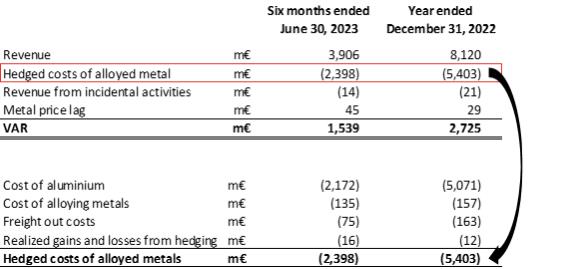
| | To help us better understand the adjustment hedged cost of alloyed metal, please provide us with a schedule quantifying the individual components of this adjustment and tell us in more detail why you believe it is appropriate to include a metal lag adjustment. |
The hedged cost of alloyed metal is comprised of the following elements:
Cost of alloying metals mostly includes cost of alloying elements such as magnesium, manganese, silicon, zinc or copper.
As submitted in our previous correspondence with the Staff and in our response to the Staffs comment above, the metal lag adjustment brings the weighted average cost of aluminium included in cost of sales back to the actual cost of aluminium purchases in the period passed onto customers, thus enabling Constellium to reflect in VAR its underlying economic performance.
3
| | You state that VAR eliminates the impact of metal price fluctuations which are not under your control and generally passed through to your customers. Please clarify what you mean by generally and tell us if there have been instances when you have not been able to pass through aluminum costs to your customers. If so, tell us what that impact has been on VAR. |
We respectfully advise the Staff that Constelliums business model is to pass its aluminium price exposure to its customers, by pricing its products to include the cost of the metal purchased in the period considered and achieve aluminium price neutrality. However, a few of its contracts include fixed aluminium prices and in those limited instances, Constellium aims to achieve aluminium price neutrality through hedging its aluminium price exposure based on forward curves, thereby generally matching its cost of aluminium to the fixed-prices of aluminium and hedged results, with minimal discrepancies.
Although we believe that this measure provides useful information, in light of the Staffs comment, we would be happy to discuss with the Staff developing an alternative metric for future filings.
We appreciate the opportunity to provide you with this additional information and believe it would be helpful to discuss these items with you by telephone. We will reach out to schedule a call at your convenience and look forward to our discussion.
If you have any questions, please do not hesitate to contact Rina E. Teran at the Company at (443) 420-7861, or the undersigned at (443) 529-0380.
| Very truly yours, |
| /s/ Jack Guo |
| Jack Guo Chief Financial Officer |
| cc: | Jeremy Leach (Constellium SE) |
Rina E. Teran (Constellium SE)
4