
LOGO

VIA EDGAR

October 30, 2023

U.S. Securities and Exchange Commission

Division of Corporation Finance

Office of Manufacturing

100 F Street, N.W.

Washington, DC 20549

Attn: Ms. Eiko Yaoita Pyles and Mr. Andrew Blume

Re: Constellium SE

Form 20-F for the fiscal year ended December 31, 2022 Filed March 14, 2023

Form 6-K furnished February 22, 2023

Form 6-K furnished July 26, 2023

File No. 001-35931

Dear Ms. Pyles and Mr. Blume:

Set forth below are responses of Constellium SE, a company incorporated in France (together with its subsidiaries, “Constellium” or the “Company”), to the comments from the Staff of the Division of Corporation Finance (the “Staff”) of the U.S. Securities and Exchange Commission provided in your letter, dated September 29, 2023, with respect to the Company’s annual report on Form 20-F referenced above (the “Form 20-F”) and the Forms 6-K referenced above (the “6-Ks”). For the Staff’s convenience, the text of each of the Staff’s comments is set forth below in bold, followed in each case by the Company’s response.

Form 20-F for the fiscal year ended December 31, 2022 Operating and Financial Review and Prospects

Results of Operations, page 40


1.

When you discuss revenue fluctuations between periods, specifically describe the extent to which changes are attributable to changes in prices, changes in the volume or amount of goods or services being sold, and the introduction of new products or services. Although you quantify on pages 40, 43, and 45-46 the percentage change in tons shipped and revenue per ton for the applicable fiscal years, you do not quantify the impact of volumes or prices in terms of revenue dollars. See Item 303(b)(2) of Regulation S-K and SEC Release No. 33-8350.

We respectfully acknowledge the Staff’s comment and in future filings, we will include the information requested by the Staff above in relation to the discussion of revenue fluctuations between periods.


1

Cost of Sales, page 41


2.

When you discuss changes in cost of sales between fiscal years, please ensure you also discuss changes in gross profit margin.

We respectfully acknowledge the Staff’s comment and in future filings, we will discuss changes in gross profit margin when discussing changes in cost of sales between fiscal years, as requested by the Staff.

Segment Adjusted EBITDA, page 46


3.

We note that your Adjusted EBITDA calculation adjusts for “metal price lag,” which “is primarily calculated as the average value of product recorded in inventory, which approximates the spot price in the market, less the average value transferred out of inventory, which is the weighted average of the metal element of cost of sales, based on the quantity sold in the year.” As it appears this adjustment may have the effect of changing recognition and measurement principles required to be applied under IFRS, please explain in greater the nature of and reasons for this adjustment and why it does not result in the presentation of an individually tailored measure pursuant to Question 100.04 of the Staff’s Compliance and Disclosure Interpretations on Non-GAAP Financial Measures (“Non-GAAP C&DI’s”). Considering providing illustrative examples of adjustment mechanics to assist our understanding.

We respectfully acknowledge the Staff’s comment and submit that our adjustment for “metal price lag” complies with the guidance outlined in Question 100.04 of the Staff’s Compliance and Disclosure Interpretations on Non-GAAP Financial Measures, as more fully described below.

Constellium operates in the global semi-fabricated aluminium industry and its business model is to add value by converting aluminium into semi-fabricated and in some instances fabricated aluminium products, passing the cost of aluminium through to its customers. Metals which Constellium purchases are subject to market price movements (which can sometimes be significant) and Constellium prices its products with the objective of achieving metal price neutrality to its underlying business performance.

Constellium accounts for inventory using the weighted average cost methodology in accordance with IFRS. The value of products transferred out of inventory on sale and recognized in Cost of sales is thus at the weighted average cost of metal purchase prices, representing the average of metal purchase prices over several previous periods, but does not represent necessarily the actual cost of metal passed onto customers for sales during the period. Specifically, due to the impact of the cost of inventory on the calculation of


2


Cost of sales recognized during the period, there is a lag between metal purchase costs intended to be passed through to customers and metal purchase costs accounted in the Cost of sales, thus generally impacting Constellium’s IFRS operating results positively in periods of rising metal prices and negatively in periods of falling metal prices even though Constellium’s underlying operating performance has generally not been impacted by metal price movements. This effect is referred to as metal price lag. Constellium’s IFRS operating results can be significantly impacted by metal price lag despite Constellium’s ability to manage the metal cost pass-through.

The metal price lag adjustment is intended to eliminate this non-cash timing difference. It is based on a standardized methodology calculated at each of Constellium’s manufacturing sites which consists of bringing the weighted average cost of metal included in Cost of sales back to the actual cost of metal purchases of the period considered. It is calculated as the average value of the products transferred out of inventory at the time of sale, less the metal purchase price intended to be passed through to customers. The metal price lag adjustment thus enables Constellium to reflect in Adjusted EBITDA its underlying economic performance.

Adjusting for metal price lag provides Constellium’s management, equity and debt investors, analysts, banks, rating agencies and other stakeholders, with supplemental information and transparency regarding the underlying trend of business performance without the impact of the metal price lag created by the use of the weighted average cost method in the recognition of the Cost of sales. For Constellium’s management, Adjusted EBITDA excluding metal price lag is one of the critical metrics used internally to measure the business performance. Similarly, for investors and other stakeholders Adjusted EBITDA excluding metal price lag provides valuable insight into how the Company manages its business, incentivizes and compensates key employees, and provides transparency on the underlying performance of the business given its metal cost pass-through business model. In addition, Constellium’s presentation of Adjusted EBITDA excluding the metal price lag facilitates the comparison of its operating performance not only from period-to-period, but also versus that of other companies in the industry which are using similarly adjusted performance measures.

We respectfully advise the Staff that Adjusted EBITDA is also our measure of segment profitability in accordance with IFRS 8—Segment Reporting. Accordingly, we are required to present such measure in our financial statements in accordance with IFRS and such measures are discussed in the MD&A in accordance with Rule S-K 303 and as contemplated in Question 104.02 of the Staff’s Compliance and Disclosure Interpretations on Non-GAAP Financial Measures. Considering the importance of this measure for internal purposes, we believe that disclosing the total Adjusted EBITDA as a supplement to our IFRS measures is enhancing investors’ understanding of Constellium’s performance as further explained below.

In Constellium’s view, adjusting for metal price lag does not result in the presentation of an individually tailored measure pursuant to Question 100.04 of the Staff’s Compliance and Disclosure Interpretations on Non-GAAP Financial Measures. By definition, a non-GAAP measure excludes or includes amounts from a GAAP measure. Through our


3


metal price lag adjustment, we have changed the IFRS weighted average cost of inventory sold to include or exclude the items shown in Exhibit 1. We have not changed recognition and measurement principles from an accrual basis to a cost basis or accelerated/decelerated expense recognition to achieve a desired non-GAAP earnings effect or to mislead investors. Rather, this adjustment excludes the impact of this discrete non-cash item on a specific period which helps to illustrate the impact, or lack thereof, of that particular item on the period. Moreover, this non-GAAP measure is presented each period using a consistent calculation methodology regardless of whether the adjustment has a positive or negative impact on the Company’s IFRS results. Finally, adjusting for metal price lag is a common practice used in the semi-fabricated metal industry given the inherent metal price lag impact on companies’ GAAP operating results compared to their underlying operating results, thereby showing more consistent performance comparisons for investors and other stakeholders.

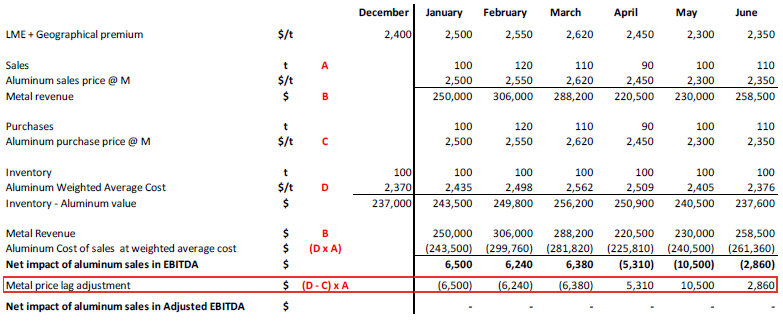
To assist the Staff in their review, the Company has included an example illustrating the mechanics of its metal price lag adjustment as Exhibit 1 to this letter.

Liquidity and capital resources Cash Flows, page 50


4.

Please provide a more informative discussion and analysis of cash flows from operating activities, including changes in working capital components, for the periods presented. In doing so, explain the underlying reasons and implications of material changes between periods to provide investors with an understanding of trends and variability in cash flows. Also ensure that your disclosures are not merely a recitation of changes evident from the financial statements. Refer to Item 303(a) of Regulation S-K and SEC Release No. 33- 8350.

We respectfully acknowledge the Staff’s comment and in future filings, we will include the information requested by the Staff above in relation to the discussion of our cash flows from operations.

Notes to the Consolidated Financial Statements

2.6 Principles governing the preparation of the Consolidated Financial Statements Trade account receivables, page F-13


5.

We note that you recognize trade receivable at fair value through other comprehensive income (“OCI”) since they are managed under an objective that results in both collecting the contractual cash flows and selling the receivables to factors. We further note your disclosures on pages F-13 and F-30 that you factor trade receivables under various factoring agreements and that, depending on the circumstances, the transfers appear to be accounted for as sales or financings.


4


  Please tell us how you determined all trade receivables should be accounted for at fair value through OCI. In doing so, tell us what consideration you gave to the accounting treatment applied, particularly those receivables that do not qualify as sales, and tell us if you originate any trade receivables that are not included in factoring programs or that do not meet eligibility requirements to be included in the program.

In order to determine the applicable IFRS 9 – Financial Instruments (“IFRS 9”) business model for our trade receivables, we considered our business objective in managing trade receivables as well as the manner we have organized our activities in order to meet this objective. Our primary objective in managing our trade receivables portfolio is to ensure that the Company has sufficient liquidity at any point in time. This objective is centrally managed by our Group Treasury Department which has full responsibility for monitoring the overall cash level at Constellium’s level and to factor our trade receivables depending on cash needs as determined at the consolidated group level. As a result, even though some of these receivables are not covered by a factoring program, we have considered our trade receivables as forming part of one global portfolio of financial assets that are held to sell or to collect. We believe that this approach is appropriate as it results in the determination of our business model at a level that reflects how groups of financial assets are managed together to achieve a particular business objective.

In addition, we respectfully advise the Staff that the difference between the nominal value and the fair value of our trade receivables is immaterial due to their short-term nature and the credit quality of our customers.

At December 31, 2022, the amount of derecognized receivables was €368 million, and the outstanding balance of recognized receivables amounted to €465 million, of which €206 million was included in existing factoring programs.

Hedge accounting, page F-15


6.

You disclose that you “did not adopt the disposition of IFRS 9” on hedge accounting and “therefore continue to apply the provisions of IAS 39.” Please specify for us how IFRS 9 impacted your hedge accounting both for hedges existing at the time of adoption as well as those arrangements entered into prospectively after adoption.

We respectfully advise the Staff that, upon adoption of IFRS 9 in fiscal year 2018, we elected to continue applying the hedge accounting requirements of IAS 39 – Financial Instruments: Recognition and Measurement (“IAS 39”) as permitted by IFRS 9 paragraph 9.7.2.21. At the time of adoption, we were applying hedge accounting to (i) forward sales of U.S. Dollars designated as hedges of future forecasted cash flows and


5


(ii) forward sales of Swiss Francs designated as hedges of the net investment in one of our Swiss subsidiaries. In subsequent years, we continued to enter into forward sales of U.S. Dollars designated as hedges of future forecasted cash flows. We believe that adoption of the hedge accounting provisions of IFRS 9 would have had no impact on the accounting for these transactions. However, we did not perform a full analysis of this impact and we respectfully advise the Staff that we are not aware of any requirement to disclose the impact of IFRS 9 when companies make the policy election of applying IAS 39 for hedge accounting.

Share-based payment arrangements, page F-20


7.

We note your disclosure that share-based payment awards are expensed on a straight-line basis over the vesting period based on your estimate of equity instruments that will eventually vest. Considering you appear to issue awards with market conditions pertaining to the Total Shareholder Return performance of your shares, clarify your accounting policy disclosures to confirm, if true, that you recognize compensation expense for such awards irrespective of the outcome of the market condition.

We confirm that compensation expense for our awards with market conditions pertaining to the Total Shareholder Return performance of our shares is recognized irrespective of the outcome of the market condition. In response to the Staff’s comment, we will clarify our accounting policy in future filings as follows:

Current disclosure:

Share-based payment arrangements

Equity-settled share-based payments to employees and Board members are measured at the fair value of the equity instruments at the grant date. The fair value determined at the grant date is expensed on a straight-line basis over the vesting period, based on the Group’s estimate of equity instruments that will eventually vest, with a corresponding increase in equity. At the end of each reporting period, the Group revises its estimate of the number of equity instruments expected to vest.

Revised disclosure:

Share-based payment arrangements

Equity-settled share-based payments to employees and Board members are measured at the fair value of the equity instruments at the grant date. Market performance conditions are reflected within the grant date fair value. Service and non-market performance conditions are not taken into account when determining the grant date fair value of awards, but the likelihood of the conditions being met is assessed as part of the Group’s best estimate of the number of equity instruments that will ultimately vest. The fair value determined at the grant date is expensed on a straight-line basis over the vesting period, based on the Group’s estimate of equity instruments that are expected to eventually vest based on the service and non-market vesting conditions, with a corresponding increase in equity. At the end of each reporting period, the Group revises its estimates of the number of equity instruments that are expected to vest based on the non-market vesting and service conditions. The impact of the revision to original estimates, if any, is recognized in profit or loss, with a corresponding adjustment to equity.


6


2.7 Judgments in applying accounting policies and key sources of estimation uncertainty Income Taxes, page F-20


8.

We note your disclosure that “there are many transactions and calculations for which the ultimate tax determination is uncertain” and that you recognize liabilities “based on estimates of whether additional taxes will be due.” Please tell us and disclose in further detail your accounting policy for uncertain tax treatments. In doing so, clarify how you apply the guidance in paragraphs 9-12 of IFRIC 23.

We respectfully advise the Staff that we operate in multiple jurisdictions and we are subject, in the normal course of business, to review and challenge by local taxation authorities on a number of tax treatments. Where uncertainty exists with respect to a tax treatment we apply the guidance in IFRIC 23 and we assess whether it is probable that the relevant taxation authority will accept the tax treatment we used or are planning to use in our tax filings. In making this assessment, we assume that the tax authority will examine the tax treatment if it has a right to do so and that, in performing this examination, it will have full knowledge of all relevant information. If we conclude that it is probable that the tax authority will accept our tax treatment, we determine our taxable results, tax bases, unused tax losses, unused tax credits or tax rates consistently with the treatment used or planned to be used in our tax filing. If we conclude it is not probable that the taxation authority will accept our tax treatment, we reflect the effect of the uncertainty in determining our taxable results, tax bases, unused tax losses, unused tax credits or tax rates.

In response to the Staff’s comment, we will clarify our accounting policy in future filings as follows:

Current disclosure:

Income Taxes

Significant judgment is sometimes required in determining the accrual for income taxes as there are many transactions and calculations for which the ultimate tax determination is uncertain during the ordinary course of business. The Group recognizes liabilities based on estimates of whether additional taxes will be due. Where the final tax outcome of these matters is different from the amounts that were recorded, such differences will impact the current and deferred income tax provisions, results of operations and possibly cash flows in the year in which such determination is made.


7


Revised disclosure:

Income Taxes

The positions adopted by the Group in tax matters are based on its interpretation of tax laws and regulations. Some of those positions may be subject to uncertainty. In such cases, the Group assesses whether it is probable that the relevant tax authority will accept the tax treatment applied in its income tax filings, assuming that the taxation authority will examine the amounts reported in the Group’s tax filings and will have full knowledge of all relevant information when doing so. If the Group concludes it is not probable that the taxation authority will accept the uncertain tax treatment, the effect of the uncertainty is measured on the basis of the Group’s best estimate and recognized in the determination of taxable results, tax bases, unused tax losses, unused tax credits.

Form 6-K furnished February 22, 2023 Exhibit 99.


9.

Considering Net Operating Profit after Tax (“NOPAT”) is calculated differently from what appears to be the standard calculation, please consider revising the titles of your NOPAT and Return on Investment Capital (“ROIC”) measures to identify them as “adjusted” measures or a similar term.

We respectfully acknowledge the Staff’s comment and will appropriately label our NOPAT and ROIC measures as “Adjusted NOPAT” and “Adjusted ROIC” in all future filings, earnings releases, investor presentations and similar materials.

Form 6-K furnished July 26, 2023 Exhibit 99.1


10.

Please address the following comments related to your presentation of the non-IFRS measure Value-Added Revenue (“VAR”):


We note your disclosure on page 16 that VAR eliminates the impact of metal price fluctuations, which includes the “cost of aluminium adjusted for metal lag, cost of other alloying metals, freight out costs, and realized gains and losses from hedging.” As this measure appears to commingle revenue and costs, tell us why it does not represent an adjusted contribution margin measure rather than an adjusted revenue measure. Accordingly, tell us your basis for identifying revenue, rather than gross profit, as the most directly comparable IFRS measure to VAR.

We respectfully acknowledge the Staff’s comment and will appropriately reconcile our VAR measure to Gross Profit in future filings.


8


Explain to us in sufficient detail and revise future filings to specify the nature and calculation of the adjustment for “hedged cost of alloyed metal.”

Hedge costs of alloyed metal is comprised of the following elements: cost of aluminium (adjusted for metal lag), cost of alloying metals, freight out costs, and realized gains and losses from hedging. In response to the Staff’s comment, in future filings, we will provide this information in a footnote to the reconciliation of VAR to Gross Profit that we will provide in future filings, as discussed above.


Tell us how you determined your VAR calculation does not result in the presentation of an individually tailored measure pursuant to Question 100.04 of the Non-GAAP C&DI’s.

We respectfully advise the Staff that our VAR measure is not intended to change the recognition and measurement principles applied in accordance with IFRS or to substitute an individually tailored non-GAAP measure for the appropriate IFRS measure. We believe VAR is a useful measure of our activity as it eliminates the impact of metal costs from our revenue and reflects the value-added elements of our activity. VAR eliminates the impact of metal price fluctuations which are not under our control and which we generally pass through to our customers and facilitates comparisons from period to period. As management of the Company uses VAR for internal purposes, we believe that disclosing it as a supplement to our IFRS measures enhances investors’ understanding of our performance.

****

We appreciate the opportunity to provide you with this additional information. If you have any questions, please do not hesitate to contact Rina E. Teran at the Company at (443) 420-7861, or the undersigned at (443) 529-0380.


Very truly yours,

/s/ Jack Guo

Jack Guo
Chief Financial Officer

cc: Jeremy Leach (Constellium SE)

  Rina E. Teran (Constellium SE)


9


Exhibit 1

Illustrative example of metal lag adjustment mechanics

The simplified example below illustrates the metal price lag adjustment and demonstrates how it may be useful to investors and other stakeholders in understanding Constellium’s performance. It is based on the following assumptions:


Aluminum sales prices are billed to customers at the floating index average of the month of delivery (Aluminum sales prices at M);


Aluminum purchase prices are billed by suppliers at the floating index average of the month of delivery (Aluminum purchase prices at M);


Inventory is valued at weighted average cost.


LOGO


D

The weighted average cost is calculated as (beginning inventory value + purchases) / (quantities in beginning inventory + quantities purchased)

This example illustrates how EBITDA, adjusted for metal price lag, is reflective of the underlying economic performance of the Company as the economic cash margin generated is unaffected by metal price variations.


10