lulu-20240128false2023FY0001397187http://fasb.org/us-gaap/2023#AccountsPayableCurrenthttp://fasb.org/us-gaap/2023#AccountsPayableCurrent33.33http://fasb.org/us-gaap/2023#PrepaidExpenseAndOtherAssetsCurrenthttp://fasb.org/us-gaap/2023#OtherLiabilitiesCurrenthttp://fasb.org/us-gaap/2023#PrepaidExpenseAndOtherAssetsCurrenthttp://fasb.org/us-gaap/2023#OtherLiabilitiesCurrentP2Y00013971872023-01-302024-01-2800013971872023-07-28iso4217:USD00013971872024-03-15xbrli:shares00013971872024-01-2800013971872023-01-29iso4217:USDxbrli:shares00013971872022-01-312023-01-2900013971872021-02-012022-01-300001397187lulu:ExchangeableStockMember2021-01-310001397187lulu:SpecialVotingStockMember2021-01-310001397187us-gaap:CommonStockMember2021-01-310001397187us-gaap:AdditionalPaidInCapitalMember2021-01-310001397187us-gaap:RetainedEarningsMember2021-01-310001397187us-gaap:AccumulatedOtherComprehensiveIncomeMember2021-01-3100013971872021-01-310001397187us-gaap:RetainedEarningsMember2021-02-012022-01-300001397187us-gaap:AccumulatedOtherComprehensiveIncomeMember2021-02-012022-01-300001397187us-gaap:AdditionalPaidInCapitalMember2021-02-012022-01-300001397187us-gaap:CommonStockMember2021-02-012022-01-300001397187lulu:ExchangeableStockMember2022-01-300001397187lulu:SpecialVotingStockMember2022-01-300001397187us-gaap:CommonStockMember2022-01-300001397187us-gaap:AdditionalPaidInCapitalMember2022-01-300001397187us-gaap:RetainedEarningsMember2022-01-300001397187us-gaap:AccumulatedOtherComprehensiveIncomeMember2022-01-3000013971872022-01-300001397187us-gaap:RetainedEarningsMember2022-01-312023-01-290001397187us-gaap:AccumulatedOtherComprehensiveIncomeMember2022-01-312023-01-290001397187lulu:ExchangeableStockMember2022-01-312023-01-290001397187lulu:SpecialVotingStockMember2022-01-312023-01-290001397187us-gaap:CommonStockMember2022-01-312023-01-290001397187us-gaap:AdditionalPaidInCapitalMember2022-01-312023-01-290001397187lulu:ExchangeableStockMember2023-01-290001397187lulu:SpecialVotingStockMember2023-01-290001397187us-gaap:CommonStockMember2023-01-290001397187us-gaap:AdditionalPaidInCapitalMember2023-01-290001397187us-gaap:RetainedEarningsMember2023-01-290001397187us-gaap:AccumulatedOtherComprehensiveIncomeMember2023-01-290001397187us-gaap:RetainedEarningsMember2023-01-302024-01-280001397187us-gaap:AccumulatedOtherComprehensiveIncomeMember2023-01-302024-01-280001397187us-gaap:AdditionalPaidInCapitalMember2023-01-302024-01-280001397187us-gaap:CommonStockMember2023-01-302024-01-280001397187lulu:ExchangeableStockMember2024-01-280001397187lulu:SpecialVotingStockMember2024-01-280001397187us-gaap:CommonStockMember2024-01-280001397187us-gaap:AdditionalPaidInCapitalMember2024-01-280001397187us-gaap:RetainedEarningsMember2024-01-280001397187us-gaap:AccumulatedOtherComprehensiveIncomeMember2024-01-28lulu:marketlulu:store0001397187us-gaap:BuildingMember2024-01-280001397187us-gaap:LeaseholdsAndLeaseholdImprovementsMember2024-01-280001397187lulu:CorporateOfficesandDistributionCentresMember2024-01-280001397187us-gaap:FurnitureAndFixturesMember2023-01-302024-01-28xbrli:pure0001397187us-gaap:ComputerEquipmentMembersrt:MinimumMember2023-01-302024-01-280001397187us-gaap:ComputerEquipmentMembersrt:MaximumMember2023-01-302024-01-280001397187srt:MinimumMemberus-gaap:EquipmentMember2023-01-302024-01-280001397187srt:MaximumMemberus-gaap:EquipmentMember2023-01-302024-01-280001397187us-gaap:ShippingAndHandlingMember2023-01-302024-01-280001397187us-gaap:ShippingAndHandlingMember2022-01-312023-01-290001397187us-gaap:ShippingAndHandlingMember2021-02-012022-01-300001397187lulu:LululemonStudioMirrorProvisionMember2024-01-280001397187lulu:LululemonStudioMirrorProvisionMember2023-01-290001397187lulu:ObsolescenceAndQualityProvisionMember2024-01-280001397187lulu:ObsolescenceAndQualityProvisionMember2023-01-290001397187lulu:DamagesProvisionMember2024-01-280001397187lulu:DamagesProvisionMember2023-01-290001397187lulu:ShrinkProvisionMember2024-01-280001397187lulu:ShrinkProvisionMember2023-01-290001397187us-gaap:LandMember2024-01-280001397187us-gaap:LandMember2023-01-290001397187us-gaap:BuildingMember2023-01-290001397187us-gaap:LeaseholdImprovementsMember2024-01-280001397187us-gaap:LeaseholdImprovementsMember2023-01-290001397187us-gaap:FurnitureAndFixturesMember2024-01-280001397187us-gaap:FurnitureAndFixturesMember2023-01-290001397187us-gaap:ComputerEquipmentMember2024-01-280001397187us-gaap:ComputerEquipmentMember2023-01-290001397187us-gaap:SoftwareAndSoftwareDevelopmentCostsMember2024-01-280001397187us-gaap:SoftwareAndSoftwareDevelopmentCostsMember2023-01-290001397187us-gaap:EquipmentMember2024-01-280001397187us-gaap:EquipmentMember2023-01-290001397187us-gaap:ConstructionInProgressMember2024-01-280001397187us-gaap:ConstructionInProgressMember2023-01-290001397187lulu:AdministrativeOfficeBuildingMemberus-gaap:DisposalGroupDisposedOfBySaleNotDiscontinuedOperationsMember2023-05-012023-07-300001397187lulu:LululemonStudioMember2022-01-312023-01-290001397187lulu:MIRRORBrandMember2024-01-280001397187us-gaap:CustomerRelationshipsMember2024-01-280001397187us-gaap:TechnologyBasedIntangibleAssetsMember2024-01-280001397187us-gaap:MediaContentMember2024-01-280001397187us-gaap:OtherIntangibleAssetsMember2024-01-280001397187lulu:MIRRORBrandMember2023-01-290001397187lulu:MIRRORBrandMember2022-01-312023-01-290001397187us-gaap:CustomerRelationshipsMember2023-01-290001397187us-gaap:CustomerRelationshipsMember2022-01-312023-01-290001397187us-gaap:TechnologyBasedIntangibleAssetsMember2023-01-290001397187us-gaap:TechnologyBasedIntangibleAssetsMember2022-01-312023-01-290001397187us-gaap:MediaContentMember2023-01-290001397187us-gaap:MediaContentMember2022-01-312023-01-290001397187us-gaap:OtherIntangibleAssetsMember2023-01-290001397187us-gaap:OtherIntangibleAssetsMember2022-01-312023-01-290001397187lulu:LululemonStudioMember2023-01-302024-01-280001397187lulu:LululemonStudioMember2021-02-012022-01-300001397187lulu:LululemonStudioMember2023-07-312023-10-290001397187us-gaap:RevolvingCreditFacilityMember2021-12-140001397187us-gaap:RevolvingCreditFacilityMemberus-gaap:LineOfCreditMember2021-12-142021-12-140001397187lulu:SecuredOvernightFinancingRateSOFRMembersrt:MinimumMemberus-gaap:RevolvingCreditFacilityMemberus-gaap:LineOfCreditMember2023-01-302024-01-280001397187lulu:SecuredOvernightFinancingRateSOFRMemberus-gaap:RevolvingCreditFacilityMemberus-gaap:LineOfCreditMembersrt:MaximumMember2023-01-302024-01-280001397187us-gaap:BaseRateMembersrt:MinimumMemberus-gaap:RevolvingCreditFacilityMemberus-gaap:LineOfCreditMember2023-01-302024-01-280001397187us-gaap:BaseRateMemberus-gaap:RevolvingCreditFacilityMemberus-gaap:LineOfCreditMembersrt:MaximumMember2023-01-302024-01-280001397187srt:MinimumMemberus-gaap:RevolvingCreditFacilityMemberus-gaap:LineOfCreditMember2023-01-302024-01-280001397187us-gaap:RevolvingCreditFacilityMemberus-gaap:LineOfCreditMembersrt:MaximumMember2023-01-302024-01-280001397187us-gaap:RevolvingCreditFacilityMemberus-gaap:LineOfCreditMember2023-01-302024-01-280001397187us-gaap:RevolvingCreditFacilityMember2019-12-31iso4217:CNY0001397187us-gaap:RevolvingCreditFacilityMember2021-01-310001397187us-gaap:RevolvingCreditFacilityMember2024-01-280001397187lulu:RevolvingLoanMember2019-12-310001397187lulu:FinancialBankGuaranteeFacilityMember2019-12-310001397187us-gaap:RevolvingCreditFacilityMember2019-12-012019-12-310001397187us-gaap:RevolvingCreditFacilityMemberus-gaap:PrimeRateMember2019-12-012019-12-310001397187us-gaap:LetterOfCreditMember2024-01-28lulu:vote0001397187us-gaap:EmployeeStockOptionMember2023-01-302024-01-280001397187lulu:PerformanceBasedRestrictedStockUnitsMember2023-01-302024-01-280001397187us-gaap:RestrictedStockMember2023-01-302024-01-280001397187us-gaap:RestrictedStockUnitsRSUMember2023-01-302024-01-280001397187us-gaap:EmployeeStockOptionMember2021-01-310001397187lulu:PerformanceBasedRestrictedStockUnitsMember2021-01-310001397187us-gaap:RestrictedStockMember2021-01-310001397187us-gaap:RestrictedStockUnitsRSUMember2021-01-310001397187lulu:RestrictedStockUnitsLiabilityAccountingMember2021-01-310001397187us-gaap:EmployeeStockOptionMember2021-02-012022-01-300001397187lulu:PerformanceBasedRestrictedStockUnitsMember2021-02-012022-01-300001397187us-gaap:RestrictedStockMember2021-02-012022-01-300001397187us-gaap:RestrictedStockUnitsRSUMember2021-02-012022-01-300001397187lulu:RestrictedStockUnitsLiabilityAccountingMember2021-02-012022-01-300001397187us-gaap:EmployeeStockOptionMember2022-01-300001397187lulu:PerformanceBasedRestrictedStockUnitsMember2022-01-300001397187us-gaap:RestrictedStockMember2022-01-300001397187us-gaap:RestrictedStockUnitsRSUMember2022-01-300001397187lulu:RestrictedStockUnitsLiabilityAccountingMember2022-01-300001397187us-gaap:EmployeeStockOptionMember2022-01-312023-01-290001397187lulu:PerformanceBasedRestrictedStockUnitsMember2022-01-312023-01-290001397187us-gaap:RestrictedStockMember2022-01-312023-01-290001397187us-gaap:RestrictedStockUnitsRSUMember2022-01-312023-01-290001397187lulu:RestrictedStockUnitsLiabilityAccountingMember2022-01-312023-01-290001397187us-gaap:EmployeeStockOptionMember2023-01-290001397187lulu:PerformanceBasedRestrictedStockUnitsMember2023-01-290001397187us-gaap:RestrictedStockMember2023-01-290001397187us-gaap:RestrictedStockUnitsRSUMember2023-01-290001397187lulu:RestrictedStockUnitsLiabilityAccountingMember2023-01-290001397187lulu:RestrictedStockUnitsLiabilityAccountingMember2023-01-302024-01-280001397187us-gaap:EmployeeStockOptionMember2024-01-280001397187lulu:PerformanceBasedRestrictedStockUnitsMember2024-01-280001397187us-gaap:RestrictedStockMember2024-01-280001397187us-gaap:RestrictedStockUnitsRSUMember2024-01-280001397187lulu:RestrictedStockUnitsLiabilityAccountingMember2024-01-280001397187us-gaap:CommonStockMemberlulu:A2023EquityIncentivePlanMember2024-01-280001397187lulu:ExercisePriceRangeOneMember2023-01-302024-01-280001397187lulu:ExercisePriceRangeOneMember2024-01-280001397187lulu:ExercisePriceRangeTwoMember2023-01-302024-01-280001397187lulu:ExercisePriceRangeTwoMember2024-01-280001397187lulu:ExercisePriceRangeThreeMember2023-01-302024-01-280001397187lulu:ExercisePriceRangeThreeMember2024-01-280001397187lulu:ExercisePriceRangeFourMember2023-01-302024-01-280001397187lulu:ExercisePriceRangeFourMember2024-01-280001397187lulu:ExercisePriceRangeFiveMember2023-01-302024-01-280001397187lulu:ExercisePriceRangeFiveMember2024-01-280001397187us-gaap:EmployeeStockMember2024-01-280001397187us-gaap:EmployeeStockMember2021-02-012022-01-300001397187us-gaap:EmployeeStockMember2022-01-312023-01-290001397187us-gaap:EmployeeStockMember2023-01-302024-01-280001397187srt:MinimumMember2023-01-302024-01-280001397187srt:MaximumMember2023-01-302024-01-280001397187us-gaap:MoneyMarketFundsMemberus-gaap:CashAndCashEquivalentsMember2024-01-280001397187us-gaap:MoneyMarketFundsMemberus-gaap:FairValueInputsLevel1Memberus-gaap:CashAndCashEquivalentsMember2024-01-280001397187us-gaap:MoneyMarketFundsMemberus-gaap:FairValueInputsLevel2Memberus-gaap:CashAndCashEquivalentsMember2024-01-280001397187us-gaap:MoneyMarketFundsMemberus-gaap:FairValueInputsLevel3Memberus-gaap:CashAndCashEquivalentsMember2024-01-280001397187us-gaap:BankTimeDepositsMemberus-gaap:CashAndCashEquivalentsMember2024-01-280001397187us-gaap:BankTimeDepositsMemberus-gaap:FairValueInputsLevel1Memberus-gaap:CashAndCashEquivalentsMember2024-01-280001397187us-gaap:BankTimeDepositsMemberus-gaap:FairValueInputsLevel2Memberus-gaap:CashAndCashEquivalentsMember2024-01-280001397187us-gaap:FairValueInputsLevel3Memberus-gaap:BankTimeDepositsMemberus-gaap:CashAndCashEquivalentsMember2024-01-280001397187us-gaap:FairValueInputsLevel1Member2024-01-280001397187us-gaap:FairValueInputsLevel2Member2024-01-280001397187us-gaap:FairValueInputsLevel3Member2024-01-280001397187us-gaap:MoneyMarketFundsMemberus-gaap:CashAndCashEquivalentsMember2023-01-290001397187us-gaap:MoneyMarketFundsMemberus-gaap:FairValueInputsLevel1Memberus-gaap:CashAndCashEquivalentsMember2023-01-290001397187us-gaap:MoneyMarketFundsMemberus-gaap:FairValueInputsLevel2Memberus-gaap:CashAndCashEquivalentsMember2023-01-290001397187us-gaap:MoneyMarketFundsMemberus-gaap:FairValueInputsLevel3Memberus-gaap:CashAndCashEquivalentsMember2023-01-290001397187us-gaap:BankTimeDepositsMemberus-gaap:CashAndCashEquivalentsMember2023-01-290001397187us-gaap:BankTimeDepositsMemberus-gaap:FairValueInputsLevel1Memberus-gaap:CashAndCashEquivalentsMember2023-01-290001397187us-gaap:BankTimeDepositsMemberus-gaap:FairValueInputsLevel2Memberus-gaap:CashAndCashEquivalentsMember2023-01-290001397187us-gaap:FairValueInputsLevel3Memberus-gaap:BankTimeDepositsMemberus-gaap:CashAndCashEquivalentsMember2023-01-290001397187us-gaap:FairValueInputsLevel1Member2023-01-290001397187us-gaap:FairValueInputsLevel2Member2023-01-290001397187us-gaap:FairValueInputsLevel3Member2023-01-290001397187us-gaap:ForeignExchangeForwardMemberus-gaap:DesignatedAsHedgingInstrumentMember2024-01-280001397187us-gaap:ForeignExchangeForwardMemberus-gaap:DesignatedAsHedgingInstrumentMember2023-01-290001397187us-gaap:ForeignExchangeForwardMemberus-gaap:NondesignatedMember2024-01-280001397187us-gaap:ForeignExchangeForwardMemberus-gaap:NondesignatedMember2023-01-290001397187us-gaap:ForeignExchangeForwardMember2024-01-280001397187us-gaap:ForeignExchangeForwardMember2023-01-290001397187us-gaap:ForeignExchangeForwardMemberus-gaap:DesignatedAsHedgingInstrumentMember2023-01-302024-01-280001397187us-gaap:ForeignExchangeForwardMemberus-gaap:DesignatedAsHedgingInstrumentMember2022-01-312023-01-290001397187us-gaap:ForeignExchangeForwardMemberus-gaap:DesignatedAsHedgingInstrumentMember2021-02-012022-01-300001397187us-gaap:ForeignExchangeForwardMemberus-gaap:NondesignatedMember2023-01-302024-01-280001397187us-gaap:ForeignExchangeForwardMemberus-gaap:NondesignatedMember2022-01-312023-01-290001397187us-gaap:ForeignExchangeForwardMemberus-gaap:NondesignatedMember2021-02-012022-01-300001397187us-gaap:ForeignExchangeForwardMember2023-01-302024-01-280001397187us-gaap:ForeignExchangeForwardMember2022-01-312023-01-290001397187us-gaap:ForeignExchangeForwardMember2021-02-012022-01-300001397187srt:MinimumMember2024-01-280001397187srt:MaximumMember2024-01-280001397187lulu:CanadianSubsidiaryMember2024-01-280001397187lulu:ForeignSubsidiariesexcludingCanadianSubsidiaryMember2024-01-280001397187us-gaap:NonUsMember2024-01-280001397187us-gaap:ForeignCountryMember2024-01-2800013971872019-01-3100013971872020-11-3000013971872020-12-0100013971872021-09-3000013971872021-10-0100013971872023-11-2900013971872022-03-230001397187us-gaap:SubsequentEventMember2024-01-292024-03-15lulu:location0001397187country:MX2024-01-280001397187country:AE2024-01-280001397187country:SA2024-01-280001397187country:QA2024-01-280001397187country:KW2024-01-280001397187country:IL2024-01-280001397187country:BH2024-01-28lulu:segment0001397187us-gaap:OperatingSegmentsMemberlulu:AmericasSegmentMember2023-01-302024-01-280001397187us-gaap:OperatingSegmentsMemberlulu:AmericasSegmentMember2022-01-312023-01-290001397187us-gaap:OperatingSegmentsMemberlulu:AmericasSegmentMember2021-02-012022-01-300001397187us-gaap:OperatingSegmentsMemberlulu:ChinaMainlandsSegmentMember2023-01-302024-01-280001397187us-gaap:OperatingSegmentsMemberlulu:ChinaMainlandsSegmentMember2022-01-312023-01-290001397187us-gaap:OperatingSegmentsMemberlulu:ChinaMainlandsSegmentMember2021-02-012022-01-300001397187us-gaap:OperatingSegmentsMemberlulu:OtherCountrySegmentMember2023-01-302024-01-280001397187us-gaap:OperatingSegmentsMemberlulu:OtherCountrySegmentMember2022-01-312023-01-290001397187us-gaap:OperatingSegmentsMemberlulu:OtherCountrySegmentMember2021-02-012022-01-300001397187us-gaap:CorporateNonSegmentMember2023-01-302024-01-280001397187us-gaap:CorporateNonSegmentMember2022-01-312023-01-290001397187us-gaap:CorporateNonSegmentMember2021-02-012022-01-300001397187country:US2024-01-280001397187country:US2023-01-290001397187country:CA2024-01-280001397187country:CA2023-01-290001397187country:CN2024-01-280001397187country:CN2023-01-290001397187lulu:RestOfWorldMember2024-01-280001397187lulu:RestOfWorldMember2023-01-290001397187country:US2023-01-302024-01-280001397187country:US2022-01-312023-01-290001397187country:US2021-02-012022-01-300001397187country:CA2023-01-302024-01-280001397187country:CA2022-01-312023-01-290001397187country:CA2021-02-012022-01-300001397187lulu:ChinaMainlandMember2023-01-302024-01-280001397187lulu:ChinaMainlandMember2022-01-312023-01-290001397187lulu:ChinaMainlandMember2021-02-012022-01-300001397187lulu:HongKongSARTaiwanAndMacauSARMember2023-01-302024-01-280001397187lulu:HongKongSARTaiwanAndMacauSARMember2022-01-312023-01-290001397187lulu:HongKongSARTaiwanAndMacauSARMember2021-02-012022-01-300001397187country:CN2023-01-302024-01-280001397187country:CN2022-01-312023-01-290001397187country:CN2021-02-012022-01-300001397187lulu:RestOfWorldMember2023-01-302024-01-280001397187lulu:RestOfWorldMember2022-01-312023-01-290001397187lulu:RestOfWorldMember2021-02-012022-01-300001397187lulu:WomensProductMember2023-01-302024-01-280001397187lulu:WomensProductMember2022-01-312023-01-290001397187lulu:WomensProductMember2021-02-012022-01-300001397187lulu:MensProductMember2023-01-302024-01-280001397187lulu:MensProductMember2022-01-312023-01-290001397187lulu:MensProductMember2021-02-012022-01-300001397187lulu:OtherCategoriesMember2023-01-302024-01-280001397187lulu:OtherCategoriesMember2022-01-312023-01-290001397187lulu:OtherCategoriesMember2021-02-012022-01-300001397187lulu:CompanyOperatedStoresMember2023-01-302024-01-280001397187lulu:CompanyOperatedStoresMember2022-01-312023-01-290001397187lulu:CompanyOperatedStoresMember2021-02-012022-01-300001397187lulu:ECommerceMember2023-01-302024-01-280001397187lulu:ECommerceMember2022-01-312023-01-290001397187lulu:ECommerceMember2021-02-012022-01-300001397187lulu:OtherChannelsMember2023-01-302024-01-280001397187lulu:OtherChannelsMember2022-01-312023-01-290001397187lulu:OtherChannelsMember2021-02-012022-01-3000013971872023-10-302024-01-28
UNITED STATES SECURITIES AND EXCHANGE COMMISSION
Washington, D.C. 20549
_______________________________________
Form 10-K
_______________________________________
| | | | | |
| ☑ | ANNUAL REPORT PURSUANT TO SECTION 13 OR 15(d) OF THE SECURITIES EXCHANGE ACT OF 1934 |
For the fiscal year ended January 28, 2024
OR
| | | | | |
| ☐ | TRANSITION REPORT PURSUANT TO SECTION 13 OR 15(d) OF THE SECURITIES EXCHANGE ACT OF 1934 |
For the transition period from to
Commission file number 001-33608
_______________________________________
lululemon athletica inc.
(Exact name of registrant as specified in its charter)
_______________________________________
| | | | | | | | |
| Delaware | | 20-3842867 |
(State or other jurisdiction of
incorporation or organization) | | (I.R.S. Employer
Identification Number) |
1818 Cornwall Avenue, Vancouver, British Columbia V6J 1C7
(Address of principal executive offices)
Registrant's telephone number, including area code: (604) 732-6124
Securities registered pursuant to Section 12(b) of the Act:
| | | | | | | | | | | | | | |
| Title of each class | | Trading symbol(s) | | Name of each exchange on which registered |
| Common Stock, par value $0.005 per share | | LULU | | Nasdaq Global Select Market |
_______________________________________Indicate by check mark if the registrant is a well-known seasoned issuer, as defined in Rule 405 of the Securities Act. Yes ☑ No ☐
Indicate by check mark if the registrant is not required to file reports pursuant to Section 13 or Section 15(d) of the Act. Yes ☐ No ☑
Indicate by check mark whether the registrant (1) has filed all reports required to be filed by Section 13 or 15(d) of the Securities Exchange Act of 1934 during the preceding 12 months (or for such shorter period that the registrant was required to file such reports), and (2) has been subject to such filing requirements for the past 90 days. Yes ☑ No ☐
Indicate by check mark whether the registrant has submitted electronically every Interactive Data File required to be submitted pursuant to Rule 405 of Regulation S-T during the preceding 12 months (or for such shorter period that the registrant was required to submit such files). Yes ☑ No ☐
Indicate by check mark whether the registrant is a large accelerated filer, an accelerated filer, a non-accelerated filer, a smaller reporting company, or an emerging growth company. See the definitions of "large accelerated filer," "accelerated filer," "smaller reporting company," and "emerging growth company" in Rule 12b-2 of the Exchange Act.
| | | | | | | | | | | | | | | | | | | | |
| Large Accelerated Filer | | ☑ | | Accelerated filer | | ☐ |
| Non-accelerated filer | | ☐ | | Smaller reporting company | | ☐ |
| Emerging growth company | | ☐ | | | | |
If an emerging growth company, indicate by check mark if the registrant has elected not to use the extended transition period for complying with any new or revised financial accounting standards provided pursuant to Section 13(a) of the Exchange Act. ☐
Indicate by check mark whether the registrant has filed a report on and attestation to its management's assessment of the effectiveness of its internal control over financial reporting under Section 404(b) of the Sarbanes-Oxley Act (15 U.S.C.7262(b)) by the registered public accounting firm that prepared or issued its audit report. ☑
If securities are registered pursuant to Section 12(b) of the Act, indicate by check mark whether the financial statements of the registrant included in the filing reflect the correction of an error to previously issued financial statements. ☐
Indicate by check mark whether any of those error corrections are restatements that required a recovery analysis of incentive-based compensation received by any of the registrant’s executive officers during the relevant recovery period pursuant to §240.10D-1(b). ☐
Indicate by check mark whether the registrant is a shell company (as defined in rule 12b-2 of the Act). Yes ☐ No ☑
The aggregate market value of the voting stock held by non-affiliates of the registrant on July 28, 2023 was approximately $40,905,000,000. Such aggregate market value was computed by reference to the closing price of the common stock as reported on the Nasdaq Global Select Market on July 28, 2023. For purposes of determining this amount only, the registrant has defined affiliates as including the executive officers, directors, and owners of 10% or more of the outstanding voting stock of the registrant on July 28, 2023.
Common Stock: At March 15, 2024 there were 120,892,132 shares of the registrant's common stock, par value $0.005 per share, outstanding.
Exchangeable and Special Voting Shares: At March 15, 2024, there were outstanding 5,115,961 exchangeable shares of Lulu Canadian Holding, Inc., a wholly-owned subsidiary of the registrant. Exchangeable shares are exchangeable for an equal number of shares of the registrant's common stock.
In addition, at March 15, 2024, the registrant had outstanding 5,115,961 shares of special voting stock, through which the holders of exchangeable shares of Lulu Canadian Holding, Inc. may exercise their voting rights with respect to the registrant. The special voting stock and the registrant's common stock generally vote together as a single class on all matters on which the common stock is entitled to vote.
_______________________________________
DOCUMENTS INCORPORATED BY REFERENCE
Portions of the Proxy Statement for the 2024 Annual Meeting of Stockholders have been incorporated by reference into Part III of this Annual Report on Form 10-K.
TABLE OF CONTENTS
| | | | | | | | |
| Page |
| | |
Item 1. | | |
Item 1A. | | |
Item 1C. | | |
Item 2. | | |
Item 3. | | |
Item 4. | | |
| | |
| | |
Item 5. | | |
Item 6. | | |
Item 7. | | |
Item 7A. | | |
Item 8. | | |
| | |
Item 9A. | | |
Item 9B. | | |
Item 9C. | | |
| | |
| | |
Item 10. | | |
Item 11. | | |
Item 12. | | |
Item 13. | | |
Item 14. | | |
| | |
| | |
Item 15. | | |
Item 16. | | |
| |
PART I
Special Note Regarding Forward-Looking Statements
This report and some documents incorporated herein by reference include estimates, projections, statements relating to our business plans, objectives, and expected operating results that are "forward-looking statements" within the meaning of the Private Securities Litigation Reform Act of 1995, Section 27A of the Securities Act of 1933 and Section 21E of the Securities Exchange Act of 1934. We use words such as "anticipates," "believes," "estimates," "may," "intends," "expects," and similar expressions to identify forward-looking statements. Discussions containing forward-looking statements may be found in the material set forth under "Business", "Management's Discussion and Analysis of Financial Condition and Results of Operations", and in other sections of the report. All forward-looking statements are inherently uncertain as they are based on our expectations and assumptions concerning future events. Any or all of our forward-looking statements in this report may turn out to be inaccurate. We have based these forward-looking statements largely on our current expectations and projections about future events and financial trends that we believe may affect our financial condition, results of operations, business strategy, and financial needs. They may be affected by inaccurate assumptions we might make or by known or unknown risks and uncertainties, including the risks, uncertainties and assumptions described in the section entitled "Item 1A. Risk Factors" and elsewhere in this report. In light of these risks, uncertainties and assumptions, the forward-looking events and circumstances discussed in this report may not occur as contemplated, and our actual results could differ materially from those anticipated or implied by the forward-looking statements. All forward-looking statements in this report are made as of the date hereof, based on information available to us as of the date hereof, and we assume no obligation to update any forward-looking statement.
This annual report includes website addresses and references to additional materials found on those websites. These websites and information contained on or accessible through these websites are not incorporated by reference into, and do not form a part of, this Annual Report or any other report or document we file with the SEC, and any references to any websites are intended to be inactive textual references only.
ITEM 1. BUSINESS
General
lululemon athletica inc. is principally a designer, distributor, and retailer of technical athletic apparel, footwear, and accessories. We have a vision to create transformative products and experiences that build meaningful connections, unlocking greater possibility and wellbeing for all. Since our inception, we have fostered a distinctive corporate culture; we promote a set of core values in our business which include taking personal responsibility, acting with courage, valuing connection and inclusion, and choosing to have fun. These core values attract passionate and motivated employees who are driven to achieve personal and professional goals, and share our purpose "to elevate human potential by helping people feel their best."
In this Annual Report on Form 10-K for the fiscal year ended January 28, 2024, lululemon athletica inc. (together with its subsidiaries) is referred to as "lululemon," "the Company," "we," "us," or "our." We refer to the fiscal year ended January 28, 2024 as "2023," the fiscal year ended January 29, 2023 as "2022," and the fiscal year ended January 30, 2022 as "2021." Our next fiscal year ends on February 2, 2025 and is referred to as "2024."
Components of this discussion of our business include:
Our Products
We offer a comprehensive line of performance apparel, footwear, and accessories marketed under the lululemon brand. Our apparel assortment includes items such as pants, shorts, tops, and jackets designed for a healthy lifestyle including
athletic activities such as yoga, running, training, and most other activities. We also offer apparel designed for being on the move and fitness-inspired accessories. We expect to continue to broaden our merchandise offerings through expansion across these product areas.
Our design and development team continues to source technically advanced fabrics, with new feel and fit, and craft innovative functional features for our products. Through our vertical retail strategy and direct connection with our customers, whom we refer to as guests, we are able to collect feedback and incorporate unique performance and fashion needs into our design process. In this way, we believe we are better positioned to address the needs of our guests, helping us advance our product lines and differentiate us from our competitors.
During 2023, our women's range represented 64% of net revenue and our men's range represented 23% of net revenue. Our comprehensive men's line is a key pillar of our strategic growth plans. We believe net revenue from our men's range is growing as more guests discover the technical rigor and premium quality of our men's products, and are attracted by our distinctive brand.
We continue to innovate and introduce new products for our guests. This includes introducing new product categories and expanding our accessories assortment. We believe this is another way in which we can attract new guests and enable them to experience our products. Net revenue from our other product categories represented 13% of net revenue in 2023.
Our Markets and Segments
We operate in over 25 countries around the world and organize our operations into four regional markets: Americas, China Mainland, Asia Pacific ("APAC"), and Europe and the Middle East ("EMEA").
We report three segments, Americas, China Mainland, and Rest of World, which is comprised of the APAC and EMEA regions on a combined basis.
During the fourth quarter of 2023, we revised the financial information which our Chief Executive Officer, who is our chief operating decision maker ("CODM"), uses to evaluate performance and allocate resources. This resulted in a change in our identified operating segments. As we have further executed on our omni-channel retail strategy, and continued to expand our operations in international markets, our performance reviews and resource allocation decisions have evolved to be made on a regional market basis. Our segment results have been recast to reflect our regional market-based structure. Historically, our segments were based on selling channel. We continue to monitor our revenue performance by our selling channels which are further described below.
We operate an omni-channel retail model and aim to efficiently and effectively serve our guests in the ways most convenient to them. We continue to evolve and integrate our digital and physical channels in order to enrich our interactions with our guests, and to provide a seamless omni-channel experience. We have invested in technologies which enable our omni-channel retailing model. Our capabilities differ by market and include:
•Buy online pick-up in store - guests can purchase our products via our website or digital app and then collect that product from a retail location;
•Back-back room - our store educators can access inventory located at our other locations and have product shipped directly to a guest's address or a store;
•Ship from store – we are able to fulfill e-commerce orders by accessing inventory at both our distribution centers and at our retail locations, expanding the pool of accessible inventory;
•Returns processing – e-commerce guests are able to return products either online or in-store; and
•One inventory pool – we are able to view and allocate the product held at our distribution centers to either our physical retail locations, or make it available to fulfill online demand.
We operate a combination of physical retail locations and e-commerce services via our websites, other region-specific websites, digital marketplaces, and mobile apps. Our physical retail locations remain a key part of our growth strategy and we view them as a valuable tool in helping us build our brand and product line as well as enabling our omni-channel capabilities. We plan to continue to expand square footage and open new company-operated stores to support our growth objectives.
Americas
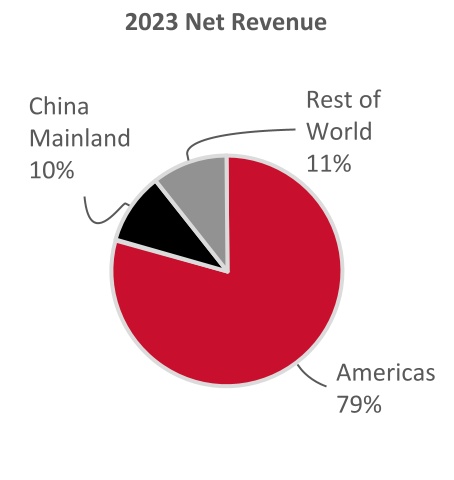
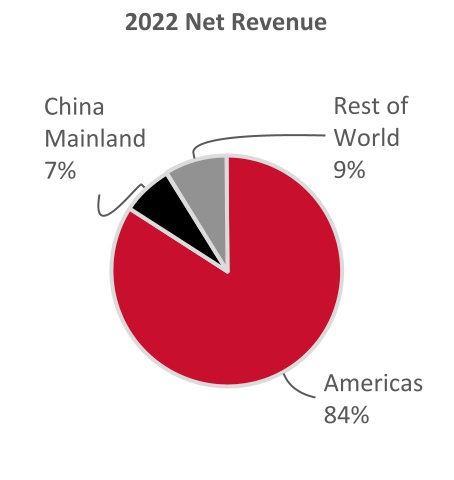
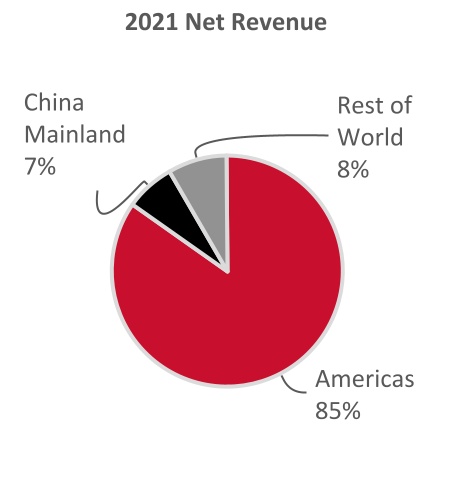
We have operated in the Americas for over 25 years. We opened our first ever store in Vancouver, Canada in 1998. In 2023, the net revenue we generated in the Americas represented 79% of our total net revenue.
| | | | | | | | | | | | | | | | | | | | |
| | 2023 | | 2022 | | 2021 |
| | (In thousands) |
| Net revenue | | $ | 7,631,647 | | | $ | 6,817,454 | | | $ | 5,299,906 | |
| | | | | | |
Net revenue growth | | 11.9 | % | | 28.6 | % | | 40.3 | % |
Our operations in the Americas are core to our business and we aim to continue to grow our net revenue in this market through ongoing product innovation and by building brand awareness. We also plan to continue to invest in our omni-channel capabilities, to open new retail locations, and to relocate, optimize, and renovate our existing locations as needed.
We generate net revenue in the Americas through our lululemon branded retail locations which include different sizes of company-operated stores, outlets, pop-ups, other temporary locations, and stores operated by a third-party under a supply and license agreement in Mexico. We also serve our guests via our e-commerce website www.lululemon.com, our mobile app, our “Like New” re-commerce program, and through certain wholesale arrangements including certain yoga and fitness studios, university campus retailers, and other select partners.
China Mainland
We opened our first store in China Mainland in fiscal 2014. In 2023, the net revenue we generated in China Mainland represented 10% of our total net revenue.
| | | | | | | | | | | | | | | | | | | | |
| | 2023 | | 2022 | | 2021 |
| | (In thousands) |
| Net revenue | | $ | 963,760 | | | $ | 576,503 | | | $ | 434,261 | |
| | | | | | |
Net revenue growth | | 67.2 | % | | 32.8 | % | | 80.3 | % |
We have experienced significant net revenue growth in China Mainland and believe that as we continue to expand our operations and build our brand awareness, net revenue will continue to increase in this market. We believe China Mainland net revenue growth will drive an increase in our overall international net revenue. We plan to continue to invest in China Mainland and expect that the majority of our company-operated store openings in 2024 will be in this market.
We operate lululemon branded retail locations in China Mainland in a variety of different formats including different sizes of company-operated stores, outlets, pop-ups, and other temporary locations. We also serve our guests via our WeChat store and on third party marketplaces such as T-Mall and JD.com.
Rest of World
In 2023, the net revenue we generated in APAC and EMEA represented 11% of our total net revenue.
| | | | | | | | | | | | | | | | | | | | |
| | 2023 | | 2022 | | 2021 |
| | (In thousands) |
| Net revenue | | $ | 1,023,871 | | | $ | 716,561 | | | $ | 522,450 | |
| | | | | | |
Net revenue growth | | 42.9 | % | | 37.2 | % | | 36.3 | % |
We have experienced significant net revenue growth in APAC and EMEA and intend to continue to invest in these markets to build brand awareness. Where we identify growth opportunities, we plan to open new retail locations, including in new markets across the EMEA and APAC regions.
We operate lululemon branded retail locations in these markets in a variety of different formats including different sizes of company-operated stores, outlets, pop-ups, and stores operated by third-parties under supply and license agreements in the Middle East and Israel. We also serve our guests via our country specific websites, our mobile app, and through third party regional marketplaces, such as Zalando, Lazada, and SSG.
Our Selling Channels
We conduct our business through a number of different channels in each market:
Company-operated stores: In addition to serving as a venue to sell our products, our stores give us a direct connection to our guests, which we view as a valuable tool in helping us build our brand and product lines as well as enabling our omni-channel capabilities. Our retail stores are located primarily on street locations, in lifestyle centers, and in malls. Our sales per square foot was $1,609, $1,580, and $1,443 for 2023, 2022, and 2021 respectively.
| | | | | | | | | | | | | | |
| Number of company-operated stores by market | | January 28, 2024 | | January 29, 2023 |
| United States | | 367 | | | 350 | |
| Canada | | 71 | | | 69 | |
| Americas | | 438 | | | 419 | |
| | | | |
| China Mainland | | 127 | | | 99 | |
| | | | |
| Australia | | 33 | | | 32 | |
| South Korea | | 19 | | | 16 | |
Hong Kong SAR | | 9 | | | 9 | |
| Japan | | 8 | | | 7 | |
| New Zealand | | 8 | | | 8 | |
| Taiwan | | 8 | | | 7 | |
| Singapore | | 7 | | | 8 | |
| Malaysia | | 3 | | | 2 | |
| Macau SAR | | 2 | | | 2 | |
| Thailand | | 1 | | | — | |
| APAC | | 98 | | | 91 | |
| | | | |
| | | | | | | | | | | | | | |
| Number of company-operated stores by market | | January 28, 2024 | | January 29, 2023 |
| United Kingdom | | 20 | | | 20 | |
| Germany | | 9 | | | 10 | |
| France | | 6 | | | 4 | |
| Ireland | | 4 | | | 4 | |
| Spain | | 3 | | | 3 | |
| Netherlands | | 2 | | | 1 | |
| Sweden | | 2 | | | 2 | |
| Norway | | 1 | | | 1 | |
| Switzerland | | 1 | | | 1 | |
| EMEA | | 48 | | | 46 | |
| | | | |
| Total company-operated stores | | 711 | | | 655 | |
E-commerce: We believe e-commerce is convenient for our guests and also allows us to reach and serve guests in markets beyond where our physical retail locations are based. We believe this channel is effective in building brand awareness, especially in new markets. We serve our guests via our e-commerce websites, other country and region-specific websites, digital marketplaces, and mobile apps. E-commerce net revenue includes our buy online pick-up in store, back-back room, and ship from store omni-channel retailing capabilities.
Other channels: We also use certain other distribution channels, generally with the goal of building brand awareness and providing broader access to our products. These other channels include:
•Temporary locations - Our seasonal stores and pop-ups are typically opened for a short period of time enabling us to serve guests during peak shopping periods in markets where we do not ordinarily have a physical location, or to expand access in markets where we see high demand at our existing locations.
•Wholesale - We sell to partners that offer convenient access for both core and new guests, including yoga and fitness studios, university campus retailers, and other select partners.
•Outlets - We utilize outlets to sell slower moving inventory and inventory from prior seasons at discounted prices. As of January 28, 2024, we operated 47 outlets, the majority of which were in the Americas.
•Like New - Our re-commerce program allows guests to exchange their gently used lululemon products for merchandise credit. Those products are then verified and quality checked before being resold online at likenew.lululemon.com. We believe this program is a step towards a circular eco-system and helps reduce our environmental footprint.
•License and supply arrangements - We enter into license and supply arrangements when we believe it will be to our advantage to partner with third parties with significant experience and proven success in certain target markets. Under these arrangements we have granted certain third parties the right to operate lululemon branded retail locations and to sell lululemon products on websites in specific countries.
| | | | | | | | | | | | | | |
| Number of retail locations operated by third parties by market | | January 28, 2024 | | January 29, 2023 |
| Mexico | | 15 | | | 12 | |
| United Arab Emirates | | 8 | | | 7 | |
| Saudi Arabia | | 6 | | | 3 | |
| Israel | | 3 | | | — | |
| Kuwait | | 3 | | | 1 | |
| Qatar | | 3 | | | 3 | |
| Bahrain | | 1 | | | — | |
| Total locations operated by third parties under license and supply arrangements | | 39 | | | 26 | |
Integrated Marketing
We believe that our brand awareness is relatively low, especially outside of the Americas, and also with our male guests. This represents an opportunity for us and we have a multi-faceted strategy to build brand awareness, affinity, and guest loyalty. This strategy is designed to leverage owned and paid channels, our ambassador network, brand partners, events, and content – to drive awareness, consideration, engagement, conversion, and ultimately loyalty and engagement at the global, regional, and local levels.
Product Design and Development
Our product design and development efforts are led by a team of researchers, scientists, engineers, and designers. Our team is comprised of athletes and users of our products who embody our design philosophy and dedication to premium quality. Our design and development team identifies trends based on market intelligence and research, proactively seeks the input of our guests and our ambassadors, and broadly seeks inspiration consistent with our goals of function, style, and technical superiority.
As we strive to continue to provide our guests with technically advanced fabrics, our team works closely with our suppliers to incorporate the latest in technical innovation, bringing particular specifications to our products. We partner with independent inspection, verification, and testing companies, who conduct a variety of tests on our fabrics, testing performance characteristics including pilling, shrinkage, abrasion resistance, and colorfastness. We develop proprietary fabrics and collaborate with leading fabric and trims suppliers to manufacture fabrics and trims that we generally seek to protect through agreements, trademarks, and as trade-secrets.
Sourcing and Manufacturing
We do not own or operate any manufacturing facilities. We rely on a limited number of suppliers to provide fabrics for, and to produce, our products. The following statistics are based on cost.
We work with a group of approximately 49 vendors that manufacture our products, five of which produced 55% of our products in 2023, with the largest manufacturer producing 17%. During 2023, 42% of our products were manufactured in Vietnam, 16% in Cambodia, 11% in Sri Lanka, 10% in Indonesia, and 8% in Bangladesh, and the remainder in other regions.
We work with a group of approximately 67 suppliers to provide the fabrics for our products. In 2023, 52% of our fabrics were produced by our top five fabric suppliers, with the largest manufacturer producing 19%. During 2023, 40% of our fabrics originated from Taiwan, 26% from China Mainland, and 12% from Sri Lanka, and the remainder from other regions.
We also source other raw materials which are used in our products, including items such as content labels, elastics, buttons, clasps, and drawcords from suppliers located predominantly in APAC and China Mainland.
We have developed long-standing relationships with a number of our vendors and take care to ensure that they share our commitment to quality and ethics. We do not, however, have any long-term contracts with the majority of our suppliers or manufacturing sources for the production and supply of our fabrics and garments, and we compete with other companies for fabrics, raw materials, and production. We require that all of our suppliers and manufacturers adhere to our Vendor Code of Ethics regarding social and environmental sustainability practices. Our product quality and sustainability teams closely assess and monitor each supplier's compliance with applicable laws and our Vendor Code of Ethics, including by partnering with leading inspection and verification firms.
Distribution Facilities
We operate and distribute finished products from our distribution facilities in the United States, Canada, and Australia. We own our distribution center in Groveport, Ohio, and lease our other distribution facilities. We also utilize third-party logistics providers in a number of countries in which we operate to warehouse and distribute finished products from their warehouse locations. We regularly evaluate our distribution infrastructure and consolidate or expand our distribution capacity as we believe appropriate for our operations and to meet anticipated needs.
Competition
Competition in the athletic apparel industry is based principally on brand image and recognition as well as product quality, innovation, style, distribution, and price. We believe we successfully compete on the basis of our premium brand image and our technical product innovation. We also believe our ability to introduce new product innovations, combine function and fashion, and connect through in-store, online, and community experiences sets us apart from our competition. In
addition, we believe our vertical retail distribution strategy and community-based marketing differentiates us further, allowing us to more effectively control our brand image and connect with our guests.
The market for athletic apparel is highly competitive. It includes increasing competition from established companies that are expanding their production and marketing of performance products, as well as from frequent new entrants to the market. We are in direct competition with wholesalers and direct sellers of athletic apparel and footwear, such as Nike, Inc., adidas AG, PUMA, Under Armour, Inc., and Columbia Sportswear Company. We also compete with retailers who have expanded to include women's athletic apparel including The Gap, Inc. (including the Athleta brand), Victoria's Secret with its sport and lounge offering, and Urban Outfitters, Inc.
Seasonality
Our business is affected by the general seasonal trends common to the retail apparel industry. Our annual net revenue is typically weighted more heavily toward our fourth fiscal quarter, reflecting our historical strength in sales during the holiday season in the Americas, while our operating expenses are generally more equally distributed throughout the year. As a result, a substantial portion of our operating profits are typically generated in the fourth quarter of our fiscal year. For example, we generated approximately 43% of our full year operating profit during the fourth quarter of 2023.
Human Capital
Our Impact Agenda sets out our social and environmental goals and strategy across three pillars - Be Human, Be Well, and Be Planet. Details can be found in our Impact Report on our website (https://corporate.lululemon.com/our-impact).
Included within our Impact Agenda is a goal to invest a total of $75.0 million to advance equity in well-being by the end of 2025. As of January 28, 2024, we have invested a total of $44.8 million(1) towards this goal.
The Be Human pillar of our Impact Agenda sets out our focus areas with respect to human capital, including:
•Inclusion, Diversity, Equity, and Action (“IDEA”);
•Employee empowerment; and
•Fair labor practices and the well-being of the people who make our products.
Inclusion, Diversity, Equity and Action
We believe IDEA is fundamental for shaping and building our company, industry, and communities, and for creating a shared sense of respect and belonging. By continuously striving to be an inclusive, diverse, and equitable organization, we aim to reflect a variety of perspectives and meet the needs of the global communities we serve. We are proud that as of January 28, 2024, approximately 50% of our board of directors, 70% of our senior executive leadership team, and 50% of our vice presidents and above are women, while approximately 75% of our overall workforce are women.(2)
(1) We have contributed $44.8 million to lululemon's Centre for Social Impact, $32.4 million of which has been contributed directly to social impact organizations. The remaining $12.4 million primarily consists of contributions toward a donor-advised fund for future grant making.
(2) While we track male and female genders, we acknowledge this is not fully encompassing of all gender identities.
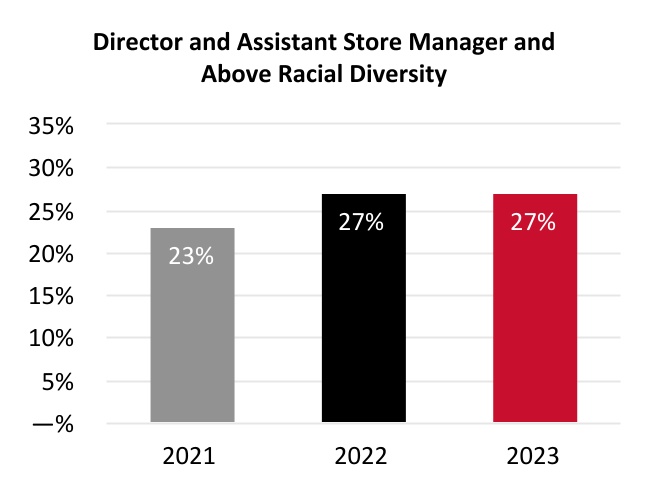
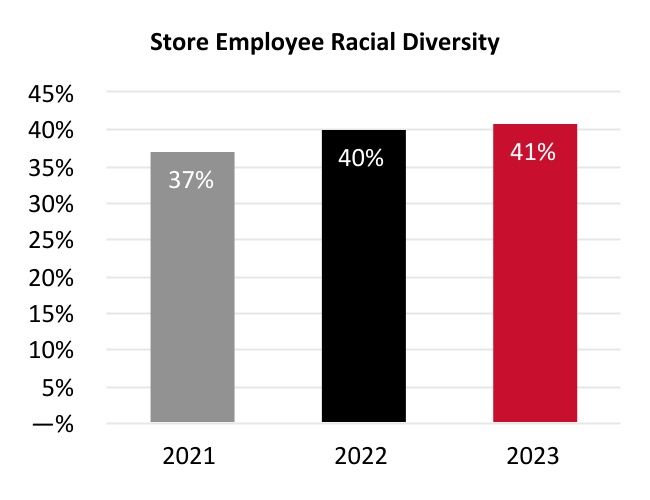
We use an annual voluntary global survey to help us understand the demographics of our employee base and provide us with access to tangible metrics to help us understand our employees’ sense of inclusion and belonging.(3) In 2023, the participation rate was approximately 85%. Our overall goal is to reflect the racial diversity(4) of the communities we serve and in which we operate.
We seek to maintain 100% gender pay equity within our entire global employee population, meaning equal pay for equal work across genders, by geography. We have achieved full pay equity, including gender and race, in the United States, which is the only country where we currently collect individually attributable race data.
We offer all employees IDEA education, training, and guided conversations on a variety of topics, including anti-racism, anti-discrimination, and inclusive leadership behaviors. We have established People Networks, which are employee resource groups for employees who have marginalized and historically underrepresented identities. We see significant engagement in IDEA education and training across our global employee base. We aim to foster a culture of inclusion by making IDEA part of our everyday conversation, and frequently review our policies, programs, and practices to identify ways to be more inclusive and equitable.
Employee Empowerment
We believe our people are key to the success of our business. As of January 28, 2024 we employed approximately 38,000 people worldwide. We strive to foster a distinctive culture rooted in our core values that attracts and retains passionate and motivated employees who are driven to achieve personal and professional goals. We believe our people succeed because we create an environment that fosters growth and is diverse and equitable.
(3) The voluntary demographic survey results presented above relate to all of our employees in the Americas, Europe, Australia, and New Zealand.
(4) "Racial diversity" is used to measure the non-white population.
We assess our performance and identify opportunities for improvement through an annual employee engagement survey. In 2023, the participation rate was approximately 85% and our employee engagement score exceeded the retail industry average.(5) Our engagement score suggests our people are proud to work for lululemon, they are motivated to contribute to work that aligns with their purpose, and they recommend lululemon as a great place to work.
We understand that health and wealth programs need to offer choice at all stages of life. Our current offerings support our goal of becoming the number one place where people come to develop and grow as inclusive leaders, and we regularly use feedback to inform opportunities to support this goal. These offerings include, among other things:
•Competitive compensation which rewards exceptional performance;
•A Fund your Future program for eligible employees which offers partial contribution matches to a pension plan and employee share purchase plan;
•An annual paid VALUES (Volunteer, Awareness, Life, Unity, Empowerment, Support) Day, competitive paid time off, and sick leave;
•An employee discount program, which includes a lifetime discount to celebrate the contribution of our long-tenured employees to keep them within our collective, even when they have moved on to pursue goals outside of lululemon;
•Reimbursement programs which reward physical activity;
•A parenthood program which is a gender-neutral benefit that provides all eligible employees up to six months of paid leave;
•An employee assistance program which provides free confidential support to all our employees and their families in a variety of areas from mental well-being to financial services to advice for new parents; and
•Training and development of all of our employees including, but not limited to, mentorship programs, IDEA internships, leadership development, vision and goals, and coaching.
Fair Labor Practices and the Well-Being of the People who Make our Products
We work with suppliers who we believe share our values and collaborate with us to uphold robust standards, address systemic challenges, and support the well-being of people who make our products. Our Responsible Supply Chain program is built on three pillars:
•Monitoring - Assessing and improving working conditions in factories.
•Integration - Integrating responsible purchasing practices across enterprise strategies, processes, and tools.
•Collaboration - Working with multi-stakeholder organizations, industry, suppliers, and brands to support systemic change and impact.
Our Vendor Code of Ethics outlines our commitment to respect human and labor rights, and promote safe and fair working conditions for people in our supply chain. The code, which is based on international standards, sets the minimum standards for our supplier partners and is a component of our supplier and manufacturer agreements. Our finished goods and fabric suppliers are assessed against the Vendor Code of Ethics prior to forming a business relationship, and regularly thereafter; we work with factories that can uphold our strict requirements.
Our Foreign Migrant Worker Standard sets out our minimum requirements for what we believe are the appropriate and ethical recruitment, employment, and repatriation of foreign migrant workers.
Intellectual Property
We have trademark rights on many of our products and believe having distinctive marks that are readily identifiable is an important factor in building our brand image and in distinguishing our products from the products of others. We consider our lululemon and wave design trademarks to be among our most valuable assets. In addition, we own many other trademarks for the names of several of our brands, slogans, fabrics and products. We own registered and pending U.S. and foreign utility and design patents, industrial designs in Canada, and registered community designs in Europe that protect our product innovations, distinctive apparel, and accessory designs.
(5) Based on an industry benchmark provided by the third party that administers this survey to our employees.
Securities and Exchange Commission Filings
Our website address is www.lululemon.com. We provide free access to various reports that we file with, or furnish to, the United States Securities and Exchange Commission, or the SEC, through our website, as soon as reasonably practicable after they have been filed or furnished. These reports include, but are not limited to, our annual reports on Form 10-K, quarterly reports on Form 10-Q, current reports on Form 8-K, and any amendments to those reports. Our SEC reports can also be accessed through the SEC's website at www.sec.gov. Also available on our website are printable versions of our Global Code of Business Conduct and Ethics and charters of the standing committees of our board of directors. Information contained on or accessible through our websites is not incorporated into, and does not form a part of, this Annual Report or any other report or document we file with the SEC, and any references to our websites are intended to be inactive textual references only.
ITEM 1A. RISK FACTORS
In addition to the other information contained in this Form 10-K, the following risk factors should be considered in evaluating our business. Our business, financial condition, or results of operations could be materially adversely affected as a result of any of these risks.
Risks related to our business and industry
Our success depends on our ability to maintain the value and reputation of our brand.
The lululemon name is integral to our business as well as to the implementation of our expansion strategies. Maintaining, promoting, and positioning our brand will depend largely on the success of our marketing and merchandising efforts and our ability to provide a consistent, high quality product, and guest experience. We rely on social media, as one of our marketing strategies, to have a positive impact on both our brand value and reputation. Our brand and reputation could be adversely affected if we fail to achieve these objectives, if our public image was to be tarnished by negative publicity, which could be amplified by social media, if we fail to deliver innovative and high quality products acceptable to our guests, or if we face or mishandle a product recall. Our reputation could also be impacted by adverse publicity, whether or not valid, regarding allegations that we, or persons associated with us or formerly associated with us, have violated applicable laws or regulations, including but not limited to those related to safety, employment, discrimination, harassment, whistle-blowing, privacy, corporate citizenship, improper business practices, or cybersecurity. Certain activities on the part of stakeholders, including nongovernmental organizations and governmental institutions, could cause reputational damage, distract senior management, and disrupt our business. Additionally, while we devote considerable effort and resources to protecting our intellectual property, if these efforts are not successful the value of our brand may be harmed. Any harm to our brand and reputation could have a material adverse effect on our financial condition.
Changes in consumer shopping preferences, and shifts in distribution channels could materially impact our results of operations.
We operate an omni-channel retail model and aim to efficiently and effectively serve our guests in the ways most convenient to them. We operate a combination of physical retail locations and e-commerce services via our websites, other region-specific websites, digital marketplaces, and mobile apps. Our physical retail locations remain a key part of our growth strategy and we view them as a valuable tool in helping us build our brand and product line as well as enabling our omni-channel capabilities. We plan to continue to expand square footage and open new company-operated stores to support our growth objectives. The diversion of sales from our company-operated stores could adversely impact our return on investment and could lead to impairment charges and store closures, including lease exit costs. We could have difficulty in recreating the in-store experience through direct channels. Our failure to successfully integrate our digital and physical channels and respond to these risks might adversely impact our business and results of operations, as well as damage our reputation and brand.
If any of our products have manufacturing or design defects or are otherwise unacceptable to us or our guests, our business could be harmed.
We have occasionally received, and may in the future receive, shipments of products that fail to comply with our technical specifications or that fail to conform to our quality control standards. We have also received, and may in the future receive, products that are otherwise unacceptable to us or our guests. Under these circumstances, unless we are able to obtain replacement products in a timely manner, we risk the loss of net revenue resulting from the inability to sell those products and related increased administrative and shipping costs. Additionally, if the unacceptability of our products is not discovered until after such products are sold, our guests could lose confidence in our products or we could face a product recall and our results of operations could suffer and our business, reputation, and brand could be harmed.
Our lululemon Studio subsidiary offers complex hardware and software products and services that can be affected by design and manufacturing defects. Sophisticated operating system software and applications, such as those offered by lululemon Studio, often have issues that can unexpectedly interfere with the intended operation of hardware or software products. Defects may also exist in components and products that we source from third parties. Any defects could make our products and services unsafe and create a risk of environmental or property damage or personal injury and we may become subject to the hazards and uncertainties of product liability claims and related litigation. The occurrence of real or perceived defects in any of our products, now or in the future, could result in additional negative publicity, regulatory investigations, or lawsuits filed against us, particularly if guests or others who use or purchase our lululemon Studio products are injured. Even if injuries are not the result of any defects, if they are perceived to be, we may incur expenses to defend or settle any claims and our brand and reputation may be harmed.
We operate in a highly competitive market and our competitors may compete more effectively than we can, resulting in a loss of our market share and a decrease in our net revenue and profitability.
The market for technical athletic apparel is highly competitive. Competition may result in pricing pressures, reduced profit margins or lost market share, or a failure to grow or maintain our market share, any of which could substantially harm our business and results of operations. We compete directly against wholesalers and direct retailers of athletic apparel, including large, diversified apparel companies with substantial market share, and established companies expanding their production and marketing of technical athletic apparel, as well as against retailers specifically focused on women's athletic apparel. We also face competition from wholesalers and direct retailers of traditional commodity athletic apparel, such as cotton T-shirts and sweatshirts. Many of our competitors are large apparel and sporting goods companies with strong worldwide brand recognition. Because of the fragmented nature of the industry, we also compete with other apparel sellers, including those specializing in yoga apparel and other activewear. Many of our competitors have significant competitive advantages, including longer operating histories, larger and broader customer bases, more established relationships with a broader set of suppliers, greater brand recognition and greater financial, research and development, store development, marketing, distribution, and other resources than we do. Our competitors may be able to achieve and maintain brand awareness and market share more quickly and effectively than we can.
We may fail to acknowledge or react appropriately to the entry or growth of a viable competitor or disruptive force, and could struggle to continue to innovate, differentiate, and sustain the growth of our brand. The increasing dominance and presence of our brand may also drive guests towards alternative emerging competitors.
In addition, because we hold limited patents and exclusive intellectual property rights in the technology, fabrics or processes underlying our products, our current and future competitors are able to manufacture and sell products with performance characteristics, fabrication techniques, and styling similar to our products.
Our sales and profitability may decline as a result of increasing costs and decreasing selling prices.
Our business is subject to significant pressure on costs and pricing caused by many factors, including intense competition, constrained sourcing capacity and related inflationary pressure, the availability of qualified labor and wage inflation, pressure from consumers to reduce the prices we charge for our products, and changes in consumer demand. These and other factors have, and may in the future, cause us to experience increased costs, reduce our prices to consumers or experience reduced sales in response to increased prices, any of which could cause our operating margin to decline if we are unable to offset these factors with reductions in operating costs and could have a material adverse effect on our financial condition, operating results, and cash flows.
If we are unable to anticipate consumer preferences and successfully develop and introduce new, innovative, and differentiated products, we may not be able to maintain or increase our sales and profitability.
Our success depends on our ability to identify and originate product trends as well as to anticipate and react to changing consumer demands in a timely manner. All of our products are subject to changing consumer preferences that cannot be predicted with certainty. If we are unable to introduce new products or novel technologies in a timely manner or our new products or technologies are not accepted by our guests, our competitors may introduce similar products in a more timely fashion, which could hurt our goal to be viewed as a leader in technical athletic apparel innovation. Our new products may not receive consumer acceptance as consumer preferences could shift rapidly to different types of athletic apparel or away from these types of products altogether, and our future success depends in part on our ability to anticipate and respond to these changes. Our failure to anticipate and respond in a timely manner to changing consumer preferences could lead to, among other things, lower sales and excess inventory levels. We may not have relevant data to effectively understand and react to consumer preferences and expectations. Even if we are successful in anticipating consumer preferences, our ability to adequately react to and address those preferences will in part depend upon our continued ability to develop and introduce innovative, high-quality products. Our failure to effectively introduce new products that are accepted by consumers could
result in a decrease in net revenue and excess inventory levels, which could have a material adverse effect on our financial condition.
Our results of operations could be materially harmed if we are unable to accurately forecast guest demand for our products.
To ensure adequate inventory supply, we must forecast inventory needs and place orders with our manufacturers based on our estimates of future demand for particular products. Our ability to accurately forecast demand for our products could be affected by many factors, including an increase or decrease in guest demand for our products or for products of our competitors, our failure to accurately forecast guest acceptance of new products, product introductions by competitors, unanticipated changes in general market conditions (for example, because of global economic concerns such as inflation, an economic downturn, or delays and disruptions resulting from local and international shipping delays and labor shortages), and weakening of economic conditions or consumer confidence in future economic conditions (for example, because of inflationary pressures, or because of sanctions, restrictions, and other responses related to geopolitical events). If we fail to accurately forecast guest demand, we may experience excess inventory levels or a shortage of products available for sale in our stores or for delivery to guests.
Inventory levels in excess of guest demand may result in inventory write-downs or write-offs and the sale of excess inventory at discounted prices, which would cause our gross margin to suffer and could impair the strength and exclusivity of our brand. Conversely, if we underestimate guest demand for our products, our manufacturers may not be able to deliver products to meet our requirements, and this could result in damage to our reputation and guest relationships.
Our limited operating experience and limited brand recognition in new international markets and new product categories may limit our expansion and cause our business and growth to suffer.
Our future growth depends in part on our expansion efforts outside of the Americas. We have limited experience with regulatory environments and market practices internationally, and we may not be able to penetrate or successfully operate in any new market. In connection with our expansion efforts we may encounter obstacles we did not face in the Americas, including cultural and linguistic differences, differences in regulatory environments, labor practices and market practices, difficulties in keeping abreast of market, business and technical developments, and international guests' tastes and preferences. We may also encounter difficulty expanding into new international markets because of limited brand recognition leading to delayed acceptance of our technical athletic apparel by guests in these new international markets. Our failure to develop our business in new international markets or disappointing growth outside of existing markets could harm our business and results of operations.
In addition, our continued growth depends in part on our ability to expand our product categories and introduce new product lines. We may not be able to successfully manage integration of new product categories or the new product lines with our existing products. Selling new product categories and lines will require our management to test and develop different strategies in order to be successful. We may be unsuccessful in entering new product categories and developing or launching new product lines, which requires management of new suppliers, potential new customers, and new business models. Our management may not have the experience of selling in these new product categories and we may not be able to grow our business as planned. For example, in July 2020, we acquired MIRROR, an in-home fitness company with an interactive workout platform that features live and on-demand classes. If we are unable to effectively and successfully further develop these and future new product categories and lines, we may not be able to increase or maintain our sales and our operating margins may be adversely affected. This may also divert the attention of management and cause additional expenses.
We may, from time to time, evaluate and pursue other strategic investments or acquisitions. These involve various inherent risks and the benefits sought may not be realized.
If we continue to grow at a rapid pace, we may not be able to effectively manage our growth and the increased complexity of our business and as a result our brand image and financial performance may suffer.
If our operations continue to grow at a rapid pace, we may experience difficulties in obtaining sufficient raw materials and manufacturing capacity to produce our products, as well as delays in production and shipments, as our products are subject to risks associated with overseas sourcing and manufacturing. We could be required to continue to expand our sales and marketing, product development and distribution functions, to upgrade our management information systems and other processes and technology, and to obtain more space for our expanding workforce. This expansion could increase the strain on our resources, and we could experience operating difficulties, including difficulties in hiring, training, and managing an increasing number of employees. These difficulties could result in the erosion of our brand image which could have a material adverse effect on our financial condition.
We are subject to risks associated with leasing retail and distribution space subject to long-term and non-cancelable leases.
We lease the majority of our stores under operating leases and our inability to secure appropriate real estate or lease terms could impact our ability to grow. Our leases generally have initial terms of between two and 15 years, and generally can be extended in increments between two and five years, if at all. We generally cannot cancel these leases at our option. If an existing or new store is not profitable, and we decide to close it, as we have done in the past and may do in the future, we may nonetheless be committed to perform our obligations under the applicable lease including, among other things, paying the base rent for the balance of the lease term. Similarly, we may be committed to perform our obligations under the applicable leases even if current locations of our stores become unattractive as demographic patterns change. In addition, as each of our leases expire, we may fail to negotiate renewals, either on commercially acceptable terms or at all, which could require us to close stores in desirable locations.
We also lease the majority of our distribution centers and our inability to secure appropriate real estate or lease terms could impact our ability to deliver our products to the market.
Our future success is substantially dependent on the service of our senior management and our ability to maintain our culture and to attract, manage, and retain highly qualified individuals.
The performance of our senior management team and other key employees may not meet our needs and expectations. Also, the loss of services of any of these key employees, or any negative public perception with respect to these individuals, may be disruptive to, or cause uncertainty in, our business and could have a negative impact on our ability to manage and grow our business effectively. Such disruption could have a material adverse impact on our financial performance, financial condition, and the market price of our stock.
If we are unable to successfully maintain and evolve our unique culture, offer competitive compensation and benefits, and a desirable work model, we may be unable to attract and retain highly qualified individuals to support our business and continued growth. Our work model may not meet the needs and expectations of our employees and may not be perceived as favorable compared to other companies. Unionization efforts or other employee organizing activities could lead to higher people costs or reduce our flexibility to manage our employees which may negatively disrupt our operations. We also face risks related to employee engagement and productivity which could result in increased headcount and lead to increased labor costs.
Our business is affected by seasonality, which could result in fluctuations in our operating results.
Our business is affected by the general seasonal trends common to the retail apparel industry. Our annual net revenue is typically weighted more heavily toward our fourth fiscal quarter, reflecting our historical strength in sales during the holiday season, while our operating expenses are more equally distributed throughout the year. This seasonality, along with other factors that are beyond our control, including weather conditions and the effects of climate change, could adversely affect our business and cause our results of operations to fluctuate.
Risks related to our supply chain
Disruptions of our supply chain could have a material adverse effect on our operating and financial results.
Disruption of our supply chain capabilities due to trade restrictions, political instability, severe weather, natural disasters, public health crises, war, terrorism, product recalls, labor supply shortages or stoppages, the financial or operational instability of key suppliers and carriers, changes in diplomatic or trade relationships (including any sanctions, restrictions, and other responses such as those related to current geopolitical events), or other reasons could impair our ability to distribute our products. To the extent we are unable to mitigate the likelihood or potential impact of such events, there could be a material adverse effect on our operating and financial results.
We rely on international suppliers and any significant disruption to our supply chain could impair our ability to procure or distribute our products.
We do not manufacture our products or raw materials and rely on suppliers and manufacturers located predominantly in APAC and China Mainland. We also source other materials used in our products, including items such as content labels, elastics, buttons, clasps, and drawcords, from suppliers located primarily in this region. Based on cost, during 2023:
•Approximately 42% of our products were manufactured in Vietnam, 16% in Cambodia, 11% in Sri Lanka, 10% in Indonesia, and 8% in Bangladesh, and the remainder in other regions.
•Approximately 40% of the fabric used in our products originated from Taiwan, 26% from China Mainland, 12% from Sri Lanka, and the remainder from other regions.
The entire apparel industry, including our company, could face supply chain challenges as a result of the impacts of global public health crises, political instability, inflationary pressures, macroeconomic conditions, and other factors, including reduced freight availability and increased costs, port disruption, manufacturing facility closures, and related labor shortages and other supply chain disruptions.
Our supply chain capabilities may be disrupted due to these or other factors, such as severe weather, natural disasters, war or other military conflicts, terrorism, labor supply shortages or stoppages, the financial or operational instability of key suppliers or the countries in which they operate, or changes in diplomatic or trade relationships (including any sanctions, restrictions, and other responses to geopolitical events). Any significant disruption in our supply chain capabilities could impair our ability to procure or distribute our products, which would adversely affect our business and results of operations.
A relatively small number of vendors supply and manufacture a significant portion of our products, and losing one or more of these vendors could adversely affect our business and results of operations.
Many of the specialty fabrics used in our products are technically advanced textile products developed and manufactured by third parties and may be available, in the short-term, from only one or a limited number of sources. We have no long-term contracts with any of our suppliers or manufacturers for the production and supply of our raw materials and products, and we compete with other companies for fabrics, other raw materials, and production. During 2023, we worked with approximately 49 vendors to manufacture our products and 67 suppliers to provide the fabric for our products. Based on cost, during 2023:
•Approximately 55% of our products were manufactured by our top five vendors, the largest of which produced approximately 17% of our products; and
•Approximately 52% of our fabrics were produced by our top five fabric suppliers, the largest of which produced approximately 19% of fabric used.
We have experienced, and may in the future experience, a significant disruption in the supply of fabrics or raw materials and may be unable to locate alternative suppliers of comparable quality at an acceptable price, or at all. In addition, if we experience significant increased demand, or if we need to replace an existing supplier or manufacturer, we may be unable to locate additional supplies of fabrics or raw materials or additional manufacturing capacity on terms that are acceptable to us, or at all, or we may be unable to locate any supplier or manufacturer with sufficient capacity to meet our requirements or fill our orders in a timely manner. Identifying a suitable supplier is an involved process that requires us to become satisfied with its quality control, responsiveness and service, financial stability, and labor and other ethical practices. Even if we are able to expand existing or find new manufacturing or fabric sources, we may encounter delays in production and added costs as a result of the time it takes to train our suppliers and manufacturers in our methods, products, and quality control standards.
Our supply of fabric or manufacture of our products could be disrupted or delayed by economic or political or global health conditions, and the related government and private sector responsive actions such as closures, restrictions on product shipments, and travel restrictions. Delays related to supplier changes could also arise due to an increase in shipping times if new suppliers are located farther away from our markets or from other participants in our supply chain. In addition, freight capacity issues continue to persist worldwide as there is much greater demand for shipping and reduced capacity and equipment. Any delays, interruption, or increased costs in the supply of fabric or manufacture of our products could have an adverse effect on our ability to meet guest demand for our products and result in lower net revenue and income from operations both in the short and long term.
Our business could be harmed if our suppliers and manufacturers do not comply with our Vendor Code of Ethics or applicable laws.
While we require our suppliers and manufacturers to comply with our Vendor Code of Ethics, which includes labor, health and safety, and environment standards, we do not control their operations. If suppliers or contractors do not comply with these standards or applicable laws or there is negative publicity regarding the production methods of any of our suppliers or manufacturers, even if unfounded or not specific to our supply chain, our reputation and sales could be adversely affected, we could be subject to legal liability, or could cause us to contract with alternative suppliers or manufacturing sources.
The fluctuating cost of raw materials could increase our cost of goods sold.
The fabrics used to make our products include synthetic fabrics whose raw materials include petroleum-based products. Our products also include silver and natural fibers, including cotton. Our costs for raw materials are affected by, among other things, weather, consumer demand, speculation on the commodities market, the relative valuations and fluctuations of the currencies of producer versus consumer countries, and other factors that are generally unpredictable and beyond our control. Any and all of these factors may be exacerbated by global climate change. In addition, political instability, trade relations, sanctions, inflationary pressure, or other geopolitical or economic conditions could cause raw material costs to increase and have an adverse effect on our future margins. Increases in the cost of raw materials, including petroleum or the prices we pay for silver and our cotton yarn and cotton-based textiles, could have a material adverse effect on our cost of goods sold, results of operations, financial condition, and cash flows.
If we encounter problems with our distribution system, our ability to deliver our products to the market and to meet guest expectations could be harmed.
We rely on our distribution facilities for substantially all of our product distribution. Our distribution facilities include computer controlled and automated equipment, which means their operations may be subject to a number of risks related to security or computer viruses, the proper operation of software and hardware, electronic or power interruptions, or other system failures. In addition, our operations could also be interrupted by labor difficulties, pandemics, the impacts of climate change, extreme or severe weather conditions or by floods, fires, or other natural disasters near our distribution centers. If we encounter problems with our distribution system, our ability to meet guest expectations, manage inventory, complete sales, and achieve objectives for operating efficiencies could be harmed.
Increasing labor costs and other factors associated with the production of our products in South Asia and South East Asia could increase the costs to produce our products.
A significant portion of our products are produced in South Asia and South East Asia and increases in the costs of labor and other costs of doing business in the countries in this area could significantly increase our costs to produce our products and could have a negative impact on our operations and earnings. Factors that could negatively affect our business include labor shortages and increases in labor costs, labor disputes, pandemics, the impacts of climate change, difficulties and additional costs in transporting products manufactured from these countries to our distribution centers and significant revaluation of the currencies used in these countries, which may result in an increase in the cost of producing products. Also, the imposition of trade sanctions or other regulations against products imported by us from, or the loss of "normal trade relations" status with any country in which our products are manufactured, could significantly increase our cost of products and harm our business.
Risks related to information security and technology
We may be unable to safeguard against security breaches which could damage our customer relationships and result in significant legal and financial exposure.
As part of our normal operations, we receive confidential, proprietary, and personally identifiable information, including credit card information, and information about our customers, our employees, job applicants, and other third parties. Our business employs systems and websites that allow for the storage and transmission of this information. However, despite our safeguards and security processes and protections, security breaches could expose us to a risk of theft or misuse of this information, and could result in litigation and potential liability.
The retail industry, in particular, has been the target of many recent cyber-attacks. We may not have the resources or technical sophistication to be able to anticipate or prevent rapidly evolving types of cyber-attacks. Attacks may be targeted at us, our vendors or customers, or others who have entrusted us with information. In addition, despite taking measures to safeguard our information security and privacy environment from security breaches, our customers and our business could still be exposed to risk. Actual or anticipated attacks may cause us to incur increasing costs including costs to deploy additional personnel and protection technologies, train employees and engage third party experts and consultants. Advances in computer capabilities, new technological discoveries or other developments may result in the technology used by us to protect transaction or other data being breached or compromised. Measures we implement to protect against cyber-attacks may also have the potential to impact our customers' shopping experience or decrease activity on our websites by making them more difficult to use.
Data and security breaches can also occur as a result of non-technical issues including intentional or inadvertent breach by employees or persons with whom we have commercial relationships that result in the unauthorized release of personal or
confidential information. Any compromise or breach of our security could result in a violation of applicable privacy and other laws, significant legal and financial exposure, and damage to our brand and reputation or other harm to our business.
In addition, the increased use of employee-owned devices for communications as well as work-from-home arrangements present additional operational risks to our technology systems, including increased risks of cyber-attacks. Further, like other companies in the retail industry, we have in the past experienced, and we expect to continue to experience, cyber-attacks, including phishing, and other attempts to breach, or gain unauthorized access to, our systems. To date, these attacks have not had a material impact on our operations, but they may have a material impact in the future.
Privacy and data protection laws increase our compliance burden.
We are subject to a variety of privacy and data protection laws and regulations that change frequently and have requirements that vary from jurisdiction to jurisdiction. For example, we are subject to significant compliance obligations under privacy laws such as the General Data Privacy Regulation ("GDPR") in the European Union, the Personal Information Protection and Electronic Documents Act (“PIPEDA”) in Canada, the California Consumer Privacy Act ("CCPA") modified by the California Privacy Rights Act (“CPRA”), and the Personal Information Protection Law (“PIPL”) in the People's Republic of China ("PRC")(6). Some privacy laws prohibit the transfer of personal information to certain other jurisdictions. We are subject to privacy and data protection audits or investigations by various government agencies. Our failure to comply with these laws subjects us to potential regulatory enforcement activity, fines, private litigation including class actions, and other costs. Our efforts to comply with privacy laws may complicate our operations and add to our compliance costs. A significant privacy breach or failure or perceived failure by us or our third-party service providers to comply with privacy or data protection laws, regulations, policies or regulatory guidance might have a materially adverse impact on our reputation, business operations and our financial condition or results of operations.
Disruption of our technology systems or unexpected network interruption could disrupt our business.
We are increasingly dependent on technology systems and third-parties to operate our e-commerce websites, process transactions, respond to guest inquiries, manage inventory, purchase, sell and ship goods on a timely basis, and maintain cost-efficient operations. The failure of our technology systems to operate properly or effectively, problems with transitioning to upgraded or replacement systems, or difficulty in integrating new systems, could adversely affect our business. In addition, we have e-commerce websites in the United States, Canada, and internationally. Our technology systems, websites, and operations of third parties on whom we rely, may encounter damage or disruption or slowdown caused by a failure to successfully upgrade systems, system failures, viruses, computer "hackers", natural disasters, or other causes. These could cause information, including data related to guest orders, to be lost or delayed which could, especially if the disruption or slowdown occurred during the holiday season, result in delays in the delivery of products to our stores and guests or lost sales, which could reduce demand for our products and cause our sales to decline. The concentration of our primary offices, several of our distribution centers, and a number of our stores along the west coast of North America could amplify the impact of a natural disaster occurring in that area to our business, including to our technology systems. In addition, if changes in technology cause our information systems to become obsolete, or if our information systems are inadequate to handle our growth, we could lose guests. We have limited back-up systems and redundancies, and our technology systems and websites have experienced system failures and electrical outages in the past which have disrupted our operations. Any significant disruption in our technology systems or websites could harm our reputation and credibility, and could have a material adverse effect on our business, financial condition, and results of operations.
Our technology-based systems that give our customers the ability to shop with us online may not function effectively.
Many of our customers shop with us through our e-commerce websites and mobile apps. Increasingly, customers are using tablets and smart phones to shop online with us and with our competitors and to do comparison shopping. We are increasingly using social media and proprietary mobile apps to interact with our customers and as a means to enhance their shopping experience. Any failure on our part to provide attractive, effective, reliable, user-friendly e-commerce platforms that offer a wide assortment of merchandise with rapid delivery options and that continually meet the changing expectations of online shoppers could place us at a competitive disadvantage, result in the loss of e-commerce and other sales, harm our
(6) PRC includes China Mainland, Hong Kong SAR, Taiwan, and Macau SAR.
reputation with customers, have a material adverse impact on the growth of our e-commerce business globally and could have a material adverse impact on our business and results of operations.
Risks related to environmental, social, and governance issues
Climate change, and related legislative and regulatory responses to climate change, may adversely impact our business.
There is increasing concern that a gradual rise in global average temperatures due to increased concentration of carbon dioxide and other greenhouse gases in the atmosphere will cause significant changes in weather patterns around the globe, an increase in the frequency, severity, and duration of extreme weather conditions and natural disasters, and water scarcity and poor water quality. These events could adversely impact the cultivation of cotton, which is a key resource in the production of our products, disrupt the operation of our supply chain and the productivity of our contract manufacturers, increase our production costs, impose capacity restraints and impact the types of apparel products that consumers purchase. These events could also compound adverse economic conditions and impact consumer confidence and discretionary spending. As a result, the effects of climate change could have a long-term adverse impact on our business and results of operations. In many countries, governmental bodies are enacting new or additional legislation and regulations to reduce or mitigate the potential impacts of climate change. If we, our suppliers, or our contract manufacturers are required to comply with these laws and regulations, or if we choose to take voluntary steps to reduce or mitigate our impact on climate change, we may experience increased costs for energy, production, transportation, and raw materials, increased capital expenditures, or increased insurance premiums and deductibles, which could adversely impact our operations. Inconsistency of legislation and regulations among jurisdictions may also affect the costs of compliance with such laws and regulations. Any assessment of the potential impact of future climate change legislation, regulations or industry standards, as well as any international treaties and accords, is uncertain given the wide scope of potential regulatory change in the countries in which we operate.
Increased scrutiny from investors and others regarding our environmental, social, governance, or sustainability, responsibilities could result in additional costs or risks and adversely impact our reputation, employee retention, and willingness of customers and suppliers to do business with us.
Investor and political advocacy groups, certain institutional investors, investment funds, other market participants, stockholders, and customers have focused increasingly on the environmental, social and governance ("ESG") practices of companies, including those associated with climate change and social responsibility. These parties have placed increased importance on the implications of the social cost of their investments. If our ESG practices do not meet customer, investor, employee, or other stakeholder expectations or do not align with their opinions or values, our brand, reputation, employee retention, and business may be negatively impacted. Any sustainability report that we publish or other ESG disclosures we make may include our policies and practices on a variety of social and ethical matters, including corporate governance, environmental compliance, employee health and safety practices, human capital management, product quality, supply chain management, and workforce inclusion and diversity. It is possible that stakeholders may not be satisfied with our ESG policies or practices, including if we overstate the impact of our ESG practices, and this could reduce demand for our products and lead to regulatory enforcement that could restrict our ability to market and sell our products. We could also incur additional costs and require additional resources to monitor, report, and comply with various ESG practices. Also, our failure, or perceived failure, to meet the standards included in any sustainability disclosure could negatively impact our reputation, employee retention, and the willingness of our customers and suppliers to do business with us.
Risks related to global economic, political, and regulatory conditions
An economic recession, depression, downturn, periods of inflation, or economic uncertainty in our key markets may adversely affect consumer discretionary spending and demand for our products.
Many of our products may be considered discretionary items for consumers. Some of the factors that may influence consumer spending on discretionary items include general economic conditions, high levels of unemployment, pandemics, higher consumer debt levels, reductions in net worth based on market declines and uncertainty, home foreclosures and reductions in home values, fluctuating interest and foreign currency exchange rates and credit availability, government austerity measures, fluctuating fuel and other energy costs, fluctuating commodity prices, inflationary pressure, tax rates and general uncertainty regarding the overall future economic environment. Global economic conditions are uncertain and volatile, due in part to the potential impacts of increasing inflation, the potential impacts of geopolitical uncertainties, and any potential sanctions, restrictions or responses to those conditions. For example, the PRC market presents a number of risks, including changes in laws and regulations, currency fluctuations, increased competition, and changes in economic conditions, including the risk of an economic downturn or recession, trade embargoes, restrictions or other barriers, as well as other conditions that may adversely impact consumer spending, any of which could cause us to fail to achieve anticipated growth. As global economic conditions continue to be volatile or economic uncertainty remains, trends in consumer discretionary
spending also remain unpredictable and subject to reductions due to credit constraints and uncertainties about the future. Unfavorable economic conditions may lead consumers to delay or reduce purchases of our products. Consumer demand for our products may not reach our targets, or may decline, when there is an economic downturn or economic uncertainty in our key markets. Our sensitivity to economic cycles and any related fluctuation in consumer demand may have a material adverse effect on our financial condition.
Our financial condition could be adversely affected by global or regional health events such as the COVID-19 pandemic and related government, private sector, and individual consumer responsive actions.
The COVID-19 pandemic negatively impacted the global economy, disrupted consumer spending and global supply chains, and created significant volatility and disruption of financial markets. The COVID-19 pandemic and related government, private sector, and individual consumer responsive actions negatively impacted our business operations, store traffic, employee availability, supply chain, financial condition, liquidity, and cash flows.
The occurrence or resurgence of global or regional health events such as the COVID-19 pandemic, and the related governmental, private sector and individual consumer responses, could contribute to a recession, depression, or global economic downturn, reduce store traffic and consumer spending, result in temporary or permanent closures of retail locations, offices, and factories, and could negatively impact the flow of goods. Such events could cause health officials to impose restrictions and recommend precautions to mitigate the health crisis such as the temporary closure of our stores, limitations on the number of guests allowed in our stores at any single time, minimum physical distancing requirements, and limited operating hours. A health event such as the COVID-19 pandemic could also negatively impact our employees, guests, and brand by reducing consumer willingness to visit stores, malls, and lifestyle centers, and employee willingness to staff our stores. A global or regional health event may also cause long-term changes to consumer shopping behavior, preferences and demand for our products that may have a material adverse effect on our business.
A global or regional health event such as the COVID-19 pandemic could significantly and adversely impact our supply chain if the factories that manufacture our products, the distribution centers where we manage our inventory, or the operations of our logistics and other service providers are disrupted, temporarily closed, or experience worker shortages.
Global economic and political conditions could adversely impact our results of operations.
Uncertain or challenging global economic and political conditions could impact our performance, including our ability to successfully expand internationally. Global economic conditions could impact levels of consumer spending in the markets in which we operate, which could impact our sales and profitability. Political unrest, such as the turmoil related to current geopolitical events and the related sanctions, restrictions, or other responses, could negatively impact our guests and employees, reduce consumer spending, and adversely impact our business and results of operations.
We may be unable to source and sell our merchandise profitably or at all if new trade restrictions are imposed or existing restrictions become more burdensome.
The United States and the countries in which our products are produced or sold have imposed and may impose additional quotas, duties, tariffs, or other restrictions or regulations, or may adversely adjust prevailing quota, duty, or tariff levels. The results of any audits or related disputes regarding these restrictions or regulations could have an adverse effect on our financial statements for the period or periods for which the applicable final determinations are made. Countries impose, modify, and remove tariffs and other trade restrictions in response to a diverse array of factors, including global and national economic and political conditions, which make it impossible for us to predict future developments regarding tariffs and other trade restrictions. Trade restrictions, including tariffs, quotas, embargoes, safeguards, and customs restrictions, could increase the cost or reduce the supply of products available to us, could increase shipping times, or may require us to modify our supply chain organization or other current business practices, any of which could harm our business, financial condition, and results of operations.
We are dependent on international trade agreements and regulations. The countries in which we produce and sell our products could impose or increase tariffs, duties, or other similar charges that could negatively affect our results of operations, financial position, or cash flows.
Adverse changes in, or withdrawal from, trade agreements or political relationships between the United States and the PRC, Canada, or other countries where we sell or source our products, could negatively impact our results of operations or cash flows. General geopolitical instability and the responses to it, such as the possibility of sanctions, trade restrictions, and changes in tariffs, including sanctions against the PRC, tariffs imposed by the United States and the PRC, and the possibility of additional tariffs or other trade restrictions, could adversely impact our business. It is possible that further tariffs may be introduced, or increased. Such changes could adversely impact our business and could increase the costs of sourcing our
products from the PRC as well as other countries, or could require us to source our products from different countries. The Uyghur Forced Labor Prevention Act and other similar legislation may lead to greater supply chain compliance costs and delays to us and to our vendors.
Changes in tax laws or unanticipated tax liabilities could adversely affect our effective income tax rate and profitability.
We are subject to the income tax laws of the United States, Canada, and several other international jurisdictions. Our effective income tax rates could be unfavorably impacted by a number of factors, including changes in the mix of earnings amongst countries with differing statutory tax rates, changes in the valuation of deferred tax assets and liabilities, changes in tax laws, new tax interpretations and guidance, the outcome of income tax audits in various jurisdictions around the world, and any repatriation of unremitted earnings for which we have not previously accrued applicable U.S. income taxes and international withholding taxes.
Repatriations from our Canadian subsidiaries are not subject to Canadian withholding taxes if such distributions are made as a return of capital. The extent to which the accumulated earnings of our Canadian subsidiaries can be repatriated as a return of capital is dependent on, among other things, the amount of paid-up-capital in our Canadian subsidiaries and transactions undertaken by our exchangeable shareholders.
Prior to 2022, we had not accrued for Canadian withholding taxes because the accumulated earnings of, or 'net investment' in, our Canadian subsidiaries was either indefinitely reinvested or could be repatriated as a return of capital without the payment of withholding taxes.
Since 2022, the net investment in our Canadian subsidiaries, which was not indefinitely reinvested, exceeded the paid-up capital and therefore we recognized Canadian withholding taxes on the portion of our net investment which we are unable to repatriate free of withholding tax.
In 2024, assuming there are no exchange transactions by our exchangeable shareholders, we will continue to recognize Canadian withholding taxes on the accumulated earnings of our Canadian subsidiaries which are not indefinitely reinvested.
We engage in a number of intercompany transactions across multiple tax jurisdictions. Although we believe that these transactions reflect the accurate economic allocation of profit and that proper transfer pricing documentation is in place, the profit allocation and transfer pricing terms and conditions may be scrutinized by local tax authorities during an audit and any resulting changes may impact our mix of earnings in countries with differing statutory tax rates. At the end of 2020, our Advance Pricing Arrangement ("APA") with the Internal Revenue Service and the Canada Revenue Agency expired. This APA stipulated the allocation of certain profits between the U.S. and Canada. We are currently in the process of negotiating the renewal of this arrangement and the final agreed upon terms and conditions thereof could impact our effective tax rate.
Current economic and political conditions make tax rules in any jurisdiction, including the United States and Canada, subject to significant change. Changes in applicable U.S., Canadian, or other international tax laws and regulations, or their interpretation and application, including the possibility of retroactive effect, could affect our income tax expense and profitability, as they did in fiscal 2017 and fiscal 2018 upon passage of the U.S. Tax Cuts and Jobs Act, and in 2020 with the passage of the Coronavirus Aid, Relief, and Economic Security Act. Certain provisions of the Inflation Reduction Act passed in 2022, including a 15% corporate alternative minimum tax, as well as the similar 15% global minimum tax under the Organization for Economic Cooperation and Development's Pillar Two Global Anti-Base Erosion Rules, may impact our income tax expense, profitability, and capital allocation decisions.
Our failure to comply with trade and other regulations could lead to investigations or actions by government regulators and negative publicity.
The labeling, distribution, importation, marketing, and sale of our products, as well as components of our products, including chemicals, are subject to extensive regulation by various regulatory bodies. These include federal agencies such as the Federal Trade Commission, Consumer Product Safety Commission and state attorneys general in the United States, the Competition Bureau and Health Canada in Canada, the State Administration for Market Regulation of the PRC, General Administration of Customs of the PRC, as well as other federal, state, provincial, local, and international regulatory authorities in the countries in which our products are distributed or sold. If we fail to comply with any of these regulations, we could become subject to enforcement actions or the imposition of significant penalties or claims, which could harm our results of operations or our ability to conduct our business. In addition, any audits and inspections by governmental agencies related to these matters could result in significant settlement amounts, damages, fines, or other penalties, divert financial and management resources, and result in significant legal fees. An unfavorable outcome of any particular proceeding could have an adverse impact on our business, financial condition, and results of operations. In addition, the adoption of new regulations
or changes in the interpretation of existing regulations may result in significant compliance costs or discontinuation of product sales and could impair the marketing of our products, resulting in significant loss of net revenue.
Our international operations are also subject to compliance with the U.S. Foreign Corrupt Practices Act ("FCPA") and other anti-bribery laws applicable to our operations. In many countries, particularly in those with developing economies, it may be a local custom that businesses operating in such countries engage in business practices that are prohibited by the FCPA or other U.S. and international laws and regulations applicable to us. As we expand our operations across multiple jurisdictions, we could be subject to conflicting laws, or differing consumer sentiment on application of laws, that could lead to non-compliance which could have an adverse effect on our operations. Although we have implemented procedures designed to ensure compliance with the FCPA and similar laws, some of our employees, agents, or other partners, as well as those companies to which we outsource certain of our business operations, could take actions in violation of our policies. Any such violation could have a material and adverse effect on our business.
As we expand internationally, we are subject to complex employee regulations, and if we fail to comply with these regulations, we could be subject to enforcement actions or negative employee relations which could harm our results of operations.
Because a significant portion of our net revenue and expenses are generated in countries other than the United States, fluctuations in foreign currency exchange rates have affected our results of operations and may continue to do so in the future.
The functional currency of our international subsidiaries is generally the applicable local currency. Our consolidated financial statements are presented in U.S. dollars. Therefore, the net revenue, expenses, assets, and liabilities of our international subsidiaries are translated from their functional currencies into U.S. dollars. Fluctuations in the value of the U.S. dollar affect the reported amounts of net revenue, expenses, assets, and liabilities. Foreign currency exchange differences which arise on translation of our international subsidiaries' balance sheets into U.S. dollars are recorded as other comprehensive income (loss), net of tax in accumulated other comprehensive income or loss within stockholders' equity.
We also have exposure to changes in foreign currency exchange rates associated with transactions which are undertaken by our subsidiaries in currencies other than their functional currency. Such transactions include intercompany transactions and inventory purchases denominated in currencies other than the functional currency of the purchasing entity. As a result, we have been impacted by changes in foreign currency exchange rates and may be impacted for the foreseeable future. The potential impact of currency fluctuation increases as our international expansion increases.
Although we use financial instruments to hedge certain foreign currency risks, these measures may not succeed in fully offsetting the negative impact of foreign currency rate movements.
We are exposed to credit-related losses in the event of nonperformance by the counterparties to forward currency contracts used in our hedging strategies.
Risks related to intellectual property
Our fabrics and manufacturing technology generally are not patented and can be imitated by our competitors. If our competitors sell products similar to ours at lower prices, our net revenue and profitability could suffer.
The intellectual property rights in the technology, fabrics, and processes used to manufacture our products generally are owned or controlled by our suppliers and are generally not unique to us. Our ability to obtain intellectual property protection for our products is therefore limited. We hold limited patents and exclusive intellectual property rights in the technology, fabrics or processes underlying our products. As a result, our current and future competitors are able to manufacture and sell products with performance characteristics, fabrics and styling similar to our products. Because many of our competitors have significantly greater financial, distribution, marketing, and other resources than we do, they may be able to manufacture and sell products based on our fabrics and manufacturing technology at lower prices than we can. If our competitors sell products similar to ours at lower prices, our net revenue and profitability could suffer.
Our failure or inability to protect our intellectual property rights could diminish the value of our brand and weaken our competitive position.
We currently rely on a combination of patent, copyright, trademark, trade dress, trade secret, and unfair competition laws, as well as confidentiality procedures and licensing arrangements, to establish and protect our intellectual property rights. The steps we take to protect our intellectual property rights may not be adequate to prevent infringement of these rights by others, including imitation of our products and misappropriation of our brand. In addition, any of our intellectual
property rights may be challenged, which could result in them being narrowed in scope or declared invalid or unenforceable, or our intellectual property protection may be unavailable or limited in some international countries where laws or law enforcement practices may not protect our intellectual property rights as fully as in the United States or Canada, and it may be more difficult for us to successfully challenge the use of our intellectual property rights by other parties in these countries. If we fail to protect and maintain our intellectual property rights, the value of our brand could be diminished, and our competitive position may suffer.
Our trademarks, patents, and other proprietary rights could potentially conflict with the rights of others and we may be prevented from selling some of our products.
Our success depends in large part on our brand image. We believe that our trademarks, patents, and other proprietary rights have significant value and are important to identifying and differentiating our products from those of our competitors and creating and sustaining demand for our products. We have applied for and obtained some United States, Canada, and international trademark registrations and patents, and will continue to evaluate additional trademarks and patents as appropriate. However, some or all of these pending trademark or patent applications may not be approved by the applicable governmental authorities. Moreover, even if the applications are approved, third parties may seek to oppose or otherwise challenge these applications or registrations. Additionally, we may face obstacles as we expand our product line and the geographic scope of our sales and marketing. Third parties may assert intellectual property claims against us, particularly as we expand our business and the number of products we offer. Our defense of any claim, regardless of its merit, could be expensive and time consuming and could divert management resources. Successful infringement claims against us could result in significant monetary liability or prevent us from selling some of our products. In addition, resolution of claims may require us to redesign our products, license rights from third parties, or cease using those rights altogether. Any of these events could harm our business and cause our results of operations, liquidity, and financial condition to suffer.
We have been, and in the future may be, sued by third parties for alleged infringement of their proprietary rights.
There is considerable patent and other intellectual property development activity in our market, and litigation, based on allegations of infringement or other violations of intellectual property, is frequent in the fitness and technology industries. Furthermore, it is common for individuals and groups to purchase patents and other intellectual property assets for the purpose of making claims of infringement to extract settlements from companies like ours. Our use of third-party content, including music content, software, and other intellectual property rights may be subject to claims of infringement or misappropriation. We cannot guarantee that our internally developed or acquired technologies and content do not or will not infringe the intellectual property rights of others. From time to time, our competitors or other third parties may claim that we are infringing upon or misappropriating their intellectual property rights, and we may be found to be infringing upon such rights. Any claims or litigation could cause us to incur significant expenses and, if successfully asserted against us, could require that we pay substantial damages or ongoing royalty payments, prevent us from offering our platform or services or using certain technologies, force us to implement expensive work-arounds, or impose other unfavorable terms. We expect that the occurrence of infringement claims is likely to grow as the market for fitness products and services grows and as we introduce new and updated products and offerings. Accordingly, our exposure to damages resulting from infringement claims could increase and this could further exhaust our financial and management resources. Any of the foregoing could prevent us from competing effectively and could have an adverse effect on our business, financial condition, and operating results.
Risks related to legal and governance matters
We are subject to periodic claims and litigation that could result in unexpected expenses and could ultimately be resolved against us.
From time to time, we are involved in litigation and other proceedings, including matters related to product liability claims, stockholder class action and derivative claims, commercial disputes and intellectual property, as well as trade, regulatory, employment, and other claims related to our business. Any of these proceedings could result in significant settlement amounts, damages, fines, or other penalties, divert financial and management resources, and result in significant legal fees. An unfavorable outcome of any particular proceeding could exceed the limits of our insurance policies or the carriers may decline to fund such final settlements and/or judgments and could have an adverse impact on our business, financial condition, and results of operations. In addition, any proceeding could negatively impact our reputation among our guests and our brand image.
Our business could be negatively affected as a result of actions of activist stockholders or others.
We may be subject to actions or proposals from stockholders or others that may not align with our business strategies or the interests of our other stockholders. Responding to such actions can be costly and time-consuming, disrupt our business
and operations, and divert the attention of our board of directors, management, and employees from the pursuit of our business strategies. Such activities could interfere with our ability to execute our strategic plan. Activist stockholders or others may create perceived uncertainties as to the future direction of our business or strategy which may be exploited by our competitors and may make it more difficult to attract and retain qualified personnel and potential guests, and may affect our relationships with current guests, vendors, investors, and other third parties. In addition, a proxy contest for the election of directors at our annual meeting would require us to incur significant legal fees and proxy solicitation expenses and require significant time and attention by management and our board of directors. The perceived uncertainties as to our future direction also could affect the market price and volatility of our securities.
Anti-takeover provisions of Delaware law and our certificate of incorporation and bylaws could delay and discourage takeover attempts that stockholders may consider to be favorable.
Certain provisions of our certificate of incorporation and bylaws and applicable provisions of the Delaware General Corporation Law may make it more difficult or impossible for a third-party to acquire control of us or effect a change in our board of directors and management. These provisions include:
•the classification of our board of directors into three classes, with one class elected each year;
•prohibiting cumulative voting in the election of directors;
•the ability of our board of directors to issue preferred stock without stockholder approval;
•the ability to remove a director only for cause and only with the vote of the holders of at least 66 2/3% of our voting stock;
•a special meeting of stockholders may only be called by our chairman or Chief Executive Officer, or upon a resolution adopted by an affirmative vote of a majority of the board of directors, and not by our stockholders;
•prohibiting stockholder action by written consent; and
•our stockholders must comply with advance notice procedures in order to nominate candidates for election to our board of directors or to place stockholder proposals on the agenda for consideration at any meeting of our stockholders.
In addition, we are governed by Section 203 of the Delaware General Corporation Law which, subject to some specified exceptions, prohibits "business combinations" between a Delaware corporation and an "interested stockholder," which is generally defined as a stockholder who becomes a beneficial owner of 15% or more of a Delaware corporation's voting stock, for a three-year period following the date that the stockholder became an interested stockholder. Section 203 could have the effect of delaying, deferring, or preventing a change in control that our stockholders might consider to be in their best interests.
ITEM 1C. CYBERSECURITY
Risk Management and Strategy
Our business operations and relationships with customers and suppliers are heavily reliant on technology. We operate a cybersecurity program designed to assess our security risks and threats, to manage those risks and protect our technology systems and data, and to detect and respond to cybersecurity incidents.
We manage strategic risks, including cybersecurity risk, through our Enterprise Risk Management program which has direct involvement from the board of directors, the audit committee, and senior management. Through this process, we have identified cybersecurity as a risk management priority.
Governance
Our board of directors provides oversight of cybersecurity risks and has delegated primary responsibility to the audit committee, which is responsible for overseeing our enterprise risk assessments and management policies, procedures, and practices (including regarding those risks related to information security, cybersecurity, and data protection).
The audit committee maintains a cybersecurity sub-committee that is comprised of our Chief Information Officer ("CIO"), our Chief Information Security Officer ("CISO"), and representatives from the audit committee and board of directors that have knowledge and experience in cybersecurity matters. The cybersecurity sub-committee reviews our cybersecurity
risk assessments and the steps being taken to monitor, control, and report on those risks as well as discusses regulatory and market developments. They also review our process for identifying and responding to cybersecurity incidents in a timely manner, and details of cybersecurity attacks or incidents which have occurred.
Management generally meets with, and provides reports to, the cybersecurity sub-committee on a quarterly basis. Our CIO and CISO also meet with and provide reports to the audit committee at least quarterly. The board of directors receives periodic reports regarding the activities of the cybersecurity sub-committee. These reports and meetings are designed to inform the board of directors and committees about the current state of our information security program including cybersecurity risks, the nature, timing, and extent of cybersecurity incidents, if any, and the resolution of such matters.
Cybersecurity Program and Incident Response
Our CISO is responsible for our cybersecurity program, including risk assessments, information security activities, and controls. The CISO is responsible for establishing and maintaining corporate information security policies and overseeing our risk management activities, which prioritize vulnerability management, risk reduction, and prevention. Our CISO also leads our Cyber Defense and Incident Response (“CDIR”) team which identifies, assesses, escalates, and remediates cybersecurity incidents. Our current CISO has over 25 years of experience in information security across different industries in the US, Europe, and South and Central America. Our current CISO is a member of the Information Systems Audit and Control Association and brings extensive experience and knowledge of cybersecurity risk management.
The CDIR team identifies, tracks, reviews, assesses, and takes actions over key cybersecurity risks including but not limited to: (i) third parties/vendors, (ii) cloud security, (iii) malicious code, (iv) our digital e-commerce channels and systems, and (v) our store technology. The CDIR team also undertakes enterprise architecture reviews, considers cyber defense and incident response findings, performs vulnerability scans, and assesses threats and performs landscape intelligence analysis.
As part of our cybersecurity program, we conduct cybersecurity awareness training including phishing simulations and supplemental campaigns as well as mandatory e-learning for all our employees. Our employees have multiple mechanisms for reporting cybersecurity and data privacy concerns. We work with third-party cybersecurity advisors to undertake assessments of our critical systems and to remediate any high-risk vulnerabilities identified. We also engage third parties to perform penetration testing on our key systems to identify potential weaknesses.
As part of our cyber incident response plan, we utilize an established framework to assess the severity of cybersecurity incidents. Under the plan, incidents are escalated to relevant senior management, and the board of directors, as appropriate, based on their severity. Our disclosure committee assesses the materiality of severe incidents including both quantitative and qualitative factors.
Third Parties
We utilize third-party service providers as a normal part of our business operations. To address cybersecurity risks arising from our relationships with third-party service providers, we employ a vendor risk program. We monitor risks relating to potential compromises of sensitive information at our third-party service providers and re-evaluate the risks associated with our partners periodically. Prior to exchanging our data with third-party service providers, they are required to go through a vendor risk assessment. We also conduct third-party security reviews and evaluate their network, processes, and systems. In addition, we obtain annual attestation reports related to data security and privacy from certain third-party service providers to further support compliance with industry-standard cybersecurity protocols.
Impact of Cybersecurity Risks on Strategy and Results
Based on the information available as of the date of this Annual Report, we have not been materially affected by any previous cybersecurity incidents. However, we continue to experience cyber-attacks, including phishing, and other attempts to break or gain unauthorized access to our systems that could materially affect us in the future. For further information, see “Risks related to information security and technology” included in Item 1A. Risk Factors of this Annual Report.
ITEM 2. PROPERTIES
Our principal executive and administrative offices are located at 1818 Cornwall Avenue, Vancouver, British Columbia, Canada, V6J 1C7.
The general location, use and approximate size of our principal owned properties as of January 28, 2024, are set forth below:
| | | | | | | | | | | | | | |
| Location | | Use | | Approximate Square Feet |
| Groveport, OH, United States | | Distribution Center | | 310,000 | |
| Vancouver, BC, Canada | | Executive and Administrative Offices | | 140,000 | |
We lease non-retail properties in a number of locations globally. The general location, use, approximate size and lease renewal date of our principal non-retail leased properties as of January 28, 2024, are set forth below:
| | | | | | | | | | | | | | | | | | | | |
| Location | | Use | | Approximate Square Feet | | Lease Renewal Date |
| | | | | | |
| Delta, BC, Canada | | Distribution Center | | 375,000 | | | December 2037 |
| Milton, ON, Canada | | Distribution Center | | 255,000 | | | May 2031 |
| Mississauga, ON, Canada | | Distribution Center | | 250,000 | | | September 2033 |
| Ravenhall, VIC, Australia | | Distribution Center | | 250,000 | | | September 2033 |
| Delta, BC, Canada | | Distribution Center | | 155,000 | | | January 2031 |
| Sumner, WA, United States | | Distribution Center | | 150,000 | | | July 2025 |
| Vancouver, BC, Canada | | Executive and Administrative Offices | | 120,000 | | | October 2032 |
During 2021, we entered into a new lease for a U.S. distribution center in Ontario, California of approximately 1,255,000 square feet which expires in 2039. We expect this distribution center to be operational in early fiscal 2024.
During 2022, we entered into a new lease for a Canadian distribution center in Brampton, Ontario of approximately 980,000 square feet which expires in 2041. We expect this distribution center to be operational in fiscal 2026.
ITEM 3. LEGAL PROCEEDINGS
Please see the legal proceedings described in Note 21. Commitments and Contingencies included in Item 8 of Part II of this report.
ITEM 4. MINE SAFETY DISCLOSURES
Not applicable.
PART II
ITEM 5. MARKET FOR REGISTRANT'S COMMON EQUITY, RELATED STOCKHOLDER MATTERS AND ISSUER PURCHASES OF EQUITY SECURITIES
Market Information and Dividends
Our common stock is quoted on the Nasdaq Global Select Market under the symbol "LULU."
As of March 15, 2024, there were approximately 1,300 holders of record of our common stock. This does not include persons whose stock is in nominee or "street name" accounts through brokers.
We do not anticipate paying any cash dividends on our common stock in the foreseeable future. Any future determination as to the payment of cash dividends will be at the discretion of our board of directors and will depend on our financial condition, operating results, current and anticipated cash needs, plans for expansion, and other factors that our board of directors considers to be relevant. In addition, financial and other covenants in any instruments or agreements that we enter into in the future may restrict our ability to pay cash dividends on our common stock.
Stock Performance Graph
The graph set forth below compares the cumulative total stockholder return on our common stock between February 3, 2019 (the date of our fiscal year end five years ago) and January 28, 2024, with the cumulative total return of (i) the S&P 500 Index and (ii) S&P 500 Apparel, Accessories & Luxury Goods Index, over the same period. This graph assumes the investment of $100 on February 3, 2019 at the closing sale price of our common stock, the S&P 500 Index and the S&P Apparel, Accessories & Luxury Goods Index and assumes the reinvestment of dividends, if any.
The comparisons shown in the graph below are based on historical data. We caution that the stock price performance shown in the graph below is not necessarily indicative of, nor is it intended to forecast, the potential future performance of our common stock. Information used in the graph was obtained from Bloomberg, a source believed to be reliable, but we are not responsible for any errors or omissions in such information.
| | | | | | | | | | | | | | | | | | | | | | | | | | | | | | | | | | | | | | |
| | 03-Feb-19 | | 02-Feb-20 | | 31-Jan-21 | | 30-Jan-22 | | 29-Jan-23 | | 28-Jan-24 |
| lululemon athletica inc. | | $ | 100.00 | | | $ | 163.83 | | | $ | 224.94 | | | $ | 216.20 | | | $ | 212.74 | | | $ | 327.15 | |
| S&P 500 Index | | $ | 100.00 | | | $ | 119.18 | | | $ | 137.23 | | | $ | 163.75 | | | $ | 150.40 | | | $ | 180.71 | |
| S&P 500 Apparel, Accessories & Luxury Goods Index | | $ | 100.00 | | | $ | 90.30 | | | $ | 86.51 | | | $ | 83.79 | | | $ | 59.05 | | | $ | 47.77 | |
Issuer Purchase of Equity Securities
The following table provides information regarding our purchases of shares of our common stock during the fourth quarter of 2023 related to our stock repurchase programs:
| | | | | | | | | | | | | | | | | | | | | | | | | | |
Period(1) | | Total Number of Shares Purchased(2) | | Average Price Paid per Share | | Total Number of Shares Purchased as Part of Publicly Announced Plans or Programs(2) | | Maximum Dollar Value of Shares that May Yet Be Purchased Under the Plans or Programs(2) |
| October 30, 2023 - November 26, 2023 | | 50,619 | | | $ | 400.10 | | | 50,619 | | | $ | 222,941,393 | |
| November 27, 2023 - December 31, 2023 | | 10,040 | | | 507.57 | | | 10,040 | | | 1,217,845,403 | |
| January 1, 2024 - January 28, 2024 | | 59,180 | | | 483.73 | | | 59,180 | | | 1,189,218,138 | |
| Total | | 119,839 | | | | | 119,839 | | | |
__________
(1)Monthly information is presented by reference to our fiscal periods during our fourth quarter of 2023.
(2)On March 23, 2022 and November 29, 2023, our board of directors approved stock repurchase programs, each for up to $1.0 billion of our common shares on the open market or in privately negotiated transactions. The repurchase plans have no time limit and do not require the repurchase of a minimum number of shares. Common shares repurchased on the open market are at prevailing market prices, including under plans complying with the provisions of Rule 10b5-1 and Rule 10b-18 of the Securities Exchange Act of 1934. The timing and actual number of common shares to be repurchased will depend upon market conditions, eligibility to trade, and other factors. The authorized value of shares available to be repurchased under these programs excludes the cost of commissions and excise taxes.
The following table summarizes purchases of shares of our common stock during the fourth quarter of 2023 related to our Employee Share Purchase Plan (ESPP):
| | | | | | | | | | | | | | | | | | | | | | | | | | |
Period(1) | | Total Number of Shares Purchased(2) | | Average Price Paid per Share | | Total Number of Shares Purchased as Part of Publicly Announced Plans or Programs(2) | | Maximum Number of Shares that May Yet Be Purchased Under the Plans or Programs(2) |
| October 30, 2023 - November 26, 2023 | | 7,367 | | | $ | 418.18 | | | 7,367 | | | 4,415,983 | |
| November 27, 2023 - December 31, 2023 | | 7,331 | | | 491.70 | | | 7,331 | | | 4,408,652 | |
| January 1, 2024 - January 28, 2024 | | 5,954 | | | 482.84 | | | 5,954 | | | 4,402,698 | |
| Total | | 20,652 | | | | | 20,652 | | | |
___________
(1)Monthly information is presented by reference to our fiscal periods during our fourth quarter of 2023.
(2)The ESPP was approved by our board of directors and stockholders in September 2007. All shares purchased under the ESPP are purchased on the Nasdaq Global Select Market (or such other stock exchange as we may designate). Unless our board terminates the ESPP earlier, it will continue until all shares authorized for purchase have been purchased. The maximum number of shares authorized to be purchased under the ESPP was 6,000,000.
Excluded from this disclosure are shares repurchased to settle statutory employee tax withholding related to the vesting of stock-based compensation awards.
ITEM 6. SELECTED CONSOLIDATED FINANCIAL DATA
Not applicable.
ITEM 7. MANAGEMENT'S DISCUSSION AND ANALYSIS OF FINANCIAL CONDITION AND RESULTS OF OPERATIONS
Management's discussion and analysis of financial condition and results of operations is provided as a supplement to, and should be read in conjunction with, our consolidated financial statements and the related notes included elsewhere in this Annual Report on Form 10-K. Components of management's discussion and analysis of financial condition and results of operations include:
Our fiscal year ends on the Sunday closest to January 31 of the following year, typically resulting in a 52-week year, but occasionally giving rise to an additional week, resulting in a 53-week year. Fiscal 2023, 2022, and 2021 were each 52-week years. Fiscal 2024 will be a 53-week year.
This discussion and analysis contains forward-looking statements based on current expectations that involve risks, uncertainties and assumptions, such as our plans, objectives, expectations, and intentions included in the "Special Note Regarding Forward-Looking Statements." Our actual results and the timing of events may differ materially from those anticipated in these forward-looking statements as a result of various factors, including those described in the "Item 1A. Risk Factors" section and elsewhere in this Annual Report on Form 10-K.
We use comparable sales as a metric to evaluate the performance of our business. Refer to the Comparable Sales and Sales Per Square Foot section of this management's discussion and analysis of financial condition and results of operations for further information.
We provide constant dollar changes and adjusted financial results, which are non-GAAP financial measures, as supplemental information that enable evaluation of the underlying trend in our operating performance, and enable a comparison to our historical financial information. Refer to the Non-GAAP Financial Measures section of this management's discussion and analysis of financial condition and results of operations for reconciliations between the adjusted non-GAAP financial measures and the most directly comparable measures calculated in accordance with GAAP.
We disclose material non-public information through one or more of the following channels: our investor relations website (http://corporate.lululemon.com/investors), the social media channels identified on our investor relations website, press releases, SEC filings, public conference calls, and webcasts. Information contained on or accessible through our websites is not incorporated into, and does not form a part of, this Annual Report or any other report or document we file with the SEC, and any references to our websites are intended to be inactive textual references only.
During the fourth quarter of 2023, we revised the financial information which is regularly reviewed and used by our CODM to evaluate performance and allocate resources. Historically, our segments were based on selling channel. As we have further executed on our omni-channel retail strategy, and with the continued expansion of our international operations, our resource allocation decisions have evolved to focus on regional markets. We organize our operations into four regional markets: Americas, China Mainland, APAC, and EMEA. We report three segments, Americas, China Mainland, and Rest of World, which is comprised of the APAC and EMEA regions on a combined basis. Our prior year segment results have been recast to reflect our new segment reporting structure.
Overview
In 2023, lululemon celebrated its 25th anniversary and delivered another strong year of financial results. We continued to execute against our Power of Three ×2 growth plan, growing net revenue 19% and diluted earnings per share 83%, or 27% on an adjusted basis, as our teams were able to successfully navigate an uncertain macroeconomic environment.
Our growth continued across regions, merchandise categories, and channels. We delivered strong net revenue growth across our regions including 12% in the Americas, 67% in China Mainland, and 43% in Rest of World. Net revenue from our women's product range increased 17%, men's increased 15%, and net revenue from our other categories increased 36%. We
opened 56 net new company-operated stores, contributing to a 15% increase in square footage, while total company-operated store net revenue increased 21% and e-commerce net revenue increased 17%.
We believe this broad-based growth was underpinned by our ability to bring new innovations into our product assortment, while also increasing our brand awareness and bringing new guests into our brand.
Product Innovation
By innovating through our Science of Feel approach, we continue to seek to solve the unmet needs of our guests. While continuing to see strength from our key collections including Align, Scuba, Define, and Softstreme for women and our ABC collection for men, we launched new innovations as well. For women, we launched Wundermost, our new bodywear collection, we expanded our dual gender golf and tennis assortments. On the men’s side, we launched Steady State and Soft Jersey, to expand our lounge offering, while also enhancing our Pace Breaker short. In accessories, we continued to see strength across our bag assortment, and in footwear we updated our Blissfeel and Chargefeel styles, and in early 2024, we launched our first footwear styles for men. We also announced a new textile-to-textile recycling partnership with the goal of enabling circularity in our supply chain by transforming apparel waste into high quality nylon and polyester.
Brand Awareness
We believe that increasing our brand awareness and introducing new guests to the lululemon brand remains one of our largest opportunities, both in the Americas and to an even greater degree in our international markets.
In order to grow brand awareness we combine our community-based, grass roots model of guest engagement, with larger scale brand activations and global brand campaigns. With connection points across both our physical and digital channels, we aim to bring new guests into our brand, engage with them in ways that are more than just transactional and create deeper connections.
In 2023, we executed several strategies designed to connect with guests, bring new guests into our brand, and grow awareness. Highlights include: hosting our Dupe Swap event in Los Angeles; testing our first men's focused TV campaign featuring our ABC pants; taking over the West Bund in Shanghai for one week to host wellness-centric events and experiences intended to bring awareness to World Mental Health Day; and continuing to grow our Essentials membership program.
In addition, in September 2023 we announced our new partnership with Peloton. Peloton is now the exclusive provider of content for our lululemon Studio members, we have become their primary apparel provider. We plan to jointly engage our global communities through special programming, experiences, and events.
Financial Highlights
The summary below compares 2023 to 2022 and provides both GAAP and non-GAAP financial measures. The adjusted financial measures for 2023 exclude $72.1 million of post-tax asset impairment and other charges recognized in relation to lululemon Studio. The adjusted financial measures for 2022 exclude $442.7 million of post-tax goodwill impairment and other charges recognized in relation to lululemon Studio and the post-tax net gain on the sale of an administrative building of $8.5 million.
•Net revenue increased 19% to $9.6 billion. On a constant dollar basis, net revenue increased 20%.
•Comparable sales increased 13%, or 14% on a constant dollar basis.
–Americas comparable sales increased 8%, or 9% on a constant dollar basis.
–China Mainland comparable sales increased 39%, or 46% on a constant dollar basis.
–Rest of World comparable sales increased 32%, or 33% on a constant dollar basis.
•Gross profit increased 25% to $5.6 billion. Adjusted gross profit increased 24% to $5.6 billion.
•Gross margin increased 290 basis points to 58.3%. Adjusted gross margin increased 240 basis points to 58.6%.
•Income from operations increased 61% to $2.1 billion. Adjusted income from operations increased 25% to $2.2 billion.
•Operating margin increased 580 basis points to 22.2% from 16.4% in 2022. Adjusted operating margin increased 110 basis points to 23.2% from 22.1% in 2022.
•Income tax expense increased 31% to $625.5 million. Our effective tax rate for 2023 was 28.8% compared to 35.9% for 2022. The adjusted effective tax rate was 28.7% and 28.1% for 2023 and 2022, respectively.
•Diluted earnings per share were $12.20 for 2023 compared to $6.68 in 2022. Adjusted diluted earnings per share were $12.77 for 2023 compared to $10.07 in 2022.
Market Conditions and Trends
Macroeconomic conditions, supply chain disruption, and the COVID-19 pandemic have impacted our business and operating costs. Certain trends are expected to continue throughout 2024, with the impact varying by market.
Macroeconomic Conditions
Macroeconomic conditions, including foreign currency fluctuations, have impacted our financial results. Foreign currency fluctuations reduced the growth of our net revenue by $89.8 million when comparing 2023 to 2022, primarily due to the overall appreciation of the US dollar. We expect future exchange rate volatility to impact our results. We have also experienced increased wage rates which increased our employee costs when comparing 2023 to 2022.
Consumer purchasing behaviors and their propensity to spend in our sector have been impacted by uncertain economic conditions including inflation, higher interest rates, and other factors. While we experienced traffic and net revenue growth in 2023 in all markets, over the course of 2023 we saw moderation in the year over year traffic and net revenue growth in the Americas. We continue to monitor macroeconomic conditions and the trends in consumer demand for our products.
Supply Chain Disruption
In 2021 and 2022 we experienced supply chain disruption, including delays in inbound delivery of our products as well as in manufacturing. This supply chain disruption caused us to use higher cost modes of transport, including increasing our use of air freight. We saw an improvement in the supply chain disruption during the second half of 2022 and during 2023, including reductions in freight costs and reductions in our levels of air freight usage.
COVID-19 Pandemic
Most of our retail locations were open throughout 2023, 2022, and 2021, with certain locations temporarily closed due to COVID-19 resurgences during the first quarter of 2022 and at various times in 2021. The effect of COVID-19, including store closures, impacted our revenue and operating margins in 2021 and the first quarter of 2022 in China Mainland.
Results of Operations
The following table summarizes key components of our results of operations for the periods indicated:
| | | | | | | | | | | | | | | | | | | | | | | | | | | | | | | | | | | | | | |
| | | 2023 | | 2022 | | 2021 | | 2023 | | 2022 | | 2021 |
| | | (In thousands) | | (Percentage of net revenue) |
| Net revenue | | $ | 9,619,278 | | | $ | 8,110,518 | | | $ | 6,256,617 | | | 100.0 | % | | 100.0 | % | | 100.0 | % |
| Cost of goods sold | | 4,009,873 | | | 3,618,178 | | | 2,648,052 | | | 41.7 | | | 44.6 | | | 42.3 | |
| Gross profit | | 5,609,405 | | | 4,492,340 | | | 3,608,565 | | | 58.3 | | | 55.4 | | | 57.7 | |
| Selling, general and administrative expenses | | 3,397,218 | | | 2,757,447 | | | 2,225,034 | | | 35.3 | | | 34.0 | | | 35.6 | |
| Impairment of goodwill and other assets, restructuring costs | | 74,501 | | | 407,913 | | | — | | | 0.8 | | | 5.0 | | | — | |
| Amortization of intangible assets | | 5,010 | | | 8,752 | | | 8,782 | | | 0.1 | | | 0.1 | | | 0.1 | |
| Acquisition-related expenses | | — | | | — | | | 41,394 | | | — | | | — | | | 0.7 | |
| Gain on disposal of assets | | — | | | (10,180) | | | — | | | — | | | (0.1) | | | — | |
| Income from operations | | 2,132,676 | | | 1,328,408 | | | 1,333,355 | | | 22.2 | | | 16.4 | | | 21.3 | |
| Other income (expense), net | | 43,059 | | | 4,163 | | | 514 | | | 0.4 | | | 0.1 | | | — | |
| Income before income tax expense | | 2,175,735 | | | 1,332,571 | | | 1,333,869 | | | 22.6 | | | 16.4 | | | 21.3 | |
| Income tax expense | | 625,545 | | | 477,771 | | | 358,547 | | | 6.5 | | | 5.9 | | | 5.7 | |
| Net income | | $ | 1,550,190 | | | $ | 854,800 | | | $ | 975,322 | | | 16.1 | % | | 10.5 | % | | 15.6 | % |
Comparison of 2023 to 2022
Net Revenue
Net revenue increased $1.5 billion, or 19%, to $9.6 billion in 2023 from $8.1 billion in 2022. On a constant dollar basis, net revenue increased 20%. Comparable sales increased 13%, or 14% on a constant dollar basis. The increase in net revenue was primarily due to increased Americas net revenue. China Mainland and Rest of World net revenue also increased.
Net revenue for 2023 and 2022 is summarized below, and reflects our updated segments, including comparatives.
| | | | | | | | | | | | | | | | | | | | | | | | | | | | | | | | | | | | | | | | | | | | |
| | 2023 | | 2022 | | 2023 | | 2022 | | Year over year change |
| | | (In thousands) | | (Percentage of net revenue) | | (In thousands) | | (Percentage) | | (Constant dollar change) |
| Americas | | $ | 7,631,647 | | | $ | 6,817,454 | | | 79.3 | % | | 84.1 | % | | $ | 814,193 | | | 11.9 | % | | 12.0 | % |
| China Mainland | | 963,760 | | | 576,503 | | | 10.0 | | | 7.1 | | | 387,257 | | | 67.2 | | | 75.0 | |
| Rest of World | | 1,023,871 | | | 716,561 | | | 10.6 | | | 8.8 | | | 307,310 | | | 42.9 | | | 44.0 | |
| Net revenue | | $ | 9,619,278 | | | $ | 8,110,518 | | | 100.0 | % | | 100.0 | % | | $ | 1,508,760 | | | 18.6 | % | | 20.0 | % |
Americas. The increase in Americas net revenue was primarily due to an increase in comparable sales, which increased 8%, or 9% on a constant dollar basis. The increase in comparable sales was primarily a result of increased traffic, partially offset by a lower dollar value per transaction and a decrease in conversion rates. The increase in Americas net revenue was also driven by a $327.6 million increase in non-comparable sales, primarily from our company-operated stores that were opened or significantly expanded since 2022 as well as increased outlet, wholesale, and license and supply arrangement net revenue, partially offset by fewer temporary locations and lower lululemon Studio net revenue.
China Mainland. The increase in China Mainland net revenue was primarily due to an increase in comparable sales, which increased 39%, or 46% on a constant dollar basis. The increase in comparable sales was primarily a result of increased traffic, partially offset by a decrease in conversion rates and a lower dollar value per transaction. The increase in China Mainland net revenue was also driven by a $180.6 million increase in non-comparable sales, primarily from our company-operated stores that were opened or significantly expanded since 2022 as well as increased net revenue from outlets.
Rest of World. The increase in Rest of World net revenue was primarily due to an increase in comparable sales, which increased 32%, or 33% on a constant dollar basis. The increase in comparable sales was primarily a result of increased traffic, partially offset by a decrease in conversion rates. The increase in Rest of World net revenue was also driven by a $118.9 million increase in non-comparable sales, primarily from our company-operated stores that were opened or significantly expanded since 2022 as well as increased license and supply arrangements and outlets net revenue.
Gross Profit
| | | | | | | | | | | | | | | | | | | | | | | | | | |
| | 2023 | | 2022 | | Year over year change |
| | (In thousands) | | (In thousands) | | (Percentage) |
| Gross profit | | $ | 5,609,405 | | | $ | 4,492,340 | | | $ | 1,117,065 | | | 24.9 | % |
| | | | | | | | |
Gross margin | | 58.3 | % | | 55.4 | % | | 290 basis points |
During 2022, we decided to shift our lululemon Studio strategy to focus on providing digital app-based services. While we continued to sell at-home hardware in 2023, we reached the decision to cease selling the lululemon Studio Mirror during the third quarter of 2023. These strategy shifts resulted in the recognition of an inventory obsolescence provision of $62.9 million in 2022 and a further provision of $23.7 million in 2023. These provisions reduced gross margin by 80 basis points and 30 basis points in 2022 and 2023 respectively. Please refer to Note 8. Impairment of Goodwill and Other Assets, Restructuring Costs included in Item 8 of Part II of this report.
Gross margin increased 290 basis points, or excluding the impact of the lululemon Studio obsolescence provisions detailed above, increased 240 basis points. This 240 basis point net increase was primarily a result of:
•a net increase in product margin of 290 basis points, primarily due to lower freight costs from rate reductions and reduced air freight, as well as lower duty costs, modestly offset by higher inventory provisions and shrink in the current year;
•an unfavorable impact of foreign currency exchange rates of 20 basis points; and
•deleverage on occupancy costs of 20 basis points and an increase in costs related to our distribution centers as a percentage of net revenue of 10 basis points.
Selling, General and Administrative Expenses
| | | | | | | | | | | | | | | | | | | | | | | | | | |
| | 2023 | | 2022 | | Year over year change |
| | (In thousands) | | (In thousands) | | (Percentage) |
| Selling, general and administrative expenses | | $ | 3,397,218 | | | $ | 2,757,447 | | | $ | 639,771 | | | 23.2 | % |
| | | | | | | | |
Selling, general and administrative expenses as a percentage of net revenue | | 35.3 | % | | 34.0 | % | | 130 basis points |
The increase in selling, general and administrative expenses was primarily due to:
•an increase in head office costs of $327.7 million, comprised of:
–an increase in employee costs of $108.8 million primarily due to increased salaries and wages expense as well as increased stock-based compensation and incentive compensation, primarily as a result of headcount growth and increased wage rates;
–an increase in brand and community costs of $95.4 million primarily due to increased marketing expenses;
–an increase in depreciation of $46.0 million;
–an increase in other head office costs of $40.4 million, primarily due to increased professional fees; and
–an increase in technology costs, including cloud computing amortization, of $37.1 million.
•an increase in costs related to our operating channels of $319.1 million, comprised of:
–an increase in employee costs of $145.1 million primarily due to increased salaries and wages expense, incentive compensation, and benefit costs for retail employees, primarily from the growth in our business and increased wage rates;
–an increase in other operating costs of $67.7 million primarily due to increased depreciation costs, technology costs, and repairs and maintenance costs;
–an increase in variable costs of $66.8 million primarily due to increased credit card fees, distribution costs, and packaging costs, primarily as a result of increased net revenue; and
–an increase in brand and community costs of $39.5 million primarily due to increased digital marketing expenses.
The increase in selling, general and administrative expenses was partially offset by a decrease in net foreign currency exchange and derivative revaluation losses of $7.0 million.
Impairment of Goodwill and Other Assets, Restructuring Costs
| | | | | | | | | | | | | | | | | | | | | | | | | | |
| | 2023 | | 2022 | | Year over year change |
| | (In thousands) | | (In thousands) | | (Percentage) |
| Impairment of goodwill and other assets, restructuring costs | | $ | 74,501 | | | $ | 407,913 | | | $ | (333,412) | | | (81.7) | % |
During 2023, we recognized certain asset impairments and restructuring costs, and during 2022, we recognized impairment of goodwill and other assets, each in relation to lululemon Studio. Please refer to Note 8. Impairment of Goodwill and Other Assets, Restructuring Costs included in Item 8 of Part II of this report for further information.
Amortization of Intangible Assets
| | | | | | | | | | | | | | | | | | | | | | | | | | |
| | 2023 | | 2022 | | Year over year change |
| | (In thousands) | | (In thousands) | | (Percentage) |
Amortization of intangible assets | | $ | 5,010 | | | $ | 8,752 | | | $ | (3,742) | | | (42.8) | % |
The amortization of intangible assets was primarily the result of the amortization of intangible assets recognized upon the acquisition of MIRROR, which we rebranded as lululemon Studio.
Gain on Disposal of Assets
| | | | | | | | | | | | | | | | | | | | | | | | | | |
| | 2023 | | 2022 | | Year over year change |
| | (In thousands) | | (In thousands) | | (Percentage) |
Gain on disposal of assets | | $ | — | | | $ | (10,180) | | | $ | 10,180 | | | (100.0) | % |
During the second quarter of 2022, we completed the sale of an administrative office building, which resulted in a pre-tax gain of $10.2 million.
Income from Operations
On a segment basis, we determine income from operations without taking into account our general corporate expenses and certain other expenses. Segmented income from operations is summarized below. Our prior year segment results have been recast to reflect our new segment reporting structure.
| | | | | | | | | | | | | | | | | | | | | | | | | | | | | | | | | | | | | | |
| | 2023 | | 2022 | | 2023 | | 2022 | | Year over year change |
| | (In thousands) | | (Percentage of net revenue of respective operating segment) | | (In thousands) | | (Percentage) |
| Segmented income from operations: |
| Americas | | $ | 2,937,184 | | | $ | 2,503,740 | | | 38.5 | % | | 36.7 | % | | $ | 433,444 | | | 17.3 | % |
| China Mainland | | 337,316 | | | 196,865 | | | 35.0 | | | 34.1 | | | 140,451 | | | 71.3 | |
| Rest of World | | 201,832 | | | 103,204 | | | 19.7 | | | 14.4 | | | 98,628 | | | 95.6 | |
| | $ | 3,476,332 | | | $ | 2,803,809 | | | | | | | $ | 672,523 | | | 24.0 | % |
| General corporate expenses | | 1,240,436 | | | 1,005,988 | | | | | | | 234,448 | | | 23.3 | |
| lululemon Studio obsolescence provision | | 23,709 | | | 62,928 | | | | | | | (39,219) | | | (62.3) | |
| Impairment of goodwill and other assets, restructuring costs | | 74,501 | | | 407,913 | | | | | | | (333,412) | | | (81.7) | |
| Amortization of intangible assets | | 5,010 | | | 8,752 | | | | | | | (3,742) | | | (42.8) | |
| Gain on disposal of assets | | — | | | (10,180) | | | | | | | 10,180 | | | (100.0) | |
| Income from operations | | $ | 2,132,676 | | | $ | 1,328,408 | | | | | | | $ | 804,268 | | | 60.5 | % |
| Operating margin | | 22.2 | % | | 16.4 | % | | | | | | 580 basis points |
Americas. The increase in Americas income from operations was primarily the result of increased gross profit of $691.7 million, driven by increased net revenue and higher gross margin. The increase in gross margin was primarily due to higher product margin, partially offset by deleverage on distribution center costs. The increase in gross profit was partially offset by an increase in selling, general and administrative expenses, primarily due to higher employee costs, increased digital marketing expenses, increased credit card fees, packaging costs, and distribution costs driven by higher net revenue, and
increased depreciation, and technology costs. Income from operations as a percentage of Americas net revenue increased due to higher gross margin, partially offset by deleverage on selling, general and administrative expenses.
China Mainland. The increase in China Mainland income from operations was primarily the result of increased gross profit of $228.1 million, driven by increased net revenue. Gross margin was consistent year over year, primarily due to leverage on occupancy and other costs, partially offset by unfavorable foreign currency exchange rates and lower product margin. The increase in gross profit was partially offset by an increase in selling, general and administrative expenses primarily due to higher employee costs, as well as increased digital marketing expenses, increased packaging costs, distribution costs, and credit card fees driven by higher net revenue, and increased technology costs. Income from operations as a percentage of China Mainland net revenue increased due to leverage on selling, general and administrative expenses.
Rest of World. The increase in Rest of World income from operations was primarily the result of increased gross profit of $190.2 million, driven by increased net revenue and higher gross margin. The increase in gross margin was primarily due to higher product margin as well as leverage on occupancy and other costs, partially offset by unfavorable foreign currency exchange rates. The increase in gross profit was partially offset by an increase in selling, general and administrative expenses primarily due to higher employee costs, as well as increased digital marketing expenses, increased distribution costs, credit card fees, and packaging costs driven by higher net revenue, and increased technology costs. Income from operations as a percentage of Rest of World net revenue increased due to higher gross margin and leverage on selling, general and administrative expenses.
General Corporate Expenses. The increase in general corporate expenses was primarily due to increased employee costs, as well as increased brand and community costs, depreciation, technology costs, professional fees, and product team costs. The increase in general corporate expenses was partially offset by a decrease in net foreign currency exchange and derivative losses of $7.0 million.
Other Income (Expense), Net
| | | | | | | | | | | | | | | | | | | | | | | | | | |
| | 2023 | | 2022 | | Year over year change |
| | (In thousands) | | (In thousands) | | (Percentage) |
Other income (expense), net | | $ | 43,059 | | | $ | 4,163 | | | $ | 38,896 | | | 934.3 | % |
The increase in other income, net was primarily due to an increase in interest income as a result of higher cash balances and higher interest rates.
Income Tax Expense
| | | | | | | | | | | | | | | | | | | | | | | | | | |
| | 2023 | | 2022 | | Year over year change |
| | (In thousands) | | (In thousands) | | (Percentage) |
| Income tax expense | | $ | 625,545 | | | $ | 477,771 | | | $ | 147,774 | | | 30.9 | % |
| | | | | | | | |
Effective tax rate | | 28.8 | % | | 35.9 | % | | (710) basis points |
The decrease in the effective tax rate was primarily due the income tax impact of certain non-deductible impairment and other charges recognized in 2022 and 2023 related to lululemon Studio, partially offset by a lower tax rate on the gain on the sale of an administrative building in 2022. These items increased the effective tax rate by 780 basis points and 10 basis points in 2022 and 2023, respectively.
Excluding the income tax effects of the impairment and other charges recognized in 2022 and 2023 in relation to lululemon Studio, and excluding the tax effect of the gain on the sale of the administrative building in 2022, the adjusted effective tax rate increased to 28.7% in 2023 from 28.1% in 2022.
The increase in the adjusted effective tax rate was primarily due to withholding taxes on unremitted earnings which are not considered to be permanently reinvested, partially offset by adjustments upon the filing of certain income tax returns, and a decrease in U.S. state taxes.
Net Income
| | | | | | | | | | | | | | | | | | | | | | | | | | |
| | 2023 | | 2022 | | Year over year change |
| | (In thousands) | | (In thousands) | | (Percentage) |
Net income | | $ | 1,550,190 | | | $ | 854,800 | | | $ | 695,390 | | | 81.4 | % |
The increase in net income in 2023 was primarily due to an increase in gross profit of $1.1 billion, an increase in other income (expense), net of $38.9 million, and impairment and restructuring charges recognized in 2023 of $74.5 million compared to impairment charges of $407.9 million recognized in 2022, partially offset by an increase in selling, general and administrative expenses of $639.8 million, an increase in income tax expense of $147.8 million, and a gain on disposal of assets of $10.2 million in the prior year.
Excluding certain inventory provisions, goodwill and other asset impairments, and restructuring costs recognized in relation to lululemon Studio in 2023 and 2022 and the gain on sale of an administrative building in 2022, and their tax effects, adjusted net income increased $333.4 million or 26%.
Comparison of 2022 to 2021
Net Revenue
Net revenue increased $1.9 billion, or 30%, to $8.1 billion in 2022 from $6.3 billion in 2021. On a constant dollar basis, net revenue increased 32%. Comparable sales increased 25%, or 28% on a constant dollar basis. The increase in net revenue was primarily due to increased Americas net revenue. China Mainland and Rest of World net revenue also increased.
Net revenue for 2022 and 2021 is summarized below, and reflects our updated segments, including comparatives.
| | | | | | | | | | | | | | | | | | | | | | | | | | | | | | | | | | | | | | | | | | | | |
| | 2022 | | 2021 | | 2022 | | 2021 | | Year over year change |
| | | (In thousands) | | (Percentage of net revenue) | | (In thousands) | | (Percentage) | | (Constant dollar change) |
| Americas | | $ | 6,817,454 | | | $ | 5,299,906 | | | 84.1 | % | | 84.7 | % | | $ | 1,517,548 | | | 28.6 | % | | 30.0 | % |
| China Mainland | | 576,503 | | | 434,261 | | | 7.1 | | | 6.9 | | | 142,242 | | | 32.8 | | | 40.0 | |
| Rest of World | | 716,561 | | | 522,450 | | | 8.8 | | | 8.4 | | | 194,111 | | | 37.2 | | | 49.0 | |
| Net revenue | | $ | 8,110,518 | | | $ | 6,256,617 | | | 100.0 | % | | 100.0 | % | | $ | 1,853,901 | | | 29.6 | % | | 32.0 | % |
Americas. The increase in Americas net revenue was primarily due to an increase in comparable sales, which increased 28%, or 29% on a constant dollar basis. The increase in comparable sales was primarily a result of increased traffic, partially offset by a decrease in conversion rates. Americas net revenue also increased due to a $296.9 million increase in non-comparable sales, primarily from our company-operated stores that were opened or significantly expanded since 2021 as well as increased outlet, wholesale, and re-commerce net revenue, partially offset by lower license and supply arrangement and lululemon Studio net revenue.
China Mainland. The increase in China Mainland net revenue was primarily due to an increase in comparable sales, which increased 17%, or 23% on a constant dollar basis. The increase in comparable sales was primarily a result of increased traffic, partially offset by a decrease in conversion rates. The increase in China Mainland net revenue was also driven by a $77.5 million increase in non-comparable sales, primarily from our company-operated stores that were opened or significantly expanded since 2021.
Rest of World. The increase in Rest of World net revenue was primarily due to a $151.5 million increase in non-comparable sales, primarily from our company-operated stores that were opened or significantly expanded since 2021 as well as increased license and supply arrangements, outlets, and wholesale net revenue. The increase in Rest of World net revenue was also driven by an increase in comparable sales, which increased 10%, or 19% on a constant dollar basis. The increase in comparable sales was primarily a result of increased traffic, partially offset by a decrease in conversion rates.
Gross Profit
| | | | | | | | | | | | | | | | | | | | | | | | | | |
| | 2022 | | 2021 | | Year over year change |
| | (In thousands) | | (In thousands) | | (Percentage) |
| Gross profit | | $ | 4,492,340 | | | $ | 3,608,565 | | | $ | 883,775 | | | 24.5 | % |
| | | | | | | | |
Gross margin | | 55.4 | % | | 57.7 | % | | (230) basis points |
During 2022, we updated our lululemon Studio strategy to focus on digital app-based services, which meant we no longer expected to be able to sell all of the in-home hardware inventory above cost. We recognized a provision of $62.9 million against hardware inventory during 2022. This reduced 2022 gross margin by 80 basis points. Please refer to Note 8. Impairment of Goodwill and Other Assets, Restructuring Costs included in Item 8 of Part II of this report.
The remaining 150 basis point decrease in gross margin was primarily the result of:
•a decrease in product margin of 100 basis points primarily due to higher markdowns, sales mix, and increased damages and shrink, partially offset by lower air freight costs;
•an increase in costs related to our product departments and distribution centers as a percentage of net revenue of 60 basis points; and
•an unfavorable impact of foreign currency exchange rates of 40 basis points.
The decrease in gross margin was partially offset by leverage on occupancy and depreciation costs of 50 basis points, driven primarily by the increase in net revenue.
Selling, General and Administrative Expenses
| | | | | | | | | | | | | | | | | | | | | | | | | | |
| | 2022 | | 2021 | | Year over year change |
| | (In thousands) | | (In thousands) | | (Percentage) |
| Selling, general and administrative expenses | | $ | 2,757,447 | | | $ | 2,225,034 | | | $ | 532,413 | | | 23.9 | % |
| | | | | | | | |
Selling, general and administrative expenses as a percentage of net revenue | | 34.0 | % | | 35.6 | % | | (160) basis points |
The increase in selling, general and administrative expenses was primarily due to:
•an increase in head office costs of $283.7 million, comprised of:
–an increase in costs of $142.2 million primarily due to increased depreciation of $43.5 million and increased technology costs, including cloud computing amortization, of $35.7 million, as well as increased brand and community costs and professional fees; and
–an increase in employee costs of $141.5 million primarily due to an increase in salaries and wages expense of $76.5 million and incentive compensation of $34.8 million, as well as increased stock-based compensation expense and travel costs, primarily as a result of headcount growth and increased wage rates.
•an increase in costs related to our operating channels of $249.5 million, comprised of:
–an increase in variable costs of $127.6 million primarily due to an increase in distribution costs and credit card fees, primarily as a result of increased net revenue;
–an increase in employee costs of $104.2 million primarily due to an increase in salaries and wages expense and incentive compensation in our company-operated store and e-commerce channels, primarily due to growth in our business and increased wage rates;
–an increase in other costs of $15.3 million primarily due to an increase in repairs and maintenance costs, depreciation, and technology costs, partially offset by a decrease in professional fees; and
–an increase in brand and community costs of $2.4 million primarily due to an increase in digital marketing expenses related to our e-commerce channel, partially offset by a decrease in marketing expenses related to lululemon Studio.
The increase in selling, general and administrative expenses was partially offset by a decrease in net foreign exchange and derivative revaluation losses of $0.8 million.
Impairment of Goodwill and Other Assets, Restructuring Costs
| | | | | | | | | | | | | | | | | | | | | | | | | | |
| | 2022 | | 2021 | | Year over year change |
| | (In thousands) | | (In thousands) | | (Percentage) |
| Impairment of goodwill and other assets, restructuring costs | | $ | 407,913 | | | $ | — | | | $ | 407,913 | | | n/a |
During 2022, we recognized an impairment of goodwill and other long-lived assets in relation to our lululemon Studio business unit. Please refer to Note 8. Impairment of Goodwill and Other Assets, Restructuring Costs included in Item 8 of Part II of this report.
Amortization of Intangible Assets
| | | | | | | | | | | | | | | | | | | | | | | | | | |
| | 2022 | | 2021 | | Year over year change |
| | (In thousands) | | (In thousands) | | (Percentage) |
Amortization of intangible assets | | $ | 8,752 | | | $ | 8,782 | | | $ | (30) | | | (0.3) | % |
The amortization of intangible assets was primarily the result of the amortization of intangible assets recognized upon the acquisition of MIRROR, which we rebranded as lululemon Studio.
Acquisition-Related Expenses
| | | | | | | | | | | | | | | | | | | | | | | | | | |
| | 2022 | | 2021 | | Year over year change |
| | (In thousands) | | (In thousands) | | (Percentage) |
Acquisition-related expenses | | $ | — | | | $ | 41,394 | | | $ | (41,394) | | | (100.0) | % |
In connection with our acquisition of MIRROR, we recognized acquisition-related compensation expenses of $38.4 million and transaction and integration related costs of $3.0 million in 2021. There were no acquisition-related expenses in 2022. Please refer to Note 9. Acquisition-Related Expenses included in Item 8 of Part II of this report for further information.
Gain on Disposal of Assets
| | | | | | | | | | | | | | | | | | | | | | | | | | |
| | 2022 | | 2021 | | Year over year change |
| | (In thousands) | | (In thousands) | | (Percentage) |
Gain on disposal of assets | | $ | (10,180) | | | $ | — | | | $ | (10,180) | | | n/a |
During the second quarter of 2022, we completed the sale of an administrative office building, which resulted in a pre-tax gain of $10.2 million.
Income from Operations
On a segment basis, we determine income from operations without taking into account our general corporate expenses and certain other expenses. Segmented income from operations is summarized below. Our prior segment results have been recast to reflect our new segment reporting structure.
| | | | | | | | | | | | | | | | | | | | | | | | | | | | | | | | | | | | | | |
| | 2022 | | 2021 | | 2022 | | 2021 | | Year over year change |
| | (In thousands) | | (Percentage of net revenue of respective operating segment) | | (In thousands) | | (Percentage) |
| Segmented income from operations: |
| Americas | | $ | 2,503,740 | | | $ | 1,867,016 | | | 36.7 | % | | 35.2 | % | | $ | 636,724 | | | 34.1 | % |
| China Mainland | | 196,865 | | | 167,318 | | | 34.1 | | | 38.5 | | | 29,547 | | | 17.7 | |
| Rest of World | | 103,204 | | | 67,674 | | | 14.4 | | | 13.0 | | | 35,530 | | | 52.5 | |
| | $ | 2,803,809 | | | $ | 2,102,008 | | | | | | | $ | 701,801 | | | 33.4 | % |
| General corporate expenses | | 1,005,988 | | | 718,477 | | | | | | | 287,511 | | | 40.0 | |
| lululemon Studio obsolescence provision | | 62,928 | | | — | | | | | | | 62,928 | | | n/a |
| Impairment of goodwill and other assets, restructuring costs | | 407,913 | | | — | | | | | | | 407,913 | | | n/a |
| Amortization of intangible assets | | 8,752 | | | 8,782 | | | | | | | (30) | | | (0.3) | |
| Acquisition-related expenses | | — | | | 41,394 | | | | | | | (41,394) | | | (100.0) | |
| Gain on disposal of assets | | (10,180) | | | — | | | | | | | (10,180) | | | n/a |
| Income from operations | | $ | 1,328,408 | | | $ | 1,333,355 | | | | | | | $ | (4,947) | | | (0.4) | % |
| Operating margin | | 16.4 | % | | 21.3 | % | | | | | | (490) basis points |
Americas. The increase in Americas income from operations was primarily the result of increased gross profit of $855.2 million, driven by increased net revenue, partially offset by lower gross margin. The decrease in gross margin was primarily due to lower product margin, partially offset by leverage on occupancy and other costs. The increase in gross profit was partially offset by an increase in selling, general and administrative expenses, primarily due to higher employee costs, as well as increased distribution costs and credit card fees driven by higher net revenue, and increased technology costs. Income from operations as a percentage of Americas net revenue increased due to leverage on selling, general and administrative expenses.
China Mainland. The increase in China Mainland income from operations was primarily the result of increased gross profit of $70.4 million, driven by increased net revenue, partially offset by lower gross margin. The decrease in gross margin was primarily due to unfavorable foreign currency exchange rates as well as deleverage on distribution center and other costs. The increase in gross profit was partially offset by an increase in selling, general and administrative expenses primarily due to higher employee costs, as well as increased digital marketing expenses, increased packaging and distribution costs driven by higher net revenue, and increased technology costs. Income from operations as a percentage of China Mainland net revenue decreased primarily due to lower gross margin.
Rest of World. The increase in Rest of World income from operations was primarily the result of increased gross profit of $80.9 million, driven by increased net revenue, partially offset by lower gross margin. The decrease in gross margin was primarily due to unfavorable foreign currency exchange rates as well as lower product margin, partially offset by leverage on occupancy and other costs. The increase in gross profit was partially offset by an increase in selling, general and administrative expenses primarily due to higher employee costs, as well as increased distribution costs, credit card fees, and packaging costs driven by higher net revenue, and increased digital marketing expenses. Income from operations as a percentage of Rest of World net revenue increased due to leverage on selling, general and administrative expenses.
General Corporate Expenses. The increase in general corporate expenses was primarily due to higher employee costs, as well as increased depreciation, brand and community costs, technology costs, professional fees, and product team costs. The increase in general corporate expenses was partially offset by a decrease in net foreign exchange and derivative losses of $0.8 million.
Other Income (Expense), Net
| | | | | | | | | | | | | | | | | | | | | | | | | | |
| | 2022 | | 2021 | | Year over year change |
| | (In thousands) | | (In thousands) | | (Percentage) |
Other income (expense), net | | $ | 4,163 | | | $ | 514 | | | $ | 3,649 | | | 709.9 | % |
The increase in other income, net was primarily due to an increase in interest income from higher interest rates, partially offset by an increase in other expenses.
Income Tax Expense
| | | | | | | | | | | | | | | | | | | | | | | | | | |
| | 2022 | | 2021 | | Year over year change |
| | (In thousands) | | (In thousands) | | (Percentage) |
| Income tax expense | | $ | 477,771 | | | $ | 358,547 | | | $ | 119,224 | | | 33.3 | % |
| | | | | | | | |
Effective tax rate | | 35.9 | % | | 26.9 | % | | 900 basis points |
The increase in the effective tax rate was primarily due to certain non-deductible expenses related to the impairment of goodwill and other assets recognized in relation to our lululemon Studio business unit (formerly MIRROR) partially offset by the gain on sale of an administrative building in 2022 which increased the effective tax rate by 780 basis points. Certain non-deductible expenses related to the MIRROR acquisition increased the effective tax rate by 70 basis points in 2021. The increase in the effective tax rate was also due to the accrual of U.S. state tax and Canadian withholding taxes on unremitted earnings which are not considered to be permanently reinvested, adjustments upon filing of certain income tax returns, and a decrease in deductions for stock-based compensation, partially offset by a decrease in non-deductible expenses in international jurisdictions.
Excluding the impairment of goodwill and other assets recognized in relation to our lululemon Studio business unit (formerly MIRROR) and the gain on sale of an administrative building in 2022, and the MIRROR acquisition-related expenses in 2021, and their tax effects, our adjusted effective tax rates were 28.1% and 26.2% for 2022 and 2021, respectively.
Net Income
| | | | | | | | | | | | | | | | | | | | | | | | | | |
| | 2022 | | 2021 | | Year over year change |
| | (In thousands) | | (In thousands) | | (Percentage) |
Net income | | $ | 854,800 | | | $ | 975,322 | | | $ | (120,522) | | | (12.4) | % |
The decrease in net income in 2022 was primarily due to an increase in selling, general and administrative expenses of $532.4 million, an impairment charge recognized in 2022 of $407.9 million, an increase in income tax expense of $119.2 million, partially offset by an increase in gross profit of $883.8 million, a decrease in acquisition-related expenses of $41.4 million, a gain on disposal of assets of $10.2 million, and an increase in other income (expense), net of $3.6 million. Excluding the impairment of goodwill and other assets recognized in relation to our lululemon Studio business unit (formerly MIRROR) and the gain on sale of an administrative building in 2022, and the MIRROR acquisition-related expenses in 2021, and their tax effects, adjusted net income increased $273.7 million or 27.0%.
Comparable Sales and Sales Per Square Foot
Comparable Sales
We use comparable sales to evaluate the performance of our company-operated store and e-commerce businesses from an omni-channel perspective. It allows us to monitor the performance of our business without the impact of recently opened or expanded stores. We believe investors would similarly find these metrics useful in assessing the performance of our business.
Comparable sales includes comparable company-operated store and all e-commerce net revenue. E-commerce net revenue includes our buy online pick-up in store, back-back room, and ship from store omni-channel retailing capabilities in addition to our websites, other region-specific websites, digital marketplaces, and mobile apps. Comparable company-operated stores have been open, or open after being significantly expanded, for at least 12 full fiscal months. Net revenue from a company-operated store is included in comparable sales beginning with the first fiscal month for which the store has a full fiscal month of sales in the prior year. Comparable sales excludes sales from new stores that have not been open for at least 12 full fiscal months, from stores which have not been in their significantly expanded space for at least 12 full fiscal months, from stores which have been temporarily relocated for renovations or temporarily closed, and sales from company-
operated stores that have closed. Comparable sales also excludes sales from our selling channels other than company-operated stores and e-commerce. The comparable sales measures we report may not be equivalent to similarly titled measures reported by other companies.
In fiscal years with 53 weeks, the 53rd week of net revenue is excluded from the calculation of comparable sales. In the year following a 53-week year, the prior year period is shifted by one week to compare similar calendar weeks.
Non-comparable sales includes all net revenue other than comparable sales.
Sales Per Square Foot
We use sales per square foot to assess the performance of our company-operated stores relative to their square footage. We believe that sales per square foot is useful in evaluating the performance of our company-operated stores. Sales per square foot is calculated using total net revenue from all company-operated stores divided by the average ending square footage of the stores for each period during the year. In fiscal years with 53 weeks, the 53rd week of net revenue is excluded from the calculation of sales per square foot. The square footage of our company-operated stores includes all retail related space, including selling space as well as storage and back-office areas. The sales per square foot metric we report may not be equivalent to similarly titled metrics reported by other companies.
Non-GAAP Financial Measures
Constant dollar changes and adjusted financial results are non-GAAP financial measures.
A constant dollar basis assumes the average foreign currency exchange rates for the period remained constant with the average foreign currency exchange rates for the same period of the prior year. We provide constant dollar changes in our results to help investors understand the underlying growth rate of net revenue excluding the impact of changes in foreign currency exchange rates.
Adjusted gross profit, gross margin, income from operations, operating margin, income tax expense, effective tax rates, net income, and diluted earnings per share exclude certain inventory provisions, goodwill and other asset impairments, and restructuring costs recognized in relation to lululemon Studio, the gain on disposal of assets for the sale of an administrative office building, the MIRROR acquisition-related expenses, and the related income tax effects of these items.
We believe these adjusted financial measures are useful to investors as they provide supplemental information that enable evaluation of the underlying trend in our operating performance, and enable a comparison to our historical financial information. Further, due to the finite and discrete nature of these items, we do not consider them to be normal operating expenses that are necessary to run our business, or impairments or disposal gains that are expected to arise in the normal course of our operations. Management uses these adjusted financial measures and constant currency metrics internally when reviewing and assessing financial performance.
The presentation of this financial information is not intended to be considered in isolation or as a substitute for, or with greater prominence to, the financial information prepared and presented in accordance with GAAP. A reconciliation of the non-GAAP financial measures follows, which includes more detail on the GAAP financial measure that is most directly comparable to each non-GAAP financial measure, and the related reconciliations between these financial measures. Our non-GAAP financial measures may be calculated differently from, and therefore may not be directly comparable to, similarly titled measures reported by other companies.
Constant Dollar Changes
The below changes in net revenue and comparable sales show the change compared to the corresponding period in the prior year.
| | | | | | | | | | | | | | | | | | | | | | | | | | | | | | | | | | | | | | |
| | 2023 Compared to 2022 | | 2022 Compared to 2021 |
| | Change | | Foreign exchange changes | | Change in constant dollars | | Change | | Foreign exchange changes | | Change in constant dollars |
| | |
| Net Revenue | | | | | | | | | | | | |
| Americas | | 12 | % | | — | % | | 12 | % | | 29 | % | | 1 | % | | 30 | % |
| China Mainland | | 67 | | | 8 | | | 75 | | | 33 | | | 7 | | | 40 | |
| Rest of World | | 43 | | | 1 | | | 44 | | | 37 | | | 12 | | | 49 | |
| Total net revenue | | 19 | % | | 1 | % | | 20 | % | | 30 | % | | 2 | % | | 32 | % |
| | | | | | | | | | | | |
Comparable sales(1) | | | | | | | | | | | | |
| Americas | | 8 | % | | 1 | % | | 9 | % | | 28 | % | | 1 | % | | 29 | % |
| China Mainland | | 39 | | | 7 | | | 46 | | | 17 | | | 6 | | | 23 | |
| Rest of World | | 32 | | | 1 | | | 33 | | | 10 | | | 9 | | | 19 | |
| Total comparable sales | | 13 | % | | 1 | % | | 14 | % | | 25 | % | | 3 | % | | 28 | % |
__________
(1)Comparable sales includes comparable company-operated store and e-commerce net revenue.
Adjusted Financial Measures
The following tables reconcile the most directly comparable measures calculated in accordance with GAAP with the adjusted financial measures. The 2023 and 2022 adjustments relate to certain inventory provisions, goodwill and other asset impairments, and restructuring costs recognized in relation to lululemon Studio, and their related tax effects. The 2022 adjustments also relate to the gain on sale of an administrative office building, and their related tax effects. The 2021 adjustments relate to MIRROR acquisition-related expenses, and their related tax effects. Please refer to Note 5. Property and Equipment, Note 8. Impairment of Goodwill and Other Assets, Restructuring Costs, and Note 9. Acquisition-Related Expenses included in Item 8 of Part II of this report for further information on the nature of these amounts.
| | | | | | | | | | | | | | | | | | | | | | | | | | | | | | | | | | | | | | | | | | | | | | | | | | |
| | 2023 |
| | Gross Profit | | Gross Margin | | Income from Operations | | Operating Margin | | Income Tax Expense | | Effective Tax Rate | | Net Income | | Diluted Earnings Per Share |
| | (In thousands, except per share amounts) |
| GAAP results | | $ | 5,609,405 | | | 58.3 | % | | $ | 2,132,676 | | | 22.2 | % | | $ | 625,545 | | | 28.8 | % | | $ | 1,550,190 | | | $ | 12.20 | |
| lululemon Studio charges: | | | | | | | | | | | | | | | | |
| lululemon Studio obsolescence provision | | 23,709 | | | 0.3 | | | 23,709 | | | 0.2 | | | | | | | 23,709 | | | 0.19 | |
| Impairment of assets | | | | | | 44,186 | | | 0.5 | | | | | | | 44,186 | | | 0.35 | |
| Restructuring costs | | | | | | 30,315 | | | 0.3 | | | | | | | 30,315 | | | 0.24 | |
| Tax effect of the above | | | | | | | | | | 26,085 | | | (0.1) | | | (26,085) | | | (0.21) | |
| | 23,709 | | | 0.3 | | | 98,210 | | | 1.0 | | | 26,085 | | | (0.1) | | | 72,125 | | | 0.57 | |
| Adjusted results (non-GAAP) | | $ | 5,633,114 | | | 58.6 | % | | $ | 2,230,886 | | | 23.2 | % | | $ | 651,630 | | | 28.7 | % | | $ | 1,622,315 | | | $ | 12.77 | |
| | | | | | | | | | | | | | | | | | | | | | | | | | | | | | | | | | | | | | | | | | | | | | | | | | |
| | 2022 |
| | Gross Profit | | Gross Margin | | Income from Operations | | Operating Margin | | Income Tax Expense | | Effective Tax Rate | | Net Income | | Diluted Earnings Per Share |
| | (In thousands, except per share amounts) |
| GAAP results | | $ | 4,492,340 | | | 55.4 | % | | $ | 1,328,408 | | | 16.4 | % | | $ | 477,771 | | | 35.9 | % | | $ | 854,800 | | | $ | 6.68 | |
| lululemon Studio charges: | | | | | | | | | | | | | | | | |
| lululemon Studio obsolescence provision | | 62,928 | | | 0.8 | | | 62,928 | | | 0.8 | | | | | | | 62,928 | | | 0.49 | |
| Impairment of goodwill and other assets | | | | | | 407,913 | | | 5.0 | | | | | | | 407,913 | | | 3.19 | |
| Tax effect of the above | | | | | | | | | | 28,171 | | | (7.8) | | | (28,171) | | | (0.22) | |
| | 62,928 | | | 0.8 | | | 470,841 | | | 5.8 | | | 28,171 | | | (7.8) | | | 442,670 | | | 3.46 | |
| Gain on disposal of assets | | | | | | (10,180) | | | (0.1) | | | | | | | (10,180) | | | (0.08) | |
| Tax effect of the above | | | | | | | | | | (1,661) | | | — | | | 1,661 | | | 0.01 | |
| Adjusted results (non-GAAP) | | $ | 4,555,268 | | | 56.2 | % | | $ | 1,789,069 | | | 22.1 | % | | $ | 504,281 | | | 28.1 | % | | $ | 1,288,951 | | | $ | 10.07 | |
| | | | | | | | | | | | | | | | | | | | | | | | | | | | | | | | | | | | | | |
| | 2021 |
| | Income from Operations | | Operating Margin | | Income Tax Expense | | Effective Tax Rate | | Net Income | | Diluted Earnings Per Share |
| | (In thousands, except per share amounts) |
| GAAP results | | $ | 1,333,355 | | | 21.3 | % | | $ | 358,547 | | | 26.9 | % | | $ | 975,322 | | | $ | 7.49 | |
| Transaction and integration costs | | 2,989 | | | — | | | | | | | 2,989 | | | 0.02 | |
| Acquisition-related compensation | | 38,405 | | | 0.7 | | | | | | | 38,405 | | | 0.29 | |
| Tax effect of the above | | | | | | 1,417 | | | (0.7) | | | (1,417) | | | (0.01) | |
| Adjusted results (non-GAAP) | | $ | 1,374,749 | | | 22.0 | % | | $ | 359,964 | | | 26.2 | % | | $ | 1,015,299 | | | $ | 7.79 | |
Liquidity and Capital Resources
Our primary sources of liquidity are our current balances of cash and cash equivalents, cash flows from operations, and capacity under our committed revolving credit facility, including to fund short-term working capital requirements. Our primary cash needs are capital expenditures for opening new stores and remodeling or relocating existing stores, investing in our distribution centers, investing in technology and making system enhancements, funding working capital requirements, and making other strategic capital investments. We may also use cash to repurchase shares of our common stock. Cash and cash equivalents in excess of our needs are held in interest bearing accounts with financial institutions, as well as in money market funds and term deposits.
The following table summarizes our net cash flows provided by and used in operating, investing, and financing activities for the periods indicated:
| | | | | | | | | | | | | | | | | | | | |
| | | 2023 | | 2022 | | Year over year change |
| | | (In thousands) |
| Total cash provided by (used in): | | | | | | |
| Operating activities | | $ | 2,296,164 | | | $ | 966,463 | | | $ | 1,329,701 | |
| Investing activities | | (654,132) | | | (569,937) | | | (84,195) | |
| Financing activities | | (548,828) | | | (467,487) | | | (81,341) | |
| Effect of foreign currency exchange rate changes on cash and cash equivalents | | (4,100) | | | (34,043) | | | 29,943 | |
| Increase (decrease) in cash and cash equivalents | | $ | 1,089,104 | | | $ | (105,004) | | | $ | 1,194,108 | |
Operating Activities
The increase in cash provided by operating activities was primarily as a result of:
•an increase in cash flows from changes in operating assets and liabilities of $859.1 million, primarily driven by changes in inventories, accounts payable, and prepaid expenses and other current assets, partially offset by changes in income taxes and accrued liabilities; and
•increased net income of $695.4 million.
The increase in cash provided by operating activities was partially offset by changes in adjusting items of $224.8 million, primarily driven by goodwill and other asset impairments and restructuring costs recognized in relation to lululemon Studio, as well as increased depreciation and higher cash inflows related to derivatives.
Investing Activities
The increase in cash used in investing activities was primarily due to the settlement of net investment hedges and increased capital expenditures. The increase in capital expenditures was primarily due to investment in our distribution centers as well as other technology infrastructure and system initiatives, partially offset by a decrease in company-operated store and corporate capital expenditures.
Financing Activities
The increase in cash used in financing activities was primarily the result of an increase in our stock repurchases. During 2023, 1.5 million shares were repurchased at a total cost including commissions and excise taxes of $558.7 million. During 2022, 1.4 million shares were repurchased at a total cost including commissions and excise taxes of $444.0 million. The common stock was repurchased in the open market at prevailing market prices, including under plans complying with the provisions of Rule 10b5-1 and Rule 10b-18 of the Securities Exchange Act of 1934, with the timing and actual number of shares repurchased depending upon market conditions, eligibility to trade, and other factors.
Liquidity Outlook
We believe our cash and cash equivalent balances, cash generated from operations, and borrowings available to us under our committed revolving credit facility will be adequate to meet our liquidity needs and capital expenditure requirements for at least the next 12 months. Our cash from operations may be negatively impacted by a decrease in demand for our products as well as the other factors described in "Item 1A. Risk Factors". In addition, we may make discretionary capital improvements with respect to our stores, distribution facilities, headquarters, or systems, or we may repurchase shares under an approved stock repurchase program, which we would expect to fund through the use of cash, issuance of debt or equity securities or other external financing sources to the extent we were unable to fund such expenditures out of our cash and cash equivalents and cash generated from operations.
The following table includes certain measures of our liquidity:
| | | | | | | | |
| | January 28, 2024 |
| | (In thousands) |
| Cash and cash equivalents | | $ | 2,243,971 | |
Working capital excluding cash and cash equivalents(1) | | 185,345 | |
| Capacity under committed revolving credit facility | | 393,661 | |
__________
(1)Working capital is calculated as current assets of $4.1 billion less current liabilities of $1.6 billion.
Capital expenditures are expected to range between $690.0 million and $710.0 million in 2024.
Our current commitments with respect to inventory purchases are included within our purchase obligations outlined below. The timing and cost of our inventory purchases will vary depending on a variety of factors such as revenue growth, assortment and purchasing decisions, product costs including freight and duty, and the availability of production capacity and speed. Our inventory balance as of January 28, 2024 was $1.3 billion, a decrease of 9% from January 29, 2023. We expect our inventories to decrease during the first half of 2024 compared to the first half of 2023, and then increase in the second half of 2024 compared to the second half of 2023.
Our existing Americas credit facility provides for $400.0 million in commitments under an unsecured five-year revolving credit facility. The credit facility has a maturity date of December 14, 2026, subject to extension under certain circumstances. As of January 28, 2024, aside from letters of credit of $6.3 million, we had no other borrowings outstanding under this credit facility. Further information regarding our credit facilities and associated covenants is outlined in Note 12. Revolving Credit Facilities included in Item 8 of Part II of this report.
Contractual Obligations and Commitments
Leases. We lease certain store and other retail locations, distribution centers, offices, and equipment under non-cancellable operating leases. Our leases generally have initial terms of between two and 15 years, and generally can be extended in increments between two and five years, if at all. The following table details our future minimum lease payments. Minimum lease commitments exclude variable lease expenses including contingent rent payments, common area maintenance, property taxes, and landlord's insurance.
Purchase obligations. The amounts listed for purchase obligations in the table below represent agreements (including open purchase orders) to purchase products and for other expenditures in the ordinary course of business that are enforceable and legally binding and that specify all significant terms. In some cases, values are subject to change, such as for product purchases throughout the production process. The reported amounts exclude liabilities included in our consolidated balance sheets as of January 28, 2024.
One-time transition tax payable. The U.S. tax reforms enacted in December 2017 imposed a mandatory transition tax on accumulated foreign subsidiary earnings which have not previously been subject to U.S. income tax. The one-time transition tax is payable over eight years beginning in fiscal 2018. The one-time transition tax payable is net of foreign tax credits, and the table below outlines the expected payments due by fiscal year.
The following table summarizes our contractual arrangements due by fiscal year as of January 28, 2024, and the timing and effect that such commitments are expected to have on our liquidity and cash flows in future periods:
| | | | | | | | | | | | | | | | | | | | | | | | | | | | | | | | | | | | | | | | | | | | |
| | | Total | | 2024 | | 2025 | | 2026 | | 2027 | | 2028 | | Thereafter |
| | | (In thousands) |
| Operating leases (minimum rent) | | $ | 1,645,318 | | | $ | 300,379 | | | $ | 287,224 | | | $ | 232,510 | | | $ | 214,519 | | | $ | 158,252 | | | $ | 452,434 | |
| Purchase obligations | | 688,934 | | | 656,376 | | | 5,566 | | | 10,506 | | | 2,899 | | | 13,587 | | | — | |
| One-time transition tax payable | | 28,555 | | | 12,691 | | | 15,864 | | | — | | | — | | | — | | | — | |
As of January 28, 2024, our operating lease commitments for distribution center operating leases which have been committed to, but not yet commenced, was $299.6 million, which is not reflected in the table above.
We enter into standby letters of credit to secure certain of our obligations, including leases, taxes, and duties. As of January 28, 2024, letters of credit and letters of guarantee totaling $10.2 million had been issued, including $6.3 million under our committed revolving credit facility.
Critical Accounting Policies and Estimates
The preparation of financial statements in conformity with U.S. generally accepted accounting principles requires management to make estimates and assumptions. Predicting future events is inherently an imprecise activity and, as such, requires the use of significant judgment. Actual results may vary from our estimates in amounts that may be material to the financial statements. An accounting policy is deemed to be critical if it requires an accounting estimate to be made based on assumptions about matters that are highly uncertain at the time the estimate is made, and if different estimates that reasonably could have been used or changes in the accounting estimates that are reasonably likely to occur periodically, could materially impact our consolidated financial statements.
Our critical accounting policies, estimates, and judgements are as follows, and see Note 2. Summary of Significant Accounting Policies included in Item 8 of Part II for additional information:
Inventory provision
Inventory is valued at the lower of cost and net realizable value. We periodically review our inventories and make a provision for obsolescence and goods that have quality issues or that are damaged. We record a provision at an amount that is equal to the difference between the inventory cost and its net realizable value. As of January 28, 2024 the net carrying value of our inventories was $1.3 billion, which included provisions for obsolete and damaged inventory of $139.7 million. The
provision is determined based upon assumptions about product quality, damages, future demand, selling prices, and market conditions, and includes a provision of $63.0 million against lululemon Studio Mirror inventory.
Deferred taxes on undistributed net investment of foreign subsidiaries.
We have not recognized U.S. state income taxes and foreign withholding taxes on the net investment in our subsidiaries which we have determined to be indefinitely reinvested. This determination is based on the cash flow projections and operational and fiscal objectives of each of our foreign subsidiaries. Such estimates are inherently imprecise since many assumptions utilized in the projections are subject to revision in the future.
For the portion of our net investment in our Canadian subsidiaries that is not indefinitely reinvested, we have recorded a deferred tax liability for the taxes which would be due upon repatriation. For distributions made by our Canadian subsidiaries, the amount of tax payable is partially dependent on how the repatriation transactions are made. The deferred tax liability has been recorded on the basis that we would choose to make the repatriation transactions in the most tax efficient manner. Specifically, to the extent that the Canadian subsidiaries have sufficient paid-up-capital, any such distributions would be made as a return of capital, rather than as a dividend, and therefore would not be subject to Canadian withholding tax.
As of January 28, 2024, the net investment in our Canadian subsidiaries was $2.5 billion, of which $1.6 billion was determined to be indefinitely reinvested. The paid-up-capital balance of the Canadian subsidiaries was approximately $140.0 million.
We have recognized a deferred tax liability of $41.2 million as of January 28, 2024 which represents the Canadian withholding taxes payable on the portion of our Canadian earnings that are not indefinitely reinvested and cannot be repatriated as a return of capital, and U.S. state income taxes payable upon repatriation of the amounts which are not indefinitely reinvested.
In future periods, if the net investment in our Canadian subsidiaries continues to grow, whether due to the accumulation of profits by these subsidiaries or due to a change in the amount that is indefinitely reinvested, we will record additional deferred tax liabilities, including both Canadian withholding taxes for the amount in excess of the paid-up capital balance and U.S. state income taxes.
Contingencies
We are involved in legal proceedings regarding contractual and employment relationships and a variety of other matters. We record contingent liabilities when a loss is assessed to be probable and its amount is reasonably estimable. If it is reasonably possible that a material loss could occur through ongoing litigation, we provide disclosure in the footnotes to our financial statements. Assessing probability of loss and estimating the amount of probable losses requires analysis of multiple factors, including in some cases judgments about the potential actions of third-party claimants and courts. Should we experience adverse court judgments or should negotiated outcomes differ to our expectations with respect to such ongoing litigation it could have a material adverse effect on our results of operations, financial position, and cash flows.
ITEM 7A. QUANTITATIVE AND QUALITATIVE DISCLOSURES ABOUT MARKET RISK
Foreign Currency Exchange Risk
Translation Risk. The functional currency of our international subsidiaries is generally the applicable local currency. Our consolidated financial statements are presented in U.S. dollars. Therefore, the net revenue, expenses, assets, and liabilities of our international subsidiaries are translated from their functional currencies into U.S. dollars. Fluctuations in the value of the U.S. dollar affect the reported amounts of net revenue, expenses, assets, and liabilities. As a result of the fluctuation in exchange rates compared to the U.S. dollar our revenue was $89.8 million lower in 2023 in comparison to 2022.
Foreign currency exchange differences which arise on translation of our international subsidiaries' balance sheets into U.S. dollars are recorded as other comprehensive income (loss), net of tax in accumulated other comprehensive income (loss) within stockholders' equity. A significant portion of our net assets are held by our Canadian dollar subsidiary. We enter into forward currency contracts in order to hedge a portion of the foreign currency exposure associated with the translation of our net investment in our Canadian subsidiary. The impact to other comprehensive loss of translation of our Canadian subsidiaries was an increase in the loss of $9.0 million, inclusive of net investment hedge gains.
Transaction Risk. We also have exposure to changes in foreign currency exchange rates associated with transactions which are undertaken by our subsidiaries in currencies other than their functional currency. Such transactions include intercompany transactions and inventory purchases denominated in currencies other than the functional currency of the
purchasing entity. We also hold cash and cash equivalents and other monetary assets in currencies that are different to the functional currency of our subsidiaries. As of January 28, 2024, we had certain forward currency contracts outstanding in order to economically hedge the foreign currency revaluation gains and losses recognized by our foreign subsidiaries, including our Canadian and Chinese subsidiaries, on their monetary assets and liabilities denominated in currencies other than their functional currency.
We perform a sensitivity analysis to determine the market risk exposure associated with the fair values of our forward currency contracts. The net fair value of outstanding derivatives as of January 28, 2024 was a liability of $2.2 million. As of January 28, 2024, a 10% depreciation in the U.S. dollar against the hedged currencies would have resulted in the net fair value of outstanding derivatives depreciating by $29.8 million. The hypothetical change in the fair value of the forward currency contracts would have been substantially offset by a corresponding but directionally opposite change in the underlying hedged items.
In the future, in an effort to reduce foreign currency exchange risks, we may enter into further derivative financial instruments including hedging additional currency pairs. We do not, and do not intend to, engage in the practice of trading derivative securities for profit.
Please refer to Note 17. Derivative Financial Instruments included in Item 8 of Part II of this report for further details on the nature of our financial instruments.
Interest Rate Risk
Our committed revolving credit facility provides us with available borrowings in an amount up to $400.0 million. Because our revolving credit facilities bear interest at a variable rate, we will be exposed to market risks relating to changes in interest rates, if we have a meaningful outstanding balance. As of January 28, 2024, aside from letters of credit of $6.3 million, there were no borrowings outstanding under these credit facilities. We currently do not engage in any interest rate hedging activity and currently have no intention to do so. However, in the future, if we have a meaningful outstanding balance under our revolving facility, in an effort to mitigate losses associated with these risks, we may at times enter into derivative financial instruments, although we have not historically done so. These may take the form of forward contracts, option contracts, or interest rate swaps. We do not, and do not intend to, engage in the practice of trading derivative securities for profit.
Our cash and cash equivalent balances are held in the form of cash on hand, bank balances, and short-term deposits with original maturities of three months or less, and in money market funds. As of January 28, 2024, we held cash and cash equivalents of $2.2 billion. Interest generated on cash balances is subject to variability as interest rates increase or decrease.
Credit Risk. We have cash on deposit with various large, reputable financial institutions and have invested in AAA-rated money market funds. The amount of cash and cash equivalents held with certain financial institutions exceeds government-insured limits. We are also exposed to credit-related losses in the event of nonperformance by the financial institutions that are counterparties to our forward currency contracts. The credit risk amount is our unrealized gains on our derivative instruments, based on foreign currency rates at the time of nonperformance. We have not experienced any losses related to these items, and we believe credit risk to be minimal. We seek to minimize our credit risk by entering into transactions with investment grade credit worthy and reputable financial institutions and by monitoring the credit standing of the financial institutions with whom we transact. We seek to limit the amount of exposure with any one counterparty.
Inflation
Inflationary factors such as increases in the cost of our product, as well as overhead costs and capital expenditures may adversely affect our operating results. During 2022 and 2023, our operating margin was impacted by increased wage rates. During 2022, our gross margin was impacted by higher air freight costs as a result of global supply chain disruption.
Sustained increases in transportation costs, wages, and raw material costs, or other inflationary pressures in the future may have an adverse effect on our ability to maintain current levels of operating margin if the selling prices of our products do not increase with these increased costs, or we cannot identify cost efficiencies.
ITEM 8. FINANCIAL STATEMENTS
lululemon athletica inc.
INDEX TO CONSOLIDATED FINANCIAL STATEMENTS
REPORT OF INDEPENDENT REGISTERED PUBLIC ACCOUNTING FIRM
To the Stockholders and Board of Directors of lululemon athletica inc.
Opinions on the Financial Statements and Internal Control over Financial Reporting
We have audited the accompanying consolidated balance sheets of lululemon athletica inc. and its subsidiaries (together, the Company) as of January 28, 2024 and January 29, 2023, and the related consolidated statements of operations and comprehensive income, of stockholders' equity and of cash flows for each of the 52-week years ended January 28, 2024, January 29, 2023, and January 30, 2022, including the related notes (collectively referred to as the consolidated financial statements). We also have audited the Company’s internal control over financial reporting as of January 28, 2024, based on criteria established in Internal Control – Integrated Framework (2013) issued by the Committee of Sponsoring Organizations of the Treadway Commission (COSO).
In our opinion, the consolidated financial statements referred to above present fairly, in all material respects, the financial position of the Company as of January 28, 2024 and January 29, 2023, and the results of its operations and its cash flows for each of the 52-week years ended January 28, 2024, January 29, 2023, and January 30, 2022 in conformity with accounting principles generally accepted in the United States of America. Also in our opinion, the Company maintained, in all material respects, effective internal control over financial reporting as of January 28, 2024, based on criteria established in Internal Control – Integrated Framework (2013) issued by the COSO.
Basis for Opinions
The Company’s management is responsible for these consolidated financial statements, for maintaining effective internal control over financial reporting, and for its assessment of the effectiveness of internal control over financial reporting, included in Management's Annual Report on Internal Control over Financial Reporting appearing under Item 9A of the Company’s 2023 Annual Report on Form 10-K. Our responsibility is to express opinions on the Company’s consolidated financial statements and on the Company’s internal control over financial reporting based on our audits. We are a public accounting firm registered with the Public Company Accounting Oversight Board (United States) (PCAOB) and are required to be independent with respect to the Company in accordance with the U.S. federal securities laws and the applicable rules and regulations of the Securities and Exchange Commission and the PCAOB.
We conducted our audits in accordance with the standards of the PCAOB. Those standards require that we plan and perform the audits to obtain reasonable assurance about whether the consolidated financial statements are free of material misstatement, whether due to error or fraud, and whether effective internal control over financial reporting was maintained in all material respects.
Our audits of the consolidated financial statements included performing procedures to assess the risks of material misstatement of the consolidated financial statements, whether due to error or fraud, and performing procedures that respond to those risks. Such procedures included examining, on a test basis, evidence regarding the amounts and disclosures in the consolidated financial statements. Our audits also included evaluating the accounting principles used and significant estimates made by management, as well as evaluating the overall presentation of the consolidated financial statements. Our audit of internal control over financial reporting included obtaining an understanding of internal control over financial reporting, assessing the risk that a material weakness exists, and testing and evaluating the design and operating effectiveness of internal control based on the assessed risk. Our audits also included performing such other procedures as we considered necessary in the circumstances. We believe that our audits provide a reasonable basis for our opinions.
Definition and Limitations of Internal Control over Financial Reporting
A company’s internal control over financial reporting is a process designed to provide reasonable assurance regarding the reliability of financial reporting and the preparation of financial statements for external purposes in accordance with generally accepted accounting principles. A company’s internal control over financial reporting includes those policies and procedures that (i) pertain to the maintenance of records that, in reasonable detail, accurately and fairly reflect the transactions and dispositions of the assets of the company; (ii) provide reasonable assurance that transactions are recorded as necessary to permit preparation of financial statements in accordance with generally accepted accounting principles, and that receipts and expenditures of the company are being made only in accordance with authorizations of management and directors of the company; and (iii) provide reasonable assurance regarding prevention or timely detection of unauthorized acquisition, use, or disposition of the company’s assets that could have a material effect on the financial statements.
Because of its inherent limitations, internal control over financial reporting may not prevent or detect misstatements. Also, projections of any evaluation of effectiveness to future periods are subject to the risk that controls may become inadequate because of changes in conditions, or that the degree of compliance with the policies or procedures may deteriorate.
Critical Audit Matters
The critical audit matter communicated below is a matter arising from the current period audit of the consolidated financial statements that was communicated or required to be communicated to the audit committee and that (i) relates to accounts or disclosures that are material to the consolidated financial statements and (ii) involved our especially challenging, subjective, or complex judgments. The communication of critical audit matters does not alter in any way our opinion on the consolidated financial statements, taken as a whole, and we are not, by communicating the critical audit matter below, providing a separate opinion on the critical audit matter or on the accounts or disclosures to which it relates.
Inventory Provision
As described in Notes 2 and 3 to the consolidated financial statements, inventories are valued at the lower of cost and net realizable value, and management records a provision as necessary to appropriately value inventories that are obsolete, have quality issues, or are damaged. Provision expense is recorded in cost of goods sold. As of January 28, 2024, the Company’s consolidated net inventories balance was $1,323.6 million inclusive of the inventory provision of $141.5 million. The amount of the inventory provision is equal to the difference between the cost of the inventory and its estimated net realizable value based on assumptions about product quality, damages, future demand, selling prices, and market conditions.
The principal considerations for our determination that performing procedures relating to the inventory provision is a critical audit matter are the significant judgment by management in determining the estimated net realizable value of inventories that are obsolete, have quality issues, or are damaged, which in turn led to a high degree of auditor judgment, subjectivity, and effort in performing procedures and evaluating audit evidence relating to the inventory provision.
Addressing the matter involved performing procedures and evaluating audit evidence in connection with forming our overall opinion on the consolidated financial statements. These procedures included testing the effectiveness of controls relating to the review of the inventory provision including the assumptions used. These procedures also included, among others, (i) observing the physical condition of inventories during inventory counts; (ii) evaluating the appropriateness of management’s process for developing the estimates of net realizable value; (iii) testing the reliability of reports used by management by agreeing to underlying records; (iv) testing the reasonableness of the assumptions about quality, damages, future demand, selling prices and market conditions by considering historical trends and consistency with evidence obtained in other areas of the audit; and (v) corroborating the assumptions with individuals within the product team.
/s/ PricewaterhouseCoopers LLP
Chartered Professional Accountants
Vancouver, Canada
March 21, 2024
We have served as the Company's auditor since 2006.
lululemon athletica inc.
CONSOLIDATED BALANCE SHEETS
(Amounts in thousands, except per share amounts)
| | | | | | | | | | | | | | |
| | January 28, 2024 | | January 29, 2023 |
| ASSETS | | | | |
| Current assets | | | | |
| Cash and cash equivalents | | $ | 2,243,971 | | | $ | 1,154,867 | |
| Accounts receivable, net | | 124,769 | | | 132,906 | |
| Inventories | | 1,323,602 | | | 1,447,367 | |
| Prepaid and receivable income taxes | | 183,733 | | | 185,641 | |
| Prepaid expenses and other current assets | | 184,502 | | | 238,672 | |
| | 4,060,577 | | | 3,159,453 | |
| Property and equipment, net | | 1,545,811 | | | 1,269,614 | |
| Right-of-use lease assets | | 1,265,610 | | | 969,419 | |
| Goodwill | | 24,083 | | | 24,144 | |
| Intangible assets, net | | — | | | 21,961 | |
| Deferred income tax assets | | 9,176 | | | 6,402 | |
| Other non-current assets | | 186,684 | | | 156,045 | |
| | $ | 7,091,941 | | | $ | 5,607,038 | |
| LIABILITIES AND STOCKHOLDERS' EQUITY | | | | |
| Current liabilities | | | | |
| Accounts payable | | $ | 348,441 | | | $ | 172,732 | |
| Accrued liabilities and other | | 348,555 | | | 399,223 | |
| Accrued compensation and related expenses | | 326,110 | | | 248,167 | |
| Current lease liabilities | | 249,270 | | | 207,972 | |
| Current income taxes payable | | 12,098 | | | 174,221 | |
| Unredeemed gift card liability | | 306,479 | | | 251,478 | |
| Other current liabilities | | 40,308 | | | 38,405 | |
| | 1,631,261 | | | 1,492,198 | |
| Non-current lease liabilities | | 1,154,012 | | | 862,362 | |
| Non-current income taxes payable | | 15,864 | | | 28,555 | |
| Deferred income tax liabilities | | 29,522 | | | 55,084 | |
| Other non-current liabilities | | 29,201 | | | 20,040 | |
| | 2,859,860 | | | 2,458,239 | |
| Commitments and contingencies | | | | |
| Stockholders' equity | | | | |
Undesignated preferred stock, $0.01 par value: 5,000 shares authorized; none issued and outstanding | | — | | | — | |
Exchangeable stock, no par value: 60,000 shares authorized; 5,116 and 5,116 issued and outstanding | | — | | | — | |
Special voting stock, $0.000005 par value: 60,000 shares authorized; 5,116 and 5,116 issued and outstanding | | — | | | — | |
Common stock, $0.005 par value: 400,000 shares authorized; 121,106 and 122,205 issued and outstanding | | 606 | | | 611 | |
| Additional paid-in capital | | 575,369 | | | 474,645 | |
| Retained earnings | | 3,920,362 | | | 2,926,127 | |
| Accumulated other comprehensive loss | | (264,256) | | | (252,584) | |
| | 4,232,081 | | | 3,148,799 | |
| | $ | 7,091,941 | | | $ | 5,607,038 | |
See accompanying notes to the consolidated financial statements
lululemon athletica inc.
CONSOLIDATED STATEMENTS OF OPERATIONS AND COMPREHENSIVE INCOME
(Amounts in thousands, except per share amounts)
| | | | | | | | | | | | | | | | | | | | |
| | | Fiscal Year Ended |
| | January 28,
2024 | | January 29,
2023 | | January 30,
2022 |
| Net revenue | | $ | 9,619,278 | | | $ | 8,110,518 | | | $ | 6,256,617 | |
| Cost of goods sold | | 4,009,873 | | | 3,618,178 | | | 2,648,052 | |
| Gross profit | | 5,609,405 | | | 4,492,340 | | | 3,608,565 | |
| Selling, general and administrative expenses | | 3,397,218 | | | 2,757,447 | | | 2,225,034 | |
| Impairment of goodwill and other assets, restructuring costs | | 74,501 | | | 407,913 | | | — | |
| Amortization of intangible assets | | 5,010 | | | 8,752 | | | 8,782 | |
| Acquisition-related expenses | | — | | | — | | | 41,394 | |
| Gain on disposal of assets | | — | | | (10,180) | | | — | |
| Income from operations | | 2,132,676 | | | 1,328,408 | | | 1,333,355 | |
| Other income (expense), net | | 43,059 | | | 4,163 | | | 514 | |
| Income before income tax expense | | 2,175,735 | | | 1,332,571 | | | 1,333,869 | |
| Income tax expense | | 625,545 | | | 477,771 | | | 358,547 | |
| Net income | | $ | 1,550,190 | | | $ | 854,800 | | | $ | 975,322 | |
| | | | | | |
| Other comprehensive income (loss), net of tax: | | | | | | |
| Foreign currency translation adjustment | | $ | (23,077) | | | $ | (65,571) | | | $ | (28,494) | |
| Net investment hedge gains (losses) | | 11,405 | | | 8,904 | | | 9,732 | |
| Other comprehensive income (loss), net of tax | | (11,672) | | | (56,667) | | | (18,762) | |
| Comprehensive income | | $ | 1,538,518 | | | $ | 798,133 | | | $ | 956,560 | |
| | | | | | |
| Basic earnings per share | | $ | 12.23 | | | $ | 6.70 | | | $ | 7.52 | |
| Diluted earnings per share | | $ | 12.20 | | | $ | 6.68 | | | $ | 7.49 | |
| Basic weighted-average number of shares outstanding | | 126,726 | | | 127,666 | | | 129,768 | |
| Diluted weighted-average number of shares outstanding | | 127,060 | | | 128,017 | | | 130,295 | |
See accompanying notes to the consolidated financial statements
lululemon athletica inc.
CONSOLIDATED STATEMENTS OF STOCKHOLDERS' EQUITY
(Amounts in thousands)
| | | | | | | | | | | | | | | | | | | | | | | | | | | | | | | | | | | | | | | | | | | | | | | | | | | | | | | | |
| | | Exchangeable Stock | | Special Voting Stock | | Common Stock | | Additional Paid-in Capital | | Retained Earnings | | Accumulated Other Comprehensive Loss | | Total Stockholders' Equity |
| | Shares | | Shares | | Par Value | | Shares | | Par Value | | | | |
| Balance as of January 31, 2021 | | 5,203 | | | 5,203 | | | $ | — | | | 125,150 | | | $ | 626 | | | $ | 388,667 | | | $ | 2,346,428 | | | $ | (177,155) | | | $ | 2,558,566 | |
| Net income | | | | | | | | | | | | | | 975,322 | | | | | 975,322 | |
| Other comprehensive income (loss), net of tax | | | | | | | | | | | | | | | | (18,762) | | | (18,762) | |
| | | | | | | | | | | | | | | | | | |
| Stock-based compensation expense | | | | | | | | | | | | 69,137 | | | | | | | 69,137 | |
| Common stock issued upon settlement of stock-based compensation | | | | | | | | 502 | | | 2 | | | 18,192 | | | | | | | 18,194 | |
| Shares withheld related to net share settlement of stock-based compensation | | | | | | | | (153) | | | (1) | | | (49,808) | | | | | | | (49,809) | |
| Repurchase of common stock | | | | | | | | (2,202) | | | (11) | | | (3,681) | | | (808,910) | | | | | (812,602) | |
| Balance as of January 30, 2022 | | 5,203 | | | 5,203 | | | $ | — | | | 123,297 | | | $ | 616 | | | $ | 422,507 | | | $ | 2,512,840 | | | $ | (195,917) | | | $ | 2,740,046 | |
| Net income | | | | | | | | | | | | | | 854,800 | | | | | 854,800 | |
| Other comprehensive income (loss), net of tax | | | | | | | | | | | | | | | | (56,667) | | | (56,667) | |
| Common stock issued upon exchange of exchangeable shares | | (87) | | | (87) | | | — | | | 87 | | | — | | | — | | | | | | | — | |
| Stock-based compensation expense | | | | | | | | | | | | 78,075 | | | | | | | 78,075 | |
| Common stock issued upon settlement of stock-based compensation | | | | | | | | 322 | | | 2 | | | 11,702 | | | | | | | 11,704 | |
| Shares withheld related to net share settlement of stock-based compensation | | | | | | | | (105) | | | — | | | (35,158) | | | | | | | (35,158) | |
| Repurchase of common stock, including excise tax | | | | | | | | (1,396) | | | (7) | | | (2,481) | | | (441,513) | | | | | (444,001) | |
| Balance as of January 29, 2023 | | 5,116 | | | 5,116 | | | $ | — | | | 122,205 | | | $ | 611 | | | $ | 474,645 | | | $ | 2,926,127 | | | $ | (252,584) | | | $ | 3,148,799 | |
| | | | | | | | | | | | | | | | | | | | | | | | | | | | | | | | | | | | | | | | | | | | | | | | | | | | | | | | |
| | | Exchangeable Stock | | Special Voting Stock | | Common Stock | | Additional Paid-in Capital | | Retained Earnings | | Accumulated Other Comprehensive Loss | | Total Stockholders' Equity |
| | Shares | | Shares | | Par Value | | Shares | | Par Value | | | | |
| Net income | | | | | | | | | | | | | | 1,550,190 | | | | | 1,550,190 | |
| Other comprehensive income (loss), net of tax | | | | | | | | | | | | | | | | (11,672) | | | (11,672) | |
| | | | | | | | | | | | | | | | | | |
| Stock-based compensation expense | | | | | | | | | | | | 93,560 | | | | | | | 93,560 | |
| Common stock issued upon settlement of stock-based compensation | | | | | | | | 479 | | | 2 | | | 42,428 | | | | | | | 42,430 | |
| Shares withheld related to net share settlement of stock-based compensation | | | | | | | | (96) | | | — | | | (32,574) | | | | | | | (32,574) | |
| Repurchase of common stock, including excise tax | | | | | | | | (1,482) | | | (7) | | | (2,690) | | | (555,955) | | | | | (558,652) | |
| Balance as of January 28, 2024 | | 5,116 | | | 5,116 | | | $ | — | | | 121,106 | | | $ | 606 | | | $ | 575,369 | | | $ | 3,920,362 | | | $ | (264,256) | | | $ | 4,232,081 | |
See accompanying notes to the consolidated financial statements
lululemon athletica inc.
CONSOLIDATED STATEMENTS OF CASH FLOWS
(Amounts in thousands) | | | | | | | | | | | | | | | | | | | | |
| | | Fiscal Year Ended |
| | | January 28,
2024 | | January 29,
2023 | | January 30,
2022 |
| Cash flows from operating activities | | | | | | |
| Net income | | $ | 1,550,190 | | | $ | 854,800 | | | $ | 975,322 | |
| Adjustments to reconcile net income to net cash provided by operating activities: | | | | | | |
| Depreciation and amortization | | 379,384 | | | 291,791 | | | 224,206 | |
| lululemon Studio obsolescence provision | | 23,709 | | | 62,928 | | | — | |
| Impairment of goodwill and other assets, restructuring costs | | 74,501 | | | 407,913 | | | — | |
| Gain on disposal of assets | | — | | | (10,180) | | | — | |
| Stock-based compensation expense | | 93,560 | | | 78,075 | | | 69,137 | |
| Derecognition of unredeemed gift card liability | | (28,547) | | | (23,337) | | | (18,699) | |
| Settlement of derivatives not designated in a hedging relationship | | 32,527 | | | (38,649) | | | 15,191 | |
| Deferred income taxes | | (28,383) | | | 3,042 | | | (5,180) | |
| Changes in operating assets and liabilities: | | | | | | |
| Inventories | | 66,584 | | | (573,438) | | | (323,609) | |
| Prepaid and receivable income taxes | | 1,908 | | | (66,714) | | | 20,108 | |
| Prepaid expenses and other current assets | | 47,167 | | | (113,820) | | | (82,404) | |
| Other non-current assets | | (53,280) | | | (36,518) | | | (17,556) | |
| Accounts payable | | 177,367 | | | (107,280) | | | 117,655 | |
| Accrued liabilities and other | | (71,734) | | | 65,364 | | | 103,878 | |
| Accrued compensation and related expenses | | 70,327 | | | 47,254 | | | 75,273 | |
| Current and non-current income taxes payable | | (173,196) | | | 35,986 | | | 120,778 | |
| Unredeemed gift card liability | | 84,315 | | | 68,266 | | | 71,441 | |
| Right-of-use lease assets and current and non-current lease liabilities | | 37,535 | | | 23,905 | | | 13,494 | |
| Other current and non-current liabilities | | 12,230 | | | (2,925) | | | 30,073 | |
| Net cash provided by operating activities | | 2,296,164 | | | 966,463 | | | 1,389,108 | |
| Cash flows from investing activities | | | | | | |
| Purchase of property and equipment | | (651,865) | | | (638,657) | | | (394,502) | |
| Settlement of net investment hedges | | (1,609) | | | 47,804 | | | (23,389) | |
| | | | | | |
| Other investing activities | | (658) | | | 20,916 | | | (10,000) | |
| Net cash used in investing activities | | (654,132) | | | (569,937) | | | (427,891) | |
| Cash flows from financing activities | | | | | | |
| Proceeds from settlement of stock-based compensation | | 42,430 | | | 11,704 | | | 18,194 | |
| Shares withheld related to net share settlement of stock-based compensation | | (32,574) | | | (35,158) | | | (49,809) | |
| Repurchase of common stock | | (558,652) | | | (444,001) | | | (812,602) | |
| Other financing activities | | (32) | | | (32) | | | (770) | |
| Net cash used in financing activities | | (548,828) | | | (467,487) | | | (844,987) | |
| Effect of foreign currency exchange rate changes on cash and cash equivalents | | (4,100) | | | (34,043) | | | (6,876) | |
| Increase (decrease) in cash and cash equivalents | | 1,089,104 | | | (105,004) | | | 109,354 | |
| Cash and cash equivalents, beginning of period | | $ | 1,154,867 | | | $ | 1,259,871 | | | $ | 1,150,517 | |
| Cash and cash equivalents, end of period | | $ | 2,243,971 | | | $ | 1,154,867 | | | $ | 1,259,871 | |
See accompanying notes to the consolidated financial statements
lululemon athletica inc.
INDEX FOR NOTES TO THE CONSOLIDATED FINANCIAL STATEMENTS
| | | | | | | | |
Note 1 | | |
| Note 2 | | |
| Note 3 | | |
| Note 4 | | |
| Note 5 | | |
| Note 6 | | |
| Note 7 | | |
| Note 8 | | |
| Note 9 | | |
| Note 10 | | |
| Note 11 | | |
| Note 12 | | |
| Note 13 | | |
| Note 14 | | |
| Note 15 | | |
| Note 16 | | |
| Note 17 | | |
| Note 18 | | |
| Note 19 | | |
| Note 20 | | |
| Note 21 | | |
| Note 22 | | |
| Note 23 | | |
| Note 24 | | |
lululemon athletica inc.
NOTES TO THE CONSOLIDATED FINANCIAL STATEMENTS
Note 1. Nature of Operations and Basis of Presentation
Nature of operations
lululemon athletica inc., a Delaware corporation, ("lululemon" and, together with its subsidiaries unless the context otherwise requires, the "Company") is engaged in the design, distribution, and retail of performance apparel, footwear, and accessories. The Company organizes its operations into four regional markets: Americas, China Mainland, Asia Pacific ("APAC"), and Europe and the Middle East ("EMEA"). It conducts its business through a number of different channels in each market, including company-operated stores, e-commerce, temporary locations, wholesale, outlets, a re-commerce program, and license and supply arrangements. There were 711, 655, and 574 company-operated stores in operation as of January 28, 2024, January 29, 2023, and January 30, 2022, respectively.
Basis of presentation
The consolidated financial statements have been presented in U.S. dollars and are prepared in accordance with United States generally accepted accounting principles ("GAAP").
The Company's fiscal year ends on the Sunday closest to January 31 of the following year, typically resulting in a 52-week year, but occasionally giving rise to an additional week, resulting in a 53-week year. Fiscal 2023, fiscal 2022, and fiscal 2021 were each 52-week years. Fiscal 2023, 2022, and 2021 ended on January 28, 2024, January 29, 2023, and January 30, 2022, respectively, and are referred to as "2023," "2022," and "2021," respectively.
The Company's business is affected by the pattern of seasonality common to most retail apparel businesses. Historically, the Company has recognized a significant portion of its operating profit in the fourth fiscal quarter of each year as a result of increased net revenue during the holiday season.
Note 2. Summary of Significant Accounting Policies
Principles of consolidation
The consolidated financial statements include the accounts of lululemon athletica inc. and its wholly-owned subsidiaries. All intercompany balances and transactions have been eliminated.
Cash and cash equivalents
Cash and cash equivalents consist of cash on hand, bank balances, money market funds, and short-term deposits with original maturities of three months or less. The Company has not experienced any losses related to these balances, and management believes the Company's credit risk to be minimal.
Accounts receivable
Accounts receivable primarily arise out of third party gift card sales, sales to wholesale accounts, online marketplaces, duty receivables, and license and supply arrangements. The allowance for doubtful accounts represents management's best estimate of probable credit losses in accounts receivable. Receivables are written off against the allowance when management believes that the amount receivable will not be recovered. As of January 28, 2024 and January 29, 2023, the Company had an insignificant allowance for doubtful accounts.
Inventories
Inventories, consisting of finished goods, inventories in transit, and raw materials, are stated at the lower of cost and net realizable value. Cost is determined using weighted-average costs, and includes all costs incurred to deliver inventory to the Company's distribution centers including freight, non-refundable taxes, duty, and other landing costs.
The Company periodically reviews its inventories and makes a provision as necessary to appropriately value goods that are obsolete, have quality issues, or are damaged. The amount of the provision is equal to the difference between the cost of the inventory and its net realizable value based upon assumptions about product quality, damages, future demand, selling prices, and market conditions. If changes in market conditions result in reductions in the estimated net realizable value of its inventory below its previous estimate, the Company would increase its provision in the period in which it made such a determination.
In addition, the Company provides for inventory shrinkage based on historical trends from actual physical inventory counts. Inventory shrinkage estimates are made to reduce the inventory value for lost or stolen items. The Company performs physical inventory counts and cycle counts throughout the year and adjusts the shrink provision accordingly.
Business combinations
The purchase price of an acquisition is measured as the aggregate of the fair value of the consideration transferred including the acquisition-date fair value of the Company's previously held equity interests. The purchase price is allocated to the fair values of the tangible and intangible assets acquired and liabilities assumed, with any excess recorded as goodwill. These fair value determinations require judgment and may involve the use of significant estimates and assumptions. The purchase price allocation may be provisional during a measurement period of up to one year to provide reasonable time to obtain the information necessary to identify and measure the assets acquired and liabilities assumed. Any such measurement period adjustments are recognized in the period in which the adjustment amount is determined. Transaction costs associated with the acquisition are expensed as incurred.
Goodwill
Goodwill represents the excess of the aggregate of the consideration transferred, the fair value of any non-controlling interest in the acquiree, and the acquisition-date fair value of the Company's previously held equity interest over the net assets acquired and liabilities assumed. Goodwill is allocated to the reporting unit which is expected to receive the benefit from the synergies of the combination.
Goodwill is tested annually for impairment or more frequently when an event or circumstance indicates that goodwill might be impaired. Generally, the Company first performs a qualitative assessment to determine whether it is more likely than not that the fair value of a reporting unit is less than its carrying value. If factors indicate that this is the case, the Company then estimates the fair value of the related reporting unit. If the fair value is less than the carrying value, the goodwill of the reporting unit is determined to be impaired and the Company will record an impairment equal to the excess of the carrying value over its fair value.
Intangible assets
Acquired finite-lived intangible assets are amortized on a straight-line basis over their estimated useful lives, and are reviewed for impairment when events or circumstances indicate that the asset group to which the intangible assets belong might be impaired. The Company revises the estimated remaining useful life of these assets when events or changes in circumstances warrant a revision. If the Company revises the useful life, the unamortized balance is amortized over the remaining useful life on a prospective basis.
Property and equipment
Property and equipment are recorded at cost less accumulated depreciation. Direct internal and external costs related to software used for internal purposes which are incurred during the application development stage or for upgrades that add functionality are capitalized. All other costs related to internal use software are expensed as incurred. Property and equipment carrying values are reviewed for impairment when events or circumstances indicate that the asset group to which the property and equipment belong might be impaired.
Depreciation commences when an asset is ready for its intended use. Buildings are depreciated on a straight-line basis over the expected useful life of the asset, which is individually assessed, and estimated to be up to 40 years. Leasehold improvements are depreciated on a straight-line basis over the lesser of the expected lease term and the estimated useful life of the improvement, to a maximum of 10 years for stores and 15 years for corporate offices and distribution centers. All other property and equipment are depreciated using the declining balance method as follows:
| | | | | | | | |
| Furniture and fixtures | | 20% |
| Computer hardware and software | | 20% - 50% |
| Equipment and vehicles | | 20% - 30% |
Cloud Computing Arrangements
The Company incurs costs to implement cloud computing arrangements hosted by third party vendors. Costs incurred to implement cloud computing service arrangements are capitalized when incurred during the application development phase, and recognized as other non-current assets. Implementation costs are subsequently amortized over the expected term of the related cloud service. The carrying value of cloud computing implementation costs are tested for impairment when an event or circumstance indicates that the asset might be impaired. Changes in cloud computing arrangement implementation costs are classified within operating activities in the consolidated statements of cash flows.
Impairment of long-lived assets
Long-lived assets, held for use are evaluated for impairment when the occurrence of events or a change in circumstances indicates that the carrying value of the assets may not be recoverable as measured by comparing their carrying value to the estimated undiscounted future cash flows generated by their use and eventual disposition. Impaired assets are recorded at fair value, determined principally by discounting the future cash flows expected from their use and eventual disposition. Reductions in asset values resulting from impairment valuations are recognized in income in the period that the impairment is determined.
Leased property and equipment
At lease commencement, which is generally when the Company takes possession of the asset, the Company records a lease liability and corresponding right-of-use asset. Lease liabilities represent the present value of minimum lease payments over the expected lease term, which includes options to extend or terminate the lease when it is reasonably certain those options will be exercised. The present value of the lease liability is determined using the Company's incremental collateralized borrowing rate at the lease commencement.
Minimum lease payments include base rent, fixed escalation of rental payments, and rental payments that are adjusted periodically depending on a rate or index. In determining minimum lease payments, the Company does not separate non-lease components for real estate leases. Non-lease components are generally services that the lessor performs for the Company associated with the leased asset, such as common area maintenance.
Right-of-use assets represent the right to control the use of the leased asset during the lease and are initially recognized in an amount equal to the lease liability. In addition, prepaid rent, initial direct costs, and adjustments for lease incentives are components of the right-of-use asset. Over the lease term the lease expense is amortized on a straight-line basis beginning on the lease commencement date. Right-of-use assets are assessed for impairment as part of the impairment of long-lived assets, which is performed whenever events or changes in circumstances indicate that the carrying amount of an asset or asset group may not be recoverable.
Variable lease payments, including contingent rental payments based on sales volume, are recognized when the achievement of the specific target is probable. A right-of-use asset and lease liability are not recognized for leases with an initial term of 12 months or less, and the lease expense is recognized on a straight-line basis over the lease term.
The Company recognizes a liability for the fair value of asset retirement obligations ("AROs") when such obligations are incurred. The Company's AROs are primarily associated with leasehold improvements which, at the end of a lease, the Company is contractually obligated to remove in order to comply with the lease agreement. At the inception of a lease with such conditions, the Company records an ARO liability and a corresponding capital asset in an amount equal to the estimated fair value of the obligation. The liability is estimated based on a number of assumptions requiring management's judgment, including store closing costs, cost inflation rates and discount rates, and is accreted to its projected future value over time. The capitalized asset is depreciated using the convention for depreciation of leasehold improvement assets. Upon satisfaction of the ARO conditions, any difference between the recorded ARO liability and the actual retirement costs incurred is recognized as an operating gain or loss in the consolidated statements of operations.
The Company recognizes a liability for a cost associated with a lease exit or disposal activity when such obligation is incurred. A lease exit or disposal liability is measured initially at its fair value in the period in which the liability is incurred. The Company estimates fair value at the cease-use date of its operating leases as the remaining lease rentals, reduced by estimated sublease rentals that could be reasonably obtained for the property, even where the Company does not intend to enter into a sublease. Estimating the cost of certain lease exit costs involves subjective assumptions, including the time it would take to sublease the leased location and the related potential sublease income. The estimated accruals for these costs could be significantly affected if future experience differs from the assumptions used in the initial estimate.
Revenue recognition
Net revenue is comprised of company-operated store net revenue, e-commerce net revenue through websites and mobile apps, including mobile apps on in-store devices that allow demand to be fulfilled via the Company's distribution centers, and other net revenue, which includes revenue from outlets, sales to wholesale accounts, license and supply arrangement net revenue, which consists of royalties as well as sales of the Company's products to licensees, re-commerce revenue, revenue from temporary locations, and lululemon Studio revenue. All revenue is reported net of markdowns, discounts, sales taxes collected from customers on behalf of taxing authorities, and returns. lululemon Studio generates gross revenue from digital content subscriptions.
Revenue is recognized when performance obligations are satisfied through the transfer of control of promised goods or services to the Company's customers. Control transfers once a customer has the ability to direct the use of, and obtain substantially all of the benefits from, the product. This includes the transfer of legal title, physical possession, the risks and rewards of ownership, and customer acceptance. Revenue from company-operated stores and other retail locations is recognized at the point of sale. E-commerce revenue, sales to wholesale accounts and in-home fitness hardware sales are recognized upon receipt by the customer. In certain arrangements the Company receives payment before the customer receives the promised good. These payments are initially recorded as deferred revenue, and recognized as revenue in the period when control is transferred to the customer.
Revenue is presented net of an allowance for estimated returns. The Company's liability for sales return refunds is recognized within accrued liabilities and other, and an asset for the value of inventory which is expected to be returned is recognized within other prepaid expenses and other current assets on the consolidated balance sheets. As of January 28, 2024 and January 29, 2023, the sales return allowance was $61.6 million and $55.5 million, respectively.
Shipping fees billed to customers are recorded as revenue, and shipping costs are recognized within selling, general and administrative expenses in the same period the related revenue is recognized.
Proceeds from the sale of gift cards are initially deferred and recognized within unredeemed gift card liability on the consolidated balance sheets, and are recognized as revenue when tendered for payment. While the Company will continue to honor all gift cards presented for payment, to the extent management determines there is no requirement to remit unused card balances to government agencies under unclaimed property laws, the portion of card balances not expected to be redeemed are recognized in net revenue in proportion to the gift cards which have been redeemed, under the redemption recognition method. For 2023, 2022, and 2021, net revenue recognized on unredeemed gift card balances was $28.5 million, $23.3 million, and $18.7 million, respectively.
Cost of goods sold
Cost of goods sold includes:
•the cost of purchased merchandise, which includes acquisition and production costs including raw material and labor, as applicable;
•the cost incurred to deliver inventory to the Company's distribution centers including freight, non-refundable taxes, duty, and other landing costs;
•the cost of the Company's distribution centers, such as labor, rent, utilities, and depreciation;
•the cost of the Company's production, design, research and development, distribution, and merchandising departments including salaries, stock-based compensation and benefits, and other expenses;
•occupancy costs such as minimum rent, contingent rent where applicable, property taxes, utilities, and depreciation expense for the Company's company-operated store locations;
•hemming costs;
•shrink and inventory provision expense; and
•the cost of digital content subscription services
Selling, general and administrative expenses
Selling, general and administrative expenses consist of all operating costs not otherwise included in cost of goods sold, intangible asset amortization, or acquisition-related expenses. The Company's selling, general and administrative expenses include the costs of corporate and retail employee wages and benefits, costs to transport the Company's products from the distribution facilities to the Company's retail locations and e-commerce guests, professional fees, marketing, technology, human resources, accounting, legal, corporate facility and occupancy costs, and depreciation and amortization expense other than in cost of goods sold.
For 2023, 2022, and 2021, the Company incurred costs to transport its products from its distribution facilities to its retail locations and e-commerce guests of $374.2 million, $353.7 million, and $270.8 million, respectively.
Advertising and Marketing Costs
Advertising costs, including the costs to produce advertising, are expensed as incurred. Advertising expenses were $429.7 million, $328.6 million, and $297.5 million for 2023, 2022, and 2021, respectively, and are included within selling, general and administrative expenses.
Store pre-opening costs
Operating costs incurred prior to the opening of new stores are expensed as incurred as selling, general and administrative expenses.
Income taxes
The Company follows the liability method with respect to accounting for income taxes. Deferred income tax assets and liabilities are determined based on the temporary differences between the carrying amounts and the tax basis of assets and liabilities, and for tax losses, tax credit carryforwards, and other tax attributes. Deferred income tax assets and liabilities are measured using enacted tax rates, for the appropriate tax jurisdiction, that are expected to be in effect when these differences are anticipated to reverse.
The Company has not recognized U.S. state income taxes and foreign withholding taxes on undistributed earnings of foreign subsidiaries which the Company has determined to be indefinitely reinvested.
Deferred income tax assets are reduced by a valuation allowance, if based on the weight of available evidence, it is more likely than not that some portion or all of the deferred tax assets will not be realized. The evaluation as to the likelihood of realizing the benefit of a deferred income tax asset is based on the timing of scheduled reversals of deferred tax liabilities, taxable income forecasts, and tax-planning strategies. The recognition of a deferred income tax asset is based upon several assumptions and forecasts, including current and anticipated taxable income, the utilization of previously unrealized non-operating loss carryforwards, and regulatory reviews of tax filings.
The Company evaluates its tax filing positions and recognizes the largest amount of tax benefit that is considered more likely than not to be sustained upon examination by the relevant taxing authorities based on the technical merits of the position. This determination requires the use of significant judgment. Income tax expense is adjusted in the period in which an uncertain tax position is effectively settled, the statute of limitations expires, facts or circumstances change, tax laws change, or new information becomes available. The Company's policy is to recognize interest expense and penalties related to income tax matters as part of income tax expense. Accrued interest and penalties are included within the related tax liability on the Company's consolidated balance sheets.
The Company treats the global intangible low-taxed income ("GILTI") tax as a current period expense.
Fair value of financial instruments
Fair value is defined as the price that would be received to sell an asset or paid to transfer a liability in an orderly transaction between market participants at the measurement date. Fair value measurements are made using a three-tier fair value hierarchy, which prioritizes the inputs used in measuring fair value:
•Level 1 - defined as observable inputs such as quoted prices in active markets;
•Level 2 - defined as inputs other than quoted prices in active markets that are either directly or indirectly observable; and
•Level 3 - defined as unobservable inputs in which little or no market data exists, therefore requiring an entity to develop its own assumptions.
The fair value measurement is categorized in its entirety by reference to its lowest level of significant input.
The Company records cash, accounts receivable, accounts payable, and accrued liabilities at cost. The carrying values of these instruments approximate their fair value due to their short-term maturities.
The Company holds certain assets and liabilities that are required to be measured at fair value on a recurring basis, and performs certain valuations on a non-recurring basis, which are outlined in Note 16. Fair Value Measurement.
Foreign currency
The functional currency for each entity included in these consolidated financial statements that is domiciled outside of the United States is generally the applicable local currency. Assets and liabilities of each foreign entity are translated into U.S. dollars at the exchange rate in effect on the balance sheet date. Net revenue and expenses are translated at the average rate in effect during the period. Unrealized translation gains and losses are recorded as a foreign currency translation adjustment, which is included in other comprehensive income (loss), net of tax, which is a component of accumulated other comprehensive income or loss included in stockholders' equity.
Foreign currency transactions denominated in a currency other than an entity's functional currency are remeasured into the functional currency with any resulting gains and losses recognized in selling, general and administrative expenses, except for gains and losses arising on intercompany foreign currency transactions that are of a long-term investment nature, which are recorded as a net investment hedge gains (losses) in other comprehensive income (loss), net of tax.
Derivative financial instruments
The Company uses derivative financial instruments to manage its exposure to certain foreign currency exchange rate risks.
Net investment hedges. The Company enters into certain forward currency contracts that are designated as net investment hedges. The effective portions of the hedges are reported in accumulated other comprehensive income or loss, net of tax, and will subsequently be reclassified to net earnings in the period in which the hedged investment is either sold or substantially liquidated. Hedge effectiveness is measured using a method based on changes in forward exchange rates. The Company classifies the cash flows at settlement of its net investment hedges within investing activities in the consolidated statements of cash flows.
Derivatives not designated as hedging instruments. The Company also enters into certain forward currency contracts that are not designated as net investment hedges. They are designed to economically hedge the foreign exchange revaluation gains and losses of certain monetary assets and liabilities. The Company has not applied hedge accounting to these instruments and the change in fair value of these derivatives is recorded within selling, general and administrative expenses. The Company classifies the cash flows at settlement of its forward currency contracts which are not designated in hedging relationships within operating activities in the consolidated statements of cash flows.
The Company presents its derivative assets and derivative liabilities at their gross fair values within prepaid expenses and other current assets and other current liabilities on the consolidated balance sheets. However, the Company's Master International Swap Dealers Association, Inc., Agreements and other similar arrangements allow net settlements under certain conditions.
The Company does not enter into derivative contracts for speculative or trading purposes. Additional information on the Company's derivative financial instruments is included in Note 16. Fair Value Measurement and Note 17. Derivative Financial Instruments.
Concentration of credit risk
Accounts receivable primarily arise out of third party gift card sales, sales to wholesale accounts, online marketplaces, duty receivables, and license and supply arrangements. The Company generally does not require collateral to support the accounts receivable; however, in certain circumstances, the Company may require parties to provide payment for goods prior to delivery of the goods or to provide letters of credit. The accounts receivable are net of an allowance for doubtful accounts, which is established based on management's assessment of the credit risk of the underlying accounts.
Cash and cash equivalents are held with high quality financial institutions. The amount of cash and cash equivalents held with certain financial institutions exceeds government-insured limits. The Company is also exposed to credit-related losses in the event of nonperformance by the counterparties to the forward currency contracts. The credit risk amount is the Company's unrealized gains on its derivative instruments, based on foreign currency rates at the time of nonperformance. The Company has not experienced any losses related to these items, and it believes credit risk to be minimal. The Company seeks to minimize its credit risk by entering into transactions with investment grade credit worthy and reputable financial institutions and by monitoring the credit standing of the financial institutions with whom it transacts. It seeks to limit the amount of exposure with any one counterparty.
The Company's derivative contracts contain certain credit risk-related contingent features. Under certain circumstances, including an event of default, bankruptcy, termination, and cross default under the Company's Americas revolving credit facility, the Company may be required to make immediate payment for outstanding liabilities under its derivative contracts.
Stock-based compensation
The Company accounts for stock-based compensation using the fair value method. The fair value of awards granted is estimated at the date of grant. Awards settled in cash or common stock at the election of the employee are remeasured to fair value at the end of each reporting period until settlement. The employee compensation expense is recognized on a straight-line basis over the requisite service period with the offsetting credit to additional paid-in capital for awards that are settled in common shares, and with the offsetting credit to accrued compensation and related expenses for awards that are settled in cash or common stock at the election of the employee.
For awards with service and/or performance conditions, the amount of compensation expense recognized is based on the number of awards expected to vest, reflecting estimated expected forfeitures, and is adjusted to reflect those awards that do ultimately vest. The forfeiture rate is based on management's best estimate of expected forfeitures, taking into consideration historical trends and expected future behavior. For awards with performance conditions, the Company recognizes the compensation expense if and when the Company concludes that it is probable that the performance condition will be achieved. The Company reassesses the probability of achieving the performance condition at each reporting date.
The grant date fair value of each stock option granted is estimated on the grant date using the Black-Scholes model. The grant date fair value of restricted shares, performance-based restricted stock units, and restricted stock units is based on the closing price of the Company's common stock on the grant date. Restricted stock units that were settled in cash or common stock at the election of the employee were remeasured to fair value at the end of each reporting period until settlement. This fair value was based on the closing price of the Company's common stock on the last business day before each period end.
Earnings per share
Earnings per share is calculated using the weighted-average number of common and exchangeable shares outstanding during the period. Exchangeable shares are the economic equivalent of common shares in all material respects. All classes of stock have in effect the same economic rights and share equally in undistributed net income. Diluted earnings per share is calculated by dividing net income available to stockholders for the period by the diluted weighted-average number of shares outstanding during the period. Diluted earnings per share reflects the potential dilution from common shares issuable through stock options, performance-based restricted stock units that have satisfied their performance factor, restricted shares, and restricted stock units using the treasury stock method.
Contingencies
In the ordinary course of business, the Company is involved in legal proceedings regarding contractual and employment relationships and a variety of other matters. The Company records contingent liabilities resulting from claims against it, when a loss is assessed to be probable and the amount of the loss is reasonably estimable.
Use of estimates
The preparation of financial statements in conformity with GAAP in the United States requires management to make estimates and assumptions that affect the reported amounts of assets and liabilities and the disclosure of contingent assets and liabilities at the date of the financial statements as well as the reported amounts of net revenue and expenses during the reporting period. Actual results could differ from those estimates.
Recently adopted accounting pronouncements
The Company considers the applicability and impact of all Accounting Standard Updates ("ASUs"). ASUs adopted during 2023 not listed below were assessed, and determined to be either not applicable or are expected to have minimal impact on its consolidated financial position or results of operations.
In September 2022, the FASB issued ASU 2022-04, Liabilities - Supplier Finance Programs (Subtopic 405-50): Disclosure of Supplier Finance Program Obligations, to require annual and interim disclosures about the key terms of supplier finance programs used in connection with the purchase of goods and services along with information about the obligations under these programs, including the amount outstanding at the end of each reporting period and a roll-forward of those obligations. The Company adopted this update during the first quarter of 2023 and the related disclosures are included in Note 13. Supply Chain Financing Program.
Recently issued accounting pronouncements
ASUs recently issued not listed below were assessed and determined to be either not applicable or are expected to have minimal impact on the Company's consolidated financial position or results of operations.
In November 2023, the FASB issued ASU 2023-07, Segment Reporting (Topic 280): Improvements to Reportable Segment Disclosures. Entities will be required to provide disclosures of significant segmented expenses and other categories used by the Chief Operating Decision Maker ("CODM") in order to enhance disclosure at the segment level. This amendment is effective for annual periods beginning after December 15, 2023, and interim periods beginning after December 15, 2024, and is applied retrospectively for periods presented in the financial statements. The Company is currently evaluating the impact that this new guidance may have on its financial statement disclosures.
In December 2023, the FASB issued ASU 2023-09, Income Taxes (Topic 740): Improvements to Income Tax Disclosures. This disclosure requires expanded disclosure within the rate reconciliation as well as disaggregation of annual taxes paid. This amendment is effective for annual periods beginning after December 15, 2023, and is applied prospectively. The Company is currently evaluating the impact that this new guidance may have on its financial statement disclosures.
Note 3. Inventories
| | | | | | | | | | | | | | |
| | January 28, 2024 | | January 29, 2023 |
| | (In thousands) |
| Inventories, at cost | | $ | 1,465,076 | | | $ | 1,571,981 | |
| Provision to reduce inventories to net realizable value: | | | | |
| lululemon Studio Mirror provision | | (62,956) | | | (65,328) | |
| Obsolescence provision | | (42,903) | | | (18,903) | |
| Damages provision | | (33,836) | | | (38,996) | |
| Shrink provision | | (1,779) | | | (1,387) | |
| | (141,474) | | | (124,614) | |
| Inventories | | $ | 1,323,602 | | | $ | 1,447,367 | |
Please refer to Note 8. Impairment of Goodwill and Other Assets, Restructuring Costs for further details on the lululemon Studio obsolescence provision.
Note 4. Prepaid Expenses and Other Current Assets
| | | | | | | | | | | | | | |
| | January 28, 2024 | | January 29, 2023 |
| | (In thousands) |
| Prepaid expenses | | 137,203 | | | 142,003 | |
| Forward currency contract assets | | 647 | | | 16,707 | |
| Other current assets | | 46,652 | | | 79,962 | |
| Prepaid expenses and other current assets | | $ | 184,502 | | | $ | 238,672 | |
Note 5. Property and Equipment
| | | | | | | | | | | | | | |
| | January 28, 2024 | | January 29, 2023 |
| | (In thousands) |
| Land | | $ | 79,498 | | | $ | 80,692 | |
| Buildings | | 29,032 | | | 28,850 | |
| Leasehold improvements | | 1,006,926 | | | 818,071 | |
| Furniture and fixtures | | 156,656 | | | 144,572 | |
| Computer hardware | | 176,597 | | | 166,768 | |
| Computer software | | 1,032,567 | | | 742,295 | |
| Equipment and vehicles | | 34,017 | | | 30,766 | |
| Work in progress | | 247,943 | | | 244,898 | |
| Property and equipment, gross | | 2,763,236 | | | 2,256,912 | |
| Accumulated depreciation | | (1,217,425) | | | (987,298) | |
| Property and equipment, net | | $ | 1,545,811 | | | $ | 1,269,614 | |
Depreciation expense related to property and equipment was $374.0 million, $282.7 million, and $215.3 million for 2023, 2022, and 2021, respectively.
Gain on Disposal of Assets
During the second quarter of 2022, the Company completed the sale of an administrative office building, which resulted in a pre-tax gain of $10.2 million. The income tax effect of the gain on disposal of assets was an expense of $1.7 million.
Note 6. Goodwill
The changes in the carrying amounts of goodwill were as follows:
| | | | | | | | |
| | Goodwill |
| | (In thousands) |
Balance as of January 30, 2022 | | $ | 386,880 | |
| Impairment of goodwill | | (362,492) | |
| Effect of foreign currency translation | | (244) | |
Balance as of January 29, 2023 | | $ | 24,144 | |
| | |
| Effect of foreign currency translation | | (61) | |
Balance as of January 28, 2024 | | $ | 24,083 | |
The Company recognized an impairment charge of $362.5 million related to the lululemon Studio reporting unit as of January 29, 2023 on the goodwill that arose from the acquisition of MIRROR. Please refer to Note 8. Impairment of Goodwill and Other Assets, Restructuring Costs for further information.
Note 7. Intangible Assets
A summary of the balances of the Company's intangible assets as of January 28, 2024, January 29, 2023, is presented below:
| | | | | | | | | | | | | | | | | | | | | | | | | | |
| | January 28, 2024 |
| | Gross Carrying Amount | | Accumulated Amortization | | Accumulated Impairment | | Net Carrying Amount |
| | (In thousands) |
| MIRROR brand | | $ | 26,500 | | | $ | (4,089) | | | $ | (22,411) | | | $ | — | |
| Customer relationships | | 28,000 | | | (7,492) | | | (20,508) | | | — | |
| Technology | | 25,500 | | | (12,632) | | | (12,868) | | | — | |
| Content | | 5,000 | | | (3,250) | | | (1,750) | | | — | |
| Other | | 270 | | | (270) | | | — | | | — | |
| Intangible assets | | $ | 85,270 | | | $ | (27,733) | | | $ | (57,537) | | | $ | — | |
| | | | | | | | | | | | | | | | | | | | | | | | | | | | | | | | |
| | January 29, 2023 |
| | Gross Carrying Amount | | Accumulated Amortization | | Impairment | | Net Carrying Amount | | Remaining Useful Life (Years) |
| | (In thousands, except in years) |
| MIRROR brand | | $ | 26,500 | | | $ | (3,423) | | | $ | (20,077) | | | $ | 3,000 | | | 3.0 |
| Customer relationships | | 28,000 | | | (7,492) | | | (20,508) | | | — | | | n/a |
| Technology | | 25,500 | | | (8,956) | | | — | | | 16,544 | | | 3.0 |
| Content | | 5,000 | | | (2,583) | | | — | | | 2,417 | | | 2.4 |
| Other | | 270 | | | (270) | | | — | | | — | | | n/a |
| Intangible assets | | $ | 85,270 | | | $ | (22,724) | | | $ | (40,585) | | | $ | 21,961 | | | 2.9 |
Amortization of intangible assets was $5.0 million, $8.8 million, and $8.8 million in 2023, 2022, and 2021, respectively.
During 2022 and 2023, the Company recognized intangible asset impairment charges of $40.6 million and $17.0 million, respectively. These impairment charges related to the intangible assets that were recognized on the acquisition of MIRROR. Please refer to Note 8. Impairment of Goodwill and Other Assets, Restructuring Costs for further information.
Note 8. Impairment of Goodwill and Other Assets, Restructuring Costs
During 2022, the Company decided to shift its lululemon Studio strategy to focus on providing digital app-based services. The Company continued to sell the lululemon Studio Mirror hardware in 2023, and reached the decision to cease selling it during the third quarter of 2023. It also contracted with Peloton Interactive, Inc. to be the exclusive digital fitness content provider to existing lululemon Studio subscribers, and stopped producing its own digital fitness content. The Company ceased selling the lululemon Studio Mirror and new digital content subscriptions in December 2023.
These strategy shifts resulted in impairment testing and the recognition of goodwill impairment, inventory provisions, asset impairments, and restructuring costs related to the lululemon Studio reporting unit. The following table summarizes the amounts recognized:
| | | | | | | | | | | | | | | | |
| | 2023 | | 2022 | | |
| | (In thousands) | | |
| Costs recorded in cost of goods sold: | | | | | | |
| lululemon Studio obsolescence provision | | $ | 23,709 | | | $ | 62,928 | | | |
| | | | | | |
| Costs recorded in operating expenses: | | | | | | |
| Impairment of assets: | | | | | | |
| Impairment of goodwill | | $ | — | | | $ | 362,492 | | | |
| Impairment of intangible assets | | 16,951 | | | 40,585 | | | |
| Impairment of cloud computing arrangement implementation costs | | 16,074 | | | — | | | |
| Impairment of property and equipment | | 11,161 | | | 4,836 | | | |
| | $ | 44,186 | | | $ | 407,913 | | | |
| Restructuring costs | | 30,315 | | | — | | | |
| Impairment of goodwill and other assets, restructuring costs | | $ | 74,501 | | | $ | 407,913 | | | |
| | | | | | |
| Total pre-tax charges | | $ | 98,210 | | | $ | 470,841 | | | |
| | | | | | |
| Income tax effects of charges | | $ | (26,085) | | | $ | (28,171) | | | |
| Total after-tax charges | | $ | 72,125 | | | $ | 442,670 | | | |
lululemon Studio obsolescence provision
During 2022, the change in strategy related to lululemon Studio to focus on digital app-based services meant the Company no longer expected to be able to sell all of the lululemon Studio hardware inventory above cost and it recognized an obsolescence provision of $62.9 million. The net realizable value was determined based on hardware sales forecasts and assumptions regarding liquidation value.
As a result of the decision to cease selling the lululemon Studio Mirror in the third quarter of 2023, the Company recognized a further inventory obsolescence provision of $23.7 million during 2023. The net realizable value of the lululemon Studio inventory was based on assumptions regarding liquidation value.
Impairment of goodwill and other assets
As a result of the strategy shift during 2022, it was concluded that the Company should conduct an impairment test for the goodwill, intangible assets, and property and equipment related to lululemon Studio as of January 29, 2023. The Company used a discounted cash flow model to estimate the fair value of the lululemon Studio reporting unit based on the updated strategic plans, supplemented by market comparable analysis, which indicated the fair value of lululemon Studio was lower than its carrying value, and led to a recognition of an impairment of goodwill of $362.5 million. The key assumptions used to estimate the fair value of the lululemon Studio reporting unit were the revenue growth rates, operating profit margins, and the discount rate. The fair value of the lululemon Studio reporting unit was a Level 3 fair value measurement.
As of January 29, 2023, the undiscounted cash flows of the lululemon Studio asset group to which the intangible assets belonged were less than their carrying value, and therefore the Company calculated the fair value of the asset group, which was also less than its carrying value. This resulted in impairment of intangible assets of $40.6 million relating to the MIRROR brand, which was associated with in-home hardware, and to the customer relationship intangible assets that were recognized as part of the acquisition.
During 2023, as a result of the Company's decision to no longer produce digital fitness content and to cease the sale of the lululemon Studio Mirror, the Company performed impairment testing for the lululemon Studio asset group as of October 29, 2023. The undiscounted cash flows of the lululemon Studio asset group were less than their carrying value, and therefore the Company calculated the fair value of the asset group, which was also less than its carrying value.
As a result of the impairment test, the Company recognized asset impairments totaling $44.2 million during 2023. The fair value of long-lived assets was based on a discounted cash flow model, and is a Level 3 non-recurring fair value measurement. The key assumptions used to estimate the fair value were subscriber churn rates and operating costs.
Restructuring costs
During 2023, the Company recognized restructuring costs of $30.3 million for lululemon Studio primarily related to contract termination costs, employee severance costs, and professional fees.
Note 9. Acquisition-Related Expenses
In connection with the acquisition of MIRROR in fiscal 2020, the Company recognized certain expenses which were included within acquisition-related expenses in the consolidated statements of operations. These amounts included acquisition-related compensation, transaction and integration costs, and a gain on the Company's existing investment in MIRROR. During 2021, $41.4 million was recognized. There were no acquisition-related expenses recognized in 2023 or 2022.
Note 10. Other Non-Current Assets
| | | | | | | | | | | | | | |
| | January 28, 2024 | | January 29, 2023 |
| | (In thousands) |
| Cloud computing arrangement implementation costs | | $ | 133,597 | | | $ | 114,700 | |
| Security deposits | | 31,825 | | | 28,447 | |
| Other | | 21,262 | | | 12,898 | |
| Other non-current assets | | $ | 186,684 | | | $ | 156,045 | |
As of January 28, 2024 and January 29, 2023, cloud computing arrangement implementation costs consisted of deferred costs of $289.3 million and $212.4 million, respectively, and associated accumulated amortization of $155.7 million and $97.7 million, respectively.
Note 11. Accrued Liabilities and Other
| | | | | | | | | | | | | | |
| | January 28, 2024 | | January 29, 2023 |
| | (In thousands) |
| Accrued operating expenses | | $ | 147,215 | | | $ | 169,429 | |
| Sales return allowances | | 61,634 | | | 55,528 | |
| Accrued freight | | 41,241 | | | 57,692 | |
| Accrued capital expenditures | | 31,936 | | | 19,365 | |
| Accrued duty | | 25,817 | | | 21,046 | |
| Accrued rent | | 12,522 | | | 12,223 | |
| Accrued inventory liabilities | | 4,783 | | | 4,345 | |
| Sales tax collected | | 3,088 | | | 20,183 | |
| Forward currency contract liabilities | | 2,872 | | | 25,625 | |
| Other | | 17,447 | | | 13,787 | |
| Accrued liabilities and other | | $ | 348,555 | | | $ | 399,223 | |
Note 12. Revolving Credit Facilities
Americas revolving credit facility
On December 14, 2021, the Company entered into an amended and restated credit agreement extending its existing credit facility, which provides for $400.0 million in commitments under an unsecured five-year revolving credit facility. The credit facility has a maturity date of December 14, 2026, subject to extension under certain circumstances. Borrowings under the credit facility may be prepaid and commitments may be reduced or terminated without premium or penalty (other than customary breakage costs).
As of January 28, 2024, aside from letters of credit of $6.3 million, the Company had no other borrowings outstanding under this credit facility.
Borrowings made under the credit facility bear interest at a rate per annum equal to, at the Company's option, either (a) a rate based on the Secured Overnight Financing Rate as administered by the Federal Reserve Bank of New York ("SOFR"), or (b) an alternate base rate, plus, in each case, an applicable margin. The applicable margin is determined by reference to a pricing grid, based on the ratio of indebtedness to earnings before interest, tax, depreciation, amortization, and rent ("EBITDAR") and ranges between 1.000%-1.375% for SOFR loans and 0.000%-0.375% for alternate base rate or Canadian prime rate loans. Additionally, a commitment fee of between 0.100%-0.200%, also determined by reference to the pricing grid, is payable on the average daily unused amounts under the credit facility.
The applicable interest rates and commitment fees are subject to adjustment based on certain sustainability key performance indicators ("KPIs"). The two KPIs are based on greenhouse gas emissions intensity reduction and gender pay equity, and the Company's performance against certain targets measured on an annual basis could result in positive or negative sustainability rate adjustments of 2.50 basis points to its drawn pricing and positive or negative sustainability fee adjustments of 0.50 basis points to its undrawn pricing.
The credit agreement contains negative covenants that, among other things and subject to certain exceptions, limit the ability of the Company's subsidiaries to incur indebtedness, incur liens, undergo fundamental changes, make dispositions of all or substantially all of their assets, alter their businesses and enter into agreements limiting subsidiary dividends and distributions.
The Company's financial covenants include maintaining an operating lease adjusted leverage ratio of not greater than 3.25:1.00 and the ratio of consolidated EBITDAR to consolidated interest charges (plus rent) of not less than 2.00:1.00. The credit agreement also contains certain customary representations, warranties, affirmative covenants, and events of default (including, among others, an event of default upon the occurrence of a change of control). If an event of default occurs, the credit agreement may be terminated, and the maturity of any outstanding amounts may be accelerated. As of January 28, 2024, the Company was in compliance with the covenants of the credit facility.
China Mainland revolving credit facility
In December 2019, the Company entered into an uncommitted and unsecured 130.0 million Chinese Yuan ($18.1 million) revolving credit facility with terms that are reviewed on an annual basis. The credit facility was increased to 230.0 million Chinese Yuan ($32.0 million) during 2020 and increased to 240.0 million Chinese Yuan ($33.4 million) during 2023. It is comprised of a revolving loan of up to 200.0 million Chinese Yuan ($27.9 million) and a financial guarantee facility of up to 40.0 million Chinese Yuan ($5.6 million), or its equivalent in another currency. Loans are available for a period not to exceed 12 months, at an interest rate equal to the loan prime rate plus a spread of 0.5175%. The Company is required to follow certain covenants. As of January 28, 2024, the Company was in compliance with the covenants and, aside from letters of credit of 32.5 million Chinese Yuan ($4.5 million), there were no other borrowings or guarantees outstanding under this credit facility.
Note 13. Supply Chain Financing Program
The Company facilitates a voluntary supply chain financing ("SCF") program that allows its suppliers to elect to sell the receivables owed to them by the Company to a third party financial institution. Participating suppliers negotiate arrangements directly with the financial institution. If a supplier chooses to participate in the SCF program it may request an invoice be paid earlier than it would by the Company, and the financial institution at its sole and absolute discretion, may elect to make an early payment to the supplier at a discount. The Company's obligations to its suppliers, including amounts due and scheduled payment terms, are not impacted by a supplier's participation in the arrangement and the Company provides no guarantees to any third parties under the SCF program.
A roll-forward of the amounts outstanding under the SCF program, which are presented within accounts payable, is presented below:
| | | | | | | | |
| | 2023 |
| | (In thousands) |
| Supply chain financing program balance, beginning of year | | $ | 17,578 | |
| Amounts added during the year | | $ | 533,640 | |
| Amounts settled during the year | | $ | (509,079) | |
| Supply chain financing program balance, end of year | | $ | 42,139 | |
Note 14. Stockholders' Equity
Special voting stock and exchangeable shares
The holders of the special voting stock are entitled to one vote for each share held. The special voting shares are not entitled to receive dividends or distributions or receive any consideration in the event of a liquidation, dissolution, or wind-up. To the extent that exchangeable shares as described below are exchanged for common stock, a corresponding number of special voting shares will be cancelled without consideration.
The holders of the exchangeable shares have dividend and liquidation rights equivalent to those of holders of the common shares of the Company. The exchangeable shares can be converted on a one for one basis by the holder at any time into common shares of the Company plus a cash payment for any accrued and unpaid dividends. Holders of exchangeable shares are entitled to the same or economically equivalent dividend as declared on the common stock of the Company. The exchangeable shares are non-voting. The Company has the right to convert the exchangeable shares into common shares of the Company at any time after the earliest of July 26, 2047, the date on which fewer than 4.2 million exchangeable shares are outstanding, or in the event of certain events such as a change in control.
Note 15. Stock-Based Compensation and Benefit Plans
Stock-based compensation plans
The Company's eligible employees participate in various stock-based compensation plans, provided directly by the Company.
In June 2023, the Company's stockholders approved the adoption of the lululemon athletica inc. 2023 Equity Incentive Plan. The 2023 Equity Incentive Plan provides for awards in the form of stock options, stock appreciation rights, restricted stock purchase rights, restricted stock bonuses, restricted stock units, performance shares, performance-based restricted stock units, cash-based awards, other stock-based awards, and deferred compensation awards to employees (including officers and directors who are also employees), consultants, and directors of the Company.
The awards granted under the 2014 Equity Incentive Plan remain outstanding and continue to vest under their original conditions. No further awards will be granted under the 2014 Equity Incentive Plan.
The Company has granted stock options, performance-based restricted stock units, restricted stock units, and restricted shares. Stock options granted to date generally have a four-year vesting period and vest at a rate of 25% each year on the anniversary date of the grant. Stock options generally expire on the earlier of seven years from the date of grant, or a specified period of time following termination. Performance-based restricted stock units issued generally vest three years from the grant date and restricted shares generally vest one year from the grant date. Restricted stock units granted generally have a three-year vesting period and vest at a certain percentage each year on the anniversary date of the grant.
The Company issues previously unissued shares upon the exercise of Company options, vesting of performance-based restricted stock units or restricted stock units that are settled in common stock, and granting of restricted shares.
Stock-based compensation expense charged to income for the plans was $92.7 million, $77.2 million, and $66.4 million for 2023, 2022, and 2021, respectively.
Total unrecognized compensation cost for all stock-based compensation plans was $135.9 million as of January 28, 2024, which is expected to be recognized over a weighted-average period of 2.0 years, and was $118.0 million as of January 29, 2023 over a weighted-average period of 2.1 years.
A summary of the balances of the Company's stock-based compensation plans as of January 28, 2024, January 29, 2023, and January 30, 2022, and changes during the fiscal years then ended is presented below:
| | | | | | | | | | | | | | | | | | | | | | | | | | | | | | | | | | | | | | | | | | | | | | | | | | | | | | | | | | | | | | |
| | Stock Options | | Performance-Based Restricted Stock Units | | Restricted Shares | | Restricted Stock Units | | Restricted Stock Units
(Liability Accounting) |
| | Number | | Weighted-Average Exercise Price | | Number | | Weighted-Average Grant Date Fair Value | | Number | | Weighted-Average Grant Date Fair Value | | Number | | Weighted-Average Grant Date Fair Value | | Number | | Weighted-Average Fair Value |
| | (In thousands, except per share amounts) |
| Balance as of January 31, 2021 | | 804 | | | $ | 139.27 | | | 199 | | | $ | 149.20 | | | 4 | | | $ | 299.09 | | | 275 | | | $ | 166.50 | | | 15 | | | $ | 328.68 | |
| Granted | | 194 | | | 310.29 | | | 139 | | | 185.37 | | | 4 | | | 326.70 | | | 129 | | | 331.42 | | | — | | | — | |
| Exercised/vested | | 174 | | | 104.85 | | | 165 | | | 100.89 | | | 4 | | | 299.09 | | | 144 | | | 139.33 | | | 15 | | | 397.83 | |
| Forfeited/expired | | 35 | | | 199.76 | | | 6 | | | 216.62 | | | — | | | — | | | 22 | | | 235.23 | | | — | | | — | |
| Balance as of January 30, 2022 | | 789 | | | $ | 186.10 | | | 167 | | | $ | 225.27 | | | 4 | | | $ | 326.70 | | | 238 | | | $ | 265.90 | | | — | | | $ | — | |
| Granted | | 192 | | | 371.04 | | | 117 | | | 274.90 | | | 5 | | | 308.66 | | | 120 | | | 364.51 | | | — | | | — | |
| Exercised/vested | | 93 | | | 127.68 | | | 114 | | | 170.04 | | | 4 | | | 326.70 | | | 111 | | | 241.02 | | | — | | | — | |
| Forfeited/expired | | 22 | | | 286.56 | | | 4 | | | 307.76 | | | — | | | — | | | 26 | | | 334.39 | | | — | | | — | |
| Balance as of January 29, 2023 | | 866 | | | $ | 230.78 | | | 166 | | | $ | 295.93 | | | 5 | | | $ | 308.66 | | | 221 | | | $ | 323.89 | | | — | | | $ | — | |
| Granted | | 213 | | | 360.00 | | | 121 | | | 296.27 | | | 4 | | | 370.59 | | | 132 | | | 364.63 | | | — | | | — | |
| Exercised/vested | | 264 | | | 160.45 | | | 104 | | | 201.56 | | | 5 | | | 308.66 | | | 106 | | | 294.65 | | | — | | | — | |
| Forfeited/expired | | 32 | | | 332.26 | | | 8 | | | 351.14 | | | — | | | 368.36 | | | 24 | | | 350.38 | | | — | | | — | |
| Balance as of January 28, 2024 | | 783 | | | $ | 285.69 | | | 175 | | | $ | 349.84 | | | 4 | | | $ | 370.85 | | | 223 | | | $ | 359.12 | | | — | | | $ | — | |
A total of 4.0 million shares of the Company's common stock have been authorized for future issuance under the Company's 2023 Equity Incentive Plan.
The Company's performance-based restricted stock units are awarded to eligible employees and entitle the grantee to receive a maximum of two shares of common stock per performance-based restricted stock unit if the Company achieves specified performance goals and the grantee remains employed during the vesting period. The fair value of performance-based restricted stock units is based on the closing price of the Company's common stock on the grant date. Expense for performance-based restricted stock units is recognized when it is probable that the performance goal will be achieved.
The grant date fair value of the restricted shares and restricted stock units is based on the closing price of the Company's common stock on the grant date. Restricted stock units that were settled in cash or common stock at the election of the employee were remeasured to fair value at the end of each reporting period until settlement. This fair value was based on the closing price of the Company's common stock on the last business day before each period end.
The grant date fair value of each stock option granted is estimated on the date of grant using the Black-Scholes model. The closing price of the Company's common stock on the grant date is used in the model. The assumptions used to calculate the fair value of the options granted are evaluated and revised, as necessary, to reflect market conditions and the Company's historical experience. The expected term of the options is based upon the historical experience of similar awards, giving consideration to expectations of future employee exercise behavior. Expected volatility is based upon the historical volatility of the Company's common stock for the period corresponding with the expected term of the options. The risk-free interest rate is based on the U.S. Treasury yield curve for the period corresponding with the expected term of the options. The following are weighted averages of the assumptions that were used in calculating the fair value of stock options granted in 2023, 2022, and 2021:
| | | | | | | | | | | | | | | | | | | | |
| | | 2023 | | 2022 | | 2021 |
| Expected term | | 3.75 years | | 3.75 years | | 3.75 years |
| Expected volatility | | 42.35 | % | | 40.00 | % | | 39.32 | % |
| Risk-free interest rate | | 3.49 | % | | 2.51 | % | | 0.50 | % |
| Dividend yield | | — | % | | — | % | | — | % |
The following table summarizes information about stock options outstanding and exercisable as of January 28, 2024:
| | | | | | | | | | | | | | | | | | | | | | | | | | | | | | | | | | | | | | |
| | | Outstanding | | Exercisable |
Range of Exercise Prices | | Number of Options | | Weighted-Average Exercise Price | | Weighted-Average Remaining Life (Years) | | Number of Options | | Weighted-Average Exercise Price | | Weighted-Average Remaining Life (Years) |
| | (In thousands, except per share amounts and years) |
$2.78-$174.52 | | 151 | | | $ | 146.29 | | | 1.8 | | 151 | | | $ | 146.29 | | | 1.8 |
$188.84-$296.36 | | 121 | | | 189.43 | | | 3.1 | | 79 | | | 189.43 | | | 3.1 |
$306.71-$356.93 | | 157 | | | 309.16 | | | 4.3 | | 63 | | | 309.07 | | | 4.2 |
$358.09-$358.09 | | 192 | | | 358.09 | | | 6.1 | | 1 | | | 358.09 | | | 6.2 |
$368.36-$502.74 | | 162 | | | 378.96 | | | 5.2 | | 33 | | | 378.71 | | | 5.0 |
| | 783 | | | $ | 285.69 | | | 4.3 | | 327 | | | $ | 212.01 | | | 2.9 |
Intrinsic value | | $ | 150,645 | | | | | | | $ | 86,874 | | | | | |
As of January 28, 2024, the unrecognized compensation cost related to these options was $35.8 million, which is expected to be recognized over a weighted-average period of 2.6 years. The weighted-average grant date fair value of options granted during 2023, 2022, and 2021 was $130.75, $124.17, and $94.09, respectively.
The following table summarizes the intrinsic value of options exercised and awards that vested during 2023, 2022, and 2021:
| | | | | | | | | | | | | | | | | | | | |
| | 2023 | | 2022 | | 2021 |
| | (In thousands) |
| Stock options | | $ | 69,316 | | | $ | 19,906 | | | $ | 46,761 | |
| Performance-based restricted stock units | | 33,198 | | | 37,672 | | | 52,495 | |
| Restricted shares | | 1,661 | | | 1,152 | | | 1,364 | |
| Restricted stock units | | 38,016 | | | 37,275 | | | 47,042 | |
| Restricted stock units (liability accounting) | | — | | | — | | | 5,938 | |
| | $ | 142,191 | | | $ | 96,005 | | | $ | 153,600 | |
Employee share purchase plan
The Company's board of directors and stockholders approved the Company's Employee Share Purchase Plan ("ESPP") in September 2007. Contributions are made by eligible employees, subject to certain limits defined in the ESPP, and the Company matches one-third of the contribution. The maximum number of shares authorized to be purchased under the ESPP is 6.0 million shares. All shares purchased under the ESPP are purchased in the open market. During each of 2023, 2022, and 2021, there were 0.1 million shares purchased. As of January 28, 2024, 4.4 million shares remain authorized to be purchased under the ESPP.
Defined contribution pension plans
The Company offers defined contribution pension plans to its eligible employees. Participating employees may elect to defer and contribute a portion of their eligible compensation to a plan up to limits stated in the plan documents, not to exceed the dollar amounts set by applicable laws. The Company matches 50% to 75% of the contribution depending on the participant's length of service, and the contribution is subject to a two-year vesting period. The Company's net expense for the defined contribution plans was $19.8 million, $14.0 million, and $11.8 million during 2023, 2022, and 2021, respectively.
Note 16. Fair Value Measurement
Assets and liabilities measured at fair value on a recurring basis
As of January 28, 2024 and January 29, 2023, the Company held certain assets and liabilities that are required to be measured at fair value on a recurring basis:
| | | | | | | | | | | | | | | | | | | | | | | | | | | | | | | | |
| | January 28, 2024 | | Level 1 | | Level 2 | | Level 3 | | Balance Sheet Classification |
| | (In thousands) | | |
| Money market funds | | $ | 1,102,119 | | | $ | 1,102,119 | | | $ | — | | | $ | — | | | Cash and cash equivalents |
| | | | | | | | | | |
| Term deposits | | 8 | | | — | | | 8 | | | — | | | Cash and cash equivalents |
| Forward currency contract assets | | 647 | | | — | | | 647 | | | — | | | Prepaid expenses and other current assets |
| Forward currency contract liabilities | | 2,872 | | | — | | | 2,872 | | | — | | | Other current liabilities |
| | | | | | | | | | | | | | | | | | | | | | | | | | | | | | | | |
| | January 29, 2023 | | Level 1 | | Level 2 | | Level 3 | | Balance Sheet Classification |
| | (In thousands) | | |
| Money market funds | | $ | 568,000 | | | $ | 568,000 | | | $ | — | | | $ | — | | | Cash and cash equivalents |
| | | | | | | | | | |
| Term deposits | | 8 | | | — | | | 8 | | | — | | | Cash and cash equivalents |
| Forward currency contract assets | | 16,707 | | | — | | | 16,707 | | | — | | | Prepaid expenses and other current assets |
| Forward currency contract liabilities | | 25,625 | | | — | | | 25,625 | | | — | | | Other current liabilities |
The Company has short-term, highly liquid investments classified as cash equivalents, which are invested in money market funds and short-term deposits with original maturities of three months or less. The Company records cash equivalents at their original purchase prices plus interest that has accrued at the stated rate.
The fair values of the forward currency contract assets and liabilities are determined using observable Level 2 inputs, including foreign currency spot exchange rates, forward pricing curves, and interest rates. The fair values consider the credit risk of the Company and its counterparties. The Company's Master International Swap Dealers Association, Inc., Agreements and other similar arrangements allow net settlements under certain conditions. However, the Company records all derivatives on its consolidated balance sheets at fair value and does not offset derivative assets and liabilities.
Assets and liabilities measured at fair value on a non-recurring basis
The Company has also recorded lease termination liabilities at fair value on a non-recurring basis, determined using Level 3 inputs based on remaining lease rentals and reduced by estimated sublease income.
During 2023 and 2022, the Company recorded impairment charges for goodwill, intangible assets, cloud computing arrangement implementation costs, and property and equipment, as disclosed in Note 8. Impairment of Goodwill and Other Assets, Restructuring Costs. That note includes details on the discounted cash flow model used to estimate fair value, which is a Level 3 valuation technique.
Note 17. Derivative Financial Instruments
The Company currently hedges against changes in the Canadian dollar and Chinese Yuan to the U.S. dollar exchange rate and changes in the Euro and Australian dollar to the Canadian dollar exchange rate using forward currency contracts.
Net investment hedges
The Company is exposed to foreign currency exchange gains and losses which arise on translation of its international subsidiaries' balance sheets into U.S. dollars. These gains and losses are recorded as other comprehensive income (loss), net of tax in accumulated other comprehensive income or loss within stockholders' equity.
The Company holds a significant portion of its assets in Canada and enters into forward currency contracts designed to hedge a portion of the foreign currency exposure that arises on translation of a Canadian subsidiary into U.S. dollars. These
forward currency contracts are designated as net investment hedges. The Company assesses hedge effectiveness based on changes in forward rates. The Company recorded no ineffectiveness from net investment hedges during 2023.
Derivatives not designated as hedging instruments
During 2023, the Company entered into certain forward currency contracts designed to economically hedge the foreign currency exchange revaluation gains and losses that are recognized by its Canadian and Chinese subsidiaries on specific monetary assets and liabilities denominated in currencies other than the functional currency of the entity. The Company has not applied hedge accounting to these instruments and the change in fair value of these derivatives is recorded within selling, general and administrative expenses.
Quantitative disclosures about derivative financial instruments
The notional amounts and fair values of forward currency contracts were as follows:
| | | | | | | | | | | | | | | | | | | | | | | | | | | | | | | | | | | | | | |
| | January 28, 2024 | | January 29, 2023 |
| | Gross Notional | | Assets | | Liabilities | | Gross Notional | | Assets | | Liabilities |
| | (In thousands) |
| Derivatives designated as net investment hedges: | | | | | | | | | | | | |
| Forward currency contracts | | $ | 1,242,000 | | | $ | — | | | $ | 258 | | | $ | 1,070,000 | | | $ | — | | | $ | 17,211 | |
| Derivatives not designated in a hedging relationship: | | | | | | | | | | | | |
| Forward currency contracts | | 1,543,351 | | | 647 | | | 2,614 | | | 1,605,284 | | | 16,707 | | | 8,414 | |
| Net derivatives recognized on consolidated balance sheets: | | | | | | | | | | | | |
| Forward currency contracts | | | | $ | 647 | | | $ | 2,872 | | | | | $ | 16,707 | | | $ | 25,625 | |
As of January 28, 2024, there were derivative assets of $0.6 million and derivative liabilities of $2.9 million subject to enforceable netting arrangements.
The forward currency contracts designated as net investment hedges outstanding as of January 28, 2024 mature on different dates between February 2024 and September 2024.
The forward currency contracts not designated in a hedging relationship outstanding as of January 28, 2024 mature on different dates between February 2024 and October 2024.
The pre-tax gains and losses on foreign currency exchange forward contracts recorded in accumulated other comprehensive income or loss were as follows: | | | | | | | | | | | | | | | | | | | | |
| | | 2023 | | 2022 | | 2021 |
| | (In thousands) |
| Gains (losses) recognized in net investment hedge gains (losses): | | | | | | |
| Derivatives designated as net investment hedges | | $ | 15,344 | | | $ | 12,125 | | | $ | 13,177 | |
No gains or losses have been reclassified from accumulated other comprehensive income or loss into net income for derivative financial instruments in a net investment hedging relationship, as the Company has not sold or liquidated (or substantially liquidated) its hedged subsidiary.
The pre-tax net foreign currency exchange and derivative gains and losses recorded in the consolidated statement of operations were as follows: | | | | | | | | | | | | | | | | | | | | |
| | | 2023 | | 2022 | | 2021 |
| | (In thousands) |
| Gains (losses) recognized in selling, general and administrative expenses: | | | | | | |
| Foreign exchange gains (losses) | | $ | (23,232) | | | $ | 4,410 | | | $ | 11,511 | |
| Derivatives not designated in a hedging relationship | | 22,765 | | | (11,945) | | | (19,874) | |
| Net foreign exchange and derivative losses | | $ | (467) | | | $ | (7,535) | | | $ | (8,363) | |
Note 18. Leases
The Company has obligations under operating leases for its store and other retail locations, distribution centers, offices, and equipment. As of January 28, 2024, the initial lease terms of the various leases generally range from two to 15 years. The majority of the Company's leases include renewal options at the sole discretion of the Company. The lease term includes options to extend or terminate the lease when it is reasonably certain those options will be exercised.
The following table details the Company's net lease expense. Certain of the Company's leases include rent escalation clauses, rent holidays, and leasehold rental incentives. The majority of the Company's leases for store premises also include contingent rental payments based on sales volume. The variable lease expenses disclosed below include contingent rent payments and other non-fixed lease related costs, including common area maintenance, property taxes, and landlord's insurance.
| | | | | | | | | | | | | | | | | | | | |
| | 2023 | | 2022 | | 2021 |
| | (In thousands) |
| Net lease expense: | | | | | | |
| Operating lease expense | | $ | 282,888 | | | $ | 245,767 | | | $ | 215,549 | |
| Short-term lease expense | | 15,289 | | | 16,790 | | | 12,366 | |
| Variable lease expense | | 152,791 | | | 114,441 | | | 90,852 | |
| | $ | 450,968 | | | $ | 376,998 | | | $ | 318,767 | |
The following table presents future minimum lease payments by fiscal year and the impact of discounting.
| | | | | | | | |
| | January 28, 2024 |
| | (In thousands) |
| 2024 | | $ | 300,379 | |
| 2025 | | 287,224 | |
| 2026 | | 232,510 | |
| 2027 | | 214,519 | |
| 2028 | | 158,252 | |
| Thereafter | | 452,434 | |
| Future minimum lease payments | | $ | 1,645,318 | |
| Impact of discounting | | (242,036) | |
| Present value of lease liabilities | | $ | 1,403,282 | |
| | |
| Balance sheet classification: | | |
| Current lease liabilities | | $ | 249,270 | |
| Non-current lease liabilities | | 1,154,012 | |
| | $ | 1,403,282 | |
As of January 28, 2024, the Company's minimum lease commitment for distribution center operating leases which have been committed to, but not yet commenced, was $299.6 million, which is not reflected in the table above.
The weighted-average remaining lease terms and weighted-average discount rates were as follows:
| | | | | | | | | | | | | | |
| | January 28, 2024 | | January 29, 2023 |
| Weighted-average remaining lease term | | 6.95 years | | 5.64 years |
| Weighted-average discount rate | | 4.0 | % | | 3.1 | % |
Note 19. Income Taxes
The Company's domestic and foreign income before income tax expense and current and deferred income taxes from federal, state, and foreign sources are as follows:
| | | | | | | | | | | | | | | | | | | | |
| | 2023 | | 2022 | | 2021 |
| | (In thousands) |
Income (loss) before income tax expense | | | | | | |
Domestic | | $ | 458,041 | | | $ | (98,764) | | | $ | 204,350 | |
Foreign | | 1,717,694 | | | 1,431,335 | | | 1,129,519 | |
| | $ | 2,175,735 | | | $ | 1,332,571 | | | $ | 1,333,869 | |
Current income tax expense | | | | | | |
Federal | | $ | 140,726 | | | $ | 34,752 | | | $ | 25,701 | |
State | | 42,476 | | | 33,369 | | | 17,608 | |
Foreign | | 469,090 | | | 400,250 | | | 322,105 | |
| | $ | 652,292 | | | $ | 468,371 | | | $ | 365,414 | |
Deferred income tax expense (recovery) | | | | | | |
Federal | | $ | (14,741) | | | $ | 8,932 | | | $ | 5,858 | |
State | | (3,097) | | | 2,363 | | | 1,045 | |
Foreign | | (8,909) | | | (1,895) | | | (13,770) | |
| | $ | (26,747) | | | $ | 9,400 | | | $ | (6,867) | |
Income tax expense | | $ | 625,545 | | | $ | 477,771 | | | $ | 358,547 | |
The Company's income tax expense for 2023, 2022, and 2021 include certain discrete tax amounts, as follows:
| | | | | | | | | | | | | | | | | | | | |
| | 2023 | | 2022 | | 2021 |
| | (In thousands) |
| Impairment of goodwill and other assets, restructuring costs | | $ | (26,085) | | | $ | (28,171) | | | $ | — | |
| Gain on disposal of assets | | — | | | 1,661 | | | — | |
| Acquisition-related expenses | | — | | | — | | | (1,417) | |
| Total discrete income tax expense (recovery) | | $ | (26,085) | | | $ | (26,510) | | | $ | (1,417) | |
Please refer to Note 5. Property and Equipment, Note 8. Impairment of Goodwill and Other Assets, Restructuring Costs, and Note 9. Acquisition-Related Expenses for further information.
As of January 28, 2024, the Company's net investment in its Canadian subsidiaries was $2.5 billion, of which $1.6 billion was determined to be indefinitely reinvested. A deferred income tax liability of $41.2 million has been recognized in relation to the portion of the Company's net investment in its Canadian subsidiaries that is not indefinitely reinvested, representing the Canadian withholding taxes and U.S. state income taxes which would be due upon repatriation. This deferred tax liability has been recorded on the basis that the Company would choose to make the repatriation transactions in the most tax efficient manner. Specifically, to the extent that the Canadian subsidiaries have paid-up-capital, any such distributions would be structured as a return of capital, and therefore not subject to Canadian withholding tax. The unrecognized deferred tax liability on the indefinitely reinvested amount is approximately $89.7 million. No deferred income tax liabilities have been recognized on any of the undistributed earnings of the Company's other foreign subsidiaries as these earnings are permanently reinvested outside of the United States. Excluding its Canadian subsidiaries, cumulative undistributed earnings of the Company's foreign subsidiaries as of January 28, 2024 were $466.5 million.
As of January 28, 2024, the Company had cash and cash equivalents of $822.5 million outside of the United States.
A summary reconciliation of the effective tax rate is as follows:
| | | | | | | | | | | | | | | | | | | | |
| | 2023 | | 2022 | | 2021 |
| | (Percentage) |
| Federal income tax at statutory rate | | 21.0 | % | | 21.0 | % | | 21.0 | % |
| Foreign tax rate differentials | | 4.1 | | | 6.8 | | | 5.0 | |
| U.S. state taxes | | 1.0 | | | (0.4) | | | 0.8 | |
| Non-deductible compensation expense | | 0.6 | | | 0.7 | | | 0.7 | |
| Excess tax benefits from stock-based compensation | | (0.4) | | | (0.5) | | | (0.9) | |
| Tax on unremitted foreign earnings | | 2.6 | | | 1.4 | | | — | |
| Impairment of goodwill and other assets, gain on disposal of assets | | — | | | 7.8 | | | — | |
| Permanent and other | | (0.1) | | | (0.9) | | | 0.3 | |
| Effective tax rate | | 28.8 | % | | 35.9 | % | | 26.9 | % |
The tax effects of temporary differences that give rise to significant portions of the deferred income tax assets and deferred income tax liabilities as of January 28, 2024 and January 29, 2023 are presented below:
| | | | | | | | | | | | | | |
| | January 28, 2024 | | January 29, 2023 |
| | (In thousands) |
| Deferred income tax assets: | | | | |
| Net operating loss carryforwards | | $ | 2,385 | | | $ | 2,312 | |
| Inventories | | 43,157 | | | 43,471 | |
| Accrued bonuses | | 19,075 | | | 13,647 | |
| Unredeemed gift card liability | | 15,580 | | | 12,877 | |
| Non-current lease liabilities | | 286,528 | | | 216,495 | |
| Research and experimental expenditures | | 48,922 | | | — | |
| Stock-based compensation | | 20,057 | | | 16,093 | |
| Other | | 16,802 | | | 9,645 | |
| Deferred income tax assets | | 452,506 | | | 314,540 | |
| Valuation allowance | | (2,334) | | | (743) | |
| Deferred income tax assets, net of valuation allowance | | $ | 450,172 | | | $ | 313,797 | |
| Deferred income tax liabilities: | | | | |
| Property and equipment, net | | $ | (162,312) | | | $ | (142,516) | |
| Intangible assets, net | | — | | | (5,224) | |
| Right-of-use lease assets | | (265,157) | | | (192,221) | |
| Other | | (43,049) | | | (22,518) | |
| Deferred income tax liabilities | | (470,518) | | | (362,479) | |
| Net deferred income tax liabilities | | $ | (20,346) | | | $ | (48,682) | |
| | | | |
| Balance sheet classification: | | | | |
| Deferred income tax assets | | $ | 9,176 | | | $ | 6,402 | |
| Deferred income tax liabilities | | (29,522) | | | (55,084) | |
| Net deferred income tax liabilities | | $ | (20,346) | | | $ | (48,682) | |
As of January 28, 2024, the Company had net operating loss carryforwards of $20.0 million. The majority of the net operating loss carryforwards expire, if unused, between fiscal 2030 and fiscal 2040.
There was a $1.6 million net increase in the valuation allowance in 2023, compared to a $2.1 million net decrease in 2022, and a $3.7 million net decrease in 2021.
The Company files income tax returns in the U.S., Canada, and various foreign and state jurisdictions. The 2017 to 2022 tax years remain subject to examination by the U.S. federal and state tax authorities. The 2013 tax year is still open for certain state tax authorities. The 2017 to 2022 tax years remain subject to examination by Canadian tax authorities. The 2016 to 2022
tax years remain subject to examination by tax authorities in certain foreign jurisdictions. The Company does not have any significant unrecognized tax benefits arising from uncertain tax positions taken, or expected to be taken, in the Company's tax returns.
Note 20. Earnings Per Share
The details of the computation of basic and diluted earnings per share are as follows:
| | | | | | | | | | | | | | | | | | | | |
| | | 2023 | | 2022 | | 2021 |
| | (In thousands, except per share amounts) |
| Net income | | $ | 1,550,190 | | | $ | 854,800 | | | $ | 975,322 | |
| Basic weighted-average number of shares outstanding | | 126,726 | | | 127,666 | | | 129,768 | |
| Assumed conversion of dilutive stock options and awards | | 334 | | | 351 | | | 527 | |
| Diluted weighted-average number of shares outstanding | | 127,060 | | | 128,017 | | | 130,295 | |
| Basic earnings per share | | $ | 12.23 | | | $ | 6.70 | | | $ | 7.52 | |
| Diluted earnings per share | | $ | 12.20 | | | $ | 6.68 | | | $ | 7.49 | |
The Company's calculation of weighted-average shares includes the common stock of the Company as well as the exchangeable shares. Exchangeable shares are the economic equivalent of common shares in all material respects. All classes of stock have in effect the same economic rights and share equally in undistributed net income. For 2023, 2022, and 2021, 62.7 thousand, 43.5 thousand, and 36.0 thousand stock options and awards, respectively, were anti-dilutive to earnings per share and therefore have been excluded from the computation of diluted earnings per share.
On January 31, 2019, the Company's board of directors approved a stock repurchase program for up to $500.0 million of the Company's common shares. On December 1, 2020, it approved an increase in the remaining authorization from $263.6 million to $500.0 million, and on October 1, 2021, it approved an increase in the remaining authorization from $141.2 million to $641.2 million. During the first quarter of 2022, the Company completed the remaining stock repurchases under this program.
On March 23, 2022 and November 29, 2023, the Company's board of directors approved stock repurchase programs, each for up to $1.0 billion of the Company's common shares on the open market or in privately negotiated transactions. The repurchase plans have no time limit and do not require the repurchase of a minimum number of shares. Common shares repurchased on the open market are at prevailing market prices, including under plans complying with the provisions of Rule 10b5-1 and Rule 10b-18 of the Securities Exchange Act of 1934. The timing and actual number of common shares to be repurchased will depend upon market conditions, eligibility to trade, and other factors, in accordance with Securities and Exchange Commission requirements. The authorized value of shares available to be repurchased under these programs excludes the cost of commissions and excise taxes and as of January 28, 2024, the remaining authorized value was $1.2 billion.
During 2023, 2022, and 2021, 1.5 million, 1.4 million, and 2.2 million shares, respectively, were repurchased under the programs at a total cost including commissions and excise taxes of $558.7 million, $444.0 million, and $812.6 million, respectively.
Subsequent to January 28, 2024, and up to March 15, 2024, 0.2 million shares were repurchased at a total cost including commissions and excise taxes of $99.2 million.
Note 21. Commitments and Contingencies
Commitments
Leases. The Company has obligations under operating leases for its store and other retail locations, distribution centers, offices, and equipment. Please refer to Note 18. Leases for further details regarding lease commitments and the timing of future minimum lease payments.
License and supply arrangements. The Company has entered into license and supply arrangements with partners in the Middle East and Mexico which grant them the right to operate lululemon branded retail locations and sell lululemon products on websites in specific countries. Under these arrangements, the Company supplies the partners with lululemon products, training, and other support. As of January 28, 2024, there were 39 licensed locations, including 15 in Mexico, eight in the United Arab Emirates, six in Saudi Arabia, three in Qatar, three in Kuwait, three in Israel, and one in Bahrain.
One-time transition tax payable. The U.S. tax reforms enacted in December 2017 imposed a mandatory transition tax on accumulated foreign subsidiary earnings which have not previously been subject to U.S. income tax at a rate of 15.5% on cash and cash equivalents and 8% on the remaining earnings, net of foreign tax credits. The one-time transition tax is payable over eight years beginning in fiscal 2018. The table below outlines the remaining expected payments due by fiscal year.
| | | | | | | | | | | | | | | | | | | | | | | | | | | | | | | | | | | | | | | | | | | | |
| | | Payments Due by Fiscal Year |
| | | Total | | 2024 | | 2025 | | 2026 | | 2027 | | 2028 | | Thereafter |
| | (In thousands) |
| One-time transition tax payable | | $ | 28,555 | | | $ | 12,691 | | | $ | 15,864 | | | $ | — | | | $ | — | | | $ | — | | | $ | — | |
Contingencies
Legal proceedings. The Company is, from time to time, involved in routine legal matters, and audits and inspections by governmental agencies and other third parties which are incidental to the conduct of its business. This includes legal matters such as initiation and defense of proceedings to protect intellectual property rights, employment claims, product liability claims, personal injury claims, and similar matters. The Company believes the ultimate resolution of any such legal proceedings, audits, and inspections will not have a material adverse effect on its consolidated balance sheets, results of operations or cash flows. The Company has recognized immaterial provisions related to the expected outcome of legal proceedings.
Note 22. Supplemental Cash Flow Information
| | | | | | | | | | | | | | | | | | | | |
| | 2023 | | 2022 | | 2021 |
| | (In thousands) |
| Cash paid for income taxes | | $ | 824,213 | | | $ | 502,136 | | | $ | 245,213 | |
| Cash paid for amounts included in the measurement of lease liabilities | | 288,934 | | | 242,758 | | | 215,157 | |
| Leased assets obtained in exchange for new operating lease liabilities | | 586,926 | | | 450,787 | | | 287,008 | |
| Interest paid | | 234 | | | 116 | | | 12 | |
Note 23. Segmented Information
The Company's segments are based on the financial information the CODM, who is the Chief Executive Officer, uses to evaluate performance and allocate resources.
During the fourth quarter of 2023, the financial information the CODM regularly uses to evaluate performance and allocate resources was revised. As the Company has further executed on its omni-channel retail strategy, and with the continued expansion of its international operations, the CODM has shifted resource allocation decisions to be focused by regional market, rather than by selling channel. This resulted in a change in the Company's operating segments.
As of January 28, 2024, the Company reports three segments, Americas, China Mainland, and Rest of World, which is APAC and EMEA on a combined basis. The Company does not report capital expenditures and assets by segment as that information is not reviewed by the CODM.
Previously, the Company's segments were comprised of company-operated stores, direct to consumer (or "e-commerce"), and other. The Company has restated the prior period information to reflect its new segments.
| | | | | | | | | | | | | | | | | | | | |
| | | 2023 | | 2022 | | 2021 |
| | (In thousands) |
| Net revenue: | | | | | | |
| Americas | | $ | 7,631,647 | | | $ | 6,817,454 | | | $ | 5,299,906 | |
| China Mainland | | 963,760 | | | 576,503 | | | 434,261 | |
| Rest of World | | 1,023,871 | | | 716,561 | | | 522,450 | |
| | $ | 9,619,278 | | | $ | 8,110,518 | | | $ | 6,256,617 | |
| Segmented income from operations: | | | | | | |
| Americas | | $ | 2,937,184 | | | $ | 2,503,740 | | | $ | 1,867,016 | |
| China Mainland | | 337,316 | | | 196,865 | | | 167,318 | |
| Rest of World | | 201,832 | | | 103,204 | | | 67,674 | |
| | 3,476,332 | | | 2,803,809 | | | 2,102,008 | |
| General corporate expenses | | 1,240,436 | | | 1,005,988 | | | 718,477 | |
| lululemon Studio obsolescence provision | | 23,709 | | | 62,928 | | | — | |
| Impairment of goodwill and other assets, restructuring costs | | 74,501 | | | 407,913 | | | — | |
| Amortization of intangible assets | | 5,010 | | | 8,752 | | | 8,782 | |
| Acquisition-related expenses | | — | | | — | | | 41,394 | |
| Gain on disposal of assets | | — | | | (10,180) | | | — | |
| Income from operations | | 2,132,676 | | | 1,328,408 | | | 1,333,355 | |
| Other income (expense), net | | 43,059 | | | 4,163 | | | 514 | |
| Income before income tax expense | | $ | 2,175,735 | | | $ | 1,332,571 | | | $ | 1,333,869 | |
| | | | | | |
| Depreciation and amortization: | | | | | | |
| Americas | | $ | 170,417 | | | $ | 137,260 | | | $ | 121,278 | |
| China Mainland | | 25,746 | | | 17,842 | | | 12,208 | |
| Rest of World | | 23,644 | | | 19,346 | | | 16,829 | |
| Corporate | | 159,577 | | | 117,343 | | | 73,891 | |
| | $ | 379,384 | | | $ | 291,791 | | | $ | 224,206 | |
Long-lived assets, including property and equipment, net and right-of-use lease assets, by geographic area as of January 28, 2024 and January 29, 2023 were as follows:
| | | | | | | | | | | | | | |
| | January 28, 2024 | | January 29, 2023 |
| | (In thousands) |
| United States | | $ | 1,597,318 | | | $ | 1,175,317 | |
| Canada | | 671,622 | | | 601,756 | |
| People's Republic of China | | 284,575 | | | 233,590 | |
| Other geographic areas | | 257,906 | | | 228,370 | |
| | $ | 2,811,421 | | | $ | 2,239,033 | |
Note 24. Disaggregated Net Revenue
In addition to the disaggregation of net revenue by reportable segment in Note 23. Segmented Information, the following table disaggregates the Company's net revenue by geographic area.
| | | | | | | | | | | | | | | | | | | | |
| | 2023 | | 2022 | | 2021 |
| | (In thousands) |
| United States | | $ | 6,346,392 | | | $ | 5,654,343 | | | $ | 4,345,687 | |
| Canada | | 1,285,255 | | | 1,163,111 | | | 954,219 | |
| | | | | | |
| China Mainland | | 963,760 | | | 576,503 | | | 434,261 | |
Hong Kong SAR, Taiwan, and Macau SAR | | 170,533 | | | 105,130 | | | 86,111 | |
| People's Republic of China | | 1,134,293 | | | 681,633 | | | 520,372 | |
| | | | | | |
| Other geographic areas | | 853,338 | | | 611,431 | | | 436,339 | |
| | $ | 9,619,278 | | | $ | 8,110,518 | | | $ | 6,256,617 | |
The following table disaggregates the Company's net revenue by category. Other categories is primarily composed of accessories, lululemon Studio, and footwear.
| | | | | | | | | | | | | | | | | | | | |
| | 2023 | | 2022 | | 2021 |
| | (In thousands) |
| Women's product | | $ | 6,147,372 | | | $ | 5,259,803 | | | $ | 4,171,762 | |
| Men's product | | 2,252,753 | | | 1,956,602 | | | 1,535,850 | |
| Other categories | | 1,219,153 | | | 894,113 | | | 549,005 | |
| | $ | 9,619,278 | | | $ | 8,110,518 | | | $ | 6,256,617 | |
The following table disaggregates the Company's net revenue by channel.
| | | | | | | | | | | | | | | | | | | | |
| | 2023 | | 2022 | | 2021 |
| | (In thousands) |
| Company-operated stores | | $ | 4,410,956 | | | $ | 3,648,127 | | | $ | 2,821,497 | |
| E-commerce | | 4,311,110 | | | 3,699,791 | | | 2,777,944 | |
| Other channels | | 897,212 | | | 762,600 | | | 657,176 | |
| | $ | 9,619,278 | | | $ | 8,110,518 | | | $ | 6,256,617 | |
ITEM 9A. CONTROLS AND PROCEDURES
Evaluation of Disclosure Controls and Procedures
Under the supervision and with the participation of our management, including our principal executive officer and principal financial and accounting officer, we conducted an evaluation of the effectiveness of the design and operation of our
disclosure controls and procedures, as defined in Rules 13a-15(e) and 15d-15(e) under the Securities Exchange Act of 1934, as amended, or the Exchange Act, as of the end of the period covered by this report, or the Evaluation Date. Based upon the evaluation, our principal executive officer and principal financial and accounting officer concluded that our disclosure controls and procedures were effective as of the Evaluation Date. Disclosure controls and procedures are controls and procedures designed to reasonably ensure that information required to be disclosed in our reports filed under the Exchange Act, such as this report, is recorded, processed, summarized, and reported within the time periods specified in the SEC's rules and forms. Disclosure controls and procedures include controls and procedures designed to reasonably ensure that such information is accumulated and communicated to our management, including our principal executive officer and principal financial and accounting officer, as appropriate to allow timely decisions regarding required disclosure.
Inherent Limitations over Internal Controls
Our internal control over financial reporting is designed to provide reasonable assurances regarding the reliability of financial reporting and the preparation of financial statements for external purposes in accordance with generally accepted accounting principles. Our internal control over financial reporting includes those policies and procedures that (i) pertain to the maintenance of records that, in reasonable detail, accurately and fairly reflect the transactions and dispositions of our assets; (ii) provide reasonable assurance that transactions are recorded as necessary to permit preparation of financial statements in accordance with generally accepted accounting principles, and that our receipts and expenditures are being made only in accordance with authorizations of our management and directors; and (iii) provide reasonable assurance regarding prevention or timely detection of unauthorized acquisition, use, or disposition of our assets that could have a material effect on the financial statements. Management, including our principal executive officer and principal financial and accounting officer, does not expect that our internal controls will prevent or detect all errors and all fraud. A control system, no matter how well designed and operated, can provide only reasonable, not absolute, assurance that the objectives of the control system are met. Further, the design of a control system must reflect the fact that there are resource limitations on all control systems; no evaluation of internal controls can provide absolute assurance that all control issues and instances of fraud, if any, have been detected. Also, any evaluation of the effectiveness of controls in future periods are subject to the risk that those internal controls may become inadequate because of changes in business conditions, or that the degree of compliance with the policies and procedures may deteriorate.
Management's Annual Report on Internal Control over Financial Reporting
Management is responsible for establishing and maintaining adequate internal control over financial reporting (as defined in Rule 13a-15(f) under the Securities Exchange Act of 1934, as amended). Management conducted an evaluation of the effectiveness of our internal control over financial reporting based on the criteria set forth in Internal Control—Integrated Framework (2013) issued by the Committee of Sponsoring Organizations of the Treadway Commission, or COSO. Based on this evaluation, management concluded that we maintained effective internal control over financial reporting as of January 28, 2024.
The effectiveness of our internal control over financial reporting as of January 28, 2024 has been audited by PricewaterhouseCoopers LLP, our independent registered public accounting firm, as stated in their report, which appears in Item 8 of Part II of this Form 10-K.
Changes in Internal Control over Financial Reporting
There were no changes in our internal control over financial reporting during the fourth quarter of 2023 that have materially affected, or are reasonably likely to materially affect, our internal control over financial reporting.
ITEM 9B. OTHER INFORMATION
Trading Arrangements
During the fourth quarter of 2023, no director or officer of lululemon (as defined in Rule 16a-1(f) under the Exchange Act) adopted or terminated a Rule 10b5-1 trading arrangement or non-Rule 10b5-1 trading arrangement (in each case, as defined in Item 408(a) of Regulation S-K).
Appointment of Director
On March 15, 2024, the board of directors of lululemon appointed Teri L. List as a member of the board of directors. Ms. List served as executive vice president and chief financial officer of Gap Inc, a global clothing retailer, from January 2017
until her retirement in June 2020. Prior to joining the Gap, she served as chief financial officer at DICK’s Sporting Goods and Kraft Food Group. Prior to those roles, Ms. List spent nearly 20 years with Procter & Gamble culminating in the role of SVP and Treasurer. She began her career in public accounting at Deloitte LLP, an auditing, consulting, tax and advisory services firm. She currently serves on the Boards of Visa, Microsoft and Danaher Corporation. Ms. List received her Bachelor’s degree in accounting from Northern Michigan University and is a certified public accountant.
The board of directors increased the size of the board from ten to eleven members and appointed Ms. List as a Class I director to fill the newly created vacancy. Although Ms. List will serve as a member of the class of directors whose terms expire at the 2026 annual meeting of stockholders, our stockholders will have the opportunity to vote on her nomination as a continuing Class I director at the next annual meeting of stockholders.
Ms. List will serve on the Audit Committee and will receive compensation for her service as a director consistent with that of our other non-employee directors. A description of our standard compensation arrangements for non-employee directors is included as an exhibit to this annual report on Form 10-K. We expect Ms. List to enter into our standard form indemnification agreement for non-employee directors, the form of which is filed with the SEC as Exhibit 10.16 to our registration statement on Form S-1, dated July 9, 2007.
ITEM 9C. DISCLOSURE REGARDING FOREIGN JURISDICTIONS THAT PREVENT INSPECTIONS
Not applicable.
PART III
ITEM 10. DIRECTORS, EXECUTIVE OFFICERS AND CORPORATE GOVERNANCE
The information required by this item concerning our directors, director nominees and Section 16 beneficial ownership reporting compliance is incorporated by reference to our definitive Proxy Statement for our 2024 Annual Meeting of Stockholders under the captions "Election of Directors," "Executive Officers," and "Corporate Governance," and, to the extent necessary, under the caption "Delinquent Section 16(a) Reports."
We have adopted a written code of business conduct and ethics, which applies to all of our directors, officers, and employees, including our principal executive officer and our principal financial and accounting officer. Our Global Code of Business Conduct and Ethics is available on our website, www.lululemon.com, and can be obtained by writing to Investor Relations, lululemon athletica inc., 1818 Cornwall Avenue, Vancouver, British Columbia, Canada V6J 1C7 or by sending an email to investors@lululemon.com. Information contained on or accessible through our websites is not incorporated into, and does not form a part of, this Annual Report or any other report or document we file with the SEC, and any references to our websites are intended to be inactive textual references only. Any amendments, other than technical, administrative, or other non-substantive amendments, to our Global Code of Business Conduct and Ethics or waivers from the provisions of the Global Code of Business Conduct and Ethics for our principal executive officer and our principal financial and accounting officer will be promptly disclosed on our website following the effective date of such amendment or waiver.
ITEM 11. EXECUTIVE COMPENSATION
The information required by this item is incorporated by reference to our 2024 Proxy Statement under the captions "Executive Compensation" and "Executive Compensation Tables."
ITEM 12. SECURITY OWNERSHIP OF CERTAIN BENEFICIAL OWNERS AND MANAGEMENT AND RELATED STOCKHOLDER MATTERS
The information required by this item is incorporated by reference to our 2024 Proxy Statement under the caption "Principal Shareholders and Share Ownership by Management."
Equity Compensation Plan Information (as of January 28, 2024)
| | | | | | | | | | | | | | | | | | | | |
| Plan Category | | Number of Securities to be Issued Upon Exercise of Outstanding Options, Warrants and Rights(1) (A) | | Weighted-Average Exercise Price of Outstanding Options, Warrants and Rights(2) (B) | | Number of Securities Remaining Available for Future Issuance Under Equity Compensation Plans (Excluding Securities Reflected in Column (A))(3) (C) |
| Equity compensation plans approved by stockholders | | 1,181,031 | | | $ | 285.69 | | | 8,428,503 | |
| Equity compensation plans not approved by stockholders | | — | | | — | | | — | |
| Total | | 1,181,031 | | | $ | 285.69 | | | 8,428,503 | |
__________
(1)This amount represents the following: (a) 783,036 shares subject to outstanding options, (b) 175,365 shares subject to outstanding performance-based restricted stock units, and (c) 222,630 shares subject to outstanding restricted stock units. The options, performance-based restricted stock units, and restricted stock units are all under our 2023 Equity Incentive Plan. Restricted shares outstanding under our 2023 Equity Incentive Plan have already been reflected in our total outstanding common stock balance.
(2)The weighted-average exercise price is calculated solely on the exercise prices of the outstanding options and does not reflect the shares that will be issued upon the vesting of outstanding awards of performance-based restricted stock units and restricted stock units, which have no exercise price.
(3)This includes (a) 4,025,805 shares of our common stock available for future issuance under our 2023 Equity Incentive Plan and (b) 4,402,698 shares of our common stock available for future issuance under our Employee Share Purchase Plan. The number of shares remaining available for future issuance under our 2023 Equity Incentive Plan is reduced by 1.7 shares for each award other than stock options granted and by one share for each stock option award granted. Outstanding awards that expire or are canceled without having been exercised or settled in full are available for issuance again under our 2023 Equity Incentive Plan but shares that are withheld in satisfaction of tax withholding obligations for full value awards are not again available for issuance. No further awards may be issued under the predecessor plan, our 2014 Equity Incentive Plan.
ITEM 13. CERTAIN RELATIONSHIPS AND RELATED TRANSACTIONS, AND DIRECTOR INDEPENDENCE
The information required by this item is incorporated by reference to our 2024 Proxy Statement under the captions "Certain Relationships and Related Party Transactions" and "Corporate Governance."
ITEM 14. PRINCIPAL ACCOUNTANT FEES AND SERVICES
The information required by this item is incorporated by reference to our 2024 Proxy Statement under the caption "Fees for Professional Services."
PART IV
ITEM 15. EXHIBITS AND FINANCIAL STATEMENT SCHEDULE
(a) Documents filed as part of this report:
1. Financial Statements. The financial statements as set forth under Item 8 of this Annual Report on Form 10-K are incorporated herein.
2. Financial Statement Schedule. Separate financial statement schedules have been omitted either because they are not applicable or because the required information is included in the consolidated financial statements or notes described in Item 15(a)(1) above.
3. Exhibits
Exhibit Index
| | | | | | | | | | | | | | | | | | | | | | | | | | | | | | | | | | | | | | |
| | | | | | Incorporated by Reference |
Exhibit
No. | | Exhibit Title | | Filed
Herewith | | Form | | Exhibit No. | | File No. | | Filing Date |
| | | | | | | | | | | | |
| 3.1 | | | | X | | | | | | | | |
| | | | | | | | | | | | |
| | | | | | | | | | | | |
| | | | | | | | | | | | |
| | | | | | | | | | | | |
| | | | | | | | | | | | |
| | | | | | | | | | | | |
| | | | | | | | | | | | |
| 3.2 | | | | |
| 10-K | | 3.5 | | 001-33608 | | 3/28/2023 |
| | | | | | | | | | | | |
| 4.1 | | | | | | S-3 | | 4.1 | | 333-185899 | | 1/7/2013 |
| | | | | | | | | | | | |
| 4.2 | | | | | | 10-K | | 4.2 | | 001-33608 | | 3/26/2020 |
| | | | | | | | | | | | |
| 10.1* | | | | X | | | | | | | | |
| | | | | | | | | | | | |
| 10.2* | | | | | | 8-K | | 10.2 | | 001-33608 | | 6/13/2023 |
| | | | | | | | | | | | |
| 10.3* | | | | | | 8-K | | 10.3 | | 001-33608 | | 6/13/2023 |
| | | | | | | | | | | | |
| 10.4* | | | | | | 8-K | | 10.4 | | 001-33608 | | 6/13/2023 |
| | | | | | | | | | | | |
| 10.5* | | | | | | 8-K | | 10.5 | | 001-33608 | | 6/13/2023 |
| | | | | | | | | | | | |
| | | | | | | | | | | | |
| | | | | | | | | | | | |
| | | | | | | | | | | | |
| | | | | | | | | | | | |
| | | | | | | | | | | | |
| | | | | | | | | | | | |
| | | | | | | | | | | | |
| | | | | | | | | | | | |
| | | | | | | | | | | | |
| | | | | | | | | | | | |
| 10.6* | | | | | | S-1 | | 10.3 | | 333-142477 | | 5/1/2007 |
| | | | | | | | | | | | |
| 10.7 | | | | | | 10-Q | | 10.5 | | 001-33608 | | 9/10/2007 |
| | | | | | | | | | | | |
| 10.8 | | | | | | 10-Q | | 10.6 | | 001-33608 | | 9/10/2007 |
| | | | | | | | | | | | |
| 10.9 | | | | | | 10-Q | | 10.7 | | 001-33608 | | 9/10/2007 |
| | | | | | | | | | | | |
| 10.10 | | | | | | S-1/A | | 10.14 | | 333-142477 | | 7/9/2007 |
| | | | | | | | | | | | |
| 10.11 | | | | | | S-1/A | | 10.16 | | 333-142477 | | 7/9/2007 |
| | | | | | | | | | | | |
| 10.12* | | | | X | |
| |
| |
| |
|
| | | | | | | | | | | | |
| 10.13* | | | | | | 8-K |
| 10.1 |
| 001-33608 |
| 3/29/2022 |
| | | | | | | | | | | | |
| 10.14* | | | | | | 10-Q | | 10.3 | | 001-33608 | | 11/29/2007 |
| | | | | | | | | | | | |
| 10.15* | | | | | | 10-K | | 10.23 | | 001-33608 | | 3/29/2017 |
| | | | | | | | | | | | |
| 10.16* | | | | | | 10-Q | | 10.1 | | 001-33608 | | 12/10/2020 |
| | | | | | | | | | | | |
| 10.17* | | | | | | 8-K | | 10.1 | | 001-33608 | | 7/24/2018 |
| | | | | | | | | | | | |
| 10.18* | | | | | | 10-Q | | 10.2 | | 001-33608 | | 12/10/2020 |
| | | | | | | | | | | | |
| | | | | | | | | | | | | | | | | | | | | | | | | | | | | | | | | | | | | | |
| | | | | | Incorporated by Reference |
Exhibit
No. | | Exhibit Title | | Filed
Herewith | | Form | | Exhibit No. | | File No. | | Filing Date |
| 10.19* | | | | | | 10-Q | | 10.1 | | 001-33608 | | 12/06/2018 |
| | | | | | | | | | | | |
| 10.20* | | | | | | 10-Q | | 10.1 | | 001-33608 | | 12/09/2021 |
| | | | | | | | | | | | |
| 10.21* | | | | | | 10-K | | 10.22 | | 001-33608 | | 3/30/2021 |
| | | | | | | | | | | | |
| 10.22 | | Credit Agreement, dated December 14, 2021, among lululemon athletica inc., lululemon athletica canada inc., Lulu Canadian Holding, Inc. and lululemon usa inc., as borrowers, Bank of America, N.A., as administrative agent, swing line lender and letter of credit issuer, HSBC Bank Canada, as syndication agent and letter of credit issuer, BOFA Securities, Inc., as sustainability coordinator, and the other lenders party thereto. | | | | 8-K | | 10.1 | | 001-33608 | | 12/17/2021 |
| | | | | | | | | | | | |
| 21.1 | | | | | | 10-K | | 21.1 | | 001-33608 | | 3/28/2023 |
| | | | | | | | | | | | |
| 23.1 | | | | X | | | | | | | | |
| | | | | | | | | | | | |
| 31.1 | | | | X | | | | | | | | |
| | | | | | | | | | | | |
| 31.2 | | | | X | | | | | | | | |
| | | | | | | | | | | | |
| 32.1** | | | | X | | | | | | | | |
| | | | | | | | | | | | |
| 97 | | | | | | 8-K | | 10.1 | | 001-33608 | | 6/13/2023 |
| | | | | | | | | | | | |
| 101 | | The following financial statements from the Company's 10-K for the fiscal year ended January 28, 2024, formatted in iXBRL: (i) Consolidated Balance Sheets, (ii) Consolidated Statements of Operations and Comprehensive Income, (iii) Consolidated Statements of Stockholders' Equity, (iv) Consolidated Statements of Cash Flows (v) Notes to the Consolidated Financial Statements | | X | | | | | | | | |
| | | | | | | | | | | | |
| 104 | | Cover Page Interactive Data File (formatted in iXBRL and contained in Exhibit 101) | | X | | | | | | | | |
| | | | | | | | | | | | |
| * | | Denotes a compensatory plan, contract or arrangement, in which our directors or executive officers may participate. |
| ** | | Furnished herewith. |
ITEM 16. FORM 10-K SUMMARY
None.
SIGNATURES
Pursuant to the requirements of Section 13 or 15(d) of the Securities Exchange Act of 1934, as amended, the registrant has duly caused this report to be signed on its behalf by the undersigned, thereunto duly authorized.
| | | | | | | | | | | |
| LULULEMON ATHLETICA INC. |
| | |
| By: | | /s/ CALVIN MCDONALD |
| | | Calvin McDonald |
| | | Chief Executive Officer |
| | | (principal executive officer) |
| Date: | | March 21, 2024 |
KNOW ALL PERSONS BY THESE PRESENTS, that each person whose signature appears below constitutes and appoints Calvin McDonald and Meghan Frank and each of them, with full power of substitution and resubstitution and full power to act without the other, as his or her true and lawful attorney-in-fact and agent to act in his or her name, place and stead and to execute in the name and on behalf of each person, individually and in each capacity stated below, and to file, any and all documents in connection therewith, with the Securities and Exchange Commission, granting unto said attorneys-in-fact and agents, and each of them, full power and authority to do and perform each and every act and thing, ratifying and confirming all that said attorneys-in-fact and agents or any of them or their and his or her substitute or substitutes, may lawfully do or cause to be done by virtue thereof.
Pursuant to the requirements of the Securities Exchange Act of 1934, as amended, this report has been signed below by the following persons on behalf of the registrant and in the capacities and on the dates indicated:
| | | | | | | | | | | | | | |
| Signature | | Title | | Date |
| | | | |
| /s/ CALVIN MCDONALD | | Chief Executive Officer and Director | | March 21, 2024 |
| Calvin McDonald | | (principal executive officer) | | |
| | | | |
| /s/ MEGHAN FRANK | | Chief Financial Officer | | March 21, 2024 |
| Meghan Frank | | (principal financial and accounting officer) | | |
| | | | |
| /s/ MARTHA A.M. MORFITT | | Director, Board Chair | | March 21, 2024 |
| Martha A.M. Morfitt | | | | |
| | | | |
| /s/ MICHAEL CASEY | | Director | | March 21, 2024 |
| Michael Casey | | | | |
| | | | |
| /s/ SHANE GRANT | | Director | | March 21, 2024 |
| Shane Grant | | | | |
| | | | |
| /s/ KATHRYN HENRY | | Director | | March 21, 2024 |
| Kathryn Henry | | | | |
| | | | |
| /s/ TERI LIST | | Director | | March 21, 2024 |
| Teri List | | | | |
| | | | |
| /s/ ALISON LOEHNIS | | Director | | March 21, 2024 |
| Alison Loehnis | | | | |
| | | | |
| /s/ ISABEL MAHE | | Director | | March 21, 2024 |
| Isabel Mahe | | | | |
| | | | |
| /s/ JON MCNEILL | | Director | | March 21, 2024 |
| Jon McNeill | | | | |
| | | | |
| /s/ DAVID M. MUSSAFER | | Director | | March 21, 2024 |
| David M. Mussafer | | | | |
| | | | |
| /s/ EMILY WHITE | | Director | | March 21, 2024 |
| Emily White | | | | |
RESTATED
CERTIFICATE OF INCORPORATION
OF
lululemon athletica inc.
The name of the corporation is lululemon athletica inc.
The corporation was originally incorporated in the State of Delaware under the name of Lulu Holding, Inc. and the original certificate of incorporation was filed with the Secretary of State of the State of Delaware on November 21, 2005.
This restated certificate of incorporation has been duly adopted by the board of directors of the corporation in accordance with Section 245 of the Delaware General Corporation Law (“DGCL”).
This restated certificate of incorporation only restates and integrates, and does not further amend, the provisions of the corporation’s certificate of incorporation as heretofore amended or supplemented, except that, in accordance with Section 245 of the DGCL, this restated certificate of incorporation omits such provisions contained in previous amendments to the certificate of incorporation as were necessary to effect a subdivision of stock as such subdivision has become effective.
The text of the certificate of incorporation of the corporation is hereby restated to read in its entirety as follows:
ARTICLE I
NAME
The name of the corporation is lululemon athletica inc. (the “Corporation”).
ARTICLE II
REGISTERED OFFICE; REGISTERED AGENT
The address of the Corporation’s registered office in the State of Delaware is 1209 Orange St, Wilmington, Delaware 19801, New Castle County. The name of the registered agent at such address is The Corporation Trust Company.
ARTICLE III
PURPOSE
The purpose of the Corporation is to engage in any lawful act or activity for which corporations may be organized under the Delaware General Corporation Law (the “DGCL”).
ARTICLE IV
AUTHORIZED CAPITAL
4.1 Total Authorized Capital. The total number of shares of capital stock which the Corporation shall have authority to issue is Four Hundred Sixty-Five Million (465,000,000) shares, consisting of: (a) Four Hundred Million (400,000,000) shares of common stock, par value $0.005 per share (the “Common Stock”), (b) Sixty Million (60,000,000) shares of special voting stock, par value $0.00005 per share (the “Special Voting Stock”), as provided in Article VI, and (c) Five Million (5,000,000) shares of preferred stock, par value $0.01 per share (the “Preferred Stock”). The Common Stock, Special Voting Stock and Preferred Stock shall have the rights, preferences and limitations set forth below.
4.2 Designation of Preferred Stock. The Preferred Stock may be divided into such number of series as the Corporation’s Board of Directors (the “Board of Directors”) may determine. The Board of Directors is authorized to determine and alter the rights, preferences, privileges and restrictions granted to and imposed upon any wholly unissued series of Preferred Stock, and to fix the number of shares of any series of Preferred Stock and the designation of any such series of Preferred Stock. Without limiting the generality of the foregoing, the authority of the Board of Directors with respect to such designation of a series of Preferred Stock shall include, but not be limited to, determination of the following:
4.2.1 the number of shares constituting such series and the distinctive designation of such series;
4.2.2 the dividend rights of the shares of such series, including whether dividends shall be cumulative, and, if so, from which date or dates, and the relative rights of priority, if any, of payment of dividends on shares of such series;
4.2.3 whether such series shall have voting rights, in addition to the voting rights provided by law, and, if so, the terms of such voting rights;
4.2.4 whether such series shall have conversion privileges, and, if so, the terms and conditions of such conversion, including provision for adjustment of the conversion rate in such events as the Board of Directors shall determine;
4.2.5 whether or not the shares of such series shall be redeemable, and, if so, the term and conditions of such redemption, including the date or dates upon or after which they shall be redeemable, and the amount per share payable in case of redemption, which amount may vary under different conditions and at different redemption dates;
4.2.6 whether such series shall have a sinking fund for the redemption or purchase of shares of such series, and, if so, the terms and amount of such sinking fund;
4.2.7 the rights of the shares of such series in the event of voluntary or involuntary liquidation, dissolution or winding up of the Corporation, and the relative rights of priority, if any, of payment of shares of such series; and
4.2.8 any other relative rights, preferences and limitations of such series.
Dividends on outstanding shares of Preferred Stock shall be paid or declared and set apart for payment before any dividends shall be paid or declared and set apart for payment of the Common Stock with respect to the same dividend period.
If upon any voluntary or involuntary liquidation, dissolution or winding up of the Corporation, the assets available for distribution to the holders of shares of all series of Preferred Stock shall be insufficient to pay such holders the full preferential amount to which they are entitled, then such assets shall be distributed ratably among the shares of all series of Preferred Stock in accordance with the respective preferential amounts (including unpaid cumulative dividends, if any) payable with respect thereto.
ARTICLE V
COMMON STOCK
5.1 General. All shares of Common Stock shall be identical in all respects and shall entitle the holder thereof to the same rights and privileges, subject to the same qualifications, limitations and
restrictions. The rights, powers and privileges of the holders of the Common Stock are subject to and qualified by the rights of holders of the Preferred Stock.
5.2 Dividends; Stock Splits. Subject to (a) any preferential dividend rights of holders of any then outstanding shares of Preferred Stock, and (b) any other provisions of this Certificate of Incorporation, as it may be amended from time to time, the holders of Common Stock shall be entitled to receive, on a pro rata basis, such dividends and other distributions in cash, stock or property of the Corporation when, as and if declared thereon by the Board of Directors from time to time out of assets or funds of the Corporation legally available therefore.
5.3 Liquidation Rights. In the event of any voluntary or involuntary liquidation, dissolution or winding up of the Corporation, the holders of shares of Common Stock shall be entitled to receive the assets and funds of the Corporation available for distribution after payments to creditors and to the holders of any class or series of stock having preference over the Common Stock as to the distribution of assets upon liquidation, dissolution or winding up of the Corporation, ratably in proportion to the number of shares held by them.
5.4 Voting. At every meeting of the stockholders of the Corporation in connection with the election of directors and all other matters submitted to a vote of stockholders, each holder of Common Stock is entitled to one vote in person or by proxy for each share of Common Stock registered in the name of such holder on the transfer books of the Corporation. Except as otherwise required by law, the holders of Common Stock and Special Voting Stock shall vote together as a single class, subject to any right that may be conferred upon holders of Preferred Stock to vote together with holders of Common Stock on all matters submitted to a vote of stockholders of the Corporation.
5.5 No Cumulative Voting. The holders of shares of Common Stock shall not have cumulative voting rights.
ARTICLE VI SPECIAL
VOTING STOCK
6.1 General. The Special Voting Stock shall have no rights except for the voting rights set forth in this Article VI.
6.2 Number of Shares. Upon the exchange of an exchangeable share of Lulu Canadian Holding, Inc. (the “Exchangeable Shares”), the corresponding share of Special Voting Stock held by the holder of such Exchangeable Share shall automatically be redeemed by the Company and cancelled for no consideration. The exchange of any Exchangeable Share or Exchangeable Shares shall reduce the number of authorized shares of Special Voting Stock. At such time that all outstanding shares of Special Voting Stock cease to be outstanding, whether by redemption, forfeiture or otherwise, the provisions of the designation of Special Voting Stock shall terminate and have no further force and effect.
6.3 Voting Rights. Holders of shares of Special Voting Stock shall have the following voting rights.
6.3.1 A holder of a share of Special Voting Stock shall be entitled to vote on each matter on which holders of the Common Stock or stockholders generally are entitled to vote, and shall be entitled to cast on each such matter one vote per share of Special Voting Stock.
6.3.2 Except as otherwise provided herein or by applicable law, the holders of shares of Special Voting Stock and the holders of shares of Common Stock shall vote together as one class for
the election of directors of the Corporation and on all other matters submitted to a vote of stockholders of the Corporation.
6.4 No Liquidation Rights. In the event of any voluntary or involuntary liquidation, dissolution or winding up of the Corporation, the holders of shares of Special Stock shall not be entitled to receive distribution from the Corporation.
6.5 Limitations on Transferability. A holder of shares of Special Voting Stock may transfer shares of Special Voting Stock only if the holder contemporaneously transfers the same number of Exchangeable Shares to the transferee of the transferred shares of Special Voting Stock. The Company shall not recognize any transfer of shares of Special Voting Stock if the same number of Exchangeable Shares is not transferred to the same transferee of the transferred shares of Special Voting Stock.
ARTICLE VII
ELIMINATION OF STOCKHOLDER ACTION BY CONSENT
Any action required or permitted to be taken by the stockholders of the Corporation must be effected at a duly called annual or special meeting of stockholders of the Corporation, and the ability of the stockholders to consent in writing to the taking of any action is hereby specifically denied, provided, however, that the holders of Preferred Stock may act by written consent to the extent expressly provided in the applicable designation of Preferred Stock authorizing the issuance of particular series of Preferred Stock pursuant to Section 4.2 above.
ARTICLE VIII
BOARD OF DIRECTORS
8.1 General. The business and affairs of the Corporation shall be managed by or under the direction of a Board of Directors having that number of directors set out in the Bylaws of the Corporation as adopted or as set forth from time to time by a duly adopted amendment thereto by the Board of Directors or stockholders of the Corporation.
8.2 Classes.
8.2.1 Number of Classes. The Board of Directors shall be divided into three classes as nearly equal in number as the then total number of directors constituting the entire Board of Directors shall permit, which classes shall be designated Class I, Class II and Class III.
8.2.2 Term. Directors assigned to be the initial Class I directors shall be elected to hold office for a term expiring at the annual meeting of stockholders to be held in 2008; directors assigned to be the initial Class II directors shall be elected to hold office for a term expiring at the annual meeting of stockholders to be held in 2009; and, directors assigned to be the initial Class III directors shall be elected to hold office for a term expiring at the annual meeting of stockholders to be held in 2010. Thereafter, at each annual meeting of stockholders of the Corporation, directors of classes the terms of which expire at such annual meeting shall be elected for terms of three years. Notwithstanding the foregoing, a director whose term shall expire at any annual meeting shall continue to serve until such time as his successor shall have been duly elected and shall have qualified unless his position on the Board of Directors shall have been abolished by action taken to reduce the size of the Board of Directors prior to said meeting.
8.2.3 Increase or Decrease in Number. If the number of directors of the Corporation is reduced, the directorship(s) eliminated shall be allocated among classes as appropriate so
that the number of directors in each class is as specified in Section 8.2.1 herein. The Board of Directors shall designate, by the name of the incumbent(s), the position(s) to be abolished. Notwithstanding the foregoing, no decrease in the number of directors shall have the effect of shortening the term of any incumbent director. Should the number of directors of the Corporation be increased, the additional directorships shall be allocated among classes as appropriate so that the number of directors in each class is as specified in Section 8.2.1 herein.
8.3 Removal of Directors. No director (other than directors elected by one or more series of Preferred Stock) may be removed from office by the stockholders except for cause and then only by the affirmative vote of the holders of at least two-thirds (66 2/3%) of the voting power of the then outstanding capital stock of the Corporation entitled to vote generally in the election of directors, voting together as a single class.
8.4 Vacancies and Newly Created Directorships. Unless the Board of Directors otherwise determines, and subject to the rights of the holders of any series of preferred stock, newly created directorships resulting from any increase in the authorized number of directors or any vacancies on the Board of Directors resulting from death, resignation, retirement, disqualification, removal from office or other cause may be filled only by a majority vote of the directors then in office, though less than a quorum, and shall not be filled by the stockholders, unless there are no directors remaining on the Board of Directors. Any director so chosen (a “vacancy director”) shall be a director of the same class as the director whose vacancy he or she fills. Such vacancy director shall hold office until the next annual meeting of stockholders and until his or her successor shall have been elected and qualified. The stockholders shall thereupon elect a director to fill the vacancy or newly created directorship having been temporarily filled by the vacancy director, which individual may include the incumbent vacancy director. The director so elected shall be a director of the same class as the vacancy director and shall serve until the annual meeting of stockholders at which the term of office of such class expires and until such director’s successor shall have been duly elected and qualified.
ARTICLE IX
EXCULPATION AND INDEMNIFICATION
9.1 Exculpation. To the fullest extent permitted by the DGCL, a director of the Corporation shall not be personally liable to the Corporation or its stockholders for monetary damages for breach of fiduciary duty as a director except for liability (a) for any breach of the director’s duty of loyalty to the Corporation or its stockholders, (b) for acts or omissions not in good faith or which involve intentional misconduct or a knowing violation of law, (c) under Section 174 of the DGCL, or (d) for any transaction from which the director derived an improper personal benefit. If the DGCL is amended after the filing of the Certificate of Incorporation of which this Section 9.1 is a part to authorize corporate action further eliminating or limiting the personal liability of directors, then the liability of a director of the Corporation shall be eliminated or limited to the fullest extent permitted by the DGCL, as so amended. Any repeal or modification of this Section 9.1 by the stockholders of the Corporation shall not adversely affect any right or protection of a director of the Corporation existing at the time of such repeal or modification.
9.2 Indemnification. The Corporation shall indemnify, in the manner and to the fullest extent permitted by the DGCL, any person (or the estate of any person) who is or was a party to, or is threatened to be made a party to, any threatened, pending or completed action, suit or proceeding, whether or not by or in the right of the Corporation, and whether civil, criminal, administrative, investigative or otherwise, by reason of the fact that such person is or was a director or officer of the Corporation, or is or was serving at the request of the Corporation as a director or officer of another corporation, partnership, joint venture, trust or other enterprise. The Corporation may indemnify, in the manner and to the fullest extent permitted by the DGCL, any person (or the estate of any person) who is or was a party to, or is threatened to be made a party to, any threatened, pending or completed action,
suit or proceeding, whether or not by or in the right of the Corporation and whether civil, criminal, administrative, investigative or otherwise, by reason of the fact that such person is or was an employee or agent of the Corporation, or is or was serving at the request of the Corporation as an employee or agent of another corporation, partnership, joint venture, trust or other enterprise. To the fullest extent permitted by the DGCL, the indemnification provided herein shall include expenses (including, without limitation, attorneys’ fees), judgments, fines and amounts paid in settlement and, in the manner provided by the DGCL, any such expenses may be paid by the Corporation in advance of the final disposition of such action, suit or proceeding. The indemnification provided herein shall not be deemed to limit the right of the Corporation to indemnify any other person for any such expenses to the fullest extent permitted by the DGCL. Expenses incurred by any such director, officer, employee or agent in defending any such action, suit or proceeding may be advanced by the Corporation prior to the final disposition of such action, suit or proceeding upon receipt of an undertaking by or on behalf of such director, officer, employee or agent to repay such amount if it shall ultimately be determined that he or she is not entitled to be indemnified as authorized by the DGCL and this Article IX.
9.3 Insurance. The Corporation may, to the fullest extent permitted by the DGCL, purchase and maintain insurance on behalf of any director, officer, employee or agent against any liability which may be asserted against such person.
9.4 Non-Exclusivity. The indemnification provided herein shall not be deemed exclusive of any other rights to which any person seeking indemnification from the Corporation may be entitled under the Corporation’s Bylaws, any agreement, vote of stockholders or disinterested directors, or otherwise, both as to action in such person’s official capacity and as to action in another capacity while holding such office.
ARTICLE X
INSOLVENCY, RECEIVERS AND TRUSTEES
Whenever a compromise or arrangement is proposed between this Corporation and its creditors or any class of them and/or between this Corporation and its stockholders or any class of them, any court of equitable jurisdiction within the State of Delaware may, on the application in a summary way of this Corporation or of any creditor or stockholder thereof or on the application of any receiver or receivers appointed for this Corporation under the provisions of Section 291 of Title 8 of the DGCL or on the application of trustees in dissolution or of any receiver or receivers appointed for this Corporation under the provisions of Section 279 of Title 8 of the DGCL order a meeting of the creditors or class of creditors, and/or of the stockholders or class of stockholders of this Corporation, as the case may be, to be summoned in such manner as the said court directs. If a majority in number representing three-fourths in value of the creditors or class of creditors, and/or of the stockholders or class of stockholders of this Corporation, as the case may be, agree to any compromise or arrangement and to any reorganization of this Corporation as a consequence of such compromise or arrangement, the said compromise or arrangement and the said reorganization shall, if sanctioned by the court to which the said application has been made, be binding on all the creditors or class of creditors, and/or on all the stockholders or class of stockholders, of this Corporation, as the case may be, and also on this Corporation.
ARTICLE XI
CONSIDERATION FOR SHARES; ASSESSABILITY
The Corporation is authorized to sell and issue, from time to time, all or any portion of the capital stock of the Corporation which may have been authorized but not issued, to such persons and for such lawful consideration (not less than the par value thereof), and upon such terms and in such manner as it may determine. Any and all shares so issued, the full consideration for which shall have been paid
or delivered, shall be fully paid and non-assessable, and the holders thereof shall not be liable to the Corporation or its creditors for any further payment thereon.
ARTICLE XII
RIGHT TO AMEND
12.1 General. The Corporation reserves the right to amend, alter, change or repeal any provision contained in this Certificate of Incorporation in the manner now or hereafter prescribed herein and by the laws of the State of Delaware, and all rights conferred upon stockholders herein are granted subject to this reservation.
12.2 Amendment of Specified Provisions. Notwithstanding any other provisions of this Certificate of Incorporation or any provision of law which might otherwise permit a lesser vote or no vote, but in addition to any affirmative vote of the holders of the capital stock required by law or this Certificate of Incorporation, the affirmative vote of the holders of at least two-thirds (66 2/3%) of the voting power of the then outstanding capital stock of the Corporation entitled to vote generally in the election of directors, voting together as a single class, shall be required to alter, amend or repeal Article IX hereof or this Article XII, or any provisions thereof or hereof, or to adopt any provision inconsistent with Article IX hereof or this Article XII, unless such alteration, amendment, repeal or adoption shall be approved by a majority of the directors then in office.
ARTICLE XIII
AMENDMENT OF BYLAWS
In furtherance and not in limitation of the powers conferred by the DGCL, the Board of Directors is expressly authorized to adopt, amend, alter, change or repeal the Bylaws of this Corporation.
* * * *
This restated certificate of incorporation is being executed and acknowledged by the undersigned officer of the Corporation in accordance with Section 103 of the DGCL on March 19, 2024.
| | | | | | | | | | | |
| lululemon athletica inc. |
| By: | | /s/ CALVIN MCDONALD |
| Name: | | Calvin McDonald |
| Title: | | Chief Executive Officer |
Documentlululemon athletica inc.
2023 EQUITY INCENTIVE PLAN
lululemon athletica inc.
2023 Equity Incentive Plan
1.ESTABLISHMENT, PURPOSE AND TERM OF PLAN.
1.1 Establishment. The lululemon athletica inc. 2023 Equity Incentive Plan (the “Plan”) was approved by the Board on March 22, 2023, and shall be subject to approval by the stockholders of the Company at its 2023 Annual Meeting at which time it shall become effective (the “Effective Date”).
1.2 Purpose. The purpose of the Plan is to advance the interests of the Participating Company Group and its stockholders by providing an incentive to attract, retain and reward persons performing services for the Participating Company Group and by motivating such persons to contribute to the growth and profitability of the Participating Company Group. The Plan seeks to achieve this purpose by providing for Awards in the form of Options, Stock Appreciation Rights, Restricted Stock Purchase Rights, Restricted Stock Bonuses, Restricted Stock Units, Performance Shares, Performance Units, Cash-Based Awards, Other Stock-Based Awards, and Deferred Compensation Awards.
1.3 Term of Plan. The Plan shall continue in effect until its termination by the Committee; provided, however, that any Incentive Stock Option shall be granted, if at all, within ten (10) years from the earlier of: (i) the date the Board or the Committee most recently approved the applicable number of shares issuable under the Plan pursuant to the exercise of Incentive Stock Options, or (ii) the date the Company’s stockholders most recently approved the maximum applicable number of shares issuable under the Plan pursuant to the exercise of Incentive Stock Options.
2.DEFINITIONS AND CONSTRUCTION.
2.1 Definitions. Whenever used herein, the following terms shall have their respective meanings set forth below:
(a) “Acquiring Corporation” means in a Change in Control the surviving, continuing, successor, or purchasing corporation or other business entity or parent thereof, as the case may be.
(b) “Affiliate” means (i) a parent entity, other than a Parent Corporation, that directly, or indirectly through one or more intermediary entities, controls the Company or (ii) a subsidiary entity, other than a Subsidiary Corporation, that is controlled by the Company directly or indirectly through one or more intermediary entities. For this purpose, the terms “parent,” “subsidiary,” “control” and “controlled by” shall have the meanings assigned such terms for the purposes of registration of securities on Form S-8 under the Securities Act.
(c) “Appreciation Award” (i) an Option, (ii) a Stock Appreciation Right, or (iii) a Restricted Stock Purchase Right under which the Company will receive monetary consideration equal to the Fair Market Value (determined on the effective date of grant) of the shares subject to such Award.
(d) “Award” means any Option, Stock Appreciation Right, Restricted Stock Purchase Right, Restricted Stock Bonus, Restricted Stock Unit, Performance Share, Performance Unit, Cash-Based Award, Other Stock-Based Award or Deferred Compensation Award granted under the Plan.
(e) “Award Agreement” means a written or electronic agreement between the Company and a Participant setting forth the terms, conditions and restrictions applicable to an Award.
(f) “Board” means the Board of Directors of the Company.
(g) “Cash-Based Award” means an Award denominated in cash and granted pursuant to Section 11.
(h) “Cashless Exercise” means a Cashless Exercise as defined in Section 6.3(b)(i).
(i) “Cause” means (i) conviction of, or the entry of a plea of guilty or no contest to, a felony or any other crime that causes any Participating Company public disgrace or disrepute, or adversely affects any Participating Company’s operations or financial performance or the relationship the Company has with any other Participating Company, (ii) gross negligence or willful misconduct with respect to any Participating Company, including, without limitation fraud, embezzlement, theft or proven dishonesty in
the course of his employment; (iii) refusal, failure or inability to perform any material obligation or fulfill any duty (other than any duty or obligation of the type described in clause (v) below) to any Participating Company (other than due to a Disability), which failure, refusal or inability is not cured within 10 days after delivery of notice thereof; (iv) material breach of any agreement with or duty owed to any Participating Company; (v) any breach of any obligation or duty to any Participating Company (whether arising by statute, common law, contract or otherwise) relating to confidentiality, noncompetition, nonsolicitation or proprietary rights; or (vi) any other conduct that constitutes “cause” at common law. Notwithstanding the foregoing, if a Participant and the Company (or any other Participating Company) have entered into an employment agreement, consulting agreement or other similar agreement that specifically defines “cause,” then with respect to such Participant, “Cause” shall have the meaning defined in that employment agreement, consulting agreement or other agreement.
(j) “Change in Control” means, the occurrence of any of the following, in one transaction or a series of related transactions: (i) any person (as such term is used in Section 13(d) and 14(d) of the Exchange Act) becoming a “beneficial owner” (as defined in Rule 13d-3 of the Exchange Act), directly or indirectly, of securities of the Company representing more than 50% of the voting power of the Company’s then outstanding capital stock; (ii) a consolidation, share exchange, reorganization or merger of the Company resulting in the stockholders of the Company immediately prior to such event not owning at least a majority of the voting power of the resulting entity’s securities outstanding immediately following such event; (iii) the sale or other disposition of all or substantially all the assets of the Company (other than a transfer of financial assets made in the ordinary course of business for the purpose of securitization); or (iv) a liquidation or dissolution of the Company.
For the avoidance of doubt, a transaction or a series of related transactions will not constitute a Change in Control if such transaction(s) result(s) in the Company, any successor to the Company, or any successor to the Company’s business, being controlled, directly or indirectly, by the same Person or Persons who controlled the Company, directly or indirectly, immediately before such transaction(s).
(k) “Code” means the Internal Revenue Code of 1986, as amended, and any applicable regulations or administrative guidelines promulgated thereunder.
(l) “Committee” means the Compensation Committee of the Board and such other committee or subcommittee of the Board, if any, duly appointed to administer the Plan and having such powers in each instance as shall be specified by the Board. If, at any time, there is no committee of the Board then authorized or properly constituted to administer the Plan, the Board shall exercise all of the powers of the Committee granted herein, and, in any event, the Board may in its discretion exercise any or all of such powers.
(m) “Company” means lululemon athletica inc., a Delaware corporation, or any successor corporation thereto.
(n) “Consultant” means a person engaged to provide consulting or advisory services (other than as an Employee or a member of the Board) to a Participating Company, provided that the identity of such person, the nature of such services or the entity to which such services are provided would not preclude the Company from offering or selling securities to such person pursuant to the Plan in reliance on registration on Form S‑8 under the Securities Act.
(o) “Deferred Compensation Award” means an Award granted to a Participant pursuant to Section 12.
(p) “Director” means a member of the Board.
(q) “Disability” means the permanent and total disability of the Participant, within the meaning of Section 22(e)(3) of the Code.
(r) “Dividend Equivalent Right” means the right of a Participant, granted at the discretion of the Committee or as otherwise provided by the Plan, to receive a credit for the account of such Participant in an amount equal to the cash dividends paid on one share of Stock for each share of Stock represented by an Award (other than an Appreciation Award) held by such Participant. No Dividend Equivalent Right shall be credited or paid with respect to any Appreciation Award.
(s) “Employee” means any person treated as an employee (including an Officer or a member of the Board who is also treated as an employee) in the records of a Participating Company and, with respect to any Incentive Stock Option granted to such person, who is an employee for purposes of Section 422 of the Code; provided, however, that neither service as a member of the Board nor payment of a director’s fee shall be sufficient to constitute employment for purposes of the Plan. The Company shall determine in good faith and in the exercise of its discretion, whether an individual has become or has ceased to be an Employee and the effective date of such individual’s employment or termination of employment, as the case may be. For purposes of an individual’s rights, if any, under the terms of the Plan as of the time of the Company’s determination of whether or not the individual is an Employee, all such determinations by the Company shall be final, binding and conclusive as to such rights, if any, notwithstanding that the Company or any court of law or governmental agency subsequently makes a contrary determination as to such individual’s status as an Employee.
(t) “ERISA” means the Employee Retirement Income Security Act of 1974 and any applicable regulations or administrative guidelines promulgated thereunder.
(u) “Exchange Act” means the Securities Exchange Act of 1934, as amended.
(v) “Fair Market Value” means, as of any date, the value of a share of Stock or other property as determined by the Committee, in its discretion, or by the Company, in its discretion, if such determination is expressly allocated to the Company herein, subject to the following:
(i) Except as otherwise determined by the Committee, if, on such date, the Stock is listed or quoted on a national or regional securities exchange or quotation system, the Fair Market Value of a share of Stock shall be the closing price of a share of Stock as quoted on the national or regional securities exchange or quotation system constituting the primary market for the Stock, as reported in such source as the Company deems reliable. If the relevant date does not fall on a day on which the Stock has traded on such securities exchange or quotation system, the date on which the Fair Market Value shall be established shall be the last day on which the Stock was so traded or quoted prior to the relevant date, or such other appropriate day as shall be determined by the Committee, in its discretion.
(ii) Notwithstanding the foregoing, the Committee may, in its discretion, determine the Fair Market Value of a share of Stock on the basis of the opening, closing, or average of the high and low sale prices of a share of Stock on such date or the preceding trading day, the actual sale price of a share of Stock received by a Participant, any other reasonable basis using actual transactions in the Stock as reported on a national or regional securities exchange or quotation system, or on any other basis consistent with the requirements of Section 409A. The Committee may vary its method of determination of the Fair Market Value as provided in this Section for different purposes under the Plan to the extent consistent with the requirements of Section 409A.
(iii) If, on such date, the Stock is not listed or quoted on a national or regional securities exchange or quotation system, the Fair Market Value of a share of Stock shall be as determined by the Committee in good faith without regard to any restriction other than a restriction which, by its terms, will never lapse, and in a manner consistent with the requirements of Section 409A.
(w) “Full Value Award” means any Award settled in Stock, other than an Appreciation Award (i.e., (i) an Option, (ii) a Stock Appreciation Right, or (iii) a Restricted Stock Purchase Right under which the Company will receive monetary consideration equal to the Fair Market Value (determined on the effective date of grant) of the shares subject to such Award).
(x) “Incentive Stock Option” means an Option intended to be (as set forth in the Award Agreement) and which qualifies as an incentive stock option within the meaning of Section 422(b) of the Code.
(y) “Incumbent Director” means a director who either (i) is a member of the Board as of the Effective Date or (ii) is elected, or nominated for election, to the Board with the affirmative votes of at least a majority of the Incumbent Directors at the time of such election or nomination (but excluding a
director who was elected or nominated in connection with an actual or threatened proxy contest relating to the election of directors of the Company).
(z) “Insider” means an insider as defined in the Securities Act (British Columbia), only by virtue of being a director or senior officer of a Subsidiary.
(aa) “Materially Impair” means any amendment to the terms of the Award that materially adversely affects the Participant’s rights under the Award. A Participant's rights under an Award will not be deemed to have been Materially Impaired by any such amendment if the Committee, in its sole discretion, determines that the amendment, taken as a whole, does not materially impair the Participant's rights. For example, the following types of amendments to the terms of an Award do not Materially Impair the Participant’s rights under the Award: (i) imposition of reasonable restrictions on the minimum number of shares subject to an Option that may be exercised, (ii) to maintain the qualified status of the Award as an Incentive Stock Option under Section 422 of the Code; (iii) to change the terms of an Incentive Stock Option in a manner that disqualifies, impairs or otherwise affects the qualified status of the Award as an Incentive Stock Option under Section 422 of the Code; (iv) to clarify the manner of exemption from, or to bring the Award into compliance with or qualify it for an exemption from, Section 409A; or (v) to comply with other applicable laws.
(bb) “Net Exercise” means a Net Exercise as defined in Section 6.3(b)(iii).
(cc) “Nonemployee Director” means a Director who is not an Employee.
(dd) “Nonemployee Director Award” means any Award granted to a Nonemployee Director.
(ee) “Non-Qualified Stock Option” means an Option not intended to be (as set forth in the Award Agreement) or which does not qualify as an incentive stock option within the meaning of Section 422(b) of the Code.
(ff) “Officer” means any person designated by the Board as an officer of the Company.
(gg) “Option” means an Incentive Stock Option or a Non-Qualified Stock Option granted pursuant to the Plan.
(hh) “Other Stock-Based Award” means an Award denominated in shares of Stock and granted pursuant to Section 11.
(ii) “Parent Corporation” means any present or future “parent corporation” of the Company, as defined in Section 424(e) of the Code.
(jj) “Participant” means any eligible person who has been granted one or more Awards.
(kk) “Participating Company” means the Company or any Parent Corporation, Subsidiary Corporation or Affiliate.
(ll) “Participating Company Group” means, at any point in time, the Company and all other entities collectively which are then Participating Companies.
(mm) “Performance Award” means an Award of Performance Shares or Performance Units.
(nn) “Performance Award Formula” means, for any Performance Award, a formula or table established by the Committee pursuant to Section 10.3 which provides the basis for computing the value of a Performance Award at one or more levels of attainment of the applicable Performance Goal(s) measured as of the end of the applicable Performance Period.
(oo) “Performance Goal” means a performance goal established by the Committee pursuant to Section 10.3.
(pp) “Performance Period” means a period established by the Committee pursuant to Section 10.3 at the end of which one or more Performance Goals are to be measured.
(qq) “Performance Share” means a right granted to a Participant pursuant to Section 10 to receive a payment equal to the value of a Performance Share, as determined by the Committee, based upon attainment of applicable Performance Goal(s).
(rr) “Performance Unit” means a right granted to a Participant pursuant to Section 10 to receive a payment equal to the value of a Performance Unit, as determined by the Committee, based upon attainment of applicable Performance Goal(s).
(ss) “Predecessor Plan” means the Company’s 2014 Equity Incentive Plan.
(tt) “Restricted Stock Award” means an Award of a Restricted Stock Bonus or a Restricted Stock Purchase Right.
(uu) “Restricted Stock Bonus” means Stock granted to a Participant pursuant to Section 8.
(vv)“Restricted Stock Purchase Right” means a right to purchase Stock granted to a Participant pursuant to Section 8.
(vw) “Restricted Stock Unit” means a right granted to a Participant pursuant to Section 9 to receive on a future date or event a share of Stock or cash in lieu thereof, as determined by the Committee.
(xx) “Rule 16b‑3” means Rule 16b‑3 under the Exchange Act, as amended from time to time, or any successor rule or regulation.
(yy) SAR” or “Stock Appreciation Right” means a right granted to a Participant pursuant to Section 7 to receive payment, for each share of Stock subject to such Award, of an amount equal to the excess, if any, of the Fair Market Value of a share of Stock on the date of exercise of the Award over the exercise price thereof.
(zz) “Section 16 Insider” means an Officer, Director or any other person whose transactions in Stock are subject to Section 16 of the Exchange Act.
(aaa) “Section 409A” means Section 409A of the Code and the regulations and other guidance thereunder.
(bbb) “Section 409A Deferred Compensation” means compensation provided pursuant to an Award that constitutes nonqualified deferred compensation within the meaning of Section 409A.
(ccc) “Securities Act” means the Securities Act of 1933, as amended.
(ddd) “Service” means a Participant’s employment or service with the Participating Company Group, whether as an Employee, a Director or a Consultant. Unless otherwise provided by the Committee, a Participant’s Service shall not be deemed to have terminated merely because of a change in the capacity in which the Participant renders such Service or a change in the Participating Company for which the Participant renders such Service, provided that there is no interruption or termination of the Participant’s Service. Subject to the terms of the Company’s leave of absence policy and/or the written terms of any leave of absence agreement or policy applicable to the Participant, to the extent permitted by law, the Committee or its designee, in that party’s sole discretion, may determine whether Service will be considered interrupted in the case of (i) any Company approved leave of absence, including sick leave, military leave or any other personal leave, or (ii) transfers between the Company, an Affiliate, or their successors. Additionally, a leave of absence will be treated as continued Service for purposes of vesting in an Award only to such extent as may be provided in the Company’s leave of absence policy, in the written terms of any leave of absence agreement or policy applicable to the Participant, or as otherwise required by law. A Participant’s Service shall be deemed to have terminated either upon an actual termination of Service or upon the business entity for which the Participant performs Service ceasing to be a Participating Company. Subject to the foregoing, the Company, in its discretion, shall determine whether the Participant’s Service has terminated and the effective date of such termination.
(eee) “Stock” means the common stock of the Company, as adjusted from time to time in accordance with Section 4.3.
(fff) “Stock Tender Exercise” means a Stock Tender Exercise as defined in Section 6.3(b)(ii).
(ggg) “Subsidiary Corporation” means any present or future “subsidiary corporation” of the Company, as defined in Section 424(f) of the Code.
(hhh) “Ten Percent Owner” means a Participant who, at the time an Option is granted to the Participant, owns stock possessing more than ten percent (10%) of the total combined voting power of all classes of stock of a Participating Company (other than an Affiliate) within the meaning of Section 422(b)(6) of the Code.
(iii) “Trading Compliance Policy” means the written policy of the Company pertaining to the purchase, sale, transfer or other disposition of the Company’s equity securities by Directors, Officers, Employees or other service providers who may possess material, nonpublic information regarding the Company or its securities.
(jjj) “Vesting Conditions” mean those conditions established in accordance with the Plan prior to the satisfaction of which an Award or shares subject to an Award remain subject to forfeiture or a repurchase option in favor of the Company exercisable for the Participant’s monetary purchase price, if any, for such shares upon the Participant’s termination of Service.
2.2 Construction. Captions and titles contained herein are for convenience only and shall not affect the meaning or interpretation of any provision of the Plan. Except when otherwise indicated by the context, the singular shall include the plural and the plural shall include the singular. Use of the term “or” is not intended to be exclusive, unless the context clearly requires otherwise.
3.ADMINISTRATION.
3.1 Administration by the Committee. The Plan shall be administered by the Committee. All questions of interpretation of the Plan, of any Award Agreement or of any other form of agreement or other document employed by the Company in the administration of the Plan or of any Award shall be determined by the Committee, and such determinations shall be final, binding and conclusive upon all persons having an interest in the Plan or such Award, unless fraudulent or made in bad faith. Any and all actions, decisions and determinations taken or made by the Committee in the exercise of its discretion pursuant to the Plan or Award Agreement or other agreement thereunder (other than determining questions of interpretation pursuant to the preceding sentence) shall be final, binding and conclusive upon all persons having an interest therein. All expenses incurred in the administration of the Plan shall be paid by the Company.
3.2 Administration. Directors who are eligible for Awards or have received Awards may vote on any matters affecting the administration of the Plan or the grant of Awards, except that no such member will act upon the grant of an Award to himself or herself, but any such member may be counted in determining the existence of a quorum at any meeting of the Board during which action is taken with respect to the grant of Awards to himself or herself.
3.3 Authority of Officers. Any Officer shall have the authority to act on behalf of the Company with respect to any matter, right, obligation, determination or election which is the responsibility of or which is allocated to the Company herein, provided that the Officer has apparent authority with respect to such matter, right, obligation, determination or election. To the extent permitted by applicable law, the Committee may, in its discretion, delegate to a committee comprised of one or more Officers the authority to grant one or more Awards, without further approval of the Committee, to any Employee, other than a person who, at the time of such grant, is an Insider, and to exercise such other powers under the Plan as the Committee may determine; provided, however, that the Committee shall fix the maximum number of shares subject to Awards that may be granted by such Officers and each such Award shall conform to such other limits and guidelines as may be established from time to time by the Committee and as may be required by applicable law.
3.4 Administration with Respect to Section 16 Insiders. With respect to participation by Section 16 Insiders in the Plan, at any time that any class of equity security of the Company is registered pursuant to Section 12 of the Exchange Act, the Plan shall be administered in compliance with the requirements, if any, of Rule 16b‑3.
3.5 Powers of the Committee. In addition to any other powers set forth in the Plan and subject to the provisions of the Plan, the Committee shall have the full and final power and authority, in its discretion:
(a) to determine the persons to whom, and the time or times at which, Awards shall be granted and the number of shares of Stock, units or monetary value to be subject to each Award;
(b) to determine the type of Award granted;
(c) to determine the Fair Market Value of shares of Stock or other property;
(d) to determine the terms, conditions and restrictions applicable to each Award (which need not be identical) and any shares acquired pursuant thereto, including, without limitation, (i) the exercise or purchase price of shares pursuant to any Award, (ii) the method of payment for shares purchased pursuant to any Award, (iii) the method for satisfaction of any tax withholding obligation arising in connection with any Award, including by the withholding or delivery of shares of Stock, (iv) the timing, terms and conditions of the exercisability or vesting of any Award or any shares acquired pursuant thereto, (v) the Performance Measures, Performance Period, Performance Award Formula and Performance Goals applicable to any Award and the extent to which such Performance Goals have been attained, (vi) the time of the expiration of any Award, (vii) the effect of the Participant’s termination of Service on any of the foregoing, and (viii) all other terms, conditions and restrictions applicable to any Award or shares acquired pursuant thereto not inconsistent with the terms of the Plan;
(e) to determine whether an Award will be settled in shares of Stock, cash, other property or in any combination thereof;
(f) to approve one or more forms of Award Agreement;
(g) to amend, modify, extend, cancel or renew any Award or to waive any restrictions or conditions applicable to any Award or any shares acquired pursuant thereto; provided however, that, a Participant’s rights under any Award will not be Materially Impaired by any such amendment unless (i) the Company requests the consent of the affected Participant, and (ii) such Participant consents in writing;
(h) to accelerate, continue, extend or defer the exercisability or vesting of any Award or any shares acquired pursuant thereto, including with respect to the period following a Participant’s termination of Service and to adjust the vesting schedules of any Awards in the event a Participant’s full-time employment status changes; provided however, that, a Participant’s rights under any Award will not be Materially Impaired by any such amendment unless (i) the Company requests the consent of the affected Participant, and (ii) such Participant consents in writing;
(i) to prescribe, amend or rescind rules, guidelines and policies relating to the Plan, or to adopt sub-plans or supplements to, or alternative versions of, the Plan, including, without limitation, as the Committee deems necessary or desirable to comply with the laws or regulations of or to accommodate the tax policy, accounting principles or custom of, foreign jurisdictions whose citizens may be granted Awards'
(j) to prohibit the exercise of any Option, SAR or other exercisable Award during a period of up to 30 days prior to the consummation of any pending stock dividend, stock split, combination or exchange of shares, merger, consolidation or other distribution (other than normal cash dividends) of Company assets to stockholders, or any other change affecting the shares of Stock or the share price of the Stock including any Change in Control, for reasons of administrative convenience; and
(k) to correct any defect, supply any omission or reconcile any inconsistency in the Plan or any Award Agreement and to make all other determinations and take such other actions with respect to the Plan or any Award as the Committee may deem advisable to the extent not inconsistent with the provisions of the Plan or applicable law.
3.6 Prohibition on Repricing. Without the affirmative vote of holders of a majority of the shares of Stock cast in person or by proxy at a meeting of the stockholders of the Company at which a quorum representing a majority of all outstanding shares of Stock is present or represented by proxy, the Committee shall not approve a program providing for either (a) the cancellation of outstanding Appreciation Awards having exercise prices per share greater than the then Fair Market Value of a share of Stock (“Underwater Awards”) and the grant in substitution therefore of new Appreciation Awards having a lower exercise price, Full Value Awards, or payments in cash, or (b) the amendment of outstanding Underwater Awards to reduce the exercise price thereof. This Section shall not apply to an adjustment pursuant to Section 4.3.
3.7 Indemnification. In addition to such other rights of indemnification as they may have as members of the Board or the Committee or as officers or employees of the Participating Company Group, to the extent permitted by applicable law, members of the Board or the Committee and any officers or employees of the Participating Company Group to whom authority to act for the Board, the Committee or the Company is delegated shall be indemnified by the Company against all reasonable expenses, including attorneys’ fees, actually and necessarily incurred in connection with the defense of any action, suit or proceeding, or in connection with any appeal therein, to which they or any of them may be a party by reason of any action taken or failure to act under or in connection with the Plan, or any right granted hereunder, and against all amounts paid by them in settlement thereof (provided such settlement is approved by independent legal counsel selected by the Company) or paid by them in satisfaction of a judgment in any such action, suit or proceeding, except in relation to matters as to which it shall be adjudged in such action, suit or proceeding that such person is liable for gross negligence, bad faith or intentional misconduct in duties; provided, however, that within sixty (60) days after the institution of such action, suit or proceeding, such person shall offer to the Company, in writing, the opportunity at its own expense to handle and defend the same.
4.SHARES SUBJECT TO PLAN.
4.1 Maximum Number of Shares Issuable. Subject to adjustment as provided in Section 4.3, as of the Plan’s Effective Date, the maximum number of shares of Stock that may be issued under the Plan pursuant to Awards shall be equal to 4,000,000 shares, less (i) one share for every one share of stock subject to an option, stock appreciation right or similar fair market value appreciation award granted under the Predecessor Plan on or after April 10, 2023 and prior to the Plan’s Effective Date; and (ii) 1.7 shares for every one share of stock subject to an award other than an option, stock appreciation right or similar appreciation right granted under the Predecessor Plan on or after April 10, 2023 and prior to the Plan’s Effective Date. Any shares of Stock that are subject to Appreciation Awards shall be counted against this limit as one share for every one share granted, and any shares of Stock that are subject to Full Value Awards shall be counted against this limit as [1.7] shares for every one share granted. Shares of Stock that may be issued under the Plan pursuant to Awards shall consist of authorized or reacquired shares of Stock or any combination thereof. After the Plan’s Effective Date, no awards may be granted under the Predecessor Plan.
4.2 Share Counting.
(a) If (i) an outstanding Award for any reason expires or is terminated or canceled without having been exercised or settled in full, or if shares of Stock acquired pursuant to an Award subject to forfeiture or repurchase are forfeited or repurchased by the Company for an amount not greater than the Participant’s purchase price, or (ii) after April 10, 2023 an outstanding award under the Predecessor Plan expires, is terminated or canceled without having been exercised or settled in full, or if shares acquired pursuant to an award subject to forfeiture or repurchase under the Predecessor Plan are forfeited or repurchased by the Company for an amount not greater than the holder’s purchase price, then in each case the shares of Stock allocable to the terminated portion of such Award or such forfeited or repurchased shares of Stock (or award or shares under the Predecessor Plan) shall again be available for issuance under the Plan. Shares of Stock shall not be deemed to have been issued pursuant to the Plan with respect to any portion of an Award (or an award under the Predecessor Plan) that is settled in cash. Shares withheld or reacquired by the Company in satisfaction of tax withholding obligations applicable to any Awards or any award granted under the Predecessor Plan shall not again be available for issuance under the Plan. Upon payment in shares of Stock pursuant to the exercise of an SAR the number of shares available for issuance under the Plan shall be reduced by the gross number of shares subject to such SAR. If the exercise price of an Appreciation Award is paid by tender to the Company, or attestation to the ownership, of shares of Stock owned by the Participant, or by means of a Net-Exercise, the number of shares available for issuance under the Plan shall be reduced by the gross number of shares of stock for which the award is exercised. Shares withheld or otherwise not issued in payment of the exercise price of an option, stock appreciation right or fair market value appreciation award granted under the Predecessor Plan shall not be available for issuance under the Plan. Shares reacquired by the Company on the open market or otherwise using cash proceeds from the exercise of Options or options under the Predecessor Plan shall not be added to the shares of Stock authorized for grant under this Plan.
(b) Any shares of Stock that again become available for grant pursuant to this Section 4.2 shall be added to the share reserve set forth in Section 4.1 as (i) one share of Stock for every one share subject to Appreciation Awards granted under the Plan or options, stock appreciation rights or similar fair market value appreciation awards granted under the Predecessor Plan, and (ii) as 1.7 shares of stock for every one share subject to Full Value Awards granted under the Plan or awards other than options, stock appreciation rights or similar fair market value appreciation awards granted under the Predecessor Plan.
4.3 Adjustments for Changes in Capital Structure. Subject to any required action by the stockholders of the Company and the requirements of Section 409A and Section 424 of the Code to the extent applicable, in the event of any change in the Stock effected without receipt of consideration by the Company, whether through merger, consolidation, reorganization, reincorporation, recapitalization, reclassification, stock dividend, stock split, reverse stock split, split-up, split-off, spin-off, combination of shares, exchange of shares, or similar change in the capital structure of the Company, or in the event of payment of a dividend or distribution to the stockholders of the Company in a form other than Stock
(excepting regular, periodic cash dividends) that has a material effect on the Fair Market Value of shares of Stock, appropriate and proportionate adjustments shall be made in the number and kind of shares subject to the Plan and to any outstanding Awards, the Award limits set forth in Section 5.3, and in the exercise or purchase price per share under any outstanding Award in order to prevent dilution or enlargement of Participants’ rights under the Plan. For purposes of the foregoing, conversion of any convertible securities of the Company shall not be treated as “effected without receipt of consideration by the Company.” If a majority of the shares which are of the same class as the shares that are subject to outstanding Awards are exchanged for, converted into, or otherwise become (whether or not pursuant to an Ownership Change Event) shares of another corporation (the “New Shares”), the Committee may unilaterally amend the outstanding Awards to provide that such Awards are for New Shares. In the event of any such amendment, the number of shares subject to, and the exercise or purchase price per share of, the outstanding Awards shall be adjusted in a fair and equitable manner as determined by the Committee, in its discretion. Any fractional share resulting from an adjustment pursuant to this Section shall be rounded down to the nearest whole number, and in no event may the exercise or purchase price under any Award be decreased to an amount less than the par value, if any, of the stock subject to such Award. The Committee in its discretion, may also make such adjustments in the terms of any Award to reflect, or related to, such changes in the capital structure of the Company or distributions as it deems appropriate, including modification of Performance Goals, Performance Award Formulas and Performance Periods. The adjustments determined by the Committee pursuant to this Section shall be final, binding and conclusive.
4.4 Assumption or Substitution of Awards. The Committee may, without affecting the number of shares of Stock reserved or available hereunder, authorize the issuance or assumption of benefits under this Plan in connection with any merger, consolidation, acquisition of property or stock, or reorganization upon such terms and conditions as it may deem appropriate, subject to compliance with Section 409A and any other applicable provisions of the Code. Shares reacquired by the Company on the open market or otherwise using cash proceeds from the exercise Options shall not be added to the shares of Stock authorized for grant under this Plan.
5.ELIGIBILITY, PARTICIPATION AND AWARD LIMITATIONS.
5.1 Persons Eligible for Awards. An Incentive Stock Option may be granted only to a person who, on the effective date of grant, is an Employee of the Company, a Parent Corporation or a Subsidiary Corporation (each being an “ISO-Qualifying Corporation”). Any person who is not an Employee of an ISO-Qualifying Corporation on the effective date of the grant of an Option to such person may be granted only a Non-Qualified Stock Option. Awards other than Incentive Stock Options may be granted only to Employees, Consultants and Directors.
5.2 Participation in the Plan. Awards are granted solely at the discretion of the Committee. Eligible persons may be granted more than one Award. However, eligibility in accordance with this Section shall not entitle any person to be granted an Award, or, having been granted an Award, to be granted an additional Award.
5.3 Award Limitations.
(a) Incentive Stock Option Limitations.
(i) Maximum Number of Shares Issuable Pursuant to Incentive Stock Options. Subject to adjustment as provided in Section 4.3, the maximum aggregate number of shares of Stock that may be issued under the Plan pursuant to the exercise of Incentive Stock Options shall not exceed 4,000,000 shares, subject to adjustment as provided in Section 4.3.
(ii) Fair Market Value Limitation. To the extent that options designated as Incentive Stock Options (granted under all stock option plans of the Participating Company Group, including the Plan) become exercisable by a Participant for the first time during any calendar year for stock having a Fair Market Value greater than One Hundred Thousand Dollars ($100,000), the portion of such options which exceeds such
amount shall be treated as Non-Qualified Stock Options. For purposes of this Section, options designated as Incentive Stock Options shall be taken into account in the order in which they were granted, and the Fair Market Value of stock shall be determined as of the time the option with respect to such stock is granted. If the Code is amended to provide for a limitation different from that set forth in this Section, such different limitation shall be deemed incorporated herein effective as of the date and with respect to such Options as required or permitted by such amendment to the Code. If an Option is treated as an Incentive Stock Option in part and as a Non-Qualified Stock Option in part by reason of the limitation set forth in this Section, the Participant may designate which portion of such Option the Participant is exercising. In the absence of such designation, the Participant shall be deemed to have exercised the Incentive Stock Option portion of the Option first. Upon exercise, shares issued pursuant to each such portion shall be separately identified.
(b) Limit on Awards to Nonemployee Directors. Notwithstanding any other provision of the Plan to the contrary, annual compensation awarded to any Nonemployee Director during each calendar year in respect of the Nonemployee Director’s service as a member of the Board during such year, including both shares of Stock subject to Awards and any cash fees paid to such Nonemployee Director (but excluding any expense reimbursements or distributions from any deferred compensation program applicable to the Nonemployee Director), may not exceed $800,000 in total value (calculating the value of any such Awards based on the grant date fair value of such Awards for financial reporting purposes).
5.4 Minimum Vesting Requirements. Notwithstanding any other provision of the Plan to the contrary, Awards granted under the Plan (other than cash-based awards) shall vest no earlier than the first anniversary of the date on which the Award is granted; provided, that the following Awards shall not be subject to the foregoing minimum vesting requirement: any (i) substitute Awards granted in connection with awards that are assumed, converted or substituted pursuant to a merger, acquisition or similar transaction entered into by the Company or any of its Subsidiaries, (ii) Shares delivered in lieu of fully vested cash payment obligations, (iii) Awards to Non-Employee Directors that vest on earlier of the one-year anniversary of the date of grant and the next annual meeting of stockholders which is at least 50 weeks after the immediately preceding year’s annual meeting, and (iv) any additional Awards the Committee may grant, up to a maximum of five percent (5%) of the available share reserve authorized for issuance under the Plan pursuant to Section 4.1 (subject to adjustment under Section 4.3); and, provided, further, that the foregoing restriction does not apply to the Committee’s discretion to provide for accelerated exercisability or vesting of any Award, including in cases of retirement, death, termination without Cause, Disability or a Change in Control, in the terms of the Award Agreement or otherwise.
6.STOCK OPTIONS.
Options shall be evidenced by Award Agreements specifying the number of shares of Stock covered thereby, in such form as the Committee shall from time to time establish. Award Agreements evidencing Options may incorporate all or any of the terms of the Plan by reference and shall comply with and be subject to the following terms and conditions:
6.1 Exercise Price. The exercise price for each Option shall be established in the discretion of the Committee; provided, however, that (a) the exercise price per share shall be not less than the Fair Market Value of a share of Stock on the effective date of grant of the Option and (b) no Incentive Stock Option granted to a Ten Percent Owner shall have an exercise price per share less than one hundred ten percent (110%) of the Fair Market Value of a share of Stock on the effective date of grant of the Option. Notwithstanding the foregoing, an Option (whether an Incentive Stock Option or a Non-Qualified Stock Option) may be granted with an exercise price lower than the minimum exercise price set forth above if such Option is granted pursuant to an assumption or substitution for another option in a manner that would qualify under the provisions of Section 409A or Section 424(a) of the Code.
6.2 Exercisability and Term of Options. Options shall be exercisable at such time or times, or upon such event or events, and subject to such terms, conditions, performance criteria and restrictions as shall be determined by the Committee and set forth in the Award Agreement evidencing such Option;
provided, however, that (a) no Option shall be exercisable after the expiration of ten (10) years after the effective date of grant of such Option, (b) no Incentive Stock Option granted to a Ten Percent Owner shall be exercisable after the expiration of five (5) years after the effective date of grant of such Option and (c) no Option granted to an Employee who is a non-exempt employee for purposes of the Fair Labor Standards Act of 1938, as amended, shall be first exercisable until at least six (6) months following the date of grant of such Option (except in the event of such Employee’s death, disability or retirement, upon a Change in Control, or as otherwise permitted by the Worker Economic Opportunity Act). Subject to the foregoing, unless otherwise specified by the Committee in the grant of an Option, each Option shall terminate ten (10) years after the effective date of grant of the Option, unless earlier terminated in accordance with its provisions.
6.3 Payment of Exercise Price.
(a) Forms of Consideration Authorized. Except as otherwise provided below, payment of the exercise price for the number of shares of Stock being purchased pursuant to any Option shall be made (i) in cash, by check or in cash equivalent; (ii) if permitted by the Committee and subject to the limitations contained in Section 6.3(b), by means of (1) a Cashless Exercise, (2) a Stock Tender Exercise or (3) a Net Exercise (for Non-Qualified Stock Options); (iii) by such other consideration as may be approved by the Committee from time to time to the extent permitted by applicable law, or (iv) by any combination thereof. The Committee may at any time or from time-to-time grant Options which do not permit all of the foregoing forms of consideration to be used in payment of the exercise price or which otherwise restrict one or more forms of consideration.
(b) Limitations on Forms of Consideration.
(i) Cashless Exercise. A “Cashless Exercise” means the delivery of a properly executed notice of exercise together with irrevocable instructions to a broker providing for the assignment to the Company of the proceeds of a sale or loan with respect to some or all of the shares being acquired upon the exercise of the Option (including, without limitation, through an exercise complying with the provisions of Regulation T as promulgated from time to time by the Board of Governors of the Federal Reserve System). The Company reserves, at any and all times, the right, in the Company’s sole and absolute discretion, to establish, decline to approve or terminate any program or procedures for the exercise of Options by means of a Cashless Exercise, including with respect to one or more Participants specified by the Company notwithstanding that such program or procedures may be available to other Participants.
(ii) Stock Tender Exercise. A “Stock Tender Exercise” means the delivery of a properly executed exercise notice accompanies by a Participant’s tender to the Company, or attestation to the ownership, in a form acceptable to the Company of whole shares of Stock owned by the Participant having a Fair Market Value that does not exceed the aggregate exercise price for the shares with respect to which the Option is exercised. A Stock Tender Exercise shall not be permitted if it would constitute a violation of the provisions of any law, regulation or agreement restricting the redemption of the Company’s stock. If required by the Company, an Option may not be exercised by tender to the Company, or attestation to the ownership, of shares of Stock unless such shares either have been owned by the Participant for a period of time required by the Company (and not used for another option exercise by attestation during such period) or were not acquired, directly or indirectly, from the Company.
(iii) Net Exercise. A “Net Exercise” means the delivery of a properly executed exercise notice followed by a procedure pursuant to which (1) the Company will reduce the number of shares otherwise issuable to a Participant upon the exercise of a Non-Qualified Stock Option by the largest whole number of shares having a Fair Market Value that does not exceed the aggregate exercise price for the shares with respect to which the Non-Qualified Stock Option is exercised, and (2) the Participant shall pay to the Company in cash the remaining balance of such aggregate exercise price not satisfied by such reduction in the number of whole shares to be issued.
6.4 Effect of Termination of Service.
(a) Option Exercisability. Subject to earlier termination of the Option as otherwise provided by this Plan and unless otherwise provided by the Committee, an Option shall terminate immediately upon the Participant’s termination of Service to the extent that it is then unvested and shall be exercisable after the Participant’s termination of Service to the extent it is then vested only during the applicable time period determined in accordance with this Section and thereafter shall terminate. Except as otherwise provided in the Award Agreement, or other agreement governing the Option, Options shall be subject to the following terms with respect to terminations of Service as follows:
(i) Disability. If the Participant’s Service terminates because of the Disability of the Participant, the Option to the extent unexercised and exercisable on the date on which the Participant’s Service terminated, by the Participant (or the Participant’s guardian or legal representative) at any time prior to the expiration of one (1) year after the date on which the Participant’s Service terminated, but in any event no later than the date of expiration of the Option’s term as set forth in the Award Agreement evidencing such Option (the “Option Expiration Date”).
(ii) Death. If the Participant’s Service terminates because of the death of the Participant, the Option, shall thereafter become fully one hundred percent (100%) vested and exercisable on the date on which the Participant’s Service terminated, by the Participant’s legal representative or other person who acquired the right to exercise the Option by reason of the Participant’s death at any time prior to the expiration of one (1) year after the date on which the Participant’s Service terminated, but in any event no later than the Option Expiration Date.
(iii) Termination for Cause. Notwithstanding any other provision of the Plan to the contrary, if the Participant’s Service is terminated for Cause or if, following the Participant’s termination of Service and during any period in which the Option otherwise would remain exercisable, the Participant engages in any act that would constitute Cause: (A) the Option shall terminate in its entirety and cease to be exercisable immediately upon such termination of Service or act, and (B) any shares of Stock for which the Company has not yet delivered share certificates will be immediately and automatically forfeited and the Company will refund to the Participant the Option exercise price paid for such shares of Stock, if any.
(iv) Other Termination of Service. If the Participant’s Service terminates for any reason, except Disability, death, or Cause, the Option, to the extent unexercised and exercisable for vested shares of Stock on the date on which the Participant’s Service terminated, may be exercised by the Participant at any time prior to the expiration of ninety (90) days after the date on which the Participant’s Service terminated, but in any event no later than the Option Expiration Date.
(b) Extension if Exercise Prevented by Law. Notwithstanding the foregoing, and subject to compliance with applicable law, including, but not limited to Section 409A other than termination of Service for Cause, if the exercise of an Option within the applicable time periods set forth in Section 6.4(a) is prevented by the provisions of Section 15 below, the Option shall remain exercisable until the later of (i) thirty (30) days after the date such exercise first would no longer be prevented by such provisions or (ii) the end of the applicable time period under Section 6.4(a).
6.5 Transferability of Options. During the lifetime of the Participant, an Option shall be exercisable only by the Participant or the Participant’s guardian or legal representative. An Option shall not be subject in any manner to anticipation, alienation, sale, exchange, transfer, assignment, pledge, encumbrance, or garnishment by creditors of the Participant or the Participant’s beneficiary, except transfer by will or by the laws of descent and distribution. Notwithstanding the foregoing, to the extent permitted by the Committee, in its discretion, and set forth in the Award Agreement evidencing such Option, a Non-Qualified Stock Option may be assignable or transferable subject to the applicable limitations, if any, described in the General Instructions to Form S‑8 under the Securities Act, and provided further that no consideration may be received in any transfer. An Incentive Stock Option shall not be assignable or transferable in any manner. Notwithstanding the foregoing, Options may not be transferred to third parties for value.
7.STOCK APPRECIATION RIGHTS.
Stock Appreciation Rights shall be evidenced by Award Agreements specifying the number of shares of Stock subject to the Award, in such form as the Committee shall from time to time establish. Award Agreements evidencing SARs may incorporate all or any of the terms of the Plan by reference and shall comply with and be subject to the following terms and conditions:
7.1 Types of SARs Authorized. SARs may be granted in tandem with all or any portion of a related Option (a “Tandem SAR”) or may be granted independently of any Option (a “Freestanding SAR”). A Tandem SAR may only be granted concurrently with the grant of the related Option.
7.2 Exercise Price. The exercise price for each SAR shall be established in the discretion of the Committee; provided, however, that (a) the exercise price per share subject to a Tandem SAR shall be the exercise price per share under the related Option and (b) the exercise price per share subject to a Freestanding SAR shall be not less than the Fair Market Value of a share of Stock on the effective date of grant of the SAR. Notwithstanding the foregoing, a SAR may be granted with an exercise price lower than the minimum exercise price set forth above if such SAR is granted pursuant to an assumption or substitution for another stock appreciation right in a manner that would qualify under the provisions of Section 409A.
7.3 Exercisability and Term of SARs.
(a) Tandem SARs. Tandem SARs shall be exercisable only at the time and to the extent, and only to the extent, that the related Option is exercisable, subject to such provisions as the Committee may specify where the Tandem SAR is granted with respect to less than the full number of shares of Stock subject to the related Option. The Committee may, in its discretion, provide in any Award Agreement evidencing a Tandem SAR that such SAR may not be exercised without the advance approval of the Company and, if such approval is not given, then the Option shall nevertheless remain exercisable in accordance with its terms. A Tandem SAR shall terminate and cease to be exercisable no later than the date on which the related Option expires or is terminated or canceled. Upon the exercise of a Tandem SAR with respect to some or all of the shares subject to such SAR, the related Option shall be canceled automatically as to the number of shares with respect to which the Tandem SAR was exercised. Upon the exercise of an Option related to a Tandem SAR as to some or all of the shares subject to such Option, the related Tandem SAR shall be canceled automatically as to the number of shares with respect to which the related Option was exercised.
(b) Freestanding SARs. Freestanding SARs shall be exercisable at such time or times, or upon such event or events, and subject to such terms, conditions, performance criteria and restrictions as shall be determined by the Committee and set forth in the Award Agreement evidencing such SAR; provided, however, that (i) no Freestanding SAR shall be exercisable after the expiration of ten (10) years after the effective date of grant of such SAR, and (ii) no Freestanding SAR granted to an Employee who is a non-exempt employee for purposes of the Fair Labor Standards Act of 1938, as amended, shall be first exercisable until at least six (6) months following the date of grant of such SAR (except in the event of such Employee’s death, disability or retirement, upon a Change in Control, or as otherwise permitted by the Worker Economic Opportunity Act). Subject to the foregoing, unless otherwise specified by the Committee in the grant of a Freestanding SAR, each Freestanding SAR shall terminate ten (10) years after the effective date of grant of the SAR, unless earlier terminated in accordance with its provisions.
7.4 Exercise of SARs. Upon the exercise (or deemed exercise pursuant to Section 7.5) of an SAR, the Participant (or the Participant’s legal representative or other person who acquired the right to exercise the SAR by reason of the Participant’s death) shall be entitled to receive payment of an amount for each share with respect to which the SAR is exercised equal to the excess, if any, of the Fair Market Value of a share of Stock on the date of exercise of the SAR over the exercise price. Payment of such amount shall be made (a) in the case of a Tandem SAR, solely in shares of Stock in a lump sum upon the date of exercise of the SAR and (b) in the case of a Freestanding SAR, in cash, shares of Stock, or any combination thereof as determined by the Committee, in a lump sum upon the date of exercise of the SAR. When payment is to be made in shares of Stock, the number of shares to be issued shall be determined on the basis of the Fair Market Value of a share of Stock on the date of exercise of the SAR.
For purposes of Section 7, an SAR shall be deemed exercised on the date on which the Company receives notice of exercise from the Participant or as otherwise provided in Section 7.5.
7.5 Deemed Exercise of SARs. If, on the date on which an SAR would otherwise terminate or expire, the SAR by its terms remains exercisable immediately prior to such termination or expiration and, if so exercised, would result in a payment to the holder of such SAR, then any portion of such SAR which has not previously been exercised shall automatically be deemed to be exercised as of such date with respect to such portion pursuant to a Net Exercise procedure and withholding of Shares as described in Section 17.2.
7.6 Effect of Termination of Service. Subject to earlier termination of the SAR as otherwise provided herein and unless otherwise provided by the Committee, an SAR shall be exercisable after a Participant’s termination of Service only to the extent and during the applicable time period determined in accordance with Section 6.4 (treating the SAR as if it were an Option) and thereafter shall terminate.
7.7 Transferability of SARs. During the lifetime of the Participant, an SAR shall be exercisable only by the Participant or the Participant’s guardian or legal representative. An SAR shall not be subject in any manner to anticipation, alienation, sale, exchange, transfer, assignment, pledge, encumbrance, or garnishment by creditors of the Participant or the Participant’s beneficiary, except transfer by will or by the laws of descent and distribution. Notwithstanding the foregoing, to the extent permitted by the Committee, in its discretion, and set forth in the Award Agreement evidencing such Award, a Tandem SAR related to a Non-Qualified Stock Option or a Freestanding SAR may be assignable or transferable subject to the applicable limitations, if any, described in the General Instructions to Form S‑8 under the Securities Act, and provided further that no consideration may be received in any transfer. Notwithstanding the foregoing, SARs may not be transferred to third parties for value.
8.RESTRICTED STOCK AWARDS.
Restricted Stock Awards shall be evidenced by Award Agreements specifying whether the Award is a Restricted Stock Bonus or a Restricted Stock Purchase Right and the number of shares of Stock subject to the Award, in such form as the Committee shall from time to time establish. Award Agreements evidencing Restricted Stock Awards may incorporate all or any of the terms of the Plan by reference and shall comply with and be subject to the following terms and conditions.
8.1 Types of Restricted Stock Awards Authorized. Restricted Stock Awards may be granted in the form of either a Restricted Stock Bonus or a Restricted Stock Purchase Right. Restricted Stock Awards may be granted upon such conditions as the Committee shall determine, including, without limitation, upon the attainment of one or more Performance Goals described in Section 10.4. If either the grant of or satisfaction of Vesting Conditions applicable to a Restricted Stock Award is to be contingent upon the attainment of one or more Performance Goals, the Committee shall follow procedures substantially equivalent to those set forth in Sections 10.3 through 10.5(a).
8.2 Purchase Price. The purchase price for shares of Stock issuable under each Restricted Stock Purchase Right shall be established by the Committee in its discretion. No monetary payment (other than applicable tax withholding) shall be required as a condition of receiving shares of Stock pursuant to a Restricted Stock Bonus, the consideration for which shall be services actually rendered to a Participating Company or for its benefit. Notwithstanding the foregoing, if required by applicable state corporate law, the Participant shall furnish consideration in the form of cash or past services rendered to a Participating Company or for its benefit having a value not less than the par value of the shares of Stock subject to a Restricted Stock Award.
8.3 Purchase Period. A Restricted Stock Purchase Right shall be exercisable within a period established by the Committee, which shall in no event exceed thirty (30) days from the effective date of the grant of the Restricted Stock Purchase Right.
8.4 Payment of Purchase Price. Except as otherwise provided below, payment of the purchase price for the number of shares of Stock being purchased pursuant to any Restricted Stock Purchase Right shall be made (a) in cash, by check or in cash equivalent, (b) by such other consideration as may be
approved by the Committee from time to time to the extent permitted by applicable law, or (c) by any combination thereof.
8.5 Vesting and Restrictions on Transfer. Shares issued pursuant to any Restricted Stock Award may (but need not) be made subject to Vesting Conditions based upon the satisfaction of such Service requirements, conditions, restrictions or performance criteria, including, without limitation, Performance Goals as described in Section 10.4, as shall be established by the Committee and set forth in the Award Agreement evidencing such Award. During any period in which shares acquired pursuant to a Restricted Stock Award remain subject to Vesting Conditions, such shares may not be sold, exchanged, transferred, pledged, assigned or otherwise disposed of other than pursuant to an Ownership Change Event or as provided in Section 8.8. The Committee, in its discretion, may provide in any Award Agreement evidencing a Restricted Stock Award that, if the satisfaction of Vesting Conditions with respect to any shares subject to such Restricted Stock Award would otherwise occur on a day on which the sale of such shares would violate the provisions of the Trading Compliance Policy, then satisfaction of the Vesting Conditions automatically shall be determined on the next trading day on which the sale of such shares would not violate the Trading Compliance Policy. Upon request by the Company, each Participant shall execute any agreement evidencing such transfer restrictions prior to the receipt of shares of Stock hereunder and shall promptly present to the Company any and all certificates representing shares of Stock acquired hereunder for the placement on such certificates of appropriate legends evidencing any such transfer restrictions.
8.6 Voting Rights; Dividends and Distributions. Except as provided in this Section, Section 8.5 and any Award Agreement, during any period in which shares acquired pursuant to a Restricted Stock Award remain subject to Vesting Conditions, the Participant shall have all of the rights of a stockholder of the Company holding shares of Stock, including the right to vote such shares and to receive all dividends and other distributions paid with respect to such shares; provided, however, that such dividends and distributions shall be subject to the same Vesting Conditions as the shares subject to the Restricted Stock Award with respect to which such dividends or distributions were paid, and otherwise shall vest and become nonforfeitable only if the underlying shares of Stock subject to the Restricted Stock Award become vested (including, but not limited to, the satisfaction of any performance related Vesting Conclusion). In the event of a dividend or distribution paid in shares of Stock or other property or any other adjustment made upon a change in the capital structure of the Company as described in Section 4.3, any and all new, substituted or additional securities or other property (other than regular, periodic cash dividends) to which the Participant is entitled by reason of the Participant’s Restricted Stock Award shall be immediately subject to the same Vesting Conditions as the shares subject to the Restricted Stock Award with respect to which such dividends or distributions were paid or adjustments were made.
8.7 Effect of Termination of Service. Unless otherwise provided by the Committee in the Award Agreement evidencing a Restricted Stock Award, if a Participant’s Service terminates for any reason, whether voluntary or involuntary (including the Participant’s death or Disability), then (a) the Company shall have the option to repurchase for the purchase price paid by the Participant any shares acquired by the Participant pursuant to a Restricted Stock Purchase Right which remain subject to Vesting Conditions as of the date of the Participant’s termination of Service and (b) the Participant shall forfeit to the Company any shares acquired by the Participant pursuant to a Restricted Stock Bonus which remain subject to Vesting Conditions as of the date of the Participant’s termination of Service. The Company shall have the right to assign at any time any repurchase right it may have, whether or not such right is then exercisable, to one or more persons as may be selected by the Company.
8.8 Nontransferability of Restricted Stock Award Rights. Rights to acquire shares of Stock pursuant to a Restricted Stock Award shall not be subject in any manner to anticipation, alienation, sale, exchange, transfer, assignment, pledge, encumbrance or garnishment by creditors of the Participant or the Participant’s beneficiary, except transfer by will or the laws of descent and distribution. All rights with respect to a Restricted Stock Award granted to a Participant hereunder shall be exercisable during his or her lifetime only by such Participant or the Participant’s guardian or legal representative.
9.RESTRICTED STOCK UNIT AWARDS.
Restricted Stock Unit Awards shall be evidenced by Award Agreements specifying the number of Restricted Stock Units subject to the Award, in such form as the Committee shall from time to time establish. Award Agreements evidencing Restricted Stock Units may incorporate all or any of the terms of the Plan by reference and shall comply with and be subject to the following terms and conditions:
9.1 Grant of Restricted Stock Unit Awards. Restricted Stock Unit Awards may be granted upon such conditions as the Committee shall determine, including, without limitation, upon the attainment of one or more Performance Goals described in Section 10.4. If either the grant of a Restricted Stock Unit Award or the Vesting Conditions with respect to such Award is to be contingent upon the attainment of one or more Performance Goals, the Committee shall follow procedures substantially equivalent to those set forth in Sections 10.3 through 10.5(a).
9.2 Purchase Price. No monetary payment (other than applicable tax withholding, if any) shall be required as a condition of receiving a Restricted Stock Unit Award, the consideration for which shall be services actually rendered to a Participating Company or for its benefit. Notwithstanding the foregoing, if required by applicable state corporate law, the Participant shall furnish consideration in the form of cash or past services rendered to a Participating Company or for its benefit having a value not less than the par value of the shares of Stock issued upon settlement of the Restricted Stock Unit Award.
9.3 Vesting. Restricted Stock Unit Awards may (but need not) be made subject to Vesting Conditions based upon the satisfaction of such Service requirements, conditions, restrictions or performance criteria, including, without limitation, Performance Goals as described in Section 10.4, as shall be established by the Committee and set forth in the Award Agreement evidencing such Award. The Committee, in its discretion, may provide in any Award Agreement evidencing a Restricted Stock Unit Award that, if the satisfaction of Vesting Conditions with respect to any shares subject to the Award would otherwise occur on a day on which the sale of such shares would violate the provisions of the Trading Compliance Policy, then the satisfaction of the Vesting Conditions automatically shall be determined on the first to occur of (a) the next trading day on which the sale of such shares would not violate the Trading Compliance Policy or (b) the later of (i) last day of the calendar year in which the original vesting date occurred or (ii) the last day of the Company’s taxable year in which the original vesting date occurred.
9.4 Voting Rights, Dividend Equivalent Rights and Distributions. Participants shall have no voting rights with respect to shares of Stock represented by Restricted Stock Units until the date of the issuance of such shares (as evidenced by the appropriate entry on the books of the Company or of a duly authorized transfer agent of the Company). However, the Committee, in its discretion, may provide in the Award Agreement evidencing any Restricted Stock Unit Award that the Participant shall be entitled to Dividend Equivalent Rights with respect to the payment of cash dividends on Stock during the period beginning on the date such Award is granted and ending, with respect to each share subject to the Award, on the earlier of the date the Award is settled or the date on which it is terminated. Such Dividend Equivalent Rights, if any, shall be paid by crediting the Participant with additional whole Restricted Stock Units as of the date of payment of such cash dividends on Stock. The number of additional Restricted Stock Units (rounded to the nearest whole number) to be so credited shall be determined by dividing (a) the amount of cash dividends paid on such date with respect to the number of shares of Stock represented by the Restricted Stock Units previously credited to the Participant by (b) the Fair Market Value per share of Stock on such date. Such additional Restricted Stock Units shall be subject to the same terms and conditions and shall be settled in the same manner and at the same time as the Restricted Stock Units originally subject to the Restricted Stock Unit Award. In the event of a dividend or distribution paid in shares of Stock or other property or any other adjustment made upon a change in the capital structure of the Company as described in Section 4.3, appropriate adjustments shall be made in the Participant’s Restricted Stock Unit Award so that it represents the right to receive upon settlement any and all new, substituted or additional securities or other property (other than regular, periodic cash dividends) to which the Participant would be entitled by reason of the shares of Stock issuable upon settlement of the Award, and all such new, substituted or additional securities or other property shall be immediately subject to the same Vesting Conditions as are applicable to the Award.
9.5 Effect of Termination of Service. Unless otherwise provided by the Committee and set forth in the Award Agreement evidencing a Restricted Stock Unit Award, if a Participant’s Service terminates for any reason, whether voluntary or involuntary (including the Participant’s death or Disability), then the Participant shall forfeit to the Company any Restricted Stock Units pursuant to the Award which remain subject to Vesting Conditions as of the date of the Participant’s termination of Service.
9.6 Settlement of Restricted Stock Unit Awards. The Company shall issue to a Participant on the date on which Restricted Stock Units subject to the Participant’s Restricted Stock Unit Award vest or on such other date determined by the Committee, in its discretion, and set forth in the Award Agreement one (1) share of Stock (and/or any other new, substituted or additional securities or other property pursuant to an adjustment described in Section 9.4) for each Restricted Stock Unit then becoming vested or otherwise to be settled on such date, subject to the withholding of applicable taxes, if any. If permitted by the Committee, the Participant may elect, consistent with the requirements of Section 409A, to defer receipt of all or any portion of the shares of Stock or other property otherwise issuable to the Participant pursuant to this Section, and such deferred issuance date(s) and amount(s) elected by the Participant shall be set forth in the Award Agreement. Notwithstanding the foregoing, the Committee, in its discretion, may provide for settlement of any Restricted Stock Unit Award by payment to the Participant in cash of an amount equal to the Fair Market Value on the payment date of the shares of Stock or other property otherwise issuable to the Participant pursuant to this Section.
9.7 Nontransferability of Restricted Stock Unit Awards. The right to receive shares pursuant to a Restricted Stock Unit Award shall not be subject in any manner to anticipation, alienation, sale, exchange, transfer, assignment, pledge, encumbrance, or garnishment by creditors of the Participant or the Participant’s beneficiary, except transfer by will or by the laws of descent and distribution. All rights with respect to a Restricted Stock Unit Award granted to a Participant hereunder shall be exercisable during his or her lifetime only by such Participant or the Participant’s guardian or legal representative.
10.PERFORMANCE AWARDS.
Performance Awards shall be evidenced by Award Agreements in such form as the Committee shall from time to time establish. Award Agreements evidencing Performance Awards may incorporate all or any of the terms of the Plan by reference and shall comply with and be subject to the following terms and conditions:
10.1 Types of Performance Awards Authorized. Performance Awards may be granted in the form of either Performance Shares or Performance Units. Each Award Agreement evidencing a Performance Award shall specify the number of Performance Shares or Performance Units subject thereto, the Performance Award Formula, the Performance Goal(s) and Performance Period applicable to the Award, and the other terms, conditions and restrictions of the Award.
10.2 Initial Value of Performance Shares and Performance Units. Unless otherwise provided by the Committee in granting a Performance Award, each Performance Share shall have an initial monetary value equal to the Fair Market Value of one (1) share of Stock, subject to adjustment as provided in Section 4.3, on the effective date of grant of the Performance Share, and each Performance Unit shall have an initial monetary value established by the Committee at the time of grant. The final value payable to the Participant in settlement of a Performance Award determined on the basis of the applicable Performance Award Formula will depend on the extent to which Performance Goals established by the Committee are attained within the applicable Performance Period established by the Committee.
10.3 Establishment of Performance Period, Performance Goals and Performance Award Formula. In granting each Performance Award, the Committee shall establish in writing the applicable Performance Period, Performance Award Formula and one or more Performance Goals which, when measured at the end of the Performance Period, shall determine on the basis of the Performance Award Formula the final value of the Performance Award to be paid to the Participant. The Company shall notify each Participant granted a Performance Award of the terms of such Award, including the Performance Period, Performance Goal(s) and Performance Award Formula.
10.4 Measurement of Performance Goals. Performance Goals shall be established by the Committee on the basis of targets to be attained (“Performance Targets”) with respect to one or more measures of objective or subjective business, financial, individual performance or other performance criteria as determined by the Committee in its discretion (each, a “Performance Measure”) and set forth in the Award Agreement. Performance Targets may, but need not, include a minimum, maximum, target level and intermediate levels of performance, with the final value of a Performance Award determined under the applicable Performance Award Formula by the level attained during the applicable Performance Period. A Performance Target may be stated as an absolute value, an increase or decrease in value, or as a value determined relative to an index, budget or any other standard selected by the Committee and set forth in the Award Agreement
10.5 Settlement of Performance Awards.
(a) Determination of Final Value. As soon as practicable following the completion of the Performance Period applicable to a Performance Award, the Committee shall determine the extent to which the applicable Performance Goals have been attained and the resulting final value of the Award earned by the Participant and to be paid upon its settlement in accordance with the applicable Performance Award Formula.
(b) Discretionary Adjustment of Award Formula. In its discretion, the Committee may, either at the time it grants a Performance Award or at any time thereafter, provide for the positive or negative adjustment of the Performance Award Formula applicable to a Performance Award granted to any Participant to reflect such Participant’s individual performance in his or her position with the Company or such other factors as the Committee may determine.
(c) Payment in Settlement of Performance Awards. As soon as practicable following the Committee’s determination in accordance with Sections 10.5(a) and (b) payment shall be made to each eligible Participant (or such Participant’s legal representative or other person who acquired the right to receive such payment by reason of the Participant’s death) of the final value of the Participant’s Performance Award. Payment of such amount shall be made in cash, shares of Stock, or a combination thereof as determined by the Committee. Unless otherwise provided in the Award Agreement evidencing a Performance Award, payment shall be made in a lump sum. If permitted by the Committee, the Participant may elect, consistent with the requirements of Section 409A, to defer receipt of all or any portion of the payment to be made to the Participant pursuant to this Section, and such deferred payment date(s) elected by the Participant shall be set forth in the Award Agreement. If any payment is to be made on a deferred basis, the Committee may, but shall not be obligated to, provide for the payment during the deferral period of Dividend Equivalent Rights or interest.
(d) Provisions Applicable to Payment in Shares. If payment is to be made in shares of Stock, the number of such shares shall be determined by dividing the final value of the Performance Award by the Fair Market Value of a share of Stock determined by the method specified in the Award Agreement. Shares of Stock issued in payment of any Performance Award may be fully vested and freely transferable shares or may be shares of Stock subject to Vesting Conditions as provided in Section 8.5. Any shares subject to Vesting Conditions shall be evidenced by an appropriate Award Agreement and shall be subject to the provisions of Sections 8.5 through 8.8 above.
10.6 Voting Rights; Dividend Equivalent Rights and Distributions. Participants shall have no voting rights with respect to shares of Stock represented by Performance Share Awards until the date of the issuance of such shares, if any (as evidenced by the appropriate entry on the books of the Company or of a duly authorized transfer agent of the Company). However, the Committee, in its discretion, may provide in the Award Agreement evidencing any Performance Share Award that the Participant shall be entitled to Dividend Equivalent Rights with respect to the payment of cash dividends on Stock during the period beginning on the date the Award is granted and ending, with respect to each share subject to the Award, on the earlier of the date on which the Performance Shares are settled or the date on which they are forfeited. Such Dividend Equivalent Rights, if any, shall be credited to the Participant in the form of additional whole Performance Shares as of the date of payment of such cash dividends on Stock. The number of additional Performance Shares (rounded down to the nearest whole number) to be so credited shall be determined by dividing (a) the amount of cash dividends paid on the dividend payment date with respect to the number of shares of Stock represented by the Performance Shares previously
credited to the Participant by (b) the Fair Market Value per share of Stock on such date. Dividend Equivalent Rights shall be accumulated and paid to the extent that Performance Shares become nonforfeitable, as determined by the Committee. Settlement of Dividend Equivalent Rights may be made in cash, shares of Stock, or a combination thereof as determined by the Committee, and may be paid on the same basis as settlement of the related Performance Share as provided in Section 10.5. In the event of a dividend or distribution paid in shares of Stock or other property or any other adjustment made upon a change in the capital structure of the Company as described in Section 4.3, appropriate adjustments shall be made in the Participant’s Performance Share Award so that it represents the right to receive upon settlement any and all new, substituted or additional securities or other property (other than regular, periodic cash dividends) to which the Participant would be entitled by reason of the shares of Stock issuable upon settlement of the Performance Share Award, and all such new, substituted or additional securities or other property shall be immediately subject to the same Performance Goals as are applicable to the Award.
10.7 Effect of Termination of Service. Unless otherwise provided by the Committee and set forth in the Award Agreement evidencing a Performance Award or in the Participant’s employment agreement, if any, referencing such Awards, the effect of a Participant’s termination of Service on the Performance Award shall be as follows:
(a) Disability. If the Participant’s Service terminates because of the Disability of the Participant before the completion of the Performance Period applicable to the Performance Award, the final value of the Participant’s Performance Award shall be determined by the extent to which the applicable Performance Goals have been attained with respect to the entire Performance Period and shall be prorated based on the number of months of the Participant’s Service during the Performance Period. Payment shall be made following the end of the Performance Period in any manner permitted by Section 10.5.
(b) Death. If the Participant’s Service terminates due to death before the completion of a Performance Period applicable to the Performance Award, the Award shall vest in full based the target level of performance and shall be paid as soon as practicable following the Participant’s death.
(c) Other Termination of Service. If the Participant’s Service terminates for any reason except death or Disability before the completion of the Performance Period applicable to the Performance Award, such Award shall be forfeited in its entirety.
10.8 Nontransferability of Performance Awards. Prior to settlement in accordance with the provisions of the Plan, no Performance Award shall be subject in any manner to anticipation, alienation, sale, exchange, transfer, assignment, pledge, encumbrance, or garnishment by creditors of the Participant or the Participant’s beneficiary, except transfer by will or by the laws of descent and distribution. All rights with respect to a Performance Award granted to a Participant hereunder shall be exercisable during his or her lifetime only by such Participant or the Participant’s guardian or legal representative.
11. CASH-BASED AWARDS AND OTHER STOCK-BASED AWARDS.
Cash-Based Awards and Other Stock-Based Awards shall be evidenced by Award Agreements in such form as the Committee shall from time to time establish. Award Agreements evidencing Cash-Based Awards and Other Stock-Based Awards may incorporate all or any of the terms of the Plan by reference and shall comply with and be subject to the following terms and conditions:
11.1 Grant of Cash-Based Awards. Subject to the provisions of the Plan, the Committee, at any time and from time to time, may grant Cash-Based Awards to Participants in such amounts and upon such terms and conditions, including the achievement of performance criteria, as the Committee may determine.
11.2 Grant of Other Stock-Based Awards. The Committee may grant other types of equity-based or equity-related Awards not otherwise described by the terms of this Plan (including the grant or offer for sale of unrestricted securities, stock-equivalent units, stock appreciation units, securities or debentures convertible into common stock or other forms determined by the Committee) in such
amounts and subject to such terms and conditions as the Committee shall determine. Other Stock-Based Awards may be made available as a form of payment in the settlement of other Awards or as payment in lieu of compensation to which a Participant is otherwise entitled. Other Stock-Based Awards may involve the transfer of actual shares of Stock to Participants, or payment in cash or otherwise of amounts based on the value of Stock and may include, without limitation, Awards designed to comply with or take advantage of the applicable local laws of jurisdictions other than the United States.
11.3 Value of Cash-Based and Other Stock-Based Awards. Each Cash-Based Award shall specify a monetary payment amount or payment range as determined by the Committee. Each Other Stock-Based Award shall be expressed in terms of shares of Stock or units based on such shares of Stock, as determined by the Committee. The Committee may require the satisfaction of such Service requirements, conditions, restrictions or performance criteria, including, without limitation, Performance Goals as described in Section 10.4, as shall be established by the Committee and set forth in the Award Agreement evidencing such Award. If the Committee exercises its discretion to establish performance criteria, the final value of Cash-Based Awards or Other Stock-Based Awards that will be paid to the Participant will depend on the extent to which the performance criteria are met.
11.4 Payment or Settlement of Cash-Based Awards and Other Stock-Based Awards. Payment or settlement, if any, with respect to a Cash-Based Award or an Other Stock-Based Award shall be made in accordance with the terms of the Award, in cash, shares of Stock or other securities or any combination thereof as the Committee determines. To the extent applicable, payment or settlement with respect to each Cash-Based Award and Other Stock-Based Award shall be made in compliance with the requirements of Section 409A.
11.5 Voting Rights; Dividend Equivalent Rights and Distributions. Participants shall have no voting rights with respect to shares of Stock represented by Other Stock-Based Awards until the date of the issuance of such shares of Stock (as evidenced by the appropriate entry on the books of the Company or of a duly authorized transfer agent of the Company), if any, in settlement of such Award. However, the Committee, in its discretion, may provide in the Award Agreement evidencing any Other Stock-Based Award that the Participant shall be entitled to Dividend Equivalent Rights with respect to the payment of cash dividends on Stock during the period beginning on the date such Award is granted and ending, with respect to each share subject to the Award, on the earlier of the date the Award is settled or the date on which it is terminated. Such Dividend Equivalent Rights, if any, shall be paid in accordance with the provisions set forth in Section 9.4. Dividend Equivalent Rights shall not be granted with respect to Cash-Based Awards. In the event of a dividend or distribution paid in shares of Stock or other property or any other adjustment made upon a change in the capital structure of the Company as described in Section 4.3, appropriate adjustments shall be made in the Participant’s Other Stock-Based Award so that it represents the right to receive upon settlement any and all new, substituted or additional securities or other property (other than regular, periodic cash dividends) to which the Participant would be entitled by reason of the shares of Stock issuable upon settlement of such Award, and all such new, substituted or additional securities or other property shall be immediately subject to the same Vesting Conditions and performance criteria, if any, as are applicable to the Award. No dividends or distributions shall be paid on shares of Stock subject to any Other Stock Based Award which are subject to Vesting Conditions except to the extent that such Vesting Conditions are satisfied.
11.6 Effect of Termination of Service. Each Award Agreement evidencing a Cash-Based Award or Other Stock-Based Award shall set forth the extent to which the Participant shall have the right to retain such Award following termination of the Participant’s Service. Such provisions shall be determined in the discretion of the Committee, need not be uniform among all Cash-Based Awards or Other Stock-Based Awards, and may reflect distinctions based on the reasons for termination, subject to the requirements of Section 409A, if applicable.
11.7 Nontransferability of Cash-Based Awards and Other Stock-Based Awards. Prior to the payment or settlement of a Cash-Based Award or Other Stock-Based Award, the Award shall not be subject in any manner to anticipation, alienation, sale, exchange, transfer, assignment, pledge, encumbrance, or garnishment by creditors of the Participant or the Participant’s beneficiary, except transfer by will or by the laws of descent and distribution. The Committee may impose such additional restrictions on any shares of Stock issued in settlement of Cash-Based Awards and Other Stock-Based
Awards as it may deem advisable, including, without limitation, minimum holding period requirements, restrictions under applicable federal securities laws, under the requirements of any stock exchange or market upon which such shares of Stock are then listed and/or traded, or under any state securities laws or foreign law applicable to such shares of Stock.
12.DEFERRED COMPENSATION AWARDS.
12.1 Establishment of Deferred Compensation Award Programs. This Section 12 shall not be effective unless and until the Committee determines to establish a program pursuant to this Section. If the Committee determines that any such program may constitute an “employee pension benefit plan” within the meaning of Section 3(2) of ERISA, the Committee shall adopt and implement such program through a separate subplan to this Plan. Eligibility to participate in such subplan shall be limited to Directors and a select group of management or highly compensated employees, and the Committee shall take all additional actions required to qualify such subplan as a “top-hat” unfunded deferred compensation plan, including filing with the U.S. Department of Labor within 120 days following the adoption of such subplan a notice pursuant to Department of Labor Regulations Section 2520.104-23.
12.2 Terms and Conditions of Deferred Compensation Awards. Deferred Compensation Awards shall be evidenced by Award Agreements in such form as the Committee shall from time to time establish. Award Agreements evidencing Deferred Compensation Awards may incorporate all or any of the terms of the Plan by reference and, except as provided below, shall comply with and be subject to the terms and conditions applicable to the appropriate form of Award as set forth in the applicable Section of this Plan.
(a) Limitation on Elections. Notwithstanding any Participant’s prior election to reduce cash compensation pursuant to a program established in accordance with this Section 12, no Deferred Compensation Award may be granted to the Participant after termination of the Plan or termination of the Participant’s Service, and any such cash compensation shall be paid at the normal time and in accordance with the terms of the applicable cash compensation arrangement.
(b) Election Irrevocable. A Participant’s election to reduce cash compensation pursuant to a program established in accordance with this Section 12 shall become irrevocable on the last day of the calendar year prior to the year in which the services are to be rendered with respect to which such cash compensation would otherwise become payable, or at the time otherwise required by Section 409A.
(c) Vesting. Deferred Compensation Awards may be subject to such Vesting Conditions as the Committee determines. No dividends or distributions shall be paid on shares of Stock subject to any Deferred Compensation Awards which are subject to Vesting Conditions except to the extent that such Vesting Conditions are satisfied.
13.STANDARD FORMS OF AWARD AGREEMENT.
13.1 Award Agreements. Each Award shall comply with and be subject to the terms and conditions set forth in the appropriate form of Award Agreement approved by the Committee and as amended from time to time. No Award or purported Award shall be a valid and binding obligation of the Company unless evidenced by a fully executed Award Agreement, which execution may be evidenced by electronic means.
13.2 Authority to Vary Terms. The Committee shall have the authority from time to time to vary the terms of any standard form of Award Agreement either in connection with the grant or amendment of an individual Award or in connection with the authorization of a new standard form or forms; provided, however, that the terms and conditions of any such new, revised or amended standard form or forms of Award Agreement are not inconsistent with the terms of the Plan.
14.CHANGE IN CONTROL.
14.1 Effect of Change in Control on Awards. In the event of a Change in Control, outstanding Awards shall be subject to the definitive agreement entered into by the Company in connection with the Change in Control. Subject to the requirements and limitations of Section 409A, if applicable, the following provisions will apply to Awards in the event of a Change in Control, contingent upon the consummation of the Change in Control, unless otherwise provided in the Award Agreement or any other written agreement between the Company or any Affiliate and the Participant or unless otherwise expressly provided by the Committee at the time of grant of an Award or in any Nonemployee Director compensation policy of the Company. The Committee need not take the same action or actions with respect to all Awards or portions thereof or with respect to all Participants and in each case may make such determination in its discretion and without the consent of any Participant (unless otherwise provided in the Award Agreement or any other written agreement between the Company or any Affiliate and the Participant or unless otherwise expressly provided by the Committee at the time of grant of an Award).
14.2 Accelerated Vesting.
(a) Awards Held by Current Participants. In the event of a Change in Control in which the Acquiring Corporation does not assume or continue outstanding Awards or substitute similar stock awards for such outstanding Awards, then with respect to Awards that have not been assumed, continued or substituted and that are held by Participants whose Service has not terminated prior to the effective time of the Change in Control (referred to as the "Current Participants"), the vesting of such Awards (and, with respect to Options and Stock Appreciation Rights, the time when such Awards may be exercised) shall be accelerated in full (and with respect to Performance Awards, such vesting shall occur at either: (i) at 100% of the target level of performance, or (ii) at such applicable vesting level based on the level of achievement of performance goals through the date of the Change in Control or a specified date that is within ten (10) days prior to the Change in Control, in each case contingent upon the consummation of such Change in Control), and such Awards shall terminate if not exercised (if applicable) at or prior to the effective time of the Change in Control, and any reacquisition or repurchase rights held by the Company with respect to such Awards shall lapse (contingent upon the consummation of the Change in Control).
14.3 Awards Held by Persons Other than Current Participants. In the event of a Change in Control in which the surviving corporation or acquiring corporation (or its parent company) does not assume or continue such outstanding Awards or substitute similar stock awards for such outstanding Awards, then with respect to Awards that have not been assumed, continued or substituted and that are held by persons other than Current Participants, such Awards shall terminate if not exercised (if applicable) prior to the effective time of the Change in Control; provided, however, that any reacquisition or repurchase rights held by the Company with respect to such Awards shall not terminate and may continue to be exercised notwithstanding the Change in Control.
14.4 Assumption or Substitution. In the event of a Change in Control, the Acquiring Corporation, may, without the consent of the Participant, either assume the Company's rights and obligations under outstanding Awards or substitute for outstanding Awards substantially equivalent awards for the Acquiring Corporation's stock. Any Awards which are neither assumed or substituted for by the Acquiring Corporation in connection with the Change in Control nor exercised or settled no later than immediately prior to the Change in Control shall terminate and cease to be outstanding effective as of the Change in Control. Notwithstanding the foregoing, shares of Stock acquired pursuant to the exercise or settlement of Awards prior to the Change in Control and any consideration received pursuant to the Change in Control with respect to such shares shall continue to be subject to all applicable provisions of the Award Agreement evidencing such Award except as otherwise provided in such Award Agreement.
14.5 Cash-Out of Outstanding Stock-Based Awards. The Committee may determine that, upon the consummation of a Change in Control in which the Acquiring Corporation does not assume or continue outstanding Awards or substitute similar stock awards for such outstanding Awards, then with respect to Awards that have not been assumed, continued or substituted and that are held by Current Participants each or any such Award denominated in shares of Stock or portion thereof outstanding immediately prior to the Change in Control and not previously exercised or settled shall be canceled in exchange for a
payment with respect to each vested share (and each unvested share, if so determined by the Committee) of Stock subject to such canceled Award in (i) cash, (ii) stock of the Company or of a corporation or other business entity a party to the Change in Control, or (iii) other property which, in any such case, shall be in an amount having a Fair Market Value equal to the Fair Market Value of the consideration to be paid per share of Stock in the Change in Control, reduced (but not below zero) by the exercise or purchase price per share, if any, under such Award. In the event such determination is made by the Committee, an Award having an exercise or purchase price per share equal to or greater than the Fair Market Value of the consideration to be paid per share of Stock in the Change in Control may be canceled without notice or payment of consideration to the holder thereof. Payment pursuant to this Section (reduced by applicable withholding taxes, if any) shall be made to Current Participants in respect of the vested portions of their canceled Awards as soon as practicable following the date of the Change in Control and, to the extent applicable, in respect of the unvested portions of their canceled Awards in accordance with the vesting schedules applicable to such Awards or, if determined by the Committee and in compliance with Section 409A, as soon as practicable following the date of consummation of the Change in Control.
14.6 Appointment of Stockholder Representative. As a condition to the receipt of an Award under the Plan, a Participant will be deemed to have agreed that the Award will be subject to the terms of any agreement governing a Change in Control transaction involving the Company, including, without limitation, a provision for the appointment of a stockholder representative that is authorized to act on the Participant’s behalf.
14.7 No Automatic Vesting Acceleration. An Award may be subject to additional acceleration of vesting and exercisability upon or after the consummation of a Change in Control as may be provided in the Award Agreement for such Award, in any other written agreement between the Company or any Participating Company and the Participant, or in any Nonemployee Director compensation policy of the Company, but in the absence of such provision, no such acceleration will occur.
14.8 Effect of Change in Control on Nonemployee Director Awards. Subject to the requirements and limitations of Section 409A, if applicable, including as provided by Section 16.4(f), in the event of a Change in Control, each outstanding Nonemployee Director Award shall become immediately exercisable and vested in full to the extent the Nonemployee Director will cease to be a member of the Board of the surviving entity in connection with the Change in Control and, except to the extent assumed, continued, or substituted for, shall be settled effective immediately prior to the time of consummation of the Change in Control.
14.9 Appointment of Stockholder Representative. As a condition to the receipt of an Award under the Plan, a Participant will be deemed to have agreed that the Award will be subject to the terms of any agreement governing a Change in Control transaction involving the Company, including, without limitation, a provision for the appointment of a stockholder representative that is authorized to act on the Participant’s behalf.
14.10 Federal Excise Tax Under Section 4999 of the Code.
(a) Excess Parachute Payment. In the event that any acceleration of vesting pursuant to an Award and any other payment or benefit received or to be received by a Participant would subject the Participant to any excise tax pursuant to Section 4999 of the Code due to the characterization of such acceleration of vesting, payment or benefit as an “excess parachute payment” under Section 280G of the Code, the Participant, subject to compliance with applicable law, including, but not limited to Section 409A, may elect to reduce the amount of any acceleration of vesting called for under the Award in order to avoid such characterization.
(b) Determination by Independent Accountants. To aid the Participant in making any election called for under Section 14.10(a), no later than the date of the occurrence of any event that might reasonably be anticipated to result in an “excess parachute payment” to the Participant as described in Section 14.10(a), the Company shall request a determination in writing by independent public accountants selected by the Company (the “Accountants”). As soon as practicable thereafter, the Accountants shall determine and report to the Company and the Participant the amount of such acceleration of vesting, payments and benefits which would produce the greatest after-tax benefit to the Participant. For the purposes of such determination, the Accountants may rely on reasonable, good faith interpretations
concerning the application of Sections 280G and 4999 of the Code. The Company and the Participant shall furnish to the Accountants such information and documents as the Accountants may reasonably request in order to make their required determination. The Company shall bear all fees and expenses the Accountants charge in connection with their services contemplated by this Section.
15.COMPLIANCE WITH SECURITIES LAW.
The grant of Awards and the issuance of shares of Stock pursuant to any Award shall be subject to compliance with all applicable requirements of federal, state and foreign law with respect to such securities and the requirements of any stock exchange or market system upon which the Stock may then be listed. In addition, no Award may be exercised or shares issued pursuant to an Award unless (a) a registration statement under the Securities Act shall at the time of such exercise or issuance be in effect with respect to the shares issuable pursuant to the Award, or (b) in the opinion of legal counsel to the Company, the shares issuable pursuant to the Award may be issued in accordance with the terms of an applicable exemption from the registration requirements of the Securities Act. The inability of the Company to obtain from any regulatory body having jurisdiction the authority, if any, deemed by the Company’s legal counsel to be necessary to the lawful issuance and sale of any shares under the Plan shall relieve the Company of any liability in respect of the failure to issue or sell such shares as to which such requisite authority shall not have been obtained. As a condition to issuance of any Stock, the Company may require the Participant to satisfy any qualifications that may be necessary or appropriate, to evidence compliance with any applicable law or regulation and to make any representation or warranty with respect thereto as may be requested by the Company.
16.COMPLIANCE WITH SECTION 409A.
16.1 Awards Subject to Section 409A. The Company intends that Awards granted pursuant to the Plan shall either be exempt from or comply with Section 409A, and the Plan shall be so construed. The provisions of this Section 16 shall apply to any Award or portion thereof that constitutes or provides for payment of Section 409A Deferred Compensation. Such Awards may include, without limitation:
(a) A Non-Qualified Stock Option or SAR that includes any feature for the deferral of compensation other than the deferral of recognition of income until the later of (i) the exercise or disposition of the Award or (ii) the time the stock acquired pursuant to the exercise of the Award first becomes substantially vested.
(b) Any Restricted Stock Unit Award, Performance Award, Cash-Based Award or Other Stock-Based Award that either (i) provides by its terms for settlement of all or any portion of the Award at a time or upon an event that will or may occur later than the end of the Short-Term Deferral Period (as defined below) or (ii) permits the Participant granted the Award to elect one or more dates or events upon which the Award will be settled after the end of the Short-Term Deferral Period.
Subject to the provisions of Section 409A, the term “Short-Term Deferral Period” means the 21/2 month period ending on the later of (i) the 15th day of the third month following the end of the Participant’s taxable year in which the right to payment under the applicable portion of the Award is no longer subject to a substantial risk of forfeiture or (ii) the 15th day of the third month following the end of the Company’s taxable year in which the right to payment under the applicable portion of the Award is no longer subject to a substantial risk of forfeiture. For this purpose, the term “substantial risk of forfeiture” shall have the meaning provided by Section 409A.
16.2 Deferral and/or Distribution Elections. Except as otherwise permitted or required by Section 409A, the following rules shall apply to any compensation deferral and/or payment elections (each, an “Election”) that may be permitted or required by the Committee pursuant to an Award providing Section 409A Deferred Compensation:
(a) Elections must be in writing and specify the amount of the payment in settlement of an Award being deferred, as well as the time and form of payment as permitted by this Plan.
(b) Elections shall be made by the end of the Participant’s taxable year prior to the year in which services commence for which an Award may be granted to such Participant.
(c) Elections shall continue in effect until a written revocation or change in Election is received by the Company, except that a written revocation or change in Election must be received by the Company prior to the last day for making the Election determined in accordance with paragraph (b) above or as permitted by Section 16.3.
16.3 Subsequent Elections. Except as otherwise permitted or required by Section 409A, any Award providing Section 409A Deferred Compensation which permits a subsequent Election to delay the payment or change the form of payment in settlement of such Award shall comply with the following requirements:
(a) No subsequent Election may take effect until at least twelve (12) months after the date on which the subsequent Election is made.
(b) Each subsequent Election related to a payment in settlement of an Award not described in Section 16.4(a)(ii), 16.4(a)(iii) or 16.4(a)(vi) must result in a delay of the payment for a period of not less than five (5) years from the date on which such payment would otherwise have been made.
(c) No subsequent Election related to a payment pursuant to Section 16.4(a)(iv) shall be made less than twelve (12) months before the date on which such payment would otherwise have been made.
(d) Subsequent Elections shall continue in effect until a written revocation or change in the subsequent Election is received by the Company, except that a written revocation or change in a subsequent Election must be received by the Company prior to the last day for making the subsequent Election determined in accordance the preceding paragraphs of this Section 16.3.
16.4 Payment of Section 409A Deferred Compensation.
(a) Permissible Payments. Except as otherwise permitted or required by Section 409A, an Award providing Section 409A Deferred Compensation must provide for payment in settlement of the Award only upon one or more of the following:
(i) The Participant’s “separation from service” (as defined by Section 409A);
(ii) The Participant’s becoming “disabled” (as defined by Section 409A);
(iii) The Participant’s death;
(iv) A time or fixed schedule that is either (i) specified by the Committee upon the grant of an Award and set forth in the Award Agreement evidencing such Award or (ii) specified by the Participant in an Election complying with the requirements of Section 16.2 or 16.3, as applicable;
(v) A change in the ownership or effective control or the Company or in the ownership of a substantial portion of the assets of the Company determined in accordance with Section 409A; or
(vi) The occurrence of an “unforeseeable emergency” (as defined by Section 409A).
(b) Installment Payments. It is the intent of this Plan that any right of a Participant to receive installment payments (within the meaning of Section 409A) shall, for all purposes of Section 409A, be treated as a right to a series of separate payments.
(c) Required Delay in Payment to Specified Employee Pursuant to Separation from Service. Notwithstanding any provision of the Plan or an Award Agreement to the contrary, except as otherwise permitted by Section 409A, no payment pursuant to Section 16.4(a)(i) in settlement of an Award providing for Section 409A Deferred Compensation may be made to a Participant who is a “specified employee” (as defined by Section 409A) as of the date of the Participant’s separation from service before the date (the “Delayed Payment Date”) that is six (6) months after the date of such Participant’s separation from service, or, if earlier, the date of the Participant’s death. All such amounts that would, but for this paragraph, become payable prior to the Delayed Payment Date shall be accumulated and paid on the Delayed Payment Date.
(d) Payment Upon Disability. All distributions of Section 409A Deferred Compensation payable by reason of a Participant becoming disabled shall be paid in a lump sum or in periodic installments as
established by the Participant’s Election. If the Participant has made no Election with respect to distributions of Section 409A Deferred Compensation upon becoming disabled, all such distributions shall be paid in a lump sum upon the determination that the Participant has become disabled.
(e) Payment Upon Death. If a Participant dies before complete distribution of amounts payable upon settlement of an Award subject to Section 409A, such undistributed amounts shall be distributed to his or her beneficiary under the distribution method for death established by the Participant’s Election upon receipt by the Committee of satisfactory notice and confirmation of the Participant’s death. If the Participant has made no Election with respect to distributions of Section 409A Deferred Compensation upon death, all such distributions shall be paid in a lump sum upon receipt by the Committee of satisfactory notice and confirmation of the Participant’s death.
(f) Payment Upon Change in Control. Notwithstanding any provision of the Plan or an Award Agreement to the contrary, to the extent that any amount constituting Section 409A Deferred Compensation would become payable under this Plan by reason of a Change in Control, such amount shall become payable only if the event constituting a Change in Control would also constitute a change in ownership or effective control of the Company or a change in the ownership of a substantial portion of the assets of the Company within the meaning of Section 409A. Any Award which constitutes Section 409A Deferred Compensation and which would vest and otherwise become payable upon a Change in Control as a result of the failure of the Acquiror to assume, continue or substitute for such Award in accordance with Section 14.1(b) shall vest to the extent provided by such Award but shall be converted automatically at the effective time of such Change in Control into a right to receive, in cash on the date or dates such award would have been settled in accordance with its then existing settlement schedule (or as required by Section 16.4(c)), an amount or amounts equal in the aggregate to the intrinsic value of the Award at the time of the Change in Control.
(g) Payment Upon Unforeseeable Emergency. The Committee shall have the authority to provide in the Award Agreement evidencing any Award providing for Section 409A Deferred Compensation for payment in settlement of all or a portion of such Award in the event that a Participant establishes, to the satisfaction of the Committee, the occurrence of an unforeseeable emergency. In such event, the amount(s) distributed with respect to such unforeseeable emergency cannot exceed the amounts reasonably necessary to satisfy the emergency need plus amounts necessary to pay taxes reasonably anticipated as a result of such distribution(s), after taking into account the extent to which such emergency need is or may be relieved through reimbursement or compensation by insurance or otherwise, by liquidation of the Participant’s assets (to the extent the liquidation of such assets would not itself cause severe financial hardship) or by cessation of deferrals under the Award. All distributions with respect to an unforeseeable emergency shall be made in a lump sum upon the Committee’s determination that an unforeseeable emergency has occurred. The Committee’s decision with respect to whether an unforeseeable emergency has occurred and the manner in which, if at all, the payment in settlement of an Award shall be altered or modified, shall be final, conclusive, and not subject to approval or appeal.
(h) Prohibition of Acceleration of Payments. Notwithstanding any provision of the Plan or an Award Agreement to the contrary, this Plan does not permit the acceleration of the time or schedule of any payment under an Award providing Section 409A Deferred Compensation, except as permitted by Section 409A.
(i) No Representation Regarding Section 409A Compliance. Notwithstanding any other provision of the Plan, the Company makes no representation that Awards shall be exempt from or comply with Section 409A. No Participating Company shall be liable for any tax, penalty or interest imposed on a Participant by Section 409A.
17.TAX WITHHOLDING.
17.1 Tax Withholding in General. The Company shall have the right to deduct from any and all payments made under the Plan, or to require the Participant, through payroll withholding, cash payment or otherwise, to make adequate provision for, the federal, state, local and foreign taxes (including social insurance), if any, required by law to be withheld by any Participating Company with respect to an Award or the shares acquired pursuant thereto. The Company shall have no obligation to deliver shares
of Stock, to release shares of Stock from an escrow established pursuant to an Award Agreement, or to make any payment in cash under the Plan until the Participating Company Group’s tax withholding obligations have been satisfied by the Participant.
17.2 Withholding in or Directed Sale of Shares. The Company shall have the right, but not the obligation, to deduct from the shares of Stock issuable to a Participant upon the exercise or settlement of an Award, or to accept from the Participant the tender of, a number of whole shares of Stock having a Fair Market Value, as determined by the Company, equal to all or any part of the tax withholding obligations of any Participating Company. The Fair Market Value of any shares of Stock withheld or tendered to satisfy any such tax withholding obligations shall be determined by the Company in accordance with the Company’s withholding procedures and considering any accounting consequences or cost, and shall not exceed the applicable maximum statutory withholding rates. The Company may require a Participant to direct a broker, upon the vesting, exercise or settlement of an Award, to sell a portion of the shares subject to the Award determined by the Company in its discretion to be sufficient to cover the tax withholding obligations of any Participating Company and to remit an amount equal to such tax withholding obligations to such Participating Company in cash.
18. AMENDMENT, SUSPENSION OR TERMINATION OF PLAN.
The Committee may amend, suspend or terminate the Plan at any time. However, without the approval of the Company’s stockholders, there shall be (a) no increase in the maximum aggregate number of shares of Stock that may be issued under the Plan (except by operation of the provisions of Section 4.3), (b) no change in the class of persons eligible to receive Incentive Stock Options, (c) any amendment to Section 3.6, and (d) no other amendment of the Plan that would require approval of the Company’s stockholders under any applicable law, regulation or rule, including the rules of any stock exchange or quotation system upon which the Stock may then be listed or quoted. No amendment, suspension or termination of the Plan shall affect any then outstanding Award unless expressly provided by the Committee. Except as provided by the next sentence, no amendment, suspension or termination of the Plan may adversely affect any then outstanding Award without the consent of the Participant. Notwithstanding any other provision of the Plan to the contrary, the Committee may, in its sole and absolute discretion and without the consent of any Participant, amend the Plan or any Award Agreement, to take effect retroactively or otherwise, as it deems necessary or advisable for the purpose of conforming the Plan or such Award Agreement to any present or future law, regulation or rule applicable to the Plan, including, but not limited to, Section 409A.
19.MISCELLANEOUS PROVISIONS.
19.1 Repurchase Rights. Shares issued under the Plan may be subject to one or more repurchase options, or other conditions and restrictions as determined by the Committee in its discretion at the time the Award is granted. The Company shall have the right to assign at any time any repurchase right it may have, whether or not such right is then exercisable, to one or more persons as may be selected by the Company. Upon request by the Company, each Participant shall execute any agreement evidencing such transfer restrictions prior to the receipt of shares of Stock hereunder and shall promptly present to the Company any and all certificates representing shares of Stock acquired hereunder for the placement on such certificates of appropriate legends evidencing any such transfer restrictions.
19.2 Forfeiture Events.
(a) The Committee may specify in an Award Agreement that the Participant’s rights, payments, and benefits with respect to an Award shall be subject to reduction, cancellation, forfeiture, or recoupment upon the occurrence of specified events, in addition to any otherwise applicable vesting or performance conditions of an Award. Such events may include, but shall not be limited to, termination of Service for Cause or any act by a Participant, whether before or after termination of Service, that would constitute Cause for termination of Service.
(b) All Awards granted under the Plan will be subject to recoupment in accordance with any clawback policy that the Company is required to adopt pursuant to the listing standards of any national
securities exchange or association on which the Company’s securities are listed or as is otherwise required by the Dodd-Frank Wall Street Reform and Consumer Protection Act or other applicable law, the Company’s Policy for Recovery of Incentive-Based Compensation and any other clawback policy that the Company otherwise adopts, to the extent applicable and permissible under applicable law.
(c) No recovery of compensation pursuant to the foregoing provisions will constitute an event giving rise to a Participant’s right to voluntarily terminate employment upon a “resignation for good reason” or for a “constructive termination” or any similar term under any plan or agreement with the Company.
19.3 Provision of Information. Each Participant shall be given access to information concerning the Company equivalent to that information generally made available to the Company’s common stockholders.
19.4 Rights as Employee, Consultant or Director. No person, even though eligible pursuant to Section 5, shall have a right to be selected as a Participant, or, having been so selected, to be selected again as a Participant. Nothing in the Plan or any Award granted under the Plan shall confer on any Participant a right to remain an Employee, Consultant or Director or interfere with or limit in any way any right of a Participating Company to terminate the Participant’s Service at any time. To the extent that an Employee of a Participating Company other than the Company receives an Award under the Plan, that Award shall in no event be understood or interpreted to mean that the Company is the Employee’s employer or that the Employee has an employment relationship with the Company.
19.5 Rights as a Stockholder. A Participant shall have no rights as a stockholder with respect to any shares covered by an Award until the date of the issuance of such shares (as evidenced by the appropriate entry on the books of the Company or of a duly authorized transfer agent of the Company). No adjustment shall be made for dividends, distributions or other rights for which the record date is prior to the date such shares are issued, except as provided in Section 4.3 or another provision of the Plan.
19.6 Delivery of Title to Shares. Subject to any governing rules or regulations, the Company shall issue or cause to be issued the shares of Stock acquired pursuant to an Award and shall deliver such shares to or for the benefit of the Participant by means of one or more of the following: (a) by delivering to the Participant evidence of book entry shares of Stock credited to the account of the Participant, (b) by depositing such shares of Stock for the benefit of the Participant with any broker with which the Participant has an account relationship, or (c) by delivering such shares of Stock to the Participant in certificate form.
19.7 Fractional Shares. The Company shall not be required to issue fractional shares upon the exercise or settlement of any Award.
19.8 Retirement and Welfare Plans. Neither Awards made under this Plan nor shares of Stock or cash paid pursuant to such Awards may be included as “compensation” for purposes of computing the benefits payable to any Participant under any Participating Company’s retirement plans (both qualified and non-qualified) or welfare benefit plans unless such other plan expressly provides that such compensation shall be taken into account in computing a Participant’s benefit. In addition, unless a written employment agreement or other service agreement references Awards, a general reference to “benefits” in such agreement shall not be deemed to refer to Awards granted hereunder.
19.9 Beneficiary Designation. Subject to local laws and procedures, each Participant may file with the Company a written designation of a beneficiary who is to receive any benefit under the Plan to which the Participant is entitled in the event of such Participant’s death before he or she receives any or all of such benefit. Each designation will revoke all prior designations by the same Participant, shall be in a form prescribed by the Company, and will be effective only when filed by the Participant in writing with the Company during the Participant’s lifetime. If a married Participant designates a beneficiary other than the Participant’s spouse, the effectiveness of such designation may be subject to the consent of the Participant’s spouse. If a Participant dies without an effective designation of a beneficiary who is living at the time of the Participant’s death, the Company will pay any remaining unpaid benefits to the Participant’s legal representative.
19.10 Severability. If any one or more of the provisions (or any part thereof) of this Plan shall be held invalid, illegal or unenforceable in any respect, such provision shall be modified so as to make it valid, legal and enforceable, and the validity, legality and enforceability of the remaining provisions (or any part thereof) of the Plan shall not in any way be affected or impaired thereby.
19.11 No Constraint on Corporate Action. Nothing in this Plan shall be construed to: (a) limit, impair, or otherwise affect the Company’s or another Participating Company’s right or power to make adjustments, reclassifications, reorganizations, or changes of its capital or business structure, or to merge or consolidate, or dissolve, liquidate, sell, or transfer all or any part of its business or assets; or (b) limit the right or power of the Company or another Participating Company to take any action which such entity deems to be necessary or appropriate.
19.12 Unfunded Obligation. Participants shall have the status of general unsecured creditors of the Company. Any amounts payable to Participants pursuant to the Plan shall be considered unfunded and unsecured obligations for all purposes, including, without limitation, Title I of the Employee Retirement Income Security Act of 1974. No Participating Company shall be required to segregate any monies from its general funds, or to create any trusts, or establish any special accounts with respect to such obligations. The Company shall retain at all times beneficial ownership of any investments, including trust investments, which the Company may make to fulfill its payment obligations hereunder. Any investments or the creation or maintenance of any trust or any Participant account shall not create or constitute a trust or fiduciary relationship between the Committee or any Participating Company and a Participant, or otherwise create any vested or beneficial interest in any Participant or the Participant’s creditors in any assets of any Participating Company. The Participants shall have no claim against any Participating Company for any changes in the value of any assets which may be invested or reinvested by the Company with respect to the Plan.
19.13 Electronic Delivery and Participation. Any reference herein or in an Award Agreement to a “written” agreement or document will include any agreement or document delivered electronically, filed publicly at www.sec.gov (or any successor website thereto) or posted on the Company’s intranet (or other shared electronic medium controlled by the Company to which the Participant has access). By accepting any Award, the Participant consents to receive documents by electronic delivery and to participate in the Plan through any on-line electronic system established and maintained by the Plan Administrator or another third party selected by the Plan Administrator. The form of delivery of any Stock (e.g., a stock certificate or electronic entry evidencing such shares) shall be determined by the Company.
19.14 Change in Time Commitment. In the event a Participant’s regular level of time commitment in the performance of his or her services for the Company and any Affiliates is reduced (for example, and without limitation, if the Participant is an Employee of the Company and the Employee has a change in status from a full-time Employee to a part-time Employee or takes an extended leave of absence) after the date of grant of any Award to the Participant, the Board may determine, to the extent permitted by Applicable Law, to (i) make a corresponding reduction in the number of shares, amount of cash, or other property subject to any portion of such Award that is scheduled to vest or become payable after the date of such change in time commitment, and (ii) in lieu of or in combination with such a reduction, extend the vesting or payment schedule applicable to such Award. In the event of any such reduction, the Participant will have no right with respect to any portion of the Award that is so reduced or extended.
19.15 Choice of Law. Except to the extent governed by applicable federal law, the validity, interpretation, construction and performance of the Plan and each Award Agreement shall be governed by the laws of the State of Delaware, without regard to its conflict of law rules.
DocumentExhibit 10.12
| | |
| Non-Employee Director Compensation Plan |
(Effective February 2024) | | | | | | | | |
Annual Cash Retainer:(1) | | |
| | |
| All non-employee directors | | $100,000 |
| | |
| Additional Annual Retainers: | | |
| Non-Executive Chairman | | $160,000 |
| Lead Director | | $50,000 |
| Audit Committee Chair | | $30,000 |
| People, Culture and Compensation Committee Chair | | $30,000 |
| Corporate Responsibility, Sustainability and Governance Chair | | $20,000 |
| Audit Committee Member | | $15,000 |
| People, Culture and Compensation Committee Member | | $12,500 |
| Corporate Responsibility, Sustainability and Governance Committee Member | | $10,000 |
Sub-committees – additional compensation may be provided. | | |
| | |
Annual Grant of Restricted Stock(2) | | $160,000(3) |
| | |
Expense Reimbursement – for travel, lodging and other reasonable out-of-pocket expenses incurred in attending board and committee meetings. | | |
| | |
| | | | | |
| (1) | The cash retainers will be paid in arrears, quarterly or semi-annually at the Company’s discretion. All amounts listed are in United States dollars. |
| (2) | Each share of restricted stock will be fully vested on the earlier of the first anniversary of the grant date and the Company's next annual meeting. Each non-employee director receives an initial restricted stock award in connection with the director’s election or appointment to the board. The initial awards are pro-rated for the partial year of service based on the date of election or appointment. Thereafter, on the date of each annual meeting of stockholders, each person who is either elected to the board at the annual meeting or continues to serve on the board upon the conclusion of the annual meeting will receive the restricted stock award. |
| (3) | The number of shares issued for restricted stock awards will equal the specified dollar value of the restricted stock award divided by the applicable per share ASC 718 charge as of the grant date as determined by the Company for financial reporting purposes. |
DocumentExhibit 23.1
CONSENT OF INDEPENDENT REGISTERED PUBLIC ACCOUNTING FIRM
We hereby consent to the incorporation by reference in the Registration Statements on Form S-8 (Nos. 333-272619, 333-198725 and 333-146378) and Form S-3 (Nos. 333-265928 and 333-262310) of lululemon athletica inc. of our report dated March 21, 2024 relating to the consolidated financial statements and the effectiveness of internal control over financial reporting, which appears in lululemon athletica inc.’s Annual Report on Form 10-K for the 52-week year ended January 28, 2024.
/s/PricewaterhouseCoopers LLP
Vancouver, Canada
March 21, 2024
DocumentExhibit 31.1
I, Calvin McDonald, certify that:
1. I have reviewed this Annual Report on Form 10-K of lululemon athletica inc.;
2. Based on my knowledge, this report does not contain any untrue statement of a material fact or omit to state a material fact necessary to make the statements made, in light of the circumstances under which such statements were made, not misleading with respect to the period covered by this report;
3. Based on my knowledge, the financial statements, and other financial information included in this report, fairly present in all material respects the financial condition, results of operations and cash flows of the registrant as of, and for, the periods presented in this report;
4. The registrant’s other certifying officer and I are responsible for establishing and maintaining disclosure controls and procedures (as defined in Exchange Act Rules 13a-15(e) and 15d-15(e)) and internal controls over financial reporting (as defined in Exchange Act Rules 13a-15(f) and 15d-15(f)) for the registrant and have:
(a) Designed such disclosure controls and procedures, or caused such disclosure controls and procedures to be designed under our supervision, to ensure that material information relating to the registrant, including its consolidated subsidiaries, is made known to us by others within those entities, particularly during the period in which this report is being prepared;
(b) Designed such internal control over financial reporting, or caused such internal control over financial reporting to be designed under our supervision, to provide reasonable assurances regarding the reliability of financial reporting and the preparation of financial statements for external purposes in accordance with generally accepted accounting principles;
(c) Evaluated the effectiveness of the registrant’s disclosure controls and procedures and presented in this report our conclusions about the effectiveness of the disclosure controls and procedures, as of the end of the period covered by this report based on such evaluation; and
(d) Disclosed in this report any change in the registrant’s internal control over financial reporting that occurred during the registrant’s most recent fiscal quarter (the registrant’s fourth fiscal quarter in the case of an annual report) that has materially affected, or is reasonably likely to materially affect, the registrant’s internal control over financial reporting; and
5. The registrant’s other certifying officer and I have disclosed, based on our most recent evaluation of internal control over financial reporting, to the registrant’s auditors and the audit committee of the registrant’s board of directors (or persons performing the equivalent functions):
(a) All significant deficiencies and material weaknesses in the design or operation of internal control over financial reporting which are reasonably likely to adversely affect the registrant’s ability to record, process, summarize and report financial information; and
(b) Any fraud, whether or not material, that involves management or other employees who have a significant role in the registrant’s internal control over financial reporting.
| | | | | | | | | | | |
| By: | | /s/ CALVIN MCDONALD |
| | | Calvin McDonald |
| | | Chief Executive Officer |
| | | (principal executive officer) |
Date: March 21, 2024
DocumentExhibit 31.2
I, Meghan Frank, certify that:
1. I have reviewed this Annual Report on Form 10-K of lululemon athletica inc.;
2. Based on my knowledge, this report does not contain any untrue statement of a material fact or omit to state a material fact necessary to make the statements made, in light of the circumstances under which such statements were made, not misleading with respect to the period covered by this report;
3. Based on my knowledge, the financial statements, and other financial information included in this report, fairly present in all material respects the financial condition, results of operations and cash flows of the registrant as of, and for, the periods presented in this report;
4. The registrant’s other certifying officer and I are responsible for establishing and maintaining disclosure controls and procedures (as defined in Exchange Act Rules 13a-15(e) and 15d-15(e)) and internal controls over financial reporting (as defined in Exchange Act Rules 13a-15(f) and 15d-15(f)) for the registrant and have:
(a) Designed such disclosure controls and procedures, or caused such disclosure controls and procedures to be designed under our supervision, to ensure that material information relating to the registrant, including its consolidated subsidiaries, is made known to us by others within those entities, particularly during the period in which this report is being prepared;
(b) Designed such internal control over financial reporting, or caused such internal control over financial reporting to be designed under our supervision, to provide reasonable assurances regarding the reliability of financial reporting and the preparation of financial statements for external purposes in accordance with generally accepted accounting principles;
(c) Evaluated the effectiveness of the registrant’s disclosure controls and procedures and presented in this report our conclusions about the effectiveness of the disclosure controls and procedures, as of the end of the period covered by this report based on such evaluation; and
(d) Disclosed in this report any change in the registrant’s internal control over financial reporting that occurred during the registrant’s most recent fiscal quarter (the registrant’s fourth fiscal quarter in the case of an annual report) that has materially affected, or is reasonably likely to materially affect, the registrant’s internal control over financial reporting; and
5. The registrant’s other certifying officer and I have disclosed, based on our most recent evaluation of internal control over financial reporting, to the registrant’s auditors and the audit committee of the registrant’s board of directors (or persons performing the equivalent functions):
(a) All significant deficiencies and material weaknesses in the design or operation of internal control over financial reporting which are reasonably likely to adversely affect the registrant’s ability to record, process, summarize and report financial information; and
(b) Any fraud, whether or not material, that involves management or other employees who have a significant role in the registrant’s internal control over financial reporting.
| | | | | | | | | | | |
| By: | | /s/ MEGHAN FRANK |
| | | Meghan Frank |
| | | Chief Financial Officer |
| | | (principal financial and accounting officer) |
Date: March 21, 2024
DocumentExhibit 32.1
CERTIFICATION PURSUANT TO 18 U.S.C. SECTION 1350,
AS ADOPTED PURSUANT TO SECTION 906 OF
THE SARBANES-OXLEY ACT OF 2002
In connection with the Annual Report of lululemon athletica inc. (the “Company”) on Form 10-K for the fiscal year ended January 28, 2024, as filed with the Securities and Exchange Commission on the date hereof (the “Report”), each of the undersigned officers of the Company certifies, pursuant to 18 U.S.C. § 1350, as adopted pursuant to § 906 of the Sarbanes-Oxley Act of 2002, that, to such officer’s knowledge:
(1) The Report fully complies with the requirements of Section 13(a) or 15(d) of the Securities Exchange Act of 1934; and
(2) The information contained in the Report fairly presents, in all material respects, the financial condition and results of operations of the Company.
| | | | | |
| /s/ CALVIN MCDONALD |
| Calvin McDonald |
| Chief Executive Officer |
| (principal executive officer) |
Dated: March 21, 2024
| | | | | |
| /s/ MEGHAN FRANK |
| Meghan Frank |
| Chief Financial Officer |
| (principal financial and accounting officer) |
Dated: March 21, 2024
The foregoing certification is being furnished solely pursuant to 18 U.S.C. § 1350 and is not being filed as part of the Report or as a separate disclosure document.