cstm-20231231false2023FY000156341100015634112023-01-012023-12-310001563411dei:OtherAddressMember2023-01-012023-12-310001563411dei:BusinessContactMember2023-01-012023-12-3100015634112023-12-31xbrli:sharesiso4217:EUR00015634112022-01-012022-12-3100015634112021-01-012021-12-31iso4217:EURxbrli:shares00015634112022-12-310001563411ifrs-full:IssuedCapitalMember2022-12-310001563411ifrs-full:SharePremiumMember2022-12-310001563411ifrs-full:ReserveOfRemeasurementsOfDefinedBenefitPlansMember2022-12-310001563411cstm:ReserveOfCashFlowHedgesAndNetInvestmentHedgesMember2022-12-310001563411ifrs-full:ReserveOfExchangeDifferencesOnTranslationMember2022-12-310001563411ifrs-full:OtherReservesMember2022-12-310001563411ifrs-full:RetainedEarningsMember2022-12-310001563411ifrs-full:EquityAttributableToOwnersOfParentMember2022-12-310001563411ifrs-full:NoncontrollingInterestsMember2022-12-310001563411ifrs-full:RetainedEarningsMember2023-01-012023-12-310001563411ifrs-full:EquityAttributableToOwnersOfParentMember2023-01-012023-12-310001563411ifrs-full:NoncontrollingInterestsMember2023-01-012023-12-310001563411ifrs-full:ReserveOfRemeasurementsOfDefinedBenefitPlansMember2023-01-012023-12-310001563411cstm:ReserveOfCashFlowHedgesAndNetInvestmentHedgesMember2023-01-012023-12-310001563411ifrs-full:ReserveOfExchangeDifferencesOnTranslationMember2023-01-012023-12-310001563411ifrs-full:OtherReservesMember2023-01-012023-12-310001563411ifrs-full:IssuedCapitalMember2023-12-310001563411ifrs-full:SharePremiumMember2023-12-310001563411ifrs-full:ReserveOfRemeasurementsOfDefinedBenefitPlansMember2023-12-310001563411cstm:ReserveOfCashFlowHedgesAndNetInvestmentHedgesMember2023-12-310001563411ifrs-full:ReserveOfExchangeDifferencesOnTranslationMember2023-12-310001563411ifrs-full:OtherReservesMember2023-12-310001563411ifrs-full:RetainedEarningsMember2023-12-310001563411ifrs-full:EquityAttributableToOwnersOfParentMember2023-12-310001563411ifrs-full:NoncontrollingInterestsMember2023-12-310001563411ifrs-full:IssuedCapitalMember2021-12-310001563411ifrs-full:SharePremiumMember2021-12-310001563411ifrs-full:ReserveOfRemeasurementsOfDefinedBenefitPlansMember2021-12-310001563411cstm:ReserveOfCashFlowHedgesAndNetInvestmentHedgesMember2021-12-310001563411ifrs-full:ReserveOfExchangeDifferencesOnTranslationMember2021-12-310001563411ifrs-full:OtherReservesMember2021-12-310001563411ifrs-full:RetainedEarningsMember2021-12-310001563411ifrs-full:EquityAttributableToOwnersOfParentMember2021-12-310001563411ifrs-full:NoncontrollingInterestsMember2021-12-3100015634112021-12-310001563411ifrs-full:RetainedEarningsMember2022-01-012022-12-310001563411ifrs-full:EquityAttributableToOwnersOfParentMember2022-01-012022-12-310001563411ifrs-full:NoncontrollingInterestsMember2022-01-012022-12-310001563411ifrs-full:ReserveOfRemeasurementsOfDefinedBenefitPlansMember2022-01-012022-12-310001563411cstm:ReserveOfCashFlowHedgesAndNetInvestmentHedgesMember2022-01-012022-12-310001563411ifrs-full:ReserveOfExchangeDifferencesOnTranslationMember2022-01-012022-12-310001563411ifrs-full:OtherReservesMember2022-01-012022-12-310001563411ifrs-full:IssuedCapitalMember2020-12-310001563411ifrs-full:SharePremiumMember2020-12-310001563411ifrs-full:ReserveOfRemeasurementsOfDefinedBenefitPlansMember2020-12-310001563411cstm:ReserveOfCashFlowHedgesAndNetInvestmentHedgesMember2020-12-310001563411ifrs-full:ReserveOfExchangeDifferencesOnTranslationMember2020-12-310001563411ifrs-full:OtherReservesMember2020-12-310001563411ifrs-full:RetainedEarningsMember2020-12-310001563411ifrs-full:EquityAttributableToOwnersOfParentMember2020-12-310001563411ifrs-full:NoncontrollingInterestsMember2020-12-3100015634112020-12-310001563411ifrs-full:RetainedEarningsMember2021-01-012021-12-310001563411ifrs-full:EquityAttributableToOwnersOfParentMember2021-01-012021-12-310001563411ifrs-full:NoncontrollingInterestsMember2021-01-012021-12-310001563411ifrs-full:ReserveOfRemeasurementsOfDefinedBenefitPlansMember2021-01-012021-12-310001563411cstm:ReserveOfCashFlowHedgesAndNetInvestmentHedgesMember2021-01-012021-12-310001563411ifrs-full:ReserveOfExchangeDifferencesOnTranslationMember2021-01-012021-12-310001563411ifrs-full:OtherReservesMember2021-01-012021-12-31cstm:facilitycstm:centercstm:sitecstm:employee0001563411currency:USD2023-01-012023-12-31xbrli:pure0001563411currency:USD2022-01-012022-12-310001563411currency:USD2021-01-012021-12-310001563411currency:USD2023-12-310001563411currency:USD2022-12-310001563411currency:USD2021-12-310001563411currency:CHF2023-01-012023-12-310001563411currency:CHF2022-01-012022-12-310001563411currency:CHF2021-01-012021-12-310001563411currency:CHF2023-12-310001563411currency:CHF2022-12-310001563411currency:CHF2021-12-310001563411currency:CZK2023-01-012023-12-310001563411currency:CZK2022-01-012022-12-310001563411currency:CZK2021-01-012021-12-310001563411currency:CZK2023-12-310001563411currency:CZK2022-12-310001563411currency:CZK2021-12-310001563411ifrs-full:BottomOfRangeMemberifrs-full:BuildingsMember2023-01-012023-12-310001563411ifrs-full:TopOfRangeMemberifrs-full:BuildingsMember2023-01-012023-12-310001563411cstm:MachineryAndEquipment1Memberifrs-full:BottomOfRangeMember2023-01-012023-12-310001563411cstm:MachineryAndEquipment1Memberifrs-full:TopOfRangeMember2023-01-012023-12-310001563411ifrs-full:VehiclesMemberifrs-full:BottomOfRangeMember2023-01-012023-12-310001563411ifrs-full:VehiclesMemberifrs-full:TopOfRangeMember2023-01-012023-12-310001563411ifrs-full:TechnologybasedIntangibleAssetsMember2023-01-012023-12-310001563411cstm:CustomerRelationships1Member2023-01-012023-12-310001563411ifrs-full:ComputerSoftwareMemberifrs-full:BottomOfRangeMember2023-01-012023-12-310001563411ifrs-full:ComputerSoftwareMemberifrs-full:TopOfRangeMember2023-01-012023-12-310001563411cstm:PackagingRolledProductsMember2023-01-012023-12-310001563411cstm:PackagingRolledProductsMember2022-01-012022-12-310001563411cstm:PackagingRolledProductsMember2021-01-012021-12-310001563411cstm:AutomotiveRolledProductsMember2023-01-012023-12-310001563411cstm:AutomotiveRolledProductsMember2022-01-012022-12-310001563411cstm:AutomotiveRolledProductsMember2021-01-012021-12-310001563411cstm:SpecialtyAndOtherThinrolledProductsMember2023-01-012023-12-310001563411cstm:SpecialtyAndOtherThinrolledProductsMember2022-01-012022-12-310001563411cstm:SpecialtyAndOtherThinrolledProductsMember2021-01-012021-12-310001563411cstm:AerospaceRolledProductsMember2023-01-012023-12-310001563411cstm:AerospaceRolledProductsMember2022-01-012022-12-310001563411cstm:AerospaceRolledProductsMember2021-01-012021-12-310001563411cstm:TransportationIndustryAndOtherRolledProductsMember2023-01-012023-12-310001563411cstm:TransportationIndustryAndOtherRolledProductsMember2022-01-012022-12-310001563411cstm:TransportationIndustryAndOtherRolledProductsMember2021-01-012021-12-310001563411cstm:AutomotiveExtrudedProductsMember2023-01-012023-12-310001563411cstm:AutomotiveExtrudedProductsMember2022-01-012022-12-310001563411cstm:AutomotiveExtrudedProductsMember2021-01-012021-12-310001563411cstm:OtherExtrudedProductsMember2023-01-012023-12-310001563411cstm:OtherExtrudedProductsMember2022-01-012022-12-310001563411cstm:OtherExtrudedProductsMember2021-01-012021-12-310001563411cstm:OtherMetalSalesMember2023-01-012023-12-310001563411cstm:OtherMetalSalesMember2022-01-012022-12-310001563411cstm:OtherMetalSalesMember2021-01-012021-12-310001563411country:DE2023-01-012023-12-310001563411country:DE2022-01-012022-12-310001563411country:DE2021-01-012021-12-310001563411country:FR2023-01-012023-12-310001563411country:FR2022-01-012022-12-310001563411country:FR2021-01-012021-12-310001563411country:GB2023-01-012023-12-310001563411country:GB2022-01-012022-12-310001563411country:GB2021-01-012021-12-310001563411country:CH2023-01-012023-12-310001563411country:CH2022-01-012022-12-310001563411country:CH2021-01-012021-12-310001563411country:ES2023-01-012023-12-310001563411country:ES2022-01-012022-12-310001563411country:ES2021-01-012021-12-310001563411country:CZ2023-01-012023-12-310001563411country:CZ2022-01-012022-12-310001563411country:CZ2021-01-012021-12-310001563411cstm:OtherEuropeMember2023-01-012023-12-310001563411cstm:OtherEuropeMember2022-01-012022-12-310001563411cstm:OtherEuropeMember2021-01-012021-12-310001563411srt:EuropeMember2023-01-012023-12-310001563411srt:EuropeMember2022-01-012022-12-310001563411srt:EuropeMember2021-01-012021-12-310001563411country:US2023-01-012023-12-310001563411country:US2022-01-012022-12-310001563411country:US2021-01-012021-12-310001563411cstm:AsiaAndOtherPacificMember2023-01-012023-12-310001563411cstm:AsiaAndOtherPacificMember2022-01-012022-12-310001563411cstm:AsiaAndOtherPacificMember2021-01-012021-12-310001563411cstm:OtherCountriesMember2023-01-012023-12-310001563411cstm:OtherCountriesMember2022-01-012022-12-310001563411cstm:OtherCountriesMember2021-01-012021-12-310001563411ifrs-full:GoodsOrServicesTransferredOverTimeMember2023-01-012023-12-310001563411cstm:PackagingAndAutomotiveRolledProductsMember2023-12-31cstm:country0001563411cstm:AerospaceAndTransportationMember2023-12-310001563411cstm:AutomotiveStructuresAndIndustryMember2023-12-310001563411ifrs-full:OperatingSegmentsMembercstm:PackagingAndAutomotiveRolledProductsMember2023-01-012023-12-310001563411ifrs-full:EliminationOfIntersegmentAmountsMembercstm:PackagingAndAutomotiveRolledProductsMember2023-01-012023-12-310001563411cstm:PackagingAndAutomotiveRolledProductsMember2023-01-012023-12-310001563411ifrs-full:OperatingSegmentsMembercstm:PackagingAndAutomotiveRolledProductsMember2022-01-012022-12-310001563411ifrs-full:EliminationOfIntersegmentAmountsMembercstm:PackagingAndAutomotiveRolledProductsMember2022-01-012022-12-310001563411cstm:PackagingAndAutomotiveRolledProductsMember2022-01-012022-12-310001563411ifrs-full:OperatingSegmentsMembercstm:PackagingAndAutomotiveRolledProductsMember2021-01-012021-12-310001563411ifrs-full:EliminationOfIntersegmentAmountsMembercstm:PackagingAndAutomotiveRolledProductsMember2021-01-012021-12-310001563411cstm:PackagingAndAutomotiveRolledProductsMember2021-01-012021-12-310001563411ifrs-full:OperatingSegmentsMembercstm:AerospaceAndTransportationMember2023-01-012023-12-310001563411ifrs-full:EliminationOfIntersegmentAmountsMembercstm:AerospaceAndTransportationMember2023-01-012023-12-310001563411cstm:AerospaceAndTransportationMember2023-01-012023-12-310001563411ifrs-full:OperatingSegmentsMembercstm:AerospaceAndTransportationMember2022-01-012022-12-310001563411ifrs-full:EliminationOfIntersegmentAmountsMembercstm:AerospaceAndTransportationMember2022-01-012022-12-310001563411cstm:AerospaceAndTransportationMember2022-01-012022-12-310001563411ifrs-full:OperatingSegmentsMembercstm:AerospaceAndTransportationMember2021-01-012021-12-310001563411ifrs-full:EliminationOfIntersegmentAmountsMembercstm:AerospaceAndTransportationMember2021-01-012021-12-310001563411cstm:AerospaceAndTransportationMember2021-01-012021-12-310001563411cstm:AutomotiveStructuresAndIndustryMemberifrs-full:OperatingSegmentsMember2023-01-012023-12-310001563411cstm:AutomotiveStructuresAndIndustryMemberifrs-full:EliminationOfIntersegmentAmountsMember2023-01-012023-12-310001563411cstm:AutomotiveStructuresAndIndustryMember2023-01-012023-12-310001563411cstm:AutomotiveStructuresAndIndustryMemberifrs-full:OperatingSegmentsMember2022-01-012022-12-310001563411cstm:AutomotiveStructuresAndIndustryMemberifrs-full:EliminationOfIntersegmentAmountsMember2022-01-012022-12-310001563411cstm:AutomotiveStructuresAndIndustryMember2022-01-012022-12-310001563411cstm:AutomotiveStructuresAndIndustryMemberifrs-full:OperatingSegmentsMember2021-01-012021-12-310001563411cstm:AutomotiveStructuresAndIndustryMemberifrs-full:EliminationOfIntersegmentAmountsMember2021-01-012021-12-310001563411cstm:AutomotiveStructuresAndIndustryMember2021-01-012021-12-310001563411cstm:HoldingsAndCorporateMemberifrs-full:OperatingSegmentsMember2023-01-012023-12-310001563411cstm:HoldingsAndCorporateMemberifrs-full:EliminationOfIntersegmentAmountsMember2023-01-012023-12-310001563411cstm:HoldingsAndCorporateMember2023-01-012023-12-310001563411cstm:HoldingsAndCorporateMemberifrs-full:OperatingSegmentsMember2022-01-012022-12-310001563411cstm:HoldingsAndCorporateMemberifrs-full:EliminationOfIntersegmentAmountsMember2022-01-012022-12-310001563411cstm:HoldingsAndCorporateMember2022-01-012022-12-310001563411cstm:HoldingsAndCorporateMemberifrs-full:OperatingSegmentsMember2021-01-012021-12-310001563411cstm:HoldingsAndCorporateMemberifrs-full:EliminationOfIntersegmentAmountsMember2021-01-012021-12-310001563411cstm:HoldingsAndCorporateMember2021-01-012021-12-310001563411ifrs-full:OperatingSegmentsMember2023-01-012023-12-310001563411ifrs-full:EliminationOfIntersegmentAmountsMember2023-01-012023-12-310001563411ifrs-full:OperatingSegmentsMember2022-01-012022-12-310001563411ifrs-full:EliminationOfIntersegmentAmountsMember2022-01-012022-12-310001563411ifrs-full:OperatingSegmentsMember2021-01-012021-12-310001563411ifrs-full:EliminationOfIntersegmentAmountsMember2021-01-012021-12-3100015634112022-10-012022-10-310001563411cstm:OtherPostEmploymentBenefitMember2021-01-012021-12-310001563411ifrs-full:DiscontinuedOperationsMember2023-02-022023-02-020001563411ifrs-full:DiscontinuedOperationsMember2023-09-292023-09-290001563411ifrs-full:OperatingSegmentsMembercstm:PackagingAndAutomotiveRolledProductsMember2023-12-310001563411ifrs-full:OperatingSegmentsMembercstm:PackagingAndAutomotiveRolledProductsMember2022-12-310001563411ifrs-full:OperatingSegmentsMembercstm:AerospaceAndTransportationMember2023-12-310001563411ifrs-full:OperatingSegmentsMembercstm:AerospaceAndTransportationMember2022-12-310001563411cstm:AutomotiveStructuresAndIndustryMemberifrs-full:OperatingSegmentsMember2023-12-310001563411cstm:AutomotiveStructuresAndIndustryMemberifrs-full:OperatingSegmentsMember2022-12-310001563411cstm:HoldingsAndCorporateMemberifrs-full:OperatingSegmentsMember2023-12-310001563411cstm:HoldingsAndCorporateMemberifrs-full:OperatingSegmentsMember2022-12-310001563411ifrs-full:OperatingSegmentsMember2023-12-310001563411ifrs-full:OperatingSegmentsMember2022-12-310001563411ifrs-full:UnallocatedAmountsMember2023-12-310001563411ifrs-full:UnallocatedAmountsMember2022-12-310001563411cstm:OneLargestCustomerMembercstm:PackagingAndAutomotiveRolledProductsMember2023-01-012023-12-310001563411cstm:OneLargestCustomerMembercstm:PackagingAndAutomotiveRolledProductsMember2022-01-012022-12-310001563411cstm:OneLargestCustomerMembercstm:PackagingAndAutomotiveRolledProductsMember2021-01-012021-12-310001563411country:US2023-12-310001563411country:US2022-12-310001563411country:FR2023-12-310001563411country:FR2022-12-310001563411country:DE2023-12-310001563411country:DE2022-12-310001563411country:CZ2023-12-310001563411country:CZ2022-12-310001563411cstm:OtherCountriesMember2023-12-310001563411cstm:OtherCountriesMember2022-12-310001563411cstm:TotalOperatingExpensesMember2023-01-012023-12-310001563411cstm:TotalOperatingExpensesMember2022-01-012022-12-310001563411cstm:TotalOperatingExpensesMember2021-01-012021-12-310001563411cstm:RevenueFromContractWithCustomersMember2023-01-012023-12-310001563411cstm:RevenueFromContractWithCustomersMember2022-01-012022-12-310001563411cstm:RevenueFromContractWithCustomersMember2021-01-012021-12-310001563411cstm:CostOfSales1Member2023-01-012023-12-310001563411cstm:CostOfSales1Member2022-01-012022-12-310001563411cstm:CostOfSales1Member2021-01-012021-12-310001563411cstm:OtherGainsAndLossesNetMember2023-01-012023-12-310001563411cstm:OtherGainsAndLossesNetMember2022-01-012022-12-310001563411cstm:OtherGainsAndLossesNetMember2021-01-012021-12-31iso4217:USD0001563411cstm:ConstelliumSESeniorNotesMember2023-01-012023-12-310001563411cstm:ConstelliumSESeniorNotesMember2022-01-012022-12-310001563411cstm:ConstelliumSESeniorNotesMember2021-01-012021-12-310001563411cstm:ConstelliumSESeniorUnsecuredNotesIssuedFebruaryTwoThousandSeventeenDueTwoThousandTwentyFiveMember2021-02-012021-02-280001563411cstm:ConstelliumSESeniorUnsecuredNotesIssuedMayTwoThousandFourteenDueTwoThousandTwentyFourMember2021-06-012021-06-300001563411cstm:ConstelliumSESeniorUnsecuredNotesIssuedNovemberTwoThousandSeventeenDueTwoThousandTwentySixMember2021-11-012021-11-300001563411cstm:ConstelliumSESeniorUnsecuredNotesIssuedNovemberTwoThousandSeventeenDueTwoThousandTwentySixMember2021-11-300001563411cstm:SubsidiariesInCapitalControlRestrictionsCountriesMember2023-12-310001563411ifrs-full:GrossCarryingAmountMember2023-12-310001563411ifrs-full:GrossCarryingAmountMember2022-12-310001563411ifrs-full:AccumulatedImpairmentMember2023-12-310001563411ifrs-full:AccumulatedImpairmentMember2022-12-310001563411cstm:UnbilledToolingCostsMember2023-12-310001563411cstm:UnbilledToolingCostsMember2022-12-310001563411ifrs-full:CurrentMember2023-12-310001563411ifrs-full:CurrentMember2022-12-310001563411cstm:PastDueOneToThirtyDaysMember2023-12-310001563411cstm:PastDueOneToThirtyDaysMember2022-12-310001563411ifrs-full:LaterThanOneMonthAndNotLaterThanTwoMonthsMember2023-12-310001563411ifrs-full:LaterThanOneMonthAndNotLaterThanTwoMonthsMember2022-12-310001563411currency:EUR2023-12-310001563411currency:EUR2022-12-310001563411cstm:OtherCurrenciesMember2023-12-310001563411cstm:OtherCurrenciesMember2022-12-310001563411ifrs-full:FactoringOfReceivablesMembercstm:MuscleShoalsFactoringFacilityMembercountry:US2023-01-012023-12-310001563411ifrs-full:FactoringOfReceivablesMembercstm:ConstelliumAutomotiveMembercountry:US2023-01-012023-12-310001563411country:FRifrs-full:FactoringOfReceivablesMember2023-01-012023-12-310001563411cstm:FactoringReceivableRecourseLineMembercountry:FR2023-01-012023-12-310001563411ifrs-full:FactoringOfReceivablesMembercstm:GermanySwitzerlandAndCzechRepublicMember2023-01-012023-12-310001563411cstm:LandAndPropertyRightsMember2022-12-310001563411ifrs-full:BuildingsMember2022-12-310001563411cstm:MachineryAndEquipment1Member2022-12-310001563411ifrs-full:ConstructionInProgressMember2022-12-310001563411ifrs-full:OtherPropertyPlantAndEquipmentMember2022-12-310001563411cstm:LandAndPropertyRightsMember2023-01-012023-12-310001563411ifrs-full:BuildingsMember2023-01-012023-12-310001563411cstm:MachineryAndEquipment1Member2023-01-012023-12-310001563411ifrs-full:ConstructionInProgressMember2023-01-012023-12-310001563411ifrs-full:OtherPropertyPlantAndEquipmentMember2023-01-012023-12-310001563411cstm:LandAndPropertyRightsMember2023-12-310001563411ifrs-full:BuildingsMember2023-12-310001563411cstm:MachineryAndEquipment1Member2023-12-310001563411ifrs-full:ConstructionInProgressMember2023-12-310001563411ifrs-full:OtherPropertyPlantAndEquipmentMember2023-12-310001563411ifrs-full:GrossCarryingAmountMembercstm:LandAndPropertyRightsMember2023-12-310001563411ifrs-full:GrossCarryingAmountMemberifrs-full:BuildingsMember2023-12-310001563411cstm:MachineryAndEquipment1Memberifrs-full:GrossCarryingAmountMember2023-12-310001563411ifrs-full:ConstructionInProgressMemberifrs-full:GrossCarryingAmountMember2023-12-310001563411ifrs-full:OtherPropertyPlantAndEquipmentMemberifrs-full:GrossCarryingAmountMember2023-12-310001563411cstm:LandAndPropertyRightsMemberifrs-full:AccumulatedDepreciationAmortisationAndImpairmentMember2023-12-310001563411ifrs-full:BuildingsMemberifrs-full:AccumulatedDepreciationAmortisationAndImpairmentMember2023-12-310001563411cstm:MachineryAndEquipment1Memberifrs-full:AccumulatedDepreciationAmortisationAndImpairmentMember2023-12-310001563411ifrs-full:ConstructionInProgressMemberifrs-full:AccumulatedDepreciationAmortisationAndImpairmentMember2023-12-310001563411ifrs-full:OtherPropertyPlantAndEquipmentMemberifrs-full:AccumulatedDepreciationAmortisationAndImpairmentMember2023-12-310001563411ifrs-full:AccumulatedDepreciationAmortisationAndImpairmentMember2023-12-310001563411cstm:LandAndPropertyRightsMember2021-12-310001563411ifrs-full:BuildingsMember2021-12-310001563411cstm:MachineryAndEquipment1Member2021-12-310001563411ifrs-full:ConstructionInProgressMember2021-12-310001563411ifrs-full:OtherPropertyPlantAndEquipmentMember2021-12-310001563411cstm:LandAndPropertyRightsMember2022-01-012022-12-310001563411ifrs-full:BuildingsMember2022-01-012022-12-310001563411cstm:MachineryAndEquipment1Member2022-01-012022-12-310001563411ifrs-full:ConstructionInProgressMember2022-01-012022-12-310001563411ifrs-full:OtherPropertyPlantAndEquipmentMember2022-01-012022-12-310001563411ifrs-full:GrossCarryingAmountMembercstm:LandAndPropertyRightsMember2022-12-310001563411ifrs-full:GrossCarryingAmountMemberifrs-full:BuildingsMember2022-12-310001563411cstm:MachineryAndEquipment1Memberifrs-full:GrossCarryingAmountMember2022-12-310001563411ifrs-full:ConstructionInProgressMemberifrs-full:GrossCarryingAmountMember2022-12-310001563411ifrs-full:OtherPropertyPlantAndEquipmentMemberifrs-full:GrossCarryingAmountMember2022-12-310001563411cstm:LandAndPropertyRightsMemberifrs-full:AccumulatedDepreciationAmortisationAndImpairmentMember2022-12-310001563411ifrs-full:BuildingsMemberifrs-full:AccumulatedDepreciationAmortisationAndImpairmentMember2022-12-310001563411cstm:MachineryAndEquipment1Memberifrs-full:AccumulatedDepreciationAmortisationAndImpairmentMember2022-12-310001563411ifrs-full:ConstructionInProgressMemberifrs-full:AccumulatedDepreciationAmortisationAndImpairmentMember2022-12-310001563411ifrs-full:OtherPropertyPlantAndEquipmentMemberifrs-full:AccumulatedDepreciationAmortisationAndImpairmentMember2022-12-310001563411ifrs-full:AccumulatedDepreciationAmortisationAndImpairmentMember2022-12-310001563411ifrs-full:RightofuseAssetsMemberifrs-full:BuildingsMember2022-12-310001563411ifrs-full:RightofuseAssetsMembercstm:MachineryAndEquipment1Member2022-12-310001563411ifrs-full:RightofuseAssetsMemberifrs-full:OtherPropertyPlantAndEquipmentMember2022-12-310001563411ifrs-full:RightofuseAssetsMember2022-12-310001563411ifrs-full:RightofuseAssetsMemberifrs-full:BuildingsMember2023-01-012023-12-310001563411ifrs-full:RightofuseAssetsMembercstm:MachineryAndEquipment1Member2023-01-012023-12-310001563411ifrs-full:RightofuseAssetsMemberifrs-full:OtherPropertyPlantAndEquipmentMember2023-01-012023-12-310001563411ifrs-full:RightofuseAssetsMember2023-01-012023-12-310001563411ifrs-full:RightofuseAssetsMemberifrs-full:BuildingsMember2023-12-310001563411ifrs-full:RightofuseAssetsMembercstm:MachineryAndEquipment1Member2023-12-310001563411ifrs-full:RightofuseAssetsMemberifrs-full:OtherPropertyPlantAndEquipmentMember2023-12-310001563411ifrs-full:RightofuseAssetsMember2023-12-310001563411ifrs-full:RightofuseAssetsMemberifrs-full:GrossCarryingAmountMemberifrs-full:BuildingsMember2023-12-310001563411ifrs-full:RightofuseAssetsMembercstm:MachineryAndEquipment1Memberifrs-full:GrossCarryingAmountMember2023-12-310001563411ifrs-full:RightofuseAssetsMemberifrs-full:OtherPropertyPlantAndEquipmentMemberifrs-full:GrossCarryingAmountMember2023-12-310001563411ifrs-full:RightofuseAssetsMemberifrs-full:GrossCarryingAmountMember2023-12-310001563411ifrs-full:RightofuseAssetsMemberifrs-full:BuildingsMemberifrs-full:AccumulatedDepreciationAmortisationAndImpairmentMember2023-12-310001563411ifrs-full:RightofuseAssetsMembercstm:MachineryAndEquipment1Memberifrs-full:AccumulatedDepreciationAmortisationAndImpairmentMember2023-12-310001563411ifrs-full:RightofuseAssetsMemberifrs-full:OtherPropertyPlantAndEquipmentMemberifrs-full:AccumulatedDepreciationAmortisationAndImpairmentMember2023-12-310001563411ifrs-full:RightofuseAssetsMemberifrs-full:AccumulatedDepreciationAmortisationAndImpairmentMember2023-12-310001563411ifrs-full:RightofuseAssetsMemberifrs-full:BuildingsMember2021-12-310001563411ifrs-full:RightofuseAssetsMembercstm:MachineryAndEquipment1Member2021-12-310001563411ifrs-full:RightofuseAssetsMemberifrs-full:OtherPropertyPlantAndEquipmentMember2021-12-310001563411ifrs-full:RightofuseAssetsMember2021-12-310001563411ifrs-full:RightofuseAssetsMemberifrs-full:BuildingsMember2022-01-012022-12-310001563411ifrs-full:RightofuseAssetsMembercstm:MachineryAndEquipment1Member2022-01-012022-12-310001563411ifrs-full:RightofuseAssetsMemberifrs-full:OtherPropertyPlantAndEquipmentMember2022-01-012022-12-310001563411ifrs-full:RightofuseAssetsMember2022-01-012022-12-310001563411ifrs-full:RightofuseAssetsMemberifrs-full:GrossCarryingAmountMemberifrs-full:BuildingsMember2022-12-310001563411ifrs-full:RightofuseAssetsMembercstm:MachineryAndEquipment1Memberifrs-full:GrossCarryingAmountMember2022-12-310001563411ifrs-full:RightofuseAssetsMemberifrs-full:OtherPropertyPlantAndEquipmentMemberifrs-full:GrossCarryingAmountMember2022-12-310001563411ifrs-full:RightofuseAssetsMemberifrs-full:GrossCarryingAmountMember2022-12-310001563411ifrs-full:RightofuseAssetsMemberifrs-full:BuildingsMemberifrs-full:AccumulatedDepreciationAmortisationAndImpairmentMember2022-12-310001563411ifrs-full:RightofuseAssetsMembercstm:MachineryAndEquipment1Memberifrs-full:AccumulatedDepreciationAmortisationAndImpairmentMember2022-12-310001563411ifrs-full:RightofuseAssetsMemberifrs-full:OtherPropertyPlantAndEquipmentMemberifrs-full:AccumulatedDepreciationAmortisationAndImpairmentMember2022-12-310001563411ifrs-full:RightofuseAssetsMemberifrs-full:AccumulatedDepreciationAmortisationAndImpairmentMember2022-12-310001563411cstm:SellingAndAdministrativeExpenses1Member2023-01-012023-12-310001563411cstm:SellingAndAdministrativeExpenses1Member2022-01-012022-12-310001563411cstm:SellingAndAdministrativeExpenses1Member2021-01-012021-12-310001563411cstm:ResearchAndDevelopmentExpensesMember2023-01-012023-12-310001563411cstm:ResearchAndDevelopmentExpensesMember2022-01-012022-12-310001563411cstm:ResearchAndDevelopmentExpensesMember2021-01-012021-12-310001563411ifrs-full:TechnologybasedIntangibleAssetsMember2022-12-310001563411ifrs-full:ComputerSoftwareMember2022-12-310001563411cstm:CustomerRelationships1Member2022-12-310001563411cstm:WorkInProgressMember2022-12-310001563411ifrs-full:OtherIntangibleAssetsMember2022-12-310001563411ifrs-full:TechnologybasedIntangibleAssetsMember2023-01-012023-12-310001563411ifrs-full:ComputerSoftwareMember2023-01-012023-12-310001563411cstm:CustomerRelationships1Member2023-01-012023-12-310001563411cstm:WorkInProgressMember2023-01-012023-12-310001563411ifrs-full:OtherIntangibleAssetsMember2023-01-012023-12-310001563411ifrs-full:TechnologybasedIntangibleAssetsMember2023-12-310001563411ifrs-full:ComputerSoftwareMember2023-12-310001563411cstm:CustomerRelationships1Member2023-12-310001563411cstm:WorkInProgressMember2023-12-310001563411ifrs-full:OtherIntangibleAssetsMember2023-12-310001563411ifrs-full:TechnologybasedIntangibleAssetsMemberifrs-full:GrossCarryingAmountMember2023-12-310001563411ifrs-full:ComputerSoftwareMemberifrs-full:GrossCarryingAmountMember2023-12-310001563411cstm:CustomerRelationships1Memberifrs-full:GrossCarryingAmountMember2023-12-310001563411cstm:WorkInProgressMemberifrs-full:GrossCarryingAmountMember2023-12-310001563411ifrs-full:OtherIntangibleAssetsMemberifrs-full:GrossCarryingAmountMember2023-12-310001563411ifrs-full:TechnologybasedIntangibleAssetsMemberifrs-full:AccumulatedDepreciationAmortisationAndImpairmentMember2023-12-310001563411ifrs-full:ComputerSoftwareMemberifrs-full:AccumulatedDepreciationAmortisationAndImpairmentMember2023-12-310001563411cstm:CustomerRelationships1Memberifrs-full:AccumulatedDepreciationAmortisationAndImpairmentMember2023-12-310001563411cstm:WorkInProgressMemberifrs-full:AccumulatedDepreciationAmortisationAndImpairmentMember2023-12-310001563411ifrs-full:OtherIntangibleAssetsMemberifrs-full:AccumulatedDepreciationAmortisationAndImpairmentMember2023-12-310001563411ifrs-full:TechnologybasedIntangibleAssetsMember2021-12-310001563411ifrs-full:ComputerSoftwareMember2021-12-310001563411cstm:CustomerRelationships1Member2021-12-310001563411cstm:WorkInProgressMember2021-12-310001563411ifrs-full:OtherIntangibleAssetsMember2021-12-310001563411ifrs-full:TechnologybasedIntangibleAssetsMember2022-01-012022-12-310001563411ifrs-full:ComputerSoftwareMember2022-01-012022-12-310001563411cstm:CustomerRelationships1Member2022-01-012022-12-310001563411cstm:WorkInProgressMember2022-01-012022-12-310001563411ifrs-full:OtherIntangibleAssetsMember2022-01-012022-12-310001563411ifrs-full:TechnologybasedIntangibleAssetsMemberifrs-full:GrossCarryingAmountMember2022-12-310001563411ifrs-full:ComputerSoftwareMemberifrs-full:GrossCarryingAmountMember2022-12-310001563411cstm:CustomerRelationships1Memberifrs-full:GrossCarryingAmountMember2022-12-310001563411cstm:WorkInProgressMemberifrs-full:GrossCarryingAmountMember2022-12-310001563411ifrs-full:OtherIntangibleAssetsMemberifrs-full:GrossCarryingAmountMember2022-12-310001563411ifrs-full:TechnologybasedIntangibleAssetsMemberifrs-full:AccumulatedDepreciationAmortisationAndImpairmentMember2022-12-310001563411ifrs-full:ComputerSoftwareMemberifrs-full:AccumulatedDepreciationAmortisationAndImpairmentMember2022-12-310001563411cstm:CustomerRelationships1Memberifrs-full:AccumulatedDepreciationAmortisationAndImpairmentMember2022-12-310001563411cstm:WorkInProgressMemberifrs-full:AccumulatedDepreciationAmortisationAndImpairmentMember2022-12-310001563411ifrs-full:OtherIntangibleAssetsMemberifrs-full:AccumulatedDepreciationAmortisationAndImpairmentMember2022-12-310001563411cstm:PackagingAndAutomotiveRolledProductsMemberifrs-full:TopOfRangeMember2023-12-310001563411cstm:PackagingAndAutomotiveRolledProductsMemberifrs-full:BottomOfRangeMember2023-12-310001563411cstm:LongTermAssetsMember2022-12-310001563411cstm:LongTermAssetsMember2023-01-012023-12-310001563411cstm:LongTermAssetsMember2023-12-310001563411cstm:InventoryMember2022-12-310001563411cstm:InventoryMember2023-01-012023-12-310001563411cstm:InventoryMember2023-12-310001563411cstm:PensionsMember2022-12-310001563411cstm:PensionsMember2023-01-012023-12-310001563411cstm:PensionsMember2023-12-310001563411cstm:DerivativeValuationMember2022-12-310001563411cstm:DerivativeValuationMember2023-01-012023-12-310001563411cstm:DerivativeValuationMember2023-12-310001563411cstm:TaxLossesCarriedForwardMember2022-12-310001563411cstm:TaxLossesCarriedForwardMember2023-01-012023-12-310001563411cstm:TaxLossesCarriedForwardMember2023-12-310001563411cstm:OtherDeferredTaxAssetsAndLiabilitiesMember2022-12-310001563411cstm:OtherDeferredTaxAssetsAndLiabilitiesMember2023-01-012023-12-310001563411cstm:OtherDeferredTaxAssetsAndLiabilitiesMember2023-12-310001563411cstm:LongTermAssetsMember2021-12-310001563411cstm:LongTermAssetsMember2022-01-012022-12-310001563411cstm:InventoryMember2021-12-310001563411cstm:InventoryMember2022-01-012022-12-310001563411cstm:PensionsMember2021-12-310001563411cstm:PensionsMember2022-01-012022-12-310001563411cstm:DerivativeValuationMember2021-12-310001563411cstm:DerivativeValuationMember2022-01-012022-12-310001563411cstm:TaxLossesCarriedForwardMember2021-12-310001563411cstm:TaxLossesCarriedForwardMember2022-01-012022-12-310001563411cstm:OtherDeferredTaxAssetsAndLiabilitiesMember2021-12-310001563411cstm:OtherDeferredTaxAssetsAndLiabilitiesMember2022-01-012022-12-310001563411ifrs-full:LaterThanOneYearAndNotLaterThanFiveYearsMemberifrs-full:UnusedTaxLossesMember2023-12-310001563411ifrs-full:LaterThanOneYearAndNotLaterThanFiveYearsMemberifrs-full:UnusedTaxLossesMember2022-12-310001563411cstm:LaterThanFiveYearsAndLimitedMemberifrs-full:UnusedTaxLossesMember2023-12-310001563411cstm:LaterThanFiveYearsAndLimitedMemberifrs-full:UnusedTaxLossesMember2022-12-310001563411cstm:UnlimitedMemberifrs-full:UnusedTaxLossesMember2023-12-310001563411cstm:UnlimitedMemberifrs-full:UnusedTaxLossesMember2022-12-310001563411ifrs-full:UnusedTaxLossesMember2023-12-310001563411ifrs-full:UnusedTaxLossesMember2022-12-310001563411cstm:LongTermAssetsMember2023-12-310001563411cstm:LongTermAssetsMember2022-12-310001563411cstm:PensionsMember2023-12-310001563411cstm:PensionsMember2022-12-310001563411ifrs-full:OtherTemporaryDifferencesMember2023-12-310001563411ifrs-full:OtherTemporaryDifferencesMember2022-12-310001563411ifrs-full:TemporaryDifferenceMember2023-12-310001563411ifrs-full:TemporaryDifferenceMember2022-12-310001563411ifrs-full:DisposalGroupsClassifiedAsHeldForSaleMember2022-01-012022-12-310001563411ifrs-full:DisposalGroupsClassifiedAsHeldForSaleMember2023-12-310001563411ifrs-full:DisposalGroupsClassifiedAsHeldForSaleMember2022-12-310001563411cstm:DeferredToolingRevenueMember2023-12-310001563411cstm:DeferredToolingRevenueMember2022-12-310001563411cstm:AdvancePaymentFromCustomersMember2023-12-310001563411cstm:AdvancePaymentFromCustomersMember2022-12-310001563411cstm:UnrecognizedVariableConsiderationMember2023-12-310001563411cstm:UnrecognizedVariableConsiderationMember2022-12-310001563411cstm:SecuredPanUSABLMember2023-12-310001563411cstm:SecuredPanUSABLMember2022-12-310001563411cstm:ConstelliumSESeniorUnsecuredNotesIssuedNovemberTwoThousandSeventeenDueTwoThousandTwentySixMember2023-12-310001563411cstm:ConstelliumSESeniorUnsecuredNotesIssuedNovemberTwoThousandSeventeenDueTwoThousandTwentySixMember2023-01-012023-12-310001563411cstm:ConstelliumSESeniorUnsecuredNotesIssuedNovemberTwoThousandSeventeenDueTwoThousandTwentySixMember2022-12-310001563411cstm:ConstelliumSESeniorUnsecuredNotesIssuedNovemberTwoThousandSeventeenDueTwoThousandTwentySixOneMember2023-12-310001563411cstm:ConstelliumSESeniorUnsecuredNotesIssuedNovemberTwoThousandSeventeenDueTwoThousandTwentySixOneMember2023-01-012023-12-310001563411cstm:ConstelliumSESeniorUnsecuredNotesIssuedNovemberTwoThousandSeventeenDueTwoThousandTwentySixOneMember2022-12-310001563411cstm:ConstelliumSESeniorUnsecuredNotesIssuedJuneTwoThousandTwentyDueTwoThousandTwentyEightMember2023-12-310001563411cstm:ConstelliumSESeniorUnsecuredNotesIssuedJuneTwoThousandTwentyDueTwoThousandTwentyEightMember2023-01-012023-12-310001563411cstm:ConstelliumSESeniorUnsecuredNotesIssuedJuneTwoThousandTwentyDueTwoThousandTwentyEightMember2022-12-310001563411cstm:ConstelliumSESeniorSustainabilityLinkedNotesIssuedFebruary2021DueFebruary2029Member2023-12-310001563411cstm:ConstelliumSESeniorSustainabilityLinkedNotesIssuedFebruary2021DueFebruary2029Member2023-01-012023-12-310001563411cstm:ConstelliumSESeniorSustainabilityLinkedNotesIssuedFebruary2021DueFebruary2029Member2022-12-310001563411cstm:ConstelliumSESeniorSustainabilityLinkedNotesIssuedJune2021DueJune2029Member2023-12-310001563411cstm:ConstelliumSESeniorSustainabilityLinkedNotesIssuedJune2021DueJune2029Member2023-01-012023-12-310001563411cstm:ConstelliumSESeniorSustainabilityLinkedNotesIssuedJune2021DueJune2029Member2022-12-310001563411cstm:OtherLoansMember2023-12-310001563411cstm:OtherLoansMember2022-12-310001563411cstm:SecuredPanUSABLMember2022-06-300001563411cstm:ConstelliumSESeniorUnsecuredNotesIssuedNovemberTwoThousandSeventeenDueTwoThousandTwentySixMember2023-07-202023-07-200001563411cstm:ConstelliumSESeniorUnsecuredNotesIssuedNovemberTwoThousandSeventeenDueTwoThousandTwentySixMember2023-07-200001563411cstm:ConstelliumSESeniorSustainabilityLinkedNotesIssuedFebruary2021DueFebruary2029Member2021-02-280001563411cstm:ConstelliumSESeniorSustainabilityLinkedNotesIssuedJune2021DueJune2029Member2021-06-30cstm:target0001563411cstm:ConstelliumSESeniorSustainabilityLinkedNotesIssuedFebruary2021DueFebruary2029Membercstm:BorrowingCovenantPeriodOneMember2021-02-012021-02-280001563411cstm:BorrowingCovenantPeriodTwoMembercstm:ConstelliumSESeniorSustainabilityLinkedNotesIssuedFebruary2021DueFebruary2029Member2021-02-012021-02-280001563411cstm:FinancingArrangementsMember2023-12-310001563411cstm:SecuredInventoryFacilityMember2023-12-310001563411cstm:MoneyMarketFacilityMember2023-12-310001563411cstm:SecuredPanUSABLMember2023-01-012023-12-310001563411cstm:CashandCashEquivalentsMemberifrs-full:FinancialAssetsAtAmortisedCostMember2023-12-310001563411cstm:CashandCashEquivalentsMemberifrs-full:FinancialAssetsAtFairValueThroughProfitOrLossCategoryMember2023-12-310001563411cstm:CashandCashEquivalentsMemberifrs-full:FinancialAssetsAtFairValueThroughOtherComprehensiveIncomeCategoryMember2023-12-310001563411cstm:CashandCashEquivalentsMember2023-12-310001563411cstm:CashandCashEquivalentsMemberifrs-full:FinancialAssetsAtAmortisedCostMember2022-12-310001563411cstm:CashandCashEquivalentsMemberifrs-full:FinancialAssetsAtFairValueThroughProfitOrLossCategoryMember2022-12-310001563411cstm:CashandCashEquivalentsMemberifrs-full:FinancialAssetsAtFairValueThroughOtherComprehensiveIncomeCategoryMember2022-12-310001563411cstm:CashandCashEquivalentsMember2022-12-310001563411ifrs-full:TradeReceivablesMemberifrs-full:FinancialAssetsAtAmortisedCostMember2023-12-310001563411ifrs-full:TradeReceivablesMemberifrs-full:FinancialAssetsAtFairValueThroughProfitOrLossCategoryMember2023-12-310001563411ifrs-full:TradeReceivablesMemberifrs-full:FinancialAssetsAtFairValueThroughOtherComprehensiveIncomeCategoryMember2023-12-310001563411ifrs-full:TradeReceivablesMember2023-12-310001563411ifrs-full:TradeReceivablesMemberifrs-full:FinancialAssetsAtAmortisedCostMember2022-12-310001563411ifrs-full:TradeReceivablesMemberifrs-full:FinancialAssetsAtFairValueThroughProfitOrLossCategoryMember2022-12-310001563411ifrs-full:TradeReceivablesMemberifrs-full:FinancialAssetsAtFairValueThroughOtherComprehensiveIncomeCategoryMember2022-12-310001563411ifrs-full:TradeReceivablesMember2022-12-310001563411cstm:OtherFinancialAssetsMemberifrs-full:FinancialAssetsAtAmortisedCostMember2023-12-310001563411cstm:OtherFinancialAssetsMemberifrs-full:FinancialAssetsAtFairValueThroughProfitOrLossCategoryMember2023-12-310001563411cstm:OtherFinancialAssetsMemberifrs-full:FinancialAssetsAtFairValueThroughOtherComprehensiveIncomeCategoryMember2023-12-310001563411cstm:OtherFinancialAssetsMember2023-12-310001563411cstm:OtherFinancialAssetsMemberifrs-full:FinancialAssetsAtAmortisedCostMember2022-12-310001563411cstm:OtherFinancialAssetsMemberifrs-full:FinancialAssetsAtFairValueThroughProfitOrLossCategoryMember2022-12-310001563411cstm:OtherFinancialAssetsMemberifrs-full:FinancialAssetsAtFairValueThroughOtherComprehensiveIncomeCategoryMember2022-12-310001563411cstm:OtherFinancialAssetsMember2022-12-310001563411ifrs-full:FinancialAssetsAtAmortisedCostMember2023-12-310001563411ifrs-full:FinancialAssetsAtFairValueThroughProfitOrLossCategoryMember2023-12-310001563411ifrs-full:FinancialAssetsAtFairValueThroughOtherComprehensiveIncomeCategoryMember2023-12-310001563411ifrs-full:FinancialAssetsAtAmortisedCostMember2022-12-310001563411ifrs-full:FinancialAssetsAtFairValueThroughProfitOrLossCategoryMember2022-12-310001563411ifrs-full:FinancialAssetsAtFairValueThroughOtherComprehensiveIncomeCategoryMember2022-12-310001563411ifrs-full:FinancialLiabilitiesAtAmortisedCostMembercstm:TradePayablesMember2023-12-310001563411cstm:TradePayablesMemberifrs-full:FinancialLiabilitiesAtFairValueThroughProfitOrLossCategoryMember2023-12-310001563411cstm:TradePayablesMembercstm:FinancialLiabilitiesAtFairValueThroughOtherComprehensiveIncomeCategoryMember2023-12-310001563411cstm:TradePayablesMember2023-12-310001563411ifrs-full:FinancialLiabilitiesAtAmortisedCostMembercstm:TradePayablesMember2022-12-310001563411cstm:TradePayablesMemberifrs-full:FinancialLiabilitiesAtFairValueThroughProfitOrLossCategoryMember2022-12-310001563411cstm:TradePayablesMembercstm:FinancialLiabilitiesAtFairValueThroughOtherComprehensiveIncomeCategoryMember2022-12-310001563411cstm:TradePayablesMember2022-12-310001563411ifrs-full:FinancialLiabilitiesAtAmortisedCostMembercstm:Borrowings1Member2023-12-310001563411cstm:Borrowings1Memberifrs-full:FinancialLiabilitiesAtFairValueThroughProfitOrLossCategoryMember2023-12-310001563411cstm:Borrowings1Membercstm:FinancialLiabilitiesAtFairValueThroughOtherComprehensiveIncomeCategoryMember2023-12-310001563411cstm:Borrowings1Member2023-12-310001563411ifrs-full:FinancialLiabilitiesAtAmortisedCostMembercstm:Borrowings1Member2022-12-310001563411cstm:Borrowings1Memberifrs-full:FinancialLiabilitiesAtFairValueThroughProfitOrLossCategoryMember2022-12-310001563411cstm:Borrowings1Membercstm:FinancialLiabilitiesAtFairValueThroughOtherComprehensiveIncomeCategoryMember2022-12-310001563411cstm:Borrowings1Member2022-12-310001563411ifrs-full:FinancialLiabilitiesAtAmortisedCostMembercstm:OtherFinancialLiabilitiesMember2023-12-310001563411ifrs-full:FinancialLiabilitiesAtFairValueThroughProfitOrLossCategoryMembercstm:OtherFinancialLiabilitiesMember2023-12-310001563411cstm:FinancialLiabilitiesAtFairValueThroughOtherComprehensiveIncomeCategoryMembercstm:OtherFinancialLiabilitiesMember2023-12-310001563411cstm:OtherFinancialLiabilitiesMember2023-12-310001563411ifrs-full:FinancialLiabilitiesAtAmortisedCostMembercstm:OtherFinancialLiabilitiesMember2022-12-310001563411ifrs-full:FinancialLiabilitiesAtFairValueThroughProfitOrLossCategoryMembercstm:OtherFinancialLiabilitiesMember2022-12-310001563411cstm:FinancialLiabilitiesAtFairValueThroughOtherComprehensiveIncomeCategoryMembercstm:OtherFinancialLiabilitiesMember2022-12-310001563411cstm:OtherFinancialLiabilitiesMember2022-12-310001563411ifrs-full:FinancialLiabilitiesAtAmortisedCostMember2023-12-310001563411ifrs-full:FinancialLiabilitiesAtFairValueThroughProfitOrLossCategoryMember2023-12-310001563411cstm:FinancialLiabilitiesAtFairValueThroughOtherComprehensiveIncomeCategoryMember2023-12-310001563411ifrs-full:FinancialLiabilitiesAtAmortisedCostMember2022-12-310001563411ifrs-full:FinancialLiabilitiesAtFairValueThroughProfitOrLossCategoryMember2022-12-310001563411cstm:FinancialLiabilitiesAtFairValueThroughOtherComprehensiveIncomeCategoryMember2022-12-310001563411cstm:ConstelliumSESeniorUnsecuredNotesIssuedMayTwoThousandFourteenDueTwoThousandTwentyFourMemberifrs-full:AtFairValueMemberifrs-full:Level1OfFairValueHierarchyMember2023-12-310001563411cstm:ConstelliumSESeniorUnsecuredNotesIssuedFebruaryTwoThousandSeventeenDueTwoThousandTwentyFiveMemberifrs-full:AtFairValueMemberifrs-full:Level1OfFairValueHierarchyMember2023-12-310001563411cstm:ConstelliumSEEURandUSDseniorunsecurednotesissuedNovembertwothousandseventeenDueTwoThousandTwentySixMemberifrs-full:AtFairValueMemberifrs-full:Level1OfFairValueHierarchyMember2023-12-310001563411cstm:ConstelliumSESeniorUnsecuredNotesIssuedJuneTwoThousandTwentyDueTwoThousandTwentyEightMemberifrs-full:AtFairValueMemberifrs-full:Level1OfFairValueHierarchyMember2023-12-310001563411cstm:AluminiumAndPremiumFutureContractMember2023-12-310001563411cstm:AluminiumAndPremiumFutureContractMember2022-12-310001563411cstm:EnergyFutureContractMember2023-12-310001563411cstm:EnergyFutureContractMember2022-12-310001563411cstm:OtherCommodityDerivativesMember2023-12-310001563411cstm:OtherCommodityDerivativesMember2022-12-310001563411cstm:CurrencyCommercialContractsMember2023-12-310001563411cstm:CurrencyCommercialContractsMember2022-12-310001563411cstm:CurrencyNetDebtDerivativesMember2023-12-310001563411cstm:CurrencyNetDebtDerivativesMember2022-12-310001563411cstm:AluminiumAndPremiumFutureContractMember2023-12-310001563411cstm:AluminiumAndPremiumFutureContractMember2022-12-310001563411cstm:EnergyFutureContractMember2023-12-310001563411cstm:EnergyFutureContractMember2022-12-310001563411cstm:OtherCommodityDerivativesMember2023-12-310001563411cstm:OtherCommodityDerivativesMember2022-12-310001563411cstm:CurrencyCommercialContractsMember2023-12-310001563411cstm:CurrencyCommercialContractsMember2022-12-310001563411ifrs-full:Level1OfFairValueHierarchyMember2023-12-310001563411ifrs-full:Level2OfFairValueHierarchyMember2023-12-310001563411ifrs-full:Level3OfFairValueHierarchyMember2023-12-310001563411ifrs-full:Level1OfFairValueHierarchyMember2022-12-310001563411ifrs-full:Level2OfFairValueHierarchyMember2022-12-310001563411ifrs-full:Level3OfFairValueHierarchyMember2022-12-310001563411ifrs-full:CurrencyRiskMember2023-01-012023-12-310001563411cstm:UsdEurForwardDerivativesSalesMemberifrs-full:NotLaterThanOneYearMemberifrs-full:CurrencyRiskMember2023-12-31cstm:EUR_0001563411cstm:UsdEurForwardDerivativesSalesMemberifrs-full:LaterThanOneYearMemberifrs-full:CurrencyRiskMember2023-12-310001563411ifrs-full:NotLaterThanOneYearMembercstm:EurChfForwardDerivativesSalesMemberifrs-full:CurrencyRiskMember2023-12-310001563411cstm:EurChfForwardDerivativesSalesMemberifrs-full:LaterThanOneYearMemberifrs-full:CurrencyRiskMember2023-12-310001563411cstm:EURCZKForwardDerivativesSalesMemberifrs-full:NotLaterThanOneYearMemberifrs-full:CurrencyRiskMember2023-12-310001563411cstm:EURCZKForwardDerivativesSalesMemberifrs-full:LaterThanOneYearMemberifrs-full:CurrencyRiskMember2023-12-310001563411cstm:OtherCurrenciesForwardDerivativesSalesMemberifrs-full:NotLaterThanOneYearMemberifrs-full:CurrencyRiskMember2023-12-310001563411cstm:OtherCurrenciesForwardDerivativesSalesMemberifrs-full:LaterThanOneYearMemberifrs-full:CurrencyRiskMember2023-12-310001563411ifrs-full:NotLaterThanOneYearMemberifrs-full:CurrencyRiskMembercstm:UsdEurForwardDerivativesPurchasesMember2023-12-310001563411ifrs-full:LaterThanOneYearMemberifrs-full:CurrencyRiskMembercstm:UsdEurForwardDerivativesPurchasesMember2023-12-310001563411ifrs-full:NotLaterThanOneYearMembercstm:EurChfForwardDerivativesPurchasesMemberifrs-full:CurrencyRiskMember2023-12-310001563411cstm:EurChfForwardDerivativesPurchasesMemberifrs-full:LaterThanOneYearMemberifrs-full:CurrencyRiskMember2023-12-310001563411ifrs-full:NotLaterThanOneYearMembercstm:ForwardDerivativesPurchasesEurCzkMemberifrs-full:CurrencyRiskMember2023-12-310001563411cstm:ForwardDerivativesPurchasesEurCzkMemberifrs-full:LaterThanOneYearMemberifrs-full:CurrencyRiskMember2023-12-310001563411ifrs-full:NotLaterThanOneYearMembercstm:OtherCurrenciesForwardDerivativesPurchasesMemberifrs-full:CurrencyRiskMember2023-12-310001563411ifrs-full:LaterThanOneYearMembercstm:OtherCurrenciesForwardDerivativesPurchasesMemberifrs-full:CurrencyRiskMember2023-12-310001563411cstm:DerivativeClassifiedAsCashFlowHedgeMember2023-12-310001563411cstm:DerivativeClassifiedAsCashFlowHedgeMember2022-12-310001563411cstm:NonqualifyingHedgesMemberifrs-full:FinancialAssetsAtFairValueThroughProfitOrLossCategoryMember2023-01-012023-12-310001563411cstm:NonqualifyingHedgesMemberifrs-full:FinancialAssetsAtFairValueThroughProfitOrLossCategoryMember2022-01-012022-12-310001563411cstm:NonqualifyingHedgesMemberifrs-full:FinancialAssetsAtFairValueThroughProfitOrLossCategoryMember2021-01-012021-12-310001563411ifrs-full:FinancialAssetsAtFairValueThroughOtherComprehensiveIncomeCategoryMembercstm:QualifyingHedgesMember2023-01-012023-12-310001563411ifrs-full:FinancialAssetsAtFairValueThroughOtherComprehensiveIncomeCategoryMembercstm:QualifyingHedgesMember2022-01-012022-12-310001563411ifrs-full:FinancialAssetsAtFairValueThroughOtherComprehensiveIncomeCategoryMembercstm:QualifyingHedgesMember2021-01-012021-12-310001563411ifrs-full:FinancialAssetsAtFairValueThroughProfitOrLossCategoryMembercstm:QualifyingHedgesMember2023-01-012023-12-310001563411ifrs-full:FinancialAssetsAtFairValueThroughProfitOrLossCategoryMembercstm:QualifyingHedgesMember2022-01-012022-12-310001563411ifrs-full:FinancialAssetsAtFairValueThroughProfitOrLossCategoryMembercstm:QualifyingHedgesMember2021-01-012021-12-310001563411cstm:ForwardPurchaseContractsVersusEuroMembercstm:ForeignExchangeForwardContractsMember2023-01-012023-12-310001563411ifrs-full:FinancialAssetsAtFairValueThroughProfitOrLossCategoryMemberifrs-full:CurrencyRiskMember2023-01-012023-12-310001563411ifrs-full:FinancialAssetsAtFairValueThroughProfitOrLossCategoryMemberifrs-full:CurrencyRiskMember2022-01-012022-12-310001563411ifrs-full:FinancialAssetsAtFairValueThroughProfitOrLossCategoryMemberifrs-full:CurrencyRiskMember2021-01-012021-12-310001563411cstm:OtherCurrenciesMember2023-01-012023-12-310001563411cstm:TenPercentageStrengtheningUsDollarEuroMemberifrs-full:TradeReceivablesMember2023-01-012023-12-310001563411cstm:TenPercentageStrengtheningUsDollarEuroMembercstm:TradePayablesMember2023-01-012023-12-310001563411cstm:TenPercentageStrengtheningUsDollarEuroMembercstm:DerivativesOnCommercialTransactionMember2023-01-012023-12-310001563411cstm:CommercialTransactionExposureMembercstm:TenPercentageStrengtheningUsDollarEuroMember2023-01-012023-12-310001563411cstm:TenPercentageStrengtheningUsDollarEuroMembercstm:CashInBankAndIntercompanyLoansMember2023-01-012023-12-310001563411cstm:Borrowings1Membercstm:TenPercentageStrengtheningUsDollarEuroMember2023-01-012023-12-310001563411cstm:TenPercentageStrengtheningUsDollarEuroMembercstm:DerivativesOnFinancingTransactionMember2023-01-012023-12-310001563411cstm:TenPercentageStrengtheningUsDollarEuroMembercstm:FinancingTransactionExposureMember2023-01-012023-12-310001563411cstm:TenPercentageStrengtheningUsDollarEuroMember2023-01-012023-12-310001563411ifrs-full:CommodityPriceRiskMember2023-01-012023-12-310001563411ifrs-full:CommodityPriceRiskMembercstm:AluminiumMemberifrs-full:NotLaterThanOneYearMember2023-12-310001563411ifrs-full:CommodityPriceRiskMembercstm:AluminiumMemberifrs-full:LaterThanOneYearMember2023-12-310001563411ifrs-full:CommodityPriceRiskMemberifrs-full:NotLaterThanOneYearMembercstm:PremiumsMember2023-12-310001563411ifrs-full:CommodityPriceRiskMembercstm:PremiumsMemberifrs-full:LaterThanOneYearMember2023-12-310001563411ifrs-full:CommodityPriceRiskMemberifrs-full:NotLaterThanOneYearMembercstm:CopperMember2023-12-310001563411ifrs-full:CommodityPriceRiskMemberifrs-full:LaterThanOneYearMembercstm:CopperMember2023-12-310001563411ifrs-full:CommodityPriceRiskMemberifrs-full:NotLaterThanOneYearMembercstm:SilverMember2023-12-310001563411ifrs-full:CommodityPriceRiskMemberifrs-full:LaterThanOneYearMembercstm:SilverMember2023-12-310001563411ifrs-full:CommodityPriceRiskMemberifrs-full:NotLaterThanOneYearMembercstm:NaturalGasMember2023-12-310001563411ifrs-full:CommodityPriceRiskMemberifrs-full:LaterThanOneYearMembercstm:NaturalGasMember2023-12-310001563411ifrs-full:CommodityPriceRiskMemberifrs-full:NotLaterThanOneYearMembercstm:ZincMember2023-12-310001563411ifrs-full:CommodityPriceRiskMemberifrs-full:LaterThanOneYearMembercstm:ZincMember2023-12-310001563411ifrs-full:CommodityPriceRiskMember2022-01-012022-12-310001563411ifrs-full:CommodityPriceRiskMember2021-01-012021-12-310001563411cstm:AluminiumMembercstm:TenPercentageIncreaseOrDecreaseInTheMarketPriceMember2023-01-012023-12-310001563411cstm:FiftyBasisPointIncreaseOrDecreaseInTheLiborOrEuriborInterestRatesMemberifrs-full:TopOfRangeMember2022-01-012022-12-310001563411cstm:FiftyBasisPointIncreaseOrDecreaseInTheLiborOrEuriborInterestRatesMemberifrs-full:TopOfRangeMember2023-01-012023-12-310001563411cstm:RatedAaOrBetterMember2023-12-31cstm:counterparty0001563411cstm:RatedAaOrBetterMember2022-12-310001563411cstm:RatedAMember2023-12-310001563411cstm:RatedAMember2022-12-310001563411cstm:RatedBaaMember2023-12-310001563411cstm:RatedBaaMember2022-12-310001563411cstm:FrenchPGEMember2023-12-310001563411ifrs-full:CurrencyRiskMember2022-01-012022-12-310001563411ifrs-full:NotLaterThanOneYearMembercstm:NetCashFlowsFromDerivativeAssetsRelatedToCurrenciesAndCommoditiesMember2023-12-310001563411ifrs-full:LaterThanOneYearAndNotLaterThanFiveYearsMembercstm:NetCashFlowsFromDerivativeAssetsRelatedToCurrenciesAndCommoditiesMember2023-12-310001563411ifrs-full:LaterThanFiveYearsMembercstm:NetCashFlowsFromDerivativeAssetsRelatedToCurrenciesAndCommoditiesMember2023-12-310001563411ifrs-full:NotLaterThanOneYearMembercstm:NetCashFlowsFromDerivativeAssetsRelatedToCurrenciesAndCommoditiesMember2022-12-310001563411ifrs-full:LaterThanOneYearAndNotLaterThanFiveYearsMembercstm:NetCashFlowsFromDerivativeAssetsRelatedToCurrenciesAndCommoditiesMember2022-12-310001563411ifrs-full:LaterThanFiveYearsMembercstm:NetCashFlowsFromDerivativeAssetsRelatedToCurrenciesAndCommoditiesMember2022-12-310001563411ifrs-full:TradeReceivablesMemberifrs-full:NotLaterThanOneYearMember2023-12-310001563411ifrs-full:TradeReceivablesMemberifrs-full:LaterThanOneYearAndNotLaterThanFiveYearsMember2023-12-310001563411ifrs-full:TradeReceivablesMemberifrs-full:LaterThanFiveYearsMember2023-12-310001563411ifrs-full:TradeReceivablesMemberifrs-full:NotLaterThanOneYearMember2022-12-310001563411ifrs-full:TradeReceivablesMemberifrs-full:LaterThanOneYearAndNotLaterThanFiveYearsMember2022-12-310001563411ifrs-full:TradeReceivablesMemberifrs-full:LaterThanFiveYearsMember2022-12-310001563411ifrs-full:NotLaterThanOneYearMember2023-12-310001563411ifrs-full:LaterThanOneYearAndNotLaterThanFiveYearsMember2023-12-310001563411ifrs-full:LaterThanFiveYearsMember2023-12-310001563411ifrs-full:NotLaterThanOneYearMember2022-12-310001563411ifrs-full:LaterThanOneYearAndNotLaterThanFiveYearsMember2022-12-310001563411ifrs-full:LaterThanFiveYearsMember2022-12-310001563411cstm:Borrowings1Memberifrs-full:NotLaterThanOneYearMember2023-12-310001563411cstm:Borrowings1Memberifrs-full:LaterThanOneYearAndNotLaterThanFiveYearsMember2023-12-310001563411cstm:Borrowings1Memberifrs-full:LaterThanFiveYearsMember2023-12-310001563411cstm:Borrowings1Memberifrs-full:NotLaterThanOneYearMember2022-12-310001563411cstm:Borrowings1Memberifrs-full:LaterThanOneYearAndNotLaterThanFiveYearsMember2022-12-310001563411cstm:Borrowings1Memberifrs-full:LaterThanFiveYearsMember2022-12-310001563411ifrs-full:NotLaterThanOneYearMembercstm:InterestsMember2023-12-310001563411ifrs-full:LaterThanOneYearAndNotLaterThanFiveYearsMembercstm:InterestsMember2023-12-310001563411cstm:InterestsMemberifrs-full:LaterThanFiveYearsMember2023-12-310001563411ifrs-full:NotLaterThanOneYearMembercstm:InterestsMember2022-12-310001563411ifrs-full:LaterThanOneYearAndNotLaterThanFiveYearsMembercstm:InterestsMember2022-12-310001563411cstm:InterestsMemberifrs-full:LaterThanFiveYearsMember2022-12-310001563411ifrs-full:NotLaterThanOneYearMembercstm:NetCashFlowsFromDerivativesLiabilitiesRelatedToCurrenciesAndCommoditiesMember2023-12-310001563411ifrs-full:LaterThanOneYearAndNotLaterThanFiveYearsMembercstm:NetCashFlowsFromDerivativesLiabilitiesRelatedToCurrenciesAndCommoditiesMember2023-12-310001563411ifrs-full:LaterThanFiveYearsMembercstm:NetCashFlowsFromDerivativesLiabilitiesRelatedToCurrenciesAndCommoditiesMember2023-12-310001563411ifrs-full:NotLaterThanOneYearMembercstm:NetCashFlowsFromDerivativesLiabilitiesRelatedToCurrenciesAndCommoditiesMember2022-12-310001563411ifrs-full:LaterThanOneYearAndNotLaterThanFiveYearsMembercstm:NetCashFlowsFromDerivativesLiabilitiesRelatedToCurrenciesAndCommoditiesMember2022-12-310001563411ifrs-full:LaterThanFiveYearsMembercstm:NetCashFlowsFromDerivativesLiabilitiesRelatedToCurrenciesAndCommoditiesMember2022-12-310001563411cstm:TradePayablesAndOtherFixedAssetPayabalesMemberifrs-full:NotLaterThanOneYearMember2023-12-310001563411cstm:TradePayablesAndOtherFixedAssetPayabalesMemberifrs-full:LaterThanOneYearAndNotLaterThanFiveYearsMember2023-12-310001563411cstm:TradePayablesAndOtherFixedAssetPayabalesMemberifrs-full:LaterThanFiveYearsMember2023-12-310001563411cstm:TradePayablesAndOtherFixedAssetPayabalesMemberifrs-full:NotLaterThanOneYearMember2022-12-310001563411cstm:TradePayablesAndOtherFixedAssetPayabalesMemberifrs-full:LaterThanOneYearAndNotLaterThanFiveYearsMember2022-12-310001563411cstm:TradePayablesAndOtherFixedAssetPayabalesMemberifrs-full:LaterThanFiveYearsMember2022-12-310001563411ifrs-full:ActuarialAssumptionOfDiscountRatesMember2023-01-012023-12-310001563411ifrs-full:ActuarialAssumptionOfDiscountRatesMember2023-12-310001563411country:FRifrs-full:ActuarialAssumptionOfDiscountRatesMember2023-12-310001563411ifrs-full:ActuarialAssumptionOfDiscountRatesMembercountry:DE2023-12-310001563411ifrs-full:ActuarialAssumptionOfDiscountRatesMembercountry:CH2023-12-310001563411ifrs-full:ActuarialAssumptionOfDiscountRatesMembercountry:US2023-12-310001563411country:CH2023-12-310001563411country:CH2022-12-310001563411cstm:HourlyPensionMembercountry:US2023-12-310001563411cstm:HourlyPensionMemberifrs-full:BottomOfRangeMembercountry:US2023-12-310001563411cstm:HourlyPensionMemberifrs-full:TopOfRangeMembercountry:US2023-12-310001563411cstm:HourlyPensionMembercountry:US2022-12-310001563411cstm:HourlyPensionMemberifrs-full:BottomOfRangeMembercountry:US2022-12-310001563411cstm:HourlyPensionMemberifrs-full:TopOfRangeMembercountry:US2022-12-310001563411cstm:SalariedPensionMembercountry:US2023-12-310001563411cstm:SalariedPensionMembercountry:US2022-12-310001563411cstm:OtherPostEmploymentBenefitMembercountry:US2023-12-310001563411cstm:OtherPostEmploymentBenefitMemberifrs-full:BottomOfRangeMembercountry:US2023-12-310001563411cstm:OtherPostEmploymentBenefitMemberifrs-full:TopOfRangeMembercountry:US2023-12-310001563411cstm:OtherPostEmploymentBenefitMembercountry:US2022-12-310001563411cstm:OtherPostEmploymentBenefitMemberifrs-full:BottomOfRangeMembercountry:US2022-12-310001563411cstm:OtherPostEmploymentBenefitMemberifrs-full:TopOfRangeMembercountry:US2022-12-310001563411cstm:OtherEmployeeBenefitsMembercountry:US2023-12-310001563411cstm:OtherEmployeeBenefitsMemberifrs-full:BottomOfRangeMembercountry:US2023-12-310001563411cstm:OtherEmployeeBenefitsMemberifrs-full:TopOfRangeMembercountry:US2023-12-310001563411cstm:OtherEmployeeBenefitsMembercountry:US2022-12-310001563411cstm:OtherEmployeeBenefitsMemberifrs-full:BottomOfRangeMembercountry:US2022-12-310001563411cstm:OtherEmployeeBenefitsMemberifrs-full:TopOfRangeMembercountry:US2022-12-310001563411country:FRifrs-full:BottomOfRangeMember2022-12-310001563411country:FRcstm:RetirementBenefitsMember2023-12-310001563411country:FRcstm:RetirementBenefitsMember2022-12-310001563411country:FRcstm:OtherPostRetirementBenefitsMember2023-12-310001563411country:FRcstm:OtherPostRetirementBenefitsMember2022-12-310001563411cstm:PreSixtyFiveMembercstm:OtherPostEmploymentBenefitMembercstm:TwoThousandTwentyFourMember2023-12-310001563411cstm:PreSixtyFiveMembercstm:OtherPostEmploymentBenefitMembercstm:TwoThousandThirtyTwoAndLaterMember2023-12-310001563411ifrs-full:PensionDefinedBenefitPlansMember2023-12-310001563411cstm:OtherBenefitPlansMember2023-12-310001563411ifrs-full:PensionDefinedBenefitPlansMember2022-12-310001563411cstm:OtherBenefitPlansMember2022-12-310001563411ifrs-full:PresentValueOfDefinedBenefitObligationMemberifrs-full:PensionDefinedBenefitPlansMember2022-12-310001563411ifrs-full:PresentValueOfDefinedBenefitObligationMembercstm:OtherBenefitPlansMember2022-12-310001563411ifrs-full:PresentValueOfDefinedBenefitObligationMember2022-12-310001563411ifrs-full:PlanAssetsMember2022-12-310001563411ifrs-full:PresentValueOfDefinedBenefitObligationMemberifrs-full:PensionDefinedBenefitPlansMember2023-01-012023-12-310001563411ifrs-full:PresentValueOfDefinedBenefitObligationMembercstm:OtherBenefitPlansMember2023-01-012023-12-310001563411ifrs-full:PresentValueOfDefinedBenefitObligationMember2023-01-012023-12-310001563411ifrs-full:PlanAssetsMember2023-01-012023-12-310001563411ifrs-full:PresentValueOfDefinedBenefitObligationMemberifrs-full:PensionDefinedBenefitPlansMember2023-12-310001563411ifrs-full:PresentValueOfDefinedBenefitObligationMembercstm:OtherBenefitPlansMember2023-12-310001563411ifrs-full:PresentValueOfDefinedBenefitObligationMember2023-12-310001563411ifrs-full:PlanAssetsMember2023-12-310001563411ifrs-full:PresentValueOfDefinedBenefitObligationMemberifrs-full:PensionDefinedBenefitPlansMember2021-12-310001563411ifrs-full:PresentValueOfDefinedBenefitObligationMembercstm:OtherBenefitPlansMember2021-12-310001563411ifrs-full:PresentValueOfDefinedBenefitObligationMember2021-12-310001563411ifrs-full:PlanAssetsMember2021-12-310001563411ifrs-full:PresentValueOfDefinedBenefitObligationMemberifrs-full:PensionDefinedBenefitPlansMember2022-01-012022-12-310001563411ifrs-full:PresentValueOfDefinedBenefitObligationMembercstm:OtherBenefitPlansMember2022-01-012022-12-310001563411ifrs-full:PresentValueOfDefinedBenefitObligationMember2022-01-012022-12-310001563411ifrs-full:PlanAssetsMember2022-01-012022-12-310001563411cstm:OtherPostEmploymentBenefitMember2022-01-012022-12-310001563411cstm:OtherBenefitPlansMember2018-01-012018-12-310001563411country:FR2023-12-310001563411country:FR2022-12-310001563411country:DE2023-12-310001563411country:DE2022-12-310001563411country:CH2023-12-310001563411country:CH2022-12-310001563411country:US2023-12-310001563411country:US2022-12-310001563411cstm:PlanAssetCategoriesQuotedInAnActiveMarketMember2023-12-310001563411cstm:PlanAssetCategoriesNotQuotedInAnActiveMarketMember2023-12-310001563411cstm:PlanAssetCategoriesQuotedInAnActiveMarketMember2022-12-310001563411cstm:PlanAssetCategoriesNotQuotedInAnActiveMarketMember2022-12-310001563411ifrs-full:PensionDefinedBenefitPlansMember2023-01-012023-12-310001563411cstm:OtherBenefitPlansMember2023-01-012023-12-310001563411ifrs-full:ProvisionForDecommissioningRestorationAndRehabilitationCostsMember2022-12-310001563411ifrs-full:RestructuringProvisionMember2022-12-310001563411ifrs-full:LegalProceedingsProvisionMember2022-12-310001563411ifrs-full:ProvisionForDecommissioningRestorationAndRehabilitationCostsMember2023-01-012023-12-310001563411ifrs-full:RestructuringProvisionMember2023-01-012023-12-310001563411ifrs-full:LegalProceedingsProvisionMember2023-01-012023-12-310001563411ifrs-full:ProvisionForDecommissioningRestorationAndRehabilitationCostsMember2023-12-310001563411ifrs-full:RestructuringProvisionMember2023-12-310001563411ifrs-full:LegalProceedingsProvisionMember2023-12-310001563411ifrs-full:ProvisionForDecommissioningRestorationAndRehabilitationCostsMember2021-12-310001563411ifrs-full:RestructuringProvisionMember2021-12-310001563411ifrs-full:LegalProceedingsProvisionMember2021-12-310001563411ifrs-full:ProvisionForDecommissioningRestorationAndRehabilitationCostsMember2022-01-012022-12-310001563411ifrs-full:RestructuringProvisionMember2022-01-012022-12-310001563411ifrs-full:LegalProceedingsProvisionMember2022-01-012022-12-310001563411ifrs-full:LegalProceedingsProvisionMemberifrs-full:BottomOfRangeMembercstm:DiseaseClaimsMember2023-01-012023-12-310001563411ifrs-full:LegalProceedingsProvisionMemberifrs-full:TopOfRangeMembercstm:DiseaseClaimsMember2023-01-012023-12-310001563411ifrs-full:LegalProceedingsProvisionMembercstm:DiseaseClaimsMember2023-01-012023-12-31cstm:claim0001563411ifrs-full:LegalProceedingsProvisionMembercstm:DiseaseClaimsMember2022-01-012022-12-310001563411ifrs-full:LegalProceedingsProvisionMemberifrs-full:TopOfRangeMembercstm:DiseaseClaimsMember2022-01-012022-12-310001563411ifrs-full:OrdinarySharesMember2023-12-31cstm:vote0001563411ifrs-full:OrdinarySharesMember2022-12-310001563411cstm:EmployeesMemberifrs-full:OrdinarySharesMember2023-01-012023-12-310001563411ifrs-full:IssuedCapitalMember2023-01-012023-12-310001563411ifrs-full:SharePremiumMember2023-01-012023-12-310001563411ifrs-full:PropertyPlantAndEquipmentMember2023-12-310001563411ifrs-full:PropertyPlantAndEquipmentMember2022-12-310001563411cstm:FrenchGovernmentMembercstm:FrenchPGEMember2020-05-130001563411cstm:FrenchGovernmentMemberifrs-full:SubsidiariesMembercstm:FrenchPGEMember2020-05-130001563411cstm:FrenchPGEMember2021-05-012021-05-310001563411cstm:PerformanceShareUnitsMember2023-01-012023-12-310001563411ifrs-full:BottomOfRangeMembercstm:PerformanceShareUnitsMember2023-01-012023-12-310001563411ifrs-full:TopOfRangeMembercstm:PerformanceShareUnitsMember2023-01-012023-12-310001563411cstm:PerformanceShareUnitsMember2018-05-012018-05-310001563411cstm:PerformanceShareUnitsMember2020-05-012020-05-310001563411cstm:PerformanceShareUnitsMember2019-04-012019-04-300001563411cstm:PerformanceShareUnitsMember2022-04-012022-04-300001563411cstm:PerformanceShareUnitsMember2020-04-012020-04-300001563411cstm:PerformanceShareUnitsMember2023-04-012023-04-300001563411cstm:PerformanceShareUnitsMember2022-01-012022-12-310001563411cstm:RestrictedStockUnitsMembercstm:CertainEmployeesAndChiefFinancialOfficerMember2023-03-012023-03-310001563411cstm:RestrictedStockUnitsMembercstm:CertainEmployeesMember2023-07-012023-07-310001563411cstm:RestrictedStockUnitsMembercstm:CertainEmployeesMember2023-03-012023-03-310001563411cstm:RestrictedStockUnitsMemberifrs-full:KeyManagementPersonnelOfEntityOrParentMember2021-01-012021-12-310001563411cstm:RestrictedStockUnitsMemberifrs-full:KeyManagementPersonnelOfEntityOrParentMember2023-01-012023-12-310001563411cstm:RestrictedStockUnitsMemberifrs-full:KeyManagementPersonnelOfEntityOrParentMember2022-01-012022-12-310001563411cstm:PerformanceBasedRestrictedStockUnitsMember2021-12-310001563411cstm:RestrictedStockUnitsMember2021-12-310001563411cstm:PerformanceBasedRestrictedStockUnitsMember2022-01-012022-12-310001563411cstm:RestrictedStockUnitsMember2022-01-012022-12-310001563411cstm:PerformanceBasedRestrictedStockUnitsMember2022-12-310001563411cstm:RestrictedStockUnitsMember2022-12-310001563411cstm:PerformanceBasedRestrictedStockUnitsMember2023-01-012023-12-310001563411cstm:RestrictedStockUnitsMember2023-01-012023-12-310001563411cstm:PerformanceBasedRestrictedStockUnitsMember2023-12-310001563411cstm:RestrictedStockUnitsMember2023-12-310001563411ifrs-full:DiscontinuedOperationsMember2023-02-020001563411ifrs-full:DiscontinuedOperationsMember2023-09-2900015634112023-09-292023-09-290001563411cstm:ConstelliumSingenGmbHMembercstm:CrossOperatingSegmentMember2023-01-012023-12-310001563411cstm:ConstelliumValaisSAMembercstm:CrossOperatingSegmentMember2023-01-012023-12-310001563411cstm:ConstelliumAutomotiveUSALLCMembercstm:AutomotiveStructuresAndIndustryMember2023-01-012023-12-310001563411cstm:AutomotiveStructuresAndIndustryMembercstm:ConstelliumEngleyChangchunAutomotiveStructuresCoLtdMember2023-01-012023-12-310001563411cstm:ConstelliumExtrusionsDecinSroMembercstm:AutomotiveStructuresAndIndustryMember2023-01-012023-12-310001563411cstm:ConstelliumExtrusionsDeutschlandGmbHMembercstm:AutomotiveStructuresAndIndustryMember2023-01-012023-12-310001563411cstm:AutomotiveStructuresAndIndustryMembercstm:ConstelliumExtrusionsLandauGmbHMember2023-01-012023-12-310001563411cstm:ConstelliumExtrusionsBurgGmbHMembercstm:AutomotiveStructuresAndIndustryMember2023-01-012023-12-310001563411cstm:ConstelliumExtrusionsFranceSASMembercstm:AutomotiveStructuresAndIndustryMember2023-01-012023-12-310001563411cstm:ConstelliumExtrusionsLeviceSroMembercstm:AutomotiveStructuresAndIndustryMember2023-01-012023-12-310001563411cstm:AutomotiveStructuresAndIndustryMembercstm:ConstelliumAutomotiveMexicoSDERLDECVMember2023-01-012023-12-310001563411cstm:ConstelliumAutomotiveMexicoTradingSDERLDECVMembercstm:AutomotiveStructuresAndIndustryMember2023-01-012023-12-310001563411cstm:AutomotiveStructuresAndIndustryMembercstm:AstrexIncMember2023-01-012023-12-310001563411cstm:AutomotiveStructuresAndIndustryMembercstm:ConstelliumAutomotiveZilinaSroMember2023-01-012023-12-310001563411cstm:AutomotiveStructuresAndIndustryMembercstm:ConstelliumAutomotiveNanjingCoLtdMember2023-01-012023-12-310001563411cstm:ConstelliumAutomotiveSpainSLMembercstm:AutomotiveStructuresAndIndustryMember2023-01-012023-12-310001563411cstm:ConstelliumUKLimitedMembercstm:AutomotiveStructuresAndIndustryMember2023-01-012023-12-310001563411cstm:ConstelliumIssoireSASMembercstm:AerospaceAndTransportationMember2023-01-012023-12-310001563411cstm:ConstelliumMontreuilJuigneMembercstm:AerospaceAndTransportationMember2023-01-012023-12-310001563411cstm:ConstelliumChinaCoLtdMembercstm:AerospaceAndTransportationMember2023-01-012023-12-310001563411cstm:ConstelliumJapanKKMembercstm:AerospaceAndTransportationMember2023-01-012023-12-310001563411cstm:ConstelliumRolledProductsRavenswoodLLCMembercstm:AerospaceAndTransportationMember2023-01-012023-12-310001563411cstm:ConstelliumUsselSASMembercstm:AerospaceAndTransportationMember2023-01-012023-12-310001563411cstm:AluinfraServicesSAMembercstm:AerospaceAndTransportationMember2023-01-012023-12-310001563411cstm:ConstelliumDeutschlandGmbHMembercstm:PackagingAndAutomotiveRolledProductsMember2023-01-012023-12-310001563411cstm:ConstelliumRolledProductsSingenGmbHKGMembercstm:PackagingAndAutomotiveRolledProductsMember2023-01-012023-12-310001563411cstm:ConstelliumNeufBrisachMembercstm:PackagingAndAutomotiveRolledProductsMember2023-01-012023-12-310001563411cstm:PackagingAndAutomotiveRolledProductsMembercstm:ConstelliumMuscleShoalsLLCMember2023-01-012023-12-310001563411cstm:ConstelliumHoldingMuscleShoalsLLCMembercstm:PackagingAndAutomotiveRolledProductsMember2023-01-012023-12-310001563411cstm:ConstelliumMuscleShoalsFundingTwoLLCMembercstm:PackagingAndAutomotiveRolledProductsMember2023-01-012023-12-310001563411cstm:ConstelliumMuscleShoalsFundingIIILLCMembercstm:PackagingAndAutomotiveRolledProductsMember2023-01-012023-12-310001563411cstm:PackagingAndAutomotiveRolledProductsMembercstm:ConstelliumMetalProcurementLLCMember2023-01-012023-12-310001563411cstm:PackagingAndAutomotiveRolledProductsMembercstm:ConstelliumUACJABSLLCMember2023-01-012023-12-310001563411cstm:PackagingAndAutomotiveRolledProductsMembercstm:RhenarollSaMember2023-01-012023-12-310001563411cstm:HoldingsAndCorporateMembercstm:CtecConstelliumTechnologyCenterSASMember2023-01-012023-12-310001563411cstm:HoldingsAndCorporateMembercstm:ConstelliumFinanceSASMember2023-01-012023-12-310001563411cstm:HoldingsAndCorporateMembercstm:ConstelliumFranceIIISASMember2023-01-012023-12-310001563411cstm:HoldingsAndCorporateMembercstm:ConstelliumFranceHoldcoSASMember2023-01-012023-12-310001563411cstm:ConstelliumInternationalSASMembercstm:HoldingsAndCorporateMember2023-01-012023-12-310001563411cstm:HoldingsAndCorporateMembercstm:ConstelliumParisSASMember2023-01-012023-12-310001563411cstm:ConstelliumGermanyHoldcoGmbHAndCoKGMembercstm:HoldingsAndCorporateMember2023-01-012023-12-310001563411cstm:HoldingsAndCorporateMembercstm:ConstelliumGermanyVerwaltungsGmbhMember2023-01-012023-12-310001563411cstm:HoldingsAndCorporateMembercstm:ConstelliumUSHoldingsILLCMember2023-01-012023-12-310001563411cstm:HoldingsAndCorporateMembercstm:ConstelliumUSIntermediateHoldingsLLCMember2023-01-012023-12-310001563411cstm:HoldingsAndCorporateMembercstm:ConstelliumSwitzerlandAGMember2023-01-012023-12-310001563411cstm:HoldingsAndCorporateMembercstm:ConstelliumTreuhandUGMember2023-01-012023-12-310001563411cstm:HoldingsAndCorporateMembercstm:EngineeredProductsInternationalSASMember2023-01-012023-12-31
UNITED STATES
SECURITIES AND EXCHANGE COMMISSION
Washington, D.C. 20549
__________________________________________________________________________
FORM 20-F
__________________________________________________________________________
| | | | | |
| ☐ | REGISTRATION STATEMENT PURSUANT TO SECTION 12(b) OR (g) OF THE SECURITIES EXCHANGE ACT OF 1934 |
OR
| | | | | |
| ☒ | ANNUAL REPORT PURSUANT TO SECTION 13 OR 15(d) OF THE SECURITIES EXCHANGE ACT OF 1934 |
For the fiscal year ended December 31, 2023
OR
| | | | | |
| ☐ | TRANSITION REPORT PURSUANT TO SECTION 13 OR 15(d) OF THE SECURITIES EXCHANGE ACT OF 1934 |
OR
| | | | | |
| ☐ | SHELL COMPANY REPORT PURSUANT TO SECTION 13 OR 15(d) OF THE SECURITIES EXCHANGE ACT OF 1934 |
Commission File Number 001-35931
__________________________________________________________________________
Constellium SE
(Exact Name of Registrant as Specified in its Charter)
__________________________________________________________________________
Constellium SE
(Translation of Registrant’s name into English)
__________________________________________________________________________
France
(Jurisdiction of incorporation or organization)
__________________________________________________________________________
| | | | | |
| Washington Plaza, | 300 East Lombard Street |
| 40-44 rue Washington | Suite 1710 |
75008 Paris | Baltimore, MD, 21202 |
| France | United States |
| (Head Office) | |
| (Address of principal executive offices) |
| | |
| Rina E. Teran |
Chief Securities Counsel |
300 East Lombard Street, Suite 1710, Baltimore, MD, 21202 |
| United States |
Tel: (443) 420-7861 |
E-mail: rina.teran@constellium.com |
(Name, telephone, e-mail and/or facsimile number and address of company contact person)
__________________________________________________________________________
Securities registered or to be registered pursuant to Section 12(b) of the Act.
| | | | | | | | | | | | | | |
| Title of each class | | Trading Symbol | | Name of each exchange on which registered |
| Ordinary Shares | | CSTM | | New York Stock Exchange |
Securities registered or to be registered pursuant to Section 12(g) of the Act:
None
Securities for which there is a reporting obligation pursuant to Section 15(d) of the Act:
None
_____________________________
Indicate the number of outstanding shares of each of the issuer’s classes of capital or common stock as of the close of the period covered by the annual report: 146,819,884 Ordinary Shares, Nominal Value €0.02 per share
Indicate by check mark if the registrant is a well-known seasoned issuer, as defined in Rule 405 of the Securities Act. x Yes ☐ No
If this report is an annual or transition report, indicate by check mark if the registrant is not required to file reports pursuant to Section 13 or 15(d) of the Securities Exchange Act of 1934. ☐ Yes x No
Note—Checking the box above will not relieve any registrant required to file reports pursuant to Section 13 or 15(d) of the Securities Exchange Act of 1934 from their obligations under those Sections.
Indicate by check mark whether the registrant (1) has filed all reports required to be filed by Section 13 or 15(d) of the Securities Exchange Act of 1934 during the preceding 12 months (or for such shorter period that the registrant was required to file such reports), and (2) has been subject to such filing requirements for the past 90 days. x Yes ☐ No
Indicate by check mark whether the registrant has submitted electronically every Interactive Data File required to be submitted pursuant to Rule 405 of Regulation S-T (§ 232.405 of this chapter) during the preceding 12 months (or for such shorter period that the registrant was required to submit such files).
x Yes ☐ No
Indicate by check mark whether the registrant is a large accelerated filer, an accelerated filer, a non-accelerated filer, or an emerging growth company. See definition of “large accelerated filer”, "accelerated filer", and "emerging growth company" in Rule 12b-2 of the Exchange Act.
Large accelerated filer x Accelerated filer ☐ Non-accelerated filer ☐ Emerging growth company ☐
If an emerging growth company that prepares its financial statements in accordance with U.S. GAAP, indicate by check mark if the registrant has elected not to use the extended transition period for complying with any new or revised financial accounting standards provided pursuant to Section 13(a) of the Exchange Act. ☐
† The term “new or revised financial accounting standard” refers to any update issued by the Financial Accounting Standards Board to its Accounting Standards Codification after April 5, 2012.
Indicate by check mark whether the registrant has filed a report on and attestation to its management’s assessment of the effectiveness of its internal control over financial reporting under Section 404(b) of the Sarbanes-Oxley Act (15 U.S.C. 7262(b)) by the registered public accounting firm that prepared or issued its audit report. ☒
If securities are registered pursuant to Section 12(b) of the Act, indicate by check mark whether the financial statements of the registrant included in the filing reflect the correction of an error to previously issued financial statements. ☐
Indicate by check mark whether any of those error corrections are restatements that required a recovery analysis of incentive-based compensation received by any of the registrant’s executive officers during the relevant recovery period pursuant to §240.10D-1(b). ☐
Indicate by check mark which basis of accounting the registrant has used to prepare the financial statements included in this filing:
| | | | | | | | | | | | | | |
| U.S. GAAP ☐ | | International Financial Reporting Standards | | Other ☐ |
| | as issued by the International Accounting Standards Board x | | |
If “Other” has been checked in response to the previous question, indicate by check mark which financial statement item the registrant has elected to follow: Item 17 ☐ Item 18 ☐
If this is an annual report, indicate by check mark whether the registrant is a shell company (as defined in Rule 12b-2 of the Exchange Act). ☐ Yes x No
| | | | | | | | | | | | | | |
| PCAOB ID: | | Auditor Name: | | Auditor Location: |
| 1347 | | PricewaterhouseCoopers Audit | | Neuilly-sur-Seine, France |
TABLE OF CONTENTS
| | | | | |
| Page |
| |
| |
| |
| |
| |
| |
| |
| |
| |
| |
| |
| |
| |
| |
| |
| |
| |
| |
| |
| |
| |
| |
| |
| |
| |
| |
| |
| |
Item 12. Description of Securities Other than Equity Securities | |
| |
| |
| |
| |
| |
| |
| |
| |
| |
| |
| |
| |
| |
| |
| |
| |
| |
| |
| |
| |
| |
| |
| |
| |
| |
| |
| |
| |
| |
| |
| |
| |
| |
| |
| |
| |
| |
| |
| |
| F-1 |
SPECIAL NOTE ABOUT FORWARD-LOOKING STATEMENTS
This annual report on Form 20-F (this “Annual Report”) of Constellium SE (“Constellium SE” or “the Company”, and when referred to together with its subsidiaries, "the Group" or "Constellium") contains “forward-looking statements” with respect to our business, results of operations and financial condition, and our expectations or beliefs concerning future events and conditions. You can identify certain forward-looking statements because they contain words such as, but not limited to, “believes,” “expects,” “may,” “should,” “approximately,” “anticipates,” “estimates,” “intends,” “plans,” “targets,” “likely,” “will,” “would,” “could” and similar expressions (or the negative of these terminologies or expressions). All forward-looking statements involve risks and uncertainties. Many risks and uncertainties are inherent in our industry and markets. Others are more specific to our business and operations. The occurrence of the events described and the achievement of the expected results depend on many events, some or all of which are not predictable or within our control. Actual results may differ materially from the forward-looking statements contained in this Annual Report.
Important factors that could cause actual results to differ materially from those expressed or implied by the forward-looking statements are disclosed under “Item 3. Key Information—D. Risk Factors” and elsewhere in this Annual Report, including, without limitation, in conjunction with the forward-looking statements included in this Annual Report. All forward-looking statements in this Annual Report and subsequent written and oral forward-looking statements attributable to us, or persons acting on our behalf, are expressly qualified in their entirety by the cautionary statements. Some of the factors that we believe could materially affect our results include:
•We may not be able to compete successfully in the highly competitive markets in which we operate, and new competitors could emerge, which could negatively impact our share of industry sales, sales volumes and selling prices.
•Aluminium may become less competitive with alternative materials, which could reduce our sales volumes, or lower our selling prices.
•A significant portion of our revenue is derived from international operations, which exposes us to certain risks inherent in doing business globally.
•The price volatility of energy costs may adversely affect our profitability.
•If we are unable to substantially pass through to our customers the cost of price increases of our raw materials, which may be subject to volatility, our profitability could be adversely affected.
•Widespread public health pandemics, such as COVID-19, or any major disruption, could have a material and adverse effect on our business, financial condition and results of operations.
•The cyclical and seasonal nature of the metals industry, our end-use markets and our customers’ industries could adversely affect our financial condition and results of operations.
•We may be unable to execute and timely complete our expected capital investments, or may be unable to achieve the anticipated benefits of such investments.
•We may be affected by global climate change or by legal, regulatory, or market responses to such change, and our efforts to meet ESG targets or standards or to enhance the sustainability of our businesses may not meet the expectations of our stakeholders or regulators.
•Disruptions or failures in our IT systems, or failure to protect our IT systems against cyber-attacks or information security breaches, could have a material adverse effect on our business and financial results.
•Our failure to meet customer manufacturing and quality requirements, standards and demand, or changing market conditions could have a material adverse impact on our business, reputation and financial results.
•We are dependent on a limited number of customers for a substantial portion of our sales and a failure to successfully renew or renegotiate our agreements with such customers may adversely affect our results of operations, financial condition and cash flows.
•We are dependent on a limited number of suppliers for a substantial portion of our aluminium supply and a failure to successfully renew or renegotiate our agreements with our suppliers, or supply interruptions, may adversely affect our results of operations, financial condition and cash flows.
•The loss of certain members of our senior management team or other key employees may have a material adverse effect on our operating results.
•Our level of indebtedness could limit cash flow available for our operations and capital expenditures and could adversely affect our net income, our ability to service our debt or obtain additional financing, and our business relationships.
•We are a foreign private issuer under the U.S. securities laws and within the meaning of the New York Stock Exchange (“NYSE”) rules. As a result, we qualify for and rely on exemptions from certain corporate governance requirements and may rely on other exemptions available to us in the future.
•Any inability of the Company to continue to benefit from French provisions applicable to registered intermediaries (“intermédiaires inscrits”) could adversely affect the rights of shareholders.
•The other factors presented under “Item 3. Key Information-D. Risk Factors.”
We caution you that the foregoing list may not contain all of the factors that are important to you. In addition, in light of these risks and uncertainties, the matters referred to in the forward-looking statements contained in this Annual Report may not in fact occur. We undertake no obligation to publicly update or revise any forward-looking statement as a result of new information, future events or otherwise, except as required by law.
PART I
Item 1. Identity of Directors, Senior Management and Advisers
Not applicable.
Item 2. Offer Statistics and Expected Timetable
Not applicable.
Item 3. Key Information
| | | | | |
| A. | Selected Financial Data |
Reserved.
| | | | | |
| B. | Capitalization and Indebtedness |
Not applicable.
| | | | | |
| C. | Reasons for the Offer and Use of Proceeds |
Not applicable.
You should carefully consider the risks and uncertainties described below and the other information in this Annual Report. Our business, financial condition or results of operations could be materially and adversely affected if any of these risks occurs, and as a result, the market price of our outstanding securities could decline. This Annual Report also contains forward-looking statements that involve risks and uncertainties. See “Special Note About Forward-Looking Statements.” Our actual results could differ materially and adversely from those anticipated in these forward-looking statements as a result of certain factors.
BUSINESS AND OPERATIONAL RISKS
We may not be able to compete successfully in the highly competitive markets in which we operate, and new competitors could emerge, which could negatively impact our market share, sales volumes and selling prices.
We are engaged in a highly competitive industry and compete in the production and sale of rolled and extruded aluminium products with a number of other producers, some of which are larger and have greater financial and technical resources than we do. As a result, these competitors may have an advantage over us in their abilities to research and develop technology, pursue acquisitions, investments and other business opportunities, market and sell their products and services, capitalize on market opportunities, enter new markets, and withstand business interruptions, pricing reductions, or adverse industry or economic conditions. In addition, producers with a lower cost basis may, in certain circumstances, have a competitive advantage. Further, a current or new competitor may add or build new capacity, which could increase competitive pressure in our markets. New competitors could emerge within aluminium, steel, or other materials, that may seek to compete in our industry. Emerging or transitioning markets in regions with abundant natural resources, low-cost labor and energy, and lower environmental and other standards may pose a significant competitive threat to our business. Moreover, technological innovation is important to our customers who require us to lead or keep pace with new innovations to address their needs. If we do not compete successfully, our market share, sales volumes and financial position, results of operations and cash flows may be negatively impacted.
Aluminium may become less competitive with alternative materials, which could reduce our sales volumes, or lower our selling prices.
Our offerings compete with products made from other materials, such as steel, glass, plastics, and composite materials, for various applications. Higher aluminium prices relative to alternative materials tend to make aluminium products less
competitive. Environmental and other regulations may also make our products less competitive as compared to materials that are subject to fewer regulations. Customers in our end-markets use and continue to evaluate the further use of alternative materials to aluminium in order to reduce the weight and increase the efficiency of their products. The willingness of customers to accept substitutions for aluminium, could materially adversely affect our financial position, results of operations and cash flows.
A significant portion of our revenue is derived from international operations, which exposes us to certain risks inherent in doing business globally.
We are a global company with our head office in Paris, France, with operations in France, the United States, Germany, Switzerland, the Czech Republic, Slovakia, China, Spain, Canada, and Mexico, and we sell our products primarily across Europe, North America, and Asia. Economic downturns in regional and global economies, or a prolonged recession in our principal industry segments, have had a negative impact on our operations in the past by reducing overall demand of our products, and could have a negative impact on our future financial condition or results of operations. Similarly, geopolitical tensions, instability, conflicts, and wars, such as the Russian war on Ukraine and the conflict in the Middle East and surrounding areas, terrorist acts and tensions between states can affect the normal and peaceful course of international relations, and can have an adverse impact on the economy and our financial condition.
We generally are subject to financial, political, economic, regulatory and business risks in connection with our global operations, including:
•changes in international governmental regulations, and other foreign trade restrictions and laws, including those relating to taxes, employment and repatriation of earnings;
•compliance with sanction regimes and export control laws of multiple jurisdictions;
•currency restrictions, currency exchange rate and interest rate fluctuations;
•the potential for nationalization of enterprises or government policies favoring local production;
•renegotiation or nullification of existing agreements;
•high rates of, excessive, sustained or prolonged inflation;
•differing protections for intellectual property and their enforcement;
•divergent environmental laws and regulations;
•significant supply/demand imbalances impacting our industry;
•public health crises, epidemics and pandemics, such as COVID-19;
•uncertain social, political, regulatory, or trade conditions and instability (e.g. U.K. Brexit, U.S. duties, tariffs, sanctions, embargoes and trade negotiations) and potential retaliatory measures by any negatively impacted countries;
•geopolitical tensions, international conflict, terrorist attacks, armed conflict and wars; and
•sustained economic downturns, volatility, and instability, regionally and globally.
The occurrence of any of these events could cause our costs to rise, limit growth opportunities, have a negative effect on our operations and financial results, as well as on our ability to plan for future periods. Similarly, if any of our customers or suppliers are similarly impacted, we could be indirectly impacted and our operations and financial results could be adversely affected. In addition, any of the above events may be heightened due to the ongoing Russian war on Ukraine as well as the conflict in the Middle East, and resulting armed and international conflicts and geopolitical tensions. The duration and consequences of such conflicts and wars are uncertain and unpredictable, and we may not be able to adequately foresee events that could disrupt, and have a negative impact on our operations. Moreover, the continuation of these armed conflicts is likely to contribute to further instability in the global economy, financial markets, and supply chains.
The price volatility of energy costs may adversely affect our profitability.
Our operations use natural gas and electricity, which represent a large component of our cost of sales, after metal, labor costs, and depreciation. We typically purchase the majority of our natural gas and electricity requirements on a forward basis under fixed price commitments or long-term contracts with suppliers which provides increased visibility on costs. However, the volatility in costs of fuel, principally natural gas, and other utility services used by our manufacturing facilities affects operating costs. Fuel and utility prices are affected by factors outside our control, such as supply and demand in both local and regional markets as well as governmental regulation, imposition of taxes on energy and costs associated with CO2 emissions, which costs could be significantly impacted during times of economic and political instability, and excessive inflation. The price
exposure of our energy requirements has been negatively impacted since late 2021 when the energy crisis in Europe began, has been further affected by the Russian war on Ukraine and related reductions in natural gas flows from Russia to Europe, and is expected to continue in the future. We are a significant purchaser of energy, existing and future regulations relating to the emissions by our energy suppliers could result in materially increased energy costs for our operations, particularly during periods of excessive or prolonged inflation, which we may be unable to pass through to our customers. Although we have secured a large part of our near-term natural gas and electricity supply under fixed price commitments or annual or multi-year contracts with suppliers, future increases in fuel and utility prices, prolonged periods of excessive inflation, and/or disruptions in energy supply, as we have experienced, may have an adverse effect on our financial condition, results of operations and cash flows.
If we are unable to substantially pass through to our customers the cost of price increases of our raw materials, which may be subject to volatility, our profitability could be adversely affected.
Prices for the raw materials we require are subject to continuous volatility and may increase from time to time. The overall price of primary aluminium consists of several components: (1) the underlying base metal component, which is typically based on quoted prices from the London Metal Exchange (“LME”); (2) the regional premium, which represents an incremental price over the base LME component that is associated with the physical delivery of metal to a particular region (e.g., the Midwest premium for metal sold in the United States or the Rotterdam premium for metal sold in Europe); and (3) the product premium, which represents a separate incremental price for receiving physical metal in a particular shape (e.g., billet, slab, rod, etc.), alloy, or purity. Each of these three components has its own drivers of variability. The LME price is typically driven by macroeconomic factors, including the global supply and demand of aluminium. Regional premiums tend to vary based on the supply and demand for metal in a particular region, changes in tariffs and associated warehousing and transportation costs. Product premiums generally are a function of supply and demand as well as production and raw material costs for a given primary aluminium shape and alloy combination in a particular region. Raw materials used in our products include alloying elements, such as magnesium, manganese, silicon, zinc, or copper. Prices for these alloying elements are subject to constant volatility and, may increase significantly from time to time.
Sustained high raw material prices, increases in raw material prices, the inability to meaningfully hedge our exposure to such prices, or the inability to pass through any fluctuation in regional premiums, product premiums or other raw material costs to our customers, could have a material adverse effect on our business, financial condition, and results of operations and cash flow. In addition, although our sales are generally made on a “margin over metal (aluminium) price” basis, if aluminium prices increase, we may not be able to pass on the entire increase to our customers. There could also be a time lag between when changes in metal prices under our purchase contracts are effective and the point when we can implement corresponding changes under our sales contracts with our customers. As a result, we may be exposed to the effects of fluctuations in raw material prices, including aluminium, due to this time lag. Further, although most of our contracts allow us to substantially pass through aluminium prices to our customers, we have certain contracts that are based on fixed pricing, where pass-through is not available. Similarly, in certain contracts we may have ineffective pass-through mechanisms related to regional premium fluctuation and fluctuations in raw material cost, such as alloying elements. We attempt to mitigate these risks through hedging and by improving the pass-through mechanisms, but we may not be able to successfully reduce or eliminate all of the resulting impact, including higher operating costs, which could have a material adverse effect on our financial results and cash flows.
Widespread public health pandemics, such as COVID-19, or any major disruption, could have a material and adverse effect on our business, financial condition, and results of operations.
Any public health pandemic, such as COVID-19, and any other disease outbreak in countries where we, our customers or our suppliers operate could have a material and adverse effect on our business, financial condition, and operations locally and globally. As a result of COVD-19, we experienced disruptions in production and operations at both our facilities and those of our customers and suppliers, our sales and operating margins were negatively affected, which adversely impacted our revenues and operating margins. Related disruptions such as cancellations, delays and increased transport times for delivery of materials to our facilities, negatively impacted our ability to timely manufacture and ship our products to customers. Any similar pandemic, other health crisis or related continuous disruption, may adversely impact our supply chain and operations in the affected areas and could have a material impact on our business, financial condition and results of operations.
The cyclical and seasonal nature of the metals industry, our end-use markets and our customers’ industries could adversely affect our financial condition and results of operations.
Our end-markets are cyclical and tend to directly correlate with changes in general and local economic conditions. These conditions include the level of economic growth, affordable energy sources, employment levels, the availability of financing, interest rates, consumer confidence and housing demand. We are particularly sensitive to cyclicality in the aerospace,
automotive, defense, industrial and transportation end-markets. During recessions or periods of low growth, these industries typically experience major cutbacks in production, resulting in decreased demand for aluminium products. This leads to significant fluctuations in demand and pricing for our products and services. Because our operations are capital intensive and we generally have high fixed costs and may not be able to reduce costs and production capacity on a sufficiently rapid basis, our near-term profitability may be significantly affected by decreased processing volumes. Customer demand is also affected by holiday seasons, seasonal slowdowns, weather conditions, economic downturns, and other factors beyond our control. In addition, customer demand can be negatively affected during periods of destocking when inventory levels in the supply chain are higher than normal and our customers and other participants in the supply chain consume their inventory in order to reduce inventory levels. Accordingly, cyclical fluctuations and seasonality, reduced demand and pricing pressures may significantly reduce our profitability and materially adversely affect our financial condition, results of operations and cash flows.
We may be unable to execute and timely complete our expected capital investments or may be unable to achieve the anticipated benefits of such investments.
Our operations are capital intensive. We may not generate sufficient operating cash flows and our external financing sources may not be available in sufficient amounts to enable us to make anticipated capital expenditures, or to complete them on a timely basis. If we are unable to, or determine not to, complete our expected investments, or such investments are delayed, we will not realize the anticipated benefits of such investments. In addition, if we are unable to make investments for upgrades and repairs or purchase new plants and equipment, our financial condition and results of operations could be materially adversely affected by higher maintenance costs, lower sales volumes due to the impact of reduced product quality, operational disruptions, reduced production capacity, and other competitive factors. Customer demand for our products produced on new investments may be slow to materialize, and new equipment may not perform to our expectations. These factors could adversely affect our results of operations.
We may fail to implement or execute our business strategy, successfully develop, and implement new technology initiatives and other strategic investments.
Our future financial performance and success depend in large part on our ability to successfully implement and execute our business strategy, including investing in high-return opportunities in our core markets, focusing on higher-margin, technologically advanced products, differentiating our products, expanding our strategic relationships with customers, containing our costs, and executing on our manufacturing productivity improvement programs. Any inability to execute on our strategy could reduce our expected earnings and could adversely affect our operations overall.
In addition, being at the forefront of technological development is important to remain competitive. We have invested in, and are involved with, a number of technology and process initiatives. Several technical aspects of certain of these initiatives are still unproven and the eventual commercial outcomes and feasibility cannot be assessed with any certainty. Even if we are successful with these initiatives, we may not be able to bring them to market as planned before our competitors or at all, and the initiatives may end up costing more than expected. As a result, the costs, and benefits from our investments in new technologies and the impact on our financial results may vary from present expectations. Further, we have undertaken and may continue to undertake strategic growth, streamlining and productivity initiatives and investments to improve performance. We cannot assure you that these initiatives will be completed or that they will have their intended benefits. Capital investments in debottlenecking or other organic growth initiatives may not produce the returns we anticipate.
We may be affected by global climate change or by legal, regulatory, or market responses to such change, and our efforts to meet ESG targets or standards or to enhance the sustainability of our businesses may not meet the expectations of our stakeholders or regulators.
From time to time, our business may be impacted by severe weather conditions, natural disasters, resulting outages, supply or logistics disruptions and shortages, which can be further impacted by ongoing global climate change, and which can adversely impact our operations and financial condition. In addition, climate change is now a focus globally and has led to new and proposed legislative and regulatory initiatives. New or revised laws and regulations in this area could directly and indirectly affect us, our customers, and suppliers, including by increasing the costs of production or impacting demand for certain products, which could result in an adverse effect on our financial condition, results of operations and cash flows. Compliance with any new or more stringent laws or regulations or stricter interpretations of existing laws, could require additional expenditures by us or our customers or suppliers. We rely on natural gas, electricity, fuel oil and transport fuel to operate our facilities. We are also subject to environmental reviews, investigations, and remediation by relevant governmental authorities from time to time. Any scrutiny or increased costs of these energy sources in response to new laws and regulatory requirements could be passed through to us, our customers, and suppliers, which could also have a negative impact on our financial condition and profitability.
In addition, some of our shareholders, investors, customers, or those considering such a relationship with us, may evaluate our business or other practices according to a variety of environmental, social, and governance (“ESG”) targets and standards and expectations. Further, we define our own corporate purpose, in part, by the sustainability of our practices and our impact on all our stakeholders. As a result, our efforts to conduct our business in accordance with some or all these expectations may involve trade-offs and may not satisfy all stakeholders. Our policies and processes to evaluate and manage ESG targets and standards in coordination with other business priorities may not prove completely effective. As a result, we may face regulatory, investor, media, or public scrutiny that may adversely affect our business, our results of operations, or our financial condition.
Disruptions or failures in our IT systems, or failure to protect our IT systems against cyber-attacks or information security breaches, could have a material adverse effect on our business and financial results.
We rely on our IT systems to effectively manage and operate our business, including such processes as data collection, accounting, financial reporting, communications, supply chain, order entry and fulfillment, other business processes, and in operating our equipment. The failure of our IT systems to perform efficiently could disrupt our business and could result in transaction errors, processing inefficiencies, limited equipment utilization, the loss of sales, customers, or intellectual property, causing our business and financial results to suffer. A failure in, or breach of, our IT systems as a result of cyber-attacks or information security breaches could disrupt our business, result in the disclosure or misuse of confidential or proprietary information, damage our reputation, increase our costs or cause losses. As cyber threats continue to evolve, we frequently adjust our security measures and procedures to allow us to investigate and promptly remediate any information security issues. Information security risks continue to grow with the ongoing proliferation of new technologies and the sophistication and high level of activity of perpetrators of cyber-attacks, particularly during periods of domestic and international conflict, and geopolitical tension. Moreover, with remote working remaining an option as a result of the COVID-19 pandemic, we continue to have a dependency on remote equipment and connectivity infrastructure to access critical business systems that may be subject to failure, disruption, or unavailability, and which increases our exposure to security breaches. Any of these events could negatively impact our operations. We did not have any significant security incidents or intrusions in 2023 that adversely impacted our systems or business.
We continuously evaluate our IT systems and security processes, including conducting third party security assessments. We continue to make investments and adopt measures designed to enhance our protection, detection, response, and recovery capabilities, and to mitigate potential risks to our technology, products, services, and operations from potential cyber-attacks. However, given the unpredictability, nature, and scope of cyber-attacks, it is possible that potential vulnerabilities could go undetected for an extended period. We, and our suppliers, could potentially be subject to operational disruption to our respective information systems, which could cause production downtime, operational delays or outages, other adverse impacts on our operations or ability to provide products and services to our customers, the compromise of confidential or otherwise protected information, misappropriation, destruction or corruption of data (including customer and order data), security breaches, other manipulation or improper use of our or third-party systems, networks or products. Any of the aforementioned events could lead to financial losses from remedial actions, loss of business or potential liability, and/or damage our reputation, which could have a material adverse effect on our competitive position, results of operations, cash flows or financial condition.
Our failure to meet customer manufacturing and quality requirements, standards, and demand, or changing market conditions could have a material adverse impact on our business, reputation, and financial results.
Product manufacturing in our business is a highly complex process. Our customers specify quality, performance, and reliability standards that we must meet. If our products do not meet these standards or are defective, we may be required to replace or rework the products. We have experienced product quality, performance or reliability problems and defects from time to time and similar defects or failures may occur in the future.
Some additional factors that could adversely impact our ability to meet our customer requirements and demand, or changing market conditions include:
•making substantial capital investments to repair, maintain, upgrade, and expand our facilities and equipment. Notwithstanding our ongoing plans and investments to increase our capacity, we may not be able to expand our production capacity quickly enough to meet our customer requirements;
•unplanned business interruptions caused by events such as explosions, fires, inclement weather, natural disasters, pandemics, economic and political instability and unrest, wars, accidents, equipment failure and breakdown, IT systems and process failures, electrical blackouts or outages, transportation and, global and regional supply interruptions. Any such disruption at one or more of our manufacturing facilities could cause substantial losses or delays in our production capacity, increase our operating costs, and have a negative financial impact on the Company
and our customers. Business and operational interruptions may also harm our reputation among actual and potential customers, and the reputation of our customers;
•qualification of our products by our customers which can be lengthy and unpredictable as many of these customers have extensive sourcing and qualification processes, and require substantial time and financial resources, with no certainty of success or recovery of our related expenses and investments. Failure to qualify or re-qualify our products may result in us losing such customers or customer contracts; and
•implementing manufacturing processes in new locations, or for new equipment or newly introduced products, may experience difficulties, including operational and manufacturing disruptions, delays, or other complications, which could adversely affect our ability to timely launch or ramp-up productions and serve our customers.
If these or any other similar manufacturing or quality failures occur, they could result in losses or product recalls, customer penalties, contract cancellation and product liability exposure. Further, they could adversely affect product demand, result in negative publicity, damage our reputation, and could lead to loss of customer confidence in our products, which could have a material adverse impact on our business, financial position, and results of operations.
We are dependent on a limited number of customers for a substantial portion of our sales and a failure to successfully renew or renegotiate our agreements with such customers may adversely affect our results of operations, financial condition, and cash flows.
Our business is exposed to customer concentration risk. A significant downturn in the business, credit or financial condition of our largest customers could expose us to the risk of default on contractual agreements.
Some of our customer contracts and related arrangements are subject to renewal, renegotiation, or re-pricing at periodic intervals or upon changes in competitive and regulatory supply conditions, provide termination rights to our customers, or may have provisions that may become less favorable to us over time. If we fail to successfully renew or renegotiate these contracts or arrangements, negotiate improved terms, or if we are not successful in replacing business lost from such customers, then our results of operations, financial condition and cash flows could be materially adversely affected. Similarly, any material deterioration in, or termination of, these customer relationships could result in a reduction or loss in sales volume or revenue which could materially adversely affect our results of operations, financial condition, and cash flows.
Relatedly, we have dedicated facilities serving certain of our customers which subjects us to the inherent risk of increased dependence on such customers with respect to these facilities. In such cases, the loss of such a customer, or the reduction of that customer’s business at these facilities, or the deterioration of such customer’s credit or financial condition, could materially adversely affect our financial condition and results of operations, and we may be unable to timely replace, or replace at all, lost order volumes and revenue.
The ability of large customers to exert leverage in the market to reduce the pricing for our aluminium products, could materially adversely affect our financial position, results of operations and sash flows. In addition, customers in our end-markets, including the packaging, automotive, and aerospace sectors, may consolidate and grow in a manner that could affect their relationships with us. For example, if our customers become larger and more concentrated, they could exert financial pressure on all suppliers, including us. Accordingly, our ability to maintain or raise prices in the future may be limited, including during periods of raw material and other cost increases. If we are forced to reduce or maintain prices or reduce volumes of production during periods of increased costs, or if we lose customers because of consolidation, pricing or other methods of competition, our financial position, results of operations and cash flows may be adversely affected. If as a result of consolidation in our industry, our competitors are able to exert financial pressure on suppliers, obtain more favorable terms or otherwise take actions that could increase their competitive strengths, our competitive position may be materially adversely affected.
We are dependent on a limited number of suppliers for a substantial portion of our aluminium supply and a failure to successfully renew or renegotiate our agreements with our suppliers, or supply interruptions, may adversely affect our results of operations, financial condition, and cash flows.
Our ability to produce competitively priced aluminium products depends on our ability to procure competitively priced aluminium in a timely manner and in sufficient quantities to meet our production needs. We have supply arrangements with a limited number of suppliers for aluminium. Increasing aluminium demand levels and reduced availability have caused regional supply constraints in the industry, and further increases in demand and capacity limitations could exacerbate these issues, particularly during periods of economic and political instability and conflict. We maintain annual and multi-year contracts for a majority of our supply requirements and depend on spot purchases for the remainder of such requirements. There can be no
assurance that we will be able to renew or obtain replacements for such contracts when they expire on favorable terms, or at all. Additionally, if any of our key suppliers is unable to deliver sufficient quantities on a timely basis, our production may be disrupted, and we could be forced to purchase primary metal or other raw materials from alternative sources, which may not be available in sufficient quantities or may only be available on terms that are less favorable to us and could also impact our overall sustainability targets. An interruption in key supplies required for our operations could have a material adverse effect on our ability to produce and deliver products on a timely or cost-efficient basis and therefore on our financial condition, results of operations and cash flows. Moreover, a significant downturn in the business or financial condition of our significant suppliers exposes us to the risk of default by the supplier on our contractual agreements.
We depend on aluminium scrap for our operations and acquire our scrap inventory from numerous sources. Our suppliers generally are not bound by long-term contracts and have no obligation to sell aluminium scrap to us. As an example, a decrease in the supply of used beverage containers (UBCs) could negatively impact our supply of aluminium. In addition, when using recycled material, we benefit from the difference between the price of primary aluminium and aluminium scrap. Consequently, if this difference narrows for a considerable period of time or if an adequate supply of aluminium scrap is not available to us, we would be unable to recycle metals at desired volumes and our results of operations, financial condition and cash flows could be materially adversely affected.
In addition, we depend on certain alloying elements for our operations and the production of such alloying elements is highly concentrated in certain countries. The suppliers of alloying elements are not bound by long-term contracts and have no obligation to sell products to us. The availability and price exposure of alloying elements has been negatively impacted since late 2020 and this could continue in the future. This is also driven by government policy changes in countries like China, for example, where these alloying elements are produced. Consequently, if prices increase for a considerable period of time or if an adequate supply of alloying elements is not available to us, we would be unable to produce aluminium at desired volumes and our results of operations, financial condition and cash flows could be materially adversely affected.
We may be exposed to fraud, misconduct, corruption, or other illegal activity which could harm our reputation and our financial results.
We may be exposed to fraud, misconduct, corruption or other illegal activity by our employees, independent contractors, consultants, commercial partners, and vendors. Despite the internal controls and the policies and procedures we have developed and implemented to ensure strict compliance with anti-bribery, anti-money laundering, anti-corruption and other laws, violations or misconduct by these parties could include intentional, reckless, and negligent conduct, which can be difficult to detect, and such policies and procedures may not be effective in all instances to prevent these actions. In addition, regulators and enforcement agencies continue to devote greater resources to the enforcement of the Foreign Corrupt Practices Act, Loi Sapin II, and other anti-money laundering laws and anti-corruption laws.
Any determination of fraud or violation of laws in any jurisdictions in which we do business, could subject us to, among other things, civil and criminal penalties, material fines, profit disgorgement, injunctions, securities litigation, and reputational damage, any of which could adversely affect our business, financial position or results of operations.
The loss of certain members of our senior management team or other key employees may have a material adverse effect on our operating results.
Our success depends, in part, on the efforts of our senior management and other key employees. These individuals, including our Chief Executive Officer, Chief Operating Officer, and Chief Financial Officer, possess sales, marketing, engineering, technical, manufacturing, financial and administrative skills that are critical to the operation of our business. If we lose or suffer an extended interruption in the services of one or more of our senior officers or other key employees, or the cost of labor significantly increases, our ability to operate and expand our business, improve our operations, develop new products, and, as a result, our financial condition, and results of operations, may be adversely affected. Moreover, the hiring of qualified individuals is highly competitive in our industry, which is exacerbated by continuing labor shortages, and we may not be able to attract and retain qualified personnel to replace or succeed members of our senior management or other key employees. Further, the failure to retain or provide adequate succession plans for key personnel could adversely affect our operations and competitiveness.
We could experience labor disputes and work stoppages, or be unable to renegotiate collective bargaining agreements, which could disrupt our business and have a negative impact on our financial condition and results of operations.
A significant number of our employees are represented by unions or equivalent bodies or are covered by collective bargaining or similar agreements that are subject to periodic renegotiation. Although we believe that we will be able to successfully negotiate new collective bargaining agreements when the current agreements expire, these negotiations may not prove successful, and may result in a significant increase in the cost of labor or may break down and result in the disruption or cessation of our operations. In addition, from time to time, we may experience labor disputes and work stoppages at our facilities generally, and at times in connection with collective bargaining agreement negotiations. Reasons for stoppages include disapproval of governmental measures, solidarity with a dismissed employee, wage claims, protests against working conditions and/or strikes. These disruptions can have a duration ranging from hours to weeks. Existing collective bargaining agreements may not prevent a strike or work stoppage at our facilities. Any such stoppages or disturbances may adversely affect our financial condition and results of operations by limiting plant production, sales volumes, profitability, and operating costs.
We could be required to make unexpected contributions to our defined benefit pension plans as a result of adverse changes in interest rates and the capital markets.
We have substantial pension and other post-employment benefit obligations. Most of our pension obligations relate to defined benefit pension plans for our employees in the United States, Switzerland, France and Germany, and lump sum indemnities payable to our employees in France and Germany upon retirement or termination. Our estimates of liabilities and expenses for pensions and other post-retirement benefits incorporate a number of assumptions, including interest rates used to discount future benefits. Our liquidity or shareholders’ equity in a particular period could be materially adversely affected by capital market returns that are less than their assumed long-term rate of return or a decline in the rate used to discount future benefits. Our pension plan assets consist primarily of funds invested in diversified portfolios. If the assets of our pension plans do not achieve assumed investment returns for any period, such deficiency could result in one or more charges against shareholders’ equity for that period. In addition, changing economic conditions, poor pension investment returns or other factors may require us to make unexpected cash contributions to the pension plans in the future, preventing the use of such cash for other purposes.
In addition, one of our facilities in the United States participates in various “multi-employer” pension plans administered by labor unions representing some of our employees. In the ordinary course of our renegotiation of collective bargaining agreements with labor unions that maintain these plans, we could decide to discontinue participation in a plan, and potentially be faced with significant withdrawal liability. Further, if any of the other plan sponsors were to fail to meet their obligations, we could be exposed to increased liability. Any of these potential increased liabilities could have an adverse effect on our results of operations or financial condition.
FINANCIAL RISKS
Our level of indebtedness could limit cash flow available for our operations and capital expenditures and could adversely affect our net income, our ability to service our debt or obtain additional financing, and our business relationships.
We have a significant amount of indebtedness. To service such debt, we require a significant amount of cash. We believe that the cash provided by our operations or future borrowings will be sufficient to provide for our cash requirements for the foreseeable future. However, our ability to satisfy our obligations depends on our future operating performance and financial results, which are subject, in part, to factors beyond our control, including interest rates and general economic, financial, and business conditions. We cannot assure you that our business will generate sufficient cash flow from operations or that future borrowings will be available to us in an amount sufficient to enable us to pay our indebtedness or to fund our other liquidity needs.
In addition, our level of indebtedness could adversely affect our operations by:
•reducing the availability of our cash flow to fund working capital, capital expenditures, research and development efforts and other general corporate purposes;
•adversely affect the terms under which suppliers provide goods and services to us;
•limit our flexibility in planning for, or reacting to, changes in our business and the markets in which we compete, including limiting our ability to make strategic acquisitions; and
•place us at a competitive disadvantage compared to our competitors that have less debt.
If we are unable to meet our debt service obligations and pay our expenses, we may be forced to reduce or delay business activities and capital expenditures, sell assets, obtain additional debt or equity capital, restructure, or refinance all or a portion of our debt before maturity or take other measures. Such measures may materially adversely affect our business. If these alternative measures are unsuccessful, we could default on our obligations, which could result in the acceleration of our outstanding debt obligations and could have a material adverse effect on our business, results of operations and financial condition.
A failure to comply with our debt covenants could result in an event of default. If we default under our indebtedness, we may not be able to borrow additional amounts, and our lenders could elect to declare all outstanding borrowings, plus accrued and unpaid interest, and fees, to be due and payable, or take other remedial actions. Our indebtedness also contains cross-default provisions, which means that if an event of default occurs under certain material indebtedness, such event of default could trigger an event of default under our other indebtedness. If our debt payments were to be accelerated, we cannot assure you that our assets would be sufficient to repay such debt in full and our lenders could consequently foreclose on our pledged assets.
In addition, a deterioration in our financial position or a downgrade of our credit ratings could adversely affect our financing levels, limit access to the capital or credit markets or our liquidity facilities, or otherwise adversely affect the availability of other new financing on favorable terms or at all, result in more restrictive covenants in agreements governing the terms of any future indebtedness that we incur, increase our borrowing costs, or otherwise impair our business, financial condition and results of operations. Such deterioration or downgrade of our credit ratings could also have an adverse effect on our business relationships with customers, suppliers and hedging counterparties.
Our results of operations, cash flows and liquidity could be adversely affected if we are unable to execute on our hedging policy, if counterparties to our derivative instruments fail to honor their agreements or if we are unable to enter into certain derivative instruments.
We purchase and sell forwards, futures and, from time to time, options contracts as part of our efforts to reduce our exposure to changes in currency exchange rates, aluminium prices and other raw materials and energy prices. If we are unable to enter into such derivative instruments to manage those risks due to the cost or availability of such instruments or other factors, or if we are not successful in passing through the costs of our risk management activities, our results of operations, cash flows and liquidity could be adversely affected. Our ability to realize the benefit of our hedging program is dependent upon many factors, including factors that are beyond our control. For example, our foreign exchange hedges are scheduled to mature on the expected payment date by the customer; therefore, if the customer fails to pay an invoice on time and does not warn us in advance, we may be unable to reschedule the maturity date of the foreign exchange hedge, which could result in an outflow of foreign currency that will not be offset until the customer makes the payment. We may realize a gain or a loss in unwinding such hedges. In addition, our metal-price hedging program depends on our ability to match our monthly exposure to sold and purchased metal, which can be made difficult by seasonal variations in metal demand, unplanned changes in metal delivery dates by either us, our suppliers, or by our customers and other disruptions to our inventories. We may also be exposed to losses if the counterparties to our derivative instruments fail to honor their agreements.
With the exception of hedges on certain long-term aerospace contracts, we do not apply hedge accounting to our forwards, futures, or option contracts. Unrealized gains and losses on our derivative financial instruments that do not qualify for hedge accounting are reported in our consolidated results of operations, or in the case of hedges relating to our indebtedness, in Finance cost - net. The inclusion of such unrealized gains and losses in earnings may produce significant period-over-period earnings volatility that is not necessarily reflective of our underlying operating performance. In addition, in certain scenarios when market price movements result in a decline in value of our current derivatives position, our mark-to-market expense may exceed our credit line and counterparties may request the posting of cash collateral which, in turn, can be a significant demand on our liquidity.
At certain times, hedging instruments may simply be unavailable or not available on terms acceptable to us. In addition, current legislation increases the regulatory oversight of over-the-counter derivatives markets and derivative transactions. The companies and transactions that are subject to these regulations may change. If future regulations subject us to additional capital or margin requirements or other restrictions on our trading and commodity positions, this could have an adverse effect on our financial condition and results of operations.
Changes in income tax rates or income tax laws, additional income tax liabilities due to unfavorable resolution of tax audits, and challenges to our tax position could have a material adverse impact on our financial results.
We operate in multiple tax jurisdictions and believe that we file our tax returns in compliance with the tax laws and regulations of these jurisdictions. Various factors determine our effective tax rate and/or the amount we are required to pay, including changes in or interpretations of tax laws and regulations in any given jurisdiction or global- and EU-based initiatives (some such tax laws and regulations aim, among other things, to address tax avoidance by multinational companies), changes in geographical allocation of income and expense, the ability to use net operating loss and other tax attributes, and the evaluation of deferred tax assets that requires significant judgment. Any resulting changes to our effective tax rate could materially adversely affect our financial position, liquidity, results of operations and cash flows.
In addition, due to the size and nature of our business, we are subject to ongoing reviews by tax authorities on various tax matters, including challenges to positions we assert on our income tax and withholding tax returns. We accrue income tax liabilities and tax contingencies based upon our best estimate of the taxes ultimately expected to be paid after considering our knowledge of all relevant facts and circumstances, existing tax laws and regulations and how the tax authorities and courts view certain issues. Such amounts are included in income taxes payable or deferred income tax liabilities, as appropriate, and updated over time. Any material adverse review could impact our financial position and results of operations.
LEGAL, GOVERNANCE AND COMPLIANCE RISKS
Significant legal proceedings and investigations, proprietary claims, regulatory and compliance costs, including on environmental matters, could increase our operating costs and adversely affect our financial condition and results of operations.
We may from time to time be involved in, or be the subject of, disputes, proceedings and investigations with respect to a variety of matters, including matters related to personal injury, product liability and warranty claims, intellectual property rights or defending claims of infringement, employees, taxes, contracts, anti-competitive or anti-corruption practices as well as other disputes and proceedings that arise in the ordinary course of our business. It could be costly to address these claims or any related investigations, whether meritorious or not, and if found liable, we could be required to pay substantial monetary damages. Legal proceedings and investigations could also divert management’s attention as well as operational resources, adversely affecting our financial position, results of operations, cash flows, and reputation.
We believe that our intellectual property has significant value and is important to the marketing of our products and maintaining our competitive advantage. Although we attempt to protect our intellectual property rights through a combination of patent, trademark, trade secret and copyright laws, as well as through confidentiality and nondisclosure agreements and other measures, these measures may not be adequate to fully protect our rights. For example, we have a presence in China, which historically has afforded less protection to intellectual property rights than the United States or Europe. Our failure to obtain or maintain adequate protection of our intellectual property rights for any reason could have a material adverse effect on our business, results of operations and financial condition, we therefore may incur significant costs protecting such rights.
Our operations are subject to international, national, state, and local laws and regulations in the jurisdictions where we do business, which govern, among other things, air emissions, wastewater discharges, the handling, storage and disposal of hazardous substances and wastes, the remediation of contaminated sites, and employee health and safety. As of December 31, 2023, we had close down and environmental remediation costs provisions of €86 million. Future environmental regulations, requirements or more aggressive enforcement of existing regulations could impose stricter compliance requirements on us and on the industries in which we operate, such as legislative efforts to limit greenhouse gas emissions, including carbon dioxide. If we are unable to comply with these laws and regulations, we could incur substantial costs, including fines and civil or criminal sanctions, or costs associated with upgrades to our facilities or changes in our manufacturing processes in order to achieve and maintain compliance.
We are a foreign private issuer under the U.S. securities laws and within the meaning of the New York Stock Exchange (“NYSE”) rules. As a result, we qualify for and rely on exemptions from certain corporate governance requirements and may rely on other exemptions available to us in the future.
As a “foreign private issuer,” as defined in Rule 405 under the Securities Act of 1933, as amended (the “Securities Act”), we are permitted to follow our home country practice in lieu of certain corporate governance requirements of the NYSE. Foreign private issuers are also exempt from certain U.S. securities law requirements applicable to U.S. domestic issuers,
including the requirement to file quarterly reports on Form 10-Q, requirements relating to the solicitation of proxies for shareholder meetings under Section 14 of the Securities Exchange Act of 1934, as amended (the “Exchange Act”), and Section 16 filings.
So long as we qualify as a foreign private issuer, you may not have the same protections applicable to companies that are subject to all of the NYSE corporate governance requirements.
If we were to lose or relinquish our status as a foreign private issuer, our regulatory and compliance costs could be significantly more than the costs we currently incur. We would be required to file periodic reports and registration statements on U.S. domestic issuer forms with the U.S. Securities and Exchange Commission (the “SEC”), including proxy statements pursuant to Section 14 of the Exchange Act, which are more detailed and extensive than the forms available to a foreign private issuer, and on a more abbreviated timetable than is applicable to our current SEC filings. In addition, our directors and executive officers would become subject to insider short-swing profit disclosure and recovery rules under Section 16 of the Exchange Act, and we would lose our ability to rely upon exemptions from certain NYSE corporate governance requirements as described above. Any of these changes would likely increase our regulatory and compliance costs and expenses, which could have a material adverse effect on our business, financial condition, and results of operations.
Any shareholder acquiring 30% or more of our voting rights may be required to make a mandatory takeover bid or be subject to claims for damages.
According to the Company’s Articles of Association, any person, acting alone or in concert within the meaning of Article L. 233-10 of the French Commercial Code, who comes into possession, other than following a voluntary takeover bid, directly or indirectly, of more than 30% of the capital or voting rights of the Company, shall launch a takeover bid on all the shares and securities granting access to the shares or voting rights, and on terms that comply with applicable U.S. securities laws, and SEC and NYSE rules and regulations. The same requirement applies to persons, acting alone or in concert, who directly or indirectly own a number between 30% and half of the total number of equity securities or voting rights of the Company and who, in less than twelve consecutive months, increase the holding, in capital or voting rights, by at least 1% of the total number of equity securities or voting rights of the Company.
The rights of our shareholders may be different from the rights of shareholders of U.S. companies and provisions of our organizational documents and applicable law may impede or discourage a takeover, which could deprive our investors of the opportunity to receive a premium for their ordinary shares or to make changes in our Board.
Our corporate affairs are governed by the Company’s Articles of Association and by the laws governing companies incorporated in France. The rights of shareholders and the responsibilities of members of our Board may be different from the rights and obligations of shareholders in companies governed by the laws of U.S. jurisdictions. In the performance of its duties, our Board is required by French law to consider the interests of the Company, its shareholders, its employees, and other stakeholders, in all cases with due consideration to the principles of reasonableness and fairness. It is possible that some of these parties could have interests that are different from, or in addition to, your interests as a shareholder.
If a third party is liable to a French company, under French law, shareholders generally do not have the right to bring a derivative action on behalf of a company or to bring an action on their own behalf to recover damages sustained as a result of a decrease in value, or loss of an increase in value, of their stock. Only in the event that the cause of liability of such third party to the company also constitutes a tortious act directly against such shareholder causing him direct, personal, and definite harm, may such shareholder have an individual right of action against such third party on its own behalf to recover damages.
The French Consumer Code provides for the possibility to initiate class actions (actions en représentation conjointe); however, such class action is not applicable to acts which can affect the rights of shareholders. Approved associations of shareholders or investors are allowed to bring claims in respect of wrongful acts harming the “collective interest” of the investors or of certain categories of investors. Such associations may request that the court orders the responsible person to comply with the legal provisions to end the irregularity or eliminate its effects. They may seek indemnification in the name of individual investors who have suffered individual damages if mandated by at least two such investors.
The provisions of French corporate law and the Articles of Association have the effect of concentrating control over certain corporate decisions and transactions in the hands of our Board. As a result, holders of our shares may have more difficulty in protecting their interests in the face of actions by members of the Board than if we were incorporated in the United States.
In addition, several provisions of the Articles of Association and the laws of France may discourage, delay or prevent a merger, consolidation or acquisition that shareholders may consider favorable, such as the obligation to disclose the crossing of ownership thresholds or the possibility for our Board to issue equity securities, including during a takeover bid. Under French law, our general meeting of shareholders may empower our Board to issue shares, or warrants to subscribe new shares, and restrict or exclude preemptive rights on those shares. These provisions could impede the ability of our shareholders to benefit from a change in control and, as a result, may materially adversely affect the market price of our ordinary shares and your ability to realize any potential change of control premium. French law does not grant appraisal rights to a company’s shareholders who wish to challenge the consideration to be paid upon a domestic legal merger or demerger of a company.
United States civil liabilities may not be enforceable against the Company.
We are incorporated under the laws of France and a substantial portion of our assets are located, and a majority of our directors and officers reside, outside the United States. As a result, it may be difficult for investors to effect service of process within the United States upon the Company or other persons residing outside the United States. It may also be difficult to enforce judgments obtained against persons in U.S. courts in any action, including under the civil liability provisions of U.S. federal securities laws, outside the United States or to enforce rights under U.S. federal securities laws in foreign courts.
There is no treaty between the United States and France for the mutual recognition and enforcement of judgments (other than arbitration awards) in civil and commercial matters. Therefore, a final judgment for the payment of money rendered by any U.S. court based on civil liability would not be enforceable in France unless recognized by French courts. Moreover, an SEC decision ordering the payment of a fine would not be enforceable in France.
If a U.S. judgment is not recognized in France, the parties would have to re-litigate their dispute before a French court, provided such court has jurisdiction over the dispute. Accordingly, there can be no assurance that U.S. investors will be able to enforce any civil judgments obtained in U.S. courts, including under U.S. federal securities laws, against the Company or our directors, our officers or certain experts who are residents of France or other foreign countries. In addition, there is doubt as to whether a French court would impose civil liability on the Company, our directors, our officers or certain of our experts in an action based on U.S. federal securities laws even if brought in a French court of competent jurisdiction.
Any inability of the Company to continue to benefit from French provisions applicable to registered intermediaries (“intermédiaires inscrits”) could adversely affect the rights of shareholders.
Article 198 of the Pacte Act, that came into full force and effect on June 10, 2019, amended the French Commercial Code in a way that allows us to maintain our current shareholder ownership structure in the United States. The French Commercial Code (as amended by the Pacte Act) allows an intermediary to be registered for the account of holders of shares of companies which are admitted to trading solely on a market in a non-EU country that is considered equivalent to a regulated market pursuant to paragraph (a) of Article 25(4) of Directive EC2014/65/EU (which, pursuant to the European Commission decision dated December 13, 2017, includes the NYSE).
We use a French registered intermediary for the account of our beneficial owners (the “French Intermediary”). If the French Intermediary fails to comply with the French provisions applicable to registered intermediaries (intermédiaires inscrits), and if we are unable to find an appropriate substitute, or if the European Commission no longer considered the NYSE as equivalent to a regulated market as described above, we might not be able to comply with existing French laws regarding the holding of shares in the “au porteur” (bearer) form, and shares would have to be held in “au nominatif” (registered) form. In such case, the Company would need to maintain at all times a register with the name of (and number of shares held by) each shareholder, which could adversely affect the rights of our shareholders, including potentially the right to exercise their voting rights as Company shareholders as only shareholders registered on such register would be entitled to vote.
Transactions in our ordinary shares could be subject to the European financial transaction tax, if adopted.
On February 14, 2013, the European Commission adopted a proposal for a directive on a common financial transaction tax (the “FTT”) to be implemented under the enhanced cooperation procedure by several EU Member States (Austria, Belgium, France, Germany, Greece, Italy, Portugal, Slovenia, Slovakia, and Spain).
Following the lack of consensus in the negotiations on the directive proposal of 2013, these Member States have agreed to continue the negotiations under a new proposal (the “European FTT”) based on the French financial transaction tax, which would concern the listed shares of European companies whose stock market capitalization exceeds €1 billion as of December 1 of the year preceding the taxation year. According to this proposal, the applicable tax rate would be a minimum of 0.2%, and primary market transactions would be exempt. This new proposal may be amended before its adoption, the timing of which
remains uncertain. Other EU Member States may decide to participate in, and any of the EU Member States mentioned above may decide to withdraw from, this new proposal.
The European FTT could, if introduced in its current form, apply to certain dealings in our ordinary shares (including secondary market transactions) in certain circumstances. The mechanism by which the tax would be applied and collected is not yet known, but if the proposed European FTT or any similar tax is adopted, transactions in our ordinary shares would be subject to higher costs, and the liquidity of the market for our ordinary shares may be diminished.
If dividends were paid by our Company, it is uncertain whether our shareholders would actually obtain the elimination or reduction of the French domestic dividend withholding tax to which they would be entitled.
General comments on the French withholding tax treatment of dividends paid on our ordinary shares are set out under section “Item 10. Additional Information - E - Taxation — Material French Tax Consequences -French dividend withholding tax” herein. In accordance with domestic or double tax treaty provisions, shareholders may be entitled to an elimination or reduction of the default French withholding tax, on dividends distributed by the Company (i.e., 15%, 25% respectively, or 75% in the case where the dividends are paid in non-cooperative States or territories within the meaning of article 238-0 A 1, 2 and 2 bis-1° of the French tax code), subject to the French paying agent of the dividends being provided with the required information and documentation relating to the tax status of the shareholders. Numerous intermediaries would be involved in the process of transmitting the relevant information and documentation from our shareholders to the French paying agent in case of distribution of dividends by the Company. As a result, this process may potentially jeopardize the ability for our shareholders to obtain the elimination or reduction of the French withholding tax to which they are entitled.
The French Ruling could be revoked if the description and legal analysis of the holding structure of the shares of the Company after the completion of its transfer from the Netherlands to France was inaccurate.
The various confirmations obtained from the French tax authorities on October 11, 2019 (the “French Ruling”) (set forth under section “Item 10. Additional Information - E - Taxation” below) are based on the description and legal analysis of the holding structure of the shares of the Company made by the Company to the French tax authorities in its ruling request. If the French tax authorities were to consider that the description or legal analysis in the ruling request with regards to the holding structure of the shares of the Company is inaccurate, notably to the extent that such description and analysis are based on U.S. securities law notions that are foreign to French law, the French tax authorities could decide to revoke the French ruling and such decision could have adverse tax consequences to our shareholders.
Purchases of our ordinary shares could be subject to the French financial transaction tax if the NYSE were to be formally recognized as a foreign regulated market by the French Financial Market Authority or the applicable provisions of the French tax code were amended.
Pursuant to Article 235 ter ZD of the French tax code, purchases of equity instruments or similar securities of a French company listed on a regulated market of the EU or on a foreign regulated market formally recognized as such by the French Financial Market Authority (the “AMF”) are subject to a 0.3% French tax on financial transactions provided that the issuer’s market capitalization exceeds 1 billion euros as of December 1 of the year preceding the taxation year (See “Item 10. Additional Information - E - Taxation - French Financial Transaction Tax and Registration Duties on Disposition of our Shares”). On the date hereof, the NYSE is not formally recognized as a foreign regulated market by the AMF.
If the NYSE were to be formally recognized as a foreign regulated market by the AMF in the future, or if Article 235 ter ZD of the French tax code were amended to include the NYSE as a foreign regulated market, the French financial transaction tax could be due on purchases of ordinary shares of the Company.
Item 4. Information on the Company
| | | | | |
| A. | History and Development of the Company |
Constellium Holdco B.V. (formerly known as Omega Holdco B.V.) was incorporated as a Dutch private limited liability company on May 14, 2010 (incorporated and governed under the Dutch Civil Code). Constellium Holdco B.V. was formed to serve as the holding company for various entities comprising Alcan’s Engineered Aluminum Product business unit, which Constellium acquired from affiliates of Rio Tinto on January 4, 2011 (the “Acquisition”). On May 21, 2013, Constellium
Holdco B.V. was converted into a Dutch public limited liability company and renamed Constellium N.V. On May 29, 2013, Constellium N.V. completed its initial public offering and began trading its shares as Constellium N.V., a Dutch company, on the New York Stock Exchange (the “NYSE”) under the symbol “CSTM”.
On June 28, 2019, Constellium N.V. converted its corporate form from a Dutch public limited liability company (Naamloze Vennootschap) into a Societas Europaea (SE) and changed its name to Constellium SE, with its head office remaining in Amsterdam, the Netherlands (the “Conversion”).
On December 12, 2019, Constellium SE completed its re-domicile and the relocation of its head office to Paris, France (the “Transfer”). The Conversion and the Transfer were each approved by the Company’s shareholders. Effective as of December 12, 2019, the Company’s existing Articles of Association were amended by means of a deed of amendment to reflect the Company’s re-domicile to Paris, France (as further amended from time to time, the “Articles of Association”).
As of the effectiveness of the Transfer, each outstanding Class A ordinary share of Constellium SE with its head office in Amsterdam, the Netherlands, automatically became an ordinary share of Constellium SE with its head office in Paris, France. The Company’s ordinary shares continue to be listed on the NYSE under the symbol “CSTM” and began trading under Constellium SE, a French company, on December 13, 2019.
Since the Transfer, any references to French law and the Articles of Association herein are references to French law and the Articles of Association of the Company, respectively, following the Conversion and Transfer.
The business address (head office) of Constellium SE is Washington Plaza, 40-44 rue Washington, 75008 Paris, France, and our telephone number is +33 1 73 01 46 19. The address for our agent for service of process in the United States is Corporation Service Company, 80 State Street, Albany, New York 12207-2543, and its telephone number is + 1(302) 636-5400.
For information on our historical capital expenditures and capital expenditures currently in progress, see “Item 5. Operating and Financial Review and Prospects—Cash Flows—Historical Capital Expenditures” and “—D. Property, Plants and Equipment.” We expect to finance our capital expenditures currently in process with a combination of internal and external financing sources.
The SEC maintains an Internet website that contains reports and other information about issuers, like us, that file electronically with the SEC. The address of that site is www.sec.gov. We also make available on our website, free of charge, our annual reports on Form 20-F and the text of our reports on Form 6-K, including any amendments to these reports, as well as certain other SEC filings, as soon as reasonably practicable after they are electronically filed with or furnished to the SEC. Our website address is www.constellium.com. The information contained on our website is not incorporated by reference in this document.
The Company
Overview
We are a global leader in the design and manufacture of a broad range of innovative rolled and extruded aluminium products, serving primarily the packaging, aerospace, automotive as well as defense and other transportation and industry end-markets. Our business model is to add value by converting aluminium into semi-fabricated and in some instances fabricated products. We supply numerous blue-chip customers with value-added products for performance-critical applications. Our product portfolio generally commands higher margins as compared to less differentiated, more commoditized semi-fabricated aluminium products, such as common alloy coils, paintstock, foilstock and soft alloy extrusions for construction and distribution.
As of December 31, 2023, we operated 25 manufacturing facilities, 3 R&D centers and 3 administrative centers in Baltimore, Maryland, Paris, France and Zürich, Switzerland. We believe our portfolio of flexible, integrated and strategically located facilities is among the most technologically advanced in the industry and that the significant growth investments we have made position us well to capture expected demand growth in each of our end-markets. It is our view that our established presence in Europe, North America and China combined with more than 50 years of manufacturing experience, quality and
innovation, strategically position us to be a leading supplier to our global customer base. The Company had approximately 12,000 employees as of December 31, 2023.
We seek to sell to end-markets that have attractive characteristics for aluminium, including (i) stability through economic cycles as seen in our North American and European packaging businesses, (ii) rigorous and complex technical requirements as seen in our global aerospace and automotive businesses, and (iii) favorable growth fundamentals as seen in the packaging, automotive, and transportation markets generally.
We have invested capital not only to maintain the condition of our assets, but also to take advantage of a number of attractive growth opportunities including: (i) Auto Body Sheet capabilities in Muscle Shoals, Alabama, in Bowling Green, Kentucky, in Neuf-Brisach, France, and in Singen, Germany (ii) Automotive Structures operations in Europe, North America and China, (iii) additional extrusion capability in Děčín, Czech Republic and in Singen, Germany, (iv) a new casthouse in Děčín, Czech Republic, (v) a new recycling and casting center in Neuf-Brisach, France, that is currently under construction, and (vi) a number of other incremental growth initiatives across our operations.
Our unique platform has enabled us to develop a diversified customer base and to enjoy long-standing relationships with our largest customers. Our customer base includes market leading firms in packaging, aerospace, and automotive, such as Ball Corporation, Crown Holdings, Inc., Airbus, Boeing, and many premium automotive OEMs, including BMW AG, Mercedes-Benz Group AG, Ford Motor Company, Toyota Motor Corporation, Stellantis and Volkswagen Group. We believe that we are a critical supplier to many of our customers due to our technological and R&D capabilities as well as the long and complex qualification process required for many of our products. Our core products require close collaboration and, in many instances, joint development with our customers. We believe that this integrated collaboration with our customers for high value-added products reduces substitution risk, supports our competitive position and is difficult to replicate.
For the years ended December 31, 2023, 2022 and 2021, the Company’s key operational and financial metrics were as follows: | | | | | | | | | | | | | | | | | | | | |
| | For the years ended December 31, |
| (in millions of euros, unless otherwise noted) | | 2023 | | 2022 | | 2021 |
| Shipments (kt) | | 1,492 | | 1,580 | | | 1,571 | |
| Revenue | | 7,239 | | | 8,120 | | | 6,152 | |
| Income from operations | | 337 | | | 334 | | | 484 | |
| Net income | | 129 | | | 308 | | | 262 | |
| | | | | | |
References to “tons” throughout this Annual Report are to metric tons and to “kt” to thousands of metric tons.
For information on our Revenue by geographic market, see Note 3 to the Consolidated Financial Statements.
Our Strategy
Our mission is to meet customers’ and society’s need for lightweight, strong and sustainable aluminium products while generating attractive returns for our shareholders.
We aim to achieve our mission by expanding our leading position as an innovative, go-to-supplier of technologically advanced and responsible fabricated aluminium solutions. We are committed to building a safe and sustainable company and becoming the most exciting company in our industry. This means developing, manufacturing and promoting products that are sustainable for the benefit of our customers and end consumers, reducing our emissions and our waste, investing in our people, supporting our communities, adhering to sound governance principles, and creating shareholder value.
To achieve these objectives, we have built a business strategy centered around six core principles:
(i)Focus on High Value-added and Responsible Products
We are primarily focused on our three strategic end-markets—packaging, aerospace and automotive—in which we have leading positions and established relationships with many of the main manufacturers. These are also markets where we believe that we can differentiate ourselves through our high value-added and specialty products which make up the majority of our product portfolio. We have made substantial investments to develop unique R&D and technological capabilities and to increase our recycling capacity, which we believe give us a competitive advantage in quality, design, innovation and sustainability. We leverage aluminium’s inherent sustainability characteristics — lightweight, durable, and infinitely recyclable – to produce
environmentally responsible products. We believe our differentiated products provide significant benefits to our customers in many areas such as weight reduction, higher strength and better formability, and contribute to their objective of reducing carbon emissions. In addition, these products typically command higher margins than more commoditized products, and are supplied to end-markets that we believe have highly attractive characteristics and long-term growth trends. We intend to continue to invest in our R&D and technological capabilities to develop a high value-added and responsible product portfolio.
(ii)Increase Customer Connectivity
We regard our relationships with our customers as partnerships in which we work closely together to leverage our unique knowledge of the attributes of aluminium, our industry leading R&D and technological capabilities, and our integrated industrial platform to develop customized solutions. Our diverse teams globally aim to deepen our ties with our customers by consistently providing best-in-class quality, sustainable products and services and joint product development projects.
In addition, through market leading supply chain integration we are able to better anticipate customer demands, optimize supply and more efficiently manage our working capital needs. We also seek to strengthen customer connectivity through customer technical support and closed-loop scrap recycling programs. We will aim to continue to further foster and enhance the relationships with our customers and position our company as a preferred supplier to our customers.
(iii)Optimize Margins and Asset Utilization Through Rigorous Product Portfolio Management
We are highly focused on maximizing the throughput of our facilities to increase the tons per machine hour and profitability per machine hour. We believe there are significant opportunities to do so through rigorous focus on the products we choose to make and optimizing the throughput of these products in our facilities. For example, given our manufacturing configurations, there are certain products that our facilities are better equipped to manufacture. As a consequence, we not only manufacture them more efficiently and at a lower cost, but we also reduce our energy consumption and improve our environmental footprint. This rigor encompasses both the existing portfolio as well as new product development. In addition, we strive to increase our throughput through our investments in asset integrity, and through continuous improvements in our operations such as debottlenecking and optimizing equipment uptime, recovery and mill speed. Finally, we intend to complement these efforts with increased recycling which will strengthen our margins, reduce our dependence on external slab and billet suppliers and enhance the sustainability of our products.
(iv)Strictly Control Cost, Continuously Improve and Manage Resources Responsibly
We believe that there are significant opportunities to reduce our operating costs and improve our operations by implementing manufacturing excellence initiatives, metal management programs and other cost, energy reduction, waste and water management initiatives. We aim to establish best-in-class operations and achieve cost reductions by standardizing manufacturing processes and reducing waste, while still allowing the flexibility to respond to local market demands. An important part of this continuous improvement plan is our focus on responsible resource management, including minimizing energy and water usage, maximizing scrap input and efficiently managing other resources used by the Company, including capital.
(v)Manage Capital Through a Disciplined Approach and Increase Financial Flexibility
We have invested capital in a number of attractive growth opportunities to advance our production capabilities, product offering and sustainability profile. One example of this is our lightweight solutions for the automotive market. We are highly focused on realizing attractive returns on the capital we invest to grow our business and, as a result, very discriminating on where we invest capital. We will remain disciplined with respect to future capital deployment and to capital allocation decisions more generally.
In addition, we are highly focused on increasing our financial flexibility through earnings growth and free cash flow conversion which will enable us to reduce our debt. This includes strict cost control but also working capital management and disciplined capital spending. We believe having increased financial flexibility is critical to achieving our long-term objective of investing in our operations and in our people such that we are the supplier-of-choice for high value-added, specialized, technologically-advanced products.
(vi)Commit to Our People and Communities
We believe our people are among the best in the industry; this is a competitive strength which allows us to be a leader in our industry. This is why we continuously provide training opportunities to our employees, expanding their skills and
competencies as they grow with us. We strive to promote a safe and inclusive environment where everyone is valued, can contribute, and thrive. Lastly, we strive to be socially responsible operators in our communities.
Recent Developments
On February 21, 2024, Constellium announced that the Board of Directors has authorized a three-year share repurchase program of up to $300 million of the Company's outstanding shares of common stock, expiring on December 31, 2026.
Under this program, the Company may purchase shares from time to time for cash in open market transactions or in privately-negotiated transactions, in accordance with applicable state and federal securities laws and in compliance with applicable provisions of French corporate law, and it may make all or part of the purchases pursuant to Rule 10b5-1 plans. The timing and the amount of repurchases, if any, will be determined based on the Company's evaluation of market conditions, capital allocation alternatives and other factors. The share repurchase program does not require the Company to acquire any dollar amount or number of shares of CSTM common stock and may be modified, suspended, extended or terminated by the Company's Board of Directors at any time without prior notice. To execute the full share repurchase program, we will seek shareholder approvals each year at our Annual General Meeting, including the one to be held in the second quarter of 2024.
The Company intends to use a portion of the repurchased shares under this new program to satisfy employee equity obligations in lieu of issuing new shares, which would limit future dilution for its shareholders.
Our Operating Segments
Our business is organized into three operating segments:
(i) Packaging & Automotive Rolled Products (P&ARP) includes the production of rolled aluminium products in our European and North American facilities. We supply the packaging market with canstock and closure stock for the beverage and food industry, as well as foilstock for the flexible packaging market. In addition, we supply the automotive market with a number of technically sophisticated applications such as Auto Body Sheet ("ABS") and heat exchanger materials.
(ii) Aerospace & Transportation (A&T) includes the production of rolled aluminium products and limited volumes of extruded products in our European and North American facilities. We supply rolled aluminium products in plate and sheet form for the aerospace market and for transportation, industry and defense end-uses.
(iii) Automotive Structures & Industry (AS&I) includes the production of extruded aluminium products and aluminium structural components. We supply technologically advanced structural components for the automotive industry including crash-management systems, body structures, side impact beams and battery enclosures in our European, North American and Chinese facilities. In addition, we fabricate hard and soft aluminium alloy extruded profiles in a number of our other European facilities for a range of high demand industry applications in the automotive, engineering, rail and other transportation end-markets.
Table: Overview of Operating Segments (as of December 31, 2023)
| | | | | | | | | | | | | | | | | | | | |
| | Packaging & Automotive
Rolled Products | | Aerospace &
Transportation | | Automotive Structures &
Industry |
| | | | | | |
Manufacturing Facilities1 | | • 4 (France, Germany, U.S.) | | • 5 (France, Switzerland, U.S.) | | • 16 (Canada, China, Czech Republic, France, Germany, Mexico, Slovakia, Spain, Switzerland, U.S.) |
| Employees | | 4,200 | | 3,400 | | 4,100 |
| Key Products | | • Canstock • Foilstock • Closure stock • Auto Body Sheet • Rolled products for heat exchangers • Specialty reflective sheet (Bright) | | • Aerospace plates, sheets and extrusions • Aerospace wing skins • Plate and sheet for transportation, industry and defense applications | | • Automotive extruded products • Other extruded products including: •Soft alloys •Hard alloys •Large profiles |
| Key Customers | | Packaging: AB InBev, Amcor, Ardagh Group, Ball Corporation, Can-Pack, Coca-Cola, Crown Holdings
Automotive: Audi, BMW AG, Mercedes-Benz Group AG, Stellantis, Toyota Motor Corporation, Volkswagen Group
| | Aerospace: Airbus, Boeing, Bombardier, Dassault
Transportation, Industry, Defense and Distribution: Amari, Nexter Systems, Ryerson, ThyssenKrupp
| | Automotive: Audi, BMW AG, Mercedes-Benz Group AG, Ford Motor Company, Porsche, Stellantis
Rail: CAF, Hitachi, Stadler |
| Select Key Facilities | | • Bowling Green (Kentucky, U.S.) • Neuf-Brisach (France) • Muscle Shoals (Alabama, U.S.) • Singen (Germany) | | • Issoire (France) • Ravenswood (West Virginia, U.S.) • Sierre (Switzerland) | | • Děčín (Czech Republic) • Gottmadingen (Germany) • Singen (Germany) • Van Buren (Michigan, U.S.) |
% of total Revenue (for the twelve months ended December 31, 2023) | | 54% | | 24% | | 23% |
% of Adjusted EBITDA2 (for the twelve months ended December 31, 2023) | | 40% | | 45% | | 19% |
1Our 25 manufacturing facilities are located in 23 sites, two of which are shared between two operating segments.
2The difference between the sum of Adjusted EBITDA for our three segments and the Company’s Adjusted EBITDA is attributable to Holdings and Corporate.
The following table presents our shipments by product lines: | | | | | | | | | | | | | | | | | | | | |
| (in thousand metric tons) | | For the year ended December 31, |
| 2023 | | 2022 | | 2021 |
| Packaging rolled products | | 736 | | | 809 | | | 833 | |
| Automotive rolled products | | 271 | | | 245 | | | 228 | |
| Specialty and other thin-rolled products | | 23 | | | 35 | | | 43 | |
| Aerospace rolled products | | 96 | | | 76 | | | 53 | |
| Transportation, industry, and other rolled products | | 123 | | | 147 | | | 153 | |
| Automotive extruded products | | 121 | | | 117 | | | 115 | |
| Other extruded products | | 122 | | | 151 | | | 146 | |
| | | | | | |
| Total shipments | | 1,492 | | | 1,580 | | | 1,571 | |
Packaging & Automotive Rolled Products Operating Segment
In our Packaging & Automotive Rolled Products operating segment, we develop and produce customized aluminium sheet solutions. For the year ended December 31, 2023, approximately 72% of operating segment volume was in packaging rolled products, which primarily includes beverage and food canstock as well as closure stock and foilstock, approximately 26% of operating segment volume was in automotive rolled products, and approximately 2% of operating segment volume was in specialty and other thin-rolled products.
We are a leading European and North American supplier of canstock and a leading worldwide supplier of closure stock. We are also a major player in automotive rolled products for ABS in both Europe and North America, and for heat exchangers in Europe. These products are subject to the exacting requirements and qualification processes of our customers which we believe provides us with a competitive advantage and represents a barrier to entry for new competitors. We have a diverse customer base, consisting of many of the world’s largest beverage and food can manufacturers, specialty packaging producers, leading automotive OEMs and global industrial companies. Our customers include AB InBev, Amcor Ltd., Ardagh Group S.A, Ball Corporation, BMW AG, Can-Pack S.A., Coca-Cola, Crown Holdings, Inc., Ford Motor Company, Mercedes-Benz Group AG, Stellantis, Toyota Motor Corporation and Volkswagen Group. Our customer contracts in packaging usually have a duration of three to five years. Our customer contracts in automotive are usually valid for the lifetime of a model, which is typically five to seven years.
We have two integrated rolling operations located in Europe and one in the U.S. Neuf-Brisach, our facility in France, is a fully integrated aluminium recycling, rolling and finishing facility producing both canstock and ABS. Singen, our facility located in Germany, is a rolling and finishing facility specialized in high-margin niche applications. Our Muscle Shoals, Alabama facility is a fully integrated aluminium recycling, rolling and finishing operation producing both canstock and ABS. We also operate a finishing line for ABS in Bowling Green, Kentucky.
The following table summarizes our volume, revenue and Adjusted EBITDA for our Packaging & Automotive Rolled Products operating segment for the periods presented:
| | | | | | | | | | | | | | | | | | | | |
| | For the year ended December 31, |
| (in millions of euros, unless otherwise noted) | | 2023 | | 2022 | | 2021 |
| Packaging & Automotive Rolled Products: | | | | | | |
| Segment Shipments (kt) | | 1,030 | | | 1,089 | | | 1,104 | |
| Segment Revenue | | 3,898 | | | 4,664 | | | 3,698 | |
| Segment Revenue (€/ton) | | 3,784 | | | 4,281 | | | 3,350 | |
Segment Adjusted EBITDA(1) | | 283 | | | 326 | | | 344 | |
Segment Adjusted EBITDA (€/ton) | | 274 | | | 299 | | | 312 | |
| Segment Adjusted EBITDA margin | | 7 | % | | 7 | % | | 9 | % |
__________________
(1)Adjusted EBITDA is not a measure defined under IFRS. Adjusted EBITDA is defined and discussed in “Item 5. Operating and Financial Review and Prospects—Segment Results.”
Aerospace & Transportation Operating Segment
Our Aerospace & Transportation operating segment has market leadership positions in technologically advanced aluminium and specialty material products with wide applications across the global aerospace, transportation, industry and defense sectors. Approximately 44% of the segment volume for the year ended December 31, 2023 was in aerospace rolled products and approximately 56% was in transportation, industry, defense and other rolled product applications.
We offer a wide range of products including plate, sheet and extrusions products which allow us to offer tailored solutions to our customers. We seek to differentiate our products and act as a key partner to our customers through our advanced R&D capabilities, extensive recycling capabilities, broad product range, supply-chain solutions and a portfolio of plants across Europe and North America. Our customers are diverse and range from Airbus and Boeing in aerospace to Ryerson, ThyssenKrupp and Nexter Systems in transportation, industry and defense.
We have two integrated rolling operations located in Issoire, France and Ravenswood, West Virginia. These integrated facilities have extensive capabilities that enable us to produce value added products like wide and thick gauge plates required for certain civil and commercial aerospace programs and a range of transportation, industry and defense applications. In addition, we operate two other sites located in Sierre, Switzerland and Montreuil-Juigné, France. We completed the sale of our Ussel, France operation in February 2023.
Downstream aluminium products for the aerospace market require relatively high levels of R&D investment and advanced technological capabilities, and therefore tend to command higher margins compared to more commoditized products. We work in close collaboration with our customers to develop highly engineered solutions to fulfill their specific requirements. For example, we developed Airware®, a lightweight specialty aluminium-lithium alloy, for our aerospace customers to address increasing demand for lighter and more fuel-efficient aircraft.
Additionally, aerospace products are generally subject to long qualification periods. Aerospace production sites are regularly audited by external certification organizations including the National Aerospace and Defense Contractors Accreditation Program (“NADCAP”) and/or the International Organization for Standardization. NADCAP is a cooperative organization of a number of aerospace OEMs that defines industry-wide manufacturing standards. NADCAP appoints private auditors who grant suppliers like Constellium a NADCAP certification, which customers tend to require. New products or alloys are separately certified by the OEM that uses the product. Our sites have been qualified by external certification organizations and our products have been qualified by our customers. We are typically able to obtain qualification within 6 months to one year mainly because: (i) we have an existing range of qualifications including in excess of 100 specifications regarding alloy, temper or shape, due to our long history of working with the main aircraft OEMs, which we can build on to obtain new product qualifications; and (ii) we have invested in a number of capital intensive equipment and R&D programs to be able to qualify to the current industry norms and standards.
The majority of our contracts with our largest aerospace customers have a term of three to ten years, which provides visibility on volumes and profitability. We expect demand for our aerospace products to directly correlate with aircraft backlogs and build rates. As of December 31, 2023, the backlog reported by Airbus and Boeing for commercial aircraft reached 14,224 units on a combined basis.
We also serve the transportation, industry and defense end-markets. Our product portfolio in these segments include both specialty products as well as standard products. Specialty products are differentiated products, which are engineered to meet specific customer needs and as such have specific properties (e.g., mechanical properties, dimensions, surface aspect, etc.). Standard products typically face higher levels of competition in the regions that we serve. The majority of our contracts in the transportation and defense industry typically last between one to three years.
The following table summarizes our volume, revenue and Adjusted EBITDA for our Aerospace & Transportation operating segment for the periods presented:
| | | | | | | | | | | | | | | | | | | | |
| | For the year ended December 31, |
| (in millions of Euros, unless otherwise noted) | | 2023 | | 2022 | | 2021 |
| Aerospace & Transportation: | | | | | | |
| Segment Shipments (kt) | | 219 | | | 223 | | | 206 | |
| Segment Revenue | | 1,728 | | | 1,700 | | | 1,142 | |
| Segment Revenue (€/ton) | | 7,901 | | | 7,619 | | | 5,548 | |
Segment Adjusted EBITDA(1) | | 324 | | | 217 | | | 111 | |
Segment Adjusted EBITDA (€/ton) | | 1,475 | | | 976 | | | 539 | |
| Segment Adjusted EBITDA margin | | 19 | % | | 13 | % | | 10 | % |
__________________
(1)Adjusted EBITDA is not a measure defined under IFRS. Adjusted EBITDA is defined and discussed in “Item 5. Operating and Financial Review and Prospects—Segment Results.”
Automotive Structures & Industry Operating Segment
Our Automotive Structures & Industry operating segment produces (i) technologically advanced structures for the automotive industry including crash management systems, body structures, side impact beams and battery enclosure components and (ii) soft and hard alloy extrusions for automotive, transportation, energy and building and construction applications and (iii) large profiles for rail and industrial applications. We complement our products with a comprehensive offering of downstream technology and services, which include pre-machining, surface treatment, R&D and technical support services. Approximately 50% of the segment volume for the year ended December 31, 2023 was in automotive extruded products and approximately 50% was in other extruded product applications.
In our automotive structures business, a series of aluminium extrusions are consolidated into a system for specific automotive applications. Due to the unique combination of strength and weight, aluminium extrusions are increasingly favored by our automotive customers. We manufacture automotive structural products for some of the largest European and North American car manufacturers supplying the global market, including Mercedes-Benz Group AG, BMW AG, Volkswagen Group, Stellantis, Toyota Motor Corporation and Ford Motor Company. We believe that we are one of the largest providers of aluminium automotive crash management systems globally. Our automotive structures contracts are typically five to seven years in duration, which usually represents the lifetime of a model.
In our Industry businesses, we serve a broad range of customers across a number of industries including automotive, rail, industrial and other transportation markets in Europe. Our Industry business is tied to contracts that typically last up to one year on average.
We manufacture products for our AS&I segment in 16 facilities located in Canada, China, Czech Republic, France, Germany, Mexico, Slovakia, Spain, Switzerland and U.S. We believe our local presence, downstream services and industry leading cycle times help to ensure that we respond to our customer demands in a timely and consistent fashion. Our two integrated remelt and casting centers in Switzerland and the Czech Republic utilize significant amounts of recycled aluminium and help provide security of metal supply. We also produce soft alloy extrusions for customers primarily in Germany and France, with customized solutions for a diverse number of end-markets. We completed the sale of our Crailsheim, Burg, and Landau, Germany operations in September 2023 which were part of our soft alloys extrusion portfolio.
We operate a joint venture, Astrex Inc., which produces automotive extruded profiles in Ontario, Canada, for our North American operations, and a joint venture, Engley Automotive Structures Co., Ltd., which produces aluminium crash management systems in China.
We believe that we have strong market positions in our AS&I segment given our R&D and manufacturing capabilities. Led by our partnership with Brunel University, London, United Kingdom, we have developed proprietary alloys and manufacturing technology which enable us to deliver high quality, cost effective products to our extrusion customers and differentiated design, engineering and manufacturing capabilities which accelerate time to market for our automotive customers.
The following table summarizes our volume, revenue and Adjusted EBITDA for our Automotive Structures & Industry operating segment for the periods presented:
| | | | | | | | | | | | | | | | | | | | |
| | For the year ended December 31, |
| (in millions of Euros, unless otherwise noted) | | 2023 | | 2022 | | 2021 |
| Automotive Structures & Industry: | | | | | | |
| Segment Shipments (kt) | | 243 | | | 268 | | | 261 | |
| Segment Revenue | | 1,630 | | | 1,861 | | | 1,383 | |
| Segment Revenue (€/ton) | | 6,707 | | | 6,947 | | | 5,292 | |
Segment Adjusted EBITDA(1) | | 133 | | | 149 | | | 142 | |
Segment Adjusted EBITDA (€/ton) | | 545 | | | 557 | | | 545 | |
| Segment Adjusted EBITDA margin | | 8 | % | | 8 | % | | 10 | % |
__________________
(1)Adjusted EBITDA is not a measure defined under IFRS. Adjusted EBITDA is defined and discussed in “Item 5. Operating and Financial Review and Prospects—Segment Results.”
Our Industry
Aluminium Sector Value Chain
The global aluminium industry consists of (i) mining companies that produce bauxite, the ore from which aluminium is ultimately derived, (ii) primary aluminium producers that refine bauxite into alumina and smelt alumina into aluminium, (iii) aluminium semi-fabricated products manufacturers, including aluminium casters, extruders and rollers, (iv) aluminium recyclers and remelters and (v) integrated companies that are present across multiple stages of the aluminium production chain.
Our business is primarily focused on rolling and extruding semi-fabricated products for a variety of value added end-markets. We recycle aluminium, both for our own use and as a service to our customers. We do not participate in upstream activities such as mining, refining bauxite or smelting alumina into aluminium.
Constellium’s Position in the Aluminium Sector Value Chain
Aluminium value chain
Rolled and extruded aluminium product prices are based generally on the price of aluminium (which is based on the LME quoted price plus a regional premium) plus a conversion margin (i.e., the margin to convert the aluminium into a semi-finished product). The price of aluminium is not a significant driver of our financial performance because we typically pass through the cost of aluminium either to our customers or the financial market. Instead, the financial performance of producers of rolled and
extruded aluminium products, such as Constellium, is driven by the dynamics in the end-markets that they serve, their relative positioning in those markets and the efficiency of their industrial operations.
The aluminium rolled products industry is characterized by economies of scale as significant capital investments are required to achieve and maintain technological capabilities and demanding customer qualification standards. The service and efficiency demands of large customers have encouraged consolidation among suppliers of aluminium rolled products.
The aluminium extruded products industry is relatively fragmented and generally more regional. The business also requires significant capital investments in order to achieve and maintain technological capabilities and meet demanding customer qualification standards.
The supply of aluminium rolled and extruded products has historically been affected by production capacity, alternative technology substitution and trade flows between regions. The demand for these products has historically been affected by economic growth, substitution trends, cyclicality and seasonality and aluminium rolled products in particular by down-gauging.
There are two main sources of input aluminium metal for our rolled or extruded products:
•Slabs or billets we cast from a combination of primary and recycled aluminium. The primary aluminium is typically in the form of standard ingots. The recycled aluminium comes either from scrap from fabrication processes, or from recycled end products in their end-of-life phase, such as used beverage cans.
•Slabs or billets purchased from smelters or metal trading companies.
Primary aluminium, sheet ingot and extrusion billets can generally be purchased at prices set on the LME plus a premium that varies by geographic region on delivery, alloying material, form (ingot or molten metal) and purity.
Recycled aluminium is also tied to LME pricing (typically sold at a discount to LME price and regional premium). Aluminium is infinitely recyclable and recycling aluminium requires only approximately 5% of the energy required to produce primary aluminium. As a result, in regions where aluminium is widely used, manufacturers and customers are active in setting up collection processes in which used beverage cans and other end-of-life aluminium products are collected for remelting at purpose-built plants. Manufacturers may also enter into agreements with customers who sell them recycled process material, which is then re-melted and rolled into the same product again.
Aluminium Rolled Products Overview
The rolling process consists of passing aluminium through a hot-rolling mill and then transferring it to a cold-rolling mill, which gradually reduces the thickness of the metal down to approximately 6 mm for plates and to approximately 0.2-6 mm for sheet.
Aluminium rolled products, including sheet, plate and foil, are semi-finished products that provide the raw material for the manufacture of finished goods ranging from packaging to automotive body panels to fuselage sheet to aircraft wing parts. The packaging industry is a major consumer of sheet and foil for making beverage cans, foil containers and foil wrapping. Sheet is also used extensively in transportation applications for airframes, automobiles, trucks and rail vehicles, in marine applications, including offshore platforms, and the hulls of boats and in building applications for roofing and siding. Plate is used for airframes, military vehicles, ships and other large vessels, bridges, and as tooling plate for the production of plastic products. Foil applications outside packaging include electrical equipment, insulation for buildings and foil for heat exchangers.
The following chart illustrates expected global demand for aluminium rolled products according to CRU International Limited (“CRU”). The compound annual growth rate (“CAGR”) between 2023 and 2028 for the flat rolled products market is expected to be 4.3% according to CRU.
Projected Aluminium Flat Rolled Products Demand (in kt)
Source: CRU International Ltd., Aluminium Rolled Products Market Outlook November 2023
(Asia Pacific includes Japan, China, India, South Korea, Australia, Middle East and other Asia. Other includes Central and South America, and Africa)
Aluminium Extrusions and Automotive Structures Overview
Aluminium extrusion is a technique used to transform aluminium billets into objects with a defined cross-sectional profile for a wide range of uses. In the extrusion process, a heated aluminium billet is forced through a die. Extrusions can be manufactured in many sizes and in almost any shape. The extrusion process makes the most of aluminium’s unique combination of physical characteristics. Its malleability allows it to be easily cast and machined. Aluminium is one-third the density of steel but has the same stiffness, so the resulting products offer strength and stability, particularly when alloyed with other metals.
Extruded profiles can be produced in solid or hollow form and additional complexities can be applied using advanced die designs. After the extrusion process, a variety of options are available to adjust the color, texture and brightness of the aluminium’s finish. This may include aluminium anodizing or painting.
Today, aluminium extrusions are used for a wide range of purposes, including building, transportation and industrial markets. Virtually every type of vehicle contains aluminium extrusions, including cars, boats, bicycles and trains. Home appliances and tools take advantage of aluminium’s excellent strength-to-weight ratio. The increased focus on green building is also leading contractors and architects to use more extruded aluminium products, as aluminium extrusions are corrosion-resistant and offer design flexibility. These diverse applications are possible due to the advantageous attributes of aluminium, including its particular blend of strength and ductility, its conductivity, its non-magnetic properties and its ability to be recycled repeatedly without loss of integrity. We believe that all of these capabilities make aluminium extrusions a viable and adaptable solution for a growing number of manufacturing needs.
Our Key End-markets
We have a significant presence in (i) the packaging end-markets, which are expected to grow at a healthy pace in the long-term, despite inventory adjustments in the supply chain over the past year, (ii) the automotive end-market which has exhibited steady growth based on the light weight and strength attributes of aluminium, (iii) the aerospace end-markets, which are continuing to recover and have attractive longer term growth prospects and (iv) a number of niche specialty end-markets including transportation, industry, defense and other products that diversify our exposure to economic trends.
Packaging
Our Packaging & Automotive Rolled Products operating segment serves the packaging market which has historically been relatively resilient during periods of economic downturn and has had relatively limited exposure to economic cycles and periods of financial instability.
Aluminium beverage cans represented approximately 25% of the total European aluminium flat rolled demand by volume and 37% of total North American flat rolled demand in 2023. According to CRU, aluminium demand for the canstock market in Europe and North America is expected to grow by 4.3% and 4.7% per year between 2023 and 2028, respectively.
Aluminium is a preferred material for beverage packaging as it allows drinks to chill faster, can be stacked for transportation and stored more densely than competing formats (such as glass bottles), is highly formable for unique or differentiated branding, and offers the environmental advantage of easy, cost- and energy-efficient recycling. As a result of these benefits, aluminium is displacing tinplate, glass and plastics as the preferred packaging material in most markets. In both Europe and North America, aluminium is increasingly the beverage packaging container of choice and is experiencing increased demand. We are benefiting from increased can consumption, including growing specialty product categories given the attributes of aluminium packaging.
| | | | | | | | |
Total European Rolled Products Consumption
Canstock (kt) | | Total North American Rolled Products
Consumption Canstock (kt) |
| | |
| | |
| Source: CRU International Ltd., Aluminium Rolled Products Market Outlook November 2023 | | Source: CRU International Ltd., Aluminium Products Market Outlook November 2023 |
Automotive
We supply the automotive sector with rolled products out of our Packaging & Automotive Rolled Products operating segment and extruded and fabricated products out of our Automotive Structures & Industry operating segment. Our automotive products are predominantly used in premium models, light trucks and sport utility vehicles manufactured by the European and North American OEMs.
In our view, the main drivers of automotive sales are overall economic growth, credit availability, consumer prices and consumer confidence. According to CRU, light vehicle production is expected to grow in Europe and North America by approximately 2.1% per annum from 2023 to 2028.
Vehicle Production(1)
Source: CRU International Ltd, Global & Economic Outlook December 2023
(1) Represents both car and commercial vehicle production, including light trucks, heavy trucks and, except in the U.S. and Canada, coaches
Within the automotive sector, the demand for aluminium has been increasing faster than the underlying demand for light vehicles due to recent growth in the use of aluminium products in automotive applications. We believe the main reasons for this are aluminium’s high strength-to-weight ratio in comparison to steel and a need for increased energy efficiency. This lightweighting facilitates better fuel economy, improves emissions performance and enhances vehicle safety. As a result, manufacturers are seeking additional applications where aluminium can be used in place of steel and an increased number of cars are being manufactured with aluminium panels and crash management systems.
We believe that the vehicle lightweighting trend will continue as increasingly stringent EU and U.S. regulations relating to reductions in carbon emissions will force the automotive industry to increase its use of aluminium to “lightweight” vehicles. In Europe, EU legislation has set mandatory emission reduction targets for new cars such that by 2030, the fleet average to be achieved by all new cars is 37.5% lower compared to the limits in 2021 of 95 grams of CO2 emissions per kilometer (g/km). In the United States, we expect that U.S. regulations requiring reductions in carbon emissions and fuel efficiency, as well as fluctuating fuel prices, will continue to drive aluminium demand in the automotive industry.
As electric vehicles become more widespread, we believe the demand for aluminium in the automotive industry will increase due to the greater importance of lightweighting to maximize range. Aluminium thermal conductivity is a significant inherent advantage for battery boxes in electric vehicles and aluminium also has superior energy absorption as compared to steel. Whereas growth in aluminium use in vehicles has historically been driven by increased use of aluminium castings, we anticipate that future growth will be primarily in the kinds of extruded and rolled products that we supply to the OEMs.
According to CRU, the consumption of ABS between 2023 and 2028 will grow 8.6% per annum in Europe and 7.2% per annum in North America.
| | | | | | | | |
| Total European Automotive Body Sheet Flat Rolled Products Consumption (kt) | | Total North American Automotive Body Sheet Flat Rolled Products Consumption (kt) |
| | |
| | |
| Source: CRU International Ltd., Aluminium Products Market Outlook November 2023 | | Source: CRU International Ltd., Aluminium Products Market Outlook November 2023 |
Aerospace
Demand for aerospace plate and sheet is primarily driven by the build rate of commercial aircraft, which we believe will be supported for the foreseeable future by (i) the increasing demand for air travel in an environment of economic growth and globalization, (ii) the increased affordability and accessibility of air travel to people from diverse socio-economic backgrounds, (iii) the expansion of airline networks and the opening of new routes to previously underserved destinations and (iv) the necessary replacement of aging fleets by airline operators, particularly in the United States and Western Europe by more fuel-efficient aircraft. Over the longer term the fundamentals driving aerospace demand growth remain intact, despite contraction due to the global pandemic caused by COVID-19. Between 2023 and 2042, Boeing predicts approximately 42,000 new aircraft across all categories of large commercial aircraft with 42% of sales of new airplanes to Asia Pacific, 44% to Europe and North America and the remaining 14% to the Middle East, Latin America and and Africa, excluding Russia.
According to CRU, aluminium demand for the aerospace rolled products markets in North America and Europe is expected to increase by 8.8% per annum from 2023 to 2028 due to significant recovery from the COVID-19 led downturn.
| | | | | | | | |
| World’s Commercial Aircraft Fleet (thousands) | | Fleet Development Driven by Passenger Demand and Aging Fleet (units) |
| | |
| | |
| | |
| Source: Boeing 2023 Current Market Outlook | | Source: Boeing 2023 Current Market Outlook, excluding Freighters |
Aerospace Flat Rolled Products Consumption (kt)
Source: CRU International Ltd., Aluminium Rolled Products Market Outlook November 2023
Our Business Operations
Our business model is to add value by converting aluminium into semi-fabricated products. It is our policy not to speculate on metal price movements.
Managing Our Metal Price Exposure
For all contracts, we seek to minimize the impact of aluminium price fluctuations in order to protect our cash flows against variations in the LME price, regional and other premiums that we buy and sell, with the following methods:
•In cases where we are able to align the price and quantity of physical aluminium purchases with that of physical aluminium sales to our customers, we enter into back-to-back arrangements with our customers.
•When we are unable to align the price and quantity of physical aluminium purchases with that of physical aluminium sales to our customers, we enter into derivative financial instruments to pass through the exposure to financial institutions at the time the price is set.
•For a small portion of our volumes, the aluminium we process is owned by our customers and we bear no aluminium price risk.
Sales and Marketing
Our sales force is based in Europe (France, Germany, Czech Republic, United Kingdom and Switzerland), the U.S. and Asia (Seoul and Shanghai). We primarily serve our customers directly and in some cases through distributors.
Raw Materials and Supplies
Approximately 69% of our rolling slab demand and approximately 58% of our extrusion billet demand are produced in our own internal cast-houses. In addition, our external rolling slab and extrusion billet supplies are secured through long-term contracts with several upstream companies. All of our top 10 overall metal suppliers (covering rolling slabs, extrusion billets, primary, high purity, scrap and hardeners) have been long-standing suppliers to our plants (in many cases for more than 10 years) and, in aggregate, accounted for approximately 52% of our total metal purchases (in terms of volumes) for the year ended December 31, 2023. We typically enter into annual or multi-year contracts with these metal suppliers pursuant to which we purchase various types of metal, including:
•Primary metal from smelters or metal traders in the form of ingots, rolling slabs or extrusion billets.
•Remelted metal in the form of rolling slabs or extrusion billets from external cast-houses, as an addition to our own internal cast-houses.
•Production scrap from customers and scrap traders.
•End-of-life scrap (e.g., used beverage cans) from customers, collectors and scrap traders.
•Specific alloying elements and primary ingots from producers and metal traders.
Our operations use natural gas and electricity, which represents a large component of our cost of sales, after metal, labor costs and depreciation. We purchase natural gas and electricity from the market and typically we secure a large part of our natural gas and electricity needs pursuant to fixed-price commitments. To reduce the risks associated with our natural gas and electricity requirements, we use forward contracts with our suppliers - and, to a lesser extent, forward contracts or financial futures with the financial markets - to fix the commodity component of the energy costs. Furthermore, in our longer-term sales contracts, we try to include indexation clauses on energy prices. From time to time, we can experience fluctuations and periods of volatility in the pricing of raw materials.
Our Customers
Our customer base includes some of the leading manufacturers in the packaging, aerospace and automotive end-markets. We have a relatively diverse customer base with our 10 largest customers representing approximately 50% of our revenue for the year ended December 31, 2023. We generally have long-term relationships with our significant customers, many of which span decades.
A substantial portion of our volume is sold under multi-year contracts, as we generally have three- to five-year terms in contracts with our packaging customers, five- to ten-year terms in contracts with our largest aerospace customers, and five- to seven-year terms in our “life of a car platform/car model” contracts with our automotive customers. This provides us with a certain visibility into our future volumes and earnings.
We collaborate with our customers to complete a rigorous process for qualifying our products in each of our end-markets, which requires substantial time and investment and creates high switching costs, resulting in longer-term, mutually beneficial relationships. We see our relationships with our customers as partnerships where we work together to find customized solutions to meet their evolving requirements.
Our product portfolio is predominantly focused on high value-added products, which tend to require close collaboration with our customers to develop tailored solutions. The significant effort and investment to adhere to rigorous qualification procedures enables us to foster long-term relationships with our customers.
Competition
The worldwide rolled and extruded aluminium industry is highly competitive, and we expect this dynamic to continue for the foreseeable future. We believe the most important competitive factors in our industry are: product quality, price, timeliness of delivery and customer service, geographic coverage and product innovation. Aluminium competes with other materials such as steel, plastic, composite materials and glass for various applications. Our key competitors in our Packaging & Automotive Rolled Products operating segment are Arconic Corporation, Commonwealth Rolled Products, Inc., Kaiser Aluminum Corporation, Novelis Inc., Speira GmbH and Tri-Arrows Aluminum Inc. Our key competitors in our Aerospace & Transportation operating segment are Arconic Corporation, AMAG Austria Metall AG, Commonwealth Rolled Products, Inc., Kaiser Aluminum Corporation, Novelis Inc. and Universal Alloy Corporation. Our key competitors in our Automotive Structures & Industry operating segment are Benteler International AG, Gestamp Automoción, S.A., Magna International Inc., Martinrea International Inc., Metra Aluminum Inc., Nemak, S.A.B. de C.V., Norsk Hydro ASA, Otto Fuchs KG, Sankyo Tateyama, Inc. and UACJ Automotive Whitehall Industries, Inc.
Seasonality
Customer demand in the aluminium industry is seasonal due to a variety of factors, including holiday seasons, weather conditions, economic and other factors beyond our control. Our volumes are impacted by the timing of the holiday seasons in particular, with the lowest volumes typically delivered in August and December and highest volumes delivered in January to June. Our business is also impacted by seasonal slowdowns and upturns in certain of our customers’ industries. Historically, the can industry is strongest in the spring and summer seasons and the automotive and aerospace sectors encounter slowdowns in both the third and fourth quarters of the calendar year.
Research and Development (“R&D”)
We believe that our research and development capabilities coupled with our integrated, longstanding customer relationships create a distinctive competitive advantage versus our competition. Our three R&D centers are based in Voreppe, France, Plymouth, Michigan and Brunel University, London, United Kingdom.
We invested €52 million, €48 million and €39 million in R&D in the years ended December 31, 2023, 2022 and 2021, respectively.
C-TEC, our R&D center based in Voreppe, France provides services and support to all of our facilities, focusing on product and process development, providing technical assistance to our plants and working with our customers to develop new products. In developing new products, we focus on increased performance that aims to lower the total cost of ownership for the end users of our products, for example, by developing materials that decrease maintenance costs of aircraft or increase fuel efficiency in cars. At the Voreppe facility, we also work on the development, improvement, and testing of processes used in our plants such as melting, casting, rolling, extruding, finishing and recycling. In addition, we develop and test technologies used by our customers, such as friction stir welding, and provide technological support to our customers.
Our R&D center in the U.S. located in Plymouth, Michigan provides support primarily to our North American automotive customers by addressing specific market requirements related to our aluminium based lightweighting solutions.
Additionally, in the Constellium University Technology Center at Brunel University London, United Kingdom, a dedicated team of R&D engineers and project managers translate technology from the lab to new customer programs and to our plants for production. The facility features industrial scale casting and extrusion equipment, forming technology and extensive joining methods, enabling us to leverage our proprietary alloys and strong manufacturing innovation capabilities to develop engineered solutions adapted to customer needs, and accelerate time to market.
As of December 31, 2023, C-TEC, our main R&D center located in Voreppe, France and its hub in Plymouth, Michigan, employed 335 people, approximately 75% of whom were scientists and technicians. Our R&D center in Brunel, England, employed 50 Constellium scientists and technicians, in addition to 19 PhD studentships and postdoctoral research fellows from Brunel University and other academic partners.
Trademarks, Patents, Licenses and IT
We actively review intellectual property arising from our operations and our research and development activities and, when appropriate, apply for patents in the appropriate jurisdictions. We currently hold more than 250 active patent families and regularly apply for new ones. While these patents and patent applications are important to the business on an aggregate basis, we do not believe any single patent family or patent application is critical to the business.
We are from time to time involved in opposition and re-examination proceedings that we consider to be part of the ordinary course of our business, in particular at the European Patent Office and the U.S. Patent and Trademark Office. We believe that the outcome of existing proceedings would not have a material adverse effect on our financial position, results of operations or cash flows.
In connection with our collaborations with universities and other third parties, we occasionally obtain royalty-bearing licenses for the use of third-party technologies in the ordinary course of business.
Insurance
We have implemented a corporate-wide insurance program consisting of both master policies with worldwide coverage and local policies where required by applicable regulations. Our insurance coverage includes: (i) property damage and business interruption; (ii) general liability including operation, professional, product and environment liability; (iii) aviation product liability; (iv) marine cargo (transport); (v) business travel and personal accident; (vi) construction all risk; (vii) automobile liability; (viii) trade credit; (ix) cyber risk; (x) workers’ compensation in the U.S.; and (xi) other specific coverages for executive and special risks.
We believe that our insurance coverage terms and conditions are customary for a business such as Constellium and are sufficient to protect us against catastrophic losses.
We also purchase and maintain insurance on behalf of our directors and officers.
Governmental Regulations and Environmental, Health and Safety Matters
Our operations are subject to a number of international, national, state and local regulations relating to the protection of the environment and to workplace health and safety. Our operations involve the use, handling, storage, transportation and disposal of hazardous substances, and accordingly we are subject to extensive laws and regulations governing emissions to air, discharges to water emissions, the generation, storage, transportation, treatment or disposal of hazardous materials or wastes and employee health and safety matters. In addition, prior operations at certain of our properties have resulted in contamination of soil and groundwater which we are required to investigate and remediate pursuant to applicable environmental, health and safety (“EHS”) laws and regulations. Environmental compliance at our key facilities is supervised by the Direction Régionale de l’Environnement de l’Aménagement et du Logement in France, the Umweltbundesamt in Germany, the Service de la Protection de l’Environnement du Canton du Valais in Switzerland, the United States Environmental Protection Agency, the West Virginia Department of Environmental Protection, the Alabama Department of Environmental Management, the Kentucky Department for Environmental Protection, Georgia Environmental Protection Division and Michigan Department of Environment, Great Lakes and Energy in the United States, the Regional Authority of the Usti Region in the Czech Republic, the Slovenká Insvpekcia zvivotného prostredia in Slovakia, Secretaria de Medio Ambiente y Recursos Naturales in Mexico, the Environmental Monitoring Agency in China, Consellería de Medioambiente, Territorio y Vivienda in Spain and Enforcement Branch Ontario region in Canada. Violations of EHS laws and regulations, and remediation obligations arising under such laws and regulations, may result in restrictions being imposed on our operating activities as well as fines, penalties, damages or other costs. Accordingly, we have implemented EHS policies and procedures to protect the environment and ensure compliance with these laws, and we incorporate EHS considerations into our planning for new projects. We perform regular risk assessments and EHS reviews. We closely and systematically monitor and manage situations of noncompliance with EHS laws and regulations and cooperate with authorities to redress any noncompliance issues. We believe that we have made adequate reserves with respect to our remediation and compliance obligations. Nevertheless, new regulations or other unforeseen increases in the number of our non-compliant situations may impose costs on us that may have a material adverse effect on our financial condition, results of operations or liquidity.
Our operations also result in the emission of substantial quantities of carbon dioxide, a greenhouse gas that is regulated under the EU’s Emissions Trading System (“ETS”) and under the EU's recent Carbon Border Adjustment Mechanism (“CBAM”). Although compliance with ETS and CBAM to date has not resulted in material costs to our business, compliance with these and any further new requirements, increased energy costs due to ETS requirements imposed on our energy suppliers, and future costs of CBAM certificates incurred on CBAM goods imported into the EU by us or our suppliers starting from January 1, 2026, could have a material adverse effect on our business, financial condition or results of operations. We may also be liable for personal injury claims or workers’ compensation claims relating to exposure to hazardous substances. In addition, we are, from time to time, subject to environmental reviews and investigations by relevant governmental authorities.
E.U. Directive 2010/75 titled “Industrial Emissions” regulates some of our European activities such as recycling or melting/casting. The revision of the 2026 the Best Available Techniques Reference of Non Ferrous Metals, which became effective in 2020 under this directive, defines associated emission limits for these activities. Staying in compliance with the law requires significant expenditures to tune our processes or implement abatement installations. Similarly, other applicable regulations under this same directive such as, the Best Available Techniques Reference of Surface Treatment of Metals and Plastics, are currently under revision and may impact our facilities in the future. In the U.S., the Environmental Protection Agency decreased the amount of allowable particulate matter, or PM 2.5, permitted in the ambient air by revising the National Ambient Air Quality Standards (NAAQS) in February 2024. This could impact the ability to expand our equipment and may require additional investments. These and any other similar regulations applicable to us in the countries where we operate, could have an adverse impact on our business and financial condition.
Additionally, some of the chemicals we use in our fabrication processes are subject to REACH in the EU. Under REACH, we are required to register some of the substances contained in our products with the European Chemicals Agency, and this process could cause significant delays or costs. We are currently compliant with REACH, and expect to stay in compliance, but if the nature of the regulation changes in the future, or if the perimeter of REACH is changing (e.g. Brexit) or if substances we use currently in our process, considered as Substances of Very High Concern, fall under need of authorization for use, we may be required to make significant expenditures to reformulate the chemicals that we use in our products and materials or incur costs to register such chemicals to gain and/or regain compliance. Future noncompliance could also subject us to significant fines or other civil and criminal penalties. Obtaining regulatory approvals for chemical products used in our facilities is an important part of our operations.
We accrue for costs associated with environmental investigations and remedial efforts when it becomes probable that we are liable and the associated costs can be reasonably estimated. The aggregate close down and environmental remediation costs provisions at December 31, 2023 were €86 million. All accrued amounts have been recorded without giving effect to any possible future recoveries. With respect to ongoing environmental compliance costs, including maintenance and monitoring, we expense the costs when incurred.
We have incurred, and in the future will continue to incur, operating expenses related to environmental compliance. As part of our general capital expenditure plan, we expect to incur capital expenditures for other capital projects that may, in addition to improving operations, reduce certain environmental impacts as energy consumption, air emissions, water releases, and waste streams optimization.
Litigation and Legal Proceedings
The Company is involved, and may become involved, in various lawsuits, claims and proceedings relating to customer claims, product liability, employee and retiree benefit matters, and other commercial matters. The Company records provisions for pending litigation matters when it determines that it is probable that an outflow of resources will be required to settle the obligation, and such amounts can be reasonably estimated. In some proceedings, the issues raised are or can be highly complex and subject to significant uncertainties and amounts claimed are and can be substantial. As a result, the probability of loss and an estimation of damages are and can be difficult to ascertain. From time to time, asbestos-related claims are also filed against us, relating to historic asbestos exposure in our production process. We have made reserves for potential occupational disease claims for a total of €8 million as of December 31, 2023. It is not anticipated that any of our currently pending litigation and proceedings will have a material effect on the future results of the Company.
| | | | | |
| C. | Organizational Structure |
The following diagram reflects our simplified corporate legal entity structure as of March 15, 2024. Percentages reflect ownership interest where ownership interest is less than 100%. The country listed for each legal entity below depicts such entity’s jurisdiction of incorporation.
| | | | | |
| D. | Property, Plants and Equipment |
At December 31, 2023, we operated 25 manufacturing facilities serving both global and local customers and three R&D centers, two in Europe and one in the United States. Among our production sites, we have eight major facilities (Muscle Shoals, Alabama, Bowling Green, Kentucky, Neuf-Brisach, France, Issoire, France, Ravenswood, West Virginia, Singen, Germany, Déčín, Czech Republic and Sierre, Switzerland) catering to the needs of our Packaging & Automotive Rolled Products, Aerospace & Transportation and Automotive Structures & Industry operating segments:
•The Muscle Shoals, Alabama facility is an integrated recycling, casting, rolling and finishing plant. It operates one of the largest and most efficient can reclamation facilities in the world. In addition, the facility utilizes multi-station electromagnetic casting, houses the widest hot line in North America and has one of the fastest can end stock coating line in the world. Production capabilities include body stock, tab stock, and end stock. In addition, we are producing cold coils for ABS. The capital expenditures invested in the facility were €172 million in the three-year period ended December 31, 2023.
•The Bowling Green, Kentucky facility is a fully integrated finishing line comprising of edge trimming, degreasing, thermal treatment, surface treatment, electrostatic oiling, and a continuous inspection system. The plant supplies advanced alloyed products for a variety of automotive applications, including structural components, inner closures and outer panels. The capital expenditures invested in the facility were €7 million in the three-year period ended December 31, 2023.
•The Neuf-Brisach, France plant is an integrated recycling, casting, rolling and finishing facility. The plant is one of the biggest recyclers of aluminium in Europe, capable of producing sheets for the beverage and food can industries, with high levels of recycled content. With its state-of-the-art automotive finishing capabilities, the plant is well positioned as a major supplier of aluminium ABS. The plant also enjoys a strong position in heat exchanger material for the automotive market. In 2023, we continued to invest in the construction of our recycling and casting capacity in Neuf Brisach, France. The capital expenditures invested in the facility were €157 million in the three-year period ended December 31, 2023.
•The Singen, Germany rolling and extrusions plant has capabilities to make sheet and extruded products for the automotive, packaging, rail and other markets. The rolling operations are an integrated producer of aluminium sheet products for specialty and automotive end-markets. The extrusion operations have one of the largest extrusion presses in Europe and advanced extrusion presses that support the demand for automotive extrusions. The capital expenditures invested in the facility were €107 million in the three-year period ended December 31, 2023.
•The Issoire, France facility is one of the world’s two leading integrated aerospace plate mills based on volume. The plant operates two Airware® industrial casthouses and currently uses recycling capabilities to take back scrap along the entire fabrication chain. Issoire also produces high-technology materials for the space market. Issoire operates as an integrated platform with Ravenswood, West Virginia and Sierre, Switzerland, providing a significant competitive advantage for us as a global supplier to the aerospace industry. Issoire also produces sheet and plate products for the transportation, industry and defense markets with significant capabilities. The capital expenditures invested in the facility were €108 million in the three-year period ended December 31, 2023.
•The Ravenswood, West Virginia facility is an integrated plant which has significant capability to produce plate and sheet products for the aerospace, transportation, industry and defense markets. The facility has stretchers and wide-coil capabilities that make it one of the few facilities in the world capable of producing plates of a size needed for the largest commercial aircraft. The capital expenditures invested in the facility were €91 million in the three-year period ended December 31, 2023.
•The Sierre, Switzerland facility is dedicated to precision plates for general engineering, aerospace plates and slabs and is a leading supplier of extruded products for high-speed train railway manufacturers and a wide range of applications. The Sierre facility includes the Chippis casthouse that has the capacity to produce non-standard billets for a wide range of extrusions and the Steg casthouse that produces automotive, general engineering and aerospace slabs. Its qualification to produce aerospace grade slabs and plate products increases the flexibility of our aerospace capabilities. The capital expenditures invested in the facility were €47 million in the three-year period ended December 31, 2023.
•The Děčín, Czech Republic facility is a large integrated extrusion facility, mainly focusing on hard alloy extrusions for automotive and industrial applications, with significant recycling capabilities. It is located near the German border, strategically positioning it to supply the German, Czech and French Tier 1 suppliers and OEMs. Its integrated casthouse allows it to offer high value-add customized hard alloys to our customers. The capital expenditures invested in the facility were €19 million in the three-year period ended December 31, 2023.
Our manufacturing facilities as of December 31, 2023 are listed below by operating segment:
| | | | | | | | | | | | | | | | | | |
| | Location | | Country | | Owned/
Leased | | |
| | Packaging & Automotive Rolled Products | | | | | | |
| | Biesheim, Neuf-Brisach | | France | | Owned | | |
| | Singen | | Germany | | Owned | | |
| | Muscle Shoals, AL | | United States | | Owned | | |
| | Bowling Green, KY | | United States | | Owned | | |
| | | | | | | | |
| | Aerospace & Transportation | | | | | | |
| | Issoire | | France | | Owned | | |
| | Montreuil-Juigné | | France | | Owned | | |
| | Ravenswood, WV | | United States | | Owned | | |
| | Steg | | Switzerland | | Owned | | |
| | Sierre | | Switzerland | | Owned | | |
| | | | | | | | |
| | Automotive Structures & Industry | | | | | | |
| | Lakeshore, Ontario (JV)(1) | | Canada | | Leased | | |
| | Changchun, Jilin Province (JV)(2) | | China | | Leased | | |
| | Nanjing | | China | | Leased | | |
| | Děčín | | Czech Republic | | Leased / Owned | | |
| | Nuits-Saint-Georges | | France | | Owned | | |
| | Neckarsulm | | Germany | | Owned | | |
| | Gottmadingen | | Germany | | Leased | | |
| | Singen | | Germany | | Leased / Owned | | |
| | San Luis Potosi | | Mexico | | Leased | | |
| | Levice | | Slovakia | | Leased / Owned | | |
| | Zilina | | Slovakia | | Leased | | |
| | Vigo | | Spain | | Leased | | |
| | Chippis | | Switzerland | | Owned | | |
| | Sierre | | Switzerland | | Owned | | |
| | Van Buren, MI | | United States | | Leased | | |
| | White, GA | | United States | | Leased | | |
(1)Astrex Inc. is a Constellium joint venture with Can Art Aluminium Extrusions Inc.
(2)Constellium Engley (Changchun) Automotive Structures Co Ltd is a Constellium joint venture with Changchun Engley Auto Parts Co. Ltd.
The production capacity for our main plants as of December 31, 2023 is listed below. In 2023, the estimated utilization rate for these plants ranged from 59% to 95%.
| | | | | |
| Plant | Capacity |
| Muscle Shoals | 500-550 kt |
Bowling Green | 100 kt |
| Neuf-Brisach | 450 kt |
| Singen | 300-320 kt |
| Issoire | 110 kt |
| Ravenswood | 175 kt |
| Sierre | 70-75 kt |
| Děčín | 100 kt |
Production capacity is an estimate based on a theoretical output capacity assuming the plant operates with currently operating equipment and current staffing levels and product mix.
For information concerning the material plans to construct, expand or improve facilities, see “Item 5. Operating and Financial Review and Prospects—Liquidity and Capital Resources.”
Item 4A. Unresolved Staff Comments
None.
Item 5. Operating and Financial Review and Prospects
The following discussion and analysis is based principally on our audited Consolidated Financial Statements as of December 31, 2023 and 2022, and for the three years in the period ended December 31, 2023 included elsewhere in this Annual Report, and is provided to supplement the audited Consolidated Financial Statements and the related notes to help provide an understanding of our financial condition, changes in financial condition, results of our operations, and liquidity. The following discussion is to be read in conjunction with our audited Consolidated Financial Statements and the notes thereto, which are included elsewhere in this Annual Report.
The following discussion and analysis includes forward-looking statements. These forward-looking statements are subject to risks, uncertainties and other factors that could cause our actual results to differ materially from those expressed or implied by our forward-looking statements. Factors that could cause or contribute to these differences include, but are not limited to, those discussed below and elsewhere in this Annual Report. See in particular “Special Note about Forward-Looking Statements” and “Item 3. Key Information—D. Risk Factors.”
Overview
We are a global leader in the development, manufacture and sale of a broad range of highly engineered, value-added specialty rolled and extruded aluminium products to the packaging, aerospace, automotive, other transportation and industrial end-markets. As of December 31, 2023, we had approximately 12,000 employees, 25 production facilities, 3 R&D centers and 3 administrative centers.
We serve a diverse set of customers across a broad range of end-markets with different product needs, specifications and requirements. As a result, we have organized our business into three segments to better serve our customer base:
•Our Packaging & Automotive Rolled Products segment produces aluminium sheet and coils, which primarily includes beverage and food canstock, closure stock, foilstock and automotive rolled products.
•Our Aerospace & Transportation segment produces technologically advanced aluminium products, including plate, sheet and other fabricated products with applications across the aerospace, defense, transportation and industrial sectors.
•Our Automotive Structures & Industry segment produces technologically advanced structures for the automotive industry (including crash-management systems, body structures, side impact beams and battery enclosures), soft and hard alloy extrusions and large extruded profiles for automotive, rail, energy, building and industrial applications.
For the year ended December 31, 2023, our segments represented the following percentages of total Revenue and total Adjusted EBITDA:
| | | | | | | | | | | | | | | | | | |
| | | | Year ended December 31, 2023 |
| (as a % of total) | | | | Revenue | | | | Adjusted EBITDA |
| P&ARP | | | | 54 | % | | | | 40 | % |
| A&T | | | | 24 | % | | | | 45 | % |
| AS&I | | | | 23 | % | | | | 19 | % |
| Holdings and Corporate | | | | — | % | | | | (4) | % |
| | | | | | | | |
| Total | | | | 100 | % | | | | 100 | % |
Discontinued Operations and Disposals
On February 2, 2023, the Group disposed of its interest in its subsidiary Constellium Ussel S.A.S. The Group received cash consideration of €1.6 million for net assets at the date of disposal of €5.9 million. The disposal of Constellium Ussel S.A.S., after transaction costs, generated a €5 million loss and the proceeds net of cash disposed amounted to €0.3 million.
On September 29, 2023, the Group disposed of its interest in its subsidiary Constellium Extrusions Deutschland GmbH ("CED"), which was classified as held for sale in the June 30, 2023 Consolidated Financial Statements. The Group received cash consideration of €50 million for net assets at the date of disposal of €12 million. The disposal of CED generated a €36 million gain net of transaction costs and the proceeds net of cash disposed amounted to €47 million.
Management Review of 2023 and Outlook
Review
Constellium delivered strong results in 2023 despite significant inflationary pressures and demand headwinds in several end-markets. Shipments were down 5% at 1.5 million metric tons. We reported revenue of €7.2 billion and net income of €129 million. We achieved €713 million of Adjusted EBITDA, record Adjusted EBITDA in our A&T segment and generated strong cash flows from operating activities.
Outlook
Looking forward to 2024, Constellium expects aerospace demand to remain strong as the post-pandemic recovery continues. In packaging, demand has stabilized in recent quarters and we are expecting modest growth versus last year. In automotive, despite some demand deceleration in the second half of 2023, we expect demand to remain healthy this year. We continue to experience weakness in most industrial markets to start the year.
We are expecting inflationary cost pressures to continue throughout 2024, though at a lower rate than the last two years. We are confident in our ability to continue to offset a substantial portion of the impact with improved pricing and our relentless focus on cost control, as we have demonstrated in the past.
To prepare for our long-term growth, we continue to invest more than we have in the past in activities where we see the most attractive returns, including additional recycling and casting capacity. Our products are at the core of the circular economy of tomorrow. While uncertainties persist on the macroeconomic and geopolitical fronts, we believe our end-market positioning is strong and we are optimistic about our prospects for 2024 and beyond.
Key Factors Influencing Constellium’s Financial Condition and Results from Operations
Russian War on Ukraine
Although we do not have operations in Russia or Ukraine, the conflict and the related sanctions imposed thus far on Russian institutions, companies and individuals continue to generate volatility and disruption in the global economy, including issues with supply chains and fluctuating commodity and energy prices. It remains difficult to predict the length and impact of this crisis on the global economy and on the price and availability of metal and energy. We continue to monitor the situation and to develop contingency plans and counter-measures as necessary to address adverse effects or disruptions to our operations as they arise.
Economic Conditions and Markets
We are directly impacted by the economic conditions that affect our customers and the markets in which they operate. General economic conditions such as the level of disposable income, the level of inflation, the rate of economic growth, the rate of unemployment, interest rates, exchange rates and currency devaluation or revaluation influence consumer confidence and consumer purchasing power. These factors, in turn, influence the demand for our products in terms of total volumes and prices that can be charged. We attempt to respond to the variability of economic conditions through the terms of our contracts with our customers and cost control.
In addition, although a number of our end-markets are cyclical in nature, we believe that the diversity of our portfolio and the secular growth trends we are experiencing in many of our end-markets will help the Company weather these economic cycles. In each of our three core end-markets of packaging, aerospace and automotive:
•Historically, can packaging has not been highly correlated to the general economic cycle. We believe can sheet has an attractive long-term growth outlook due to increased consumer preference for cans as a package and the sustainable attributes of aluminium.
•While aerospace demand had been adversely impacted following the COVID crisis, it has experienced a sharp recovery in the recent periods. We continue to believe the longer-term trends including increasing passenger traffic and fleet replacements with newer and more fuel efficient aircraft, along with new military and space programs support a positive long-term demand trend.
•The automotive markets were impacted globally by supply chain disruptions in recent years. However, longer term demand for aluminium has been increasing in recent years triggered by a lightweighting trend for new car models, which increases fuel efficiency, reduces emissions and increases vehicle safety. We expect this to continue and be enhanced by increased demand for electric vehicles.
Aluminium Consumption
The aluminium industry is cyclical and is affected by global economic conditions, industry competition and product development. Aluminium is increasingly seen as the material of choice in a number of applications, including packaging, automotive and aerospace given its lightweight, high strength-to-weight ratio, corrosion resistance and infinite recyclability. Due to these qualities, the penetration of aluminium in a wide variety of applications continues to increase. We believe that long-term growth in aluminium consumption generally, and demand for those products we produce specifically, will be supported by factors globally, that include growing populations, greater purchasing power and increasing focus on sustainability and environmental issues.
Aluminium Prices
Raw materials and consumables, where aluminium is the largest component by a wide margin, represented 69%, 74% and 71% of our cost of sales in the years ended December 31, 2023, 2022 and 2021, respectively. Aluminium prices are determined by worldwide forces of supply and demand and are volatile. We operate a pass–through business model and therefore, to the extent possible, avoid taking aluminium price risk. In case of significant sustained increases in the price of aluminium, the demand for our products may be affected over time.
The price we pay for aluminium includes regional premiums, such as the Rotterdam premium for metal purchased in Europe or the Midwest premium for metal purchased in the U.S. The regional premiums have been volatile in recent years. Like LME prices, we seek to pass through this regional premium price risk to our customers or to hedge it in the financial markets. However, in certain instances, we are not able to fully pass through or hedge this cost.
We believe our cash flows are largely protected from variations in LME prices due to the fact that we hedge our sales based on their replacement cost, by matching the price paid for our aluminium purchases with the price received from our aluminium sales, at a given time, using hedges when necessary. As a result, when LME prices increase, we have limited additional cash requirements to finance the increased replacement cost of our inventory.
The average LME transaction price, Rotterdam Premium and Midwest Premium per ton of primary aluminium in the years ended December 31, 2023, 2022 and 2021 are presented below.
| | | | | | | | | | | | | | | | | | | | | | | | | | | | | | | | |
| | Year ended December 31, | | Percent changes |
| | | | | | | | | | |
| (Euros per ton) | | 2023 | | 2022 | | 2021 | | 2023 vs 2022 | | 2022 vs 2021 |
| | | | | | | | | | |
Average LME transaction price | | 2,081 | | | 2,560 | | | 2,099 | | | (19) | % | | 22 | % |
| Average Rotterdam Premium (ECDP) | | 256 | | 445 | | | 231 | | | (42) | % | | 93 | % |
Average all-in aluminium price Europe | | 2,337 | | | 3,005 | | | 2,330 | | | (22) | % | | 29 | % |
| | | | | | | | | | |
Average LME transaction price | | 2,081 | | | 2,560 | | | 2,099 | | | (19) | % | | 22 | % |
| Average Midwest Premium | | 471 | | 622 | | | 491 | | | (24) | % | | 27 | % |
Average all-in aluminium price U.S. | | 2,552 | | | 3,182 | | | 2,590 | | | (20) | % | | 23 | % |
Product Price and Margin
Our products are typically priced based on three components: (i) the LME price, (ii) a regional premium and (iii) a conversion margin.
Our risk management practices aim to reduce, but do not entirely eliminate, our exposure to changing primary aluminium and regional premium prices. Moreover, while we limit our exposure to unfavorable price changes, we also limit our ability to benefit from favorable price changes. We do not apply hedge accounting for the derivative instruments we entered into in order to hedge our exposure to changes in metal prices and the mark-to-market movements for these instruments are recognized in Other gains and losses—net.
Our results are also impacted by changes in the difference between the prices of primary and scrap aluminium. As we price our products using the prevailing price of primary aluminium but purchase large amounts of scrap aluminium to manufacture our products, we benefit when primary aluminium price increases exceed scrap price increases. Conversely, when scrap price increases exceed primary aluminium price increases, our results are negatively impacted. The difference between the price of primary aluminium and scrap price is referred to as the “scrap spread” and is impacted by the effectiveness of our scrap purchasing activities, the supply of scrap available and movements in the terminal commodity markets.
Volumes
The profitability of our businesses is determined, in part, by the volume of tons processed and sold. Increased production volumes will generally result in lower per unit costs. Higher volumes sold will generally result in additional revenue and associated margins.
Personnel Costs
Our operations are labor intensive. Our personnel costs were €1,171 million, €1,110 million and €967 million, and represented 17%, 14% and 17% of our cost of sales, selling and administrative expenses and R&D expenses for the years ended December 31, 2023, 2022, and 2021, respectively. Personnel costs include the salaries, wages and benefits of our employees, as well as costs related to temporary labor. During our seasonal peaks and especially during the summer months, we have historically increased our temporary workforce to compensate for staff on vacation and increased volume of activity.
Personnel costs generally increase and decrease with the expansion or contraction in production levels of operating facilities. Personnel costs also generally increase in periods of higher inflation.
Energy
Our operations require substantial amounts of energy to run, primarily electricity and natural gas. Energy costs excluding the impact of related hedging (losses) / gains were €263 million, €274 million, €149 million, and represented 4%, 4% and 3% of our cost of sales in the years ended December 31, 2023, 2022 and 2021, respectively.
The direction of energy costs depends on the energy supply demand relationships in the regions we operate in and will likely continue being impacted by the effects of the war in Ukraine and related sanctions. The current geopolitical instability continues to expose us to the risk of energy supply disruptions. In addition, sustainability trends are expected to put upward pressure on energy costs over time. A significant increase in energy costs or disruption of energy supply could have a material adverse effect on financial position, results of operations, and cash flows.
Currency
We are a global company with operations in France, the United States, Germany, Switzerland, the Czech Republic, Slovakia, Spain, Mexico, Canada and China. As a result, our revenue and earnings have exposure to a number of currencies, primarily the euro, the U.S. dollar and the Swiss franc. As our reporting currency is the euro, and the functional currencies of the businesses located outside of the Eurozone are primarily the U.S. dollar and the Swiss franc, the results of the businesses located outside of the Eurozone must be translated each period to euros. Accordingly, fluctuations in the exchange rate of the functional currencies of our businesses located outside of the Eurozone against the euro have a translation impact on our results of operations.
Transaction impacts arise when our businesses transact in a currency other than their own functional currency. As a result, we are exposed to foreign exchange risk on payments and receipts in multiple currencies. In Europe, a portion of our revenue is denominated in U.S. dollars while the majority of our costs incurred are denominated in local currencies.
We engage in hedging activities to attempt to mitigate the effects of foreign currency transactions on our profitability. Notably, where we have multiple-year sales agreements in U.S. dollars by euro-functional currency entities, we have entered into derivative contracts to forward sell U.S. dollars to match these future sales. With the exception of certain derivative instruments entered into to hedge the foreign currency risk associated with the cash flows of certain highly probable forecasted sales, which we have designated for hedge accounting, hedge accounting is not applied to such ongoing commercial transactions and therefore the mark-to-market impact is recorded in Other gains and losses —net.
Results of Operations
| | | | | | | | | | | | | | | | | | | | | | | | | | | | | | | | | | | | | | |
| | For the years ended December 31, |
| (in millions of Euros and as a % of revenue) | | 2023 | | 2022 | | 2021 |
| | | | | | |
| Revenue | | 7,239 | | | 100 | % | | 8,120 | | | 100 | % | | 6,152 | | | 100 | % |
| Cost of sales | | (6,529) | | | 90 | % | | (7,448) | | | 92 | % | | (5,488) | | | 89 | % |
| Gross profit | | 710 | | | 10 | % | | 672 | | | 8 | % | | 664 | | | 11 | % |
| Selling and administrative expenses | | (302) | | | 4 | % | | (282) | | | 3 | % | | (258) | | | 4 | % |
| Research and development expenses | | (52) | | | 1 | % | | (48) | | | 1 | % | | (39) | | | 1 | % |
| Other gains and losses - net | | (19) | | | — | % | | (8) | | | — | % | | 117 | | | 2 | % |
| Income from operations | | 337 | | | 5 | % | | 334 | | | 4 | % | | 484 | | | 8 | % |
| Finance costs - net | | (141) | | | 2 | % | | (131) | | | 2 | % | | (167) | | | 3 | % |
| | | | | | | | | | | | |
| Income before tax | | 196 | | | 3 | % | | 203 | | | 3 | % | | 317 | | | 5 | % |
| Income tax (expense) / benefit | | (67) | | | 1 | % | | 105 | | | 1 | % | | (55) | | | 1 | % |
| Net income | | 129 | | | 2 | % | | 308 | | | 4 | % | | 262 | | | 4 | % |
| Shipment volumes (in kt) | | 1,492 | | | n/a | | 1,580 | | | n/a | | 1,571 | | | n/a |
| Revenue per ton (€ per ton) | | 4,853 | | | n/a | | 5,138 | | | n/a | | 3,916 | | | n/a |
Results of Operations for the years ended December 31, 2023 and 2022
Revenue
For the year ended December 31, 2023, revenue decreased by 11% to €7,239 million from €8,120 million for the year ended December 31, 2022. This decrease reflected a decrease in shipments and lower revenue per ton.
For the year ended December 31, 2023, sales volumes decreased by 6% to 1,492 kt from 1,580 kt for the year ended December 31, 2022. This decrease reflected a 5% decrease in volumes for P&ARP, a 2% decrease in volumes for A&T and a 9% decrease in volumes for AS&I. For the year ended December 31, 2023, revenue per ton decreased by 6% to €4,853 from €5,138 for the year ended December 31, 2022.
The following table presents the primary drivers for changes in Revenue:
| | | | | | | | | | | | | | | | |
| (in millions of Euros) | | | | | | | | | | Total |
| | | | | | | | | | |
| | | | | | | | | | |
| | | | | | | | | | |
| | | | | | | | | | |
| | | | | | | | | | |
| | | | | | | | | | |
| | | | | | | | | | |
| | | | | | | | | | |
| Revenue for the year ended December 31, 2022 | | | | | | | | | | 8,120 | |
| Volume | | | | | | | | | | (380) | |
| Price and product mix | | | | | | | | | | 617 | |
| Metal price | | | | | | | | | | (1,131) | |
| Foreign exchange and other | | | | | | | | | | 13 | |
| Revenue for the year ended December 31, 2023 | | | | | | | | | | 7,239 | |
Our revenue is discussed in more detail in the “Segment Results” section.
Cost of Sales
For the year ended December 31, 2023, cost of sales decreased by 12% to €6,529 million from €7,448 million for the year ended December 31, 2022. This decrease in cost of sales was primarily driven by a decrease of €1,048 million, or 19%, in raw materials and consumables used due to lower volumes and lower metal prices, partially offset by an increase of €44 million, or 5%, in labor costs, mainly due to inflation.
Gross Profit
For the year ended December 31, 2023, gross profit increased by 6% to €710 million from €672 million for the year ended December 31, 2022 while gross margin increased to 10% compared to 8%, respectively. This increase in gross profit primarily resulted from an increase in revenue as a result of stronger price and mix, partially offset by higher labor costs mainly due to inflation and adverse non-cash impact of metal price lag.
Selling and Administrative Expenses
For the year ended December 31, 2023, selling and administrative expenses increased by 7% to €302 million from €282 million for the year ended December 31, 2022. The increase reflected primarily a €13 million increase in labor costs and a €3 million increase in lease expenses.
Research and Development Expenses
For the year ended December 31, 2023, research and development expenses increased by €4 million to €52 million from €48 million for the year ended December 31, 2022. This increase reflected primarily an increase in labor costs.
Other Gains and Losses, net
| | | | | | | | | | | | | | |
| | For the years ended December 31, |
| (in millions of Euros) | | 2023 | | 2022 |
| | | | |
| Realized losses on derivatives | | (46) | | | (6) | |
| Unrealized losses on derivatives at fair value through profit and loss—net | | (3) | | | (47) | |
| | | | |
Unrealized exchange losses from the remeasurement of monetary assets and liabilities—net | | (2) | | | (1) | |
| | | | |
| Restructuring costs | | — | | | (1) | |
| Gains on pension plan amendments | | — | | | 47 | |
| Gains / (losses) on disposal | | 29 | | | (4) | |
| Other | | 3 | | | 4 | |
| Total other gains and losses, net | | (19) | | | (8) | |
The following table provides an analysis of the realized and unrealized gains and losses by nature of exposure: | | | | | | | | | | | | | | |
| | For the years ended December 31, |
| (in millions of Euros) | | 2023 | | 2022 |
| | | | |
| Realized gains on foreign currency derivatives | | 16 | | | — | |
| Realized losses on commodity derivatives | | (62) | | | (6) | |
| Realized losses on derivatives | | (46) | | | (6) | |
| | | | |
| Unrealized (losses) / gains on foreign currency derivatives | | (12) | | | 6 | |
| Unrealized gains / (losses) on commodity derivatives | | 9 | | | (53) | |
| Unrealized losses on derivatives at fair value through profit and loss—net | | (3) | | | (47) | |
Realized gains or losses relate to financial derivatives used by the Group to hedge underlying commercial and commodity transactions. Realized gains and losses on these derivatives are recognized in Other Gains and Losses, net and are offset by the commercial and commodity transactions accounted for in revenue and cost of sales.
Unrealized gains or losses relate to financial derivatives used by the Group to hedge forecasted commercial and commodity transactions for which hedge accounting is not applied. Unrealized gains or losses on these derivatives are recognized in Other Gains and Losses, net and are intended to offset the change in the value of forecasted transactions which are not yet accounted for.
Changes in realized and unrealized gains or losses on derivatives for the year ended December 31, 2023 as compared to the year ended December 31, 2022 primarily reflected the fluctuation in metal prices.
For the year ended December 31, 2023, gains on disposal included a €36 million gain, net of transaction costs related to the sale of Constellium Extrusions Deutschland GmbH, which was completed on September 29, 2023 and a €5 million loss relating to the sale of Constellium Ussel, which was completed on February 2, 2023.
In October 2022, Constellium Rolled Products Ravenswood, LLC and the United Steelworkers Local Union 5668 entered into a new three-year collective bargaining agreement. The agreement included changes in OPEB and pension benefits that are accounted for as a plan amendment in the year ended December 31, 2022. The changes resulted in a reduction of the OPEB obligation recorded as a gain from negative past service cost for €49 million and an increase of the pension obligation recorded as an additional past service cost for €2 million.
Finance Costs, net
For the year ended December 31, 2023, finance costs, net increased by €10 million, to €141 million from €131 million for the year ended December 31, 2022. This increase primarily reflected higher interest costs as a result of the increase in interest rates.
Income Tax
For the years ended December 31, 2023 and 2022, income tax was an expense of €67 million and a tax benefit of €105 million, respectively. Our effective tax rate was 34% of our income before income tax compared to a statutory tax rate of 25.8%. Our effective tax rate was higher than the statutory rate, primarily due to the impact of the geographical mix of our pre-tax results and the impact of non-recurring transactions.
For the year ended December 31, 2022, income tax was significantly impacted by the recognition of previously unrecognized deferred tax assets related to one of our main operating entities in the United States, which resulted in a €154 million tax benefit being recorded in the period. Excluding this impact, our effective tax rate was 24% of our income before income tax compared to a statutory tax rate of 25.8%. Our effective tax rate was lower than the statutory rate, primarily due to the favorable impact of the geographical mix of our pre-tax results.
Net Income
As a result of the foregoing factors, we recognized net income of €129 million and net income of €308 million in the years ended December 31, 2023 and 2022, respectively.
Results of Operations for the years ended December 31, 2022 and 2021
Revenue
For the year ended December 31, 2022, revenue increased by 32% to €8,120 million from €6,152 million for the year ended December 31, 2021. This increase reflected stable shipments and higher revenue per ton.
For the year ended December 31, 2022, sales volumes were relatively stable with a 1% increase to 1,580 kt from 1,571 kt for the year ended December 31, 2021. This increase reflected an 8% increase in volumes for A&T, a 2% increase in volumes for AS&I, partially offset by a 1% decrease in volumes for P&ARP. For the year ended December 31, 2022, revenue per ton increased by 31% to €5,138 from €3,916 for the year ended December 31, 2021.
The following table presents the primary drivers for changes in Revenue:
| | | | | | | | | | | | | | | | |
| (in millions of Euros) | | | | | | | | | | Total |
| | | | | | | | | | |
| Revenue for the year ended December 31, 2021 | | | | | | | | | | 6,152 | |
| Volume | | | | | | | | | | 73 | |
| Price and product mix | | | | | | | | | | 654 | |
| Metal price | | | | | | | | | | 1,158 | |
| | | | | | | | | | |
| | | | | | | | | | |
| Foreign exchange and other | | | | | | | | | | 83 | |
| Revenue for the year ended December 31, 2022 | | | | | | | | | | 8,120 | |
| | | | | | | | | | |
| | | | | | | | | | |
| | | | | | | | | | |
| | | | | | | | | | |
| | | | | | | | | | |
Our revenue is discussed in more detail in the “Segment Results” section.
Cost of Sales
For the year ended December 31, 2022, cost of sales increased by 36% to €7,448 million from €5,488 million for the year ended December 31, 2021. This increase in cost of sales was primarily driven by an increase of €1,660 million, or 43%, in raw materials and consumables used due to higher metal prices, a €127 million, or 17%, increase in labor costs and a €124 million, or 84%, increase in energy costs.
Gross Profit
For the year ended December 31, 2022, gross profit increased by 1% to €672 million from €664 million for the year ended December 31, 2021 while gross margin decreased to 8% compared to 11%, respectively. This increase in gross profit primarily resulted from an increase in revenue as a result of stronger price and mix, largely offset by higher metal costs, higher labor costs, higher energy prices and adverse non-cash impact of metal price lag.
Selling and Administrative Expenses
For the year ended December 31, 2022, selling and administrative expenses increased by 9% to €282 million from €258 million for the year ended December 31, 2021. This increase reflected primarily a €12 million increase in labor costs and an €8 million increase in professional fees.
Research and Development Expenses
For the year ended December 31, 2022, research and development expenses increased by €9 million to €48 million from €39 million for the year ended December 31, 2021. The increase reflected mainly an increase in labor costs.
Other Gains and Losses, net
| | | | | | | | | | | | | | |
| | For the years ended December 31, |
| (in millions of Euros) | | 2022 | | 2021 |
| | | | |
| Realized (losses) / gains on derivatives | | (6) | | | 113 | |
| Unrealized (losses) / gains on derivatives at fair value through profit and loss—net | | (47) | | | 39 | |
| | | | |
| Unrealized exchange (losses) / gains from the remeasurement of monetary assets and liabilities—net | | (1) | | | 1 | |
| | | | |
| Restructuring costs | | (1) | | | (3) | |
| Gains / (losses) on pension plan amendments | | 47 | | | (32) | |
| Losses on disposal | | (4) | | | (3) | |
| Other | | 4 | | | 2 | |
| Total other gains and losses, net | | (8) | | | 117 | |
The following table provides an analysis of the realized and unrealized gains and losses by nature of exposure:
| | | | | | | | | | | | | | |
| | For the years ended December 31, |
| (in millions of Euros) | | 2022 | | 2021 |
| | | | |
| Realized gains on foreign currency derivatives | | — | | | 1 | |
| Realized (losses) / gains on commodity derivatives | | (6) | | | 112 | |
| Realized (losses) / gains on derivatives | | (6) | | | 113 | |
| | | | |
| Unrealized gains on foreign currency derivatives | | 6 | | | 15 | |
| Unrealized (losses) / gains on commodity derivatives | | (53) | | | 24 | |
| Unrealized (losses) / gains on derivatives at fair value through profit and loss—net | | (47) | | | 39 | |
Realized gains or losses relate to financial derivatives used by the Group to hedge underlying commercial and commodity transactions. Realized gains and losses on these derivatives are recognized in Other Gains and Losses, net and are offset by the commercial and commodity transactions accounted for in revenue and cost of sales.
Unrealized gains or losses relate to financial derivatives used by the Group to hedge forecasted commercial and commodity transactions for which hedge accounting is not applied. Unrealized gains or losses on these derivatives are recognized in Other Gains and Losses, net and are intended to offset the change in the value of forecasted transactions which are not yet accounted for.
Changes in realized and unrealized gains or losses on derivatives for the year ended December 31, 2022 as compared to the year ended December 31, 2021 primarily reflected the fluctuation in metal prices.
For the year ended December 31, 2022, restructuring costs were €1 million. For the year ended December 31, 2021, restructuring costs were €3 million and were primarily related to restructuring plans in the U.S. and in Europe in our A&T segment.
In October 2022, Constellium Rolled Products Ravenswood, LLC and the United Steelworkers Local Union 5668 entered into a new three-year collective bargaining agreement. The agreement included changes in OPEB and pension benefits that are accounted for as a plan amendment in the year ended December 31, 2022. The changes resulted in a reduction of the OPEB obligation recorded as a gain from negative past service cost for €49 million and an increase of the pension obligation recorded as an additional past service cost for €2 million. In 2021, the Group recognized a loss of €31 million from past service cost following an adverse decision of the Fourth Circuit Court of Appeals in the dispute between Constellium Rolled Products Ravenswood, LLC and the United Steelworkers Local Union 5668 over the transfer of certain participants in the Constellium Rolled Products Ravenswood Retiree Medical and Life Insurance Plan to a third-party health network.
Finance Costs, net
For the year ended December 31, 2022, finance costs, net decreased by €36 million, to €131 million from €167 million for the year ended December 31, 2021. This decrease primarily reflected one-time costs incurred in 2021, which included €15 million of redemption fees and a €12 million write-off of unamortized debt issuance costs relating to the refinancing of our Senior Notes in February and June 2021 and partial repayment in November 2021 as well as lower interest costs in 2022.
Income Tax
For the years ended December 31, 2022 and 2021, income tax was a benefit of €105 million and an expense of €55 million, respectively.
For the year ended December 31, 2022, income tax was significantly impacted by the recognition of previously unrecognized deferred tax assets related to one of our main operating entities in the United States, which resulted in a €154 million tax benefit being recorded in the period. Excluding this impact, our effective tax rate was 24% of our income before income tax compared to a statutory tax rate of 25.8%. Our effective tax rate was lower than the statutory rate, primarily due to the favorable impact of the geographical mix of our pre-tax results.
For the year ended December 31, 2021, our effective tax rate was 17% of our income before income tax compared to a statutory rate of 28.4%. Our effective tax rate was lower than the statutory rate, primarily due to the favorable impact from the use of previously unrecognized deferred tax assets and the geographical mix of our pre-tax results.
The statutory tax rate decreased to 25.8% in the year ended December 31, 2022 from 28.4% in the year ended December 31, 2021 as a result of changes in the applicable tax rates in France.
Net Income
As a result of the foregoing factors, we recognized net income of €308 million and net income of €262 million in the years ended December 31, 2022 and 2021, respectively.
Segment Results
Segment Revenue
The following table sets forth the revenue for our operating segments for the periods presented:
| | | | | | | | | | | | | | | | | | | | | | | | | | | | | | | | | | | | | | |
| | For the years ended December 31, |
(in millions of Euros and
as a % of revenue) | | 2023 | | 2022 | | 2021 |
| | | | | | | | | | | | |
| P&ARP | | 3,898 | | | 54 | % | | 4,664 | | | 57 | % | | 3,698 | | | 60 | % |
| A&T | | 1,728 | | | 24 | % | | 1,700 | | | 21 | % | | 1,142 | | | 18 | % |
| AS&I | | 1,630 | | | 23 | % | | 1,861 | | | 22 | % | | 1,383 | | | 22 | % |
| Holdings and Corporate | | 19 | | | — | % | | — | | | — | % | | — | | | — | % |
| Inter-segment eliminations | | (36) | | | n.m. | | (105) | | | n.m. | | (71) | | | n.m. |
| Total revenue | | 7,239 | | | 100 | % | | 8,120 | | | 100 | % | | 6,152 | | | 100 | % |
n.m. not meaningful
P&ARP
For the year ended December 31, 2023, revenue in our P&ARP segment decreased 16% to €3,898 million from €4,664 million for the year ended December 31, 2022, reflecting lower shipments and lower revenue per ton. P&ARP shipments were down 5% or 59 kt, due to lower shipments in packaging and specialty and other thin-rolled products, partially offset by higher shipments in automotive rolled products. For the year ended December 31, 2023, revenue per ton decreased by 12% to €3,784 per ton from €4,281 per ton for the year ended December 31, 2022, primarily driven by lower metal prices, partially offset by improved price and mix.
For the year ended December 31, 2022, revenue in our P&ARP segment increased 26% to €4,664 million from €3,698 million for the year ended December 31, 2021, reflecting higher revenue per ton partially offset by lower shipments. P&ARP shipments were down 1% or 15 kt, due to lower shipments in packaging and specialty and other thin-rolled products, largely offset by higher shipments in automotive rolled products. For the year ended December 31, 2022, revenue per ton increased by 28% to €4,281 per ton from €3,350 per ton for the year ended December 31, 2021, primarily driven by higher metal prices and improved price and mix.
A&T
For the year ended December 31, 2023, revenue in our A&T segment increased 2% to €1,728 million from €1,700 million for the year ended December 31, 2022, reflecting higher revenue per ton, partially offset by lower shipments. A&T shipments were down 2%, or 4 kt, reflecting lower volumes of transportation, industry, defense and other rolled products, largely offset by higher aerospace rolled product shipments. For the year ended December 31, 2023, revenue per ton increased by 4% to €7,901 per ton from €7,619 per ton for the year ended December 31, 2022, primarily reflecting a more favorable mix with higher aerospace product shipments, partially offset by lower metal prices.
For the year ended December 31, 2022, revenue in our A&T segment increased 49% to €1,700 million from €1,142 million for the year ended December 31, 2021, reflecting higher shipments and higher revenue per ton. A&T shipments were up 8%, or 17 kt, reflecting higher aerospace rolled product shipments, partially offset by lower volumes of transportation, industry, defense and other rolled products. For the year ended December 31, 2022, revenue per ton increased by 37% to €7,619 per ton from €5,548 per ton for the year ended December 31, 2021, primarily reflecting a more favorable mix with higher aerospace product shipments, higher metal prices and a favorable impact from foreign exchange.
AS&I
For the year ended December 31, 2023, revenue in our AS&I segment decreased 12% to €1,630 million from €1,861 million for the year ended December 31, 2022, reflecting lower shipments and lower revenue per ton. AS&I shipments were down 9%, or 25 kt, on lower shipments of other extruded products, partially offset by higher shipments of automotive extruded products. In 2023, volumes were impacted by the sale of CED for 11 kt. For the year ended December 31, 2023, revenue per ton decreased by 3% to €6,707 per ton from €6,947 per ton for the year ended December 31, 2022, primarily reflecting lower metal prices, partially offset by a more favorable mix with higher automotive extruded products.
For the year ended December 31, 2022, revenue in our AS&I segment increased 35% to €1,861 million from €1,383 million for the year ended December 31, 2021, reflecting higher shipments and higher revenue per ton. AS&I shipments were up 2%, or 7 kt, on higher shipments of automotive and other extruded products. For the year ended December 31, 2022, revenue per ton increased by 31% to €6,947 per ton from €5,292 per ton for the year ended December 31, 2021, primarily reflecting a more favorable mix with higher automotive extruded products and higher metal prices.
Holdings and Corporate
For the year ended December 31, 2023, revenue in our Holdings and Corporate segment included sales from metal supply to third parties.
Adjusted EBITDA
The following table sets forth the Adjusted EBITDA for our operating segments for the periods presented:
| | | | | | | | | | | | | | | | | | | | | | | | | | | | | | | | | | | | | | | | | | | | | | | | | | | | | | | | |
| | For the years ended December 31, |
| | 2023 | | 2022 | | 2021 |
| (in millions of Euros and as a %) | | | | | | % of revenue | | | | | | % of revenue | | | | | | % of revenue |
| | | | | | | | | | | | | | | | | | |
| P&ARP | | 283 | | 40 | % | | 7 | % | | 326 | | 48 | % | | 7 | % | | 344 | | | 59 | % | | 9 | % |
| A&T | | 324 | | | 45 | % | | 19 | % | | 217 | | | 32 | % | | 13 | % | | 111 | | | 19 | % | | 10 | % |
| AS&I | | 133 | | | 19 | % | | 8 | % | | 149 | | | 22 | % | | 8 | % | | 142 | | | 24 | % | | 10 | % |
| Holdings and Corporate | | (27) | | | (4) | % | | n.m. | | (19) | | | (3) | % | | n.m. | | (16) | | | (3) | % | | n.m. |
| | | | | | | | | | | | | | | | | | |
| Adjusted EBITDA | | 713 | | | 100 | % | | 10 | % | | 673 | | | 100 | % | | 8 | % | | 581 | | | 100 | % | | 9 | % |
n.m. not meaningful
Adjusted EBITDA is not a measure defined by IFRS. We believe the most directly comparable IFRS measure to Adjusted EBITDA is our net income or loss for the relevant period.
In considering the financial performance of the business, we analyze the primary financial performance measure of Adjusted EBITDA in all of our business segments. Our Chief Operating Decision Maker measures the profitability and financial performance of our operating segments based on Adjusted EBITDA.
Adjusted EBITDA is defined as income/(loss) from continuing operations before income taxes, results from joint ventures, net finance costs, other expenses and depreciation and amortization as adjusted to exclude restructuring costs, impairment charges, unrealized gains or losses on derivatives and on foreign exchange differences on transactions that do not qualify for hedge accounting, metal price lag (as defined hereafter), share-based compensation expense, effects of certain purchase accounting adjustments, start-up and development costs or acquisition, integration and separation costs, certain incremental costs and other exceptional, unusual or generally non-recurring items.
We believe Adjusted EBITDA, as defined above, is useful to investors as it illustrates the underlying performance of continuing operations by excluding certain non-recurring and non-operating items. Similar concepts of adjusted EBITDA are frequently used by securities analysts, investors and other interested parties in their evaluation of our company and in comparison to other companies, many of which present an adjusted EBITDA-related performance measure when reporting their results.
Adjusted EBITDA has limitations as an analytical tool. It is not a measure defined by IFRS and therefore does not purport to be an alternative to operating profit or net income as a measure of operating performance or to cash flows from operating activities as a measure of liquidity. Adjusted EBITDA is not necessarily comparable to similarly titled measures used by other companies.
As a result, you should not consider Adjusted EBITDA in isolation from, or as a substitute analysis for, our results prepared in accordance with IFRS.
The following table reconciles our net income to our Adjusted EBITDA: | | | | | | | | | | | | | | | | | | | | |
| | For the years ended December 31, |
| (in millions of Euros) | | 2023 | | 2022 | | 2021 |
| | | | | | |
| Net income | | 129 | | | 308 | | | 262 | |
| | | | | | |
| Income tax expense / (benefit) | | 67 | | | (105) | | | 55 | |
| Finance costs, net | | 141 | | | 131 | | | 167 | |
| | | | | | |
| Depreciation and amortization | | 294 | | | 287 | | | 267 | |
| | | | | | |
| Restructuring costs | | — | | | 1 | | | 3 | |
| Unrealized losses / (gains) on derivatives | | 3 | | | 46 | | | (35) | |
| Unrealized exchange losses / (gains) from the remeasurement of monetary assets and liabilities – net | | 2 | | | 1 | | | (1) | |
| (Gains) / losses on pension plan amendments (a) | | — | | | (47) | | | 32 | |
| Share-based compensation | | 20 | | | 18 | | | 15 | |
| | | | | | |
| | | | | | |
| | | | | | |
| (Gains) / losses on disposals (b) | | (29) | | | 4 | | | 3 | |
| | | | | | |
| | | | | | |
| | | | | | |
| Metal price lag (c) | | 86 | | | 29 | | | (187) | |
| Adjusted EBITDA | | 713 | | | 673 | | | 581 | |
| | | | | | |
| | | | | | |
_______________ (a)In the year ended December 31, 2022 the Group recognized a net gain of €47 million from past service cost as a result from a new 3-year collective bargaining agreement between Constellium Rolled Products Ravenswood and the United Steelworkers Local Union 5668 entered in October 2022. The agreement resulted in changes in OPEB and pension benefits that were accounted for as a plan amendment in the year ended December 31, 2022.
In the year ended December 31, 2021, the Group recognized a loss of €31 million from past service cost following an adverse decision of the Fourth Circuit Court in the dispute between Constellium Rolled Products Ravenswood, LLC and the United Steelworkers Local Union 5668 over the transfer of certain participants in the Constellium Rolled Products Ravenswood Retiree Medical and Life Insurance Plan to a third-party health network.
(b)In the year ended December 31, 2023, gains and losses on disposals net of transaction costs included a €5 million loss related to the sale of Constellium Ussel S.A.S. completed on February 2, 2023 and a €36 million gain related to the sale of Constellium Extrusions Deutschland GmbH completed on September 29, 2023.
(c)Metal price lag represents the financial impact of the timing difference between when aluminium prices included within Constellium's Revenue are established and when aluminium purchase prices included in Cost of sales are established. The Group accounts for inventory using a weighted average price basis and this adjustment aims to remove the effect of volatility in LME prices. The calculation of the Group metal price lag adjustment is based on a standardized methodology calculated at each of Constellium’s manufacturing sites and is primarily calculated as the average value of product recorded in inventory, which approximates the spot price in the market, less the average value transferred out of inventory, which is the weighted average of the metal element of cost of sales, based on the quantity sold in the year.
The following table presents the primary drivers for changes in Adjusted EBITDA for each one of our three segments:
| | | | | | | | | | | | | | | | | | | | |
| (in millions of Euros) | | P&ARP | | A&T | | AS&I |
| | | | | | |
| Adjusted EBITDA for the year ended December 31, 2021 | | 344 | | | 111 | | | 142 | |
| Volume | | (11) | | | 28 | | | 10 | |
| Price and product mix | | 94 | | | 182 | | | 74 | |
| Costs | | (123) | | | (111) | | | (79) | |
| | | | | | |
| | | | | | |
| Foreign exchange and other | | 22 | | | 7 | | | 2 | |
| Adjusted EBITDA for the year ended December 31, 2022 | | 326 | | | 217 | | | 149 | |
| Volume | | (38) | | | (9) | | | (27) | |
| Price and product mix | | 160 | | | 231 | | | 63 | |
| Costs | | (158) | | | (113) | | | (49) | |
| Foreign exchange and other | | (7) | | | (2) | | | (3) | |
| Adjusted EBITDA for the year ended December 31, 2023 | | 283 | | | 324 | | | 133 | |
P&ARP
For the year ended December 31, 2023, Adjusted EBITDA in our P&ARP segment decreased 13% to €283 million from €326 million for the year ended December 31, 2022, as a result of lower shipments, higher operating costs mainly due to operating challenges at our Muscle Shoals facility, inflation and unfavorable metal costs, partially offset by improved price and mix. For the year ended December 31, 2023, Adjusted EBITDA per metric ton decreased by 8% to €274 from €299 for the year ended December 31, 2022.
For the year ended December 31, 2022, Adjusted EBITDA in our P&ARP segment decreased 5% to €326 million from €344 million for the year ended December 31, 2021, with higher operating costs mainly due to inflation and operating challenges at our Muscle Shoals facility which resulted in higher maintenance costs and slightly lower volumes, partially offset by improved price and mix, favorable metal costs and favorable foreign exchange translation. For the year ended December 31, 2022, Adjusted EBITDA per metric ton decreased by 4% to €299 from €312 for the year ended December 31, 2021.
A&T
For the year ended December 31, 2023, Adjusted EBITDA in our A&T segment increased 50% to €324 million from €217 million for the year ended December 31, 2022, primarily as a result of improved price and mix, partially offset by higher operating costs mainly due to inflation and increased activity levels. For the year ended December 31, 2023, Adjusted EBITDA per metric ton increased by 51% to €1,475 from €976 for the year ended December 31, 2022.
For the year ended December 31, 2022, Adjusted EBITDA in our A&T segment increased 96% to €217 million from €111 million for the year ended December 31, 2021, primarily as a result of improved price and mix, higher shipments and favorable foreign exchange translation, partially offset by higher operating costs due to inflation and costs associated with the production ramp-up in aerospace. The year ended December 31, 2022 included €18 million in customer payments related to contractual volume commitments. For the year ended December 31, 2022, Adjusted EBITDA per metric ton increased by 81% to €976 from €539 for the year ended December 31, 2021.
AS&I
For the year ended December 31, 2023, Adjusted EBITDA in our AS&I segment decreased 11% to €133 million from €149 million for the year ended December 31, 2022, primarily as a result of lower shipments and higher operating costs mainly due to inflation, partially offset by improved price and mix. For the year ended December 31, 2023, Adjusted EBITDA per metric ton decreased 2% to €545 per ton from €557 per ton for the year ended December 31, 2022.
For the year ended December 31, 2022, Adjusted EBITDA in our AS&I segment increased 5% to €149 million from €142 million for the year ended December 31, 2021, primarily as a result of improved price and mix and higher shipments,
partially offset by higher operating costs mainly due to inflation. For the year ended December 31, 2022, Adjusted EBITDA per metric ton increased 2% to €557 per ton from €545 per ton for the year ended December 31, 2021.
Holdings & Corporate
Adjusted EBITDA results for our Holdings and Corporate segment were a loss of €27 million, €19 million and €16 million for the years ended December 31, 2023, 2022 and 2021, respectively.
Liquidity and capital resources
Our primary sources of cash flow have historically been cash flows from operating activities and funding or borrowings from external parties.
Based on our current and anticipated levels of operations, and the condition in our markets and industry, we believe that our cash flows from operations, cash on hand, new debt issuances or refinancing of existing debt facilities, and availability under our factoring and revolving credit facilities will enable us to meet our working capital, capital expenditures, debt service and other funding requirements for the short-term and long-term.
It is our policy to hedge all highly probable or committed foreign currency operating cash flows. As we have significant third party future receivables denominated in U.S. dollars, we generally enter into combinations of forward contracts with financial institutions, selling forward U.S. dollars against euros.
When we are unable to align the price and quantity of physical aluminium purchases with that of physical aluminium sales, it is also our policy to enter into derivative financial instruments to pass through the exposure to metal price fluctuations to financial institutions at the time the price is set.
As the U.S. dollar appreciates against the euro or the LME price for aluminium falls, the derivative contracts related to transactional hedging entered into with financial institution counterparties will have a negative mark-to-market.
In addition, we borrow in a combination of euros and U.S. dollars. When the external currency mix of our debt does not match the mix of our assets, we use a combination of cross-currency interest rate swaps and cross-currency swaps to balance the risk.
Our financial institution counterparties may require margin calls should our negative mark-to-market exceed a pre-agreed contractual limit. In order to protect the Group from the potential margin calls for significant market movements, we maintain additional cash or availability under our various borrowing facilities, we enter into derivatives with a large number of financial counterparties and we monitor potential margin requirements on a daily basis for adverse movements in the U.S. dollar against the euro and in aluminium prices. There were no margin calls at December 31, 2023, 2022 and 2021.
At December 31, 2023, we had €737 million of total liquidity, comprised of €202 million in cash and cash equivalents, €424 million of undrawn availability under our Pan-U.S. ABL Facility, €100 million of undrawn availability under our French Inventory Facility and €11 million of availability under our factoring arrangements.
Cash Flows
The following table summarizes our operating, investing and financing activities for the years ended December 31, 2023, 2022 and 2021: | | | | | | | | | | | | | | | | | | | | |
| | For the years ended December 31, |
| (in millions of Euros) | | 2023 | | 2022 | | 2021 |
| | | | | | |
| Net Cash Flows from / (used in) | | | | | | |
| Operating activities | | 506 | | | 451 | | | 357 | |
| Investing activities | | (288) | | | (270) | | | (221) | |
| Financing activities | | (182) | | | (163) | | | (435) | |
| Net increase / (decrease) in cash and cash equivalents, excluding the effect of exchange rate changes | | 36 | | | 18 | | | (299) | |
Net Cash Flows from Operating Activities
For the year ended December 31, 2023, net cash flows from operating activities were €506 million, a €55 million increase from €451 million in the year ended December 31, 2022. This change primarily reflects a €31 million decrease in cash flows from operating activities before working capital and an €86 million increase from changes in working capital.
For the year ended December 31, 2023, changes in working capital were attributable to (i) a decrease in inventory of €194 million, primarily driven by lower inventory levels across all our segments and lower ending metal prices; (ii) a decrease in accounts payable of €190 million, primarily driven by lower metal purchases and lower ending metal prices; (iii) a decrease in trade receivables of €55 million primarily driven by lower shipments and lower ending metal prices.
In the year ended December 31, 2023, factored receivables under non-recourse arrangements decreased by €12 million compared to an increase of €23 million for the year ended December 31, 2022.
For the year ended December 31, 2022, net cash flows from operating activities were €451 million, a €94 million increase from €357 million in the year ended December 31, 2021. This change primarily reflects a €135 million decrease in cash flows from operating activities before working capital and a €229 million increase from changes in working capital.
For the year ended December 31, 2022, changes in working capital were attributable to (i) an increase in inventory of €241 million, primarily driven by higher inventory levels across all our segments, partially offset by lower ending metal prices; (ii) an increase in accounts payable of €41 million, primarily driven by higher metal purchases and improved payment terms with suppliers, partially offset by lower ending metal prices; (iii) a decrease in trade receivables of €155 million primarily driven by improved payment terms with customers and lower ending metal prices.
In the year ended December 31, 2022, factored receivables under non-recourse arrangements increased by €23 million compared to a €53 million decrease for the year ended December 31, 2021.
For the year ended December 31, 2021, net cash flows from operating activities were €357 million, a €23 million increase from €334 million in the year ended December 31, 2020. This change primarily reflects a €335 million increase in cash flows from operating activities before working capital and a €312 million decrease in changes in working capital.
For the year ended December 31, 2021, changes from working capital were attributable to (i) an increase in inventory of €435 million, primarily driven by higher inventory levels across all our segments and higher ending metal prices; (ii) an increase in accounts payable of €396 million, primarily driven by higher ending metal prices; (iii) an increase in trade receivables of €227 million primarily driven by higher ending metal prices.
In the year ended December 31, 2021, factored receivables under non-recourse arrangements decreased by €53 million compared to a €65 million decrease for the year ended December 31, 2020.
Net Cash Flows used in Investing Activities
For the years ended December 31, 2023, 2022 and 2021, net cash flows used in investing activities were €288 million, €270 million and €221 million, respectively. Capital expenditures were €337 million, €273 million and €232 million,
respectively and related primarily to recurring and optimization investments in our manufacturing facilities, including investments in our recycling and casting capacity in France.
In the year ended December 31, 2023, proceeds from disposals, net of cash primarily included €47 million of proceeds from the sale of Constellium Extrusion Deutschland GmbH in September 2023.
For further details on capital expenditures projects, see the “—Historical Capital Expenditures” section below.
Net Cash Flows used in Financing Activities
For the year ended December 31, 2023, net cash flows used in financing activities were €182 million, primarily reflecting the €45 million partial repayment of the 5.875% Senior Notes due 2026 in July 2023 and Pan-U.S. ABL and lease repayments.
For the year ended December 31, 2022, net cash flows used in financing activities were €163 million, primarily reflecting the repayment of the secured PGE French facility and the unsecured Swiss facility, and lease repayments, partially offset by drawings on the Pan-U.S. ABL.
For the year ended December 31, 2021, net cash flows used in financing activities were €435 million. In the year ended December 31, 2021, Constellium (i) issued $500 million of 3.750% Sustainability-Linked Notes due 2029, using the proceeds and cash on hand to tender and redeem the $650 million 6.625% Senior Notes due 2025, (ii) issued €300 million of 3.125% Sustainability-Linked Notes due 2029, using the proceeds and cash on hand to redeem the $400 million 5.750% Senior Notes due 2024, and (iii) repaid $200 million out of the $500 million 5.875% Senior Notes due 2026.
Historical Capital Expenditures
The following table provides a breakdown of the historical capital expenditures by segment for the periods indicated:
| | | | | | | | | | | | | | | | | | | | | |
| | For the years ended December 31, | |
| (in millions of Euros) | | 2023 | | 2022 | | 2021 | |
| | | |
| | | | | | | |
| P&ARP | | (168) | | | (127) | | | (94) | | |
| A&T | | (95) | | | (78) | | | (70) | | |
| AS&I | | (69) | | | (62) | | | (62) | | |
| Holdings and Corporate | | (5) | | | (6) | | | (6) | | |
| Total capital expenditures | | (337) | | | (273) | | | (232) | | |
Contractual obligations
At December 31, 2023, our estimated material short-term and long-term contractual cash obligations consist of our borrowings and lease commitments and related interest and are detailed by maturity in Note 22.5 and Note 27 of our audited Consolidated Financial Statements.
In addition, we have material pension and other post-employment obligations as we operate various pension plans for the benefit of our employees across a number of countries as detailed in Note 23 of our audited Consolidated Financial Statements.
Some of these plans are defined benefit plans and others are defined contribution plans. The largest of these plans are in the United States, Switzerland, Germany and France. Pension benefits are generally based on the employee’s length of service and highest average eligible compensation before retirement, and are periodically adjusted for cost of living increases, either by practice, collective agreement or statutory requirement. Finally, we also participate in various multi-employer pension plans in one of our facilities in the United States.
We also provide health and life insurance benefits to retired employees and in some cases to their beneficiaries and covered dependents. These plans are predominantly in the United States.
The total amount recognized in the income statement in relation to all our pension and post-retirement benefits was a gain of €39 million, an expense of €11 million and an expense of €73 million for the years ended December 31, 2023, 2022 and 2021, respectively. These amounts included negative past service costs of €47 million and past service costs of €32 million, for the years ended December 31, 2022 and 2021, respectively. The fair value of the plans assets was €488 million and €461
million for the years ended December 31, 2023 and 2022, respectively. The present value of our obligations was €899 million and €864 million for the years ended December 31, 2023 and 2022, respectively. This resulted in aggregate plan deficits of €411 million and €403 million as of December 31, 2023 and 2022, respectively.
Our estimated funding for our pension plans and other post-retirement benefit plans is based on actuarial estimates using benefit assumptions for discount rates, rates of compensation increases, and health care cost trend rates. The deficit related to the funded pension plans was €165 million and €153 million as of December 31, 2023 and 2022, respectively. The present value of the unfunded obligations was €246 million and €250 million as of December 31, 2023 and 2022, respectively.
Contributions to pension and other benefit plans were €39 million, €44 million and €43 million for the years ended December 31, 2023, 2022 and 2021, respectively.
Contributions to our multi-employer plans were approximately €2 million, €3 million and €2 million for the years ended December 31, 2023, 2022 and 2021, respectively.
Covenant Compliance
The indentures governing our outstanding debt securities contain no maintenance covenants but contain customary affirmative and negative covenants that, among other things, restrict, subject to certain exceptions, the ability of our subsidiaries and/or our ability, to incur or guarantee indebtedness, sell assets, make investments, engage in acquisitions, mergers or consolidations and make dividends and other restricted payments.
The Pan-U.S. ABL Facility contains a financial covenant that provides that at any time during which borrowing availability thereunder is below 10% of the aggregate commitments under the Pan-U.S. ABL Facility, we will be required to maintain a minimum fixed charge coverage ratio of 1.0 to 1.0 and a minimum Borrower EBITDA Contribution of 25%, in each case calculated on a trailing twelve-month basis. “Borrower EBITDA Contribution” means, for any period, the ratio of the combined EBITDA of the borrowers under the Pan-U.S. ABL Facility and their subsidiaries for such period, to the consolidated EBITDA of the Company and its subsidiaries for such period. The Pan-U.S. ABL Facility also contains customary negative covenants on liens, investments and restricted payments related to Ravenswood, Muscle Shoals, and Bowling Green.
The Muscle Shoals Factoring Facility contains customary covenants and the factors’ commitment to purchase the receivables is subject to the maintenance of certain credit rating levels.
The European Factoring Facilities contain customary covenants.
We were in compliance with our covenants as of and for the year ended December 31, 2023.
See “Item 10. Additional Information—C. Material Contracts” for a description of our significant financing arrangements.
Quantitative and Qualitative Disclosures about Market Risk
In addition to the risks inherent in our operations, we are exposed to a variety of financial risks, such as market risk (including foreign currency exchange, interest rate and commodity price risk), credit risk and liquidity risk, and further information can be found in Note 22 to our audited consolidated financial statements, which appear elsewhere in this Annual Report.
Principal Accounting Policies, Critical Accounting Estimates and Key Judgments
Our principal accounting policies are set out in Note 2 to the audited Consolidated Financial Statements, which appear elsewhere in this Annual Report. New standards and interpretations not yet adopted are also disclosed in Note 2.3 to our audited Consolidated Financial Statements. Critical accounting estimates and key judgments are described in Note 2.7 to our audited Consolidated Financial Statements.
Non-GAAP measures
Adjusted EBITDA is not a measure defined by IFRS. We believe the most directly comparable IFRS measure to Adjusted EBITDA is our net income or loss for the relevant period.
Adjusted EBITDA is currently defined as income/(loss) from continuing operations before income taxes, results from joint ventures, net finance costs, other expenses and depreciation and amortization as adjusted to exclude restructuring costs, impairment charges, unrealized gains or losses on derivatives and on foreign exchange differences on transactions that do not qualify for hedge accounting, metal price lag (as defined hereafter), share-based compensation expense, effects of certain purchase accounting adjustments, start-up and development costs or acquisition, integration and separation costs, certain incremental costs and other exceptional, unusual or generally non-recurring items.
We believe Adjusted EBITDA, as defined above, is useful to investors as it illustrates the underlying performance of continuing operations by excluding certain non-recurring and non-operating items. Similar concepts of adjusted EBITDA are frequently used by securities analysts, investors and other interested parties in their evaluation of our company and in comparison to other companies, many of which present an adjusted EBITDA-related performance measure when reporting their results.
Adjusted EBITDA has limitations as an analytical tool. It is not a measure defined by IFRS and therefore does not purport to be an alternative to operating profit or net income as a measure of operating performance or to cash flows from operating activities as a measure of liquidity. Adjusted EBITDA is not necessarily comparable to similarly titled measures used by other companies.
As a result, you should not consider Adjusted EBITDA in isolation from, or as a substitute analysis for, our results prepared in accordance with IFRS.
Changes to the Presentation of Certain Non-GAAP Financial Measures
Following discussions with the staff of the Securities and Exchange Commission during a comment letter process, which began in late 2023, the Company has decided to revise its definition of Adjusted EBITDA, a Non-GAAP financial measure. As a result of this revision, beginning with the reporting of its results for the first quarter of 2024, the Company will no longer eliminate the non-cash impact of metal price lag from its Adjusted EBITDA Non-GAAP financial measure. Constellium will continue to eliminate the non-cash impact of metal price lag from its Segment Adjusted EBITDA, which it uses for evaluating the performance of its operating segments. The table below is provided to assist investors in their understanding of the impact of this future change and presents a reconciliation of prior periods’ Adjusted EBITDA under the current definition to the future definition, including the metal price lag adjustment in each period.
| | | | | | | | | | | | | | | | | | | | | | | | | | | | | | | | |
| | For the years ended December 31, |
| (in millions of Euros) | | 2023 | | 2022 | | 2021 | | 2020 | | 2019 |
| | | | | | | | | | |
| Net income | | 129 | | | 308 | | | 262 | | | (17) | | | 64 | |
| | | | | | | | | | |
| Income tax expense / (benefit) | | 67 | | | (105) | | | 55 | | | (17) | | | 18 | |
| Finance costs, net | | 141 | | | 131 | | | 167 | | | 159 | | | 175 | |
| Share of income of joint-ventures | | — | | | — | | | — | | | — | | | (2) | |
| Depreciation and amortization | | 294 | | | 287 | | | 267 | | | 259 | | | 256 | |
| Impairment of assets | | — | | | — | | | — | | | 43 | | | — | |
| Restructuring costs | | — | | | 1 | | | 3 | | | 13 | | | 4 | |
| Unrealized losses / (gains) on derivatives | | 3 | | | 46 | | | (35) | | | (16) | | | (33) | |
| Unrealized exchange losses / (gains) from the remeasurement of monetary assets and liabilities – net | | 2 | | | 1 | | | (1) | | | (1) | | | — | |
| (Gains) / losses on pension plan amendments (a) | | — | | | (47) | | | 32 | | | 2 | | | (1) | |
| Share-based compensation | | 20 | | | 18 | | | 15 | | | 15 | | 16 |
| | | | | | | | | | |
| Start-up and development costs | | — | | | — | | | — | | | 5 | | | 11 | |
| | | | | | | | | | |
| (Gains) / losses on disposals (b) | | (29) | | | 4 | | | 3 | | | 4 | | | 3 | |
| Bowling Green one-time costs related to the acquisition | | — | | | — | | | — | | | — | | | 5 | |
| Other | | — | | | — | | | — | | | 8 | | | — | |
| | | | | | | | | | |
| Metal price lag (c) | | 86 | | | 29 | | | (187) | | | 8 | | | 46 | |
Adjusted EBITDA (current)1 | | 713 | | | 673 | | | 581 | | | 465 | | | 562 | |
| less: Metal price lag (c) | | (86) | | | (29) | | | 187 | | | (8) | | | (46) | |
Adjusted EBITDA (future)2 | | 627 | | | 644 | | | 768 | | | 457 | | | 516 | |
1 Adjusted EBITDA (current) is adjusted to exclude the impact of metal price lag
2 Adjusted EBITDA (future) includes the impact of metal price lag
_______________
(a)In the year ended December 31, 2022 the Group recognized a net gain of €47 million from past service cost as a result from a new 3-year collective bargaining agreement between Constellium Rolled Products Ravenswood and the United Steelworkers Local Union 5668 entered in October 2022. The agreement resulted in changes in OPEB and pension benefits that were accounted for as a plan amendment in the year ended December 31, 2022.
In the year ended December 31, 2021, the Group recognized a loss of €31 million from past service cost following an adverse decision of the Fourth Circuit Court in the dispute between Constellium Rolled Products Ravenswood, LLC and the United Steelworkers Local Union 5668 over the transfer of certain participants in the Constellium Rolled Products Ravenswood Retiree Medical and Life Insurance Plan to a third-party health network.
(b)In the year ended December 31, 2023, gains and losses on disposals net of transaction costs included a €5 million loss related to the sale of Constellium Ussel S.A.S. completed on February 2, 2023 and a €36 million gain related to the sale of Constellium Extrusions Deutschland GmbH completed on September 29, 2023.
(c)Metal price lag represents the financial impact of the timing difference between when aluminium prices included within Constellium's Revenue are established and when aluminium purchase prices included in Cost of sales are established. The Group accounts for inventory using a weighted average price basis and this adjustment aims to remove the effect of volatility in LME prices. The calculation of the Group metal price lag adjustment is based on a standardized methodology calculated at each of Constellium’s manufacturing sites and is primarily calculated as the average value of product recorded in inventory, which approximates the spot price in the market, less the average value transferred out of inventory, which is the weighted average of the metal element of cost of sales, based on the quantity sold in the year.
Item 6. Directors, Senior Management and Employees
| | | | | |
| A. | Directors and Senior Management |
According to the Articles of Association, our Board of Directors is composed of natural or legal persons between 3 and 18 in number, appointed by the shareholders at the general meeting.
The following table provides biographical information (by date of appointment, other than for our Chairman), of the members of our Board of Directors as of the date of this Annual Report (ages are given as of March 15, 2024). The business address of each of our directors listed below is c/o Constellium, Washington Plaza, 40-44 rue Washington, 75008 Paris, France.
| | | | | | | | | | | | | | | | | | | | | | | | | | |
| Name | | Age | | Position | | Date of Appointment | | Current Term |
| Jean-Christophe Deslarzes | | 60 | | Chairman | | May 11, 2021 | | 2021-2024 |
| Michiel Brandjes | | 69 | | Director | | June 11, 2014 | | 2023-2026 |
| John Ormerod | | 75 | | Director | | June 11, 2014 | | 2023-2026 |
| Lori A. Walker | | 66 | | Director | | June 11, 2014 | | 2022-2025 |
| Martha Brooks | | 64 | | Director | | June 15, 2016 | | 2022-2025 |
| Jean-Marc Germain | | 58 | | Director (also CEO) | | June 15, 2016 | | 2023-2026 |
| Isabelle Boccon-Gibod | | 55 | | Director | | May 11, 2021 | | 2021-2024 |
| Christine Browne | | 63 | | Director | | May 11, 2021 | | 2021-2024 |
| Jean-Philippe Puig | | 63 | | Director | | May 11, 2021 | | 2021-2024 |
| Jean-François Verdier | | 60 | | Employee Director | | December 1, 2021 | | 2021-2024 |
| Wiebke Weiler | | 39 | | Employee Director | | December 1, 2021 | | 2021-2024 |
| Emmanuel Blot | | 38 | | Director | | June 10, 2022 | | 2022-2025 |
Pursuant to an amended and restated shareholders agreement between the Company and Bpifrance Participations (f/k/a Fonds Stratégique d’Investissement) ("BPI"), Mr. Blot was designated by BPI as its nominee, and was thereafter appointed by the shareholders to serve as a director of the Company.
Jean-Christophe Deslarzes. Mr. Deslarzes has served as a non-executive director since May 2021 and as Chairman of our Board of Directors since June 2022. Mr. Deslarzes has been a member of the Board of Directors of Adecco Group AG since April 2015 and Chairman of the Board since April 2020, and also serves as Chairman of the Adecco Group Foundation. Mr. Deslarzes served as Chief Human Resources Officer and member of the Executive Committee of ABB Group, based in Zurich, Switzerland, from 2013 to 2019. Previously, he was Chief Human Resources and Organization Officer and a member of the Executive Board at Carrefour Group, based in Paris, France, from 2010 to 2013. From 1994 to 2010, he held various management positions at Rio Tinto and its predecessor companies, Alcan and Alusuisse, in Europe and Canada, including as Senior Vice President Human Resources and member of the Executive Committee of Alcan Group based in Montreal, Canada, as well as President and CEO, Downstream Aluminium Businesses, Rio Tinto. Mr. Deslarzes was Chairman of the Board of Directors of ABB India Limited from February 2018 to February 2021. Since January 2021, Mr. Deslarzes has been a Member of the Executive Faculty at the University of St. Gallen, Switzerland, and is also on the Board of the Swiss University Sports Foundation. Mr. Deslarzes is a Swiss citizen and holds a master’s degree in Law from the University of Fribourg, Switzerland.
Michiel Brandjes. Mr. Brandjes has served as a non-executive director since June 2014. He served as Company Secretary and General Counsel Corporate of Royal Dutch Shell plc from 2005 to 2017. Mr. Brandjes formerly served as Company Secretary and General Counsel Corporate of Royal Dutch Petroleum Company. He served for 25 years in numerous legal and non-legal jobs in the Shell Group within the Netherlands and abroad, including as head of the legal department in Singapore and as head of the legal department for North East Asia based in Beijing and Hong Kong. Before he joined Shell, Mr. Brandjes worked at a law firm in Chicago. Mr. Brandjes serves in a number of advisory and director positions of charitable foundations and other organizations, including currently as legal advisor to Wassenaarse Energie Co-operatie UA, an energy transition/green electricity co-operative, and to small business startups. He has published a number of articles on legal and business topics and on corporate legal and governance topics. Mr. Brandjes is a Dutch citizen and graduated from law school at the University of Rotterdam and at Berkeley, California.
John Ormerod. Mr. Ormerod has served as a non-executive director since June 2014. Mr. Ormerod is a chartered accountant and worked for over 30 years in public accounting firms. He served for 32 years at Arthur Andersen, serving in
various client service and management positions, with last positions held from 2001 to 2002 serving as Regional Managing Partner UK and Ireland, and Managing Partner (UK). From 2002 to 2004, he was Practice Senior Partner for London at Deloitte (UK) and was member of the UK executives and Board. Until May 2018, Mr. Ormerod served in the following director positions: since 2006, as a non-executive director, member of the Audit Committee (of which he also served as its Chairman until September 2017), and as member of the Compensation Committee of Gemalto N.V.; since 2008, as non-executive director of ITV plc, and as member of the Remuneration and Nominations Committees, and as Chairman of the Audit Committee since 2010. Until December 31, 2015, Mr. Ormerod served as a non-executive director of Tribal Group plc., as member of the Audit, Remuneration and Nominations Committees and as Chairman of the Board. Mr. Ormerod served as non-executive director and Chairman of the Audit Committee of Computacenter plc., and as member of the Remuneration and Nominations Committees until April 1, 2015. Mr. Ormerod also served as a senior independent director of Misys plc. from 2006 to 2012, and as Chairman of the Audit Committee from 2005 to 2012. He also served as a Trustee and Chairman of Bloodwise, a UK charity, until January 31, 2024. Mr. Ormerod is a British citizen and a graduate of Oxford University.
Lori A. Walker. Ms. Walker has served as a non-executive director since June 2014. Ms. Walker previously served as Chief Financial Officer and Senior Vice President of The Valspar Corporation from 2008 to 2013, where she led the Finance, IT and Communications teams. Prior to that position, Ms. Walker served as Valspar’s Vice President, Controller and Treasurer from 2004 to 2008, and as Vice President and Controller from 2001 to 2004. Prior to joining Valspar, Ms. Walker held a number of roles with progressively increasing responsibility at Honeywell Inc. during a 20-year tenure, with her last position there serving as director of Global Financial Risk Management. Ms. Walker currently serves as the Audit Committee Chair of Compass Minerals International, Inc. and is a member of its Nominating & Governance Committee. In addition, Ms. Walker became Chair of the Audit Committee for Hayward Industries in March 2021. She also serves as the Audit Committee Chair of Southwire Company, LLC, a private company, and is also a member of its Human Resources Committee. Ms. Walker is an American citizen and holds a Bachelor of Science in Finance from Arizona State University and attended the Executive Institute Program and the Director’s College at Stanford University.
Martha Brooks. Ms. Brooks has served as a non-executive director since June 2016. Ms. Brooks was until her retirement in May 2009, President and Chief Operating Officer of Novelis Inc, where she held senior positions since 2005. From 2002 to 2005, she served as Corporate Senior Vice President and President and Chief Executive Officer of Alcan Rolled Products, Americas and Asia. Before she joined Alcan, Ms. Brooks served 16 years with Cummins, the global leader in diesel engine and power generation from 1986 to 2002, ultimately running the truck and bus engine business. She is currently a director at The Volvo Group (AB Volvo) where she serves as a member of the Audit Committee, and a director of CARE Enterprises Inc., a for profit subsidiary of CARE USA, where she served as Board Co-Chair until 2021, and remains a director. She served as the Chair of the Women Corporate Directors’ Compensation and Human Capital Committee Peer Group from June 2020 until June 2022, which devised and led programming for 250 director members. She served as a director at Jabil Circuit Inc. until January of 2022, where she was a member of the Nominating and Governance, Audit and Compensation Committees. She also served as a director of: Bombardier Inc., where she was on the Nominating and Governance, Risk and Audit Committees, Harley Davidson and International Paper. Ms. Brooks is an American citizen and holds a BA in Economics and Political Science and a Master’s in Public and Private Management from Yale University.
Jean-Marc Germain. Mr. Germain has served as an executive director since June 2016 and as our Chief Executive Officer since July 2016. Prior to joining Constellium, Mr. Germain was Chief Executive Officer of Algeco Scotsman, a Baltimore-based leading global business services provider focused on modular space and secure portable storages. Previously, Mr. Germain held numerous leadership positions in the aluminium industry, including senior executive roles in operations, sales & marketing, financial planning and strategy with Pechiney, Alcan and Novelis. His last position with Novelis from 2008 to 2012 was as President for North American operations. Earlier in his career, he held a number of international positions with Bain & Company and GE Capital. Mr. Germain became an independent, non-executive Director of GrafTech International Ltd. in October 2021. Mr. Germain is a dual French and American citizen and a graduate of Ecole Polytechnique in Paris, France.
Isabelle Boccon-Gibod. Ms. Boccon-Gibod has served as a non-executive director since May 2021. Ms. Boccon-Gibod served as Executive Vice-President of the Sequana Group from 2009 to 2013 and was advisor to the deputy CEO of the Sequana Group from 2006 to 2009. She started her career with the International Paper Group, where she held various senior management positions in the U.S., in the United Kingdom and in France. Ms. Boccon-Gibod has served as a non-executive director on the Boards of Arkema S.A. since 2014, as permanent representative of Fonds Stratégique de Participations, Legrand S.A. since 2016, where she serves as Chair of the Audit Committee, and Fonds Adie since 2018. She is also on the Board of Arc Holdings, a private company, since 2019 and serves as Chair of the Board since 2023. She served on the Gaztransport & Technigaz SA Board from 2020 to 2022, and Paprec from 2014 until 2023. In April 2023, Ms Boccon-Gibod joined the Board of ORT France, a nonprofit charitable organization for education and training. Ms. Boccon-Gibod is a French citizen and holds a Masters in Engineering from Ecole Centrale de Paris and a Master of Science in Industrial Engineering from Columbia University (NYC).
Christine Browne. Ms. Browne has served as a non-executive director since May 2021. Ms. Browne has extensive experience in the airline industry, including Iberia, First Choice Airways and TUI. At TUI, she was Managing Director of Thomson Airways from 2007 to 2014, and Managing Director of TUI Airlines from 2014 to 2015. More recently, she served as Chief Operating Officer of EasyJet from 2016 to 2019. Ms. Browne has been a non-executive director of Vistry Group PLC since 2014, Kier Group PLC since 2022, and the C&C Group PLC since 2023. She served on the Board of Norwegian Air Shuttle ASA from 2020 to June 2023. Ms. Browne is a dual Irish and British citizen and holds a Doctorate of Science (Honorary) for Leadership in Management from the University of Ulster and a Bachelors in Modern Languages from Queen’s University. Ms. Browne was awarded an OBE (Order of the British Empire) in 2013 for services to the aviation industry.
Jean-Philippe Puig. Mr. Jean-Philippe Puig has served as a non-executive director since May 2021. Mr. Puig has served as Chief Executive Officer of the Avril Group (oils and proteins industry) since 2012. Prior to joining the Avril Group, Mr. Puig was President of the Primary Metal Division for the EMEA region at Rio Tinto Alcan from 2008 to 2011. He started his career in the aluminium industry, holding various senior executive management positions with Pechiney, Alcan then Rio Tinto Alcan in France, Greece and Australia, accumulating over 28 years’ experience and gaining significant industrial expertise in the mineral extraction business. Mr. Puig has served as a Board member representing Financière Senior Cinqus at CEVA Santé animale (Animal healthcare) since 2020, as Chairman of the Supervisory Board representing Avril S.C.A. of AgroInvest (Development Fund) since 2014, and as Chairman of the Supervisory Board representing Avril S.C.A. of CapAgro SAS (Capital Risk Fund) since 2014. Mr. Puig is a French citizen and holds a PhD with honors in Applied Chemistry from the Ecole Nationale Supérieure de Chimie de Paris.
Jean-François Verdier. Mr. Verdier has served as Employee Director since December 2021. Mr. Verdier has served as an Engineering Project Manager at Constellium’s Issoire, France facility since 2006. He was responsible for designing and building the Airware® casthouse and for introducing an innovative system on the Issoire plant’s rolling mill. He has also led engineering and Black Belt manufacturing missions for several of Constellium’s plants including Ussel and Montreuil-Juigné in France, and Sierre and Steg in Switzerland. Previously, he worked on industrialization programs in France and Canada, including Airware® casting and recycling projects. Mr. Verdier started working for Constellium in 1988 as a metallurgist in Issoire and has significant experience in the aluminium industry. Mr. Verdier is a French citizen and graduated as an engineer from Polytech Clermont-Ferrand University (formerly CUST) in France.
Wiebke Weiler. Ms. Weiler has served as Employee Director since December 2021. Ms. Weiler has served as Sustainability Manager for Constellium's Packaging, Automotive and Rolled Products (P&ARP) business unit since August 2023. Previously, she served as a Reliability Engineer at Constellium's Singen, Germany facility since 2019, where she was responsible for the development and integration of maintenance strategies to prevent breakdowns of critical infrastructure equipment at the site. Prior to joining Constellium, Ms. Weiler worked in a variety of positions in the aerospace and automotive industries with a strong focus on design engineering, manufacturing processes and maintenance, gaining significant experience in those industries. Ms. Weiler served as Maintenance Manager and Manufacturing Engineer at Aerospace Transmission Technologies, a joint venture of Liebherr-Aerospace and Rolls-Royce, from 2016 to 2019, after gaining extensive manufacturing process knowledge as a Tool & Fixture Design Engineer at the Liebherr-Aerospace facility in Friedrichshafen, Germany from 2013 to 2016. Ms. Weiler is a German citizen and participated in a dual study program at Continental AG in Hanover, Germany, from 2008 to 2012.
Emmanuel Blot. Mr. Blot has served as a non-executive director since June 2022. Mr. Blot joined Bpifrance Investissement in 2012 and is currently Investment Director and Head of the Listed Investments Practice (Large Cap). In his current position at Bpifrance Investissement, Mr. Blot has led several investment processes in listed companies and has followed many investments, including Constellium SE, which he has been monitoring for about ten years. He was previously a sell-side equity analyst at Kepler Cheuvreux (2007-2008), Bryan, Garnier & Co (2009-2010) and at Oddo BHF (2010-2012) covering first Aerospace & Defense stocks then the Capital Goods sector. Since May 2022, Mr. Blot has served as a non-executive director on the Board of Mersen SA, as a permanent representative of BPI. Mr. Blot is a French citizen and graduated from ESSEC Business School in Paris in 2009.
The following persons are our executive officers and the other members of our executive committee as of the date of this Annual Report (ages are given as of March 15, 2024). The business address of each of our officers listed below is c/o Constellium, Washington Plaza, 40-44 rue Washington, 75008 Paris, France.
| | | | | | | | | | | | | | |
| Name | | Age | | Title |
| Jean-Marc Germain | | 58 | | | Chief Executive Officer |
| Ingrid Joerg | | 54 | | | Executive Vice President and Chief Operating Officer President, Packaging, Automotive and Rolled Products business unit |
| Jack Guo | | 45 | | | Senior Vice President and Chief Financial Officer |
| Philippe Hoffmann | | 58 | | | President, Aerospace and Transportation business unit |
| Alexandra Bendler | | 50 | | | President, Automotive Structures and Industry business unit |
| Ludovic Piquier | | 51 | | | Senior Vice President Manufacturing Excellence and Chief Technical Officer |
| Philip Ryan Jurkovic | | 52 | | | Senior Vice President and Chief Human Resources Officer |
| Nicolas Brun | | 57 | | | Senior Vice President, Public Affairs, Communications and Sustainability |
| Jeremy Leach | | 62 | | | Senior Vice President and Group General Counsel |
| Marcus Becker | | 48 | | | Senior Vice President & Chief Procurement Officer |
| Niklaus Schild | | 45 | | | Senior Vice President, Chief Information Officer and Chief Digital Officer |
The following paragraphs set forth biographical information of those listed above (other than Mr. Germain, whose biographical information is set forth above in the description of biographical information of our directors):
Ingrid Joerg. Ms. Joerg has served as Executive Vice President and Chief Operating Officer and as President of our Packaging, Automotive and Rolled Products (P&ARP) business unit since September 2023. Previously, she served as President of our Aerospace and Transportation (A&T) business unit from June 2015 until August 2023 and as Interim President of our Automotive Structures and Industry (AS&I) business unit from September 2023 until February 2024. She is Chair of the Board of Constellium Singen GmbH and Constellium Deutschland GmbH since September 2023, and also serves as Chair of the CVSA Advisory Board (Valais) since April 2021. Prior to joining Constellium, Ms. Joerg served as Chief Executive Officer of Aleris Rolled Products Europe. Prior to joining Aleris, Ms. Joerg held leadership positions with Alcoa where she was President of its European and Latin American Mill Products business unit, and commercial positions with Amag Austria. Ms. Joerg joined the Board of voestalpine AG in July 2019. Ms. Joerg served as Chair of the European Aluminium Association (EA) from 2021 until 2023. Ms. Joerg is a Swiss citizen and received an MBA from the University of Linz, Austria.
Jack Guo. Mr. Guo has served as Senior Vice President and Chief Financial Officer (CFO) since April 2023. Mr. Guo joined Constellium in early 2017 as Vice President Finance, before being appointed Vice President Business Development and Strategy in September 2017. Prior to joining Constellium, he worked at Credit Suisse for twelve years, most recently as a Director in Investment Banking and Capital Markets primarily covering downstream aluminium activities. In addition, he spent five years in other senior finance roles in North America and Asia. Mr. Guo is an American citizen and holds a BA in Economics from the University of Chicago and an MBA from Columbia University.
Philippe Hoffmann. Mr. Hoffmann has served as President of our Aerospace and Transportation (A&T) business unit since September 2023. Previously, he served as President of our Automotive Structures and Industry (AS&I) business unit since October 2020. He previously held numerous leadership positions in the Company, including as Managing Director for Constellium’s Hard Alloys and Large Extrusion business, Vice President Rolled Products Europe for our A&T business unit, and Vice President and Managing Director Automotive Structures. During his extensive career in the aluminium industry, Mr. Hoffmann held various manufacturing, strategic, and management roles, serving our automotive, industry, transportation and aerospace customers across Europe and North America. Mr. Hoffmann is a Swiss citizen and a graduate of INSEAD Business School and of the École Nationale Supérieure des Mines with a Master in Physics and Material Science. He holds a Master of International Management from the International Master Program for Managers (IMPM), which includes studies at McGill (Canada), Lancaster University (UK), IIMB (India), KDI School (Korea), INSEAD (France) and JAIST (Japan).
Alexandra Bendler. Ms. Bendler has served as President of our Automotive Structures & Industry (AS&I) business unit since February 9, 2024. Prior to joining Constellium, Ms. Bendler held various leadership positions at Autoneum, a global tier-one automotive supplier, most recently as Head of its Europe Business Group and as a member of its Group Executive Board. Prior to this role, she held positions in sales, program management, strategy, marketing, and operational excellence. Ms. Bendler began her career in management consulting with a focus on the manufacturing sector. Ms. Bendler is a German citizen
and holds a master’s degree in industrial engineering and a PhD in engineering from the Technical University of Darmstadt (Germany).
Ludovic Piquier. Mr. Piquier has served as Senior Vice President Manufacturing Excellence and Chief Technical Officer since July 2021. Mr. Piquier began his career at Constellium in 2014 as Plant Manager for our facility in Neuf-Brisach, France where he led the plant in its transition into the automotive market, including the ramp-up of the FT3 auto heat treatment line. In September 2020, he became Director, Corporate Strategy and supported the execution of key business priorities. Prior to joining Constellium, he held various senior positions at PSA Peugeot Citroёn, including Car Assembly Plant Manager in France and in the UK, and Project Manager in France and in Slovakia. Mr. Piquier is a French citizen and a graduate of École Nationale Supérieure des Arts et Métiers.
Philip Ryan Jurkovic. Mr. Jurkovic has served as our Senior Vice President and Chief Human Resources Officer since November 2016. Prior to joining Constellium, Mr. Jurkovic was Senior Vice President and Chief Human Resources Officer of Algeco Scotsman. He started his career as a financial analyst before taking on various HR leadership roles in Europe, Asia and the U.S. with United Technologies and Novelis. Mr. Jurkovic is an American citizen and has a BS from Allegheny College and an MBA from Purdue University.
Nicolas Brun. Mr. Brun has served as our Senior Vice President, Public Affairs, Communications and Sustainability since January 2018, and was previously Senior Vice President, Public Affairs and Communications from September 2017 to January 2018, and Vice President, Communications from January 2011 to January 2017. He previously held the same role at Alcan Engineered Products since June 2008. From 2005 through June 2008, Mr. Brun served in the roles of Vice President, Communications for Thales Alenia Space and also as Head of Communications for Thales’ Space division. Prior to 2005, Mr. Brun held senior global communications positions as Vice President External Communications with Alcatel, Vice President Communications Framatome ANP/AREVA, and with the Carlson Wagonlit Travel Group. Mr. Brun currently serves as President of Constellium Neuf Brisach SAS since January 2015, and was appointed President of Constellium France Holdco on December 30, 2019 and President of Constellium Paris in April 2021. Mr. Brun is a French citizen and attended University of Paris-La Sorbonne and received a degree in economics. He holds a Master’s Degree in Corporate Communications from Ecole Française des Attachés de Presse and a certificate in marketing management for distribution networks from the Ecole Supérieure de Commerce in Paris.
Jeremy Leach. Mr. Leach has served as our Senior Vice President and Group General Counsel and Secretary to the Board of Constellium since January 2011 and previously was Vice President and General Counsel at Alcan Engineered Products. Mr. Leach joined Pechiney in 1991 from the international law firm Richards Butler (now Reed Smith). Prior to becoming General Counsel at Alcan Engineered Products, he was the General Counsel of Alcan Packaging and held various senior legal positions in Rio Tinto, Alcan and Pechiney. Mr. Leach is a dual British and a French citizen. He has been admitted to the bar in a number of jurisdictions, holds a law degree from Oxford University (MA Jurisprudence) and an MBA from the London Business School.
Marcus Becker. Mr. Becker has served as Senior Vice President and Chief Procurement Officer since April 2023. He joined Constellium as Vice President Global Metal and Energy Sourcing in 2018 and was promoted to Vice President and Chief Procurement Officer in 2020. Prior to joining Constellium, Mr. Becker held various leadership positions at Novelis, including Vice President and General Manager, Global Director Can and Director Metal Planning and Sourcing, based in Switzerland, United Arab Emirates, and Germany. Mr. Becker started his career at Alcan in 2002 as Key Account Manager for the beverage can segment. Mr. Becker is a German citizen and holds an MBA from U21Global Graduate School in Singapore and is a graduate in Business Studies at the Academy of Cooperative Education in Göttingen, Germany.
Niklaus Schild. Mr. Schild has served as Senior Vice President, Chief Information Officer and Chief Digital Officer since August 2023. Before being appointed to his current role, Mr. Schild served as Director of Information Security and Infrastructure since 2018. Prior to this and since joining Constellium in 2015, he was driving various IT security, SOX compliance and lean management initiatives to support Constellium IT. Before joining Constellium, he worked for eight years in the IT security industry as an information security manager, a consultant and engineer in Switzerland. Mr. Schild is a Swiss citizen and holds a Bachelor’s in Information Technology as well as a Master of Science in Information Assurance from Norwich University, Vermont.
Non-Executive Director Compensation
For compensation paid in the first and second quarters of 2023, the compensation structure for our non-executive directors remained the same as the prior year. Effective April 1, 2023, non-executive director fees were revised and better aligned with market standards. They continue to consist of (i) annual retainer fees, (ii) Committee membership fees, (iii) Committee Chair fees, and (iv) cash paid in lieu of the former annual RSU grant. The revised fees remain within the overall envelope of annual fixed fees of the non-executive directors which was approved by shareholders in 2021.
The non-executive director Board fees applicable prior to April 1, 2023 (paid in Q1 and Q2) were as follows:
Annual Retainer
•an annual fee of €65,000 for the Chairman of the Board and €70,000 for each other non-executive director
•an additional annual fee of €65,000 for the Chairman of the Board
Audit Committee
•an annual fee of €12,000 for members of the Audit Committee
•an additional annual fee of €12,000 for the Chair of the Audit Committee
Human Resources Committee
•an annual fee of €8,000 for members of the Human Resources Committee
•an additional annual fee of €8,000 for the Chair of the Human Resources Committee
Nominating and Governance Committee
•an annual fee of €6,000 for members of the Nominating and Governance Committee
•an additional annual fee of €6,000 for the Chair of the Nominating and Governance Committee
Safety and Sustainability Committee
•an annual fee of €6,000 for members of the Safety and Sustainability Committee
•an additional annual fee of €6,000 for the Chair of the Safety and Sustainability Committee
Cash paid in lieu of the former annual RSU grant
•annual cash of $95,000 for the Chairman of the Board
•annual cash of $75,000 for our other non-executive directors
The non-executive director Board fees applicable from April 1, 2023 (paid in Q3 and Q4) were as follows:
Annual Retainer
•an annual fee of €80,000 for each non-executive director
•an additional annual fee of €50,000 for the Chairman of the Board
Audit Committee
•an annual fee of €13,000 for members of the Audit Committee
•an additional annual fee of €20,000 for the Chair of the Audit Committee
Human Resources Committee
•an annual fee of €10,000 for members of the Human Resources Committee
•an additional annual fee of €15,000 for the Chair of the Human Resources Committee
Nominating and Governance Committee
•an annual fee of €9,000 for members of the Nominating and Governance Committee
•an additional annual fee of €11,000 for the Chair of the Nominating and Governance Committee
Safety and Sustainability Committee
•an annual fee of €9,000 for members of the Safety and Sustainability Committee
•an additional annual fee of €11,000 for the Chair of the Safety and Sustainability Committee
Cash paid in lieu of the former annual RSU grant
•annual cash of $190,000 for the Chairman of the Board
•annual cash of $110,000 for our other non-executive directors
Upon the Transfer, the equivalent of the RSU grant that had been previously granted on an annual basis was replaced with quarterly cash payments, starting in the third quarter of 2020.
The non-executive directors of the Board have not entered into any service contracts with the Company that provide either for benefits upon termination of employment or pension-related benefits.
In December 2021, as required by French law, two employees joined the Board as non-executive directors representing the employees, one of whom is based in Germany as a Sustainability Manager (designated to the Board by the European Works Council) and the other one in France as an Engineering Project Manager (designated to the Board by the French Group Works Council).
The following table sets forth the remuneration paid during our 2023 fiscal year to our non-executive directors:
| | | | | | | | | | | | | | | | | | | | | | | | | | | | | | | | |
| Name | | Annual
Retainer
Fees | | Chair Fees | | Membership Fees | | Cash paid in lieu of the former RSU grant(1) | | Total |
| Isabelle Boccon-Gibod | | € | 75,000 | | | € | — | | | € | 21,000 | | | € | 86,628 | | | € | 182,628 | |
| Michiel Brandjes | | € | 75,000 | | | € | 8,500 | | | € | 15,000 | | | € | 86,628 | | | € | 185,128 | |
| Martha Brooks | | € | 75,000 | | | € | 11,500 | | | € | 16,500 | | | € | 86,628 | | | € | 189,628 | |
| Christine Browne | | € | 75,000 | | | € | — | | | € | 21,500 | | | € | 86,628 | | | € | 183,128 | |
| Jean-Christophe Deslarzes | | € | 72,500 | | | € | 57,500 | | | € | 16,500 | | | € | 133,331 | | | € | 279,831 | |
| John Ormerod | | € | 75,000 | | | € | 8,500 | | | € | 20,000 | | | € | 86,628 | | | € | 190,128 | |
| Jean-Philippe Puig | | € | 75,000 | | | € | — | | | € | 16,500 | | | € | 86,628 | | | € | 178,128 | |
| Lori A. Walker | | € | 75,000 | | | € | 16,000 | | | € | 20,000 | | | € | 86,628 | | | € | 197,628 | |
Jean-François Verdier(1) | | € | — | | | € | — | | | € | — | | | € | — | | | € | — | |
Wiebke Weiler(1) | | € | — | | | € | — | | | € | — | | | € | — | | | € | — | |
Emmanuel Blot(2) | | € | — | | | € | — | | | € | — | | | € | — | | | € | — | |
| Total | | € | 597,500 | | | € | 102,000 | | | € | 147,000 | | | € | 739,727 | | | € | 1,586,227 | |
__________________
(1)Both of the non-executive employee directors had and continue to have employee contracts with subsidiaries of the Company and are paid remuneration in line with market practices and in accordance with their positions as employees. They do not receive any fees for their services as non-executive employee directors.
(2)Mr. Blot does not receive any fees for his services as a non-executive director.
Share Ownership Guidelines for Non-Executive Directors
In 2019, we adopted Share Ownership Guidelines (SOGs) for our non-executive directors to further encourage minimum levels of ownership and to foster additional alignment between the non-executive directors and shareholder interests (the SOGs do not apply to Mr. Verdier, Ms. Weiler and Mr. Blot, who do not receive compensation in respect of their services as non-executive directors). For the first two quarters of 2023, the non-executive directors were required to hold $250,000 ($500,000
for the Chairman of the Board) in Constellium shares. From the third quarter of 2023 onwards, the requirement was raised to $400,000 ($650,000 for the Chairman of the Board) in Constellium shares.
The SOGs give the non-executive directors five years to achieve guideline levels of ownership. With the exception of three non-executive directors appointed in 2021 (Ms. Boccon-Gibod, Ms. Brown and Mr. Deslarzes), all of our other non-executive directors met the SOGs in 2023.
Officer Compensation
The table below sets forth the remuneration paid during our 2023 fiscal year to certain of our executive officers. They include Jean-Marc Germain, our Chief Executive Officer, Ingrid Joerg, our Executive Vice President and Chief Operating Officer, Jack Guo, our Senior Vice President and Chief Financial Officer, Peter Matt, who served as Executive Vice President and Chief Financial Officer until March 31, 2023, Peter Basten, who served as President Packaging & Automotive Rolled Products until March 5, 2023, Jack Clark, who served as interim President Packaging & Automotive Rolled Products from March 6, 2023 until August 31, 2023, and Philippe Hoffmann, our President Aerospace and Transportation. The remuneration information for our executive officers other than our Chief Executive Officer Jean-Marc Germain, our Executive Vice President and Chief Operating Officer Ingrid Joerg, and our Senior Vice President and Chief Financial Officer Jack Guo (namely, Peter Matt, Peter Basten, Jack Clark and Philippe Hoffmann) is presented on an aggregate basis in the row “Other Executive Officers” in the table below.
| | | | | | | | | | | | | | | | | | | | | | | | | | | | | | | | | | | | | | |
| Name | | Base Salary
Paid | | 2022 Bonus (EPA)
Paid in 2023 | | Equity Awards(1) | | Retirement /Pension(2) | | Other Compensation(3) | | Total(4) |
| Jean-Marc Germain | | € | 1,031,452 | | | € | 1,819,592 | | | € | 6,119,610 | | | € | 20,326 | | | € | 276,943 | | | € | 9,267,923 | |
| Ingrid Joerg | | € | 811,465 | | | € | 858,460 | | | € | 1,921,417 | | | € | 89,153 | | | € | 16,743 | | | € | 3,697,238 | |
| Jack Guo | | € | 444,083 | | | € | 165,040 | | | € | 1,112,653 | | | € | 27,475 | | | € | 49,558 | | | € | 1,798,809 | |
Other Executive Officers(5) | | € | 1,654,533 | | | € | 1,988,952 | | | € | 2,086,242 | | | € | 154,065 | | | € | 315,692 | | | € | 6,199,484 | |
_________________
(1)The amount reported as Equity Awards represents the grant date fair value of the awards granted in 2023, computed in accordance with IFRS 2. Jean-Marc Germain was granted the following in March 2023: (a) 208,653 performance-based restricted stock units (“PSUs”) (which can earn up to a maximum of 417,306 shares); and (b) 106,438 restricted stock units (“RSUs”). Ingrid Joerg was granted the following in March 2023: (a) 35,566 performance-based restricted stock units (“PSUs”) (which can earn up to a maximum of 71,132 shares); and (b) 18,143 restricted stock units (“RSUs”); and she was granted the following in July 2023: (c) 56,301 restricted stock units (“RSUs”). Jack Guo was granted the following in March 2023: (a) 37,937 PSUs (which can earn up to a maximum of 75,874 shares); and (b) 19,352 RSUs. Our other executive officers listed were granted, in the aggregate, 71,132 PSUs (which can earn up to a maximum of 142,264 shares) and 36,286 RSUs. The PSUs vest on the third anniversary of the date of grant, subject to continued service and certain market-related performance conditions being satisfied and have a vesting range of 0-200%. RSUs vest 100% on the third anniversary of the date of grant, subject to continued service. See hereafter “2023 Long-Term Incentive Plan” for a description of market-related performance conditions. See also Note 29 to the Consolidated Financial Statements for more information.
(2)Retirement / Pension represents amounts contributed by the Group during the 2023 fiscal year in the US and Switzerland as part of the overall employer retirement / pension requirements apportioned to the base salary of these individuals.
(3)Other compensation for Mr. Germain, Mr. Guo, Mr. Matt and Mr. Clark includes car allowance, parking, tax services and premiums for health, life and long-term disability insurance as well as non-qualified restoration contributions under the Constellium US Holdings I, LLC U.S. Non-qualified Deferred Compensation and Restoration Plan. For Mr. Matt, this also includes the 2023 portion of his Employee Performance Award Plan bonus. Other compensation for Ms. Joerg as well as for Messrs. Basten and Hoffmann include car allowance, lunch allowance, tax and medical services and premiums for life and long-term disability insurance.
(4)The total compensation paid to such executive officers, including Messrs. Germain and Guo, and Ms. Joerg, during our 2023 fiscal year amounted to €9,723,532, consisting of (a) an aggregate base salary of €3,941,533, (b) aggregate short-term incentive compensation of €4,832,044, (c) aggregate contribution to the retirement / pensions for such executive officers of €291,019, and (d) aggregate other compensation in an amount equal to €658,936. All compensation amounts for the CEO, CFO and the U.S.-based executive officers were converted to euros using an exchange rate of 0.9251. All compensation amounts for the Swiss-based executive officers were converted to euros using an exchange rate of 1.0293.
(5)Compensation for Ms. Joerg, Executive Vice President and Chief Operating Officer as of September 1, 2023 and Mr. Guo, Senior Vice President and Chief Financial Officer as of April 1, 2023, is presented for the entire year 2023. Compensation presented for Mr. Matt is presented until April 8, 2023. Compensation for Mr. Basten is presented until August 31, 2023. Compensation for Mr. Clark presented from March 1, 2023 until September 1, 2023. Compensation for Mr. Hoffmann is presented for the entire year 2023.
Below is a brief description of the compensation and benefit plans as well as share ownership guidelines in which our executive officers participate.
Share Ownership Guidelines for Executive Officers
In 2018, we adopted Share Ownership Guidelines (SOGs) for our executive officers to encourage minimum levels of ownership and to foster alignment between the Executive Committee and shareholder interests. The SOGs are as follows:
•400% of base salary CEO
•200% of base salary CFO and Business Unit Presidents
•100% of base salary Other executive officers
The SOGs give the executive officers and other members of our executive committee five years to achieve guideline percentages. All of our current executive officers met the SOGs in 2023.
Non-qualified Deferred Compensation and Restoration Plan
A select group of highly compensated employees of Constellium US Holdings I, LLC and certain other subsidiaries and affiliates (including Messrs. Germain and Guo) is eligible to participate in the Constellium US Holdings I, LLC U.S. Non-qualified Deferred Compensation and Restoration Plan (“DCRP”). The DCRP allows such employees to defer up to 85% of their annual Employee Performance Award. The DCRP is also a non-qualified restoration plan for employer contributions that cannot be made to our 401(k) plan due to the Code Section 401(a)(17) annual limit on compensation paid under a qualified plan. The restoration contribution equals 9% of total eligible 2023 pay (base salary plus bonus award paid in 2023) in excess of this limit. The 9% consists of the 6% employer matching contribution and the 3% non-elective retirement contribution. Restoration contributions are 100% vested.
Distributions are made as a lump sum after separation from service, unless the participant elects to receive one to 10 annual payments beginning at least one year after separation from service.
Each participant directs investment of his or her individual account under the DCRP. The DCRP provides a broad range of market-based investments that may be changed daily. Benefits due under the DCRP are paid from our general assets, although we also maintain a rabbi trust that may be used to pay benefits. The trust and the funds held in it are Group assets. In the event of our bankruptcy, DCRP participants would be unsecured general creditors.
Say-On-Pay
As a foreign private issuer listed on the NYSE and a company not listed on a regulated French stock exchange, the Company is not subject to the Say-On-Pay regime for French listed companies.
2023 Employee Performance Award Plan
Each of our executive officers, among other selected employees, participates in the Employee Performance Award Plan (which we refer to as the “EPA”). The EPA is an annual cash bonus plan intended to provide performance-related award opportunities to employees contributing substantially to the success of Constellium. Under the EPA, participants are provided opportunities to earn cash bonuses (expressed as a percentage of base salary, and paid in the year following the performance
period) based on the level of achievement of certain Financial and ESG Objectives as approved by our Human Resources Committee for the applicable annual performance period, as well as Individual Objectives established by the applicable participant’s supervisor (as described below).
The three components of bonuses awarded under the EPA for 2023 had the following weights:
•Financial Objectives — 65%
•ESG Objectives — 15%
•Individual Objectives — 20%
The Financial Objectives are calculated on an annual basis and take into account two components as defined and reported by the Group’s corporate controller: Adjusted EBITDA (50%) and Free Cash Flow (15%). To promote synergies throughout the Group, the EPA is designed to encourage individual plants, business units and our corporate division to work closely together to achieve common strategic, operating and financial goals. Therefore, the Financial Objectives are defined, depending on the level of the employee, as a combination of the financial results of the Group and those of the business unit and / or operating unit/site. The threshold performance level for the Financial Objectives is set at 80% of the target level for Adjusted EBITDA and €75 million below the target level for Free Cash Flow. If threshold performance is not achieved for a Financial Objective, there is no payout. Between threshold performance and target performance, payouts increase linearly from 0% to 100%. The maximum performance level is set at 120% of the target level for Adjusted EBITDA and €75 million above the target level for Free Cash Flow. Achieving maximum performance level for a Financial Objective results in a payout of 200%, with payouts increasing linearly from 100% to 200%.
The ESG Objective is divided into EHS (5%), diversity (5%) and carbon emissions (5%) components. The EHS metric is measured quarterly at the Group, business unit or operating unit/site level, while diversity and carbon emission are measured annually at the Group level. Payout for ESG Objectives can range from 0% to 200%.
The Individual Objectives are evaluated annually via the Performance Management Program, and achievement against these objectives is used to determine the percentage attained of the Individual Objectives target. Employees were required to have at least one objective related to ESG. Payout for Individual Objectives can range from 0% to 200%.
The payout scale defines the performance levels and resulting payouts. Achieving target performance results in a payout at 100% of the target amount. Overall payout can range from 0% to 150% of the target amount.
The EPA 2023 was applicable to approximately 2,300 employees worldwide, including all of our executive officers. For its payout in 2024, the following results were earned by our employees:
•Financial Objectives: The payouts ranged from 0% to 200%;
•ESG Objectives: The payouts ranged from 0% to 200%;
•Individual Objectives: The payouts ranged from 0% to 200%. The payout for Mr. Germain was 130%.
Constellium SE 2013 Equity Incentive Plan
Our share-based compensation plan is the Constellium SE 2013 Equity Incentive Plan (the “Plan”). The principal purposes of the Plan are to focus our officers and employees on business performance to help create shareholder value, to encourage innovative approaches to the business of the Group and to encourage ownership of our ordinary shares by officers and employees. The Plan is also intended to recognize and retain our key employees needed to sustain and ensure our future and business competitiveness.
The Plan provides for a variety of awards, including “incentive stock options” (within the meaning of Section 422 of the Internal Revenue Code of 1986, as amended (the “Code”)) (“ISOs”), nonqualified stock options, stock appreciation rights (“SARs”), restricted stock, restricted stock units (“RSUs”), performance-based restricted stock units (“PSUs”), other stock-based awards or any combination of those awards. To date, we have only awarded RSUs and PSUs under the Plan.
On December 15, 2023, the Company’s board of directors (the “Board of Directors”) approved an amendment to the Plan providing that awards may be made under the Plan for an indefinite term (unless the Board of Directors determines otherwise), up to a number of ordinary shares approved from time to time by the Company’s shareholders.
The Company’s shareholders previously authorized a total of 14,292,291 ordinary shares to be eligible for issue or delivery under the Plan. These authorizations were confirmed at the shareholders’ meeting held on November 25, 2019 to allow for awards to be made under the Plan following the Transfer. The number of ordinary shares so authorized and available was subject to adjustment in certain circumstances to prevent dilution. This shareholders’ authorization expired on January 24, 2022.
At the Company’s shareholders’ meeting held on May 11, 2021, the shareholders authorized an additional 6,800,000 ordinary shares to be eligible for issue or delivery under the Plan. This shareholders’ authorization is effective until July 10, 2024. The number of ordinary shares so authorized and available is subject to adjustment in certain circumstances to prevent dilution.
Awards made following the Transfer are subject to compliance with mandatory provisions of the French Commercial Code that now apply, as further described below.
Administration
The Plan is administered by the Human Resources Committee of our Board of Directors. The Board of Directors or the Human Resources Committee may delegate administration to one or more members of our Board of Directors. The Human Resources Committee has the power to interpret the Plan and to adopt rules for the administration, interpretation and application of the Plan according to its terms. The Board of Directors, acting on the recommendation of our Human Resources Committee, determines the number of our ordinary shares that will be subject to each award granted under the Plan and may take into account the recommendations of our senior management in determining the award recipients and the terms and conditions of such awards. Subject to certain exceptions as may be required pursuant to Rule 16b-3 under the Exchange Act, if applicable, our Board of Directors may, at any time and from time to time, exercise any and all rights and duties of the Human Resources Committee under the Plan.
Following the Transfer, in accordance with the French Commercial Code:
•the Human Resources Committee no longer has the power to make awards of any type;
•the Board of Directors has exclusive power to make awards that are to be settled with shares;
•the Board of Directors has exclusive power to make awards to the Company’s CEO and, if any, a deputy chief executive officer (Directeur Général Délégué), irrespective of the form of settlement; and
•the Company’s senior management has exclusive power to make awards to officers and employees that are cash-settled (other than to the Company’s CEO and, if any, a deputy chief executive officer (Directeur Général Délégué)).
Eligibility
Officers and employees are eligible to be granted awards under the Plan. Our Human Resources Committee makes recommendations regarding:
•which officers and employees are to be granted awards;
•the type of award that is granted;
•the number of our ordinary shares subject to the awards; and
•the terms and conditions of such awards, consistent with the Plan.
Following the Transfer, the power to make new awards and set their terms are as described above under “Administration.” Furthermore, in accordance with the French Commercial Code, following the Transfer, the Company is no longer permitted to grant restricted stock, and only officers (including the CEO), the Chairman of the Board of Directors and employees are eligible to receive share-settled awards. Except for the Chairman of the Board of Directors, non-executive members of the Board of Directors and consultants are no longer eligible to receive share-settled awards.
Stock Options
Subject to the terms and provisions of the Plan, stock options to purchase our ordinary shares may be granted to eligible individuals at any time and from time to time as determined by our Board of Directors. Stock options may be granted as ISOs, which are intended to qualify for favorable treatment to the recipient under U.S. federal tax law, or as nonqualified stock options, which do not qualify for this favorable tax treatment. Subject to the limits provided in the Plan, our Board of Directors has the authority to determine the number of stock options granted to each recipient. Each stock option award is evidenced by a
stock option agreement that specifies the stock option exercise price, whether the stock options are intended to be incentive stock options or nonqualified stock options, the term of the stock options, the number of shares to which the stock options pertain, and such additional limitations, terms and conditions as our Board of Directors may determine.
Our Board of Directors determines the exercise price for each stock option granted, except that the stock option exercise price may not be less than 100% of the fair market value of an ordinary share on the date of grant. All stock options granted under the Plan expire no later than 10 years from the date of grant. Stock options are nontransferable except by will or by the laws of descent and distribution or, in the case of nonqualified stock options, as otherwise expressly permitted by our Board of Directors. The granting of a stock option does not accord the recipient the rights of a shareholder, and such rights accrue only after the exercise of a stock option and the registration of ordinary shares in the recipient’s name. Following the Transfer, stock options may only be granted if the Company’s shareholders specifically authorize the Board of Directors to make such grants. As of the date of this annual report, we have not requested such shareholders’ authorization, but may do so at a future date.
Stock Appreciation Rights
The Company’s senior management may grant SARs under the Plan. SARs may be “tandem SARs,” which are granted in conjunction with a stock option, or “free-standing SARs,” which are not granted in conjunction with a stock option. A SAR entitles the holder to receive from us, upon exercise, an amount equal to the excess, if any, of the aggregate fair market value of a specified number of our ordinary shares to which such SAR pertains over the aggregate exercise price for the underlying shares. The exercise price of a free-standing SAR may not be less than 100% of the fair market value of an ordinary share on the date of grant.
A tandem SAR may be granted at the grant date of the related stock option. A tandem SAR may be exercised only at such time or times and to the extent that the related stock option is exercisable and has the same exercise price as the related stock option. A tandem SAR terminates or is forfeited upon the exercise or forfeiture of the related stock option, and the related stock option terminates or is forfeited upon the exercise or forfeiture of the tandem SAR.
Each SAR is evidenced by an award agreement that specifies the exercise price, the number of ordinary shares to which the SAR pertains and such additional limitations, terms and conditions as the Company's senior management may determine. We may make payment of the amount to which the participant exercising the SARs is entitled by delivering ordinary shares, cash or a combination of stock and cash as set forth in the award agreement relating to the SARs. SARs are not transferable except by will or the laws of descent and distribution or, with respect to SARs that are not granted in “tandem” with a stock option, as expressly permitted by the Company’s senior management.
Following the Transfer, the power to make new grants of free-standing SARs and set the terms of free-standing SARs are as described above under “Administration” with respect to cash-settled awards. No tandem SARs may be granted unless the shareholders specifically authorize the Board of Directors to make grants of stock options, as described above under “Stock Options”.
Restricted Stock
The Plan provides for the award of ordinary shares that are subject to forfeiture and restrictions on transferability to the extent permitted by applicable law and as set forth in the Plan, the applicable award agreement and as may be otherwise determined by our Board of Directors.
Following the Transfer, under the terms of the French Commercial Code, the Company is no longer permitted to grant restricted stock.
Restricted Stock Units (RSUs)
The Plan authorizes our Board of Directors to grant RSUs. RSUs are not ordinary shares and do not entitle the recipient to the rights of a shareholder, although the award agreement may provide for rights with respect to dividend equivalents. The recipient may not sell, transfer, pledge or otherwise encumber RSUs granted under the Plan prior to their vesting. RSUs may be settled in cash, ordinary shares or a combination thereof as provided in the applicable award agreement, in an amount based on the fair market value of an ordinary share on the settlement date.
Following the Transfer, the Board of Directors has exclusive power to make new grants of RSUs settled in shares and set their terms, in accordance with the French Commercial Code and as described above under “Administration” and “Eligibility”.
Performance-Based Restricted Stock Units (PSUs)
The Plan authorizes the Board of Directors to grant PSUs. The value of a PSU is conditioned upon the achievement of performance goals set by our Board of Directors in granting the PSUs and may be paid in cash, ordinary shares, other property or a combination thereof. Each PSU award is evidenced by an award agreement, which may contain terms relating to the termination of a participant’s employment.
Following the Transfer, the Board of Directors has exclusive power to make new grants of PSUs and set their terms, in accordance with the French Commercial Code and as described above under “Administration” and “Eligibility”.
Other Stock-Based Awards
The Plan provides for the award of ordinary shares and other awards that are valued by reference to our ordinary shares, including unrestricted stock, dividend equivalents and convertible debentures.
Following the Transfer, grants of other stock-based awards may only be made in accordance with the French Commercial Code.
Performance Goals
The Plan provides that performance goals may be established by our Board of Directors in connection with the grant of any award under the Plan.
Termination without Cause following a Change in Control
The Plan has a “double trigger” vesting provision in place for its awards. Upon a termination of employment by the Company without “cause” (as defined in the Plan) of a participant occurring upon or during the two years immediately following the date of a “change in control”, unless otherwise provided in the applicable award agreement, (i) all awards held by such participant will vest in full (in the case of any awards that are subject to performance goals, at target) and be free of restrictions, and (ii) any option or SAR held by the participant as of the date of the change in control that remains outstanding as of the date of such termination of employment may thereafter be exercised until (A) in the case of ISOs, the last date on which such ISOs would otherwise be exercisable or (B) in the case of nonqualified options and SARs, the later of (x) the last date on which such nonqualified option or SAR would otherwise be exercisable and (y) the earlier of (I) the second anniversary of such change in control and (II) the expiration of the term of such nonqualified option or SAR. With respect to new share-settled awards made following the Transfer, the Company’s ability to deliver shares is subject to the minimum vesting and, if applicable, holding period requirements set forth under the French Commercial Code, as described below.
Application of the French Commercial Code
Following the Transfer, the French Commercial Code applies to new share-settled awards and requires in particular that:
•awards be made by the Board of Directors, pursuant to an authorization of the shareholders which may be valid for a maximum of up to 38 months;
•the total number of shares subject to outstanding awards plus shares subject to a mandatory holding condition under French tax law (if any) may not exceed 15% of share capital, as measured on the relevant grant date (the French Commercial Code was amended in 2023 to increase this maximum from 10% to 15%);
•only officers (including the CEO), the Chairman of the Board of Directors and employees are eligible to receive share-settled awards (as described above under “Eligibility”); and
•persons holding more than 10% of the Company’s share capital before grant or as a result of the award are ineligible (following an amendment to the French Commercial Code in 2023, for the purpose of applying this cap, only shares owned directly for less than seven years are counted).
Pursuant to the French Commercial Code, awards are subject to a two-year minimum vesting period, or a one-year minimum vesting period followed by a mandatory one-year holding period, subject in both cases to exceptions for death and disability. The foregoing requirement pursuant to the French Commercial Code is satisfied with respect to awards under the Plan, which are subject to a minimum 36-month vesting period.
Amendments
Our Board of Directors or our Human Resources Committee may amend, alter or discontinue the Plan, but no amendment, alteration or discontinuation will be made that would materially impair the rights of a participant with respect to a previously granted award without such participant’s consent, unless such an amendment is made to comply with applicable law, including, without limitation, Section 409A of the Code, stock exchange rules or accounting rules. In addition, no such amendment will be made without the approval of the Company’s shareholders to the extent such approval is required by applicable law or the listing standards of the applicable stock exchange.
2023 Long-Term Incentive Plan
The 2023 Long-Term Incentive Plan (which we refer to as the “2023 LTIP”) had the same plan design as the previous year. For our executive officers, as well as for other selected employees, awards consisted of PSUs and RSUs. For other selected employees, awards consisted of RSUs only. These awards were granted on March 9, 2023, and are subject to a three-year cliff vesting period, subject to the participant’s continued service through the applicable vesting date, and for PSUs, certain market-related performance conditions being satisfied.
With regard to PSUs, for the purposes of computing the Constellium Total Shareholder Return (the “Constellium TSR”), (i) the stock price at the beginning of the performance period is deemed to be the average closing share price for the 20 trading days preceding the grant date, and (ii) the stock price at the end of the performance period is deemed to be the average closing share price for the 20 trading days preceding the third anniversary of the grant date. Constellium measures itself against a peer group consisting of the S&P MidCap 400 Materials Index and the S&P SmallCap 600 Materials Index (the “Comparator Group”), which represents approximately 60 constituents. The 20-day average starting point of a Constellium share for the March 9, 2023 grant date was $15.23. The level of achievement will be determined by comparing the Constellium TSR to the average of the TSRs of the two indices indicated above as follows:
•If the Constellium TSR is below the average of the two 25th percentile TSRs of the Comparator Group, no PSUs will vest
•If the Constellium TSR is at the average of the two 25th percentile TSRs of the Comparator Group, 25% of the target PSUs will vest
•If the Constellium TSR is at the average of the two median TSRs of the Comparator Group, 100% of the target PSUs will vest
•If the Constellium TSR is between the average of the two 25th percentile TSRs and the average of the two median TSRs of the Comparator Group, then the number of PSUs will be determined by linear interpolation on a straight line basis (between 25% and 100%)
•If the Constellium TSR is at or above the average of the two 75th percentile TSRs of the Comparator Group, 200% of the target PSUs will vest
•If the Constellium TSR is between the average of the two median TSRs and the average of the two 75th percentile TSRs of the Comparator Group, then the number of PSUs will be determined by linear interpolation on a straight line basis (between 100% and 200%)
•If the Constellium TSR is negative, the number of PSUs that vest will be capped at 100% of target
Consistent with the 2019 - 2022 Long-Term Incentive Plans, the 2023 LTIP contains a double trigger with respect to the vesting of RSUs and PSUs upon a change in control (i.e. shares do not automatically vest upon a change in control, as vesting requires two triggers: (i) change in control as well as (ii) termination of employment without cause or voluntary termination for good reason). In the event of such a double trigger being applied at any time prior to vesting, unvested RSUs and PSUs will be converted into cash-denominated rights that vest on the date of employment termination. For both RSUs and PSUs, the reference date for the share price will be the date immediately preceding the change in control. For PSUs, the rights will be based on the higher of (I) the base amount (i.e., at target) or (II) the measured TSR on the reference date.
For the 2023 LTIP, 701,945 PSUs at target (which can become 1,403,890 shares at maximum) and 645,675 RSUs were granted on March 9, 2023 and 56,301 RSUs on July 10, 2023. Under the 2023 LTIP, 113 participants were granted both PSUs and RSUs and an additional 142 participants were granted RSUs only. On December 31, 2023, 684,983 PSUs at target (which can become 1,369,966 shares at maximum) and 681,414 RSUs were outstanding. 109 participants held both PSUs and RSUs and an additional 138 participants held RSUs only.
For the 2022 LTIP, 603,023 PSUs at target (which can become 1,206,046 shares at maximum) and 556,360 RSUs were granted on March 10, 2022. Under the 2022 LTIP, 107 participants were granted both PSUs and RSUs and an additional 142 participants were granted RSUs only. On December 31, 2023, 543,863 PSUs at target (which can become 1,087,726 shares at maximum) and 506,179 RSUs were outstanding. 97 participants held both PSUs and RSUs and an additional 128 participants held RSUs only.
For the 2021 Long-Term Incentive Plan (the “2021 LTIP”), 614,555 PSUs at target (which can become 1,229,110 shares at maximum) and 534,499 RSUs were granted on May 11, 2021. Under the 2021 LTIP, 101 participants were granted both PSUs and RSUs and an additional 125 participants were granted RSUs only. On December 31, 2023, 568,333 PSUs at target (which can become 1,136,666 shares at maximum) and 476,777 RSUs were outstanding. 87 participants held both PSUs and RSUs and an additional 105 participants held RSUs only.
The PSUs granted in April 2020 achieved a TSR performance of 174% at vesting in April 2023. The company reduced the value of the 2020 Long-Term Incentive Plan grants by 30% as compared to the prior year, amidst the depressed stock price during the Covid-19 pandemic.
On December 31, 2023, under all our outstanding LTIPs, 3,461,549 RSUs and PSUs (which can become 5,258,728 shares at maximum) were outstanding. If all outstanding RSUs and PSUs were to vest at maximum, as of December 31, 2023, there would be 2,639,620 shares remaining available under the current shareholders’ authorization (i.e., the authorization of the shareholders’ meeting of May 11, 2021 expiring on July 10, 2024).
Employment and Service Arrangements
Constellium is party to employment or services agreements with each of its officers. In general, Constellium may terminate its officers’ employment or services for “cause” upon advance written notice, without compensation, for certain acts of the officer. Each officer may terminate his or her employment at any time upon advance written notice to Constellium. In the event that the officer’s employment or services is terminated by Constellium without cause or, in the case of certain executives, by him for “good reason,” the officer is entitled to certain payments as provided by applicable laws or collective bargaining agreements or as otherwise provided under the applicable employment or services agreements. Except for the foregoing, our officers are not entitled to any severance payments upon the termination of their employment or services for any reason.
Under such employment and services agreements, each of the officers has also agreed not to engage or participate in any business activities that compete with Constellium or solicit its employees or customers for (depending on the officer) up to two years after the termination of the employment or services. The officers have further agreed not to use or disseminate any confidential information concerning Constellium as a result of performing their duties or using Constellium resources during their employment or services.
Contracts with certain of our executive officers are described below.
Employment Agreement with Jean-Marc Germain
Jean-Marc Germain’s employment agreement is dated April 25, 2016 and provides that his annual base salary will be subject to review on an annual basis by the Board of Directors. Mr. Germain’s annual base salary for 2023 was $1,115,000 and has not been raised since 2020. The employment agreement provides for a target annual bonus of 120% of base salary, with a potential maximum annual bonus of 180% of base salary. In 2022, Mr. Germain’s target annual bonus was increased from 120% to 130% of base salary (equal to $1,449,500), and his potential maximum annual bonus was increased to 195% (equal to $2,174,250). In March 2023, Mr. Germain received an annual bonus payment of $1,966,979 in respect of 2022. In 2023, his target annual bonus was increased to 140% of base salary (equal to $1,561,000), and his potential maximum annual bonus was increased to 210 % (equal to $2,341,500). Under his agreement, Mr. Germain may be granted equity compensation awards at the discretion of the Board of Directors. In March 2023, Mr. Germain was granted (a) 208,653 PSUs (which could earn up to a maximum of 417,306 shares) and (b) 106,438 RSUs. The PSUs could vest from 0% to 200% of the number of shares granted on the third anniversary of the grant date based on the satisfaction of achieving Total Shareholder Return performance goals, and his RSUs vest 100% on the third anniversary of the grant date, in each case subject to continued service.
If Mr. Germain is terminated without “cause” or he resigns for “good reason” (each as defined in the employment agreement), he will be entitled to receive, subject to his execution and non-revocation of a release of claims, cash severance equal to one time (or two times if such termination occurs within the 12-month period following a “change in control” (as defined in the employment agreement)) the sum of his annual base salary and target annual bonus, payable in installments. The
employment agreement also includes perpetual confidentiality and mutual non-disparagement covenants and 12-month post-termination non-competition and non-solicitation covenants.
Employment Agreement with Jack Guo
Jack Guo’s employment agreement is dated as of March 31, 2023, and was entered into when he was promoted to Chief Financial Officer, effective April 1, 2023. The employment agreement provides for an annual base salary of $525,000 (which will be reviewed once per year commencing in 2024), a target annual bonus of 75% of base salary (equal to $393,750), and a maximum potential annual bonus of 112.5% of base salary (equal to $590,625). For 2023, his annual bonus was calculated based on (i) his prior position held from January 1 to March 31, and (ii) his position and compensation as Chief Financial Officer held from April 1 to December 31, 2023. In connection with his promotion in March 2023, Mr. Guo was granted (a) 37,937 PSUs (which could earn up to a maximum of 75,874 shares) and (b) 19,352 RSUs. The PSUs could vest from 0% to 200% of the number of shares granted on the third anniversary of the grant date based on the satisfaction of achieving Total Shareholder Return performance goals, and RSUs vest 100% on the third anniversary of the grant date, in each case subject to continued service.
If Mr. Guo is terminated without “cause” or he resigns for “good reason” (each as defined in the employment agreement), he will be entitled to receive, subject to his execution and non-revocation of a release of claims, (a) cash severance in an amount equal to the sum of his annual base salary and target annual bonus, payable in equal installments over 12 months, and (b) up to six months of COBRA coverage paid by Constellium. The employment agreement also includes a perpetual confidentiality covenant and 12-month post-termination non-competition and non-solicitation covenants. If Mr. Guo’s employment is terminated without “cause”, he will be offered an additional amount equal to 50% of the sum of his annual base salary and target annual bonus paid to him in the 12 months prior to his termination, to be paid in installments, in consideration for his agreeing to not compete.
Employment and Separation Agreements with Peter Matt
Peter Matt’s employment agreement was dated as of October 26, 2016, and provided that his annual base salary would be subject to review on an annual basis. The employment agreement with Mr. Matt provided for an annual base salary of $700,000 per year until March 31, 2022 ($728,000 per year as of April 1, 2022), a target annual bonus of 90% of base salary (equal to $655,200), and a maximum annual bonus of 135% of base salary (equal to $982,800). Mr. Matt received a payment of $836,694 in 2023 in respect of his 2022 annual bonus and was not granted any equity awards in 2023.
Mr. Matt’s employment with Constellium terminated on April 8, 2023. In connection with his termination, Mr. Matt entered into a separation and release of claims agreement providing for a lump sum payment of $175,917 (representing his prorated annual bonus through April 8, 2023). In light of his strong performance and extensive transition and support, Mr. Matt was granted good leaver status by the Board for the treatment of his outstanding equity awards. As such, Mr. Matt’s 2022 and 2021 LTIP grants were prorated for his time worked at Constellium and will vest upon completion of the performance cycle based on stock performance over the respective periods. All other unvested shares were forfeited. Mr. Matt’s 2020 LTIP grants vested in full prior to his termination, and no equity awards were granted to Mr. Matt in 2023. The separation and release of claims agreement also contains a covenant not to sue, a perpetual non-disparagement covenant and 12- month non-competition and non-solicitation (of employees and customers) covenants.
Offer and Promotion Letters with Ingrid Joerg
Ingrid Joerg originally entered into an offer letter on November 15, 2014, in connection with her commencement of employment with Constellium. On July 24, 2023, she entered into an addendum to her offer letter when she was promoted to Executive Vice President and Chief Operating Officer, BU President for Packaging & Automotive Rolled Products and Interim President of Automotive Structures & Industry, effective September 1, 2023, which provides that her annual base salary will be CHF 850,000 per year (which will be reviewed once per year, with the next review to occur in April 2024), a target annual bonus of 90% of base salary (equal to CHF 765,000), and a maximum annual bonus of 135% of base salary (equal to CHF 1,147,500). She will continue to be eligible to participate in the LTIP. In March 2023, Ms. Joerg was granted (a) 35,566 PSUs (which could earn up to a maximum of 71,132 shares) and (b) 18,143 RSUs. The PSUs could vest from 0% to 200% of the number of shares granted on the third anniversary of the grant date based on the satisfaction of achieving Total Shareholder Return performance goals, and RSUs vest 100% on the third anniversary of the grant date, in each case subject to continued service. In addition, on July 10, 2023, in connection with her promotion, Ms. Joerg was granted 56,301 RSUs which vest 100% on the third anniversary of the grant date, subject to continued service.
If Ms. Joerg is terminated without “cause” or she resigns for “good reason” (each as defined in the employment contract), she will be entitled to receive severance equal to 12 months of her current annual base salary. Her initial employment contract also includes a perpetual confidentiality covenant and 18-months post-termination non-competition and non-solicitation covenants. If Ms. Joerg’s employment is terminated without “cause” or she resigns and Constellium decides to apply the aforementioned restrictive covenants, Ms. Joerg will be offered an additional amount equal to (a) in the case of her resignation, 50% of her average compensation (including annual base salary, annual bonus award, if any, and afferent vacation pay paid to her in the 12 months prior to her termination), or (b) in the case of her termination without “cause”, 60% of her average compensation (including gross base salary, annual bonus award, if any, and afferent vacation pay paid to her in the 12 months prior to her termination), in each case paid in installments in consideration for her agreeing to not compete.
Our Board of Directors currently consists of 12 directors, less than a majority of whom are citizens or residents of the United States. In 2023, the Board held eight meetings with approximately 92% director attendance at all meetings.
Upon the effectiveness of the Transfer on December 12, 2019, the Company ceased to be governed by the laws of the Netherlands but instead became governed by the laws of France and the Articles of Association that became effective upon the Transfer. The Transfer resulted in changes to the rights of shareholders and the governance of the Company.
Directors
In France, a company organized as a "Societas Europaea" can have a two-tier board structure: a management board comprising managing directors (Directoire) and a supervisory board comprising the non-executive directors (Conseil de Surveillance), or a single-tier board of directors (Conseil d’Administration). The single-tier board of directors of such French company will be comprised of non-executive directors and, if any, executive directors (see “Management” below).
Under French law, the board of directors supervises the management of the executive officers, sets the guidelines for the company’s activities and oversees their implementation. Subject to the powers expressly assigned by law to the shareholders’ meetings and within the limit of the corporate purpose, the board of directors hears any issue relevant to the company’s operation and, by means of its deliberations, settles the matters of concern to it, taking into consideration the social and environmental impact of the company’s activity. The board of directors proceeds with the controls and checks what it deems advisable. Moreover, the board of directors exercises the special powers conferred on it by law.
We currently have a single-tier Board of Directors consisting of one executive director (the CEO) and eleven non-executive directors, two of which are employee directors. For a listing of the current terms of service of our Directors, see “A. Directors and Senior Management” above.
Under French law, each director has a duty towards the company to properly perform his/her duties. Furthermore, each director has a duty to act in the corporate interest of the company.
The corporate interest extends to the interests of all corporate stakeholders, such as shareholders, creditors, employees, customers and suppliers.
The company is bound vis-à-vis third parties by the actions of its board of directors, even if such actions are not in line with the corporate purpose, unless it can be proven that the third party knew that the action exceeded that purpose or that the third party could not have been unaware of such excess in light of the circumstances; publication of the articles of association (which, under French law, include description of the corporate purpose) does not per se constitute such proof.
Any board resolution regarding a change in the company’s Articles of Association requires shareholders’ approval. The board of directors may decide in its sole discretion, within the confines of French law and the Articles of Association, to incur additional indebtedness subject to any contractual restrictions pursuant to existing financing arrangements.
Under French law, there is no obligation for directors to hold shares in the company unless required by the articles of association. According to our Articles of Association, there is no such obligation. However, the Company adopted internal Share Ownership Guidelines (SOGs) to encourage minimum levels of the Company’s share ownership by its executive director (CEO) and by those of its non-executive directors who receive compensation in such capacity. For further information on the SOGs, you may refer to “Item 6. Directors, Senior Management and Employees—B. Compensation”.
Management
Following the Transfer, our Board of Directors has maintained the separation of the functions of Chairman of the Board of Directors (Président du conseil d’administration) and Chief Executive Officer (Directeur Général).
The Chief Executive Officer is appointed by the board of directors and may (but is not required to) be a director. He or she is vested with the broadest powers to act in all circumstances in the company’s name. He or she exercises his or her powers within the scope of the corporate purpose and subject to those that the law expressly assigns to shareholders' meetings and the board of directors.
He or she represents the company in its relations with third parties. The company is bound vis-à-vis third parties by the actions of its Chief Executive Officer, even if such actions are not in line with the corporate purpose, unless it can be proven that the third party knew that the action exceeded that purpose or that the third party could not have been unaware of such excess in light of the circumstances; publication of the articles of association (which, under French law, include description of the corporate purpose) does not per se constitute such proof.
According to our Articles of Association, our Chief Executive Officer shall not be more than seventy years of age. If our Chief Executive Officer reaches that age limit, he or she shall be considered to have resigned. However, his or her term of office shall be extended until the next meeting of the Board of Directors during which a new Chief Executive Officer shall be appointed.
On a proposal made by the Chief Executive Officer, the Board of Directors may appoint one or more natural persons to assist the Chief Executive Officer as Deputy Chief Executive Officer(s) (Directeur Général Délégué), who may (but are not required to) be Directors. The Chief Executive Officer and, if any, the Deputy Chief Executive Officer(s) would be the executive corporate officers ("mandataires sociaux dirigeants"), under French law.
In agreement with the Chief Executive Officer, the Board of Directors shall define the scope and duration of the powers conferred on the Deputy Chief Executive Officer(s). The Board of Directors shall define such Deputy Chief Executive Officer’s additional compensation. If a Deputy Chief Executive Officer is a director, his or her duties as Deputy Chief Executive Officer cannot outlast his or her directorship.
With regard to representation vis-à-vis third parties, Deputy Chief Executive Officers may have the same powers as the Chief Executive Officer. The number of Deputy Chief Executive Officers may not exceed five at the same time.
Director Terms and Remuneration
Under French law, a director of a company is appointed for a maximum term of six years. In practice, the articles of association set the directors’ precise term. According to our Articles of Association, the term of office of the directors is three years and can be renewed without limitation. Directors may be appointed for a shorter term so that the renewal of the directors’ terms of office may be spread out over time.
According to our Articles of Association, the number of directors who are more than seventy-five years old may not exceed one third of the directors in office and, if this limit is exceeded during the terms of office, the oldest director shall automatically be considered to have resigned at the close of the next general meeting.
The board of directors determines the remuneration of executive directors (i.e. the CEO (“Directeur Général”) and, if any, Deputy Chief Executive Officers (“Directeurs Généraux Délégués”), who may (but are not required to) be directors). French law does not provide for any specific rules on remuneration of executive directors for French companies not listed on an EU-regulated market. Executive directors may be granted free shares and stock options of the Company.
With respect to the remuneration of non-executive directors, the ordinary shareholders’ meeting votes an envelope of fixed annual fees to be allocated to directors for each year. The board of directors will then decide the allocation of these fees among directors. These fees include all cash remunerations granted to directors in such capacity. In addition to the fixed amount of fees approved at the shareholders meeting, the board of directors may grant fees to the chairman of the board in such capacity, and may also, exceptionally, grant additional fees to certain directors in remuneration for separate, specific missions or tasks assigned to them. Non-executive directors are not eligible to receive awards that are to be settled with shares. However, the board of directors may grant share-settled awards (such as free shares or stock options) to the chairman of the board in such capacity.
Removal of Directors
Under French law, directors may be removed from office, with or without cause, at any shareholders’ meeting without notice or justification, by a simple majority vote of shareholders.
Directors cannot be suspended or removed by the board of directors.
Under French law, an employee director may be removed from office only in case of a fault in the performance of the directorship, by decision of the president of a French court (Tribunal Judiciaire), at the request of the majority of directors.
An executive corporate officer appointed by the board of directors (CEO (Directeur Général) or, if any, deputy chief executive officer (Directeur Général Délégué)) can have his or her executive duties suspended at any time by the board of directors. If such executive corporate officer is also a director, he or she will remain non-executive director as his or her duties as a director can only be removed by a shareholders’ meeting.
Director Election and Vacancies
Under French law, new members of the board of directors of a company are appointed by the general meeting of shareholders by a simple majority. The board of directors which convenes the shareholders’ meeting proposes candidates; shareholders may also propose candidates under certain conditions. The shareholders at the meeting may vote for other candidates than those proposed on the agenda, by a simple majority.
Vacancies on the board of directors occurring between shareholders’ meetings may be filled at a board meeting by a majority of the remaining directors, subject to ratification at the next shareholders’ meeting.
According to our Articles of Association, the first employee director is appointed by the French Group Works Council and the second by the European Works Council. In the event of a vacancy in a seat of an employee director, the vacant seat is filled in by an employee designated in the same way as the replaced employee director.
Conflict of Interest Transactions
Pursuant to French law and the Articles of Association, any agreement between (directly or through an intermediary) a company and any of its directors, its executive corporate officers (“Directeur Général” or any “Directeur Général Délégué”), its shareholders holding more than 10% of its voting rights or companies controlling such shareholders, that is not entered into (i) in the ordinary course of business and (ii) under normal terms and conditions, is subject to a prior authorization of the board of directors, excluding the participation and vote of the interested director. Such agreement is also subject to approval at the next ordinary shareholders’ meeting (by a simple majority), excluding the votes of any interested persons. The foregoing requirements also apply to agreements between the company and another entity if one of the company’s directors, or executive corporate officers (“Directeur Général” or any “Directeur Général Délégué”) is an owner, a general partner, manager, director, general manager, member of the executive or supervisory board of the other entity, as well as to agreements in which one of the company’s directors, executive corporate officers (“Directeur Général” or any “Directeur Général Délégué”), shareholders holding more than 10% of its voting rights or companies controlling such shareholders has an indirect interest. If the transaction has not been pre-approved by the board of directors, then it can be nullified if it has prejudicial consequences for the company. If an agreement is not then approved by the shareholders, then the interested person may be held liable for any prejudicial consequences for the company of the unapproved transaction; such transaction will nevertheless remain valid unless it is nullified in case of fraud. Aside from the above rule, there are no specific provisions prohibiting conflicted directors to participate or vote at board meetings. However, as a general rule, directors must act in the interest of the company.
Action by Written Consent and Quorum Requirements
According to French law and the Articles of Association, certain decisions of the Board of Directors may be adopted in writing. These decisions include interim appointment of directors, authorization of certain security interests and guarantees, amendment of the articles of association to comply with legal provisions, convening of shareholder meetings and decisions to transfer the registered office within the same department. According to French law and our Articles of Association, a director may grant another director a proxy to represent him or her at a meeting of the board of directors. No director can hold more than one proxy at any meeting.
According to French law and the Articles of Association, for the board’s deliberations to be valid, more than half of the board members must be present or represented. The board of directors’ decisions shall be taken by a majority vote; if the votes are tied, the chairman’s vote shall be decisive.
Board Composition and Diversity
According to Article L. 225-17 of the French Commercial Code, the appointment of members of the board of directors must seek to achieve a balanced representation of men and women. As of December 31, 2023, our Board of Directors is comprised of twelve members, five of whom are women.
Also, under French law, if the number of permanent employees of a company exceeds 1,000 (including its direct and indirect French subsidiaries) or 5,000 (including its direct and indirect subsidiaries worldwide) for two consecutive fiscal years, an amendment of the articles of association may be required for the board of directors to include at least two directors representing the employees (in companies having more than eight directors) or at least one director representing the employees (in companies having no more than eight directors). Following the amendment by the Company’s Annual General Meeting held on May 11, 2021 of our Articles of Association to allow for such appointment, two employees of the Group were appointed to our Board of Directors by, respectively, the French Group Works Council and the European Works Council.
Chairman of the Board
Pursuant to French law, companies with a single-tier board of directors can choose between the separation of functions of the chairman of the board of directors (Président du conseil d'administration) and chief executive officer (Directeur Général) of the company and the aggregation of such duties. According to our Articles of Association, our Board of Directors can decide to separate, or not separate, the functions of the Chairman of the Board of Directors and Chief Executive Officer.
Under French law, the board of directors elects a chairman among its members who must be a natural person. The board of directors determines the term of office of the chairman, which cannot exceed his or her tenure as director, and may revoke him or her at any time.
The chairman organizes and directs the work of the board of directors, on which he or she reports to the general shareholders’ meeting, and ensures the proper functioning of the corporate bodies and, in particular, that the directors are able to fulfill their mission.
According to our Articles of Association, our Chairman of the Board cannot be older than seventy-five years. If our Chairman of the Board reaches this age limit during his or her term as Chairman, he or she is automatically deemed to have resigned from such position. His or her mandate would extend however, until the next meeting of the Board of Directors during which his or her successor is appointed. Subject to this provision, the Chairman of the Board is always eligible for re-election.
Director Independence
Under French law, there are no director independence requirements for French companies not listed on an EU-regulated market, so we defer to the NYSE requirements. As a foreign private issuer under the NYSE rules, we are not required to have independent Directors on our Board, except to the extent that our Audit Committee is required to consist of independent Directors. However, our Board has determined that, under current NYSE listing standards regarding independence (which we are not currently subject to), and taking into account applicable committee standards, as of December 31, 2023, Messrs. Brandjes, Deslarzes, Ormerod, Puig, and Blot and Mmes. Boccon-Gibod, Brooks, Browne, and Walker are deemed independent directors. Under these standards, Mr. Germain is not deemed independent as he serves as the CEO of the Company, and Mr. Verdier and Ms. Weiler are not deemed independent as they are employees of the Group.
Committees
Under French law, the board of directors may appoint from its members one or more special committees, for which the board sets the composition and powers and which carry out their activity under the board’s responsibility. Each committee shall report on its missions at the meetings of the board of directors. Our Board of Directors has currently four committees: the Audit Committee, the Human Resources Committee, the Nominating and Governance Committee and the Safety and Sustainability Committee.
Audit Committee
As of December 31, 2023, our Audit Committee consisted of four independent directors under the NYSE requirements: Lori Walker (Chair), Isabelle Boccon-Gibod, Christine Browne and John Ormerod. Our Board has determined that at least one member is an “audit committee financial expert” as defined by the SEC and also meets the additional criteria for independence of audit committee members set forth in Rule 10A-3(b)(1) under the Exchange Act. The Audit Committee held eight meetings in 2023, with 100% director attendance at all meetings.
The principal duties and responsibilities of our Audit Committee are to oversee and monitor the following:
•our financial reporting process and internal control system;
•the integrity of our consolidated financial statements, and disclosure matters;
•the independence, qualifications and performance of our independent auditors;
•the performance of our internal audit function;
•financial and other significant risk exposure; and
•our compliance with legal, ethical and regulatory matters.
Human Resources Committee
As of December 31, 2023, our Human Resources Committee consisted of four directors: Martha Brooks (Chair), Christine Browne, Jean-Christophe Deslarzes, and Jean-Philippe Puig. The Human Resources Committee held five meetings in 2023, with 95% director attendance at all meetings.
The principal duties and responsibilities of our Human Resources Committee are:
•to review and make recommendations to the Board with respect to our compensation philosophy, policies and structure and with respect to our annual incentive compensation and equity-based compensation plans;
•to review the compensation of, and reimbursement policies for, members of the Board;
•to review and approve the corporate goals, performance and compensation structure of our Chief Executive Officer;
•to review and approve the compensation structure for all employees who report directly to our Chief Executive Officer;
•to oversee our critical strategic or major human capital issues, including amongst other items, diversity and inclusion, employment engagement surveys and talent development programs; and
•to oversee the selection of officers and management succession planning.
Nominating and Governance Committee
As of December 31, 2023, our Nominating and Governance Committee consisted of five directors: John Ormerod (Chair), Isabelle Boccon-Gibod, Michiel Brandjes, Jean-Christophe Deslarzes and Lori Walker. The Nominating and Governance Committee held four meetings in 2023, with 100% director attendance at all meetings.
The principal duties and responsibilities of the Nominating and Governance Committee are:
•to establish criteria for Board and committee membership and recommend to our Board proposed nominees for election to the Board and for membership on committees of our Board;
•to conduct succession planning for the Chair of the Board, and for the Chief Executive Officer;
•to make recommendations to our Board regarding Board governance matters and practices;
•to oversee the annual self-assessment of the Board and its committees; and
•to review Board corporate governance matters, including conflicts of interest, related party matters and director independence.
Safety and Sustainability Committee
As of December 31, 2023, our Safety and Sustainability Committee consisted of four directors: Michiel Brandjes (Chair), Emmanuel Blot, Martha Brooks and Jean-Philippe Puig. The Safety and Sustainability Committee held four meetings in 2023, with 100% director attendance at all meetings.
The principal duties and responsibilities of the Safety and Sustainability Committee are:
•to review periodically the Company’s policies, practices and programs with respect to the overall management of safety and sustainability matters, including climate change and environmental matters;
•to oversee the implementation and effectiveness of the Company’s employee safety risk-management procedures, policies, practices, programs and initiatives;
•to review the Company’s record of compliance with laws, regulations and Company policies relating to safety and sustainability matters; and
•to work with and advise the other Board committees in areas that come within the mandate of such committees and that also are part of the Company’s sustainability initiatives.
As of December 31, 2023, we employed approximately 12,000 employees, including approximately 600 fixed-term contractors as well as approximately 300 apprentices. In addition, we contracted with approximately 650 temporary workers. Approximately 90% of our employees were engaged in production and maintenance activities and approximately 10% were employed in support functions. Approximately 34% of our employees were employed in France, 26% in the United States, 20% in Germany, 6% in Switzerland, and 14% in Eastern Europe and other regions, which percentages are comparable to the distribution of employees geographically in 2022.
A vast majority of non-U.S. employees and approximately 50% of U.S. employees are covered by collective bargaining agreements. These agreements are negotiated on site, regionally or on a national level, and are of different durations.
Information with respect to share ownership of members of our Board of Directors and our senior management is included in “Item 7. Major Shareholders and Related Party Transactions.”
Equity Incentive Plans
The Company has adopted the Constellium 2013 Equity Plan and the 2023 LTIP thereunder pursuant to which certain of our directors, executive officers and employees are currently eligible to receive equity awards. See “—Constellium SE 2013 Equity Incentive Plan” and “— 2023 Long-Term Incentive Plan” above.
| | | | | |
F. | Disclosure of a Registrant’s Action to Recover Erroneously Awarded Compensation |
Not applicable.
Item 7. Major Shareholders and Related Party Transactions
The following table sets forth the major shareholders of Constellium SE as known by us or ascertained from public filings made by our major shareholders (each person or group of affiliated persons who is known to be the beneficial owner of more than 5% of ordinary shares) and the number and percentage of ordinary shares owned by each such shareholder, in each case as of March 15, 2024.
Under the rules of the SEC, a person is deemed to be a “beneficial owner” of a security if that person has or shares “voting power,” which includes the power to vote or to direct the voting of such security, or “investment power,” which includes the power to dispose of or to direct the disposition of such security. A person is also deemed to be a beneficial owner of any securities of which that person has a right to acquire beneficial ownership within 60 days. Under these rules, more than one person may be deemed to be a beneficial owner of such securities as to which such person has voting or investment power.
The beneficial ownership percentages in this table have been calculated on the basis of the total number of ordinary shares.
| | | | | | | | | | | | | | | | | | | | |
| Name of beneficial owner | | Number of
ordinary
shares | | | | Beneficial
ownership
percentage |
Caisse des Dépôts (f/k/a Caisse des Dépôts et Consignations),
Bpifrance Participations S.A., Bpifrance S.A. (f/k/a BPI-Groupe), EPIC Bpifrance (f/k/a EPIC BPI-Groupe) | | 16,393,903 | | (1) | | 11.2% |
| T. Rowe Price Investment Management, Inc. | | 14,934,464 | | (2) | | 10.2% |
| FMR LLC | | 14,643,776 | | (3) | | 10.0% |
| Janus Henderson Group plc | | 10,353,296 | | (4) | | 7.1% |
| BlackRock, Inc. | | 10,326,849 | | (5) | | 7.0% |
| Directors and Senior Management | | | | | | |
| Michiel Brandjes | | 52,000 | | (6) | | * |
| John Ormerod | | 24,243 | | (7) | | * |
| Lori A. Walker | | 35,044 | | (8) | | * |
| Martha Brooks | | 144,641 | | (9) | | * |
| Isabelle Boccon-Gibod | | 15,000 | | (10) | | * |
| Christine Browne | | 10,675 | | (11) | | * |
| Jean-Christophe Deslarzes | | 18,151 | | (12) | | * |
| Jean-Philippe Puig | | 21,800 | | (13) | | * |
| Jean-François Verdier | | 41 | | (14) | | * |
| Wiebke Weiler | | — | | (15) | | * |
| Emmanuel Blot | | — | | (16) | | |
| Jean-Marc Germain | | 1,546,169 | | (17) | | * |
| Jack Guo | | 57,691 | | (18) | | * |
| Ingrid Joerg | | 162,032 | | (19) | | * |
| Philippe Hoffmann | | 70,141 | | (20) | | * |
| Alexandra Bendler | | — | | (21) | | * |
___________*Represents beneficial ownership of less than 1%.
(1)This information is based on a Schedule 13D/A filed with the SEC on August 10, 2023. Bpifrance Participations S.A. (“BPI”) holds directly 16,393,903 ordinary shares of the Company. As of the date listed above, neither Bpifrance S.A., Caisse des Dépôts (“CDC”) nor EPIC Bpifrance (“EPIC”) holds any ordinary shares directly. Bpifrance S.A. may be deemed to be the beneficial owner of 16,393,903 ordinary shares of the Company, indirectly through its sole ownership of BPI. CDC and EPIC may be deemed to be the beneficial owners of 16,393,903 ordinary shares of the Company, indirectly through their joint ownership and control of Bpifrance S.A. The principal address for CDC is 56, rue de Lille, 75007 Paris, France and for BPI, Bpifrance S.A. and EPIC is 27-31 avenue du Général Leclerc, 94700 Maisons-Alfort, France.
(2)This information is based on a Schedule 13G/A filed with the SEC on February 14, 2024 reporting beneficial ownership as of December 31, 2023. T. Rowe Price Investment Management, Inc. has sole dispositive power with respect to 14,934,464 ordinary shares and sole voting power with respect to 4,944,670 ordinary shares. The principal business address of T. Rowe Price Investment Management, Inc. is 100 E. Pratt Street, Baltimore, MD 21202.
(3)This information is based on a Schedule 13G filed with the SEC on February 9, 2024 reporting beneficial ownership as of December 31, 2023. FMR LLC has sole dispositive power with respect to 14,643,776 ordinary shares and sole voting power with respect to 14,642,537 ordinary shares. The principal business address of FMR LLC is 245 Summer Street, Boston, MA 02210.
(4)This information is based on a Schedule 13G/A filed with the SEC on February 13, 2024 reporting beneficial ownership as of December 31, 2023. Janus Henderson Group plc (“Janus Henderson”) has shared dispositive power with respect to 10,353,296 ordinary shares and shared voting power with respect to 10,353,296 ordinary shares. Janus Henderson has a 100% ownership stake in Janus Henderson Investors U.S. LLC (“JHIUS”), Janus Henderson Investors UK Limited (“JHIUKL”) and Janus Henderson Investors Australia Institutional Funds Management Limited (“JHIAIFML”), (each an “Asset Manager” and collectively as the “Asset Managers”). Due to the above ownership structure, holdings for the Asset Managers are aggregated for purposes of this filing. Each Asset Manager is an investment adviser registered or authorized in its relevant jurisdiction and each furnishing investment advice to various fund, individual and/or institutional clients (collectively referred to herein as “Managed Portfolios”). As a result of its role as investment adviser or sub-adviser to the Managed Portfolios, JHIUS may be deemed to be the beneficial owner of 10,353,296 ordinary shares or 7.1% of the shares outstanding of Constellium Ordinary Shares held by such Managed Portfolios. However, JHIUS does not have the right to receive any dividends from, or the proceeds from the sale of, the securities held in the Managed Portfolios and disclaims any ownership associated with such rights. Janus Henderson Contrarian Fund is an investment company registered under the Investment Company Act of 1940 and is one of the Managed Portfolios to which JHIUS provides investment advice. The principal business address of Janus Henderson Group plc is 201 Bishopsgate, EC2M 3AE, United Kingdom, and the principal business address of Janus Henderson Contrarian Fund is 151 Detroit Street, Denver, Colorado 80206.
(5)This information is based on a Schedule 13G/A filed with the SEC on February 6, 2024 reporting beneficial ownership as of December 31, 2023. BlackRock, Inc. has sole dispositive power with respect to 10,326,849 ordinary shares and sole voting power with respect to 10,133,594 ordinary shares. The principal business address of BlackRock, Inc. is 50 Hudson Yards, New York, NY 10001.
(6)Consists of 52,000 ordinary shares held directly by Mr. Brandjes.
(7)Consists of 17,620 ordinary shares held directly by Mr. Ormerod, and 6,623 ordinary shares held indirectly in a self-employed pension trust.
(8)Consists of 35,044 ordinary shares held directly by Ms. Walker.
(9)Consists of 144,641 ordinary shares, including: (i) 42,641 shares held directly by Ms. Brooks, as well as 22,000 shares held indirectly by Ms. Brooks in her husband's brokerage account for which she is the beneficiary, and (ii) 80,000 ordinary shares indirectly held by Ms. Brooks through a family limited partnership for which she has shared voting power and shared dispositive power. Out of the 80,000 shares held by Ms. Brooks through the family limited partnership, Ms. Brooks has beneficial ownership of 14,480 of such shares and her husband has beneficial ownership of 1,920 shares for which she is the beneficiary, and she disclaims beneficial ownership of 63,600 shares because she does not have the right to receive proceeds from the sale of, or dividends with respect to such shares.
(10)Consists of 15,000 ordinary shares held directly by Ms. Boccon-Gibod.
(11)Consists of 10,675 ordinary shares held directly by Ms. Browne.
(12)Consists of 18,151 ordinary shares held directly by Mr. Deslarzes.
(13)Consists of 21,800 ordinary shares held directly by Mr. Puig.
(14)Consists of 41 ordinary shares held directly by Mr. Verdier and no RSUs or PSUs were granted in 2023.
(15)No ordinary shares are held by Ms. Weiler and no RSUs or PSUs were granted in 2023.
(16)No ordinary shares are held by Mr. Blot.
(17)Consists of 1,546,169 ordinary shares held by Mr. Germain, including 846,169 held directly, 350,000 ordinary shares held directly through the JMG Irrevocable Trust, and 350,000 ordinary shares held indirectly through the FG Irrevocable Trust, for which he is a beneficiary. Excludes the remaining portions of previous grants: 175,540 ordinary shares underlying unvested PSUs that could vest on May 11, 2024, ranging from 0% to 200% of target subject to continued service and certain market-related performance conditions being satisfied at the end of the three-year vesting period and 89,547 ordinary shares underlying unvested RSUs that will vest on May 11, 2024, subject to continued service; 158,858 ordinary shares underlying unvested PSUs that could vest on March 10, 2025, ranging from 0% to 200% of target
subject to continued service and certain market-related performance conditions being satisfied at the end of the three-year vesting period and 81,037 ordinary shares underlying unvested RSUs that will vest on March 10, 2025, subject to continued service; 208,653 ordinary shares underlying unvested PSUs that could vest on March 9, 2026, ranging from 0% to 200% of target, subject to continued service and certain market-related performance conditions being satisfied at the end of the three-year vesting period and 106,438 ordinary shares underlying unvested RSUs that will vest on March 9, 2026, subject to continued service.
(18)Consists of 57,691 ordinary shares held by Mr. Guo. Excludes the remaining portions of previous grants: 5,261 ordinary shares underlying unvested PSUs that could vest on May 11, 2024, ranging from 0% to 200% of target subject to continued service and certain market-related performance conditions being satisfied at the end of the three-year vesting period and 4,984 ordinary shares underlying unvested RSUs that will vest on May 11, 2024, subject to continued service; 6,557 ordinary shares underlying unvested PSUs that could vest on March 10, 2025, ranging from 0% to 200% of target subject to continued service and certain market-related performance conditions being satisfied at the end of the three-year vesting period and 6,212 ordinary shares underlying unvested RSUs that will vest on March 10, 2025, subject to continued service; 37,937 ordinary shares underlying unvested PSUs that could vest on March 9, 2026, ranging from 0% to 200% of target, subject to continued service and certain market-related performance conditions being satisfied at the end of the three-year vesting period and 19,352 ordinary shares underlying unvested RSUs that will vest on March 9, 2026, subject to continued service.
(19)Consists of 162,032 ordinary shares held directly by Ms. Joerg. Excludes the remaining portions of previous grants: 30,748 ordinary shares underlying unvested PSUs that could vest May 11, 2024, ranging from 0% to 200% of target on subject to continued service and certain market-related performance conditions being satisfied at the end of the three-year vesting period and 15,686 ordinary shares underlying unvested RSUs that will vest on May 11, 2024, subject to continued service; 27,897 ordinary shares underlying unvested PSUs that could vest on March 10, 2025, ranging from 0% to 200% of target subject to continued service and certain market-related performance conditions being satisfied at the end of the three-year vesting period and 14,231 ordinary shares underlying unvested RSUs that will vest on March 10, 2025, subject to continued service; 35,566 ordinary shares underlying unvested PSUs that could vest on March 9, 2026, ranging from 0% to 200% of target subject to continued service and certain market-related performance conditions being satisfied at the end of the three-year vesting period and 18,143 ordinary shares underlying unvested RSUs that will vest on March 9, 2026, subject to continued service; 56,301 ordinary shares underlying unvested RSUs that will vest on July 10, 2026, subject to continued service.
(20)Consists of 70,141 ordinary shares held directly by Mr. Hoffmann. Excludes the remaining portions of previous grants: 30,748 ordinary shares underlying unvested PSUs that could vest on May 11, 2024, ranging from 0% to 200% of target subject to continued service and certain market-related performance conditions being satisfied at the end of the three-year vesting period and 15,686 ordinary shares underlying unvested RSUs that will vest on May 11, 2024, subject to continued service; 27,897 ordinary shares underlying unvested PSUs that could vest on March 10, 2025, ranging from 0% to 200% of target subject to continued service and certain market-related performance conditions being satisfied at the end of the three-year vesting period and 14,231 ordinary shares underlying unvested RSUs that will vest on March 10, 2025, subject to continued service; 35,566 ordinary shares underlying unvested PSUs that could vest on March 9, 2026, ranging from 0% to 200% of target subject to continued service and certain market-related performance conditions being satisfied at the end of the three-year vesting period and 18,143 ordinary shares underlying unvested RSUs that will vest on March 9, 2026, subject to continued service.
(21)No ordinary shares are held by Mrs. Bendler.
None of our principal shareholders have voting rights different from those of our other shareholders.
The registrar and transfer agent for our Company reported that, as of December 31, 2023, 146,809,325 of our ordinary shares were held by three holders of record in the United States.
| | | | | |
| B. | Related Party Transactions |
Amended and Restated Shareholders Agreement
The Company, Apollo Omega, Rio Tinto and BPI entered into an amended and restated shareholders agreement on May 29, 2013 (the “Shareholders Agreement”). The Shareholders Agreement terminated with respect to Apollo Omega and Rio Tinto in connection with certain of their respective sales of our ordinary shares. The Shareholders Agreement provides for,
among other things, piggyback registration rights and demand registration rights for BPI for so long as BPI owns any of our ordinary shares.
In addition, the Shareholders Agreement provides that, except as otherwise required by applicable law, BPI will be entitled to designate for binding nomination one director to our Board of Directors so long as its percentage ownership interest is equal to or greater than 4% or it continues to hold all of the ordinary shares it subscribed for at the closing of the acquisition (such share number adjusted for the pro rata share issuance). Any such nominee director will be elected by our shareholders acting at a general meeting upon a binding nomination by the Board of Directors. Under the Shareholders Agreement, the Company also agreed to share financial and other information with BPI to the extent reasonably required to comply with its tax, investor or regulatory obligations and with a view to keeping BPI properly informed about the financial and business affairs of the Company. The Shareholders Agreement contains provisions to the effect that BPI is obliged to treat all information provided to it as confidential, and to comply with all applicable rules and regulations in relation to the use and disclosure of such information. Pursuant to the Shareholders Agreement, Mr. Blot was designated by BPI as a nominee, and was then appointed by the shareholders to serve as a director of the Company in June 2022. Mr. Blot joined Bpifrance Investissement in 2012, and is currently Investment Director and Head of the Listed Investments Practice - Large Cap.
Other Related Party Transactions
Bpifrance Investissement is a subsidiary of BPI, which is a wholly owned subsidiary of Bpifrance S.A. (f/k/a BPI Groupe), a French financial institution jointly owned and controlled by the Caisse des Dépôts, a French special public entity (établissement special) and EPIC Bpifrance (f/k/a EPIC BPI-Groupe), a French public institution of industrial and commercial nature. As of March 15, 2024, BPI owns approximately 11.2% of the Company’s outstanding ordinary shares. On March 28, 2018, Bpifrance Financement, then an affiliate of Bpifrance Investissement and of BPI, entered into a revolving credit facility with Constellium Issoire (f/k/a Constellium France) for an aggregate amount of €10 million for the purpose of financing various investments, subject to a commitment fee of 1% per year. The maximum amount of authorized ceiling was set to be reduced each quarter by €833,333.33. Any amount drawn under this facility was set to bear interest at a rate equal to 3 months Euribor (with a floor of 0%) plus 2.5%. The facility could be drawn upon from time to time. On December 31, 2021, this facility expired in accordance with its contractual terms.
On May 13, 2020, one of our French entities, Constellium International S.A.S., entered into a fully committed term loan facility with a syndicate of banks (the “PGE French Facility”) for an aggregate amount of up to €180 million, of which 80% was guaranteed by the French State. Bpifrance Financement, then an affiliate of Bpifrance Investissement and of BPI, provided €30 million of the PGE French Facility. The PGE French Facility was repaid at its maturity in May 2022. For further information on the PGE French Facility, please refer to “Item 10. Additional Information—C. Material Contracts—PGE French Facility”.
From time to time, our French subsidiaries may receive funding or grants from the French State made under framework regimes to support French businesses. In connection with these framework regimes, the French State may assign Bpifrance S.A., parent of BPI, currently our largest shareholder, with administering and distributing, in the name and on behalf of, or for the account of, the French State, the grants or funding made by the French State to these French businesses. Decisions under these regimes are made by the French State and not by Bpifrance S.A., nor any of its affiliates.
| | | | | |
| C. | Interests of Experts and Counsel |
Not applicable.
Item 8. Financial Information
| | | | | |
| A. | Consolidated Statements and Other Financial Information |
Our Consolidated Financial Statements as of December 31, 2023 and 2022 and for the years ended December 31, 2023, 2022 and 2021 are included in this Annual Report at “Item 18. Financial Statements.”
Legal Proceedings
Legal proceedings are disclosed in “Item 4. Information on the Company—B. Business Overview—Litigation and Legal Proceedings.”
Dividend Policy
Our Board of Directors periodically explores the potential adoption of a dividend program; however, no assurances can be made that any future dividends will be paid on the ordinary shares. Any proposal of our Board of Directors to declare and pay future dividends to holders of our ordinary shares will be at the discretion of our Board of Directors and will depend on many factors, including our financial condition, earnings, capital requirements, level of indebtedness, statutory future prospects and contractual restrictions applying to the payment of dividends and other considerations that our Board of Directors deems relevant.
Under French law, dividends are approved by the shareholders’ meeting. All calculations to determine the amounts available for dividends or other distributions will be based on our statutory financial statements which are, as a holding company, different from our consolidated financial statements and which are prepared in accordance with French GAAP because we are a French company. Dividends may only be paid by a French Societas Europaea out of “distributable profits,” plus any distributable reserves and “distributable premium” that the shareholders decide to make available for distribution, other than those reserves that are specifically required by law.
“Distributable profits” consist of the unconsolidated net profits of the relevant company for each fiscal year, as increased or reduced by any profit or loss carried forward from prior years.
“Distributable premium” refers to the contribution paid by the shareholders in addition to the par value of their shares for their subscription that the shareholders decide to make available for distribution.
Except in the case of a share capital reduction, no distribution can be made to the shareholders when the net equity is, or would become, lower than the amount of the share capital plus the reserves which cannot be distributed in accordance with the law or the articles of association.
Dividends may be paid in cash or, if the shareholders’ meeting so decides, in kind; provided that all the shareholders receive a whole number of assets of the same nature paid in lieu of cash.
Our Articles of Association provide that each shareholder may be given the choice to receive his or her dividend in cash or in shares subject to a decision of the shareholders’ meeting taken by ordinary resolution.
Under French law, the board of directors may distribute interim dividends before the approval by the shareholders of the financial statements for the relevant fiscal year when the interim balance sheet, established during or at the close of such year and certified by the auditors, reflects that the company has earned distributable profits since the close of the previous fiscal year, after recognizing the necessary depreciation and provisions and after deducting prior losses, if any, and the sums to be allocated to reserves, as required by French law or articles of association, and including any retained earnings. The amount of such interim dividends may not exceed the amount of the profit so defined.
Generally, we rely on dividends paid to Constellium SE, or funds otherwise distributed or advanced to Constellium SE by its subsidiaries to fund the payment of dividends, if any, to our shareholders. In addition, restrictions contained in the agreements governing our outstanding indebtedness may limit our ability to pay dividends on our ordinary shares and the ability of our subsidiaries to pay dividends to us. Future indebtedness that we may incur may contain similar restrictions.
According to our Articles of Association, distributions payable in cash shall be approved in euros and paid (i) in euros for all the holders of shares under the French Register and (ii) in USD for all the holders of shares under the U.S. Register. For the purposes of the payment of the dividend in dollars, the general shareholders’ meeting or, as the case may be, our Board of Directors, shall set the reference date to be considered for the EUR/USD exchange rate.
Cash dividends and other distributions that have not been collected within five years after the date on which they became due and payable will revert to the French State.
We have historically not paid dividends to our shareholders since the time that we became a publicly listed company on the NYSE.
Except as otherwise disclosed within this annual report, no significant change has occurred since the date of the Consolidated Financial Statements.
Item 9. The Offer and Listing
| | | | | |
| A. | Offer and Listing Details |
Our ordinary shares are listed on the NYSE under the symbol CSTM.
Not applicable.
We began trading on the NYSE on May 23, 2013 and on the professional segment of Euronext Paris on May 27, 2013 through a public offering in the United States. Trading on the NYSE is under the symbol “CSTM.” In February 2018, we voluntarily delisted our ordinary shares from Euronext Paris to reduce costs and complexity associated with listing in multiple jurisdictions. We continue to be listed on the NYSE. For more information on our shares see “Item 10. Additional Information—B. Memorandum and Articles of Association.”
Not applicable.
Not applicable.
Not applicable.
Item 10. Additional Information
Not applicable.
| | | | | |
| B. | Memorandum and Articles of Association |
Pursuant to Instruction 1(b) to Item 10, the information called for by this Item is included in “Exhibit 2.1. Description of Securities Registered under Section 12 of the Exchange Act” filed with this Annual Report pursuant to Instruction 2(d) to Item 19.
The following is a summary of each material contract, other than material contracts entered into in the ordinary course of business, to which we are a party, for the two years immediately preceding the date of this Annual Report:
•Employment Agreements and Benefit Plans. See “Item 6. Directors, Senior Management and Employees—B. Compensation” for a description of the material terms of our employment agreements and benefits plans.
•Amended and Restated Shareholders Agreement. See “Item 7. Major Shareholders and Related Party Transactions” for a description of material terms of this contract.
•Notes, Pan-U.S. ABL Facility, PGE French Facility, Swiss Facilities, German Facilities, French Inventory Facility and Factoring Agreements. As disclosed below.
November 2017 Notes (Partially redeemed in November 2021 and July 2023)
On November 9, 2017, the Company completed a private offering (the “November 2017 Notes Offering”) of $500 million in aggregate principal amount of 5.875% Senior Notes due 2026 (the “2026 U.S. Dollar Notes”) and €400 million in aggregate principal amount of 4.250% Senior Notes due 2026 (the “2026 Euro Notes” and together with the 2026 U.S. Dollar Notes, the “November 2017 Notes”) pursuant to indentures among the Company, the guarantors party thereto, and Deutsche Bank Trust Company Americas, as trustee. The Company used the net proceeds from an equity offering and the November 2017 Notes Offering, together with cash on hand, to fund the cash tender offers (the “2017 Tender Offers”) for any and all of the $400 million in aggregate principal amount of 8.00% Senior Notes due 2023 (the “2023 U.S. Dollar Notes”), €240 million in aggregate principal amount of 7.00% Senior Notes due 2023 (the “2023 Euro Notes,”), and $425 million in aggregate principal amount of 7.875% Senior Secured Notes due 2021 (the “Senior Secured Notes”, and together with the 2023 Euro Notes and the 2023 U.S. Dollar Notes, the “2017 Tender Offer Notes”) and the redemption (the “2017 Redemption”) of the 2017 Tender Offer Notes not purchased in the 2017 Tender Offers, with the remaining net proceeds being used for general corporate purposes.
Interest on the 2026 U.S. Dollar Notes and 2026 Euro Notes accrues at rates of 5.875% and 4.250% per annum, respectively, and is payable semi-annually on February 15 and August 15 of each year, beginning February 15, 2018. The November 2017 Notes mature on February 15, 2026.
On October 26, 2021, we issued a notice of redemption for an aggregate principal amount of $200 million of the 2026 U.S. Dollar Notes, at a redemption price equal to 101.469% of the principal amount of the 2026 U.S. Dollar Notes redeemed plus accrued and unpaid interest, if any, to the redemption date. On November 25, 2021, $200 million in aggregate principal amount of the 2026 U.S. Dollar Notes were redeemed in accordance with the indenture governing the 2026 U.S. Dollar Notes. Following the redemption, the aggregate principal amount of the 2026 U.S. Dollar Notes outstanding was $300 million.
On June 20, 2023, we issued a notice of redemption for an aggregate principal amount of $50 million of the 2026 U.S. Dollar Notes, at a redemption price equal to 100.000% of the principal amount of the 2026 U.S. Dollar Notes redeemed plus accrued and unpaid interest, if any, to the redemption date. On July 20, 2023, $50 million in aggregate principal amount of the 2026 U.S. Dollar Notes were redeemed in accordance with the indenture governing the 2026 U.S. Dollar Notes. The aggregate principal amount of the 2026 U.S. Dollar Notes now outstanding is $250 million.
Prior to November 15, 2020, we were permitted to redeem some or all of the 2026 U.S. Dollar Notes at a price equal to 100% of the principal amount of the 2026 U.S. Dollar Notes redeemed plus accrued and unpaid interest, if any, to the redemption date plus a “make-whole” premium. On or after November 15, 2020, we may redeem the 2026 U.S. Dollar Notes at redemption prices (expressed as a percentage of the principal amount thereof) equal to 102.938% during the 12-month period commencing on November 15, 2020, 101.469% during the 12-month period commencing on November 15, 2021, and par on or after November 15, 2022, in each case plus accrued and unpaid interest, if any, to the redemption date.
Prior to November 15, 2020, we were permitted to redeem some or all of the 2026 Euro Notes at a price equal to 100% of the principal amount of the 2026 Euro Notes redeemed plus accrued and unpaid interest, if any, to the redemption date plus a “make-whole” premium. On or after November 15, 2020, we may redeem the 2026 Euro Notes at redemption prices (expressed as a percentage of the principal amount thereof) equal to 102.125% during the 12-month period commencing on November 15,
2020, 101.063% during the 12-month period commencing on November 15, 2021, and par on or after November 15, 2022, in each case plus accrued and unpaid interest, if any, to the redemption date.
In addition, at any time or from time to time prior to November 15, 2020, we were permitted to, within 90 days of a qualified equity offering, redeem November 2017 Notes of either series in an aggregate amount equal to up to 35% of the original aggregate principal amount of the November 2017 Notes of the applicable series (after giving effect to any issuance of additional November 2017 Notes of such series) at a redemption price equal to 100% of the principal amount thereof plus a premium (expressed as a percentage of the principal amount thereof) equal to 5.875% for the 2026 U.S. Dollar Notes and 4.250% for the 2026 Euro Notes, plus accrued and unpaid interest thereon (if any) to the redemption date, with the net cash proceeds of such qualified equity offering, provided that at least 50% of the original aggregate principal amount of November 2017 Notes of the series being redeemed would remain outstanding immediately after giving effect to such redemption.
Within 30 days of the occurrence of specific kinds of changes of control, the Company is required to make an offer to purchase all outstanding November 2017 Notes at a price in cash equal to 101% of the principal amount of the November 2017 Notes, plus accrued and unpaid interest, if any, to the purchase date.
The November 2017 Notes are senior unsecured obligations of Constellium and are guaranteed on a senior unsecured basis by each of its restricted subsidiaries that guarantees the June 2020 Notes, the February 2021 Notes, and the June 2021 Notes, including Constellium US Intermediate Holdings LLC. Each of Constellium’s existing or future restricted subsidiaries (other than receivables subsidiaries) that guarantees certain indebtedness of Constellium (including the June 2020 Notes, the February 2021 Notes, and the June 2021 Notes) or certain indebtedness of any of the guarantors of the November 2017 Notes must also guarantee the November 2017 Notes.
The indentures governing the November 2017 Notes contain customary terms and conditions, including, among other things, negative covenants limiting our restricted subsidiaries’ and/or our ability to incur debt, grant liens, enter into sale and lease-back transactions, make investments, loans and advances, make acquisitions, sell assets, pay dividends and other restricted payments, prepay certain debt, merge, consolidate or amalgamate and engage in affiliate transactions.
The indentures governing the November 2017 Notes also contain customary events of default.
June 2020 Notes
On June 30, 2020, the Company completed a private offering (the “June 2020 Notes Offering”) of $325 million in aggregate principal amount of 5.625% Senior Notes due 2028 (the “June 2020 Notes”) pursuant to an indenture among the Company, the guarantors party thereto, and Deutsche Bank Trust Company Americas, as trustee. The Company used the net proceeds from the offering to retire all of the outstanding 2021 Euro Notes and used the remaining net proceeds, for general corporate purposes and to pay related fees and expenses.
Interest on the June 2020 Notes accrues at a rate of 5.625% per annum, and is payable semi-annually on June 15 and December 15 of each year, beginning December 15, 2020. The June 2020 Notes mature on June 15, 2028.
Prior to June 15, 2023, we were permitted to redeem some or all of the June 2020 Notes at a price equal to 100% of the principal amount of the June 2020 Notes redeemed plus accrued and unpaid interest, if any, to the redemption date plus a “make-whole” premium. On or after June 15, 2023, we may redeem the June 2020 Notes at redemption prices (expressed as a percentage of the principal amount thereof) equal to 102.813% during the 12-month period commencing on June 15, 2023, 101.406% during the 12-month period commencing on June 15, 2024, and par on or after June 15, 2025, in each case plus accrued and unpaid interest, if any, to the redemption date.
In addition, at any time or from time to time prior to June 15, 2023, we were permitted to, within 90 days of a qualified equity offering, redeem the June 2020 Notes in an aggregate amount equal to up to 35% of the original aggregate principal amount thereof (after giving effect to any issuance of additional June 2020 Notes) at a redemption price equal to 100% of the principal amount thereof plus a premium (expressed as a percentage of the principal amount thereof) equal to 5.625% plus accrued and unpaid interest thereon (if any) to the redemption date, with the net cash proceeds of such qualified equity offering, provided that at least 50% of the original aggregate principal amount of June 2020 Notes would remain outstanding immediately after giving effect to such redemption.
Within 30 days of the occurrence of specific kinds of changes of control, the Company is required to make an offer to purchase all outstanding June 2020 Notes at a price in cash equal to 101% of the principal amount of the June 2020 Notes, plus accrued and unpaid interest, if any, to the purchase date.
The June 2020 Notes are senior unsecured obligations of Constellium and are guaranteed on a senior unsecured basis by each of its restricted subsidiaries that guarantees the November 2017 Notes, the February 2021 Notes, and the June 2021 Notes. Each of Constellium’s existing or future restricted subsidiaries (other than receivables subsidiaries) that guarantee certain indebtedness of Constellium (including the November 2017 Notes, the February 2021 Notes, and the June 2021 Notes) or certain indebtedness of any of the guarantors of the June 2020 Notes must also guarantee the June 2020 Notes.
The indenture governing the June 2020 Notes contains customary terms and conditions, including, among other things, negative covenants limiting our restricted subsidiaries’ and/or our ability to incur debt, grant liens, enter into sale and lease-back transactions, make investments, loans and advances, make acquisitions, sell assets, pay dividends and other restricted payments, prepay certain debt, merge, consolidate or amalgamate and engage in affiliate transactions.
The indenture governing the June 2020 Notes also contains customary events of default.
February 2021 Notes
On February 24, 2021, the Company completed a private offering (the “February 2021 Notes Offering”) of $500 million in aggregate principal amount of 3.750% Sustainability-Linked Senior Notes due 2029 (the “February 2021 Notes”) pursuant to an indenture among the Company, the guarantors party thereto, and Deutsche Bank Trust Company Americas, as trustee (the “February 2021 Indenture”). The Company used the net proceeds from the offering, together with cash on hand, to repurchase the outstanding February 2017 Notes that were validly tendered and accepted for payment pursuant to a cash tender offer and to redeem the February 2017 Notes that were not validly tendered and accepted for payment in such cash tender offer, and to pay related fees and expenses.
Interest on the February 2021 Notes initially accrues at a rate of 3.750% per annum and is payable semi-annually on April 15 and October 15 of each year, beginning October 15, 2021. From and including April 15, 2026, the interest rate payable on the February 2021 Notes shall be increased by +0.125% to 3.875% per annum (the “Target 1 Step-Up”), unless the Company has notified the trustee of the February 2021 Notes in writing, at least 15 days prior to April 15, 2026, that it has determined that the Company has attained Sustainability Performance Target 1 (as defined in the February 2021 Indenture) and received an Assurance Letter (as defined in the February 2021 Indenture). From and including April 15, 2027, the interest rate payable on the February 2021 Notes shall be increased by +0.125% to (x) 4.000% per annum, if the Target 1 Step-Up took effect or (y) 3.875% per annum, if the Target 1 Step-Up did not take effect, in each case unless the Company has notified the trustee of the February 2021 Notes in writing, at least 15 days prior to April 15, 2027, that it has determined that the Company has attained Sustainability Performance Target 2 (as defined in the February 2021 Indenture) and received an Assurance Letter. The February 2021 Notes mature on April 15, 2029.
Prior to April 15, 2024, we may redeem some or all of the February 2021 Notes at a price equal to 100% of the principal amount of the February 2021 Notes redeemed plus accrued and unpaid interest, if any, to the redemption date plus a “make-whole” premium. On or after April 15, 2024, we may redeem the February 2021 Notes at redemption prices (expressed as a percentage of the principal amount thereof) equal to 102% during the 12-month period commencing on April 15, 2024, 101% during the 12-month period commencing on April 15, 2025, and par on or after April 15, 2026, in each case plus accrued and unpaid interest, if any, to the redemption date.
In addition, at any time or from time to time prior to April 15, 2024, we may, within 90 days of a qualified equity offering, redeem the February 2021 Notes in an aggregate amount equal to up to 35% of the original aggregate principal amount thereof (after giving effect to any issuance of additional February 2021 Notes) at a redemption price equal to 100% of the principal amount thereof plus a premium (expressed as a percentage of the principal amount thereof) equal to 3.750%, plus accrued and unpaid interest thereon (if any) to the redemption date, with the net cash proceeds of such qualified equity offering, provided that at least 50% of the original aggregate principal amount of February 2021 Notes would remain outstanding immediately after giving effect to such redemption.
Within 30 days of the occurrence of specific kinds of changes of control, the Company is required to make an offer to purchase all outstanding February 2021 Notes at a price in cash equal to 101% of the principal amount of the February 2021 Notes, plus accrued and unpaid interest, if any, to the purchase date.
The February 2021 Notes are senior unsecured obligations of Constellium and are guaranteed on a senior unsecured basis by each of its restricted subsidiaries that guarantees the November 2017 Notes, the June 2020 Notes and the June 2021 Notes. Each of Constellium’s existing or future restricted subsidiaries (other than receivables subsidiaries) that guarantee certain indebtedness of Constellium (including the November 2017 Notes, the June 2020 Notes and the June 2021 Notes) or certain indebtedness of any of the guarantors of the February 2021 Notes must also guarantee the February 2021 Notes.
The February 2021 Indenture contains customary terms and conditions, including, among other things, negative covenants limiting our restricted subsidiaries’ and/or our ability to incur debt, grant liens, enter into sale and lease-back transactions, make investments, loans and advances, make acquisitions, sell assets, pay dividends and other restricted payments, prepay certain debt, merge, consolidate or amalgamate and engage in affiliate transactions.
The February 2021 Indenture also contains customary events of default.
June 2021 Notes
On June 2, 2021, the Company completed a private offering (the “June 2021 Notes Offering”) of €300 million in aggregate principal amount of 3.125% Sustainability-Linked Senior Notes due 2029 (the “June 2021 Notes”) pursuant to an indenture among the Company, the guarantors party thereto, and Deutsche Bank Trust Company Americas, as trustee, Deutsche Bank AG, London Branch, as principal paying agent, and Deutsche Bank Luxembourg S.A., as registrar and transfer agent (the “June 2021 Indenture”). The net proceeds of the June 2021 Notes, together with cash on hand, were used to redeem the 2024 U.S. Dollar Notes.
Interest on the June 2021 Notes initially accrues at a rate of 3.125% per annum and is payable semi-annually on January 15 and July 15 of each year, beginning January 15, 2022. From and including July 15, 2026, the interest rate payable on the June 2021 Notes shall be increased by +0.125% to 3.250% per annum (the “Target 1 Step-Up”), unless the Company has notified the trustee of the June 2021 Notes in writing, at least 15 days prior to July 15, 2026, that it has determined that the Company has attained Sustainability Performance Target 1 (as defined in the June 2021 Indenture) and received an Assurance Letter (as defined in the June 2021 Indenture). From and including July 15, 2027, the interest rate payable on the June 2021 Notes shall be increased by +0.125% to (x) 3.375% per annum, if the Target 1 Step-Up took effect or (y) 3.250% per annum, if the Target 1 Step-Up did not take effect, in each case unless the Company has notified the trustee of the June 2021 Notes in writing, at least 15 days prior to July 15, 2027, that it has determined that the Company has attained Sustainability Performance Target 2 (as defined in the June 2021 Indenture) and received an Assurance Letter. The June 2021 Notes mature on July 15, 2029.
Prior to July 15, 2024, we may redeem some or all of the June 2021 Notes at a price equal to 100% of the principal amount of the June 2021 Notes redeemed plus accrued and unpaid interest, if any, to the redemption date plus a “make-whole” premium. On or after July 15, 2024, we may redeem the June 2021 Notes at redemption prices (expressed as a percentage of the principal amount thereof) equal to 101.688% during the 12-month period commencing on July 15, 2024, 100.844% during the 12-month period commencing on July 15, 2025, and par on or after July 15, 2026, in each case plus accrued and unpaid interest, if any, to the redemption date.
In addition, at any time or from time to time prior to July 15, 2024, we may, within 90 days of a qualified equity offering, redeem the June 2021 Notes in an aggregate amount equal to up to 35% of the original aggregate principal amount thereof (after giving effect to any issuance of additional June 2021 Notes) at a redemption price equal to 103.125% of the principal amount thereof, plus accrued and unpaid interest thereon (if any) to the redemption date, with the net cash proceeds of such qualified equity offering, provided that at least 50% of the original aggregate principal amount of the February 2021 Notes would remain outstanding immediately after giving effect to such redemption.
Within 30 days of the occurrence of specific kinds of changes of control, the Company is required to make an offer to purchase all outstanding June 2021 Notes at a price in cash equal to 100% of the principal amount of the June 2021 Notes, plus accrued and unpaid interest, if any, to the purchase date.
The June 2021 Notes are senior unsecured obligations of Constellium and are guaranteed on a senior unsecured basis by each of its restricted subsidiaries that guarantees the November 2017 Notes, the June 2020 Notes and the February 2021 Notes. Each of Constellium’s existing or future restricted subsidiaries (other than receivables subsidiaries) that guarantee certain indebtedness of Constellium (including the November 2017 Notes, the June 2020 Notes and the February 2021 Notes) or certain indebtedness of any of the guarantors of the June 2021 Notes must also guarantee the June 2021 Notes.
The June 2021 Indenture contains customary terms and conditions, including, among other things, negative covenants limiting our restricted subsidiaries’ and/or our ability to incur debt, grant liens, enter into sale and lease-back transactions, make investments, loans and advances, make acquisitions, sell assets, pay dividends and other restricted payments, prepay certain debt, merge, consolidate or amalgamate and engage in affiliate transactions.
The June 2021 Indenture also contains customary events of default.
Pan-U.S. ABL Facility
On June 21, 2017, Ravenswood and Constellium Muscle Shoals LLC (f/k/a Wise Alloys LLC) (“Muscle Shoals”), entered into a $300 million asset-based revolving credit facility (as amended, supplemented or otherwise modified as described below, the “Pan-U.S. ABL Facility”), with the lenders from time to time party thereto and Wells Fargo Bank, National Association as administrative agent (the “Administrative Agent”) and collateral agent. Concurrently with Ravenswood and Muscle Shoals’ entry into the Pan-U.S. ABL Facility, (i) the $100 million asset-based revolving credit facility entered into by Ravenswood on May 25, 2012 and (ii) the asset-based revolving credit facility entered into by Muscle Shoals, as borrower, and Constellium Holdings Muscle Shoals LLC (f/k/a Wise Metals Group LLC), Listerhill Total Maintenance Center, LLC, Wise Alloys Finance Corporation, and Alabama Electric Motor Services, LLC, as guarantors, dated December 11, 2013, were each terminated. On February 20, 2019, we amended and restated the Pan-U.S. ABL Facility to, among other things, (i) join Constellium Bowling Green LLC (“Bowling Green”) as an additional borrower and Constellium Property and Equipment Company, LLC as an additional guarantor, (ii) increase the available commitments thereunder to $350 million, and (iii) make certain changes to the covenants, terms, and conditions thereof. On May 10, 2019, we amended the Pan-U.S. ABL Facility to (i) increase the available commitments thereunder to $400 million and (ii) make certain other changes to the covenants, terms and/or conditions thereof.
The Pan-U.S. ABL Facility provides Ravenswood, Muscle Shoals, and Bowling Green (the “Borrowers”) a working capital facility for their respective operations. The Pan-U.S. ABL Facility has sublimits of $35 million for letters of credit and $35 million for swingline loans.
The Pan-U.S. ABL Facility matures on the earlier of (i) April 27, 2026 and (ii) 90 days prior to the maturity date of any indebtedness (other than loans under the Pan-U.S. ABL Facility) of any Borrower or any Borrower’s subsidiaries in an aggregate amount exceeding $50.0 million (but excluding for this purpose the indebtedness of Borrowers pursuant to their guarantees of the existing unsecured notes issued by Constellium SE) (the “Pan-U.S. ABL Maturity Date”).
On April 24, 2020, the Borrowers entered into an Amendment No. 2 (“Amendment No. 2”) to the Pan-U.S. ABL Facility, with certain of the Constellium SE’s subsidiaries, the lenders party thereto and Wells Fargo Bank, National Association as administrative agent and collateral agent. Amendment No. 2, established a new fully-committed delayed draw term loan facility (the “Delayed Draw Term Loans”) that allowed the Borrowers to borrow an aggregate amount up to the lesser of $166.25 million and 50% of the net orderly liquidation value of eligible equipment, in up to three separate draws at any time until November 1, 2020 (the “Term Loan Commitment Expiration Date”), subject to quarterly amortization payments of principal (calculated on the basis of a seven-year assumed life) commencing on January 1, 2021. If drawn, the proceeds of the Delayed Draw Term Loans would have been used for general corporate purposes. The Delayed Draw Term Loans (if drawn) was set to mature on the Pan-U.S. ABL Maturity Date. Interest payable on any drawn Delayed Draw Term Loans would have been calculated, at the applicable Borrower’s election, based on either the LIBOR or base rate (as calculated by the Administrative Agent in accordance with the Pan-U.S. ABL Facility), plus a margin equal to 4.00% per annum in the case of LIBOR loans and 3.00% in the case of base rate loans. The Delayed Draw Term Loans was subject to substantially the same covenants as the Pan-U.S. ABL Facility. The Delayed Draw Term Loans replaced the committed $200 million incremental revolving facility that was available prior to the effectiveness of Amendment No. 2.
Amendment No. 2 also modified the interest rate that applies to any revolving loans under the Pan-U.S. ABL Facility to equal, at the applicable Borrower’s election, LIBOR plus a margin of 1.75%-2.25% or base rate plus a margin of 0.75%-1.25% (in each case, determined based on (i) a net leverage ratio until the Term Loan Commitment Expiration Date and the prepayment or repayment of outstanding Delayed Draw Term Loans and (ii) average quarterly excess availability thereafter). Until the Term Loan Commitment Expiration Date, the applicable margins for LIBOR and base rate loans were 2.25% and 1.25%, respectively.
Borrowings under the Delayed Draw Term Loans could be repaid from time to time without premium or penalty, subject to customary “breakage” costs with respect to LIBOR loans and certain excess availability conditions.
On September 25, 2020, the Borrowers entered into an Amendment No. 3 (“Amendment No. 3”) to the Pan-U.S. ABL Facility with certain of Constellium SE’s subsidiaries, the lenders party thereto and Wells Fargo Bank, National Association as administrative agent and collateral agent. Amendment No. 3, among other things, extended the Term Loan Commitment Expiration Date to May 1, 2021 and changed the date of the first quarterly amortization payment of principal with respect to the Delayed Draw Term Loans from January 1, 2021 to July 1, 2021.
On April 27, 2021, the Borrowers entered into an Amendment No. 4 (“Amendment No. 4”) to the Pan-U.S. ABL Facility with certain of Constellium SE’s subsidiaries, the lenders party thereto and Wells Fargo Bank, National Association as
administrative agent and collateral agent. Amendment No. 4, among other things, extended the facility maturity date to the fifth anniversary of the amendment effective date, reduced the interest rate to LIBOR plus a margin of 1.25%-1.75% or base rate plus a margin of 0.25%-0.75%, provided alternate reference rates to replace LIBOR, terminated all Term Loan Commitments and deleted the financial maintenance covenant relating to the minimum Borrower EBITDA Contribution.
On December 3, 2021, the Borrowers entered into an Amendment No. 5 (“Amendment No. 5”) to the Pan-U.S. ABL Facility with certain of Constellium SE’s subsidiaries, the lenders party thereto and Wells Fargo Bank, National Association as administrative agent and collateral agent. Amendment No. 5 made certain technical changes to the Pan-U.S. ABL Facility, including adding Constellium US Intermediate Holdings LLC as a “Constellium Holding Company” (as defined in the Pan-U.S. ABL Facility).
On June 23, 2022, the Borrowers entered into an Amendment No. 6 (“Amendment No. 6”) to the Pan-U.S. ABL Facility with certain of Constellium SE’s subsidiaries, the lenders party thereto and Wells Fargo Bank, National Association as administrative agent and collateral agent. Amendment No. 6, among other things, (i) increased the available commitments thereunder to $500 million, (ii) included an accordion feature which if exercised in full, would allow the Borrowers to increase commitments by $100 million subject to additional lender commitments, borrowing base availability and certain other conditions and (iii) made certain technical changes to the Pan-U.S. ABL Facility, including amending certain definitions and other provisions to replace LIBOR-based benchmark rates applicable to loans outstanding under the Pan-U.S. ABL Facility with a secured overnight financing rate plus a credit spread adjustment of 0.10% (“Term SOFR”), in each case as specified in Amendment No. 6.
The Borrowers’ ability to borrow under the Pan-U.S. ABL Facility is limited to a borrowing base equal to the sum of (a) 85% of eligible accounts plus (b) up to the lesser of (i) 80% of the lesser of cost or market value of eligible inventory and (ii) 85% of the net orderly liquidation value of eligible inventory minus (c) applicable reserves, and is subject to other conditions, limitations and reserve requirements.
Interest for revolving facility loans under the Pan-U.S. ABL Facility is calculated, at the applicable Borrower’s election, based on either the Term SOFR or base rate (as calculated by the Administrative Agent in accordance with the Pan-U.S. ABL Facility), as further described below. The Borrowers are required to pay a commitment fee on the unused portion of the Pan-U.S. ABL Facility of 0.25% or 0.375% per annum (determined on a ratio of unutilized revolving credit commitments to available revolving credit commitments).
Subject to customary “breakage” costs with respect to Term SOFR loans, borrowings of revolving loans under the Pan-U.S. ABL Facility may be repaid from time to time without premium or penalty.
The Borrowers’ obligations under the Pan-U.S. ABL Facility are guaranteed by Constellium US Holdings I, LLC, Constellium Holdings Muscle Shoals LLC, Constellium US Intermediate Holdings LLC, and Constellium International S.A.S. (as successor to Constellium Holdco II B.V.). Obligations under the Pan-U.S. ABL Facility are, subject to certain exceptions, secured by substantially all assets of the Borrowers, Constellium US Holdings I, LLC, Constellium Holdings Muscle Shoals LLC, and Constellium US Intermediate Holdings LLC. The guarantee by Constellium International S.A.S. of the Pan-U.S. ABL Facility is unsecured.
The Pan-U.S. ABL Facility contains customary terms and conditions, including, among other things, negative covenants limiting the ability of the Borrowers and their respective material subsidiaries to incur debt, grant liens, enter into sale and lease-back transactions, make investments, loans and advances (including to other Constellium group companies), make acquisitions, sell assets, pay dividends and other restricted payments, prepay certain debt, merge, consolidate or amalgamate and engage in affiliate transactions.
The Pan-U.S. ABL Facility also contains a financial maintenance covenant that provides that at any time during which borrowing availability thereunder is below 10% of the aggregate commitments under the Pan-U.S. ABL Facility, the Borrowers will be required to maintain a minimum fixed charge coverage ratio with respect to the Company and its subsidiaries of 1.0 to 1.0, calculated on a trailing twelve-month basis. Previously, the Company would also have had to maintain a minimum Borrower EBITDA Contribution of 25%, calculated on a trailing twelve-month basis. “Borrower EBITDA Contribution” means, for any period, the ratio of (x) the combined EBITDA of the Borrowers and their respective subsidiaries for such period, to (y) the consolidated EBITDA of the Company and its subsidiaries for such period. The financial maintenance covenant relating to the minimum Borrower EBITDA Contribution was removed from the Pan-U.S. ABL Facility in Amendment No. 4 (defined above).
The Pan-U.S. ABL Facility also contains customary events of default.
PGE French Facility (repaid in May 2022)
On May 13, 2020, Constellium International S.A.S. (the “French Borrower”) entered into a term facility agreement for a loan guaranteed by the French State (PGE Grande Entreprise) (the “PGE French Facility”) with BNP Paribas as coordinator, agent and security agent and BNP Paribas, Société Générale and Bpifrance Financement as original lenders. The PGE French Facility established a fully committed term loan (the “PGE Loan”) that allowed the French Borrower to borrow an aggregate amount of up to €180 million in one draw on May 20, 2020, which the French Borrower drew on such date. The proceeds of the PGE French Facility were destined to be used for financing the working capital and liquidity needs of the French Borrower and its subsidiaries in France.
The PGE Loan was set to mature no earlier than May 20, 2021, with the French Borrower having an option to extend for up to five years. In 2021, the French Borrower exercised the option to extend the PGE French Facility for one year until May 20, 2022.
The PGE French Facility was repaid in cash at its maturity in May 2022.
In accordance with French law no. 2020-289 dated March 23, 2020, related ministerial order (arrêté) dated March 23, 2020, as amended from time to time, and pursuant to ministerial order (arrêté) dated May 15, 2020 published on May 16, 2020, 80% of the principal outstanding amount of the PGE Loan benefited from a guarantee of the French State.
Interest payable on the drawn PGE Loan was calculated based on the EURIBOR plus a margin and the cost of the guarantee calculated in accordance with the PGE French Facility, with 1.30% per annum for the margin and 0.50% for the guarantee cost during the first year of the PGE Loan and 1.80% per annum for the margin and 1.00% for the guarantee cost during the second year.
The PGE French Facility contained financial covenants that provided that, on semi-annual testing dates: (i) the Leverage should not have exceeded a specified ratio, beginning at 6.5x for June 30, 2021 and (ii) the Interest Cover Ratio (calculated on a twelve-month basis) should have been at least equal to a specified ratio, beginning at 1.75x for June 30, 2021.
“Leverage” meant the ratio of total net debt on the relevant testing date to the consolidated EBITDA of Constellium SE (of which the French Borrower is a consolidated subsidiary). “Interest Cover Ratio” meant the ratio of the consolidated EBITDA of Constellium SE to the aggregate of (x) the consolidated net financial interest of Constellium SE for that period and (y) the aggregate amount of any other financial expenses invoiced or paid by Constellium SE during that period.
The PGE French Facility also contained customary terms and conditions, including, among other things, negative covenants limiting the ability of the French Borrower, Constellium France Holdco S.A.S., Constellium Issoire S.A.S. and Constellium Neuf Brisach S.A.S. (and, as the case may be, any other French subsidiary of the French Borrower designated by the French Borrower as a material subsidiary), inter alia, to incur debt, grant liens, sell assets, make acquisitions, merge, demerge, amalgamate or enter into corporate reconstruction, enter into joint ventures, make loans and advances (including, in specific events, to other members of the Constellium SE group of companies) and enter into certain derivative transactions.
By a letter dated May 12, 2021, the PGE French Facility was amended to extend the date after which, if Constellium SE were to make a debt capital markets issuance, it would be required to make a voluntary prepayment of the PGE Loan up to the amount of the net proceeds of such issuance (such date extended from May 20, 2021 to August 20, 2021).
Borrowings under the PGE Loan could be repaid from time to time without premium or penalty, subject to customary “breakage” costs and certain mandatory prepayment events as mentioned in the PGE French Facility.
The French Borrower’s obligations under the PGE French Facility were secured by pledges of (i) the shares of Constellium Issoire S.A.S. and Constellium Neuf Brisach S.A.S. owned by Constellium France Holdco S.A.S., and (ii) certain French bank accounts of the French Borrower, Constellium Issoire S.A.S. and Constellium Neuf Brisach S.A.S.
Swiss Facilities (repaid in June 2022)
On April 14, 2020, Constellium Valais SA entered into term facility agreements for loans with credit support from the Swiss Federal Government. These facilities allowed for the borrowing of a combined amount of CHF 20 million, which were uncommitted. The facilities were reduced on a half-year basis by CHF 2.4 million from June 30, 2021 onwards. The Swiss facilities were repaid in cash in June 2022.
French Inventory Facility
On April 21, 2017, Constellium Issoire and Constellium Neuf Brisach (the “French Borrowers”) entered into a €100 million asset-based revolving credit facility (the “French Inventory Facility”) with the lenders from time to time party thereto and Factofrance as agent. The French Inventory Facility was amended on June 13, 2017 to, among other things, make certain changes to the procedure for calculating the Turn Ratio (as defined below). The French Inventory Facility provides the French Borrowers a working capital facility for their operations. The French Inventory Facility was amended on March 29, 2018 to, among other things, make certain changes to the inventory included in the borrowing base. The French Inventory Facility was amended on March 15, 2019 to, among other things, extend the maturity to April 21, 2021, and on February 16, 2021 to, among other things, extend the maturity to April 30, 2023. On March 27, 2023, the French Inventory Facility was amended and restated to, among other things, extend the maturity to April 21, 2025, increase amounts of the respective lender’s contributions (because of an exit of one of the lenders), decrease the minimum level of the Inventory Turn Ratio, and increase the percentage used in the definition of the Financeable Inventory Value without dispossession.
The French Borrowers’ ability to borrow under the French Inventory Facility is limited to a borrowing base equal to the lesser of (i) the sum of (A) 90% of the net orderly liquidation value of eligible inventory of the applicable French Borrower pledged and in possession of an escrow agent (the “Inventory Pledged With Dispossession” by such French Borrower), plus (B) 75% of the net orderly liquidation value of eligible inventory of the applicable French Borrower pledged without possession by the escrow agent (the “Inventory Pledged Without Dispossession” by such French Borrower), and (ii) the product of 90% of the net orderly liquidation value of the Inventory Pledged With Dispossession by the applicable French Borrower, multiplied by four.
Notwithstanding the foregoing, if on any quarterly test date the ratio of a French Borrower’s aggregate sales for the previous 365 days to the average book value of the eligible inventory pledged by such French Borrower under the French Inventory Facility (the “Turn Ratio” for such French Borrower) is less than 1.5, in the case of Constellium Issoire, or 3, in the case of Constellium Neuf Brisach, the borrowing base for such French Borrower will equal 75% of the net orderly liquidation value of the Inventory Pledged With Dispossession by such French Borrower until the next quarterly test date on which such French Borrower’s Turn Ratio is greater than or equal to 1.5, in the case of Constellium Issoire, or 3, in the case of Constellium Neuf Brisach (such period, a “Borrowing Base Event”).
Loans not in excess of 90% of the net orderly liquidation value of the Inventory Pledged with Dispossession of the applicable French Borrower at the time of borrowing bear interest at a rate of EURIBOR plus 2% per annum (“Tranche A Loans”), and loans in excess of that amount at the time of borrowing bear (“Tranche B Loans”) interest at a rate of EURIBOR plus 2.75% per annum. The French Borrowers are also required to pay a commitment fee on the unused portion of the French Inventory Facility of 0.80% per annum. Borrowings of Tranche B Loans by a French Borrower are subject to a minimum EBITDA for such French Borrower, calculated on a trailing twelve months of €40 million in the case of Constellium Issoire, and €65 million in the case of Constellium Neuf Brisach.
Subject to customary “breakage” costs, borrowings under the French Inventory Facility are permitted to be repaid from time to time without premium or penalty.
The French Borrowers’ obligations under the French Inventory Facility are guaranteed by Constellium International S.A.S. and are secured by possessory and non-possessory pledges of the eligible inventory of the French Borrowers.
European Factoring Agreements
On January 4, 2011, certain of our French subsidiaries (the “French Sellers”) entered into a factoring agreement with GE Factofrance S.A.S., as factor (the “French Factor”), which was amended from time to time and fully restated on December 3, 2015 (the “French Factoring Agreement”). On December 16, 2010, certain of our German and Swiss subsidiaries (the “German/Swiss Sellers”) entered into factoring agreements with GE Capital Bank AG, as factor (the “German/Swiss Factor”), which was amended from time to time or replaced with a factoring agreement entered into on March 26, 2014 (the “Original German/Swiss Factoring Agreements”). On June 26, 2015, our Czech subsidiary (the “Czech Seller,” and together with the German/Swiss Sellers and the French Sellers, the “European Factoring Sellers”) entered into a factoring agreement with GE Capital Bank AG, as factor (the “Czech Factor,” and together with the German/Swiss Factor and the French Factor, the “European Factors”), as amended from time to time (the “Czech Factoring Agreement,” and together with the German/Swiss Factoring Agreements and the French Factoring Agreement, the “European Factoring Agreements”). On May 27, 2016, one of our German subsidiaries, Constellium Rolled Products Singen GmbH & Co. KG (another “German/Swiss Seller”), entered into a factoring agreement with the German/Swiss Factor (the “Additional German/Swiss Factoring Agreement” and, together with
the Original German/Swiss Factoring Agreements, the “German/Swiss Factoring Agreements”) while certain of the Original German/Swiss Factoring Agreements were amended.
On July 20, 2016, the Banque Fédérative du Crédit Mutuel purchased the Equipment Finance and Receivable Finance businesses of GE. Pursuant to this transaction, GE Factofrance S.A.S. was renamed Factofrance and GE Capital Bank AG was renamed Targo Commercial Financing AG. On August 1, 2018, Targo Commercial Finance AG was merged into Targobank AG. Both transactions had no other impact on the European Factoring Agreements.
The French Factoring Agreement was amended and restated on April 19, 2017 to, among other things, extend the commitment period thereunder from December 2018 to October 2021.
On May 26, 2020, the French Factoring Agreement was amended to (a) extend the maturity to December 31, 2023, (b) add a €20 million recourse tranche to the facility to increase liquidity of the facility on the same asset base and subject to the same terms, and (c) change the interest rate margin (applicable on top of EURIBOR in the discount rate formula) for a range between 0.8% and 1.4% depending on Constellium SE’s credit rating.
On July 21, 2022, the French Factoring Agreement was amended and restated to (a) extend the maturity to December 31, 2027, or January 31, 2026 if on that date, the outstanding principal amount of the November 2017 Notes exceeds €50 million (b) increase the maximum financing amount to €250 million (recourse and non-recourse) with a sublimit of €20 million for the recourse tranche, (c) change the interest rate margin (applying on top of EURIBOR in the discount rate formula) for a range between 0.95% and 1.15% depending on Constellium SE’s credit rating and (d) reduce the fees. On May 31, 2023, the French Factoring Agreement was amended to replace the LIBOR reference rate by the SOFR reference rate.
The German/Swiss Factoring Agreements were amended on December 21, 2016 to, among other things, increase the maximum financing amount from €115 million to €150 million, extend the termination date from June 15, 2017 to October 29, 2021, and reduce the fees payable by the German/Swiss Sellers.
On April 30, 2020, the German/Swiss, and Czech Factoring Agreements were each extended to December 31, 2023. On June 30, 2022, the German/Swiss and Czech Factoring Agreements were amended to, among other things, increase the maximum aggregate financing amount to €200 million, extend the termination date to December 31, 2027 and reduce the fees payable by the German/Swiss and Czech Sellers. On August 31, 2023, the German/Swiss and Czech Factoring Agreements were amended to terminate the Agreement with Constellium Extrusions Deutschland GmbH effective September 1, 2023.
The European Factoring Agreements provide for the sale by the European Factoring Sellers to the European Factors of receivables originated by the European Factoring Sellers, subject to a maximum aggregate financing amount of (i) €250 million available to the French Sellers under the French Factoring Agreement and (ii) €200 million available to the German/Swiss Sellers and the Czech Seller under the German/Swiss Factoring Agreements and the Czech Factoring Agreement. The funding made available to the European Factoring Sellers by the European Factors is used by the Sellers for general corporate purposes.
Receivables sold to the European Factors under the European Factoring Agreements are without recourse to the European Factoring Sellers in the event of a payment default by the relevant customer, with a €20 million recourse tranche available under the French Factoring Agreement. The European Factors are entitled to claim the repayment of any amount financed by them in respect of a receivable by withdrawing the financing provided against such assigned receivable or requiring the European Factoring Sellers to repurchase/unwind the purchase of such receivable under certain circumstances, including when (i) the nonpayment of that receivable arises from a dispute between a European Factoring Seller and the relevant customer or (ii) the receivable proves not to have satisfied the eligibility criteria set forth in the European Factoring Agreements. Constellium International S.A.S. (as successor to Constellium Holdco II B.V.) has provided a performance guaranty for the Sellers’ obligations under the European Factoring Agreements.
Subject to some exceptions, the European Factoring Sellers will collect the transferred receivables on behalf of the European Factors pursuant to a receivables collection mandate under the European Factoring Agreements. The receivables collection mandate may be terminated upon the occurrence of certain events. In the event that the receivables collection mandate is terminated, the European Factors will be entitled to notify the account debtors of the assignment of receivables and collect directly from the account debtors the assigned receivables.
The European Factoring Agreements contain customary fees, including (i) a financing fee on the outstanding amount financed in respect of the assigned receivables, (ii) a non-utilization fee on the portion of the facilities not utilized by the European Factors and (iii) a factoring fee on all assigned receivables in the case of the German/Swiss Factoring Agreements and sold receivables, which were approved by the French Factor in the case of the French Factoring Agreement. In addition, the
European Factoring Sellers incur the cost of maintaining the necessary credit insurance (as stipulated in the European Factoring Agreements) on assigned receivables.
The European Factoring Agreements contain certain affirmative and negative covenants, including relating to the administration and collection of the assigned receivables, the terms of the invoices and the exchange of information, but do not contain restrictive financial covenants. As of and for the fiscal year ended December 31, 2023, the European Factoring Sellers were in compliance with all applicable covenants under the European Factoring Agreements.
Muscle Shoals Factoring Facility
On September 30, 2021, Constellium Muscle Shoals LLC (“Constellium Muscle Shoals”), entered into a Receivables Purchase Agreement (the “Muscle Shoals Factoring Facility”) with Constellium Muscle Shoals Funding III LLC (“Funding III RPA Seller”), Intesa Sanpaolo S.p.A., New York Branch (“Intesa”), as purchaser representative, and Intesa and Deutsche Bank Trust Company Americas (“DB”, together with Intesa, the “CSTM MS Factoring Purchasers”), as purchasers. Under the Muscle Shoals Factoring Facility, Constellium Muscle Shoals and Funding III RPA Seller may, from time to time, sell certain receivables of Constellium Muscle Shoals to the CSTM MS Factoring Purchasers. On December 21, 2021, the Muscle Shoals Factoring Facility was amended to permit Constellium Muscle Shoals and Funding III RPA Seller to begin selling receivables relating to a new account debtor. On June 28, 2022, the Muscle Shoals Factoring Facility was amended to reduce the size of the facility from $300 million to $200 million, adjust the applicable credit spreads of the account debtors and to transition the Muscle Shoals Factoring Facility from LIBOR to SOFR with a discount rate based on Term SOFR plus 1.675-2.05% per annum. Funding III RPA Seller is required to pay a commitment fee in an amount equal to the product of 0.56%, per annum, and the difference between the CSTM MS Factoring Purchasers’ total commitments and their aggregate purchase amounts of receivables purchased under the Muscle Shoals Factoring Facility. On September 15, 2023, this agreement was further amended to reduce the facility amount to $175 million, reduce the applicable credit spreads of one of the account debtors and extend the maturity to September 30, 2025.
Subject to certain customary exceptions, each purchase under the Muscle Shoals Factoring Facility is made without recourse to the Funding III RPA Seller. Funding III RPA Seller has no liability to the CSTM MS Factoring Purchasers, and the CSTM MS Factoring Purchasers are solely responsible for the account debtor’s failure to pay any purchased receivable when it is due and payable under the terms applicable thereto. Constellium International S.A.S. has provided a guaranty for Funding III RPA Seller’s and Constellium Muscle Shoals’ performance obligations under the Muscle Shoals Factoring Facility.
The Muscle Shoals Factoring Facility contains customary covenants. The CSTM MS Factoring Purchasers’ obligation to purchase receivables under the Muscle Shoals Factoring Facility is subject to certain conditions, including without limitation that certain changes of control shall not have occurred, that there shall not have occurred a material adverse change in the business condition, operations or performance of the Funding III RPA Seller, Constellium Muscle Shoals, or Constellium International S.A.S., and that Constellium’s corporate credit rating shall not have been withdrawn by either Standard & Poor’s or Moody’s or downgraded below B- by Standard & Poor’s and B3 by Moody’s.
French exchange control regulations currently do not limit the amount of payments that we may remit to non-residents of France. Laws and regulations concerning foreign exchange controls do require, however, that all payments or transfers of funds made by a French resident to a non-resident be handled by an accredited intermediary.
General
The following discussion contains a description of certain U.S. federal income tax, French tax and Dutch tax consequences of the acquisition, ownership and disposition of our ordinary shares, but it does not purport to be a comprehensive description of all the tax considerations that may be relevant to a decision to purchase ordinary shares. The discussion is not, and should not be construed as, tax advice. The discussion is based upon the federal income tax laws of the U.S. and regulations thereunder, the tax laws of France and regulations thereunder and the tax laws of the Netherlands and regulations thereunder, all as of the date hereof, which are subject to change and possibly with retroactive effect. Prospective investors should consult their own tax advisors.
Certain Material U.S. Federal Income Tax Consequences
The following discussion describes the material U.S. federal income tax consequences relating to acquiring, owning and disposing of our ordinary shares by a U.S. Holder (as defined below) that holds the ordinary shares as “capital assets” (generally, property held for investment) under the Code. This discussion is based upon existing U.S. federal income tax law, including the Code, U.S. Treasury regulations thereunder, rulings and court decisions, all of which are subject to differing interpretations or change, possibly with retroactive effect. No ruling from the Internal Revenue Service (the “IRS”) has been sought with respect to any U.S. federal income tax consequences described below, and there can be no assurance that the IRS or a court will not take a contrary position.
This discussion does not address all aspects of U.S. federal income taxation that may be relevant to particular investors in light of their individual circumstances, including investors subject to special tax rules (for example, financial institutions, insurance companies, regulated investment companies, real estate investment trusts, broker-dealers, traders in securities that elect mark-to-market treatment, any entity or arrangement treated as a partnership or pass-through entity for U.S. federal income tax purposes and their partners and investors, tax-exempt organizations (including private foundations), individual retirement and other tax-deferred accounts, U.S. expatriates, investors who are not U.S. Holders, U.S. Holders who at any time own or owned (directly, indirectly or constructively) 5% or more of our stock (by vote or value), U.S. Holders that acquire their ordinary shares pursuant to any employee share option or otherwise as compensation, U.S. Holders that will hold their ordinary shares as part of a straddle, hedge, conversion, wash sale, constructive sale or other integrated transaction for U.S. federal income tax purposes, U.S. Holders that have a functional currency other than the U.S. dollar or persons required to accelerate the recognition of any item of gross income with respect to our ordinary shares as a result of such income being recognized on an applicable financial statement, all of whom may be subject to tax rules that differ significantly from those summarized below). In addition, this discussion does not address any U.S. state or local tax, any U.S. federal tax (for example, federal estate or gift tax) other than the income tax, any U.S. alternative minimum tax consequences, any tax consequences of the Medicare tax on certain investment income pursuant to the Health Care and Education Reconciliation Act of 2010, any considerations with respect to FATCA (which for this purpose means Sections 1471 through 1474 of the Code, the Treasury regulations and administrative guidance promulgated thereunder, any intergovernmental agreement entered in connection therewith, and any non-U.S. laws, rules or directives implementing or relating to any of the foregoing), or any state, local or non-U.S. tax consequences. Each U.S. Holder is urged to consult its tax advisor regarding the U.S. federal, state, local and non-U.S. income and other tax considerations of an investment in our ordinary shares.
This discussion is for general information purposes only and is not tax advice or a complete description of all tax consequences relating to the acquisition, ownership and disposition of our ordinary shares. Prospective investors should consult their own tax advisors regarding the U.S. federal, state, local and non-U.S. tax considerations relating to the purchase, ownership and disposition of our ordinary shares in light of their particular circumstances.
General
For purposes of this discussion, a “U.S. Holder” is a beneficial owner of our ordinary shares that is, for U.S. federal income tax purposes, (i) an individual who is a citizen or resident of the United States, (ii) a corporation (or other entity treated as a corporation for U.S. federal income tax purposes) created in, or organized under the laws of, the United States, any state thereof or the District of Columbia, (iii) an estate the income of which is includible in gross income for U.S. federal income tax purposes regardless of its source, or (iv) a trust (A) the administration of which is subject to the primary supervision of a U.S. court and which has one or more U.S. persons who have the authority to control all substantial decisions of the trust or (B) that has otherwise validly elected to be treated as a U.S. person under the Code.
If an entity or arrangement treated as a partnership or pass-through entity for U.S. federal income tax purposes is a beneficial owner of our ordinary shares, the tax treatment of an investor therein will generally depend upon the status of such investor, the activities of the entity or arrangement and certain determinations made at the investor level or the level of the entity or arrangement. Such entities or arrangements, and investors therein, are urged to consult their own tax advisors regarding their investment in our ordinary shares.
Passive Foreign Investment Company Consequences
We believe that we will not be a “passive foreign investment company” for U.S. federal income tax purposes (“PFIC”) for the current taxable year and that we have not been a PFIC for prior taxable years and we expect that we will not become a
PFIC in the foreseeable future, although there can be no assurance in this regard. Because PFIC status is a fact-intensive determination, no assurance can be given that we are not, have not been, or will not become, classified as a PFIC.
If we are a PFIC for any taxable year, U.S. Holders generally will be subject to special tax rules that could result in materially adverse U.S. federal income tax consequences. In such event, a U.S. Holder may be subject to U.S. federal income tax at the highest applicable ordinary income tax rates on (i) any “excess distribution” that we make to the U.S. Holder (which generally means any distribution paid during a taxable year to a U.S. Holder that is greater than 125% of the average annual distributions paid in the three preceding taxable years or, if shorter, the U.S. Holder’s holding period for the ordinary shares), or (ii) any gain realized on the disposition of our ordinary shares. In addition, a U.S. Holder may be subject to an interest charge on such tax. Furthermore, the favorable dividend tax rates that may apply to certain U.S. Holders on our dividends will not apply if we are a PFIC during the taxable year in which such dividend was paid, or the preceding taxable year.
As an alternative to the foregoing rules, if we are a PFIC for any taxable year, a U.S. Holder may make a mark-to-market election with respect to our ordinary shares, provided that the ordinary shares are regularly traded. Although no assurances may be given, we expect that our ordinary shares should qualify as being regularly traded. If a U.S. Holder makes a valid mark-to-market election, the U.S. Holder will generally (i) include as ordinary income for each taxable year that we are a PFIC the excess, if any, of the fair market value of our ordinary shares held at the end of the taxable year over the adjusted tax basis of such ordinary shares and (ii) deduct as an ordinary loss the excess, if any, of the adjusted tax basis of the ordinary shares over the fair market value of such ordinary shares held at the end of the taxable year, but only to the extent of the net amount previously included in income as a result of the mark-to-market election. The U.S. Holder’s tax basis in the ordinary shares would be adjusted to reflect any income or loss resulting from the mark-to-market election. Gain on the sale or other disposition of our ordinary shares would be treated as ordinary income, and loss on the sale or other disposition of our ordinary shares would be treated as an ordinary loss, but only to the extent of the amount previously included in income as a result of the mark-to-market election. If a U.S. Holder makes a mark-to-market election in respect of a corporation classified as a PFIC and such corporation ceases to be classified as a PFIC, the holder will not be required to take into account the gain or loss described above during any period that such corporation is not classified as a PFIC. Because a mark-to-market election cannot be made for any lower-tier PFICs that we may own, a U.S. Holder may continue to be subject to the PFIC rules with respect to such U.S. Holder’s indirect interest in any investment held by us that is treated as an equity interest in a PFIC for U.S. federal income tax purposes.
A “qualified electing fund” election (“QEF election”), in certain limited circumstances, could serve as a further alternative to the foregoing rules with respect to an investment in a PFIC. However, in order for a U.S. Holder to be able to make a QEF election, we would need to provide such U.S. Holder with certain information. Because we do not intend to provide U.S. Holders with the information they would need to make such an election, prospective investors should assume that the QEF election will not be available in respect of an investment in our ordinary shares.
Each U.S. Holder is advised to consult its tax advisor concerning the U.S. federal income tax consequences of acquiring, owning or disposing of our ordinary shares if we are or become classified as a PFIC, including the possibility of making a mark-to-market election.
The remainder of the discussion below assumes that we are not a PFIC, have not been a PFIC and will not become a PFIC in the future.
Distributions
The gross amount of distributions with respect to our ordinary shares (including the amount of any non-U.S. withholding taxes) will be taxable as dividends, to the extent paid out of our current or accumulated earnings and profits, as determined under U.S. federal income tax principles. Such distributions will be includable in a U.S. Holder’s gross income as ordinary dividend income on the day actually or constructively received by the U.S. Holder. Such dividends will not be eligible for the dividends-received deduction generally allowed to U.S. corporations in respect of dividends received from other U.S. corporations.
To the extent that the amount of the distribution exceeds our current and accumulated earnings and profits for a taxable year, as determined under U.S. federal income tax principles, the distribution will be treated first as a tax-free return of capital to the extent of the U.S. Holder’s tax basis in our ordinary shares, and to the extent the amount of the distribution exceeds the U.S. Holder’s tax basis, the excess will be taxed as capital gain recognized on a sale or exchange of such ordinary shares. Because we do not expect to determine our earnings and profits in accordance with U.S. federal income tax principles, U.S. Holders should expect that a distribution will generally be reported as a dividend for U.S. federal income tax purposes, even if that distribution would otherwise be treated as a tax-free return of capital or as capital gain under the rules described above.
With respect to non-corporate U.S. Holders, certain dividends received from a qualified foreign corporation may be subject to reduced rates of U.S. federal income taxation. A non-U.S. corporation is treated as a qualified foreign corporation with respect to dividends paid by that corporation on shares that are readily tradable on an established securities market in the United States. We believe our ordinary shares, which are listed on the NYSE, are considered to be readily tradable on an established securities market in the United States, although there can be no assurance that this will continue to be the case in the future. Non-corporate U.S. Holders that do not meet a minimum holding period requirement during which they are not protected from the risk of loss, or that elect to treat the dividend income as “investment income” pursuant to Section 163(d)(4) of the Code, will not be eligible for the reduced rates of taxation regardless of our status as a qualified foreign corporation. In addition, even if the minimum holding period requirement has been met, the rate reduction will not apply to dividends if the recipient of a dividend is obligated to make related payments with respect to positions in substantially similar or related property. You should consult your own tax advisors regarding the application of these rules given your particular circumstances.
In the event that a U.S. Holder is subject to non-U.S. withholding taxes on dividends paid to such U.S. Holder with respect to our ordinary shares, such U.S. Holder may be eligible, subject to certain conditions and limitations, to claim a foreign tax credit for such non-U.S. withholding taxes (imposed at the rate applicable to the U.S. Holder, taking into account the elimination or reduction of such non-U.S. withholding taxes under an applicable treaty) against the U.S. Holder’s U.S. federal income tax liability or alternatively deduct such non-U.S. withholding taxes in computing such U.S. Holder’s U.S. federal income tax liability. Dividends paid to a U.S. Holder with respect to our ordinary shares are expected to generally constitute “foreign source income” and to generally be treated as “passive category income,” for purposes of the foreign tax credit, except that a portion of such dividends may be treated as income from U.S. sources if (i) U.S. persons (as defined in the Code and applicable Treasury regulations) own, directly or indirectly, 50% or more of our ordinary shares (by vote or value) and (ii) we receive more than a de minimis amount of income from U.S. sources. The rules governing the foreign tax credit and ability to deduct such non-U.S. withholding taxes are complex and involve the application of rules that depend upon your particular circumstances. You are urged to consult your own tax advisors regarding the availability of, and any limits or conditions to, the foreign tax credit or deduction under your particular circumstances.
Sale, Exchange or Other Disposition
For U.S. federal income tax purposes, a U.S. Holder generally will recognize taxable gain or loss on any sale, exchange or other taxable disposition of our ordinary shares in an amount equal to the difference between the amount realized for our ordinary shares and the U.S. Holder’s tax basis in such ordinary shares. Such gain or loss will generally be capital gain or loss. Capital gains of individuals derived with respect to capital assets held for more than one year generally are eligible for reduced rates of U.S. federal income taxation. The deductibility of capital losses is subject to limitations. Any gain or loss recognized by a U.S. Holder will generally be treated as U.S. source gain or loss. You are urged to consult your tax advisors regarding the tax consequences if a non-U.S. tax is imposed on a sale, exchange or other disposition of our ordinary shares, if any, including the availability of the foreign tax credit or deduction under your particular circumstances.
Information Reporting and Backup Withholding
A U.S. Holder with interests in “specified foreign financial assets” (including, among other assets, our ordinary shares, unless such shares were held on such U.S. Holder’s behalf through certain financial institutions) may be required to file an information report with the IRS if the aggregate value of all such assets exceeds certain threshold amounts. You should consult your own tax advisor as to the possible obligation to file such information reports in light of your particular circumstances.
Moreover, information reporting generally will apply to dividends in respect of our ordinary shares and the proceeds from the sale, exchange or other disposition of our ordinary shares, in each case, that are paid to a U.S. Holder within the United States (and in certain cases, outside the United States or through certain U.S. intermediaries), unless the U.S. Holder is an exempt recipient. Backup withholding (currently at a rate of 24% for payments made before January 1, 2026) may also apply to such payments unless the U.S. Holder provides a correct taxpayer identification number, certifies as to no loss of exemption from backup withholding by providing a properly completed IRS Form W-9 and otherwise complies with applicable requirements of the backup withholding rules, or otherwise establishes an exemption. Backup withholding is not an additional tax. Any amounts withheld under the backup withholding rules generally will be allowed as a refund or a credit against a U.S. Holder’s U.S. federal income tax liability provided the required information is timely furnished to the IRS. You should consult your tax advisors regarding the application of the U.S. information reporting and backup withholding rules to your particular circumstances.
Material French Tax Consequences
General
The information set out below is a summary of certain material French tax consequences in connection with the acquisition, ownership and disposition of our ordinary shares.
This summary does not purport to be a comprehensive description of all the French tax considerations that may be relevant to a particular holder of our ordinary shares. Holders may be subject to special tax treatment under any applicable law and this summary is not intended to be applicable in respect of all categories of holders of our ordinary shares.
This summary is based on the applicable tax laws of France as in effect on the date of this Annual Report and the guidelines issued by the French tax authorities within the Bulletin Officiel des Finances Publiques-Impôts (the “Guidelines”) in force as of the date of this Annual Report, as applied and interpreted by French courts. All of the foregoing is subject to change, which change could apply retroactively and could affect the continued validity of this summary.
Because it is a general summary, prospective holders of our ordinary shares should consult their own tax advisors as to the French or other tax consequences of the acquisition, holding and disposition of the ordinary shares including, in particular, the application to their particular situations of the tax considerations discussed below. This summary does not constitute legal or tax advice.
French dividend withholding tax
The comments below (i) relate exclusively to the situation of the shareholders holding ordinary shares of the Company registered on the register maintained by our transfer agent in the U.S., Computershare Trust Company, N.A. (the “U.S. Register”) that are eligible for listing (“DTC-eligible”) through The Depository Trust Company (“DTC”), and (ii) are notably based on the confirmation obtained from the French tax authorities on October 11, 2019 (the “French Ruling”). Any shareholder holding our ordinary shares in a different manner should seek advice from their tax advisor to determine the taxation mechanism applicable to them in connection with the shares of the Company.
In the case of a distribution of dividends by the Company, the French withholding tax treatment described below would apply subject to the French financial intermediary in its capacity as French paying agent of the dividends (such French paying agent and any of its successors acting in the same capacity, the “French Paying Agent”) being provided with the required information and documentation relating to the tax status of the shareholders. Failing that, the withholding tax would be levied at the “default” rate of 25% (except in the case where the dividends are paid in non-cooperative States or territories within the meaning of article 238-0 A 1, 2 and 2 bis-1° of the French Tax Code, in which case a 75% withholding tax would apply). Any tax to be withheld at source will be calculated on the amount in euros of the distribution attributable to the shareholder.
The list of non-cooperative States and territories within the meaning of article 238-0 A 1, 2 and 2 bis-1° of the French Tax Code is published by ministerial order and normally updated annually. It was last updated by a ministerial order dated February 16, 2024 (Official Journal dated February 17, 2024) and presently includes Anguilla, the Bahamas, The Seychelles, Turks and Caicos Islands and Vanuatu.
Withholding tax on dividends paid to shareholders who are residents of France
French tax resident individuals
Personal income tax
The following would only apply to individual shareholders resident of France for tax purposes, holding their shares in the Company as part of their private estate, who do not hold their shares in the Company through an equity savings plan (plan d’épargne en actions or PEA), and who do not conduct stock market transactions under conditions similar to those which define an activity carried out by a person conducting such operations on a professional basis.
Under Article 117 quater of the French tax code, subject to certain exceptions mentioned below, dividends paid to individuals who are French tax residents are subject to a withholding tax equal to 12.8% of the gross amount distributed. This withholding tax would be levied by the French Paying Agent.
However, individuals belonging to a tax household whose reference fiscal income, as defined in 1° of IV of Article 1417 of the French Tax Code, for the second year preceding the year of payment of the dividends is less than €50,000 for taxpayers who are single, divorced or widowed, or €75,000 for couples filing jointly, may request an exemption from this withholding tax under the terms and conditions of Article 242 quater of the French Tax Code, i.e., by providing to the French Paying Agent, no later than November 30 of the year preceding the year of the payment of the dividends, a sworn statement that their reference fiscal income shown on their taxation notice (avis d’imposition) issued in respect of the second year preceding the year of payment was below the above-mentioned taxable income thresholds. Taxpayers who acquire new shares after the deadline for providing the aforementioned exemption request could provide such exemption request to the French Paying Agent upon acquisition of such new shares pursuant to paragraph 320 of the Guidelines BOI-RPPM-RCM-30-20-10-06/07/2021.
The 12.8% withholding constitutes an installment on account of the taxpayer’s final income tax and is creditable against the final personal income tax due by the taxpayer with respect to the year during which it is withheld, the surplus, if any, being refunded to the taxpayer.
The taxpayer is then subject to income tax at a flat rate of 12.8% on dividends (except if he elects to be taxed at the progressive income tax rates). Because the rate of the withholding tax is aligned on the rate of the final personal income tax due by the recipient of the dividend (except if he elects to be taxed at the progressive income tax rates), the total amount of the personal income tax charge related to the dividend is in practice withheld at source.
Shareholders concerned should seek advice from their usual tax advisor to determine the taxation mechanism applicable to them in connection with dividends paid on the shares of the Company.
Moreover, regardless of the shareholder’s tax residence or place of residence, pursuant to Article 119 bis 2 of the French Tax Code, if dividends are paid outside France in a non-cooperative State or territory within the meaning of Article 238-0 A 1, 2 and 2 bis-1° of the French Tax Code, a 75% withholding tax would be applicable on the gross dividend distributed unless the shareholder provides evidence that the distributions have neither the object nor the effect to enable, for tax evasion purpose, the location of income in such a State or territory.
Relevant shareholders are advised to consult their usual tax advisor to determine the method by which this withholding tax will be credited against the amount of their income tax.
Social contributions
Whether or not the 12.8% withholding tax described above is applicable, the gross amount of the dividends paid by the Company to French tax resident individuals would also be subject to social contributions at an overall rate of 17.2%, which breaks down as follows:
•the contribution sociale généralisée at a rate of 9.2%;
•the contribution pour le remboursement de la dette sociale at a rate of 0.5%; and
•the prélèvement de solidarité at a rate of 7.5%.
The social contributions are levied in the same manner as the 12.8% withholding tax described above.
French tax resident entities that are subject to French corporate income tax under standard conditions
Dividends paid by the Company to legal entities that are French tax residents subject to French corporate income tax under standard conditions will not, in principle, be liable to any withholding tax.
However, if the dividends distributed by the Company are paid outside France in a non-cooperative State or jurisdiction within the meaning of Article 238-0 A 1, 2 and 2 bis-1° of the French Tax Code, a 75% withholding tax will apply, unless the concerned shareholder provides evidence that the distributions have neither the object nor the effect to enable, for tax evasion purpose, the location of income in such a State or territory.
Shareholders are advised to consult their usual tax advisor to determine the tax regime that will apply to their own situation.
Other French tax residents
French tax resident shareholders who are in a different situation than those described above should seek professional advice from their usual tax advisor as to the tax treatment that will apply to their own situation.
Withholding tax on dividends paid to shareholders who are not resident of France
Under French law, dividends paid by a French corporation, such as the Company, to non-residents of France are generally subject to French withholding tax at a rate of (i) 12.8% for distributions made to individuals, (ii) 15% for distributions made to not-for-profit organizations with a head office in a Member State of the European Union or in another Member State of the European Economic Area Agreement that has concluded a tax treaty with France which includes an administrative assistance provision to address tax evasion and avoidance, that would be taxed in accordance with the provisions of Article 206, 5 of the French Tax Code had such holder had its registered office in France and that meet the criteria provided for by the Guidelines BOI-IS-CHAMP-10-50-10-40-25/03/2013, n° 580 et seq. and BOI-RPPM-RCM-30-30-10-70-24/12/2019, n° 130, and (iii) generally 25% in other cases.
The French dividend withholding tax also applies to any payment made by a person established or domiciled in France to a non-resident in the context of a temporary assignment or a similar transaction giving the right or obligation to return or resell the shares or other rights relating to these shares. In accordance with Article 119 bis A, 1 of the French Tax Code, such temporary or similar transaction must be carried out for a period of less than forty-five days, including the date on which a right to receive a dividend (or assimilated income) in respect of the assigned shares (or rights related thereto) arises. The withholding tax is assessed on the payment made to the assignor by the assignee, within the limit of the amount of the dividend (or assimilated income) which the assignee acquires the right to receive over the period of assignment. If the assignor provides proof that such payment relates to a transaction the principal object and effect of which is not to avoid the application of a withholding tax or to obtain the granting of a tax benefit, then such assignor will be able to obtain reimbursement of the withholding tax from the tax office of his domicile or registered office.
Pursuant to paragraph 2 of Article 187 of the French Tax Code, dividends paid by a French corporation, such as the Company, in non-cooperative States or territories, as defined by Article 238-0 A 1, 2 and 2 bis-1° of the French Tax Code, will generally be subject to French withholding tax at a rate of 75%, irrespective of the tax residence of the beneficiary of the dividends, unless the concerned beneficiary provides evidence that the dividends have neither the object nor the effect to enable, for tax evasion purpose, the location of income in such a State or territory.
Shareholders that are legal entities having their place of effective management in a Member State of the European Union or, under certain conditions, in another Member State of the European Economic Area Agreement that has concluded with France a tax treaty including an administrative assistance provision to address tax evasion and avoidance, may benefit from a withholding tax exemption, if they hold at least 10% of the Company’s share capital, and otherwise meet all the conditions of Article 119 ter of the French Tax Code. This 10% threshold is decreased to 5% where such legal entities qualify as parent companies (sociétés mères) within the meaning of Article 145 of the French Tax Code and cannot use the withholding tax as a tax credit in the jurisdiction in which their tax residence is situated.
Moreover, under article 235 quater of the French Tax Code, legal entities (i) having their place of effective management in (a) a Member State of the European Union, (b) another Member State of the European Economic Area Agreement or (c) any third country that has concluded with France a tax treaty including an administrative assistance provision to address tax evasion and avoidance and a treaty on mutual administrative assistance for recovery and which is not a non-cooperative State or territory, as defined by Article 238-0 A of the French Tax Code (provided that, in the latter case, the shareholding held by concerned legal entity in the distributing company does not enable it to effectively take part in its management or control) and (ii) being in a tax loss position may, under certain conditions, benefit from a temporary reimbursement of the withholding tax (taking the form of a tax deferral), such withholding tax having to be paid to the French treasury under certain circumstances, including, in particular, at the time they reach a profitable tax position.
The legal entities referred to in the preceding paragraph may benefit from a withholding tax exemption provided that they are (i) in a tax loss position and (ii) the subject of a liquidation under a bankruptcy proceeding at the time of the distribution.
Furthermore, Article 119 bis 2° of the French Tax Code provides that the withholding tax does not apply to dividends distributed to collective investment undertakings governed by foreign law, located in a Member State of the European Union or another State that has concluded with France a tax treaty including an administrative assistance provision to address tax evasion and avoidance and which satisfy the following two conditions:
•raising capital from a certain number of investors with the purpose of investing it in a fiduciary capacity on behalf of such investors pursuant to a defined investment policy; and
•having features similar to those required from collective undertakings governed by French law under section 1, paragraphs 1, 2, 3, 5 et 6 of sub-section 2, sub-section 3, or sub-section 4 of section 2 of Chapter IV of the 1st Title of Book II of the French Monetary and Financial Code.
The conditions for this exemption are set forth in detail in the Guidelines BOI-RPPM-RCM-30-30-20-70-06/10/2021.
In addition, Article 235 quinquies of the French Tax Code provides for a mechanism to refund the withholding tax up to the difference between this taxation and the taxation determined on a basis net of the acquisition and conservation expenses directly attached to the dividends received when the following conditions are met:
•the beneficiary is a legal person or an entity whose results are not subject to income tax in the hands of a shareholder and whose registered seat or permanent establishment in the result of which the income is included is located in (a) a Member State of the European Union, (b) another Member State of the European Economic Area Agreement or (c) any third country that has concluded with France a tax treaty including an administrative assistance provision to address tax evasion and avoidance and a treaty on mutual administrative assistance for recovery and which is not a non-cooperative State or territory, as defined by Article 238-0 A of the French Tax Code (provided that, in the latter case, the shareholding held by concerned legal entity in the distributing company does not enable it to effectively take part in its management or control);
•the acquisition and conservation expenses of such income would be deductible if the beneficiary were located in France; and
•the taxation rules in the State of residence of the beneficiary do not allow it to offset the withholding tax.
Finally, double tax treaties entered into between France and the States of residence of shareholders may provide for an exemption or a reduction of the French dividend withholding tax, subject to (i) certain requirements set forth therein being met and (ii) the shareholders duly completing and providing the required information and documentation. The exemptions or reduced rates of withholding tax provided for in double tax treaties may be applied to the benefit of the shareholders of our Company, as effective beneficiaries of the income, provided that they are identified and are entitled to the benefits provided by the double tax treaty which they avail themselves.
Dividends paid to eligible shareholders may be subject to the reduced rates from the outset provided, as the case may be, by the applicable double tax treaties if the French Paying Agent has received before the date of payment of the dividend the required information and documentation.
Shareholders who failed to file the required information and documentation with the French Paying Agent prior to the payment of the dividend may claim to the French tax authorities or the French Paying Agent the refund of the excess withholding tax by filing such information and documentation before December 31 of the second calendar year following the year during which the dividend is paid.
French Financial Transaction Tax and Registration Duties on Disposition of our Shares
In its decision of 13 December 2017 on the equivalence of the legal and supervisory framework of the United States of America for national securities exchanges and alternative trading systems in accordance with Directive 2014/65/EU of the European Parliament and of the Council, the European Commission decided that for the purposes of Article 23, paragraph 1, of Regulation (EU) No 600/2014, the legal and supervisory framework of the United States applicable to the NYSE are considered equivalent to the requirements applicable to regulated markets, within the meaning of Directive 2014/65/EU, as they result from Regulation (EU) No 596/214, Title III of Directive 2014/65/EU, Title II of Regulation (EU) No 600/2014 and Directive 2004/109/EC, together with effective supervision and sanctions regime.
Article 198 of the Pacte Act came into force on June 10, 2019 and modified Article L. 228-1 paragraph 7 of the French Commercial Code to allow an intermediary to be registered as the “registered intermediary” (intermédiaire inscrit) on behalf of any holders of shares of companies which are admitted to trading solely on a market in a non-EU country considered equivalent to a regulated market pursuant to paragraph (a) of Article 25(4) of Directive EC2014/65/EU (which includes the NYSE).
However, the NYSE is not formally recognized as a foreign regulated market by the French Minister of the Economy.
French financial transaction tax
The comments below (i) relate exclusively to the book-entry transfers of our ordinary shares within DTC and (ii) are notably based on the French Ruling.
Pursuant to Article 235 ter ZD of the French Tax Code, purchases of equity instruments or similar securities (such as American Depositary Receipts) of a French company listed on a regulated market of the EU or on a foreign regulated market formally recognized as such by the French Minister of the Economy are subject to a 0.3% French tax on financial transactions provided that the issuer’s market capitalization exceeds 1 billion of euros as of December 1 of the year preceding the taxation year.
The French financial transaction tax will not be due on the purchases of ordinary shares of the Company as long as the NYSE is not a foreign regulated market formally recognized as such by the French Minister of the Economy and Article 235 ter ZD of the French Tax Code is not modified.
French registration duties
The comments below (i) relate exclusively to the book-entry transfers of our ordinary shares within DTC and (ii) are notably based on the French Ruling. Transfers of shares issued by a French corporation for consideration are generally subject to registration duties at the rate of 0.1% (i) when the French corporation is listed on a regulated market within the meaning of Article L 421-1 of the French Monetary Code, on a multilateral trading facility within the meaning of Article L 424-1 of the French Monetary Code, or on any foreign equivalent market operating under similar conditions, when the transfer is evidenced by a written agreement, and (ii) when the French corporation is not listed on any of the above mentioned markets, irrespective of whether the transfer is evidenced by a written agreement.
The NYSE has been considered equivalent to a regulated market pursuant to paragraph (a) of Article 25(4) of Directive EC2014/65/EU. Thus, we believe that the NYSE should be deemed to be a foreign market operating under similar conditions to regulated markets within the meaning of Article L 421-1 of the French Monetary Code or multilateral trading facilities within the meaning of Article L 424-1 of the French Monetary Code.
Therefore, the following transactions on ordinary shares of the Company should not give rise to the duty provided for in Article 726 of the French Tax Code:
•transactions on shares of the Company realized on the NYSE;
•over-the-counter sales of ordinary shares of the Company published on the market or communicated to the regulator in application of the MIF Directive or foreign provisions equivalent to the MIF Directive, provided that they are not evidenced by a written agreement; and
•over-the-counter transactions carried out on ordinary shares of the Company in connection with transactions that are the subject of the same publishing or communication obligations, provided that they are not evidenced by a written agreement.
French withholding tax treatment of the sale or other disposition of the rights on our ordinary shares
French tax residents
No French withholding tax will apply on the sale, exchange, repurchase or redemption (other than redemption proceeds which may, under certain circumstances be partially or fully characterized as dividends under French domestic tax law or administrative guidelines) of their rights on the ordinary shares of the Company by French tax residents.
Non-French tax residents
A shareholder who is not a French resident for French tax purposes will not be subject to French tax on capital gain from the sale, exchange, repurchase or redemption (other than redemption proceeds which may, under certain circumstances be partially or fully characterized as dividends under French domestic tax law or administrative guidelines) of its rights on the ordinary shares of the Company, unless (i) the shareholder is domiciled, established or incorporated out of France in a non-cooperative State or territory as defined in Article 238-0 A 1, 2 and 2 bis-1° of the French Tax Code, (ii) the rights on the shares of the Company form part of the property of a permanent establishment that the shareholder has in France or (iii) the shareholder has held, directly or indirectly, at any time during the five years preceding the date of disposal, and as relates to
individuals together with their spouse, ascendants and descendants, rights to more than 25% of the profits of the Company (droits aux bénéfices sociaux).
Certain Material Dutch Tax Consequences Dutch dividend withholding tax
General
Since the Company was initially incorporated under Dutch law it is deemed to be resident of the Netherlands for Dutch dividend withholding tax purposes. Dividends paid on our ordinary shares following migration are therefore, based on Dutch domestic law, still subject to Dutch dividend withholding tax at a rate of 15%. However, since our head office has been transferred to France as of December 12, 2019, our dividends paid on our ordinary shares generally should be subject to French dividend withholding tax and not to Dutch dividend withholding tax on the basis of the double tax treaty between the Netherlands and France. However, both French and Dutch dividend withholding tax may be required to be withheld from any such dividends paid, if and when paid to Dutch resident holders of our ordinary shares (and non-Dutch resident holders of our ordinary shares that have a permanent establishment in the Netherlands to which the ordinary shares are attributable). We have approached the Dutch Tax authorities (here after “Dutch Revenue”) twice to apply for a tax ruling confirming that no withholding of any Dutch dividend withholding tax is applicable to any dividends paid by us even if we are no longer a Dutch tax resident for treaty purposes. However, Dutch Revenue has not been willing to confirm this.
We will therefore be required to identify our shareholders in order to assess whether there are Dutch resident holders of our ordinary shares or non-Dutch resident holders of our ordinary shares with a permanent establishment in the Netherlands to which the ordinary shares are attributable in respect of which Dutch dividend withholding tax has to be withheld on dividends paid. Such identification may not always be possible in practice. According to Dutch Revenue, Dutch dividend withholding tax must also be withheld on dividends paid in as far as the identity of our shareholders cannot be assessed. Withholding of both French and Dutch dividend withholding tax may occur in certain scenarios. Once we anticipate distributing a dividend, identification of our shareholders (by ourselves or a paying agent) is typically required in order to effectuate such dividend payments and could limit the Dutch dividend withholding tax that may need to be withheld. We approached Dutch Revenue to seek a tax ruling for a mechanism to determine which of our shareholders is deemed to be a Dutch resident or a non-Dutch resident with a permanent establishment in the Netherlands and therefore to what extent Constellium SE has – in a quantitative sense – a withholding obligation for Dutch dividend withholding tax purposes. The tax authorities have agreed with our proposed mechanism, and we obtained the Dutch tax ruling we were seeking on March 11, 2024. Such tax ruling is effective for fiscal years 2024 and 2025.
Generally, the Dutch dividend withholding tax will not be borne by us, but will be withheld from the gross dividends paid on our ordinary shares. A 15% Dutch dividend withholding tax will in principle be levied on the gross amount of dividend. The term “dividends” for Dutch dividend withholding tax purposes includes, but is not limited to:
•distributions in cash or in kind, deemed and constructive distributions and repayments of paid-in capital not recognized for Dutch dividend withholding tax purposes;
•liquidation proceeds, proceeds of redemption of ordinary shares or, generally, consideration for the repurchase of ordinary shares by us in excess of the average paid-in capital of those ordinary shares recognized for Dutch dividend withholding tax purposes;
•the nominal value of ordinary shares issued to a shareholder or an increase of the nominal value of ordinary shares, as the case may be, to the extent that it does not appear that a contribution to the capital recognized for Dutch dividend withholding tax purposes was made or will be made; and
•partial repayment of paid-in capital, recognized for Dutch dividend withholding tax purposes, if and to the extent that there are net profits (zuivere winst), within the meaning of the Dutch Dividend Withholding Tax Act 1965 (Wet op de dividendbelasting 1965), unless the general meeting of shareholders has resolved in advance to make such a repayment and provided that the nominal value of the ordinary shares concerned has been reduced by a corresponding amount by way of an amendment of our articles of association.
Notwithstanding the above, as part of the Multilateral Instrument of the Action Plan on Base Erosion and Profit Shifting of the OECD, a principal purpose test (“PPT”) should be applied alongside the double tax treaty between the Netherlands and France as of January 1, 2020. This PPT requires that the benefits of a tax treaty should not be available if it is reasonable to conclude, having regard to all relevant facts and circumstances, that obtaining that benefit was one of the principal purposes of any arrangement or transaction that resulted directly or indirectly in that benefit, unless it is established that
granting that benefit in these circumstances would be in accordance with the object and purpose of the relevant provisions of that treaty.
In theory, the Dutch Revenue may take the position that one of the principal purposes of the transfer of the place of effective management of the Company to France was to obtain a tax benefit under the double tax treaty between the Netherlands and France, being the benefit that the Netherlands cannot levy a dividend withholding tax anymore (except for the cases as stated above). On this basis, they could argue that the PPT is met and, hence, that the treaty would effectively not apply and that the Netherlands would be allowed to levy Dutch dividend withholding tax on dividends distributed, irrespective of the shareholder. Considering the background of the Transfer it seems unlikely that the Dutch Revenue would be able to successfully take the position.
Conditional withholding tax
As of January 1, 2021, a withholding tax has been introduced on interest and royalty payments by a withholding agent established in the Netherlands (including withholding agents that were initially incorporated under Dutch law) to affiliated benefit beneficiaries in a low-tax jurisdiction and in case of abusive situations. Special rules apply to payments to (reverse) hybrid entities. The rate is linked to the highest Dutch corporate income tax rate (25.8% in 2023 and 25.8% in 2024).
A benefit beneficiary is an entity that is entitled to benefits in the form of interest and royalties. Benefit beneficiaries subject to the conditional withholding tax are those that:
1.judged on circumstances or according to local regulations are established in a low‑tax jurisdiction. If the benefit beneficiary is also established in a high-tax jurisdiction and certain conditions have been met, they will not be subject to tax;
2.are not established in a low-tax jurisdiction, but the benefits are allocated to a permanent establishment in that jurisdiction;
3.from a Dutch perspective are transparent and from the perspective of the country of the underlying participant are non-transparent (hybrid entity);
4.from a Dutch perspective are non-transparent and from the perspective of the country of establishment are transparent (reverse hybrid entity);
5.are not established in the Netherlands or a low-tax jurisdiction because there is an abuse situation. For there to be abuse, both the subjective test and the objective test must be met. The subjective test means that the main objective or one of the main objectives of the arrangement is to avoid withholding tax being imposed at another party. The objective test is met if there is an artificial arrangement or transaction (the arrangement is not set up based on valid business reasons that reflect economic reality).
Payments to affiliated entities entail payments to both parent/grandparent, subsidiary/ sub-subsidiary and sister companies. There is affiliation if:
1.the benefit beneficiary directly or indirectly holds a qualifying interest in the withholding agent;
2.the withholding agent directly or indirectly holds a qualifying interest in the benefit beneficiary;
3.a third party directly or indirectly holds a qualifying interest in the benefit beneficiary and in the withholding agent;
4.the benefit beneficiary together with other entities that belong to a cooperating group directly or indirectly hold a qualifying interest in the withholding agent;
5.the withholding agent together with other entities that belong to a cooperating group directly or indirectly hold a qualifying interest in the benefit beneficiary;
6.entities belonging to a cooperating group together directly or indirectly hold a qualifying interest in the benefit beneficiary and in the withholding agent.
A qualifying interest is an interest in an entity with which the decisions of that entity can be influenced in such a way that the activities of that entity can be determined. This is, in principle, the case if the interest represents more than 50% of the statutory voting rights.
Low-tax jurisdictions are countries included in the Regulation on Low-tax States and Non‑cooperative Jurisdictions for Tax Purposes. These countries either appear on the EU list of non-cooperative jurisdictions or have a statutory tax rate of less than 9%. An exhaustive list of states designated on the basis of the above criteria is drawn up each year. It is based on the rate applying on October 1 of the preceding calendar year or on the most recent EU blacklist for the preceding calendar year. For financial years commencing on or after January 1, 2023, the following states have been classified as designated states: American Samoa, Antigua and Barbuda, Anguilla, the Bahamas, Belize, Bahrain, Barbados, Bermuda, the British Virgin Islands, the Cayman Islands, Fiji, Guam, Guernsey, the Isle of Man, Jersey, Palau, Panama, Russia, Samoa, The Seychelles, Trinidad and Tobago, the Turks and Caicos Islands, Turkmenistan, the US Virgin Islands, and Vanuatu.
As of 2024, the tax base for this conditional withholding tax on interest and royalty payments has been expanded to also cover dividends. The term “dividends” for the conditional withholding tax is equal to the term “dividends” for dividend withholding tax purposes.
Since the Company was initially incorporated under Dutch law it is deemed to be resident of the Netherlands for the conditional withholding tax and as such should qualify as a withholding agent. Dividends paid on our ordinary shares following migration may therefore, based on Dutch domestic law, still become subject to the Dutch conditional withholding tax as of 2024. However, as set out above, on the basis of the double tax treaty between the Netherlands and France, the conditional withholding tax may only be withheld from any such dividends paid, if and when paid to Dutch resident holders of our ordinary shares (and non-Dutch resident holders of our ordinary shares that have a permanent establishment in the Netherlands to which the ordinary shares are attributable). Given that no conditional withholding tax should be due on payment to Dutch tax residents, the conditional withholding tax may only become due to the extent that a dividend is paid to an affiliated benefit beneficiary that judged on circumstances or according to local regulations is established in a low‑tax jurisdiction and that has a permanent establishment in the Netherlands to which our ordinary shares are allocable.
| | | | | |
| F. | Dividends and Paying Agents |
Not applicable.
Not applicable.
The SEC maintains an Internet website that contains reports and other information about issuers, like us, that file electronically with the SEC. The address of that site is www.sec.gov.
We also make available on our website, free of charge, our annual reports on Form 20-F and the text of our reports on Form 6-K, including any amendments to these reports, as well as certain other SEC filings, as soon as reasonably practicable after they are electronically filed with or furnished to the SEC. Our website address is www.constellium.com. The information contained on our website is not incorporated by reference in this document.
Not applicable.
Item 11. Quantitative and Qualitative Disclosures About Market Risk
Refer to the information set forth under the Notes to the Consolidated Financial Statements at “Item 18. Financial Statements”:
•Note 2 - Summary of Significant Accounting Policies—2.6— Principles governing the preparation of the Consolidated Financial Statements— Financial Instruments; and
•Note 22 - Financial Risk Management.
Item 12. Description of Securities Other than Equity Securities
Not applicable.
PART II
Item 13. Defaults, Dividend Arrearages and Delinquencies
None.
Item 14. Material Modifications to the Rights of Security Holders and Use of Proceeds
| | | | | |
| A. | Material Modifications to the Rights of Security Holders |
Not applicable.
None.
Item 15. Controls and Procedures
| | | | | |
| A. | Disclosure Controls and Procedures |
Our Chief Executive Officer and Chief Financial Officer, after evaluating the effectiveness of our disclosure controls and procedures (as defined in Exchange Act Rule 13a-15(e)) as of the end of the period covered by this Form 20-F, have concluded that, as of such date, our disclosure controls and procedures were effective.
| | | | | |
| B. | Management’s Annual Report on Internal Control over Financial Reporting |
The management of the Company, including the Chief Executive Officer and Chief Financial Officer, is responsible for establishing and maintaining adequate internal control over financial reporting, as defined in the Securities Exchange Act of 1934, as amended, Rule 13a-15(f).
The Company’s internal control over financial reporting is a process designed to provide reasonable assurance regarding the reliability of financial reporting and the preparation of financial statements for external purposes in accordance with International Financial Reporting Standards (IFRS) as issued by the International Accounting Standards Board (IASB) and as endorsed by the European Union (EU).
The Company’s internal control over financial reporting includes those policies and procedures that (i) pertain to the maintenance of records that, in reasonable detail, accurately and fairly reflect the transactions and dispositions of the assets of the Company; (ii) provide reasonable assurance that transactions are recorded as necessary to permit preparation of financial statements in accordance with IFRS, and that receipts and expenditures of the Company are being made only in accordance with authorizations of management and directors of the Company; and (iii) provide reasonable assurance regarding prevention or timely detection of unauthorized acquisition, use, or disposition of the Company’s assets that could have a material effect on the financial statements.
Because of its inherent limitations, internal control over financial reporting may not prevent or detect misstatements. Also, projections of any evaluation of the effectiveness of internal control to future periods are subject to the risk that controls may become inadequate because of changes in conditions, or that the degree of compliance with the policies or procedures may deteriorate.
Constellium’s management has assessed the effectiveness of the Company’s internal controls over financial reporting as of December 31, 2023 based on the criteria established in Internal Control—Integrated Framework (2013) issued by the Committee of Sponsoring Organizations of the Treadway Commission (COSO) and, based on such criteria, Constellium’s management has concluded that, as of December 31, 2023, the Company´s internal control over financial reporting is effective.
| | | | | |
| C. | Attestation Report of the Registered Public Accounting Firm |
The effectiveness of the Company’s internal control over financial reporting as of December 31, 2023 has been audited by PricewaterhouseCoopers Audit, an independent registered public accounting firm, as stated in their report which appears herein.
| | | | | |
| D. | Changes in Internal Control over Financial Reporting |
During the period covered by this report, we have not made any change to our internal control over financial reporting that have materially affected, or are reasonably likely to materially affect, our internal control over financial reporting.
Item 16.
Reserved.
Item 16A. Audit Committee Financial Expert
Our Board of Directors has determined that the members of our Audit Committee, Mmes. Walker, Boccon-Gibod and Browne and Mr. Ormerod satisfy the “independence” requirements set forth in Rule 10A-3 under the Exchange Act. Our Board of Directors has also determined that each of Ms. Walker and Mr. Ormerod is an “audit committee financial expert” as defined in Item 16A of Form 20-F under the Exchange Act.
Item 16B. Code of Ethics
We have adopted a Worldwide Code of Employee and Business Conduct that applies to all our employees, officers and directors, including our principal executive, principal financial and principal accounting officers. Our Worldwide Code of Employee and Business Conduct addresses, among other things, competition and fair dealing, conflicts of interest, financial integrity, government relations, confidentiality and corporate opportunity requirements and the process for reporting violations of the Worldwide Code of Employee and Business Conduct, employee misconduct, conflicts of interest or other violations. Our Worldwide Code of Employee and Business Conduct is intended to meet the definition of “code of ethics” under Item 16B of Form 20-F under the Exchange Act.
A copy of our Worldwide Code of Employee and Business Conduct is available on our website at www.constellium.com. Any amendments to the Worldwide Code of Employee and Business Conduct, or any waivers of its requirements, will be disclosed on our website.
Item 16C. Principal Accountant Fees and Services
PricewaterhouseCoopers Audit has served as our independent registered public accounting firm for each of the fiscal years in the three-year period ended December 31, 2023.
The following table sets out the aggregate fees for professional services and other services rendered to us by PricewaterhouseCoopers in the years ended December 31, 2023 and 2022, and breaks down these amounts by category of service:
| | | | | | | | | | | | | | |
| | For the year ended December 31, |
| | 2023 | | 2022 |
| | (€ in thousands) |
| Audit fees | | 4,662 | | | 4,346 | |
| Audit-related fees | | 105 | | | 100 | |
| Tax fees | | 292 | | | 331 | |
| All other fees | | 5 | | 78 | |
Total(1) | | 5,064 | | | 4,855 | |
__________________
(1) Including out-of-pocket expenses amounting to €184,000 and €185,000 for the years ended December 31, 2023 and 2022, respectively.
Audit Fees
Audit fees consist of fees related to the annual audit of our Consolidated Financial Statements, and our statutory financial statements, the audit of the statutory financial statements of our subsidiaries, other audit or interim review services provided in connection with statutory and regulatory filings or engagements.
Audit-Related Fees
Audit-related fees consist of fees rendered for assurance and related services that are reasonably related to the performance of the audit or review of the company’s financial statements, or that are traditionally performed by the independent auditor, and include consultations concerning financial accounting and reporting standards; advice and assistance in connection with local statutory accounting requirements and due diligence related to acquisitions or disposals.
Tax Fees
Tax fees relate to tax compliance, including the preparation of tax returns and assistance with tax audits in the U.S. exclusively.
Pre-Approval Policies and Procedures
The advance approval of the Audit Committee or members thereof, to whom approval authority has been delegated, is required for all audit and non-audit services provided by our auditors.
Item 16D. Exemptions from the Listing Standards for Audit Committees
None.
Item 16E. Purchases of Equity Securities by the Issuer and Affiliated Purchasers
None.
Item 16F. Change in Registrant’s Certifying Accountant
None.
Item 16G. Corporate Governance
As a foreign private issuer listed on the NYSE, we are subject to the NYSE corporate governance listing standards. However, the NYSE rules permit a foreign private issuer like us to follow the corporate governance practices of its home country. We intend to rely on the NYSE Listed Company Manual with respect to our corporate governance to the extent possible under French law.
The following are the significant ways in which our corporate governance practices differ from those required for U.S. companies listed on the NYSE.
•Audit Committee-The Board’s audit committee is responsible for selecting our statutory auditors and making a recommendation to our Board regarding the terms of their compensation. As required by French law, the actual appointment of the statutory auditors has to be made by the shareholders at a general meeting of the shareholders.
•Committee Powers-While the NYSE Listed Company Manual empowers board committees with decision-making authority that can be delegated by a company’s board, under French law, committees of the Company recommend to the full Board, which will be the decision-making body (not its committees).
•Executive Sessions/Communications with Independent Directors-French law does not require our independent directors to meet regularly without management, nor does it require the independent directors to meet alone in executive session at least once a year, as required by the NYSE Listed Company Manual. However, if our independent directors decide to engage in either or both of these activities, they will be permitted to do so. In practice, our independent directors regularly meet among themselves for discussions, but we do not expect them to be under any requirement to do so under our Articles of Association or French law. In addition, French law does not require a method for interested parties to communicate with our independent directors.
•Equity Compensation Plans-French law requires shareholder approval, at a general meeting of the shareholders, to make Company shares available for use in equity compensation plans, which is consistent with the shareholder vote required by the NYSE Listed Company Manual. It is common practice after obtaining such shareholder approval for the shareholders of a French company to then delegate to such company’s board of directors the authority to decide on the specific terms of the granting of equity compensation, within the limits of the shareholders’ authorization. The shareholders of the Company at the extraordinary general meeting held on November 25, 2019, and at the annual general meeting held on May 11, 2021, approved such authorizations to delegate such authority to the Board of Directors.
•Corporate Governance Guidelines-A Board Internal Charter is required by the NYSE Listed Company Manual for U.S. companies listed on the NYSE that would set forth certain corporate governance practices of a listed company’s board. Our Board Internal Charter covers all items required by the NYSE Listed Company Manual subject to certain differences set forth by French law, particularly with respect to committee powers (as described above) and conflict of interest transactions (as described below).
•Conflicts of Interest-Pursuant to French law and the Articles of Association, any agreement (directly or through an intermediary) between the Company and any director of the Company that is not entered into (i) in the ordinary course of business and (ii) under normal terms and conditions will be subject to the prior authorization of the Board, excluding the participation and vote of the interested director. As required by French law, any such agreement will also be subject to approval at the next ordinary shareholders’ meeting (by a simple majority, excluding the vote of interested persons). If the transaction has not been pre-approved by the Board, then it can be nullified if it has prejudicial consequences for the Company. If it is not approved by the shareholders, then interested directors may be held liable for any prejudicial consequences for the Company of the unapproved transaction; such transaction will nevertheless remain valid, unless it is nullified in case of fraud. The foregoing requirements also apply to agreements between the Company and another entity if one of the Company’s directors is an owner, a general partner, manager, director, general manager, member of the executive or supervisory board of the other entity, as well as to agreements in which one of the Company’s directors has an indirect interest. Aside from the foregoing requirements, there are no specific provisions prohibiting conflicted directors to participate or vote at a Board meeting. However, as a general rule under French law, directors must act in the interest of the Company.
•Retirement Age Requirements- Pursuant to the Articles of Association, the number of directors who are more than seventy-five years of age shall not exceed one-third of the directors in office. Furthermore, the Board Chairman may not be more than seventy-five years of age. The Chief Executive Officer shall not be more than seventy years of age.
In addition to the above differences, the following are corporate governance provisions applicable to the Company under French law and our Articles of Association:
Rights of Shareholders and Shareholders’ Meetings
Under French law and in general, each shareholder is entitled to one vote per share at any general shareholders’ meeting unless the Articles of Association provide otherwise. A general shareholders’ meeting is held annually to, inter alia, approve the annual financial statements. General shareholders’ meetings (including annual meetings) can be ordinary and/or extraordinary, depending upon the resolutions submitted to the vote.
At an extraordinary general shareholders’ meeting (which votes upon any proposal to change the articles of association, including any change in the rights of shareholders), majority is 2/3 of the votes validly cast. The quorum necessary for such a meeting to be validly held on the date set by the first convening notice is 1/4 of the voting shares. If this quorum is not reached, then a second meeting is convened with an agenda identical to the first meeting. If the quorum at the second meeting is not reached, then the second meeting can be postponed to a date no later than two months after the date on which the second meeting was convened. The quorum for such second or postponed meeting, as the case may be, to be validly held is 1/5 of the voting shares.
At an ordinary shareholders’ meeting (which votes upon any proposal within the competence of a general shareholders’ meeting other than an extraordinary shareholders’ meeting such as approval of annual financial statements or appointment of directors), majority is simple majority (more than 50%) of the votes validly cast. The quorum necessary for such a meeting to be validly held on the date set by the first convening notice is 1/5 of the voting shares. If this quorum is not reached, then a second meeting is convened with an agenda identical to the first meeting; no quorum is required for such second meeting.
Special meetings bring together the holders of shares of a specified class, should it be created, to decide on an amendment to the rights relating to the shares of this class. Majority at special meetings is 2/3 of the votes validly cast. The quorum necessary for such a meeting to be validly held on the date set by the first convening notice is 1/3 of the voting shares, and, failing which, 1/5 for the meeting held on the date set by the second convening notice or in the case of postponement of the second meeting.
The votes cast at the shareholders’ meetings shall not include votes attaching to shares in respect of which the shareholder did not vote or abstained or returned a blank or spoilt ballot paper.
French law does not provide for cumulative voting. The right to participate in a shareholders’ meeting is granted to all the shareholders whose shares are fully paid up and for whom a right to attend shareholders’ meetings has been established by registration of their shares in their names or names of the authorized intermediary acting on their behalf on the second business day prior to the shareholders’ meeting at 0:00 (zero hour) (Paris time) (the “French Record Date”), either in the registered (“au nominatif”) shares accounts held by the company (or an agent acting on its behalf) or in the bearer (“au porteur”) shares accounts held by the authorized intermediary.
Shareholders holding shares registered on the U.S. Register (which include all shares which are listed on the NYSE, held through a DTC participant and shares directly recorded in the name of their holder with Computershare) vote through the following process:
•their voting instructions are transmitted to the Company via the French Intermediary, acting as intermediary for the account of all shareholders registered on the U.S. Register, in accordance with articles L. 228-1 et seq. of the French Commercial Code;
•the French Record Date is set;
•an additional record date is fixed for all shareholders registered on the U.S. Register, which date is on or about the 25th day before the meeting (the “U.S. Record Date”); and
•shareholders who purchase shares between the U.S. Record Date and the French Record Date are entitled to participate and vote at the shareholders’ meeting as long as they continue to be shareholders on the French Record Date. However, given the short time between the French Record Date and the shareholders’ meeting date, shareholders as of the French Record Date may not have received the notices and information received by shareholders holding shares registered on the U.S. Register as of the U.S. Record Date. To the extent that shareholders as of the U.S. Record Date have sent voting instructions and sold or otherwise transferred their shares as of the French Record Date, such voting instructions will be invalidated or modified by the Company, as the case may be, in accordance with articles R. 225-85 and R. 225-86 of the French Commercial Code.
Shareholder Proposals and Action by Written Consent
Pursuant to French law, the board of directors is required to convene an annual ordinary general meeting of shareholders for approval of the annual financial statements. This meeting must be held within six months after the end of each prior fiscal year.
The board of directors may also convene an ordinary or extraordinary meeting of shareholders upon proper notice at any time during the year. If the board of directors fails to convene a shareholders’ meeting, then the auditors may call the meeting. In a bankruptcy, the liquidator or court-appointed agent may also call a shareholders’ meeting in some instances. Any of the following may request the court to appoint an agent:
•one or several shareholders holding at least 5% of the share capital; or
• any interested party or the workers committee in cases of urgency.
Shareholders holding a majority of the capital or voting rights after a public take-over bid or exchange offer or the transfer of a controlling block of shares may also convene a shareholders’ meeting. In general, shareholders can only take action at shareholders’ meetings on matters listed on the agenda for the meeting. As an exception to this rule, shareholders may take action with respect to the dismissal and appointment of directors.
Additional draft resolutions to be submitted for approval by the shareholders at the shareholders’ meeting may be proposed to the board of directors within the legal time limit (which is no later than 20 days from the publication of the convening notice (avis de réunion) and in any event no sooner than 25 days prior to the date of the shareholders’ meeting) by one or several shareholders holding a specified percentage of shares. The convening notice (avis de réunion) must be published in France with the BALO at least 35 days before the date of the shareholders’ meeting and can be consulted at https://www.journal-officiel.gouv.fr/balo/. As the U.S. Record Date is on or about the 25th day before the shareholders’ meeting, shareholders wishing to submit additional resolutions will need to submit them before receiving the meeting materials sent to them on or around the U.S. Record Date, otherwise their submissions will not be considered. The percentage of shares required to be held by one or several shareholders to be able to submit additional draft resolutions depends on the amount of the share capital of the Company; based on the Company’s issued share capital of €2,936,397.68 as of December 31, 2023, this percentage would be 2.88%.
Under French law, shareholders’ action by written consent is not permitted in a Societas Europaea.
Shareholder Suits
French law provides that a shareholder, or a group of shareholders, may initiate a legal action to seek indemnification from the directors of a company in the company’s interest if it fails to bring such legal action itself. If so, any damages awarded by the court are paid to the company and any legal fees relating to such action are borne by the relevant shareholder or the group of shareholders. The plaintiff must remain a shareholder throughout the duration of the legal action. There is no other case where shareholders may initiate a derivative action to enforce a right of a company.
A shareholder may alternatively or cumulatively bring an individual legal action against the directors, provided that he or she has suffered distinct damages from those suffered by the company. In this case, any damages awarded by the court are paid to the relevant shareholder.
Repurchase of Shares; Pre-emptive Rights; Shareholder Vote on Certain Reorganizations
Under French law, a private company (which our Company is for French law purposes so long as its shares are not listed on an EU-regulated market) may not subscribe for newly issued shares in its capital but may, however, acquire its own shares, under a shareholders’ authorization (effective for a period of up to 12 months), with a view to allocating the repurchased shares:
•within one year of the repurchase, to employees and corporate officers of the company and its affiliates under a profit-sharing, free share or share option plan or other share allocation, not to exceed 10% of the share capital;
•within two years of the repurchase, as payment or in exchange for assets acquired by the company in connection with a potential acquisition, merger, demerger or contribution-in-kind transaction, not to exceed 5% of the share capital;
•within five years from the repurchase, to shareholders willing to purchase the shares as part of a sale process organized by the company, not to exceed 10% of the share capital.
The repurchased shares not used for one of the above-mentioned purposes and within the above-mentioned timeframes are automatically cancelled. As of the date of this Annual Report, the Company does not have in place such shareholders’ authorization to the Board of Directors to purchase its own shares.
Also, under French law, a private company (which our Company is for French law purposes so long as its shares are not listed on an EU-regulated market) may acquire its own shares, without shareholders’ authorization, with a view to allocating the repurchased shares, within one year of the repurchase, to employees and corporate officers of the company and its affiliates under a free share or share option plan or other share allocation.
In any case, the number of its own shares owned by the Company cannot exceed 10% of a total of the Company’s shares at any given time.
The Company may also acquire its own shares to decrease its share capital, provided that such decision is not driven by losses and that a purchase offer is made to all shareholders on a pro rata basis, with the approval of the shareholders at the extraordinary general meeting deciding the capital reduction.
Under French law, in case of issuance of additional shares or other securities giving right, immediately or in the future, to new shares for cash or set-off against cash debts, the existing shareholders have preferential subscription rights to these securities on a pro rata basis unless such rights are waived by a two-thirds majority of the votes held by the shareholders present, represented by proxy or voting by mail at the extraordinary meeting deciding or authorizing the capital increase. In case such rights are not waived by the extraordinary general meeting, each shareholder may individually either exercise, or assign or not exercise its preferential rights.
Generally, under French law, completion of a legal merger (fusion), demerger (scission), dissolution, sale, lease or exchange of all or substantially all of a company’s assets, requires:
• the approval of the board of directors; and
• the approval by a two-thirds majority of the votes held by the shareholders present, represented by proxy or voting by mail at the relevant meeting, or in the case of a legal merger (fusion) with a non-EU company, approval of all the shareholders of the company.
Anti-Takeover Provisions and Shareholder Disclosure Thresholds
Anti-Takeover Provisions
French law does not contain provisions restricting or making difficult to change the composition of the board of directors following a change of control.
French law allows shareholders at general meetings to delegate the authority to the board of directors to issue shares or warrants to subscribe for shares, which may make it more difficult for a shareholder to obtain control over our general meeting of shareholders.
Crossing of Threshold Notifications
According to the Articles of Association, any natural persons or legal entities acting alone or in concert, who come to own, directly or indirectly, a number of shares equal to or greater than 5%, 10%, 15%, 20%, 25%, 30%, 33 1/3%, 50%, 66 2/3% or 90% of the total number of shares or voting rights must, within five (5) trading days after the shareholding threshold is crossed, upwards or downwards, notify the Company, by certified letter with acknowledgment of receipt, of the total number of shares or voting rights that they own alone, directly or indirectly, or in concert.
The notification includes information on (i) the number of securities held giving deferred rights to the shares to be issued and the corresponding voting rights, and (ii) the number of shares already issued or the voting rights they may acquire.
Furthermore, according to the Articles of Association, any persons or entities who hold a number of shares equal to or greater than 10%, 15%, 20% or 25% of the total number of shares or voting rights in the Company shall inform the Company of the objectives they intend to pursue over the six months to come.
Following a period of six months, any persons or entities who continue to hold a number of shares or voting rights equal to or greater than the fractions mentioned hereinabove, shall renew their statement of intent, in compliance with the aforementioned terms, for each new period of six months.
This statement shall specify whether the shareholder is acting alone or in concert, if he plans to discontinue or continue his purchases, to acquire or not the control of the Company, to request his appointment or that of one or several persons as director.
The Company reserves the right to share with the public and shareholders either the objectives that it has been notified of, or the relevant person’s failure to comply with the aforementioned obligation.
For the application of the preceding subparagraphs, the shares or voting rights listed in paragraphs one to eight of Article L. 233-9 I of the French Commercial Code shall be considered equivalent to the shares or voting rights held by a shareholder.
Mandatory Takeover Bid
According to the Articles of Association, any natural or legal persons, acting alone or in concert under Article L. 233-10 of the French Commercial Code, who comes into possession, otherwise than following a voluntary takeover bid, directly or indirectly, of more than 30% of the capital or voting rights of the Company, shall file a draft takeover bid on all the capital and securities granting access to the capital or voting rights, and on terms that comply with applicable United States securities law, rules of the SEC and NYSE rules.
The same requirement applies to natural or legal persons, acting alone or in concert, who directly or indirectly own a number between 30% and half of the total number of equity securities or voting rights of the Company and who, in less than twelve consecutive months, increase the holding, in capital or voting rights, of at least 1% of the total number of equity securities or voting rights of the Company.
When a draft offer is submitted, the price proposed must be at least equal to the highest price paid by the offeror, acting alone or in concert within the meaning of Article L. 233-10 of the French Commercial Code, over a period of twelve months preceding the event giving rise to the obligation to submit the draft offer.
In the event of a clear change in the characteristics of the Company, if the market for its securities so justifies or in the absence of a transaction by the offeror, acting alone or in concert, over the Company’s shares during the twelve-month period mentioned in the first paragraph, the price will be fixed by an expert appointed in accordance with Article 1592 of the French Civil Code and determined according to objective evaluation criteria usually used, the characteristics of the Company and the market of its securities, it being specified that the expert will be required to take into account, in its assessment, the criteria identified by the Commission des Opérations de Bourse, the AMF and the French courts.
The obligation to file a draft public offer does not apply if the person or persons concerned justify to the Company the fulfillment of one of the conditions listed in Articles 234-7 and 234-9 of the AMF General Regulations. In the event of disagreement between the parties, an expert will be appointed by the president of the commercial court, ruling in the form of interim relief, for the purpose of determining whether or not it is necessary to file a draft public offer, it being specified that the expert will be required to apply the relevant provisions of the AMF General Regulations as well as the criteria issued by the French Conseil des Marchés Financiers, the AMF and the French courts.
Any breach of the obligation to file a takeover bid as provided in the Articles of Association may give rise to claims for damages or, as the case may be, action for injunctive relief.
Item 16H. Mine Safety Disclosure
Not applicable.
Item 16I. Disclosure Regarding Foreign Jurisdictions that Prevent Inspections
Not applicable.
Item 16J. Insider Trading Policies
We have an Insider Trading Policy that applies to all employees, officers, and directors, as well as their affiliates (including spouses, partners, children, other relatives, and certain entities which are affiliated with such individuals). The Insider Trading Policy prohibits Company personnel and affiliates who possess inside information from: executing, effecting, or attempting to execute or effect a transaction in Company securities or related derivative instruments; recommending or inducing a third party to execute or effect a transaction in Company securities or related derivative instruments; disclosing inside information about the Company; and executing or effecting a transaction in Company securities or related derivative instruments that gives or is likely to give false or misleading signals or information, seeks to secure a price at an artificial level, or uses deception or contrivance. The Insider Trading Policy also prohibits Company personnel who have access to the Company’s quarterly earnings information from trading in Company securities or related derivative instruments prior to public release of earnings information. The Insider Trading Policy is filed as Exhibit 11.1 to this Form 20-F.
Item 16K. Cybersecurity
Process
We have established a cybersecurity risk management process that aims to identify, assess, mitigate, monitor, and report on the IT risks and cybersecurity threats that may affect our business objectives, performance, reputation, and compliance. We conduct an overall annual cybersecurity risk assessment to identify and prioritize the IT risks that may impact our business strategy, results of operations, and financial condition. We have processes and controls that help prevent, detect, and recover from security incidents and we also perform regular security assessments to test the resilience of our IT systems and networks against potential attacks and vulnerabilities. Our employees are provided awareness training on a regular basis to help them identify, avoid, mitigate, and report cybersecurity threats.
We perform security assessments, penetration testing or red teaming exercises with third parties to assess our security posture and to continuously improve our processes. We also use our Internal Audit function to conduct additional reviews and assessments. Our third-party service providers are subject to security risk assessments at the time of onboarding on a continuous basis and upon detection of an increase in risk profile. In addition, we require our providers to meet appropriate security requirements, controls and responsibilities and to investigate security incidents that have impacted such providers, as appropriate.
Management
Our Chief Information Officer/Chief Digital Officer (“CIO/CDO”), together with the Company’s security team, is responsible for assessing, monitoring, and managing our cybersecurity risks. Our CIO/CDO has significant experience in the IT security industry and with implementing various security and infrastructure transformation and improvement programs.
The Company has an Enterprise Risk Management (ERM) Committee and process in place that reviews and evaluates the overall risks to the Company, including its cybersecurity risks. The ERM process has the input of senior management and other internal stakeholders, and the cybersecurity risk management process is incorporated into our ERM review. Cybersecurity risks to the Company are reviewed, evaluated, and discussed on a quarterly basis and, when necessary, on an ad-hoc basis with our Executive Committee and other members of the management team.
We maintain controls and procedures that are designed to ensure prompt review and escalation of certain cybersecurity incidents so that decisions regarding reporting and public disclosure of such incidents can be made in a timely manner to comply with cybersecurity incident reporting requirements.
Board
Our Board, in coordination with the Audit Committee, oversees the management of the Company’s cybersecurity program and risks from cybersecurity threats. Our Audit Committee receives annual reports on cybersecurity risks resulting from risk assessments, progress of risk reduction initiatives, external auditor feedback, control maturity assessments, and relevant internal and industry cybersecurity incidents. The CIO/CDO also informs the Audit Committee on the prevention, detection, mitigation, and remediation of cybersecurity incidents, including significant security risks and information security vulnerabilities. The Audit committee reports any significant matters to the Board.
Risks
We rely on our IT systems to effectively manage and operate our business, including such processes as data collection, accounting, financial reporting, communications, supply chain, order entry and fulfillment, other business processes, and in operating our equipment. A cybersecurity incident could disrupt our business and could result in transaction errors, processing inefficiencies, limited equipment utilization, the loss of sales, customers, or intellectual property, causing our business and financial results to suffer. Although such risks have not materially affected our business, financial conditions, results of operations or reputation to date, we have, from time-to-time experienced cybersecurity incidents in the normal course of business. For more information regarding the risks we face from cybersecurity threats, please see “Risk Factors”.
PART III
Item 17. Financial Statements
See “Item 18. Financial Statements.”
Item 18. Financial Statements
The audited Consolidated Financial Statements as required under Item 18 are attached hereto starting on page F-1 of this Annual Report. The audit report of PricewaterhouseCoopers Audit, an independent registered public accounting firm, is included herein preceding the audited Consolidated Financial Statements.
Item 19. Exhibits
The following exhibits are filed as part of this Annual Report:
EXHIBIT INDEX
| | | | | |
| 1.1 | |
| |
| 2.1 | |
| |
| |
| |
| |
| |
| |
| |
| |
| |
| |
| |
| |
| |
| |
| |
| 4.8 | |
| |
| 4.9 | |
| |
| 4.10 | |
| |
| 4.11 | Third Supplemental Indenture (5.750% Senior Notes due 2024), dated as of February 16, 2017, among Engineered Products International S.A.S., Constellium W S.A.S., Wise Metals Intermediate Holdings LLC, Wise Metals Group LLC, Wise Alloys LLC, and Deutsche Bank Trust Company Americas, as Trustee (incorporated by reference to Exhibit 4.16 of Constellium N.V.’s Form 20-F filed on March 21, 2017, File No. 001-35931) |
| |
| 4.12 | |
| |
| 4.12.1 | |
| |
| 4.13 | Indenture, dated as of May 7, 2014, between Constellium N.V., the guarantors party thereto, Deutsche Bank Trust Company Americas, as Trustee, Deutsche Bank AG, London Branch, as Principal Paying Agent, and Deutsche Bank Luxembourg S.A., as Registrar and Transfer Agent, providing for the issuance of the 4.625% Senior Notes due 2021 (incorporated by reference to Exhibit 4.8 of Constellium N.V.’s Form 20-F filed on April 24, 2015, File No. 001-35931) |
| |
| 4.14 | Supplemental Indenture, dated as of March 31, 2015, among Constellium Neuf Brisach, Deutsche Bank Trust Company Americas, as Trustee, Deutsche Bank AG, London Branch, as Principal Paying Agent, and Deutsche Bank Luxembourg S.A., as Registrar and Transfer Agent (incorporated by reference to Exhibit 4.18 of Constellium N.V.’s Form 20-F filed on April 18, 2016, File No. 001-35931) |
| |
| 4.15 | Supplemental Indenture, dated as of March 30, 2016, among Constellium Holdco III B.V., Constellium Rolled Products Singen GmbH & Co. KG, Deutsche Bank Trust Company Americas, as Trustee, Deutsche Bank AG, London Branch, as Principal Paying Agent, and Deutsche Bank Luxembourg S.A., as Registrar and Transfer Agent (incorporated by reference to Exhibit 4.19 of Constellium N.V.’s Form 20-F filed on April 18, 2016, File No. 001-35931) |
| |
| | | | | |
| 4.16 | Third Supplemental Indenture (4.625% Senior Notes due 2021), dated as of February 16, 2017, among Engineered Products International S.A.S., Constellium W S.A.S., Wise Metals Intermediate Holdings LLC, Wise Metals Group LLC, Wise Alloys LLC, and Deutsche Bank Trust Company Americas, as Trustee (incorporated by reference to Exhibit 4.20 of Constellium N.V.’s Form 20-F filed on March 21, 2017, File No. 001-35931) |
| |
| 4.17 | Fourth Supplemental Indenture, dated as of November 30, 2017, among Constellium International S.A.S., Deutsche Bank Trust Company Americas, as Trustee, Deutsche Bank AG, London Branch, as Principal Paying Agent, and Deutsche Bank Luxembourg S.A., as Registrar and Transfer Agent (incorporated by reference to Exhibit 4.17 of Constellium N.V.’s Form 20-F filed March 12, 2018, File No. 001-35931) |
| |
| 4.17.2 | Fifth Supplemental Indenture (4.625% Senior Notes due 2021), dated February 20, 2019, among Constellium Bowling Green LLC, Constellium Property and Equipment Company, LLC, Deutsche Bank Trust Company Americas, as Trustee, Deutsche Bank AG, London Branch, as Principal Paying Agent and Deutsche Bank Luxembourg S.A., as Registrar and Transfer Agent (incorporated by reference to Exhibit 4.1 of Constellium N.V.’s Registration Statement on Form F-4 filed on June 28, 2019, File No. 333-221221) |
| |
| |
| |
| |
| |
| |
| |
| |
| |
| |
| |
| |
| |
| |
| |
| |
| |
| |
| |
| |
| |
| |
| |
| |
| |
| |
| |
| |
| |
| |
| |
| |
| |
| |
| |
| |
| |
| |
| |
| |
| |
| |
| |
| |
| |
| |
| |
| 4.41 | |
| |
| 4.42 | |
| |
| 4.43 | |
| |
| 4.43.1 | |
| |
| 4.43.2 | |
| |
| 4.44 | Indenture, dated as of November 9, 2017, among Constellium N.V., the guarantors party thereto, and Deutsche Bank Trust Company Americas, as Trustee, Deutsche Bank AG, London Branch, as Principal Paying Agent, and Deutsche Bank Luxembourg S.A., as Registrar and Transfer Agent, providing for the issuance of the 4.250% Senior Notes due 2026 (incorporated by reference to Exhibit 4.44 of Constellium N.V.’s Form 20-F filed March 12, 2018, File No. 001-35931) |
| |
| 4.45 | First Supplemental Indenture (4.250% Senior Notes due 2026), dated as of November 30, 2017, among Constellium International S.A.S., Deutsche Bank Trust Company Americas, as Trustee, Deutsche Bank AG, London Branch, as Principal Paying Agent, and Deutsche Bank Luxembourg S.A., as Registrar and Transfer Agent (incorporated by reference to Exhibit 4.45 of Constellium N.V.’s Form 20-F filed March 12, 2018, File No. 001-35931) |
| |
| 4.45.1 | Second Supplemental Indenture (4.250 % Senior Notes due 2026), dated February 20, 2019, among Constellium Bowling Green LLC, Constellium Property and Equipment Company, LLC, Deutsche Bank Trust Company Americas, as Trustee, Deutsche Bank AG, London Branch, as Principal Paying Agent and Deutsche Bank Luxembourg S.A., as Registrar and Transfer Agent (incorporated by reference to Exhibit 4.5 of Constellium N.V.’s Registration Statement on Form F-4 filed on June 28, 2019, File No. 333-221221) |
| |
| 4.45.2 | Third Supplemental Indenture (4.250% Senior Notes due 2026), dated as of December 3, 2021, among Constellium US Intermediate Holdings LLC and Deutsche Bank Trust Company Americas, as Trustee, Deutsche Bank AG, London Branch, as Principal Paying Agent and Deutsche Bank Luxembourg S.A., as Registrar and Transfer Agent (incorporated by reference to Exhibit 4.45.2 of Constellium SE's Form 20-F filed on March 14, 2022, File No. 001-35931) |
| |
| 4.46 | Credit Agreement, by and among Wise Alloys LLC and Constellium Rolled Products Ravenswood, LLC, as Borrowers, Wise Metals Group LLC and Constellium US Holdings I, LLC, as Loan Parties, Constellium Holdco II B.V., as Parent Guarantor, the lenders party thereto, Wells Fargo Bank, N.A., as Administrative Agent and Collateral Agent, the Joint Lead Arrangers and Joint Bookrunners party thereto, and the Co-Syndication Agents party thereto, dated as of June 21, 2017 (incorporated by reference to Exhibit 10.1 of Constellium N.V.’s Registration Statement on Form F-3ASR filed on October 30, 2017, File No. 333-221221) |
| |
| | | | | |
| 4.46.1 | Amended and Restated Credit Agreement, by and among Constellium Muscle Shoals LLC, Constellium Rolled Products Ravenswood, LLC, and Constellium Bowling Green LLC, as Borrowers, Constellium Holdings Muscle Shoals LLC, Constellium US Holdings I, LLC, and Constellium Property and Equipment Company, LLC, as Loan Parties, Constellium International S.A.S., as Parent Guarantor, the lenders party thereto, and Wells Fargo Bank, National Association, as Administrative Agent and Collateral Agent, dated as of February 20, 2019 (incorporated by reference to Exhibit 4.46.1 of Constellium N.V.’s Form 20-F filed March 11, 2019, File No. 001-35931) |
| |
| 4.46.2 | Amendment No. 1 to Amended and Restated Credit Agreement, by and among Constellium Muscle Shoals LLC, Constellium Rolled Products Ravenswood, LLC, Constellium Bowling Green LLC, Constellium Holdings Muscle Shoals LLC, Constellium US Holdings I, LLC, Constellium Property and Equipment Company, LLC, the lenders signatory thereto, and Wells Fargo Bank, National Association, as Administrative Agent and Collateral Agent, dated as of May 10, 2019 (incorporated by reference to Exhibit 4.6 of Constellium N.V.’s Registration Statement on Form F-4 filed on June 28, 2019, File No. 333-221221) |
| |
| 4.46.3 | Amendment No. 2 to Amended and Restated Credit Agreement, by and among Constellium Muscle Shoals LLC, Constellium Rolled Products Ravenswood, LLC, Constellium Bowling Green LLC, Constellium Holdings Muscle Shoals LLC, Constellium US Holdings I, LLC, Constellium Property and Equipment Company, LLC, the lenders signatory thereto, and Wells Fargo Bank, National Association, as Administrative Agent and Collateral Agent, dated as of April 24, 2020 (incorporated by reference to Exhibit 99.1 of Constellium SE's Form 6-K furnished March 16, 2021, File No.001-35931) |
| |
| 4.46.4 | Amendment No. 3 to Amended and Restated Credit Agreement, by and among Constellium Muscle Shoals LLC, Constellium Rolled Products Ravenswood, LLC, Constellium Bowling Green LLC, Constellium Holdings Muscle Shoals LLC, Constellium US Holdings I, LLC, Constellium Property and Equipment Company, LLC, the lenders signatory thereto, and Wells Fargo Bank, National Association, as Administrative Agent and Collateral Agent, dated as of September 25, 2020 (incorporated by reference to Exhibit 4.46.4 of Constellium SE's Form 20-F filed on March 17, 2021, File No. 001-35931) |
| |
| 4.46.5 | Amendment No. 4 to Amended and Restated Credit Agreement, by and among Constellium Muscle Shoals LLC, Constellium Rolled Products Ravenswood, LLC, Constellium Bowling Green LLC, Constellium Holdings Muscle Shoals LLC, Constellium US Holdings I, LLC, Constellium Property and Equipment Company, LLC, the lenders signatory thereto, and Wells Fargo Bank, National Association, as Administrative Agent and Collateral Agent, dated as of April 27, 2021 (incorporated by reference to Exhibit 4.46.5 of Constellium SE's Form 20-F filed on March 14, 2022, File No. 001-35931) |
| |
| 4.46.6 | Amendment No. 5 to Amended and Restated Credit Agreement, by and among Constellium Muscle Shoals LLC, Constellium Rolled Products Ravenswood, LLC, Constellium Bowling Green LLC, Constellium Holdings Muscle Shoals LLC, Constellium US Holdings I, LLC, Constellium Property and Equipment Company, LLC, the lenders signatory thereto, and Wells Fargo Bank, National Association, as Administrative Agent and Collateral Agent, dated as of December 3, 2021 (incorporated by reference to Exhibit 4.46.6 of Constellium SE's Form 20-F filed on March 14, 2022, File No. 001-35931) |
| |
| 4.46.7 | Amendment No. 6 to Amended and Restated Credit Agreement, by and among Constellium Muscle Shoals LLC, Constellium Rolled Products Ravenswood, LLC, Constellium Bowling Green LLC, Constellium Holdings Muscle Shoals LLC, Constellium US Holdings I, LLC, Constellium US Intermediate Holdings LLC, the lenders signatory thereto, and Wells Fargo Bank, National Association, as Administrative Agent and Collateral Agent, dated as of June 23, 2022 (incorporated by reference to Exhibit 4.46.7 of Constellium SE's Form 20-F filed on March 14, 2023, File No. 001-35931) |
| |
| 4.47 | |
| |
| 4.48 | |
| |
| 4.48.1 | |
| |
| 4.49 | |
| |
| | | | | |
| 4.49.1 | |
| |
| 4.50 | |
| |
| 4.50.1 | Letter dated May 12, 2021 signed by Constellium International S.A.S. and BNP Paribas, as agent on behalf of lenders, having amended clause 21.17 of the Term Facility Agreement for a Loan Guaranteed by the French State (PGE Grande Entreprise), dated as of May 13, 2020, by and among Constellium International S.A.S., BNP Paribas, Bpifrance Financement and Société Générale (incorporated by reference to Exhibit 4.50.1 of Constellium SE's Form 20-F filed on March 14, 2022, File No. 001-35931) |
| |
| 4.51 | |
| |
| 4.51.1 | |
| |
| 4.52 | Indenture, dated as of June 2, 2021, among Constellium SE, the guarantors party thereto, Deutsche Bank Trust Company Americas, as Trustee, Deutsche Bank AG, London Branch, as Principal Paying Agent and Deutsche Bank Luxembourg S.A., as Registrar and Transfer Agent, providing for the issuance of the 3.125% Sustainability-Linked Senior Notes due 2029 (incorporated by reference to Exhibit 4.52 of Constellium SE's Form 20-F filed on March 14, 2022, File No. 001-35931) |
| |
| 4.52.1 | First Supplemental Indenture (3.125% Sustainability-Linked Senior Notes due 2029), dated as of December 3, 2021, among Constellium US Intermediate Holdings LLC and Deutsche Bank Trust Company Americas, as Trustee, Deutsche Bank AG, London Branch, as Principal Paying Agent and Deutsche Bank Luxembourg S.A., as Registrar and Transfer Agent (incorporated by reference to Exhibit 4.52.1 of Constellium SE's Form 20-F filed on March 14, 2022, File No. 001-35931) |
| |
| 10.1 | |
| |
| 10.2 | |
| |
| 10.3 | Amended and Restated Factoring Agreement between Alcan Rhenalu S.A.S. as French Seller, Alcan Aerospace S.A.S. as French Seller, Alcan Softal S.A.S. as French Seller, Alcan France Extrusions S.A.S. as French Seller, Alcan Aviatube S.A.S. as French Seller, Omega Holdco II B.V. as Parent Company, Engineered Products Switzerland A.G. as Sellers’ Agent and GE Factofrance S.N.C. as Factor, dated January 4, 2011, as amended as of November 8, 2013 (incorporated by reference to Exhibit 10.7 of Constellium N.V.’s Registration Statement on Form F-1 filed on December 10, 2013, File No. 333-192680) |
| |
| 10.4 | |
| |
| 10.5 | Amendment and Restatement Agreement among Constellium Issoire, as Seller, Constellium Neuf Brisach, as Seller, Constellium Extrusions France, as Seller, Constellium Holdco II B.V., as Parent Company, Constellium Switzerland A.G., as Sellers agent, and GE Factofrance SAS, as Factor, dated December 3, 2015 (incorporated by reference to Exhibit 10.8 of Constellium N.V.’s Form 20-F filed on April 18, 2016, File No. 001-35931) |
| |
| 10.6 | |
| |
| 10.7 | |
| |
| | | | | |
| 10.8 | |
| |
| 10.8.1 | |
| |
| 10.8.2 | |
| |
| 10.8.3 | |
| |
| 10.8.4 | |
| |
| 10.9 | |
| |
| 10.9.1 | |
| |
| 10.9.2 | |
| |
| 10.9.3 | |
| |
| 10.9.4 | |
| |
| 10.9.5 | |
| |
| 10.9.6 | |
| |
| 10.10 | |
| |
| 10.10.1 | |
| |
| 10.10.2 | |
| |
| 10.10.3 | |
| |
| 10.11 | |
| |
| 10.11.1 | |
| |
| | | | | |
| 10.12 | |
| |
| 10.12.1 | |
| |
| 10.12.2 | |
| |
| 10.12.3 | |
| |
| 10.12.4 | |
| |
| 10.13 | |
| |
| 10.13.1 | |
| |
| 10.13.2 | |
| |
| 10.13.3 | |
| |
| |
| |
| 10.13.4 | |
| |
| 10.15 | |
| |
| 10.15.1 | |
| |
| 10.15.2 | |
| |
| 10.15.3 | |
| |
| 10.15.4 | |
| |
| 10.15.5 | |
| |
| 10.16 | |
| |
| 10.17 | |
| |
| |
| |
| |
| |
| |
| |
| 10.21 | |
| |
| 10.22 | |
| |
| | | | | |
| 10.23 | Facility Agreement, by and among Constellium Issoire and Constellium Neuf Brisach, as Borrowers, Constellium Holdco II B.V., as Parent Company, the lenders party thereto, and Factofrance, as Arranger and Agent, dated as of April 21, 2017 (incorporated by reference to Exhibit 10.3 of Constellium N.V.’s Registration Statement on Form F-3ASR filed on October 30, 2017, File No. 333-221221) |
| |
| 10.23.1 | Amendment to the Facility Agreement, by and among Constellium Issoire and Constellium Neuf Brisach, as Borrowers, Constellium Holdco II B.V., as Parent Company, the lenders party thereto, and Factofrance, as Arranger and Agent, dated as of June 13, 2017 (incorporated by reference to Exhibit 10.2 of Constellium N.V.’s Registration Statement on Form F-3ASR filed on October 30, 2017, File No. 333-221221) |
| |
| 10.23.2 | Second Amendment to the Facility Agreement, by and among Constellium Issoire and Constellium Neuf Brisach, as Borrowers, Constellium Holdco II B.V., as Parent Company, the lenders party thereto, and Factofrance, as Arranger and Agent, dated as of March 29, 2018 (incorporated by reference to Exhibit 10.24.1 of Constellium N.V.’s Form 20-F filed March 11, 2019, File No. 001-35931)‡ |
| |
| 10.23.3 | Third Amendment to the Facility Agreement, by and among Constellium Issoire and Constellium Neuf Brisach, as Borrowers, Constellium International S.A.S., as Parent Company, the lenders party thereto, and Factofrance, as Arranger and Agent, dated as of March 15, 2019 (incorporated by reference to Exhibit 10.23.3 of Constellium SE's Form 20-F filed on March 17, 2021, File No. 001-35931) |
| |
| 10.23.4 | Fourth Amendment to the Facility Agreement, by and among Constellium Issoire and Constellium Neuf Brisach, as Borrowers, Constellium International S.A.S., as Parent Company, the lenders party thereto, and Factofrance, as Arranger and Agent, dated as of February, 16, 2021 (incorporated by reference to Exhibit 10.23.4 of Constellium SE's Form 20-F filed on March 17, 2021, File No. 001-35931) |
| |
| 10.23.5 | |
| |
| 10.25 | First Omnibus Amendment, by and among Wise Alloys LLC, as seller/servicer, Wise Alloys Funding II LLC, as purchaser/seller, Hitachi Capital America Corp., as purchaser and Greensill Capital Inc., as purchaser agent, dated June 28, 2016 (incorporated by reference to Exhibit 10.4 of Constellium N.V.’s Registration Statement on Form F-3ASR filed on October 30, 2017, File No. 333-221221)
|
| |
| 10.25.1 | Second Omnibus Amendment, dated as of January 25, 2017, among Wise Alloys LLC, as Servicer, Wise Alloys Funding II LLC, as Seller, Hitachi Capital America Corp., as Purchaser, Intesa Sanpaolo S.p.A., New York Branch, as Purchaser, and Greensill Capital Inc., as Purchaser Agent (incorporated by reference to Exhibit 10.24 of Constellium N.V.’s Form 20-F filed on March 21, 2017, File No. 001-35931)
|
| |
| 10.25.2 | Third Omnibus Amendment, by and among Wise Alloys LLC, as seller/servicer, Wise Alloys Funding II LLC, as purchaser/seller, Hitachi Capital America Corp., as purchaser, Intesa Sanpaolo S.P.A., New York Branch, as purchaser, and Greensill Capital Inc., as purchaser agent, dated May 12, 2017 (incorporated by reference to Exhibit 10.5 of Constellium N.V.’s Registration Statement on Form F-3ASR filed on October 30, 2017, File No. 333-221221) |
| |
| 10.25.3 | Fourth Omnibus Amendment, by and among Wise Alloys LLC, as seller/servicer, Wise Alloys Funding II LLC, as purchaser/seller, Hitachi Capital America Corp., as purchaser, Intesa Sanpaolo S.P.A., New York Branch, as purchaser, and Greensill Capital (UK) Ltd., as successor purchaser agent to Greensill Capital Inc., dated January 2, 2018 (incorporated by reference to Exhibit 10.31 of Constellium N.V.’s Form 20-F filed March 12, 2018, File No. 001-35931) |
| |
| 10.25.4 | Fifth Omnibus Amendment, by and among Constellium Muscle Shoals LLC (f/k/a Wise Alloys LLC), as seller/servicer, Wise Alloys Funding II LLC, as purchaser/seller, Hitachi Capital America Corp., as purchaser, Intesa Sanpaolo S.P.A., New York Branch, as purchaser, and Greensill Capital (UK) Ltd., as purchaser agent, dated October 22, 2018 (incorporated by reference to Exhibit 10.25.5 of Constellium N.V.’s Form 20-F filed March 11, 2019, File No. 001-35931) |
| |
| 10.25.5 | Sixth Omnibus Amendment, by and among Constellium Muscle Shoals LLC (f/k/a Wise Alloys LLC), as seller/servicer, Wise Alloys Funding II LLC, as purchaser/seller, Hitachi Capital America Corp., as purchaser, Intesa Sanpaolo S.P.A., New York Branch, as purchaser, and Greensill Capital (UK) Ltd., as purchaser agent, dated September 30, 2019 (incorporated by reference to Exhibit 10.25.6 of Constellium SE's Form 20-F filed March 9, 2020, File No. 001-35931) |
| |
| 10.26 | Amendment and Restatement Agreement, by and among Constellium lssoire, Constellium Neuf Brisach and Constellium Extrusions France, as Sellers, Constellium Holdco II BV, as Parent Company, Constellium Switzerland AG, as Sellers’ Agent, and FactoFrance S.A.S., as Factor, dated as of April 19, 2017 (incorporated by reference to Exhibit 10.6 of Constellium N.V.’s Registration Statement on Form F-3ASR filed on October 30, 2017, File No. 333-221221) |
| |
| | | | | |
| 10.27 | Amendment and Restatement Agreement among Constellium Issoire, Constellium Neuf Brisach and Constellium Extrusions France, as Sellers, Constellium International S.A.S., as Parent Company, Constellium Switzerland A.G., as Sellers’ agent, and Factofrance SA, as Factor, dated as of May 26, 2020 (incorporated by reference to Exhibit 10.27 of Constellium SE's Form 20-F filed on March 17, 2021, File No. 001-35931) |
| |
| 10.28 | Amendment and Restatement Agreement among Constellium Issoire, Constellium Neuf Brisach and Constellium Extrusions France, as Sellers, Constellium International S.A.S., as Parent Company, Constellium Switzerland A.G., as Sellers’ agent, and Factofrance SA, as Factor, dated as of July 21, 2022 (incorporated by reference to Exhibit 10.28 of Constellium SE's Form 20-F filed on March 14, 2023, File No. 001-35931) |
| |
| 10.28.1 | Letter Amendment to the Factoring Agreement among Constellium Issoire, Constellium Neuf Brisach, Constellium Extrusions France, as Sellers, Constellium International S.A.S., as Parent Company, Constellium Switzerland A.G., as Sellers' agent, and Factofrance SA, as Factor, dated as of May 31, 2023** |
| |
| 10.29.1 | |
| |
| 10.29.2 | |
| |
| 10.30.1 | |
| |
| 10.30.2 | |
| |
| 10.30.3 | |
| |
| 10.30.4 | |
| |
| 10.30.5 | |
| |
| 10.30.6 | |
| |
| 10.30.7 | |
| |
| 10.30.8 | |
| |
| 10.30.9 | |
| |
| 10.30.10 | |
| |
| 10.30.11 | |
| |
| 10.30.12 | |
| |
| 10.30.13 | |
| |
10.30.14 | |
| |
10.30.15 | |
| |
10.30.16 | |
| |
| 10.31 | |
| |
| | | | | |
| 10.32 | |
| |
| 10.33 | |
| |
| 10.34 | |
| |
| 10.35 | |
| |
| 10.36 | |
| |
| 10.37 | |
| |
| 10.40 | |
| |
| 10.41 | |
| |
| 10.42 | |
| |
| 11.1 | |
| |
| 12.1 | |
| |
| 12.2 | |
| |
| 13.1 | |
| |
| 13.2 | |
| |
| 15.1 | |
| |
| 21.1 | |
| |
| 97.1 | |
| |
| 101.INS | XBRL Instance Document** |
| |
| 101.SCH | XBRL Taxonomy Extension Schema Document** |
| |
| 101.CAL | XBRL Taxonomy Extension Calculation Linkbase Document** |
| |
| 101.DEF | XBRL Taxonomy Extension Definition Linkbase Document** |
| |
| 101.LAB | XBRL Taxonomy Extension Label Linkbase Document** |
| |
| 101.PRE | XBRL Taxonomy Extension Presentation Linkbase Document** |
__________________
** Filed herein.
+ Confidential treatment granted as to certain portions, which portions have been provided separately to the Securities and Exchange Commission.
‡ Translated in part.
SIGNATURES
The registrant hereby certifies that it meets all of the requirements for filing on Form 20-F and that it has duly caused and authorized the undersigned to sign this Annual Report on its behalf.
| | | | | | | | |
| CONSTELLIUM SE |
| | |
| By: | /s/ Jean-Marc Germain |
| Name: | Jean-Marc Germain |
| Title: | Chief Executive Officer |
Date: March 18, 2024
INDEX TO FINANCIAL STATEMENTS
Constellium SE Audited Consolidated Financial Statements as of December 31, 2023 and 2022 and for the years ended December 31, 2023, 2022 and 2021
Report of Independent Registered Public Accounting Firm
To the Board of Directors and Shareholders of Constellium SE
Opinions on the Financial Statements and Internal Control over Financial Reporting
We have audited the accompanying consolidated statement of financial position of Constellium SE and its subsidiaries (the “Company”) as of December 31, 2023 and 2022, and the related consolidated statements of income, of comprehensive income, of changes in equity and of cash flows for each of the three years in the period ended December 31, 2023, including the related notes (collectively referred to as the “consolidated financial statements”). We also have audited the Company’s internal control over financial reporting as of December 31, 2023, based on criteria established in Internal Control - Integrated Framework (2013) issued by the Committee of Sponsoring Organizations of the Treadway Commission (COSO).
In our opinion, the consolidated financial statements referred to above present fairly, in all material respects, the financial position of the Company as of December 31, 2023 and 2022, and the results of its operations and its cash flows for each of the three years in the period ended December 31, 2023 in conformity with International Financial Reporting Standards as issued by the International Accounting Standards Board and in conformity with International Financial Reporting Standards as adopted by the European Union. Also in our opinion, the Company maintained, in all material respects, effective internal control over financial reporting as of December 31, 2023, based on criteria established in Internal Control - Integrated Framework (2013) issued by the COSO.
Basis for Opinions
The Company's management is responsible for these consolidated financial statements, for maintaining effective internal control over financial reporting, and for its assessment of the effectiveness of internal control over financial reporting, included in Management's Annual Report on Internal Control over Financial Reporting appearing under Item 15B. Our responsibility is to express opinions on the Company’s consolidated financial statements and on the Company's internal control over financial reporting based on our audits. We are a public accounting firm registered with the Public Company Accounting Oversight Board (United States) (“PCAOB”) and are required to be independent with respect to the Company in accordance with the U.S. federal securities laws and the applicable rules and regulations of the Securities and Exchange Commission and the PCAOB.
We conducted our audits in accordance with the standards of the PCAOB. Those standards require that we plan and perform the audits to obtain reasonable assurance about whether the consolidated financial statements are free of material misstatement, whether due to error or fraud, and whether effective internal control over financial reporting was maintained in all material respects.
Our audits of the consolidated financial statements included performing procedures to assess the risks of material misstatement of the consolidated financial statements, whether due to error or fraud, and performing procedures that respond to those risks. Such procedures included examining, on a test basis, evidence regarding the amounts and disclosures in the consolidated financial statements. Our audits also included evaluating the accounting principles used and significant estimates made by management, as well as evaluating the overall presentation of the consolidated financial statements. Our audit of internal control over financial reporting included obtaining an understanding of internal control over financial reporting, assessing the risk that a material weakness exists, and testing and evaluating the design and operating effectiveness of internal control based on the assessed risk. Our audits also included performing such other procedures as we considered necessary in the circumstances. We believe that our audits provide a reasonable basis for our opinions.
Definition and Limitations of Internal Control over Financial Reporting
A company’s internal control over financial reporting is a process designed to provide reasonable assurance regarding the reliability of financial reporting and the preparation of financial statements for external purposes in accordance with generally accepted accounting principles. A company’s internal control over financial reporting includes those policies and procedures that (i) pertain to the maintenance of records that, in reasonable detail, accurately and fairly reflect the transactions and dispositions of the assets of the company; (ii) provide reasonable assurance that transactions are recorded as necessary to permit preparation of financial statements in accordance with generally accepted accounting principles, and that receipts and expenditures of the company are being made only in accordance with authorizations of management and directors of the company; and (iii) provide reasonable assurance regarding prevention or timely detection of unauthorized acquisition, use, or disposition of the company’s assets that could have a material effect on the financial statements.
Because of its inherent limitations, internal control over financial reporting may not prevent or detect misstatements. Also, projections of any evaluation of effectiveness to future periods are subject to the risk that controls may become inadequate because of changes in conditions, or that the degree of compliance with the policies or procedures may deteriorate.
Critical Audit Matters
The critical audit matter communicated below is a matter arising from the current period audit of the consolidated financial statements that was communicated or required to be communicated to the audit committee and that (i) relates to accounts or disclosures that are material to the consolidated financial statements and (ii) involved our especially challenging, subjective, or complex judgments. The communication of critical audit matters does not alter in any way our opinion on the consolidated financial statements, taken as a whole, and we are not, by communicating the critical audit matter below, providing a separate opinion on the critical audit matter or on the accounts or disclosures to which it relates.
Recoverability of deferred tax assets
As described in Notes 2 and 17 to the consolidated financial statements, the Company recognized net deferred income tax assets of €224 million as of December 31, 2023, relating to deferred income tax assets and liabilities for the estimated future tax consequences attributable to temporary difference between carrying amounts of existing assets and liabilities and their respective tax basis. Deferred income tax assets are also recognized for operating loss carryforwards and tax credit carryforwards. Of the recognized amount, €171 million is related to recoverable tax losses. In assessing the recognition of deferred tax assets, management considers whether it is more likely than not that the deferred tax assets will be utilized. The deferred income tax assets are recognized only to the extent that sufficient taxable profits will be available in the years in which the temporary differences become deductible. This assessment was conducted through a detailed review of deferred tax assets by jurisdiction and takes into account the scheduled reversals of table and deductible temporary differences, past, current and expected future performance deriving from the budget, the business plan and tax planning strategies. Management exercised significant judgment in determining that, based on the expected taxable income of the entities, it is more likely than not that a total of €224 million net deferred tax assets will be recoverable.
The principal considerations for our determination that performing procedures relating to the recoverability of deferred income tax assets is a critical audit matter are (i) the significant judgment by management when considering whether or not it is likely that deferred income tax assets will be utilized and (ii) a high degree of auditor judgment, subjectivity and effort in performing procedures and evaluating management's assessment of the recoverability of deferred tax assets.
Addressing the matter involved performing procedures and evaluating audit evidence in connection with forming our overall opinion on the consolidated financial statements. These procedures included testing the effectiveness of controls relating to management’s assessment of the recoverability of deferred tax assets. These procedures also included, among others, (i) evaluating the positive and negative evidence available to support management’s assessment of the realizability of deferred tax assets; (ii) testing the completeness and accuracy of the underlying data used in management’s assessment; and (iii) evaluating the reasonableness of management’s projections of future profitability by year. Evaluating the reasonableness of management’s projections of future profitability by year involved considering (i) the deferred income tax assets by jurisdiction and agreeing the projections included in the forecasted future taxable profits with approved underlying business plans; (ii) the current and past performance against the projections included in the business plans used by the Company; (iii) the historical taxable profits, applicable tax rates and local expiry periods of tax losses together with any applicable restrictions in recovery established by local legislation; (iv) the estimated reversal of the various temporary differences; and (v) the consistency with evidence obtained in other areas of the audit.
/s/ PricewaterhouseCoopers Audit
Neuilly-sur-Seine, France
March 18, 2024
We have served as the Company’s auditor since 2011.
CONSOLIDATED INCOME STATEMENT
| | | | | | | | | | | | | | | | | | | | | | | | | | |
| | | | Year ended December 31, |
| (in millions of Euros) | | Notes | | 2023 | | 2022 | | 2021 |
| Revenue | | 3 | | 7,239 | | 8,120 | | 6,152 |
| Cost of sales | | | | (6,529) | | (7,448) | | (5,488) |
| Gross profit | | | | 710 | | 672 | | 664 |
| Selling and administrative expenses | | | | (302) | | (282) | | (258) |
| Research and development expenses | | | | (52) | | (48) | | (39) |
| | | | | | | | |
| | | | | | | | |
| Other gains and losses - net | | 8 | | (19) | | (8) | | 117 |
| Income from operations | | | | 337 | | 334 | | 484 |
| | | | | | | | |
| Finance costs - net | | 10 | | (141) | | (131) | | (167) |
| | | | | | | | |
| Income before tax | | | | 196 | | 203 | | 317 |
| Income tax (expense) / benefit | | 11 | | (67) | | 105 | | (55) |
| | | | | | | | |
| | | | | | | | |
| Net income | | | | 129 | | 308 | | 262 |
| Net income attributable to: | | | | | | | | |
| Equity holders of Constellium | | | | 125 | | 301 | | 257 |
| Non-controlling interests | | | | 4 | | 7 | | 5 |
| Net income | | | | 129 | | 308 | | 262 |
| | | | | | | | | | | | | | | | | | | | | | |
| | | | | | | | |
Earnings per share attributable to the equity holders of Constellium (in Euros) | | | | | | | | |
| Basic | | | | 0.85 | | 2.10 | | 1.82 |
| Diluted | | | | 0.84 | | 2.06 | | 1.75 |
| Weighted average number of shares | | | | | | | | |
| Basic | | | | 146,129,941 | | 143,625,764 | | 140,995,106 |
| Diluted | | | | 149,236,102 | | 146,605,716 | | 147,169,971 |
The accompanying notes are an integral part of these consolidated financial statements.
CONSOLIDATED STATEMENT OF COMPREHENSIVE INCOME
| | | | | | | | | | | | | | | | | | | | | | | | | | |
| | | | Year ended December 31, |
| (in millions of Euros) | | Notes | | 2023 | | 2022 | | 2021 |
| Net income | | | | 129 | | 308 | | 262 |
| Other comprehensive (loss) / income | | | | | | | | |
| Items that will not be reclassified subsequently to the consolidated income statement | | | | | | | | |
| Remeasurement on post-employment benefit obligations | | | | (16) | | 157 | | 114 |
| Income tax on remeasurement on post-employment benefit obligations | | | | 2 | | (35) | | (16) |
| Items that may be reclassified subsequently to the consolidated income statement | | | | | | | | |
| Cash flow hedges | | 22 | | 7 | | (8) | | (17) |
| | | | | | | | |
| Income tax on cash flow hedges | | 17 | | (1) | | 2 | | 4 |
| Currency translation differences | | | | (26) | | 21 | | 34 |
| Other comprehensive (loss) / income | | | | (34) | | 137 | | 119 |
| Total comprehensive income | | | | 95 | | 445 | | 381 |
| Attributable to: | | | | | | | | |
| Equity holders of Constellium | | | | 92 | | 439 | | 374 |
| Non-controlling interests | | | | 3 | | 6 | | 7 |
| Total comprehensive income | | | | 95 | | 445 | | 381 |
The accompanying notes are an integral part of these consolidated financial statements.
CONSOLIDATED STATEMENT OF FINANCIAL POSITION | | | | | | | | | | | | | | | | | | | | |
| | | | At December 31, |
| (in millions of Euros) | | Notes | | 2023 | | 2022 |
| Assets | | | | | | |
| Current assets | | | | | | |
| Cash and cash equivalents | | 12 | | 202 | | 166 |
| Trade receivables and other | | 13 | | 490 | | 539 |
| Inventories | | 14 | | 1,098 | | 1,320 |
| Other financial assets | | 21 | | 30 | | 31 |
| | | | | | |
| | | | 1,820 | | 2,056 |
| Non-current assets | | | | | | |
| Property, plant and equipment | | 15 | | 2,047 | | 2,017 |
| Goodwill | | 16 | | 462 | | 478 |
| Intangible assets | | 16 | | 47 | | 54 |
| | | | | | |
| Deferred tax assets | | 17 | | 252 | | 271 |
| Trade receivables and other | | 13 | | 31 | | 43 |
| Other financial assets | | 21 | | 2 | | 8 |
| | | | 2,841 | | 2,871 |
| Assets of disposal group classified as held for sale | | 18 | | — | | 14 |
| Total Assets | | | | 4,661 | | 4,941 |
| | | | | | |
| Liabilities | | | | | | |
| Current liabilities | | | | | | |
| Trade payables and other | | 19 | | 1,263 | | 1,467 |
| Borrowings | | 20 | | 54 | | 148 |
| Other financial liabilities | | 21 | | 34 | | 41 |
| Income tax payable | | | | 19 | | 16 |
| Provisions | | 24 | | 18 | | 21 |
| | | | | | |
| | | | 1,388 | | 1,693 |
| Non-current liabilities | | | | | | |
| Trade payables and other | | 19 | | 59 | | 43 |
| Borrowings | | 20 | | 1,814 | | 1,908 |
| Other financial liabilities | | 21 | | 8 | | 14 |
| Pension and other post-employment benefit obligations | | 23 | | 411 | | 403 |
| Provisions | | 24 | | 89 | | 90 |
| Deferred tax liabilities | | 17 | | 28 | | 28 |
| | | | 2,409 | | 2,486 |
| Liabilities of disposal group classified as held for sale | | 18 | | — | | 10 |
| Total Liabilities | | | | 3,797 | | 4,189 |
| | | | | | |
| Equity | | | | | | |
| Share capital | | 26 | | 3 | | 3 |
| Share premium | | 26 | | 420 | | 420 |
| Retained earnings and other reserves | | | | 420 | | 308 |
| Equity attributable to equity holders of Constellium | | | | 843 | | 731 |
| Non-controlling interests | | | | 21 | | 21 |
| Total Equity | | | | 864 | | 752 |
| Total Equity and Liabilities | | | | 4,661 | | 4,941 |
The accompanying notes are an integral part of these consolidated financial statements.
CONSOLIDATED STATEMENT OF CHANGES IN EQUITY
| | | | | | | | | | | | | | | | | | | | | | | | | | | | | | | | | | | | | | | | | | | | | | | | | | | | | | | | | | | | | | |
| (in millions of Euros) | | Share capital | | Share premium | | Re-
measurement | | Cash flow hedges | | Foreign currency translation reserve | | Other reserves | | Retained earnings | | Total | | Non-controlling interests | | Total equity |
| At January 1, 2023 | | 3 | | 420 | | 28 | | (10) | | 41 | | 101 | | 148 | | 731 | | 21 | | 752 |
| | | | | | | | | | | | | | | | | | | | |
| | | | | | | | | | | | | | | | | | | | |
| Net income | | — | | — | | — | | — | | — | | — | | 125 | | 125 | | 4 | | 129 |
Other comprehensive (loss) / income | | — | | — | | (14) | | 6 | | (25) | | — | | — | | (33) | | (1) | | (34) |
Total comprehensive (loss) / income | | — | | — | | (14) | | 6 | | (25) | | — | | 125 | | 92 | | 3 | | 95 |
| | | | | | | | | | | | | | | | | | | | |
| | | | | | | | | | | | | | | | | | | | |
| Share-based compensation | | — | | — | | — | | — | | — | | 20 | | — | | 20 | | — | | 20 |
| | | | | | | | | | | | | | | | | | | | |
| Other | | — | | — | | (1) | | — | | — | | — | | 1 | | — | | — | | — |
| Transactions with non-controlling interests | | — | | — | | — | | — | | — | | — | | — | | — | | (3) | | (3) |
| At December 31, 2023 | | 3 | | 420 | | 13 | | (4) | | 16 | | 121 | | 274 | | 843 | | 21 | | 864 |
| | | | | | | | | | | | | | | | | | | | | | | | | | | | | | | | | | | | | | | | | | | | | | | | | | | | | | | | | | | | | | |
| (in millions of Euros) | | Share capital | | Share premium | | Re-
measurement | | Cash flow hedges | | Foreign currency translation reserve | | Other reserves | | Retained (deficit) / earnings | | Total | | Non-controlling interests | | Total equity |
| At January 1, 2022 | | 3 | | 420 | | (94) | | (4) | | 19 | | 83 | | (153) | | 274 | | 17 | | 291 |
| | | | | | | | | | | | | | | | | | | | |
| | | | | | | | | | | | | | | | | | | | |
| Net income | | — | | — | | — | | — | | — | | — | | 301 | | 301 | | 7 | | 308 |
| Other comprehensive income / (loss) | | — | | — | | 122 | | (6) | | 22 | | — | | — | | 138 | | (1) | | 137 |
| Total comprehensive income / (loss) | | — | | — | | 122 | | (6) | | 22 | | — | | 301 | | 439 | | 6 | | 445 |
| | | | | | | | | | | | | | | | | | | | |
| | | | | | | | | | | | | | | | | | | | |
| Share-based compensation | | — | | — | | — | | — | | — | | 18 | | — | | 18 | | — | | 18 |
| | | | | | | | | | | | | | | | | | | | |
| | | | | | | | | | | | | | | | | | | | |
| Transactions with non-controlling interests | | — | | — | | — | | — | | — | | — | | — | | — | | (2) | | (2) |
| At December 31, 2022 | | 3 | | 420 | | 28 | | (10) | | 41 | | 101 | | 148 | | 731 | | 21 | | 752 |
| | | | | | | | | | | | | | | | | | | | | | | | | | | | | | | | | | | | | | | | | | | | | | | | | | | | | | | | | | | | | | |
| (in millions of Euros) | | Share capital | | Share premium | | Re-
measurement | | Cash flow hedges | | Foreign currency translation reserve | | Other reserves | | Retained (deficit) / earnings | | Total | | Non-controlling interests | | Total equity |
| At January 1, 2021 | | 3 | | 420 | | (192) | | 9 | | (13) | | 68 | | (410) | | (115) | | 14 | | (101) |
| | | | | | | | | | | | | | | | | | | | |
| | | | | | | | | | | | | | | | | | | | |
| Net income | | — | | — | | — | | — | | — | | — | | 257 | | 257 | | 5 | | 262 |
| Other comprehensive income / (loss) | | — | | — | | 98 | | (13) | | 32 | | — | | — | | 117 | | 2 | | 119 |
| Total comprehensive income / (loss) | | — | | — | | 98 | | (13) | | 32 | | — | | 257 | | 374 | | 7 | | 381 |
| | | | | | | | | | | | | | | | | | | | |
| | | | | | | | | | | | | | | | | | | | |
| Share-based compensation | | — | | — | | — | | — | | — | | 15 | | — | | 15 | | — | | 15 |
| | | | | | | | | | | | | | | | | | | | |
| | | | | | | | | | | | | | | | | | | | |
| Transactions with non-controlling interests | | — | | — | | — | | — | | — | | — | | — | | — | | (4) | | (4) |
| At December 31, 2021 | | 3 | | 420 | | (94) | | (4) | | 19 | | 83 | | (153) | | 274 | | 17 | | 291 |
The accompanying notes are an integral part of these consolidated financial statements.
CONSOLIDATED STATEMENT OF CASH FLOWS
| | | | | | | | | | | | | | | | | | | | | | | | | | |
| | | | Year ended December 31, |
| (in millions of Euros) | | Notes | | 2023 | | 2022 | | 2021 |
| Net income | | | | 129 | | 308 | | 262 |
| Adjustments | | | | | | | | |
| Depreciation and amortization | | 15, 16 | | 294 | | 287 | | 267 |
| | | | | | | | |
| Pension and other post-employment benefits service costs | | 23 | | 23 | | (22) | | 64 |
| Finance costs - net | | 10 | | 141 | | 131 | | 167 |
| Income tax expense / (benefit) | | 11 | | 67 | | (105) | | 55 |
| | | | | | | | |
| Unrealized losses / (gains) on derivatives - net and from remeasurement of monetary assets and liabilities - net | | | | 5 | | 47 | | (36) |
| (Gains) / losses on disposal | | | | (29) | | 4 | | 3 |
| Other - net | | | | 20 | | 17 | | 11 |
| Change in working capital | | | | | | | | |
| Inventories | | | | 194 | | (241) | | (435) |
| Trade receivables | | | | 55 | | 155 | | (227) |
| Trade payables | | | | (190) | | 41 | | 396 |
| Other | | | | (5) | | 13 | | 5 |
| | | | | | | | |
| | | | | | | | |
| Change in provisions | | | | (5) | | (10) | | (7) |
| Pension and other post-employment benefits paid | | 23 | | (39) | | (44) | | (43) |
| Interest paid | | | | (123) | | (113) | | (128) |
| Income tax (paid) / refunded | | | | (31) | | (17) | | 3 |
| | | | | | | | |
| Net cash flows from operating activities | | | | 506 | | 451 | | 357 |
| Purchases of property, plant and equipment | | 4 | | (337) | | (273) | | (232) |
| Property, plant and equipment grants received | | | | 1 | | 4 | | 10 |
| | | | | | | | |
| Proceeds from disposals, net of cash | | 30 | | 48 | | — | | 1 |
| | | | | | | | |
| Other investing activities | | | | — | | (1) | | — |
| Net cash flows used in investing activities | | | | (288) | | (270) | | (221) |
| | | | | | | | |
| Proceeds from issuance of long-term borrowings | | 20 | | — | | — | | 712 |
| Repayments of long-term borrowings | | 20 | | (53) | | (192) | | (1,052) |
| Net change in revolving credit facilities and short-term borrowings | | 20 | | (83) | | 72 | | (5) |
| | | | | | | | |
| | | | | | | | |
| Lease repayments | | 20 | | (37) | | (37) | | (32) |
| | | | | | | | |
| Payment of financing costs and redemption fees | | | | — | | (1) | | (30) |
| Transactions with non-controlling interests | | | | (3) | | (2) | | (2) |
| Other financing activities | | | | (6) | | (3) | | (26) |
| Net cash flows used in financing activities | | | | (182) | | (163) | | (435) |
| Net increase / (decrease) in cash and cash equivalents | | | | 36 | | 18 | | (299) |
| Cash and cash equivalents - beginning of year | | | | 166 | | 147 | | 439 |
| Transfer of cash and cash equivalents from / (to) assets classified as held for sale | | | | 1 | | (1) | | — |
| Effect of exchange rate changes on cash and cash equivalents | | | | (1) | | 2 | | 7 |
| Cash and cash equivalents - end of year | | 12 | | 202 | | 166 | | 147 |
The accompanying notes are an integral part of these consolidated financial statements.
Notes to the Consolidated Financial Statements
NOTE 1 - GENERAL INFORMATION
Constellium is a global leader in the design and manufacture of a broad range of innovative specialty rolled and extruded aluminium products, serving primarily the packaging, aerospace and automotive end-markets. The Group has a strategic footprint of 25 manufacturing facilities located in North America, Europe and China, 3 R&D centers and 3 administrative centers. The Group has approximately 12,000 employees.
Constellium SE, a French Societas Europaea (SE), is the parent company of the Group. The business address (head office) of Constellium SE is located at Washington Plaza, 40-44 rue Washington, 75008 Paris, France.
Unless the context indicates otherwise, when we refer to “we”, “our”, “us”, “Constellium”, the “Group” and the “Company” in this document, we are referring to Constellium SE and its subsidiaries.
NOTE 2 - SUMMARY OF SIGNIFICANT ACCOUNTING POLICIES
2.1 Statement of compliance
The Consolidated Financial Statements of Constellium SE and its subsidiaries have been prepared in accordance with International Financial Reporting Standards (IFRS) as issued by the International Accounting Standards Board (IASB) and as endorsed by the European Union (EU). The Group’s application of IFRS results in no difference between IFRS as issued by the IASB and IFRS as endorsed by the EU (https://ec.europa.eu/info/law/international-accounting-standards-regulation-ec-no-1606-2002_en).
The Consolidated Financial Statements were authorized for issue on March 14, 2024 by the Board of Directors.
2.2 New and amended standards and interpretations
The Group has adopted Amendments to IAS 12 - Income taxes: International Tax Reform – Pillar Two Model Rules effective January 1, 2023.
In December 2021, the Organisation for Economic Co-operation and Development (OECD) published Tax Challenges Arising from the Digitalisation of the Economy – Global Anti-Base Erosion Model Rules (Pillar Two): Inclusive Framework on BEPS (OECD Pillar Two model rules or the rules). The rules are designed to ensure that large multinational enterprises within the scope of the rules pay a minimum level of tax on the income arising in a specific period in each jurisdiction where they operate. In general, the rules apply a system of top-up taxes that brings the total amount of taxes paid on an entity's excess profit in a jurisdiction up to the minimum rate of 15%. Pillar Two legislation has been enacted or substantively enacted in certain jurisdictions in which the Group operates. The legislation will be effective for the financial year beginning January 1, 2024.
The amendments to IAS 12 introduce a mandatory temporary exception from accounting for deferred taxes arising from legislation enacted to implement the OECD’s Pillar Two model rules, and additional disclosure requirements for the annual financial statements.
The Group has performed an assessment of its potential exposure to Pillar Two income taxes based on the most recent tax filings, country-by-country reporting and financial statements for the constituent entities in the Group. Based on the assessment, the Group does not expect any material exposure to Pillar Two income taxes.
Several other amendments to IFRS standards and interpretations applied for the first time in 2023, but had no impact on the Consolidated Financial Statements of the Group.
•Amendments to IAS 1 and IFRS Practice Statement 2 - Disclosure of Accounting Policies
•Amendments to IAS 8 - Definition of Accounting Estimates
•Amendments to IAS 12 - Deferred Tax related to Assets and Liabilities arising from a Single Transaction
2.3 New standards and interpretations not yet mandatorily applicable
The Group has not early adopted the following new standards, amendments and interpretations which have been issued, but are not yet effective.
•Amendments to IFRS 16 - Lease Liability in a Sale and Leaseback
•Amendments to IAS 1 - Classification of Liabilities as Current or Non-current
•Amendments to IAS 1 - Non-current Liabilities with Covenants
•Amendments to IAS 7 and IFRS 7 - Supplier Finance Arrangements
The Group plans to adopt these new standards, amendments and interpretations on their required effective dates and does not expect any material impact as a result of their adoption.
2.4 Basis of preparation
In accordance with IAS 1- Presentation of Financial Statements, the Consolidated Financial Statements are prepared on the assumption that Constellium is a going concern and will continue in operation for the foreseeable future.
2.5 Presentation of the operating performance of each operating segment and of the Group
In accordance with IFRS 8 - Operating Segments, operating segments are based upon the product lines, markets and industries served, and are reported in a manner consistent with the internal reporting provided to the chief operating decision-maker. The Chief Executive Officer, who is responsible for allocating resources and assessing performance of the operating segments, has been identified as the chief operating decision-maker.
The accounting principles used to prepare the Group’s operating segment information are the same as those used to prepare the Group’s Consolidated Financial Statements.
2.6 Principles governing the preparation of the Consolidated Financial Statements
Presentation of financial statements
The Consolidated Financial Statements are presented in millions of Euros, except as otherwise stated. Certain reclassifications may have been made to prior year amounts to conform to the current year presentation. Additionally, in the year ended December 31, 2023, the Group recorded an out-of-period adjustment which reduced deferred tax assets and increased income tax expense by €6 million. The adjustment was not material to previously reported results.
Basis of consolidation
These Consolidated Financial Statements include all the assets, liabilities, equity, revenues, expenses and cash flows of the Group's subsidiaries. All intercompany transactions and balances are eliminated.
Subsidiaries are entities over which the Group has control. The Group controls an entity when the Group has power over the entity, is exposed to, or has rights to variable returns from its involvement in the entity and has the ability to affect those returns through its power over the entity.
Subsidiaries are consolidated from the date on which control is transferred to the Group. They are deconsolidated from the date that control ceases.
Investments over which the Group has joint control are accounted for either as joint ventures under the equity method or as joint arrangements in relation to its interest in the joint operation. Investments over which the Group has significant influence are accounted for under the equity method.
Joint venture investments are initially recorded at cost. They are subsequently increased or decreased by the Group’s share in the profit or loss, or by other movements reflected directly in the equity of the entity.
Business combinations
The Group applies the acquisition method to account for business combinations.
The consideration transferred for the acquisition of a subsidiary is the fair value of the assets transferred, the liabilities assumed and the equity interests issued by the Group. The consideration transferred includes the fair value of any asset or liability resulting from a contingent consideration arrangement. Identifiable assets acquired and liabilities and contingent liabilities assumed in a business combination are measured initially at their fair values at the acquisition date. The amount of non-controlling interests is determined for each business combination and is either based on the fair value (full goodwill method) or the present ownership instruments’ proportionate share in the recognized amounts of the acquiree’s identifiable net assets, resulting in recognition of only the share of goodwill attributable to equity holders of the parent (partial goodwill method).
Goodwill is initially measured as the excess of the aggregate of the consideration transferred and the amount of non-controlling interest over the net identifiable assets acquired and liabilities assumed. If this consideration is lower than the fair value of the net assets of the subsidiary acquired, the difference is recognized as a gain in Other gains and losses - net in the Consolidated Income Statement.
At the acquisition date, the Group recognizes the identifiable acquired assets, liabilities and contingent liabilities (identifiable net assets) of the subsidiaries on the basis of fair value at the acquisition date. Recognized assets and liabilities may be adjusted during a maximum of 12 months from the acquisition date, depending on new information obtained about the facts and circumstances existing at the acquisition date.
Acquisition-related costs are expensed as incurred and are included in Other gains and losses - net in the Consolidated Income Statement.
Non-current Assets (and disposal groups) Held for Sale and Discontinued Operations
IFRS 5 “Non-current Assets Held For Sale and Discontinued Operations” defines a discontinued operation as a component of an entity that (i) generates cash flows that are largely independent from cash flows generated by other components, (ii) is held for sale or has been sold, and (iii) represents a separate major line of business or geographic areas of operations.
Assets and liabilities are classified as held for sale when their carrying amount will be recovered principally through a sale transaction rather than through continuing use. This condition is regarded as met only when the sale is highly probable and the non-current asset (or disposal group) is available for immediate sale in its present condition.
Assets and liabilities are stated at the lower of carrying amount and fair value less costs to sell if their carrying amount is to be recovered principally through a sale transaction rather than through continuing use.
Assets and liabilities held for sale are reflected in separate line items in the Consolidated Statement of Financial Position of the period during which the decision to sell is made.
The results of discontinued operations are shown separately in the Consolidated Income Statement.
Foreign currency transactions and foreign operations
Functional currency
Items included in the Consolidated Financial Statements of each of the entities and businesses of Constellium are measured using their functional currency, which is the currency of the primary economic environment in which they operate.
Foreign currency transactions
Transactions denominated in currencies other than the functional currency are recorded in the functional currency at the exchange rate in effect at the date of the transaction. Foreign exchange gains and losses resulting from the settlement of such transactions and from the translation at year-end exchange rates of monetary assets and liabilities denominated in foreign currencies are recognized in the Consolidated Income Statement, except for qualifying cash flow hedges or qualifying net investment hedges which are deferred in Other Comprehensive Income ("OCI"). Foreign exchange gains and losses that relate to borrowings and cash and cash equivalents are presented in Finance costs - net. Realized foreign exchange gains and losses that relate to commercial transactions are presented in Cost of sales. All other foreign exchange gains and losses, including those that relate to foreign currency derivatives hedging commercial transactions where hedge accounting has not been applied, are presented within Other gains and losses - net.
Foreign operations: presentation currency and foreign currency translation
In the preparation of the Consolidated Financial Statements, the year-end balances of assets, liabilities and components of equity of Constellium’s entities and businesses are translated from their functional currencies into Euros, the presentation currency of the Group, at their respective year-end exchange rates. Revenue, expenses and cash flows of Constellium’s entities and businesses are translated from their functional currencies into Euros using their respective average exchange rates for the year. The net differences arising from exchange rate translation are recognized in OCI.
The following table summarizes the main exchange rates used for the preparation of the Consolidated Financial Statements: | | | | | | | | | | | | | | | | | | | | | | | | | | | | | | | | | | | | | | | | | | | | | | | | |
| | | | Average rates | | Closing rates | | | | |
| Foreign exchange rate for 1 Euro | | | | Year ended December 31, | | At December 31, | | | | |
| | | 2023 | | 2022 | | 2021 | | 2023 | | 2022 | | 2021 | | | | |
| U.S. Dollars | | USD | | 1.0810 | | 1.0507 | | 1.1821 | | 1.1050 | | 1.0666 | | 1.1326 | | | | |
| Swiss Francs | | CHF | | 0.9715 | | 1.0038 | | 1.0808 | | 0.9260 | | 0.9847 | | 1.0331 | | | | |
| Czech Koruna | | CZK | | 23.9979 | | 24.5633 | | 25.6366 | | 24.7240 | | 24.1160 | | 24.8580 | | | | |
Revenue from contracts with customers
Revenue is recognized in an amount that reflects the consideration to which the Group expects to be entitled in exchange for transferring goods or services to a customer.
The Group primarily contracts with customers for the sale of rolled or extruded aluminium products. For the majority of our business, performance obligations with customers begin when we acknowledge a purchase order for a specific customer order of product to be delivered in the near-term. These purchase orders are short-term in nature, although they may be governed by multi-year frame agreements.
Revenue from product sales, measured at the fair value of the consideration received or receivable, is recognized at a point in time when control of the asset is transferred to the customer, generally upon delivery. In certain limited circumstances, the Group may be required to recognize revenue over time for products that have no alternative use and for which the Group has an enforceable right to payment for production completed to date.
Revenue from product sales, net of trade discounts, allowances and volume-based incentives, is recognized for the amount the Group expects to be entitled to, generally upon delivery, and provided that control has transferred.
Contract liabilities consist of expected volume discounts, rebates, incentives, refunds, penalties and price concessions. Contract liabilities are presented in Trade payables and other.
The Group applies the practical expedient for disclosures on performance obligations that are part of contracts that have an original duration of one year or less.
The Group elected the practical expedient on significant financing components when the period of transfer of the product and the payment is one year or less.
Research and development costs
Costs incurred on development projects are recognized as intangible assets when the following criteria are met:
•It is technically feasible to complete the intangible asset so that it will be available for use;
•Management intends to complete and use the intangible asset;
•There is an ability to use the intangible asset;
•It can be demonstrated how the intangible asset will generate probable future economic benefits;
•Adequate technical, financial and other resources to complete the development and use or sell the intangible asset are available; and
•The expenditure attributable to the intangible asset during its development can be reliably measured.
Development expenditures that do not meet these criteria are expensed as incurred. Development costs previously recognized as expenses cannot be recognized as an asset in a subsequent period.
Other gains and losses - net
Other gains and losses - net includes: (i) realized and unrealized gains and losses for commodity derivatives and foreign exchange derivatives contracted for commercial purposes to which hedge accounting is not applied (ii) unrealized exchange gains and losses from the remeasurement of monetary assets and liabilities, (iii) the ineffective portion of changes in the fair value of derivatives designated for hedge accounting and (iv) impairment charges on assets.
Other gains and losses - net also includes other unusual, infrequent or non-recurring items. Such items are disclosed by virtue of their size, nature or incidence. In determining whether an event or transaction is unusual, infrequent or non-recurring, management considers quantitative as well as qualitative factors such as the frequency or predictability of occurrence.
Interest income and expense
Interest expense on short and long-term financing is recorded at the relevant rates on the various borrowing agreements using the effective interest rate method.
Borrowing costs, including interest, incurred for the construction of any qualifying asset are capitalized during the period of time required to complete and prepare the asset for its intended use.
Cash and cash equivalents
Cash and cash equivalents are comprised of cash in bank accounts and on hand, short-term deposits held on call with banks and other short-term highly liquid investments with original maturities of three months or less that are readily convertible into known amounts of cash and are subject to insignificant risk of changes in value, less bank overdrafts that are repayable on demand, provided there is an offset right.
Trade account receivables
Recognition and measurement
Trade account receivables are recognized at fair value through OCI since they are managed under an objective that results in both collecting the contractual cash flows and selling the receivables to factors. The Group applies the IFRS 9 simplified approach to measuring expected credit losses which uses a lifetime expected loss allowance for all trade receivables and contract assets.
Factoring arrangements
In factoring arrangements under which the Group has transferred substantially all the risks and rewards of ownership of the receivables, the receivables are derecognized from the Consolidated Statement of Financial Position. In determining whether the Group has transferred substantially all the risks and rewards of ownership, it considers credit risk, late-payment risk, dilution risk, foreign exchange risk and tax risk. Arrangements in which the Group derecognizes receivables result in changes in trade receivables, which are reflected as cash flows from operating activities. When trade account receivables are sold with limited recourse and substantially all the risks and rewards associated with these receivables are not transferred, receivables are not derecognized. Where the Group does not derecognize the receivables, the cash received from the factor is classified as a financing cash inflow, the settlement of the receivables as an operating cash inflow and the repayment to the factor as a financing cash outflow.
Inventories
Inventories are valued at the lower of cost and net realizable value, primarily on a weighted-average cost basis.
Weighted-average cost for raw materials, stores, work in progress and finished goods is calculated using the costs experienced in the current period based on normal operating capacity and includes the purchase price of materials, freight, duties and customs, and the costs of production, which includes labor, materials and other costs that are directly attributable to the production process and production overheads.
Financial Instruments
i.Classification and measurement
•Financial assets
At initial recognition, financial assets are classified either: (a) at amortized cost, (b) at fair value through other comprehensive income (FVOCI), or (c) at fair value through profit or loss (FVPL). The classification depends on the financial asset’s contractual cash flow characteristics and the Group’s business model for managing the financial assets.
i.Assets at amortized cost are comprised of other receivables, non-current loans receivable and current loans receivable in the Consolidated Statement of Financial Position. The business model objective is to hold assets in order to collect contractual cash flows provided they give rise to cash flows that are ‘solely payments of principal and interest’ on the principal amount outstanding. They are carried at amortized cost using the effective interest rate method, less any impairment. They are classified as current or non-current assets based on their maturity date.
ii.Assets at fair value through OCI are comprised of trade receivables in the Consolidated Statement of Financial Position. The business model objective is to maintain liquidity for the Group, should the need arise, which leads to sales through factoring agreements that are more than infrequent and significant in value. Trade receivables are managed under an objective that results in both collecting the contractual cash flows and selling the receivables to the factors. The portfolio of trade receivables is therefore classified as measured at fair value through OCI. Upon derecognition, the cumulative fair value change recognized in OCI is reclassified to profit or loss. Foreign exchange revaluation and impairment losses or reversals are recognized in profit or loss and computed in the same manner as for financial assets measured at amortized cost. The remaining fair value changes are recognized in OCI. These assets are classified as current or non-current assets based on their maturity date.
iii.Assets at fair value through profit or loss are comprised of derivatives except those designated as hedging instruments that qualify for hedge accounting in accordance with IAS 39 - Financial Instruments which are classified as assets at fair value through OCI. Financial assets carried at fair value through profit or loss are initially recognized at fair value and transaction costs are expensed in the Consolidated Income Statement.
•Financial liabilities
Borrowings and other financial liabilities, excluding derivative liabilities, are recognized initially at fair value, net of transaction costs incurred and directly attributable to the issuance of the liability. These financial liabilities are subsequently measured at amortized cost using the effective interest rate method. Any difference between the amounts originally received, net of transaction costs, and the redemption value is recognized in the Consolidated Income Statement using the effective interest rate method.
ii.Impairment of financial assets
Financial assets subject to IFRS 9’s expected credit loss model are trade receivables and other.
iii.Offsetting financial instruments
Financial assets and liabilities are offset and the net amount is reported in the Consolidated Statement of Financial Position when there is a legally enforceable right to offset the recognized amounts and there is an intention to settle on a net basis or realize the asset and settle the liability simultaneously.
Derivative financial instruments
Derivatives
The Group uses derivative financial instruments, such as forward currency contracts, interest rate swaps and forward commodity contracts, to hedge its foreign currency risks, interest rate risks and commodity price risks, respectively.
Derivatives are carried as financial assets when the fair value is positive and as financial liabilities when the fair value is negative.
Fair value is the price expected to be received in selling an asset or paid in transferring a liability in an orderly transaction between market participants at the measurement date. Where available, relevant market prices are used to determine fair values. The Group periodically estimates the impact of credit risk on its derivative instruments aggregated by counterparties and takes this into account when estimating the fair value of its derivatives.
Credit Value Adjustments are calculated for asset derivatives based on the counterparties’ credit risk. Debit Value Adjustments are calculated for credit derivatives based on Constellium’s own credit risk. The fair value method used is based on the historical probability of default, provided by leading rating agencies.
Derivatives are initially recognized at fair value on the date a derivative contract is entered into and are subsequently re-measured to their fair value at the end of each reporting period.
The accounting for subsequent changes in fair value depends on whether the derivative qualifies for hedge accounting treatment. For derivative instruments that do not qualify for hedge accounting, changes in the fair value are recognized immediately in profit or loss and are included in Other gains and losses - net or Finance costs, net depending on the nature of the underlying exposure. For derivatives that qualify for hedge accounting, changes in the fair value are recognized in OCI.
Hedge accounting
The Group did not adopt the disposition of IFRS 9 - Financial Instruments on hedging and will therefore continue to apply the provisions of IAS 39 - Financial Instruments. For derivative instruments that are designated for hedge accounting, at the inception of the hedging transaction, the Group documents the relationship between hedging instruments and hedged items, the risk management objective and the strategy for undertaking the hedge transaction. The Group also documents its assessment, both at hedge inception and on an ongoing basis, of whether the derivatives that are used in hedging transactions have been and will continue to be highly effective in offsetting changes in cash flows of hedged items.
The effective portion of changes in the fair value of derivatives that are designated and qualify as cash flow hedges is recognized in OCI and accumulated in equity. The gain or loss relating to the ineffective portion is recognized immediately in the Consolidated Income Statement in Other gains and losses - net.
Amounts accumulated in equity are reclassified to the Consolidated Income Statement when the hedged item affects the Consolidated Income Statement. The gain or loss relating to the effective portion of derivative instruments hedging forecasted cash flows under customer agreements is recognized in Revenue. When the forecasted transaction that is hedged results in the recognition of a non-financial asset, the gains and losses previously deferred in equity are reclassified from equity and included in the initial measurement of the cost of the asset. The deferred amounts would ultimately be recognized in the Consolidated Income Statement upon the sale, depreciation or impairment of the asset.
When a hedging instrument expires or is sold or terminated, or when a hedge no longer meets the criteria for hedge accounting, any cumulative gain or loss existing in equity at that time remains in equity and is recognized when the forecasted transaction is ultimately recognized in the Consolidated Income Statement. When a forecasted transaction is no longer expected to occur, the cumulative gain or loss that was recognized in equity is immediately reclassified to the Consolidated Income Statement.
Property, plant and equipment
Recognition and measurement
Property, plant and equipment acquired by the Company are recorded at cost, which comprises the purchase price, including import duties and non-refundable purchase taxes, any costs directly attributable to bringing the asset to the location and condition necessary for it to be capable of operating in the manner intended by management and the estimated close down and restoration costs associated with the asset. Borrowing costs, including interest, directly attributable to the acquisition or construction of property, plant and equipment are included in the cost. Subsequent to the initial recognition, Property, plant and equipment are measured at cost less accumulated depreciation and impairment, if any. Costs are capitalized into construction work-in-progress until projects are completed and the assets are available for use.
Subsequent costs
Enhancements and replacements are capitalized as additions to Property, plant and equipment only when it is probable that future economic benefits associated with them will flow to the Company and their cost can be measured with reliability. Ongoing regular maintenance costs related to Property, plant and equipment are expensed as incurred.
Depreciation
Land is not depreciated. Property, plant and equipment are depreciated over the estimated useful lives of the related assets using the straight-line method as follows:
•Buildings: 10 – 50 years;
•Machinery and equipment: 3 – 40 years;
•Vehicles: 5 – 8 years.
Government Grants
Government grants are recognized where there is reasonable assurance that the grant will be received and all attached conditions are complied with.
Government grants relating to the purchase of property, plant and equipment reduce the carrying amount of the asset. They are credited to profit or loss on a straight-line basis over the expected useful lives of the related assets. Government grants relating to costs offset the corresponding expense and are deferred and recognized in profit or loss over the period necessary to match them with the costs that they are intended to compensate.
Intangible assets
Recognition and measurement
Technology and customer relationships acquired in a business combination are recognized at fair value at the acquisition date. Following initial recognition, intangible assets are carried at cost less any accumulated amortization and impairment losses. The useful lives of the Group intangible assets are assessed to be finite.
Amortization
Intangible assets are amortized over the estimated useful lives of the related assets using the straight-line method as follows:
•Technology: 20 years;
•Customer relationships: 25 years;
•Software: 3 – 5 years.
Goodwill
Goodwill arising from a business combination is carried at cost as established at the date of the business combination less accumulated impairment losses, if any.
Goodwill is allocated at the operating segment levels, which are the groups of cash-generating units that are expected to benefit from the synergies of the combination. The operating segments represent the lowest level within the Group at which goodwill is monitored for internal management purposes.
Gains and losses on the disposal of a cash-generating unit include the carrying amount of goodwill relating to the cash-generating unit sold.
Impairment
Impairment of property, plant and equipment and intangible assets
Property, plant and equipment and intangible assets subject to amortization are reviewed for impairment if there is any indication that the carrying amount of the asset, or cash-generating unit to which it belongs, may not be recoverable. The recoverable amount is based on the higher of fair value less cost of disposal and value in use, as determined using estimates of discounted future net cash flows of the asset or group of assets to which it belongs.
Any impairment loss is recognized in Other gains and losses - net in the Consolidated Income Statement.
Impairment of goodwill
Groups of cash-generating units to which goodwill is allocated are tested for impairment annually, or more frequently when there is an indication that allocated goodwill may be impaired.
The net carrying value of a group of cash-generating units is compared to their recoverable amounts, which is the higher of the value in use and the fair value less costs of disposal.
Value in use calculations use cash flow projections based on financial budgets approved by management and usually covering a 5-year period. Cash flows beyond this period are estimated using a perpetual long-term growth rate for the subsequent years.
The value in use is the sum of the discounted cash flows over the projected period and the terminal value. Discount rates are determined based on the weighted-average cost of capital of each operating segment.
The fair value is the price that would be received for the group of cash-generating units, in an orderly transaction, from a market participant. This value is estimated on the basis of available and relevant market data or a discounted cash flow model reflecting market participant assumptions.
An impairment loss is recognized for the amount by which the group of units carrying amount exceeds its recoverable amount.
Any impairment loss is allocated first to reduce the carrying amount of any goodwill allocated to the group of cash-generating units and then to the other assets of the group of units pro rata on the basis of the carrying amount of each asset in the group of units.
Any impairment loss is recognized in Other gains and losses - net in the Consolidated Income Statement. An impairment loss recognized for goodwill cannot be reversed in subsequent years.
Cash-generating units
The reporting units, which generally correspond to industrial sites, are the lowest level of independent cash flows and have been identified as cash-generating units.
Taxation
Income tax (expense) / benefit is calculated on the basis of the tax laws enacted or substantively enacted at the Consolidated Statement of Financial Position date in the countries where the Company and its subsidiaries operate and generate taxable income.
The Group is subject to income taxes in France, the United States, Germany and numerous other jurisdictions. Certain of Constellium’s businesses may be included in consolidated tax returns within the Group. In certain circumstances, these businesses may be jointly and severally liable with the entity filing the consolidated tax return, for additional taxes that may be assessed.
Deferred income tax assets and liabilities are recognized for the estimated future tax consequences attributable to temporary differences between the Consolidated Financial Statement carrying amounts of existing assets and liabilities and their
respective tax bases. Deferred income tax assets are also recognized for operating loss carryforwards and tax credit carryforwards.
Deferred income tax assets and liabilities are measured using tax rates that are expected to apply in the year when the asset is realized or the liability is settled. Deferred income tax assets are recognized only to the extent that it is probable that future taxable profit will be available against which the temporary differences can be utilized.
Trade payables
Trade payables are initially recorded at fair value and are subsequently measured at amortized cost. Trade payables are classified as current liabilities if payment is due in one year or less.
Leases
Right-of-use assets
The Group recognizes right-of-use assets at the commencement date of the lease. Right-of-use assets are measured at cost, less any accumulated depreciation and impairment losses, and are adjusted for remeasurement of lease liabilities resulting from a change in future lease payments arising from a change in an index or a rate, or a change in the assessment of whether the purchase, extension or termination options will be exercised.
The cost of right-of-use assets includes the amount of lease liabilities recognized, initial direct costs incurred, and lease payments made at or before the commencement date less any lease incentives received. Right-of-use assets are recorded in the asset category to which they relate in Property, plant and equipment. Unless the Group is reasonably certain to obtain ownership of the leased assets at the end of the lease term, the recognized right-of-use assets are depreciated on a straight-line basis over the shorter of their estimated useful life and the lease term. Right-of-use assets are subject to impairment.
Lease liabilities
At the commencement date of the lease, the Group recognizes a lease liability measured at the present value of lease payments to be made over the lease term.
In determining the lease term, management considers all facts and circumstances that create an economic incentive to exercise an extension or termination option. Extension options or periods after termination options are only included in the lease term if the lease is reasonably certain to be extended or not terminated.
The lease payments include fixed payments less any lease incentive receivables, variable lease payments that depend on an index or a rate, and amounts expected to be paid under residual value guarantees. The lease payments also include the exercise price of a purchase option reasonably certain to be exercised by the Group and payments of penalties for terminating a lease, if the lease term reflects the Group exercising the option to terminate. Lease liabilities are presented within Borrowings. Variable lease payments that do not depend on an index or a rate are recognized as expense in the period in which the event or condition that triggers the payment occurs.
In calculating the present value of lease payments, the Group uses the incremental borrowing rate at the lease commencement date if the implicit interest rate in the lease is not readily determinable. After the commencement date, the amount of lease liabilities is increased to reflect the accretion of interest and reduced by the lease payments made. In addition, the carrying amount of lease liabilities is remeasured if there is a modification, a change in the lease term, or a change in the assessment to purchase the underlying asset.
Short-term leases and leases of low-value assets
The Group applies the short-term lease recognition exemption to leases that have a lease term of 12 months or less from the commencement date and do not contain a purchase option. The Group also applies the low-value asset recognition exemption to leases of assets with a value below €5,000. Lease payments on short-term leases and low-value asset leases are recognized as expense on a straight-line basis over the lease term.
The Group also applies the practical expedients for lease and non-lease components as a single component for vehicles.
Provisions
Provisions are recorded at the best estimate of expenditures required to settle liabilities of uncertain timing or amount when management determines that i) a legal or constructive obligation exists as a result of past events, ii) it is probable that an outflow of resources will be required to settle the obligation and iii) such amounts can be reasonably estimated. Provisions are measured at the present value of the expected expenditures required to settle the obligation.
The ultimate cost to settle such liabilities is uncertain, and cost estimates can vary in response to many factors. The settlement of these liabilities could materially differ from recorded amounts or the expected timing of expenditure could change. As a result, there could be significant adjustments to provisions, which could result in additional charges or recoveries.
Close down and restoration costs
Estimated close down and restoration costs are accounted for in the year when the legal or constructive obligation arising from the related disturbance occurs and it is probable that an outflow of resources will be required to settle the obligation. These costs are based on the net present value of estimated future costs. Provisions for close down and restoration costs do not include any additional obligations expected to arise from future disturbance. The costs are estimated on the basis of a closure plan including feasibility and engineering studies, are updated annually during the life of the operation to reflect known developments (e.g. revisions to cost estimates and to the estimated lives of operations) and are subject to formal review at regular intervals each year.
The initial closure provision together with subsequent movements in the provisions for close down and restoration costs, including those resulting from new disturbance, updated cost estimates, changes to the estimated lives of operations and revisions to discount rates, are capitalized in Property, plant and equipment. These costs are depreciated over the remaining useful lives of the related assets. The amortization or unwinding of the discount applied in establishing the net present value of the provisions is recorded in the Consolidated Income Statement as a finance cost.
Environmental remediation costs
Environmental remediation costs are accounted for based on the estimated present value of the costs of the Group’s environmental clean-up obligations. Changes in the environmental remediation provisions are recorded in Cost of sales.
Restructuring costs
Provisions for restructuring are recorded when Constellium’s management is demonstrably committed to the restructuring plan and the liabilities can be reasonably estimated. The Group recognizes liabilities that primarily include one-time termination benefits, severance, and contract termination costs, primarily related to equipment and facility lease obligations. These amounts are based on the remaining amounts due under various contractual agreements and are periodically adjusted for changes in circumstances that would reduce or increase these obligations.
Legal claims and other costs
Provisions for legal claims are made when it is probable that liabilities will be incurred and when such liabilities can be reasonably estimated. For asserted claims and assessments, liabilities are recorded when an unfavorable outcome of a matter is deemed to be probable and the loss is reasonably estimable. Management determines the likelihood of an unfavorable outcome based on many factors such as the nature of the matter, available defenses and case strategy, progress of the matter, views and opinions of legal counsel and other advisors, applicability and success of appeals, process and outcomes of similar historical matters, amongst others. Once an unfavorable outcome is considered probable, management weighs the probability of possible outcomes and the most likely loss is recorded. Legal matters are reviewed on a regular basis to determine if there have been changes in management’s judgment regarding the likelihood of an unfavorable outcome or the estimate of a potential loss. Management establishes tax reserves and accrues interest thereon, if deemed appropriate, in expectation that certain tax positions other than income tax may be challenged and that the Group might not succeed in defending such positions. Depending on their nature, these costs may be recorded in Cost of sales or Other gains and losses - net in the Consolidated Income Statement.
Included in other potential claims are provisions for product warranties and guarantees to settle the net present value portion of any settlement costs for potential future legal actions, claims and other assertions that may be brought by Constellium’s customers or the end-users of products. Provisions for product warranty and guarantees are recorded in Cost of sales in the Consolidated Income Statement.
Pension, other post-employment plans and other long-term employee benefits
For defined contribution plans, the contribution paid in respect of service rendered over the service year is recognized in the Consolidated Income Statement. This expense is included in Income / (loss) from operations.
For defined benefit plans, the retirement benefit obligation recognized in the Consolidated Statement of Financial Position represents the present value of the defined benefit obligation less the fair value of plan assets. The defined benefit obligations are assessed using the projected unit credit method. The most significant assumption is the discount rate. The amount recorded in the Consolidated Income Statement in respect of these plans is included within Income / (loss) from operations except for net interest costs, which are included in Finance costs - net. The effects of changes in actuarial assumptions and experience adjustments are presented in the Consolidated Statement of Comprehensive Income.
Other post-employment benefit plans mainly relate to health and life insurance benefits to retired employees and in some cases to their beneficiaries and covered dependents. Eligibility for coverage is dependent upon certain age and service criteria. These benefit plans are unfunded and are accounted for as defined benefit obligations, as described above.
Other long-term employee benefits mainly include jubilees and other long-term disability benefits. For these plans, actuarial gains and losses are recognized immediately in the Consolidated Income Statement.
Share capital
Ordinary shares are classified as equity. Costs directly attributable to the issue of new ordinary shares or options are shown in equity as a deduction, net of tax, from the proceeds.
Share-based payment arrangements
Equity-settled share-based payments to employees and corporate officers are measured at the fair value of the equity instruments at the grant date. Market performance conditions are reflected within the grant date fair value. Service and non-market performance conditions are not taken into account when determining the grant date fair value of awards, but the likelihood of the conditions being met is assessed as part of the Group’s best estimate of the number of equity instruments that will ultimately vest.
The fair value determined at the grant date is expensed on a straight-line basis over the vesting period, based on the Group’s estimate of equity instruments that are expected to eventually vest based on the service and non-market vesting conditions, with a corresponding increase in equity. At the end of each reporting period, the Group revises its estimates of the number of equity instruments that are expected to vest based on the non-market vesting and service conditions. The impact of the revision to original estimates, if any, is recognized in profit or loss, with a corresponding adjustment to equity.
2.7 Judgments in applying accounting policies and key sources of estimation uncertainty
The preparation of the Group’s consolidated financial statements requires management to make judgements, estimates and assumptions that affect the reported amounts of revenues, expenses, assets and liabilities, and the accompanying disclosures, and the disclosure of contingent liabilities. These judgments, estimates and assumptions are based on management’s best knowledge of the relevant facts and circumstances, giving consideration to previous experience. However, actual results may differ from the amounts included in the Consolidated Financial Statements. Key sources of estimation uncertainty that have a significant risk of causing a material adjustment to the carrying amounts of assets and liabilities within the next financial year include the items presented below. The Group continuously reviews its significant assumptions and estimates in light of the uncertainty associated with the global geopolitical and macroeconomic conditions and their potential direct and indirect impacts on its business and its financial statements. There can be no guarantee that our assumptions will materialize or that actual results will not differ materially from estimates.
Impairment tests for goodwill, intangible assets and property, plant and equipment
The determination of fair value and value in use of cash-generating units or groups of cash-generating units depends on a number of assumptions, in particular market data, estimated future cash flows and discount rates.
These assumptions are subject to risk and uncertainty. Any material changes in these assumptions could result in a significant change in a cash-generating units’ recoverable value or in an impairment of goodwill, intangible assets or property,
plant and equipment. Details of the key assumptions made and judgments applied are set out in NOTE 15 - Property, Plant and Equipment and in NOTE 16 - Intangible Assets and Goodwill.
Income Taxes
The positions adopted by the Group in tax matters are based on its interpretation of tax laws and regulations. Some of those positions may be subject to uncertainty. In such cases, the Group assesses whether it is probable that the relevant tax authority will accept the tax treatment applied in its income tax filings, assuming that the taxation authority will examine the amounts reported in the Group’s tax filings and will have full knowledge of all relevant information when doing so. If the Group concludes it is not probable that the taxation authority will accept the uncertain tax treatment, the effect of the uncertainty is measured on the basis of the Group’s best estimate and recognized in the determination of taxable results, tax bases, unused tax losses, unused tax credits.
Significant judgment is also required to determine the extent to which deferred tax assets can be recognized. In assessing the recognition of deferred tax assets, management considers whether it is more likely than not that the deferred tax assets will be utilized. The deferred tax assets will be ultimately utilized to the extent that sufficient taxable profits will be available in the years in which the temporary differences become deductible. This assessment is conducted through a detailed review of deferred tax assets by jurisdiction and takes into account the scheduled reversals of taxable and deductible temporary differences, past, current and expected future performance deriving from the budget, the business plan and tax planning strategies. Deferred tax assets are not recognized in the jurisdictions where it is less likely than not that sufficient taxable profits will be available against which the deductible temporary differences can be utilized. Details of the key assumptions made and judgments applied are set out in NOTE 17 - Deferred Income Taxes.
Provisions
Provisions have been recorded for: (i) close down and restoration costs; (ii) environmental remediation and monitoring costs; (iii) restructuring plans; (iv) legal and other potential claims including provisions for tax risks other than income tax, product warranty and guarantees. These provisions are recorded at amounts which represent management’s best estimates of the expenditure required to settle the obligation at the date of the Consolidated Statement of Financial Position. Expectations are revised each year until the actual liability is settled, with any difference accounted for in the Consolidated Income Statement in the year in which the revision is made. Details of the key assumptions made and judgments applied are described in NOTE 24 - Provisions.
Pension, other post-employment benefits and other long-term employee benefits
The present value of the defined benefit obligations depends on a number of factors that are determined on an actuarial basis using a number of assumptions and its determination requires the application of judgment. Assumptions used and judgments made in determining the defined benefit obligations and net pension costs include discount rates, rates of future compensation increase, and the criteria considered to determine when a plan amendment has occurred.
Any material changes in these assumptions could result in a significant change in Pensions and other post-employment benefit obligations and in employee benefit expenses recognized in the Consolidated Income Statement or actuarial gains and losses recognized in OCI. Details of the key assumptions made and judgments applied are set out in NOTE 23 - Pensions and Other Post-Employment Benefit Obligations.
Impact of climate change
The Group considers the impact of climate change on significant estimates and assumptions made, where appropriate. This assessment includes possible impacts on the Group due to both physical and transition risks. Even though climate-related risks might not currently have a significant impact on accounting measurements, the Group is closely monitoring relevant changes and developments, such as new climate-related legislation. The items and considerations that could be most directly impacted by climate-related matters include the impairment of non-financial assets and the determination of useful life for property, plant and equipment. As of December 31, 2023, the Group has concluded that climate change had no significant impact on the carrying value or remaining useful lives of its tangible and intangible assets.
NOTE 3 - REVENUE | | | | | | | | | | | | | | | | | | | | |
| | Year ended December 31, |
| (in millions of Euros) | | 2023 | | 2022 | | 2021 |
| Packaging rolled products | | 2,596 | | 3,326 | | 2,673 |
| Automotive rolled products | | 1,156 | | 1,154 | | 854 |
| Specialty and other thin-rolled products | | 127 | | 175 | | 161 |
| Aerospace rolled products | | 1,022 | | 728 | | 389 |
| Transportation, industry, defense and other rolled products | | 692 | | 916 | | 713 |
| Automotive extruded products | | 934 | | 949 | | 735 |
| Other extruded products | | 693 | | 872 | | 627 |
| Other metal sales | | 19 | | — | | — |
| Total Revenue by product line | | 7,239 | | 8,120 | | 6,152 |
| | | | | | | | | | | | | | | | | | | | |
| | Year ended December 31, |
| (in millions of Euros) | | 2023 | | 2022 | | 2021 |
| Germany | | 1,671 | | 2,036 | | 1,481 |
| France | | 642 | | 691 | | 466 |
| United Kingdom | | 249 | | 221 | | 179 |
| Switzerland | | 68 | | 87 | | 63 |
| Spain | | 325 | | 302 | | 252 |
| Czech Republic | | 213 | | 237 | | 172 |
| Other Europe | | 901 | | 1,110 | | 809 |
| Total Europe | | 4,069 | | 4,684 | | 3,422 |
| | | | | | |
| United States | | 2,532 | | 2,823 | | 2,335 |
| | | | | | |
| Asia and Other Pacific | | 245 | | 252 | | 171 |
| All Other | | 393 | | 361 | | 224 |
| Total Revenue by destination of shipment | | 7,239 | | 8,120 | | 6,152 |
Revenue is recognized at a point in time, except for certain products with no alternative use for which we have a right to payment, which represent less than 1% of total revenue.
NOTE 4 - OPERATING SEGMENT INFORMATION
Packaging and Automotive Rolled Products (P&ARP)
P&ARP supplies thin-gauge rolled aluminium products to the packaging market with canstock and closure stock for the beverage and food industry, foilstock for the flexible packaging market and to the automotive market with a number of technically sophisticated applications, such as automotive body sheet and heat exchanger materials. P&ARP operates four facilities in three countries and had approximately 4,200 employees at December 31, 2023.
Aerospace and Transportation (A&T)
A&T supplies thick-gauge rolled aluminium products and limited volumes of extruded products to the aerospace market, as well as thick-gauge rolled products for transportation, industry and defense end-uses. A&T operates five facilities in three countries and had approximately 3,400 employees at December 31, 2023.
Automotive Structures and Industry (AS&I)
AS&I supplies hard and soft aluminium alloy extruded profiles for a range of industry applications in the automotive, engineering, rail and other transportation end-markets, and technologically advanced structural components to the automotive industry. AS&I operates sixteen facilities in ten countries and had approximately 4,100 employees at December 31, 2023.
Holdings & Corporate (H&C)
Holdings & Corporate includes the costs of our corporate support functions and our technology centers.
Intersegment elimination
Intersegment transactions are conducted on an arm’s length basis and reflect market prices.
4.1 Segment Revenue
| | | | | | | | | | | | | | | | | | | | | | | | | | | | | | | | | | | | | | | | | | | | | | | | | | | | | | | | |
| | Year ended December 31, |
| | 2023 | | 2022 | | 2021 |
| (in millions of Euros) | | Segment revenue | | Inter-segment elimination | | External revenue | | Segment revenue | | Inter-segment elimination | | External revenue | | Segment revenue | | Inter-segment elimination | | External revenue |
| P&ARP | | 3,898 | | (19) | | 3,879 | | 4,664 | | (9) | | 4,655 | | 3,698 | | (10) | | 3,688 |
| A&T | | 1,728 | | (14) | | 1,714 | | 1,700 | | (55) | | 1,645 | | 1,142 | | (40) | | 1,102 |
| AS&I | | 1,630 | | (3) | | 1,627 | | 1,861 | | (41) | | 1,820 | | 1,383 | | (21) | | 1,362 |
| H&C | | 19 | | — | | 19 | | — | | — | | — | | — | | — | | — |
| Segment revenue | | 7,275 | | (36) | | 7,239 | | 8,225 | | (105) | | 8,120 | | 6,223 | | (71) | | 6,152 |
4.2 Segment Adjusted EBITDA and reconciliation of Adjusted EBITDA to Net Income
Constellium’s chief operating decision-maker measures the profitability and financial performance of its operating segments based on Adjusted EBITDA. Adjusted EBITDA is defined as income / (loss) from continuing operations before income taxes, results from joint ventures, net finance costs, other expenses and depreciation, amortization as adjusted to exclude restructuring costs, impairment charges, unrealized gains or losses on derivatives and on foreign exchange differences on transactions that do not qualify for hedge accounting, metal price lag, share-based compensation expense, effects of certain purchase accounting adjustments, start-up and development costs or acquisition, integration and separation costs, certain incremental costs and other exceptional, unusual or generally non-recurring items.
| | | | | | | | | | | | | | | | | | | | | | | | | | |
| | | | Year ended December 31, |
| (in millions of Euros) | | Notes | | 2023 | | 2022 | | 2021 |
| P&ARP | | | | 283 | | 326 | | 344 |
| A&T | | | | 324 | | 217 | | 111 |
| AS&I | | | | 133 | | 149 | | 142 |
| H&C | | | | (27) | | (19) | | (16) |
| Adjusted EBITDA | | | | 713 | | 673 | | 581 |
| Metal price lag (A) | | | | (86) | | (29) | | 187 |
| | | | | | | | |
| | | | | | | | |
| | | | | | | | |
| | | | | | | | |
| | | | | | | | |
| Share based compensation costs | | 29 | | (20) | | (18) | | (15) |
| Gains / (losses) on pension plan amendments (B) | | 23 | | — | | 47 | | (32) |
| Depreciation and amortization | | 15, 16 | | (294) | | (287) | | (267) |
| | | | | | | | |
| Restructuring costs | | 8 | | — | | (1) | | (3) |
| Unrealized (losses) / gains on derivatives | | | | (3) | | (46) | | 35 |
| Unrealized exchange (losses) / gains from the remeasurement of monetary assets and liabilities – net | | 8 | | (2) | | (1) | | 1 |
| Gains / (losses) on disposal (C) | | 8 | | 29 | | (4) | | (3) |
| | | | | | | | |
| Income from operations | | | | 337 | | 334 | | 484 |
| | | | | | | | |
| Finance costs - net | | 10 | | (141) | | (131) | | (167) |
| | | | | | | | |
| Income before tax | | | | 196 | | 203 | | 317 |
| Income tax (expense) / benefit | | 11 | | (67) | | 105 | | (55) |
| Net income | | | | 129 | | 308 | | 262 |
(A)Metal price lag represents the financial impact of the timing difference between when aluminium prices included within Constellium's Revenue are established and when aluminium purchase prices included in Cost of sales are established. The Group accounts for inventory using a weighted average price basis and this adjustment aims to remove the effect of volatility in LME prices. The calculation of the Group metal price lag adjustment is based on a standardized methodology calculated at each of Constellium’s manufacturing sites and is primarily calculated as the average value of product recorded in inventory, which approximates the spot price in the market, less the average value transferred out of inventory, which is the weighted average of the metal element of cost of sales, based on the quantity sold in the year.
(B)In the year ended December 31, 2022 the Group recognized a net gain of €47 million from past service cost as a result from a new 3-year collective bargaining agreement between Constellium Rolled Products Ravenswood and the United Steelworkers Local Union 5668 entered in October 2022. The agreement resulted in changes in OPEB and pension benefits that were accounted for as a plan amendment in the year ended December 31, 2022. (see Note 23.6 Ravenswood plan amendment).
In the year ended December 31, 2021, the Group recognized a loss of €31 million from past service cost following an adverse decision of the Fourth Circuit Court in the dispute between Constellium Rolled Products Ravenswood, LLC and the United Steelworkers Local Union 5668 over the transfer of certain participants in the Constellium Rolled Products Ravenswood Retiree Medical and Life Insurance Plan to a third-party health network. (see Note 23.7 Ravenswood OPEB dispute).
(C)In the year ended December 31, 2023, gains and losses on disposals net of transaction costs included a €5 million loss related to the sale of Constellium Ussel S.A.S. completed on February 2, 2023 and a €36 million gain related to the sale of Constellium Extrusions Deutschland GmbH completed on September 29, 2023 (See NOTE 30 - Disposal of subsidiaries).
4.3 Segment capital expenditures
| | | | | | | | | | | | | | | | | | | | |
| | Year ended December 31, |
| (in millions of Euros) | | 2023 | | 2022 | | 2021 |
| P&ARP | | (168) | | (127) | | (94) |
| A&T | | (95) | | (78) | | (70) |
| AS&I | | (69) | | (62) | | (62) |
| H&C | | (5) | | (6) | | (6) |
| Capital expenditures | | (337) | | (273) | | (232) |
4.4 Segment assets
| | | | | | | | | | | | | | |
| | At December 31, |
| (in millions of Euros) | | 2023 | | 2022 |
| P&ARP | | 2,102 | | 2,187 |
| A&T | | 1,087 | | 1,081 |
| AS&I | | 673 | | 727 |
| H&C | | 313 | | 456 |
| Segment assets | | 4,175 | | 4,451 |
| | | | |
| Deferred income tax assets | | 252 | | 271 |
| Cash and cash equivalents | | 202 | | 166 |
| Other financial assets | | 32 | | 39 |
| Assets of disposal group classified as held for sale | | — | | 14 |
| Total Assets | | 4,661 | | 4,941 |
4.5 Information about major customers
Revenue in the P&ARP segment from sales to the Group’s largest customer, which we serve through a number of contracts across our sites, was €734 million, €839 million and €692 million for the years ended December 31, 2023, 2022 and 2021, respectively. No other single customer contributed 10% or more to the Group’s revenue for 2023, 2022 and 2021.
NOTE 5 - INFORMATION BY GEOGRAPHIC AREA
Property, plant and equipment are reported based on the physical location of the assets:
| | | | | | | | | | | | | | |
| | At December 31, |
| (in millions of Euros) | | 2023 | | 2022 |
| United States | | 806 | | 832 |
| France | | 772 | | 699 |
| Germany | | 248 | | 269 |
| Czech Republic | | 95 | | 97 |
| Other | | 126 | | 120 |
| Total | | 2,047 | | 2,017 |
NOTE 6 - EXPENSES BY NATURE
| | | | | | | | | | | | | | | | | | | | |
| | Year ended December 31, |
| (in millions of Euros) | | 2023 | | 2022 | | 2021 |
| Raw materials and consumables used | | (4,496) | | (5,545) | | (3,885) |
| Employee benefit expenses | | (1,171) | | (1,110) | | (967) |
| Energy costs | | (263) | | (274) | | (149) |
| Sub-contractors | | (130) | | (125) | | (102) |
| Freight out costs | | (145) | | (163) | | (143) |
| Professional fees | | (82) | | (81) | | (63) |
| Lease expenses | | (18) | | (15) | | (12) |
| Depreciation and amortization | | (294) | | (287) | | (267) |
| | | | | | |
| Other operating expenses | | (284) | | (178) | | (197) |
| Other gains and losses - net | | (19) | | (8) | | 117 |
| Total operating expenses | | (6,902) | | (7,786) | | (5,668) |
NOTE 7 - EMPLOYEE BENEFIT EXPENSES
| | | | | | | | | | | | | | | | | | | | | | | | | | |
| | | | Year ended December 31, |
| (in millions of Euros) | | Notes | | 2023 | | 2022 | | 2021 |
| Wages and salaries | | | | (1,128) | | (1,067) | | (920) |
| Pension costs - defined benefit plans | | 23 | | (17) | | (22) | | (24) |
| Other post-employment benefits | | 23 | | (6) | | (3) | | (8) |
| Share-based compensation | | 29 | | (20) | | (18) | | (15) |
| Total employee benefit expenses | | | | (1,171) | | (1,110) | | (967) |
NOTE 8 - OTHER GAINS AND LOSSES - NET
| | | | | | | | | | | | | | | | | | | | | | | | | | |
| | | | Year ended December 31, |
| (in millions of Euros) | | Notes | | 2023 | | 2022 | | 2021 |
| Realized (losses) / gains on derivatives (A) | | | | (46) | | (6) | | 113 |
| | | | | | | | |
| Unrealized (losses) / gains on derivatives at fair value through profit and loss - net (A) | | | | (3) | | (47) | | 39 |
| Unrealized exchange (losses) / gains from the remeasurement of monetary assets and liabilities – net | | | | (2) | | (1) | | 1 |
| | | | | | | | |
| Restructuring costs | | 24 | | — | | (1) | | (3) |
| Gains / (losses) on pension plan amendments (B) | | 23 | | — | | 47 | | (32) |
| Gains / (losses) on disposal (C) | | | | 29 | | (4) | | (3) |
| Other | | | | 3 | | 4 | | 2 |
| Total other gains and losses - net | | | | (19) | | (8) | | 117 |
(A)Realized and unrealized gains and losses are related to derivatives entered into with the purpose of mitigating exposure to volatility in foreign currencies and commodity prices and that do not qualify for hedge accounting.
(B)In the year ended December 31, 2022, the Group recognized a net gain of €47 million from past service cost as a result from a new 3-year collective bargaining agreement between Constellium Rolled Products Ravenswood and the United Steelworkers Local Union 5668 entered in October 2022. The agreement resulted in changes in OPEB and pension benefits that were accounted for as a plan amendment in the year ended December 31, 2022 (see Note 23.6 Ravenswood plan amendment).
In the year ended December 31, 2021, the Group recognized a loss of €31 million from past service cost following an adverse decision of the Fourth Circuit Court in the dispute between Constellium Rolled Products Ravenswood, LLC and the United Steelworkers Local Union 5668 over the transfer of certain participants in the Constellium Rolled Products Ravenswood Retiree Medical and Life Insurance Plan to a third-party health network (see Note 23.7 Ravenswood OPEB dispute).
(C)In the year ended December 31, 2023, gains and losses on disposals net of transaction costs included a €5 million loss related to the sale of Constellium Ussel S.A.S. completed on February 2, 2023 and a €36 million gain related to the sale of Constellium Extrusions Deutschland GmbH completed on September 29, 2023 (See NOTE 30 - Disposal of subsidiaries).
NOTE 9 - CURRENCY GAINS / (LOSSES)
| | | | | | | | | | | | | | | | | | | | | | | | | | |
| | | | Year ended December 31, |
| (in millions of Euros) | | Notes | | 2023 | | 2022 | | 2021 |
| Included in Revenue | | 22 | | (6) | | (8) | | (4) |
| Included in Cost of sales | | | | (1) | | 2 | | 1 |
| Included in Other gains and losses - net | | | | 2 | | 5 | | 16 |
| Total | | | | (5) | | (1) | | 13 |
| | | | | | | | |
| Realized exchange gains / (losses) on foreign currency derivatives - net | | 22 | | 10 | | (8) | | (1) |
| | | | | | | | |
| Unrealized (losses) / gains on foreign currency derivatives - net | | 22 | | (12) | | 6 | | 13 |
| Exchange (losses) / gains from the remeasurement of monetary assets and liabilities - net | | | | (3) | | 1 | | 1 |
| Total | | | | (5) | | (1) | | 13 |
See NOTE 21 - Financial Instruments and NOTE 22 - Financial Risk Management for further information regarding the Company’s foreign currency derivatives and hedging activities.
Foreign currency translation reserve attributable to equity holders of Constellium
| | | | | | | | | | | | | | |
| | At December 31, |
| (in millions of Euros) | | 2023 | | 2022 |
| Foreign currency translation reserve at January 1, | | 41 | | 19 |
| Effect of currency translation differences | | (25) | | 22 |
| Foreign currency translation reserve at December 31, | | 16 | | 41 |
NOTE 10 - FINANCE COSTS - NET
| | | | | | | | | | | | | | | | | | | | | | |
| | Year ended December 31, | | |
| (in millions of Euros) | | 2023 | | 2022 | | 2021 | | |
| | | | | | | | |
| | | | | | | | |
| Interest expense on borrowings (A) | | (93) | | (91) | | (103) | | |
| Interest expense on leases | | (10) | | (10) | | (14) | | |
| Interest cost on pension and other benefits | | (16) | | (11) | | (9) | | |
| Expenses on factoring arrangements | | (22) | | (15) | | (9) | | |
| Net loss on settlement of debt (B) | | — | | — | | (27) | | |
| Realized and unrealized gains on debt derivatives at fair value (C) | | 6 | | 1 | | 10 | | |
| Realized and unrealized exchange losses on financing activities - net (C) | | (5) | | (1) | | (10) | | |
| Other finance expenses | | (5) | | (5) | | (6) | | |
| Capitalized borrowing costs (D) | | 4 | | 1 | | 1 | | |
| Finance expenses | | (141) | | (131) | | (167) | | |
| Finance costs - net | | (141) | | (131) | | (167) | | |
(A)For the year ended December 31, 2023, interest expense on borrowings included €75 million of interest and €4 million of amortization of arrangement fees related to Constellium SE Senior Notes. For the year ended December 31, 2022, it included €79 million of interest and €4 million of amortization of arrangement fees related to Constellium SE Senior Notes. For the year ended December 31, 2021, it included €92 million of interest and €4 million of amortization of arrangement fees related to Constellium SE Senior Notes.
(B)In February 2021, Constellium SE tendered and redeemed its $650 million 6.625% Senior Notes due 2025. The net loss on the settlement of debt included redemption fees of €9 million and the write-off of the outstanding deferred arrangement fees at the date of redemption of €8 million.
In June 2021, Constellium SE redeemed its $400 million 5.750% Senior Notes due 2024. The net loss on the settlement of debt included redemption fees of €3 million and the write-off of the outstanding deferred arrangement fees at the date of redemption of €3 million.
In November 2021, Constellium SE redeemed $200 million of the $500 million outstanding aggregate principal amount of the 5.875% Senior Notes due 2026. The net loss on the settlement of debt included redemption fees of €3 million and the write-off of the deferred arrangement fees attributable to the portion redeemed at the date of redemption of €1 million.
(C) The Group hedges the dollar exposure, relating to the principal of its Constellium SE U.S. Dollar Senior Notes, for the portion that has not been used to finance directly or indirectly U.S. Dollar functional currency entities. Changes in the fair value of these hedging derivatives are recognized within Finance costs – net in the Consolidated Income Statement.
(D) Borrowing costs directly attributable to the construction of assets are capitalized. The capitalization rate was 5% for the years ended December 31, 2023, 2022 and 2021.
NOTE 11 - INCOME TAX
| | | | | | | | | | | | | | | | | | | | |
| | Year ended December 31, |
| (in millions of Euros) | | 2023 | | 2022 | | 2021 |
| Current tax expense | | (54) | | (22) | | (26) |
| Deferred tax (expense) / benefit | | (13) | | 127 | | (29) |
| Income tax (expense) / benefit | | (67) | | 105 | | (55) |
The Group’s effective tax rate reconciliation is as follows:
| | | | | | | | | | | | | | | | | | | | |
| | Year ended December 31, |
| (in millions of Euros) | | 2023 | | 2022 | | 2021 |
| Income before tax | | 196 | | 203 | | 317 |
| Statutory tax rate applicable to the parent company | | 25.8% | | 25.8% | | 28.4% |
| Income tax expense calculated at statutory tax rate | | (51) | | (52) | | (90) |
| | | | | | |
| Effect of foreign tax rate (A) | | 3 | | 3 | | 15 |
| Changes in recognized and unrecognized deferred tax assets (B) | | (7) | | 154 | | 24 |
| | | | | | |
| Change in tax laws and rates (C) | | (8) | | — | | — |
| Other (D) | | (4) | | — | | (4) |
| Income tax (expense) / benefit | | (67) | | 105 | | (55) |
| Effective income tax rate | | 34% | | (52)% | | 17% |
(A)For the years ended December 31, 2023, 2022 and 2021, the effect of foreign tax rate resulted from the geographical mix of our pre-tax results.
(B)For the year ended December 31, 2023 the changes in recognized and unrecognized deferred tax assets mainly related to the non-recognition of tax losses in Switzerland. For the year ended December 31, 2022, the changes in recognized and unrecognized deferred tax assets mainly related to the recognition of previously unrecognized deferred tax assets at one of our main operating entities in the United States for €154 million (see NOTE 17 - Deferred Income Taxes). For the year ended December 31, 2021, the changes mainly related to the recognition of deferred tax assets on temporary differences at one of our main operating entities in the United States.
(C)For the year ended December 31, 2023 the changes in tax laws and rates relate mainly to the change of composite tax rate in the United States tax jurisdiction.
(D)In the year ended December 31, 2023, the Group recorded an out-of-period adjustment which reduced deferred tax assets in one of our entities in Switzerland and increased income tax expense by €6 million.
NOTE 12 - CASH AND CASH EQUIVALENTS
Cash at bank and on hand at December 31, 2023 amounted to €202 million and included €22 million held by subsidiaries that operate in countries where capital control restrictions prevent these balances from being immediately available for general use by the other entities within the Group. At December 31, 2022, the amount subject to these restrictions was €24 million.
NOTE 13 - TRADE RECEIVABLES AND OTHER
| | | | | | | | | | | | | | | | | | | | | | | | | | |
| | At December 31, |
| | 2023 | | 2022 |
| (in millions of Euros) | | Non-current | | Current | | Non-current | | Current |
| Trade receivables - gross | | — | | 388 | | — | | 467 |
| Impairment | | — | | (2) | | — | | (2) |
| Total trade receivables - net | | — | | 386 | | — | | 465 |
| | | | | | | | |
| Income tax receivables | | — | | 17 | | 14 | | 16 |
| Other tax receivables | | — | | 54 | | — | | 38 |
| | | | | | | | |
| Contract assets | | 16 | | 2 | | 15 | | 2 |
| Prepaid expenses | | — | | 8 | | 1 | | 8 |
| | | | | | | | |
| Other | | 15 | | 23 | | 13 | | 10 |
| Total other receivables | | 31 | | 104 | | 43 | | 74 |
| Total trade receivables and other | | 31 | | 490 | | 43 | | 539 |
13.1 Contract assets
Contract assets included €7 million and €4 million of unbilled tooling costs at December 31, 2023 and 2022, respectively.
13.2 Aging
| | | | | | | | | | | | | | |
| | At December 31, |
| (in millions of Euros) | | 2023 | | 2022 |
| Not past due | | 370 | | 453 |
| 1 – 30 days past due | | 15 | | 10 |
| 31 – 60 days past due | | 1 | | 2 |
| | | | |
| | | | |
| Total trade receivables - net | | 386 | | 465 |
The maximum exposure to credit risk at the reporting date is the carrying value of each class of receivable shown above. The Group does not hold any collateral from its customers or debtors as security.
13.3 Currency concentration
| | | | | | | | | | | | | | |
| | At December 31, |
| (in millions of Euros) | | 2023 | | 2022 |
| Euro | | 167 | | 225 |
| U.S. Dollar | | 200 | | 213 |
| Swiss franc | | 7 | | 8 |
| Other currencies | | 12 | | 19 |
| Total trade receivables - net | | 386 | | 465 |
13.4 Factoring arrangements
The Group factors trade receivables under committed factoring agreements in the United States, France, Germany, Switzerland and the Czech Republic:
•In the United States, Constellium Muscle Shoals LLC is party to a factoring agreement with a capacity of $175 million and a maturity date in September 2025 and Constellium Automotive USA LLC is party to a factoring agreement with a maximum capacity of $25 million and a maturity date in December 2024.
•The factoring agreement in place for our entities in France has a maximum capacity of €250 million (including a €20 million recourse line) and a maturity date in January 2026.
•Factoring agreements in place for our entities in Germany, Switzerland and the Czech Republic have a combined maximum capacity of €200 million and maturity dates in December 2027.
In addition, the Group sells receivables from one of its German customers under an uncommitted factoring facility whereby receivables sold are confirmed by the customer.
These factoring agreements contain certain customary affirmative and negative covenants, including some relating to the administration and collection of the assigned receivables, the terms of the invoices and the exchange of information, but do not contain maintenance financial covenants. In addition, the commitment of the factor to buy receivables under the Muscle Shoals factoring agreement is subject to certain credit ratings being maintained. The Group was in compliance with all applicable covenants at and for the years ended December 31, 2023 and 2022.
Under the Group’s factoring agreements, most of the trade receivables are sold without recourse. Where the Group has transferred substantially all the risks and rewards of ownership of the receivables, the receivables are derecognized. Some remaining receivables do not qualify for derecognition, as the Group retains substantially all the associated risks and rewards. At December 31, 2023, the total carrying amount of the original assets factored was €494 million of which €356 million were derecognized. At December 31, 2022, the total carrying amount of the original assets factored was €574 million of which €368 million were derecognized.
The amounts due to the factors in respect to trade receivables sold were €1 million and €6 million at December 31, 2023 and 2022, respectively.
NOTE 14 - INVENTORIES
| | | | | | | | | | | | | | |
| | At December 31, |
| (in millions of Euros) | | 2023 | | 2022 |
| Finished goods | | 260 | | 315 |
| Work in progress | | 537 | | 638 |
| Raw materials | | 231 | | 308 |
| Stores and supplies | | 123 | | 112 |
| Inventories write down | | (53) | | (53) |
| Total inventories | | 1,098 | | 1,320 |
NOTE 15 - PROPERTY, PLANT AND EQUIPMENT
| | | | | | | | | | | | | | | | | | | | | | | | | | | | | | | | | | | | | | | | |
| (in millions of Euros) | | | | Land and Property Rights | | Buildings | | Machinery and Equipment | | Construction Work in Progress | | Other | | Total |
| | | | | | | | | | | | | | |
| | | | | | | | | | | | | | |
| | | | | | | | | | | | | | |
| Net balance at January 1, 2023 | | | | 23 | | 381 | | 1,387 | | 211 | | 15 | | 2,017 |
| | | | | | | | | | | | | | |
| Additions | | | | 1 | | 12 | | 90 | | 258 | | 3 | | 364 |
| Disposals | | | | — | | — | | (3) | | — | | — | | (3) |
| Depreciation expense | | | | (1) | | (31) | | (242) | | — | | (12) | | (286) |
| | | | | | | | | | | | | | |
| Transfer and other changes | | | | 2 | | 23 | | 178 | | (209) | | 6 | | — |
| Effect of changes in foreign exchange rates | | | | — | | (5) | | (25) | | (2) | | — | | (32) |
| Property, plant and equipment disposed of through business combination | | | | — | | (1) | | (4) | | (7) | | (1) | | (13) |
| Net balance at December 31, 2023 | | | | 25 | | 379 | | 1,381 | | 251 | | 11 | | 2,047 |
| | | | | | | | | | | | | | |
| Cost | | | | 44 | | 659 | | 3,103 | | 268 | | 52 | | 4,126 |
| | | | | | | | | | | | | | |
| | | | | | | | | | | | | | |
| Less accumulated depreciation and impairment | | | | (19) | | (280) | | (1,722) | | (17) | | (41) | | (2,079) |
| Net balance at December 31, 2023 | | | | 25 | | 379 | | 1,381 | | 251 | | 11 | | 2,047 |
| | | | | | | | | | | | | | | | | | | | | | | | | | | | | | | | | | | | | | | | |
| (in millions of Euros) | | | | Land and Property Rights | | Buildings | | Machinery and Equipment | | Construction Work in Progress | | Other | | Total |
| | | | | | | | | | | | | | |
| | | | | | | | | | | | | | |
| Net balance at January 1, 2022 | | | | 21 | | 374 | | 1,411 | | 127 | | 15 | | 1,948 |
| | | | | | | | | | | | | | |
| Additions | | | | — | | 14 | | 90 | | 188 | | 5 | | 297 |
| Disposals | | | | — | | — | | (4) | | — | | (1) | | (5) |
| Depreciation expense | | | | (1) | | (32) | | (230) | | (2) | | (12) | | (277) |
| | | | | | | | | | | | | | |
| Transfer and other changes | | | | 2 | | 18 | | 76 | | (103) | | 7 | | — |
| Effect of changes in foreign exchange rates | | | | 1 | | 7 | | 44 | | 1 | | 1 | | 54 |
| Net balance at December 31, 2022 | | | | 23 | | 381 | | 1,387 | | 211 | | 15 | | 2,017 |
| | | | | | | | | | | | | | |
| Cost | | | | 42 | | 637 | | 2,957 | | 224 | | 63 | | 3,923 |
| | | | | | | | | | | | | | |
| | | | | | | | | | | | | | |
| Less accumulated depreciation and impairment | | | | (19) | | (256) | | (1,570) | | (13) | | (48) | | (1,906) |
| Net balance at December 31, 2022 | | | | 23 | | 381 | | 1,387 | | 211 | | 15 | | 2,017 |
Right-of-use assets
Right-of-use assets have been included in the same line item as that in which a corresponding owned asset would be presented.
| | | | | | | | | | | | | | | | | | | | | | | | | | |
| (in millions of Euros) | | Buildings | | Machinery and Equipment | | Other | | Total |
| | | | | | | | |
| | | | | | | | |
| Net balance at January 1, 2023 | | 107 | | 54 | | — | | 161 |
| | | | | | | | |
| Additions | | 10 | | 15 | | — | | 25 |
| Disposals | | — | | — | | — | | — |
| Depreciation expense | | (13) | | (18) | | — | | (31) |
| | | | | | | | |
| Transfer and other changes | | — | | (13) | | — | | (13) |
| Effect of changes in foreign exchange rates | | (1) | | — | | — | | (1) |
| Net balance at December 31, 2023 | | 103 | | 38 | | — | | 141 |
| | | | | | | | |
| Cost | | 168 | | 107 | | 1 | | 276 |
| Less accumulated depreciation and impairment | | (65) | | (69) | | (1) | | (135) |
| Net balance at December 31, 2023 | | 103 | | 38 | | — | | 141 |
| | | | | | | | | | | | | | | | | | | | | | | | | | |
| (in millions of Euros) | | Buildings | | Machinery and Equipment | | Other | | Total |
| | | | | | | | |
| | | | | | | | |
| Net balance at January 1, 2022 | | 108 | | 65 | | 1 | | 174 |
| | | | | | | | |
| Additions | | 11 | | 7 | | — | | 18 |
| Disposals | | — | | (1) | | — | | (1) |
| Depreciation expense | | (12) | | (20) | | (1) | | (33) |
| | | | | | | | |
| | | | | | | | |
| Effect of changes in foreign exchange rates | | — | | 3 | | — | | 3 |
| Net balance at December 31, 2022 | | 107 | | 54 | | — | | 161 |
| | | | | | | | |
| Cost | | 161 | | 146 | | 1 | | 308 |
| Less accumulated depreciation and impairment | | (54) | | (92) | | (1) | | (147) |
| Net balance at December 31, 2022 | | 107 | | 54 | | — | | 161 |
The total expense relating to short-term leases, low value asset leases and variable lease payments that are still recognized as operating expenses was €18 million, €15 million and €12 million for the years ended December 31, 2023, 2022 and 2021 respectively.
Depreciation expense
Total depreciation expense relating to property, plant and equipment and intangible assets are presented in the Consolidated Income Statement as follows:
| | | | | | | | | | | | | | | | | | | | |
| | Year ended December 31, |
| (in millions of Euros) | | 2023 | | 2022 | | 2021 |
| Cost of sales | | (278) | | (270) | | (245) |
| Selling and administrative expenses | | (11) | | (12) | | (17) |
| Research and development expenses | | (5) | | (5) | | (5) |
| Total depreciation expense | | (294) | | (287) | | (267) |
The amount of contractual commitments for the acquisition of property, plant and equipment is disclosed in NOTE 27 - Commitments.
Impairment tests for property, plant and equipment and intangibles assets
No triggering events were identified at December 31, 2023, 2022 and 2021 for our Cash Generating Units (“CGUs”).
NOTE 16 - INTANGIBLE ASSETS AND GOODWILL
| | | | | | | | | | | | | | | | | | | | | | | | | | | | | | | | | | | | | | | | | | | | | | | |
| (in millions of Euros) | | | | | Technology | | Computer Software | | Customer relationships | | Work in Progress | | Other | | Total Intangible Assets | | Goodwill |
| Net balance at January 1, 2023 | | | | | 18 | | 16 | | 13 | | 3 | | 4 | | 54 | | 478 |
| | | | | | | | | | | | | | | | | |
| Additions | | | | | — | | 1 | | — | | 2 | | — | | 3 | | — |
| | | | | | | | | | | | | | | | | |
| Amortization expense | | | | | (1) | | (6) | | (1) | | — | | — | | (8) | | — |
| | | | | | | | | | | | | | | | | |
| Transfer | | | | | — | | 2 | | — | | (2) | | — | | — | | — |
| Effect of changes in foreign exchange rates | | | | | (1) | | — | | — | | — | | (1) | | (2) | | (16) |
| Net balance at December 31, 2023 | | | | | 16 | | 13 | | 12 | | 3 | | 3 | | 47 | | 462 |
| | | | | | | | | | | | | | | | | |
| Cost | | | | | 88 | | 88 | | 41 | | 4 | | 4 | | 225 | | 462 |
| | | | | | | | | | | | | | | | | |
| | | | | | | | | | | | | | | | | |
| Less accumulated depreciation and impairment | | | | | (72) | | (75) | | (29) | | (1) | | (1) | | (178) | | — |
| Net balance at December 31, 2023 | | | | | 16 | | 13 | | 12 | | 3 | | 3 | | 47 | | 462 |
| | | | | | | | | | | | | | | | | | | | | | | | | | | | | | | | | | | | | | | | | | | | | | |
| (in millions of Euros) | | | | Technology | | Computer Software | | Customer relationships | | Work in Progress | | Other | | Total Intangible Assets | | Goodwill |
| Net balance at January 1, 2022 | | | | 18 | | 21 | | 13 | | 2 | | 4 | | 58 | | 451 |
| | | | | | | | | | | | | | | | |
| Additions | | | | — | | — | | — | | 3 | | — | | 3 | | — |
| | | | | | | | | | | | | | | | |
| Amortization expense | | | | (2) | | (7) | | (1) | | — | | — | | (10) | | — |
| | | | | | | | | | | | | | | | |
| Transfer | | | | — | | 2 | | — | | (2) | | — | | — | | — |
| Effect of changes in foreign exchange rates | | | | 2 | | — | | 1 | | — | | — | | 3 | | 27 |
| Net balance at December 31, 2022 | | | | 18 | | 16 | | 13 | | 3 | | 4 | | 54 | | 478 |
| | | | | | | | | | | | | | | | |
| Cost | | | | 92 | | 94 | | 42 | | 4 | | 4 | | 236 | | 478 |
| | | | | | | | | | | | | | | | |
| | | | | | | | | | | | | | | | |
| Less accumulated depreciation and impairment | | | | (74) | | (78) | | (29) | | (1) | | — | | (182) | | — |
| Net balance at December 31, 2022 | | | | 18 | | 16 | | 13 | | 3 | | 4 | | 54 | | 478 |
Impairment tests for goodwill
Goodwill in the amount of €462 million was allocated to our operating segments: €455 million to P&ARP, €5 million to A&T and €2 million to AS&I.
At December 31, 2023, the recoverable amount of our operating segments was determined based on value in use calculations, using discounted cash-flows.
The recoverable amount of the A&T and AS&I operating segments significantly exceeded their carrying value. No reasonable change in the assumptions used could have led to a potential impairment charge.
For the P&ARP operating segment, the analysis was based on forecasted cash flows that grow to management’s estimate of a normalized level by 2028 and then at a long term growth rate of 1.5% thereafter. The discount rate applied to the cash-flow projections was 9.5%. Based on this analysis, the carrying value of €1.5 billion remained below the recoverable value which was in excess of €2 billion at December 31, 2023 and therefore there was no goodwill impairment at the P&ARP operating segment.
With cash-flows 40% lower from 2024 to 2028 including the terminal year cash flow, the recoverable value still exceeded the carrying value.
NOTE 17 - DEFERRED INCOME TAXES
Recognized Deferred Tax Assets | | | | | | | | | | | | | | |
| | At December 31, |
| (in millions of Euros) | | 2023 | | 2022 |
| Deferred income tax assets | | 252 | | 271 |
| Deferred income tax liabilities | | (28) | | (28) |
| Net deferred income tax assets | | 224 | | 243 |
| | | | | | | | | | | | | | | | | | | | | | | | | | | | | | | | | | |
| | At January 1, 2023 | | | | Recognized in | | FX | | At December 31, 2023 |
| (in millions of Euros) | | | | Profit or loss | | OCI | | |
| Long-term assets | | (102) | | | | (15) | | | | 2 | | (115) |
| Inventories | | (2) | | | | (3) | | | | | | (5) |
| Pensions | | 78 | | | | (1) | | 2 | | (1) | | 78 |
| Derivative valuation | | 4 | | | | 1 | | (1) | | | | 4 |
| Tax losses carried forward | | 190 | | | | (13) | | | | (6) | | 171 |
| Other (A) | | 75 | | | | 17 | | | | (2) | | 90 |
| Net deferred income tax assets | | 243 | | | | (13) | | 1 | | (7) | | 224 |
(A)At December 31, 2023, Other primarily related to temporary differences arising from provisions and interest expense which will become tax-deductible in future periods.
| | | | | | | | | | | | | | | | | | | | | | | | | | | | | | | | | | | | | | |
| | At January 1, 2022 | | Reclassified as held for sale | | Recognized in | | FX | | At December 31,
2022 |
| (in millions of Euros) | | | | Profit or loss | | OCI | | |
| Long-term assets | | (124) | | (2) | | 31 | | — | | (7) | | (102) |
| Inventories | | 3 | | — | | (4) | | — | | (1) | | (2) |
| Pensions | | 119 | | — | | (10) | | (35) | | 4 | | 78 |
| Derivative valuation | | (6) | | — | | 8 | | 2 | | — | | 4 |
| Tax losses carried forward | | 117 | | — | | 67 | | — | | 6 | | 190 |
| Other (A) | | 39 | | — | | 35 | | — | | 1 | | 75 |
| Net deferred income tax assets | | 148 | | (2) | | 127 | | (33) | | 3 | | 243 |
(A)At December 31, 2022, Other primarily related to temporary differences arising from provisions and interest expense which will become tax-deductible in future periods.
Unrecognized Deferred Tax Assets
Based on the expected taxable income of the entities, the Group believed that it was more likely than not that a total of €193 million and €199 million at December 31, 2023 and 2022, respectively, of unused tax losses and deductible temporary differences, would not be used. Consequently, the corresponding net deferred tax assets were not recognized. The related tax impact of €40 million and €48 million at December 31, 2023 and 2022, respectively, was attributable to the following:
| | | | | | | | | | | | | | |
| | At December 31, |
| (in millions of Euros) | | 2023 | | 2022 |
| Expiring within 5 years | | (5) | | (5) |
| Expiring after 5 years and limited | | (9) | | (5) |
| Unlimited | | (6) | | (21) |
| Tax losses | | (20) | | (31) |
| Long-term assets | | (3) | | (2) |
| Pensions | | (4) | | (3) |
| Other | | (13) | | (12) |
| Deductible temporary differences | | (20) | | (17) |
| Total | | (40) | | (48) |
Recognition of Deferred Tax Assets
Some deferred tax assets in respect of temporary differences and unused tax losses were recognized without being offset by deferred tax liabilities.
In accordance with the accounting policies described in note 2.6 of the Consolidated Financial Statements, a detailed assessment was performed on net deferred tax asset recovery at December 31, 2023, with specific focus on tax jurisdictions with unused tax losses carried forward. Management considered that the tax losses that generated the deferred tax assets were not expected to be recurring and did not challenge the profitable long-term structure of its business model. In addition, tax planning opportunities are available to increase the taxable profit and the use of the long-term limited and unlimited tax losses.
In the year ended December 31, 2022, management determined that it is more likely than not that future earnings will be sufficient to realize these previously unrecognized deferred tax assets. In making this determination management considered all available positive and negative evidence including historical results as well as forecasted profitability supported by revised projections from the Group’s latest long-term plan. Accordingly, the Group recognized a deferred tax asset and a corresponding income tax benefit of €154 million in the year ended December 31, 2022.
Management concluded that it was more likely than not that the net deferred tax asset balance of €224 million and €243 million at December 31, 2023 and 2022, respectively, would be recoverable.
NOTE 18 - DISPOSAL GROUPS CLASSIFIED AS HELD FOR SALE
In the quarter ended December 31, 2022, the Group determined that Constellium Ussel S.A.S, one of the entities in the Aerospace and Transportation operating segment, met the criteria to be classified as a disposal group held for sale. As a result, the related assets and liabilities were presented as held for sale at December 31, 2022. The sale of this entity was completed in February 2023 (see NOTE 30 - Disposal of subsidiaries).
No impairment loss was recognized on the reclassification as held for sale. | | | | | | | | | | | | | | |
| | At December 31, |
| (in millions of Euros) | | 2023 | | 2022 |
| Assets of disposal group classified as held for sale | | | | |
| Cash and cash equivalents | | — | | 1 |
| Trade receivables and other | | — | | 6 |
| Inventories | | — | | 5 |
| | | | |
| Deferred tax assets | | — | | 2 |
| Total assets of disposal group classified as held for sale | | — | | 14 |
| Liabilities of disposal group classified as held for sale | | | | |
| | | | |
| Trade payables and other | | — | | 8 |
| | | | |
| Pensions and other post-employment benefit obligations | | — | | 2 |
| Total liabilities of disposal group classified as held for sale | | — | | 10 |
| | | | |
| | | | |
NOTE 19 - TRADE PAYABLES AND OTHER
| | | | | | | | | | | | | | | | | | | | | | | | | | |
| | At December 31, |
| | 2023 | | 2022 |
| (in millions of Euros) | | Non-current | | Current | | Non-current | | Current |
| Trade payables | | — | | 931 | | — | | 1,155 |
| Fixed assets payables | | — | | 35 | | — | | 36 |
| Employees' entitlements | | — | | 211 | | — | | 195 |
| Taxes payable other than income tax | | — | | 15 | | — | | 17 |
| | | | | | | | |
| Contract liabilities and other liabilities to customers | | 29 | | 62 | | 20 | | 55 |
| Other payables | | 30 | | 9 | | 23 | | 9 |
| Total other | | 59 | | 332 | | 43 | | 312 |
| Total trade payables and other | | 59 | | 1,263 | | 43 | | 1,467 |
Contract liabilities and other liabilities to customers
| | | | | | | | | | | | | | | | | | | | | | | | | | |
| | At December 31, |
| | 2023 | | 2022 |
| (in millions of Euros) | | Non-current | | Current | | Non-current | | Current |
| Deferred tooling revenue | | 28 | | — | | 19 | | — |
| Advance payment from customers | | — | | 7 | | — | | 6 |
| Unrecognized variable consideration (A) | | 1 | | 55 | | 1 | | 49 |
| | | | | | | | |
| Total contract liabilities and other liabilities to customers | | 29 | | 62 | | 20 | | 55 |
(A)Unrecognized variable consideration consists of expected volume rebates, discounts, incentives, refunds penalties and price concessions.
Revenue of €31 million that related to contract liabilities at January 1, 2023 was recognized in the year ended December 31, 2023. There was €51 million of deferred revenue generated in the year ended December 31, 2023.
Revenue of €58 million that related to contract liabilities at January 1, 2022 was recognized in the year ended December 31, 2022. There was €60 million of deferred revenue generated in the year ended December 31, 2022.
NOTE 20 - BORROWINGS
20.1 Analysis by nature
| | | | | | | | | | | | | | | | | | | | | | | | | | | | | | | | | | | | | | | | | | | | | | | | | |
| | | At December 31, |
| | 2023 | | 2022 |
| (in millions of Euros) | | Nominal Value in Currency | | Nominal rate | | | | Nominal Value in Euros | | (Arrange-ment fees) | | Accrued interests | | Carrying value | | Carrying
value |
Secured Pan-U.S. ABL
(due 2026) (A) | | $ | — | | | Floating | | | | — | | — | | — | | — | | 81 |
| | | | | | | | | | | | | | | | |
| | | | | | | | | | | | | | | | |
| | | | | | | | | | | | | | | | |
| | | | | | | | | | | | | | | | |
| Senior Unsecured Notes (B) | | | | | | | | | | | | | | | | |
| | | | | | | | | | | | | | | | | |
| | | | | | | | | | | | | | | | | |
| | | | | | | | | | | | | | | | | |
| Issued November 2017 and | due 2026 (C) | | $ | 250 | | | 5.875 | % | | | | 226 | | (1) | | 5 | | 230 | | 285 |
| Issued November 2017 and | due 2026 | | € | 400 | | | 4.250 | % | | | | 400 | | (2) | | 6 | | 404 | | 403 |
| Issued June 2020 and | due 2028 | | $ | 325 | | | 5.625 | % | | | | 294 | | (4) | | 1 | | 291 | | 301 |
| Issued February 2021 and | due 2029 (D) | | $ | 500 | | | 3.750 | % | | | | 453 | | (5) | | 4 | | 452 | | 467 |
| Issued June 2021 and | due 2029 (D) | | € | 300 | | | 3.125 | % | | | | 300 | | (4) | | 4 | | 300 | | 300 |
| | | | | | | | | | | | | | | | |
| | | | | | | | | | | | | | | | |
| | | | | | | | | | | | | | | | |
| Lease liabilities | | | | | | | | 153 | | — | | 1 | | 154 | | 168 |
| Other loans (E) | | | | | | | | 37 | | — | | — | | 37 | | 51 |
| Total Borrowings | | | | | | | | 1,863 | | (16) | | 21 | | 1,868 | | 2,056 |
| Of which non-current | | | | | | | | | | | | | | 1,814 | | 1,908 |
| Of which current | | | | | | | | | | | | | | 54 | | 148 |
(A)In June 2022, the Pan-U.S. ABL was amended to, among other things, increase the commitment to $500 million, provide an incremental revolving credit facility accordion of up to $100 million, and replace the LIBOR reference rate by the SOFR reference rate.
(B)The Senior Unsecured Notes were issued by Constellium SE and are guaranteed by certain subsidiaries.
(C)On July 20, 2023, $50 million out of the $300 million outstanding aggregate principal of the Senior Notes issued in November 2017 was redeemed.
(D)For the $500 million Sustainability-Linked Senior Notes issued in February 2021 and the €300 million Sustainability-Linked Senior Notes issued in June 2021, Constellium has established two sustainability performance targets (greenhouse gas emissions intensity and recycled metal input). If Constellium does not satisfy the first target for the year ended December 31, 2025, the interest rates for both Notes will be increased by 0.125% starting April 15, 2026 and July 15, 2026 respectively. If Constellium does not satisfy the second target for the year ended December 31, 2026, the interest rates will be increased by 0.125% starting April 15, 2027 and July 15, 2027, respectively (in addition to any increase arising from failure to meet the first target). At December 31, 2023, the Group expects to satisfy these targets.
(E)At December 31, 2023 Other loans included €30 million of financial liabilities relating to the sale and leaseback of assets that were considered to be financing arrangements in substance.
20.2 Undrawn credit facilities and overdraft arrangements
At December 31, 2023, the Group had a €100 million Secured French Inventory facility in place. This committed asset-based credit facility matures in April 2025 and was undrawn at December 31, 2023. The Group also uses a €75 million Money Market facility, as well as overdraft agreements with its commercial banks for cash management purposes. These arrangements are uncommitted and were undrawn at December 31, 2023.
20.3 Securities against borrowings and covenants
Assets pledged as security
Constellium has pledged assets and financial instruments as collateral against certain of its borrowings.
Pan-U.S. ABL
Obligations under this facility are, subject to certain permitted liens, secured by substantially all of the assets of Ravenswood, Muscle Shoals, and Bowling Green.
French Inventory Facility
Obligations under the Secured Inventory Facility of Constellium Issoire S.A.S. and Constellium Neuf-Brisach S.A.S. (the “French Inventory Facility”) are secured by possessory and non-possessory pledges of the eligible inventory of Constellium Issoire S.A.S. and Constellium Neuf-Brisach S.A.S.
Lease liabilities
Lease liabilities are generally secured as the rights to the leased assets recognized in the financial statements revert to the lessor in the event of default.
Covenants
The Group was in compliance with all applicable debt covenants at and for the years ended December 31, 2023 and 2022.
Constellium SE Senior Notes
The indentures for our outstanding Senior Notes contain customary terms and conditions, including amongst other things, limitations for certain of the Group subsidiaries and/or Constellium SE on incurring or guaranteeing additional indebtedness, on paying dividends, on making other restricted payments, on incurring certain liens, on selling assets and subsidiary stock, and on merging.
Pan-U.S. ABL
This facility contains a fixed charge coverage ratio covenant along with customary affirmative and negative covenants. Evaluation of compliance with the maintenance covenants is only required if the excess availability falls below 10% of the aggregate revolving loan commitment.
20.4 Movements in borrowings
| | | | | | | | | | | | | | | | |
| | | | |
| (in millions of Euros) | | | | 2023 | | 2022 |
| | | | | | |
| | | | | | |
| At January 1, | | | | 2,056 | | 2,129 |
| Cash flows | | | | | | |
| | | | | | |
| Repayments of long-term borrowings (A) | | | | (53) | | (192) |
| Net change in revolving credit facilities and short-term borrowings (B) | | | | (83) | | 72 |
| | | | | | |
| | | | | | |
| Lease repayments | | | | (37) | | (37) |
| | | | | | |
| Non-cash changes | | | | | | |
| | | | | | |
| Movement in accrued interest | | | | (1) | | (1) |
| Changes in leases and other loans | | | | 24 | | 18 |
| Deferred arrangement fees | | | | 4 | | 3 |
| Effects of changes in foreign exchange rates | | | | (42) | | 64 |
| At December 31, | | | | 1,868 | | 2,056 |
(A)For the twelve months ended December 31, 2023, repayments of long-term borrowings included the redemption of $50 million out of the $300 million outstanding aggregate principal amount of the 5.875% Senior Notes due 2026 on July 20, 2023. For the twelve months ended December 31, 2022, repayments of long-term borrowings included the repayment of the Secured PGE French Facility.
(B)For the twelve months ended December 31, 2023, the net change in revolving credit facilities and short-term borrowings included mainly the repayment under the Pan-U.S. ABL. For the twelve months ended December 31, 2022, the net change in revolving credit facilities and short-term borrowings included mainly the net proceeds from the Pan-U.S. ABL and the repayment of the Swiss facility.
20.5 Currency concentration
| | | | | | | | | | | | | | |
| | At December 31, |
| (in millions of Euros) | | 2023 | | 2022 |
| U.S. Dollar | | 1,012 | | 1,188 |
| Euro | | 849 | | 861 |
| Other currencies | | 7 | | 7 |
| Total borrowings | | 1,868 | | 2,056 |
NOTE 21 - FINANCIAL INSTRUMENTS
21.1 Financial assets and liabilities by categories
| | | | | | | | | | | | | | | | | | | | | | | | | | | | | | | | | | | | | | | | | | | | | | | | | | | | | | | | |
| | | | At December 31, |
| | | | 2023 | | 2022 |
| (in millions of Euros) | | Notes | | At amortized cost | | At fair value through profit and loss | | At fair value through OCI | | Total | | At amortized cost | | At fair value through profit and loss | | At fair value through OCI | | Total |
| Cash and cash equivalents | | 12 | | 202 | | — | | — | | 202 | | 166 | | — | | — | | 166 |
| Trade receivables | | 13 | | — | | — | | 386 | | 386 | | — | | — | | 465 | | 465 |
| | | | | | | | | | | | | | | | | | |
| Other financial assets | | | | — | | 31 | | 1 | | 32 | | — | | 37 | | 2 | | 39 |
| Total | | | | 202 | | 31 | | 387 | | 620 | | 166 | | 37 | | 467 | | 670 |
| | | | | | | | | | | | | | | | | | | | | | | | | | | | | | | | | | | | | | | | | | | | | | | | | | | | | | | | |
| | | | At December 31, |
| | | | 2023 | | 2022 |
| (in millions of Euros) | | Notes | | At amortized cost | | At fair value through profit and loss | | At fair value through OCI | | Total | | At amortized cost | | At fair value through profit and loss | | At fair value through OCI | | Total |
| Trade payables and fixed asset payables | | 19 | | 966 | | — | | — | | 966 | | 1,191 | | — | | — | | 1,191 |
| Borrowings | | 20 | | 1,868 | | — | | — | | 1,868 | | 2,056 | | — | | — | | 2,056 |
| Other financial liabilities | | | | — | | 35 | | 7 | | 42 | | — | | 40 | | 15 | | 55 |
| Total | | | | 2,834 | | 35 | | 7 | | 2,876 | | 3,247 | | 40 | | 15 | | 3,302 |
21.2 Fair values
The carrying value of the Group’s borrowings at maturity is the redemption value.
The fair value of Constellium SE Senior Notes issued in November 2017, June 2020, February 2021 and June 2021, based on quoted prices, was 100%, 99%, 92% and 92% respectively of the nominal value and amounted to €624 million, €290 million, €414 million and €276 million, respectively, at December 31, 2023.
All derivatives are presented at fair value in the Consolidated Statement of Financial Position. The fair values of trade receivables, other financial assets and liabilities approximate their carrying values, as a result of their liquidity or short maturity.
| | | | | | | | | | | | | | | | | | | | | | | | | | | | | | | | | | | | | | |
| | At December 31, |
| | 2023 | | 2022 |
| (in millions of Euros) | | Non-current | | Current | | Total | | Non-current | | Current | | Total |
| | | | | | | | | | | | |
| Aluminium and premium derivatives | | 1 | | 17 | | 18 | | 2 | | 7 | | 9 |
| Energy derivatives | | — | | — | | — | | 3 | | 2 | | 5 |
| Other commodity derivatives | | — | | 1 | | 1 | | — | | 2 | | 2 |
| Currency commercial derivatives | | 1 | | 10 | | 11 | | 3 | | 20 | | 23 |
| Currency net debt derivatives | | — | | 2 | | 2 | | — | | — | | — |
| | | | | | | | | | | | |
| | | | | | | | | | | | |
| Other financial assets - derivatives | | 2 | | 30 | | 32 | | 8 | | 31 | | 39 |
| | | | | | | | | | | | |
| | | | | | | | | | | | |
| Aluminium and premium derivatives | | 1 | | 9 | | 10 | | — | | 19 | | 19 |
| Energy derivatives | | 3 | | 9 | | 12 | | 3 | | 7 | | 10 |
| Other commodity derivatives | | — | | 2 | | 2 | | — | | 1 | | 1 |
| Currency commercial derivatives | | 4 | | 14 | | 18 | | 11 | | 14 | | 25 |
| | | | | | | | | | | | |
| | | | | | | | | | | | |
| | | | | | | | | | | | |
| Other financial liabilities - derivatives | | 8 | | 34 | | 42 | | 14 | | 41 | | 55 |
21.3 Valuation hierarchy
The following table provides an analysis of financial instruments measured at fair value, grouped into levels based on the degree to which the fair value is observable:
•Level 1 is based on a quoted price (unadjusted) in active markets for identical financial instruments. Level 1 includes aluminium, copper and zinc futures that are traded on the LME.
•Level 2 is based on inputs other than quoted prices included within Level 1 that are observable for the assets or liabilities, either directly (i.e. prices) or indirectly (i.e. derived from prices). Level 2 includes foreign exchange derivatives, natural gas derivatives and premium derivatives. The present value of future cash flows based on the forward or on the spot exchange rates at the balance sheet date is used to value foreign exchange derivatives.
•Level 3 is based on inputs for the asset or liability that are not based on observable market data (unobservable inputs). Trade receivables are classified as a Level 3 measurement under the fair value hierarchy.
| | | | | | | | | | | | | | | | | | | | | | | | | | | | | | | | | | | | | | | | | | | | | | | | | | |
| | At December 31, |
| | 2023 | | 2022 |
| (in millions of Euros) | | Level 1 | | Level 2 | | Level 3 | | Total | | Level 1 | | Level 2 | | Level 3 | | Total |
| Other financial assets - derivatives | | 17 | | 15 | | — | | 32 | | 6 | | 33 | | — | | 39 |
| Other financial liabilities - derivatives | | 7 | | 35 | | — | | 42 | | 17 | | 38 | | — | | 55 |
There was no material transfer of asset and liability categories into or out of Level 1, Level 2 or Level 3 during the years ended December 31, 2023 and 2022.
NOTE 22 - FINANCIAL RISK MANAGEMENT
The Group’s financial risk management strategy focuses on minimizing the cash flow impacts of volatility in foreign currency exchange rates and commodity prices, while maintaining the financial flexibility the Group requires in order to successfully execute its business strategy.
Due to Constellium’s capital structure and the nature of its operations, the Group is exposed to the following financial risks: (i) market risk including foreign exchange, commodity price and interest rate risks; (ii) credit risk and (iii) liquidity risk.
22.1 Foreign exchange risk
Foreign exchange risk is the risk that the fair value or future cash flows of an exposure will fluctuate because of changes in foreign exchange rates.
Net assets, earnings and cash flows are influenced by multiple currencies due to the geographic diversity of sales and the countries in which the Group operates.
Constellium has the following foreign exchange risk: i) transaction exposures, which include commercial transactions related to forecasted sales and purchases and on-balance sheet receivables/payables resulting from such transactions and financing transactions related to external and internal net debt, and ii) translation exposures, which relate to net investments in foreign entities that are converted in Euros in the Consolidated Financial Statements.
i. Commercial transaction exposures
The Group policy is to hedge committed and highly probable forecasted foreign currency operational transactions. The Group uses foreign exchange forwards and foreign exchange swaps for this purpose.
The following tables outline the nominal value (converted to millions of Euros at the closing rate) of forward derivatives for Constellium’s most significant foreign exchange exposures at December 31, 2023.
| | | | | | | | | | | | | | | | | | | | |
| Sold currencies | | Maturity Year | | Less than 1 year | | Over 1 year |
| USD | | 2024-2027 | | 432 | | 110 |
| CHF | | 2024-2026 | | 63 | | 13 |
| CZK | | 2024 | | 3 | | — |
| Other currencies | | 2024 | | 8 | | — |
| | | | | | | | | | | | | | | | | | | | |
| Purchased currencies | | Maturity Year | | Less than 1 year | | Over 1 year |
| USD | | 2024-2026 | | 120 | | 14 |
| CHF | | 2024-2026 | | 118 | | 17 |
| CZK | | 2024-2025 | | 80 | | 39 |
| Other currencies | | 2024 | | 1 | | — |
The Group has agreed to supply a major customer with fabricated metal products from a Euro functional currency entity and invoices in U.S. Dollars. The Group has entered into significant foreign exchange derivatives that matched related highly probable future conversion sales. The Group designates these derivatives for hedge accounting, with a total nominal amount of $209 million and $248 million at December 31, 2023 and December 31, 2022 respectively, with maturities ranging from 2024 to 2027.
The table below details the effect of foreign currency derivatives in the Consolidated Income Statement and the Consolidated Statement of Comprehensive Income:
| | | | | | | | | | | | | | | | | | | | | | | | | | |
| | | | Year ended December 31, |
| (in millions of Euros) | | Notes | | 2023 | | 2022 | | 2021 |
| Derivatives that do not qualify for hedge accounting | | | | | | | | |
| Included in Other gains and losses - net | | | | | | | | |
| Realized gains on foreign currency derivatives - net | | 9 | | 16 | | — | | 1 |
| Unrealized (losses) / gains on foreign currency derivatives - net (A) | | 9 | | (12) | | 6 | | 15 |
| Derivatives that qualify for hedge accounting | | | | | | | | |
| Included in Other comprehensive income | | | | | | | | |
| Unrealized gains / (losses) on foreign currency derivatives - net | | | | 1 | | (16) | | (21) |
| Gains reclassified from cash flow hedge reserve to the Consolidated Income Statement | | | | 6 | | 8 | | 4 |
| Included in Revenue (B) | | | | | | | | |
Realized losses on foreign currency derivatives - net | | 9 | | (6) | | (8) | | (2) |
| Unrealized losses on foreign currency derivatives - net | | 9 | | — | | — | | (2) |
| | | | | | | | |
| | | | | | | | |
| | | | | | | | |
(A)Gains or losses on the hedging instruments are expected to offset losses or gains on the underlying hedged forecasted sales that will be reflected in future years when these sales are recognized.
(B)Changes in fair value of derivatives that qualify for hedge accounting are included in Revenue when the related customer invoices are issued.
ii. Financing transaction exposures
When the Group enters into intercompany loans and deposits, the financing is generally provided in the functional currency of the subsidiary. The foreign currency exposure of the Group’s external funding and liquid assets is systematically hedged either naturally through intercompany foreign currency loans and deposits or through foreign currency derivatives.
At December 31, 2023, the net hedged position related to long-term and short-term loans and deposits in U.S. dollars included a forward sale of $82 million versus the Euro using simple foreign exchange forward contracts.
| | | | | | | | | | | | | | | | | | | | |
| | Year ended December 31, |
| (in millions of Euros) | | 2023 | | 2022 | | 2021 |
| Derivatives | | | | | | |
| Included in Finance costs - net | | | | | | |
| Realized gains / (losses) on foreign currency derivatives - net | | 4 | | 2 | | (36) |
| Unrealized gains / (losses) on foreign currency derivatives - net | | 2 | | (1) | | 46 |
| Total | | 6 | | 1 | | 10 |
Total realized and unrealized gains or losses on foreign currency derivatives are expected to partially offset the net foreign exchange result related to financing activities, both included in Finance costs - net.
Net debt derivatives settled during the year are presented in Other financing activities in the Consolidated Statement of Cash Flows.
Foreign exchange sensitivity on commercial and financing transaction exposures
The largest exposures of the Group are related to the Euro/U.S. Dollar exchange rate. The table below summarizes the impact on income and equity (before tax effect) of a 10% strengthening of the U.S. Dollar versus the Euro for non U.S. Dollar functional currency entities.
| | | | | | | | | | | | | | |
| (in millions of Euros) | | Effect on income before tax | | Effect on pretax equity |
| Trade receivables | | 1 | | — |
| Trade payables | | (1) | | — |
| Derivatives on commercial transactions (A) | | (23) | | (20) |
| Net commercial transaction exposure | | (23) | | (20) |
| Cash in Bank and intercompany loans | | 99 | | — |
| Borrowings | | (108) | | — |
| Derivatives on financing transactions | | 9 | | — |
| Net financing transaction exposure | | — | | — |
| Total | | (23) | | (20) |
(A)Gains or losses on the hedging instruments are expected to offset losses or gains on the underlying hedged forecasted sales that will be reflected in future years when these sales are recognized. The impact on pretax equity of €20 million relates to derivatives hedging the future sales spread from 2024 to 2027 which are designated as cash flow hedges.
The amounts shown in the table above may not be indicative of future results since the balances of financial assets and liabilities may change.
iii. Translation exposures
Foreign exchange impacts related to the translation of net investments in foreign subsidiaries from functional currency to Euro, and of the related revenue and expenses, are not hedged as the Group operates in these various countries on permanent basis except as described below.
Foreign exchange sensitivity on translation exposures
The exposure relates to foreign currency translation of net investments in foreign subsidiaries and arises mainly from operations conducted by U.S. Dollar functional currency subsidiaries.
The table below summarizes the impact on income and equity of a 10% strengthening of the U.S. Dollar versus the Euro (on average rate for net income and closing rate for equity) for U.S. Dollar functional currency entities.
| | | | | | | | | | | | | | |
| (in millions of Euros) | | Effect on net income | | Effect on equity |
| 10% strengthening U.S. Dollar/Euro | | 2 | | 84 |
The amounts shown in the table above may not be indicative of future results since the balances of financial assets and liabilities may change.
22.2 Commodity price risk
The Group is subject to the effects of market fluctuations in the price of aluminium, which is the Group’s primary metal input and a significant component of its output. The Group is also exposed to variation in regional premiums and in the price of zinc, natural gas, silver and copper, and other alloying metals but in a less significant way.
The Group policy is to minimize exposure to aluminium price volatility by passing through the aluminium price risk to customers and using derivatives where necessary. For most of its aluminium price exposure, sales and purchases of aluminium are converted to be on the same floating basis and then the same quantities are bought and sold at the same market price.
Temporary increases in inventory, to the extent material, are sold forward to the expected sales date to ensure the price paid for the metal will be redeemed when it is sold.
The Group also purchases fixed price copper, aluminium premium, silver and zinc derivatives to offset the commodity exposure where sales contracts have embedded fixed price agreements for these commodities.
In addition, the Group purchases natural gas fixed price derivatives to lock in energy costs where a fixed price purchase contract is not possible.
At December 31, 2023, the nominal amount of commodity derivatives is as follows:
| | | | | | | | | | | | | | | | | | | | |
| (in millions of Euros) | | Maturity | | Less than 1 year | | Over 1 year |
| Aluminium | | 2024-2027 | | 331 | | 44 |
| Premium | | 2024-2027 | | 19 | | 6 |
| Copper | | 2024 | | 11 | | — |
| Silver | | 2024 | | 26 | | — |
| Natural gas | | 2024-2026 | | 17 | | 11 |
| Zinc | | 2024 | | 6 | | — |
The value of the contracts will fluctuate due to changes in market prices but our hedging strategy helps protect the Group’s margin on future conversion and fabrication activities. At December 31, 2023, these contracts were directly entered into with external counterparties.
The Group does not apply hedge accounting on commodity derivatives and therefore mark-to-market movements are recognized in Other gains and losses - net.
| | | | | | | | | | | | | | | | | | | | |
| | Year ended December 31, |
| (in millions of Euros) | | 2023 | | 2022 | | 2021 |
| Derivatives | | | | | | |
| Included in Other gains and losses - net | | | | | | |
Realized (losses) / gains on commodity derivatives - net | | (62) | | (6) | | 112 |
| Unrealized gains / (losses) on commodity derivatives - net | | 9 | | (53) | | 24 |
Commodity price sensitivity: risks associated with derivatives
The net impact on earnings and equity of a 10% increase in the market price of aluminium, based on the aluminium derivatives held by the Group at December 31, 2023 (before tax), with all other variables held constant, was estimated to be a €38 million gain. The balances of these financial instruments may change in future years, and therefore these amounts may not be indicative of future results.
22.3 Interest rate risk
Interest rate risk is the risk that the fair value or future cash flows of financial instruments will fluctuate because of changes in market interest rates. The Group’s interest rate risk arises principally from borrowings. Borrowings issued at variable rates expose the Group to cash flow interest rate risk, which is partially offset by cash and cash equivalent deposits earning interest at variable interest rates. Borrowings issued at fixed rates expose the Group to fair value interest rate risk. At December 31, 2023, the Group’s borrowings were mainly at fixed rates.
Interest rate sensitivity: risks associated with variable-rate financial instruments
The impact on income before income tax of a 50 basis point increase or decrease in the LIBOR, EURIBOR or SOFR interest rates as applicable, based on the variable rate financial instruments held by the Group at December 31, 2023 and 2022, with all other variables held constant, was estimated to be approximately €3 million for the years ended December 31, 2023, and December 31, 2022. However, the balances of such financial instruments may not remain constant in future years, and therefore these amounts may not be indicative of future results.
22.4 Credit risk
Credit risk is the risk that a counterparty will not meet its obligations under a financial instrument or customer contract, leading to a financial loss. The Group is exposed to credit risk with financial institutions and other parties as a result of cash-in-bank, cash deposits, mark-to-market on derivative transactions and customer trade receivables arising from the Group’s
operating activities. The maximum exposure to credit risk for the year ended December 31, 2023 is the carrying value of each class of financial asset as described in NOTE 21 - Financial Instruments. The Group does not generally hold any collateral as security.
i. Credit risk related to transactions with financial institutions
Credit risk with financial institutions is managed by the Group’s Treasury department in accordance with a Board approved policy. Management is not aware of any significant risks associated with financial institutions as a result of cash and cash equivalent deposits, including short-term investments and financial derivative transactions.
The number of financial counterparties tabulated below shows our exposure to the counterparty by rating type (Parent company ratings from Moody’s Investor Services):
| | | | | | | | | | | | | | | | | | | | | | | | | | |
| | At December 31, |
| | 2023 | | 2022 |
| | Number of financial counterparties (A) | | Exposure (in millions of Euros) | | Number of financial counterparties (A) | | Exposure (in millions of Euros) |
| Rated Aa or better | | 2 | | 54 | | 2 | | 51 |
| Rated A | | 10 | | 159 | | 6 | | 112 |
| Rated Baa | | 1 | | — | | 1 | | 3 |
| Total | | 13 | | 213 | | 9 | | 166 |
(A)Financial counterparties for which the Group’s exposure is below €0.25 million have been excluded from the analysis.
ii. Credit risks related to customer trade receivables
The Group has a diverse customer base geographically and by industry. The responsibility for customer credit risk management rests with management. Payment terms vary and are set in accordance with practices in the different geographies and end-markets served. Credit limits are typically established based on internal or external rating criteria, which take into account such factors as the financial condition of the customers, their credit history and the risk associated with their industry segment.
Trade receivables are actively monitored and managed, at the business unit or site level. Business units report credit exposure information to Constellium management on a regular basis. Over 80% of the Group’s trade account receivables are insured by insurance companies rated A3 or better or sold to a factor on a non-recourse basis. In situations where collection risk is considered to be above acceptable levels, risk is mitigated through the use of advance payments, bank guarantees or letters of credit.
Historically, we have a very low level of customer default as a result of long history of dealing with our customer base and an active credit monitoring function. See NOTE 13 - Trade Receivables and Other for the aging of trade receivables.
22.5 Liquidity risk management
The Group’s capital structure includes shareholder’s equity, borrowings and various third-party financing arrangements. Constellium’s total capital is defined as total equity plus net debt. Net debt includes borrowings due to third parties less cash and cash equivalents.
Constellium’s overriding objectives when managing capital are to safeguard the business as a going concern, to maintain an optimal capital structure in order to minimize the weighted cost of capital, and to maximize returns for its owners.
All activities around cash funding, borrowings and financial instruments are centralized within Constellium’s Treasury department.
The liquidity requirements of the overall Company are funded by cash and drawings on available credit facilities, while the internal management of liquidity is optimized by means of cash pooling agreements and/or intercompany loans and deposits between the Company’s operating entities and central Treasury.
At December 31, 2023, the borrowing base for the Pan-U.S. ABL and the French Inventory Facility were €439 million and €100 million, respectively. After deduction of amounts drawn and letters of credit, the Group had €524 million outstanding availability under these revolving credit facilities.
At December 31, 2023, liquidity was €737 million, comprised of €202 million of cash and cash equivalents and €535 million of available undrawn facilities, including the €524 million described above.
At December 31, 2022, liquidity was €709 million, comprised of €166 million of cash and cash equivalents and €543 million of available undrawn facilities.
Margin calls
The Group’s financial institution counterparties may require margin calls should the mark-to-market of our derivatives hedging foreign exchange and commodity price risks exceed a pre-agreed contractual limit. In order to protect from potential margin calls for significant market movements, the Group enters into derivatives with a large number of financial counterparties and monitors margin requirements on a daily basis. In addition, the Group (i) ensures that financial counterparts hedging transactional exposure are also hedging foreign currency loan and deposit exposures and (ii) holds a significant liquidity buffer in cash or in availability under its various borrowing facilities.
At December 31, 2023 and 2022, there was no margin requirement paid as collateral to counterparties related to foreign exchange hedges nor related to aluminium or any other commodity hedges.
Undiscounted contractual financial assets and liabilities
The tables below show undiscounted contractual financial assets and financial liabilities values by relevant maturity groupings based on the remaining periods from December 31, 2023 and 2022, respectively, to the contractual maturity date.
| | | | | | | | | | | | | | | | | | | | | | | | | | | | | | | | | | | | | | |
| | At December 31, |
| | 2023 | | 2022 |
| (in millions of Euros) | | Less than 1 year | | Between 1- 5 years | | Over 5 years | | Less than 1 year | | Between 1 - 5 years | | Over 5 years |
| Financial assets | | | | | | | | | | | | |
| | | | | | | | | | | | |
| Net cash flows from derivative assets related to currencies and commodities | | 28 | | 2 | | — | | 31 | | 9 | | — |
| Trade receivables | | 386 | | — | | — | | 465 | | — | | — |
| Total | | 414 | | 2 | | — | | 496 | | 9 | | — |
| | | | | | | | | | | | | | | | | | | | | | | | | | | | | | | | | | | | | | | | | | | | |
| | | | At December 31, |
| | | | 2023 | | 2022 |
| (in millions of Euros) | | Notes | | Less than 1 year | | Between 1 - 5 years | | After 5 years | | Less than 1 year | | Between 1 - 5 Years | | After 5 years |
| Financial liabilities | | | | | | | | | | | | | | |
| Borrowings | | | | 8 | | 936 | | 761 | | 5 | | 698 | | 1,087 |
| Leases | | | | 30 | | 96 | | 62 | | 35 | | 98 | | 86 |
| Interest (A) | | | | 73 | | 209 | | 18 | | 78 | | 260 | | 54 |
| | | | | | | | | | | | | | |
| Net cash flows from derivative liabilities related to currencies and commodities | | | | 34 | | 10 | | | | 42 | | 19 | | — |
| Trade payables and fixed asset payables | | 19 | | 966 | | — | | — | | 1,191 | | — | | — |
| Total | | | | 1,111 | | 1,251 | | 841 | | 1,351 | | 1,075 | | 1,227 |
(A)Interest disclosed is an undiscounted forecasted interest amount that excludes interest on leases.
NOTE 23 - PENSION AND OTHER POST-EMPLOYMENT BENEFIT OBLIGATIONS
The Group has a number of pensions, other post-employment benefits and other long-term employee benefit plans. Some of these plans are defined contribution plans and some are defined benefit plans, with assets held in separate trustee-administered funds. Benefits paid through pension trusts are sufficiently funded to ensure the payment of benefits to retirees when they become due.
Actuarial valuations are reflected in the Consolidated Financial Statements as described in NOTE 2.6 - Principles governing the preparation of the Consolidated Financial Statements.
23.1 Description of the plans
Pension plans
Constellium’s pension obligations are in the U.S., Switzerland, Germany and France. Pension benefits are generally based on the employee’s service and highest average eligible compensation before retirement and are periodically adjusted for cost of living increases, either by company practice, collective agreement or statutory requirement. Benefit plans in the U.S., Switzerland and France are funded in accordance with applicable requirements in their respective jurisdictions.
Other post-employment benefits (OPEB)
The Group provides healthcare and life insurance benefits to retired employees and in some cases to their beneficiaries and covered dependents, mainly in the U.S. Eligibility for coverage depends on certain age and service criteria. These benefit plans are unfunded.
Other long-term employee benefits
Other long-term employee benefits mainly include jubilees in France, Germany and Switzerland and other long-term disability benefits in the U.S. These benefit plans are unfunded.
23.2 Description of risks
The defined benefit obligations expose the Group to a number of risks, including longevity, inflation, interest rate, medical cost inflation, investment performance, and change in law governing the employee benefit obligations. These risks are mitigated when possible by applying an investment strategy for the funded schemes that aims to reduce the volatility of returns and achieve a matching of the underlying liabilities to minimize the long-term costs. This is achieved by investing in a diversified selection of asset classes.
Investment performance risk
Our pension plan assets consist primarily of funds invested in listed stocks and bonds.
The present value of funded defined benefit obligations is calculated using a discount rate determined by reference to high-quality corporate bond yields. If the return on plan assets is below this rate, it will increase the plan deficit.
Interest rate risk
A decrease in the discount rate will increase the defined benefit obligation. At December 31, 2023, impacts of the change on the defined benefit obligation of a 50 basis points increase / decrease in the discount rates are calculated by using a proxy based on the duration of each scheme:
| | | | | | | | | | | | | | |
| (in millions of Euros) | | 50 bp increase in
discount rates | | 50 bp decrease in
discount rates |
| France | | (6) | | 7 |
| Germany | | (5) | | 5 |
| Switzerland | | (17) | | 22 |
| United States | | (19) | | 21 |
| Total sensitivity on Defined Benefit Obligations | | (47) | | 55 |
Longevity risk
The present value of the defined benefit obligation is calculated by reference to the best estimate of the mortality of plan participants. An increase in the life expectancy of the plan participants will increase the plan’s liability.
23.3 Actuarial assumptions
Pension and other post-employment benefit obligations were updated based on the discount rates applicable at December 31, 2023.
| | | | | | | | | | | | | | | | | | | | | | | | | | | | | | | | | | | | | | |
| | At December 31, |
| | 2023 | | 2022 |
| | Rate of increase in salaries | | Rate of increase in pensions | | Discount rate | | Rate of increase in salaries | | Rate of increase in pensions | | Discount rate |
| Switzerland | | 1.75% | | — | | 1.40% | | 1.75% | | — | | 2.05% |
| U.S. | | | | | | | | | | | | |
| Hourly pension | | 3.00% | | — | | 4.85% - 4.90% | | 3.00% | | — | | 5.00% - 5.05% |
| Salaried pension | | — | | — | | 4.85% | | — | | — | | 5.05% |
| OPEB (A) | | 4.00% | | — | | 4.85% - 4.90% | | 4.00% | | — | | 5.00% - 5.05% |
| Other benefits | | 3.80% | | — | | 4.75% - 4.85% | | 3.80% | | — | | 4.95% - 5.00% |
| France | | 2.10% | | 2.00% | | | | 2.20% | | 2.00% | | |
| Retirements | | — | | — | | 3.30% | | — | | — | | 3.80% |
| Other benefits | | — | | — | | 3.25% | | — | | — | | 3.80% |
| Germany | | 2.50% | | 2.00% | | 3.30% | | 2.50% | | 2.00% | | 3.75% |
(A)The other main financial assumptions used for the OPEB healthcare plans, which are predominantly in the U.S. were:
•Medical trend rate for pre-65 salaried healthcare plans: 7.90% starting in 2024 decreasing gradually to 4.50% in 2032 and stable onwards,
•Claims costs based on Company experience.
For both pension and healthcare plans, the post-employment mortality assumptions allow for future improvements in life expectancy.
23.4 Amounts recognized in the Consolidated Statement of Financial Position
| | | | | | | | | | | | | | | | | | | | | | | | | | | | | | | | | | | | | | |
| | At December 31, |
| | 2023 | | 2022 |
| (in millions of Euros) | | Pension Benefits | | Other Benefits | | Total | | Pension Benefits | | Other Benefits | | Total |
| Present value of funded obligation | | 653 | | — | | 653 | | 614 | | — | | 614 |
| Fair value of plan assets | | (488) | | — | | (488) | | (461) | | — | | (461) |
| Deficit of funded plans | | 165 | | — | | 165 | | 153 | | — | | 153 |
| Present value of unfunded obligation | | 103 | | 143 | | 246 | | 96 | | 154 | | 250 |
| Net liability / (asset) arising from defined benefit obligation | | 268 | | 143 | | 411 | | 249 | | 154 | | 403 |
23.5 Movement in net defined benefit obligations
| | | | | | | | | | | | | | | | | | | | | | | | | | | | | | | | |
| | Year ended December 31, 2023 |
| | Defined benefit obligations | | Plan Assets | | Net defined benefit liability |
| (in millions of Euros) | | Pension benefits | | Other benefits | | Total | |
| At January 1, 2023 | | 710 | | 154 | | 864 | | (461) | | 403 |
| Included in the Consolidated Income Statement | | | | | | | | | | |
| Current service cost | | 14 | | 5 | | 19 | | — | | 19 |
| Interest cost / (income) | | 25 | | 7 | | 32 | | (16) | | 16 |
| Past service cost | | (4) | | — | | (4) | | 4 | | — |
| Immediate recognition of losses arising over the year | | — | | 1 | | 1 | | — | | 1 |
| Administration expenses | | — | | — | | — | | 3 | | 3 |
| Included in the Statement of Comprehensive Income | | | | | | | | | | |
| Remeasurements due to: | | | | | | | | | | |
| —actual return less interest on plan assets | | — | | — | | — | | (21) | | (21) |
| —changes in financial assumptions | | 31 | | 2 | | 33 | | — | | 33 |
| —changes in demographic assumptions | | — | | — | | — | | — | | — |
| —experience losses | | 8 | | (5) | | 3 | | — | | 3 |
| Effects of changes in foreign exchange rates | | 8 | | (5) | | 3 | | (7) | | (4) |
| Included in the Consolidated Statement of Cash Flows | | | | | | | | | | |
| Benefits paid | | (38) | | (16) | | (54) | | 35 | | (19) |
| Contributions by the Group | | — | | — | | — | | (20) | | (20) |
| Contributions by the plan participants | | 4 | | 1 | | 5 | | (5) | | — |
| | | | | | | | | | |
| Disposed of through business combination | | (2) | | (1) | | (3) | | — | | (3) |
| At December 31, 2023 | | 756 | | 143 | | 899 | | (488) | | 411 |
| | | | | | | | | | | | | | | | | | | | | | | | | | | | | | | | |
| | Year ended December 31, 2022 |
| | Defined benefit obligations | | Plan Assets | | Net defined benefit liability |
| (in millions of Euros) | | Pension benefits | | Other benefits | | Total | |
| At January 1, 2022 | | 894 | | 249 | | 1,143 | | (544) | | 599 |
| Included in the Consolidated Income Statement | | | | | | | | | | |
| Current service cost | | 20 | | 8 | | 28 | | — | | 28 |
| Interest cost / (income) | | 13 | | 7 | | 20 | | (9) | | 11 |
| Past service cost | | 2 | | (49) | | (47) | | — | | (47) |
| Immediate recognition of gains arising over the year | | — | | (5) | | (5) | | — | | (5) |
| Administration expenses | | — | | — | | — | | 2 | | 2 |
| Included in the Statement of Comprehensive Income | | | | | | | | | | |
| Remeasurements due to: | | | | | | | | | | |
| —actual return less interest on plan assets | | — | | — | | — | | 107 | | 107 |
| —changes in financial assumptions | | (211) | | (43) | | (254) | | — | | (254) |
| —changes in demographic assumptions | | — | | (1) | | (1) | | — | | (1) |
| —experience losses | | (3) | | (9) | | (12) | | — | | (12) |
| Effects of changes in foreign exchange rates | | 34 | | 16 | | 50 | | (30) | | 20 |
| Included in the Consolidated Statement of Cash Flows | | | | | | | | | | |
| Benefits paid | | (42) | | (21) | | (63) | | 57 | | (6) |
| Contributions by the Group | | — | | — | | — | | (38) | | (38) |
| Contributions by the plan participants | | 4 | | 2 | | 6 | | (6) | | — |
| | | | | | | | | | |
| Reclassification as liabilities of disposal group classified as held for sale | | (1) | | — | | (1) | | — | | (1) |
| At December 31, 2022 | | 710 | | 154 | | 864 | | (461) | | 403 |
Movements in net defined benefit obligations reported in Other Comprehensive Income in the years ended December 31, 2023 and 2022, primarily reflected the impact of changes in discount rates (see note 23.3), the difference between actual returns and interest on plan assets and the impact of changes in foreign exchanges rates.
23.6 Ravenswood plan amendment
In October 2022, Constellium Rolled Products Ravenswood and United Steelworkers Local Union 5668 entered into a new three-year collective bargaining agreement. The agreement included changes in OPEB and pension benefits that are accounted for as a plan amendment in the year ended December 31, 2022. The changes resulted in a reduction of the OPEB obligation recorded as a gain from negative past service cost for €49 million and an increase of the pension obligation recorded as an additional past service costs for €2 million.
23.7 Ravenswood OPEB dispute
In 2018, the Group announced a plan to transfer certain participants in the Constellium Rolled Products Ravenswood Retiree Medical and Life Insurance Plan (“the Plan”) from a company-sponsored program to a third-party health network providing similar benefits at a lower cost. The United Steelworkers Local Union 5668 (the “Union”) contested this change in benefits and filed a lawsuit against Constellium Rolled Products Ravenswood, LLC ("Ravenswood") in a federal district court in West Virginia (the “District Court”) seeking to enjoin the Plan changes and to compel arbitration. The District Court issued an order in December 2018, enjoining Ravenswood from implementing the Plan amendments pending resolution in arbitration. In September 2019, the arbitrator issued a decision ruling against Ravenswood and sustaining the Union’s grievance. Ravenswood filed a motion in the District Court to vacate this decision, which was denied in June 2020. In July 2020, Ravenswood appealed that denial to the Fourth Circuit Court of Appeals. In November 2021, the Fourth Circuit Court issued an opinion in favor of the Union, and the Group elected not to further pursue legal action on this matter.
The Group recognized a gain of €36 million from negative past service cost in the year ended December 31, 2018, reflecting its decision to amend the plan benefits and its determination at the time that it was probable that it would ultimately
prevail in the dispute with the Union. This gain was partially reversed in the years ended December 31, 2019 and 2020, to reflect delays in the estimated implementation timetable as a result of the dispute with the Union. The Group recognized a loss of €31 million from past service cost in the year ended December 31, 2021, following the Fourth Circuit Court's ruling in favor of the Union.
23.8 Net defined benefit obligations by country
| | | | | | | | | | | | | | | | | | | | | | | | | | | | | | | | | | | | | | |
| | At December 31, |
| | 2023 | | 2022 |
| (in millions of Euros) | | Defined benefit obligations | | Plan assets | | Net defined benefit liability | | Defined benefit obligations | | Plan assets | | Net defined benefit liability |
| France | | 127 | | (6) | | 121 | | 117 | | (6) | | 111 |
| Germany | | 103 | | (1) | | 102 | | 100 | | (1) | | 99 |
| Switzerland | | 290 | | (265) | | 25 | | 249 | | (236) | | 13 |
| United States | | 379 | | (216) | | 163 | | 398 | | (218) | | 180 |
| | | | | | | | | | | | |
| Total | | 899 | | (488) | | 411 | | 864 | | (461) | | 403 |
23.9 Plan asset categories
| | | | | | | | | | | | | | | | | | | | | | | | | | | | | | | | | | | | | | |
| | At December 31, |
| | 2023 | | 2022 |
| (in millions of Euros) | | Quoted in an active market | | Not quoted in an active market | | Total | | Quoted in an active market | | Not quoted in an active market | | Total |
| Cash & cash equivalents | | 5 | | — | | 5 | | 4 | | — | | 4 |
| Equities | | 92 | | 44 | | 136 | | 87 | | 36 | | 123 |
| Bonds | | 209 | | 29 | | 238 | | 146 | | 80 | | 226 |
| Property | | 15 | | 62 | | 77 | | 14 | | 60 | | 74 |
| Other | | — | | 32 | | 32 | | — | | 34 | | 34 |
| Total fair value of plan assets | | 321 | | 167 | | 488 | | 251 | | 210 | | 461 |
23.10 Cash flows
Expected contributions to pension and other benefit plans amount to €32 million and €16 million, respectively, for the year ending December 31, 2024.
Future benefit payments expected to be paid either by pension funds or directly by the Company to beneficiaries are as follows:
| | | | | | | | |
| (in millions of Euros) | | Estimated benefits payments |
| Year ended December 31, | | |
| 2024 | | 57 |
| 2025 | | 56 |
| 2026 | | 55 |
| 2027 | | 56 |
| 2028 | | 60 |
| 2029 to 2033 | | 300 |
The weighted-average maturity of the defined benefit obligations was 11.5 and 11.2, for the years ended December 31, 2023 and 2022, .
NOTE 24 - PROVISIONS
| | | | | | | | | | | | | | | | | | | | | | | | | | | | |
| (in millions of Euros) | | | | Close down and environmental remediation costs | | Restructuring
costs | | Legal claims
and other costs | | Total |
| At January 1, 2023 | | | | 86 | | — | | 25 | | 111 |
| | | | | | | | | | |
| Allowance | | | | 8 | | — | | 1 | | 9 |
| Amounts used | | | | (3) | | — | | (1) | | (4) |
| Unused amounts reversed | | | | (2) | | — | | (4) | | (6) |
| Unwinding of discounts and change in discount rates | | | | (4) | | — | | — | | (4) |
| Effects of changes in foreign exchange rates | | | | 1 | | — | | — | | 1 |
| | | | | | | | | | |
| At December 31, 2023 | | | | 86 | | — | | 21 | | 107 |
| | | | | | | | | | |
| Of which current | | | | 10 | | — | | 8 | | 18 |
| Of which non-current | | | | 76 | | — | | 13 | | 89 |
| Total provisions | | | | 86 | | — | | 21 | | 107 |
| | | | | | | | | | | | | | | | | | | | | | | | | | | | |
| (in millions of Euros) | | | | Close down and environmental remediation costs | | Restructuring
costs | | Legal claims
and other costs | | Total |
| At January 1, 2022 | | | | 88 | | 2 | | 27 | | 117 |
| | | | | | | | | | |
| Allowance | | | | 3 | | — | | 3 | | 6 |
| Amounts used | | | | (3) | | (2) | | (2) | | (7) |
| Unused amounts reversed | | | | — | | — | | (4) | | (4) |
| Unwinding of discounts and change in discount rates | | | | (5) | | — | | — | | (5) |
| Effects of changes in foreign exchange rates | | | | 3 | | — | | 1 | | 4 |
| | | | | | | | | | |
| At December 31, 2022 | | | | 86 | | — | | 25 | | 111 |
| | | | | | | | | | |
| Of which current | | | | 12 | | — | | 9 | | 21 |
| Of which non-current | | | | 74 | | — | | 16 | | 90 |
| Total provisions | | | | 86 | | — | | 25 | | 111 |
Close down, environmental and remediation costs
The Group records provisions for the estimated present value of the costs of its environmental clean-up obligations and close down and restoration efforts based on the net present value of estimated future costs of the dismantling and demolition of infrastructure and the removal of residual material of disturbed areas.
These provisions are expected to be settled over the next 40 years depending on the nature of the disturbance and the technical remediation plans.
Legal claims and other costs
| | | | | | | | | | | | | | |
| | At December 31, |
| (in millions of Euros) | | 2023 | | 2022 |
| | | | |
| Litigation | | 13 | | 15 |
| Disease claims (A) | | 8 | | 10 |
| | | | |
| Total provisions for legal claims and other costs | | 21 | | 25 |
(A)Since the early 1990s, certain activities of the Group’s businesses have been subject to claims and lawsuits in France relating to occupational diseases resulting from alleged asbestos exposure, such as mesothelioma and asbestosis. It is not uncommon for the investigation and resolution of such claims to go on over many years as the latency period for developing such diseases is typically between 25 and 40 years. For any such claim, it is up to the social security authorities in each jurisdiction to determine if a claim qualifies as an occupational illness claim. If so determined, the Group must settle the case or defend its position in court. At December 31, 2023, seven cases in which gross negligence is alleged (“faute inexcusable”) are outstanding (five at December 31, 2022), the
average amount per claim being around €0.4 million. The average settlement amount per claim over the past five years was less than €0.5 million. It is not anticipated that the resolution of such litigation and proceedings will have a material effect on the future results from continuing operations, financial position, or cash flows of the Group.
Contingencies
The Group is involved, and may become involved, in various lawsuits, claims and proceedings relating to customer claims, product liability, employee and retiree benefit matters and other commercial matters. The Group records provisions for pending litigation matters when it determines that it is probable that an outflow of resources will be required to settle the obligation, and such amounts can be reasonably estimated. In some proceedings, the issues raised are or can be highly complex and subject to significant uncertainties and amounts claimed are and can be substantial. As a result, the probability of loss and an estimation of damages are and can be difficult to ascertain. In exceptional cases, when the Group considers that disclosures relating to provisions and contingencies may prejudice its position, disclosures are limited to the general nature of the dispute.
NOTE 25 - NON-CASH INVESTING AND FINANCING TRANSACTIONS
Property, plant and equipment acquired through leases or financed by third parties amounted to €24 million, €18 million and €18 million for the years ended December 31, 2023, 2022 and 2021, respectively. These leases and financings are excluded from the Statement of Cash Flow as they are non-cash investing transactions.
Fair values of vested Restricted Stock Units and Performance-Based Restricted Stock Units amounted to €10 million for the year ended December 31, 2023, and €15 million for the years ended December 31,2022 and 2021, respectively. They are excluded from the Statement of Cash flows as non-cash financing activities.
NOTE 26 - SHARE CAPITAL
Share capital amounted to €2,936,397.68 at December 31, 2023, divided into 146,819,884 ordinary shares, each with a nominal value of two cents and fully paid-up. All shares are of the same class and have the right to one vote.
| | | | | | | | | | | | | | | | | | | | |
| | | | (in millions of Euros) |
| | Number of shares | | Share capital | | Share premium |
| At January 1, 2023 | | 144,301,592 | | 3 | | 420 |
| New shares issued (A) | | 2,518,292 | | — | | — |
| | | | | | |
| At December 31, 2023 | | 146,819,884 | | 3 | | 420 |
(A)In the year ended December 31, 2023, Constellium SE issued and delivered 2,518,292 ordinary shares to certain employees and corporate officers under share-based compensation plans.
NOTE 27 - COMMITMENTS
Non-cancellable lease commitments
Non-cancellable lease commitments relating to the future aggregate minimum lease payments under non-cancellable leases still recognized as expense are presented below:
| | | | | | | | | | | | | | |
| | At December 31, |
| (in millions of Euros) | | 2023 | | 2022 |
| Less than 1 year | | 4 | | 3 |
| 1 to 5 years | | 6 | | 9 |
| More than 5 years | | — | | — |
| Total non-cancellable minimum lease payments | | 10 | | 12 |
Tangible and intangible asset commitments
Contractual commitments for the acquisition of Property, Plant and Equipment amounted to €152 million and €166 million at December 31, 2023 and 2022, respectively. NOTE 28 - RELATED PARTIES
Subsidiaries and affiliates
A list of the principal companies controlled by the Group or over which the Group has significant influence is presented in NOTE 31 - Subsidiaries and Affiliates. Transactions between consolidated companies are eliminated when preparing the Consolidated Financial Statements.
Shareholders
One of our French entities entered into a fully committed term loan facility with a syndicate of banks (the “PGE French Facility”) on May 13, 2020 for an aggregate amount of up to €180 million, of which 80% is guaranteed by the French State. Bpifrance Financement, an affiliate of one of the shareholders of Constellium SE, Bpifrance Participations S.A., provided €30 million of the PGE French Facility. The initial maturity date of the PGE was May 2021 with an option for Constellium to extend for up to five years. In May 2021, the maturity date was extended to May 2022. In May 2022, the PGE was repaid accordingly.
Key management remuneration
The Group’s key management comprises the Board members and the Executive committee members effectively present in 2023.
Executive officers who are members of the Executive committee are those persons having authority and responsibility for planning, directing and controlling the activities of the Company, and typically directly reporting to the CEO.
The costs reported below are compensation and benefits for key management:
•Short term employee benefits include their base salary plus bonus and other in-kind benefits;
•Directors’ fees include annual retainers fees, committee membership fees, chair fees and cash paid in lieu of RSU grant for 2023;
•Share-based compensation includes the portion of the IFRS 2 expense as allocated to key management;
•Post-employment benefits mainly include pension costs;
•Termination benefits include departure costs.
As a result, the aggregate compensation for the Group’s key management is comprised of the following:
| | | | | | | | | | | | | | | | | | | | |
| | Year ended December 31, |
| (in millions of Euros) | | 2023 | | 2022 | | 2021 |
| Short-term employee benefits | | 13 | | 12 | | 8 |
| Directors' fees | | 2 | | 2 | | 1 |
| Share-based compensation | | 10 | | 10 | | 9 |
| Post-employments benefits | | — | | — | | — |
| Termination benefits | | — | | — | | — |
| Employer social contribution | | 2 | | 2 | | 1 |
| Total | | 27 | | 26 | | 19 |
NOTE 29 - SHARE-BASED COMPENSATION
Description of the plans
Performance-Based Restricted Stock Units Award Agreements (equity-settled)
The Company has periodically granted Performance-Based Restricted Stock Units (PSUs) to selected employees and to the CEO. These units vest after three years from the grant date if the following conditions are met:
•A vesting condition under which the beneficiaries must be continuously employed by or at the service of the Company through the end of the vesting period; and
•A performance condition, contingent on the TSR performance of Constellium shares over the vesting period compared to the TSR of specified indices. PSUs will ultimately vest based on a vesting multiplier which ranges from 0% to 200%.
The PSUs granted in May 2018 achieved a TSR performance of 182.9%. These PSUs vested in May 2021 and 1,161,718 shares were delivered to beneficiaries.
The PSUs granted in April 2019 achieved a TSR performance of 200.0%. These PSUs vested in April 2022 and 1,849,268 shares were delivered to beneficiaries.
The PSUs granted in April 2020 achieved a TSR performance of 174.0%. These PSUs vested in April 2023 and 1,701,233 shares were delivered to beneficiaries.
In March 2023, the Company granted Performance-Based Restricted Stock Units (PSUs) to selected employees and to the CEO. The following table lists the inputs to the valuation model used for the PSUs granted in 2023 and 2022:
| | | | | | | | | | | | | | |
| | March 2023 PSUs | | March 2022 PSUs |
| Fair value at grant date (in euros) | | 21.56 | | 23.70 |
| Share price at grant date (in euros) | | 15.23 | | 17.11 |
| Dividend yield | | — | | — |
| Expected volatility (A) | | 67% | | 70% |
| Risk-free interest rate (US government bond yield) | | 4.56% | | 1.88% |
| Model used | | Monte Carlo | | Monte Carlo |
(A)Volatilities for the Company and companies included in indices were estimated based on observed historical volatilities over a period equal to the PSU vesting period.
Restricted Stock Units Award Agreements (equity-settled)
In March 2023, the Company granted 645,675 Restricted Stock Units (RSUs) to selected employees and the CEO subject to the beneficiaries remaining continuously at the service of the Group from the grant date to the end of the three-year vesting period.The fair value of the RSUs awarded is €15.23, being the euro equivalent of the quoted market price at grant date.
In July 2023, the Company granted 56,301 Restricted Stock Units (RSUs) to a selected employee subject to the beneficiary remaining continuously at the service of the Group from the grant date to the end of the three-year vesting period. The fair value of the RSUs awarded is €15.60, being the euro equivalent of the quoted market price at grant date.
Equity Awards Plans (equity-settled)
In 2023, 2022 and 2021, no RSU awards were granted to our non-executive Company Board members.
Expense recognized during the year
In accordance with IFRS 2, share-based compensation is recognized as an expense over the vesting period. The estimate of this expense is based upon the fair value of a potential ordinary share at the grant date. The total share-based compensation for the year ended December 31, 2023, 2022 and 2021 amounted to €20 million, €18 million and €15 million, respectively.
Movement of potential shares | | | | | | | | | | | | | | | | | | | | | | | | | | | | | | |
| | Performance-Based RSU | | Restricted Stock Units | | |
| | Potential Shares | | Weighted-Average Grant-Date Fair Value per Share | | Potential Shares | | Weighted-Average Grant-Date Fair Value per Share | | | | |
| At January 1, 2022 | | 2,526,527 | | € | 11.71 | | 2,148,999 | | € | 7.79 | | | | |
| Granted | | 603,023 | | € | 23.70 | | 556,360 | | € | 17.11 | | | | |
| Over-performance | | 924,634 | | € | 10.44 | | — | | € | — | | | | |
| Vested | | (1,849,268) | | € | 10.44 | | (774,958) | | € | 7.10 | | | | |
| Forfeited | | (19,082) | | € | 11.65 | | (54,955) | | € | 9.04 | | | | |
| At December 31, 2022 | | 2,185,834 | | € | 15.56 | | 1,875,446 | | € | 10.80 | | | | |
| Granted (A) | | 701,945 | | € | 21.56 | | 701,976 | | € | 15.26 | | | | |
| Over-performance (B) | | 723,514 | | € | 6.65 | | — | | € | — | | | | |
| Vested | | (1,701,233) | | € | 6.65 | | (817,059) | | € | 4.64 | | | | |
| Forfeited (C) | | (112,881) | | € | 22.74 | | (95,993) | | € | 15.61 | | | | |
| At December 31, 2023 | | 1,797,179 | | € | 22.29 | | 1,664,370 | | € | 15.43 | | | | |
(A)For PSUs, the number of potential shares granted is presented using a vesting multiplier of 100%.
(B)When the achievement of TSR performance exceeds the vesting multiplier of 100%, the additional potential shares are presented as over-performance shares.
(C)For potential shares related to PSUs, 112,881 were forfeited following the departure of certain beneficiaries and none were forfeited in relation to the non-fulfilment of performance conditions.
NOTE 30 - DISPOSAL OF SUBSIDIARIES
On February 2, 2023, the Group disposed of its interest in its subsidiary Constellium Ussel S.A.S. The Group received cash consideration of €1.6 million for net assets at the date of disposal of €5.9 million. The disposal of Constellium Ussel S.A.S., after transaction costs, generated a €5 million loss and the proceeds net of cash disposed amounted to €0.3 million.
On September 29, 2023, the Group disposed of its interest in its subsidiary Constellium Extrusions Deutschland GmbH ("CED"), which was classified as held for sale in the June 30, 2023 Consolidated Financial Statements. The Group received a total cash consideration of €50 million for net assets at the date of disposal of €12 million. The disposal of CED generated a €36 million gain net of transaction costs and the proceeds net of cash disposed amounted to €47 million.
NOTE 31 - SUBSIDIARIES AND AFFILIATES
The following Group’s affiliates are legal entities included in the Consolidated Financial Statements of the Group. All entities are consolidated except otherwise stated in the footnotes.
| | | | | | | | | | | | | | | | |
| Entity | | Country | | % Group Interest | | |
| Cross Operating Segment | | | | | | |
| Constellium Singen GmbH (AS&I and P&ARP) | | Germany | | 100% | | |
| Constellium Valais S.A. (AS&I and A&T) | | Switzerland | | 100% | | |
| AS&I | | | | | | |
| Constellium Automotive USA, LLC | | U.S. | | 100% | | |
| Constellium Engley (Changchun) Automotive Structures Co Ltd. | | China | | 54% | | |
| Constellium Extrusions Decin S.r.o. | | Czech Republic | | 100% | | |
| Constellium Extrusions Deutschland GmbH (A) | | Germany | | 100% | | |
| Constellium Extrusions Landau GmbH (A) | | Germany | | 100% | | |
| Constellium Extrusions Burg GmbH (A) | | Germany | | 100% | | |
| Constellium Extrusions France S.A.S. | | France | | 100% | | |
| Constellium Extrusions Levice S.r.o. | | Slovakia | | 100% | | |
| Constellium Automotive Mexico, S. DE R.L. DE C.V. | | Mexico | | 100% | | |
| Constellium Automotive Mexico Trading, S. DE R.L. DE C.V. | | Mexico | | 100% | | |
| Astrex Inc | | Canada | | 50% | | |
| Constellium Automotive Zilina S.r.o. | | Slovakia | | 100% | | |
| Constellium Automotive (Nanjing) Co. Ltd. | | China | | 100% | | |
| Constellium Automotive Spain SL | | Spain | | 100% | | |
| Constellium UK Limited | | United Kingdom | | 100% | | |
| A&T | | | | | | |
| Constellium Issoire S.A.S. | | France | | 100% | | |
| Constellium Montreuil Juigné S.A.S. | | France | | 100% | | |
| Constellium China Co. Ltd. | | China | | 100% | | |
| Constellium Japan KK | | Japan | | 100% | | |
| Constellium Rolled Products Ravenswood, LLC | | U.S. | | 100% | | |
| | | | | | |
| Constellium Ussel S.A.S. (B) | | France | | 100% | | |
| AluInfra Services SA (C) | | Switzerland | | 50% | | |
| P&ARP | | | | | | |
| Constellium Deutschland GmbH | | Germany | | 100% | | |
| Constellium Rolled Products Singen GmbH & Co. KG | | Germany | | 100% | | |
| | | | | | |
| Constellium Neuf Brisach S.A.S. | | France | | 100% | | |
| Constellium Muscle Shoals LLC | | U.S. | | 100% | | |
| Constellium Holdings Muscle Shoals LLC | | U.S. | | 100% | | |
| Constellium Muscle Shoals Funding II LLC | | U.S. | | 100% | | |
| Constellium Muscle Shoals Funding III LLC | | U.S. | | 100% | | |
| Constellium Metal Procurement LLC | | U.S. | | 100% | | |
| Constellium Bowling Green LLC | | U.S. | | 100% | | |
| Rhenaroll SA (D) | | France | | 50% | | |
| Holdings & Corporate | | | | | | |
| C-TEC Constellium Technology Center S.A.S. | | France | | 100% | | |
| Constellium Finance S.A.S. | | France | | 100% | | |
| Constellium France III S.A.S. | | France | | 100% | | |
| Constellium France Holdco S.A.S. | | France | | 100% | | |
| Constellium International S.A.S. | | France | | 100% | | |
| Constellium Paris S.A.S. | | France | | 100% | | |
| | | | | | | | | | | | | | | | |
| Constellium Germany Holdco GmbH & Co. KG | | Germany | | 100% | | |
| Constellium Germany Verwaltungs GmbH | | Germany | | 100% | | |
| | | | | | |
| Constellium US Holdings I, LLC | | U.S. | | 100% | | |
| Constellium US Intermediate Holdings LLC | | U.S. | | 100% | | |
| Constellium Switzerland AG | | Switzerland | | 100% | | |
| | | | | | |
| Constellium Treuhand UG (haftunsgbeschränkt) | | Germany | | 100% | | |
| Engineered Products International S.A.S. | | France | | 100% | | |
(A)On September 29,2023, the Group disposed of its interest in its subsidiary Constellium Extrusions Deutschland GmbH ("CED") in the AS&I business segment (see NOTE 30 - Disposal of subsidiaries). Therefore, Constellium Extrusions Landau GmbH and Constellium Extrusions Burg GmbH, which where subsidiaries of CED, were also disposed of as part of this transaction.
(B)On February 2, 2023, the Group disposed of its interest in its subsidiary Constellium Ussel S.A.S., in the A&T business segment (see NOTE 30 - Disposal of subsidiaries).
(C)AluInfra Services SA, the joint venture created with Novelis in July 2018, is consolidated as a joint operation and is immaterial to the Group Consolidated Financial Statements.
(D)Rhenaroll is accounted for under the equity method.
NOTE 32 - SUBSEQUENT EVENTS
No material subsequent events identified.
exhibit11_cstmsexaoax10a

TRANSLATION FROM FRENCH INTO ENGLISH (solely for convenience of English speaking users) CONSTELLIUM SE A European company with share capital of €2,936,397.68 Registered Office: Washington Plaza, 40-44 rue Washington, 75008 Paris Paris Trade and Companies Register n° 831 763 743 ARTICLES OF ASSOCIATION (as of April 10, 2023)
2 TITLE I FORM, NAME, OBJECT, REGISTERED OFFICE, AND DURATION OF THE COMPANY ARTICLE 1 – FORM The company shall be a European company. Created on May 14, 2010 in the form of a “besloten vennootschap met beperkte aansprakelijkheid” (B.V.) and transformed into " naamloze vennootschap " (N.V.) on May 21, 2013, it continues to exist among the owners of the shares composing its capital, after transformation into a European company pursuant to a general meeting dated June 27, 2019 and then transfer of its registered office to France pursuant to a general meeting dated November 25, 2019. It is governed by all applicable laws and regulations, as well as these Articles of Association. ARTICLE 2 – COMPANY NAME The company name is: CONSTELLIUM SE In all deeds and documents issued by the company and intended for third parties, the name shall always be immediately preceded or followed by the words: "société européenne" or the initials "SE" and the amount of share capital. ARTICLE 3 – COMPANY OBJECT The object of the company, directly or indirectly, in any form, in France and in all countries, is: • to incorporate, to participate in, to finance, to collaborate with, to manage, to supervise businesses, companies and other enterprises and provide advice and other services; • to acquire, use and/or assign industrial and intellectual property rights and real property; • to finance and/or acquire companies and any businesses; • to borrow, to lend and to raise funds, including through the issue of bonds, debt instruments or other securities or evidence of indebtedness as well as to enter into agreements in connection with the aforementioned activities; • to invest funds; • to provide guarantees and security for debts of legal persons or of other companies with which the Company is affiliated in a Group or for the debts of third parties; • to undertake all that which is connected to the foregoing or in furtherance thereof, all of the above being understood in the broadest sense of the words. ARTICLE 4 – REGISTERED OFFICE The company's registered office and central administration are located at: Washington Plaza, 40-44 rue Washington, 75008 Paris, France.
3 The registered office may be transferred to any other location within the French territory, either by decision of the ordinary general meeting or by decision of the Board of Directors, subject to such decision being ratified by the next ordinary general meeting. If a transfer is approved by the Board of Directors, the latter is authorised to amend the Articles of Association and to carry out the resulting publicity and filing formalities, provided the transfer is submitted for the ratification mentioned hereinabove. The Board of Directors may establish offices, agencies, or branches wherever it deems useful, and may also remove them. ARTICLE 5 – DURATION The company has a duration of ninety-nine (99) years as from its registration with the Paris Trade and Companies Register, except in cases of early dissolution or extension as approved by the extraordinary general meeting. TITLE II CAPITAL AND SHARES ARTICLE 6 – CAPITAL The capital amounts to two million, nine hundred and thirty-six thousand, three hundred ninety- seven euros and sixty-eight cents (€2,936,397.68). It is divided into one hundred and forty-six million, eight hundred nineteen thousand, eight hundred and eighty-four (146,819,884) ordinary shares, each with a nominal value of two euro cents (0.02), fully paid-up and all of the same category. ARTICLE 7 – FORM OF SHARES, SHAREHOLDING PROCEDURES Shares shall be either registered (“au nominatif”) or bearer (“au porteur”) shares, at the shareholder's discretion, in accordance with Article L. 228-1 of the French Commercial Code. Shares of the Company will be registered either on a register (the "U.S. Register") maintained in the United States of America by a registrar, or on accounts maintained by the Company (or its agent) or by authorized intermediaries in accordance with Article L. 211-3 of the French Monetary and Financial code (such accounts being collectively referred to as the "French Register"), at the shareholder’s discretion. Shares registered on the U.S. Register will either be in the name of Cede & co, acting on behalf of The Depository Trust Company ("DTC"), or in the name of holders who want to be directly recorded on the U.S. Register. The shares must be held through a participant in the system managed by DTC and registered on the U.S. Register in the name of Cede & co to be eligible for direct trading on the New York Stock Exchange. Shares registered on the U.S. Register will be in “au porteur” form; they shall be registered in France in the name of a single intermediary in the form of a collective account for the account of all owners of these shares, in accordance with Article L. 228-1, 7th subparagraph of the French Commercial Code.
4 Shares registered on the French Register may be in “au nominatif” form or in “au porteur” form, at the shareholder’s discretion, it being specified that these shares may not be traded in this form on the NYSE. On the effective date of the transfer of the registered office in France, all shares comprising the company's capital shall be entered in the U.S. Register. Any shareholder seeking to transfer its shares from one register to another will have to give proper instructions, at its own cost, to its broker or the Company, as the case may be. ARTICLE 8 – TRANSFERS Any transfer of shares shall be made pursuant to law and to these Articles of Association. Shares shall be transmitted by transfer between accounts, according to the procedures defined by the laws and regulations in force. Shares shall be freely transferable. ARTICLE 9 – THRESHOLD CROSSING Any natural person or legal entity acting alone or in concert, who comes to own, directly or indirectly, a number of shares equal to or greater than 5%, 10%, 15%, 20%, 25%, 30%, 33 1/3%, 50%, 66 2/3% or 90% of the total number of shares or voting rights must, within five (5) trading days after the shareholding threshold is crossed, notify the company, by certified letter with acknowledgement of receipt, of the total number of shares or voting rights that it owns alone, directly or indirectly, or in concert. Moreover, it shall also inform the company, in its threshold notification letter, (i) of the number of securities held giving deferred rights to the shares to be issued and the corresponding voting rights, and (ii) of the number of shares already issued or the voting rights it may acquire by virtue of agreements or financial instruments mentioned in Article L. 211-1 of the French Monetary and Financial Code. The same obligations apply if the participation in capital or voting rights falls below one of the thresholds stipulated hereinabove. Moreover, any person or entity who holds a number of shares equal to or greater than 10%, 15%, 20% or 25% of the total number of shares or voting rights in the company shall, within five (5) trading days after the shareholding threshold is crossed, inform the company of the objectives it intends to pursue over the six (6) months to come. Following a period of six (6) months, any person or entity who continues to hold a number of shares or voting rights equal to or greater than the fractions mentioned hereinabove, shall renew its statement of intent, in compliance with the aforementioned terms, for each new period of six (6) months. This statement shall specify whether the person or entity is acting alone or in concert, if it plans to discontinue or continue its purchases, to acquire or not the control of the company, to request its appointment or that of one or several persons as director. The company reserves the right to share with the public and shareholders either the objectives
5 that it has been notified of, or the relevant person's failure to comply with the aforementioned obligation. For the application of the preceding subparagraphs, the shares or voting rights listed in paragraphs 1 to 8 of Article L. 233-9 I of the French Commercial Code shall be considered equivalent to the shares or voting rights held by a person or an entity. Neither Cede & Co, acting on behalf of DTC, DTC, nor the intermediary acting as “intermédiaire inscrit” per subparagraph seven of Article L. 228-1 of the French Commercial Code are required to make the statements covered in this article, for all of the shares for which Cede & Co, DTC and such intermediary, respectively, are registered in such capacity in the books. ARTICLE 10 – MANDATORY PUBLIC OFFER Any natural or legal persons acting alone or in concert within the meaning of Article L. 233-10 of the French Commercial Code, who comes into possession, otherwise than following a voluntary takeover bid, directly or indirectly, of more than 30% of the equity securities or voting rights of the company, shall file a draft takeover bid on all the capital and securities granting access to the capital or voting rights, and on terms that comply with applicable U.S. Securities law, rules of the U.S. Securities and Exchange Commission (SEC) and NYSE rules. The same requirement applies to natural or legal persons, acting alone or in concert, who directly or indirectly own a number between 30% and half the total number of equity securities or voting rights of the company and who, in less than twelve consecutive months, increase the holding, in capital or voting rights, of at least 1% of the securities or voting rights of the company. When a draft offer is submitted, the price proposed must be at least equal to the highest price paid by the offeror, acting alone or in concert within the meaning of Article L. 233-10 of the French Commercial Code, over a period of twelve (12) months preceding the event giving rise to the obligation to submit the draft offer. In the event of a clear change in the characteristics of the company, if the market for its securities so justifies or in the absence of a transaction by the offeror, acting alone or in concert, over the company's shares during the twelve-month period mentioned in the first paragraph, the price will be fixed by an expert appointed in accordance with Article 1592 of the French Civil Code and determined according to the objective evaluation criteria usually used, the characteristics of the company and the market of its securities, it being specified that the expert will be required to take into account, in its assessment, the criteria identified by the French Commission des Opérations de Bourse, the French Autorité des Marchés Financiers ("AMF") and the French courts. The obligation to file a draft public offer does not apply if the person or persons concerned justify to the company the fulfilment of one of the conditions listed in Articles 234-7 and 234- 9 of the AMF’s Règlement Général. In the event of disagreement between the parties, an expert will be appointed, at the request of the most diligent party, by the president of the commercial court, ruling in the form of interim relief, for the purpose of determining whether or not it is necessary to file a draft public offer, it being specified that the expert will be required to apply the relevant provisions of the AMF’s Règlement Général as well as the criteria issued by the French Conseil des marchés financiers, the AMF and the French courts.
6 Neither Cede & Co, acting on behalf of DTC, DTC, nor the intermediary acting as “intermédiaire inscrit” per subparagraph 7 of Article L. 228-1 of the French Commercial Code are subject to the requirements covered in this article, for all of the shares for which Cede & Co, DTC and such intermediary, respectively, are registered in such capacity in the books. ARTICLE 11 – RIGHTS AND OBLIGATIONS ATTACHED TO THE SHARES The rights and obligations attached to the share follow the share, in any hand it passes, and the transfer includes all dividends accrued, unpaid, and accruing, and, as applicable, the share of reserves and provisions. Share ownership entails, ipso facto, the holder’s approval of these Articles of Association as well as of the decisions of the general meetings. The voting right attached to the company's shares shall be proportional to the percentage of the capital they represent, and each of the company's shares shall carry one vote. Each share entitles the holder, in the ownership of the company assets, profit-sharing, and liquidation surplus, to a percentage proportional to the number of existing shares, taking into account, as the case may be, the amortised and non-amortised capital, paid-up or unpaid capital, the nominal amount of the shares and the rights of the different categories of shares. Whenever it is necessary to own more than one share to exercise any right, the single shares or shares in fewer numbers than required shall confer no rights on their holders against the company, and in such cases the shareholders shall be personally responsible for pooling the required number of shares. TITLE III COMPANY ADMINISTRATION ARTICLE 12 – BOARD OF DIRECTORS 1. Composition The company shall be directed by a Board composed of natural or legal persons between three and eighteen in number, appointed by the general meeting. In the event of a merger, this number may be increased under the conditions provided by law. Any legal person shall, upon its appointment, assign a natural person as permanent representative to the Board of Directors. The permanent representative's term of office shall be the same as that of the legal person he or she is representing. If the legal person removes its permanent representative, it shall immediately provide a replacement. The same provisions apply in the event of the permanent representative's death or resignation. The general meeting may decide that the Board of Directors shall be renewed annually on a rotating basis, such that this rotation involves a given fraction of the number of directors. The directors' term of office is three (3) years renewable. By way of exception, (a) the general meeting may choose a director for a shorter term so that the renewal of the directors' terms of
7 office may be spread out over time, (b) the directors in office immediately before the day of registration of the Company in the registre du commerce et des sociétés of Paris shall remain in office thereafter, for a duration equal to their remaining term of office before such registration. A director's term of office ends at the close of the ordinary general meeting called to approve the financial statements for the past financial year and held in the year during which the term of office of said director expires. Directors may be reappointed at any time. They may be removed at any time by a decision of the general meeting. In the event of a vacancy through the death or resignation of one or more directorships, the Board of Directors may make temporary appointments between two general meetings. The director appointed to replace another director whose term of office has not expired remains in office only for as long as the remaining term of his or her predecessor's office. A company employee may be appointed as a director. His or her employment contract must correspond to an actual position. In such cases he or she does not lose the benefit of his or her contract of employment. The number of directors bound to the company by a contract of employment may not exceed one-third (1/3) of the directors in office. The number of directors who are more than seventy-five (75) years of age shall not exceed one- third (1/3) of the directors in office. If this limit is exceeded during the terms of office, the oldest director shall automatically be considered to have resigned at the close of the next general meeting. The Board of Directors comprises also, in accordance with the provisions of Article L. 225-27- 1 of the French Commercial Code, directors representing employees and whose status is subject to the legal and regulatory provisions in force and to these Articles of Association. The preceding subparagraphs of this article 12.1 are not applicable to the directors representing employees. The number of directors representing employees is equal to one if the number of directors appointed by the general meeting referred to in Articles L. 225-17 and L. 225-18 of the French Commercial Code is less than or equal to eight at the time of the appointment of said director and to two if this number is greater than eight. Directors representing employees are not taken into account for determining the minimum number and the maximum number of directors set forth in the first subparagraph of this article 12.1. When only one director representing employees must be appointed, he or she is designated by the Group Works Council (French Group Works Council). When two directors representing employees must be appointed, the second director is designated, in accordance with Article L. 225-27-1, III, 4 ° of the French Commercial Code, by the European Works Council (designated SE-WC). The voting procedures within the Group Works Council and the European Works Council (designated SE-WC) for the appointment of directors representing employees are those
8 applicable to the appointment of the secretaries of these Councils. The term of office of directors representing employees is three (3) years, renewable. The term of office of a director representing employees ends at the close of the ordinary general meeting of shareholders having approved the financial statements for the past financial year and held in the year during which the term of office said director expires. The term of office of a director representing the employees ends early under the conditions provided for by law and this article, and in particular in the event of termination of his or her employment contract (with the exception of intra-group mobility). If the conditions for applying Article L. 225-27-1 of the French Commercial Code are no longer met at the end of a financial year or if this Article is abrogated, the term of office of the director(s) representing employees ends at the close of the meeting during which the Board of Directors takes note of it. In the event of a vacancy for any reason whatsoever in a seat of a director representing employees, the vacant seat is filled in by an employee designated under the same condition as the replaced director representing employees, in accordance with Article L. 225-34 of the French Commercial Code. The term of office of a so appointed director representing employees ends at the expiry of the normal term of office of the other directors appointed in accordance with Article L. 225-27-1 of the French Commercial Code. It is specified that until the date of replacement of the director(s) representing employees, the Board of Directors may meet and validly deliberate The absence of appointment of the director(s) representing employees by the Council(s) referred to above, pursuant to law and this article, does not affect the validity of the deliberations of the Board of Directors. Directors representing employees are subject to the same obligations, particularly in terms of confidentiality, and incur the same responsibilities as other directors. 2. Chair – Bureau of the Board of Directors The Board of Directors elects a Chairman from among its members who must be a natural person. The Board of Directors sets his or her term office, which cannot exceed that of his or her directorship, and may remove him or her at any time. The Board sets his or her compensation. The Chairman organises and directs the tasks of the Board, which he or she then reports to the general meeting. He or she oversees the proper functioning of the various bodies of the company and, in particular, ensures that the directors are able to fulfil their mission. The Board Chairman may not be more than seventy-five (75) years of age. If the Chairman reaches that age during his or her term, he or she shall automatically be considered to have resigned. However, his or her term of office shall be extended until the next meeting of the Board of Directors during which his or her successor shall be appointed. Subject to this provision, the Board Chairman may be re-elected at any time. Moreover, the Board, if it sees fit, appoints a vice-chairman from among its members, whose term of office it sets within the limit of that of his or her directorship.
9 The Board appoints a secretary, who may be chosen from outside the directors and shareholders. ARTICLE 13 – MEETING OF THE BOARD OF DIRECTORS The Board of Directors meets as often as required by the company's interests, at the registered office or at the location indicated in the convening notice, and at least every three (3) months. Directors shall be convened to Board meetings by the Chairman. Convocation may be made through any written means. The Chairman must convene the Board of Directors within seven (7) days following a reasoned request made in this sense by the Chief Executive Officer, if the offices of Chairman and Chief Executive Officer are separate, or at least one-third (1/3) of the members of the Board of Directors. If this request goes unanswered, the requesters may themselves convene the meeting, stating the agenda. Moreover, the directors representing at least one-third (1/3) of the Board members may validly convene the meeting if the Board of Directors has not met for more than two (2) months. In this case, they must state the meeting's agenda. The Board meets either at the company's registered office or in any other location in France or outside France. An attendance record shall be kept, and the minutes drawn up after each meeting. Meetings of the Board of Directors shall be chaired by the Board Chairman. In the event of the Chairman's absence or prevention, the Board of Directors shall entrust the Chairman's duties to the vice-chairman. In the event of the absence or prevention of these latter, the Board shall appoint one of its members to chair each meeting; if there is a tied vote for this appointment, the meeting shall be chaired by the eldest candidate. For the Board's deliberations to be valid, more than half of the Board members must be present or represented. The Board of Directors' decisions shall be taken by a majority vote; if the votes are tied, the Chairman's vote shall be decisive. Decisions that are within the competence of the Board of Directors may also be taken by written consultation of the directors under the conditions and within the limits set down by French Law. These decisions currently include those provided for by the French Commercial Code in Article L. 225-24 (co-optation of directors), the last paragraph of Article L. 225-35 (authorization of security interests, endorsements and guarantees), the second paragraph of Article L. 225-36 (amendment of the articles of association to comply with legal and regulatory provisions) and I of Article L. 225-103 (convening of shareholders' meetings) and the decisions to transfer the registered office within the same department. In addition to the relevant provisions of these Articles of Association, the Board of Directors may adopt rules of procedure in order to organize its decision-making process and working method, including the rules in case of a conflict of interest. These rules of procedure may stipulate, specifically, that the directors attending the Board meeting via videoconference and
10 telecommunications methods shall be considered to be in attendance, in accordance with regulations in force. Each director receives the information required to perform his or her duties and, by virtue of his or her office, may obtain any and all documentation he or she deems useful. Any director may assign the power, even by letter, fax, or electronic mail, to another director to represent him or her in a Board meeting, but each director may only have one proxy during a meeting. Copies or extracts of the deliberations of the Board of Directors shall be validly certified by the Chairman of the Board of Directors, the Chief Executive Officer, the Deputy Chief Executive Officers, the director temporarily delegated to the duties of the chairman, or a proxy authorised for that purpose. ARTICLE 14 – POWERS AND DUTIES OF THE BOARD OF DIRECTORS The Board of Directors sets the guidelines for the company's activity and oversees their implementation, in accordance with its corporate interest, taking into consideration the social and environmental impact of its activity. Subject to the powers expressly assigned by law to the shareholders' meetings and within the limit of the corporate purpose, it hears any issue relevant to the company's smooth operation and, by means of its deliberations, settles the matters of concern to it. In its relations with third parties, the company shall be bound even by the decisions of the Board of Directors that do not come under the corporate purpose, unless the company can prove that the third party knew that the decision exceeded that purpose or that it could not have been unaware of this in light of the circumstances; publication of the Articles of Association alone does not constitute sufficient proof. The Board of Directors proceeds with the controls and checks that it deems advisable. Moreover, the Board of Directors exercises the special powers conferred on it by law. The Board of Directors may appoint, from within, one or more special committees, of which it sets the composition and powers and which carry out their activity under its responsibility. Each committee shall report on its missions at the next meeting of the Board of Directors. Directors, non-voting members, and any other person called to attend meetings of the Board of Directors are bound not to disclose, as applicable, even after the end of their duties, the information they have on the company and the disclosure of which could compromise the company's interests, except for cases in which such disclosure is required or allowed by law or in the public interest. ARTICLE 15 – GENERAL MANAGEMENT The company's executive management shall be assumed by a natural person appointed by the Board of Directors and given the title of Chief Executive Officer (directeur général). If the company's executive management is assumed by the Chairman (président), the laws, regulations, and statutes pertaining to the Chief Executive Officer shall be applicable to him or
11 her. He or she shall take the title of Chairman and Chief Executive Officer (président-directeur général). The Chief Executive Officer shall be vested with the broadest powers to act in all circumstances in the company's name. He or she shall exercise his or her powers within the scope of the corporate purpose and subject to those that the law expressly assigns to shareholders' meetings and the Board of Directors. He or she shall represent the company in its relations with third parties. The company shall be bound even by the actions of the Chief Executive Officer that do not belong to the corporate purpose, unless it can prove that the third party knew that the decision exceeded that purpose or that it could not have been unaware of this in light of the circumstances; publication of the Articles of Association alone does not constitute sufficient proof. The Chief Executive Officer shall not be more than seventy (70) years of age. If the Chief Executive Officer reaches that age limit, he or she shall be considered to have resigned. However, his or her term of office shall be extended until the next meeting of the Board of Directors during which the new Chief Executive Officer is appointed. The Board of Directors may remove the Chief Executive Officer at any time. If the removal is approved without due cause, it may give rise to damages, unless the Chief Executive Officer is taking office as the Chairman of the Board of Directors. By a simple resolution passed by a majority vote of the directors present or represented, the Board of Directors shall choose whether the general management of the company is to be assumed by the Chairman of the Board or by another natural person. Shareholders and third parties shall be informed of this choice in accordance with the laws and regulations. The Board of Directors' choice thus made shall remain in force until an opposing decision by the Board or, at the Board's discretion, throughout the Chief Executive Officer's term of office. If the company's general management is assumed by the Chairman of the Board of Directors, the provisions applicable to the Chief Executive Officer shall be applicable to him or her. On a proposal by the Chief Executive Officer, the Board of Directors may appoint one or more natural persons to assist the Chief Executive Officer as Deputy Chief Executive Officer (directeur général délégué). In agreement with the Chief Executive Officer, the Board of Directors shall set the scope and duration of the powers conferred on the Deputy Chief Executive Officers. The Board of Directors shall set their compensation. If a Deputy Chief Executive Officer is a director, his or her duties cannot outlast his or her directorship. With regard to third parties, Deputy Chief Executive Officers have the same powers as the Chief Executive Officer; Deputy Chief Executive Officers have the power to litigate. The number of Deputy Chief Executive Officers may not exceed five. The Deputy Chief Executive Officer(s) shall be removable at any time by the Board of
12 Directors, as proposed by the Chief Executive Officer. If the removal is approved without due cause, it may give rise to damages. A Deputy Chief Executive Officer may not be more than seventy (70) years of age. If a Deputy Chief Executive Officer in office reaches that age limit, he or she shall automatically be considered to have resigned. However, his or her term of office shall be extended until the next meeting of the Board of Directors during which a new Deputy Chief Executive Officer could potentially be appointed. If the Chief Executive Officer ceases to perform or is prevented from performing his or her duties, the Deputy Chief Executive Officer(s) shall retain all duties and powers until the appointment of the new Chief Executive Officer, unless decided otherwise by the Board of Directors. ARTICLE 16 – NON-VOTING MEMBERS The Board of Directors may appoint one or more non-voting members (censeurs) from among the shareholders, natural or legal persons, or elsewhere, but they shall not be more than two (2) in number. The non-voting members' term of office shall be set by the Board of Directors, not to exceed three (3) years. The duties of a non-voting member shall end at the close of the ordinary general meeting called to approve the financial statements for the past year and held in the year during which the term of office of said non-voting member expires. Non-voting members may be re-elected at any time. The Board of Directors may put an end to their term of office at any time. In the event of the death, resignation, or severance of a non-voting member for any other reason, the Board of Directors may replace him or her for the remainder of his or her term of office. Non-voting members shall be called upon to attend meetings of the Board of Directors as observers and may be consulted by the latter or by the Chairman and take part in the deliberations with a consultative voice only; however their absence cannot affect the validity of the deliberations. They shall be convened to Board meetings under the same conditions as directors. Non-voting members shall not be remunerated for their duties. However, the Board of Directors may authorise the reimbursement of the expenses that the non-voting members incur in the company's interest. ARTICLE 17 – INDEMNIFICATION OF DIRECTORS The members and former members of the Board of Directors shall be reimbursed for: (a) reasonable cost of conducting a defense against claims, including claims by the company (other than such claims for which such members or former members of the Board have been declared responsible for by a final court decision), based on acts or failures to act in the exercise of their duties or any other duties currently or previously performed by them at the company’s request; and (b) any damages payable by them as a result of an act or failure to act in the exercise of
13 their duties or any other duties currently or previously performed by them at the company’s request. There shall be no entitlement to indemnity: (a) if and to the extent the laws of France would not permit such indemnification; (b) if and to the extent a competent court has established in a final and conclusive decision that the act or failure to act of the current or former member of the Board may be characterized as willful (faute intentionnelle), intentionally reckless (faute lourde) or falling outside the exercise of its duties (faute détachable); or (c) if and to the extent the costs, damages or fines payable by the current or former member of the Board are covered by any liability insurance and the insurer has paid out the costs, damages or fines. Except if the claim is instituted by the company itself, the relevant current or former member of the Board of Directors shall follow the company’s instructions relating to the manner of his or her defense and consult with the company in advance about the manner of such defense. The person concerned shall not: (i) acknowledge any personal liability, (ii) waive any defense, or (iii) agree on a settlement, without the company’s prior written consent. The company may take out liability insurance for the benefit of current or former members of the Board. ARTICLE 18 – RELATED-PARTY AGREEMENTS Pursuant to subparagraph 6 of Article L. 229-7 of the French Commercial Code, Articles L. 225- 38 to L. 225-42 of the said Commercial Code are applicable to agreements entered into by the company. TITLE IV STATUTORY AUDITORS ARTICLE 19 – STATUTORY AUDITORS The company is audited, per the conditions set by law, by one or more statutory auditors meeting the legal conditions of eligibility. When the legal conditions are met, the company shall appoint at least two statutory auditors. Each statutory auditor shall be appointed by the ordinary general meeting. If the ordinary general meeting fails to elect a statutory auditor, any shareholder may petition the court to appoint one, with the Chairman of the Board of Directors duly summoned. The term of office of the court-appointed statutory auditors shall end when the ordinary general shareholders' meeting has duly appointed the statutory auditor(s).
14 TITLE V GENERAL MEETINGS ARTICLE 20 1. Convocation General meetings shall be convened and held per the conditions and deadlines set forth by the laws and regulations. Meetings shall be held at the registered office or at any other location specified in the convocation. 2. Entitlement The right to attend general meetings shall be documented by the book entry of shares in the name of the shareholder or of the intermediary registered on his or her behalf in the company registers in accordance with the deadlines and conditions set forth by law. Shareholders who do not attend the meeting in person may choose one of the following options: • be represented by the intermediary registered on their behalf; or • assign a proxy to another shareholder, to their spouse, or to the partner with whom they have entered into a civil union (pacte civil de solidarité); or • vote by mail; or • send a proxy to the company without indicating an assignment, in accordance with the conditions set forth by the laws and regulations in force. The date after which voting forms received by the Company will not be taken into account cannot be more than three days prior to a general meeting. However, the Board of Directors may decide to set a shorter period for any general meeting, and decide that voting forms must be received by the Company no later than first, second or third day preceding the general meeting in order to be taken into account. 3. Videoconference voting Under the conditions set forth by applicable laws and regulations, the Board of Directors may arrange for shareholders to attend and vote by videoconference or other means of telecommunications that allow for a person's identification. If the Board of Directors decides to exercise this option for a given meeting, the Board of Directors' decision is recorded in the meeting notice and/or convocation. Shareholders attending meetings by videoconference or any of the other means of telecommunications mentioned hereinabove, at the Board of Directors' discretion, shall be considered present for the calculation of quorum and majority. 4. Committee – Attendance sheet – minutes Meetings shall be presided over by the Chairman of the Board of Directors or, in his or her absence, by the Chief Executive Officer, by a Deputy Chief Executive Officer if he or she is a
15 director, or by a director specially appointed for that purpose by the Board. Failing that, the meeting shall elect its own Chairman. The committee shall include a Chairman and two scrutineers. The scrutineers' duties shall be performed by the two members of the meeting who have the highest number of votes, if they are present and accept these duties. The committee shall appoint a secretary, who need not be a shareholder. At each meeting, an attendance sheet shall be kept, with the powers assigned to authorised agents appended to it as well as any absentee ballots, and minutes shall be taken of the meeting. This attendance sheet may be regularised by the general meeting committee following the company's acceptance of the information transmitted by the registrar of the U.S. Register on the disposals made, before the second (2nd) business day preceding the meeting at zero hour, Paris time, as applicable, by shareholders who have already cast their vote before that date. Indeed, the company is obligated to invalidate or amend votes cast by shareholders who have thus disposed of their shares, pursuant to Articles R. 225-85 and R. 225-86 of the French Commercial Code. Consequently, in view of the transmission deadlines for this information, the attendance sheet prepared at the general meeting shall be a draft document until it is regularised. The outcome of voting on the resolutions shall be final after the information thus transmitted is taken into account. Copies or extracts of the meeting minutes shall be validly certified by the Chairman of the Board of Directors, by a director performing the duties of Chief Executive Officer, or by the meeting secretary. 5. Quorum and majority Shareholders' decisions shall be made at the general meeting. Only the extraordinary general meeting shall be authorised to amend any or all provisions of the Articles of Association. The ordinary general meeting shall make all other decisions falling within the competence of a general meeting. Special meetings shall be attended by holders of a given category of shares, assuming that such is created, to decide on any amendment to the rights in respect of shares of that category. The ordinary general meeting held on the date set by the first convening notice validly deliberates where the shareholders present, represented or having voted by correspondence hold at least one-fifth (1/5) of the voting shares. If this quorum is not reached, a second meeting is convened with an agenda identical to the first meeting; no quorum is required for such second meeting. The extraordinary general meeting held on the date set by the first convening notice validly deliberates where the shareholders present, represented or having voted by correspondence hold at least a quarter (1/4) of the voting shares. If this quorum is not reached, a second meeting is convened with an agenda identical to the first meeting. If the quorum at the second meeting is
16 not reached, the second meeting can be postponed to a date no later than two months after the date on which the second meeting was convened. The quorum for such second or postponed meeting, as the case may be, to be validly held is 1/5 of the voting shares. Special meetings held on the date set by the first convening notice may validly deliberate where the shareholders present, represented or having voted by correspondence hold at least one third (1/3), on first notice, and, failing which, 1/5 for the meeting held on the date set by the second convening notice or in the case of postponement of the second meeting. The ordinary general meeting's decisions shall be made by a majority of votes validly cast. Decisions of the extraordinary general meetings and special meetings shall be made by a two- thirds (2/3) majority of votes validly cast. Votes cast shall not include those attached to shares for which the shareholder has not taken part in voting or has abstained or has returned a blank or invalid vote. TITLE VI COMPANY RESULTS ARTICLE 21 – FINANCIAL YEAR Each financial year shall last one calendar year, beginning on 1 January and ending on 31 December. ARTICLE 22 – PROFITS - LEGAL RESERVE A mandatory deduction of five percent (5%) of the profit for the financial year, minus any prior losses, shall be allocated to creating a reserve fund known as the "legal reserve." This deduction shall cease to be mandatory once the amount of the legal reserve reaches one-tenth (1/10) of the capital. Distributable profit shall comprise profit for the financial year, minus any prior losses and the deduction stipulated in the preceding subparagraph, plus accumulated profit. ARTICLE 23 – DIVIDENDS If the financial statements for the year, as approved by the general meeting, show a distributable profit, the general meeting shall decide to enter it in one or more reserve accounts of which it governs the allocation or use, to carry it forward, or to distribute it as dividends. After recording the existence of reserves available to it, the general meeting may decide to distribute funds deducted from those reserves. In this case, the decision shall expressly indicate the reserve accounts from which these deductions are made. However, dividends shall first be deducted from the distributable profit for the financial year. The procedures for issuing payment of dividends shall be set by the general meeting or by the Board of Directors, as appropriate.
17 Distributions payable in cash shall be approved in euro and paid (i) in euro for all holders of shares held on the French Register and (ii) in U.S. dollars (USD) for all holders of shares entered in the U.S. Register. For the purposes of paying the dividend in dollars, the general meeting or, as appropriate, the Board of Directors shall set the reference date to be applied for the EUR/USD conversion price. Dividend payment shall be issued no later than nine (9) months after the close of the financial year. The general meeting approving the financial statements for the year may grant each shareholder, for some or all of the dividend being distributed, the choice of cash or shares in payment of the dividend. Likewise, each shareholder may be granted an interim distribution, and for some or all of said interim distribution, the choice of cash or shares in payment of the interim distribution. The offer of payment in shares, the price, and the conditions for issuing the shares, as well as the request for payment in shares and the conditions for the capital increase, shall be governed by the laws and regulations in force. The Board of Directors may decide to carry out interim distributions under the conditions set out by the laws and regulations in force. TITLE VII DISSOLUTION · LIQUIDATION ARTICLE 24 – EARLY DISSOLUTION The extraordinary general meeting may decide on the company's early dissolution at any point in time. ARTICLE 25 – LOSS OF ONE-HALF OF CAPITAL If, due to losses recorded in the accounting documents, the shareholders’ equity falls below one- half of the registered capital, the Board of Directors shall, within four months from approval of the financial statements showing such a loss, convene the extraordinary general meeting for the purpose of deciding whether the early dissolution of the company is justified. If the decision is not made to dissolve, the capital shall, no later than the closure of the second financial year following the one during which the losses were recorded, and subject to the laws relating to the minimum capital of sociétés anonymes, be reduced by an amount equal to or greater than any losses that could not be charged against the reserves, if, during that period, the equity capital has not been restored to a value equal to or greater than one-half of the capital. If the general meeting is not held, or if that meeting fails to validly deliberate, any interested party may petition the court for the company's dissolution.
18 ARTICLE 26 – EFFECTS OF DISSOLUTION The company shall be in liquidation from the moment it is dissolved for any reason whatsoever. Its legal personality shall persist for the purposes of this liquidation until the closure thereof. Throughout the liquidation period, the general meeting shall retain the same powers as it had during the company's existence. Shares shall remain tradeable until the closure of the liquidation. The company's dissolution shall only have effect with respect to third parties from the date on which said dissolution is published in the trade and corporate register. ARTICLE 27 – APPOINTMENT OF LIQUIDATORS – POWERS At the expiration of the company's duration or in the event of early dissolution, the general meeting shall govern the mode of liquidation and appoint one or more liquidators, whose powers it shall set and who shall perform their duties in compliance with the law. The appointment of liquidators puts an end to the duties of the directors, the Chairman, the Chief Executive Officer, and the Deputy Chief Executive Officers. TITLE VIII NOTIFICATIONS ARTICLE 28 All notifications provided under these Articles of Association shall be made by certified letter with acknowledgement of receipt or by extrajudicial act. Simultaneously, a duplicate of the notification shall be sent to its recipient by regular mail. TITLE IX DISPUTES ARTICLE 29 Any disputes that may arise during the life of the company or its liquidation, either among shareholders or between the company and the shareholders, as to the construal or execution of these Articles of Association or, generally, regarding company matters, shall fall within the jurisdiction of the competent courts of the location of the registered office. As such, in case of a dispute, each shareholder must elect domicile under the jurisdiction of the competent court of the location of the registered office, and all summons and notices shall be lawfully issued to this domicile. If no domicile is elected, the summons and notices shall be validly made to the Office of the Public Prosecutor (Procureur de la République) of the regional court (Tribunal de Grande Instance) of the location of the registered office.
exhibit21_2023descriptio
1 Exhibit 2.1 DESCRIPTION OF SECURITIES REGISTERED PURSUANT TO SECTION 12 OF THE SECURITIES EXCHANGE ACT OF 1934 The following description of the ordinary shares and the Articles of Association of Constellium SE (“Constellium SE” or the “Company”) is a summary and does not purport to be complete. This summary is subject to, and qualified in its entirety by reference to, the complete text of the Company’s Articles of Association, which are incorporated by reference as Exhibit 1.1 of the Company’s Annual Report on Form 20-F to which this description is also an exhibit. The Company encourages you to read the Company’s Articles of Association carefully. As of December 31, 2023, Constellium SE had the following series of securities registered pursuant to Section 12(b) of the Securities Exchange Act of 1934, as amended, or the Exchange Act: Title of Each Class Trading Symbol Name of Each Exchange on Which Registered Ordinary Shares, nominal value €0.02 per share CSTM New York Stock Exchange General On June 28, 2019, Constellium N.V. converted its corporate form from a Dutch public limited liability company (Naamloze Vennootschap) into a Societas Europaea (SE) and changed its name to Constellium SE, with its head office remaining in Amsterdam, the Netherlands. On December 12, 2019, Constellium SE completed its re-domicile and the relocation of its head office to Paris, France (the “Transfer”). Effective as of December 12, 2019, the Company’s existing articles of association were amended by means of a deed of amendment to reflect the Company’s re-domicile to Paris, France (as further amended from time to time, the “Articles of Association”). The Company’s number with the Paris Trade and Companies Register is 831 763 743. According to article 3 of the Articles of Association, the object of the Company, directly or indirectly, in any form, in France and in all countries, is: • to incorporate, to participate in, to finance, to collaborate with, to manage, to supervise businesses, companies and other enterprises and provide advice and other services; • to acquire, use and/or assign industrial and intellectual property rights and real property; • to finance and/or acquire companies and any businesses; • to borrow, to lend and to raise funds, including through the issue of bonds, debt instruments or other securities or evidence of indebtedness, as well as to enter into agreements in connection with the aforementioned activities; • to invest funds; • to provide guarantees and security for debts of legal persons or of other companies with which the Company is affiliated in a Group or for the debts of third parties; • to undertake all that which is connected to the foregoing or in furtherance thereof, all of the above being understood in the broadest sense of the words. Outstanding Capital Stock As of December 31, 2023, the Company’s issued and paid-up share capital amounted to €2,936,397.68 consisting of 146,819,884 ordinary shares, each with a nominal value of €0.02, all of the same class. French law does not recognize the concept of authorized capital, and any capital increase has to be decided at an extraordinary shareholders’ meeting of the Company. Each of the ordinary shares has one vote. Form of Shares Pursuant to the Articles of Association, our ordinary shares are available in the form of an entry in a share register without issuance of a share certificate, and may be registered either on the U.S. Register maintained by our transfer agent, Computershare Trust Company, N.A. (“Computershare”) or on accounts maintained in France in accordance with French
2 requirements (such accounts being collectively referred to as the “French Register”). The U.S. Register Shares registered on the U.S. Register are either in the name of Cede & Co., acting on behalf of the Depositary Trust Company (“DTC”), or in the name of holders who want to be directly recorded on the U.S. Register. Only shares registered on the U.S. Register in the name of Cede & Co. are eligible for direct trading on the NYSE. Shares registered on the U.S. Register are in “au porteur” form. The ordinary shares of Constellium SE are admitted to the operations of the central depositary Euroclear France. Uptevia (formerly CACEIS Corporate Trust) acts in France as registered intermediary (“intermédiaire inscrit”) for the account of the owners of the shares registered on the U.S. Register in accordance with articles L. 228-1 et seq. of the French Commercial Code. The French Register Shares registered on the French Register may be in “au nominatif” form (i.e., registered on an account maintained by or on behalf of the Company) or in “au porteur” form (i.e., registered on an account maintained by an authorized intermediary in accordance with Article L. 211-3 of the French code monétaire et financier to comply with French requirements). With respect to shares held in “au nominatif” form, each shareholder may elect to give instructions directly to the issuer or its agent (“au nominatif pur”) or through an authorized intermediary with which it has opened a securities account (“nominatif administré”). The accounts on which shares are held in any such forms (“nominatif pur,” “nominatif administré,” “au porteur”) are collectively referred to as the French Register. Each shareholder has the option to have its shares registered on the U.S. Register or on the French Register and, in the latter case, to have its shares held in “au nominatif” or in “au porteur” form. Any shareholder seeking to transfer its shares from one register to another will have to give proper instructions, at its own cost, to its broker or the Company, as the case may be. Restrictions on Share Transfer and Ownership Our ordinary shares are freely transferable except as otherwise restricted under U.S. or other applicable laws, which may include securities laws, antitrust laws or laws restricting foreign investment. Under current French laws and regulations related to foreign investments, the acquisition, directly or indirectly, of 25% or more of the voting rights of a French company by a non-French investor, or a French investor domiciled outside of France or controlled by one of the former, is subject to prior approval of the French Ministry of the Economy, if the company is involved, even occasionally, in activities which may impact public order, public security or national defense interests. Certain activities of certain French subsidiaries of Constellium SE may qualify as such activities and, therefore, the acquisition, directly or indirectly, of 25% or more of the voting rights of Constellium SE may require such prior approval. Issuance of Ordinary Shares As indicated under “Form of Shares”, our shares may be held in either registered (“au nominatif”) or bearer (“au porteur”) form, at the shareholder’s discretion. Shares must be issued for a subscription price at least equal to their nominal value, which must be fully paid unless otherwise agreed. Shares paid in cash must be paid up to at least 25% of their nominal value and, as the case may be, the whole of any issue premium at the time of issuance. In order to be traded on the NYSE, shares must be held through a participant in the system managed by DTC. To that end, shares that are DTC-eligible are recorded in the U.S. Register maintained by Computershare. The U.S. Register includes all shares traded on the NYSE and the shares registered directly with this U.S. Register. Shares recorded in the U.S. Register are in bearer (“au porteur”) form, meaning that a registered intermediary for the account of our beneficial owners (the “French Intermediary”) is registered in France for the account of the owners of the shares registered on the U.S. Register in accordance with articles L. 228-1 et seq. of the French Commercial Code. Shares other than those recorded in the U.S. Register shall be recorded on the French Register, which shares may not be traded
3 on the NYSE (see “Form of Shares” above). Any shareholder wishing to hold its shares on one or another register shall, at its own expense, provide instructions to this end to its account holder or to the Company, as applicable. As of December 31, 2023, 146,809,325 shares of the Company were recorded in the U.S. Register and 10,559 shares of the Company were recorded on the French Register. As a French company that has listed securities in the United States, we are subject to U.S. securities laws and regulations regarding trading in the Company’s ordinary shares. Under U.S. securities laws and regulations, persons are prohibited from trading on the basis of material, non-public information. We apply the Company’s Insider Trading Policy consistent with U.S. laws and regulations and make this policy available to our directors and employees to whom these laws and regulations may apply. The rules on insider dealing, unlawful disclosure of inside information and market manipulation under Regulation (EU) No 596/2014 of the European Parliament and of the Council of April 16, 2014 on market abuse (and the texts adopted for its implementation) apply to the Company as issuer of debt securities that are admitted to trading on the Euro MTF market of the Luxembourg Stock Exchange. Share-Based Compensation Our share-based compensation plan is the Constellium SE 2013 Equity Incentive Plan (the “Plan”). The principal purposes of the Plan are to focus our officers and employees on business performance to help create shareholder value, to encourage innovative approaches to the business of the Group and to encourage ownership of our ordinary shares by officers and employees. The Plan is also intended to recognize and retain our key employees needed to sustain and ensure our future and business competitiveness. The Plan provides for a variety of awards, including “incentive stock options” (within the meaning of Section 422 of the Internal Revenue Code of 1986, as amended (the “Code”)) (“ISOs”), nonqualified stock options, stock appreciation rights (“SARs”), restricted stock, restricted stock units (“RSUs”), performance-based restricted stock units (“PSUs”), other stock- based awards or any combination of those awards. To date, we have only awarded RSUs and PSUs under the Plan. On December 15, 2023, the Company’s board of directors (the “Board of Directors”) approved an amendment to the Plan providing that awards may be made under the Plan for an indefinite term (unless the Board of Directors determines otherwise), up to a number of ordinary shares approved from time to time by the Company’s shareholders. The Company’s shareholders previously authorized a total of 14,292,291 ordinary shares to be eligible for issue or delivery under the Plan. These authorizations were confirmed at the shareholders’ meeting held on November 25, 2019 to allow for awards to be made under the Plan following the Transfer. The number of ordinary shares so authorized and available was subject to adjustment in certain circumstances to prevent dilution. This shareholders’ authorization expired on January 24, 2022. At the Company’s shareholders’ meeting held on May 11, 2021, the shareholders authorized an additional 6,800,000 ordinary shares to be eligible for issue or delivery under the Plan. This shareholders’ authorization is effective until July 10, 2024. The number of ordinary shares so authorized and available is subject to adjustment in certain circumstances to prevent dilution. Awards made following the Transfer are subject to compliance with mandatory provisions of the French Commercial Code that now apply, as further described below. Administration The Plan is administered by the Human Resources Committee of our Board of Directors. The Board of Directors or the Human Resources Committee may delegate administration to one or more members of our Board of Directors. The Human Resources Committee has the power to interpret the Plan and to adopt rules for the administration, interpretation and application of the Plan according to its terms. The Board of Directors, acting on the recommendation of our Human Resources Committee, determines the number of our ordinary shares that will be subject to each award granted under the Plan and may take into account the recommendations of our senior management in determining the award recipients and the terms and conditions of such awards. Subject to certain exceptions as may be required pursuant to Rule 16b-3 under the Exchange Act, if applicable,
4 our Board of Directors may, at any time and from time to time, exercise any and all rights and duties of the Human Resources Committee under the Plan. Following the Transfer, in accordance with the French Commercial Code: • the Human Resources Committee no longer has the power to make awards of any type; • the Board of Directors has exclusive power to make awards that are to be settled with shares; • the Board of Directors has exclusive power to make awards to the Company’s CEO and, if any, a deputy chief executive officer (Directeur Général Délégué), irrespective of the form of settlement; and • the Company’s senior management has exclusive power to make awards to officers and employees that are cash-settled (other than to the Company’s CEO and, if any, a deputy chief executive officer (Directeur Général Délégué)). Eligibility Officers and employees are eligible to be granted awards under the Plan. Our Human Resources Committee makes recommendations regarding: • which officers and employees are to be granted awards; • the type of award that is granted; • the number of our ordinary shares subject to the awards; and • the terms and conditions of such awards, consistent with the Plan. Following the Transfer, the power to make new awards and set their terms are as described above under “Administration.” Furthermore, in accordance with the French Commercial Code, following the Transfer, the Company is no longer permitted to grant restricted stock, and only officers (including the CEO), the Chairman of the Board of Directors and employees are eligible to receive share-settled awards. Except for the Chairman of the Board of Directors, non-executive members of the Board of Directors and consultants are no longer eligible to receive share-settled awards. Stock Options Subject to the terms and provisions of the Plan, stock options to purchase our ordinary shares may be granted to eligible individuals at any time and from time to time as determined by our Board of Directors. Stock options may be granted as ISOs, which are intended to qualify for favorable treatment to the recipient under U.S. federal tax law, or as nonqualified stock options, which do not qualify for this favorable tax treatment. Subject to the limits provided in the Plan, our Board of Directors has the authority to determine the number of stock options granted to each recipient. Each stock option award is evidenced by a stock option agreement that specifies the stock option exercise price, whether the stock options are intended to be incentive stock options or nonqualified stock options, the term of the stock options, the number of shares to which the stock options pertain, and such additional limitations, terms and conditions as our Board of Directors may determine. Our Board of Directors determines the exercise price for each stock option granted, except that the stock option exercise price may not be less than 100% of the fair market value of an ordinary share on the date of grant. All stock options granted under the Plan expire no later than 10 years from the date of grant. Stock options are nontransferable except by will or by the laws of descent and distribution or, in the case of nonqualified stock options, as otherwise expressly permitted by our Board of Directors. The granting of a stock option does not accord the recipient the rights of a shareholder, and such rights accrue only after the exercise of a stock option and the registration of ordinary shares in the recipient’s name. Following the Transfer, stock options may only be granted if the Company’s shareholders specifically authorize the Board of Directors to make such grants. As of the date of this document, we have not requested such shareholders’ authorization, but may do so at a future date. Stock Appreciation Rights The Company’s senior management may grant SARs under the Plan. SARs may be “tandem SARs,” which are granted in conjunction with a stock option, or “free-standing SARs,” which are not granted in conjunction with a stock option. A SAR
5 entitles the holder to receive from us, upon exercise, an amount equal to the excess, if any, of the aggregate fair market value of a specified number of our ordinary shares to which such SAR pertains over the aggregate exercise price for the underlying shares. The exercise price of a free-standing SAR may not be less than 100% of the fair market value of an ordinary share on the date of grant. A tandem SAR may be granted at the grant date of the related stock option. A tandem SAR may be exercised only at such time or times and to the extent that the related stock option is exercisable and has the same exercise price as the related stock option. A tandem SAR terminates or is forfeited upon the exercise or forfeiture of the related stock option, and the related stock option terminates or is forfeited upon the exercise or forfeiture of the tandem SAR. Each SAR is evidenced by an award agreement that specifies the exercise price, the number of ordinary shares to which the SAR pertains and such additional limitations, terms and conditions as the Company's senior management may determine. We may make payment of the amount to which the participant exercising the SARs is entitled by delivering ordinary shares, cash or a combination of stock and cash as set forth in the award agreement relating to the SARs. SARs are not transferable except by will or the laws of descent and distribution or, with respect to SARs that are not granted in “tandem” with a stock option, as expressly permitted by the Company’s senior management. Following the Transfer, the power to make new grants of free-standing SARs and set the terms of free-standing SARs is as described above under “Administration” with respect to cash-settled awards. No tandem SARs may be granted unless the shareholders specifically authorize the Board of Directors to make grants of stock options, as described above under “Stock Options”. Restricted Stock The Plan provides for the award of ordinary shares that are subject to forfeiture and restrictions on transferability to the extent permitted by applicable law and as set forth in the Plan, the applicable award agreement and as may be otherwise determined by our Board of Directors. Following the Transfer, under the terms of the French Commercial Code, the Company is no longer permitted to grant restricted stock. Restricted Stock Units (RSUs) The Plan authorizes our Board of Directors to grant RSUs. RSUs are not ordinary shares and do not entitle the recipient to the rights of a shareholder, although the award agreement may provide for rights with respect to dividend equivalents. The recipient may not sell, transfer, pledge or otherwise encumber RSUs granted under the Plan prior to their vesting. RSUs may be settled in cash, ordinary shares or a combination thereof as provided in the applicable award agreement, in an amount based on the fair market value of an ordinary share on the settlement date. Following the Transfer, the Board of Directors has exclusive power to make new grants of RSUs settled in shares and set their terms, in accordance with the French Commercial Code and as described above under “Administration” and “Eligibility”. Performance-Based Restricted Stock Units (PSUs) The Plan authorizes the Board of Directors to grant PSUs. The value of a PSU is conditioned upon the achievement of performance goals set by our Board of Directors in granting the PSUs and may be paid in cash, ordinary shares, other property or a combination thereof. Each PSU award is evidenced by an award agreement, which may contain terms relating to the termination of a participant’s employment. Following the Transfer, the Board of Directors has exclusive power to make new grants of PSUs and set their terms, in accordance with the French Commercial Code and as described above under “Administration” and “Eligibility”.
6 Other Stock-Based Awards The Plan provides for the award of ordinary shares and other awards that are valued by reference to our ordinary shares, including unrestricted stock, dividend equivalents and convertible debentures. Following the Transfer, grants of other stock-based awards may only be made in accordance with the French Commercial Code. Performance Goals The Plan provides that performance goals may be established by our Board of Directors in connection with the grant of any award under the Plan. Termination without Cause following a Change in Control The Plan has a “double trigger” vesting provision in place for its awards. Upon a termination of employment by the Company without “cause” (as defined in the Plan) of a participant occurring upon or during the two years immediately following the date of a “change in control”, unless otherwise provided in the applicable award agreement, (i) all awards held by such participant will vest in full (in the case of any awards that are subject to performance goals, at target) and be free of restrictions, and (ii) any option or SAR held by the participant as of the date of the change in control that remains outstanding as of the date of such termination of employment may thereafter be exercised until (A) in the case of ISOs, the last date on which such ISOs would otherwise be exercisable or (B) in the case of nonqualified options and SARs, the later of (x) the last date on which such nonqualified option or SAR would otherwise be exercisable and (y) the earlier of (I) the second anniversary of such change in control and (II) the expiration of the term of such nonqualified option or SAR. With respect to new share-settled awards made following the Transfer, the Company’s ability to deliver shares is subject to the minimum vesting and, if applicable, holding period requirements set forth under the French Commercial Code, as described below. Application of the French Commercial Code Following the Transfer, the French Commercial Code applies to new share-settled awards and requires in particular that: • awards be made by the Board of Directors, pursuant to an authorization of the shareholders which may be valid for a maximum of up to 38 months; • the total number of shares subject to outstanding awards plus shares subject to a mandatory holding condition under French tax law (if any) may not exceed 15% of share capital, as measured on the relevant grant date (the French Commercial Code was amended in 2023 to increase this maximum from 10% to 15%); • only officers (including the CEO), the Chairman of the Board of Directors and employees are eligible to receive share- settled awards (as described above under “Eligibility”); and • persons holding more than 10% of the Company's share capital before grant or as a result of the award are ineligible (following an amendment to the French Commercial Code in 2023, for purposes of applying this cap, only shares owned directly for less than seven years are counted). Pursuant to the French Commercial Code, awards are subject to a two-year minimum vesting period, or a one-year minimum vesting period followed by a mandatory one-year holding period, subject in both cases to exceptions for death and disability. The foregoing requirement pursuant to the French Commercial Code is satisfied with respect to awards under the Plan, which are subject to a minimum 36-month vesting period. Amendments Our Board of Directors or our Human Resources Committee may amend, alter or discontinue the Plan, but no amendment, alteration or discontinuation will be made that would materially impair the rights of a participant with respect to a previously granted award without such participant’s consent, unless such an amendment is made to comply with applicable law, including, without limitation, Section 409A of the Code, stock exchange rules or accounting rules. In addition, no such amendment will be
7 made without the approval of the Company’s shareholders to the extent such approval is required by applicable law or the listing standards of the applicable stock exchange. Rights of Shareholders and Shareholders’ Meetings Under French law and in general, each shareholder is entitled to one vote per share at any general shareholders’ meeting unless the Articles of Association provide otherwise. A general shareholders’ meeting is held annually to, inter alia, approve the annual financial statements. General shareholders’ meetings (including annual meetings) can be ordinary and/or extraordinary, depending upon the resolutions submitted to the vote. At an extraordinary general shareholders’ meeting (which votes upon any proposal to change the articles of association, including any change in the rights of shareholders), majority is 2/3 of the votes validly cast. The quorum necessary for such a meeting to be validly held on the date set by the first convening notice is 1/4 of the voting shares. If this quorum is not reached, then a second meeting is convened with an agenda identical to the first meeting. If the quorum at the second meeting is not reached, then the second meeting can be postponed to a date no later than two months after the date on which the second meeting was convened. The quorum for such second or postponed meeting, as the case may be, to be validly held is 1/5 of the voting shares. At an ordinary shareholders’ meeting (which votes upon any proposal within the competence of a general shareholders’ meeting other than an extraordinary shareholders’ meeting such as approval of annual financial statements or appointment of directors), majority is simple majority (more than 50%) of the votes validly cast. The quorum necessary for such a meeting to be validly held on the date set by the first convening notice is 1/5 of the voting shares. If this quorum is not reached, then a second meeting is convened with an agenda identical to the first meeting; no quorum is required for such second meeting. Special meetings bring together the holders of shares of a specified class, should it be created, to decide on an amendment to the rights relating to the shares of this class. Majority at special meetings is 2/3 of the votes validly cast. The quorum necessary for such a meeting to be validly held on the date set by the first convening notice is 1/3 of the voting shares, and, failing which, 1/5 for the meeting held on the date set by the second convening notice or in the case of postponement of the second meeting. The votes cast at the shareholders’ meetings shall not include votes attaching to shares in respect of which the shareholder did not vote or abstained or returned a blank or spoilt ballot paper. French law does not provide for cumulative voting. The right to participate in a shareholders’ meeting is granted to all the shareholders whose shares are fully paid up and for whom a right to attend shareholders’ meetings has been established by registration of their shares in their names or names of the authorized intermediary acting on their behalf on the second business day prior to the shareholders’ meeting at 0:00 (zero hour) (Paris time) (the “French Record Date”), either in the registered (“au nominatif”) shares accounts held by the company (or an agent acting on its behalf) or in the bearer (“au porteur”) shares accounts held by the authorized intermediary. Shareholders holding shares registered on the U.S. Register (which include all shares which are listed on the NYSE, held through a DTC participant and shares directly recorded in the name of their holder with Computershare) vote through the following process: • their voting instructions are transmitted to the Company via the French Intermediary, acting as intermediary for the account of all shareholders registered on the U.S. Register, in accordance with articles L. 228-1 et seq. of the French Commercial Code; • the French Record Date is set; • an additional record date is fixed for all shareholders registered on the U.S. Register, which date is on or about the 25th day before the meeting (the “U.S. Record Date”); and • shareholders who purchase shares between the U.S. Record Date and the French Record Date are entitled to participate and vote at the shareholders’ meeting as long as they continue to be shareholders on the French
8 Record Date. However, given the short time between the French Record Date and the shareholders’ meeting date, shareholders as of the French Record Date may not have received the notices and information received by shareholders holding shares registered on the U.S. Register as of the U.S. Record Date. To the extent that shareholders as of the U.S. Record Date have sent voting instructions and sold or otherwise transferred their shares as of the French Record Date, such voting instructions will be invalidated or modified by the Company, as the case may be, in accordance with articles R. 225-85 and R. 225-86 of the French Commercial Code. Shareholder Proposals and Action by Written Consent Pursuant to French law, the board of directors is required to convene an annual ordinary general meeting of shareholders for approval of the annual financial statements. This meeting must be held within six months after the end of each prior fiscal year. The board of directors may also convene an ordinary or extraordinary meeting of shareholders upon proper notice at any time during the year. If the board of directors fails to convene a shareholders’ meeting, then the auditors may call the meeting. In a bankruptcy, the liquidator or court-appointed agent may also call a shareholders’ meeting in some instances. Any of the following may request the court to appoint an agent: • one or several shareholders holding at least 5% of the share capital; or • any interested party or the worker’s committee in cases of urgency. Shareholders holding a majority of the capital or voting rights after a public take-over bid or exchange offer or the transfer of a controlling block of shares may also convene a shareholders’ meeting. In general, shareholders can only take action at shareholders’ meetings on matters listed on the agenda for the meeting. As an exception to this rule, shareholders may take action with respect to the dismissal and appointment of directors. Additional draft resolutions to be submitted for approval by the shareholders at the shareholders’ meeting may be proposed to the board of directors within the legal time limit (which is not later than 20 days from the publication of the convening notice (avis de réunion) and in any event no sooner than 25 days prior to the date of the shareholders’ meeting) by one or several shareholders holding a specified percentage of shares. The convening notice (avis de réunion) must be published in France with the BALO at least 35 days before the date of the shareholders’ meeting and can be consulted at https://www.journal- officiel.gouv.fr/balo/. As the U.S. Record Date is on or about the 25th day before the shareholders’ meeting, shareholders wishing to submit additional resolutions will need to submit them before receiving the meeting materials sent to them on or around the U.S. Record Date, otherwise their submissions will not be considered. The percentage of shares required to be held by one or several shareholders to be able to submit additional draft resolutions depends on the amount of the share capital of the Company; based on the Company’s issued share capital of €2,936,397.68 as of December 31, 2023, this percentage would be 2.88%. Under French law, shareholders’ action by written consent is not permitted in a Societas Europaea. Shareholder Suits French law provides that a shareholder, or a group of shareholders, may initiate a legal action to seek indemnification from the directors of a company in the company’s interest if it fails to bring such legal action itself. If so, any damages awarded by the court are paid to the company and any legal fees relating to such action are borne by the relevant shareholder or the group of shareholders. The plaintiff must remain a shareholder throughout the duration of the legal action. There is no other case where shareholders may initiate a derivative action to enforce a right of a company. A shareholder may alternatively or cumulatively bring an individual legal action against the directors, provided that he or she has suffered distinct damages from those suffered by the company. In this case, any damages awarded by the court are paid to the relevant shareholder.
9 Repurchase of Shares; Pre-emptive Rights; Shareholder Vote on Certain Reorganizations Under French law, a private company (which our Company is for French law purposes so long as its shares are not listed on an EU-regulated market) may not subscribe for newly issued shares in its capital but may, however, acquire its own shares, under a shareholders’ authorization (effective for a period of up to 12 months), with a view to allocating the repurchased shares: • within one year of the repurchase, to employees and corporate officers of the company and its affiliates, under a profit- sharing, free share or share option plan or other share allocation, not to exceed 10% of the share capital; • within two years of the repurchase, as payment or in exchange for assets acquired by the company in connection with a potential acquisition, merger, demerger or contribution-in-kind transaction, not to exceed 5% of the share capital; • within five years from the repurchase, to shareholders willing to purchase the shares as part of a sale process organized by the company, not to exceed 10% of the share capital. The repurchased shares not used for one of the above-mentioned purposes and within the above-mentioned timeframes are automatically cancelled. As of the date of this document, the Company does not have in place such shareholders’ authorization to the Board of Directors to purchase its own shares. Also, under French law, a private company (which our Company is for French law purposes so long as its shares are not listed on an EU-regulated market) may acquire its own shares, without shareholders’ authorization, with a view to allocating the repurchased shares, within one year of the repurchase, to employees and corporate officers of the company and its affiliates under a free share or share option plan or other share allocation. In any case, the number of its own shares owned by the Company cannot exceed 10% of a total of the Company’s shares at any given time. The Company may also acquire its own shares to decrease its share capital; provided that such decision is not driven by losses and that a purchase offer is made to all shareholders on a pro rata basis, with the approval of the shareholders at the extraordinary general meeting deciding the capital reduction. Under French law, in case of issuance of additional shares or other securities giving right, immediately or in the future, to new shares for cash or set-off against cash debts, the existing shareholders have preferential subscription rights to these securities on a pro rata basis unless such rights are waived by a two-thirds majority of the votes held by the shareholders present, represented by proxy or voting by mail at the extraordinary meeting deciding or authorizing the capital increase. In case such rights are not waived by the extraordinary general meeting, each shareholder may individually either exercise, or assign or not exercise its preferential rights. Generally, under French law, completion of a legal merger (fusion), demerger (scission), dissolution, sale, lease or exchange of all or substantially all of a company’s assets, requires: • the approval of the board of directors; and • the approval by a two-thirds majority of the votes held by the shareholders present, represented by proxy or voting by mail at the relevant meeting, or in the case of a legal merger (fusion) with a non-EU company, approval of all the shareholders of the company. Anti-Takeover Provisions and Shareholder Disclosure Thresholds Anti-Takeover Provisions French law does not contain provisions restricting or making difficult to change the composition of the board of directors following a change of control. French law allows shareholders at general meetings to delegate the authority to the board of directors to issue shares or warrants to subscribe for shares, which may make it more difficult for a shareholder to obtain control over our general meeting of
10 shareholders. Crossing of Threshold Notifications According to the Articles of Association, any natural persons or legal entities acting alone or in concert, who come to own, directly or indirectly, a number of shares equal to or greater than 5%, 10%, 15%, 20%, 25%, 30%, 33 1/3%, 50%, 66 2/3% or 90% of the total number of shares or voting rights must, within five (5) trading days after the shareholding threshold is crossed, upwards or downwards, notify the Company, by certified letter with acknowledgment of receipt, of the total number of shares or voting rights that they own alone, directly or indirectly, or in concert. The notification includes information on (i) the number of securities held giving deferred rights to the shares to be issued and the corresponding voting rights, and (ii) the number of shares already issued or the voting rights they may acquire. Furthermore, according to the Articles of Association, any persons or entities who hold a number of shares equal to or greater than 10%, 15%, 20% or 25% of the total number of shares or voting rights in the Company shall inform the Company of the objectives they intend to pursue over the six months to come. Following a period of six months, any persons or entities who continue to hold a number of shares or voting rights equal to or greater than the fractions mentioned hereinabove, shall renew their statement of intent, in compliance with the aforementioned terms, for each new period of six months. This statement shall specify whether the shareholder is acting alone or in concert, if he plans to discontinue or continue his purchases, to acquire or not the control of the Company, to request his appointment or that of one or several persons as director. The Company reserves the right to share with the public and shareholders either the objectives that it has been notified of, or the relevant person’s failure to comply with the aforementioned obligation. For the application of the preceding subparagraphs, the shares or voting rights listed in paragraphs one to eight of Article L. 233-9 I of the French Commercial Code shall be considered equivalent to the shares or voting rights held by a shareholder. Mandatory Takeover Bid According to the Articles of Association, any natural or legal persons, acting alone or in concert under Article L. 233-10 of the French Commercial Code, who comes into possession, otherwise than following a voluntary takeover bid, directly or indirectly, of more than 30% of the capital or voting rights of the Company, shall file a draft takeover bid on all the capital and securities granting access to the capital or voting rights, and on terms that comply with applicable United States securities law, rules of the SEC and NYSE rules. The same requirement applies to natural or legal persons, acting alone or in concert, who directly or indirectly own a number between 30% and half of the total number of equity securities or voting rights of the Company and who, in less than twelve consecutive months, increase the holding, in capital or voting rights, of at least 1% of the total number of equity securities or voting rights of the Company. When a draft offer is submitted, the price proposed must be at least equal to the highest price paid by the offeror, acting alone or in concert within the meaning of Article L. 233-10 of the French Commercial Code, over a period of twelve months preceding the event giving rise to the obligation to submit the draft offer. In the event of a clear change in the characteristics of the Company, if the market for its securities so justifies or in the absence of a transaction by the offeror, acting alone or in concert, over the Company’s shares during the twelve-month period mentioned in the first paragraph, the price will be fixed by an expert appointed in accordance with Article 1592 of the French Civil Code and determined according to objective evaluation criteria usually used, the characteristics of the Company and the market of its securities, it being specified that the expert will be required to take into account, in its assessment, the criteria
11 identified by the Commission des Opérations de Bourse, the AMF and the French courts. The obligation to file a draft public offer does not apply if the person or persons concerned justify to the Company the fulfillment of one of the conditions listed in Articles 234-7 and 234-9 of the AMF General Regulations. In the event of disagreement between the parties, an expert will be appointed by the president of the commercial court, ruling in the form of interim relief, for the purpose of determining whether or not it is necessary to file a draft public offer, it being specified that the expert will be required to apply the relevant provisions of the AMF General Regulations as well as the criteria issued by the French Conseil des Marchés Financiers, the AMF and the French courts. Any breach of the obligation to file a takeover bid as provided in the Articles of Association may give rise to claims for damages or, as the case may be, action for injunctive relief. Dividends Our Board of Directors periodically explores the potential adoption of a dividend program; however, no assurances can be made that any future dividends will be paid on the ordinary shares. Any proposal of our Board of Directors to declare and pay future dividends to holders of our ordinary shares will be at the discretion of our Board of Directors and will depend on many factors, including our financial condition, earnings, capital requirements, level of indebtedness, statutory future prospects and contractual restrictions applying to the payment of dividends and other considerations that our Board of Directors deems relevant. Under French law, dividends are approved by the shareholders’ meeting. All calculations to determine the amounts available for dividends or other distributions will be based on our statutory financial statements which are, as a holding company, different from our consolidated financial statements and which are prepared in accordance with French GAAP because we are a French company. Dividends may only be paid by a French Societas Europaea out of “distributable profits,” plus any distributable reserves and “distributable premium” that the shareholders decide to make available for distribution, other than those reserves that are specifically required by law. “Distributable profits” consist of the unconsolidated net profits of the relevant company for each fiscal year, as increased or reduced by any profit or loss carried forward from prior years. “Distributable premium” refers to the contribution paid by the shareholders in addition to the par value of their shares for their subscription that the shareholders decide to make available for distribution. Except in the case of a share capital reduction, no distribution can be made to the shareholders when the net equity is, or would become, lower than the amount of the share capital plus the reserves which cannot be distributed in accordance with the law or the articles of association. Dividends may be paid in cash or, if the shareholders’ meeting so decides, in kind; provided that all the shareholders receive a whole number of assets of the same nature paid in lieu of cash. Our Articles of Association provide that each shareholder may be given the choice to receive his or her dividend in cash or in shares subject to a decision of the shareholders’ meeting taken by ordinary resolution. Under French law, the board of directors may distribute interim dividends before the approval by the shareholders of the financial statements for the relevant fiscal year when the interim balance sheet, established during or at the close of such year and certified by the auditors, reflects that the company has earned distributable profits since the close of the previous fiscal year, after recognizing the necessary depreciation and provisions and after deducting prior losses, if any, and the sums to be allocated to reserves, as required by French law or articles of association, and including any retained earnings. The amount of such interim dividends may not exceed the amount of the profit so defined. Generally, we rely on dividends paid to Constellium SE, or funds otherwise distributed or advanced to Constellium SE by its
12 subsidiaries to fund the payment of dividends, if any, to our shareholders. In addition, restrictions contained in the agreements governing our outstanding indebtedness may limit our ability to pay dividends on our ordinary shares and the ability of our subsidiaries to pay dividends to us. Future indebtedness that we may incur may contain similar restrictions. According to the Articles of Association, distributions payable in cash shall be approved in euros and paid (i) in euros for all the holders of shares under the French Register and (ii) in USD for all the holders of shares under the U.S. Register. For the purposes of the payment of the dividend in dollars, the general shareholders’ meeting or, as the case may be, our Board of Directors, shall set the reference date to be considered for the EUR/USD exchange rate. Cash dividends and other distributions that have not been collected within five years after the date on which they became due and payable will revert to the French State. We have historically not paid dividends to our shareholders since the time that we became a publicly listed company on the NYSE. Liquidation Rights and Dissolution In the event of our dissolution and liquidation, and after we have paid all debts and liquidation expenses, all assets available for distribution shall be distributed to holders of our shares pro rata based on the amount paid upon the shares held by such holders. Our Corporate Governance As a foreign private issuer listed on the NYSE, we are subject to the NYSE corporate governance listing standards. However, the NYSE rules permit a foreign private issuer like us to follow the corporate governance practices of its home country. We intend to rely on the NYSE Listed Company Manual with respect to our corporate governance to the extent possible under French law. The following are the significant ways in which our corporate governance practices differ from those required for U.S. companies listed on the NYSE. • Audit Committee-The Board’s audit committee is responsible for selecting our statutory auditors and making a recommendation to our Board regarding the terms of their compensation. As required by French law, the actual appointment of the statutory auditors has to be made by the shareholders at a general meeting of the shareholders. • Committee Powers-While the NYSE Listed Company Manual empowers board committees with decision-making authority that can be delegated by a company’s board, under French law, committees of the Company recommend to the full Board, which will be the decision-making body (not its committees). • Executive Sessions/Communications with Independent Directors-French law does not require our independent directors to meet regularly without management, nor does it require the independent directors to meet alone in executive session at least once a year, as required by the NYSE Listed Company Manual. However, if our independent directors decide to engage in either or both of these activities, they will be permitted to do so. In practice, our independent directors regularly meet among themselves for discussions, but we do not expect them to be under any requirement to do so under our Articles of Association or French law. In addition, French law does not require a method for interested parties to communicate with our independent directors. • Equity Compensation Plans-French law requires shareholder approval, at a general meeting of the shareholders, to make Company shares available for use in equity compensation plans, which is consistent with the shareholder vote required by the NYSE Listed Company Manual. It is common practice after obtaining such shareholder approval for the shareholders of a French company to then delegate to such company’s board of directors the authority to decide on the specific terms of the granting of equity compensation, within the limits of the shareholders’ authorization. The shareholders of the Company at the extraordinary general meeting held on November 25, 2019, and at the annual general meeting held on May 11, 2021, approved such authorizations to delegate such authority to the Board of Directors.
13 • Corporate Governance Guidelines-A Board Internal Charter is required by the NYSE Listed Company Manual for U.S. companies listed on the NYSE that would set forth certain corporate governance practices of a listed company’s board. Our Board Internal Charter covers all items required by the NYSE Listed Company Manual subject to certain differences set forth by French law, particularly with respect to committee powers (as described above) and conflict of interest transactions (as described below). • Conflicts of Interest-Pursuant to French law and the Articles of Association, any agreement (directly or through an intermediary) between the Company and any director of the Company that is not entered into (i) in the ordinary course of business and (ii) under normal terms and conditions will be subject to the prior authorization of the Board, excluding the participation and vote of the interested director. As required by French law, any such agreement will also be subject to approval at the next ordinary shareholders’ meeting (by a simple majority, excluding the vote of interested persons). If the transaction has not been pre-approved by the Board, then it can be nullified if it has prejudicial consequences for the Company. If it is not approved by the shareholders, then interested directors may be held liable for any prejudicial consequences for the Company of the unapproved transaction; such transaction will nevertheless remain valid, unless it is nullified in case of fraud. The foregoing requirements also apply to agreements between the Company and another entity if one of the Company’s directors is an owner, a general partner, manager, director, general manager, member of the executive or supervisory board of the other entity, as well as to agreements in which one of the Company’s directors has an indirect interest. Aside from the foregoing requirements, there are no specific provisions prohibiting conflicted directors to participate or vote at a Board meeting. However, as a general rule under French law, directors must act in the interest of the Company. • Retirement Age Requirements—Pursuant to the Articles of Association, the number of directors who are more than seventy-five years of age shall not exceed one-third of the directors in office. Furthermore, the Board Chairman may not be more than seventy-five years of age. The Chief Executive Officer shall not be more than seventy years of age. Differences in Corporate Law We are incorporated under the laws of France. The following discussion summarizes material differences between the rights of holders of our ordinary shares and the rights of holders of the common stock of a typical corporation incorporated under the laws of the state of Delaware, which result from differences in governing documents and the laws of France and Delaware. This discussion does not purport to be a complete statement of the rights of holders of our ordinary shares under applicable French law and our Articles of Association or the rights of holders of the common stock of a typical corporation under applicable Delaware law and a typical certificate of incorporation and bylaws. Delaware France Duties of directors The board of directors of a Delaware corporation bears the ultimate responsibility for managing the business and affairs of a corporation. There is generally only one board of directors. In discharging this function, directors of a Delaware corporation owe fiduciary duties of care and loyalty to the corporation and to its shareholders. The duty of care generally requires that a director act in good faith, with the care that an ordinarily prudent person would exercise under similar circumstances. Under this duty, a director must inform himself of all material information reasonably available regarding a significant transaction. The duty of loyalty requires that a director act in a manner he reasonably believes to be in the best interests of the corporation. Directors must not use their corporate position for personal gain or advantage. In general, but In France, a company organized as a "Societas Europaea" can have a two-tier board structure: a management board comprising managing directors (Directoire) and a supervisory board comprising the non-executive directors (Conseil de Surveillance), or a single-tier board of directors (Conseil d’Administration). The single-tier board of directors of such French company will be comprised of non-executive directors and, if any, executive directors. Under French law, the board of directors supervises the management of the executive officers, sets the guidelines for the company’s activities and oversees their implementation. Subject to the powers expressly assigned by law to the shareholders’ meetings and within the limit of the corporate purpose, the board of directors hears any issue relevant to the company’s operation and, by means of its deliberations,
14 subject to certain exceptions, actions of a director are presumed to have been made on an informed basis, in good faith and in the honest belief that the action taken was in the best interests of the corporation. However, this presumption may be rebutted by evidence of a breach of one of the fiduciary duties. Delaware courts have also imposed a heightened standard of conduct upon directors of a Delaware corporation who take any action designed to defeat a threatened change in control of the corporation. In addition, under Delaware law, when the board of directors of a Delaware corporation approves the sale or break-up of a corporation, the board of directors may, in certain circumstances, have a duty to obtain the highest value reasonably available to the shareholders. settles the matters of concern to it, taking into consideration the social and environmental impact of the company's activity. The board of directors proceeds with the controls and checks what it deems advisable. Moreover, the board of directors exercises the special powers conferred on it by law. As of the date of this document, we have a single-tier Board of Directors consisting of one executive director (the CEO) and eleven non-executive directors, two of which are employee directors. As required by French law, following the amendment by the Company’s Annual General Meeting held on May 11, 2021 to our Articles of Association to allow for such appointment, two employees of the Group were appointed to our Board of Directors by, respectively, the French Group Works Council and the European Works Council. Under French law, each director has a duty towards the company to properly perform his/her duties. Furthermore, each director has a duty to act in the corporate interest of the company. The corporate interest extends to the interests of all corporate stakeholders, such as shareholders, creditors, employees, customers and suppliers. The company is bound vis-à-vis third parties by the actions of its board of directors, even if such actions are not in line with the corporate purpose, unless it can be proven that the third party knew that the action exceeded that purpose or that the third party could not have been unaware of such excess in light of the circumstances; publication of the articles of association (which, under French law, include description of the corporate purpose) does not per se constitute such proof. Any board resolution regarding a change in the company’s Articles of Association requires shareholders’ approval. The board of directors may decide in its sole discretion, within the confines of French law and the Articles of Association, to incur additional indebtedness subject to any contractual restrictions pursuant to existing financing arrangements. Under French law, there is no obligation for directors to hold shares in the company unless required by the articles of association. According to our Articles of Association, there is no such obligation. However, the Company adopted internal Share-Ownership Guidelines (SOGs) to encourage minimum levels of the Company’s share ownership by its executive director (CEO) and by those of its non-executive directors who receive compensation in such capacity. For further
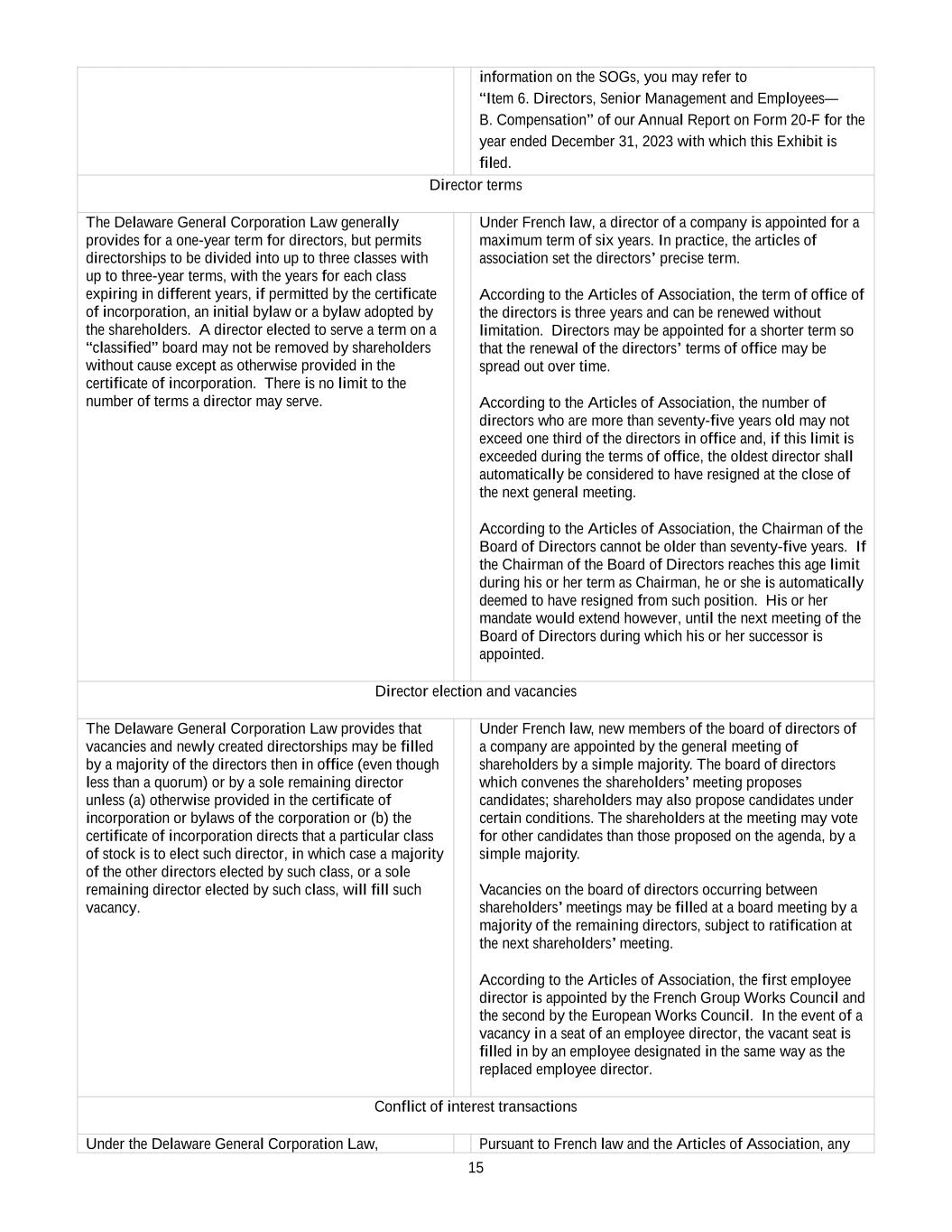
15 information on the SOGs, you may refer to “Item 6. Directors, Senior Management and Employees— B. Compensation” of our Annual Report on Form 20-F for the year ended December 31, 2023 with which this Exhibit is filed. Director terms The Delaware General Corporation Law generally provides for a one-year term for directors, but permits directorships to be divided into up to three classes with up to three-year terms, with the years for each class expiring in different years, if permitted by the certificate of incorporation, an initial bylaw or a bylaw adopted by the shareholders. A director elected to serve a term on a “classified” board may not be removed by shareholders without cause except as otherwise provided in the certificate of incorporation. There is no limit to the number of terms a director may serve. Under French law, a director of a company is appointed for a maximum term of six years. In practice, the articles of association set the directors’ precise term. According to the Articles of Association, the term of office of the directors is three years and can be renewed without limitation. Directors may be appointed for a shorter term so that the renewal of the directors’ terms of office may be spread out over time. According to the Articles of Association, the number of directors who are more than seventy-five years old may not exceed one third of the directors in office and, if this limit is exceeded during the terms of office, the oldest director shall automatically be considered to have resigned at the close of the next general meeting. According to the Articles of Association, the Chairman of the Board of Directors cannot be older than seventy-five years. If the Chairman of the Board of Directors reaches this age limit during his or her term as Chairman, he or she is automatically deemed to have resigned from such position. His or her mandate would extend however, until the next meeting of the Board of Directors during which his or her successor is appointed. Director election and vacancies The Delaware General Corporation Law provides that vacancies and newly created directorships may be filled by a majority of the directors then in office (even though less than a quorum) or by a sole remaining director unless (a) otherwise provided in the certificate of incorporation or bylaws of the corporation or (b) the certificate of incorporation directs that a particular class of stock is to elect such director, in which case a majority of the other directors elected by such class, or a sole remaining director elected by such class, will fill such vacancy. Under French law, new members of the board of directors of a company are appointed by the general meeting of shareholders by a simple majority. The board of directors which convenes the shareholders’ meeting proposes candidates; shareholders may also propose candidates under certain conditions. The shareholders at the meeting may vote for other candidates than those proposed on the agenda, by a simple majority. Vacancies on the board of directors occurring between shareholders’ meetings may be filled at a board meeting by a majority of the remaining directors, subject to ratification at the next shareholders’ meeting. According to the Articles of Association, the first employee director is appointed by the French Group Works Council and the second by the European Works Council. In the event of a vacancy in a seat of an employee director, the vacant seat is filled in by an employee designated in the same way as the replaced employee director. Conflict of interest transactions Under the Delaware General Corporation Law, Pursuant to French law and the Articles of Association, any
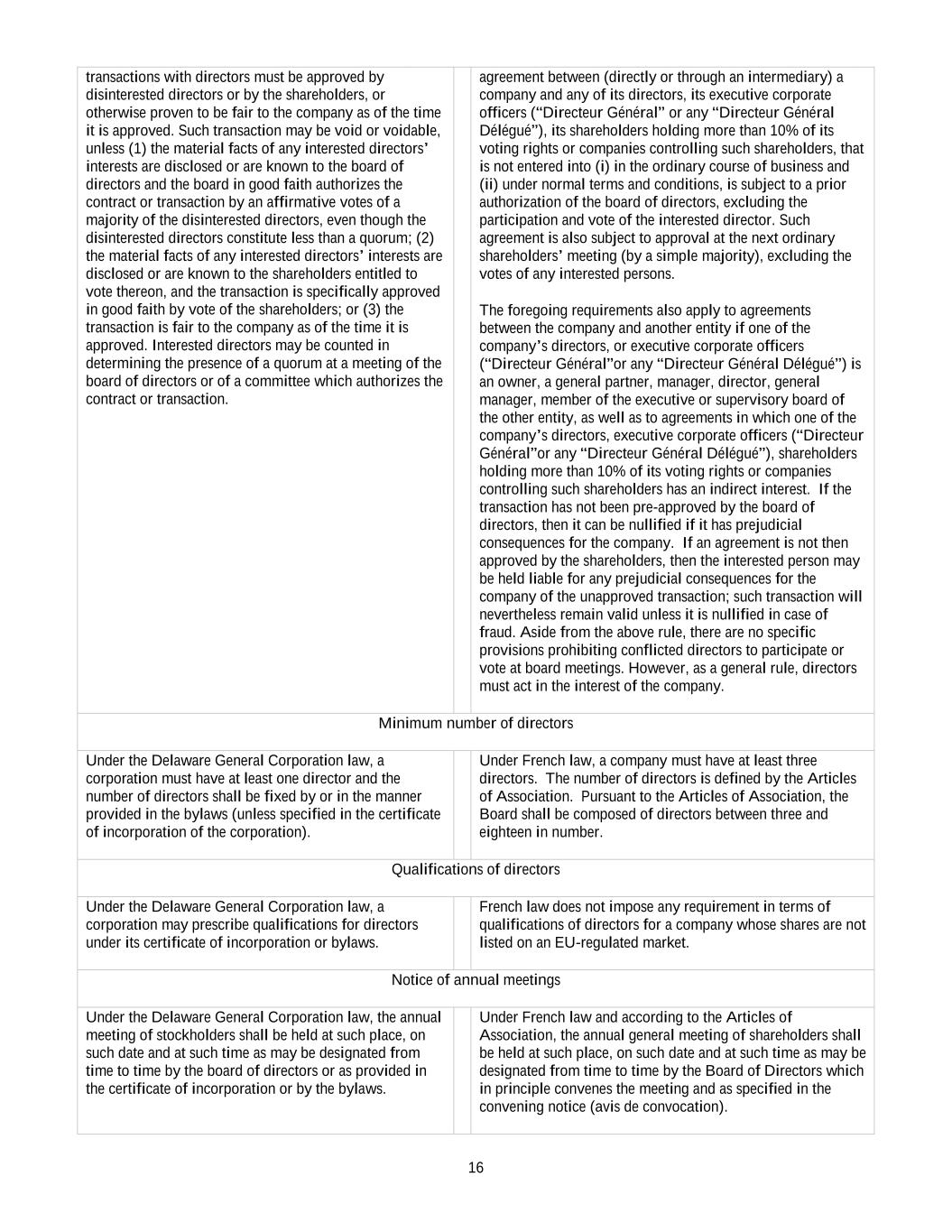
16 transactions with directors must be approved by disinterested directors or by the shareholders, or otherwise proven to be fair to the company as of the time it is approved. Such transaction may be void or voidable, unless (1) the material facts of any interested directors’ interests are disclosed or are known to the board of directors and the board in good faith authorizes the contract or transaction by an affirmative votes of a majority of the disinterested directors, even though the disinterested directors constitute less than a quorum; (2) the material facts of any interested directors’ interests are disclosed or are known to the shareholders entitled to vote thereon, and the transaction is specifically approved in good faith by vote of the shareholders; or (3) the transaction is fair to the company as of the time it is approved. Interested directors may be counted in determining the presence of a quorum at a meeting of the board of directors or of a committee which authorizes the contract or transaction. agreement between (directly or through an intermediary) a company and any of its directors, its executive corporate officers (“Directeur Général” or any “Directeur Général Délégué”), its shareholders holding more than 10% of its voting rights or companies controlling such shareholders, that is not entered into (i) in the ordinary course of business and (ii) under normal terms and conditions, is subject to a prior authorization of the board of directors, excluding the participation and vote of the interested director. Such agreement is also subject to approval at the next ordinary shareholders’ meeting (by a simple majority), excluding the votes of any interested persons. The foregoing requirements also apply to agreements between the company and another entity if one of the company’s directors, or executive corporate officers (“Directeur Général”or any “Directeur Général Délégué”) is an owner, a general partner, manager, director, general manager, member of the executive or supervisory board of the other entity, as well as to agreements in which one of the company’s directors, executive corporate officers (“Directeur Général”or any “Directeur Général Délégué”), shareholders holding more than 10% of its voting rights or companies controlling such shareholders has an indirect interest. If the transaction has not been pre-approved by the board of directors, then it can be nullified if it has prejudicial consequences for the company. If an agreement is not then approved by the shareholders, then the interested person may be held liable for any prejudicial consequences for the company of the unapproved transaction; such transaction will nevertheless remain valid unless it is nullified in case of fraud. Aside from the above rule, there are no specific provisions prohibiting conflicted directors to participate or vote at board meetings. However, as a general rule, directors must act in the interest of the company. Minimum number of directors Under the Delaware General Corporation law, a corporation must have at least one director and the number of directors shall be fixed by or in the manner provided in the bylaws (unless specified in the certificate of incorporation of the corporation). Under French law, a company must have at least three directors. The number of directors is defined by the Articles of Association. Pursuant to the Articles of Association, the Board shall be composed of directors between three and eighteen in number. Qualifications of directors Under the Delaware General Corporation law, a corporation may prescribe qualifications for directors under its certificate of incorporation or bylaws. French law does not impose any requirement in terms of qualifications of directors for a company whose shares are not listed on an EU-regulated market. Notice of annual meetings Under the Delaware General Corporation law, the annual meeting of stockholders shall be held at such place, on such date and at such time as may be designated from time to time by the board of directors or as provided in the certificate of incorporation or by the bylaws. Under French law and according to the Articles of Association, the annual general meeting of shareholders shall be held at such place, on such date and at such time as may be designated from time to time by the Board of Directors which in principle convenes the meeting and as specified in the convening notice (avis de convocation).
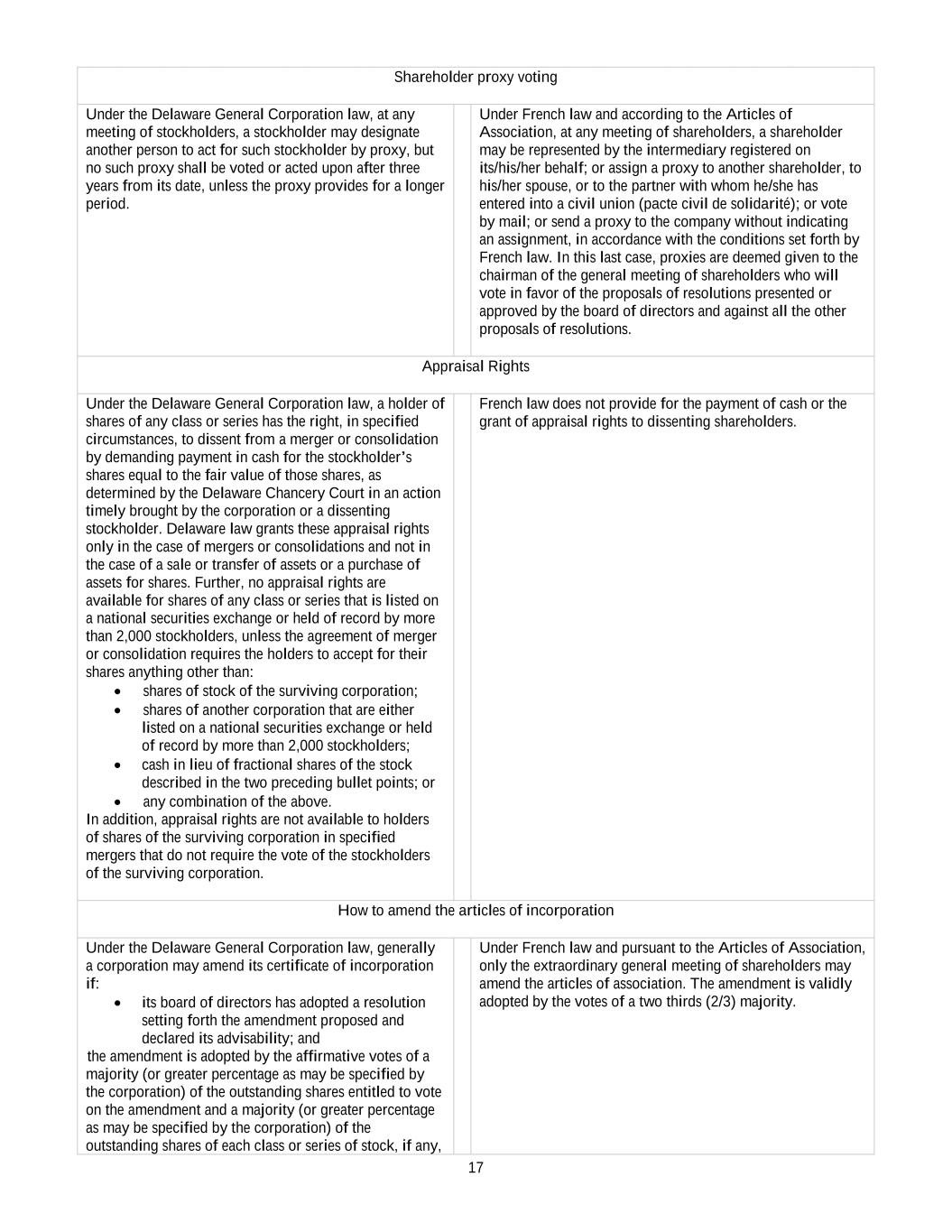
17 Shareholder proxy voting Under the Delaware General Corporation law, at any meeting of stockholders, a stockholder may designate another person to act for such stockholder by proxy, but no such proxy shall be voted or acted upon after three years from its date, unless the proxy provides for a longer period. Under French law and according to the Articles of Association, at any meeting of shareholders, a shareholder may be represented by the intermediary registered on its/his/her behalf; or assign a proxy to another shareholder, to his/her spouse, or to the partner with whom he/she has entered into a civil union (pacte civil de solidarité); or vote by mail; or send a proxy to the company without indicating an assignment, in accordance with the conditions set forth by French law. In this last case, proxies are deemed given to the chairman of the general meeting of shareholders who will vote in favor of the proposals of resolutions presented or approved by the board of directors and against all the other proposals of resolutions. Appraisal Rights Under the Delaware General Corporation law, a holder of shares of any class or series has the right, in specified circumstances, to dissent from a merger or consolidation by demanding payment in cash for the stockholder’s shares equal to the fair value of those shares, as determined by the Delaware Chancery Court in an action timely brought by the corporation or a dissenting stockholder. Delaware law grants these appraisal rights only in the case of mergers or consolidations and not in the case of a sale or transfer of assets or a purchase of assets for shares. Further, no appraisal rights are available for shares of any class or series that is listed on a national securities exchange or held of record by more than 2,000 stockholders, unless the agreement of merger or consolidation requires the holders to accept for their shares anything other than: • shares of stock of the surviving corporation; • shares of another corporation that are either listed on a national securities exchange or held of record by more than 2,000 stockholders; • cash in lieu of fractional shares of the stock described in the two preceding bullet points; or • any combination of the above. In addition, appraisal rights are not available to holders of shares of the surviving corporation in specified mergers that do not require the vote of the stockholders of the surviving corporation. French law does not provide for the payment of cash or the grant of appraisal rights to dissenting shareholders. How to amend the articles of incorporation Under the Delaware General Corporation law, generally a corporation may amend its certificate of incorporation if: • its board of directors has adopted a resolution setting forth the amendment proposed and declared its advisability; and the amendment is adopted by the affirmative votes of a majority (or greater percentage as may be specified by the corporation) of the outstanding shares entitled to vote on the amendment and a majority (or greater percentage as may be specified by the corporation) of the outstanding shares of each class or series of stock, if any, Under French law and pursuant to the Articles of Association, only the extraordinary general meeting of shareholders may amend the articles of association. The amendment is validly adopted by the votes of a two thirds (2/3) majority.
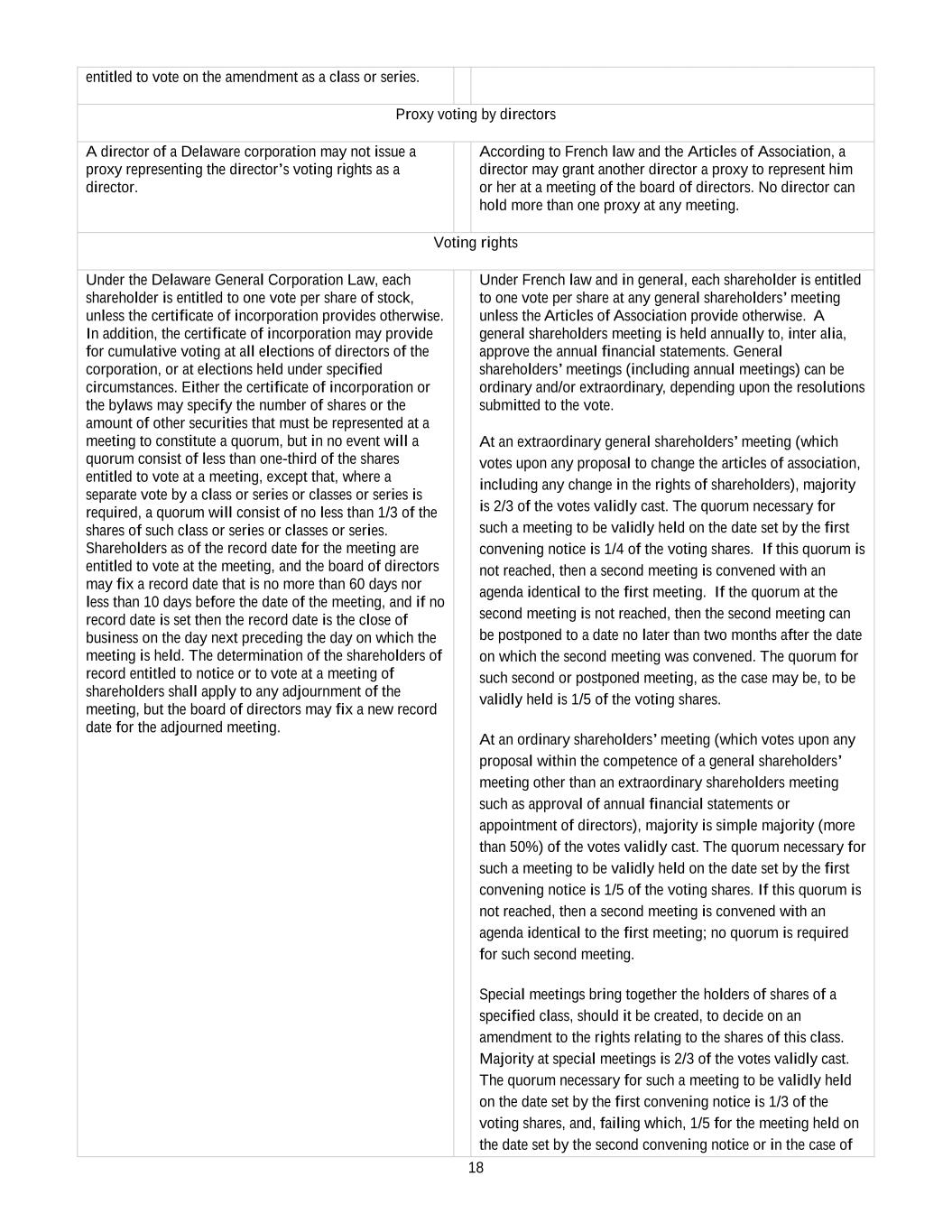
18 entitled to vote on the amendment as a class or series. Proxy voting by directors A director of a Delaware corporation may not issue a proxy representing the director’s voting rights as a director. According to French law and the Articles of Association, a director may grant another director a proxy to represent him or her at a meeting of the board of directors. No director can hold more than one proxy at any meeting. Voting rights Under the Delaware General Corporation Law, each shareholder is entitled to one vote per share of stock, unless the certificate of incorporation provides otherwise. In addition, the certificate of incorporation may provide for cumulative voting at all elections of directors of the corporation, or at elections held under specified circumstances. Either the certificate of incorporation or the bylaws may specify the number of shares or the amount of other securities that must be represented at a meeting to constitute a quorum, but in no event will a quorum consist of less than one-third of the shares entitled to vote at a meeting, except that, where a separate vote by a class or series or classes or series is required, a quorum will consist of no less than 1/3 of the shares of such class or series or classes or series. Shareholders as of the record date for the meeting are entitled to vote at the meeting, and the board of directors may fix a record date that is no more than 60 days nor less than 10 days before the date of the meeting, and if no record date is set then the record date is the close of business on the day next preceding the day on which the meeting is held. The determination of the shareholders of record entitled to notice or to vote at a meeting of shareholders shall apply to any adjournment of the meeting, but the board of directors may fix a new record date for the adjourned meeting. Under French law and in general, each shareholder is entitled to one vote per share at any general shareholders’ meeting unless the Articles of Association provide otherwise. A general shareholders meeting is held annually to, inter alia, approve the annual financial statements. General shareholders’ meetings (including annual meetings) can be ordinary and/or extraordinary, depending upon the resolutions submitted to the vote. At an extraordinary general shareholders’ meeting (which votes upon any proposal to change the articles of association, including any change in the rights of shareholders), majority is 2/3 of the votes validly cast. The quorum necessary for such a meeting to be validly held on the date set by the first convening notice is 1/4 of the voting shares. If this quorum is not reached, then a second meeting is convened with an agenda identical to the first meeting. If the quorum at the second meeting is not reached, then the second meeting can be postponed to a date no later than two months after the date on which the second meeting was convened. The quorum for such second or postponed meeting, as the case may be, to be validly held is 1/5 of the voting shares. At an ordinary shareholders’ meeting (which votes upon any proposal within the competence of a general shareholders’ meeting other than an extraordinary shareholders meeting such as approval of annual financial statements or appointment of directors), majority is simple majority (more than 50%) of the votes validly cast. The quorum necessary for such a meeting to be validly held on the date set by the first convening notice is 1/5 of the voting shares. If this quorum is not reached, then a second meeting is convened with an agenda identical to the first meeting; no quorum is required for such second meeting. Special meetings bring together the holders of shares of a specified class, should it be created, to decide on an amendment to the rights relating to the shares of this class. Majority at special meetings is 2/3 of the votes validly cast. The quorum necessary for such a meeting to be validly held on the date set by the first convening notice is 1/3 of the voting shares, and, failing which, 1/5 for the meeting held on the date set by the second convening notice or in the case of
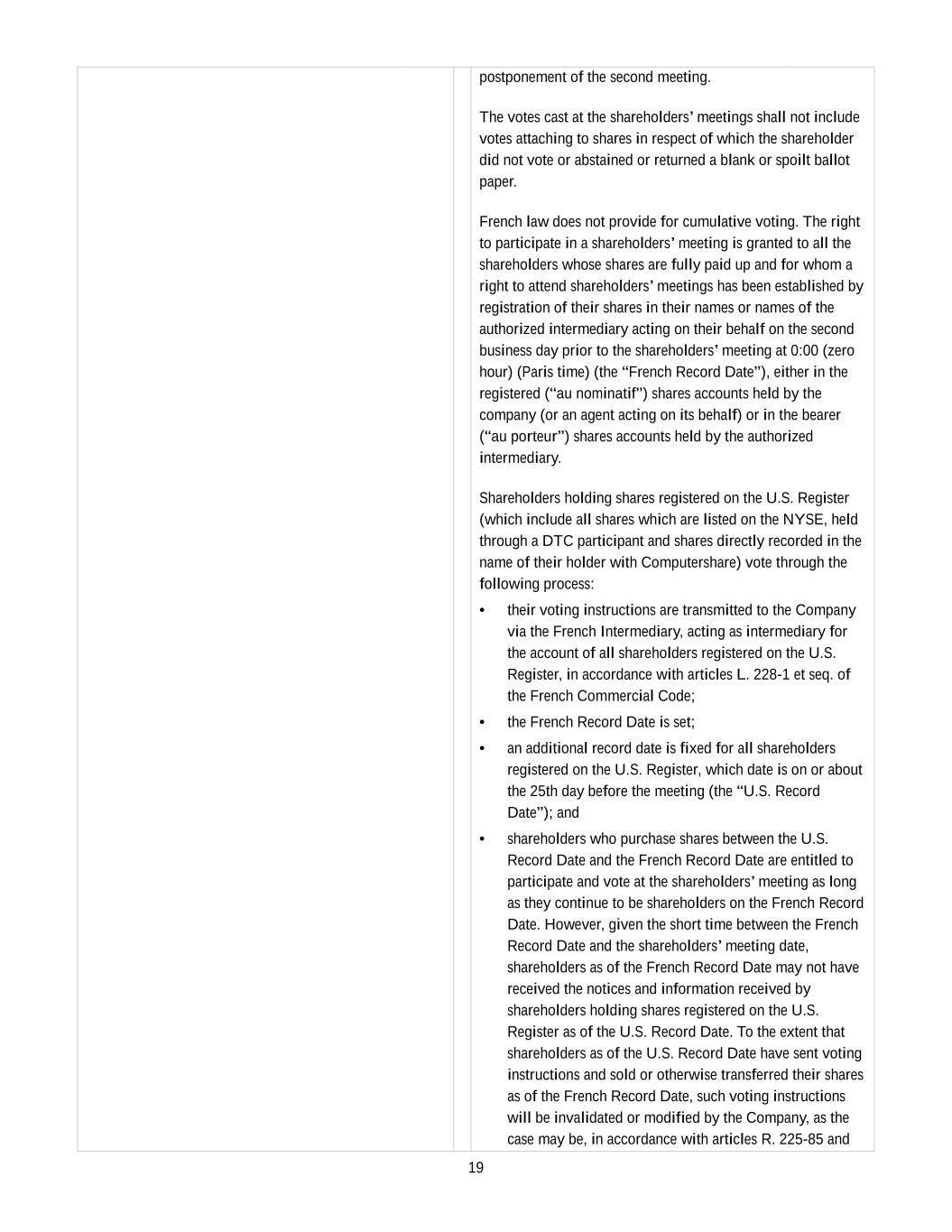
19 postponement of the second meeting. The votes cast at the shareholders’ meetings shall not include votes attaching to shares in respect of which the shareholder did not vote or abstained or returned a blank or spoilt ballot paper. French law does not provide for cumulative voting. The right to participate in a shareholders’ meeting is granted to all the shareholders whose shares are fully paid up and for whom a right to attend shareholders’ meetings has been established by registration of their shares in their names or names of the authorized intermediary acting on their behalf on the second business day prior to the shareholders’ meeting at 0:00 (zero hour) (Paris time) (the “French Record Date”), either in the registered (“au nominatif”) shares accounts held by the company (or an agent acting on its behalf) or in the bearer (“au porteur”) shares accounts held by the authorized intermediary. Shareholders holding shares registered on the U.S. Register (which include all shares which are listed on the NYSE, held through a DTC participant and shares directly recorded in the name of their holder with Computershare) vote through the following process: • their voting instructions are transmitted to the Company via the French Intermediary, acting as intermediary for the account of all shareholders registered on the U.S. Register, in accordance with articles L. 228-1 et seq. of the French Commercial Code; • the French Record Date is set; • an additional record date is fixed for all shareholders registered on the U.S. Register, which date is on or about the 25th day before the meeting (the “U.S. Record Date”); and • shareholders who purchase shares between the U.S. Record Date and the French Record Date are entitled to participate and vote at the shareholders’ meeting as long as they continue to be shareholders on the French Record Date. However, given the short time between the French Record Date and the shareholders’ meeting date, shareholders as of the French Record Date may not have received the notices and information received by shareholders holding shares registered on the U.S. Register as of the U.S. Record Date. To the extent that shareholders as of the U.S. Record Date have sent voting instructions and sold or otherwise transferred their shares as of the French Record Date, such voting instructions will be invalidated or modified by the Company, as the case may be, in accordance with articles R. 225-85 and
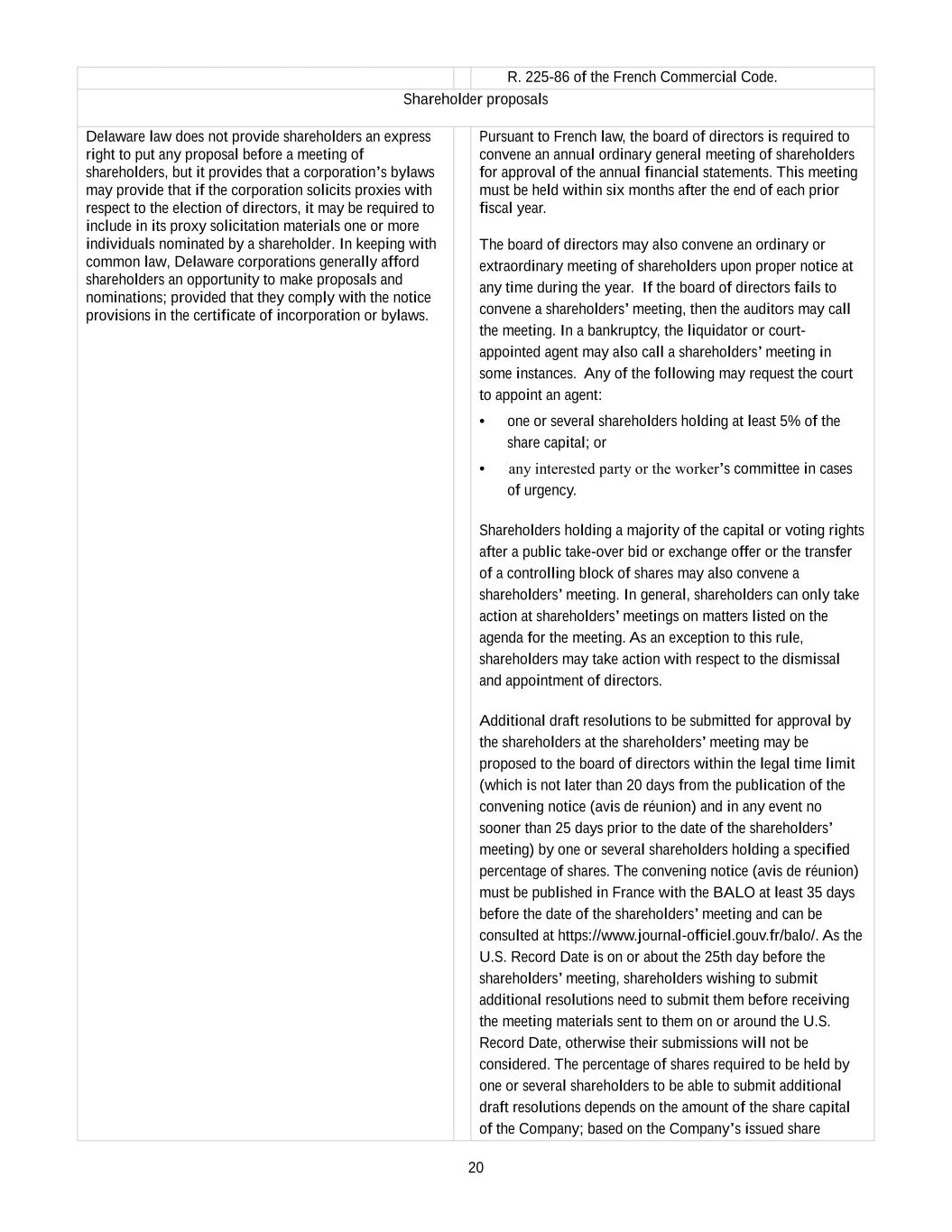
20 R. 225-86 of the French Commercial Code. Shareholder proposals Delaware law does not provide shareholders an express right to put any proposal before a meeting of shareholders, but it provides that a corporation’s bylaws may provide that if the corporation solicits proxies with respect to the election of directors, it may be required to include in its proxy solicitation materials one or more individuals nominated by a shareholder. In keeping with common law, Delaware corporations generally afford shareholders an opportunity to make proposals and nominations; provided that they comply with the notice provisions in the certificate of incorporation or bylaws. Pursuant to French law, the board of directors is required to convene an annual ordinary general meeting of shareholders for approval of the annual financial statements. This meeting must be held within six months after the end of each prior fiscal year. The board of directors may also convene an ordinary or extraordinary meeting of shareholders upon proper notice at any time during the year. If the board of directors fails to convene a shareholders’ meeting, then the auditors may call the meeting. In a bankruptcy, the liquidator or court- appointed agent may also call a shareholders’ meeting in some instances. Any of the following may request the court to appoint an agent: • one or several shareholders holding at least 5% of the share capital; or • any interested party or the worker’s committee in cases of urgency. Shareholders holding a majority of the capital or voting rights after a public take-over bid or exchange offer or the transfer of a controlling block of shares may also convene a shareholders’ meeting. In general, shareholders can only take action at shareholders’ meetings on matters listed on the agenda for the meeting. As an exception to this rule, shareholders may take action with respect to the dismissal and appointment of directors. Additional draft resolutions to be submitted for approval by the shareholders at the shareholders’ meeting may be proposed to the board of directors within the legal time limit (which is not later than 20 days from the publication of the convening notice (avis de réunion) and in any event no sooner than 25 days prior to the date of the shareholders’ meeting) by one or several shareholders holding a specified percentage of shares. The convening notice (avis de réunion) must be published in France with the BALO at least 35 days before the date of the shareholders’ meeting and can be consulted at https://www.journal-officiel.gouv.fr/balo/. As the U.S. Record Date is on or about the 25th day before the shareholders’ meeting, shareholders wishing to submit additional resolutions need to submit them before receiving the meeting materials sent to them on or around the U.S. Record Date, otherwise their submissions will not be considered. The percentage of shares required to be held by one or several shareholders to be able to submit additional draft resolutions depends on the amount of the share capital of the Company; based on the Company’s issued share
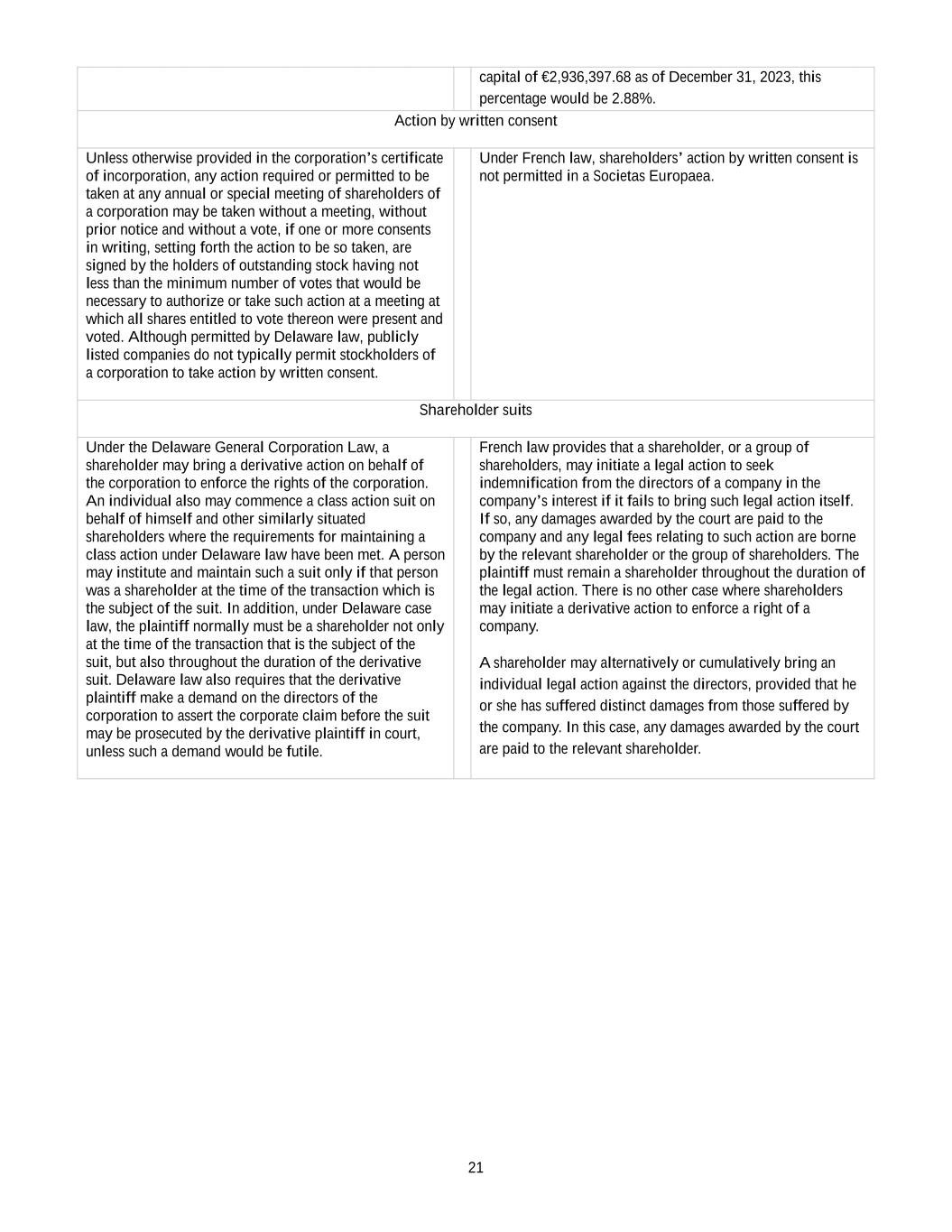
21 capital of €2,936,397.68 as of December 31, 2023, this percentage would be 2.88%. Action by written consent Unless otherwise provided in the corporation’s certificate of incorporation, any action required or permitted to be taken at any annual or special meeting of shareholders of a corporation may be taken without a meeting, without prior notice and without a vote, if one or more consents in writing, setting forth the action to be so taken, are signed by the holders of outstanding stock having not less than the minimum number of votes that would be necessary to authorize or take such action at a meeting at which all shares entitled to vote thereon were present and voted. Although permitted by Delaware law, publicly listed companies do not typically permit stockholders of a corporation to take action by written consent. Under French law, shareholders’ action by written consent is not permitted in a Societas Europaea. Shareholder suits Under the Delaware General Corporation Law, a shareholder may bring a derivative action on behalf of the corporation to enforce the rights of the corporation. An individual also may commence a class action suit on behalf of himself and other similarly situated shareholders where the requirements for maintaining a class action under Delaware law have been met. A person may institute and maintain such a suit only if that person was a shareholder at the time of the transaction which is the subject of the suit. In addition, under Delaware case law, the plaintiff normally must be a shareholder not only at the time of the transaction that is the subject of the suit, but also throughout the duration of the derivative suit. Delaware law also requires that the derivative plaintiff make a demand on the directors of the corporation to assert the corporate claim before the suit may be prosecuted by the derivative plaintiff in court, unless such a demand would be futile. French law provides that a shareholder, or a group of shareholders, may initiate a legal action to seek indemnification from the directors of a company in the company’s interest if it fails to bring such legal action itself. If so, any damages awarded by the court are paid to the company and any legal fees relating to such action are borne by the relevant shareholder or the group of shareholders. The plaintiff must remain a shareholder throughout the duration of the legal action. There is no other case where shareholders may initiate a derivative action to enforce a right of a company. A shareholder may alternatively or cumulatively bring an individual legal action against the directors, provided that he or she has suffered distinct damages from those suffered by the company. In this case, any damages awarded by the court are paid to the relevant shareholder.
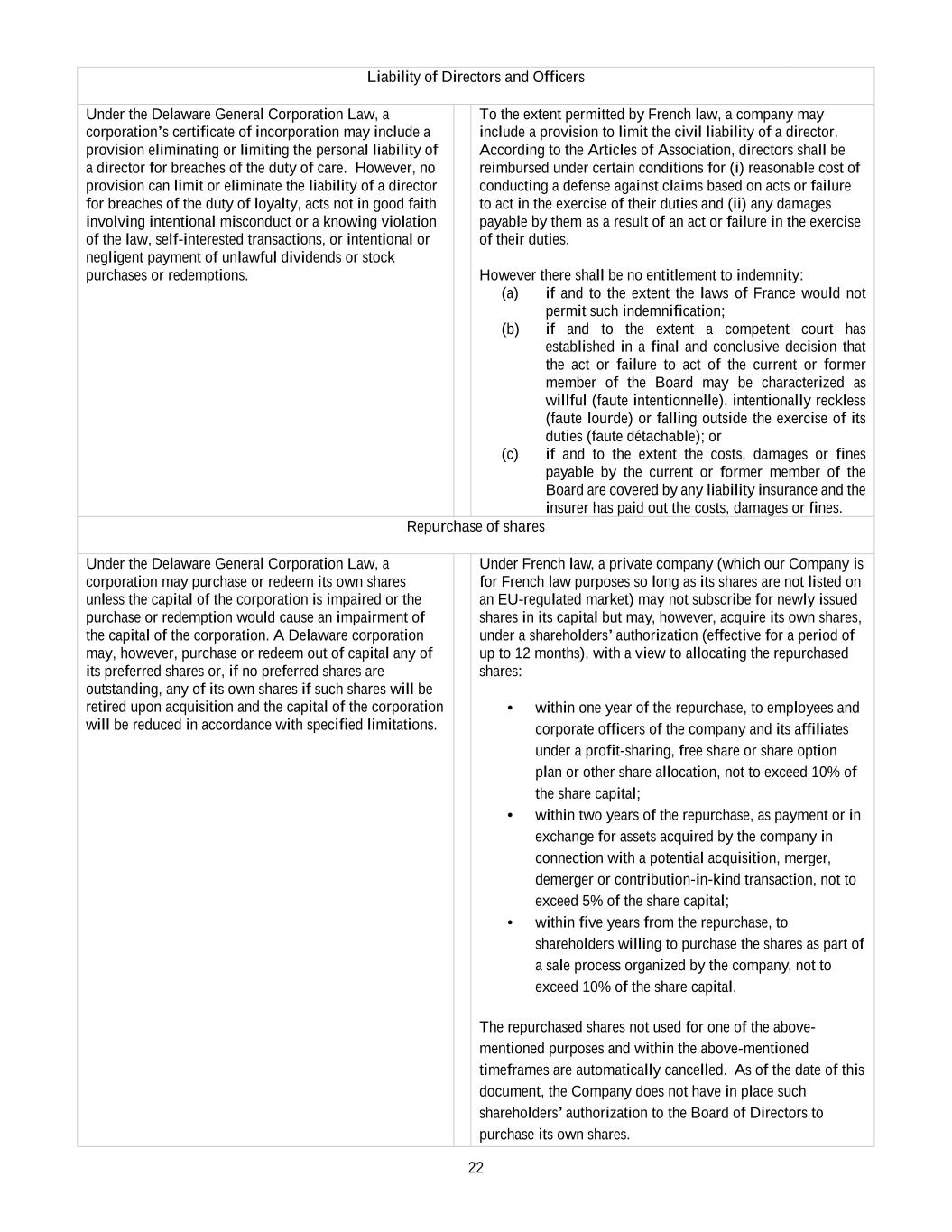
22 Liability of Directors and Officers Under the Delaware General Corporation Law, a corporation’s certificate of incorporation may include a provision eliminating or limiting the personal liability of a director for breaches of the duty of care. However, no provision can limit or eliminate the liability of a director for breaches of the duty of loyalty, acts not in good faith involving intentional misconduct or a knowing violation of the law, self-interested transactions, or intentional or negligent payment of unlawful dividends or stock purchases or redemptions. To the extent permitted by French law, a company may include a provision to limit the civil liability of a director. According to the Articles of Association, directors shall be reimbursed under certain conditions for (i) reasonable cost of conducting a defense against claims based on acts or failure to act in the exercise of their duties and (ii) any damages payable by them as a result of an act or failure in the exercise of their duties. However there shall be no entitlement to indemnity: (a) if and to the extent the laws of France would not permit such indemnification; (b) if and to the extent a competent court has established in a final and conclusive decision that the act or failure to act of the current or former member of the Board may be characterized as willful (faute intentionnelle), intentionally reckless (faute lourde) or falling outside the exercise of its duties (faute détachable); or (c) if and to the extent the costs, damages or fines payable by the current or former member of the Board are covered by any liability insurance and the insurer has paid out the costs, damages or fines. Repurchase of shares Under the Delaware General Corporation Law, a corporation may purchase or redeem its own shares unless the capital of the corporation is impaired or the purchase or redemption would cause an impairment of the capital of the corporation. A Delaware corporation may, however, purchase or redeem out of capital any of its preferred shares or, if no preferred shares are outstanding, any of its own shares if such shares will be retired upon acquisition and the capital of the corporation will be reduced in accordance with specified limitations. Under French law, a private company (which our Company is for French law purposes so long as its shares are not listed on an EU-regulated market) may not subscribe for newly issued shares in its capital but may, however, acquire its own shares, under a shareholders’ authorization (effective for a period of up to 12 months), with a view to allocating the repurchased shares: • within one year of the repurchase, to employees and corporate officers of the company and its affiliates under a profit-sharing, free share or share option plan or other share allocation, not to exceed 10% of the share capital; • within two years of the repurchase, as payment or in exchange for assets acquired by the company in connection with a potential acquisition, merger, demerger or contribution-in-kind transaction, not to exceed 5% of the share capital; • within five years from the repurchase, to shareholders willing to purchase the shares as part of a sale process organized by the company, not to exceed 10% of the share capital. The repurchased shares not used for one of the above- mentioned purposes and within the above-mentioned timeframes are automatically cancelled. As of the date of this document, the Company does not have in place such shareholders’ authorization to the Board of Directors to purchase its own shares.
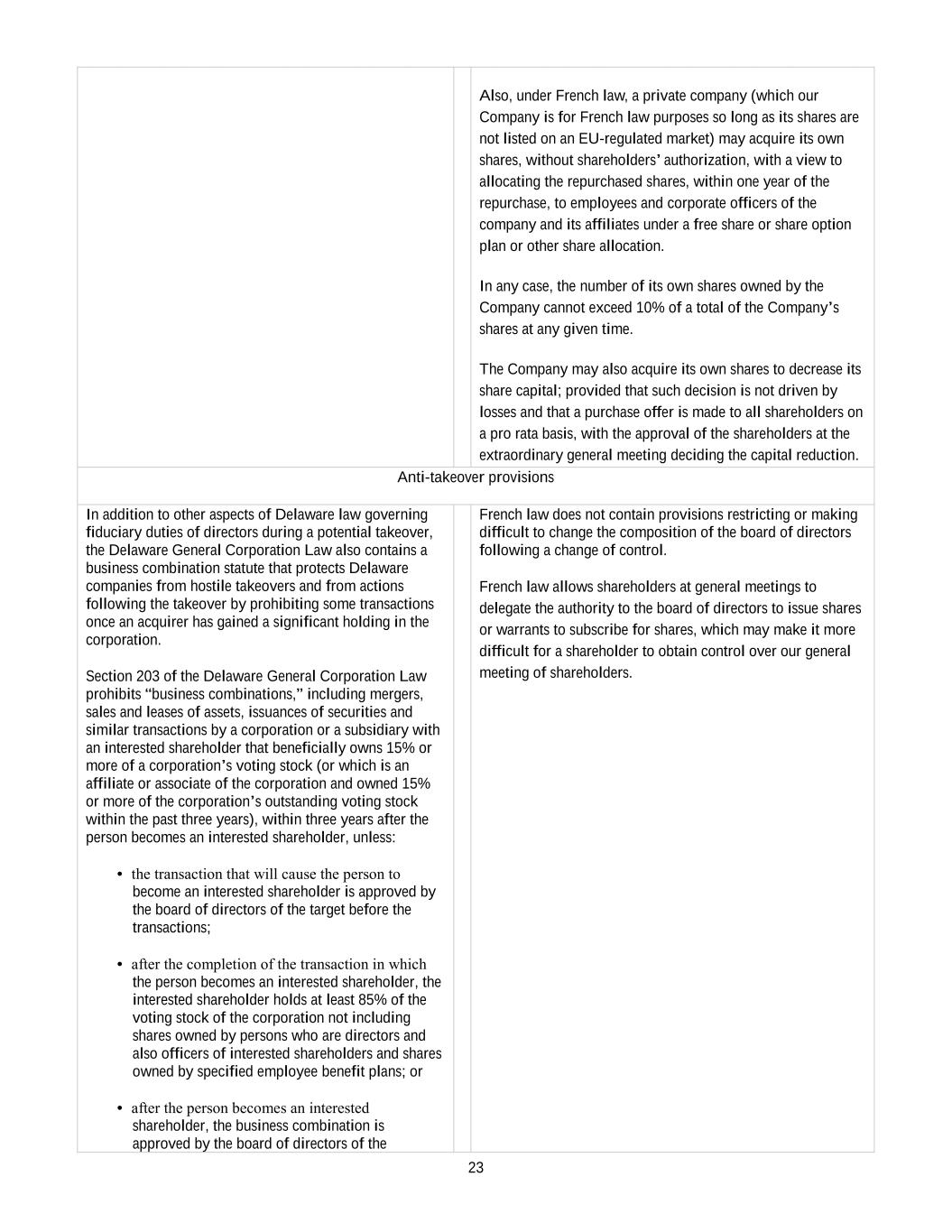
23 Also, under French law, a private company (which our Company is for French law purposes so long as its shares are not listed on an EU-regulated market) may acquire its own shares, without shareholders’ authorization, with a view to allocating the repurchased shares, within one year of the repurchase, to employees and corporate officers of the company and its affiliates under a free share or share option plan or other share allocation. In any case, the number of its own shares owned by the Company cannot exceed 10% of a total of the Company’s shares at any given time. The Company may also acquire its own shares to decrease its share capital; provided that such decision is not driven by losses and that a purchase offer is made to all shareholders on a pro rata basis, with the approval of the shareholders at the extraordinary general meeting deciding the capital reduction. Anti-takeover provisions In addition to other aspects of Delaware law governing fiduciary duties of directors during a potential takeover, the Delaware General Corporation Law also contains a business combination statute that protects Delaware companies from hostile takeovers and from actions following the takeover by prohibiting some transactions once an acquirer has gained a significant holding in the corporation. Section 203 of the Delaware General Corporation Law prohibits “business combinations,” including mergers, sales and leases of assets, issuances of securities and similar transactions by a corporation or a subsidiary with an interested shareholder that beneficially owns 15% or more of a corporation’s voting stock (or which is an affiliate or associate of the corporation and owned 15% or more of the corporation’s outstanding voting stock within the past three years), within three years after the person becomes an interested shareholder, unless: • the transaction that will cause the person to become an interested shareholder is approved by the board of directors of the target before the transactions; • after the completion of the transaction in which the person becomes an interested shareholder, the interested shareholder holds at least 85% of the voting stock of the corporation not including shares owned by persons who are directors and also officers of interested shareholders and shares owned by specified employee benefit plans; or • after the person becomes an interested shareholder, the business combination is approved by the board of directors of the French law does not contain provisions restricting or making difficult to change the composition of the board of directors following a change of control. French law allows shareholders at general meetings to delegate the authority to the board of directors to issue shares or warrants to subscribe for shares, which may make it more difficult for a shareholder to obtain control over our general meeting of shareholders.
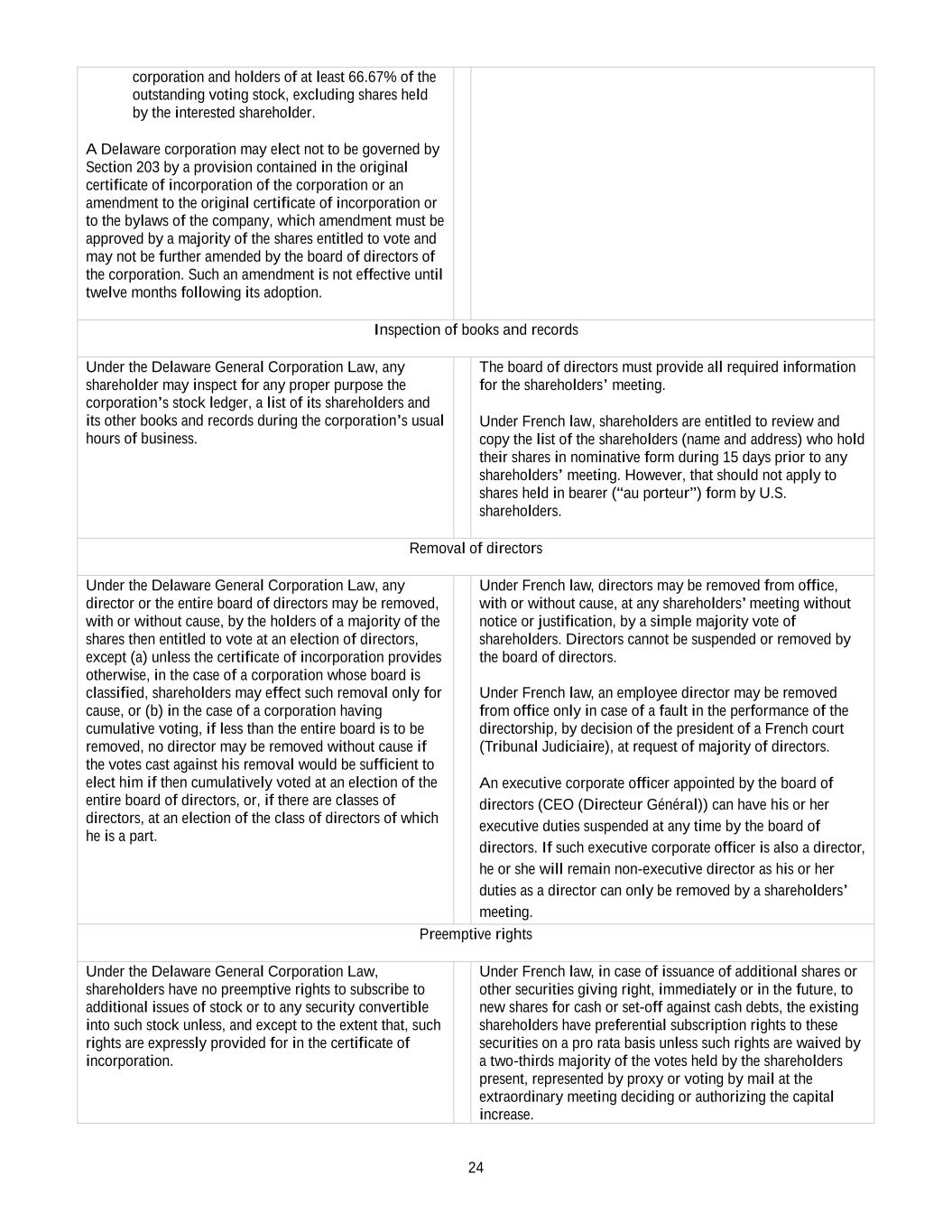
24 corporation and holders of at least 66.67% of the outstanding voting stock, excluding shares held by the interested shareholder. A Delaware corporation may elect not to be governed by Section 203 by a provision contained in the original certificate of incorporation of the corporation or an amendment to the original certificate of incorporation or to the bylaws of the company, which amendment must be approved by a majority of the shares entitled to vote and may not be further amended by the board of directors of the corporation. Such an amendment is not effective until twelve months following its adoption. Inspection of books and records Under the Delaware General Corporation Law, any shareholder may inspect for any proper purpose the corporation’s stock ledger, a list of its shareholders and its other books and records during the corporation’s usual hours of business. The board of directors must provide all required information for the shareholders’ meeting. Under French law, shareholders are entitled to review and copy the list of the shareholders (name and address) who hold their shares in nominative form during 15 days prior to any shareholders’ meeting. However, that should not apply to shares held in bearer (“au porteur”) form by U.S. shareholders. Removal of directors Under the Delaware General Corporation Law, any director or the entire board of directors may be removed, with or without cause, by the holders of a majority of the shares then entitled to vote at an election of directors, except (a) unless the certificate of incorporation provides otherwise, in the case of a corporation whose board is classified, shareholders may effect such removal only for cause, or (b) in the case of a corporation having cumulative voting, if less than the entire board is to be removed, no director may be removed without cause if the votes cast against his removal would be sufficient to elect him if then cumulatively voted at an election of the entire board of directors, or, if there are classes of directors, at an election of the class of directors of which he is a part. Under French law, directors may be removed from office, with or without cause, at any shareholders’ meeting without notice or justification, by a simple majority vote of shareholders. Directors cannot be suspended or removed by the board of directors. Under French law, an employee director may be removed from office only in case of a fault in the performance of the directorship, by decision of the president of a French court (Tribunal Judiciaire), at request of majority of directors. An executive corporate officer appointed by the board of directors (CEO (Directeur Général)) can have his or her executive duties suspended at any time by the board of directors. If such executive corporate officer is also a director, he or she will remain non-executive director as his or her duties as a director can only be removed by a shareholders’ meeting. Preemptive rights Under the Delaware General Corporation Law, shareholders have no preemptive rights to subscribe to additional issues of stock or to any security convertible into such stock unless, and except to the extent that, such rights are expressly provided for in the certificate of incorporation. Under French law, in case of issuance of additional shares or other securities giving right, immediately or in the future, to new shares for cash or set-off against cash debts, the existing shareholders have preferential subscription rights to these securities on a pro rata basis unless such rights are waived by a two-thirds majority of the votes held by the shareholders present, represented by proxy or voting by mail at the extraordinary meeting deciding or authorizing the capital increase.
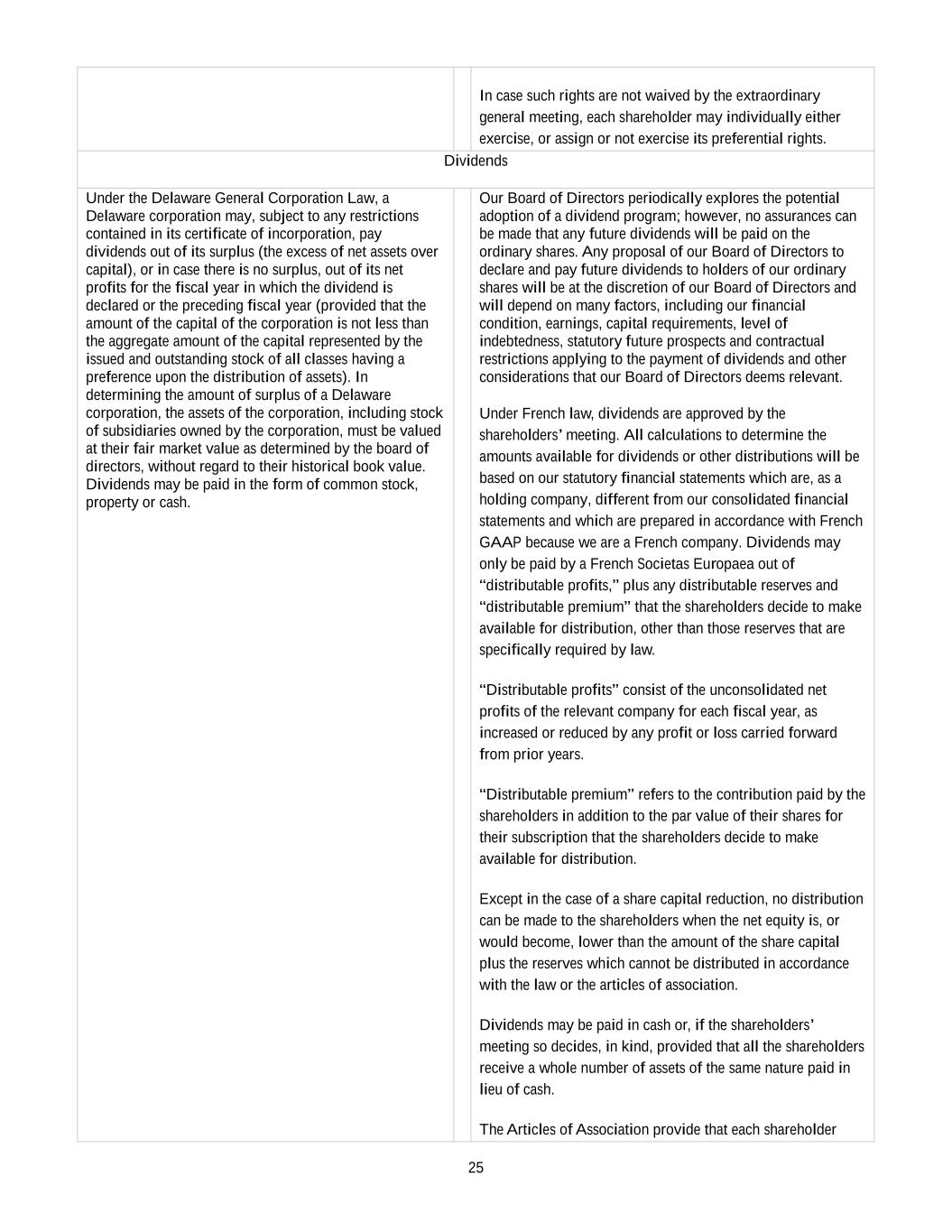
25 In case such rights are not waived by the extraordinary general meeting, each shareholder may individually either exercise, or assign or not exercise its preferential rights. Dividends Under the Delaware General Corporation Law, a Delaware corporation may, subject to any restrictions contained in its certificate of incorporation, pay dividends out of its surplus (the excess of net assets over capital), or in case there is no surplus, out of its net profits for the fiscal year in which the dividend is declared or the preceding fiscal year (provided that the amount of the capital of the corporation is not less than the aggregate amount of the capital represented by the issued and outstanding stock of all classes having a preference upon the distribution of assets). In determining the amount of surplus of a Delaware corporation, the assets of the corporation, including stock of subsidiaries owned by the corporation, must be valued at their fair market value as determined by the board of directors, without regard to their historical book value. Dividends may be paid in the form of common stock, property or cash. Our Board of Directors periodically explores the potential adoption of a dividend program; however, no assurances can be made that any future dividends will be paid on the ordinary shares. Any proposal of our Board of Directors to declare and pay future dividends to holders of our ordinary shares will be at the discretion of our Board of Directors and will depend on many factors, including our financial condition, earnings, capital requirements, level of indebtedness, statutory future prospects and contractual restrictions applying to the payment of dividends and other considerations that our Board of Directors deems relevant. Under French law, dividends are approved by the shareholders’ meeting. All calculations to determine the amounts available for dividends or other distributions will be based on our statutory financial statements which are, as a holding company, different from our consolidated financial statements and which are prepared in accordance with French GAAP because we are a French company. Dividends may only be paid by a French Societas Europaea out of “distributable profits,” plus any distributable reserves and “distributable premium” that the shareholders decide to make available for distribution, other than those reserves that are specifically required by law. “Distributable profits” consist of the unconsolidated net profits of the relevant company for each fiscal year, as increased or reduced by any profit or loss carried forward from prior years. “Distributable premium” refers to the contribution paid by the shareholders in addition to the par value of their shares for their subscription that the shareholders decide to make available for distribution. Except in the case of a share capital reduction, no distribution can be made to the shareholders when the net equity is, or would become, lower than the amount of the share capital plus the reserves which cannot be distributed in accordance with the law or the articles of association. Dividends may be paid in cash or, if the shareholders’ meeting so decides, in kind, provided that all the shareholders receive a whole number of assets of the same nature paid in lieu of cash. The Articles of Association provide that each shareholder
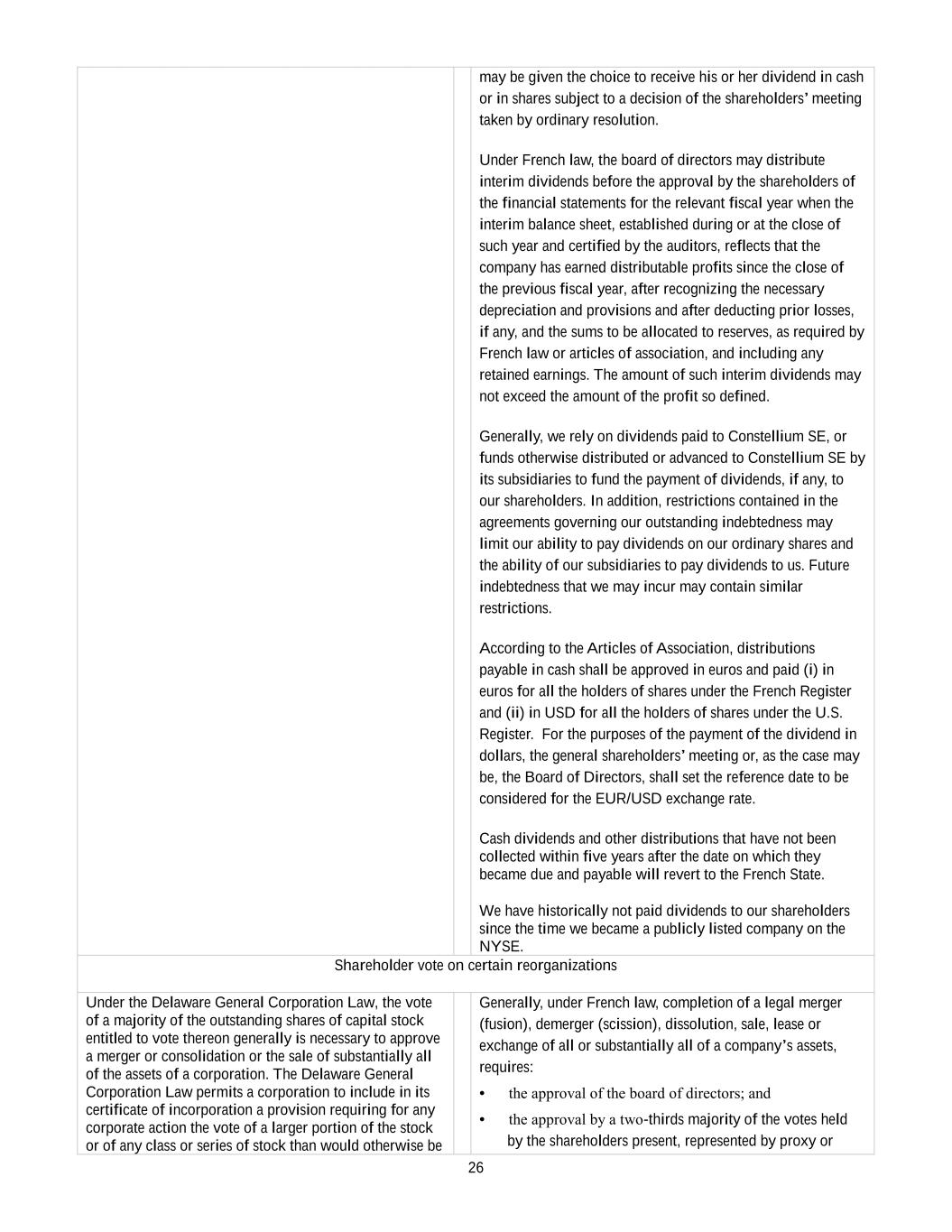
26 may be given the choice to receive his or her dividend in cash or in shares subject to a decision of the shareholders’ meeting taken by ordinary resolution. Under French law, the board of directors may distribute interim dividends before the approval by the shareholders of the financial statements for the relevant fiscal year when the interim balance sheet, established during or at the close of such year and certified by the auditors, reflects that the company has earned distributable profits since the close of the previous fiscal year, after recognizing the necessary depreciation and provisions and after deducting prior losses, if any, and the sums to be allocated to reserves, as required by French law or articles of association, and including any retained earnings. The amount of such interim dividends may not exceed the amount of the profit so defined. Generally, we rely on dividends paid to Constellium SE, or funds otherwise distributed or advanced to Constellium SE by its subsidiaries to fund the payment of dividends, if any, to our shareholders. In addition, restrictions contained in the agreements governing our outstanding indebtedness may limit our ability to pay dividends on our ordinary shares and the ability of our subsidiaries to pay dividends to us. Future indebtedness that we may incur may contain similar restrictions. According to the Articles of Association, distributions payable in cash shall be approved in euros and paid (i) in euros for all the holders of shares under the French Register and (ii) in USD for all the holders of shares under the U.S. Register. For the purposes of the payment of the dividend in dollars, the general shareholders’ meeting or, as the case may be, the Board of Directors, shall set the reference date to be considered for the EUR/USD exchange rate. Cash dividends and other distributions that have not been collected within five years after the date on which they became due and payable will revert to the French State. We have historically not paid dividends to our shareholders since the time we became a publicly listed company on the NYSE. Shareholder vote on certain reorganizations Under the Delaware General Corporation Law, the vote of a majority of the outstanding shares of capital stock entitled to vote thereon generally is necessary to approve a merger or consolidation or the sale of substantially all of the assets of a corporation. The Delaware General Corporation Law permits a corporation to include in its certificate of incorporation a provision requiring for any corporate action the vote of a larger portion of the stock or of any class or series of stock than would otherwise be Generally, under French law, completion of a legal merger (fusion), demerger (scission), dissolution, sale, lease or exchange of all or substantially all of a company’s assets, requires: • the approval of the board of directors; and • the approval by a two-thirds majority of the votes held by the shareholders present, represented by proxy or
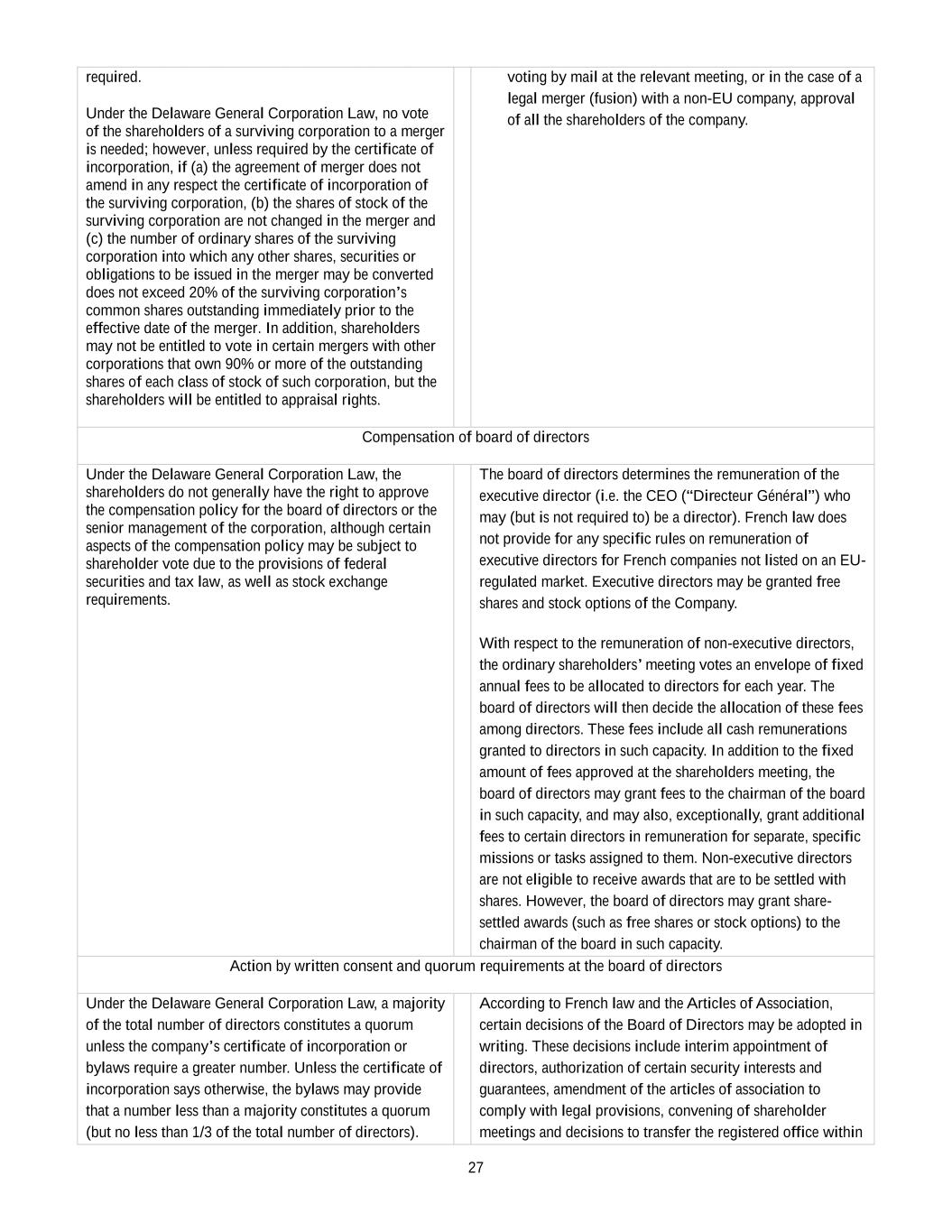
27 required. Under the Delaware General Corporation Law, no vote of the shareholders of a surviving corporation to a merger is needed; however, unless required by the certificate of incorporation, if (a) the agreement of merger does not amend in any respect the certificate of incorporation of the surviving corporation, (b) the shares of stock of the surviving corporation are not changed in the merger and (c) the number of ordinary shares of the surviving corporation into which any other shares, securities or obligations to be issued in the merger may be converted does not exceed 20% of the surviving corporation’s common shares outstanding immediately prior to the effective date of the merger. In addition, shareholders may not be entitled to vote in certain mergers with other corporations that own 90% or more of the outstanding shares of each class of stock of such corporation, but the shareholders will be entitled to appraisal rights. voting by mail at the relevant meeting, or in the case of a legal merger (fusion) with a non-EU company, approval of all the shareholders of the company. Compensation of board of directors Under the Delaware General Corporation Law, the shareholders do not generally have the right to approve the compensation policy for the board of directors or the senior management of the corporation, although certain aspects of the compensation policy may be subject to shareholder vote due to the provisions of federal securities and tax law, as well as stock exchange requirements. The board of directors determines the remuneration of the executive director (i.e. the CEO (“Directeur Général”) who may (but is not required to) be a director). French law does not provide for any specific rules on remuneration of executive directors for French companies not listed on an EU- regulated market. Executive directors may be granted free shares and stock options of the Company. With respect to the remuneration of non-executive directors, the ordinary shareholders’ meeting votes an envelope of fixed annual fees to be allocated to directors for each year. The board of directors will then decide the allocation of these fees among directors. These fees include all cash remunerations granted to directors in such capacity. In addition to the fixed amount of fees approved at the shareholders meeting, the board of directors may grant fees to the chairman of the board in such capacity, and may also, exceptionally, grant additional fees to certain directors in remuneration for separate, specific missions or tasks assigned to them. Non-executive directors are not eligible to receive awards that are to be settled with shares. However, the board of directors may grant share- settled awards (such as free shares or stock options) to the chairman of the board in such capacity. Action by written consent and quorum requirements at the board of directors Under the Delaware General Corporation Law, a majority of the total number of directors constitutes a quorum unless the company’s certificate of incorporation or bylaws require a greater number. Unless the certificate of incorporation says otherwise, the bylaws may provide that a number less than a majority constitutes a quorum (but no less than 1/3 of the total number of directors). According to French law and the Articles of Association, certain decisions of the Board of Directors may be adopted in writing. These decisions include interim appointment of directors, authorization of certain security interests and guarantees, amendment of the articles of association to comply with legal provisions, convening of shareholder meetings and decisions to transfer the registered office within

28 The vote of the majority of the directors present at a meeting at which a quorum is present shall be the act of the board unless the certificate of incorporation or bylaws require the vote of a greater number. Unless otherwise restricted by the certificate of incorporation or bylaws, the board or any committee may take any action without a meeting if all members consent thereto in writing or by electronic transmission. the same department. According to French law and the Articles of Association, a director may grant to another director a proxy to represent him or her at a meeting of the board of directors. No director can hold more than one proxy at any meeting. According to French law and the Articles of Association, for the board’s deliberations to be valid, more than half of the board members must be present or represented. The board of directors’ decisions shall be taken by a majority vote; if the votes are tied, the chairman’s vote shall be decisive.
exhibit1096_releaseagree
exhibit10155_amendmentno
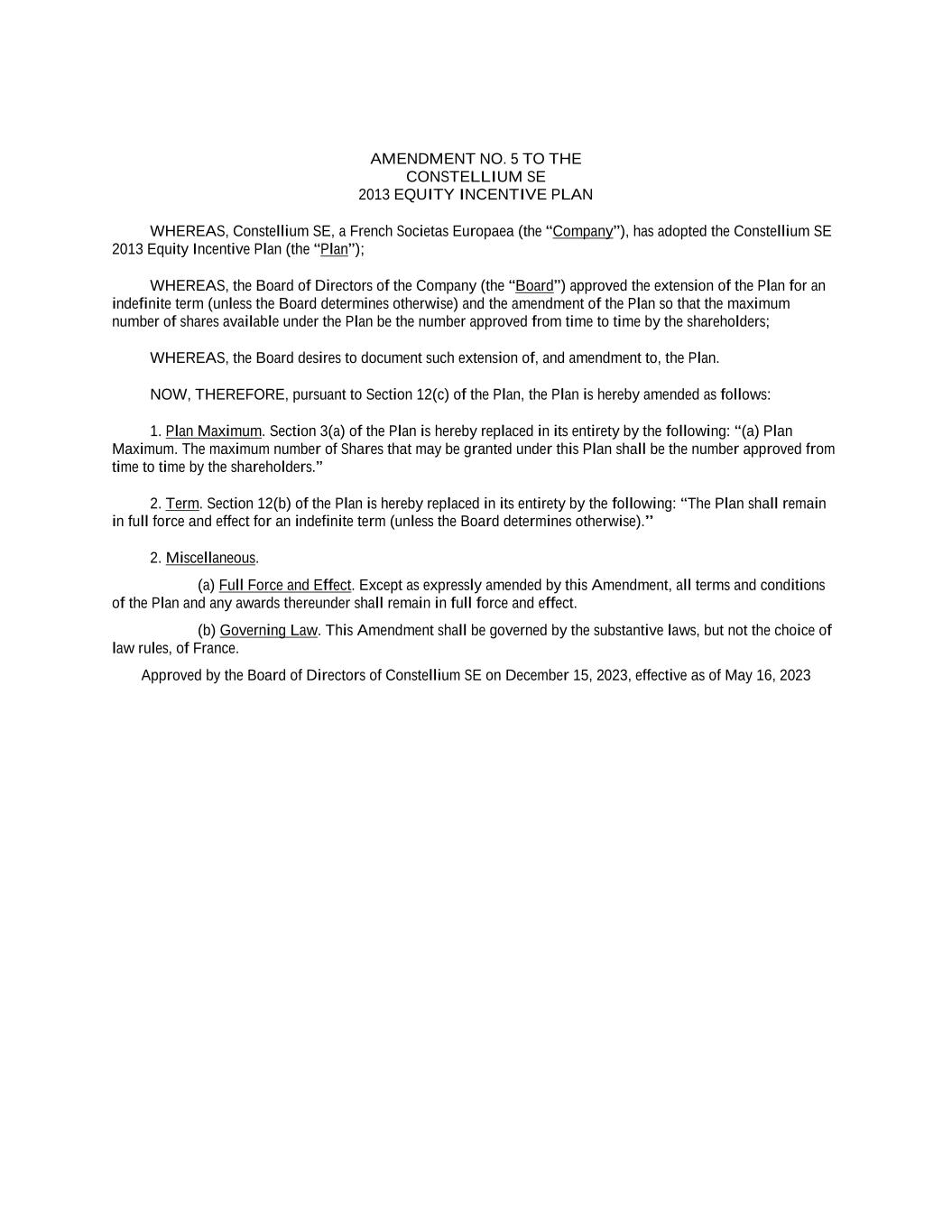
AMENDMENT NO. 5 TO THE CONSTELLIUM SE 2013 EQUITY INCENTIVE PLAN WHEREAS, Constellium SE, a French Societas Europaea (the “Company”), has adopted the Constellium SE 2013 Equity Incentive Plan (the “Plan”); WHEREAS, the Board of Directors of the Company (the “Board”) approved the extension of the Plan for an indefinite term (unless the Board determines otherwise) and the amendment of the Plan so that the maximum number of shares available under the Plan be the number approved from time to time by the shareholders; WHEREAS, the Board desires to document such extension of, and amendment to, the Plan. NOW, THEREFORE, pursuant to Section 12(c) of the Plan, the Plan is hereby amended as follows: 1. Plan Maximum. Section 3(a) of the Plan is hereby replaced in its entirety by the following: “(a) Plan Maximum. The maximum number of Shares that may be granted under this Plan shall be the number approved from time to time by the shareholders.” 2. Term. Section 12(b) of the Plan is hereby replaced in its entirety by the following: “The Plan shall remain in full force and effect for an indefinite term (unless the Board determines otherwise).” 2. Miscellaneous. (a) Full Force and Effect. Except as expressly amended by this Amendment, all terms and conditions of the Plan and any awards thereunder shall remain in full force and effect. (b) Governing Law. This Amendment shall be governed by the substantive laws, but not the choice of law rules, of France. Approved by the Board of Directors of Constellium SE on December 15, 2023, effective as of May 16, 2023
exhibit10235_cstmxfifthx
1 Paris 18365258.6 27 March 2023 / 27 mars 2023 CONSTELLIUM ISSOIRE and / et CONSTELLIUM NEUF BRISACH as Borrowers / les Emprunteurs CONSTELLIUM INTERNATIONAL as Parent Company / la Société-Mère FACTOFRANCE as Arranger and Agent / l’Arrangeur et Agent THE FINANCIAL INSTITUTIONS LISTED IN SCHEDULE 1 / LES INSTITUTIONS FINANCIERES LISTEES EN ANNEXE 1 as Lenders / les Prêteurs FIFTH AMENDMENT TO THE INVENTORY FINANCING FACILITY AGREEMENT / CINQUIEME AVENANT AU CONTRAT DE CREDIT Dentons Europe Association d'Avocats à Responsabilité Professionnelle Individuelle 5 boulevard Malesherbes, 75008 Paris, France DocuSign Envelope ID: 72404465-C57D-40D0-A3F9-6791069420DB
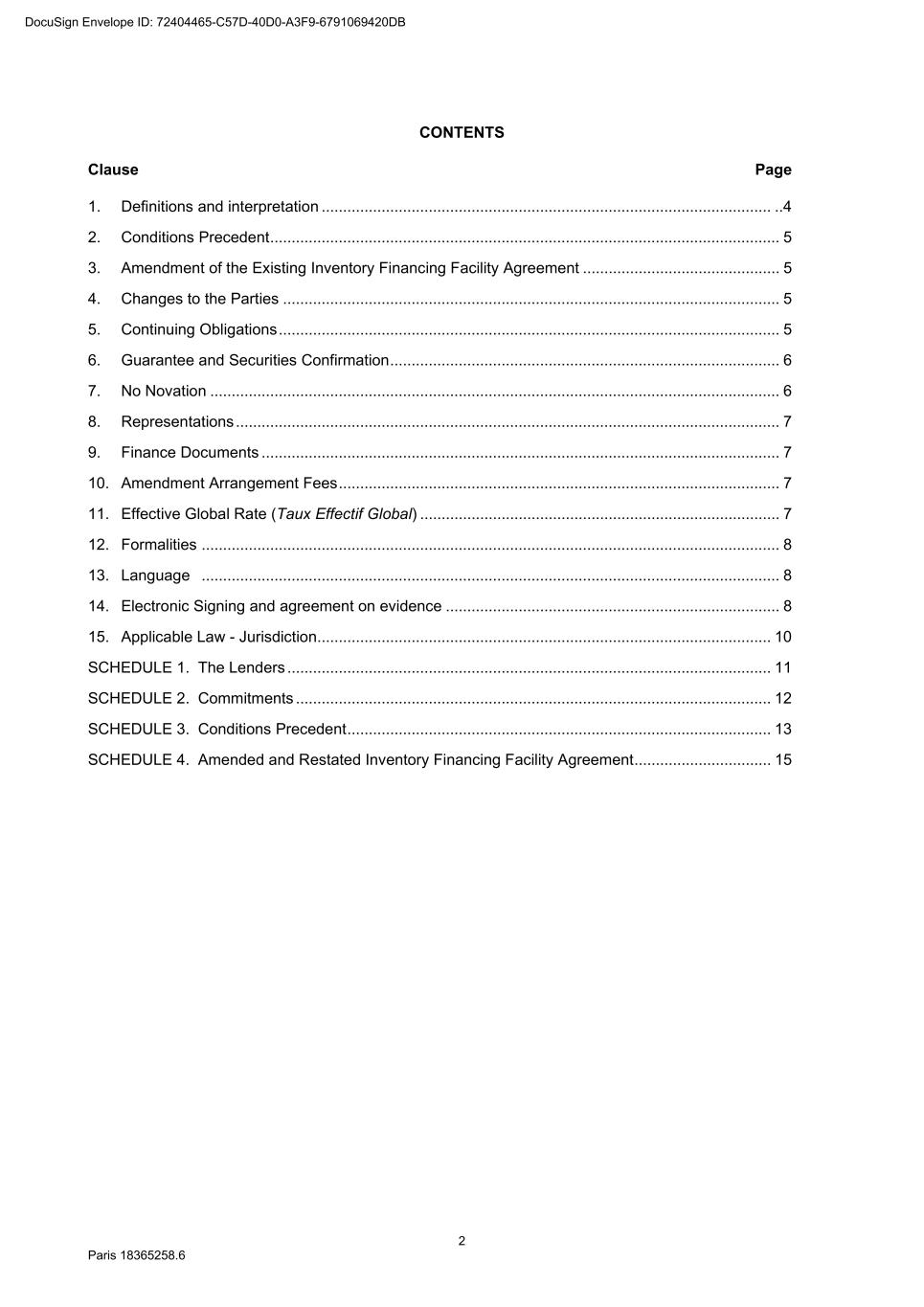
2 Paris 18365258.6 CONTENTS Clause Page 1. Definitions and interpretation ......................................................................................................... ..4 2. Conditions Precedent ....................................................................................................................... 5 3. Amendment of the Existing Inventory Financing Facility Agreement .............................................. 5 4. Changes to the Parties .................................................................................................................... 5 5. Continuing Obligations ..................................................................................................................... 5 6. Guarantee and Securities Confirmation ........................................................................................... 6 7. No Novation ..................................................................................................................................... 6 8. Representations ............................................................................................................................... 7 9. Finance Documents ......................................................................................................................... 7 10. Amendment Arrangement Fees ....................................................................................................... 7 11. Effective Global Rate (Taux Effectif Global) .................................................................................... 7 12. Formalities ....................................................................................................................................... 8 13. Language ....................................................................................................................................... 8 14. Electronic Signing and agreement on evidence .............................................................................. 8 15. Applicable Law - Jurisdiction .......................................................................................................... 10 SCHEDULE 1. The Lenders ................................................................................................................. 11 SCHEDULE 2. Commitments ............................................................................................................... 12 SCHEDULE 3. Conditions Precedent ................................................................................................... 13 SCHEDULE 4. Amended and Restated Inventory Financing Facility Agreement ................................ 15 DocuSign Envelope ID: 72404465-C57D-40D0-A3F9-6791069420DB
Paris 18365258.6 THIS AMENDMENT AGREEMENT is made between: 1. CONSTELLIUM ISSOIRE, a société par actions simplifiée governed by French law whose registered office is at rue Yves Lamourdedieu ZI les Listes, 63500 Issoire, France, registered with the trade and companies registry of Clermont-Ferrand under number 672 014 081 ; and CET AVENANT est conclu entre :_______________ 1. CONSTELLIUM ISSOIRE, une société par actions simplifiée de droit français, dont le siège social est situé rue Yves Lamourdedieu ZI les Listes, 63500 Issoire, France, immatriculée au registre du commerce et des sociétés de Clermont-Ferrand sous le numéro 672 014 081 ; et 2. CONSTELLIUM NEUF BRISACH, a société par actions simplifiée governed by French law whose registered office is at ZIP Rhénane Nord, RD 52, 68600 Biesheim, France, registered with the trade and companies registry of Colmar under number 807 641 360, 2. CONSTELLIUM NEUF BRISACH, une société par actions simplifiée de droit français dont le siège social est situé ZIP Rhénane Nord, RD 52, 68600 Biesheim, France, immatriculée au registre du commerce et des sociétés de Colmar sous le numéro 807 641 360, as borrowers (each a “Borrower” and together the " Borrowers"); En tant qu’emprunteurs (chacun un "Emprunteur" et ensemble les "Emprunteurs") ; 3. CONSTELLIUM INTERNATIONAL, a société par actions simplifiée whose registered office is located at 40-44 rue Washington, 75008 Paris, France and registered with the trade and companies registry of Paris under number 832 509 418, as parent company (the "Parent Company"); 3. CONSTELLIUM INTERNATIONAL, une société par actions simplifiée dont le siège social est situé 40-44 rue Washington, 75008 Paris, France et immatriculée au registre du commerce et des sociétés de Paris sous le numéro 832 509 418, en tant que société mère (la "Société Mère") ; 4. THE FINANCIAL INSTITUTIONS listed in SCHEDULE 1 (The Lenders) as lenders (the "Lenders”); and 4. Les INSTITUTIONS FINANCIERES énumérées à l’ANNEXE 1 (Les Prêteurs) en tant que préteurs (les "Prêteurs") ; et 5. FACTOFRANCE, a company incorporated under the laws of France as a société anonyme and licensed as a credit institution (établissement de crédit), whose registered office is located at Tour D2, 17 bis place des Reflets, 92988 Paris-La Défense Cedex, France, registered with the Trade and Companies Registry of Nanterre under number 063 802 466, as arranger (in such capacity, the “Arranger”) and as agent (in such capacity, the “Agent”). 5. FACTOFRANCE, une société de droit français constituée sous la forme d’une société anonyme et agréée en tant qu’établissement de crédit dont le siège social est situé Tour D2, 17 bis place des Reflets, 92988 Paris-La Défense Cedex, France, immatriculée au Registre du Commerce et des Sociétés de Nanterre sous le numéro 063 802 466, en tant qu’arrangeur (en cette qualité l’"Arrangeur") et agent (en cette qualité, l’"Agent"). WHEREAS: (A) On 21 April 2017, the Borrowers and Constellium Holdco II B.V. (now merged with ÉTANT PRÉALABLEMENT EXPOSÉ QUE : (A) Le 21 avril 2017, les Emprunteurs et Constellium Holdco II B.V. (maintenant DocuSign Envelope ID: 72404465-C57D-40D0-A3F9-6791069420DB
4 Paris 18365258.6 and into Constellium International) have entered into an inventory financing facility agreement pursuant to which the Lenders made available to the Borrowers a credit facility secured by, inter alia, inventory pledge agreements (as amended on 13 June 2017, 29 March 2018, on 31 July 2018, on 15 March 2019 and on 16 February 2021, the "Existing Inventory Financing Facility Agreement"). fusionnée avec et dans Constellium International) ont signé un contrat de crédit en vertu duquel les Prêteurs ont mis à la disposition des Emprunteurs une facilité de crédit garantie, entre autres, par des contrats de gage (tel que modifié le 13 juin 2017, le 29 mars 2018, le 31 juillet 2018, le 15 mars 2019 et le 16 Février 2021, le "Contrat de Crédit Existant"). (B) The Parties have decided to enter into this amendment agreement (the “Amendment Agreement”) in order, notably, to amend the list of Lenders and extend the maturity of the Existing Inventory Financing Facility Agreement until 21 April 2025. (B) Les Parties ont décidé de conclure cet avenant (« l’Avenant ») afin notamment de modifier la liste des Prêteurs et de proroger l’échéance du Contrat de Crédit Existant jusqu’au 21 avril 2025. IT HAS BEEN AGREED AS FOLLOWS: IL A ETE CONVENU CE QUI SUIT : 1. DEFINITIONS AND INTERPRETATION 1. DEFINITIONS ET INTERPRETATIONS 1.1 Definitions 1.1 Définitions 1.1.1 In this Amendment Agreement: 1.1.1 Dans le présent Avenant : "Amendment Effective Date" means the date on which the Agent has received all of the documents and other evidence listed in SCHEDULE 3 (Conditions Precedent) in a form and substance satisfactory to the Agent. "Date d’Entrée en Vigueur de l’Avenant" désigne la date à laquelle l’Agent a reçu tous les documents et éléments énumérés à l’ANNEXE 3 (Conditions Suspensives) dans une forme et une substance satisfaisantes pour l’Agent. "Amendment Signing Date" means the date hereof. "Date de Signature de l’Avenant" désigne la date des présentes. "Amended Inventory Financing Facility Agreement" means the Existing Inventory Financing Facility Agreement as amended and restated by this Amendment Agreement. "Contrat de Crédit Modifié" désigne le Contrat de Crédit Existant tel qu’il a été modifié et réitéré par le présent Avenant. 1.1.2 Save as otherwise provided herein, terms used in the above recitals and in this Amendment Agreement shall have the respective meanings given to them in the Existing Inventory Financing Facility Agreement. 1.1.2 Sauf disposition contraire des présentes, les termes utilisés dans les considérants ci- dessus et dans le présent Avenant ont le sens qui leur est attribué dans le Contrat de Crédit Existant. DocuSign Envelope ID: 72404465-C57D-40D0-A3F9-6791069420DB
5 Paris 18365258.6 1.2 General Interpretation The rules of construction set forth in Article 1.2 (Interpretation) of the Existing Inventory Financing Facility Agreement shall be applicable to this Amendment Agreement. 1.2 Interprétation Générale Les règles d’interprétation énoncées à l’article 1.2 (Interpretation) du Contrat de Crédit Existant s’appliqueront au présent Avenant. 2. CONDITIONS PRECEDENT The provisions of Clause 3 (Amendment of the Existing Inventory Financing Facility Agreement) shall be effective only if the Agent has received all of the documents and other evidence listed in SCHEDULE 3 (Conditions Precedent) in form and substance satisfactory to the Agent. 2. CONDITIONS SUSPENSIVES Les stipulations de la Clause 3 (Avenant au Contrat de Crédit Existant) n’entreront en vigueur que si l’Agent a reçu tous les documents et autres éléments énumérés à l’ANNEXE 3 (Conditions Suspensives) dans une forme et une substance satisfaisantes pour l’Agent. 3. AMENDMENT OF THE EXISTING INVENTORY FINANCING FACILITY AGREEMENT As from the Amendment Effective Date the Existing Inventory Financing Facility Agreement is amended and restated as set out in SCHEDULE 4 (Amended and Restated Inventory Financing Facility Agreement), in particular, the definition of "Termination Date" of the Existing Inventory Financing Facility Agreement is replaced with the following provisions: “"Termination Date” means 21 April 2025.”. 3. AVENANT AU CONTRAT DE CREDIT EXISTANT À compter de la Date d’Entrée en Vigueur de l’Avenant, le Contrat de Crédit Existant est modifié et réitéré comme indiqué à l'ANNEXE 4 (Contrat de Crédit modifié et réitéré), en particulier, la définition de "Date de Maturité Finale" du Contrat de Crédit Existant est remplacée par les dispositions suivantes : « "Date de Maturité Finale" signifie le 21 avril 2025. ».« » 4. CHANGES TO THE PARTIES 4.1 As from the Amendment Effective Date Credit Suisse (Deutschland) Aktiengesellschaft will cease to be party to the Inventory Financing Facility Agreement and to the other Finance Document to which it was a party and the Commitments of each remaining Lender will be as set out in SCHEDULE 2. 4. CHANGEMENT DE PARTIES 4.1 À compter de la Date d’Entrée en Vigueur de l’Avenant, Credit Suisse (Deutschland) Aktiengesellschaft cessera d’être partie au Contrat de Crédit et aux autres Documents de Financement auxquels elle est partie et les Engagements chaque Prêteur restant seront tel que figurant à l’ANNEXE 2. 5. CONTINUING OBLIGATIONS 5.1 The provisions of the Existing Inventory Financing Facility Agreement and the other Finance Documents shall, save as amended by this Amendment Agreement, continue in full force and effect. 5. OBLIGATIONS CONTINUES 5.1 Les stipulations du Contrat Crédit Existant et des autres Documents de Financement (Finance Documents) demeurent pleinement en vigueur, à moins qu’elles ne soient modifiées par le présent Avenant. 5.2 Nothing in this Agreement shall constitute a waiver by the Finance Parties of any breach 5.2 Aucune disposition du présent Avenant ne constitue une renonciation par les parties à un DocuSign Envelope ID: 72404465-C57D-40D0-A3F9-6791069420DB
6 Paris 18365258.6 by any Obligor of its obligations under the Finance Documents. manquement par un Débiteur (Obligor) à ses obligations aux termes des Documents de Financement. 6. GUARANTEE AND SECURITIES CONFIRMATION 6.1 The Parent Company hereby confirms that the Guarantee created under clause 17 of the Inventory Financing Facility Agreement will: 6.1.1 continue in full force and effect; and 6.1.2 extend to the payment obligations of the Borrowers under the Finance Documents as amended and extended under this Amendment Agreement. 6. GARANTIE ET CONFIRMATION DES SURETES 6.1 La Société Mère confirme par la présente que la Garantie (Guarantee) créée en vertu de la clause 17 du Contrat de Crédit Existant : 6.1.1 continuera d’être pleinement en vigueur ; et 6.1.2 s’appliquera aux obligations de paiement des Emprunteurs en vertu des Documents de Financement tels que modifiés et prorogés en vertu du présent Avenant. 6.2 Each Borrower hereby confirms that any security interest created under any Security Document to which it is a party will: 6.2.1 continue in full force and effect; and 6.2.2 extend to its obligations and liabilities under the Finance Documents as amended and extended under this Amendment Agreement. 6.2 Chaque Emprunteur confirme par les présentes que toute sureté constituée en vertu d’un Document de Sûreté (Security Document) auquel il est partie : 6.2.1 continuera d’être pleinement en vigueur ; et 6.2.2 s’appliquera à ses obligations et responsabilités aux termes des Documents de Financement tels que modifiés et prorogés aux termes de l’Avenant. 7. NO NOVATION The execution of this Amendment Agreement shall not be construed as a novation of the respective obligations of the Parties under the Existing Inventory Financing Facility Agreement within the meaning of articles 1329 et seq. of the French Code civil. 7. ABSENCE DE NOVATION La signature du présent Avenant ne saurait être interprétée comme une novation des obligations respectives des Parties au titre du Contrat de Crédit Existant au sens des articles 1329 et suivants du Code civil français. DocuSign Envelope ID: 72404465-C57D-40D0-A3F9-6791069420DB
7 Paris 18365258.6 8. REPRESENTATIONS On the Amendment Signing Date and on the Amendment Effective Date, each Obligor makes to each Finance Party, the representations and warranties set out in Clause 18 (Representations) of the Existing Inventory Financing Facility Agreement. 8. DECLARATIONS A la Date de Signature de l’Avenant et à la Date d’Entrée en Vigueur de l‘Avenant, chaque Débiteur fait à chaque Partie Financière les déclarations et les garanties énoncées à la Clause 18 (Representations) du Contrat de Crédit Existant. 9. FINANCE DOCUMENTS The Parent Company and the Agent designate this Amendment Agreement as a Finance Document. In any of the Finance Documents, any reference to the Existing Inventory Financing Facility Agreement shall, unless the context otherwise requires, be read and construed as a reference to the Amended Inventory Financing Facility Agreement. 9. DOCUMENTS DE FINANCEMENT La Société Mère et l‘Agent désignent le présent Avenant comme Document de Financement. Dans tout Document de Financement, toute référence au Contrat de Crédit Existant doit, sauf indication contraire du contexte, être lue et interprétée comme une référence au Contrat de Crédit Modifié. 10. AMENDMENT ARRANGEMENT FEES 10.1 At the latest on the Amendment Signing Date, the Borrowers shall pay to the Agent a one hundred thousand euros (100,000€) amendment arrangement fee (the “Amendment Arrangement Fee”). 10.2 The Agent will split the Amendment Arrangement Fee between each Lender pro rata the share of its Commitment in the aggregate Commitments. 10. COMMISSION D’ARRANGEMENT D’AVENANT 10.1 Au plus tard à la Date de Signature de l’Avenant, les Emprunteurs paieront à l’Agent une commission pour l’arrangement de l’avenant (la « Commission d’Arrangement d’Avenant ») de cent mille euros (100 000€). 10.2 L’Agent répartira la Commission d’Arrangement d’Avenant entre chaque Prêteur proportionnellement à à la part de son montant Engagement dans la somme des Engagements. 11. EFFECTIVE GLOBAL RATE (TAUX EFFECTIF GLOBAL) For the purposes of Articles L.314-1 to L.314- 5 and R.314-1 et seq. of the French Code de la consommation and Article L.313-4 of the French Code Monétaire et Financier, the Parties acknowledge that (i) the effective global rate (taux effectif global) calculated on the date of this Amendment Agreement, based on assumptions as to the period rate (taux de période) and the period term (durée de période) and on the assumption that the interest rate and all other fees, costs or expenses payable under this Amendment 11. TAUX EFFECTIF GLOBAL Pour l'application des articles L.314-1 à L.314-5 et R.314-1 et suivants du Code de la consommation et de l'article L.313-4 du Code Monétaire et Financier, les Parties reconnaissent que (i) le taux effectif global calculé à la date du présent Avenant, sur la base d'hypothèses de taux de période et de durée de période et sur la base de l'hypothèse que le taux d'intérêt et tous autres frais, coûts ou dépenses payables en vertu du présent Avenant seront maintenus à leur niveau initial pendant toute la durée du présent Avenant, est indiqué dans une lettre de l’Agent à DocuSign Envelope ID: 72404465-C57D-40D0-A3F9-6791069420DB
8 Paris 18365258.6 Agreement will be maintained at their original level throughout the term of this Amendment Agreement, is set out in a letter from the Agent to each Borrower and (ii) that letter forms part of this Amendment Agreement. Each Borrower acknowledges receipt of that letter. chaque Emprunteur et (ii) cette lettre fait partie du présent Avenant. Chaque Emprunteur accuse réception de cette lettre. 12. FORMALITIES 12.1 In respect of each Inventory Pledge Agreement Without Dispossession (gage sans dépossession), the Agent shall, at the cost of the relevant Borrower, register the extension of the Termination Date in the special register referred to in article 2338 of the French Code Civil at the registry of the relevant Tribunal de Commerce or Tribunal d’Instance. 12.2 All powers are conferred to any bearer of an original copy of the Amendment Agreement in order to carry out the registration formalities described in Clause 12.1 above. 12. FORMALITES 12.1 Pour chaque Contrat de Gage de Stocks sans Dépossession (Inventory Pledge Agreement Without Dispossession), l’Agent, aux frais de l'Emprunteur concerné, inscrira l’extension de la Date de Maturité Finale dans le registre spécial visé à l'article 2338 du Code civil français au greffe du Tribunal de Commerce ou du Tribunal d'Instance compétent. 12.2 Tous pouvoirs sont conférés à tout porteur d'un exemplaire original de l’Avenant afin d'accomplir les formalités d'enregistrement décrites à l'Article 12.1 ci-dessus. 13. LANGUAGE This Amendment Agreement shall be executed in both English and French language. In the event of any discrepancy, the English language version of this Amendment Agreement shall be the governing version. 13. LANGUE L’Avenant sera signé en langue française et en langue anglaise. En cas de divergence, la version anglaise de l’Avenant fera foi. 14. ELECTRONIC SIGNING AND AGREEMENT ON EVIDENCE 14.1 Each Party hereby expressly and irrevocably acknowledges that (i) it has the knowledge of the use of the electronic signature solution offered by DocuSign France, a limited liability company (société par actions simplifiée), incorporated under the laws of France, having its registered office at 9, rue Maurice Mallet, 92130 Issy-les-Moulineaux, France and registered with the Trade and Companies of Nanterre under number 812 611 150 ("DocuSign France") and (ii) the electronic signature solution offered by DocuSign France implements an electronic signature within the meaning of the provisions of articles 1366 and 1367 of the French Code civil. 14. SIGNATURE ELECTRONIQUE ET CONVENTION SUR LA PREUVE 14.1 Par les présentes, chaque Partie reconnaît expressément et irrévocablement (i) avoir connaissance de l'utilisation de la solution de signature électronique proposée par DocuSign France, société par actions simplifiée de droit français, dont le siège social est situé 9, rue Maurice Mallet, 92130 Issy- les-Moulineaux, France et immatriculée au Registre du Commerce et des Sociétés de Nanterre sous le numéro 812 611 150 ("DocuSign France") et (ii) la solution de signature électronique proposée par DocuSign France met en œuvre une signature électronique au sens des dispositions des articles 1366 et 1367 du Code civil français. DocuSign Envelope ID: 72404465-C57D-40D0-A3F9-6791069420DB
9 Paris 18365258.6 14.2 Each of the Parties hereby expressly and irrevocably recognizes, agrees and accepts that the version sent by DocuSign France to each Party of this Amendment Agreement and of other Finance Documents and any other related documents signed through the electronic signature solution offered by DocuSign France (together, the "Electronically Signed Documents") satisfies the requirement of integrity (intégrité) within the meaning of the provisions of article 1366 of the French Code civil. 14.3 Each of the Parties hereby expressly and irrevocably recognizes, agrees and accepts that the date and time stamp of the Electronically Signed Documents and the electronic signatures are enforceable (opposable) against it and will prevail between the Parties. 14.4 Each of the Parties hereby expressly and irrevocably recognizes, agrees and accepts that the electronic signature solution offered by DocuSign France and used for the signing of the Electronically Signed Documents (i) corresponds to a sufficient degree of reliability (fiabilité) in order to identify their signatories within the meaning of article 1367 of the French Code civil and (ii) guarantees its connection with the Electronically Signed Documents to which the relevant electronic signatures are attached within the meaning of article 1367 of the French Code civil. 14.5 Consequently, in accordance with articles 1366 and 1367 of the French Code civil, the Parties hereby expressly agree that each Party or its authorised representative can duly execute electronically the Electronically Signed Documents by appending an electronic signature generated through DocuSign France’s service and acknowledge that such electronic signature carries the same legal value as their handwritten signature. Thus, each of the Parties hereby expressly and irrevocably acknowledges, agrees and accepts that the electronic signature of the Electronically Signed Documents thus produced is fully valid and 14.2 Chacune des Parties reconnaît et accepte expressément et irrévocablement par les présentes que la version envoyée par DocuSign France à chaque Partie du présent Avenant et des autres Documents de Financement et de tout autre document connexe signé au moyen de la solution de signature électronique proposée par DocuSign France (ensemble, les " Documents Signés Electroniquement ") satisfait à l'exigence d'intégrité au sens des dispositions de l'article 1366 du Code civil français. 14.3 Chacune des Parties reconnaît et accepte expressément et irrévocablement que l'horodatage des Documents Signés Electroniquement et les signatures électroniques lui sont opposables et prévaudront entre les Parties. 14.4 Chacune des Parties reconnaît et accepte expressément et irrévocablement que la solution de signature électronique proposée par DocuSign France et utilisée pour la signature des Documents Signés Electroniquement (i) correspond à un degré de fiabilité suffisant pour identifier leurs signataires au sens de l'article 1367 du Code civil français et (ii) garantit son lien avec les Documents Signés Electroniquement auxquels sont attachées les signatures électroniques concernées au sens de l'article 1367 du Code civil français. 14.5 En conséquence, conformément aux articles 1366 et 1367 du Code civil français, les Parties conviennent expressément par les présentes que chaque Partie ou son représentant autorisé peut dûment signer électroniquement les Documents Signés Electroniquement en y apposant une signature électronique générée par le service de DocuSign France et reconnaissent que cette signature électronique a la même valeur juridique que leur signature manuscrite. Ainsi, chacune des Parties reconnaît et accepte expressément et irrévocablement que la signature électronique des Documents Signés Electroniquement ainsi produits est DocuSign Envelope ID: 72404465-C57D-40D0-A3F9-6791069420DB
10 Paris 18365258.6 enforceable against it and against the other Parties. 14.6 Each of the Parties hereby expressly and irrevocably acknowledges, agrees and accepts that this Clause 14 constitutes an agreement on evidence (contrat de preuve) within the meaning of article 1356 of the French Code civil. 14.7 Each of the Parties hereby expressly acknowledges and agrees that its signing or the signing by its authorised representative of the Electronically Signed Documents via the abovementioned electronic process is made in full knowledge of the technology implemented, its related terms of use and the applicable electronic signature laws and regulations and, accordingly, hereby irrevocably and unconditionally waives any right it may have to initiate any claim and/or legal action, directly or indirectly arising out of or relating to (i) the reliability and validity of the said electronic signatures and/or (ii) the evidence of its intention to enter into the Electronically Signed Documents. pleinement valide et opposable à son égard et à l'égard des autres Parties. 14.6 Chacune des Parties reconnaît et accepte expressément et irrévocablement que la présente Clause 14 constitue un contrat de preuve au sens de l'article 1356 du Code civil français. 14.7 Chacune des Parties reconnaît et accepte expressément que sa signature ou la signature par son mandataire des Documents Signés Electroniquement par le biais du procédé électronique susmentionné est effectuée en pleine connaissance de la technologie mise en œuvre, des conditions d'utilisation y afférentes et des lois et réglementations applicables en matière de signature électronique et, en conséquence, s'engage irrévocablement et sans réserve à respecter les dispositions de la présente Clause, en conséquence, renonce irrévocablement et inconditionnellement à tout droit qu'il pourrait avoir d'introduire une réclamation et/ou une action en justice, directement ou indirectement, découlant de ou liée à (i) la fiabilité et la validité desdites signatures électroniques et/ou (ii) la preuve de son intention de conclure les Documents Signés Electroniquement. 15. APPLICABLE LAW – JURISDICTION_______ 15.1 The provisions of this Amendment Agreement shall be construed in accordance with and shall be governed by French law. 15.2 Each of the Parties to this Amendment Agreement agrees that any and all disputes arising out of or in connection with this Amendment Agreement and in particular with its validity, interpretation, performance or non-performance, shall be exclusively referred to the competent courts in the jurisdiction of the Paris Court of Appeal. 15. LOI APPLICABLE - JURIDICTION COMPETENTE 15.1 Les stipulations du présent Avenant seront soumises et seront interprétées conformément au droit français. 15.2 Chacune des Parties au présent Avenant convient que tout différend relatif au présent Avenant et notamment à sa validité, son interprétation, son exécution ou son inexécution, sera de la compétence exclusive des tribunaux compétents de la juridiction de la Cour d'appel de Paris. DocuSign Envelope ID: 72404465-C57D-40D0-A3F9-6791069420DB
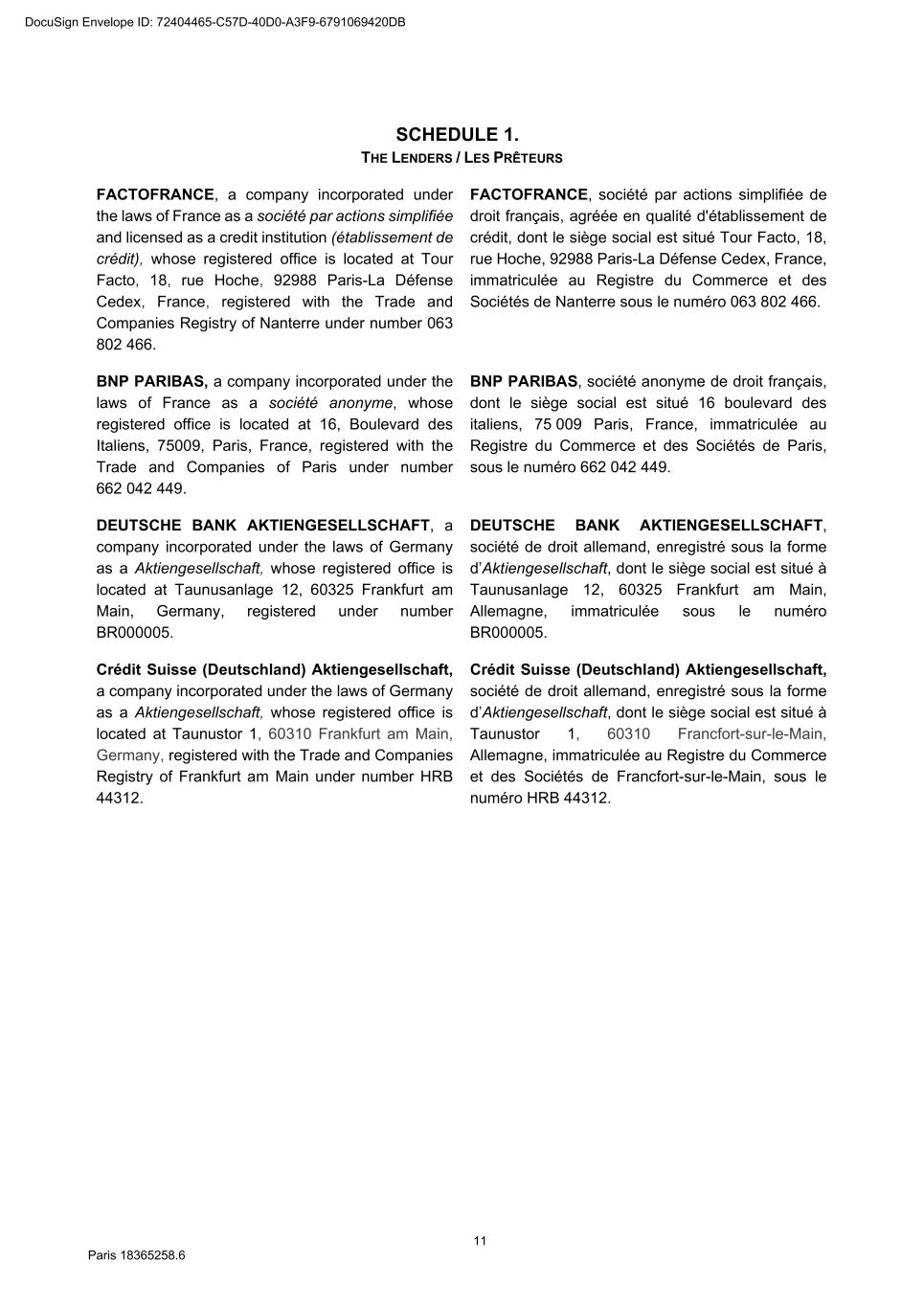
11 Paris 18365258.6 SCHEDULE 1. THE LENDERS / LES PRÊTEURS FACTOFRANCE, a company incorporated under the laws of France as a société par actions simplifiée and licensed as a credit institution (établissement de crédit), whose registered office is located at Tour Facto, 18, rue Hoche, 92988 Paris-La Défense Cedex, France, registered with the Trade and Companies Registry of Nanterre under number 063 802 466. FACTOFRANCE, société par actions simplifiée de droit français, agréée en qualité d'établissement de crédit, dont le siège social est situé Tour Facto, 18, rue Hoche, 92988 Paris-La Défense Cedex, France, immatriculée au Registre du Commerce et des Sociétés de Nanterre sous le numéro 063 802 466. BNP PARIBAS, a company incorporated under the laws of France as a société anonyme, whose registered office is located at 16, Boulevard des Italiens, 75009, Paris, France, registered with the Trade and Companies of Paris under number 662 042 449. BNP PARIBAS, société anonyme de droit français, dont le siège social est situé 16 boulevard des italiens, 75 009 Paris, France, immatriculée au Registre du Commerce et des Sociétés de Paris, sous le numéro 662 042 449. DEUTSCHE BANK AKTIENGESELLSCHAFT, a company incorporated under the laws of Germany as a Aktiengesellschaft, whose registered office is located at Taunusanlage 12, 60325 Frankfurt am Main, Germany, registered under number BR000005. DEUTSCHE BANK AKTIENGESELLSCHAFT, société de droit allemand, enregistré sous la forme d’Aktiengesellschaft, dont le siège social est situé à Taunusanlage 12, 60325 Frankfurt am Main, Allemagne, immatriculée sous le numéro BR000005. Crédit Suisse (Deutschland) Aktiengesellschaft, a company incorporated under the laws of Germany as a Aktiengesellschaft, whose registered office is located at Taunustor 1, 60310 Frankfurt am Main, Germany, registered with the Trade and Companies Registry of Frankfurt am Main under number HRB 44312. Crédit Suisse (Deutschland) Aktiengesellschaft, société de droit allemand, enregistré sous la forme d’Aktiengesellschaft, dont le siège social est situé à Taunustor 1, 60310 Francfort-sur-le-Main, Allemagne, immatriculée au Registre du Commerce et des Sociétés de Francfort-sur-le-Main, sous le numéro HRB 44312. DocuSign Envelope ID: 72404465-C57D-40D0-A3F9-6791069420DB

12 Paris 18365258.6 SCHEDULE 2. COMMITMENTS / LES ENGAGEMENTS Name of Lender Commitment Factofrance 40,000,000 euros BNP Paribas 30,000,000 euros Deutsche Bank Aktiengesellschaft 30,000,000 euros DocuSign Envelope ID: 72404465-C57D-40D0-A3F9-6791069420DB
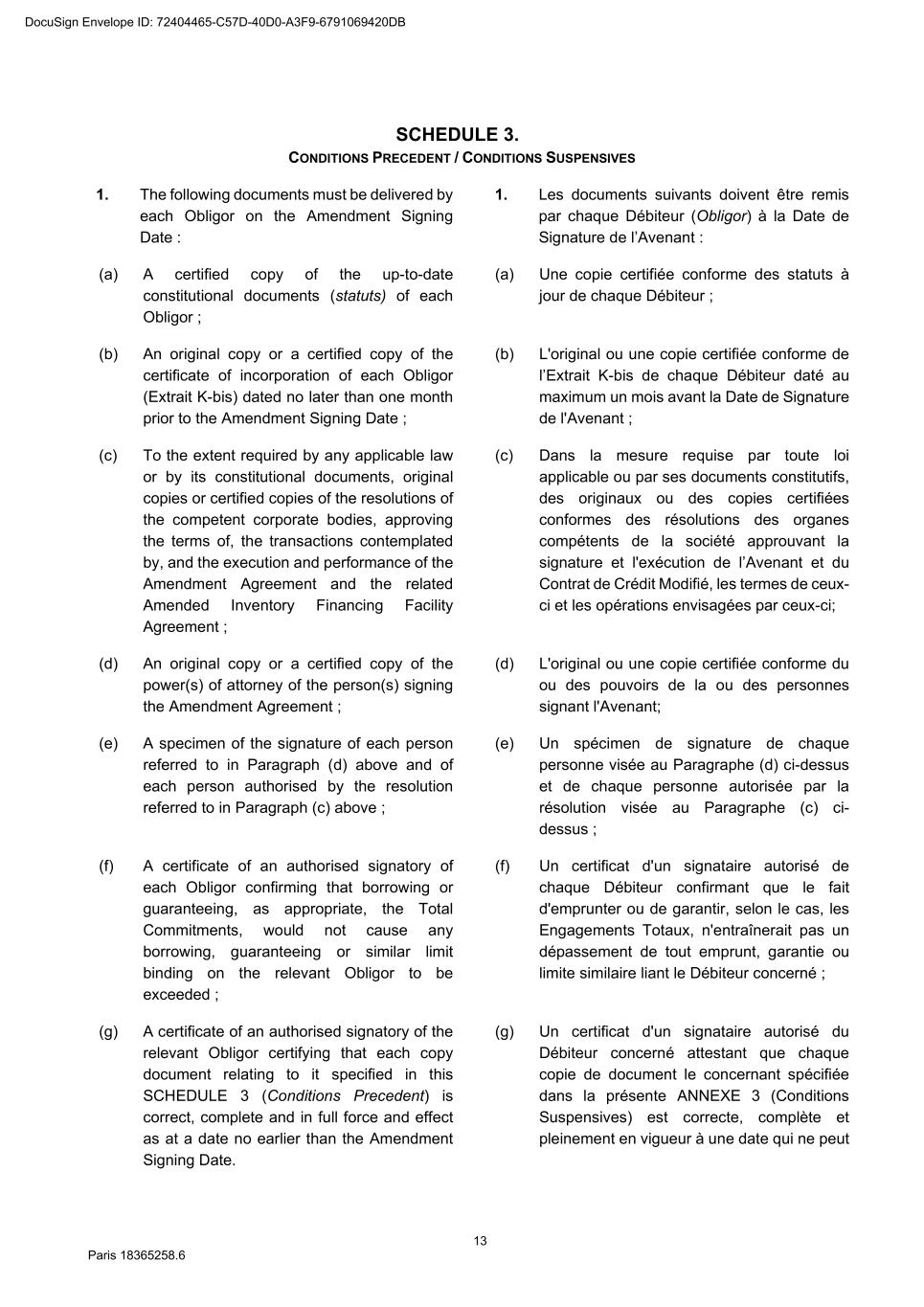
13 Paris 18365258.6 SCHEDULE 3. CONDITIONS PRECEDENT / CONDITIONS SUSPENSIVES 1. The following documents must be delivered by each Obligor on the Amendment Signing Date : 1. Les documents suivants doivent être remis par chaque Débiteur (Obligor) à la Date de Signature de l’Avenant : (a) A certified copy of the up-to-date constitutional documents (statuts) of each Obligor ; (a) Une copie certifiée conforme des statuts à jour de chaque Débiteur ; (b) An original copy or a certified copy of the certificate of incorporation of each Obligor (Extrait K-bis) dated no later than one month prior to the Amendment Signing Date ; (b) L'original ou une copie certifiée conforme de l’Extrait K-bis de chaque Débiteur daté au maximum un mois avant la Date de Signature de l'Avenant ; (c) To the extent required by any applicable law or by its constitutional documents, original copies or certified copies of the resolutions of the competent corporate bodies, approving the terms of, the transactions contemplated by, and the execution and performance of the Amendment Agreement and the related Amended Inventory Financing Facility Agreement ; (c) Dans la mesure requise par toute loi applicable ou par ses documents constitutifs, des originaux ou des copies certifiées conformes des résolutions des organes compétents de la société approuvant la signature et l'exécution de l’Avenant et du Contrat de Crédit Modifié, les termes de ceux- ci et les opérations envisagées par ceux-ci; (d) An original copy or a certified copy of the power(s) of attorney of the person(s) signing the Amendment Agreement ; (d) L'original ou une copie certifiée conforme du ou des pouvoirs de la ou des personnes signant l'Avenant; (e) A specimen of the signature of each person referred to in Paragraph (d) above and of each person authorised by the resolution referred to in Paragraph (c) above ; (e) Un spécimen de signature de chaque personne visée au Paragraphe (d) ci-dessus et de chaque personne autorisée par la résolution visée au Paragraphe (c) ci- dessus ; (f) A certificate of an authorised signatory of each Obligor confirming that borrowing or guaranteeing, as appropriate, the Total Commitments, would not cause any borrowing, guaranteeing or similar limit binding on the relevant Obligor to be exceeded ; (f) Un certificat d'un signataire autorisé de chaque Débiteur confirmant que le fait d'emprunter ou de garantir, selon le cas, les Engagements Totaux, n'entraînerait pas un dépassement de tout emprunt, garantie ou limite similaire liant le Débiteur concerné ; (g) A certificate of an authorised signatory of the relevant Obligor certifying that each copy document relating to it specified in this SCHEDULE 3 (Conditions Precedent) is correct, complete and in full force and effect as at a date no earlier than the Amendment Signing Date. (g) Un certificat d'un signataire autorisé du Débiteur concerné attestant que chaque copie de document le concernant spécifiée dans la présente ANNEXE 3 (Conditions Suspensives) est correcte, complète et pleinement en vigueur à une date qui ne peut DocuSign Envelope ID: 72404465-C57D-40D0-A3F9-6791069420DB
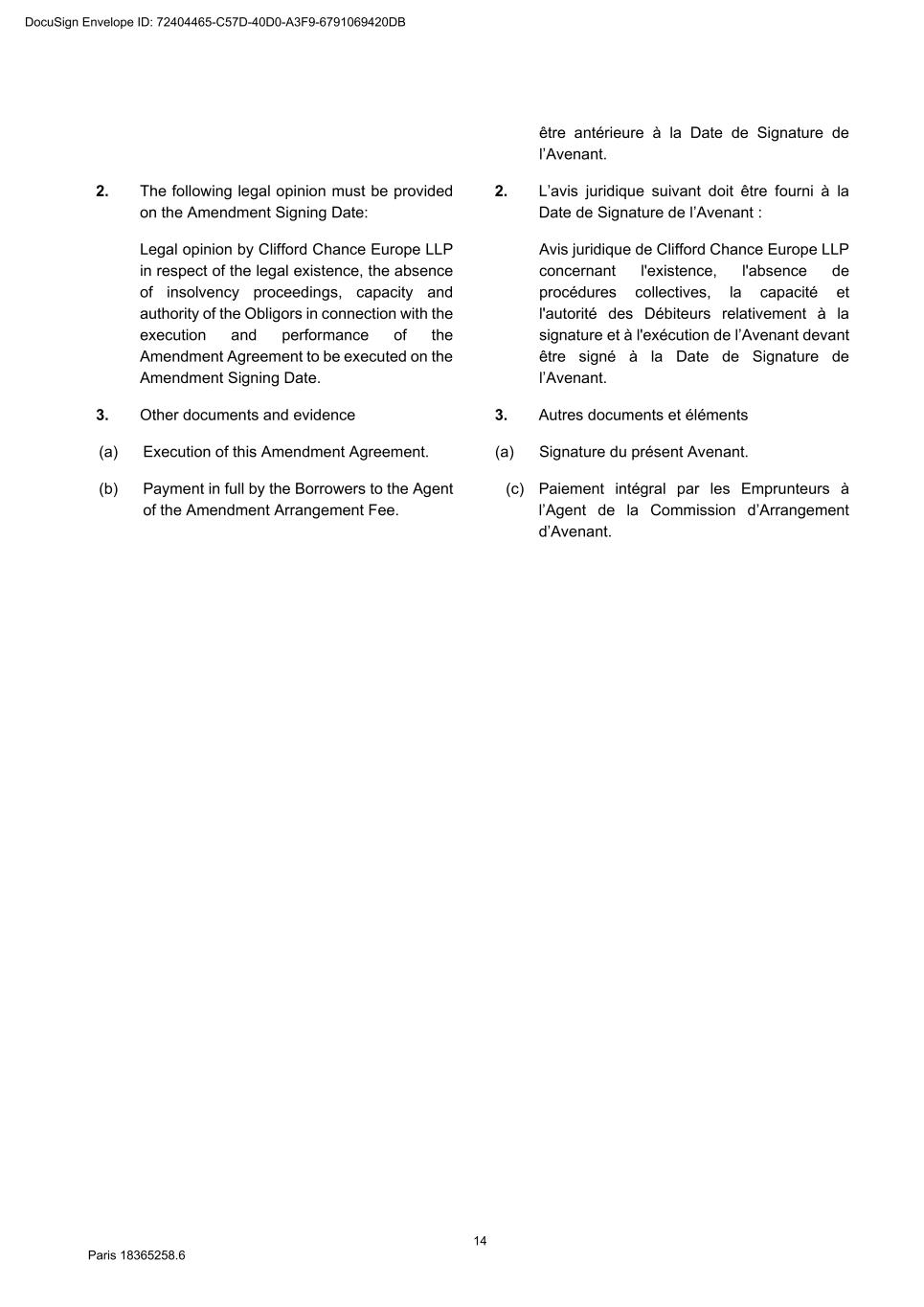
14 Paris 18365258.6 être antérieure à la Date de Signature de l’Avenant. 2. The following legal opinion must be provided on the Amendment Signing Date: 2. L’avis juridique suivant doit être fourni à la Date de Signature de l’Avenant : Legal opinion by Clifford Chance Europe LLP in respect of the legal existence, the absence of insolvency proceedings, capacity and authority of the Obligors in connection with the execution and performance of the Amendment Agreement to be executed on the Amendment Signing Date. Avis juridique de Clifford Chance Europe LLP concernant l'existence, l'absence de procédures collectives, la capacité et l'autorité des Débiteurs relativement à la signature et à l'exécution de l’Avenant devant être signé à la Date de Signature de l’Avenant. 3. Other documents and evidence 3. Autres documents et éléments (a) Execution of this Amendment Agreement. (a) Signature du présent Avenant. (b) Payment in full by the Borrowers to the Agent of the Amendment Arrangement Fee. (c) Paiement intégral par les Emprunteurs à l’Agent de la Commission d’Arrangement d’Avenant. DocuSign Envelope ID: 72404465-C57D-40D0-A3F9-6791069420DB

15 Paris 18365258.6 SCHEDULE 4. AMENDED AND RESTATED INVENTORY FINANCING FACILITY AGREEMENT / CONTRAT DE CREDIT AMENDÉ ET RÉITÉRÉ DocuSign Envelope ID: 72404465-C57D-40D0-A3F9-6791069420DB
1 Paris 18365539.6 CONSTELLIUM ISSOIRE and CONSTELLIUM NEUF BRISACH as Borrowers CONSTELLIUM INTERNATIONAL as Parent Company FACTOFRANCE as Arranger and Agent THE FINANCIAL INSTITUTIONS LISTED IN SCHEDULE 1 as Original Lenders FACILITY AGREEMENT originally entered into on 21 April 2017, as amended on 13 June 2017, 29 March 2018, 15 March 2019, 16 February 2021 and amended and restated on 27 March 2023. Dentons Europe Association d'Avocats à Responsabilité Professionnelle Individuelle 5 boulevard Malesherbes, 75008 Paris, France DocuSign Envelope ID: 72404465-C57D-40D0-A3F9-6791069420DB
Paris 18365539.6 TABLE OF CONTENTS 1. Definitions and interpretation .................................................................................................... 4 2. The Facility .............................................................................................................................. 21 3. Purpose ................................................................................................................................... 22 4. Conditions of Utilisation .......................................................................................................... 22 5. Utilisation ................................................................................................................................ 23 6. Repayment .............................................................................................................................. 26 7. Prepayment and cancellation ................................................................................................. 27 8. Interest .................................................................................................................................... 32 9. Interest Periods ....................................................................................................................... 33 10. Changes to the calculation of interest .................................................................................... 34 11. Fees ........................................................................................................................................ 35 12. Tax gross up and indemnities ................................................................................................. 35 13. Increased Costs ...................................................................................................................... 42 14. Other indemnities .................................................................................................................... 43 15. Mitigation by the Lenders ........................................................................................................ 43 16. Costs and expenses ............................................................................................................... 44 17. Guarantee ............................................................................................................................... 45 18. Representations ...................................................................................................................... 46 19. Undertakings ........................................................................................................................... 49 20. Events of Default .................................................................................................................... 51 21. Changes to the Parties ........................................................................................................... 53 22. Role of the Agent, the Arranger and the Reference Banks .................................................... 57 23. Conduct of business by the Finance Parties .......................................................................... 66 24. Sharing among the Finance Parties ....................................................................................... 66 25. Payment mechanics ............................................................................................................... 67 26. Set-off ..................................................................................................................................... 70 27. Notices .................................................................................................................................... 70 28. Day count convention ............................................................................................................. 73 29. Partial invalidity ....................................................................................................................... 73 30. Remedies, waivers and hardship............................................................................................ 73 31. Amendments and waivers ...................................................................................................... 73 32. Confidential Information .......................................................................................................... 75 33. Confidentiality of Reference Bank Quotations ........................................................................ 78 DocuSign Envelope ID: 72404465-C57D-40D0-A3F9-6791069420DB
3 Paris 18365539.6 34. Applicable Law - Jurisdiction .................................................................................................. 79 SCHEDULE 1. The Lenders .................................................................................................. 80 SCHEDULE 2. Conditions Precedent .................................................................................... 81 SCHEDULE 3. Form of Utilisation Request ........................................................................... 84 SCHEDULE 4. Form of Transfer Agreement ......................................................................... 86 SCHEDULE 5. Form of TEG Letter ....................................................................................... 89 SCHEDULE 6. Form of Confidentiality Undertaking .............................................................. 91 SCHEDULE 7. Form of Guarantee Demand ......................................................................... 92 SCHEDULE 8. [Reserved] ..................................................................................................... 93 SCHEDULE 9. Independent Appraiser engagement letter .................................................... 94 SCHEDULE 10. Form of Security Documents......................................................................... 95 DocuSign Envelope ID: 72404465-C57D-40D0-A3F9-6791069420DB
4 Paris 18365539.6 THIS FACILITY AGREEMENT is made between: 1. CONSTELLIUM ISSOIRE, a société par actions simplifiée governed by French law whose registered office is at rue Yves Lamourdedieu ZI les Listes, 63500 Issoire, France, registered with the trade and companies registry of Clermont-Ferrand under number 672 014 081 ; and 2. CONSTELLIUM NEUF BRISACH, a société par actions simplifiée governed by French law whose registered office is at ZIP Rhénane Nord, RD 52, 68600 Biesheim, France, registered with the trade and companies registry of Colmar under number 807 641 360, as borrowers (each a “Borrower” and together the " Borrowers"); 3. CONSTELLIUM INTERNATIONAL, (having merged with and absorbed Constellium N.V.), a société par actions simplifiée whose registered office is located at 40-44 rue Washington, 75008 Paris, France and registered with the trade and companies registry of Paris under number 832 509 418, as parent company (the "Parent Company"); 4. THE FINANCIAL INSTITUTIONS listed in SCHEDULE 1 (The Lenders) as original lenders (“the Original Lenders”); and 5. FACTOFRANCE, a company incorporated under the laws of France as a société par actions simplifiée and licensed as a credit institution (établissement de crédit), whose registered office is located at Tour Facto, 18, rue Hoche, 92988 Paris-La Défense Cedex, France, registered with the Trade and Companies Registry of Nanterre under number 063 802 466, as arranger (in such capacity, the “Arranger”) and as agent (in such capacity, the “Agent”). WHEREAS: (A) The Borrowers have decided to finance their general corporate requirements by entering into an inventory financing credit facility. (B) Subject to the terms and conditions of the Finance Documents, the Lenders will make available to the Borrowers a credit facility secured by, inter alia, inventory pledge agreements. (C) The Parties have therefore decided to enter into the Finance Documents in order to set out the terms and conditions applicable to this inventory financing credit facility to be made available by the Lenders to the Borrowers. IT IS AGREED as follows: 1. DEFINITIONS AND INTERPRETATION 1.1 Definitions In this Agreement: "Accounting Principles” means in relation to the Parent Company and any Borrower, generally accepted accounting principles in its jurisdiction of incorporation, and used in the financial statements or accounts to be remitted by the Parent Company and such Borrower to the Agent pursuant to this Agreement. "Affiliate" means as to a specified entity, an entity that directly or indirectly through one or more intermediaries, controls or is controlled by, or is under common control with, the entity specified. "Agreement" means this facility agreement. DocuSign Envelope ID: 72404465-C57D-40D0-A3F9-6791069420DB
5 Paris 18365539.6 “Amendment Signing Date” means 27 March 2023. "Authorisation" means an authorisation, consent, approval, resolution, licence, exemption, filing, notarisation or registration. "Availability Period" means the period starting on the Signing Date (included) and ending on the Termination Date (excluded). "Available Commitment" means, in relation to any Lender, such Lender's Commitment minus: (a) the amount of its participation in any outstanding Loans; and (b) in relation to any proposed Utilisation, the amount of its participation in any Loans that are due to be made on or before the proposed Utilisation Date (but not taking into account that Lender's participation in any Loans that are due to be repaid or prepaid on or before the proposed Utilisation Date). "Available Facility" means, at any time, for any Borrower, the lesser of: (a) the Borrowing Base Value applicable to such Borrower at that time; and (b) the aggregate for the time being of each Lender’s Available Commitment. “Available Tranche A Amount” means, at any time, for any Borrower, the lesser of: (a) the Available Facility applicable to such Borrower at that time; and (b) the Financeable Inventory Value (With Dispossession) applicable to such Borrower at that time. “Available Tranche B Amount” means, at any time, for any Borrower, the maximum between: (a) the difference between (i) the Available Facility applicable to such Borrower at that time and (ii) the Financeable Inventory Value (With Dispossession) applicable to such Borrower at that time; and (b) zero. "Basel Committee" means the Basel Committee on Banking Supervision. "Basel III" means: (a) the agreements on capital requirements, a leverage ratio and liquidity standards contained in "Basel III: A global regulatory framework for more resilient banks and banking systems", "Basel III: International framework for liquidity risk measurement, standards and monitoring" and "Guidance for national authorities operating the countercyclical capital buffer" published by the Basel Committee in December 2010; and (a) the rules for global systemically important banks contained in "Global systemically important banks: assessment methodology and the additional loss absorbency requirement – Rules text" published by the Basel Committee in November 2011, each in the form existing on the date of this Agreement, excluding any change in (or in the interpretation, administration or application of) such agreements and rules after the date hereof. DocuSign Envelope ID: 72404465-C57D-40D0-A3F9-6791069420DB
6 Paris 18365539.6 "Borrower Change of Control" has the meaning ascribed to such term in Clause 7.2.2. “Borrowing Base Event” means, in respect of any Borrower, the fact that, on any Quarter Date, the Inventory Turn Ratio of such Borrower is inferior to: (a) regarding Constellium Issoire, one point five (1.5); and (b) regarding Constellium Neuf Brisach, three (3), provided that, for the avoidance of doubt, if on any following Quarter Date the Inventory Turn Ratio of such Borrower is superior or equal to one point five (1.5) regarding Constellium Issoire or three (3) regarding Constellium Neuf Brisach, the Borrowing Base Event will no longer be continuing. "Borrowing Base Value" means, on any date, for any Borrower: (a) if no Borrowing Base Event has occurred and is continuing in respect of this Borrower, the lesser of: (i) the sum of the Financeable Inventory Value (With Dispossession) and the Financeable Inventory Value (Without Dispossession) of this Borrower as at such date; and (ii) the product of the Financeable Inventory Value (With Dispossession) of this Borrower as at such date by 4; and (b) if a Borrowing Base Event has occurred and is continuing in respect of this Borrower, the Financeable Inventory Value (With Dispossession) of this Borrower as at such date. "Break Costs" means the amount (if any) by which: (a) the interest (excluding the applicable Margin) which a Lender should have received for the period from the date of receipt of all or any part of its participation in a Loan or Unpaid Sum to the last day of the current Interest Period in respect of that Loan or Unpaid Sum, had the principal amount or Unpaid Sum received been paid on the last day of that Interest Period; exceeds: (b) the amount which that Lender would be able to obtain by placing an amount equal to the principal amount or Unpaid Sum received by it on deposit with a leading bank for a period starting on the Business Day following receipt or recovery and ending on the last day of the current Interest Period. "Business Day" means a day (other than a Saturday or Sunday) on which banks are generally open for normal business in Paris, London and Amsterdam, and (in relation to any date for payment or purchase of Euro) any TARGET Day. "Change of Control" means, as the case may be, a Parent Change of Control and/or a Borrower Change of Control. "Commitment" means: DocuSign Envelope ID: 72404465-C57D-40D0-A3F9-6791069420DB
7 Paris 18365539.6 (a) in relation to an Original Lender, the amount in Euro set opposite its name under the heading "Commitment" in SCHEDULE 1 (The Lenders) and the amount of any other Commitment transferred to it under this Agreement; and (b) in relation to any other Lender, the amount in Euro of Commitment transferred to it under this Agreement, to the extent not cancelled, reduced or transferred by it under this Agreement. "Confidential Information" means all information relating to any Obligor, the Group, the Finance Documents or the Facility of which a Finance Party becomes aware in its capacity as, or for the purpose of becoming, a Finance Party or which is received by a Finance Party in relation to, or for the purpose of becoming a Finance Party under, the Finance Documents or a Facility from either: (a) any member of the Group or any of its advisers; or (b) another Finance Party, if the information was obtained by that Finance Party directly or indirectly from any member of the Group or any of its advisers, in whatever form, and includes information given orally and any document, electronic file or any other way of representing or recording information which contains or is derived or copied from such information but excludes: (i) information that: A. is or becomes public information other than as a direct or indirect result of any breach by that Finance Party of Clause 32 (Confidential Information); or B. is identified in writing at the time of delivery as non-confidential by any member of the Group or any of its advisers; or C. is known by that Finance Party before the date the information is disclosed to it in accordance with Paragraphs (a) or (b) above or is lawfully obtained by that Finance Party after that date, from a source which is, as far as that Finance Party is aware, unconnected with the Group and which, in either case, as far as that Finance Party is aware, has not been obtained in breach of, and is not otherwise subject to, any obligation of confidentiality; and (ii) any Reference Bank Quotation. "Confidentiality Undertaking" means a confidentiality undertaking substantially in the form set out in SCHEDULE 6 (Form of Confidentiality Undertaking) or in any other form agreed between the Parent Company and the Agent. “Constellium SE” is a Societas Europaea, having its registered office at Washington Plaza, 40- 44 rue Washington, 75008 Paris, France, registered with the Trade and Companies Registry of Paris under number 831 763 743. "CRD IV Directive" means directive 2013/36/EU of the European Parliament and of the Council of 26 June 2013 on access to the activity of credit institutions and the prudential supervision of credit institutions and investment firms in the form existing on the date of this Agreement, excluding any change in (or in the interpretation, administration or application of) such directive after the date hereof. DocuSign Envelope ID: 72404465-C57D-40D0-A3F9-6791069420DB
8 Paris 18365539.6 "CRR Regulation" means regulation No 575/2013 of the European Parliament and of the Council of 26 June 2013 on prudential requirements for credit institutions and investment firms, in the form existing on the date of this Agreement, excluding any change in (or in the interpretation, administration or application of) such regulation after the date hereof. "Cross-Acceleration" means, in respect of any Financial Indebtedness (other than any financial indebtedness owed to another member of the Group) of any member of the Group, the aggregate outstanding amount of which exceeds fifty million Euros (EUR 50,000,000), any event of default (however described): (a) with respect to any Financial Indebtedness other than the ones referred to in Paragraph (vii) of the definition of Financial Indebtedness, which has led the relevant lenders or financing parties to declare such relevant Financial Indebtedness due and payable prior to its specified maturity; or (b) with respect to any Financial Indebtedness referred to in Paragraph (vii) of the definition of Financial Indebtedness, which has led any counterparty to early terminate such Financial Indebtedness further to a breach of the relevant member of the Group of its obligations thereunder. "Default" means any event or circumstance set out in Clause 20.1 (Events of Default), which would, with the expiry of a grace period, the giving of notice, the making of any determination or combination of the foregoing, constitute an Event of Default. "Defaulting Lender" means any Lender: (a) which has failed to make its participation in a Loan available (or has notified the Agent or the Parent Company (which has notified the Agent) that it will not make its participation in a Loan available) by the Utilisation Date of that Loan in accordance with Clause 5.4 (Lenders' participation) unless its failure to pay is caused by an administrative or technical error or a Disruption Event, and payment is made within 3 Business Days of its due date; or (b) which has otherwise rescinded or repudiated a Finance Document; or (c) with respect to which an Insolvency Event has occurred and is continuing, "Disruption Event" means either or several of: (a) a material disruption to those payment or communications systems or to those financial markets which are, in each case, required to operate in order for payments to be made in connection with the Facility (or otherwise in order for the transactions contemplated by the Finance Documents to be carried out) which disruption is not caused by, and is beyond the control of, any of the Parties; or (b) the occurrence of any other event which results in a disruption (of a technical or systems- related nature) to the treasury or payments operations of a Party preventing that, or any other Party: (i) from performing its payment obligations under the Finance Documents; or (ii) from communicating with other Parties in accordance with the terms of the Finance Documents, DocuSign Envelope ID: 72404465-C57D-40D0-A3F9-6791069420DB
9 Paris 18365539.6 and which (in either such case) is not caused by, and is beyond the control of, the Party whose operations are disrupted. "Eligible Inventory" means, in respect of any Borrower, aluminium raw material, slabs and billets, semi-finished goods and finished goods which fulfil the following criteria: (a) they are located in the Warehouse of such Borrower; (b) with respect to slabs and billets, semi-finished goods and finished goods only, they are Ordered Products; (c) they are free from any pledge, lien (privilège), retention of title or any other Security (except under the Security Documents); and (d) in case of enforcement of the Finance Parties’ rights under the Security Documents, the Finance Parties are entitled to sell such material or goods without infringing any applicable intellectual property rights in relation to such material or goods. "Escrow Agent" means Société Européenne de Garantie - Eurogarant, a company incorporated under the laws of France as a société anonyme whose registered office is at 82 rue Beaubourg, 75003 Paris, France and registered with the trade and company registry of Paris under number 393 759 923. "Escrow Agent Reports" mean together any Escrow Agent Certificate and any Escrow Agent Statement. "Escrow Agent Certificate" means, in respect of any Borrower, any escrow agent certificate (certificat de tierce détention) as defined in each Inventory Pledge Agreement With Dispossession entered into by such Borrower. "Escrow Agent Statement" means, in respect of any Borrower, any escrow agent statement (état des stocks gagés) as defined in the Inventory Pledge Agreement Without Dispossession entered into by such Borrower. "EURIBOR" means, in relation to any Loan: (a) the euro interbank offered rate administered by the European Money Markets Institute (or any person which takes over the administration of that rate) for Euros and for a one (1) month term, as displayed at 11:00 a.m. (Brussels time) two (2) Business Days before the Utilisation Date of such Loan on the page EURIBOR01 of the Thomson Reuters screen or any replacement Thomson Reuters page which displays that rate or on the appropriate page of such other information service which publishes that rate from time to time in place of Thomson Reuters (it being specified that if the relevant page or service ceases to be available, the Agent, in consultation with the Parent Company, may specify another page or service displaying the relevant rate) (the “Screen Rate”); (b) if no Screen Rate is available, the arithmetic mean of the rates (rounded upwards to four decimal places) as supplied to the Agent at its request quoted by HSBC France, Crédit Agricole and Crédit Mutuel (or any other credit institution selected by the Agent (acting on the instructions of all the Lenders) in consultation with the Parent Company) (each a "Reference Bank") as the rate at which the relevant Reference Bank could borrow funds in Euro for a period of one (1) month in the European interbank market were it to do so by DocuSign Envelope ID: 72404465-C57D-40D0-A3F9-6791069420DB
10 Paris 18365539.6 asking for and then accepting interbank offers for deposits in reasonable market size in that currency and for that period (the “Reference Banks Rate”); (c) if no Screen Rate and no Reference Banks Rate is available, the rate which results from interpolating on a linear basis between: (i) the applicable Screen Rate for the longest period (for which that Screen Rate is available) which is less than one (1) month; and (ii) the applicable Screen Rate for the shortest period (for which that Screen Rate is available) which exceeds one (1) month, (the “Interpolated Screen Rate”); and (d) if no Screen Rate and no Reference Banks Rate is available and it is not possible to calculate the Interpolated Screen Rate, for each Lender, the rate referred to in Clause 10.2.1(b). "Euro" or "EUR" means the single currency of the Participating Member States. "Event of Default" means any event or circumstance specified as such in Clause 20.1 (Events of Default). "Facility" means the revolving loan facility made available under this Agreement as described in Clause 2.1 (The Facility). "Facility Office" means the office or offices notified by a Lender to the Agent in writing on or before the date it becomes a Lender (or, following that date, by not less than five Business Days' written notice) as the office or offices through which it will perform its obligations under this Agreement. "FATCA" means: (a) sections 1471 to 1474 of the US Internal Revenue Code of 1986 or any associated regulations; (b) any treaty, law or regulation of any other jurisdiction, or relating to an intergovernmental agreement between the US and any other jurisdiction, which (in either case) facilitates the implementation of any law or regulation referred to in Paragraph (a) above; or (c) any agreement pursuant to the implementation of any treaty, law or regulation referred to in Paragraphs (a) or (b) above with the US Internal Revenue Service, the US government or any governmental or taxation authority in any other jurisdiction. "FATCA Application Date" means: (a) in relation to a "withholdable payment" described in section 1473(1)(A)(i) of the US Internal Revenue Code of 1986 (which relates to payments of interest and certain other payments from sources within the US), 1 July 2014; (b) in relation to a "withholdable payment" described in section 1473(1)(A)(ii) of the US Internal Revenue Code of 1986 (which relates to "gross proceeds" from the disposition of property of a type that can produce interest from sources within the US), 1 January 2019; or DocuSign Envelope ID: 72404465-C57D-40D0-A3F9-6791069420DB
11 Paris 18365539.6 (c) in relation to a "passthru payment" described in section 1471(d)(7) of the US Internal Revenue Code of 1986 not falling within Paragraphs (a) or (b) above, 1 January 2019, or, in each case, such other date from which such payment may become subject to a deduction or withholding required by FATCA as a result of any change in FATCA after the date of this Agreement. "FATCA Deduction" means a deduction or withholding from a payment under a Finance Document required by FATCA. "FATCA Exempt Party" means a Party that is entitled to receive payments free from any FATCA Deduction. "Fee Letter" means any letter or letters dated on or about the date of this Agreement between the Arranger and the Parent Company or the Agent and the Parent Company setting out any of the fees referred to in Clause 11 (Fees). “Financeable Inventory Value (With Dispossession)” means, in respect of any Borrower, on any date: (a) if no Borrowing Base Event has occurred and is continuing in respect of this Borrower, the product of 90% of the last available Recalculated Net Orderly Liquidation Percentage by the Inventory Value (With Dispossession) in respect of such Borrower applicable as at such date; and (b) if a Borrowing Base Event has occurred and is continuing in respect of this Borrower, the product of 75% of the last available Recalculated Net Orderly Liquidation Percentage by the Inventory Value (With Dispossession) in respect of such Borrower applicable as at such date. “Financeable Inventory Value (Without Dispossession)” means, in respect of any Borrower, on any date, the product of 75% of the last available Recalculated Net Orderly Liquidation Percentage by the Inventory Value (Without Dispossession) in respect of such Borrower applicable as at such date. "Finance Documents" means this Agreement, any Fee Letter, any Security Document and any other document designated as such by the Agent and the Parent Company. "Finance Lease" means the leases, financial leases (locations avec option d'achat) or hire- purchase contracts which would, in accordance with the relevant Accounting Principles, be treated as a finance or capital leases. "Finance Party" means the Agent, the Arranger or a Lender. "Financial Indebtedness" means, without double-counting, any indebtedness for or in respect of: (i) monies borrowed and debit balances at banks or other financial institutions; (ii) any amount raised by acceptance under any acceptance credit facility or dematerialised equivalent; DocuSign Envelope ID: 72404465-C57D-40D0-A3F9-6791069420DB
12 Paris 18365539.6 (iii) any amount raised pursuant to any note purchase facility or the issue of bonds (other than Trade Instruments) notes, debentures, loan stock or any similar instrument; (iv) the amount of any liability in respect of any Finance Lease; (v) receivables sold or discounted (except off balance sheet transfers of receivables); (vi) any amount raised under any other transaction (including any forward sale or purchase agreement) of a type not referred to in any other paragraph of this definition having the economical effect of a borrowing; (vii) any derivative transaction entered into in connection with protection against or benefit from fluctuation in any rate or price (and, when calculating the value of any derivative transaction, only the marked to market value (or, if any actual amount is due as a result of the termination or close-out of that derivative transaction, that amount) shall be taken into account); (viii) any counter-indemnity obligation in respect of a guarantee, indemnity, bond, standby or documentary letter of credit or any other instrument issued by a bank or financial institution; (ix) any amount raised by the issue of redeemable shares which are redeemable (other than at the option of the issuer) before the Termination Date or are otherwise classified as borrowings under the Accounting Principles; (x) in respect of the Borrowers only, the amount of any liability in respect of any guarantee for any of the items referred to in Paragraphs (i) to (ix) above, and in respect of the Parent Company the amount of any liability in respect of any guarantee for any of the items referred to in Paragraphs (i) to (ix) above, to the extent the payment of any such liability would jeopardize the Parent Company’s ability to face its other Financial Indebtedness. "Funding Rate" means any individual rate notified by a Lender to the Agent pursuant to Clause 10.2.1(b). "Group" means Constellium SE and its Affiliates. "Guarantee" has the meaning given to such term in Clause 17.1.1. "Guarantor" has the meaning given to such term in Clause 17.1. "Holding Company" means, in relation to a Finance Party, any entity which controls such Finance Party. “Independent Appraiser” means Hilco Valuation Services, a company incorporated under the laws of England and Wales as a limited company whose registered office is at 3 St Helen’s Place, London, United Kingdom, and registered with the trade and company registry of England & Wales under number 04703331, or any other third party appointed by the Agent acting on the instructions of the Super Majority Lenders (with the prior approval of the Parent Company, not to be unreasonably withheld) responsible for assessing the commercial value of the Pledged Inventory pursuant to Clause 5.6 (Audits of the Pledged Inventory). “Independent Appraiser Net Orderly Liquidation Percentage” means, in respect of any Borrower, the weighted average of the Product Net Orderly Liquidation Percentages applicable to such Borrower, notified by the Independent Appraiser to the Agent and such Borrower half- yearly in accordance with Clause 5.7.1. DocuSign Envelope ID: 72404465-C57D-40D0-A3F9-6791069420DB
13 Paris 18365539.6 “Independent Appraiser Report” means the report sent half-yearly to each Borrower and the Agent by the Independent Appraiser following its audits of the Pledged Inventory performed in accordance with Clause 5.6.2. "Insolvency Event" in relation to an entity means that the entity: (a) is dissolved (other than pursuant to a consolidation, amalgamation or merger); (b) becomes insolvent or is unable to pay its debts or fails or admits in writing its inability generally to pay its debts as they become due; (c) makes a general assignment, arrangement or composition with or for the benefit of its creditors; (d) institutes or has instituted against it, by a regulator, supervisor or any similar official with primary insolvency, rehabilitative or regulatory jurisdiction over it in the jurisdiction of its incorporation or organisation or the jurisdiction of its head or home office, a proceeding seeking a judgment of insolvency or bankruptcy or any other relief under any bankruptcy or insolvency law or other similar law affecting creditors' rights (including any resolution measure as set out-in article L. 613-51 et seq. of the French Code monétaire et financier or any analogous measure in any other jurisdiction), or a petition is presented for its winding-up or liquidation by it or such regulator, supervisor or similar official; (e) has instituted against it a proceeding seeking a judgment of insolvency or bankruptcy or any other relief under any bankruptcy or insolvency law or other similar law affecting creditors' rights, or a petition is presented for its winding-up or liquidation, and, in the case of any such proceeding or petition instituted or presented against it, such proceeding or petition is instituted or presented by a person or entity not described in Paragraph (d) above and: (i) results in a judgment of insolvency or bankruptcy or the entry of an order for relief or the making of an order for its winding-up or liquidation; or (ii) is not dismissed, discharged, stayed or restrained in each case within 30 days of the institution or presentation thereof; (f) has a resolution passed for its winding-up, official management or liquidation (other than pursuant to a consolidation, amalgamation or merger); (g) seeks or becomes subject to the appointment of an administrator, provisional liquidator, conservator, receiver, trustee, custodian or other similar official for it or for all or substantially all its assets (other than, for so long as it is required by law or regulation not to be publicly disclosed, any such appointment which is to be made, or is made, by a person or entity described in Paragraph (d) above); (h) has a secured party take possession of all or substantially all its assets or has a distress, execution, attachment, sequestration or other legal process levied, enforced or sued on or against all or substantially all its assets and such secured party maintains possession, or any such process is not dismissed, discharged, stayed or restrained, in each case within 30 days thereafter; DocuSign Envelope ID: 72404465-C57D-40D0-A3F9-6791069420DB
14 Paris 18365539.6 (i) causes or is subject to any event with respect to it which, under the applicable laws of any jurisdiction, has an analogous effect to any of the events specified in Paragraphs (a) to (h) above; or (j) takes any action in furtherance of, or indicating its consent to, approval of, or acquiescence in, any of the foregoing acts. "Insolvency Proceeding" means in respect of any Obligor, any of the following events: (a) it has passed any corporate resolution in furtherance or approving the opening of, or it has instituted legal proceedings, or a third party has made any petition or filing, in relation to its suspension of payments (cessation des paiements), a moratorium of its Financial Indebtedness, its dissolution, the opening of proceedings for sauvegarde (including sauvegarde financière accélérée or sauvegarde accélérée), redressement judiciaire or liquidation judiciaire or reorganisation of such entity other than a solvent liquidation or reorganisation of such entity; (b) a judgement for sauvegarde (including sauvegarde financière accélérée or sauvegarde accélérée), redressement judiciaire or liquidation judiciaire or for cession totale ou partielle de l'entreprise is rendered in relation to such entity under Articles L.620-1 to L.670-8 of the French Code de commerce; (c) it is in a state of cessation des paiements within the meaning of Article L.631-1 of the French Code de commerce; or (d) any analogous proceeding is started in any other relevant jurisdiction. "Interest Period" means, in relation to a Loan, the thirty-day period (as this period may be reduced pursuant to Clause 9.1.1 or Clause 9.1.3) starting on the Utilisation Date of that Loan and, in relation to an Unpaid Sum, each period determined in accordance with Clause 8.3 (Default interest). “Inventory Pledge Agreements With Dispossession” means, in respect of each Borrower, the inventory pledge agreement with dispossession (acte de gage avec dépossession) entered into on 13 June 2017 between such Borrower and the Finance Parties and, in respect of Constellium Issoire, the inventory pledge agreement with dispossession (acte de gage avec dépossession) entered into on 29 March 2018 between Constellium Issoire and the Finance Parties, and “Inventory Pledge Agreement With Dispossession” means any of them. “Inventory Pledge Agreement Without Dispossession” means, in respect of each Borrower, the inventory pledge agreement without dispossession (acte de gage sans dépossession) entered into on 13 June 2017 between such Borrower and the Finance Parties. “Inventory Turn Ratio” means, in respect of any Borrower, on any Quarter Date, the ratio of (i) the sum of the aggregate amount of sales of such Borrower during the 365 days immediately preceding such Quarter Date and (ii) the average of the sum of the Inventory Value (With Dispossession) and the Inventory Value (Without Dispossession) of such Borrower as indicated in the Escrow Agent Certificates and Escrow Agent Statements (or, if not delivered in accordance with Clause 5.5.2, in the statements as to the position of inventory (registre des positions de stocks)) delivered to the Agent in the three different calendar months immediately preceding such Quarter Date provided in accordance with Clause 5.5.2(a)) delivered to the Agent. DocuSign Envelope ID: 72404465-C57D-40D0-A3F9-6791069420DB
15 Paris 18365539.6 “Inventory Value (With Dispossession)” means, on any date, in respect of any Borrower, the book value as at such date of any Eligible Inventory of such Borrower pledged under any Inventory Pledge Agreement With Dispossession entered into by such Borrower, as set out in the accounting systems of the Borrower and determined according to the same methodology as the one used by the relevant Borrower in its accounting as at the Signing Date. “Inventory Value (Without Dispossession)” means, on any date, in respect of any Borrower, the book value as at such date of any Eligible Inventory of such Borrower pledged under the Inventory Pledge Agreement Without Dispossession entered into by such Borrower, as set out in the accounting systems of the Borrower and determined according to the same methodology as the one used by the relevant Borrower in its accounting as at the Signing Date. “Legal Reservations” means any legal reservations that are specifically made in the legal opinions delivered in relation to this Agreement. "Lender" means: (a) any Original Lender; and (b) any entity (excluding, for the avoidance of doubt, any natural person) which has become a Party in accordance with Clause 21 (Changes to the Parties), which in each case has not ceased to be a Party in accordance with the terms of this Agreement. "Loan" means a Tranche A Loan or a Tranche B Loan. “London Metal Exchange Price” means, on any date, the last bid and offer price for aluminium quoted during the second ring session at the London Metal Exchange and as shown on the London Metal Exchange website as at such date. “LTM Adjusted EBITDA” means, in relation to any Borrower, on any date, the adjusted EBITDA of such Borrower for the last twelve months, determined in accordance with the definition of adjusted EBITDA of the Group set out in the annual report filed by Constellium SE with the United States Securities and Exchange Commission (Form 20-F) (adjusted EBITDA of the Group being defined in such report as the income from continuing operations before income taxes, results from joint ventures, net finance costs, other expenses and depreciation and amortization as adjusted to exclude restructuring costs, impairment charges, unrealized gains or losses on derivatives and on foreign exchange differences, metal price lag, share equity plan expense, effects of purchase accounting adjustments, start-up costs or acquisition, integration and separation costs, certain incremental costs and other exceptional, unusual or generally non- recurring items), provided that any change in the accounting practices used to determine such adjusted EBITDA shall be subject to the prior approval of the Super Majority Lenders. "Majority Lenders" means a Lender or Lenders whose Commitments aggregate more than 50% of the Total Commitments (or, if the Total Commitments have been reduced to zero, aggregated more than 50% of the Total Commitments immediately prior to the reduction). "Margin" means: (a) for any Tranche A Loan, two per cent (2%) per annum; and (b) for any Tranche B Loan, two per cent seventy-five (2.75%) per annum. DocuSign Envelope ID: 72404465-C57D-40D0-A3F9-6791069420DB
16 Paris 18365539.6 "Material Adverse Effect" means, in the reasonable opinion of the Super Majority Lenders, a material adverse effect on: (i) the ability of the Parent Company or the Borrowers to perform, or, as the case may be, the performance by the Parent Company or the Borrowers of, their payment or other material obligations under the Finance Documents; or (ii) the legality, validity, effectiveness, enforceability of or ranking of any right or any security interests granted or to be granted to a Finance Party under the Finance Documents. "New Lender" has the meaning given to that term in Clause 21.1.1. "Non-Cooperative Jurisdiction" means a "non-cooperative state or territory" (Etat ou territoire non coopératif) as set out in the list referred to in Article 238-0 A of the French Code Général des Impôts, as such list may be amended from time to time. "Obligor" means a Borrower or the Parent Company. “Ordered Products” means slabs and billets, semi-finished goods and finished goods which have been irrevocably ordered by or are subject to a binding forecast from a client of a Borrower. "Parent Change of Control" has the meaning ascribed to such term in Clause 7.2.1. "Participating Member State" means any member state of the European Union that has the euro as its lawful currency in accordance with legislation of the European Union relating to Economic and Monetary Union. "Party" means a party to this Agreement. “Pledged Inventory” means any inventory pledged pursuant to the Security Documents. “Product Net Orderly Liquidation Percentage” means, in respect of each Borrower, the percentage per type of products (raw material, slabs and billets, semi-finished goods and finished goods) on a non-conversion basis notified by the Independent Appraiser to the Agent and such Borrower half-yearly in accordance with Clause 5.7.1. "Qualifying Lender" has the meaning given to it in Clause 12 (Tax gross up and indemnities). "Quarter Date" means 31 March, 30 June, 30 September and 31 December of each calendar year respectively. “Recalculated Net Orderly Liquidation Percentage” means, in respect of any Borrower, the percentage calculated on each date on which an Utilisation Request is delivered by a Borrower in accordance with Clause 5.7.3. "Reference Bank Quotation" means any quotation supplied to the Agent by a Reference Bank. "Related Fund" in relation to a fund (the "first fund"), means a fund which is managed or advised by the same investment manager or investment adviser as the first fund or, if it is managed by a different investment manager or investment adviser, a fund whose investment manager or investment adviser is an Affiliate of the investment manager or investment adviser of the first fund. "Relevant Market" means, in relation to Euro, the European interbank market and, in relation to any other currency, the London interbank market. DocuSign Envelope ID: 72404465-C57D-40D0-A3F9-6791069420DB
17 Paris 18365539.6 "Repeating Representations" means each of the representations set out in Clauses 18.1.1 to 18.1.7, 18.1.8(a), 18.1.9(ii), 18.1.10 to 18.1.12 and 18.1.14 to 18.1.18. "Sanctioned Country" has the meaning given to it in Clause 18.1.18. "Sanctioned Person" has the meaning given to it in Clause 18.1.18. “Sanctions” means any sanctions, embargoes, freezing provisions, prohibitions or other restrictions relating to trading, doing business, investment, exporting, financing or making assets available (or other activities similar to or connected with any of the foregoing): (a) enacted, administered, enforced or imposed by law or regulation of the United Kingdom, the Council or the Commission of the European Union, the United Nations or its Security Council, the United States of America, France or the respective governmental institutions and agencies of any of the foregoing, including, without limitation, the Office of Foreign Assets Control of the US Department of Treasury, the United States Department of State, Her Majesty's Treasury and the French Treasury; or (b) imposed by the United States Comprehensive Iran Sanctions, Accountability and Divestment Act of 2010; or (c) otherwise imposed by any law or regulation applicable to a Finance Party (to the extent disclosed in writing by the Agent to the Parent Company). "Security" means a mortgage, charge, pledge, lien or other security interest securing any obligation of any person or any other agreement or arrangement having a similar effect. “Security Documents” means, in respect of each Borrower, (i) each Inventory Pledge Agreement With Dispossession entered into by such Borrower and (ii) the Inventory Pledge Agreement Without Dispossession entered into by such Borrower. “Signing Date” means 21 April 2017. "Super Majority Lenders" means a Lender or Lenders whose Commitments aggregate more than 662/3% of the Total Commitments (or, if the Total Commitments have been reduced to zero, aggregated more than 662/3% of the Total Commitments immediately prior to the reduction). "TARGET2" means the Trans-European Automated Real-time Gross Settlement Express Transfer payment system which utilises a single shared platform and which was launched on 19 November 2007. "TARGET Day" means any day on which TARGET2 is open for the settlement of payments in euro. "Tax" means any tax, levy, impost, duty or other charge or withholding of a similar nature (including any penalty or interest payable in connection with any failure to pay or any delay in paying any of the same). "Tax Deduction" means a deduction or withholding for or on account of Tax from a payment under a Finance Document, other than a FATCA Deduction. "Termination Date” means 21 April 2025. DocuSign Envelope ID: 72404465-C57D-40D0-A3F9-6791069420DB
18 Paris 18365539.6 “Test Date” means, in relation to any Loan in respect of which the provisions of Clause 9.1.3 do not apply, any Business Day of the period between the Utilisation Date of such Loan (excluded) and the last day of the Interest Period of such Loan (excluded) (provided that no more than two Test Dates, as determined by the Agent, may occur during any Interest Period). "Total Commitments" means the aggregate of the Commitments, being 100,000,000 Euros as at the date of this Agreement. "Trade Instruments" means any performance bonds or advance payment bonds issued in respect of the obligations of any member of the Group arising in the ordinary course of trading of that member of the Group. “Tranche A” means the portion of the Facility, of a maximum amount in principal at any time equal to the aggregate of the Available Tranche A Amount and any outstanding Tranche A Loan as at such time, made available to each Borrower in accordance with the terms of this Agreement. "Tranche A Loan" means a loan made or to be made under the Tranche A or the principal amount outstanding for the time being of that loan. “Tranche B” means the portion of the Facility, of a maximum amount in principal at any time equal to the aggregate of the Available Tranche B Amount and any outstanding Tranche B Loan as at such time, made available to each Borrower in accordance with the terms of this Agreement. "Tranche B Loan" means a loan made or to be made under the Tranche B or the principal amount outstanding for the time being of that loan. "Transfer Agreement" means an agreement substantially in the form set out in SCHEDULE 4 (Form of Transfer Agreement) or any other form agreed between the Agent and the Parent Company. "Transfer Date" means, in relation to a transfer, the later of: (a) the proposed Transfer Date specified in the relevant Transfer Agreement; and (b) the date on which the Agent executes the Transfer Agreement. "Unpaid Sum" means any sum due and payable but unpaid by an Obligor under the Finance Documents. “U.S.” means the United States of America. "Utilisation" means a utilisation of the Facility. "Utilisation Date" means the date of a Utilisation, being the date on which the relevant Loan is to be made. "Utilisation Request" means a notice substantially in the form set out in SCHEDULE 3 (Form of Utilisation Request). "VAT" means: (a) any tax imposed in compliance with the Council Directive of 28 November 2006 on the common system of value added tax (EC Directive 2006/112); and DocuSign Envelope ID: 72404465-C57D-40D0-A3F9-6791069420DB
19 Paris 18365539.6 (b) any other tax of a similar nature, whether imposed in a member state of the European Union in substitution for, or levied in addition to, such tax referred to in Paragraph (a) above, or imposed elsewhere. “Warehouse” shall, in relation to any Borrower, have the meaning given to that term in each Inventory Pledge Agreement With Dispossession or the Inventory Pledge Agreement Without Dispossession, as applicable, entered into by such Borrower. 1.2 Interpretation 1.2.1 The Finance Documents set forth all the rights and obligations of the Parties regarding the Facility. They replace and substitute any and all prior letters, proposals, offers and agreements between the Parties regarding the Facility. 1.2.2 In this Agreement, unless the contrary intention appears, any reference to: (a) this Agreement includes a reference to its recitals and its Schedules; (b) a Clause, a Paragraph or a Schedule is a reference to a clause, a paragraph or a schedule of this Agreement; (c) the singular shall include the plural and vice-versa; (d) a day refers to a calendar day; and (e) time in this Agreement refers to local time in Paris (France), unless expressly provided to the contrary. 1.2.3 Words appearing therein in French shall have the meaning ascribed to them under French law and such meaning shall prevail over their translation into English, if any. 1.2.4 Where an obligation is expressed in a Finance Document to be performed on a date which is not a Business Day, such date shall be postponed to the first following day that is a Business Day unless that day falls in the following calendar month in which case that date will be the first preceding day that is a Business Day. 1.2.5 Unless expressly provided to the contrary in a Finance Document, any reference in a Finance Document to: (a) any agreement or other deed, arrangement or document shall be construed as a reference to the relevant agreement, deed, arrangement or document as the same may have been, or may from time to time be, replaced, extended, amended, restated, varied, supplemented or superseded; and (b) any statutory provision or legislative enactment shall be deemed also to refer to any re-enactment, modification or replacement and any statutory instrument, order or regulation made thereunder or under any such re-enactment. 1.2.6 A Default or an Event of Default is "continuing" if it has not been remedied or waived. 1.2.7 Unless a contrary indication appears, any reference in this Agreement to: (a) the "Agent", the "Arranger", any "Finance Party", any "Lender", any "Obligor" or any "Party" shall be construed so as to include its successors in title, permitted transferees to, or of, its rights and/or obligations under the Finance Documents; DocuSign Envelope ID: 72404465-C57D-40D0-A3F9-6791069420DB
20 Paris 18365539.6 (b) "acting in concert" (to the extent that it relates to a French company) has the meaning given to it in Articles L.233-10 and 233-10-1 of the French Code de Commerce; (c) "control" shall have the meaning given to it in Article L. 233-3 of the French Code de commerce; (d) "gross negligence" means "faute lourde"; (e) a "group of Lenders" includes all the Lenders; (f) a "guarantee" includes any "cautionnement", "aval" and any "garantie" which is independent from the debt to which it relates; (g) "indebtedness" includes any obligation (whether incurred as principal or as surety) for the payment or repayment of money, whether present or future, actual or contingent; (h) a "merger" includes any fusion implemented in accordance with Articles L.236-1 to L.236-24 of the French Code de commerce; (i) a "person" includes any natural person, firm, company, corporation, government, state or agency of a state or any association, trust or partnership (whether or not having separate legal personality); (j) a "regulation" includes any regulation, rule, official directive, request or guideline having the force of law of any governmental, intergovernmental or supranational body, agency, department or of any regulatory, self-regulatory or other authority or organisation; (k) a "security interest" includes any type of security (sûreté réelle) and transfer by way of security; (l) a "transfer" includes any means of transfer of rights and/or obligations under French law; and (m) "wilful misconduct" means "dol". 1.2.8 Unless a contrary indication appears, a term used in any other Finance Document or in any notice given under or in connection with any Finance Document has the same meaning in that Finance Document or notice as in this Agreement. 1.3 Sanctions 1.3.1 Any Sanctions related provisions (a "Sanction Provision") of this Agreement (including the representation made under Clause 18.1.18 (Sanctions) and the undertaking under Clause 19.12 (Sanctions)) shall only be made by any Obligor to the benefit of any Finance Party and apply for the benefit of any Finance Party only, to the extent that such Sanctions Provision would not result, for such Finance Party, in any violation of, conflict with or liability under (x) EU Regulation (EC) 2271/96 (including any law or regulation implementing that Regulation in a member state of the European Union or the United Kingdom), (y) §7 of the German Foreign Trade and Payments Ordinance (Außenwirtschaftsverordnung) (in connection with Section 4 paragraph 1 no. 3 of the German Foreign Trade and Payments Act (Außenwirtschaftsgesetz)) or (z) expose such DocuSign Envelope ID: 72404465-C57D-40D0-A3F9-6791069420DB
21 Paris 18365539.6 Finance Party or any directors, officers or employees thereof to any liability under EU Regulation (EC) 2271/96 (including any law or regulation implementing that Regulation in a member state of the European Union or the United Kingdom) or Section 7 of the German Foreign Trade and Payments Ordinance (Außenwirtschaftsverordnung) (in connection with Section 4 paragraph 1 no. 3 of the German Foreign Trade and Payments Act (Außenwirtschaftsgesetz))). 1.3.2 Each Finance Party (each a "Restricted Finance Party") shall notify the Agent and the Parent Company if a Sanction Provision shall no longer apply for its benefit pursuant to paragraph 1.3.1 above. 1.3.3 For the avoidance of doubt, such notification shall not prevent the occurrence of any Event of Default related to the breach by any Obligor of its obligations under a Sanction Provision as long as there is at least one Finance Party which is not a Restricted Finance Party. However, in connection with any amendment, waiver, determination or direction (including any decision made by the Finance Parties under Clause 20.2 (Acceleration) of the Agreement) relating to any Sanction Provision of which a Restricted Finance Party does not have the benefit, such Restricted Finance Party shall not be entitled to participate to the vote of the other Finance Parties in respect thereto and the Commitments of that Restricted Finance Party will be excluded for the purpose of determining whether the consent of the Majority Lenders or Super Majority Lenders has been obtained or whether the determination or direction by the Majority Lenders or Super Majority Lenders has been made. 2. THE FACILITY 2.1 The Facility Subject to the terms of this Agreement, the Lenders make available to the Borrowers an Euro revolving loan facility in an aggregate amount equal to the Total Commitments. 2.2 Finance Parties’ rights and obligations 2.2.1 The obligations of each Finance Party under the Finance Documents are several (conjointes et non solidaires). Failure by a Finance Party to perform its obligations under the Finance Documents does not affect the obligations of any other Party under the Finance Documents. No Finance Party is responsible for the obligations of any other Finance Party under the Finance Documents. 2.2.2 The rights of each Finance Party under or in connection with the Finance Documents are separate and independent rights and any debt arising under the Finance Documents to a Finance Party from a Borrower is a separate and independent debt in respect of which a Finance Party shall be entitled to enforce its rights in accordance with Clause 2.2.3. The rights of each Finance Party include any debt owing to that Finance Party under the Finance Documents and, for the avoidance of doubt, any part of a Loan or any other amount owed by a Borrower which relates to a Finance Party's participation in the Facility or its role under a Finance Document (including any such amount payable to the Agent on its behalf) is a debt owing to that Finance Party by that Borrower. 2.2.3 A Finance Party may, except as specifically provided in the Finance Documents (such as, in particular, in Clause 20.2 (Acceleration), clause 9 of each Inventory Pledge DocuSign Envelope ID: 72404465-C57D-40D0-A3F9-6791069420DB
22 Paris 18365539.6 Agreement With Dispossession and clause 9 of each Inventory Pledge Agreement Without Dispossession), separately enforce its rights under or in connection with the Finance Documents (provided for the avoidance of doubt that no Finance Party may decide on its own to enforce any pledge granted under any Security Document). 2.3 Borrowers’ rights and obligations 2.3.1 The obligations of each Borrower under the Finance Documents are several (conjointes et non solidaires) and in no circumstance shall any provision in this Agreement create any guarantee between the Borrowers. 2.3.2 In respect of each Borrower, its individual payment obligations under the Finance Documents (in particular, without limitation, under Clauses 11 (Fees), 12 (Tax gross up and indemnities), 13 (Increased Costs), 14 (Other indemnities) and 16 (Costs and expenses)) shall be limited to the portion of such claimed amounts due or attributable to it only. 3. PURPOSE 3.1 Purpose Each Borrower shall apply all amounts borrowed by it under the Facility towards its general working capital and/or general corporate purpose requirements. 3.2 Monitoring No Finance Party is bound to monitor or verify the application of any amount borrowed pursuant to this Agreement. 4. CONDITIONS OF UTILISATION 4.1 Initial conditions precedent 4.1.1 No Borrower may deliver a Utilisation Request unless the Agent has received all of the documents and other evidence listed in SCHEDULE 2 (Conditions Precedent) in form and substance satisfactory to the Agent (acting reasonably). The Agent shall notify the Parent Company and the Lenders promptly upon being so satisfied. 4.1.2 Notwithstanding the foregoing, the Parties acknowledge that the conditions precedent set forth in SCHEDULE 2 (Conditions Precedent) Part 1 shall be satisfied or waived at the latest on the Signing Date (failing which this Agreement shall not enter into effect). The Agent undertakes to promptly notify the Parent Company if any condition precedent is not fulfilled in a form and substance reasonably satisfactory to it on the date on which such condition precedent is due to be fulfilled. 4.2 Further conditions precedent The Lenders will only be obliged to comply with Clause 5.4 (Lenders’ participation) if: 4.2.1 on the date of the Utilisation Request and on the proposed Utilisation Date, no Default is continuing or would result from the proposed Loan; 4.2.2 on the date of the Utilisation Request and on the proposed Utilisation Date, the Repeating Representations to be made by each Obligor are true in all material respects by reference to the facts and circumstances on that date; and DocuSign Envelope ID: 72404465-C57D-40D0-A3F9-6791069420DB
23 Paris 18365539.6 4.2.3 prior to the date of the Utilisation Request, each Escrow Agent Certificate and the Escrow Agent Statement in respect of the relevant Borrower which are due to be provided to the Agent by the most recent date prior to the date of the Utilisation Request in accordance with Clause 5.5.2 have been so provided. 4.3 Conditions precedent for any Tranche B Loan The Lenders will only be obliged to comply with Clause 5.4 (Lenders’ participation) in respect of any proposed Tranche B Loan if on the proposed Utilisation Date: 4.3.1 the LTM Adjusted EBITDA as at such date of the relevant Borrower is at least equal to: (a) in respect of Constellium Issoire, 40,000,000 Euros; and (b) in respect of Constellium Neuf Brisach, 65,000,000 Euros; and 4.3.2 the relevant Borrower draws on the same Utilisation Date a Tranche A Loan in an amount equal to the Available Tranche A Amount as at such date. 4.4 Conditions precedent for the sole benefit of the Lenders The conditions precedent provided for in Clause 4.1 (Initial conditions precedent), Clause 4.2 (Further conditions precedent) and Clause 4.3 (Conditions precedent for any Tranche B Loan) are stipulated for the sole benefit of the Lenders. 5. UTILISATION 5.1 Delivery of a Utilisation Request A Borrower may utilise the Facility by delivery to the Agent of a duly completed Utilisation Request not later than three (3) Business Days before the relevant Utilisation Date. 5.2 Completion of a Utilisation Request 5.2.1 Each Utilisation Request is irrevocable and will not be regarded as having been duly completed unless: (a) the proposed Utilisation Date is a Business Day within the Availability Period; (b) the amount requested does not exceed, for any Tranche A Loan, the Available Tranche A Amount and, for any Tranche B Loan, the Available Tranche B Amount, at the time the relevant Utilisation Request is made; (c) the currency and amount of the Loans comply with Clause 5.3 (Currency and amount of a Loan); and (d) the proposed Interest Period (being 30 days or 8 Business Days, as the case may be) complies with Clause 9 (Interest Periods). 5.2.2 Only one Tranche A Loan and one Tranche B Loan may be requested in each Utilisation Request. 5.2.3 Only one Utilisation Request may be sent per calendar week by each Borrower. 5.2.4 Only one Tranche A Loan and one Tranche B Loan may be outstanding at any time per Borrower. DocuSign Envelope ID: 72404465-C57D-40D0-A3F9-6791069420DB
24 Paris 18365539.6 5.3 Currency and amount of a Loan 5.3.1 The currency specified in a Utilisation Request must be Euro. 5.3.2 The sum of the amounts of the Tranche A Loan and, as the case may be, of the Tranche B Loan requested in any Utilisation Request must be a minimum of five million Euros (EUR 5,000,000) or, if less, the Available Facility applicable to the relevant Borrower. 5.4 Lenders’ participation 5.4.1 If the conditions set out in Clause 4 (Conditions of Utilisation) and in Clause 5 (Utilisation) have been met, each Lender shall make its participation in each Loan available by the Utilisation Date through its Facility Office. 5.4.2 The amount of each Lender's participation in each Loan will be equal to the proportion borne by its Available Commitment to the Available Facility immediately prior to making the Loan. 5.4.3 The Agent shall notify each Lender of the amount of each Loan and the amount of its participation in that Loan not later than 2 Business Days before the Utilisation Date. 5.5 Determination of the Available Tranche A Amount and the Available Tranche B Amount 5.5.1 The Available Tranche A Amount and the Available Tranche B Amount applicable to any Utilisation will be calculated based on the Inventory Value (With Dispossession) and the Inventory Value (Without Dispossession) set out in the last Escrow Agent Reports provided to the Agent prior to the delivery of the relevant Utilisation Request. 5.5.2 For that purpose, the Escrow Agent will provide the Agent: (a) in any event, at the latest on the last Business Day of each calendar month with (i) Escrow Agent Certificate(s) countersigned by the relevant Borrower and setting out, inter alia, the applicable Inventory Value (With Dispossession) and (ii) statements as to positions of inventory (registre des positions de stocks) issued by the relevant Borrower during such calendar month setting out the position of the inventory pledged under any Inventory Pledge Agreement Without Dispossession entered into by such Borrower; and (b) with an Escrow Agent Statement countersigned by the relevant Borrower setting out, inter alia, the applicable Inventory Value (Without Dispossession) within 8 Business Days from a request: (i) by the Agent (provided that the Agent may only issue two requests per calendar year); or (ii) by any Borrower, it being specified that, each time a Borrower wishes to deliver a Utilisation Request: A. prior to such Borrower being entitled to deliver such Utilisation Request, such Borrower shall have made such a request no later than 8 Business Days preceding the contemplated Utilisation Request date and the Escrow Agent shall have provided such an Escrow Agent Statement no later than the contemplated Utilisation Request date; and DocuSign Envelope ID: 72404465-C57D-40D0-A3F9-6791069420DB
25 Paris 18365539.6 B. once the Escrow Agent has provided such Escrow Agent Statement, such Borrower may issue an Utilization Request within a month of the issuance of such Escrow Agent Statement, (c) if, at any time, the amount of all outstanding Loans made available to any Borrower is superior to 75% of the Borrowing Base Value applicable to such Borrower as at such date, every 8 Business Days, with Escrow Agent Reports countersigned by the relevant Borrower and setting out, inter alia, the applicable Inventory Value (With Dispossession) and the Inventory Value (Without Dispossession). 5.5.3 The Borrowers shall permit the Escrow Agent to have access to the Warehouses in accordance with the terms of any Inventory Pledge Agreement With Dispossession and the Inventory Pledge Agreement Without Dispossession entered into by such Borrower. 5.6 Audits of the Pledged Inventory 5.6.1 Subject to (i) a ten (10) Business Days prior notice to the relevant Borrower(s) or (ii) the occurrence of an Event of Default which is continuing, the Agent (or any agent acting on its behalf) shall be entitled to conduct a field audit of each Warehouse and of the Pledged Inventory in order to assess the value of the Pledged Inventory which is Eligible Inventory. Except in case of fraudulous behaviour of the relevant Borrower or if an Event of Default has occurred and is continuing, the Agent shall only be entitled to carry out one (1) audit, inspection or investigation per Borrower during a twelve (12) month period (the first period starting on the date of this Agreement). 5.6.2 Subject to a fifteen (15) Business Days prior notice to the relevant Borrower(s), the Independent Appraiser shall be entitled to conduct twice a year (or if an Event of Default has occurred and is continuing, as many times as the Agent deems fit) a field audit of each Warehouse and of the Pledged Inventory in order to assess the value of the Pledged Inventory which is Eligible Inventory and to study the exit strategies of the Finance Parties in case of enforcement of the Security Documents. The Independent Appraiser will provide the Agent and the relevant Borrower half-yearly with an Independent Appraiser Report following completion of such audits. 5.6.3 Subject to Clause 5.6.4 to Clause 5.6.7, each Borrower undertakes (a) to grant access to each Warehouse to any of the Agent and the Independent Appraiser, and any of their respective employees or agents and (b) to provide the Independent Appraiser with any information related to its Pledged Inventory as it may reasonably request. 5.6.4 Any audit or inspection carried-out under this Clause 5.6 (Audits of the Pledged Inventory) shall only be made during normal office hours and the assistance provided by the Borrowers in the course of any audit or inspection shall not unreasonably interfere with its usual daily operating needs. 5.6.5 In relation to the audits or inspections carried-out under this Clause 5.6 (Audits of the Pledged Inventory), unless an Event of Default has occurred and is continuing, the Agent and the Independent Appraiser shall coordinate and make their best effort in order to carry-out their respective audits or inspection on the same date. 5.6.6 The Independent Appraiser and its employees and agents appointed for the purpose of any audit or inspection under this Clause 5.6 (Audits of the Pledged Inventory) must be bound by a Confidentiality Undertaking. DocuSign Envelope ID: 72404465-C57D-40D0-A3F9-6791069420DB
26 Paris 18365539.6 5.6.7 If the delivery of any document is not possible or may, in the relevant Borrower's reasonable opinion, affect the best commercial interests of such Borrower, then such Borrower undertakes to make available any such document for inspection by the Agent or Independent Appraiser in every instance, provided that such Borrower is entitled not to disclose the parts of the documents that it considers in good faith as not necessary for the purpose of the Finance Parties preserving or exercising their rights under the Finance Documents. 5.6.8 Each Borrower shall reimburse the Agent within ten (10) Business Days upon receipt of a duly documented request from the Agent for the costs reasonably incurred in relation to any audit, whether conducted directly by the Agent or by an Independent Appraiser pursuant to this Clause 5.6 (Audits of the Pledged Inventory), provided that the total costs in relation to any audit conducted pursuant to this Clause 5.6 (Audits of the Pledged Inventory) borne by the Borrowers shall not exceed an aggregate amount equal to EUR 150,000 per year, unless an Event of Default has occurred and is continuing. 5.7 Net Orderly Liquidation Percentage 5.7.1 The Independent Appraiser will determine the Product Net Orderly Liquidation Percentages applicable to each Borrower and the Independent Appraiser Net Orderly Liquidation Percentage applicable to each Borrower semi-annually following the audits carried out by it in accordance with Clause 5.6, according to, as at the Signing Date, the methodology described in the engagement letter of the Independent Appraiser set out in SCHEDULE 9 (Independent Appraiser engagement letter). 5.7.2 If, at any time, (i) the Independent Appraiser indicates to the Agent and the Parent Company that it intends to modify its methodology for the determination of the Product Net Orderly Liquidation Percentages and the Independent Appraiser Net Orderly Liquidation Percentage or (ii) a new Independent Appraiser is appointed, the Parties will, in good faith, discuss the application of such new methodology and, as the case may be, negotiate any amendment to the Finance Document which is necessary to take into account such new methodology. 5.7.3 On each date on which an Utilisation Request is delivered by a Borrower to the Agent, the Recalculated Net Orderly Liquidation Percentage applicable to the Loan to be made to such Borrower on the Utilisation Date of that Loan will be determined on the basis of the weighted average of the last Product Net Orderly Liquidation Percentages applicable to such Borrower, taking into account the repartition of the Pledged Inventory which is Eligible Inventory of such Borrower per type of products (raw material, slabs and billets, semi-finished goods and finished goods) as set out in the last available Escrow Agent Reports relating to such Borrower. 5.8 Cancellation of Commitment At the end of the Availability Period, any Commitment which, at such date, is unutilised shall be immediately cancelled. 6. REPAYMENT 6.1 Each Borrower shall repay a Loan made available to it on the last day of its Interest Period. 6.2 Without prejudice to any Borrower's obligation under Clause 6.1, if a Loan is to be made available to such Borrower: DocuSign Envelope ID: 72404465-C57D-40D0-A3F9-6791069420DB
27 Paris 18365539.6 6.2.1 on the same day that a maturing Loan is due to be repaid by such Borrower; and 6.2.2 in whole or in part for the purpose of refinancing the maturing Loan, the aggregate amount of the new Loan shall be treated as if applied in or towards repayment of the maturing Loan so that: (a) if the amount of the maturing Loan exceeds the aggregate amount of the new Loan: (i) the relevant Borrower will only be required to make a payment under Clause 25.1 (Payments to the Agent) in an amount equal to that excess; and (ii) the new Loan shall be treated as having been made available and applied by the relevant Borrower in or towards repayment of the maturing Loan and the Lenders will not be required to make a payment under Clause 25.1 (Payments to the Agent) in respect of the new Loan; and (b) if the amount of the maturing Loan is equal to or less than the aggregate amount of the new Loan: (i) the relevant Borrower will not be required to make a payment under Clause 25.1 (Payments to the Agent); and (ii) the Lenders will be required to make a payment under Clause 25.1 (Payments to the Agent) in respect of the new Loan only to the extent that the new Loan exceeds the maturing Loan and the remainder of the new Loan shall be treated as having been made available and applied by the relevant Borrower in or towards repayment of the maturing Loan. 6.3 In any case, all Loans shall be repaid in full at the latest on the Termination Date. 7. PREPAYMENT AND CANCELLATION 7.1 Illegality If, in any applicable jurisdiction, it becomes unlawful for any Lender to perform any of its obligations as contemplated by this Agreement or to fund or maintain its participation in any Loan or if a Borrower or any direct shareholder of a Borrower becomes subject to, or affected by, Sanctions: 7.1.1 that Lender shall promptly notify the Agent upon becoming aware of that event; 7.1.2 upon the Agent notifying the Parent Company, the Available Commitment of that Lender will be immediately cancelled; and 7.1.3 to the extent that the Lender's participation has not been transferred pursuant to Clause 7.6.4, each Borrower shall repay that Lender's participation in the Loans made to that Borrower on the last day of the Interest Period for each Loan occurring after the Agent has notified the Parent Company or, if earlier, the date specified by the Lender in the notice delivered to the Agent (being no earlier than the last day of any applicable grace period permitted by law) and that Lender's corresponding Commitment shall be cancelled in the amount of the participations repaid. 7.2 Change of control DocuSign Envelope ID: 72404465-C57D-40D0-A3F9-6791069420DB
28 Paris 18365539.6 If: 7.2.1 a change of control occurs in respect of the Parent Company, pursuant to which any person or group of persons acting in concert (other than a member of the Group) (a) holds directly or indirectly more than 25% of the share capital or has the power to cast, or control the casting of, more than 25% of the voting rights of the Parent Company or (b) owns the right to determine the composition of the majority of the members of the board of directors (or equivalent) of the Parent Company (a "Parent Change of Control"); or 7.2.2 a change of control occurs in respect of any Borrower, pursuant to which any person or group of persons acting in concert (other than the Parent Company or any member of the Group) (a) holds directly or indirectly more than 50% of the share capital or has the power to cast, or control the casting of, more than 50% of the voting rights of such Borrower or (b) owns the right to determine the composition of the majority of the members of the board of directors (or equivalent) of such Borrower (a "Borrower Change of Control"): (a) the Parent Company shall promptly notify the Agent upon becoming aware of that event; and (b) if a Lender so requires and notifies the Agent within 5 days of the Parent Company notifying the Agent of the event, the Agent shall, by not less than 15 days-notice to the Parent Company, cancel the Commitment of that Lender and declare the participation of that Lender in all outstanding Loans, together with accrued interest, and all other amounts accrued under the Finance Documents immediately due and payable, whereupon the Commitment of that Lender will be cancelled and all such outstanding Loans and amounts will become immediately due and payable. 7.3 Termination of factoring agreement 7.3.1 If in accordance with the provisions of the factoring agreement entered into between, inter alia, the Borrowers as sellers and Factofrance as factor on 4 January 2011, as amended and restated on 3 December 2015 and as amended and/or restated from time to time (the “Factoring Agreement”), the factor receives a notification from the Borrowers indicating that they wish to terminate the Factoring Agreement, the Agent shall, upon becoming aware of it or having been given notice of the same by the factor, notify the Lenders of the same and, by not less than 2 Business Days notice to the Parent Company, cancel the Commitment of all Lenders, whereupon the Commitment of all Lenders will be cancelled (provided that, for the avoidance of doubt, any Loan outstanding as at such time will be repaid on its scheduled maturity date). 7.3.2 If (i) the factor under the Factoring Agreement decides to terminate the Factoring Agreement in accordance with clause 12.1.2 of the Factoring Agreement, upon expiration of the 3 months-period referred to in clause 12.1.2 of the Factoring Agreement, (ii) a Stop Purchase Event or a Default (each as defined in the Factoring Agreement) occurs and the factor under the Factoring Agreement decides to no longer purchase all its eligible receivables from one of the Borrowers as seller under the Factoring Agreement in accordance with clause 12.2 or 12.3 of the Factoring Agreement, as applicable, or (iii) a Borrower withdraws from the Factoring Agreement in accordance with clause 12.4 of the Factoring Agreement, but subject in any case to any other provision to the contrary in this Agreement: DocuSign Envelope ID: 72404465-C57D-40D0-A3F9-6791069420DB
29 Paris 18365539.6 (a) the Agent will notify the Lenders accordingly and: (b) if a Lender so requires and notifies the Agent within 5 days of the receipt of the notification referred to in Paragraph (a) above, the Agent shall, by not less than 20 Business Days-notice to the Parent Company, cancel the Commitment of that Lender, whereupon the Commitment of that Lender will be cancelled (provided that, for the avoidance of doubt, any Loan outstanding as at such time will be repaid on its scheduled maturity date). 7.4 Voluntary cancellation The Parent Company may, if it gives the Agent not less than 15 Business Days' (or such shorter period as the Majority Lenders may agree) prior notice, cancel the whole or part (being a minimum amount of 10,000,000 Euros) of the Available Facility. Any cancellation under this Clause 7.4 shall reduce the Commitments of the Lenders rateably under the Facility. 7.5 Voluntary prepayment Subject to the terms of this Agreement, any Borrower may, if it gives the Agent not less than 5 Business Days (or such shorter period of not less than 2 Business Days as the Majority Lenders may agree) prior notice, prepay the whole of a Loan, provided that, if there is a Tranche A Loan and a Tranche B Loan outstanding in respect of such Borrower, such Borrower may prepay the Tranche A Loan only if the Tranche B Loan has been fully repaid. 7.6 Right of replacement or repayment and cancellation in relation to a single Lender 7.6.1 If: (a) any sum payable to any Lender by an Obligor is required to be increased under Clause 12.2.3 or under an equivalent provision of any Finance Document; or (b) any Lender claims indemnification from the Parent Company under Clause 12.3 (Tax indemnity) or Clause 13.1 (Increased costs); or (c) any amount payable to any Lender by an Obligor under a Finance Document is not, or will not be (when the relevant corporate income tax is calculated) treated as a deductible charge or expense for French tax purposes for that Obligor by reason of that amount being (i) paid or accrued to a Lender incorporated, domiciled, established or acting through a Facility Office situated in a Non- Cooperative Jurisdiction, or (ii) paid to an account opened in the name of or for the benefit of that Lender in a financial institution situated in a Non-Cooperative Jurisdiction, the Parent Company may, whilst the circumstance giving rise to the requirement for that increase, indemnification or non-deductibility for French tax purposes continues, give the Agent notice of cancellation of the Commitment of that Lender and its intention to procure the repayment of that Lender's participation in the Loans or give the Agent notice of its intention to replace that Lender in accordance with Clause 7.6.4. 7.6.2 On receipt of a notice of cancellation referred to in Clause 7.6.1, the Commitment of that Lender shall immediately be reduced to zero. 7.6.3 On the last day of each Interest Period which ends after the Parent Company has given notice of cancellation under Clause 7.6.1 (or, if earlier, the date specified by the Parent DocuSign Envelope ID: 72404465-C57D-40D0-A3F9-6791069420DB
30 Paris 18365539.6 Company in that notice), each Borrower to which a Loan is outstanding shall repay that Lender's participation in that Loan. 7.6.4 If: (a) any of the circumstances set out in Clause 7.6.1 apply to a Lender; (b) a Lender requests a cancellation of its Commitment in accordance with Clause 7.3.2; (c) an Obligor becomes obliged to pay any amount in accordance with Clause 7.1 (Illegality) to any Lender; or (d) it becomes unlawful for a Borrower to perform any of its obligations to any Lender under Clause 12.2.3 or under an equivalent provision of any Finance Document, the Parent Company may, on 20 Business Days' prior notice to the Agent and that Lender, replace that Lender by requiring that Lender to (and, to the extent permitted by law, that Lender shall) transfer pursuant to Clause 21 (Changes to the Parties) all (and not part only) of its rights and obligations under this Agreement to a Lender or other bank, financial institution, trust, fund or other entity selected by the Parent Company which confirms its willingness to assume and does assume all the obligations of the transferring Lender in accordance with Clause 21 (Changes to the Parties) for a purchase price in cash payable at the time of the transfer in an amount equal to the outstanding principal amount of such Lender's participation in the outstanding Loans and all accrued interest, Break Costs and other amounts payable in relation thereto under the Finance Documents. 7.6.5 The replacement of a Lender pursuant to Clause 7.6.4 shall be subject to the following conditions: (a) the Parent Company shall have no right to replace the Agent; (b) neither the Agent nor any Lender shall have any obligation to find a replacement Lender; (c) in no event shall the Lender replaced under Clause 7.6.4 be required to pay or surrender any of the fees received by such Lender pursuant to the Finance Documents; and (d) the Lender shall only be obliged to transfer its rights and obligations pursuant to Clause 7.6.4 once it is satisfied that it has complied with all necessary "know your customer" or other similar checks under all applicable laws and regulations in relation to that transfer. 7.6.6 A Lender shall perform the checks described in Paragraph (d) of Clause 7.6.5 as soon as reasonably practicable following delivery of a notice referred to in Clause 7.6.4 and shall notify the Agent and the Parent Company when it is satisfied that it has complied with those checks. 7.6.7 Right of cancellation in relation to a Defaulting Lender DocuSign Envelope ID: 72404465-C57D-40D0-A3F9-6791069420DB
31 Paris 18365539.6 (a) If any Lender becomes a Defaulting Lender, the Parent Company may, at any time whilst that Lender continues to be a Defaulting Lender, give the Agent notice of cancellation of the Available Commitment of that Lender. (b) On receipt of the notice referred to in Paragraph (a) above, the Available Commitment of the Defaulting Lender shall immediately be reduced to zero. (c) The Agent shall as soon as practicable after receipt of a notice referred to in Paragraph (a) above, notify all the Lenders. 7.7 Mandatory prepayment and cancellation in relation to a single Lender If it becomes unlawful for a Borrower to perform any of its obligations to any Lender under Clause 12.2.3 or under an equivalent provision of any Finance Document and to the extent that the Lender's participation has not been transferred pursuant to Clause 7.6.4: 7.7.1 the Parent Company shall promptly notify the Agent upon becoming aware of that event; 7.7.2 upon the Agent notifying that Lender, its Commitment will be immediately cancelled; and 7.7.3 that Borrower shall repay that Lender's participation in the Loans made to that Borrower on the last day of each Interest Period which ends after the Parent Company has given notice under Paragraph (a) above or, if earlier, the date specified by that Lender in a notice delivered to the Agent (being no earlier than the last day of any applicable grace period permitted by law). 7.8 Minimum Value If, on any Test Date on which a Loan is outstanding in respect of a Borrower: 7.8.1 the Financeable Inventory Value (With Dispossession) applicable to that Borrower as at such date is inferior to the amount in principal of any outstanding Tranche A Loan made available to such Borrower, that Borrower shall repay to the Lenders an amount equal to the difference between the amount in principal of such outstanding Tranche A Loan and the applicable Financeable Inventory Value (With Dispossession) as at such date; or 7.8.2 the Financeable Inventory Value (Without Dispossession) applicable to that Borrower as at such date is inferior to the amount in principal of any outstanding Tranche B Loan made available to such Borrower, that Borrower shall repay to the Lenders an amount equal to the difference between the amount in principal of such outstanding Tranche B Loan and the applicable Financeable Inventory Value (Without Dispossession) as at such date. 7.9 Restrictions 7.9.1 Any notice of cancellation or prepayment given by any Party under this Clause 7 (Prepayment and cancellation) shall be irrevocable and, unless a contrary indication appears in this Agreement, shall specify the date or dates upon which the relevant cancellation or prepayment is to be made and the amount of that cancellation or prepayment. 7.9.2 Any prepayment under this Agreement shall be made together with accrued interest on the amount prepaid and, subject to any Break Costs, without premium or penalty. DocuSign Envelope ID: 72404465-C57D-40D0-A3F9-6791069420DB
32 Paris 18365539.6 7.9.3 Unless a contrary indication appears in this Agreement, any part of the Facility which is prepaid or repaid may be reborrowed in accordance with the terms of this Agreement. 7.9.4 The Borrowers shall not repay or prepay all or any part of the Loans or cancel all or any part of the Commitments except at the times and in the manner expressly provided for in this Agreement. 7.9.5 No amount of the Total Commitments cancelled under this Agreement may be subsequently reinstated. 7.9.6 If the Agent receives a notice under this Clause 7 (Prepayment and cancellation) it shall promptly forward a copy of that notice to either the Parent Company or the affected Lender, as appropriate. 7.9.7 If all or part of any Lender's participation in a Loan is repaid or prepaid and is not available for redrawing (other than by operation of Clause 4.2 (Further conditions precedent), an amount of that Lender's Commitment (equal to the amount of the participation which is repaid or prepaid) will be deemed to be cancelled on the date of repayment or prepayment. 7.10 Application of prepayments Any prepayment of a Loan pursuant to Clause 7.8 (Minimum Value) shall be applied pro rata to each Lender's participation in that Loan. 8. INTEREST 8.1 Calculation of interest The rate of interest on each Loan for each Interest Period is the percentage rate per annum which is the aggregate of (or zero if such aggregate amount is negative): 8.1.1 the applicable Margin; and 8.1.2 EURIBOR. 8.2 Payment of interest The Borrower to which a Loan has been made shall pay accrued interest on that Loan on the last day of each Interest Period. 8.3 Default interest 8.3.1 If a Borrower fails to pay any amount payable by it under a Finance Document on its due date, interest shall accrue to the fullest extent permitted by law and without notice (mise en demeure) on the overdue amount from the due date up to the date of actual payment (both before and after judgment) at a rate which, subject to Clause 8.3.2, is one per cent. (1%) per annum higher than the rate which would have been payable if the overdue amount had, during the period of non-payment, constituted a Loan in the currency of the overdue amount for successive Interest Periods, each of a duration selected by the Agent (acting reasonably). Any interest accruing under this Clause 8.3 (Default interest) shall be immediately payable by the Borrower on demand by the Agent. 8.3.2 If any overdue amount consists of all or part of a Loan which became due on a day which was not the last day of an Interest Period relating to that Loan: DocuSign Envelope ID: 72404465-C57D-40D0-A3F9-6791069420DB
33 Paris 18365539.6 (a) the first Interest Period for that overdue amount shall have a duration equal to the unexpired portion of the current Interest Period relating to that Loan; and (b) the rate of interest applying to the overdue amount during that first Interest Period shall be one per cent. (1%)) per annum higher than the rate which would have applied if the overdue amount had not become due. 8.3.3 Default interest (if unpaid) arising on an overdue amount will be compounded with the overdue amount only if, within the meaning of Article 1343-2 of the French Code Civil, such interest is due for a period of at least one year, but will remain immediately due and payable. 8.4 Notification of rates of interest The Agent shall promptly notify the Lenders and the relevant Borrower of the determination of a rate of interest under this Agreement. 8.5 Effective Global Rate (Taux Effectif Global) For the purposes of Articles L.314-1 to L.314-5 and R.314-1 et seq. of the French Code de la consommation and Article L.313-4 of the French Code Monétaire et Financier, the Parties acknowledge that (i) the effective global rate (taux effectif global) calculated on the date of this Agreement, based on assumptions as to the period rate (taux de période) and the period term (durée de période) and on the assumption that the interest rate and all other fees, costs or expenses payable under this Agreement will be maintained at their original level throughout the term of this Agreement, is set out in a letter from the Agent to each Borrower and (ii) that letter forms part of this Agreement. Each Borrower acknowledges receipt of that letter. 9. INTEREST PERIODS 9.1 Interest Periods 9.1.1 An Interest Period for a Loan shall not extend beyond the Termination Date. 9.1.2 A Loan has one Interest Period only. 9.1.3 The Interest Period of a Loan made available to a Borrower will be eight (8) Business Days if: (a) as at the Utilisation Date of such Loan, the amount of all outstanding Loans (taking into account such Loan) made available to such Borrower is superior to 75% of the Borrowing Base Value applicable to such Borrower as at such date; and (b) the London Metal Exchange Price (expressed in Euro) has been reduced by more than 15% since the day falling 30 days before the Utilisation Date of such Loan, provided that the Agent shall notify the Parent Company before the relevant Utilisation Date of the occurrence of the event mentioned in Clause 9.1.3. 9.2 Non-Business Days If an Interest Period would otherwise end on a day which is not a Business Day, that Interest Period will instead end on the next Business Day in that calendar month (if there is one) or the preceding Business Day (if there is not). DocuSign Envelope ID: 72404465-C57D-40D0-A3F9-6791069420DB
34 Paris 18365539.6 10. CHANGES TO THE CALCULATION OF INTEREST 10.1 Market disruption If before close of business in Paris two TARGET Days before the first day of the relevant Interest Period, the Agent receives notifications from the Majority Lenders that the cost to it of funding its participation in that Loan from whatever source it may reasonably select would be in excess of the applicable EURIBOR, then Clause 10.2 (Cost of funds) shall apply to that Loan for the relevant Interest Period. 10.2 Cost of funds 10.2.1 If this Clause 10.2 (Cost of funds) applies, the rate of interest on each Lender's share of the relevant Loan for the relevant Interest Period shall be the percentage rate per annum which is the sum of: (a) the applicable Margin; and (b) the rate notified to the Agent by that Lender as soon as practicable and in any event before interest is due to be paid in respect of that Interest Period, to be that which expresses as a percentage rate per annum the cost to the relevant Lender of funding its participation in that Loan from whatever source it may reasonably select. 10.2.2 If this Clause 10.2 (Cost of funds) applies and the Agent or the Parent Company so requires, the Agent and the Parent Company shall enter into negotiations (for a period of not more than thirty days) with a view to agreeing a substitute basis for determining the rate of interest. 10.2.3 Any alternative basis agreed pursuant to Clause 10.2.2 shall, with the prior consent of all the Lenders and the Parent Company, be binding on all Parties. 10.3 Break Costs 10.3.1 Each Borrower shall, within three Business Days of demand by a Finance Party, pay to that Finance Party its Break Costs attributable to all or any part of a Loan or Unpaid Sum being paid by that Borrower on a day other than the last day of an Interest Period for that Loan or Unpaid Sum. 10.3.2 Each Finance Party shall, as soon as reasonably practicable after a demand by the Agent, provide a certificate confirming the amount of its Break Costs for any Interest Period in which they accrue. 10.4 Discontinuation of the Screen Rate Should the composition and/or definition of the euro interbank offered rate be modified by its administrator (or other relevant official body) or should the euro interbank offered rate be modified or demised by its administrator (or other relevant official body), the following will apply: 10.4.1 in case of substitution of the euro interbank offered rate by its administrator (or other relevant official body) with an equivalent published term rate which is formally designated as the euro interbank offered rate's replacement, the Agent shall notify (without undue delay) the other Parties of such substitution and, unless any of the Parties notifies the Agent that it disagrees with that substitution within five (5) Business Days of receiving DocuSign Envelope ID: 72404465-C57D-40D0-A3F9-6791069420DB
35 Paris 18365539.6 notice from the Agent, such substitute published term rate shall automatically apply as the Screen Rate for the purposes of this Agreement; and 10.4.2 in the absence of the Agent identifying a substitute published term rate in accordance with paragraph (a) above or if the Agent receives notice from any Party that it disagrees with the proposed substitution in accordance with paragraph 10.4.1 above, the Parties shall enter into negotiations for a period of up to thirty (30) days with a view to agreeing a substitute basis for determining a new Screen Rate (which shall require consent of all Parties). 11. FEES 11.1 Commitment fee 11.1.1 The Borrowers shall pay to the Agent (for the account of each Lender) a fee in Euro computed on a daily basis at the rate of zero point eighty per cent. (0.80%) per annum on that Lender’s Available Commitment for the Availability Period. 11.1.2 The commitment fee shall be determined and payable by each Borrower as follows: (a) if none of the Borrowers has borrowed under the Facility for more than half of the Total Commitments, each Borrower shall pay a commitment fee on an amount equal to the difference between half of the Total Commitments and the amounts drawn by such Borrower under the Facility; and (b) if one of the Borrowers has borrowed under the Facility for more than half of the Total Commitments, the other Borrower (only) shall pay a commitment fee on an amount equal to the difference between the Total Commitments and the amounts drawn by all the Borrowers under the Facility. 11.1.3 The commitment fee is payable first on the date falling three months after the Signing Date and thereafter every three months. 11.1.4 No commitment fee is payable to the Agent (for the account of a Lender) on the Available Commitment of that Lender for any day on which that Lender is a Defaulting Lender. 11.2 Arrangement fee The Borrowers shall pay to the Arranger an arrangement fee in the amount and at the times agreed in a Fee Letter. 11.3 Agency fee The Borrowers shall pay to the Agent (for its own account) an agency fee in the amount and at the times agreed in a Fee Letter. 11.4 VAT The commitment fee, the arrangement fee and the annual management fee are expressed VAT excluded. 12. TAX GROSS UP AND INDEMNITIES 12.1 Definitions 12.1.1 In this Agreement: DocuSign Envelope ID: 72404465-C57D-40D0-A3F9-6791069420DB
36 Paris 18365539.6 "Protected Party" means a Finance Party which is or will be subject to any liability, or required to make any payment, for or on account of Tax in relation to a sum received or receivable (or any sum deemed for the purposes of Tax to be received or receivable) under a Finance Document. "Qualifying Lender" means a Lender which: (a) fulfils the conditions imposed by French Law in order for a payment of interest not to be subject to (or as the case may be, to be exempt from) any Tax Deduction; or (b) is a Treaty Lender. "Tax Credit" means a credit against, relief or remission for, or repayment of any Tax. "Tax Payment" means either the increase in a payment made by an Obligor to a Finance Party under Clause 12.2 (Tax gross-up) or a payment under Clause 12.3 (Tax indemnity). "Treaty Lender" means a Lender which: (a) is treated as resident of a Treaty State for the purposes of the Treaty; (b) does not carry on business in France through a permanent establishment with which that Lender's participation in the Loan is effectively connected; (c) is acting from a Facility Office situated in its jurisdiction of incorporation; and (d) fulfils any other conditions which must be fulfilled under the Treaty by residents of the Treaty State for such residents to obtain exemption from Tax imposed on interest by France, subject to the completion of any necessary procedural formalities. "Treaty State" means a jurisdiction having a double taxation agreement with France (the "Treaty"), which makes provision for full exemption from Tax imposed by France on interest payments. 12.1.2 Unless a contrary indication appears, in this Clause 12 (Tax gross up and indemnities) a reference to "determines" or "determined" means a determination made in the absolute discretion of the person making the determination. 12.2 Tax gross-up 12.2.1 Each Obligor shall make all payments to be made by it without any Tax Deduction, unless a Tax Deduction is required by law. 12.2.2 The Parent Company shall promptly upon becoming aware that an Obligor must make a Tax Deduction (or that there is any change in the rate or the basis of a Tax Deduction) notify the Agent accordingly. Similarly, a Lender shall notify the Agent on becoming so aware in respect of a payment payable to that Lender. If the Agent receives such notification from a Lender it shall notify the Parent Company and that Obligor. 12.2.3 If a Tax Deduction is required by law to be made by an Obligor, the amount of the payment due from that Obligor shall be increased to an amount which (after making any Tax Deduction) leaves an amount equal to the payment which would have been due if no Tax Deduction had been required. DocuSign Envelope ID: 72404465-C57D-40D0-A3F9-6791069420DB
37 Paris 18365539.6 12.2.4 A payment shall not be increased under Clause 12.2.3 by reason of a Tax Deduction on account of Tax imposed by France, if on the date on which the payment falls due: (a) the payment could have been made to the relevant Lender without a Tax Deduction if the Lender had been a Qualifying Lender, but on that date that Lender is not or has ceased to be a Qualifying Lender other than as a result of any change after the date it became a Lender under this Agreement in (or in the interpretation, administration, or application of) any law or double taxation agreement, or any published practice or published concession of any relevant taxing authority; or (b) the relevant Lender is a Treaty Lender and the Obligor making the payment is able to demonstrate that the payment could have been made to the Lender without the Tax Deduction had that Lender complied with its obligations under Clause 12.2.7, provided that the exclusion for changes after the date a Lender became a Lender under this Agreement in Clause 12.2.4(a) shall not apply in respect of any Tax Deduction on account of Tax imposed by France on a payment made to a Lender if such Tax Deduction is imposed solely because this payment is made to an account opened in the name of or for the benefit of that Lender in a financial institution situated in a Non-Cooperative Jurisdiction. 12.2.5 If an Obligor is required to make a Tax Deduction, that Obligor shall make that Tax Deduction and any payment required in connection with that Tax Deduction within the time allowed and in the minimum amount required by law. 12.2.6 Within thirty days of making either a Tax Deduction or any payment required in connection with that Tax Deduction, the Obligor making that Tax Deduction shall deliver to the Agent for the Finance Party entitled to the payment evidence reasonably satisfactory to that Finance Party that the Tax Deduction has been made or (as applicable) any appropriate payment paid to the relevant taxing authority. 12.2.7 A Treaty Lender and each Obligor which makes a payment to which that Treaty Lender is entitled shall complete any procedural formalities necessary for that Obligor to obtain authorisation to make that payment without a Tax Deduction. 12.3 Tax indemnity 12.3.1 The Parent Company shall (within ten Business Days of demand by the Agent) pay to a Protected Party an amount equal to the loss, liability or cost which that Protected Party determines will be or has been (directly or indirectly) suffered for or on account of Tax by that Protected Party in respect of a Finance Document. 12.3.2 Clause 12.3.1 shall not apply: (a) with respect to any Tax assessed on a Finance Party: (i) under the law of the jurisdiction in which that Finance Party is incorporated or, if different, the jurisdiction (or jurisdictions) in which that Finance Party is treated as resident for tax purposes; or (ii) under the law of the jurisdiction in which that Finance Party's Facility Office is located in respect of amounts received or receivable in that jurisdiction, DocuSign Envelope ID: 72404465-C57D-40D0-A3F9-6791069420DB
38 Paris 18365539.6 if that Tax is imposed on or calculated by reference to the net income received or receivable (but not any sum deemed to be received or receivable) by that Finance Party; or (b) to the extent a loss, liability or cost: (i) is compensated for by an increased payment under Clause 12.2 (Tax gross- up); (ii) would have been compensated for by an increased payment under Clause 12.2 (Tax gross-up) but was not so compensated solely because one of the exclusions in Clause 12.2.4 applied; or (iii) relates to a FATCA Deduction required to be made by a Party. (c) with respect to any Tax assessed as a direct result of the breach by a Finance Party of its express obligations hereunder or under any other Finance Document, or the wilful misconduct or gross negligence of such Finance Party; (d) with respect to any Tax that would not have arisen but for: (i) the failure by a Finance Party to file any relevant Tax return, Tax computation or other statement or document which such Finance Party was obliged to file by any law of its jurisdiction of incorporation; (ii) any failure by a Finance Party to provide in due time to any Obligor any document necessary for the application of any relevant or applicable Treaty State, including certification of tax residence of such Finance Party issued by the tax administration competent for such Finance Party which any Obligor may reasonably have requested such Finance Party in writing to provide (to the extent any such request being made in a timely manner and containing all necessary details to enable such Finance Party to comply with the terms thereof), except: C. where any such failure was directly or indirectly caused by the relevant Obligor (including, without limitation, failure to provide a Finance Party with any necessary information) or by any event or circumstance outside the reasonable control of such Finance Party, or D. where it would be illegal or contrary to any applicable law for a Finance Party to do so; (e) with respect to any Tax assessed as a result of a payment to a Finance Party or to person acting on such Finance Party’s behalf being made to a bank account opened in a financial institution located in a Non-Cooperative Jurisdiction or to a beneficiary that is incorporated, domiciled, or acting through an office located, in a Non-Cooperative Jurisdiction; and (f) to any assignee of the rights and obligations of a Finance Party under the Agreement in accordance with Clause 21 (Changes to the Parties), to the extent that such gross-up payment or indemnities referred to in Clause 12.2 (Tax gross- DocuSign Envelope ID: 72404465-C57D-40D0-A3F9-6791069420DB
39 Paris 18365539.6 up) or 12.3 (Tax indemnity) would not have been due by the relevant Obligor if the relevant Finance Party had not assigned or transferred its right or obligations to the relevant third party. 12.3.3 A Protected Party making, or intending to make a claim under Clause 12.3.1 shall promptly notify the Agent of the event which will give, or has given, rise to the claim, following which the Agent shall notify the Parent Company. 12.3.4 A Protected Party shall, on receiving a payment from an Obligor under this Clause 12.3 (Tax indemnity), notify the Agent. 12.4 Tax Credit If an Obligor makes a Tax Payment and the relevant Finance Party determines that: 12.4.1 a Tax Credit is attributable to an increased payment of which that Tax Payment forms part, to that Tax Payment or to a Tax Deduction in consequence of which that Tax Payment was required; and 12.4.2 that Finance Party has obtained and utilised that Tax Credit, the Finance Party shall pay an amount to the Obligor which that Finance Party determines will leave it (after that payment) in the same after-Tax position as it would have been in had the Tax Payment not been required to be made by the Obligor. 12.5 Lender Status Confirmation 12.5.1 Each Original Lender confirms on the date of this Agreement that it is a Qualifying Lender. 12.5.2 Each Lender which becomes a Party to this Agreement after the date of this Agreement shall indicate, in the Transfer Agreement which it executes on becoming a Party, and for the benefit of the Agent and without liability to any Obligor, which of the following categories it falls in: (a) not a Qualifying Lender; (b) a Qualifying Lender (other than a Treaty Lender); or (c) a Treaty Lender. If a New Lender fails to indicate its status in accordance with this Clause 12.5.2 then such New Lender shall be treated for the purposes of this Agreement (including by each Obligor) as if it is not a Qualifying Lender until such time as it notifies the Agent which category applies (and the Agent, upon receipt of such notification, shall inform the Parent Company). For the avoidance of doubt, a Transfer Agreement shall not be invalidated by any failure of a Lender to comply with this Clause 12.5.2. 12.5.3 Such New Lender shall also specify, in the Transfer Agreement which it executes upon becoming a Party, whether it is incorporated or acting through a Facility Office situated in a Non-Cooperative Jurisdiction. For the avoidance of doubt, a Transfer Agreement shall not be invalidated by any failure of a Lender to comply with this Clause 12.5.3. 12.6 Stamp taxes DocuSign Envelope ID: 72404465-C57D-40D0-A3F9-6791069420DB
40 Paris 18365539.6 The Borrowers shall pay and, within ten Business Days of demand, indemnify each Finance Party against any cost, loss or liability that Finance Party incurs in relation to all stamp duty, registration and other similar Taxes payable in respect of any Finance Document, except for any such Tax payable (A) in respect of a transfer or sub-participation of a Loan (or part thereof) by that Finance Party or (B) upon a voluntary registration made by any Finance Party if such registration is not necessary to evidence, prove, maintain, enforce, compel or otherwise assert the rights of such Finance Party under a Finance Document. 12.7 Value added tax 12.7.1 All amounts expressed to be payable under a Finance Document by any Party to a Finance Party which (in whole or in part) constitute the consideration for any supply for VAT purposes are deemed to be exclusive of any VAT which is chargeable on that supply, and accordingly, subject to Clause 12.7.2, if VAT is or becomes chargeable on any supply made by any Finance Party to any Party under a Finance Document and such Finance Party is required to account to the relevant tax authority for the VAT, that Party must pay to such Finance Party (in addition to and at the same time as paying any other consideration for such supply) an amount equal to the amount of the VAT (and such Finance Party must promptly provide an appropriate VAT invoice to that Party). 12.7.2 If VAT is or becomes chargeable on any supply made by any Finance Party (the "Supplier") to any other Finance Party (the "Recipient") under a Finance Document, and any Party other than the Recipient (the "Relevant Party") is required by the terms of any Finance Document to pay an amount equal to the consideration for that supply to the Supplier (rather than being required to reimburse or indemnify the Recipient in respect of that consideration): (a) (where the Supplier is the person required to account to the relevant tax authority for the VAT) the Relevant Party must also pay to the Supplier (at the same time as paying that amount) an additional amount equal to the amount of the VAT. The Recipient must (where this Paragraph (a) applies) promptly pay to the Relevant Party an amount equal to any credit or repayment the Recipient receives from the relevant tax authority which the Recipient reasonably determines relates to the VAT chargeable on that supply; and (b) (where the Recipient is the person required to account to the relevant tax authority for the VAT) the Relevant Party must promptly, following demand from the Recipient, pay to the Recipient an amount equal to the VAT chargeable on that supply but only to the extent that the Recipient reasonably determines that it is not entitled to credit or repayment from the relevant tax authority in respect of that VAT. 12.7.3 Where a Finance Document requires any Party to reimburse or indemnify a Finance Party for any cost or expense, that Party shall reimburse or indemnify (as the case may be) such Finance Party for the full amount of such cost or expense, including such part thereof as represents VAT, save to the extent that such Finance Party reasonably determines that it is entitled to credit or repayment in respect of such VAT from the relevant tax authority. 12.7.4 In relation to any supply made by a Finance Party to any Party under a Finance Document, if reasonably requested by such Finance Party, that Party must promptly provide such Finance Party with details of that Party's VAT registration and such other DocuSign Envelope ID: 72404465-C57D-40D0-A3F9-6791069420DB
41 Paris 18365539.6 information as is reasonably requested in connection with such Finance Party's VAT reporting requirements in relation to such supply. 12.8 FATCA Information 12.8.1 Subject to Clause 12.8.3, each Party shall, within ten Business Days of a reasonable request by another Party: (a) confirm to that other Party whether it is: (i) a FATCA Exempt Party; or (ii) not a FATCA Exempt Party; (b) supply to that other Party such forms, documentation and other information relating to its status under FATCA as that other Party reasonably requests for the purposes of that other Party's compliance with FATCA; and (c) supply to that other Party such forms, documentation and other information relating to its status as that other Party reasonably requests for the purposes of that other Party's compliance with any other law, regulation, or exchange of information regime. 12.8.2 If a Party confirms to another Party pursuant to Clause 12.8.1(a) that it is a FATCA Exempt Party and it subsequently becomes aware that it is not or has ceased to be a FATCA Exempt Party, that Party shall notify that other Party reasonably promptly. 12.8.3 Clause 12.8.1 shall not oblige any Finance Party to do anything, and Clause 12.8.1(c) shall not oblige any other Party to do anything, which would or might in its reasonable opinion constitute a breach of: (a) any law or regulation; (b) any fiduciary duty; or (c) any duty of confidentiality. 12.8.4 If a Party fails to confirm whether or not it is a FATCA Exempt Party or to supply forms, documentation or other information requested in accordance with Clause 12.8.1(a) or Clause 12.8.1(b) (including, for the avoidance of doubt, where Clause 12.8.3 applies), then such Party shall be treated for the purposes of the Finance Documents (and payments under them) as if it is not a FATCA Exempt Party until such time as the Party in question provides the requested confirmation, forms, documentation or other information. 12.9 FATCA Deduction 12.9.1 Each Party may make any FATCA Deduction it is required to make by FATCA, and any payment required in connection with that FATCA Deduction, and no Party shall be required to increase any payment in respect of which it makes such a FATCA Deduction or otherwise compensate the recipient of the payment for that FATCA Deduction. 12.9.2 Each Party shall promptly, upon becoming aware that it must make a FATCA Deduction (or that there is any change in the rate or the basis of such FATCA Deduction), notify the DocuSign Envelope ID: 72404465-C57D-40D0-A3F9-6791069420DB
42 Paris 18365539.6 Party to whom it is making the payment and, in addition, shall notify the Parent Company and the Agent and the Agent shall notify the other Finance Parties. 13. INCREASED COSTS 13.1 Increased costs 13.1.1 Subject to Clause 13.3 (Exceptions) and in accordance with Clause 13.2 (Increased Cost claims), each Borrower shall pay for the account of a Finance Party the amount of any Increased Costs incurred by that Finance Party or its Holding Company as a result of (i) the introduction of or any change in (or in the interpretation, administration or application of) any law or regulation or (ii) compliance with any law or regulation made after the Amendment Signing Date. 13.1.2 In this Agreement "Increased Costs" means: (a) a reduction in the rate of return from the Facility or on a Finance Party’s (or its Holding Company's) overall capital; (b) an additional or increased cost; or (c) a reduction of any amount due and payable under any Finance Document, which is incurred or suffered by a Finance Party or its Holding Company to the extent that it is attributable to that Finance Party having entered into its Commitment or funding or performing its obligations under any Finance Document. 13.2 Increased cost claims 13.2.1 A Finance Party intending to make a claim pursuant to Clause 13.1 (Increased costs) shall notify the Agent of the event giving rise to the claim, following which the Agent shall promptly notify the Parent Company. 13.2.2 Each Finance Party shall, as soon as practicable, provide the Parent Company and the Agent with a certificate characterizing and justifying its claim and the calculation of the Increased Cost (without such Finance Party being required to disclose any confidential information regarding its tax affairs). 13.2.3 If any Borrower or the Parent Company contests the amount of the relevant Increased Cost, the relevant Finance Party, the relevant Borrower and the Parent Company shall negotiate in good faith during a 20 Business Days period to find a mutually acceptable solution capable of avoiding or mitigating such Increased Costs. 13.2.4 If no mutually acceptable solution has been reached at the expiry of such period, the relevant Borrower shall pay the amount initially requested by the relevant Finance Party within 5 Business Days. 13.3 Exceptions Clause 13.1 (Increased costs) does not apply to the extent any Increased Cost is: 13.3.1 attributable to a Tax Deduction required by law to be made by an Obligor; 13.3.2 attributable to a FATCA Deduction required to be made by a Party; DocuSign Envelope ID: 72404465-C57D-40D0-A3F9-6791069420DB
43 Paris 18365539.6 13.3.3 resulting from the application by the relevant Finance Party of (i) Basel III, (ii) CRR Regulation and (iii) CRD IV Directive; 13.3.4 an increase in the rate of corporate income taxes applicable to the relevant Finance Party; 13.3.5 compensated for by Clause 12.3(Tax indemnity) (or would have been compensated for under Clause 12.3 (Tax indemnity) but was not so compensated solely because any of the exclusions in Clause 12.3.2 applied); or 13.3.6 attributable to the wilful breach by the relevant Finance Party or its Affiliates of any law or regulation. 14. OTHER INDEMNITIES 14.1 Other indemnities Each Obligor shall, within ten Business Days of demand, indemnify each Finance Party against any duly documented cost, loss or liability incurred by that Finance Party as a result of: 14.1.1 the occurrence of any Event of Default; 14.1.2 funding, or making arrangements to fund, its participation in a Loan requested by a Borrower in a Utilisation Request but not made by reason of the operation of any one or more of the provisions of this Agreement (other than by reason of default or negligence by that Finance Party alone); or 14.1.3 a Loan (or part of a Loan) not being prepaid in accordance with a notice of prepayment given by a Borrower or the Parent Company. Under no circumstances shall any Borrower be liable to any Finance Party under Clause 14.1 for any indirect damages of any kind or nature whatsoever or any loss of business or business opportunity or any loss of goodwill. 14.2 Indemnity to the Agent Each Obligor shall, within ten Business Days of demand, indemnify the Agent against any duly documented cost, loss or liability incurred by the Agent (acting reasonably) as a result of: 14.2.1 investigating any event which it reasonably believes is a Default; or 14.2.2 acting or relying on any notice, request or instruction sent by any Obligor which it reasonably believes to be genuine, correct and appropriately authorised. Under no circumstances shall any Borrower be liable to the Agent under Clause 14.2 for any indirect damages of any kind or nature whatsoever or any loss of business or business opportunity or any loss of goodwill. 15. MITIGATION BY THE LENDERS 15.1 Mitigation 15.1.1 Each Finance Party shall, in consultation with the Parent Company, take all reasonable steps to mitigate any circumstances which arise and which would result in any amount becoming payable under or pursuant to, or cancelled pursuant to, any of Clause 7.1 (Illegality), Clause 12 (Tax gross up and indemnities) or Clause 13 (Increased Costs) or DocuSign Envelope ID: 72404465-C57D-40D0-A3F9-6791069420DB
44 Paris 18365539.6 in any amount payable under a Finance Document by an Obligor established in France becoming not deductible from that Obligor's taxable income for French tax purposes by reason of that amount being (i) paid or accrued to a Finance Party incorporated, domiciled, established or acting through a Facility Office situated in a Non-Cooperative Jurisdiction or (ii) paid to an account opened in the name of or for the benefit of that Finance Party in a financial institution situated in a Non-Cooperative Jurisdiction, including (but not limited to) transferring its rights and obligations under the Finance Documents to another Affiliate or Facility Office. 15.1.2 Clause 15.1.1 does not in any way limit the obligations of any Obligor under the Finance Documents. 15.2 Limitation of liability 15.2.1 Each Borrower shall within ten Business Days of demand indemnify each Finance Party for all duly documented costs and expenses reasonably incurred by that Finance Party as a result of steps taken by it under Clause 15.1 (Mitigation). 15.2.2 A Finance Party is not obliged to take any steps under Clause 15.1 (Mitigation) if, in the opinion of that Finance Party (acting reasonably), to do so might be prejudicial to it. 16. COSTS AND EXPENSES 16.1 Transaction expenses The Parent Company shall within ten Business Days of demand pay the Agent and the Arranger the amount of all duly documented costs and expenses (including legal fees) reasonably incurred by any of them and approved by the Parent Company in connection with the negotiation, preparation, printing and execution of: 16.1.1 this Agreement and any other documents referred to in this Agreement; and 16.1.2 any other Finance Documents executed after the date of this Agreement. 16.2 Amendment costs The Parent Company shall, within ten Business Days of demand, pay to the Agent the amount of all duly documented costs and expenses (including legal fees) reasonably incurred by the Agent in connection with any waiver, amendment or consent relating to any Finance Document (to the extent that such costs and expenses have been previously approved in writing by the Parent Company). 16.3 Enforcement costs The Parent Company shall, within ten Business Days of demand, pay to each Finance Party the amount of all duly documented costs and expenses (including legal fees) reasonably incurred by that Finance Party in connection with the enforcement of, or the preservation of any rights under, any Finance Document. 16.4 Independent Appraiser and Escrow Agent costs The Borrowers shall, within five (5) Business Days of demand, pay to the Agent the amount of all duly documented costs and expenses (including legal fees) reasonably incurred by the Agent in connection with (a) the valuation of the Pledged Inventory carried out by the Independent Appraiser in accordance with Clause 5.6.2 or (b) the appointment of and the work carried out by DocuSign Envelope ID: 72404465-C57D-40D0-A3F9-6791069420DB
45 Paris 18365539.6 the Escrow Agent in relation to the Finance Documents (to the extent that such costs and expenses have been previously approved in writing by the Parent Company). 17. GUARANTEE 17.1 Guarantee The Parent Company (in such capacity, the “Guarantor”) hereby irrevocably: 17.1.1 guarantees to the Finance Parties by way of a cautionnement solidaire pursuant to Articles 2288 et seq. of the French Code civil (the “Guarantee”) the due and punctual performance by each Borrower of its payment obligations in favour of the Finance Parties under the Finance Documents (the "Secured Obligations"); 17.1.2 undertakes to pay to the Finance Parties any amount owed by each Borrower, provided that the relevant Borrower has failed to perform such payment obligations for more than three (3) Business Days following the date on which performance was due (after the expiry of any applicable grace period or amicable resolution period under the Agreement) within seven (7) Business Days of receipt of a duly documented request by the Agent to that end (a "Demand") in accordance with Clause 17.4; and 17.1.3 confirms that it intends that the Guarantee be an accessory (accessoire) of the secured obligations and that it shall extend to any (however fundamental) change, variation, increase, decrease, extension addition or reduction, of or to any Finance Document and/or the Facility or any amount made available under any of the Finance Documents. 17.2 Maximum Amount 17.2.1 Subject to Clause 17.2.2, the Guarantee is limited to an aggregate amount equal to 102% of the Total Commitments (the "Maximum Guaranteed Amount"). 17.2.2 Each payment made by the Guarantor pursuant to this Guarantee shall reduce the Maximum Guaranteed Amount by a corresponding amount. 17.3 Expiry Date 17.3.1 The Guarantee shall expire and shall have no further effect (and no Demand may be made for any reason whatsoever) after the date on which all the Secured Obligations have been paid or discharged in full or the Maximum Guaranteed Amount has been reduced to zero (the "Release Date"). 17.3.2 As from the Release Date, the Agent agrees to confirm in writing without delay to the Guarantor (i) the occurrence of the Release Date and (ii) that it is discharged from any obligation under the terms of the Guarantee. 17.4 Form of Demand Any Demand under the Guarantee shall only be valid if it is (i) made in writing, (ii) made by way of a duly completed guarantee demand in the form set out in SCHEDULE 7 (Form of Guarantee Demand) and (iii) sent to the Parent Company at the address specified in Clause 27 (Notices). 17.5 Continuing Guarantee 17.5.1 The obligations of the Parent Company under Clause 17.1 (Guarantee) constitute a continuing guarantee and will extend to the ultimate balance of all sums payable by any DocuSign Envelope ID: 72404465-C57D-40D0-A3F9-6791069420DB
46 Paris 18365539.6 Borrower under any Finance Document, regardless of any intermediate payment or discharge in whole or in part. 17.5.2 The Guarantee shall not be discharged, impaired or otherwise affected (A) further to any merger, split-off, winding-up, contribution of assets or similar transaction or in case of any dissolution, liquidation or similar act or process (whether judicial or amicable) involving a Finance Party, the Parent Company or any Borrower or (B) in the case of a Change of Control affecting a Borrower or the Parent Company. 17.5.3 The obligations of the Parent Company under the Guarantee shall be binding on its successors and assigns. 17.6 Waiver of defences Until all obligations guaranteed under Clause 17.1 (Guarantee) have been paid and discharged in full, the Parent Company irrevocably and expressly: 17.6.1 undertakes not to exercise any rights which it may have under Article 2298 (bénéfice de discussion) or Article 2303 (bénéfice de division) of the French Code civil; 17.6.2 waives any right it may have of first requiring any Finance Party to proceed against or enforce any other rights or security or claim payment before claiming from the Parent Company under this Clause 17 (Guarantee); 17.6.3 waives any right to require that any protest (prôtet) be accomplished, it being understood that the Guarantee may be called upon by the Finance Parties as many times pursuant to the terms of this Agreement as they shall require with a view to recovering any liability owing under the Guarantee remaining unpaid by any relevant Borrower as at the relevant date; 17.6.4 undertakes not to exercise (and waives) any right which it may have against any Borrower under Article 2309 of the French Code civil and, for the purposes of the Guarantee, not to exercise any right of set-off (compensation) that it may have under Article 1347 of the French Code civil; 17.6.5 undertakes not to exercise (and waives) any rights which it may have under Article 2316 of the French Code civil to take any action against any Borrower in the event of any extension of any date for payment of any amount due, owing or payable to the Finance Parties under any Finance Document, in each case without the consent of the Parent Company; and 17.6.6 undertakes not to claim or enforce any subrogation right it may have against a Borrower in accordance with Article 1346-3 of the French Code civil. 18. REPRESENTATIONS 18.1 Each Obligor makes the representations and warranties set out in this Clause 18 (Representations) to each Finance Party on the date of this Agreement. 18.1.1 Status: it is a company validly incorporated and existing under the laws of its place of incorporation, it is in compliance with all applicable corporate laws and regulations relating to its incorporation; DocuSign Envelope ID: 72404465-C57D-40D0-A3F9-6791069420DB
47 Paris 18365539.6 18.1.2 Powers, authorisations and consents: (i) it has full power and authority to enter into the Finance Documents to which it is a party, (ii) with respect to each Borrower only, it has full power and authority to own its assets pledged under either any Inventory Pledge Agreement With Dispossession or the Inventory Pledge Agreement Without Dispossession to which it is a party and (iii) and no governmental or regulatory consent is required in order for it to enter into the Finance Documents to which it is a party and it has taken all action necessary to authorise, and it maintains and complies with the term of any Authorisation required to enable, the execution and performance by it of the Finance Documents to which it is a party; 18.1.3 Preservation of corporate existence: it has obtained and maintains all licences, Authorisations and certifications necessary to the performance of its business, where failure to do so would have a Material Adverse Effect; 18.1.4 Non-conflict: the entry into and performance of the Finance Documents to which it is a party do not conflict with, contravene to or violate: (a) its constitutional documents; (b) any law or regulation applicable to it; (c) any restrictions under any agreement, contract, deed or instrument to which it is a party; or (d) any order, judgment, award or injunction binding on it; in a manner which is reasonably expected to have a Material Adverse Effect; 18.1.5 Legal validity: subject to the Legal Reservations, its obligations under the Finance Documents to which it is a party constitute legal, valid and binding obligations enforceable against it in accordance with their respective terms; 18.1.6 Accounts: the Parent Company and each Borrower's most recent audited annual accounts present a true and fair view of such Borrower's or the Parent Company's, as applicable, financial condition, as at the date on which they were issued and of the results of their operations for the period then ended, all in accordance with the Accounting Principles as consistently applied; 18.1.7 No litigation: there are no current actions, suits or proceedings pending against or affecting it, in or before any judicial or administrative court, arbitrator or regulatory authority which might reasonably be expected to have a Material Adverse Effect; 18.1.8 No default: (a) no Event of Default is continuing or might reasonably be expected to result from the making of any Loan; (b) no other event or circumstance is outstanding which constitutes a default under any other agreement or instrument which is binding on it or to which its assets are subject, which might have a Material Adverse Effect; 18.1.9 No Insolvency Proceeding: (i) it is not subject to any Insolvency Proceeding and (ii) for the purpose of the EU Insolvency Regulations (EC) No 1346/2000 of 29 May 2000 (the DocuSign Envelope ID: 72404465-C57D-40D0-A3F9-6791069420DB
48 Paris 18365539.6 "Insolvency Regulations"), its “centre of main interests” (as such term is defined in the Insolvency Regulations) is in its jurisdiction of incorporation; 18.1.10 Accuracy of information: to its best knowledge, all information furnished in writing by it to the Finance Parties for the purposes of or in connection with the Finance Documents, is true and accurate in every material respect on the date on which such information is provided or stated and does not contain any material misstatement of fact; 18.1.11 Capacity to identify and individualise: in relation to each Borrower only, it has operating systems capable of identifying and individualising in the ordinary course of business in a clear and precise manner each Pledged Inventory; 18.1.12 Governing law and enforcement: subject to the Legal Reservations: (a) the choice of law made in each Finance Document to which it is a party as the governing law of such Finance Document will be recognised and enforced in its jurisdiction of incorporation; and (b) any judgment obtained in the jurisdiction the law of which is designated to govern any Finance Document to which it is a party will be recognised and enforced in its jurisdiction of incorporation; 18.1.13 Deduction of Tax: under the law of its jurisdiction of incorporation in force at the date of this Agreement, it is not required to make any Tax Deduction from any payment it may make under any Finance Document to which it is a party to any Finance Party which is a Qualifying Lender; 18.1.14 No filing or stamp taxes: under French law it is not necessary that any Finance Document to which it is a party be filed, recorded or enrolled with any court or other authority in that jurisdiction or that any stamp, registration or similar tax be paid on or in relation to such Finance Document or the transactions contemplated by such Finance Document, except for the filing with the relevant commercial court of each Inventory Pledge Agreement Without Dispossession; 18.1.15 Pari passu ranking: its payment obligations under the Finance Documents to which it is a party rank at least pari passu with the claims of all its other unsecured and unsubordinated creditors, except for obligations mandatorily preferred by law applying to companies generally; 18.1.16 Eligible Inventory: any inventory which is declared as being Eligible Inventory by the relevant Borrower complies with the criteria set out in the definition of “Eligible Inventory” in Clause 1.1 (Definitions); 18.1.17 Anti-bribery, anti-corruption and anti-money laundering: it has not, and none of its subsidiaries, directors or officers or to the best knowledge of such Obligor, any Affiliate, or employee of it, has, engaged in any activity or conduct which would violate any applicable anti-bribery, anti-corruption or anti-money laundering laws, regulations or rules in any applicable jurisdiction and it has, to the extent required under applicable laws, instituted and maintained policies and procedures designed to prevent violation of such laws, regulations and rules; and 18.1.18 Sanctions: it is not, and none of its subsidiaries, directors or officers, or, to the best of its knowledge, any of its Affiliates or employees is, an individual or entity, that is, or is DocuSign Envelope ID: 72404465-C57D-40D0-A3F9-6791069420DB
49 Paris 18365539.6 owned or controlled by persons that are: (i) the target of any Sanctions (a “Sanctioned Person”) or (ii) located, organized or resident in a country or territory that is, or whose government is, the subject of Sanctions broadly prohibiting dealings with such government, country, or territory (a “Sanctioned Country”). 18.2 Repetition The Repeating Representations are deemed to be made by each Borrower by reference to the facts and circumstances then existing on the date of each Utilisation Request and thereafter on the first day of each Interest Period. 19. UNDERTAKINGS From the date of this Agreement for so long as any amount is outstanding under the Finance Documents or any Commitment is in force, each Obligor, to the extent applicable to it, and only for itself, undertakes to the Finance Parties as follows: 19.1 No change in business: it shall not make any change in its business which has a Material Adverse Effect; 19.2 Safe-keeping of documents: it shall hold and keep all supply contracts relating to its Pledged Inventory; 19.3 Corporate form and registered office: it will notify the Agent at the latest 30 calendar days prior to changing its corporate form or relocating its registered office; no Borrower shall change its jurisdiction of incorporation; 19.4 No merger: it shall not, if it would have a Material Adverse Effect, operate a legal reorganization, merge or consolidate with or into, or contribute, transfer or otherwise dispose of (whether in one transaction or in a series of transactions, and except as otherwise contemplated herein) all or substantially all of its assets (whether now owned or hereafter acquired) to, or acquire all or substantially all of the assets of, any person, it being understood that should a voluntary reorganization or restructuration of companies of the Group (including by a way of amalgamation, merger, demerger, spin-off or voluntary liquidation) involving one or more Borrowers is intended to take place, the relevant Borrowers shall notify the Agent of any such event as soon as possible after all internal corporate approvals have been obtained and being legally entitled to do so; 19.5 Provision of information: 19.5.1 upon request of the Agent, to the extent such information are publicly available and otherwise without prior request of the Agent, each of the Borrowers and the Parent Company, as applicable, will deliver to the Agent: (a) annually, as soon as reasonably practicable and no later than one hundred and eighty (180) days from its year-end, the audited statutory annual financial statements (balance sheet and related income statement) of each Borrower together with the relevant auditors' reports; (b) annually, as soon as reasonably practicable and no later than one hundred and eighty (180) days from the Parent Company’s year-end, copies of the audited consolidated annual financial statements (balance sheet, related income statement and cash flow statement) of the Group together with the relevant auditors’ reports; DocuSign Envelope ID: 72404465-C57D-40D0-A3F9-6791069420DB
50 Paris 18365539.6 (c) quarterly, and no later than sixty (60) days after each Quarter Date, copies of the Group’s consolidated quarterly management accounts; (d) if no amounts are drawn under the Facility, quarterly, the unaudited and unreviewed quarterly financial statements (balance sheet and related income statement) for each Borrower; (e) if any amount is drawn and outstanding under the Facility, monthly, (except for the month of January of each year), and no more than thirty (30) days after its month end, the unaudited and unreviewed monthly financial statements (balance sheet and related income statement) for each Borrower; 19.5.2 each Borrower shall deliver to the Agent the following general information: (a) promptly upon becoming aware of them, the details of any litigation, arbitration or administrative proceedings which are current, threatened or pending against the Parent Company or a Borrower, in each case, which might reasonably be expected to have a Material Adverse Effect; (b) promptly, upon request of the Agent (acting reasonably), copies of all documents dispatched by each Borrower to its financial creditors generally (or any class of them) in their capacity as such at the same time as they are dispatched, excluding for the avoidance of doubt any information provided to holders of equity or instruments that may give access to equity in such capacity; (c) promptly, upon reasonable request of the Agent, such information regarding the financial condition, business and operations of the Group which may have a material impact on the ability of the Obligors to perform their obligations under the Finance Documents; (d) promptly, upon reasonable request of the Agent, such documentation and other evidence as reasonably requested by any Finance Party in order to carry out and be satisfied that it (or any prospective new Lender) has complied with all necessary "Know Your Customer" requirements as per its policy or other similar checks under any applicable laws or regulations; (e) promptly, upon request of the Agent, any agreement entered into between any Borrower and its suppliers to the extent that (i) the purpose of the relevant agreement is for a Borrower to acquire goods which are to be pledged under any Inventory Pledge Agreement With Dispossession or the Inventory Pledge Agreement Without Dispossession to which such Borrower is a party and (ii) the purchase price of such goods provided in the relevant agreement is equal or above EUR 2,000,000; 19.5.3 each Obligor shall notify the Agent of any Default (and the steps, if any, being taken to remedy it) promptly upon becoming aware of its occurrence (unless an Obligor is aware that a notification has already been provided by another Obligor); 19.6 Compliance with law: it shall comply with all laws to which it is subject, if failure to do so would have a Material Adverse Effect; 19.7 Information on Insolvency Proceedings: subject to applicable law, and as soon as becoming aware of such event, it undertakes to inform the Agent of the commencement or taking of any DocuSign Envelope ID: 72404465-C57D-40D0-A3F9-6791069420DB
51 Paris 18365539.6 Insolvency Proceeding, a composition, compromise, assignment or arrangement with any of its creditors for reason of financial difficulties or proceedings for the appointment of a mandataire ad hoc (on the grounds of financial difficulties) or for a conciliation in accordance with Articles L.611- 3 to L.611-15 of the French Code de commerce; 19.8 Use of proceeds: each Borrower undertakes to use the proceeds arising from the Facility in a manner compliant with applicable laws; 19.9 No security interest: it shall not create or allow to exist any pledge, privilège, retention of title clause (clause de réserve de propriété), trust or other security interest, or any other agreement having a similar effect, on its Pledged Inventory (except as contemplated in the Finance Documents); 19.10 Warehouse: it shall remit to the Escrow Agent in the Warehouses goods intended to be pledged under any Inventory Pledge Agreement With Dispossession entered into by it and it shall not remit to the Escrow Agent any goods belonging to third parties; 19.11 Insurance Policy: 19.11.1 it shall ensure that, at all times, its Pledged Inventory is fully insured under insurance policies which remain in full force and effect, and it shall pay the related premiums on their due date to the relevant insurer(s); 19.11.2 within thirty (30) days of (i) each anniversary date of this Agreement and (ii) any renewal of any such insurance policies, it shall provide the Agent with an annual certificate issued by the relevant insurer(s) detailing the characteristics, duration and maximum amount of such insurance policies; and 19.11.3 upon the occurrence of an Enforcement Event (as defined in the relevant Security Document) in relation to a Borrower, the Agent may notify the insurer(s) under the insurance policies entered into by such Borrower in relation to its Pledged Inventory that, in accordance with article L. 121-13 of the Code des assurances, any indemnity due by such insurer(s) in relation to the Pledged Inventory of such Borrower shall be paid directly to the Agent and no longer to the relevant Borrower; and 19.12 Sanctions: it will not, directly or indirectly, use the proceeds of any Loan, or lend, contribute or otherwise make available such proceeds to any subsidiary, joint venture partner or any other person (i) to fund any activities or business of or with any person or in any country or territory that, at the time of such funding, is a Sanctioned Person or a Sanctioned Country, or (ii) in any other manner that would result in a violation of Sanctions by any person (including any person participating in the Facility, whether as underwriter, advisor, investor, Lender, Agent or otherwise). 20. EVENTS OF DEFAULT 20.1 Events of Default Each of the events or circumstances set out in this Clause 20.1 (Events of Default) is an Event of Default: 20.1.1 an Obligor does not pay on the due date any amount payable to a Finance Party pursuant to a Finance Document at the place at and in the currency in which it is expressed to be payable unless (A) its failure to pay is caused by an administrative or a technical error or a Disruption Event and (B) payment is made within five (5) Business Days of its due date; DocuSign Envelope ID: 72404465-C57D-40D0-A3F9-6791069420DB
52 Paris 18365539.6 20.1.2 an Obligor fails to comply with any of its obligations under the Finance Documents to the extent that such failure has a Material Adverse Effect and, if capable of remedy, continues unremedied for a period of ten (10) Business Days of the earlier of (i) the Agent giving notice of such failure to the relevant Obligor and (ii) the relevant Obligor becoming aware of such failure to comply; 20.1.3 any of the representations and warranties made by an Obligor under a Finance Document is or proved to be incorrect or misleading when made, to the extent that such misrepresentation has a Material Adverse Effect and, unless the circumstances giving rise to and the effects of such misrepresentation are capable of remedy and are remedied within ten (10) Business Days of the earlier of (i) the Agent giving notice to the relevant Obligor of such misrepresentation and (ii) the relevant Obligor becoming aware of such misrepresentation; 20.1.4 the occurrence of a Cross-Acceleration; 20.1.5 an Obligor becomes subject to Insolvency Proceedings unless, in relation to any steps or procedures effectively taken or started, such steps or procedures are (i) promptly contested by the relevant Obligor and (ii) are finally dismissed within twenty (20) days; 20.1.6 an Obligor challenges the validity or enforceability (opposabilité) of any material right or obligation under the Finance Documents or rescinds or purports to rescind any of the Finance Documents without the consent of the Agent and the other parties to such Finance Document; 20.1.7 any of the Finance Documents ceases to be legal, valid, binding and enforceable (opposable) in its entirety, to the extent that, if it ceases to be enforceable (opposable) against third parties, the event giving rise to such unenforceability, if capable of remedy, is not remedied within five (5) Business Days of the earlier of (i) the Agent giving notice to the relevant Obligor of such event and (ii) the relevant Obligor becoming aware of such event; 20.1.8 it is or it becomes illegal or unlawful for an Obligor to perform any of its obligations under the Finance Documents; 20.1.9 the occurrence of any event or circumstance which has a Material Adverse Effect; 20.1.10 the occurrence of a seizure or an attachment resulting from a court decision (sûretés judiciaires) (not including any provisional measures (mesures conservatoires)) from a creditor of an Obligor for an amount in excess of 5,000,000 Euros (in aggregate), unless such seizure or attachment is finally dismissed or discharged within forty-five (45) days, provided that if during that timeframe the relevant Obligor demonstrates to the Agent in a manner satisfactory to the Agent that such seizure or attachment is unjustified, this shall not constitute an Event of Default; 20.1.11 an Obligor has knowingly omitted or concealed material information or has knowingly made false statements to a Finance Party regarding any material information to be provided by such Obligor upon the signature of any of the Finance Documents or during the course of the performance thereof; 20.1.12 the auditor of any Obligor raises reservations as to the accounts of such Obligor to the extent such reservation reflects serious deficiencies in accounting (which excludes any observation in the auditor’s report in connexion with the implementation of new DocuSign Envelope ID: 72404465-C57D-40D0-A3F9-6791069420DB
53 Paris 18365539.6 accounting standards or with major accounting estimates that would trigger going concern issues (as defined in the relevant Accounting Principles)); or 20.1.13 the occurrence of significant delays or any aggravation of delays for payment in respect of suppliers and unsecured or secured creditors (such as inter alia the French Trésor Public, Urssaf, caisses de retraite etc.) of such Obligor (other than resulting from the normal course of such Obligor's business), except if such Obligor demonstrates to the Agent in a manner satisfactory to the Agent that such non-payment results from a contestation in good faith by such Obligor of its obligation to pay, which, individually or collectively, would have a Material Adverse Effect. 20.2 Acceleration On and at any time after the occurrence of an Event of Default which is continuing, the Agent may, and shall if so directed by the Super Majority Lenders, without mise en demeure or any other judicial or extra judicial step, by notice to the Parent Company: 20.2.1 cancel the Total Commitments whereupon they shall immediately be cancelled; and/or 20.2.2 declare that all or part of the Loans, together with accrued interest, and all other amounts accrued or outstanding under the Finance Documents be immediately due and payable, whereupon they shall become immediately due and payable. 21. CHANGES TO THE PARTIES 21.1 Transfers by the Lenders 21.1.1 Subject to this Clause 21 (Changes to the Parties), a Lender (the "Existing Lender") may transfer any of its rights (including such as relate to that Lender's participation in each Loan) and/or obligations to another bank or financial institution or to a trust, fund or other entity which is regularly engaged in or established for the purpose of making, purchasing or investing in loans, securities or other financial assets (the "New Lender"), provided that, unless an Event of Default has occurred or is continuing, any such transfer shall be made for a minimum amount of EUR15,000,000 or shall concern all the rights and obligations of such Lender. 21.1.2 The consent of the Finance Parties is hereby given to a transfer by an Existing Lender to a New Lender. 21.2 Conditions of transfer 21.2.1 The consent of the Parent Company is required for a transfer by an Existing Lender, provided that the Parent Company hereby consents to a transfer: (a) to another Lender or an Affiliate of a Lender; or (b) made at a time when an Event of Default is continuing. Notwithstanding the above, no transfer, sub-participation or subcontracting may be effected to a New Lender incorporated or acting through a Facility Office situated in a Non-Cooperative Jurisdiction without the prior consent of the Parent Company, which shall not be unreasonably withheld. In case of a transfer of obligations, the New Lender shall be duly authorised to lend in France in accordance with French law. DocuSign Envelope ID: 72404465-C57D-40D0-A3F9-6791069420DB
54 Paris 18365539.6 21.2.2 The consent of the Parent Company to a transfer must not be unreasonably withheld or delayed. Provided that, during such period of time, the Parent Company has been provided with (i) the name of the New Lender, (ii) its place of incorporation, (iii) its rating and (iv) the list of sanctions laws or regulations applicable to the New Lender, the Parent Company will be deemed to have given its consent ten (10) Business Days after the Existing Lender has requested it unless consent is expressly refused by the Parent Company within that time. 21.2.3 Subject to any applicable laws and regulations regarding procedures for specific transfer, a transfer will only be effective if the procedure set out in Clause 21.5 (Procedure for transfer) is complied with. 21.2.4 If: (a) a Lender transfers any of its rights and/or obligations under the Finance Documents or changes its Facility Office; and (b) as a result of circumstances existing at the date the transfer or change occurs, an Obligor would be obliged to make a payment to the New Lender or Lender acting through its new Facility Office under Clause 12 (Tax gross up and indemnities) or Clause 13 (Increased Costs), then the New Lender or Lender acting through its new Facility Office is only entitled to receive payment under those Clauses to the same extent as the Existing Lender or Lender acting through its previous Facility Office would have been if the transfer or change had not occurred. This Clause 21.2.4 shall not apply in respect of a transfer made in the ordinary course of the primary syndication of the Facilities. 21.2.5 Each New Lender, by executing the relevant Transfer Agreement, confirms, for the avoidance of doubt, that the Agent has authority to execute on its behalf any amendment or waiver that has been approved by or on behalf of the requisite Lender or Lenders in accordance with this Agreement on or prior to the date on which the transfer becomes effective and that it is bound by that decision to the same extent as the Existing Lender would have been had it remained a Lender. 21.3 Transfer fee The New Lender shall, on the date upon which a transfer takes effect, pay to the Agent (for its own account) a fee of five thousand Euros (5,000 euros). 21.4 Limitation of responsibility of Existing Lenders 21.4.1 Unless expressly agreed to the contrary, an Existing Lender makes no representation or warranty and assumes no responsibility to a New Lender for: (a) the legality, validity, effectiveness, adequacy or enforceability of the Finance Documents or any other documents; (b) the financial condition of any Obligor; (c) the performance and observance by any Obligor of its obligations under the Finance Documents or any other documents; DocuSign Envelope ID: 72404465-C57D-40D0-A3F9-6791069420DB
55 Paris 18365539.6 (d) the accuracy of any statements (whether written or oral) made in or in connection with any Finance Document or any other document; or (e) the existence of any transferred rights or receivables or their accessories, and any representations or warranties implied by law are excluded. 21.4.2 Each New Lender confirms to the Existing Lender and the other Finance Parties that it: (a) has made (and shall continue to make) its own independent investigation and assessment of the financial condition and affairs of each Obligor and its related entities in connection with its participation in this Agreement and has not relied exclusively on any information provided to it by the Existing Lender in connection with any Finance Document; and (b) will continue to make its own independent appraisal of the creditworthiness of each Obligor and its related entities whilst any amount is or may be outstanding under the Finance Documents or any Commitment is in force. 21.4.3 Nothing in any Finance Document obliges an Existing Lender to: (a) accept a re-transfer from a New Lender of any of the rights and/or obligations transferred under this Clause 21 (Changes to the Parties); or (b) support any losses directly or indirectly incurred by the New Lender by reason of the non-performance by any Obligor of its obligations under the Finance Documents or otherwise. 21.5 Procedure for transfer 21.5.1 Subject to the conditions set out in Clause 21.2 (Conditions of transfer) and subject to any applicable laws and regulations regarding procedures for specific transfer, a transfer of rights and/or obligations is effected in accordance with Clause 21.5.3 when the Agent executes an otherwise duly completed Transfer Agreement delivered to it by the Existing Lender and the New Lender. The Agent shall, subject to Clause 21.5.2, as soon as reasonably practicable after receipt by it of a duly completed Transfer Agreement appearing on its face to comply with the terms of this Agreement and delivered in accordance with the terms of this Agreement, execute that Transfer Agreement. 21.5.2 The Agent shall only be obliged to execute a Transfer Agreement delivered to it by the Existing Lender and the New Lender once it is satisfied it has complied with all necessary "know your customer" or other similar checks under all applicable laws and regulations in relation to the transfer to such New Lender. 21.5.3 As from the Transfer Date: (a) to the extent that in the Transfer Agreement the Existing Lender seeks to transfer its rights and its obligations under the Finance Documents, the Existing Lender shall be discharged to the extent provided for in the Transfer Agreement from further obligations towards each of the Obligors and the other Finance Parties under the Finance Documents and each Obligor and the other Finance Parties hereby consent to such discharge; DocuSign Envelope ID: 72404465-C57D-40D0-A3F9-6791069420DB
56 Paris 18365539.6 (b) the rights and/or obligations of the Existing Lender with respect to the Obligors shall be transferred to the New Lender, to the extent provided for in the Transfer Agreement; (c) the Agent, the Arranger, the New Lender and other Lenders shall acquire the same rights and assume the same obligations between themselves as they would have had had the New Lender been an Original Lender with the rights and/or obligations acquired or assumed by it as a result of the transfer and to that extent the Agent, the Arranger and the Existing Lender shall each be released from further obligations to each other under the Finance Documents; and (d) the New Lender shall become a Party as a "Lender". 21.6 Copy of Transfer Agreement to Parent Company The Agent shall, as soon as reasonably practicable after it has executed a Transfer Agreement, send to the Parent Company a copy of that Transfer Agreement. 21.7 Security over Lenders' rights 21.7.1 In addition to the other rights provided to Lenders under this Clause 21 (Changes to the Parties), each Lender may without consulting with or obtaining consent from any Obligor, at any time transfer, charge, pledge or otherwise create Security in or over (whether by way of collateral or otherwise) all or any of its rights under any Finance Document to secure obligations of that Lender including, without limitation: (a) any transfer, charge, pledge or other Security to secure obligations to a federal reserve or central bank (including, for the avoidance of doubt, the European Central Bank) including, without limitation, any transfer of rights to a special purpose vehicle where Security over securities issued by such special purpose vehicle is to be created in favour of a federal reserve or central bank (including, for the avoidance of doubt, the European Central Bank); and (b) in the case of any Lender which is a fund, any transfer, charge, pledge or other Security granted to any holders (or trustee or representatives of holders) of obligations owed, or securities issued, by that Lender as security for those obligations or securities, to the extent that: (i) no such transfer, charge, pledge or Security shall: E. release a Lender from any of its obligations under the Finance Documents or substitute the beneficiary of the relevant transfer, charge, pledge or Security for the Lender as a party to any of the Finance Documents; or F. require any payments to be made by an Obligor other than or in excess of, or grant to any person any more extensive rights than, those required to be made or granted to the relevant Lender under the Finance Documents; and (ii) until the occurrence of an event of default (howsoever defined in the documents relating to such transfer, charge, pledge or Security), the DocuSign Envelope ID: 72404465-C57D-40D0-A3F9-6791069420DB
57 Paris 18365539.6 relevant Lender will continue to remain in charge of the reception of payment under any claim it may have against any Obligor under the Finance Documents. 21.7.2 The limitations on transfers by a Lender set out in any Finance Document, in particular in Clause 21.1 (Transfers by the Lenders), Clause 21.2 (Conditions of transfer) and Clause 21.3 (Transfer fee) shall not apply to the creation of Security pursuant to Clause 21.7.1. 21.7.3 The limitations and provisions referred to in Clause 21.7.2 shall further not apply to any enforcement of Security created pursuant to Clause 21.7.1 by a federal reserve or central bank, a Lender, an Affiliate of a Lender or when an Event of Default is continuing. 21.8 Changes to the Obligors No Obligor may transfer any of its rights and/or obligations under the Finance Documents. 22. ROLE OF THE AGENT, THE ARRANGER AND THE REFERENCE BANKS 22.1 Appointment of the Agent 22.1.1 Each of the Arranger and the Lenders appoints the Agent to act as its agent under and in connection with the Finance Documents. 22.1.2 Each of the Arranger and the Lenders authorises the Agent to perform the duties, obligations and responsibilities and to exercise the rights, powers, authorities and discretions specifically given to the Agent under or in connection with the Finance Documents together with any other incidental rights, powers, authorities and discretions. 22.1.3 Notwithstanding the provisions of Article 1161, paragraph 1, of the French Code civil, each Finance Party (other than the Agent) expressly authorises, where necessary, the Agent to sign any document it signs on behalf of such Finance Party, (i) on behalf of the Agent acting for its own account and (ii) on behalf of one or more others counterparties to this document. 22.2 Instructions 22.2.1 The Agent shall: (a) unless a contrary indication appears in a Finance Document, exercise or refrain from exercising any right, power, authority or discretion vested in it as Agent in accordance with any instructions given to it by: (i) all Lenders or the Super Majority Lenders if the relevant Finance Document stipulates the matter is an all Lender or a Super Majority Lenders decision; and (ii) in all other cases, the Majority Lenders; and (b) not be liable for any act (or omission) if it acts (or refrains from acting) in accordance with Paragraph (a) above. 22.2.2 The Agent shall be entitled to request instructions, or clarification of any instruction, from the Majority Lenders or Super Majority Lenders, as applicable (or, if the relevant Finance Document stipulates the matter is a decision for any other Lender or group of Lenders, DocuSign Envelope ID: 72404465-C57D-40D0-A3F9-6791069420DB
58 Paris 18365539.6 from that Lender or group of Lenders) as to whether, and in what manner, it should exercise or refrain from exercising any right, power, authority or discretion. The Agent may refrain from acting unless and until it receives any such instructions or clarification that it has requested. 22.2.3 Save in the case of decisions stipulated to be a matter for any other Lender or group of Lenders or Super Majority Lenders under the relevant Finance Document and unless a contrary indication appears in a Finance Document, any instructions given to the Agent by the Majority Lenders shall override any conflicting instructions given by any other Parties and will be binding on all Finance Parties. 22.2.4 The Agent may refrain from acting in accordance with any instructions of any Lender or group of Lenders until it has received any indemnification and/or security that it may in its discretion require (which may be greater in extent than that contained in the Finance Documents and which may include payment in advance) for any cost, loss or liability which it may incur in complying with those instructions. 22.2.5 In the absence of instructions, the Agent may act (or refrain from acting) as it considers to be in the best interest of the Lenders. 22.2.6 The Agent is not authorised to act on behalf of a Lender (without first obtaining that Lender's consent) in any legal or arbitration proceedings relating to any Finance Document. 22.3 Duties of the Agent 22.3.1 The Agent's duties under the Finance Documents are solely mechanical and administrative in nature. 22.3.2 Subject to Clause 22.3.3, the Agent shall promptly forward to a Party the original or a copy of any document which is delivered to the Agent for that Party by any other Party. 22.3.3 Without prejudice to Clause 21.6 (Copy of Transfer Agreement to Parent Company), Clause 22.3.2 shall not apply to any Transfer Agreement. 22.3.4 Except where a Finance Document specifically provides otherwise, the Agent is not obliged to review or check the adequacy, accuracy or completeness of any document it forwards to another Party. 22.3.5 If the Agent receives notice from a Party referring to this Agreement, describing a Default and stating that the circumstance described is a Default, it shall promptly notify the other Finance Parties. 22.3.6 If the Agent is aware of the non-payment of any principal, interest, commitment fee or other fee payable to a Finance Party (other than the Agent or the Arranger) under this Agreement it shall promptly notify the other Finance Parties. 22.3.7 The Agent shall have only those duties, obligations and responsibilities expressly specified in the Finance Documents to which it is expressed to be a party (and no others shall be implied). 22.4 Role of the Arranger DocuSign Envelope ID: 72404465-C57D-40D0-A3F9-6791069420DB
59 Paris 18365539.6 Except as specifically provided in the Finance Documents, the Arranger has no obligations of any kind to any other Party under or in connection with any Finance Document. 22.5 No fiduciary duties 22.5.1 Nothing in any Finance Document constitutes the Agent or the Arranger as a trustee or fiduciary of any other person. 22.5.2 Neither the Agent nor the Arranger shall be bound to account to any Lender for any sum or the profit element of any sum received by it for its own account. 22.6 Business with the Group The Agent and the Arranger may accept deposits from, lend money to and generally engage in any kind of banking or other business with any member of the Group. 22.7 Rights and discretions 22.7.1 The Agent may: (a) rely on any representation, communication, notice or document believed by it to be genuine, correct and appropriately authorised; (b) assume that: (i) any instructions received by it from the Majority Lenders, Super Majority Lenders, any Lenders or any group of Lenders are duly given in accordance with the terms of the Finance Documents; and (ii) unless it has received notice of revocation, that those instructions have not been revoked; and (c) rely on a certificate from any person: (i) as to any matter of fact or circumstance which might reasonably be expected to be within the knowledge of that person; or (ii) to the effect that such person approves of any particular dealing, transaction, step, action or thing, as sufficient evidence that that is the case and, in the case of Paragraph (i) above, may assume the truth and accuracy of that certificate. 22.7.2 The Agent may assume (unless it has received notice to the contrary in its capacity as agent for the Lenders) that: (a) no Default has occurred (unless it has actual knowledge of a Default arising under Clause 20.1 (Events of Default); (b) any right, power, authority or discretion vested in any Party or any group of Lenders has not been exercised; and (c) any notice or request made by the Parent Company (other than a Utilisation Request) is made on behalf of and with the consent and knowledge of all the Obligors. DocuSign Envelope ID: 72404465-C57D-40D0-A3F9-6791069420DB
60 Paris 18365539.6 22.7.3 The Agent may engage and pay for the advice or services of any lawyers, accountants, tax advisers, surveyors or other professional advisers or experts. 22.7.4 The Agent may rely on the advice or services of any lawyers, accountants, tax advisers, surveyors or other professional advisers or experts (whether obtained by the Agent or by any other Party) and shall not be liable for any damages, costs or losses to any person, any diminution in value or any liability whatsoever arising as a result of its so relying, unless directly caused by its gross negligence or wilful misconduct. 22.7.5 The Agent may act in relation to the Finance Documents through its officers, employees and agents. 22.7.6 Unless a Finance Document expressly provides otherwise the Agent may disclose to any other Party any information it reasonably believes it has received as agent under this Agreement. 22.7.7 Notwithstanding any other provision of any Finance Document to the contrary, neither the Agent nor the Arranger is obliged to do or omit to do anything if it would, or might in its reasonable opinion, constitute a breach of any law or regulation or a breach of a fiduciary duty or duty of confidentiality. 22.7.8 Notwithstanding any provision of any Finance Document to the contrary, the Agent is not obliged to expend or risk its own funds or otherwise incur any financial liability in the performance of its duties, obligations or responsibilities or the exercise of any right, power, authority or discretion if it has grounds for believing the repayment of such funds or adequate indemnity against, or security for, such risk or liability is not reasonably assured to it. 22.8 Responsibility for documentation Neither the Agent nor the Arranger is responsible or liable for: 22.8.1 the adequacy, accuracy or completeness of any information (whether oral or written) supplied by the Agent, the Arranger, an Obligor or any other person in or in connection with any Finance Document or the transactions contemplated in the Finance Documents or any other agreement, arrangement or document entered into, made or executed in anticipation of, under or in connection with any Finance Document; or 22.8.2 the legality, validity, effectiveness, adequacy or enforceability of any Finance Document or any other agreement, arrangement or document entered into, made or executed in anticipation of, under or in connection with any Finance Document. 22.9 No duty to monitor The Agent shall not be bound to enquire: 22.9.1 whether or not any Default has occurred; 22.9.2 as to the performance, default or any breach by any Party of its obligations under any Finance Document; or 22.9.3 whether any other event specified in any Finance Document has occurred. DocuSign Envelope ID: 72404465-C57D-40D0-A3F9-6791069420DB
61 Paris 18365539.6 22.10 Exclusion of liability 22.10.1 Without limiting Clause 22.10.2 (and without prejudice to any other provision of any Finance Document excluding or limiting the liability of the Agent), the Agent will not be liable for: (a) any damages, costs or losses to any person, any diminution in value, or any liability whatsoever arising as a result of taking or not taking any action under or in connection with any Finance Document, unless directly caused by its gross negligence or wilful misconduct; (b) exercising, or not exercising, any right, power, authority or discretion given to it by, or in connection with, any Finance Document or any other agreement, arrangement or document entered into, made or executed in anticipation of, under or in connection with, any Finance Document, other than by reason of gross negligence or wilful misconduct; or (c) without prejudice to the generality of Paragraphs (a) and (b) above, any damages, costs or losses to any person, any diminution in value or any liability whatsoever (including, without limitation, for negligence or any other category of liability whatsoever but not including any claim based on the fraud of the Agent) arising as a result of: (i) any act, event or circumstance not reasonably within its control; or (ii) the general risks of investment in, or the holding of assets in, any jurisdiction, including (in each case and without limitation) such damages, costs, losses, diminution in value or liability arising as a result of: nationalisation, expropriation or other governmental actions; any regulation, currency restriction, devaluation or fluctuation; market conditions affecting the execution or settlement of transactions or the value of assets (including any Disruption Event); breakdown, failure or malfunction of any third party transport, telecommunications, computer services or systems; natural disasters or acts of God; war, terrorism, insurrection or revolution; or strikes or industrial action. 22.10.2 No Party (other than the Agent) may take any proceedings against any officer, employee or agent of the Agent in respect of any claim it might have against the Agent or in respect of any act or omission of any kind by that officer, employee or agent in relation to any Finance Document and any officer, employee or agent of the Agent may rely on this Clause. 22.10.3 The Agent will not be liable for any delay (or any related consequences) in crediting an account with an amount required under the Finance Documents to be paid by the Agent if the Agent has taken all necessary steps as soon as reasonably practicable to comply with the regulations or operating procedures of any recognised clearing or settlement system used by the Agent for that purpose. 22.10.4 Nothing in this Agreement shall oblige the Agent or the Arranger to carry out: (a) any "know your customer" or other checks in relation to any person; or DocuSign Envelope ID: 72404465-C57D-40D0-A3F9-6791069420DB
62 Paris 18365539.6 (b) any check on the extent to which any transaction contemplated by this Agreement might be unlawful for any Lender, on behalf of any Lender and each Lender confirms to the Agent and the Arranger that it is solely responsible for any such checks it is required to carry out and that it may not rely on any statement in relation to such checks made by the Agent or the Arranger. 22.10.5 Without prejudice to any provision of any Finance Document excluding or limiting the Agent's liability, any liability of the Agent arising under or in connection with any Finance Document shall be limited to the amount of actual loss which has been suffered (as determined by reference to the date of default of the Agent or, if later, the date on which the loss arises as a result of such default) but without reference to any special conditions or circumstances known to the Agent at any time which increase the amount of that loss. In no event shall the Agent be liable for any loss of profits, goodwill, reputation, business opportunity or anticipated saving, or for special, punitive, indirect or consequential damages, whether or not the Agent has been advised of the possibility of such loss or damages. 22.11 Lenders' indemnity to the Agent Each Lender shall (in proportion to its share of the Total Commitments or, if the Total Commitments are then zero, to its share of the Total Commitments immediately prior to their reduction to zero) indemnify the Agent, within three Business Days of demand, against any cost, loss or liability (including, without limitation, for negligence or any other category of liability whatsoever) incurred by the Agent (otherwise than by reason of the Agent's gross negligence or wilful misconduct) (or, in the case of any cost, loss or liability pursuant to Clause 25.10 (Disruption to Payment Systems etc.) notwithstanding the Agent's negligence, gross negligence or any other category of liability whatsoever but not including any claim based on the fraud of the Agent) in acting as Agent under the Finance Documents (unless the Agent has been reimbursed by an Obligor pursuant to a Finance Document). 22.12 Resignation of the Agent 22.12.1 The Agent may resign and appoint one of its Affiliates acting through an office in France as successor by giving notice to the Lenders and the Parent Company. 22.12.2 Alternatively the Agent may resign by giving 30 days' notice to the Lenders and the Parent Company, in which case the Super Majority Lenders (after consultation with the Parent Company) may appoint a successor Agent, which shall not be incorporated or acting through an office situated in a Non-Cooperative Jurisdiction. 22.12.3 The Parent Company may, on no less than 30 days’ prior notice to the Agent, require the Lenders to replace the Agent and appoint a replacement Agent if any amount payable under a Finance Document by an Obligor established in France becomes not deductible from that Obligor's taxable income for French tax purposes by reason of that amount (i) being paid or accrued to an Agent incorporated or acting through an office situated in a Non-Cooperative Jurisdiction or (ii) paid to an account opened in the name of that Agent in a financial institution situated in a Non-Cooperative Jurisdiction. In this case, the Agent shall resign and a replacement Agent shall be appointed by the Super Majority Lenders (after consultation with the Company) within 30 days after notice of replacement was given. DocuSign Envelope ID: 72404465-C57D-40D0-A3F9-6791069420DB
63 Paris 18365539.6 22.12.4 If the Super Majority Lenders have not appointed a successor Agent in accordance with Clause 22.12.2 within 20 days after notice of resignation was given, the retiring Agent (after consultation with the Parent Company) may appoint a successor Agent. 22.12.5 The retiring Agent shall make available to the successor Agent such documents and records necessary to the performance of Agent’s functions under the Finance Documents, and provide such assistance as the successor Agent may reasonably request for the purposes of performing its functions as Agent under the Finance Documents. The Parent Company shall, within three Business Days of demand, reimburse the retiring Agent for the amount of all costs and expenses (including legal fees) properly incurred by it in making available such documents and records and providing such assistance. 22.12.6 The Agent's resignation notice shall only take effect upon the appointment of a successor. 22.12.7 Upon the appointment of a successor, the retiring Agent shall be discharged from any further obligation in respect of the Finance Documents (other than its obligations under Clause 22.12.6) but shall remain entitled to the benefit of Clause 14.2 (Indemnity to the Agent) and this Clause 22 (Role of the Agent, the Arranger) (and any agency fees for the account of the retiring Agent shall cease to accrue from (and shall be payable on) that date). Any successor and each of the other Parties shall have the same rights and obligations amongst themselves as they would have had if such successor had been an original Party. 22.12.8 After consultation with the Parent Company, the Super Majority Lenders may, by notice to the Agent, require it to resign in accordance with Clause 22.12.2. In this event, the Agent shall resign in accordance with Clause 22.12.2. 22.12.9 The Agent shall resign in accordance with Clause 22.12.2 (and, to the extent applicable, shall use reasonable endeavours to appoint a successor Agent pursuant to Clause 22.12.4) if on or after the date which is three months before the earliest FATCA Application Date relating to any payment to the Agent under the Finance Documents, either: (a) the Agent fails to respond to a request under Clause 12.8 (FATCA Information) and the Parent Company or a Lender reasonably believes that the Agent will not be (or will have ceased to be) a FATCA Exempt Party on or after that FATCA Application Date; (b) the information supplied by the Agent pursuant to Clause 12.8 (FATCA Information) indicates that the Agent will not be (or will have ceased to be) a FATCA Exempt Party on or after that FATCA Application Date; or (c) the Agent notifies the Parent Company and the Lenders that the Agent will not be (or will have ceased to be) a FATCA Exempt Party on or after that FATCA Application Date, and (in each case) the Parent Company or a Lender reasonably believes that a Party will be required to make a FATCA Deduction that would not be required if the Agent were a FATCA Exempt Party, and the Parent Company or that Lender, by notice to the Agent, requires it to resign. DocuSign Envelope ID: 72404465-C57D-40D0-A3F9-6791069420DB
64 Paris 18365539.6 22.13 Confidentiality 22.13.1 In acting as agent for the Finance Parties, the Agent shall be regarded as acting through its agency division which shall be treated as a separate entity from any other of its divisions or departments. 22.13.2 If information is received by another division or department of the Agent, it may be treated as confidential to that division or department and the Agent shall not be deemed to have notice of it. 22.14 Relationship with the Lenders 22.14.1 The Agent may treat the person shown in its records as Lender at the opening of business (in the place of the Agent's principal office as notified to the Finance Parties from time to time) as the Lender acting through its Facility Office: (a) entitled to or liable for any payment due under any Finance Document on that day; and (b) entitled to receive and act upon any notice, request, document or communication or make any decision or determination under any Finance Document made or delivered on that day, unless it has received not less than five Business Days' prior notice from that Lender to the contrary in accordance with the terms of this Agreement. 22.14.2 Any Lender may by notice to the Agent appoint a person to receive on its behalf all notices, communications, information and documents to be made or despatched to that Lender under the Finance Documents. Such notice shall contain the address and electronic mail address and/or any other information required to enable the transmission of information by that means (and, in each case, the department or officer, if any, for whose attention communication is to be made) and be treated as a notification of a substitute address, electronic mail address (or such other information), department and officer by that Lender for the purposes of Clause 27.2 (Addresses) and the Agent shall be entitled to treat such person as the person entitled to receive all such notices, communications, information and documents as though that person were that Lender. 22.15 Credit appraisal by the Lenders Without affecting the responsibility of any Obligor for information supplied by it or on its behalf in connection with any Finance Document, each Lender confirms to the Agent and the Arranger that it has been, and will continue to be, solely responsible for making its own independent appraisal and investigation of all risks arising under or in connection with any Finance Document including but not limited to: 22.15.1 the financial condition, status and nature of each member of the Group; 22.15.2 the legality, validity, effectiveness, adequacy or enforceability of any Finance Document and any other agreement, arrangement or document entered into, made or executed in anticipation of, under or in connection with any Finance Document; 22.15.3 whether that Lender has recourse, and the nature and extent of that recourse, against any Party or any of its respective assets under or in connection with any Finance Document, the transactions contemplated by the Finance Documents or any other DocuSign Envelope ID: 72404465-C57D-40D0-A3F9-6791069420DB
65 Paris 18365539.6 agreement, arrangement or document entered into, made or executed in anticipation of, under or in connection with any Finance Document; and 22.15.4 the adequacy, accuracy or completeness of any other information provided by the Agent, any Party or by any other person under or in connection with any Finance Document, the transactions contemplated by any Finance Document or any other agreement, arrangement or document entered into, made or executed in anticipation of, under or in connection with any Finance Document. 22.16 Deduction from amounts payable by the Agent If any Party owes an amount to the Agent under the Finance Documents the Agent may, after giving notice to that Party, deduct an amount not exceeding that amount from any payment to that Party which the Agent would otherwise be obliged to make under the Finance Documents and apply the amount deducted in or towards satisfaction of the amount owed. For the purposes of the Finance Documents that Party shall be regarded as having received any amount so deducted. 22.17 Security 22.17.1 Agent as holder of security Each Finance Party (other than the Agent) irrevocably appoints the Agent to act as its agent (mandataire) under and in connection with the Security Documents. 22.17.2 Responsibility The Agent is not liable nor responsible to any other Finance Party for: (a) any failure in perfecting or protecting the security created by any Security Document; or (b) any other action taken by it in connection with any Security Document, unless directly caused by its gross negligence or wilful misconduct, (c) the right or title of any person in or to, or the value of, or sufficiency of any part of the security created by the Security Documents; (d) the priority of any security created by the Security Documents; or (e) the existence of any other Security affecting any asset secured under a Security Document. 22.17.3 Authorisation Each Finance Party authorises the Agent (by itself or by such person(s) as it may nominate) to enter into the Security Documents as agent (mandataire) on its behalf provided that it has received confirmation from such Finance Party that it approves the terms and conditions of each such Security Document. 22.18 Role of Reference Banks 22.18.1 No Reference Bank is under any obligation to provide a quotation or any other information to the Agent. DocuSign Envelope ID: 72404465-C57D-40D0-A3F9-6791069420DB
66 Paris 18365539.6 22.18.2 No Reference Bank will be liable for any action taken by it under or in connection with any Finance Document, or for any Reference Bank Quotation, unless directly caused by its gross negligence or wilful misconduct. 22.18.3 No Party (other than the relevant Reference Bank) may take any proceedings against any officer, employee or agent of any Reference Bank in respect of any claim it might have against that Reference Bank or in respect of any act or omission of any kind by that officer, employee or agent in relation to any Finance Document, or to any Reference Bank Quotation, and any officer, employee or agent of each Reference Bank may rely on this Clause 22.18. 23. CONDUCT OF BUSINESS BY THE FINANCE PARTIES 23.1 No provision of this Agreement will: 23.1.1 interfere with the right of any Finance Party to arrange its affairs (tax or otherwise) in whatever manner it thinks fit; 23.1.2 oblige any Finance Party to investigate or claim any credit, relief, remission or repayment available to it or the extent, order and manner of any claim; or 23.1.3 oblige any Finance Party to disclose any information relating to its affairs (tax or otherwise) or any computations in respect of Tax. 23.2 Any Lender is entitled to exercise any of its rights and discretion under the Finance Documents through any agent (including any entity appointed to act as servicer on its behalf). 24. SHARING AMONG THE FINANCE PARTIES 24.1 Payments to Finance Parties If a Finance Party (a "Recovering Finance Party") receives or recovers any amount from an Obligor other than in accordance with Clause 25 (Payment mechanics) (a "Recovered Amount") and applies that amount to a payment due under the Finance Documents then such Recovering Finance Party shall be deemed to have been substituted (within the meaning of Article 1994 of the French Code civil) for the Agent for purposes of receiving or recovering a Sharing Payment (as defined below) and: 24.1.1 the Recovering Finance Party shall, within three Business Days, notify details of the receipt or recovery, to the Agent; 24.1.2 the Agent shall determine whether the receipt or recovery is in excess of the amount the Recovering Finance Party would have been paid had the receipt or recovery been received or made by the Agent and distributed in accordance with Clause 25 (Payment mechanics), without taking account of any Tax which would be imposed on the Agent in relation to the receipt, recovery or distribution; and 24.1.3 the Recovering Finance Party shall, within three Business Days of demand by the Agent, pay to the Agent an amount (the "Sharing Payment") equal to such receipt or recovery less any amount which the Agent determines may be retained by the Recovering Finance Party as its share of any payment to be made, in accordance with Clause 25.5 (Partial payments). 24.2 Redistribution of payments DocuSign Envelope ID: 72404465-C57D-40D0-A3F9-6791069420DB
67 Paris 18365539.6 The Agent shall treat the Sharing Payment as if it had been paid by the relevant Obligor and distribute it between the Finance Parties (other than the Recovering Finance Party) (the "Sharing Finance Parties") in accordance with Clause 25.5 (Partial payments) towards the obligations of that Obligor to the Sharing Finance Parties. 24.3 Recovering Finance Party's rights On a distribution by the Agent under Clause 24.2 (Redistribution of payments) of a payment received by a Recovering Finance Party from an Obligor, as between the relevant Obligor and the Recovering Finance Party, an amount of the Recovered Amount equal to the Sharing Payment will be treated as not having been paid by that Obligor to the Recovering Finance Party. 24.4 Reversal of redistribution If any part of the Sharing Payment received or recovered by a Recovering Finance Party becomes repayable and is repaid by that Recovering Finance Party, then: 24.4.1 each Sharing Finance Party shall, upon request of the Agent, pay to the Agent for the account of that Recovering Finance Party an amount equal to the appropriate part of its share of the Sharing Payment (together with an amount as is necessary to reimburse that Recovering Finance Party for its proportion of any interest on the Sharing Payment which that Recovering Finance Party is required to pay) (the "Redistributed Amount"); and 24.4.2 as between the relevant Obligor and each relevant Sharing Finance Party, an amount equal to the relevant Redistributed Amount will be treated as not having been paid by that Obligor to the relevant Sharing Finance Party. 24.5 Exceptions 24.5.1 This Clause 24 (Sharing among the Finance Parties) shall not apply to the extent that the Recovering Finance Party would not, after making any payment pursuant to this Clause, have a valid and enforceable claim against the relevant Obligor. 24.5.2 A Recovering Finance Party is not obliged to share with any other Finance Party any amount which the Recovering Finance Party has received or recovered as a result of taking legal or arbitration proceedings, if: (a) it notified that other Finance Party of the legal or arbitration proceedings; and (b) that other Finance Party had an opportunity to participate in those legal or arbitration proceedings but did not do so as soon as reasonably practicable having received notice and did not take separate legal or arbitration proceedings. 25. PAYMENT MECHANICS 25.1 Payments to the Agent 25.1.1 On each date on which a Borrower or a Lender is required to make a payment under a Finance Document, that Borrower or Lender shall make the same available to the Agent (unless a contrary indication appears in a Finance Document) for value on the due date at the time and in such funds specified by the Agent as being customary at the time for settlement of transactions in Euros. DocuSign Envelope ID: 72404465-C57D-40D0-A3F9-6791069420DB
68 Paris 18365539.6 25.1.2 Payment shall be made to such account in Paris, as specified by the Agent, and with such bank as the Agent, in each case, specifies. 25.2 Distributions by the Agent Each payment received by the Agent under the Finance Documents for another Party shall, subject to Clause 25.3 (Distributions to an Obligor) and Clause 25.4 (Clawback) be made available by the Agent as soon as practicable after receipt to the Party entitled to receive payment in accordance with this Agreement (in the case of a Lender, for the account of its Facility Office), to such account as that Party may notify to the Agent by not less than five Business Days' notice with a bank specified by that Party in the principal financial centre of a Participating Member State or London as specified by that Party. 25.3 Distributions to an Obligor The Agent may (with the consent of the relevant Borrower or in accordance with Clause 26 (Set- off) apply any amount received by it for that Borrower in or towards payment (on the date and in the currency and funds of receipt) of any amount due from that Borrower under the Finance Documents or in or towards purchase of any amount of any currency to be so applied. 25.4 Clawback 25.4.1 Where a sum is to be paid to the Agent under the Finance Documents for another Party, the Agent is not obliged to pay that sum to that other Party (or to enter into or perform any related exchange contract) until it has been able to establish to its satisfaction that it has actually received that sum. 25.4.2 If the Agent pays an amount to another Party and it proves to be the case that the Agent had not actually received that amount, then the Party to whom that amount (or the proceeds of any related exchange contract) was paid by the Agent shall on demand refund the same to the Agent together with interest on that amount from the date of payment to the date of receipt by the Agent, calculated by the Agent to reflect its cost of funds. 25.5 Partial payments 25.5.1 If the Agent receives a payment that is insufficient to discharge all the amounts then due and payable by an Obligor under the Finance Documents, the Agent shall apply that payment towards the obligations of that Obligor under the Finance Documents in the following order: (a) first, in or towards payment pro rata of any unpaid amount owing to the Agent under the Finance Documents; (b) secondly, in or towards payment pro rata of any accrued interest, fee or commission due but unpaid under this Agreement; (c) thirdly, in or towards payment pro rata of any principal due but unpaid under this Agreement; and (d) fourthly, in or towards payment pro rata of any other sum due but unpaid under the Finance Documents. DocuSign Envelope ID: 72404465-C57D-40D0-A3F9-6791069420DB
69 Paris 18365539.6 25.5.2 The Agent shall, if so directed by the Super Majority Lenders, vary the order set out in Paragraphs (b) to (d) above. 25.5.3 Clauses 25.5.1 and 25.5.2 will override any appropriation made by an Obligor. 25.6 No set-off by Obligors Subject to the provisions of Clause 6.2, all payments to be made by an Obligor under the Finance Documents shall be calculated and be made without (and free and clear of any deduction for) set-off or counterclaim. 25.7 Business Days 25.7.1 Any payment under the Finance Documents which is due to be made on a day that is not a Business Day shall be made on the next Business Day in the same calendar month (if there is one) or the preceding Business Day (if there is not). 25.7.2 During any extension of the due date for payment of any principal or an Unpaid Sum under this Agreement interest is payable on the principal or Unpaid Sum at the rate payable on the original due date. 25.8 Currency of account 25.8.1 Subject to Clauses 25.8.2 to 25.8.4, Euro is the currency of account and payment for any sum due from a Borrower under any Finance Document. 25.8.2 A repayment of a Loan or Unpaid Sum or a part of a Loan or Unpaid Sum shall be made in the currency in which that Loan or Unpaid Sum is denominated, pursuant to this Agreement, on its due date. 25.8.3 Each payment of interest shall be made in the currency in which the sum in respect of which the interest is payable was denominated, pursuant to this Agreement, when that interest accrued. 25.8.4 Each payment in respect of costs, expenses or Taxes shall be made in the currency in which the costs, expenses or Taxes are incurred. 25.9 Change of currency 25.9.1 Unless otherwise prohibited by law, if more than one currency or currency unit are at the same time recognised by the central bank of any country as the lawful currency of that country, then: (a) any reference in the Finance Documents to, and any obligations arising under the Finance Documents in, the currency of that country shall be translated into, or paid in, the currency or currency unit of that country designated by the Agent (after consultation with the Parent Company); and (b) any translation from one currency or currency unit to another shall be at the official rate of exchange recognised by the central bank for the conversion of that currency or currency unit into the other, rounded up or down by the Agent (acting reasonably). 25.9.2 If a change in any currency of a country occurs, this Agreement will, to the extent the Agent (acting reasonably and after consultation with the Parent Company) specifies to DocuSign Envelope ID: 72404465-C57D-40D0-A3F9-6791069420DB
70 Paris 18365539.6 be necessary, be amended to comply with any generally accepted conventions and market practice in the Relevant Market and otherwise to reflect the change in currency. 25.10 Disruption to Payment Systems etc. If either the Agent determines (in its discretion) that a Disruption Event has occurred or the Agent is notified by the Parent Company that a Disruption Event has occurred: 25.10.1 the Agent may, and shall if requested to do so by the Parent Company, consult with the Parent Company with a view to agreeing with the Parent Company such changes to the operation or administration of the Facility as the Agent may deem necessary in the circumstances; 25.10.2 the Agent shall not be obliged to consult with the Parent Company in relation to any changes mentioned in Clause 25.10.1 if, in its opinion, it is not practicable to do so in the circumstances and, in any event, shall have no obligation to agree to such changes; 25.10.3 the Agent may consult with the Finance Parties in relation to any changes mentioned in Clause 25.10.1 but shall not be obliged to do so if, in its opinion, it is not practicable to do so in the circumstances; 25.10.4 any such changes agreed upon by the Agent and the Parent Company shall (whether or not it is finally determined that a Disruption Event has occurred) be binding upon the Parties as an amendment to (or, as the case may be, waiver of) the terms of the Finance Documents notwithstanding the provisions of Clause 31 (Amendments and waivers); and 25.10.5 the Agent shall notify the Finance Parties of all changes agreed pursuant to Clause 25.10.4. 26. SET-OFF Without prejudice to Clause 6.2, if a Default is continuing, a Finance Party may set off any matured obligation due from a Borrower under the Finance Documents (to the extent beneficially owned by that Finance Party) against any matured obligation owed by that Finance Party to that Borrower, regardless of the place of payment, booking branch or currency of either obligation. If the obligations are in different currencies, the Finance Party may convert either obligation at a market rate of exchange in its usual course of business for the purpose of the set-off. A Finance Party which has exercised its right of set-off pursuant to this Clause 26 shall promptly notify the Borrower and the Agent of any such set-off or conversion. 27. NOTICES 27.1 Communications in writing Any communication to be made under or in connection with the Finance Documents shall be made in writing and, unless otherwise stated, may be made by electronic mail, normal letter mailed or hand delivered, registered letter or registered letter with acknowledgement of receipt. 27.2 Addresses The address (and the department or officer, if any, for whose attention the communication is to be made) of each Party for any communication or document to be made or delivered under or in connection with the Finance Documents is: DocuSign Envelope ID: 72404465-C57D-40D0-A3F9-6791069420DB
71 Paris 18365539.6 27.2.1 in the case of the Parent Company and of the Borrowers, that identified with its name below; 27.2.2 in the case of each Lender, that notified in writing to the Agent on or prior to the date on which it becomes a Party; and 27.2.3 in the case of the Agent, that identified with its name below, or any substitute address or department or officer as the Party may notify to the Agent (or the Agent may notify to the other Parties, if a change is made by the Agent) by not less than five Business Days' notice. Party Name Details Parent Company Constellium International Address: 40-44 rue Washington, 75008 Paris, France Attention: Laurent Schmitt, Finance Director e-mail: laurent.schmitt@constellium.com Copy: Dr. Mark Kirkland, Director Treasury & Enterprise Risk Management e-mail: mark.kirkland@constellium.com Borrower Constellium Issoire Address: rue Yves Lamourdedieu ZI les Listes, 63500 Issoire, France Attention: Olivier Vallée, Finance Director Dr. Mark Kirkland, Director Treasury & Enterprise Risk Management e-mail: olivier.vallee@constellium.com mark.kirkland@constellium.com Borrower Constellium Neuf Brisach Address: ZIP Rhenane Nord-RD 52 68600 Bisheim, France Attention: Florence Damour, Finance Director Dr. Mark Kirkland, Director Treasury & Enterprise Risk Management e-mail: florence.damour@constellium.com mark.kirkland@constellium.com DocuSign Envelope ID: 72404465-C57D-40D0-A3F9-6791069420DB
72 Paris 18365539.6 Party Name Details Agent Factofrance Address: Factofrance Tour Facto, 18, rue Hoche 92988 Paris La Défense France Attention: Christine Vadon e-mail: Christine.Vadon@factofrance.com Fax: + 33 (0)1 46 35 17 04 27.3 Delivery 27.3.1 Any communication or document made or delivered by one person to another under or in connection with the Finance Documents will only be effective: (a) if by way of electronic mail, when actually received (or made available) in readable form and in the case of any electronic communication made by a Party to the Agent only if it is addressed in such a manner as the Agent shall specify for this purpose; and (b) if by way of letter, when it has been left at the relevant address or five Business Days after being deposited in the post postage prepaid in an envelope addressed to it at that address, and, if a particular department or officer is specified as part of its address details provided under Clause 27.2 (Addresses), if addressed to that department or officer. 27.3.2 Any communication or document to be made or delivered to the Agent will be effective only when actually received by the Agent and then only if it is expressly marked for the attention of the department or officer identified with the name of the Agent above (or any substitute department or officer as the Agent shall specify for this purpose). 27.3.3 All notices from or to an Obligor shall be sent through the Agent. 27.3.4 Any communication or document made or delivered to the Parent Company in accordance with this Clause will be deemed to have been made or delivered to each of the Obligors. 27.3.5 Any communication or document which becomes effective, in accordance with Clauses 27.3.1 to 27.3.4, after 5:00 p.m. in the place in which the Party to whom the relevant communication is sent or made available has its address for the purpose of this Agreement shall be deemed only to become effective on the following day. 27.4 English language 27.4.1 Any notice given under or in connection with any Finance Document must be in English. DocuSign Envelope ID: 72404465-C57D-40D0-A3F9-6791069420DB
73 Paris 18365539.6 27.4.2 All other documents provided under or in connection with any Finance Document must be: (a) in English; or (b) if not in English, and if so required by the Agent, accompanied by a certified English translation and, in this case, the English translation will prevail unless the document is a constitutional, statutory or other official document. 28. DAY COUNT CONVENTION Any interest, commission or fee accruing under a Finance Document will accrue from day to day and is calculated on the basis of the actual number of days elapsed and a year of 360 days or, in any case where the practice in the Relevant Market differs, in accordance with that market practice. 29. PARTIAL INVALIDITY If, at any time, any provision of a Finance Document is or becomes illegal, invalid or unenforceable in any respect under any law of any jurisdiction, neither the legality, validity or enforceability of the remaining provisions nor the legality, validity or enforceability of such provision under the law of any other jurisdiction will in any way be affected or impaired. 30. REMEDIES, WAIVERS AND HARDSHIP 30.1 Remedies and waivers No failure to exercise, nor any delay in exercising, on the part of any Finance Party, any right or remedy under a Finance Document shall operate as a waiver of any such right or remedy or constitute an election to affirm any of the Finance Documents. No election to affirm any Finance Document on the part of any Finance Party shall be effective unless it is in writing. No single or partial exercise of any right or remedy shall prevent any further or other exercise or the exercise of any other right or remedy. The rights and remedies provided in each Finance Document are cumulative and, subject to Clause 30.2 (No hardship), not exclusive of any rights or remedies provided by law. 30.2 No hardship Each Party hereby acknowledges that the provisions of Article 1195 of the French Code civil shall not apply to it with respect to its obligations under the Finance Documents and that it shall not be entitled to make any claim under Article 1195 of the French Code civil. 31. AMENDMENTS AND WAIVERS 31.1 Required consents 31.1.1 Subject to Clause 31.2 (All Lenders matters), Clause 31.3 (Super Majority Lenders) and Clause 31.4 (Other exceptions), any term of the Finance Documents may be amended or waived only with the consent of the Majority Lenders and the Obligors and any such amendment or waiver will be binding on all Parties. 31.1.2 The Agent may effect, on behalf of any Finance Party, any amendment or waiver permitted by this Clause 31 (Amendments and waivers). 31.2 All Lenders matters DocuSign Envelope ID: 72404465-C57D-40D0-A3F9-6791069420DB
74 Paris 18365539.6 An amendment or waiver of any term of any Finance Document that has the effect of changing or which relates to: 31.2.1 the definition of "Majority Lenders" or “Super Majority Lenders” in Clause 1.1 (Definitions); 31.2.2 an extension to the date of payment of any amount under the Finance Documents; 31.2.3 a reduction in the Margin or a reduction in the amount of any payment of principal, interest, fees or commission payable; 31.2.4 an increase in any Commitment, or extension of the Availability Period; 31.2.5 a modification to the definition of “Borrowing Base Value” in Clause 1.1 (Definitions) or of any component of such definition which may result in an increase of any Borrowing Base Value; 31.2.6 any requirement that a cancellation of Commitments reduces the Commitments of the Lenders rateably under the Facility; 31.2.7 a change to the Borrowers or the Parent Company; 31.2.8 any provision relating to Sanctions or anti-bribery regulations; 31.2.9 any provision which expressly requires the consent of all the Lenders; 31.2.10 Clause 2.2 (Finance Parties’ rights and obligations), Clause 7.10 (Application of prepayments), Clause 21 (Changes to the Parties), Clause 24 (Sharing among the Finance Parties), this Clause 31 (Amendments and waivers) or Clause 34 (Applicable Law - Jurisdiction); 31.2.11 the nature or scope of: (i) the guarantee granted under Clause 17 (Guarantee); (ii) (other than as expressly permitted by the provisions of any Finance Document) the Pledged Inventory; or (iii) the manner in which the proceeds of enforcement of any Security granted pursuant to any Security Document are distributed; or 31.2.12 the release or partial release of any guarantee granted under Clause 17 (Guarantee) or of any Security granted pursuant to any Security Document (other than as contemplated by the Finance Documents), shall not be made without the prior consent of all the Lenders. 31.3 Super Majority Lenders An amendment or waiver of any term of any Finance Document that has the effect of changing or which relates to: 31.3.1 any provision which expressly requires the consent or the instructions of the Super Majority Lenders; DocuSign Envelope ID: 72404465-C57D-40D0-A3F9-6791069420DB
75 Paris 18365539.6 31.3.2 any condition precedent provided for in Clause 4 (Conditions of Utilisation) and Clause 5 (Utilisation); or 31.3.3 Clause 20 (Events of Default), shall not be made without the prior consent of the Super Majority Lenders. 31.4 Other exceptions An amendment or waiver which relates to the rights or obligations of the Agent, the Arranger or a Reference Bank (each in their capacity as such) may not be effected without the consent of the Agent, the Arranger, or that Reference Bank as the case may be. 32. CONFIDENTIAL INFORMATION 32.1 Confidentiality 32.1.1 Each Finance Party agrees to keep all Confidential Information confidential and not to disclose it to anyone, save to the extent permitted by Clause 32.1.2 (Disclosure of Confidential Information), and to ensure that all Confidential Information is protected with security measures and a degree of care that would apply to its own confidential information. 32.1.2 Disclosure of Confidential Information Any Finance Party may, without prejudice to the provisions of article L.511-33 of the French Code monétaire et financier, disclose: (a) to any of its Affiliates and Related Funds and any of its or their officers, directors, employees, professional advisers, auditors, partners and representatives such Confidential Information as that Finance Party shall consider appropriate if any person to whom the Confidential Information is to be given pursuant to this Paragraph (a) is informed in writing of its confidential nature and that some or all of such Confidential Information may be price-sensitive information except that there shall be no such requirement to so inform if the recipient is subject to professional obligations to maintain the confidentiality of the information or is otherwise bound by requirements of confidentiality in relation to the Confidential Information; (b) to any person: (i) to (or through) whom it transfers (or may potentially transfer) all or any of its rights and/or obligations under one or more Finance Documents or which succeeds (or which may potentially succeed) it as Agent and, in each case, to any of that person's Affiliates, Related Funds, representatives and professional advisers; (ii) with (or through) whom it enters into (or may potentially enter into), whether directly or indirectly, any sub-participation in relation to, or any other transaction under which payments are to be made or may be made by reference to, one or more Finance Documents and/or one or more Obligors and to any of that person's Affiliates, Related Funds, representatives and professional advisers; DocuSign Envelope ID: 72404465-C57D-40D0-A3F9-6791069420DB
76 Paris 18365539.6 (iii) appointed by any Finance Party or by a person to whom Paragraph (i) or (ii) above applies to receive communications, notices, information or documents delivered pursuant to the Finance Documents on its behalf (including, without limitation, any person appointed under Clause 22.14.2); (iv) who invests in or otherwise finances (or may potentially invest in or otherwise finance), directly or indirectly, any transaction referred to in Paragraph (i) or (ii) above; (v) to whom information is required or requested to be disclosed by any court of competent jurisdiction or any governmental, banking, taxation or other regulatory authority or similar body, the rules of any relevant stock exchange or pursuant to any applicable law or regulation; (vi) to whom information is required to be disclosed in connection with, and for the purposes of, any litigation, arbitration, administrative or other investigations, proceedings or disputes; (vii) to whom or for whose benefit that Finance Party transfers, charges, pledges or otherwise creates security (or may do so) pursuant to Clause 21.7 (Security over Lenders' rights) including to a federal reserve or central bank (including, for the avoidance of doubt, the European Central Bank) to (or through) whom it creates security pursuant to Clause 21.7 (Security over Lenders' rights) and any federal reserve or central bank (including, for the avoidance of doubt, the European Central Bank) may disclose such Confidential Information to a third party to whom it transfers (or may potentially transfer) rights under the Finance Documents or the securities issued by the special purpose vehicle in connection with the enforcement of such security; (viii) who is a Party; or (ix) with the consent of the Parent Company; in each case, such Confidential Information as that Finance Party shall consider appropriate if: G. in relation to Paragraphs (i), (ii) and (iii) above, the person to whom the Confidential Information is to be given has entered into a Confidentiality Undertaking except that there shall be no requirement for a Confidentiality Undertaking if the recipient is a professional adviser and is subject to professional obligations to maintain the confidentiality of the Confidential Information; H. in relation to Paragraph (iv) above, the person to whom the Confidential Information is to be given has entered into a Confidentiality Undertaking or is otherwise bound by requirements of confidentiality in relation to the Confidential Information they receive and is informed that some or all of such Confidential Information may be price-sensitive information; I. in relation to Paragraphs (v), (vi) and (vii) above, the person to whom the Confidential Information is to be given is informed of its confidential nature and that some or all of such Confidential Information may be price-sensitive DocuSign Envelope ID: 72404465-C57D-40D0-A3F9-6791069420DB
77 Paris 18365539.6 information except that there shall be no requirement to so inform if, in the opinion of that Finance Party, it is not practicable so to do in the circumstances; J. to any person appointed by that Finance Party or by a person to whom Paragraph (i), or (ii) above applies to provide administration or settlement services in respect of one or more of the Finance Documents including without limitation, in relation to the trading of participations in respect of the Finance Documents, such Confidential Information as may be required to be disclosed to enable such service provider to provide any of the services referred to in this Paragraph J if the service provider to whom the Confidential Information is to be given has entered into a confidentiality agreement in a form agreed between the Parent Company and the relevant Finance Party; and K. to any rating agency (including its professional advisers) such Confidential Information as may be required to be disclosed to enable such rating agency to carry out its normal rating activities in relation to the Finance Documents and/or the Obligors if the rating agency to whom the Confidential Information is to be given is informed of its confidential nature and that some or all of such Confidential Information may be price-sensitive information. 32.2 Entire agreement Without prejudice to the provisions of article L.511-33 of the French Code monétaire et financier, this Clause 32 constitutes the entire agreement between the Parties in relation to the obligations of the Finance Parties under the Finance Documents regarding Confidential Information and supersedes any previous agreement, whether express or implied, regarding Confidential Information. 32.3 Inside information Each of the Finance Parties acknowledges that some or all of the Confidential Information is or may be price-sensitive information and that the use of such information may be regulated or prohibited by applicable legislation including securities law relating to insider dealing and market abuse and each of the Finance Parties undertakes not to use any Confidential Information for any unlawful purpose. 32.4 Notification of disclosure Each of the Finance Parties agrees (to the extent permitted by law and regulation) to inform the Parent Company: 32.4.1 of the circumstances of any disclosure of Confidential Information made pursuant to Paragraph (b)(v) of Clause 32.1.2 (Disclosure of Confidential Information) except where such disclosure is made to any of the persons referred to in that Paragraph during the ordinary course of its supervisory or regulatory function; and 32.4.2 upon becoming aware that Confidential Information has been disclosed in breach of this Clause 32. 32.5 Continuing obligations DocuSign Envelope ID: 72404465-C57D-40D0-A3F9-6791069420DB
78 Paris 18365539.6 The obligations in this Clause 32 are continuing and, in particular, shall survive and remain binding on each Finance Party for a period of twelve months from the earlier of: 32.5.1 the date on which all amounts payable by the Obligors under or in connection with this Agreement have been paid in full and all Commitments have been cancelled or otherwise cease to be available; and 32.5.2 the date on which such Finance Party otherwise ceases to be a Finance Party. 33. CONFIDENTIALITY OF REFERENCE BANK QUOTATIONS 33.1 Confidentiality and disclosure 33.1.1 The Agent and each Obligor agree to keep each Funding Rate (and, in the case of the Agent, each Reference Bank Quotation) confidential and not to disclose it to anyone, save to the extent permitted by Clauses 33.1.2, 33.1.3 and 33.1.4. 33.1.2 The Agent may, without prejudice to the provisions of article L.511-33 of the French Code monétaire et financier, disclose: (a) any Funding Rate (but not, for the avoidance of doubt, any Reference Bank Quotation) to the relevant Borrower pursuant to Clause 8.4 (Notification of rates of interest); and (b) any Funding Rate or any Reference Bank Quotation to any person appointed by it to provide administration services in respect of one or more of the Finance Documents to the extent necessary to enable such service provider to provide those services if the service provider to whom that information is to be given has entered into a confidentiality agreement in a form as agreed between the Agent and the relevant Lender or Reference Bank, as the case may be. 33.1.3 The Agent may, without prejudice to the provisions of article L.511-33 of the French Code monétaire et financier, disclose any Funding Rate or any Reference Bank Quotation, and each Obligor may disclose any Funding Rate, to: (a) any of its Affiliates and any of its or their officers, directors, employees, professional advisers, auditors, partners and representatives if any person to whom that Funding Rate or Reference Bank Quotation is to be given pursuant to this Paragraph (a) is informed in writing of its confidential nature and that it may be price-sensitive information except that there shall be no such requirement to so inform if the recipient is subject to professional obligations to maintain the confidentiality of that Funding Rate or Reference Bank Quotation or is otherwise bound by requirements of confidentiality in relation to it; (b) any person to whom information is required or requested to be disclosed by any court of competent jurisdiction or any governmental, banking, taxation or other regulatory authority or similar body, the rules of any relevant stock exchange or pursuant to any applicable law or regulation if the person to whom that Funding Rate or Reference Bank Quotation is to be given is informed in writing of its confidential nature and that it may be price-sensitive information except that there shall be no requirement to so inform if, in the opinion of the Agent, it is not practicable to do so in the circumstances; DocuSign Envelope ID: 72404465-C57D-40D0-A3F9-6791069420DB
79 Paris 18365539.6 (c) any person to whom information is required to be disclosed in connection with, and for the purposes of, any litigation, arbitration, administrative or other investigations, proceedings or disputes if the person to whom that Funding Rate or Reference Bank Quotation is to be given is informed in writing of its confidential nature and that it may be price-sensitive information except that there shall be no requirement to so inform if, in the opinion of the Agent, it is not practicable to do so in the circumstances; and (d) any person with the consent of the relevant Lender or Reference Bank, as the case may be. 33.1.4 The Agent's obligations in this Clause 33 relating to Reference Bank Quotations are without prejudice to its obligations to make notifications under Clause 8.4 (Notification of rates of interest) provided that (other than pursuant to Clause 33.1.2(a)) the Agent shall not include the details of any individual Reference Bank Quotation as part of any such notification. 33.2 Related obligations 33.2.1 The Agent and each Obligor acknowledge that each Funding Rate (and, in the case of the Agent, each Reference Bank Quotation) is or may be price-sensitive information and that its use may be regulated or prohibited by applicable legislation including securities law relating to insider dealing and market abuse and the Agent and each Obligor undertake not to use any Funding Rate or, in the case of the Agent, any Reference Bank Quotation for any unlawful purpose. 33.2.2 The Agent and each Obligor agree (to the extent permitted by law and regulation) to inform the relevant Lender or Reference Bank, as the case may be: (a) of the circumstances of any disclosure made pursuant to of Clause 33.1.3(a) except where such disclosure is made to any of the persons referred to in that paragraph during the ordinary course of its supervisory or regulatory function; and (b) upon becoming aware that any information has been disclosed in breach of this Clause 33. 33.3 No Event of Default No Event of Default will occur under Clause 20.1.2 by reason only of an Obligor's failure to comply with this Clause 33. 34. APPLICABLE LAW - JURISDICTION 34.1 The provisions of this Agreement shall be construed in accordance with and shall be governed by French law. 34.2 Each of the Parties to this Agreement agrees that any and all disputes arising out of or in connection with this Agreement and in particular with its validity, interpretation, performance or non-performance, shall be exclusively referred to the competent courts in the jurisdiction of the Paris Court of Appeal. DocuSign Envelope ID: 72404465-C57D-40D0-A3F9-6791069420DB

80 Paris 18365539.6 SCHEDULE 1. THE LENDERS Name of Original Lender Commitment Factofrance 40,000,000 euros BNP Paribas 30,000,000 euros Deutsche Bank Aktiengesellschaft 30,000,000 euros DocuSign Envelope ID: 72404465-C57D-40D0-A3F9-6791069420DB
81 Paris 18365539.6 SCHEDULE 2. CONDITIONS PRECEDENT Part 1 – Conditions Precedent at the Signing Date 1. The following documents must be delivered by each Obligor on the Signing Date : (a) A certified copy of the up-to-date constitutional documents (statuts) of each Borrower; (b) An original copy or a certified copy of the up-to-date constitutional documents (statuten) of the Parent Company; (c) An original copy or a certified copy of the certificate of incorporation of each Borrower (Extrait K-bis) dated no later than one month prior to the Signing Date; (d) An original copy or a certified copy of the up-to-date deed of incorporation of the Parent Company (oprichtingsakte); (e) An original copy or a certified copy of a statement of charges over assets and encumbrances (état des inscriptions et nantissements), including a statement as to pledges without dispossession (gages sans dépossession), in relation to each Borrower, dated no later than one month prior to the Signing Date. (f) To the extent required by any applicable law or by its constitutional documents, original copies or certified copies of the resolutions of the competent corporate bodies, approving the terms of, the transactions contemplated by, and the execution and performance of the Finance Documents, including, with respect to the Parent Company, confirmation that the Guarantee complies with the corporate benefit principle applicable to it; (g) An original copy or a certified copy of the power(s) of attorney of the person(s) signing the Finance Documents or any notice or certificate under the Finance Documents; (h) A specimen of the signature of each person referred to in Paragraph (g) above and of each person authorised by the resolution referred to in Paragraph (f) above. (i) A certificate of an authorised signatory of each Obligor confirming that borrowing or guaranteeing, as appropriate, the Total Commitments, would not cause any borrowing, guaranteeing or similar limit binding on the relevant Obligor to be exceeded. (j) A certificate of an authorised signatory of the relevant Obligor certifying that each copy document relating to it specified in this Part 1 of SCHEDULE 2 (Conditions Precedent) is correct, complete and in full force and effect as at a date no earlier than the Signing Date. 2. The following legal opinions must be provided on the Signing Date : (a) Legal opinion by Clifford Chance Europe LLP in respect of the legal existence, the absence of insolvency proceedings, capacity and authority of the Borrowers in connection with the execution and performance of the Finance Documents to be executed on the Signing Date to which they are a party; (b) Legal opinion by Clifford Chance Amsterdam in respect of the legal existence, the absence of insolvency proceedings, capacity and authority of the Parent Company in connection with the execution and performance of the Finance Documents to which it is a party; and DocuSign Envelope ID: 72404465-C57D-40D0-A3F9-6791069420DB
82 Paris 18365539.6 (c) Legal opinion by Dentons Europe in respect of the validity and enforceability of the Finance Documents to be executed on the Signing Date drafted by them. 3. Other documents and evidence (a) Execution of this Agreement and the Fee Letters. (b) Report from the Escrow Agent satisfactory to the Agent. (c) All costs and expenses (including the Agent’s and the Arranger’s legal costs, to the extent invoiced in due time) then due and payable by each Obligor under the Finance Documents have been paid. Part 2 – Conditions Precedent at the first Utilisation Date 1. Documents and evidence (a) Execution of the Security Documents substantially in the form set out in SCHEDULE 10 (Form of Security Documents) or in such other form as may be agreed between the Agent (acting on the instructions of all the Lenders) and the Parent Company, provided that the Agent may request to be provided by each Borrower, on or before the execution of such Security Documents, with the following documents: (i) a certified copy of the up-to-date constitutional documents (statuts) of each Borrower if such constitutional documents have been modified since the Signing Date; (ii) an original copy or a certified copy of the certificate of incorporation of each Borrower (Extrait K-bis) if the certificate of incorporation of such Borrower delivered to the Agent as condition precedent to the Signing Date is more than two months old; (iii) an original copy or a certified copy of a statement of charges over assets and encumbrances (état des inscriptions et nantissements), including a statement as to pledges without dispossession (gages sans dépossession), in relation to each Borrower, if the statement of charges over assets and encumbrances of such Borrower delivered to the Agent as condition precedent to the Signing Date is more than two months old; and (iv) if necessary, original copies or certified copies of the resolutions of the competent corporate bodies, approving the terms of, the transactions contemplated by, and the execution and performance of the Security Documents to be executed by it and an original copy or a certified copy of the power(s) of attorney of the person(s) signing the Security Documents to be executed by it. (b) Execution of any necessary document with the Escrow Agent and the Independent Appraiser. (c) Evidence that an insurance policy complying with the terms of the Finance Documents has been entered into by each Borrower in relation to its Pledged Inventory and that the related premiums have been paid to the insurer. (d) All costs and expenses (including the Agent’s and the Arranger’s legal costs) then due and payable by each Obligor under the Finance Documents have been paid. DocuSign Envelope ID: 72404465-C57D-40D0-A3F9-6791069420DB
83 Paris 18365539.6 (e) Confirmation by Deutsche Bank Aktiengesellschaft, that it has received from Factofrance all satisfactory documents to comply with all know your customers’ requirements applicable to Deutsche Bank Aktiengesellschaft, in respect of the Agent (provided that, notwithstanding any provision to the contrary, such condition may be waived only with the prior approval of Deutsche Bank Aktiengesellschaft). 2. The following legal opinions must be provided on or before the first Utilisation Date: (a) Legal opinion by Clifford Chance Europe LLP in respect of the legal existence, the absence of insolvency proceedings, capacity and authority of the Borrowers in connection with the execution and performance of the Finance Documents to be executed on or before the first Utilisation Date to which they are a party; (b) Legal opinion by Dentons Europe in respect of the validity of the Finance Documents to be executed on or before the first Utilisation Date drafted by them. DocuSign Envelope ID: 72404465-C57D-40D0-A3F9-6791069420DB
84 Paris 18365539.6 SCHEDULE 3. FORM OF UTILISATION REQUEST Utilisation Request From: [Borrower] To: [Agent] Dated: [] Dear Sirs, Constellium – 100,000,000 EUR Facility Agreement dated [] April 2017 (the "Agreement") 1. We refer to the Agreement. This is a Utilisation Request. Terms defined in the Agreement have the same meaning in this Utilisation Request unless given a different meaning in this Utilisation Request. 2. We wish to borrow a Tranche A Loan [and a Tranche B Loan] on the following terms: Proposed Utilisation Date: [] (or, if that is not a Business Day, the next Business Day) Currency of Loans: Euro Amount of Tranche A Loan: [] [Amount of Tranche B Loan: []] Interest Period: [] 3. The Available Tranche A Amount [and the Available Tranche B Amount] for the proposed Utilisation Date is determined as follows: - applicable Inventory Value (With Dispossession): sum of [],[] and []; - applicable Inventory Value (Without Dispossession): sum of [],[] and []; - applicable Recalculated Net Orderly Liquidation Percentage: []; - Financeable Inventory Value (With Dispossession): [90%]/[75%] of sum of [],[] and []; - Financeable Inventory Value (Without Dispossession): 75% of sum of [],[] and []; - Borrowing Base Value: [sum of Financeable Inventory Value (With Dispossession) and Financeable Inventory Value (Without Dispossession)]/[4* Financeable Inventory Value (With Dispossession)]/[Financeable Inventory Value (With Dispossession)] - Available Facility: [Borrowing Base Value OR sum of Available Commitments] - Available Tranche A Amount: [Available Facility OR Financeable Inventory Value (With Dispossession)] DocuSign Envelope ID: 72404465-C57D-40D0-A3F9-6791069420DB
85 Paris 18365539.6 - Available Tranche B Amount:[Difference between Available Facility and Financeable Inventory Value (With Dispossession)] 4. We confirm that each condition specified in Clause 4.2 (Further conditions precedent) is satisfied on the date of this Utilisation Request. 5. [This Tranche A Loan is to be made in [whole]/[part] for the purpose of refinancing [identify maturing Loan]/[The proceeds of this Tranche A Loan should be credited to [account].] [[This Tranche B Loan is to be made in [whole]/[part] for the purpose of refinancing [identify maturing Loan]/[The proceeds of this Tranche B Loan should be credited to [account].]] 6. This Utilisation Request is irrevocable. Yours faithfully ………………………………… authorised signatory for [name of Borrower] DocuSign Envelope ID: 72404465-C57D-40D0-A3F9-6791069420DB
86 Paris 18365539.6 SCHEDULE 4. FORM OF TRANSFER AGREEMENT This Transfer Agreement is made on [●] BETWEEN: 1. [●] (the "Existing Lender") AND: 2. [●] (the "New Lender") WHEREAS: (A) The Existing Lender has entered into a revolving loan facility in an aggregate amount equal to 100,000,000 euros under a facility agreement dated [] April 2017, between Constellium International as Parent Company, Constellium Neuf Brisach and Constellium Issoire as Borrowers, the financial institutions listed in part I of schedule 1 thereto as Original Lenders and Factofrance acting as Arranger and as Agent of the Lenders (the "Facility Agreement"). (B) The Existing Lender wishes to transfer and the New Lender wishes to acquire [all]/[the part specified in Schedule 1 to this Transfer Agreement] of the Existing Lender's Commitment, rights [and obligations] referred to in Schedule 1 to this Transfer Agreement. (C) Terms defined in the Facility Agreement have the same meaning when used in this Transfer Agreement. IT IS AGREED AS FOLLOWS: 1. [The Existing Lender and the New Lender agree to the transfer (cession) of]/[The Existing Lender confirms that, by a separate agreement, it will transfer (céder) on the Transfer Date to the New Lender]1 [all]/[the part specified in Schedule 1 to this Transfer Agreement] of the Existing Lender's Commitment, rights [and obligations] referred to in Schedule 1 to this Transfer Agreement together with the Existing Lender's rights and benefits under all Security and guarantees granted by the Obligors, in accordance with Clause 21.5 (Procedure for transfer) of the Facility Agreement.2 2. The proposed Transfer Date is [●]3. 3. The Facility Office and address, fax number and attention details for notices of the New Lender for the purposes of Clause 27.2 (Addresses) are set out in Schedule 1 to this Transfer Agreement. 1 Use this option if the transfer is made by way of a separate agreement (e.g. pursuant to Articles L. 214- 169 or L. 313-23 et seq. of the French Code monétaire et financier). 2 In the case of a transfer of rights and/or obligations by the Existing Lender under this Transfer Agreement, the New Lender should, if it considers it necessary to make the transfer effective as against the Obligors, arrange for such transfer to be notified to the Obligors or acknowledged by the Obligors. 3 Please note that in case of a transfer made, for example, by way of bordereau FCT, bordereau Dailly or contrat de fiducie, it is assumed that the Transfer Date will be the date affixed on such bordereau FCT or bordereau Dailly or agreed in such contrat de fiducie. DocuSign Envelope ID: 72404465-C57D-40D0-A3F9-6791069420DB
87 Paris 18365539.6 4. The New Lender expressly acknowledges the limitations on the Existing Lender's obligations set out in Clause 21.4 (Limitation of responsibility of Existing Lenders) of the Facility Agreement. 5. The New Lender confirms, for the benefit of the Agent and without liability to any Obligor, that it is: (a) a Qualifying Lender other than a Treaty Lender; (b) a Treaty Lender; (c) not a Qualifying Lender,4 and that it is [not]5 incorporated or acting through a Facility Office situated in a Non-Cooperative Jurisdiction. 6. The New Lender confirms to the other Finance Parties represented by the Agent that it has become entitled to the same rights and that it will assume the same obligations to those Parties as it would have been under if it was an Original Lender. 7. This Transfer Agreement is governed by French law. The Tribunal de Commerce de Paris shall have jurisdiction in relation to any dispute concerning it. 8. This Transfer Agreement has been entered into on the date stated at the beginning of this Transfer Agreement. 4 Delete as applicable. Each New Lender is required to confirm which of these three categories it falls within. 5 Delete as applicable. Each New Lender is required to confirm whether it falls within one of these categories or not. DocuSign Envelope ID: 72404465-C57D-40D0-A3F9-6791069420DB
88 Paris 18365539.6 Schedule 1 Commitment/rights [and obligations] to be transferred [insert relevant details] [Facility Office address, fax number and attention details for notices and account details for payments] [Existing Lender] [New Lender] By: By: This Transfer Agreement is accepted by the Agent and the Transfer Date is confirmed as [●]. [Agent] By: DocuSign Envelope ID: 72404465-C57D-40D0-A3F9-6791069420DB
89 Paris 18365539.6 SCHEDULE 5. FORM OF TEG LETTER [On the letterhead of the Agent] From: Factofrance as Agent To: [Borrower] Date: [] Dear Sirs, Constellium – 100,000,000 EUR Facility Agreement dated [] (the "Agreement") We refer to the Agreement. This is the letter setting out the applicable effective global rate (taux effectif global) referred to in the Agreement. Terms defined in the Agreement have the same meaning in this letter unless given a different meaning in this letter. The effective global rate (taux effectif global) calculated on or about the date of this Agreement on the basis of a 365-day year is for an Interest Period of one month and at EURIBOR rate of [] per cent. per annum, [] per cent. (which corresponds to a taux de période of [] per cent. for a durée de période of one month). The above rates: (a) are given in order to comply with the provisions of Articles L.314-1 to L.314-5 and R.314-1 et seq. of the French Code de la consommation and Article L.313-4 of the French Code Monétaire et Financier and for information only; (b) are calculated on the basis that: (i) drawdown for the full amount of the Facility has been made in Euro on []; (ii) the EURIBOR rate, expressed as an annual rate, is as fixed on []; (iii) the Margin is []% per annum; and (c) take into account the various fees, costs and expenses payable by you under this Agreement, on the assumption that these fees, costs and expenses will be maintained at their original level throughout the term of this Agreement. This letter is designated a Finance Document. Please confirm your acceptance of the terms of this letter by signing and returning to us the enclosed copy. Yours faithfully, FACTOFRANCE as Agent DocuSign Envelope ID: 72404465-C57D-40D0-A3F9-6791069420DB

90 Paris 18365539.6 We agree to the above [] as Borrower DocuSign Envelope ID: 72404465-C57D-40D0-A3F9-6791069420DB

91 Paris 18365539.6 SCHEDULE 6. FORM OF CONFIDENTIALITY UNDERTAKING DocuSign Envelope ID: 72404465-C57D-40D0-A3F9-6791069420DB
92 Paris 18365539.6 SCHEDULE 7. FORM OF GUARANTEE DEMAND From: Factofrance as Agent To: Constellium International as guarantor [Insert address and contact details set out in clause 27.2 of the Agreement or any contact details notified by Constellium International in accordance with clause 27.2 of the Agreement] Date: [] URGENT / ATTENTION REQUIRED Dear Sirs, Constellium – 100,000,000 EUR Facility Agreement dated [] April 2017 (the "Agreement") We refer to the Agreement. This a Demand under the Agreement. Terms defined in the Agreement have the same meaning in this letter unless given a different meaning in this letter. On [●]6, we sent a notification (mise en demeure) to [Borrower] requesting payment by it of an amount of [●] which was due and payable by it on [●] in accordance with clause [20.1.1] of the Agreement and which remains unpaid as of today. In accordance with clause 17 (Guarantee) of the Agreement, we therefore hereby request you as guarantor, within seven (7) Business Days of receipt by you of this demand, to pay to us as Agent acting on behalf of the Finance Parties an amount of [●] to the following bank account: [●]7. Yours faithfully, FACTOFRANCE as Agent 6 This date must be at least 3 Business Days before the date of the demand 7 The relevant bank account must be in France or in The Netherlands DocuSign Envelope ID: 72404465-C57D-40D0-A3F9-6791069420DB

93 Paris 18365539.6 SCHEDULE 8. [RESERVED] DocuSign Envelope ID: 72404465-C57D-40D0-A3F9-6791069420DB

94 Paris 18365539.6 SCHEDULE 9. INDEPENDENT APPRAISER ENGAGEMENT LETTER DocuSign Envelope ID: 72404465-C57D-40D0-A3F9-6791069420DB

95 Paris 18365539.6 SCHEDULE 10. FORM OF SECURITY DOCUMENTS DocuSign Envelope ID: 72404465-C57D-40D0-A3F9-6791069420DB
16 Paris 18365258.6 SIGNATORIES / SIGNATAIRES Made in Paris on the date mentioned on the first page hereof Fait à Paris à la date mentionnée en tête des présentes The Borrowers / Les Emprunteurs CONSTELLIUM ISSOIRE By / Par: _________________________ Name / Nom: Christel Sahyoun By / Par: _________________________ Name / Nom: Mark Kirkland CONSTELLIUM NEUF BRISACH By / Par: _________________________ Name / Nom: Christel Sahyoun By / Par: _________________________ Name / Nom: Mark Kirkland The Parent Company / la Société-Mère CONSTELLIUM INTERNATIONAL By / Par: _________________________ Name / Nom: Christel Sahyoun By / Par: _________________________ Name / Nom: Mark Kirkland DocuSign Envelope ID: 72404465-C57D-40D0-A3F9-6791069420DB
17 Paris 18365258.6 The Agent / L’Agent FACTOFRANCE By / Par: _________________________ Name / Nom: Philippe Mutin The Arranger / L’Arrangeur FACTOFRANCE By / Par: _________________________ Name / Nom: Philippe Mutin The Lenders / Les Prêteurs FACTOFRANCE By / Par: _________________________ Name / Nom: Philippe Mutin DocuSign Envelope ID: 72404465-C57D-40D0-A3F9-6791069420DB
18 Paris 18365258.6 CREDIT SUISSE (DEUTSCHLAND) AKTIENGESELLSCHAFT By / Par: _________________________ Name / Nom: Joachim Ringer By / Par: _________________________ Name / Nom: Julia Frank BNP PARIBAS By / Par: _________________________ Name / Nom: Paul Rozek By / Par: _________________________ Name / Nom: Leonie Lefevre DEUTSCHE BANK AKTIENGESELLSCHAFT By / Par: _________________________ Name / Nom: Matthias Russwurm By / Par: _________________________ Name / Nom: Shoaib Urrehman DocuSign Envelope ID: 72404465-C57D-40D0-A3F9-6791069420DB
exhibit10281_cstmfactori
exhibit103014_ltip2023aw
2023 Long Term Incentive Award Agreement Terms and Conditions Effective as from March 9, 2023
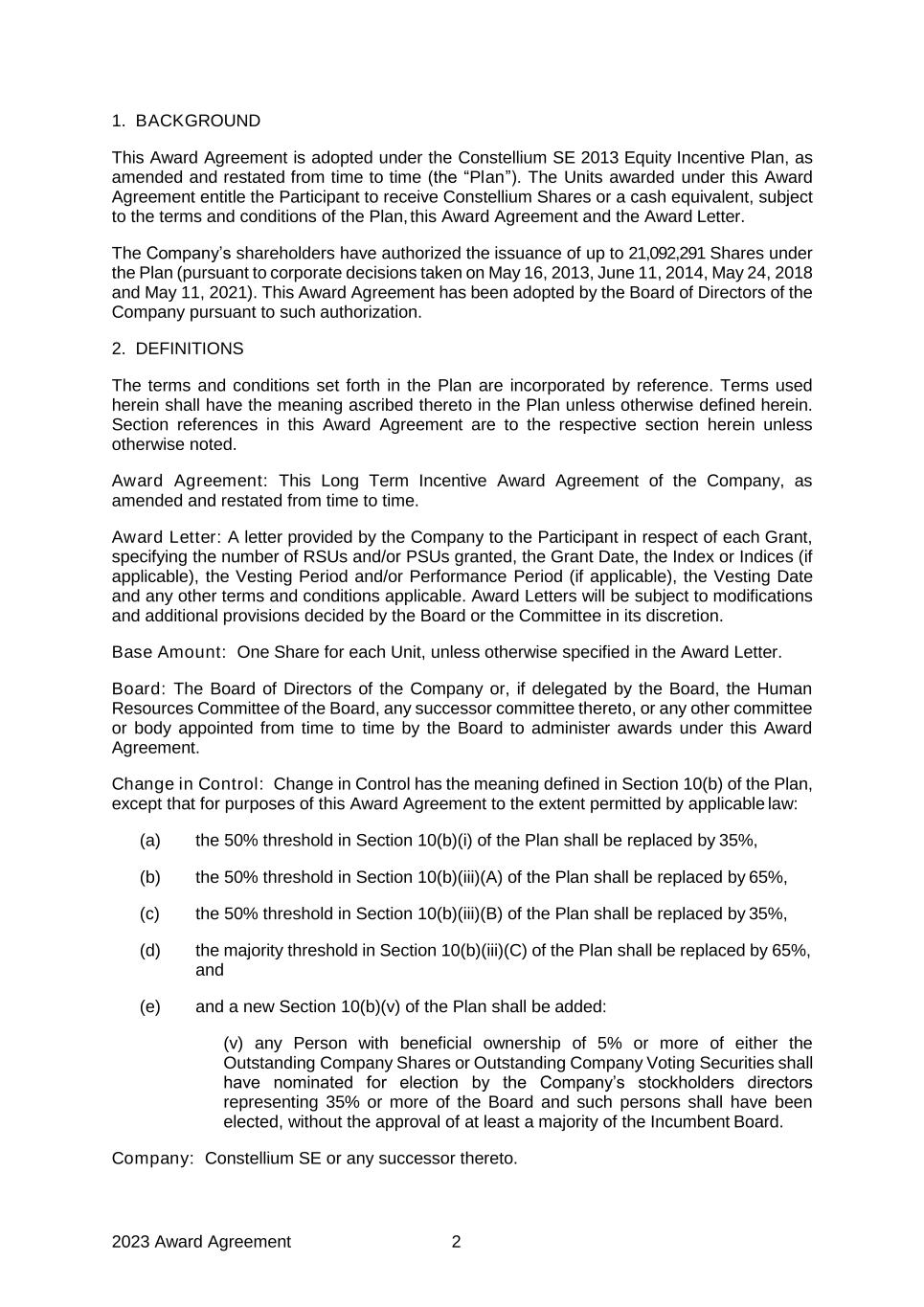
2023 Award Agreement 2 1. BACKGROUND This Award Agreement is adopted under the Constellium SE 2013 Equity Incentive Plan, as amended and restated from time to time (the “Plan”). The Units awarded under this Award Agreement entitle the Participant to receive Constellium Shares or a cash equivalent, subject to the terms and conditions of the Plan, this Award Agreement and the Award Letter. The Company’s shareholders have authorized the issuance of up to 21,092,291 Shares under the Plan (pursuant to corporate decisions taken on May 16, 2013, June 11, 2014, May 24, 2018 and May 11, 2021). This Award Agreement has been adopted by the Board of Directors of the Company pursuant to such authorization. 2. DEFINITIONS The terms and conditions set forth in the Plan are incorporated by reference. Terms used herein shall have the meaning ascribed thereto in the Plan unless otherwise defined herein. Section references in this Award Agreement are to the respective section herein unless otherwise noted. Award Agreement: This Long Term Incentive Award Agreement of the Company, as amended and restated from time to time. Award Letter: A letter provided by the Company to the Participant in respect of each Grant, specifying the number of RSUs and/or PSUs granted, the Grant Date, the Index or Indices (if applicable), the Vesting Period and/or Performance Period (if applicable), the Vesting Date and any other terms and conditions applicable. Award Letters will be subject to modifications and additional provisions decided by the Board or the Committee in its discretion. Base Amount: One Share for each Unit, unless otherwise specified in the Award Letter. Board: The Board of Directors of the Company or, if delegated by the Board, the Human Resources Committee of the Board, any successor committee thereto, or any other committee or body appointed from time to time by the Board to administer awards under this Award Agreement. Change in Control: Change in Control has the meaning defined in Section 10(b) of the Plan, except that for purposes of this Award Agreement to the extent permitted by applicable law: (a) the 50% threshold in Section 10(b)(i) of the Plan shall be replaced by 35%, (b) the 50% threshold in Section 10(b)(iii)(A) of the Plan shall be replaced by 65%, (c) the 50% threshold in Section 10(b)(iii)(B) of the Plan shall be replaced by 35%, (d) the majority threshold in Section 10(b)(iii)(C) of the Plan shall be replaced by 65%, and (e) and a new Section 10(b)(v) of the Plan shall be added: (v) any Person with beneficial ownership of 5% or more of either the Outstanding Company Shares or Outstanding Company Voting Securities shall have nominated for election by the Company’s stockholders directors representing 35% or more of the Board and such persons shall have been elected, without the approval of at least a majority of the Incumbent Board. Company: Constellium SE or any successor thereto.
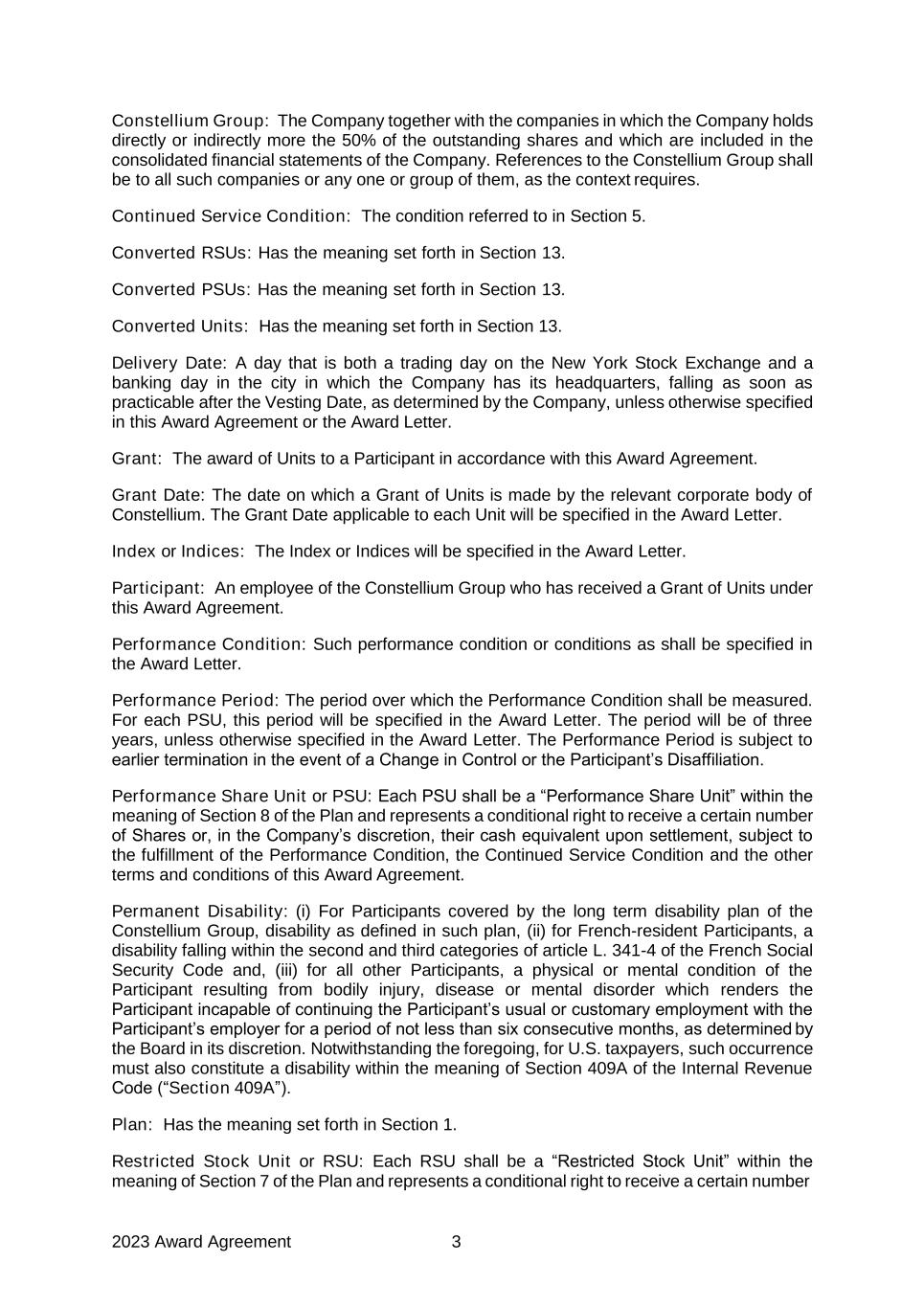
2023 Award Agreement 3 Constellium Group: The Company together with the companies in which the Company holds directly or indirectly more the 50% of the outstanding shares and which are included in the consolidated financial statements of the Company. References to the Constellium Group shall be to all such companies or any one or group of them, as the context requires. Continued Service Condition: The condition referred to in Section 5. Converted RSUs: Has the meaning set forth in Section 13. Converted PSUs: Has the meaning set forth in Section 13. Converted Units: Has the meaning set forth in Section 13. Delivery Date: A day that is both a trading day on the New York Stock Exchange and a banking day in the city in which the Company has its headquarters, falling as soon as practicable after the Vesting Date, as determined by the Company, unless otherwise specified in this Award Agreement or the Award Letter. Grant: The award of Units to a Participant in accordance with this Award Agreement. Grant Date: The date on which a Grant of Units is made by the relevant corporate body of Constellium. The Grant Date applicable to each Unit will be specified in the Award Letter. Index or Indices: The Index or Indices will be specified in the Award Letter. Participant: An employee of the Constellium Group who has received a Grant of Units under this Award Agreement. Performance Condition: Such performance condition or conditions as shall be specified in the Award Letter. Performance Period: The period over which the Performance Condition shall be measured. For each PSU, this period will be specified in the Award Letter. The period will be of three years, unless otherwise specified in the Award Letter. The Performance Period is subject to earlier termination in the event of a Change in Control or the Participant’s Disaffiliation. Performance Share Unit or PSU: Each PSU shall be a “Performance Share Unit” within the meaning of Section 8 of the Plan and represents a conditional right to receive a certain number of Shares or, in the Company’s discretion, their cash equivalent upon settlement, subject to the fulfillment of the Performance Condition, the Continued Service Condition and the other terms and conditions of this Award Agreement. Permanent Disability: (i) For Participants covered by the long term disability plan of the Constellium Group, disability as defined in such plan, (ii) for French-resident Participants, a disability falling within the second and third categories of article L. 341-4 of the French Social Security Code and, (iii) for all other Participants, a physical or mental condition of the Participant resulting from bodily injury, disease or mental disorder which renders the Participant incapable of continuing the Participant’s usual or customary employment with the Participant’s employer for a period of not less than six consecutive months, as determined by the Board in its discretion. Notwithstanding the foregoing, for U.S. taxpayers, such occurrence must also constitute a disability within the meaning of Section 409A of the Internal Revenue Code (“Section 409A”). Plan: Has the meaning set forth in Section 1. Restricted Stock Unit or RSU: Each RSU shall be a “Restricted Stock Unit” within the meaning of Section 7 of the Plan and represents a conditional right to receive a certain number
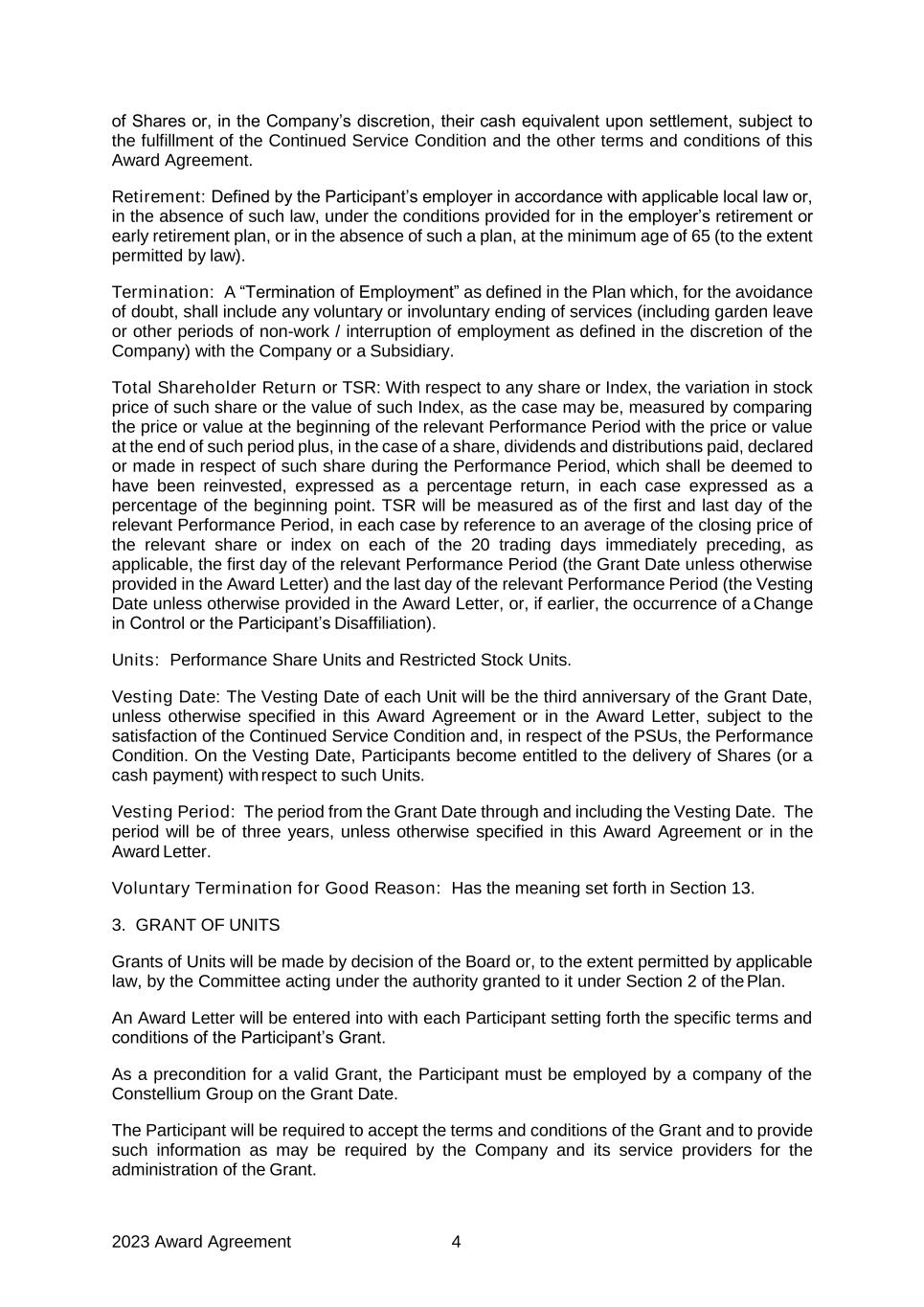
2023 Award Agreement 4 of Shares or, in the Company’s discretion, their cash equivalent upon settlement, subject to the fulfillment of the Continued Service Condition and the other terms and conditions of this Award Agreement. Retirement: Defined by the Participant’s employer in accordance with applicable local law or, in the absence of such law, under the conditions provided for in the employer’s retirement or early retirement plan, or in the absence of such a plan, at the minimum age of 65 (to the extent permitted by law). Termination: A “Termination of Employment” as defined in the Plan which, for the avoidance of doubt, shall include any voluntary or involuntary ending of services (including garden leave or other periods of non-work / interruption of employment as defined in the discretion of the Company) with the Company or a Subsidiary. Total Shareholder Return or TSR: With respect to any share or Index, the variation in stock price of such share or the value of such Index, as the case may be, measured by comparing the price or value at the beginning of the relevant Performance Period with the price or value at the end of such period plus, in the case of a share, dividends and distributions paid, declared or made in respect of such share during the Performance Period, which shall be deemed to have been reinvested, expressed as a percentage return, in each case expressed as a percentage of the beginning point. TSR will be measured as of the first and last day of the relevant Performance Period, in each case by reference to an average of the closing price of the relevant share or index on each of the 20 trading days immediately preceding, as applicable, the first day of the relevant Performance Period (the Grant Date unless otherwise provided in the Award Letter) and the last day of the relevant Performance Period (the Vesting Date unless otherwise provided in the Award Letter, or, if earlier, the occurrence of a Change in Control or the Participant’s Disaffiliation). Units: Performance Share Units and Restricted Stock Units. Vesting Date: The Vesting Date of each Unit will be the third anniversary of the Grant Date, unless otherwise specified in this Award Agreement or in the Award Letter, subject to the satisfaction of the Continued Service Condition and, in respect of the PSUs, the Performance Condition. On the Vesting Date, Participants become entitled to the delivery of Shares (or a cash payment) with respect to such Units. Vesting Period: The period from the Grant Date through and including the Vesting Date. The period will be of three years, unless otherwise specified in this Award Agreement or in the Award Letter. Voluntary Termination for Good Reason: Has the meaning set forth in Section 13. 3. GRANT OF UNITS Grants of Units will be made by decision of the Board or, to the extent permitted by applicable law, by the Committee acting under the authority granted to it under Section 2 of the Plan. An Award Letter will be entered into with each Participant setting forth the specific terms and conditions of the Participant’s Grant. As a precondition for a valid Grant, the Participant must be employed by a company of the Constellium Group on the Grant Date. The Participant will be required to accept the terms and conditions of the Grant and to provide such information as may be required by the Company and its service providers for the administration of the Grant.
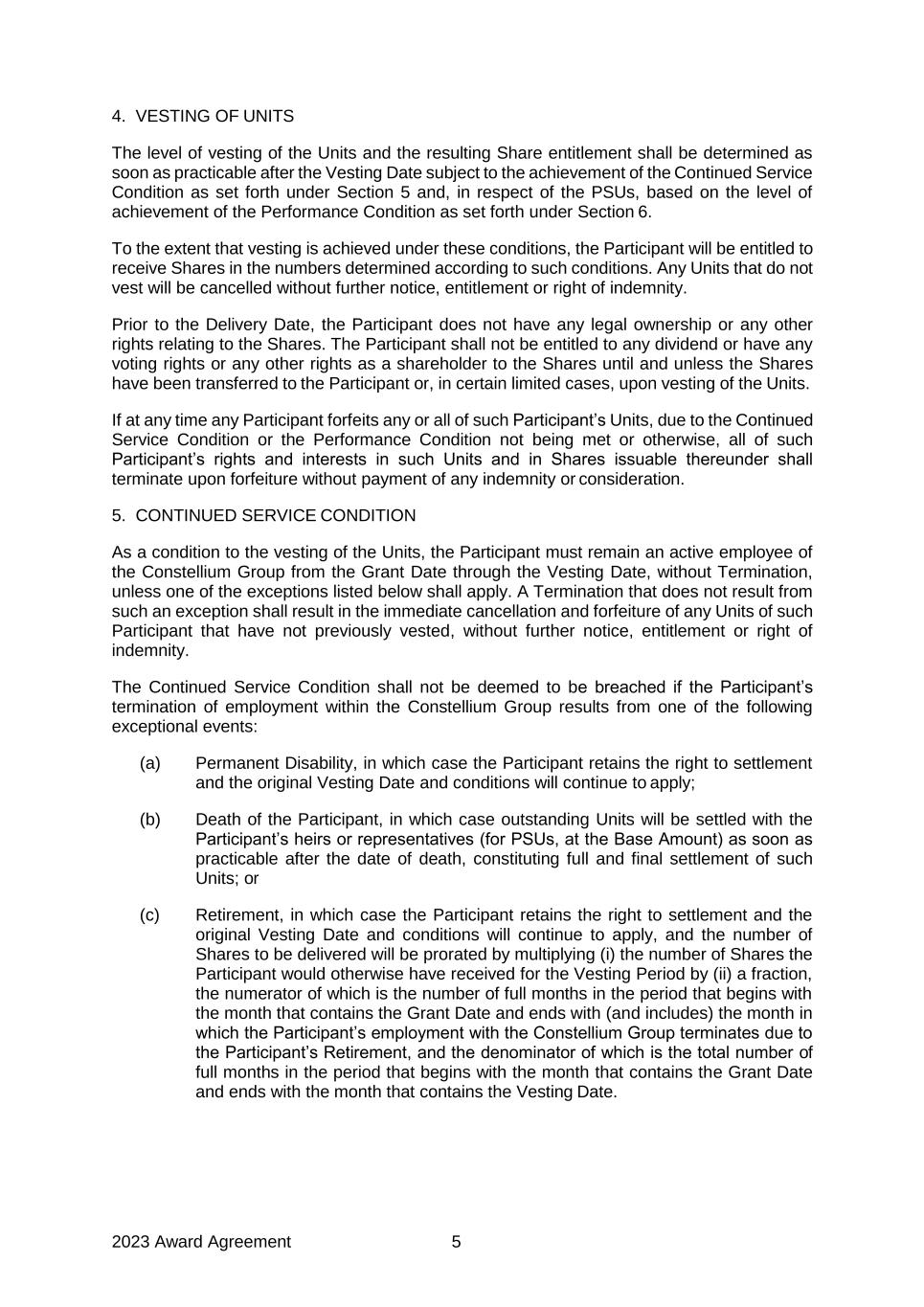
2023 Award Agreement 5 4. VESTING OF UNITS The level of vesting of the Units and the resulting Share entitlement shall be determined as soon as practicable after the Vesting Date subject to the achievement of the Continued Service Condition as set forth under Section 5 and, in respect of the PSUs, based on the level of achievement of the Performance Condition as set forth under Section 6. To the extent that vesting is achieved under these conditions, the Participant will be entitled to receive Shares in the numbers determined according to such conditions. Any Units that do not vest will be cancelled without further notice, entitlement or right of indemnity. Prior to the Delivery Date, the Participant does not have any legal ownership or any other rights relating to the Shares. The Participant shall not be entitled to any dividend or have any voting rights or any other rights as a shareholder to the Shares until and unless the Shares have been transferred to the Participant or, in certain limited cases, upon vesting of the Units. If at any time any Participant forfeits any or all of such Participant’s Units, due to the Continued Service Condition or the Performance Condition not being met or otherwise, all of such Participant’s rights and interests in such Units and in Shares issuable thereunder shall terminate upon forfeiture without payment of any indemnity or consideration. 5. CONTINUED SERVICE CONDITION As a condition to the vesting of the Units, the Participant must remain an active employee of the Constellium Group from the Grant Date through the Vesting Date, without Termination, unless one of the exceptions listed below shall apply. A Termination that does not result from such an exception shall result in the immediate cancellation and forfeiture of any Units of such Participant that have not previously vested, without further notice, entitlement or right of indemnity. The Continued Service Condition shall not be deemed to be breached if the Participant’s termination of employment within the Constellium Group results from one of the following exceptional events: (a) Permanent Disability, in which case the Participant retains the right to settlement and the original Vesting Date and conditions will continue to apply; (b) Death of the Participant, in which case outstanding Units will be settled with the Participant’s heirs or representatives (for PSUs, at the Base Amount) as soon as practicable after the date of death, constituting full and final settlement of such Units; or (c) Retirement, in which case the Participant retains the right to settlement and the original Vesting Date and conditions will continue to apply, and the number of Shares to be delivered will be prorated by multiplying (i) the number of Shares the Participant would otherwise have received for the Vesting Period by (ii) a fraction, the numerator of which is the number of full months in the period that begins with the month that contains the Grant Date and ends with (and includes) the month in which the Participant’s employment with the Constellium Group terminates due to the Participant’s Retirement, and the denominator of which is the total number of full months in the period that begins with the month that contains the Grant Date and ends with the month that contains the Vesting Date.
2023 Award Agreement 6 If the Participant’s last day of employment with the Constellium Group occurs before the last day of the Vesting Period for any reason other than those mentioned above, then, unless the Board or Committee determines otherwise in its sole discretion, any Units of such Participant that have not previously vested shall be immediately cancelled and forfeited without further notice, entitlement or right of indemnity. 6. PERFORMANCE CONDITION The vesting of the PSUs and the delivery of the related Shares shall be subject to the level of achievement of the Performance Condition in respect of the relevant Performance Period, as specified in the Award Letter. 7. MEASUREMENT AND CALCULATION OF ACHIEVEMENT The measurement of the achievement of the Performance Condition shall be made as soon as practicable after the end of the relevant Performance Period. The number of PSUs to be settled as Shares or the equivalent amount of cash, in case applicable, shall be calculated by the Company based on this measurement. The Company shall carry out the measurement and calculation in its discretion. The Board may in its discretion decide to amend the targets initially set and/or the composition of the list of companies referred to if it reasonably believes that changes in the business of the Company and/or any of the listed companies have had an adverse effect on their comparability for purposes of measuring the Company’s relative performance. Such changes may include a change in accounting method, a change in scope of consolidation following a merger, sale, acquisition, or the creation of a material new business entity or the discontinuation of an existing material business entity, or any other changes in circumstances that it shall deem material and pertinent. The calculation of the number of Shares to be settled shall not result in fractional Shares. The number of Shares shall be rounded to the nearest whole Share. 8. SETTLEMENT Following the Vesting Date, the Company will complete the settlement by transferring the applicable number of Shares or, in its discretion, their cash equivalent to the Participant’s brokerage or other bank account, as applicable, on the Delivery Date. Completion of settlement is dependent on the Participant’s compliance with the terms and conditions of the Plan, this Award Agreement and the relevant Award Letter and providing all necessary instructions and actions to enable the Company to facilitate the settlement. If the Participant has not performed all necessary actions to enable the Company to complete the settlement, the Company may, in its sole discretion, sell the Shares on behalf of the Participant and remit the proceeds to the Participant. The Company may, in its sole discretion, use one or more of the following instruments to settle Units: newly issued Shares, treasury Shares held by the Company, Shares purchased from the open market, or, in lieu of Shares, cash (without adjustment for change in tax or social treatment). On each Delivery Date, the Company shall pay to the Participant a cash amount equal to the product of (x) any cash dividends or other distributions (other than cash dividends or other distributions pursuant to which the Units were adjusted pursuant to Section 3(c) of the Plan or Section 13(a)), if any, paid on a Share from the Grant Date to such Delivery Date and (y) the number of Shares delivered to the Participant on such Delivery Date (including for this purpose
2023 Award Agreement 7 any Shares that would have been delivered on such Delivery Date but for being withheld to satisfy tax withholding obligations). 9. NO EFFECT ON TERMS OF EMPLOYMENT The Grant or settlement of Units and/or Shares does not constitute a term or a condition of the Participant’s employment with any company of the Constellium Group under applicable local laws and the rights and obligations arising from a Participant’s employment with the Group are separate from, and are not affected by, the Participant’s participation in this Award Agreement. The Units, the Shares or their cash equivalent do not form a part of the Participant’s salary or benefit of any kind. Nothing in this Award Agreement, any Award Letter or the Plan shall interfere with or limit in any way the right of the Company, its Subsidiaries or its Affiliates to terminate a Participant’s employment or service at any time, nor confer upon any Participant the right to continue in the employment of the Company, its Subsidiaries or its Affiliates. The Grant or settlement of Units and/or Shares does not create any right for that Participant to be offered participation in the Plan in the future or to be granted any additional Units or Shares on any particular terms or in any particular amounts. By participating in the Plan, a Participant waives all rights to compensation for any loss in relation to and in accordance with such participation, including: (a) any loss or reduction of any rights or expectations under this Award Agreement and the Award Letter in any circumstances or for any reason; (b) any exercise of a discretion or a decision taken in relation to any Units or Shares, and/or to this Award Agreement or the Award Letter, or any failure to exercise a discretion or take a decision; and (c) the operation, suspension, termination or amendment of the Plan, this Award Agreement or the Award Letter. 10. TAXES AND OTHER OBLIGATIONS The Participant is responsible for paying all personal taxes and personal social security charges associated with the Units and the Shares related thereto. This includes responsibility for any and all personal tax and personal social security charge liabilities in multiple countries, if the Participant has resided in more than one country during any period in which tax liabilities arise with respect to this Grant. Participants are advised to consult their own financial and tax advisers (at their own expense) before accepting the Grant in order to verify their tax position. Units and Shares before delivery must not be used as security for any liability, be transferred or otherwise disposed of (except in the event of the Participant’s death, to the Participant’s personal representatives) and will lapse immediately on any attempt to do so. Pursuant to applicable laws, the Constellium Group is or may be required or may deem it appropriate to withhold taxes, social security charges or fulfill employment related and other obligations upon Grant, vesting or settlement of Shares, or payment of any cash-equivalent, or when the Shares are disposed of by a Participant. The Constellium Group shall have the right to determine how such collection, withholding or other measures will be arranged or carried out, including but not limited to salary withholding, a settlement of a net amount remaining after the completion of such measures or a sale of the Shares on behalf of a Participant for the completion of such measures.
2023 Award Agreement 8 11. BREACH OF THESE TERMS AND CONDITIONS The Participant shall comply with the terms and conditions set forth in this Award Agreement and in the Award Letter, as well as any administrative instructions given by the Company regarding the same from time to time. If the Participant breaches the terms and conditions set forth in the Plan, this Award Agreement and/or in the Award Letter and/or any administrative instructions given by the Company, the Company may in its discretion, at any time prior to the Delivery Date, cancel the Grant of Units. 12. AMENDMENTS Amendments of this Award Agreement and of any Grant made hereunder shall be governed by Section 12 of the Plan. 13. RIGHTS OF PARTICIPANTS IN CORPORATE EVENTS (a) The Board may in its discretion choose to adjust the number of Shares underlying each Unit in accordance with applicable law in the event that it shall deem such adjustment to be necessary and equitable to protect the interests of the Participants following certain corporate transactions affecting the share capital of the Company. These events may include, and are not limited to, (i) capital reduction, (ii) modification of the means of sharing of profits, (iii) grants of free shares to all existing holders, (iv) a capital increase by incorporation of reserves, profits or issuance premiums, (v) distribution of reserves and (vi) any issuance of capital securities or financial instruments that give a right to the allocation of capital securities with preferential subscription rights reserved to shareholders. For the avoidance of doubt, the Company’s decision to cancel existing shares held by the Company, to grant stock or stock options to employees or to issue shares to selected investors prior to the settlement of the Units will not give rise to such adjustments. (b) Subject to Section 13(d) and Section 409A, should the Company, during the Vesting Period, resolve to merge with another existing company or merge with a company to be formed, or should the Company resolve to be demerged, the Board may determine, in its sole discretion, whether the Units may be settled prior to the merger or demerger. Any settlement will be within such period as resolved by the Board. The Board may determine, in its sole discretion, whether the Units should be converted into similar equity rights issued by the other company. In such circumstances, the Board shall determine the terms and the period applicable to the vesting of such new rights. (c) This Award Agreement and the Grants made hereunder shall not in any way infringe or limit the ability of the Company to register in or transfer to another member state in the European Economic Area or to register a transfer of its domicile into another member state. Such registration or transfer shall not have any impact on the rights and obligations of the Participants under this Award Agreement and in respect of any Grant, except to the extent resulting from a change in applicable law and/or as decided by the Board in its sole discretion. (d) In the event of a Change in Control occurring before the Vesting Date, in accordance with the provisions of Section 10(b) of the Plan, as well as the definition of Change in Control under Section 2: (i) any RSUs that have not previously vested or lapsed will be converted into a cash-denominated right equal in value to (A) the number of Shares underlying such RSU immediately prior to such Change in Control multiplied by (B) the
2023 Award Agreement 9 closing price of a Share on the date immediately preceding the date of such Change in Control (“Converted RSUs”); (ii) any PSUs that have not previously vested or lapsed will be converted into a cash-denominated right equal in value to (A) the higher of (I) the Base Amount and (II) the number of Shares determined on the basis of the actual TSR, measured for such purposes as of the date immediately preceding the date of such Change in Control, which, for such purposes, will become the last day of the Performance Period multiplied by (B) the closing price of a Share on the date immediately preceding the date of such Change in Control (“Converted PSUs” and together with the Converted RSUs, the “Converted Units”); and (iii) the Converted Units will vest subject to the terms of, and at the same time as, the RSUs or PSUs from which the Converted Unit originated, provided that upon a Termination without Cause or Voluntary Termination for Good Reason of a Participant occurring upon such Change in Control or during any period thereafter that is prior to the last Vesting Date under this Award Agreement: 1. the date of such Termination will become the Vesting Date of any then outstanding Converted Units held by such Participant, and all outstanding Converted Units held by such Participant will fully vest and settle upon such Termination 2. to the extent permitted by applicable law, the Delivery Date of the Converted Units that have vested in accordance with the foregoing will be accelerated to occur on or as soon as practicable after the occurrence of the Termination, provided that (A) for French-resident Participants and for Grants that are subject to Article L. 225-197-1 of the French Commercial Code, if the Termination occurs (x) before the first anniversary of the Grant Date, the Board may defer the Delivery Date until such first anniversary and thereafter impose a mandatory holding period until the second anniversary of the Grant Date and (y) after the first anniversary of the Grant Date but before the second anniversary of the Grant Date, the Board may impose a mandatory holding period from the Delivery Date until the second anniversary of the Grant Date and (B) for Participants who are U.S. taxpayers, the originally scheduled Delivery Date will be maintained unless (x) a Change in Control occurs at the 50% threshold originally provided in Section 10(b) of the Plan or (y) the Board determines that the acceleration of the Delivery Date provided for above would be permissible under Section 409A and would not result in the imposition of any additional tax, penalty or surcharge on Participants under such Section 409A. For the avoidance of doubt, any limitation on the acceleration of delivery resulting from the foregoing clauses (A) or (B) shall have no effect on the acceleration of vesting provided for under clauses (i), (ii) and (iii) above, and 3. for purposes of the foregoing, “Voluntary Termination for Good Reason” shall mean a termination of the Participant’s employment at the Participant’s initiative following the occurrence, without prior written consent, of one or more of the following events: i. a material reduction in the Participant’s base salary and/or the Participant’s target bonus or long-term
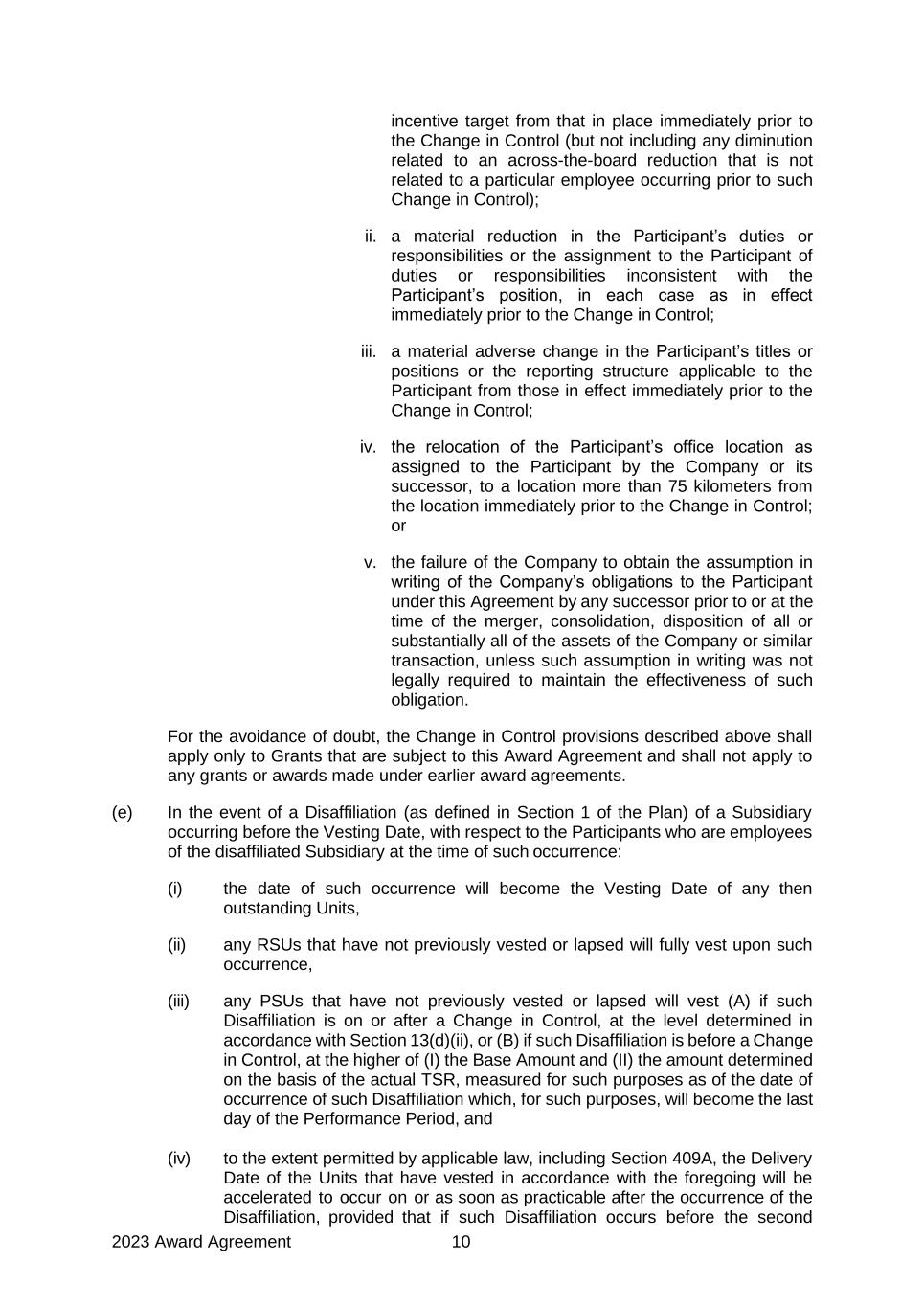
2023 Award Agreement 10 incentive target from that in place immediately prior to the Change in Control (but not including any diminution related to an across-the-board reduction that is not related to a particular employee occurring prior to such Change in Control); ii. a material reduction in the Participant’s duties or responsibilities or the assignment to the Participant of duties or responsibilities inconsistent with the Participant’s position, in each case as in effect immediately prior to the Change in Control; iii. a material adverse change in the Participant’s titles or positions or the reporting structure applicable to the Participant from those in effect immediately prior to the Change in Control; iv. the relocation of the Participant’s office location as assigned to the Participant by the Company or its successor, to a location more than 75 kilometers from the location immediately prior to the Change in Control; or v. the failure of the Company to obtain the assumption in writing of the Company’s obligations to the Participant under this Agreement by any successor prior to or at the time of the merger, consolidation, disposition of all or substantially all of the assets of the Company or similar transaction, unless such assumption in writing was not legally required to maintain the effectiveness of such obligation. For the avoidance of doubt, the Change in Control provisions described above shall apply only to Grants that are subject to this Award Agreement and shall not apply to any grants or awards made under earlier award agreements. (e) In the event of a Disaffiliation (as defined in Section 1 of the Plan) of a Subsidiary occurring before the Vesting Date, with respect to the Participants who are employees of the disaffiliated Subsidiary at the time of such occurrence: (i) the date of such occurrence will become the Vesting Date of any then outstanding Units, (ii) any RSUs that have not previously vested or lapsed will fully vest upon such occurrence, (iii) any PSUs that have not previously vested or lapsed will vest (A) if such Disaffiliation is on or after a Change in Control, at the level determined in accordance with Section 13(d)(ii), or (B) if such Disaffiliation is before a Change in Control, at the higher of (I) the Base Amount and (II) the amount determined on the basis of the actual TSR, measured for such purposes as of the date of occurrence of such Disaffiliation which, for such purposes, will become the last day of the Performance Period, and (iv) to the extent permitted by applicable law, including Section 409A, the Delivery Date of the Units that have vested in accordance with the foregoing will be accelerated to occur on or as soon as practicable after the occurrence of the Disaffiliation, provided that if such Disaffiliation occurs before the second
2023 Award Agreement 11 anniversary of the Grant Date, the Board shall convert the affected Units to cash settlement in the manner described in Sections 13(d)(i) and (ii) above, on the basis of the closing price of a Share and actual TSR measured on the date immediately preceding the date of such Disaffiliation. (f) In any situation described above providing for the delivery of Shares, the Board may in its discretion choose to cause Shares from other sources to be delivered or shall cause the Company to pay an equivalent value in cash (without adjustment for change in tax or social treatment). The amount to be paid out would be determined based on the number of Shares to be delivered to Participants concerned, valued on a given date or according to an average of share prices calculated over the course of a period preceding the payment date retained by the Board. 14. GOVERNING LAW AND INTERPRETATION With respect to each Unit granted, the Plan, this Award Agreement and the Award Letter are governed by the corporate laws applicable to the Company on the Grant Date of such Unit. To the extent that any discretionary action or interpretation of the Plan, this Award Agreement and the Award Letter is taken or made by the Company or the Board, such action or interpretation shall be taken or made in good faith after consideration of the best interests of the affected Participants. For Participants who are U.S. taxpayers, it is intended that the Grant meets the requirements of Section 409A and shall be interpreted accordingly. The Participants recognize that it may be necessary to modify the Plan and/or this Award Agreement to reflect guidance under Section 409A issued by the Internal Revenue Service. The Participant agrees that the Company shall have sole discretion in determining (i) whether any such modification is desirable or appropriate and (ii) the terms of any such modification. For Participants who are French taxpayers, it is intended that the Grant meets the requirements of Article L. 225-197-1 et seq. of the French Commercial Code and related tax and social regulations and shall be interpreted accordingly. The Participants recognize that it may be necessary to modify the Plan and/or this Award Agreement to reflect guidance under such provision issued by the French tax and social administration. The Participant agrees that the Company shall have sole discretion in determining (i) whether any such modification is desirable or appropriate and (ii) the terms of any such modification. 15. COLLECTING, PROCESSING AND TRANSFERRING OF PERSONAL DATA Personal data required for the administration of Plan, this Award Agreement, the Award Letter and the settlement of the Units shall be collected, processed and transferred by the Constellium Group or its authorized agent(s) fairly and in accordance with the governing applicable data protection principles and conditions. The Participant is entitled to request access, rectification and objection of the personal data concerning the Participant as per applicable laws, statutes or regulation. In order to exercise this right, the Participant must contact the local data privacy/human resources contact in the Participant’s location.
exhibit103015_2023formlt
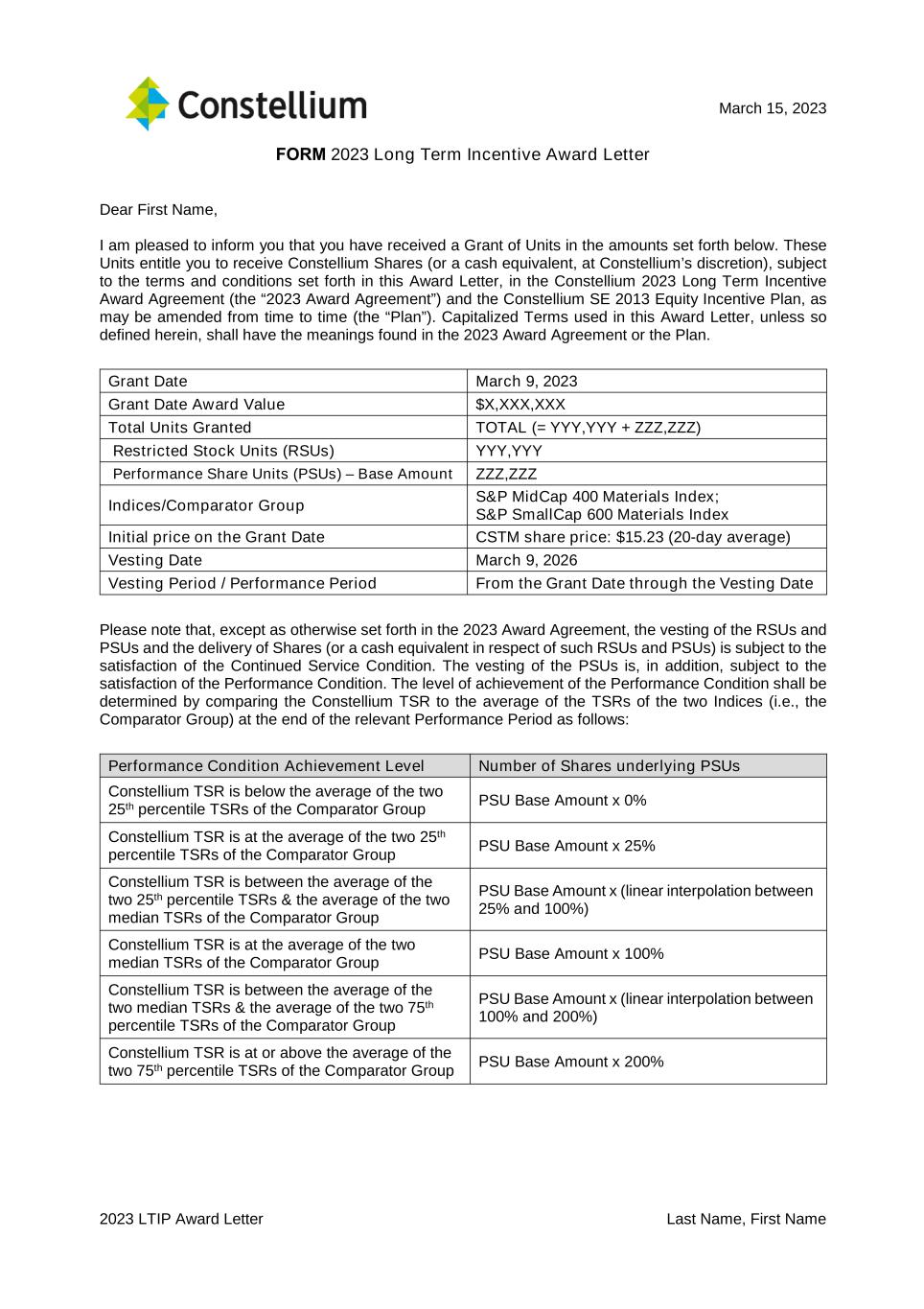
2023 LTIP Award Letter Last Name, First Name March 15, 2023 FORM 2023 Long Term Incentive Award Letter Dear First Name, I am pleased to inform you that you have received a Grant of Units in the amounts set forth below. These Units entitle you to receive Constellium Shares (or a cash equivalent, at Constellium’s discretion), subject to the terms and conditions set forth in this Award Letter, in the Constellium 2023 Long Term Incentive Award Agreement (the “2023 Award Agreement”) and the Constellium SE 2013 Equity Incentive Plan, as may be amended from time to time (the “Plan”). Capitalized Terms used in this Award Letter, unless so defined herein, shall have the meanings found in the 2023 Award Agreement or the Plan. Grant Date March 9, 2023 Grant Date Award Value $X,XXX,XXX Total Units Granted TOTAL (= YYY,YYY + ZZZ,ZZZ) Restricted Stock Units (RSUs) YYY,YYY Performance Share Units (PSUs) – Base Amount ZZZ,ZZZ Indices/Comparator Group S&P MidCap 400 Materials Index; S&P SmallCap 600 Materials Index Initial price on the Grant Date CSTM share price: $15.23 (20-day average) Vesting Date March 9, 2026 Vesting Period / Performance Period From the Grant Date through the Vesting Date Please note that, except as otherwise set forth in the 2023 Award Agreement, the vesting of the RSUs and PSUs and the delivery of Shares (or a cash equivalent in respect of such RSUs and PSUs) is subject to the satisfaction of the Continued Service Condition. The vesting of the PSUs is, in addition, subject to the satisfaction of the Performance Condition. The level of achievement of the Performance Condition shall be determined by comparing the Constellium TSR to the average of the TSRs of the two Indices (i.e., the Comparator Group) at the end of the relevant Performance Period as follows: Performance Condition Achievement Level Number of Shares underlying PSUs Constellium TSR is below the average of the two 25th percentile TSRs of the Comparator Group PSU Base Amount x 0% Constellium TSR is at the average of the two 25th percentile TSRs of the Comparator Group PSU Base Amount x 25% Constellium TSR is between the average of the two 25th percentile TSRs & the average of the two median TSRs of the Comparator Group PSU Base Amount x (linear interpolation between 25% and 100%) Constellium TSR is at the average of the two median TSRs of the Comparator Group PSU Base Amount x 100% Constellium TSR is between the average of the two median TSRs & the average of the two 75th percentile TSRs of the Comparator Group PSU Base Amount x (linear interpolation between 100% and 200%) Constellium TSR is at or above the average of the two 75th percentile TSRs of the Comparator Group PSU Base Amount x 200%

2023 LTIP Award Letter Last Name, First Name Notwithstanding the foregoing, if the Constellium TSR is negative, the number of Shares (or a cash equivalent) eligible to be delivered in respect of the PSUs shall be capped at 100% of the Base Amount. By electronic acceptance of this award, you acknowledge that you have received a copy of, or have online access to, the 2023 Award Agreement and the Plan, and hereby accept the Units granted, subject to all the terms and provisions of this Award Letter, the 2023 Award Agreement and the Plan. The Board or the Committee shall determine whether an event has occurred resulting in the forfeiture of your Units and any Shares issuable thereunder and all such determinations shall be final and conclusive. You also acknowledge that this award and similar awards are made on a selective basis and are, therefore, to be kept confidential. Very truly yours, Ryan Jurkovic Senior Vice President Chief Human Resources Officer
exhibit103016_2023formlt
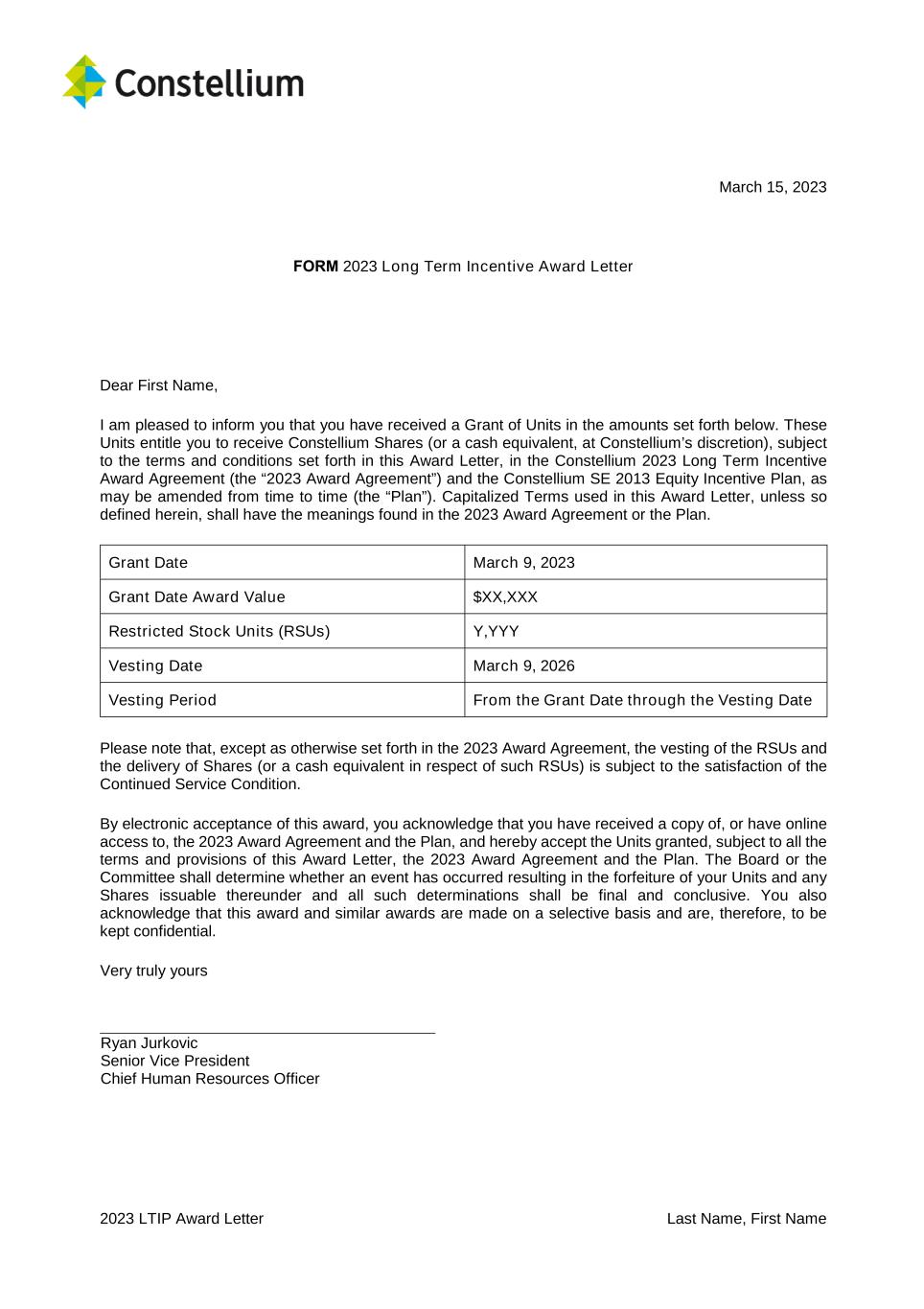
2023 LTIP Award Letter Last Name, First Name March 15, 2023 FORM 2023 Long Term Incentive Award Letter Dear First Name, I am pleased to inform you that you have received a Grant of Units in the amounts set forth below. These Units entitle you to receive Constellium Shares (or a cash equivalent, at Constellium’s discretion), subject to the terms and conditions set forth in this Award Letter, in the Constellium 2023 Long Term Incentive Award Agreement (the “2023 Award Agreement”) and the Constellium SE 2013 Equity Incentive Plan, as may be amended from time to time (the “Plan”). Capitalized Terms used in this Award Letter, unless so defined herein, shall have the meanings found in the 2023 Award Agreement or the Plan. Grant Date March 9, 2023 Grant Date Award Value $XX,XXX Restricted Stock Units (RSUs) Y,YYY Vesting Date March 9, 2026 Vesting Period From the Grant Date through the Vesting Date Please note that, except as otherwise set forth in the 2023 Award Agreement, the vesting of the RSUs and the delivery of Shares (or a cash equivalent in respect of such RSUs) is subject to the satisfaction of the Continued Service Condition. By electronic acceptance of this award, you acknowledge that you have received a copy of, or have online access to, the 2023 Award Agreement and the Plan, and hereby accept the Units granted, subject to all the terms and provisions of this Award Letter, the 2023 Award Agreement and the Plan. The Board or the Committee shall determine whether an event has occurred resulting in the forfeiture of your Units and any Shares issuable thereunder and all such determinations shall be final and conclusive. You also acknowledge that this award and similar awards are made on a selective basis and are, therefore, to be kept confidential. Very truly yours Ryan Jurkovic Senior Vice President Chief Human Resources Officer
exhibit1037_constellium-
EXECUTION VERSION Constellium: Third Omnibus Amendment 756361753 THIRD OMNIBUS AMENDMENT This THIRD OMNIBUS AMENDMENT, dated as of September 15, 2023 (this “Amendment”) is: (1) THE THIRD AMENDMENT to the RECEIVABLES SALE AGREEMENT, between Constellium Muscle Shoals LLC, as seller (the “RSA Seller”) and Constellium Muscle Shoals Funding III LLC, as purchaser (the “RSA Purchaser”); and (2) THE THIRD AMENDMENT to the RECEIVABLES PURCHASE AGREEMENT, among Constellium Muscle Shoals Funding III LLC, as seller (the “RPA Seller”), the RSA Seller as servicer (the “Servicer”), Deutsche Bank Trust Company Americas, Deutsche Bank AG New York Branch, and each other subsidiary or affiliate of either such party who may from time to time become a party thereto (collectively, “DB”), in such capacity as a purchaser hereunder (each, a “RPA Purchaser”), and Intesa Sanpaolo S.p.A., New York Branch and each subsidiary or affiliate who may from time to time become a party thereto (collectively, “Intesa”), in its capacity as a purchaser thereunder (each, a “Purchaser” and, together with DB, and each of their permitted successors and assigns, collectively, the “Purchasers”), and in its capacity as purchaser representative hereunder (together with its successors and permitted assigns in such capacity, the “Purchaser Representative”). RECITALS WHEREAS, the RSA Seller and the RPA Seller have heretofore entered into the RECEIVABLES SALE AGREEMENT, dated as of September 30, 2021 (as amended, restated, amended and restated, supplemented, assigned or otherwise modified from time to time, the “Receivables Sale Agreement”); WHEREAS, Constellium International SAS (the “Parent”) has heretofore entered into a PERFORMANCE UNDERTAKING, dated as of September 30, 2021, in favor of the RPA Seller with respect to obligations under the Receivables Sale Agreement (as amended, restated, amended and restated, supplemented, assigned or otherwise modified from time to time, the “First Tier Parent Guarantee”); WHEREAS, the RPA Seller, the Servicer, Intesa (in its capacity as Purchaser and Purchaser Representative) and DB (in its capacity as Purchaser) heretofore entered into the RECEIVABLES PURCHASE AGREEMENT, dated as of September 30, 2021 (as amended, restated, amended and restated, supplemented or otherwise modified from time to time, the “Receivables Purchase Agreement”; together with the Receivables Sale Agreement, each an “Agreement” and collectively, the “Agreements”); WHEREAS, the Parent has heretofore entered into a PERFORMANCE UNDERTAKING, dated as of September 30, 2021, in favor of the Purchasers with respect to obligations under the Receivables Purchase Agreement (as amended, restated, amended and restated, supplemented, assigned or otherwise modified from time to time, the “Second Tier Parent Guarantee,” and together with the First Tier Parent Guarantee, the “Guarantees”);
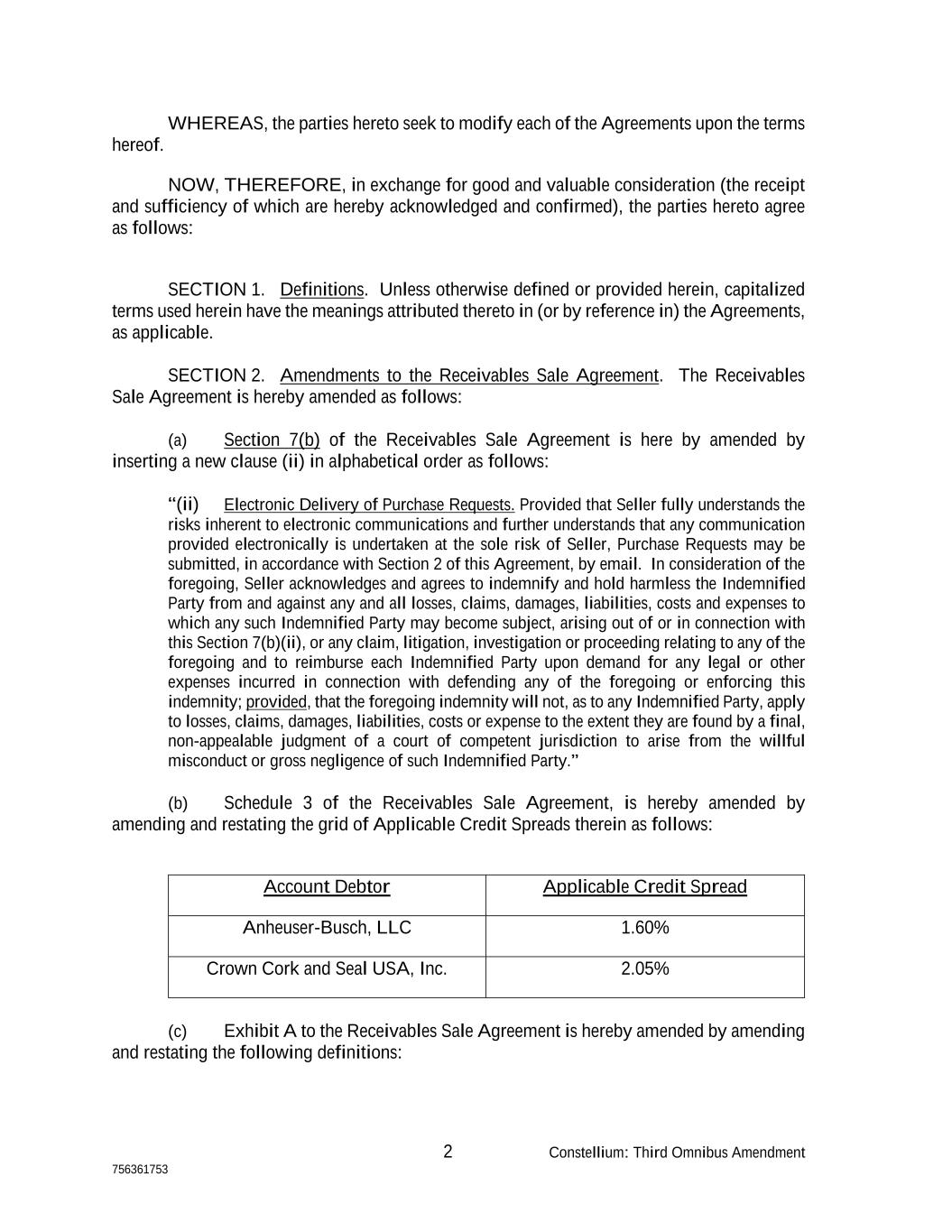
2 Constellium: Third Omnibus Amendment 756361753 WHEREAS, the parties hereto seek to modify each of the Agreements upon the terms hereof. NOW, THEREFORE, in exchange for good and valuable consideration (the receipt and sufficiency of which are hereby acknowledged and confirmed), the parties hereto agree as follows: SECTION 1. Definitions. Unless otherwise defined or provided herein, capitalized terms used herein have the meanings attributed thereto in (or by reference in) the Agreements, as applicable. SECTION 2. Amendments to the Receivables Sale Agreement. The Receivables Sale Agreement is hereby amended as follows: (a) Section 7(b) of the Receivables Sale Agreement is here by amended by inserting a new clause (ii) in alphabetical order as follows: “(ii) Electronic Delivery of Purchase Requests. Provided that Seller fully understands the risks inherent to electronic communications and further understands that any communication provided electronically is undertaken at the sole risk of Seller, Purchase Requests may be submitted, in accordance with Section 2 of this Agreement, by email. In consideration of the foregoing, Seller acknowledges and agrees to indemnify and hold harmless the Indemnified Party from and against any and all losses, claims, damages, liabilities, costs and expenses to which any such Indemnified Party may become subject, arising out of or in connection with this Section 7(b)(ii), or any claim, litigation, investigation or proceeding relating to any of the foregoing and to reimburse each Indemnified Party upon demand for any legal or other expenses incurred in connection with defending any of the foregoing or enforcing this indemnity; provided, that the foregoing indemnity will not, as to any Indemnified Party, apply to losses, claims, damages, liabilities, costs or expense to the extent they are found by a final, non-appealable judgment of a court of competent jurisdiction to arise from the willful misconduct or gross negligence of such Indemnified Party.” (b) Schedule 3 of the Receivables Sale Agreement, is hereby amended by amending and restating the grid of Applicable Credit Spreads therein as follows: Account Debtor Applicable Credit Spread Anheuser-Busch, LLC 1.60% Crown Cork and Seal USA, Inc. 2.05% (c) Exhibit A to the Receivables Sale Agreement is hereby amended by amending and restating the following definitions:
3 Constellium: Third Omnibus Amendment 756361753 “Facility Amount”: Up to USD 175,000,000, as such amount may be reduced from time to time by the Seller in accordance with the terms of Section 2(g) hereof. “Purchase Termination Date”: The date which is the earlier of (i) the date on which this Agreement terminates pursuant to Section 2(b) hereof, (ii) the date declared by Purchaser in its sole discretion following the occurrence of a Termination Event, (iii) the date declared by the Seller in accordance with the terms of Section 2(b) hereof, and (iv) September 30, 2025, as such date may be extended in accordance with the terms of Section 2(b) hereof. SECTION 3. Amendments to the Receivables Purchase Agreement. The Receivables Purchase Agreement is hereby amended as follows: (a) Section 7(b) of the Receivables Purchase Agreement is here by amended by inserting a new clause (iii) in alphabetical order as follows: “(iii) Electronic Delivery of Purchase Requests. Provided that Seller fully understands the risks inherent to electronic communications and further understands that any communication provided electronically is undertaken at the sole risk of Seller, Purchase Requests may be submitted, in accordance with Section 2 of this Agreement, by email. In consideration of the foregoing, Seller acknowledges and agrees to indemnify and hold harmless the Indemnified Parties from and against any and all losses, claims, damages, liabilities, costs and expenses to which any such Indemnified Party may become subject, arising out of or in connection with this Section 7(b)(iii), or any claim, litigation, investigation or proceeding relating to any of the foregoing and to reimburse each Indemnified Party upon demand for any legal or other expenses incurred in connection with defending any of the foregoing or enforcing this indemnity; provided, that the foregoing indemnity will not, as to any Indemnified Party, apply to losses, claims, damages, liabilities, costs or expense to the extent they are found by a final, non-appealable judgment of a court of competent jurisdiction to arise from the willful misconduct or gross negligence of such Indemnified Party.” (b) Section 12 of the Receivables Purchase Agreement is here by amended by amending and restating Intesa’s and DB’s notice information as follows: “If to Intesa, as a Purchaser and/or Purchaser Representative: Intesa Sanpaolo S.p.A., New York Branch One William Street New York, NY 10004 Attention: SEF & TEF Department Email: SEF_TEF_NY@intesasanpaolo.com with a copy to : Intesa Sanpaolo S.p.A., New York Branch One William Street New York, NY 10004 Attention: Legal Department Email: NYLegal@intesasanpaolo.com
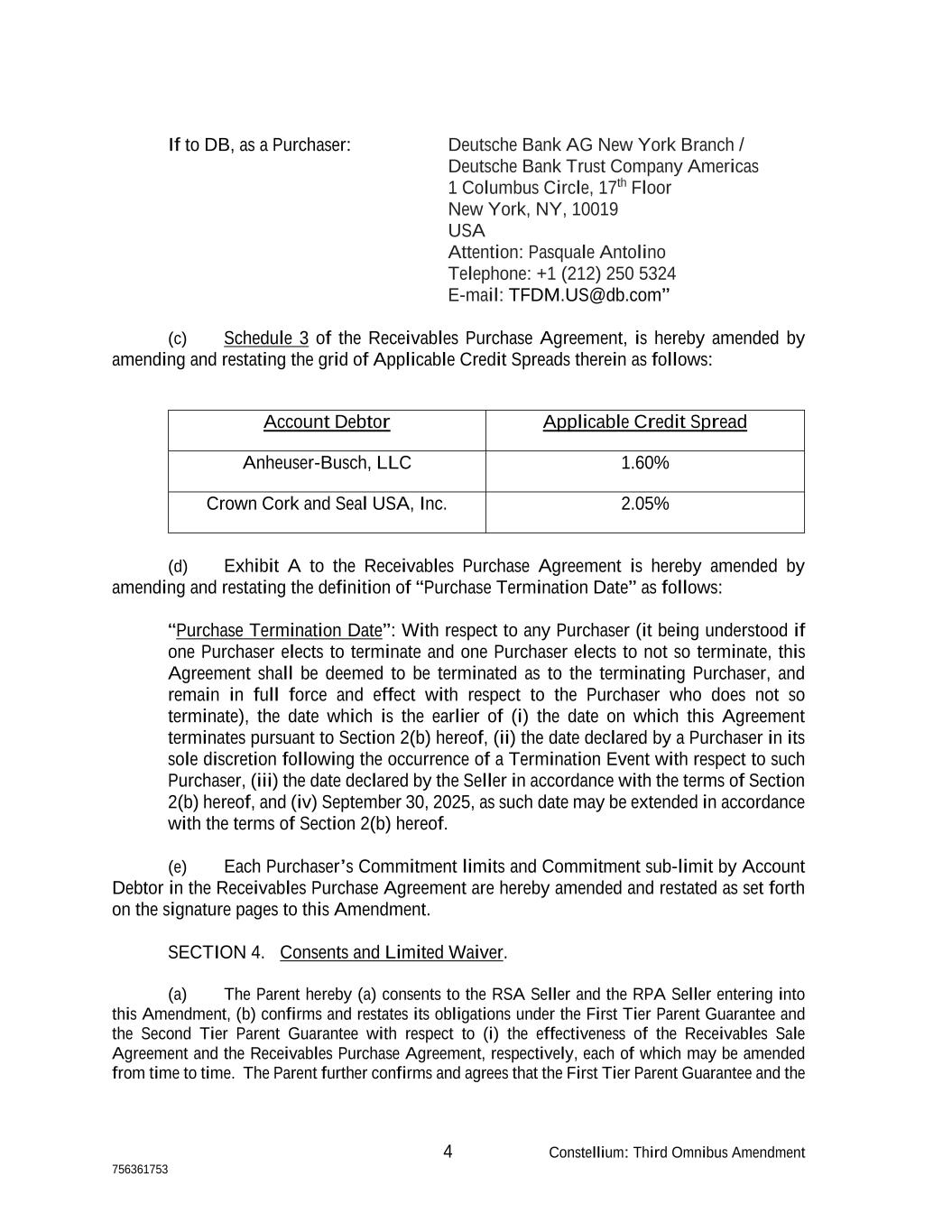
4 Constellium: Third Omnibus Amendment 756361753 If to DB, as a Purchaser: Deutsche Bank AG New York Branch / Deutsche Bank Trust Company Americas 1 Columbus Circle, 17th Floor New York, NY, 10019 USA Attention: Pasquale Antolino Telephone: +1 (212) 250 5324 E-mail: TFDM.US@db.com” (c) Schedule 3 of the Receivables Purchase Agreement, is hereby amended by amending and restating the grid of Applicable Credit Spreads therein as follows: Account Debtor Applicable Credit Spread Anheuser-Busch, LLC 1.60% Crown Cork and Seal USA, Inc. 2.05% (d) Exhibit A to the Receivables Purchase Agreement is hereby amended by amending and restating the definition of “Purchase Termination Date” as follows: “Purchase Termination Date”: With respect to any Purchaser (it being understood if one Purchaser elects to terminate and one Purchaser elects to not so terminate, this Agreement shall be deemed to be terminated as to the terminating Purchaser, and remain in full force and effect with respect to the Purchaser who does not so terminate), the date which is the earlier of (i) the date on which this Agreement terminates pursuant to Section 2(b) hereof, (ii) the date declared by a Purchaser in its sole discretion following the occurrence of a Termination Event with respect to such Purchaser, (iii) the date declared by the Seller in accordance with the terms of Section 2(b) hereof, and (iv) September 30, 2025, as such date may be extended in accordance with the terms of Section 2(b) hereof. (e) Each Purchaser’s Commitment limits and Commitment sub-limit by Account Debtor in the Receivables Purchase Agreement are hereby amended and restated as set forth on the signature pages to this Amendment. SECTION 4. Consents and Limited Waiver. (a) The Parent hereby (a) consents to the RSA Seller and the RPA Seller entering into this Amendment, (b) confirms and restates its obligations under the First Tier Parent Guarantee and the Second Tier Parent Guarantee with respect to (i) the effectiveness of the Receivables Sale Agreement and the Receivables Purchase Agreement, respectively, each of which may be amended from time to time. The Parent further confirms and agrees that the First Tier Parent Guarantee and the
5 Constellium: Third Omnibus Amendment 756361753 Second Tier Parent Guarantee have not been annulled, revoked, rescinded or terminated prior to the date hereof. (b) With respect to the Receivables Sale Agreement, the RSA Purchaser hereby consents to this Amendment, and unilaterally waives it’s right to a thirty (30) day prior written notice under Section 2(g) of the Receivables Sale Agreement. Such limited waiver shall be effective only in this specific instance and for the purpose for which given. SECTION 5. Condition to Effectiveness. This Amendment shall become effective on the later of the date hereof or the date on which all of the following conditions have been satisfied (the “Effective Date”): (a) each of the parties hereto shall have received counterparts of this Amendment executed by each of the other parties hereto (including facsimile or e-mail signature pages); and (b) the representations and warranties contained in each of the Agreements and in this Amendment shall be true and correct both as of the date hereof and immediately after giving effect to this Amendment. SECTION 6. Representations and Warranties. Each of the RSA Seller, RPA Seller and the Parent, on and as of the date hereof, make the following representations and warranties: (a) Authority. Each such party has the requisite corporate power and authority to execute and deliver this Amendment and to perform its obligations hereunder and under the Agreements (as amended hereby) and the Guarantees, as the case may be. The execution, delivery and performance by such party of this Amendment and the performance of the Agreements (as amended hereby) and the Guarantees, as the case may be, have been duly approved by all necessary corporate action, and no other corporate proceedings are necessary to consummate such transactions; (b) Enforceability. This Amendment has been duly executed and delivered by it. Each of the Agreements (as amended hereby) and the Guarantees, as the case may be, is a legal, valid and binding obligation enforceable against such party in accordance with its terms, subject to applicable bankruptcy, insolvency, moratorium or other similar laws affecting the rights of creditors and to general principles of equity, and is in full force and effect; (c) Representations, Warranties and Covenants. Each such party’s representations, warranties and covenants contained in the Agreements and the Guarantees, as the case may be (other than any such representations or warranties that, by their terms, are specifically made as of a date other than the date hereof), are correct on and as of the date hereof as though made on and as of the date hereof; and (d) No Termination Event. No Termination Event has occurred and is continuing. SECTION 7. Effect of Amendment; Ratification.
6 Constellium: Third Omnibus Amendment 756361753 (a) Upon the effectiveness of this Amendment, (i) all references in the Receivables Sale Agreement or in any other Transaction Document to “the Receivables Sale Agreement,” “this Agreement,” “hereof,” “herein” or words of similar effect, in each case referring to the Receivables Sale Agreement, shall be deemed to be references to the Receivables Sale Agreement as amended by this Amendment and (ii) all references in the Receivables Purchase Agreement or in any other Transaction Document to “the Receivables Purchase Agreement,” “this Agreement,” “hereof,” “herein” or words of similar effect, in each case referring to the Receivables Purchase Agreement, shall be deemed to be references to the Receivables Purchase Agreement as amended by this Amendment. (b) Except as specifically amended hereby, the Agreements and all other Transaction Documents, instruments and agreements executed and/or delivered in connection therewith shall remain in full force and effect and are hereby ratified and confirmed in all respects. (c) The execution, delivery and effectiveness of this Amendment shall not operate as a waiver of any right (except as explicitly provided in Section 4(b) above), power or remedy of the Purchaser or any of its assignees under the Agreements or any other Transaction Document, instrument, or agreement executed in connection therewith, nor constitute a waiver of any provision contained therein. (d) All reasonable costs and expenses of the Purchaser Representative related to the preparation, negotiation and delivery of this Amendment shall be for the account of and promptly paid by the RSA Seller. SECTION 8. Counterparts. This Amendment may be executed in any number of counterparts and by different parties on separate counterparts, and each counterpart shall be deemed to be an original, and all such counterparts shall together constitute but one and the same instrument. SECTION 9. Governing Law. This Amendment shall be governed by the laws of the State of New York, without giving effect to conflict of laws principles that would require the application of the law of any other jurisdiction. SECTION 10. Transaction Document. This Amendment shall be a Transaction Document under each of the Agreements. SECTION 11. Section Headings. The various headings of the Amendment are inserted for convenience only and shall not affect the meaning or interpretation of this Amendment or the Agreements or any provision hereof or thereof. SECTION 12. Severability. If any one or more of the agreements, provisions or terms of this Amendment shall for any reason whatsoever be held invalid or unenforceable, then such agreements, provisions or terms shall be deemed severable from the remaining

7 Constellium: Third Omnibus Amendment 756361753 agreements, provisions and terms of this Amendment and shall in no way affect the validity or enforceability of the provisions of this Amendment. [Signatures follow]
S-2 Constellium: Third Omnibus Amendment 756361753 INTESA SANPAOLO S.P.A., NEW YORK BRANCH, as a Purchaser and as Purchaser Representative By:______________________________________ Name:____________________________________ Title:_____________________________________ By:______________________________________ Name:____________________________________ Title:_____________________________________ Intesa’s Total Aggregate Commitment pursuant to the Receivables Sale Agreement: $100,000,000.00 Intesa’s Sublimit Commitment pursuant to the Receivables Sale Agreement for Crown Cork and Seal USA, Inc.: $55,000,000.00 Intesa’s Sublimit Commitment pursuant to the Receivables Sale Agreement for Anheuser-Busch LLC: $45,000,000.00 Marco Fracchia Head of Financial Institutions - SEF & TEF Thomas Sakellariou Business Director
S-3 Constellium: Third Omnibus Amendment 756361753 DEUTSCHE BANK TRUST COMPANY AMERICAS, as a Purchaser By:______________________________________ Name:____________________________________ Title:_____________________________________ By:______________________________________ Name:____________________________________ Title:_____________________________________ DEUTSCHE BANK AG NEW YORK BRANCH, as a Purchaser By:______________________________________ Name:____________________________________ Title:_____________________________________ By:______________________________________ Name:____________________________________ Title:_____________________________________ DB’s Total Aggregate Commitment pursuant to the Receivables Sale Agreement: $75,000,000.00 DB’s Sublimit Commitment pursuant to the Receivables Sale Agreement for Crown Cork and Seal USA, Inc.: $50,000,000.00 DB’s Sublimit Commitment pursuant to the Receivables Sale Agreement for Anheuser-Busch LLC: $25,000,000.00 DocuSign Envelope ID: C3F9FA16-2301-45A8-97D3-4C26443ED0D5

exhibit1040_signedsepara
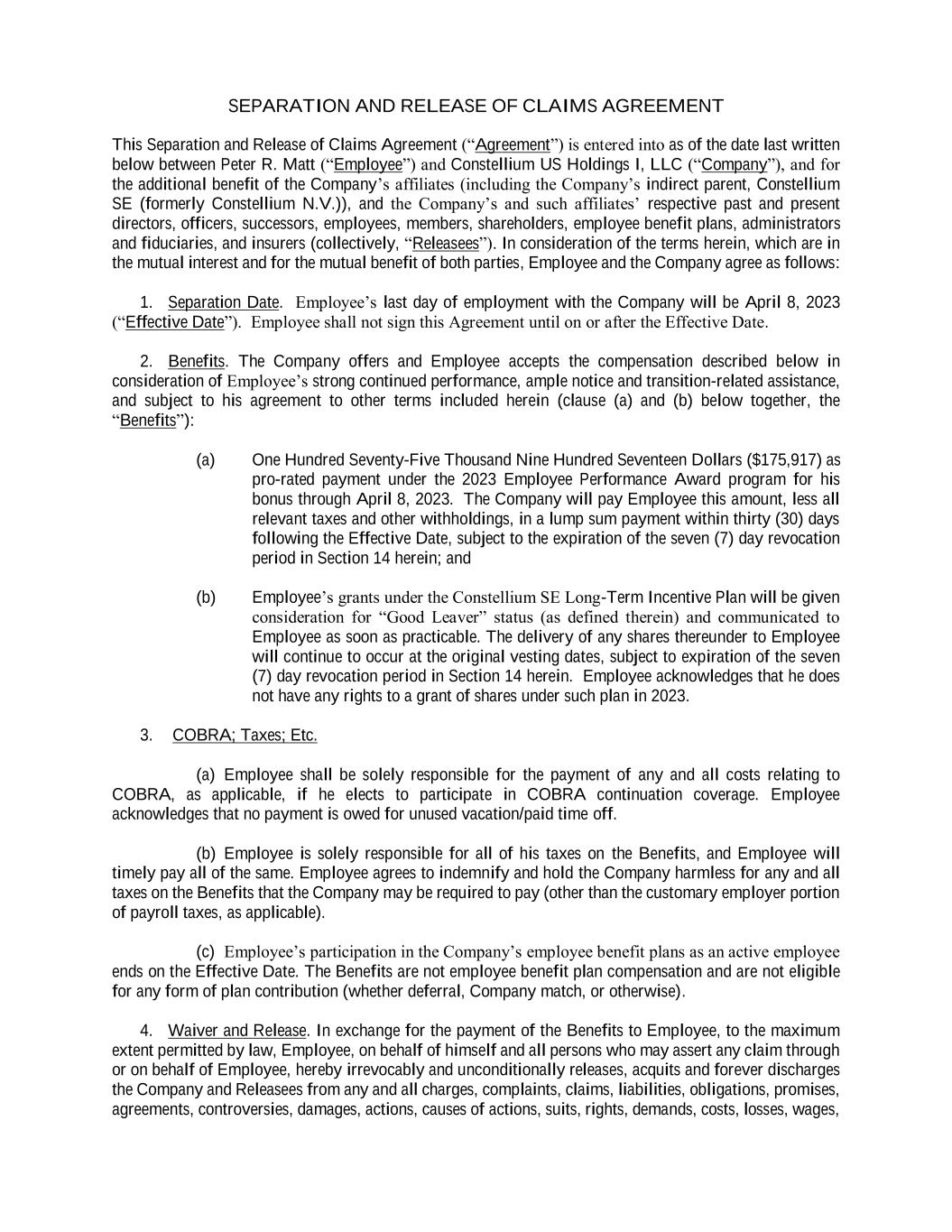
SEPARATION AND RELEASE OF CLAIMS AGREEMENT This Separation and Release of Claims Agreement (“Agreement”) is entered into as of the date last written below between Peter R. Matt (“Employee”) and Constellium US Holdings I, LLC (“Company”), and for the additional benefit of the Company’s affiliates (including the Company’s indirect parent, Constellium SE (formerly Constellium N.V.)), and the Company’s and such affiliates’ respective past and present directors, officers, successors, employees, members, shareholders, employee benefit plans, administrators and fiduciaries, and insurers (collectively, “Releasees”). In consideration of the terms herein, which are in the mutual interest and for the mutual benefit of both parties, Employee and the Company agree as follows: 1. Separation Date. Employee’s last day of employment with the Company will be April 8, 2023 (“Effective Date”). Employee shall not sign this Agreement until on or after the Effective Date. 2. Benefits. The Company offers and Employee accepts the compensation described below in consideration of Employee’s strong continued performance, ample notice and transition-related assistance, and subject to his agreement to other terms included herein (clause (a) and (b) below together, the “Benefits”): (a) One Hundred Seventy-Five Thousand Nine Hundred Seventeen Dollars ($175,917) as pro-rated payment under the 2023 Employee Performance Award program for his bonus through April 8, 2023. The Company will pay Employee this amount, less all relevant taxes and other withholdings, in a lump sum payment within thirty (30) days following the Effective Date, subject to the expiration of the seven (7) day revocation period in Section 14 herein; and (b) Employee’s grants under the Constellium SE Long-Term Incentive Plan will be given consideration for “Good Leaver” status (as defined therein) and communicated to Employee as soon as practicable. The delivery of any shares thereunder to Employee will continue to occur at the original vesting dates, subject to expiration of the seven (7) day revocation period in Section 14 herein. Employee acknowledges that he does not have any rights to a grant of shares under such plan in 2023. 3. COBRA; Taxes; Etc. (a) Employee shall be solely responsible for the payment of any and all costs relating to COBRA, as applicable, if he elects to participate in COBRA continuation coverage. Employee acknowledges that no payment is owed for unused vacation/paid time off. (b) Employee is solely responsible for all of his taxes on the Benefits, and Employee will timely pay all of the same. Employee agrees to indemnify and hold the Company harmless for any and all taxes on the Benefits that the Company may be required to pay (other than the customary employer portion of payroll taxes, as applicable). (c) Employee’s participation in the Company’s employee benefit plans as an active employee ends on the Effective Date. The Benefits are not employee benefit plan compensation and are not eligible for any form of plan contribution (whether deferral, Company match, or otherwise). 4. Waiver and Release. In exchange for the payment of the Benefits to Employee, to the maximum extent permitted by law, Employee, on behalf of himself and all persons who may assert any claim through or on behalf of Employee, hereby irrevocably and unconditionally releases, acquits and forever discharges the Company and Releasees from any and all charges, complaints, claims, liabilities, obligations, promises, agreements, controversies, damages, actions, causes of actions, suits, rights, demands, costs, losses, wages,
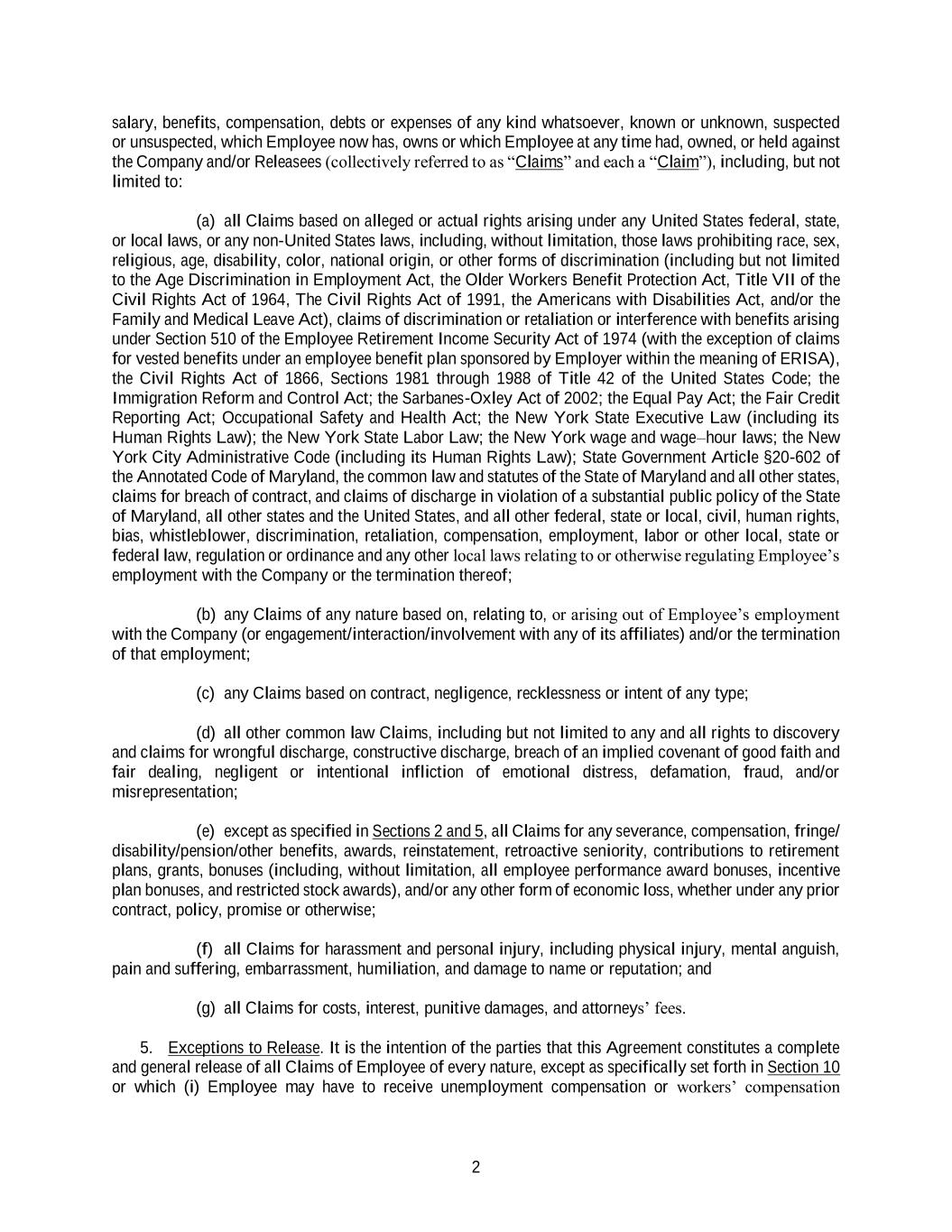
2 salary, benefits, compensation, debts or expenses of any kind whatsoever, known or unknown, suspected or unsuspected, which Employee now has, owns or which Employee at any time had, owned, or held against the Company and/or Releasees (collectively referred to as “Claims” and each a “Claim”), including, but not limited to: (a) all Claims based on alleged or actual rights arising under any United States federal, state, or local laws, or any non-United States laws, including, without limitation, those laws prohibiting race, sex, religious, age, disability, color, national origin, or other forms of discrimination (including but not limited to the Age Discrimination in Employment Act, the Older Workers Benefit Protection Act, Title VII of the Civil Rights Act of 1964, The Civil Rights Act of 1991, the Americans with Disabilities Act, and/or the Family and Medical Leave Act), claims of discrimination or retaliation or interference with benefits arising under Section 510 of the Employee Retirement Income Security Act of 1974 (with the exception of claims for vested benefits under an employee benefit plan sponsored by Employer within the meaning of ERISA), the Civil Rights Act of 1866, Sections 1981 through 1988 of Title 42 of the United States Code; the Immigration Reform and Control Act; the Sarbanes-Oxley Act of 2002; the Equal Pay Act; the Fair Credit Reporting Act; Occupational Safety and Health Act; the New York State Executive Law (including its Human Rights Law); the New York State Labor Law; the New York wage and wage–hour laws; the New York City Administrative Code (including its Human Rights Law); State Government Article §20-602 of the Annotated Code of Maryland, the common law and statutes of the State of Maryland and all other states, claims for breach of contract, and claims of discharge in violation of a substantial public policy of the State of Maryland, all other states and the United States, and all other federal, state or local, civil, human rights, bias, whistleblower, discrimination, retaliation, compensation, employment, labor or other local, state or federal law, regulation or ordinance and any other local laws relating to or otherwise regulating Employee’s employment with the Company or the termination thereof; (b) any Claims of any nature based on, relating to, or arising out of Employee’s employment with the Company (or engagement/interaction/involvement with any of its affiliates) and/or the termination of that employment; (c) any Claims based on contract, negligence, recklessness or intent of any type; (d) all other common law Claims, including but not limited to any and all rights to discovery and claims for wrongful discharge, constructive discharge, breach of an implied covenant of good faith and fair dealing, negligent or intentional infliction of emotional distress, defamation, fraud, and/or misrepresentation; (e) except as specified in Sections 2 and 5, all Claims for any severance, compensation, fringe/ disability/pension/other benefits, awards, reinstatement, retroactive seniority, contributions to retirement plans, grants, bonuses (including, without limitation, all employee performance award bonuses, incentive plan bonuses, and restricted stock awards), and/or any other form of economic loss, whether under any prior contract, policy, promise or otherwise; (f) all Claims for harassment and personal injury, including physical injury, mental anguish, pain and suffering, embarrassment, humiliation, and damage to name or reputation; and (g) all Claims for costs, interest, punitive damages, and attorneys’ fees. 5. Exceptions to Release. It is the intention of the parties that this Agreement constitutes a complete and general release of all Claims of Employee of every nature, except as specifically set forth in Section 10 or which (i) Employee may have to receive unemployment compensation or workers’ compensation
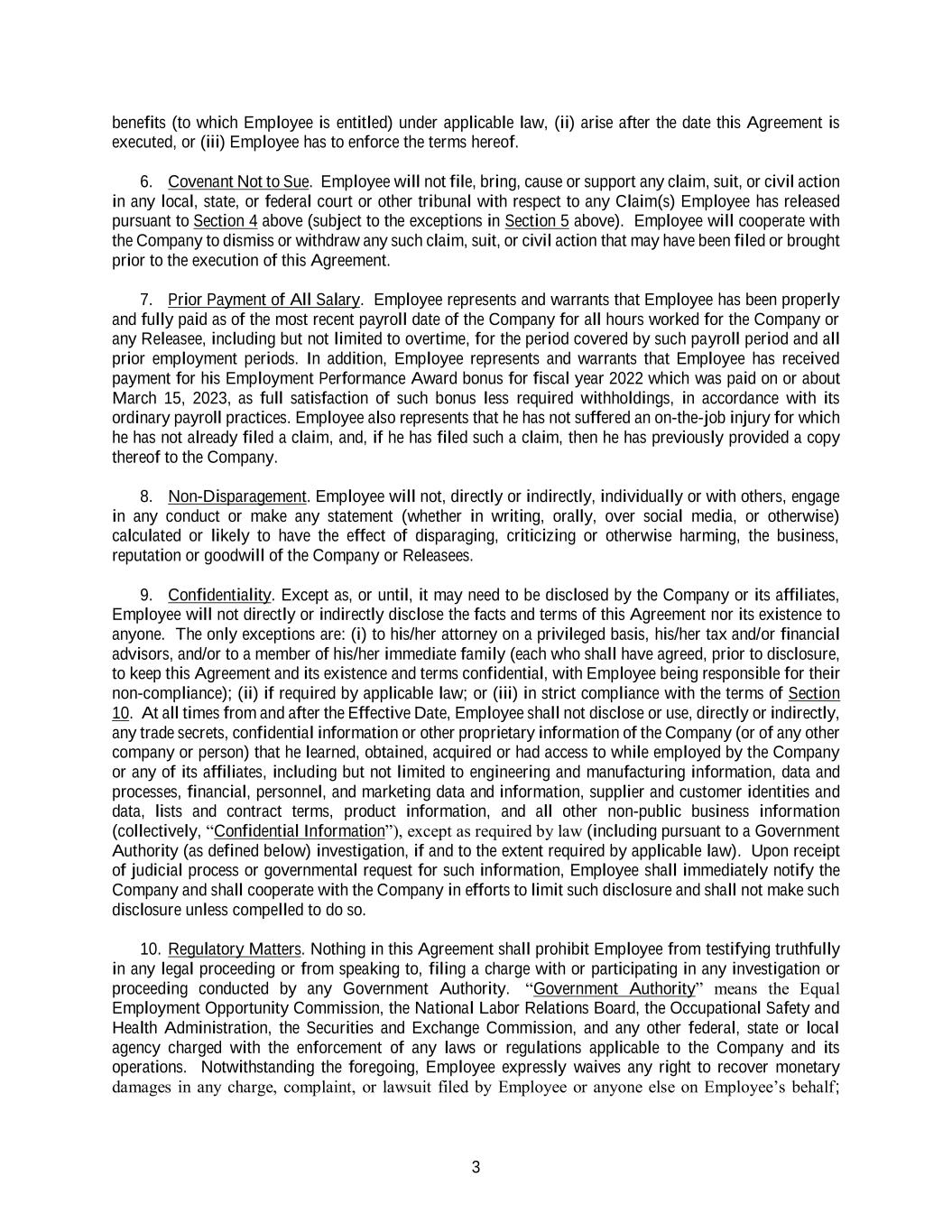
3 benefits (to which Employee is entitled) under applicable law, (ii) arise after the date this Agreement is executed, or (iii) Employee has to enforce the terms hereof. 6. Covenant Not to Sue. Employee will not file, bring, cause or support any claim, suit, or civil action in any local, state, or federal court or other tribunal with respect to any Claim(s) Employee has released pursuant to Section 4 above (subject to the exceptions in Section 5 above). Employee will cooperate with the Company to dismiss or withdraw any such claim, suit, or civil action that may have been filed or brought prior to the execution of this Agreement. 7. Prior Payment of All Salary. Employee represents and warrants that Employee has been properly and fully paid as of the most recent payroll date of the Company for all hours worked for the Company or any Releasee, including but not limited to overtime, for the period covered by such payroll period and all prior employment periods. In addition, Employee represents and warrants that Employee has received payment for his Employment Performance Award bonus for fiscal year 2022 which was paid on or about March 15, 2023, as full satisfaction of such bonus less required withholdings, in accordance with its ordinary payroll practices. Employee also represents that he has not suffered an on-the-job injury for which he has not already filed a claim, and, if he has filed such a claim, then he has previously provided a copy thereof to the Company. 8. Non-Disparagement. Employee will not, directly or indirectly, individually or with others, engage in any conduct or make any statement (whether in writing, orally, over social media, or otherwise) calculated or likely to have the effect of disparaging, criticizing or otherwise harming, the business, reputation or goodwill of the Company or Releasees. 9. Confidentiality. Except as, or until, it may need to be disclosed by the Company or its affiliates, Employee will not directly or indirectly disclose the facts and terms of this Agreement nor its existence to anyone. The only exceptions are: (i) to his/her attorney on a privileged basis, his/her tax and/or financial advisors, and/or to a member of his/her immediate family (each who shall have agreed, prior to disclosure, to keep this Agreement and its existence and terms confidential, with Employee being responsible for their non-compliance); (ii) if required by applicable law; or (iii) in strict compliance with the terms of Section 10. At all times from and after the Effective Date, Employee shall not disclose or use, directly or indirectly, any trade secrets, confidential information or other proprietary information of the Company (or of any other company or person) that he learned, obtained, acquired or had access to while employed by the Company or any of its affiliates, including but not limited to engineering and manufacturing information, data and processes, financial, personnel, and marketing data and information, supplier and customer identities and data, lists and contract terms, product information, and all other non-public business information (collectively, “Confidential Information”), except as required by law (including pursuant to a Government Authority (as defined below) investigation, if and to the extent required by applicable law). Upon receipt of judicial process or governmental request for such information, Employee shall immediately notify the Company and shall cooperate with the Company in efforts to limit such disclosure and shall not make such disclosure unless compelled to do so. 10. Regulatory Matters. Nothing in this Agreement shall prohibit Employee from testifying truthfully in any legal proceeding or from speaking to, filing a charge with or participating in any investigation or proceeding conducted by any Government Authority. “Government Authority” means the Equal Employment Opportunity Commission, the National Labor Relations Board, the Occupational Safety and Health Administration, the Securities and Exchange Commission, and any other federal, state or local agency charged with the enforcement of any laws or regulations applicable to the Company and its operations. Notwithstanding the foregoing, Employee expressly waives any right to recover monetary damages in any charge, complaint, or lawsuit filed by Employee or anyone else on Employee’s behalf;
4 provided, however, that this waiver shall not limit Employee’s rights to any whistleblower award under applicable federal securities laws or otherwise to the extent such waiver is prohibited by applicable law. 11. Other Post-Employment Obligations. (a) In consideration of the Benefits described above, and without limiting his obligations to the Company or its affiliates under any other agreements between Employee and such persons, Employee agrees that for a period of 12 months from and after the Effective Date, he shall not compete with the Company or any of its affiliates (collectively, “Constellium Group”), including but not limited to, as an employee, officer, director, or consultant of, or investor in, a competing entity, including without limitation any member of the Target Group, or otherwise, in the aluminium fabrication or rolling business (the “Business”) in any state or other location in which the Constellium Group conducts its operations and/or engages in the Business at the time of Employee’s separation and in which Employee’s competing with the Constellium Group would cause actual harm to any entity in the Constellium Group. Notwithstanding the foregoing, nothing in this provision shall prevent Employee from passively investing as a less than two percent (2%) stockholder in the securities of any company listed on a national securities exchange or quoted on an automated quotation system. The “Target Group” is defined as the following companies including all of their respective affiliates, operating worldwide: Arconic Corporation, AMAG Austria Metall AG, Benteler International AG, Commonwealth Rolled Products, Inc., Gestamp Automocion, S.A., Gränges AB, Kaiser Aluminum Corporation, Magna International Inc., Martinrea International Inc., Metra Aluminum Inc., Nemak S.A.B de C.V., Norsk Hydro ASA, Novelis Inc, Otto Fuchs KG, Sankyo Tateyama, Inc., Speira GmbH, Tri-Arrows Aluminum Inc., UACJ Automotive Whitehall Industries, Inc., and Universal Alloy Corporation, or any successor of any such company. In addition, for 12 months from and after the Effective Date, Employee shall not (i) hire or solicit any of the Constellium Group’s employees, or consultants on matters related to Constellium’s Business (including persons who were employees of persons or entities that were consultants at any time in the 12 months preceding such attempt to hire or solicit); or (ii) solicit any of the Constellium Group’s customers on matters related to Constellium’s Business (including persons or entities who were customers of any member of the Constellium Group at any time in the 3 years preceding such attempt to solicit). If it is determined by a court of competent jurisdiction in any state that any of the restrictive covenants above is excessive in duration or scope or is unreasonable or unenforceable under applicable law, it is the intention of the Employee and the Company that such restrictive covenant shall be modified or amended by the court to render it enforceable to the maximum extent permitted by the laws of that state. (b) All confidentiality, non-disclosure, and/or other post-employment obligations of Employee in any prior agreements between Employee and the Company (collectively, “Other Post-Employment Obligations”) shall remain in full force and effect. Such obligations shall be in addition to Employee’s obligations under this Agreement. Employee shall provide any assistance requested by the Company after the Effective Date in connection with any dispute, litigation, arbitration, regulatory matter, or any other matter (whether or not dispute related) relating to or occurring during the time of Employee’s employment with the Company; the Company will reimburse Employee for reasonable, pre-approved travel expenses to be incurred by Employee in providing such assistance. 12. Return of Company Property. Employee warrants that on or before the date last written below, he has returned to the Company all Company (including of its affiliates and indirect ultimate parent Constellium SE) materials, memoranda, books, analyses, data, Confidential Information, and other information, all copies thereof, and all other Company property. Company property includes, without limitation, Company identification cards, access cards, keys, computers, cellular phones, corporate credit cards, accessories, and other equipment, which were or are in Employee’s possession or control. Notwithstanding anything to the contrary in this Agreement, the Company’s obligations hereunder are contingent on Employee providing, on or prior to the date last written below, the Company with all
5 passwords to his/her Company laptop, other computer, cellular phone and other systems and devices (including cloud-based applications and storage devices). Employee represents and warrants to the Company that he has not downloaded or stored any Confidential Information on any non-Company device or in any non-Company authorized location (including personal email and non-Company cloud-based storage), and if he has done so, hereby represents that any such information has been destroyed and/or deleted. 13. No Admissions; Waiver of Jury Trial; Etc. a. This Agreement is not and cannot be construed as an admission by the Company or Employee that either has acted wrongfully or unlawfully with respect to the other or that either of them has any claim whatsoever against the other. b. This Agreement is governed by and is to be construed in accordance with the laws of Maryland, without regard for conflicts of laws principles. c. The provisions of this Agreement are severable and, if any part of it is found to be unenforceable, the other provisions shall remain fully valid and enforceable. In the event that the Company should bring an action in any court to enforce this Agreement or any provision hereof, it is agreed that the Company (if it is the prevailing party in whole or in part) will be entitled to recover from Employee the Company’s reasonable attorney’s fees and costs of such litigation. d. The parties irrevocably waive, to the extent permitted by applicable law, any trial by jury in connection with this Agreement or its enforcement. Further, the parties agree that the state courts located in Baltimore County, Maryland and the United States District Court for the District of Maryland shall have exclusive jurisdiction over, and be the proper venue for, any dispute or lawsuit arising out of or relating to this Agreement. 14. ADEA/OWBPA Compliance. a. It is the intent of the parties that this Agreement comply fully with the requirements of the Age Discrimination in Employment Act, Older Worker Benefit Protection Act, and any relevant state laws regarding age discrimination. Employee acknowledges that Employee has been given twenty-one (21) days to consider and to execute this Agreement, which Employee acknowledges is a sufficient period of time in order to fully consider and understand this Agreement. Employee further acknowledges, understands and agrees that for a period of seven (7) days following the execution of this Agreement, Employee may revoke this Agreement by providing written notice of such revocation to Ryan Jurkovic at Constellium US Holdings I, LLC, 300 East Lombard Street, Suite 1710, Baltimore, MD 21202 or at ryan.jurkovic@constellium.com. Employee understands that Employee will not be entitled to payment of the Benefits unless and until Employee accepts, executes and delivers this Agreement and the seven (7) day revocation period has expired, at which time this Agreement is final and otherwise non- revocable. b. Employee represents and agrees that he fully understands all provisions of this Agreement and that Employee has the right to discuss this Agreement with his attorney(s). Employee further represents and agrees that Employee has carefully read and fully understands all the provisions of this Agreement and that Employee is voluntarily entering into this Agreement, without duress or coercion. Employee acknowledges and agrees that the Benefits he is receiving under this Agreement are substantially greater than Employee would otherwise be entitled to receive. This Agreement contains a waiver of claims, and Employee acknowledges that the Company advises Employee to obtain his/her own legal counsel with respect to the terms of this Agreement before signing it.
exhibit1041_employmentag
exhibit1042_ingridjoerge
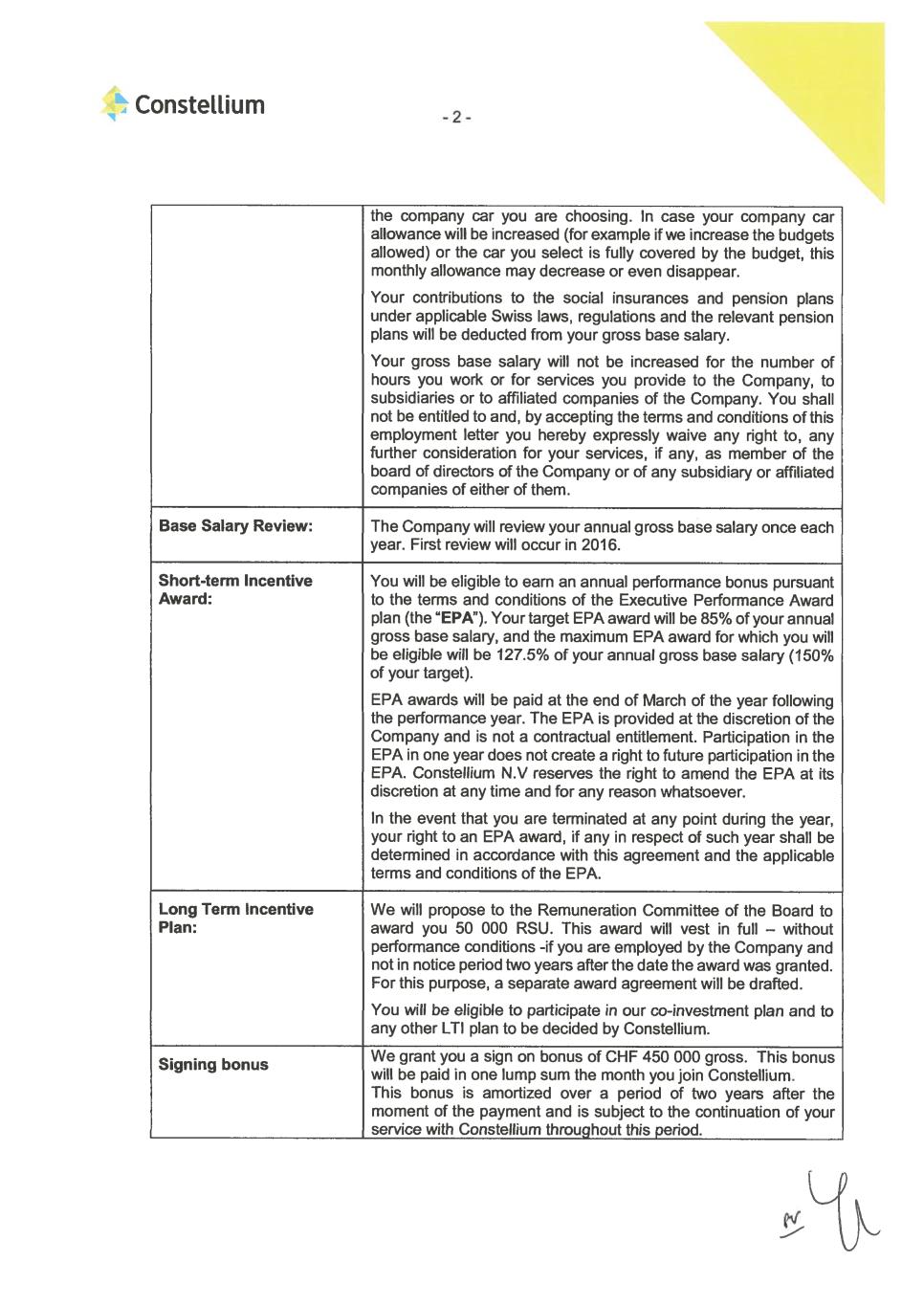
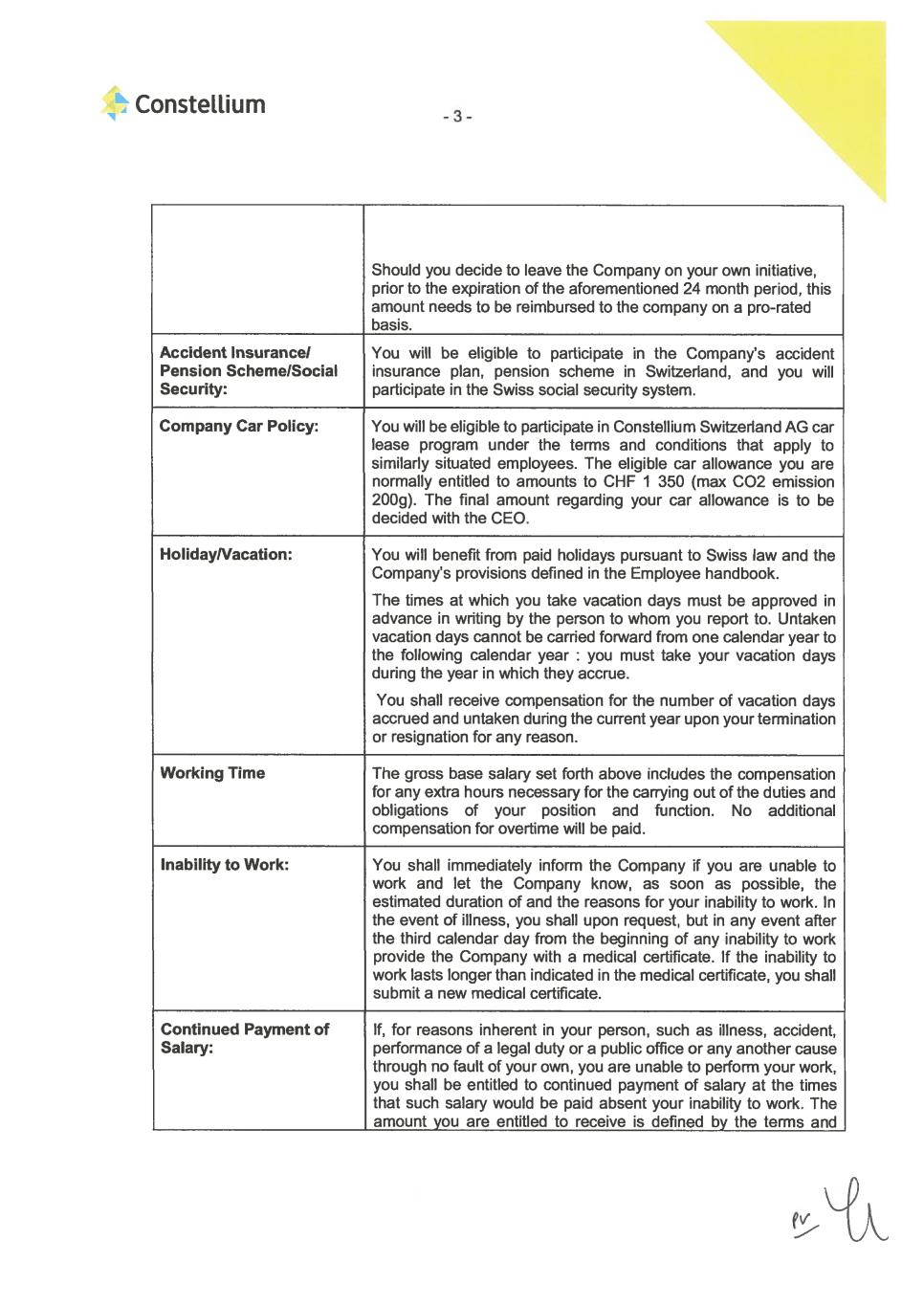
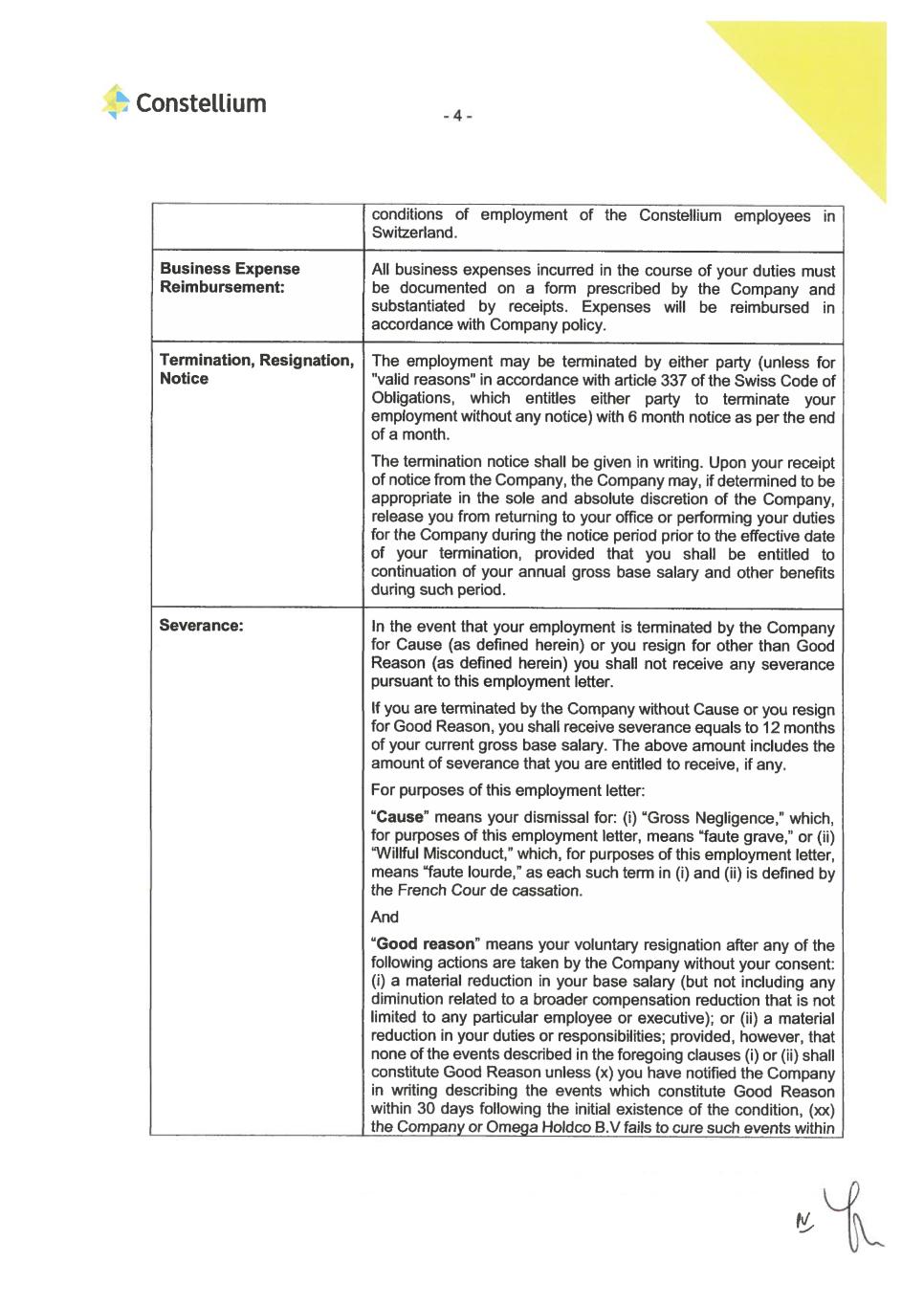
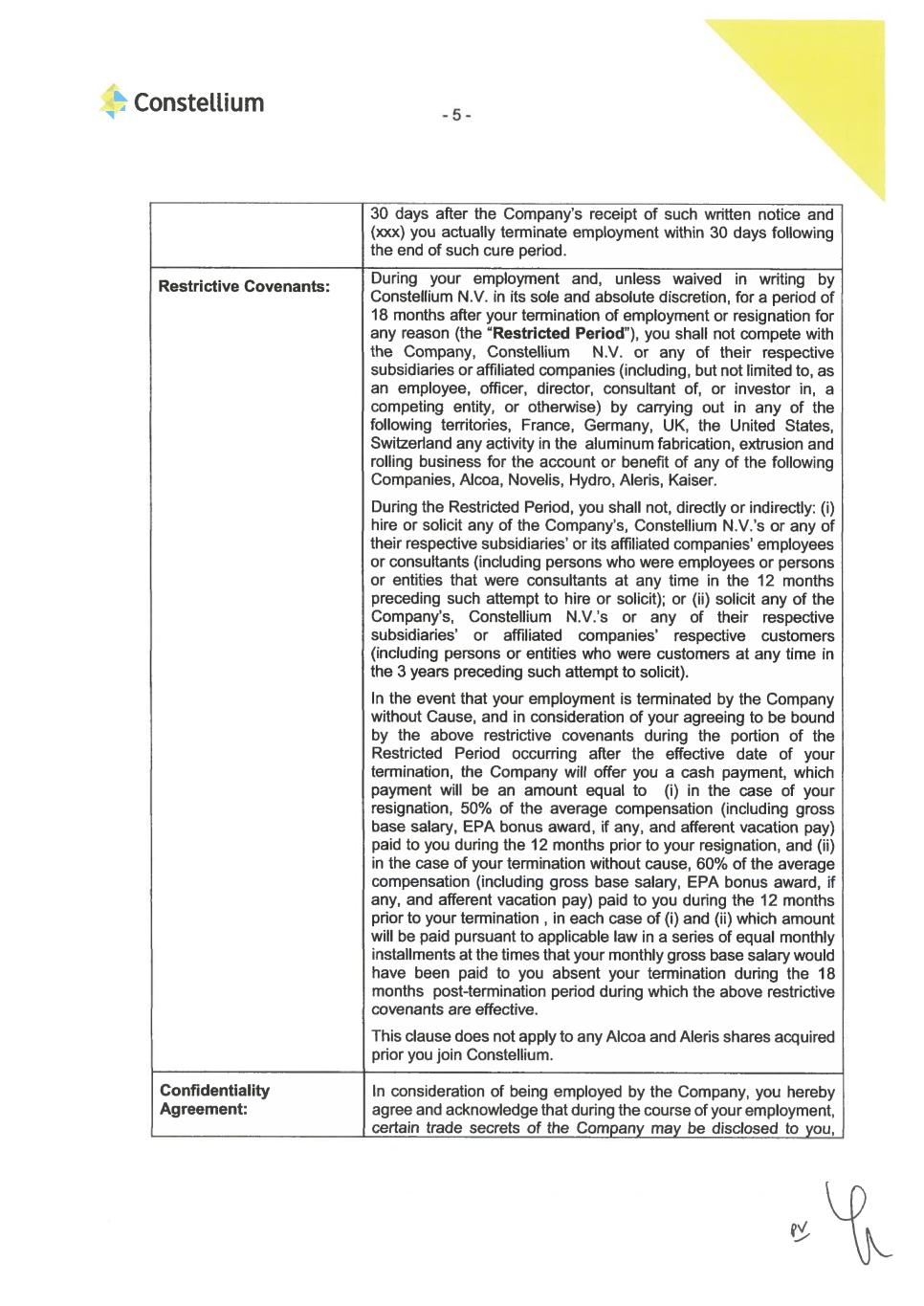
Constellium Constellium Switzerland AG Max Högger-Strasso 6 CH-8048 Zürich Swtzerland T441 (0) 44 438 66 00 ww constellumcom Personal/Confidential Ms. Ingrid Jörg Addendum to Employment Contract Dear Ingrid To express our appreciation for all the hard work you have - and continue to - put in and to recognize your career progression within Constellium Switzerland AG, we are pleased to promote you to the position of Executive Vice President & Chief Operating Officer, effective Septermber 1, 2023. Your gross annual base salary will be increased to CHF 850.000,- - and your target EPA bonus will be increased to 90% of your gross annual base salary. You will continue to be eligible to join the Constellium Long Term Incentive Plan. The next salary review will take place in April 2024. All other terms and conditions of your contract of employment dated December 12, 2014 remain unchanged. You are a key pillar within the Constellium Leadership Team and we are grateful for the high level of loyalty and the dedication you demonstrate during your tenure with Constellium. Thank you very much. Best regards, Zurich, July 24, 2023 Constelium Switzerland AG 2Peter Ith Senior Director Legal Services Chi-Meei Bugnion Head of Finance CSAG
Constellium Acknowledged and accepted: Date/Location 4) IngridJör
exhibit111_insidertradin
INSIDER TRADING POLICY CONSTELLIUM SE December 2019
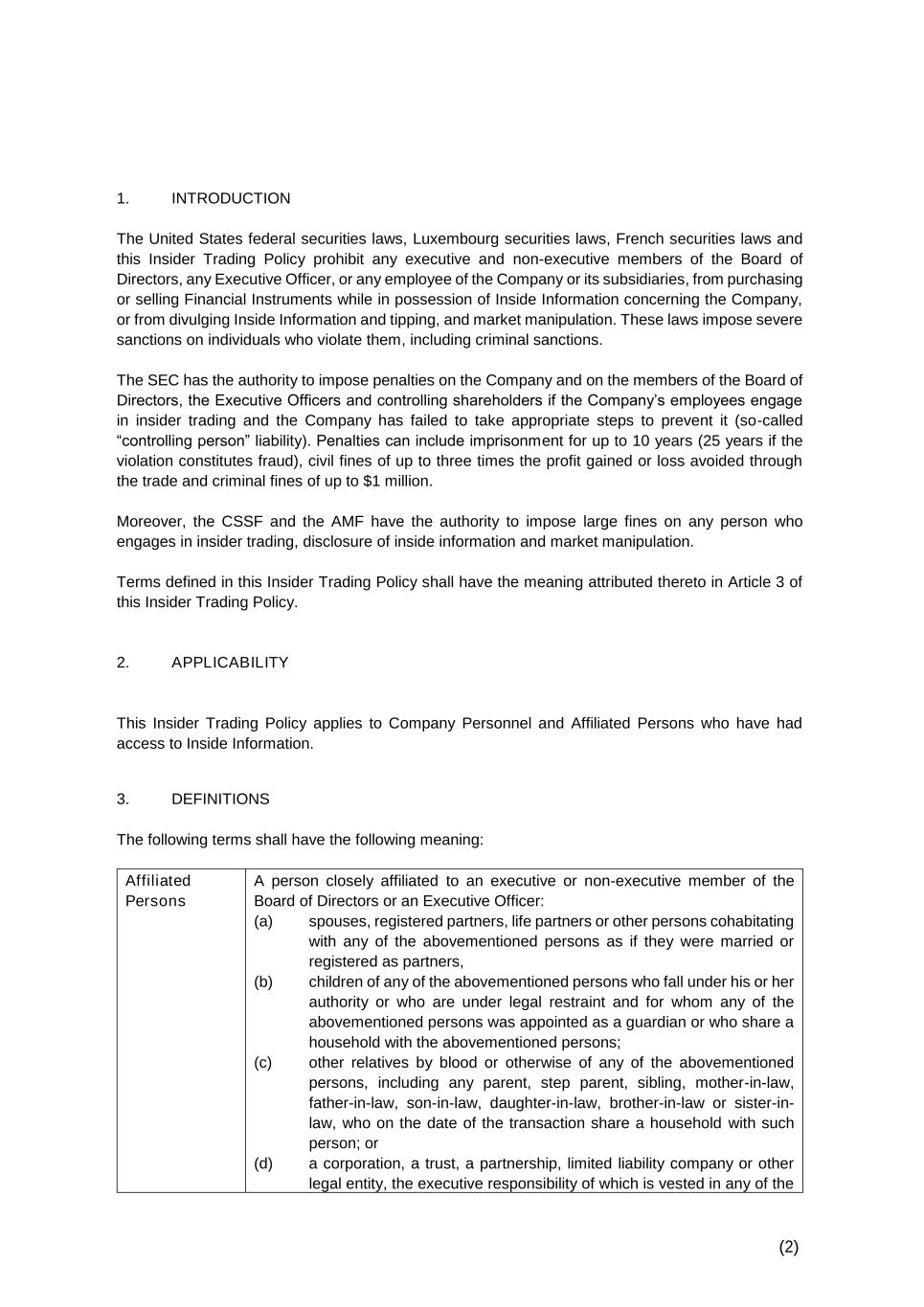
(2) 1. INTRODUCTION The United States federal securities laws, Luxembourg securities laws, French securities laws and this Insider Trading Policy prohibit any executive and non-executive members of the Board of Directors, any Executive Officer, or any employee of the Company or its subsidiaries, from purchasing or selling Financial Instruments while in possession of Inside Information concerning the Company, or from divulging Inside Information and tipping, and market manipulation. These laws impose severe sanctions on individuals who violate them, including criminal sanctions. The SEC has the authority to impose penalties on the Company and on the members of the Board of Directors, the Executive Officers and controlling shareholders if the Company’s employees engage in insider trading and the Company has failed to take appropriate steps to prevent it (so-called “controlling person” liability). Penalties can include imprisonment for up to 10 years (25 years if the violation constitutes fraud), civil fines of up to three times the profit gained or loss avoided through the trade and criminal fines of up to $1 million. Moreover, the CSSF and the AMF have the authority to impose large fines on any person who engages in insider trading, disclosure of inside information and market manipulation. Terms defined in this Insider Trading Policy shall have the meaning attributed thereto in Article 3 of this Insider Trading Policy. 2. APPLICABILITY This Insider Trading Policy applies to Company Personnel and Affiliated Persons who have had access to Inside Information. 3. DEFINITIONS The following terms shall have the following meaning: Affiliated Persons A person closely affiliated to an executive or non-executive member of the Board of Directors or an Executive Officer: (a) spouses, registered partners, life partners or other persons cohabitating with any of the abovementioned persons as if they were married or registered as partners, (b) children of any of the abovementioned persons who fall under his or her authority or who are under legal restraint and for whom any of the abovementioned persons was appointed as a guardian or who share a household with the abovementioned persons; (c) other relatives by blood or otherwise of any of the abovementioned persons, including any parent, step parent, sibling, mother-in-law, father-in-law, son-in-law, daughter-in-law, brother-in-law or sister-in- law, who on the date of the transaction share a household with such person; or (d) a corporation, a trust, a partnership, limited liability company or other legal entity, the executive responsibility of which is vested in any of the
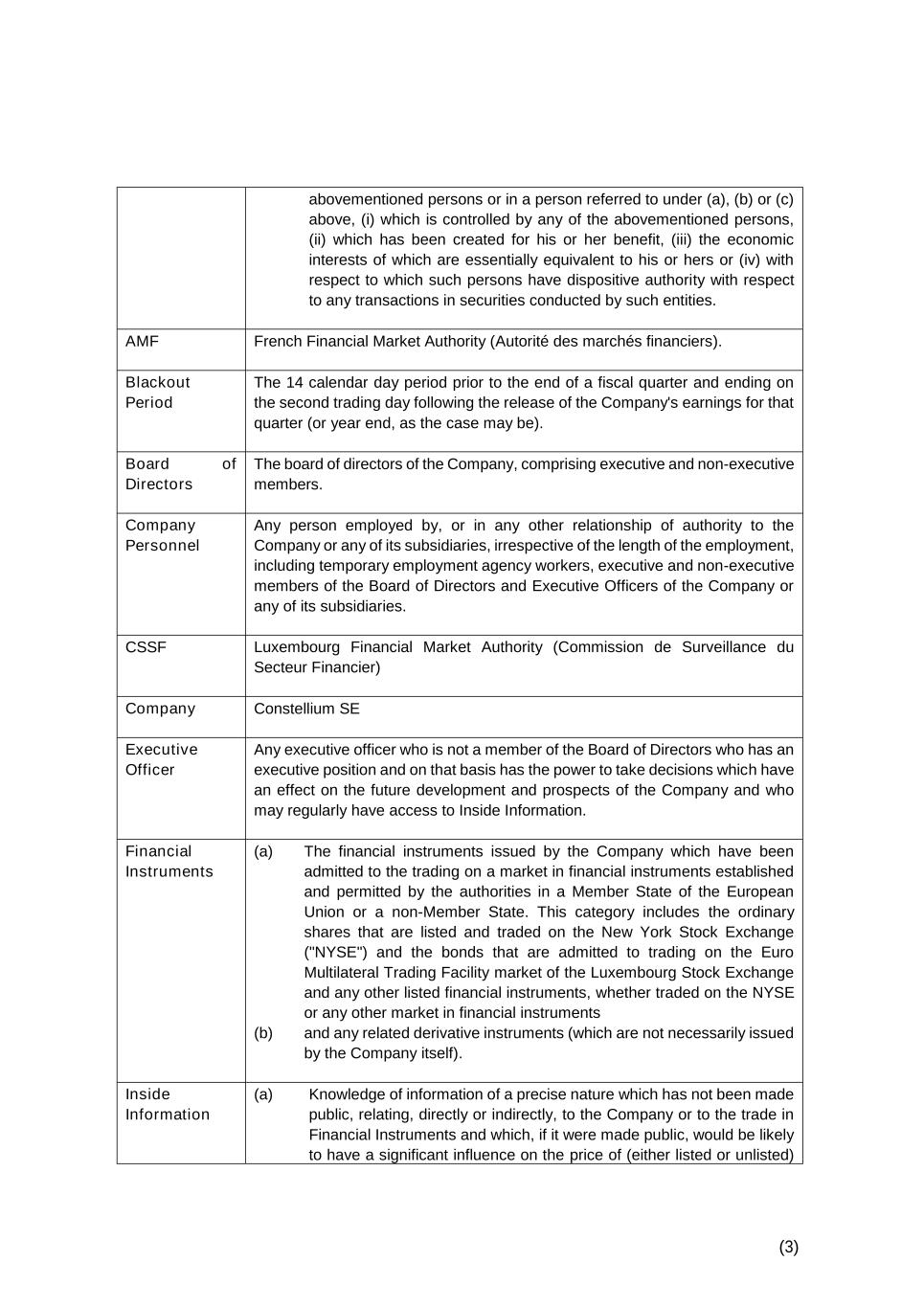
(3) abovementioned persons or in a person referred to under (a), (b) or (c) above, (i) which is controlled by any of the abovementioned persons, (ii) which has been created for his or her benefit, (iii) the economic interests of which are essentially equivalent to his or hers or (iv) with respect to which such persons have dispositive authority with respect to any transactions in securities conducted by such entities. AMF French Financial Market Authority (Autorité des marchés financiers). Blackout Period The 14 calendar day period prior to the end of a fiscal quarter and ending on the second trading day following the release of the Company's earnings for that quarter (or year end, as the case may be). Board of Directors The board of directors of the Company, comprising executive and non-executive members. Company Personnel Any person employed by, or in any other relationship of authority to the Company or any of its subsidiaries, irrespective of the length of the employment, including temporary employment agency workers, executive and non-executive members of the Board of Directors and Executive Officers of the Company or any of its subsidiaries. CSSF Luxembourg Financial Market Authority (Commission de Surveillance du Secteur Financier) Company Constellium SE Executive Officer Any executive officer who is not a member of the Board of Directors who has an executive position and on that basis has the power to take decisions which have an effect on the future development and prospects of the Company and who may regularly have access to Inside Information. Financial Instruments (a) The financial instruments issued by the Company which have been admitted to the trading on a market in financial instruments established and permitted by the authorities in a Member State of the European Union or a non-Member State. This category includes the ordinary shares that are listed and traded on the New York Stock Exchange ("NYSE") and the bonds that are admitted to trading on the Euro Multilateral Trading Facility market of the Luxembourg Stock Exchange and any other listed financial instruments, whether traded on the NYSE or any other market in financial instruments (b) and any related derivative instruments (which are not necessarily issued by the Company itself). Inside Information (a) Knowledge of information of a precise nature which has not been made public, relating, directly or indirectly, to the Company or to the trade in Financial Instruments and which, if it were made public, would be likely to have a significant influence on the price of (either listed or unlisted)
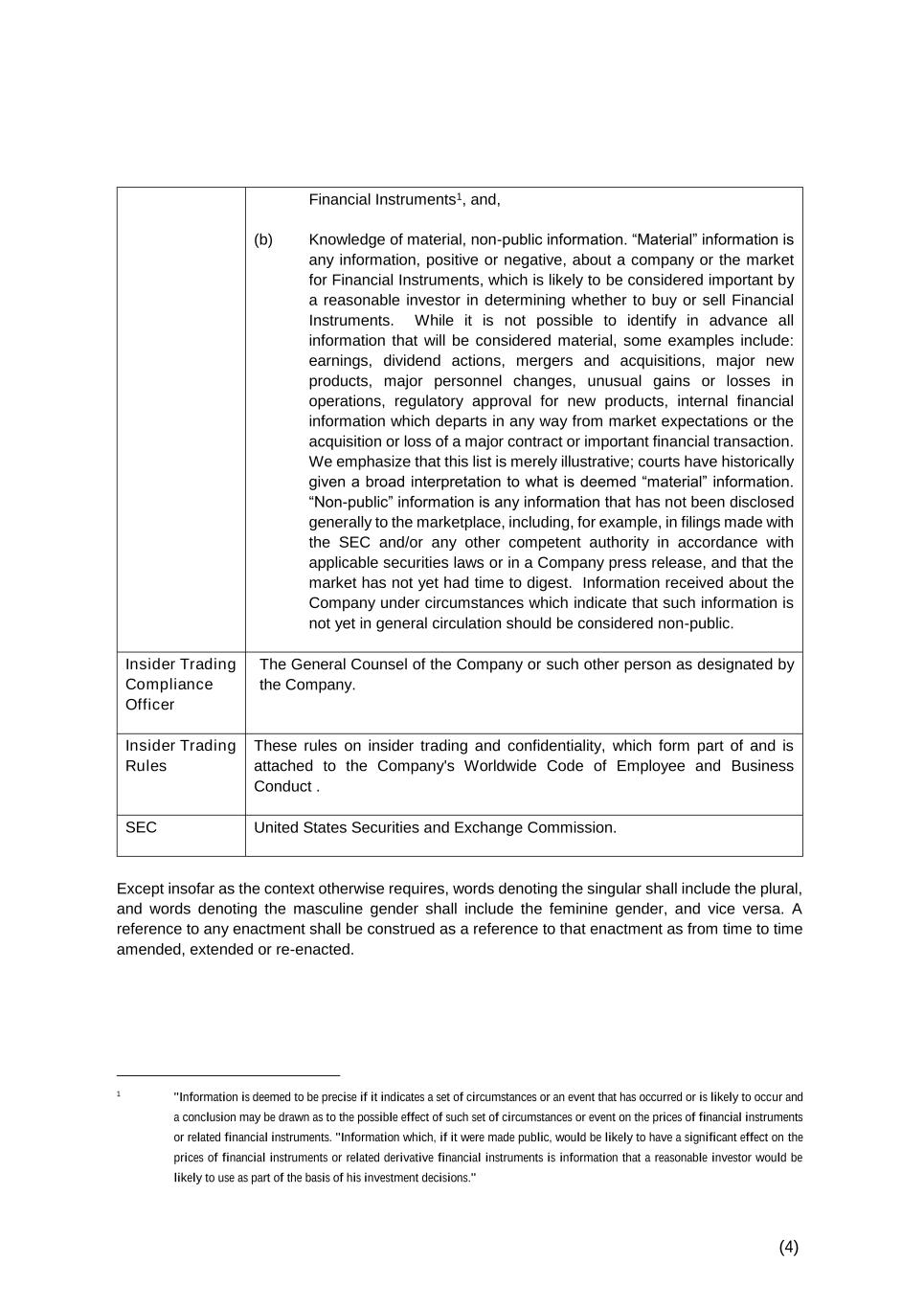
(4) Financial Instruments1, and, (b) Knowledge of material, non-public information. “Material” information is any information, positive or negative, about a company or the market for Financial Instruments, which is likely to be considered important by a reasonable investor in determining whether to buy or sell Financial Instruments. While it is not possible to identify in advance all information that will be considered material, some examples include: earnings, dividend actions, mergers and acquisitions, major new products, major personnel changes, unusual gains or losses in operations, regulatory approval for new products, internal financial information which departs in any way from market expectations or the acquisition or loss of a major contract or important financial transaction. We emphasize that this list is merely illustrative; courts have historically given a broad interpretation to what is deemed “material” information. “Non-public” information is any information that has not been disclosed generally to the marketplace, including, for example, in filings made with the SEC and/or any other competent authority in accordance with applicable securities laws or in a Company press release, and that the market has not yet had time to digest. Information received about the Company under circumstances which indicate that such information is not yet in general circulation should be considered non-public. Insider Trading Compliance Officer The General Counsel of the Company or such other person as designated by the Company. Insider Trading Rules These rules on insider trading and confidentiality, which form part of and is attached to the Company's Worldwide Code of Employee and Business Conduct . SEC United States Securities and Exchange Commission. Except insofar as the context otherwise requires, words denoting the singular shall include the plural, and words denoting the masculine gender shall include the feminine gender, and vice versa. A reference to any enactment shall be construed as a reference to that enactment as from time to time amended, extended or re-enacted. 1 "Information is deemed to be precise if it indicates a set of circumstances or an event that has occurred or is likely to occur and a conclusion may be drawn as to the possible effect of such set of circumstances or event on the prices of financial instruments or related financial instruments. "Information which, if it were made public, would be likely to have a significant effect on the prices of financial instruments or related derivative financial instruments is information that a reasonable investor would be likely to use as part of the basis of his investment decisions."
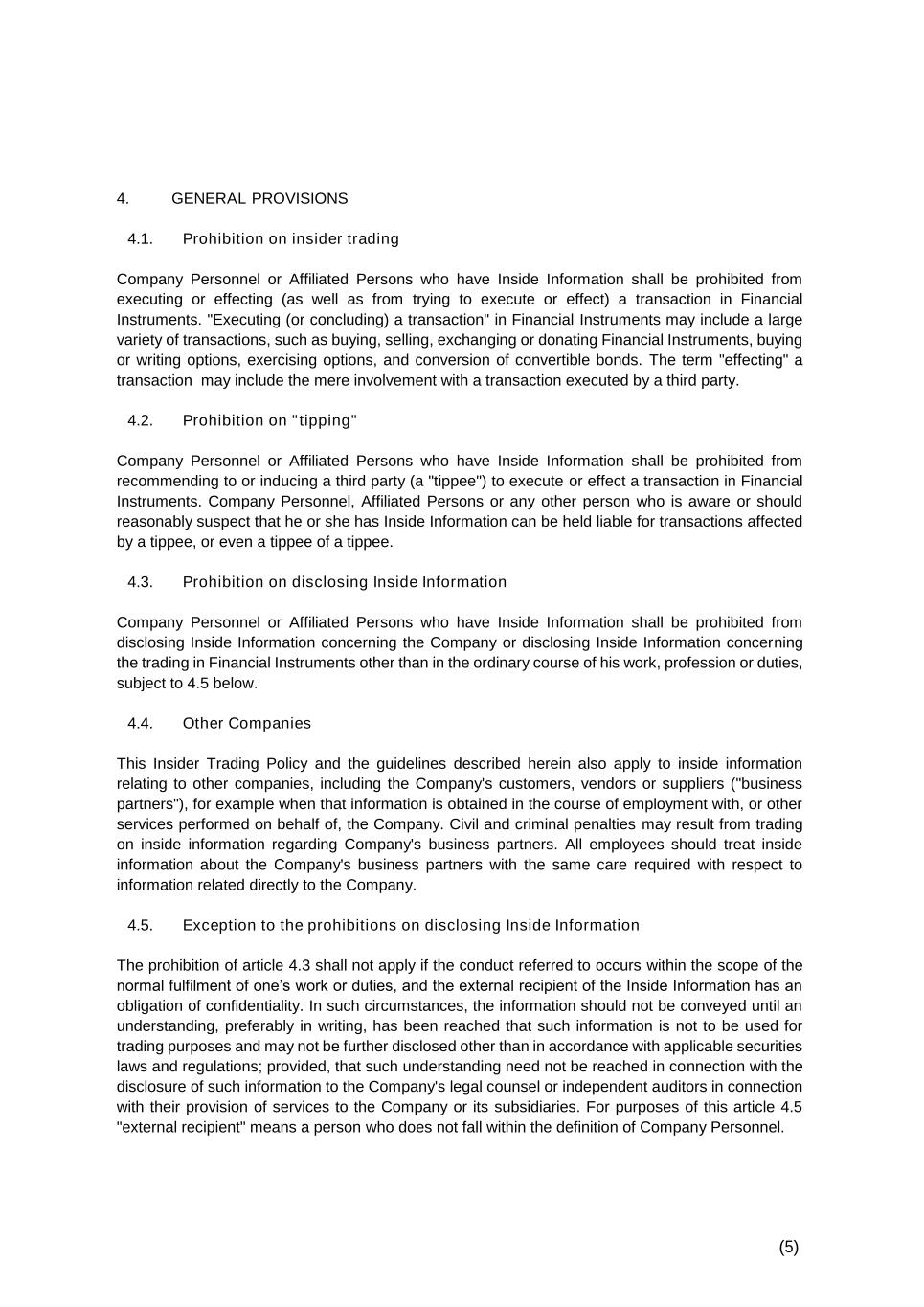
(5) 4. GENERAL PROVISIONS 4.1. Prohibition on insider trading Company Personnel or Affiliated Persons who have Inside Information shall be prohibited from executing or effecting (as well as from trying to execute or effect) a transaction in Financial Instruments. "Executing (or concluding) a transaction" in Financial Instruments may include a large variety of transactions, such as buying, selling, exchanging or donating Financial Instruments, buying or writing options, exercising options, and conversion of convertible bonds. The term "effecting" a transaction may include the mere involvement with a transaction executed by a third party. 4.2. Prohibition on "tipping" Company Personnel or Affiliated Persons who have Inside Information shall be prohibited from recommending to or inducing a third party (a "tippee") to execute or effect a transaction in Financial Instruments. Company Personnel, Affiliated Persons or any other person who is aware or should reasonably suspect that he or she has Inside Information can be held liable for transactions affected by a tippee, or even a tippee of a tippee. 4.3. Prohibition on disclosing Inside Information Company Personnel or Affiliated Persons who have Inside Information shall be prohibited from disclosing Inside Information concerning the Company or disclosing Inside Information concerning the trading in Financial Instruments other than in the ordinary course of his work, profession or duties, subject to 4.5 below. 4.4. Other Companies This Insider Trading Policy and the guidelines described herein also apply to inside information relating to other companies, including the Company's customers, vendors or suppliers ("business partners"), for example when that information is obtained in the course of employment with, or other services performed on behalf of, the Company. Civil and criminal penalties may result from trading on inside information regarding Company's business partners. All employees should treat inside information about the Company's business partners with the same care required with respect to information related directly to the Company. 4.5. Exception to the prohibitions on disclosing Inside Information The prohibition of article 4.3 shall not apply if the conduct referred to occurs within the scope of the normal fulfilment of one’s work or duties, and the external recipient of the Inside Information has an obligation of confidentiality. In such circumstances, the information should not be conveyed until an understanding, preferably in writing, has been reached that such information is not to be used for trading purposes and may not be further disclosed other than in accordance with applicable securities laws and regulations; provided, that such understanding need not be reached in connection with the disclosure of such information to the Company's legal counsel or independent auditors in connection with their provision of services to the Company or its subsidiaries. For purposes of this article 4.5 "external recipient" means a person who does not fall within the definition of Company Personnel.
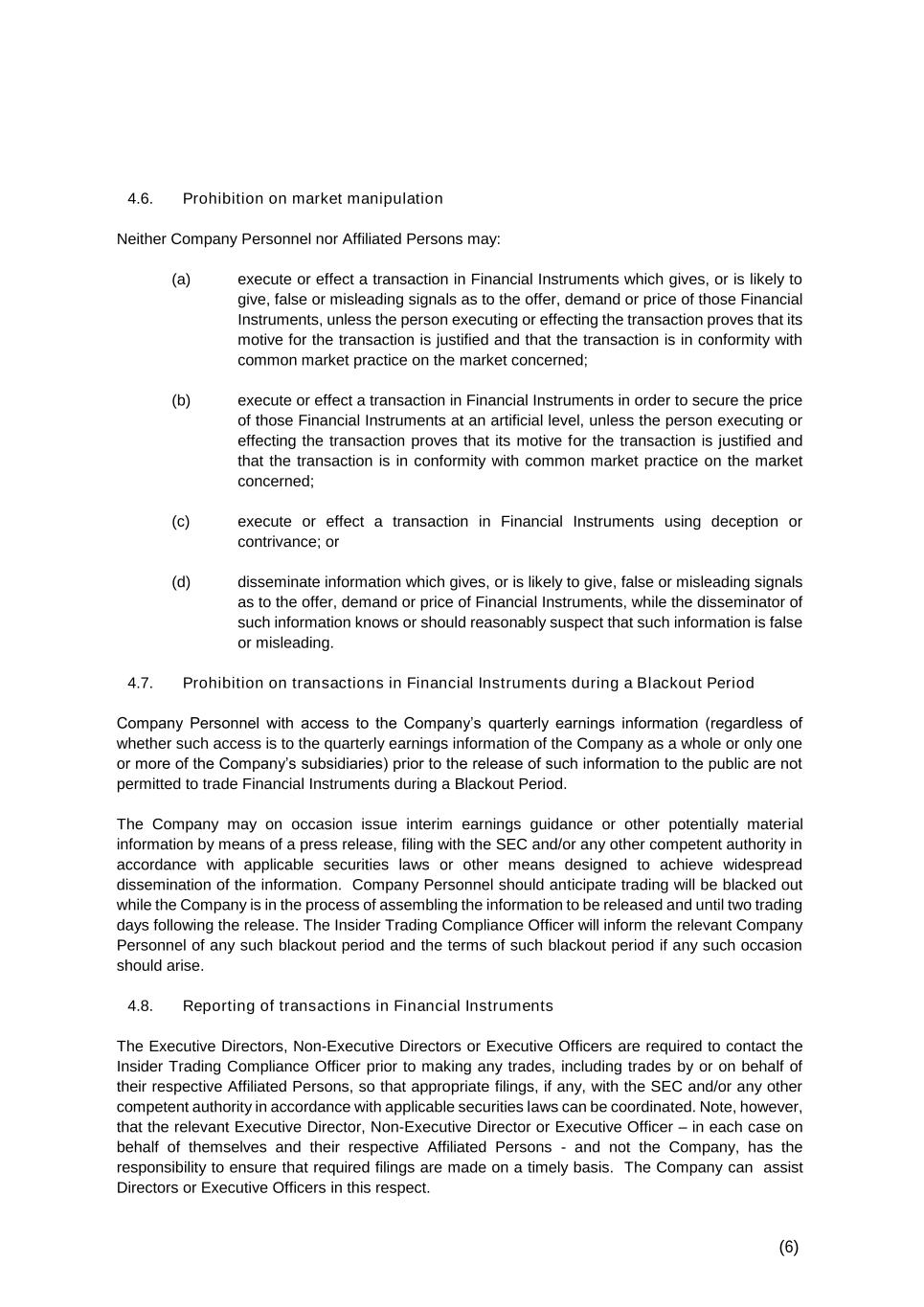
(6) 4.6. Prohibition on market manipulation Neither Company Personnel nor Affiliated Persons may: (a) execute or effect a transaction in Financial Instruments which gives, or is likely to give, false or misleading signals as to the offer, demand or price of those Financial Instruments, unless the person executing or effecting the transaction proves that its motive for the transaction is justified and that the transaction is in conformity with common market practice on the market concerned; (b) execute or effect a transaction in Financial Instruments in order to secure the price of those Financial Instruments at an artificial level, unless the person executing or effecting the transaction proves that its motive for the transaction is justified and that the transaction is in conformity with common market practice on the market concerned; (c) execute or effect a transaction in Financial Instruments using deception or contrivance; or (d) disseminate information which gives, or is likely to give, false or misleading signals as to the offer, demand or price of Financial Instruments, while the disseminator of such information knows or should reasonably suspect that such information is false or misleading. 4.7. Prohibition on transactions in Financial Instruments during a Blackout Period Company Personnel with access to the Company’s quarterly earnings information (regardless of whether such access is to the quarterly earnings information of the Company as a whole or only one or more of the Company’s subsidiaries) prior to the release of such information to the public are not permitted to trade Financial Instruments during a Blackout Period. The Company may on occasion issue interim earnings guidance or other potentially material information by means of a press release, filing with the SEC and/or any other competent authority in accordance with applicable securities laws or other means designed to achieve widespread dissemination of the information. Company Personnel should anticipate trading will be blacked out while the Company is in the process of assembling the information to be released and until two trading days following the release. The Insider Trading Compliance Officer will inform the relevant Company Personnel of any such blackout period and the terms of such blackout period if any such occasion should arise. 4.8. Reporting of transactions in Financial Instruments The Executive Directors, Non-Executive Directors or Executive Officers are required to contact the Insider Trading Compliance Officer prior to making any trades, including trades by or on behalf of their respective Affiliated Persons, so that appropriate filings, if any, with the SEC and/or any other competent authority in accordance with applicable securities laws can be coordinated. Note, however, that the relevant Executive Director, Non-Executive Director or Executive Officer – in each case on behalf of themselves and their respective Affiliated Persons - and not the Company, has the responsibility to ensure that required filings are made on a timely basis. The Company can assist Directors or Executive Officers in this respect.
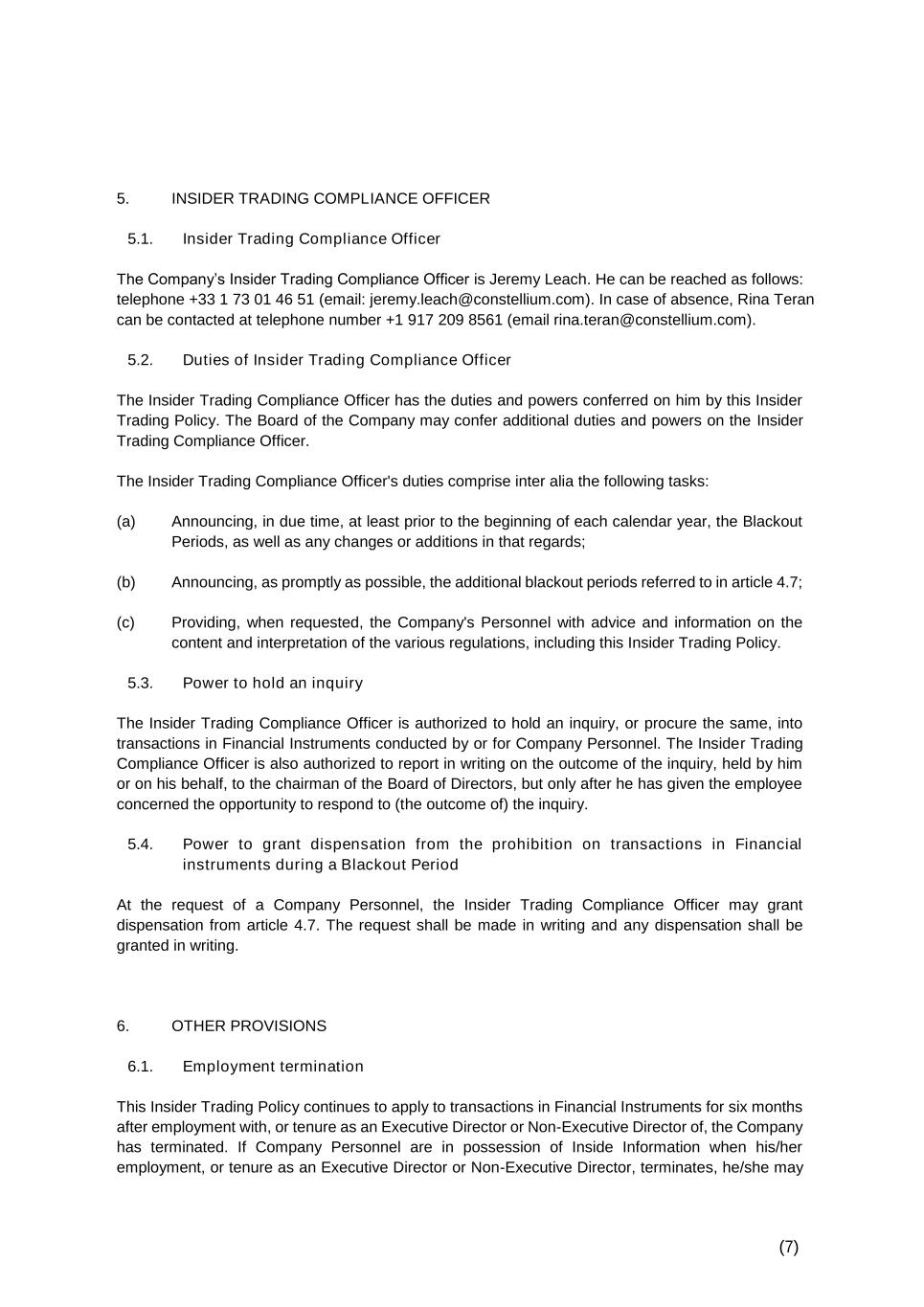
(7) 5. INSIDER TRADING COMPLIANCE OFFICER 5.1. Insider Trading Compliance Officer The Company’s Insider Trading Compliance Officer is Jeremy Leach. He can be reached as follows: telephone +33 1 73 01 46 51 (email: jeremy.leach@constellium.com). In case of absence, Rina Teran can be contacted at telephone number +1 917 209 8561 (email rina.teran@constellium.com). 5.2. Duties of Insider Trading Compliance Officer The Insider Trading Compliance Officer has the duties and powers conferred on him by this Insider Trading Policy. The Board of the Company may confer additional duties and powers on the Insider Trading Compliance Officer. The Insider Trading Compliance Officer's duties comprise inter alia the following tasks: (a) Announcing, in due time, at least prior to the beginning of each calendar year, the Blackout Periods, as well as any changes or additions in that regards; (b) Announcing, as promptly as possible, the additional blackout periods referred to in article 4.7; (c) Providing, when requested, the Company's Personnel with advice and information on the content and interpretation of the various regulations, including this Insider Trading Policy. 5.3. Power to hold an inquiry The Insider Trading Compliance Officer is authorized to hold an inquiry, or procure the same, into transactions in Financial Instruments conducted by or for Company Personnel. The Insider Trading Compliance Officer is also authorized to report in writing on the outcome of the inquiry, held by him or on his behalf, to the chairman of the Board of Directors, but only after he has given the employee concerned the opportunity to respond to (the outcome of) the inquiry. 5.4. Power to grant dispensation from the prohibition on transactions in Financial instruments during a Blackout Period At the request of a Company Personnel, the Insider Trading Compliance Officer may grant dispensation from article 4.7. The request shall be made in writing and any dispensation shall be granted in writing. 6. OTHER PROVISIONS 6.1. Employment termination This Insider Trading Policy continues to apply to transactions in Financial Instruments for six months after employment with, or tenure as an Executive Director or Non-Executive Director of, the Company has terminated. If Company Personnel are in possession of Inside Information when his/her employment, or tenure as an Executive Director or Non-Executive Director, terminates, he/she may
(8) not trade in Financial Instruments until that Inside Information has been publicly released for two full business days. 6.2. Company Assistance If there are any questions relating to this Insider Trading Policy, or the applicability or interpretation of the standards discussed in this Insider Trading Policy, please feel free to contact the Insider Trading Compliance Officer for clarification and guidance prior to trading or the disclosure of any information. 6.3. Compliance The Company expects the strictest compliance with this Insider Trading Policy by all persons subject to this Insider Trading Policy. Failure to observe the Insider Trading Policy may result in serious legal difficulties for you, as well as the Company. A failure to follow its letter and spirit would be considered a matter of extreme seriousness. Additionally, all persons subject to this Insider Trading Policy should keep information concerning the operation of this Insider Trading Policy in strict confidence, such as the existence of a blackout period, which in and of itself may constitute Inside Information. All Company Personnel may be required to execute a certificate in the form attached hereto as Exhibit A, pursuant to which they certify that, among other things, such persons are currently, and will continue to be, in compliance with this Insider Trading Policy. The timing and nature of the Company’s disclosure of material information to outsiders is subject to legal rules, the breach of which could result in substantial liability to Company Personnel. Accordingly, it is important that response to inquiries about the Company by the press, investment analysts or others in the financial community be made on the Company’s behalf only through authorized individuals and consistent with the Company’s other policies. 6.4. Selective Disclosure Whenever the Company, any member of the Board of Directors, any Executive Officer or any other member of Company Personnel who regularly communicates on behalf of the Company with the persons listed in (i) – (iii) below discloses any Inside Information to (i) any broker, dealer, investment adviser, institutional investment manager or any person associated with any of the foregoing (as each of those terms are defined in the U.S. Securities Exchange Act of 1934), (ii) an “investment company” or affiliated person thereof, each as defined in the U. S. Investment Company Act of 1940, or (iii) any person who holds Financial Instruments of the Company, under circumstances in which it is reasonably foreseeable that the person will purchase or sell such Financial Instruments on the basis of the Inside Information, the Company shall make public disclosure of such Inside Information as promptly as possible. Public disclosure shall be made by means of a Company press release and/or filing with the SEC and/or any other competent authority in accordance with applicable securities laws, and the Company shall attempt to make such disclosure within 24 hours (or, if later, the commencement of the next day’s trading on the NYSE) of a director, Executive Officer or investor relations officer learning of the disclosure of Inside Information. The Company shall not be required to make such public disclosure if the Inside Information was disclosed to a person who owes a duty of trust or confidence to the Company (such as accountants, bankers or legal advisors) or to a person who has agreed to keep the information confidential . In addition, the Company shall not generally be required to make public disclosure of such information disclosed if it was disclosed in connection with a registered securities offering and if disclosed by means permissible under the relevant securities laws.
(9) Exhibit A CONSTELLIUM SE INSIDER TRADING POLICY AND CONFIDENTIALITY CERTIFICATION OF COMPLIANCE I, the undersigned officer, director or employee of Constellium SE or any of its subsidiaries, have read the attached Insider Trading and Confidentiality policy, I understand the terms of the Insider Trading Policy and will comply with the Insider Trading Policy while I am an officer, director or employee of Constellium SE or any of its subsidiaries and for a period of 6 months thereafter. _________________________________ (Signature) Name: Title: DATE: _____________________
exhibit121_2023section30
Exhibit 12.1 Certification by the Chief Executive Officer Pursuant to Section 302 of the Sarbanes-Oxley Act of 2002 I, Jean-Marc Germain, certify that: 1. I have reviewed this annual report on Form 20-F of Constellium SE (the “Company”); 2. Based on my knowledge, this report does not contain any untrue statement of a material fact or omit to state a material fact necessary to make the statements made, in light of the circumstances under which such statements were made, not misleading with respect to the period covered by this report; 3. Based on my knowledge, the financial statements, and other financial information included in this report, fairly present in all material respects the financial condition, results of operations and cash flows of the Company as of, and for, the periods presented in this report; 4. The Company’s other certifying officer and I are responsible for establishing and maintaining disclosure controls and procedures (as defined in Exchange Act Rules 13a-15(e) and 15d-15(e)) and internal control over financial reporting (as defined in Exchange Act Rules 13a-15(f) and 15d-15(f)) for the Company and have: (a) Designed such disclosure controls and procedures, or caused such disclosure controls and procedures to be designed under our supervision, to ensure that material information relating to the Company, including its consolidated subsidiaries, is made known to us by others within those entities, particularly during the period in which this report is being prepared; (b) Designed such internal control over financial reporting, or caused such internal control over financial reporting to be designed under our supervision, to provide reasonable assurance regarding the reliability of financial reporting and the preparation of financial statements for external purposes in accordance with generally accepted accounting principles; (c) Evaluated the effectiveness of the Company’s disclosure controls and procedures and presented in this report our conclusions about the effectiveness of the disclosure controls and procedures, as of the end of the period covered by this report based on such evaluation; and (d) Disclosed in this report any change in the Company’s internal control over financial reporting that occurred during the period covered by the annual report that has materially affected, or is reasonably likely to materially affect, the Company’s internal control over financial reporting; 5. The Company’s other certifying officer and I have disclosed, based on our most recent evaluation of internal control over financial reporting, to the Company’s auditors and the audit committee of the Company’s board of directors (or persons performing the equivalent functions): (a) All significant deficiencies and material weaknesses in the design or operation of internal control over financial reporting which are reasonably likely to adversely affect the Company’s ability to record, process, summarize and report financial information; and (b) Any fraud, whether or not material, that involves management or other employees who have a significant role in the Company’s internal control over financial reporting. Date: March 18, 2024 By: /s/ Jean-Marc Germain Name: Jean-Marc Germain Title: Chief Executive Officer
exhibit122_2023section30
Exhibit 12.2 Certification by the Chief Financial Officer Pursuant to Section 302 of the Sarbanes-Oxley Act of 2002 I, Jack Guo, certify that: 1. I have reviewed this annual report on Form 20-F of Constellium SE (the “Company”); 2. Based on my knowledge, this report does not contain any untrue statement of a material fact or omit to state a material fact necessary to make the statements made, in light of the circumstances under which such statements were made, not misleading with respect to the period covered by this report; 3. Based on my knowledge, the financial statements, and other financial information included in this report, fairly present in all material respects the financial condition, results of operations and cash flows of the Company as of, and for, the periods presented in this report; 4. The Company’s other certifying officer and I are responsible for establishing and maintaining disclosure controls and procedures (as defined in Exchange Act Rules 13a-15(e) and 15d-15(e)) and internal control over financial reporting (as defined in Exchange Act Rules 13a-15(f) and 15d-15(f)) for the Company and have: (a) Designed such disclosure controls and procedures, or caused such disclosure controls and procedures to be designed under our supervision, to ensure that material information relating to the Company, including its consolidated subsidiaries, is made known to us by others within those entities, particularly during the period in which this report is being prepared; (b) Designed such internal control over financial reporting, or caused such internal control over financial reporting to be designed under our supervision, to provide reasonable assurance regarding the reliability of financial reporting and the preparation of financial statements for external purposes in accordance with generally accepted accounting principles; (c) Evaluated the effectiveness of the Company’s disclosure controls and procedures and presented in this report our conclusions about the effectiveness of the disclosure controls and procedures, as of the end of the period covered by this report based on such evaluation; and (d) Disclosed in this report any change in the Company’s internal control over financial reporting that occurred during the period covered by the annual report that has materially affected, or is reasonably likely to materially affect, the Company’s internal control over financial reporting; 5. The Company’s other certifying officer and I have disclosed, based on our most recent evaluation of internal control over financial reporting, to the Company’s auditors and the audit committee of the Company’s board of directors (or persons performing the equivalent functions): (a) All significant deficiencies and material weaknesses in the design or operation of internal control over financial reporting which are reasonably likely to adversely affect the Company’s ability to record, process, summarize and report financial information; and (b) Any fraud, whether or not material, that involves management or other employees who have a significant role in the Company’s internal control over financial reporting. Date: March 18, 2024 By: /s/ Jack Guo Name: Jack Guo Title: Senior Vice President and Chief Financial Officer
exhibit131_2023section90

Exhibit 13.1 Certification by the Chief Executive Officer Pursuant to Section 906 of the Sarbanes-Oxley Act of 2002 In connection with the Annual Report of Constellium SE (the “Company”) on Form 20-F for the year ended December 31, 2023 as filed with the Securities and Exchange Commission on the date hereof (the “Report”), I, Jean-Marc Germain, Chief Executive Officer of the Company, certify, pursuant to 18 U.S.C. Section 1350, as adopted pursuant to Section 906 of the Sarbanes-Oxley Act of 2002, that to my knowledge: (1) The Report fully complies with the requirements of Section 13(a) or 15(d) of the Securities Exchange Act of 1934; and (2) The information contained in the Report fairly presents, in all material respects, the financial condition and results of operations of the Company. Date: March 18, 2024 By: /s/ Jean-Marc Germain Name: Jean-Marc Germain Title: Chief Executive Officer
exhibit132_2023section90
Exhibit 13.2 Certification by the Chief Financial Officer Pursuant to Section 906 of the Sarbanes-Oxley Act of 2002 In connection with the Annual Report of Constellium SE (the “Company”) on Form 20-F for the year ended December 31, 2023 as filed with the Securities and Exchange Commission on the date hereof (the “Report”), I, Jack Guo, Chief Financial Officer of the Company, certify, pursuant to 18 U.S.C. Section 1350, as adopted pursuant to Section 906 of the Sarbanes-Oxley Act of 2002, that to my knowledge: (1) The Report fully complies with the requirements of Section 13(a) or 15(d) of the Securities Exchange Act of 1934; and (2) The information contained in the Report fairly presents, in all material respects, the financial condition and results of operations of the Company. Date: March 18, 2024 By: /s/ Jack Guo Name: Jack Guo Title: Senior Vice President and Chief Financial Officer
exhibit151_pwcconsent123

CONSENT OF INDEPENDENT REGISTERED PUBLIC ACCOUNTING FIRM We hereby consent to the incorporation by reference in the Registration Statements on Form S-8 (Nos. 333-256148, 333-191905, 333-201141, 333-225926) of Constellium SE of our report dated March 18, 2024 relating to the financial statements and the effectiveness of internal control over financial reporting, which appears in this Form 20-F. /s/ PricewaterhouseCoopers Audit Neuilly-sur-Seine, France March 18, 2024
exhibit211_2023listofsub
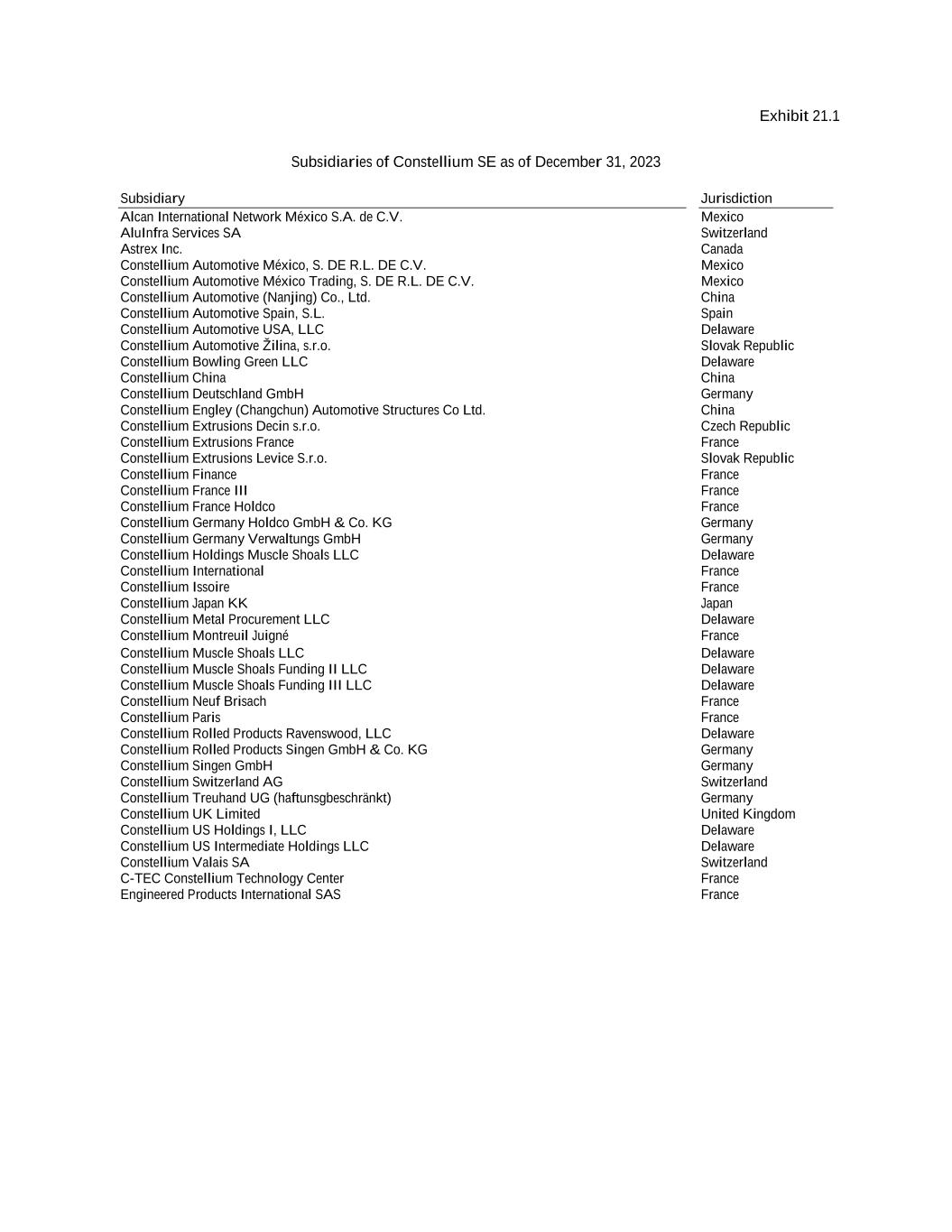
Exhibit 21.1 Subsidiaries of Constellium SE as of December 31, 2023 Subsidiary Jurisdiction Alcan International Network México S.A. de C.V. Mexico AluInfra Services SA Switzerland Astrex Inc. Canada Constellium Automotive México, S. DE R.L. DE C.V. Mexico Constellium Automotive México Trading, S. DE R.L. DE C.V. Mexico Constellium Automotive (Nanjing) Co., Ltd. China Constellium Automotive Spain, S.L. Spain Constellium Automotive USA, LLC Delaware Constellium Automotive Žilina, s.r.o. Slovak Republic Constellium Bowling Green LLC Delaware Constellium China China Constellium Deutschland GmbH Germany Constellium Engley (Changchun) Automotive Structures Co Ltd. China Constellium Extrusions Decin s.r.o. Czech Republic Constellium Extrusions France France Constellium Extrusions Levice S.r.o. Slovak Republic Constellium Finance France Constellium France III France Constellium France Holdco France Constellium Germany Holdco GmbH & Co. KG Germany Constellium Germany Verwaltungs GmbH Germany Constellium Holdings Muscle Shoals LLC Delaware Constellium International France Constellium Issoire France Constellium Japan KK Japan Constellium Metal Procurement LLC Constellium Montreuil Juigné Delaware France Constellium Muscle Shoals LLC Delaware Constellium Muscle Shoals Funding II LLC Delaware Constellium Muscle Shoals Funding III LLC Delaware Constellium Neuf Brisach France Constellium Paris France Constellium Rolled Products Ravenswood, LLC Delaware Constellium Rolled Products Singen GmbH & Co. KG Germany Constellium Singen GmbH Germany Constellium Switzerland AG Switzerland Constellium Treuhand UG (haftunsgbeschränkt) Germany Constellium UK Limited United Kingdom Constellium US Holdings I, LLC Delaware Constellium US Intermediate Holdings LLC Delaware Constellium Valais SA Switzerland C-TEC Constellium Technology Center France Engineered Products International SAS France
exhibit971_clawbackcompe
1 November 23, 2023 CONSTELLIUM SE CLAWBACK/COMPENSATION RECOVERY POLICY EFFECTIVE AS OF OCTOBER 2, 2023 The Board of Directors (the “Board”) of Constellium SE (the “Company”) has adopted this Clawback/Compensation Recovery Policy (this “Policy”) in accordance with Section 303A.14 of The New York Stock Exchange Listed Company Manual (the “Clawback Rules”) as approved by the Securities and Exchange Commission on June 9, 2023. The Human Resources Committee of the Company’s Board (the “Committee”) is designated to administer this Policy. Capitalized terms not otherwise defined in this Policy have the meanings given to them under the Clawback Rules. Section 1: Purposes: Recovery of Erroneously Awarded Incentive Compensation The Company shall comply with the Clawback Rules and reasonably promptly recover Erroneously Awarded Compensation Received by current or former Executive Officers of the Company (“Covered Individuals”) in the event the Company is required to prepare an accounting restatement due to the Company’s material noncompliance with any financial reporting requirement under the securities laws, including any required accounting restatement to correct an error in previously issued financial statements that is material to such previously issued financial statements, or that would result in a material misstatement if the error were corrected in the current period or left uncorrected in the current period. The Committee may determine not to recover Erroneously Awarded Compensation pursuant to this Policy in circumstances where non-enforcement is expressly permitted by the Clawback Rules, including where recovery would violate applicable home country laws in effect before November 28, 2022. Section 2: Covered Individuals The Committee shall determine the list of the Company’s Covered Individuals, who shall be the Executive Officers of the Company. Such list shall be reviewed and approved by the Company’s Board, and may be updated from time to time. Section 3: Covered Compensation This Policy applies to the Incentive-based Compensation Received by a Covered Individual: (1) after such Covered Individual began service as an Executive Officer; (2) who served as an Executive Officer at any time during the performance period for that Incentive-based Compensation; (3) while the Company has a class of securities listed on a national securities exchange or a national securities association; and (4) during the three completed fiscal years immediately preceding the date that the Company is required to prepare an accounting restatement as described above (or during any transition period, that results from a change in the Company’s fiscal year, within or immediately following those three completed fiscal years, as determined in accordance with the Clawback Rules).
The amount of Incentive-based Compensation subject to this Policy is the Erroneously Awarded Compensation, which is the amount of Incentive-based Compensation Received by a Covered Individual that exceeds the amount of Incentive-based Compensation that otherwise would have been Received by the Covered Individual had it been determined based on the restated amount (or otherwise determined in accordance with the Clawback Rules), and will be computed without regard to any taxes paid by the Covered Individual (or withheld from the Incentive-based Compensation). The Committee shall make all determinations regarding the amount of Erroneously Awarded Compensation. Section 4: Method of Recovery The Committee shall determine, in its sole discretion, the manner in which any Erroneously Awarded Compensation shall be recovered. In order of preference and to the extent applicable, methods of recovery may include, but are not limited to: (1) reducing (subject to applicable law and the terms and conditions of the applicable plan, program or arrangement pursuant to which the incentive-based compensation was paid) the amount that would otherwise be payable to the Covered Individual under any bonus, incentive, equity, compensation and other benefit plan, agreement, policy or arrangement maintained by the Company or any of its affiliates (in the order presented above); (2) cancelling any award (whether cash- or equity-based) or portion thereof previously granted to the Covered Individual; (3) seeking direct repayment from the Covered Individual; or (4) any combination of the foregoing. Section 5: No-Fault Basis This Policy applies on a no-fault basis, and Covered Individuals will be subject to recovery under this Policy without regard to their personal culpability. Section 6: Other Company Arrangements This Policy shall be in addition to, and not in lieu of, any other clawback, recovery or recoupment policy maintained by the Company from time to time, as well as any clawback, recovery or recoupment provision in any of the Company’s plans, awards or individual agreements (including the clawback, recovery and recoupment provisions in the Company’s equity award agreements) (collectively, “Other Company Arrangement”) and any other rights or remedies available to the Company, including termination of employment; provided, however, that there is no intention to, nor shall there be, any duplicative recoupment of the same compensation under more than one policy, plan, award or agreement. In addition, no Other Company Arrangement shall serve to restrict the scope or the recoverability of Erroneously Awarded Compensation under this Policy or in any way limit recovery in compliance with the Clawback Rules. Section 7: No Indemnification: Notwithstanding anything to the contrary set forth in any policy, arrangement, bylaws, charter, certificate of incorporation or plan of the Company or any individual agreement between a Covered Individual and the Company or any of its affiliates, no Covered Individual shall be entitled to indemnification from the Company or any of its affiliates for the amount that is or may be recovered by the Company pursuant to this Policy.
Section 8: Administration; Interpretation The Committee shall interpret and construe this Policy consistent with the Clawback Rules and applicable laws and regulation and shall make all determinations necessary, appropriate or advisable for the administration of this Policy. Any determinations made by the Committee shall be final, binding and conclusive on all affected individuals. As required by the Clawback Rules, the Company shall provide public disclosures related to this Policy and any applicable recoveries of Erroneously Awarded Compensation. To the extent this Policy conflicts with or is inconsistent with the Clawback Rules, the Clawback Rules shall govern. In no event is this Policy intended to be broader than, or require recoupment in addition to, that required pursuant to the Clawback Rules. Section 9: Amendment or Termination of this Policy The Board reserves the right to amend this Policy at any time and for any reason, subject to applicable law and the Clawback Rules. To the extent that the Clawback Rules cease to be in force or cease to apply to the Company, this Policy shall also cease to be in force. Approved and Adopted by the Company’s Board of Directors: November 23, 2023